/



Текст
                    More praise for

The Post-American World
“Rarely does a young author and journalist come along in possession of a
prophetic brilliance, near-perfect clarity, and a stirring eloquence that
combine to inform his readers concerning what lies ahead on the
international landscape. Such a person is Fareed Zakaria. . . . In writing this
book, Zakaria has performed a great service to America and the rest of the
world. The Post-American World is a mirror that helps us examine the role
of the United States and numerous other countries with honesty and candor.
Readers will be greatly enlightened and richly rewarded by Zakaria’s
exquisite understanding of international relationships, global politics, and
economic development.”
—Claude Lewis, Philadelphia Inquirer
“A provocative and often shrewd take that opens a big picture window on
the closing of the first American century and the advent of a new world. . . .
Mr. Zakaria uses his wide-ranging fluency in economics, foreign policy and
cultural politics to give the lay reader a lucid picture of a globalized world
(and America’s role in it) that is changing at light speed, even as he
provides a host of historical analogies to examine the possible fallout of
these changes.”
—Michiko Kakutani, New York Times
“Fareed Zakaria has been consistently brilliant in his analysis of world
affairs but also something far more rare: he has turned out to have been
right. Now he’s produced another masterpiece of insight. With great
reporting and cultural understanding, Zakaria explains a future shaped by
many emerging power centers. This book isn’t about America’s decline, it’s
about how it can deploy its unique strengths to prosper as the rest of the
world does so as well. It’s a definitive handbook for political and business
leaders who want to succeed in a global era.”
—Walter Isaacson, author of Einstein: His Life and Universe

“This is a relentlessly intelligent book that eschews simple-minded
projections from crisis to collapse. . . . Maybe it takes a Bombay-born
immigrant like Zakaria, who went from Yale to Harvard . . . and to the top
of Newsweek International, to remind this faltering giant of its unique and
enduring strengths.”
—Joseph Joffe, New York Times Book Review
“It is refreshing to read Fareed Zakaria, who writes with infectious (though
not naïve) sunniness. . . . Mr. Zakaria makes his case with eloquence but
without Panglossian simplicity.”
—Brendan Simms, Wall Street Journal
“Zakaria . . . may have more intellectual range and insights than any other
public thinker in the West.”
—David M. Shribman, Boston Sunday Globe
“Zakaria’s The Post-American World is about the ‘rise of the rest,’ a catchy
phrase from one of the most widely cited writers on foreign affairs. His
prism is correct: We should focus more on the ‘rest,’ even if America is still
the premier superpower. . . . As the Iraq war drags on and China rises, the
larger story of the post–Cold War era has come into sharp relief: We are not
the center of the universe. It matters less that particular countries are pro- or
anti-American than that the world is increasingly non-American. We need
to get over ourselves.”
—Parag Khanna, Washington Post Book World
“Zakaria . . . is judicious, reasonable, smooth, [and] intelligent. . . . He
points out that, aside from some pockets of backwardness, the whole world
has been getting much richer. . . . Even though the economic scene looks
gloomier now than it did when he finished his book, Zakaria is correct to
insist that many people everywhere have benefitted from the global boom.”
—Ian Buruma, The New Yorker

“Provocative . . . illuminating and right. . . . [In] his welcome contribution
to the debate, Fareed Zakaria . . . deftly avoids the extremes of declinism
and triumphalism.”
—Peter Berkowitz, New York Sun
“A far-reaching analysis. . . . Zakaria’s strength lies . . . in offering a lens
through which to understand America’s role in a globalized world.” —Reza
Aslan, Slate
“When a book proclaims that it is not about the decline of America but ‘the
rise of everyone else,’ readers might expect another diatribe about our
dismal post-9/11 world. They are in for a pleasant surprise as Newsweek
editor and popular pundit Zakaria . . . delivers a stimulating, largely
optimistic forecast of where the 21st century is heading. . . . A lucid,
thought-provoking appraisal of world affairs, this book will engage readers
on both sides of the political spectrum.”
—Publishers Weekly, starred review
“With characteristic elegance and insight, Zakaria offers a striking picture
of the rapid growth of the non-West.”
—G. John Ikenberry, Foreign Affairs
“Sharply observed . . . Fareed Zakaria’s sobering book analyzes the changes
afoot as rising global players challenge U.S. dominance. . . . There is no
doubt that he is on to important stuff.”
—Stanley Reed, BusinessWeek
“A thoughtful, reasoned and hopeful sketch of global power and politics in
the 21st century.”
—David Goldblatt, The Independent (UK)
“Fareed Zakaria is one of the most thoughtful foreign policy analysts of our
day and his new book, The Post-American World, is a must-read for anyone

interested in globalization—or the Presidential election for that matter.”
—Bruce Nussbaum, BusinessWeek.com
“His latest book, The Post-American World, is a highly informed and
meticulously detailed examination. . . . Studded with statistics, Zakaria’s
book is notable for its emphasis on economics as the driving force of global
change.”
—Rayyan Al-Shawaf, San Antonio Express-News
“Even if we Americans already know that our country has lost some of its
game over the past, say, eight years, Newsweek International editor Fareed
Zakaria delivers this message in an altogether new, almost buoyant
context.”
—Alan Moores, Seattle Times
“Thought-provoking and important. . . . Fareed Zakaria, whose wise and
perceptive editorials in the American magazine Newsweek should be
required reading for policymakers around the planet, has written a minor
masterpiece full of pragmatic, informed intelligence. . . . Zakaria is
optimistic, though far from complacent. . . . Read Zakaria to know what
has, should and will happen.”
—Jason Burke, The Guardian (London)
“This new analysis of America’s role in the world is a serious, readable . . .
essential book.”
—The Republic
“Zakaria’s particular perspective makes his analysis and prescriptions truly
worth reading.”
—Dan Simpson, Pittsburgh Post-Gazette

ALSO BY FAREED ZAKARIA
The Future of Freedom:
Illiberal Democracy at Home and Abroad
From Wealth to Power:
The Unusual Origins of America’s World Role
(coeditor)
The American Encounter:
The United States and the Making of the Modern World

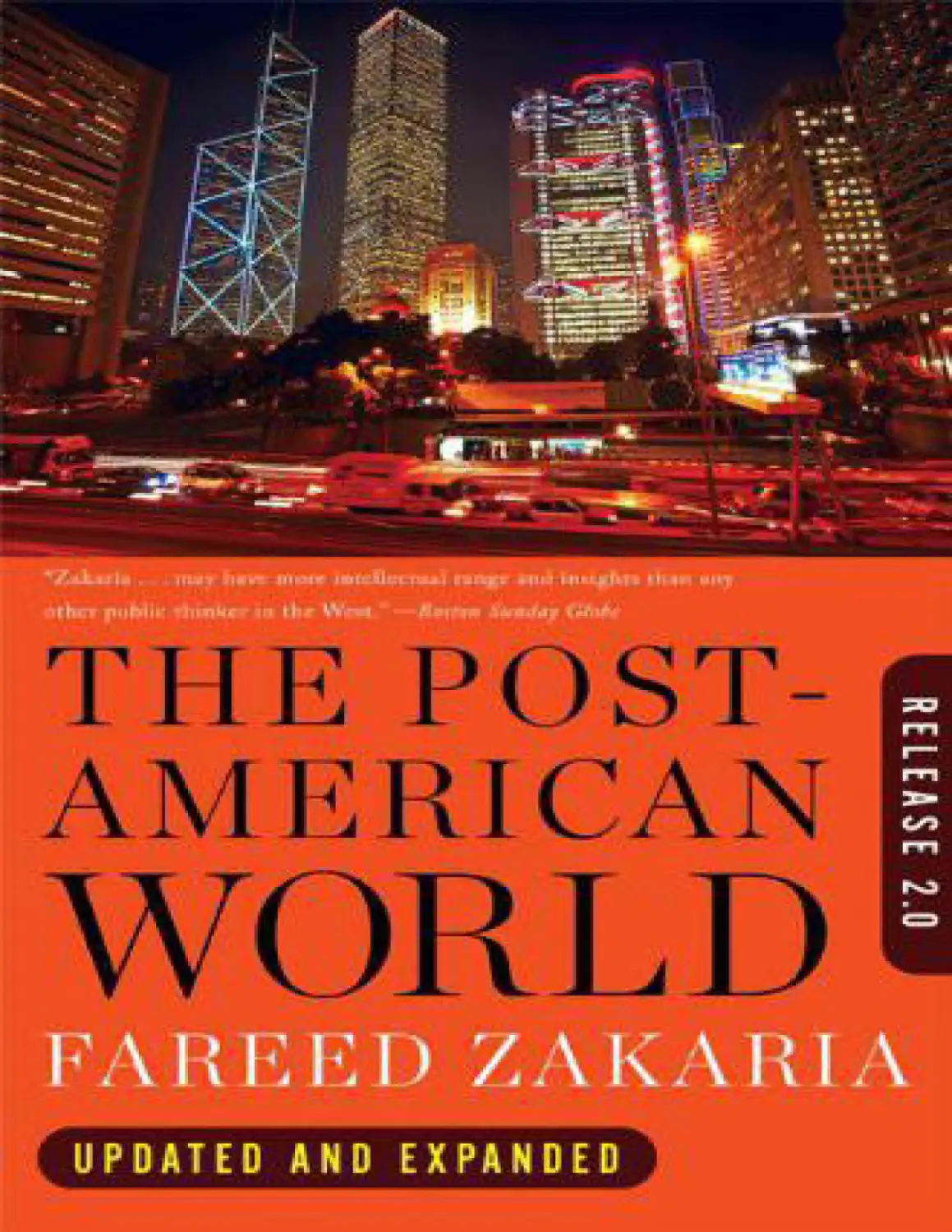
The
Post-American
World
Release 2.0
Fareed Zakaria

W. W. Norton & Company
New York London

Copyright © 2011, 2008 by Fareed Zakaria
All rights reserved
Printed in the United States of America
For information about permission to reproduce selections from this book,
write to Permissions, W. W. Norton & Company, Inc., 500 Fifth Avenue,
New York, NY 10110
For information about special discounts for bulk purchases, please contact
W. W. Norton Special Sales at specialsales@wwnorton.com or 800-233-4830
Manufacturing by RR Donnelley, Harrisonburg
Book design by Anna Oler
Production manager: Julia Druskin
Ebook conversion by Erin Schultz, TIPS Technical Publishing, Inc.
Library of Congress Cataloging-in-Publication Data
Zakaria, Fareed.
The post-American world : release 2.0 / Fareed Zakaria.
p. cm.
Includes bibliographical references and index.
ISBN 978-0-393-08180-0 (hardcover)
1. Twenty-first century—Forecasts. 2. International relations—Forecasting.
3. International economic relations—Forecasting. 4. United States—Foreign relations—21st century
—Forecasting. 5. World politics—21st century—
Forecasting. 6. East and West. 7. Globalization—Forecasting. I. Title.
CB161.Z34 2011
303.49—dc22
2011003996
W. W. Norton & Company, Inc.
500 Fifth Avenue, New York, N.Y. 10110
www.wwnorton.com
W. W. Norton & Company Ltd.
Castle House, 75/76 Wells Street, London W1T 3QT
1234567890

For
Arshad Zakaria

Growth takes place whenever a challenge evokes a
successful response that, in turn, evokes a further and
different challenge. We have not found any intrinisic
reason why this process should not repeat itself indefinitely,
even though a majority of civilizations have failed, as a
matter of historical fact.
Arnold J. Toynbee
A Study of History

Contents
Preface
1 The Rise of the Rest
2 The Cup Runneth Over
3 A Non-Western World?
4 The Challenger
5 The Ally
6 American Power
7 American Purpose
Notes
Acknowledgments
Index

Preface

The first edition of The Post-American World was written in 2006 and
2007, when America was at the center of the world. The American
economy was booming and, despite the setbacks in Iraq, people could not
but be impressed by Washington’s military power, which, since 9/11, had
been deployed across the world on a scale unmatched in human history.
American culture reigned supreme everywhere from Latin America to
China. And whatever anyone thought of George W. Bush, there was still a
general feeling that America represented the world’s most advanced form of
capitalism, run and regulated in a sophisticated fashion. The book was
published in the middle of 2008, when the financial crisis had just begun.
The Bear Stearns bailout, in March 2008, seemed to have stabilized the
system, and the Dow Jones Industrial Average crept up to 13,000. That fall,
the financial system collapsed and with it the American economy, which
contracted by 6 percent in the last quarter and shed almost four million jobs
in six months, the largest such decline since the 1930s. The contraction in
global trade was actually worse than that of the 1930s.
I would be lying if I said that I had predicted any of this. While I did
mention the dangers of cheap credit and wrote about a looming financial
crisis, I thought it would be the garden-variety kind most countries
periodically go through, not the seismic shock that actually took place.
However, contrary to most predictions by most experts, the effect of the
crisis was to accelerate the forces that I described in the book. The financial
crisis hastened the rise of the post-American world. Goldman Sachs has
twice revised its predictions of when China will overtake the United States
as the world’s largest economy, and it will surely revise them again in light
of the slower growth rates caused by the crisis.
The conventional wisdom was that when the West sneezed, the rest
would catch pneumonia—that had been the experience in the past. But this
time, the emerging nations of the world had achieved a critical mass and
were now able to withstand the dramatic decline in growth in the Western
world. In fact, in retrospect, it seems wrong even to describe it as “the
global financial crisis.” For China, India, Brazil, and Indonesia, this has not

been much of a crisis. It has resulted in an acceleration of the power shift I
described in the book, giving it new force and greater scope. In this edition,
I try to explain the consequences of the financial crisis, the resulting
changes in power, diplomacy, and national psyche. China is today a country
very different from the one it was just three years ago.
One more big change: Barack Obama became president, and he arrived
in the Oval Office with an awareness of the trends described in the book.
That meant that the book needed to reflect the new political realities in
Washington, some of which were positive, others as depressing as ever. I
remain convinced that the United States can adapt and adjust to the new
world I describe, but the challenges have become greater and more
complex, and I outline them with some new research and reflections on the
way technology and globalization have combined to create a real crisis of
employment for Americans. I also remain convinced that the geopolitical
challenge of living in a world without a central, dominant power is one that
will be acutely felt everywhere, and this too has been amply illustrated over
the last few years.
The new edition incorporates my views on the financial crisis and its
effects, the challenges and opportunities for the American economy, and the
nature of the new global geopolitics. They are worked in throughout the
book, not in any one place. Nowhere have I altered my basic views, so a
reader who thought I was wrong three years ago is unlikely to be persuaded
that I am now right. I felt that it was important to preserve the basic
integrity of the work. I still believe that the challenge for all of us in the
twenty-first century will be to live and prosper in this new and very
different world.

1
The Rise of the Rest

This is a book not about the decline of America but rather about the rise of
everyone else. It is about the great transformation taking place around the
world, a transformation that, though often discussed, remains poorly
understood. This is natural. Changes, even sea changes, take place
gradually. Though we talk about a new era, the world seems to be one with
which we are familiar. But in fact, it is very different.
There have been three tectonic power shifts over the last five hundred
years, fundamental changes in the distribution of power that have reshaped
international life—its politics, economics, and culture. The first was the rise
of the Western world, a process that began in the fifteenth century and
accelerated dramatically in the late eighteenth century. It produced
modernity as we know it: science and technology, commerce and
capitalism, the agricultural and industrial revolutions. It also produced the
prolonged political dominance of the nations of the West.
The second shift, which took place in the closing years of the
nineteenth century, was the rise of the United States. Soon after it
industrialized, the United States became the most powerful nation since
imperial Rome, and the only one that was stronger than any likely
combination of other nations. For most of the last century, the United States
has dominated global economics, politics, science, and culture. For the last
twenty years, that dominance has been unrivaled, a phenomenon
unprecedented in modern history.
We are now living through the third great power shift of the modern
era. It could be called “the rise of the rest.” Over the past few decades,
countries all over the world have been experiencing rates of economic
growth that were once unthinkable. While they have had booms and busts,
the overall trend has been unambiguously upward. Even the economic
rupture of 2008 and 2009 could not halt or reverse this trend; in fact, the

recession accelerated it. While many of the world’s wealthy, industrialized
economies continued to struggle with slow growth, high unemployment,
and overwhelming indebtedness through 2010 and beyond, the countries
that constitute “the rest” rebounded quickly. India’s annual growth rate
slowed to 5.7 percent in 2009, but hummed along at a 9.7 percent rate in
2010. China’s GDP growth never fell below 9 percent.
This economic success was once most visible in Asia but is no longer
confined to it. That is why to call this shift “the rise of Asia” does not
describe it accurately. In 2010, 85 countries grew at a rate of 4 percent or
more. In 2006 and 2007, that number was 125. That includes more than 30
countries in Africa, two-thirds of the continent. Antoine van Agtmael, the
fund manager who coined the term “emerging markets,” has identified the
25 companies most likely to be the world’s next great multinationals. His
list includes four companies each from Brazil, Mexico, South Korea, and
Taiwan; three from India; two from China; and one each from Argentina,
Chile, Malaysia, and South Africa.
Look around. The tallest building in the world is now in Dubai. The
world’s richest man is Mexican, and its largest publicly traded corporation
is Chinese. The world’s biggest plane is built in Russia and Ukraine, its
leading refinery is in India, and its largest factories are all in China. By
many measures, Hong Kong now rivals London and New York as the
leading financial center, and the United Arab Emirates is home to the most
richly endowed investment fund. Once quintessentially American icons
have been appropriated by foreigners. The world’s largest Ferris wheel is in
Singapore. Its number one casino is not in Las Vegas but in Macao, which
has also overtaken Vegas in annual gambling revenues. The biggest movie
industry, in terms of both movies made and tickets sold, is Bollywood, not
Hollywood. Even shopping, America’s greatest sporting activity, has gone
global. Of the top ten malls in the world, only one is in the United States;
the world’s biggest is in Dongguan, China. Such lists are arbitrary, but it is
striking that twenty years ago, America was at the top in many, if not most,
of these categories.
It might seem strange to focus on growing prosperity when there are
still hundreds of millions of people living in desperate poverty. But in fact,
the share of people living on a dollar a day or less plummeted from 40
percent in 1981 to 18 percent in 2004, and is estimated to fall to 12 percent
by 2015. China’s growth alone has lifted more than 400 million people out

of poverty. Poverty is falling in countries housing 80 percent of the world’s
population. The 50 countries where the earth’s poorest people live are
basket cases that need urgent attention. In the other 142—which include
China, India, Brazil, Russia, Indonesia, Turkey, Kenya, and South Africa—
the poor are slowly being absorbed into productive and growing economies.
For the first time ever, we are witnessing genuinely global growth. This is
creating an international system in which countries in all parts of the world
are no longer objects or observers but players in their own right. It is the
birth of a truly global order.
The emerging international system is likely to be quite different from
those that have preceded it. One hundred years ago, there was a multipolar
order run by a collection of European governments, with constantly shifting
alliances, rivalries, miscalculations, and wars. Then came the bipolar
duopoly of the Cold War, more stable in many ways, but with the
superpowers reacting and overreacting to each other’s every move. Since
1991, we have lived under an American imperium, a unique, unipolar world
in which the open global economy has expanded and accelerated
dramatically. This expansion is now driving the next change in the nature of
the international order.
The rise of the rest is at heart an economic phenomenon, but it has
consequences for nearly every other sphere of life. At the politico-military
level, we remain in a single-superpower world. But in all other dimensions
—industrial, financial, educational, social, cultural—the distribution of
power is shifting, moving away from American dominance. That does not
mean we are entering an anti-American world. But we are moving into a
post-American world, one defined and directed from many places and by
many people.
As countries become stronger and richer, we’re likely to see more
challenges and greater assertiveness from rising nations. In one month in
2008, India and Brazil were willing to frontally defy the United States at the
Doha trade talks, Russia attacked and occupied parts of Georgia, and China
hosted the most spectacular and expensive Olympic Games in history. Ten
years ago, not one of the four would have been powerful or confident
enough to act as it did. Even if their growth rates decline, which they surely
will, these countries will not quietly relinquish their new roles in the global
system.

A related aspect of this new era is the diffusion of power from states to
other actors. The “rest” that is rising includes many nonstate actors. Groups
and individuals have been empowered, and hierarchy, centralization, and
control are being undermined. Functions that were once controlled by
governments are now shared with international bodies like the World Trade
Organization and the European Union. Nongovernmental groups are
mushrooming every day on every issue in every country. Corporations and
capital are moving from place to place, finding the best location in which to
do business, rewarding some governments while punishing others.
Terrorists like Al Qaeda, drug cartels, insurgents, and militias of all kinds
are finding space to operate within the nooks and crannies of the
international system. Power is shifting away from nation-states, up, down,
and sideways. In such an atmosphere, the traditional applications of
national power, both economic and military, have become less effective.
What do these changes portend for the United States and its dominant
position in the world? What will the “rise of the rest” mean in terms of war
and peace, economics and business, ideas and culture?
In short, what will it mean to live in a post-American world?

2
The Cup Runneth Over

Imagine that it is January 2000, and you ask a fortune-teller to predict the
course of the global economy over the next several years. Let’s say that you
give him some clues, to help him gaze into his crystal ball. The United
States will be hit by the worst terrorist attack in history, you explain, and
will respond by launching two wars, one of which will go badly awry and
keep Iraq—the country with the world’s third-largest oil reserves—in chaos
for years. Iran will gain strength in the Middle East and move to acquire a
nuclear capability. North Korea will go further, becoming the world’s eighth
declared nuclear power. Russia will turn hostile and imperious in its
dealings with its neighbors and the West. In Latin America, Hugo Chávez
of Venezuela will launch the most spirited anti-Western campaign in a
generation, winning many allies and fans. Israel and Hezbollah will fight a
war in southern Lebanon, destabilizing Beirut’s fragile government,
drawing in Iran and Syria, and rattling the Israelis. Gaza will become a
failed state ruled by Hamas, and peace talks between Israel and the
Palestinians will go nowhere. “Given these events,” you say to the sage,
“how will the global economy fare over the next decade?”
This is not really a hypothetical. We have the forecasts of experts from
those years. They were all wrong. The correct prediction would have been
that, between 2000 and 2007, the world economy would grow at its fastest
pace in nearly four decades. Income per person across the globe would rise
at a faster rate (3.2 percent) than in any other period in history. In 2008, that
growth collapsed in the Western world, but the cause was an economic
shock, not a political shock.
In the two decades since the end of the Cold War, we have lived
through a paradox, one we experience every morning when reading the
newspapers. The world’s politics seems deeply troubled, with daily reports
of bombings, terror plots, rogue states, and civil strife. And yet the global

economy forges ahead. As the events beginning with the collapse of
Lehman Brothers reminded us, markets do panic—but over economic, not
political news. The front page of the newspaper often seems unconnected to
the business section.
I remember speaking to a senior member of the Israeli government a
few days after the war with Hezbollah in July 2006. He was genuinely
worried about his country’s physical security. Hezbollah’s rockets had
reached farther into Israel than people had believed possible, and the Israeli
military response had not inspired confidence. Then I asked him about the
economy—his area of competence. “That’s puzzled all of us,” he said. “The
stock market was higher on the last day of the war than on its first! The
same with the shekel [Israel’s currency].” The government might have been
spooked, but the market wasn’t.
Or consider the Iraq War, which caused deep, lasting chaos in the
country and sent over two million refugees crowding into its neighbors.
That kind of political crisis seems certain to spill over. But to travel in the
Middle East these past years is to be struck by how little Iraq’s troubles
destabilized the region. Everywhere you go, people angrily denounce the
invasion. But where is the actual evidence of regional instability? Most
Middle Eastern countries—Jordan, Saudi Arabia, and Egypt, for example—
boomed over the last decade. Turkey, which shares a border with Iraq,
averaged 7 percent annual growth between the start of the war and 2008.
During the worst years of the conflict, Abu Dhabi and Dubai, one hour from
Baghdad by plane, erected eye-catching, iconic skyscrapers as if they were
on another planet. The countries that did involve themselves in Iraq—Syria
and Iran—operate largely outside the global economy and thus have less to
lose by making trouble.
What explains this mismatch between a politics that spirals downward
and an economy that steams along? First, it’s worth looking more carefully
at the cascade of bad news. It seems that we are living in crazily violent
times. But don’t believe everything you see on television. Our anecdotal
impression turns out to be wrong. War and organized violence have
declined dramatically over the last two decades. Ted Robert Gurr and a
team of scholars at the University of Maryland’s Center for International
Development and Conflict Management tracked the data carefully and came
to the following conclusion: “the general magnitude of global warfare has
decreased by over sixty percent [since the mid-1980s], falling by the end of

2004 to its lowest level since the late 1950s.”1 Violence increased steadily
throughout the Cold War—increasing sixfold between the 1950s and early
1990s—but the trend peaked just before the collapse of the Soviet Union in
1991 and “the extent of warfare among and within states lessened by nearly
half in the first decade after the Cold War.” Harvard’s polymath professor
Steven Pinker argues “that today we are probably living in the most
peaceful time in our species’ existence.”2
One reason for the mismatch between reality and our sense of it might
be that, over these same decades, we have experienced a revolution in
information technology that now brings us news from around the world
instantly, vividly, and continuously. The immediacy of the images and the
intensity of the twenty-four-hour news cycle combine to produce constant
hyperbole. Every weather disturbance is “the storm of the century.” Every
bomb that explodes is BREAKING NEWS. It is difficult to put this all in
context because the information revolution is so new. We didn’t get daily
footage on the roughly two million who died in the killing fields of
Cambodia in the 1970s or the million who perished in the sands of the IranIraq war in the 1980s. We have not even seen much footage from the war in
Congo in the 1990s, where millions died. But now, almost daily, we see live
broadcasts of the effects of IEDs or car bombs or rockets—tragic events, to
be sure, but often with death tolls under ten. The randomness of terrorist
violence, the targeting of civilians, and the ease with which modern
societies can be penetrated add to our disquiet. “That could have been me,”
people say after a terrorist attack.
It feels like a very dangerous world. But it isn’t. Your chances of dying
as a consequence of organized violence of any kind are low and getting
lower. The data reveal a broad trend away from wars among major
countries, the kind of conflict that produces massive casualties.
I don’t believe that war has become obsolete or any such foolishness.
Human nature remains what it is and international politics what it is.
History has witnessed periods of calm that have been followed by
extraordinary bloodshed. And numbers are not the only measure of evil.
The nature of the killings in the former Yugoslavia in the early 1990s—
premeditated, religiously motivated, systematic—makes that war, which
had 200,000 casualties, a moral obscenity that should register very high on
any scale. Al Qaeda’s barbarism—cold-blooded beheadings, the deliberate

targeting of innocents—is gruesome despite its relatively low number of
casualties.
Still, if we are to understand the times we are living in, we must first
accurately describe them. And they are, for now, in historical context,
unusually calm.

The Islamic Threat
Islamic terror, which makes the headlines daily, is a large and persistent
problem, but one involving small numbers of fanatics. It feeds on the
dysfunctions of the Muslim world, the sense (real and imagined) of
humiliation at the hands of the West, and easy access to technologies of
violence. And yet, does it rank as a threat on the order of Germany’s drive
for world domination in the first half of the twentieth century? Or Soviet
expansionism in the second half? Or Mao’s efforts to foment war and
revolution across the Third World in the 1950s and 1960s? These were all
challenges backed by the power and purpose of major countries, often with
serious allies, and by an ideology that was seen as a plausible alternative to
liberal democracy. By comparison, consider the jihadist threat. Before 9/11,
when groups like Al Qaeda operated under the radar, governments treated
them as minor annoyances, and they roamed freely, built some strength, and
hit symbolic, often military targets, killing Americans and other foreigners.
Even so, the damage was fairly limited. Since 2001, governments
everywhere have been aggressive in busting terrorists’ networks, following
their money, and tracking their recruits—with almost immediate results. In
Indonesia, the largest Muslim nation in the world, the government captured
both the chief and the military leader of Jemaah Islamiah, the country’s
deadliest jihadist group and the one that carried out the Bali bombings in
2002. With American help, the Filipino army battered the Qaeda-style
terrorist outfit Abu Sayyaf. The group’s leader was killed by Filipino troops
in January 2007, and its membership has declined from as many as two
thousand guerrillas six years ago to a few hundred today. In Egypt and
Saudi Arabia—Al Qaeda’s original bases and targets of attack—terrorist
cells have been rounded up, and those still at large have been unable to
launch any new attacks in six years. Finance ministries—especially the U.S.
Department of the Treasury—have made life far more difficult for terrorists.

Global organizations cannot thrive without being able to move money
around, and so the more terrorists’ funds are tracked and targeted, the more
they have to resort to small-scale and hastily improvised operations. This
struggle, between governments and terrorists, will persist, but it is the
former who have the upper hand.
In Iraq, where terrorist attacks have declined, a complication that is
revealing has weakened Al Qaeda. In its original fatwas and other
statements, Al Qaeda made no mention of Shiites, condemning only the
“Crusaders” and “Jews.” But Iraq changed things. Searching for ways to
attract Sunni support, Al Qaeda morphed into an anti-Shiite group,
espousing a purist Sunni worldview. The late Abu Mussab al-Zarqawi, the
head of Al Qaeda in Mesopotamia, bore a fierce hatred for Shiites derived
from his Wahhabi-style puritanism. In a February 2004 letter to Osama bin
Laden, he claimed, “The danger from the Shia . . . is greater . . . than the
Americans. . . . [T]he only solution is for us to strike the religious, military,
and other cadres among the Shia with blow after blow until they bend to the
Sunnis.” If there ever was a debate between him and bin Laden, Zarqawi
won. As a result, a movement that had hoped to rally the entire Muslim
world to jihad against the West was dragged into a dirty internal war within
Islam.
The split between Sunnis and Shiites is only one of the divisions
within the Islamic world. Within that universe are Shiites and Sunnis,
Persians and Arabs, Southeast Asians and Middle Easterners, and,
importantly, moderates and radicals. Just as the diversity within the
communist world ultimately made it less threatening, so do the many
varieties of Islam undermine its ability to coalesce into a single, monolithic
foe. Some Western leaders speak of a single worldwide Islamist movement
—absurdly lumping together Chechen separatists in Russia, Pakistanibacked militants in India, Shiite warlords in Lebanon, and Sunni jihadists in
Egypt. In fact, a shrewd strategist would emphasize that all these groups are
distinct, with differing agendas, enemies, and friends. That would rob them
of their claim to represent Islam. It would also describe them as they often
really are: small local gangs of misfits hoping to attract attention through
nihilism and barbarism.
Conflicts involving radical Islamic groups persist, but these typically
have more to do with specific local conditions than with global aspirations.
Although North Africa has seen continued terror, particularly in Algeria, the

main group there, the Salafist Group for Call and Combat (known by its
French abbreviation, GSPC), is part of a long war between the Algerian
government and Islamic opposition forces and cannot be seen solely
through the prism of Al Qaeda or anti-American jihad. The same is true of
the main area where there has been a large and extremely dangerous
increase in the strength of Al Qaeda, the Afghanistan-Pakistan borderlands.
It is here that Al Qaeda Central, if there is such an entity, is housed. But the
group has been able to sustain itself despite the best efforts of NATO troops
because it had dug deep roots in the area during the years of the anti-Soviet
campaign. Its allies, the Taliban, are a local movement that has long been
supported by a section of the Pashtuns, an influential ethnic group in
Afghanistan and Pakistan.
Here is the bottom line. In the nine years since 9/11, Al Qaeda Central
—the group led by Osama bin Laden and Ayman Zawahiri—has been
unable to launch a major attack anywhere. It was a terrorist organization; it
has become a communications company, producing the occasional
videotape rather than actual terrorism.* Jihad continues, but the jihadists
have had to scatter, make do with smaller targets, and operate on a local
level—usually through groups with almost no connection to Al Qaeda
Central.
This improvised strategy has a crippling weakness: it kills locals, thus
alienating ordinary Muslims—a process that is well underway in countries
as diverse as Indonesia, Iraq, and Saudi Arabia. The data on public opinion
in the Muslim world are now overwhelming. The London School of
Economics professor Fawaz Gerges has analyzed polls from dozens of
Muslim countries over the past few years. He notes that in a range of places
—Jordan, Pakistan, Indonesia, Lebanon, and Bangladesh—there have
occurred substantial declines in the number of people who say suicide
bombing and other forms of violence against civilian targets can be justified
to defend Islam. Wide majorities say such attacks are, at most, rarely
acceptable. The shift has been especially dramatic in Jordan, where only
12 percent of Jordanians view suicide attacks as “often or sometimes
justified” (down from 57 percent in 2005). In Indonesia, 85 percent of
respondents agree that terrorist attacks are “rarely/never justified” (in 2002,
by contrast, only 70 percent opposed such attacks). In Pakistan, that figure
is 90 percent, up from 43 percent in 2002. Gerges points out that, by
comparison, only 46 percent of Americans say that “bombing and other

attacks intentionally aimed at civilians” are “never justified,” while
24 percent believe these attacks are “often or sometimes justified.” This
shift does not reflect a turn away from religiosity or even from a backward
conception of Islam. That ideological struggle persists and will take
decades, not years, to resolve itself. But the battle against jihadism has fared
much better, much sooner, than anyone could have imagined.
Since 9/11, Western commentators have been calling on moderate
Muslim leaders to condemn jihadist ideology, issue fatwas against suicide
bombing, and denounce Al Qaeda. Since about 2006, they’ve begun to do
so in significant numbers. In 2007, one of bin Laden’s most prominent
Saudi mentors, the preacher and scholar Salman al-Odah, wrote an open
letter criticizing him for “fostering a culture of suicide bombings that has
caused bloodshed and suffering, and brought ruin to entire Muslim
communities and families.” That same year Abdulaziz al ash-Sheikh, the
grand mufti of Saudi Arabia, issued a fatwa prohibiting Saudis from
engaging in jihad abroad and accused both bin Laden and Arab regimes of
“transforming our youth into walking bombs to accomplish their own
political and military aims.” One of Al Qaeda’s own top theorists, AbdulAziz el-Sherif, renounced its extremism, including the killing of civilians
and the choosing of targets on the basis of religion and nationality. Sherif—
a longtime associate of Zawahiri who crafted what became known as Al
Qaeda’s guide to jihad—has called on militants to desist from terrorism,
and authored a rebuttal of his former cohorts.
Al-Azhar University in Cairo, the oldest and most prestigious school
of Islamic learning, now routinely condemns jihadism. The Darul Uloom
Deoband movement in India, home to the original radicalism that
influenced Al Qaeda, has inveighed against suicide bombing since 2008.
None of these groups or people have become pro-American or liberal, but
they have become anti-jihadist. Much more must happen to modernize the
Muslim world, but the modernizers are no longer so scared. They have
finally realized that, for all the rhetoric of the madrassas and mosques, few
people want to live under the writ of Al Qaeda. Those who have, whether in
Afghanistan or Iraq, have become its most dedicated opponents. In contrast
to Soviet socialism or even fascism in the 1930s, no society looks with
admiration and envy on the fundamentalist Islamic model. On an
ideological level, it presents no competition to the Western-originated
model of modernity that countries across the world are embracing.

A cottage industry of scaremongering has flourished in the West—
especially in the United States—since 9/11. Experts extrapolate every trend
they don’t like, forgoing any serious study of the data. Many conservative
commentators have written about the impending Islamization of Europe
(Eurabia, they call it, to make you even more uncomfortable). Except that
the best estimates, from U.S. intelligence agencies, indicate that Muslims
constitute around 3 percent of Europe’s population now and will rise to
between 5 and 8 percent by 2025, after which they will probably plateau.
The watchdogs note the musings of every crackpot Imam, search the
archives for each reference to the end of days, and record and distribute the
late-night TV musings of every nutcase who glorifies martyrdom. They
erupt in fury when a Somali taxi driver somewhere refuses to load a case of
liquor into his car, seeing it as the beginning of sharia in the West. But these
episodes do not reflect the basic direction of the Muslim world. That world
is also modernizing, though more slowly than the rest, and there are those
who try to become leaders in rebellion against it. The reactionaries in the
world of Islam are more numerous and extreme than those in other cultures
—that world does have its dysfunctions. But they remain a tiny minority of
the world’s billion-plus Muslims. And neglecting the complicated context
in which some of these pseudoreligious statements are made—such as an
internal Iranian power struggle among clerics and nonclerics—leads to hairraising but absurd predictions, like Bernard Lewis’s confident claim that
Iran’s President Mahmoud Ahmadinejad planned to mark an auspicious
date on the Islamic calendar (August 22, 2006) by ending the world. (Yes,
he actually wrote that.)
The ideological watchdogs have spent so much time with the
documents of jihad that they have lost sight of actual Muslim societies.
Were they to step back, they would see a frustration with the
fundamentalists, a desire for modernity (with some dignity and cultural
pride for sure), and a search for practical solutions—not a mass quest for
immortality through death. When Muslims travel, they flock by the millions
to see the razzle-dazzle of Dubai, not the seminaries of Iran. The minority
that wants jihad is real, but it operates within societies where such activities
are increasingly unpopular and irrelevant.
In the West, the effects of terrorism have diminished with each
additional attack. After September 11, global financial markets collapsed
and did not return to September 10 levels for two months. After the Madrid

bombings in 2004, the Spanish market took a month to recover. After the
London bombings in July 2005, British stocks were back to prebombing
levels in twenty-four hours. The broader economic picture is similar. After
9/11, the United States lost hundreds of billions of dollars in economic
activity. The next large attack, the Bali nightclub bombing in 2002, had a
similarly dramatic effect on the Indonesian economy, with tourism
vanishing and trade and investment drying up for months. A year later, after
another Indonesian bombing, this time at the Marriott hotel in Jakarta, the
market dropped only briefly, and the Indonesian economy suffered little
damage. Bombings in Morocco and Turkey in 2003 had similarly small
effects. The 2004 bombings in Spain and 2005 bombings in Britain did
nothing to undermine growth.
Of course, things would be different if a major terrorist organization
were to acquire significant weapons of mass destruction. A nuclear attack
could result in mass panic and a broader breakdown. But such weapons are
harder to get than many think, and a more sustained effort from Washington
could make it nearly impossible to acquire them in any quantity. Biological
terror may seem most worrying because of the ease of acquiring biological
agents, but dispersing them effectively is difficult and may lack the
dramatic results terrorists crave. And none of this is to suggest that antiterror activities are unnecessary, but rather that careful, calibrated,
intelligent policies are likely to be quite successful.
In some unspoken way, people have recognized that the best
counterterrorism policy is resilience. Terrorism is unusual in that it is a
military tactic defined by the response of the onlooker. If we are not
terrorized, then it doesn’t work. And, from New York and London to
Mumbai and Jakarta, people are learning this fact through experience and
getting on with life even amid the uncertainty. The most likely scenario—a
series of backpack or truck bombings in the United States—would be a
shock, but in a couple of weeks its effects would fade and the long-term
consequences would likely be minimal. In vast, vigorous, and complex
societies—the American economy is now $14 trillion—problems in a few
places do not easily spill over. Modern civilization may be stronger than we
suspect.
The challenges from rogue states are also real, but we should consider
them in context. The GDP of Iran is 1/43 that of the United States, its
military spending 1/72 that of the Pentagon.* If this is 1938, as many

conservatives argue, then Iran is Romania, not Germany. North Korea is
even more bankrupt and dysfunctional. Its chief threat—the one that keeps
the Chinese government awake at night—is that it will implode, flooding
the region with refugees. That’s power? These countries can cause trouble
in their neighborhood and must be checked and contained, but we need to
keep in mind the larger world of which they are a relatively small part.
Look at Latin America. Venezuela is a troublemaker, but what has that
meant on the ground? The broad trend in the region—exemplified by the
policies of the major countries like Brazil, Mexico, and Chile—has been
toward open markets, trade, democratic governance, and an outward
orientation. And that trend, not Hugo Chávez’s insane rants, represents the
direction of history.

The Great Expansion
Today’s relative calm has a deep structural basis. Across the world,
economics is trumping politics. What Wall Street analysts call “political
risk” is almost nonexistent. Wars, coups, and terrorism have lost much of
their ability to derail markets more than temporarily. Again, this may not
last (it has not historically), but it has been the world we have lived in for at
least a decade.
This is not the first time that political tumult became disconnected
from economics. Two earlier periods seem much like our long, post–Cold
War expansion: the turn-of-the-century boom of the 1890s and 1900s, and
the postwar boom of the 1950s and early 1960s. In both, politics was
turbulent and yet growth was robust. These two periods had one feature in
common: large countries were entering the world economy, increasing its
size and changing its shape. The expansion of the pie was so big that it
overwhelmed day-to-day dislocations.
In the late nineteenth and early twentieth centuries, fears of war
between European great powers were frequent, often triggered by crises in
the Balkans, North Africa, and other hot spots. But the world economy
boomed despite flash points and arms races. This was the era of the first
great movements of capital, from Europe to the New World. As Germany
and the United States industrialized quickly, they became two of the three
largest economies in the world.

The 1950s and early 1960s are sometimes remembered as placid, but
they were in fact tension-filled times—defined by the early years of the
Cold War, fears of conflict with the Soviet Union and China, and a real war
in Korea. There were periodic crises—the Taiwan Strait, the Congo, the
Suez Canal, the Bay of Pigs, Vietnam—that often mushroomed into war.
And yet the industrial economies sailed along strongly. This was the second
great age of capital movement, with money from the United States pouring
into Europe and East Asia. As a consequence, Western Europe rebuilt itself
from the ashes of World War II, and Japan, the first non-Western nation to
successfully industrialize, grew over 9 percent a year for twenty-three
years.
In both periods, these “positive supply shocks”—an economist’s term
for a long-run spike in production—caused long, sustained booms, with
falling prices, low interest rates, and rising productivity in the emerging
markets of the day (Germany, the United States, Japan). At the turn of the
twentieth century, despite robust growth in demand, wheat prices declined
by 20 to 35 percent in Europe, thanks to American granaries.3 (Similarly,
the price of manufactured goods has fallen today because of lower costs in
Asia, even as demand for them soars.) In both periods, the new players
grew through exports, but imports expanded as well. Between 1860 and
1914, America’s imports increased fivefold, while its exports increased
sevenfold.4
We are living through the third such expansion of the global economy,
and by far the largest. Over the last two decades, about two billion people
have entered the world of markets and trade—a world that was, until
recently, the province of a small club of Western countries.* The expansion
was spurred by the movement of Western capital to Asia and across the
globe. As a result, between 1990 and 2010, the global economy grew from
$22.1 trillion to $62 trillion, and global trade increased 267 percent. The socalled emerging markets have accounted for over half of this global growth,
and they now account for over 47 percent of the world economy measured
at purchasing power parity (or over 33 percent at market exchange rates).
Increasingly, the growth of newcomers is being powered by their own
markets, not simply by exports to the West—which means that this is not an
ephemeral phenomenon. Nor is it one that is easily derailed. The financial
panics, recessions, and debt crises that have left much of the industrialized

world dazed for the last three years were unable to halt, or even
significantly slow, the ongoing expansion elsewhere.
Some people dismiss such trends by pointing to the rise of Japan in the
1980s, when Westerners were scared that the Japanese would come to
dominate the world economy. That turned out to be a phantom fear: Japan
in fact went into a long slump, one that continues to this day. But the
analogy is misleading. In 1985, Japan was already a wealthy nation. Many
experts believed it was on track to unseat the United States as the largest
economy, but because Japan’s markets, industries, institutions, and politics
were still not fully modernized, the country could not make that final leap.
China, by contrast, is still a poor country. It has a per capita GDP of $4,300.
It will certainly face many problems as and when it becomes a first-world
country. But, for the foreseeable future, it will surely manage to double the
size of its economy just by continuing to make toys and shirts and cell
phones. India, starting at an even lower base income, will also be able to
grow for several decades before hitting the kinds of challenges that derailed
Japan. Even if China and India never get past middle-income status, they
are likely to be the second- and third-largest economies in the world for
much of the twenty-first century.
It is an accident of history that, for the last several centuries, the richest
countries in the world have all happened to have small populations. The
United States was the biggest of the bunch by far, which is why it has been
the dominant player. But such dominance was possible only in a world in
which the truly large countries were mired in poverty, unable or unwilling
to adopt policies that made them grow. Now the giants are on the move,
and, naturally, given their size, they will have a large footprint on the map.
Even if the average person in these countries still seems poor by Western
standards, their total wealth will be massive. Or to put it in mathematical
terms: any number, however small, becomes a large number when
multiplied by 2.5 billion (the approximate population of China plus India).
It is these two factors—a low starting point and a large population—that
guarantee the magnitude and long-term nature of the global power shift.

The Three Forces: Politics,
Economics, and Technology

How did all this come to be? To answer that question, we have to go back a
few decades, to the 1970s, and recall the way most countries ran their
economies at the time. I remember the atmosphere vividly because I was
growing up in India, a country that really didn’t think it was playing on the
same field as the United States. In the minds of India’s policy and
intellectual elites, there was a U.S.-led capitalist model on one end of the
spectrum and a Soviet-led socialist model on the other. New Delhi was
trying to carve a middle way between them. In this respect, India was not
unusual. Brazil, Egypt, and Indonesia—and in fact, the majority of the
world—were on this middle path. But it turned out to be a road to nowhere,
and this was becoming apparent to many people in these countries by the
late 1970s. As they stagnated, Japan and a few other East Asian economies
that had charted a quasi-capitalist course succeeded conspicuously, and the
lesson started to sink in.
But the earthquake that shook everything was the collapse of the
Soviet Union in the late 1980s. With central planning totally discredited and
one end of the political spectrum in ruins, the entire debate shifted.
Suddenly, there was only one basic approach to organizing a country’s
economy. This is why Alan Greenspan has described the fall of the Soviet
Union as the seminal economic event of our time. Since then, despite all the
unease about various liberalization and marketization plans, the general
direction has not changed. As Margaret Thatcher famously put it in the
years when she was reviving the British economy, “There is no alternative.”
The ideological shift in economics had been building over the 1970s
and 1980s even before the fall of the Berlin Wall. Conventional economic
wisdom, embodied in organizations such as the International Monetary
Fund and the World Bank, had become far more critical of the quasisocialist path of countries like India. Academic experts like Jeffrey Sachs
traveled around the world advising governments to liberalize, liberalize,
liberalize. Graduates of Western economics programs, such as Chile’s
“Chicago Boys,” went home and implemented market-friendly policies.
Some developing countries worried about becoming rapacious capitalists,
and Sachs recalls explaining to them that they should debate long and hard
whether they wanted to end up more like Sweden, France, or the United
States. But, he would add, they didn’t have to worry about that decision for
a while: most of them were still much closer to the Soviet Union.

The financial force that has powered the new era is the free movement
of capital. This, too, is a relatively recent phenomenon. The post–World
War II period was one of fixed exchange rates. Most Western countries,
including France and Italy, had capital controls restricting the movement of
currency in and out of their borders. The dollar was pegged to gold. But as
global trade grew, fixed rates created frictions and inefficiencies and
prevented capital from being put to its best use. Most Western countries
removed controls during the 1970s and 1980s. The result: a vast and evergrowing supply of capital that could move freely from one place to the next.
Today, when people think about globalization, they still think of it mostly in
terms of the huge amount of cash—currency traders swap about $2 trillion a
day—that sloshes around the globe, rewarding some countries and
punishing others. It is globalization’s celestial mechanism for discipline.
(That discipline didn’t extend to the money-shifters themselves. Those piles
of money created their own problems, which we’ll get to in a moment.)
Along with freely floating money came another policy revolution: the
spread of independent central banks and the taming of inflation.
Hyperinflation is the worst economic malady that can befall a nation. It
wipes out the value of money, savings, assets, and thus work. It is worse
even than a deep recession. Hyperinflation robs you of what you have now
(savings), whereas a recession robs you of what you might have had (higher
standards of living if the economy had grown). That’s why hyperinflation
has so often toppled governments and produced revolution. It was not the
Great Depression that brought the Nazis to power in Germany but rather
hyperinflation, which destroyed the middle class by making its savings
worthless.
It is rare that one can look back at a war that was so decisively won.
Starting with Paul Volcker in the United States during the early 1980s,
central bankers waged war on inflation, wielding the blunt tools of
monetary policy to keep the price of goods relatively stable. It’s hard to
overstate the momentousness of this economic battle. Between 1854 and
1919 (the years immediately preceding the creation of the Federal Reserve,
the institution responsible for keeping inflation in check), recessions struck
once every four years and lasted nearly two full years when they came. In
the two decades before 2008, the United States experienced eight years of
uninterrupted growth between recessions, and the downturns, when they hit,

lasted only eight months. This period of stability was a spoil of the decadeslong assault on inflation.
The tactics honed in that war became one of America’s most
successful exports. In the late 1980s, dozens of large, important countries
were beset by hyperinflation. In Argentina it was at 3,500 percent, in Brazil
1,200 percent, and in Peru 2,500 percent. In the 1990s, one after the other of
these developing countries moved soberly toward monetary and fiscal
discipline. Some accepted the need to float their currencies; others linked
their currencies to the euro or the dollar. By 2007, just twenty-three
countries had an inflation rate higher than 10 percent, and only one—
Zimbabwe—suffered from hyperinflation. (By 2009, even Zimbabwe had
cured its bout with hyperinflation by giving up its own currency and relying
on the South African rand and U.S. dollar for commerce.) This broad
atmosphere of low inflation has been crucial to the political stability and
good economic fortunes of the emerging nations.
Though the inevitable protesters at G-20 summits will say differently,
none of this happened by coercion. Success stories like Japan and the
“Asian tigers” (Hong Kong, Singapore, South Korea, and Taiwan) were
persuasive examples of the benefits of free trade and smart economic
governance. Governments from Vietnam to Colombia realized they couldn’t
afford to miss out on the global race to prosperity. They adopted sound
policies, lowering debt levels and eliminating distorting subsidies—not
because Bob Rubin or a secretive cabal inside the World Trade
Organization forced them to do so, but because they could see the benefits
of moving in that direction (and the costs of not doing so). Those reforms
encouraged foreign investment and created new jobs.
Along with these political and economic factors moving countries
toward a new consensus came a series of technological innovations that
pushed in the same direction. It is difficult today to remember life back in
the dark days of the 1970s, when news was not conveyed instantly. But by
the 1990s, events happening anywhere—East Berlin, Kuwait, Tiananmen
Square—were transmitted in real time everywhere. We tend to think of
news mainly as political. But prices are also a kind of news, and the ability
to convey prices instantly and transparently across the globe has triggered
another revolution of efficiency. Today, it is routine to compare prices for
products in a few minutes on the Internet. Twenty years ago, there was a
huge business in arbitrage—the exploitation of different prices in different

places or during different times—because such instant price comparison
was so difficult.
The expansion of communications meant that the world got more
deeply connected and became “flat,” in Thomas Friedman’s famous
formulation. Cheap phone calls and broadband made it possible for people
to do jobs for one country in another country—marking the next stage in the
ongoing story of capitalism. With the arrival of big ships in the fifteenth
century, goods became mobile. With modern banking in the seventeenth
century, capital became mobile. In the 1990s, labor became mobile. People
could not necessarily go to where the jobs were, but jobs could go to where
people were. And they went to programmers in India, telephone operators
in the Philippines, and radiologists in Thailand. The cost of transporting
goods and services has been falling for centuries. With the advent of
broadband, it has dropped to zero for many services. Not all jobs can be
outsourced—not by a long shot—but the effect of outsourcing can be felt
everywhere.
In a sense, this is how trade has always worked—textile factories
shifted from Great Britain to Japan in the early twentieth century, for
example. But instant and constant communications means that this process
has accelerated sharply. A clothing factory in Thailand can be managed
almost as if it were in the United States. A Nebraskan sporting goods store
can source from China, sell to Europe, and have its checkbooks balanced by
accountants in Bangalore. Companies now use dozens of countries as parts
of a chain that buys, manufactures, assembles, markets, and sells goods.
Since the 1980s, these three forces—politics, economics, and
technology—have pushed in the same direction to produce a more open,
connected, exacting international environment. But they have also given
countries everywhere fresh opportunities to start moving up the ladder of
growth and prosperity.
Consider the sea change in two representative (non-Asian) countries.
Twenty years ago, Brazil and Turkey would have been considered typical
“developing” countries, with sluggish growth, rampant inflation, spiraling
debt, an anemic private sector, and a fragile political system. Today, both
are well managed and boast historically low inflation, vigorous growth
rates, falling debt levels, a thriving private sector, and increasingly stable
democratic institutions. Brazil’s inflation rate is now, for the first time in
history, in the same ballpark as that of the United States. Brazil and Turkey

still have problems—what country doesn’t?—but they are serious nations
on the rise.
More generally, the story of the last quarter century has primarily been
one of extraordinary growth. The size of the global economy doubled every
ten years or so, going from $31 trillion in 1999 to $62 trillion in 2010, and
inflation stayed surprisingly and persistently low. Economic growth reached
new regions. While Western families moved into bigger homes and bought
laptops and cell phones, subsistence farmers in Asia and Latin America
found new jobs in rapidly growing cities. Even in Africa, people were able
to tap into a global market to sell their goods. Everywhere, prices fell while
wealth in the form of stocks, bonds, and real estate soared.

The Problems of Plenty
For the last two decades, we have spent much time, energy, and
attention worrying about crises and breakdown in the global economy and
terrorism, nuclear blackmail, and war in geopolitics. This is natural—
preparing for the worst can help avert it. And we have indeed had bad news
—from wars in the Balkans and Africa, to terrorism around the world, to
economic crises in East Asia, Russia, and—most dramatically—the United
States. But focusing on the breakdowns has also left us unprepared for
many of the largest problems we face: which are the product not of failure
but of success. The fact that we have experienced decades of synchronous
global growth is good news, but it has also raised a series of complex and
potentially lethal dilemmas.
Consider oil prices. It’s only a dim memory now, but in 2008 the cost
of a barrel climbed upward at a dizzying rate. After years of hovering in the
$25–$50 range, oil hit nearly $150 in mid-2008, and a Goldman Sachs
analyst predicted it would reach $200 the following year. The oil shock of
the naughts was different from previous ones. In the past, prices rose
because oil producers—OPEC—artificially restricted supply and thus
forced up the cost of gasoline. By contrast, prices rose in 2008 because of
demand from China, India, and other emerging markets, as well as the
continuing, massive demand in the developed world. If prices are rising
because economies are growing, it means that economies have the vigor
and flexibility to handle increased costs by improving productivity (and, to

a lesser extent, by passing them on to consumers). As a result, the price
hikes of the naughts were far more easily digested than, say, those of the
1970s. Had we asked our fortune-teller in 2001 to assess the effect of a
quadrupling in oil prices, he would have surely predicted a massive global
recession.
It wasn’t just oil that became more expensive. Commodity prices
reached a 200-year high in 2008. Agricultural produce grew so expensive
that developing countries faced a political problem of how to respond to
food inflation. UN Secretary-General Ban Ki-moon issued a plea in the
Washington Post for “an effective and urgent response” to the emergency.
Raw materials of all kinds became dear. The cost of construction exploded
from New York to Dubai to Shanghai. Even the humble gas helium, which
is used not merely in party balloons but also in MRI machines and
microchip factories, was in short supply globally—and it’s the secondmost-abundant element in the universe.
When the financial crisis struck later that year, prices quickly deflated.
If the 2008 commodity boom had been a one-off event—a by-product of
speculation, say—we might be able to leave it aside for the study of
historians. But it wasn’t. Rather, it was the result of the long, inexorable rise
of the billions who inhabit China, India, and other emerging powers. How
can we be sure? When global growth returned in 2010, commodity prices
resumed their upward march. Coffee, cocoa, and wheat prices all saw
double-digit increases that year. The price of cotton more than doubled.
Because of this, certain countries—those endowed with natural
resources, especially petroleum and natural gas—get free rides. They are
surfing the waves of global growth, getting rich without having to play by
most of the rules that govern the global economy. This phenomenon is the
strange but inevitable outgrowth of the success of everyone else. These
countries are the nonmarket parasites on a market world.
Consider the principal political challenges to the United States and to
Western ideas of international order. In the Middle East they come from
Iran, in Latin America from Venezuela, and in Eurasia from Russia. All
have newfound strength built on oil. Sudan’s ability to defy the world over
Darfur would be difficult to imagine absent its oil reserves. Petroleum
brings in eye-popping amounts of cash. Iran’s take from oil in 2006
amounted to $50 billion—enough to dispense patronage to interest groups,
bribe the army, and stay in power while still having piles left over to foment

trouble abroad. This situation is unlikely to change. Resource-rich countries
will thrive as long as the others are growing. It’s the yin and yang of today’s
globalization.
Not all resource-rich countries are rogues, and the climate of good
economic management has led some to use their riches more wisely than
before. Canada is becoming a major power, and yet acting extremely
responsibly. The Persian Gulf, where so much of the oil revenue flows, is
investing more of its profits in infrastructure and industry, rather than in
Swiss bank accounts and Monte Carlo casinos (though there is certainly
much of that as well). Dubai has become a business-friendly entrepôt, a
Middle Eastern Singapore. Other Gulf states are now trying to emulate its
success. Saudi Arabia, which for decades has mismanaged its vast fortune,
plans to invest $70 billion in new petrochemical projects, aiming to become
a leading petrochemical producer by 2015. The Gulf states made $1 trillion
in capital investments between 2002 and 2007, and McKinsey and
Company estimates that they could invest another $2 trillion over the
subsequent decade. This is a state-directed form of capitalism, which is
likely to result in narrow development and unlikely to produce selfsustaining growth (although there are strong state-directed elements in
European and East Asian capitalism as well). But it is much closer to the
global capitalist norm than the economic systems in these countries—from
Russia to Saudi Arabia—a generation ago.
Over the long term, the most acute problem of plenty is the impact of
global growth on natural resources and the environment. It is not an
exaggeration to say that the world is running out of clean air, potable water,
agricultural produce, and many vital commodities. Some of these problems
can be fixed—by improving efficiency and developing new sources of
supply—but progress has been far too slow. Agricultural productivity, for
example, is rising. But feeding a global population of eight billion, which
we will get to by 2025, will require crop yields to reach four tons per
hectare from only three tons today. Similarly, our ability to manage and
conserve water is not growing nearly as fast as our consumption of it. World
population tripled in the twentieth century, but water consumption increased
sixfold. Americans use more than four hundred liters of water a day to
drink, cook, and clean themselves. People in poorer countries today are
lucky to get forty, but as they get richer, their rising demands will cause
greater stress.5 Violent clashes over water have already broken out in Africa

and the Middle East. Historically, populations have moved to find water; if
water sources dry up in the future, tens of millions of people will be forced
to start moving.
Over the last decade, many predictions about the effects of climate
change have proven to be underestimates because global growth exceeded
all projections. The most recent assessment of the Intergovernmental Panel
on Climate Change was released in mid-2007. By the year’s end, scientists
had shown that the polar ice caps are melting twice as fast as the report
expected.6 There is greater demand for electricity, more cars, and more
planes than anyone imagined fifteen years ago. And it keeps growing. The
McKinsey Global Institute projects that, from 2003 to 2020, the number of
vehicles in China will rise from 26 million to 120 million. And then there’s
India, Russia, the Middle East—the rest.
Demand for electricity is projected to rise over 4 percent a year for
decades. And that electricity will come mostly from the dirtiest fuel
available—coal. Coal is cheap and plentiful, so the world relies on it to
produce most of its electricity. To understand the impact on global
warming, consider this fact. Between 2006 and 2012, China and India will
build eight hundred new coal-fired power plants—with combined CO2
emissions five times the total savings of the Kyoto accords.

The Rise of Nationalism
In a globalized world, almost all problems spill over borders. Whether it’s
terrorism, nuclear proliferation, disease, environmental degradation,
economic crisis, or water scarcity, no issue can be addressed without
significant coordination and cooperation among many countries. But while
economics, information, and even culture might have become globalized,
formal political power remains firmly tethered to the nation-state, even as
the nation-state has become less able to solve most of these problems
unilaterally. And increasingly, nation-states are becoming less willing to
come together to solve common problems. As the number of players—
governmental and nongovernmental—increases and each one’s power and
confidence grows, the prospects for agreement and common action
diminish. This is the central challenge of the rise of the rest—to stop the

forces of global growth from turning into the forces of global disorder and
disintegration.
The rise of pride and confidence among other nations, particularly the
largest and most successful ones, is readily apparent. For me, it was vividly
illustrated a few years ago in an Internet café in Shanghai, where I was
chatting with a young Chinese executive. He was describing the
extraordinary growth that was taking place in his country and a future in
which China would be modern and prosperous. He was thoroughly
Westernized in dress and demeanor, spoke excellent English, and could
comfortably discuss the latest business trends or gossip about American pop
culture. He seemed the consummate product of globalization, the person
who bridges cultures and makes the world a smaller, more cosmopolitan
place. But when we began talking about Taiwan, Japan, and the United
States, his responses were filled with bile. He explained in furious tones
that were Taiwan to dare to declare independence, China should instantly
invade it. He said that Japan was an aggressor nation that could never be
trusted. He was sure that the United States deliberately bombed the Chinese
embassy during the Kosovo war in 1999, to terrify the Chinese people with
its military might. And so on. I felt as if I were in Berlin in 1910, speaking
to a young German professional, who in those days would have also been
both thoroughly modern and thoroughly nationalist.
As economic fortunes rise, so does nationalism. This is
understandable. Imagine that you lived in a country that had been poor and
unstable for centuries. And then, finally, things turn and your nation is on
the rise. You would be proud and anxious to be seen. This desire for
recognition and respect is surging throughout the world. It may seem
paradoxical that globalization and economic modernization are breeding
political nationalism, but that is so only if we view nationalism as a
backward ideology, certain to be erased by the onward march of progress.
Nationalism has always perplexed Americans. When the United States
involves itself abroad, it always believes that it is genuinely trying to help
other countries better themselves. From the Philippines and Haiti to
Vietnam and Iraq, the natives’ reaction to U.S. efforts has taken Americans
by surprise. Americans take justified pride in their own country—we call it
patriotism—and yet are genuinely startled when other people are proud and
possessive of theirs.

In the waning days of Britain’s rule in India, its last viceroy, Lord
Louis Mountbatten, turned to the great Indian leader Mahatma Gandhi and
said in exasperation, “If we just leave, there will be chaos.” Gandhi replied,
“Yes, but it will be our chaos.” That sense of being governed by one’s
“own,” without interference, is a powerful feeling in emerging countries,
especially those that were once colonies or quasi-colonies of the West.
Zbigniew Brzezinski recently called attention to what he terms a
“global political awakening.” He pointed to rising mass passions, fueled by
various forces—economic success, national pride, higher levels of
education, greater information and transparency, and memories of the past.
Brzezinski noted the disruptive aspects of this new force. “The population
of much of the developing world is politically stirring and in many places
seething with unrest,” he wrote. “It is acutely conscious of social injustice
to an unprecedented degree . . . [and this] is creating a community of shared
perceptions and envy that can be galvanized and channeled by demagogic
political or religious passions. These energies transcend sovereign borders
and pose a challenge both to existing states as well as to the existing global
hierarchy, on top of which America still perches.”7
In many countries outside the Western world, there is pent-up
frustration with having had to accept an entirely Western or American
narrative of world history—one in which they either are miscast or remain
bit players. Russians have long chafed at the standard narrative about World
War II, in which Britain and the United States heroically defeat the forces of
fascist Germany and Japan. Given mainstream U.S. historical accounts,
from Stephen Ambrose to Ken Burns, Americans could be forgiven for
believing that Russia played a minor part in the decisive battles against
Hitler and Tojo. In fact, the eastern front was the central arena of World War
II. It involved more land combat than all other theaters of the war put
together and resulted in thirty million deaths. It was where three-quarters of
all German forces fought and where Germany incurred 70 percent of its
casualties. The European front was in many ways a sideshow, but in the
West it is treated as the main event. As the writer Benjamin Schwarz has
pointed out, Stephen Ambrose “lavishes [attention] on the U.S.-British
invasion of Sicily, which drove 60,000 Germans from the island, but
completely ignores Kursk—the largest battle in history, in which at least 1.5
million Soviets and Germans fought, and which occurred at exactly the
same time. . . . [M]uch as it may make us squirm, we must admit that the

struggle against Nazi Germany . . . was primarily, as the great military
historian John Erickson called it, ‘Stalin’s war.’”8
Or consider the perspective on the same war from another spot on the
map. An Indian friend explained to me, “For Britain and America, World
War II is a heroic struggle in which freedom triumphs over evil. For us, it
was a battle to which Britain committed India and its armed forces without
bothering to consult us. London told us to die for an idea of freedom that it
was at that very moment brutally denying to us.”
Such divergent national perspectives have always existed, but today,
thanks to greater education, information, and confidence, they are widely
disseminated on new news networks, cable channels, and Internet sites of
the emerging world. Many of the “rest” are dissecting the narratives,
arguments, and assumptions of the West and countering them with a
different view of the world. “When you tell us that we support a
dictatorship in Sudan to have access to its oil,” a young Chinese official told
me in 2006, “what I want to say is, ‘And how is that different from your
support for a medieval monarchy in Saudi Arabia?’ We see the hypocrisy,
we just don’t say anything, yet.”
After the Cold War ended, there was a general hope and expectation
that China and Russia would move inexorably into the post–World War II
Western political and economic system. When George H. W. Bush spoke of
“a new world order,” he meant simply that the old Western one would be
extended worldwide. Perhaps this view stemmed from the postwar
experience with Japan and Germany, both of which rose to the heights of
economic power and yet were accommodating, cooperative, and largely
silent members of the existing order. But perhaps those were special
circumstances. The two countries had unique histories, having waged
aggressive wars and become pariahs as a consequence, and they faced a
new threat from Soviet communism and relied on American military power
for their protection. The next round of rising powers might not be so eager
to “fit in.”
We still think of a world in which a rising power must choose between
two stark options: integrate into the Western order, or reject it, becoming a
rogue nation and facing the penalties of excommunication. In fact, rising
powers appear to be following a third way: entering the Western order but
doing so on their own terms—thus reshaping the system itself. As the
political scientists Naazneen Barma, Ely Ratner, and Steven Weber point

out, in a world where everyone feels empowered, countries can choose to
bypass this Western “center” entirely and forge their own ties with one
another.9 In a post-American world, there may be no center to integrate
into. U.S. Secretary of State James Baker suggested in 1991 that the world
was moving toward a hub-and-spoke system, with every country going
through the United States to get to its destination. The twenty-first-century
world might be better described as one of point-to-point routes, with new
flight patterns being mapped every day. (This is true even in a physical
sense: in just ten years, the number of Russian visitors to China increased
more than fourfold, from 489,000 in 1995 to 2.2 million in 2005.) The focus
has shifted. Countries are increasingly interested in themselves—the story
of their rise—and pay less attention to the West and the United States. As a
result, the urgent discussions on the presidential campaign trail throughout
2007 and 2008 about the need to lessen anti-Americanism were somewhat
off-point. The world is moving from anger to indifference, from antiAmericanism to post-Americanism.
The fact that new powers are more strongly asserting their interests is
the reality of the post-American world. It also raises the political
conundrum of how to achieve international objectives in a world of many
actors, state and nonstate. According to the old model of getting things
done, the United States and a few Western allies directed the show while the
Third World either played along or stayed outside the box and remained
irrelevant as a result. Nongovernmental players were too few and too weak
to worry about. Now, look at something like trade negotiations, and you see
the developing world acting with greater and greater force. Where they
might once have taken any deal offered by the West or ignored the process
altogether, countries like Brazil and India play hardball until they get the
deal of their choice. They have heard Western CEOs explain where the
future lies. They have read the Goldman Sachs BRIC report. They know
that the balance of power has shifted.
The Kyoto accord (now treated as sacred because of President George
W. Bush’s cavalier rejection of it) is in fact a treaty marked by its adherence
to the old worldview. Kyoto assumed that if the West came together and
settled on a plan, the Third World would adopt the new framework and the
problem would be solved. That may be the way things have been done in
international affairs for decades, but it makes little sense today. China,
India, Brazil, and other emerging powers will not follow along with a

Western-led process in which they have not participated. What’s more,
governments on their own can do only so much to tackle a problem like
climate change. A real solution requires creating a much broader coalition
that includes the private sector, nongovernmental groups, cities and
localities, and the media. In a globalized, democratized, and decentralized
world, we need to get to individuals to alter their behavior. Taxes, tariffs,
and wars are the old ways to do this, but states now have less room to
maneuver on these fronts. They need more subtle and sophisticated ways to
effect change.
The traditional mechanisms of international cooperation are relics of
another era. The United Nations system represents an outdated
configuration of power. The permanent members of the UN Security
Council are the victors of a war that ended sixty years ago. The body does
not include Japan or Germany, the world’s third- and fourth-largest
economies (at market exchange rates), or India, the world’s largest
democracy, or any Latin American or African country. The Security
Council exemplifies the antique structure of global governance more
broadly. The G-8 does not include China, now the world’s second-largest
economy, or India and South Korea, the eleventh and fifteenth. By tradition,
the IMF is always headed by a European and the World Bank by an
American. This “tradition,” like the customs of an old segregated country
club, may be charming and amusing to insiders, but to outsiders it is bigoted
and outrageous.
A further complication: when I write of the rise of nationalism, I am
describing a broader phenomenon—the assertion of identity. The nationstate is a relatively new invention, often no more than a hundred years old.
Much older are the religious, ethnic, and linguistic groups that live within
nation-states. And these bonds have stayed strong, in fact grown, as
economic interdependence has deepened. In Europe, the Flemish and
French in Belgium remain as distinct as ever. In Britain, the Scots have
elected a ruling party that proposes ending the three-hundred-year-old Acts
of Union that created the United Kingdom of England, Scotland, and Wales.
In India, national parties are losing ground to regional ones. In Kenya, tribal
distinctions are becoming more important. In much of the world, these core
identities—deeper than the nation-state—remain the defining features of
life. It is why people vote, and what they die for. In an open world
economy, these groups know that they need the central government less and

less. And in a democratic age, they gain greater and greater power if they
stay together as a group. This twin ascendancy of identity means that, when
relating to the United States or the United Nations or the world at large,
Chinese and Indian nationalism grows. But within their own countries, subnationalism is also growing. What is happening on the global stage—the
rise of identity in the midst of economic growth—is also happening on the
local stage. The bottom line: it makes purposeful national action far more
difficult.
As power becomes diversified and diffuse, legitimacy becomes even
more important—because it is the only way to appeal to all the disparate
actors on the world stage. Today, no solution, no matter how sensible, is
sustainable if it is seen as illegitimate. Imposing it will not work if it is seen
as the product of one country’s power and preferences, no matter how
powerful that country. The massacres in Darfur, for example, are horrific,
and yet military intervention there—the most effective way of stopping it—
would succeed only if sanctioned by the major powers as well as Sudan’s
African neighbors. If the United States acted alone or with a small coalition
—invading its third Muslim country in a decade—the attempt would almost
certainly backfire, providing the Sudanese government with a fiery rallying
cry against “U.S. imperialism.” The Bush administration’s foreign policy
record offers a perfect illustration of the practical necessity of legitimacy.
And yet, beyond Bush’s failures, the dilemma remains: if many countries
need to cooperate to get things done, how to make this happen in a world
with more players, many of them more powerful?

The Fastest Race Car in the World
Rising nationalism, environmental degradation, and commodity-rich
parasite nations are problems the world will grapple with for decades to
come. The Great Expansion has more immediate consequences, too. The
aftermath of the global economic crisis is still with us.* The crash of 2008
was the world’s worst financial collapse since 1929, and ushered in the
worst economic slowdown since the Great Depression. While they have
been chronicled elsewhere in great detail, it’s worth remembering how
unprecedented the events of 2008 and 2009 were: the destruction of
approximately $50 trillion in assets in the global economy; the

nationalization of America’s largest mortgage lenders; the largest
bankruptcy in history (Lehman Brothers); the disappearance of the
investment bank; bailouts and stimulus packages around the world adding
up to trillions of dollars. They were events that will be recounted and
studied for generations.
The rupture of 2008 was, like rising nationalism, a side effect of the
success described above. Low inflation, global growth, swift technological
advancement: these trends, played out over decades, led to an enormous
increase in liquid assets, the ever-growing piles of money moving around
the world. That liquidity kept credit cheap and assets (including real estate,
stocks, and bonds) expensive. At the same time, the boom in low-wage
countries prevented inflation from rising too much. One way to think about
India and China is as two great global deflation machines, pumping out
goods (China) and services (India) for a fraction of what they would cost to
produce in the West.10 This is one of the chief reasons that central banks
haven’t had to worry much about inflation and have been able to maintain
low interests for almost two decades, an unusually long stretch of time.
That led to arrogance, or more technically, the death of risk.
The businessmen and financiers who cautiously prepared for political
disruptions—unstable governments, terrorism—let their guard down when
it came to economic risk. They assumed that the growth of complex
financial products (remember the infamy of credit-default swaps, which
brought down AIG?) actually reduced risk by spreading it around. They
believed that levels of debt that were once considered dangerous were now
manageable, given what they assumed were permanently changed
conditions owing to the Great Moderation. As a result, investors piled into
what would normally be considered dangerous investments, all for the
promise of relatively little reward. Credit spreads—the difference in yield
between a U.S. treasury bond, considered the world’s safest investment, and
the bonds of companies with limited track records—hit historic lows. In
2006 and 2007, volatile countries like Ecuador and teetering companies like
Chrysler could borrow almost as cheaply as the U.S. government. (By 2009,
of course, Ecuador had defaulted on its debt and Chrysler was kept alive
only by a last-minute government bailout.) And since debt was cheap,
financiers and homeowners used it to excess, spending beyond their means.
The banks and investors who supplied all the cheap cash were reassured by
fat corporate coffers—with profits that rose at a double-digit clip for

eighteen consecutive quarters between 2002 and 2006—and bankruptcy
rates that were well below normal. The good times seemed never-ending.
The world economy became the equivalent of a race car—expensive,
with incredible range, and capable of performing at breathtaking speed. In
the decade before 2008, everyone rode it and experienced the adrenaline
rush and the highs. There was only one problem: it turned out that nobody
really knew how to drive a car like this one. Over the last ten years, the
global economy had become something no one had ever seen—an
integrated system of about 125 countries, all participating and all going at
unheard-of speeds. It was as if that race car was being driven by 125
different drivers—and no one remembered to buy shock absorbers.
There were those who wanted shock absorbers. They were seen as
naysayers during the boom years. They asked why packages of subprime
mortgages should be rated as highly as bonds from General Electric. But
each successive year ended with another eye-boggling earnings report or
billion-dollar payday for the hedge fund manager of the moment, the much
promised correction failed to materialize, and the naysayers grew quieter
and quieter. A kind of reverse natural selection occurred on Wall Street. As
Boykin Curry, a managing director at Eagle Capital, said, over the last
twenty years “the DNA of nearly every financial institution had morphed
dangerously. Each time someone at the table pressed for more leverage and
more risk, the next few years proved them ‘right.’ These people were
emboldened, they were promoted, and they gained control of ever more
capital. Meanwhile, anyone in power who hesitated, who argued for
caution, was proved ‘wrong.’ The cautious types were increasingly
intimidated, passed over for promotion. They lost their hold on capital.”
Warren Buffett explained that the heart of the problem was ever-rising
levels of leverage—the fancy Wall Street word for debt. It is “the only way
a smart guy can go broke,” Buffett said. “You do smart things, you
eventually get very rich. If you do smart things and use leverage and you do
one wrong thing along the way, it could wipe you out, because anything
times zero is zero. But it’s reinforcing when the people around you are
doing it successfully, you’re doing it successfully, and it’s a lot like
Cinderella at the ball. The guys look better all the time, the music sounds
better, it’s more and more fun, you think, ‘Why the hell should I leave at a
quarter to 12? I’ll leave at two minutes to 12.’ But the trouble is, there are
no clocks on the wall. And everybody thinks they’re going to leave at two

minutes to 12.” And that, in a nutshell, is the story of how we arrived at the
calamity of 2008.
At some level, debt is at the heart of the whole story. Since the early
1980s, developed countries in general and the United States in particular
have consumed more than they have produced—and they have made up the
difference by borrowing. This happened at every level of society.
Household debt mushroomed from $680 billion in 1974 to $14 trillion in
2008. It doubled in just the seven years between 2001 and 2008. The
average household now has thirteen credit cards and owes $120,000 on a
mortgage. By some standards, however, households were the pinnacles of
thrift. Politicians at the state and local level, eager to give their constituents
new basketball stadiums and twelve-lane highways without raising taxes,
started to borrow against the future. They issued bonds to pay for pet
projects, bonds that were backed by future taxes or lottery earnings. But
even those politicians were put to shame by the true king of borrowers: the
federal government. In 1990, the national debt stood at $3 trillion. By the
end of 2008, it had climbed into the eleven-digit realm, surpassing $10
trillion. The famous National Debt Clock in New York City ran out of space
to display all the figures. (Its owners plan to install a new and expanded
clock.) Thanks to the extraordinary bailouts and stimulus measures of
recent years, the national debt was just shy of $14 trillion at the end of
2010.
The United States became a nation of debtors, in other words. And it
wasn’t just the United States. Much of the financial news in 2010 was
dominated by the near-bankruptcies of Greece, Ireland, and other
industrialized European nations that had relied on loans to continue
providing lavish benefits without raising taxes. There’s nothing wrong with
debt—loans and leverage, used prudently, are the heartbeats of a modern
economy—but taken to such extremes, it’s a killer. And both sides of the
equation must balance—the United States and Europe never could have
arrived at such positions had there not been nations willing to lend them the
money. That’s where the economic and political empowerment of nations in
the developing world—the rise of the rest—came in. Their swift growth
allowed them to pile up savings, which they lent out to spendthrift societies
in the Western world.
At some point, the magical accounting had to stop. At some point,
consumers had to stop using their homes as banks and spending money that

they didn’t have. At some point, the government had to confront its
indebtedness. The United States—and other overleveraged societies—has
now gotten the wake-up call from hell. If we can respond and change our
behavior markedly, this might actually be a blessing in disguise. (Though,
as Winston Churchill said when he lost the election of 1945, “at the moment
it appears rather effectively disguised.”)
In the meantime, the scale of the financial crisis has had the effect of
delegitimizing America’s economic power. The crisis of 2008 was different
precisely because it did not originate in some developing-world backwater;
it emerged from the heart of global capitalism, the United States, and
coursed its way through the arteries of international finance. It did not,
despite the opinions of some pundits, signal the end of capitalism. But it
does contribute to ending a certain kind of global dominance for the United
States, and hastening the move to a post-American world.
Before 2008, whatever people thought of American foreign policy,
they all agreed that the United States had the most modern, sophisticated,
and productive economy in the world—with the most advanced capital
markets. As a result, it held hegemony not just in military power and
diplomacy but in the realm of ideas. Central bankers and treasury ministers
around the world studied the basics of their profession at American schools.
Politicians developed their economies by following the advice prescribed
by the Washington consensus. The innovations of Silicon Valley were the
envy of the world. New York’s deep, lucrative capital markets were admired
and imitated on every continent except Antarctica.
As Brad Setser, a fellow at the Council on Foreign Relations, has
noted, globalization after World War II was almost synonymous with
Americanization. “Foreign borrowers looking to raise funds tended to issue
bonds denominated in dollars, made use of New York law, and met the
Securities and Exchange Commission’s standards for disclosure,” he writes.
American ideas and institutions were made all the more attractive by the
country’s economic success.
The collapse of Wall Street significantly eroded the legacy of that
success. The American economy has emerged from the recession, but it will
potentially grow slowly for years to come, burdened by debt. Most of
Europe is in the same boat, and some countries, like Greece and Ireland, are
far worse off. Naturally, economic activity everywhere has been affected by
this collapse of the first world. But the economies in the big emerging

markets—China, India, and Brazil—are now large enough that they have
significant economic activity of their own (domestic demand) that does not
rely on exports to the West. As a result, the International Monetary Fund
says that 100 percent of global growth in 2009 came from emerging
markets. While the financial markets of these countries are coupled with
that of the United States, their actual economies are, for the first time in
history, beginning to gain some independence from it. Goldman Sachs
originally projected that the combined GDP of the four BRIC economies—
Brazil, Russia, India, China—could overtake the combined GDP of the G-7
countries by 2039. These days, they say it could happen by 2032.11 The
current global recession makes them more, not less, confident.
Global power is, above all, dominance over ideas, agendas, and
models. The revelation that much of the financial innovation that occurred
in the last decade created little more than a house of cards erodes American
power. Selling American ideas to the rest of the world will require more
effort from here on out. Developing countries will pick and choose the
economic policies that best suit them, and with growing confidence. “The
U.S. financial system was regarded as a model, and we tried our best to
copy whatever we could,” said Yu Yongding, a former adviser to China’s
central bank, in late September 2008. “Suddenly we find our teacher is not
that excellent, so the next time when we’re designing our financial system
we will use our own mind more.”

The Last Superpower
Even before the financial crisis, many observers and commentators looked
at the vitality of this emerging world and concluded that the United States
had had its day. Andy Grove, the founder of Intel, put it bluntly. “America
is in danger of following Europe down the tubes,” he said in 2005, “and the
worst part is that nobody knows it. They’re all in denial, patting themselves
on the back as the Titanic heads straight for the iceberg full speed ahead.”
Thomas Friedman describes watching waves of young Indian professionals
get to work for the night shift at Infosys in Bangalore. “Oh, my God, there
are so many of them, and they just keep coming, wave after wave. How in
the world can it possibly be good for my daughters and millions of other
Americans that these Indians can do the same jobs as they can for a fraction

of the wages?”12 “Globalization is striking back,” writes Gabor Steingart,
an editor at Germany’s leading news magazine, Der Spiegel, in a bestselling
book. As its rivals have prospered, he argues, the United States has lost key
industries, its people have stopped saving money, and its government has
become increasingly indebted to Asian central banks.13
What’s puzzling, however, is that these trends have been around for a
while—and they have actually helped America’s bottom line. Even as
globalization and outsourcing accelerated dramatically over the last twenty
years, America’s growth rate averaged just over 2.5 percent, significantly
higher than Europe’s. (Japan averaged 1.2 percent over the same period.)
Productivity growth, the elixir of modern economics, has been over 2.3
percent for over two decades now, a full percentage point higher than the
European average. Even American exports held up, despite a decade-long
spike in the value of the dollar. In 1980, U.S. exports represented 10 percent
of the world total; in 2007, that figure was still almost 9 percent.
The United States’ share of the global economy has been remarkably
steady through wars, depressions, and a slew of other powers rising. With 5
percent of the world’s population, the United States has generated between
20 and 30 percent of world output for 125 years. There will surely be some
slippage of America’s position over the next few decades. This is not a
political statement but a mathematical one. As other countries grow faster,
America’s relative economic weight will fall. But the decline need not be
large-scale, rapid, or consequential, as long as the United States can adapt
to new challenges as well as it adapted to those it confronted over the last
century. In the next few decades, the rise of the emerging nations is likely to
come mostly at the economic expense of Western Europe and Japan, which
are locked in a slow, demographically determined decline.
America will face the most intense economic environment it has ever
experienced. Some of its challenges are internal, legacies of the 2008
rupture and the pressures that caused it. The American economic and social
systems know how to respond and adjust to such pressures. The reforms
needed are obvious. Households, for instance, should save more. The U.S.
government offers enormous incentives to consume (the deduction of
mortgage interest being the best example), and it works. If we were to tax
consumption and encourage savings, that would also work. The government
must, moreover, ensure that Wall Street becomes more stable and secure,

even if that means it is also less profitable. But because such reforms mean
some pain now for long-term gain, the political system cannot make them.
The more difficult challenge that the United States faces is
international. It will confront a global order quite different from the one it is
used to operating in. For now, the United States remains the most powerful
player. But every year the balance shifts.
For the roughly two decades since 1989, the power of the United
States has defined the international order. All roads have led to Washington,
and American ideas about politics, economics, and foreign policy have been
the starting points for global action. Washington has been the most powerful
outside actor on every continent in the world, dominating the Western
Hemisphere, remaining the crucial outside balancer in Europe and East
Asia, expanding its role in the Middle East and Central and South Asia, and
everywhere remaining the only country that can provide the muscle for any
serious global military operation. For every country—from Russia and
China to South Africa and India—its most important relationship in the
world has been the relationship with the United States.
That influence reached its apogee with Iraq. Despite the reluctance,
opposition, or active hostility of much of the world, the United States was
able to launch an unprovoked attack on a sovereign country and to enlist
dozens of countries and international agencies to assist it during and after
the invasion. It is not just the complications of Iraq that have unwound this
order. Even had Iraq been a glorious success, the method of its execution
would have made utterly clear the unchallenged power of the United States
—and it is this exercise of unipolarity that provoked a reaction around the
world. The unipolar order of the last two decades is waning not because of
Iraq but because of the broader diffusion of power across the world.
On some matters, unipolarity seems already to have ended. The
European Union now represents the largest trade bloc on the globe, creating
bipolarity, and as China and then other emerging giants gain size, the
bipolar realm of trade is becoming tripolar, and may even become
multipolar. In every realm except the military, similar shifts are underway.
In general, however, the notion of a multipolar world, with four or five
players of roughly equal weight, does not describe reality today or in the
near future. Europe cannot act militarily or even politically as one. Japan
and Germany are hamstrung by their past. China and India are still
developing. Instead, the international system is more accurately described

by Samuel Huntington’s term “uni-multipolarity,” or what Chinese
geopoliticians call “many powers and one superpower.” The messy
language reflects the messy reality. The United States remains by far the
most powerful country but in a world with several other important great
powers and with greater assertiveness and activity from all actors. This
hybrid international system—more democratic, more dynamic, more open,
more connected—is one we are likely to live with for several decades. It is
easier to define what it is not than what it is, easier to describe the era it is
moving away from than the era it is moving toward—hence the postAmerican world.
The United States still occupies the top spot in the emerging system. It
remains, in the words of the German writer Josef Joffe, “the default
superpower.” But, as such, it is also the country that is most challenged by
the new order. Most other great powers will see their role in the world
expand. That process is already underway. China and India are becoming
bigger players in their neighborhoods and beyond. Russia has ended its
post-Soviet accommodation and is becoming more forceful, even
aggressive. Japan, though not a rising power, is now more willing to voice
its views and positions to its neighbors. Europe acts on matters of trade and
economics with immense strength and purpose. Brazil and Mexico are
becoming more vocal on Latin American issues. South Africa has
positioned itself as a leader of the African continent. All these countries are
taking up more space in the international arena than they did before.
Consider just a few examples. Over the last decade, the United States
has expanded its influence into what was for centuries the Russian sphere of
influence. In the post–Cold War era of American dominance, Moscow
acquiesced. It needed Washington for cash and support. But by 2008 Russia
was a revived power. In mid-February 2009, the Kyrgyz Republic finalized
its decision to close Manas Air Base, a U.S. base providing essential air
support for operations in Afghanistan, which was particularly important
after the 2005 closure of another air base in Uzbekistan. The motivation
was money. The Russian government, inimically opposed to the idea of a
semipermanent U.S. military presence in its backyard, offered a $2.3 billion
aid package that dwarfed the American financial support and included $180
million in debt cancellation, $150 million in aid, and a $2 billion loan to
complete the construction of a hydroelectric power station. (In the end, it
turned out that Kurmanbek Bakiyev, then president of Kyrgyzstan, was

playing both sides off each other. After extracting the deal from Russia, his
government renegotiated a much higher rent from the Americans and
agreed to let Manas remain open as a “transit center.”)
Even a new American ally like India maintains its independence from
the United States. New Delhi is grateful to Washington for its support in
legitimizing India as a normal nuclear power, but it still pushed back on
core security issues. Despite much American pressure, India simply does
not see Iran as the threat that the United States does. India agreed to vote
once with the United States at the International Atomic Energy Agency but
continues to have extensive contact with Iran, including the conducting of
joint naval exercises. India sees Iran as a commercial partner and refuses to
isolate it in any way. In April 2008, President Mahmoud Ahmadinejad’s
pilots requested a refueling stop in New Delhi as the Iranian leader was
returning home from a visit to Sri Lanka. The Indian government
immediately issued a formal invitation and turned the six-hour stop into a
state visit.
The current state of the IMF and the World Bank also provides a useful
lesson. These institutions, dominated by U.S. ideas and money, have long
been seen as vehicles for American influence. And today, Setser writes,
“emerging economies like China, Russia, India, Saudi Arabia, Korea, and
even Brazil not only do not need the IMF; they increasingly are in a
position to compete with it. Saudi Arabia already backstops Lebanon.
Venezuela helped Argentina repay the IMF. Chinese development financing
provides an alternative to World Bank lending.”
For an even better example of just how profound the changes
associated with the rise of the rest will be, reread the coverage of the
November 2008 G-20 summit in Washington, D.C., which took place
during the tensest days of the global financial crisis. Every prior crisis had
been handled by the IMF, the World Bank, or the G-7 (and, later, the G-8).
In past crises, the West played the part of the stern schoolteacher rebuking a
wayward classroom. The lessons the teachers imparted now seem
discredited. Recall that during the Asian financial crisis the United States
and other Western countries demanded that the Asians take three steps—let
bad banks fail, keep spending under control, and keep interest rates high. In
its own crisis, the West did exactly the opposite on all three fronts.
Economics is not a zero-sum game—the rise of other players expands
the pie, which is good for all—but geopolitics is a struggle for influence

and control. As other countries become more active, America’s enormous
space for action will inevitably diminish. Can the United States
accommodate itself to the rise of other powers, of various political stripes,
on several continents? This does not mean becoming resigned to chaos or
aggression; far from it. But the only way for the United States to deter
rogue actions will be to create a broad, durable coalition against them. And
that will be possible only if Washington can show that it is willing to allow
other countries to become stakeholders in the new order. In today’s
international order, progress means compromise. No country will get its
way entirely. These are easy words to write or say but difficult to
implement. They mean accepting the growth in power and influence of
other countries, the prominence of interests and concerns. This balance—
between accommodation and deterrence—is the chief challenge for
American foreign policy in the next few decades.

Another Kind of Bubble
I began this chapter by arguing that the new order did not herald American
decline, because I believe that America has enormous strengths and that the
new world will not throw up a new superpower but rather a diversity of
forces that Washington can navigate and even help direct. But still, as the
rest of the world rises, in purely economic terms, America will experience
relative decline. As others grow faster, its share of the pie will be smaller
(though the shift will likely be small for many years). In addition, the new
nongovernmental forces that are increasingly active will constrain
Washington substantially.
This is a challenge for Washington but also for everyone else. For
almost three centuries, the world has been undergirded by the presence of a
large liberal hegemon—first Britain, then the United States. These two
superpowers helped create and maintain an open world economy, protecting
trade routes and sea lanes, acting as lenders of last resort, holding the
reserve currency, investing abroad, and keeping their own markets open.
They also tipped the military balance against the great aggressors of their
ages, from Napoleon’s France, to Germany, to the Soviet Union. For all its
abuses of power, the United States has been the creator and sustainer of the
current order of open trade and democratic government—an order that has

been benign and beneficial for the vast majority of humankind. As things
change, and as America’s role changes, that order could begin to fracture.
The collapse of the dollar—to the point where there was no global reserve
currency—would be a problem for the world just as much as for America.
And solving common problems in an era of diffusion and decentralization
could turn out to be far more difficult without a superpower.
Some Americans have become acutely conscious of the changing
world. Business leaders are increasingly aware of the shifts taking place
around the world and responding to them rapidly and unsentimentally.
Large U.S.-based multi-nationals almost uniformly report that their growth
now relies on penetrating new foreign markets. With annual revenue growth
of 2–3 percent a year in the United States and 10–15 percent a year abroad,
they know they have to adapt to a post-American world—or else lose out in
it. The companies on the S&P 500 generate 46 percent of their profits
outside the United States, and for many of the biggest American names, the
proportion is much higher. You might think of Coca-Cola as the
quintessentially American company. In fact, it is a vast global enterprise,
operating in 206 countries. “We have a factory in Ramallah that employs
2,000 people. We have a factory in Afghanistan. We have factories
everywhere,” explains Muhtar Kent, the CEO of Coke. Nearly 80 percent of
Coca-Cola’s revenue comes from outside the United States, and an even
greater percentage of its employees are in foreign countries. “We are a
global company that happens to be headquartered in Atlanta,” says Kent.
A similar awareness is visible in America’s universities, where more
and more students study and travel abroad and interact with foreign
students. Younger Americans live comfortably with the knowledge that the
latest trends—in finance, architecture, art, technology—might originate in
London, Shanghai, Seoul, Tallinn, or Mumbai.
But this outward orientation is not yet common in American society
more broadly. The American economy remains internally focused, though
this is changing, with trade making up about a quarter of GDP (compared
with 44 percent for Germany). Insularity has been one of nature’s blessings
to America, bordered as it is by two vast oceans and two benign neighbors.
America has not been sullied by the machinations and weariness of the Old
World and has always been able to imagine a new and different order—
whether in Germany, Japan, or even Iraq. But at the same time, this
isolation has left Americans quite unaware of the world beyond their

borders. Americans speak few languages, know little about foreign cultures,
and remain unconvinced that they need to rectify this. Americans rarely
benchmark to global standards because they are sure that their way must be
the best and most advanced. The result is that they are increasingly
suspicious of this emerging global era. There is a growing gap between
America’s worldly business elite and cosmopolitan class, on the one hand,
and the majority of the American people, on the other. Without real efforts
to bridge it, this divide could destroy America’s competitive edge and its
political future.
Popular suspicions are fed and encouraged by an irresponsible national
political culture. During the Bush administration, it was easy enough to
criticize Washington for its arrogance and unilateralism, which handicapped
America abroad. But the problem was not confined to Bush, Cheney,
Rumsfeld, or the Republicans, and did not end even after their particular
brand of chest-thumping machismo left the White House. Listen to some
Democrats in Washington, and you hear a weaker unilateralism—on trade,
labor standards, and various pet human rights issues. On terrorism, both
parties continue to speak in language entirely designed for a domestic
audience with no concern for the poisonous effect it has everywhere else.
American politicians constantly and promiscuously demand, label, sanction,
and condemn whole countries for myriad failings. Over the last fifteen
years, the United States has placed sanctions on half the world’s population.
We are the only country in the world to issue annual report cards on every
other country’s behavior. Washington, D.C., has become a bubble, smug
and out of touch with the world outside.
The 2009 Pew Global Attitudes Survey showed a remarkable increase
worldwide in positive views about free trade, markets, and democracy.
Large majorities in countries from China and Germany to Bangladesh and
Nigeria said that growing trade ties between countries were good. Of the
forty-seven countries polled, however, the one that came in dead last in
terms of support for free trade was the United States. In the seven years the
survey has been done, no country has seen as great a drop-off as the United
States.
Or take a look at the attitudes toward foreign companies. When asked
whether they had a positive impact, a surprisingly large number of people in
countries like Brazil, Nigeria, India, and Bangladesh said yes. Those
countries have typically been suspicious of Western multinationals. (South

Asia’s unease has some basis; after all, it was initially colonized by a
multinational corporation, the British East India Company.) And yet, 73
percent in India, 75 percent in Bangladesh, 70 percent in Brazil, and 82
percent in Nigeria now have positive views of these companies. The figure
for America, in contrast, is 45 percent, which places us in the bottom five.
We want the world to accept American companies with open arms, but
when they come here—that’s a different matter. Attitudes on immigration
represent an even larger reversal. On an issue where the United States has
been the model for the world, the country has regressed toward an angry
defensive crouch. Where we once wanted to pioneer every new technology,
we now look at innovation fearfully, wondering how it will change things.
The irony is that the rise of the rest is a consequence of American
ideas and actions. For sixty years, American politicians and diplomats have
traveled around the world pushing countries to open their markets, free up
their politics, and embrace trade and technology. We have urged peoples in
distant lands to take up the challenge of competing in the global economy,
freeing up their currencies, and developing new industries. We counseled
them to be unafraid of change and learn the secrets of our success. And it
worked: the natives have gotten good at capitalism. But now we are
becoming suspicious of the very things we have long celebrated—free
markets, trade, immigration, and technological change. And all this is
happening when the tide is going our way. Just as the world is opening up,
America is closing down.
Generations from now, when historians write about these times, they
might note that, in the early decades of the twenty-first century, the United
States succeeded in its great and historic mission—it globalized the world.
But along the way, they might write, it forgot to globalize itself.

3
A Non-Western World?

In 1492, as everybody knows, Christopher Columbus set sail on one of the
most ambitious expeditions in human history. What is less well known is
that eighty-seven years earlier a Chinese admiral named Zheng He began
the first of seven equally ambitious expeditions. Zheng’s ships were much
bigger and better constructed than those of Columbus, or Vasco da Gama,
or any of Europe’s other great fifteenth- and sixteenth-century seafarers. On
his first trip, in 1405, he took 317 vessels and 28,000 men, compared with
Columbus’ 4 boats and 150 sailors. The largest vessels in the Chinese fleet,
the “treasure ships,” were over four hundred feet—more than four times the
length of Columbus’ flagship, Santa Maria—and had nine masts. Each
required so much wood that three hundred acres of forest were felled to
build a single one. There were ships designed to carry horses, supplies,
food, water, and, of course, troops. The smallest vessel in Zheng’s flotilla, a
highly maneuverable five-masted warship, was still twice as large as the
legendary Spanish galleon.
The Chinese ships were constructed with special woods, intricate
joints, sophisticated waterproofing techniques, and an adjustable
centerboard keel. The treasure ships had large, luxurious cabins, silk sails,
and windowed halls. All were constructed on dry docks in Nanjing, the
world’s largest and most advanced shipbuilding port. In the three years after
1405, 1,681 ships were built or refitted at Nanjing. Nothing remotely
comparable could have happened in Europe at the time.1
Size mattered. These massive fleets were meant to “shock and awe”
the inhabitants of the surrounding area, making clear the power and reach of
the Ming dynasty. On his seven voyages between 1405 and 1433, Zheng
traveled widely through the waters of the Indian Ocean and around
Southeast Asia. He gave gifts to the natives and accepted tributes. When
encountering opposition, he did not hesitate to use military might. On one

voyage, he brought back a captured Sumatran pirate; on another, a
rebellious chief from Ceylon. He returned from all of them with flowers,
fruits, precious stones, and exotic animals, including giraffes and zebras for
the imperial zoo.
But Zheng’s story ends oddly. By the 1430s, a new emperor had come
to power. He abruptly ended the imperial expeditions and turned his back
on trade and exploration. Some officials tried to keep the tradition going,
but to no avail. In 1500, the court decreed that anyone who built a ship with
more than two masts (the size required to go any distance at sea) would be
executed. In 1525, coastal authorities were ordered to destroy any
oceangoing vessels they encountered and throw the owners in prison. In
1551, it became a crime to go to sea on a multimast ship for any purpose.
When the Qing dynasty came to power in 1644, it continued this basic
policy, but it had less faith in decrees: instead, it simply scorched a 700mile-long strip of China’s southern coast, rendering it uninhabitable. These
measures had the desired effect: China’s shipping industry collapsed. In the
decades after Zheng’s last voyage, dozens of Western explorers traveled to
the waters around India and China. But it took three hundred years for a
Chinese vessel to make its way to Europe—on a visit to London for the
Great Exhibition of 1851.
What explains this remarkable turnaround? The Chinese elite was
divided over the country’s outward approach, and Beijing’s new rulers
considered the naval expeditions failures. They were extremely expensive,
forced higher taxes on an already strained population, and provided very
little return. Trade had flourished as a result of some of these contacts, but
most of it had benefited only traders and pirates. In addition, by the midfifteenth century, Mongols and other raiders were threatening the empire’s
frontiers, demanding attention and consuming resources. Seafaring seemed
like a costly distraction.
It was a fateful decision. Just as China chose to turn away from the
outside world, Europe was venturing abroad, and it was Europe’s naval
expeditions that allowed it to energize itself and spread its power and
influence across the globe. If China had kept its navy afloat, would the
course of modern history have been different? Probably not. China’s
decision to turn inward was not simply one bad strategic call. It was an
expression of a civilization’s stagnation. Behind the decision to end the
expeditions lay the whole complex of reasons why China* and most of the

non-Western world lagged behind the Western world for so many centuries.
And lag they did. For hundreds of years after the fifteenth century, while
Europe and the United States industrialized, urbanized, and modernized, the
rest of the world remained poor and agricultural.
If we are to understand what the “rise of the rest” means, we must
understand just how long the rest has been dormant. It turns out that the
intellectual and material dominance of the West is neither a recent nor an
ephemeral phenomenon. We have lived in a Western world for over half a
millennium. Despite the rise of other nations and continents, the shadows of
the West will be long and its legacies deep for decades to come, perhaps
longer.
It has become commonplace to say that actually China and India were
as rich as the West right up until the 1800s. The dominance of the West,
according to this perspective, has been a 200-year blip, and we are now
returning to a more normal balance. This statement also implies that the
West’s advantages may be largely accidental—the result of “coal and
colonies,”2 that is, the discovery of a cheap energy source and the
domination of the rich lands of Asia, Africa, and the Americas. This view,
which embraces a multicultural sensibility that denies any special status to
the West, has its political advantages. But while it may be politically
correct, it is historically incorrect.
One reason for this misinterpretation is that analysts often focus solely
on the total size of the Chinese and Indian economies. Historically, this has
been a misleading statistic. Until the modern age, a country’s economy
could not be mobilized, extracted, or put to use in any meaningful sense.
The fact that in, say, the seventeenth century, millions of peasants in remote
and unconnected corners of China were working the land in grinding
poverty did not really contribute to the nation’s usable wealth or power,
even though their output added up to a large number. Population was the
main ingredient of GDP, and production was largely agricultural. Since
China and India had four times the population of Western Europe in 1600,
their GDP was, of course, larger. Even in 1913, when Britain was the
world’s leading power, with cutting-edge technology and industrial
production and trade many times larger than all of Asia’s, China could
claim a greater total GDP.
In studying the preindustrial age, before big government,
communications, transport, and broad-based taxation, aggregate GDP alone

tells us little about national power or a country’s level of advancement. It
doesn’t say anything about the dynamism of the society or its ability to
make new discoveries and inventions. And it was mastery in these areas
that gave a country new ways to create wealth and its government power.
We get a much clearer picture of the real standing of countries if we
consider economic growth and GDP per capita. Western European GDP per
capita was higher than that of both China and India by 1500; by 1600, it
was 50 percent higher than China’s. From there, the gap kept growing.
Between 1350 and 1950—six hundred years—GDP per capita remained
roughly constant in China and India (hovering around $600 for China and
$550 for India). In the same period, Western European GDP per capita went
from $662 to $4,594, a 594 percent increase.*
European travelers in the seventeenth century routinely pointed out
that Chinese and Indian living conditions were well below those in
northwestern Europe. The economist Gregory Clark calculates that in the
eighteenth century the average daily wage of a laborer in Amsterdam could
buy him 21 pounds of wheat, in London 16 pounds, and in Paris 10. In
China, a day’s wages would buy about 6.6 pounds of wheat (or its
equivalent). Clark has also examined records to determine differences in the
number of famines, which points in the same direction. The West, in short,
was more prosperous than the East long before the eighteenth century.
Still, it was not always thus. For the first centuries of the second
millennium, the East was ahead of the West by almost every measure. As
Europe foundered in the depths of the Middle Ages, both the Middle East
and Asia prospered, with lively traditions of scholarship, invention, and
trade. The Middle East was at the forefront of civilization, preserving and
building on Greek and Roman knowledge and producing pathbreaking work
in fields as diverse as mathematics, physics, medicine, anthropology, and
psychology. Arabic numerals, of course, were invented there, as was the
concept of zero. The word “algebra” comes from the title of a book, Al-Jabr
wa-al-Muqabilah, by an Arab scholar. The word “algorithm” derives from
the scholar’s name, al-Khwarizmi. Militarily, the Ottomans were the envy
of their rivals and continued to expand their empire, battling Western states
in Central Asia and Europe until the seventeenth century. India, during its
most vibrant eras, boasted scientific prowess, artistic genius, and
architectural splendor. Even in the early sixteenth century, under
Krishnadevaraya, the southern Indian city of Vijayanagar was described by

many foreign visitors as one of the great cities of the world, comparable to
Rome. A few centuries earlier, China was probably richer and more
technologically sophisticated than any other country, using various
technologies—gunpowder, movable type, the stirrup—that the West would
stumble upon only centuries later. Even Africa had a higher average income
than Europe during this period.
The tide began to turn in the fifteenth century—and by the sixteenth
century, Europe had moved ahead. With the revolution in thought that is
termed the Renaissance, men like Copernicus, Vesalius, and Galileo gave
birth to modern science. Indeed, the hundred years between 1450 and 1550
marked the most significant break in human history—between faith, ritual,
and dogma, on the one hand, and observation, experimentation, and critical
thought, on the other. And it happened in Europe, pushing that civilization
forward for centuries. By 1593, when an English ship equipped with eightyseven guns traveled 3,700 miles to arrive in Istanbul, an Ottoman historian
would call it “a wonder of the age the like of which has not been seen or
recorded.”3 By the seventeenth century, almost every kind of technology,
product, and complex organization (like a corporation or an army) was
more advanced in Western Europe than anywhere else in the world.
To believe that Asian societies were, in any material sense, on par with
the West in 1700 or 1800 is to believe that the scientific and technological
advances that revolutionized the Western world over the preceding three
hundred years had no effect on its material condition, which is absurd.*
Scientific advances were not merely about creating new machines. They
reshaped the mental outlook of Western societies. Take the mechanical
clock, which was invented in Europe in the thirteenth century. The historian
Daniel Boorstin calls it “the mother of machines.” “The clock,” he notes,
“broke down the walls between kinds of knowledge, ingenuity, and skill,
and clockmakers were the first consciously to apply the theories of
mechanics and physics to the making of machines.”4 Its broader effects
were even more revolutionary. The clock freed man from dependence on
the sun and moon. It made it possible to order the day, define the night,
organize work, and—perhaps most important—measure the cost of labor,
by tracking the number of hours that went into a project. Before the clock,
time had no measurable value.
By the sixteenth century, when the Portuguese brought them to China,
Europe’s mechanical clocks were much more sophisticated than the clumsy

water clocks made in Beijing. The Chinese, however, saw little value in
these machines, viewing them as toys, and they never bothered to learn how
to run them. Having acquired some, they needed Europeans to stay behind
to work their inventions. Similarly, when the Portuguese brought cannons to
Beijing a hundred years later, they had to supply operators for the machines.
China could consume modern technology, but it could not produce it. And
by the eighteenth century, Beijing no longer even wanted to see foreign
gadgets. In a famous letter to George III, the Qienlong emperor, who ruled
from 1736 to 1795, rejected Britain’s request for trade, explaining, “We
have never set much store on strange and ingenious objects, nor do we need
any more of your country’s manufactures.” The Chinese had closed their
minds to the world.5
Without new technologies and techniques, Asia fell prey to the classic
Malthusian problem. Thomas Malthus’ famous 1798 treatise, An Essay on
the Principle of Population, is remembered today for its erroneous
pessimism, but, in fact, many of Malthus’ insights were highly intelligent.
He observed that food production in England rose at an arithmetic rate (1, 2,
3, 4, . . .) but population grew at a geometric rate (1, 2, 4, 8, 16, . . .). This
mismatch, unless altered, would ensure that the country would be hungry
and impoverished, and that only catastrophes like famine and disease could
raise living standards (by shrinking the population).* Malthus’ dilemma
was quite real, but he failed to appreciate the power of technology. He did
not recognize that these very pressures would generate a human response in
Europe—the agricultural revolution, which vastly expanded the production
of food. (The continent also eased population pressures by exporting tens of
millions of people to various colonies, mostly in the Americas.) So Malthus
was wrong about Europe. His analysis, however, well described Asia and
Africa.

Strength Is Weakness
And yet, how to make sense of those extraordinary Chinese voyages?
Zheng He’s dazzling fleet is just one part of a larger picture of remarkable
achievements in China and India—palaces, courts, cities—at the very time
that the West was moving ahead of them. The Taj Mahal was built in 1631
to honor the Mogul emperor Shah Jahan’s beloved wife, Mumtaz Mahal. A

British traveler, William Hodges, was one of many to point out that there
was nothing like it in Europe. “The fine materials, the beautiful forms, and
the symmetry of the whole,” he wrote, “far surpasses anything I ever
beheld.” Building the Taj took enormous talent and skill, as well as
astonishing feats of engineering. How could a society produce such
wonders of the world and yet not move ahead more broadly? If China could
put together such spectacular and sophisticated naval expeditions, why
could it not make clocks?
Part of the answer lies in the way the Moguls built the Taj Mahal.
Twenty thousand laborers worked night and day on the site for twenty
years. They built a ramp ten miles long just to move materials up to the
187-foot-high dome. The budget was unlimited, and no value was placed on
the man-hours put into the project. If you had to ask, you couldn’t afford the
Taj. Zheng He’s flotilla was produced by a similar command system, as was
Beijing’s Forbidden City. Begun in 1406, the city required the labor of a
million men—and another million soldiers to watch over them. If all of a
large society’s energies and resources are directed at a few projects, those
projects often become successes—but isolated successes. The Soviet Union
boasted an extraordinary space program well into the 1970s, even though
by then it was technologically the most backward of all the industrial
nations.
But throwing more manpower at a problem is not the path to
innovation. The historian Philip Huang makes a fascinating comparison
between the farmers of the Yangtze Delta and those of England, the richest
regions of China and Europe respectively in 1800.6 He points out that, by
some measures, the two areas might seem to have been at equivalent
economic levels. But in fact, Britain was far ahead in the key measure of
growth—labor productivity. The Chinese were able to make their land
highly productive, but they did so by putting more and more people to work
on a given acre—what Huang calls “output without development.” The
English, on the other hand, kept searching for ways to make labor more
productive, so that each farmer was producing more crops. They discovered
new labor-saving devices, using animals and inventing machines. When the
multi-spindle wheel, which required one trained operator, was developed,
for example, it was widely adapted in England. But in China, the inferior
but cheaper single spindle persisted, because it could be used by many
untrained operators. (Since labor had little value, why spend money on

labor-saving machines?) Ultimately, the result was that a small number of
Britons were able to farm huge swaths of land. By the eighteenth century,
the average farm size in southern England was 150 acres; in the Yangtze
delta, it was about 1 acre.
The naval expeditions also illustrate the difference in the Eastern and
Western approaches. The European missions were less grand but more
productive. They were often entirely private or public-private partnerships
and used new methods to pay for the trips. The Dutch pioneered
innovations in finance and taxation; their herring traders were using futures
contracts widely by the 1580s. And these financial mechanisms marked a
crucial advance, because they ensured funding for an ever-increasing
number of expeditions. Each trip was intended to turn a profit, make new
discoveries, and find new products. The project moved forward by trial and
error, with every expedition building on past ones. Over time, a chain
reaction of entrepreneurship, exploration, science, and learning developed.
In China, by contrast, the voyages depended on the interests and power
of one monarch. When he was gone, they stopped. In one case, a new
emperor even ordered the destruction of ship schematics, so the capacity to
build them was lost. The Chinese used cannons effectively in the thirteenth
century. Three hundred years later, they couldn’t operate one without a
European to show them how. The Harvard economic historian David
Landes concludes that China failed to “generate a continuous, selfsustaining process of scientific and technological advance.”7 Its
achievements ended up being episodic and ephemeral. This was the tragedy
of Asia: even when there was knowledge, there was no learning.

Is Culture Destiny?
Why did non-Western countries stand still while the West moved forward?
These questions have been debated for centuries, and there is no neat
answer. Private property rights, good institutions of governance, and a
strong civil society (that is, one not dominated by the state) were clearly
crucial for growth in Europe and, later, the United States. In contrast, the
Russian czar theoretically owned his entire country. In China, the Ming
court was run by mandarins who disdained commerce. Almost everywhere
in the non-Western world, civil society was weak and dependent on the

government. Local businessmen in India were always captive to the whims
of the court. In China, rich merchants would abandon their businesses to
master Confucian classics so that they could become favorites of the court.
The Moguls and the Ottomans were warriors and aristocrats who
thought of trade as unglamorous and unimportant (even though the Middle
East had a long merchant tradition). In India, this bias was reinforced by the
low position of businessmen in the Hindu caste hierarchy. Historians have
taken particular note of Hindu beliefs and practices as barriers to
development. Paul Kennedy argues, “The sheer rigidity of Hindu religious
taboos militated against modernization: rodents and insects could not be
killed, so vast amounts of foodstuffs were lost; social mores about handling
refuse and excreta led to permanently insanitary conditions, a breeding
ground for bubonic plagues; the caste system throttled initiative, instilled
ritual, and restricted the market; and the influence wielded over Indian local
rulers by the Brahman priests meant that this obscurantism was effective at
the highest level.”8 J. M. Roberts makes a broader point about the Hindu
worldview, observing that it was “a vision of endless cycles of creation and
reabsorption into the divine [which led] to passivity and skepticism about
the value of practical action.”9
But if culture is everything, how to account for China and India now?
Today, their remarkable growth is often explained with paeans to their
distinctive cultures. Confucianism was once bad for growth; now it is good.
The Hindu mind-set, once an impediment, is now seen to embody a kind of
practical worldliness that undergirds entrepreneurial capitalism. The success
of the Chinese and Hindu diaspora seemingly provides daily confirmation
of such theories.
The late Daniel Patrick Moynihan, America’s leading scholar-senator,
once said, “The central conservative truth is that it is culture, not politics,
that determines the success of a society. The central liberal truth is that
politics can change a culture and save it from itself.” That gets it just about
right. Culture is important, terribly important. But it can change. Cultures
are complex. At any given moment, certain attributes are prominent and
seem immutable. And then politics and economics shift, and those attributes
wane in importance, making space for others. The Arab world was once the
center of science and trade. In recent decades, its chief exports have been
oil and Islamic fundamentalism. Any cultural argument must be able to
explain both periods of success and periods of failure.

Why was Asian commercialism—so prominent now—buried for
centuries? A large part of the explanation must lie in the structure of their
states. Most countries in Asia had powerful and centralized predatory states
that extracted taxes from their subjects without providing much in return.
From the fifteenth century through the nineteenth, Asian rulers largely fit
the stereotype of the Oriental tyrant. After the Moguls swept into India from
the north in the fifteenth century, their rapacious rule consisted of
demanding taxes and tributes and building palaces and forts while
neglecting infrastructure, communications, trade, and discovery. (The reign
of Akbar, 1556 –1605, was a brief exception.) Hindu princes in southern
India were not much better. Businessmen had to keep interest rates high in
anticipation of frequent and arbitrary taxation by their rulers. No one had
much of an incentive to build wealth, since it was likely to be confiscated.
In the Middle East, centralization came much later. When the region
was ruled in a relatively lax and decentralized manner under the Ottoman
Empire, trade, commerce, and innovation flourished. Goods, ideas, and
people from everywhere mingled freely. But in the twentieth century, an
effort to create “modern” and powerful nation-states resulted in
dictatorships that brought economic and political stagnation. Civic
organizations were marginalized. With strong states and weak societies, the
Arab world fell behind the rest of the world by almost every measure of
progress.
Why was this type of centralized state being limited and constrained in
Europe, even as it flourished in much of the non-Western world? Partly
because of the Christian church, which was the first major institution that
could contest the power of kings. Partly because of Europe’s landed elite,
which had an independent base in the countryside and acted as a check on
royal absolutism. (The Magna Carta, the first great “bill of rights” of the
Western world, was actually a charter of baronial privileges, forced on the
king by his nobles.) Partly—and, some would say, ultimately—because of
geography.
Europe is broken up by wide rivers, tall mountains, and large valleys.
This topography produced many natural borders and encouraged political
communities of varying sizes—city-states, duchies, republics, nations, and
empires. In 1500, Europe had more than five hundred states, city-states, and
principalities. This diversity meant there was constant competition of ideas,
people, art, money, and weapons. People who were mistreated or shunned

in one place could escape to another and thrive. States that succeeded were
copied. Those that failed, died. Over time, this competition helped Europe
become highly skilled at both making wealth and making war.10
Asia, by contrast, consists of vast flatlands—the steppes in Russia, the
plains in China. Armies can move through these areas quickly and with
little opposition. (The Chinese had to build the Great Wall because they
could not rely on any natural barrier to protect their territory.) This
geography helped sustain large, centralized land empires that were able to
maintain their grip on power for centuries. Consider, for instance, the
episode with which we began this chapter, the Ming dynasty’s decision to
end sea exploration after Zheng He’s voyages. Perhaps the most notable
fact about the ban on sea expeditions was that it worked. Such a policy
could not have been implemented in Europe. No king was powerful enough
to enforce such a decree, and even if one had been, the people and their
expertise would have simply moved to a neighboring nation, city-state, or
principality. In China, the emperor could turn back time.
Europe’s waterways were also a blessing. Its rivers flowed gently into
sheltered, navigable bays. The Rhine is a wide, slow-moving river that can
be used as a highway for goods and people. The Mediterranean is calm,
almost a lake, with many big ports. Compare this to Africa. Despite being
the second-largest continent, Africa has the shortest coastline, much of
which is too shallow to build major ports. Most of its big rivers—fastmoving, dramatic, vertiginous—are not navigable. Add to that the tropical
heat and propensity for disease and food spoilage, and you have a
compelling geographic explanation for African underdevelopment—surely
not the only factor, but a significant one.
These grand explanations may make it seem as if things could not have
turned out any other way, but in fact, such structural factors tell you only a
society’s predispositions, what the odds favor. Sometimes, the odds can be
beaten. Despite its geographic diversity, Europe was once conquered by a
great land empire, Rome, which tried—with diminishing success—to keep
the empire centralized. The Middle East did well at one point under a vast
empire. China prospered for centuries despite its flat geography, and India
also had its periods of effervescence. European advantages, so clear in
retrospect, were initially small and related mostly to the weapons and
techniques of war. Over time, however, the advantages multiplied and

reinforced each other, and the West moved further and further ahead of the
rest.

The Spoils of Victory
Contact with the rest of the world stimulated Europe. The discovery of new
seaways, rich civilizations, and strange peoples stirred the energy and
imagination of the West. Everywhere Europeans went they found goods,
markets, and opportunities. By the seventeenth century, Western nations
were increasing their influence over every region and culture with which
they came into contact. No part of the world would remain untouched, from
the lands across the Atlantic to the far reaches of Africa and Asia. By the
end of the eighteenth century, even Australia and the small islands of the
South Pacific had been marked for use by Europeans. The Far East—China
and Japan—at first remained insulated from this influence, but by the midnineteenth century they, too, fell prey to Western advances. The rise of the
West led to the beginnings of a global civilization—one that was defined,
shaped, and dominated by the nations of Western Europe.
Initially, Europeans were focused on finding products that people
might want back home. This sometimes took the form of plunder; at other
times, trade. They brought back furs from the Americas, spices from Asia,
and gold and diamonds from Brazil. Soon, however, their involvement
became more permanent. Their interests varied, depending on the climate.
In temperate regions, starting with North and South America, Europeans
settled, re-creating Western-style societies in far-off places. That was the
beginning of what they called the New World. In lands they found
uninhabitable, often tropical climes like Southeast Asia and Africa, they
created a system of agriculture to produce crops that would be of interest in
domestic markets. The Dutch set up vast farms in the East Indies, as did the
Portuguese in Brazil. These were soon eclipsed by the French and English
plantations in the Caribbean, which used Africans as slaves for labor.
Within a hundred years of initial European contact, one trend was
unmistakable and irreversible: these encounters changed or destroyed the
existing political, social, and economic arrangements in non-Western
societies. The old order collapsed or was destroyed, or often a combination
of the two. This was true no matter the country’s size, from tiny Burma,

where the traditional structure crumbled under British rule, to the large
tribes of Africa, where European nations drew new borders, created new
divisions, and put favored groups into power. In many cases, this external
influence introduced modernity, even if sometimes accompanied by great
brutality. In other cases, European influence was regressive, destroying old
ways but creating little to replace them. In any event, the Americas, Asia,
and Africa were forever and irreversibly altered by their discovery by the
West.
The direction of European expansion was determined by the balance of
power. For several centuries, despite their mastery of the oceans, European
nations did not have any military advantage over Turks and Arabs. So they
traded with—but did not try to dominate—the lands of the Middle East and
North Africa until the early nineteenth century. In Asia, the Europeans saw
few easy pathways into the continent and instead set up trading posts and
offices and contented themselves with the scraps ignored by the Chinese. In
sub-Saharan Africa and the Americas, by contrast, they were clearly
stronger than the natives and knew it. Portuguese expansion started in
Africa, with moves into the Congo and the Zambezi in the early sixteenth
century. But the climate there was inhospitable for settlement, so they
turned to the Western Hemisphere.
America was a mistake—Columbus was searching for a path to the
Indies and bumped up against a large obstacle—but it turned out to be a
happy accident. The Americas became Europe’s great escape valve for four
hundred years. Europeans left for the New World for a variety of reasons—
overcrowding, poverty, and religious persecution at home or simply the
desire for adventure—and when they landed, they found civilizations that
were sophisticated in some ways but militarily primitive. Tiny bands of
European adventurers—Cortés, Pizarro—could defeat much larger native
armies. This, coupled with European diseases that the natives could not
withstand, led to the wholesale destruction of tribes and cultures.
Colonization was often done not by countries but by corporations. The
Dutch and British East India companies were licensed monopolies, created
to end competition among the businessmen of each country. The French
equivalent, the Compagne des Indes, was an independently run state
corporation. Initially, these commercial enterprises were uninterested in
territory and concerned only with profits, but once invested in new areas,
they wanted more stability and control. The European powers, meanwhile,

wanted to keep rival countries out. Thus began the land grabs and
construction of formal empires, of which Britain’s grew to become the
largest.
With formal empire came grand ambitions. Westerners began looking
beyond money alone to power, influence, and culture. They became,
depending on your view, ideological or idealistic. European institutions,
practices, and ideas were introduced and imposed, though always
maintaining racial preferences—the British court system was brought to
India, for example, but Indian magistrates could not try whites. Over time,
the European impact on its colonies was huge. And it then spread well
beyond the colonies. Niall Ferguson has argued that the British empire is
responsible for the worldwide spread of the English language, banking, the
common law, Protestantism, team sports, the limited state, representative
government, and the idea of liberty.11 Such an argument might gloss over
the hypocrisy and brutality of imperial control—economic looting, mass
executions, imprisonments, torture. Some—the Dutch and the French, for
example—might quibble with the exclusively English provenance of such
ideas. But in any case, it is undeniable that, as a consequence of empire,
European ideas and practices blanketed the globe.
Even in the Far East, where the West never made formal annexations,
European impact was massive. When the weak and dysfunctional Qing
court tried to ban the opium trade in the early nineteenth century, Britain—
whose treasury had become addicted to revenues from opium—launched a
naval attack. The Anglo-Chinese wars, often called the Opium Wars,
highlighted the power gap between the two countries. At their conclusion in
1842, Beijing was forced to agree to a series of concessions over and above
the resumption of the opium trade: it ceded Hong Kong, opened five ports
for British residents, granted all Britons exemption from Chinese laws, and
paid a large indemnity. In 1853, Western ships—this time American—
entered Japanese waters and put an end to Japan’s policy of “seclusion”
from the world. Japan subsequently signed a series of trade treaties that
gave Western countries and their citizens special privileges. Formal empire
continued to grow as well, extending into the lands of the sickly Ottoman
Empire as well as Africa. This process of domination culminated in the
early twentieth century, at which point a handful of Western capitals ruled
85 percent of the world’s land.

Westernization
In 1823, the East India Company decided to set up a school in Calcutta
to train locals. It seemed wise and straightforward enough. But the policy
sparked a fiery letter to Britain’s prime minister, William Pitt, from a
leading Indian citizen of Calcutta, Raja Ram Mohan Roy. The letter is
worth quoting at length.
When this seminary of learning was proposed . . . we were filled
with sanguine hopes that this sum would be laid out in employing
European gentlemen of talents and education to instruct the natives of
India in Mathematics, Natural Philosophy, Chemistry, Anatomy, and
other useful sciences, which the Nations of Europe have carried to a
degree of perfection that has raised them above the inhabitants of other
parts of the world.
We now find that the Government are establishing a Sanskrit
school under Hindoo Pundits to impart such knowledge as is already
current in India. This seminary . . . can only be expected to load the
minds of the youth with grammatical niceties and metaphysical
distinctions of little or no value to the possessors or to society. . . .
The Sanskrit language, so difficult that almost a life time is
necessary for its perfect acquisition, is well-known to have been for
ages a lamentable check on the diffusion of knowledge. . . . Neither
can much improvement arise from such speculations as the following;
which are the themes suggested by the Vedant? In what manner is the
soul absorbed into the deity? What relation does it bear to the divine
essence? . . . I beg leave to state, with due deference to your Lordship’s
exalted status, that if the plan now adopted be followed, it will
completely defeat the object proposed.12
Whenever you hear the argument that Westernization was purely a
matter of arms and force, think of this letter—and hundreds of letters,
memos, and orders like it. There was coercion behind the spread of Western
ideas, but there were also many non-Westerners eager to learn the ways of
the West. The reason for this was simple. They wanted to succeed, and
people always tend to copy those who have succeeded.

The West’s prowess at amassing wealth and waging war was obvious
to its neighbors by the seventeenth century. One of them, Peter the Great of
Russia, spent months traveling through Europe, dazzled by its industries
and its militaries. Determined to learn from them, he returned home and
decreed a series of radical reforms: reorganizing the army along European
lines, modernizing the bureaucracy, moving the capital from Asiatic
Moscow to a new, European-style city on the western edge of the Russian
empire, which he named St. Petersburg. He reformed the tax code and even
tinkered with the structure of the Orthodox Church to make it more
Western. Men were ordered to shave their beards and wear European-style
clothing. If a man persisted in the old ways, he had to pay a beard tax of one
hundred rubles a year.
Since Peter the Great, there has been a long, distinguished list of nonWesterners who have sought to bring the ideas of the West to their
countries. Some have been as radical as Peter. Perhaps the most famous of
them was Kemal Atatürk, who took over the collapsing Ottoman state in
1922 and declared that Turkey had to abandon its past and embrace
European culture to “catch up” with the West. He created a secular republic,
romanized the Turkish script, abolished the veil and the fez, and dismantled
all the religious underpinnings of the Ottoman caliphate. Earlier, in Japan in
1885, the great theorist of the Meiji Reformation, Yukichi Fukuzawa, wrote
a famous essay, “Leaving Asia,” in which he argued that Japan needed to
turn its back on Asia, particularly China and Korea, and “cast its lot with
the civilized countries of the West.” Many Chinese reformers made similar
arguments. Sun Yat-sen bluntly acknowledged Europe’s superior status and
the need to copy it to get ahead.
Jawaharlal Nehru, independent India’s first prime minister, believed
that ending his country’s “backwardness” required borrowing politically
and economically from the West. Having been educated at Harrow and
Cambridge, he had the outlook of a Western liberal: he once privately
described himself as “the last Englishman to rule India.” Nehru’s
contemporaries around the world were similarly steeped in Western
thought. Postcolonial leaders tried to free themselves from the West
politically but still wanted the Western path to modernity. Even the fiercely
anti-Western Gamal Abdul Nasser of Egypt wore tailored suits and read
voraciously in European history. His sources for policy ideas were

invariably British, French, and American scholars and writers. His favorite
movie was Frank Capra’s It’s a Wonderful Life.
We sometimes recall these leaders’ fiery anti-Western rhetoric and
Marxist orientation and think of them as having rejected the West. In fact,
they were simply borrowing from the radical traditions of the West. Marx,
Engels, Rosa Luxemburg, and Lenin were all Western intellectuals. Even
today, when people in Asia or Africa criticize the West, they are often using
arguments that were developed in London, Paris, or New York. Osama bin
Laden’s critique of America in a September 2007 video tape—which
included references to Noam Chomsky, inequality, the mortgage crisis, and
global warming—could have been penned by a left-wing academic at
Berkeley. In Joseph Conrad’s Youth, the narrator recalls his first encounter
with “the East”: “And then, before I could open my lips, the East spoke to
me, but it was in a Western voice. . . . The voice swore and cursed violently;
it riddled the solemn peace of the bay by a volley of abuse. It began by
calling me Pig, and from that went crescendo into unmentionable adjectives
—in English.”
Non-Western leaders who admired the West have been most impressed
by its superiority at producing wealth and winning wars. After its defeat at
the hand of European forces in Vienna in 1683, the Ottoman Empire
decided that it had to learn from the ways of its adversaries. It bought
weapons from Europe and, after realizing that it needed more than
machines, started importing organizational skills, techniques, and modes of
thought and behavior. By the nineteenth century, Middle Eastern
commanders were organizing their troops into Western-style armies, with
the same platoons and battalions, the same colonels and generals.13
Militaries around the world converged to a single Western model. Today,
whether in China, Indonesia, or Nigeria, a country’s armed forces are
largely standardized around a nineteenth-century Western template.
Men like Roy, Fukuzawa, and Nehru were not making an argument
about intrinsic cultural superiority. They were not Uncle Toms. In Roy’s
letter, he repeatedly compared Indian science in his day to European science
before Francis Bacon. It was history, not genetics, that mattered. Sun Yatsen was intimately familiar with the glories of China’s past and with the
richness of its tradition of learning. Fukuzawa was a scholar of Japanese
history. Nehru spent his years in British jails writing passionate nationalist
histories of India. They all believed in the glory of their own cultures. But

they also believed that at that moment in history, in order to succeed
economically, politically, and militarily, they had to borrow from the West.

Modernization
The issue that non-Western reformers were struggling with in the twentieth
century has returned as a central question for the future: Can you be modern
without being Western? How different are the two? Will international life
be substantially different in a world in which the non-Western powers have
enormous weight? Will these new powers have different values? Or does
the process of becoming rich make us all the same? These are not idle
thoughts. In the next few decades, three of the world’s four biggest
economies will be nonWestern (Japan, China, and India). And the fourth, the United States,
will be increasingly shaped by its growing non-European population.
Some contemporary scholars, most famously Samuel P. Huntington,
have argued that modernization and Westernization are wholly distinct. The
West, Huntington argues, was Western before it was modern. It acquired its
distinctive character around the eighth or ninth century but became
“modern” only around the eighteenth century. Becoming a modern society
is about industrialization, urbanization, and rising levels of literacy,
education, and wealth. The qualities that make a society Western, in
contrast, are special: the classical legacy, Christianity, the separation of
church and state, the rule of law, civil society. “Western civilization,”
Huntington writes, “is precious not because it is universal but because it is
unique.”14
Add to this intellectual case the visceral strangeness of non-Western
lands—the fact that they look, feel, and sound so different. The Japanese
offer the most common illustration of this point. Japan is a highly modern
nation. In terms of technology—high-speed trains, cell phones, robotics—it
is more cutting-edge than most Western countries. But to outsiders,
particularly Western visitors, it remains strange and foreign. If wealth did
not Westernize Japan, the argument goes, it will not Westernize the rest. A
world in which Indians, Chinese, Brazilians, and Russians are all richer and
more confident will be a world of enormous cultural diversity and
exoticism.

Still, the West has been around for so long and has spread so far that it
isn’t clear what the break between modernization and Westernization will
mean. So much of what we think of as modern is, at least outwardly,
Western. Today’s forms of government, business, leisure, sports, vacations,
and holidays all have their origins in European customs and practices.
Christmas is celebrated in more places today than ever before—even if it
means no more than champagne, lights, and gifts (champagne itself, of
course, is a Western invention). Valentine’s Day, named in honor of a
Christian saint and commercialized by Western greeting card companies, is
becoming a thriving tradition in India. Blue jeans were created as the
perfect fit for rugged California gold miners, but now are as ubiquitous in
Ghana and Indonesia as in San Francisco. It’s difficult to imagine what the
modern world would look like without the impact of the West.
Kishore Mahbubani, a thoughtful Singaporean diplomat and
intellectual, recently predicted that, in the emerging world order, nonWestern powers would retain their distinctive ways even as they got richer.
In India, he argued in a speech in 2006, the number of women wearing saris
(the traditional Indian dress) would actually grow.15 But in fact, while
Mahbubani was proclaiming the sari’s rise, the Indian press was reporting
precisely the opposite phenomenon. Over the last decade, Indian women
have been casting aside the sari for more functional attire. The elaborate
sari industry, with its different materials, weaves, and styles, is declining
even in the midst of India’s heady boom. (Why? Well, ask a young Indian
professional to explain whether wrapping herself in six to nine yards of
fabric, often starched, then carefully pleating and folding it, is something of
a bother.) Increasingly, Indian women are following a kind of fusion fashion
that combines indigenous and international styles. The Indian salwar kurta
(a loose-fitting pant-tunic combination), for example, has gained
widespread use. Saris are being relegated to special and ceremonial
occasions, just like the kimono in Japan.
This might seem superficial, but it isn’t. Women’s clothing is a
powerful indicator of a society’s comfort with modernity. Not surprisingly,
the Muslim world has the biggest problems with its women wearing
Western-style clothes. It is also the region where women remain the farthest
behind by any objective yardstick—literacy, education, participation in the
workforce. The veil and chador might be perfectly acceptable choices of

dress, but they coincide with an outlook that rejects the modern world in
other ways as well.
For men, Western clothing is ubiquitous. Ever since armies began
dressing in Western-style uniforms, men around the world have adopted
Western-style work clothes. The business suit, a descendant of a European
army officer’s outfit, is now standard for men from Japan to South Africa to
Peru—with the laggard (or rebel) once again being the Arab world. The
Japanese, for all their cultural distinctiveness, go one step further and on
special occasions (such as the swearing in of their government) wear
morning coats and striped pants, the style for Edwardian diplomats in
England a hundred years ago. In India, wearing traditional clothes was long
associated with patriotism; Gandhi insisted on it, as a revolt against British
tariffs and British textiles. Now the Western business suit has become the
standard attire for Indian businessmen and even many young government
officials, which speaks of a new postcolonial phase in India.* In the United
States, of course, many businessmen in new industries dispense with formal
dress altogether, adopting a casual jeans-and-T-shirt style. This, too, has
caught on in some other countries, especially with younger people in
technology-based industries. The pattern remains the same. Western styles
have become the standard mode of work dress for men, signifying
modernity.

The Death of the Old Order
Westernization is not merely about appearances. Executives all over the
world manage their companies by means of what we could call “standard”
business practices. The truth is that these standards, from double-entry
bookkeeping to dividends, are all Western in origin. And it’s not just true of
business. Over the last two centuries, and especially the last two decades,
government institutions everywhere have also become more alike,
encompassing parliaments, regulatory agencies, and central banks.
Surveying several countries in Europe and Latin America, two scholars
found that the number of independent regulatory agencies (American-style
bodies) rose sevenfold between 1986 and 2002.16 Even politics has an
increasingly familiar feel across the globe. American consultants are

routinely paid princely fees to tell Asian and Latin American politicians
how best to appeal to their own countrymen.
Books, movies, and television showcase distinctly local tastes, but the
structure of these industries (as well as many aspects of the content) is
becoming more standardized. Bollywood, for instance, is moving away
from its tradition of cheap budgets and lengthy run times, toward shorter,
more commercial films with Hollywood investors and export potential.17
Walk down a street anywhere in the industrialized world today, and you see
variations on the same themes—bank machines, coffeehouses, clothing
stores with their seasonal sales, immigrant communities, popular culture
and music.
What is vanishing in developing countries is an old high culture and
traditional order. It is being eroded by the rise of a mass public, empowered
by capitalism and democracy. This is often associated with Westernization
because what replaces the old—the new dominant culture—looks Western,
and specifically American. McDonald’s, blue jeans, and rock music have
become universal, crowding out older, more distinctive forms of eating,
dressing, and singing. But the story here is about catering to a much larger
public than the small elite who used to define a country’s mores. It all looks
American because America, the country that invented mass capitalism and
consumerism, got there first. The impact of mass capitalism is now
universal. The French have been decrying the loss of their culture for
centuries, when, in fact, all that has happened is the decline of a certain old
and hierarchical order. Did the majority of French people, most of whom
were poor peasants, eat at authentic bistros—or anywhere outside their
homes—in the nineteenth century? Chinese opera is said to be dying. But is
that because of Westernization or because of the rise of China’s mass
culture? How many Chinese peasants listened to opera in their villages
decades ago? The new mass culture has become the most important culture
because, in a democratic age, quantity trumps quality. How many listen
matters more than who listens.
Consider the changes in one of the most traditional places in the world.
In 2004, Christian Caryl, a Newsweek foreign correspondent, moved to
Tokyo, having spent the preceding decade in Moscow and Berlin. He
expected to find the exotic and deeply insular country he had read about.
“What I have found, instead,” he wrote in an essay, “is another prosperous
and modern Western country with some interesting quirks—an Asian nation

that would not feel out of place if it were suddenly dropped inside the
borders of Europe.”18 “We moved into our new house,” he recalled, “and
soon found ourselves preparing for our first bizarre Japanese holiday:
Halloween.” He quoted the American scholar Donald Richie, who has lived
and taught in Japan for fifty years, explaining that young Japanese students
today cannot understand the world of their parents, with its formalism,
manners, and etiquette. “They don’t know anything about the family system
because the family system doesn’t exist anymore,” says Richie. “So I have
to reconstruct it for them.” The traditional, intricately polite version of
Japanese used in the movies sounds alien to them, as if it came from a
“vanished” world.
What sounds young and modern today is English. No language has
ever spread so broadly and deeply across the world. The closest comparison
is with Latin during the Middle Ages, and it is a poor one. Latin was used
by a narrow elite in a time of widespread illiteracy, and most non-Western
countries were not even part of the Christian world. Today, almost onefourth of the planet’s population, 1.5 billion people, can speak some
English. And the rate of English’s spread is increasing almost everywhere,
from Europe to Asia to Latin America. Globalization, which brings ever
more contact and commerce, creates an incentive for an easy means of
communication. The larger the number of players, the greater the need for a
common standard. Some 80 percent of the electronically stored information
in the world is in English. When diplomats from the twenty-five
governments of the European Union gather to discuss business in Brussels,
they have hundreds of interpreters. But mostly they all speak English.
Does a common language make people think in similar ways? We will
never know for sure. Over the last century, however, English has become
the language of modernity. The word for tank in Russian is “tank.” When
Indians speaking in Hindi want to say nuclear, they usually say “nuclear.”
In French, weekend is “le weekend.” In Spanish, Internet is “Internet.” And
increasingly, the English that people speak is Americanized, with certain
distinctive features. It is colloquial, irreverent, and casual. Perhaps that
irreverence will spill over into other realms.
Of course, that possibility worries the elders. Most newly modernizing
societies want to combine their new wealth with elements of the old order.
“We have left the past behind,” Lee Kuan Yew said to me about his part of
the world, “and there is an underlying unease that there will be nothing left

of us which is part of the old.” But even this anxiety is familiar from the
Western experience. When Asian leaders today speak of the need to
preserve their distinctive Asian values, they sound just like Western
conservatives who have sought to preserve similar moral values for
centuries. “Wealth accumulates and men decay,” wrote the poet Oliver
Goldsmith in 1770 as England industrialized. Perhaps China and India will
go through their own Victorian era, a time when energetic capitalism went
alongside social conservatism. And perhaps that combination will endure.
After all, the appeal of tradition and family values remains strong in some
very modern countries—the United States, Japan, South Korea. But in
general, and over time, growing wealth and individual opportunity does
produce a social transformation. Modernization brings about some form of
women’s liberation. It overturns the hierarchy of age, religion, tradition, and
feudal order. And all of this makes societies look more and more like those
in Europe and North America.

The Mixed-up Future
When thinking about what the world will look like as the rest rise and the
West wanes, I am always reminded of a brilliant Indian movie, Shakespeare
Wallah, made in 1965. It features a troupe of traveling Shakespearean actors
in postcolonial India who are coming to grips with a strange, sad fact. The
many schools, clubs, and theaters that had clamored for their services are
quickly losing interest. The English sahibs are gone, and there is no one left
to impress with an interest in the Bard. The passion for Shakespeare, it
turned out, was directly related to British rule in India. Culture follows
power.
What is replacing these merry bands of minstrels? The movies. In
other words, part of the story in Shakespeare Wallah is the rise of mass
culture. Bollywood—India’s indigenous mass culture—is a cultural
mongrel. Because it is part of mass culture, it borrows from the world’s
leader in (and perhaps originator of) mass culture—the United States. Many
Bollywood films are thinly disguised remakes of American classics, with
six to ten songs thrown in. But they also retain core Indian elements. The
stories are often full of sacrificing mothers, family squabbles, fateful
separation, and superstition. The West and East are all mixed up.

The world we’re entering will look like Bollywood. It will be
thoroughly modern—and thus powerfully shaped by the West—but it will
also retain important elements of local culture. Chinese rock music sounds
vaguely like its Western counterpart, with similar instruments and beats, but
its themes, lyrics, and vocals are very Chinese. Brazilian dances combine
African, Latin, and generically modern (that is, Western) moves.
Today, people around the world are becoming more comfortable
putting their own indigenous imprint on modernity. When I was growing up
in India, modernity was in the West. We all knew that the cutting edge of
everything, from science to design, was being done there. That is no longer
true. An established Japanese architect explained to me that, when he was
growing up, he knew that the best and most advanced buildings were built
only in Europe and America. Now, the young architects in his office see
great buildings being built every month in China, Japan, the Middle East,
and Latin America. Today’s younger generation can stay at home and create
and access their own version of modernity—as advanced as anything in the
West, but more familiar.
Local and modern is growing side by side with global and Western.
Chinese rock vastly outsells Western rock. Samba is booming in Latin
America. Domestic movie industries everywhere, from Latin America to
East Asia to the Middle East, are thriving—and even taking domestic
market share from Hollywood imports. Japanese television, which used to
buy vast quantities of American shows, now leans on the United States for
just 5 percent of its programming.19 France and South Korea, long
dominated by American movies, now have large film industries of their
own. Local modern art, often a strange mixture of abstract Western styles
and traditional folk motifs, is flourishing almost everywhere in the world.
You can easily be fooled by looking at the Starbucks and Coca-Cola signs
around the world. The real effect of globalization has been an efflorescence
of the local and modern.
Look more closely at the hegemony of English. While many more
people are speaking English, the greatest growth on television, radio, and
the Internet is in local languages. In India, people thought that opening up
the airwaves would lead to a boom in private, all-news channels in English,
the language most of the experts speak. But the bigger boom—growing at
three to four times the pace—has been in programs in local languages.
Hindi, Tamil, Telugu, Gujarati, and Marathi are all doing well in this

globalized world. Mandarin is proliferating mightily on the web. Spanish is
gaining ground in many countries, including the United States. In the first
stage of globalization, everyone watched CNN. In the second stage, it was
joined by the BBC and Sky News. Now every country is producing its own
version of CNN—from Al Jazeera and Al Arabia to New Delhi’s NDTV
and Aaj Tak.
These news channels are part of a powerful trend—the growth of new
narratives. When I was growing up in India, current affairs, particularly
global current affairs, were defined through a Western lens. You saw the
world through the eyes of the BBC and Voice of America. You understood
it through Time, Newsweek, the International Herald Tribune, and (in the
old days) the Times of London. Today, there are many more channels of
news that, more crucially, represent many quite different perspectives on the
world. If you watch Al Jazeera, you will, of course, get a view of the ArabIsraeli conflict unlike any in the West. But it is not just Al Jazeera. If you
watch an Indian network, you will get a very different view of Iran’s
nuclear quest. Where you sit affects how you see the world.
Will these differences make “the rest” behave differently in business,
government, or foreign policy? That’s a complicated matter. In the world of
business, the bottom line is the bottom line. But how people get there varies
enormously, even within the West. The structure of economic activity in
Italy is quite different from that in Britain. The American economy looks
very distinct from the French economy. Japanese business practices differ
from Chinese or Indian business practices. And these differences will
multiply.
The same is in some ways true of foreign policy. There are some
underlying realities. Basic issues of security and influencing the immediate
neighborhood are crucial components of a national security policy. But
beyond that, there can be real divergence, though these may or may not
relate to culture. Take human rights, an issue on which non-Western
countries in general and China and India in particular are likely to have very
different outlooks from those of the United States. There are a couple of
basic reasons for this. First, they see themselves as developing countries
and, therefore, too poor to be concerned with issues of global order,
particularly those that involve enforcing standards and rights abroad.
Second, they are not Protestant, proselytizing powers and thus will be less
eager to spread universal values across the globe. Neither Hinduism nor

Confucianism believes in universal commandments or the need to spread
the faith. So for both practical and cultural reasons, both countries are
unlikely to view human rights issues as central to their foreign policy.
Of course, no civilization develops in a hermetic box. Even when it
comes to religion and a basic worldview, countries have mixed-up
backgrounds, with local elements overlaid with outside influences. India,
for example, is a Hindu country that was ruled for four hundred years by
Muslim dynasties, and then by a Protestant power. China did not experience
direct outside rule, but its Confucian background was brutally cast aside
and overlaid by Communist ideology for forty years. Japan has chosen to
adopt many American styles and mind-sets over the last century. Africa has
its own long-standing traditions, but it is also home to the largest and
fastest-growing Christian population on earth. In Latin America, churches
remain vital to the country’s life in a way that is unimaginable in Europe.
We hear a great deal about Protestant evangelicalism in the United States,
but it is in Brazil and South Korea that it is growing fastest. If Christian
values lie at the heart of the Western tradition, then how should one
characterize a country like South Africa, which has more than seven
thousand Christian denominations? Or Nigeria, which has more Anglicans
than England?
The West and the rest have been interacting for millennia. Legend has
it that Christianity came to Africa with Saint Mark in a.d. 60. Some of the
earliest Christian communities in the world were settled in northern Africa.
The Middle East preserved and advanced Western science for centuries.
Russia has been struggling with its Western and non-Western identities for
at least four hundred years. In much of the world, the West has been around
so long that it is in some sense part of the fabric of that civilization. That is
why it seems perfectly natural that the largest casino in the world has been
built in Macao, China—and it is an imitation of St. Mark’s Square in
Venice, which is itself strongly influenced by Moorish (Islamic) design. Is it
Chinese, Western, Moorish, or modern? Probably all of the above.
Modernity has come with the rise of the West, and so it has taken a
Western face. But as the modern world expands and embraces more of the
globe, modernity becomes a melting pot. Trade, travel, imperialism,
immigration, and missionary work have all mixed things up. Every culture
has its distinct elements, and some of them survive modernization. Others
don’t, and as capitalism marches on, the older feudal, formal, family-based,

and hierarchical customs die—as they did in the West. The impact of
modern, Western values continues to be strong. China and India might be
less inclined to act on human rights, but they have to respond to the reality
that this issue is on the global agenda. In the case of India, being a
democracy with a liberal intellectual elite, there is a vocal constituency
within the country whose outlook, on this topic, is largely shaped by
Western values.
The question “Will the future be modern or Western?” is more
complicated than it might seem. The only simple answer is yes. The only
complex one is to look at specific countries—to understand their past and
present, their culture and folkways, the manner in which they have adapted
to the Western world and modernized. I will try to do that next with the two
most important rising powers—India and China. This is also the best way to
understand the new geopolitics. After all, the real challenge we will face in
the future is not a vague one of differing attitudes but a concrete one of
differing geography, history, interests, and capabilities. To speak of the “rise
of Asia” misses the point. There is no such thing as Asia, which is really a
Western construct. There are many very different countries that are part of
that construct—China, Japan, India, Indonesia—and they harbor differences
and suspicions about one another. The world looks different to China and
India not simply because of who they are but also because of where they sit.
The great shift taking place in the world might prove to be less about
culture and more about power.

4
The Challenger

Americans may admire beauty, but they are truly dazzled by bigness.
Think of the Grand Canyon, the California redwoods, Grand Central
Terminal, Disney World, SUVs, the American armed forces, General
Electric, the Double Quarter Pounder (with Cheese), and the Venti Latte.
Europeans prefer complexity, the Japanese revere minimalism. But
Americans like size, preferably supersize.
That’s why China hits the American mind so hard. It is a country
whose scale dwarfs the United States. With 1.3 billion people, it has four
times America’s population. For more than a hundred years, American
missionaries and businessmen dreamed of the possibilities—1 billion souls
to save, 2 billion armpits to deodorize—but never went beyond dreams.
China was very big, but very poor. Pearl Buck’s bestselling book (and play
and movie), The Good Earth, introduced a lasting portrait of China: an
agrarian society with struggling peasants, greedy landowners, famines and
floods, plagues, and poverty.
Napoleon famously, and probably apocryphally, said, “Let China sleep,
for when China wakes, she will shake the world.” And for almost two
hundred years, China seemed to follow his instruction, staying dormant and
serving as little more than an arena in which the other great powers acted
out their ambitions. In the twentieth century, Japan, once China’s imitator,
bested it in war and peace. During World War II, the United States allied
with it and gave it aid and, in 1945, a seat on the UN Security Council.
When Washington and Beijing became foes after the Communist takeover
of 1949, China slipped further behind. Mao Zedong dragged the country
through a series of catastrophic convulsions that destroyed its economic,
technological, and intellectual capital. Then, in 1979, things began shaking.
China’s awakening is reshaping the economic and political landscape,
but it is also being shaped by the world into which it is rising. Beijing is

negotiating the same two forces that are defining the post-American world
more broadly—globalization and nationalism. On the one hand, economic
and technological pressures are pushing Beijing toward a cooperative
integration into the world. But these same forces produce disruption and
social upheaval in the country, and the regime seeks new ways to unify an
increasingly diverse society. Meanwhile, growth also means that China
becomes more assertive, casting a larger shadow on the region and the
world. The stability and peace of the post-American world will depend, in
large measure, on the balance that China strikes between these forces of
integration and disintegration.
When historians look back at the last decades of the twentieth century,
they might well point to 1979 as a watershed. That year, the Soviet Union
invaded Afghanistan, digging its grave as a superpower. And that year,
China launched its economic reforms. The signal for the latter event came
in December 1978 at an unlikely gathering: the Third Plenum of the
Eleventh Central Committee of the Communist Party of China, typically an
occasion for empty rhetoric and stale ideology. Before the formal meeting,
at a working-group session, the newly empowered party boss, Deng
Xiaoping, gave a speech that turned out to be the most important in modern
Chinese history. He urged that the regime focus on economic development
and let facts—not ideology—guide its path. “It doesn’t matter if it is a black
cat or a white cat,” Deng said. “As long as it can catch mice, it’s a good
cat.” Since then, China has done just that, pursuing a path of modernization
that is ruthlessly pragmatic.
The results have been astonishing. China has grown over 9 percent a
year for almost thirty years, the fastest rate for a major economy in recorded
history. In that same period, it has moved around 400 million people out of
poverty, the largest reduction that has taken place anywhere, anytime. The
average Chinese person’s income has increased twentyfold. China, despite
drawbacks and downsides, has achieved, on a massive scale, the dream of
every Third World country—a decisive break with poverty. The economist
Jeffrey Sachs puts it simply: “China is the most successful development
story in world history.”
The magnitude of change in China is almost unimaginable. The size of
the economy has doubled every eight years for three decades. In 1978, the
country made 200 air conditioners a year; in 2005, it made 48 million.
China today exports in a single day more than it exported in all of 1978.1

For anyone who has been visiting the country during this period, there are
more examples and images of change than one can recount. Fifteen years
ago, when I first went to Shanghai, Pudong, in the east of the city, was
undeveloped countryside. Today, it is the city’s financial district, densely
studded with towers of glass and steel and lit like a Christmas tree every
night. It is eight times the size of London’s new financial district, Canary
Wharf, and only slightly smaller than the entire city of Chicago. The city of
Chongqing, meanwhile, actually patterns itself after Chicago, which was
the world’s fastest-growing city a hundred years ago. Chongqing, which is
expanding every year by 300,000 people, would probably get that
designation today. And Chongqing is just the head of a pack; the twenty
fastest-growing cities in the world are all in China.
Despite Shanghai’s appeal to Westerners, Beijing remains the seat of
Chinese politics, culture, and art, and even its economy. The city is being
remade to an extent unprecedented in history. (The closest comparison is
Haussmann’s makeover of Paris in the nineteenth century.) Largely in
preparation for the 2008 Olympics, Beijing built six new subway lines, a
43-kilometer light-rail system, a new airport terminal (the world’s largest,
of course), 25 million square meters of new property, a 125-kilometer
“green belt,” and a 12-square-kilometer Olympic Park. When looking at the
models of a new Beijing, one inevitably thinks of Albert Speer’s grandiose
plans for postwar Berlin, drawn up in the 1940s; in fact, Albert Speer Jr.,
the son, also an architect, designed the 8-kilometer boulevard that runs from
the Forbidden Palace to the Olympic Park. He sees no real comparison
between the transformation of Beijing and his father’s designs for Hitler.
This is “bigger,” he says. “Much bigger.”2
Every businessman these days has a dazzling statistic about China,
meant to stun the listener into silence. And they are impressive numbers—
most of which will be obsolete by the time you read them. China is the
world’s largest producer of coal, steel, and cement. It is the largest cell
phone market in the world. It had 28 billion square feet of space under
construction in 2005, more than five times as much as in America. Its
exports to the United States have grown by 260 percent over the past ten
years. At the height of the industrial revolution, Britain was called “the
workshop of the world.” That title belongs to China today. It manufactures
two-thirds of the world’s photocopiers, microwave ovens, DVD players,
and shoes.

To get a sense of how completely China dominates low-cost
manufacturing, take a look at Walmart. Walmart is one of the world’s
largest corporations. Its revenues are nearly seven times those of Microsoft
and account for roughly 2 percent of America’s GDP. It employs 2.1 million
people, more than GM, Ford, GE, and IBM put together. It is legendary for
its efficient—some would say ruthless—efforts to get the lowest price
possible for its customers. To that end, it has adeptly used technology,
managerial innovation, and, perhaps most significantly, low-cost
manufacturers. Walmart imports about $27 billion worth of goods from
China each year. The vast majority of its foreign suppliers are there.
Walmart’s global supply chain is really a China supply chain.
China has also pursued a distinctly open trade and investment policy.
For this among many reasons, it is not the new Japan. Beijing has not
adopted the Japanese (or South Korean) path of development, which was an
export-led strategy that kept the domestic market and society closed.
Instead, China opened itself up to the world. (It did this partly because it
had no choice, since it lacked the domestic savings of Japan or South
Korea.) Now China’s trade-to-GDP ratio is 70 percent, which makes it one
of the most open economies in the world. Procter & Gamble sells $5 billion
worth of products a year in China, and familiar products like Head &
Shoulders shampoo and Pampers diapers are extraordinarily popular with
consumers there. Starbucks is opening thousands of stores in Greater China
and expects the country to soon displace Japan as its biggest market outside
the United States. China is also very open to international brand names,
whether of goods or people. Foreign architects have built most of the
gleaming towers and grand developments that define the new China. And
when looking for the man to direct China’s debut on the world stage, the
Olympic opening festivities, Beijing chose an American, Steven Spielberg.
(Spielberg eventually declined the job to protest Beijing’s support for the
Sudanese government.) It is inconceivable that Japan or India would have
offered a foreigner such a role.
China is also the world’s largest holder of money. Its foreign-exchange
reserves are $2.5 trillion, more than double those of the next country
(Japan) and three times the holdings of the entire European Union. Holding
such massive reserves may or may not be a wise policy, but it is certainly an
indication of China’s formidable resilience in the face of any shocks or
crises. At the end of the day, it is this combination of factors that makes

China unique. It is the world’s largest country, fastest-growing major
economy, largest manufacturer, second-largest consumer, largest saver, and
(almost certainly) second-largest military spender.* China will not replace
the United States as the world’s superpower. It is unlikely to surpass it on
any dimension—military, political, or economic—for decades, let alone
have dominance in all areas. But on issue after issue, it has become the
second-most-important country in the world, adding a wholly new element
to the international system.

Central Planning That Works?
There are those who doubt China’s economic record. Some journalists and
scholars argue that the numbers are fudged, corruption is rampant, banks
are teetering on the edge, regional tensions are mounting, inequality is
rising dangerously—and the situation is coming to a head. It’s only fair to
point out that many of them have been saying this for two decades now, and
so far, at least, their central prediction—regime collapse—has not taken
place. China has many problems, but it still has one thing that every
developing country would kill for—robust growth. An expanding pie makes
every other problem, however grave, somewhat more manageable. One of
the regime’s most intelligent critics, the scholar Minxin Pei, readily
acknowledges that “compared with other developing countries, the Chinese
story is far more successful than any we can think of.”
For a regime that is ostensibly Communist, Beijing is astonishingly
frank in its acceptance of capitalism. I asked a Chinese official once what
the best solution to rural poverty was. His answer: “We have to let markets
work. They draw people off the land and into industry, out of farms and into
cities. Historically that has been the only answer to rural poverty. We have
to keep industrializing.” When I have put the same question to Indian or
Latin American officials, they launch into complicated explanations of the
need for rural welfare, subsidies for poor farmers, and other such programs,
all designed to slow down market forces and retard the historical—and
often painful—process of market-driven industrialization.
But Beijing’s approach has also been different from that advocated by
many free-market economists—a program of simultaneous reforms on all
fronts that is sometimes called the “Washington consensus.” Most

significantly, it is different from Russia’s shock therapy approach under
Boris Yeltsin, which Chinese leaders studied carefully and often cite as a
negative example, probably agreeing with Strobe Talbot’s pithy description
when he served in the Clinton administration: “Too much shock, too little
therapy.” Rather than a big bang, Beijing chose an incremental approach,
one that I would call a grow-the-denominator strategy. Instead of
immediately shutting down all inefficient enterprises, ending bad loans, and
enacting large-scale privatization, it adopted policies that grew the economy
around these loss-making areas, so that over time bad areas become a
smaller and smaller part of the overall economy (the denominator). By
doing this, Beijing bought time to solve its problems gradually. Only now is
it starting to clean up its banks and financial sector, ten years after most
experts urged it to, and it is doing so at a far slower pace than experts
recommended. Today, it can implement such reforms in the context of an
economy that has doubled in size and diversified considerably. It’s
capitalism with Chinese characteristics.
Central planning was not supposed to work. And in some sense it
doesn’t, even in China. Beijing has much less knowledge and control of the
rest of China than it would like and than outsiders recognize. One figure
tells the story. The Chinese central government’s share of tax receipts is
around 50 percent;3 the number for the U.S. federal government (a weak
government by international standards) is nearly 70 percent. In other words,
decentralized development is now the defining reality of economic and,
increasingly, political life in China. To an extent, this loss of control is
planned. The government has encouraged the blossoming of a real free
market in many areas, opened the economy to foreign investment and trade,
and used its membership in the World Trade Organization to force through
reforms in its economy and society. Many of its successes (rising
entrepreneurship) and its failures (declining health care) are the result of the
lack of coordination between the center and the regions. This problem, of
spiraling decentralization, will be China’s greatest challenge, and one to
which we’ll return.
It is awkward to point out, but unavoidable: not having to respond to
the public has often helped Beijing carry out its strategy. Other
governments enviously looking on have taken note of this fact. Indian
officials like to observe that their Chinese counterparts don’t have to worry
about voters. “We have to do many things that are politically popular but

are foolish,” said a senior member of the Indian government. “They depress
our long-term economic potential. But politicians need votes in the short
term. China can take the long view. And while it doesn’t do everything
right, it makes many decisions that are smart and far-sighted.” This is
evident in China’s current push in higher education. Recognizing that the
country needs a better-trained workforce in order to move up the economic
value chain, the central government committed itself to boosting
scholarships and other types of aid in 2008 to $2.7 billion, up from $240
million in 2006. Officials expanded overall government spending on
education, which was a measly 2.8 percent of GDP in 2006, to 4 percent in
2010, a large portion of which is devoted to a small number of globally
competitive elite institutions. Such a focus would be impossible in
democratic India, for example, where vast resources are spent on short-term
subsidies to satisfy voters. (India’s elite educational institutions, by contrast,
are under pressure to limit merit-based admissions and accept half their
students on the basis of quotas and affirmative action.)
It is unusual for a nondemocratic government to have managed growth
effectively for so long. Most autocratic governments quickly become
insular, corrupt, and stupid—and preside over economic plunder and
stagnation. The record of Marcos, Mobutu, and Mugabe is far more typical.
(And lest one veers into cultural explanations, keep in mind that the record
of the Chinese government under Mao was atrocious.) But in China today,
the government, for all its faults, maintains a strong element of basic
pragmatism and competence. “I’ve dealt with governments all over the
world,” says a senior investment banker, “and the Chinese are probably the
most impressive.” This view is broadly representative of business leaders
who travel to China. “People have to . . . make their own value judgments
against what they deem to be the greater good all the time,” Bill Gates told
Fortune magazine in 2007. “I personally have found the Chinese leaders to
be fairly thoughtful about these things.”
This is not, however, a complete picture. While China is growing fast
and opportunities abound on every level, the state—thanks to the
incremental reform approach—still commands many heights in the
economy. Even today, state-owned enterprises make up about half of GDP.
Of the thirty-five largest companies on the Shanghai stock market, thirtyfour are either partly or wholly owned by the government. And state control
is often at odds with openness, honesty, and efficiency. China’s banks,

which remain mostly government entities, disperse tens of billions of
dollars a year to shore up ailing companies and funnel money to regions,
groups, and people for noneconomic reasons. Corruption appears to be
rising, and the share of corruption cases involving high-level officials is up
dramatically, from 1.7 percent in 1990 to 6.1 percent in 2002.4 Regional
differences are widening, and inequality is skyrocketing, causing social
tensions. A much cited statistic—from the government itself—tells of an
important trend. In 2004, there were 74,000 protests of some kind or the
other in China; ten years earlier, there were just 10,000.
These two pictures can be reconciled. China’s problems are in many
ways a consequence of its success. Unprecedented economic growth has
produced unprecedented social change. China has compressed the West’s
two hundred years of industrialization into thirty. Every day, tens of
thousands of people are moving from villages to cities, from farms to
factories, from west to east, at a pace never before seen in history. They are
not just moving geographically; they are leaving behind family, class, and
history. It is hardly a surprise that the Chinese state is struggling to keep up
with this social upheaval. In describing the declining capacity of the
Chinese state, Minxin Pei points out that the authorities cannot manage
something as simple as road safety anymore: the fatality rate is 26 per
10,000 vehicles (compared with 20 in India and 8 in Indonesia).5 But it is,
at the same time, crucial to note that the number of cars on China’s roads
has been growing by 26 percent a year, compared with 17 percent for India
and 6 percent for Indonesia. When India overtakes China in growth, as it is
set to do, I would wager that it will also see a marked rise in its accident
rate, democratic government or not.
Consider the environmental consequences of China’s growth—not to
the planet as a whole but to China itself. Some 26 percent of the water in
China’s largest river systems is so polluted that they have “lost the capacity
for basic ecological function.”6 There are nine thousand chemical plants
along the banks of the Yangtze River alone. Beijing is already the world’s
capital according to one measure—air pollution. Of China’s 560 million
urban residents, only 1 percent breathe air considered safe by European
Union standards.7 But it is also worth pointing out that almost all these
figures and assessments come from the Chinese government. Beijing has
placed environmental considerations higher on its agenda than most
developing countries have. Senior officials in China talk about the need for

green GDP and growth with balance, and environmental considerations
figure prominently in President Hu Jintao’s plan for a “harmonious society.”
One Western consulting firm has examined China’s new laws regarding air
pollution and calculated that demand for products that remove particulates
from the air will increase 20 percent a year for the foreseeable future,
creating a $10 billion market. Beijing is trying to manage a difficult
dilemma: reducing poverty requires robust growth, but growth means more
pollution and environmental degradation.
The greatest problem China faces going forward is not that its
government is incurably evil; it is the risk that its government will lose the
ability to hold things together—a problem that encompasses but goes well
beyond spiraling decentralization. China’s pace of change is exposing the
weaknesses of its Communist Party and state bureaucracy. For several
years, the government’s monopoly on power allowed it to make massive
reforms quickly. It could direct people and resources where needed. But one
product of its decisions is economic, social, and political turmoil, and the
insular and hierarchical structure of the party makes it less competent to
navigate these waters. The Communist Party of China—the party of
workers and peasants—is actually one of the most elite organizations in the
world. It is composed of 3 million largely urban educated men and women,
a group that is thoroughly unrepresentative of the vast peasant society that it
leads. Few of its high officials have real retail political skills. Those
promoted tend to be good technocrats who are also skilled at the art of
intraparty maneuvering and patronage. It remains to be seen whether these
leaders have the charisma or ability to engage in mass politics—the skills
they will need to govern a population of 1.3 billion people that is becoming
increasingly assertive.
In places like Taiwan and South Korea in the 1970s and 1980s,
economic growth was accompanied by gradual legal, social, and political
reforms. Those regimes were authoritarian, not totalitarian—an important
distinction—and thus did not seek all-encompassing control over society,
which made loosening the grip easier. They were also pushed to open up
their systems by the United States, their greatest benefactor. Beijing faces
no such pressures. As China changes, the totalitarian structure has cracked,
or become irrelevant, in places. People have many more choices and
freedoms than before. They can work, move, own property, start businesses,
and, to a limited extent, worship whomever they want. But political control

remains tight and shows little signs of easing in certain core areas. For
example, Beijing has developed an elaborate system to monitor use of the
Internet that has been surprisingly effective. It restricts or completely blocks
any site that carries information it cannot control, including Google and the
West’s most popular social media tools, Facebook and Twitter. When a
teacher uploaded photos of poorly built schools that collapsed in the 2008
Sichuan earthquake, he was sent to a labor camp for a year.
The Communist Party spends an enormous amount of time and energy
worrying about social stability and popular unrest. This is surely a sign that
it faces a problem of uncertain dimensions and with no clear solution.
Compare that with China’s democratic neighbor to the south. India’s
politicians worry about many things—mostly losing elections—but rarely
about social revolution or the survival of the regime itself. They don’t panic
at the thought of protests or strikes, instead viewing them as part of the
normal back-and-forth between ruler and ruled. Governments that are
confident about their systemic legitimacy don’t get paranoid about an
organization like the Falun Gong, whose members gather together for
breathing exercises.
Many American writers have rushed to claim that China disproves the
notion that economic reforms lead to political reform—that capitalism leads
to democracy. China might yet prove to be an exception, but it is too soon
to tell. The rule has held everywhere from Spain and Greece to South
Korea, Taiwan, and Mexico: countries that marketize and modernize begin
changing politically around the time that they achieve middle-income status
(a rough categorization, that lies somewhere between $5,000 and
$10,000).* Since China’s income level is still below that range, it cannot be
argued that the country has defied this trend. And as Chinese standards of
living rise, political reform is becoming an increasingly urgent issue. The
regime will almost certainly face significant challenges over the next fifteen
years, even if this does not mean that China will turn into a Western-style
liberal democracy overnight. It is more likely to evolve first into a “mixed”
regime, much like many Western countries in the nineteenth century or East
Asian countries in the 1970s and 1980s, which combined popular
participation with some elements of hierarchy and elite control. Keep in
mind that Japan is the most mature democracy in East Asia, and one of its
political parties held on to power for sixty years.

In late 2006, in a meeting with a visiting American delegation, Chinese
Premier Wen Jiabao was asked what Chinese leaders meant by the word
“democracy” when they spoke about China’s movement toward it. Wen
explained that for them it contained three key components: “elections,
judicial independence, and supervision based on checks and balances.” John
Thornton, the Goldman Sachs executive turned China scholar who was
leading the delegation, researched those three areas thoroughly and found
that there had been some (small) movement toward provincial elections,
more anticorruption measures, and even more movement toward a better
system of law. In 1980, Chinese courts accepted 800,000 cases; in 2006,
they accepted ten times that number. In a balanced essay in Foreign Affairs,
Thornton paints a picture of a regime hesitantly and incrementally moving
toward greater accountability and openness.8
Incremental steps may not be enough. China’s ruling Communists
should read, or reread, their Marx. Karl Marx was a lousy economist and
ideologist, but he was a gifted social scientist. One of his central insights
was that, when a society changes its economic foundation, the political
system that rests on it inevitably changes as well. As societies become more
market-oriented, Marx argued, they tend to turn toward democracy. The
historical record confirms this connection between market economics and
democracy, though naturally with some time lags. Excluding countries
whose wealth comes from oil, in the entire world today there is only one
country that has reached a Western level of economic development and is
still not a fully functioning democracy—Singapore. But Singapore, a small
city-state with an abnormally competent ruling elite, remains an unusual
exception. Many leaders have tried to replicate Lee Kuan Yew’s balancing
act, creating wealth and modernity while maintaining political dominance.
None has succeeded for long. And even Singapore is changing rapidly,
becoming a more open society—even, on some issues (especially cultural
and social issues like homosexuality), more open than other East Asian
societies. Looking at dozens of countries over decades of development,
from South Korea to Argentina to Turkey, one finds that the pattern is
strong—a market-based economy that achieves middle-income status tends,
over the long run, toward liberal democracy. It may be, as many scholars
have noted, the single most important and well-documented generalization
in political science.

Many in China’s younger generation of leaders understand the
dilemma their country faces and talk privately about the need to loosen up
their political system. “The brightest people in the party are not studying
economic reform,” a young Chinese journalist well connected to the
leadership in Beijing told me. “They are studying political reform.”
Ministers in Singapore confirm that Chinese officials are spending a great
deal of time studying the system Lee Kuan Yew built, and the Communist
Party has also sent delegations to Japan and Sweden to try to understand
how those countries have created a democratic polity dominated by a single
party. They look at the political system, the electoral rules, the party’s
formal and informal advantages, and the hurdles outsiders have to cross.
Whether these are sham exercises or efforts to find new ways to maintain
control, they suggest that the party knows it needs to change. But the
challenge for China is not technocratic; it is political. It is a matter not of
reconfiguring power but of relinquishing power—breaking down vested
interests, dismantling patronage networks, and forsaking institutionalized
privileges. None of this would mean giving up control of the government, at
least not yet, but it would mean narrowing its scope and role and authority.
And with all its new management training, is China’s Communist Party
ready to take that great leap forward?
Most autocratic regimes that have modernized their economies—
Taiwan, South Korea, Spain, Portugal—have weathered the political
changes that followed and emerged with greater stability and legitimacy.
Beijing has faced challenges before and adapted. And even if the regime
mismanages this transition, political upheaval and turmoil will not
necessarily stop China from growing. Whatever the future of its politics, it
is unlikely that China’s emergence onto the world stage will be reversed.
The forces fueling its rise will not disappear even if the current regime
collapses—or, more likely, splits into factions. After its revolution, France
went through two centuries of political crisis, running through two empires,
one quasi-fascist dictatorship, and four republics. Yet through the political
tumult, it thrived economically, remaining one of the richest countries in the
world.
China is hungry for success and this might well be a key reason for its
enduring rise. In the twentieth century, after hundreds of years of poverty,
the country went through imperial collapse, civil war, and revolution only to
find itself in Mao’s hellish version of communism. It lost 38 million people

in the Great Leap Forward, a brutal experiment in collectivization. Then it
burrowed itself deeper in isolation and destroyed its entire professional and
academic class during the Cultural Revolution. Unlike India, which could
be proud of its democracy despite slow economic growth, China by the
1970s was bereft of any reason to raise its head high. Then came Deng’s
reforms. Today, China’s leaders, businessmen, and people in general have
one desire in common: they want to keep moving ahead. They are unlikely
to cast aside casually three decades of relative stability and prosperity.

Hiding Its Light
Whatever happens to China internally is likely to complicate life
internationally. Its range of strengths—economic, political, military—
ensure that its influence extends well beyond its borders. Countries with
this capacity are not born every day. The list of current ones—the United
States, Britain, France, Germany, Russia—has gone mostly unchanged for
two centuries. Great powers are like divas: they enter and exit the
international stage with great tumult. Think of the rise of Germany and
Japan in the early twentieth century, or the decline of the Hapsburg and
Ottoman empires in that same period, which produced multiple crises in the
Balkans and the messy modern Middle East.
In recent years, that pattern has not quite held. Modern-day Japan and
Germany became the world’s second- and third-largest economies but
stayed remarkably inactive politically and militarily. And, so far, China has
come into its own with little disruption. For the first decade of its
development, the 1980s, China did not really have a foreign policy. Or,
more accurately, its growth strategy was its grand strategy. Beijing saw
good relations with America as key to its development, in part because it
wanted access to the world’s largest market and most advanced technology.
In the UN Security Council, China usually voted for, or at least abstained
from vetoing, American-sponsored resolutions. More broadly, it kept its
head down in an effort, as Deng put it, to “hide its light under a bushel.”
This policy of noninterference and nonconfrontation mostly persists. With
the exception of anything related to Taiwan, Beijing tends to avoid picking
a fight with other governments. The focus remains on growth. In his twoand-a-half-hour address to the Seventeenth Party Congress in 2007,

President Hu Jintao addressed economic, financial, industrial, social, and
environmental issues in great detail—but neglected foreign policy almost
entirely.
Many veteran Chinese diplomats get nervous talking about their
country’s rise to power. “It frightens me,” said Wu Jianmin, the president of
China’s Foreign Affairs University and a former ambassador to the United
Nations. “We are still a poor country, a developing country. I don’t want
people to think of us in . . . exaggerated terms.” Xinghai Fang, the deputy
CEO of the Shanghai Stock Exchange, spoke in the same vein: “Please
remember, America’s per capita GDP is twenty-five times ours. We have a
long way to go.” Such anxiety has manifested itself in an interesting debate
within China over how Beijing should articulate its foreign policy doctrine.
In 2002, Zheng Bijian, then deputy head of the Central Party School, coined
the term “peaceful rise” to convey China’s intention to move quietly up the
global ladder. When Zheng spoke, people listened, because his former boss
was President Hu Jintao. Hu and Premier Wen Jiabao both used the phrase
subsequently, giving it official sanction. But then it fell out of favor.
Many Western analysts thought that the problem with the phrase was
the word “peaceful,” which could limit China’s options on Taiwan. In fact,
there wasn’t much internal division on that matter. China regards Taiwan as
a domestic matter and believes that it has all the authority it needs to use
force, though as a last resort. As Zheng explained to me, “Lincoln fought a
war to preserve the Union, but you can still say that the United States was
rising peacefully.” Some key Chinese leaders are instead worried about the
phrase’s second word, “rise.” (A more accurate translation would be
“thrust” or “surge.”) Senior diplomats recoiled at the idea of going around
the world talking up China’s rise. In particular, they worried about critics in
the United States who would see China’s rise as a threat. Lee Kuan Yew
suggested to Beijing that it speak of a “renaissance” rather than a rise, and
party leaders argued about the phrase during a retreat at Beidaihe in the
summer of 2003. Since then, they have talked about “peaceful
development.” “The concept is the same,” said Zheng. “It’s just a different
phrase.” True, but the shift reflects China’s concern with not ruffling any
feathers as it steams ahead.
The regime is working to make sure the Chinese people understand its
strategy as well. In 2006 and 2007, Chinese television aired a twelve-part
series, The Rise of the Great Nations, clearly designed as an act of public

education.9 Given the intensely political nature of the subject matter, one
can be certain that it was carefully vetted to present views that the
government wished to be broadcast. The series was thoughtful and
intelligent, produced in BBC or PBS style, and it covered the rise of nine
great powers, from Portugal and Spain to the Soviet Union and the United
States, complete with interviews with scholars from around the world. The
sections on the individual countries are mostly accurate and balanced. The
rise of Japan, an emotional topic in China, is handled fairly, with little effort
to whip up nationalist hysteria about Japanese attacks on China; Japan’s
postwar economic rise is praised repeatedly. Some points of emphasis are
telling. The episodes on the United States, for example, deal extensively
with Theodore and Franklin Roosevelt’s programs to regulate and tame
capitalism, highlighting the state’s role in capitalism. And there are a few
predictable, but shameful, silences, such as the complete omission of the
terror, the purges, or the Gulag from an hour-long program on the Soviet
Union. But there are also startling admissions, including considerable praise
of the U.S. and British systems of representative government for their
ability to bring freedom, legitimacy, and political stability to their countries.
The basic message of the series is that a nation’s path to greatness lies
in its economic prowess and that militarism, empire, and aggression lead to
a dead end. That point is made repeatedly. The final episode—explicitly on
the “lessons” of the series—lays out the keys to great power: national
cohesiveness, economic and technological success, political stability,
military strength, cultural creativity, and magnetism. The last is explained
as the attractiveness of a nation’s ideas, corresponding with concept of “soft
power” developed by Joseph Nye, one of the scholars interviewed for the
series. The episode ends with a declaration that, in the new world, a nation
can sustain its competitive edge only if it has the knowledge and
technological capacity to keep innovating. In short, the path to power is
through markets, not empires.

God and Foreign Policy
Is China’s way of thinking about the world distinctly, well, Chinese? In
many senses, it is not. The lessons drawn from that history of great powers
are ones many Westerners have drawn as well—indeed, many of the people

interviewed were Western scholars. It reflects the same understanding that
has driven the behavior of Germany and Japan in recent years. China’s
dealings with the world are practical, reflecting context and interests and its
self-perception as a developing country. Despite the enormous shadow that
it casts on the world, China recognizes that it is still a country with
hundreds of millions of extremely poor people. Its external concerns,
accordingly, have to do mostly with development. When asked about issues
like human rights, some younger Chinese officials will admit that these are
simply not their concerns—as if they see these as luxuries that they cannot
afford. No doubt this sense is enhanced by the acute realization that human
rights abroad are linked with those at home. If China were to criticize the
Burmese dictatorship, what would it say to its own dissidents?
There are also, however, broader cultural elements in China’s way of
thinking about the world. One can easily exaggerate the importance of
culture, using it as a façade for policies grounded in interest. But there are
some real and important differences between Chinese and Western
(particularly American) worldviews that are worth exploring. They begin
with God. In the 2007 Pew Global Attitudes Survey, when asked whether
one must believe in God to be moral, a comfortable majority of Americans
(57 percent) said yes. In Japan and China, however, much larger majorities
said no—in China, a whopping 72 percent! This is a striking and unusual
divergence from the norm, even in Asia. The point is not that either country
is immoral—in fact all hard evidence suggests quite the opposite—but
rather that in neither country do people believe in God.
This might shock many in the West, but for scholars of the subject, it is
a well-known reality. East Asians do not believe that the world has a
Creator who laid down a set of abstract moral laws that must be followed.
That is an Abrahamic, or Semitic, conception of God shared by Judaism,
Christianity, and Islam, but quite alien to Chinese civilization. People
sometimes describe China’s religion as Confucianism. But Joseph
Needham, an eminent scholar of Confucianism, notes that if you think of
religion “as the theology of a transcendent creator-deity,” Confucianism is
simply not a religion.10 Confucius was a teacher, not a prophet or holy man
in any sense. His writings, or the fragments of them that survive, are
strikingly nonreligious. He explicitly warns against thinking about the
divine, instead setting out rules for acquiring knowledge, behaving
ethically, maintaining social stability, and creating a well-ordered

civilization. His work has more in common with the writings of
Enlightenment philosophers than with religious tracts.
In fact, during the Enlightenment, Confucius was hot. The Confucian
classics, Needham reports, “were read with avidity by all the great
forerunners of the French Revolution, by Voltaire, Rousseau, d’Alembert,
Diderot, etc.”11 Between 1600 and 1649, 30–50 China-related titles
appeared in Europe every decade, and between 1700 and 1709, 599 works
on China were published. This frenzy of publications on China coincided
with the aftermath of the Thirty Years’ War (1618–48), when religion had
led to grotesque bloodshed. Many European liberals idealized
Confucianism for its basis in natural, as opposed to divine, law. Voltaire put
it simply in his Philosophical Dictionary: “No superstitions, no absurd
legends, none of those dogmas which insult reason and nature.” Immanuel
Kant would later call Confucius “the Chinese Socrates.” Leibniz, a
philosopher who straddled the line between religiosity and secularism, went
so far as to argue, “We need missionaries from the Chinese who might teach
us the use and practice of natural religion. . . .”
Early Enlightenment thinkers celebrated Confucianism for its reliance
on reason rather than on divinity as a guide to human affairs. A thesis
developed: While Europe might be far ahead in scientific and technological
progress, China had “a more advanced ethics,” a “superior civil
organization” (based on merit, not patronage), and a “practical philosophy,”
all of which “successfully produced a social peace and a well-organized
social hierarchy.” The “climax” of Enlightenment sinophilia came with
Voltaire’s 1759 Essai sur les moeurs, in which, according to the German
scholar Thomas Fuchs, he “transformed China into a political utopia and
the ideal state of an enlightened absolutism; he held up the mirror of China
to provoke self-critical reflection among European monarchs.”12 In the
following year, that most enlightened of monarchs, Frederick the Great,
wrote his Report of Phihihu, a series of letters from a fictitious Chinese
ambassador in Europe to the emperor of China. Frederick’s purpose was to
contrast the bigotry of the Catholic Church with Chinese rationality.
Westerners have often found it difficult to understand the difference
between the place of religion in China and its place in the West. Consider
the experiences of a Portuguese missionary in the Far East, Matteo Ricci, as
recounted by the great Yale historian Jonathan Spence.* In his early days in
China in the 1580s, Ricci, in an effort to present himself as an honored

figure, shaved his head and beard and shrouded himself in the robes of a
Buddhist. Only several years later did Ricci realize how misguided this was.
Monks and holy men were not held in high esteem in China. He began
traveling by sedan chair, or hiring servants to carry him on their shoulders,
“as men of rank are accustomed to do,” Ricci later wrote to Claudio
Acquaviva, general of the Jesuits, in 1592. “[T]he name of foreigners and
priests is considered so vile in China that we need this and other similar
devices to show them that we are not priests as vile as their own.” By 1595,
Ricci had cast off the ascetic trappings of a monk, which had hindered his
missionary work, and instead adopted the dress of a Confucian scholar.
Ricci had at first scorned the Confucians for not believing in God, paradise,
and the immortality of the soul. The Confucian school, Ricci wrote to a
friend, was “the true temple of the literati.” But he eventually saw that even
though Confucianism maintained “a strictly neutral stance” toward matters
of God and the afterlife, it had a strong sense of ethics, morality, and
justice. Like other Enlightenment figures, he came to believe that the West
should learn from Confucianism.
What does God have to do with foreign policy? Historically, countries
influenced by Christianity and Islam have developed an impulse to spread
their views and convert people to their faith. That missionary spirit is
evident in the foreign policy of countries as diverse as Britain, the United
States, France, Saudi Arabia, and Iran. In the case of Britain and the United
States, perhaps because they have been so powerful, the Protestant sense of
purpose at the core of their foreign policies has made a deep mark on global
affairs. China, in contrast, may never acquire a similar sense of destiny.
Simply being China, and becoming a world power, in a sense fulfills its
historical purpose. It doesn’t need to spread anything to anyone to vindicate
itself. So when Beijing seems bloodless in its stance on human rights, it is
not simply that the regime is oppressive or takes a ruthlessly realpolitik
view of its interests—though that certainly plays a role. The Chinese see
these issues differently, not with a set of abstract rights and wrongs but with
a sense of the practical that serves as a guiding philosophy.
Western businessmen have often noted that their Chinese counterparts
seem to place less stock in rules, laws, and contracts. Their sense of ethics
is more situational. If a Chinese businessman or official thinks the law is an
ass (to quote an Englishman), he will ignore or go around it or simply
suggest making up a new contract. The veneration of an abstract idea is

somewhat alien to China’s practical mind-set. Social relations and trust are
far more important than paper commitments. Microsoft could not get
Beijing to enforce its intellectual-property laws for years—until the
company spent time and effort developing a relationship with the
government and made clear that it wanted to help develop China’s economy
and educational system. Once Microsoft had convinced the Chinese
government of its benign intentions, those same laws began to get enforced.
Few Chinese have really internalized the notion that abstract rules, laws,
and contracts are more important than a situational analysis of a case at
hand, which means that Chinese political and legal development is likely to
take a more circuitous and complex path than one might predict.
China’s cultural traditions also affect its approach to negotiation.
Boston University’s Robert Weller argues, “The Chinese base their sense of
cause and effect around the idea of qi energy. Qi is the stuff of fengshui, and
the element in the body that is manipulated by acupuncture or Chinese
herbs. It is part of a broad way of understanding the structure of the world
as a set of interacting forces, complexly interrelated rather than working
through a simple and linear cause and effect.” “It could also have an effect
on foreign policy,” Weller says.13 Such speculation can sometimes be
overdone and even sound silly. But in talking to Chinese about their ways
of thinking, one quickly recognizes that concepts like qi are as central to
their mind-set as a moral Creator or free will is to Westerners. Foreign
policy is driven by many universal forces, but there’s no doubt that a basic
worldview organizes the way people perceive, act, and react, particularly in
crises.
Culture, however, does not exist in a vacuum. China’s past and its own
DNA are shaped by its modern history—the impact of the West,
communism’s decimation of tradition, the resulting vacuum in Chinese
spiritualism, and, perhaps most of all, its recent efforts to reconcile its
traditions with modernity. When you talk to Chinese economists, they don’t
proclaim a Confucian way to generate economic growth or curb inflation.
China’s Central Bank seems very modern and (in that sense) Western in its
approach. That it does not jump when the United States asks it to revalue its
currency may tell us more about nationalism than about culture. (After all,
when was the last time that the United States changed its economic policy
because a foreign government hectored it into doing so?) The Chinese have
adopted Western rationalism in many areas. Some Chinese foreign policy

analysts call themselves “Christian Confucians”—meaning not evangelical
converts but Chinese people with a Western outlook, seeking to imbue
Chinese policies with a greater sense of purpose and values. Like every
non-Western country, China will make up its own cultural cocktail—some
parts Eastern, some parts Western—to thrive in the twenty-first century.

Too Big to Hide
China’s biggest problem has to do not with the particularities of culture but
with the universalities of power. China views itself as a nation intent on
rising peacefully, its behavior marked by humility, noninterference, and
friendly relations with all. But many rising countries in the past have
similarly believed in their own benign motives—and still ended up
upsetting the system. The political scientist Robert Gilpin notes that as a
nation’s power increases, it “will be tempted to try to increase its control
over its environment. In order to increase its own security, it will try to
expand its political, economic, and territorial control, it will try to change
the international system in accordance with its particular set of interests.”14
The crucial point here is that, throughout history, great powers have seen
themselves as having the best intentions but being forced by necessity to act
to protect their ever-expanding interests. And as the world’s number two
country, China will expand its interests substantially.
Ultimately, China’s intentions might be irrelevant. In the messy world
of international politics, intentions and outcomes are not directly linked.
(No country was expecting a world war in 1914.) It’s like a market in which
all companies are trying to maximize profits by raising prices: the
systemwide result is exactly the opposite—a fall in prices. Similarly, in
international politics, another system with no single, supreme authority, the
intentions of countries do not always accurately predict the outcome. Hence
the Roman aphorism “If you want peace, prepare for war.”
Just how peacefully China can rise will be determined by a
combination of Chinese actions, other countries’ reactions, and the systemic
effects that this interaction produces. Given its current size, China cannot
hope to slip onto the world stage unnoticed. Its search for energy and raw
materials, for example, is entirely understandable. China is growing fast,
consumes energy and all kinds of commodities, and needs to find steady

supplies of them. Other countries buy oil, so why shouldn’t Beijing do the
same? The problem is size. China operates on so large a scale that it can’t
help changing the nature of the game.
China’s perception of its interests is shifting. Men like Wu Jianmin
come from an older generation of diplomats, and the younger generation is
well aware of China’s new power. Some China watchers worry that, in time,
power will go to China’s head. In a delicately phrased set of warnings
delivered in China in 2005, Lee Kuan Yew described his concerns not about
China’s current leadership, or even the next generation, but about the
generation after that, which will have been born in a time of stability,
prosperity, and rising Chinese influence. “China’s youth must be made
aware of the need to reassure the world that China’s rise will not turn out to
be a disruptive force,” he said in a speech at Fudan University. Lee implied
that what has kept Chinese leaders humble since Deng Xiao-ping is the
bitter memory of Mao’s mistakes—fomenting revolutions abroad, the Great
Leap Forward, and the Cultural Revolution, which together resulted in the
deaths of about forty million Chinese. “It is vital,” Lee went on, “that the
younger generation of Chinese who have only lived through a period of
peace and growth and have no experience of China’s tumultuous past are
made aware of the mistakes China made as a result of hubris and excesses
in ideology.”
For now, China’s foreign policy remains entirely commercially
focused, though that, too, casts its shadow. In Africa, for example, China is
working to build economic ties. The continent has natural resources,
particularly oil and natural gas, that China needs in order to grow. Both
Beijing and African governments have welcomed new trade relations—in
part because there is no colonial past or difficult history to complicate
matters—and business is booming. Trade is growing around 50 percent a
year, Chinese investments in Africa even faster. In many African countries,
economic growth is at record highs, a fact that many attribute to their new
connections with China. Some on the continent see the relationship as
exploitative and resent China’s new power, so Beijing has taken pains to
demonstrate its good intentions. In November 2006, President Hu Jintao
held a summit on Sino-African relations. All forty-eight African countries
that have diplomatic ties with China attended, most of them represented by
their presidents or prime ministers. It was the largest African summit ever
held outside the continent. At the meeting, China promised to double aid to

Africa in two years, provide $5 billion in loans and credits, set up a $5
billion fund to encourage further Chinese investment in Africa, cancel much
of the debt owed to China, provide greater access to the Chinese market,
train fifteen thousand African professionals, and build new hospitals and
schools across the continent. Ethiopia’s prime minister, Meles Zenawi,
gushed, “China is an inspiration for all of us.”15
What could be wrong with building such ties? Nothing—except that as
China moves into Africa, it is taking up economic, political, and military
space that was occupied by Britain or France or the United States. This will
necessarily mean friction as each great power struggles to promote its own
interests and its own conception of doing the right thing in Africa. China’s
interpretation of its actions is that it doesn’t interfere in these countries’
domestic affairs—that it is, in a sense, value neutral. But is it? Moisés
Naím, the former editor of Foreign Policy magazine, tells a story about the
Nigerian government negotiating a $5 million loan for train systems with
the World Bank in 2007. The bank had insisted that the government clean
up the notoriously corrupt railway bureaucracy before it approved the loan.
The deal was almost done when the Chinese government stepped in and
offered the government a $9 billion loan to rebuild the entire train system—
with no strings, no requirements, no need for any reform. The World Bank
was sent home within days. Needless to say, much of that Chinese money
will go into the bank accounts of key government officials rather than
toward better train service for Nigerians.
Beijing has found it useful to deal directly with governments, because
they almost always maintain ownership of the resources that China needs.
Transactions are simpler when dealing with one centralized authority,
particularly if it is an outcast and has nowhere to turn but to China. So
China buys platinum and iron ore from Zimbabwe and in turn sells Robert
Mugabe weapons and radio-jamming devices—despite a U.S. and European
Union ban—which he uses to intimidate, arrest, and kill domestic
opposition. Beijing is Mugabe’s most important supporter on the UN
Security Council.
In Sudan, China’s involvement runs even deeper. It has invested
billions in the oil fields there since 1999. Chinese companies are the
majority shareholders in the two largest oil conglomerates in the country,
and China buys 65 percent of Sudan’s oil exports. It maintains a military
alliance with Sudan and, despite UN restrictions, appears to have provided

arms that end up in the hands of progovernment militias in Darfur. Chinese
officials often confirm that they have a close military relationship with
Sudan and intend to keep it that way. Explaining his country’s position,
China’s deputy foreign minister was frank: “Business is business. We try to
separate politics from business. Secondly, I think the internal situation in
Sudan is an internal affair, and we are not in a position to impose upon
them.”
If China were a bit player on the global stage, it wouldn’t matter much
what it was doing in Zimbabwe or Sudan. Cuba, for all we know, has
extensive dealings with both governments, but no one cares. Beijing, on the
other hand, cannot hide its light under the bushel anymore. China’s dealings
with these countries give them a lifeline, retard progress, and, in the long
run, perpetuate the cycle of bad regimes and social tensions that plagues the
African continent. This kind of relationship also ensures that while Africa’s
governments might view China favorably, its people will have more mixed
views—as they have had of Western governments through the years.
Beijing has been slow to recognize its broader responsibility in this
region, arguing that it is simply minding its own business. But in fact, it
isn’t even doing that. Beijing has often shown itself to be well aware of its
power. One reason it has focused on Africa is that the continent has long
included a number of countries that have been friendly with Taiwan.
Although four of the twenty-three governments in the world that have
relations with Taiwan today are in Africa, eight countries—including South
Africa—have switched recognition from Taipei to Beijing over the last
decade and a half thanks to judicious offers of aid.
China has been more skillful and used better diplomacy and soft power
in Asia, the region where Beijing devotes the most time, energy, and
attention. Through skillful diplomacy, it has helped orchestrate a revolution
in attitudes over the last two decades. In the 1980s, China did not even have
relations with much of East Asia, including South Korea, Indonesia, and
Singapore. By the summer of 2007, it was holding joint military exercises
with the Association of Southeast Asian Nations (ASEAN). When asked in
polls in 2007 whom they trusted to wield global power, respondents in
countries like Thailand and Indonesia, traditional U.S. allies, chose China
over the United States. Even in Australia, favorable attitudes toward China
and the United States are evenly balanced.

Until recently, memories of China’s revolutionary foreign policy—
which in practice meant using the Chinese diaspora to foment trouble—
lingered. Beijing’s invasion of Vietnam, its claims in the South China Sea,
and its border disputes with Russia and India had given China the image of
a prickly and troublesome neighbor. By the late 1990s, however, China had
adopted a very different regional policy, which became especially clear
from its constructive role in the region after the East Asian crisis of 1997.
Since then, Beijing has become remarkably adept at using its political and
economic muscle in a patient, low-key, and highly effective manner. Its
diplomacy now emphasizes a long-term perspective, a nonpreachy attitude,
and strategic decision making that isn’t bogged down by internal opposition
or bureaucratic paralysis. It has taken a more accommodating political line,
provided generous aid packages (often far outstripping those provided by
the United States), and moved speedily on a free-trade deal with ASEAN.
Having long avoided multilateral associations, it has more recently gotten
involved in as many as possible—even creating one of its own, the East
Asian Summit, which pointedly excludes the United States. China is now
welcomed by the Southeast Asian nations as well. The seemingly proAmerican president of the Philippines, Gloria Arroyo, publicly proclaimed,
“We are happy to have China as our big brother.”16
This change is reflected in Beijing’s relations with governments
throughout its neighborhood. The Vietnamese, for example, have no
particular love for China. As one official there said to me, “We are cleareyed. China has occupied Vietnam for a thousand years. It has invaded us
thirteen times since then.” But he also acknowledged, “it is a huge presence,
our biggest exporter”—which means that their governments and peoples
must approach the relationship pragmatically. Bookstores I visited in
Vietnam prominently displayed the collected speeches of the Chinese
leaders Deng Xiaoping, Jiang Zemin, and Hu Jintao.
Before arriving in Vietnam, I had been in Tokyo, during Chinese Prime
Minister Wen Jiabao’s 2007 state visit, and I heard a similar refrain. Wen
finessed the many points of tension between the two countries and instead
accentuated the positive—their booming economic ties. This détente,
however, is fragile and points to the principal danger in Beijing’s foreign
policy—its effort to co-opt nationalism for its own purposes.
In the past, Beijing insisted on keeping relations with Japan tense.
Japan’s wartime atrocities and reluctance to acknowledge guilt have been a

large part of the problem. But Beijing also seemed to actively cultivate
tension—bringing up Japan’s wartime behavior whenever convenient,
refusing to accept Japanese apologies, and teaching a virulently antiJapanese version of history in its schools. In April 2005, the Chinese
government appeared to encourage anti-Japanese protests over history
textbooks, only to find them mushroom into mob demonstrations, riots,
stone throwing at the Japanese embassy, and widespread calls to boycott
Japanese goods.
In strategic terms, assuming a “peaceful rise” policy, it makes little
sense for Beijing to be as uncompromising toward Tokyo as it was in the
past. Doing so would ensure that China will have a hostile neighbor, one
with a formidable military and one of the world’s largest economies. A
wiser strategy would be to keep enmeshing Japan with economic ties and
greater cooperation, gaining access to its markets, investment, and
technology—and achieving dominance over time. There is even an
argument for genuine reconciliation. Japan has not behaved perfectly, but it
has apologized several times for wartime aggression and paid China more
than $34 billion in development aid (reparations, effectively)—something
never mentioned by the Chinese. And clearly, a desire for reconciliation
was on display when Premier Wen went to Japan in 2007. But it might not
last. For China, a domestic problem gets in the way. Having abandoned
communism, the Communist Party has been using nationalism as the glue
that keeps China together, and modern Chinese nationalism is defined in
large part by its hostility toward Japan. Despite his many catastrophic
policies, Mao remains a hero in China because he fought the Japanese and
unified the country.
The Chinese government has generally assumed it could manage
popular sentiment, but it is losing that confidence. Not being a democracy,
it has little experience doing so. It deals with public anger and emotions
cagily, unsure whether to encourage them or clamp down, for fear of where
they might lead. It has no idea what to do with a group like the Patriots
Alliance, an Internet-based hypernationalist group that organized the antiAmerican protests after the 2001 EP-3 plane incident and the anti-Japanese
protests of 2005. Both actions were at first encouraged, only to become
much more intense than the regime expected. Those incidents appear to
have spurred some rethinking, and Beijing has more recently toned down its

support of nationalism, more fully embracing a quieter approach to
diplomacy and politics.
The danger of external crisis plus internal nationalism looms largest
over Taiwan. Beijing, long obsessed with Taiwan, has been
uncompromising, as have some Taiwanese politicians—a sometimes
combustible combination, as when President Chen Shuibian of Taiwan
provoked a flurry of outrage by proposing a national referendum on
Taiwan’s independence in 2002. For the most part, Beijing has pursued its
long-term plan of “normalizing” relations with the island’s main opposition
party and smothering it with conciliation. But not always. In March 2005,
Beijing passed an “anti-secession” law, threatening Taiwan with military
force if it dared to anger China in any way. As a result, among other things,
the European Union postponed its plan to lift an arms embargo on China.
Taiwan offers the most vivid and important example of how the
economic incentives for integration and the political urges for nationalism
diverge and yet can be managed. The rational decision making that guides
economic policy is not so easily applied in the realm of politics, where
honor, history, pride, and anger all play a large role. In recent years, Beijing
has switched to a smarter, less aggressive course with regard to Taiwan,
recognizing that time is on its side. Thus it has made several clever moves
that have increased Taiwan’s dependence on the mainland—most
significantly the reduction of tariffs on farm products that come from the
most independence-minded parts of Taiwan. All the while, of course,
China’s military has grown rapidly, its principal strategic objective being to
prevail quickly in any conflict over Taiwan. In other words, economic
growth and globalization have made Beijing plan for integration and yet
given it the power for military and political confrontation.

The Dragon and the Eagle
The importance of China’s relations with every country in the world is
dwarfed by its relations with one—the United States of America. Or, to put
it differently, none of the potential problems that China faces matter unless
they trigger the involvement of America. Without U.S. involvement, a war
over Taiwan might be bloody and tragic, but only if it turned into a SinoU.S. confrontation would it have far-reaching global consequences. The

China challenge also has greater implications for the United States than for
other countries. Historically, when the world’s leading power is challenged
by a rising one, the two have a difficult relationship. And while neither side
will admit it publicly, both China and the United States are worried and
planning for trouble. For three decades, Chinese foreign policy has been
geared toward satisfying the United States for a variety of practical reasons.
First it was anti-Soviet strategy, then a desire for markets and reform, then
rehabilitating the country after Tiananmen Square, membership in the
World Trade Organization, and finally the Beijing Olympics. But
increasingly, China’s younger elites believe that their country needs to think
of itself as a competitor to Washington in several senses. In Washington,
there have always been those who see China as the next comprehensive
threat to American national interests and ideals. To say this is not to assume
war or even conflict, but merely to note that there is likely to be tension.
How the two countries handle it will determine their future relations—and
the peace of the world.
The nations are so entwined that even basic economic activities like
borrowing and saving assume globe-altering dimensions. Chinese
households and corporations tend to be cautious. They bank about half their
earnings, always preparing for the metaphorical rainy day. Such extreme
thriftiness in combination with high growth led China to accumulate vast
new pools of capital over the last decade or so. But this was not simply a
Confucian cultural trait. The Chinese government discouraged spending and
encouraged savings, in part as a way to ensure that inflation stayed low and
the currency stayed undervalued—which made Chinese goods cheap and
attractive to the Western consumer. In addition, countries like China were
soured by the Asian crisis of 1997, when Asia’s economies fell and Western
bankers came to the rescue but demanded onerous terms. After they
recovered, Asian governments—and others outside Asia as well—decided
to accumulate their own reserves, so that the next time around, they
wouldn’t have to rely on the kindness of strangers.
So, instead of reinvesting their ever-growing savings in their domestic
economy, Chinese authorities stashed it away. But how should a
government hoard its money? By buying what was then—and still is now—
considered the safest investment in the world: U.S. treasury bills. Through
their accumulation of massive quantities of American debt, the Chinese
ended up subsidizing the behavior that caused it—American consumption.

They financed our spending binge and built up a vast hoard of dollar IOUs.
The Chinese oversaved, the Americans overconsumed. The system seemed
to balance out.
It wasn’t just China, of course. Eight other emerging-market countries
have accumulated war chests of $100 billion or more, mostly in dollars. But
China alone sits on foreign-currency reserves of $2.5 trillion, again most of
it in dollars. In September 2008, China became America’s largest foreign
creditor, surpassing Japan, which no longer buys large amounts of U.S.
treasuries. (With 10 percent of all currently outstanding T-bills in its
possession, China is likely America’s largest creditor, period, but the U.S.
Treasury doesn’t track domestic lenders.) China now holds the world’s
largest IOU slip, and it carries the signature of Uncle Sam.
Oversaving is as much a problem as overconsuming. The Harvard
economist Dani Rodrik has estimated that sending so much money abroad
instead of investing it productively costs the Chinese roughly one
percentage point of GDP a year, or more than $40 billion annually. China’s
lending was also essentially a massive stimulus program for the United
States. During the go-go years of the mid-aughts, it kept interest rates low
and encouraged homeowners to refinance, hedge fund managers to ramp up
leverage, and investment banks to goose their balance sheets. China’s
lending created cheap money, says the Financial Times columnist Martin
Wolf, and “cheap money encouraged an orgy of financial innovation,
borrowing and spending.” It was one of the major contributors to the global
financial crisis, and the cycle continues even in its aftermath.
Everyone agrees the status quo is unsustainable. “There can be no
return to business as usual,” Wolf wrote after the financial collapse. But in
the short term, we seem destined for more of the same. President Obama
has warned of the prospect of “trillion-dollar deficits for years to come,” as
his administration boosts spending on everything from green technology to
health care; most of that money will have to be borrowed from China. The
Chinese also have their own economic problems to sort through, and they
are spending $600 billion—a whopping 15 percent of their GDP—to
combat them. We are, in effect, asking China to simultaneously finance the
two largest fiscal expansions in human history: ours and its own. And the
country has every incentive to continue its T-bill shopping spree. Without it,
China’s exports will suffer, and its lofty growth rates will fall to earth.

The Chinese do, however, have options. Joseph Stiglitz, the Nobel
Prize–winning economist, explains that “they will certainly try to keep
American consumption going, but if it becomes clear that it isn’t working,
they do have a Plan B.” Plan B would be to focus on boosting China’s own
consumption through government spending and increasing credit to its
people. As the historian Niall Ferguson writes, “the big question today is
whether Chimerica [China plus America] stays together or comes apart
because of this crisis. If it stays together, you can see a path out of the
woods. If it splits up, say goodbye to globalization.”
For now, the forces of integration have triumphed, in both Beijing and
Washington. The Chinese-American economic relationship is one of mutual
dependence. China needs the American market to sell its goods; the United
States needs China to finance its debt. It’s globalization’s equivalent of the
nuclear age’s Mutual Assured Destruction. (And to add to the forces of
stability, the Chinese and American nuclear arsenals also act as deterrents.)
The best scenario would be for China and the United States to work
together to slowly unwind their suicide pact. China would benefit by having
more money to reinvest in its domestic economy. The United States would
benefit from being forced to make some hard economic decisions that will
ultimately make it better off. Since at least the 1980s, America has
recognized that it could spend with abandon, forever delaying the date of
repayment. This has not been good for its foreign or domestic policy. It has
made Washington arrogant, lazy, and careless. If the free ride comes to an
end, U.S. leaders will find it far more difficult to put off painful but
necessary reforms.
Stopping the China-U.S. lend-and-spend cycle would also give
Washington more freedom in its international dealings. The Bush
administration was strikingly accommodating to Beijing over Taiwan.
George W. Bush was probably the most ideologically hostile president ever
to handle U.S.-China relations. He spent his entire term in office praising
democracy, denouncing dictatorship, and promising to use American power
to further his goals. But despite all of this, Bush repeatedly sided with
Beijing over Taiwan and warned Taiwan not to attempt secession, a more
anti-Taiwanese statement than any ever made by an American president.
That’s why, despite Bush’s speeches on liberty and his meeting with the
Dalai Lama, Beijing was largely content with his administration. On the
issue it cares about, Bush was an ally.

This is not to say that the United States should cease borrowing
Chinese money and adopt a belligerent attitude on matters like Taiwan; far
from it. Beijing and Washington are wise to try to cooperate. Great-power
conflict is something the world has not seen since the Cold War. If it were
to return, all the troubles we worry about now—terrorism, Iran, North
Korea—would pale in comparison. It would mean arms races, border
troubles, rivalries among allies and client-states, local conflicts, and perhaps
more. The onward movement of economic and political modernization
worldwide would slow, if not cease. Even without those dire scenarios,
China will complicate existing power relations. Were the United States and
the European Union to adopt fundamentally differing attitudes toward the
rise of China, for example, it would put permanent strains on the Western
alliance that would make the tensions over Iraq look like a minor spat. But a
serious U.S.-Chinese rivalry would define the new age and turn it away
from integration, trade, and globalization.
There is a group of Americans, made up chiefly of neoconservatives
and some Pentagon officials, that has been sounding the alarms about the
Chinese threat, speaking of it largely in military terms. But the facts do not
support their case. China is certainly expanding its military, with a defense
budget that has been growing 10 percent or more a year. But it is still
spending a fraction of what America does—at most 10 percent of the
Pentagon’s annual bill. The United States has twelve nuclear-powered
aircraft carriers that can each field eighty-five attack jets; China’s naval
engineers are still working on their first. China has twenty nuclear missiles
that could reach U.S. shores, according to Pentagon estimates, but these
“small and cumbersome” weapons are “inherently vulnerable to a preemptive strike.” The United States, by comparison, has around nine
thousand intact nuclear warheads and around five thousand strategic
warheads.17
The Chinese understand how lopsided the military balance is. The
China challenge, accordingly, will not look like another Soviet Union, with
Beijing straining to keep pace in military terms. China is more likely to
remain an “asymmetrical superpower.” It is already exploring and
developing ways to complicate and erode American military supremacy,
such as space and Internet-based technology. Even more importantly, it will
use its economic strength and its political skills to achieve its objectives
without having to resort to military force. China does not want to invade

and occupy Taiwan; it is more likely to keep undermining the Taiwanese
independence movement, slowly accumulating advantage and wearing out
the opponent.
In a paper titled “The Beijing Consensus,” which draws heavily on
interviews with leading Chinese officials and academics, Joshua Cooper
Ramo provides a fascinating picture of China’s new foreign policy. “Rather
than building a U.S.-style power, bristling with arms and intolerant of
others’ world views,” he writes, “China’s emerging power is based on the
example of their own model, the strength of their economic system, and
their rigid defense of . . . national sovereignty.” Ramo describes an elite that
understands that their country’s rising power and less interventionist style
make it an attractive partner, especially in a world in which the United
States is seen as an overbearing hegemon. “The goal for China is not
conflict but the avoidance of conflict,” he writes. “True success in strategic
issues involves manipulating a situation so effectively that the outcome is
inevitably in favor of Chinese interests. This emerges from the oldest
Chinese strategic thinker, Sun Zi, who argued that ‘every battle is won or
lost before it is ever fought.’”18
The United States understands how to handle a traditional militarypolitical advance. After all, this was the nature of the Soviet threat and the
Nazi rise to power. The United States has a conceptual framework as well
as the tools—weapons, aid packages, alliances—with which to confront
such an advance. Were China to push its weight around, anger its neighbors,
and frighten the world, Washington would be able to respond with a set of
effective policies that would take advantage of the natural balancing process
by which Japan, India, Australia, and Vietnam—and perhaps others—would
come together to limit China’s emerging power. But what if China adheres
to its asymmetrical strategy? What if it gradually expands its economic ties,
acts calmly and moderately, and slowly enlarges its sphere of influence,
seeking only greater weight, friendship, and influence in the world? What if
it slowly pushes Washington onto the sidelines in Asia, in an effort to wear
out America’s patience and endurance? What if it quietly positions itself as
the alternative to a hectoring and arrogant America? How will America
cope with such a scenario—a kind of Cold War, but this time with a vibrant
market society, with the world’s largest population, a nation that is not
showcasing a hopeless model of state socialism or squandering its power in

pointless military interventions? This is a new challenge for the United
States, one it has not tackled before, and for which it is largely unprepared.
In thinking through how to approach China, American political elites
have fixed their gaze on another rising power, close to, and close on the
heels of, China—India.

5
The Ally

In the fall of 1982, I took an Air India flight from Bombay’s Santa Cruz
airport to go to college in the United States. The preceding decade had been
a rough one in India, marked by mass protests, riots, secessionist
movements, insurgencies, and the suspension of democracy. Underneath it
all was a dismal economy, one that combined meager growth with everworsening inflation. Economic growth barely outpaced population growth.
It would have taken the average Indian fifty-seven years to double his
income, given the rate of increase in per capita GDP at the time. Many
talented and ambitious Indians believed that their only real future lay in
leaving the country. Over 75 percent of the graduates of the Indian Institutes
of Technology in the 1980s emigrated to America.
The decade since 1997 could not have been more different. India has
been peaceful, stable, and prosperous. The fires of secession and militant
nationalism have died down. National and state governments changed
hands without incident. There was even a thaw in the perennially tense
relations with Pakistan. And underpinning it all was the transformation of
the Indian economy, which grew at 7.1 percent over the entire decade and
8.3 percent in the second half of it. If this latter rate can be sustained, the
average Indian will double his income in less than nine years. Already, the
cumulative effect of this new economics is apparent. More Indians have
moved out of poverty in the last decade than in the preceding fifty years.
The world has taken note. Every year at the World Economic Forum in
Davos, Switzerland, there is a national star—one country that stands out in
the gathering of global leaders because of a particularly smart prime
minister or finance minister or a compelling tale of reform. In the twelve
years that I’ve been going to Davos, no country has so captured the
imagination of the conference or dominated the conversation as India did in
2006. It goes well beyond one conference. The world is courting India as

never before. Foreign leaders are now flocking to India pledging to form
deeper and stronger relations with the once exotic land.
Yet most foreign observers are still unsure of what to make of India’s
rise to prominence. Will it become the next China? And what would that
mean, economically and politically? Will a richer India bump up against
China? Will it look on the United States as an ally? Is there such a thing as a
“Hindu” worldview? Perplexed foreigners might be comforted to know that
Indians themselves remain unsure of the answers to these questions. India is
too full of exuberance right now for much serious reflection.
Exuberance worked well enough at the World Economic Forum. As
you got off the plane in Zurich, you saw large billboards extolling
Incredible India! The town of Davos itself was plastered with signs.
“World’s Fastest Growing Free Market Democracy,” proclaimed the local
buses. When you got to your room, you found a pashmina shawl and an
iPod shuffle loaded with Bollywood songs, gifts from the Indian delegation.
When you entered the meeting rooms, you were likely to hear an Indian
voice, one of dozens of CEOs of world-class Indian companies in
attendance. And then there were the government officials, India’s “Dream
Team”—all intelligent and articulate, and all intent on selling their country.
The forum’s main social event was an Indian extravaganza, with a bevy of
Indian beauties dancing to pulsating Hindi tunes against an electric blue Taj
Mahal. The impeccably dressed chairman of the forum, Klaus Schwab,
donned a colorful Indian turban and shawl, nibbled on chicken tikka, and
talked up the country’s prospects with Michael Dell. India Everywhere, said
the logo. And it was.
The success of this marketing strategy ensured that it was used again,
and again. On the sixtieth anniversary of India’s independence, New York
was overrun with glamorous concerts, galas, champagne receptions, and
seminars celebrating the country’s cultural, political, and economic success.
The slogan India@60 reflected the driving force behind it, India’s
technology companies. The event contrasted markedly with the fiftiethanniversary celebrations ten years earlier, which culminated in a dull
reception at the Indian consulate—with fruit juice only, because of the
Gandhian taboo on alcohol—and a speech extolling India’s diversity. Of
course, today’s jazzy campaigns wouldn’t work if there were no substance
behind them. Over the past fifteen years, India has been the second-fastestgrowing country in the world, behind only China, and it seems on track to

continue this high-octane growth for the next decade. Like China’s, its sheer
size—one billion people—means that, once on the move, the country casts
a long shadow across the globe.
While China’s rise is already here and palpable, India’s is still more a
tale of the future. Its per capita GDP is still only $1,200.* But that future is
coming into sharp focus. The Goldman Sachs BRIC study projects that, by
2017, India’s economy will be equal to the size of Italy’s and, by 2023, will
have caught up to Britain’s. By 2040, India will boast the world’s thirdlargest economy. By 2050, its per capita income will have risen to twenty
times its current level.1 Predictions like these are a treacherous business,
and trends often peter out. But still, it’s worth noting that India’s current
growth rate is much higher than the study assumes, and, crucially, the
country has a promising demographic profile. As the industrial world ages,
India will continue to have lots of young people—in other words, workers.
China faces a youth gap because of its successful “one-child” policies; India
faces a youth bulge because, ironically, its own family-planning policies of
the past failed. (The lesson here is that all social engineering has unintended
consequences.) If demography is destiny, India’s future is secure.
Even the here and now is impressive. India’s poverty rate is half what
it was twenty years ago. Its private sector is astonishingly vibrant, posting
gains of 15, 20, and 25 percent year after year. The private sector’s strength
goes well beyond just outsourcing firms like Infosys, the main association
of many in the United States with the Indian economy. The Tata Group is a
far-flung conglomerate that makes everything from cars and steel to
software and consulting systems. In 2006, its revenues rose from $17.8
billion to $22 billion, a 23 percent gain. The more dynamic Reliance
Industries, India’s largest company, saw its profits double between 2004 and
2006, and nearly double again between 2006 and 2010. The total revenues
of the auto-parts business, made up of hundreds of small companies, grew
from under $6 billion in 2003 to more than $15 billion in 2007. General
Motors alone imports hundreds of millions of dollars worth of Indian-made
auto-parts a year.2 And India now has more billionaires than any other
Asian country, and most of them are self-made.

Bottoms Up

At this point, anyone who has actually been to India will probably be
puzzled. “India?” he or she would ask. “With its dilapidated airports,
crumbling roads, vast slums and impoverished villages? Are you talking
about that India?” Yes, that, too, is India. The country might have several
Silicon Valleys, but it also has three Nigerias within it—that is, more than
300 million people living on less than a dollar a day. It is home to 40
percent of the world’s poor and has the world’s second-largest HIV-positive
population. But even if the India of poverty and disease is the familiar
India, the moving picture is more telling than the snapshot. India is
changing. Mass poverty persists, but the new economic vigor is stirring
things up everywhere. You can feel it even in the slums.
To many visitors, India does not look pretty. Western businessmen go
to India expecting it to be the next China. It never will be that. China’s
growth is overseen by a powerful government. Beijing decides that the
country needs new airports, eight-lane highways, gleaming industrial parks
—and they are built within months. It courts multinationals and provides
them with permits and facilities within days. One American CEO recalled
how Chinese officials took him to a site they proposed for his new (and
very large) facility. It was central, well located, and met almost all his
criteria—except that it was filled with existing buildings and people,
making up a small township. The CEO pointed that out to his host. The
official smiled and said, “Oh, don’t worry, they won’t be here in eighteen
months.” And they weren’t.
India does not have a government that can or will move people for the
sake of foreign investors. New Delhi and Mumbai do not have the gleaming
infrastructure of Beijing and Shanghai, nor do any of India’s cities have the
controlled urbanization of China’s cities. When I asked Vilasrao Deshmukh,
the chief minister of India’s most industrialized state, Maharashtra, whether
India could learn something from the Chinese planned model of city
development, he replied, “Yes, but with limits. China has often required that
people have proof of a job before they can move to a city. This ensures that
they don’t get millions of job-seekers who crowd into slums ringing around
the city. I can’t do that. The Constitution of India guarantees freedom of
movement. If someone wants to come and look for a job in Mumbai, he’s
free to do so.”
India’s growth is taking place not because of the government but
despite it. It is not top-down but bottom-up—messy, chaotic, and largely

unplanned. The country’s key advantages are a genuine private sector,
established rights of property and contract, independent courts, and the rule
of law (even if it is often abused). India’s private sector is the backbone of
its growth. In China, private companies did not exist twenty years ago; in
India, many date back a hundred years. And somehow they overcome
obstacles, cut through red tape, bypass bad infrastructure—and make a
buck. If they cannot export large goods because of bad highways and ports,
they export software and services, things you can send over wires rather
than roads. Gurcharan Das, former CEO of Procter & Gamble in India,
quips, “The government sleeps at night and the economy grows.”
The most striking characteristic of India today is its human capital—a
vast and growing population of entrepreneurs, managers, and businesssavvy individuals. They are increasing in number, faster than anyone might
have imaged, in part because they have easy access to the language of
modernity, English. Unwittingly, Britain’s bequest of the English language
might prove to be its most consequential legacy. Because of it, India’s
managerial and entrepreneurial class is intimately familiar with Western
business trends, with no need for translators or cultural guides. They read
about computers, management theory, marketing strategy, and the latest
innovations in science and technology. They speak globalization fluently.
The result is a country that looks like no other developing nation.
India’s GDP is 50 percent services, 25 percent industry, and 25 percent
agriculture. The only other countries that fit this profile are Portugal and
Greece—middle-income countries that have passed through the first phases
of mass industrialization and are entering the postindustrial economy. India
is behind such economies in manufacturing and agriculture but ahead of
them in services—a combination that no one could have planned. The role
of the consumer in India’s growth has been similarly surprising. Most Asian
success stories have been driven by government measures that force the
people to save, producing growth through capital accumulation and marketfriendly policies. In India, the consumer is king. Young Indian professionals
don’t wait to buy a house at the end of their lives with savings. They take
out mortgages. The credit-card industry is growing at 35 percent a year.
Personal consumption makes up a staggering 67 percent of GDP in India,
much higher than in China (42 percent) or any other Asian country. The
only country in the world where consumption is higher is America, at 70
percent.3

While Indian infrastructure is improving, and further additions and
renovations to the country’s airports, highways, and ports are planned, India
will not look like China. Democracy may bring certain advantages for longterm development, but autocratic governments are able to plan and execute
major infrastructure projects with unrivaled efficiency. This is apparent
whether one compares China with India or with Britain. The architect
Norman Foster pointed out to me that in the time it took for the
environmental review process for one new building at Heathrow, Terminal
Five, he will have built—start to finish—the entire new Beijing airport,
which is larger than all five of Heathrow’s terminals combined.
Yet even if great infrastructure pleases foreign travelers and investors
and signals a country on the move, its economic impact can be exaggerated.
When China was growing at its fastest, in the 1980s and early 1990s, it had
terrible roads, bridges, and airports—far worse than India does today. Even
in the developed world, the country with the best infrastructure does not
always win. France has trains and roads that gleam next to America’s
creaky system. But it’s the U.S. economy that has edged ahead for the last
three decades. A vibrant private sector can deliver extraordinary growth
even when traveling on bad roads.
Some scholars argue that India’s path has distinct advantages. MIT’s
Yasheng Huang points out that Indian companies use their capital far more
efficiently than Chinese companies, in part because they do not have access
to almost unlimited supplies of it.4 They benchmark to global standards and
are better managed than Chinese firms. Despite starting its reforms later
(and thus being earlier in the development cycle) than China, India has
produced many more world-class companies, including Tata, Infosys,
Ranbaxy, and Reliance. And its advantage is even more apparent at the
lower levels. Every year, Japan awards the coveted Deming Prizes for
managerial innovation. Over the last five years, they have been awarded
more often to Indian companies than to firms from any other country,
including Japan. India’s financial sector is at least as transparent and
efficient as any in developing Asia (that is, excluding Singapore and Hong
Kong).
“The statistics don’t capture the shift in mentality,” says Uday Kotak,
the founder of a booming financial services firm. “The India I grew up in is
another country. The young people whom I work with today are just so
much more confident and excited about what they can do here.” The old

assumption that “made in India” means second-rate is disappearing. Indian
companies are buying stakes in Western companies because they think they
can do a better job of managing them. Indian investment in Britain in 2006
and 2007 was larger than British investment in India.
And it’s not just business. Urban India is bursting with enthusiasm.
Fashion designers, writers, and artists talk about extending their influence
across the globe. Bollywood movie stars are growing their audience from
its domestic “base” of half a billion by winning new fans outside of India.
Cricket players have revamped the game and are working to attract crowds
abroad. It is as if hundreds of millions of people had suddenly discovered
the keys to unlock their potential. As a famous Indian once put it, “A
moment comes, which comes but rarely in history, when we step out from
the old to the new, when an age ends and when the soul of a nation, long
suppressed, finds utterance.”
Those words, which Indians of a certain generation know by heart,
were spoken by the country’s first prime minister, Jawaharlal Nehru, just
after midnight on August 15, 1947, when Britain transferred power to
India’s Constituent Assembly. Nehru was referring to the birth of India as
an independent state. What is happening today is the birth of India as an
independent society—boisterous, colorful, open, vibrant, and, above all,
ready for change. India is diverging not only from its own past but also
from the paths of other countries in Asia. It is not a quiet, controlled, quasiauthoritarian country that is slowly opening up according to plan. It is a
noisy democracy that has finally empowered its people economically.
Indian newspapers reflect this shift. For decades their pages were
dominated by affairs of the state. Usually written in cryptic insiders’ jargon
(PM TO PROPOSE CWC EXPANSION AT AICC MEET), they reported
on the workings of the government, major political parties, and bureaucratic
bodies. A small elite understood them, everyone else pretended to. Today,
Indian papers are booming—a rare oasis of growth for print journalism—
and overflowing with stories about businessmen, technological fads,
fashion designers, shopping malls, and, of course, Bollywood (which now
makes more movies a year than Hollywood). Indian television has
exploded, with new channels seeming to spring up every month. Even in
the news business, the number and variety are bewildering. By 2006, India
had almost two dozen all-news channels.5

There’s more here than just glitz and glamour. Consider the response
to the 2005 tsunami. In the past, the only response in India worth noting
would have been the government’s, which would have involved little more
than coordinating foreign aid. In 2005, New Delhi refused offers of help
from abroad (one more indication of growing national pride). But the more
striking shift was elsewhere. Within two weeks after the tidal wave hit,
Indians had privately donated $80 million to the relief effort. Four years
earlier, in 2001, it had taken a year to collect the same amount of money
after a massive (7.9 Richter) earthquake in Gujarat. Private philanthropy in
Asia has typically been a thin stream. When the rich give, they give to
temples and holy men. But that seems to be changing. One of India’s richest
men, Azim Premji, a technology multibillionaire, has said he will leave the
bulk of his fortune in a foundation, much as Bill Gates has. Anil Aggarwal,
another self-made billionaire, has donated $1 billion toward setting up a
new private university in Orissa, one of India’s poorest regions. Private and
nonprofit groups are getting involved in health care and education, taking
on functions that should be the responsibility of the state. By some
measures, more than 25 percent of schools and 80 percent of the health
system in India now lie outside the state sector.6 The software firm Infosys
Technologies has started its own corporate foundation to provide rural areas
with hospitals, orphanages, classrooms, and schoolbooks.
All this sounds familiar. In one key regard, India—one of the poorest
countries in the world—looks strikingly similar to the wealthiest one, the
United States of America. In both places, society has asserted its dominance
over the state. Will that formula prove as successful in India as it has in
America? Can society fill in for the state?

The Necessity for Government
The Indian state is often maligned, but on one front it has been a roaring
success. India’s democracy is truly extraordinary. Despite its poverty, India
has sustained democratic government for more than sixty years. If you ask
the question “What will India look like politically in twenty-five years?” the
answer is obvious: “As it does today—a democracy.” Democracy makes for
populism, pandering, and delays. But it also makes for long-term stability.

India’s political system owes much to the institutions put in place by
the British over two hundred years ago. In many other parts of Asia and in
Africa, the British were a relatively temporary presence. They were in India
for centuries. They saw it as the jewel in their imperial crown and built
lasting institutions of government throughout the country—courts,
universities, administrative agencies. But perhaps even more importantly,
India got very lucky with the vehicle of its independence, the Congress
Party, and its first generation of post-independence leaders, who nurtured
the best traditions of the British and drew on older Indian customs to
reinforce them. Men like Jawaharlal Nehru may not have gotten their
economics right, but they understood political freedom and how to secure it.
The fact that a political and institutional framework already exists is an
important strength for India. Of course, pervasive corruption and political
patronage have corroded many of these institutions, in some cases to the
point of making them unrecognizable. India has a remarkably modern
administrative structure—in theory. It has courts, bureaucracies, and
agencies with the right makeup, mandate, and independence—in theory.
But whatever the abuses of power, this basic structure brings tremendous
advantages. India has not had to invent an independent central bank; it
already had one. It will not need to create independent courts; it can simply
clean up the ones it has. And some of India’s agencies, like its national
Election Commission, are already honest, efficient, and widely respected.
If the Indian state has succeeded on some dimensions, however, it has
failed on many others. In the 1950s and 1960s, India tried to modernize by
creating a “mixed” economic model between capitalism and communism.
The product was a shackled and overregulated private sector and a
massively inefficient and corrupt public sector. The results were poor, and
in the 1970s, as India became more socialist, they became disastrous. In
1960, India’s per capita GDP was higher than China’s and 70 percent that of
South Korea; today, it is just a quarter of China’s. South Korea’s is sixteen
times larger.
Perhaps most depressing is India’s score on the United Nations Human
Development Index, which gauges countries not just by income but by
health, literacy, and other such measures as well. India ranks 119 out of 169
countries—behind Syria, Sri Lanka, Vietnam, and the Dominican Republic.
Female literacy is a shockingly low 48 percent. Despite mountains of
rhetoric about helping the poor, India’s government has done little for them,

even when compared with the governments of many other poor countries. It
has made too few investments in human beings—in their health and
education—and when budgeted, the money has rarely been well spent. In
the 1980s, Prime Minister Rajiv Gandhi estimated that, of every ten rupees
that was supposed to be spent on the poor, just one actually got to the
person in need.
Can these problems be blamed on democracy? Not entirely. Bad
policies and administration produce failure whether pursued by dictators or
by democrats. Still, certain aspects of democracy can prove problematic,
especially in a country with rampant poverty, feudalism, and illiteracy.
Democracy in India too often means not the will of the majority but the will
of organized minorities—landowners, powerful castes, rich farmers,
government unions, local thugs. (At one point, nearly a fifth of the members
of the Indian parliament stood accused of crimes, including embezzlement,
rape, and murder.) These organized minorities are richer than most of their
countrymen, and they plunder the state’s coffers to stay that way. India’s
Communist Party, for example, campaigns not for economic growth to
benefit the very poor but rather to maintain the relatively privileged
conditions of unionized workers and party apparatchiks. In fact, India’s leftwing is largely opposed to the policies that have finally reduced mass
poverty. In all this ideological and political posturing, the interests of the
800 million Indians who earn less than two dollars a day often fall through
the cracks.
But democracy can also right wrongs, as India’s democracy has done
on one crucial issue. In the 1990s, an ugly Hindu nationalism raged through
the country and captured its politics, through the Bharatiya Janata Party
(BJP). It whipped up Hindu animosities against Muslims and also exploited
the stark political reality that India’s Muslim population is disempowered,
almost by definition. Since those areas of British India where Muslims were
a majority became Pakistan and Bangladesh, Muslims are almost
everywhere in India a weak minority. Over time, though, the BJP’s
incitement of hatred and violence produced a backlash. A thoroughly
secular government came to power in 2004, headed by Manmohan Singh,
the former finance minister who opened up India’s economy in the summer
of 1991. In an act of wisdom and restraint, Sonia Gandhi, who led the ruling
coalition to victory in the polls, chose to appoint Singh prime minister
rather than take the job herself. As a result, quite unexpectedly, India’s

chaotic and often corrupt democratic system produced for its head of
government a man of immense intelligence, unimpeachable integrity, and
deep experience. Singh, an Oxford Ph.D., had already run the country’s
central bank, planning ministry, and finance ministry. His breadth, depth,
and decency as a person are unmatched by any Indian prime minister since
Nehru.
But Singh’s stellar credentials and character haven’t helped the country
much. The pace of India’s reforms has disappointed its well-wishers. Ever
since the initial burst of reforms in the 1990s, governments in both New
Delhi and in the states have been cautious in eliminating subsidies and
protections. Nor have they pushed new pro-growth initiatives such as the
creation of large economic zones or infrastructure projects. They have
sometimes proposed new programs that look suspiciously like programs
that have had little success in the past. But this paralysis cannot be blamed
entirely upon the government. A change in the ruling party will not bring
about Chinese-style reforms. Economic reforms produce growth, but they
also produce dislocation—and those hurt by change always protest more
loudly than those who benefit. Add to that the messy politics of coalitions—
someone, somewhere can always block a proposed reform—and you have a
recipe for slow movement, one step forward and three-quarters of a step
back. It is the price of democracy.
Despite the lack of far-reaching new policies, there is a quiet
determination in both the public and the private sectors to keep moving
forward. Behind the cacophony of Indian politics, there is actually a broad
consensus on policy among the major players. The major opposition party,
the BJP, criticizes the Singh government on two fronts—economic reforms
and pro-Americanism. In fact, it took exactly the same positions as Singh
when it was in government. The arrow may be moving slowly, but it moves
in the right direction. Every week in India, one reads about a new set of
regulations being eased or permissions being eliminated. These “stealth
reforms”—too small to draw vigorous opposition from the unreconstructed
left—add up. And India’s pro-reform constituency keeps growing. The
middle class is already 300 million strong. Urban India is not all of India,
but it is a large and influential chunk of it. And the vibrancy of the Indian
private sector compensates in some measure for the stasis in the state sector.
In any event, there is no other way. Democracy is India’s destiny. A
country so diverse and complex cannot really be governed any other way.

The task for a smart Indian politician is to use democracy to the country’s
advantage. In some ways this is already happening. The government has
recently begun investing in rural education and health, and is focusing on
improving agricultural productivity. Good economics can sometimes make
for good politics—or at least that is the Indian hope. Democracy has also
been broadened since 1993 to give villages greater voice in their affairs.
Village councils must reserve 33 percent of their seats for women, and there
are now one million elected women in villages across the country—giving
them a platform from which to demand better education and health care.
Freedom of information is also being expanded in the hope that people will
insist on better government from their local leaders and administrators. It is
bottom-up development, with society pushing the state.
Will the state respond? Built during the British Raj, massively
expanded in India’s socialist era, it is filled with bureaucrats who are in love
with their petty powers and privileges. They are joined by politicians who
enjoy the power of patronage. Still others are wedded to ideas of Third
World socialism and solidarity. In these views they are joined by many
intellectuals and journalists, who are all well schooled in the latest radical
ideas—circa 1968, when they were in college. As India changes, these old
elites are being threatened and redoubling their efforts. Many in India’s
ruling class are uncomfortable in the modern, open, commercial society
they see growing around them.
In the end, government matters. Even India’s great success, its private
companies, could not flourish without a well-regulated stock market and a
financial system that has transparency, adjudication, and enforcement—all
government functions. The booming telecommunications industry was
created by intelligent government deregulation and reregulation. The Indian
Institutes of Technology were created by the state. The private sector cannot
solve India’s AIDS crisis or its rural education shortfalls or its
environmental problems. Most Indians, particularly the poor, have only
miserable interactions with their government. They find it inefficient or
corrupt, and often both. That might be why anti-incumbent sentiment has
been the strongest force in Indian elections over the last three decades:
Indians keep throwing the bums out, in the hope that government will get
better. (One notable exception was the 2009 general election, which
returned Manmohan Singh and the Congress Party to power—a vote of
confidence in that government’s policies.) And voters have a point. If

India’s governance does not improve, the country will never fully achieve
its potential.
This is perhaps the central paradox of India today. Its society is open,
eager, and confident, ready to take on the world. But its state—its ruling
class—is hesitant, cautious, and suspicious of the changing realities around
it. Nowhere is this tension more obvious than in the realm of foreign policy,
the increasingly large and important task of determining how India should
fit into the new world.

Blind and Toothless
After winning its independence, India was eager to play a large role on the
world stage. This ambition was inherited from Britain, which ran a great
deal of its empire from New Delhi. It was from India that Britain
administered Iraq in the decades after the First World War. It was Indian
soldiers who carried out Britain’s imperial crusades in the Middle East and
elsewhere. The India Office was a critical center of world power, the most
important extension of the British Empire, and Indians watched and learned
the great-power game from the superpower of the age.
India’s first prime minister, Nehru, was comfortable in that tradition.
He had been educated like an English gentleman, at Harrow and
Cambridge, traveled and read widely, and written extensively about world
affairs. His grasp of history was extraordinary. During one of many spells in
the prisons of British India, this time from 1930 to 1933, he wrote a series
of letters to his daughter that outlined the entire sweep of human history,
from 6000 b.c. to the present day, detailing the rise and fall of empires,
explaining wars and revolutions, and profiling kings and democrats—all
without any access to a library. In 1934, the letters were collected and
released as a book, Glimpses of World History, to international acclaim. The
New York Times described it as “one of the most remarkable books ever
published.”
Not surprisingly, Nehru became the towering figure in Indian foreign
policy. For his entire tenure as prime minister, from 1947 to 1964, he was
his own foreign minister. One of India’s first foreign secretaries,* K. P. S.
Menon, explains in his autobiography, “We had no precedents to fall back
upon, because India had no foreign policy of her own until she became

independent. We did not even have a section for historical research until I
created one. . . . Our policy therefore necessarily rested on the intuition of
one man, who was Foreign Minister, Jawaharlal Nehru.” This meant that
India’s early foreign policy was driven by Nehru’s principles and
prejudices, which were distinctive. Nehru was an idealist, even a moralist.
He was for nonalignment and against the Cold War. His mentor, Mahatma
Gandhi, was an unyielding pacifist. “An eye for an eye, a tooth for a tooth,”
Gandhi used to say, “and soon the world will be blind and toothless.” The
mahatma was revered in India almost like a god, and his strategy of
nonviolence had brought down an empire. Like many of his followers,
Nehru was determined to chart a new course in international affairs that
lived up to those ideals.
Nehru rooted India’s foreign policy in abstract ideas rather than a
strategic conception of national interests. He disdained alliances, pacts, and
treaties, seeing them as part of the old rules of realpolitik, and was
uninterested in military matters. He asked his friend Lord Mountbatten, the
last British viceroy (who briefly served as India’s first head of state), to
organize the defense bureaucracy and intervened only to resist any
recommendation that would give the uniformed military too much power,
which reminded Nehru too much of Britain’s imperial structure. When
Mountbatten suggested that there be a powerful chief of defense staff,
Nehru turned down the recommendation, since he wanted to have a civilian
minister as the unrivaled boss. A week into his new government, he walked
over to the defense ministry and was furious to find military officers
working there (as they do in every defense ministry in the world). Since
then, all armed service personnel who work in New Delhi’s “South Block”
wear civilian clothes. For much of Nehru’s tenure, his defense minister was
a close political confidant, V. K. Krishna Menon, who was even less
interested in military matters, much preferring long-winded ideological
combat in parliament to strategic planning.
Indian foreign policy in its early decades had an airy quality, full of
rhetoric about peace and goodwill. Many Western observers believed these
pieties to be a smoke screen behind which the nation was cannily pursuing
its interests. But sometimes what you see is what you get. In many of his
dealings, Nehru tended to put hope above calculation.* When he was
warned that Communist China would probably seek to annex Tibet, for
example, he doubted it, arguing that it would be a foolish and impractical

adventure. And even after Beijing did annex Tibet, in 1951, Nehru would
not reassess the nature of Chinese interests along India’s northern border.
Rather than negotiate the disputed boundary with China, he announced the
Indian position unilaterally, convinced of its rightness. And so he was
shattered when China invaded India in 1962, settling the dispute decisively
in its favor. “We were getting out of touch with reality in the modern world
and we were living in an artificial atmosphere of our creation,” Nehru said
in a national address. He was never the same again, and two years later died
in office.
Although the rhetoric often remained sanctimonious, India’s policies
have become more realistic over the years. Ironically, they were especially
tough-minded and shrewd during the reign of Nehru’s daughter, Indira
Gandhi. There was a quiet maturation of the country’s foreign policy elite.
And yet New Delhi was still not able to play a larger role in the world.
Nehru and Indira Gandhi were international figures, but India operated
under severe constraints. Conflict in the neighborhood—with Pakistan,
China, Sri Lanka—kept it tied down and limited in its scope. In the Cold
War, it ended up loosely allied with the Soviet Union and thus on the losing
side of that long struggle. Finally and crucially, India’s economic
performance went from bad to worse, which placed deep limits on its
resources, attractiveness, stature, and influence.
As the scholar C. Raja Mohan has pointed out, over the last decade,
most of these conditions changed.7 The Cold War ended, India began
booming, and relations with its neighbors—from China to Pakistan to tiny
Bhutan—improved markedly. The result is that India has begun to play a
much larger role in the world. It is poised to become a great power at last.
And at the center of its new role is a much closer relationship with the
United States of America.

The Eagle and the Cow
Most Americans would probably be surprised to learn that India is, by at
least one measure, the most pro-American country in the world. The Pew
Global Attitudes Survey released in June 2005 asked people in sixteen
countries whether they had a favorable impression of the United States. A
stunning 71 percent of Indians said yes. Only Americans had a more

favorable view of America (83 percent). The numbers are somewhat lower
in more recent surveys, but the basic finding remains true: Indians are
extremely comfortable with and well disposed toward America.
One reason for this may be that for decades India’s government tried to
force anti-Americanism down its people’s throats. (When explaining away
India’s miseries in the 1970s, politicians spoke so often of the “hidden
hand”—by which they meant the CIA or American interference generally—
that the cartoonist R. K. Laxman took to drawing an actual hand descending
to cause all kinds of havoc.) But more important is the fact that Indians
understand America. It is a noisy, open society with a chaotic democratic
system, like theirs. Its capitalism looks distinctly like America’s free-for-all.
Many urban Indians are familiar with America, speak its language, and
actually know someone who lives there, possibly even a relative.
The Indian American community has been a bridge between the two
cultures. The term often used to describe Indians leaving their country is
“brain drain.” But it has been more like brain gain, for both sides. Indians
abroad have played a crucial role in opening up the mother country. They
return to India with money, investment ideas, global standards, and, most
important, a sense that Indians can achieve anything. An Indian
parliamentarian once famously asked the then prime minister Indira
Gandhi, “Why is it that Indians seem to succeed everywhere except in their
own country?” Stories of Indians scaling the highest peaks in America have
generated pride and emulation in India. Americans, for their part, have
more readily embraced India because they have had a positive experience
with Indians in America.
If Indians understand America, Americans understand India. They are
puzzled and disturbed by impenetrable decision-making elites like the
Chinese Politburo or the Iranian Council of Guardians. But a quarrelsome
democracy that keeps moving backward, forward, and sideways—that they
understand. During negotiations on nuclear issues, Americans watched
what was going on in New Delhi—people opposed to the deal leaking
negative stories from inside the government, political adversaries using the
issue to score points on unrelated matters—and found it all very familiar.
Similar things happen every day in Washington.
Most countries have relationships that are almost exclusively between
governments. Think of the links between the United States and Saudi
Arabia, which exist almost solely among a few dozen high officials. But

sometimes bonds develop not merely between states but also between
societies. The United States has developed relationships that are much more
than just strategic in two other cases: with Britain and later with Israel. In
both, the ties were broad and deep, going well beyond government officials
and diplomatic negotiations. The two countries knew each other and
understood each other—and, as a result, became natural and almost
permanent partners.
Such a relationship between the United States and India is, on some
level, almost inevitable. Whether or not the two states sign new treaties, the
two societies are becoming increasingly intertwined. A common language,
a familiar worldview, and a growing fascination with each other are
bringing together businessmen, nongovernmental activists, and writers.
This doesn’t mean that the United States and India will agree on every
policy issue. After all, Roosevelt and Churchill disagreed about several
issues during their close wartime alliance, most notably India’s
independence, and America broke with Britain over the Suez crisis in 1956.
Ronald Reagan, a staunch supporter of Israel, condemned its invasion of
Lebanon in 1978. Washington and New Delhi are big powers with complex
foreign commitments and concerns. They have different interests and thus
will inevitably have disputes over policy. Also, unlike Britain and America,
they have different outlooks on the world. Indian history, religion, and
culture will pull it away from a purely American view of the world.

The Hindu Worldview
Despite a growing sense of competition, India is actually moving closer to
China in a certain respect, one that relates to the two countries’ entries onto
the global stage. India has moved away from the self-righteousness of the
Nehru era as well as the combativeness of Indira Gandhi’s years. It is
instead making development its overriding national priority, informing its
foreign affairs as well as its domestic policies. Prime Minister Manmohan
Singh has repeatedly articulated a goal for Indian foreign policy—peace
and stability to allow for development—that sounds similar to the one
articulated in Beijing. Indian politicians have become much more aware
than ever before of the deep challenges of developing a vast society—
especially a democratic one where domestic pressures are felt quickly and

deeply—and so are focusing almost entirely on matters internal. External
affairs are seen as a way to help with these paramount concerns. This
tension—a country that is a world power and at the same time very poor—
will tend to limit India’s activism abroad. It will especially mean that India
will not want to be seen as actively involved in a balancing strategy against
China, which is becoming its chief trading partner.
There is also Indian culture, which has its own fundamental
perspective and outlook on the world. Hindus, like Confucians, don’t
believe in God. They believe in hundreds of thousands of them. Every sect
and subsect of Hinduism worships its own God, Goddess, or holy creature.
Every family forges its own distinct version of Hinduism. You can pay your
respects to some beliefs and not to others. You can believe in none at all.
You can be a vegetarian or eat meat. You can pray or not pray. None of
these choices determines whether you are a Hindu. There is no heresy or
apostasy, because there is no core set of beliefs, no doctrine, and no
commandments. Nothing is required, nothing is forbidden.
Sir Monier Monier-Williams, the Boden Professor of Sanskrit at
Oxford University from 1860 to 1899, was perhaps the first Westerner to
study Hinduism comprehensively. Born in Bombay, he founded Oxford’s
Indian Institute, which became a training ground for future leaders of the
British Raj. His book Hinduism, first published in 1877, drew on ancient
Sanskrit texts as well as practical knowledge of contemporary Hinduism.
He wrote,
[Hinduism] is all tolerant. . . . It has its spiritual and its material aspect, its
esoteric and exoteric, its subjective and objective, its rational and its
irrational, its pure and its impure. It may be compared to a huge polygon. . .
. It has one side for the practical, another for the severely moral, another for
the devotional and imaginative, another for the sensuous and sensual, and
another for the philosophical and speculative. Those who rest in ceremonial
observances find it all-sufficient; those who deny the efficacy of works, and
make faith the one requisite, need not wander from its pale; those who are
addicted to sensual objects may have their tastes gratified; those who
delight in meditating on the nature of God and Man, the relation of matter
and spirit, the mystery of separate existence, and the origin of evil, may
here indulge their love of speculation. And this capacity for almost endless

expansion causes almost endless sectarian divisions even among the
followers of any particular line of doctrine.
The most striking example of Hinduism’s absorptive powers is the way
it incorporated Buddhism. Buddha was born on the Indian subcontinent,
and Buddhism was founded in India, but there are virtually no Buddhists in
the country today. This is not a consequence of persecution. In fact, the
opposite. Hinduism so fully absorbed the message of Buddhism that it
simply enveloped the creed. Now, if you want to find Buddhists, you must
go thousands of miles from where it was founded, to Korea, Indonesia, and
Japan.
The Bengali writer Nirad Chaudhuri was driven to exasperation by
Hinduism’s complexity. “The more one studies the details of the religion
the more bewildering does it seem,” he wrote. “It is not simply that one
cannot form a clear-cut intellectual idea of the whole complex, it is not
possible even to come away with a coherent emotional reaction.”8
Hinduism is not really a “religion” in the Abrahamic sense of the word but
a loose philosophy, one that has no answers but merely questions. The only
clear guiding principle is ambiguity. If there is a central verse in Hinduism’s
most important text, the Rig Veda, it is the Creation Hymn. It reads, in part,
Who really knows, and who can swear,
How creation came, when or where!
Even gods came after creation’s day,
Who really knows, who can truly say
When and how did creation start?
Did He do it? Or did He not?
Only He, up there, knows, maybe;
Or perhaps, not even He.
Compare that with the certainties of the Book of Genesis.
So what does all of this mean for the real world? Hindus are deeply
practical. They can easily find an accommodation with the outside reality.
Indian businessmen—who are still largely Hindu—can thrive in almost any
atmosphere that allows for trade and commerce. Whether in America,
Africa, or East Asia, Indian merchants have prospered in any country they
live in. As long as they can place a small idol somewhere in their home for

worship or meditation, their own sense of Hinduism is fulfilled. As with
Buddhism, Hinduism promotes tolerance of differences but also absorption
of them. Islam in India has been altered through its contact with Hinduism,
becoming less Abrahamic and more spiritual. Indian Muslims worship
saints and shrines, celebrate music and art, and have a more practical
outlook on life than many of their coreligionists abroad. While the rise of
Islamic fundamentalism over the last few decades has pushed Islam in India
backward, as it has everywhere, there are still broader societal forces
pulling it along with the Indian mainstream. That may explain the
remarkable statistic (which may prove to be an exaggeration) that though
there are 150 million Muslims in India who watched the rise of the Taliban
and Al Qaeda in neighboring Afghanistan and Pakistan, not one Indian
Muslim has been found to be affiliated with Al Qaeda.
And what of foreign policy? It is clear that Indians are fundamentally
more comfortable with ambiguity and uncertainty than many Westerners,
certainly than Anglo-Americans. Indians are not likely to view foreign
policy as a crusade or to see the conversion of others to democracy as a
paramount national aspiration. The Hindu mind-set is to live and let live.
So, Indians are also averse to public and binding commitments of the
country’s basic orientation. India will be uncomfortable with a designation
as America’s “chief ally” in Asia or as part of a new “special relationship.”
This discomfort with stark and explicit definitions of friend and foe might
be an Asian trait. NATO might have been the perfect alliance for a group of
Western countries—a formal alliance against Soviet expansionism, with
institutions and military exercises. In Asia most nations will resist such
explicit balancing mechanisms. They might all hedge against China, but
none will ever admit it. Whether because of culture or circumstance, it will
be the power politics that dare not speak its name.
As in China, however, in India cultural DNA has to be layered with
more recent history. In fact, India has lived through a unique Western
experience as a part of the British Empire—learning English, adopting
British political and legal institutions, running imperial policies. Liberal
ideas now permeate Indian thought, to the point that they have become in
many ways local. Nehru had his worldview and foreign policy formed of
influences that were predominantly Western, liberal, and socialist. The
debate about human rights and democracy that courses through the West
today is one that finds a comfortable place in New Delhi, Mumbai, and

Chennai. Indian newspapers and NGOs raise the same concerns and alarms
as Western ones do. They make the same critiques of government policy as
those in London, Paris, and Washington. But these attitudes are most true of
India’s English-speaking elite—still a minority in the country—that is in
some ways more comfortable in the West’s world than in its own. (Ask an
educated Indian businessman, scholar, scientist, or bureaucrat what was the
last book he read in a language other than English.) Mahatma Gandhi was a
more distinctly Indian figure. His foreign policy ideas were a mixture of
Hindu nonviolence and Western radicalism, topped up with a shrewd
practicality that was probably shaped by his merchant class background.
When Nehru called himself the “last” Englishman to rule India, he sensed
that as the country developed, its own cultural roots would begin showing
more clearly and would be ruled by more “authentic” Indians. These
crosscutting Western and Indian influences are playing themselves out on a
very modern and fast-changing world stage, where economics and politics
are pulling in sometimes different directions.

Nuclear Power
The proposed nuclear agreement between America and India offers a
fascinating illustration of tension between a purely economic view of
globalization, on the one hand, and power politics, on the other. In 2007,
Washington put its relations with India onto a higher plane of cooperation
with the negotiation of a nuclear agreement. This might sound like an issue
for policy wonks, but the nuclear deal is actually a big deal. If successful, it
will alter the strategic landscape, bringing India firmly and irrevocably onto
the global stage as a major player, normalizing its furtive nuclear status, and
cementing its partnership with the United States. It puts India on par with
the other members of the nuclear club, America, Britain, France, Russia,
and China.
According to the Nuclear Nonproliferation Treaty, a country that had
nuclear weapons in 1968 is a legitimate nuclear-weapon state, and any
country that developed them later is an outlaw. (It was the mother of all
grandfather clauses.) India, which exploded a nuclear device in 1974, is the
most important country, and the only potential global power, that lies
outside the nonproliferation system. The Bush administration has argued

that bringing it in is crucial to the system’s survival. For similar reasons,
Mohamed ElBaradei, former head of the International Atomic Energy
Agency (which is charged with monitoring and enforcing nonproliferation),
has been a staunch supporter of the Indo-U.S. agreement.9 The nuclear
nonproliferation regime has always tempered idealism with a healthy dose
of realism. The United States, after all, goes around the world telling
countries that a few more nuclear warheads are dangerous and immoral—
while holding on to thousands of nuclear weapons of its own.
For India, the nuclear deal comes down to something quite simple: Is
India more like China or more like North Korea? New Delhi argues that the
world should accept that India is a nuclear power, while India should in
return be willing to make its program as safe and secure as possible. Until
the Bush administration, for decades American policy was to try to reverse
India’s weapons program, a fruitless task. India has spent thirty-three years
under American sanctions without budging—even when it was a much
poorer country—and anyone who understands the country knows that it
would happily spend many more before even thinking about giving up its
nuclear weapons.
From an economic point of view, the nuclear deal is not that crucial for
India. It would provide the country with greater access to civilian nuclear
technologies, which is important to its energy needs. But that’s a small part
of its overall development trajectory. The incentives of globalization would
seem to push New Delhi to stop wasting its time on this matter, focus on
development while pushing off these concerns until a later date. There are
many forms of alternative energy, and both Germany and Japan have
managed to achieve great-power status without nuclear weapons.
India’s nuclear aspirations, however, are about national pride and
geopolitical strategy. Many Indian politicians and diplomats resent the fact
that India will always have second-class status compared with China,
Russia, and the other major nuclear powers. In all those countries, not one
reactor is under any inspection regime whatsoever, yet India would place at
least two-thirds of its program under the eye of the International Atomic
Energy Agency. The inequity with China especially offends New Delhi.
Indian officials will quietly point out that China has a long history of
abetting nuclear proliferation, most clearly through Pakistan. Yet the United
States has an arrangement to share civilian nuclear technology with Beijing.
India, they argue, is a democratic, transparent country with a perfect record

of nonproliferation. Yet it has been denied such cooperation for the past
thirty-six years.
On this issue, globalization and geopolitics operate on different levels.
Many American advocates of nuclear disarmament—whom the Indians call
“nonproliferation ayatollahs”—oppose the deal, or would settle for one only
if India were to cap its production of fissile material. But, New Delhi says,
look at a map: India is bordered by China and Pakistan, both nuclearweapons states, neither of which has agreed to a mandatory cap. (China
appears to have stopped producing plutonium, as have the other major
powers, but this is a voluntary decision, made largely because it is awash in
fissile material already.) India sees a mandatory cap as a one-sided nuclear
freeze. This strategic reality figures into American calculations as well. The
United States has long been opposed to a single hegemon dominating either
Europe or Asia. Were India to be forced to cap its nuclear force—without
corresponding constraints on China—the result would be a vast and
growing imbalance of power in China’s favor. A former U.S. ambassador to
India, Robert Blackwill, has asked, Why is it in the United States’ longterm national interest to favor an arrangement by which China would
become Asia’s dominant and unchallenged nuclear power?10
Bizarrely, the real stumbling block to the deal has come not from
Washington—Congress ratified the treaty in 2008—but from New Delhi.
On being handed the offer of a lifetime, some leading Indian politicians and
intellectuals have refused. “We don’t seem to know how to take yes for an
answer,” a commentator observed on the Indian all-news channel NDTV.
While the Indian prime minister and some others at the top of the Indian
government saw the immense opportunities the deal would open up for
India, others were blinded by old nostrums and prejudice. Many Indian
elites have continued to view the world through a Nehruvian prism—India
as a poor, virtuous Third World country, whose foreign policy was neutral
and detached (and, one might add, unsuccessful). They understand how to
operate in that world, whom to beg from and whom to be belligerent with.
But a world in which India is a great power and moves confidently across
the global stage, setting rules and not merely being shaped by them, and in
which it is a partner of the most powerful country in history—that is an
altogether new and unsettling proposition. “Why is the United States being
nice to us now?” several such commentators have asked me. In 2007, they
were still searching for the hidden hand.

China’s mandarin class has been able to rethink its country’s new role
as a world power with skill and effectiveness. So far, India’s elites have not
shown themselves the equals of their neighbors. The lower house of the
Indian parliament finally ratified the treaty in August 2010, on the eve of a
visit by President Obama, but the upper house has yet to approve it.
Whichever way the nuclear deal goes, the difficulties of its passage in New
Delhi highlight the central constraint on the exercise of Indian power in the
years ahead. India is a strong society with a weak state. It cannot harness its
national power for national purpose.

A Geographic Expression
You can tell that India is a strange land not by looking at snake charmers
but by observing its election results: In what other country would sizzling
economic growth make you unpopular? In 2004, the ruling BJP coalition
went to the polls with the economic wind at its back—the country was
growing 9 percent. But the BJP lost the election. A cottage industry of
intellectuals, many of them socialist in orientation, quickly explained that
the prosperity had been hollow, that growth hadn’t trickled down, and that
the BJP had forgotten about the real India. But this explanation simply does
not bear close examination. Poverty rates in India had fallen rapidly in the
1990s, in numbers large enough to be visible to all. And in any event, the
puzzle continued after 2004. The Congress coalition (currently in power)
has sustained average growth rates over 8 percent for six years, and yet it
has fared poorly in many regional elections. Even with legitimate concerns
over inequality and the distribution of wealth, there is a connection between
robust growth and government popularity in almost every country in the
world. Why not in India?
India is Thomas (Tip) O’Neill’s dreamland. “All politics is local,” the
former Speaker of the House of Representatives famously said. In India,
that principle can be carved in stone. India’s elections are not really national
elections at all. They are rather simultaneous regional and local elections
that have no common theme.
India’s diversity is four thousand years old and deeply rooted in
culture, language, and tradition. This is a country with seventeen languages
and 22,000 dialects that was for centuries a collection of hundreds of

separate principalities, kingdoms, and states. When the British were leaving
India, in 1947, the new government had to negotiate individual accession
agreements with over five hundred rulers—bribing them, threatening them,
and, in some cases, militarily coercing them into joining the Indian union.
Since the decline of the Indian National Congress in the 1970s, no party in
India has had a national footprint. Every government formed for the last
two decades has been a coalition, comprising an accumulation of regional
parties with little in common. Ruchir Sharma, who runs Morgan Stanley’s
$35 billion emerging-markets portfolio, points out that a majority of the
country’s twenty-eight states have voted for a dominant regional party at the
expense of a so-called national party.
Uttar Pradesh in 2007 provides a perfect example. U.P., as it is called
in India, is the country’s largest state. (Were it independent, its population
would make it the sixth-largest country in the world.) During the 2007
campaign, the two national parties tried to run on what they saw as the great
national issues. The BJP worked assiduously to revive Hindu nationalism;
the Congress stressed its secularist credentials and boasted of the country’s
growth rate. The two parties came in a distant third and fourth, behind local
parties that stressed purely local issues—in this case, the empowerment of
the lower castes. What worked in U.P. might not work in the south, or even
in Mumbai. The Hindu-Muslim divide might be crucially important in one
set of states, but it is absent in others. Political leaders who are strong in
Tamil Nadu have no following whatsoever in the north. Punjab has its own
distinct political culture that relates to Sikh issues and the history of HinduSikh relations. Politicians from Rajasthan have no appeal in Karnataka.
They cannot speak each other’s language—literally. It would be like
holding elections across Europe and trying to talk about the same issues
with voters in Poland, Greece, France, and Ireland. Winston Churchill once
said that India was “just a geographic term, with no more political
personality than Europe.” Churchill was usually wrong about India, but on
this issue, he had a point.
This diversity and division has many advantages. It adds to India’s
variety and societal energy, and it prevents the country from succumbing to
dictatorship. When Indira Gandhi tried to run the government in an
authoritarian and centralized manner in the 1970s, it simply didn’t work,
provoking violent revolts in six of its regions. Over the last two decades,
Indian regionalism has flourished, and the country has found its natural

order. Even hypernationalism becomes difficult in a diverse land. When the
BJP tries to unleash Hindu chauvinism as a political weapon against India’s
Muslim minority, it often finds that lower-caste Hindus, as well as south
Indians, are alienated and rattled by the rhetoric, which sounds exclusionary
and upper-caste to them.
But this diversity and division also complicate the work of the Indian
state. The constraints of the past decade are not transient phenomena that
will fade; they are expressions of a structural reality in Indian politics. They
make it difficult for New Delhi to define a national interest, mobilize the
country behind it, and then execute a set of policies to achieve its goals,
whether in economic reform or foreign policy. The prime minister cannot
command national power the way that Nehru did, and in all probability no
prime minister will ever do so again. The office has gone from commander
in chief to chairman of the board, and the ruling party has become first
among equals in a coalition. The central government often gives in to the
prerogatives and power of the regional governments, which are increasingly
assertive and independent. In economic terms, this means a future of
muddling along, minor reforms, and energy and experimentation at the state
level. In foreign policy, it means no large shifts in approach, few major
commitments, and a less active and energetic role on the world stage. India
will have a larger role in international affairs than ever before. It will
dominate South Asia. But it may not become the global power that some
hope for and others fear. At least not for a while.
If there ever was a race between India and China, it’s over. China’s
economy is nearly four times the size of India’s and is still growing at a
faster clip. The law of compounding tells us that India can overtake China
economically only if there are drastic and sustained shifts in both countries’
trajectories that last for decades. The more likely scenario is that China will
stay well ahead of India. But India can still capitalize on its advantages—a
vast, growing economy, an attractive political democracy, a vibrant model
of secularism and tolerance, a keen knowledge of both East and West, and a
special relationship with America. If it can mobilize these forces and use
them to its advantage, India will still make for a powerful package, whether
it is technically number two, or three, or four in the world.
One experience relevant to India today is that of the United States of
America in the late nineteenth century. Domestic constraints substantially
slowed America’s political rise to world power. By 1890, America had

overtaken Britain as the world’s leading economy, but in diplomatic and
military terms, it was a second-rung power. Its army ranked fourteenth in
the world, after Bulgaria’s. Its navy was one-eighth the size of Italy’s, even
though its industrial strength was by then thirteen times bigger. It
participated in few international meetings or congresses, and its diplomats
were small-time players in global affairs. Washington was a small,
parochial town, its government had limited powers, and the presidency was
not generally regarded as a pivotal post. That America was a weak state in
the late nineteenth century was undeniable, and it took decades, large
domestic changes, and deep international crises for this to change. In the
aftermath of depressions and world wars, the American state—Washington
—grew, centralized, and gained unquestioned precedence over the states.
And presidents from Theodore Roosevelt to Woodrow Wilson began
defining America as a world power.
Ultimately, the base of American power—a vibrant American society
—was its greatest strength and its weakness. It produced America’s gigantic
economy and dynamic culture. But it also made its rise halting, its course
erratic, and its involvement on the world stage always fragile. Perhaps India
will have a similar experience: it will have a society able to respond
superbly to the opportunities of a globalized world, one that will grow and
prosper in the global economy and society. But India’s political system is
weak and porous and thus not well equipped to play its rightful role in this
new world. A series of crises might change all this, but absent a shock to
the system, India’s society will stay ahead of the Indian state in the new
global game.
This tension between society and the state persists in America to this
day. In fact, it’s worth keeping in mind as we turn to the single most
important player in the twenty-first century and ask how America itself will
react to a post-American world.

6
American Power

On June 22, 1897, about four hundred million people around the world,
one-fourth of humanity, got the day off. It was the sixtieth anniversary of
Queen Victoria’s ascension to the British throne. The Diamond Jubilee
stretched over five days on land and sea, but its high point was the parade
and thanksgiving service on June 22. The eleven premiers of Britain’s selfgoverning colonies were in attendance, along with princes, dukes,
ambassadors, and envoys from the rest of the world. A military procession
of fifty thousand soldiers included hussars from Canada, cavalrymen from
New South Wales, carabineers from Naples, camel troops from Bikaner,
Gurkhas from Nepal, and many, many others. It was, as one historian wrote,
“a Roman moment.”
The jubilee was marked with great fanfare in every corner of the
empire. “In Hyderabad every tenth convict was set free,” wrote James
Morris. “There was a grand ball at Rangoon, a dinner at the Sultan’s palace
in Zanzibar, a salute of gunboats in Table Bay, a ‘monster Sunday-school
treat’ at Freetown, a performance of the Hallelujah Chorus in Happy Valley
at Hong Kong.” Bangalore erected a statue of the queen, and
Vishakapattnam got a new town hall. In Singapore, a statue of Sir Stamford
Raffles was placed in the middle of Padang, and a fountain was built in the
middle of the public gardens in Shanghai (not even a colony). Ten thousand
schoolchildren marched through the streets of Ottawa waving British flags.
And on and on.1
Back in London, young Arnold Toynbee, an eight-year-old boy, was
perched on his uncle’s shoulders, eagerly watching the parade. Toynbee,
who grew up to become the most famous historian of his age, recalled that
watching the grandeur of the day it felt as if the sun were “standing still in
the midst of Heaven, as it had once stood still there at the bidding of
Joshua.” “I remember the atmosphere,” he wrote. “It was: ‘Well, here we

are on top of the world, and we have arrived at this peak to stay there
forever. There is, of course, a thing called history, but history is something
unpleasant that happens to other people. We are comfortably outside all of
that I am sure.’”2
But, of course, history did happen to Britain. The question for the
superpower of our own age is, Will history happen to America as well? Is it
already happening? No analogy is exact, but Britain in its heyday is the
closest any nation in the modern age has come to the American position
today. When we consider whether and how the forces of change will affect
America, it’s worth paying close attention to the experience of Great
Britain.
There are many contemporary echoes of Britain’s dilemmas.
America’s recent military interventions in Somalia, Afghanistan, and Iraq
all have parallels with Britain’s military interventions there decades ago.
The basic strategic dilemma of being the only truly global player on the
world stage is strikingly similar. But there are also fundamental differences
between Britain then and America now. In Britain, as it tried to maintain its
superpower status, the largest challenge was economic rather than political.
In America, it is the other way around.

Britain’s Reach
In today’s world, it is difficult even to imagine the magnitude of the British
Empire. At its height, it covered about a quarter of the earth’s land surface
and included a quarter of its population. London’s network of colonies,
territories, bases, and ports spanned the entire globe, and the empire was
protected by the Royal Navy, the greatest seafaring force in history. During
the Diamond Jubilee, 165 ships carrying forty thousand seamen and three
thousand guns were on display in Portsmouth—the largest fleet ever
assembled*. Over the preceding quarter century, the empire had been linked
by 170,000 nautical miles of ocean cables and 662,000 miles of aerial and
buried cables, and British ships had facilitated the development of the first
global communications network via the telegraph. Railways and canals (the
Suez Canal, most importantly) deepened the connectivity of the system.
Through all of this, the British Empire created the first truly global market.

Americans talk about the appeal of our own culture and ideas, but “soft
power” really began with Britain in the nineteenth century. Thanks to the
empire, English spread as a global language, spoken from the Caribbean to
Cairo and from Cape Town to Calcutta. English literature became familiar
everywhere—Shakespeare, Sherlock Holmes, Alice in Wonderland, Tom
Brown’s School Days. Britain’s stories and characters became more securely
a part of international culture than any other nation’s.
So, too, did many English values. The historian Claudio Véliz points
out that in the seventeenth century, the two imperial powers of the day,
Britain and Spain, both tried to export their ideas and practices to their
Western colonies. Spain wanted the Counter-Reformation to take hold in the
New World; Britain wanted religious pluralism and capitalism to flourish.
As it turned out, Britain’s ideas proved more universal than Spain’s. In fact,
modern society’s modes of work and play are suffused with the values of
the world’s first industrial nation. Britain has arguably been the most
successful exporter of its culture in human history. We speak today of the
American dream, but before it there was an “English way of life”—one that
was watched, admired, and copied throughout the world. For example, the
ideas of fair play, athleticism, and amateurism propounded by the famous
English educator Dr. Thomas Arnold, headmaster of Rugby (where Tom
Brown’s School Days was set), heavily influenced the Frenchman Baron de
Coubertin—who, in 1896, launched the modern Olympic games. The writer
Ian Buruma has aptly described the Olympics as “an English Bucolic
fantasy.”
Not all of this was recognized in June 1897, but much of it was. The
British were hardly alone in making comparisons between their empire and
Rome. Paris’ Le Figaro declared that Rome itself had been “equaled, if not
surpassed, by the Power which in Canada, Australia, India, in the China
Seas, in Egypt, Central and Southern Africa, in the Atlantic and in the
Mediterranean rules the peoples and governs their interests.” The KreuzZeitung in Berlin, which usually reflected the views of the anti-English
Junker elite, described the empire as “practically unassailable.” Across the
Atlantic, the New York Times gushed, “We are a part, and a great part, of the
Greater Britain which seems so plainly destined to dominate this planet.”

Britain’s Descent

Britain’s exalted position was more fragile than it appeared. Just two years
after the Diamond Jubilee, the United Kingdom entered the Boer War, a
conflict that, for many scholars, marks the moment when its global power
began to decline. London was sure that it would win the fight with little
trouble. After all, the British army had just won a similar battle against the
dervishes in Sudan, despite being outnumbered by more than two to one. In
the Battle of Omdurman, it inflicted 48,000 dervish casualties in just five
hours, while losing only 48 soldiers of its own.3 Many in Britain imagined
an even easier victory against the Boers. After all, as one member of
Parliament put it, it was “the British empire against 30,000 farmers.”
The war was ostensibly fought for virtuous reasons: the rights of South
Africa’s English-speaking people, who were treated as second-class citizens
by the ruling Dutch migrants, the Boers (Boer is the Dutch, and Afrikaans,
word for “farmer”). But it did not escape the attention of London that, after
the discovery of gold in the region in 1886, South Africa had been
producing a quarter of the world’s gold supply. And in any event, the
Afrikaners launched a preemptive strike, and war began in 1899.
Things went badly for Britain from the beginning. It had more men
and better weapons and was fielding its best generals (including Lord
Kitchener, the hero of Omdurman). But the Boers were passionate in
defending themselves, knew the land, had the support of much of the white
population, and adopted successful guerrilla tactics that relied on stealth and
speed. Britain’s enormous military superiority meant little on the ground,
and the British commanders resorted to brutal tactics—burning down
villages, herding civilians into concentration camps (the world’s first),
sending in more and more troops. Eventually, Britain had 450,000 troops in
southern Africa fighting a militia of 45,000.
The Boers could not hold Britain back forever, and in 1902 they
surrendered. But in a larger sense, Britain lost the war. It had sacrificed
45,000 men, spent half a billion pounds, stretched its army to the breaking
point, and discovered enormous incompetence and corruption in its war
effort. Its brutal wartime tactics, moreover, gave it a black eye in the view
of the rest of the world. At home, all of this created, or exposed, deep
divisions over Britain’s global role. Abroad, every other great power—
France, Germany, the United States—opposed London’s actions. “They
were friendless,” the historian Lawrence James wrote of the British in
1902.4

Fast forward to today. Another all-powerful superpower, militarily
unbeatable, seems to win an easy victory in Afghanistan and then takes on
what it is sure will be another simple battle, this one against Saddam
Hussein’s isolated regime in Iraq. The result: a quick initial military victory
followed by a long, arduous struggle, filled with political and military
blunders and met with intense international opposition. The analogy is
obvious; the United States is Britain, the Iraq War is the Boer War—and, by
extension, America’s future looks bleak. Iraq is now relatively peaceful, but
the cost of getting to that point was massive. During the course of the war,
the United States was overextended and distracted, its army stressed, its
image sullied. Rogue states like Iran and Venezuela and great powers like
Russia and China took advantage of Washington’s inattention and bad
fortunes. And now, to a significant extent, Afghanistan has taken the place
of Iraq. The familiar theme of imperial decline is playing itself out one
more time. History is happening again.
But whatever the apparent similarities, the circumstances are not really
the same. Britain was a strange superpower. Historians have written
hundreds of books explaining how London could have adopted certain
foreign policies to change its fortunes. If only it had avoided the Boer War,
say some. If only it had stayed out of Africa, say others. Niall Ferguson
provocatively suggests that, had Britain stayed out of World War I (and
there might not have been a world war without British participation), it
might have managed to preserve its great-power position. There is some
truth to this line of reasoning (World War I did bankrupt Britain), but to put
things properly in historical context, it is worth looking at this history from
another angle. Britain’s immense empire was the product of unique
circumstances. The wonder is not that Britain declined, but that its
dominance lasted as long as it did.5 Understanding how Britain played its
hand—one that got weaker over time—might help illuminate America’s
path forward.

The Strange Rise of British Power
Britain has been a rich country for centuries (and a great power for most of
that time), but it was an economic superpower for little longer than a
generation. We often make the mistake of dating Britain’s apogee by the

great imperial events, such as the Diamond Jubilee, that were seen at the
time as the markers of power. In fact, by 1897, Britain’s best years were
already behind it. Britain’s true apogee was a generation earlier, from 1845
to 1870. At the time, Britain was producing more than 30 percent of global
GDP. Its energy consumption was five times that of the United States and
Prussia and 155 times that of Russia. It accounted for one-fifth of the
world’s trade and two-fifths of its manufacturing trade.6 And all this with
just 2 percent of the world’s population!
In 1820, when population and agriculture were the main determinants
of GDP, France’s economy was larger than Britain’s. By the late 1870s, the
United States had equaled Britain on most industrial measures and actually
surpassed it by the early 1880s, as Germany would about fifteen years later.
By World War I, the American economy was twice the size of Britain’s, and
together France’s and Russia’s were larger as well. In 1860, Britain
produced 53 percent of the world’s iron (then a sign of supreme industrial
strength); in 1914, it made less than 10 percent.
There are, of course, many ways of measuring power. Politically,
London was still the capital of the world at the time of World War I. Across
the globe beyond Europe, London’s writ was unequaled and largely
unchallenged. Britain had acquired an empire in a period before the onset of
nationalism, and so there were few obstacles to creating and maintaining
control in far-flung places. Its sea power was unrivaled for over a century. It
had also proved to be highly skilled at the art of empire. As a result of the
empire, it remained dominant in banking, shipping, insurance, and
investments. London was still the center of global finance and the pound
still the reserve currency of the world. Even in 1914, Britain invested twice
as much capital abroad as its closest competitor, France, and five times as
much as the United States. The economic returns of these investments and
other “invisible trades” in some ways masked Britain’s decline.
The reality, however, was that Britain’s economy was sliding. In those
days, manufacturing still accounted for the bulk of a national economy, and
the goods Britain was producing represented the past rather than the future.
In 1907, it manufactured four times as many bicycles as the United States
did, but the United States manufactured twelve times as many cars. The gap
was visible in the chemical industry, the production of scientific
instruments, and many other areas. The overall trend was clear: British
growth rates had dropped from 2.6 percent in its heyday to 1.9 percent from

1885 onward, and falling. The United States and Germany, meanwhile,
were growing at around 5 percent. Having spearheaded the first industrial
revolution, Britain had been less adept at moving into the second.
Scholars have debated the causes of Britain’s decline since shortly
after that decline began. Some have focused on geopolitics; others, on
economic factors like low investment in new plants and equipment, bad
labor relations, and a loss of marketing skills. British capitalism had
remained old-fashioned and rigid. British industries were set up as small
cottage-scale enterprises with skilled craftsmen rather than the rationally
organized mass factories that sprang up in Germany and the United States.
There were signs of broader cultural problems as well. A wealthier Britain
was losing its focus on practical education. Science and geography were
subordinated to literature and philosophy. British society retained a feudal
cast, given to it by its landowning aristocracy. This elite disdained
manufacturing and technology, so much so that successful entrepreneurs
would set themselves up as faux aristocrats, with country houses and
horses, and hide every trace of where the money had come from. Rather
than study chemistry or electrical engineering, their sons spent their days at
Oxbridge ingesting the history and literature of ancient Greece and Rome.7
Perhaps none of these failings were actually crucial. Paul Kennedy
points out that Britain’s dominance in the nineteenth century was the
product of a series of highly unusual circumstances. Given its portfolio of
power—geography, population, resources—it could reasonably have
expected to have 3 to 4 percent of global GDP, but its share rose to around
ten times that figure. As those unusual circumstances abated—as other
Western countries caught up with industrialization, as Germany united, and
as the United States resolved its North-South divide—Britain was bound to
decline. The British statesman Leo Amery saw this clearly in 1905. “How
can these little islands hold their own in the long run against such great and
rich empires as the United States and Germany are rapidly becoming?” he
asked. “How can we with forty millions of people compete with states
nearly double our size?” It is a question that many Americans are now
asking about the United States in the face of China’s ascent.

Good Politics, Bad Economics

Britain managed to maintain its position as the leading world power for
decades after it lost its economic dominance, thanks to a combination of
shrewd strategic outlook and good diplomacy. Early on, as it saw the
balance of power shifting, London made one critical decision that extended
its influence by decades: it chose to accommodate itself to the rise of
America rather than to contest it. In the decades after 1880, on issue after
issue London gave in to a growing and assertive Washington. It was not
easy for London to concede control to its former colony, a country with
which it had fought two wars (the Revolutionary War and the War of 1812)
and in whose recent Civil War it had sympathized with the secessionists.
Still, Britain ultimately ceded the Western Hemisphere to its former colony,
despite having vast interests of its own there.*
It was a strategic masterstroke. Had Britain tried to resist the rise of the
United States, on top of all its other commitments, it would have been bled
dry. For all of its mistakes over the next half century, London’s strategy
toward Washington—one followed by every British government since the
1890s—meant that Britain could focus its attention on other critical fronts.
As a result, it remained the master of the seas, controlling its lanes and
pathways with “five keys” that were said to lock up the world—Singapore,
the Cape of Africa, Alexandria, Gibraltar, and Dover.
Britain maintained its control of the empire and worldwide influence
with relatively little opposition for many decades. In the settlement after
World War I, it took over 1.8 million square miles of territory and thirteen
million new subjects, mostly in the Middle East. Still, the gap between its
political role and its economic capacity was growing. While the empire
might originally have been profitable, by the twentieth century it was an
enormous drain on the British treasury. And this was no time for expensive
habits. The British economy was reeling. World War I cost over $40 billion,
and Britain, once the world’s leading creditor, had debts amounting to 136
percent of domestic output afterwards.8 The tenfold rise in government debt
meant that by the mid-1920s interest payments alone sucked up half the
government’s budget. Britain wanted to keep up militarily and, after World
War I, bought up the German fleet at fire-sale prices and momentarily
retained its status as the leading naval power. But, by 1936, Germany’s
defense spending was three times higher than Britain’s.9 The same year that
Italy invaded Abyssinia, Mussolini also placed fifty thousand troops in
Libya—ten times the number of British troops guarding the Suez Canal.10 It

was these circumstances—coupled with the memory of a recent world war
that killed more than seven hundred thousand young Britons—that led the
British governments of the 1930s, facing the forces of fascism, to prefer
wishful thinking and appeasement to confrontation.
Financial concerns now dictated strategy. The decision to turn
Singapore into a “massive naval base” is a perfect illustration of this.
Britain saw this “eastern Gibraltar” as a strategic bottleneck between the
Indian and Pacific oceans that could stop the westward movement of Japan.
(Britain had the option of maintaining its alliance with Tokyo—more
accommodation—but the United States and Australia had objected.) The
strategy was sensible. Given Britain’s precarious finances, however, there
was not enough money to fund it. The dockyards were too small for a fleet
that could have taken on the Japanese, the fuel insufficient, the fortifications
modest. When the Japanese attack came in 1942, Singapore fell in one
week.
World War II was the final nail in the coffin of British economic
power. (In 1945, American GDP was ten times that of Britain.) Even then,
however, Britain remained remarkably influential, at least partly because of
the almost superhuman energy and ambition of Winston Churchill. When
you consider that the United States was paying most of the Allies’
economic costs, and Russia was bearing most of the casualties, it took
extraordinary will for Britain to remain one of the three major powers
deciding the fate of the postwar world. The photographs of Roosevelt,
Stalin, and Churchill at the Yalta Conference in February 1945 are
somewhat misleading. There was no “big three” at Yalta. There was a “big
two” plus one brilliant political entrepreneur who was able to keep himself
and his country in the game, so that Britain maintained many elements of
great powerdom well into the late twentieth century.
Of course, it came at a cost. In return for its loans to London, the
United States took over dozens of British bases in the Caribbean, Canada,
the Indian Ocean, and the Pacific. “The British empire is handed over to the
American pawnbroker—our only hope,” said one member of Parliament.
The economist John Maynard Keynes was more enraged, describing the
Lend-Lease Act as an attempt to “pick out the eyes of the British empire.”
Less emotional observers saw that it was inevitable. Arnold Toynbee, by
then a distinguished historian, consoled Britons that America’s “hand will

be a great deal lighter than Russia’s, Germany’s, or Japan’s, and I suppose
these are the alternatives.”
The fundamental point is that Britain was undone as a great global
power not because of bad politics but because of bad economics. It had
great global influence, but its economy was structurally weak. And it made
matters worse by attempting ill-advised fixes—going off and on the gold
standard, imposing imperial tariffs, running up huge war debts. After World
War II, it adopted a socialist economic program, the Beveridge Plan, which
nationalized and tightly regulated large parts of the economy. This may
have been understandable as a reaction to the country’s battered condition,
but by the 1960s and 1970s it had condemned Britain to stagnation—until
Margaret Thatcher helped turn the British economy around in the 1980s.
Despite a seventy-year-long decline in its relative economic place,
London played its weakening hand with impressive political skill. Its
history offers some important lessons for the United States.

America’s Long Run
First, however, it is essential to note that the central feature of Britain’s
decline—irreversible economic deterioration—does not really apply to the
United States today. Britain’s unrivaled economic status lasted for a few
decades; America’s has lasted more than 130 years. The U.S. economy has
been the world’s largest since the middle of the 1880s, and it remains so
today. In fact, America has held a surprisingly constant share of global GDP
ever since. With the brief exception of the late 1940s and 1950s—when the
rest of the industrialized world had been destroyed and America’s share
rose to 50 percent!—the United States has accounted for roughly a quarter
of world output for over a century (32 percent in 1913, 26 percent in 1960,
22 percent in 1980, 27 percent in 2000, and 26 percent in 2007).* It is likely
to slip but not significantly in the next two decades.
This difference between America and Britain can be seen in the burden
of their military budgets. Britannia ruled the seas but never the land. The
British army was sufficiently small that the German chancellor Otto von
Bismarck once quipped that, were the British ever to invade Germany, he
would simply have the local police force arrest them. Meanwhile, London’s
advantage over the seas—it had more tonnage than the next two navies put

together—came at ruinous cost to its treasury. The American military, in
contrast, dominates at every level—land, sea, air, space—and spends more
than the next fourteen countries put together, accounting for almost 50
percent of global defense spending. Some argue that even this understates
America’s military lead against the rest of the world because it does not
take into account the U.S. scientific and technological edge. The United
States spends more on defense research and development than the rest of
the world put together. And, crucially, it does all this without breaking the
bank. Defense expenditure as a percent of GDP is now 4.9 percent, lower
than it was for most of the Cold War. (Under Eisenhower, it rose to 10
percent of GDP.) The secret here is the denominator. As U.S. GDP grows
larger and larger, expenditures that would have been backbreaking become
affordable. The Iraq War may have been a tragedy or a noble endeavor,
depending on your point of view. Either way, however, it did not bankrupt
the United States. The war has been expensive, but the price tag for Iraq
and Afghanistan together—$125 billion a year at its peak—represents less
than 1 percent of GDP. Vietnam, by comparison, cost 1.6 percent of
American GDP in 1970 and tens of thousands more soldiers’ lives.
American military power is not the cause of its strength but the
consequence. The fuel is America’s economic and technological base,
which remains extremely strong, even in the wake of the worst recession
since the 1930s. The United States does face larger, deeper, and broader
challenges than it has ever faced in its history, and the rise of the rest does
mean that it will lose some share of global GDP. But the process will look
nothing like Britain’s slide in the twentieth century, when the country lost
the lead in innovation, energy, and entrepreneurship. America will remain a
vital, vibrant economy, at the forefront of the next revolutions in science,
technology, and industry—as long as it can embrace and adjust to the
challenges confronting it.

The Future Is Here
When trying to explain how America will fare in the new world, I
sometimes say, “Look around.” The future is already here. Over the last
twenty years, globalization has been gaining breadth and depth. More
countries are making goods, communications technology has been leveling

the playing field, capital has been free to move across the world. And
America has benefited massively from these trends. Its economy has
received hundreds of billions of dollars in investment—a rarity for a
country with much capital of its own. Its companies have entered new
countries and industries with great success and used new technologies and
processes, all to keep boosting their bottom lines. Despite two decades of a
very expensive dollar, American exports have held ground.
According to the World Economic Forum, the United States remains
the most competitive major economy in the world. (Switzerland, Sweden,
and Singapore score higher, but their combined population is 22 million,
about the size of greater Los Angeles.) It ranks first in innovation, seventh
in availability of latest technologies, first in university-industry
collaboration on R&D, and fourth in the quality of its scientific research
institutions. China does not come within twenty countries of the United
States in any of these, and India breaks the top ten on only two counts:
market size and national savings rate. In virtually every sector that
advanced industrial countries participate in, U.S. firms lead the world in
productivity and profits. America’s superior growth trajectory might be
petering out, and perhaps its growth will be more “normal” for an advanced
industrial country for the next few years. But the general point—that
America is a highly dynamic economy at the cutting edge, despite its
enormous size—still holds.
Look at the industries of the future. Nanotechnology—applied science
dealing with the control of matter at the atomic or molecular scale—is
considered likely to lead to fundamental breakthroughs over the next fifty
years. At some point in the future, or so I’m told, households will construct
products out of raw materials, and businesses will simply create the
formulas that turn atoms into goods. Whether this is hype or prescience,
what is worth noticing is that by every conceivable measure, the United
States dominates the field. It has more dedicated nanocenters than the next
three nations (Germany, the United Kingdom, and China) combined, and
many of its new centers focus on narrow subjects with a high potential for
practical, marketable applications—such as the Emory-Georgia Tech
Nanotechnology Center for Personalized and Predictive Oncology. At
market exchange rates, government nanotech funding in the United States is
almost double that of its closest competitor, Japan. And while China, Japan,
and Germany contribute a fair share of journal articles on nanoscale science

and engineering topics, the United States has issued more patents for
nanotechnology than the rest of the world combined, highlighting
America’s unusual strength in turning abstract theory into practical
products.
The firm Lux, led by Dr. Michael Holman, constructed a matrix to
assess countries’ overall nanotech competitiveness. Their analysis looked
not just at nanotechnology activity but also at the ability to “generate
growth from scientific innovation.”11 It found that certain countries that
spend much on research can’t turn their science into business. These “Ivory
Tower” nations have impressive research funding, journal articles, and even
patents, but somehow don’t manage to translate this into commercial goods
and ideas. China, France, and even Britain fall into this category. A full 85
percent of venture capital investments in nanotechnology went to U.S.
companies.
Biotechnology—a broad category that describes the use of biological
systems to create medical, agricultural, and industrial products—is already
a multibillion-dollar industry. It, too, is dominated by the United States.
More than $3.3 billion in venture financing went to U.S. biotech companies
in 2005, while European companies received just half that amount. Followon equity offerings (that is, post-IPO) in the United States were more than
seven times those in Europe. And while European IPOs attracted more cash
in 2005, IPO activity is highly volatile—in 2004, U.S. IPO values were
more than four times Europe’s. As with nanotechnology, American
companies excel at turning ideas into marketable and lucrative products.
U.S. biotech revenues approached $50 billion in 2005, five times greater
than those in Europe and representing 76 percent of global revenues.*
Manufacturing has, of course, been leaving the United States, shifting
to the developing world and turning America into a service economy. This
scares many Americans and Europeans, who wonder what their countries
will make if everything is “made in China.” But Asian manufacturing must
be viewed in the context of a global economy in which countries like China
have become an important part of the supply chain—but still just a part.
The Atlantic Monthly writer James Fallows spent a year in China
watching that manufacturing juggernaut up close, and he provides a
persuasive explanation—one well understood by Chinese businessmen—of
how outsourcing has strengthened American competitiveness. Most
Americans, even management experts, have not heard of the “smiley

curve.” But Chinese manufacturers know it well. Named for the U-shaped
smile on the simple 1970s cartoon of a happy face,
the curve illustrates
the development of a product, from conception to sale. At the top left of the
curve one starts with the idea and high-level industrial design—how the
product will look and work. Lower down on the curve comes the detailed
engineering plan. At the bottom of the U is the actual manufacturing,
assembly, and shipping. Then rising up on the right of the curve are
distribution, marketing, retail sales, service contracts, and sales of parts and
accessories. Fallows observes that, in almost all manufacturing, China takes
care of the bottom of the curve and America the top—the two ends of the U
—which is where the money is. “The simple way to put this—that the real
money is in the brand name, plus retail—may sound obvious,” he writes,
“but its implications are illuminating.”12 A vivid example of this is the
iPhone: it is manufactured mostly outside the United States, but the
majority of value added is captured by Apple, Inc. in California. The
electronics research firm iSuppli took apart the iPhone 4 released in mid2010. After analyzing the components, they concluded that the
manufacturing costs amounted to $187.51. The unsubsidized price is about
$600, meaning Apple made a gross profit margin of nearly 70 percent on
each iPhone sold. Chinese manufacturers, by contrast, have margins of a
few percent on their products. As Pietra Rivoli, professor of international
business at Georgetown University, told the New York Times, “the value
goes to where the knowledge is.”

America’s Best Industry
“Ah yes,” say those who are more worried, “but you’re looking at a
snapshot of today. America’s advantages are rapidly eroding as the country
loses its scientific and technological base.” For some, the decline of science
is symptomatic of a larger cultural decay. A country that once adhered to a
Puritan ethic of delayed gratification has become one that revels in instant
pleasures. We’re losing interest in the basics—math, manufacturing, hard
work, savings—and becoming a postindustrial society that specializes in
consumption and leisure. “More people will graduate in the United States in
2006 with sports-exercise degrees than electrical-engineering degrees,” the

CEO of General Electric, Jeffrey Immelt, said a few years ago. “So, if we
want to be the massage capital of the world, we’re well on our way.”13
No statistic seems to capture this anxiety better than those showing the
decline of engineering. In 2005, the National Academy of Sciences released
a report warning that the United States could soon lose its privileged
position as the world’s science leader. In 2004, the report said, China
graduated 600,000 engineers, India 350,000, and the United States 70,000.
These numbers were repeated in hundreds of articles, books, and blogs,
including a Fortune cover story, the Congressional Record, and speeches by
technology titans like Bill Gates. And indeed, the figure does seem like
cause for despair. What hope does the United States have if for every
qualified American engineer there are 11 Chinese and Indian ones? For the
cost of one chemist or engineer in the United States, the report pointed out,
a company could hire 5 well-trained and eager chemists in China or 11
engineers in India.
The only problem is that the numbers are wildly off the mark. A
journalist, Carl Bialik of the Wall Street Journal, and several academics
investigated the matter. They quickly realized that the Asian totals included
graduates of two- and three-year programs—people getting diplomas in
simple technical tasks. A group of professors at the Pratt School of
Engineering at Duke University traveled to China and India to collect data
from governmental and nongovernmental sources and interview
businessmen and academics. They concluded that eliminating graduates of
two- or three-year programs halves the Chinese figure, to around 350,000
graduates, and even this number is probably significantly inflated by
differing definitions of “engineer” that often include auto mechanics and
industrial repairmen. Bialik notes that the National Science Foundation,
which tracks these statistics in the United States and other nations, puts the
Chinese number at about 200,000 degrees per year. Ron Hira, a professor of
public policy at the Rochester Institute of Technology, puts the number of
Indian graduates at 120,000–130,000 a year. That means the United States
actually trains more engineers per capita than either India or China does.14
And the numbers don’t address the issue of quality. As someone who
grew up in India, I have a healthy appreciation for the virtues of its famous
engineering academies, the Indian Institutes of Technology (IIT). Their
greatest strength is that they administer one of the world’s most ruthlessly
competitive entrance exams. Three hundred thousand people take it, five

thousand are admitted—an acceptance rate of 1.7 percent (compared with 9
to 10 percent for Harvard, Yale, and Princeton). The people who make the
mark are the best and brightest out of one billion. Place them in any
educational system, and they will do well. In fact, many of the IITs are
decidedly second-rate, with mediocre equipment, indifferent teachers, and
unimaginative classwork. Rajiv Sahney, who attended IIT and then went to
Caltech, says, “The IITs’ core advantage is the entrance exam, which is
superbly designed to select extremely intelligent students. In terms of
teaching and facilities, they really don’t compare with any decent American
technical institute.” And once you get beyond the IITs and other such elite
academies—which graduate under ten thousand students a year—the
quality of higher education in China and India remains extremely poor,
which is why so many students leave those countries to get trained abroad.
The data affirm these anecdotal impressions. In 2005, the McKinsey
Global Institute did a study of “the emerging global labor market” and
found that a sample of twenty-eight low-wage countries had approximately
33 million young professionals* at their disposal, compared with just 15
million in a sample of eight higher-wage nations (the United States, United
Kingdom, Germany, Japan, Australia, Canada, Ireland, and South Korea).15
But how many of these young professionals in low-wage countries had the
skills necessary to compete in a global marketplace? “Only a fraction of
potential job candidates could successfully work at a foreign company,” the
study reported, pointing to several explanations, chiefly poor educational
quality. In both India and China, it noted, beyond the small number of toptier academies, the quality and quantity of education is low. Only 10 percent
of Indians get any kind of postsecondary education. Thus, despite enormous
demand for engineers, there are relatively few well-trained ones. Wages of
trained engineers in both countries are rising by 15 percent a year, a sure
sign that demand is outstripping supply. (If you were an employer and had
access to tens of thousands of well-trained engineers coming out of colleges
every year, you would not have to give your employees 15 percent raises
year after year.)
Higher education is America’s best industry. There are two rankings of
universities worldwide. In one of them, a purely quantitative study done by
Chinese researchers, eight of the top ten universities in the world are in the
United States. In the other, more qualitative one by London’s Times Higher
Educational Supplement, it’s seven. The numbers flatten out somewhat after

that. Of the top twenty, seventeen or fifteen are in America; of the top fifty,
thirty-seven or twenty-seven. Still, the basic story does not change. With 5
percent of the world’s population, the United States absolutely dominates
higher education, having either 74 or 54 percent of the world’s top fifty
universities (depending which study you look at). In no other field is
America’s advantage so overwhelming.*
A 2006 report from the London-based Centre for European Reform,
“The Future of European Universities,” points out that the United States
invests 2.6 percent of its GDP in higher education, compared with 1.2
percent in Europe and 1.1 percent in Japan. The situation in the sciences is
particularly striking. A list of where the world’s 1,000 best computer
scientists were educated shows that the top ten schools are all American.
U.S. spending on R&D remains higher than Europe’s, and its collaborations
between business and educational institutions are unmatched anywhere in
the world. America remains by far the most attractive destination for
students, taking 30 percent of the total number of foreign students globally.
All these advantages will not be erased easily, because the structure of
European and Japanese universities—mostly state-run bureaucracies—is
unlikely to change. And while China and India are opening new institutions,
it is not that easy to create a world-class university out of whole cloth in a
few decades. Here’s a statistic about engineers that you might not have
heard. In India, universities graduate between 35 and 50 Ph.D.’s in
computer science each year; in America, the figure is 1,000.

Learning to Think
If American universities are first-rank, few believe that the same can be said
about its schools. Everyone knows that the American school system is in
crisis and that its students do particularly badly in science and math, year
after year, in international rankings. But the statistics here, while not wrong,
reveal something slightly different. America’s real problem is one not of
excellence but of access. Since its inception in 1995, the Trends in
International Mathematics and Science Study (TIMSS) has become the
standard for comparing educational programs across nations. The most
recent results, from 2007, put the United States in the middle of the pack.
The United States beat the average score of the forty-eight countries

included in the study, but many of the countries ranked below it were
developing nations like Morocco, Tunisia, and Armenia. Eighth-graders did
better than fourth-graders (the two grades measured) but still lagged behind
their counterparts in countries like Holland, Japan, and Singapore. The
media report such news with a predictable penchant for direness:
“Economic time bomb: U.S. teens are among worst at math,” declared the
Wall Street Journal after the previous TIMSS study, in 2003, which
revealed similar results.
But even if the U.S. scores in math and science fall well below leaders
like Singapore and Hong Kong, the aggregate scores hide deep regional,
racial, and socioeconomic variation. Poor and minority students score well
below the American average, while, as one study noted, “students in
affluent suburban U.S. school districts score nearly as well as students in
Singapore, the runaway leader on TIMSS math scores.”16 These are the
students who then go on to compete for and fill the scarce slots in
America’s top universities. The difference between average science scores
in poor and wealthy school districts within the United States, for instance, is
four to five times greater than the difference between the U.S. and
Singaporean national averages. In other words, America is a large and
diverse country with a real inequality problem. This will, over time,
translate into a competitiveness problem, because if we cannot educate and
train a third of the working population to compete in a knowledge economy,
it will drag down the country. But we do know what works. The large
cohort of students in the top fifth of American schools rank along with the
world’s best. They work hard and have a highly scheduled academic and
extracurricular life, as anyone who has recently been to an Ivy League
campus can attest.
I went to elementary, middle, and high school in Mumbai, at an
excellent institution, the Cathedral and John Connon School. Its approach
(thirty years ago) reflected the teaching methods often described as
“Asian,” in which the premium is placed on memorization and constant
testing. This is actually the old British, and European, pedagogical method,
one that now gets described as Asian. I recall memorizing vast quantities of
material, regurgitating it for exams, and then promptly forgetting it. When I
went to college in the United States, I encountered a different world. While
the American system is too lax on rigor and memorization—whether in
math or poetry—it is much better at developing the critical faculties of the

mind, which is what you need to succeed in life. Other educational systems
teach you to take tests; the American system teaches you to think.
It is surely this quality that goes some way in explaining why America
produces so many entrepreneurs, inventors, and risk takers. In America,
people are allowed to be bold, challenge authority, fail, and pick themselves
up. It’s America, not Japan, that produces dozens of Nobel Prize winners.
Tharman Shanmugaratnam, until recently Singapore’s minister of
education, explains the difference between his country’s system and
America’s. “We both have meritocracies,” Shanmugaratnam says. “Yours is
a talent meritocracy, ours is an exam meritocracy. We know how to train
people to take exams. You know how to use people’s talents to the fullest.
Both are important, but there are some parts of the intellect that we are not
able to test well—like creativity, curiosity, a sense of adventure, ambition.
Most of all, America has a culture of learning that challenges conventional
wisdom, even if it means challenging authority. These are the areas where
Singapore must learn from America.”
This is one reason that Singaporean officials visit U.S. schools to learn
how to create a system that nurtures and rewards ingenuity, quick thinking,
and problem solving. As the Washington Post reported in March 2007,
researchers from Singapore’s best schools came to the Academy of Science,
a public magnet school in Virginia, to examine U.S. teaching methods.17 As
the students “studied tiny, genetically altered plants one recent afternoon,
drawing leaves and jotting data in logbooks,” the Singaporean visitors
“recorded how long the teacher waited for students to answer questions,
how often the teenagers spoke up and how strongly they held to their
views.” Har Hui Peng, a visitor from Singapore’s Hwa Chong Institution,
was impressed, as the Post noted. “Just by watching, you can see students
are more engaged, instead of being spoon-fed all day,” said Har. The Post
article continued, “[In Singapore], she said, the laboratories are fully
stocked but stark, and the students are bright but reluctant to volunteer
answers. To encourage spontaneity, Hwa Chong now bases 10 percent of
each student’s grade on oral participation.”
While America marvels at Asia’s test-taking skills, Asian countries
come to America to figure out how to get their kids to think. Top high
schools in Beijing and Shanghai are emphasizing independent research,
science competitions, and entrepreneur clubs. “I like the way your children
are able to communicate,” said Rosalind Chia, another Singaporean teacher

on tour in the States. “Maybe we need to cultivate that more—a
conversation between students and teachers.” Such change does not come
easily. Indeed, Japan recently attempted to improve the flexibility of its
national education system by eliminating mandatory Saturday classes and
increasing the time dedicated to general studies, where students and
teachers can pursue their own interests. “But the Japanese shift to yutori
kyoiku, or relaxed education,” the Post says, “has fueled a back-to-basics
backlash from parents who worry that their children are not learning enough
and that test scores are slipping.” In other words, simply changing curricula
—a top-down effort—may lead only to resistance. American culture
celebrates and reinforces problem solving, questioning authority, and
thinking heretically. It allows people to fail and then gives them a second
and third chance. It rewards self-starters and oddballs. These are all bottomup forces that cannot be produced by government fiat.

America’s Secret Weapon
America’s advantages might seem obvious when compared with Asia,
which is still a continent of mostly developing countries. Against Europe,
the margin is slimmer than many Americans believe. The Eurozone has
been growing at an impressive clip, about the same pace per capita as the
United States since 2000. It takes in half the world’s foreign investment,
boasts labor productivity often as strong as that of the United States, and
posted a $30 billion trade surplus in 2009. In the WEF Competitiveness
Index, European countries occupy six of the top ten slots. Europe has its
problems—high unemployment, rigid labor markets—but it also has
advantages, including more efficient health care and pension systems. All in
all, Europe presents the most significant short-term challenge to the United
States in the economic realm.
But Europe has one crucial disadvantage. Or, to put it more accurately,
the United States has one crucial advantage over Europe and most of the
developed world. The United States is demographically vibrant. Nicholas
Eberstadt, a scholar at the American Enterprise Institute, estimates that the
U.S. population will increase by 65 million by 2030, while Europe’s will
remain “virtually stagnant.” Europe, Eberstadt notes, “will by that time
have more than twice as many seniors older than 65 than children under 15,

with drastic implications for future aging. (Fewer children now means
fewer workers later.) In the United States, by contrast, children will
continue to outnumber the elderly. The U.N. Population Division estimates
that the ratio of working-age people to senior citizens in western Europe
will drop from 3.8:1 today to just 2.4:1 in 2030. In the U.S., the figure will
fall from 5.4:1 to 3.1:1. Some of these demographic problems could be
ameliorated if older Europeans chose to work more, but so far they do not,
and trends like these rarely reverse.”18 The only real way to avert this
demographic decline is for Europe to take in more immigrants. Native
Europeans actually stopped replacing themselves as early as 2007, so even
maintaining the current population will require modest immigration.
Growth will require much more. But European societies do not seem able to
take in and assimilate people from strange and unfamiliar cultures,
especially from rural and backward regions in the world of Islam. The
question of who is at fault here—the immigrant or the society—is
irrelevant. The political reality is that Europe is moving toward taking in
fewer immigrants at a time when its economic future rides on its ability to
take in many more. America, on the other hand, is creating the first
universal nation, made up of all colors, races, and creeds, living and
working together in considerable harmony.
Surprisingly, many Asian countries—with the exception of India—are
in demographic situations similar to or even worse than Europe’s. The
fertility rates in Japan, Taiwan, Korea, Hong Kong, and China* are well
below the replacement level of 2.1 births per female, and estimates indicate
that major East Asian nations will face a sizable reduction in their workingage population over the next half century. The working-age population in
Japan has already peaked; in 2010, Japan had three million fewer workers
than in 2005. Worker populations in China and Korea are also likely to peak
within the next decade. Goldman Sachs predicts that China’s median age
will rise from thirty-three in 2005 to forty-five in 2050, a remarkable
graying of the population. By 2030, China may have nearly as many senior
citizens sixty-five years of age or older as children under fifteen. And Asian
countries have as much trouble with immigrants as European ones. Japan
faces a large prospective worker shortage because it can neither take in
enough immigrants nor allow its women to fully participate in the labor
force.

The effects of an aging population are considerable. First, there is the
pension burden—fewer workers supporting more gray-haired elders.
Second, as the economist Benjamin Jones has shown, most innovative
inventors—and the overwhelming majority of Nobel laureates—do their
most important work between the ages of thirty and forty-four. A smaller
working-age population, in other words, means fewer technological,
scientific, and managerial advances. Third, as workers age, they go from
being net savers to being net spenders, with dire ramifications for national
saving and investment rates. For advanced industrial countries—which are
already comfortable, satisfied, and less prone to work hard—bad
demographics are a killer disease.
The native-born, white American population has the same low fertility
rates as Europe’s. Without immigration, U.S. GDP growth over the last
quarter century would have been the same as Europe’s. America’s edge in
innovation is overwhelmingly a product of immigration. Foreign students
and immigrants account for 50 percent of the science researchers in the
country and, in 2006, received 40 percent of the doctorates in science and
engineering and 65 percent of the doctorates in computer science. Experts
estimate that in 2010, foreign students received more than 50 percent of all
Ph.D.’s awarded in every subject in the United States. In the sciences, that
figure is closer to 75 percent. Half of all Silicon Valley start-ups have one
founder who is an immigrant or first-generation American. America’s
potential new burst of productivity, its edge in nanotechnology,
biotechnology, its ability to invent the future—all rest on its immigration
policies. If America can keep the people it educates in the country, the
innovation will happen here. If they go back home, the innovation will
travel with them.
Immigration also gives America a quality rare for a rich country—
hunger and energy. As countries become wealthy, the drive to move up and
succeed weakens. But America has found a way to keep itself constantly
revitalized by streams of people who are looking to make a new life in a
new world. These are the people who work long hours picking fruit in
searing heat, washing dishes, building houses, working night shifts, and
cleaning waste dumps. They come to the United States under terrible
conditions, leave family and community, only because they want to work
and get ahead in life. Americans have almost always worried about such
immigrants—whether from Ireland or Italy, China or Mexico. But these

immigrants have gone on to become the backbone of the American working
class, and their children or grandchildren have entered the American
mainstream. America has been able to tap this energy, manage diversity,
assimilate newcomers, and move ahead economically. Ultimately, this is
what sets the country apart from the experience of Britain and all other
historical examples of great economic powers that grow fat and lazy and
slip behind as they face the rise of leaner, hungrier nations.

The Macro Picture
Many experts, scholars, and even a few politicians worry about a set of
statistics that bode ill for the United States. The savings rate is just 5
percent, and was closer to zero for many years. The current-account deficit,
trade deficit, and budget deficit are high. Median income is flat, and
commitments for entitlements are unsustainable. These are all valid
concerns and will have to be addressed by Washington. If America’s
economic system is its core strength, its political system is its core
weakness. But the numbers might not tell us everything we need to know.
The economic statistics that we rely on give us only an approximate,
antiquated measure of an economy. Many of them were developed in the
late nineteenth century to describe an industrial economy with limited
cross-border activity. We now live in an interconnected global market, with
revolutions in financial instruments, technology, and trade. It is possible
that we’re not measuring things correctly.
It used to be a law of macroeconomics, for example, that in an
advanced industrial economy there is such a thing as NAIRU—the
nonaccelerating inflation rate of unemployment. Basically, this meant that
unemployment could not fall below a certain level, usually pinned at 6
percent, without driving inflation up. But for most of the 1990s and 2000s,
many Western countries, especially the United States, had unemployment
rates well below levels economists thought possible. The same economists
once thought that America’s current-account deficit—which in 2007
reached $800 billion, or 7 percent of GDP—was supposed to be
unsustainable at 4 percent of GDP. The current-account deficit is at
dangerous levels, but we should also keep in mind that its magnitude can be
explained in part by the fact that there is a worldwide surplus of savings and

that the United States remains an unusually stable and attractive place in
which to invest.
Harvard University’s Richard Cooper even argues that the American
savings rate is miscalculated, painting an inaccurate picture of massive
credit card debt and unaffordable mortgages. While many households did
live beyond their means in the decades before the financial crisis, and many
continue to do so today, the picture looks healthier at the aggregate level,
Cooper argues. In 2005, when the personal saving rate was just 2 percent,
corporations saved 15 percent of their income. The decrease in personal
saving, in other words, was largely offset by an increase in corporate
saving. (That fact helps explain today’s fractured economy, in which many
families struggle with debt and foreclosure while the stock market soars
upward, gaining nearly 13 percent in 2010.)
More important, the whole concept of “national saving” might be
outdated, not reflecting the reality of new modes of production. In the new
economy, growth comes from “teams of people creating new goods and
services, not from the accumulation of capital,” which was more important
in the first half of the twentieth century. Yet we still focus on measuring
capital. The national accounts, which include GDP and traditional measures
of national saving, were, Cooper writes, “formulated in Britain and the
United States in the 1930s, at the height of the industrial age.”19
Economists define saving as the income that, instead of going toward
consumption, is invested to make possible consumption in the future.
Current measures of investment focus on physical capital and housing.
Cooper argues that this measure is misleading. Education expenditures are
considered “consumption,” but in a knowledge-based economy, education
functions more like savings—it is spending forgone today in order to
increase human capital and raise future income and spending power. Private
R&D, meanwhile, isn’t included in national accounts at all, but rather
considered an intermediate business expense—even though most studies
suggest that R&D on average has a high payoff, much higher than investing
in bricks and mortar, which counts under the current measures as savings.
So Cooper would also count as savings expenditure on consumer durables,
education, and R&D—which would give the United States a significantly
higher savings rate. The new metric worldwide would raise the figure for
other nations as well, but the contribution of education, R&D, and

consumer durables to total savings “is higher in the United States than in
most other countries, except perhaps for a few Nordic countries.”*
With all these caveats, the United States still has serious problems.
Many trends relating to the macroeconomic picture are worrisome.
Whatever the savings rate, it has fallen fast over the past two decades,
though a new recession-driven thriftiness has raised it to about 5 percent in
the last two years. By all calculations, Medicare threatens to blow up the
federal budget. The swing from the surpluses of 2000 to the deficits of
today has serious implications. For most families, moreover, incomes are
flat or rising very slowly. Growing inequality is the signature feature of the
new era fueled by a triple force—the knowledge economy, information
technology, and globalization. Perhaps most worryingly, Americans are
borrowing 80 percent of the world’s surplus savings and using it for
consumption. In other words, we are selling off our assets to foreigners to
buy a couple more lattes a day. These problems have accumulated at a bad
time because, for all its strengths, the American economy now faces some
of its strongest challenges in history.

Everyone Is Playing the Game
Let me begin with an analogy drawn from my favorite sport, tennis.
American tennis enthusiasts have noted a worrying recent trend: the decline
of America in championship tennis. The New York Times’ Aron Pilhofer ran
the numbers. Thirty years ago, Americans made up half the draw (the 128
players selected to play) in the U.S. Open. In 1982, for example, 78 of the
128 players selected were Americans. In 2007, only 20 Americans made the
draw, a figure that accurately reflects the downward trend over twenty-five
years. Millions of pixels have been devoted to wondering how America
could have slipped so far and fast. The answer lies in another set of
numbers. In the 1970s, about twenty-five countries sent players to the U.S.
Open. Today, about thirty-five countries do, a 40 percent increase.
Countries like Russia, South Korea, Serbia, and Austria are now churning
out world-class players, and Germany, France, and Spain are training many
more players than ever before. In the 1970s, three Anglo-Saxon nations—
America, Britain, and Australia—utterly dominated tennis. In 2007, the
final-sixteen players came from ten different countries. In other words, it’s

not that the United States has been doing badly over the last two decades.
It’s that, all of a sudden, everyone is playing the game.
If tennis seems trivial, consider a higher-stakes game. In 2005, New
York City got a wake-up call. Twenty-four of the world’s twenty-five
largest initial public offerings (IPOs) that year were held in countries other
than the United States. This was stunning. America’s capital markets have
long been the biggest, deepest, and most liquid in the world. They financed
the turnaround in manufacturing in the 1980s, the technology revolution of
the 1990s, and the ongoing advances in bioscience. It was the fluidity of
these markets that had kept American business nimble. If America was
losing this distinctive advantage, it was very bad news. The worry was great
enough that Mayor Michael Bloomberg and Senator Chuck Schumer of
New York commissioned McKinsey and Company to do a report assessing
the state of New York’s financial competitiveness. It was released late in
2006.20
Much of the discussion around the problem focused on America’s
overregulation, particularly with post-Enron laws like Sarbanes-Oxley, and
the constant threat of litigation that hovers over business in the United
States. These findings were true enough, but they did not really get at what
had shifted business abroad. America was conducting business as usual. But
others were joining in the game. Sarbanes-Oxley and other such regulatory
measures would not have had nearly the impact they did had it not been for
the fact that there are now alternatives. What’s really happening here, as in
other areas, is simple: the rise of the rest. America’s sum total of stocks,
bonds, deposits, loans, and other instruments—its financial stock, in other
words—still exceeds that of any other region, but other regions are seeing
their financial stock grow much more quickly. This is especially true of the
rising countries of Asia—at 15.5 percent annually between 2001 and 2005
—but even the Eurozone’s is outpacing America’s, which clips along at 6.5
percent. Europe’s total banking and trading revenues, $98 billion in 2005,
have nearly pulled equal to U.S. revenues of $109 billion. In 2001, 57
percent of high-value IPOs occurred on American stock exchanges; in
2005, just 16 percent did. In 2006, the United States hosted barely a third of
the number of total IPOs it did in 2001, while European exchanges
expanded their IPO volume by 30 percent, and in Asia (minus Japan)
volume doubled. IPOs are important because they generate “substantial

recurring revenues for the host market” and contribute to perceptions of
market vibrancy.
IPOs and foreign listings are only part of the story. New derivatives
based on underlying financial instruments like stocks or interest-rate
payment are increasingly important for hedge funds, banks, insurers, and
the overall liquidity of international markets. (Derivatives can be important
in bad ways, of course; derivatives based on home loans helped cause the
mortgage crisis. But many derivatives are plain-vanilla contracts that help
businesses minimize their risks.) And the dominant player on the
international derivatives market (estimated at a notional value of $300
trillion) is London. London exchanges account for 49 percent of the
foreign-exchange derivatives market and 34 percent of the interest-rate
derivatives market. (The United States accounts for 16 percent and 4
percent of these markets, respectively.) European exchanges as a whole
represent greater than 60 percent of the interest rate, foreign exchange,
equity, and fund-linked derivatives. McKinsey’s interviews with global
business leaders indicate that Europe dominates not only in existing
derivatives products but also in the innovation of new ones. The only
derivatives product in terms of which Europe trails the United States is
commodities, which accounts for the lowest overall revenue among major
derivatives categories.
There were some specific reasons for the fall. Many of the massive
IPOs in 2005 and 2006 were privatizations of state-owned companies in
Europe and China. The Chinese ones naturally went to Hong Kong, and the
Russian and Eastern European ones to London. In 2006, the three biggest
IPOs all came from emerging markets. In 2010, China Agricultural Bank
raised $22.1 billion in the largest IPO ever. (It beat out the $21.9 billion IPO
of another Chinese bank to win the title.) But this is all part of a broader
trend. Countries and companies now have options that they never had
before. Capital markets outside America—chiefly Hong Kong and London
—are well regulated and liquid, which allows companies to take other
factors, such as time zones, diversification, and politics, into account.
The United States continues functioning as it always has—perhaps
subconsciously assuming that it is still leagues ahead of the pack. American
legislators rarely think about the rest of the world when writing laws,
regulations, and policies. American officials rarely refer to global standards.
After all, for so long the United States was the global standard, and when it

chose to do something different, it was important enough that the rest of the
world would cater to its exceptionality. America is the only country in the
world, other than Liberia and Myanmar, that is not on the metric system.
Other than Somalia, it is alone in not ratifying the international Convention
on the Rights of the Child. In business, America didn’t need to benchmark.
It was the one teaching the world how to be capitalist. But now everyone is
playing America’s game, and playing to win.
For the last thirty years, America had the lowest corporate tax rates of
the major industrialized countries. Today, it has the second highest.
American rates have not gone up; others have come down. Germany, for
example, long a staunch believer in its high-taxation system, cut its rates
(starting in 2008) in response to moves by countries to its east, like
Slovakia and Austria. This kind of competition among industrialized
countries is now widespread. It is not a race to the bottom—Scandinavian
countries have high taxes, good services, and strong growth—but a quest
for growth. American regulations used to be more flexible and market
friendly than all others. That’s no longer true. London’s financial system
was overhauled in 2001, with a single entity replacing a confusing
mishmash of regulators, one reason that London’s financial sector now
beats out New York’s on some measures. The entire British government
works aggressively to make London a global hub. Washington, by contrast,
spends its time and energy thinking of ways to tax New York, so that it can
send its revenues to the rest of the country. Regulators from Poland to
Shanghai to Mumbai are moving every day to make their systems more
attractive to investors and manufacturers all over the world. Even on
immigration, the European Union is creating a new “blue card,” to attract
highly skilled workers from developing countries.
Being on top for so long has its downsides. The American market has
been so large that Americans have always known that the rest of the world
would take the trouble to understand it and them. We have not had to
reciprocate by learning foreign languages, cultures, and markets. Now that
could leave America at a competitive disadvantage. Take the spread of
English worldwide as a metaphor. Americans have delighted in this process
because it makes it so much easier for them to travel and do business
abroad. But for the locals, it gives them an understanding of and access to
two markets and cultures. They can speak English but also Mandarin or
Hindi or Portuguese. They can penetrate the American market but also the

internal Chinese, Indian, or Brazilian one. (And in all these countries, the
non-English-speaking markets remain the largest ones.) Americans, by
contrast, can swim in only one sea. They have never developed the ability
to move into other peoples’ worlds.
We have not noticed how fast the rest has risen. Most of the
industrialized world—and a good part of the nonindustrialized world as
well—has better cell phone service than the United States. Broadband is
faster and cheaper across the industrial world, from Canada to France to
Japan, and the United States now stands sixteenth in the world in broadband
penetration per capita. Americans are constantly told by their politicians
that the only thing we have to learn from other countries’ health care
systems is to be thankful for ours. Most Americans ignore the fact that a
third of the country’s public schools are totally dysfunctional (because their
children go to the other two-thirds). The American litigation system is now
routinely referred to as a huge cost to doing business, but no one dares
propose any reform of it. Our mortage deduction for housing costs a
staggering $80 billion a year, and we are told it is crucial to support home
ownership. Except that Margaret Thatcher eliminated it in Britain, and yet
that country has the same rate of home ownership as the United States. We
rarely look around and notice other options and alternatives, convinced that
“we’re number one.” But learning from the rest is no longer a matter of
morality or politics. Increasingly it’s about competitiveness.
Consider the automobile industry. For a century after 1894, most of the
cars manufactured in North America were made in Michigan. Since 2004,
Michigan has been replaced by Ontario, Canada. The reason is simple:
health care. In America, car manufacturers have to pay $6,500 in medical
and insurance costs for every worker. If they move a plant to Canada, which
has a government-run health care system, the cost to the manufacturer is
around $800 per worker. In 2006, General Motors paid $5.2 billion in
medical and insurance bills for its active and retired workers. That adds
$1,500 to the cost of every GM car sold. For Toyota, which has fewer
American retirees and many more foreign workers, that cost is $186 per car.
This is not necessarily an advertisement for the Canadian health care
system, but it does make clear that the costs of the American health care
system have risen to a point that there is a significant competitive
disadvantage to hiring American workers. Jobs are going not to countries
like Mexico but to places where well-trained and educated workers can be

found: it’s smart benefits, not low wages, that employers are looking for.
Tying health care to employment has an additional negative consequence.
Unlike workers anywhere else in the industrialized world, Americans lose
their health care if they lose their job, which makes them far more anxious
about foreign competition, trade, and globalization. The Pew survey found
greater fear of these forces among Americans than among German and
French workers, perhaps for this reason.
For decades, American workers, whether in car companies, steel
plants, or banks, had one enormous advantage over all other workers:
privileged access to American capital. They could use that access to buy
technology and training that no one else had—and thus produce products
that no one else could, and at competitive prices. That special access is
gone. The world is swimming in capital, and suddenly American workers
have to ask themselves, what can we do better than others? Or, to rephrase
the question in a more direct way, the American worker is now wondering,
does this competition mean I’m going to lose my job?

The Hollowing Out of the Middle
When I travel from America to India these days, it’s as if the world has
been turned upside down. Indians are brimming with hope and faith in the
future. After centuries of stagnation, their economy is on the move, fueling
animal spirits and ambition. The whole country feels as if it has been
unlocked. Meanwhile, in the United States, the mood is sour. Americans are
glum, dispirited, and angry. The middle class, in particular, feels under
assault. In a Newsweek poll in September 2010, 63 percent of Americans
said they did not think they would be able to maintain their current standard
of living. Perhaps most troubling, Americans are strikingly fatalistic about
their prospects. The can-do country is convinced that it can’t.
Americans have good reasons to worry. We have just gone through the
worst recession since the Great Depression. The light at the end of the
tunnel is dim at best. A year and a half after the official end of the
recession, the unemployment rate remains higher than it was in the depths
of all but one of the postwar recessions. And as government spending is
pared back, the economy shows new signs of weakness.

Some experts say that in every recession Americans get gloomy and
then recover with the economy. This slump is worse than most; so is the
mood. Once demand returns, they say, jobs will come back and, with them,
optimism. But Americans are far more apprehensive than usual, and their
worries seem to go beyond the short-term debate over stimulus versus
deficit reduction. They fear that we are in the midst of not a cyclical
downturn but a structural shift, one that poses huge new challenges to the
average American job, pressures the average American wage, and
endangers the average American dream. The middle class, many Americans
have come to believe, is being hollowed out. I think they are right.
For a picture of the global economy, look at America’s great
corporations, which are thriving. IBM, Coca-Cola, PepsiCo, Google,
Microsoft, Apple, Intel, and Caterpillar are all doing well. And they share a
strategy that is becoming the standard for success. First, technology has
produced massive efficiencies over the past decade. Jack Welch explained
the process succinctly on CNBC last September. “Technology has changed
the game in jobs,” he said. “We had technology bumping around for years
in the ’80s and ’90s, and [we were] trying to make it work. And now it’s
working. . . . You couple the habits [of efficiency] from a deep recession
[with] an exponential increase in technology, and you’re not going to see
jobs for a long, long time.” Welch gave as an example a company owned by
the private-equity firm with which he is affiliated. In 2007 the business had
26,000 employees and generated $12 billion in revenue. It will return to
those revenue numbers by 2013 but with only 14,000 employees.
“Companies have learned to do more with less,” Welch said.
Next, companies have truly gone global. By turning their direction
outward, America’s great corporations access global markets, easy credit,
new technologies, and high-quality labor at a low price. Many have had to
cut jobs at home, where demand is weak, and have added them in the
emerging markets that are booming. They are not “outsourcing” jobs. That
word makes little sense anymore. They simply invest in growth areas and
cut back in places where the economy is weak. None of them will ever give
up on the American market—it is too large, too profitable, and too central
to their businesses—but the marginal dollar is more likely to be invested
abroad than in the United States.
While businesses have a way to navigate this new world of
technological change and globalization, the ordinary American worker does

not. Capital and technology are mobile; labor isn’t. American workers are
located in America. And this is a country with one of the highest wages in
the world, because it is one of the richest countries in the world. That makes
it more difficult for the American middle-class worker to benefit from
technology and global growth in the same way that American companies
do. Consider two numbers. In 2010, the entire U.S. economy added 937,000
jobs. The same year, Foxconn, a Taiwanese manufacturer that builds
gadgets for companies like Apple and Hewlett-Packard, added 300,000. A
single foreign company created nearly a third as many jobs as the entire
United States.
At this point, economists will protest. Historically, free trade has been
beneficial to rich and poor. By forcing you out of industries in which you
are inefficient, trade makes you strengthen those industries in which you are
world-class. That’s right in theory, and it has been right in practice. As
countries have traded with one another over the past two centuries, they
have prospered, and average living standards in those countries (primarily
in the Western world) have soared. Those places that kept themselves
protected (mostly communist and Third World nations) found that they had
inefficient industries, shoddy goods, massive corruption, and slow growth.
And yet something feels different this time. Technology and
globalization are working together at warp speed, creating a powerful new
reality. Many more goods and services can now be produced anywhere on
the globe. China and India have added literally hundreds of millions of new
workers to the global labor pool, producing the same goods and services as
Western workers at a fraction of the price. Global competition is having a
new impact on life in the United States.
Toward the end of 2010, for example, I sat in a Nano, the revolutionary
car being produced by Tata Motors in India. It’s a nice, comfortable
midgetmobile, much like Mercedes-Benz’s Smart car, except that rather
than costing $22,000, it costs about $2,400. Tata plans to bring it to the
United States in two to three years. Properly equipped with air bags and
other safety features, it will retail at $7,000. Leave aside the car itself,
which may or may not succeed, but whose price will surely put a downward
pressure on U.S. carmakers. Just think about car parts. Every part in the
Nano is made to global standards but manufactured in India at about a tenth
of what it would cost in America. When Ford orders its next set of car parts,
will they be made in Michigan or Mumbai?

This is not a hypothetical. Steven Rattner, who helped restructure the
automobile industry, tells the story of getting a new General Motors plant
online in Michigan by bringing management and unions together. “The
unions agreed to allow 40 percent of the new plant to operate at $14-anhour wages,” he says, “which is half of GM’s normal wages. The
management agreed to invest in this new plant. But here’s the problem:
workers at GM’s Mexican operations make $7 an hour, and today they are
as productive as American workers. And think of this: $14 an hour
translates into about $35,000 a year. That’s below the median family
income. The whole experience left me frightened about the fate of the
American worker.”
Alan Blinder is also worried. A distinguished economist and Princeton
professor, Blinder is a former vice chairman of the board of governors of
the Federal Reserve. In a now famous essay in Foreign Affairs, he argues
that while we recognize the pressures placed on manufacturing jobs by
international competition, technology ensures that service jobs are now
similarly exposed. Since the service sector is a much larger part of the
economy, Blinder estimates that 28 million to 42 million jobs will be
“susceptible” to being shipped offshore—jobs such as those of customerservice representative and stock analyst, which we tend to think of as local.
Blinder understands the benefits of free trade but worries that the new wave
of offshoring is so big and fast that Western societies will have difficulty
adjusting. The crucial distinction for the future, he argues, might be not
between highly educated and less educated workers but between those jobs
that can be done abroad and those—such as that of nurse or pilot—that
cannot.
You can divide the American workforce in many ways, but however
you slice it, you see the same trend. People who get paid a decent wage for
skilled but routine work in manufacturing or services are getting squeezed
by a pincer movement of technology and globalization. David Autor, an
MIT economist, has done an important study on what he calls “the
polarization of job opportunities” in America. Autor finds that job growth
divides neatly into three categories. On one side are managerial,
professional, and technical occupations, held by highly educated workers
who are comfortable in the global economy. Jobs have been plentiful in this
segment for the past three decades. On the other end are service
occupations, those that involve “helping, caring for, or assisting others,”

such as those of security guard, cook, and waiter. Most of these workers
have no college education and get hourly wages that are on the low end of
the scale. Jobs in this segment, too, have been growing robustly.
In between are the skilled manual workers and those in white-collar
operations like sales and office management. These jobs represent the
beating heart of the middle class. Those in them make a decent living,
usually above the median family income ($49,777), and they mostly did
fine in the two decades before 2000. But since then, employment growth
has lagged the economy in general. And in the Great Recession, it has been
these middle-class folks who have been hammered. Why? Autor is cautious
and tentative, but it would seem that technology, followed by global
competition, has played the largest role in making less valuable the routine
tasks that once epitomized middle-class work.
As this hollowing out of the middle suggests, there really isn’t a Third
World anymore. China, India, and the United States all compete on a level
playing field. What, then, is America’s competitive advantage? The answer
lies in something the economist Martin Wolf noted. Describing the
changing world, he wrote that economists used to discuss two basic
concepts, capital and labor. But these are now commodities, widely
available to everyone. What distinguishes economies today are ideas and
energy. A country must be a source of either ideas or energy (meaning oil,
natural gas, coal, etc.). The United States has been and can be the world’s
most important, continuing source of new ideas, big and small, technical
and creative, economic and political. But to do that, it has to make some
significant changes.

A Do-nothing Politics
The United States has a history of worrying that it is losing its edge. This is
at least the fourth wave of such concern since 1945. The first was in the late
1950s, a result of the Soviet Union’s launch of the Sputnik satellite. The
second was in the early 1970s, when high oil prices and slow growth in the
United States convinced Americans that Western Europe and Saudi Arabia
were the powers of the future, and President Nixon heralded the advent of a
multipolar world. The most recent one arrived in the mid-1980s, when most
experts believed that Japan would be the technologically and economically

dominant superpower of the future. The concern in each of these cases was
well founded, the projections intelligent. But none of these scenarios came
to pass. The reason is that the American system was proved be flexible,
resourceful, and resilient, able to correct its mistakes and shift its attention.
A focus on American economic decline ended up preventing it. The
problem today is that the American political system seems to have lost its
ability to create broad coalitions that solve complex issues.
The economic dysfunctions in America today are real, but, by and
large, they are not the product of deep inefficiencies within the American
economy, nor are they reflections of cultural decay. They are the
consequences of specific government policies. Different policies could
quickly and relatively easily move the United States onto a far more stable
footing. A set of sensible reforms could be enacted tomorrow to trim
wasteful spending and subsidies, increase savings, expand training in
science and technology, rationalize the tax code, create a workable
immigration process, and achieve significant efficiencies in the use of
energy.* Policy experts do not have wide disagreements on most of these
issues, and none of the proposed measures would require sacrifices
reminiscent of wartime hardship, only modest adjustments of existing
arrangements. And yet, because of politics, they appear impossible. The
American political system has lost the ability for large-scale compromise,
and it has lost the ability to accept some pain now for much gain later on.
As it enters the twenty-first century, the United States is not
fundamentally a weak economy, or a decadent society. But it has developed
a highly dysfunctional politics. An antiquated and overly rigid political
system to begin with—about 225 years old—has been captured by money,
special interests, a sensationalist media, and ideological attack groups. The
result is ceaseless, virulent debate about trivia—politics as theater—and
very little substance, compromise, and action. A “can-do” country is now
saddled with a “do-nothing” political process, designed for partisan battle
rather than problem solving. By every measure—the growth of special
interests, lobbies, pork-barrel spending—the political process has become
far more partisan and ineffective over the last three decades.
It is clever contrarianism to be in favor of sharp party politics and
against worthy calls for bipartisanship. Some political scientists have long
wished that America’s political parties were more like European ones—
ideologically pure and tightly disciplined. Well, it has happened—there are

fewer and fewer moderates on either side—and the result is gridlock.
Europe’s parliamentary systems work well with partisan parties. In them,
the executive branch always controls the legislative branch, and so the party
in power can implement its agenda easily. The British prime minister
doesn’t need any support from the opposition party; he has a ruling majority
by definition. The American system, by contrast, is one of shared power,
overlapping functions, and checks and balances. Progress requires broad
coalitions between the two parties and politicians who will cross the aisle.
That’s why James Madison distrusted political parties, lumping them
together with all kinds of “factions” and considering them a grave danger to
the young American Republic.
I know that these complaints all sound very high-minded and squishy.
And I know there has long been nasty partisanship in America, even in
Madison’s own era. But there has also been a lot of bipartisanship,
especially over the past century. Reacting to the political bitterness of the
late nineteenth century—the last time there were two close elections in
succession—many American leaders tried to create forces for good,
problem-solving government. Robert Brookings established the Brookings
Institution in Washington in 1916 because he wanted an organization “free
from any political or pecuniary interest . . . to collect, interpret, and lay
before the country in a coherent form, the fundamental economic facts.”
The Council on Foreign Relations, founded five years later, also
consciously reached across party lines. The first editor of its magazine,
Foreign Affairs, told his deputy that if one of them became publicly
identified as a Democrat, the other should immediately start campaigning
for the Republicans. Contrast that with a much more recently founded think
tank, the conservative Heritage Foundation, whose former senior vice
president Burton Pines has admitted, “Our role is to provide conservative
policymakers with arguments to bolster our side.”
The trouble is that progress on any major problem—job creation,
Social Security, tax reform—will require compromise from both sides. In
foreign policy, crafting a strategic policy in Afghanistan, or one on Iran,
North Korea, or China, will need significant support from both sides. It
requires a longer-term perspective. And that’s highly unlikely. Those who
advocate sensible solutions and compromise legislation find themselves
marginalized by the party’s leadership, losing funds from special-interest
groups, and being constantly attacked by their “side” on television and

radio. The system provides greater incentives to stand firm and go back and
tell your team that you refused to bow to the enemy. It’s great for fundraising, but it’s terrible for governing.
Americans have managed to survive through terrible governance
before, but not while up against the kind of economic competition we now
face. When I left India, the marginal tax rate was 97.5 percent, corporate
taxation was punitive, and business was stifled or went underground. Were I
to move from New York City to Mumbai today, my personal tax rate would
drop, as would every other rate, from corporate to capital-gains taxes. (The
long-term capital-tax rate in India is zero.) Singapore now ranks as the
number one country for ease of doing business, with a top tax rate of 20
percent. I know permanent residents working in the United States who are
thinking of giving up their green cards to move to Singapore. To an Indian
of my generation, this would have been unthinkable. The green card was a
passport to the American dream. But for young Indians, there are many new
dreams out there, and new passports.
But there are reasons for optimism. The United States faces huge
challenges, but it also has enormous advantages. “I’ve always been bullish
on America,” says Coke’s CEO, Muhtar Kent. “It’s the largest, richest
market in the world. Look at the demographics alone. North America is the
only part of the industrialized world that will be growing in people. It now
has a higher birthrate than Mexico, for the first time in history.” Or listen to
Alcoa’s German-born Klaus Kleinfeld, previously the head of Siemens: “I
know the things that America has that are unique. The openness, the
diversity, the dynamism—you don’t have it anywhere else. If you keep all
these things, build on them, I still believe in the American Dream.”
The term “American dream” was coined during the Great Depression.
The historian James Truslow Adams published The Epic of America in
1931, in an atmosphere of despair even greater than today’s. He wanted to
call his book “The American Dream,” but his publishers objected. No one
will pay $3.50 for a book about a “dream,” they said. Still, Adams used the
phrase so often that it entered the lexicon. The American dream, he said, is
of “a better, richer, and happier life for all our citizens of every rank which
is the greatest contribution we have as yet made to the thought and welfare
of the world. That dream or hope has been present from the start. Ever since
we became an independent nation, each generation has seen an uprising of

the ordinary Americans to save that dream from the forces which appeared
to be overwhelming and dispelling it.”
Today, those forces really do look overwhelming. But challenges like
them have been beaten back before—and can be again. The real test for the
United States is, in some ways, the opposite of that faced by Britain in
1900. Britain’s economic power waned while it managed to maintain
immense political influence around the world. The American economy and
American society, in contrast, are capable of responding to the economic
pressures and competition they face. They can adjust, adapt, and persevere.
The real test for the United States is political—and it rests not just with
America at large but with Washington in particular. Can Washington adjust
and adapt to a world in which others have moved up? Can it respond to
shifts in economic and political power? This challenge is even more
difficult in foreign policy than in domestic policy. Can Washington truly
embrace a world with a diversity of voices and viewpoints? Can it thrive in
a world it cannot dominate?

7
American Purpose

When historians try to understand the world of the early twenty-first
century, they should take note of the Parsley crisis. In July 2002, the
government of Morocco sent twelve soldiers to a tiny island called Leila, a
few hundred feet off its coast, in the Straits of Gibraltar, and planted its flag
there. The island is uninhabited, except for some goats, and all that thrives
on it is wild parsley, hence its Spanish name, Perejil. But its sovereignty
had long been contested by Morocco and Spain, and the Spanish
government reacted forcefully to the Moroccan “aggression.” Within a
couple of weeks, seventy-five Spanish soldiers had been airlifted onto the
island. They pulled down the Moroccan flag, hoisted two Spanish flags, and
sent the Moroccans home. The Moroccan government denounced the “act
of war” and organized rallies, where scores of young men chanted, “Our
souls and our blood are sacrifices to you, Leila!” Spain kept its military
helicopters hovering over the island and its warships off the coast of
Morocco. From afar, the whole affair looked like a comic opera. But
however absurd it may have seemed, someone was going to have to talk the
two countries down.
That role fell not to the United Nations, or to the European Union, or
to a friendly European country like France, which has good relations with
both sides. It fell to the United States. “I kept thinking to myself, ‘What do I
have to do with any of this? Why are we—the United States—in the middle
of it?’” then–Secretary of State Colin Powell recalled amusedly. Once it
became clear that nothing else was working, he began a hectic round of
telephone diplomacy, placing more than a dozen calls to the Moroccan king
and foreign minister late into Friday night and Saturday morning. “I
decided that I had to push for a compromise fast because otherwise pride
takes over, positions harden, and people get stubborn,” said Powell. “It was
getting to be evening in the Mediterranean. And my grandkids were going

to come over soon for a swim!” So Powell drafted an agreement on his
home computer, got both sides to accept it, then signed for each side
himself, and faxed it over to Spain and Morocco. The countries agreed to
leave the island unoccupied and begin talks, in Rabat, about its future
status. The two governments issued statements thanking the United States
for helping to resolve the crisis. And Colin Powell got to go swimming with
his grandkids.
It is a small example, but a telling one. The United States has no
interests in the Strait of Gibraltar. Unlike the European Union, it has no
special leverage with Spain or Morocco. Unlike the United Nations, it
cannot speak for the international community. But it was the only country
that could resolve the dispute, for a simple, fundamental reason. In a
unipolar world, it is the single superpower.
The summer of 2002 will be seen as the high-water mark of
unipolarity, America’s Roman moment. The decade leading up to it was a
heady time. The economy was roaring, productivity growth was higher than
it had been in decades, Washington was churning out massive surpluses, the
dollar was sky-high, and American CEOs were global superstars. Then the
world saw the United States brutally attacked in September 2001, producing
feelings of sympathy as well as some quiet glee that even a superpower
could be humbled. But soon, while America felt weak and vulnerable, the
world watched it respond to 9/11 on a scale that was unimaginable for any
other country. Washington immediately increased its defense budget by $50
billion, a sum greater than the total annual defense budgets of Britain and
Germany. It single-handedly put terrorism at the top of the global agenda,
making every country reorient its foreign policy accordingly. Pakistan,
which was allied with the Taliban for years, turned against it within a week.
Within a month, the United States had attacked Afghanistan, seven
thousand miles away, almost entirely from the air, and quickly toppled the
regime.
That was then. America remains the global superpower today, but it is
an enfeebled one. Its economy is troubled, its currency is sliding, and it
faces long-term problems with its soaring entitlements and low savings.
Anti-American sentiment is at an all-time high everywhere from Great
Britain to Malaysia. But the most striking shift between the 1990s and now
has to do not with America but rather with the world at large. In the 1990s,
Russia was completely dependent on American aid and loans. Now, it has

its own multi-billion-dollar fund, financed by oil revenues, to reinvigorate
its economy during slowdowns. Then, East Asian nations desperately
needed the IMF to bail them out of their crises. Now, they have massive
foreign-exchange reserves, which they are using to finance America’s debt.
Then, China’s economic growth was driven almost entirely by American
demand. In 2007, China contributed more to global growth than the United
States did—the first time any nation has done so since at least the 1930s—
and surpassed it as the world’s largest consumer market in several key
categories.
In the long run this secular trend—the rise of the rest—will only gather
strength, whatever the temporary ups and downs. At a military-political
level, America still dominates the world, but the larger structure of
unipolarity—economic, financial, cultural—is weakening. Washington still
has no true rival, and will not for a very long while, but it faces a growing
number of constraints. Polarity is not a binary condition. The world will not
stay unipolar for decades and then, one day, suddenly switch and become
bipolar or multipolar. There will be a slow shift in the nature of
international affairs. While unipolarity continues to be a defining reality of
the international system for now, every year it becomes weaker and other
nations and actors grow in strength.
This power shift could be broadly beneficial. It is a product of good
things—robust economic growth and stability around the world. And it is
good for America, if approached properly. The world is going America’s
way. Countries are becoming more open, market friendly, and democratic.
As long as we keep the forces of modernization, global interaction, and
trade growing, good governance, human rights, and democracy all move
forward. That movement is not always swift. There are often setbacks, but
the basic direction is clear. Look at Africa, which is often seen as the most
hopeless continent in the world. Today two-thirds of the continent is
democratic and growing economically. Yes, many problems remain. But
few Africans doubt that they are in much better shape than they were two or
three or four decades ago.
These trends provide an opportunity for the United States to remain the
pivotal player in a richer, more dynamic, more exciting world. But grasping
that opportunity will take a substantial shift in America’s basic approach to
the world. There is only so much America can do about its relative power.

As others grow from low starting points, its relative weight will slip. But
there is a great deal that Washington can do to redefine America’s purpose.

The Virtues of Competition
How did the United States blow it? The United States has had an
extraordinary hand to play in global politics—the best of any country in
history. Yet, by almost any measure—problems solved, success achieved,
institutions built, reputation enhanced—Washington has played this hand
badly. America has had a period of unparalleled influence. What does it
have to show for it?
Beyond specific personalities and policies, about which much has been
written, the condition that made such errors possible was, ironically,
America’s immense power. Americans firmly believe in the virtues of
competition. We believe that individuals, groups, and corporations perform
better when they are in a competitive environment. When it comes to the
international arena, we have forgotten this fact. Ever since the collapse of
the Soviet Union, the United States has walked the world like a colossus,
unrivaled and unchecked. This has had its benefits, but it has also made
Washington arrogant, careless, and lazy. Its foreign policy has at times
resembled General Motors’ business strategy in the 1970s—an approach
driven by internal factors, with little sense of the broader environment in
which it was operating. It didn’t work so well for GM, and it hasn’t for the
United States.
We didn’t start out careless. Most politicians and policy experts,
American and foreign, were slow to embrace unipolarity. In 1990, as the
Soviet Union was collapsing, Margaret Thatcher expressed a commonly
held view that the world was moving toward three regional groups, “one
based on the dollar, one based on the yen, one on the Deutsche mark.”1
George H. W. Bush, steeped in the bipolar order, never acted like the head
of the sole superpower. He took a cautious approach to the historic changes
in the global system. Rather than triumphantly claiming victory in the Cold
War, his administration carefully consolidated the gains of Soviet collapse,
always aware that the process could either reverse or end in violence. In
waging the first Gulf War, Bush was highly attentive to building an
international coalition, getting United Nations approval, and sticking to the

mandate that gave the war its legitimacy. With the United States beset by a
recession and mounting deficits, Bush sent his secretary of state, James
Baker, around the world hat in hand to raise funds for the war. His great
foreign policy achievement, German unification, was won not through
unilateral force but through collaborative diplomacy—even though the
United States held all the trump cards at the time. Germany was unified
within the Western alliance, and 340,000 Russians quietly left East
Germany—all with Moscow’s acquiescence.
Some did recognize that, with the Soviet Union in tatters, the United
States was the only “pole” left standing. But they assumed that unipolarity
was a passing phase, a “moment,” in one columnist’s phrase.2 Talk of
American weakness dominated the 1992 presidential election. “The Cold
War is over: Japan and Germany won,” Paul Tsongas said throughout his
campaign for the Democratic nomination. Henry Kissinger, in his 1994
book Diplomacy, predicted the emergence of a new multipolar world, a
view held by most scholars. Europeans believed that they were on the path
to unity and world power, and Asians spoke confidently of the rise of “the
Pacific Century.”
Despite these claims, foreign problems, no matter how distant, always
seemed to end up in Washington’s lap. When the crisis in the Balkans began
in 1991, the president of the European Council, Jacques Poos of
Luxembourg, declared, “This is the hour of Europe. If one problem can be
solved by the Europeans it is the Yugoslav problem. This is a European
country and it is not up to the Americans.” It was not an unusual or an antiAmerican view; most European leaders, including Thatcher and Helmut
Kohl, shared it. But several bloody years later, it was left to America to stop
the fighting. When Kosovo erupted later that decade, Europe immediately
let Washington take the lead. The same pattern emerged in the East Asian
economic crisis, East Timor’s struggle for independence, successive Middle
East conflicts, and Latin American debt defaults. Other countries were often
part of the solution, but, unless America intervened, the crisis persisted.
And at the same time, the American economy was in its longest boom since
World War II, actually increasing its share of world output as Europe and
Japan stagnated.
When Bill Clinton came into office in 1993, he promised to stop
worrying about foreign policy and to focus “like a laser beam” on the
economy. But the pull of unipolarity was strong. By his second term, he had

become a foreign policy president, spending most of his time, energy, and
attention on matters like Middle East peace and the Balkan crisis. George
W. Bush, reacting to what he saw as a pattern of over-involvement in
international affairs—from economic bailouts to nation building—promised
on the campaign trail to scale back America’s commitments. Then came his
presidency and, more important, 9/11.
Through the Clinton years, American power became more apparent,
Washington became more assertive, and foreign governments became more
resistant. Some of Clinton’s economic advisers, like Mickey Cantor and
Lawrence Summers, were accused of arrogance in their dealings with other
countries. Diplomats like Madeleine Albright and Richard Holbrooke were
disparaged in Europe for talking about America as, in Albright’s phrase, the
“indispensable nation.” The French foreign minister Hubert Vedrine devised
the term “hyperpower”—which he did not mean as a term of endearment—
during the 1990s.3
But all these complaints were polite chatter compared with the
hostility aroused by George W. Bush. For several years, the Bush
administration practically boasted of its disdain for treaties, multilateral
organizations, international public opinion, and anything that suggested a
conciliatory approach to world politics. By Bush’s second term, when the
failure of this confrontational approach was clear, the administration had
started to change course on many fronts, from Iraq to the Israeli-Palestinian
peace process to North Korea. But the new policies were adopted belatedly,
with considerable muttering and grumbling and with elements of the
administration utterly unreconciled to the new strategy.
To understand the Bush administration’s foreign policy, it is not
enough to focus on Dick Cheney’s and Donald Rumsfeld’s “Jacksonian”
impulses or Bush’s Texas background or the nefarious neoconservative
conspiracy. The crucial enabling factor for the Bush policies was 9/11. For a
decade prior to the attacks, the United States had been unchecked on the
world stage. But several domestic constraints—money, Congress, public
opinion—made it difficult for Washington to pursue a unilateral and
combative foreign policy. Military interventions and foreign aid were both
unpopular, as the public wanted the United States to retreat from the world
after the rigors of the Cold War. The Balkan interventions, NATO
expansion, aid to Russia, all required considerable effort from the Clinton
administration, often pushing uphill, despite the fact that these were

relatively small ventures that cost little in resources. But 9/11 changed all
that. It broke the domestic constraints on American foreign policy. After
that terrible attack, Bush had a united country and a largely sympathetic
world. The Afghan War heightened the aura of American omnipotence,
emboldening the most hard-line elements in the administration, who used
that success as an argument for going to war with Iraq quickly and doing so
in a particularly unilateral manner. The United States didn’t need the rest of
the world or the old mechanisms of legitimacy and cooperation. It was the
new global empire that would create a new reality—so the argument went.
The formula to explain Bush’s foreign policy is simple:
Unipolarity + 9/11 + Afghanistan = Unilateralism + Iraq.*
It was not just the substance of American policy that changed in the
unipolar era. So did the style, which became imperial and imperious. There
is much communication with foreign leaders, but it’s a one-way street.
Other governments are often simply informed of U.S. policy. Senior
American officials live in their own bubbles, rarely having any genuine
interaction with their overseas counterparts, let alone other foreigners.
“When we meet with American officials, they talk and we listen—we rarely
disagree or speak frankly because they simply can’t take it in. They simply
repeat the American position, like the tourist who thinks he just needs to
speak louder and slower and then we will all understand,” a senior foreign
policy adviser in a major European government told me.
“Even for a senior foreign official dealing with the US administration,”
writes the solidly pro-American Christopher Patten, recounting his
experience as Europe’s commissioner for external affairs, “you are aware of
your role as a tributory: however courteous your hosts, you come as a
subordinate bearing goodwill and hoping to depart with a blessing on your
endeavours. . . . In the interests of the humble leadership to which President
Bush rightly aspires, it would be useful for some of his aides to try to get in
to their own offices for a meeting with themselves some time!” Patten
continues, “Attending any conference abroad, American Cabinet officers
arrive with the sort of entourage that would have done Darius proud. Hotels
are commandeered; cities are brought to a halt; innocent bystanders are
barged into corners by thick-necked men with bits of plastic hanging out of
their ears. It is not a spectacle that wins hearts and minds.”4

When President Bush traveled abroad, his trips seemed designed to
require as little contact as possible with the countries he visited. He was
usually accompanied by two thousand or so Americans, as well as several
airplanes, helicopters, and cars. He saw little except palaces and conference
rooms. His trips involved almost no effort to demonstrate respect and
appreciation for the country and culture he was visiting. They also rarely
involved any meetings with people outside the government—businessmen,
civil society leaders, activists. Even though the president’s visit must be
highly programmed by definition, a broader effort to touch the people in
these foreign lands would have had great symbolic value. Consider an
episode involving Bill Clinton and India. In May 1998, India detonated five
underground nuclear devices. The Clinton administration roundly
condemned New Delhi, levied sanctions, and indefinitely postponed a
planned presidential visit. The sanctions proved painful, by some estimates
costing India one percent of GDP growth over the next year. Eventually
Clinton relented and went to India in March 2000. He spent five days in the
country, visited famous sights, put on traditional clothes, and took part in
dances and ceremonies. He communicated the message that he enjoyed and
admired India as a country and civilization. The result was a transformation.
Clinton is a rock star in India. And George W. Bush, despite being the most
pro-Indian president in American history, commanded none of this
attention, affection, or respect. Policy matters but so does the symbolism
surrounding it.
Apart from the resentment that the imperial style produces, it ensures
that American officials don’t benefit from the experience and expertise of
foreigners. The UN inspectors in Iraq were puzzled by how uninterested
U.S. officials were in talking to them before the war. The Americans,
comfortably ensconced in Washington, lectured the inspectors—who had
spent weeks combing through Iraq—on the evidence of weapons of mass
destruction. “I thought they would be interested in our firsthand reports on
what those supposedly dual-use factories looked like,” one inspector told
me. “But no, they explained to me what those factories were being used
for.”
To foreigners, American officials seem clueless about the world they
are supposed to be running. “There are two sets of conversations, one with
Americans in the room and one without,” says Kishore Mahbubani, who
was formerly Singapore’s foreign secretary and ambassador to the United

Nations. Because Americans live in a “cocoon,” they don’t see the “sea
change in attitudes towards America throughout the world.”

This Time It’s Different
It is too easy to dismiss the hostility that grew out of the Iraq campaign as
just envious anti-Americanism (even if some of it is). American
conservatives have claimed that there has been large, popular opposition in
Europe every time the United States has taken strong military action—for
example, when it deployed Pershing nuclear missiles in Europe in the early
1980s. In fact, the historical record highlights the opposite. The street
demonstrations and public protests against the Pershing deployments made
for good television, but the reality was that, in most polls, 30 to 40 percent
of Europeans, and often more, strongly supported American policies. Even
in Germany, where pacifist feelings ran sky-high, 53 percent of the
population supported the Pershing deployments, according to a 1981 poll in
Der Spiegel. A majority of the French supported American policy through
much of Ronald Reagan’s two terms, even preferring him to the Democratic
candidate in the 1984 election, Walter Mondale. Today, in contrast,
staggering majorities in most European countries—as high as 80 percent in
many places—oppose U.S. foreign policy. The percentage of people
holding a favorable view of the United States has gone up considerably
since the election of Barack Obama, but in many countries it is still below
the levels seen in 2000.
Josef Joffe, one of Germany’s leading international affairs
commentators, observes that, during the Cold War, anti-Americanism was a
left-wing phenomenon. “In contrast to it, there was always a center-right
that was anti-communist and thus pro-American,” he explains. “The
numbers waxed and waned, but you always had a solid base of support for
the United States.” In short, the Cold War kept Europe pro-American. The
year 1968, for example, saw mass protests against American policies in
Vietnam, but it was also the year of the Soviet invasion of Czechoslovakia.
Europeans (and Asians) could oppose America, but their views were
balanced by wariness of the Soviet threat. Again, the polls bear this out.
European opposition even to the Vietnam War never approached the level
of the opposition to Iraq. This was true outside Europe as well. In Australia,

a majority of the public supported that country’s participation in the
Vietnam War through 1971, when it withdrew its forces.
For most of the world, the Iraq War was not about Iraq. “What does
Mexico or Chile care about who rules in Baghdad?” Jorge Castañeda, the
former foreign minister of Mexico, told me. “It was about how the world’s
superpower wields its power. That’s something we all care deeply about.”
Even if Iraq works out, that will solve only the Iraq problem. The America
problem will remain. People around the globe worry about living in a world
in which one country has so much power. Even if they cannot contest this
power, they can complicate it. In the case of Iraq, no country could stop the
United States from going to war without international sanction, but the rest
of the world has made the effort more difficult by largely sitting on the
sidelines in the aftermath. As late as 2008, not one Arab country had
opened an embassy in Baghdad. Non-Arab allies of the United States have
not been much more helpful.
Nicolas Sarkozy delighted in being called “the American” and even
“the neoconservative” in France. He is unabashedly pro-American and
makes clear that he wants to emulate the United States in many ways. When
he met Condoleezza Rice after his election as France’s president, in May
2007, she asked him, “What can I do for you?” His response was revealing.
“Improve your image in the world,” he said. “It’s difficult when the country
that is the most powerful, the most successful—that is, of necessity, the
leader of our side—is one of the most unpopular countries in the world. It
presents overwhelming problems for you and overwhelming problems for
your allies. So do everything you can do to improve the way you’re
perceived—that’s what you can do for me.”5
The neoconservative writer Robert Kagan argues that European and
American differences over multilateral cooperation are a result of their
relative strengths. When Europe’s major countries were the world’s great
powers, they celebrated realpolitik and cared little for international
cooperation. Since Europe is now weak, according to Kagan, it favors rules
and restraints. America, for its part, wants complete freedom of action:
“Now that the United States is powerful, it behaves as powerful nations
do.”6 But this argument misinterprets history and misunderstands the
unique place that America occupied in twentieth-century diplomacy.
America was the most powerful country in the world when it proposed the
creation of the League of Nations to manage international relations after

World War I. It was the dominant power at the end of World War II, when it
founded the United Nations, created the Bretton Woods system of
international economic cooperation, and launched the world’s key
international organizations. America had the world at its feet, but Franklin
Delano Roosevelt and Harry Truman chose not to create an American
imperium. Instead, they built an international order of alliances and
multilateral institutions and helped get the rest of the world back on its feet
by pumping out vast amounts of aid and private investment. The
centerpiece of this effort, the Marshall Plan, was worth $100 billion in
today’s dollars. For most of the twentieth century, in other words, America
embraced international cooperation not out of fear and vulnerability but out
of confidence and strength.
Central to this approach was the special attention given to diplomacy.
Think of what it must have meant for Franklin Roosevelt, at the pinnacle of
power, to go halfway across the world to Tehran and Yalta to meet with
Churchill and Stalin in 1943 and 1945. Roosevelt was a sick man, paralyzed
from the waist down, hauling ten pounds of steel braces on his legs.
Traveling for forty hours by sea and air took the life out of him. He did not
have to go. He had plenty of deputies—George Marshall, Dwight
Eisenhower—who could have done the job. Or he could have summoned
the other leaders to him. But FDR understood that American power had to
be coupled with a generosity of spirit. He insisted that British commanders
like Montgomery be given their fair share of glory in the war. He brought
China into the UN Security Council, even though it was a poor peasant
society, because he believed that it was important to have the largest Asian
country properly represented within a world body.
The standard set by Roosevelt and his generation endured. When
Secretary of State Marshall devised the plan that bears his name, he insisted
that the initiative and control lie with Europeans. For decades thereafter, the
United States built dams, funded magazines, and provided technical knowhow to other countries. It sent its scholars and students abroad so that
people got to know America and Americans. It paid deference to its allies,
even when they were in no sense equals. It conducted joint military
exercises with small nations, even when they added little to U.S. readiness.
For half a century, American presidents and secretaries of state circled the
globe and hosted their counterparts in a never-ending cycle of diplomacy.

All these exertions served our interests, of course. They produced a
pro-American world that was rich and secure. They laid the foundations for
a booming global economy in which others could participate and in which
America thrived. But it was an enlightened self-interest that took into
account the interests of others. Above all, it reassured countries—through
word and deed, style and substance—that America’s mammoth power was
not to be feared.

New Rules for a New Age
Some Americans believe that we should not learn from history but just copy
it. If only we could find another Truman administration, many liberals and
Democrats seem to pine, it would establish a new set of institutions for a
new era. But this is nostalgia, not strategy. When Truman, Acheson, and
Marshall built the postwar order, the rest of the world was in tatters. People
had seen the devastating effects of nationalism, war, and economic
protectionism. As a result, there was strong support everywhere, especially
in the United States, for a large and generous effort to engage the world,
raise it out of poverty, create global institutions, and ensure international
cooperation—so that such a war never took place again. America had the
moral high ground that came from defeating fascism, but it also had
unrivaled power. American GDP made up almost 50 percent of the global
economy. Outside of the Soviet sphere, Washington’s lead role in devising
new institutions was never really questioned. Today, the world is different,
and so is America’s position in it. Were Truman and Marshall and Acheson
alive, they would face a wholly new set of challenges. The task for Barack
Obama and future presidents is to construct a new approach for a new era,
one that responds to a global system in which power is far more diffuse than
ever before and in which everyone feels empowered.
The United States does not have the hand it had in 1945 or even in
2000. Still, it does have a stronger hand than anyone else—the most
complete portfolio of economic, political, military, and cultural power—and
it will not be replaced in the foreseeable future. Perhaps more importantly,
we do not need to invent the world anew. The international order
established by the United States after World War II is in urgent need of
expansion and repair, but not reconception. As the Princeton scholar John

Ikenberry has perceptively noted, the Western-oriented system created in
the 1940s and 1950s allows for the expansion of global trade, the rise of
new powers, and mechanisms of cooperation and conflict management. It
cannot always and easily address certain problems, such as great power
conflict and internal human rights tragedies, but those are the limits of
international relations, not of these particular structures. Simultaneously, the
reality of nuclear weapons and deterrence makes it extremely costly—
suicidal—for a rising power to try to assert itself militarily against its peers.
“Today’s Western order, in short, is hard to overturn and easy to join,”
writes Ikenberry.7 That is how modern Japan and Germany have seen their
choices and how China and India seem to be viewing their future. They
want to gain power and status and respect, for sure, but by growing within
the international system, not by overturning it. As long as these new
countries feel they can be accommodated, they have every incentive to
become “responsible stakeholders” in this system.
The rise of the rest, while real, is a long process. And it is one that
ensures America a vital, though different, role. As China, India, Brazil,
Russia, South Africa, and a host of smaller countries all do well in the years
ahead, new points of tension will emerge among them. Many of these rising
countries have historical animosities, border disputes, and contemporary
quarrels with one another; in most cases, nationalism will grow along with
economic and geopolitical stature. Being a distant power, America is often a
convenient partner for many regional nations worried about the rise of a
hegemon in their midst. In fact, as the scholar William Wohlforth notes,
American influence is strengthened by the growth of a dominant regional
power.8 These factors are frequently noted in discussions of Asia, but it is
true of many other spots on the globe as well. The process will not be
mechanical. As one of these countries rises (China), it will not produce a
clockwork-like balancing dynamic where its neighbor (India) will seek a
formal alliance with the United States. Today’s world is more complicated
than that. But these rivalries do give the United States an opportunity to
play a large and constructive role at the center of the global order. It has the
potential to be what Bismarck helped Germany become (briefly) in the late
nineteenth century—Europe’s “honest broker,” forging close relationships
with each of the major countries, ties that were closer than the ones those
countries had with one another. It was the hub of the European system.
Being the global broker today would be a job involving not just the

American government but its society, with all the strengths and perspectives
that it will bring to the challenge. It is a role that the United States—with its
global interests and presence, complete portfolio of power, and diverse
immigrant communities—could learn to play with great skill.
This new role is quite different from the traditional superpower role. It
involves consultation, cooperation, and even compromise. It derives its
power by setting the agenda, defining the issues, and mobilizing coalitions.
It is not a top-down hierarchy in which the United States makes its
decisions and then informs a grateful (or silent) world. But it is a crucial
role because, in a world with many players, setting the agenda and
organizing coalitions become primary forms of power. The chair of the
board who can gently guide a group of independent directors is still a very
powerful person.
Those who have figured out how best to thrive in a post-American
world are America’s great multinationals. They are conquering new markets
by changing their old ways. Take General Electric, which in the past didn’t
believe in joint ventures abroad. It wanted to own 100 percent of every
foreign involvement it had. In recent years, however, as it has watched the
growing skill and confidence of the local firms in emerging markets like
China, India, Brazil, Russia, and South Africa, GE has come to realize that
such a strategy would keep it locked out of the fastest-growing parts of the
world. So it changed its approach. GE’s CEO Jeffrey Immelt sums it up:
“Sure, we could keep buying small companies and G.E.-ize them. But
we’ve learned that it’s better to partner with the No. 3 company that wants
to be No. 1 than to buy a tiny company or go it alone.” The New York Times
called it a turn away from “managerial imperialism,” which had become a
“luxury G.E. could no longer afford.”9 Washington, which faces no market
test, has not yet figured out that diplomatic imperialism is a luxury that the
United States can no longer afford.
There is still a strong market for American power, for both geopolitical
and economic reasons. But even more centrally, there remains a strong
ideological demand for it. “No one in Asia wants to live in a Chinesedominated world. There is no Chinese dream to which people aspire,”
explained Simon Tay, a Singaporean scholar. A former president of Brazil,
Fernando Henrique Cardoso, has argued that what the world really wants
from America is not that it offer a concession on trade here and there but
that it affirm its own ideals. That role, as the country that will define

universal ideals, remains one that only America can play.10 America’s soft
power, in this sense, is intricately linked to its hard power. But it is the
combination of the two that give it a unique role in world affairs.
To describe more concretely what operating in this new world would
look like, I have set out six simple guidelines.
1. Choose. American omnipotence has made Washington believe that
it is exempt from the need to have priorities. It wants to have it all. It is
crucial that the United States be more disciplined about this. President
Obama’s national security adviser, Thomas Donilon, argues properly for a
rebalancing of American foreign policy, away from the obsessive attention
to the hot spots and failed states in the wider Middle East and toward the
new centers of global power in Asia.
While making this strategic shift, Washington will also need to make a
shift in its ongoing approach to international problems, in which all too
often it balks at making any choices—because they suggest compromise.
On North Korea and Iran, for example, the Bush administration could not
decide whether it wanted regime change or policy change (that is,
denuclearization). The two work at cross-purposes. If you threaten a
country with regime change, it only makes more urgent that government’s
desire for nuclear weapons, which is an insurance policy in the world of
international politics.
Consider what the world looks like to Iran. It is surrounded by nuclear
powers (Russia, China, India, Pakistan, Israel), and across two of its borders
sit tens of thousands of U.S. troops (in Iraq and Afghanistan). President
Bush repeatedly made clear that he regarded the regime in Tehran as
illegitimate, wished to overthrow it, and funded various groups which
aimed to do just that. If you were in Tehran, would this make you feel like
giving up your nuclear program? Insisting on both policy change and
regime change, we have gotten neither.
Or take American policy toward Russia. We have never been able to
prioritize what exactly our core interests and concerns with Moscow are. Is
it the danger of its loose nuclear weapons, which can be secured only with
its help? Is it Moscow’s help in isolating Iran? Or its behavior in Ukraine
and Georgia? Or its opposition to the missile shield in Eastern Europe? Or
its oil and natural gas policies? Or internal human rights conditions in
Russia? Recent U.S. policy has been “all of the above.” But to govern is to
choose. If we believe that nuclear proliferation and terrorism are the gravest

issues we face, as President Bush said, then securing Russia’s nuclear
arsenal and preventing Iran from developing nuclear weapons are surely the
two issues on which we should be seeking Russian cooperation—above all
else.
The United States will especially need to choose with regard to China.
China is experiencing the largest, swiftest rise to world power of any
country in history—larger and swifter even than that of the United States in
the past. It will have to be given some substantial political and even military
space commensurate with that power. At the same time, its rise should not
become a cover for expansionism, aggression, or disruption. How to strike
this balance—deterring China, on the one hand, accommodating its
legitimate growth, on the other—is the central strategic challenge for
American diplomacy. The United States can and should draw lines with
China. But it should also recognize that it cannot draw lines everywhere.
Unfortunately, the most significant hurdle the United States faces in shaping
such a policy is a domestic political climate that tends to view any
concessions and accommodations as appeasement.
To the extent that the United States can learn something from the
experience of Great Britain, it is the need to make large strategic choices
about where it will focus its energies and attention. Britain did so wisely
when it faced the rise of the United States. It was less wise about its own
empire. In the early twentieth century, London confronted a dilemma much
like Washington’s today. When a crisis broke somewhere, no matter how
remote, the world would look to London and ask, “What will you do about
this?” Britain’s strategic blunder was to spend decades—time and money,
energy and attention—on vain attempts to stabilize peripheral places on the
map. For example, Britain should have expended less effort organizing the
constitutional arrangements of Dutch farmers in the Transvaal—and thus
fighting the Boer War, which broke the back of the empire—and more
facing up to its declining productivity and the rise of Germany in the center
of Europe.
British elites pored over Roman histories in part because of their
fascination with a previous great empire, but also because they were
looking for lessons in managing vast swaths of land on different continents.
There was a demand, as it were, for people skilled in language, history, and
imperial administration. This, however, ended up trumping the need to
develop the engineers of the future. Britain’s power and reach also made it

intoxicated with a sense of historic destiny, a trend fueled by a Protestant
revival. The historian Correlli Barnett wrote (in the 1970s) that a “moral
revolution” gripped England in the mid-nineteenth century, moving it away
from the practical and reason-based society that had brought about the
industrial revolution and toward one dominated by religious evangelicalism,
excessive moralism, and romanticism.11
The United States could easily fall into a similar imperial trap. Every
crisis around the world demands its attention and action. American tentacles
and interests are spread as widely today as were Britain’s at the height of its
empire. For those who believe that America’s place in the world is wholly
different from that of the British Empire, it is instructive to read the “Base
Structure Report” for fiscal year 2006. In it, the Department of Defense
boasted of being “one of the world’s largest ‘landlords’ with a physical
plant consisting of more than 571,200 facilities (buildings, structure, and
utilities) located on more than 3,700 sites, on nearly 30 million acres.” The
report lists a sprawling network of 766 bases in forty foreign countries,
from Antigua to the United Kingdom. These overseas bases were worth at
least $127 billion in 2005, housed 197,000 uniform personnel and an equal
number of dependents and civilian officials, and employed an additional
81,000 local foreign hires. They covered 687,000 acres (nearly 1,100 square
miles) of foreign land and cost taxpayers $13 billion in maintenance alone.
America may be more powerful than Britain was, but it still cannot
neglect the lesson that it must make choices. It cannot be involved in
everything. Tensions in the Middle East are important, but they have sucked
all the resources, energy, and attention out of every other issue in American
foreign policy for the last seven years. Washington has to move out of the
eighth century a.d., adjudicating claims between Sunnis and Shias in
Baghdad, and move into the twenty-first century—to China, India, Brazil—
where the future is being made. Every choice to engage in some cause,
worthy as it is, is a distraction from the larger strategic issues that confront
the United States. In focusing on the seemingly urgent, we will forget the
truly important.
2. Build broad rules, not narrow interests. There is a fundamental
tension in U.S. foreign policy. Does the country want to push its own
particular interests abroad, or does it want to create a structure of rules,
practices, and values by which the world will be bound? In an age of rising
new powers, the United States’ overriding goal should be the latter—so that

even as these countries get more powerful, they will continue to live within
the framework of the current international system. This is the principal
constraint we can construct to ensure that the rise of the rest does not turn
into a downward competitive spiral, with great powers freelancing for their
own interests and advantage in such a way as to destabilize the whole
system. For such a system to work, we would have to adhere to these rules
as well. If the United States freelances when it suits its purposes, why
would China not do the same with regard to Taiwan? Or India with regard
to Pakistan? If we are not bound by the rules, why should they be?
First, that means recommitting itself to the institutions and
mechanisms for problem solving and adjudication that the United States
(largely) created over the last five decades. But this is more than simply
about attending more UN meetings and signing treaties. When the United
States proclaims universal values, it must phrase its positions carefully.
George Bush declared in his second inaugural that it “is the policy of the
United States to seek and support the growth of democratic movements and
institutions in every nation and culture, with the ultimate goal of ending
tyranny in our world.” And yet, when democrats in Taiwan and Pakistan
and Saudi Arabia were silenced, the United States kept quiet, arguing—
perhaps persuasively—that these are special cases. Still, Washington
pillories China and scolds India for not being tougher on North Korea and
Burma. Diplomats in both countries will tell you that these are special cases
for them. Instability in Burma is a remote problem for the United States.
But that country shares long borders with China and India. Instability to
them means millions of refugees. Washington should recognize that if it has
its own exceptions, so do other countries. Or else it should drop its own
exceptions. But to do neither, and preach one thing and practice another, is
hypocrisy, which is both ineffective and undermining of American
credibility.
When it comes to terrorism, the United States has been too narrowminded. The best systemic protection against the threat of terrorism would
be a global set of customs and immigration controls that checks people and
cargo around the world, using the same standards and sharing databases. As
it is now, America’s unilateral approach forces countries and airlines to
comply, but only at its own borders—creating chokepoints, with negative
consequences for the economy and for America’s image in the world.

That’s why, in the midst of a worldwide tourism boom, travel to the United
States has been sluggish ever since 9/11.
The more significant ongoing example of this tension has to do with
nuclear proliferation. The United States asks the rest of the world to strictly
adhere to the Nuclear Nonproliferation Treaty. The treaty has created a twotier system: those nations that developed nuclear weapons before 1968 are
permitted to have them; those that didn’t are not (and must accordingly
follow certain guidelines for developing nuclear energy). But even while
insisting that nonnuclear powers comply, the United States and other
nuclear powers have been slow to follow the other injunction in the treaty:
to “pursue negotiations in good faith on effective measures relating to
cessation of the nuclear arms race . . . and to nuclear disarmament.” The
latest START treaty with Russia is a move in the right direction, but even if
fully implemented will leave each side with 1,550 deployed nuclear
weapons and thousands more deactivated ones. Thus, when the United
States tells countries that to build a single nuclear weapon is a moral,
political, and strategic abomination while maintaining such an enormous
arsenal, the condemnation rings hollow. Motivated by such concerns, Henry
Kissinger, George Shultz, William Perry, and Sam Nunn have proposed that
the United States lead an ambitious effort among the nuclear powers to
eventually work toward a nonnuclear world. Whether or not we get all the
way there—and whether or not a world without nuclear deterrence is a good
idea—the United States would gain much credibility if it continued making
serious efforts in this direction. Or else, once again it appears to be saying
to the rest of the world, “Do what I say, not what I do.”
3. Be Bismarck not Britain. Josef Joffe has argued that there are two
historical analogies that the United States can look to in constructing its
grand strategy: Britain and Bismarck.12 Britain tried to balance against
rising and threatening great powers but otherwise kept a low profile on the
European continent. Bismarck, by contrast, chose to engage with all the
great powers. His goal was to have better relations with all of them than any
of them had with each other—to be the pivot of Europe’s international
system.
For the United States, the British option is not the right one. America
has played that role in the past—against Nazi Germany and Soviet Russia—
but the circumstances today make such a strategy unwise. The world is not
divided into camps, and it is far more connected and interdependent than it

was. “Balancing” against a rising power would be a dangerous,
destabilizing, and potentially self-fulfilling policy. Were Washington to
balance against China, before Beijing had shown any serious inclination to
disrupt the international order, it would find itself isolated—and would pay
heavy costs economically and politically for itself being the disruptive
force. Given America’s massive power, not overplaying its hand must be a
crucial component of any grand strategy. Otherwise, others will try—in
various ways—to balance against it.
Washington is, however, ideally suited to play a Bismarckian role in
the current global system. It has better relations with almost all the major
powers than they do with each other. In Asia, the Bush administration did
an excellent job of strengthening ties with Japan, Australia, and India. The
Obama administration is trying to do the same with Russia and China.
While Washington has many differences with Moscow and Beijing, there is
no advantage to turning them into permanent adversaries. The virtue of the
Bismarckian approach is that it gives the United States the greatest leverage
with all parties, maximizing its ability to shape a peaceful and stable world.
And if things do not work out, it also gives the United States legitimacy and
leeway to move into a balancing role.
4. Order à la carte. Among scholars and practitioners of international
relations, there is one predominant theory about how and why international
peace endures. It holds that the most stable system is one with a single
dominant power that maintains order. Britain and the United States have
played this role for two hundred years. In each case, the hegemon was the
dominant economic and military player, becoming the market and lender of
last resort, home to the world financial center, and holder of the reserve
currency. In politico-military terms, each secured the sea lanes, balanced
against rising threats, and intervened when it thought necessary to prevent
disorder. Although both made many mistakes, the stability of the system
and the success of the world economy and the open societies it created are
an extraordinary legacy of Anglo-American hegemony.
What if that hegemony is waning? America no longer has the only
large market in the world. The dollar is unlikely to retain its totemic
position forever as the reserve currency, yielding to a basket that is largely
composed of euros and dollars but includes other currencies too. In certain
areas—the South China Sea, for example—U.S. military force is likely to
be less relevant than that of China. In international negotiations, America

will have to bargain and compromise with others. Does all this add up to
instability and disorder?
Not necessarily. Two hundred years of Anglo-American hegemony has
in fact created a system that is not as fragile as it might have been in the
1920s and 1930s. (When British power waned, America was unwilling to
step in, and Europe fell through the cracks.) The basic conception of the
current system—an open world economy, multilateral negotiations—has
wide acceptance. And new forms of cooperation are growing. Anne-Marie
Slaughter has written about how legal systems are constructing a set of
transnational standards without anyone’s forcing them to do so—creating a
bottom-up, networked order.13 Not every issue will lend itself to such
stabilization, but many will. In other words, the search for a superpower
solution to every problem may be futile and unnecessary. Smaller workarounds might be just as effective.
The United States should embrace such an ad hoc order. Richard
Haass, the former head of Policy Planning at the State Department, has
creatively called for “à la carte multilateralism.”14 No one institution or
organization is always right, no one framework ideal. The UN might work
for one problem, NATO for another, the OAS for a third. And for a new
issue like climate change, perhaps a new coalition that involves private
business and nongovernmental groups would make the most sense.
International life is only going to get messier. Being accommodating,
flexible, and adaptable is likely to produce better results on the ground than
insisting on a pure approach based on the notion that the only way to solve
international problems is the way we have solved international problems in
the past, in decades when the state was unusually strong. A more organic
international system in which problems are addressed through a variety of
different structures and solutions can create its own kind of layered stability.
It is not as appealing as a more formal structure of peace, rooted in and
directed through one or two central organizations in New York and Geneva.
But it might be a more realistic and durable order.
The search for order is not simply an American problem. If the rise of
the rest also brings about a rise in national pride and interest and
assertiveness, it has the potential to produce disorder everywhere. At the
same time, this rise is happening in a world in which peace and stability pay
great rewards—giving China, India, and even Russia large incentives to
keep the system stable. The problem is that these rising powers do not have

an obvious and immediate incentive to solve the common problems that this
new system generates. National frictions, climate change, trade disputes,
environmental degradation, and infectious disease might all fester until a
crisis hits—and then it might be too late. Solving such problems and
providing global public goods requires a moderator, organizer, or leader.
5. Think asymmetrically. The United States has the most powerful
military in the history of the world. And yet it has found it difficult to
prevail in Iraq and Afghanistan. The Israeli military is vastly superior to
Hezbollah’s forces. But it was not able to win a decisive victory over the
latter in its conflict with it. Why? Because the current era is one in which
asymmetrical responses have become easier to execute and difficult to
defeat. This is true not simply in war. Consider the rise of drug cartels,
money-laundering syndicates, migrant workers, and terrorists, all far
smaller and poorer than the governments that oppose them. In an age of
constant activity across and within borders, small groups of people with
ingenuity, passion, and determination have important advantages.
In working within this context, the first and most important lesson is to
not get drawn into traps. In a videotaped message in 2004, Osama bin
Laden explained his strategy with astonishing frankness. He termed it
“provoke and bait”: “All we have to do is send two mujahedin . . . [and]
raise a piece of cloth on which is written ‘Al Qaeda’ in order to make the
generals race there, to cause America to suffer human, economic, and
political losses.” His point has been well understood by ragtag terror groups
across the world. With no apparent communication, collaboration, or further
guidance from bin Laden, small outfits from Southeast Asia to North Africa
to Europe now announce that they are part of Al Qaeda, and so inflate their
own importance, bring global attention to their cause—and of course get
America to come racing out to fight them. This kind of overreaction also
makes the U.S. military presence and policies—its bombings, its collateral
damage—the main issue. The local debate moves from terrorism to U.S.
imperialism.
Consider the manner in which the United States started expanding its
presence in Africa. The rhetoric that the Bush administration used was
commendable. “We want to prevent problems from becoming crises, and
crises from becoming catastrophes,” Theresa Whelan, the former deputy
assistant defense secretary for African affairs, explained in an interview in
2007. “We have in our national interest that Africa is a stable continent.” Its

solution, however, was the creation of a new military command for the
continent, AFRICOM, with its own commander and staff. But as the
Washington Post columnist David Ignatius perceptively asks, “Is the U.S.
military the right instrument for the nation-building effort that AFRICOM
apparently envisions? Will a larger U.S. military presence check terrorism
and instability on the continent, or will it instead become a new magnet for
anti-Americanism?” The United States has many interests in Africa, from
keeping countries stable to checking China’s influence to preventing
humanitarian tragedies. But is a military command the way to go about
this? Or is this simply the response generated because this is how the U.S.
government knows to respond—with a military command. The danger here
is of wasted resources, a reaction to perceived American imperialism. But
the deeper problem is conceptual. It is a misdiagnosis of the problem. “To
the man who has a hammer,” Mark Twain wrote, “every problem looks like
a nail.”
The United States should be thinking creatively and asymmetrically.
This would allow it to capitalize on one of its key advantages. The United
States has a much broader and deeper range of instruments than just its
military. An American policy toward Africa, for example, that focused on
building up our diplomatic corps, nation-building capacities, and technical
assistance teams would be a bit duller than AFRICOM—but it might be
more effective in the long run. This would be true outside Africa as well.
What the United States is lacking in a place like Pakistan is a broader effort
to assist that country in its modernization and an effort that makes it clear
that the United States wants to ally with the people of that country and not
merely its military. When I was growing up in India, the U.S. Information
Services used to serve as ambassadors of American culture, ideas, and
ideals. That entire approach to diplomacy was shuttered after the Cold War
and even after 9/11 remains moribund. The U.S. military effort against
Islamic extremism has received over $1 trillion in funding. The generous
accounting of the figure for diplomatic and civilian activities would be
under $10 billion.
America is also much more than its government. And here there is
more promising activity. Foundations, universities, charities, and private
individuals are working more deeply and effectively abroad. Washington
should learn more from these groups, work more with them, and engage
other Americans to get involved. American Muslims, instead of being

questioned, harassed, and detained, should be enlisted in the effort to
understand the appeal of Islamic fundamentalism. One of America’s core
strengths—its civil society—has been largely untapped in the war on terror.
6. Legitimacy is power. The United States has every kind of power in
ample supply these days except one: legitimacy. In today’s world, this is a
critical deficiency. Legitimacy allows one to set the agenda, define a crisis,
and mobilize support for policies among both countries and
nongovernmental forces like private business and grass-roots organizations.
Legitimacy was what allowed the rock singer Bono, for example, to change
government policy on a crucial issue, debt relief. His power lay in his
ability to capture the intellectual and moral high ground.
Legitimacy comes in many forms. The Clinton administration used
force on three important occasions—in Bosnia, Haiti, and Kosovo. In none
of them did it take the matter to the UN Security Council, but there was
little suggestion that it needed to do so. Indeed, Secretary General Kofi
Annan even made statements that seemed to justify the action in Kosovo,
explaining that state sovereignty should not be used as a cover for
humanitarian abuses. The Clinton administration was able to get away with
this partly because of a basic sense of trust. While the Clinton
administration—or the George H. W. Bush administration—was assertive in
many ways, the rest of the world did not need assurances about its
intentions. Because of 9/11, the Bush administration had no choice but to
assert American power and act forcefully on the world stage. But that
should have given it all the more reason to adopt a posture of consultation
and cooperation while doing what needed to be done. It’s one thing to scare
your enemies; it’s another to terrify the rest of the world.
The United States retains considerable ability to set the agenda and
thereby confer legitimacy with regard to what constitutes a problem, crisis,
or outrage. American ideas and ideals still dominate the debates over
Darfur, Iranian nuclear weapons, and Burma. But Washington needs to
understand that generating international public support for its view of the
world is a core element of power, not merely an exercise in public relations.
Other countries, peoples, and groups now have access to their own
narratives and networks. They will not quietly accept the version of events
handed down to them. Washington will have to make its case, and
persuasively. This task has gotten more difficult, but it has also become

more vital. In an increasingly empowered and democratized world, in the
long run, the battle of ideas is close to everything.
The Bush administration never seemed to understand the practical
value of legitimacy in the run-up to the Iraq War. American officials would
contest the view that they were isolated by pointing to their allies in “new
Europe,” Asia, and Africa—many of whom were bribed or cajoled into the
coalition. And while the governments of Central Europe supported
Washington, its people opposed it in almost the same numbers as in old
Europe. Missing this distinction, Washington misunderstood Turkey, a longstanding and faithful ally that had become much more democratic over the
1990s. The government wanted to back the United States, but more than 90
percent of the Turkish people opposed it. The result, after a close
parliamentary vote, was that Turkey could not support the United States—
which meant the two-front war against Saddam became a one-front war,
with serious drawbacks. At the start of the war, the United States had the
support of a majority of the people in only one country in the world, Israel.
And while one might laud Tony Blair for his loyalty, one cannot expect
most democratic politicians to ignore the wishes of vast majorities of their
people.
Nationalism in a unipolar world can often become anti-American.
How do you show that you are a staunch Brazilian, Chinese, or Russian
patriot? By standing up to Mr. Big. In the 1970s, many of Indira Gandhi’s
domestic policies were unpopular. Standing up to America, however, would
always get a cheer on the campaign trail. Why? India was then as now
fascinated by America and the American dream. But it was a sign of
strength and courage that Mrs. Gandhi could assert herself against the
hegemon. Americans complain that this is irrational, and that the country is
unfairly turned into a punching bag. They are right. But get over it. There
are many, many advantages to being a superpower. It has some costs as
well. Those costs can be easily lowered by attentive diplomacy.
“It is better to be feared than loved,” Machiavelli wrote. It is a motto
that Dick Cheney took to heart. In a 2007 speech, he quoted Bernard Lewis
to the effect that, during the Cold War, Middle Eastern dictators learned that
they should fear the Soviet Union but not America. Machiavelli and Cheney
are wrong. Yes, the Soviet Union was feared by its allies, while the United
States was loved, or at least liked. Look who’s still around. It is odd and
unsettling that Vice President Cheney should cite enviously the thuggish

and failed strategies of a totalitarian dictatorship. America has transformed
the world with its power but also with its ideals. When China’s prodemocracy protesters gathered in Tiananmen Square, they built a makeshift
figure that suggested the Statue of Liberty, not an F-16. America’s image
may not be as benign as Americans think, but it is, in the end, better than
the alternatives. That is what has made its immense power tolerable to the
world for so long.

Fear and Loathing
Before it can implement any of these specific strategies, however, the
United States must make a much broader adjustment. It needs to stop
cowering in fear. It is fear that has created a climate of paranoia and panic
in the United States and fear that has enabled our strategic missteps. Having
spooked ourselves into believing that we have no option but to act fast and
alone, preemptively and unilaterally, we have managed to destroy decades
of international goodwill, alienate allies, and embolden enemies, while
solving few of the major international problems we face. To recover its
place in the world, America first has to recover its confidence.
By almost all objective measures, the United States is in a blessed
position today. It faces problems, crises, and resistance, but compared with
any of the massive threats of the past—Nazi Germany, Stalin’s aggression,
nuclear war—the circumstances are favorable, and the world is moving our
way. In 1933, Franklin Delano Roosevelt diagnosed the real danger for the
United States. “The only thing we have to fear is fear itself,” he said.
“Nameless, unreasoning, unjustified terror.” And he was arguing against
fear when America’s economic and political system was near collapse,
when a quarter of the workforce was unemployed, and when fascism was
on the march around the world. Somehow we have managed to spook
ourselves in a time of worldwide peace and prosperity. Keeping that front
and center in our minds is crucial to ensure that we do not miscalculate,
misjudge, and misunderstand.
America has become a nation consumed by anxiety, worried about
terrorists and rogue nations, Muslims and Mexicans, foreign companies and
free trade, immigrants and international organizations. The strongest nation
in the history of the world now sees itself as besieged by forces beyond its

control. While the Bush administration contributed mightily to this state of
affairs, it is a phenomenon that goes beyond one president. Too many
Americans have been taken in by a rhetoric of fear.
Republicans, in particular, resort to chest-thumping hysteria too often,
especially when talking about Islamic terrorism. The former Massachusetts
governor and presidential contender Mitt Romney, who bills himself as a
smart, worldly manager, asked in 2005, “Are we monitoring [mosques]?
Are we wiretapping?” The rhetoric got worse during the 2008 presidential
campaign. “They hate you!” Rudy Giuliani repeatedly shouted on the
campaign trail. He relentlessly reminded audiences of the nasty people out
there. “They don’t want you to be in this college!” he warned a group of
students at Oglethorpe University, in Atlanta. More recently, during the
frenzy over the so-called Ground Zero mosque, former Speaker of the
House Newt Gingrich compared moderate Muslims trying to build a
community center to one of history’s greatest villains. “There is no reason
for us to accept a mosque next to the World Trade Center,” he told Fox
News in August 2010. “Nazis don’t have the right to put up a sign next to
the Holocaust Museum in Washington.”
In his book Courage Matters, Senator John McCain took a far more
sensible approach and wrote, “Get on the damn elevator! Fly on the damn
plane! Calculate the odds of being harmed by a terrorist. It’s still about as
likely as being swept out to sea by a tidal wave.” Writing in late 2003, he
added what seemed like a sound rule of thumb: “Watch the terrorist alert
and when it falls below yellow, go outside again.” Unfortunately, since 9/11
the alert has never dropped below yellow (which means an “elevated” level
of risk from a terrorist attack). At airports, it has been almost permanently
at orange—“high risk,” the second-highest level of alertness. Yet the
Department of Homeland Security admits that “there continues to be no
credible information at this time warning of an imminent threat to the
homeland.” Since 9/11, only a handful of minor or incompetent terrorist
plots have been uncovered in the entire country, and there is no example of
an Al Qaeda sleeper cell having been found in America.
And still, the enemy—as many American politicians describe it—is
vast, global, and relentless. Giuliani, for instance, casually lumps together
Iran and Al Qaeda. We are now repeating one of the central errors of the
early Cold War—putting together all our potential adversaries, rather than
dividing them. Mao and Stalin were both nasty. But they were nasties who

disliked each other, a fact that could be exploited to the great benefit of the
free world. To miss this is not strength. It’s stupidity.
Some praise the Bush administration’s aggressive approach for
preventing another terrorist attack on U.S. soil after 9/11. Certainly, the
administration does deserve credit for dismantling Al Qaeda’s infrastructure
in Afghanistan and in other countries where it once had branches or
supporters—though that success has been more limited than many
recognize. But since 9/11 there have occurred terrorist attacks in countries
like Britain, Spain, Morocco, Turkey, Indonesia, and Saudi Arabia—most
of which are also very tough on terrorism. The common thread in these
attacks is that they were launched by local groups. It’s easier to spot and
stop foreign agents, far more difficult to detect a group of locals.
The crucial advantage that the United States has in this regard is that it
does not have a radicalized domestic population. American Muslims are
generally middle class, moderate, and well assimilated. They believe in
America and the American dream. The first comprehensive poll of U.S.
Muslims, conducted in 2007 by the Pew Research Center, found that more
than 70 percent believe that if you work hard in America, you get ahead.
(That figure for the general U.S. population is only 64 percent.) Their
responses to almost all questions were in the American mainstream.
This distinct American advantage—testament to the country’s ability
to assimilate new immigrants—is increasingly in jeopardy. If American
leaders begin insinuating that the entire Muslim population be viewed with
suspicion, that will change the community’s relationship to the United
States. Proposing to wiretap America’s mosques and comparing religious
leaders to Nazis are certainly not steps in the right direction.
Though Democrats are more sensible on most of these issues, the party
remains consumed by the fear that it will not come across as tough. During
the 2008 campaign, its presidential candidates vied with one another to
prove that they were going to be just as macho and militant as the fiercest
Republican. In a South Carolina presidential debate in 2007, when
candidates were asked how they would respond to another terror strike, they
promptly vowed to attack, retaliate, and blast the hell out of, well,
somebody. Barack Obama, the only one to answer differently, quickly
realized his political vulnerability and dutifully threatened retaliation as
well. After the debate, his opponents suggested that his original response
proved he didn’t have the fortitude to be president. (In fact, Obama’s initial

response was the right one. He said that the first thing he would do was
make certain that the emergency response was effective, then ensure we had
the best intelligence possible to figure out who had caused the attack, and
then move with allies to dismantle the network responsible.)
We will never be able to prevent a small group of misfits from
planning some terrible act of terror. No matter how far-seeing and
competent our intelligence and law-enforcement officials, people will
always be able to slip through the cracks in a large, open, and diverse
country. The real test of American leadership is not whether we can make
100 percent sure we prevent the attack, but rather how we respond to it.
Stephen Flynn, a homeland-security expert at the Council on Foreign
Relations, argues that our goal must be resilience—how quickly can we
bounce back from a disruption? In the material sciences, resilience is the
ability of a material to recover its original shape after a deformation. If one
day bombs do go off, we must ensure that they cause as little disruption—
economic, social, political—as possible. This would prevent the terrorist
from achieving his main objective. If we are not terrorized, then in a crucial
sense we have defeated terrorism.15
The atmosphere of fear and panic we are currently engendering is
likely to produce the opposite effect. Were there to be another attack, two
things can be predicted with near-certainty. The actual effects of the attack
would be limited, allowing the country to get back to normal quickly. And
Washington would go berserk. Politicians would fall over each other to
pledge to pulverize, annihilate, and destroy . . . someone. A retaliatory
strike would be appropriate and important—if you could hit the right
targets. But what if the culprits were based in Hamburg or Madrid or
Trenton? It is far more likely that a future attack will come from countries
that are unknowingly and involuntarily sheltering terrorists. Are we going
to bomb Britain and Spain because they housed a terrorist cell?
The other likely effect of another terror attack would be an increase in
the restrictions on movement, privacy, and civil liberties that have already
imposed huge economic, political, and moral costs on America. The process
of screening passengers at airports, which costs nearly $5 billion annually,
gets more cumbersome every year as new potential “risks” are discovered.
The visa system, which has become restrictive and forbidding, will get
more so every time one thug is let in. None of these procedures is designed
with any consideration of striking a balance between the need for security

and the need for openness and hospitality. The incentives are skewed to
ensure that anytime, anywhere an official has a concern, he is better off
stopping, questioning, arresting, and deporting.
I love the idea of bipartisanship. Just the image of Democrats and
Republicans coming together makes me smile. “Finally,” I say to myself,
“American government is working.” But then I look at what they actually
agree on, and I begin to pine for paralysis.
In September 2010, the House of Representatives passed a bill with
overwhelming support from both Democrats and Republicans. It would
punish China for keeping its currency undervalued by slapping tariffs on
Chinese goods. Everyone seems to agree that it’s about time. But it isn’t.
The bill is at best pointless posturing and at worst dangerous demagoguery.
It won’t solve the problem it seeks to fix. More worrying, it is part of
growing anti-Chinese sentiment in the United States that misses the real
challenge of China’s next phase of development.
There’s no doubt that China keeps the renminbi, its currency,
undervalued so it can help its manufacturers sell their toys, sweaters, and
electronics cheaply in foreign markets, especially the United States and
Europe. But this is only one of a series of factors that have made China the
key manufacturing base of the world. (The others include low wages,
superb infrastructure, hospitality to business, compliant unions, and a
hardworking labor force.) A simple appreciation of the renminbi will not
magically change all this.
Chinese companies make many goods for less than 25 percent of what
they would cost to manufacture in the United States. Making those goods
20 percent more expensive (because it’s reasonable to suppose that without
government intervention, China’s currency would increase in value against
the dollar by about 20 percent) won’t make American factories competitive.
The most likely outcome is that it would help other low-wage economies
like Vietnam, India, and Bangladesh, which make many of the same goods
as China. So Walmart would still stock goods at the lowest possible price,
only more of them would come from Vietnam and Bangladesh. Moreover,
these other countries, and many more in Asia, keep their currencies
undervalued as well. As Helmut Reisen, head of research for the
Development Center at the Organisation for Economic Co-operation and
Development, wrote recently in an essay, “There are more than two
currencies in the world.”

We’ve seen this movie before. From July 2005 to July 2008, under
pressure from the U.S. government, Beijing allowed its currency to rise
against the dollar by 21 percent. Despite that hefty increase, China’s exports
to the United States continued to grow mightily. Of course, once the
recession hit, China’s exports slowed, but not as much as those of countries
that had not let their currencies rise. So even with relatively pricier goods,
China did better than other exporting nations.
Look elsewhere in the past, and you come to the same conclusion. In
1985 the United States browbeat Japan at the Plaza Accord meetings into
letting the yen rise. But the subsequent 50 percent increase did little to
make American goods more competitive. Yale University’s Stephen Roach
points out that since 2002 the U.S. dollar has fallen in value by 23 percent
against all our trading partners, and yet American exports are not booming.
The United States imports more than it exports from ninety countries
around the world. Is this because of currency manipulation by those
countries, or is it more likely a result of fundamental choices we have made
as a country to favor consumption over investment and manufacturing?
Our fears extend well beyond terrorism and economics. Lou Dobbs,
the former CNN commentator, became the spokesman of a paranoid and
angry segment of the country, railing against the sinister forces that are
overwhelming us. For many on the right, illegal immigrants have become
an obsession. The party of free enterprise has dedicated itself to a huge
buildup of the state’s police powers to stop people from working. The
Democrats are worried about the wages of employees in the United States,
but these fears tend to focus on free trade. Though protecting American
firms from competition is a sure path to lower productivity, open economic
policies are fast losing support within the party. Bill Clinton’s historic
realignment of his party—toward the future, markets, trade, and efficiency
—is being squandered in the quest for momentary popularity. Whether on
terrorism, trade, immigration, or internationalism of any kind, the political
dynamic in the United States these days is to hunker down.
Some of foreign policy is what we do, but some of it is also who we
are. Hubert Humphrey reputedly said that the Civil Rights Act of 1964 was
one of the most important foreign policies of that decade. America the place
has often been the great antidote to U.S. foreign policy. When American
actions across the world have seemed harsh, misguided, or unfair, America
itself has always been open, welcoming, and tolerant. I remember visiting

the United States as a kid in the 1970s, at a time when, as a country, India
was officially anti-American. The reality of the America that I experienced
was a powerful refutation of the propaganda and caricatures of its enemies.
But today, through inattention, fear, and bureaucratic cowardice, the
caricature threatens to become reality.
At the end of the day, openness is America’s greatest strength. Many
smart policy wonks have clever ideas that they believe will better American
productivity, savings, and health care. More power to them all. But
historically, America has succeeded not because of the ingenuity of its
government programs but because of the vigor of its society. It has thrived
because it has kept itself open to the world—to goods and services, to ideas
and inventions, and, above all, to people and cultures. This openness has
allowed us to respond quickly and flexibly to new economic times, to
manage change and diversity with remarkable ease, and to push forward the
boundaries of individual freedom and autonomy. It has allowed America to
create the first universal nation, a place where people from all over the
world can work, mingle, mix, and share in a common dream and a common
destiny.
In the fall of 1982, I arrived here as an eighteen-year-old student from
India, eight thousand miles away. America was in rough shape. That
December, unemployment hit 10.8 percent, higher than at any point since
World War II. Interest rates hovered around 15 percent. Vietnam, Watergate,
the energy crisis, and the Iranian hostage crisis had all battered American
confidence. Images of the helicopters on the roof of the American Embassy
in Saigon, of Nixon resigning, of long lines at gas stations, and of the
hostages blindfolded were all fresh in people’s minds. The Soviet Union
was on a roll, expanding its influence far beyond its borders, from
Afghanistan to Angola to Central America. That June, Israel invaded
Lebanon, making a volatile situation in the Middle East even more tense.
Yet America was a strikingly open and expansive country. Reagan
embodied it. Despite record-low approval ratings at the time, he exuded
optimism from the center of the storm. In the face of Moscow’s rising
power, he confidently spoke of a mortal crisis in the Soviet system and
predicted that it would end up on “the ash heap of history.” Across the
political aisle stood Thomas (Tip) O’Neill, the hearty Irish-American
Speaker of the House, who personified the generosity and tolerance of oldschool liberalism. Everywhere I went, the atmosphere was warm and

welcoming. It was a feeling I had never had before, a country wide open to
the world, to the future, and to anyone who loved it. To a young visitor, it
seemed to offer unlimited generosity and promise.
For America to thrive in this new and challenging era, for it to succeed
amid the rise of the rest, it need fulfill only one test. It should be a place that
is as inviting and exciting to the young student who enters the country today
as it was for this awkward eighteen-year-old a generation ago.

Notes
2. The Cup Runneth Over
1. Ted Robert Gurr and Monty G. Marshall, Peace and Conflict 2005: A Global Survey of Armed
Conflicts, Self-Determination Movements, and Democracy, Center for International Development
and Conflict Management, University of Maryland, College Park (June 2005).
2. Steven Pinker, “A Brief History of Violence” (talk at Technology, Entertainment, Design
Conference, Monterey, Calif., March 2007).
3. Kevin H. O’Rourke, “The European Grain Invasion, 1870–1913,” Journal of Economic History
57, no. 4 (Dec. 1997): 775–801.
4. For a good, accessible discussion of the late nineteenth-century “positive supply shock,” see Gary
Saxonhouse, “The Integration of Giants into the Global Economy,” AEI: Asian outlook, no. 1
(Jan. 31, 2006).
5. Michael Specter, “The Last Drop,” New Yorker, Oct. 23, 2006.
6. Larry O’Hanlon, “Arctic Ice Melt Gets Stark Reassessment,” Discovery News, Sept. 6, 2007,
available at http://dsc.discovery.com/news/2007/09/06/arcticice_pla.html?category=earth.
7. Zbigniew Brzezinski, “The Dilemma of the Last Sovereign,” American Interest 1, no. 1 (Autumn
2005).
8. Benjamin Schwarz, review of Stephen E. Ambrose, The Good Fight, in Atlantic Monthly, June
2001, p. 103.
9. Naazneen Barma et al., “The World without the West,” National Interest, no. 90 (July/Aug. 2007):
23–30.
10. See a survey from the Economist on “The New Titans” in the Sept. 14, 2006, issue.
11. Jim O’Neill and Anna Stupnytska, The Long-term Outlook for the BRICs and N-11 Post Crisis
(Goldman Sachs, Global Eonomics Paper no. 192, Dec. 4, 2009).
12. Thomas L. Friedman, The World Is Flat: A Brief History of the Twenty-first Century (New York:
Farrar, Straus and Giroux, 2006), 226. Andy Grove’s statement is quoted in Clyde Prestowitz,
Three Billion New Capitalists: The Great Shift of Wealth and Power to the East (New York: Basic
Books, 2005), 8.
13. Gabor Steingart, The War for Wealth: Why Globalization Is Bleeding the West of Its Prosperity
(New York: McGraw-Hill, 2008).

3. A Non-Western World?
1. The facts of Zheng He’s voyages come from a variety of sources, including Gavin Menzies, 1421:
The Year China Discovered America (New York: Harper Perennial, 2004); David Landes, The
Wealth and Poverty of Nations (New York: W. W. Norton, 1999); and Kuei-Sheng Chang, “The
Maritime Scene in China at the Dawn of Great European Discoveries,” Journal of the American
Oriental Society 94, no. 3 (July–Sept. 1974): 347–59.
2. Kenneth Pomeranz, The Great Divergence: China, Europe, and the Making of the Modern World
Economy (Princeton: Princeton University Press, 2000). Pomeranz dissents from the view that

China was as backward as I describe. But Angus Maddison, William McNeil, and David Landes
are better guides on this general topic, and Philip Huang (see below) effectively rebuts Pomeranz
in great detail.
3. Quoted in Bernard Lewis, “The West and the Middle East,” Foreign Affairs 76, no. 1 (Jan./Feb.
1997): 114.
4. Daniel J. Boorstin, The Discoverers (New York: Vintage Books, 1985), 64. The work of David S.
Landes, especially Revolution in Time: Clocks and the Making of the Modern World (Cambridge:
Harvard University Press, 1983), also uses the development of the clock to contrast the attitudes
toward innovation and technological change in Eastern and Western societies.
5. David S. Landes, “Why Europe and the West? Why Not China?” Journal of Economic
Perspectives 20, no. 2 (Spring 2006): 18.
6. Philip C. C. Huang, “Development or Involution in Eighteenth-Century Britain and China?: A
Review of Kenneth Pomeranz’s The Great Divergence: China, Europe, and the Making of the
Modern World Economy,” Journal of Asian Studies 61, no. 2 (May 2002): 501–38.
7. Landes, “Why Europe and the West?,” 18.
8. Paul Kennedy, The Rise and Fall of the Great Powers: Economic Change and Military Conflict
from 1500 to 2000 (New York: Random House, 1987), 13.
9. J. M. Roberts, History of the World (Oxford: Oxford University Press, 1993).
10. This line of reasoning will be familiar to any reader of Jared Diamond’s Guns, Germs, and Steel:
The Fates of Human Societies (New York: W. W. Norton, 2005). David Landes, The Wealth and
Poverty of Nations, and Eric Jones, The European Miracle: Environments, Economies, and
Geopolitics in the History of Europe and Asia, 3d ed. (Cambridge: Cambridge University Press,
2003), also consider geography a crucial determinant of societal development.
11. Niall Ferguson, Empire: The Rise and Demise of the British World Order and the Lessons for
Global Power (New York: Basic Books, 2004).
12. Quoted in Braj B. Kachru, The Indianization of English: The English Language in India (Oxford:
Oxford University Press, 1983), 59–60.
13. Max Boot, War Made New: Technology, Warfare, and the Course of History, 1500 to Today (New
York: Gotham Books, 2006). In “The West and the Middle East,” Bernard Lewis describes how
the effects of military modernization rippled across Ottoman society. Building a more intelligent
officer corps meant reforming the educational system, and creating a mobile military meant
investing heavily in roads and modern infrastructure. Thus the urge to win battles led to cultural
and economic change, too.
14. Samuel P. Huntington, “The West: Unique, Not Universal,” Foreign Affairs 75, no. 6 (Nov./Dec.
1996): 28–46.
15. Kishore Mahbubani, “Will India Emerge as an Eastern or Western Power?” (Center for the
Advanced Study of India, Penn Club, New York, Nov. 9, 2006); Indrajit Basu, “Western Wear
Rivals the Indian Sari,” Asia Times Online, May 10, 2007.
16. Fabrizio Gilardi, Jacint Jordana, and David Levi-Faur, “Regulation in the Age of Globalization:
The Diffusion of Regulatory Agencies across Europe and Latin America,” IBEI Working Paper,
2006:1.
17. Jason Overdorf, “Bigger Than Bollywood,” Newsweek International, Sept. 10, 2007.
18. Christian Caryl, “Turning Un-Japanese,” Newsweek International, Feb. 13, 2006.
19. Diana Crane, “Culture and Globalization: Theoretical Models and Emerging Trends,” in Global
Culture: Media, Arts, Policy, and Globalization, ed. Diana Crane, Nobuko Kawashima, and
Kenichi Kawasaki (London: Routledge, 2002).

4. The Challenger
1. Robyn Meredith, The Elephant and the Dragon: The Rise of India and China and What It Means
for All of Us (New York: W. W. Norton, 2007), 16.
2. Melinda Liu, “Beijing Reborn,” Newsweek International, Aug. 13, 2007.
3. Jun Ma and John Norregaard, China’s Fiscal Decentralization (International Monetary Fund, Oct.
1998).
4. Minxin Pei, China’s Trapped Transition: The Limits of Developmental Autocracy (Cambridge:
Harvard University Press, 2006).
5. Ibid.
6. Pan Yue, deputy head of China’s State Environmental Protection Agency, quoted in Jamil Aderlini
and Mure Dickie, “Taking the Waters,” Financial Times, July 24, 2007.
7. Joseph Kahn and Jim Yardley, “As China Roars, Pollution Reaches Deadly Extremes,” New York
Times, Aug. 26, 2007.
8. John Thornton, “Long Time Coming: The Prospects for Democracy in China,” Foreign Affairs 87,
no. 1 (Jan./Feb. 2008): 2–22.
9. I am grateful to Mr. Lee Kuan Yew for telling me about this series and then arranging for it to be
sent to me. One of Singapore’s television stations aired the entire series with English subtitles, so
I was able to watch the whole show.
10. Joseph Needham, Within the Four Seas: The Dialogue of East and West (London: Allen &
Unwin, 1969), 63.
11. Ibid., 90.
12. Thomas Fuchs, “The European China: Receptions from Leibniz to Kant,” Journal of Chinese
Philosophy 33, no. 1 (2006): 43.
13. Email to the author.
14. Robert Gilpin, War and Change in World Politics (Cambridge: Cambridge University Press,
1981), 94–95.
15. Ernest Harsch, “Big Leap in China-Africa Ties,” Africa Renewal 20, no. 4 (Jan. 2007): 3.
16. Carlos H. Conde, “Asean and China Sign Trade and Services Accord,” International Herald
Tribune, Jan. 14, 2007.
17. “Out of Their Silos; China and America,” Economist, June 10, 2006.
18. Joshua Cooper Ramo, “The Beijing Consensus” (Foreign Policy Centre, London, 2004).

5. The Ally
1. Jim O’Neill and Anna Stupnytska, The Long-term Outlook for the BRICs and N-11 Post Crisis
(Goldman Sachs, Global Eonomics Paper no. 192, Dec. 4, 2009).
2. “GM to triple parts sourcing from India,” Times of India, Nov. 20, 2007.
3. Jahangir Aziz and Steven Dunaway, “China’s Rebalancing Act,” Finance & Development 44, no. 3
(Sept. 2007).
4. Yasheng Huang, “Will India Overtake China?” Foreign Policy, July/Aug. 2003, pp. 71–81.
5. Manjeet Kripalani, “Read All About It: India’s Media Wars,” BusinessWeek, May 16, 2005.
6. From the World Health Organization, available at http://www.who.int/countries/ind/en/.
7. See, e.g., his article, “India and the Balance of Power,” Foreign Affairs 85, no. 4 (July/Aug. 2006):
17–32.
8. Chaudhuri explains these ideas further in his Hinduism: A Religion to Live By (Oxford: Oxford
University Press, 1979).

9. Mohamed ElBaradei, “Rethinking Nuclear Safeguards,” Washington Post, June 14, 2006.
10. Robert D. Blackwill, “Journalist Roundtable on India” (transcript), hosted by David B. Ensor,
Feb. 23, 2006.

6. American Power
1. James Morris, Pax Britannica: Climax of an Empire (New York: Harcourt Brace, 1980).
2. Quoted in Karl Meyer, “An Edwardian Warning: The Unraveling of a Colossus,” World Policy
Journal 17, no. 4 (Winter 2000/2001): 47–57.
3. Niall Ferguson, Empire: The Rise and Demise of the British World Order and the Lessons for
Global Power (New York: Basic Books, 2002), 268.
4. Lawrence James, The Rise and Fall of the British Empire (New York: St. Martin’s Press, 1996),
212.
5. Paul Kennedy, “Why Did the British Empire Last So Long?,” in Strategy and Diplomacy, 1870–
1945: Eight Studies (London: Allen & Unwin, 1984), 197–218.
6. The facts on Britain’s economic situation come largely from Paul Kennedy, The Rise and Fall of
Great Powers (New York: Random House, 1987), 151–200. Maddison and Barnett (see below)
are also useful sources.
7. This theory on the British decline is fleshed out in Correlli Barnett, The Collapse of British Power
(Gloucestershire: Sutton Publishing, 1997).
8. Niall Ferguson, The Pity of War (New York: Penguin Books, 1998).
9. Kennedy, Rise and Fall of Great Powers, 317.
10. James, Rise and Fall of the British Empire, 464.
11. Michael W. Holman, Profiting from International Nanotechnology (Lux Research, Dec. 2006).
12. James Fallows, “China Makes, the World Takes,” Atlantic Monthly, July/Aug. 2007.
13. The Immelt quotation originally appeared in an interview with the Globalist magazine, “A CEO’s
Responsibilities in the Age of Globalization,” March 17, 2006.
14. Bialik wrote two columns on the topic in the Wall Street Journal: “Outsourcing Fears Help Inflate
Some Numbers,” Aug. 26, 2005, and “Sounding the Alarm with a Fuzzy Stat,” Oct. 27, 2005. The
Duke study, called “Framing the Engineering Outsourcing Debate: Placing the United States on a
Level Playing Field with China and India,” was led by Dr. Gary Gereffi and Vivek Wadhwa.
15. The Emerging Global Labor Market: Part II—The Supply of Offshore Talent in Services
(McKinsey Global Institute, June 2005).
16. Alan S. Brown and Linda LaVine Brown, “What Are Science & Math Test Scores Really Telling
U.S.?” Bent of Tau Beta Pi, Winter 2007, pp. 13–17.
17. Michael Alison Chandler, “Asian Educators Looking to Loudoun for an Edge,” Washington Post,
March 19, 2007.
18. Eberstadt’s recent articles provide good background on the demographic trends in various regions
and their impact on their respective economies: “Born in the USA,” American Interest, May/June
2007; “Critical Cross-Cutting Issues Facing Northeast Asia: Regional Demographic Trends and
Prospects,” Asia Policy (Jan. 2007); and “Healthy Old Europe,” Foreign Affairs 86, no. 3
(May/June 2007): 55–68.
19. Richard N. Cooper, “Living with Global Imbalances: A Contrarian View,” Policy Briefs in
International Economics (Institute for International Economics, Nov. 2005).
20. Sustaining New York’s and the U.S.’s Global Financial Services Leadership, available at
www.senate.gov/~schumer/SchumerWebsite/pressroom/special_reports/2007/NY_REPORT%20_
FINAL.pdf.

7. American Purpose
1. Speech to the G8 Economic Summit, Houston, Tex., July 11, 1990.
2. Charles Krauthammer, “The Unipolar Moment,” Foreign Affairs 70, no. 1 (1990/1991): 23–33.
3. Speech to the Association France-Amériques, Paris, France, Feb. 1, 1999.
4. Chris Patten, Not Quite the Diplomat: Home Truths about World Affairs (London: Allen Lane,
2005), 229.
5. As recounted by Sarkozy’s national security adviser, Jean-David Levitte, in Adam Gopnik, “The
Human Bomb,” New Yorker, Aug. 27, 2007.
6. Robert Kagan, Of Paradise and Power: America and Europe in the New World Order (New York:
Alfred Knopf, 2003).
7. John Ikenberry, “The Rise of China and the Future of the West,” Foreign Affairs 87, no. 1
(Jan./Feb. 2008).
8. William C. Wohlforth, “The Stability of a Unipolar World,” International Security 21, no. 1
(Summer 1999), 5–41.
9. Claudia Deutsch, “The Venturesome Giant,” New York Times, Oct. 5, 2007.
10. Fernando Henrique Cardoso, “A Collaborative Contract,” Newsweek: Issues 2008, Special
Edition, Dec. 2007.
11. Correlli Barnett, The Collapse of British Power (New York: Morrow, 1972).
12. Josef Joffe, “How America Does It,” Foreign Affairs 76, no. 5 (Sept./Oct. 1997): 13–27.
13. Anne-Marie Slaughter, “The Real New World Order,” Foreign Affairs 76, no. 5 (Sept./Oct.
1997): 183–97.
14. Richard N. Haass, “Paradigm Lost,” Foreign Affairs 74, no. 1 (Jan./Feb. 1995): 43–58.
15. Stephen Flynn, The Edge of Disaster: Rebuilding a Resilient Nation (New York: Random House,
2007).

Acknowledgments

This book is the outgrowth of much travel, reading, and reflection over the
last few years, but it is also the product of passion. I came to America as a
young man, fell in love with the country, and built a life and family here. I
want the best for this country and firmly believe that American power and
purpose, properly harnessed, benefit both America and the world. I also see
a world that is changing fundamentally and fast, and unless America adapts
to this new world, its future will look very different from its past.
This book has also been a first for me, the first time I’ve tried to write
a book with two children actively demanding my attention. I have
professional obligations that are often quite demanding but the hardest part
of working on this project—by far—was retreating into my study when my
kids wanted to spend time with me. I hope I struck a decent balance
between family, work, and the book. Perhaps as a reward, our third child
was born the year that the original edition of this book was published.
Writing a book while juggling various other commitments takes work
—also help, patience, and indulgence from others. Above all, I want to
thank all the smart and generous people at Newsweek with whom I worked,
particularly Rick Smith, Mark Whitaker, Jon Meacham, Nisid Hajari, and
Tony Emerson. Before I came to Newsweek, I had always heard that Donald
Graham was an extraordinary boss, and I’m happy to report from personal
experience that it’s true. Six years ago, I launched a television show on
PBS, Foreign Exchange, which I hosted until November 2007. Thanks to
Bruce Blair, Mark Sugg, and especially Sujata Thomas for being wonderful
colleagues in that venture.
Right now my obligations are to CNN and Time. Both places have
been great organizations, with Jon Klein, Ken Jautz, and Rick Stengel
giving me all the support I could want.
Sharon Sullivan, Patricia Huie, and, above all, Jessica del Pilar have
managed the acrobatics of my life with great skill and dedication and made
day-to-day work a very pleasant experience, for which I am very grateful.
I had help on the research for this book from four extremely talented
young people, all now on to greater things: Robert Wiesenberger, Rukhmini

Punoose, Alan Isenberg, and Barrett Sheridan. Barrett worked on the book
for the longest period and during its most intense phase, and the final
product owes a great deal to his hard work, sharp intelligence, and good
judgment. He has also been instrumental in crafting this new edition.
I asked a few friends—Andrew Moravscik, Gideon Rose, Zachary
Karabell, and Allison Stanger—to read parts of the manuscript and am
greatly indebted to them for their extremely useful comments. Daniel
Kurtz-Phelan read the whole thing and smoothened out the prose.
Tina Bennett, my agent, was so enthusiastic about this project at every
stage that I didn’t quite believe her, and yet it kept me going. Drake
McFeely, my editor, is a class act. His comments were well-chosen and
apposite. Drake’s assistant, Kyle Frisina, had to turn a manuscript into a
book a good bit faster than is the norm and did it without ever complaining.
Cullen Stanley has been wonderful at handling the book’s foreign rights.
When people talk about the old days when agents and publishers were
deeply interested in quality and substance, I feel they have not been lucky
enough to know the people at Janklow and Nesbit and W. W. Norton.
I have dedicated this book to my brother Arshad, who came to
America a year before I did. I suppose if he hadn’t enjoyed his first year in
the States, I wouldn’t be here. Since then we have been friends and
companions, through ups and downs. He and I have discussed many of the
ideas in this book and I’ve gained much from his insights. I’ve benefited
from a lifetime of wisdom, encouragement, support, and love from my
mother, Fatma Zakaria. My father, Rafiq Zakaria, died five years ago. I
wish I had had the chance to talk over the themes of this book with him.
At one point, I gave my wife, Paula, a draft of some chapters and
asked for her comments. She read some of it, made comments, and then
said to me, “I think my best contribution to this book can be to keep the
family life running and the kids out of your hair.” In fact she has always
been an excellent editor—because she is herself a gifted writer—but in the
circumstances she was right. Without her help, I would not have had the
peace of mind and mental stamina to write this book. I thank her for her
love and friendship.
My daughter, Lila, who turned five as the original edition was going to
the press, informed me that she was delighted that I was done with it
because now she could use my computer to get onto YouTube and listen to
songs from High School Musical. She has moved on to Justin Bieber. My

son, Omar, who was eight at the time, was more concerned about the
project itself. When I explained to him for the first time what the book was
about, he said in a somewhat distressed tone, “Why do you want to write a
book about the future? If you’re wrong, people won’t buy the book
anymore.” At least at this point, three years later, I don’t think I’ve
embarrassed him.

Index
Abrahamic religions, 122, 171, 172
Abu Sayyaf, 11
Abyssinia, 195
Academy of Science, 211
Acheson, Dean, 255, 256
Acquaviva, Claudio, 124
Adams, James Truslow, 237
affirmative action, 109
Afghanistan, 13, 15, 54, 101, 172, 185, 199, 235–36, 241, 247, 260, 277, 284
Afghan War, 13, 241, 247, 260
Africa:
agriculture in, 70
Chinese influence in, 129–32, 270
Christian population of, 98
colonization of, 65, 79, 80, 129, 156
corruption in, 130–32
economies of, 21n, 40, 68, 129, 130, 242–43
geography of, 77
instability of, 12–13, 20, 29, 40, 65, 68
national debts of, 130
natural resources of, 129
North, 12–13, 20, 80
slaves from, 79
sub-Saharan, 80
U.S. influence in, 270–71, 273
see also specific countries
AFRICOM, 270–71
Aggarwal, Anil, 155
aging populations, 214–15
agriculture, 21, 30, 31, 32–33, 65–67, 70, 71–72, 100, 106, 112, 136, 151, 160
Agtmael, Antoine van, 2
Ahmadinejad, Mahmoud, 16, 55
AIDS, 149, 161
AIG, 43–44
air conditioners, 102
air pollution, 111
airport security, 280
Akbar, 75
Al-Azhar University, 15
Albright, Madeleine, 246
Alembert, Jean Le Rond d’, 123
alerts, terrorist, 277
algebra, 67
Algeria, 13
algorithm, 67
Al-Jabr wa-al-Muqabilah, 67
Al Jazeera, 96
al-Khwarizmi, 67
Al Qaeda, 5, 10–18, 172, 248n, 270, 277
Ambrose, Stephen, 37
American dream, 237
American Enterprise Institute, 213
Amery, Leo, 193
Amsterdam, 67
Anglo-Chinese Wars, 81
Angola, 284
Annan, Kofi, 272
anti-Americanism, 13, 35, 39, 42, 60, 166, 241, 245, 251–55, 274, 283
Apple, Inc., 203
Arab culture, 67, 75, 76, 77, 80, 98
Arab-Israeli conflict, 6, 96, 246
arbitrage, 27
architecture, 95, 98, 103, 105, 152
Argentina, 3, 26, 55, 115
Armenia, 209
Arnold, Thomas, 187
Arroyo, Gloria, 133
art, modern, 95
ash-Sheikh, Abdulaziz al, 15
Asia:
agriculture in, 70
Chinese influence in, 132–36, 143, 173, 176–77, 259, 267, 281
colonization of, 79, 80–82, 156
demographics of, 214–15
East, 20, 23, 29, 32, 36, 52, 64n, 65, 122, 133, 214, 241–42, 245
economies of, 52, 75, 138, 151–52, 221
education in, 208–12
financial markets of, 221–22
geography of, 76
global influence of, 245, 257, 259
India’s influence in, 151–52, 173, 181
manufacturing sector of, 202–3
South, 21n, 52, 60
technology sector of, 200–208
U.S. influence in, 90, 241–42, 245, 259–60, 266, 267, 273–74, 280–81

Western influence in, 90, 93, 99
see also specific countries
“Asian Tigers,” 26
assets, 219
Association of Southeast Asian Nations (ASEAN), 132, 133
Atatürk, Kemal, 84
Australia, 78, 132, 143, 196, 252, 266
Austria, 223
automobile industry, 33, 110, 149, 192, 205, 225, 229–30, 244
Autor, David, 231
Bacon, Francis, 86
bailouts, 43, 44
Baker, James A., III, 39, 244
Bakiyev, Kurmanbek, 54
balance of power, 79
Bali bombings (2002), 11, 17
Balkans, 20, 29, 117–18, 245, 246, 247
Bangalore, 50
Bangladesh, 60, 159, 281
Ban Ki-moon, 30
banking industry, 36, 43–45, 81, 106, 107, 109, 110, 127, 139, 153, 157
Barma, Naazneen, 38
Barnett, Correlli, 262
“Base Structure Report” (2006), 262
Bay of Pigs invasion (1961), 20
BBC, 96, 120
Bear Stearns, xi
Beijing, 71, 103, 105, 111, 137, 150, 211
“Beijing Consensus, The” (Ramo), 142–43
Beijing Olympic Games (2008), 5, 103, 105, 137
Belgium, 41
Berlin, 103
Berlin Wall, 24
Beveridge Plan, 197
Bharatiya Janata Party (BJP), 158–59, 160, 178, 179–80
Bhutan, 166
Bialik, Carl, 205
Bible, 172
bicycles, 192
bin Laden, Osama, 12, 13, 14–15, 85, 269–70
biological weapons, 18
biotechnology, 201–2, 215
bipolar order, 4
Bismarck, Otto von, 198, 257, 266–67
Blackwill, Robert, 177
Blair, Tony, 274
Blinder, Alan, 230–31
Bloomberg, Michael, 220–21
“blue card,” 224
blue jeans, 88, 89, 91
Boer War, 188–90, 261
Bollywood, 90, 94, 147, 153–55
Bono, 272
Boorstin, Daniel, 69
Bosnia, 272
Brahmans, 74
“brain drain,” 167
brand names, 203
Brazil, xii, 2, 3–4, 19, 23, 26, 28–29, 39, 48, 49, 53, 55, 60, 79, 95, 98, 257, 258, 259, 263
Bretton Woods Conference (1944), 253
British East India Company, 60, 80, 82–83
British Empire, 36, 37, 57, 60, 65, 79, 80–83, 84, 89, 94, 97–98, 151, 154, 156, 158–59, 161, 162–63, 164, 170, 173, 179, 184–99, 237, 261–63, 266, 268
British Guiana, 194n
broadband service, 28, 224–25
Brookings, Robert, 235
Brookings Institution, 235
Brzezinski, Zbigniew, 36
Buck, Pearl, 100
Buddhism, 124, 171, 172
budget deficits, 219, 241–42, 244
Buffett, Warren, 45–46
Bulgaria, 182
Burma, 79, 121, 264, 273
Burns, Ken, 37
Buruma, Ian, 187
Bush, George H. W., 38, 244, 272
Bush, George W., xi, 40, 42, 59, 141, 175, 246–50, 259–60, 264, 266, 270, 272–73, 276, 277
Calcutta, 82–83
Cambodia, 9
Canada, 32, 225–26
Canary Wharf, 103
cannons, 69, 73
Cantor, Mickey, 246
capital, 21, 24–25, 32, 66–67, 70n, 93–94, 137, 151–52, 200, 201–2, 215–16, 218, 219–22, 228
capitalism, 21–23, 24, 27, 32, 47, 61, 74, 93–94, 99, 105–7, 113–15, 120, 152–53, 157, 167, 187, 192–93, 200–202, 219–22
Capra, Frank, 85
Cardoso, Fernando Henrique, 259
Caribbean, 79
Caryl, Christian, 91–92
casinos, gambling, 3, 98
Castañeda, Jorge, 252

caste system, 74, 180–81
Cathedral and John Connon School, 210
Catholic Church, 124
cell phones, 22, 27, 87, 104, 224
cement, 103–4
Center for International Development and Conflict Management, 8
Central America, 284
Central Asia, 52
central banks, 36, 127
Central Intelligence Agency (CIA), 166
central planning, 106–17, 149–50, 152
Centre for European Reform, 207–8
Chamberlain, Joseph, 194n
Chaudhuri, Nirad, 171
Chávez, Hugo, 6, 19
Chechnya, 12
chemicals industry, 192
Cheney, Dick, 59, 247, 274
Chen Shuibian, 135
Chia, Rosalind, 211
Chicago, 103
“Chicago Boys,” 24
Chile, 3, 19, 24, 252
Chimerica, 140
China, 31, 100–144
African policy of, 129–32, 270
agriculture in, 65, 71–72, 100, 106, 112, 136
ancient civilization of, 73
Asian policy of, 132–36, 143, 173, 176–77, 267
as “asymmetrical superpower,” 142–44
automobiles in, 33, 110
banking system of, 106, 107, 109, 110, 127, 153
British influence in, 81
capitalism in, 105–7, 153
Central Bank of, 127
central planning in, 106–17, 149–50, 152
coal power in, 34
Communist regime of, 101, 102, 106–17, 119–20, 126–29, 135, 149–50, 167
Confucianism in, 73, 97–98, 122–27, 169
corruption in, 110, 114
Cultural Revolution in, 117, 129
culture of, 73, 91, 93, 95, 99, 121–27
currency of, 127
democratic reform in, 110, 112–17, 133, 274–75
as developing country, 102, 106, 108, 111, 118–19, 153
domestic market of, 48, 104–5, 111, 118, 130, 136, 138, 140, 144, 242
economic reforms in, 101–10, 115, 116–17, 118, 126–27, 159
economy of, xii, 2, 22, 38, 40, 48, 55, 65–67, 86, 100–110, 116–19, 126–27, 140, 144, 152, 153, 157, 159, 181, 200, 242
education in, 108–9, 134, 204–8, 211
as emerging market, 52–53, 118, 258, 281
energy needs of, 30, 34, 128, 130
engineers trained in, 204–8
environmental problems of, 111
fertility rate of, 148, 214
foreign aid by, 129–32, 133
foreign exchange reserves of, 105
foreign investment in, 104, 108, 202–3
foreign policy of, 118–36, 137
foreign trade of, 69, 77, 81, 102, 104–5, 129–32, 133
free-market approach in, 106–8, 115
geography of, 76
global influence of, 35, 52, 100–101, 117–44, 173, 193, 256–57, 259, 260–61, 266, 269, 281
Great Leap Forward in, 117, 129
Great Wall of, 76
gross domestic product (GDP) of, 2, 22, 49, 66, 104, 109, 111, 118–19, 139, 148n, 152, 157
growth rate for, 102–6, 110–12, 118, 126–27, 152, 157, 182, 242
“harmonious society” plan for, 111
human rights in, 97, 121–27, 274
Imperial, 62–74, 76, 77, 84, 86, 122–25
income levels in, 113–14
incremental approach of, 118–21
India compared with, 64, 108–9, 110–11, 113, 146, 147–51, 152, 157, 159, 167, 169, 175–78, 181–82, 257
Indian relations of, 133, 143, 165, 166, 169, 173, 257
industrialization of, 3, 106, 110
infrastructure of, 149–50, 152
Japan compared with, 104–5
Japan’s relations with, 101, 120, 134–35, 143
Korean relations of, 19
legal system of, 114
living conditions in, 66–67
manufacturing sector of, 22, 43, 102, 104–5, 138, 202–3, 229
middle class in, 115
China (continued)
military forces of, 86, 105, 117, 136, 140, 142–43, 174, 176, 260, 261
military spending of, 105, 142
modernization of, 102, 109, 114–15, 126–27
nationalism in, 35, 101, 134–35, 143
natural resources needed by, 129–32
naval forces of, 62–64, 70, 71, 72, 77, 142
nuclear weapons of, 140, 142, 174, 176, 260
oil needs of, 30, 128, 130
one-child policy of, 148, 214n
“peaceful rise” policy of, 119–20, 127–36
peasants of, 65–66, 100, 106, 112
population of, 23, 31, 65–66, 100, 110, 112, 144, 147, 214
poverty in, 3, 21n, 65–66, 100, 102, 106, 111, 113–14, 117, 121

privatization in, 107, 110, 151, 152, 153, 222
productivity in, 71–72
protests in, 110, 113, 134, 135
road safety in, 110
savings rate of, 104, 137–39
shopping malls in, 3
social change in, 110, 112–17
Soviet relations of, 133, 137, 142
Taiwan policy of, 118, 119, 132, 135–36, 137, 141, 142, 263
taxation in, 64, 107
technology sector of, 67–68, 69, 72, 101, 118, 201, 204–8
television in, 119–20
as UN member, 118, 131, 165n, 254
urbanization of, 102–3, 106, 110, 150
U.S. compared with, 100, 103, 108, 193, 200, 242, 263
U.S. relations with, 100, 104, 105–6, 107–8, 118, 136–44, 176–77, 190, 235–36, 254, 260–61, 263, 264, 266, 269, 280–82
wealth of, 65–67
Western influence in, 81, 84, 94–95, 99, 126–27
Chinese opera, 91
Chomsky, Noam, 85
Chongqing, 103
“Christian Confucians,” 127
Christianity, 76, 81, 87, 88, 97–98, 122, 124, 125, 127, 172, 262
Christmas, 87–88
Chrysler, 44
Churchill, Winston S., 47, 168, 180, 196, 254
Civil Rights Act (1964), 283
Civil War, U.S., 194
Clark, Gregory, 67
climate change, 33–34, 40, 85
Clinton, Bill, 245–46, 247, 249–50, 272, 283
clocks, 69, 71, 124n
clothing, 88–90
CNN, 96
coal, 33–34, 65, 103–4
Coca-Cola, 58
Cold War, 4, 8–9, 20, 38, 141, 143, 144, 163–66, 199, 244–45, 247, 251, 254–56, 271, 274, 277, 284
collectivization, 117
colonialism, 36, 37, 57, 60, 65, 78–83, 129, 156, 161, 195
Columbus, Christopher, 62, 80
commodity prices, 30, 31
communism, 10, 12, 23–24, 38, 101, 102, 106–17, 119–20, 126–29, 135, 149–50, 157, 158, 167, 229, 251
Compagne des Indes, 80
competition, 212–13, 225–26, 243–50
computers, 92–93, 96, 112–13, 135, 142, 208, 215, 224–25
computer science, 208, 215
Confucianism, 73, 74, 97–98, 122–27, 137, 169
Congo, 9, 20, 80
Congressional Record, 204
Congress Party (India), 156, 178, 179–80
Conrad, Joseph, 85
conservatives, 74, 141–42, 247, 253
construction industry, 30, 104
consumer demand, 21, 151–52, 218–19
contracts, 125–26, 150
Convention on the Rights of the Child,
223
Cooper, Richard, 217, 218
Copernicus, Nicolaus, 68
corporations, 227–28
foreign investment by, 80, 202–3
multinational, 2–3, 57–61, 150, 258
regulation of, 221, 224
savings of, 217–18
taxation of, 223
see also specific corporations
corruption, 110, 114, 130–32, 156–57,
229
Cortés, Hernán, 80
Coubertin, Pierre de, Baron, 187
Council on Foreign Relations, 48, 235,
279
Counter-Reformation, 187
Courage Matters (McCain), 276–77
credit, xii, 43, 140, 152–53, 228
credit cards, 46, 152, 217
credit-default swaps, 43
cricket, 154
crop yields, 32–33
Cultural Revolution, 117, 129
currency rates, 24, 26, 36, 105, 200, 222, 241–42, 267–68, 280–82
current-account deficits, 216, 217
Curry, Boykin, 45
czars, Russian, 73, 83–84, 191
Czechoslovakia, 252
Dalai Lama, 141
Darfur crisis, 31, 42, 131, 273
Darul Uloom Deoband movement, 15
Das, Gurcharan, 151
debt, national, 28, 46–49, 140, 217–19, 241–42, 272
Defense Department, U.S., 262
Dell, Michael, 147
Deming Prizes, 153

democracy, 40, 53, 57, 59, 91, 108, 109, 112–17, 120, 135, 141, 145, 150, 152, 154, 156–62, 167, 169, 172, 173, 176, 178–83, 232–38, 242, 264, 273–74
Democratic Party, 59, 235, 255, 278–79, 280, 282
Deng Xiaoping, 102, 117, 118, 129, 134
Depression, Great, 25
derivatives market, 222
Deshmukh, Vilasrao, 150
developing countries, 24, 26, 28, 30, 36, 49, 53, 55, 91, 97, 102, 106, 108, 111, 118–19, 151–53, 157–62, 169, 175, 177, 181–82, 209, 224
see also specific countries
Diamond Jubilee (1897), 184–85, 186, 188, 191
dictatorship, 75, 112–17, 274
Diderot, Denis, 123
Diplomacy (Kissinger), 245
disease, 70, 80, 149
Dobbs, Lou, 282
Doha trade talks, 5
dollar, value of, 25, 36, 200, 241, 267–68, 281, 282
Dominican Republic, 157
Donilon, Thomas, 259
Dow Jones Industrial Average, xi
“Dream Team,” 147
drug cartels, 5, 269
Dubai, 3, 8, 17, 32
Dutch East India Company, 80
East Asia, 20, 23, 29, 32, 36, 52, 64n, 65, 122, 133, 214, 241–42, 245
East Asian crisis (1997), 55, 133, 138, 241, 245
East Asian Summit, 133
East Germany, 24, 244
East Indies, 79
East Timor, 245
Eberstadt, Nicholas, 213, 214n
economic risk, 43–44
Ecuador, 44
education, 48, 58, 82–83, 108–9, 134, 155, 157–58, 160, 161, 187, 204–12, 215, 218–19, 225, 233
efficiency, 32, 152, 212, 228, 283
Egypt, 8, 11, 12, 23, 84
Eisenhower, Dwight D., 199, 254
ElBaradei, Mohamed, 175
elections, U.S.:
of 1984, 251
of 1992, 245
of 2008, 276
electricity, 33
Emory-Georgia Tech Nanotechnology Center for Personalized and Predictive Oncology, 201
energy resources, 30–34, 38, 128, 131, 176, 232, 233
Engels, Friedrich, 85
engineers, 204–8
English language, 81, 85, 92–93, 96, 151, 167, 168, 173, 186–87, 224
Enlightenment, 122–25
Enron Corp., 221
entitlements, government, 216, 219, 241
entrance exams, 205–6, 210–12
entrepreneurship, 108, 193, 199
environmental issues, 32–34, 40, 42, 85, 111
EP-3 plane incident (2001), 135
Epic of America, The (Adams), 237
equities, 202
Erickson, John, 37
Essai sur les moeurs (Voltaire), 123
Essay on the Principle of Population, An (Malthus), 70
Ethiopia, 130
“Eurabia,” 16
Europe:
agriculture in, 70
balance of power in, 4, 257, 266–67
colonialism of, 36, 37, 57, 60, 65, 78–83, 129, 156, 162–63, 195
cultural influence of, 1–5, 16, 38–39, 41, 62–99, 126–27
Eastern, 222, 260
economies of, 32, 46–47, 212–13, 221, 222, 233, 245
education in, 207–8, 210
fertility rate of, 213, 215
foreign investment by, 80, 212
foreign trade of, 78, 212
geography of, 76, 77
global influence of, 52–53, 232–33, 245, 253
health care in, 212
immigration to, 16, 224, 280
industrialization of, 87, 104, 262
military forces of, 13, 173, 245, 247, 251, 267
Muslim communities of, 16, 280
Europe (continued)
parliamentary system of, 234
Pershing missiles in, 251
population of, 66, 80
postwar, 20, 49–50
poverty in, 80
privatization in, 222
productivity of, 200, 212
religious attitudes in, 122–25
Roman rule of, 77
technology sector of, 68–70, 123, 200–202, 208
unemployment rate of, 212
U.S. relations with, 244–45, 251–85
see also specific countries

European Union, 5, 52, 92–93, 105, 111, 131, 136, 141, 224, 240
euros, 267
“Eurozone,” 212–13, 221
Fallows, James, 202–3
Falun Gong, 113
family values, 92, 93
famine, 67, 70
fascism, 36, 195, 255, 275–76
fashion, 88
fatwas, 14, 15
Federal Reserve, 26
fengshui, 126
Ferguson, Niall, 81, 140, 190
Ferris wheel, 3
fertility rates, 148, 213, 214–15
feudalism, 99, 193
Figaro, 187
film industry, 90, 94, 147, 153–55
financial markets, 7, 17, 72, 109–10, 217, 219–22
Financial Times, 139
“five keys,” 194–95
“flat world” concept, 27
Flynn, Stephen, 279
follow-on equity offerings, 202
food prices, 21, 30, 67, 70
Forbidden City, 71, 103
Ford Motor Co., 104
Foreign Affairs, 114, 230, 235
foreign aid, 129–32, 133, 135, 155
foreign exchange, 105, 222, 241–42
foreign investment, 27, 80, 104–5, 108, 153, 202–3, 212, 219
foreign trade, 21, 24–25, 36, 57–58, 69, 78, 102, 104–5, 129–32, 133, 200, 212, 216, 217, 229, 280–83
Fortune, 204
Foster, Norman, 152
Foxconn, 229
France:
colonies of, 79, 80
culture of, 91, 95
democracy in, 116–17
economy of, 24, 36, 116–17, 152, 191, 192
foreign policy of, 125, 130
global influence of, 117, 240
infrastructure of, 152
labor force of, 226
nuclear weapons of, 174
technology sector of, 201
U.S. relations with, 251, 252–53
Frederick II, King of Prussia, 124
French Revolution, 116, 123
Friedman, Thomas, 27, 50
Fuchs, Thomas, 123
Fukuzawa, Yukichi, 84, 86
“Future of European Universities, The,” 207–8
G-7 countries, 49, 55
G-8 countries, 40–41
G-20 summits, 26, 55
Galileo Galilei, 68
Gama, Vasco da, 62
Gandhi, Indira, 165, 167, 169, 180, 274
Gandhi, Mohandas K., 36, 89, 147, 163–64, 173–74
Gandhi, Rajiv, 158
Gandhi, Sonia, 159
Gates, Bill, 109, 155, 204
General Electric, 100, 104, 258
General Motors, 104, 149, 225, 230, 244
Genesis, Book of, 172
geography, 76
George III, King of England, 69
Georgia, 260
Gerges, Fawaz, 14
German Democratic Republic (East Germany), 24, 244
Germany:
economy of, 20, 25, 38, 40, 118, 192
global influence of, 10, 38, 53, 117, 118, 121, 176, 256, 257, 261, 266–67
gross domestic product (GDP) of, 58, 191
Imperial, 186n, 192, 195, 257, 261, 266–67
industrialization of, 20, 193
labor force of, 226
military spending of, 241
navy of, 186n, 195
Nazi, 10, 25, 36–37, 143, 266, 275
reunification of, 244, 245
taxation in, 223
technology sector of, 201
U.S. relations with, 244, 245, 251
Gibraltar, 195
Gibraltar Strait, 239–43
Gilpin, Robert, 127
Gingrich, Newt, 276
Giuliani, Rudy, 276, 277
Glimpses of World History (Nehru), 163
global economic crisis (2008–2009), xi–xiii, 2, 21–22, 42–49, 51, 55
globalization, 6–61

agriculture and, 21, 30, 31, 32–33, 65–67, 70, 71–72, 100, 106, 112, 136, 151, 160
capital markets in, 21, 24–25, 48, 200, 219–22
competition in, 212–13, 225–26, 243–50
cultural impact of, 1–5, 38–39, 41, 62–99, 126–27
demographics of, 212–16
economic conditions of, 6–61, 93–94, 97, 197–99, 217, 241–43, 255
energy resources and, 30–34
environmental impact of, 33–34, 40, 85, 111
expansion of, 19–23, 29–34
free markets in, 23–29, 57–58, 59–60, 217, 242, 259
future trends of, 1–5, 94–99, 199–203, 204, 239–85
identity and, 41
impact of, on U.S. unemployment, xiii
international organizations and, 5, 24, 40–41
labor markets in, 27–28, 206, 228–29
language of, 92–93
mass media in, 9, 16, 27, 95, 96, 209
military destabilization and, 6–10, 140, 142–43
modernization and, 16, 35, 39, 86–90, 94–95
multinational focus of, 1–5
nationalism and, 34
nuclear proliferation in, 174–78
political impact of, 19–20, 22–23, 29, 31–42, 52, 93–94, 99, 127–28, 137–44, 241–42
in post-American world, see post-American world
poverty rate in, 3, 22
regional powers in, 257–63
technology in, xiii, 27, 200–202, 219, 224–25, 228–32
terrorism and, 10–19, 29, 34, 59, 264
U.S. as superpower in, 4, 49–61, 117, 120, 142–44, 182–83, 223–85
global warming, 33, 34, 40, 85
God, 122–25, 169
gold, 25, 188, 197
Goldman Sachs, xii, 40, 49, 148, 214
Goldsmith, Oliver, 93
gold standard, 25, 197
Good Earth, The (Buck), 100
Great Britain, 184–99
agriculture in, 70, 71–72
capitalism in, 187, 192–93
culture of, 187, 262
decline of, 184–99, 216, 237, 261–63, 266, 268
democracy in, 120
economy of, 24, 28, 97, 148, 186, 191–97, 198, 216, 237, 262
education in, 82–83, 187, 210
Empire of, 36, 37, 57, 60, 65, 79, 80–83, 84, 89, 94, 97–98, 151, 154, 156, 158–59, 161, 162–63, 164, 170, 173, 179, 184–99, 237, 261–63, 266, 268
financial markets of, 222, 223–24
foreign investment in, 153
foreign policy of, 125, 130, 194–97, 237, 261–63, 266
global influence of, 117, 184–289
gross domestic product (GDP) of, 66, 191, 193, 196, 197
home ownership in, 225
industrialization of, 65, 66, 104, 191, 192–93, 218, 262
infrastructure of, 152
manufacturing sector of, 28, 192–93
military forces of, 105n, 174, 185, 192, 195, 198, 241
military spending of, 105n, 241
navy of, 186, 192, 195, 198
nuclear weapons of, 174
political system of, 41, 120, 186, 194–97, 234
population of, 191
productivity in, 71–72
technology sector of, 201
terrorist attacks in, 17, 278, 280
U.S. relations with, 168, 189, 194–97, 241, 254, 261, 274
in World War II, 37, 195–97
Great Depression, 25, 42–43, 227
Great Exhibition (1851), 64
Great Leap Forward, 117, 129
Great Moderation, 44
Greece, 46–47, 48, 67, 151, 193
Greenspan, Alan, 24
gross domestic product (GDP), 18, 22, 49, 58, 66, 104, 109, 111, 118–19, 139, 145, 148, 151, 152, 157, 191, 193, 196, 198–99, 200, 207–8, 215, 217, 218, 219n, 249, 255
Grove, Andy, 49–50
“grow-the-denominator” strategy, 107
Gujarat earthquake (2001), 155
Gulf War, 244
Gurr, Ted Robert, 8
Haass, Richard, 268
Haiti, 272
Halloween, 92
Hamas, 6
Hapsburg Empire, 117–18
Har Hui Peng, 211
“harmonious society,” 111
Haussmann, Georges-Eugène, 103
Head & Shoulders shampoo, 105
health care, 108, 155, 157–58, 160, 161, 212, 225–26, 233n, 283
Heathrow Airport, 152
helium, 30
Henry, Prince of Prussia, 186n
Heritage Foundation, 235
Hezbollah, 6, 7, 269
“hidden hand,” 166

Hinduism, 74, 75, 97–98, 146, 169–74, 180
Hinduism (Monier-Williams), 170
Hira, Ron, 205
Hitler, Adolf, 37, 103
HIV, 149, 161
Hodges, William, 71
Holbrooke, Richard, 246
Hollywood, 90, 94
Holman, Michael, 201
Homeland Security Department, U.S., 277
home ownership, 85, 152, 217, 225
Hong Kong, 26, 81, 153, 184, 209, 214, 222
household savings, 217–18
House of Representatives, U.S., 280–81
Huang, Philip, 71
Huang, Yasheng, 153
Hu Jintao, 111, 118, 119, 130, 134
human capital, 151, 218–19
human rights, 88–89, 93, 97, 121–27, 157–58, 173, 242, 256, 260, 274
Humphrey, Hubert, 283
Huntington, Samuel P., 53, 87
Hussein, Saddam, 189, 248n, 274
Hwa Chong Institution, 211
hyperinflation, 25
“hyperpower,” 246
IBM, 104
Ignatius, David, 270
Ikenberry, John, 256
Immelt, Jeffrey, 204, 258
immigration, 16, 61, 87, 167, 213–16, 224, 233, 272, 276, 278, 283
Imperial China, 62–74, 76, 77, 84, 86, 122–25
Imperial Germany, 186n, 192, 195, 257, 261, 266–67
imperialism, 42, 258–59, 261–63
Imperial Japan, 36–37, 38, 84, 134–35, 196
income levels, 23, 67, 113–14, 148, 206, 207, 212, 216, 217–18, 219, 282
independent regulatory agencies, 90
India, 31, 145–83, 281
agriculture in, 151, 160
ancient civilization of, 64, 65, 67, 70, 77, 82–83
as Asian country, 151–52, 173, 181
author as native of, 205, 210, 271, 283, 284–85
automobiles in, 110, 111, 149, 229–30
banking industry of, 153, 157
billionaires in, 149, 155
British rule of, 36, 37, 60, 81, 84, 89, 94, 97–98, 151, 154, 156, 158–59, 161, 162–63, 164, 170, 173, 179
capitalism in, 74, 113–15, 152–53, 157, 167
caste system of, 74, 180–81
China compared with, 64, 108–9, 110–11, 113, 146, 147–51, 152, 157, 159, 167, 169, 175–78, 181–82, 257
Chinese relations with, 133, 143, 165, 166, 169, 173, 257
coal power in, 34
Communist Party of, 158
Constituent Assembly of, 154
Constitution of, 150
consumerism in, 151–52
corruption in, 156–57
credit in, 152–53
culture of, 64, 67, 70, 77, 82–83, 88, 93, 94, 95, 99, 169–74
as democracy, 40, 108, 109, 113, 117, 145, 150, 152, 154, 156–62, 167, 169, 172, 173, 176, 178–83
demographics of, 148
as developing country, 151–53, 157–62, 169, 175, 177, 181
diversity of, 178–83
domestic market of, 48
economic reform in, 108, 159–62, 169, 178
economy of, xii, 2–3, 23, 40–41, 48, 55, 65, 74, 86, 108, 113–15, 117, 145–62, 166–67, 169, 175, 178, 181, 200, 226–27, 249
education in, 82–83, 109, 155, 157–58, 160, 161, 204–8, 210
Election Commission of, 157
as emerging market, 39, 53, 258
emigration from, 167
energy needs of, 30, 34, 176
engineers trained in, 204–8
female literacy in, 157
film industry of, 90, 94, 147, 153–55
foreign investment in, 153
foreign policy of, 162–78
free markets in, 23
global influence of, 53, 146–48, 164–78, 181, 256–57, 269
government of, 145, 150, 156–67, 177–83
gross domestic product (GDP) of, 49, 66, 145, 148, 151, 152, 157, 249
growth rate for, 2, 145–56, 158, 159–62, 166, 169, 178, 182, 249
health care in, 155, 157–58, 160, 161
Hinduism in, 74, 75, 97–98, 146, 169–74, 180
HIV rate in, 149, 161
human rights in, 88–89, 97, 157–58, 173
income levels of, 148, 207
independence of, 154, 159, 162
industrialization of, 151
inflation in, 145
infrastructure of, 149–53, 159
languages of, 93, 151, 168, 179, 180
legal system of, 150, 157
literacy rate in, 157–58
living standards in, 66–67
manufacturing sector of, 22, 148–49, 151, 153

mass media in, 154–55, 173
middle class of, 160
military forces of, 164, 167, 174–78, 249, 260
modernization of, 74, 145–49, 151
multinational corporations in, 60
Muslim minority in, 12, 158–59, 172, 180–81
nationalism in, 41, 145, 158–59, 180–83
nonalignment policy of, 163–66, 177
nuclear weapons of, 54, 167, 174–78, 249, 260
oil needs of, 30
Pakistan’s relations with, 145, 165, 172, 176
political parties in, 154, 156–62, 178, 179–80
population of, 23, 31, 66, 145, 147–48, 178–83
poverty in, 3, 146, 149, 150, 155–58, 169, 177
private sector of, 148–53, 160–61
regional governments in, 145, 161–62, 178–83
service sector of, 43, 148, 151, 229
socialism in, 157, 161, 173, 178
taxation in, 236
technology sector of, 28, 50, 148–49, 161, 204–8
as UN member, 165n
urbanization of, 150, 153–55, 160, 166
U.S. compared with, 155–56, 200, 226–27
U.S. relations with, 54–55, 144, 160, 166–68, 173, 174–78, 182, 249–50, 263, 264, 266, 269, 271, 274, 283
wage levels in, 207
Western influence in, 88–91, 94, 99
women in, 88, 157, 160–61
Indian Institutes of Technology, 145, 161, 205–6
Indonesia, xii, 4, 11, 13, 14, 17, 23, 86, 99, 110, 132, 171, 278
industrialization, 2, 3, 20, 65, 66, 87, 104, 106–7, 110, 151, 191, 192–93, 200, 204, 217, 218, 262
industrial revolution, 104, 262
inflation, 25–26, 28, 43, 145, 217
information technology, 9, 215, 219
Infosys Technologies, 50, 148, 153, 155
infrastructure, 149–53
initial public offerings (IPOs), 202, 220–22
intellectual property, 125–26
interest rates, 21, 43, 75, 139, 222
Intergovernmental Panel on Climate Change, 33
intermediate business expenses, 218
International Atomic Energy Agency (IAEA), 54, 175, 176
International Herald Tribune, 96
International Monetary Fund (IMF), 24, 41, 48–49, 55, 241
Internet, 27, 93, 96, 112–13, 135, 142, 225
investment funds, 3, 32, 201
iPhone, 203
iPod, 147
Iran, 6, 8, 9, 16, 18, 31, 54–55, 96, 125, 141, 167, 190, 235–36, 259, 260, 273, 277, 284
Iranian hostage crisis, 284
Iran-Iraq War, 9
Iraq, xi, 6, 8, 9, 11–12, 13, 15, 52, 141, 162, 185, 189–90, 199, 244, 246, 247–48, 250
Iraq War, xi, 6, 8, 52, 141, 185, 189–90, 199, 247–48, 250, 251, 252, 260, 269, 273, 274
Ireland, 46–47, 48
iron, 131, 191
Islam, 10–17, 75, 89, 122, 125, 158–59, 172, 180–81, 213, 241, 263, 272, 276, 278
Islamic fundamentalism, 10–17, 75, 89, 172, 241, 263, 271, 272, 278
Israel, 6, 96, 168, 246, 260, 269, 274, 284
Italy, 24, 97, 148, 182, 195
It’s a Wonderful Life, 85
“Ivory Tower” nations, 201
Jakarta, 17
James, Lawrence, 189
Japan, 26, 282
Buddhism in, 171
China compared with, 104–5
Chinese relations of, 101, 120, 134–35, 143
culture of, 87, 89, 91–92, 98, 99, 122, 212
democracy in, 114, 116
economy of, 20, 22, 23, 28, 36–37, 38, 40, 86, 104–5, 118, 120, 233, 245
education in, 207–8, 209, 210, 211–12
family values in, 92, 93
fertility rate of, 214
Japan (continued)
foreign aid by, 135
foreign trade of, 77, 81–82
global influence of, 22, 35, 37, 38, 40, 53, 118, 120, 121, 176, 233, 256
gross domestic product (GDP) of, 207–8
Imperial, 36–37, 38, 84, 134–35, 196
manufacturing sector of, 28
Meiji Reformation in, 84
military forces of, 134
population of, 51, 214
savings rate of, 104
technology sector of, 87, 201, 207–8, 233
trade balance of, 104
U.S. relations with, 245, 266
Western influence in, 81–82, 84, 98, 99
Jemaah Islamiah, 11
Jiang Zemin, 134
jihad, 10–17
Muslim views on, 14–15
Joffe, Josef, 53, 251, 266
Jones, Benjamin, 214–15

Jordan, 8, 14
Judaism, 11, 122, 172
Kagan, Robert, 253
Kant, Immanuel, 123
Karnataka, 180
Kennedy, Paul, 74, 193
Kent, Muhtar, 58, 236–37
Kenya, 4, 41
Keynes, John Maynard, 196–97
kimonos, 88
Kissinger, Henry, 245, 265
Kitchener, H. H., 189
knowledge economy, 219
Kohl, Helmut, 245
Korean War, 20
Kosovo, 35, 245, 272
Kotak, Uday, 153
Kreuz-Zeitung, 188
Krishnadevaraya, 67
Kursk, Battle of, 37
Kyoto accords (1997), 34, 40
Kyrgyz Republic, 54
labor market, 27–28, 69, 151, 202, 206, 225–26, 228–29
labor-saving devices, 71–72
labor unions, 158, 212
Landes, David, 73
Las Vegas, 3
Latin America, 6, 19, 31, 40, 90, 95, 245
Latin language, 92
law:
common, 81
contract, 125–26, 150
divine, 123
Islamic, 16
natural, 123–24
rule of, 114, 125–26, 150, 157, 225
Laxman, R. K., 166–67
League of Nations, 253
“Leaving Asia” (Fukuzawa), 84
Lebanon, 6, 12, 55, 168, 284
Lee Kuan Yew, 119
Lee Kwan Yew, 93, 115, 116, 129
Lehman Brothers, 43
Leibniz, Gottfried Wilhelm, 123
Leila Island, 239–41
Lend-Lease Act (1941), 196–97
Lenin, V. I., 85
Lewis, Bernard, 16, 274
liberals, 74, 173
Liberia, 223
Libya, 195
Lincoln, Abraham, 119
liquidity, 25, 43, 200, 219–22
literacy, 157–58
living standards, 25, 66–67, 70, 113–14, 229
London, 17, 103, 222, 223–24
London bombings (2005), 17
London School of Economics, 14
Lux, 201
Luxemburg, Rosa, 85
Macao, 3, 98
McCain, John, 276–77
Machiavelli, Niccolò, 274
McKinsey and Co., 32, 222
McKinsey Global Institute (MGI), 33, 206
macroeconomics, 216–19
Maddison, Angus, 66n
Madison, James, 235
Madrid bombings (2004), 17
Magna Carta, 76
“magnetism,” 120–21
Mahbubani, Kishore, 88, 250
Malaysia, 3, 241
Malthus, Thomas, 69–70
“Malthusian trap,” 70n
“managerial imperialism,” 258
Manas Air Base, 54
manufacturing sector, 21, 22, 28, 43, 102, 104–5, 138, 148–49, 151, 153, 192–93, 202–3
Mao Zedong, 10, 101, 109, 117, 129, 135, 277
Marcos, Ferdinand, 109
markets:
capital, 21, 24–25, 48, 66–67, 70n, 93–94, 151–52, 200, 215–16, 219–22
domestic, 104–5, 111, 118, 130, 136, 144, 224, 241, 267, 283
emerging, 2, 21–22, 28, 40, 51, 53, 258, 281
financial, 7, 17, 72, 109–10, 219–22
free, 23–29, 57–58, 59–60, 106–8, 115, 217, 219, 242, 259, 282–83
global, see globalization
labor, 27–28, 69, 151, 202, 206, 225–26, 228–29
Marshall, George C., 254, 255, 256

Marshall Plan, 253–54
Marx, Karl, 85, 114–15
mass media, 9, 16, 27, 37, 95, 96, 154–55, 173, 209
mathematics, 208–12
Medicare, 219
Mediterranean Sea, 77, 239–43
Meiji Reformation, 84
memorization, 210–11
Menon, K. P. S., 163
Menon, V. K. Krishna, 164
meritocracies, 210–11
metric system, 223
Mexico, 2, 19, 53, 237, 252, 276
Microsoft, 104, 125–26
Middle Ages, 67, 76, 92
middle class, 22, 25, 115, 160, 226–32, 278
Middle East:
Arab population of, 77, 80
colonialism in, 162, 195
economies of, 74, 75
political situation of, 6–8, 118, 245, 246, 248n, 259, 263, 284
U.S. influence in, 8, 31, 52, 274
see also specific countries
military spending, 18, 105, 142, 198–99, 241, 262
Ming dynasty, 63, 73, 77
“mixed” economic model, 157
“mixed” regimes, 114
Mobutu Sese Seko, 109
modernization, 15–16, 35, 39, 74, 86–90, 93–94, 102, 109, 114–15, 126–27, 145–49, 151
Mogul Empire, 73, 75, 97
Mohan, C. Raja, 166
monarchy, 76, 123–24
Mondale, Walter, 251
Monier-Williams, Monier, 170
Montgomery, Bernard Law, 254
Morocco, 17, 209, 239–41, 278
Morocco bombings (2003), 17
Morris, James, 184
mortgages, 42, 46, 85, 152, 217, 222, 225
Mountbatten, Louis, 36, 164
Moynihan, Daniel Patrick, 74
MRI machines, 30
Mugabe, Robert, 109, 131
multiculturalism, 65
multilateralism, 246–55, 267–69
multipolar order, 1–5, 39, 52–53, 233, 241–42, 243–50, 266–69, 274
multi-spindle wheel, 72
Mumbai, 150, 173, 180, 210
Mumtaz Mahal, 70–71
Mussolini, Benito, 195
Mutual Assured Destruction, 140
Naím, Moisés, 130
Nanjing, 63
nanotechnology, 200–202, 215
Napoleon I, Emperor of France, 100
Nasser, Gamal Abdul, 84–85
National Academy of Sciences, 204
national debt, 46–49, 130, 138, 140, 217–19, 241–42
National Debt Clock, 46
nationalism, 34–42, 43, 76, 101, 134–35, 143, 145, 158–59, 180–83, 192, 274
nationalization, 197
national saving, 218
National Science Foundation, 205
nation-states, 34–42, 75
natural gas, 31, 129, 260
natural resources, 6, 30–34, 38, 65, 103–4, 115, 129–32, 232, 260
Nazism, 10, 25, 36–37, 143, 266, 275, 276
Needham, Joseph, 122–23
Nehru, Jawaharlal, 84, 86, 154, 156, 162–65, 169, 173, 177, 181
neoconservatives, 141–42, 247, 253
Netherlands, 67, 72, 79, 80, 188, 209
New Delhi, India, 150
Newsweek, 96, 227
New World, 79, 80, 187
“new world order,” 38
New York, N.Y., 48, 221, 224
New York Times, 163, 188, 203, 258
Nigeria, 60, 86, 98, 130, 149
Nixon, Richard M., 233, 284
Nobel Prize, 139, 210, 215
nonaccelerating inflation rate of unemployment (NAIRU), 217
nonalignment policy, 163–66, 177
nongovernmental organizations (NGOs), 5, 34, 39, 57, 168, 173, 272
North Africa, 12–13, 20, 80
North America, 78–79
North Atlantic Treaty Organization (NATO), 13, 173, 247, 268
North Korea, 6, 19, 20, 141, 175, 235–36, 246, 259, 264
Nuclear Nonproliferation Treaty (1968), 174–78, 265
nuclear weapons, 6, 17, 29, 34, 96, 140, 142, 167, 174–78, 249, 251, 256, 259–60, 265, 273, 275
Nunn, Sam, 265
Nye, Joseph, 121

Obama, Barack, xii, 139, 178, 251, 256, 259, 266, 279
Odah, Salman al-, 14–15
Oglethorpe University, 276
oil, 6, 30–32, 38, 115, 232–33, 260
Olympic Games, 5, 103, 105, 137, 187
Omdurman, Battle of, 188
one-child policy, 148, 214n
O’Neill, Thomas P. “Tip,” 179, 284
Opium Wars, 81
Organization of American States (OAS), 268
Organization of Petroleum Exporting Countries (OPEC), 30
Orissa, 155
Ottoman Empire, 67, 68, 73, 75, 82, 84, 85, 117–18
outsourcing, 27–28, 50, 148, 203
“Pacific Century,” 245
Pakistan, 12, 13, 14, 145, 159, 165, 166, 172, 176, 241, 260, 263, 264, 271
Palestinians, 6, 246
Pampers diapers, 105
Parsley crisis (2002), 239–41
Patriots Alliance, 135
Patten, Christopher, 248–49
“peaceful rise,” 119–20, 127–36
peasants, 65–66, 100, 106, 112
Pei, Minxin, 106, 110
pensions, 212
Perejil Island, 239–41
Perry, William, 265
Pershing missiles, 251
Persian Gulf, 32
Peru, 26
Peter I, Emperor of Russia, 83–84
petrochemicals, 32
Pew Global Attitudes Survey, 59, 122, 166, 226
Philippines, 11, 28, 133
Philosophical Dictionary (Voltaire), 123
Pilhofer, Aron, 220
Pines, Burton, 235
Pinker, Steven, 9
Pitt, William, 82
Pizarro, Francisco, 80
platinum, 131
Plaza Accord meetings, 282
plutonium, 176
polar ice caps, 33
political parties, 59, 154, 156–62, 178, 179–80, 235, 255, 276–77, 278, 279, 283
“political risk,” 19
Poos, Jacques, 245
population growth, 22, 31, 32–33, 50–51, 66, 80, 100, 112, 144, 145, 148, 178–83, 191, 213–16, 236–37
Portugal, 69, 79, 80, 116, 151
“positive supply shocks,” 20
post-American world:
anti-Americanism and, 13, 35, 39, 42, 60, 166, 241, 245, 251–55, 274, 283
asymmetry in, 142–44, 269–72
cultural change in, 1–5, 16, 39, 41, 62–99, 126–27
economic conditions in, 6–61, 93, 94, 97, 197–99, 241–43, 255
future trends for, 1–5, 94–99, 199–203, 204, 239–85
legitimacy in, 243–50, 273–75
multilateralism in, 246–55, 267–69
nationalism in, 34–42, 101, 134–35, 143, 145, 158–59, 180–83, 192, 274
power shift in, 20, 22–23, 29, 34–42, 47–49, 51–54, 93–94, 99, 127–28, 137–44, 241–42, 259, 266–67
“rise of the rest” in, xii, 1–5, 47, 55–56, 65, 96–97, 99, 101, 199, 219–22, 242, 257–59, 263, 267–69, 285
strategic approach to, 142–44, 255–75
unipolar vs. multipolar order of, 1–5, 39, 52–53, 233, 241–42, 243–50, 264–65, 266–69, 274–75
U.S. global role in, xii, 4, 48–61, 117, 120, 142–44, 182–83, 223–26, 235–85
see also globalization
postindustrial economies, 151, 200, 204
poverty, 3, 22, 65–66, 100, 102, 106, 111, 113–14, 117, 121, 146, 149, 150, 155–58, 169, 177
Powell, Colin, 240
Pratt School of Engineering, 205
Premji, Azim, 155
price levels, 21, 30, 67, 70, 128
private property, 73, 150
private sector, 148–53, 160–61
privatization, 107, 110, 150–51, 152, 153, 222
Procter & Gamble, 105, 151
product development, 202–3
productivity, 21, 30, 33, 50, 71–72, 160, 200, 212, 281, 282, 283
profit, 72, 80, 128, 200, 203
Protestantism, 81, 97–98, 125, 262
Prussia, 191
Pudong financial district, 102–3
Punjab, 180
purchasing power parity (PPP), 18n, 21, 66n, 113n, 148n, 198n
qi (energy), 126
Qienlong, Emperor of China, 69
Qing dynasty, 63–64, 81
quotas, 109
Raffles, Stamford, 185
Rajasthan, 180

Ramo, Joshua Cooper, 142–43
Ranbaxy, 153
Ratner, Ely, 38
Rattner, Steven, 230
Reagan, Ronald, 168, 251, 284
real estate, 43, 85, 152, 217, 218, 225
recessions, 25, 227, 232
regional governments, 145, 161, 178–83
regional powers, 257–63
Reisen, Helmut, 281
Reliance Industries, 149, 153
religion, 15–16, 74, 76, 80, 81, 87, 98, 122–25, 127, 169, 171, 172, 213, 262, 278
Renaissance, 68
Report of Phihihu (Frederick II), 124
Republican Party, 59, 235, 276–77, 278, 280–81
reserve currency, 267
“responsible stakeholders,” 257
retail sector, 203
Revolutionary War, U.S., 194
Rhine River, 77
Ricci, Matteo, 124–25
Rice, Condoleezza, 252–53
Richie, Donald, 92
Rig Veda, 171
Rise of the Great Nations, The, 120
Rivoli, Pietra, 203
Roach, Steven, 282
Roberts, J. M., 74
Rodrik, Dani, 139
rogue states, 18–19, 38, 190, 276
Roman Empire, 67, 77, 128, 184, 187–88, 193, 240, 261–62
Romney, Mitt, 276
Roosevelt, Franklin D., 120, 168, 196, 253–54, 275
Roosevelt, Theodore, 120, 182
Rousseau, Jean-Jacques, 123
Roy, Raja Ram Mohan, 82–83, 86
Royal Navy, 186, 192, 195, 198
Rubin, Bob, 27
Rumsfeld, Donald, 59, 247
Russia:
Chinese relations of, 133, 142
czarist rule of, 73, 83–84, 191
economic reforms in, 107
economy of, 3, 29, 38, 54, 55, 107, 191
as emerging market, 258
foreign policy of, 6
geography of, 76
Georgia attacked by, 5
global influence of, 12, 53, 117, 257, 269
gross domestic product (GDP) of, 49, 191
industrialization of, 3
nuclear weapons of, 174, 176, 260, 265
oil resources of, 31
poverty in, 4
privatization in, 222
taxation in, 83–84
U.S. relations with, 54, 190, 241, 247, 260, 266, 269
Western influence in, 83–84, 98
see also Soviet Union
Russian Orthodox Church, 84
Sachs, Jeffrey, 24, 102
Sahney, Rajiv, 206
St. Mark’s Square, 98
St. Petersburg, 83
Salafist Group for Call and Combat (GSPC), 13
salwar kurta, 88
samba, 95
Sarbanes-Oxley Act (2002), 221
saris, 88
Sarkozy, Nicolas, 252–53
Saudi Arabia, 8, 11, 13–14, 32, 38, 55, 125, 168, 232–33, 248n, 264, 278
savings rate, 25, 50, 104, 137–39, 151–52, 216–19, 233, 283
Schumer, Chuck, 220–21
Schwab, Klaus, 147
Schwarz, Benjamin, 37
scientific research, 68–70, 98, 123, 192, 198, 199, 200–202, 208–12,
218–19
Securities and Exchange Commission, 48
Security Council, UN, 40, 101, 118, 131, 165n, 254, 272
September 11, 2001, terrorist attacks, xi, 6, 10–11, 14, 16, 17, 246, 247, 265, 271, 272, 277, 278
service sector, 43, 148, 151, 230–31
Setser, Brad, 48, 55
Shah Jahan, 70
Shakespeare Wallah, 94
Shanghai, 34, 102–3, 109, 118, 150, 185, 211
Shanghai Stock Exchange, 109–10, 118
Shanmugaratnam, Tharman, 210–11
sharia, 16
Sharma, Ruchir, 179
Sherif, Abdul-Aziz el-, 15
Shia Muslims, 11–12, 263
shopping malls, 3
Shultz, George, 265

Sicily, 37
Sikhs, 180
Silicon Valley, 48, 215
Singapore, 3, 26, 32, 115–16, 132, 153, 185, 195–96, 200, 209, 210–12
Singh, Manmohan, 159, 160, 162, 169
Sino-African summit (2006), 130
Sky News, 96
Slaughter, Anne-Marie, 268
slavery, 79
Slovakia, 223
“smiley curve,” 203
socialism, 23, 24, 120, 144, 157, 161, 173, 178, 197
Social Security, 235
Socrates, 123
“soft power,” 121, 186, 259
Somalia, 185, 223
South Africa, 3, 4, 53, 98, 132, 188–90, 257, 258
South America, 78–79
South Asia, 21n, 52, 60
South China Sea, 133, 267
South Korea, 2, 20, 26, 40–41, 55, 84, 93, 95, 98, 104, 112, 115, 116, 132, 157, 171, 214
Soviet Union:
Afghanistan invaded by, 13, 101, 284
Chinese relations of, 133, 137, 142
collapse of, 9, 23–24, 53, 243, 244–45, 284
Communist regime of, 23–24, 120
Czechoslovakia invaded by (1968), 252
expansionism of, 10, 173, 256, 284
space program of, 71, 232
as superpower, 10, 101, 120, 173, 256, 266, 284
technology sector of, 71
U.S. relations with, 4, 8–9, 20, 38, 141, 143, 144, 163–66, 196, 199, 244–45, 247, 252, 254, 255–56, 274, 275, 277, 284
in World War II, 37
see also Russia
space program, 71, 232
Spain, 17, 116, 187, 239–41, 278, 280
Spanish language, 96
special interests, 234, 236
Speer, Albert, 103
Speer, Albert, Jr., 103
Spence, Jonathan, 124
Spiegel, 251
Spielberg, Steven, 105
Sputnik launching (1957), 232
Sri Lanka, 157, 165
Stalin, Joseph, 37, 196, 254, 275, 277
Starbucks, 105
state-directed capitalism, 32
state socialism, 144
“stealth reforms,” 160
steel, 103–4
Steingart, Gabor, 50
Stiglitz, Joseph, 139–40
stocks, 43, 109–10, 222
sub-Saharan Africa, 80
Sudan, 31, 38, 41, 131, 188, 273
Suez Canal, 20, 168, 186, 195
Suez Canal crisis (1956), 20, 168
suicide bombings, 14–15
Summers, Lawrence, 246
Sunni Muslims, 11–12, 263
Sun Yat-sen, 84, 86
Sun Zi, 143
Sweden, 24, 116, 200
Switzerland, 200
Syria, 6, 8, 157
Taiwan, 2, 20, 26, 35, 112, 116, 118, 119, 132, 135–36, 137, 141, 142, 165n, 214, 263, 264
Taiwan Strait, 20
Taj Mahal, 70–71
Talbot, Strobe, 107
Taliban, 13, 172, 241
Tamil Nadu, 180
tariffs, 40, 197
Tata Group, 148–49, 153
Tata Motors, 230
Nano of, 229–30
taxation, 40, 64, 72, 75, 83–84, 107–8, 223, 235, 236, 262
Tay, Simon, 259
technology, xiii, 9, 36, 43, 58, 60–61, 87, 92–93, 113, 135, 142, 148–49, 161, 198, 199, 200–212, 215, 217, 224–26, 228–32, 233
Tehran Conference (1943), 254
telecommunications industry, 161
television, 95, 96
tennis, 219–20
terrorism, 5, 6, 9, 10–19, 29, 34, 59, 241, 246, 247, 264, 269–70, 271, 272, 276–80
textile industry, 28
Thailand, 28, 132
Tharoor, Shashi, 165n
Thatcher, Margaret, 24, 197, 225, 244, 245
Third Plenum of the Eleventh Central Committee of the Communist Party (1978), 101–2
Third World, 10, 39, 102, 161, 177, 229, 232
Thirty Years’ War, 123
Thornton, John, 114
Tiananmen Square massacre (1989), 27, 137, 274–75

Tibet, 165
Time, 96
Times (London), 96
Times Higher Educational Supplement, 207
Tojo Hideki, 37
Tokyo, 91–92
totalitarianism, 112–17, 274
Toynbee, Arnold, 185, 197
Toyota, 225–26
trade balance, 21, 36, 57–58, 104–5, 216
traditional culture, 90–99
“treasure ships,” 62–63
treasury bills, U.S., 138
Treasury Department, U.S., 11
Trends in International Mathematics and Science Study (TIMSS), 208–9
Truman, Harry S., 253, 255–56
Tsongas, Paul, 245
tsunami disaster (2005), 155
Tunisia, 209
Turkey, 4, 8, 17, 28–29, 84, 115, 273–74, 278
Turkey bombings (2003), 17
Twain, Mark, 271
Ukraine, 3, 260
unemployment, xi, xiii, 2, 227
unemployment rate, 212, 217, 226, 284
unilateralism, 59, 246–55, 264, 267–69
“uni-multipolarity,” 53
unipolar order, 1–5, 39, 52, 233, 240–42, 243–50, 266–67, 274–75
United Arab Emirates, 3
United Nations, 40, 41, 101, 118, 131, 157, 165n, 213, 240, 244, 250, 253, 254, 264, 268, 272
United Nations Human Development Index, 157
United Nations Population Division, 213
United States, 239–85
African policy of, 270–71, 273
alliances of, 243–50, 270–75
Asian policies of, 90, 241–42, 245, 259–60, 266, 267, 273–74, 280–81
automobile industry of, 192, 225, 230, 244
British Empire compared with, 185–86, 189–90, 197–99, 237, 261–63, 266, 268
British relations of, 168, 189, 194–97, 241, 254, 261, 274
budget deficits of, 139, 219, 241–42, 244
capitalism in, xi, 23, 28, 47, 60, 120, 200–202, 223–24
China compared with, 100, 103, 108, 193, 200, 242, 263
Chinese relations of, 100, 104, 105–6, 108, 118, 136–44, 176–77, 190, 236, 254, 260–61, 263, 264, 266, 269, 280–82
colonial period of, 65, 194
culture of, xi, 1–5, 36, 90–91, 93, 94, 204, 212–16, 223–26, 271–72, 275–85
democratic ideals of, 141, 167, 232–38, 264, 274–75
demographics of, 212–16
diversity of, 212–16, 278, 283–84
domestic market of, 224, 241, 267, 283
economy of, xi–xiii, 18, 20, 22, 25–26, 29, 43–49, 50, 56–57, 86–87, 118–19, 120, 140, 152, 182, 186, 191, 192, 197–99, 212–19, 233–34, 237–38, 241, 244, 245, 255,
275, 282–83
education in, 48, 58, 200, 204–12, 215, 218–19, 225, 233
elections in, 245, 251, 276, 278–79
energy needs of, 38, 232–33
engineers trained in, 204–8
European relations of, 244–45, 251–55, 273–74
family values in, 93
film industry of, 90, 94
financial markets of, 217, 219–22
foreign investment in, 219
foreign policy of, 8, 42, 52, 59, 125, 130, 131, 132, 140, 142–44, 167–68, 189–90, 223, 235–85
foreign trade of, 20–21, 36, 57–58, 104, 200, 216, 217, 280–83
French relations of, 251, 252–53
future development of, 1–5, 94–99, 199–203, 204, 239–85
German relations of, 244, 245, 251
global influence of, see post-American world
gross domestic product (GDP) of, 18, 104, 118–19, 191, 196, 198–99, 200, 207–8, 215, 217, 218, 219n, 255
growth rate for, 212–16, 233–34, 243
health care in, 225–26, 233n, 283
immigration to, 61, 87, 167, 212–16, 233, 272, 277, 278, 280, 282
income levels of, 212, 216, 217–18, 219
India compared with, 155–56, 200, 226–27
Indian relations of, 54–55, 144, 160, 166–68, 173, 174–78, 182, 249–50, 263, 264, 266, 269, 271, 274, 283
industrialization of, 2, 20, 65, 193, 200, 204, 217, 218
infrastructure of, 152
insularity of, 223–26, 275–85
Japanese relations of, 245, 266
labor force of, 225–26
legal system of, 225
manufacturing sector of, 202–3
middle class in, 226–32
Middle East policies of, 8, 31, 52, 274
military forces of, xi, 48, 54, 140, 142–43, 174–78, 182, 185, 198–99, 241, 254, 259–63, 265, 267, 269–71
military spending of, 18, 105n, 142, 198–99, 241, 262
Muslim population of, 272, 276, 278
national debt of, 138, 140, 217–19, 241–42
nationalism in, 36–39
nuclear weapons of, 140, 142, 174–78, 265
oil needs of, 38
political system of, 186, 216, 232–38, 275–85
population of, 22, 50–51, 100, 200, 212–16
productivity of, 200, 281, 282, 283
United States (continued)

religious attitudes in, 122
rhetoric of fear in, 275–85
Russian relations of, 54, 190, 241, 247, 260, 266, 269
savings rate of, 216–19, 233, 241, 283
scientific research in, 198, 199, 200, 218–19
Soviet relations of, 4, 8–9, 20, 38, 141, 143, 144, 163–66, 196, 199, 244–45, 247, 252, 254, 255–56, 274, 275, 277, 284
special interests in, 234, 236
as superpower, 4, 49–61, 117, 120, 142–44, 182, 223–85
taxation in, 108, 223, 235, 236, 262
technology sector of, xiii, 58, 61, 198, 199, 200–212, 215, 217, 224–25, 228, 233
terrorist attacks against, 6, 10–11, 13, 16, 17, 29, 59, 241, 246, 247, 265, 270, 271, 272, 276, 277–80
unemployment in, xi, 227
unemployment rate in, 217, 226, 284
unilateralism of, 59, 246–55, 264–65, 267–69
as UN member, 118, 254, 264, 272
wage levels in, 229
in World War II, 36–37
urbanization, 102–3, 106, 110, 150, 153–55, 160, 167
U.S. Information Services, 271
Uttar Pradesh, 179
Uzbekistan, 54
Valentine’s Day, 88
Vedrine, Hubert, 246
Véliz, Claudio, 187
Venezuela, 6, 19, 31, 55, 190, 194n
venture capital, 201–2
Vesalius, Andreas, 68
Victoria, Queen of England, 184–85
Vietnam, 20, 133–34, 143, 157, 199, 252, 281, 284
Vietnam War, 20, 199, 252, 284
Vijayanagar, 67
visas, travel, 280
Voice of America, 96
Volcker, Paul, 25
Voltaire, 123
wage levels, 67, 206, 207, 229, 282
Wahhabism, 12
Wall Street Journal, 209
Walmart, 104, 281
warfare, 69, 73, 76, 85–86
War of 1812, 194
war on terror, 29, 241, 264, 269, 272–73, 276–80
“Washington consensus,” 107
Washington Post, 30, 211
Watergate scandal, 284
water supplies, 33
wealth, 65–67, 70n, 75, 76, 93–94, 151–52, 215–16
weapons of mass destruction (WMDs), 17, 250
Weber, Steven, 38
WEF Competitiveness Index, 212–13
Welch, Jack, 228
Weller, Robert, 126
Wen Jiabao, 114, 119, 134, 135
Western culture, 1–5, 15, 38, 41, 62–99, 126–27
wheat prices, 21, 31, 67
Whelan, Theresa, 270
Wilhelm II, Emperor of Germany, 186n
Wilson, Woodrow, 182
Wohlforth, William, 257
Wolf, Martin, 139, 232
women’s rights, 88–89, 93, 157–58, 160–61
working class, 216
World Bank, 24, 41, 55, 130
World Economic Forum, 146–47, 200, 212–13
World Economy, The: A Millennial Perspective, (Maddison), 66n
World Trade Organization (WTO), 5, 27, 108, 137
World War I, 162, 190, 191, 195, 253
World War II, 20, 36–38, 40, 101, 134–35, 195–97, 253, 254, 256, 284
Wu Jianmin, 118, 128
Xinghai Fang, 118–19
Yalta Conference (1945), 196, 254
Yangtze River, 71, 111
Yeltsin, Boris, 107
yen, value of, 282
Youth (Conrad), 85
Yugoslavia, 10, 245
yutori kyoiku (relaxed education), 212
Yu Yongding, 49
Zambezi, 80
Zarqawi, Abu Mussab al-, 12
Zawahiri, Ayman, 13, 15
Zenawi, Meles, 130
Zheng Bijian, 119
Zheng He, 62–64, 70, 71, 77

Zimbabwe, 26, 130

* Even if an attack were to take place tomorrow, the fact that, for nine years, Al Qaeda Central has
been unable to organize one explosion anywhere is surely worth noting.

* A note on terminology: For such a straightforward idea, gross domestic product (GDP) is a
surprisingly complicated measurement. Although tradable items like iPhones or Nikes cost
roughly the same from one country to the next, goods that can’t flow across borders—such as
haircuts in Beijing—cost less in developing economies. So the same income goes much further in
India than in Britain. To account for this, many economists use a measure of GDP called
purchasing power parity (PPP), which substantially inflates the incomes of developing countries.
Proponents say this better reflects quality of life. Still, when it comes to the stuff of raw national
power, measuring GDP at market exchange rates makes more sense. You can’t buy an aircraft
carrier, fund a UN peacekeeping mission, announce corporate earnings, or give foreign aid with
dollars measured in PPP. This is why, in general, throughout this book I will calculate GDP using
market exchange rates. Where PPP is more appropriate, or when the only numbers one can find
are in that form, I will make a note of it.

* I say two billion because the rural poor in South Asia, China, and Africa are not, in any significant
sense, participating in the global economy. But millions of them move to the cities every year.

* So it is understandable that we are still thinking through its consequences.

* In this chapter, I use many examples involving China and India as a proxy for the non-Western
world because they were among the most advanced Asian civilizations of the preindustrial era.
Everything that is true about their slipping behind the West in the fifteenth and sixteenth centuries
applies to most of the non-Western world.

* Throughout this chapter and others, GDP estimates from before 1950 come from Angus Maddison,
whose book The World Economy: A Millennial Perspective is an important source for income,
population, and other figures from the deep past. All of Maddison’s numbers are in PPP dollars.
For long-run comparisons, this is appropriate.

* Archaeological records provide one more interesting piece of evidence. Skeletal remains from the
eighteenth century show that Asians were much shorter than Europeans at the time, indicating
poorer nutrition (and, by implication, lower income).

* Disasters raised living standards by killing off large numbers of people, leaving fewer people to
share the fixed pool of income. Growing wealth, on the other hand, caused people to have more
babies and live longer, so incomes fell, as, over time, did population. This is called the
“Malthusian trap.” You can see why he’s considered a pessimist.

* Not entirely. The gender difference persists. While successful Indian men in government and
business now routinely wear Western dress, many fewer prominent Indian women do the same.

* China’s official military budget would put it third in the world, after the United States and the
United Kingdom. But most analysts agree that many large expenditures are not placed on the
official budget, and that, properly accounted for, China’s military spending is second—though a
very distant second—to that of the United States.

* This is a tough statistic to get exactly right because researchers have used different yardsticks (PPP,
1985 dollars, etc.). But the basic point that China is below the threshold for democratic transition
is accurate.

* Matteo Ricci was the missionary who brought clocks to the Chinese emperor in the late sixteenth
century.

* Unadjusted for purchasing power. The PPP figure is $3,300. The comparable numbers for China
are $4,800 (market) and $8,300 (PPP).

* The foreign secretary is the senior-most foreign service officer (bureaucrat) in the ministry.

* In a recent book, Nehru: The Inventor of India, the UN diplomat and scholar Shashi Tharoor writes
that, in 1952, Nehru refused a U.S. overture that it take over the permanent seat on the UN
Security Council then held by Taiwan. Instead, he suggested that the seat be given to China.

* Observers from fourteen foreign navies were in attendance, eagerly taking in the spectacle. One of
them, the German rear admiral Prince Henry of Prussia, looked on enviously from the deck of his
British-built battleship, which had recently been downgraded to a cruiser. He and his brother,
Kaiser Wilhelm II, desperately hoped to catch up with Britain in naval power—a story that ended
badly.

* During one of the crises in which Britain eventually gave in, over a boundary between Venezuela
and British Guiana in 1895, the colonial secretary, Joseph Chamberlain, angrily pointed out,
“Britain is an American power with a territorial area greater than the United States itself and with
title acquired prior to the independence of the United States.” (He was referring to Canada.)

* These numbers are based on market exchange rates, not adjusted for living standards. The numbers
in PPP dollars would be 19 percent in 1913, 27 percent in 1950, 22 percent in 1973, 22 percent in
1998, and 19 percent in 2007. The PPP numbers also show the same pattern, of American power
being relatively stable at around 20 percent of global GDP.

* Of course, information from public companies represents only part of the picture, because more
than three-quarters of the world’s 4,203 biotech companies are held privately. Europe has a larger
share of the world’s private biotech companies, representing 42 percent of the total (compared
with 31 percent in America). The United States, by contrast, is home to a greater share of public
biotech companies (50 percent versus Europe’s 18 percent), perhaps indicating the greater
maturity of the U.S. market.

* MGI’s figure includes graduates trained in engineering, finance and accounting, life science
research, and “professional generalists,” such as call center operatives. Young professionals are
defined as graduates with up to seven years of experience.

* The right-wing attack on American universities as being out-of-touch ivory towers has always
puzzled me. In a highly competitive global environment, these institutions dominate the field.

* Birthrates in China could be underreported owing to the government’s one-child policy. However,
the demographic consensus holds that the total fertility rate has been below replacement level in
China for fifteen years or more.

* Consumer durables, education, and R&D amount to 8.6 percent, 7.3 percent, and 2.8 percent of
GDP, respectively. Adding this to the 15 percent saved by more traditional means yielded just
over 33 percent of GDP in national savings in 2005.

* I would not add fixing health care to this list, because that is not an easy problem with an easy fix.
Most problems in Washington have simple policy solutions but face political paralysis. Health
care is an issue that is complex in both policy and political terms. The health care reform bill of
2010 was a political success—but a flawed bill with few genuine efforts to control costs. Truly
solving this country’s health care problems would be difficult under any circumstances, and is
especially so given the other pressing economic problems of the day.

* It is not a subject for this book, but I was in favor of the effort to oust Saddam Hussein, though I
argued from the start for a much larger force and an internationally sanctioned intervention and
occupation. My reasoning was mostly related to the fact that Western policy toward Iraq had
collapsed—sanctions were leaking, countless civilians were dying because of the embargo, Al
Qaeda was enraged by our base in Saudi Arabia, from which we operated the no-fly zone—and I
believed that a more modern and moderate Iraq in the middle of the Arab world would help break
the dysfunctional political dynamics of the Arab world. I opposed, from the first few weeks,
Washington’s occupation policies. In retrospect, I underestimated not merely the administration’s
arrogance and incompetence but also the inherent difficulty of the task. I continue to believe that a
modern, moderate Iraq would make an important difference in the politics of the Middle East. I
hope that Iraq will, in the long run, evolve into such a place, but the costs have been ruinously
high—for Americans, for America’s reputation, but especially for Iraqis. And foreign policy is a
matter of costs and benefits, not theology.