/


Автор: Adler P.J. Pouwels R.L.
Теги: history peoples of the world civilizations history of civilizations
ISBN: 978-0-495-50262-3
Год: 2008


Текст
Australia • Canada • Mexico • Singapore • Spain
United Kingdom • United States
CIVILIZATIONS
WORLD
fifth edition
Philip J. Adler
East Carolina University
Randall L. Pouwels
University of Central Arkansas
Publisher: Clark Baxter
Acquisitions Editor: Ashley Dodge
Senior Development Editor: Sue Gleason
Assistant Editor : Ashley Spicer
Editorial Assistant : Heidi Kador
Associate Development Project Manager: Lee McCracken
Executive Marketing Manager: Diane Wenckebach
Marketing Assistant: Aimee Lewis
Marketing Communications Manager : Tami Strang
Senior Content Project Manager: Lauren Wheelock
Senior Art Director: Cate Rickard Barr
Manufacturing Manager : Marcia Locke
Permissions Editor: Roberta Broyer
Production Service: Pre-Press PMG
Cover/Text Designer : Shawn Girsberger
Photo Researcher : Linda Sykes
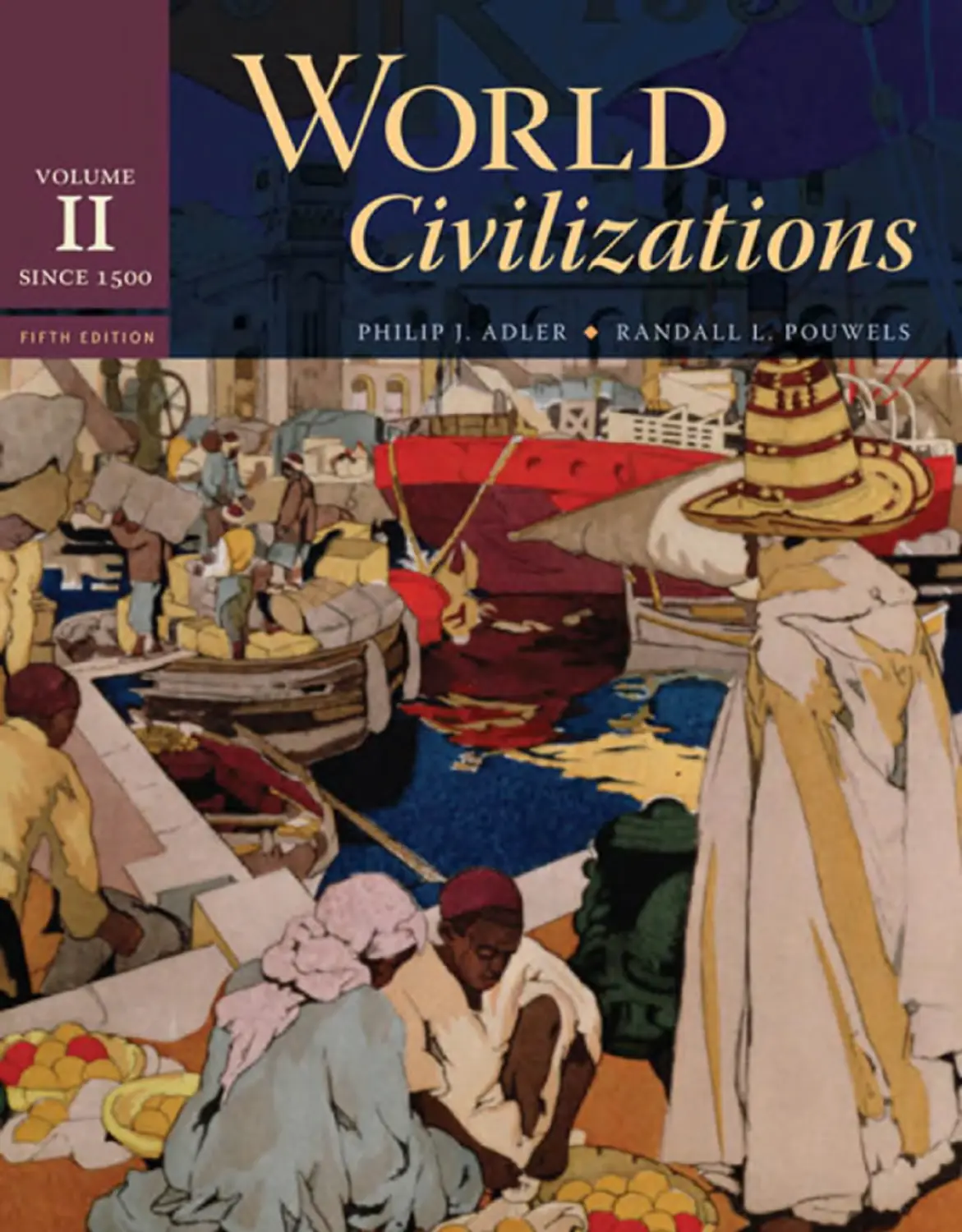
Cover Image: Poster advertising the centenary of Algeria
(1830–1930), 1930 (colour litho) by Leon Cauvy
(1874–1933) ©Bibliotheque Nationale, Paris, France/
Archives Charmet/ The Bridgeman Art Library
Nationality
Cover/Text Printer : Transcontinental - Beauceville
Compositor: Pre-Press PMG
© 2008, 2006 Thomson Wadsworth, a part of The Thomson
Corporation. Thomson, the Star logo, and Wadsworth are
trademarks used herein under license.
ALL RIGHTS RESERVED. No part of this work covered
by the copyright hereon may be reproduced or used in
any form or by any means—graphic, electronic, or me-
chanical, including photocopying, recording, taping, Web
distribution, information storage and retrieval systems, or in
any other manner—without the written permission of the
publisher.
Printed in Canada
12345671110090807
©2008 Thomson Learning, Inc. All Rights Reserved.
Thomson Learning WebTutorTM is a trademark of Thomson
Learning, Inc.
Thomson Higher Education
20 Thomson Place
Boston, MA 02210
USA
Library of Congress Control Number: 2007927204
ISBN-13: 978-0 -495-50262-3
ISBN-10: 0-495-50262-6
For more information about our products, contact us at:
Thomson Learning Academic Resource Center
1-800-423-0563
For permission to use material from this text or
product, submit a request online at
http://www.thomsonrights.com.
Any additional questions about permissions can be
submitted by e-mail to thomsonrights@thomson.com.
ExamView® and ExamView Pro® are registered trademarks
of FSCreations, Inc. Windows is a registered trademark of
the Microsoft Corporation used herein under license. Ma-
cintosh and Power Macintosh are registered trademarks
of Apple Computer, Inc. Used herein under license.
World Civilizations, Fifth Edition
Philip J. Adler
Randall L. Pouwels
Brief Contents
Maps xii
Preface xiv
About the Authors xix
Introduction to the Student xx
Part FOUR: Disequilibrium: The
Western Encounter with the
Non-Western World, –
CE 296
22 A Larger World Opens 298
23 The Protestant Reformation 310
24 The Rise and Fall of the Muslim
Empires 322
25 Foundations of the European States 334
26 China from the Ming Through the Early
Qing Dynasty 352
27 Japan in the Era of European
Expansion 363
28 From Conquest to Colonies in Hispanic
America 374
Worldview FOUR: Disequilibrium:
The Western Encounter with the
Non-Western World, –
C.E . 384
Part FIVE: Revolutions, Ideology,
and the New Imperialism,
– 386
29 The Scientific Revolution and Its
Enlightened Aftermath 389
30 Liberalism and the Challenge to Absolute
Monarchy 403
31 The French Revolution and the Empire of
Napoleon 411
32 Europe’s Industrialization and Its Social
Consequences 424
33 Europe in Ideological Conflict 441
34 Advanced Industrial Society 454
35 Consolidation of National States 466
36 The Islamic World, 1600–1917 479
37 Africa in the Era of Informal Empire 492
38 European Imperialism and Africa during
the Age of Industry 505
39 China and Southeast Asia in the Age of
Imperialism 516
40 Latin America from Independence to
Dependent States 526
41 Modern Science and its Implications 538
42 World War I and Its Disputed
Settlement 548
Worldview FIVE: Revolutions,
Ideology, and the New
Imperialism, – 564
iii
iv
Part SIX: Equilibrium Reestablished:
The Twentieth-Century World
and Beyond, –Present 566
43 A Fragile Balance: Europe in the
Twenties 569
44 The Soviet Experiment to World War
II 581
45 Totalitarianism Refined: The Nazi
State 593
46 East Asia in a Centur y of Change 602
47 World War II 612
48 High and Low Cultures in the West 625
49 Superpower Rivalry and the European
Recover y 634
50 Decolonization and the Third World 644
51 The New Asiav 652
52 Africa’s Decolonization and Years of
Independence 665
53 Latin America in the Twentieth
Centur y 677
54 The Reemergence of the Muslim
World 690
55 Collapse and Reemergence in
Communist Europe 704
56 A New Millennium 716
Worldview SIX: Equilibrium
Reestablished: The Twentieth-
Century World and Beyond,
–Present 726
Glossary G-1
Answers to Test Your Knowledge A-1
Credits C-1
Index I-1
Contents
Maps xii
Preface xiv
About the Authors xix
Introduction to the Student xx
Part FOUR: Disequilibrium: The
Western Encounter with
the Non-Western World,
– ce
22 A Larger World Opens 298
Maritime Exploration in the 1400s 298
Overseas Empires and Their Effects 300
Portuguese Pioneers 300
SCIENCE AND TECHNOLOGY: Vasco da Gama’s First
Contacts in East Africa 300
The Spanish Empire in the Americas 302
The African Slave Trade Opens 302
Dutch and English Merchant-Adventurers 303
Mercantilism 304
The Columbian Exchange 304
European Impacts and Vice Versa 305
The Fate of the Amerindians 306
Racism’s Beginnings 306
EVIDENCE OF THE PAST: Bartolomé de las Casas’s Report
on the Indies 307
23 The Protestant Reformation 310
Luther and the German National Church 310
Luther’s Beliefs 311
Calvin and International Protestantism 312
Calvinism and Lutheranism Compared 313
Other Early Protestant Faiths 314
The Church of England 314
The Counter-Reformation 315
LAW AND GOVERNMENT: Elizabeth I of England
(1533–1603) 316
Religious Wars and Their Outcomes
to 1600 317
France 317
The Spanish Netherlands 318
The Legacy of the Reformation 318
EVIDENCE OF THE PAST: The St. Bartholomew’s Day
Massacre 319
24 The Rise and Fall of the Muslim
Empires 322
The Ottoman Empire 322
Ottoman Government 324
Non-Muslims under Ottoman Rule 325
The Zenith of the Ottoman Empire: Suleiman
and After 325
EVIDENCE OF THE PAST: Harem Intrigue in the Death of
Suleiman’s Favorite Son 326
The Muslim Empires in Persia and India 327
The Safavid Realm 327
The Mughal Empire 328
PATTERNS OF BELIEF: The Rubaiyat of Omar
Khayyam 330
25 Foundations of the European States 334
The Thirty Years’ War 335
Theor y and Practice of Royal Absolutism 337
French Government under Louis XIV 337
Strengths and Weaknesses of French
Absolutism 338
Revolt Against Royal Absolutism:
Seventeenth-century England 339
Civil War: Cromwell’s Commonwealth 339
Restoration and Glorious Revolution
v
vi
of 1688 340
Political Theor y: Hobbes And Locke 341
SOCIETY AND ECONOMY: Women and the
Guilds 341
Absolutism East of the Elbe 342
Prussia’s Rise 342
LAW AND GOVERNMENT: Hobbes’s Leviathan 343
The Habsburg Domains 344
The Struggle against the Ottomans 344
Russia Under the Tsars 346
Russia’s Antipathies to the West 346
Absolutism in Russia: Peter I 347
26 China from the Ming Through the Early
Qing Dynasty 352
Ming China, 1368–1644 352
Economic Progress 354
Urbanization and Technology 354
The Ming Political System 355
The Bureaucracy 355
Dealing with Foreigners 356
SCIENCE AND TECHNOLOGY: Chinese
Inventions 357
The Manzhou Invaders: The Qing Dynasty 358
Qing Government 358
LAW AND GOVERNMENT: Kangxi’s Sacred Edict 359
Qing Culture and Economy 359
Progress and Problems 360
27 Japan in the Era of European
Expansion 363
Japan 363
First European Contacts: Christianity 364
The Tokugawa Shogunate 364
LAW AND GOVERNMENT: Tokugawa Ieyasu
(1542–1616) 365
Shogun, Emperor, and Daimyo 366
Economic Advances 366
Peasants and Urbanites 368
Taming the Samurai 368
Tokugawa Arts and Learning 368
Literature and Its Audiences 369
Adaptation and Originality 369
Response to The Western Challenge 369
ARTS AND CULTURE: The Origins and Evolution of
Haiku 370
Southeast Asia 371
28 From Conquest to Colonies in Hispanic
America 374
The Fall of the Aztec and Inca Empires 374
The Colonial Experience 376
Colonial Administration 376
The Church in the Colonies 376
EVIDENCE OF THE PAST: Recovering Life Stories of the
Voiceless: Testimonial Narratives by African Slaves 377
The Early Economic Structure 378
Stagnation and Revival in the Eighteenth
Century 378
Colonial Society and Culture 379
SOCIETY AND ECONOMY: Forced Labor and Debt
Peonage in the Spanish Colonies 381
Worldview FOUR: Disequilibrium: The
Western Encounter with the
Non-Western World, –
C.E
Part FIVE: Revolutions, Ideology,
and the New Imperialism,
–
29 The Scientific Revolution and Its
Enlightened Aftermath 389
The Scientific Revolution of the Seventeenth
Century 389
Background of the Scientific Revolution 390
The Progress of Scientific Knowledge:
Copernicus to Newton 391
Religion And Science in the Seventeenth
Century 391
SCIENCE AND TECHNOLOGY: Isaac Newton
(1642–1727) 392
The Science Of Man 393
The Enlightenment 393
Formative Figures and Basic Ideas 394
The Philosophes and Their Ideals 394
SCIENCE AND TECHNOLOGY: Franklin as
Scientist 396
Economic Thought : Adam Smith 397
Educational Theory and the Popularization of
Knowledge 398
Ideals of the Enlightenment : Reason, Liberty,
Happiness 398
The Audience of the Philosophes 398
SOCIETY AND ECONOMY: The Enlightened Woman:
Mary Wollstonecraft (1759–1797) 400
vii
30 Liberalism and the Challenge to Absolute
Monarchy 403
The Liberal Creed 403
The American Revolutionar y War 404
Results of the American Revolution in European
Opinion 405
LAW AND GOVERNMENT: The Declaration of
Independence of 1776 and the Declaration of the
Rights of Man and Citizen of 1789 406
LAW AND GOVERNMENT: Thomas Paine
(1737–1809) 407
31 The French Revolution and the Empire of
Napoleon 411
The Background to the Crisis 411
Constitutional Monarchy 412
Calling of the Estates 412
The National Assembly and Its Constitution 413
SOCIETY AND ECONOMY: What Is the Third Estate? 413
Jacobin Terror 414
Reaction And Consolidation 415
The Bonapartist Era Opens 415
LAW AND GOVERNMENT: Maximilien Robespierre
(1758–1794) 416
French Dominion Over Europe 417
Napoleon: Pro Or Con 418
The Vienna Settlement 419
LAW AND GOVERNMENT: The Civil Code of 1804 419
Overall Estimate of the Vienna Settlement 421
32 England’s Industrialization and Its Social
Consequences 424
Prerequisites For Industrial Production 425
Agrarian Improvements 425
The Method Of Machine Industry 426
The Factor y 426
England: The Initial Leader in Industrialism 426
SOCIETY AND ECONOMY: Textile Mills’ Labor 427
SOCIETY AND ECONOMY: Adam Smith on
Specialization 428
Spread of the Industrial Revolution 428
Railroads 430
Phases of the Industrial Revolution 431
Traditional Social Structures and Impacts of Early
Industry 431
The Structure of the Family and Household 432
The Place of Children 432
Relations Between Men and Women 433
Occupations and Mobility 433
Female Occupations 433
SOCIETY AND ECONOMY: A Navvy’s Life on the
Tramp 434
The Migration to the Cities: Urbanized
Society 435
Urban Growth 435
Urban Classes and Lifestyles 435
Diet And Nutrition 436
Public Health 436
Housing and Sanitation 436
Living Standards 437
Reforms and Improvements 437
SCIENCE AND TECHNOLOGY: Cholera Arrives in
Manchester, 1832 438
33 Europe in Ideological Conflict 441
Liberalism in Politics and Economics 441
The Gospel of Free Enterprise 442
Conservatism 443
Moderate Conservatism 443
Reaction 444
Nationalism 444
Socialism in the Pre-Marx Era 444
Political Events to 1848 445
The Liberal States: France and Britain 445
SOCIETY AND ECONOMY: Charles Fourier
(1772–1837) 447
ARTS AND CULTURE: George Gordon, Lord Byron
(1788–1824) 448
The Reactionar y States: Austria, Russia, and
Prussia 449
The Revolts of 1848 449
Two Phases 450
Consequences 451
34 Advanced Industrial Society 454
The Second Industrial Revolution 454
New Energy Sources 456
New Forms of Business Organization 456
Social Results of the Second Industrial
Revolution 457
Socialism After 1848: Marxism 458
Marxist Theory 458
PATTERNS OF BELIEF: Karl Marx (1818–1883) 459
LAW AND GOVERNMENT: Communist Manifesto 460
Marxist Organizations 460
Rivals to Marxism 461
viii
Reform and Revisionism 461
Emigration Overseas 462
SOCIETY AND ECONOMY: Home Work: Berlin 1898 462
Destinations 463
Types of Emigrants 464
35 Consolidation of National States 466
Russia 466
The Great Reforms 467
France 469
The Unification Of Italy 469
The Unification Of The Germanies 471
LAW AND GOVERNMENT: Giuseppe Garibaldi
(1807–1882) 472
The Multinational Empire of Austria-hungary 474
The United States in the Industrial Age 475
Industrial Progress 475
The Nature of U.S . Industrialization 475
The Modern Nation-State 476
36 The Islamic World, 1600–1917 479
The Decline of the Muslim Empires 480
The Strengths and Weaknesses of Ottoman
Civilization 480
The Decline of the Ottoman Empire 480
Safavid and Mughal Decline 481
The Muslim Lands Until World War I 482
Reforms of the Muslim Ruling Elites 483
The Tanzimat 483
Egypt and Sudan under Muhammad Ali
and Khedive Ismail 484
Reforms under the Iranian Shahs 486
Social and Intellectual Responses 487
Wahhabi Fundamentalism and Jihad 487
The Salafi Movement 487
PATTERNS OF BELIEF: The Founding Figure of Islamic
Fundamentalism and Reform 488
Arab Nationalism 489
37 Africa in the Era of Informal
Empire 492
The Era of Informal Empire 492
The Slave Trade and Its Results 493
Intensification of European Contacts 495
LAW AND GOVERNMENT: The Letter of King Affonso of
Kongo, 1526 496
North Africa 497
West Africa 498
South Africa 500
East Africa 501
38 European Imperialism and Africa During
the Age of Industry 505
The Background of the New Imperialism,
1790–1880 505
Rivalry for New Markets 506
Strategic Issues 506
Nationalism and the Clash of Rival
Imperialisms 506
The “White Man’s Burden” 506
The Scramble For Africa, 1880–1914 506
Reactions To European Domination 508
LAW AND GOVERNMENT: One Who Resisted 509
Changes in African Societies 510
Undermining of the Old Ways 511
Economic Changes 511
SOCIETY AND ECONOMY: Women of Colonial
Africa 513
39 China and Southeast Asia in the Age of
Imperialism 516
China 516
The Decline of the Qing Dynasty 516
The Taiping Rebellion 517
SOCIETY AND ECONOMY: A Novel Cure for the Opium
Plague 518
Failure of the Late Qing Dynasty
Restoration 519
Chinese Disintegration after 1895 520
Southeast Asia 520
LAW AND GOVERNMENT: Empress Cixi (1835–1908) 521
40 Latin America from Independence to
Dependent States 526
The Independence Movements 527
The Age of Chaos and Caudillos 528
National Consolidation Under Oligarchies 531
Social Distinctions 532
SOCIETY AND ECONOMY: Women’s Voices in
Nineteenth-Century Latin America 533
Land and Labor 534
Latin American and Caribbean Cultures 534
ARTS AND CULTURE: Multicultural Music: Argentina’s
Tango and Brazil’s Samba 535
41 Modern Science and its
Implications 538
The Physical Sciences 538
Biology 539
Physics 539
ix
SCIENCE AND TECHNOLOGY: Charles Darwin Reflects on
The Origin of Species 540
Astronomy 541
The Social Sciences 542
Psychology 542
Anthropology and Sociology 543
The Malaise in Twentieth-Centur y Society 543
ARTS AND CULTURE: Sigmund Freud (1856–1939) 544
Religious Thought and Practice 545
Churches under Attack 545
The Christian Revival 545
42 World War I and Its Disputed
Settlement 548
Prewar Diplomacy 548
The Triple Alliance 549
The Anglo-French Entente and the Anglo-Russian
Agreement 549
Causes of the War 549
Military Action, 1914–1918 551
The Bloody Stalemate 552
U.S. Entry and Russian Exit 553
EVIDENCE OF THE PAST: Erich Maria Remarque, All Quiet
on the Western Front 553
Collapse of the Central Powers 554
The Home Front During the War 555
Social Behavior 555
Psychic Consequences 556
The Peace Treaties, 1919–1920 556
Conflicting Principles and Their
Compromise 557
LAW AND GOVERNMENT: Nicky and Sunny 558
Evaluation Of The Treaties 559
LAW AND GOVERNMENT: The Versailles Treaty, 1919 560
Worldview FIVE: Revolutions, Ideology,
and the New Imperialism,
– 564
Part SIX: Equilibrium Reestablished:
The Twentieth-Century World
and Beyond, –Present 566
43 A Fragile Balance: Europe in the
Twenties 569
Political and Economic Backdrop 570
Political Diversity 570
Keynesian Economics 570
Marxist Successes and the Soviet Chimera 570
Totalitarian Government 571
Five Characteristics 571
Antirationalism 571
Italian Fascism 572
Fascist Economic and Social Policies 572
Germany in the Postwar Era 572
LAW AND GOVERNMENT: Benito Mussolini
(1883–1945) 573
Reparations 574
Inflation and Middle-Class Ruin 574
Eastern Europe 574
The Western Democracies 575
Britain 575
France 576
The United States 576
International Relations on The Eve of the
Depression 576
SOCIETY AND ECONOMY: The Roaring Twenties 577
44 The Soviet Experiment to
World War II 581
The March Revolution, 1917 581
The Bolsheviks 582
The October Revolution 583
Civil War 583
Economic Revival and Internal Struggles 583
The Five-Year Plans 585
Agrarian Collectivization 585
Industrial Progress 585
LAW AND GOVERNMENT: Leon Trotsky
(1879–1940) 586
The Stalinist Dictatorship 587
The Purges: A Terrorized Society 587
SOCIETY AND ECONOMY: Josef Stalin, Husband and
Father 588
Life Under the Dictatorship 589
Possibilities Expanded 589
Liberties Suppressed 589
Material and Social Welfare in the Inter war
Soviet Union 590
45 Totalitarianism Refined: The Nazi
State 593
Hitler and the Thousand-Year Reich 593
Hitler’s Early Career 593
The Nazi Program 594
The Great Depression’s Effects 594
LAW AND GOVERNMENT: Adolf Hitler (1889–1945) 595
The Seizure of Power 596
The Nazi Domestic Regime 597
x
LAW AND GOVERNMENT: Heinrich Himmler’s Speech to
the SS 597
The “Jewish Question” 598
Nazi Economic Policy 599
46 East Asia in a Centur y of Change 602
China 603
The Beginnings of Chinese Nationalism 603
Chiang Kai-shek’s Regime 603
LAW AND GOVERNMENT: The Father of Modern
China 604
The Sino-Japanese War and the Maoist
Challenge 605
The Communist Victory 606
Japan 606
The Emergence of Modern Japan 606
Meiji Reforms 606
Foreign Successes 607
Between the World Wars 607
Southeast Asia 608
47 World War II 612
The Rise and Fall of Collective Security 612
The Spanish Civil War 613
Hitler’s March to War, 1935–1939 613
The Reoccupation of the Rhineland 613
Anschluss in Austria 614
Munich, 1938 614
The Nazi-Soviet Nonaggression Pact 614
World War II 616
The European Theater 616
Phase 1: Axis Blitzkrieg 616
Phase 2: Allied Counterattack 616
LAW AND GOVERNMENT: Winston Churchill
(1874–1965) 617
Phase 3: Allied Victor y 618
The Pacific Theater 619
Japanese Defeat and Surrender 619
The Onset of The Cold War 621
Wartime Alliance and Continuing
Mistrust 621
The Original Issues 621
48 High and Low Cultures in the West 625
Fragmentation And Alienation 625
Modernism 626
Modern Painting 626
Modern Literature 627
ARTS AND CULTURE: Pablo Picasso (1881–1973) 628
Modern Philosophy 629
Popular Arts and Culture 629
Movies 630
Radio 630
Music 630
Television 631
Mass Culture and Its Critics 631
49 Superpower Rivalry and the European
Recover y 634
Conflict In The Postwar Generation 634
The Division of Europe 635
LAW AND GOVERNMENT: The Iron Curtain 635
Grudging Coexistence 636
From Cuban Missiles to NATO’s Decline 637
Europe’s Economic Recovery 638
Factors Promoting Prosperity 639
LAW AND GOVERNMENT: Cuban Missiles
in 1962 639
European Unity 640
The Communist Bloc, 1947–1980 641
50 Decolonization and the Third
World 644
Decolonization’s Causes 644
Dismantling of Western Colonies 645
Problems of the Third World 646
The Population of the Earth 647
LAW AND GOVERNMENT: Vietnam’s Declaration of
Independence, 1946 648
Misapplied Technology 649
51 The New Asia 652
Mao’s China, 1949–1976 652
Recent China 654
LAW AND GOVERNMENT: Chairman Mao’s
Thought 654
Postwar Japan to 1952 656
Independent Japan 656
Economic Progress 656
South And Southeast Asia Since
Independence 657
India 657
SOCIETY AND ECONOMY: Unsold Goods and Giant
Garbage 658
Pakistan and Bangladesh 659
Southeast Asia since World War II 660
The War in Vietnam 660
Progress and the Promise of Future
Prosperity 661
xi
52 Africa’s Decolonization and Years of
Independence 665
Decolonization: The Run-Up to
Independence 666
The Immediate Post-Independence Years 668
SOCIETY AND ECONOMY: Changing Times in
Kenya 669
The African Economy 670
The Population Bomb 671
Prospects at the Start of the Twenty-First
Century 672
LAW AND GOVERNMENT: Inaugural Address by Nelson
Mandela 674
53 Latin America in the Twentieth
Century 677
Persistent Dependency 677
New and Old Social Problems 678
Economic Nationalism 679
Mexico under Cárdenas 680
Argentina under Perón 680
The Shark and the Sardines 682
LAW AND GOVERNMENT: Fidel Castro’s Manifesto 683
The U.S . Role in Recent Latin Affairs 684
Current Issues and Problems 684
Rich and Poor 685
Changing Styles in Government 685
SOCIETY AND ECONOMY: Mexican Villagers 686
54 The Reemergence of the Muslim
World 690
The Turkish Republic 691
Palestine 692
The Rise of Islamism 693
LAW AND GOVERNMENT: The McMahon Letter to
the Sharif of Mecca, 1915, and the Balfour Declaration,
1917 694
The Iranian Revolution 695
PATTERNS OF BELIEF: Ayatollah Khomeini
(1902–1989) 696
The Oil Weapon 698
The Gulf War and the Invasion of Iraq 698
The Muslim Nations Today 699
The Arabs 699
The Non-Arabic Nations 700
55 Collapse and Reemergence in
Communist Europe 704
The Immediate Postwar Era 704
The Communization of Eastern Europe 705
The Stalinist Regime 705
From Stalin to Brezhnev 706
Goulash Communism 706
Stagnation 707
The End of Communist Rule 708
The Breakup of the Soviet Union 709
Eastern Europe’s Revolution of 1989 709
EVIDENCE OF THE PAST: The End of the
Berlin Wall 711
Problems of the Post-Communist Era 712
56 A New Millennium 716
A Short and Violent Centur y Behind Us 716
Technology and Political Culture 717
The Rich and the Poor: Contrasts 717
Approaches to Social Reform 718
Prosperity in the Developed Societies 718
Losing Ground in the Developing
Countries 718
The Other Half of Humanity 719
Family and the Individual 719
Looming Problems 720
The United Nations and National
Sovereignty 720
Control of Weapons of Mass Destruction 720
Terrorism 721
Environmental Deterioration 722
Worldview SIX: Equilibrium
Reestablished: The
Twentieth-Century World and
Beyond, –Present
Glossar y G-1
Answers to Test Your Knowledge A-1
Credits C-1
Index I-1
Maps
MAP IV.1
MAP 21.2
Europe, the Near East, and North Africa
in the Renaissance 284
WORLDVIEW MAP 22.1 Spanish and Portuguese Voyages in the
Fifteenth and Sixteenth Centuries 299
MAP 23.1
Catholics, Protestants, and Orthodox
Christians in Europe by 1550 317
MAP 24.1
The Ottoman Empire’s Growth 324
MAP 24.2
Safavid and Mughal Empires 328
MAP 25.1
Europe in the Seventeenth Century 336
MAP 25.2
The Growth of the Austrian Empire,
1536–1795 345
MAP 25.3
From Muscovy to Russia, 1584–1796 347
MAP 26.1
The Empire under the Ming and Qing
Dynasties 353
MAP 27.1
Tokugawa Japan 367
MAP 28.1
Colonial Latin America: Viceroyalties
and Trade Connections 375
MAP V.1
MAP 29.1
Centers of the Enlightenment,
c. 1750 397
MAP 30.1
North America’s Possessors,
1700–1783 408
MAP 31.1
The French Republic and Its Satellites,
Hostile States, and Neutrals in 1799 418
MAP 31.2
The Napoleonic Empire,
1810–1813 421
MAP 32.1
Britain’s Industrial Revolution 429
MAP 32.2
The Spread of Industry by 1850 430
MAP 33.1
Prussia and Austria after the Peace of
Vienna, 1815 446
MAP 33.2
Centers of Revolt in 1848–1849 450
MAP 34.1
European Population Growth in the
Nineteenth Century 455
MAP 35.1
Europe after 1871 467
MAP 35.2
Unification of the German Empire 470
MAP 35.3
The Unification of Italy 471
MAP 35.4
Ethnic Groups in the Dual Monarchy 474
MAP 36.1
European Gains in Islamic Lands 481
MAP 37.1
The African Slave Trade, c. 1700 494
MAP 37.2
Africa in the Nineteenth Century 500
MAP 38.1
Africa Before World War I 507
MAP 39.1
The Partition of China 519
MAP 39.2
East Asian Colonial Territories,
1840–1940 523
MAP 40.1
Latin America in the Early
Nineteenth Century 529
MAP 42.1
The Balkan States, 1914 550
MAP 42.2
The Western Front in World War I 551
MAP 42.3
The Eastern Front in World War I 552
xii
xiii
MAP 42.4
Europe after World War I 559
MAP VI.1
MAP 44.1
Russian Civil War, 1918–1921 584
MAP 45.1
Europe in 1939 at Eve of World War II 599
MAP 47.1
World War II in Europe 615
MAP 47.2
World War II in Asia and the Pacific 620
MAP 49.1
Cold War Europe, 1945–1990 637
MAP 51.1
Postwar Conflicts in East Asia 661
MAP 52.1
Africa Becomes Independent 667
MAP 54.1
Modern Islam, 2007 691
MAP 54.2
Israel and Its Arab Neighbors,
1947–2007 695
MAP 55.1
Eastern Europe and Former
Soviet Union 710
Preface
W
ORLD CIVILIZATIONS is a brief history
of civilized life since its inceptions some
5,000 years ago. It is meant to be used
in conjunction with a lecture course in
world history at the introductor y level.
The authors, who zbring more than fifty total years of class-
room experience to its writing, have kept the needs and
interests of freshman and sophomore students in two- and
four-year colleges and universities constantly in mind.
World Civilizations deals with the history of civilization
throughout the globe but attempts to walk a middle line
between exhaustive detail and frustrating brevity. Its nar-
rative embraces every major civilized epoch, but the treat-
ment of topics is selective and follows definite patterns and
hierarchies. It deliberately tilts toward social and cultural
topics, as well as toward the long-term processes that affect
the lives of the millions, rather than the acts of “the captains
and the kings.” The evolution of law and the formative pow-
ers of religion upon early government, for example, receive
considerably more attention than wars and diplomatic ar-
rangements. The rise of an industrial working class in Euro-
pean cities is accorded more space than the trade policies of
European governments. Such selectivity, of course, is forced
on any author of any text, but the firm intent to keep this
a concise survey necessitated a particularly close review of
the material. Dividing a brief narrative into fifty-six short
chapters both gives the instructor considerable leeway for
additional material or expansion of the topics and makes
it likelier that students will read the assigned material. This
approach has been relatively successful and has found suf-
ficient favor among many teachers to justify the appearance
of this fifth edition.
Change in this edition
Chapter 38 New chapter on European imperialism in Africa;
New Law and Government box (“One Who Resisted”) and
Society and Economy box on women of colonial Africa.
Chapter 39 New chapter on Asia in the age of imperialism,
incorporating coverage of colonial Southeast Asia.
Chapter 40 New Society and Economy box on women’s
voices in nineteenth-century Latin America; new Arts
and Culture box on the tango and the samba.
Part Six Additional material on Islamic fundamentalism
and terrorism, as well as updates throughout.
Organization of the
Fifth Edition
The table of contents in this fifth edition contains a sig-
nificantly increased amount of non-Western coverage,
has been reorganized more chronologically, and shows in-
creased coverage of worldwide trade and exchange.
The organization of World Civilizations is chronologi-
cal. There are six parts, dealing with six chronological eras
from ancient civilizations (3500–500 bce) to recent times
(post-1920 ce). The parts have several binding threads
of development in common, but the main point of refer-
ence is the relative degree of contact among civilizations.
This ranges from near-perfect isolation, as, for example, in
ancient China, to close and continual interaction, as in the
late twentieth-centur y world.
The second organizing principle is the prioritization
of certain topics and processes. We generally emphasize
sociocultural and economic affairs, and keep the longer
term in perspective, while deliberately minimizing some
short-term phenomena. In terms of the space allotted, we
emphasize the more recent epochs of history, in line with
the recognition of growing global interdependence and
cultural contact.
Although this text was, from its inception, meant as
a world history and contains proportionately more ma-
terial on non-Western peoples and cultures than many
others currently in print, the Western nations receive at-
tention consonant with their importance to the modern
history of the globe. (In this respect, “Western” means
not only European but also North American since the
eighteenth century.) The treatment adopted in this book
should allow any student to find an adequate explana-
tion of the rise of the West to temporary dominion in
modern times and the reasons for the reestablishment
of worldwide cultural equilibrium in the latter half of the
twentieth century.
After an introductory chapter on prehistor y, we look
first at Mesopotamia, Egypt, India, and China. In these
river valley environments, humans were first successful in
adapting nature to their needs on a large scale. Between
about 2500 bce and about 1000 bce, the river valley civili-
zations matured and developed a culture in most phases of
life: a fashion of thinking and acting that would be a model
for as long as that civilization was vital and capable of de-
fending itself. Elsewhere, in Africa and in Mesoamerica,
xiv
xv
similar processes were under way. However, in two note-
worthy respects these regions provided exceptions to the
pattern by which people learned to produce food for them-
selves. In Africa’s case, people of the Sahara region domes-
ticated livestock, most likely cattle, before they learned to
grow and depend on crops. Also unlike the patterns estab-
lished in the Old World, early Native American farmers of
the Western hemisphere developed forms of agriculture
that did not depend on the flood waters of major rivers.
By 500 bce, the Near Eastern civilizations centered in
Egypt and Mesopotamia were in decline and had been
replaced by Mediterranean-based ones, as well as new
ones in Africa, Asia, and the New World, which drew
on the older civilizations to some extent but also added
some novel and distinctive features of their own. First the
Greeks, then the Romans, succeeded in bringing much of
the known world under their influence, culminating in the
great Roman Empire reaching from Spain to Persia. For
Europe, the greatest single addition to civilized life in this
era was the combination of Jewish theology and Greco-
Roman philosophy and science.
In the millennium between 500 bce and 500 ce, the en-
tire globe underwent important change. India’s Hindu re-
ligion and philosophy had been challenged by Buddhism,
while China recovered from political dismemberment to
become the permanent chief factor in East Asian affairs.
Japan emerged slowly from a prehistoric stage under Chi-
nese tutelage, while the southeastern part of the Asian
continent attained a high civilization created in part by
Indian traders and Buddhist missionaries.
In the Mediterranean starting about 800, an amalgam
of Greco-Roman, Germanic, and Jewish-Christian beliefs
called Europe, or Western Christianity, had emerged after
the collapse of Roman civilization. At the same time, the
emergence of Islam created what many scholars believe
was the first truly “world” civilization. Rivaling the great
civilizations of Asia and considerably surpassing that of
Europe, the great empire of the Abbasid caliphs in Bagh-
dad (750–1258 ce) acted as a commercial and intellectual
bridge that transcended regional barriers from China to
Europe. Therefore, in the many lands and peoples bor-
dering the Indian Ocean, the spread of Islam along the
highways of commerce contributed to the emergence of
sophisticated maritime civilizations in Southeast Asia,
India, and East Africa. In West Africa, the great Sudanic
civilizations of Mali and later Songhay likewise were based
solidly on an Islamic foundation. Despite isolation, Native
Americans of the New World created a series of highly so-
phisticated civilizations in the high Andes mountains of
South America, in Mesoamerica, and in the southwestern
and midwestern parts of what now is the United States.
By 1500, Western Christianity began to rise to a posi-
tion of worldwide domination, marked by the voyages of
discover y and ensuing colonization. In the next three cen-
turies, the Europeans and their colonial outposts slowly
wove a web of worldwide commercial and technological
interests anchored on militar y force. Our book’s treatment
of the entire post-1500 age gives much attention to the im-
pacts of Western culture and ideas on non-Western peo-
ples, and vice versa. In particular, it looks at the African
civilizations encountered by early European traders and
what became of them, and at the Native American civili-
zations of North and Latin America and their fate under
Spanish conquest and rule.
From 1700 through World War I, Europe led the world
in practically every field of material human life, including
military affairs, science, commerce, and living standards.
This was the age of Europe’s imperial control of the rest
of the world. The Americas, much of Asia, Oceania, and
coastal Africa all became formal or informal colonies at
one time, and some remained under direct European con-
trol until the mid-twentieth century.
In the nineteenth and twentieth centuries, the pendu-
lum of power swung steadily away from Europe and toward
what had been the peripher y: first, North America; then,
Russia, Japan, and the non-Western peoples. As we enter
a new millennium, the world not only has shrunk but has
again been anchored on multiple power bases, Western
and other. A degree of equilibrium is rapidly being restored,
this time built on a foundation of Western science and tech-
nology that has been adopted throughout the globe.
Our periodization scheme, then, is a sixfold one:
◆ Ancient Civilizations, 3500–500 bce.
◆ Classical Mediterranean Civilizations, 500 bce–800 ce
◆ Equilibrium Among Polycentric Civilizations, 500–
1500 ce.
◆ Disequilibrium: The Western Encounter with the Non-
Western World, 1500–1700 ce
◆ Revolutions, Ideology, and the New Imperialism,
1700–1920
◆ Equilibrium Reestablished: The Twentieth-Century
World and Beyond, 1920–Present
Pedagogy
An important feature of World Civilizations is its division
into a number of short chapters. Each of its fifty-six chap-
ters is meant to constitute a unit suitable in scope for a
single lecture, short enough to allow easy digestion and
with strong logical coherence. Each chapter offers the fol-
lowing features:
◆ Thematic boxes and photographs are keyed to the
five broad text themes: Society and Economy, Law and
Government, Patterns of Belief, Science and Technol-
ogy, and Arts and Culture. All chapters have one or
more boxed inserts, some of which are based on biog-
raphy, many others on primary sources. To encourage
readers to interact with the material as historians would
and to compare themes across chapters, each boxed
feature concludes with “Analyze and Interpret” ques-
tions. And, to provide readers with access to additional
readings, many document excerpts are keyed to the full
document or related documents available in the World
Histor y Resource Center.
◆ An additional boxed feature, Evidence of the Past,
spotlights artifacts, material culture, and oral traditions
as source materials for historical study. Once writing
became common, of course, some materials that you
xvi
will see in Evidence of the Past are written primary
sources, but we point out to you, where appropriate,
their roots in oral traditions. We also include some eye-
witness accounts for your analysis.
◆ A chapter outline and a brief chapter chronology
help readers focus on the key concepts in the material
they are about to encounter.
◆ A chapter summary encapsulates the significance of
the chapter’s concepts.
◆ A “Test Your Knowledge” section at the end of the
chapter provides a brief—and unique—self-test. Re-
viewers tell us that their students rely on these tests to
assess their understanding of each chapter and to pre-
pare for quizzes and exams.
◆ Key terms appear in boldface type and are repeated
at chapter end in an “Identification Terms” quiz.
◆ Parenthetical pronunciation guides now appear within
the text, facilitating ease of reading unfamiliar names.
◆ A sampling of the documents available in the Thomson-
NOWTM study system also appear at the end of each
chapter.
◆ Color illustrations, many of them new, and abundant
maps. We include “Worldview” maps that show global
developments. Many maps are keyed with icons to in-
dicate that there is an interactive version of the map in
the World History Resource Center. Strong map and
photo captions encourage readers to think beyond the
mere appearance of each visual and to make connec-
tions across chapters, regions, and concepts. And criti-
cal thinking questions encourage you to work with and
read maps as a historian might.
◆ A world map in the front of the book.
Other features include the following:
◆ An end-of-book Glossary, now with a pronunciation
guide, provides explanations of unfamiliar terms and pro-
nunciation guidance for the more difficult among them.
◆ Each period opens with a brief part introduction
and a Worldview map highlighting the major civiliza-
tions discussed in that part of the text. At the end of
each part, there is a Worldview chart comparing the
same civilizations, color-coded to the same groups in
the part-opening map and affording a nutshell review
of their accomplishments according to the text’s five
major themes. This edition includes a new "Cross-Cultural
Connections" section at the end of each Worldview, to
encourage thinking beyond regional borders.
Supplements
The following supplements are available for the instructor:
PowerLecture: A Microsoft® PowerPoint® Tool
with Instructor’s Resource CD-ROM
This all-in-one multimedia resource includes the Instruc-
tor’s Manual, the Resource Integration Guide, and Micros oft®
PowerPoint® slides with lecture outlines. Most of the map
acetates are incorporated into the presentations. Also in-
cluded is ExamView, an easy-to-use assessment and tuto-
rial system that allows instructors to create, deliver, and
customize tests and study guides (both print and online) in
minutes. ExamView offers both a Quick Test Wizard and an
Online Test Wizard that guide users step by step through
the process of creating tests—users can even see the test
they are creating on the screen exactly as it will print or dis-
play online. Instructors can build tests with as many as 250
questions using up to 12 question types. Using ExamView’s
complete word-processing capabilities, instructors can
add an unlimited number of new questions or edit exist-
ing questions. PowerLecture also contains JoinInTM on Tur n-
ingPoint®, preloaded, book-specific Response System content
(via our exclusive relationship with TurningPoint® software)
designed to work seamlessly with Microsoft® PowerPoint® and
the “clicker” hardware of the instructor’s choice.
The following supplements are available for the instruc-
tor and the student :
eBank Instructor’s Manual with Test Bank
Prepared by Janet Brantley, Texarkana College. One vol-
ume ser ves all three versions of the text. Includes the Re-
source Integration Guide, chapter outlines, lecture topics,
definitions of terms to know, and student activities, in-
cluding journal entry topics. The test bank includes over
3,000 multiple-choice, essay, and fill-in-the-blank ques-
tions. Multiple-choice questions have five choices each.
Also available in PowerLecture.
Transparency Acetates for World History
Includes over 100 four-color maps from the text and other
sources. Packages are three-hole punched and shrink-
wrapped. Map commentary is provided by James Harrison,
Siena College.
Sights and Sounds of History
Short, focused video clips, photos, artwork , animations,
music, and dramatic readings are used to bring life to the
historical topics and events that are most difficult for stu-
dents to appreciate from a textbook alone. For example,
students will experience the grandeur of Versailles and the
defeat felt by a German soldier at Stalingrad. The video
segments (averaging four minutes in length) are available
on VHS and make excellent lecture launchers.
ThomsonNOW
Just what you need to know and do NOW! ThomsonNOWTM
is an online teaching and learning resource that gives you
more control in less time and delivers the results you want—
NOW. For further information, visit www.thomsonedu.
com/thomsonnow.
Wadsworth World History Resource Center
World History Resource Center, at www.thomsonedu.
com/history, gives students access to a “virtual reader” with
hundreds of primary-source documents, photos, inter-
active timelines and maps, and more. A map feature includ-
ing Google Earth coordinates and exercises aids in student
comprehension of geography and use of maps. Students can
compare a traditional textbook map with an aerial view of
xvii
the location today. Available within ThomsonNOW, or for
separate purchase. Contact your local representative for or-
dering details.
Book Companion Website
Both instructors and students will enjoy the chapter-by-
chapter resources for World Civilizations, with access to the
Wadsworth History Resource Center, at www.thomsonedu.
com/history/adler. Text-specific content for students in-
cludes tutorial quizzes, Internet activities, and more. Instruc-
tors also have access to the Instructor’s Manual, lesson
plans, and PowerPoint slides (access code required).
InfoTrac® College Edition with InfoMarks
®
Give students access to an entire library’s worth of reli-
able sources with InfoTrac College Edition, an online uni-
versity librar y of more than 5,000 academic and popular
magazines, newspapers, and journals.
Sources in World History, Fourth Edition
This updated two-volume reader, edited by Mark Kishlan-
sky, includes a diversity of historical documents from world
and western history designed to supplement textbooks and
lectures in the teaching of world civilizations. It provides a
balance of constitutional documents, political theory, phi-
losophy, imaginative literature, and social description.
Primary Source Reader for World History
Two volumes, edited by Elsa A. Nystrom. This thought-
ful, affordable collection of essential primary source docu-
ments gives students a broad perspective on the histor y of
the world. The readings are divided by eras and organized
according to principal themes such as religion, law and
government, and everyday life. Each group of readings has
a section describing the significance of subsequent read-
ings and how those readings interrelate.
Document Exercise Workbook for World History,
Third Edition
Prepared by Donna Van Raaphorst of Cuyahoga Commu-
nity College, this two-volume workbook provides a collec-
tion of exercises based on primary sources in history.
Map Exercise Workbook, Third Edition
Prepared by Cynthia Kosso of Northern Arizona University,
features approximately 30 map exercises in two volumes. De-
signed to help students feel comfortable with maps by hav-
ing them work with different kinds of maps to identify places
and improve their geographic understanding of world his-
tory. Also includes critical thinking questions for each unit.
Magellan World History Atlas
This atlas contains 45 four-color historical maps in a
practical 8” x 10” format.
Migration in Modern World History 1500–2000
CD-ROM
An interactive media curriculum on CD-ROM devel-
oped by Patrick Manning and the World History Center
at Northeastern University. Migration goes beyond the
mere chronicling of migratory paths. Over 400 primary
source documents in Migration provide a springboard
to explore a wide range of global issues in social, cul-
tural, economic, and political history during the period
1500–2000.
Journey of Civilization: The World and Western
Traditions CD-ROM
This CD-ROM takes the student on 18 interactive jour-
neys through history. Enhanced with QuickTimeTM movies,
animations, sound clips, maps, and more, the journeys
allow students to engage in history as active participants
rather than as readers of past events. Contact your local
sales representative for information on packaging this
book with the text of your choice.
Acknowledgments
The authors are happy to acknowledge the sustained aid
given them by many individuals during the long incuba-
tion period of this text. Phil Adler’s colleagues in the his-
tory department at East Carolina University, at the annual
meetings of the test planners and graders of the Advanced
Placement in European History, and in several profes-
sional organizations, notably the American Association
for the Advancement of Slavic Studies, are particularly to
be thanked.
In addition, the following reviewers of past editions
were instrumental in the gradual transformation of a man-
uscript into a book; we remain indebted to all of them and
to the students in HIST 1030–1031, who suffered through
the early versions of the work.
William S. Arnett, West Virginia University
Kenneth C. Barnes, University of Central Arkansas
Marsha Beal, Vincennes University
Charmarie J. Blaisdell, Northeastern University
Laura Blunk, Cuyahoga Community College
William Brazill, Wayne State University
Alice Catherine Carls, University of Tennessee–Martin
Orazio A. Ciccarelli, University of Southern Mississippi
Robert Clouse, Indiana State University
Sara Crook , Peru State University
Sonny Davis, Texas A&M University at Kingsville
Joseph Dorinson, Long Island University, Brooklyn Campus
Arthur Durand, Metropolitan Community College
Frank N. Egerton, University of Wisconsin–Parkside
Ken Fenster, DeKalb College
Tom Fiddick, University of Evansville
David Fischer, Midlands Technical College
Jerry Gershenhorn, North Carolina Central University
Erwin Grieshaber, Mankato State University
Eric Haines, Bellevue Community College
Mar y Headberg, Saginaw Valley State University
Daniel Heimmermann, University of Northern Arizona
Charles Holt, Morehead State University
Kirk A. Hoppe, University of Illinois–Chicago
xviii
Raymond Hylton, Virginia Union University
Fay Jensen, DeKalb College–North Campus
Aman Kabourou, Dutchess Community College
Louis Lucas, West Virginia State College
Ed Massey, Bee County College
Bob McGregor, University of Illinois–Springfield
John Mears, Southern Methodist University
Will Morris, Midland College
Gene Alan Müller, El Paso Community College
David T. Murphy, Anderson University
Tim Myers, Butler County Community College
Elsa A . Nystrom, Kennesaw State University
William Paquette, Tidewater Community College
Nancy Rachels, Hillsborough Community College
Enrique Ramirez, Tyler Junior College
Bolivar Ramos, Mesa Community College
Robin Rudoff, East Texas State University
Anthony R. Santoro, Christopher Newport University
Shapur Shahbazi, Eastern Oregon State University
John Simpson, Pierce College
John S. H. Smith, Northern Nevada Community College
Maureen Sowa, Bristol Community College
Irvin D. Talbott, Glenville State College
Maxine Taylor, Northwestern State University
Eugene T. Thompson, Ricks College
Susan Tindall, Georgia State University
Kate Transchel, California State University, Chico
Bill Warren, Valley City State University
Robert Welborn, Clayton State College
David Wilcox, Houston Community College
Steve Wiley, Anoka-Ramsey Community College
John Yarnevich, Truckee Meadows Community College–
Old Towne Mall Campus
John M. Yaura, University of Redlands
Many thanks, too, to Lee Congdon, James Madison
University; Maia Conrad, Christopher Newport University;
Theron E. Corse, Fayetteville State University; Dennis Fiems,
Oakland Community College, Highland Lakes; Lauren
Heymeher, Texarkana College; Maria Iacullo, CUNY
Brooklyn College; Rebecca C. Peterson, Graceland College;
Donna Rahel, Peru State College; Thomas J. Roland, Univer-
sity of Wisconsin–Oshkosh; James Stewart, Western State
College of Colorado; and Brian E. Strayer, Andrews
University.
The fourth and fifth editions, especially thoroughgoing
revisions, had especially perceptive groups of reviewers.
Our thanks to them for their comments and suggestions.
Patricia M. Ali, Morris College
Robin L. Anderson, Arkansas State University
Janet Brantley, Texarkana College
Stewart Brewer, Dana College
Brian Bunk, Central Connecticut College
David Cauble, Western Nebraska Community College
Janice Dinsmore, Wayne State College
Joseph Dorinson, Long Island University
Nancy Fitch, California State University, Fullerton
Ali Gheissari, San Diego State University
Stephen Gosch, University of Wisconsin, Eau Claire
Wendell Griffith, Okaloosa-Walton Community College
Samuel Hoff, Delaware State University
Tamara Hunt, University of Southern Indiana
Ellen J. Jenkins, Arkansas Technical University
Karen Kimball, University of Maine, Machias
Aran S. MacKinnon, University of West Georgia
Terrence Monroe, Darton College
Elsa Nystrom, Kennesaw State
Thomas M. Ricks, University of Pennsylvania
Gary Scudder, Champlain College
William Seay, J. Sargeant Reynolds Community College
Thomas G. Smith, Nichols College
Anthony J. Springer, Dallas Christian College
Werner Steger, Dutchess Community College
Leslie Tischauser, Prairie State College
Kate Transchel, California State University, Chico
Lloyd Uglow, Southwestern Assemblies of God University
Michael Vollbach, Oakland Community College
Peter von Sivers, University of Utah
Marjorie Walker, Samford University
Max E. White, Piedmont College
Michael D. Wilson, Vanguard University
William Wood, Point Loma Nazarene University
But we would like to give special kudos to the following
members of our Editorial Review Board, who stood by us
throughout this edition’s development process, approving
every change and every new idea that you see in the text
and package. Their involvement has been extraordinarily
helpful and much appreciated. Janet Brantley in particular
continues to provide invaluable service accuracy-check-
ing as well as preparing the Instructor’s Manual with Test
Bank.
Robin L. Anderson, Arkansas State University
Janet Brantley, Texarkana College
Stuart Brewer, Dana College
Tamara L. Hunt, University of Southern Indiana
Ellen J. Jenkins, Arkansas Technical University
Elsa A. Nystrom, Kennesaw State University
Kate Transchel, California State University, Chico
William Wood, Point Loma Nazarene University
We would also like to acknowledge Clark Baxter’s con-
tribution as publisher; Sue Gleason’s as senior development
editor; Lauren Wheelock’s as project manager, editorial
production.
And special thanks go to Joel B. Pouwels, Associate
Professor of Spanish, University of Central Arkansas, for
her important suggestions and contributions to the chap-
ters on Latin American civilizations.
Note: Throughout the work, the pinyin orthography
has been adopted for Chinese names. The older Wade-
Giles system has been included in parentheses at the first
mention and retained in a few cases where common usage
demands it (Chiang Kai-shek, for example).
xix
About the Authors
PHILIP J. ADLER taught college courses in world his-
tory to undergraduates for almost thirty years prior to
his recent retirement. Dr. Adler took his Ph.D. at the
University of Vienna following military service overseas
in the 1950s. His dissertation was on the activity of the
South Slav émigrés during World War I, and his academic
specialty was the modern history of Eastern Europe and
the Austro-Hungarian empire. His research has been
supported by Fulbright and National Endowment for the
Humanities grants. Adler has published widely in the
historical journals of this country and German-speaking
Europe. He is currently Professor Emeritus at East Carolina
University, where he spent most of his teaching career.
RANDALL L. POUWELS earned his B.A . in history at the
University of Wisconsin and his Ph.D. in history at UCLA
in 1979. His Ph.D. dissertation was on the history of Islam
in East Africa. His book Horn and Crescent : Cultural
Change and Traditional Islam on the East African Coast,
800–1900 (Cambridge, 1987) has become a standard
work in African history. The History of Islam in Africa
(Athens, Oxford, and Cape Town, 2000) was jointly edited
with Nehemia Levtzion of Hebrew University, Jerusalem.
Widely praised in reviews, it was selected by Choice as an
Outstanding Academic Title for 2001 and was made a
selection of the History Book Club. In addition, he has
written numerous articles and reviews on East African
history, the history of Islam in Africa, and historical
methodologies. His other research interests include the
history of the Middle East and the history and archaeol-
ogy of Native Americans. Over the years, his work has
been supported by grants and fellowships from Fulbright-
Hays, the National Endowment for the Humanities, the
Social Studies Research Council, the National Geographic
Society, and the American Philosophical Society. He has
taught African history for over twenty years at LaTrobe
University in Melbourne, Australia, and at UCLA. He is
presently Professor of African and Middle Eastern His-
tory at the University of Central Arkansas.
xx
Introduction to the
Student: Why Is History
Worth Studying?
H
UMAN ACTIONS tend to fall into broad
patterns, whether they occurred yesterday
or 5,000 years ago. Physical needs, such as
the need for food, water, and breathable
air, dictate some actions. Others stem from
emotional and intellectual needs, such as religious belief
or the search for immortality. Human action also results
from desires, such as literary ambition or scientific curios-
ity, or the quest for political power over others, rather than
from absolute needs.
History is the record of how people have tried to meet
those needs or fulfill those desires. Many generations of
our ancestors have found that familiarity with that record
can be useful in guiding their own actions. The study of
past human acts also encourages us to see our own present
possibilities, both individual and collective. This may be
history’s greatest value.
Many people are naturally attracted to the study of his-
tor y, but others find it difficult or (even worse) “irrelevant.”
Some students—perhaps yourself—dread history courses,
saying that they can see no point in learning about the
past. My life, they say, is here and now; leave the past to
the past. What can be said in response to justify the study
of history?
People who are ignorant of their past are also ignorant
of much of their present, for the one grows directly out of
the other. If we ignore or forget the experience of those
who have lived before us, we are like an amnesia victim,
constantly puzzled by what should be familiar, surprised
by what should be predictable. Not only do we not know
what we should know, but we cannot perceive our true
possibilities, because we have nothing to measure them
against. The nonhistorical mind does not know what it is
missing—and, contrary to the old saying, what you don’t
know can definitely hurt you!
A word of caution here: this is not a question of “his-
tory repeats itself.” This often-quoted cliché is clearly
nonsense if taken literally. History does not repeat itself
exactly, and the difference in details is always important.
But histor y does exhibit general patterns, dictated by com-
mon human needs and desires. The French Revolution
will not recur just as it did 215 years ago. But, as we know
all too well, people still depose their leaders and rise up
in arms to change the way they live. Some knowledge of
and respect for those patterns has been a vital part of the
mental equipment of all human societies.
But there is another, more personal reason to learn
about the past. Adults who are historically unconscious
are confined within a figurative wooden packing crate,
into which they were put by the accident of birth at a given
time and in a given place. The boards forming the box re-
strict their freedom and block their view in all directions.
One board of the box might be the prosperity—or lack
of it—into which they were born; another, their physical
appearance, race, or ethnic group. Other boards could be
their religion, whether they were born in a city slum or a
small village, or whether they had a chance at formal edu-
cation (about three-fourths of the world’s children never
go beyond the third year of school). These and many other
boards form the boxes into which we are all born.
If we are to fully realize our potential as human beings,
some of the boards must be removed so that we can see
out, gain other vistas and visions, and have a chance to
measure and compare our experiences with others out-
side. And the smaller our “global village” becomes, the
more important it becomes to learn more about the world
beyond the campus, city, state, and country in which we
live. An introductor y course in world histor y is an ideal
way to learn about life outside the box.
As a good student, your best resource is your own sense
of curiosity. Keep it active as you go through these pages.
Remember, this and every other textbook is the beginning,
not the end, of your search for useful knowledge. Good
luck!
P.J
.A.
R.L.P
.
xxi
Note: Some of you may at first be confused by dates followed
by bce, meaning “before the common era,” and ce, meaning
“common era.” These terms are used to reflect a global per-
spective, and they correspond to the Western equivalents bc
(before Christ) and ad (anno Domini). Also, a caution about
the word century is in order: the phrase seventeenth century
ce refers to the years 1601 to 1699 in the common era, and
the phrase first century bce refers to the years 99 to 0 bce
With a little practice, these terms become second nature and
will increase your fluency in history.
Part FOUR
PACIFIC
OCEAN
INDIAN
OCEAN
PACIFIC
OCEAN
ATLANTIC
OCEAN
ATLANTIC
OCEAN
ARCTIC OCEAN
NORTH
AMERICA
SOUTH
AMERICA
China
Mughal
Empire
AFRICA
ASIA
AUSTRALIA
Southeast
Asia
EUROPE
Ottoman
Empire
Mexico
Cuzco
Safavid
Empire
Japan
Goa
Macao
Russia
Europeans
Americans
West Asians
South and
East Asians
Disequilibrium: The Western
Encounter with the Non-Western
World, – ce
W
ITHIN FIFTY YEARS on either side
of 1500 CE, a host of events or pro-
cesses contributed to an atmosphere
of rising confidence in the power of
European governments and their sup-
portive institutions. In the political and military realm, the
Mongol yoke in Russia was lifted; the Turks, victorious at
Constantinople, failed in an attempt to seize Vienna and
central Europe; the Hundred Years’ War had ended and
the French recovery commenced. The economy finally re-
covered from the ravages of the Black Death, and maritime
trade had increased significantly, as had the sophistication
of commercial and financial instruments. The shameful
derogation of the papal dignity brought about by the Bab-
ylonian Captivity and the Great Schism had ended. The
worst of the peasant rebellions had been put down, and a
peaceable transition from feudal agrarianism seemed pos-
sible, at least in the West.
But aside from these general developments, the epoch
centered on 1500 is usually heralded as the beginning
of the modern era because of two specific complexes of
events: the questioning of traditional authority manifested
in the Protestant Reformation and the voyages of discovery
that revealed the possibilities of the globe to Europeans’
imagination—and greed. Both of these complexes contrib-
uted, in very different ways, to the expansion of Europe’s
reach and authority that took place in the next 300 years,
until Europeans began to claim a prerogative to decide the
fates of others as almost a God-given right. This tendency
was particularly striking in the American colonies, where
the native Amerindians were either obliterated or virtu-
ally enslaved by their overlords, but it was also the case,
although in a much more limited way, for eastern and
southern Asia, the coast of Africa, and the island or Arctic
peripheries of a world that was larger and more varied
than anyone had formerly supposed.
The difference between 1500 and 1850 in this regard might
well be illustrated by comparing the Aztecs’ Tenochtitlán,
which amazed the envious Cortés, with the sleepy, dusty
villages to which Mexico’s Indians were later confined.
Similarly, one might compare the army of the Persian Safa-
vid rulers of the early sixteenth centur y that reduced the
mighty Mughals to supplicants for peace with the raggedy
mob that attempted—in vain—to stop a handful of Brit-
ish from installing themselves on the Khyber Pass three
centuries later. The West, whether represented by illiterate
Spanish freebooters or Oxfordian British bureaucrats,
seemed destined to surpass or be invincible against what
one unrepentant imperialist called the “lesser breeds.” Part
Four examines the massive changes that were slowly evinc-
ing themselves during these three centuries of heightening
interactions between the West and the rest of the world,
interactions that by the end of the period had provoked
a state of disequilibrium in a world that had existed in a
state of harmony and balance since the early stages of the
common era.
The voyages of discover y of the fifteenth and sixteenth
centuries, the opening of maritime commerce across the
Indian and Atlantic Oceans, and the resultant Columbian
Exchange and the slave trade are the subject of Chapter 22.
Chapter 23 considers in detail the successful Lutheran and
Calvinist challenges to the papal church and their perma-
nent effects on Western sensibilities. Chapter 24 briefly
shifts the focus to Asia, where the rise and fall of the great
Muslim empires of central Asia and India are discussed.
Chapter 25 examines the absolutist idea, constitutionalism,
and their expression in religious warfare and the desire for
stability, all of which became the cornerstones of mod-
ern governments in Western and Central Europe, and to
smaller degree in pre-revolutionary Russia as well. China’s
centuries of glor y following the ejection of the Mongols
through the early Qing Dynasty are analyzed in Chapter 26.
The history of pre–Meiji Restoration Japan and Southeast
Asia before 1700 follow in Chapter 27. Finally, the Iberian
colonies of America and their struggle for independent
existence are outlined in Chapter 28.
298
22
I have come to believe that this is
a mighty continent which was
hitherto unknown.
—C hristopher Columbus
A Larger
World Opens
Maritime Exploration in the s
Overseas Empires and their Effects
Portuguese Pioneers ◆ The Spanish Empire in the Americas ◆ The African
Slave Trade Opens ◆ Dutch and English Merchant-Adventurers
Mercantilism
The Columbian Exchange
European Impacts and Vice Versa
The Fate of the Amerindians ◆ Racism’s Beginnings
T
HE UNPARALLELED OVERSEAS EXPANSION of Europe in the
later fifteenth and early sixteenth centuries opened a new era of
intercontinental contacts. What were the motives for the rapid
series of adventuresome voyages? They ranged from Christian
missionary impulses to the common desire to get rich. Backed to
varying degrees by their royal governments, Portuguese, Spanish, Dutch, French,
and English seafarers opened the world to European commerce, settlement, and
eventual dominion. Through the Columbian Exchange initiated in 1492, the
New World entered European consciousness and was radically and permanently
changed by European settlers. In most of the world, however, the presence of a
relative handful of foreigners in coastal “factories” or as occasional traders meant
little change in traditional activities and attitudes. Not until the later eighteenth
century was the European presence a threat to the continuation of accustomed
African, Asian, and Polynesian lifestyles.
Maritime Exploration in the s
The Vikings in their graceful longboats had made voyages across the North
Atlantic from Scandinavia to Greenland and on to North America as early as
1000 CE, but the northern voyages were too risky to serve as the channel for
permanent European expansion, and Scandinavia’s population base was too
small. Four hundred years later, major advances in technology had transformed
maritime commerce. The import of new sail rigging, the magnetic compass,
and the astrolabe (an instrument used to determine the altitude of the sun or
other celestial bodies) from Asia; a new hull design; and systematic navigational
charts enabled Western seamen, led by the Portuguese, to conquer the world’s
oceans. Firearms of all sizes backed up their claims to dominion over their
newly discovered territories. By the end of the fifteenth century, the map of the
Mid-1400s
Portuguese begin voyages
of exploration
1492
Christopher Columbus
reaches Americas
1498
Vasco da Gama arrives in
India
Early 1500s
Transatlantic slave trade
begins
1519–1540
Spanish conquer Aztecs
and Incans
1522
First circumnavigation of
globe completed
1602
Dutch East India Company
founded
A Larger World Opens
299
Eastern Hemisphere was gradually becoming familiar to
Europeans.
Knowledge of the high cultures of Asia was current by
the early 1400s. Muslim traders long before had estab-
lished an active commerce with Southern and Eastern
Asia by their command of the Indian Ocean routes and
the famous Silk Road through central Asia and had served
as intermediaries to Europe (Chapter 14). Marco Polo’s
great adventure was well known even earlier, after the
appearance of his book about his many years of ser vice
to Kubilai Khan.
Most of Europe’s luxur y imports had long come from
Africa, China and India, while the Spice Islands (as they
were called by Europeans) of Southeast Asia had been the
source of the most valuable items in international exchange
(see Map 22.1). In the fourteenth centur y, this trade was
disrupted, first by the Ottoman Turkish conquest of the
eastern Mediterranean and then by the breakup of the
Text not available due to copyright restrictions
300
CHAPTER 22
Mongol Empire, which had formed a single unit reaching
from China to western Russia.
Security of transit across Asia was threatened, as was
the Europeans’ long-established and profitable interchange
of goods with the Arabs and Persians. In 1453, the great
depot of Eastern wares, Constantinople, fell into the hands
of the Ottomans. With direct access to this old gateway
to the East now lost, Europeans became more interested
than ever in finding a direct sea route to the East by circum-
navigating Africa and so allowing them to bypass the
hostile Ottomans.
Overseas Empires
and their Effects
First the Portuguese and the Spanish and then the Dutch,
English, and French created overseas empires that had far-
reaching effects both at home and abroad.
Portuguese Pioneers
In the middle of the 1400s and under the guidance of
the visionary Prince Henr y the Navigator (1394–1460),
tiny and impoverished Portugal sponsored a series of ex-
ploratory voyages down the west coast of Africa and out
into the ocean as far as the Azores (about one-third the
distance to the Caribbean) in a search for African gold
and pepper. In 1488, the Portuguese captain Bartolomeo
Diaz made a crucial advance by successfully rounding the
Cape of Good Hope. Some years later, Vasco da Gama
(VAHS-coh duh GAH-mah) sailed across the Indian
Ocean to the west coast of India. (For a closer look at
da Gama’s exploits, see Science and Technology.) Trying
to follow a new route around the southern tip of Africa
that took him far to the west, Pedro Alvarez Cabral got
blown all the way across the Atlantic, making landfall
in Brazil, which he promptly claimed for Portugal. By
1510, Portuguese flags were flying over Goa in India and
Vasco da Gama’s First
Contacts in East Africa
One of the most daring of all the explorers sailing in the name of
Portugal or Spain was Vasco da Gama, the first to round the tip of
Africa and sail on to India. Da Gama made landfall on the Indian
coast in 1498 before returning safely to Lisbon the following year.
He kept a detailed diary of his epoch-making voyage, from which
the following comments on the non-Muslim peoples of the East
African littoral are taken.
These people are black, and the men are of good phy-
sique, they go about naked except that they wear small
pieces of cotton cloth with which they cover their genitals,
and the Senhores [chiefs] of the land wear larger cloths.
The young women in this land look good; they have their
lips pierced in three places and they wear some pieces
of twisted tin. These people were very much at ease with
us, and brought out to us in the vessels what they had, in
dugout canoes. . . .
After we had been here two or three days there came
out two Senhores of this land to see us, they were so
haughty that they did not value anything which was giv-
en to them. One of them was wearing a cap on his head
with piping worked in silk, and the other a furry cap of
green satin. There came in their company a youth who,
we gathered from gestures, came from another far country,
and said that he had already seen great vessels like those
that carried us. With these signs we rejoiced greatly, be-
cause it seemed to us that we were going to reach where
wewantedtogo....
This land, it seemed to us, is densely populated. There
are in it many villages and towns. The women seemed to
be more numerous than men, because when there came
20 men there came 40 women. . . . The arms of these people
are very large bows and arrows, and assagais [spears] of
iron. In this land there seemed to be much copper, which
they wore on their legs and arms and in their kinky hair.
Equally used is tin, which they place on the hilts of dag-
gers, the sheaths are of iron. The people greatly prize linen
cloth, and they gave us as much of this copper for as many
shirts as we cared to give.
ÑAnalyze and Interpret
What seems to have been the attitude of the East Africans toward
these European strangers? To what do you attribute this view?
From where do you suppose the previously seen “vessels” had
come? To what kinds of material technology does it appear the
Africans had access? Where do you think they got it?
Source: Harry Stephan, ed. The Diary of Vasco da Gama (Travels through African
Waters 1497–1499) (Sydney: Phillips, 1998), pp. 32–33.
SCIENCE AND TECHNOLOGY
A Larger World Opens
301
Macão on the coast of China (see Map 22.1). In 1511, the
extraordinary admiral Afonso da Albuquerque seized the
great port-depot of Malacca at the tip of the Malay pen-
insula. With the capital of their Indian Ocean empire in
Goa, the Portuguese became the controllers of the most
profitable sea trade in the world.
The Portuguese empire was really only a string of forti-
fied stations called “factories,” from which the Portuguese
brought back shiploads of the much sought-after spices,
gold, porcelain, and silk obtained from their trading part-
ners in East Africa and the Southeast Asian mainland and
islands. They paid for these imports initially with metal
wares, cloth, and trinkets, and later with firearms and li-
quor. The Lisbon government was the initiator and main
beneficiary of this trade, because Portugal’s small upper
and middle classes were unable to pay sufficiently to outfit
ships for the expeditions.
The era of Portuguese leadership was brief. The country
was too poor and its population too small to maintain this
lucrative but thinly spread empire. By the late 1500s,
the aggressively expanding Dutch merchants had already
forced Portugal out of some of its overseas stations. Previous-
ly independent Portugal was incorporated into Catholic
Spain in 1580, which gave the Dutch and English Prot-
estants an excuse to attack the Portuguese everywhere.
Eventually, by the end of the seventeenth centur y, Portugal
was left with only Angola and the Kongo kingdom in West
Africa, plus Mozambique, Macão, Goa, Brazil, and a few
additional enclaves and scattered trading posts around the
Indian Ocean rim.
How did a relative handful of European intruders es-
tablish themselves as regionally dominant authorities in
these distant corners of the globe? In the Indian Ocean and
Southeast Asia, the patterns established by the Portuguese
were followed by all of their successors. The European out-
reach was seaborne, and control of the sea was the cru-
cial element. Local populations that tried to resist quickly
learned that it was not profitable to confront the European
ships with arms, because the Europeans would generally
win. Their naval cannon, more advanced methods of rig-
ging, more maneuverable hulls, better battle discipline, and
higher levels of training assured them of success in almost
all engagements. The intruders avoided land warfare, un-
less and until mastery of the surrounding seas was assured,
and in that case, land warfare was rarely necessary.
After an initial display of martial strength, the new-
comers were usually content to deal with and through es-
tablished local leaders in securing the spices, cotton cloth,
silk, and other luxuries that they sought. In the normal
course of events, the Europeans made treaties with para-
mount regional rulers that assured them a secure place in
the export market. A kind of partnership thus evolved be-
tween the local chieftains and the new arrivals, in which
both had sufficient reasons to maintain the status quo
against those who might challenge it.
The Portuguese frequently made the mistake of alien-
ating the local population by their brutality and their
attempts to exclude all competition, but the Dutch and,
later, the British were more circumspect. Unlike the Portu-
guese, they made no attempt until the nineteenth century
A PORTUGUESE GALLEON. In
what kind of vessel did the early e x plor-
ers set sail? Ships such as these opened
the trade routes to the East and to Brazil
and the Caribbean for the Lisbon govern-
ment in the sixteenth and seventeenth
centuries. In their later days, two or three
rows of cannons gave them heavy fire-
power as well as cargo space.
S
e
r
v
i
c
e
H
i
s
t
o
r
i
q
u
e
d
e
l
a
M
a
r
i
n
e
,
V
i
n
c
e
n
n
e
s
,
F
r
a
n
c
e
/
L
a
u
r
o
s
-
G
i
r
a
u
d
o
n
/
B
r
i
d
g
e
m
a
n
A
r
t
L
i
b
r
a
r
y
302
CHAPTER 22
to bring Africans and Asians to Christianity. As a general
rule, after the sixteenth-centur y Portuguese missionar y
efforts had subsided, the Europeans interfered little with
existing laws, religion, and customs unless they felt com-
pelled to do so to gain their commercial ends. Such in-
terference was rare in both Asia and Africa. There, the
European goal was to derive the maximum profit from
trade, and they avoided anything that would threaten the
smooth execution of that trade. The Spanish and Portu-
guese empires in the Americas were a different proposi-
tion, however.
The Spanish Empire in the Americas
By the dawn of the sixteenth centur y, a newly unified
Spanish kingdom was close behind and in some areas
competing with Portugal in the race for world empire. A
larger domestic resource base and extraordinar y finds of
precious metals enabled Spain to achieve more permanent
success than its neighbor. The Italian visionary Christo-
pher Columbus was able to persuade King Ferdinand
and Queen Isabella to support his dream of a shortcut to
the “Indies” by heading west over the Atlantic, which he
thought was only a few hundred miles wide. The first of
Columbus’s Spanish-financed voyages resulted in his dis-
covery of the American continents. He made three more
voyages before his death and was still convinced that
China lay just over the horizon of the Caribbean Sea.
By then, the Spanish crown had engaged a series of
other voyagers, including Amerigo Vespucci, who even-
tually gave his name to the New World that Columbus
and others were exploring. In 1519–1521, the formidable
Hernán Cortés conquered the Aztec Empire in Mexico.
Soon Spanish explorers had penetrated north into what is
now Florida, California, and Arizona. By the 1540s, Spain
controlled most of northern South America as well as all
of Central America, the larger Caribbean islands, and the
South and Southwest of what is now the United States.
Perhaps the greatest of these ventures was the fantas-
tic voyage of Ferdinand Magellan. Starting from Spain
in 1519, his ships were the first to circumnavigate the
world. A few survivors (not including the unlucky Magel-
lan) limped back into Seville in 1522 and reported that the
world was indeed round, as most educated people already
had thought.
Like the Portuguese, the Spaniards’ motives for explora-
tion were mixed between a desire to convert non-Christians
to the Roman Catholic Church and thus gain a strong ad-
vantage against the burgeoning Protestants (see Chapter 23)
and the desire for wealth and social respectability. Land, too,
was increasingly in short supply in Europe, especially for the
younger offspring of the nobility and the landed gentry. Gold,
God, glory, and acquiring land were the motives most fre-
quently in play. By whatever motivation, however, the middle
of the 1500s saw the Spanish adventurers creating an empire
that reached as far as the Philippine Islands. In the terms
of the royal charters granted to Columbus and his succes-
sors, the Spanish crown claimed the lion’s share of treasures
found by the explorers. Indian gold and silver (bullion) thus
poured into the royal treasury in Madrid. Those metals, in
turn, allowed Spain to become the most powerful European
state in the sixteenth and seventeenth centuries.
Unlike the Portuguese, the Spanish frequently came to
stay at their overseas posts. Whereas the Portuguese were
primarily interested in quick profits from the trade in luxury
items from the East, the Spanish noble explorers were ac-
companied by priests, who set up missions among the Indi-
ans, and by a number of lowborn men (later women, also),
who were prepared to get rich more slowly. They did so by
taking land and workers from among the native population.
Finding that El Dorado and the much dreamed-of cities
of gold and silver were mirages, the Spanish immigrants
gradually created agricultural colonies in much of Middle
and South America, using first Amerindian and then
African slave labor. The Spanish colonies thus saw the
growth of a multiracial society—Africans, Amerindians,
and Europeans—in which the Europeans held the dominant
political and social positions from the outset. The domi-
nance of the whites was to assume increasing importance
for the societies and economies of these lands both during
their 300 years as colonies and later as independent states.
The African Slave Trade Opens
The European export of slaves from Africa commenced
in the fifteenth century. When the Portuguese ventured
down the West African coast, they quickly discovered that
selling black house slaves to the European nobility could
be a lucrative business, but the slave trade remained small
in scale through the 1490s and began to grow only when
slaves started to be shipped across the Atlantic. By the mid-
1530s, Portugal had shipped moderate numbers of slaves
to the Spanish Caribbean and to its own colony of Brazil,
and the trans-Atlantic trade remained almost a Portuguese
monopoly until into the next century. At that time, Dutch,
French, and then English traders moved into the business
and dominated it throughout its great expansion in the
eighteenth century until its gradual abolition.
Few European women traveled to the Americas in the
early years of colonization, so the Spaniards often married
Amerindian or African women or kept them as concu-
bines. As a result, mestizos (the offspring of Amerindians
and whites) and mulattos (the children of Africans and
whites) soon outnumbered Caucasians in many colonies.
The same thing happened in Portuguese Brazil, where
over time a huge number of African slaves were imported
to till the sugarcane fields that provided that colony with
its chief export. Here, the populace was commonly the off-
spring of Portuguese and African unions, rather than the
Spanish-Indian mixture found to the north.
A Larger World Opens
303
Dutch and English Merchant-Adventurers
Holland. When Portugal’s grip on its Indian Ocean trade
began to falter, the Dutch Protestant merchants combined a
fine eye for profit with religious zeal to fill the vacuum. In the
late sixteenth century, the Netherlands gained independence
from Spain. Controlling their own affairs after that, the bour-
geois ship owners and merchants of the Dutch and Flemish
towns quickly moved into the forefront of the race for trade.
By the opening of the seventeenth century, Amsterdam and
Antwerp were the major destinations of Far Eastern ship-
pers, and Lisbon had fallen into a secondary position.
Dutch interest in the eastern seas was straightforward
and hard-edged. They wanted to accumulate wealth by
creating a monopoly of demand, buying shiploads of
Southeast Asian luxury goods at low prices and selling the
goods at high prices in Europe. Many of the Asian suppli-
ers were Muslims, and their relationship with the Catholic
Portuguese had been strained or hostile. They preferred
to deal with the Dutch Protestants, who were simply busi-
nessmen with no desire to be missionaries. If the suppli-
ers were for one or another reason reluctant to sell, the
Dutch persuaded them by various means, usually involv-
ing Dutch superiority in naval gunner y.
The Dutch focused on the East Indies spice and luxu-
ry trade, but they also established settler colonies at Cape
Town in South Africa, in New Amsterdam across the Atlan-
tic, and on several islands in the Caribbean. These colonies
were less attractive to the Dutch and eventually surrendered
to other powers, such as England. New Amsterdam became
New York at the close of the first of two naval wars in the
seventeenth century that made England the premier colo-
nial power along the East Coast of the future United States.
How did such a small nation (Holland did not possess more
than 2.5 million people at this juncture) carry out this vast
overseas enterprise while it was struggling to free itself from
its Spanish overlords? A chief reason for the Dutch success
was the Dutch East India Company: a private firm chartered
by the government in 1602, the company had a monopoly on
Dutch trading in the Pacific. The company eventually took over
the Portuguese spice and luxury trade in the East and proved
to be an enormous bonanza for its stockholders. A partner-
ship would be set up for one or more voyages, with both cost
and profits split among the shareholders, while minimizing
risks for all. The traders hired captains and crews who would
be most likely to succeed in filling the ship’s hold at minimal
cost, whatever the means or consequences. Later in the seven-
teenth century, the focus of attention shifted from importing
spices and luxury goods to the alluring profits to be made in
the trans-Atlantic trade in African slaves.
England. The English colonial venture was slow in getting
started. When the Portuguese and Spaniards were dividing
up the newly discovered continent of America and the Far
Eastern trade, England was just emerging from a lengthy
struggle for dynastic power called the War of the Roses
(see Chapter 21). Starting in the 1530s, the country was
then preoccupied for a generation with the split from Rome
under Henry VIII and its consequences (see Chapter 23).
Then came the disappointing failure of Sir Walter Raleigh’s
“Lost Colony” on the Carolina coast in the 1580s and a war
with Spain.
Only in the early 1600s did the English begin to enter
the discover y and colonizing business in any systematic
way. Like the Dutch, the English efforts were organized by
private parties or groups and were not under the direction
of the royal government. The London East India Company
(often called the British East India Company), founded in
1600, is a good example. Similar to its Dutch counterpart,
it was a private enterprise with wide political as well as
commercial powers in dealing with foreigners and with its
own military resources.
THE SLAVE SHIP. This engraving shows
the usual arrangements for transport of black
slaves in the Atlantic trade. Packed in close together
with few or no sanitary facilities, death was com-
mon among the weakest. Occasionally, entire hu-
man cargoes were lost to outbreaks of contagious
diseases.
M
i
c
h
a
e
l
G
r
a
h
a
m
-
S
t
e
w
a
r
t
/
B
r
i
d
g
e
m
a
n
A
r
t
L
i
b
r
a
r
y
304
CHAPTER 22
After two victorious wars against the Dutch in the 1650s
and 1660s, the English were the world’s leading naval power.
The East Asian colonial trade was not important to them,
however, and they soon gave up their attempts to penetrate
the Dutch monopoly in East Indian luxuries, choosing to
concentrate on India. (The only important English station
in Southeast Asia was the great fortress port of Singapore,
which was not acquired until the nineteenth century.)
English colonies in the seventeenth century were con-
centrated in North America and the Caribbean, and an
odd mixture they were. The northern colonies were filled
with Protestant dissidents who could not abide the An-
glican Church regime: Puritans, Congregationalists, and
Quakers. Mar yland was a refuge for persecuted Catholics.
Virginia and the Carolinas began as real estate speculations.
They were essentially get-rich-quick schemes devised by no-
bles or wealthy commoners who thought they could sell off
their American holdings to individual settlers at a fat profit.
Georgia began as a noble experiment by a group of philan-
thropists who sought to give convicts a second chance.
Elsewhere, the English were less inclined to settle new
lands than to make their fortunes pirating Spanish galleons
or competing with the Dutch in the slave trade. What the
Dutch had taken from the Portuguese, the English seized
in part from the Dutch. This was equally true in the New
World, where the English and French superseded the Dutch
challenge to Portuguese and Spanish hegemony in the
Caribbean in the eighteenth century.
France. The colonial empire of France parallels that of Eng-
land. While they were relatively late in entering the race, the
French sought overseas possessions and/or trade factories
throughout the world to support their prospering domestic
economy. From Canada (as early as 1608) to the west coast
of Africa (as early as 1639) and India (in the early eighteenth
century), the servants of the Bourbon kings contested both
their Catholic co-religionists (Portugal, Spain) and their Prot-
estant rivals (Holland, Britain) for mercantile advantage and
the extension of royal powers. Thus, the French, too, reflected
the seventeenth-century trend of allowing state policies to be
dictated more by secular interests than by religious adher-
ences, a process we will examine in detail in Chapter 25.
Mercantilism
During this epoch, governments attempted to control their
economies through a process later termed mercantilism.
Under mercantilism, the chief goal of economic policy was
a favorable balance of trade, with the value of a country’s
exports exceeding the cost of its imports. To achieve this
goal, the royal government intervened in the market con-
stantly and attempted to secure advantage to itself and the
population at large by carefully supervising every aspect of
commerce and investment. The practice reached its highest
development in seventeenth- and eighteenth-century France,
but it was subscribed to almost everywhere.
As for colonial policy, mercantilism held that only goods
and services that originated in the home country could be
(legally) exported to the colonies and that the colonies’ ex-
ports must go to the home country for use there or re-export.
Thus, the colonies’ most essential functions were to serve as
captive markets for home-country producers and to provide
raw materials at low cost for home-country importers.
The Columbian Exchange
The coming of the Europeans to the New World resulted in
important changes in the resources, habits, and values of both
the Amerindians and the whites. Scholars call this the Co-
lumbian Exchange. Among the well-known introductions by
the Europeans to the Western Hemisphere were horses, pigs,
cattle, sheep, and goats; iron; firearms; sailing ships; and, less
tangibly, the entire system of economics we call capitalism.
But the Columbian Exchange had another side: a reverse
flow of products and influences from the Americas to Eu-
rope and through Europe to the other continents. Educated
Europeans after about 1520 became aware of how huge and
relatively unknown the Earth was and how varied the peo-
ples inhabiting it were. This knowledge came as a surprise to
many Europeans, and they were eager to learn more. The lit-
erature of discovery and exploration became extraordinarily
popular during the sixteenth and seventeenth centuries.
From this literature, Europeans learned, among other
things, that the Christian moral code was but one of sev-
eral; that the natural sciences were not of overwhelming in-
terest or importance to most of humanity ; that an effective
education could take myriad forms and have myriad goals;
and that viewpoints formed by tradition and habit are not
necessarily correct, useful, or the only conceivable ones.
Initially just curious about the Earth’s other inhabitants,
upper class Europeans gradually began to develop a certain
tolerance for other peoples’ views and habits. This toler-
ance slowly deepened in the seventeenth and especially the
eighteenth centur y as Europe emerged from its religious
wars. The previously favored view of unknown peoples
probably being “anthropophagi” (man eaters) began giving
way to the concept of the “noble savage,” whose unspoiled
morality might put the sophisticated European to shame.
Contacts with the Americas also led to changes in Europe.
Some crops such as sugarcane and coffee that were already
known in Europe but could not be profitably grown there
were found to prosper in the New World. Their cultivation
formed the basis for the earliest plantations in the Caribbean
basin and the introduction of slavery into the New World.
In addition, a series of new crops were introduced to the Eu-
ropean, Asian, and African diets. Tobacco, several varieties
of beans and peas, potatoes, squashes, rice, maize, bananas,
manioc, and other agricultural products stemmed originally
A Larger World Opens
305
from American or Far Eastern lands. First regarded as nov-
elties—much like the occasional Indian or African visitor—
these crops came to be used as food and fodder. The most im-
portant for Europe was the white or Irish potato, an Andean
native, which was initially considered fit only for cattle and
pigs but was gradually adopted by northern Europeans in
the eighteenth century. By the end of that century, the potato
had become the most important part of the peasants’ diet in
several countries. The potato was the chief reason European
farms were able to feed the spectacular increase in popula-
tion that started in the later 1700s.
So much additional coinage was put into circulation in
Europe from the Mexican and Peruvian silver mines that
it generated massive inflation. In the seventeenth century,
the Spanish court used the silver to pay army suppliers,
shipyards, and soldiers, and from their hands, it went on
into the general economy. Spain suffered most in the long
run from the inflation its bullion imports caused. More-
over, with its tiny middle class and ideological opposition
to the new sciences, Spain resisted technological inno-
vation and industrialization, so when the rest of Europe
began industrializing, Spanish gold and silver went into
the pockets of foreign suppliers, carriers, and artisans
rather than into domestic investments or business. This
situation would prove fateful in the next century.
In a period of inflation, when money becomes cheap
and goods or ser vices become dear, people who can con-
vert their wealth quickly to goods and ser vices are in an
enviable position. Those whose wealth is illiquid and can-
not be easily converted are at a disadvantage. As a result,
the landholders—many of whom were nobles who thought
it beneath them to pay attention to money matters—lost
economic strength. The middle classes, who could sell
their services and expertise at rising rates, did well. Best
off were the merchants, who could buy cheap and sell at
higher prices. But even the unskilled or skilled workers in
the towns were in a relatively better position than the land-
lords: wages rose about as fast as prices in this century.
In many feudal remnant areas, where serfs paid token
rents in return for small parcels of arable land, the land-
lord was dealt a heavy blow. Prices rose for everything
the noble landlords needed and wanted, while their rents,
sanctioned by centuries of custom, remained about the
same. Many of them had been living beyond their means
for generations, borrowing money wherever they could
with land as security. Unaware of the reasons for the eco-
nomic changes and unable to anticipate the results, many
landlords faced disaster during the later sixteenth century
and could not avoid bankruptcy when their long-established
mortgages were called. Much land changed hands at this
time, from impoverished nobles to peasants or to the
newly rich from the towns. Serfdom in the traditional
pattern became impractical or unprofitable. Already weak-
ened by long-term changes in European society, serfdom
was abolished in most of Western Europe.
European Impacts
and Vice Versa
How strong was the European impact on the Amerindian
cultures of the Western Hemisphere and on the peoples
of the Far East, sub-Saharan Africa, and the Pacific Rim?
Historians agree that it was enormous in some areas, but
much less so in others. The Portuguese and others’ trading
factories on the African and Asian coasts had minimal im-
pacts on the lives of the peoples of the interior. Only in ex-
ceptional circumstances was the presence of the Europeans
a prominent factor in local people’s consciousness. Even in
the areas most directly affected by slaving such as Senegam-
bia, the Nigerian Delta, and Angola, the consensus of recent
scholarly opinion holds that there was considerable varia-
tion, largely depending on local traditions, demography,
and political circumstances. In many cases, the slave trade
undermined social and political structures and destroyed
entire civilizations, such as Kongo and Ngola. In other loca-
tions like Dahomey and the tiny states of the Niger delta,
new societies were created that depended on the trade. Al-
most everywhere, however, the commerce in human beings
took away the youngest and most productive members of
African societies, raised the frequency and level of violent
conflict, and destroyed local craft production.
Spain’s American settler colonies and Brazil were quite
different in these respects. Here the intruders quickly and
radically terminated existing Amerindian authority struc-
tures, replacing them with Spanish/Portuguese models. In
the economy, the encomienda estates on which Amerindi-
ans were forced to live and toil replaced the villages with
their free labor. Although the encomiendas were soon
abolished, Spanish and Portuguese exploitation of help-
less Amerindians and Africans continued on tobacco and
sugar plantations, which replaced gold and silver mines.
As with the exchanges in agricultural products, the
stream of external influences was not simply one way, from
Europe to the rest of the world. In the Americas, a no-
ticeable degree of change was wrought in the Spanish and
Portuguese culture by prolonged exposure to Amerindian
and African habits and attitudes. An example would be
the adoption of maize culture by the mestizo and Spanish
populations in Mexico. Another would be the incorpora-
tion of Amerindian irrigation technique.
In another part of the early imperial world created by the
voyages of discovery, the architecture of the Dutch colonial
town of Batavia (Jakarta) was soon converted from the trim
and tight homes and warehouses of blustery Amsterdam to
the different demands of the Javanese climate.
Perhaps it is most accurate to say that in the settler colo-
nies of the Western Hemisphere and South Africa, the local
peoples were extensively and sometimes disastrously affect-
ed by the arrival of the whites, but in the rest of the world,
including most of sub-Saharan Africa, the Asian mainland,
306
CHAPTER 22
and the South Pacific islands, the Europeans were less dis-
ruptive to the existing state of affairs. Sometimes local peo-
ples even succeeded in manipulating the Europeans to their
own advantage, as in West Africa and Mughal India. This
would remain true until the nineteenth century. Promoted
by industrialization at that time, the European impacts mul-
tiplied, became more profound, and changed in nature so as
to subordinate the indigenous peoples in every sense.
The Fate of the Amerindians
By far the worst human consequences of the European
expansion were the tragic fates imposed on the native
Amerindians of the Caribbean and Hispanic America in
the first century of Spanish conquest (see Evidence of the
Past box). Although the Spanish crown imposed several
regulatory measures to protect the Indians after 1540,
little could be done to inhibit the spread of epidemic dis-
ease (measles and influenza, as well as the major killer,
smallpox) in the Amerindian villages. As a general rule,
because they had not been exposed to childhood dis-
eases like measles and smallpox, the immune systems of
the Amerindians were unable to cope with the diseases
brought by the newcomers, whereas the Spaniards were
much less affected by the Amerindian maladies. (Which
ethnic group is responsible for the appearance of syphilis
is much argued.)
Smallpox was a particular curse. The population of
Mexico, which was perhaps as high as 20 million at the
coming of Cortés, was reduced to 2 million only sixty
years later, largely as a result of smallpox epidemics.
On the Caribbean islands, few Amerindians survived
into the seventeenth century in Cuba and the smaller
islands. The same stor y repeated itself in the viceroy-
alty of Peru, where as many as 80 percent of the native
population died in the sixteenth century. Only in mod-
ern times have the Amerindians recovered from this
unprecedented disaster.
Racism’s Beginnings
Africans came into European society for the first time in
appreciable numbers during the fifteenth century. At that
time the first faint signs of white racism appeared. The first
slaves from Africa were introduced to Europe through
Muslim channels. Their rich owners mostly regarded them
as novelties, and they were kept as tokens of wealth or ar-
tistic taste. Some free black people lived in Mediterranean
Europe, where they worked as sailors, musicians, and ac-
tors, but they were not numerous enough for the average
European to have any firsthand contact.
Many Europeans thought of black people in terms dictat-
ed either by the Bible or by Muslim prejudices imbibed un-
consciously over time. The biblical references were generally
negative: black was the color of the sinful, the opposite of
light in the world. “Blackhearted,” “a black scoundrel,” and
“black intentions” are a few examples of the mental connec-
tion that was made between the color black and everything
evil and contemptible. The Arab slave traders in both West
and East Africa who supplied some of the European as well
as the Asiatic markets were another source of prejudice.
They were contemptuous of non-Muslim Africans of west-
ern Sudan or the East African coast in whose flesh they had
dealt for centuries before the European trade began. These
merchants’ point of view was easily transferred to their Ital-
ian and Portuguese partners. However, once the European
slave trade became big business in the seventeenth century,
white racism became the mental cornerstone of a pervasive
and viciously exploitative slave-based economy in many
parts of the Western Hemisphere.
Image not available due to copyright restrictions
A Larger World Opens
307
Bartolomé de las Casas’s
Report on the Indies
Violence toward the conquered is a commonplace event in his-
tory, and nowhere is this more evident than in the history of the
state religions. Using inhumane means to propagate Christianity
was a cynical cover for some of the Spanish conquistadors in
their obsessive search for Indian gold. They were resisted, how-
ever, in this bloodthirsty enterprise by one of their own number.
Bartolomé de las Casas (bahr-TAH -loh-may day-lahs-CAH-
sahs: 1474–1567), a Dominican priest who had been a conquis-
tador and slaveholder in the Caribbean in his youth, turned his
back on his former life and devoted himself to protecting the
Amerindians under Spanish rule. In his bold exposé entitled
Brief Relation of the Destruction of the Indies (1522), he began an
uncompromising campaign to show the horrendous treatment
meted out by his fellow Spanish to the native populations of the
New World. So graphic and terrible were his accounts that foreign
powers hostile to Spain (notably, England) were able to use the
records for centuries to perpetuate the so-called Black Legend of
the viciousness of Spanish colonialism.
Of the Island of Hispaniola
The Christians, with their horses and swords and lances,
began to slaughter and practice strange cruelties among
them. They penetrated into the country and spared neither
children nor the aged, nor pregnant women, nor those in
childbirth, all of whom they ran through the body and lacer-
ated, as though they were assaulting so many lambs herded
into the sheepfold.
They made bets as to who could slit a man in two, or cut
off his head at one blow . . . they tore babes from their moth-
ers’ breasts by the feet, and dashed their heads against the
rocks. Others, they seized by the shoulders and threw into
the rivers, laughing and joking, and when they fell into the
water they exclaimed, “boil the body of So-and-so! . . .”
They made a gallows just high enough for the feet to near-
ly touch the ground, and by thirteens, in honour and rever-
ence of our Redeemer and the 12 Apostles, they put wood
underneath and, with fire, they burned the Indians alive.
They wrapped the bodies of others entirely in dry
straw, binding them in it and setting fire to it; and so they
burned them. They cut off the hands of all they wished to
take alive, made them carry them pinned on to their bod-
ies, and said “Go and carry these letters,” that is, take the
news to those who have fled to the mountains. . . .
I once saw that they had four or five of the chief lords
[Indians] stretched on a gridiron to burn them, and I think
there were also two or three pairs of gridirons, where they
were burning others. And because they cried aloud and
annoyed the Captain or prevented him from sleeping, he
commanded that they should be strangled; the officer who
was burning them was worse than a hangman and did not
wish to suffocate them, but with his own hands he gagged
them, so that they should not make themselves heard, and
he stirred up the fire until they roasted slowly, according to his
pleasure. I know this man’s name, and knew his relations in
Sevilla. I saw all the above things and numberless others.
And because all the [Indian] people who could flee,
hid among the mountains and climbed the crags to escape
from men so deprived of humanity . . . the Spaniards taught
and trained the fiercest boarhounds to tear an Indian to
pieces as soon as they saw him. . . . And because some-
times, though rarely, the Indians killed a few Christians
for just cause, they made a law among themselves that for
one Christian whom the Indians might kill, the Christians
should kill a hundred Indians.
ÑAnalyze and Interpret
Besides de las Casas, other Spanish priests tried to protect the
Amerindians against cruelty, but usually in vain. What measures
might have been taken by the clergy to diminish such cruelty?
Was it logical to expect the priests or bishops to intervene effec-
tively? What does the colonial record show?
Source: Bartolomé de las Casas, A Very Brief Account of the Destruction of the Indies,
trans. F. A. McNutt (Cleveland: Clark, 1909), pp. 312–319.
EVIDENCE OF THE PAST
G
l
a
s
g
o
w
U
n
i
v
e
r
s
i
t
y
L
i
b
r
a
r
y
,
S
c
o
t
l
a
n
d
/
B
r
i
d
g
e
m
a
n
A
r
t
L
i
b
r
a
r
y
PUNISHMENT FOR BACKSLIDERS. This
pen-and-ink drawing from the “History of Tlax-
cala,” by the sixteenth-century artist Diego Munoz Ca-
margo shows the brutal methods that some Spanish
priests applied to Native Americans who abandoned
Christianity for the religions of their ancestors.
308
CHAPTER 22
uIdentification Terms
Test your knowledge of this chapter’s key concepts by de-
fining the following terms. If you can’t recall the meaning
of certain terms, refresh your memor y by looking up the
boldfaced term in the chapter, turning to the Glossary at
the end of the book, or working with the flashcards that
are available on the World Civilizations Companion Web-
site: www.thomsonedu.com/history/adler
SUMMARY
THE EXPLOSIVE WIDENING of Europe’s horizons in
the sixteenth centur y, in both the geographic sense and
the psychological sense, was one side of the Columbian
Exchange. First the Portuguese and the Spanish created
their colonial empires, then the Dutch, the English, and
the French after them. The original objective of the gov-
ernment-funded explorers was to find new, more secure
trade routes to the East, but soon their motives changed to
a mixture of enrichment, missionary activity, and prestige:
gold, God, and glory.
The import of great quantities of precious metals creat-
ed severe inflation and promoted the rise of the business/
commercial classes. The discovery of customs and values
that were different from those of Europeans gradually
induced Europeans to adopt new attitudes of tolerance.
The overseas expansion also added important new foods
to the European diet.
For the non-Western hosts, this colonial and commer-
cial outreach had mainly negative consequences, although
circumstances varied from place to place. The most devas-
tating effects were certainly in Spain’s American colonies,
where the indigenous peoples were almost wiped out by
disease and oppression. In West Africa, East Africa, and
the Asian mainland, the European trading presence had
little overall effect on ordinary life at this time. Racism’s
beginnings, however, can be traced to its roots in the Afri-
can slave trade commencing in this era.
Bartolomé de las Casas
Columbian Exchange
uTest Your Knowledge
Test your knowledge of this chapter by answering the fol-
lowing questions. Complete answers appear at the end
of the book. You may find even more quiz questions in
ThomsonNOW and on the World Civilizations Compan-
ion Website: www.thomsonedu.com/history/adler
1. The fifteenth- and sixteenth-century voyages of ex-
ploration were stimulated mainly by
a. European curiosity about other peoples.
b. the determination to obtain more farming land
for a growing population.
c. the individual explorers’ hopes of enrichment.
d. the discover y that the Earth was in fact a sphere
without “ends.”
e. new technology.
2. Which of the following was not proved by Magellan’s
epic voyage?
a. The globe was more compact than had been believed.
b. The globe was indeed spherical.
c. A sea passage existed south of the tip of South
America.
d. The islands called “Spice Lands” could be reached
from the East.
e. The journey was a long and difficult one.
3. Which of the following nations was most persistently
committed to converting the natives of the newly dis-
covered regions to Christianity?
a. Spain
b. Holland
c. England
d. Portugal
e. France
4. What is the correct sequence of explorer-traders in
the Far East?
a. Spanish, English, French
b. Spanish, Portuguese, Dutch
c. Dutch, English, Spanish
d. Portuguese, Dutch, English
e. Spanish, Portuguese, English
5. The first to engage in the slave trade were the
a. Dutch.
b. Portuguese.
c. Danes.
d. English.
e. Spanish.
6. Which of the following reasons was least likely to be
the motive for a Dutch captain’s voyage of discover y?
a. A desire to deal the Roman church a blow
Dutch East India
Company
Ferdinand Magellan
mercantilism
Prince Henr y the Navigator
Vasco da Gama
A Larger World Opens
309
b. A search for personal enrichment
c. A quest to find another lifestyle for himself in a
foreign land
d. The intention of establishing trade relations with a
new partner
e. The desire to serve as a middleman between East
Asia and Europe
7. Mercantilism aimed first of all at
a. securing financial rewards for the entrepreneurs.
b. allowing the impoverished a chance at rising in
society.
c. bringing maximum income to the royal throne.
d. securing a favorable balance of foreign trade.
e. developing a wide range of products for export.
8. Which proved to be the most important of the various
new foods introduced into European diets by the voy-
ages of discovery?
a. Tomatoes
b. Rice
c. Potatoes
d. Coffee
e. Wheat
9. The sixteenth-century inflation affected which group
most negatively?
a. Landholding nobles
b. Urban merchants
c. Wage laborers
d. Skilled white-collar workers
e. Church officials
10. The most devastating effects on the native population
brought about by European discover y occurred in
a. India.
b. Latin America.
c. West Africa.
d. Southeast Asia.
e. North America.
Enter ThomsonNOW using the access card that is avail-
able with this text. ThomsonNOW will assist you in un-
derstanding the content in this chapter with lesson plans
generated for your needs and provide you with a connec-
tion to the Wadsworth World History Resource Center (see
description at right for details).
u World History Resource Center
Enter the Resource Center using either your ThomsonNOW
access card or your standalone access card for the Wadsworth
World History Resource Center. Organized by topic, this web-
site includes quizzes; images; over 350 primary source docu-
ments; interactive simulations, maps, and timelines; movie
explorations; and a wealth of other resources. You can read
the following documents, and many more, at the Wadsworth
World History Resource Center :
Prince Henr y the Navigator, Chronicle of the Discovery
and Conquest of Guinea
Selections from Christopher Columbus’s Journal
310
1517
Posting of the Ninety-five
Theses
1521
Excommunication of
Luther
1534
Act of Supremacy
(England)
1540s
Calvinism spreads through
much of Europe
1555
Peace of Augsburg divides
Germans
1572
St. Bartholomew’s Day
Massacre
1588
English defeat Spanish
Armada
1593
Henry IV restores peace
in France
Luther and the German National Church
Luther’s Beliefs
Calvin and International Protestantism
Calvinism and Lutheranism Compared
Other Early Protestant Faiths
The Church of England
The Counter-Reformation
Religious Wars and their Outcomes to
France ◆ The Spanish Netherlands
The Legacy of the Reformation
T
HE SPLIT IN CHRISTIAN BELIEF and church organization that
is termed the Protestant Reformation brought enormous conse-
quences in its wake. Its beginning coincided with the high point of
the Era of Discovery by Europeans. Taken together, these develop-
ments provide the basis for dividing Western civilization’s histor y
into the pre-modern and modern eras around 1500.
What the opening of the transatlantic and trans–Indian Ocean worlds did
for the consciousness of physical geography in European minds, the Reforma-
tion did for the mental geography of all Christians. New continents of belief and
identity emerged from the spiritual voyages of the early Protestants. Luther and
Calvin worked not only a re-formation but also a trans-formation of the church
and its members.
Luther and the German National Church
The upheaval called the Reformation of the early sixteenth century had its
roots in political and social developments as much as in religious disputes. The
longstanding arguments within the Christian community over various points of
doctrine or practices had already led to rebellions against the Rome-led major-
ity on several occasions. In the major instances in thirteenth-centur y France,
fourteenth-centur y England, and fifteenth-century Bohemia, religious rebels
(the official term is heretics, or “wrong thinkers”) had battled the papal church.
Eventually, all of them had been suppressed or driven underground. But now, in
I have often been resolved to live
uprightly, and to lead a true
godly life, and to set everything
aside that would hinder this,
but it was far from being put
in execution. I am not able to
effect that good which I intend.
— Martin Luther
23The
Protestant
Reformation
The Protestant Reformation
311
sixteenth-century Germany, Martin Luther (1483–1546)
found an enthusiastic reception for his challenges to Rome
among the majority of his fellow Germans.
Why was the church in the German lands particularly
susceptible to the call for reform? The disintegration of
the German medieval kingdom had been followed by the
birth of dozens of separate, little principalities and city-
states, such as Hamburg and Frankfurt, that could not well
resist the encroachments of the powerful papacy in their
internal affairs. Unlike the nations of centrally governed
France, England, and Spain, whose monarchs jealously
guarded their sources of revenue, the German popula-
tions were systematically milked by Rome and forced to
pay taxes and involuntar y donations. Many of the German
rulers were angry at seeing the tax funds they needed go-
ing off to a foreign power and sometimes used for goals
they did not support. These rulers were eagerly searching
for some popular basis to challenge Rome. They found it
in the teachings of Luther.
Luther was a monk who had briefly witnessed at first
hand the corruption and crass commercialism of the
sixteenth-century Roman curia (court). When he returned
to the University of Wittenberg in Saxony, where he had
been appointed chaplain, he used his powerful orator y
to arouse the community against the abuses he had seen.
He especially opposed the church’s practice of selling
indulgences—forgiveness of the spiritual guilt created by
sins—rather than insisting that the faithful earn forgive-
ness by prayer and good works.
In 1517, a major indulgence sales campaign opened
in Germany under even more scandalous pretexts than
usual. Much of the money raised was destined to be used
to pay off a debt incurred by an ambitious noble church-
man, rather than for any ecclesiastical purpose. Obser ving
what was happening, the chaplain at Wittenberg decided
to take his stand. On October 31, 1517, Luther announced
his discontent by posting the famous Ninety-five Theses
on his church door. In these questions, Luther raised ob-
jections not only to many of the papacy’s practices, such
as indulgence campaigns, but also to the whole doctrine
of papal supremacy. He contended that if the papacy had
ever been intended by God to be the moral mentor of the
Christian community, it had lost that claim through its
present corruption.
Luther’s Beliefs
Luther had more profound doubts about the righteous-
ness of the papal church than merely its claims to univer-
sal leadership, however. His youth had been a long struggle
against the conviction that he was damned to hell. Inten-
sive study of the Bible eventually convinced him that only
through the freely given grace of a merciful God might he,
or any person, reach immortal salvation.
The Catholic Church, on the other hand, taught that
men and women must manifest their Christian faith by
doing good works and leading good lives. If they did so,
they might be considered to have earned a heavenly fu-
ture. Martin Luther rejected this notion. He believed that
faith alone was the factor through which Christians might
reach bliss in the afterlife and that faith was given by God
and not in any way earned by naturally sinful man. It is this
doctrine of justification by faith that most clearly marks
off Lutheranism from the papal teachings.
As the meaning of Luther’s statements penetrated into
the clerical hierarchy, he was implored, then commanded,
to cease. Instead, his confidence rose, and in a series
of brilliantly forceful pamphlets written in the German
G
a
l
l
e
r
i
a
d
e
g
l
i
U
f
fi
z
i
,
F
l
o
r
e
n
c
e
,
I
t
a
l
y
/
B
r
i
d
g
e
m
a
n
A
r
t
L
i
b
r
a
r
y
MARTIN LUTHER. This contemporary portrait by Lucas V. Cranach
is generally considered to be an accurate rendition of the great
German church reformer in midlife. Both the strengths and weaknesses
of Luther’s peasant character are revealed.
312
CHAPTER 23
vernacular, he explained his views to a rapidly increasing
audience. By 1520, he was becoming a household word
among educated people and even among the peasantr y.
He was excommunicated in 1521 by the pope for refus-
ing to recant, and in the same year, Emperor Charles V
declared him an outlaw.
The Catholic emperor was an ally of the pope, but the
emperor had his hands full with myriad other problems,
notably the assault of the Ottoman Turks. Charles had no
desire to add an unnecessar y civil war to the long list of
tasks he faced. He took action against Luther only belat-
edly and halfheartedly, hoping that in some way an accept-
able compromise might be reached.
Threatened by the imperial and papal officials, Luther
sought and quickly found the protection of the ruler of
Saxony, as well as much of the German princely class.
They saw in his moral objections to Rome the excuse they
had been seeking for advancing their political aspirations.
They encouraged Luther to organize a national church
free from papal overlords. With this protection and en-
couragement, Luther’s teachings spread rapidly, aided by
the newly invented printing press and by the power and
conviction of his sermons and writings. By the mid-1520s,
Lutheran congregations, rejecting the papal authority and
condemning Rome as the fount of all evil, had sprung
up throughout most of Germany and were appearing in
Scandinavia as well. The unity of Western Christianity had
been shattered.
Calvin and International
Protestantism
It was not Luther, the German peasant’s son, but John
Calvin (1509–1564), the French lawyer, who made the
Protestant movement an international theological rebel-
lion against Rome. Luther always saw himself as a specifi-
cally German patriot, as well as a pious Christian, and his
translations of the Scriptures were written in a powerful
idiomatic German. (Luther’s role in creating the modern
German language is roughly the same as the role Shake-
speare played in the development of English.) Calvin, on
the contrary, detached himself from national feeling and
saw himself as the emissary and servant of a God who
ruled all nations. Luther wanted the German Christian
body to be cleansed of papal corruption; Calvin wanted
the entire Christian community to be made over into the
image of what he thought God intended. When he was
done, a good part of it had been.
Calvin was born into a middle-class family of church
officeholders who educated him for a career in the law.
When he was twenty-five, he became a Protestant, inspired
by some Swiss sympathizers with Luther. For most of the
rest of his life, Calvin was the leading figure in Geneva,
laying down the law to that city’s residents and having a
major influence on much of the rest of Europe’s religious
development.
Calvin believed that the papal church was hopelessly
distorted. It must be obliterated, and new forms and prac-
tices (which were supposedly a return to the practices of
early Christianity) must be introduced. In The Institutes
of the Christian Religion (1536), Calvin set out his beliefs
and doctrines with the precision and clarity of a lawyer.
From this work came much of the intellectual content of
Protestantism for the next 200 years.
Calvin’s single most dramatic change from both Rome
and Luther was his insistence that God predestined souls.
That is, a soul was meant either for heaven or hell for all
eternity, but at the same time, the individual retained
free will to choose good or evil. The soul destined for hell
would inevitably choose evil—but did not have to! It was
a harsh theology. Calvin believed that humanity had been
eternally stained by Adam’s sin and that most souls were
destined for hellfire.
C
o
l
l
e
c
t
i
o
n
o
f
A
l
b
e
r
t
R
i
l
l
i
e
t
,
G
e
n
e
v
a
,
S
w
i
t
z
e
r
l
a
n
d
/
L
a
u
r
o
s
-
G
i
r
a
u
d
o
n
/
B
r
i
d
g
e
m
a
n
A
r
t
L
i
b
r
a
r
y
JOHN CALVIN. This Swiss portrait of the “pope of Geneva” in his
younger days depicts Calvin in a fur neckpiece. This bit of bourgeois
indulgence would probably not have been worn by an older Calvin.
The Protestant Reformation
313
Despite its doctrinal fierceness, Calvin’s message found
a response throughout Europe. By the 1540s, Calvinists
were appearing in Germany, the Netherlands, Scotland,
England, and France, as well as Switzerland. Geneva had
become the Protestant Rome, with Calvin serving as its
priestly ruler until his death in 1564.
Calvinism and Lutheranism Compared
What were some of the similarities and differences be-
tween the beliefs of Luther and Calvin (who never met and
had little affection for one another)? First, Luther believed
that faith alone, which could not be earned, was the only
prerequisite for salvation. Good works were encouraged,
but they had little or no influence on the Last Judgment.
Calvin demanded works as well as faith to indicate that a
person was attempting to follow God’s order on Earth.
Later, Calvinists saw their performance of good works
as a sign that they were among the Elect, the souls pre-
destined for heaven. The emphasis in some places and
times shifted subtly from doing good works as a sign of
serving God to believing that God would logically favor
the members of the Elect. Therefore, those who were
“doing well” in the earthly sense were probably among
the Elect. From this concept, some later students of reli-
gion saw Calvinist beliefs as the basis for the triumph of
the capitalist spirit in certain parts of Europe. In effect, a
God worthy of man’s love and worship could rationally be
expected to smile on those who did his bidding in this life
as well as the next.
Second, Luther saw the clergy as civic as well as spiri-
tual guides for mankind. He believed in a definite hier-
archy of authority within the church, and he retained
bishops, who maintained their crucially important power
to appoint priests. The bishops themselves had to pass
inspection by the civil authorities, a subordination that
was to prove fateful for the German Church. In time, the
Lutheran pastors and bishops became fully dependent on
the state that employed them, rarely defying it on moral
grounds. Lutheranism became a state church, not only in
Germany but also in Scandinavia, where it had become
dominant by the mid-1500s. In contrast, Calvin insisted
on the moral independence of the church from the state.
He maintained that the clergy as well as laity had a duty to
oppose any immoral acts of government, no matter what
the cost to themselves. In conflicts between the will of
God and the will of kings, the Calvinist must enlist on the
side of God.
More than Lutherans, the Calvinists thought of the en-
tire community, lay and clerical alike, as equal members of
the church on Earth. Calvinists also insisted on the power
of the congregation to select and discharge pastors at will,
inspired by God’s word. They never established a hierarchy
of clerics. There were no Calvinist bishops but only pres-
byters, or elected elders, who spoke for their fellow parish-
ioners in regional or national assemblies. The government
of the church thus included both clerical and lay leaders.
The combination gave the church’s pronouncements great
political as well as moral force.
By around 1570, Calvin’s followers had gained control
of the Christian community in several places: the Dutch-
speaking Netherlands, Scotland, western France, and parts
of northern Germany and Poland. In the rest of France,
Austria, Hungary, and England, they were still a minority,
but a growing one. Whereas Lutheranism was confined
to the German-speaking countries and Scandinavia and
THE CALVINIST CHURCH. This
painting is by a Dutch sixteenth-
century master, Hendrik van Steenwyck,
who portrays the “purified” interior of
the Antwerp cathedral after it was tak-
en over by Calvinists.
P
r
i
v
a
t
e
C
o
l
l
e
c
t
i
o
n
/
B
r
i
d
g
e
m
a
n
A
r
t
L
i
b
r
a
r
y
314
CHAPTER 23
did not spread much after 1550 or so, Calvinism was an
international faith that appealed to all nations and iden-
tified with none. Carried on the ships of the Dutch and
English explorers and emigrants of the seventeenth and
eighteenth centuries, it continued to spread throughout
the modern world.
Other Early
Protestant Faiths
The followers of a radical sect called Anabaptists (Re-
baptizers) were briefly a threat to both Catholics and Lu-
therans, but both put them down with extreme cruelty.
The Anabaptists originated in Switzerland and spread
rapidly throughout German Europe. They believed in
adult baptism, a priesthood of all believers, and—most
disturbingly—a primitive communism and sharing of
worldly possessions. Both as radicals in religious affairs and
as social revolutionaries, the Anabaptists were oppressed
by all of their neighbors. After their efforts to establish a
republic in the Rhineland city of Münster were bloodily
suppressed, the Anabaptists were driven underground.
Their beliefs continued to evolve, and they emerged much
later in the New World as Mennonites, Amish, and similar
groups.
Yet another Protestant creed emerged early in Switzer-
land (which was a hotbed of religious protest). Founded
by Ulrich Zwingli (1484–1531), it was generally similar to
Lutheran belief, although Zwingli claimed he had arrived at
his doctrine independently. The inability of Zwingli’s adher-
ents and the Lutherans to cooperate left Zwingli’s strong-
hold in Zurich open to attack by the Catholic Swiss. The
Protestants were defeated in the battle, and Zwingli was
killed. This use of bloody force to settle religious strife was
an ominous note. It was to become increasingly common
as Protestant beliefs spread and undermined the traditional
religious structures.
The Church of England
As was often the case, England went its own way. The
English Reformation differed from the Reformation on
the Continent yet followed the general trend of European
affairs. The English reformers were originally inspired by
Lutheran ideas, but they adopted more Calvinist views as
time went on. However, the Church of England, or Angli-
can Confession, came to be neither Lutheran nor Calvinist
nor Catholic, but a hybrid of all three.
The reform movement in England had its origins in
the widespread popular resentment against Rome and the
higher clergy, who were viewed as more the tools of the pope
than as good English patriots. As we have seen, already in
the 1300s a group called the Lollards had rebelled against
the clerical claim to sole authority in interpreting the
word of God and papal supremacy. The movement had
been put down, but its memor y persisted in many parts
of England.
But it was the peculiar marital problems of King
Henry VIII (1490–1547) that finally brought the church
in England into conflict with Rome. Henry needed a male
successor, but by the late 1520s, his chances of having
one with his elderly Spanish wife Catherine were bleak.
Therefore, he wanted to have the marriage annulled by the
pope (who alone had that power), so he could marr y some
young Englishwoman who would presumably be able to
produce the desired heir.
After trying to evade the issue for years, the pope re-
fused the annulment because he did not wish to impair
the close alliance of the Catholic Church with the Spanish
monarchy. Between 1532 and 1534, Henr y took the matter
A PROTESTANT VIEW OF THE POPE. Clothed in hellish
splendor and hung about with the horrible symbols of Satan, the
Roman pope is revealed for all to see in this sixteenth-century cartoon.
©
S
t
o
c
k
M
o
n
t
a
g
e
,
I
n
c
.
The Protestant Reformation
315
into his own hands. Still believing himself to be a good
Catholic, he intimidated Parliament into declaring him
the “only supreme head of the church in England”—the
Act of Supremacy of 1534. Now, as head of the church,
Henry could dictate to the English bishops. He proceeded
to put away his unwanted wife and marr y the tragic Anne
Boleyn, who was already pregnant with his child.
Much other legislation followed that asserted that the
monarch, and not the Roman pope, was the determiner
of what the church could and could not do in England.
Those who resisted, such as the king’s chancellor Thomas
More, paid with their heads or were imprisoned. Henry
went on to marry and divorce several more times before
his death in 1547, but he did at least secure a son, the
future King Edward VI, from one of these unhappy alli-
ances. Two daughters also survived, the half-sisters Mary
and Elizabeth.
Henry’s Successors. Henry’s actions changed English
religious beliefs ver y little, although the Calvinist reforma-
tion was gaining ground in both England and Scotland.
But under the sickly boy-king Edward (ruled 1547–1553),
Protestant views became dominant among the English
governing group, and the powerful oratory of John Knox
led the Scots into Calvinism (the Presbyterian Church). At
Edward’s death, it seemed almost certain that some form
of Protestant worship would become the official church
under the succeeding ruler.
But popular support for Mar y (ruled 1553–1558), the
Catholic daughter of Henry VIII’s first, Spanish Catholic
wife, was too strong to be overridden by the Protestant
party at court. Just as they had feared, Mary proved to be
a single-minded adherent of the papal church, and she
restored Catholicism to its official status during her brief
reign. Protestant conspirators were put to death without
hesitation (hence, she is called “Bloody Mary” in English
Protestant mythology).
Finally, the confused state of English official religion was
gradually cleared by the political skills of Mary’s half-sister
and successor, Elizabeth I (ruled 1558–1603). She ruled for
half a century with great success while defying all royal tra-
ditions by remaining the Virgin Queen and dying childless
(see the Law and Government box). She was able to arrive
at a compromise between the Roman and Protestant doc-
trines, which was accepted by a steadily increasing majority
and came to be termed the Church of England. In most re-
spects, it retained the theology and doctrine of the Roman
Church, including bishops, rituals, and sacraments, but its
head was not the pope but the English monarch, who ap-
pointed the bishops and their chief, the archbishop of Can-
terbury. The strict Calvinists were not happy with this
arrangement and wished to “purify” the church by removing
all remnants of popery. These Puritans presented problems
for the English rulers throughout the seventeenth century.
The Counter-Reformation
Belatedly realizing what a momentous challenge was be-
ing mounted, the papacy finally came to grips with the
problem of Protestantism in a positive fashion during the
1540s. Pope Paul III (served 1534–1549) moved to counter
some of the excesses that had given the Roman authori-
ties a bad name and set up a high-level commission to see
what might be done to “clean up” the clergy. Eventually, the
church decided to pursue two major lines of counterattack
against the Protestants: a thorough examination of doc-
trines and practices, such as had not been attempted for
more than 1,000 years, combined with an entirely novel
emphasis on instruction of the young and education of all
Christians in the precepts of their religion. These measures
together are known as the Counter-Reformation.
The Council of Trent (1545–1563) was the first general
attempt to examine the church’s basic doctrines and goals
since the days of the Roman Empire. Meeting for three
lengthy sessions divided by years of preparatory work,
the bishops and theologians decided that Protestant at-
tacks could best be met by clearly and conclusively defin-
ing what Catholics believed. (Protestants were invited to
attend, but only as observers; none did.) As a means of
strengthening religious practice, this was a positive move,
for the legitimacy and accuracy of many church doctrines
had come increasingly into doubt since the 1300s. But the
council’s work had an unintended negative effect on the
desired reunification of Christianity: the doctrinal lines
separating Catholic and Protestant were now firmly drawn,
and they could not be ignored or blurred by the many in-
dividuals in both camps who had been trying to arrange
a compromise. Now one side or the other would have to
give in on specific issues, a prospect neither side was
prepared for.
The founding of the Jesuit Order was the most striking
example of the second aspect of the Counter-Reformation.
In 1540, Pope Paul III accorded to the Spanish nobleman
Ignatius of Loyola (1491–1556) the right to organize an
entirely new religious group, which he termed the Society
of Jesus, or Jesuits. Their mission was to win, or win back,
the minds and hearts of humanity for the Catholic
Church through patient, careful instruction that would
bring the word of God and of his deputy on Earth, the
pope, to everyone. While the Jesuits were working to ensure
that all Catholics learned correct doctrine, the Index of
forbidden books was created and the Inquisition was re-
vived to ensure that no Catholic deviated from that
doctrine (Chapter 18). These institutions greatly expanded
the church’s powers to censor the writings and supervise
the beliefs of its adherents. Both became steadily more
important in Catholic countries during the next century,
as what both sides regarded as a contest between ultimate
Truth and abhorrent falsity intensified.
316
CHAPTER 23
Elizabeth I of England (1533–1603)
In the late sixteenth century, England became for the first time a
power to be reckoned with in world affairs. What had been an
island kingdom with little direct influence on any other country
except its immediate neighbors across the Channel gradually
reached equality with the other major Western military and na-
val powers: France and Spain. But England’s achievement was not
just in military affairs. It also experienced a magnificent flower-
ing of the arts and a solid advance in the economy, which finally
lifted the nation out of the long depression that had followed the
fourteenth-century plague and the long, losing war with France.
The guiding spirit for this comeback was Elizabeth I, queen
of England from 1558 until her death in 1603. The daughter of
Henry VIII and his second wife, the ill-fated Anne Boleyn, Eliza-
beth emerged from a heavily shad-
owed girlhood to become one of
the most beloved of British law-
givers. Elizabeth was an intelligent,
well-educated woman with gifts in
several domains. One of her most
remarkable achievements was that
she managed to retain her powers
without a husband, son, or father in
the still very male-oriented world in
which she moved.
Born in 1533, she was only three
years old when her mother was
executed. She was declared illegiti-
mate by order of the disappointed
Henry, who had wished for a son.
But after her father’s death, Parlia-
ment established her as third in
line to the throne, behind her half-
brother Edward and her Catholic
half-sister Mary. During Mary’s reign
(1553–1558), Elizabeth was impris-
oned for a time, but she was careful
to stay clear of the hectic Protestant-Catholic struggles of the day.
By so doing, she managed to stay alive until she could become
ruler in her own right.
Her rule began amid many internal dangers. The Catholic
party in England opposed her as a suspected Protestant. The Cal-
vinists opposed her as being too much like her father Henry, who
never accepted Protestant theology. The Scots were becoming ra-
bid Calvinists who despised the English halfway measures in reli-
gious affairs. On top of this, the government was deeply in debt.
LAW AND GOVERNMENT
Elizabeth showed great insight in selecting her officials and
maintained good relations with Parliament. She conducted dip-
lomatic affairs with farsightedness and found she could use her
status as an unmarried queen to definite advantage.
Philip of Spain, widower of her half-sister Mary, made several
proposals of marriage and political unity that Elizabeth cleverly
held off without ever quite saying no. She kept England out of the
religious wars that were raging in various parts of Europe for most
of her reign, but in one of these wars, against her ex-suitor Philip,
the Virgin Queen led her people most memorably.
In 1588, after long negotiations failed, Philip sent the Spanish
Armada to punish England for aiding the rebellious Dutch Calvin-
ists across the Channel. The queen rallied her sailors in a stirring
visit before the battle. The resulting defeat of the Armada not only
signaled England’s rise to naval equality with Spain but also made
Elizabeth the most popular monarch
England had ever seen.
A golden age of English litera-
ture coincided with Elizabeth’s rule,
thanks in some part to her active
support of all the arts. Her well-
known vanity induced her to spend
large sums to ensure the splendor of
her court despite her equally well-
known miserliness. The Elizabethan
Age produced Shakespeare, Mar-
lowe, Spenser, and Bacon. By the
end of the sixteenth century, Eng-
lish literature for the first time could
hold a place of honor in any assem-
bly of national arts.
Elizabeth’s version of Protestant
belief—the Church of England—
proved acceptable to most of her
subjects and finally settled the
stormy waves of sixteenth-century
English church affairs. By the end of
her long reign, “Good Queen Bess”
had become a stock phrase that most people believed, from bar-
ons to peasants.
ÑAnalyze and Interpret
Given that an unmarried queen was considered a political risk,
what reasons of state could have impelled Elizabeth to remain
“the Virgin Queen”? What political capital did she make out of
creating the hybrid Church of England that otherwise would have
been denied her?
P
r
i
v
a
t
e
C
o
l
l
e
c
t
i
o
n
/
B
r
i
d
g
e
m
a
n
A
r
t
L
i
b
r
a
r
y
ELIZABETH I OF ENGLAND. The Armada
Portrait, perhaps the most famous, was painted by
an anonymous artist in the late sixteenth century. Eliza-
beth was vain, despite being no beauty, and was always
receptive to flattery, without in the least being influ-
enced by it in matters of state.
The Protestant Reformation
317
Religious Wars and their
Outcomes to
The Counter-Reformation stiffened the Catholics’ will to
resist the Lutheran and Calvinist attacks, which had, at
first, almost overwhelmed the unprepared and inflexible
Roman authorities. By 1555, the Peace of Augsburg had
concluded a ten-year civil war by dividing Germany into
Catholic and Lutheran parcels, but it made no allowances
for the growing number of Calvinists or other Protestants.
In the rest of Europe, the picture was mixed by the late
1500s (see Map 23.1). As we have just seen, England went
through several changes of religious leadership, but it
eventually emerged with a special sort of Protestant belief
as its official religion. Scandinavia became Lutheran in
its entirety, almost without violence. Austria, Hungary,
and Poland remained mostly Catholic, but with large
minorities of Calvinists and Lutherans, who received a
degree of tolerance from the authorities. Spain and Italy
had successfully repelled the Protestant challenge, and
the counter-reform was in full swing. Russia and south-
eastern Europe were almost unaffected by Protestantism,
being either hostile to both varieties of Western Christi-
anity (Russia) or under the political control of Muslims.
In two countries, however, the issue of religious affiliation
was in hot dispute and caused much bloodshed in the
later 1500s.
France
France remained Catholic at the level of the throne but
developed a large, important Calvinist minority, especially
among the nobility and the urbanites. For a brief time the
Catholic monarchs and the Calvinists attempted to live
with one another, but religious wars began in the 1570s
that threatened to wreck the countr y. The Evidence of the
Past box on the St. Bartholomew’s Day Massacre gives an
eyewitness view of the violence.
After some years, the Calvinists found a politician of ge-
nius, Henry of Navarre, who profited from the assassination
Text not available due to copyright restrictions
318
CHAPTER 23
of his Catholic rival to become King Henry IV of France.
In 1593, he agreed to accept Catholicism to win the sup-
port of most French (“Paris is worth a mass,” he is reported
to have said). He became the most popular king in French
history. His Protestant upbringing inspired the Calvinist
minority to trust him, and he did not disappoint them.
In 1598, Henry made the first significant European
attempt at religious toleration as state policy by issuing
the Edict of Nantes. It gave the million or so French
Calvinists—the Huguenots—freedom to worship without
harassment in certain areas, to hold office, and to fortify
their towns. This last provision demonstrates that the edict
was more in the nature of a truce than a peace. It held,
however, for the better part of a century. During that time,
France rose to become the premier power in Europe.
The Spanish Netherlands
The Spanish Netherlands (modern Holland and Belgium)
were ruled from Madrid by King Philip II, the most potent
monarch of the second half of the sixteenth century. He had
inherited an empire that included Spain, much of Italy, and
the Low Countries in Europe, plus the enormous Spanish
overseas empire begun by the voyages of Columbus.
But Philip was a man with a mission, or rather two mis-
sions: the reestablishment of Catholicism among the Prot-
estant “heretics” and the defeat of the Muslim Turks in the
Mediterranean and the Near East. These missions imposed
heavy demands on Spanish resources, which even the flow
of gold and silver out of the American colonies could not
fully cover. Generally successful in his wars against the
Ottomans, Philip could not handle a combined political-
religious revolt in Spain’s recently acquired province of
the Netherlands that broke out in the 1560s. The Nether-
lands were a hotbed of both Lutheran and Calvinist doc-
trines, and the self-confident members of the large middle
class were much disturbed at the Spanish aliens’ attempt
to enforce on them the Counter-Reformation and papal
supremacy.
Thanks to Spanish overextension, the revolt of the
Netherlanders succeeded in holding Philip’s feared pro-
fessional army at bay. The wars were fought with ferocity
on both sides. While Philip saw himself as the agent of le-
gitimacy and the Counter-Reformation, the English Prot-
estants aided the Dutch rebels militarily and financially
across the Channel. The English support was partly based
on religious affinity, but even more on the traditional Eng-
lish dislike of a great power’s control of England’s closest
trading partners.
In the mid-1580s, the friction came to a head. Philip
(who had earlier tried to convince Elizabeth I to become
his wife) became incensed at the execution of the Catho-
lic Mary, Queen of Scots, by order of Elizabeth, who had
imprisoned this possible competitor for England’s throne.
With the reluctant support of the pope, Philip prepared
the vast Armada of 1588 to invade England and re-conquer
that countr y for the “True Church.”
The devastating defeat of the Armada—as much by a
storm as by English ships—gave a great boost to the Prot-
estant cause ever ywhere: It relieved the pressure on the
Huguenots to accept Catholic over-lordship in France; it
saved the Dutch Calvinists until they could gain full in-
dependence some decades later; and the defeat of the Ar-
mada marks the emergence of England as a major power,
both in Europe and overseas.
Spain remained the premier military power long after
the Armada disaster, but the country in a sense never re-
covered from this event. Other fleets were built, bullion
from Mexican and Peruvian mines continued to pour into
Madrid’s treasury, and the Spanish infantry was still the
best trained and equipped of all the European armies, but
the other powers were able to keep Spain in check from
now on, until its inherent economic weaknesses reduced
it to a second-line nation by the end of the seventeenth
centur y.
The Legacy of the
Reformation
The Protestant movement made a deep impression on
the general course of histor y in Europe for centuries. It is
one of the chief reasons European history is convention-
ally divided into “modern” versus “medieval” around 1500.
The religious unity of all western Europe under the Ro-
man pope was irrevocably shattered, and with the end of
such unity inevitably came political and cultural conflicts.
For a centur y and a half after Luther’s defiance of the pa-
pal command to be silent, much of Europe was engaged
in internal acrimony that wracked the continent from the
Netherlands to Hungary. In some countries, such as Italy,
Spain, Sweden, and Scotland, one or the other faith was
dominant and proceeded to harass and exile those who
thought differently. In others, such as Austria, Germany,
France, and the Netherlands, the question of religious su-
premacy was bitterly contested. Separation of church and
state was not even dreamed of, nor was freedom of con-
science. Even educated people did not seriously take up
these strictly modern ideas until the eighteenth century.
In the Protestant societies, the abolition of the mon-
asteries and convents and the emphasis on vernacular
preaching helped integrate the clergy and the laity and
thus blurred one of the chief class divisions that had been
accepted in Europe since the opening of the Middle Age.
Combined with the important roles of the middle-class
Protestants in spreading and securing reform, this devel-
opment provided new opportunities for the ambitious and
hardworking to rise up the social ladder.
Some of the other long-term cultural changes that
resulted from the Reformation included the following:
The Protestant Reformation
319
1. Higher literacy and start of mass education. In much
of Protestant Europe in particular, the exhortation to
learn and obey Scripture provided an incentive to read
that the common folk had never had before. The rapid
spread of printing after 1520 was largely a result of
Protestant tracts and the impact they were seen to have
on their large audiences.
2. Emphasis on individual moral responsibility. Rejecting
the Catholic assurance that the clergy knew best what
was necessary and proper in the conduct of life, the Prot-
estants underlined the responsibility of individual believ-
ers to determine through divine guidance and reading
Scripture what they must do to attain salvation.
3. Closer identification of the clergy with the people they
served. Both the Catholic and Protestant churches came
to recognize that the church existed as much for the
masses of faithful as it did for the clergy—a realization
that was often absent previously—and that the belief of
the faithful was the essence of the church on Earth.
4. Increase in conflicts and intolerance. Much of Europe
fell into civil wars that were initially set off by reli-
gious disputes. These wars were often bloody and
produced much needless destruction by both sides
in the name of theological truth. Religious affilia-
tion greatly exacerbated dynastic and the emergent
national conflicts.
The Catholic-Protestant clashes led to intellectual
arrogance and self-righteousness not only in religion
but in general among those who wielded power. Open
debate and discussion of contested matters became
almost impossible between the two parts of Western
Christianity for a centur y or more.
The St. Bar tholomew’s Day Massacre
During the sixteenth-century religious wars in Europe, no battle-
field was contested more ferociously by both sides than France.
Not only did France contain Europe’s largest population, but it lay
between the Protestant North and the Catholic South. Although
the bulk of the peasantry and the royal family remained
Catholic, an influential and determined minority of nobles and
bourgeoisie became Calvinists, or “Huguenots.”
By 1572, because of the political astuteness of their leader,
Gaspard de Coligny, the Huguenots were close to a takeover of the
French government. However, the queen mother, Catherine
de Medici, and the Catholic warlord Henry, duke de Guise, turned
the weak-minded King Charles IX against Coligny. The result was
a conspiracy that began with Coligny’s assassination on August 24,
1572 (St. Bartholomew’s Day), and quickly degenerated into a
wholesale massacre of the entire Protestant population of Paris:
men, women, and children. The death toll is estimated to have ap-
proached 10,000, and the streets and alleys reeked of the stench
of decaying corpses for weeks afterward.
According to an anonymous Protestant eyewitness who was
among the fortunate few to escape the carnage, vicious cruelties
were committed without number, setting the scene for what
would become twenty years of intermittent civil war in France:
In an instant, the whole city was filled with dead bodies
of every sex and age, and indeed amid such confusion
and disorder that everyone was allowed to kill whoever
he pleased, whether or not that person belonged to the
[Protestant] religion, provided that he had something to be
taken, or was an enemy. So it came about that many Papists
themselves were slain, even several priests. . . .
No one can count the many cruelties that accompanied
these murders. . . . Most of them were run through with dag-
gers or poniards; their bodies were stabbed, their mem-
bers mutilated, they were mocked and insulted with gibes
sharper than pointed swords . . . they knocked several old
people senseless, banging their heads against the stones
of the quay and then throwing them half dead into the
water [the Seine River]. A little child in swaddling clothes
was dragged through the streets with a belt round his neck
by boys nine or ten years old. Another small child, carried
by one of the butchers, played with the man’s beard and
smiled up at him, but instead of being moved to compas-
sion, the barbarous fiend ran him through with his dagger,
then threw him into the water so red with blood that it did
not return to its original color for a long time.
ÑAnalyze and Interpret
What event in your memory seems most similar to the St.
Bartholomew’s Day Massacre? What are the dissimiliarities?
Source: Excerpted from Julian Coudy, The Huguenot Wars, trans. Julie Kernon
(Radnor, PA: Chilton, 1969).
You can read another eyewitness account of
the St. Bartholomew’s Day Massacre at the
Wadsworth World Histor y Resource Center.
EVIDENCE OF THE PAST
320
CHAPTER 23
SUMMARY
AS MUCH AS the discovery of the New World, the Prot-
estant movement gave birth to the modern era in the
West. The protests of Luther, Calvin, and many others
against what they saw as the unrighteous and distorted
teachings of the Roman papacy had immense long-term
reverberations in Western culture. The reformers com-
bined a new emphasis on individual morality with as-
sertions of the ability and duty of Christians to read the
Gospels and take into their own hands the search for
salvation.
Among Calvinists, the material welfare of the Elect on
Earth was linked to their quality of being saved, a link that
would gradually produce what later generations called the
“Protestant ethic.” The Catholic response was the Counter-
Reformation, which, spearheaded by the Jesuits, eventually
reclaimed much of the Protestant territories for the Roman
Church at the cost of an alarming rise in religiously in-
spired conflict. Exceedingly bloody warfare broke out in
the Netherlands and in France and Germany between
groups asserting their possession of the only correct the-
ology. Europe entered the Modern Age in a flurry of fierce
antagonisms among Christians, some of which were to
continue for generations and permanently split apart pre-
vious communities.
uIdentification Terms
Test your knowledge of this chapter’s key concepts by de-
fining the following terms. If you can’ t recall the meaning
of certain terms, refresh your memory by looking up the
boldfaced term in the chapter, turning to the Glossary at
the end of the book, or working with the flashcards that
are available on the World Civilizations Companion Web-
site: www.thomsonedu.com/history/adler
Act of Supremacy of 1534
Anabaptists
John Calvin
Counter-Reformation
Edict of Nantes
uTest Your Knowledge
Test your knowledge of this chapter by answering the
following questions. Complete answers appear at the end
of the book. You may find even more quiz questions in
ThomsonNOW and on the World Civilizations Compan-
ion Website: www.thomsonedu.com/history/adler
1. The posting of the Ninety-five Theses was immediately
caused by
a. Luther’s outrage over the ignorance of the clergy.
b. Luther’s conviction that he must challenge papal
domination.
c. Luther’s anger over the sale of indulgences.
d. the tyranny of the local Roman Catholic bishop.
e. Luther’s anger that church tithes were being
siphoned out of Germany to Rome.
2. Which of the following practices/beliefs is associated
with Calvinism?
a. The basic goodness of humans
b. Predestination of souls
c. Religious freedom for all
d. Indulgences
e. The rejection of good works as necessary for eter-
nal salvation
3. Which of these men died fighting for his beliefs?
a. John Calvin
b. Martin Luther
c. Ulrich Zwingli
d. Henry VIII
e. Henry IV
4. Henry VIII’s reform of English religious organization
occurred
a. after study in the Holy Land.
b. for primarily religious-doctrinal reasons.
c. for primarily political-dynastic reasons.
d. at the urging of the pope.
e. after he experienced a vision from the Archangel
Gabriel.
Elect, The
Ignatius of Loyola
Institutes of the Christian
Religion, The
Jesuit Order
justification by faith
King Henry VIII
Martin Luther
Ninety-five Theses
Peace of Augsburg
Puritans
Reformation
Ulrich Zwingli
The Protestant Reformation
321
5. The term Counter-Reformation applies to
a. a movement in Germany aimed at extinguishing
the Lutherans.
b. the strong resistance of the Roman clergy to real
reforms.
c. a Europe-wide campaign to win back the Protes-
tants to Rome.
d. the political and militar y efforts of the German
emperor to crush the Protestants.
e. the attempt by German princes to suppress
Luther’s ideas.
6. The Jesuit Order was founded specifically
a. to train Catholic soldiers for battle.
b. to oversee the activities of the Inquisition.
c. to act as the pope’s first-line troop in religious wars.
d. to open a new type of monastery.
e. to recover through education fallen-away Catholics.
7. The St. Bartholomew’s Day bloodshed was
a. the result of the Catholic fanatics’ hatred of Prot-
estants in France.
b. the revenge of the English Calvinists on the
English Catholics.
c. the upshot of a failed attempt to overturn the
Catholic dynasty in Spain.
d. the slaughter of rebel peasantry in Flanders.
e. the massacre of French Catholics by Huguenots.
8. The Edict of Nantes
a. expelled all Protestants from Catholic France.
b. gave Protestants in France a degree of official
toleration.
c. brought civic and legal equality to Protestants in
France.
d. ended the war between Catholic France and Prot-
estant England.
e. established religious tolerance between Spain and
France.
9. Which of the provinces of King Philip of Spain caused
him the most problems over religion?
a. the American colonies
b. the Netherlands
c. the Italian provinces
d. Spain
e. the Caribbean
10. One of the chief negative effects of the Reformation
on Europe was
a. the lessening of educational opportunity.
b. the loss of national identities.
c. the diminished tolerance for variations from
official doctrine.
d. the decreased opportunities for social climbing.
e. a loss of power for the clergy.
Enter ThomsonNOW using the access card that is avail-
able with this text. ThomsonNOW will assist you in un-
derstanding the content in this chapter with lesson plans
generated for your needs and provide you with a connec-
tion to the Wadsworth World History Resource Center (see
description at right for details).
u World History Resource Center
Enter the Resource Center using either your ThomsonNOW
access card or your standalone access card for the
Wadsworth World History Resource Center. Organized by
topic, this website includes quizzes; images; over 350 pri-
mar y source documents; interactive simulations, maps,
and timelines; movie explorations; and a wealth of other
resources. You can read the following documents, and
many more, at the Wadsworth World History Resource
Center:
Martin Luther, Ninety-five Theses
John Calvin, selections from The Institutes of the
Christian Religion
King Henry IV, Edict of Nantes
322
c.1250
Osman founds the Ghazi
Ottoman state
1300s–1500s Ottoman Empire expands
and flourishes
1453
Mehmed the Conqueror
seizes Constantinople/
Istanbul
1520–1566
Reign of Suleiman the
Magnificent
1500s–1722 Safavid Empire in Persia
1556–1605
Reign of Akbar the Great
of India
1587–1629
Reign of Shah Abbas the
Great of Persia
1500s–
mid-1800s
Mughal Empire in India
The Ottoman Empire
Ottoman Government ◆ Non-Muslims under Ottoman Rule ◆ The Zenith
of the Ottoman Empire: Suleiman and After
The Muslim Empires in Persia and India
The Safavid Realm ◆ The Mughal Empire
A
T THE TIME WHEN Europe slowly began finding its way out
of centuries of feudal disintegration to early statehood and East
Asian governments experienced challenges from both external
and internal rivals, Islamic empires in Asia and Africa experi-
enced seemingly endless upheavals. The Islamic world did not
have a middle age of governmental evolution and consolidation. Instead, de-
structive wars that set Muslims against Muslims wracked the world of Islam
and contributed much to its slow decline after 1600.
In Chapters 13, 14, and in parts of 15, we looked at how Islam expanded
rapidly in the tropical zone between Spain and India. Within remarkably few
decades, Arab Bedouin armies carried the message of Muhammad the Prophet
from Mecca in all directions on the blades of their conquering swords. The
civilization that sprang from this message and conquest was a mixture of Arab,
Greek , Persian, Egyptian, Spanish, African, and Southeast Asian—the most
cosmopolitan civilization in world history.
In the thirteenth century, the capital city of the Abbasid caliphs remained at
Baghdad, but by then the Islamic world had become severely fractured into dozens
of competing, quarreling states and sects. More devastating still, in that century
the Mongols swept into the Islamic heartland in central and western Asia,
destroying every sign of settled life in their path and establishing brief rule over
half the world (see Chapter 19). After their disappearance, the Ottoman Turks gave
Islam a new forward thrust. By the 1500s, the Ottomans had succeeded in captur-
ing Constantinople and reigned over enormous territories reaching from Gibraltar
to Iraq. Farther east and somewhat later, the Safavids in Persia and the Mughals in
India established Muslim dynasties that endured into the early modern age.
The Ottoman Empire
The Mongols had smashed the Persian center of Islam in the 1250s, conquered
Baghdad in 1258, and left the caliph as one of the corpses of those who had
dared oppose them. At this time, the all-conquering intruders intended to wipe
out the rest of the Islamic states that reached as far as Spain. One of these was
He who cannot love another
human being is ignorant of
life’s joy.
— Sa’adi
24
The Rise
and Fall of
the Muslim
Empires
The Rise and Fall of the Muslim Empires
323
the Ottoman principality in what is now Turkey, which
took full advantage of the Mongols’ defeat at Ain Jalut to
maintain its independence.
The arrival of the Ottoman Dynasty in Asia Minor and
their subsequent rise to the status of most powerful state
in the Islamic world was the partial consequence of two
developments that had preceded them. The first of these
was the Turkification of the caliphate that had begun as
early as the ninth century CE. The nomadic Turkish tribes
began migrating from their homelands in the steppes of
Central Asia early in that century, and soon large numbers
of them inhabited the eastern lands of the Abbasid caliph-
ate. Faced with increasing challenges to their authority
from Kharijites (KAH-ri-jites) and Shi’ites (SHEE-ites), the
Abbasid caliphs were forced to rely on the skills of these
fearsome fighters to help quell revolts. Soon, Turkish
troops under Turkish commanders were largely staffing
the armies of the caliphate, but the real power resided in
Baghdad under the Seljuk sultans (see Chapter14). Once
in power in Baghdad, the Seljuks resumed the Muslim of-
fensive against the rejuvenated Byzantine Empire in the
eleventh centur y. In 1071, a crucial Seljuk victory over the
Byzantines at the Battle of Manzikert gave the Turks direct
access to Asia Minor for the first time. They established
the Rum Sultanate in eastern Asia Minor and continued
their jihad against the Christian enemies to the west.
The second important development was the growing
importance of the dervish, or Sufi (SOO-fee), orders in
Islam. As explained in Chapter 14, many Muslims embraced
mystical forms of Islam after the death of al-Ghazzali (al-
gah-ZAH-lee) in 1111 CE. Many dervishes/sufis formed
religious associations or brotherhoods (tariqas; tah-REE-
kahs). In most cases, these were organized around a central
religious figure, or shaykh (shake), whom the dervishes be-
lieved possessed extraordinary spiritual authority and who
was responsible for the spiritual and intellectual direction of
his followers. Typically, too, the dervish order was organized
into grades, much like a secret society (like the Masons in
western Europe), and initiates graduated into higher levels
of the order as they were allowed access to secret knowl-
edge known only to members of these higher levels.
The Ottoman Empire began around 1250, when a Turk-
ish chieftain named Osman (after whom the dynasty was
named) and his group of followers entered into the service
of the Rum sultans of eastern Asia Minor. Osman was given
a small fiefdom in western Asia Minor to wage jihad (jee-
HAHD) against the Byzantines. Thus, the empire began as
a ghazi state; that is, one made up of ghazis (GAH-zees),
or frontier warriors, whose express purpose was waging
holy war against the Christians. Osman’s tiny state was
initially organized around two dervish orders, and besides
being a warlord, the authority of Osman and his early
successors appears to have come from their positions as
shaykhs of one or both of these dervish orders.
Osman succeeded in becoming independent when the
Mongols destroyed the Rum Sultanate soon after they
overran Baghdad. By the time he died, Osman had estab-
lished a core Ottoman state that included most of western
Asia Minor through continual warfare against both his
Muslim and non-Muslim neighbors. His son and succes-
sor, Orhan (ruled 1326–1359), continued this policy of ex-
pansion, and he began the conquest of what remained of
the Byzantine Empire on the Balkan peninsula.
More important, as the Ottoman ghazi state continued
to grow, Orhan reorganized it along feudal lines. Landed
estates were parceled out among the commanders of the
mounted army. Orhan was also noted for creating the sys-
tem by which the growing numbers of various nationalities
and religious groups were absorbed into the burgeoning
Ottoman Empire. Each group was organized as a millet;
that is, as a separate minority under the leadership of an
appointed shaykh, who answered directly to the sultan
and his officials. Each millet was allowed a degree of self-
regulation under its shaykh, and its rights were protected.
MEHMED THE CONQUEROR. The conqueror of Constanti-
nople is portrayed in this Turkish miniature smelling a rose, symbol-
izing his cultural interests, as well as gripping a handkerchief, a symbol
of his power.
T
o
p
k
a
p
i
P
a
l
a
c
e
M
u
s
e
u
m
,
I
s
t
a
n
b
u
l
,
T
u
r
k
e
y
/
G
i
r
a
u
d
o
n
/
B
r
i
d
g
e
m
a
n
A
r
t
L
i
b
r
a
r
y
324
CHAPTER 24
By the 1450s, the empire had grown to include all of
Asia Minor and most of the Balkans south of modern-day
Hungar y. Of the Byzantine Empire, only the great capital
of Constantinople remained. After several failed attempts
to capture the great fortress city of the Christians on the
western side of the narrow waterway separating Europe
from Asia, Sultan Mehmed the Conqueror (ruled 1451–
1481) succeeded in taking this prize. A long siege weak-
ened the Christians’ resistance, and the sultan’s new bronze
cannon destroyed the walls. In 1453, the city finally sur-
rendered. Under the new name of Istanbul, it became the
capital of the Ottoman Empire from that time forward.
By the reign of Suleiman (SOO-lay-man) the Magnificent
(r. 1520–1566), Hungary, Romania, southern Poland, and
southern Russia had been added to the sultan’s domain,
while in North Africa and the Middle East all of the Islamic
states from Morocco to Persia had accepted his overlord-
ship (see Map 24.1). At this stage, Ottoman military power
was unmatched in the world.
Ottoman Government
Ottoman glory reached its apex during the reign of Sulei-
man the Magnificent, a sultan whose resources and abili-
ties certainly matched any of his fellow rulers in an age of
formidable women and men (Elizabeth I of England, Akbar
the Great in India, and Ivan the Terrible in Russia). The gov-
ernment he presided over was divided into a secular bu-
reaucracy; a religious bureaucracy; and a chancery called
the Sublime Porte, after the gate in the sultan’s palace near
where it was located. At the head of both stood the sultan.
The officials of the Sublime Porte were what we would call
the civil government, and it was composed of many levels
of officials from the grand vizier (vih-ZEER; prime minis-
ter) down to the lowliest copyists. Most members of the
secular bureaucracy originally were non-Muslims who had
converted to the Muslim faith.
The religious bureaucracy was parallel to the secular
one. Its members were collectively the ulama (oo-la-MAH),
At its peak in the late 1500s, the domain of the
sultan in Istanbul reached from the Persian Gulf to
the Atlantic Ocean.
MAP QUESTION
As the Ottoman Empire expanded, what different
groups came to be incorporated within it?
View an inter active version of this
or a r elated map at http://worldrc.
wadswor th.com/
i
i
MAP 24.1 The Ottoman Empire’s Growth
Cairo
Algiers
Tunis
Tripoli
Damascus
Athens
Naples
Rome
Belgrade
Constantinople
(Istanbul)
Mohács,
1526
Vienna,
1683
Lepanto,
1571
Jerusalem
A
d
r
i
a
t
i
c
S
e
a
Black Sea
Mediterranean Sea
Red
Sea
Balea
r
i
c
I
s
l
a
n
d
s
Sicily
Corsica
Sardinia
Crete
Rhodes
Cyprus
Greece
Bulgaria
Romania
A
l
b
a
n
i
a
S
e
r
b
i
a
E
b
r
o
R
i
v
e
r
N
i
l
e
R
.
T
i
g
r
i
s
R
.
Eu
p
h
r
a
t
e
s
R
.
D
a
n
u
be R.
D
n
i
e
s
t
e
r
R
i
v
e
r
R.
R
h
i
n
e
AUSTRIAN
EMPIRE
O
T
T
O
M
A
N
E
M
P
I
R
E
EGYPT
LIBYA
SYRIA
POLAND
ANATOLIA
WALLACHIA
HUNGARY
MOLDAVIA
RUSSIA
ARMENIA
0
250
500 Miles
0
250
500
750 Kilometers
Ottoman Empire, 1451
Ottoman gains to 1521
Ottoman gains to 1566
Battle sites
The Rise and Fall of the Muslim Empires
325
or learned scholars of the law, the Sharia, which was
derived from the holy book of Islam, the Qur’an. The
sultan appointed a high official as the head of this vast
bureaucracy called the Shaykh al-Islam. The religious
bureaucracy lent its great moral authority to the work of
the Sublime Porte. It was in effect a junior partner of the
government. In the ordinary course of events, conflict be-
tween the two was unthinkable.
The army was an arm of the secular bureaucracy. The
Ottoman army was far superior to European militaries by
virtue of its professionalism and discipline. At its heart
were the well-trained and well-armed Janissaries, an elite
infantr y corps. The Ottomans used a system called the
devshirme (duv-SHEER-muh) to staff the Janissar y units
of the army and other high positions within the sultan’s
administration. Essentially this system was based on seiz-
ing Balkan Christian boys at a tender age, converting them
to Islam, and giving them unlimited chances to advance
themselves in both army and government. The system was
designed to create new units of the army and the Sultan’s
palace, staffed by servants whose only loyalty was to the
sultan. Some of the most brilliant leaders of the Ottoman
state in the sixteenth through eighteenth centuries were
these willing slaves of the sultan (as they proudly termed
themselves), recruited from the infidel.
Through the devshirme, the Ottoman state for many
years successfully avoided the weakening of the central
authority that was inevitable with the kind of feudal sys-
tem Orhan had created in the fourteenth century. In-
stead, by the time of Mehmed and Suleiman, the bulk of
the standing army was a mobile, permanent corps that
could be shifted about throughout the huge empire con-
trolled by Istanbul. Therefore, aside from the cavalry
corps, most soldiers came to depend on salaries paid di-
rectly to them by the central government. The Janissaries
and other new infantry corpsmen remained loyal to the
central government alone because of their lack of local
connections and the fact that they rarely remained in one
place very long.
As long as the Janissaries conformed to this ideal, the
Ottoman governmental system operated smoothly and
effectively. The provincial authorities obeyed the central
government or were soon replaced and punished. But af-
ter about 1650, when the professional army was able to
obtain land and develop the connections to purely local
affairs that landholding entailed, a lengthy period of de-
cline commenced.
Non-Muslims under Ottoman Rule
The treatment of non-Muslims varied over time. In the
early centuries of Ottoman rule (1300–1600), official
treatment of Christians and Jews was generally fair. These
“People of the Book” were distinctly limited in what we
would call civil rights, could not hold office, could not
proselytize for converts or bear arms, and suffered many
other disadvantages, but they were not forced to convert
to Islam and could run their own civil and cultural affairs
on the local and even provincial level. They were taxed,
but not excessively. Until the seventeenth centur y, the
public lives of minorities within the millet system seem
to have assured them more security than most Jews or
Muslims living under Christian rule could expect. On the
other hand, the brutality with which the Ottomans treated
defeated opponents and the forceful application of the
devshirme proved the limits of Ottoman tolerance for the
rights of subject populations.
The majority of the Balkan population was Orthodox
Christian. Under Turkish rule, those peasants were almost
always decently treated until the seventeenth century.
They were allowed to elect their own headmen in their
villages; go to Christian services; and otherwise baptize,
marry, and bur y their dead according to their traditions.
Like other non-Muslims, they were more heavily taxed
than Muslims, but they were allowed to own land and
businesses and to move about freely.
In the course of the seventeenth century, however, the
condition of the Balkan Christians deteriorated badly for
several reasons, including the central government’s increas-
ing need for tax funds, the increasing hostility toward all in-
fidels at Istanbul, and a moral breakdown in provincial and
local government. “The fish stinks from the head,” says an
old Turkish proverb, and the bad example of the harem gov-
ernment in the capital was having effects in the villages.
During the eighteenth century, the condition of the
Balkan Christians had become sufficiently oppressive that
they began looking for liberation by their independent
neighbors, Austria and Russia. From now on, the Ottomans
had to treat their Christian subjects as potential or actual
traitors, which made the tensions between the Sultan’s gov-
ernment and his Christian subjects still worse. By the nine-
teenth and twentieth centuries, the treatment of Christian
minorities, such as the Greeks, Armenians, and others, at
times was about as bad in the Islamic Near East as any peo-
ple have ever had to endure. Unfortunately for the Balkan
states today, these old hatreds that Ottoman rule brought
to the region remain the primary source of the ethnic and
religious conflicts that continue to plague it.
The Zenith of the Ottoman Empire:
Suleiman and After
The Ottoman Empire reached its peak during the reign of
Suleiman the Magnificent in the sixteenth century. Many
consider Suleiman to have been the empire’s greatest ruler.
Even in a dynasty that had many long-reigning sultans, the
length of Suleiman’s rule was remarkably long, from 1520
to 1566. His was an outstandingly stable rule in which it
seemed that everything the sultan attempted to accom-
plish succeeded.
326
CHAPTER 24
Immediately, when Suleiman came to the throne at
26 years of age, he was successful in extending control
over all of North Africa. For many years, the Spanish and
the Portuguese had attacked and occupied the port cit-
ies of Morocco and Algeria. To deal with them, Suleiman
formed an alliance with a corsair by the name of Khair
ad-Din Barbarossa. The attacks that followed by the com-
bined fleets of Khair ad-Din and the well-armed Otto-
mans were effective in pushing the Iberians out of Tunis
and Algiers. Suleiman also seized the island of Rhodes,
which the Christian Knights of St. John hitherto had de-
fended successfully against the Ottomans for centuries.
With these victories, Suleiman came close to rivaling an-
cient Rome by winning complete control over the entire
Mediterranean Sea. In southeastern Europe, the sultan’s
huge army seized the cities of Belgrade and Budapest.
Suleiman’s next and boldest move was against the capital
of the Austrian Empire, Vienna. After a siege that lasted
through the summer in 1529, autumn and colder weather
finally obliged Suleiman to make an orderly withdrawal.
Although the attack failed, it marked the crest of a long
wave of Ottoman expansion in Europe.
As they had stacked conquest on top of conquest, the
Ottoman sultans increasingly had come to be regarded by
Muslims all over as the new caliphs of the Muslim Umma
(see Chapter 13). With the golden age of the Abbasids long
past, Muslims needed a powerful ruler who could assume
the responsibilities of religious leadership that were essential
to Islam. Ottomans such as Mehmed and Suleiman filled that
need admirably. Besides his attacks on Christian Europe, for
example, Suleiman defeated a powerful Safavid Shi’ite state
in Iran (see following section) and managed to occupy Iraq.
He also took charge of making the crucial arrangements
for the annual pilgrimages to Mecca. In addition, he remod-
eled the Tomb of the Prophet Muhammad in Medina and
the famous Dome of the Rock mosque in Jerusalem.
Despite the continued conquests and the unprecedented
levels of prestige and influence achieved by the sultanate
Harem Intrigue in the Death of
Suleiman’s Favorite Son
The following is an eyewitness account of a visit with Suleiman
by Ogier Ghislain de Busbecq, who had been sent as the Austrian
ambassador to the court of the Sultan near the end of his reign.
As can be seen, Busbecq was impressed by the Sultan. However,
take particular note of the hint of intrigue in the Sultan’s harem
with the account of the scheming of Roxilana, his favorite wife, to
have Suleiman’s favorite son, Mustapha, put to death.
The Sultan was seated on a rather low sofa, no more than
a foot from the ground and spread with many costly cover-
lets and cushions embroidered with exquisite work. Near
him were his bows and arrows. His expression, as I have
said, is anything but smiling, and has a sternness which,
though sad is full of majesty . . .
. . . He is beginning to feel the weight of years, but his
dignity of demeanor and his general physical appear-
ance are worthy of the ruler of so vast an empire. . . . Even
in his earlier years he did not indulge in wine or in
those unnatural vices to which the Turks are often addict-
ed. Even his bitterest critics can find nothing more serious
to allege against him than his undue submission to his wife
[Roxilana] and its result in his somewhat [hasty] action in
putting Mustapha . . . to death, which is generally [blamed
on Roxilana’s] employment of love potions and incanta-
tions. It is generally agreed that, ever since he promoted her
to the rank of his lawful wife, he has possessed no [slave
wives], although there is no law to prevent his doing so. He
is a strict guardian of his religion and its ceremonies. . . . For
his age—he has almost reached his sixtieth year—he en-
joys quite good health, though his bad complexion may
be due to some hidden malady; and indeed it is generally
believed that he has an incurable ulcer or gangrene on his
leg. The defect of complexion he remedies by painting
his face with a coating of red powder.
ÑAnalyze and Interpret
What effect did the death of Mustapha seem to have on the
great sultan?
Source: From Edward Foster, trans. The Turkish Letters of Ogier Ghiselin de
Busbecq, Imperial Ambassador at Constantinople, 1554–1562 (Oxford: Clarendon
Press, 1927), pp . 58–59, 65–66.
You can read about a visit to another of
Suleiman’s wives at the Wadsworth World History
Resource Center.
EVIDENCE OF THE PAST
The Rise and Fall of the Muslim Empires
327
under this monarch, already harbingers of future problems
surfaced during Suleiman’s reign. He introduced new
practices that were followed by the sultans who came af-
ter him, all of which ultimately proved disadvantageous
to the empire. For example, after the demoralizing losses
of his favorite grand vizier and his son, Mustapha, to ha-
rem intrigues (see Evidence of the Past), Suleiman showed
less and less interest in the day-to-day details of govern-
ing than had been the case beforehand. He withdrew from
daily meetings of his divan, or royal council, allowing his
new grand viziers to assume power, if not actual respon-
sibility. The annual jihads and conquests continued, but
Suleiman and his successors again deferred to their viziers
and other military officials (who were given the title of
pasha) for their execution.
The remainder of the sixteenth century and most of
the seventeenth amounted to a stalemate between the
Islamic East and the Christian West. This period saw
growing difficulties for the Ottomans and the other great
Muslim empires, especially in their dealings with the
West. Yet, there was little or no actual loss of territory.
In 1683, the Ottomans even managed again to muster
sufficient resources for a second attack on Vienna. This
assault failed, but unlike the failure of the first one in
1529, this one was followed by a disastrous defeat at the
hands of a Habsburg army led by Eugen of Savoy. Finally,
in 1699, the Ottomans were forced to sign the Treaty of
Karlowitz, a momentous document that, after centu-
ries of continuous expansion, forced the Ottoman sul-
tan for the first time to cede territory to his European
opponents.
The Muslim Empires in
Persia and India
In the sixteenth and seventeenth centuries, the Sufi and
Shi’ite divisions, which had existed within the theology
of Islam for many centuries, became noticeably stronger.
The Sufi mystics sought a different path to God than or-
thodox Muslims (see Chapter 13). Some of the sufis of
Central Asia adopted the historical views of the Shi’ites,
who reject all of Muhammad’s successors who were not
related directly to him by blood or marriage. In the eighth
century, as we saw in Chapter 14, this belief resulted in a
major split between the Shi’ite minority and the Sunni
majority, who believed that the caliph, or successor to
the Prophet, could be anyone qualified by nobility of
purpose and abilities. From that original dispute over
succession gradually emerged a series of doctrinal differ-
ences. Much of Islamic history can be best conceived of
within the framework of the rivalry between the Shi’ite
and Sunni factions.
The Safavid Realm
Within the Islamic world, the greatest rival of the Ottoman
Empire after the sixteenth century was the Safavid Empire
of Persia. Therefore, it is ironic that they shared similar
origins. The embryonic Safavid state began in the region
of Tabriz, west of the Caspian Sea, and like the Ottoman
ghazi state it was organized around a Turkish Sufi asso-
ciation. This brotherhood took its name from its founder,
Safi ad-Din (shortened as “Safavid”), who claimed to be a
descendant of Muhammad. By the fifteenth century, the
Safavid state came to differ from the Ottoman orders in
one important aspect, however: it converted to Shi’ite
Islam. The Safavids became a major threat to the Ottomans
when they evolved a militant theology that advocated the
supremacy of Shi’ism through the force of arms. Spread-
ing their views through propaganda, they converted many
Turkish tribes in Iran, Syria, and eastern Asia Minor. These
Shi’ites took over much of the Persian Muslim state, and
from that base they waged frequent wars on their Sunni
competitors to the west. In the early 1500s, a leader named
Ismail, claiming to be a representative of the hidden Shi’a
Imam, succeeded in capturing much of Persia and Iraq,
including Baghdad, and made himself shah (king). With
these successes, Ismail proclaimed Shi’ism to be the offi-
cial cult of the Safavid state. Thus was founded the Safavid
Empire, which lasted for two centuries and was a strong
competitor to the Ottomans, who were Sunni Muslims
(see Map 24.2). This doctrinal opposition to Sunni Islam
and political rivalry with the Ottoman Empire became
especially sharp by the early seventeenth century, and it
reached its height during the reign of Shah Abbas I (ruled
1587–1629), the greatest of the Safavid rulers.
The European opponents of the Turks, who were then
still established deep in central Europe, aided Shah Abbas
in his conflicts with Istanbul. Several foreigners occupied
high positions in his government, as Abbas strove to avoid
favoring any one group within his multiethnic realm. His
beautifully planned new capital at Isfahan was a center of
exquisite art and crafts production, notably in textiles,
rugs, ceramics, and paintings. The Safavid period is con-
sidered the cultural high point of the long history of Per-
sia and the Iranian people. Just as in the case of Suleiman
the Magnificent, the reign of Abbas represented the high
point of Safavid rule in Persia. Following his reign, a
gradual decline resulted from encroachments by highly
independent Turco-Iranian tribesman. Making things even
more complicated were the gradual and caustic influences
of European imperialists. The empire slowly lost vigor
and collapsed altogether in the 1720s under Turkish and
Afghani attacks. It is worth noting that, like the European
Christians, the various subdivisions within Islam fought as
much against each other as against the infidel. A common
328
CHAPTER 24
religion is rarely able to counter the claims of territorial,
economic, or militar y advantage in the choice between war
and peace.
The Mughal Empire
When we last looked at the Indian subcontinent in Chap-
ter 15, we commented on the gradual revival of Hindu
culture under the Gupta Dynasty in the fourth and fifth
centuries CE and the Golden Age that ensued. Very early
in Islam’s history, during the late 600s, Arabs and Persians
had moved into the Indus valley and seized the province
of Sind at its lower extremity. This was the beginning of
a long, ongoing struggle between Hindu and Muslim in
the northwest borderlands. Out of this struggle, 800 years
after the province of Sind was captured, a branch of the
Turks known as the Mughals (MOO-guls) created one of
the most impressive Muslim empires in world history in
northern India.
The word Mughal is a corruption of the name Mongol,
to whom the Turks were distantly related. Muslims from
Central Asia had raided and attempted to invade northern
India since the 900s but had been repulsed by the domi-
nant Hindus. As was seen in Chapter 15, in the early 1200s,
the Delhi Sultanate was established by a Turkish slave
army operating from their base at Ghazni in Afghani-
stan. Within a century, the sultanate controlled much of
the Indian subcontinent, reaching down into the Deccan.
Divorced from their Hindu subjects by ever y aspect of cul-
ture, language, and religion, the sultans and their courts
attempted at first to convert the Hindus and then, failing
that, to humiliate and exploit them.
The original dynasty was soon overthrown, but other
Central Asian Muslims succeeded it, all of whom fought
among themselves for mastery even as they extended their
rule southward. Aided by continuing disunity among their
Hindu opponents, Mongols, Turks, Persians, and Afghanis
fought for control of the entire width of the Indian sub-
continent from the Indus to the Ganges. At last, a leader,
Babur, who was able to persuade his fellow princes to fol-
low him, arose again from the Afghan base. Brilliantly suc-
cessful battle tactics allowed him to conquer much of the
The Safavid Empire, shown at its maximal extent, about 1625
under Shah Abbas I, was crushed by Ottoman and Afghani
attacks in the 1720s after two centuries of independent
Shi’ite rule. The Mughal Empire, shown at its maximal ex-
tent, about 1700, included most of north and central India
until the late eighteenth century, when losses to the Hindu
Marathas and the British intensified.
MAP QUESTION
Can you locate the capitals of the Safavid and Mughal
empires?
i
View an inter active version of this or a related
map at http://worldrc.wadswor th.com/
MAP 24.2 Safavid and Mughal empires
0
600
1,200 Miles
0
600
1,200
1,800 Kilometers
C
a
s
p
i
a
n
S
e
a
P
e
r
s
i
a
n
G
u
l
f
R
e
d
S
e
a
Black Sea
Mediterranean Sea
Arabian Sea
Bay of
Bengal
T
i
g
r
i
s
G
a
n
g
e
s
R
i
v
e
r
I
n
d
u
s
R
i
v
e
r
N
i
l
e
R
i
v
e
r
E
u
p
h
r
a
t
e
s
R
i
v
e
r
R
i
v
e
r
SIKHS
Khyber
Pass
Safavid Empire under
Shah Abbas, 1587–1629
The Mughal Empire,
c. 1700
Dutch settlement
British settlement
Portuguese settlement
French settlement
Merv
Kabul
Kandahar
Herat
Shiraz
Isfahan
Qum
Tehran
Baghdad
Baku
Tabriz
Lahore
Delhi
Agra
Benares
(Varanasi)
Patna
Dacca
Calcutta
Diu
Surat
Bombay
Calicut
Cochin
Colombo
Madras
Pondicherry
Tranquebar
Plassey
Fatehpur
Sikri
Goa
ARABIA
PERSIA
OTTOMAN
EMPIRE
MESOPOTAMIA
MARATHAS
AFGHANISTAN
KASHMIR
PUNJAB
TIBET
CEYLON
RAJPUT
SIND
DECCAN
The Rise and Fall of the Muslim Empires
329
Because most of his subjects were Hindus, Akbar
thought it particularly important to heal the breach be-
tween them and the Muslim minority. His initiatives
toward creating an ethnically equal society were remark-
able. He married a Hindu princess, and Aurangzeb, one
of his sons by a Hindu woman, eventually succeeded him.
Hindus were given equal opportunities to obtain all but
the highest government posts, and the Hindu warrior caste
called Rajputs became his willing allies in governance. By
repealing the odious poll tax (jizya) on non-Muslims,
Akbar earned the lasting gratitude of most of his subjects.
The sorrow that existed among both Muslims and non-
Muslims at Akbar’s death was the most sincere tribute to
his character.
Midway in his long reign, around 1580, Akbar decided
to build an entirely new capital at Fatehpur Sikri, some dis-
tance from the traditional royal cities of Delhi and Agra.
This palace-city was soon abandoned and is now a ruin,
but its beauty and magnificence were famous throughout
the Muslim world. The court library reputedly possessed
more than 24,000 volumes, making it easily the largest
collection of books in the world at this time. Akbar’s love
of learning encouraged sages of all religions and all parts
of the Asian world to come to his court at his expense as
teachers and students. His cultivation of the official Per-
sian language brought new dimensions to Indian litera-
ture. The ties with Persian culture enabled by the language
contributed substantially to the revival of a sense of na-
tional unity among Hindus, which they had lacked since
the Gupta era.
A CONCUBINE FROM THE PALACE OF SHAH ABBAS I
(1611—1638). The most common type of female servitude in
Islamic civilizations was sexual slavery, or concubinage. Few women
were taught how to read or write, and the fact that this concubine is
shown writing suggests that she was a favorite at the palace.
S
E
F
/
A
r
t
R
e
s
o
u
r
c
e
,
N
Y
MOSQUE OF SHAH ABBAS I (1611—1638). Persian archi-
tecture of the Safavid period differed significantly from that of
the Ottomans. The heavier styles favored by the latter betray a sig-
nificant Byzantine influence. The Safavid style, on the other hand,
was characterized by its relative lightness, intricate surface work,
extensive use of blue tiles, and iwa n s, the oversized qibla, seen in this
mosque built by Shah Abbas the Great at Isfahan.
S
E
F
/
A
r
t
R
e
s
o
u
r
c
e
,
N
Y
territor y once ruled by the Delhi sultans. By the time of
his death in 1530, he had established the Mughal Muslim
Indian dynasty. This man’s grandson and successor was
Akbar the Great (ruled 1556–1605). Akbar was the most
distinguished Indian ruler since Ashoka in the third cen-
tury BCE. He was perhaps the greatest statesman Asia has
ever produced.
Akbar earned his title “the Great” in several different
ways. He splendidly fulfilled the usual demands made on
a warrior-king to crush his enemies and enlarge his king-
dom. Under his guidance and generalship, the Mughal
Empire came to control most of the subcontinent—the
first time a central government had accomplished this
feat since the day of the Mauryan kings. Second, despite
his own youthful illiteracy, he completely reorganized the
central government, developed an efficient multinational
bureaucracy to run it, and introduced many innovative
reforms in society. Third and most strikingly, Akbar prac-
ticed a policy of religious and social toleration that was
most unusual in the sixteenth centur y. He was at least for-
mally a Muslim, ruling a Muslim-dominated empire, but
he allowed all faiths including Christianity to flourish and
to compete for converts in his lands.
330
CHAPTER 24
The Rubaiyat of Omar Khayyam
Perhaps the most-quoted poem in the English language is a
nineteenth-century translation of a twelfth-century Persian philoso-
pher, who may or may not have written the original. The Rubaiyat
of Omar Khayyam is a collection of four-line verses that became
associated with his name long after his death in 1122. Edward
Fitzgerald, who had taught himself Persian while passing his days
as a Victorian country gentleman, published them in 1859 in a very
free translation. Instantly finding a public, the Rubaiyat was reprint-
ed several times during Fitzgerald’s life and many more since then.
The poem speaks in unforgettably lovely words of our com-
mon fate. Morality is all too often a negation of joy. Death comes
all too soon: in wine is the only solace. The verse story, of which
only a fragment is given here, opens with the poet watching the
break of dawn after a night of revelry:
1
Awake! for Morning in the Bowl of Night
Has flung the Stone that puts the Stars to Flight
And lo! the Hunter of the East has caught
The Sultan’s Turret in a Noose of Light.
2
Dreaming when Dawn’s Left Hand was in the Sky
I heard a Voice within the Tavern cry,
“Awake, my Little ones, and fill the Cup
Before Life’s Liquor in its Cup be dry.”
7
Come, fill the Cup, and in the Fire of Spring
The winter Garment of Repentance fling
The Bird of Time has but a little way
To fly—and Lo! the Bird is on the Wing.
14
The Worldly Hope men set their Hearts upon
Turns Ashes—or it prospers; and anon,
Like Snow upon the Desert’s dusty Face
Lighting a little Hour or two—is gone.
15
And those who husbanded the Golden Grain
And those who flung it to the Winds like Rain
Alike to no such aureate Earth are turn’d*
As, buried once, Men want dug up again.
16
I think that never blows† so red
The Rose as where some buried Caesar bled;
That every Hyacinth the Garden wears
Dropt in its Lap from some once lovely Head.
19
Ah, my Beloved, fill the Cup that clears
Today of past Regrets and future Fears—
Tomorrow?—Why, Tomorrow I may be
Myself with Yesterday’s Sev’n Thousand Years.
20
Lo! some we loved, the loveliest and best
That Time and Fate of all their Vintage prest
Have drunk their Cup a Round or two before,
And one by one crept silently to Rest.
21
And we, that now make merry in the Room
They left, and Summer dresses in new Bloom,
Ourselves must we beneath the Couch of Earth
Descend, ourselves to make a Couch—for whom?
22
Ah, make the most of what we yet may spend,
Before we too into the Dust descend;
Dust into Dust, and under Dust, to lie,
Sans Wine, sans Song, sans Singer, and—sans End!
23
Alike for those who for TODAY prepare,
And those that after a TOMORROW stare,
A Muezzin from the Tower of Darkness cries
“Fools! your Reward is neither here nor there!”
24
Why, all the Saints and Sages who discuss’d
Of the Two Worlds so learnedly, are thrust
Like foolish Prophets forth; their
Words to Scorn Are scatter’d, and their Mouths are stop’d
with Dust.
25
Oh, come with old Khayyam, and leave the
Wise To talk; one thing is certain, that Life flies;
One thing is certain, and the Rest is Lies;
The Flower that once has blown for ever dies.
* “Aureate earth . . .” means once buried, the body is no
golden treasure.
† The verb “to blow” here means “to bloom.”
ÑAnalyze and Interpret
Do you sympathize with the poetic point of view? Why or why
not? Would a Sufi mystic or a Christian monk have agreed with
it? Given the religious origins and foundation of Islamic socie-
ties, how do you suppose such a point of view would have been
accommodated?
Source: The Rubaiyat of Omar Khayyam, trans. and ed. Edward Fitzgerald (New
York: Dover, 1991).
You can read more of the Rubaiyat at the
Wadsworth World History Resource Center.
PATTERNS OF BELIEF
The Rise and Fall of the Muslim Empires
331
Society and Culture. India under the Mughals remained
a hodgepodge of different peoples, as well as different reli-
gions and languages. Besides those under Mughal rule,
there were still many tribal groups, especially in the rain
forest regions of the eastern coast, whom neither Hindu
nor Muslims considered fully human and often enslaved.
The caste system continued to be refined in constant
subdivisions among Hindus. Although the Muslims never
acknowledged the caste system, it did serve as a useful wall
to minimize frictions between subject and ruler. Despite
extensive business and administrative dealings between the
two religious communities, social intercourse was unusual
at any level. Even among the majority Hindus, culturally
based barriers existed that had nothing to do with caste.
A new religion, derived from the doctrines of both
Hindu and Muslim, arose in the Far North during the sev-
enteenth century. At first dedicated to finding a middle
ground between the two dominant faiths, it eventually
became a separate creed, called the religion of the Sikhs
(seeks). Generally closer to Hindu belief (but rejecting
caste), the Sikhs fought the last Mughal rulers and domi-
nated the northwestern Punjab province. (They currently
represent perhaps 5 percent of the total population of In-
dia and strive still for full autonomy on either side of the
India-Pakistan border.)
After Emperor Aurangzeb (r. 1668–1707), the govern-
ing class was almost entirely Muslim again, and aspiring
Hindus sometimes imitated their habits of dress and man-
ners. Many foreigners, especially from the Middle East,
came into the countr y to make their fortunes, often at the
luxurious and free-spending courts of not only the em-
peror but also subsidiary officials. Prevented by imperial
decrees from accumulating heritable land and office, the
Muslim upper class took much pride in funding institu-
tions of learning and supporting artists of all types.
In the fine arts, the Mughal rulers made a conscious
and successful effort to introduce the great traditions of
Persian culture into India, where they blended with the
native forms in literature, drama, and architecture. The
quatrains of Omar Khayyam’s Rubaiyat (roo-BAY-yat),
which have long been famous throughout the world, held
a special appeal for Mughal poets, who attempted to im-
itate them (see the Patterns of Belief box for an excerpt
from the Rubaiyat).
The Taj Mahal (tahj mah-HAAL), tomb of the much-
loved wife of the seventeenth-century emperor Shah Jahan,
is the most famous example of a Persian-Indian archi-
tectural style, but it is only one of many, as exemplified
by the ruins of Fatehpur Sikri, the equally imposing Red
Fort at Agra, as well as a whole series of mosques. Much
painting of ever y type and format from book miniatures
to frescos also survives from this era and shows traces of
Arab and Chinese, as well as Persian, influence. By this
time, Muslim artists ignored the ancient religious prohibi-
tion against reproducing the human form. The wonderful
variety of portraits, court scenes, gardens, and townscapes
is exceeded only by the precision and color sense of the
artists.
The Muslims had an extensive system of religious schools
(madrasa), while the local Brahmins took care of the mini-
mal needs for literacy in the Hindu villages by acting as
open-air schoolmasters. Increasingly, the Muslims used the
newly created Urdu language (now the official language in
Pakistan) rather than the Sanskrit of the Hindus.
Like the Safavid Persians to their west, the Mughals
were an exceptionally cosmopolitan dynasty, well aware of
cultural affairs in and outside of their own country and anx-
ious to make a good impression in foreign eyes. They wel-
comed European travelers. Like Marco Polo’s reports about
Kubilai Khan’s China, the sixteenth- and seventeenth-
century tales of visitors to the Great Mughal were only
belatedly and grudgingly believed. Such cultivation and
display of luxury were still beyond Europeans’ experience.
The Mughal Economy. The existing agrarian system
was but slightly disturbed by the substitution of Muslim
for Hindu authority. Beginning with the Delhi sultans,
courtiers and officials were awarded a parcel of land con-
sonant with their dignity and sufficient taxes to allow them
to maintain a specified number of fighting men and their
equipment. This system of rewarding individuals who ren-
dered either civil or military duties to the state was called
the mansabdari (mahn-sahb-DAH-ree). Some mansab-
dars maintained small armies of 5,000 or even 10,000 men.
When the sultanate weakened, they established themselves
as petty kings, joining the universal fray in northern India
B
r
i
d
g
e
m
a
n
A
r
t
L
i
b
r
a
r
y
THE TAJ MAHAL. This seventeenth-century tomb was designed
in Indo-Persian style as the resting place of the beloved wife of
Mughal emperor Shah Jahan. Building commenced in 1632 and was
completed eleven years later. Four identical facades surround a central
dome 240 feet high. Gardens and the river that flows beside it supple-
ment the whole complex.
332
CHAPTER 24
for territor y and prestige. This system was carried over
into the Mughal period. Perhaps half of the mansabdars
under Akbar were Hindus, creating a loyalty to the impe-
rial government that continued even under Aurangzeb’s
determined Islamic regime.
The peasants on the mansabdar’s domain were some-
what better off than their contemporar y counterparts in
Europe or China. Most of them were tenants rather than
outright proprietors, but they were not yet haunted by
the shortage of agrarian land that would arrive, as it did
in China, during the later eighteenth centur y. Village tra-
dition, the caste system, and government tax collectors
restricted their freedoms. The latter were generally no
worse than in other places, and their demand for one-
third to one-half of the crop was bearable if the harvest
was productive.
uIdentification Terms
Test your knowledge of this chapter’s key concepts by de-
fining the following terms. If you can’t recall the mean-
ing of certain terms, refresh your memory by looking up
the boldfaced term in the chapter, turning to the Glossary
at the end of the book, or working with the flashcards
that are available on the World Civilizations Companion
Website: www.thomsonedu.com/history/adler
SUMMARY
THE THREE PRINCIPAL Muslim empires that occupied
most of the Asian continent between 1250 and 1800 were
able to hold their own militarily and culturally with their
Chinese, Hindu, and Christian competitors. Often war-
ring among themselves, they were still able to maintain
their borders and prestige for 200 to 600 years. After the
terrible destruction rendered by the Mongols, the Muslims
of the Middle East absorbed their invaders and rebuilt their
cities. Chief and most enduring among their states were
those of the Ottoman Turks and the Indian Mughals. The
Ottomans profited from the Mongol destruction of Bagh-
dad and the Rum Sultanate by erecting their own powerful
ghazi state and even eventually took Constantinople (Is-
tanbul) for their capital. Under a series of warrior-sultans,
the Ottoman leaders extended their power to the gates of
Vienna before internal weakness drove them back in the
1700s. By the nineteenth century, the Ottomans had be-
come so weak that they were sustained only by the rivalry of
the major European powers. Thus, the dreaded sixteenth-
centur y empire of Suleiman had been degraded to the sick
man of Europe, so called by a British statesman.
For two centuries, the Shi’ite dynasty of the Safavids re-
claimed grandeur for Persia and Iraq, where they ruled un-
til they were brought down by the superior power of their
Sunni rivals in Istanbul. The Mughals descended on Hindu
India in the early sixteenth century and set up one of the
few regimes in Indian history that managed to rule suc-
cessfully most of this intensely varied subcontinent. Under
the extraordinar y Akbar the Great, this regime reached its
apex, only to decline slowly during the following century.
dervish
devshirme
divan
ghazis
uTest Your Knowledge
Test your knowledge of this chapter by answering the
following questions. Complete answers appear at the end
of the book. You may find even more quiz questions in
ThomsonNOW and on the World Civilizations Compan-
ion Website: www.thomsonedu.com/histor y/adler
1. Taken together at their height, the Ottoman, Mughal,
and Safavid empires
a. extended from the Atlantic Ocean to Australia.
b. included all of Asia except the Japanese islands.
c. could be termed a united political territory.
d. extended from the Atlantic to the Ganges River
valley.
e. included such diverse areas as Iraq, India, and
Italy.
2. The Ottoman Empire began
a. as a Shia der vish order.
b. as a ghazi frontier state.
c. as a Byzantine state.
grand vizier
Janissaries
Karlowitz, Treaty of
Mughals
Rubaiyat
Safavid Empire
Shaykh al-Islam
Sikhs
Sublime Porte
Suleiman the Magnificent
Taj Mahal
The Rise and Fall of the Muslim Empires
333
d. subordinate to the Abbasid caliphs.
e. as a combination of three formerly competing
dynasties.
3. Which of the following was not accepted by Ottoman
statecraft?
a. The precepts and prescriptions of the Qur’an
b. The function of the sultan as leader of the faithful
c. The favored situation of the Muslims over the
non-Muslim subjects
d. The necessity to have at least one major Christian
ally
e. A grand vizier who served as the highest civil
official
4. The treatment of non-Muslims in the Balkans under
Ottoman rule
a. deteriorated sharply in the seventeenth and eigh-
teenth centuries.
b. improved as the powers of the sultan diminished.
c. tended to become better the farther away they
were from the capital.
d. depended entirely on the whims of the ruling
sultan.
e. deteriorated for a short time in the seventeenth
century, but by 1900 was much improved.
5. Suleiman the Magnificent accomplished all of these
except
a. driving the Europeans out of North Africa.
b. conquering Vienna.
c. remodeling several monumental buildings.
d. assuming leadership of the Islamic Empire.
e. taking charge of the arrangements for the pilgrim-
age to Mecca.
6. Shi’ite Muslims
a. believe the Qur’an is only partly correct.
b. make up the largest single group of Islamic
people.
c. reject the prophetic vocation of Muhammad.
d. believe the leader of Islam must be descended
from the prophet Muhammad.
e. refuse to admit Sufis into their sect.
7. The Ottoman and Safavid empires were similar in one
respect: they both were
a. governed by a sultan and a grand vizier.
b. organized in their beginnings around a Sufi order.
c. organized to fight as holy warriors against Chris-
tian infidels.
d. weakened by the demoralizing effects of harem
intrigues.
e. based on the Sunni sect of Islam.
8. The Muslim rulers of the Safavid Dynasty were
a. the conquerors of Constantinople.
b. the allies of the Mughals in India.
c. a Persian family that converted to Shi’ite Islam.
d. the first conquerors of Persia for Islam.
e. militant warriors who cared little for the arts.
9. The attitudes and policies of Akbar the Great regard-
ing Hindus were that of
a. tolerance.
b. religious fanaticism.
c. a desire to secularize them if he could not convert
them.
d. indifference.
e. disdain.
10. The most universally revered of the Indian Mughal
rulers was
a. Aurangzeb.
b. Akbar.
c. Ashoka.
d. Abbas.
e. Babur.
Enter ThomsonNOW using the access card that is avail-
able with this text. ThomsonNOW will assist you in un-
derstanding the content in this chapter with lesson plans
generated for your needs and provide you with a connec-
tion to the Wadsworth World History Resource Center (see
description at right for details).
u World History Resource Center
Enter the Resource Center using either your ThomsonNOW
access card or your standalone access card for the Wadsworth
World History Resource Center. Organized by topic, this
website includes quizzes; images; over 350 primar y source
documents; interactive simulations, maps, and timelines;
movie explorations; and a wealth of other resources. You
can read the following documents, and many more, at the
Wadsworth World History Resource Center:
Sidi Ali Reis, Mirat ul Memalik (The Mirror of Countries)
Omar Khayyam, the Rubaiyat
334
1603–1625
James I (England)
1610–1643
Louis XIII (France)
1618–1648
Thirty Years’ War/Treaty
of Westphalia
1649–1651
Civil War in England
1653–1658
England under
Oliver Cromwell’s
Commonwealth
1660
Restoration of Charles II
(England)
1661–1715
Louis XIV (France)
1688–1689
Glorious Revolution/
William and Mary
1533–1584
Ivan IV, the Terrible
(Russia)
early 1600s–
1613
Time of Troubles (Russia)
ended by first Romanov
tsar
1640–1688
Frederick William, the
Great Elector (Prussia)
1682–1724
Peter I, the Great (Russia)
1713–1740
Frederick William I
(Prussia)
1740–1786
Frederick II, the Great
(Prussia)
1740–1748
War of the Austrian
Succession
1740–1780
Maria Theresa (Austria)
1756–1763
Seven Years’ War
1762–1796
Catherine II, the Great
(Russia)
The Thirty Years’ War
Theory and Practice of Royal Absolutism
French Government under Louis XIV ◆ Strengths and Weaknesses
of French Absolutism
Revolt Against Royal Absolutism:
Sevent eenth-Century England
Civil War: Cromwell’s Commonwealth ◆ Restoration and Glorious
Revolution of 1688
Political Theory: Hobbes and Locke
Absolutism East of the Elbe
Prussia’s Rise
The Habsburg Domains
The Struggle against the Ottomans
Russia Under the Tsars
Russia’s Antipathies to the West ◆ Absolutism in Russia: Peter I
I
N EUROPE, THE SEVENTEENTH centur y saw the birth of the mod-
ern state as distinct from the domain of a ruling monarch. During this
century, the powers attached to a governing office began to be separated
from the person of the occupant of the office. This separation allowed
the creation over time of a group of professional servants of the state,
or bureaucrats, people who exercised authority not because of who they were,
but because of the offices they held. Religious conflict between Protestant and
Catholic continued but gave way to political-economic issues in state-to-state
relations. The maritime countries of northwestern Europe became steadily
more important thanks to overseas commerce, while the central and eastern
European states suffered heavy reverses from wars, the Turkish menace, and
commercial and technological stagnation.
Royal courts constantly sought ways to enhance their growing powers over
all their subjects. These varied from west to east in both type and effective-
ness. But by the early eighteenth century, some form of monarchic absolutism
was in force in every major country except Britain. In this chapter, we focus
primarily on France and England and somewhat less so on Russia and the
German states of Austria and Prussia.
The great and chief end of men’s
uniting into commonwealths,
and putting themselves
under governments, is the
preservation of their property.
— John Locke
25
Foundations
of the
European
States
Foundations of the European States
335
The Thirty Years’ War
The Thirty Years’ War, which wrecked the German states
and was the most destructive conflict Europe had seen for
centuries, arose from religious intolerance, but it quickly
became a struggle for territory and worldly power on the
part of the multiple contestants. The war began in 1618,
when the Habsburg (HAPS-berg) Holy Roman Emperor
attempted to check the spread of Protestant sentiments
in part of his empire, the present-day Czech (check)
Republic or Bohemia (boh-HEE-mee-ah), as it was then
called.
By 1635, the war had become an international struggle
beyond consideration of religion. The Protestant kings of
Scandinavia and the Catholic French monarchy supported
the Protestants, whereas the Spanish cousins of the Habsburgs
assaulted the French.
For thirteen more years, France, Holland, Sweden, and
the German Protestant states fought on against the Holy
Roman Emperor and Spain. Most of the fighting was in
Germany. But finally, a peace, the Treaty of Westphalia,
was worked out in 1648 after five years of haggling. The
big winners were France and Sweden, with the latter sud-
denly emerging as a major power in northern Europe. The
losers were Spain and, to a lesser degree, the Austrian-
based Habsburgs, who saw any chance of reuniting
Germany under Catholic control fade. From 1648 on,
Germany ceased to exist as a political concept and broke
up into dozens, then hundreds of small kingdoms and
principalities, some Catholic and some Protestant (see
Map 25.1).
The Treaty of Westphalia was the first modern state
treaty. From start to finish, its clauses underlined the
THE THIRTY YEARS’ WAR.
In this panorama by Jan Brueghel,
the horror of war in the seventeenth
century is brought home. Turned
loose on the hapless peasants and
townspeople, the mercenaries who
made up the professional armies of
the day killed and stole as they
pleased.
K
u
n
s
t
h
i
s
t
o
r
i
s
c
h
e
s
M
u
s
e
u
m
,
V
i
e
n
n
a
,
A
u
s
t
r
i
a
/
B
r
i
d
g
e
m
a
n
A
r
t
L
i
b
r
a
r
y
HENRY IV AND HIS QUEEN. The great Flemish painter Peter
Paul Rubens created this imaginary scene of the French king tak-
ing leave of his wife, Marie de Médici, to take command of the army
fighting the Habsburg emperor. Between the royal figures is their lit-
tle son who would grow up to be King Louis XIII and father
of Louis XIV.
L
o
u
v
r
e
,
P
a
r
i
s
,
F
r
a
n
c
e
/
L
a
u
r
o
s
/
G
i
r
a
u
d
o
n
/
B
r
i
d
g
e
m
a
n
A
r
t
L
i
b
r
a
r
y
336
CHAPTER 25
decisive importance of the sovereign state, rather than
the dynasty that ruled it or the religion its population
professed. Theological uniformity was replaced by secu-
lar control of territory and population as the supreme
goal of the rival powers. This division negated any chance
of German political unity for the next two centuries.
For Spain, the ultimate results were almost as painful,
although the war was not fought on Spanish territory.
The Dutch Protestants gained full independence from
Madrid, and Portugal, which had been under Spanish
rule for sixty years, rebelled successfully in 1640. The
war with France was foolishly resumed until Spain was
forced to make peace in 1659. By that date, the tremen-
dous military and naval advantages that Spain’s govern-
ment had once possessed had all been used up. Spain’s
government was bankrupt, and its incoming shipments
of overseas bullion were now much reduced. Worse, the
domestic economy had seen little or no development
for a century and a half. Despite much effort in the
eighteenth century to regain its former status, Spain
was now condemned to a second rank in European and
world affairs.
Text not available due to copyright restrictions
Foundations of the European States
337
Theory and Practice of
Royal Absolutism
The theory of royal absolutism existed in the Middle Age,
but the upheavals caused by the Hundred Years’ War in
France and England, the Black Death in the fourteenth
century (see Chapter 20), and the wars of religion following
Luther’s revolt had distracted the rulers’ attention and weak-
ened their powers. Now, in the seventeenth century, they
got back to the business of asserting their sacred rights.
The outstanding theorist of absolutism was a French
lawyer, Jean Bodin (boh-DAN), who stated in a widely read
book that “sovereignty consists in giving laws to the people
without their consent.” Sovereignty cannot be divided; it
must remain in the hands of a single individual or one in-
stitution. For France, Bodin insisted that this person should
be the French monarch, who had “absolute power” to give
his people law. Another Frenchman, Bishop Bossuet (bos-
SWAY), gave a theological gloss to Bodin’s ideas by claiming
that kings received their august powers from God. Bodin
found his most potent and effective adherent in Cardinal
Richelieu (rish-LYOU;1585–1642), the prime minister for
the young Louis (LOO-ee) XIII in the 1620s and 1630s.
Richelieu was the real founder of absolute monarchy in
France—and most of Europe soon imitated Paris. Despite
being a prince of the church, Richelieu believed wholeheart-
edly in the primacy of the state over any other earthly insti-
tution. Raison d’état (ray-ZOHN day-TAH; reason of state)
was sufficient to justify almost any action by government,
he thought. The state represented order, the rule of law, and
security for the citizenry. If it weakened or collapsed, gen-
eral suffering would result. The government had a moral
obligation to avoid that eventuality at all costs.
The cardinal set up a cadre of officials (intendants;
ahn-tahn-DAHNTS) who kept a sharp eye on what was
happening in the provinces and reported to the king’s min-
isters. Thus, the faint outlines of a centralized and central-
izing bureaucracy began to appear: these men were picked
for their posts at least partially on merit, depended on the
central authority for pay and prestige, and subordinated
local loyalties and personal preferences to the demands
and policies of the center. The cardinal-minister used
them to check the independence of the provincial nobles,
particularly the Huguenots. He used armed force on sev-
eral occasions and summarily executed rebels.
Richelieu was the real ruler of France until he died in
1642, followed a bit later by his king. The cardinal had hand-
picked as his successor as chief minister another Catholic
churchman, Cardinal Mazarin (mah-zah-REHN), who had
the same values as his master. The new king, Louis XIV
(ruled 1643–1715), was but five years old, so the government
remained in Mazarin’s hands for many years. The young
Louis was brought up to believe that kingship was the high-
est calling on Earth and that its powers were complete and
unlimited except by God—and perhaps not by him, either!
French Government under Louis XIV
Louis XIV had the longest reign of any monarch in Euro-
pean history. In the last fifty-four of those years, he was his
own chief minister, totally dominating French govern-
ment.He was the incarnation of absolute monarchy, be-
lieving in divine right, which said that the monarchy’s
powers f lowed from God and that the king’s subjects
should regard him as God’s representative in civil affairs.
The late seventeenth and eighteenth centuries were the
Age of France or, more precisely, the Age of Louis XIV.
Not only in government, but also in the arts, the lifestyle
of the wealthy and the highborn, military affairs, and lan-
guage and literature, France set the pace. What Florence
had been to the Renaissance, Paris was to the European
cultural and political world of the eighteenth centur y. King
Louis allegedly once said, “I am the state,” a statement he
truly believed. He saw himself as not just a human being
with immense powers and prestige but as the ver y flesh
LOUIS XIV. This masterful portrait by the court painter Rigaud
shows Louis as he would have liked to appear to his subjects. The
“well-turned leg” was considered to be an absolute essential for royal
figures. Louis’s wig and ermine cape were also necessities for a king.
L
o
u
v
r
e
,
P
a
r
i
s
,
F
r
a
n
c
e
/
G
i
r
a
u
d
o
n
/
B
r
i
d
g
e
m
a
n
A
r
t
L
i
b
r
a
r
y
338
CHAPTER 25
and blood of France. It is to his credit that he took kingship
ver y seriously, working twelve hours a day at the tedious,
complex task of trying to govern a country that was still
subdivided in many conflicting ways and notoriously dif-
ficult to govern. In this task he was greatly aided by a series
of first-rate ministerial helpers—the marquis of Louvois
(loo-VWAH), Jean-Baptiste Colbert (cohl-BAYR), Sebas-
tien de Vauban (voh-BAHN), and others—each of whom
made major contributions to the theory and practice of
his chosen field.
Louis was steeped in Richelieu’s concepts from child-
hood and was determined to establish the royal throne
as the sole seat of sovereignty. To do so, he had to nullify
the independent powers of the aristocrats in the prov-
inces. He did this by forcing them to come to Versailles
(vayr-SIGH), his magnificent palace outside Paris, where
they vied for his favor and he could keep them under a
watchful eye. He was generally successful at this effort.
By his death, the previously potent nobles had been re-
duced to a decorative, parasitic fringe group, with few
real powers and few responsibilities save those granted
by the king.
Louis’s revocation of the Edict of Nantes (nahnt) in
1685 was a mistake, which led to the loss of a valuable
asset: the Huguenots (OO-geh-nose), who emigrated en
masse in the following decade. By allowing them to do so,
the king hoped to emphasize the unity of Catholic France.
He mistakenly thought that most of the Calvinists had
been reconverted anyway and that the edict was no longer
needed. Welcomed to Protestant Europe, some 200,000
Huguenots served as bastions of anti-French activity and
propaganda against the monarch in
the series of wars on which he now
embarked.
Wars of Louis XIV. Although
Louis kept the peace for the first
thirty-five years of his reign, his
overpowering thirst for glory led
him to provoke four conflicts with
England, Holland, and most of the
German states, led by the Austrian
Habsburgs, in the last twenty years.
The most important was the final
one, the War of the Spanish Succes-
sion (1700–1713), in which France
tried to seize control of much-
weakened Spain and its empire
and was checked by a coalition led
by England. The war bankrupted
France and was extremely unpopular
among the French people by its end.
The signing of the Treaty of Utrecht
in 1713 finally ended the hostilities.
France succeeded only in placing a
member of the Bourbon (boor-BOHN) family (the French
dynasty) on the Spanish throne, but under the condition
that Spain and France would never be joined together. Eng-
land emerged as the chief winner, having gained control of
part of French Canada and the key to the Mediterranean,
Gibraltar. England’s biggest prize, however, was Spain’s
concession of the rights to trade with her possessions in the
Caribbean. The war began the worldwide struggle between
England and France for mastery of Europe, but the Treaty of
Utrecht helped vault England into a position that enabled
her to become the world’s greatest imperial and industrial
power over the next 200 years.
Strengths and Weaknesses
of French Absolutism
Louis XIV gave all of Europe a model of what could
be accomplished by a strong king and a wealthy coun-
try. His well-paid officials were the most disciplined
and most effective that any Western country had seen.
Through them, the king kept a constant watch on the
country as a whole. Anything that happened in the prov-
inces was soon known at Versailles Palace and received
a royal response whenever necessary. The palace was
awe-inspiring, serving to reinforce Louis’s prestige and
power in visible fashion. Originally a mere hunting lodge
for his father, Louis reconstructed it into the largest and
most impressive secular structure in Europe. It was
surrounded by hundreds of acres of manicured gardens
and parks and was large enough to house the immense
court and its servants. Its halls were the museums of
VERSAILLES. The view is from the garden side, with the grand fountain in the foreground.
The palace lies a few miles outside Paris and is now one of the most visited tourist centers in
Europe. Built by increments from the seventeenth through the eighteenth century, Versailles set
the architectural and landscaping pace for the rest of the Western world’s royalty.
G
i
r
a
u
d
o
n
/
B
r
i
d
g
e
m
a
n
A
r
t
L
i
b
r
a
r
y
Foundations of the European States
339
the Bourbon Dynasty and remained so until the French
Revolution in 1789.
But problems also persisted. Finance was always the sore
point for aspiring kings, and Louis spent huge amounts of
cash in his quest for military and civil glory. A helter-skelter
system of tax “farms,” concessions for tax collection in the
provinces, did not work well. Worse, with the government
legally prevented from taxing the Church and the nobility,
Louis’s common subjects, particularly the peasants, were
forced to bear most of the burden of his and his successors’
extravagances. The financial problem of the monarchy was
in fact never solved. The French peasants slowly became
aware of the contrasts between the taxes they had to bear
and the exemptions of various sorts enjoyed by the privi-
leged orders of the clergy and nobility. When that discontent
was later joined by the resentment of the much-enlarged
group of middle-class townspeople during the course of the
eighteenth century, the potential for revolution would exist.
Revolt Against Royal
Absolutism: Seventeenth-
Century England
At the death of Queen Elizabeth in 1603, the English crown
passed by prearrangement to Elizabeth’s nearest male Prot-
estant relative, the Stuart king James VI of Scotland, who
became James I (ruled 1603–1625) of England. James was
a great believer in absolutism and the divine right of kings
and quickly alienated the English Parliament with his insis-
tence that the Crown should have sole control over taxes and
the budget. This plus his lack of respect for English customs
and his arrogance combined to make him highly unpopular
by the end of his reign. His greatest achievement was his se-
lection of a committee of distinguished churchmen, who
produced in short order the most influential English book
ever written: the King James Version of the Bible.
The England that James ruled was fast developing into
a society in which the commercial and professional classes
had a great deal of political savvy and were becoming used
to exercising local and regional power. The well-off mer-
chants and municipal officials who were represented by
Parliament’s House of Commons now insisted on their
rights to have final input on taxation and much else in
national policy. They were armed with a tradition of par-
liamentar y government that was already four centuries
old. They could not be intimidated easily.
Another topic of acrid debate between the king and his
subjects was the proper course in religious affairs. James
had been brought up as a Scot Calvinist but had agreed
to adopt Anglicanism (the Church of England) as king
of England. In truth, many people believed he sympa-
thized with Rome, which made the Anglicans nervous and
appalled the growing number of Puritans.
It is impossible to say how numerous the Puritans
were because Puritanism was more a state of mind than a
formal affiliation. Puritans were inclined to accept the
Calvinist social values: hard work, thrift, and a sober life-
style that aimed at finding its true rewards in eternity. The
capitalist ethic was rooted deeply in them, and they, in turn,
were well represented in the business classes of England. In
the House of Commons, they were now a majority.
Absolutist king and Puritan Parliament clashed repeat-
edly in the 1620s over taxation and religion. James died
in 1625, and was succeeded by his son Charles I (ruled
1625–1649). The son turned out to be as difficult as his
father. When the Commons attempted to impose limits
on his taxing powers, he refused to honor the ancient
custom of calling a Parliament at least ever y third year.
He attempted to bring England into the Thirty Years’
War against strong public opinion that held that Eng-
land had no interest in that conflict. He appointed an
archbishop of Canterbury who many people believed
was a sympathizer with popery, and he was at least as
provocatively stubborn as his father had been. Find-
ing that Parliament would not cooperate with him, he
sent it home in 1629 and ruled without its advice and
consent.
Charles’s marriage to a French Catholic princess had
stirred up much resentment, and his high-handed atti-
tude toward the Calvinist clergy finally offended his Scot
subjects so badly that in 1640 they rose in revolt. Charles
needed money—lots of it—to raise an army against them.
That meant he had to impose new taxes, which in turn
meant he had to summon Parliament.
By this time, Parliament had not met for eleven years,
and when the representatives came together, they were
in no mood to support an arrogant and unpopular king’s
demands. Instead, Parliament passed a series of restric-
tive laws on the royal powers, but the king maneuvered to
bypass them in clear violation of English traditions. When
the increasingly radical Puritans in Parliament insisted on
direct control of military affairs, Charles raised an army
of royalist supporters, and this action led directly to the
beginning of civil war in 1642.
Civil War: Cromwell’s Commonwealth
Britain divided about evenly between supporters of the
king (the Anglican clergy, most of the nobility, and most
peasants) and supporters of Parliament (most townspeople,
the merchant and commercial classes, the Puritans, and
the Scots). Regional and local economic interests often dic-
tated political allegiance. After several years of intermittent
struggle, the war ended with Charles’s defeat. Parliament
then tried the king for treason. After a rump trial, he was
found guilty and beheaded in 1649.
After the king ’s execution, Parliament debated at length
the question of where sovereignty lay, and it concluded by
340
CHAPTER 25
declaring that England was a commonwealth—that is, a re-
public with no monarch. Its executive was the chief orga-
nizer of the triumphant Puritan army, Oliver Cromwell,
who had gained a deserved reputation as a man of iron will
and fierce rectitude. During his turbulent tenure as Lord
Protector (1653–1658), a comprehensive attempt was
made to eliminate such vices as dancing, drinking, mak-
ing merr y on the Sabbath, and theatrical performances.
Such efforts to limit human enjoyment had the predictable
result: when Cromwell died, few people wanted to hear
more about Puritan government. Cromwell’s rule had also
become unpopular because of the high taxes he levied to
pay for frequent militar y expeditions. He put down rebel-
lions against English rule in Catholic Ireland and Calvinist
Scotland with much bloodshed, and forced them into the
British Commonwealth. A maritime war with Holland in
the 1650s brought England far along the road to control of
the seven seas and in North America the rich prize of the
former Dutch colony of New Amsterdam.
Three years before his death, the Lord Protector tired of
parliamentar y quibbling and instituted a forthright mili-
tary dictatorship. When Cromwell’s weak son attempted
in vain to fill his father ’s shoes, parliamentary negotiations
with the exiled son of Charles I were begun. After eighteen
months, the Restoration was completed with the return
of King Charles II (ruled 1660–1685) to his native land.
Restoration and Glorious Revolution of 1688
The pendulum of power in British government had swung
decisively toward the House of Commons during the revo-
lutionary era, and Charles made his peace with the Com-
mons by establishing the beginnings of the ministerial
system. The king appointed several of his trusted friends
to carry out policy, but these men had to answer to par-
liamentary questioning. Gradually, this informal arrange-
ment became a fundamental part of government and was
formalized when the party system got under way in the
eighteenth century. From it came the modern British cabi-
net, with its collective responsibility for policy and its reli-
ance on parliamentary votes of confidence to continue its
authority as a government.
Charles cared little about religion (his private life was
a continual sexual scandal, and real or alleged royal bas-
tards abounded), but one aspect of Charles’s religious
policy helped create problems for his successor. Under
a secret arrangement with King Louis XIV of France,
Charles was to receive a large annual monetary pay-
ment in exchange for returning England to Catholicism.
Although nothing ever came of the rather absurd pact,
the news inevitably leaked out in Britain and created
a wave of anti-Catholicism that led to a virtual panic.
Thus, when it became clear that the aging and (legiti-
mately) childless Charles would be succeeded by his
younger brother, James, who had become a practicing
Catholic while in exile in France, the English viewed
their new king with a great deal of suspicion from the
outset.
James II (ruled 1685–1688) made things worse by
flinging insult after insult at the Protestants in and out of
Parliament. So long as the king had no Catholic children
to succeed him, the English could grit their teeth and
wait for the elderly man’s death. But in 1688 his young
second wife unexpectedly produced a healthy baby son
who would be raised a Catholic and would presumably
rule Britain for many years. To many, this prospect was
too much to bear.
Practically all of England rebelled against King James
in the Glorious Revolution of 1688 that ended the Stu-
art male line on the English throne. James again went into
French exile accompanied by his family, while parliamen-
tary committees stepped into the vacuum in London. After
brief negotiations to establish the boundaries of governing
power, William of Orange, the Dutch Calvinist husband
of James’s daughter Mar y, was invited to rule England
jointly with his Protestant wife. So, as the guests of a self-
confident Parliament, began the reign of William and Mary
(1689–1702).
Significance of the Glorious Revolution. The revolu-
tion against James Stuart had been swift and almost blood-
less; its significance was political and constitutional, not
militar y or economic. Sovereignty shifted from the mon-
arch to his or her subjects, as represented by their elected
Parliament. From now on England was a constitutional
state. The king or queen was the partner of Parliament
in matters of high policy, both domestic and foreign.
William and Mary had accepted the offer of the throne
from a parliamentar y delegation. What parliamentary
committees had given, they could also legitimately take
away. Although relations were generally cordial, the royal
pair was never allowed to forget that.
The most concrete result of the Glorious Revolution
was the Bill of Rights, which was adopted by Parliament
in 1689. Its most important provisions spelled out the
rights and powers of Parliament versus the Crown:
◆ Law was to be made only by Parliament and could
not be suspended by the king.
◆ Members of Parliament were immune from pros-
ecution when acting in their official capacities.
◆ The king could not impose taxes or raise an army
without prior approval by Parliament.
In addition, the Bill of Rights ensured the independence
of the judiciary from royal pressures, prohibited standing
armies in peacetime, extended freedom of worship to non-
Anglican Protestants, and stipulated that the throne should
always be held by a Protestant.
Foundations of the European States
341
With all it accomplished, however, the Glorious
Revolution was not a democratic revolution. The great
majority of the English and other Britons did not have
the vote at any level beyond the village council. That
right would have to wait until near the end of the nine-
teenth century. And women of any class would not have
political equality in Britain until the twentieth century
(see the Society and Economy box for a view of their
status in guilds).
Mar y’s younger sister Anne succeeded William and
Mar y on the English throne. Like William and Mary, she
died without surviving children. Parliament exercised its
new powers by inviting the duke of Hanover, a distant
German relative of King James I and the nearest male
Protestant relation to the deceased queen, to become King
George I (ruled 1714–1727). George thus introduced the
Hanoverian Dynasty to Great Britain.
The first two Georges lived mostly in Hanover, could
barely speak English, and showed little interest in the
intricacies of English political life. Robert Walpole, the
prime minister for more than twenty years (1721–1742),
was the central figure in British government and the key
developer of the ministerial government that had begun
under King Charles II. Under Walpole, the parliamentary
leadership manipulated the frequently absent monarchs
more and more, so that Parliament became the more
important force in most aspects of internal policy. While
foreign affairs and the military still belonged primarily in
the Crown’s domain, Parliament was supreme in legisla-
tion and finance.
Political Theory:
Hobbes and Locke
Two British political philosophers formed the basis of
public debate on the nature of government during the
tumultuous seventeenth century. In his book, Levia-
than, Thomas Hobbes (1588–1679) thought that the pre-
governmental “state of nature” had been a riotous anarchy,
a “war of all against all.” Recognizing the need to restrain
violence, early societies soon gave birth to the idea of the
state and to the state’s living embodiment, the monarch.
The state commanded absolute obedience from all. Those
who rebelled should be crushed without mercy for the
protection of the rest (see the Law and Government box).
Most significant, however, was that Hobbes implied that
Women and the Guilds
The change in females’ economic status from the Middle Age to
the early modern epoch was clearly downward. The near-equality
that working women had enjoyed with males in the fifteenth
century had deteriorated sharply by the late seventeenth, when
this statement was made by a young German tradesman:
Women are shut out from our guild and cannot be trained
by a master. The reason is, they are given the leadership
of the family, under the supervision of their husbands.
Because it is impossible to know who will be their husband
when girls are still children, it is better and more suitable
to their sex to teach them the domestic arts, which any
husband will appreciate. It is also better for everyone that
each sex does what is proper for it, and doesn’t attempt
to butt into the other’s affairs while ignoring or neglecting
their own.
I might add, that a woman who moves in male circles
[namely, journeymen, who were almost always bachelors]
puts herself in danger to her good reputation. . . . It is
certainly better that men, and not women, learn a trade, as
not everything can be learned at home or during the
apprenticeship, but must be picked up through experience
and “wandering.” From this comes the old saying of the jour-
neymen: “what I haven’t learned, I got from my wandering.”
But wandering doesn’t suit women’s place in the world, as
they would return from their Wanderjahre [years of wan-
dering] with their reputation in tatters, and therefore there
is another axiom: “journeymen who haven’t done their
Wanderjahre, and maidens who have, are equally dubi-
ous.” To lead, protect and command is the duty of a master,
and is rightly given over to the male sex.
ÑAnalyze and Interpret
What do you think of the defense of exclusion of women from
the guilds? Given that females are often physically able to per-
form the same tasks as males, do you think that should be the
primary consideration in job assignments?
Source: Dora Schuster, Die Stellung der Frau in der Zunftverfassung (Berlin: 1927).
SOCIETY AND ECONOMY
342
CHAPTER 25
the state and the monarch derived their sovereignty from
the people, rather than from God.
Hobbes’s uncompromising pessimism about human
nature was countered at the end of the seventeenth cen-
tury by the writings of John Locke (1632–1704). In his
most famous work, the Two Treatises of Civil Government,
Locke said that all men possess certain natural rights,
derived from the fact that they were reasonable creatures.
Some of those rights were voluntarily given up to form a
government that would protect and enhance the remain-
ing ones: the rights to life, liberty, and property. No prince
might interfere with such rights or claim to have one-sided
powers to define the citizenr y’s welfare. Insofar as the gov-
ernment fulfilled its duties, it should enjoy the citizens’
support and loyal ser vice. When it did not, it had no claim
to their support, and they could righteously push it aside
and form a new government.
Whereas Hobbes’s words were harsh and shocking
to most English people of his time, Locke’s message fell
on much more welcoming ground. His readers, like the
author, were members of the middle and upper classes,
who possessed properties and freedoms they were deter-
mined to protect from the claims of absolutist monarchs.
The English Revolution of the 1640s and the events of the
1680s had given them confidence that their views were
both correct and workable. Locke’s arguments made good
sense to them, and he was also to become the most im-
portant political philosopher for the English colonials in
North America.
Absolutism East of the Elbe
East of Germany’s Elbe River, absolute monarchy was able
to develop more completely, largely because of the rural,
farm-based economies that lingered there longer than in
western Europe. Feudal monoculture estates lasted much
longer than in France, England, and Sweden. The social
cleavage between noble lord and peasant serf was enabled
and perpetuated by the rising profits the landlords were
able to wring from their large estates. The struggle between
noble landowners and the royal government was resolved
in eastern Europe by a silent compromise: the monarchs
surrendered full control over the peasants to the land-
lords in return for the landlords’ loyalty and ser vice to the
Crown. As time passed, the once-weak monarchs steadily
gained power through control of the sole permitted armed
forces, and the nobles became their servants, just as the
peasants were servants to the nobles.
Moreover, no effective middle-class voice was ever
heard in constitutional affairs east of the Elbe. Why? The
towns were too few and too impoverished, and the small
urban populations never gained self-government and
economic freedom as in the West. In part through actual
use of armed force against the rebel nobles as in Russia
and in part through its threat, as in Prussia and Austria,
the royal dynasts were gradually able to subordinate all
classes and interests to themselves.
The three states’ political evolution was not identical,
however. Russia became the most autocratic by far. The
Romanov tsar (ROH-mah-noff zahr) was not beholden
to any earthly power in Russian legal theory; his will was
law. At the opposite extreme, the power of the Austrian
emperor—always a member of the Habsburg Dynasty—
was sharply limited by the high nobility until the later
eighteenth centur y. The Prussian king—a Hohenzollern
(HOH-hehn-zoh-lern)—originally had fewer supreme
powers than the Romanovs but more than the Habsburgs.
Eventually, the Prussian king was to become in fact the
most powerful and successful of the three, and from Prus-
sia came modern Germany.
Prussia’s Rise
As we have seen, after the Thirty Years’ War (1618–1648),
much of Germany was in a state of economic decay and
political confusion. The 300-odd German states and
statelets were divided along religious lines: about half
were Catholic and half Protestant. Neither accepted the
other, and distrust and animosities were always present.
The famines and epidemics that accompanied the war
had led one-third of the population to an early death, and
whole regions almost reverted to wasteland. From this
unpromising situation, however, arose one of the major
powers of modern Europe, Prussia-Germany.
The rise of the small and economically insignificant
Prussia during the later seventeenth and eighteenth cen-
turies was largely attributable to the Hohenzollern princes
who occupied the Prussian throne from 1640 to 1786.
Frederick William, the Great Elector (ruled 1640–1688),
was a man of iron will and great talent. He united his pre-
viously separate family holdings of Prussia, Brandenburg,
and some small areas in western Germany into a single
government that was known thereafter simply as Prussia.
During his reign, Berlin began its rise from a simple mar-
ket town to a capital city. A sign of his strength was his
victory over the powerful feudal lords in a constitutional
struggle over who would have the final word regarding
taxes.
Through such measures, the Great Elector tripled
the government’s revenues and then spent much of the
increase on his prize: a new professional army. Every
fourteenth male citizen was a member of the army on
active service. No other European country even came
close to this ratio. Its existence was enough to intimidate
Foundations of the European States
343
Hobbes’s Leviathan
Thomas Hobbes published Leviathan in 1651 to provide a
philosophical basis for absolutist monarchy that went beyond
the conventional idea of “divine right.” Much influenced by
the events of the day in England—the civil war was raging—
Hobbes wished to demonstrate that strong control of the body
politic by a monarch was a political necessity. Note how he
bases all effective lawmaking on people’s fear of punishment
by a superior force, and not at all by the action of reason or
compassion. He is interested in establishment of an effective
governing authority, and not in the moral and/or reasonable
basis for it. He had no illusions about the benign nature of
mankind. The following excerpts come from the opening
section of the second part of Leviathan, where the author
summarizes his case:
The final cause, end, or design of men (who naturally
love liberty, and dominion over others) in the introduc-
tion of that restraint upon themselves . . . is the foresight
of their own preservation, and of a more contented life
thereby; that is to say, of getting themselves out of that
miserable condition of war, when there is no visible
power to keep them in awe, and tie them by fear of pun-
ishment to the performance of their covenants. For the
laws of nature . . . without the terror of some power to
cause them to be observed, are contrary to our natural
passions. . . . And covenants without the sword are but
words, and of no strength to secure a man at all. . . . And in
all places where men have lived in small families, to rob
and spoil one another has been a trade, and so far from
being reputed against the law of nature, the greater spoils
they gained, the greater was their honor. . . . And as small
families did then; so now do cities and kingdoms, which
are but greater families. . . .
It is true that certain living creatures, as bees and ants,
live sociably with one another. . . and therefore some man
may perhaps desire to know, why mankind cannot do the
same. To which I answer
First, that men are continually in competition for honor
and dignity, which these creatures are not. . . .
Secondly, that amongst these creatures, the common
good differs not from the private; and being by nature
inclined to their private, they procure thereby the com-
mon benefit.
LAW AND GOVERNMENT
Thirdly, that these creatures, having not [as man] the
use of reason, do not see, nor think they see any fault,
in the administration of their private business: whereas
among men, there are very many that think themselves
wiser, and abler to govern the public, better than the rest;
and these strive to reform and innovate, one this way, an-
other that way; and thereby bring it into distraction and
civil war.
Lastly, the agreement of these creatures is natural; that
of men, is by covenant only, which is artificial; and there-
fore it is no wonder if there be somewhat else required to
make their agreement constant and lasting; which is a com-
mon power, to keep them in awe, and to direct their action
to the common benefit.
The only way to erect such a common power . . . [is]
to confer all their power and strength upon one man,
or upon one assembly of men, that may reduce all their
wills, by plurality of voices, unto one will . . . as if every
man should say to every man, I authorize and give up my
right of governing myself to this man, or to this assembly
of men, on this condition, that thou give up thy right to
him, and authorize all his actions in like manner. And he
that carries this power is called sovereign, and said to
have sovereign power, and everyone besides him is his
subject.
The attaining of this sovereign power is by two ways.
One, by natural force . . . the other, is when men agree
amongst themselves to submit to some man or assembly
of men, voluntarily, in confidence to be protected by him
against all others. This latter may be called a political
Commonwealth.
ÑAnalyze and Interpret
Do you believe Hobbes is wrong in his assumption that only
fear of superior force keeps people in a more or less peaceable
community? What might a devout Calvinist have to say about
that assumption? How do Leviathan and The Prince by Machia-
velli resemble or contradict one another?
Source: From The English Works of Thomas Hobbes, ed. Thomas Molesworth,
vol. 3, chap. 17.
You can read further selections from Leviathan
at the Wadsworth World Histor y Resource Center.
344
CHAPTER 25
his many opponents both inside and outside of Prussia’s
borders.
Frederick William also began the understanding be-
tween king and nobles that gradually came to characterize
Prussian politics until the twentieth century. The Crown
handed over the peasants to the noble landlords, who acted
as their judge and jury and reduced most of them to a con-
dition of misery as serfs. In return, the Crown was allowed
almost total control over national policy, while the noble
landlords’ sons were expected to serve in the growing
military and civil bureaucracy that Frederick William was
creating.
As in the rest of eastern Europe, the Prussian urban
middle classes did not play the crucial role they had in
western Europe. They could not strike a “deal” with either
king or nobles to guarantee their own rights. They had to
pay the taxes from which the nobles’ lands were exempt,
and their social and political status remained much lower
than that of the Prussian nobility, the Junkers.
After Frederick William’s death, his son Frederick I and
grandson Frederick William I ruled Prussia until 1740. By
clever diplomacy in the War of the Spanish Succession,
Frederick I was able to raise his rank from prince to the
much loftier king of Prussia, while Frederick William I
(ruled 1713–1740) was even more intent than his grand-
father on building the finest army in Europe. During his
reign, Prussia was aptly called “an army with a country.”
Military priorities and military discipline were enforced
everywhere in government, and the most talented young
men by now automatically entered state service. The of-
ficer corps became the highest social group in the nation,
enjoying even its own legal code separate from the civil
society.
The series of notable Hohenzollern monarchs culmi-
nated in the eighteenth century with Frederick II, the
Great (ruled 1740–1786), who is generally seen as one of
the most talented kings in modern history. His victories
against Austria in Silesia (and later in the Seven Years’ War)
enabled Prussia to rise into the first rank of European pow-
ers. Under Frederick’s rule, the Prussian economy pros-
pered. The Prussian territorial gains in western Germany
were brought together under the efficient bureaucracy that
Frederick continued to develop. Frederick II cleverly as-
sociated the Prussian monarchy with a reviving German
sense of national unity. With him began the “German dual-
ism,” the century-long contest between Austria and Prussia
for leadership of the German-speaking people, the most
numerous in Europe.
The Habsburg Domains
Prussia’s rival for eventual political supremacy over the
fragmented Germans was Habsburg Austria. Based in
Vienna, the Habsburg Dynasty (HAPS-berg) ruled over
three quite different areas: Austria proper, Bohemia (the
present-day Czech Republic), and Hungary (see Map 25.2).
In addition, the Habsburgs found allies among the southern
German Catholics, who sympathized with their Austrian
cousins and had strong antipathies toward the Prussian
Protestants.
The dynasty had acquired Hungary and Bohemia
through lucky marriages in the sixteenth centur y. At that
time, much of Hungary was still occupied by the Ottoman
Turks (see the next section). Habsburg armies liberated it
at the end of the seventeenth centur y. Although a poten-
tially rich agricultural country, Hungary had been laid to
waste by the Turks during their long occupation. By the
end of the eighteenth century, it had been revivified and
repopulated by Catholic Germans and others under the
close control of the Vienna government.
The Struggle against the Ottomans
Toward the end of the seventeenth century, Austria was
being threatened on several sides. Against its southern and
eastern flanks, the Ottoman Turks were still a menacing foe,
and they mounted an invasion that reached the outskirts of
Vienna in 1683. In the west, the French monarch Louis XIV
was readying the War of the Spanish Succession (1700–
1715). The Ottomans’ attack was beaten off, and the counter-
attack against the Ottomans went well at first, but then
Austria’s preparations for the imminent war with France
allowed the Turks to recoup their strength temporarily. The
Treaty of Karlowitz in 1699 (see Chapter 24) eliminated the
threat of a Turkish invasion of Central Europe, and Austria
became a leading power for the first time.
This new power, however, had a flaw that became ap-
parent with time. Ethnically, the empire of Austria was the
least integrated of all European countries. It included no
fewer than ten different nationalities: Germans, Hungar-
ians, Italians, Croats, Serbs, Slovenes, Poles, Czechs, Slo-
vaks, and Ukrainians. In this historical epoch, few if any
Europeans were conscious of their national affiliations in
the modern, political sense and were thus not disturbed at
being ruled by non-natives or being unable to use their na-
tive tongues in court proceedings or schools. Nevertheless,
as late as the mid-eighteenth century, the Habsburg lands
resembled a “salad” of nations and regions that had little in
common except rule by the dynasty in Vienna.
Maria Theresa, the only surviving child of the previous
emperor, became the first and only female to rule Austria
(1740–1780). She and her son Joseph II (ruled 1780–
1790) did much to modernize the Austrian armed forces
and civil bureaucracy. She was also the first to introduce
some coherence and uniformity to the Habsburg govern-
ment. Despite losing Silesia to the Prussians in the War of
Foundations of the European States
345
the Austrian Succession (1740–1748) at the outset of her
reign, she slowly welded the various provinces and king-
doms into a single entity under a centralized government
headquartered in the impressive royal city. Much later, in
the mid-nineteenth century, when it gradually became
clear that Austria was losing the battle over the future
allegiance of the German-speaking people, the Austrians
turned east and south to realize their version of colonial
expansion. By so doing, they encountered the Turks, who
had sunk into second-level status and would not have
been a serious obstacle if they had been forced to stand
alone. But in the nineteenth century, Europe’s diplomats
agreed to let the Turks continue to control southeastern
Europe (the Balkans), so as to avoid the inevitable conflicts
MAP 25.2 The Growth of the Austrian Empire, 1536–1795
By an extraordinary stroke of luck, the Vienna-based Habsburg fam-
ily painlessly acquired the crowns of both Bohemia and Hungary
when the last king of both those monarchies fell, childless, on the
field of battle against invading Turks in 1526. The surviving widow
and heir was a Habsburg princess.
MAP QUESTION
What happened that explains the success of Austria’s expansion
into the Balkans after 1600?
Berlin
Edinburgh
Cologne
Metz
Magdeburg
Lübeck
Hamburg
Danzig
Athens
Constantinople
Copenhagen
London
Antwerp
Amsterdam
Paris
Nantes
Rome
Madrid
Lisbon
Vienna
Zurich
Geneva
Buda
Prague
Pest
Naples
Belgrade
Palermo
Warsaw
Vilna
Dublin
P
y
r
e
n
e
e
s
M
t
s
.
T
a
u
rus
M
t
s
.
Atlan tic
Ocean
Black Sea
North
Sea
Mediterran ean
Sea
B
a
l
t
i
c
S
e
a
E
b
r
o
R
i
v
e
r
D
n
i
e
p
e
r
R
.
R
h
ô
n
e
R
.
Lo
i
r
e
R
i
v
e
r
T
a
g
u
s River
D
n
i
e
s
t
e
r
R
i
v
e
r
V
i
s
t
u
l
a
R
.
Rhi
n
e
R
.
OTTOMAN
EMPIRE
Corsica
(to Genoa)
Sardinia
Balearic Is.
Crete
Cyprus
Malta
Sicily
SPAIN
PORTUGAL
IRELAND
ENGLAND
SCOTLAND
DENMARK
RUSSIA
FINLAND
ESTONIA
LIVONIA
NORWAY
SWEDEN
SWITZERLAND
BOHEMIA
BAVARIA
SAXONY
ALSACE
FRANCHE-
COMTÉ
MECKLENBURG
BRANDENBURG
PIEDMONT
POLAND
PRUSSIA
NAPLES
FLORENCE
GENOA
MILAN
SAVOY
REPUBLIC
OF
VENICE
PAPAL
STATES
UNITED
NETHERLANDS
FRANCE
WALLACHIA
TRANSYLVANIA
MOLDAVIA
CRIMEA
SPANISH
NETHERLANDS
0
250
500 Miles
0
250
500
750 Kilometers
Habsburg-Austrian lands
Habsburg-Spanish lands
Prussian lands
Other Germa n states
Swedish lands
Boundary of Holy
Roman Empire
346
CHAPTER 25
during the Mongol era. One Muscovite prince actually
defeated the Mongol cavalry in 1380, but he could not
follow up his victory.
The Mongol Yoke, as the Russians call it, was finally
thrown off in a bloodless rebellion led by Moscow in
1480. The once-fearsome Golden Horde’s remnant re-
tired eastward into the Siberian steppe, and the Russians
slowly reemerged into European view. In fact, as late as
the 1600s, few western Europeans gave any thought to
Russia or the Russians. Trade relations were eventually
established with Britain through the Arctic seas and later
with the Scandinavians and Germans through the Baltic.
But beyond some raw materials available elsewhere and
some exotic items such as ermine skins, there seemed
little reason to confront the extraordinary challenges in-
volved in trading with this alien society. Militarily and
politically, it had nothing to offer the West, and what-
ever technical and cultural progress was made in Rus-
sia during these centuries almost always stemmed from
Western sources.
Russia’s Antipathies to the West
The Russians were in any case not inclined to welcome
Western ideas and visitors except on a highly selective
basis. The Orthodox church had been crucially impor-
tant in keeping alive national identity during the Yoke,
and most Russians responded with an uncompromising
attachment to its doctrines and clergy. Their distrust of
Western Christians was strong. The sporadic attempts
of both papal and Protestant missionaries to convert the
Russian “heretics” contributed, of course, to this distrust
and dislike on the Russians’ side.
that would ensue if the Turks were pushed aside and
replaced by others. Foremost among those contenders
were the newly powerful Russians.
Russia Under the Tsars
Russia’s government rose from centuries of retardation
and near-disintegration to attain great power status in the
eighteenth century (see Map 25.3). Until the 1200s, Russia
had been an independent Christian principality based
on the impressive city of Kiev (kee-YEV), with exten-
sive trading and cultural contacts with both western and
Mediterranean Europe through the Baltic and Black Seas.
The Russians had been converted to Orthodox Christianity
by Greek missionaries in the late 900s and had remained
closely attached to Constantinople in secular, cultural, and
religious doctrine for the next three centuries.
But in 1241, the fierce Mongols conquered the princi-
pality of Kiev and settled down to rule the Russians for
the next 240 years (see Chapter 19). During that period,
Russia’s formerly numerous contacts with both eastern
and western Europe were almost completely severed or
neglected, and the Russians retrogressed in many differing
fashions, ranging from literacy rates to peasant supersti-
tions. Even their crafts and skills declined. Their govern-
mental institutions also deteriorated. The Russian princes
connived and maneuvered to serve as agents and inter-
mediaries of the Mongol khan, who played them off
against each other for almost two centuries. Moscow, one
of the dozen or so principalities into which Russia was
divided after the conquest, came through cunning, perse-
verance, and good luck to overshadow its rivals even
THE BELVEDERE IN VIENNA.
This palace was built by and for
Prince Eugen of Savoy, greatest of the
Habsburg generals in the wars of the
late seventeenth and early eighteenth
centuries. It is a perfect example of
Austrian baroque architecture.
B
r
i
t
i
s
h
L
i
b
r
a
r
y
,
L
o
n
d
o
n
,
U
K
/
B
r
i
d
g
e
m
a
n
A
r
t
L
i
b
r
a
r
y
Foundations of the European States
347
Culturally, Russia experienced almost nothing of the
consequences of the Protestant revolt against Rome or the
Renaissance, a situation that greatly heightened the differ-
ences between it and the rest of Europe. The Renaissance
glorification of individuality, of examination of the human
potential, of daring to oppose was to make no impact east of
Poland. In religious affairs, the Russians either were ignorant
of or rejected the changes Western Christianity had under-
gone, such as the enhanced role of the laity in the church,
the emphasis on individual piety and Bible reading, and the
restrictions on the clergy’s power. Protestants were regarded
either as negligible heretics with a basically erroneous Roman
faith or—worse—Western surrender to the lures of a false ra-
tionalism that could only lead to eternal perdition.
Above all, from their Byzantine-inspired beginnings,
the Russian clergy had accepted the role of partner of the
civil government in maintaining good order on Earth.
Unlike the papal or Protestant West, the Russian Christian
establishment accorded the government full authority over
the earthly concerns of the faithful. This tradition had been
much strengthened by the church’s close support of the
Muscovite princes’ struggle to free Russia from the Mon-
gols. The high Orthodox clerics saw their role as helper and
moral partner of the government in the mutual and inter-
dependent tasks of saving Russian souls and preserving the
Russian state.
Absolutism in Russia: Peter I
The expansion of the Muscovite principality into a major
state picked up its pace during the sixteenth century.
The tsar Ivan IV, or Ivan the Terrible (ruled 1533–1584),
encouraged exploration and settlement of the vast and
almost unpopulated Siberia. He brushed aside the Mon-
gol remnants in a program of conquest that reached the
Pacific shores as early as 1639–6,000 miles from Muscovy
(muhs-COH-vee) proper. Soon after, Russia was brought
into formal contacts with China for the first time—a fateful
meeting and the onset of a difficult relationship along the
longest land border in the world.
MAP 25.3 From Muscovy to Russia, 1584–1796
The “gathering of the Russian lands” by the Muscovite rulers
was facilitated by their acting as the Mongols’ agents for centu-
ries and then by defeating them and the aggressive Lithuanians
and Poles in the late 1400s. Later acquisitions were based on
the alleged rights of Moscow to reclaim what had once been
ruled.
MAP QUESTION
What changes helped enable the Russians to expand into the Black
Sea and Caucasus regions under the Muscovites and the Romanovs?
View an inter active version of this or a related map
at http://worldrc.wadswor th.com/
i
i
Archangel
St. Petersburg
Narva (1700)
Astrakhan
Azov
Sevastopol
Odessa
Kiev
Moscow
Smolensk
Minsk
Warsaw
Kazan
Riga
Pskov
C
a
u
c
a
s
u
s
Mts.
U
r
a
l
M
o
u
n
t
a
i
n
s
Black Sea
Caspian
Sea
R
.
D
n
i
e
p
e
r
U
r
al
R
i
v
e
r
V
o
l
g
a
R
i
v
er
D
o
n
R
i
v
e
r
Danu
b
e
River
D
n
i
e
s
t
e
r
R
i
v
e
r
FINLAND
ESTONIA
LIVONIA
KARELIA
POLAND
LITHUANIA
Moscow
Tomsk (1604)
Okhotsk (1649)
SIBERIA
CHINA
A
r
c
t
i
c
O
c
e
a
n
Russia in 1584
Acquisitions, 1584–1700
Acquisitions, 1700–1772
(primarily Peter the Great)
Acquisitions, 1772–1795
(Catherine the Great)
0
125 250 Miles
0 125 250 375 Kilometers
348
CHAPTER 25
Like the countries of western Europe, Russia adopted a
form of divine right monarchy in the seventeenth century.
Already in the previous century, Ivan the Terrible had estab-
lished a brutal model by persecuting all who dared question
his rights. So fearful had been his harassment of his nobles
(boyars) that many of them abandoned their lands and posi-
tions and fled. Those who chose to remain often paid with
their lives for nonexistent “treason” or “betrayal.” Whether Ivan
became clinically paranoid is open to question. Mad or not,
he bullied and terrified the Russian upper classes in a fashion
that would have certainly led to revolt in other countries of
the age, but in Russia, no such rebellion occurred in his day.
A Time of Troubles in the early seventeenth century
threatened the state’s existence. The ancient dynasty of
Kievan princes died out, and various nobles vied with
armed force for the vacant throne. A serf rebellion
added to the turmoil, and the Poles and Swedes on the
western borders took advantage of the confusion to an-
nex huge slices of Russian territory. Nevertheless, recov-
ery under the new Romanov Dynasty (ROH-mah-noff ;
1613–1917) was fairly rapid. Peter I, the Great (ruled
1682–1724), is the outstanding example of Russian royal
absolutism. Brutal he may have been, but there is no
question of Peter’s sanity. In fact, his foreign policy was
one of the shrewdest of his age. Like Ivan IV, however, he
was in no way inclined to share power with any group or
institution and believed the fate of the country was solely
his to decide. The impact of the human whirlwind called
Peter on stolid, isolated, and conservative Russia is im-
possible to categorize. He was the first Russian ruler to
set foot outside the country and to recognize how primi-
tive Russia was in comparison with the leading countries
of Europe. He brought thousands of foreign specialists,
craftsmen, artists, and engineers to Russia on contract
to practice their specialties while teaching the Russians.
These individuals—many of whom eventually settled in
Russia—acted as yeast in the Russian dough and had in-
ordinate influence on the country’s progress in the next
century.
Peter was the driving force for an enormously ambi-
tious, partly successful attempt to make Russia into a
fully European-style society. He did westernize many
Russian public institutions and even the private lives of
the upper 2 to 3 percent of the society. This tiny minority
of gentry or noble landowners/officials assisted the tsar
in governing his vast country; they were swept up into
lifelong service to the state, much against their will. In
Peter’s scheme, the peasants (five-sixths of the popula-
tion) were to serve the nobility on their estates and feed
the townspeople; the nobles were to serve the govern-
ment as both military and civil bureaucrats at the beck
and call of the tsar; and the tsar, in turn, saw himself as
the chief servant of the state.
Defeating the Swedes and Poles, Peter established a
new capital at St. Petersburg to be Russia’s long-sought
“window on the West,” through which all sorts of West-
ern ideas and values might flow. He began the slow, state-
guided modernization of what had been a backward
economy; he built a navy and made Russia a maritime
power for the first time; he also encouraged such cultural
breakthroughs as the first newspaper, the first learned
journal, the Academy of Sciences, and the first technical
schools.
But Peter also made Russian serfdom even more rigid
and more comprehensive. He used his modernized, pro-
fessional army not only against foreign enemies in his
constant wars but also against his own peasant rebels.
He discouraged any independent political activity and
made the Orthodox clergy into mere agents of the civil
government under a secular head. His cruelty bordered
on sadism, and his personal life was filled with excess.
Perhaps, as he himself said, it was impossible to avoid
every evil in a country as difficult to govern as Russia.
In any event, he remains the watershed figure of Russia’s
long history.
PETER THE GREAT. The great reformer/modernizer of backward
Russia, painted in the early years of his reign.
C
h
a
t
e
a
u
d
e
V
e
r
s
a
i
l
l
e
s
,
F
r
a
n
c
e
/
G
i
r
a
u
d
o
n
/
B
r
i
d
g
e
m
a
n
A
r
t
L
i
b
r
a
r
y
Foundations of the European States
349
SUMMARY
THE THIRTY YEARS’ War wrecked Germany while
providing a forcible resolution to the question of reli-
gious conflict in post-Reformation Europe. The Treaty of
Westphalia, which ended the war, was founded on state
interests, rather than religious doctrine or dynastic claims.
From the early seventeenth centur y on, doctrines of faith
took an ever-decreasing role in forming state policy. The
Catholic but anti-Habsburg French emerged as the chief
beneficiaries of the conflict in Germany. France replaced
Habsburg Spain as the prime force in military and political
affairs and, under the guidance of Richelieu and the long-
lived Louis XIV, became the role model for the rest of the
aspiring absolutist monarchies on the Continent.
The English Revolution, sparked by the attempts of
the Stuart kings to emulate Louis XIV, ended in clear vic-
tory for the anti-absolutist side. Led by the Puritan rebels
against Charles I, the wealthier, educated segment of the
English people successfully asserted their claims to be equal
to the Crown in defining national policies and the rights of
citizens. The Glorious Revolution of 1688 cemented these
gains. The seeds thus planted would sprout continuously in
the Western world for the next two centuries, especially in
the British colonies in North America. Given a theoretical
underpinning by philosophers such as John Locke and prac-
tical form by the 1689 Bill of Rights, the idea of a society that
was contractual rather than authoritarian in its political ba-
sis began to emerge. Along with this came the ideal of a state
that guaranteed liberty and legal equality for all its subjects.
The eastern European dynasties were able to grow and
foil the occasional efforts to restrict their royal powers be-
cause neither of the two potential secular counterforces—
the limited urban classes and the nobility—could find ways
to substitute themselves for the throne. The clergy in all the
eastern Christian empires were mainly a part of the machin-
ery of government rather than an autonomous moral force
that could challenge the government.
The rise of the Prussian Hohenzollern Kingdom began
in earnest in the mid-1600s when the Great Elector cleverly
made his petty state into a factor in the Thirty Years’ War,
while subordinating the nobility to a centralized govern-
ment. Continued by his successors, the elector’s policies
culminated in the reign of his great-grandson Frederick II,
one of the most effective monarchs of European history.
The Habsburgs of Austria, through fortunate marriage
alliances, gradually came to rule a large empire based
on Bohemia and Hungary as well as Austria proper. The
weaknesses of this state were partially addressed by the
efforts of Empress Maria Theresa, who brought a degree
of centralization and uniformity to the government.
But Austria’s great problem—its potentially competing
nationalities—remained.
After an obstacle-filled climb from obscurity under the
Mongols, the Muscovite principality “gathered the Russian
lands” in the 1500s and began to expand eastward. Its Pol-
ish, Turkish, and Swedish rivals in the West were gradually
overcome by lengthy wars. The Russian nobility, once all-
powerful, were reduced by the various devices of the tsars
to more or less willing ser vants of the imperial throne. As
in Prussia, this collaboration of throne and noble had been
secured by giving the estate-owning nobility full powers
over the unfortunate serfs and the sparse and insignificant
urban residents.
uIdentification Terms
Test your knowledge of this chapter’s key concepts by
defining the following terms. If you can’t recall the mean-
ing of certain terms, refresh your memory by looking up
the boldfaced term in the chapter, turning to the Glossary
at the end of the book, or working with the flashcards
that are available on the World Civilizations Companion
Website: www.thomsonedu.com/history/adler
Bill of Rights
Habsburg Dynasty
Mongol Yoke
Treaty of Utrecht
Glorious Revolution of 1688
Hanoverian Dynasty
Peter the Great
Treaty of Westphalia
Great Elector (Frederick
intendants
Restoration (English)
William)
Ivan the Terrible
Romanov Dynasty
350
CHAPTER 25
uTest Your Knowledge
Test your knowledge of this chapter by answering the
following questions. Complete answers appear at the end
of the book. You may find even more quiz questions in
ThomsonNOW and on the World Civilizations Compan-
ion Website: www.thomsonedu.com/history/adler
1. The Thirty Years’ War began
a. as a struggle for religious freedom for Protestant
reformers in Bohemia.
b. as a contest between Calvinists and Lutherans in
Germany.
c. as a political contest between Germans and French
in the Rhineland.
d. as an attempt by the French to re-Catholicize their
nation.
e. as none of these.
2. The founder of absolute monarchy in France was
a. Jean Bodin.
b. Louis XIV.
c. Cardinal Richelieu.
d. Cardinal Mazarin.
e. Henry IV.
3. Raison d’état is most accurately translated as
a. the power of a duly constituted government to do
virtually anything to maintain internal order.
b. a false reason given by a spokesperson to justify
what the government desires.
c. a pretext used by a government to justify illegal
acts.
d. the state’s legal power to make war.
e. the power of the state to choose its people’s
religion.
4. Which of the following characteristics was not true of
the government of Louis XIV?
a. It was based on parliamentary policy making.
b. It was Catholic in religion.
c. It was staffed by many members of the middle
classes.
d. It was highly concentrated in the person of the king.
e. It succeeded in nullifying the actual powers of the
aristocrats.
5. Which of the following seventeenth-century English
monarchs was most successful in retaining the sup-
port of Parliament?
a. James II
b. Charles I
c. James I
d. Charles II
e. William of Orange
6. The message conveyed by Hobbes’s Leviathan was in
brief that
a. man would find his way to a better future.
b. man could make more progress once religion was
abolished.
c. man was irredeemably stained by original sin.
d. man needed a powerful government to avoid
anarchy.
e. man by nature would do good if taught to do so.
7. East of the Elbe, the feudal landlords of the fifteenth
through seventeenth centuries
a. maintained or increased their local powers and
prestige.
b. regularly overthrew the royal governments.
c. suffered a general decline economically.
d. practically became extinct with the rise of urban life.
e. had little to do with the peasants under their
control.
8. Maria Theresa’s major achievement for Austria was
a. to conquer more territories from the Turks.
b. to bring order into the workings of government.
c. to defeat the claims of the Prussians to Austrian
lands.
d. to clean up the corruption in society.
e. to leave a strong son behind who would rule for
thirty years after her death.
9. A great difference between Ivan IV, the Terrible, and
Peter I, the Great, is
a. the savagery of the first and the subtlety of the
second.
b. the minimal successes of Ivan and the tremendous
ones of Peter.
c. the tender consideration shown to the nobles by
Peter.
d. the degree to which they incorporated Western
ideas into their countr y.
e. their views about the concept of absolute rule.
10. The most striking difference between the absolutist
governments in East and West was
a. the almost complete lack of a middle class in the
East.
b. the ability of the peasants to express their political
opinions to the central government.
c. the coordination of the policies of the official
church and the government.
d. the degree to which constitutions restrained them
in their policies.
e. the development of professional armies in the East
but not in the West.
Foundations of the European States
351
Enter ThomsonNOW using the access card that is available
with this text. ThomsonNOW will assist you in understand-
ing the content in this chapter with lesson plans generated
for your needs, as well as provide you with a connection
to the Wadsworth World History Resource Center (see
description at right for details).
u World History Resource Center
Enter the Resource Center using either your ThomsonNOW
access card or your standalone access card for the Wadsworth
World History Resource Center. Organized by topic, this
website includes quizzes; images; over 350 primary source
documents; interactive simulations, maps, and timelines;
movie explorations; and a wealth of other resources. You
can read the following documents, and many more, at the
Wadsworth World History Resource Center:
“The Secret History of the Reign of Jan Sobieski,” 1683
The Treaty of Westphalia
Thomas Hobbes, selections from Leviathan
John Locke, “An Essay Concerning Human Understanding”
352
Ming China, –
Economic Progress
Urbanization and Technology
The Ming Political System
The Bureaucracy
Dealing with Foreigners
The Manzhou Invaders: The Qing Dynast y
Qing Government
Qing Culture and Economy
Progress and Problems
T
HE AGES OF CHINA do not coincide with those of Europe. China
had no Middle Age or Renaissance of the fourteenth century.
The outstanding facts in China’s development between 1000 CE
and 1500 CE were the humiliating conquest by the Mongols and
their overthrow by the rebellion that began the Ming Dynasty.
For more than 200 years, the Ming rulers remained vigorous, providing the
Chinese with a degree of stability and prosperity that contemporary Europeans
would have envied. But the sustained creative advance in the sciences and basic
technologies that had allowed China to overshadow all rivals during the thou-
sand years between the beginning of the Song and the end of the Ming dynas-
ties (600–1600) was slowly drawing to a close. The West was overtaking China
in these areas, but as late as the eighteenth century, this was hardly evident
to anyone. Possessed of an ancient and marvelous high culture, China was still
convinced of its own superiority and was as yet far from being forced to admit
its weaknesses.
Ming China, –
The Ming was the last pure Chinese dynasty. It began with the overthrow of the
hated Mongols, who had ruled China for 100 years. Founded by the peasant
Zhu Yuanzhang (Choo yuwen-chahng), who had displayed masterful militar y
talents in leading a motley band of rebel armies, the Ming would last 300 years.
Zhu, who took the imperial title Hongwu (hoong-woo; ruled 1368–1398), was
Great wealth is from heaven;
modest wealth is from
diligence.
—C hinese Folk Saying
26
China from
the Ming
through the
Early Qing
Dynasty
1368–1644
Ming Dynasty
1400s
Maritime expeditions
1500s
First contacts with
Europeans
1644–1911
Qing Dynasty
1700s
Economic growth;
population rises, trade
increases
China from the Ming through the Early Qing Dynasty
353
an individual of great talents and great cruelty. In many
ways, his fierce ruthlessness was reminiscent of the First
Emperor. He built the city of Nanjing (Nanking) as his
capital near the coast on the Yangtze River. His son and
successor, Yongle (yuhng-leh), was even more talented as
a general and an administrator. During Yongle’s twenty-
two-year reign (1402–1424), China gained more or less its
present heartlands, reaching from Korea to Vietnam and
inward to Mongolia (see Map 26.1). The eastern half of
the Great Wall was rebuilt, and the armies of China were
ever ywhere triumphant against their Mongol and Turkish
nomad opponents.
In the Ming era, China generally had an effective gov-
ernment. One sign of this was the sharp rise in popula-
tion throughout the dynastic period. When the Ming
took power, bubonic plague (the same epidemic that was
Text not available due to copyright restrictions
354
CHAPTER 26
simultaneously raging in Europe; see Chapter 20) and
Mongol savagery had reduced the population to about 60
million, the same size it had been in the Tang period, 500
years earlier. The population rose to perhaps 150 million
by 1600, the most dramatic rise yet experienced by any
society.
This new population necessitated an equally dramatic
rise in food supply. The old center of Chinese food pro-
duction, the Yangtze basin in south-central China, was not
able to meet the demand. A new area for rice cultivation
in the extreme south near Vietnam was developed during
the Ming, and some new crops from the Americas such
as corn, squash, peanuts, and beans made their way into
Chinese fields via the trans-Pacific trade with the Portu-
guese and Spanish. Interestingly, the Irish or white potato,
which would become the staple food crop of northern
European peasants in the eighteenth century, was intro-
duced into China but did not catch on. Because rice has
greater nutritional value than the potato, this turned out
to be a boon for China.
Economic Progress
Commercial activity steadily increased until it was probably
more commonplace in China than in any other country of
the world by the 1600s. A larger percentage of the labor
force was directly engaged in buying, selling, and transport-
ing goods than in any other land. The merchants remained
quite low on the social ladder but were acquiring sufficient
money to provide them with a comfortable and cultivated
lifestyle.
Commercial contact with the Europeans started in the
early 1500s with the coming of the Portuguese into the In-
dian and, soon, the Pacific oceans. Originally welcomed,
the Portuguese behaved so badly that the Chinese quickly
limited them to a single port, Macao (mah-COW). Here,
in return for silver from the Americas, the Portuguese ob-
tained luxurious and exotic goods that brought exorbitant
prices from European nobles, who coveted them for the
prestige they conveyed. A merchant who could take a few
crates of first-class Chinese porcelain tableware back to
Europe could make enough profit to start his own firm.
Urbanization and Technology
The Ming period also saw an enormous increase in the
number of urban dwellers. Some Chinese cities, serving as
marketplaces for the rural majority and as administrative
and cultural centers, grew to have several hundred thou-
sand inhabitants; one or two possibly had more than a mil-
lion at a time when no European town had a population
of even 100,000. In these Chinese metropolises, almost
anything was available for money, and the kind of abject
poverty that would arise later was probably still unknown.
In general, the villagers and city dwellers of Ming China
seem to have been decently housed and fed.
Historians have often asked why China with its large,
financially sophisticated commercial class and a leader-
ship role in so many ideas and techniques did not make the
breakthrough into a mechanical mode of industry. Why, in
other words, did the Chinese fail to make the leap from
the “commercial revolution” of the later Ming period to an
“industrial revolution” of the kind that began in the West
a century later? Various answers have been proposed, but
no single one is satisfactor y. The Chinese esteem for artists
and scholars and the tendency of such people to place little
emphasis on accumulation of material goods must be part
of the explanation. Engineers and inventors were never
prominent in China’s culture, even though Chinese science
and technology led the world until at least the 1200s. Also,
the Confucian ethos did not admire the capitalist entrepre-
neur or his activities. It was the retention of the old, not
the invention of the new, that inspired properly educated
Chinese. In the end, we can only attest that China did not
experience an industrial-technical breakthrough. If it had,
China and not western Europe would have been the domi-
nant power of the world in the past three centuries.
MING POTTERY MAKERS. The late Tang through the Ming
eras saw significant developments in Chinese society. There were
notable developments in the size and sophistication of its cities, techno-
logical innovation, and cultural efflorescence. A key to its manufacturing
and commercial sectors was the organization of craftsmen, like these pot-
ters, into imperial workshops and guilds (cohong).
G
i
r
a
u
d
o
n
/
B
r
i
d
g
e
m
a
n
A
r
t
L
i
b
r
a
r
y
China from the Ming through the Early Qing Dynasty
355
The Ming Political System
As always since Han times, the Chinese government
culminated in the person of an all-powerful but not divine
emperor, who ruled by the mandate of Heaven through
a highly trained bureaucracy derived substantially from
talented men of all classes and backgrounds. Hongwu,
the peasant rebel commander, brought militaristic and
authoritarian ways to the government he headed. The
first Ming ruler divided China into fifteen provinces, sub-
divided into numerous counties, an arrangement that has
sur vived almost intact into the present day. He made occu-
pations hereditary and classified the population into three
chief groups: peasants, soldiers, and workers. Supposedly,
the class into which people were born would determine
the course of their lives, but this was much truer on paper
than in reality. China was far too vast and the bureaucracy
far too small to allow this restrictive and non-traditional
theor y to be successfully put into practice.
But the emperor’s powers during the early Ming were
probably greater than ever before. Hongwu created a
corps of palace eunuchs, men without families who had
been raised since boyhood to be totally dedicated servants
of the ruler. They served as his eyes and ears, and during
periods of weak leadership, the eunuchs often exercised
almost dictatorial powers over the regular officials, be-
cause they alone had direct access to the emperor. This
practice, of course, led to much abuse, and the eunuchs
were hated and feared by most Chinese. Curiously, the
eunuchs never seem to have attempted to overthrow a le-
gitimate ruler, although some Ming emperors practically
turned the government over to them. The imperial corps
of eunuchs lasted into the twentieth centur y, though their
powers were much diminished by then.
After a brief sojourn in Nanjing during the rule of the
first Ming emperor, the government was returned to the
northern city of Beijing (bay-jing), which was originally
built by the Mongols. In its center was the Forbidden
City, a quarter-mile-square area of great palaces, offices,
and living quarters for the higher officials. No ordinary
person was ever permitted within its massive walls. The
Forbidden City was expanded several times during the
Ming, until it came to house more than 20,000 men and
women, who ser ved the emperor or his enormous official
family. Its upkeep and the lavish entertainments and feasts
that were regularly put on for thousands were a heavy
burden on the whole country.
The Bureaucracy
The basis for entry and success in the bureaucracy re-
mained the same as it had been for the last 1,500 years: mas-
tery of the Confucian philosophy and ethics. Confucianism
grew stronger than ever. Many schools were founded solely
to prepare boys for the government service exams. These
exams, which had been suspended by the Mongols, were
immediately reinstated by the first Ming emperor. Their es-
sentials would not change until the twentieth century. The
exams were administered every other year at the lowest
(county) level and every third year at the provincial capitals.
Each candidate was assigned a tiny cubicle in which he slept
and ate under constant surveillance when not writing his
essays during the three to five days of the examination.
Only a tiny minority was successful in obtaining an
official post even at the province level. The most distin-
guished of these would then compete for the central gov-
ernment posts ever y third year, and the successful ones
were considered the most prestigious of all of the “men of
Han.” Unchanged for centuries, the exams influenced all
Chinese education and kept what we now call the curricu-
lum to a very narrow range. After basic reading, writing,
and arithmetic, most Chinese schooling was aimed only at
preparing students for the civil service examinations. It
consisted of a good deal of rote memorization and re-
quired extensive knowledge of the various interpretations
of Confucian thought. Imagination, creativity, and indi-
viduality were definitely not desired. Over the long term,
this limited education put China’s officials at a distinct dis-
advantage when confronted with situations that required
flexibility and vision. On the other hand, the uniform
preparation of all Chinese officials gave the country an es-
pecially cohesive governing class, the mandarins (see
EXAMINATIONS FOR GOVERNMENT POSTS. This
seventeenth-century painting shows the examinations for
government posts in progress. Despite years of preparation, very few
candidates were successful at the higher levels.
©
G
i
r
a
u
d
o
n
/
A
r
t
R
e
s
o
u
r
c
e
,
N
Y
356
CHAPTER 26
Chapters 6 and 16), and conflicts generated by differing
philosophies of government were rare or nonexistent.
Until recently, civil upheaval and antagonism never oc-
curred within the governing class, only between it and
some outer group (usually foreigners, eunuchs, or provin-
cial usurpers). This unity of view and the loyalty it engen-
dered were valuable in preserving China from threatened
disintegration on repeated occasions.
In the early Ming period, both the government and most
of the educated population agreed on the vital principles
of a good civic life and how to construct it. All officials,
from the emperor down to the minor collector of cus-
toms in some obscure port, were accepted by the masses
as their proper authorities. The ever-recurring question
of how to meet the modest demands of the peasantry for
survival without alienating the often rapacious landlord-
officials was handled effectively. Unfortunately, this har-
mony declined in later years, as weak emperors ignored
the examples set by the dynasty’s founders.
Dealing with Foreigners
The Mongols and other nomadic peoples on the northern
and northwestern frontiers were still a constant menace
after they had been expelled from China proper. Much
of the large militar y budget of Ming China was spent on
maintaining the 2,000 miles of the Great Wall, large sec-
tions of which had to be rebuilt to defend against potential
invaders. To do this job, a huge army—well over a million
strong—was kept in constant readiness. The main reason
for moving the capital back to Beijing from Nanjing was to
better direct the defense effort.
The rulers at Beijing followed the ancient stratagem of
“use the barbarian against the barbarian” whenever they
could, but twice they miscalculated, and the tribes were
able to put aside their squabbles and unite in campaigns
against the Chinese. The first time, the Mongols actually
defeated and captured the emperor, liberating him only
after payment of a tremendous ransom. The second time,
they smashed a major Chinese army and overran Beijing
itself in 1550. Eventually, both incursions were forced
back, and the dynasty was reestablished.
With the Japanese, relations proceeded on two
planes: that of hostility toward pirates and smugglers
and that of legitimate and beneficial exchange. From
the fourteenth century, pirate-traders (there was little
distinction) from Japan had appeared in Korean and
north Chinese waters. Gradually, they became bolder
and often joined Chinese pirates to raid coastal ports
well into the south. Because the Japanese could always
flee out of reach in their islands, the Chinese could only
try to improve their defenses, rather than exterminate
the enemy fleets. During the sixteenth centur y, the
Beijing government actually abandoned many coastal
areas to the pirates, hoping this tactic would enable
them to protect the rest.
Otherwise, the Ming period was a high point in cultural
and commercial interchange between China and Japan.
Direct Chinese-Japanese relations concentrated on trading
between a few Japanese daimyo and Chinese merchants,
a private business supervised by the respective govern-
ments. Several of the shoguns of Japan (see Chapter 27)
were great admirers of Chinese culture and saw to it that
Japan’s doors were thrown widely open to Chinese ideas as
well as artifacts.
The trading activity with the Japanese was exceptional,
however. Generally speaking, China’s rulers believed that
the Empire of the Middle needed little from the outside
world. A brief but significant excursion onto the Indian
Ocean trade routes seemed to underline this conviction.
The Maritime Expeditions of the early 1400s are a notable
departure from the general course of Chinese expansionist
policy, in that they were naval rather than land ventures.
Between 1405 and 1433, huge fleets carrying as many as
30,000 sailors and soldiers traveled south to the East Indies,
and as far west as the coast of Africa. The expeditions were
sponsored by the government, and at the emperor’s order,
they stopped as suddenly as they had begun. Their purpose
remains unclear, but it does not seem to have been com-
mercial. The fleets made no attempt to plant colonies or
to set up a network of trading posts. Nor did the expedi-
tions leave a long-term mark on Chinese consciousness or
awareness of the achievements and interests of the world
outside.
The Maritime Expeditions were a striking demonstra-
tion of how advanced Chinese seamanship, ship design,
and equipment were and how confident the Chinese were
in their dealings with foreigners of all types. Although
China certainly possessed the necessar y technology (ship-
building, compass, rudder, sails) to make a success of over-
seas exploration and commerce, the government decided
not to use it. The government’s refusal was the end of the
matter. The large mercantile class had no alternative but
to accept it because the merchants had neither the influ-
ence at court nor the high status in society that could have
enabled the voyages to continue. In this sense, the failure
to pursue the avenues opened by the expeditions reflects
the differences between the Chinese and European gov-
ernments and the relative importance of merchants and
entrepreneurial vision in the two cultures.
Contacts with Westerners during the Ming era were
limited to a few trading enterprises, mainly Portuguese or
Dutch, and occasional missionaries, mainly Jesuits from
Spain or Rome. The Portuguese, who arrived in 1514
before any other Europeans, made themselves so offensive
to Chinese standards of behavior that they were expelled,
then confined to the tiny port of Macao, near Guangzhou
(gwong-choh). The missionaries got off to a consider-
ably more favorable start. They made enormous efforts to
China from the Ming through the Early Qing Dynasty
357
empathize with the Confucian mentalities of the upper-
class Chinese officials and to adapt Christian doctrines to
Chinese psyches. Several of the missionaries were well-
trained natural scientists and were able to interest their
hosts in their religious message via their demonstrations
of Western mechanical and technical innovations.
Outstanding in this regard was Matteo Ricci (mah-TAY-
yoh REE-chee; 1551–1610), a Jesuit who obtained access to
the emperor thanks to his scientific expertise, adoption of
Chinese ways of thought, and mastery of the difficult lan-
guage. Ricci and his successors established a Christian
bridgehead in the intellectual focal point of China that for a
century or more looked as though it might be able to broaden
its appeal and convert the masses. But this was not to be. (See
the Science and Technology box for some of Ricci’s remarks
on Chinese technology and his insights into Chinese culture.)
Chinese Inventions
In the sixteenth century, an Italian priest named Matteo Ricci was
invited by the emperor to reside at the court in Beijing in the ca-
pacity of court astronomer. Ricci had learned Chinese and drew on
his learned background in the sciences to both instruct and enter-
tain his hosts. His journals were published shortly after his death
in 1610 and gave Europeans their first eyewitness glimpse of the
Ming Dynasty civilization and the first knowledgeable insight into
Chinese affairs since Marco Polo’s report three centuries earlier.
All of the known metals without exception are to be found in
China. . . . From molten iron they fashion many more things
than we do, for example, cauldrons, pots, bells, gongs,
mortars . . . martial weapons, instruments of torture, and a
great number of other things equal in workmanship to our
own metalcraft. . . . The ordinary tableware of the Chinese
is clay pottery. There is nothing like it in European pottery
either from the standpoint of the material itself or its thin
and fragile construction. The finest specimens of porce-
lain are made from clay found in the province of Kiam and
these are shipped not only to every part of China but even
to the remotest corners of Europe where they are highly
prized. . . . This porcelain too will bear the heat of hot
foods without cracking, and if it is broken and sewed with
a brass wire it will hold liquids without any leakage. . . .
Finally we should say something about the saltpeter,
which is quite plentiful but which is not used extensively
in the preparation of gunpowder, because the Chinese are
not expert in the use of guns and artillery and make but lit-
tle use of these in warfare. Saltpeter, however, is used in
lavish quantities in making fireworks for display at public
games and on festival days. The Chinese take great plea-
sure in such exhibitions and make them the chief attrac-
tion of all their festivities. Their skill in the manufacture of
fireworks is really extraordinary and there is scarcely any-
thing which they cannot cleverly imitate with them. They
are especially adept at reproducing battles and in making
rotating spheres of fire, fiery trees, fruit, and the like, and
they seem to have no regard for expense where fireworks
are concerned. . . .
The art of printing was practiced in China at a date
somewhat earlier than that assigned to the beginning of
printing in Europe. . . . It is quite certain that the Chinese
knew the art of printing at least five centuries ago, and
some of them assert that printing was known to their peo-
ple before the beginning of the Christian era. . . .
Their method of making printed books is quite inge-
nious. The text is written in ink, with a brush made of very
fine hair, on a sheet of paper which is inverted and pasted
on a wooden tablet. When the paper has become thor-
oughly dry, its surface is scraped off quickly and with great
skill, until nothing but a fine tissue bearing the characters
remains on the wooden tablet. Then with a steel graver, the
workman cuts away the surface following the outlines of
the characters, until these alone stand out in low relief.
From such a block a skilled printer can make copies with
incredible speed, turning out as many as fifteen hundred
copies in a single day. Chinese printers are so skilled at
turning out these blocks that no more time is consumed in
making one of them than would be required by one of our
printers in setting up a form of [moveable metallic] type
and making the necessary corrections. . . .
The simplicity of Chinese printing is what accounts for
the exceedingly large number of books in circulation here
and the ridiculously low prices at which they are sold. Such
facts as these would scarcely be believed by one who had
not witnessed them.
ÑAnalyze and Interpret
Why do you think the Chinese did not use gunpowder tech-
nology in war as in entertainments? In light of what Ricci
reports, is contemporary European preference for metallic
type justified?
Source: P. Stearns et al., eds. Documents in World History: Vol. 2. The Modern
Centuries (New York: Harper & Row, 1988).
You can read further selections from Ricci’s
“The Art of Printing” at the Wadsworth World
History Resource Center.
SCIENCE AND TECHNOLOGY
358
CHAPTER 26
The Manzhou Invaders: The
Qing Dynasty
The end of the Ming Dynasty came after a slow, painful
decline in the mid-seventeenth century. A series of in-
effective emperors had allowed government power to slip
into the hands of corrupt and hated eunuchs, who made de-
cisions on the basis of bribes, without responsibility for
their consequences. Court cliques contended for supreme
power. The costs of the multitude of imperial court officials
and hangers-on were enormous and could be met only by
squeezing taxes out of an already hard-pressed peasantry.
Peasant rebellions began to multiply as the govern-
ment’s ability to restrain rapacious landlords declined.
The administrative apparatus, undermined by the eu-
nuch cliques at court, ceased to function. Adding to the
troubles was the popularity among the mandarins of an
extreme version of scholarly Confucianism that rejected
innovation.
The Manzhou (man-choo) tribesmen living north of the
Great Wall in Manchuria had paid tribute to the Beijing
emperor but had never accepted his overlordship. When the
rebellions led to anarchy in several northern provinces, the
Manzhou saw their chance. The Manzhou governing group
admired Chinese culture and made it clear that if and when
they were victorious, conservative Chinese would have
nothing to fear from them. Presenting themselves as the al-
ternative to banditry and even revolution, the Manzhou in-
vaders gradually won the support of much of the mandarin
class. One province after another went over to them rather
than face continuous rebellion. The last Ming ruler, faced
with certain defeat, committed suicide. Thus was founded
the last dynasty of imperial China, the Manzhou or Qing
(ching) dynasty (1664–1911). In its opening generations, it
was to be one of the most successful as well.
Qing Government
When the Qing Dynasty was at the apex of its power and
wealth, China had by far the largest population under one
government and the largest territory of any country in the
world (see Map 26.1). China reached its largest territorial
extent at this time. The Qing had been close to Chinese
civilization for many years and had become partially sini-
cized (adopted Chinese culture), so the transition from
Ming to Qing rule was nothing like the upheaval that had
followed the Mongol conquest in the 1200s. Many Ming
officials and generals joined with the conquerors volun-
tarily from the start. Many others joined under pressure or
as it became apparent that the Qing were not savages and
were adopting Chinese traditions in government. High
positions in the central and even the provincial govern-
ments were in fact occupied by two individuals: one Qing,
one Chinese. Qing officials oversaw Chinese provincial
governors, and the army was sharply divided between the
two ethnic groups, with the Qing having superior status as
the so-called Bannermen, who occupied key garrisons.
Like most new dynasties, the Qing were strong reform-
ers in their early years, bringing order and respect for
authority, snapping the whip over insubordinate officials
in the provinces, and attempting to ensure justice in the
village. The two greatest Qing leaders were the emperors
Kangxi (kang-shee; ruled 1662–1722) and his grandson
Qienlong (chee-yen-loong; ruled 1736–1795). Their un-
usually long reigns allowed them to put their stamps on
the bureaucracy and develop long-range policies. Both
were strong personalities, intelligent and well-educated
men who approached their duties with the greatest seri-
ousness. Both attempted to keep the Manzhou tribesmen
and the ethnic Chinese separate to some degree, although
the Manzhou were always a tiny minority (perhaps 2 per-
cent) of the population and were steadily sinicized after
the early 1700s by intermarriage and free choice. (See the
Law and Government box for more on Kangxi.)
Kangxi was the almost exact contemporary of Louis
XIV of France and, like him, was the longest-lived ruler of
his country’s history. From all accounts, Kangxi was a re-
markable man with a quick intellect and a fine gift for ad-
ministration. He retained the traditional Chinese system
of six ministries advising and implementing the decrees
of the Son of Heaven in Beijing. He did much to improve
the waterways, which were always of great importance for
transportation in China. Rivers were dredged, and canals
and dams built. He was particularly active in economic
policy making, both domestically and toward the Western
merchants whose vessels were now starting to appear
regularly in Chinese ports. After decades of negotia-
tions, Kangxi opened four ports to European traders and
allowed them to set up small permanent enclaves there.
This decision was to have fateful consequences in the mid-
nineteenth century, when the Beijing government was in
much weaker hands.
Kangxi’s grandson, Qienlong, was a great warrior and
perceptive administrator. He eradicated the persistent
Mongol raiders on the western borders and brought Tibet
under Chinese control for the first time (see Map 26.1).
The peculiar fashion of dealing with neighboring indepen-
dent kingdoms such as Korea as though they were volun-
tary satellites of China (tributaries) was extended to much
of Southeast Asia at this time. Qienlong ruled through the
last two-thirds of the eighteenth century, and we know a
good deal about both him and his grandfather because
Jesuit missionaries still resided in Beijing during this era.
Their perceptive reports to Rome contributed to the in-
terest in everything Chinese that was so manifest in late
eighteenth-century Europe.
The early Qing emperors were unusually vigorous lead-
ers, and the Chinese economy and society responded
positively to their lengthy rule until the mid-nineteenth
China from the Ming through the Early Qing Dynasty
359
century, when the dynasty’s power and prestige suffered
under a combination of Western military intrusions and
a growing population crisis. (This period is covered in
Chapter 39.)
Qing Culture And Economy
Although the Qing were looked on as foreign barbarians
originally and they exerted themselves to remain sepa-
rate from the Chinese masses, no break in fundamental
cultural styles occurred between the Ming and Qing dy-
nasties. As in earlier China, the most respected cultural
activities were philosophy, history, calligraphy, poetry,
and painting. In literature, a new form matured in the
1500s: the novel. Perhaps inspired by the Japanese ex-
ample, a series of written stories about both gentry life
and ordinary people appeared during the late Ming and
Qing eras. Best known are the Book of the Golden Lotus
and The Dream of the Red Chamber, the latter a prod-
uct of the eighteenth century. Most of the authors are
unknown, and the books that have survived are probably
only a small portion of those that actually had been pro-
duced. Some of the stories are pornographic, a variety
of literature that the Chinese evidently enjoyed despite
official disapproval.
Porcelain reached such artistry in the eighteenth cen-
tury that it became a major form of Chinese aesthetic
creation. Throughout the Western world, the wealthy
sought fine “china” as tableware and objets d’art and
were willing to pay nearly any price for the beautiful
blue-and-white Ming wares brought back by the Dutch
and English ships from the South China ports. Chinese
painting on scrolls and screens was also imported in
large amounts, as were silks and other luxury items for
the households of the nobility and wealthy urbanites.
Kangxi’s Sacred Edict
Emperor Kangxi, the seventeenth-century Qing dynast, was per-
haps the greatest of all the Chinese rulers, in part because of the
extraordinary duration of his hold on the throne. In 1670, he is-
sued a Sacred Edict to popularize Confucian values among the
people.
1. Esteem most highly filial piety and brotherly submission,
in order to give due importance to the social relations.
2. Behave with generosity toward your kindred, in order
to illustrate harmony and benignity.
3. Cultivate peace and concord in your neighborhoods,
in order to prevent quarrels and litigations.
4. Recognize the importance of husbandry and the
culture of the mulberry tree, in order to ensure a
sufficiency of clothing and food.
5. Show that you prize moderation and economy, in
order to prevent the lavish waste of your means.
6. Give weight to colleges and schools, in order to make
correct the practice of the scholar.
7. Extirpate strange principles, in order to exalt the
correct doctrine.
8. Lecture on the laws, in order to warn the ignorant and
obstinate.
LAW AND GOVERNMENT
9. Elucidate propriety and yielding courtesy, in order to
make manners and customs good.
10. Labor diligently at your proper callings, in order to
stabilize the will of the people.
11. Instruct sons and younger brothers, in order to
prevent them from doing what is wrong.
12. Put a stop to false accusations, in order to preserve the
honest and good.
13. Warn against sheltering deserters, in order to avoid
being involved in their punishment.
14. Fully remit your taxes, in order to avoid being pressed
for payment.
15. Unite in hundreds and tithing, in order to put an end to
thefts and robbery.
16. Remove enmity and anger, in order to show the
importance due to the person and life.
ÑAnalyze and Interpret
What might Kangxi’s motives have been in promoting such values
to the common people?
Source: From Popular Culture in Late Imperial China by David Johnson et al.
Copyright
©
1985 The Regents of the University of California.
360
CHAPTER 26
The popular decorative style termed chinoiserie (shin-
WAH-seh-ree) reflected late-eighteenth-century Eu-
rope’s admiration for Chinese artifacts and good taste.
The Clipper ships of New England made the long voy-
age around Cape Horn and across the Pacific in the first
half of the nineteenth century to reap enormous profits
carrying luxury goods in both directions: sea otter furs
from Alaska and the Pacific Northwest and porcelain,
tea, and jade from China.
During the Ming and Qing periods, far more people
were participating in the creation and enjoyment of for-
mal culture than ever before. By the 1700s, China had a
large number of educated people who were able to pur-
chase the tangible goods produced by a host of skilled art-
ists. Schools and academies of higher learning educated
the children of anyone who could afford the fees, generally
members of the scholar-official class who had been gov-
erning China since the Han Dynasty.
In this era (from the 1500s on), however, China defi-
nitely lost to the West its lead in science and technol-
ogy, which it had maintained for the previous thousand
years . Developing a sensitivity to beauty, such as the art of
calligraphy, was considered as essential to proper education
in China as mastering literacy and basic math. Painting,
poetry, and meditation were considered far more impor-
tant than physics or accounting or chemistry. This ongoing
downgrading of the quantitative sciences and the technical
advances they spawned in the West was to be a massively
negative turning point in international power relations for
China. Aesthetic sensitivities and artistic excellence proved
to be little aid when confronted by cannons and steam
engines.
Progress and Problems
Among the outstanding achievements of the early Qing
emperors were improvements in agriculture and engi-
neering that benefited uncounted numbers of ordinary
Chinese. Kangxi, for example, did much to ensure that the
South China “rice bowl” was made even more productive
and that the Grand Canal linking the Yellow River with the
central coast ports and the Yangtze basin was kept in good
order. New hybrid rice allowed rice culture to be extended
and increased yields, which in turn supported an expan-
sion in population.
Internal trade in the large cities and many market towns
continued the upsurge that had begun during the Ming
Dynasty and became ever more important in this era.
Although most Chinese—perhaps 80 percent—remained
villagers working the land, there were now large numbers
of shopkeepers, market porters, carters, artisans, money-
lenders, and all the other occupations of commercial life.
Money circulated freely as both coin and paper, the coins
being minted of Spanish silver brought from the South
American colonies to Manila and Guangzhou to trade for
silk and porcelain.
All in all, the Chinese in the early Qing period were
probably living as well as any other people in the world and
better than most Europeans. But this high standard of liv-
ing worsened in later days, when for the first time the popu-
lation’s growth exceeded the ability of the agrarian economy
to allow suitable productive work for it. By the nineteenth
century, almost all of the land that had adequate precipita-
tion or was easily irrigable for crops had already been
brought under the plow. The major improvements possible
in rice farming had already been made, and yields did not
continue to rise as they had previously. Machine industry
had not yet arrived in China (and would not for many years),
and trade with the outside world was narrowly focused and
on a relatively small scale that government policy refused to
expand. (China wanted very few material things from the
non-Chinese, in any case.) In the nineteenth century, rural
China began to experience massive famines and endemic
poverty that were the result of too-rapid growth in popula-
tion in a technically backward society without the desire or
means to shift to new production modes.
M
u
s
é
e
G
u
i
m
e
t
,
P
a
r
i
s
,
F
r
a
n
c
e
/
B
r
i
d
g
e
m
a
n
A
r
t
L
i
b
r
a
r
y
MING VASE. This superb example of Chinese porcelain was
made in the seventeenth century, possibly for the developing
export trade with Europe.
China from the Ming through the Early Qing Dynasty
361
SUMMARY
THE OVERTHROW OF the Mongols introduced another
of the great Chinese dynasties: the Ming. Blessed by ex-
ceptionally able emperors in the early decades, the Ming
imitated their Tang Dynasty model and made notable im-
provements in agriculture and commerce. Urban life ex-
panded, and the urban bourgeoisie of merchants became
economically (but not politically) important. The borders
were extended well to the west and north, and the barbar-
ian nomads thrust once again behind the Great Wall for a
couple of centuries.
In the classic pattern, however, the Ming’s grip on gov-
ernment and people weakened, and the costs of a huge
court and army pressed heavily on the overtaxed popula-
tion. When rebellions began in the northern provinces,
the people were encouraged by the promises of change
offered by the invading Qing in the northeast. Triumphant,
the Qing leader began the final dynastic period in China’s
3,000-year histor y, that of the Qing.
The two first Qing emperors were extraordinarily able
men, who in the eighteenth century led China to one of
the summits of its national existence. The economy pros-
pered, and overpopulation was not yet a problem. In the
arts there was extraordinary refinement and development
of new literary forms. But in science and technology,
China now lagged far behind the West, and the coming
century would be filled with political and cultural humilia-
tions. China entered the modern age unprepared to handle
the type of problems that it faced on the eve of the Euro-
pean intrusion: growing impoverishment, military back-
wardness, and technical retardation. First the Europeans
and then the Japanese would find ways to take advantage
of these handicaps.
uIdentification Terms
Test your knowledge of this chapter’s key concepts by de-
fining the following terms. If you can’t recall the meaning
of certain terms, refresh your memor y by looking up the
boldfaced term in the chapter, turning to the Glossary at
the end of the book, or working with the flashcards that
are available on the World Civilizations Companion Web-
site: www.thomsonedu.com/history/adler
The Dream of the Red
Chamber
Forbidden City
Manchuria
Maritime Expeditions
Ming Dynasty
Qing Dynasty
uTest Your Knowledge
Test your knowledge of this chapter by answering the
following questions. Complete answers appear at the end
of the book. You may find even more quiz questions in
Thomson NOW and on the World Civilizations Companion
Website: www.thomsonedu.com/history/adler.
1. The most serious menace to China’s stability during
the 1300s and 1400s was
a. the Japanese coastal pirates.
b. the Mongol conquerors from the north.
c. the conspiracies of the palace eunuchs.
d. the invasions of the Vietnamese in the south.
e. the isolation that caused the Chinese to fall behind
the rest of the world.
2. The last dynasty to be of pure Chinese origin was the
a. Qing.
b. Song.
c. Tang.
d. Ming.
e. Qin.
3. China’s first commercial contact with Europeans was
with the
a. British.
b. Dutch.
c. Spanish.
d. Greeks.
e. Portuguese.
4. The emperor Hongwu initiated a period during
which only the ____________ had direct access to the
emperor.
a. royal family
b. leading merchants
c. government officials
d. palace eunuchs
e. militar y leaders
5. During the Ming/Qing era, China was ruled by a
bureaucracy that was
a. selected on the basis of aristocratic birth.
b. controlled by a professional military establishment.
c. dominated by the Buddhist priesthood.
362
CHAPTER 26
d. selected on the basis of written examinations.
e. unconcerned about the Chinese peasantr y.
6. During the Ming period, Chinese-Japanese contacts were
a. restricted to occasional commerce and raids by
Japanese pirates.
b. thriving on a number of fronts, both commercial
and cultural.
c. hostile and infrequent.
d. marked by the Japanese willingness to accept
China’s dominance.
e. exceptional, in that the Chinese adopted Japanese
technology.
7. The Maritime Expeditions of the fifteenth century were
a. the product of contacts with Arab traders.
b. the result of Mongol invaders who had occupied
China.
c. the government-sponsored explorations of the
Indian Ocean.
d. begun at the initiative of private traders.
e. an opportunity for the Chinese to show the rest of
the world their superiority.
8. The replacement of the Ming by the Qing Dynasty was
a. caused by a Japanese invasion of China and
collapse of the Ming.
b. a gradual armed takeover from a demoralized
government.
c. carried out by Westerners, who were anxious to
install a “tame” government in Beijing.
d. caused by Western Christian missionaries hostile
to the Ming.
e. the natural result of cultural interaction between
the two groups.
9. The outstanding Qing emperors of the eighteenth
centur y
a. learned much of political value to them from the
West.
b. were cruel tyrants in their treatment of the common
Chinese.
c. split governmental responsibility between Qing
and Chinese.
d. tried hard to expand commerce between China
and Europe.
e. rejected the traditional Chinese bureaucracy in
favor of absolute rule.
10. Which of the following did not figure prominently in
Qing cultural achievement?
a. Poetry
b. Landscape painting
c. Theology
d. Fictional narratives
e. Calligraphy
Enter ThomsonNOW using the access card that is available
with this text. ThomsonNOW will assist you in understand-
ing the content in this chapter with lesson plans generated
for your needs and provide you with a connection to the
Wadsworth World History Resource Center (see descrip-
tion at right for details).
u World History Resource Center
Enter the Resource Center using either your ThomsonNOW
access card or your standalone access card for the Wadsworth
World Histor y Resource Center. Organized by topic, this
website includes quizzes; images; over 350 primary source
documents; interactive simulations, maps, and timelines;
movie explorations; and a wealth of other resources. You
can read the following documents, and many more, at the
Wadsworth World History Resource Center :
Matteo Ricci, “The Art of Printing”
Pere du Halde, “The Chinese Educational System”
The Dream of the Red Chamber
363
27
The white chrysanthemum
Even when lifted to the eye
Remains immaculate.
— Basho
Japan in
the Era of
European
Expansion
Japan
First European Contacts: Christianit y
The Tokugawa Shogunate
Shogun, Emperor, and Daimyo ◆ Economic Advances ◆ Peasants and
Urbanites
Taming the Samurai
Tokugawa Arts and Learning
Literature and Its Audiences ◆ Adaptation and Originality
Response to the Western Challenge
Southeast Asia
B
EFORE THE 1500S, THE Japanese islands’ contacts with the outer
world were only with Korea and China. The arrival of Portuguese
trader-explorers brought change to a substantial segment of society,
which adopted Christian belief. But this trend was later reversed by
government action, and in a remarkable turnabout, the Japanese
entered a long period of self-imposed seclusion.
Southeast Asia also experienced the European outreach, but in a highly lo-
calized and restricted manner, linked to the exclusive interest of the newcomers
in the spice trade. Only much later, in the nineteenth centur y, did Europeans
begin to develop Southeast Asian colonies.
Japan
Although akin to China in some ways, Japan was very different in many others.
The political power of the emperor in Kyoto was weak throughout early modern
times, and Japan became a collection of feudal provinces controlled by clans.
In the centur y between the 1460s and the 1570s, the warrior-nobles (daimyo;
DEYE-myoh) had engaged in a frenzy of the “strong eating the weak.” Finally, a
series of military strongmen managed to restore order, culminating in the estab-
lishment of a type of centralized feudalism, the Shogunate.
The first European contacts occurred in the mid-1500s, when traders and
missionaries were allowed to establish themselves on Japanese soil. One of the
most important trade items brought by the Portuguese was firearms. Another
c. 1200–1600 Malaysians and Indonesians
convert to Islam
1521
Portuguese seize control
of Malacca
1543
First European contacts
with Japan
c. 1600
Tokugawa shogunate
established in Japan
c. 1630s
Christianity suppressed
in Japan; foreigners
expelled/sakoku begins
1600s–1700s Money economy and
commercial society
develop in Japan
364
CHAPTER 27
was the Christian Bible. Contacts with Europe were com-
plicated by Japanese distrust of the Christian faith and its
hints of submission to an alien culture. The shogun even-
tually decided that this danger was intolerable. Within a
generation’s time, Japan withdrew behind a wall of en-
forced isolation from the world, from which it would not
emerge until the nineteenth century.
First European Contacts:
Christianity
The Portuguese arrived in Japanese ports for the first time
in 1543, looking for additional opportunities to make
money from their active trading with all the Eastern coun-
tries. They took Chinese silk to Japan and Japanese silver
to China and used the profits from both to buy spices in
the South Pacific islands to bring back to Portugal.
One of the first influences from the West to reach the
thus-far isolated Japanese was Christianity, which arrived
via the numerous Catholic missionaries sponsored by
the Society of Jesus (Jesuits). The Jesuit order had been
founded to fight Protestantism only a few years earlier, and
its missionaries were well educated and highly motivated.
For various reasons, a fair number of the daimyo were sym-
pathetic to the Jesuit efforts and converted to Christianity
during the 1550s and 1560s. By the year 1600, it is esti-
mated that 300,000 Japanese had converted. That number
would have constituted a far higher
percentage of the population than do
Christians in modern times.
At this time, most Japanese were
adherents of either Shinto or one of the
many varieties of Buddhism. Why did
the ruling group allow the missionar-
ies free access to the people? And why
did the Japanese initially prove more
receptive to Christianity than, for ex-
ample, the Chinese or the Indians?
It is impossible to say with certainty.
One reason was the personal example
of the Jesuits, led by St. Francis Xavier,
who greatly impressed their hosts
with their piety and learning.
Other changes were under way.
In the later 1500s, a movement for
Japanese national unity led by Oda
Nobunaga (OH-dah noh-buh-NAH-
gah; 1523–1582), a feudal lord who
had fought his way to regional power,
was getting under way. In the 1570s,
the brutal Nobunaga succeeded in
capturing Kyoto and most of the
central island of Honshu, but he was
killed by one of his cohorts. Following Nobunaga’s death,
his lieutenant Toyotomi Hideyoshi (toh-yoh-TOH-mee
hee-deh-YOH-shee) took over. Aided by the first large-scale
use of firearms in Japan, Hideyoshi had visions of Asian, if
not worldwide, supremacy. He invaded Korea with a well-
equipped army of 150,000 as a first step toward the conquest
of Ming China. Repulsed in 1592, he was in the midst of a
second attempt when he died in 1598. After a couple of years
of struggle among Hideyoshi’s would-be successors, the for-
midable warrior and statesman Tokugawa Ieyasu (toh-koo-
GAH-wah ee-eh-YAH-soo; ruled 1603–1616) seized the
baton. (See the Law and Government box.)
Tokugawa ceased the abortive invasion of the mainland
and by 1600 had beaten down his several internal rivals.
Thus began the 250 years of the Tokugawa shogunate,
a military regency exercised in the name of an emperor
who had become largely a figurehead. Tokugawa “ate the
pie that Nobunaga made and Hideyoshi baked” goes the
schoolchildren’s axiom in modern Japan. He was the deci-
sive figure in premodern Japanese histor y, using a selective
violence against the daimyo to permit a special form of
centralized governance.
The Tokugawa Shogunate
Once in power, Tokugawa continued and expanded the
changes that Hideyoshi had begun. By disarming the peasants,
Tokugawa removed much of the
source of the rebellions that had
haunted Japan during the pre-
ceding century. From this time
on, only the professional war-
rior class, the samurai, and their
daimyo employers had the right
to own weapons. The daimyo,
who were roughly equivalent to
the barons of Europe some cen-
turies earlier, were expected to
spend half their time at the court
of the shogun, where they would
be under the watchful eyes of
the shogun and his network of
informers.
In the early 1600s, the Toku-
gawa shoguns began to withdraw
Japan into seclusion from outside
influences. Earlier, Hideyoshi had
had misgivings about the activi-
ties of the Jesuits within his do-
mains, and in 1587 he had issued
an order, which was later revoked,
that they should leave. After newly
arrived members of the Franciscan
M
u
s
e
o
N
a
c
i
o
n
a
l
d
e
S
o
a
r
e
s
d
o
s
R
e
i
s
,
P
o
r
t
o
,
P
o
r
t
u
g
a
l
/
G
i
r
a
u
d
o
n
/
B
r
i
d
g
e
m
a
n
A
r
t
L
i
b
r
a
r
y
ARRIVAL OF THE PORTUGUESE. Note the
black slave unloading the goods, showing
that the Portuguese were already using black la-
bor in their trans–Indian Ocean trade in the first
half of the seventeenth century. The Japanese
observer is possibly the merchant for whom the
goods were consigned, and the monkey is the
ship’s mascot.
Japan in the Era of European Expansion
365
Order attempted to meddle in the shogunate’s internal
affairs, Tokugawa acted. He evicted the Christian mission-
aries who had been in the country for half a century and
put heavy pressure on the Christian Japanese to reconvert to
Buddhism. After Christian peasants supported a revolt in
1637, pressure turned into outright persecution. Death
became the standard penalty for Christian affiliation. In a
few places, the Christians maintained their faith through
Tokugawa Ieyasu (1542–1616 )
On March 8, 1616, the shogun Tokugawa Ieyasu died. According
to his wish, he was buried in Nikko, a beautiful wood ninety miles
north of Tokyo. His tomb stands at
the end of a long avenue of great gar-
dens. Posthumously, Tokugawa was
given the title “Noble of the First Rank,
Great Light of the East, Great Incarna-
tion of the Buddha.” He was already
acknowledged as the individual who
brought law to a lawless society.
Tokugawa Ieyasu (that is, Ieyasu of
the Tokugawa clan) was born in 1542.
During the last decades of the six-
teenth century, he became an ally of
Toyotomi Hideyoshi, the most power-
ful of all the feudal aristocrats who di-
vided the country among themselves.
When Hideyoshi died unexpect-
edly in 1598, Ieyasu and another man
were the prime candidates to succeed
him. Tokugawa assembled a force of
80,000 feudal warriors, while his oppo-
nent led a coalition of 130,000. In the
decisive battle of Sekigahara in 1600,
the outnumbered Tokugawa forces
claimed the field. In the next few
years, Ieyasu destroyed the coalition’s
resistance and secured the shogun’s
office for himself and his second son.
Ieyasu’s victory was a turning point
of great importance. For the next 250
years, the Japanese were forced to live
in peace with one another. This “Era
of Great Peace” was marked by the
Tokugawa clan’s uninterrupted control
of the shogunate in Edo (Tokyo), while
the semi-divine emperor resided in
Kyoto and remained the symbolic
center of Japanese patriotism.
Ieyasu was an extraordinarily gifted
man. Coming out of the samurai tradition
of military training, he was nevertheless
LAW AND GOVERNMENT
able to appreciate the blessings of a permanent peace. He care-
fully redivided the feudal lords’ domains throughout the islands
to ensure his control over all of them. He established the daimyo
as the officials of his kingdom. They were given considerable
freedom to do as they pleased in their
own backyards, so long as their loyalty
to the shogun was not in doubt. Ieyasu
and his successors in the 1600s did
much to improve and nationalize Japan’s
economy, particularly among the peas-
ant majority. The heimin or plain folk
were divided into three basic groups:
farmers, artisans, and traders, in that
rank order. Farmers were generally re-
garded as honorable people, while trad-
ers were originally looked down upon,
as in China. At the bottom of the social
scale were the despised hinin, who were
equivalent to the Indian untouchables.
Unlike the untouchables, however, the
hinin were able to rise in status.
In many ways, Tokugawa Ieyasu was
the father of traditional Japan. The po-
litical institutions of the country did not
change in any significant way after him
until the late nineteenth century. He
lives on in the pantheon of Japan’s he-
roes as a model of military virtue, who
reluctantly employed harsh and even
brutal measures in order to bring about
the rule of law in a lawless society.
ÑAnalyze and Interpret
Would there have been many alterna-
tives to Tokugawa’s met hod of impos-
ing order in sixteenth-century Japan?
What problems may arise from having
absolute powers supposedly in one
man’s (the emperor’s) hands, while
another actually exercises them? How
might this arrangement be compared
to similar situations throughout his-
tory (for example, the later Abbasid
caliphate, as in Chapter 14)?
P
r
i
v
a
t
e
C
o
l
l
e
c
t
i
o
n
/
B
r
i
d
g
e
m
a
n
A
r
t
L
i
b
r
a
r
y
TOKUGAWA IEYASU. This portrait was done
after the powerful warrior had assured his position
as shogun in 1603.
366
CHAPTER 27
“underground” churches and priests, but the majority
gradually gave up their religion in the face of heavy state
penalties and their neighbors’ antagonism.
At the same time, Japan’s exte nsive mercantile contacts
with the Europeans and Chinese were almost entirely
severed. Only a handful of Dutch and Portuguese traders/
residents were allowed to remain in two ports (notably,
Nagasaki, where two Dutch ships coming from the East
Indies were allowed to land each year). (See Map 27.1 .)
The building of oceangoing ships by Japanese was forbid-
den. No foreigners could come to Japan, and no Japanese
were allowed to reside abroad (with a few exceptions).
Japanese who were living abroad were forbidden to re-
turn. The previously lively trade with China was sharply
curtailed.
This isolation (called sakoku in Japanese history, pro-
nounced SAH-koh-koo) lasted until the mid-nineteenth
century. It was a remarkable experiment with highly
successful results so far as the ruling group was concerned.
Japan went its own way and was ignored by the rest of
the world.
Shogun, Emperor, and Daimyo
The Tokugawa shoguns continued the dual nature of Jap-
anese government, whereby the shogunate was estab-
lished at Edo (EH-doh; later Tokyo) while the emperor
resided in the imperial palace at Kyoto and occupied
himself with ritual and ceremony as the current holder of
the lineage of the Sun Goddess who had created Japan
eons earlier (see Chapter 17). True power in both a mili-
tary and a political sense remained with the shogun, who
now headed a council of state composed of daimyo aris-
tocrats. An individual who was always a member of the
Tokugawa clan acted in the name of the emperor while
closely overseeing some twenty large and perhaps two
hundred small land-holding daimyo, who acted both as
his agents and as autonomous regents in their own domains.
The shogun controlled about one-fourth of Japan as his own
fiefdom. This system continued without important change
until 1867.
The daimyo were the key players in governance and
posed a constant potential threat to Tokugawa’s arrange-
ments. As the source of military power on the local level,
they could tear down any shogun if they united against him.
Therefore, to secure the center, the shogun had to play the
daimyo against each other in the countryside. He did this
by constant inter vention and manipulation, setting one
clan against another in the competition for imperial favor.
The shogun controlled the domains near Edo or put them
in the hands of dependable allies. Domains on the outlying
islands went to rival daimyo clans, which would counter-
balance one another. Meanwhile, the wives and children of
the more important daimyo families were required to live
permanently at Edo, where they served as hostages for loyal
behavior. The whole system of super vision and surveillance
much resembled Louis XIV’s arrangements at Versailles in
seventeenth-centur y France.
Economic Advances
Japan’s society and economy changed markedly during
these centuries of isolation. One of the most remarkable
results of sakoku was the great growth of population and
domestic trade. The population doubled in the seventeenth
century and continued to increase gradually throughout
the remainder of the Tokugawa period. Closing off trade
with foreigners apparently stimulated internal production,
rather than discouraged it, and domestic trade rose ac-
cordingly. The internal peace imposed by the powerful and
respected government of the shogunate certainly helped.
HIDEYOSHI AS SAMURAI. This later illustration of General Hideyoshi
allows close inspection of the traditional samurai costume and weapons.
T
h
e
A
r
t
A
r
c
h
i
v
e
Japan in the Era of European Expansion
367
The daimyo aristocracy had an ever increasing appetite for
fine wares such as silk and ceramics. Their fortress-palaces
in Edo and on their domains reflected both their more
refined taste and their increasing ability to satisfy it.
The merchants, who previously had occupied a rather
low niche in Japanese society (as in China) and had never
been important in government, now gradually gained a
much more prominent place. Formerly, the mercantile and
craft guilds had restricted access to the market, but the early
shoguns forced them to dissolve, thereby allowing many new
and creative actors to come onto the entrepreneurial stage.
Even so, the merchants as a class were still not as respected
as were government officials, scholars, and especially the
daimyo and their samurai. Nevertheless, the merchants’
growing wealth, which they often lent—at high interest—to
impoverished samurai, began to enhance their prestige. A
money economy gradually replaced the universal reliance on
barter in the villages.
Commercialization and distribution networks for artisans
invaded the previously self-sufficient lifestyle of the coun-
try folk. Banks and the use of credit became more common
during the later Tokugawa period. Some historians see the
Text not available due to copyright restrictions
368
CHAPTER 27
growth of a specifically Japanese form of capitalism long be-
fore Japan’s entry into the world economic system in the later
nineteenth century.
Peasants and Urbanites
The condition of the peasants, who still made up the vast
majority of the population, improved somewhat under
the early Tokugawa regime. Since the beginnings of the
shogunate under the Fujiwara (foo-jee-WAH-rah) clan,
the peasantry had been sacrificed to keep the daimyo and
their samurai retainers satisfied. In most of the Japanese
lands, the peasant was no better than a serf and lived in
misery. In the early Tokugawa era, the peasants received
some protection from exploitation, and the shogun’s gov-
ernment claimed that agriculture was the most honorable
of ordinar y occupations. But the government’s taxes were
heavy, taking up to 60 percent of the rice crop, which was
by far the most important harvest. In later years, the in-
creasing misery of some peasants led to many provincial
rebellions, not against the shogun but against the local
daimyo who were the peasants’ landlords. These revolts,
although numerous, were on a much smaller scale than
those that would trouble Manzhou (or Manchu) China in
the same nineteenth-century epoch.
Cities grew rapidly during the first half of the Tokugawa
period but more slowly later. Both Osaka (oh-SAH-kah)
and Kyoto were estimated to have more than 400,000 in-
habitants in the eighteenth century, and Edo perhaps as
many as 1 million. All three cities were bigger than any
town in Europe at that date. The urban population ranged
from wealthy daimyo and merchants at the top, through
tens of thousands of less fortunate traders, shopkeepers,
and officials of all types in the middle, and many hundreds
of thousands of skilled and unskilled workers, casual
laborers, beggars, prostitutes, artists, and the unlucky
samurai at the bottom. Most Japanese, however, still lived
as before in small towns and villages. They depended on
local farming, timbering, or fishing for their livelihood
and had only occasional and superficial contact with the
urban culture. Until the twentieth century, the rhythms
of countr y life and rice culture were the dominant influ-
ence on the self-image and the lifestyle of the Japanese
people.
Taming the Samurai
In the seventeenth and eighteenth centuries, the samurai
caste, which had been the militar y servants of the wealthy
daimyo and their “enforcers” with the peasants, lost most
of its prestige in Japanese society. Estimated to make up
as much as 7 percent of the population at the time of
establishment of the Tokugawa regime, the samurai had
now become superfluous.
With the creation of the lasting domestic peace, there
was literally nothing for them to do in their traditional
profession. They were not allowed to become merchants
or to adopt another lifestyle, nor could they easily bring
themselves to do so after centuries of proud segregation
from the common herd. The Edo government encouraged
the samurai to do what they naturally wished to do: enjoy
themselves beyond their means. Borrowing from the mer-
chants, the samurai tried to outdo one another in every
sort of showy display. After a generation or two, the result
was mass bankruptcies and social disgrace.
The fallen samurai were replaced in social status by
newcomers, who were finding they could advance through
commerce or through the civil bureaucracy. As in the West,
this bureaucracy was slowly assuming the place of the feu-
dal barons and becoming the day-to-day authority in gov-
ernance. The samurai lost out to a new class of people: men
who did not know how to wield a sword but were good with
a pen. Trained only to make war and raised in the bushido
(boo-SHEE-doh) code of the warrior, most of the samurai
were ill equipped to transition from warrior to desk-sitting
official of the shogun or a daimyo lord. Most samurai seem
to have gradually sunk into poverty and loss of status as they
reverted to the peasant life of their long-ago ancestors.
Tokugawa Arts and Learning
The almost 250 years of peace of the Tokugawa period
produced a rich tapestry of new cultural ideas and prac-
tices in Japan. Some of the older ideas, originally imported
from China, were now adapted to become almost entirely
Japanese in form and content. The upper classes continued
M
u
s
e
e
d
e
s
B
e
a
u
x
-
A
r
t
s
,
A
n
g
e
r
s
,
F
r
a
n
c
e
/
G
i
r
a
u
d
o
n
/
B
r
i
d
g
e
m
a
n
A
r
t
L
i
b
r
a
r
y
SUNRISE. This wood cut by the famed engraver Hiro shige
(1797–1858) shows a typical procession of laborers going to work in a
seaside town, while the fishermen raise sail and the rice sellers ready their
booths for the morning trade along the quay. The long net is presumably for
capturing birds that will be put into the cages and sold.
Japan in the Era of European Expansion
369
to prefer Buddhism in one form or another, with a strong
admixture of Confucian secular ethics. Among the people,
Shinto and the less intellectual forms of Buddhism formed
the matrix of belief about this world and the next. Japanese
religious style tended to accept human nature as it is with-
out the overtones of penitence and reform so prominent
in Western thought. As before, a strong current of eclecti-
cism blended Buddhism with other systems of belief and
practice.
Literature and Its Audiences
Literacy rates were quite high in Japan and continued to
increase in the later years of the Tokugawa period, when
perhaps as many as 50 percent of the males could read and
write the cheap product of wood-block printing presses.
This percentage was at least equal to the literacy rate in cen-
tral Europe of the day and was facilitated by the relative ease
of learning the phonetic written language (in distinct con-
trast to Chinese, the original source of Japanese writing).
Literature aimed at popular entertainment began to
appear in new forms that were a far cr y from the elegant
and restrained traditions of the past. Poetry, novels, social
satires, and Kabuki plays were the foremost types of litera-
ture. By this era, all of these forms had been liberated from
imitation of classical Chinese models, and several were
entirely original to the Japanese.
Haiku (HEYE-koo) poems, especially in the hands of
the revered seventeenth-century poet Basho, were extra-
ordinarily compact revelations of profound thought. In three
lines and seventeen syllables (always), the poet reflected the
Zen Buddhist conviction that the greatest of mysteries can
only be stated—never analyzed. Saikaku’s contributions in
fiction matched those of Basho in poetry, also during the late
seventeenth century. His novels and stories about ordinary
people are noteworthy for their passion and the underlying
sense of comedy with which the characters are observed.
Saikaku’s stories, like Basho’s verse, are read today in Japan
with the same admiration afforded to them for centuries.
(See Arts and Culture box.)
Kabuki (kah-BOO-kee) is a peculiarly Japanese form of
drama. It is highly realistic, often humorous and satirical,
and sometimes violent in both action and emotions. For
its settings, it often used the “floating world,” the unstable
but attractive world of brothels, shady teahouses, and gam-
bling dens. Kabuki was wildly popular among the upper
classes in seventeenth- and eighteenth-century Japan. It
was not unusual for a particularly successful actor (males
played all parts) to become a pampered “star.” Actors were
often also male prostitutes, just as actresses in the West
were often female prostitutes at this time. Homosexuality
was strongly frowned on by the shogunate authorities, but
it had already had a long tradition among the samurai and
some branches of Buddhism.
Adaptation and Originality
In the fine arts, Japan may have drawn its initial inspiration
from Chinese models, but it always turned those models
into something different, something specifically Japanese.
This pattern can be found in landscape painting, poetry,
adventure and romance stories, gardens, and ceramics—
in any art medium that both peoples have pursued.
The Japanese versions were often filled with a playful
humor that was missing in the Chinese original and were
almost always consciously close to nature, the soil, and the
peasantry. The refined intellectualism common to Chinese
arts appeared less frequently in Japan. As a random example,
the rough-and-tumble of Kabuki and the pornographic jokes
that the actors constantly employed were specifically Japa-
nese and had no close equivalent in China.
The merchants who had prospered during the Tokugawa
era were especially important as patrons of the arts. Again, a
parallel can be drawn to the European experience, but with
differences. The European bourgeoisie became important
commissioners of art two centuries earlier than the Japa-
nese merchants and did so in self-confident rivalry with the
nobles and church. Japan had no established church, and
the bourgeoisie never dared challenge the daimyo nobility
for taste-setting primacy. Nevertheless, high-quality paint-
ing and wood-block prints displaying a tremendous variety
of subjects and techniques came to adorn the homes and
collections of the rich merchants. In fact, much of what
the modern world knows of seventeenth- and eighteenth-
century Japanese society is attributable to the knowing eye
and talented hands of the artists rather than to historians.
Unlike the Chinese, the Japanese never revered compilers
of records. There are no Japanese equivalents of the great
Chinese histories.
Response to the Western
Challenge
In the later Tokugawa, the main emphasis of Japanese
thought shifted from Buddhist to Confucian ideals, which is
another way of saying that it changed from an otherworldly
emphasis to an empirical concern with this world. The
Japanese version of Confucianism was, as always, different
from the Chinese. The secular, politically pragmatic nature
of Confucius’s doctrines comes through more emphatically
in Japan. The Chinese mandarins of the nineteenth century
had little tolerance for deviation from the prescribed ver-
sion of the Master. But in Japan, several schools of thought
contended and were unimpeded by an official prescription
of right and wrong. Another difference was that whereas
China had no room for a shogun, Japan had no room for
the mandate of Heaven. Chinese tradition held that only
370
CHAPTER 27
China could be the Confucian “Empire of the Middle.” The
Japanese, on the other hand, although confident they were
in that desirable position of centrality and balance, believed
they need not ignore the achievements of other, less fortu-
nate but not entirely misguided folk.
What was the significance of this pragmatic secular-
ism for Japan? It helped prepare the ruling daimyo group
for the invasion of Western ideas that came in the mid-
nineteenth century. The Japanese elite were able to abandon
their seclusion and investigate whatever Western technol-
ogy could offer them with an open mind. In sharp contrast
to China, when the Western avalanche could no longer be
evaded, the Japanese governing class accepted it with little
inherent resistance or cultural confusion.
At the outset of the Tokugawa shogunate, the Japanese
educated classes were perhaps as familiar with science and
technology as were the Westerners. Sakoku necessarily in-
hibited further progress. The Scientific Revolution and its
ARTS AND CULTURE
The Origins and Evolution of Haiku
Haiku is undoubtedly the most distinctive and well-known form
of traditional Japanese poetry. Haiku has changed somewhat over
the centuries since the time of Basho, and today it is typically a
three-line, 17-syllable verse form consisting of three metrical units
of 5, 7, and 5 syllables. Three related terms, haiku, hokku, and
haika, have often caused considerable confusion. What we know
today as haiku had its beginnings as hokku, a “starting verse” of a
much longer chain of verses known as haika. The hokku was the
most important part of a haika poem; therefore, it was an espe-
cially prestigious form of poetry from its inception. Before long,
therefore, poets began composing hokkus by themselves. One
nineteenth-century master in particular, Masaoka Shiki, formally
established the haiku in the 1890s in the form in which it is now
known. Here are a few samples of the poetry of Basho:
An old pond!
A frog jumps in—
The sound of water.
The first soft snow!
Enough to bend the leaves
Of the jonquil low.
In the cicada’s cry
No sign can foretell
How soon it must die.
No one travels
Along this way but I,
This autumn evening.
In all the rains of May
there is one thing not hidden—
the bridge at Seta Bay.
The year’s first day
thoughts and loneliness;
the autumn dusk is here.
Clouds appear
and bring to men a chance to rest
from looking at the moon.
Harvest moon:
around the pond I wander
and the night is gone.
Poverty’s child—
he starts to grind the rice,
and gazes at the moon.
No blossoms and no moon,
and he is drinking sake
all alone!
Won’t you come and see
loneliness? Just one leaf
from the kiri tree.
Temple bells die out.
The fragrant blossoms remain.
A perfect evening!
ÑAnalyze and Interpret
To what do you attribute the appeal of this simple poetic form?
What seems to be the poems’ purpose, if any?
Source: From Haiku for People, http://www.toyomasu.com/haiku/#Basho.
Japan in the Era of European Expansion
371
accompanying technological advances were unknown in
Japan, and the Enlightenment of the eighteenth century was
equally foreign to the cultural landscape of even the most
refined citizens (see Chapter 29). From the early 1800s, a
few Japanese scholars and officials were aware that the West
(including nearby Russia) was well ahead of them in certain
areas, especially the natural sciences and medicine, and that
much could be learned from the Westerners. These Japa-
nese were in contact with the handful of Dutch merchants
who had been allowed to stay in Japan, and they occasion-
ally read Western science texts. “Dutch medicine,” as West-
ern anatomy, pharmacy, and surgery were called, was fairly
well-known in upper-class Japan in the early nineteenth
century although it did not yet have much prestige.
When the American naval commander Matthew Perry
arrived with his “black ships” to forcibly open the coun-
try to foreign traders in 1853 and 1854, the Japanese were
not as ill-prepared as one might assume after two centuries
of isolation. Aided by the practical and secular Confucian
philosophy they had imbibed, the sparse but important
Western scientific books they had studied, and the care-
fully balanced government they had evolved by trial and
error, the Edo government, the daimyo, and their sub-
officials were able to absorb Western ideas and techniques
by choice rather than by force. Rather than looking down
their cultured noses at what the “hairy barbarians” might
be bringing, the Japanese were able to say, “If it works to
our benefit (or can be made to), use it.” Unlike China, the
West decidedly did not overwhelm the Japanese. On the
contrary, they were true to their nation’s tradition by show-
ing themselves to be confident and pragmatic adapters of
what they thought could be useful to themselves, rejecting
the rest.
Southeast Asia
The territories in Southeast Asia that had succeeded in
achieving political organization before the appearance of
European traders and missionaries had little reason to take
much notice of them until a much later era. Contacts were
limited to coastal towns and were mainly commercial. In
the 1600s, the Dutch had driven the Portuguese entirely
out of the islands’ spice trade, and they had established
a loose partnership with the local Muslim sultans in Java
and Sumatra to assure the continuance of that trade with
Europe. After a brief contest with the Dutch, the British, in
the form of the East India Company, had withdrawn from
the Spice Islands to concentrate on Indian cotton goods.
Only in the Spanish Philippines was a European presence
per vasive and politically dominant over a sizable area.
Most of the insular Asians were by now converted to Islam,
a process that began in the 1200s through contact with Arab
and Indian Muslim traders. By the time the Portuguese arrived
HIMEJI CASTLE. This relatively late construction, known as
the White Egret to the Japanese, stands today as a major tourist
attraction. The massive stone walls successfully resisted all attackers.
M
i
c
h
a
e
l
S
.
Y
a
m
a
s
h
i
t
a
/
C
o
r
b
i
s
in 1511, Malacca had become a commercial crossroads of the
Indian Ocean and East Asian networks, as well as the most
important point of dissemination for Islam throughout the
region. From Malacca the Portuguese extended their control
over the Spice Islands. Except for the island of Bali, the origi-
nal syncretistic blend of Hindu with animist beliefs that had
been India’s legacy had faded away. Only in the Philippines
was there a Christian element.
If the islands were relatively untouched by the early
European traders, the mainland populations were even
less so. In the 1700s, the three states of Thailand, Burma,
and Vietnam dominated the area. The first two were by
then part of the Hinayana Buddhist world, while Vietnam
under Chinese influence had remained with the Mahayana
version of the faith. The once-potent Khmer state of Cam-
bodia had been divided between the Thais and the Viets by
stages during the fifteenth through seventeenth centuries.
Nowhere was there a visible European influence so late as
the end of the eighteenth century, but this was to change
radically in the next centur y.
372
CHAPTER 27
SUMMARY
AFTER A CENTURY of unchecked feudal warfare in Japan,
three strongmen arose in the late sixteenth century to
re-create effective centralized government. Last and
most important was Tokugawa Ieyasu, who crushed or
neutralized all opposition, including that of the Chris-
tian converts who were the product of the first European
contacts with Japan in the mid-1500s.
By the 1630s, Japan was rapidly isolating itself from the
world under the Tokugawa shogunate. The chief goal of the
Tokugawa shoguns was a class-based political stability, which
they successfully pursued for centuries. The shogun controlled
all contacts with foreigners and gradually ended all inter-
action to isolate the island empire for more than 200 years.
The daimyo nobility were carefully controlled by the shogun
in Edo, who ruled from behind the imperial throne. Massive
social changes took place at the same time the feudal political
structure remained immobile. While urban merchants rose
in the socioeconomic balance and peasants became wage
laborers, the samurai slowly declined into obsolescence.
Population surged and the general economy prospered.
The arts, particularly literature and painting, flourished.
When Japan’s solitude was finally broken, the governing
elite were ready to deal with the challenge of Western sci-
ence and technology constructively.
In Southeast Asia, the colonial period commenced
with Dutch and Spanish presence in the Indonesian and
Philippine Islands, respectively. But as late as the end
of the eighteenth century, the Western traders and mis-
sionaries had had relatively little impact on the mass of
the native inhabitants of the islands and even less on the
mainland.
This situation changed gradually but with increasing
rapidity. The nineteenth century saw both a transforma-
tion of the former subsistence economy of the peasantr y
and the introduction of direct European control of govern-
ment both in the islands and on the mainland. By 1900, the
entire region, except for Thailand, had become a European
colony.
uTest Your Knowledge
uIdentification Terms
Test your knowledge of this chapter’s key concepts by de-
fining the following terms. If you can’t recall the meaning
of certain terms, refresh your memory by looking up the
boldfaced term in the chapter, turning to the Glossary at
Test your knowledge of this chapter by answering the fol-
lowing questions. Complete answers appear at the end
of the book. You may find even more quiz questions in
ThomsonNOW and on the World Civilizations Compan-
ion Website: www.thomsonedu.com/history/adler
1. The early Christian missionaries to Japan
a. found a hostile reception.
b. were mainly Protestants.
c. made the mistake of trying to conquer the Buddhist
natives.
d. were welcomed and given a hearing.
e. were evicted from the country within five years of
their arrival.
2. The Shinto faith is best described as
a. the native Japanese religion.
b. the Japanese Holy Scripture.
c. a mixture of Christianity and Japanese pagan belief.
d. a variety of Buddhism imported from Korea.
e. a reaction to the proselytizing of the Jesuits.
3. The Tokugawa shogun is best described as a
a. military dictator.
b. military adviser to the emperor.
c. chief of government under the supposed supervi-
sion of the emperor.
d. symbolic and religious leader under the emperor’s
super vision.
e. feudal lord who first implemented shogunate rule.
4. The government system created by the shoguns in the
1600s
a. allowed the local chieftains called daimyo to rule
unchecked.
b. was an imitation of the Chinese system of manda-
rin officials.
the end of the book, or working with the flashcards that
are available on the World Civilizations Companion Web-
site: www.thomsonedu.com/history/adler
daimyo
Edo
haiku
Kabuki
sakoku
Japan in the Era of European Expansion
373
c. made the daimyo dependent on the shogun’s favor.
d. used the emperor as military chief while the sho-
guns ruled all else.
e. provided imperial protection for the families of
the daimyo.
5. Which of the following did not occur during the
Tokugawa period?
a. Japanese elite thought shifted from Buddhist to
Confucian patterns.
b. Japanese formal culture stagnated in its continued
isolation from the world.
c. Trade and economic activity generally increased.
d. Internal peace and order were effectively maintained.
e. The elite samurai faded into obsolescence.
6. The reduction of the samurai’s influence in public
affairs was
a. carried out through government-ordered purges.
b. attempted but not achieved during the shogunate
period.
c. achieved by eliminating internal warfare through
a strong government.
d. achieved by encouraging them to become mer-
chants and landlords.
e. opposed by the shoguns but supported by the
emperor.
7. The Kabuki drama
a. specialized in dreamy romantic comedies.
b. was limited in appeal to the samurai and daimyo.
c. depicted drama in daily life in a realistic, humor-
ous way.
d. was an import from China.
e. portrayed in realistic fashion the militar y exploits
of the samurai.
8. Which of the following art forms was an original
Japanese invention?
a. Wood-block printing
b. Haiku
c. Nature poetr y
d. Weaving of silk tapestry
e. The epic poem
9. In general, it can be said of Japanese merchants that they
a. emigrated in large numbers and established wider
trade networks under Tokugawa rule.
b. always enjoyed high status in Japanese society.
c. saw little change in their trade throughout the
entire period of the Tokugawa shogunate.
d. gained in status after the imposition of sakoku.
e. saw an increase in trade with foreigners as a result
of sakoku.
10. Which of the following was true of the islands of
Southeast Asia by the 1600s?
a. The Portuguese established control over its trade.
b. The Dutch established control over its trade.
c. Most of its trade was lost to China.
d. Most of its inhabitants had converted to Islam.
e. Bothbandd
u World History Resource Center
Enter the Resource Center using either your ThomsonNOW
access card or your standalone access card for the Wadsworth
World History Resource Center. Organized by topic, this
website includes quizzes; images; over 350 primary source
documents; interactive simulations, maps, and timelines;
movie explorations; and a wealth of other resources. You
can read the following documents, and many more, at the
Wadsworth World History Resource Center:
Honda Toshiaki, “A Secret Plan for Government”
Kaibara Ekken or Kaibara Token, “Greater Learning for
Women”
Enter ThomsonNOW using the access card that is avail-
able with this text. ThomsonNOW will assist you in un-
derstanding the content in this chapter with lesson plans
generated for your needs and provide you with a connec-
tion to the Wadsworth World History Resource Center (see
description at right for details).
374
1520s–1810s Latin America under
Spanish/Portuguese rule
1650s–1750
Stagnation under a
weakened Spain
1760–1790
Revival of economy under
Charles III
1793–1804
Haitian slave rebellion
and independence
The Fall of the Aztec and Inca Empires
The Colonial Experience
Colonial Administration ◆ The Church in the Colonies
The Early Economic Structure
Stagnation and Revival in the Eighteenth century
Colonial Societ y and Culture
T
HE ARRIVAL OF THE Europeans in the New World started an
enormous exchange of crops and commodities, modalities, and
techniques. The beginning and most important phase of this
exchange was conducted under the auspices of the Spanish con-
quistadores, who so rapidly conquered the Indian populations in
the sixteenth centur y. For the next 300 years, most of the newly discovered lands
were administered by a colonial system that superimposed Iberian Christian
economic institutions, habits, and values on existing indigenous ones. The form
of colonial lifestyle that gradually evolved in Latin America was the product of
the native Indians and the imported black slaves, as much as of the whites.
The Fall of the Aztec and Inca Empires
We have seen (Chapter 22) that the initial phase of Spanish exploration in the
Caribbean was dominated by the search for treasure. The “Indies” of Columbus
were reputed to be lands of gold and spices, waiting to be exploited by the first
individual who might happen upon them. Within a few years, however, this
image was obliterated by the realities of the Caribbean islands, where gold was
nonexistent. The search then shifted to the mainland, and the immediate result
was the conquest of the Aztecs in Mexico and the Incas in Peru.
The Aztec capital fell in 1521 to conquistador Hernán Cortés, who began
construction of Mexico City with stones from the leveled pyramids. Within
a decade, Francisco Pizarro used the tactics of Cortés to conquer the Inca
empire in South America. Pizarro, based in Panama, followed rumors of gold
to the south, and by 1532 he had taken the Inca capital, Cuzco. Just as in Aztec
Mexico, when the Spanish arrived in Peru, they found many allies to help
them overthrow the Cuzco government, which was engaged in civil war. The
viral pandemics (smallpox, measles, and influenza) carried by the Spaniards
to Mexico and Peru decimated the Indians’ ranks while hardly affecting the
[The conquest] was neither a
victory nor a defeat.
It was the dolorous birth of the
mestizo people.
— Anonymous Inscription at
the Site of Final Aztec Defeat
28
From
Conquest
to Colonies
in Hispanic
America
From Conquest to Colonies in Hispanic America
375
Spaniards. The Native Americans perceived that their dei-
ties and leaders were powerless against the scourges of the
conquistadores, while the apparently superior Catholic re-
ligion was able to protect its faithful. The generous social
assistance programs of the Incas (see Chapter 11) were no
longer enough to win the active loyalty of the Inca’s sub-
jects. Pizarro and his band, which was even smaller than
that of Cortés in Mexico, were able to take the Inca king
hostage and demolish the regime in a short time in the
Peruvian lowlands and valleys. Some of the imperial fam-
ily and their officials escaped to the high mountains and
attempted to rule from there for another thirty years
before being crushed.
Spain showed much less interest in colonizing the
sparsely populated areas of northern Mexico and southern
South America, where no gold or silver had been found.
In these areas, recalcitrant Amerindian groups such as
the Puebloans of New Mexico and the Mapuche (mah-
POO-chay) of Patagonia, violently resisted Hispanization.
The northernmost reaches of Spanish lands encompassed
today’s U.S . Southwest but were beyond the practical
reach of the viceroyal capital, Mexico City. The effective
northern borders of Spanish colonization were anchored
by the fortified Franciscan mission towns of San Fran-
cisco and Santa Fe (see Map 28.1). The early Portuguese
colonization of Brazil was similar to the Spanish coloniza-
tion of Chile and the Argentine areas. Lacking the allure
of precious metals and a ready-made Indian workforce,
these regions were gradually colonized by merchants and
farmers, rather than swiftly conquered by gold-seekers
or would-be aristocrats. Brazil was named after the first
natural resource exploited by the Portuguese: the valuable
red dye, called brazil, extracted from the brazilwood tree.
The (male) settlers in precarious areas, such as coastal
Brazil, arrived without their wives and families. Iberian
men freely mixed with indigenous women; their offspring
in Brazil were called mamelucos (ma-muh-LOO-koez;
the Portuguese version of Spanish-Indian mestizos). The
societies were less class-conscious because everyone had
to work together to survive.
Spanish America: Viceroyalities
Portuguese America: Viceroyalty of Brazil
Spanish Fleet System
Portuguese trade routes
Slaves
Legal silver trade
Contraband
ATLANTIC
OCEAN
PACIFIC OCEAN
M
i
s
s
i
s
s
i
p
p
i
R
.
Northern
Europe
New France
Viceroyalty of
New Spain
Effective Frontier
of Spanish Settlement
Viceroyalty of
New Granada
Viceroyalty
of Peru
Viceroyalty
of Brazil
Viceroyalty
of La Plata
Indian
Frontier
E
n
g
l
i
s
h
C
o
l
o
n
i
e
s
Lisbon
Cadiz
Slave Coast
Mozambique
Angola
Lima
Panama
Portobelo
Havana
Acapulco
Mexico City
Zacatecas
San Francisco
Potosí
São Tome
Buenos
Aires
Rio de
Janeiro
Salvador
Bahía
Recife
Pernambuco
Cartagena
To Manila, Philippines
(part of New Spain)
Bogotá
Vera Cruz
Santa Fe
MAP 28.1 Colonial Latin America: Viceroyalties and Trade Connections
MAP QUESTION
How did commerce, both legal and contraband, connect colonial
Latin America with the rest of the world?
376
CHAPTER 28
The Colonial Experience
Spain’s colonization of the New World focused on the
conquered areas of the Aztec and Maya dominions
(the colonial viceroyalty of New Spain) and the Inca em-
pire (the viceroyalty of Peru). These areas had treasure in
gratifying abundance, both in gold and, in even greater
amounts, silver. Here Indian resistance was broken, and
the small groups of Spaniards made themselves into feu-
dal lords, each with his Spanish entourage and Indian
servants. One-fifth (quinto) of what was discovered or
stolen belonged to the royal government; the remainder
could be divided up as the conquistadores saw fit. Agri-
cultural production was greatly enriched by the introduc-
tion of draft animals and new crops (wheat, rice, sugar
cane, citrus fruits). The survivors of the pre-Columbian
empires furnished a ready-made free labor pool, which
was accustomed to organized labor for tribute to a central
authority.
In this earliest period, until about 1560, the Spanish
crown, which in theory was the ultimate proprietor of all
the new lands, allowed the conquerors of the Indians the
encomienda (en-koh-MYEN-dah), or the right to demand
uncompensated labor from the natives as a reward for the
risks and hardships of exploration. This soon led to such
abuses that the priests who were charged with converting
the Indians to Christianity (especially the determined and
brave Dominican Bartolomé de las Casas, see Chapter 22)
protested vigorously to Madrid, and the encomienda was
abolished midway through the sixteenth century on paper,
although somewhat later in fact.
Prompted by protests from Father de las Casas and others,
King Charles V and his advisors were the first Europeans to
debate the legal and ethical status of conquered peoples. As
a result of the debates, the Spanish home government passed
idealistic reform laws, including a prohibition against Indian
enslavement. However, no legalistic injunctions could pre-
vent the ensuing demographic disaster, which was without
parallel in history. Owing in part to a kind of soul sickness
induced by their enslavement and subservience but much
more to epidemic diseases brought by the whites and un-
familiar to the Indians, the populations of these accom-
plished, agricultural folk crashed horrifically (see Chapter 22).
By the mid-seventeenth century, the Indian populations
had begun to recover but never did so fully. Latin American
populations only reached their pre-Columbian levels in the
nineteenth century, when the influx of blacks and whites had
created a wholly different ethnic mix.
African slaves were relegated to the lowest echelon of
colonial society, with no protections from abusive “own-
ers” (see Evidence of the Past). However, slavery in the
Iberian colonies included the possibility of buying or
otherwise earning one’s freedom, creating a growing
class of free African-Americans. The African cultural and
religious influence is particularly strong in the plantation
zone (the territory from the Caribbean area to southern
Brazil), which was the destination of most slaves.
Colonial Administration
The Spanish administration in most of the Americas and
the Portuguese system in Brazil were essentially similar.
Under the auspices of the home government, an explorer/
conqueror was originally allowed nearly unlimited propri-
etar y powers in the new land. Soon, however, he was dis-
placed by a royal council set up with exclusive powers over
commerce, crafts, mining, and every type of foreign trade.
Stringent controls were imposed through a viceroy or
governor appointed by the Spanish government in Madrid
and responsible solely to it. Judicial and militar y matters
were also handled through the councils or the colonial
audiencia (high court) in each province. The only hints of
elective government were in the bottom ranks of the bu-
reaucracy: the early Spanish town councils (cabildos) and
the traditional communes of the Indian villages.
Iberian born nobles (peninsulares) dominated the colo-
nial administration. It was highly bureaucratized and mir-
rored the home government in its composition and aims.
A great deal of paper dealing with legal cases, regulations,
appointment procedures, tax rolls, and censuses flowed
back and forth across the Atlantic. From the mid-sixteenth
centur y, the government’s basic aim was to maximize fiscal
and commercial revenues for the home countr y.
Secondarily, the government wished to provide an av-
enue of upward mobility for ambitious young men in the
administration of the colonies. The viceroyalties of New
Spain and of Peru were established in the mid-sixteenth
centur y, and the holders of these posts were always pen-
insulares. A few of them were able administrators; most
were court favorites being rewarded with a sinecure with
opportunities for wealth. Despite all attempts to ensure
Madrid’s controls over colonial policies, the sheer dis-
tance involved and the insecurity of ocean travel meant
that the local officials—normally criollos (cree-OH-yoz;
native-born people of Iberian race in Latin America)—
had considerable autonomy. Their care of their Indian and
mestizo charges varied from blatant exploitation to admi-
rable solicitude.
The Church in the Colonies
Another Iberian institution was a partner to the civil
government in the colonies: the Catholic Church. Filled
with the combative spirit and sense of high mission that
were a legacy of the long reconquista struggle against the
Moors, the missionaries were anxious to add the Cen-
tral and South American Indians to the church’s ranks.
In this endeavor the government authorities supported
From Conquest to Colonies in Hispanic America
377
Recovering Life Stories of the
Voiceless: Testimonial Narratives by
African Slaves
The oral histories of a handful of ex-slaves provide the only first-
person accounts of life on the colonial plantations. Sympathetic
editors have collected, edited, and published these accounts.
The slaves in Cuba and Brazil worked mainly on cash-crop plan-
tations in a variety of capacities. The following selection is from
one of the few first-person slave narratives from Brazil. In about
1850, Mahommah G. Baquaqua told his story to one of the aboli-
tionists who had freed him.
[After being captured as a boy in Africa] I was then placed
in that most horrible of places, the slave ship . . . [where] we
became desperate through suffering and fatigue [as well
as hunger and thirst]. . . . We arrived at Pernambuco [Recife,
Brazil], South America, early in the morning. . . . We landed
a few miles from the city, at a farmer’s house, which was
used as a kind of slave market. . . . I had not been there very
long before I saw [the farmer] use the lash pretty freely on
a boy, which made a deep impression on my mind. . . .
When a slaver comes in, the news spreads like wild-fire,
and down come all those that are interested in the arrival
of the vessel with its cargo of living merchandise. . . . I was
soon placed at hard labor [by my new master], such as none
but slaves and horses are put to. [My master] was building
a house, and had to fetch building stone from across the
river, a considerable distance, and I was compelled to carry
them that were so heavy it took three men to raise them
upon my head, . . . for a quarter of a mile at least, down to
where the boat lay. Sometimes the stone would press so
hard upon my head that I was obliged to throw it down
upon the ground, and then my master would be very an-
gry indeed, and would say the [dog] had thrown the stone,
when I thought in my heart that he was the worst dog;
but . . . I dared not give utterance in words.
Source: Samuel Moore, ed. Biography of Mahommah G. Baquaqua, A Native of Zoogao
[sic] in the Interior of Africa. Detroit: George E. Pomeroy and Co., 1854, pp. 34–50.
The Cuban ex-slave Esteban Montejo was 103 years old when
he told his life story to an anthropologist, in 1963. The following
passage begins with his birth on a sugar plantation.
Like all children of slavery, the criollitos, as they were called,
I was born in the infirmary where they took the pregnant
black women to give birth. . . . Blacks were sold like piglets,
and they sold me right off—that’s why I don’t remember
anything about that place. . . . At all the plantations there was
an infirmary near the [slave quarters]. It was a large wooden
house where they took the pregnant women. Children were
born there and stayed until they were six or seven years old
when they went to live in the slave quarters and to work like
everyone else. . . . If a little black boy was pretty and lively,
they sent him inside, to the master’s house. . . . [T]he little
black boy had to spend his time shooing flies [with a large
palm fan] because the masters ate a lot. And they put [him]
at the head of the table. . . . And they told him: “Shoo, so those
flies don’t fall in the food!” If a fly fell on a plate, they scolded
him severely and even whipped him. I never did this work
because I never liked to be near the masters. I was a cimar-
rón [wild, runaway] from birth.
Source: Miguel Barnet, ed. Biography of a Runaway Slave. Translated by W. Nick
Hill. New York: Pantheon Books, 1994, pp. 19–20, 22, 38 .
ÑAnalyze and Interpret
When Baquaqua and Montejo told their stories, they had lived
many years as free men. Do you think that the intervening years
might have affected their childhood memories of slavery in any
way? What influence might the editors of their published stories
have had on the narratives?
EVIDENCE OF THE PAST
A BRAZILIAN PLANTATION IN 1830. A Portuguese colonist in
Brazil planted the first sugar cane there in 1521. Sugar soon became Brazil’s
economic mainstay, and African slaves were imported to work on planta-
tions like this one overlooking a harbor near Rio de Janeiro.
B
i
l
d
a
r
c
h
i
v
P
r
e
u
s
s
i
s
c
h
e
r
K
u
l
t
u
r
b
e
s
i
t
z
/
A
r
t
R
e
s
o
u
r
c
e
,
N
Y
378
CHAPTER 28
them. A church stood at the center of every town in the
new lands; all other buildings were oriented around it.
The bishops, nominated by the Crown, were as impor-
tant in the administration of a given area as the civil gov-
ernors; cultural and educational matters pertaining to
both Europeans and Indians were in their hands. In its
lavish baroque buildings and artworks, the church left
a long-lasting physical imprint throughout the Spanish
and Portuguese colonies. The spiritual imprint was even
more profound, continuing to the present day.
The Early Economic Structure
International commerce between the Iberian colonies and
Europe and Asia connected the colonies to the nascent
global economy (see Map 28.1). The major element in the
economy of the early Spanish colonies was the mining of
precious metals. Everything else served that end. (Brazil,
the Portuguese colony, was originally a sugarcane planta-
tion, but later it also emphasized mining.) The agricultural
estates, which were first encomiendas and then haciendas
(hah-see -EN-duhz)—rural plantation-villages with at least
technically free wage labor—existed primarily to supply
food for the mining communities. Handicraft industries
made gloves and textiles, prepared foods, and provided
blacksmithing services for the same market. There were
few exports beyond the produce of the mines and a hand-
ful of cash crops such as sugar, tobacco, and indigo.
Rights to export goods to the Spanish colonies were
limited to Spaniards; the goods could be carried only in
Spanish ships, which left from one port, Seville (later also
Cádiz), twice a year. From Latin America, another flotilla
laden with the bullion mined the previous year left annu-
ally from the Mexican port of Vera Cruz. The restrictions
on these flotillas were intended to protect the returning
treasure from the Americas from pirates and to restrict
what was sent to and taken from the colonies.
The great bonanza of the early years was the “mountain
of silver” at Potosí (poh-tuh-SEE) in what is now Bolivia.
Next to it came the Mexican mines north of Mexico City.
The silver that flowed from the New World to Seville (and
from Acapulco to Manila) from the 1540s to the 1640s far
overshadowed the gold taken from Moctezuma and the
Inca in the conquest period. When the volume declined
drastically in the 1640s, the Madrid government experi-
enced a crisis. Production stayed relatively low for a centur y,
but thanks to new technology and increased incentives, it
reached great heights in the later eighteenth century before
declining again, this time for good.
The input of bullion did not produce lasting construc-
tive results in Spain. Some of it flowed on through royal
or private hands to enrich the western European shippers,
fi nanciers, merchants, and manufacturers who supplied
Iberia with every type of good and service in the sixteenth
and seventeenth centuries. Perhaps a third wound up in
Chinese hands to pay for the Spanish version of the triangu-
lar trade across the Pacific: Spanish galleons left Acapulco,
Mexico, loaded with silver and bound for Manila, where they
met Chinese ships loaded with silk and porcelain, which,
after transshipment across Mexico or Panama, wound up in
Seville and might be reshipped back to the Caribbean. Less
than half of the Spanish silver remained in Spanish hands,
but this was enough to start an inflationary spiral there that
seized all of Europe by the end of the sixteenth century and
brought ruin to many landholding nobles (see Chapter 22).
Stagnation and Revival in the
Eighteenth Century
The later seventeenth century and the first decades of
the eighteenth were a period of stagnation and decline
in New Spain. The last Spanish Habsburg kings were so
weak that local strongmen in Hispanic America were able
to overshadow the high courts and municipal authorities
of the viceroyal governments. The once-annual treasure
fleets were sailing only sporadically, and the total sup-
ply of American bullion was down sharply from its high
point. Several of the larger Caribbean islands were cap-
tured by the British, French, or Dutch or were taken over
by buccaneers. The import/export controls imposed by
the Madrid government were falling apart, because non-
Spaniards were able to ignore the prohibitions against
trading with the colonies, were granted exemptions, or
collaborated with the criollos in smuggling in systematic
fashion. By now the colonies could produce the bulk of
their necessities and no longer had to import them.
A HACENDADO AND HIS FAMILY. This nineteenth-century scene
shows a Mexican hacendado, owner of a large plantation, with his
wife and one of his overseers. The elaborate costumes were impractical
but necessary in maintaining social distance from the peons.
T
h
e
G
r
a
n
g
e
r
C
o
l
l
e
c
t
i
o
n
,
N
e
w
Y
o
r
k
From Conquest to Colonies in Hispanic America
379
At this juncture, the Spanish government experienced
a revival when a new dynasty, an offshoot of the French
Bourbons, took over in Madrid in 1701 as a result of the
war of Spanish Succession (see Chapter 25). Especially
under King Charles III (ruled 1759–1788), who figured
among the most enlightened monarchs of the eighteenth
century, thoroughgoing reform was applied to the Indies.
A form of free trade was introduced, the navy and mili-
tary were strengthened, and a new system of intendants,
administrators responsible to the center on the French
Bourbon model, was able to make Spanish colonial gov-
ernment much more effective. Taxes were collected as
they had not been for years, and smuggling and corruption
were reduced. The two Spanish American viceroyalties
were subdivided into four: New Spain, Peru, New Granada
(northern South America), and Rio de la Plata (Argentina
and central South America). The officials for these new di-
visions continued to be drawn almost exclusively from the
peninsula, an affront that the people in the colonies did not
easily swallow. Another point of contention was that many
criollo clergymen were among the Jesuit missionaries ban-
ished by the anticlerical Bourbons from the Iberian empire.
Colonists throughout the Western Hemisphere rose up in
protest against the expulsion of the Jesuits, who had won the
hearts and minds of all, and who from their exile encour-
aged the emerging sense of Hispano-American identity
among criollos and mestizos alike.
The reforms did not benefit the mass of Indian and
mestizo inhabitants at all. Indian population increased
(perhaps doubling) in the eighteenth century, creating an
irresistible temptation to hacienda owners to press this
defenseless and unskilled group into forced labor in the
expanding plantation agriculture. The market for these
products was not only the seemingly insatiable demand
for sugar in Europe and North America but also the rap-
idly growing population in the colonies. The foreseeable
result was an expansion of brutal serfdom, generating a
series of Indian uprisings. Tupac Amaru, a descendant
of the Inca, led the most notable of these in the 1780s.
The viceroyal government of Peru was nearly toppled
before the revolt was put down. A few years later in the
Caribbean island of Haiti (then Saint Domingue), a black
ex-slave named Toussaint L’Ouverture led an uprising of
slaves that ended French dominion on that island. The
Toussaint rebellion eventually succeeded in attaining
complete independence for Haiti, and it made an indel-
ible impression on both the friends and enemies of the
daring idea of a general abolition of slavery.
The oppressed Indians and enslaved blacks were by no
means the only Latin Americans who were discontented
in the last years of the eighteenth centur y. Economic pol-
icy reforms, however needed, were also sometimes painful
to the native-born criollos. With free trade, imports from
Europe became considerably cheaper, hurting domestic
producers. And the remarkable increase in silver produc-
tion as a result of new mining techniques and new discov-
eries did not flow to the benefit of the locals but rather to
what was more often now viewed as an alien government
in Madrid. The loosening of the former restrictions on
trade and manufactures had a distinctly stimulating effect
on the intellectual atmosphere of the criollo urbanites.
After decades of somnolence, there arose within a small
but crucially important minority a spirit of criticism and
inquiry, which reflected the stirring of European liberal-
ism we shall examine in Chapter 30.
In the 1770s, the criollo elite witnessed the successful
(North) American revolt against Britain, and a few years
later, the radical French revolution doctrines seized their
attention. In both of these foreign upheavals, they believed
they saw many similarities with their own grievances
against their government, similarities that were to be ulti-
mately persuasive for their own rebellion.
Colonial Society and Culture
The class system was based on the degree of “purity” of
Spanish bloodlines. In a legal sense, both peninsulares and
criollos were considered Spanish. However, the peninsu-
lares considered themselves superior to their criollo cous-
ins, whom they supposed were even physically inferior by
virtue of their birth in the Americas. The peninsulares oc-
cupied the uppermost ranks of society, church, and gov-
ernment, and they excluded the criollos from positions of
power to prevent the formation of a strong native-born elite
that might threaten the dominance of the peninsulares.
Yet the criollos (especially the descendants of the conquis-
tadores), being owners of haciendas and mines, were often
wealthier than the peninsulares. Both groups did their ut-
most to re-create Spanish life in the New World.
Social life was centered in the cities and towns, because
the Spaniards preferred urban life. The elite lifestyle was
slow-paced and leisurely, consisting of carriage rides and
other outings to display their finery, religious ceremonies
and festivals, and diversions such as gambling, bullfights,
and the popular baroque poetr y contests. It was said that
the (mostly bad) colonial poets were a “flock of noisy mag-
pies.” For the men, there were cockfights, liaisons with the
beautiful mixed-blood women, and other indulgences.
The criollos, relegated to secondary status, cultivated in-
tellectual and literary pursuits to enrich the limited cul-
tural environment. Although the Inquisition prohibited
reading novels and other heretical material, and the print-
ing presses in Mexico and Lima produced mostly religious
material, secular books were nonetheless widely available,
and the criollo intellectuals kept abreast of Enlightenment
thought and the latest European literary currents. Women
were mainly limited to religious literature.
380
CHAPTER 28
The monastery or convent were also
options for the criollos. In the more le-
nient religious orders, the “cells” were
more like suites of rooms.
In this strongly patriarchal society,
women lacked independent legal status
and were expected to obey their fathers,
brothers, or husbands unconditionally.
Spanish women were carefully protected
because their family’s honor depended
on their irreproachable behavior. The
daughters of criollos were married, if
possible, to newly arrived peninsulares
to ensure the family’s prestige. Young
men were sent to Spain or France for
higher education. Young women were
given a rudimentary education by tutors
at home, and a few learned domestic and
social arts at mission schools, but they
were denied any higher education. In
the final analysis, elite women had three
alternatives: marriage, spinsterhood, or
the convent. Widows of comfortable
financial status were the most indepen-
dent women in colonial times; they were
free to make their own decisions, and
they often ran the family businesses with
great success.
The mestizos (mehs-TEE-sohz), or
“mixed-blood,” sons of Spanish men
and Indian women, became adept at
creating roles for themselves in a soci-
ety that had originally despised them
as mongrels. They served as intermedi-
aries and interpreters among the elites,
the Indians, and other categories of
mixed-blood peoples. Mestizos were
excluded from the universities and
from positions in the church and the
government. They could be soldiers
but not officers, artisans’ apprentices
but not master craftsmen. Mestizos
might also be tenant farmers or haci-
enda managers. The mestizo gaucho
horsemen of the Argentine great plains
area found their niche as providers of
contraband cowhides and tallow. The
mixed-blood mamelucos of Brazil were
intrepid explorers of the western fron-
tiers, who sometimes raided the Jesuit
missions to capture Indian slaves.
The fifteen other categories of mixed-
blood peoples were more severely re-
stricted than the mestizos and were not
permitted to bear firearms. African-
Americans were at the bottom of
the social pyramid. Along with the
surviving Indians, they slaved from
dawn to dusk in the mines, on ha-
ciendas and plantations, in sweat-
shops and mills, for little or no pay
(see Society and Economy). Their
only opportunities for rest were
the Sunday mass and markets and
the occasional festival. Non-Spanish
women were less restricted because
the Amerindian and African cul-
tures were less patriarchal in origin.
However, these women suffered
sexual exploitation and abuse by
their Iberian masters.
The subdued Amerindians lived
in a variety of other settings be-
sides haciendas and plantations.
Communally run Indian towns,
vestiges of the pre-Columbian em-
pires, were remote from the His-
panic towns and were left intact.
The only outsiders they saw were
priests and the infamously corrupt
tribute collectors. In areas where
the Indians had dispersed and a
demand arose for their labor in the
mines, the Spanish rounded them
up and settled them in newly estab-
lished Spanish-run towns, where
clergy saw to their instruction in
the Catholic faith, and where they
were readily accessible for tribute
labor. Finally, the religious orders
collected the Indians in missions,
where they received the rudiments
of religious indoctrination and
were taught useful crafts. Treat-
ment of the Indians in the missions
ranged from exploitative to benev-
olent, but even in the best of cases,
they were legally classified as mi-
nors and treated as children. Indi-
ans were exempt from some taxes,
and because they were viewed as
children in the eyes of the Church,
they were beyond the reach of the
Inquisition. The Jesuit missions in
Paraguay and Brazil protected their
Indian charges from capture by
ruthless mameluco slave-hunters
from Brazil.
GAUCHOS ON THE ARGENTINE
PAMPAS. The gaucho, usually a mixed-
blood mestizo, created a lifestyle that blended the
cultures of Spanish and Native American horse-
men. Gaucho contraband traders, frontiersmen,
and soldiers helped shape the history of the River
Plate region (today’s Argentina and Uruguay).
P
r
i
v
a
t
e
C
o
l
l
e
c
t
i
o
n
/
B
r
i
d
g
e
m
a
n
A
r
t
L
i
b
r
a
r
y
M
u
s
e
o
d
e
A
m
e
r
i
c
a
,
M
a
d
r
i
d
,
S
p
a
i
n
/
G
i
r
a
u
d
o
n
/
B
r
i
d
g
e
m
a
n
A
r
t
L
i
b
r
a
r
y
SISTER JUANA INÉS DE LA CRUZ. Sister
Juana is revered as the finest poet of her time
in New Spain (Mexico), an extraordinary achieve-
ment given the constraints on colonial women. Sister
Juana’s unique intellectual outlook made her the ob-
ject of both admiration for her originality and severe
criticism for her worldliness.
From Conquest to Colonies in Hispanic America
381
Forced Labor and Debt Peonage
in the Spanish Colonies
The luxurious lifestyle of the colonial elites was supported by the
labors of their inferiors in the social pyramid: Native Americans,
Africans, and mestizos. They toiled in the textile mills and on the
haciendas, where conditions (although wretched) were still pref-
erable to working in the mines.
In the 1620s, a Spanish monk traveled through the Spanish
colonies in the Americas, making careful observation of what he
witnessed, including the workings of Mexican textile mills and
how they got their labor.
“. . . To keep their [woolen] mills sup-
plied with labor, they maintain indi-
viduals who are engaged and hired
to snare poor innocents; seeing some
Indian who is a stranger to the town,
with some trickery or pretense, such as
hiring him to carry something . . . and
paying him cash, they get him into the
mill; once inside, they drop the decep-
tion, and the poor fellow never again
gets outside that prison until he dies
and they carry him out for burial.
In this way they have gathered in and
duped many married Indians with fami-
lies, who have passed into oblivion here
for 20 years, or longer, or their whole lives, without their wives
and children knowing anything about them; for even if they
want to get out, they cannot, thanks to the great watchfulness
with which the doormen guard the exits. These Indians are
occupied in carding, spinning, weaving, and the other opera-
tions of making cloth; and thus the owners make their profits
by these unjust and unlawful means.
And although the Royal Council of the Indies, with the
holy zeal which animates it in the service of God our Lord,
of his Majesty, and of the Indians’ welfare, has tried to rem-
edy this evil . . . and the Viceroy of New Spain appoints mill
inspectors to visit them and remedy such matters, neverthe-
less, since most of those who set out on such commissions
aim rather at their own enrichment, . . . than at the relief of
the Indians, and since the mill owners pay them well, they
leave the wretched Indians in the same slavery; and even if
some of them are fired with holy zeal to remedy such abuses
when they visit the mills, the mill owners keep places pro-
vided in the mills in which they hide the wretched Indians
against their will, so that they do not see or find them, and
the poor fellows cannot complain against their wrongs.”
Source: A. Vásquez de Espinosa, Compendium and Description of the West
Indies, trans. C. Clark (Washington, DC: Smithsonian, 1942).
Spanish royal officials described the plight of the Indians in
Peru, who not only paid the tribute tax, but also were condemned
to the serfdom of debt peonage; that is, perpetually working off
debts forced on them by their masters.
On farming haciendas, an Indian subject . . . earns from fourteen
to eighteen pesos a year. . . . In addition, the hacendado assigns
him a piece of land, about twenty to thirty yards square in size,
to grow his food. In return the Indian must work three hundred
days in the year, leaving him sixty-five days of rest for Sundays,
other church holidays, illness, or some accident that may pre-
vent him from working. The mayordomo [foreman] of the ha-
cienda keeps careful record of the days
worked by the Indian in order to settle ac-
counts with him at the end of the year.
From his wage the master deducts
the eight pesos of royal tribute that
the Indian must pay; assuming that the
Indian earns eighteen pesos, the most
he can earn, he is left with ten pesos.
From this amount the master deducts
2.25 pesos to pay for three yards of
coarse cloth . . . [for] a cloak to cover
his nakedness. He now has 7.75 pesos
with which to feed and dress his wife
and children, if he has a family, and
to pay the church fees demanded by
the parish priest. But . . . since he can-
not raise on his little plot all the food
he needs for his family, he must get from the hacendado
each month two bushels of maize, [at] more than double
the price if he could buy elsewhere, [an annual total of]
nine pesos, which is 1.75 pesos more than the Indian has
left. Thus the unhappy Indian, after working three hundred
days of the year for his master and cultivating his little plot
in his free time, and receiving only a coarse cloak and twelve
bushels of maize, is in debt 1.75 pesos, and must continue
to work for his master the following year. . . . [T]he poor
Indian . . . remains a slave all his life and, contrary to [all]
law . . . after his death his sons must continue to work to pay
the debt of their father.
Source: Jorge Juan and Antonio de Ulloa, Noticias secretas de América (Madrid,
1918), 2 vols., I, pp. 290–292, as quoted in Benjamin Keen, ed., Latin American
Civilization, 4th ed. (Boulder and London: Westview Press, 1986), pp. 75 –76.
ÑAnalyze and Interpret
When enslavement of Amerindians became illegal and obsolete,
debt peonage replaced the encomienda system. Was debt peonage
an improvement on the encomienda? Explain your answer.
SOCIETY AND ECONOMY
SLAVE LABORERS ON A CUBAN SUGAR
CANE PLANTATION. Cuba’s colonial econ-
omy, like Brazil’s, depended on African slaves to
work the sugar, tobacco, and cacao plantations.
M
u
s
e
o
N
a
c
i
o
n
a
l
P
a
l
a
c
i
o
d
e
B
e
l
l
a
s
A
r
t
e
s
,
H
a
v
a
n
a
,
C
u
b
a
/
I
n
d
e
x
/
B
r
i
d
g
e
m
a
n
A
r
t
L
i
b
r
a
r
y
382
CHAPTER 28
The Indians throughout the colonies adopted Chris-
tianity, identifying particularly with the consoling figure
of the Virgin Mary (similar to their earth goddesses) and
with the crucified Christ (whose suffering paralleled their
own traumatic conquest). To varying degrees, the Catholic
saints were blended with pre-Columbian deities. A group
of Indians devoutly praying at a saint’s altar in a baroque
cathedral might well be paying homage to the Inca or Az-
tec deity hidden under the statue’s skirts. In the Caribbean
areas, the Africans equated Catholic saints to Orisha dei-
ties, resulting in syncretic belief systems such as santería,
which is still practiced by most Cubans.
SUMMARY
THE IBERIAN CONQUEST of Latin America was a clash of
cultures that devastated the pre-Columbian civilizations but
set the stage for the creation of a new society that blended
contributions from Native Americans, Iberians, and later,
Africans. As the conquerors and explorers became colonists,
they replaced the Aztec and Inca masters at the top of the so-
cioeconomic ladder. The conquerors’ thirst for gold and elite
status could be quenched only with the labor of the Indians.
Some progressive missionaries tried in vain to protect their
Indian charges in order to convert them humanely to Chris-
tianity. Unlike the Portuguese and other imperial powers, the
Spanish monarchs grappled with the legal issues involved in
the enslavement of their Indian subjects. However, few ques-
tioned the morality of importing African slaves to the great
plantation zones of Brazil and the Caribbean islands.
The colonial experience in Latin America was quite
different from that in Asia, North America, or Africa.
Many Europeans eventually settled there but remained
far outnumbered by the native Indians and the imported
blacks. The church and government worked together to
create a society that imitated that of the mother coun-
tries, while remaining different in many essentials. The
unique melding of Iberian with Indian and African cul-
tures proceeded at differing tempos in different places.
After the flow of American bullion to the Old World ta-
pered off in the mid-seventeenth century, a long period
of stagnation and neglect ensued. A century later, the
Spanish Bourbons supervised an economic and politi-
cal revival in Latin America with mixed results. While
the economies of the colonies were stimulated, so was
resentment against continued foreign rule. By the early
1800s, armed rebellion against the mother country was
imminent, inspired in part by the North American and
French models.
uIdentification Terms
Test your knowledge of this chapter’s key concepts by de-
fining the following terms. If you can’t recall the meaning
of certain terms, refresh your memory by looking up the
boldfaced term in the chapter, turning to the Glossary at
the end of the book, or working with the flashcards that
are available on the World Civilizations Companion Web-
site: www.thomsonedu.com/history/adler
criollos
encomienda
haciendas
mestizos
uTest Your Knowledge
Test your knowledge of this chapter by answering the fol-
lowing questions. Complete answers appear at the end
of the book. You may find even more quiz questions in
ThomsonNOW and on the World Civilizations Compan-
ion Website: www.thomsonedu.com/history/adler
1. Which of following Spanish terms does not apply to
Hispanic American social or ethnic divisions?
a. Criollo
b. Menudo
c. Mestizo
d. Mameluco
e. Mulatto
2. Which of the following factors helped bring about the
rapid fall of both the Aztec and Inca empires?
a. The Indians thought Cortés and Pizarro were
devils.
b. The conquistadores lost their Indian allies against
the emperors.
c. The conquistadores bribed Moctezuma and Ata-
hualpa to betray their people.
d. The Indians had steel weapons capable of killing
an armored horseman.
e. Masses of Indians died or were weakened by
foreign diseases.
From Conquest to Colonies in Hispanic America
383
Enter ThomsonNOW using the access card that is available
with this text. ThomsonNOW will assist you in understand-
ing the content in this chapter with lesson plans generated
for your needs, as well as provide you with a connection
to the Wadsworth World History Resource Center (see de-
scription at right for details).
u World History Resource Center
Enter the Resource Center using either your ThomsonNOW
access card or your standalone access card for the Wadsworth
World History Resource Center. Organized by topic, this web-
site includes quizzes; images; over 350 primary source docu-
ments; interactive simulations, maps, and timelines; movie
explorations; and a wealth of other resources. You can read
the following documents, and many more, at the Wadsworth
World History Resource Center:
Aztec Accounts of the Conquest of Mexico
Hernán Cortés, “Second Letter to Charles V”
3. The following were introduced to the Americas by the
Iberians:
a. turkeys and tobacco.
b. chocolate and maize.
c. cattle, sugar cane, and wheat.
d. pyramids and potatoes.
e. tomatoes and tortillas.
4. Which of these were main features of the colonial
system?
a. Viceroyalties and cabildos
b. Democratic elections
c. Free trade among the viceroyalties
d. The predominance of small farms owned by
mulattos
e. Separation of church and civil government
5. Of the following elements, which were important
goals of the Spanish in the New World?
a. Gold and silver
b. Religious conversion of the Amerindians
c. Establishment of new industries
d. The Black Legend
e. Bothaandb
6. One result of the Bourbon reforms was
a. decentralization of power and more autonomy for
the colonies.
b. vast improvements in the Indians’ quality of life.
c. mercantilism and trade monopolies.
d. more efficient government and less corruption.
e. mine closures and the breakup of huge haciendas.
7. The only successful rebellion by slaves in the Western
Hemisphere occurred in
a. Haiti.
b. Cuba.
c. Colombia.
d. Brazil.
e. Mexico.
8. Which factor led to the discontent of the criollos with
colonial rule?
a. The consolidation of two viceroyalties into one
b. The peninsulares’ exclusion of criollos from the
upper echelons of government and society
c. The expulsion of the Muslim Moors
d. The Monroe Doctrine
e. The Black Legend
9. Colonial Amerindians usually worked
a. in the colonial government.
b. in mines, mills, and religious missions.
c. as foremen on the haciendas.
d. for inflated wages and comfortable retirements.
e. part-time as horsebreakers.
10. The colonial mestizos
a. were exempt from taxation and the Inquisition.
b. were never nomadic horsemen.
c. ser ved as links between the Indian and Spanish
populations.
d. were encouraged to attend university.
e. could be military officers.
384
LAW AND
GOVERNMENT
Law and government based on class, but effect of reli-
gious wars makes them increasingly secular. Absolut-
ist monarchy the rule. Nobles and landlords rule free
peasants in West, serfs in East. State and church still
intertwined; religious tolerance considered danger-
ous to public order by most governments.
Government continues along traditional Qur’anic
lines, and law follows Sharia. Ottomans bring Mus-
lim empire to apex in sixteenth century, but cannot
sustain momentum after 1700. Safavid Dynasty in
Persia has 200 years of glory but exhausts itself be-
tween Ottoman and Mughal rivals.
Western presence not yet decisive but becoming
more apparent. Many South Pacific territories under
Western administration since 1500s. Japan origi-
nally welcomes Westerners but then shuts itself off
in sakoku. China continues as imperial dynasty rul-
ing through mandarin bureaucracy after Manzhou
replace Ming in 1600s. India’s north and center uni-
fied under Mughals in Delhi, with Europeans begin-
ning to occupy coasts after 1700.
By the mid-1500s, Spain and Portugal establish Ibe-
rian law and viceroyalties from Mexico to Argentina.
Natives subordinated to minority of whites. Central-
ized colonial governments committed to mercantilist
system and discouragement of autonomy. Reversal
of policies occurs in later 1700s.
Mercantilism enforced until later 1700s, with colo-
nial artisans and manufacturers obstructed by Ma-
drid and London. Mining and plantation agriculture
dominant large-scale economic activities in the
Latin colonies. Most in both North and South live in
agrarian subsistence economy.
Economy continues to diversify, with strong capitalist
character, especially in Protestant nations. Urban mid-
dle class prominent in business and commerce. Class
divisions and number of impoverished increase, with
serfdom common east of Elbe River. Machine industry
begins in later eighteenth century.
Complex trade further evolves among Muslim
countries as well as between them and non-
Muslims. Slavery common, mainly from African
sources. Wealth from gold mines in West Africa,
spices from East Asia, and carrying trade between
India/China and West.
Japan prospers and advances while maintaining sakoku
isolation. China has last great age under Qing before suf-
fering humiliation from Europeans. Trade brings North
and South together. Mughul India still well-organized-
country, with much commerce with Southeast Asia and
islands. Merchants and craftsmen multiply, but every-
where agrarian village is mainstay of economy.
EUROPEANS
WEST ASIANS
SOUTH AND EAST
ASIANS
AMERICANS
Worldview Four
CROSS-CULTURAL
CONNECTIONS
Trade and Exchange Networks
Regional trade systems of the Old and New Worlds
tied into global network for first time during era of Eu-
ropean discovery and exploration. However, Europe-
ans’ creation of overseas empires and imposition of
mercantilist trading rights adumbrate full potential
of worldwide, free-market based system.
SOCIETY AND
ECONOMY
Migrations and Population Changes
Europe: European migration and widespread colo-
nization of Western hemisphere; fewer Europeans
settle permanently in Asia and Africa.
Asia: SW Asians migrate and settle Asian and African
lands on Indian Ocean; Chinese merchants migrate
to SE Asia; Indians settle E. African coast.
Africa: Africans taken as slaves to Brazil, Caribbean
Islands, New Spain, British colonies, Europe, India,
and Middle East. Dutch settle Cape Colony.
America: Pandemics destroy up to 90% of Native
Am. population; many cultures disappear. Ancestral
Puebloans continue migrations to upper Rio Grande
and Hopi Mesa.
385
PATTERNS OF
BELIEF
ARTS AND
CULTURE
SCIENCE AND
TECHNOLOGY
PATTERNS OF
BELIEF
ARTS AND
CULTURE
SCIENCE AND
TECHNOLOGY
Renaissance continues in plastic arts; age of ba-
roque architecture, sculpture, and painting in
Catholic Europe. Neoclassicism of eighteenth cen-
tury led by France. Vernacular literature flourishes
in all countries. Western orchestral music begins.
Authors become professionals, and arts begin to be
democratized.
Physical, math-based sciences flourish in “scientific
revolution” of seventeenth century. Science replaces
scripture and tradition as source of truth for educated.
Technology more important. Improved agriculture
enables population explosion of eighteenth century.
Beginnings of the Industrial Revolution in England.
High point of Islamic art forms under Ottoman, Safa-
vid, and Mughal aegis. Architecture, ceramics, minia-
ture painting, and calligraphy particular strengths.
Sciences neglected; mental capital derived from
Greek and Persian sources exhausted. Technology
also lags, with all ideas coming from West rejected. By
the end of period, Westerners moving into preferred
posts in commerce of Ottoman and Mughal empires.
Superb paintings and drawings on porcelain, bam-
boo, and silk created in China and Japan. Calligra-
phy major art form. Kabuki and No plays invented in
Japan, and novels in China. Poetry of nature admired.
In India, Taj Mahal, frescoes, enamel work, and archi-
tecture are high points.
Sciences throughout Asia behind Europe by end of
period. Exceptions in medicine and pharmacy. China
adopts defensive seclusion from new ideas under
mandarins. Technology lags, as overpopulation be-
gins to be problem at end of period, further reducing
need for laborsaving devices.
Church in Latin America remains the sponsor of arts,
but folk arts derived from pre- Columbian imagery
remain universal. Little domestic literature written,
but secular Enlightenment makes inroads into edu-
cated class by mid-eighteenth century.
Science and technology in Latin colonies dependent
on stagnant mother country and have no importance
to masses. Enlightened monarchs of later 1700s make
improvements, but these are temporary and partial.
In North America, Enlightenment finds acceptance.
Protestant Reform breaks Christian unity. Papal
church challenged, but regains some lost ground in
seventeenth century. Churches become nationalis-
tic, and theology more narrowly defined. Skepticism
and secularism increase after 1700, leading to toler-
ance by end of eighteenth century. Enlightenment
dominates intellectual affairs after c. 1750.
Ulama and Islamic tradition resist evidence of Western
economic and technical advances and refute it on doc-
trinal grounds. Orthodoxy severely challenged in parts
of empire (e.g ., Sufi, Shi’a) and becomes defensive. Ex-
pansion makes its last surge into Mughal India.
Religious beliefs undergo no changes from Bud-
dhism (China, Japan, Southeast Asia); Hinduism
(most of India, parts of Southeast Asia); Islam (North
India, Afghanistan, East Indies); and Shinto (Japan).
Christianity briefly flourishes in Japan until sup-
pressed by Tokugawa shoguns in 1600s.
Catholicism makes impression on Latin American In-
dians, but religion remains mixed cult of pre-Christian
and Christian beliefs, supervised by criollo priest-
hood and Spanish hierarchs.
Spread of Foods, Diseases, Technologies and Ideas
Europe: New World crops introduced to Europe; tobacco, potatoes, squashes, and maize have greatest impact. Bananas, yams, and coconuts introduced from Asia and
Africa.
Asia: Some slaves exported to South Africa. Chinese migrations to regions of Southeast Asia. Some Southeast and South Asians convert to Christianity.
Africa: New World crops introduced, especially manioc and maize. Decline in population in regions of West Africa most heavily affected by the slave trade. Some states
destroyed and others thrive because of slave trade. Christianity introduced in some regions, but survives in few areas beyond sixteenth century. Islam continues advances
in West Africa.
America: New food crops brought from Old World: citrus fruits, beef, mutton, and spices. Wool textile weaving. European settlers and African slaves populate areas previ-
ously settled by Native Americans. New diseases imported from Europe and Africa. Christianity introduced and many Native Americans and Africans forced to convert.
385
Disequilibrium: The Western Encounter
with the Non-Western World, – CE
Part FIVE
PACIFIC
OCEAN
INDIAN
OCEAN
PACIFIC
OCEAN
ATLANTIC
OCEAN
ATLANTIC
OCEAN
ARCTIC OCEAN
NORTH
AMERICA
SOUTH
AMERICA
China
India
AFRICA
ASIA
AUSTRALIA
Southeast
Asia
EUROPE
Mexico
United States
Canada
Middle East
Japan
Russia
West Asians
South and
East Asians
Americans
Europeans
Africans
Revolutions, Ideology,
and the New Imperialism,
–
A
FTER RISING SECULARISM had gradually
dampened the Europe-wide crisis generated
by the Protestant challenge to the papal church,
the seventeenth century witnessed the first
wave of “scientific revolutions” that would
mark modern times. For the first time since the Greeks, the
West took the forefront in advances in knowledge about this
world and its natural phenomena (Chapter 29).
The same curiosity and willingness to challenge ancient
authority that impelled the breakthroughs in natural sci-
ence were a bit later applied to the “Science of Man,” as the
eighteenth-centur y Enlightenment called it. The Enlight-
enment was the project of an urban upper class deter-
mined to bring Reason and its child Wisdom to take their
rightful places in the halls of government as well as the scho ol
and home. Filled with a sense of sacred mission, the phi-
losophes fought the intolerance and ignorance of the past,
most especially the darkness surrounding the established
church and absolutist throne. To some extent, such no-
tions had contributed to the English civil wars of the sev-
enteenth centur y (Chapter 25), and in the 1770s they
stirred dissidents in England’s American colonies to rise
up against what they believed were an unrepresentative
government and a tyrannical monarchy (Chapter 30).
What they desired in political and constitutional affairs
seemingly came to pass in the first flush of the popular
revolution in France, but the original reforms were soon
overshadowed by a radical democracy and a dictatorship
employing terror against all who opposed it. The Napole-
onic empire’s aggressions confirmed the negative impres-
sion gained by most obser vers outside France and also
strengthened the eventual victors’ resolve to limit and
control both political and social change (Chapter 31).
Following the pattern established in late-eighteenth-
century Britain, the rest of western Europe entered the
industrial epoch in the ensuing century by stages. The
initial Industrial Revolution was powered by steam and
concentrated on a few basic commodity production pro-
cesses. Its immediate social repercussions were bitter for
the masses of poor laborers in the new towns but were grad-
ually ameliorated (Chapter 32). However, the post-revolu-
tionary peace was disturbed by clashes between conservative
monarchies and the rising forces of political liberalism,
which culminated in the rebellions of 1848 in much of Eu-
rope (Chapter 33). Advancing industrial development, now
powered by the new energy sources of petroleum and elec-
tricity, helped bring about further democratization as well
as a rising wave of Marxian socialism as the nineteenth cen-
tury entered its final quarter (Chapter 34).
The short-term failure of most of the 1848 rebellions was
caused largely by the new ethnically based nationalism that
had arisen in many lands as an indirect result of the French
Revolution. The situation was exacerbated by the cleft be-
tween the bourgeois political liberals and the socially radi-
cal working classes, which came to light during the revolts.
By the 1870s, this cleft was being bridged in the western,
democratizing states, although it was still quite wide in the
eastern and southern parts of Europe (Chapter 35).
Meanwhile, with the shift in the military balance of
power between the West and the East, Europe became in-
creasingly aggressive overseas. Islamic powers such as those
of the Ottomans, the Safavids, and the Mughals were at a
disadvantage for the first time in dealing with the European
powers. Chapter 36 examines the responses of the Islamic
peoples of the Near and Middle East to this changed situa-
tion. Chapter 37 provides an overview of pre-colonial
Africa through this period of transition. Chapters 38 and
39 consider how the dramatic rise in European aggression
in late-nineteenth-century spilled over into Africa and
Asia and how Africans and Asians responded as Europeans
c. 15,000–
10,000 b.c.e.
End of the Last Ice Age
c. 10,000 b.c.e. First evidence of
agriculture in the
Levantine Corridor
c. 5000 b.c.e.
Sumerians arrive in
Mesopotamia
c. 3500 b.c.e .
Cuneiform writing
c. 3000 b.c.e.
Sumerian city-states
develop
c. 2300 b.c.e.
Sargon of Akkad
1700s b.c.e.
Hammurabi/Oldest
surviving law code
c. 1500 b.c.e.
Hittites conquer
Mesopotamia
c. 900 b.c.e.
Rise of Assyria
539 b.c.e.
Conquest by Persia
now became their masters in a colonial era that lasted into
the mid-twentieth century. The Iberian colonies of Amer-
ica and their struggle for independent existence are out-
lined in Chapter 40.
The physical sciences and some of the social sciences also
took imposing strides in the second half of the nineteenth
century and had various effects on the European popular
consciousness (Chapter 41). The nineteenth century’s naïve
faith in progress had a horrid demise in the catastrophic
World War I, with fateful impacts on both the West and the
non-Western world (Chapter 42).
389
29
If I have seen farther than others,
it is because I have stood on
the shoulders of giants.
— Isaac Newton
The Scientific
Revolution
and its
Enlightened
Aftermath
The Scientific Revolution of the
Seventeenth Century
Background of the Scientific Revolution
The Progress of Scientific Knowledge:
Copernicus to New ton
Religion and Science in the
Seventeenth Century
The Science of Man
The Enlightenment
Formative Figures and Basic Ideas ◆ The Philosophes and Their Ideals ◆
Economic Thought: Adam Smith ◆ Educational Theory and the Popularization
of Knowledge ◆ Ideals of the Enlightenment: Reason, Liberty, Happiness ◆
The Audience of the Philosophes
P
ERHAPS THE MOST FAR-REACHING of all the “revolutions” since
the introduction of agricultural life in the Neolithic Age was the
early modern era’s change in educated people’s thinking about natu-
ral phenomena, their laws, and their relation to a presumed Creator.
This Scientific Revolution became fully evident in the work of the
eighteenth-century philosophes, but its major outlines were drawn earlier, when
the focus of European intellectual work gradually shifted away from theology to
the mathematical and empirical sciences. By the end of the eighteenth centur y,
it had proceeded so far among the educated classes that a new worldview was
taken for granted, one that seriously challenged the medieval conviction that an
omniscient God ordained and guided the natural processes, including the life
and eternal fate of mankind. While the consolidation of royal absolutism
seemed to be rigorously proceeding in most of Europe during the seventeenth
and eighteenth centuries, the sciences successfully undermined traditional the-
ology’s claims and by so doing countered the royal throne’s aspirations to be
taken as God’s chosen representative on earth.
The Scientific Revolution
of the Seventeenth Century
So great were the achievements during this epoch that one of the outstanding
modern philosophers has said that “the two centuries [that followed] have
1543
Nicholas Copernicus,
Revolution of the
Heavenly Bodies
c. 1575–c. 1650 Francis Bacon, Galileo
Galilei, René Descartes
1687
Isaac Newton, Principia
Mathematica, law of
gravitation
1690
John Locke, Essay
Concerning Human
Understanding
1730s–1789
Enlightenment flourishes
1776
Adam Smith, Wealth
of Nations
1776
Thomas Jefferson,
Declaration of
Independence
390
CHAPTER 29
been living upon the accumulated capital of ideas pro-
vided for them by the genius of the seventeenth century.”
The natural sciences—that is, those based primarily on
observed phenomena of nature—experienced a huge up-
swing in importance and accuracy. A new style of exam-
ining phenomena, the scientific method, came into
common usage. It was composed of two elements: care-
ful observation and systematic experimentation based
on that observation. Interpretation of the results of the
experiments, largely relying on mathematical measure-
ment, was then employed to achieve new and verified
knowledge.
The most significant advances in the sciences came from
posing new types of questions rather than from collecting
new facts. Different questions led directly to novel avenues
of investigation, and those led to new data being observed
and experimented with. For example, René Descartes
(reh-NAY day-CART; 1596–1650), one of the founders of
the mathematical style of investigation, wished to take
humanity to a higher plane of perfection than ever yet
achieved. To do so, he separated the material from the non-
material universe completely, insisting that the material
world could be comprehended by mathematical formulas
that existed entirely apart from the human mind. If that
was so, knowledge of these broad laws of number and
quantity could provide explanations—hitherto lacking—of
observed phenomena. The proper way to understand the
material world, then, was to formulate broad generaliza-
tions of a quantitative nature and employ them to explain
specific events or processes. This approach, in which one
went from a general law to a particular example of that
law obser ved by the human mind, was called deductive
reasoning.
Another method of accumulating knowledge about
the natural world was exemplified in the writings of the
Englishman Francis Bacon (1561–1626). Bacon insisted
that contrary to traditional belief, most ideas and princi-
ples that explain nature had not yet been discovered or
developed but lay buried, like so many gems under the
earth, awaiting discovery. Like Descartes, he looked for-
ward to a better, more completely understood world, but
this world was to be created through persistent and careful
obser vation of phenomena without any preconceived laws
or general explanations of them, a process that became
known as inductive reasoning.
Bacon was not methodical in his science or his reason-
ing. His close association with the concept of inductive
reasoning is perhaps not really deserved, but his writings
did encourage later scientists to practice the empirical
method of gathering data and then forming generaliza-
tions. Empirical means the evidence obtained by observa-
tion through the five senses, which is then worked up into
varying hypotheses (assumptions) that may be subjected
to experiment. This style of assembling and verifying
knowledge blossomed in the seventeenth century and later
became the normal fashion of proceeding in all of the
sciences.
Background of the Scientific Revolution
Why did the spectacular advances in natural science oc-
cur in the seventeenth century rather than earlier or
later? There is no single answer to this question. As with
most important changes in the status quo of human
knowledge, several factors both material and immaterial
came together at that time to encourage more rapid
progress than before, but this is not to say that no prog-
ress had been under way previously. It is now accepted
that the old view of medieval science as a laughable col-
lection of superstitions and crackpot experiments is quite
wrong. The medieval universities harbored many people
who seriously undertook to widen the horizons of knowl-
edge and had some success in doing so. The long search
for magical elements to convert base metal into gold, as
an important instance, did much to found the science of
chemistry.
The real problem of medieval and Renaissance science
seems to have been not its superstitions but its exagger-
ated reliance on authority, rather than evidence. The great
Greek philosophers of science—Aristotle, Ptolemy, Galen,
Eratosthenes, and Archimedes—were held in excessive
reverence as the givers of final truth. The weakening of this
reverence, or perhaps intimidation by the ancients, made
possible the breakthroughs of the sixteenth and seven-
teenth centuries.
Stimulated and aided by the reports of the explorers and
voyagers in the New World, scholars accumulated a mass
of evidence about nature and geography that both ampli-
fied and contradicted some of what the traditional authori-
ties had taught. Such evidence could be ignored only at the
risk of retarding the power and wealth of the whole explor-
ing society. Still more important, perhaps, was the rapid
advance in the mathematical capabilities of Europeans. At
the beginning of the sixteenth century, European math was
still at the same level as in the seventh century. Only with
the recovery of the Greek and Hellenistic mathematical
works could it advance into new areas: logarithms, calcu-
lus, and decimals. By the mid-seventeenth century, math
had become as much a device for theoretical exploration as
for counting.
Another mass of data that partly contradicted what
the Greeks had believed was the product of new instru-
ments. The new math made possible analyses of the
physical world that had never before been attempted.
Instruments of all sorts (sensitive scales, pressure gauges,
microscopes, telescopes, thermometers, chronometers)
came along one after the other to assist in this analysis.
It was now possible to measure, weigh, divide, and syn-
thesize the world in ways that explained the previously
inexplicable.
The Scientific Revolution and its Enlightened Aftermath
391
The Progress of Scientific
Knowledge: Copernicus
to Newton
The rediscovery of the Greco-Roman scientific treatises by
the Renaissance scholars (often working from Arabic
translations of the Greek and Latin originals) stimulated
curiosity while providing a series of new insights into the
makeup of the natural world—insights that contradicted
the conventional wisdom of the day. This progress was
sharply interrupted by the wars of religion in the sixteenth
century, when the focus shifted away from science to
clashing theologies. Only with the exhaustion of those
religious antipathies after the Thirty Years’ War did scien-
tific endeavors once again take a primordial position in
educated men’s affairs.
Our emphasis on seventeenth-century events does not
mean that modern science commenced then. The ac-
knowledged breakthrough advance in empirical knowl-
edge of the natural world came a century earlier with the
Revolution of the Heavenly Bodies, the pioneering treatise
on astronomy by the Polish scholar Nicholas Copernicus
(1473–1543). Copernicus cast severe doubt on the tradi-
tional and generally accepted theory of an Earth-centered
(geocentric) universe, which he criticized as unnaturally
complex and difficult to understand. Copernicus’s obser-
vations led him to conclude that the Earth revolved around
a fixed sun, a belief first advanced by Hellenistic Greek as-
tronomers. A cautious and devout Catholic, Copernicus
published his conclusions only in the year of his death. The
church ignored his theory at first, although both Luther
and Calvin ridiculed it, but when heliocentrism began to
win adherents in large numbers, both Rome and the Prot-
estants officially condemned it as contrary to both Scrip-
ture and common sense.
Two astronomer-mathematicians who emerged a gen-
eration after Copernicus also deserve our attention. The
first was an eccentric Dane, Tycho Brahe (1546–1601),
who spent much of his life taking endless, precise mea-
surements of the cosmic rotation of the visible planets.
Using these data, Tycho’s student, the German Johannes
Kepler (1571–1630), went on to formulate the three laws
of celestial mechanics, which showed that the heavenly
bodies moved in great ellipses (ovals) around the sun,
rather than in the perfect circles that had been believed
necessar y as the handiwork of a perfect Creator. This in-
sight explained what had been previously inexplicable and
made Copernicus’s proposals still more persuasive.
In the early 1600s, an Italian professor at Pisa named
Galileo Galilei (1564–1642) used his improvement of the
telescope to rewrite the rules of cosmology as handed
down from the ancients. His discoveries strongly sup-
ported Copernicus’s suppositions that the universe was
sun centered and that the Earth was a relatively small,
insignificant planet in a huge solar system. Not only did
Galileo’s astronomy force clerical authorities to a re-
consideration of the condemned theory of Copernicus,
but his physics contributed to the final overthrow of Aris-
totle’s long reign as master physicist. Through his work
with falling bodies and the laws of motion, Galileo came
close to discovering the fundamental law of all nature:
the law of gravity.
When Galileo died in 1642, the whole traditional view
of the physical universe as an impenetrable mystery—
created by God for his own reasons and not responsive to
human inquiries—was beginning to come apart. The limit-
ing horizons that had been in place for many centuries were
steadily receding as the seventeenth century progressed.
What was still needed was some overarching explanation
of the physical world order, which was now being revealed
as though through a semitransparent curtain.
The genius of Isaac Newton (1642–1727) put the cap-
stone of the new science in place. While still a student at
Cambridge University, he theorized that there must be a
“master key” to the edifice of the universe. In the century
and a quarter since Copernicus, a great deal had been dis-
covered or strongly indicated about the laws of nature.
Still lacking, however, was a universally applicable expla-
nation of the most basic property of matter: motion.
In the 1660s, Newton occupied himself with the study
of physics. At that time he evolved his deceptively simple
looking theorem, the most famous in the history of the
world: E = M 2/D2. This was the formula of the law of gravi-
tation, although it yet lacked mathematical proof. After
many more years of research, Newton published his con-
clusions and their proofs in the Principia Mathematica in
1687. The Principia was the most influential book on sci-
ence in the seventeenth centur y and was soon known from
one end of educated Europe to the other. (See the Science
and Technology box for more on Newton.)
Newton proposed a new universe. The physical cosmos
was a sort of gigantic clockwork in which ever y part played
a particular role and every movement and change was
explained by the operation of law. It was humans’ proud
duty and privilege to identify those laws and in so doing to
penetrate to the heart of the God-created universe.
Religion and Science in
the Seventeenth Century
How did the official churches react to this challenge to tra-
dition? Both Catholic and Protestant preachers felt that
relegating the Earth to a secondar y, dependent position in
the universe was at least an implied rejection of Holy
Scripture (the Old Testament story about the sun standing
392
CHAPTER 29
Isaac Newton (1642–1727)
The man many consider to be the most distinguished scientist of
all history, Sir Isaac Newton, was born on Christmas Day, 1642, in
Lancashire, England. Best recognized as the discoverer of the law
of gravity, Newton was equally famed for his work in optics,
higher mathematics, and physics in his own day. He was a distinct
exception to the rule that pioneers are not appreciated; his career
as both a Cambridge professor and government official under
William and Mary was brilliant and adequately rewarded.
Although his father was a farmer with little property, Newton re-
ceived an exceptional education. He completed studies at the local
grammar school near his home village, with the aid and encourage-
ment of the Anglican vicar, who was a graduate of Cambridge. With
this gentleman’s recommendation, Isaac won a scholarship to the
university in 1661, graduating in 1665 with what would now be
called a major in natural science. He wished to go on for the M.A.
degree at once, but an outbreak of plague forced the university
to close in both 1666 and 1667, and Newton returned home.
During these years, his great, groundbreaking work on gravity
was basically outlined. The notion that all physical being was, so
to speak, tied together by a single principle—that of gravity—
took shape in the twenty-five-year-old’s long studies at his family
home in Woolsthorpe. Newton gradually refined and expanded
his theory when he returned to Cambridge, first as an M.A . candi-
date, then as a professor in 1669. He held this post until his honor-
filled retirement in 1701.
Although Newton apparently regarded gravitation as a fact as
early as the 1660s, he hesitated in publishing his work until 1687.
In that year, his Principia Mathematica, or Mathematical Princi-
ples of Natural Philosophy, was finally published in London and
soon afterward in most of the capitals of Europe. Rarely has a
scientific book been hailed so universally as a work of genius. At
the same time, Newton was bringing out fundamentally impor-
tant work on the spectrum, proving that light was composed of
colored particles. Newton is also generally credited with being
the co-discoverer of calculus, along with his rival Gottfried Leib-
niz. The two men were working independently, and their quarrel
over who was first became one of the Scientific Revolution’s less
appetizing anecdotes.
In his later years, Newton’s dedication to Old Testament stud-
ies and theology surpassed his scientific interests. Newton was a
master of Greek and Hebrew and spent much energy on his
researches into the Old Testament prophecies.
Highly placed friends secured his appointment as warden of
the royal mint in 1696, a lucrative post that Newton was grateful to
have. In 1703, he was elected president of the Royal Society, the
premier scientific post in England, and was reelected every year
thereafter until his death. The queen knighted Sir Isaac in 1705
for services to his country as well as to the realm of science.
Newton died at eighty-five years of age, heaped with honors and
substantial wealth. On his deathbed he is supposed to have said,
“If I have seen farther than others, it is because I have stood on
the shoulders of giants.” After a state funeral, he was buried in
Westminster Abbey.
The famous story of the falling apple just may be true; no one
will ever know.
ÑAnalyze and Interpret
Contrast the fashion in which Newton gave his formula on gravi-
tation to the world and the way such an announcement might be
made today by modern scientists. Why do you think he chose to
use Latin as his vehicle, so late in the 1680s?
You can read some of Isaac Newton’s Principia
at the Wadsworth World History Resource Center.
SCIENCE AND TECHNOLOGY
ISAAC NEWTON
A
c
a
d
é
m
i
e
d
e
s
S
c
i
e
n
c
e
s
,
P
a
r
i
s
,
F
r
a
n
c
e
/
L
a
u
r
o
s
-
G
i
r
a
u
d
o
n
/
B
r
i
d
g
e
m
a
n
A
r
t
L
i
b
r
a
r
y
The Scientific Revolution and its Enlightened Aftermath
393
still at the battle of Jericho, for example). It also down-
graded the jewel of God’s creation, human beings, who
lived on this inferior Earth and were presumably limited to
it. The Catholic Galileo was threatened with imprison-
ment if he did not retract parts of what he had published
in one of his books on science. He spent his final years
under house arrest by order of the pope.
Were these condemnations justified? Most of the
seventeenth-century scientists considered themselves good
Christians and made no attempt to rule a divine being out
of the universe. A devout Anglican, Newton spent most of
his later life embarked on religious speculations and
obscure theological inquiries. Descartes, like Copernicus
before him, was a Catholic who saw no conflict between
what he taught about the nature of the material world and
what he believed about the spiritual one. Quite to the con-
trar y, Descartes believed that his speculations only pointed
more clearly to the existence of a divine intelligence in the
universe.
Most ordinary people were unmoved by the revelations
of science. The peasants never heard of them, and even
urban dwellers were ignorant of them except for the privi-
leged few whose education went beyond the three Rs. The
fourth R, religion, generally retained the strong grip on
the daily lives and beliefs of common folk that it had al-
ways had.
But the church’s truth, resting as it did on revelation
rather than empirical data, was being challenged—at first
only tangentially, but later more confrontationally—by the
truth of science. And science’s truth had potent appeal for
men and women who were weary of the strife of theolo-
gians and the claims of priests and pastors. Science’s truth
had no axes to grind for one party or another. It was not
linked to politics or to a social group’s advantage or dis-
advantage. It was self-evident and could sometimes be
used to benefit the ordinary person; for example, through
its conversion to new technology (although the connec-
tions between science and technology were as yet almost
entirely undeveloped).
Increasingly, educated people were beginning to won-
der whether it was more useful to know whether the Holy
Eucharist should be given in two forms than to know how
digestion takes place in the stomach or some similar as-
pect of the new physical science. Science came to be seen
as an alternative to theology in finding useful knowledge
and applying it to society’s multiple problems.
In this regard, two of the most important thinkers of
the seventeenth centur y were the agnostic Dutch Jew
Baruch Spinoza and the pious Catholic Frenchman Blaise
Pascal. Spinoza was a great questioner, who after leaving
Judaism finally found some measure of peace by perceiv-
ing his God in all creation—pantheism. His rejection of a
personal deity earned him a great deal of trouble, but his
thought influenced generations. Pascal wrote his Pensées
(Thoughts) to calm a troubled mind and produced a work
that has been considered one of the greatest of Christian
consolations ever since. The fact that Pascal was highly
suspect to the French clerical establishment only added to
his later fame.
The Science of Man
Until modern times, the natural sciences were regarded as a
branch of philosophy rather than a separate intellectual disci-
pline, but as a branch of philosophy they had obtained some
respectability. Already in the Renaissance, math and physics
began to establish a place in the university curriculum. Their
prestige was still relatively low, and they could not rival medi-
cine, law, or theology in attracting students, but they did
begin to form their own rules of evidence and analysis.
As the mathematics-based sciences came to be accepted
as the sources of much previously unknown truth, the
previous relation between natural science and philosophy
underwent a gradual but decisive reversal. Philosophy,
which had been the more inclusive term, encompassing sci-
ence, now became for many people a branch of science, and
a somewhat dubious one at that. Insomuch as an object of
thought could not be measured and weighed, it ceased to be
worthy of close attention. Such individuals held that only
what could be determined in its existence by the tools of
science was reachable by the power of reason and useful to
humans. They did not deny that other phenomena that were
not measurable and not reachable by reason existed, but
they insisted that these phenomena should have only a sec-
ondary place in the hierarchy of human values.
Among those phenomena, of course, were religious
belief, artistic creativity, wonder, imagination, ethics, and
political theory, to mention only a few. None of these could
be measured, and none could be brought under uniform
and predictable laws. Or could they? A body of thought
gradually arose that said these phenomena, too, might be
subject to law, analyzable through mathematical computa-
tions, and comprehensible in the same way as physics. The
Science of Man, not man as an anatomical construct or an
example of biological systems but as a thinker, political
actor, and artist, began to form. By the early eighteenth
century, this science—which we now call social science—
was competing with physical science for the attention of
the educated classes.
The Enlightenment
Eighteenth-century intellectual leaders saw no reason why
what had been done in the natural sciences could not be
attempted in the social sciences. They wanted to put history,
394
CHAPTER 29
politics, jurisprudence, and economics under the same logi-
cal lenses that had been applied to math and physics. Spurred
on by such hopes, the Enlightenment was born.
Above all, the eighteenth centur y in western Europe
was distinguished from what had come before by the atti-
tudes that educated persons exhibited in the affairs of ev-
eryday life: the atmosphere of their mental life. Two key
characteristics assert themselves again and again: opti-
mism and rationality. Here optimism refers to the belief
that change is possible and controllable in society at large,
while rationality refers to the idea that the universe and all
creatures within it, especially humans, are comprehensi-
ble, predictable, and lawful. The commitment to a rational
view of the universe usually embraced a similar commit-
ment to secularism—that is, a downgrading or outright
rejection of the importance of supernatural religion. The
Enlightenment preferred to see humanity as capable of
creating its own moral code for its own benefit and in
accord with the precepts of a rational mind.
How did this translate to concrete activity? The ways
of viewing the physical world that math and physics had
introduced were now applied—or an attempt was made to
apply them—to the world’s social, political, and moral as-
pects. If physicists could measure the weight of the Earth’s
atmosphere (and they now could), then why couldn’t his-
torians isolate the exact causes of cultural retardation and
determine how to avoid them in the future? Why couldn’t
criminologists build a model prison and establish a regime
there that would turn out completely rehabilitated prison-
ers? Why couldn’t political scientists calibrate various
methods of selecting public officials to ensure that only
the best were elected?
Formative Figures and Basic Ideas
Although the movement was a truly international one, the
two outstanding progenitors of the Enlightenment’s ideals
were the Englishmen Isaac Newton and John Locke. As we
have already seen, Newton was the greatest scientific mind
of his age, and Locke was the leading mapper of the politi-
cal path that England embarked on with the Glorious
Revolution of 1688 (see Chapter 25).
Newton’s greatest contribution to science—related to
but even more important than the law of gravity—was his
insistence on rational, lawful principles in all operations of
physical nature. He rejected supernatural causes as an ex-
planation of the natural world. Because nature is rational,
human society as part of nature should be rational in its
organization and function.
Locke was as much a psychologist as a political scien-
tist; he set forth his view of the mind in the immensely
influential Essay Concerning Human Understanding
(1690). Here he said that the mind is a blank page until ex-
perience and environment write on it and mold it. Thus,
human nature is dynamic and unfixed; it has been in the
past and will be in the future formed by external experi-
ence, and this experience is capable of being controlled.
Thus, humans are not condemned to repeat endlessly
the sin of Adam and the mistakes of the past. They can and
must take charge of their destiny; they can perfect them-
selves. More than anything else, this faith in perfectibility
is the distinguishing innovation of the Enlightenment. For
the previous seventeen centuries, the Christian idea of
guilt from the sin of Adam as an insuperable barrier to hu-
man perfection had been the foundation stone of Western
moral philosophy. Now, the eighteenth century proposed
to move the house off this foundation and erect it anew.
Progress, both moral and physical, was reachable and real.
The study of history showed how far humans had come
and how far they still had to go. The past was filled with
error and blindness, but it could be—must be—learned
from, so that it could light the way to a better future.
The reformers believed that those who profited from
ignorance and prejudice controlled religious belief, and
used it as a tool everywhere to obscure the truth. They
took an especially harsh view of the Roman Catholic clergy.
Where the church had obtained a monopolistic position
in the state and was the official church, the reformers
believed that inevitable corruption had made it a parasite
that should be cast off as soon as possible and replaced
with freedom of conscience and worship.
In the reformers’ view, education was the salvation of
humankind. It should be promoted at every opportunity
everywhere. Insofar as people were educated, they were
good. The fully educated would be unerring seekers of the
best that life held, defenders of the helpless, teachers of
the misguided, and the liberators of the oppressed.
The Philosophes and Their Ideals
The Enlightenment was a view of life, a philosophy, and
that meant it must have its philosophers. Generically
known by the French term philosophes, they included
men and women of both thought and action, scientists
and philosophers, who were committed to the cause of
reform. Despite their often intense personal differences,
they were united in their desire for progress, by which they
meant controlled changes.
Several of the outstanding philosophes were French.
Paris, and secondarily London, was the Center of the En-
lightenment’s activities (it was a decidedly urban phenom-
enon), but the philosophes kept in frequent touch with
one another through a network of clubs and correspon-
dents that covered the map of Europe (see Map 29.1). They
included the Frenchmen Voltaire (Vohl-TAYR: François-
Marie Arouet), Baron Montesquieu (MAHN-tehs-kyoo),
Denis Diderot (DEE-deh-roh), and Jean-Jacques Rousseau
(Roo-SOH); the English and Scots David Hume, Adam
The Scientific Revolution and its Enlightened Aftermath
395
Smith, Samuel Johnson, William Godwin, and Mary Woll-
stonecraft; the Germans Josef von Sonnenfels, Gotthold
Lessing, and August Ludwig von Schlozer; and the Italians
Lodovico Muratori and Cesare Beccaria; but the list could
be made as long as one wants. The Americans Thomas
Jefferson, Benjamin Franklin, and John Adams belong as
well. The Enlightenment had no territorial boundaries,
although it was much narrower and shallower in eastern
Europe than in the West and had much less impact on
the public conduct of government. (See the Science and
Technology box for more on Franklin.)
Chronologically, the earliest evidence of enlightened ac-
tivity in organized fashion dates from the 1730s. The period
of most active endeavor ended with the French Revolution’s
political crises. The high point was in the 1770s and 1780s,
when various governments from North America to Russia
experimented with, gave lip service to, or fully adopted one
after another of the favored ideas of the philosophes.
Beyond the commitment to reform, it is difficult to find
a common denominator in these ideas because the philos-
ophes themselves are difficult to categorize. Some of them
were the first public atheists, but most were at least out-
ward Christians, and some were pious clergymen. Mura-
tori, for example, was a priest. Most believed constitutional
monarchy was the best form of government, whereas
others were uncompromising republicans.
In the physical sciences, some believed unreservedly in
the Baconian procedure of going to the sense-perceptible
data (empirical science), others doubted all knowledge
that was not reducible to mathematics, and still others
classified quantifiable knowledge as inherently inferior.
Some were hopeful of gradual improvement in human
affairs (ameliorationism); others were convinced that
nothing important could be accomplished without radical,
even revolutionary changes in society.
The philosophes did not hesitate to argue with one an-
other as well as with their conser vative opponents. Much
of the literature of the later eighteenth centur y consists of
pamphlets and newspapers arguing one or another favor-
ite idea. In a society where literacy levels made wide distri-
bution of printed matter a paying proposition for the first
time, the philosophes fully used the available channels to
get their various messages into the public domain.
Common Goals. Although they differed on specifics,
most of the philosophes agreed on many general points. In
political theor y, they universally acclaimed the idea of a
balance of governmental powers between executive and
legislature, as presented in Baron Montesquieu’s famous
Spirit of the Laws (1748), perhaps the most influential of
a centur y of influential books on government. In it, the
French aristocrat argued for the careful division of powers
to prevent any one branch from becoming too strong and
dictatorial. He thought that of current governments, the
British example came closest to perfection in that line (he
did not really understand the British system, however),
and his ideas strongly influenced the makers of both
the U.S . and the French revolutions and their ensuing
constitutions.
The constitutional limitation of monarchic power was
considered an absolute essential of decent government. The
brilliant Voltaire (1694–1778), in particular, led the charge
here, because he had a good deal of personal experience
with royal persecution in his native France before becom-
ing such a celebrity that kings desired his witty company.
He, too, admired the British system of ensuring civil rights
and condemned the French lack of such safeguards.
The philosophes also agreed that freedom of conscience
must be ensured at least for all varieties of Christians, if not
Jews and atheists as well. “Established” or tax-supported
churches should be abolished, and no one faith or sect
should be equipped with governmental powers (as was the
case in all European countries at this time).
All persons should enjoy a fundamental equality before
the law. The philosophes saw this as a basic right that no
government could take away or diminish. In line with this
principle, punishments were to be blind to class distinc-
tions among criminals; the baron would be whipped just
like the peasant. Meanwhile, those who had talent should
have increased possibilities for upward mobility. This did
not mean that the philosophes were democrats; almost
all of them agreed that humans, being differently gifted,
should definitely not have equal social and political rights.
The philosophes were convinced that the cause of most
misery was ignorance, not evil intentions or sin. They were
thus picking up a thread that had been running through
the fabric of Western intellectual discussion since the
Renaissance: that the main causes of man’s inhumanity to
man were to be found in ignorance and that in a good
society, such ignorance would not be tolerated. This view
led the philosophes to call for state-supervised, mandatory
education through the elementary grades as perhaps the
most important practical reform for the general benefit.
Most philosophes viewed the abolition of most forms of
censorship as a positive step toward the free society they
wished to see realized. Just where the lines should be
drawn was a topic of debate, however; some of them would
permit direct attacks on Christianity or any religion, for
instance, whereas others would not.
In addition to censorship, the philosophes did not agree
on several other broad areas of public affairs. Some would
have abolished the barriers to social equality, so that, for ex-
ample, all government posts would be open to commoners;
others feared that this would guarantee the rule of the mob.
A few, such as the Marquis de Lafayette (Lah-fah-YEHT)
and the North Americans, became republicans; most thought
that monarchy was a natural and necessary arrangement
for the good of all.
396
CHAPTER 29
Franklin as Scientist
Ben Franklin is better known to Americans as a political activist
and philosopher, but he is equally entitled to be in the front
rank of those who created the Enlightenment’s views of science.
His work in isolating and controlling electricity was fundamen-
tal, and his interest in the subject was, as almost always with
him, closely tied to the practical applications it might contain.
But to ascertain those applications, certain experiments were
necessary.
Franklin spoke of electricity as fire, but this fire, he thought,
was the result of a disturbance between the equilibrium of the
“positive” and the “negative” fiery fluids that he conceived
electricity to be. All bodies, in his view, contained such electri-
cal fluid: a “plus” body, containing more than its normal
amount, is positively electrified and tends to discharge its sur-
plus into a body containing a normal amount or less; a “minus”
body, containing less than a normal amount, is negatively elec-
trified and will draw electricity from a body containing a
normal amount or more.
His work with lightning rods to protect buildings from such
electrical discharges was at first rejected as “visionary” by the
Royal Society in London but was soon validated: Two French sci-
entists, de Lor and d’Alibard, tested Franklin’s theory by erecting
a pointed iron rod fifty feet high; they instructed a guard to touch
the rod with an insulated brass wire if, in their absence, thunder
clouds should pass overhead. The clouds came, the guard
touched the rod not only with wire but also with his hands, sparks
flew and crackled, and the guard was severely shocked. De Lor
and d’Alibard confirmed the guard’s report by further tests and
informed the Académie des Sciences that: “Franklin’s idea is no
longer a conjecture, but reality.”
Franklin, however, was not satisfied; he wished to make the
identity of lightning and electricity evident by “extracting” light-
ning with something sent up into the storm cloud. In June 1752, as
a thunderstorm began, he sent up on strong twine a kite made of
silk; a sharply pointed wire projected some twelve inches from
the top of the kite to act as a lightning attractor; and at the ob-
server’s end of the twine, a key was fastened with a silk ribbon. In
sending to England directions for repeating the experiment,
Franklin indicated the results:
When the rain has wet the kite twine so that it can con-
duct the electric fire freely, you will find it stream out plen-
tifully from the key at the approach of your knuckle, and
with this key a phial [Leiden jar] may be charged, and from
electric fire thus obtained spirits may be kindled, and all
other electric experiments performed . . . and therefore the
sameness of the electrical matter with that of lightning
completely demonstrated.
ÑAnalyze and Interpret
Why do you think it generally took a century or more to convert
knowledge of science into technology that was useful to humans,
before our own days?
Source: W. and A. Durant, The Story of Civilization (New York: Simon & Schuster,
1965), vol. 9, p. 520.
SCIENCE AND TECHNOLOGY
FRANKLIN AT HIS LABORATORY. This nineteenth-century
French engraving shows the American diplomat-scientist investi-
gating the attraction and repulsion of electrical ions. Franklin was
convinced that someday electricity could be rendered useful to
humankind.
T
h
e
G
r
a
n
g
e
r
C
o
l
l
e
c
t
i
o
n
,
N
e
w
Y
o
r
k
The Scientific Revolution and its Enlightened Aftermath
397
Economic Thought: Adam Smith
The outstanding figure in eighteenth-centur y economic
thought was undoubtedly the Scotsman Adam Smith
(1723–1790). In his Wealth of Nations, which was
published in 1776 and soon became a European best seller
in several languages, Smith put forth the gospel of free
trade and free markets. Smith is often described as saying
that the smaller the government’s role in the national
economy, the better, and that a free market could solve all
MAP 29.1 Centers of the Enlightenment, c. 1750
The absence of Enlightenment centers in Turkish-
controlled Southeast Europe and their paucity east
of the Elbe and south of the Pyrenees were decisive
influences on the futures of these regions in the
ensuing century. Focused on cities and academies,
the Enlightened society was the spearhead of later
social and political innovation.
MAP QUESTIONS
Why were cities the places most likely to be receptive
to new ideas?
Salamanca
Glasgow
Edinburgh
Cambridge
London
Oxford
Amsterdam
Leiden
Copenhagen
Uppsala
Stockholm
St. Petersburg
Berlin
Vienna
Prague
Cracow
Venice
Bologna
Florence
Rome
Naples
Pisa
Geneva
Strasbourg
Leipzig
Dresden
Heidelberg
Halle
Göttingen
Paris
Turin
Atlan tic
Ocean
Arctic Ocean
North
Sea
Mediterranean
Sea
Black
Sea
E
b
r
o
R
.
L
o
i
r
e
R
.
V
i
s
t
u
l
a
R
i
v
e
r
E
l
b
e
R
i
v
e
r
D
a
n
u
b
e
River
D
n
i
e
p
e
r
R
i
v
e
r
Corsica
Sardinia
Sicily
B
a
l
e
a
r
i
c
I
s
l
a
n
d
s
Publication of scientific
or philosophical journals
Location of royal
academies of science
Important universities
0
300
600 Miles
0
300
600
900 Kilometers
398
CHAPTER 29
economic problems to the benefit of all. Laissez-faire (Let
them do what they will) was supposedly his trademark,
but this is oversimplification of Smith’s ideas. In reality, he
acknowledged that government intervention in one form
or another was necessar y for society’s well-being in many
instances.
Smith is, however, rightly credited with being the father
of free enterprise as that term is used in the modern West.
In The Wealth of Nations, he laid out in persuasive detail
his conviction that an “unseen hand” operated through a
free market in goods and services to bring the ultimate
consumers what they needed and wanted at prices they
were willing to pay. Smith criticized mercantilism, the rul-
ing economic wisdom of his time, for operating to the dis-
advantage of most consumers. As in so many other instances,
his doctrines followed the Enlightenment’s underlying
conviction that the sum of abundant individual liberties
must be collective well-being. Whether this is true, seen
from the perspective of the twenty-first century, is debat-
able; to the eighteenth-centur y reformers, it was a matter
of faith.
Educational Theory and the
Popularization of Knowledge
One of the least orthodox of the philosophes, Jean-Jacques
Rousseau (1712–1778), was the most influential of all in
the vitally important field of pedagogy and educational
philosophy. Rousseau was a maverick in believing that
children can and must follow their inherent interests in a
proper education and that the teacher should use those
interests to steer the child in the wished-for directions.
Rousseau had little following in his own lifetime, but his
ideas strongly influenced some of the revolutionary lead-
ers a few years later and gained more adherents in the
nineteenth century. He is now regarded as the founder of
modern pedagogical theory and, along with Smith, is
probably the most important of the philosophes to the
present age.
In the mid-eighteenth century, Europeans were able to
profit for the first time from the popularization of science
and intellectual discourse that had come about through
the Scientific Revolution. The upper classes developed a
passion for collecting, ordering, and indexing knowledge
about the natural world and humans’ relations with it and
with each other. The centur y also saw the initial attempts
to make science comprehensible and accessible to the
masses.
The most noted of these was the immensely successful
French Encyclopédie, which contained thirty-five vol-
umes and thousands of individual articles on literally ev-
ery thing under the sun. Its general editor was Denis
Diderot (1713–1784), assisted by Jean d’Alembert (dah-
lehm-BAYR), who saw the work through in fifteen years
(1751–1765) against enormous odds. Contributors to the
Encyclopédie (the first of its kind) included the outstand-
ing intellectuals of Europe. The philosophical articles
were often controversial, and their “slant” was always in
the direction favored by the more liberal philosophes.
(Not the least valuable part of the enterprise were the nu-
merous volumes of illustrations, which are the greatest
single source of information on early technology.) The
expensive Encyclopédie (AHN-suh-cloh-pay-dee) sold
more than 15,000 copies, a huge number for the day, and
was found on personal library shelves from one end of
Europe to the other, as well as in the Americas and
Russia.
Ideals of the Enlightenment : Reason,
Liberty, Happiness
Reason was the key word in every philosophical treatise
and every political tract of the Enlightenment. What was
reasonable was good; what was good was reasonable. The
philosophes took for granted that the reasoning faculty
was humans’ highest gift and that its exercise would,
sooner or later, guarantee a decent and just society on
Earth.
Liberty was the birthright of all, but it was often stolen
away by kings and their agents. Liberty meant the personal
freedom to do and say anything that did not harm the
rights of another person or institution or threaten the
welfare of society.
Happiness was another birthright of all humans. They
should not have to defer happiness until a problematic
eternity; it should be accessible here and now. In a reason-
able, natural world, ordinary men and women would be
able to engage in what one of the outstanding philosophes
called “the pursuit of happiness” (Thomas Jefferson in the
Declaration of Independence).
All of the ideals of the philosophes flowed together
in the concept of progress. For the first time in European
history, the belief that humans were engaged in an
ultimately successful search for a new state of being here
on Earth crystallized among a large group. The confidence
and energy that were once directed to the attainment
of heaven were now transferred to the improvement of
earthly life. Progress was inevitable, and it was the individ-
ual’s proud task to assist in its coming.
The Audience of the Philosophes
How thoroughly did the Enlightenment penetrate Euro-
pean society? It was not by any means a mass movement.
Its advocates, both male and female, were most at home
amid the high culture of the urban elite. (See the Society
and Economy box on Mary Wollstonecraft.) There were
probably more fans of the acid satire of Voltaire in Paris
The Scientific Revolution and its Enlightened Aftermath
399
than in all the rest of France and more readers of Hume
in London than in all the remainder of the British Isles. It
was an age of brilliant conversationalists, and the host-
esses who could bring the celebrated minds of the day to-
gether were indispensable to the whole movement. In the
“salons” of Madame X or Madame Y were heard the ex-
changes of ideas and opinions that were the heartbeat of
the Enlightenment.
The movement hardly ever attempted direct communi-
cation with the masses. In any case, most were still illiterate
and could not absorb this highly language-dependent mes-
sage. Others, especially among the peasants, rejected it as
atheist or antitraditional. Only the upper strata—the edu-
cated professional and merchant, the occasional aristocrat
and liberal-minded clergyman—made up the audience of
the philosophes, bought the Encyclopédie, and were con-
verted to the ideals of progress, tolerance, and liberty. Most
of these adherents would undoubtedly have been appalled
by the prospect of revolution, and they had no sympathy
for the occasional voice that considered violence against an
evil government acceptable.
The Enlightenment was, then, an intellectual training
ground for the coming explosion at the end of the eigh-
teenth century. In its insistence on human perfectibility,
the necessity of intellectual and religious freedoms, and
the need to demolish the barriers to talent that every-
where kept the privileged apart from the nonprivileged,
the Enlightenment spirit served as an unintentional fore-
runner for something far more radical than itself : the
revolution.
M
u
s
e
e
A
n
t
o
i
n
e
L
e
c
u
y
e
r
,
S
a
i
n
t
-
Q
u
e
n
t
i
n
,
F
r
a
n
c
e
/
G
i
r
a
u
d
o
n
/
B
r
i
d
g
e
m
a
n
A
r
t
L
i
b
r
a
r
y
N
a
t
i
o
n
a
l
G
a
l
l
e
r
y
o
f
S
c
o
t
l
a
n
d
,
E
d
i
n
b
u
r
g
h
,
S
c
o
t
l
a
n
d
/
B
r
i
d
g
e
m
a
n
A
r
t
L
i
b
r
a
r
y
DUAL PORTRAITS: VOL-
TAIRE AND ROUSSEAU.
Two faces of the Enlightenment
are shown here, when they were
young men. Voltaire’s confident
smile suited the man who wrote
the savagely satirical Candide,
while Rousseau’s moral serious-
ness comes across in this portrait
of the author as a young man.
400
CHAPTER 29
The Enlightened Woman:
Mar y Wollstonecraft (1759–1797)
The Enlightenment supported the notion of the equality of the
sexes only in general ways, and there was a wide disagreement as
to the extent and the ways in which women were the equals of
men. Most characteristic of that era was the notion that women
have a nature specific to themselves, so this produced endless
speculation among the philosophes as to what makes a woman a
woman; what it is that distinguishes her from a man; and, once
such comparisons were made, what rights could be given to
women in a rational, ordered society.
Into this situation stepped one of the few women willing to
take a public stance on behalf of her sex, the English intellectual
and writer, Mary Wollstonecraft. The courage it took to speak her
mind and to live a life independent of social approval required a
lifetime of learning to fend for herself. Born the second of six
children to an abusive father who squandered his inheritance, at
the age of nineteen Mary was forced to seek her own livelihood.
Just four years later, she interceded to help her sister escape a
bad marriage by hiding her until a separation could be arranged.
To support themselves, Mary and her sister established a school,
an experience from which Mary formed her ideas concerning
women’s education. In 1788 she became a regular contributor of
articles and reviews to the radical journal, Analytical Reviews. In
1792, she published her Vindication on the Rights of Woman, the
work for which she became at once both notorious and famous.
In this, she dared to advocate the equality of the sexes and ex-
pressed opinions that eventually became the foundation of the
women’s movement. She accused society of breeding and edu-
cating women to be helpless “gentle domestic brutes.” To the ex-
tent that contemporary society considered women to be foolish
and devoid of serious thought, Wollstonecraft argued that such
was the result of their being “Educated in slavish dependence
and enervated by luxury and sloth.” Thus, she felt that the key to
women’s liberation was to be given an education equal to men’s.
This would permit them to achieve a new sense of self-worth and
the chance to put their innate abilities to better uses. In Maria, or
the Wrongs of Women, she went further in asserting that women
have strong sexual needs, and that denying them the chance for
sexual fulfillment helped to dehumanize them.
After setting out in 1792 for Paris, Mary met the American
Gilbert Imlay. The couple, though unmarried, settled down to-
gether in Le Havre, where Mary bore her first child, a daughter.
Less than a year later, Imlay abandoned her and their child. Mary
returned to England for what became the only happy years of
what had been a sad and difficult life until then. She began a
close friendship with William Godwin, perhaps one of Britain’s
most “free-thinking” men of the Enlightenment—in short, a per-
fect soul mate for Mary. Although both she and Godwin consid-
ered marriage to be a form of social despotism, and actually lived
apart, Mary’s second pregnancy drove them to the altar to save
their child from the stigma of illegitimacy. In October 1797, Mary
gave birth to a second daughter, whom she named Mary, but the
new mother died nearly two weeks later of puerperal fever, an
infection caused when portions of the placenta fail to be ejected
from the mother’s womb.
(As a footnote, Mary’s daughter, Mary Wollstonecraft Godwin,
married the Romantic poet, Percy Bysshe Shelley, and became
famous in her own right as the authoress of the classic horror
novel, Frankenstein.)
ÑAnalyze and Interpret
Were Mary Wollstonecraft’s ideas truly radical? By what standards
should we judge them?
You can read Mary Wollstonecraft’s Vindication
on the Rights of Woman at the Wadsworth
World History Resource Center.
SOCIETY AND ECONOMY
B
i
l
d
a
r
c
h
i
v
P
r
e
u
s
s
i
s
c
h
e
r
K
u
l
t
u
r
b
e
s
i
t
z
/
A
r
t
R
e
s
o
u
r
c
e
,
N
Y
MARY WOLLSTONECRAFT
The Scientific Revolution and its Enlightened Aftermath
401
SUMMARY
IN THE SIXTEENTH century, the Renaissance scholars’
rediscover y of classical learning and its methods produced
an acceptance of empirical observation as a method of de-
ducing truth about the physical world. This new attitude
was responsible for the Scientific Revolution, which was at
first confined to the physical sciences but inevitably spread
to other things. Inductive reasoning based on observation
and tested by experiment became commonplace in the
educated classes. Mathematics was especially crucial to
this process.
A century later, the confidence that the method of sci-
ence was adequate to unlock previously incomprehensible
mysteries had spread to the social sciences: the Science of
Man. The same overreaching law that governed the rotation
of the planets operated—or should operate—in politics
and government. When that law was finally understood,
all would fall into place, and the Earth would cease to be
out of joint.
The conviction that progress was inevitable and that
humans were good and wanted good for others was the
product of a relatively small but very influential group of
philosophes in Britain, France, and other countries. They
were the leaders of a significant transformation of West-
ern thought that was gradually embraced by most mem-
bers of the educated classes during the course of the
eighteenth century. This transformation is termed the
Enlightenment. The philosophes were obsessed by reason
and the reasonable and saw nature as the ultimate referent
in these respects. A phenomenon of the urban, educated
classes, the Enlightenment made little impact on the
masses but prepared the way for middle-class leadership
of the coming revolutions.
uIdentification Terms
Test your knowledge of this chapter’s key concepts by
defining the following terms. If you can’t recall the mean-
ing of certain terms, refresh your memor y by looking up
the boldfaced term in the chapter, turning to the Glossar y
at the end of the book , or working with the flashcards
that are available on the World Civilizations Companion
Website: www.thomsonedu.com/history/adler
deductive reasoning
empirical method
Encyclopédie
Enlightenment
Essay Concerning Human
Understanding
geocentric
heliocentrism
inductive reasoning
philosophes
scientific method
Spirit of the Laws
Wealth of Nations
uTest Your Knowledge
Test your knowledge of this chapter by answering the
following questions. Complete answers appear at the end
of the book. You may find even more quiz questions in
ThomsonNOW and on the World Civilizations Compan-
ion Website: www.thomsonedu.com/history/adler
1. The source of the major elements of medieval Euro-
pean thought in the physical sciences was
a. Augustus Caesar.
b. Aristotle.
c. Virgil.
d. St. Augustine.
e. Archimedes.
2. Developments in which two sciences were at the heart
of the advances of the sixteenth and seventeenth
centuries?
a. Physics and astronomy
b. Math and chemistr y
c. Math and medicine
d. Biology and chemistry
e. Biology and astronomy
3. Kepler’s great contribution to science was
a. his theory of the creation of the universe.
b. the three laws of celestial mechanics.
c. the discover y of the planet Jupiter.
d. his theory of the geocentric nature of the universe.
e. his development of the empirical method of
reasoning.
4. Which of the following did not make his fame as a
natural scientist?
a. Galileo
b. Spinoza
402
CHAPTER 29
c. Copernicus
d. Brahe
e. Kepler
5. Newton’s conception of the universe is often de-
scribed as
a. an apparent order that cannot be comprehended
by humans.
b. an incoherent agglomeration of unrelated phenomena.
c. a mirage of order that exists only in the human
mind.
d. a machine of perfect order and laws.
e. complete chaos.
6. By the end of the seventeenth century, educated Euro-
peans were generally
a. ready to abandon the search for a more intelligible
natural science.
b. considering applying the scientific method to the
study of humans.
c. impelled toward atheism by the conflicts between
religion and science.
d. abandoning Bacon’s empiricism for Descartes’
inductive reasoning.
e. returning to religion as the center of their existence.
7. The key concepts of the Enlightenment were
a. science and religion.
b. faith and prayer.
c. optimism and rationality.
d. democracy and freedom.
e. community and religion.
8. Which of the following was not a common goal held
by the philosophes?
a. Fundamental equality before the law
b. A more rigid class system
c. State-supervised education
d. Constitutional limitations on rulers
e. The separation of church and state
9. Which of the following was particularly interested in
reforming education?
a. Rousseau
b. Diderot
c. Hume
d. Voltaire
e. Montesquieu
10. The Enlightenment is best described as a phenom-
enon that
a. was generally limited to an urban, educated group.
b. was found more or less equally throughout
Christendom.
c. reached quickly into the consciousness of most
people.
d. was generally favorable to the idea of an official
religion.
e. was contained to the country of France.
Enter ThomsonNOW using the access card that is available
with this text. ThomsonNOW will assist you in understand-
ing the content in this chapter with lesson plans generated
for your needs and provide you with a connection to the
Wadsworth World History Resource Center (see descrip-
tion at right for details).
u World History Resource Center
Enter the Resource Center using either your ThomsonNOW
access card or your standalone access card for the
Wadsworth World History Resource Center. Organized by
topic, this website includes quizzes; images; over 350
primary source documents; interactive simulations, maps,
and timelines; movie explorations; and a wealth of other
resources. You can read the following documents, and many
more, at the Wadsworth World History Resource Center:
René Descartes, Discourse on Method
Isaac Newton, Principia
Voltaire, entries from Philosophical Dictionary
403
1756–1763
Seven Years’ War
(French and Indian War)
1765
Stamp Act
1773
Boston Tea Party
1775
Fighting begins at
Lexington and Concord
1776
Common Sense; Declaration
of Independence
1781
Articles of Confederation
1783
Treaty of Paris
1789
U.S . Constitution adopted
The Liberal Creed
The American Revolutionary War
Results of the American Revolution in
European Opinion
A
MONG THE MOST IMPORTANT long-term consequences of
the Scientific Revolution and the subsequent Enlightenment
was the set of beliefs called liberalism. It took especially strong
root in the Anglo-Saxon countries, where it was also fostered
by the events of 1688 and the writings of John Locke (see
Chapter 25).
The political revolutions in America and France were different in course and
outcome, but they were linked by a common origin in the belief in the inherent
freedom and moral equality of men. This belief was at the heart of liberal poli-
tics and economics and could not be reconciled with the existing state of affairs
in either the American colonies or France in the late eighteenth centur y. In this
chapter, we will look at the linkage of liberal thought with the particular prob-
lems of the American colonies; in the following one, at the troubles in France.
In America, the more radical colonists’ discontent with their status grew to the
point of rebellion in the 1770s. The term rebellion is usually associated with starv-
ing workers or exploited peasants. On the contrary, a prosperous middle class led
the American Revolution, who had nothing against their government except that
final authority was located in London and not directly responsible to them.
The Liberal Creed
Where did the liberal creed begin, and what were its essentials? Liberalism was
born in the form identified by the modern world in the late eighteenth cen-
tury. Its roots go back much further, to the Protestant Reformation and the
seventeenth-centur y political philosophers in England. The basic principles of
liberalism are a commitment to (1) the liberty of the individual in religion and
person and (2) the equality of individuals in the eyes of God and the laws.
Eighteenth-century liberals were children of the Enlightenment and thus
especially noticeable in France and England, much less so in central, south-
ern, and eastern Europe, where that movement had taken only superficial root.
They believed in the necessity of equality before the law and freedom of move-
ment, conscience, assembly, and the press. They considered censorship both
The American Revolution broke
out, and the doctrine of the
sovereignty of the people came
out of the townships and took
possession of the State.
—Alexis de Tocqueville
30
Liberalism
and the
Challenge
to Absolute
Monarchy
404
CHAPTER 30
ineffective and repressive, and they despised the inborn
privileges accorded to the aristocracy. They thought that a
state religion was almost inevitably corrupt and that indi-
viduals should have the power to choose in which fashion
they would serve and obey their God.
Liberals originally did not believe in equality for all in
political or social matters but only in restricted legal and
economic senses. They subscribed to what we would now
call “the level playing field” theory—that is, that all people
should have the opportunity to prove themselves in the
competition for wealth and the prestige that comes with it.
Those who were weaker or less talented should be allowed
to fail, as this was nature’s way of allowing the best to show
what they had to offer and keeping the best on top. The
liberals of the eighteenth century reflected the general op-
timism of the Enlightenment about human nature.
Like most of the philosophes, the liberals believed that
the good would inevitably triumph and that humans would
recognize evil in whatever disguises it might assume for
the short term. They believed that rational progress was
possible and—in the long run—certain. They believed that
education was the best cure for most of society’s problems.
The enthusiasm for education carried over to a fascination
with new technology that could demonstrate the innate
mastery of men over nature.
In matters of government, they sympathized with John
Locke and Baron Montesquieu. These men thought that
the powers of government must be both spread among
various organs and restricted by a checks and balances
system in which the legislative, judicial, and executive
powers were held by separate hands. Liberals believed that
representative government operating through a property-
based franchise was the most workable and most just sys-
tem. They rejected aristocracy (even though there were
many liberal nobles) as being outmoded, a government by
the few for the few. But they mistrusted
total democracy, which they thought
would lead to rule by the “mob,” those
who were uneducated, bereft of any
property, and easily misled. They were
willing to have a monarchy, so long as
the monarch’s powers were checked by
a constitution of laws, by a free parlia-
ment, and by free and secure judges.
In the liberal view, the legislature
should be the most powerful branch
of government. It should be elected by
and from the “solid citizens”—that is,
from among the liberal sympathizers:
educated and well-off landowners, pro-
fessionals, merchants, and the lower
ranks of the nobles. They all believed
that in structure, if not in practice,
the government of eighteenth-century
England should be the model for the
world. They admired its segregation of parliamentar y and
royal powers, with Parliament holding the whip hand in
matters of domestic policies. They thought England after
the Glorious Revolution had achieved a happy blend of
individual freedoms within proper limits, allowing the re-
sponsible and forward-looking elements to retain political
and social dominance.
The American
Revolutionary War
In this context, it was natural that the British American
colonies were strongholds of liberal thought and sym-
pathy. Men like George Washington, Thomas Jefferson,
James Madison, Benjamin Franklin, and many others were
ardent supporters of the liberal view. They had pored over
Locke and Montesquieu and digested their ideas. They
had much less fear of popular democracy than the home
country, because the masses of desperate poor who might
threaten the continued leadership of the middle and up-
per class liberals in Europe were not present in America.
In fact, the 3 million or so free colonists were probably
the materially best-off large group of individuals in the
world.
The American Revolutionar y War began with a routine
dispute between the British government and its subjects
over taxation. Fighting the war of the Austrian Succession
(Queen Anne’s War) and the Seven Years’ War (French
and Indian War), which lasted from 1754 to 1763 in North
America, had cost the British government a consider-
able sum, while the American colonists had contributed
little to meet those expenses. The necessity of maintain-
ing a much larger standing army to garrison Canada and
P
r
i
v
a
t
e
C
o
l
l
e
c
t
i
o
n
/
B
r
i
d
g
e
m
a
n
A
r
t
L
i
b
r
a
r
y
THE TEA PARTY IN BOSTON, 1773. This contemporary engraving shows colonists emptying
cases of tea into Boston Harbor to express their contempt for the new excise tax laws im-
posed by Parliament. Their disguise as Indians neither fooled nor was intended to fool
anyone.
Liberalism and the Challenge to Absolute Monarchy
405
the new American frontiers meant that London would be
faced with a budgetar y drain for the foreseeable future.
Therefore, Parliament imposed a series of new taxes on
the colonists, most notably the Stamp Act of 1765, which
created such a furor that it was quickly repealed. The
Navigation Acts, demanding the use of British ships in
commerce between the colonies and other areas, which
had been loosely enforced until now, were tightened and
applied more rigidly.
Th ese British demands fell on colonists who in the
Hanoverian Dynasty era had become thoroughly accus-
tomed to running their own households. The American
colonies had the highest per capita income in the Western
world in 1775, and they paid among the lowest taxes. They
were the great success story of European settlement colo-
nies, and they had achieved this condition without much
guidance or interference from the London government.
The Americans were used to a high degree of democratic
government in local and provincial affairs. Many now felt
the ministers of King George III were unduly pushing them
about, and they resolved to let their feelings be known. The
focal point of discontent was in the Massachusetts Bay
colony, where maritime commerce was most developed.
The Boston Tea Party of 1773 was a dramatic rejection
of the right of the Crown to change the terms of colonial
trade in favor of British merchants. When the London
government replied to the defiant and illegal acts of the
Bostonians by sending troops and closing the crucially im-
portant Boston harbor, the clash came much closer. One
act led to another as the stakes were raised on both sides.
Finally, in April 1775, the “shots heard ’round the world”
were fired by the Minutemen in Lexington, and the War for
Independence—the first full-blown revolt by a European
colony against its home countr y—was on.
What did the rebellious colonists want? At the outset,
the moderate faction in the Continental Congress, which
the rebels summoned to provide political leadership, was
in control. They demanded “no taxation without repre-
sentation” and other, relatively mild slogans upholding the
alleged rights of Englishmen after the Glorious Revolution
of 1688. But by 1776, after blood had flowed, a more un-
compromising group, led by Patrick Henr y and Jefferson,
assumed the leadership role. This group wanted nothing
less than independence from Britain, and in the Declaration
of Independence, Jefferson wrote their program and battle
cry (see first the Law and Government box for excerpts
from this work as well as a comparable French declaration).
The great popularity of the radical pamphlet Common
Sense by the newly arrived Thomas Paine showed how in-
flamed some tempers had become (see the Law and Gov-
ernment box on page 407 for more on Paine).
Not all colonists agreed. Besides the very hesitant
moderates, many people in all of the colonies remained
true to the Crown, and these Loyalists later either were
maltreated by their fellow Americans or chose to emigrate
at war’s end. The conflict was as much a civil war as a re-
bellion. Even families were split. Washington’s troops froze
during the savage winter at Valley Forge, while in nearby
Philadelphia most of the populace enjoyed their comforts
under British occupation and protection.
The military outcome was eventually dictated by three
factors favoring the rebels: (1) the logistic effort needed to
transport and supply a large army overseas; (2) the aid pro-
vided to the rebels by the French fleet and French money;
and (3) the only halfhearted support given to the Crown’s
efforts by the sharply split Parliament in London.
Under the Alliance of 1778, the French supplied the Amer-
icans with much material aid, contributed some manpower,
and, above all, prevented the British navy from controlling
the coasts. By 1779, after the critical defeat at Saratoga, it was
clear that the second-rate British commanders had no plans
worth mentioning and could not put aside their mutual jeal-
ousies to join forces against Washington. Even if they had, the
many London sympathizers with the Americans, both in and
out of Parliament, would negate any full-fledged war effort.
The defeat of General Lord Cornwallis at Yorktown in 1781
spelled the end of armed hostilities, and the Peace of Paris of-
ficially ended the war in 1783.
Results of the American
Revolution in European
Opinion
What exactly was the American Revolution? We are accus-
tomed to thinking of a revolution as necessarily involving
an abrupt change in the economic and social structures,
but this was not the case in the new United States. The ex-
isting political, economic, and social circumstances of the
citizenry, whether white or black, were scarcely changed
by independence. The War for Independence had been
won, but this was not at all the same as a revolution.
The real American Revolution was slower to manifest
itself and did so only by degrees after 1783. The Paris treaty
recognized the thirteen former colonies as a sovereign
nation, equal to any other. All of the territory west of the
Appalachians to the Mississippi was open to the new
nation (see Map 30.1). For the first time, a major state (Swit-
zerland preceded the United States but did not qualify as a
major state) would have a republican form of govern-
ment—that is, one that had no monarch and in which
sovereignty rested ultimately in the people at large. A rep-
resentative body that was responsible to the citizenry
through the electoral process would exercise lawmaking
power. Most of the (white male) citizens would be entitled
to vote and to hold office. They would enjoy freedom of re-
ligion, be fully equal before the law, and have no economic
406
CHAPTER 30
restrictions imposed on them by birth, residence, or cir-
cumstance. The establishment of that form of government
and those freedoms was the American Revolution, not the
forcible severance of ties with London, however remarkable
that had been.
A few years after independence, the ex-colonists ac-
knowledged the severe shortcomings of the 1781 Articles
of Confederation, which had been their first try at bonding
the states together. They set about creating a workable,
permanent system of government. The outcome of the ef-
fort, the U.S . Constitution of 1789, is now one of the oldest
constitutions in the world. Men raised in the liberal tradi-
tions of the eighteenth century drafted this document. The
framers of the Constitution under which Americans still
live were conservatives in their approach to social institu-
tions but liberals in their approach to individual freedom.
The Declaration of Independence of
1776 and the Declaration of the Rights
of Man and Citizen of 1789
The American 1776 Declaration of Independence and the French
1789 Declaration of the Rights of Man and Citizen were products
of individuals who had studied the same authors and were com-
mitted to the same visions of government’s proper role.
The Declaration of Independence of 1776
We hold these truths to be self-evident, that all men are
created equal, that they are endowed by their Creator with
certain inalienable rights, that among these are life, liberty,
and the pursuit of happiness. That to secure these rights,
governments are instituted among men, deriving their just
powers from the consent of the governed. That whenever
any form of government becomes destructive of these ends,
it is the right of the people to alter or to abolish it, and to in-
stitute new government, laying its foundation on such prin-
ciples and organizing its powers in such form, as to them
shall seem most likely to effect their safety and happiness.
The Declaration of the Rights of Man and
Citizen of 1789
The representatives of the French people, organized in
National Assembly . . . recognize and proclaim, in the pre-
sence and under the auspices of the Supreme Being, the
following rights of man and citizen:
1. Men are born equal and remain free and equal in rights. . . .
2. The aim of every political association is the preservation of
the natural and inalienable rights of man; these rights are
liberty, property, security, and resistance to oppression; . . .
LAW AND GOVERNMENT
4. Liberty consists of the power to do whatever is not
injurious to others; thus the enjoyment of the natural
rights of every man has for its limits only those that as-
sure other members of society the enjoyment of those
same rights;
5. The law has the right to forbid only actions which are
injurious to society. Whatever is not forbidden by law
may not be prevented, and no one may be constrained
to do what it does not prescribe.
6. Law is the expression of the general will. . . . All citizens,
being equal before it, are equally admissible to all
public offices, positions, and employments.
7. No man may be accused, arrested, or detained except
in the cases determined by law, and according to the
forms prescribed thereby. . . .
10. No one is to be disquieted because of his opinions,
even religious, provided their manifestation does not
disturb the public order established by law.
11. Free communication of ideas and opinions is one of
the most precious of the rights of man. . . .
17. Since property is a sacred and inviolate right, no one
may be deprived thereof unless a legally established
public necessity obviously requires it.
ÑAnalyze and Interpret
Point out if and where you see that the American declaration
was intent on dissolving political ties with what the colonists
considered an unjust and alien government, and that the French
document was aimed at generic reform of a monarchy that had
neglected its duties to its people.
You can read all of the Declaration of
Independence at the Wadsworth World
Histor y Resource Center.
Liberalism and the Challenge to Absolute Monarchy
407
Thomas Paine (1737–1809)
Of all those who might be called the liberal instigators of the
American Revolution, Tom Paine must take pride of place. When
he came to the colonies in 1774, he was an unknown English
acquaintance of Benjamin Franklin. Two years later, he was one
of the foremost figures in America, but at that point his extraordi-
nary public career was just beginning.
Paine was born into rural poverty in 1737 and had to leave
school at age thirteen to go to work to supplement the family’s
meager income. For the next quarter century, he failed at every-
thing he tried, from seaman to schoolteacher. His appointment
as excise collector (a hated post among the people) in 1762 was
revoked because of an improper entry in his records. Although
he managed to be reinstated in 1766, he remained under a cloud
of suspicion and was dismissed again in 1774 for reasons that are
unclear. At this juncture, friends introduced him to Franklin, who
had come to London to represent the North American colonies
before Parliament.
At his invitation, Paine arrived in Philadelphia in late 1774
and began writing for Franklin’s Pennsylvania Magazine. A few
months later, he became editor of the magazine. His contribu-
tions were marked by a gift for rhetoric and a radical turn of mind
on public issues.
In early 1776, his pamphlet Common Sense appeared. The
work immediately became a best seller in the colonies and was
reprinted in several European countries as well. Paine had a way
with memorable phrases. Common Sense made a powerful argu-
ment not only against colonial government but also against the
person of George III as a “hardened, sullen Pharaoh.” In a mere
seventy-nine pages, the pamphlet gave discontented Americans
both abstract arguments and concrete objections against being
ruled by a distant, uncaring, and allegedly tyrannical monarch.
General Washington and other leaders at once recognized
Paine’s merits and his potential to assist in the revolutionary
cause. Between 1776 and 1783, in support of the rebels, he pro-
duced the papers known collectively as The Crisis: “These are
LAW AND GOVERNMENT
the times that try men’s souls ...” with references to “the summer
soldier and the sunshine patriot.”
In 1787 Paine returned to England for a short visit. Delays kept
him until 1789, and while there, he was swept up in the initial lib-
eral euphoria about the French Revolution. He wrote The Rights
of Man (1791) to defend the Revolution against the increasing
number of English critics. Having to flee England, Paine went to
France and was elected to the Convention of 1793 despite being
a foreigner. But here his independent attitude also made him an
uncomfortable ally, and he was imprisoned for almost a year
during the Reign of Terror. Released by the intercession of the
American minister James Monroe, Paine wrote The Age of Reason
(1794), a pamphlet denouncing revealed religions, especially
Christianity, and challenging people to exercise their capacity to
find a morality independent of faith.
When Paine finally returned to America in 1802, he was aston-
ished and depressed to find that the outrage over his attack on
religion had overwhelmed all gratitude for his services in the
Revolution. Former friends such as John Adams and his fam-
ily avoided him, and the children in his adopted town of New
Rochelle, New York, taunted him. After several years of living as
a social pariah on his farm, he died in 1809 and was denied the
burial in a Quaker cemetery he had requested. A final bizarre note
was added when a project to take his remains back to England
failed because of the bankruptcy of one of the principals, and the
coffin, which was seized as an “asset,” disappeared forever.
ÑAnalyze and Interpret
Tom Paine once wrote, “It is absurd that a continent be ruled
by an island.” Do you agree in the sense that Paine meant? Do
you think Paine’s treatment after returning to America was justi-
fied given that almost all of his fellow citizens were Godfearing
Christians?
You can read selections from Common Sense at
the Wadsworth World History Resource Center.
They wished to create a system that would allow free
play to individual talent and ambition and protect indi-
vidual rights, while still asserting the primacy of the state.
They believed in freedom of opportunity, while reject-
ing political and social equality. They believed in equal-
ity before the law and in conscience, but like Locke, they
believed in the sacred rights of property and hence left
slavery untouched.
More than the successful war, the Constitution strongly
influenced educated European opinion. Against many ex-
pectations, it demonstrated that a large number of men
could create a moderate system of self-government with
elected representatives and without an aristocracy or
a monarch at its head. Many European liberals had in-
formed themselves in detail about the United States. Some
of them even came to fight in the rebellion (the French
408
CHAPTER 30
Marquis de Lafayette, the Poles Kazimierz Pulaski and
Tadeusz Kosciuszko, and the German Baron von Steuben
among many others). They were an effective propaganda
apparatus, and they were seconded by the equally effec-
tive work of Americans such as Franklin, Jefferson, and the
Adamses, who resided for a time in Europe as officials of
the new country.
On the continent, the American innovations received the
most attention in France. The rebellion had many friends in
enlightened society, including some in the royal government
M
u
s
é
e
d
e
l
a
V
i
l
l
e
d
e
P
a
r
i
s
,
M
u
s
é
e
C
a
r
n
a
v
a
l
e
t
,
P
a
r
i
s
,
F
r
a
n
c
e
/
G
i
r
a
u
d
o
n
/
B
r
i
d
g
e
m
a
n
A
r
t
L
i
b
r
a
r
y
LAFAYETTE, MARQUIS DE FRANCE. This engraving shows
Lafayette as the adherent of the earliest stage of the revolution in
France, when he was commander of the Garde Nationale, 1790. He was
soon disillusioned by the increasing terror.
MAP 30.1 North America’s Possessors, 1700–1783
The changing balance of power in Europe’s affairs was closely reflected
in North America in the eighteenth century.
MAP QUESTION
Can you think of any political developments that might have altered
the claims made by the European powers to North American territory?
View an interactive version of this or a r elated map
at http://worldrc.wadswor th.com/
i
i
British
Spanish
Russian
French
U.S.A.
1783
Atlan tic
Ocean
Hudson
Bay
Gulf of Mexico
1763
Atlan tic
Ocean
Hudson
Bay
Gulf of Mexico
1700
Atlan tic
Ocean
Hudson
Bay
Gulf of Mexico
C
a
p
i
t
o
l
C
o
l
l
e
c
t
i
o
n
,
W
a
s
h
i
n
g
t
o
n
,
D
C
/
B
r
i
d
g
e
m
a
n
A
r
t
L
i
b
r
a
r
y
JULY 4, 1776. This well-known painting by the American John
Trumbull shows Jefferson as he presented his final draft of the Dec-
laration of Independence to the Continental Congress in Philadelphia.
Liberalism and the Challenge to Absolute Monarchy
409
more people of high social standing were convinced that
the present French monarchic system was in terrible need
of reform, and they looked to some aspects of the Ameri-
can experiment for models of what they wished to intro-
duce at home.
Like the Enlightenment, the liberal frame of reference
in politics was to contribute mightily in a few more years
to a movement for reform that would go much further
than originally intended.
who welcomed this weakening of the British winner of
the Seven Years’ War. Many French officers had been in
America and had contact with the leading American fig-
ures. The drawing rooms of the Parisian elite were filled
with talk about America. Some of it was negative: the
crude Americans would soon see that government must
be either by the king and his responsible officials or by the
mob—no third way was possible, given human nature. But
much of the talk was enthusiastically favorable. More and
SUMMARY
LIBERAL POLITICS WAS the product of beliefs dating to
the Protestant Reformation and the seventeenth-century
English Revolution against absolutism. Its fundamental prin-
ciples asserted the equality and liberty of individuals in both
the moral and the legal sense. Liberals believed that all were
entitled to the opportunity to prove their merits in economic
competition, but they generally rejected social and political
equality as impractical for the foreseeable future.
The British colonies in America were strongholds
of liberalism, and those convictions led directly to the
rebellion against British rule in 1775. Thanks in part to
French military and financial aid and the lukewarm support
of the war effort by Parliament, the rebellion was success-
ful: the American republic was born, the first large-scale
experiment in liberal politics. Although the War for In-
dependence was won, the true American Revolution took
longer to develop. Its paramount expression came in the
Constitution of 1789, which made a deep impression on
educated Europeans, particularly the French adherents of
reform.
uIdentification Terms
Test your knowledge of this chapter’s key concepts by
defining the following terms. If you can’t recall the mean-
ing of certain terms, refresh your memor y by looking up
the boldfaced term in the chapter, turning to the Glossar y
at the end of the book , or working with the flashcards
that are available on the World Civilizations Companion
Website: www.thomsonedu.com/history/adler
Alliance of 1778
Common Sense
Navigation Acts
Seven Years’ War
Stamp Act of 1765
uTest Your Knowledge
Test your knowledge of this chapter by answering the
following questions. Complete answers appear at the end
of the book. You may find even more quiz questions in
ThomsonNOW and on the World Civilizations Compan-
ion Website: www.thomsonedu.com/history/adler
1. Eighteenth-century liberals thought that
a. all individuals should have equal opportunities to
amass wealth.
b. all individuals should have basic necessities guar-
anteed to them.
c. men and women were essentially equal in talents
and abilities.
d. social and cultural position should be about the
same for all.
e. a total democracy was the only government that
could succeed in the long run.
2. In matters of religion, eighteenth-centur y liberals
normally believed that
a. there should be an officially designated and sup-
ported faith.
b. all individuals should have freedom to believe as
they saw fit.
c. the government must have authority over religion
because of its connection with politics.
d. all humans were naturally inclined to evil and
sinfulness.
e. the best religion was one that recognized the
worth of humanity.
410
CHAPTER 30
3. The essence of Baron Montesquieu’s theses on gov-
ernment is that
a. power should clearly be concentrated in the
executive.
b. lawmaking powers should be shared between the
federal and state levels of government.
c. elections should be guaranteed to be held within
short time periods.
d. powers should be divided among three branches
of government.
e. the aristocracy, having more to gain, would work
harder to make a representative government
successful.
4. An important reason for the democratic spirit among the
North American colonists in the era before 1776 was the
a. natural inclinations of colonials toward equality
for all.
b. total absence of the social divisions commonly
found in Europe.
c. habit of religious tolerance in the American
traditions.
d. absence of masses of poor people who might have
threatened social revolution.
e. need for all colonists to work together against the
perceived abuses of Parliament.
5. The main reason that the American colonists resented
the Navigation Acts and other such laws was that they
a. believed the taxes were too high.
b. resented Britain’s renewed restrictions after years
of ruling their own affairs.
c. preferred to trade with countries other than
Britain.
d. did not recognize the sovereignty of George III.
e. new restrictions placed a tremendous strain on
the colonies’ meager resources.
6. Thomas Paine’s first radical writing in the American
colonies was
a. the popular pamphlet, Common Sense.
b. a small pamphlet used as a model by Thomas
Jefferson for the Declaration of Independence.
c. The Rights of Man.
d. a series of papers known as The Crisis.
e. editorials in the Pennsylvania Magazine.
7. Which of the following was not a reason for American
victory in the Revolutionary War?
a. The division in Parliament about the conduct of
the war
b. The military mediocrity of the British command-
ing officers
c. The better equipment of the American forces
d. French aid to the rebels
e. The petty jealousies among the British officers
8. The impact in Europe of the American Revolution can
best be summarized as
a. important and influential among the educated
classes everywhere.
b. important in Great Britain but not acknowledged
widely elsewhere.
c. minimal except among a handful of liberals.
d. important in a militar y but not a political sense.
e. sufficient to anger conservative Europeans who
still believed in the divine right of kings.
9. To liberal-minded Europeans, the success of the
American Revolution meant above all that
a. force is most important in political affairs.
b. democracy should be introduced to their own
governments.
c. the teachings of the Enlightenment were feasible.
d. Americans were more aggressive than other
Westerners.
e. all monarchies had become obsolete.
10. The American Revolution had the most direct impact
on the citizens of
a. England.
b. Scotland.
c. Germany.
d. Spain.
e. France.
Enter ThomsonNOW using the access card that is available
with this text. ThomsonNOW will assist you in understand-
ing the content in this chapter with lesson plans generated
for your needs and provide you with a connection to the
Wadsworth World History Resource Center (see descrip-
tion at right for details).
u World History Resource Center
Enter the Resource Center using either your ThomsonNOW
access card or your standalone access card for the Wadsworth
World History Resource Center. Organized by topic, this
website includes quizzes; images; over 350 primary source
documents; interactive simulations, maps, and timelines;
movie explorations; and a wealth of other resources. You
can read the following documents, and many more, at the
Wadsworth World History Resource Center:
Thomas Jefferson, “The Declaration of Independence”
Thomas Paine, selections from Common Sense
411
1715–1774
Reign of Louis XV
1774–1792
Reign of Louis XVI
1789–1791
First phase of the
Revolution: Constitutional
monarchy
1792–1794
Second phase of the
Revolution: Jacobin Terror
1795–1799
Third phase of the
Revolution: Thermidorean
Reaction
1800–1814
The Revolution
terminated: Napoleonic
Empire
1815
The Vienna Settlement
The Background of the Crisis
Constitutional Monarchy
Calling of the Estates ◆ The National Assembly and Its Constitution
Jacobin Terror
Reaction and Consolidation
The Bonapartist Era Opens
French Dominion Over Europe
Napoleon: Pro and Con
The Vienna Settlement
Overall Estimate of the Vienna Settlement
T
HE WATERSHED OF MODERN political history is the upheaval
called the French Revolution that struck France and then all of
Europe in the last years of the eighteenth centur y. More than what
had happened in the American colonies a few years earlier, the
unrest in France challenged every tradition and shook every pillar
of the establishment. During its unpredictable and violent course evolved the
ideas of popular democracy, social equality, and personal liberty, which the
Revolution originally stood for but later betrayed. What started as a French
aristocratic rebellion against royal taxes became the milepost from which all
modern political and social developments in the Western world are measured.
The Background of the Crisis
The Revolution of 1789 in France was triggered by a dispute over finances and
taxation between monarch and subjects, just as the American Revolution was.
But the tax question could have been remedied, if the deeper problems of the
royal government in Paris had not been so intense and so complex.
Since the death of the Sun King, Louis XIV, in 1715, the quality and the morale
of French officialdom had declined. Louis’s immediate successor was his great-
grandson (he had outlived both his son and grandsons), Louis XV, a young boy.
For many years during his youth, actual power had been exercised by a group of
nobles who used the opportunity to loosen the controls put on them by the Sun
The effect of liberty upon
individuals is that they may do
as they please; we ought to see
what it will please them to do
before we risk congratulations.
— Edmund Burke
31
The French
Revolution
and the
Empire of
Napoleon
412
CHAPTER 31
King’s monopoly of power. Intent mainly on personal luxu-
ries, they abused their powers and their newly regained free-
dom. Corruption and bribery began to appear in the courts
and in administrative offices where it was previously not tol-
erated. The middle-class professional officials who had been
the heart and soul of Louis XIV’s bureaucracy were passed
over or ignored in favor of the aristocrats who monopolized
the highest offices, by right of birth.
How did this deterioration come about? By nature,
Louis XV was not suited to the demands of absolutist gov-
ernment. He was intelligent but cynical and preferred play
to work . When he did take action, he delegated power to
sycophants and careerists and refused to involve himself if
he could avoid it.
But the tax revenue problems could not be put off in-
definitely. During the mid-eighteenth century, France engaged
in a series of costly and losing wars against Britain overseas
and against Austria and then Prussia on the Continent (War
of the Austrian Succession, 1740–1747; Seven Years’ War,
1756–1763). Taxes had to be increased, but from whose
pockets? The urban middle classes and the peasantry were
already paying a disproportionate amount, while the state
church (the greatest single property owner in France) and
the nobles were paying next to nothing, claiming ancient
exemptions granted by medieval kings. By the time of Louis
XV’s death in 1774, the government was already on the verge
of bankruptcy, unable to pay its military forces on time and
forced to go to several moneylenders (notably, the Rothschild
family) to meet current accounts.
Louis XV was succeeded by his weak-minded and in-
decisive grandson Louis XVI (ruled 1774–1792). A sym-
pathetic and decent person, Louis was in no way qualified
to lead an unstable country that was rapidly approaching
a financial crisis. Specifically, he could not be expected
to limit the vast expenditures that were wasted on the
maintenance and frivolities (such as the amusements of
Queen Marie Antoinette) of the royal court at Versailles.
Nor would he take an effective stand against the rising
political pretensions of the nobility. This latter group, acting
through their regional assemblies—the parlements (pahrl-
MOHNT)—claimed to be the true defenders of French
liberties. In practice, this claim translated into an adamant
refusal to pay their share of taxes.
This was the situation in 1778 when the royal govern-
ment decided to enter the American rebellion on the side
of the colonials, to weaken Britain and perhaps to reclaim
what it had lost in the Seven Years’ War earlier (that is, Can-
ada and the Mississippi valley). The expenses of this effort
were very high for France. And by now, much of the entire
budget had to be funded by borrowed money at rates of
interest that rose higher and higher because of the justified
fear that the government would declare bankruptcy and
refuse to honor its outstanding debts. (This had happened
before in France.) Half of the revenues had to be paid out
just to meet the interest due on current accounts. No one
knew when or whether the principal could be repaid.
Faced with the refusal—once more—of the nobles and
the clergy to pay even a token sum, the king reluctantly
agreed to the election of an assemblage that had been for-
gotten for 175 years: the Estates General, or parliament
representing all segments of the society of all France. No
Estates had been convoked since 1614, because after that
time first Richelieu and then Louis XIV had embarked on
absolutist royal government.
Constitutional Monarchy
According to tradition, their own colleagues would elect
the members of the Estates General. There were three
“estates,” or orders of society: the First Estate was made
up of the clergy, the Second consisted of the nobility, and
the Third included everyone else. Rich or poor, rural or
urban, educated or illiterate, all people who were neither
in the church nor of the nobility were in the Third Estate.
Tradition further held that each estate voted as a bloc, so
that only three votes would be cast on any issue. Because
the two “privileged” estates could always form a majority
against the commoners, they were assured of retaining
their privileges if they stayed together.
Calling of the Estates
The first two estates made up only about 3 percent of the total
population of France, but the nobles and clergy dominated
every aspect of public life except commerce and manufac-
turing. They were the exclusive holders of political power
above the local level. They were the king’s powerful servants
and concession holders, and they had every social privilege
imaginable. They lived a life apart from the great majority,
with their own customs and their own entertainments. They
looked on the commoners with contempt and, sometimes,
fear. They held a very large share of the property in France—
about 40 percent of the real estate and an even higher share of
income producing enterprises and offices of all sorts.
Some of the representatives of the First and Second Es-
tates were liberal-minded individuals who sympathized with
the demands for reform. Their leadership and assistance
were crucially important to the success of the Revolution’s
first phase.
Mainly lawyers and minor officials represented the
Third Estate, the commoners. A very few delegates were
peasants, but there were virtually no representatives from
the masses of artisans, employees, and illiterate laborers.
The Third Estate’s major complaints were the legal and so-
cial inequalities in the kingdom and their own lack of po-
litical representation. The Estate’s guiding principles and
its political philosophy were taken straight from the liberal
The French Revolution and the Empire of Napoleon
413
Enlightenment. (See the Society and Economy box for more
on the Third Estate.)
In the spring of 1789, the elected Estates General con-
vened just outside Paris at Versailles, the site of the royal
palace and government. Immediately, a dispute arose over
voting. The Third Estate demanded “one man, one vote,”
which would have given it the majority when joined with
known sympathizers from the others. The other two orders
refused, and the king was called on to decide. After attempt-
ing a vain show of force, Louis XVI caved in to the demands
of the commoners. Some renegades from the privileged
then joined with the Third Estate to declare themselves the
National Constituent Assembly. On June 20, 1789, they re-
solved not to disperse until they had given the country a
constitution. In effect, this was the French Revolution, for
if this self-appointed assembly were allowed to stand, the
old order of absolutist monarchy would end.
The National Assembly and Its Constitution
What the Assembly wanted was a moderate, constitutional
monarchy like England’s, but the king ’s hope to reestablish
control and the refusal of most of the nobility and clergy
to go along with the Assembly’s project made a confron-
tation unavoidable. The confrontation came in the sum-
mer of 1789, beginning with the storming of the Bastille
(the royal prison in Paris). For the next several months,
the Parisian mob, whipped up by radicals from all over the
countr y, played a major role in the course of political
events, the first time in modern history that the urban
“underclass” asserted such direct influence. The moder-
ates and conservatives who dominated the Assembly were
forced to listen to and heed the demands of the poor, who
staged a series of bread riots and wild demonstrations
around the Assembly’s meeting place.
On August 4, 1789, the nobles who had joined the As-
sembly made a voluntary renunciation of their feudal rights,
effectively ending serfdom and the nobility’s legal privileges
in France forever. A little later, the Assembly adopted the
Declaration of the Rights of Man and Citizen, which
went much farther than the almost simultaneous first ten
amendments—the Bill of Rights—of the American Con-
stitution. (For a sampling of historic documents from both
France and the United States, see the box in Chapter 30.)
The Civil Constitution of the Clergy, meaning the Catho-
lic clergy in France, followed this democratic manifesto. It
allowed the state to confiscate the church’s property and
made the priests into (unwilling) agents of the emerging
new government—paid by it and therefore controlled by it.
This radical act was a misreading of the countr y’s temper,
because most French were still obedient Catholics and ral-
lied to the support of the church’s continued independence.
The pope in Rome condemned the Civil Constitution, and
resistance against it began the counterrevolution.
By the end of 1791, the new constitution had been com-
pleted. It provided for powers to be shared between king and
What Is the Third Estate?
The original ideals of the French Revolution were moderate and
primarily concerned with eliminating the special privileges of the
church and the nobles. By the 1780s, most of the French populace
understood more or less clearly that they were severely dis-
advantaged by the various exemptions and concessions that the
3 percent of the population belonging to the privileged classes
held.
No one better expressed the sentiments of the middle classes
(the bourgeoisie) at this time than the priest Emmanuel Sieyes
(1748–1836) in a pamphlet entitled What Is the Third Estate?
We must ask ourselves three questions:
1. What is the Third Estate? Everything.
2. What has it been till now in the political order? Nothing.
3. What does it want to be? Something. . . .
Who is bold enough to maintain that the Third Estate does
not contain within itself all that is needful to constitute a
complete nation? It is like a strong and robust man with one
arm still in chains. If the privileged order were removed, the
nation would not be something less, but something more!
What then is the Third Estate? All; but an “all” which is
fettered and oppressed.
What would it be without the privileged order? It would
be all; but free and flourishing. Nothing will go well without
the Third Estate; everything would go considerably better
without the two others.
ÑAnalyze and Interpret
How would you have answered the same questions?
Source: Emmanuel Sieyes, What Is the Third Estate? trans. M . Blondel. Reprinted
with permission of Greenwood Publishing Group, Inc., Westport, CT.
SOCIETY AND ECONOMY
414
CHAPTER 31
parliament along the English lines, but with even stronger
powers for the parliament. A national election for this new
Legislative Assembly was ordained and carried through.
Jacobin Terror
The conservative monarchic governments of Europe led
by Austria and Prussia were closely watching what was
happening, and they were determined to restore Louis XVI
to his rightful powers with armed force. The counter-
revolutionary war began in the summer of 1792. Combined
with the misguided attempt of Queen Marie Antoinette and
Louis to flee the country, the war changed the internal at-
mosphere at a blow. Until 1792, the moderates, who wished
to retain the monarchy and to avoid any challenge to the rule
of property, had been in control. Now the radical element
called the Jacobins (their original headquarters was in the
Parisian convent of the Jacobin order of nuns) took over the
Legislative Assembly. The moderates were soon driven into
silence or exiled.
What did the new masters of France want? The Jacobins
were determined to extend the Revolution, to guarantee the
eradication of aristocratic privileges and royal absolutism,
and to put the common man in the driver’s seat. They dis-
solved the Legislative Assembly and called a National Con-
vention, elected by universal male suffrage, into being. In
Paris, a self-appointed Jacobin Commune established itself
as the legal authority. By early 1793, the war emergency en-
couraged the Jacobins to institute a Reign of Terror against
all enemies within the country. This was history’s first mass
purge of people on account of their social origins or sus-
pected beliefs. Over the next year or so, between 25,000
and 40,000 victims were guillotined, and many tens of thou-
sands more were imprisoned or exiled by the extraordinary
Courts of the People, which were everywhere.
Among the early victims of the Terror was the king. Held
as a prisoner since his foiled attempt to escape France, he was
given a mock trial for treason and beheaded in January 1793.
Marie Antoinette followed him to the guillotine in October.
The killing of the king and queen was an enormous shock to
the many Europeans who believed in liberal ideals and had
seen the first stage of the Revolution as their implementation.
From 1793 on, the educated classes of Europe were sharply
divided between friends and enemies of the Revolution, with
more and more tending toward the latter camp as the atroci-
ties of the Terror were recognized. What had started in 1789
as a high-principled campaign for justice, liberty, and pro-
gress had degenerated into a bloodbath.
After September 1792, France was no longer a monar-
chy but a republic. The National Convention’s Committee
of Public Safety exercised the executive power with dic-
tatorial authority. Maximilien Robespierre was its lead-
ing member and the theoretician of the Revolution. (For
more about Robespierre, see the Law and Government
box.)
The years 1793–1794 were the height of the Revolution. The
Jacobins produced many novel ideas and techniques of power
that would be imitated in revolutions to come over the next
two centuries. They insisted on the following three points:
◆ That all men were legally, socially, and politically
equal—Egalité (Eh-GAH-lih-tay)
◆ That they were free in mind and body—Liberté
(LEE-bayr-tay)
◆ That they were, or should be, brothers—Fraternité
(Frah-TAYR-nih-tay)
They elevated reason and patriotism to entirely new
heights, making these faculties into virtues that were sup-
posed to supplant the old ones of religion and subservience.
They recognized no neutrality, nor would they tolerate
neutrals. Those who did not support the People’s Revolu-
tion were necessarily its enemies and would be treated ac-
cordingly. These were novel and shocking thoughts to the
conservative forces inside and outside France. It seemed to
them that the Jacobins’ systematic rejection of traditional
authority must lead to chaos rather than freedom.
Believing the royal professional militar y to be a dubious
ally, the Jacobins also started the levée en masse (leh-VAY
ahn MAHS: conscript army) to defend the Revolution.
With the aid of many recruits from the former royal forces
(such as Napoleon Bonaparte), they developed and used
that army so effectively that the French were on the offen-
sive from 1794 onward against the conservative coalition.
M
u
s
é
e
d
e
l
a
V
i
l
l
e
d
e
P
a
r
i
s
,
M
u
s
é
e
C
a
r
n
a
v
a
l
e
t
,
P
a
r
i
s
,
F
r
a
n
c
e
/
G
i
r
a
u
d
o
n
/
B
r
i
d
g
e
m
a
n
A
r
t
L
i
b
r
a
r
y
FEMALE PATRIOTS, 1790. A club of women discusses the lat-
est decrees of the revolutionary government, while a collection plate
is set up for the relief of those families who have suffered in the cause.
The French Revolution and the Empire of Napoleon
415
And they completed the wholesale confiscation and dis-
tribution of royal, noble, and clerical land to the peasants,
thereby eliminating one of the major causes of complaint
in pre-1789 France. The nobility and the church had lost
their economic bases. They would never get them back .
Reaction and Consolidation
The machinery of terror was quickly dismantled after
the execution of Robespierre, as the pervasive fear had
become too great for most French, even radicals, to live
with. The period 1794–1795 is termed the Thermidorean
Reaction against the excesses of the Reign of Terror. The
name comes from Thermidor, the new name for August,
the month after which Robespierre fell. In place of the
Jacobin-led poor who had greatly influenced government
policy until now, the middle classes and the wealthy
came again to the fore. They chose several of their own
to form a new executive, called the Directory, and by
sharp restriction of the franchise created a much more
conservative-minded assembly, derived largely from the
propertied classes.
The five directors were soon maneuvering for power and
squabbling among themselves. Meanwhile, the economic
condition of the urban poor grew desperate, and the ongoing
war created a severe inflation and a new class of wealthy profi-
teers. The peasantry sought in vain for legal recognition of its
newly seized lands, while neither the clergy nor its secularist
detractors were satisfied with the relationship between state
and church. These various discontents could be contained
only so long as the revolution was winning on the battlefield
and the prospect for final victory looked good.
The Bonapartist Era Opens
From 1794 to 1798, French armies seemed irresistible (see
Map 31.1). A young and well-connected general named
Napoleon Bonaparte distinguished himself in the campaigns
that forced the Austrians and Prussians to make a losing
peace with France. In 1798, however, Russia joined the anti-
French coalition, and Britain remained an enemy that would
not give in. Napoleon persuaded the Directors to send him
with a large army to Egypt to cut off the British commercial
route to the East and thus induce this “nation of shopkeepers”
to make peace. The ill-thought-out Egyptian campaign of
1798–1799 turned into a disaster, but Napoleon saved his
reputation by returning home in time and letting his sub-
ordinates take the eventual blame. His ambitious wife, Jose-
phine, and his friends had told him that the time was ripe to
brush aside the unpopular government and take command
in France. In November 1799, he acted on their advice.
Finding little resistance in defense of the by-now vastly
unpopular Directors, Bonaparte and his army accom-
plices pulled off the coup d’état of 18 Brumaire. It made
Napoleon First Consul of France, holding supreme civil
and military power in his ambitious hands. A new era
was about to begin, led by a thirty-year-old Corsican who
had risen dramatically since entering the revolutionary
army six years previously as a young lieutenant.
Confident of his talent and his vast energies, Napoleon as
First Consul (1799–1804) pretended to obey a new constitu-
tion that was concocted by his agents in the tame legislature
he allowed to stand. He suppressed all political opposition
and solidified his already-high standing with the public by
carrying out a series of acts, called collectively the Napole-
onic Settlement. It embraced the following:
THE EXECUTION OF KING LOUIS
XVI. It was not the original intention of
the Revolutionary Assembly to do away with the
Bourbon monarchy. However, the rise to power
of the radical Jacobins and the attempted es-
cape by the royal family doomed both the king
and Queen Marie Antoinette.
E
r
i
c
h
L
e
s
s
i
n
g
/
A
r
t
R
e
s
o
u
r
c
e
,
N
Y
416
CHAPTER 31
Maximilien Robespierre (1758–1794)
The most dreaded name in all of France during the Reign of
Terror of 1793–1794 was that of the leader of the Committee
of Public Safety, Maximilien Robespierre. A small figure with
a high-pitched voice, he had come to the forefront during the
National Assembly in 1790–1791 as an advocate of a republi-
can democracy. His power base was the Society of Jacobins in
Paris.
Robespierre was the driving force behind the steady radi-
calization of the Legislative Assembly in 1792 and its successor,
the Convention. He engineered the declaration of the republic
in August 1792 and justified the horrific massacre of imprisoned
nobles and clerics in September as a necessary step in preparing
France to defend its Revolution. Attacked by his enemies in the
Convention as a would-be dictator, he defied them to find any
stain on his patriotism and his selflessness in the revolutionary
cause.
His election to the Committee of Public Safety in July 1793
meant a sharp turn toward even more shocking measures. In
the fall, he led the Convention into pronouncing the Republic
of Virtue, an attempt to supplant Christianity and all religion
in France. Patriotism would henceforth be measured by devo-
tion to reason and the people rather than to God and king. The
names of the days and the months were changed to rid them
of all overtones of gods and saints, and the counting of the
years began anew, with the declaration of the republic in 1792
being Year One. Churches were renamed Temples of Reason,
and the Catholic clergy was subjected to both ridicule and
bloody persecution. Much of this change went far beyond
what Robespierre had intended, but he was powerless to stop
the frenzy that he had helped set loose among the sans-culottes
(urban working class) and the provincial Jacobins.
Robespierre found it necessary to eliminate even his co-
workers in the committee and the Convention for being lukewarm
supporters of the Revolution. He believed he was destined to
cleanse the ranks of all who would falter on the road to perfection.
In June 1794, he pushed the notorious Law of 22 Prairial through
an intimidated Convention (Prairial was the name of the month in
the revolutionary calendar). This allowed kangaroo courts all over
France to issue the supreme penalty with or without substantive
evidence of hostility to the government. In that summer, thousands
of innocents were guillotined, either because they were anony-
mously denounced or simply because they were members of a
“hostile” class such as the nobles. Robespierre justified these ac-
tions in a speech saying that because the Terror was but an inflex-
ible application of justice, it was a virtue and must be applauded.
LAW AND GOVERNMENT
In July 1794, the increasingly isolated Robespierre rose in the
Convention to denounce the backsliders and the hesitant. In the past,
such speeches had foretold another series of arrests by the People’s
Courts. This time, by prearrangement, the Convention shouted him
down and arrested him. On the following day, July 28, he was guillo-
tined amid sighs of relief and curses.
ÑAnalyze and Interpret
Can you think of the counterpart of Robespierre in a more recent
revolution? What case can be made for the application of terror
against the internal enemies of a radical political movement?
What case against it?
You can read Robespierre’s “Address to the
National Convention” at the Wadsworth World
Histor y Resource Center.
ROBESPIERRE. An anonymous eighteenth-century portrait
of the man whom some considered the pure and selfless ser-
vant of the little people and others viewed as the personification
of evil.
M
u
s
é
e
d
e
l
a
V
i
l
l
e
d
e
P
a
r
i
s
,
M
u
s
é
e
C
a
r
n
a
v
a
l
e
t
,
P
a
r
i
s
,
F
r
a
n
c
e
/
G
i
r
a
u
d
o
n
/
B
r
i
d
g
e
m
a
n
A
r
t
L
i
b
r
a
r
y
The French Revolution and the Empire of Napoleon
417
so popular at home that he could raise vast conscript armies
and levy heavy taxes to support their expense, employing a
legislature and bureaucracy that were completely his crea-
tures. And the wars went well for France for several years.
Napoleon was perhaps the greatest military strategist of
the modern era. He devised and led one victorious campaign
after another, often against superior numbers, between 1796
and 1809. His implacable enemy was Britain, which actively
supported the various coalitions against him by contributions
of troops, ships, and money. War reigned between France and
Britain uninterruptedly (save a few months in 1802) for twenty-
two years, 1793–1814. French armies conquered Spain, Portu-
gal, the Italian peninsula, Austria (three times), Prussia, and
Holland, all of which were incorporated into France directly,
made into satellites, or neutralized. He also defeated a Russian
army sent against France and was on the verge of invading
England when his defeat in a major sea battle at Trafalgar off
the Spanish coast in 1805 put that plan to rest forever.
Napoleon’s relations with Russia were always edgy,
even after its decisive defeat at French hands in 1807. By
1810, Napoleon was convinced that the tsar, Alexander I,
was preparing hostilities again and would form an alliance
with the English. He decided on a preemptive strike. In the
summer of 1812, the invasion began from its Polish base
with a huge army of 600,000, including Frenchmen, their
coerced allies, and some volunteers.
◆ Establishing the concordat (CON-cohr-dah) with
the papacy in 1801. This agreement pacified the French
clergy and the peasants by declaring that Catholi-
cism was the semiofficial religion, but it also pleased
the strong anticlerical party by making the Catholic
Church and clergy a part of the state apparatus and put-
ting them under strict controls.
◆ Creating administrative and judicial systems that have
lasted in France until the present day. Napoleon created a
highly centralized network that went far to integrate and
standardize the formerly diverse provincial governments
and connect the regions more tightly with the capital.
◆ Granting legal title to the peasants for the lands they
had seized earlier in the revolution
◆ Giving the country new uniform civil and criminal
codes of law (the Civil Code of 1804; see the Law and
Government box for more on this code.)
◆ Putting the new single national currency and the
government’s finances in good order
◆ Establishing social peace by allowing the exiles to
return if they agreed to support the new France
◆ Crushing royalist plots to return the Bourbons, and
also crushing the radical Jacobin remnants
French Dominion Over Europe
In 1804, Napoleon felt the time was ripe to do what every-
one had long expected: He crowned himself monarch of
France. His intention was to found a Bonaparte dynasty
that would replace the Bourbons. He took the formal ti-
tle of emperor, because by then France controlled several
non-French peoples. As long as his wars went well, he was
©
G
i
r
a
u
d
o
n
/
A
r
t
R
e
s
o
u
r
c
e
,
N
Y
THE LEVÉE EN MASSE. In 1792, the National Convention cre-
ated a new, massive army composed of volunteers from all classes,
and later, of conscripts. Here, citizens enthusiastically sign up while
receiving money payments for their enrollment.
PORTRAIT OF NAPOLEON. Though incomplete, this port rait
of a still-youthful Napoleon by the artist Jacques David is possibly
the most accurate likeness of him that has survived. Most later portraits
were done after he had become Emperor and tend to romanticize his
appearance.
R
é
u
n
i
o
n
d
e
s
M
u
s
e
e
s
N
a
t
i
o
n
a
u
x
/
A
r
t
R
e
s
o
u
r
c
e
,
N
Y
418
CHAPTER 31
Napoleon’s campaign in Russia is one of the epic stories
of modern war. After initial successes against the retreating
Russian army, the French belatedly realized that they had
fallen into a lethal trap: exposure and star vation claimed
most of those who survived the guerrilla warfare of the
long winter retreat from Moscow. Perhaps one-third of
the original force found their way to friendly Polish soil.
La Grande Armée, Napoleon’s magnificent weapon with
which he had ruled Europe for the preceding decade, was
irretrievably broken despite his frantic efforts to rebuild it.
The culminating Battle of the Nations at Leipzig in 1813
ended in French defeat at the hands of combined Russian,
Prussian, and Austrian forces. Occupied Europe was then
gradually freed of French troops and governors. In March
1814, Paris was surrendered and occupied, and Bonaparte
was forced to abdicate.
Napoleon: Pro or Con
The debate over Napoleon’s greatness as a leader and states-
man has occupied the French and others for almost two
centuries. Opinions divide nearly as sharply now as dur-
ing his lifetime. Although some see him as a man of genius
and the founder of a progressive, stable social order, others
see him as a dictator whose visions for society were always
subordinate to his concern for his own welfare and glory.
There can be little doubt that he was an able adminis-
trator and selector of talent. In those crucial capacities,
he came closer to the ideal “enlightened despot” than any
other ruler of his day or earlier. In contrast to the recent
Bourbon regime, his government was for years efficient,
able, popular, and relatively honest. Men of ability could
move upward regardless of their social background.
Sardinia
Corsica
Marseille
Naples
Rome
Genoa
Milan
Venice
Campo Formio
Vienna
Budapest
Berlin
Paris
London
P
y
r
e
n
e
e
s
M
t
s
.
A
l
p
s
Mediterran ean Sea
Atlan tic
Ocean
North Sea
B
a
l
t
i
c
S
e
a
R
h
i
n
e
R
.
P
o
R
.
D
a
n
u
b
e
R
i
ve
r
E
b
r
o
R
.
R
h
ô
n
e
R
.
ROMAN
REPUBLIC
1798
SPAIN
PORTUGAL
FRANCE
BELGIUM
GERMAN
STATES
GREAT
BRITAIN
IRELAND
AUSTRIA
RUSSIA
OTTOMAN
EMPIRE
BATAVIAN
REPUBLIC
1795
PARTHENOPEAN
REPUBLIC
1798
TUSCANY
HELVETIC
REPUBLIC
1798
CISALPINE
REPUBLIC
1798
LIGURIAN
REPUBLIC
1798
PIEDMONT
SAVOY
DENMARK
SWEDEN
French republic
Hostile states
French satellites
Neutral states
0
125
250 Miles
0
125 250 375 Kilometers
MAP 31.1 The French Republic and Its Satellites, Hostile States, and Neutrals in 1799
Sardinia
Corsica
Marseille
Naples
Rome
Genoa
Milan
Venice
Campo Formio
Vienna
Budapest
Berlin
Paris
London
P
y
r
e
n
e
e
s
M
t
s
.
A
l
p
s
Mediterran ean Sea
Atlan tic
Ocean
North Sea
B
a
l
t
i
c
S
e
a
R
h
i
n
e
R
.
P
o
R
.
D
a
n
u
b
e
R
i
ve
r
E
b
r
o
R
.
R
h
ô
n
e
R
.
ROMAN
REPUBLIC
1798
SPAIN
PORTUGAL
FRANCE
BELGIUM
GERMAN
STATES
GREAT
BRITAIN
IRELAND
AUSTRIA
RUSSIA
OTTOMAN
EMPIRE
BATAVIAN
REPUBLIC
1795
PARTHENOPEAN
REPUBLIC
1798
TUSCANY
HELVETIC
REPUBLIC
1798
CISALPINE
REPUBLIC
1798
LIGURIAN
REPUBLIC
1798
PIEDMONT
SAVOY
DENMARK
SWEDEN
French republic
Hostile states
French satellites
Neutral states
0
125
250 Miles
0
125 250 375 Kilometers
The French Revolution and the Empire of Napoleon
419
expected to pay new and onerous taxes, to furnish conscripts
for the French armies, and to trade on terms that were ad-
vantageous to the French. Napoleon also strongly promoted
the nationalist spirit that had been so important to the early
years of the Revolution, but only as long as the subject peo-
ples accepted the leadership of Paris. When they did not,
they were regarded as traitors and dealt with accordingly.
The Prussian liberals, especially, learned this to their dismay
when, in true national spirit, they attempted to reject French
overlords after royal Prussia’s defeat in 1806.
There is also no doubt that as time went on, Bonaparte
became increasingly cynical and indifferent to the welfare
of the masses he once claimed to champion against their
aristocratic oppressors. His willingness to create a new
class of nobles, based on alleged merit but actually too of-
ten mere opportunists and sycophants of the Bonapartist
regime, was not unnoticed by the idealists.
The Vienna Settlement
With Napoleon exiled (in luxurious circumstances) to the
island of Elba in the Mediterranean, the allies who had
united against him went to Vienna to try to work out a
general settlement of the extremely complex issues that two
decades of war had created. Originally, France was not in-
vited, but the brilliant and slippery Talleyrand, foreign min-
ister to the now-restored Bourbon monarch Louis XVIII
The Civil Code of 1804
The systematic reworking of French law called the Civil Code of
1804 proved to be one of the most lasting and most important be-
quests of the French Revolution. Whereas the radical democratic
spirit and the atheism of the Jacobins was soon submerged and
the French military dominion over much of the Continent was
ended by Waterloo, the Napoleonic code had a supranational
influence not only on the continent of Europe but also on Latin
America and the European colonies.
One of the code’s important aspects was its conservative and
patriarchal definition of the rights of females, a definition that
would not be substantially altered in France until the twentieth
century. Those definitions and distinctions between male and
female included the following:
◆ The legal residence of a married woman was that desig-
nated by her husband.
◆ Women could not serve as witnesses or institute lawsuits
in court.
LAW AND GOVERNMENT
◆ Female adultery was punishable by imprisonment or fines;
male adultery was legally blameless unless the illicit partner
was brought into the wife’s home.
◆ Generally, a married or single woman had no control over
property.
◆ Married women’s wages were legally the property of their
husbands, and a married woman could not engage in business
or sign contracts without the permission of her husband.
These restrictions on females remained essentially unchanged
until the entry of large numbers of women into the labor force in Eu-
rope and the resultant necessity of allowing them greater manage-
ment of their independent incomes. The crises generated in society
by World Wars I and II also contributed greatly to this movement.
ÑAnalyze and Interpret
How do the code’s restrictions on women’s rights compare with
those in earlier laws affecting women, such as the Code of Ham-
murabi, the Laws of Manu, and the Qur’an?
Although by no means a revolutionary himself, Napoleon
kept the promises that the French Revolution had made
to the peasants and to the middle classes. He confirmed,
though he may not have originated, many of the liberals’ fa-
vorite measures, such as the disestablishment of the Cath-
olic Church, equality before the law, and the abolition of
privilege by birth. His codes provided a modern, uniform
basis for all French law, both civil and criminal (though the
subordination of women was kept very much intact). His
administrative reforms replaced the huge mishmash that
had been the French regional and provincial bureaucracy
with a thoroughly rational centralized system. Now power
was concentrated in the government in Paris, which ap-
pointed and oversaw the provincial and local officials.
But the imperial regime developed more than a few
blemishes as well. After about 1808, the French govern-
ment was a dictatorship in which individual liberties de-
pended on Napoleon’s wishes. No political parties were
allowed, and the Napoleonic legislature was at all times a
sham. The press was so heavily controlled that it became
meaningless. Political life was forced underground and
degenerated into a series of conspiracies. An internal spy
system had informants everywhere.
In the occupied or satellite territories that made up the
Napoleonic empire (see Map 31.2), governmental policies
were often harsh even when enlightened, and patriots who
opposed French orders were executed without mercy. The
non-French populations were steadily exploited. They were
420
CHAPTER 31
(brother to the last king), used his talents to ensure that
France soon received an equal seat at the bargaining table.
In the midst of the discussions came the news in February
1815 that Napoleon had fled Elba, landed in southern France,
and issued a call to all of his followers to renew the war. They
responded with enthusiasm in the tens of thousands. The
Hundred Days campaign nearly succeeded but ended in to-
tal defeat for the Bonapartists at Waterloo in Belgium. This
time, Napoleon was shipped off as a prisoner of war to a rock
in the South Atlantic, St. Helena, where he lived out the re-
maining six years of his life writing his memoirs.
In Vienna, the “Big Four” victors—Austria, Prussia, Rus-
sia, and England—were busy working out the political and
territorial outlines of a new Europe. Actually, the conserva-
tive powers, led by Austria’s Prince Clemens von Metternich,
hoped to reconstruct the old Europe but found that was
impossible. Too much had happened since 1789: too many
hopes had been awakened, borders changed, kings removed,
and constitutions issued. In the years since, Europe had expe-
rienced a great watershed in political and social history. The
“Old System” of European government and society (l’ancien
régime: LAHN-cee-ahn ray-ZHEEM) was like Humpty
Dumpty after his fall—it could not be reconstructed.
After nearly coming to blows on the thorny question of
what should happen to Poland—a state that had been par-
tially re-created by Napoleon—the four victors hammered
out a series of agreements that collectively gave Europe
its political borders for the next hundred years. They were
guided in their work by several underlying principles:
1. Legitimacy in government. Kings were restored to
their thrones, and radical constitutions written by pro-
French revolutionaries were thrown out or rewritten to
reflect more conservative themes. Revolutions would
henceforth be suppressed by international collabora-
tion and intervention.
2. International cooperation to maintain peace. The vic-
tors (and soon also France) formed an alliance with
regular meetings of foreign ministers. The Quadruple
Alliance lasted for only a decade, but its principles of
international responsibility for peace guided diplomatic
meetings throughout the century from 1815 to 1914.
3. Discouragement of nationalism and liberalism in poli-
tics. The conser vative forces saw both nationalism and
liberalism as evils brought by the French radicals to
Europe. Neither was recognized as a legitimate demand
of the citizenry.
4. Balance of power. No single state would be allowed to
dominate the Continent as had France under Napoleon.
Within the framework created by these general principles,
what now were the agendas of the four chief victors? Each
had, in fact, separate needs that had to be harmonized with
those of the other countries.
Russia, under the visionary Tsar Alexander I (ruled 1801–
1825), had been the main force in the final military defeat of
the French and now for the first time played a leading role
in European affairs. Alexander had originally sympathized
with liberalism and constitutionalism but came to mistrust
those concepts after the struggles with Napoleon began. Led
by mystical hopes for peace and harmony, the tsar became a
conservative autocrat in later years. Under Alexander’s suc-
cessor, Nicholas I (ruled 1825–1855), the country became a
bastion of reactionary and anti-liberal forces.
Austria under the astute diplomat Prince Metternich
also took a leading role in the reconstruction. Metternich
was convinced that nationalism and popular participation
in government would ruin the multinational state of Aus-
tria and then all of Europe. He fought these ideas with all
of his considerable skill and energy. Because he stayed at
the helm of Vienna’s foreign policy for almost forty years,
he became the outstanding example and main voice of
European conser vatism until 1848. Austria stagnated in-
tellectually and scientifically, however, as conservatism
turned into first reaction and then paralysis.
Prussia originally tended toward liberalism and carried
out internal reforms under a group of statesmen who admired
the constitutional phase of the French Revolution. But, after
the defeat of the French, the Prussian king Frederick William
III made clear his distaste for constitutional government and
succeeded in turning back the political clock for a genera-
tion. As a nation, Prussia came out of the wars with France
strengthened and expanded, with improved technology and
an aggressive entrepreneurial class. By the 1830s, it had the
best educational system in Europe and was in a position to
contest Austria for the lead in pan-German affairs.
Great Britain was clearly the leading naval power and
one of the strongest militar y forces in Europe by 1815, but
the British governing class primarily wanted to concentrate
on its business interests to take advantage of the big lead it
had established since 1780 in the race to industrialize (see
the next chapter). The British liberals always felt uncom-
fortable on the same side of the table as Tsar Alexander and
Metternich, and by 1825, they had abandoned the Quadru-
ple Alliance system. Having helped establish the balance of
power on the Continent, they retreated into “splendid iso-
lation” for the rest of the nineteenth century. They involved
themselves in Europe’s affairs only when they deemed that
their commercial and business interests were endangered.
These four powers plus France would mold Europe’s
destinies for the rest of the nineteenth century. The oth-
ers had little to say beyond their own borders. Italy was
not yet formed into a single state and would in any case
remain in the second tier in international affairs. Spain
subsided into a third-rank state, especially after losing
its empire in the Western Hemisphere early in the nine-
teenth century (see Chapter 40). Turkey was “the sick man
of Europe,” increasingly powerless to protect its southeast
European possessions. Already during the Napoleonic
era, the Scandinavian countries had adopted the neutral
course that they would henceforth maintain in world
political affairs.
The French Revolution and the Empire of Napoleon
421
Overall Estimate of the Vienna Settlement
During the later nineteenth century, the treaty making at
Vienna was criticized on many grounds. The aristocratic
negotiators meeting in their secluded drawing rooms
ignored the growing forces of popular democracy, na-
tional feeling, liberalism, and social reform. They drew
up territorial boundaries in ignorance of and disregard
for popular emotions and restored kings to their thrones
without the citizenry’s support. The treaty makers were a
small handful of upper-class men, contemptuous of the
ordinary people and their right to participate in politics
and government.
All of these criticisms are more or less true. Yet, if success
is measured by the practical test of enduring peace, it would
be hard to find another great international settlement as
successful as the treaty of Vienna of 1815. The borders it es-
tablished endured without serious challenge for fifty years
until the German and Italian petty states were unified into
two great powers. With the single exception of the Franco-
Prussian conflict of 1870, Europe did not experience an im-
portant, costly war until the outbreak of World War I in
Marseilles
Berlin
Moscow
Smolensk
Telsiai
Danzig
Kiev
Pressburg
Zürich
Copenhagen
London
Brussels
Paris
Milan
Genoa
Rome
Madrid
Lisbon
Vienna
Cairo
Warsaw
̆
P
y
r
e
n
e
e
s
M
t
s
.
A
l
p
s
T
a
u
rus
M
t
s
.
Atlantic
Ocean
Black Sea
North
Sea
Mediterranean Sea
B
a
l
t
i
c
S
e
a
E
b
r
o
R
i
v
e
r
Rh
i
n
e
R
.
P
o
R.
D
a
n
u
b
e
D
n
i
e
p
e
r
R
i
v
e
r
D
n
i
e
s
t
e
r
R
i
v
e
r
River
Leipzig, 1813
Borodino, 1812
Friedland, 1807
Eylau, 1807
Austerlitz, 1805
Auerstädt, 1806
Jena, 1806
Waterloo, 1815
Ulm, 1805
Trafalgar, 1805
FRENCH
EMPIRE
RUSSIAN
EMPIRE
AUSTRIAN
EMPIRE
OTTOMAN
EMPIRE
KINGDOM
OF SICILY
KINGDOM
OF NAPLES
KINGDOM
OF
ITALY
Corsica
Sardinia
Crete
Cyprus
Malta
Ba
l
e
a
r
i
c
I
s
l
a
n
d
s
Elba
EGYPT
SPAIN
PORTUGAL
GREAT
BRITAIN
IRELAND
NORWAY
SWEDEN
DENMARK
SAXONY
PRUSSIA
ILLYRIAN
PROVINCES
BAVARIA
SWITZERLAND
GRAND DUCHY
OF WARSAW
CONFEDERATION OF
THE RHINE
WURTTEM-
BERG
GRAND DUCHY
OF BADEN
0
250
500 Miles
0
250 500
750 Kilometers
French empire
French satellite
Allied to France,
1807–1812
Neutral states
Napoleon's route,
1812–1813
Battle site
MAP 31.2 The Napoleonic Empire, 1810–1813
Except for Britain and Russia, Napoleon controlled almost all of
Europe by 1810, either directly through incorporation into his empire
or by coerced alliances.
MAP QUESTIONS
Check where the major battles of Napoleon were fought. Do you see
a connection between these and the areas that had become allies or
satellites of France?
422
CHAPTER 31
1914. The great multilateral conflicts that had marked the
late seventeenth and all of the eighteenth centuries were
avoided, and Europe had three generations of peaceable
economic expansion both at home and overseas.
The Vienna Treaties were followed by a century of cul-
tural and material progress for the middle classes and
SUMMARY
THE PROBLEMS OF the French monarchy in the late eigh-
teenth century were cumulative and profound. Inspired by
the Enlightenment and the example of the U.S. Revolutionar y
War, many French were convinced that the weak and direc-
tionless regime of King Louis XVI must change. In 1789, they
were able to overcome the stubborn resistance of both king
and nobility to bring about a moderate constitutional monar-
chy. Within two years, however, this situation was turned into
a radical social upheaval by the Jacobins and their support-
ers among the nation’s poor. The ancien régime of rule by an
absolutist monarch and a privileged church and nobility could
not sur vive this challenge despite the attempt by France’s con-
ser vative neighbors to save it through armed intervention.
The exigencies of invasion and war combined to create
the Reign of Terror led by the Jacobin Committee of Public
Safety. This egalitarian dictatorship was overthrown after
two years, and a consolidation begun under the Directory
in 1795. Corruption and incompetence weakened the
Directory to a point that allowed a military coup by the
young general Napoleon Bonaparte in 1799.
Napoleon’s authoritarian settlement of the Revolution’s
conflicts within France was successful, and his wars in the
name of defense of the Revolution went well for several
years. For a long and important decade, most of western
and central Europe was under French sway. The 1812
Russia campaign was disastrous, however, and the retreat
soon led to defeat in 1814 and its Waterloo sequel. At the
Vienna congress of victors, a framework of compromise
between reaction against and grudging acceptance of the
Revolution’s principles was worked out; despite its attempt
to ignore popular nationalism and other defects, it allowed
Europe a century of peace and progress.
Battle of the Nations
Civil Code of 1804
Declaration of the Rights of
Man and Citizen
uTest Your Knowledge
Test your knowledge of this chapter by answering the
following questions. Complete answers appear at the end
of the book. You may find even more quiz questions in
ThomsonNOW and on the World Civilizations Compan-
ion Website: www.thomsonedu.com/history/adler
1. The trigger for the outbreak of revolution in France was
a. the refusal of the nobles and the clergy to pay their
share of taxes.
b. peasant unrest caused by landlord abuses.
c. an armed rebellion by outraged middle-class
taxpayers.
d. the assassination of the king.
e. the frivolous excesses of Queen Marie Antoinette.
2. The Third Estate in France consisted of
a. the peasants.
b. the urban dwellers of all types.
c. everyone outside the ranks of the nobility and the
clergy.
d. the children of the nobles who had no right of
succession.
e. those outside the Catholic faith.
toward the end, at least, for the common people as well.
That this was not the specific intent of the peacemakers is
beside the point. Any judgment of the treaties must consider
that the massive social and economic changes witnessed by
the nineteenth century were successfully accommodated
within the international relationships established in 1815.
uIdentification Terms
Test your knowledge of this chapter’s key concepts by de-
fining the following terms. If you can’t recall the mean-
ing of certain terms, refresh your memory by looking up
the boldfaced term in the chapter, turning to the Glossary
at the end of the book, or working with the flashcards
that are available on the World Civilizations Companion
Website: www.thomsonedu.com/history/adler
Directory
Estates General
First Consul
Jacobins
l’ancien régime
levée en masse
Napoleonic Settlement
Third Estate
Waterloo
The French Revolution and the Empire of Napoleon
423
3. The opening phase of the French Revolution saw the
demand for
a. a republic.
b. a military dictatorship.
c. a representative democracy.
d. a constitutional monarchy.
e. an end to civil government that was tied to the
Catholic Church.
4. Emmanuel Sieyes wrote a much-read pamphlet in
1789 that
a. attacked the whole idea of the monarchy in France.
b. defended the rights of the Third Estate.
c. demanded the separation of church and state.
d. urged the immediate introduction of a proletarian
dictatorship.
e. mirrored the American Declaration of Independence.
5. Napoleon came to power in 1799 because of the
a. public reaction against the Terror of the Jacobins.
b. complete anarchy in France after Robespierre’s fall.
c. threat of the counterrevolutionaries.
d. unpopularity of the Directory.
e. success he had attained in the war against Britain
in Egypt.
6. The battle at Trafalgar
a. ensured French domination of most of the Continent.
b. frustrated a potential French invasion of England.
c. knocked the Russians out of the anti-French
coalition.
d. made it necessary for France to sell the Louisiana
Territory to the United States.
e. was Napoleon’s last victory over England.
7. Which of the following did Napoleon not preside over
in France?
a. The signing of a concordat with the Vatican
b. The creation of a new administrative system
c. The enactment of uniform legal codes for the
whole country
d. The elimination of the Catholic clergy’s influence
on French opinion
e. The establishment of a uniform currency
8. The chief conser vative powers at the Vienna peace
conference were
a. Prussia, Russia, and Austria.
b. Prussia, Russia, and Britain.
c. Austria, Russia, and France.
d. Russia, Prussia, and France.
e. France, Prussia, and Austria.
9. Which of the following was least considered in the
negotiations at Vienna?
a. The right of forcibly deposed monarchs to regain
their thrones
b. The right of working people to determine their
form of government
c. The right of states to retain adequate territory and
resources for defense
d. The responsibility of nations to work together to
promote peace
e. The need to suppress rebellions in the future
10. Which country of post-1815 Europe does the phrase
“splendid isolation” apply to most directly?
a. Great Britain
b. France
c. Russia
d. Turkey
e. Austria
Enter ThomsonNOW using the access card that is available
with this text. ThomsonNOW will assist you in understand-
ing the content in this chapter with lesson plans generated
for your needs and provide you with a connection to the
Wadsworth World History Resource Center (see descrip-
tion at right for details).
u World History Resource Center
Enter the Resource Center using either your ThomsonNOW
access card or your standalone access card for the Wadsworth
World History Resource Center. Organized by topic, this web-
site includes quizzes; images; over 350 primary source docu-
ments; interactive simulations, maps, and timelines; movie
explorations; and a wealth of other resources. You can read
the following documents, and many more, at the Wadsworth
World History Resource Center:
Cahiers de Doléances (Lists of Grievances in response to
Louis XVI’s call for delegates to the Estates General)
Maximilien Robespierre, “Address to the National
Convention”
Napoleon Bonaparte, “The Coup d’État of 18 Brumaire”
424
Prerequisites for Industrial Production
Agrarian Improvements
The Method of Machine Industry
The Factory
England: The Initial Leader in Industrialism
Spread of the Industrial Revolution
Railroads
Phases of the Industrial Revolution
Traditional Social Structures and
Impacts of Early Industry
The Structures of the Family and Household ◆ The Place
of Children ◆ Relations Between Men and Women
Occupations and Mobilit y
Female Occupations
The Migration to the Cities:
Urbanized Societ y
Urban Growth ◆ Urban Classes and Lifestyles
Diet and Nutrition
Public Health
Housing and Sanitation
Living Standards
Reforms and Improvements
T
HE RAPID INDUSTRIAL DEVELOPMENT that gripped Europe
in the nineteenth centur y was a direct outgrowth of the Scientific
Revolution and, like that earlier event, was not really so much a
revolution as a steady accretion of new knowledge and techniques.
It was made possible by another “revolution”: the transformation
Steam is an Englishman.
— Anonymous
32 England’s
Industrialization
and Its Social
Consequences
1700s
Increase in trade,
population, and
agricultural production
1750–1850
Change in premarital
relationships and family
structure
1760s–1820s First Industrial Revolution
in Britain/steam power
c. 1815–c.
1860s
Industrialization of
northwestern Europe
1830
First railroad completed in
Britain
Late 1800s
Second Industrial
Revolution/petroleum
and electricity
England’s Industrialization and Its Social Consequences
425
of agriculture that took place at the same time. England
led in both of these transformations, and the rest of Europe
only slowly and unevenly fell into line.
And to what extent were the lifestyles of ordinary peo-
ple altered during the transition from a preindustrial to
an industrial society? We shall see that the change was
substantial, but it was gradual in most cases and only re-
ally remarkable over a generation or more. Taken all in all,
however, the lives of many Europeans changed more in the
century between 1750 and 1850 than they had in all pre-
ceding centuries together.
Prerequisites for Industrial
Revolution
Historians have identified several factors that are neces-
sary for an economy to engage in large-scale industrial
production. All of these were present in England by the
late eighteenth century:
1. Upsurge in world trade. The expanding market for
European goods and services created by the new colo-
nies was matched by the large volume of exports from
those colonies destined for European consumption.
In the eighteenth century, French overseas trading
grew more than tenfold, and the English were not
far behind. Intra-European trade also grew spectacu-
larly, as the colonial goods were often re-exported to
third parties.
2. Rising population. The increased demand for imports
was largely a result of the rapidly rising population of
most of the Continent and England. Although the pre-
cise reasons for this rise are still in dispute, it is clear
that the death rate steadily fell and the birth rate steadily
rose in Europe after 1750. The English population, for
instance, quadrupled in a centur y—a phenomenon
never before recorded in histor y from natural increase
alone.
3. Increased flow of money. Commercial expansion required
additional capital. Money was needed to finance the
purchase of goods until they could be resold. Many
individuals tried to profit from the rising consumption
by building new factories, port facilities, and ware-
houses—all of which required money or credit. Capital
was raised by the expanding stock markets, partnerships
and speculations, and the issue of paper money backed
by the bullion coming from America.
4. Experienced managers and entrepreneurs. By the later
eighteenth century, several pockets of entrepreneur-
ial expertise could be found, primarily in London,
Antwerp, Amsterdam, and other cities of north-
western Europe. All of these places had already had
two centuries of experience in colonial trade. Now
they were the home of numerous individuals who
had had experience in organizing and managing fairly
large enterprises. These people knew how to calculate
risks, how to spread them, and how to use the corpo-
rate form of organization and insurance to minimize
them. They knew how to raise capital, secure credit,
and share profit. They were relatively open to new ideas
and new technology that promised good returns on
investment.
Agrarian Improvements
If industrial society was to be possible, Europe’s farmers
would have to produce sufficient food to feed the growing
urban labor force. To ensure this production, the crop yields
had to be increased. Everywhere in seventeenth-century
Europe, croplands were tended in much the same way and
with much the same results as in the Middle Age. The ratio of
grain harvested to seed sown, for an important example, was
still only about 3 or 4 to 1, which was far too low. However,
with the world becoming ever more interconnected,
high-yield New World crops, like the potato, helped revolu-
tionize agricultural output.
The most important single step toward moderniz-
ing farming was the change from open fields to enclo-
sures, which enabled progressive proprietors to cultivate
their lands as they saw fit. These newly enclosed fields
were capable of producing two crops yearly, while only
one-third, rather than the traditional one-half, lay fallow.
The enclosed field system originated in Holland, which
had the densest population in all of Europe and conse-
quently the most precious agrarian land. The Dutch also
pioneered many other new techniques that improved crop
yields, including the intensive use of manure fertilizer,
rotation between root crops such as potatoes and seed
crops such as wheat, the use of hybrid seeds, and land
drainage.
From Holland the new agrarian practices spread quickly
to Britain, and as it became apparent that landowners using
the new methods and crops could make profits equal to
those of the industrial manufacturer but at much less risk,
many larger landlords took up the new idea of market
farming (that is, producing for an urban market rather than
for village subsistence). This was the advent of agrarian
capitalism, in which reducing unit costs and raising the
volume of product were just as important as in industrial
production.
Without these improvements in agriculture, the huge
numbers of ex-farm laborers required by industry and
commerce in the nineteenth century might not have become
available. They certainly could not have been adequately fed.
Not only were they fed, but many of them were fed consid-
erably better than ever before.
426
CHAPTER 32
The Method of Machine
Industry
Industrial production is aimed above all at lessening the
unit cost of production through improved technology.
The changes that occurred in late eighteenth- and early
nineteenth-century consumption took place not so much
because new products were produced but because indus-
trialized technology allowed the production of familiar
products in greater quantity and at lesser cost.
For example, one of the chief early products of industry
was underclothing for men and women. There was nothing
new about its design, raw material, or general method of
production. What was new and revolutionary was the much
lower price for a shirt or underpants when those items
were woven on a machine—a power loom—from textiles
that had been spun by machine from flax or cotton that had
been cleaned and deseeded by machine. The factory owner
could sell to wholesale outlets at much lower unit prices
because perhaps five machine-made shirts could be pro-
duced for the cost of one previously hand-woven shirt. The
wholesaler could then place those five shirts with a single
retailer because the price was so low that the retailer could
be sure of disposing of all five quickly. Men and women
who had previously not worn underclothing because of its
high cost were now able and willing to buy several sets.
Most early industrial products were simply variations of
previously handworked items that had been adapted to a
mode of production that used machines for all or part of
the process. These products included clothing and shoes,
lumber, rough furniture, bricks, coal, and pig iron. Sophisti-
cated or new products came only gradually, when inventors
and entrepreneurs had developed a clearer vision of what
could be accomplished with the new machinery and had
developed a trained labor force.
The Factory
Before the eighteenth century, it was unusual for a single
employer to have more than a handful of workers on the
payroll directly. Very often, people took in some type of
raw material, such as rough bolts of cloth, and worked it
up into a finished consumer product in their own homes,
working on their own schedules, and being paid when
they had completed the task assigned. This was commonly
called the “putting-out” system because the same entre-
preneur secured the raw material, found the parties who
would work it, and collected the finished product for sale
elsewhere. He bore the risks and made all of the profits,
while the workers received a piecework wage. Most cloth-
ing, draperies, shoes, kitchenware, harness, and table uten-
sils, as examples, were made this way in early modern
days. The wages earned were an important part of the in-
come of many rural and urban families.
The shift to factory production was as important in
changing lifestyles in the Western world as the industrial
products themselves were. In the new factory system, an
entrepreneur or a company gathered together perhaps
hundreds of individual workers under one roof and one
managerial eye. They were paid on a prefixed pay scale and
worked under tight discipline on a single, repetitive part
of the production process. See the Society and Economy
boxes for more about labor practices during this era.
No longer did the individual workers function as part-
ners of the employer and have a good deal to say about the
conditions and pay they received. No longer would workers
have much to say about how their skills would be employed,
the nature of what they were making, or where it would be
sold or to whom. All of those decisions and many others
were now exclusively made by the employer, the capitalist
entrepreneur who controlled the factor y (or mine, or
foundry, or railroad).
England: The Initial Leader
in Industrialism
Why did England take the early lead in the industrial pro-
duction of goods and services? There were several reasons:
1. Entrepreneurial experience. Already in the early eigh-
teenth centur y, the English were the Western world’s
most experienced traders and entrepreneurs. The English
colonies were spread around the world, and the North
American colonies were the biggest markets for goods
outside Europe. The English national bank had existed
as a credit and finance institution since 1603, rates of
interest were lower than anywhere else, and the English
stock markets were the world’s largest and most flexible
for raising capital.
2. Population increase. As mentioned earlier, the English
population rose about 15 percent per decade through-
out the eighteenth century, generating a huge increase
in demand and an equally huge increase in the potential
or actual labor supply.
3. Energy, or “Steam is an Englishman.” The key to indus-
trialization as a mechanical process was a new source
of energy: steam. The English pioneered the inventions
that made steam engines the standard form of mechan-
ical energy during the nineteenth centur y. All over the
world, English steam engines opened the path to indus-
trialized production of goods.
4. Agricultural improvements. The improvements in agri-
cultural production made it possible for the farmers
to not only feed the rapidly growing urban sector but to
do so with fewer workers in the fields. The excess rural
population then migrated from the countryside, con-
tributing to the growth of the urban sector’s demand
for foodstuffs.
England’s Industrialization and Its Social Consequences
427
5. Key raw materials. England controlled much of the two
basic raw materials of early industry: coal and cotton.
The English coalfields were large and easy to access.
They provided the fuel for the new steam engines and
used those engines extensively to produce coal more
cheaply than anywhere in Europe. Cotton came from
India, which was by now an English colony, and from
the North American colonies. It was carried across the
ocean almost entirely in English ships, woven in English
factories, and the finished cloth was exported to the rest
of Europe without effective competition for a centur y.
6. Transportation. England had the most favorable inter-
nal transport system. The geography and topography of
England made the countr y ideal for moving goods to
market. Not only were there few natural obstacles to
travel and transport, but the river system, connected by
canals in the eighteenth centur y, made transportation
cheaper and safer than elsewhere.
As a result of these advantages, it was natural for England
to take the lead in industry (see Map 32.1). In the generation
between 1740 and 1780, England produced a variety of me-
chanical inventions, including John Kay’s spinning machine,
called the spinning jenny, and Samuel Crompton’s mule,
which made yarn or thread. By 1800, these machines had
been joined by others, including the cotton gin, invented
by an American, Eli Whitney, Richard Arkwright’s water
frame, and Edmund Cartwright’s power loom. Together,
these inventions revolutionized the production of cotton
Textile Mills’ Labor
Following the victory over Napoleon, a wave of industrial unrest
broke over England, as the working conditions of early industrial
society became intolerable both to the workers themselves and
to the awakening conscience of part of the liberal middle classes.
In the 1830s and 1840s, a series of parliamentary commissions
were charged with investigating the conditions of working and
living among the factory and mine laborers. Their reports
shocked the British public and were followed by some of the
earliest attempts to control the “free market” endorsed by the
more extreme followers of Adam Smith.
The following is an excerpt from a commission report on child
labor, interviewing a witness named Abraham Whitehead. His
and other, similar testimony led directly to the first child labor law
in British history, passed in 1833:
What is your business?—A clothier
Where do you reside?—At Scholes, near Holmfirth.
Is that not in the centre of very considerable woollen
mills?— Yes, I live nearly in the centre of thirty to forty
woollen mills. . . .
Are the children and young persons of both sexes
employed in these mills?—Yes
At how early an age are children employed?—The
youngest age at which children are employed is never
under five, but some are employed between five and
six....
How early have you observed these young children
going to their work?—In the summertime I have fre-
quently seen them going to work between five and six in
the morning, and I know the general practice is for them
togoasearlytoallthemills....
How late in the evening have you seen them at work,
or remarked them returning to their homes?—I have seen
them at work in the summer season between nine and ten
in the evening: they continue to work as long as they can
see, and they can see to work in these mills as long as you
couldseetoread....
Your business as a clothier has often led you into these
mills?—Frequently.
What has been the treatment that these children re-
ceived in the mills, to keep them attentive for so many
hours at such early ages?—They are generally cruelly
treated, so cruelly treated that they dare not hardly for
their lives be late to work in the morning. . . . I have seen
them so fatigued, they appear in such a state of apathy
and insensibility as really not to know whether they are
doing their work or not. . . .
ÑAnalyze and Interpret
The committee’s report was unpopular with many parents of
working children, because it recommended limiting the hours
and types of work they might do. What would you think of this
attitude? Is it still true of some parents? Can it be justified?
Source: “The Report of the Committee on the Bill to Regulate the Labour of
Children, ” British Seasonal Papers 15 (London: n.p., 1832), p. 195.
You can read another account, by J. L. Hammond,
of labor during the Industrial Revolution, including
child labor at the Wadsworth World History
Resource Center.
SOCIETY AND ECONOMY
428
CHAPTER 32
cloth. Machines that still used water or animal power were
now quickly replaced by the perfected steam engines de-
signed by James Watt and Matthew Boulton. Cheap and reli-
able steam power became the standard energy source of
the Western world’s machines for the next hundred years.
Engineers of all sorts, bridge builders, railroad and
tramway developers, and mining superintendents—in
short, all types of the nineteenth centur y’s burgeoning
technical aristocracy—were first and foremost England’s
contribution to the industrial world.
Spread of the Industrial
Revolution
From England the new processes spread slowly during the
eighteenth and early nineteenth centuries. No other coun-
try had England’s peculiar combination of advantages, but
there were other reasons for this tardiness. A major factor
was England’s attempt to treat industrial techniques as
state secrets. These restrictions could not be effectively
Adam Smith on Specialization
One of the outstanding innovative results of early industrializa-
tion was the specialization of labor. Tasks that previously had
been performed by two or three individual craftspeople working
at their own pace and in their own sequence were broken up by
the early factory operators into distinct phases, each with its
own machine-supported applications by individual workers.
Adam Smith (1723–1790) anticipated these results in his epoch-
making book The Wealth of Nations, written in 1776 when the
Industrial Revolution’s effects were just barely discernible in Great
Britain. Smith provided the economic and philosophical bases of
liberalism, as that word was used in the eighteenth and nineteenth
centuries. In the following excerpt, he considers the division of
labor, which the introduction of factories was greatly stimulating.
Chapter I: Of the Division of Labor
To take an example, therefore, from a very trifling man-
ufacture; but one in which the division of labor has been
very often taken notice of, the trade of the pin-maker; a
workman not educated to this business (which the division
of labor has rendered a distinct trade), nor acquainted with
the use of the machinery employed in it (to the invention
of which the same division of labor has probably given
occasion), could scarce with his utmost industry, make one
pin in a day, and certainly could not make twenty. But in
the way in which this business is now carried on, not only
the whole work is a peculiar trade, but it is divided into a
number of branches, of which the greater part are likewise
peculiar trades. One man draws the wire, another straight-
ens it, a third cuts it, a fourth points it, a fifth grinds it at
the top to receive the pin-head; to make the head requires
two or three distinct operations; to put it on is a peculiar
business, to whiten the pins is another; it is even a trade
by itself to put them into the paper; and the important
business of making a pin is, in this manner, divided into
about eighteen distinct operations, which in some manu-
facturies, are performed by distinct hands, though in others
the same man will perform perhaps two or three of them.
I have seen a small manufactory of this kind where ten
men only were employed . . . they could when they exerted
themselves make among them about twelve pounds of
pins per day. There are in a pound upwards of four thou-
sand pins of a middling size. Those ten persons, therefore,
could make among them upwards of forty-eight thousand
pins in a day. Each person, therefore, making a tenth part of
forty-eight thousand pins, might be considered as making
four thousand, eight hundred pins in a day. But if they had
all [worked] separately and independently, and without
any of them having been educated to this peculiar busi-
ness, they certainly could not each of them have made
twenty, perhaps not one pin in a day; that is, certainly, not
the two hundred and fortieth, perhaps not the four thou-
sand eight hundredth part of what they are at present
capable of performing, in consequence of proper division
and combination of their different operations.
Source: Adam Smith, An Inquiry into the Nature and Causes of the Wealth of
Nations, ed. Edwin Canaan (New York: Modern Library, 1994).
ÑAnalyze and Interpret
Does Smith show any appreciation of the psychic results of the
new method? What might some of the subsidiary results of this
type of specialization be?
You can read further selections from The
Wealth of Nations at the Wadsworth World
Histor y Resource Center.
SOCIETY AND ECONOMY
England’s Industrialization and Its Social Consequences
429
enforced, and the theoretical knowledge of machine design
and technology spread into northern Europe and the
United States after about 1820.
Another factor retarding industrialization was the
long Napoleonic wars, which disrupted the normal com-
munications and commerce between the Continent and
England for the quarter-century between 1793 and 1815.
It would take another generation before even the more
advanced areas of western Europe could rival Britain in
industrial techniques.
By about 1830, the areas on the Continent closest to
England had begun to industrialize part of their produc-
tive capacity. Belgium and northern France began to use
steam power first in coal and textile production, the same
industries that had initiated the use of steam in England.
By the 1860s, industrial techniques had spread to the
Rhine valley, especially the Ruhr coal and iron fields, as
well as to parts of northern Italy and the northern United
States (see Map 32.2).
Nevertheless, even as late as the 1860s, eastern Europe,
Russia, and Iberia (Spain and Portugal), as well as most of
Italy, were almost untouched by the industrial lifestyle and
industrial production. These regions all lacked one or more
of the important factors that had to come together for
I
r
o
n
b
r
i
d
g
e
G
o
r
g
e
M
u
s
e
u
m
,
T
e
l
f
o
r
d
,
S
h
r
o
p
s
h
i
r
e
,
U
K
/
B
r
i
d
g
e
m
a
n
A
r
t
L
i
b
r
a
r
y
OPENING OF ROYAL ALBERT BRIDGE.
Named in honor of Queen Victoria’s husband,
this span was a design by I. K . Brunel and one of the
triumphs of the transport revolution spawned by
industrialization.
Text not available due to copyright restrictions
430
CHAPTER 32
industrialization to proceed. They became the permanent,
involuntary clients of the industrialized regions. Some
areas, such as eastern Europe and the Balkans, were still
untouched well into the middle of the twentieth centur y.
Industrialization was not automatic or inevitable, and
large parts of the non-Western world are still only superfi-
cially and partially industrialized in their essential produc-
tion techniques.
Railroads
One of the most spectacular results of steam power was
the railroad. Again, Britain led the way, but in this instance,
the new invention spread rapidly. The first commercial use
of steam railroading was in 1830, when a line connected
Liverpool and Manchester, two of the newly important
British industrial towns. By the 1840s, lines were under
way in most countries of the old and new worlds, includ-
ing Russia and the United States.
Private companies built most early rail lines, but rail-
roads were costly, and the large debts the owners incurred
were often more than the lines could sustain during the
frequent downturns in the economic cycle. As a result,
many railroads went bankrupt and were taken over by
the government. By the 1860s, most railroad lines were in
government hands ever ywhere but in the United States.
Text not available due to copyright restrictions
England’s Industrialization and Its Social Consequences
431
The steam locomotive was the heart of a railroad. Yet
the locomotive’s mechanics were so simple that only a
few years after the first one was mounted on its track,
it had reached a state of perfection that hardly changed
over the next century. Bigger and slightly more efficient
locomotives were built, but they were essentially the same
machine as the famous Rocket of the 1830 Liverpool–
Manchester line.
The railroad dramatically reduced the costs of shipping
and personal travel. It also greatly increased the security of
moving goods and people over long distances. By as early as
1850, trains were steaming along in excess of fifty miles per
hour—a speed that seemed almost diabolical to many on-
lookers. By that year it was possible to travel from London
to Edinburgh overnight in safety and comfort. Twenty years
earlier, the same journey had taken four or five jolting, bang-
ing days in a stagecoach, and the train cost less as well. The
railroad had an impact on the first half of the nineteenth
century similar to the impact of the automobile on the first
half of the twentieth—another “revolution”!
Phases of the Industrial
Revolution
Industrial work and lifestyles did not develop rapidly as a
onetime occurrence at the end of the eighteenth century.
The changes that began then have continued to the present
day, but they can be divided into certain discernible stages.
The First Industrial Revolution, which lasted in Eu-
rope from about 1760 to 1820, was marked by the pre-
dominance of Britain, the central importance of a new
supply of energy from steam, and the production of tex-
tiles and iron in the factory setting.
The Second Industrial Revolution began in the later
part of the nineteenth century in various parts of western
Europe and produced modern applied science or tech-
nology. The chemical and petroleum industries especially
came to the fore in this phase, and a new source of energy
was developed—electricity. National leadership shifted
gradually from Great Britain to Germany (after its forma-
tion in 1871) and the post–Civil War United States.
In our own time, industrial production has spread rap-
idly into many countries that were previously untouched,
or almost so, by these revolutions. At the same time, the
older industrial countries in the West have moved on to a
postindustrial society, in which the production of goods
in factories and their transport by railroad has given way
in importance to the provision of services and informa-
tion relying on electronic transmissions. We are, in fact,
living through a Third Industrial Revolution symbolized
and powered by the computer.
Traditional Social
Structures and
Impacts of Early Industry
During the later eighteenth century in Britain and France
(where the records are best preserved), a massive, wide-
spread change in social habits and relationships became
apparent. The causes of this change are not well under-
stood, but they seem to be linked with the arrival of Enlight-
enment science as a competing primary source of ethical
guidance with religion. The beginnings of the Industrial
Age accelerated changes that had already begun. One
striking example is the structure of the family and the
household.
R
o
y
a
l
H
o
l
l
o
w
a
y
a
n
d
B
e
d
f
o
r
d
N
e
w
C
o
l
l
e
g
e
,
S
u
r
r
e
y
,
U
K
/
B
r
i
d
g
e
m
a
n
A
r
t
L
i
b
r
a
r
y
RAIL STATION. This magnificent 1862 illustration by the British painter W. Powell Frith captures the bustling activity
of a Victorian-era station and the crowds who were glad to board the “iron horse.”
432
CHAPTER 32
The Structure of the Family and Household
For most people, the family they are born into is the most
important social institution in their lives. We tend to think
of the family as unchanging: a man, a woman, and their
children. But is this so? Historians once assumed that
for many centuries before industrialization, the Euro-
pean family had a standard structure, which varied little.
An extended kin group living under one roof, high rates
of illegitimate children, and early universal marriage, so
it was thought, characterized this family. Now, however,
researchers have established that this stereotype of the
preindustrial family is false. The characteristics that were
assumed to be commonplace were in fact uncommon dur-
ing the preindustrial centuries.
Instead, it is now clear that major changes in the family
structure took place beginning in the middle of the eigh-
teenth century before industry became common.
Three changes were particularly noticeable:
1. A lowering of the average age of marriage from the
previous 27 for both men and women to about 22 for
women and 23.5 for men by 1850.
2. A sharp increase in the number of children born out-
side of wedlock, beginning in the towns but soon also
becoming common in the rural areas, where the major-
ity of the population lived.
3. A steady increase in the previously low number of aged
persons (over sixty) who had to be cared for by younger
generations.
The Place of Children
Until the eighteenth century, only the wealthy or the nobil-
ity could afford to give much loving attention to infants or
ver y young children. The reason was simple: The mortality
rate for infants and children was so high that it discour-
aged people from putting much financial or emotional in-
vestment into them. In many places, three of five children
of ordinar y people normally would die before age ten, and
another would die before age twenty.
Diseases of every type hit children (and the aged) harder
than others. In times of famine, young children were often
the first victims. Household and farm accidents of a lethal
nature were an everyday affair among children (we fre-
quently hear of children drowning in the farm pond or the
well, being kicked by a horse, cut by sharp tools, or burned
to death). In those days, when medical care for rural peo-
ple was nonexistent and hospitals were feared, even minor
burns or slight infections would become aggravated and
often result in death, weeks or months later.
Therefore, the usual attitude toward the infant was a
mix of indifference with a good deal of realistic caution
about his or her prospects. Most peasants and workers
viewed children below age seven or so as debit factors:
they demanded time-consuming care and feeding without
being able to contribute anything to the family resources.
Only after they had become strong and rational enough to
do adult work were they looked on as assets.
The urban classes and the wealthy could afford to take
a more relaxed attitude toward children’s work, but their
emotional relations with the young child were about as dis-
tant as the peasant’s . Urban children died as readily and
as unpredictably as rural children. It only made “biological
sense” to restrict maternal love and paternal pride to those
children who were old enough to have a good chance of a
long life. And for most people, the point of having children
was to provide a primitive form of social security. Children
were expected to see to it that their parents did not suffer
the ultimate indignity of a beggarly old age or have to throw
themselves on the charity of others when ill or disabled.
At some point between 1750 and 1850, a change became
evident, as parents began to show what we now consider
normal parental love and tenderness toward newborn and
young children. This change occurred first in the better-
off segment of society and then seeped downward into the
lives of the majority. Why did it happen?
Several factors can be identified: the declining child
mortality rate, which gradually increased the chances that
a child would sur vive; the rising numbers of middle-class
people who did not need children’s labor but valued them
for their own sake; and the influence of educational re-
formers such as Jean-Jacques Rousseau, Johann Heinrich
Pestalozzi, and Friedrich Herbert. These reformers insisted
that children should be given more humane education and
treated as unformed, responsive individuals rather than
as contrary creatures whose naturally mischievous ways
must be corrected by constant strict discipline.
Another influence on the attitudes of adults toward young
children was the introduction of general public instruction
THE ROCKET, 1829. This engraving shows George Stephenson’s
locomotive as it traveled across the English countryside in 1829.
Essentially a steam boiler laid on its side with pistons and wheels, the
Rocket quickly outdistanced its stagecoach competitors between Liverpool
and Manchester.
B
i
b
l
i
o
t
h
é
q
u
e
d
e
s
A
r
t
s
D
e
c
o
r
a
t
i
f
s
,
P
a
r
i
s
,
F
r
a
n
c
e
/
A
r
c
h
i
v
e
s
C
h
a
r
m
e
t
/
B
r
i
d
g
e
m
a
n
A
r
t
L
i
b
r
a
r
y
England’s Industrialization and Its Social Consequences
433
in state-super vised and funded schools, which began in
Prussia and Austria, among other places, in the mid-1700s.
Clearly, children worthy of being educated at parental tax
expense were valuable for more than just serving as atten-
dants in their parents’ old age (for which the children
needed no education).
Relations Between Men and Women
Marriage among the rural folk and most urbanites was
still a contract between two families rather than the re-
sult of individual erotic attraction. But this, too, changed
during the eighteenth century in Europe. Not only did
people marry at an earlier age as the century progressed,
but social relations among the young also became consid-
erably freer. In the later eighteenth centur y, premarital sex
without marriage plans seems to have occurred with in-
creasing frequency. Both sexes, in countryside and town,
were able to “get away” with behavior that previously the
full weight of social opinion would have prevented. Why
this happened is a subject of some debate among histori-
ans. Some say that a psychological sea change occurred
after 1750 that allowed new freedoms in the sexual sphere.
Others, the majority, say that the young people simply seized
the increasing opportunities that a more mobile society
gave them to get together outside the watchful oversight of
pastors, parents, and elders.
For most women, marriage was still the main career
option, but demographic changes made it impossible for
some women to marry. Although the number of males
and females is about equal at birth, unmarried females
begin to outnumber males after about age twenty-five.
This discrepancy was larger in the past than now because
males were affected disproportionately by accidents and
violence. Consequently, there were fewer eligible males
than females in the age cohort most likely to marry. Many
women were never able to marry. These “spinsters” were
common in all social strata except the very highest. Their
married relatives often took shameless advantage of them,
forcing them to work as child watchers, laborers, maids,
and seamstresses in return for minimal room and board.
Occupations and Mobility
Although most people continued to work directly with and
on the land (farming, tending orchards, fishing, timbering,
shepherding), the number engaged in urban occupations and
non-manual work was gradually increasing by the 1750s. As
methods of agriculture improved, large estates could reduce
the number of farm laborers they employed. These displaced
persons could normally escape poverty only by moving away
to a new life as wage earners in the towns.
Some small minority of these ex-farmers had the in-
telligence, drive, and luck to take up a skilled trade or
non-manual work, perhaps as bookkeepers, sales clerks,
or schoolteachers (for which the only real qualification
was semi-literacy). Any who could make their way into
these occupations would move upward in the social scale
and find the opportunity to better themselves by imitating
the manners and ideas of the socially superior classes.
The rapidly increasing overseas commerce of the eigh-
teenth and early nineteenth centuries extended the hori-
zons of ambitious youths, a good many of whom had left
their ancestral villages because they saw only too clearly
what a miserable future awaited them there. Some of them
ended up in one or another of the colonies, but the major-
ity stayed at home, unable to bring themselves to take the
leap into the dark that emigration entailed.
Because there were absolutely no government provi-
sions to aid the needy, the threat of unemployment and
of literal starvation was often very real. Many young men
spent years teetering on the edge of the abyss, before they
had sufficiently mastered a trade, established themselves in
business, or inherited some land to farm, so that they could
set themselves up as the head of a family household. (See
the Society and Economy box for one youth’s adventures.)
Female Occupations
Prior to the nineteenth century, women worked in a wide
variety of occupations, but usually as trades apprentices in
their own homes. However, the arrival of the Industrial
Revolution narrowed their choices. There were essentially
only two options: they could stay at home, hoping for a suc-
cessful marriage to a local youth of their own class, or they
could go into service—that is, join the millions of teenaged
daughters of peasants and laborers who left home to become
live-in servants. Practically every household, even relatively
poor ones, had one or more. It was not at all unusual for a
poor farmer’s house to harbor one or two servant girls as
well as a male laborer or two. No middle- or upper-class
house in the nineteenth century was without its servant
staff, mainly females from rural families who came to town
to seek work. Sometimes the servants were related by blood
or marriage to the household; sometimes not.
Many of these young women left their employers after
shorter or longer periods of ser vice, having found a suit-
able marriage partner with whom to “set up,” but many
others stayed for life. They remained unmarried, contrib-
uting part of their meager wage to support the old folks
in the village. Some of these women practically became
members of the family and were cared for in their old age,
but many were turned out like so many used-up horses
when they became too old to work.
By the early nineteenth century, when factory work had
become fairly common in Britain, young women also had
the option of taking a job tending a machine. Entire families
often staffed the earliest factories, but increasingly, young
women and children replaced the male adults and family
434
CHAPTER 32
units in the unskilled jobs such as cotton spinning and
mechanical weaving . The owners of the textile and shoe
mills found that young women would work for lower wages
than young men commanded and were more reliable.
Many country girls preferred factory jobs, where they
could be with their peers and have some freedom in their
off hours, to going into domestic service with its many
restrictions.
Text not available due to copyright restrictions
England’s Industrialization and Its Social Consequences
435
The Migration to the Cities:
Urbanized Society
Throughout the Western world, a massive flight to the cities
began in the eighteenth centur y and continued almost
unchecked through the twentieth century. Most of the
migrants from the countryside were young people in the
prime of life. The precise reasons for this urban migra-
tion varied considerably from place to place and era to era,
but three motives underlay it everywhere:
1. Human curiosity and the desire for change. The young
in every culture are more open to change and more eager
to embrace it than their elders. When it became rela-
tively easy to move about and experience new things,
new places, and new people, young people took advan-
tage of the changed conditions.
2. The desire to improve economic and social status. The
variety of occupations that the towns offered, the oppor-
tunity to gain at least a minimal education, and the belief
that talent and ambition had a freer field in the town than
in the ancestral village inspired many persons to move.
3. The desire to find better marital partners. Young women
in particular, whose prospects of finding a desirable
husband in their village were tightly restricted by their
families’ demands and social standing and who could not
easily rebel, took the opportunity to search elsewhere.
Beyond these subjective motivations, we should note the
objective economic fact that by the nineteenth century, the
shift of an entire society from a rural to an urban majority
was, for the first time in history, viable and sustainable. The
gradual spread of commerce and long-distance communi-
cations and financial credit arrangements allowed towns to
grow regardless of the local food-producing capacity. Bris-
tol in England, Lyon in France, Brussels in Belgium, and
Oslo in Norway, to cite some examples at random, no lon-
ger depended on the ability of the agricultural region close
by to supply their daily bread and meat. They could, and did,
get their supplies from Canada, Denmark, or wherever it
was most convenient.
Urban Growth
In the eighteenth century, this urbanization of society was
advancing rapidly: among the metropolises, London’s popu-
lation rose from 700,000 in 1700 to about 1 million in 1800.
Berlin tripled in size to about 175,000. Paris rose from about
300,000 to 500,000 in the same period. In every Western
country, the number of towns with populations between
10,000 and 25,000 grew considerably. These towns served
as important administrative, cultural, and economic centers
for the provinces.
The bulk of the new industr y and manufacturing was
concentrated in these smaller towns as the Industrial Rev-
olution gradually got under way. Land was cheaper there
than in the great metropolises, and the smaller towns were
TEXTILE MILL WORKERS. This early photo shows the noisy and
dangerous conditions of work in a mid-nineteenth-century mill. The
many exposed machinery parts were constantly jamming, often at the
expense of a worker’s daily wages.
B
r
i
d
g
e
m
a
n
K
W
2
5
8
4
2
7
usually closer to the raw material sources. Manchester,
the English textile center, for example, had a population
of about 7,000 in the 1740s. By 1790, the population had
risen to about 25,000, and it gained at least 50 percent
every decade for the next half-century.
The census of 1851 showed that for the first time, a
majority of the people in England lived in an urban set-
ting (that is, in places with more than 5,000 inhabitants).
About 25 percent of the population of France and Ger-
many lived in urban areas. But the percentage was lower
in southern and eastern Europe, where industry was not
yet established.
Urban Classes and Lifestyles
In the eighteenth-centur y towns, social classes were quite
distinct. At the top, dominating politics and setting the cul-
tural tone, was the nobility. In some places, particularly in
western Europe and Scandinavia, the aristocrats increas-
ingly intermarried with wealthy commoners—bankers,
merchants, officials of the self-governing cities—and together
they formed the governing group.
Beneath them was an urban upper-middle class, or
classes, who included less wealthy merchants, landlords,
tradesmen, and professionals. These well-educated, up-
wardly mobile men and their families constituted what the
French called the bourgeoisie. Many of them opposed the
pretensions of the nobles and their wealthy allies and were
on a collision course with the aristocratic governors—a
collision that finally exploded in the French Revolution at
the end of the century.
Below the bourgeoisie were the lower-middle classes,
also primarily urban, composed of clerks, artisans, skilled
workers, and independent shopkeepers. They were desper-
ately afraid of falling back into the class from which they had
emerged: the workers who labored in semiskilled or unskilled
436
CHAPTER 32
jobs for an employer. The lower-middle classes mimicked
their social betters among the bourgeoisie, a class to which
they might ascend with luck, time, and good marriages.
This lower-middle class, more than the still relatively
small and fragmented working classes, generated most of
the social discontents that marked the late eighteenth and
early nineteenth centuries. Only in the later nineteenth
century, when the industrial working classes had become
much larger and more important in the social structure,
did they successfully assert themselves.
Diet and Nutrition
At the same time that industrialization was beginning, the
diet and health of ordinary citizens were gradually trans-
formed. For many centuries, European common people
had been accustomed to depending on an uneven mix of
grains, cheese, sporadic meats and fowl, and a few seasonal
fruits to maintain life. Much depended on local weather
and harvests. The season determined what provisions
would be available for human consumption. In late winter
and spring, the supplies put away at harvest would begin
to run short, and hunger became a constant companion to
much of the population.
Local famine was commonplace throughout the early
eighteenth century everywhere. In such times, it was not
unusual for grain to be rotting in barns fifty miles or so
from where people were starving for lack of it. Transport
networks for bulk goods were primitive or nonexistent in
the more backward regions. Only the towns commanded
a more or less sophisticated supply system, with stored re-
ser ves and emergency powers over the population in times
of crisis. In the countr yside, every decade or so in, one part
of Europe or another, people starved in large numbers.
By the end of that same century, famines had become a
rarity, and Europeans were in fact eating considerably bet-
ter than ever. What happened to change the situation? First,
water transportation was much improved, as were the roads,
which had formerly been in an abysmal condition. Second,
new and more productive agricultural methods, seeds, and
crop rotations had increased food production in western
Europe, while in eastern Europe the spread of serfdom on
rural estates allowed an increasing amount of grain to be ex-
ported to the West. Third, the diet of Europeans had greatly
expanded and improved. The potato had become a depend-
able staple for the poor, and its nutritional value was excep-
tional. Milk and dairy products were considerably more
common, although they were still viewed with suspicion by
many. Meat and fish, always desired but too expensive to be
enjoyed by the poor, were coming to be a standard part of
the diet of all but the very poor by the end of the century.
Changing diets had a basic impact on health. The diet of
the rich was excessively dependent on protein (meat) and
carbohydrates (sweets, fats), with a shortage of vitamins.
With the coming of new foods from the colonies such as
potatoes, maize, beans, and squash, this protein-loaded
diet became more balanced. For the poor, the potato in
particular meant the difference between life and death
for many hundreds of thousands of northern Europeans,
who came to depend on it as much as they did on bread.
In the latter part of the centur y, citrus fruits and exotic
vegetables began to show up on the tables of the middle
and upper classes, adding another dimension to the diet.
These were the products of the semitropical colonies, as
was sugar from cane, which now replaced honey.
Public Health
Although the lives of ordinary people were improving in
several respects, in many areas conditions were hardly bet-
ter at all. For example, although diet was generally improv-
ing, medical and surgical conditions showed little change
over the century. Being admitted to a hospital was still
almost a death warrant, and the poor would absolutely
refuse to go, preferring to die at home. Doctoring was a hit-
or-miss proposition, with primitive diagnosis backed up by
even more primitive treatment. Surgery was a horror, with
no pain deadener but whiskey until well into the nineteenth
centur y. Amputations were the last resort in many cases,
and the resultant wounds frequently became infected and
killed the patient if shock had not already done so.
Doctors and pharmacists still did not receive formal
training in schools of medicine. The trainees completed a
haphazard apprenticeship with a doctor, who may or may
not have known more than his apprentice. All sorts of
quacks were active, bilking the public with their “Electrical
Magnetic Beds” and “Elixirs of Paradise.” Both the educated
and the uneducated had a low opinion of doctors.
Medical facts now taken for granted were unknown then.
The functions of many of the internal organs, germ theory,
the dangers of infection, and fever treatment were still guess-
work or not known at all. The mentally ill were just beginning
to be given some treatment besides the traditional approach,
under which violent patients were locked up under awful
conditions and others were kept at the family home. All in
all, the treatment of the human mind and body when they
fell ill was hardly improved over what the Romans had done
2,000 years earlier. Some would say it was worse.
Housing and Sanitation
The most urgent problem facing the industrial towns in the
early part of the nineteenth century was sanitation. In the
dreary rows of cheap rental housing (hastily built largely by
the mill and factory owners as an additional source of in-
come), overcrowding to an incredible degree was common-
place. Even the most basic sanitary facilities were largely
missing. Ventilation of interior rooms was nonexistent, and
all types of infectious disease ran rampant. Tuberculosis
(TB, or consumption) rapidly became the number-one cause
England’s Industrialization and Its Social Consequences
437
of death in nineteenth-century Britain. It bred in the damp,
unventilated back rooms and spread easily through the
workers’ slums, where several people—often unrelated—
crowded into every miserable abode. Privacy was impossible
for the working class to obtain. Illegitimacy and incest were
constant menaces to family cohesion and security. In report
after report to the British Parliament in the 1830s and 1840s,
shocked middle-class investigators noted that sleeping five
and six to a bed was common, that boys and girls in their
teens were frequently forced to sleep together for lack of
space, and that greedy landlords regularly extracted the
maximal rent by allowing several poverty-stricken families
to share the same tiny apartments.
Similar conditions were soon found on the Continent as
industry spread. For many years, civic authorities were either
unable or unwilling to tackle the huge tasks of ensuring decent
living conditions for the poorer classes. (Recall that the poor
did not yet have the vote anywhere.) Despite the relative youth
of the new urban populations, towns and cities normally had
a higher death rate than birthrate. Only the huge influx of new
blood from the villages kept the towns expanding.
Living Standards
As the Industrial Age began, the gap between the living
conditions of the European rich and poor became wider
than ever before in histor y. The aristocracy and the hand-
ful of wealthy commoners lived a luxurious and self-
indulgent life. The higher nobility and court officials were
expected to have squadrons of servants, meals with four-
teen courses and ten wines, palaces in the towns and man-
ors in the countr yside, and personal jewelry whose value
was equal to the yearly cash incomes of a whole province
of peasants. Great wealth, although almost always heredi-
tary, was thought to be a reward for merit and should be
displayed as an intrinsic duty as well as honor.
The lifestyle of the urban middle classes was much more
modest, although some of the richest, such as bankers,
might have six times the income of the poorer aristocrats.
Secure in their solid townhouses, surrounded by domestic
servants, the members of the middle classes entertained
modestly if at all and concentrated on their counting
houses, investments, shops, businesses, and legal firms.
They devoted much attention to their extensive families.
The wife was expected to be a thrifty, farsighted manager
of the household, and the husband was the source of au-
thority for the children and the bearer of the most pre-
cious possession of all, the family honor.
For most people in urban areas, material life was gradu-
ally improving, but the lower fringes of the working classes
and the many beggars, casual laborers, and wandering
peddlers and craftspeople were hard put to keep bread on
the table and their children in clothes. Poverty was per-
haps never so grim in European cities as in the early nine-
teenth century, when it became more visible because of
the much-increased numbers of abjectly poor, and it had
not yet called forth the social welfare measures that would
become common by the twentieth centur y. As industrial
work began to become common in the towns, the uprooted
ex-peasants who supplied most of the labor often experi-
enced a decline in living standards for a while, until they or
their families found ways to cope with the demands of the
factory and the town lifestyle. This decline could last for an
entire first generation of migrants, and only their children
benefited from the often painful transition.
Reforms and Improvements
To the credit of the British aristocrats who still controlled
Parliament, as early as the 1820s, after the war emergency
had passed, several reform proposals to aid the working
classes were introduced. By the 1830s, some of the worst
abuses in the workplace were attacked. The Factory Acts
of 1819 and 1833 limited the employment of young chil-
dren and provided that they should be given at least a little
education at their place of work. (Still, it remained entirely
legal for a nine-year-old to do heavy labor for eight-hour
workdays and for a thirteen-year-old to work twelve hours
a day, six days a week!)
Women and boys under the age of ten were not permit-
ted to work in the mines after 1842. Until then, women and
young children did much of the deep underground work,
which was highly dangerous and exhausting to anyone. In
most textile manufacturing, physical strength was not as
important as quickness and endurance. Women and chil-
dren were paid much less than men demanded, and their
SEVEN DIALS. This 1872 engraving by Gustave Doré captures the ir-
repressible vitality of the worst slum in London. Seven Dials was known
far and wide as a thieves’ haven and a pickpocket’s bazaar. Some of the
stolen wares were brazenly put on display immediately for sale, perhaps
to the former owners.
B
i
b
l
i
o
t
h
é
q
u
e
d
e
s
A
r
t
D
e
c
o
r
a
t
i
f
s
,
P
a
r
i
s
/
A
r
c
h
i
v
e
C
h
a
r
m
e
t
/
T
h
e
B
r
i
d
g
e
m
a
n
A
r
t
L
i
b
r
a
r
y
438
CHAPTER 32
smaller size allowed them to move about in the crowded
machine halls with more agility than men. Boys as young
as seven years of age were employed regularly in twelve-
or thirteen-hour shifts until the passage of the 1833 act.
The families of young working children often opposed and
circumvented the reforms, which threatened to diminish
the potential family income. No more substantial reform
legislation was passed until the early twentieth centur y.
Little was done to improve basic sanitation in worker
housing until the 1860s. In 1842, a pioneering report by Ed-
win Chadwick on the horrible conditions in the slums and
how they might be corrected through modern sewage and
water purification systems began to draw attention. But
not until the great cholera scare of 1858, when London was
threatened by a major outbreak of this lethal waterborne dis-
ease, was action taken. (Read more about this epidemic in
the Science and Technology box.) Then the upper and mid-
dle classes realized that although epidemic diseases such as
cholera might originate in the slums, they could and would
soon spread to other residential areas. At about the same
time, the restructuring of its primitive sewer system allowed
Paris for the first time to manage its waste disposal problem.
Led by the two capitals, the provincial city authorities soon
began to plan and install equivalent systems. By the end of
the nineteenth century, European city life was again reason-
ably healthy for all but the poorest slum dwellers.
Cholera Arrives in Manchester, 1832
The most dreaded disease of the nineteenth century was cholera.
Borne by polluted water, it was particularly lethal in the crowded
industrial slums springing up in the first half of the century through-
out western Europe. The worst epidemic occurred in 1832, moving
briskly from Russia through central Europe into Britain. In this ex-
cerpt, one of the leading medical researchers of the age tells us of
the first case in Manchester, where it was going to kill several thou-
sand people in a period of weeks. It would take another British
cholera outbreak, in the 1850s, to finally prove the disease’s spread
through germ-laden water and lead to its eventual control:
I had requested the younger members of the staff, charged
with the visitation of outpatients of the infirmary, to give
me the earliest information of the occurrence of any cases
of cholera. I had a scientific wish to trace the mode of its
propagation and to ascertain if possible by what means
it would be introduced into the town. My purpose was to
ascertain whether there was any, and if so, what, link or
connection between the physical and social evils, to which
my attention had been so long directed. . . .
[A sick Irish laborer living in the dank, polluted slum
called Irishtown is reported to the doctor, who goes to visit
him.]
I sat by the man’s bed for an hour during which the pulse
became gradually weaker. In a second hour it became al-
most extinct, and it was apparent that the patient would die.
His wife and three children were in the room . . . as the eve-
ning approached I sent the young surgeon to have in readi-
ness the cholera van not far away. We were surrounded by
an excitable Irish population, and it was obviously desirable
to remove the body as soon as possible, and then the family,
and to lock up the house before any alarm was given. . . .
No case of Asiatic cholera had occurred in Manches-
ter, yet notwithstanding the total absence of characteristic
symptoms in this case, I was convinced that the conta-
gion had arrived, and the patient had been its first victim.
The Knott Hill Hospital was a cotton factory stripped of its
machinery; on my arrival here I found the widow and her
three children with a nurse grouped round a fire at one
end of a gloomy ward. . . . None of them showed any sign
of disease, and I left the ward to take some refreshment.
On my return, the infant had been sick in its mother’s
lap, had made a faint cry, and had died. The mother was
naturally full of terror and distress, for the child had had
no medicine, had been fed only from its mother’s breast,
and consequently, she could have no doubt that it per-
ished from the same causes as its father. I sat with her and
the nurse by the fire very late into the night. While I was
there the children did not wake, nor seem in any way dis-
turbed, and at length I thought I might myself seek some
repose. When I returned about six o’clock in the morning,
another child had severe cramps and some sickness, and
while I stood by the bedside, it died. Then later, the third
and eldest child had all the characteristic symptoms and
perished in one or two hours. In the course of the day the
mother likewise suffered from a severe and rapid suc-
cession of the characteristic symptoms and died, so that
within twenty-four hours the whole family was extinct.
Source: Frank Smith, The Life and Work of Sir James Kay-Shuttleworth (London:
n.p., 1923).
ÑAnalyze and Interpret
What does the doctor mean by “any link or connection between the
physical and social evils”? Why was it logical that the early cases of
cholera would be found among the inhabitants of a place called
“Irishtown” at this time and place? And why would the doctor want
to conceal evidence of cholera infection among the inhabitants?
SCIENCE AND TECHNOLOGY
England’s Industrialization and Its Social Consequences
439
SUMMARY
INDUSTRIAL METHODS OF producing goods via machin-
er y entered European life gradually in the mid-eighteenth
century, with England as the leader. The English had sev-
eral natural advantages and social characteristics that en-
abled them to expand their lead over the rest of the world
until well into the nineteenth century. This First Industrial
Revolution was largely dependent on two related changes:
the increase in agrarian production and the rapid rise in
population and attendant demand for consumer goods.
Without these, the factory system of concentrated labor
under single management and discipline would not have
been feasible.
The industrial system spread slowly at first, because of
the wars and the difficulty of replicating the English ad-
vantages. By the mid-nineteenth century, however, indus-
trialization had spread into much of northern and western
Europe and the United States. Coal mining and textiles
were two of the initial industries to be affected, and the
steam engine became the major energy source for all types
of industr y. The railroad, introduced in the 1830s, soon ef-
fected massive change in the transport of goods and peo-
ple and contributed to the success of the industrial system
in substantial ways. A Second Industrial Revolution com-
menced in the late nineteenth century, fueled by petroleum
and electricity, and a third is currently under way in the
provision of ser vices rather than goods.
The social change introduced by mechanized industry
took many forms, affecting family relations, occupational
mobility, urbanization, and diet. The family was changed by
a decreasing age of marriage and a sharp rise in illegitimacy.
Children came to be valued as creatures worthy of love in
their own right. Several new occupations were opened to
both men and women in factories and mills as industry
spread, while the traditional servant jobs multiplied in the
expanding cities and towns.
Living standards varied from an unprecedented opu-
lence among the rich to an actual decline in the conditions
of recent urban migrants. Slums appeared in the new in-
dustrial quarters, which were horribly lacking in basic san-
itation and privacy. Nevertheless, to the working classes,
the attractions of the towns were manifold and irresistible,
particularly for those who sought a better life than the tra-
ditional social and economic restrictions that the villages
allowed. A richer and more varied diet even for the poor
gradually made itself felt in better health. By the end of
the nineteenth century, sanitation and workers’ living and
labor conditions had visibly improved.
uIdentification Terms
Test your knowledge of this chapter’s key concepts by de-
fining the following terms. If you can’t recall the meaning
of certain terms, refresh your memor y by looking up the
boldfaced term in the chapter, turning to the Glossar y at
the end of the book, or working with the flashcards that
are available on the World Civilizations Companion Website:
www.thomsonedu.com/history/adler
Factor y Acts
First Industrial Revolution
Second Industrial
urban migration
factory system
“putting-out” system
Revolution
uTest Your Knowledge
Test your knowledge of this chapter by answering the
following questions. Complete answers appear at the
end of the book. You may find even more quiz questions
in ThomsonNOW and on the World Civilizations Com-
panion Website: www.thomsonedu.com/histor y/adler
1. The basic aim of industrial production technique is to
a. provide more employment opportunities for the
labor force.
b. allow a greater variety of jobs.
c. lower the unit cost of production.
d. discipline and organize the labor force more
efficiently.
e. move farm workers into cities to work in factories.
2. James Watt was the inventor of
a. an entirely new form of mechanical energy.
b. the power loom for weaving.
c. a new machine called the “spinning jenny.”
d. an improved and more flexible form of steam-
driven machine.
e. a device for raising water from flooded mines.
440
CHAPTER 32
3. The chief driving force for the Industrial Revolution in
eighteenth-century England was
a. the threat of being overshadowed by France in the
world economy.
b. the invention of an improved source of energy.
c. the creation of the British overseas colonial empire.
d. the encouragement of the British government.
e. the development of the business corporation.
4. The first major industry to feel the effect of industrial
production was
a. lumbering.
b. railroads.
c. grain farming.
d. paper making.
e. textiles.
5. Development of competitive industr y on the Continent
was delayed by
a. the Napoleonic wars and their attendant disrup-
tion of trade.
b. lack of interest.
c. the upper classes’ contempt for profit making.
d. lack of suitable and basic natural resources.
e. the need for strong agrarian societies.
6. Around the mid-eighteenth century, the European
population
a. began to rise as a result of declining mortality and
rising birthrates.
b. started to stabilize after a centur y of steady
increase.
c. tapered off from the sharp decline that had marked
the sixteenth and seventeenth centuries.
d. began to rise as a result of medical breakthroughs
against epidemics.
e. suffered a severe drop because of emigration.
7. Marriage in preindustrial European society could be
best described as
a. a relationship based on love between two people.
b. a contractual relation formed mostly by economic
and social aspirations.
c. a contractual relation that conformed closely to
biological drives.
d. an economic relationship between two individuals.
e. a strategy to “cover” the sexual activities engaged
in by the young anyway.
8. An important function of children in preindustrial so-
ciety was
a. to ser ve in the landlord’s militar y forces.
b. to elevate themselves socially and thus to honor
their parents.
c. to bring grandsons into the world and so carr y on
the family name.
d. to pray for the departed souls of their deceased
parents.
e. to ser ve as security for their parents in their old
age.
9. In the early industrial period, the most common em-
ployment for a female
a. involved prostitution at least part-time.
b. was as a domestic household ser vant.
c. was in one or another white-collar jobs.
d. was to substitute for a man temporarily as needed.
e. was as a field worker.
10. The governing class in the cities in the eighteenth
centur y was composed of
a. the aristocracy and the wealthiest commoners,
who had intermarried.
b. the military commanders responsible to the royal
government.
c. the masses of urban commoners who had obtained
the vote.
d. the hereditary aristocracy.
e. the few young people who were financially able to
attend universities.
Enter ThomsonNOW using the access card that is available
with this text. ThomsonNOW will assist you in understand-
ing the content in this chapter with lesson plans generated
for your needs and provide you with a connection to the
Wadsworth World History Resource Center (see description
at right for details).
u World History Resource Center
Enter the Resource Center using either your ThomsonNOW
access card or your standalone access card for the Wadsworth
World History Resource Center. Organized by topic, this web-
site includes quizzes; images; over 350 primary source docu-
ments; interactive simulations, maps, and timelines; movie
explorations; and a wealth of other resources. You can read
the following documents, and many more, at the Wadsworth
World History Resource Center:
Selections from Adam Smith, The Wealth of Nations
Excerpts from Charles Dickens, Hard Times
441
33
The folk learn more from a defeat
than the kings do from a
victory.
— Alessandro Manzoni
Europe in
Ideological
Conflict
Liberalism in Politics and Economics
The Gospel of Free Enterprise
Conservatism
Moderate Conservatism X Reaction
Nationalism
Socialism in the Pre-Marx Era
Political Events to
The Liberal States: France and Britain X The Reactionar y States: Austria,
Russia, and Prussia
The Revolts of
Two Phases X Consequences
T
HE ANCIENT REGIME OF pre-1789 Europe could not be
brought back despite the efforts of the conser vative leaders at the
Vienna congress. But in countries other than France, many of the
political, legal, and social reforms that the French Revolution had
brought or attempted to bring were delayed or even temporarily
reversed. In France, however, the changes since 1789 were too popular to be
ignored in the post-1815 settlement, and the forces unleashed by the economic
changes that had been taking place in England—the First Industrial Revolution,
as it has come to be called—were going to remake the society of western Europe
by the mid-nineteenth centur y. The throne-shaking revolts of 1848 were the
direct, though delayed, result of the changes set in motion by industrialization
and by the ideas of 1789.
Liberalism in Politics and Economics
Much of the histor y of the past two centuries, especially in Europe, has been a
reflection of sustained, revolutionary changes in politics and economics. The
political revolution was highlighted by events in the United States between
1775 and 1789 and in France between 1789 and 1800, which we looked at in
earlier chapters. In the first example, a republic of federated states was born,
committed to political democracy and the legal equality of all citizens: govern-
ment of the people, by the people, and for the people. In the second, the ancient
1815–1850
Economic liberalism,
conservatism, nationalism,
and socialism emerge
1830
July Revolution (France):
Louis Philippe
(1830–1848)
1832
Reform Act in Great Britain
1848
Popular revolts in France,
Austria, Prussia, Italy
1849–1850
Failure of revolts/
Conservatives regain
control
442
CHAPTER 33
class privileges given to the highborn were declared
extinct, and the way upward into social and political dis-
tinction was opened to all who had the talent and ambition
to tread it.
The economic revolution was slower and less spectacu-
lar, but it was at least as important over the long run. It was
generated by the changes in industrial production that
took place beginning in the second half of the eighteenth
centur y, particularly in Britain; by the conquest of space
through the railroads; and by the immense growth of pop-
ulation in Europe and the United States, which provided
formerly undreamed-of markets for consumer products.
As is often the case, changes in one sphere reinforced
changes in the other in all kinds of ways. Two examples
will suffice:
1. In the 1790s, during the period of the Directory in
France, a tiny group of conspirators tried to popularize
the first “socialist” ideas, although they did not use that
term. Their vague hopes of eliminating property-based
distinctions and sharing equally the products of human
labor got nowhere. The leaders were soon arrested and
put to death as pernicious agitators of the poor. A gen-
eration later, when the horrible working conditions pro-
duced by early industrialization were being recognized
simultaneously with the political beliefs of liberal de-
mocracy, another group of theorists arose in Britain and
France. They were determined to replace the abuses and
exploitation of early capitalism with the humane ideals
of equality and mutual care. This was the origin of an
organized, multinational effort to introduce governmen-
tal responsibility for the welfare of the citizenry, which
eventually triumphed to a greater or lesser degree in sev-
eral countries.
2. The middle classes—the lawyers, teachers, and mer-
chants—guided the eighteenth-century political revolu-
tion on their own behalf. They had little sympathy with
democracy, as we now understand that term. Later, in
the post-1815 period of reaction, the more perceptive
among them recognized that without the active assis-
tance of much of the laboring classes, they could not gain
and hold power against the aristocracy. The industrial
laboring classes were growing rapidly but lacked leader-
ship from within their own ranks. Instead, “renegades”
from the middle classes became more or less radical
democrats and led the struggle to help the industrial
laborers find their rightful voice in the political arena.
During the later nineteenth century, a partnership grew
up in western Europe between the middle-class reform-
ers and newly enfranchised working-class voters, which
brought about substantial improvement in the condition
of ordinary people.
We have already explored the fundamental principles
of liberal thought (see Chapter 30). Inspired by the phil-
osophical concepts of Locke, Montesquieu, and others,
middle- and upper-class reformers believed that so long
as law and custom prevented most people from enjoying
certain fundamental liberties and rights, the human race
would fail to fulfill its high destiny.
These liberal sons and daughters of the Enlighten-
ment everywhere formed a “party of reform,” dedicated
to changing the traditional, class-based system of political
representation. By 1815, much had been achieved in those
respects in America and France, but the conservative reac-
tion nullified some of those gains ever ywhere in Europe.
Only in France and England was much of the liberal
political agenda retained. Here, men of property had the
vote, all men were equal in the eyes of the law, and royal
powers were sharply curtailed by written laws that could
not be easily manipulated. Parliaments in both countries,
similar to Congress in the United States, were responsible
to the voters, rather than to the king, and freedom of con-
science was guaranteed.
The Gospel of Free Enterprise
Another side of the liberal philosophy focused on freedoms
in the marketplace and the rebellion against the traditional
restrictions imposed by mercantilism. In contrast to po-
litical liberalism’s gradual evolution from diverse sources,
economic liberalism grew directly from the path-breaking
H
a
m
b
u
r
g
K
u
n
s
t
h
a
l
l
e
,
H
a
m
b
u
r
g
,
G
e
r
m
a
n
y
/
B
r
i
d
g
e
m
a
n
A
r
t
L
i
b
r
a
r
y
THE WANDERER IN THE SEA OF CLOUDS. Caspar Friedrich
was the best known and possibly the most technically accomplished
of the early generation of Romantic painters. He painted this brooding
introspective in 1818.
443
work of Adam Smith, whose ideas were mentioned briefly
in Chapter 32. What did Smith’s adherents want?
◆ Laissez-faire. If government would only let them
alone to do what they saw best fit (laissez-faire), the
merchants and manufacturers of every nation would
produce goods and ser vices to meet the demands of the
market most efficiently and economically.
◆ Free trade. The existing mercantile system of quo-
tas, licenses, and subsidies should be eliminated as
quickly as possible, and the most efficient producers
should be allowed to trade with any place and anyone
who desired their goods at prices that the free market
would set.
◆ The less government, the better. As the first two con-
ditions suggest, the economic liberals despised gov-
ernmental controls of any sort in the economy (even
though Smith made certain important exceptions to
laissez-faire). They believed that the free market alone
would provide proper guidance for policy decisions
and that it was government’s task simply to follow these
guidelines as they revealed themselves over time. Any
interference in the economy they condemned as an ob-
struction to the prosperity of the nation. The famous
“unseen hand” of the free market should be allowed to
do its beneficial work for all.
In early-nineteenth-century England, extreme economic
liberalism, often called Manchester liberalism because of
its popularity with the cotton mill owners in Manchester,
provided the employers of industrial labor with an excuse
for the systematic exploitation of the weak. They drew on
theorists such as Thomas Malthus (An Essay on Popula-
tion, published in 1798) and David Ricardo (The Iron Law
of Wages, published in 1817). Using these sources, the
Manchester liberals were able to demonstrate that the poor
would always be poor because of their excessive birthrate
and other moral faults, and that it was the well-off people’s
duty to protect their material advantages by any means they
could. Since sympathizers with this line of thought—the
Whigs—came into control of the British House of Com-
mons after the electoral Reform Act of 1832, the govern-
ment was largely unsympathetic toward the idea of social
protection of the lower classes. Only in the 1870s and later
did a sufficient number of reformers emerge who rejected
this heartless attitude and busied themselves with the im-
provement of the lot of the poor majority.
Conservatism
The liberals, though gaining strength, were by no means
the sole players in the European political field after 1815.
Supported by the wave of anti-Napoleonic nationalism,
conservative forces in Britain and France were powerful
for at least a generation longer. In central and eastern
Europe, the conser vative wave became sheer reaction and
lasted much longer. Conser vatism in the first half of the
nineteenth centur y meant one of two things. One was
moderate conservatism, an attempt to take the milder lib-
eral ideas of the day and adapt them to the service of the
traditional institutions such as monarchy, established re-
ligion, and class-based legal and social distinctions. The
other was reaction, a total rejection of the ideas of the
American and French revolutions and a determination to
turn the clock back .
Moderate Conser vatism
Conservatives of all stripes believed that an official religion
was a necessity for instilling proper respect for law and
tradition. They could not imagine a state in which church
and government were separated by law. They supported a
constitution but rejected political democracy as being the
rule of the mob. They believed that only those who had a
stake in society, evidenced by property, could and would
take on the burdens of self-government with the requisite
seriousness and respect for legal procedure. They thought
that just as differences in talent would always exist, so also
should differences in privilege. Some conser vatives re-
jected the idea of privilege by birth. Others embraced it
as the best way to ensure that a responsible group would
remain in continuous command of the ship of state.
Moderate conservatism was supported by a large per-
centage of ordinary Europeans, probably a majority, who
had been appalled by Jacobin radicalism and then angered
by Napoleon’s arrogance and his economic exploitation
of non-French subjects. The clergy, both Catholic and
Protestant, were the leaders of moderate conser vatism in
much of the Continent. The more enlightened aristocrats,
who could see what would happen if turning the clock
back were to be adopted as state policy, also contributed to
moderate conservatism. They wished to avoid revolutions
in the future by making some necessary concessions now.
In economics, the moderates generally favored the con-
tinuation of government controls in trade (especially for-
eign trade) and industr y. They thought that Smith was well
meaning but wrong and that without such supervision by
the authorities, the national welfare would only be harmed
by selfish and greedy entrepreneurs.
Because many of the non-clerical conservatives
depended on land rents, any drastic change in the exist-
ing restrictive economic system would almost certainly
harm their interests. Much of their wealth was tied up in
inherited land, which could not be mortgaged or sold by
the terms of inheritance. They were not happy watching
financial speculation, commerce, and manufacturing re-
place land rent as the primar y source of prestige and large
income.
Europe in Ideological Conflict
444
CHAPTER 33
Reaction
Reactive conservatism was the rule in Prussia, Austria, and
Russia, where few if any political concessions were made
to the new social structures being created by the chang-
ing modes of production. This led to explosive pressures,
which eventually burst forth in the revolts of 1848 and the
upheaval of World War I and its revolutionary aftermath.
In Prussia and Austria, the reactionary conser vatives
ruled for a generation after 1815. They denied a constitu-
tion; retained the established church, whether Catholic or
Protestant; and maintained strict class distinctions in jus-
tice, taxation, and voting rights. Both countries also main-
tained a form of serfdom until 1848.
In Russia (which meant not only the Russian ethnic
groups but also much of what is now independent eastern
Europe), the reactionaries were also in command. Tsar
Alexander I had died in 1825 without ever giving his na-
tion the constitutional government that he had toyed with
since his accession to the throne twenty-five years earlier.
He was followed on the throne by his younger brother,
Nicholas I (ruled 1825–1855), a sincere believer in God’s
designation of autocracy for Russia and a dyed-in-the-
wool reactionary. Nicholas’s inclinations were reinforced
by the botched attempt of a handful of idealistic rebels
(the “Decembrists”) to organize a revolution and impose
a constitution on liberal lines in December 1825. During
Nicholas’s reign, Russia was called the Gendarme of Eu-
rope, eager and ready to send troops to put down liberal
agitation or revolutionary change wherever it might rear
its ugly head. All of Europe was split during the entire
post-Napoleonic generation between these reactionary
forces and their liberal opponents. Some version of this
struggle could be found in every quarter of the European
realm.
Nationalism
Besides the struggle between liberal and conser vative,
another source of conflict was evidencing itself in post-
1815 Europe: popular nationalist feeling. Modern politi-
cal nationalism has its origins in France between 1792 and
1795, when the Jacobins insisted on the duties imposed
on all citizens by patriotism. Later, when the French
occupied half of Europe, their subjects’ patriotic reaction
against the occupier contributed mightily to the growth of
nationalism.
Nationalism and liberalism marched well together in
several nations, especially Britain and France. Conser va-
tives, on the other hand, were usually split on the question
of nationalism. Many conservatives denounced it as a trick
exercised by demagogues to fool the common people into
supporting ill-advised and revolutionary actions. They could
not forget its origins.
Early nationalism was generally a culturally benign
phenomenon. It was positive in its goals and tolerant in its
outlook . Thus, to be aware of being French did not mean
to reject the Germans or English as inferiors. One could
simultaneously strive for the freedom of the individual
and the free nation. Sometime in the 1840s and later, how-
ever, nationalism in much of Europe lost its constructive,
tolerant character. This later phase was marked by the rise
of negative qualities that we in modern times are thor-
oughly familiar with: “we” versus “they” and right against
wrong; nationalism as a zero-sum game in which one na-
tion’s gain is another’s loss and vice versa. This nationalism
was characterized by a conviction of cultural superiority
over other nations and by a sense of mission—the belief
that one’s nation was bringing the light to other, less fortu-
nate neighbors. It degenerated to its worst in the Balkans
and eastern Europe, where many distinct peoples lived in
mixed communities and regions without clear territorial
lines. Here, nationalism soon became an excuse for one
war after another in the later nineteenth and early twen-
tieth centuries.
Socialism in the Pre-Marx Era
Usually, the word socialism is associated with the po-
litical and economic creed first systematically proposed
by Karl Marx, but that connection did not always exist.
As we have seen, the earliest socialists were a handful
of conspirators in France in the 1790s. Once they were
eliminated by governmental repression, no others arose
to take their place until a generation later. All of these
preceded Marx.
What did the early socialist thinkers wish to achieve?
What constituted this phenomenon of socialism? Its goals
were both social and economic. Three chief economic
goals were involved:
1. A planned economy. The unregulated free market was
an entirely wasteful, haphazard way of supplying the
needs and wants of most people.
2. Greater equality. There was too much for the rich, too
little for the rest, and too few ways in which that situa-
tion could be changed peaceably and fairly.
3. Ownership of income-producing property by the state
rather than private parties. Only the state was powerful
enough to resist the wealthy and ensure that the means
of producing wealth were not controlled by a few for
their own exclusive benefit.
The pre-Marxian nineteenth-centur y socialists were
often later termed utopian, because what they wanted al-
legedly could never be secured so long as acquisitive hu-
man nature remained as it was. But that label (originated
by Karl Marx) is inherently unfair to them. What they
wanted has been, in large part, achieved by modern soci-
eties all over the globe.
Europe in Ideological Conflict
445
The most influential of the early socialists worked in
France. The reform-minded nobleman Henri de Saint-Simon
(1760–1825) was perhaps the most important of all. He
believed that industrialized society had the potential to be
the fairest, as well as the most productive, society the world
had ever seen. He believed further that the state (that is, the
government) had the positive duty to look out for those who
were unable to look out for themselves—the misfits, the in-
competent, and the disabled. Because industrialized produc-
tion would be so much more lavish than anything previously
seen, the economy of scarcity would be abolished soon, and it
would be no hardship for the productive majority to care for
these “welfare cases.” Saint-Simon thought that private indus-
try and government must combine in planning this economy
of abundance that was surely coming.
Charles Fourier and Pierre Proudhon were active later
than Saint-Simon and had differing views. Fourier was an
obsessive theorist of technology and organization. His
vision of special, self-contained units of precisely 1,620
persons living and working together was one of the oddi-
ties of early social thought (see the Society and Economy
box). Fourier was particularly important as a forerunner of
feminist equality in work and politics and as the upholder
of the demands of the emotional, passionate side of human
nature in industrialized society.
Proudhon was the first modern anarchist. He believed
the power of the state must be destroyed if men and
women were ever to be truly free and capable of living
humane lives. Unlike most socialists, Proudhon was con-
vinced that government was at best a barely tolerable evil.
He thought it was always controlled by the wealthy and
was almost always the oppressor of the poor. In 1840, he
posed his famous question, What Is Property? to which
he gave a resounding answer: Property is nothing but or-
ganized theft! It has been stolen from the sole creator of
value, the worker, by the owning class. And it should be
taken back—by force, if necessary.
In England, utopian socialism in the early nineteenth
century took a different direction; its leading figure was a
businessman, Robert Owen. Owen was a remarkable man
whose hard work and ambition made him a wealthy mill
owner at the age of twenty-seven. Inspired by a rugged
Christianity, he then decided to give much of his wealth
and power to his workforce. At his famous cooperative
textile mill in New Lanark, Scotland, Owen put his theo-
ries into practice and created a profitable enterprise that
also provided well for every need of its workers and their
families. Although not all of his visions worked out so well
(the American experimental community he founded in the
1820s was a quick disaster), Owen remained convinced
that industrial production and a decent life for workers
were compatible and within reach.
In the 1840s, socialism was still ver y much an idea or
theor y of outsiders. It was not taken seriously by most
people and was condemned as being against the laws of
God and man by most of those who did take notice of
it. Economic liberals thundered against it as unnatural.
Middle-class political liberals were appalled at the pros-
pect of hordes of uneducated industrial workers being
admitted into equality in government. All types of conser-
vatives thought socialism terribly misunderstood human
nature and hence was foredoomed to fail.
Political Events to
In the period just after the Vienna settlement of 1815,
European international affairs were relatively calm (see
Map 33.1). The Quadruple Alliance of the victors formed
at Vienna was easily strong enough to suppress any at-
tempts to overthrow the peace, as long as its members
agreed. Revolts by liberals in Spain (1820) and Italy (1822)
were quickly squelched, but a nationalist guerrilla war
by the Greeks against their Turkish overlords (1827–
1830) was allowed to commence and eventually succeed
because it was a special circumstance of Christian versus
Muslim. (The Greek rebellion had a special connection
to nineteenth-centur y English literature; see the Arts and
Culture box on Lord Byron.)
During this decade, the Spanish-American colonies
were also allowed to break away from backward Spain,
which was too weak to suppress their revolts by itself.
First Mexico, then most of South America rebelled against
Madrid and became independent states by 1825. Brazil,
Portugal’s one colony in the New World, also broke away
during this same period (see Chapter 40).
The Liberal States: France and Britain
In an almost bloodless revolution in July 1830, the
French middle classes threw out their unpopular Bourbon
ruler, who had foolishly attempted to install an abso-
lutist government. In his place came the “Citizen King,”
Louis Philippe (ruled 1830–1848). Louis gladly accepted
from Parliament a moderately liberal constitution, which
called him “king of the French,” rather than the tradi-
tional king of France, and stated that sovereignty lay in the
people, not in the throne. This was a novelty in monarchic
government that would be widely accepted later.
The July Monarchy, as the eighteen years of Louis
Philippe’s reign are generally called, was a major step
forward for both economic and political liberalism. The
middle class and especially the new upper class of wealth
(not birth) did well under this government. The rising
number of urban poor and industrial workers found
little sympathy from it, however. Troops were repeat-
edly used to break strikes and to control the populace.
Citizen rights were granted and usually observed by the
government, but those rights were much more extensive
for the well off than for the majority. Social tensions were
446
CHAPTER 33
steadily building and could not be held in check forever.
Victor Hugo’s great novel Les Misérables is the best mir-
ror of this epoch.
In Great Britain—the other country favoring the liberal
views—the major fact of political life during the 1820s to
1840s was the rising influence of the mercantile and manu-
facturing classes. In 1832, the most important reform of vot-
ing rights since the Glorious Revolution was finally passed
over the protests of the Conservative Party (To r i e s ) by their
opponents in Parliament, the Liberals (Whigs). This Reform
Act of 1832 stripped away many of the traditional political
advantages of the landholding aristocrats and strengthened
the previously weak urban middle classes. Overnight, the
House of Commons seats controlled by rotten boroughs
(very few voters) and pocket boroughs (controlled by a single
family) were eliminated, and the seats thus made free were
distributed to urban and industrial districts. Because the
Whigs controlled these latter districts, the composition of
the Commons changed drastically. The Whigs would re-
main in charge for the next thirty-five years.
By making Parliament into a more representative
national body and giving the vote to a large number of
property holders who previously had been denied it,
British government diminished the danger of revolution.
The British middle classes were assured of a forum—
Parliament—in which their voice would be heard and
through which they could attain peaceable, orderly
change. In the later nineteenth century, these conces-
sions would be extended downward from the propertied
classes to the unpropertied, working classes. Revolu-
tion and radical socialism never gained much following
among the common folk in Britain for that reason.
Text not available due to copyright restrictions
Europe in Ideological Conflict
447
SOCIETY AND ECONOMY
Charles Fourier (1772–1837)
The most interesting of all the early socialist theorizers was the
Frenchman Charles Fourier. Although perhaps not entirely sane,
he nevertheless pinpointed many of the unpleasant truths about
modern industrial society seventy-five or a hundred years before
those truths were accepted by most.
Fourier was born into a well-off family in a provincial city and
received an excellent education, but he lost his property during
the French Revolution. He fought for the Napoleonic regime for
two years, but ill health forced him to resign his army post. He
then began a life of scholarship and propagandizing his ideas.
In 1808, he anonymously published his basic work, The Theory
of the Four Movements, in which he explains that human society
has been corrupted by the unnatural restraints that we impose
on ourselves. Only when those restraints have been lifted will
humans achieve their potential. Fourier’s focus on the impor-
tance of emotions, or passions, and on the necessity of women
finding satisfaction in their emotional life make him an important
forerunner of the feminist movement. However, Fourier’s demand
that passions be given free expression quickly stamped him as
an eccentric and a dangerous challenger to accepted values.
In the economic aspect of this doctrine, Fourier worked out an
answer to the blight of early industrialization: the socioeconomic
unit he called the phalanx (Greek for a military unit). He insisted
that individualism and the competition it fostered were the prime
cause of social evils. The new society would consist of voluntary
associations, where cooperation would be the rule in every
aspect of life.
The phalanx envisioned by Fourier consisted of exactly 1,620
persons, equally divided by sex, with sufficient farmland around
the common dwelling and workplace—the phalanstery —to supply
the members with food. Work would be assigned as much as pos-
sible by preference, but the dirty tasks would be rotated, and there
would be no “high” or “low” occupations. The work would be suited
to the natural temperaments of different age and gender groups. For
example, young children with their natural affinity for dirt would be
assigned to act as public scavengers and garbage collectors! Those
who desired could marry, but all could rightfully engage in free sexual
expression, which was considered a basic human need. Needless to
add, such reasoning did not convince many people in a Europe that
was still largely controlled by church and censor.
Although he led a reclusive life, Fourier continued to publicize
his theories to his dying day, but he never had the satisfaction of
seeing them translated into fact. Despite the best efforts of his
friends and converts, there was but one French experiment with
Fourierism, as the theory was termed by the 1830s. It ended quick-
ly in total failure. Instead, Fourier’s most important impact was
in the New World. Several American experiments in communal
living in the first half of the nineteenth century drew their inspi-
ration and some of their structure from Fourier. Brook Farm, the
famous New England venture in an intellectual and communal
society, was one of these.
In his later life, Fourier devoted his energies to finding a rich
backer, who would supply the necessary capital to establish
a phalanstery, or a series of them, under his own supervision.
Reportedly, having published an appeal for the equivalent of a
million dollars or so in his tiny newspaper, Fourier would go to
his office at noon on the appointed day to wait for the unknown
benefactor to drop the money in his lap. No matter how many
times the benefactor failed to appear, the next time the notice
ran, Fourier would go in all confidence to wait for the gift.
This sort of unworldliness pervaded Fourierism, as well as
its founder, and kept the authorities from becoming too con-
cerned about his challenge to the status quo. Fourier was con-
temptuous of the competing theories of Saint-Simon and Owen,
believing that their failure to appreciate the importance of hu-
man passions rendered their whole approach to socioeconomic
questions invalid. Although it is beyond dispute that much of
his own theory would, if applied, do more damage than good
to people, it is still impressive to note how well Fourier under-
stood some of the damage that modern individualistic and com-
petitive societies inflict on their members. While the phalanxes
and phalansteries may be condemned without hesitation as
unworkable daydreams, the emotional repression, social iso-
lation, and alienation from one’s fellow beings that they were
meant to counter are also indisputably bad for the human body
and soul.
ÑAnalyze and Interpret
What would happen among your college classmates if a Fourier
phalanx were to be erected along his principles? What do you
think of Fourier’s insistence that human emotions must be
considered in providing a work environment?
SOCIETY AND ECONOMY
448
CHAPTER 33
ARTS AND CULTURE
George Gordon, Lord Byron
(1788–1824)
The triumph of the Industrial Age also saw a vigorous reaction
against it in the Romantic movement, which seized on much of
Europe during the mid-nineteenth century. Beginning in Britain,
this movement first attacked the excessive faith in rationalism that
characterized the later-eighteenth-century Enlightenment. By the
1820s, it had become a rejection of the narrow moneygrubbing
that many believed had come into British urban life with the In-
dustrial Revolution. A recognition of the power of the emotions
came to be seen as an essential element of all the arts, but particu-
larly the art most given to expression of feeling—poetry. Among
the British Romantic poets, George Gordon (Lord Byron) took the
first place through not only the magnificence
of his verse but also the enormous publicity
his unconventional life generated. Several of
the finest Romantic poems are from his pen,
but Lord Byron’s place in history has also
benefited from what would now be called
successful media exposure.
Born to a dissipated and irresponsible
father and a loving but unbalanced mother,
Byron’s early years were unstable. He was
lamed by a clubfoot that grew worse under
the attentions of a quack doctor who tried to
heal the boy with painful braces. His erratic
schooling was successful at least in arousing
a love of literature and encouraging his incli-
nation to write. At age sixteen, he fell in love
with Mary Chatworth, a slightly older girl
whose tantalizing cold-blooded attitude to-
ward her teenage admirer, Byron later said,
was the turning point of his emotional life.
From this time on, this handsome and pas-
sionate man became involved in a steady
procession of short- and long-term affairs
with women of all descriptions. There is much evidence of sexual
ambivalence as well in his relations with men both in Britain and
abroad.
Byron’s poetic efforts began to see the light of day in 1807,
when he was a student at Cambridge. His gifts were equally
apparent in his lyrics and in his satires of his detractors, which
could be savage. In 1809, he entered the House of Lords (his father
had been a minor noble) and soon took off for a two-year visit to
the Continent. Most of his time was spent in Greece, a place and a
people for whom he developed a lasting affection.
The major literary product of his trip was the magnificent Childe
Harold’s Pilgrimage, which became the rage of all London and
made Byron’s reputation overnight. The long poem beautifully
caught the moods of the growing reaction against conventional
manners and values, personified in the autobiographical Childe
Harold. The magnetic Byron now took advantage of his notoriety
to enter into one sexual affair after another—an “abyss of sensu-
ality,” as he put it, enhanced by both wine and drugs.
Seeking perhaps some stable influence, in early 1815, he sud-
denly married a rich young woman, but the marriage went awry
almost as soon as it commenced. Only a scant year later, his wife
was hurrying back to her parents and requesting legal separa-
tion despite her just-born daughter. After some squeezing of his
in-laws for money, Byron agreed to sign the separation papers; in
those days, this was tantamount to an admission of guilt. His social
reputation was now destroyed, not only by the scandalous sepa-
ration but also by dark hints, never denied and much later con-
firmed, that he had committed incest with
his half-sister, Augusta Leigh. In 1816, he
left to visit his friend, the poet Percy Bysshe
Shelley, in Switzerland. He never set foot in
Britain again.
For the final seven years of his life,
Byron was mainly in Italy, where he wrote
much of his finest work, including the Don
Juan epic as well as several of his poetic
dramas. The Italian years were made
happy by his permanent attachment to the
young Teresa Guiccioli, the love of his life,
who finally released him from the aim-
less philandering he had engaged in for
fifteen years.
In 1823, the Greeks’ rebellion against
their Turkish overlords attracted Byron’s
attention, and he hastened to Greece to
put his money and energies into the cause.
He contracted a lethal fever and died in
his adoptive country in 1824. Through-
out the rest of the century, his reputation
grew, not only as a poet but as the liter-
ary symbol of the brave but doomed individual who challenges
the destiny of ordinary souls and must eventually pay for his
temerity by defeat and death. Denied the honor of burial in West-
minster Abbey because of his shocking escapades, Byron finally
received a memorial stone in the abbey floor in 1969. His beloved
Greeks had acted much earlier to memorialize him in their own
country.
ÑAnalyze and Interpret
Should the character or private life of a great artist influence one’s
judgment of him or her as an artist? Do you think Byron’s politi-
cal banning from England was a legitimate expression of society’s
condemnation of his private life?
BYRON AS THE GIAOUR. This portrait
was painted in 1813, shortly after Lord Byron
returned from his tour of the Near East, which
produced several of his best poems and es-
tablished his fame.
N
a
t
i
o
n
a
l
P
o
r
t
r
a
i
t
L
i
b
r
a
r
y
,
L
o
n
d
o
n
,
U
K
/
B
r
i
d
g
e
m
a
n
A
r
t
L
i
b
r
a
r
y
Europe in Ideological Conflict
449
The Reactionary States: Austria,
Russia, and Prussia
In the reactionary countries, the story was different. In
Austria, Russia, and the Germanies, the rulers spent
the generation after Napoleon attempting to hold back
all thought of political liberalism. Through censorship,
police and military force, diplomacy, and eventually war,
they threw a dam across the tide of reform, which held
more or less tightly until 1848. The Austrian emperor,
the Russian tsar and the Prussian king rejected the kind
of concessions the French and British governments had
made to their citizens. As a result, revolt seemed to many
thinking people the only hope of bringing these countries
into modern political and economic life.
Austria had a special problem in that it was a multi-
national society in a time of increasing national conflict. It
was for this reason that foreign minister Prince Metternich
was determined to wall off Austrian politics from liberal
ideas. He saw that whereas liberalism fostered nationalism,
the conser vative point of view generally disregarded
national divisions as irrelevant and looked at people solely
in terms of social class. Until 1848, in Austria, one’s social
background was far more important than one’s ethnic
group. The governing class was composed of a multiethnic
aristocracy, where it mattered not at all whether a person
was a Pole, a Hungarian, a Croat, or a German by blood.
What counted was birth in the aristocracy.
The Revolts of
The revolt that broke out in the streets of working-
class Paris in late February 1848 was destined to sweep
through Europe from one end to the other during the
next year. These revolts of the lower classes against their
stepchild position in society combined with an explosion
of nationalist conflicts and assertions of popular sover-
eignty against kings and emperors to set all of Europe
aflame (see Map 33.2). Of the major countries, only Brit-
ain and Russia were spared, the first because there was
no intense dissatisfaction with the government and the
second because the government seemed too strong to be
challenged.
The revolts did not have a single cause, and it is impos-
sible to bring them down to a lowest common denomina-
tor. Nor did they have the same outcome. In some cases,
the revolutionaries were partly successful (Italian states,
France, Scandinavia), but in others (German states, Aus-
tria), they were defeated in the short term.
Nevertheless, at least three underlying similarities can
be established: (1) the revolts were led initially by middle-
class liberals, not by the workers and/or the peasants;
(2) the workers soon grew disappointed with the liberals’
hesitancy and created their own more violent revolutions
against both aristocrats and the middle classes; and
(3) national divisions contributed significantly to the fail-
ure of the revolts throughout central and eastern Europe.
LIBERTY LEADING THE PEOPLE.
This often reproduced painting by
Eugène Delacroix shows the female Lib-
erty (the national French symbol of Mari-
anne) leading the way in the revolution
of 1830. Delacroix, the foremost Romantic
painter of his day, was probably the ille-
gitimate son of the much-traveled bishop,
Talleyrand.
L
o
u
v
r
e
,
P
a
r
i
s
,
F
r
a
n
c
e
/
B
r
i
d
g
e
m
a
n
A
r
t
L
i
b
r
a
r
y
450
CHAPTER 33
into a republic for a few years. In the German states,
popular assemblies that claimed supreme powers and
enacted liberal constitutions brushed several kings and
princes aside. Within the Austrian Empire, the Hungar-
ians and the Italians declared themselves independent,
Two Phases
In the initial stages, the revolts appeared to be on the
verge of success. In France, the exhausted and impotent
July Monarchy fell within days, and France was turned
Text not available due to copyright restrictions
Europe in Ideological Conflict
451
while the German-Austrians attempted to set up a liberal
and constitutional monarchy. In the “Springtime of Na-
tions,” it looked for a while as though the reactionaries
had been routed, but appearances were deceptive. The
military generally remained loyal to the monarchies, and
the churches rallied round the throne. The peasants, who
were still a majority of the population outside Britain, re-
mained on the sidelines everywhere, because they could
see no common ground with the urban liberals or work-
ers after the abolition of serfdom was accomplished.
The second phase of the revolts opened them to de-
feat. When the workers in Paris, Vienna, and Berlin went
into the streets to demand not only constitutional gov-
ernment but also decent working conditions and better
pay and housing, the liberals got cold feet. If they had to
choose between the continued rule of the aristocracy and
Crown and radical social change in favor of the masses,
the middle classes would take the first alternative. They
figured, more or less correctly, that time was on their side
in their efforts to obtain political power peaceably. If they
encouraged thoroughgoing reform of the socioeconomic
system, on the other hand, they had no way of knowing
what would happen in the long run. The liberals, com-
posed overwhelmingly of urban middle-class property
holders, were more afraid of some form of socialism than
they were of continued aristocratic privilege and royal
absolutism.
Consequences
In instance after instance, during 1848 and 1849, this
open or barely concealed split between the middle class
and the lower class enabled the conservative forces to
defeat the goals of both in the short term. The liberals got
only a conditioned increase in political representation.
The workers got nothing but bayonets.
1. France. The Second Republic established by the
revolt lasted but three years before Louis Napoleon
(Napoleon III), nephew of the great Bonaparte, used the
power of the presidency to which he had been elected
in 1848 to declare himself emperor. So began the Sec-
ond Empire in France, which was to last twenty years.
It saw the realization of most of the liberals’ economic
and political goals, but little for the workers.
2. Prussia. After a year of wrangling about the exact form
and provisions of a liberal constitution for a united Ger-
many, the middle-class Frankfurt Assembly dissolved in
complete failure. Led by Prussia, the bulk of the Ger-
man states reverted to the conservative regimes that
had been briefly pushed aside by the revolts. German
liberals had suffered a permanent defeat—one they
would not recover from for a centur y.
3. Austria. The new Austrian emperor, eighteen-year-old
Franz Joseph (ruled 1848–1916), relied on his aristo-
cratic advisers to gradually regain control of the revolu-
tionary situation, which had forced Metternich out and
briefly turned Austria into a constitutional and liberal
regime. Playing off one nationality against the other, the
Vienna government crushed the independence move-
ments of the Czechs, Hungarians, and Italians within
the empire and then intimidated the German liberals
in Austria proper. By the summer of 1849, reaction was
unchecked, and Austria was embarked on a decade of
old-fashioned royal absolutism.
4. Italy. It is important to remember that as yet there
was no unified Italy. It was rather a collection of small
kingdoms and the Papal States. Austria controlled the
industrial north, the kingdom of Sardinia-Piedmont
and the papacy divided the middle, and the reaction-
ar y kingdom of Naples controlled the south and Sicily.
Liberal Italians had long wanted to unite Italy under a
constitutional monarchy. They favored the Sardinian
kingdom as the basis of this monarchy because it was the
only state that had a native, Italian, secular ruler. Many
middle-class Italians, especially those in the northern
cities, were anticlerical and antipapal. They viewed the
popes as political reactionaries and upholders of class
privilege. For several of the nineteenth-centur y popes,
this was a fair judgment.
In 1848, anti-Austrian and antipapal riots broke out in var-
ious parts of Italy. Sardinia declared war on Austria, believing
that Vienna was too occupied with other crises to defend its
Italian possessions. This proved to be a mistake. The Austri-
ans were decisive victors. Pope Pius IX (in power 1846–1875)
was so frightened by the Roman mobs that he opposed any
type of liberalism from then on. In 1849, it appeared that a
united Italy was as far away as it had ever been.
BARRICADES IN VIENNA. Edouard Ritter painted this canvas
shortly after the events it depicts in revolutionary Vienna. Bourgeois
revolutionaries atop the hill make common cause for a brief interval
with the laborers gathered below.
H
i
s
t
o
r
i
s
c
h
e
s
M
u
s
e
u
m
d
e
r
S
t
a
d
t
,
V
i
e
n
n
a
,
A
u
s
t
r
i
a
/
B
r
i
d
g
e
m
a
n
A
r
t
L
i
b
r
a
r
y
452
CHAPTER 33
Thus, the revolts and attempted revolutions had ac-
complished very little by 1850. Both middle-class liberals
and working-class radicals had been defeated by military
force or its threat. Yet, within a generation’s time, almost
all that the middle classes had fought for and even some
of the demands of the radicals had come into being in
many European capitals. Reaction proved unable to meet
the needs of the day, and the necessity to introduce a
more or less industrialized economy overrode the objec-
tions of the Old Guard. Many of the thousands who were
imprisoned for treason or violating public order from
1849 to 1850 would live to see the day when their gov-
ernments freely gave the rights they had fought for and
been punished for seeking.
SUMMARY
THE DUAL REVOLUTIONS in politics and economics
started in the later eighteenth centur y but matured in the
nineteenth. In the era after the Napoleonic wars, Europe
divided politically into liberal, conservative, and reaction-
ary segments, all of which were attempting to meet the
new challenges thrown up by the Americans’ success-
ful revolt against their colonial overlord and the French
Revolution.
In politics, the conservatives reluctantly discovered that
the French upheaval and its spread by Napoleon’s armies
had changed traditional relationships so that they could
not be successfully reconstructed. Despite the defeat of
the French radicals by their own countrymen and the de-
feat of Napoleon by the rest of Europe, some of the seeds
planted by each would sprout in a generation’s time.
The liberal spirit that was forcing its way into prom-
inence in France and Britain took a less benign form in
economics than in politics. The ideas of Adam Smith and
others were selectively adopted by the Manchester liberals
and used to justify harsh exploitation of the workers. They
triggered experiments with socialism that attracted little
attention because of their utopian nature and, in most
cases, quick failure. In the reactionary empires of eastern
Europe, the liberals failed to gain ground throughout the
generation after the Vienna settlement.
The Europe-wide revolts of 1848 mostly failed in the
short run, but the forces in society that had touched them
off proved too strong to resist, and they triumphed to at
least a limited extent in the following generations. One
reason for the initial failure was the rising sense of con-
flicting nationalism in multiethnic states. Another was the
divergence between the mainly political goals of the liberal
middle classes and the mainly economic and social goals
of the workers.
uIdentification Terms
Test your knowledge of this chapter’s key concepts by de-
fining the following terms. If you can’t recall the meaning
of certain terms, refresh your memory by looking up the
boldfaced term in the chapter, turning to the Glossary at
the end of the book, or working with the flashcards that
are available on the World Civilizations Companion Web-
site: www.thomsonedu.com/history/adler
uTest Your Knowledge
Test your knowledge of this chapter by answering the fol-
lowing questions. Complete answers appear at the end
of the book. You may find even more quiz questions in
ThomsonNOW and on the World Civilizations Compan-
ion Website: www.thomsonedu.com/history/adler.
1. Which of following would a moderate conser vative be
most likely to support?
a. An officially established church with preeminent
rights in education
b. An absolutist monarch ruling with no constitu-
tional restraints
c. A proposal to sever any connections between
church and schools
d. A proposal to give poor and rich alike an equal
vote
e. A removal of governmental controls on commerce
and manufacturing
Gendarme of Europe
July Monarchy
Manchester liberalism
nationalism
Reform Act of 1832
Romantic movement
Sardinia-Piedmont
Tories
Whigs
Europe in Ideological Conflict
453
2. Which of the following had its modern birth in the
1789–1814 era?
a. Constitutional monarchy
b. Nationalism
c. Autocracy
d. Meritocracy
e. Liberalism
3. The Gendarme of Europe was
a. France.
b. Great Britain.
c. Russia.
d. Germany.
e. Turkey.
4. The most uncompromisingly radical of Europe’s early
socialists was
a. Henri Saint-Simon.
b. Pierre Proudhon.
c. Robert Owen.
d. Charles Fourier.
e. Karl Marx.
5. Charles Fourier propagandized for a society structured
a. in large states with dictatorial leadership by the
working classes.
b. in a militar y fashion.
c. in small communities of self-directing workers.
d. in communities of fellow believers housed in
monasteries.
e. in small states governed by the wealthy.
6. The most notable success in early socialist experi-
ments was
a. the New Lanark mill of Robert Owen.
b. the phalanstery of Charles Fourier.
c. the anarchy promoted by Pierre Proudhon.
d. the communal society proposed by the French
revolutionaries.
e. the implementation of feminist ideas in France by
Charles Fourier.
7. The most important parliamentary act in nineteenth-
century British histor y was the
a. passage of the United Kingdom Act.
b. passage of the Reform Act of 1832.
c. decision to exile Napoleon to St. Helena.
d. passage of the Factor y Act of 1819.
e. ousting of the Tories from Parliament.
8. The revolts of 1848 began in
a. Belgium with an outbreak against Dutch rule.
b. Paris with demonstrations against the July Monarchy.
c. London with hunger marches in the slums.
d. St. Petersburg with protests against the Crimean
Wa r.
e. the Austrian Empire with a declaration of inde-
pendence by the Hungarians and Italians.
9. Which country was least affected by the revolts of
1848?
a. France
b. Great Britain
c. Italy
d. Austria
e. Prussia
10. In response to the Italian riots of 1848,
a. Pope Pius IX spoke out on behalf of the oppressed.
b. Austria allowed the riots to continue for several
months unchecked, being preoccupied with prob-
lems elsewhere.
c. Italy gained its independence from Austria.
d. liberals from Vienna came to help the Italian
protesters.
e. Pope Pius IX turned away from all liberal causes
from that point on.
Enter ThomsonNOW using the access card that is available
with this text. ThomsonNOW will assist you in understand-
ing the content in this chapter with lesson plans generated
for your needs, as well as provide you with a connection
to the Wadsworth World History Resource Center (see de-
scription at right for details).
u World History Resource Center
Enter the Resource Center using either your ThomsonNOW
access card or your standalone access card for the Wadsworth
World History Resource Center. Organized by topic, this
website includes quizzes; images; over 350 primary source
documents; interactive simulations, maps, and timelines;
movie explorations; and a wealth of other resources. You
can read the following documents, and many more, at the
Wadsworth World History Resource Center:
Adam Smith, selected chapters from The Wealth of
Nations
Thomas Malthus, An Essay on the Principle of Population
454
1848
Communist Manifesto
c. 1850–
c. 1910
Massive emigration
from Europe
c. 1870s
Second Industrial
Revolution begins
1870s–1914 Urbanization increases/
Labor unions and mass
democratic politics
emerge/Marxist socialism
strengthens
The Second Industrial Revolution
New Energy Sources ◆ New Forms of Business Organization
Social Results of the Second
Industrial Revolution
Socialism After : Marxism
Marxist Theory ◆ Marxist Organizations
Rivals to Marxism
Reform and Revisionism
Emigration Overseas
Destinations ◆ Types of Emigrants
T
HROUGHOUT THE NINETEENTH CENTURY, the West (that
is, western Europe and the United States) was clearly the domi-
nant factor in world political and military developments. And this
colonial subordination of much of the rest of the globe to Europe
was a reflection above all of the West’s large and increasing lead in
technology and economic organization. In the half-century between 1860 and
World War I, Europe and the United States themselves went through a peaceful
change of massive dimensions. As in the eighteenth century, a dual revolution
was propelled by a shift in the sources of energy, which then was reflected in
social organization and national politics. As the First Industrial Revolution was
driven by steam, the Second Industrial Revolution was driven by petroleum and
electricity. These two energy sources transformed urban life and made the city
clearly the dominant social organism. Urban areas produced new businesses,
new organizations of workers, new professions, and new lifestyles.
In these decades, socialism became for the first time a major force in several
countries. As enunciated by Marx, it posed a severe threat from below to the
combined aristocratic/bourgeois rule that had become the norm in European
politics and economies. Also, while the non-Western world was being incorpo-
rated into the new financial and commercial system, Europeans were emigrat-
ing in massive numbers to selected areas of the globe, primarily for economic
reasons. The Americas and particularly the United States were the favored
destinations.
The Second Industrial Revolution
As in the late eighteenth century, population growth and rising demand for con-
sumer goods necessitated new energy sources. Europe’s overall population,
Hence all society would appear to
arrange itself into four different
classes: (1) those that will
work, (2) those that cannot
work, (3) those that will not
work, and (4) those that need
not work.
— Henry Mayhew
34 Advanced
Industrial
Society
Advanced Industrial Society
455
MAP 34.1 European Population Growth in
the Nineteenth Century
The Italian peninsula and parts of cen-
tral and eastern Europe saw the most
dramatic increases in population density
during the eighty-year period from 1820 to
1900. In some rural areas in these lands,
the lack of industry and the poor soil
productivity had created an overpopula-
tion crisis that was only ameliorated by
emigration. Government was caught up
in conflict with itself; emigration was dis-
couraged and made difficult by national
policy (particularly in Russia), while local
authorities promoted it. In the latter third
of the century, most of the younger male
residents of whole villages and counties
emigrated to the New World. Some in-
tended to return—and did so—but the
majority stayed in their new homelands.
MAP QUESTIONS
How do you account for the dramatic growth
in Europe’s population in this 80 -year span
of time?
Corsica
Sardinia
Sicily
Crete
B
a
l
e
a
r
i
c
I
s
l
a
n
d
s
Atlantic
Ocean
North
Sea
Mediterranean
Sea
B
a
l
t
i
c
S
e
a
E
b
r
o
R
.
S
ei
n
e
R
.
R
h
i
n
e
R
.
D
a
n
u
b
e
R.
PoR
.
Loire
R
.
1900
SPAIN
POR.
FRANCE
BRITAIN
NORWAY
SWEDEN
DENMARK
ITALY
SWITZ.
NETH.
AUSTRIAN
EMPIRE
RUSSIA
GERMANY
BELG.
0
200
400 Miles
0 200 400 600 Kilometers
Inhabitants per square mile
100+
50–100
<20
20–50
B
a
l
e
a
r
i
c
I
s
l
a
n
d
s
Corsica
Sardinia
Sicily
Crete
Mediterranean
Sea
Atlantic
Ocean
North
Sea
B
a
l
t
i
c
S
e
a
E
b
r
o
R
.
S
ei
n
e
R
.
R
h
i
n
e
R
.
D
a
n
u
b
e
R.
Po
R
.
Loire
R
.
1820
SPAIN
POR.
FRANCE
BRITAIN
NORWAY
SWEDEN
DENMARK
ITALY
SWITZ.
NETH.
AUSTRIAN
EMPIRE
RUSSIA
GERMAN
CONFEDERATION
0
200
400 Miles
0 200 400 600 Kilometers
exclusive of Russia, rose from 265 million to 401 million in
the second half of the nineteenth century (see Map 34.1).
Despite the stabilization of the average western European
family at 2.5 children at the end of the centur y—the eastern
Europeans were substantially more fertile—the previous
huge increase, combined with a sharp rise in real income,
created a large market for consumer goods and services of
all types.
456
CHAPTER 34
A definite rise in material standards of living was visi-
ble throughout Europe west of Russia. With fewer chil-
dren’s hands now necessary for labor, those who were
born profited from better public health and nutrition to
live longer, healthier lives. They could and did consume
more. Goods that were almost unknown in European
workers’ houses in the early 1800s now became common:
machine-produced footwear and clothes, nursing bottles
for babies, gas or electric lighting, and books and
newspapers.
Adding to this internal market was the rapidly ex-
panding overseas market, both in the European colonies
and in some of the independent nations of America and
Asia. The surge of imperial ventures that began in the
1850s brought major increases in the availability of raw
materials as well as the number of potential consumers in
the Asian and African marketplaces. The volume of world
trade shot upward in the later nineteenth century, and the
West controlled that trade entirely. Britain, Germany, and
the United States were the main beneficiaries.
New Energy Sources
The big lead in industrial production that Great Britain
had established in the early nineteenth century gradually
narrowed after 1850. Belgium and northern France were
the centers of the Continent’s initial industries, followed
by parts of Germany and Italy. After the unification of
those two countries, their industrial growth accelerated
sharply. As an important example, Germany’s steel and
iron production exceeded Britain’s by 1893 and was almost
double British production by 1914.
Whole new industries sprang up, seemingly overnight.
Chemicals, oil refining, steamship building, turbines and
electrical machinery, and, toward the end of the 1890s, the
automobile industry, are outstanding examples. But per-
haps the most important of all the new developments was
the taming and application of electricity to both industrial
and domestic uses.
Electricity had been recognized as a potentially useful
natural phenomenon since the eighteenth century (the
days of Ben Franklin), but no practical use could be made
of it then. In the 1870s, this situation changed dramati-
cally as a result of the work of German, American, and
French researchers. The development of generators and
transformers allowed direct current to be sent wherever
desired cheaply and efficiently, and then transformed into
easily used, safe, alternating current. The first big urban
power plant was constructed in 1881, and electric power
was soon being used to light streets, power trams, and
bring artificial light into hundreds of thousands of city
homes and factories. Soon after, electrical machinery was
being used in thousands of industrial applications. Elec-
tric railways and subway systems were introduced in ev-
ery major European city by the 1890s. Probably no other
series of inventions contributed so much to easing the
physical labor and improving the material life of ordinary
people.
Petroleum was the second new energy source. The inter-
nal combustion engine, which drew its power from the
controlled explosion of gasoline injected into cylinders, was
invented in 1876. Although it was clearly an impressive means
of producing energy, its full potential was not apparent until
the German engineers Daimler and Benz put the engine on a
carriage and connected the cylinder pistons with the wheels.
Benz’s work in the late 1880s is generally credited with the
emergence of the gasoline powered automobile as a practical,
reliable mode of transport, although literally dozens of other
German, French, American, and British experimenters also
contributed in major fashion to its development.
Petroleum and its by-product, natural gas, were to
have many other uses, including lighting, heating, and
driving stationary engines and pumps. From petroleum
also came a whole range of important new chemicals.
Then as now, Europe west of Russia had very little oil and
depended on imports from other places. American capi-
tal (Rockefeller’s Standard Oil) and American exploration
and drilling techniques soon led the world in the race for
oil production.
The Second Industrial Revolution depended largely on
scientific research. The Germans with their well-equipped
university and industrial laboratories quickly took over
the lead in this area and held it without serious competi-
tion for many years. Their carefully organized and well-
funded research enabled the Germans to dominate new
European industry after 1870. The British, the former
leaders, were slow to realize that the rules of industrial
competition had changed. They put little money into re-
search, from either government or private hands. By 1890,
Britain’s technological expertise and innovation were fall-
ing steadily behind Germany’s, and this growing gap had
much to do with the rising competition between the two
countries in political and diplomatic affairs.
New Forms of Business Organization
New forms of business organization accompanied the
new energy applications. In the first century of the Indus-
trial Age (1760–1860), the standard form of industry had
been the private partnership or proprietorship. It was
limited deliberately to a small handful of owner-managers,
some of whom might work alongside their employees in
the office or even on the shop floor. When more capital
was needed for expansion, it was borrowed on a short-
term basis for specific needs. The public was not invited
in, and the banks and investment companies were not
partners but only facilitators in arranging funds.
In the Second Industrial Age (c. 1860–1920), the cor-
poration rather than the partnership became the stan-
dard, and banks, which thus became part owners of the
Advanced Industrial Society
457
company, often permanently financed the corporation.
Joint stock companies, whose shares were traded on public
stock exchanges in every European capital, were formed to
raise huge amounts of capital from the investing public.
The shareholders were technically the owners of the com-
pany, but, in fact, they had little or nothing to say about
management policy, which was the purview of a board of
directors with whom the investor normally had no con-
tacts. This separation of ownership and management was
one of the most striking changes in business and com-
merce of all sorts in the later nineteenth century, and it
continues to the present.
Social Results of the Second
Industrial Revolution
The Second Industrial Revolution accelerated several
trends that had begun during the first. Four were particu-
larly important:
1. Urbanization. The outstanding feature in Western de-
mography throughout the nineteenth century was the
rapid growth of urban areas. Britain was the first Euro-
pean country to urbanize. In 1851, the census revealed
that more than half of the English people lived in towns
and cities. (At this time, by comparison, only 22 percent
of Americans were urban dwellers.) By 1900, Britain alone
had more cities with populations of more than 100,000
than there had been on all of the Continent in 1800. In-
dustrial jobs were a major reason for migration to the cit-
ies, but they were by no means the only reason. Better
education, leisure activities, and marital prospects were
also strong incentives.
2. Organization of labor. After the failure of the1848 revo-
lutions, the workers on the Continent rarely attempted
to gain better conditions by street riots or mass demon-
strations. Instead, they took to organizing labor unions,
which would fight for improvements in a legal way and
attempt to gain government support against abusive
employers. In so doing, the Continental workers were
following the lead of the British, who had attempted to
win reforms in their conditions of life and labor through
the Chartist movement of the 1840s. Although conser-
vative resistance and police repression frustrated their
short-term goals, the Chartists initiated a long-term
change both in and outside Parliament toward greater
democracy and fairer distribution of the countr y’s
wealth.
In the 1870s, Great Britain became the first major
countr y to fully legalize labor unions, giving them the
right to strike, picket, and boycott. In the 1880s, France
took the same course, and in 1890 Germany did also. By
the turn of the twentieth centur y, all western European
nations except Spain and Portugal had conceded the
rights of labor to use all nonviolent means available in
the struggle for a better life.
3. Social reforms. The unions did give the laboring
classes a new and fairly effective way to express their
grievances and sometimes win redress for them. By
1914, few workers had to endure the sort of systemat-
ically inhumane working conditions that were com-
mon during the First Industrial Age. Child labor laws
and industrial safety regulations were now common
and enforced by both national and local authorities.
A few countries had some provisions for worker em-
ployment security and pensions. (Bismarck’s Ger-
many led in these respects.) The government, if not
the employer, frequently even provided worker health
and accident insurance.
The early unions were sometimes socialist in orien-
tation, sometimes not. By the 1890s, however, the
Marxist revolutionary socialists were close to taking
over the labor movement in several key countries. (The
United States was a notable exception; Marxism was
never popular there.) This action frightened many em-
ployers and their partners in government, and they at-
tempted to suppress or intimidate the socialist leaders.
The last decade before World War I saw many bitter
disputes between management and labor all over
Europe and in the United States. Labor violence was
common.
4. Mass democratic politics. An important effect of indus-
trial life was the coming of mass politics and parties.
In the last third of the centur y, almost all European
governments as well as the United States allowed all of
their male citizens to vote, regardless of property quali-
fications: Germany in 1871, France in 1875, Britain in
1884, and Spain in 1890. Only Russia, Hungary, and
Italy stood firm against universal male suffrage as late
as 1905. By the outbreak of World War I in 1914, all of
Europe had male universal suffrage. This advance
strongly stimulated the formation of large, tightly
organized political parties. Before that time, the people
who had the vote were property holders, relatively well
educated, and generally aware of the issues of national
politics. They did not need an organization to get out
the vote, because they knew ver y well what was at stake
in elections and made voting a major part of their public
lives.
Now, the much-enlarged number of voters had to be
informed about the issues and organized into groups that
would identify their interests, and act on them. The vehicle
for doing this was a mass political party, equipped with
newspapers, local organizations and offices, speakers, and
propaganda material. Most of the new voters were men of
the working classes, and the new parties concentrated
their efforts on them.
458
CHAPTER 34
Socialism After : Marxism
The failure of the 1848 revolts inspired much analysis.
National antagonisms and the passivity of the country
folk were important, but the chief reason, all contempo-
rary observers agreed, was the split between the liberal
leaders—professionals and intellectuals—and the urban
working classes. This split allowed the conservatives to
gain a breathing space after their initial panic and then to
mount a political and military counterattack that was suc-
cessful almost everywhere (see Chapter 33).
Why did the split between the middle-class liberals and
the workers occur? The liberals generally did not want
social reforms. They only wanted to substitute themselves
for the conservatives in the seats of political power. The
workers, on the other hand, were economically desperate
and wished to gain for themselves the type of thorough-
going change in the alignments of power that the French
peasants had won in the wake of the 1789 revolution. When
it became clear to the liberals that the workers wanted to
go much further down the revolutionary road, they withdrew
to the sidelines or actually joined with the conservatives, as
happened in Vienna, Paris, and Berlin. In the end, the protec-
tion of property meant more than political or social ideals.
Marxist Theory
One close obser ver of this development was Karl Marx
(1818–1883). A German Jew whose family had been as-
similated into Prussian Protestantism, Marx grew up in the
Rhineland town of Trier. Soon after his graduation from
the University of Berlin in 1842, he became deeply involved
in radical politics. Pursued by the Prussian police, he had to
leave his native city and flee to France as a political refugee.
There, he came to know his lifelong colleague, Friedrich
Engels, the wealthy, radical son of a German industrialist.
The two men formed a close working relationship that was
ideal for Marx, who devoted his entire adult life to research
and writing, and organizing revolutionary socialist parties.
(See Patterns of Belief.)
In 1848, Marx and Engels published perhaps the most
famous pamphlet in all of European history: the Commu-
nist Manifesto. Marx predicted the coming of a new so-
cial order, which he called communism, as an inevitable
reaction against the abuses of bourgeois capitalism. When
this order would come, he did not predict, but he clearly
expected to see communist society arise within his life-
time. It was equally clear that Marx and Engels expected
communism would be born in a violent revolution by the
industrial workers, the proletariat who had been reduced
to abject misery and had little or no hope of escaping it as
long as capital ruled. (See the Law and Government box.)
The proletarian revolution was inevitable, according to
Marx, and the only questions were the precise timing and
how those who wished to be on the side of progress and
justice might help it along. Marx issued an invitation to all
righteous persons to join with the ignorant and miserable
proletariat in hastening the day of triumph. Once the rev-
olution of the downtrodden was successful in gaining po-
litical power, a “dictatorship of the proletariat” (not further
defined) was to be created, which would preside over the
gradual transformation to a just society.
What was the ultimate goal of Marxist revolution?
According to Marx, it was a communist society, in which pri-
vate control/ownership of the means of production would be
abolished and men and women would be essentially equal
and free to develop their full human potential. For the first
time in history, said Marx, the old boast of the Greeks that
“Man is the measure of all things” would be fulfilled. A soci-
ety would be created in which “the free development of each
is the condition for the free development of all.” At the time,
no government took notice of the Communist Manifesto.
During the 1850s and 1860s, Marx and Engels gradually
emerged as two of the leading socialist thinkers and speakers.
From his London base (England had the most liberal political
association and censorship laws in Europe), Marx worked on
his great analysis of mid-nineteenth-century industrial soci-
ety, Capital (1867–1873). This work was the basis of Marx’s
boast that his socialism was scientific, unlike the utopian
(that is, impractical) socialism of earlier days.
Marx was a child of his times. The 1840s were the
“dismal decade,” years of the crudest exploitation of the
workers by greedy or frightened employers. They were
frightened because many were being driven to the wall by
the relentless competition of the free market. As these
small business owners desperately looked for ways to lower
production costs, they usually resorted to reducing wages.
Because what Marx called a “reserve army” of starving
unemployed workers were always ready to work at almost
any wage, the most elementary job security was totally absent.
S
c
h
l
e
s
i
n
g
e
r
L
i
b
r
a
r
y
,
R
a
d
c
l
i
f
f
e
I
n
s
t
i
t
u
t
e
/
H
a
r
v
a
r
d
U
n
i
v
e
r
s
i
t
y
/
T
h
e
B
r
i
d
g
e
m
a
n
A
r
t
L
i
b
r
a
r
y
SUFFRAGETTES. One of the many early twentieth-century dem-
onstrations for women’s voting rights, this one in the United States.
In most cases, Western countries did not grant female suffrage until after
World War I.
Advanced Industrial Society
459
PATTERNS OF BELIEF
Karl Mar x (1818–1883)
“The critical thing is not to understand the world, but to change it!”
With this maxim as his polestar, the philosopher Karl Marx
became the most notorious, most quoted, and most influential
social reformer of the nineteenth and twentieth centuries. The
recent demise of that distortion of his ideas called Soviet commu-
nism has put his name and reputation under a heavy cloud from
which they may never recover. But for 150 years, Marx and Marx-
ism provided much of the world’s dissatisfied citizenry with what
they perceived to be their best hope of better times.
Marx was born into a well-to-do Jewish family in Trier, Germany,
which at that time was part of the kingdom of Prussia. He studied at the
universities of Bonn and Berlin, where his major interest was philoso-
phy, but his interests soon expanded to include economics and sociol-
ogy, two sciences that were still in their infancies. By the mid-1840s, he
was slowly shaping his radical critique of contemporary European so-
ciety by drawing on all three disciplines: German philosophy, English
economics, and French social thought.
Prevented by his Jewish background from
realizing his original plan of teaching in a uni-
versity, Marx returned to Trier after graduating
from the University of Berlin. In 1842, he
opened a small newspaper, the Rhenish
Gazette, which was dedicated to promoting so-
cial and political reform. He soon got into trou-
ble with the conservative authorities and had
to flee to escape arrest. He lived briefly in Paris,
where he came to know his lifelong supporter
Friedrich Engels, son of a wealthy German
manufacturer. Engels and Marx collaborated
on the Communist Manifesto, which was pub-
lished just weeks before the 1848 revolutions.
Soon Marx aroused the suspicions of the
French authorities and had to move on. An
attempt to enter German politics as a revolu-
tionary leader failed, and again Marx had to
flee his native country, this time to London,
where Engels was ready to help. Marx spent the rest of his life in
English exile, living in genteel poverty with his German wife and
several children.
The world around Marx was in the throes of the first wave of
industrialism, and it was not an attractive place for most working
people. Air and water pollution were common in the factory towns
and in the working-class sections of the cities. Public health was
neglected, medical help was restricted to the well-to-do, and
welfare facilities of any type were almost nonexistent.
Women and children worked at exhausting jobs for very low
pay, and workers were frequently fired without warning to make
room for someone else who agreed to work for less. Neither law
nor custom protected the workers’ rights against their employers,
and among the employers, cut-throat competition was the rule.
Government intervention to ensure a “level playing field” in the
marketplace was unknown. When governmental power was
occasionally employed, it was always in favor of the status quo,
which meant against the workers.
Marx observed this scene closely and was convinced that the
situation must soon erupt in proletarian revolution. The explosion
would come first in the most advanced industrial countries, which
meant at this time Britain, parts of Germany and France, and possi-
bly the United States. While Engels provided financial assistance,
Marx dedicated many years to working out a theory of history and
social development that would make sense of the chaos and allow
a rational hope of a better world in the future. Eventually, he pro-
duced Das Kapital, or Capital, the bible of scientific socialism, which
was published in the original German in 1867 and translated into
most European languages by the later nineteenth century. Almost
all of the work was done in the Reading Room of the British
Museum, which Marx visited with clocklike regularity for decades.
In 1864, Marx organized the
International Workingmen’s Associa-
tion. This so-called First International
lasted only a few years before it col-
lapsed in internal arguments about
how the revolution of the proletariat
should best be accomplished. Marx
was always a headstrong character
and was most unwilling to allow
others to have their say. Like many
prophets, he came to think that any
who disagreed with him were igno-
rant or malicious. Engels was one of
the few intimates who remained
faithful to the master to the end.
In 1883, Marx died in the same
poverty in which he had lived in the
London suburb of Hampstead for
most of his life. At his death, the prole-
tarian revolution seemed further away
than ever, but the movement was slowly growing. It would make
giant strides in several countries in the 1890s, and in far-off Russia, a
country that Marx held in contempt for its backwardness, a certain
Vladimir Ilich Ulyanov, better known as Lenin, was studying Capital
with an eye toward the Russian future.
fAnalyze and Interpret
What theory or philosophy do you think has taken the place
of Marxist socialism as a hope for the world’s exploited and
oppressed workers? Or do you think that Marxism has not
been defeated, but only temporarily rejected as a social
philosophy?
MARX AND ENGELS. This rare picture shows
Karl Marx with his daughters and lifelong collaborator,
Friedrich Engels.
P
o
p
p
e
r
f
o
t
o
/
A
l
a
m
y
460
CHAPTER 34
The result was often an extremely low pay scale for the
semiskilled and unskilled workers who made up most of
the early industrial labor force. Marx was not alone in be-
lieving that this condition would persist until it was
changed by militant force from below.
Marxist Organizations
When the Paris Commune arose in the wake of the lost
war with Prussia in 1871, Marx mistakenly thought that
the dawn of social revolution had come and enthusiasti-
cally greeted the radical oratory of the Communards. The
Commune was speedily crushed, but socialist parties came
into being everywhere after 1871 and grew steadily over
the next decades. By the end of the centur y, the socialists
were the primary voice of the industrial working class in
most countries. Their common denominator was a de-
mand for radical rearrangement of the existing socio-
economic order. Some of these parties were anti-Marxist
in doctrine, either preferring some form of anarchism (see
Communist Manifesto
The most well-known of the nineteenth century’s various revolu-
tionary challenges was the manifesto produced by Karl Marx and
Friedrich Engels in 1848 as a platform for the tiny Communist
League they had recently founded in London. Most later Marxist
doctrine appeared in this essay in capsule form. The following
excerpts concern mainly the theory of the formation of classes
and the struggle between them in history:
The history of all hitherto existing society is the history of
class struggle. Freeman and slave, patrician and plebian,
lord and serf, guildmaster and journeyman, in a word,
oppressor and oppressed, stood in constant opposition
to one another, carried on an uninterrupted, now hidden,
now open fight, that each time ended either in a revolu-
tionary reconstitution of society at large, or in the common
ruin of the contending classes. . . . The modern bourgeois
society . . . has not done away with class antagonisms. It has
but established new forms of struggle in place of the old
ones.
Our epoch, the epoch of the bourgeoisie, possesses,
however, this distinctive feature: it has simplified the class
antagonisms. Society as a whole is more and more splitting
up into two hostile camps, into two great classes directly
facing one another: Bourgeoisie and Proletariat. . . .
The bourgeoisie has at last, since the establishment of
modern industry and of the world market, conquered for
itself, in the modern representative State, exclusive political
sway. The executive of the modern State is but a committee for
managing the common affairs of the whole bourgeoisie. . . .
In proportion as the bourgeoisie, i.e., capital devel-
oped, in the same proportion as the proletariat, the mod-
ern working class, developed; a class of laborers, who live
only so long as they find work, and who find work only so
long as their labor increases capital. . . .
LAW AND GOVERNMENT
Owing to the extensive use of machinery and to divi-
sion of labor, the work of the proletarians has lost all indi-
vidual character, and consequently, all charm for the
workman. He becomes an appendage of the machine. . . .
In proportion, therefore, as the repulsiveness of the work
increases, the wage decreases.
All previous historical movements were movements
of minorities. The proletarian movement is the self-
conscious, independent movement of the immense major-
ity, in the interest of the immense majority. The proletariat,
the lowest stratum of our present society, cannot stir, can-
not raise itself without the whole super-incumbent strata
of official society being sprung into the air.
What the bourgeoisie produces above all, are its own
gravediggers. Its fall and the victory of the proletariat are
equally inevitable.
The Communists disdain to conceal their views and
aims. They openly declare that their ends can be attained
only by the forcible overthrow of all existing social condi-
tions. Let the ruling classes tremble at a communistic revo-
lution. The proletarians have nothing to lose but their
chains. They have a world to win.
Working men of all countries, Unite!
ÑAnalyze and Interpret
Do you agree that class struggles have largely defined history,
especially in modern times? Do you think that a just society can
be reached through violent revolution? Can it only be reached
through violent revolution?
Source: Excerpted from Karl Marx and Friedrich Engels, The Communist Manifesto
(New York: Signet Classic, 1998).
You can read more of The Communist Manifesto
at the Wadsworth World History Resource Center.
Advanced Industrial Society
461
the next section) or wishing to operate mainly through la-
bor unions (a tendency that Marx anathematized as mere
reformism), but most were Marxist and subscribed to the
principles laid out in Capital by the master.
The most important socialist parties were in Germany,
Austria, Belgium, and France. In southern Europe, they
were outnumbered by anarchists and syndicalists (see the
next section). In Britain and the United States, no socialist
party had a wide following, and in Russia, the Marxists
were still a tiny exile group at the end of the century.
Rivals to Marxism
In Mediterranean Europe and Russia, the theory of poli-
tics called anarchism captured many minds. Anarchism
is the rejection of the state and the powers that the mod-
ern state exercises over its citizenry. Its followers believe
that all government is necessarily prone to corruption.
Only such authority as is necessary to avoid conflict over
property or civil rights of the citizens should be surren-
dered by the citizens to their government. Even then, the
least possible authority should be granted, and only on a
small-scale, localized basis. Anarchists simply do not
trust any government. They believe that sooner or later
every government will succumb to the temptation to
restrict its citizens’ freedoms without just cause.
As a theory, anarchism goes back to the ancient Greeks,
but the modern founders of anarchism are the Frenchman
Pierre Proudhon, whom we have already encountered (see
Chapter 33) and the Russian Michael Bakunin (1827–
1876). Bakunin developed the propaganda of the deed, the
idea that a dramatic, violent act was the most effective way
to gather converts for anarchism. The deeds his followers
performed were acts of political terror: they carried out
bombings and assassinations in the hopes of shaking the
structures of government from the top down. In the two
decades between 1885 and 1905, the high point of anar-
chism, about 300 notable lives were sacrificed to this be-
lief, including several reigning kings and queens, prime
ministers, presidents (including the U.S . president William
McKinley in 1901), and assorted generals.
Was the propaganda of the deed successful? It succeeded
nowhere. Both governments and popular opinion reacted
strongly against the terrorists. Eventually, the theory of an-
archism itself became discredited because of its association
with political murders. After World War I, little was heard
of it until the 1960s.
Syndicalism is a form of political action by the working
classes. It is founded on the belief that only the laboring
classes and peasants should govern, because only they
contribute a substantial asset to society through their work.
Instead of the false verbal sparring and make-believe of the
political parties, the laborers must create a large-scale asso-
ciation of persons employed in the same type of work. This
association, called a syndicate, would represent the eco-
nomic and social interests of the members and confer with
other syndicates to find common political means for prog-
ress in economics and justice in society. Like anarchism,
and unlike communism, syndicalism did not wish to abolish
private property but to limit its political power and distrib-
ute it more evenly.
Syndicalism was stronger than socialism in Spain and
Portugal and was a strong rival to it among the peasantry
in Italy and France. Syndicalist government offered the
poorly paid and insecure working classes and small peas-
ants a theoretical way upward without going to the social-
ist extreme of class warfare and the abolition of private
property. It never succeeded in establishing control of a
national government.
Reform and Revisionism
In Great Britain, the labor force was never much at-
tracted to either socialism or its rivals as a solution to the
dual problems of concentrated wealth and concentrated
poverty. Instead, British workers in the later nineteenth
century focused on gaining higher pay and better working
conditions through a moderate reformism that centered
on the right to strike and organize unions. In 1906, the re-
formist, non-Marxist Labour Party was formed on a plat-
form of more equitable distribution of wealth. The new
party gradually attracted the vote of most union members
and much of the lower middle class. It was able to replace
the Liberal Party as the main opponent of the Conser va-
tives after World War I.
In the 1880s, Chancellor Bismarck attempted to
crush the appeal of socialism in Germany by an attack
on two fronts. First, he outlawed the Marxist socialist
party, which had been organized in 1875, claiming that
it was a revolutionary group that intended to ultimately
destroy the state. Then he tried to show that socialism
was unnecessary because the powerful and progressive
German state would look out adequately for the work-
ers’ welfare. During the 1880s, a series of new laws in-
stituting unemployment insurance, accident and health
protection, and worker pensions made Bismarck’s Ger-
many the most progressive state in the world in terms of
social policy.
The blunt attack on the Marxists did not succeed.
After a few years, there were more German socialists
than ever, and in 1890, the antisocialist law was repealed
as an unadmitted failure. The German Social Democratic
Party (SD) steadily gained votes, attracting not only work-
ers but also the lower middle classes and civil servants.
With several newspapers, a tight network of local offices,
462
CHAPTER 34
and an extensive member/financial base in the German
labor unions, the German party set the pace for socialists
throughout Europe.
In 1899, a leading SD theorist, Eduard Bernstein, pub-
lished a book in which he claimed that the SDs would
soon become strong enough to take over the state in
peaceful, constitutional fashion. Socialism would then be
introduced through the workings of a parliament and
government controlled by the Marxists. Thus, the idea of
violent revolution in the streets was outmoded. Accord-
ing to Bernstein, Marx (who had died sixteen years ear-
lier) could not foresee that capitalism would be so altered
by democracy that the workers would be able to counter
it through the ballot rather than on the barricades. The
triumph of social justice could and should be obtained
without bloodshed.
This idea was heatedly denounced by many in the
Second International, the Europe-wide association of
socialists founded in 1889, but the theory attracted the
party leadership in the more industrially advanced coun-
tries, especially in Germany and France. By the coming of
World War I, revisionism (the adaptation of Marxist
socialism that aimed to introduce basic reform through
parliamentar y acts rather than through revolution) was a
strong rival to orthodox Marxism as the true path to the
workers’ paradise. (See Society and Economy for a view of
one worker’s reality.)
Emigration Overseas
The largest human migration in world history took place
from Europe to overseas destinations during the second
half of the nineteenth century. What caused this world-
reshaping move? In general, the triggers were economic,
but the emigrations began with the political upheavals of
1848, when tens of thousands of Germans and Austrians
looked to America for the freedoms they feared they would
never have in their homelands.
From about 2.5 million in the 1850s, total net emigra-
tion from Europe rose each decade until it peaked in the
years just before World War I. By then, about 12 million
people had left Europe in a ten-year period, a number
about equal to the entire population of Scandinavia at that
Home Work: Berlin 1898
One of the plagues of working life in the big European cities was
the spread of home work into the tenements of the poor. Particu-
larly the so-called needle trades depended on massive numbers
of male and female production workers laboring in their own
apartments for up to sixteen hours per day. Paid by the piece, the
cutting and sewing was done in miserably overcrowded and un-
sanitary conditions. The family’s one or two rooms usually had to
serve as nursery, kitchen, sitting room, and bedroom as well as
workplace. Children as young as nine were typically part of the
“labor force.” For the employers, the use of the workers’ apart-
ments meant saving the costs of not only the factory building and
machinery but also worker pensions, sick pay, holidays, and so
on, which they might otherwise have to bear. The following is
excerpted from an 1898 exposé of conditions in Berlin:
[T]he mother of a multitudinous family said, compared to her
one-windowed room where her children slept, cried, played,
and worked, she would far rather be in the factory where she
had worked for awhile. As against the disorder and noise of
her own household, the quiet and regularized factory envi-
ronment was like a vacation, and she often could scarcely
bring herself to return to her home after the workday. But the
infant child was constantly sick, and she had to give up her
factory job. Now she sewed blouses all day long, and for lon-
ger worktime she earned actually less. Besides this, at home
the needs of the children were constantly thrust into her eyes,
while the necessity of steady work to support them de-
manded her full attention, and so she was always neglecting
one task in order to do another. Her life had become an
exhausting chase, so that “I think each morning that I simply
can’t get up and start another day.”
Another Berliner widow and mother of three told the
census-taker in a few words her painful situation: “Be-
cause work and illness made it impossible to raise my chil-
dren properly at home, I took them to an orphanage. But
my mother’s feelings couldn’t be overcome, and after three
months I brought them all home again. I hope that they can
somehow raise and supervise themselves: I cannot.”
fAnalyze and Interpret
What has happened to orphanages in our time? Why? Are there
fewer children who require public assistance?
Source: Annette Kuhn and Jorn Rusen, eds., Frauen in der Geschichte (Dusseldorf:
Pädigogischer Verlag Schwann, 1982), vol. 2, pp . 229ff. , citing two German authors
of inquests in 1898 and 1904.
SOCIETY AND ECONOMY
Advanced Industrial Society
463
time. The war shut this stream down almost completely,
and it never again reached those dimensions. In all, some
60 million Europeans emigrated during the nineteenth
century and did not return. (Return to the homeland
was common: about one of three emigrants to the United
States eventually returned to the home country for rea-
sons ranging from homesickness to deportation.)
Destinations
Where were all of these people headed? The river of
migrants flowed mainly to the New World, but Australia,
New Zealand, and (for Russians exclusively) Siberia were
also important destinations. The French colony of Algeria
and the British colony of South Africa also attracted large
groups of emigrants. (See Figure 34.1 .)
In terms of proportionate impact on a given nation,
Argentina was the most dramatic example of immigration
in the world. About 3 percent of the total Argentine popu-
lation arrived from Europe (mostly Spain and Italy) every
year in the early twentieth century—three times the rate
that the United States gained from the same source. But
in absolute terms, the United States was easily the most
Figure 34.1 European Emigrants’ Destinations, 1800–1960. The United
States was easily the most preferred destination, with South America
(mainly Argentina and Brazil) a distant second. What countries did the
emigrants leave? Great Britain and Ireland supplied about 33 percent of
the total; Italy, about 30 percent; and the rest of Europe, the remainder.
The ethnic balance shifted steadily from northern and western Europe
to southern and eastern as the nineteenth century matured. At the peak
of European emigration in the decade just before World War I, an aver-
age of about 1.2 million emigrated annually.
Canada, Australia,
New Zealand,
and South Africa
( Total) 9%
South
America
12%
United
States
70%
Russian
Siberia
9%
P
r
i
v
a
t
e
C
o
l
l
e
c
t
i
o
n
/
P
e
t
e
r
N
e
w
a
r
k
A
m
e
r
i
c
a
n
P
i
c
t
u
r
e
s
/
T
h
e
B
r
i
d
g
e
m
a
n
A
r
t
L
i
b
r
a
r
y
IMMIGRANTS IN THE REGISTRATION HALL AT ELLIS
ISLAND. This 1910 photo captures the human faces of some of the
millions of immigrants who poured through the huge New York immi-
grant facility, which is now a museum. By this time, the dominant nation-
alities were Italian and eastern European. New York City’s population
was more than one-third foreign-born during this era.
LOWER EAST SIDE OF NEW YORK. This “slice of life” shows
Mulberry Street, one of the chief street markets in slum New York, in
about 1869. Much of the population of such neighborhoods spent little of
the day inside their cramped apartments, if they could help it.
A
m
e
r
i
c
a
n
A
n
t
i
q
u
a
r
i
a
n
S
o
c
i
e
t
y
,
W
o
r
c
e
s
t
e
r
,
M
A
/
T
h
e
B
r
i
d
g
e
m
a
n
A
r
t
L
i
b
r
a
r
y
464
CHAPTER 34
movement, the poor and ignorant also began to leave, as-
sisted by relatives who had emigrated earlier and had man-
aged to establish themselves in their new lands. Unmarried
young men were the largest single contingent of emigrants,
followed by young girls, usually the sisters and/or fiancées
of males already in the new country.
The ethnic origins of the emigrants varied by chronol-
ogy of departure. Most of those who left for the New
World in the mid-nineteenth century were from Britain,
Ireland, and Germany. In the later decades, they tended to
be from eastern and southern European countries. By
World War I, the Austro-Hungarians, Russians, Poles, and,
above all, the Italians supplied the great bulk of the emi-
grants. A disproportionate number were Jews from the
Russian empire (including Poland) who were fleeing ethnic
persecution.
By the later nineteenth centur y, in the industrial econo-
mies of northern and western Europe, the working classes
could find reasonably secure factory and white-collar jobs.
Hence, they were less likely to emigrate than the unem-
ployed and underemployed peasants and laborers of east-
ern and southern Europe. As a rule, the more literate and
better prepared went to North America, Australia, or
South Africa. South America received mainly those with
lesser prospects.
popular single destination. It received about 45 percent of
the grand total of immigrants worldwide during the
nineteenth centur y.
Why did these emigrants leave? First and foremost,
they were seeking better economic conditions. The rise
and fall of emigration rates corresponded closely to Euro-
pean business cycles. In hard times, more left for the “land
of golden opportunities,” but a large proportion left be-
cause they were dissatisfied with domestic political and
social conditions and had little faith that the future held
any more promise than the present.
Types of Emigrants
Who were the emigrants? Most were not the very poor or
ignorant. Instead, they were people who had been able to
save a little or had relatives who were better off and helped
them get a start. Many were small farmers who had too lit-
tle land to ever get much farther up the ladder and feared
for their sons’ future when that little would be divided
again by inheritance. Some were skilled craftsmen, who
believed guild-type restrictions would prevent them from
becoming independent entrepreneurs. Some were edu-
cated people who saw no chance of fully using their educa-
tion in a class-bound society. In the later phases of the
SUMMARY
A SECOND INDUSTRIAL Revolution was fueled by the
electrical and petroleum industries and the myriad uses to
which these new sources of energy were applied in the last
third of the nineteenth centur y. The newly developed cor-
poration replaced the partnership, and banks and joint
stock companies became the usual means of raising capi-
tal in this same period.
In this second phase of industrialization, mass political
parties became commonplace throughout western Europe.
They sometimes represented newly organized labor and were
almost always based on the rapidly expanding urban centers.
By 1900, most industrial countries had introduced the
universal male franchise. These developments contributed to
the steady gains of socialism, particularly the Marxist variety
after about 1880. Karl Marx’s theories posited inevitable class
warfare and a revolution of the proletariat against its capital-
ist oppressors. At the end of the century, this view was in-
creasingly challenged by revisionism and/or other rivals in
the search for a more just distribution of national wealth.
The later nineteenth century also saw the most exten-
sive emigration in recorded history, as up to 60 million
Europeans opted to leave their homelands permanently
and travel to the New World or other areas for better eco-
nomic or political prospects.
uIdentification Terms
Test your knowledge of this chapter’s key concepts by
defining the following terms. If you can’t recall the mean-
ing of certain terms, refresh your memory by looking up
the boldfaced term in the chapter, turning to the Glossary
at the end of the book, or working with the flashcards
that are available on the World Civilizations Companion
Website: www.thomsonedu.com/history/adler
anarchism
Chartist movement
Communist Manifesto
corporation
Labour Party
revisionism
Second International
Syndicalism
Advanced Industrial Society
465
uTest Your Knowledge
Test your knowledge of this chapter by answering the
following questions. Complete answers appear at the end
of the book. You may find even more quiz questions in
ThomsonNOW and on the World Civilizations Compan-
ion Website: www.thomsonedu.com/history/adler
1. The Second Industrial Revolution generated
a. worker revolts in 1848.
b. capitalist exploitation of the workers to the maxi-
mum extent possible.
c. industrial research and electrical energy.
d. mining and iron making.
e. scientific experimentation.
2. The countries that were in the forefront of the Second
Industrial Revolution were
a. Britain and the United States.
b. the United States and Germany.
c. Japan and the United States.
d. Germany and Britain.
e. Japan and Britain.
3. The most important of the new forms of business
emerging in the late nineteenth centur y was the
a. partnership.
b. proprietorship.
c. nonprofit company.
d. corporation.
e. savings and loan industry.
4. Labor unions first gained the legal right to organize
and to strike in
a. Germany.
b. the United States.
c. Britain.
d. Holland.
e. France.
5. The first European country to pass laws providing for
universal male suffrage was
a. Italy.
b. Britain.
c. France.
d. Spain.
e. Germany.
6. Which of the following pairs is logically incorrect?
a. Karl Marx and scientific socialism
b. Eduard Bernstein and revisionist socialism
c. Michael Bakunin and anarchism
d. Pierre Proudhon and anarchism
e. All of these are paired correctly.
7. Which of these systems of government would operate
only under the auspices of the laboring classes and the
peasants?
a. Communism
b. Socialism
c. Anarchism
d. Legalism
e. Syndicalism
8. The bulk of the European emigrants of the nineteenth
century were
a. landless laborers seeking a new start in North and
South America.
b. dissatisfied small farmers, businessmen, artisans,
and skilled laborers.
c. Jews and others fleeing political persecution.
d. relatively successful shop owners, artisans, and
white-collar workers.
e. wealthy families who wanted the benefits of living
in the world’s most modern nation.
9. In the early twentieth century, the country supplying the
largest number of emigrants to the United States was
a. Germany.
b. Ireland.
c. Russia.
d. Italy.
e. France.
10. Which of the following was not a new phenomenon in
the late nineteenth century?
a. The corporation as the dominant form of business
organization
b. The spread of anarchist philosophy
c. A dramatic rise in emigration to the United States
from Europe
d. Revision of the Marxist plan of violent revolution
e. The growth of political parties
Enter ThomsonNOW using the access card that is available
with this text. ThomsonNOW will assist you in understand-
ing the content in this chapter with lesson plans generated
for your needs, as well as provide you with a connection
to the Wadsworth World History Resource Center (see de-
scription at right for details).
u World History Resource Center
Enter the Resource Center using either your ThomsonNOW
access card or your standalone access card for the Wadsworth
World History Resource Center. Organized by topic, this
website includes quizzes; images; over 350 primary source
documents; interactive simulations, maps, and timelines;
movie explorations; and a wealth of other resources. You
can read the following documents, and many more, at the
Wadsworth World History Resource Center:
Karl Marx and Friedrich Engels, The Communist Manifesto
466
1851–1871
Louis Napoleon
(Napoleon III):
Second Empire
(France)
1853–1856
Crimean War
1859–1870
Unification of Italy
1861
Freeing of serfs in
Russia/Civil War in
the United States
1862–1871
Unification of
Germany
1867
Ausgleich:
Dual monarchy
established in
Austria-Hungary
1870
Franco-Prussian War
Russia
The Great Reforms
France
The Unification of Italy
The Unification of the Germanies
The Multinational Empire of Austria-Hungary
The United States in the Industrial Age
Industrial Progress X The Nature of U.S . Industrialization
The Modern Nation-State
A
FTER THE DEFEATS OF 1848, European liberals and nation-
alists were in retreat during the next decade, and conservative
statesmen were everywhere in control. But only twenty to thirty
years later, many of the goals of the liberals had been reached,
and nationalism was already one of the givens of policy making.
The elements of modern political democracy were visible in several nations,
notably Britain and the post–Civil War United States. The universal male fran-
chise was introduced in several countries. Governments in many places legal-
ized labor unions, and Russia freed its serfs. The Western world was entering
the next phase of the dual revolution—that is, the Second Industrial Revolution
and the massive social changes that accompanied it.
Russia
After having served for decades as the “Gendarme of Europe,” the Romanov
Dynasty ’s own hour of crisis approached, this time generated by foreign
challenges. The first severe failure of the international alliances set up by the
Vienna treaties was the Crimean War (cry-MEE-an War; 1853–1856) be-
tween Russia on one side and England, France, and Turkey on the other. An
awkward war that no one wanted, it represented an accidental breakdown of
the system established a generation earlier. Expansionary ambitions led Czar
Nicholas I to demand Turkish concessions in southeastern Europe. Once
assured of British and French help, the Turks unexpectedly resisted. The
The war of the peoples will be
more terrible than those of
kings.
—Winston Churchill
35 Consolidation
of National
States
Consolidation of National States
467
conflict was mostly fought on the Crimean peninsula in
the Black Sea (see Map 35.1).
Militarily, the war was a general debacle for all con-
cerned. The Russian commanders and logistics were
even less competent than those of the allies, so in time
Russia had to sue for peace. The Peace of Paris of 1856
was a drastic diplomatic defeat for St. Petersburg, and
for the next twenty years, Russia was essentially bottled
up in the south, unable to gain naval access to the Medi-
terranean. The Russian Colossus, which had intimidated
Europe since crushing Napoleon, was seen to have feet
of clay. Its pressing internal problems would have to be
addressed if it were to play any sizable role in future
world affairs.
The Great Reforms
The military embarrassment in the Crimea hardened
the determination of the new ruler, Tsar Alexander II
(ruled 1855–1881), to tackle Russia’s primary social and
economic problem: the question of the serfs. For the pre-
vious half century, educated Russians had been debating
what could and should be done to bring the almost 50
percent of the population who lived in legal bondage into
Text not available due to copyright restrictions
468
CHAPTER 35
freedom and productivity. Various tsars since Catherine
the Great had proposed steps to better the serfs’ condi-
tion, but little actually had been done. Russia’s serfs still
lived in almost total illiteracy, ignorance, and supersti-
tion. Not only were they growing increasingly resentful
of their noble landlords and masters, but they were an
immense drag on the Russian economy. Most had little
money to consume anything except what they made or
grew themselves. Nor could they contribute to the na-
tion’s capital for desperately needed financial and indus-
trial investments.
In 1859, a determined Alexander commanded a quick
resolution of the serf problem, based on these principles:
X Freeing the serfs from the control of their landlords
and making them legally equal to other citizens with
full personal liberty
X Giving the serfs a substantial part of the estate land
that they had previously worked for their master, and
compensating the landlord with government bonds,
redeemable by annual payments from the peasants
X Anchoring the ex-serfs to the land by making them
collectively responsible for the two most basic duties of
the citizenry: paying the fixed tax of the village commu-
nity (mir) and supplying conscripts for the army
Over the next two years, a special Court Commission
worked out the complex details, and on February 19,
1861, the most massive emancipation order ever issued
by any government abolished serfdom in Russia. About
55 million individuals—serfs and their dependents—were
directly affected.
What was the result of the long-sought emancipation?
It was only a very limited success. Many serfs were disap-
pointed with their allotted portions of land, which were
either small or of poor quality. And instead of outright
possession of the land, they received only a tentative title
subject to restrictions imposed by the government. The
serfs could not mortgage or sell the land without per-
mission from the village council, which was difficult to
obtain. So, instead of creating a class of prosperous, po-
litically and socially engaged farmers as the authorities in
St. Petersburg had hoped, the emancipation of the serfs
actually made a good many worse off than before.
Besides emancipation, Alexander II presided over several
other major reforms in Russian public life. These so-called
Great Reforms included changes in the army and judicial
systems. Most significantly, the central government reor-
ganized local and provincial authority, changing its previ-
ously purely appointive nature. It allowed the election of a
county commission, called the zemstvo board. Originally,
the zemstvo boards had few real powers, but they acted
as a catalyst of civic spirit and helped the local peasants
become aware of what they could do to better their lives.
From the zemstvo boards came many of the middle-class
reformers and liberals who attempted to avert revolution
before World War I by persuading the imperial government
to make timely concessions to democracy.
Seen in the longer perspective, however, what Alexan-
der did not do was more important than what he did. Like
several of his predecessors, he did not think the time ripe
for Russia to have a constitution, an elected national legis-
lature, or strong local government bodies. Russia’s central
authority remained what it had always been, an autocracy
(government by a single person having unlimited power).
The tsar alone ultimately decided law and policy, and the
people were viewed as simply passive recipients of the
government’s demands. The continuing autocratic nature
of Russian government blocked the way to peaceable po-
litical evolution and forced serious reformers all too often
to become revolutionaries.
Ironically, it was during the reign of the reforming
Alexander II that the Russian revolutionary movement be-
came for the first time a serious threat. In the 1870s, both
socialism and anarchism found their first adherents in the
urban intelligensia, the intellectuals and activists drawn
mostly from the thin ranks of the professional class. Ev-
ery variety of revolutionar y doctrine was to be found in
the Russian underground by the 1890s, ranging from or-
thodox Marxism through peasant communes to nihilistic
terrorism. As late as 1905, however, the government of the
tsar still seemed to be in undisputed control of the illiter-
ate peasants and a small and doctrinally divided group of
socialist workers in the towns.
C
o
u
r
t
e
s
y
o
f
t
h
e
C
o
u
n
c
i
l
,
N
a
t
i
o
n
a
l
A
r
m
y
M
u
s
e
u
m
,
L
o
n
d
o
n
/
T
h
e
B
r
i
d
g
e
m
a
n
A
r
t
L
i
b
r
a
r
y
THE CRIMEAN WAR. The war in the Crimea was the first to be
photographed. Here, the English journalist Roger Fenton shows us an of-
ficer and men of the Fourth Dragoons in their encampment in 1855. At their
side is one of the first military nurses, a colleague of Florence Nightingale.
Consolidation of National States
469
France
The nephew of the great Napoleon won the presidential
election in France that was held in the wake of the 1848
revolt. Riding on his uncle’s name and claiming to be a
sincere republican, Louis Napoleon—or “Napoleon the
Little,” as he was at once nicknamed by his enemies—was
the first modern ruler who understood how to manipulate
the democratic franchise to create a quasi-dictatorship.
What he did in France during the 1850s showed the power
of modern propaganda when controlled by an individual
who knew how and when to appeal to his people.
Within a few months of his election, Napoleon sensed
that there would be no effective opposition if he imitated
his uncle and made himself emperor of the French, as
Napoleon III. This Second Empire lasted twenty years,
which divide into two distinct segments. Until the 1860s, it
was an authoritarian regime led by one man’s vision. After
that, Napoleon gradually liberalized his rule and allowed
political opposition. The main reason for the change was
his increasingly unpopular and misconceived foreign pol-
icy: a frivolous colonial adventure in Mexico in 1863–1864,
failure to stop an aggressively expanding Prussia, and in-
ability, in the eyes of Catholic France, to protect the pope
from the Italian secularists. These problems made trouble
for Napoleon at home. To ameliorate them, he then had to
encourage a previously tame legislature to share leader-
ship responsibilities.
Napoleon was more successful in changing the primar-
ily agrarian France of 1851 into a mixed economy with the
firm beginnings of industrial development in place by 1870.
Paris was the only large industrial city and was regarded as
a foreign place by much of the French public, in much the
same way as midwesterners in the United States looked on
New York City. But by 1870, capitalist industry was also
taking root in many smaller cities, such as Lyon, Marseilles,
Nancy, Brest, and Rouen. Britain and Germany were still
far ahead of France in industrial development, but at least
the French were beginning to make up the difference.
Napoleon and his Second Empire came to a disgraceful
finish in the Franco-Prussian War of 1870, which was the
emperor’s last foreign policy miscalculation. Foolishly tak-
ing the field, he was captured by the enemy, forced to ab-
dicate, and died in quiet exile in England. At the end of the
war, the first attempt at socialist revolution had taken place
in Paris—the capital city whose residents strongly resented
the terms of the peace settlement—but the army crushed
the group with great bloodshed. This Paris Commune
of 1871 was extremely unwelcome to the majority of the
French. From this time onward, the split between the con-
servative villages of the French provinces and the radical
workers and intellectuals of “red” Paris that had originated
in the French Revolution of 1789 was wide open. It would
remain that way for much of the following centur y.
Following the lost war, the monarchists (who certainly
at this juncture represented the majority of the French)
failed to agree on a single candidate. This quarrel enabled
those who favored a republic to gradually establish them-
selves in power. By 1875, the Third Republic was more or
less in place: it was a liberal state with a strong legislature
(the National Assembly) and a weak presidential execu-
tive. A confused mass of political parties ranged across the
whole spectrum from extreme reactionaries to Marxists
and anarchists. About the only political topic that most
French agreed on during the later nineteenth centur y was
the necessity of someday gaining revenge on Bismarck’s
Germany and reclaiming the “Lost Provinces” of Alsace
and Lorraine (shown on Map 35.2). France’s revanchism
(ray-VAHNSH-ism)—the desire, rooted in wounded na-
tional pride, to make up for the loss of national territor y
by seeking colonial territories abroad—incited France to
take part in the “new imperialism” of the leading European
powers in the years that lay ahead (Chapter 38).
The Unification of Italy
One of the major changes in the political map of nineteenth-
century Europe was the completion of the unification of
Italy (see Map 35.3). This had been the goal of two gen-
erations of Italian statesmen and revolutionaries, going
back to the Napoleonic wars. In the 1860s, unification was
thrust through over the opposition of both Austria, which
controlled much of northern Italy, and Pope Pius IX, whose
experiences and inclinations led him to despise and dread
a secular, liberal Italy. Austria’s opposition could only be
ended through warfare. The pope’s opposition was never
actually ended, but it was made harmless.
The father of Italian unification was the liberal-minded
aristocrat Count Camillo Cavour (1810–1861), who be-
came the prime minister of the kingdom of Sardinia in
1852. Cavour was a moderate who believed in constitu-
tional monarchy and firmly rejected radical social change.
Sardinia had long been the best hope of those who wanted
a united Italy. It was better known as Piedmont, because
the center of political gravity in the kingdom had long
since moved from backward Sardinia to progressive and
modern Turin. (See Chapter 33.) A believer in Realpoli-
tik, or politics based on practical considerations only, Ca-
vour strongly supported economic progress, and during
the 1850s, he built Piedmont into the leading economic
force in all of Italy, as well as the major political power.
Cavour fully realized that Austria would never will-
ingly let go of its Italian provinces; therefore, a foreign ally
was needed, and that ally could only be France. Carefully,
he drew the all-too-willing Napoleon III into a so-called
defensive alliance and then provoked a war with Vienna
in 1859. Faced with the French-Piedmont alliance, the
470
CHAPTER 35
Austrians were outmatched and forfeited the large Lom-
bard province to Cavour.
As Cavour had reckoned, after the defeat of Austria,
much of the rest of Italy threw in its lot with Piedmont.
The newly christened kingdom of Italy, based in Turin,
now embraced about half of the peninsula. The rest was
divided among the pope, the reactionary Bourbon king of
Naples and Sicily, who wished to remain independent, and
the remaining Austrian possessions.
The romantic and popular revolutionary Giuseppe
Garibaldi now entered the scene, leading a volunteer army
through southern Italy, routing the royal government of
Naples and joining Sicily and southern Italy to the Italian
kingdom in 1861 (see the Law and Government box). A
few months later, Cavour died, with the job of unification-
by-conquest almost complete.
Two pieces of the picture still remained to be fitted in:
the Austrian province of Venetia and the Papal States cen-
tered on Rome. Venetia was gained in 1866, as a prize for
joining with Prussia in another brief victorious war against
Austria. The Papal States, however, were guarded by
France, where the Catholic population was insisting that
Napoleon III preserve traditional papal liberties. When
the Franco-Prussian War broke out in 1870, Napoleon had
Text not available due to copyright restrictions
Consolidation of National States
471
an excuse to order the French garrison withdrawn. The
Piedmontese quickly annexed the Papal States and made
Rome the capital of the new Italian kingdom.
In the two generations that followed, the new Italy was
a ver y mixed success story. Lacking all important indus-
trial material resources except manpower, Italy was the
weakest of the European great powers and suffered from
a large gap between self-proclaimed stature and political,
social, and economic realities. This country was in most
ways really two distinct countries: the industrializing, ur-
ban, liberal North and the agrarian, rural, feudal South.
The South (from Rome down) and Sicily were controlled
by reactionary aristocrats, mainly absentee land-owners
whose impoverished peasants still lived in serfdom in ev-
erything but name. The Catholic Church was all-powerful
and an ally of the aristocracy. The population outside the
towns resembled its Russian equivalent; it was almost
entirely illiterate, superstitious, and unaware of anything
outside its native region. The South had no modern in-
dustry or transport, and no prospects of any.
The North (from Florence up) was controlled by edu-
cated wealthy landowners and a large commercial middle
class, who lived and worked in good-sized cities such as
Turin, Milan, and Venice. These towns, which had ties
to transalpine Europe, were rapidly industrializing, pro-
ducing a proletariat who would soon be one of Europe’s
most fertile fields for socialist ideas. The average income
in Milan was three or four times what it was in Palermo,
Catania, or Naples. The northerners viewed the Sicil-
ians and the South in general with contempt and despair,
refusing to regard them as equal fellow citizens of the
new state. The “national culture,” as well as government
money, was tilted heavily in favor of the North and would
remain that way into the mid-twentieth century. Almost
all of the millions of Italian emigrants to North and
South America came from the overpopulated, backward
South.
The Unification of
the Germanies
During the same years that the Italians were attempting
to construct one state came the unification of Germany
(see Map 35.2). As the new Italy was an extension of the
Text not available due to copyright restrictions
472
CHAPTER 35
Giuseppe Garibaldi (1807–1882)
The creation of new national states inevitably involved blood-
shed as well as negotiation. Every bit of territory within the
European continent had long since been occupied by ethnic groups,
who by the nineteenth century had made
their claims to national existence legitimate,
although they still might lack sovereign state-
hood. The Italian and the German peoples
entered unified political existence at almost
simultaneous dates, in part because of the
extraordinary abilities of individuals. These
men found varying ways to create and ex-
ercise personal authority. In Italy, Giuseppe
Garibaldi’s romantic charisma fascinated a
generation of his countrymen.
Born in Nice in 1807, Garibaldi grew
up in the full flush of the national feeling
unleashed by the French Revolution and
its extension through Napoleon’s troops.
He was a subject of the small kingdom of
Sardinia-Piedmont, but as a dedicated re-
publican, he took part in an abortive plot
against the king and had to flee for his life
to South America in 1835. There he partici-
pated in several attempts to install a repub-
lic in Brazil and to secure independence
for Uruguay. He also became an enthusiast
for the ideas of his fellow Italian Giuseppe Mazzini, perhaps the
most admirable of the nineteenth-century revolutionaries in his
steadfast conviction that the brotherhood of man could only rise
from the smoking ruins of monarchic government.
In 1848, Garibaldi hastened back to his native land to join the
fight against Austria. After its defeat, he reluctantly put aside his
republican convictions and became an ally of Count Cavour’s
diplomacy aimed at making the king of Sardinia, Victor Emman-
uel II, the eventual king of united Italy. In 1859, Garibaldi again
LAW AND GOVERNMENT
joined with Cavour in Sardinia (or Piedmont, as the kingdom was
increasingly known) against the Austrians by embarking on the
crowning adventure of an adventurous life: the conquest of Sic-
ily and southern Italy for the forces of unity. At this time, Sicily
and the southern third of the peninsula were poorly governed
by one of the most unpopular monarchs
of Europe, Francis II of the house of Bour-
bon. With his One Thousand volunteers
(who had been outfitted and trained in
the north), Garibaldi succeeded in rout-
ing the royalists first in Sicily (at the battle
of Calatafimi in June 1860) and then on
the mainland (at the Volturno River). All
of Italy except the Papal States around
Rome and the city itself were now under
the control of either Piedmont or Gari-
baldi. Finally, the Franco-Prussian War of
1870 allowed Victor Emmanuel to ignore
the pope’s condemnation and move his
forces into Rome and make it the capital
of the united Italy.
Garibaldi became a delegate to the
new Italian parliament, but the Italian
people regarded him as the chief hero of
their long campaign to throw out foreign
rulers and native oppressors, so they ac-
corded him his true place in history. By
the time of his death, he had become
almost an object of worship among the common people of his
country.
ÑAnalyze and Interpret
Whom do you think was more important for success in leading a
radical change in politics, the Cavours or the Garibaldis? Is there
always room for both?
kingdom of Sardinia, so the new Germany was an exten-
sion of the kingdom of Prussia. Like Italy, Germany was
the product of both diplomacy and war. But here the simi-
larities mostly ended.
The fashion by which Germany was united would
have a dominant influence on the later history of the
country. It followed the conservative, Realpolitik style
of two men: the Prussian king William I (or Wilhelm I;
GARIBALDI.
A
r
c
h
i
v
e
s
L
a
r
o
u
s
s
e
,
P
a
r
i
s
,
F
r
a
n
c
e
/
B
r
i
d
g
e
m
a
n
A
r
t
L
i
b
r
a
r
y
Consolidation of National States
473
ruled 1861–1888) and his chancellor and trusted friend,
Otto von Bismarck (1815–1898). Bismarck was the out-
standing European statesman of the entire nineteenth
century, and his shadow hung over the German nation
until 1945. For good or evil, modern Germany was largely
the product of Germans’ rising sense of nationalism and
Bismarck’s cunning ability to use it to bring about the
creation of single, powerful national state, Germany.
An aristocrat and German nationalist to the core, Bis-
marck deeply distrusted liberalism. Like almost all nine-
teenth-century patriots, he wished to see the German
people united rather than remain fragmented among the
sixteen kingdoms and city-states left by the 1815 Treaty
of Vienna. Above all, he wanted to complete what many
years of Prussian policies had attempted to do with only
modest success: to unify all Germans under the political
leadership of Berlin. The chief reasons for the failure thus
far included lingering suspicion and bile between north-
ern (Protestant) and southern (Catholic) Germans left
over from earlier centuries of sectarian warfare and the
determined opposition of Austria. Austria insisted on a
seat in any pan-German political arrangement, and its size
and prestige in the early nineteenth century assured it a
leading seat if such an arrangement ever came about.
The Prussians resisted Austria’s
pretensions, in part because they
considered the Austrian empire
not really a German territory at all.
Within Austria’s borders were more
non-Germans than Germans, as we
have seen. In 1848, this tension be-
tween kleindeutsch (KLINE-doitsch:
states that included only Germans)
and grossdeutsch (GROHS-doitsch:
German states with significant non-
German populations) did much to
wreck the hopes of the constitution-
alists at Frankfurt to allow the rees-
tablishment of a single monarchy in
most of the Germanic lands.
Bismarck was a decided klein-
deutsch adherent, and his policy
aimed at removing the Austrians
from German affairs as soon as
possible. To this end, he cleverly
manipulated the Vienna govern-
ment into a situation where, no
matter what Austria did, it came
out looking opposed to German
unity. Bismarck then provoked
Austria into declaring war on Prus-
sia, so that Austria appeared to
be the aggressor in the eyes of the
other Germans, who tried to re-
main neutral. The Prussians, using
their new railway system and repeating rifles, won the
Austro-Prussian War of 1866 unexpectedly in one
bloody battle. Instead of seeking territory or money
damages, however, Bismarck insisted only that Austria
withdraw from German political affairs, leaving the field
to Prussia to create a new Confederation of Northern
German States.
The capstone of Bismarck’s policy for unity was to pro-
voke a third war, this one against the traditional enemy
west of the Rhine, France. The Franco-Prussian War
of 1870–1871 was the result of clever deception by the
Prussian chancellor to maneuver the French into becom-
ing the formal aggressor. As Bismarck had reckoned, the
southern German states could no longer remain neutral
in this situation. Fevered nationalist opinion overrode
religious considerations and forced the governments to
join the Prussians, as fellow Germans, against the ancient
enemy.
Soon the captured Napoleon III had to abdicate, and
France sued for peace. Bismarck now put for ward the
Prussian king as emperor of Germany as a wave of na-
tional triumph swept the countr y. The Germans, after
all, were the most numerous nation in Europe and had
been artificially divided for many centuries. The new Ger-
many, which counted 70 mil-
lion inhabitants, extended
from Alsace (annexed from
France) almost to Warsaw
and from the North Sea to
the Alps and was intensely
nationalistic.
The new empire was a
decidedly conservative state.
Bismarck drew up a consti-
tution that replicated that
of Prussia. In the Reichstag
(RIKES-tahg), the national
legislature, it was the Prussian
delegation that counted, and
votes in Prussia were based on
property: the top 5 percent of
property holders elected one-
third of the legislators. The
government ministers were
responsible not to the Reich-
stag but to the king. Behind
everything was the loom-
ing, stern figure of Bismarck,
whose power in the imperial
government would be almost
unchallenged for the next
nineteen years. Only the com-
ing of a new monarch, Wil-
liam II in 1888, would loosen
the old master’s grip.
“DROPPING THE PILOT.” The tension
between the ambitious young William II and his
chancellor Bismarck comes through in this cartoon
from Punch. William found it impossible to continue
his predecessor’s warm relations with the old man
who had piloted Prussia and Germany since 1862, so
he tragically dismissed him.
P
r
i
v
a
t
e
C
o
l
l
e
c
t
i
o
n
/
A
r
c
h
i
v
e
s
C
h
a
r
m
e
t
/
T
h
e
B
r
i
d
g
e
m
a
n
A
r
t
L
i
b
r
a
r
y
474
CHAPTER 35
The Multinational Empire of
Austria-Hungary
In the center of the European map stood the Austrian
empire. The fourth largest state in population and third
largest in territory, Austria under the guidance of its long-
time foreign minister Metternich had played a major role
in international affairs for a full generation after 1815. Af-
ter the national-liberal revolts of 1848 had been crushed,
a decade of absolutist rule had ensued under the young
kaiser Franz Joseph.
During this decade, considerable internal progress had
been made, both economic and cultural, but these suc-
cesses were outweighed by setbacks in foreign policy and
by the refusal of the defeated Hungarian nationalists to
participate in central government. Since the Hungarians
were the second largest group in the empire and had a long
tradition of self-government, their boycott crippled internal
politics.
After the defeats in Italy in 1859 and by Prussia in
1866, the emperor had to come to terms with them. He
did so in the Ausgleich (OWS-glike) of 1867, a compro-
mise that divided Austria into roughly equal halves, Aus-
tria and Hungary. Each was independent of the other in
everything except foreign policy, defense, and some
fi nancial matters. The Dual Monarchy, as it came to be
called, was a unique political arrangement held together
by the person of the ruler, the army, the Catholic Church,
and a supranational bureaucracy and nobility. While the
Hungarians were placated, other minority peoples within
the empire—Czechs, Slovaks, Croats, Serbs, Italians, and
others—were less satisfied (see Map 35.4). Those living in
Text not available due to copyright restrictions
Consolidation of National States
475
Hungary were now under the uncompromising domina-
tion of the highly nationalistic Hungarians (Magyars),
which they strongly resented. Those in Austria were subor-
dinate to the Austro-Germans, and for a time, the internal
affairs of this half of the Dual Monarchy were more
harmonious. But by the 1890s, the “national” question
was heating up here as well. The obstructionist minorities
in Parliament paralyzed the fairly liberal, constitutional
government. To get anything done, the emperor had to
violate his own constitution and rule by decree. Austria-
Hungary became the prime European example of the
negative aspects of nationalism.
The United States in the
Industrial Age
At its independence from Britain, the United States was
still an agrarian society, with its 4 million inhabitants
concentrated along the eastern coast. Skilled tradesmen
and master craftsmen were in short supply, and 85
percent of the labor force were farmers and their auxiliary
helpers and servants. Even in the urbanized areas of New
England and the mid-Atlantic region, as late as 1800 there
was practically no large-scale commercial production.
Industrial Progress
By the Civil War, this situation had changed markedly.
Thanks to steady waves of immigrants from Europe and
slaves from Africa, the United States had more inhabi-
tants than Great Britain—about 30 million. Half a dozen
cities had populations of more than 100,000, and farm
labor now made up less than half of the total. The de-
pendence on British engineering and machinery that had
characterized the first generation after independence
(and made the United States the best customer outside
of Europe for British exporters) was now entirely gone.
American manufacturers and industrial techniques were
rapidly proving they could compete throughout the
world.
New England was the original center of American in-
dustry. Factories producing consumer goods such as tex-
tiles and shoes, harnesses and wagons, and metal tools
and kitchenware located there. They took advantage of
both the abundant waterpower provided by the many
rivers and the large pool of labor from the overcrowded
and poverty-stricken rural areas. New England’s expand-
ing population had long since exceeded the supply of
reasonably arable farmland. The new immigrants who
came by the tens of thousands in the 1830s and 1840s
often found they had only two choices: they could try
the unsettled frontier life in the West or go to work in
a factory, railroad, mine, or construction site, becoming
employees of others in one capacity or another. Most
chose the latter mode of living, believing its rewards were
safer and more predictable.
Mill towns such as Lowell, Massachusetts, and
Bridgeport, Connecticut, became common. They were
similar in many ways to those in England but less dreary
and unsanitary because of cheaper land and a different
building style. Compared to the early industrial towns
in Europe, where workers for the most part faced exploi-
tation and limited horizons, American towns offered a
degree of democracy and social mobility. Although the
stories of Horatio Alger ascents from rags to riches were
mostly myths, Americans generally did have far more
opportunities to improve their condition than were avail-
able to the working class in Europe. The belief that a
relatively high degree of economic equality and oppor-
tunity was and must remain open to Americans perm-
anently shaped American political and social ideals.
The Nature of U.S. Industrialization
Three characteristics of U.S . industrialization are espe-
cially notable. The first was the enormous advantage that
an imposing array of natural resources gave the American
industrialist and entrepreneur. No other country in the
world approached the riches to be found on and under the
American earth of the mid-nineteenth century. Added to
these was the steady stream of immigrant labor, much of it
in the prime of life and composed of the most flexible and
ambitious elements.
The second was the advantage of not being the
pioneer, a characteristic the United States shared with
all other industrializing nations outside of Great Britain.
PROTEST AND REPRESSION. This engraving illustrates
what many middle-class people feared would be the inevitable
result of labor organization. In 1891, a labor protest in France resulted in
violent suppression at the hands of the police.
P
r
i
v
a
t
e
C
o
l
l
e
c
t
i
o
n
/
A
r
c
h
i
v
e
s
C
h
a
r
m
e
t
/
T
h
e
B
r
i
d
g
e
m
a
n
A
r
t
L
i
b
r
a
r
y
476
CHAPTER 35
Americans were able to use British know-how and
capital, and they avoided some of the technical and fi-
nancial blind alleys that the English had experienced in
their initial stages. By mid-century, the U.S . entrepre-
neurs in such vital areas as land and sea transport, iron
making, and mining were catching up to or surpassing
their teachers. The U.S . gross industrial product was
already as large as that of the rest of Europe outside
Britain.
The third characteristic was the rugged individualist,
risk-taking nature of capitalism in nineteenth-century
America. Men such as the railroad barons Cornelius Van-
derbilt and Edward H. Harriman, banking wizard John
Pierpont Morgan, and steel makers Andrew Carnegie and
Henr y Clay Frick came into their own only after the Civil
War, when American industry and finance exploded for-
ward. But the practice of enjoying total freedom from gov-
ernmental and public opinion in one’s method of business
and use of money was already deeply ingrained and would
not be modified until the twentieth century. This tradition
stands in contrast to the experiences of both England and
the Continent, where government, tradition, or a degree
of social conscience exercised some controls over the way
the early industrialists made and spent their money.
The Modern Nation-State
We have seen that in the quarter-century between 1850
and 1875, great political changes occurred in several ma-
jor European states: Russia, France, Italy, Germany, and
Austria-Hungar y (review Map 35.1). These changes were
accompanied by sweeping changes in the economy and
the structure of society. Toward the period’s end, the Sec-
ond Industrial Revolution—powered by petroleum and
electricity—was in full swing, bringing technological ad-
vances that had a direct impact on the everyday lives of
everyday people.
What emerged in Europe and the United States during
these years was in fact the modern nation-state, in which
an ethnic group (the nation) exercises control over a ter-
ritory (the state) through domination and mass participa-
tion in government. Its political-governmental outlines
had been initiated in the French Revolution but were not
perfected until the industrial-technical breakthroughs of
the late nineteenth centur y. A host of familiar concepts
first came into daily life during this period, including the
following:
X Mass political parties electing legislatures and exec-
utives who were more or less responsible to their voters
X Mass school systems turning out disciplined, trained
minds to take over the technical tasks of a much more
complex society and economy
X Labor unions representing the rapidly increasing
numbers of workers negotiating with the representa-
tives of impersonal corporations
All of these developments were characterized by a
large group, a mass or class, coming into a predominant
position, while the individual and his or her idiosyncra-
sies, desires, inclinations, and so forth receded into the
background.
SUMMARY
THE 1860s AND 1870s produced major changes in al-
most all of the political and territorial maps of continental
Europe. The modern nation-state with its mass-participatory
institutions was coming into existence, although its pace
varied from place to place. In Russia, attempts at basic re-
form fell short because of the Court’s and nobility’s fearful-
ness and reluctance to allow the people—particularly the
newly liberated serfs—a full share in governing themselves.
Instead, the aborted political reforms resulted in the growth
of a revolutionary movement that would blossom in the
early twentieth century. In France, the empire of Napoleon
III brought progress internally but failed in foreign policy
and was destroyed by the lost war with Prussia. Italy was
finally unified in the 1860s, in part voluntarily and in part
through conquest by the kingdom of Sardinia-Piedmont.
What emerged, however, was two Italies, south and north,
that had little in common and would remain isolated from
each other for generations.
The German chancellor Bismarck was the most suc-
cessful of the statesmen who attempted to realize na-
tional destiny. Unified by war and nationalist fervor,
Germans entered into a Prussia-dominated empire after
1871 and immediately became the most potent military
force on the Continent. One of the countries the new
empire surpassed was Austria-Hungary, a former rival
that was now defeated militarily and split by conflicting
nationalisms.
In the United States, steady industrial growth on a
regional level in New England was greatly expanded on
a national scale after the Civil War. By the end of the
century, the American economy rivaled Germany’s for
leadership of the industrial world. In the last half of the
century, the West engaged in a new imperialism that was
driven by disparate motives and particularly focused
on Asia and Africa. Chapters 38 and 39 deal with this
subject.
Consolidation of National States
477
uIdentification Terms
Test your knowledge of this chapter’s key concepts by de-
fining the following terms. If you can’t recall the meaning
of certain terms, refresh your memory by looking up the
boldfaced term in the chapter, turning to the Glossary at
the end of the book, or working with the flashcards that
are available on the World Civilizations Companion Web-
site: www.thomsonedu.com/history/adler
uTest Your Knowledge
Test your knowledge of this chapter by answering the fol-
lowing questions. Complete answers appear at the end
of the book. You may find even more quiz questions in
ThomsonNOW and on the World Civilizations Compan-
ion Website: www.thomsonedu.com/history/adler
1. The biggest single governmental problem in mid-
nineteenth-centur y Russia was how to
a. defend the enormous borders against simultane-
ous attacks.
b. make the czar’s government more efficient.
c. bring the serfs into the national economy.
d. bring the military into the modern technical age.
e. industrialize the country enough for it to compete
with other countries.
2. The Paris Commune was
a. an attempt to impose a socialist regime under Karl
Marx on France.
b. an imaginative attempt to introduce democracy
through popular vote.
c. an uprising against the imperial government that
had lost a war.
d. a kind of new religion prompted by anti-Christian
radicals.
e. a group of Parisian artists who gathered to sup-
port each other in perfecting their craft.
3. Cavour’s role in unifying Italy was that of
a. the diplomat-statesman.
b. the rabble-rousing tribune of the people.
c. the military commander.
d. the right-hand man of the pope.
e. the author of the Italian constitution.
4. Garibaldi’s contribution to Italy’s unity is best described
as that of
a. the militant romantic.
b. the calculating politician.
c. the religious prophet.
d. the financial wizard.
e. the judicial father-figure.
5. The crucial question for Bismarck as Prussia’s chan-
cellor in the 1860s was how to
a. strengthen the army.
b. crush the socialists’ opposition.
c. unite the German people politically.
d. strengthen the constitutional rights of the citizens.
e. use his military to best effect.
6. The Franco-Prussian War represented first and foremost
a. a major shift in the European balance of power.
b. a victor y of a land power over a naval one.
c. a lesson to would-be autocrats such as Napoleon
III that the citizens’ will could not be ignored in
modern politics.
d. the rising powers of the socialists in dictating pol-
icy to government.
e. a victor y of a naval power over a land one.
7. The most serious problem facing late-nineteenth-
century Austria was
a. the constant rebellions of the peasantry.
b. the friction among the various nationalities.
c. the pressure against its borders from the rising
power of Germany.
d. the lack of policy continuity at the top—that is, on
the throne.
e. the lack of a strong militar y.
8. The United States became one of the top industrial
powers
a. after the Civil War.
b. through profiting from the free labor of black slaves.
c. as soon as New England had been colonized.
d. by the expansion across the Mississippi River.
e. by stealing ideas from the British.
Austro-Prussian War
Bismarck, Otto von
Cavour, Camillo
Confederation of Northern
German States
Crimean War
Franco-Prussian War
Great Reforms
Paris Commune of 1871
Piedmont
Realpolitik
revanchism
Third Republic of France
Tsar Alexander II
478
CHAPTER 35
9. One significant aspect of the modern nation-state is
a. the development of independent thought and ac-
tion among individuals.
b. the need for close ties between church and state.
c. the subordination of the individual to the com-
munity.
d. an increase in social welfare spending.
e. a greater tolerance for members of opposing
groups.
10. The United States began the greatest phase of its
industrialization
a. after the Napoleonic wars.
b. during the last two decades before the Civil War.
c. in the late nineteenth century.
d. in the early twentieth century.
e. after the Civil War.
Enter ThomsonNOW using the access card that is avail-
able with this text. ThomsonNOW will assist you in un-
derstanding the content in this chapter with lesson plans
generated for your needs and provide you with a connec-
tion to the Wadsworth World History Resource Center (see
description at right for details).
u World History Resource Center
Enter the Resource Center using either your ThomsonNOW
access card or your standalone access card for the Wadsworth
World Histor y Resource Center. Organized by topic, this
website includes quizzes; images; over 350 primary source
documents; interactive simulations, maps, and timelines;
movie explorations; and a wealth of other resources. You
can read the following documents, and many more, at the
Wadsworth World History Resource Center :
Otto von Bismarck, Memoirs
Otto von Bismarck, “Letter on the Capture of Napoleon
III.”
479
1500s–1722 Safavid Empire in Persia
1526–1857
Mughal Empire in India
early 1600s Ottoman decline begins
c. 1700–1830 External attacks on
Ottoman Empire
late 1700s
Wahhabist movement
begins
1880–1898
Mahdi rebellion in Sudan
1890s
Beginnings of Salafi
and Arab nationalist
movements
The Decline of the Muslim empires
The Strengths and Weaknesses of Ottoman Civilization ◆ The Decline of the
Ottoman Empire ◆ Safavid and Mughal Decline
The Muslim Lands Until World War I
Reforms of the Muslim Ruling Elites
The Tanzimat ◆ Egypt and Sudan under Muhammad Ali and Khedive
Ismail ◆ Reforms under the Iranian Shahs
Social and Intellectual Responses
Wahhabi Fundamentalism and Jihad ◆ The Salafi Movement
◆ Arab Nationalism
F
OR THE GREAT ISLAMIC empires, the seventeenth and eigh-
teenth centuries were a time of steady social and political decline
and loss of power against the West. The European counteroffensive
against Islam had begun already in the Middle Ages, as Iberian Cru-
saders fought for the reconquest of Spain and Portugal, and French,
German, and English armies tried to retake Palestine, albeit unsuccessfully.
Until the sixteenth century, the civilization and armies of Islam enjoyed the ad-
vantage and there remained a standoff between Europe and the great Muslim
empires. But by the mid-eighteenth century, the European Renaissance and
the Scientific Revolution, which was perhaps its most important byproduct,
altered the balance of power in Europe’s favor. European fleets invaded the
Indian Ocean, defeating the navies of the Ottoman sultans and their Indian
allies, and occupied the most important commercial centers from Mozambique
to Macao. Slowly, too, the battle for control of the Mediterranean shifted in
favor of Venice and the Habsburgs and their Spanish allies after a key naval
victory that was fought off the coast of Italy, at Lepanto, in 1571. On land, a
“Holy League,” organized by the pope in the late 1600s and led by the Otto-
mans’ old rivals the Habsburgs of Austria, gained the military advantage in
the Balkans. By the time of Catherine the Great, Russian armies began driv-
ing the Ottomans and Safavids out of their possessions around the Caspian
and Black seas.
Since the eighteenth century, Islamic peoples and states have remained on
the defensive as Western imperialism and ideas have created steady inroads into
their midst. The eighteenth- and nineteenth-century responses of Islam to these
incursions are the same paradigms that are still with the world today. The initial
responses took the form of state-directed reforms that tried to control and limit
The Islamic religion is a religion
of unity throughout. It is not a
religion of conflicting principles
but is built squarely on reason,
while Divine revelation is its
surest pillar.
— S haykh Muhammad Abduh
36 The Islamic
World,
–
480
CHAPTER 36
the impact of Western ideas, particularly those concern-
ing religion and culture, but the more enduring responses
were those broader ones that arose out of Islamic leader-
ship and societies as a whole.
The Decline of the Muslim
Empires
The Strengths and Weaknesses of Ottoman
Civilization
The strengths of the Ottomans were most evident during
the earlier centuries of their rule, as one would expect,
and the weaknesses later. But some of each are clear
throughout the long reign of the Ottoman dynasty that
lasted from about 1300 to 1922. Aside from their military
merits, their strengths included extraordinary artistic
sensitivity in literature, architecture, and symbolic imag-
ery; a commitment to justice for all, no matter how weak;
a tolerance for nonbelievers that was unusual for its time;
and a literary language (Turkish with an Arabic-Persian
overlay) that was truly an international bond as well as the
channel for a rich literature. In economic and administra-
tive affairs, the Ottomans had a far more efficient tax sys-
tem and better control of their provincial authorities than
any European government of the fourteenth through six-
teenth centuries. Unfortunately, these institutions were to
weaken later on.
Although a vast bureaucracy assisted the sultans,
among the Ottomans’ weaknesses were a government that
depended for the most part on the qualities and energy
of one or two individuals, the sultan and the grand vizier.
It was no accident that the name of the empire was that
of its founding figure, Osman (AHZ-mun; in Turkish, it
was called the Osmanli Empire), and of its ruling dynasty.
The sultans were not just the principal administrators; the
sultanate provided the institutional machinery and energy
that drove it. It was the central fact of the empire. Other
weaknesses included a theory of government that was es-
sentially militar y in nature and needed constant new con-
quests to justify and maintain itself; an almost complete
inability to convert the Qur’an-based Sharia code of law to
changing necessities in legal administration; a collective
blind eye to the importance of secular education and to all
types of technology; and an excessive reverence for tradi-
tion, which produced the kind of stagnation that follows
from excessive conservatism.
From the middle of the 1700s on, the weaknesses of the
Ottoman state in Europe rendered it prey to an increas-
ingly aggressive West. First the Habsburg Dynasty in Vienna
and then the Russian Romanovs went on the counterattack
against Turkey in Europe, driving back its frontiers step
by step (see Map 36.1). In the early 1800s, rising national
consciousness among the native peoples of the Balkans
made them rebel against an Ottoman control that had be-
come increasingly intolerant and oppressive as it declined.
The European powers provided them with encourage-
ment and assistance until the Turks’ domain was reduced
to Bulgaria, Albania, and northern Greece. At that point,
about 1830, the external attacks ceased when the aggressors
became wary of one another. The “sick man of Europe” was
allowed to linger on his deathbed until 1918 only because
his heirs could not agree on the division of the estate.
The Decline of the Ottoman Empire
Suleiman’s reign (1520–1566) was the high point of the sul-
tan’s authority and also of the efficiency and prestige of the
central government. Beginning with Suleiman’s son and
successor Selim (seh-LEEM) the Sot, many of the sultans
became captives of their own viziers and of the intrigues
constantly spun within the harem. After 1603, rather than
exposing young princes to the rigors of militar y service, as
had been past practice, the sultans began to restrict their
sons to being reared entirely within the harem. There, as
the sultanate began to decline, the power of the harem
and the court bureaucracy grew. More and more, young
princes were subject to manipulation by court eunuchs
and the sultans’ many wives and concubines, who vied for
power or to see their sons succeed to the throne. Which-
ever prince succeeded to the throne, this practice gravely
weakened his fitness to rule.
Nevertheless, the empire did not run straight downhill
after 1600. Once ever y few decades, a dedicated grand
vizier or a strong-willed sultan attempted to reverse the
decay. He would enforce reforms, sweep out the corrupt
or rebellious officials in one province or another, and make
sure the army was obedient, but then the rot would set in
again. By the end of the 1700s, effective reversal was be-
coming impossible.
Besides the personal qualities of the sultan, several
other factors contributed to the long decline:
1. Economic. Starting around 1550, the shift of European
trade routes from the Muslim-controlled Near and
Middle East to the Atlantic Ocean (and later the Pacific
Ocean) dealt a heavy, long-term blow to Ottoman
prosperity.
2. Military. After the 1570s, the Janissaries and other
elite units were allowed to marry and settle down in a
given garrison, which gradually eroded their loyalties
to the central government and allowed them to become
local strongmen with local sympathies, often allying
with local craft guilds and in conflict with govern-
ment interests. Moreover, by the seventeenth century
the Ottomans reached the limits of expansion possible
with the types of weapons and organization on which
481
Safavid and Mughal Decline
None of the Safavid rulers who followed Akbar the Great
matched his statesmanship. Consequently, by the 1700s,
the Safavids had disappeared as a dynasty. In contrast to
the Ottomans and Mughals, they had been unable to ad-
vance from an empire relying on its original tribal alliance
to a centralized bureaucratic empire. Though they had
tried, with the help of Georgian Janissary-type infantries,
in the end they fell victim to invading Afghan tribesmen
and a renewal of tribal competition in Iran through most
of the 1700s. At the end of the century, a new dynasty,
the Qajars (KAH-jars), established themselves, and un-
der them Iran continued to remain under tribal rule. The
Qajars, however, tried with mixed results to bureaucratize
Iran in the course of the nineteenth century.
In India, Aurangzeb (aw-rang-ZEB; ruled 1656–1707),
though a triumphant warrior, was responsible for revers-
ing the climate of toleration that Akbar had introduced
and that had been generally maintained for the ensuing
their armies were based. Although the Ottoman armies
had been the most innovative in earlier centuries (for
example, in the use of artillery and firearms), a con-
servative resistance to further change and nepotism
set in, particularly among the Janissary corps. The re-
peated failures of Ottoman armies to win decisively
when far from their winter quarters in Istanbul meant
that the military initiative passed to the Europeans by
the late 1600s.
3. Technological. From the seventeenth century on, the
Ottomans failed to comprehend how Western technol-
ogy and science were changing. Increasingly, they found
themselves unready when confronted in tests of power.
They almost always responded by attempting to ignore
the unpleasant realities. They failed to acknowledge or
give up old ways when the situation demanded change.
This characteristic was spectacularly apparent in mili-
tary sciences, where the once-pioneering Turks fell far
behind the West in all spheres, including training, orga-
nization, weapons, and tactics.
The Islamic World, 1600–1917
Text not available due to copyright restrictions
482
CHAPTER 36
half century. Aurangzeb was a confirmed Muslim, and he
reintroduced a distinctly Islamic character to public life.
This change heightened the latent frictions between the
ruling class and their Hindu, Zoroastrian, Jain, and (few)
Christian subjects. Although his large, efficient, and tax
eating army was too big to challenge directly, Aurangzeb’s
rule set the stage for eventual rebellion by the Hindu ma-
jority, led by the Marathas (muh-RA-thahs), against his
weaker successors. The entire eighteenth century wit-
nessed a slow decline of the emperor’s powers and pres-
tige and a gradual whittling off of the territory he con-
trolled. The latter condition was the result of both internal
(Maratha) and external (European) challengers.
In the expanding empires of the Safavids in Persia and
the Mughals in India, the appearance of European explor-
ers and traders during the 1500s did not create much of
a stir. At that time, the European presence in India was
limited to a relative handful of traders in a few ports such
as Goa and Calicut.
The Portuguese were the first Europeans to arrive in
India, followed by the Dutch, English, and French. By
the end of the 1600s, the Portuguese “factories” except
for Goa had been absorbed first by the Dutch, then by
the English. After some tentative skirmishing on the seas
(demonstrating that no non-Western force could hold
its own against the European navies), the Mughals had
settled into a mutually comfortable relationship with the
British centered on trade in goods in both directions, with
luxury goods flowing to the West and firearms going in
the opposite direction. The privately owned British East
India Company, founded in 1603, was given monopolistic
concessions to trade Indian goods, notably tea and cotton
cloth, to the West and bring in a few European items in
return.
For a long time, the arrangement worked out harmoni-
ously. At times, the East India Company made large prof-
its, though as a whole profits rose and fell wildly, while
the members of the Mughal upper class were pleased
with their access to European firearms, metal, and fabrics.
Within the company’s handful of port enclaves, all power
over both Englishmen and Indians was vested in the
English superintendent, who had strict reminders not to
involve himself in local politics.
The arrival of the French in the 1670s put some strain
on English–Mughal relations, as Paris was already in com-
petition with London for a colonial empire. Under the
brilliant administrator Joseph François Dupleix (doo-
PLAYS; Governor-General of French possessions in India,
1742–1754), the French made an effort to enlist the Indians
as allies, not just trading partners. The British then re-
sponded similarly. By the 1740s, the frequent European
wars between Britain and France involved their Indian
outposts as well. On the French side, Dupleix commanded
tens of thousands of Indian troops. On the British side,
Robert Clive was just as active. They fought one another
even while the home countries were at peace. In India as in
North America, the Seven Years’ War (1756–1763) was
the decisive round in the contest. British control of the sea
proved more important than French victories on land. By
the Treaty of Paris in 1763, control of much of India
fell into British hands through the intermediation of the
East India Company, but Parliament was by now unwill-
ing to trust such a costly asset entirely to private hands.
A statute in 1773 divided political oversight between
London and the company. In the 1780s, Lord Cornwallis
(later commander-in-chief of the British forces in Virginia)
was put in charge of the Indian possessions, and others
who followed him crushed the occasional Muslim or
Hindu attempts to defy British power. Increasingly, British
civil governors forcibly replaced those rajahs who did not
obey London’s wishes. One after another, the many subdi-
visions of the subcontinent were incorporated into the
British-ruled empire.
The Muslim Lands Until
World War I
The three Muslim empires of earlier times in Asia were
either overthrown or much weakened by the nineteenth
centur y. The Mughals in India, the Safavid Persians, and
the Ottoman Turks had been overwhelmed by Western
militar y and financial powers where they came into conflict
with them. By the mid-1800s, the British had made most
of India an outright colony, and Persia was effectively di-
vided into Russian and British spheres. The Ottomans had
been repeatedly defeated by Russia in Europe and had been
forced to watch as even the facade of their political over-
lordship in North Africa faded away and was lost to invad-
ing French armies after 1830 (see Chapter 37). Napoleon
invaded Egypt in 1798, and while he and his army were ex-
pelled by an Anglo-Ottoman alliance in 1804, for all prac-
tical purposes Egypt became independent under its new
militar y governor, Muhammad Ali Pasha. Finally, in 1882
Britain invaded and occupied Egypt, adding that country
to its worldwide empire. Only in the Middle East did some
substance of Turkish control remain.
But these political and military weaknesses were not
the only indicators of decline. The Islamic world would
have to overcome a series of psychological and techni-
cal barriers if it were to regain its equality with the West.
The fundamental tradition of Islam, wherever it attained
power, was to understand itself as a community of righteous
believers who were actively spreading the sole authentic
word of God and establishing his rule on Earth. For a thou-
sand years, since the time of the prophet Muhammad, this
viewpoint had been the driving force behind the expan-
sion of the religion around the globe.
483
From about the mid-eighteenth centur y, however, this
view could no longer be sustained, as the unbelievers took
over former Muslim territories from the Balkans to the
islands of Southeast Asia. The learned and powerful men
of Islam reacted in several ways. Some assumed that these
reverses were temporar y and would soon be regained.
Others looked—for the first time—to the West for inspira-
tion in technology and, above all, military science, to help
them to counter and overcome Western superiority.
Unfortunately for Muslim ambitions, the first trend pre-
vailed over the second. The ulama and the imams of the
Ottoman domains could not accept the secularism of post–
French Revolution Europe, but a few grudgingly recog-
nized that Muslim practice would have to incorporate some
Western elements if it was not to be utterly overwhelmed.
Yet they still believed in the inherent superiority of the com-
munity of God (Dar al-Islam) over the unbelievers (Dar al-
Harb). As a result, they only sporadically and inconsistently
attempted to adopt some European science and technology
without changing the conservative cast of Islamic education
and government, which frowned on innovation.
A vast body of traditions and prejudices opposed those
few who attempted to bring large-scale Western ideas into
Islam. A few Ottoman sultans had come to realize that re-
sisting the West without the as-
sistance of Western science and
education would be hopeless.
They tried to implement limited
reforms, yet they were unable
to carry them through against
the twin obstacles of tradition
and apathy. Consequently, as a
cultural and political force in
the world, Islam had entered a
state of severe decline by the late
eighteenth century. Unwilling
to adapt to the modern world
beyond a superficial level, the
Muslim lands seemed destined
to a future in which they were
the permanent pawns of the
European powers.
Reforms of the
Muslim Ruling
Elites
By the 1890s, this inability to
resist external pressure had pro-
duced four different responses
in the Muslim world. The first
of these was simply ignoring or
rejecting the changes that were
occurring around them. This was the easiest response, and
many of the ulama and the general population continued
to take for granted the superiority of all things Islamic over
other ways and ideas. The second amounted to attempts at
accommodation, which began when the ruling elites in the
Ottoman Empire, Egypt, and Iran tried to impose limited,
largely military, reforms. The third was the beginnings of
what is now called Islamic fundamentalism. The fourth was
pan-Arabism or Arab nationalism, which are related but not
identical attempts to create a sense of unity among the Arab
peoples of the Middle East and North Africa.
The Tanzimat
The Ottoman Empire was the first Islamic state to try
modernizing along European lines, and in many respects
it was the one that experimented the longest and whose
attempts ultimately went the deepest in changing Otto-
man society as a whole. Egypt and Iran also tried to im-
plement similar reforms in the 1800s. However, in each
of these cases the reforms were state-directed—that is,
they did not begin as a popular response to the Western
challenge—and the ruling elite intended to limit them
only to the military sphere.
With the further defeats and
losses of territory that came after
the Treaty of Karlowitz in 1699,
the Ottoman sultans and grand vi-
ziers of the eighteenth century fi-
nally realized that they had lost the
military advantage to the Europe-
ans. To save the sultanate and what
remained of the Empire, they had
to modernize the Ottoman mili-
tary machinery. As early as 1719,
the grand vizier tried introducing
reforms that were essentially con-
servative: the objective was not a
wholesale reform of Ottoman so-
ciety or Islamic institutions, but
rather was limited to improving
military instruction. Alas, in 1730,
a popular uprising against these
“Frankish (European) manners”
ended his experiment, and the
grand vizier paid for his perceived
mistakes by being executed. Other
similarly brief and unsuccessful
experiments were tried in the fol-
lowing decades. Sultan Selim (seh-
LEEM) III was the first to initiate
the far-reaching and successful
reforms, later called the Tanzimat
(TAN-zih-maht; “New Order”)
S
t
a
p
l
e
t
o
n
C
o
l
l
e
c
t
i
o
n
,
U
K
/
T
h
e
B
r
i
d
g
e
m
a
n
A
r
t
L
i
b
r
a
r
y
OTTOMAN SULTAN SELIM III. Selim was the
first to institute the permanent and thoroughgoing
reforms of the Ottoman military and administration
known as the Tanzimat.
The Islamic World, 1600–1917
484
CHAPTER 36
Reforms. Beginning in 1793, he tightened government
control over the crumbling and corrupt provinces, and
created new schools for the training of officers who were
to become the backbone of a new, European-style Otto-
man army and navy. European instructors were brought
in, books were imported—many from France and reflect-
ing the new thought of the European Enlightenment—and
a new librar y was made available to the students. Again
though, in 1807 another uprising of the ulama and the
Janissaries deposed Selim and temporarily set back the
reforms.
The next sultan, Mahmud II (mah-MOOD; reigned
1808–1839), permanently reignited the reorganization
in 1826 when he ended the opposition of the Janissaries
and the ulama once and for all after luring them into an
ambush. Immediately after ward, he dismantled the Janis-
sary corps, banned the religious (Sufi) brotherhoods, and
seized all sources of funding previously controlled by the
ulama (waqfs, for example). New reforms promptly fol-
lowed, as the sultan and his viziers created schools for
training students in European languages and sciences,
and set new controls over education, administration, and
communications. When Abdul Mejid (AHB-dool meh-
JEED) succeeded to the sultanate in 1839, he added even
more far-reaching reforms, called the Tanzimat. His Rose
Chamber Rescript of 1839 revolutionized Islamic society
by declaring the legal equality of all Ottoman subjects, re-
gardless of religion or ethnicity. In the succeeding decades
(1839–1861), Abdul Mejid reinforced the terms of the
Rose Chamber Rescript by replacing the moribund feudal
estate system with individual land ownership and by creat-
ing a new law code modeled on European paradigms and
new courts to administer it equally to all his subjects.
Up to this point, the reforms remained state-directed,
but in 1861, the Tanzimat entered a new phase. A new
sultan, Abdul Aziz (AHB-dool ah-ZEEZ), proved to be a
reactionary who was opposed to further liberalizations of
Islamic law and society. By then the direction and extent
of reform had begun to slip from state control. Decades of
training Ottoman subjects in European sciences and ideas
(including those of Enlightenment liberalism) had cre-
ated a broader base and momentum for change. A group
of young intellectuals and journalists, called the Young
Ottomans, had started to exert pressure for the political
liberalization of Ottoman society. Using European nations
as their model, they clamored to replace the sultanate with
a constitutional monarchy and parliamentary system. In
1876, when Abdul Aziz died, they and other reformers
within the government supported Abdul Hamid II (AHB-
dool hah-MEED) for the succession, on the promise that
he would liberalize the government. The reformers got
their constitution, and an election was held for the first
time in Ottoman histor y for the creation of a parliament.
Once in power, however, Abdul Hamid proved to be just
another autocrat: he ended the Tanzimat by dismissing the
parliament and suspending the constitution. Throughout
his long reign (1876–1909), he used a vast system of spies
to put down all resistance and impose strict control over
all Ottoman subjects. He also gradually began to ally the
empire with Germany. A nationalist reform party of army
officers deposed him in 1909 and set up a militar y junta in
place of the sultanate. Called the Committee for Union and
Progress (shortened to CUP), it continued to govern using
the policies and methods Abdul Hamid had established.
More important, perhaps, the CUP led the Ottoman Empire
into World War I as an ally of Germany.
Egypt and Sudan under Muhammad Ali
and Khedive Ismail
Appointed as the Ottoman viceroy to Egypt in 1805,
Muhammad Ali Pasha filled the political vacuum that had
been left in Egypt after the forced withdrawal of French
forces in 1805. His reign in Egypt was highly unusual for
two reasons: (1) its longevity, lasting until 1848, and (2)
his success in modernizing the armed forces. He accom-
plished the first of these goals through bribery and intimi-
dation: regular gifts of large sums of cash were sent to the
sultan and influential members of the Ottoman Court to
A JANISSARY. This portrait shows one of the Sultan’s Janissary
corps as they appeared about the time of Sultan Selim III. At one time
the elite of the Ottoman army, the Janissaries had become largely reac-
tionary by the eighteenth century. It was a revolt of the Janissaries that
ended Selim’s reforms in 1806–1807.
S
t
a
p
l
e
t
o
n
C
o
l
l
e
c
t
i
o
n
,
U
K
/
T
h
e
B
r
i
d
g
e
m
a
n
A
r
t
L
i
b
r
a
r
y
The Islamic World, 1600–1917
485
ensure that he would not be removed from his position.
By such methods, he succeeded not only in ensuring that
he would remain as Egypt’s governor, but also that the po-
sition would remain in his family. (The last of his line, King
Farouk, was deposed in 1952.)
Far more important for Egypt, though, were Muhammad
Ali’s reforms. An Albanian by birth, he had ser ved in the
Ottoman forces against the French. In those years, he had
become utterly convinced of the militar y superiority of
European armies, so to strengthen his position he imple-
mented a far-reaching program of military reforms simi-
lar to what was occurring in Istanbul at that time. Above
all, he turned to the French for his models. Missions were
dispatched to France to pursue studies in military science,
engineering, and medicine. He brought scores of French
technicians and officers to Egypt to advise him. He force-
fully conscripted thousands of Egyptian peasants, whom he
outfitted with the latest weapons, and placed them under
the command of Turkish and European officers. To help
support these measures, he established munitions indus-
tries and created a modern system of schools and public
health. He encouraged private landownership, and sugar
and cotton were added as important new cash crops.
State monopolies of vital industries such as sugar re-
fining plus textile, iron, and weapons manufacturing were
established. Emboldened by his successes, the viceroy also
expanded his holdings outside of Egypt. Much like the an-
cient pharaohs, he sent his armies up the Nile to occupy
the Sudan. The Egyptians founded the city of Khartoum
(khar-TOOM) as their primary command center. In 1838,
he sent his son to invade Syria, challenging Ottoman au-
thority there. Unfortunately, this aggressiveness against
the Ottoman sultanate invited Anglo-French inter vention,
and the viceroy’s navy was destroyed in a battle fought off
the coast of Greece in 1839. This disappointment set back
the Egyptian reform movement for several decades.
Under Muhammad Ali, foreign investment played a key
part in Egypt’s modernization. This continued under his
successors, particularly in the building of Egypt’s railroads
and the construction of the Suez Canal, which British and
French investors largely capitalized. This created a diffi-
cult problem for Egypt’s rulers, who were forced to wrestle
with the enormous debts they incurred to foreign banks
and other investors. The third of Muhammad Ali’s sons to
rule, Ismail (ISS-mah-il), greatly added to the problem be-
cause he loved everything European. It was his fondest de-
sire to make Egypt into a European nation, and he hoped
to be accepted by European leaders as one of them. There-
fore, when the Suez Canal was opened for the first time
in 1869, he spent lavishly on a huge fête, to which he in-
vited all of the European heads of state and royal families.
To impress them, he commissioned the Italian composer,
Verdi, to compose an opera, Aida (ah-EE -dah), and he re-
built large parts of Cairo and Alexandria to resemble Paris.
Ultimately, he bankrupted his countr y and was forced to
sell Egypt’s shares in the Suez Canal Company to Britain.
Worse, he was forced by the European powers to turn over
the management of Egypt’s treasur y to a committee made
up largely of his principal investors. An uprising of army
officers who opposed this European inter vention finally
forced Britain to occupy Egypt in 1882 in order to protect
its interests in the canal. Britain installed Ismail’s son as
the new khedive, and they remained as a colonial occupier
in Egypt until 1922.
The Egyptian occupation of the Sudan led to some
unexpected resistance, which also entangled the British.
Between 1881 and 1885, Muhammad Ahmad, called the
Mahdi (MAH-dee; “the Expected One”), led a success-
ful revolt against Egyptian (and British) presence there.
Khedive Ismail (kheh-DEEV ISS-mah-il) sent a Brit-
ish officer, General Charles Gordon, as his governor of
the Sudan, but Gordon was killed in an assault by the
Mahdi’s followers on Khartoum. The Mahdiyya (Mahdist
rebellion) combined elements of national resistance to
foreign rule and Islamic, fundamentalist reaction against
innovations. Following his victory, Muhammad Ahmad
formed a government in which he imposed traditional
laws and established courts of Islamic judges to enforce
Islamic law. Believing he was sent as a savior of Islam,
SULTAN ABDUL HAMID II. The last sultan of the Ottoman
Empire and the last Islamic caliph, Abdul Hamid ended the Tanzimat.
Throughout his long reign from 1876 to 1909, he suppressed liberal
reforms and the growing Arab nationalist movement.
T
h
e
P
r
i
n
t
C
o
l
l
e
c
t
o
r
/
A
l
a
m
y
486
CHAPTER 36
a Mahdi, he believed he communicated directly with
God, so he also modified Islam’s Five Pillars to support
the principle that loyalty to him was part of true belief.
Muhammad Ahmad died of typhus six months after the
capture of Khartoum, but the Mahdiyya lasted until Brit-
ish forces finally defeated the rebels in 1898 and set up a
protectorate over the Sudan.
Reforms under the Iranian Shahs
Under the Safavid shahs and the Qajar (KAH-jahr) Dynasty
that replaced them in the eighteenth century, Iran did not
experience the full impact of growing European cultural
superiority and military might that the Ottoman Empire did
in the 1700s. Consequently, it did not start down the path
of reform until well into the nineteenth centur y. Shah Nasir
ad-Din (NAH-seer ahd-DEEN) was the first Qajar ruler to
introduce significant restructuring. Like Selim III and
Muhammad Ali Pasha, he tried to reform the shah’s army
to counter steady Russian encroachment in the Caspian
Sea region and British expansion in India. The result was
an intensification of military and commercial ties with the
West, and gradually Iran was drawn into the world market.
As Iranians developed a taste for imports, more turned to
growing cash crops such as tobacco, cotton, and opium to
pay for them.
MUHAMMAD ALI PASHA, VICEROY OF EGYPT. Many
consider Muhammad Ali to have been the founder of modern Egypt.
His reforms of the army reached into many other aspects of Egyptian life,
including its economy.
L
a
u
r
o
s
-
G
i
r
a
u
d
o
n
/
T
h
e
B
r
i
d
g
e
m
a
n
A
r
t
L
i
b
r
a
r
y
Under pressure from Britain to lower tariffs, Iran imported
a flood of cheap European-manufactured goods, putting
indigenous producers out of business. Moreover, for help in
building modern transport and communications systems,
Nasir ad-Din made overly generous concessions to Euro-
pean firms. In 1890, the granting of a tobacco monopoly to
a British firm created a serious crisis when, led by a Muslim
cleric by the name of Jamal ad-Din al-Afghani (jah-MAHL
ahd-DEEN al-af-GAH-nee), national resistance to foreign
interference in Iran broke out. Afghani, fearing Big Power
political intervention in Muslim countries such as Iran,
convinced local merchants that the concessions would
bring harm to local people and compromise Iran’s reli-
gious and political autonomy. The shah expelled Afghani
from the country in 1891, but he was forced in the end
to withdraw the monopoly when another cleric declared a
national prohibition on the smoking of tobacco. However,
the Western control over Iran’s mineral and oil rights was
established by another concession to the Anglo-Iranian
Oil Company, and between 1908 and 1912, Iran began its
first exports of oil to the industrial West.
THE HAREM OF A CAIRO SHAYKH, C. 1870. The harem
actually was the private quarters of a Muslim home, the place where
women and children were protected from strangers.
V
i
c
t
o
r
i
a
&
A
l
b
e
r
t
M
u
s
e
u
m
,
L
o
n
d
o
n
,
U
K
/
B
r
i
d
g
e
m
a
n
A
r
t
L
i
b
r
a
r
y
The Islamic World, 1600–1917
487
Meanwhile, as happened in Turkey under Young
Ottoman leadership in the 1870s, demands for a consti-
tutional and representative government to make it more
democratic began circulating among Iran’s young, in-
creasingly Western-educated intelligentsia. The catalyst
for this movement was Shah Muzaffar ad-Din’s (MOO-
zah-fahr ahd-DEEN) attempts at punishing Tehran’s
merchants for price-fixing. The ulama and young intel-
lectuals united in defending the merchants and demand-
ing reforms to curb the shah’s actions. Popular support
grew so fast that Shah Muzaffar was obliged to capitulate
to the protesters’ demands for a constitution and a Majlis
(MAHJ-lees; National Assembly).
In 1907, the Majlis convened for the first time, but
the shah’s willingness to use military force against the
Majlis for many years effectively weakened it. Although
the movement for popular reform ended in a partial fail-
ure, nationalist feelings had been born in Iran, and the
constitution and the popular movement that supported it
remained vivid memories among Iranian reformers that
had their echoes in the 1950s and in 1979 (Chapter 54).
Social and Intellectual
Responses
Wahhabi Fundamentalism and Jihad
Throughout its long history, Islam has witnessed peri-
odic episodes of revivalism. Sometimes, especially dur-
ing times when Islam was in crisis, these developments
took a decidedly fundamentalist and violent form. At
other times, as was the case in the late 1800s, they as-
sumed the character of movements of reform and ac-
commodation. A modern example of the former, violent
reaction, was Wahhabism (wah-HAHB-ism), a militant
reform begun in the late 1700s when a desert shaykh,
Muhammad ibn Ábd al-Wahhab (AHBD-al-wah-HAHB;
1703–1792), joined forces with a tribal leader, Muhammad
ibn Saud (sah-OOD; from whom the Saudi royal fam-
ily is descended). Together, they fought a jihad to purge
Islam of sufis, Shi’ites, and all others whom they accused
of introducing innovations, which they believed were
responsible for the decline of Islam. Largely inspired by
the ultraconservative writing of a late-thirteenth-century
theologian, Ibn Taymiyya (teye-MEE-yah; see Patterns of
Belief ), the Wahhabis believed that Islam would survive
attacks against it by its enemies only by returning to the
fundamental sources of the faith, namely the Qur’an and
collections of oral traditions (called hadith) concern-
ing the prophet Muhammad. Only the example of the
primitive Islamic community as it was assumed to have
existed at Medina in the time of Muhammad served as
an acceptable model to the Wahhabis for Muslim life.
Th erefore, all Muslims had to be forced to follow that
example. Ibn Abd al-Wahhab labeled all who disagreed
with this view as heretics deserving of death.
These zealots declared holy war on all neighboring
tribes to force them to accept their more purified version
of Islam. “Enforcers of obedience” maintained moral or-
der, and they still do so in modern Saudi Arabia. “Objec-
tionable innovations” targeted for destruction even in-
cluded mosque minarets and grave markers; therefore,
they even planned attacks on the tomb of the prophet Mu-
hammad in Medina. In 1802 they destroyed the tomb of
the Shi’ite Imam Husayn at Karbala, Iraq. In 1803 they
succeeded in capturing Mecca, the holiest city of Islam,
and Medina, where they destroyed the markers of Mu-
hammad’s grave. The Ottoman sultan, Mahmud II, sent
Muhammad Ali Pasha in 1811 to drive them out. As the
original fundamentalist sect of Islam, Wahhabism has in-
spired many similar violent reactions to change, especially
to any innovations originating in the West. In the nine-
teenth centur y, to a varying extent, it helped inspire resis-
tance to European ideas and imperialism in Africa and the
Middle East. Today, Wahhabist-inspired fundamentalism
is notorious for fueling Islamist terrorism against the
United States and other Western nations. Fundamental-
ism was and is marked by a thoroughgoing rejection of
Western influences and Western ideas, including such no-
tions as political democracy, religious toleration, the
equality of citizens, and various other offshoots of the Age
of Enlightenment and the American and French revolu-
tions. To a fundamentalist (the word is a recent appella-
tion), the task of government is to bring about the reign of
Allah and his faithful on Earth—nothing less and nothing
more. Any obstacles that stand in the way of this process
should be swept aside, by persuasion if possible, but by
force (jihad) if necessar y. There can be no compromise
with the enemies of God or with their varied tools and fa-
cilitators, such as secular schools, mixed-religion mar-
riages, and non-confessional parliaments. In the rise of
Wahhabism in Arabia and the bitter resistance by Abd al-
Qadir’s followers to the French in Algeria (see Chapter 37),
modern Islamic fundamentalism found its first heroes.
Many others would come forth in the twentieth century.
The Salafi Movement
Not all who advocated a return to the early community
of Islam did so by demanding the wholesale rejection of
all things Western. As we saw previously, Muslims who
lived under autocratic regimes (such as the Ottomans and
the Qajars) agitated for Western-style liberal democracies
and constitutional governments to replace the systems
they had lived under for centuries, but others wanted
even more, namely the reform of Islam to permit mod-
ern ideas and ways of life to penetrate Islamic societies.
488
CHAPTER 36
The Founding Figure of Islamic
Fundamentalism and Reform
Many Muslims today consider Taqi al-Din Ibn Taymiyya (1263–
1328) to have been the leading intellectual of the ultraconserva-
tive Hanbali school of Islamic thought in the Middle Ages. His
writings inspired the eighteenth-century Wahhabi movement, an
Islamic fundamentalist movement founded by Muhammad ibn
’Abd al-Wahhab, and also influenced the reform thought (Salafi)
of Shaykh Muhammad Abduh and others.
The son of a Hanbali scholar, Ibn Taymiyya received his edu-
cation in Damascus, where afterward he lived for about fifteen
years as a schoolmaster. Living at a time when the Muslim world
was divided internally by sectarian differences and under re-
peated assaults by Christian Crusaders and the Mongol armies,
he sought to overcome the problems of Islam by reviving a strictly
literal interpretation of the Qur’an and Islamic law of the prophet
Muhammad and by opposing customs and innovations he con-
sidered to be illegal innovations, such as sufism and the worship-
ping of saints. Because of the zeal with which he expressed his
opinions, he offended many secular and religious officials. He
spent much of his life in various prisons in Cairo, Alexandria, and
Damascus, and finally died in prison.
Ibn Taymiyya was convinced of the utter perfection of Islam.
Furthermore, as did most ulama, he thought Muhammad had
been both the Messenger of God and the perfect Muslim. Rea-
soning thus, to him later additions to Islam, such as theological
speculation, sufism, and saint worship, detracted from the per-
fection of Islam as it was in Muhammad’s days. To solve current
problems, he struggled to revive an understanding of Islam as
Muhammad and his close companions (Salafi, hence the adjec-
tive Salafi sometimes is applied to his Revivalism) had origi-
nally defined the faith. Although the ulama of all four schools of
Islamic law (Sharia) accepted this last point, where Ibn Taymiyya
and most Hanbali scholars differed was in their rejection of ev-
ery other form of Islam, or sources of Islam other than the Qur’an
and the traditions of the prophet. He stated that the goal of a true
Muslim was not to think or speculate about God, nor to “know”
Him, nor love Him, nor to seek Him in any way. Rather, he thought
the only legitimate goals for a Muslim were to carry out God’s will
through worshipping Him and obeying Him. Any other form of
religious belief and practice for Muslims was mere “innovation”
(bida), hence unbelief (kufr). Therefore, in his words, it was the
duty of every Muslim to wage jihad against anyone who failed to
subscribe to these beliefs:
The command to participate in jihad and the mention of
its merits occur innumerable times in the Koran and the
Sunna. Therefore it is the best voluntary [religious] act that
man can perform. . . . Jihad implies all kinds of worship,
both in its inner and outer forms. More than any other act
it implies love and devotion for God, Who is exalted, trust
in Him, the surrender of one’s life and property to Him,
patience, asceticism, remembrance of God and all kinds
of other acts [of worship]. . . . Since lawful warfare is es-
sentially jihad and since its aim is that the religion is God’s
entirely and God’s word is uppermost, therefore according
to all Muslims, those who stand in the way of this aim must
be fought.
ÑAnalyze and Interpret
In your experience, how do the views of Ibn Taymiyya compare
to the views of religious fundamentalists or revivalists of other
religions, such as Christian, Jewish, and Hindu fundamentalists?
Source: Rudolph Peters, Jihad in Classical and Modern Islam (Princeton, NJ:
Markus Wiener Publishers, 1996), pp . 47 –49.
PATTERNS OF BELIEF
It was left to the Egyptian shaykh Muhammad Abduh
(AHB-doo) to develop a program of reform. Between 1889
and 1905, Abduh ser ved as the grand mufti and as the
rector of Egypt’s most prestigious mosque university, the
Azhar (AHZ-hahr). In these positions, he was able to in-
fluence many students and intellectuals to accept limited
modifications of Islamic law and thus admit the teaching
of new subjects, such as science and geography. Above all,
he realized this change required discarding adherence to
tradition that had been the rule since the tenth centur y.
Chafing under European occupation of parts of Africa
and the Middle East, some Muslim leaders in Egypt and
India in the 1890s were distressed that Islamic civilization
had fallen hopelessly behind the West, especially in tech-
nology and the sciences. One of these concerned leaders
was Jamal ad-Din al-Afghani, who urged Muslims to re-
form themselves in order to find the strength to meet the
challenges of the West. Afghani believed that the key to the
future of Islam was to reject blind obedience to religious
tradition, and he called for Islam to modernize itself.
The Islamic World, 1600–1917
489
Calling for modernization based on Islamic principles,
Abduh and his followers began what came to be known
as the Salafi movement (SAH-lah-fee). Rather than sim-
ply accepting the ways of the past, even the ways of the
early community, as Ibn Taymiyya and the Wahhabists
had advocated, Abduh called for returning to the days
of the “pious ancestors” (Salaf, from which Salafi comes)
before the tenth century, to the time when Islamic civi-
lization led the world in intellectual experimentation.
Firmly adhering to the belief that God favored Muslims,
Abduh believed Allah could not desire to see Muslims in-
their present state of inferiority and subjection to “Chris-
tian” Westerners. Rather, he reasoned, God wished the
Muslims to return to the days of free intellectual enquiry
when they studied all of the sciences. That focus, he be-
lieved, would enable them to catch up with the West.
Many of Abduh’s ideas spread rapidly in some intellec-
tual circles throughout the Islamic world. Seyyid Ahmad
Khan (AH-mahd HAHN) and Muhammad Iqbal (ICK-
bahl) advocated similar reforms for the modernization of
India, as did Shaykh al-Amin bin Ali Mazrui (al-ah-MEEN
bin AH-lee maz-ROO -ee) and Shaykh Abdallah Saleh
Farsy (ahb-DAHL-lah SAH-lee FAR-see) in East Africa,
for example. Unfortunately, though, most ulama contin-
ued to ignore all innovations.
Arab Nationalism
Pan-Arabism is an outgrowth of Arab national conscious-
ness that began to be articulated in the late nineteenth
century, especially among Lebanese and Egyptian Chris-
tians. (Note that the word Arab or Arabic refers to an eth-
nic group, not a religious one. There are many Arab Chris-
tians in Egypt, Lebanon, and Syria, and they were among
the leaders of Arab nationalism.) Ottoman recognition
of the equality of all Ottoman subjects in the nineteenth
century, regardless of religion, meant that they could no
longer refuse admission to missionaries to work among
the Christian communities of the empire. The establish-
ment of mission schools in Lebanon and Egypt gradually
introduced Christian Arabs to the Enlightenment ideas of
political liberalism and nationalism for the first time. In
Beirut, editors of a few small Christian newspapers called
for increased political self-identity among all Arabs, re-
gardless of religion. These ideas spread rapidly into Syria,
Egypt, and Iraq, where they appealed especially to anti-
Turkish dissidents, who wished to see an end to Ottoman
rule. By the 1890s, various vocal Arabic societies had ap-
peared, which advocated political independence from the
Ottoman Empire for the Arab provinces.
The reaction of the autocratic Sultan Abdul Hamid
(AHB-dool hah-MEED) to these ideas was predictable: he
was able to use his secret police to suppress such talk and
hound the leaders of the Pan-Arab movement into hiding.
Agents were sent disguised as ulama to exacerbate tensions
and traditional rivalries between tribes, clans, and families,
as well as between Christians and Muslims. These actions
were temporarily alleviated when the officers of the CUP
deposed the Sultan in 1909, but soon conservatives within
the junta clamped down on Arab aspirations by ordering that
all ethnically based organizations be disbanded. None of this
action seriously discouraged the Arab nationalist movement,
though. In 1905, many were openly promoting the creation
of an independent, Arabic-speaking nation, stretching from
Iraq to the Suez Canal. By 1913, as the Ottoman Empire was
on the brink of entering a world war as an ally of Germany,
an Arab Congress met in Paris to hammer out a consensus
scheme for an autonomous Arab state. Although the Con-
gress failed to gain the support of the major Western powers
that they had hoped for, events during the war soon changed
the whole history of the Pan-Arab movement, as well as of
the entire Middle East (see Chapter 54).
SUMMARY
THEIR WORLDWIDE EXPANSION in the Age of Dis-
cover y brought Europeans into more frequent and, inevi-
tably, more violent contact with other world civilizations.
For many centuries beforehand, Muslims and European
Christians had fought across religious frontiers in periodic
“holy wars,” and in these encounters, both intellectually
and militarily, the Muslims generally had enjoyed the up-
per hand. In the centuries following the Renaissance, the
balance of power between Europe and the lands of Islam
began shifting slowly in favor of the West, and bewildered
Muslims responded in several ways that set the pattern
for interactions between Western nations and Muslim
peoples that has continued to this day. Although these
responses differed considerably, they all shared two fea-
tures: (1) their continued religious base, and because they
were religious, (2) the continued assumption of the supe-
riority of all things Islamic, even to a Western civilization
that clearly had become wealthier and more powerful.
Because of this assumption, for example, the first re-
sponses of the eighteenth and nineteenth centuries were
state-directed and limited to relatively insignificant bor-
rowings from Western technology, particularly military
technology. Muslim leaders were willing to learn from the
West, provided that what they learned did not affect what
they believed were rules for living and truths that Allah had
mandated. Inevitably, though, such attempts at maintaining
490
CHAPTER 36
uIdentification Terms
Test your knowledge of this chapter’s key concepts by de-
fining the following terms. If you can’t recall the meaning
of certain terms, refresh your memory by looking up the
boldfaced term in the chapter, turning to the Glossary at
the end of the book, or working with the flashcards that
are available on the World Civilizations Companion Web-
site: www.thomsonedu.com/history/adler
uTest Your Knowledge
Test your knowledge of this chapter by answering the
following questions. Complete answers appear at the end
of the book. You may find even more quiz questions in
ThomsonNOW and on the World Civilizations Companion
Website: www.thomsonedu.com/history/adler
1. A major source of internal trouble for the Ottoman
rulers of the eighteenth and nineteenth centuries was
a. the spreading atheism of most of the Turkish
upper class.
b. the professional military units called Janissaries.
c. the missionaries from Europe in the Ottoman
cities.
d. the attacks from the Mughal Empire of India.
e. their inability to control their police forces.
2. The original objective of the British East India Com-
pany in India was to
a. study native customs.
b. use India as a base for further Asian conquests.
c. conquer and convert the Hindus to Christianity.
d. colonize southern India for the British Crown.
e. control the tea and cotton trade with Europe.
3. Which of these was not cited as a reason why the Otto-
man Empire weakened after the seventeenth century?
a. The empire became militarily overextended.
b. New trade routes bypassed Ottoman territories,
weakening the economy.
c. Later sultans were less well prepared to rule, passing
much of their youth in the harem.
d. The sultans failed to perceive the growing threats
posed by the Western powers.
e. Islamic attitudes and institutions helped to block
needed changes.
4. Which of the following is/are true about the Tanzimat
Reforms?
a. They were initiated and directed by the sultans’
government.
b. They were popularly supported from their inception.
c. They failed in their objectives.
d. They were forced on the Ottomans by the European
powers.
e. Both a and d are true.
5. The Rose Chamber Rescript was significant because it
a. ended the Ottoman monarchy.
b. advocated the creation of a new, modern army.
c. established the legal equality of all Ottoman
subjects.
d. banned Islamic law.
e. ended the feudal system of military estates.
6. An Islamic leader who influenced movements for
reform in both Iran and Egypt and who advocated
Islamic modernization was
a. Nasir ad-Din.
b. Muhammad Abduh.
c. Mahmud II.
d. Abdul Hamid II.
e. Al-Afghani.
a barrier between science and religion had to fail, espe-
cially because what the Muslims coveted, science—hence,
the scientific method—derived from a Western revolution
in thought that was so highly secular. In the modern era,
Westerners learned not to discard their beliefs, but to sus-
pend them in trying to understand and master their world
while leaving what happened after death to their faiths. So,
in the end, Muslim religious extremists have found that
their greatest “enemy” was not Western Christianity, but
Western secularism. Islamic civilization, like the medieval
civilization that modern Westerners finally discarded, has
struggled to separate religion from everyday life.
Mahdi, the
Muhammad Ali Pasha
Rose Chamber Rescript
of 1839
Salafi movement
Tanzimat Reforms
Wahhabism
Young Ottomans
The Islamic World, 1600–1917
491
9. In many respects, the founder of modern Egypt was
a. Nasir ad-Din.
b. Mahmud II.
c. Selim III.
d. Muhammad Ali.
e. Khedive Ismail.
10. The Mahdist uprising in the Sudan was a result of
a. efforts by the Egyptian Khedive to modernize Su-
danese society.
b. the Egyptian occupation.
c. the British occupation.
d. Sultan Abdul Hamid’s efforts to suppress Arab
nationalism.
e. the expansion of the slave trade under Egyptian rule.
7. In Iran, national resistance to a reform-minded gov-
ernment finally gelled around the issue(s) of
a. government attempts to stop merchants from
fixing prices.
b. efforts by the Shahs to modernize their armies.
c. attempts by the government to regulate education.
d. government concessions of monopolies to foreigners.
e. Bothaandb
8. Many people today trace the roots of Islamic funda-
mentalist violence to
a. the Salafi movement.
b. the Sudanese Mahdiyya.
c. the writings of Ibn Taymiyya.
d. eighteenth-century Wahhabism.
e. the establishment of the kingdom of Saudi Arabia.
Enter ThomsonNOW using the access card that is available
with this text. ThomsonNOW will assist you in understand-
ing the content in this chapter with lesson plans generated
for your needs, as well as provide you with a connection
to the Wadsworth World History Resource Center (see
description at right for details).
u World History Resource Center
Enter the Resource Center using either your ThomsonNOW
access card or your standalone access card for the
Wadsworth World History Resource Center. Organized by
topic, this website includes quizzes; images; over 350 pri-
mary source documents; interactive simulations, maps,
and timelines; movie explorations; and a wealth of other re-
sources. You can read the following documents, and many
more, at the Wadsworth World History Resource Center:
Young Turks, “Proclamation for the Ottoman Empire”
Biography of Sultan Abdul Hamid II
492
1650–1870
Height of Atlantic slave
trade
1652
Dutch East India Company
founds Cape Colony, South
Africa
c. 1770–1840 Warfare and migrations
throughout southern and
eastern Africa
1832
Sayyid Sa’id founds
Sultanate of Zanzibar
1830s
French begin to assert
control over North Africa
1840s
Christian missionaries and
explorers begin to move
into interior
1850s–1860s French begin extending
their control up the
Senegal River
The Era of Informal Empire
The Slave Trade and Its Results
Intensification of European Contacts
North Africa ◆ West Africa ◆ South Africa ◆ East Africa
T
HE CENTURIES THAT FOLLOWED the first appearance of
Europeans in Africa were ones of both decline and growth for
Africans. These centuries until about 1880 in African histor y are
often characterized as the era of Informal Empire—that is to say,
the era when Europeans remained content with limited involve-
ment in Africa. Until then, Europeans remained confined to the coastal regions.
Conquest and the creation of formal colonies, especially of the continent’s vast
interior, was something in which European governments were not prepared to
invest blood and treasure. Interest remained limited to commerce, and per-
manent settlement was out of the question for most Europeans. Therefore,
Europeans had by far their greatest, and perhaps most destructive, impact on
the coastal regions. Africans living there or in the near interior experienced the
greatest changes, especially where the effects of the slave trade were felt. How-
ever, describing the history of the entire African continent entirely in terms of
the European presence would be an oversimplification. Many other things were
happening in Africa that had little or nothing to do with Europeans. While the
European presence in Africa was an important and growing factor in African
histor y during the centuries before 1880, Africans found their own ways of
dealing with it.
The Era of Informal Empire
Long after the first Europeans had arrived on the coasts of West Africa in
the second half of the fifteenth century, they had penetrated very little into the
enormous depths of the continent or into the interior life of the people. Aside
from the Dutch at the Cape of Good Hope and the Portuguese colony of Angola,
Europeans in the three centuries after 1480 established no permanent settle-
ments. Instead, trade was often conducted by sailors right on coastal beaches.
Fortified trading posts like the famous Elmina (ehl-MEE-nah) Castle on the Gold
Coast (present-day Ghana) were founded at wide intervals. Staffed by a literal
handful of European traders and their African employees, these trading stations,
or factories, as they were called, naturally had a strong impact on African life in
areas near the coasts. However, the farther one went inland from these European
We are people because of other
people.
—Sotho Proverb
37
Africa in
the Era of
Informal
Empire
Africa in the Era of Informal Empire
493
enclaves, the less effect they had. African leaders usually
dealt with the white traders on an equal or even advanta-
geous basis, because the whites depended entirely on the
African leaders to gather slaves, gold, pepper, and animal
byproducts that the interior produced for export.
In contrast to the Americas and Asia, most of Africa’s
interior remained free from outside inter ventions. The
chief reason seems to have been the ability of the early
traders to get what they wanted without having to estab-
lish permanent settlements or long-term relationships. Of
course, what they originally came for was gold and a list
of exotic products for which Africa was the only source.
In this sense, the early African experience with the Euro-
peans was similar to that of the Southeast Asian peoples:
minimal and highly selective contact. Soon, however,
slaves took the place of gold as the most profitable and
most pursued item of trade. Coastal peoples in mutu-
ally profitable fashion delivered both slaves and goods
to the Europeans, who saw no persuasive reason to risk
the dangers of a long journey into unknown territor y to
get what African middlemen would deliver—for a price.
There was certainly profit enough for all, and the coastal
peoples and their rulers possessed sufficient authority and
knowledge of trading practices to know how to deal with
the newcomers.
The model established in the 1400s by the exploring
Portuguese was followed closely by their several succes-
sors along the western African coast. The European trad-
ers could not and did not simply overwhelm the Africans
and seize what they wanted. Europeans did not possess any
real military advantage over Africans until the late nine-
teenth century. Moreover, any such attempt at the use of
force would have resulted at the very least in stopping all
future trade. And for the entire four centuries of European
pre-colonial contact with West Africa, the Portuguese,
Dutch, British, French, and others were engaged in com-
mercial competition, which African leaders at times could
manipulate to their own advantage.
Also discouraging permanent settlement were the devas-
tating diseases that were endemic. With its tropical climate,
Africa was afflicted more than Europe by fevers such as ma-
laria, cholera, sleeping sickness, typhus, and typhoid fever.
The western coast in particular had long had the reputation of
being a “white man’s graveyard.” A recent authority on the
question estimates that the mortality rate among white
traders and seamen on the West African coast might
have surpassed even that of the African slaves shipped across
the Atlantic: 25 to 50 percent per year! Adding to such for-
midable obstacles were the oppressively hot climate and the
unknown and difficult terrain. To protect their middleman
positions in trading with Europeans, who seemed always to
have been willing to think the worst of Africans and their
“strange” ways, coastal peoples often gave false accounts
of savage peoples inhabiting the interior, who supposedly
lay in wait to murder any innocent traveler or explorer who
turned up in their midst. Such, then, were the unfortunate
origins of the image of Africa as the “Dark Continent,” an
image that was difficult to dispel and that persists to some
degree even today among the ignorant.
As noted in Chapter 12, Africa’s geography and climate
make traveling inward from the coast especially difficult.
Thanks to the tsetse fly, the primar y carrier of “sleeping
sickness,” horses and mules are unable to survive through-
out most of the central and southern two-thirds of the
continent, and the wheel was unknown in equatorial Af-
rica before Europeans introduced it. All goods of whatever
nature depended on human muscle for transport. The in-
terior plateaus drop off sharply to the coastal plains, cre-
ating rapids and waterfalls that make long distance river
transport impossible in much of the continent. Only the
Nile, the Niger (NEYE-jer) in the west, and the Congo in
the center are sporadically navigable far into the interior.
All three of these rivers were controlled by substantial
states when the Europeans arrived, and the Nile valley was
in Muslim hands.
The Slave Trade and Its Results
Slavery was an old institution that was found at some time
or another among virtually all peoples, even Africans, and it
long predated the transatlantic trade. In ancient and medi-
eval times, unfortunates of all ethnic backgrounds, includ-
ing Greeks, Turks, Mongols, Africans, and various Slavic
peoples, filled the demand for slaves. War and poverty
provided the primary reasons for enslaving human beings,
whereas ethnic and racial prejudices had contributed to
it only indirectly. Ancient and medieval slavery also took
many forms. It was formally recognized in the Qur’an, for
example, yet Muslims were encouraged to treat their slaves
with compassion and to free those who converted to Islam.
Among Africans, slavery was usually closely akin to inden-
tured labor or even a sort of remote kinship.
In Africa, the slave trade existed long before the arrival
of Europeans south of the Sahara. Berber and Arab Mus-
lims transported thousands from that broad region called
the Sudan, moving them across the Saharan desert and the
Red Sea, and to a lesser extent from East Africa and across
the Indian Ocean. Despite this prior trade, no topic in
African history has been as sensitive and controversial
as the extent and results of the transatlantic slave trade
(see Map 37.1). The European settlement of the Western
Hemisphere and their establishment of plantation systems
there created the demand for cheap labor. Their first
choice to meet that need was Native Americans, but dis-
eases destroyed up to 90 percent of the Native American
population and forced the Europeans to look elsewhere.
Given the prior existence of slavery, it cannot be said that
racism, per se, motivated their initial choice of Africans
to replace Native Americans; more obvious contribut-
ing factors in the beginning were the Africans’ ability to
494
CHAPTER 37
survive the harsh transatlantic crossing and to resist dis-
ease. However, the brutality of the system of trade and
transport and the form of slaver y in which slaves were
reduced to chattel helped engender racism, and racist as-
sumptions about Africans provided the excuses on which
the “system” was based.
The Portuguese were the first to engage in the business
of slavery. They purchased the first slaves from the region of
the Senegal River around 1448, and the slave trade contin-
ued until the early 1500s more or less haphazardly, probably
numbering no more than a few hundred per year. By 1520,
however, Portuguese immigrants established sugar planta-
tions on the offshore islands of Principe (prin-SEE-pay) and
São Tomé, (SAU toh-MAY) to which slaves soon were being
exported. Until about 1640, relatively few slaves were ex-
ported to the New World, but the demand quickly in-
creased thereafter, and the Dutch replaced the Portuguese
for a few decades of the seventeenth century as the principal
dealers and transporters of slaves. (A Dutch ship sold the
first slaves to the colony of Jamestown, Virginia, when to-
bacco first was being tried there as a cash crop.) By the end
of the seventeenth century, the English, French, Danes, and
others began challenging the Dutch near-monopoly. The
following century saw the trade at its zenith, and after the
founding of the Royal African Company in 1672, the English
quickly came to dominate it until 1807, when Parliament
fi nally banned it.
The greatest debates have centered on the statistics
of slaver y. One problem is the lack of sufficient and uni-
formly reliable data, and another concerns issues of inter-
pretation. How many slaves were sold and bought? And
where? And how did these numbers change over time?
Furthermore, what crucial information might one not
expect to find in the data, such as census figures and birth
and mortality rates? Given these difficulties, refinement
is impossible, and one is driven to make only the crudest
Text not available due to copyright restrictions
Africa in the Era of Informal Empire
495
approximations of the numbers involved and the impact
they had. The lowest estimates that have been made are
that 8 million human beings were exported from Africa to
the New World in the 220 years between 1650 and 1870,
the high point of the trade. Others calculate that the to-
tal number of slaves exported might have been as high as
40 million, if one includes in those figures the numbers of
deaths that occurred along the way. Added to these figures
are estimates of another 3.5 million who were transported
from Africa to the Near East and the Mediterranean in the
same period.
Even if one accepts the lowest figures for the number of
slaves exported, this does not suggest that slaving had little
impact on African populations or that the impact was uni-
form in all areas. Slaves for the Atlantic trade were gathered
primarily in two areas: West Africa (roughly between Sen-
egal and Nigeria) and the coast of what now is West Cen-
tral Africa. In East Africa, where the trade ran northward
by sea to the Muslim countries, the impact was still more
narrowly focused on the areas that are now Mozambique,
Tanzania, Madagascar, and Malawi. On the other hand, in
large regions of Central and East Africa, slaving was of little
or no importance, either because the inhabitants success-
fully resisted it or because the populations were too small
and scattered to offer an easy target for capture.
Besides checking the population growth in parts of Af-
rica, the slave trade had other social and economic effects,
but their precise nature is also the subject of much debate,
even among Africans. Some African leaders were indis-
putably able to reap an advantage for themselves and for at
least some of their people from the trade. They accom-
plished this by becoming active partners with whites in
securing new human supplies and by using the proceeds
of the trade in ways that increased their material prestige
and powers. Leaders especially prized firearms, which they
then used to enhance their power to gather more slaves.
This trade specifically helped create or at least enhance
the power of several kingdoms of var ying size, particularly
those of the so-called Slave Coast, which included the lit-
torals of what now are the African nations of Togo, Be-
nin, and Nigeria. African states that benefited particularly
from the slave trade in this region included the kingdoms
of Dahomey and Oyo as well as the Niger Delta city-states
of Bonny, Brass, Calabar, Nembe, and Warri.
Slaving and the raids or local wars that it generated were
also indisputably a major cause of the chaotic bloodshed
observed and condemned by nineteenth-century Europe-
ans. Above all, firearms were responsible for this situation.
Guns were needed not only to hunt for slaves but also to
defend oneself from would-be slave hunters. Africans of-
ten found themselves at a considerable disadvantage when
confronted by Europeans wanting slaves: either they had
to provide the slaves in return for the firearms, or the fire-
arms were sold to others who were willing to provide the
slaves. If people refused to become a part of the system,
they could expect to become its victims.
The results could be catastrophic, as had occurred, for
example, in the great kingdom of the Kongo during the
sixteenth and seventeenth centuries. Soon after the Por-
tuguese arrived there, Roman Catholic missionaries suc-
ceeded in converting its king, whom they renamed King
Affonso I (ah-FAHN-soh), and many of the chiefs and
elders of the land. Christianity, however, could not save
the king and his unfortunate people once the slave traders
moved in and were given a free and brutal hand in obtain-
ing human cargoes for shipment. The slaving business re-
sulted in not only massive misery for the captured victims
but also the degeneration of a previously large and stable
kingdom in West Central Africa. These sad results were
described eloquently in a letter the Kongolese king ad-
dressed to the king of Portugal, his “brother,” in 1526 (see
Law and Government).
Intensification of
European Contacts
Not until the nineteenth century did most sub-Saharan
Africans experience the heavy hand of foreign domina-
tion. Before then, Europeans remained indifferent to the
Dark Continent and believed its people and its lands had
little to offer the world, in terms of either knowledge worth
knowing or wealth worth having. For these reasons, most
white men who came to Africa restricted their interest
in Africa to trade and their interest in Africans to those
peoples of the coastlands who could provide them with
the few goods they desired. Except for the French in North
Africa, the Portuguese in Angola, and the Boers of Dutch
descent in South Africa, the Europeans saw no reason to
take any interest in, much less disturb, the patchwork of
kingdoms that existed mostly in the interior of the conti-
nent. The result was that, in 1800, Europeans knew hardly
more about the interior than their ancestors had known in
the fifth century. Not even the basic geography of the river
systems was understood, and the quest for the sources of
the Nile, which lasted until the 1860s, was one of the great
adventure stories of the Victorian era.
From 1800 onward, this indifference and ignorance
changed gradually. Several reasons account for this change.
The first of these was humanitarian. After centuries of being
steeped in the inhumanity of the slave trade, Europeans—
first and especially those who were most involved in it, the
English—simply rediscovered their conscience in the 1790s.
A movement to end the slave trade and slavery arose out of
late-eighteenth-century Christian evangelism. This was par-
ticularly true with the appearance of the Wesleyan (Method-
ist) movement among the new urban poor of Britain’s early
Industrial Revolution. Men like John Wesley and Thomas
496
CHAPTER 37
Fowell Buxton led a vigorous Anti-Slavery Movement, which
soon acquired many supporters in high places. In 1807, they
persuaded the British Parliament, the United States (1808),
and other European nations after the Napoleonic Wars, to of-
ficially end the slave trade. To enforce these laws, Britain used
its powerful Royal Navy to patrol the coastal areas of West
and East Africa, where the trade was most active. Colonies
were established at Freetown in Sierra Leone (by Britain)
and Libreville in what is now Gabon (by France) for slaves
who had been freed through these measures. Right behind
these reformers came missionaries who were anxious to con-
vert these freed slaves and other Africans for God and Christ.
Missionary societies were begun in Europe and America to
train men and women to go into the “field” as evangelists to
minister to the souls of Africans and as medical missionaries
to minister to their bodies.
The Letter of King Affonso
of Kongo, 1526
The kingdom of Kongo was the best organized and most extensive
of all the African states encountered by the Europeans in their early
explorations. Extending many hundreds of miles on either side of
the river, Kongo encompassed most of today’s Angola and much
of the territory of the Democratic Republic of the Congo. The Por-
tuguese, who sent missionaries to the court of Kongo’s powerful
and wealthy king at the same time as Columbus’s voyages to the
Caribbean, were delighted at being able to report the conversion
to Catholic Christianity of the ruler they dubbed Affonso I (ruled
1506– 1543). Affonso collaborated closely with his Portuguese pro-
tectors and business partners in a rapidly expanding slave and
luxury goods trade. He also founded the only African dynasty of
Christian rulers, which lasted until the final collapse of the Kongo
kingdom in the later seventeenth century under the combined
weight of the slave trade and rebellion by provincial chiefs, who
used firearms and the profits obtained from the slave trade against
the king’s authority. This letter, dated October 18, 1526, by King
Affonso to the King of Portugal explains the predicament into which
his kingdom had been reduced by the slave trade.
Moreover, Sir, in our Kingdoms there is another great in-
convenience which is of little service to God, and this is
that many of our people [naturaes], keenly desirous as
they are of the wares and things of your Kingdoms, which
are brought here by your people, and in order to satisfy
their voracious appetite, seize many of our people . . . and
very often it happens that they kidnap even noblemen and
sons of noblemen, and our relatives, and take them to be
sold to the white men who are in our kingdoms. . . .
And as soon as they are taken by the white men they
are immediately ironed and branded with fire, and when
LAW AND GOVERNMENT
they are carried to be embarked, if they are caught by our
guards’ men the whites allege that they have bought them
but they cannot say from whom, so that it is our duty to do
justice and to restore to the freemen their freedom, but
it cannot be done if your subjects feel offended, as they
claim to be.
And to avoid such a great evil we passed a law so that
any white man living in our Kingdoms and wanting to pur-
chase goods in any way should first inform three of our
noblemen and officials of our court whom we rely upon in
this matter, and these are Dom Pedro Manipanza and Dom
Manuel Manisaba, our chief usher, and Goncala Pires our
chief freighter, who should investigate if the mentioned
goods are captives or free men, and if cleared by them
there will be no further doubt nor embargo for them to be
taken and embarked. But if the white men do not comply
with it they will lose the aforementioned goods. And if we
do them this favour and concession it is for the part Your
Highness has in it, since we know that it is in your service
too that these goods are taken from our Kingdom, other-
wise we should not consent to this. . . .
ÑAnalyze and Interpret
What are the trade “goods” referred to in the document? What
does the use of this term suggest about the sixteenth-century at-
titude toward slaves? What seems to be the nature of the rela-
tionship between Affonso and the king of Portugal? Did Affonso
and his ministers seem to have control over the situation he de-
scribes? What seem to be the reasons why or why not? Why do
these Africans all have Portuguese names?
Source: Excerpted from Visconde de Paiva-Manso, História do Congo (Documen-
tos) (Lisbon, 1877). Reprinted in Basil Davidson, African Civilization Revisited
(Trenton, NJ: Africa World Press, 1991), pp. 224–225.
Africa in the Era of Informal Empire
497
Another reason for the changed attitudes was simple
curiosity: the desire to explore the world’s last, great,
unexplored regions. The most noted of the nineteenth-
century journeyers into the interior of the Dark Continent
were either missionaries such as David Livingstone or
explorer-adventurers such as the Frenchman René Caillé
(reh-NAY cay-YAY), the German Heinrich Barth, the Eng-
lishman Richard Francis Burton, and the Anglo-American
Henry Morton Stanley. The sharply competitive search
for the source of the Nile River was largely responsible for
opening knowledge of the vast interior of East Africa in the
1860s and 1870s to the outside world, while the explora-
tion of the Niger and Congo basins did the same for West
and Central Africa. Livingstone was the first European
to be acknowledged as having crossed the entire African
continent east to west, although there is evidence that he
was preceded by half a centur y by a Portuguese explorer.
The British journalist Stanley, made famous by his well-
publicized search for an allegedly lost Livingstone, went
on to become a major African explorer in the 1870s and
“opened up” the Congo to colonial status as an agent of the
king of the Belgians, Leopold II.
Finally, there were two other factors that will be dis-
cussed in greater detail in the next chapter: the profit mo-
tive and rising nationalism. Commercial interest in Africa
was not new in the nineteenth century, but previously
most had believed that Africa possessed little more to offer
the world than slaves, gold, and animal byproducts such as
ivory and skins. That perception changed when the gold
and slave trade began winding down, and the Industrial
Revolution in nineteenth-centur y Europe and America
created new needs for industrial raw materials and mar-
kets for its finished, manufactured goods (Chapters 32
and 33). After having witnessed firsthand the effects of
the slave trade in East and Central Africa, David Living-
stone, perhaps unwittingly, contributed to this new inter-
est in Africa when he obser ved that, if “Christianity and
commerce” might be offered, Africans would be weaned
away from the slave trade. Trading companies like Britain’s
Royal Niger Company and various firms operating out of
northern Germany and Marseilles, France, began marking
off their respective “spheres of influence” all over Africa,
wherein they exercised monopolistic control of trade in
highly sought-after local products such as palm oil, the
principal lubricant of the First Industrial Revolution.
Gradually then, as the nineteenth century passed and
new forms of interest in Africa developed, the condi-
tions for the sudden, late-nineteenth-centur y competition
among the major European powers, called the “Scramble
for Africa” (see Chapter 38), fell into place.
North Africa
Another factor that motivated Europeans to seek colonies
in Africa and other parts of the world was nationalism.
As a ploy to shore up a weak and unpopular monarchy, the
French government hoped to stir up nationalistic feelings by
embarking on a new course of conquest unseen since the
days of Napoleon. Beginning in 1830, using the threat of
piracy as an excuse, France launched invasions of Morocco
and Algeria. Morocco remained theoretically independent
under its sultan, who was supervised by a “resident-general”
appointed by the French government in Paris. Less heavily
populated and less stable, Algeria was easily seized from a
decaying Turkish administration and made into a formal
French colony as early as 1847. Eventually, more than a mil-
lion French immigrants settled on the richly soiled region
between the Atlas Mountains and Algeria’s Mediterranean
coast. Algeria became the sole African region in which this
type of intensive, agriculturally oriented European settle-
ment occurred, until diamonds and gold were discovered
©
P
r
i
v
a
t
e
C
o
l
l
e
c
t
i
o
n
/
A
r
c
h
i
v
e
s
C
h
a
r
m
e
t
/
T
h
e
B
r
i
d
g
e
m
a
n
A
r
t
L
i
b
r
a
r
y
THE EXPLORER DAVID LIVINGSTONE AND HIS MEETING
WITH STANLEY. In 1869, the New York Herald sent Henry Morton
Stanley (left) to search for the famous Scottish missionary-explorer who
had not been heard from for several years. In 1871, he found an already-
ill Livingstone (inset and right) at Ujiji on Lake Tanganyika. Together, they
explored the northern part of the lake and some of its rivers. After parting,
Livingstone continued his exploration of the regions to the east of the lake
and finally succumbed to malaria in 1873.
498
CHAPTER 37
in late-nineteenth-century South Africa. Europeans treated
the Arabs and indigenous Berbers in Algeria as unwelcome
foreigners in their own country, and many were required to
work the lands of absentee landlords for meager pay. Nearly
the same process occurred later in neighboring Tunisia.
Thus, by the later nineteenth century, the whole western half
of Africa north of the Sahara was within the French orbit.
The eastern Mediterranean coast of Africa had still been
part of the dying Ottoman Empire, but the Turkish regents
had been able to exercise little real control over these lands
for centuries and could not defend them successfully from
European ambitions for long. In 1798, Napoleon invaded
Egypt, and once he was expelled by combined Turkish and
British arms, the Ottoman sultan appointed the Albanian
Muhammad Ali as the viceroy of Egypt. In the years af-
terward, Muhammad Ali succeeded in establishing him-
self and his successors as a quasi-independent regime. In
1821, he extended Egyptian control into the Sudan. In 1869,
during the reign of his son and successor, the Khedive Ismail
(keh-DEEV iss-MAH-ihl), the French completed the con-
struction of the Suez Canal. In 1882, fearing Egyptian sei-
zure of this strategically vital asset, the British invaded and
added Egypt to their worldwide empire. For their part, the
Italians took over the (then) wastelands of Libya in 1911.
In all of these lands, Islam was the religion of the great
majority. As both the local leadership and the Turks in
Istanbul proved themselves unable to act effectively in the
face of aggressive Europeans, Islam under went a revival
in many parts of the Islamic world (see Chapter 36), in-
cluding Africa. Sometimes this revival took the form of
Jihads (jee-HAHDS), holy wars to expel Christian “in-
fidels.” In the thousand years since Islam had first been
introduced to Africa, it had become fused with local forms
of economic and cultural life. Therefore, when Europeans
invaded Africa, threatening to impose an alien religion
and culture, religion provided a natural foundation for
organizing resistance. Without question, the hardest
fought and longest lasting of these struggles was the jihad
of Abd al-Qadir (AHB-dal-KAH-deer) in Algeria. Like oth-
ers who led similarly inspired wars in Africa (see following
West Africa section), Abd al-Qadir was a local leader of a
Sufi brotherhood; more specifically, he was a marabout
(MAH-rah-boot), a charismatic leader of holy men who
inhabited a complex of monaster y-like lodges among the
desert and mountain Berbers. Abd al-Qadir was able to
base his struggle against the French on his personal re-
ligious charisma and on effective use of the preexisting
network of lodges. The jihad began in 1841, and by 1847,
Abd al-Qadir was captured and exiled; however, the jihad
continued until 1879 before the French finally prevailed
against this “proto-nationalist” struggle, which in many
respects presaged the Algerian war of independence in the
1950s (Chapter 52).
West Africa
By the early nineteenth century, the French and the British
were the leading European powers operating in West Af-
rica, each having created respective “spheres of influence” in
which their merchants carried out business under the pro-
tection of their governments. In these areas, the slave trade
had been the major occupation of Europeans and their Afri-
can collaborators for centuries. After slaves were banned by
acts of Parliament from British ships in 1807 and from Brit-
ish imperial territory in 1834, the principal slaving centers
moved southward into the Portuguese colony of Angola.
Here the trade continued to flourish until the American
Civil War removed a major destination and the abolition of
slavery in Brazil in 1888 eliminated the most important one.
(The U.S . Congress prohibited the importation of slaves in
1808, but they continued to be smuggled into the southern
United States even during the Civil War.)
As the new “legitimate trade” replaced the slave trade,
agricultural exports from Africa and imports of European
metal, cloth, and manufactured goods became its founda-
tion all over Africa. In their few locations in West Africa, the
©
P
r
i
v
a
t
e
C
o
l
l
e
c
t
i
o
n
/
T
h
e
B
r
i
d
g
e
m
a
n
A
r
t
L
i
b
r
a
r
y
PORTRAIT OF ABD AL-QADIR. The Algerian Abd al-Qadir
led the Islamic resistance to French invasion for many years.
Africa in the Era of Informal Empire
499
French and British, as well as the Portuguese, had staked
out monopolistic control of local markets along the coast
and the banks of the major rivers of the region. The French
were largely concentrated along the Senegal River and the
British in the lower Niger River basin (Nigeria), the Gold
Coast (Ghana), Sierra Leone, and the Gambia. The vast inte-
rior remained unaffected for the most part, although events
there ultimately became a major influence on the decision
of the French to conquer the West African interior.
Beyond the coastal regions, Islam was the dominant re-
ligion in West Africa long before the nineteenth century
(Chapter 12). The great medieval commercial empires of
Mali and Songhay and others had played important roles
in this process in West Africa: mosques were built, Ara-
bic literacy spread, and Muslim traders carried Islam ever
farther into the coastal hinterlands. Despite conversions,
however, many African Muslims clung to ancestor venera-
tion, spirit possession, sacrifice, and divination rites that
were rooted in their pre- or non-Islamic past. Even rulers
of Muslim states allowed practices to persist that were for-
bidden by Islamic law, such as allowing their own subjects
(who were Muslims) to be sold as slaves to Europeans and
the collection of illegal taxes.
Beginning in the seventeenth century, the first of a se-
ries of holy wars began in the region of Senegal and Guinea
in response to these shortcomings. Others followed across
the western and central Sudan over the next two centuries,
but the most important of these were the jihads of Usman
dan Fodio (UHS-mahn dan FOH-dee-oh) and al-Hajj Umar
Tal (al-HAJ oo-MAHR TAHL) in the nineteenth century.
The origins of the jihad of Usman dan Fodio began in
the 1790s and arose from a dispute between a Muslim holy
man and the king of a Hausa city-state called Gobir. The
Hausa are a people found in the northern part of modern
Nigeria. Like the Swahili of East Africa, they lived in city-
states (see Map 37.2). Usman dan Fodio began preaching
against the local Habe (HAH-bay) ruler of Gobir (goh-
BEER), whom he accused of infidelity. A crisis finally led to
declaration of a holy war, and between 1804 and the time
of Usman’s death in 1817, a series of jihads vanquished not
just Gobir, but all of the city-states of Hausaland and
even the neighboring countries of Nupe (NOO-pay) and
Ilorin (ih-LOH-rihn) in northern Yoruba country to the
South. With the capital of his new “caliphate” at Sokoto
(soh-KOH-toh), the Islamic empire Usman created con-
sisted of several satellite emirates, each of which centered
on the major Hausa (HAU-sah) states and all of which were
governed by Islamic law. Although dan Fodio died soon
after the completion of his jihad, his son, Muhammad
Bello, succeeded him. His competence and long life put
his father’s accomplishment on a stable foundation, and
the Sokoto caliphate endured through the colonial era.
P
r
i
v
a
t
e
C
o
l
l
e
c
t
i
o
n
/
W
e
r
n
e
r
F
o
r
m
a
n
/
A
r
t
R
e
s
o
u
r
c
e
,
N
Y
A MINIATURE HAUSA QUR’AN OF THE SIXTEENTH TO
SEVENTEENTH CENTURY AND THE PERIOD BEFORE THE
JIHAD OF USMAN DAN FODIO. This design was used for “magical”
purposes, such as a form of fortune telling, and indicates the
“unorthodox” forms of Islam that developed as Islam penetrated south of
the Sahara and against which Usman dan Fodio and al-Hajj Umar fought.
500
CHAPTER 37
MAP 37.2 Africa in the Nineteenth Century
The success of the jihad of Usman dan Fodio inspired
similar Islamic revolutions to the west, particularly among
the Tukolor (TOO-kuh-lohr) people in the area between
the Niger and Senegal rivers. Whereas the earlier holy
wars fought by dan Fodio and others were directed against
the non-Islamic practices of local rulers, the jihad of
al-Hajj Umar Tal followed a more deliberate plan of con-
quest and Islamic state building. Umar left his native Futa
Toro (FOO-tah TOH-roh) in 1826 to set off on the pil-
grimage, and after spending several years at the court of
Muhammad Bello, he returned to Futa Jallon (FOO-tah
JAHL-lahn) on the headwaters of the Senegal River. There
he set up a school and began building a circle of followers,
until in the 1840s he launched his jihad against neighboring
Islamic states to the east. By the 1860s, he had managed to
extend his conquests as far as the upper Niger, where he
forced many to convert to Islam and established the Islamic
Sharia as the backbone of his government. These wars got
him into difficulties with the French, who had established
themselves on the lower reaches of the Senegal River to
the west of Umar’s growing empire. Louis Faidherbe (fay-
DEHRB), the governor of Senegal, feared Umar’s designs on
French holdings and used Umar’s ambitions as a reason to
extend control farther up the river. As we
shall see in Chapter 38, with imperial am-
bitions of their own in this region of West
Africa, the French were able to exploit
divisions among Umar’s sons and resent-
ments against his forced conversions to
their considerable advantage in the 1880s
and 1890s, and to extend their own colonial
empire to include most of West Africa.
South Africa
The Cape Colony in extreme southern
Africa was the other large area, along with
Algeria, where whites settled in some num-
bers before the late nineteenth century.
Capetown was founded in 1652 when
the Dutch East India Company decided
to establish a colony in South Africa as
a place where company ships making the
long voyage to and from the East Indies
could take on supplies of fresh meat and
vegetables and where their sick could
receive attention. Although the Dutch
colonists sent by the company originally were required
to provide these services, soon many demanded—and
got—the company’s permission to settle new farmlands
to the east of the Cape. These so-called Boers (BOHRS;
Dutch for farmers) founded new western Cape settle-
ments at Stellenbosch and Graf Reinet (GRAHF REYE-
net) and steadily displaced the indigenous, cattle-herding
Khoikhoi (KOY-koy) peoples they encountered. From
the beginning, relations with African peoples were al-
most never conducted on a basis of racial equality. As
Boer migrants, or Trekboers (TREHK-bohrs), moved
ever farther inland, they swept aside the indigenous peo-
ples and dispossessed them of their lands and livestock.
Labor was a perpetual problem in the colony, so slaves
were imported from other parts of Africa, Indonesia, In-
dia, and Madagascar. Some racial mixing inevitably oc-
curred, producing a new social element in Cape society,
the so-called Coloureds. Slaves, Africans, and Coloureds
either had to accept a permanently subservient role in
Boer society or flee, as many did, living on the north-
ern and eastern fringes of Cape Colony and occasionally
raiding for cattle among Boer farmsteads on the eastern
frontier.
Atlantic
Ocean
Mediterranean Sea
Red
Sea
Indian
Ocean
N
i
g
e
r
R
.
N
i
l
e
R
.
C
o
ng
o
R
.
Z
a
m
b
e
z
i
R
.
G
r
e
a
t
F
i
s
h
O
ra
n
g
e
R
.
Mombasa
Zanzibar
Bagamoyo
Kilwa
East African
Trade Routes
Tabora
Boer
Great
Trek
Approximate Limits of
Usman dan Fodio's Empire
Timbuktu
Empire of
al-Hajj Umar
0
750
1,500 Miles
0
750
1,500
2,250 Kilometers
Africa in the Era of Informal Empire
501
Until the recent past, when majority rule was introduced
into South Africa, the Boers maintained an old myth that
their ancestors had preceded Bantu-speaking Africans in
settling South Africa. In fact, archaeological and linguistic
evidence indicates that Khoisan (koy-SAHN) peoples had
inhabited southern Africa for tens of thousands of years,
and Bantu-speaking peoples had been present in South
Africa since as early as the fourth century (Chapter 12).
Essentially village dwellers, the Bantu-speaking peoples
were economically more diversified than the Khoisan and
Khoikhoi. They had an iron-based technology and lived as
mixed farmers, supplemented by livestock breeding. Grad-
ually, they occupied the eastern Cape and the inland high
plateau, where rainfall levels could support their way of
life. As for their political organization, available evidence
suggests that until the eighteenth century, these Bantu-
speaking peoples had lived in loosely organized para-
mount chieftaincies. The Zulu (ZOO-loo) and closely
related peoples, such as the Xhosa (KHOH-sah), steadily
pushed southward along the broad coastal plain, until
they finally encountered the Boers around the Fish River
in the eighteenth century. What followed was a military
stalemate. Neither Africans nor Boers could push the
other aside.
In 1815, as part of the Vienna settlement of the Napo-
leonic wars, Britain occupied the Cape, and the colony be-
came subject to English law and slightly more liberal ideas
about racial relations. Having enjoyed substantial self-
government, the Boers of the eastern frontier resented
British efforts to bring order and more humane treatment
of Africans. In particular, they resented British efforts to
restrict slaver y and cut off much of the supply of free la-
bor on which the Boers depended. Beginning in 1836, in
an effort to escape the English, the Boers started a north-
ward migration away from the Cape in what was called
the Great Trek. Once in the interior, they drove out the
local Sotho peoples, fought and defeated the mighty Zulu,
and set up independent Boer republics to the north of the
Orange and Vaal (VAWL) rivers, where they could con-
tinue the old ways undisturbed: the Orange Free State and
its neighboring Transvaal (TRANS-vawl).
Meanwhile, the northern and eastern areas into which
the Boers thrust themselves had seen considerable trans-
formations among the Bantu-speaking Africans in the
century before. For reasons that are still being debated,
about the time the Trekboers had begun their expansion
out of the western Cape, levels of conflict had begun rising
among the Bantu-speaking peoples of Southeast Africa.
This caused the formation of powerful states that were or-
ganized for warfare under formidable leaders such as the
famous Shaka (SHAH-kah) of the Zulu people, as well as
others. Continual raiding by Africans for land, women,
and cattle, as well as by Boers and even Coloured groups
(the latter two for slaves), caused considerable migration
of African populations, many of whom sought the pro-
tection of these powerful warlords, whereas other areas
became depopulated. To escape the pressures of warfare,
some migrated out of South Africa altogether and fled into
other regions of southern and East Africa. (Map 37.2)
As for Boer–British relations, all went well for a time,
because the Boer republics and the British Cape Colony
were situated far apart. In 1879, fearing the reputation of
the Zulu, the British army succeeded in eliminating them
as a threat to the occupation of Natal by Europeans in
what is known as the Zulu War. Moreover, in the 1860s,
the long-standing European perception that Africa had
little value changed permanently when diamonds were
discovered at Kimberly. Soon after, in the 1880s, rich veins
of gold were also found on the Rand in the Transvaal. The
diamond and gold fever suddenly cast Africa in a new
light: it was a continent rich in natural wealth waiting to
be exploited by anyone or any imperial power bold enough
to do whatever it took to seize it.
East Africa
East Africa felt the most direct impact of Arab and Swahili
traders, who had long preceded the Europeans in slaving
and other commerce in African goods. Swahili towns such
as Paté (PAH-tay), Mombasa (Mohm-BAH-sah), Zanzibar,
and Kilwa were busy entrepôts in the Indian Ocean trade
for centuries. In these coastal regions, the Swahili-speaking
people had developed a highly cosmopolitan lifestyle, with
trading networks that extended along a broad stretch of the
coast from Mogadishu to Mozambique as well as into the
interior (Chapter 12). The urban Swahili (swah-HEE-lee)
were Muslims, whereas most of the hinterland peoples con-
tinued to follow local religious beliefs and practices. These
city-states were commercial in nature, trading across the
Indian Ocean as partners of their fellow Muslims in south-
ern and eastern Arabia, Iraq, Iran, and India.
Although slaving had formed a small part of this coastal
trade for many centuries, it is unlikely that the volume of
the East African trade had ever approached that of the
West African business, whether Arab or European. The
demand for slaves changed suddenly, however, in the eigh-
teenth centur y. In 1698, the Omani Arabs (oh-MAH-nee;
from Oman, in southeastern Arabia) expelled the Portu-
guese and occupied all points of the coast north of Mo-
zambique, and almost a century later the French settled
the Indian Ocean islands of Mauritius (moh-RIH-shus)
and Réunion (ray-YOO-nyohn). Plantation economies in
the Persian Gulf and on Mauritius and Réunion created
an unprecedented demand for slaves, most of which were
obtained from the Central African interior and exported
through Kilwa Kivinje and Zanzibar.
Further encouragement to the East African trade was
given in 1832 when the Sultan of Oman, Sayyid Sa’id bin
502
CHAPTER 37
Sultan al-Busaidi (SAHY-yihd sah-EED bin sool-TAHN
al-boo-sah-EE -dee), moved the headquarters of his sul-
tanate to Zanzibar. After developing what came to be
known as the Zanzibar (ZAN-zi-bahr) Sultanate, Sayyid
Sa’id and his successors extended their control over the
entire Swahili coast of East Africa. However, theirs was a
commercial empire above all else. All coastal trade was
directed through Zanzibar, where the Sultans collected a
standard 3 percent duty. Sayyid Sa’id encouraged the cre-
ation of a plantation economy in East Africa, so Arabs
and Indian immigrants displaced the local Swahili in
Zanzibar, and large numbers of slaves were employed in
cultivating cloves. Inland from many coastal towns, too,
Arabs and local Swahili alike turned to plantation farm-
ing, where grains were cultivated for export. Under such
a growing demand, trade in slaves and ivory soon reached
inland beyond the East African lakes region as far as
Uganda and the eastern Congo River basin. In 1873, the
trade finally was ended when the British convinced Sa’id’s
son to agree to abolish the export of slaves permanently.
However, the practice of slavery continued in East Africa
until finally it, too, was ended during the colonial period.
SHACKLING AFRICAN DIAMOND MINERS. Prospectors in
South Africa found the richest diamond-mining district in the world
in the 1860s. Massive amounts of hard labor were required to bring the
mines into production, leading directly to much harsher working and
living conditions for the Africans who supplied this labor.
B
i
b
l
i
o
t
h
é
q
u
e
N
a
t
i
o
n
a
l
e
,
P
a
r
i
s
/
A
r
c
h
i
v
e
s
C
h
a
r
m
e
t
/
T
h
e
B
r
i
d
g
e
m
a
n
A
r
t
L
i
b
r
a
r
y
SULTAN BARGHASH. A proud Arab, Sultan Barghash tried
resisting European interference in the slave trade of Zanzibar. In
the end, he was forced to submit to ending the slave trade and became
dependent on the British for his political survival.
P
r
i
v
a
t
e
C
o
l
l
e
c
t
i
o
n
/
B
r
i
d
g
e
m
a
n
A
r
t
L
i
b
r
a
r
y
Africa in the Era of Informal Empire
503
SUMMARY
IN MANY WAYS, Africa from the seventeenth through
the late nineteenth centuries was in transition. Most parts
of the interior of the continent remained relatively un-
affected by any European efforts to control or alter the
lands and lives of its peoples. For one thing, before the
last quarter of the nineteenth century, Europe simply did
not possess the power to conquer such a vast continent;
for another, it lacked any will to do so. European inter-
est in Africa remained entirely commercial, and as long as
there were plenty of Africans who were willing, or whom
Europeans could persuade, to supply the slaves and exotic
tropical products they demanded, there was no reason for
Europeans ever to think of wasting money and manpower
on conquest. In the one place where Europeans did settle
before the nineteenth century, South Africa, the relatively
few hunting and pastoralist peoples the Europeans met in
the western Cape were easily defeated.
However, in the late eighteenth century, once these
white settlers encountered the much more numerous and
advanced Bantu-speaking peoples in the northern and
eastern parts, their advance was halted. Therefore, Euro-
pean governments showed no official interest in coloniz-
ing Africa during the first great age of imperialism, when
attention was directed primarily to Asia and America. The
only exception was the French, who began the conquest
of North Africa. There they found that Islam could be a
major obstacle to conquest, a fact of which they were to
be reminded repeatedly later when they launched the con-
quest of the Sudan.
All of the reasons Europeans had for official disinterest
in Africa changed after about 1880, in what is called the
age of the New Imperialism. As will be seen in Chapter 38,
all of the major European powers experienced dramatically
changed attitudes toward Africa and the potential difficulties
and responsibilities that empire building there would entail.
All of the major powers, and a couple of minor ones as well,
would engage in carving up what one empire builder, King
Leopold II of Belgium, called “this magnificent African cake.”
uIdentification Terms
Test your knowledge of this chapter’s key concepts by
defining the following terms. If you can’t recall the mean-
ing of certain terms, refresh your memor y by looking up
the boldfaced term in the chapter, turning to the Glossar y
at the end of the book , or working with the flashcards
that are available on the World Civilizations Companion
Website: www.thomsonedu.com/history/adler
uTest Your Knowledge
Test your knowledge of this chapter by answering the
following questions. Complete answers appear at the end
of the book. You may find even more quiz questions in
ThomsonNOW and on the World Civilizations Compan-
ion Website: www.thomsonedu.com/history/adler
1. The most extensive contacts between Europeans and
Africans in the period of Informal Empire were those
initiated by
a. Christian missionaries.
b. traveling merchants.
c. European sportsmen/hunters.
d. medical practitioners on both sides.
e. European explorers and adventurers.
2. In his letter to the King of Portugal, King Affonso I of the
Kongo blamed the rising instability in his kingdom on
a. slave traders.
b. the Boers.
c. the Portuguese-sponsored war against him.
d. an Islamic jihad.
e. the actions of Christian missionaries.
3. In the nineteenth centur y, most of the northwestern
part of Africa fell under the control of
a. Spain.
b. Germany.
c. Italy.
d. England.
e. France.
Anti-Slavery Movement
Boers
Coloureds
factories
Great Trek
Informal Empire
marabout
Shaka
Trekboers
Zanzibar Sultanate
Zulu War
504
CHAPTER 37
4. What can be said about the slave trade?
a. It had positive effects on some African societies.
b. It had negative effects on some Africans.
c. The exact numbers who were sold into slavery are
uncertain.
d. The firearms that were sold to cooperative Af-
ricans reduced the amount of violence the slave
trade brought.
e. Answers a, b, and c
5. Before the 1880s, the most widespread, externally
introduced religion in Africa was
a. Buddhism.
b. Protestantism.
c. Hinduism.
d. Islam.
e. Roman Catholicism.
6. One major cause of the West African jihads was
a. the practice followed by Muslim rulers of allow-
ing non-Muslims to settle among Muslims.
b. the practice followed by Muslim rulers of allow-
ing non-Muslims to marr y Muslim women.
c. continued observance of non-Islamic practices
among West African Muslims and their rulers.
d. continued involvement of West Africans in the slave
trade despite Islamic injunctions against it.
e. slave raiding conducted among Muslims by non-
Muslim coastal peoples.
7. The jihadist activities in West Africa were partly
a. a reaction to the increased levels of violence
caused by the slave trade.
b. inspired by an expected return of Muhammad.
c. inspired by Islamic revivalism in Arabia and the
Islamic heartlands.
d. inspired by the resistance of Abd al-Qadir to the
French invasion of Algeria.
e. a reaction to growing activities by Christian mis-
sionaries in Africa.
8. The Dutch who founded the Cape Colony in South
Africa in 1652 came there for what purpose?
a. To spread Christianity among the Africans
b. To create a station where Dutch East India Com-
pany ships could take on supplies
c. To conquer the local African population and seize
their livestock
d. To seek freedom of religion
e. To trade and seek other new economic opportuni-
ties among the African population
9. Who was responsible for the increase in slavery and the
slave trade in East Africa after the eighteenth century?
a. The French
b. Indian merchants
c. French and Indian merchants
d. The Omani Arabs and the French
e. The Omani Arabs
10. The coastal cities of East Africa in the nineteenth
centur y
a. already had centuries of trading history by the
time they were put under Omani rule.
b. were already part of Christian culture.
c. had never before experienced foreign contacts.
d. were enclaves of Arab colonists.
e. exported no slaves.
Enter ThomsonNOW using the access card that is available
with this text. ThomsonNOW will assist you in understand-
ing the content in this chapter with lesson plans generated
for your needs and provide you with a connection to the
Wadsworth World History Resource Center (see descrip-
tion at right for details).
u World History Resource Center
Enter the Resource Center using either your ThomsonNOW
access card or your standalone access card for the Wadsworth
World History Resource Center. Organized by topic, this
website includes quizzes; images; over 350 primary source
documents; interactive simulations, maps, and timelines;
movie explorations; and a wealth of other resources. You
can read the following documents, and many more, at the
Wadsworth World History Resource Center:
Henry Morton Stanley, excerpts from How I Found
Livingstone
Charles Dudley Warner, Up the Cataracts of the Nile
505
1880s–1914 Almost all of Africa
brought under European
control
1884–1885
Berlin Conference
1899–1902
Boer War in South Africa
The Background of the New Imperialism,
–
Rivalry for New Markets ◆ Strategic Issues ◆ Nationalism and the Clash of
Rival Imperialisms ◆ The “White Man’s Burden”
The Scramble for Africa, –
Reactions to European Domination
Changes in African Societies
Undermining of the Old Ways ◆ Economic Changes
T
HE LAST QUARTER OF the nineteenth century witnessed an
extraordinary surge in Western activity in the non-Western
world. This reached a climax in the 1870s and later with a sud-
den enthusiasm by the major European powers and the United
States for seeking new colonies abroad and consolidating old
ones, often called the New Imperialism. The most dramatic manifestation
of this New Imperialism was the Scramble for Africa, which began around
1882 and lasted until World War I. During these years, about half a dozen Eu-
ropean nations engaged in a sudden and furious footrace to lay claims to what
the King of the Belgians, Leopold I, called “this magnificent African cake”—a
continent in which hardly anyone had shown any interest during the Age of
Informal Empire—and that at times threatened to bring them to blows. The
“Scramble” perhaps remains the most spectacular and irrational example of
the New Imperialism, yet much of Asia and the Pacific islands also were the
objects of a huge land grab by the United States and Japan as well as the Euro-
pean powers. This chapter explores the background of the New Imperialism
and the European colonial period in Africa, while Chapter 39 examines the
cases of China and Southeast Asia.
The Background of the New Imperialism,
–
Prior to 1880, only Algeria and Cape Colony (South Africa) were under direct
European control. By 1914, only Ethiopia and Liberia remained outside formal
European control. What factors caused this sudden turn of events?
Take up the White Man’s burden—
Send forth the best ye breed—
Go bind your sons to exile
o serve your captives’ need;
To wait in heavy harness,
On fluttered folk and wild—
Your new-caught, sullen peoples,
Half-devil and half-child
— Rudyard Kipling
38
European
Imperialism
and Africa
During the Age
of Industry
506
CHAPTER 38
Rivalry for New Markets
By the last quarter of the nineteenth century, the economic
and military situation among the European powers was
shifting rapidly. In this era of the Second Industrial Revo-
lution, Britain faced serious competition from other na-
tions for industrial supremacy, especially from Germany
and America, and its balance of trade went into deficit.
Furthermore, Europe as a whole suffered from a depres-
sion that lasted from 1873 to 1896. This Long Depression
contributed greatly to the New Imperialism as the west-
ern powers sought new markets for their manufactured
goods and sources of raw materials needed to keep their
industrial plants operating. In addition, many financiers in
Europe and America sought investment opportunities in
new markets that offered endless supplies of cheap labor
and little or no competition. In the past, protected “spheres
of influence” or colonies—particularly “white colonies”—
around the globe had provided outlets of this sort for free
capital. Where new markets could be found and “opened
up” to free trade and investment, the opportunities for
profits were greater than in the home countries (or so-called
metropoles).
Strategic Issues
The British government came under intense pressure from
industrialists and financiers to secure lucrative markets in
India and East Asia from their European rivals. For Britain,
obtaining a controlling interest in the Suez Canal, and ul-
timately control of Egypt itself, was critical to assure easy
passage from East to West. For its part, Germany did not
even exist before 1871. But once unified, it quickly became
a rising industrial power close on the heels of Britain.
Bismarck had little interest in overseas empire: European
politics were of greater concern, but he too came under
pressure from German industrialists. In addition, interna-
tional rivalry in Africa provided him with another oppor-
tunity to keep France isolated and out of any alliances that
could threaten German security. Tiny Portugal remained
concerned only with protecting its old colonies in Angola
and Mozambique against the designs of powerful rivals
like Germany and France. To fend them off, it forged an
alliance with Britain.
Nationalism and the Clash of
Rival Imperialisms
Competing nationalisms proved to be a compelling force
for empire building among the major players. Initially Bis-
marck was motivated by the search for German overseas
markets, but by the 1880s, the powerful new currents of
German nationalism became a greater driving force. Many
patriotic Germans felt that no nation could be taken seri-
ously as a great nation if it did not have an overseas empire.
Their models, of course, were Britain and France. To have
its rightful “place in the sun,” Germany needed to stake
its claims overseas along with the other European pow-
ers. Pan-Germanism thus made Germany the third largest
colonial power in Africa, after acquiring colonies in (what
are now) Togo, Cameroon, Namibia, and Tanzania.
France, too, acquired its colonies in Africa and Asia out
of strong feelings of wounded national honor and the need
to assert the glory (gloire) of France. Most damaging to
its national image was the loss of Alsace-Lorraine in the
Franco-Prussian War and the British occupation of Egypt,
so France felt compelled to compensate with conquests in
Africa and Southeast Asia (see Chapter 39). The result was
that most of what France added as “French West Africa”
was worthless desert and scrubland (see Map 38.1).
Italy, another newly-formed nation, sought its “place
in the sun” out of a desire to assert national glory. Like
France, however, it ended up with ver y little of any real
commercial value: desert land in Libya and marginal scrub-
land (Sahel) in Somaliland and Eritrea. Italy also was the
only colonial power to be defeated by an African army in
its attempts at conquest in Africa: a war to conquer Abys-
sinia (Ethiopia) in 1896 resulted in defeat at the Battle of
Adowa.
The “White Man’s Burden”
Finally, and by no means least, many well-intentioned folk
at all levels of American and European society felt, as did
Rudyard Kipling in the verse above, that it was the “white
man’s burden” to “civilize” the Asians and Africans.
Some, like the missionary David Livingstone, advocated
“legitimate trade” as a substitute for the slave trade. Con-
sequently, Western businessmen and women now came to
see Africans and their lands in a wholly new light: they
could “save” Africans from themselves, while bringing
them the mixed blessings of the Bible and Western civi-
lization. In other words, what was happening to the non-
Western world was not a power play by rapacious foreign
exploiters but an act of duty toward fellow humans who—
perhaps without acknowledging it—needed the West’s
magnanimous aid.
The Scramble for Africa,
–
By the 1880s, sufficient geographic information was known
about the interior of the continent to allow the European
nations to begin to stake their claims. Belgium and
Germany vied with the British in Central and East Africa.
European Imperialism and Africa During the Age of Industry
507
The Portuguese took Angola and Mozambique under firm
control at this time. The French cemented their hold on
West Africa and West-Central Africa. Italy took the area
around the Horn of Africa, while King Leopold II of
Belgium got the resource-rich Congo Basin as his prize.
Spain ended up with part of Morocco and “Rio d’Oro”
(now Mauretania).
The “process” by which this was accomplished was
ver y messy, indeed. The rapid shift from “informal empire”
to colonial occupation took the form of a “scramble” for
territory by the nations of Europe. The instability this
brought into the international arena threatened Europe’s
peace. German Chancellor Bismarck called for a Berlin
Conference in 1884 to find an agreed-upon formula to
regulate the contest among the powers and to temper
the most contentious disputes. After negotiations, the
conferees ended by defining effective occupation as the
standard for the recognition of territorial claims, a for-
mulation that all-too-frequently ended in armed force
being used against indigenous states and peoples. Essen-
tially “effective occupation” meant providing proof that
local Africans had formally ceded their sovereignty to
the “protecting power,” the Europeans who declared the
right to rule. Also, the “occupying power” had to estab-
lish some sort of formal “presence” in the territories they
claimed, which usually meant an administrative appara-
tus to maintain order, interdict slave trading, and govern.
More immediately, the new rules of effective occupation
Text not available due to copyright restrictions
508
CHAPTER 38
set off rounds of treaty-making, conquest, and more foot
races among competing powers to stake their claims.
By 1900, all of Africa had been allocated to European
rule, with the exception of Ethiopia and Liberia (see Map
38.1). No attention whatever was given to local custom
or economic relations when the borders of the various
colonies were drawn. Whole peoples were split, and
teams, sent out from Paris, London, or Berlin to parti-
tion the continent, shattered ancient ethnic and social
affiliations. That this disregard for African geographic
and ecological traditions was an egregious mistake be-
came clear when the colonial system was dismantled af-
ter World War II and border disputes occurred all across
the continent.
Once in power, one of the first tasks of the new over-
lords was to train an African constabulary under white of-
ficers to break up slaving raids and put down resistance
to colonial rule. Another was the establishment of district
offices, staffed often by young civil servants fresh from the
mother countr y who were given extraordinary responsi-
bilities in maintaining the peace and establishing Euro-
pean administration. In the British colonies, it was not
unusual to see a twenty-seven-year-old, three years out of
Cambridge and backed only by his constables, given life-
and-death authority over a district population of perhaps
30,000 individuals. Direct challenges to the new dispensa-
tion were rare. Officers could move about freely without
fear in the villages, although the nearest European might
be a couple of hundred miles away. Attacks on the Euro-
peans, when they occurred, were almost always motivated
by the whites’ breaking of religious taboos, taxation, or
repeated cruelties.
Reactions to European
Domination
Although terribly outgunned (literally as well as figuratively),
Africans did not passively submit to European overlords.
Many African leaders sought to check or defeat the Europe-
ans’ encroachments throughout the second half of the nine-
teenth century. Historians of Africa have divided the types of
African resistance into two categories. Primar y resistance
involved the initial, violent reaction of individual societies
against colonial rule. Its distinguishing characteristic was
its relatively small scale, involving the actions of perhaps a
few villages from a single ethnic group (or “tribe”). Primary
forms of resistance almost never involved planned strikes
against outposts or settlements, but were more likely to be
sudden attacks against colonial representatives performing
specific duties associated with their offices. Tax collection
(which Africans perceived as simple theft), forcible recruit-
ment of labor, and arrests were the actions most likely to
cause such attacks. Almost invariably these invited retalia-
tion by constabulary forces against villages and farms. Called
“hammering” by some, Africans’ homes and crops were set
afire, livestock confiscated, and resisters killed.
Secondary resistance was a delayed response (sometimes
years later) that followed the failure of primary resistance.
They took longer to subdue than forms of primary resistance;
were far larger in scale; and, most significantly, typically in-
volved thousands of people, drawn from many ethnic groups
over a wide region. Their basis was not a defense of a specific,
ethnically based way of life, but often took the form of spirit-
possession cults, led by prophets who promised immunity
from white man’s weapons. In regions that had large numbers
of Muslims, Islam ser ved as a basis for resistance to “Chris-
tian” regimes. (See the Law and Government box.)
In the end, though, with the single exception of the
Italians’ campaign in Ethiopia, the Europeans’ superiority
in weaponr y and tactics won out, albeit after overcoming
resistance that sometimes lasted for years. Against the
Maxim guns and exploding artillery, bravery alone was
not enough.
Once conquered, the African elites faced two choices:
submit and attempt to assume the manners and values
of their new masters, or withdraw as far as possible from
contact with an alien overlord. In the French and British
colonies, African leaders generally chose the first way, en-
couraged by colonial administrators. In the Belgian, Italian,
Portuguese, and German colonies, the Africans often chose
the second way, because they were given little opportunity
to do anything else until after World War II.
In some cases, those who withdrew and remained com-
mitted to African tradition retained more prestige in the
eyes of their people than those who associated with the con-
querors and mimicked their manners. Having seen the
power of the Europeans, however, many believed that
Image not available due to copyright restrictions
European Imperialism and Africa During the Age of Industry
509
One Who Resisted
Samori Touré (c. 1830–1900) was born into a Dyula (JOO-lah;
Muslim trader) family in what is now the country of Guinea at a
time when the increasing use of imported, European firearms had
begun to change traditional ways of waging war in West Africa.
While still a teenager, Samori enlisted in the service of the warlike
Cissé clan where he learned how to handle and care for modern
firearms. According to West African oral tradition, he stayed “seven
years, seven months, and seven days” with the Cissé, before flee-
ing and joining another warrior clan, that of the Berété. After these
early experiences, he created his own professional army to protect
his clan from slave raids at the hands of the Cissé and the Berété,
appointing his own brothers and friends as his commanders.
To forge his army into an efficient fighting machine, Samori
needed to create his own state that he could defend so long as he
had a steady supply of modern firearms. To accomplish the latter,
he conquered the ancient gold mining region around Buré (Boo-
RAY; in modern Guinea and Sierra Leone), whose income allowed
him to purchase breech-loading rifles from British merchants in
Sierra Leone. Throughout the late 1870s and 1880s, he further
consolidated his position by seizing control of many of the old
Dyula markets and trade routes of the western Sudan. His new state,
called Wasulu (WAH-soo -loo), in due course was comprised of large
portions of what are now are Guinea, Sierra Leone, Mali, and Ivory
Coast. Many smaller states, ethnic groups, and religious traditions
were engulfed by Samori’s kingdom. A Muslim, Samori personally
was tolerant of most pre-Islamic customs and life ways, yet to help
bind his state together he coerced many to convert to Islam. He took
for himself the title of Almamy, commander of the (true) believers.
By these measures he placed his state under the Islamic written law
(Sharia), providing a common source of behavior and identity that
connected his followers to him personally
while providing an alternative to the pros-
pect of life for himself and his followers un-
der the rule of unbelievers.
Beginning in the 1870s, the French began
to expand aggressively eastward from Sen-
egal, attempting to create a West African
empire that would extend as far as the Nile
River in what is now Sudan. Other sorties
were to the southeast to link up with their
positions in Ivory Coast (Côte d’Ivoire).
Inevitably, these exploits brought them
into conflict with Samori. Samori, hoping
to exploit Anglo-French rivalry, countered
with an offer to the British to put his king-
dom under their protection. The offer was
refused, but the British agreed to con-
tinue allowing the sale of repeating rifles
LAW AND GOVERNMENT
to Samori to enable him to defend his state from further French
aggression.
Sustained hostilities began in 1885 when a French expedition
under Col. A . V. Combes moved to seize Samori’s gold fields at
Buré, forcing Samori to mount a defense. He succeeded in forc-
ing Combes to withdraw by maneuvering his forces around the
French lines of communication, thus cutting him off from his sup-
plies and command center. Samori had at his command a well-
equipped, battle-hardened army that had enabled him to fight
the Europeans to a stalemate. However, the French knew they
had time as an ally. They evolved a strategy of unrelenting attack
and attrition that successfully prevented Samori from consolidat-
ing his position, while exploiting the dissent Samori faced within
his kingdom from non-Muslims to seize large chunks of his base.
In 1891, the French launched a direct attack on Kankan, located
in the core area of Wasulu. By skilled new maneuvers similar to
those he had employed successfully against his old adversary, Col.
Combes, Samory managed a few more victories against isolated
French columns, but failed to expel the French from the core of his
kingdom. In 1892, a small, elite force finally captured Samori’s capital
at Bissandugu. Making matters even more difficult for him, the French
persuaded the British to interdict the supplying of breechloaders to
Samori, guns that were crucial to his continued struggle.
Resistance, however, was not over. Rather than trying to hold
onto a position that by now had become untenable, Samori shifted
his entire base of operations eastward, away from territory now held
by the French. Hoping to discourage pursuit, he ordered the com-
plete destruction of everything along his line of retreat. This bought
him time to retrench and consolidate his position and delayed fur-
ther French advances, but it also created more distance between
himself and his few remaining sources of firearms. Furthermore,
the defeat and surrender of other armies of resistance inevitably
gave the French the upper hand against
Samori. The end came in 1898 when, in
an attack on Samori’s new position on the
upper Niger River, a French Commandant
captured him. Two years later, in June,
1900, Samori Touré, perhaps the greatest
of those who dared resist the march of
European colonialism in Africa, died as an
exile in Gabon, French Equatorial Africa.
ÑAnalyze and Interpret
For what reasons do you think men like
Samori and others put up such a stout
and prolonged resistance against the Eu-
ropeans? For what were they fighting?
What were Samori’s sources of strength?
(Hint: be sure to think beyond the obvi-
ous military answers.)
M
u
s
é
e
d
e
s
A
r
t
s
d
’
A
f
r
i
q
u
e
e
t
d
’
O
c
e
a
n
i
e
,
P
a
r
i
s
/
L
a
u
r
o
s
-
G
i
r
a
u
d
o
n
/
T
h
e
B
r
i
d
g
e
m
a
n
A
r
t
L
i
b
r
a
r
y
SAMORI TOURÉ.
510
CHAPTER 38
the whites’ ways were superior and sought to associate
themselves with those who provided access to them.
Of the three types of Europeans with whom Africans
now were in contact—merchants, administrators, and
missionaries—the latter perhaps were the most important
for the evolution of African culture. Missionar y efforts at
basic education in the local languages were responsible for
the creation of a small group of educated Africans who
were determined to become like their white mentors. The
education offered rarely went beyond the ABCs. By the
1930s, however, those select few who did advance became
conscious of the gap between what the European liber-
als and intellectuals preached and what the governments
practiced in their treatment of the colonial peoples. From
their ranks in the mid-twentieth century were to come
the nationalist leaders of Africa. They saw that the most
telling critique of Western colonial practice was to be
found in the classic ideals of the West. Like their Asian
counterparts, the African intellectuals used the weapons
that their Western education delivered to them to free
themselves from colonial authorities and to lead their
peoples to independence.
Changes in African Societies
By the early twentieth century, the Europeans had com-
pletely demolished the traditional division of lands and
severely affected the commercial and cultural relations
among the Africans. The old boundaries based on topog-
raphy and clan and ethnic associations had given way to
European diplomatic agreements and horse-trading. In the
same fashion, traditional African power relations had been
either destroyed or severely altered by the imposition of
“THE
RHODES COLOSSUS.” This
contemporary cartoon from Punch maga-
zine depicts the strategic aims of British im-
perialists in Africa. Cecil Rhodes (1853–1902),
famous as the diamond magnate who found-
ed the de Beers monopoly in South Africa,
struggled to advance British ambitions to
create adjoining British territories in Africa
stretching from Cape Town to Cairo.
P
r
i
v
a
t
e
C
o
l
l
e
c
t
i
o
n
/
T
h
e
B
r
i
d
g
e
m
a
n
A
r
t
L
i
b
r
a
r
y
European Imperialism and Africa During the Age of Industry
511
European-style officials, police forces, and courts, manned
either by whites or by their African pawns.
Personal relations between masters and underlings
varied, sometimes even within the same empire. French
officials and African subordinates generally got along well
in West Africa but poorly in Central Africa, because of
local variations in the French administration. In some in-
stances, the whites and the African Muslim upper class
got on well, but most Africans, who saw them both as ex-
ploiters, resented them. In colonies with large numbers of
settlers, as in British Kenya and South Africa, the whites
generally exploited their African labor and established an
impenetrable social “color line,” regardless of central gov-
ernment policies.
Undermining of the Old Ways
At the beginning of the twentieth century, although Chris-
tianity had already made a slight dent in African traditional
religions, the Islamic faith had far more prestige and ad-
herents throughout the northern half of the continent. The
burgeoning colonial cities like Dakar, Lagos, and Nairobi
increasingly attracted Africans, but the majority continued
living in their rural villages. Their standards of living were
simple, and illiteracy was nearly universal outside of the
cities and the few villages with mission schools, but where
they were permitted to continue growing their traditional
food crops and breeding their livestock, they were not im-
poverished in any material sense. However, where forced
to turn to cash cropping or to wage labor, poverty and so-
cial disruption tore asunder the cultural fabric of African
societies.
Everywhere in the villages, the old ways of the Africans’
culture and institutions lingered on, but subtle changes
were under way beneath the surface. The “native rulers”
appointed by colonial authorities frequently abused the
powers given them by the Europeans. Because these pow-
ers usually exceeded traditional authority, their villagers
only resented them. People found that the guiding spirits
of the ancestors no longer seemed to be effective, so more
and more youths sought their futures in the white man’s re-
ligions, schools, cities, and jobs. The white man’s medicine
likewise provided an ancillary, and often more effective,
source of healing. In these and other fashions, mostly un-
intended, the Europeans’ coming as permanent overlords
had a cumulatively erosive effect on the old ways. Many
Africans found themselves adrift between the colonialists’
preferred models of belief and conduct and the age-old tra-
ditions of African life.
Economic Changes
What benefits to the home countries came from the es-
tablishment of African colonies? In 1880, the European
colonial governments had few if any long-range plans
to develop their new territories economically. The chief
concern shared among them was to avoid expense or to
find ways in which the Africans could be brought to pay
for the military and civil expenditures incurred. They had
to walk a fine line between excessive expense to the home
country taxpayer and excessive coercion or taxation in
the colony. A rebellion would be not only distasteful but
also expensive to the home government. Ideally, cash
cropping and development of African mineral resources
would allow a cost-free colony. For most colonial govern-
ments, however, this goal proved to be a mirage. Only a
few of the colonies (Gold Coast, Nigeria, Senegal, Kenya,
and South Africa) with cash crops such as palm oil, pea-
nuts, coffee, tea, and cotton were better than a break-
even proposition for the home nations. The hoped-for
large domestic markets for excess European industrial
capacity never developed—the Africans’ cash incomes
were far too small to absorb large quantities of consumer
goods, and it proved impossible to attract private invest-
ments into Africa on any scale comparable to what was
going into the Americas or even Asia. Only in one or two
situations, notably the copper mines and rubber planta-
tions of the Congo and the diamond and gold mines of
the Cape Colony, did the African bonanza materialize.
Cecil Rhodes, the British capitalist and greatest of the
private empire builders of the nineteenth century, had
envisioned a thorough Europeanization of Africa, driven
by railroads and mineral wealth. By 1914, it was already
clear that this would not happen.
The individual colonies varied sharply in economic as-
pects. In the center of the continent, the Congo was a royal
plantation, held by a private firm in which the Belgian king
held a majority share. Originally explored by Henry Stanley
(of Stanley and Livingstone fame), the Belgian Congo was
a vast area along Africa’s second largest and longest river.
It was an important source of several industrial raw mate-
rials, especially copper and rubber.
Relatively few Europeans settled permanently here. The
main reason for claiming and keeping this kingdom of
the West-Central rain forest was to exploit its abundant ma-
terial resources. A great scandal ensued in the early twenti-
eth century when it was gradually revealed how brutal the
royal enterprise had been toward its workers and how little
had been done to improve the lives of its African peoples.
Despite many assertions that European rule was justified by
its potential to benefit Africans, the final judgment is spo-
ken by a simple figure: the population declined by half in
twenty years (1885–1905) of Belgian royal oversight.
In a few colonies, the economic impact of colonial rule
was visible and direct. In British South and East Africa and
in Algeria, whole agricultural districts were taken from the
Africans to be used exclusively by the whites. Everywhere,
new requirements that taxes had to be paid in money
forced Africans into providing cheap labor for white busi-
nesses and farms. Closely aligned with business interests,
for example, colonial governments pressured the “kaffirs”
512
CHAPTER 38
(Boer term for Africans) of South Africa’s gold and diamond
mines into their dangerous and exhausting work .
The three European governments had somewhat dif-
ferent goals for their colonies and administered them
in different ways, which were arrived at by necessity and
experiment rather than by plan. French possessions were
administered from a central office in Dakar and were linked
directly with the Paris government. The Africans were
given little margin to govern themselves. Through meth-
ods of direct rule called at various times assimilation and
association, the French exerted strong pressure on the
upper-caste Africans to learn French and acquire French
manners and values. If they did so, they were paternalistically
considered as “black Frenchmen and women.” They could
then enter the colonial bureaucracy and even become
French citizens, although very few ever did.
The French made considerable effort to convert Afri-
cans to Catholicism, but they met with little success until
the twentieth centur y. Ver y little economic development
occurred in these colonies, which were for the most part
desert regions deficient in natural resources or rain for-
est that discouraged exploration. Only in the twentieth
centur y have modern irrigation works made it possible to
develop some agriculture in former French colonies such
as Mali, Chad, and Mauritania.
The British possessions to the south were more favored
by nature and attracted more attention from those seeking
profits. A few colonies (Gold Coast and Nigeria) began as
the private possessions of monopoly firms, similar to the
British East India Company in India. Sierra Leone began as
a refuge for free Africans from intercepted slave ships after
the maritime slave trade was banned. The British rulers,
whether private or governmental, relied heavily on local
assistants, whom they appointed to exercise actual day-
to-day government under loose supervision. This system
of indirect rule, which was similar to what the British did
in India, was implemented partly to reduce administrative
costs for the home countr y and to ease the transition from
traditional methods of rule.
As a result of the (sometimes coerced) introduction of
commercial crops such as peanuts, palm oil, cotton, co-
coa, sisal, tea, and coffee in the late nineteenth century,
Europeans’ African dominions were integrated gradu-
ally into the world market. This proved to be yet another
mixed blessing. Before the Great Depression, while prices
for commodities remained high, the African colonies
prospered. As in the rest of colonial Africa, however, the
replacement of food crops by cash crops proved to be a
disaster for Africans in the long run. Colonial authorities
discouraged industrial development. The manufacturing
of finished goods was left to the mother countries, and
Africans were permitted only to provide raw materials. So
when the prices of their cash crops and other raw materi-
als (including mineral exports) fell, Africans’ dependence
on the world market proved to be “the mother of poverty.”
Unable to sell their cash crops at reasonable prices, many
went hungry or starved when they could not earn enough
to purchase food.
Such methods forced Africans steadily into Western-
dominated, capitalist economies of trade and cash. These
economic changes undermined centuries-old lifestyles
and beliefs that had been rooted in values that tradition-
ally favored family and community ties. In the villages,
prestige shifted from those who came from respected lin-
eages or who had religious authority to those who accu-
mulated wealth. The way was being prepared for Africans’
belated entr y into the world marketplaces, albeit often to
their considerable disadvantage.
A TOBACCO PLANTATION IN COLONIAL RHODESIA
(ZIMBABWE). Along with peace and European-style republican
governments, the “white man’s burden” meant introducing cash econo-
mies to Africa. This colonial era poster emphasizes this theme, along with
colonial paternalism.
N
a
t
i
o
n
a
l
A
r
c
h
i
v
e
s
/
H
I
P
/
A
r
t
R
e
s
o
u
r
c
e
,
N
Y
European Imperialism and Africa During the Age of Industry
513
Women of Colonial Africa
Flora Shaw and Nigeria’s Beginnings
Flora Shaw (1852–1929) was born in Dublin, Ireland, the daugh-
ter of an English army officer. In 1892 The Times of London sent
her to Southern Africa. As a news correspondent, Shaw focused
on the assumed benefits that British colonial rule would bring to
the continent. Shaw portrayed Africa as a vast, empty space await-
ing energetic English settlers and economic development. During
these years, Shaw wrote under the name of F. Shaw to hide the
fact that she was a woman.
Shaw eventually formed close attachments to three men who
most epitomized empire in Africa: Cecil Rhodes, George Goldie,
and Frederick Lugard. In an essay, which first appeared in The
Times she suggested the name “Nigeria” for the collection of
three separate protectorates on the River Niger, stating her case
thus: “The name Nigeria applying to no other part of Africa may
without offence to any neighbours be accepted as co-extensive
with the territories over which the Royal Niger Company has
extended British influence, and may serve to differentiate them
equally from the colonies of Lagos and the Niger Protectorate on
the coast and from the French territories of the Upper Niger.” In
1902 she married Lugard, who became the unified protectorate’s
first Governor General from 1914 to 1919, and as his wife, her sug-
gestion as a name for it became official.
Karen Blixen: Colonial Life on a Kenya Coffee Farm
Karen Blixen (neé Dinesen, 1885–1962) was a Danish author,
known also under her pen name Isak Dinesen. In 1914, Karen
Dinesen married the Danish aristocrat and “big game hunter”
(bush guides for tourists who came to Kenya to hunt), Bror von
Blixen, and the couple moved to the British colony of Kenya. Like
many white settlers of their generation, the Blixens tried life as
coffee farmers. At first, their life in the Kenya highlands near Nai-
robi was happy for the new couple as Karen and Bror found the
freedom they sought from the social conventions of their day.
However, this was short-lived as Bror was a womanizer and soon
began ignoring Karen, taking frequent, long safaris (trips) away
from his wife and farm. The couple separated after just seven
years of marriage, and divorced finally in 1925.
To assuage her loneliness, Karen met and fell in love with an-
other big game hunter, the Englishman, Denys Finch Hatton, with
whom she lived following her divorce. Theirs was an intimate but
volatile relationship. Finch Hatton’s death in an airplane crash
and the failure of Karen’s beloved coffee farm forced Karen
Blixen to leave Africa for good in 1931. She returned to Denmark
and, under the pen name of Isak Dinesen, she began writing as
a full-time career. Her account of her life in early colonial Kenya,
Out of Africa, is her best-known work and eventually was made
into a movie.
Elspeth Huxley and White Settlement of Kenya
Elspeth Huxley (1907–1997) possessed a rare combination of
energy, intellect, and sensitivity that served her well through
multiple careers in her long life as a successful journalist, writer,
and even government advisor. After her birth in Britain, Huxley’s
parents moved to the new colony of British East Africa—later
Kenya—and arrived in Thika, near Nairobi, in 1912 to start new
lives as white settlers and coffee planters.
At 18, Elspeth left Kenya for England and America, but re-
turned in 1929 to her adopted country to take a position as Assist-
ant Press Officer to the Empire Marketing Board. After marriage and
the births of three children, she resigned her post in 1932 and be-
gan traveling widely and writing. Among her earliest works was
Lord Delamere and the Making of Kenya, which was an apologetic
biography of a famous settler. Later in life, she served as an ad-
visor in the confederation of the two colonies of Southern Rho-
desia (now Zimbabwe) and Northern Rhodesia (now Zambia).
Throughout these years, Elspeth Huxley worked and wrote as an
advocate and apologist of colonialism in “the Dark Continent.”
However, in the 1950s as many of Britain’s African possessions
began the process of decolonization, she became an advocate for
the independence of the colonies.
Huxley is most noted for Flame Trees of Thika, an autobio-
graphic account of her early upbringing in Kenya, which poi-
gnantly documents the lack of preparation of many European
settlers for life in the African “bush,” something that resulted
in many failures and bankruptcies. In 1981, it was made into a
television mini-series. However, her best work is Red Strangers,
which details what life had been like for the Kikuyu people be-
fore the arrival of colonial government and the white settlers
who occupied much of their land. Huxley’s book was rare for
exhibiting such awareness in an age when white colonizers
thought Africans to have been bereft of histories or civilizations
of their own.
ÑAnalyze and Interpret
Why do you suppose the views and writings of these early colonial
women seemed to focus so much on the experiences of Europeans
in Africa? Why not Africans?
SOCIETY AND ECONOMY
514
CHAPTER 38
SUMMARY
DURING THE ERA of the New Imperialism, Europe added
almost 9 million square miles—one-fifth of the land area
of the globe—to its overseas colonial possessions. Europe’s
formal holdings now included the entire African continent
except Ethiopia, Liberia, and Saguia el-Hamra, the latter
of which would be integrated into Spanish Sahara. Be-
tween 1885 and 1914 Britain took nearly 30 percent of
Africa’s population under its control, to 15 percent for
France, 9 percent for Germany, 7 percent for Belgium,
and only 1 percent for Italy. Nigeria alone contributed
15 million subjects, more than in the whole of French
West Africa or the entire German colonial empire. It was
paradoxical that Britain, the staunch advocate of free
trade, emerged in 1914 with not only the largest overseas
empire thanks to its long-standing presence in India, but
also the greatest gains in the “scramble for Africa,” reflect-
ing its advantageous position at its inception. In terms of
surface area occupied, the French were the marginal vic-
tors but much of their territory consisted of the sparsely-
populated Sahara.
The political imperialism followed the economic ex-
pansion, with the “colonial lobbies” bolstering chauvinism
and jingoism at each crisis in order to legitimize the colo-
nial enterprise. The tensions between the imperial pow-
ers led to a succession of crisis, which finally exploded in
August 1914, when previous rivalries and alliances created
a domino situation that drew the major European nations
into the war (Chapter 42).
uIdentification Terms
Test your knowledge of this chapter’s key concepts by de-
fining the following terms. If you can’t recall the meaning
of certain terms, refresh your memory by looking up the
boldfaced term in the chapter, turning to the Glossary at
the end of the book, or working with the flashcards that
are available on the World Civilizations Companion Web-
site: www.thomsonedu.com/history/adler
assimilation and association
Berlin Conference
cash crops
effective occupation
indirect rule
New Imperialism
primary resistance
Scramble for Africa
secondary resistance
white man’s burden
uTest Your Knowledge
Test your knowledge of this chapter by answering the fol-
lowing questions. Complete answers appear at the end
of the book. You may find even more quiz questions in
ThomsonNOW and on the World Civilizations Companion
Website: www.thomsonedu.com/history/adler
1. By 1900, the entire African continent had been colo-
nized by Europeans except
a. Liberia and Zanzibar.
b. South Africa and Ethiopia.
c. Kenya and Tanganyika.
d. Ethiopia and Liberia.
e. Ethiopia and Egypt.
2. Which of these statements about the “New Imperial-
ism” of the 1800s is true?
a. It affected only Africa
b. The “Scramble for Africa” was its most irrational
manifestation.
c. Its only cause was a European desire to find new
markets and sources of raw materials.
d. Its origins go back to the Berlin conference.
e. The Berlin conference settled all the disagreements
among the European powers in their competition
for overseas territories.
3. Which of the following statements most accurately de-
scribes the actions of European countries in Africa?
a. The British imported their own governors, having
no confidence in local Africans to rule adequately.
b. The French tried ver y hard to convert their colo-
nial subjects to Catholicism.
c. French subjects were given great latitude in gov-
erning themselves.
d. Most colonial administrators were so fearful of
revolt that they almost never left their compounds
without being heavily guarded.
e. Most British officers in Africa were seasoned
veterans in their forties.
European Imperialism and Africa During the Age of Industry
515
4. The main reason Europeans were interested in the
Belgian Congo was a desire to
a. explore the Congo River.
b. maintain a trading center there.
c. extract slaves for the American trade.
d. extract gold.
e. take advantage of its natural resources.
5. In the years prior to the Scramble, which of these
European powers would have seemed to be the least
likely one to be interested in overseas colonies?
a. Britain
b. Portugal
c. Germany
d. Belgium
e. France
6. German Chancellor von Bismarck convened the Berlin
conference to
a. find a formula all the European powers could
accept for making claims to overseas possessions.
b. settle outstanding disputes with France over the
future of Alsace-Lorraine.
c. create a common-gauge railway system through-
out Europe.
d. find a formula for regulating the role of private
industry in Africa.
e. find a formula all the European powers could
accept for dividing up Africa’s mineral resources.
7. To conquer Africa, Europeans
a. relied on European taxpayers to meet the large
expenditures new colonial possessions would
require.
b. largely depended on Africans to fill the ranks of
their armies of conquest.
c. often relied on each other to provide mutual
militar y support.
d. often relied on friendly African kings and chiefs
to handle the military responsibilities.
e. essentially had to rely on European recruits for
their colonial armies.
8. Generally speaking, European policies on educating
Africans during the years of colonial rule
a. was successful in training most Africans to a basic
level of literacy.
b. placed the entire cost and responsibility on the
colonial administrations.
c. prepared Africans for eventual self-rule.
d. split the responsibilities between the administra-
tion and missionary societies.
e. left most Africans with little or no education.
9. Which part(s) of Africa saw few European settlers?
a. East and South Africa
b. Central Africa
c. North Africa
d. West Africa
e. South Africa
10. What was the purpose of the British policy of Indirect
Rule? To
a. force African traditional rulers to send their chil-
dren to school.
b. give African rulers powers they didn’t hold under
their traditional ways of ruling.
c. make use of traditional African rulers to assist in
administering the colonies.
d. assimilate Africans to European thought and culture
in order to “civilize” them.
e. force Africans to convert to Christianity.
Enter ThomsonNOW using the access card that is available
with this text. ThomsonNOW will assist you in understand-
ing the content in this chapter with lesson plans generated
for your needs, as well as provide you with a connection to
the Wadsworth World History Resource Center (see descrip-
tion at right for details).
u World History Resource Center
Enter the Resource Center using either your ThomsonNOW
access card or your standalone access card for the Wadsworth
World History Resource Center. Organized by topic, this web-
site includes quizzes; images; over 350 primary source docu-
ments; interactive simulations, maps, and timelines; movie
explorations; and a wealth of other resources. You can read
the following documents, and many more, at the Wadsworth
World History Resource Center:
Rudyard Kipling, “White Man’s Burden”
E. D. Morel, excerpt from The Black Man’s Burden
J. A . Hobson, excerpt from Imperialism: A Study
516
1825–1830
Java War, Beginning of
“culture system” in Dutch
East Indies
1840–1911
Decline of the Qing
Dynasty in China
1839–1842
First Opium War
1850–1900
French unite Laos,
Cambodia, and Vietnam
into Union of Indochina
1851–1864
Taiping Rebellion
c. 1861–1894 Self-strengthening
movement
1895
First Sino-Japanese War
China
The Decline of the Qing Dynasty X The Taiping Rebellion X Failure of the
Late Qing Dynasty Restoration X Chinese Disintegration After 1895
Southeast Asia
T
HE EXPLOSIVE DEVELOPMENT OF Western technology and
military prowess in the nineteenth century had an impact on
East Asia somewhat earlier than elsewhere in the nonindustrial
world. By the 1850s, China, Japan, and Southeast Asia had all
felt the iron hand of the West in their commercial and political
relations with the rest of the world.
How did these widely variant nations meet this unexpected challenge to their
identities, generated by a Western culture to which none of them had paid much
attention previously? As we saw in a previous chapter (Chapter 27), after centu-
ries of resisting foreign influences, Japan quickly but selectively began adopting
Western ways that ultimately transformed it into a modern power that could rival
Europe (Chapter 46). China, on the other hand, hardly could have chosen more
different ways of dealing with the new situation. Nor could the outcomes have
been more different. After a century of resistance to westernizing ways and inter-
nal warfare, by the opening of the twentieth century China suffered a collapsing
government attempting to preside over a society torn by unbridgeable gaps. Yet
a “self-strengthening” movement was taking hold in some quarters . Re volutionary
changes lay just over China’s horizon, as we shall see in Chapter 46.
China
The Qing Dynasty had originated outside China in Manchuria and had come
to China as conquerors, ruling from 1644 onward. This last dynasty of impe-
rial China was notably successful in its early generations (see Chapter 26), but
by the mid-nineteenth century it had weakened considerably. Problems such
as overpopulation and famine developed in parts of China, while the almost
entirely agrarian and handicraft-based domestic economy stagnated. Declin-
ing control over trade by the government and trade disputes with the Western
powers deepened these crises.
The Decline of the Qing Dynasty
China’s modern history begins with the Opium Wars (1839–1842). In the late
eighteenth century, the British East India Company had developed a lucrative
Let us ask, where is your
conscience?
—Lin Zexu to Queen Victoria
concerning the opium trade
39
China and
Southeast
Asia in
the Age of
Imperialism
China and Southeast Asia in the Age of Imperialism
517
trade in Indian opium with south China. The drug had at
long last given Westerners an exchange commodity for
the teas, silks, and other luxury goods they imported from
China, for which they had long been forced to pay with
precious gold and silver. Previously little known in China,
except for limited application as a medicine, millions of
Chinese became addicts, and its illegal trade disrupted
the empire’s finances. The period from 1816 to 1830 saw
a deepening of this predicament as Britain, driven by the
ideology of free-market capitalism and her search for new
markets, applied heavy pressure on the emperors to open
their seaports to trade. For many years, the Emperor had
confined the opium dealers to Guangzhou (gwahng-choh;
British Canton), but now British envoys insisted that other
ports be opened to free passage, especially for the odious
opium trade. After some ineffective protests to the East
India officials and the British government, in the 1830s the
Emperor decided to take strong measures to prevent the
drug’s importation. He appointed an experienced official,
Lin Zexu (lihn zeh-shoo), as his Imperial Commissioner
for trade to deal with the problem. Lin implemented a pol-
icy that placed firm restrictions on imports and provided
for the rehabilitation of addicts. His efforts to confiscate
and destroy opium stores led to a naval war, which was
predictably one-sided, given the huge differences between
British and Chinese weaponry and naval tactics.
The outcome was that, in 1842, the Beijing government
was forced to sign the first of the “unequal treaties” between
a weakening China and the Western powers. China, in effect,
lost control of some of its territory and its trade patterns to a
foreign power. The treaties opened up the previously closed
Chinese coastal towns to British consuls, merchants, and
missionaries. (This was the beginning of the British colony
of Hong Kong.) British residents now were to be subject to
British law, not Chinese law. Although not specifically men-
tioned in the treaty, the opium trade would continue.
The treaty with Britain was followed by others with
France and, later, with the United States, Russia, and
Germany. All of the treaties were similar. All were extorted
from a Chinese government that was still attempting to
deal with the West as its ancestors in the sixteenth and
seventeenth centuries had dealt with foreigners—as a su-
perior dealing with inferiors. This was by now so far from
reality that it became a bad joke among the Europeans.
With the exception of some missionaries who were intent
on bringing Christ to the Buddhist or Daoist masses, most
Europeans in China in the nineteenth and twentieth cen-
turies were there as imperialist fortune seekers. The Chi-
nese resented these Westerners intensely, humiliated by
their new inability to protect themselves from the “foreign
devils.” (See one official’s scheme to meet an aspect of
China’s crisis in the Society and Economy box.)
The Taiping Rebellion
The region of China that perhaps suffered most from
European interference was the south. There, by the
1840s, the lives of hundreds of thousands of the native
Hakka (hahk-kah) people were disrupted by the corrosive
effects of opium. From the severe social and economic
tensions this produced, there arose a prophet-like figure
to lead his people out of their misery. Hong Xiu-quan
THE SALE OF BRITISH GOODS
IN GUANGZHOU (CANTON),
1858. British and French warships
bombarded Guangzhou during the
Second Opium War, forcing open the
port to European trade.
H
I
P
/
A
r
t
R
e
s
o
u
r
c
e
,
N
Y
518
CHAPTER 39
A Novel Cure for the Opium Plague
By no means were all Chinese officials blind to what was happening
to their country in the nineteenth century or without ideas about
how to meet the crisis ensuing from the lost Opium Wars and the
Taiping Rebellion. Yi Tsan sent this memorandum to the imperial
throne in the 1860s:
The situation China faces today is unprecedented, and
what has worked in the past, to our sorrow, no longer
works today. In today’s world all the nations have been
suddenly thrown together, and the normal approach to
making China wealthy and strong has become woefully
inadequate. . . .
The Westerners’ most effective weapon in butchering
our financial well-being has been and still is opium, the
poison of which permeates into every corner of the nation.
We exchange precious silver for harmful drugs, and the
total amount of silver that has flowed out of the country
during the past fifty years is so large that we have cease
to count. The more we ban the opium traffic, the more the
people violate the ban. Meanwhile, the Westerners, sit-
ting there comfortably and radiating a self-satisfied smile,
collect their profit. They will not be satisfied until every
Chinese looks like a skeleton and every Chinese penny
goes into their pockets. . . .
However, as long as we cannot prevent people from
taking opium, we might as well let people manufacture
opium of their own, so at least we can reduce the amount
of silver that flows from the country. Yet the government
strictly enforces the law that bans the cultivation of native
poppies. . . . The official policy seems to be that anyone
who wishes to smoke opium must buy it from foreigners.
In the name of eradicating the opium poison, our govern-
ment and its officials, although unwittingly, have brought
the greatest harm to our own country on behalf of opium
traders from abroad. . . . It is true that under the treaties we
cannot prevent foreigners from shipping opium to China; it
is also true, nevertheless, that the treaties do not prohibit
us from growing our own. As native opium will completely
displace foreign opium in the domestic market in thirty or
forty years, we can then do whatever we please about the
opium problem without involving either the treaties or the
foreigners. Then we can either impose heavy taxation on
opium consumption or introduce strict rules governing
opium traffic. In either case, opium will gradually disap-
pear from the market and the number of opium smokers
will slowly decrease until, eventually, there are neither
opium nor opium smokers. All this, of course, requires
patience.
ÑAnalyze and Interpret
How effective do you believe Yi’s cure for the opium epidemic
would be? Do you think that the suggested “heavy taxation” and
“strict rules” would work to ensure the gradual disappearance of
the drug once it was legalized?
Source: Modern China, ed. and trans. Dun J. Li (New York: Scribner’s, 1978),
pp.68–69.
SOCIETY AND ECONOMY
(hung shoh-chwen) began his career as a failed Confucian
scholar who later was exposed to Christian missionary
teachings. In a dream he claimed to have been visited by
God and Jesus, who revealed that he was Jesus’ younger
brother sent to create a heavenly kingdom in China.
Hong’s anti-Confucian theology formed as his visions
continued through the 1840s and 1850s, and the Taiping
movement grew to include millions, many of who formed
a radically egalitarian, socialist utopia in which property
was shared and a stern code of sexual behavior was en-
forced. By the 1850s, they were ready to turn against the
ruling dynasty.
Thus, the 1850s through the early 1870s were a period
of severe unrest and rebellion as the Taiping Rebellion
became more widespread and more disastrous. For more
than twenty years, during which the Chinese suffered per-
haps 20 million deaths, rebel generals led a motley band of
poverty-stricken peasants and urban workers against the
Qing emperors. The Taipings’ success in the early years
of the revolt brought them wide support from many edu-
cated Chinese, who were sickened by the government’s
inability to resist the foreigners. The upheaval was encour-
aged by several factors:
X Discontent with the corruption and incompetence
of the government officials
X The rapidly worsening problems of overpopulation
in much of south China
China and Southeast Asia in the Age of Imperialism
519
X The strong appeal of Hong’s prophetic visions
X Hong’s promise of a new, millenarian order that
would follow the overthrow of the Qing rulers and their
Confucian elites
X The total ineffectiveness of the Qing armed forces
The Taipings extended control over most of southern
and central China. From 1854 to 1864, they established
the Heavenly Kingdom of Great Peace and a counter-
government, with their capital at Nanjing. Hong originally
enjoyed sympathy from the West, in part because he seemed
to want to imitate Western ways. Some thought he was the
would-be founder of a Christian China. But the Taipings
also opposed opium smoking and further giveaways of Chi-
nese rights to foreigners. The Western powers thus opted
to support the Qing, because they knew the government
would give them little trouble in the future. At that point,
the rebels began to quarrel among themselves; by 1864, they
were breaking up. Also, while slow in its response, the Qing
response eventually defeated the Taipings. Hong was killed
and tens of thousands of Taiping rebels were massacred in
Nanjing. The defeat saved the ruling dynasty, but in the
wake of the rebellion and the Opium War Chinese leaders
began to search for ways of reforming the state.
Failure of the Late Qing Dynasty
Restoration
The government was unexpectedly saved by a group of
provincial officials and landlords. They organized regional
armies to take the place of the failed central forces. Their ef-
fort is known as the “late Manzhou restoration” of the 1870s.
The new governors were reformers, and their policy of
Self-strengthening aimed at restoring vitality to the court
and giving China the means to hold its own against the
foreign barbarians once more. In the 1870s and 1880s the
movement sought to modernize the Qing state and its army:
a modern weapons industry appeared, which included new
shipyards and arsenals. In the area of statesmanship, they
created an agency for translating Western books. A new
ministry was formed for handling the sensitive relations
with the Western powers. They addressed the peasants’
myriad problems by instituting land reform measures and
encouraging them to grow new crops with more nutritive
value. Long-neglected public works programs, such as
flood control projects on the Yellow and Yangtze rivers,
were taken in hand with good effect.
Despite these efforts, the foreign powers continued
to treat China as an inferior state. Additional military
MAP 39.1 The Partition of China
The European powers never succeeded
in making China into a colony, but they
partitioned large portions among them-
selves and Japan.
MAP QUESTIONS
What reasons can you give that might
explain why China escaped formal coloni-
zation by one or more powerful European
states?
YUNNAN
M
A
R
I
T
I
M
E
P
R
O
V
.
South
China Sea
Pacific
Ocean
Sea of
Japan
Y
a
n
g
t
z
e
R
.
Y
e
l
l
o
w
R
.
A
m
u
r
R
.
THAILAND
BURMA
INDIA
TIBET
CHINA
MONGOLIA
RUSSIA
MANCHURIA
SIBERIA
KOREA
JAPAN
TAIWAN
(FORMOSA)
PHILIPPINE
ISLANDS
FR.
INDO-
CHINA
Sakhalin
R
y
u
k
y
u
I
s
.
Hong
Kong
(Br.)
Pescadores Is.
Tokyo
Vladivostok
Seoul
Beijing
Tianjin
Port Arthur (Russ.)
Weihaiwei (Br.)
Qingdao
(Ger.)
Nanjing
Shanghai
Ningpo
Fuzhou
Amoy
Canton
Macao (Port.)
Guangzhouwan
(Fr.)
S
H
A
N
D
O
N
G
0
500
1,000 Miles
0
500 1,000 1,500 Kilometers
Russian
Japanese
British
German
French
Italian
Spheres of Influence
520
CHAPTER 39
embarrassments piled up. In 1884, the French defeated
Chinese forces and established control over Vietnam.
Worse, in the first Sino-Japanese war, China fought with
Japan in 1894–1895 over Korea. The Chinese were deci-
sively defeated in the war. Japan later annexed Korea and
thus announced that it was replacing China as the most
powerful Asian nation (a shift that remained in effect until
Japan’s defeat in World War II).
Chinese Disintegration After 1895
The defeat in 1895 was an even ruder shock to the Chinese
leaders than the string of humiliations by the Westerners
had been. For many centuries the mandarins had looked
on Japan and the Japanese as pitiable imitators of infinitely
superior China. Now modern weapons and armies had
been shown to be superior to refined culture and Confucian
integrity, even in non-Western hands.
In the wake of the defeat, China again had to submit to a
wave of foreign imperialist pressure. Russian, German, and
British, as well as Japanese, trade extortions were forced
on the Beijing officials, backed by governmental threats.
Christian missionaries were granted unprecedented free-
doms to attempt the conversion of the mostly unrecep-
tive natives. Coastal enclaves became special spheres of
interest for one power or another. The Chinese govern-
ment conceded that its ancient tributar y of Vietnam was
now the property of the French colonialists. Control of
Korea had been surrendered to Japan (over the heads of
the Koreans). Manchuria was all but given to the Russians
in the north.
In 1895, these embarrassments triggered protests and
demands for political change. The response was yet an-
other, more determined cycle of reforms. In what is called
the 100 Days of Reform, the Emperor issued a series of
edicts designed to streamline the government, permit
greater public access to officials, and modernize the
educational system with the inclusion of Western subjects
in the curriculum.
This attempt to blend West and East had only partial
success. Reactionary attitudes remained too strong to be
overcome among conservative Manzhous and scholar-
officials. The Empress Dowager Cixi (1835–1908),
who managed to hold on to power for almost fifty years
(1861–1907), was not opposed to reform in principle, but
she was also not in favor of it. The only thing that mat-
tered to her was retaining her own position. An expert
in political infighting, she was a kind of evil genius of
China’s government, pulling the strings for many years
in the name of her son and her nephew, both powerless
child-emperors. (For more about this wily ruler, see the
Law and Government box.)
The Boxer Rebellion (1900) was an attempted answer
to this wave of foreign exploitation. The Boxers were a
fanatical, quasi-religious society who believed that they
had nothing to fear from bullets. Rebelling at first against
Beijing, they changed their course when the sly old empress
joined with them in starting a crusade to cleanse China of
the foreign devils, but the Boxers had no effective leadership
or weaponry. After a few months, an international military
force shipped off to China from various European capitals
crushed the rebellion and further humiliated the tottering
dynasty by demanding cash indemnities. The failure of the
Boxers convinced even the most conservative leaders that
the old, Confucian-based government could no longer be
maintained. China had to change or disappear as a state,
and a series of radical reform proposals now came forth
from various quarters, the subject of which will be taken
up in Chapter 46.
Southeast Asia
In the early nineteenth centur y, a generation of European
administrator-scholars entered into colonial careers fol-
lowing the Napoleonic wars (see Chapter 31). These men
were products of the Enlightenment and were often sin-
cerely dedicated to humane treatment of their Southeast
Asian charges while still being convinced adherents of
Western cultural superiority. Foremost among them was
Sir Thomas Raffles, the founder of Singapore and the first
European to take serious interest in the history and ar-
chaeology of the precolonial societies. Although Raffles
was entrusted with oversight of affairs for only a few brief
years in Java, his reforming policies aimed at promot-
ing peasant prosperity and local government autonomy
persisted as a model, which was unfortunately not often
followed in the century to come.
Indonesia was returned to Dutch rule in 1824 by a
treaty that finally settled the ancient Anglo-Dutch rivalry.
“JE SU, THE PIG, IS PUT TO DEATH.” This Chinese print from
the time of the Boxer Rebellion depicts rebels executing Christian
(“Je Su”) foreigners.
P
r
i
v
a
t
e
C
o
l
l
e
c
t
i
o
n
/
T
h
e
B
r
i
d
g
e
m
a
n
A
r
t
L
i
b
r
a
r
y
China and Southeast Asia in the Age of Imperialism
521
Empress Cixi (1835–1908)
The last effective ruler of the empire of China, the empress Cixi
was an extraordinary woman who defied every cliché about
Asian women. Born in 1835 to a provincial gentry family, she was
married to the weak Qing emperor Xian Feng as a child and bore
him his only surviving child. When Xian died in 1861, Cixi took
full advantage of her position to have her young son named em-
peror while she exercised ruling powers in his name. This period,
which lasted for twelve years, was the first time Cixi ruled a nation
that traditionally despised women who attempted a public role.
Two other periods were to follow.
All accounts agree that the empress was a person of more
than usual intelligence, but her real strength was her ability to
anticipate what others wanted and make sure that they were de-
pendent on her goodwill to get it. She was a master of everyday
psychology. She supervised a court and a government that had
become so filled with intrigue that every action—indeed, almost
every word—could carry multiple
meanings.
The Qing Dynasty had come to
China as conquerors and insisted for
a time on maintaining the signs that
they, and not the “men of Han,” as
the Chinese called themselves, were
in charge. But since the Opium Wars
(1840–1842), the central government
was under severe attack and had
shown little imagination in trying to
meet the challenge. Foreigners ranging
from Christian missionaries to soldiers
of fortune had overrun the port cities,
turning the Chinese into second-class
citizens in their own country. Native
rebels, above all the Taipings, had
almost overturned Chinese imperial
government in the 1860s and 1870s.
Much of the blame in the officials’ eyes
rested squarely on the woman at the
head of the imperial court, but blam-
ing her was one thing; removing her
was another.
When her young son died in 1875,
Cixi managed to have her infant nephew
placed on the throne with herself as
regent for the ensuing fifteen years.
She outmaneuvered the boy’s father,
Prince Kung, and eliminated him from
LAW AND GOVERNMENT
the court completely. Even after the nephew came of age and as-
sumed power for himself, most decisions remained in the hands
of the empress. When he attempted to put through some badly
needed governmental reforms, she removed him and reassumed
power herself in 1898. It was she who manipulated the Boxers
into becoming her tool for defying the foreign powers that were
carving up China.
A determined and intelligent ruler such as Cixi might have
been able to bring the tottering Qing Dynasty through its crisis, if
she had not been so intent on simply preserving her own position.
To do so, she was not above arranging the murder of those who
opposed her at court, offering massive bribes, or using govern-
ment monies for her private ends. The most sensational case was
her use of the navy budget to rebuild the Beijing Summer Palace.
China’s most famous and most awe-inspiring ship was actually a
life-size replica made of white marble and resting permanently
in a reflecting pool at the palace!
Although not opposed to all reform, Cixi resisted many mea-
sures that were needed
to modernize the decrepit
bureaucracy and military.
She played one group of
provincial lords off an-
other with great expertise,
so that no single faction
could challenge her direct-
ly. Even as an old woman
of seventy-four, she was
not ready to step aside
and appointed a distant
relative, the infant Pu Yi,
as last emperor of China in
1908. A few weeks later,
she was dead, and the
empire itself was on its
deathbed.
ÑAnalyze and
Interpret
Do you think the tradi-
tional Chinese distaste for
female rule accentuated or
restrained Cixi’s ambitions?
What, if any, restraints did
the Chinese system offer to
prevent a ruler such as Cixi
from injuring the country?
S
u
m
m
e
r
P
a
l
a
c
e
,
B
e
i
j
i
n
g
,
C
h
i
n
a
/
T
h
e
B
r
i
d
g
e
m
a
n
A
r
t
L
i
b
r
a
r
y
EMPRESS CIXI. Dressed in formal court costume, the
manipulative empress is shown at the height of her powers
around the turn of the twentieth century.
522
CHAPTER 39
In the centur y that followed, Dutch administrators gradu-
ally expanded their controls, both political and economic,
over the hundreds of inhabited islands that make up the
“East Indies” (see Map 39.2). The bloody five-year Java
War (1825–1830) was the decisive step, establishing Dutch
sovereignty once and for all over this most important of
the Indonesian lands. Other battles had to be fought in
Sumatra and in the Celebes at the end of the nineteenth
centur y. Only then was a true Dutch colony, rather than a
trade partnership, created.
In the economic sphere, the Dutch directed a change
from a limited, spice export trade with the homeland to
an expansive, commodity-oriented trade during the mid-
nineteenth century. This change was accomplished via
the “culture system,” a refined form of peonage through
which the peasants were obliged to deliver a major part of
their crops to Dutch buyers at minimal prices. This system
brought poverty to the Indonesians and great profits for
the Dutch and Chinese middlemen, especially from the
export of coffee, which replaced spices as the most impor-
tant crop in the colony. The blatant abuses of the peasant
laborers finally led to humanitarian reforms in the latter
part of the centur y, but by this time, Java and Bali had
been thrust into a cycle of declining availability of land and
a rising population of rural tenants working absentee land-
lord estates. The resentments thus bred would inspire a tide
of nationalist sentiment in the early twentieth century.
In mainland Asia, the assertion of Western colonial
power extended first to the Burmese kingdom. As the
British East India Company gradually transformed from
a private commercial venture into a colonial government
in India, its agents came into conflict with the claims of
the Burmese rulers to certain frontier districts. A brief war
ensued, with the customar y results in favor of the Europeans.
The process was renewed twice more in the mid-nineteenth
century, and the Burmese eventually submitted to imperial
oversight as a province of British India.
The sultans of Malaya (in the lower reach of the long
Malay peninsula) followed a somewhat different route
into the imperial camp. Here, the British at Singapore
were joined by an influx of Chinese who quickly came to
dominate the increasing trade going through the Straits of
Malacca. By the 1870s (following the opening of the Suez
Canal; see Chapter 37), this was the world’s busiest water-
way. Steamships and sailing vessels of many nations car-
ried trade between Asian countries and took part in the
long-distance transport between Asia and Europe. The
remarkable growth of world markets for tin and rubber,
both of which were found in abundance in the peninsula,
also spurred alien business interests there. One after the
other, the undeveloped sultanates were peaceably melded
into the British “Straits Settlements,” with a large popula-
tion of immigrant Chinese in the mines and plantations.
By the opening of the twentieth century, this jerr y-built
aggregation had become the colony of Malaya.
Vietnam fell under French dominion in this same epoch,
largely because of the imperial ambitions of a handful of
French leaders, who felt that Paris was falling behind London
in the race for colonial riches. A secondary reason was the
determination of the Catholic leadership in France to use
Vietnam as the portal to the conversion of China to the Ro-
man faith. French missionaries had been engaged among the
Viets since the seventeenth century and had made consider-
able progress by the early years of the nineteenth century.
At that time, they and their converts were subjected to an
intense anti-Catholic campaign by a successful contestant
in the recurrent civil wars that marked Vietnamese his-
tory in the nineteenth century. This was the justification for
French military intervention that began in the 1850s and con-
tinued at intervals until all of the Union of Indochina—the
official name for the colony, which included the present-day
states of Vietnam, Laos, and Cambodia—fell under Parisian
oversight by the end of the century.
As in Malaya, economic development picked up rapidly
after the coming of the Europeans. Capital and steam power
brought the great rice-growing area of the lower Mekong
River valley into production for the first time, and Vietnam
became the premier exporter of rice to the world markets.
Rubber plantations followed. Unfortunately, the rice fields and
plantations were owned either by aliens or by a small clique of
aristocrats who were friendly to the French. The economic lot
of the Vietnamese villagers deteriorated as a result of the new
developments. Just as in Dutch-ruled Indonesia, the visible
and growing cleft between the mass of the inhabitants and the
European/bourgeois governmental class inspired the rise of
strong nationalism among some of the newly educated.
SIR THOMAS RAFFLES (1781–1826).
L
o
n
d
o
n
Z
o
o
l
o
g
i
c
a
l
S
o
c
i
e
t
y
,
U
K
/
T
h
e
B
r
i
d
g
e
m
a
n
A
r
t
L
i
b
r
a
r
y
China and Southeast Asia in the Age of Imperialism
523
Among the Southeast Asian nations, only Thailand
(still known as Siam) escaped the colonial net and re-
mained independent. How did this happen? It was partly a
result of the 1893 agreement between the British in India
and the French in Indochina that it would be convenient
to maintain a buffer between their respective colonies,
and that could only be Thailand. Thai independence was
also partly the result of the remarkable vision and diplo-
matic skills of two nineteenth-century Thai kings, Mong-
kut (MUHNG-koot: ruled 1851–1868) and his son and
successor, Chulalongkorn (CHOO-lah-LUHNG-korn:
ruled 1868–1910). The two kings together brought their
country into the modern age, introducing a wide variety
of Western-style governmental and technical ideas into
the still traditional Thai culture. These reforms ranged
from overhauls of the judicial system to setting up a tele-
graph line, from abolition of the traditional prostration in
the royal presence to the first printing press.
Although the premier foreign influence remained Britain,
the Thai kings made it a point to invite advisers from many
Text not available due to copyright restrictions
524
CHAPTER 39
nations to assist them in their campaign of modernization.
Not only were foreigners made to feel secure and well
rewarded for their efforts, but the numerous members of the
ruling clan were also encouraged to undergo Western edu-
cation in several different countries before returning to take
up their governmental duties. As a result of these policies of
openness and technical progress, Thailand entered the twen-
tieth century not only independent but also poised to meet
Western cultural imperialism with an awakening sense of
Thai national pride and a conviction of equality with the aliens.
SUMMARY
FOR EAST AND Southeast Asia, most of the nineteenth
century was a period of transition to colonial occupa-
tion or other new forms of Western imperial control.
As in Africa, for most of this period official European
interest in Asia remained balanced between merely de-
fending the commercial interests of their nationals and
outright colonial occupation. For many years, official Brit-
ish and Dutch interests were buffered by the presence of
the British East India Company (B.E .I.C .) in India and
the Dutch East Indies Company in Indonesia. It was the
British company’s involvement in the opium trade out of
India that eventually entangled Britain in Asia, especially
China. The Dutch company’s loss of Java in 1798 en-
couraged French involvement in Southeast Asia. When
the B.E .I.C . was dissolved in 1858, Britain became more
directly involved. When this occurred, British actions,
as well as those of the other European powers, increas-
ingly were driven by the broader imperial concerns
outlined in the previous chapter: finding new markets
for Europe’s (and colonial India’s) exports, strategic ri-
valry (the Straits of Malacca), nationalism, and the urge
to export European civilization and Christianity—the
“white man’s burden.”
After a series of colonial wars at the end of the century,
France, Britain, and the Netherlands added almost all of
Southeast Asia to their growing list of overseas posses-
sions. The addition of Germany, the United States, Russia,
and imperial Japan to the competition resulted in the sei-
zure of Korea, the Philippine Islands, the islands of the
Western Pacific, and portions of China. Technically speak-
ing, China did not become an out-and-out colony because
it remained self-governing, but large parts of it were occu-
pied (see Map 39.2).
What effects did this have on Asians? The large number
of converts to Christianity was the most significant cultural
change. Reactions to this and the encroachment of foreign-
ers in China produced a series of xenophobic popular up-
risings whose failures only served to embolden the colonial
powers further. Ultimately, this forced China and many
parts of Southeast Asia to implement reforms on one hand,
but also helped foster a potent nationalism on the other.
These remain to be explored in Chapters 46 and 51.
uIdentification Terms
Test your knowledge of this chapter’s key concepts by de-
fining the following terms. If you can’t recall the meaning
of certain terms, refresh your memory by looking up the
boldfaced term in the chapter, turning to the Glossary at
the end of the book, or working with the flashcards that
are available on the World Civilizations Companion Web-
site: www.thomsonedu.com/history/adler
Boxer Rebellion
culture system
Empress Dowager Cixi
Opium Wars
unequal treaties
Self-strengthening
Taiping Rebellion
Union of Indochina
uTest Your Knowledge
Test your knowledge of this chapter by answering the fol-
lowing questions. Complete answers appear at the end
of the book. You may find even more quiz questions in
ThomsonNOW and on the World Civilizations Companion
Website: www.thomsonedu.com/history/adler
1. The beginning of China’s clear inability to withstand
foreign pressure is found in
a. the outcome of the Opium Wars.
b. the repression of the Boxer Rebellion.
c. the defeat at the hands of the Japanese in 1895.
d. the concessions in Manchuria to the Russians in
1901.
e. the concessions made to the British in the 1820s.
2. The most devastating rebellion in China’s history was
a. the Boxer Rebellion.
b. the Nakamura Rising.
c. the Taiping Rebellion.
d. the Long March.
e. the Qing Rebellion.
China and Southeast Asia in the Age of Imperialism
525
3. The “late Manzhou (Qing) restoration” was
a. a successful attempt by the bureaucracy to renew
itself.
b. a cultural movement in the late nineteenth cen-
tur y that replaced Western forms with Chinese
models of literature and art.
c. the short-lived regeneration of the government
by local gentry leaders after the Taiping Rebellion
was put down.
d. the substitution of a new young emperor for the
old empress by the army.
e. a brief period of Japanese rule in China during the
last years of the nineteenth century.
4. Prior to the nineteenth century, opium was
a. a common additive to rice and fish in the Chinese
diet.
b. available only to wealthy Chinese of the Mandarin
class.
c. widely grown throughout China.
d. widely used by the wealthy and occasionally by
poorer Chinese.
e. seldom used by Chinese.
5. China’s first loss of territor y to foreign powers fol-
lowed from the
a. defeat of the Boxers.
b. unequal treaties.
c. defeat of the Opium Wars.
d. defeat in the first Sino-Japanese War.
e. widespread foreign invasion.
6. The Taiping rebels were led by
a. the Emperor, who wanted reforms.
b. the mandarins who resisted foreign interference.
c. the Empress Dowager Cixi, who resisted needed
reforms.
d. local warlords.
e. a peasant visionary who wanted to relieve his peo-
ple’s misery.
7. An effort to strengthen the Qing monarchy and to mod-
ernize the Chinese army in the 1870s and 1880s was
a. led by Hong Xiu-quan.
b. the objective of the Self-strengthening movement.
c. led by the Americans and others friendly to the
Qing monarchy.
d. the objective of the Boxer rebels.
e. an unqualified success.
8. The final disintegration of the Qing monarch followed
quickly after
a. defeat in the Opium Wars and the imposition of
the unequal treaties.
b. defeat at the hands of the French in 1884.
c. the Emperor’s refusal to tolerate reforms needed
to strengthen his army.
d. Admiral Perr y’s visit.
e. defeat in 1895 at the hands of the Japanese.
9. The “culture system” was introduced in
a. French Vietnam to ensure a supply of rice to the
peasantry.
b. Dutch Indonesia to ensure export profits.
c. British Malaya to get the rubber plantations
started.
d. the Spanish Philippines to support the Catholic
Church clergy.
e. Japan to facilitate the opening of port cities to
Western trade.
10. Thailand’s continuing independence is largely attrib-
utable to
a. the conflict between Vietnam and Burma.
b. the determination of the Thai people.
c. the protection afforded by the Manchu emperors
in China.
d. the desire for a buffer between India and Indochina.
e. the desire of the Thai people to modernize their
country.
Enter ThomsonNOW using the access card that is avail-
able with this text. ThomsonNOW will assist you in un-
derstanding the content in this chapter with lesson plans
generated for your needs and provide you with a connec-
tion to the Wadsworth World History Resource Center (see
description at right for details).
u World History Resource Center
Enter the Resource Center using either your ThomsonNOW
access card or your standalone access card for the Wadsworth
World History Resource Center. Organized by topic, this web-
site includes quizzes; images; over 350 primary source docu-
ments; interactive simulations, maps, and timelines; movie
explorations; and a wealth of other resources. You can read
the following documents, and many more, at the Wadsworth
World History Resource Center:
“The Taiping Rebellion”
Fei Ch’i-hao, “The Boxer Rebellion”
Yao Chen-Yuan, “My Adventures During the Boxer War”
526
1810s–1820s Wars of independence
throughout Latin America
1822–1889
Brazil independent under
constitutional monarchy
1830s–1850s Chaos, military coups, and
caudillos
1850s–1900s National consolidation
under oligarchies
1898
Cuba and Puerto Rico
break with Spain
The Independence Movements
The Age of Chaos and Caudillos
National Consolidation Under Oligarchies
Social Distinctions
Land and Labor
Latin American and Caribbean Cultures
T
HE NINETEENTH CENTURY IN Latin America is full of par-
adoxes and contradictions. The criollos of the late colonial
period were eager to take power from the peninsulares, but
their position of dominance over the lower classes depended
on the legitimacy of the Crown’s authority. In the Spanish
colonies, the criollos were forced to declare independence in order to
avoid liberal reforms from Madrid. The protracted wars of independence
lasted from 1810 to 1825, but the following thirty years were anything but
peaceful. With the monarchy gone (except in Brazil’s independent mon-
archy), the center could not hold, and the criollo factions in most coun-
tries, lacking any political experience, could not unite to find a middle
ground between the extremes of absolutism and republicanism. A new
period of violence and civil wars, punctuated by despotic military regimes
proclaiming themselves as saviors of society, lasted until the second half
of the century, when the next generation of elites dressed their oligarchies
(government by a few) in republican clothing. The booming monocul-
ture economies (that is, economies reliant on just one or two crops) were
based on exporting raw materials, which brought high prices due to grow-
ing demand in the industrialized world. As a result, the Latin American
economies were dependent on foreign imports and investment, a type of
economic colonialism that, in the following century, would lead to debili-
tating economic and political dependence on more developed countries.
Meanwhile, the masses benefited little from independence; the new elites,
following the colonial tradition, ignored the needs of the poor on whose
labor they depended. Century’s end saw the creation of new, politically
aware middle and working classes, who would challenge the oligarchies in
the twentieth century.
America is ungovernable. Those
who served the revolution
have been ploughing the sea.
— Simón Bolívar
40
Latin America
from
Independence
to Dependent
States
Latin America from Independence to Dependent States
527
The Independence Movements
By 1800 in Spanish America, the peninsulares and criollos,
although legally equal in status, actually had become two
distinct castes with conflicting interests. The criollos had
become dissatisfied with rule by Madrid and Lisbon for rea-
sons both commercial and political. Criollo resentment of
the Spanish colonial regime was high because, although the
Bourbon free-trade reforms had made the colonies more
prosperous, they were forced to pay higher taxes, and the
Crown still treated the colonies merely as sources of wealth
for Spain. To raise revenues, the Spanish king appropriated
money from the colonial Catholic Church, which, in order
to meet Spain’s demands, had to reclaim all outstanding
loans. This move upset both the ruined criollo entrepre-
neurs and the unpaid priests, who then turned against the
mother country. Educated criollos who had been exposed
to the Enlightenment ideals of individual liberty and equal-
ity, and who had been inspired by the French and American
revolutions, began to contemplate independence from Spain.
Most of all, they aspired to a political revolution so that they
might replace the peninsulares in the highest positions,
something that had been denied to them for centuries. The
criollos were not interested in revolutionary social change
or with improving the lot of the lower classes. In fact, in
many areas, they were outnumbered by the castas (mixed-
blood peoples), Africans, and Indians, and felt threatened
by them. The successful slave revolt in Haiti as well as rebel-
lions by groups of castas in Mexico and Peru served as a
warning to the criollos to avoid social reforms in order to
protect their own interests.
In the decade between 1810 and 1822, one after another
of the Iberian colonies in the Americas declared their inde-
pendence and escaped from the grip of the mother coun-
tries. The revolts against Spain, Portugal, and France were
not uprisings of the common people against their masters
and landlords. On the contrary, with the single exception
of the black slaves in French Haiti, all of the revolutions
were led by the native-born whites who formed the elite
class. After the persecution of rebels like the Venezuelan
criollo Francisco de Miranda, who in 1806 led a handful of
U.S . volunteers in an ill-fated attack against the viceroy-
alty of Nueva Granada, most criollos limited themselves
to discussing their ideas of liberation under cover of the
scientific and economic clubs that had been fashionable
under the Bourbon kings.
The Napoleonic invasion of Spain and Portugal in 1808
(see Chapter 31) set in motion independence movements
throughout the colonies. The Spanish monarchs were taken
to France, and Napoleon’s brother occupied the throne of
Spain. The criollos’ first concern was that Napoleon’s victory
over the Spanish and Portuguese monarchies would result
in some type of radical, anti-elite reforms in the colonies. To
prevent such reforms, various criollo groups in the Spanish
colonies proclaimed that they were severing their colonial
ties and taking over political leadership. They summoned
the cabildos (town councils, the one place where criollos
had power) to decide their response to the sudden absence
of the Spanish king. Would they transfer their obedience
to the viceroys until the Spaniards defeated the French and
the king was back on his throne? Or would they form their
own local governments, to rule in the monarch’s name, as
occurred in Spain? From Mexico to Argentina, the coun-
cils declared new governments and banished the viceroys
on the authentic grounds that the colonies legally belonged
to the Spanish Crown, not to the Spanish nation. The new
criollo governments would ostensibly be stewards of the
American colonies until they could be returned to the king.
It was not long before the king’s representatives, the vice-
roys, were driven out and independence was declared. After
a long struggle, the peninsulares followed the viceroys as
well. Altogether the wars of independence of the Spanish
colonies lasted more than fifteen years, from 1810 to 1825,
when the last Spanish soldiers left Peru.
Three of the Latin American warriors for independence
were particularly important:
1. Miguel Hidalgo, the Mexican priest who started the
revolt against Spain in 1810;
2. José de San Martín, who liberated Argentina and Chile
with his volunteer army; and
3. Simón Bolívar, who liberated northern South America
and is the best known and most revered of the three.
Bolívar, a farsighted and tragic hero, ultimately failed
at his self-appointed task of uniting the various regions
under a U.S .- style federal constitution. At the end of his
life, after seeing one constructive plan after another fail
due to apathy and greed, a depressed Bolívar declared,
“America is ungovernable . . . elections are battles, free-
dom anarchy, and life a torment.”
In each colony, other men also contributed to the suc-
cess of the rebellions: Agustín Morelos in Mexico, Bernardo
O’Higgins in Chile and Peru, and the Portuguese Prince Pedro
in Brazil, among many more. But it should be repeated that,
outside of Haiti, the revolts were led and carried through by
conservative or wealthy men, who had no interest at all in
social reforms or political equality.
After Napoleon’s eventual defeat, the restored mon-
archs of Spain and Portugal were far too weak and too
preoccupied to interfere with the internal affairs of their
colonies. The faint hope of the Madrid government that
it could find European support for an overseas expedition
to “restore order” was put to rest in 1823 when the U.S .
president James Monroe issued the Monroe Doctrine,
aimed at protecting Latin America from European inter-
ference. Within a few years, no fewer than nine sovereign
states had appeared from the wreckage of the former
Spanish dominions, and a generation later, this number
had reached eighteen. All hope of a large, integ rate d entity
528
CHAPTER 40
their wealth depended on
slave labor. Dom Pedro was
ousted by an unlikely coali-
tion of these disgruntled
elites and liberal factions that
for decades had pushed for a
democratic republic and the
end of the monarchy.
The main outlines of
nineteenth-century politics
were delineated by the strug-
gle between liberals and con-
ser vatives. On the liberal side
were those inspired by the
French Revolution’s original
goals: the liberty and frater-
nity of humankind and the
abolition of artificial class
distinctions. Mostly from the
embryonic middle stratum of
society, they regarded Bolívar
as their leader and thought
the proper form of political
organization was a federation,
exemplified by the United
States. Most of the liberals
came from a commercial or professional background and
were strong promoters of economic development.
The conservatives generally were either landed gentr y
or had connections with the powerful Catholic clergy. Like
all conservatives, they emphasized stability and protection
of property rights first and foremost. They looked on the
Indians and mestizos as wards who could be trained only
gradually toward full citizenship, but who in the meantime
had to be excluded from political and social rights. The
conservatives would support a republic only if their tradi-
tional preferences were guaranteed; if not, they could be
counted on to finance and direct the next “revolution.”
The Age of Chaos
and Caudillos
Bolívar once said, prophetically, “I fear peace more than
war.” The thirty years of instability and violence that fol-
lowed the wars of independence proved that his fears were
well founded. Latin America lacked three elements pres-
ent in the newly independent United States: a middle class
with a strong work ethic, experience in self-government,
and a fairly homogeneous population. Economic instability
also undermined the new regimes. In the 1820s the new
(secular) Mexican and Argentine governments ruined
their international credit standing by defaulting on debts
to British lenders. Ever ywhere in Latin America, the civil
reaching from Texas to Cape
Horn had to be soon aban-
doned, as regional and personal
quarrels came to the fore.
The great question in the
early years of the revolutions
in Latin America was whether
the new governments should
be monarchies or republics.
The example of the newly in-
dependent United States was
well known in Latin America,
and many criollos thought that
a republic was the only form
of government suitable for the
new nations (see Map 40.1). But
many were fearful of the power
of the mob, and especially of
the mestizos and blacks. They
rejected the sharp break with
tradition that a republican
form of government necessar-
ily represented; instead, they
wanted a monarchy. The strug-
gle between the two schools of
thought went on throughout
the revolutionary decades of the 1810s and 1820s. Except
in Brazil, the battle was eventually won by the republicans,
who protected the rights of property and the existing so-
cial structure by placing supreme powers in a legislature
elected through a narrowly drawn franchise. The efforts
of some to introduce democratic forms were generally re-
pulsed until the twentieth century.
The Portuguese colony of Brazil took a more peaceful
route to independence. When Napoleon’s army reached
Portugal, the royal family sought refuge in Brazil, ruling
what remained of their empire from their court in Rio de
Janeiro. Eventually, when the king and queen returned to
Portugal, the Brazilian elites, preferring a monarchy, pres-
sured Prince Dom Pedro to remain in Brazil. After he sub-
mitted to their entreaties, Pedro declared independence
and led a constitutional monarchy, which ensured the
unity of the new nation. By now too weak to do other-
wise, the once-great imperial power, Portugal, chose not
to make any effort to retain her colony. Thus, the transi-
tion to independence was far smoother for Brazil than it
was for Spanish Latin America. Although Brazil faced the
same obstacles of regional separatism, conflicts between
conservatives and liberals, and questions about the role of
the Church, Brazil’s constitutional monarch worked with
the various factions to resolve the problems of the newborn
nation. In 1889, after the progressive king Dom Pedro II
supported the emancipation of the African slaves, the same
elites who had supported him turned against him because
GENERAL SIMÓN BOLÍVAR, INDEPENDENCE
HERO. Images and statues of the revered “Liberator” are
seen all over South America.
©
B
o
l
i
v
a
r
M
u
s
e
u
m
,
C
a
r
a
c
a
s
,
V
e
n
e
z
u
e
l
a
/
T
h
e
B
r
i
d
g
e
m
a
n
A
r
t
L
i
b
r
a
r
y
Latin America from Independence to Dependent States
529
MAP 40.1 Latin America in the Early Nineteenth Century
This map shows the changes in status after 1804, when Haiti was
effectively made independent by a slave rebellion.
MAP QUESTION
What future U.S. states were part of the newly independent Republic
of Mexico?
Pacific
Ocean
Atlantic
Ocean
Caribbean Sea
A
m
a
zon
R
.
DOMINICAN REPUBLIC
1844
PUERTO RICO
BR. GUIANA
DUTCH GUIANA
FR. GUIANA
BRAZIL
1822
ARGENTINA
1816
PARAGUAY
1811
BOLIVIA
1825
PERU
1824
ECUADOR
1822
CHILE
1818
COLOMBIA
1819
VENEZUELA
1821
URUGUAY
1828
UNITED STATES
MEXICO
1821
CUBA
JAMAICA
NICARAGUA
1821
HONDURAS
1821
PANAMA
1821
GUATEMALA
1821
BR. HONDURAS
EL SALVADOR
1821
COSTA
RICA
1821
HAITI
1804
Acapulco
Mexico City
Potosí
Buenos Aires
Independent nations
Colonial possessions
Date of independence
as formally recognized
by Britain and the
United States
1821
0
500
1,000 Miles
0
500 1,000 1,500 Kilometers
530
CHAPTER 40
government operated in the shadow of the militar y, and
the frequent dictators almost always came from the army
ranks. Government policy was tightly controlled by a
small group of wealthy individuals, who were closely
linked with the military officer corps. The prestige of the
military man was an unfortunate consequence of the battles
for independence—unfortunate, that is, for constitutional
process and the rule of law.
Few of the Spanish American nations escaped the an-
archy and chaos of the 1820s to the 1850s that gave rise
to the military strongmen. The frequent “revolutions” and
“manifestos” were shadow plays, disguising the raw greed
that impelled almost all of the actors. The vacuum of au-
thority, left by the deposed monarchy and a weakened
Church, resulted in the reassertion of regionalism and
the power of the local political bosses, which the colonial
regime had just barely been able to contain.
The caudillo [cow-DEE -yo], the epitome of the mili-
tary strongman, would rise and assert populist dictatorial
rule for a time. He maneuvered for supreme power, using a
combination of personal charisma, force of arms, political
skills, and patronage. The caudillos who achieved national
prominence were the only leaders who had proven capable
of quelling the endemic squabbling among the numerous
petty regional chieftains. Almost always, these individuals
soon made peace with the large landlords and other crio-
llos who had traditionally governed. Social reforms were
forgotten for another generation, while the caudillo became
corrupt and wealthy. When internal affairs seemed to be-
come too dangerous for their continued survival, many
caudillos would find one excuse or another to divert atten-
tion by starting a war with their neighbors.
For this reason, much of Latin America was at war over
pointless territorial disputes throughout most of the nine-
teenth century.
One of the most infamous examples of such a caudillo
is Juan Manuel Rosas, who ruled Buenos Aires, then all of
Argentina, from 1828 to 1852. Born a criollo, as a young
man he rejected all things Spanish, acquired a large ranch,
and created a successful beef-salting business. He trained
himself to be expert at the skills of the gauchos, gaining
the respect of his gaucho ranch hands, and eventually sub-
duing the gaucho chieftains who were ravaging Argentina
with their warfare. As governor of the province of Buenos
Aires, Rosas aspired to the presidency; however, he did
not stage a national coup. Instead, he astutely waited until
the civil wars had become so destructive of social order
that the Buenos Aires elites begged him to seize control as
president with unlimited powers.
Rosas adopted the federalist label while governing as an
authoritarian centralist. He called himself “Restorer of the
Law,” but his opponents called him “Tyrant of the Argentine.”
His crimes against the people far outweighed the economic
improvements he managed to achieve. Rosas’s personal po-
lice force mercilessly persecuted anyone who opposed him,
from peasants to intellectuals. Meanwhile, the elites, who
were anxious for peace at any price, looked the other way
when the heads of innocent victims appeared on pikes in
Buenos Aires. Rosas was finally deposed by a coalition of
the gauchos who realized they had been duped and exiled
intellectuals whose writings turned international opinion
against the tyrant. Rosas’s most constructive legacy was
that the movement to oust him unified Argentinians of all
factions against his despotism.
BRAZILIANS CHEER THEIR
NEW KING. Dom Pedro I lib-
erated Brazil; he and his son, Dom
Pedro II, were benign constitutional
monarchs.
B
i
b
l
i
o
t
h
é
q
u
e
N
a
t
i
o
n
a
l
e
,
P
a
r
i
s
/
S
n
a
r
k
/
A
r
t
R
e
s
o
u
r
c
e
,
N
Y
Latin America from Independence to Dependent States
531
During the second half of the nineteenth century, the
military caudillos were replaced by liberal leaders such as
Domingo F. Sarmiento [sahr-mee-YEHN-toh] in Argentina
and Benito Juárez [WAH-rehz] in Mexico, who established
the foundations of oligarchic civil republics. Brazil, Chile,
Uruguay, and Costa Rica also achieved constitutional sta-
bility based on civil governments. Unfortunately, the lower
classes in these republics were excluded once again; in fact,
they were considered an obstacle to progress. What is more,
in most Hispano-American countries, the authoritarian
tradition of the strongman leader predominated during the
nineteenth and well into the twentieth century.
National Consolidation
Under Oligarchies
During the second half of the century, a new generation of
elites in Argentina, Mexico, Chile, and a few other coun-
tries recognized the need for reconstruction after decades
of civil war. The political and economic reorganization of
the new states took place according to the principles of lib-
eralism: secular government, the protection of individual
property rights, free trade, and modernization following
European models. The liberal reforms were initially more
successful in Argentina than in Mexico.
After the fall of Rosas, Argentina’s civil governments
took crucial steps toward modernization and political
organization under a new constitution. The southern
Indian territories of Patagonia were conquered, and
hostile Indians were either subdued or exterminated.
After decades of disputes between Buenos Aires and
the hinterland, Buenos Aires became a federal district
and capital of the country. The infrastructure was de-
veloped with the help of the British: roads and railroads
were built, barbed wire sectioned off the Pampas into
ranches, and a large-scale livestock industry was devel-
oped. Under Sarmiento, the “Schoolmaster President,”
public schools were created, and primary education was
declared free and obligatory. Henceforth, Argentina
would have one of the highest literacy rates in the West-
ern Hemisphere. Immigration was encouraged to help
populate the empty territories and to improve the racial
mix. The liberal leaders denigrated Hispanic traditions
and the mestizo culture of the gauchos and emulated
what they saw as the superior civilizations of the United
States and Britain.
Mexico during the second half of the century, after the
overthrow of its most notorious caudillo, Santa Anna, faced
more obstacles to national organization than did Argentina.
The Catholic Church and its conservative supporters were
more entrenched, and the mestizos and Indians more nu-
merous. Benito Juárez, a full-blooded Zapotec Indian who,
like his contemporary, Abraham Lincoln, rose from humble
origins to become president, is revered as the spirit and soul
of his country and protector of its independence.
Juárez was a liberal reformer who also planted the seed
for a whole series of changes in the national consciousness
of his country toward the relative importance of criollo and
mestizo values. In a society long known for its aristocratic
views, he awakened Mexican nationalism and steered
his people on the lengthy and rocky path toward political
democracy. As minister of justice in the new government
that succeeded Santa Anna, Juárez was primarily respon-
sible for the creation of the strongly liberal and reformist
Constitution of 1857. All of these activities brought him
the solid opposition of the conser vative elements, notably
the entrenched landowners and the higher churchmen.
This opposition led to the War of Reform (1858–1861), in
which the liberals were able to beat back the challenge of
the reactionar y groups and preserve the constitution under
Juárez’s leadership as acting president.
After the War of the French Intervention (1862–1867),
when Napoleon III tried in vain to make Mexico a French
colony, and a final, failed attempt by the Mexican conserva-
tives to install a monarchy, Juárez was reelected president.
However, the struggle between liberals and conservatives
was as fierce as ever and showed no signs of abating after
the victory over the French. Like other Latin American
reformers, Juárez ended his life painfully aware of the dif-
ficulties in getting his fellow Mexicans to agree on even
BENITO JUÁREZ, FATHER OF MODERN MEXICO. Presi-
dent Juárez is depicted here as a visionary, with the Constitution of
1857 and the Reform legislation that he championed. (His golden funeral
mask lies in front of the portrait.)
©
R
o
g
e
r
-
V
i
o
l
l
e
t
/
T
h
e
I
m
a
g
e
W
o
r
k
s
532
CHAPTER 40
the most basic elements of political and social progress.
Mexico was not yet ready for the ideals put forth in the
Constitution of 1857. The reaction to the Reform came
in the forty-year dictatorship under the caudillo Porfirio
Diaz. The vision of Juárez and the liberal reformers would
be realized only after the Revolution of 1910–1920, when
the Constitution of 1917 reintroduced the principles first
put forth in 1857, such as separation of church and state
and secular education.
By the last quarter of the nineteenth century, the once
idle criollo elite class in Argentina, Mexico, and elsewhere
had become entrepreneurs in their booming, export based
economies. Their prosperity was linked with the Gilded Age
in Europe and the United States; in fact, because the Spanish
American countries exported raw materials and imported
the products they did not yet produce, their wealth came
from a kind of economic colonialism. The criollos were in-
terested in pursuing political power in order to protect their
agriculture, livestock, and mining interests. Accordingly,
they imposed political control either indirectly, through
mestizo dictators (like Díaz in Mexico, and his peers in Ven-
ezuela and Peru), or directly, through nominally republican
oligarchies where elections were fraudulent (in Chile and
Peru). The railroads built to carry products to the ports were
also used to transport federal troops to quell local uprisings.
By ensuring stability, the elites were able to attract foreign in-
vestment and, in turn, promote growth of the import-export
economy. By the early twentieth century, Latin America
had developed some textile and food processing factories,
and the service industries were robust (transportation, gov-
ernment bureaucracy, and commerce, among others). Two
results of the growing native enterprises were to have reper-
cussions far into the following century. First, there was the
creation of an urban, educated middle sector (professionals,
merchants, and small businessmen) that would demand to
be included in the power structure. Second, the streams of
immigrants who were invited to join working classes (except
in Mexico and Cuba, which had large indigenous or African
work forces) organized into mutual societies, and eventually
labor unions, creating demands for better pay and working
conditions.
Social Distinctions
In the constitutions that were worked out after indepen-
dence, all legal distinctions among the citizens of the new
states were declared void. Slaver y was abolished in most
of them, but social class distinctions persisted. The Latin
society of the colonial period had already evolved a clear
scale of prestige: the “pure-blooded” criollos were at the
top, various levels of Europeanized mestizos were in the
middle, and the non-European castas, Indians, and black
ex-slaves were at the bottom. This order was reinforced by
the prevailing nineteenth-century “scientific” theor y that
the white masters were inherently superior to their work-
ers of color. States with numerous pure-blooded Indians
(most of South and Central America) refused to allow this
group to participate as equals in either political or cultural
life and made no effort to introduce them into national
public affairs for several generations. These restrictions
were not necessarily a bad thing: most of the Indians had
neither experience nor interest in government beyond the
village levels. Because people were born into their places
on the scale, Latin American society is frequently called
a “classist society.” Status was largely visible at a glance,
because skin color was an important factor in determining
who was who.
Although Latin American society had a distinct social
gradient by complexion that was (and is) taken for granted,
the system was relatively free of the legal and political pre-
judice against the dark-skinned population that the people
of the United States only partly overcame in the Civil War.
Furthermore, blacks and Indians had more opportunity for
mobility in Latin America than in North America. Latin
American society was willing to consider light-skinned mu-
lattos and mestizos as equivalent to Europeans rather than
holding that miscegenation (mixed blood) was an insuper-
able obstacle to social status. Relative wealth, skills, and ed-
ucation counted for more than blood alone. For example, if
an Indian left his village and traditional lifestyle and became
Hispanicized, in terms of lifestyle and social status, he was
no longer considered an Indian. The Mexican president
Benito Juárez (see previous discussion), who was Indian by
birth but criollo by lifestyle, epitomized the social mobility
of the fortunate gifted individual of humble origins.
In free Latin America as under Spain, the towns were
the center of everything that was important: politics, ad-
ministration, cultural events, commerce, and industry. The
criollos were disproportionately prominent in the towns.
The countryside was inhabited by the bulk of the popula-
tion: mestizo or Indian small farmers, farm and pastoral la-
borers, and many hundreds of thousands of people who had
no visible means of support. The absentee landlords lived
in town, looked toward Europe, and left daily control of the
rural plantations to agents and managers.
For the mestizo and Indian masses, life was a losing
struggle against poverty; the people lacked good land in
rural areas, and industrial jobs in the cities. The ruling
group lacked the enterprising spirit that would be needed
to induce change for the better. Although slavery was
forbidden, peonage became commonplace on the hacien-
das. Peonage was a form of coerced labor that served to
repay real or alleged debt owed to the employer; it was not
much different from slaver y for the victim and perhaps
even more lucrative for the master.
The universal backwardness of the rural majority was a
chief reason for the stagnation of national politics through-
out most of the nineteenth centur y. Illiteracy and desper-
ate poverty were normal; the hierarchy of social classes
Latin America from Independence to Dependent States
533
from colonial days did not change. The Indians, blacks,
and their mixed-blood offspring remained mostly outside
of public life, although they technically became free and
equal citizens when slavery was abolished. (Brazil did not
abolish slavery until 1888, when it became the last of the
Western Hemisphere countries to do so.)
Prosperity and modernization under the oligarchs brought
new opportunities for young women, particularly in the cities.
Influenced by feminists in Britain and the United States, pro-
gressive women questioned the “science” that deemed them
Women’s Voices in
Nineteenth-Centur y Latin America
Equal education was the watchword for nineteenth-century Latin
American women activists. Only some privileged women from
progressive families received advanced educations (in private).
Many of these fortunate women became educators and self-
taught journalists, tirelessly advocating education as an indis-
pensable first step toward women’s emancipation. Because they
invaded traditionally male domains, these women were ridiculed
and marginalized. The pioneers discussed here, having been
recovered from oblivion by twentieth-century feminist scholars,
serve as reminders of the many forgotten women leaders.
The Mexican schoolteacher, writer, and activist, Dolores Jiménez
y Muro (hee-MEN -ehz ee MOO-roh; 1848–1925) devoted her life
to the liberal republican ideals that she learned in her parents’
home, during the Juárez presidency. After her parents died,
Jiménez learned self-reliance by managing the family estate. She
chose to remain single rather than abandon her work as teacher
and activist. Jiménez published widely, in prose and poetry, but
most of her works appeared under pseudonyms and are difficult
to identify. She was one of the first Mexican women political
journalists, serving as mentor to women writers half her age.
Dolores Jiménez y Muro worked and wrote on behalf of exploited
women and children factory workers. During the Díaz dictatorship
(1876–1910) and the ensuing Mexican Revolution (1910–1920),
Jiménez y Muro was an opposition journalist also known for
her contributions to important rebel documents. Mexicans now
revere her as a teacher, revolutionary, and feminist.
Peruvian novelist, journalist, and teacher, Clorinda Matto de
Turner (1852–1909), came from a prosperous landowning fam-
ily. She completed her education at a convent school, married an
English businessman, and was widowed before she was thirty
years old. Matto de Turner published pseudonymous poems and
essays in various journals. She subsequently founded and edited
journals in Peru, became well known in intellectual circles, and
published controversial novels of social protest that were sym-
pathetic to the exploited Quechua Indians. Clorinda Matto fled
to Argentina in 1895 after losing her house and printing business
in a government coup. Once in Buenos Aires, she contributed
to numerous publications and founded a magazine that advo-
cated women’s emancipation. Clorinda Matto de Turner was one
of the first Latin American women to develop an international
readership.
Narcisa Amália de Campos (1852–1924) was a poet (like her
father) and a teacher (like her mother), and became Brazil’s first
professional woman journalist. While still a teenager, she left her
husband, scandalous behavior for a woman of the times. During
her twenties, she published her poems to great acclaim and was
a famous poet by age thirty. (Romantic or patriotic poetry was the
only acceptable genre for women writers.) Narcisa de Campos was
a passionate progressive, republican, and abolitionist. She held
renowned literary salons during her short-lived second marriage.
De Campos escaped from her jealous husband, relocating to Rio
de Janeiro. There, she took up teaching and founded a bimonthly
journal for women; in this and numerous other publications, she
advocated the abolition of slavery and defended the rights of
women. Critics excoriated her for authoring ‘unfeminine’ political
articles, such as her “Emancipation of Women.” Narcisa de Cam-
pos responded, “some gentlemen of the press . . . worry that their
wives might heed my call and abandon their stewpots to march for
women’s liberation.” She was already suffering the health prob-
lems that made her give up journalism. De Campos was blind and
paralyzed when she died, at age seventy-two.
ÑAnalyze and Interpret
What similarities do you see among these women’s lives? Why
do you think women writers published anonymously or pseu-
donymously? Comment on the other causes, besides education,
that these writers championed.
SOCIETY AND ECONOMY
intellectually inferior to men. Previously limited to domestic
or religious endeavors, unattached women began entering
traditionally male fields of endeavor. To meet labor demands,
new vocational schools produced the first women secretaries,
typesetters, and bookbinders. Women of means and dedica-
tion could now become teachers, doctors, lawyers, and jour-
nalists. These pioneering professional women led the earliest
movements to improve the lives of women and children (see
Society and Economy). The legal and social restrictions on
married women continued into the twentieth centur y.
534
CHAPTER 40
Land and Labor
Land (the source of livelihood for most people) was held in
huge blocks by a few families, who often claimed descent
from the conquistadores. Sometimes they had land grants
from the king to prove it; more often, their ancestors had
simply taken over vast tracts from the helpless Indians.
Because land was useless without labor, first the Indians
and then (in Brazil and the Caribbean) imported blacks
were forced to work it as slaves.
Slave agriculture is normally profitable only where
monoculture plantations can produce for a large mar-
ket. For this reason, Latin American agriculture came to
be based on one or two export crops in each region—an
economically precarious system. Originally, the cash crops
were sugar and rice destined for the European or North
American markets. Later, bananas, coffee, and citrus in
the more tropical lands and cattle and wheat in the more
temperate climates became the main exports. Almost all
the labor of clearing land, raising and harvesting the crop,
and transporting it to market was done by hand. Machin-
ery was practically nonexistent well into the twentieth
century, because with labor so cheap, the landholders had
no need for machines.
The size of the latifundios (lah-tih-FOON-dee-ohz), or
huge rural plantations, actually grew after independence.
Their owners were practically little kings within the repub-
lics. Although these great landowners did not carry formal
titles of nobility after independence, they might as well have
done so, because they comprised an aristocracy in the tru-
est sense. Mostly of European blood, they intermarried with
one another exclusively; their sons went into high govern-
ment office or the army officers’ cadres by right of birth. In
the nineteenth century, this aristocracy lived very well, in
both the material and the intellectual senses, but they inher-
ited the lack of social responsibility that also marked their
ancestors. They either could not see or would not recognize
that the miserable conditions of the majority of their fellow
citizens eventually posed a danger to themselves.
Latin American and
Caribbean Cultures
The prevalent culture of Latin America owes as much
to the European background of its original colonists as does
the culture of North America. The two differ, of course.
The ideas and values introduced into Latin America were
predominantly Spanish or Portuguese, Roman Catholic, and
patriarchal rather than British, Protestant, and (relatively)
genderless as in the United States and Canada.
Whereas Iberian culture is supreme on the mainland,
the Caribbean islands reflect the African origins of their
black populations. The native Amerindian populations of
the islands were exterminated or fled early and have been
entirely supplanted by African ex-slaves and mulattos. Thus,
the Caribbean culture is very different from the Iberian and
is not properly considered a part of Latin America.
From these different roots have developed ver y differ-
ent societies. As an example, until recently, public life in
Latin countries was as much dominated by males as were
ancient Greece and the Islamic civilizations. The adoption
of the Napoleonic codes of law in these countries contrib-
uted to the persistence of the idea that the male is legally
and socially responsible for the female. On the contrary,
the black ex-slave societies of the Caribbean islands fol-
lowed the African example of giving females a quasi-equal
position in private and—to some degree—public affairs.
The Catholic Church in Latin America was guaranteed
a supervisory role in most aspects of public life and pri-
vate morals. It was from the start and remained an official
church, supported by donations and taxes. It had little com-
petition. Catholicism was the religion of the vast majority
of the general population and of the entire ruling group. (As
in the European homelands, Latin America has simultane-
ously had a strong tradition of anticlericalism.) The high
clergy were automatically men of influence and did not hes-
itate to intervene in political affairs when they sensed that
the church or their own family interests were threatened.
In the nineteenth century, the church was responsible
for most educational institutions and practically all social
welfare organs. At times, in some places, the church made
a sincere effort at lifting the Amerindians and poor mesti-
zos toward justice and dignity, even when doing so meant
breaking with the ruling group from which much of the
higher clergy came, but these episodes were the exception.
Class ties generally seemed stronger than a sense of obli-
gation to the common people, and the clergy were content
to conform to the current ideas of their lay peers.
SUGAR-CANE WORKERS IN CENTRAL AMERICA. In
many places in Latin America, people, not machines, do the heavy
labor.
P
r
i
v
a
t
e
C
o
l
l
e
c
t
i
o
n
/
B
r
i
d
g
e
m
a
n
A
r
t
L
i
b
r
a
r
y
Latin America from Independence to Dependent States
535
DANCING TO CANDOMBE DRUMS. The Afro-Uruguayan Can-
dombe [kahn-DOME-bay] street dance dates from the early 1800s, but
its roots are in African ceremonial processions recreated by slaves on the
South American coast.
M
u
s
é
e
D
’
O
r
s
a
y
,
P
a
r
i
s
/
L
a
u
r
o
s
-
G
i
r
a
u
d
o
n
/
T
h
e
B
r
i
d
g
e
m
a
n
A
r
t
L
i
b
r
a
r
y
ARTS AND CULTURE
Multicultural Music: Argentina’s
Tango and Brazil’s Samba
After independence, the upper classes tended to emulate Euro-
pean culture, as they had during the colonial period. In contrast,
the lower classes (including masses of immigrants) were creative-
ly weaving the indigenous, African, and Spanish cultural tradi-
tions into new hybrid forms (especially along the Atlantic coast).
Innovative music and dances, such as the tango in Argentina and
the samba in Brazil, exemplify the richness of ethnic diversity in
Latin America. The Argentine tango emerged in the 1870s in the
immigrant areas of Buenos Aires, where rootless people of diverse
ethnicities gathered to console themselves with plaintive musical
strains drawn from several cultural traditions. The tango blends
elements of the African-based Candombe (see picture) and the
Habanera [hah-bahn-AIR -uh] from Cuba. Another strand of tango
traces to the gaucho singers of oral traditions and to the indig-
enous elements of rural folk dances. The last instrument added
to the tango ensemble was the small German squeeze-box accor-
dion, first brought to Buenos Aires by an Italian immigrant. The
tango, with its sensual movements and obscene lyrics, was first
rejected as sinful by “decent” society. Over time, a more refined
form of the tango has become a symbol of Argentine nationality.
Brazil’s samba music and dance also had humble origins,
and were originally reviled by the upper classes. Afro-Brazilians
in the northeastern Bahia region held religious ceremonies
where spiritualist priestesses called “aunts” invoked the gods
through song and dance accompanied by drums and other per-
cussion instruments. With the abolition of slavery in 1889,
there was mass migration to the shantytowns on the hills
around Rio de Janeiro. Here, the portly aunts in ample white
costumes continued their backyard spiritualist ceremonies.
Meanwhile, the samba felt the influence of the city’s popular
music, including the imported polka and Habanera. Neighbor-
hood samba societies formed as a creative outlet for the poor,
and these societies (called “schools”) would entertain other
shantytown neighborhoods during Carnival (the days before
Lent). Rio’s famous Carnival celebration began in the 1890s,
and soon incorporated competitive performances by the sam-
ba societies. The competitive aspect of samba traces directly
to the traditional dance contests that are still held in Africa.
ÑAnalyze and Interpret
Compare and contrast the origins and development of the tango,
the samba, and what you know about U.S. jazz.
Cultural stratification is particularly strong in Latin
America and has long been an obstacle to national unity.
Until the early twentieth century, the landowner–official
group who controlled public life regarded themselves as
Europeans residing in another continent, rather than as
Latin Americans, much the same as the British colonists
regarded themselves as Britons living in Australia or the
French settlers regarded themselves as French living in
Africa. The elite read European literature, taught their chil-
dren European languages in European-directed schools, and
dressed in current European fashions. When they grew tired
of their surroundings, they often spent a year or two in a
European capital. Many sent their older children to European
schools and universities as a matter of course. When asked
about family origins, young men and women would say they
came from some Spanish town, which their ancestors had
left (often as poverty-stricken emigrants) 300 years earlier!
They did not recognize a Latin American culture that was
separate and distinct from Iberia. They spent much of their
lives attempting to keep up with contemporary European
culture and trying to replicate it in their alien environment.
A powerful reason for the great difference between Latin
and North American social habits and history in this regard
was that the whites in Central and South America perceived
Amerindian culture as a much greater threat than did the
European settlers of North America. The Amerindians of
Latin America were far more numerous than their North
536
CHAPTER 40
American cousins. The Spanish and Portuguese conquerors
wanted to maintain a sharp distinction between themselves
and the natives. This distinction gradually gave way, as a
result of the large number of ordinary people who inter-
married with the Indians and created the mestizo culture
that predominates in many present-day Latin countries.
But the ruling class rigorously maintained the distinction,
remaining at heart Europeans who lived in Peru, Brazil, or
Colombia, not Peruvians, Brazilians, or Colombians. For
them, intermarriage was unthinkable.
SUMMARY
WE HAVE SEEN how difficult it was for Latin America
to make relatively rapid transitions from colonial states to
independent statehood. One should remember this period
in the histor y of the Latin American nations not only for
the violence, turmoil, and imperfect results, but also for
the extraordinar y feat of accomplishing in less than a cen-
tur y a process that took three or four hundred years in
other parts of the world.
Criollo resentment against continued foreign rule increased
under the late colonial reforms. Armed rebellion against Spain
followed on the North American and French models, and by
1825, the colonials had established independent republics
that Spain and Portugal could not recapture. Independence
proved easier to establish than governing the new nations,
however. Military men and local caudillos became the ulti-
mate arbiters of politics, despite grand-sounding manifestos
and constitutions. An urban elite of absentee landlords main-
tained power despite numerous “revolutions.”
The agrarian economy became dependent on the exports
to western European and North American states. The rural
majority lived in agrarian villages or haciendas in condi-
tions that differed little from serfdom. Little manufactur-
ing could develop, because of both the widespread poverty
of the internal market and the openness of that market to
imports from abroad. By the end of the nineteenth century,
Latin America was perhaps tied more closely to foreign
economic interests than it had ever been in the colonial
era. The newly formed nations could not become truly po-
litically independent because their economic dependence
on countries such as the United States and Britain led to
interference in their internal political affairs.
The disparities between the governing criollo cliques and
the mestizo, black, and Amerindian masses were underlined
by cultural orientations. The members of the upper class
considered themselves Iberians and Europeans displaced in
a Latin American atmosphere.
uIdentification Terms
Test your knowledge of this chapter’s key concepts by de-
fining the following terms. If you can’t recall the meaning
of certain terms, refresh your memory by looking up the
boldfaced term in the chapter, turning to the Glossary at
the end of the book, or working with the flashcards that
are available on the World Civilizations Companion Web-
site: www.thomsonedu.com/history/adler
castas
caudillo
uTest Your Knowledge
Test your knowledge of this chapter by answering
the following questions. Complete answers appear
at the end of the book. You may find even more quiz
questions in ThomsonNOW and on the World Civi-
lizations Companion Website: www.thomsonedu.
com/history/adler
1. The only successful rebellion by slaves in the Western
Hemisphere occurred in
a. Haiti.
b. Cuba.
c. Colombia.
d. Brazil.
e. Ecuador.
2 Which of the following does not describe the conditions
under which the Latin Americans gained independence?
a. In the wake of the Napoleonic invasion of Spain
b. As a result of the Spanish king’s intolerable tyranny
c. As a counter to a feared movement toward radical
democracy
d. Inspired by the successful North American and
French revolutions
e. The criollos’ resentment of being subordinate to
the peninsulares
3. Brazil avoided a violent transition from colony to na-
tion because
a. the plantation slaves, although numerous, were
prevented from fighting.
monoculture
Monroe Doctrine
peonage
Latin America from Independence to Dependent States
537
b. the colonial Brazilians had plenty of experience
with self-governance.
c. Brazil, by choice, operated as a constitutional
monarchy for much of the nineteenth century.
d. the Brazilian criollos were more interested in fies-
tas than in politics.
e. the British intervened and stopped the budding
revolution.
4. Caudillo is the Latin American term for
a. a retired general who has been honored in civil life.
b. an appointed governor of a province.
c. a usurping strongman.
d. a priest who has entered politics.
e. a person of mixed blood who rises to prominence.
5. The tyrant Juan Manuel de Rosas was not
a. criollo by birth.
b. raised as a gaucho.
c. merciless with his opponents.
d. defeated partly by the writings of his opponents.
e. president of Argentina.
6. Which of the following does not describe Benito
Juárez?
a. A pure-blooded Indian
b. A committed defender of Mexican nationalism
c. A devout ally of the Catholic clergy
d. The father of Mexico’s constitution
e. The leader of the Reform movement
7. The Latin criollos of the independence movement
were interested mainly in
a. obtaining more land for themselves.
b. keeping U.S. influences out of their homelands.
c. achieving the installation of popular democratic
government.
d. ousting Europeans from their countries.
e. maintaining political control against the Indian or
mestizo masses to protect their livelihoods.
8. Which of the following is most correct? Racism in the
Latin countries has traditionally been
a. wholly contingent on the economic position of
the affected person.
b. expressed as prejudice but not persecution against
the dark skinned.
c. less overt but more harmful overall to good rela-
tions than in North America.
d. divorced from skin color but reflective of religious
prejudices.
e. harshly practiced and based completely on a per-
son’s color.
9. Which was the last countr y in the Americas to outlaw
slaver y?
a. Honduras
b. Brazil
c. United States
d. Mexico
e. Argentina
10. Monoculture and latifundio are terms usually associ-
ated with
a. pastoral societies.
b. self-sufficient farmers.
c. growing of garden produce for local consumption.
d. large-scale, forced labor production for export.
e. nomadic gauchos.
Enter ThomsonNOW using the access card that is available
with this text. ThomsonNOW will assist you in understand-
ing the content in this chapter with lesson plans generated
for your needs and provide you with a connection to the
Wadsworth World History Resource Center (see descrip-
tion at right for details).
u World History Resource Center
Enter the Resource Center using either your ThomsonNOW
access card or your standalone access card for the Wadsworth
World History Resource Center. Organized by topic, this
website includes quizzes; images; over 350 primary source
documents; interactive simulations, maps, and timelines;
movie explorations; and a wealth of other resources. You
can read the following documents, and many more, at the
Wadsworth World History Resource Center:
Simón Bolívar, “Message to the Congress of Angostura”
George M. McBride, “Haciendas,” from The Land Systems
of Mexico, 1923
538
1859
Charles Darwin, The Origin
of Species
1871
The Descent of Man
1880s–1920 Curie, Planck, Einstein,
Freud, Jung, Pavlov
1891
Rerum novarum
1895–1920
Durkheim and Weber
1920s–1930s Christian revival
The Physical Sciences
Biology ◆ Physics ◆ Astronomy
The Social Sciences
Psychology ◆ Anthropology and Sociology
The Malaise in Twentieth-Century Society
Religious Thought and Practice
Churches under Attack ◆ The Christian Revival
I
N THE WEST, THE eighty years between 1860 and 1940 proved to be one
of the most dazzling periods of innovation and change in intellectual his-
tory. In the last years of the nineteenth century, it was still possible for
sophisticated persons to hold to a Newtonian view of the universe: the
physical world or cosmos was a composition of law-abiding matter, finite
in its dimensions and predictable in its actions. Fifty years later, most of the “hard”
or natural sciences and especially physics, biology, and astronomy had been rad-
ically changed by some new factual data and many new interpretations of old
data. The social, or “soft,” sciences such as psychology, sociology, and economics
had undergone a somewhat lesser transformation, although here the novel ideas
encountered more resistance because they could not be easily demonstrated as
factually correct.
Religion, too, experienced striking changes. Long in retreat before an
aggressive secularism, some Western Christians had come to believe that
their religion was evolving like other human thought and that the Bible was
properly subject to interpretations that would differ sharply in various ages
and circumstances. But some fundamentalist denominations moved instead
toward an uncompromising insistence on literal interpretation of the Bible as
the sole source of God’s unchanging truth.
The Physical Sciences
In the second half of the nineteenth centur y, the mental frame of reference im-
plied or dictated by rationalism and science became much more commonplace
than ever before. By century’s end, educated individuals throughout most of the
Western world accepted the proposition that empirical science was the main
source of accurate and valuable information. Religious revelation, authority,
and/or tradition were not seen as legitimate rivals.
Discovery consists of seeing
what everyone has seen and
thinking what no one has
thought.
—Albert Szent-Gyorgi
41 Modern Science
and its
Implications
Modern Science and Its Implications
539
In the first half of the twentieth centur y, the prepon-
derance of science over competing worldviews became
stronger still. Theology and philosophy, which previously
had some persuasive claim to presenting a comprehensive
explanation of the processes and purpose of human life,
became the narrowly defined and exotic preser ves of a
handful of clerics and academics. In the universities of the
West, which became for the first time the recognized intel-
lectual centers of the world, the physical sciences became
increasingly specialized while attracting more students.
Meanwhile, armies of scientific researchers garnered the
lion’s share of academic budgets and prestige. Although
ever fewer people were able to understand the intricacies
of the new research, the educated public still maintained
its belief in the method of science and its handmaiden
technology as the most efficacious way of solving human
problems. This viewpoint was weakened but survived
even the cataclysms of the two world wars.
Biology
The shift from theology to science and hence from spiri-
tual to material causation had begun with the Scientific
Revolution of earlier days (see Chapter 29), but certain
nineteenth-centur y ideas hastened its
pace greatly. Darwinian biology was per-
haps the most important.
In 1859, the Englishman Charles Darwin
published The Origin of Species, a book
that did for biology what Adam Smith’s
Wealth of Nations had done for economics.
The controversy the book set off roiled Eu-
ropean and American society for more than
a generation and generated acrid public and
private debate. In the end, the Darwinian
view generally won out over its detractors.
What did Darwin say? Basically, he ar-
gued that through a process of natural se-
lection, the individual species of plants and
animals (inferentially including humans)
evolved slowly from unknown ancestors.
The organisms that possessed some mar-
ginal advantage in the constant struggle for
survival would live long enough to create
descendants that also bore those assets in
their genes. For example, a flower seed with
sufficient “feathers” to float a long distance
through the air would more likely find suit-
able ground to germinate than those with
few or none. Slowly over time, that seed type
would come to replace others in a given area
and survive where others died off.
This is a mechanical explanation of
nature’s variety and of the evolution of
species. It is similar to stating that an
automobile moves along a highway because its wheels are
propelled by a drive shaft and axles, which are themselves
driven by a motor. That is all true, of course, but it leaves
out any mention of a person sitting in the driver’s seat and
turning the ignition key. Darwin carried Newton’s mecha-
nistic explanation of the cosmos into the domain of living
things. In so doing, he eliminated the role of an intelligent
Creator, or God, who had ordered nature toward a defi-
nite purpose and goal: glorifying himself and instructing
humans. God was superfluous in Dar winian science and,
being superfluous, should be ignored.
Dar win carried this theme forward with his 1871 The
Descent of Man, which specifically included humans in
the evolutionary process. It treated the morals and ethics
they developed as the product of mechanical, naturalistic
processes, not of an all-knowing and directing God. If the
ability of our thumbs to close upon our fingers chiefly dis-
tinguishes humans from apes, as some biologists believe,
then what some call the human conscience may also be
just a product of evolutionary experience, aimed at physi-
cal survival rather than justice and obedience to the will of
a Creator-Judge.
Contrary to general impressions, Darwin did not ex-
plain why natural selection occurs or the factors that
caused some variance from the norm (a
mutation) that resulted in the sur vival of
one species and the expiration of others.
That task was left to an Austrian monk
named Gregor Mendel, who worked
out the principles of modern genetics
in many years of unrecognized labor
with the common pea in his monastery
garden. And it should be added that
Darwin’s work was matched, simulta-
neously, by the independent research of
Alfred Russell Wallace, another English
amateur, who never sought or received
public notice until after Darwin’s work
had taken over the stage. (For a sample
of Darwin’s writings, see the Science
and Technology box.)
Physics
In physics the path breakers were Ernst
Mach (1838–1916), Wilhelm Roentgen
(REHNT-gehn; 1845–1923), Max Planck
(plahnk; 1858–1947), and Albert Einstein
(1879–1955). The fact that all four were
educated in German universities is an
indication of the emphasis on scientific
research in the German educational
system (see Chapter 34). This model
was gradually extended throughout the
Western world.
T
h
e
P
r
i
n
t
C
o
l
l
e
c
t
o
r
/
A
l
a
m
y
CARTOON OF DARWIN WITH AN
APE. Taken from an 1874 edition of The
London Sketch Book, in subtle fashion
this caricature mocks Darwin’s theory of
evolution.
540
CHAPTER 41
Charles Darwin Reflects on
The Origin of Species
Toward the end of his life, Charles Darwin wrote an autobio-
graphical sketch for his children in which he outlined his feelings
about his epoch-making work. The following excerpts are taken
from his reflections on the modification of animal and bird spe-
cies he had observed during his 1836 voyage on the Beagle to the
Galápagos Islands. The reference to success in adapting plants
and animals to man’s uses is to the ongoing breeding of improved
livestock and crops. The reference to “Malthus on Population”
is to the pamphlet that this author had given the world in 1798,
claiming that the food supply would always lag behind the num-
ber of mouths to feed adequately.
It was evident that such facts as these [that is, certain spe-
cies’ changes] as well as many others could be explained on
the supposition that species gradually become modified;
and the subject haunted me. But it was equally evident that
neither the action of the surrounding conditions, nor the
will of the organisms (especially in the case of plants), could
account for the innumerable cases in which organisms of
every kind are beautifully adapted
to their habits of life—for instance
a woodpecker or tree-frog to
climb trees, or a seed for dispersal
by hooks or plumes. I had always
been much struck by such adap-
tations, and until these could be
explained it seemed to me almost
useless to endeavour to prove by
indirect evidence that species
have been modified.
I soon perceived that Selection
was the key-stone of man’s success
in making useful races of animals
and plants. But how selection could
be applied to organisms living in a
state of nature remained for some
time a mystery to me. In October
1838, that is fifteen months after I
had begun my systematic inquiry,
I happened to read for amuse-
ment “Malthus on Population,”
and being well prepared to ap-
preciate the struggle for existence
which everywhere goes on from
long continued observation of the
habits of animals and plants, it at once struck me that under
these circumstances favourable variations would tend to be
preserved and unfavourable ones to be destroyed. The result
of this would be formation of new species.
After many hesitations and delays, Darwin finally decided to
publish the book he had been incubating since 1837:
In September 1858 I set to work by the strong advice of Lyell
and Hooker* to prepare a volume on the transmutation of
species, but was often interrupted by ill health. . . . It was pub-
lished under the title of the “Origin of Species” in November
1859. Though considerably added to and corrected in the
later editions it has remained substantially the same book.
It has sometimes been said that the success of the Origin
proved “that the subject was in the air,” or “that men’s minds
were prepared for it.” I do not think that this is strictly true,
for I occasionally sounded not a few naturalists, and never
happened across a single one who seemed to doubt about
the permanence of species. Even Lyell and Hooker, though
they would listen with interest to me, never seemed to agree.
I tried once or twice to explain to able men what I meant by
natural selection, but signally failed. What I believe strictly
true is that innumerable well-
observed facts were stored in the
minds of naturalists ready to take
their proper places, as soon as any
theory which would receive them
was sufficiently explained.
ÑAnalyze and Interpret
Do you agree that scientific discover-
ies are awaiting a theory that will suf-
ficiently explain facts already “well
observed”? What comes first, the
theory that explains or the facts that
back up the theory?
Source: Autobiographies: Charles Darwin;
Thomas H. Huxley, ed. Gavin de Beer (Oxford:
Oxford University Press, 1974), pp. 70–74, 84.
*Eminent British scientists and friends of
Darwin.
You can read more selections
from The Origin of Species
at the Wadsworth World
History Resource Center.
SCIENCE AND TECHNOLOGY
P
r
i
v
a
t
e
C
o
l
l
e
c
t
i
o
n
/
T
h
e
B
r
i
d
g
e
m
a
n
A
r
t
L
i
b
r
a
r
y
CHARLES DARWIN. Darwin’s gravity helped him to
overcome the many critics and doubters who found his
application of the theory of evolution to man offensive.
Modern Science and Its Implications
541
Mach’s several publications in the 1880s and 1890s
contributed importantly to the underlying concept of all
twentieth-century physics: the impossibility of applying
philosophical logic to physical matter. Mach believed that
scientists could only determine what their intellect and
equipment told them about matter, not what matter actu-
ally was or did. What a later German physicist would call
the “Uncertainty Principle” had replaced the Newtonian
world machine and substituted mere probability for law.
Roentgen discovered X-rays, by which solid objects
could be penetrated by a form of energy that made their
interiors visible. His work, published at the end of the nine-
teenth century, immediately gave rise to experimentation
with subatomic particles, especially in the laboratory of the
Englishmen J. J . Thompson and Ernest Rutherford (1871–
1937). Rutherford, who was a pioneer in the discovery of
radioactivity and splitting the atom, is one of the great
names of modern science. His work, in turn, was materi-
ally helped by the simultaneous research conducted by the
French radiologist Marie Curie (1867–1934), whose labora-
tory work with radium proved that mass and energy were
not separate but could be converted into one another under
certain conditions.
Planck headed a major research lab for many years and
revolutionized the study of energy with his quantum theory,
by which energy is discharged in a not fully predictable series
of emissions from its sources, rather than as a smooth and
uniform stream. Quantum theory explained otherwise con-
tradictory data about the motion of objects and subatomic
matter such as electrons and protons.
Then, in 1905, the young Swiss
German Einstein published the most
famous paper on physics since Newton,
the first of his theories on relativity.
Einstein insisted that space and time
formed a continuous whole and that
measurement of both space and time
depended as much on the observer as
on the subjects of the measurement
themselves. He saw time as a “fourth di-
mension” of space rather than as an in-
dependent concept. Eleven years later,
Einstein published his General Theory
of Relativity, which announced the
birth of twentieth-century physics (and
the death of the Newtonian model).
How does twentieth-century phys-
ics differ from the Newtonian con-
ception? Several fundamental ideas
are prominent:
◆ Uncertainty. In dealing with some
forms of energy and with subatomic
particles, modern science does not
assume that cause-and-effect rela-
tions are reliable. Strong probability
replaces certainty as the best obtainable result. Newtonian
laws apply only on levels above that of the atom.
◆ Relativity. The motion and position of the observer
affect the object obser ved, so that no neutral observa-
tion is possible.
◆ Interchangeability of matter and energy. Under speci-
fied conditions, the Newtonian distinction between mat-
ter and energy falls away, and one becomes the other.
These mind-bending novelties have been recognized
and acted on by only a small handful of specialists, mainly
in the universities. They have removed modern physics
from the comprehension of most ordinary people, even
well educated ones. The assumption, so common in the
nineteenth century, that physical science would be the
key to a fully comprehensible universe, in which matter
and energy would be the reliable ser vants of intellect, was
dashed by the physical scientists themselves. Their ever
more exotic research and its unsettling results widened
the previously narrow gap between professional scientists
and educated laypeople.
This intellectual divorce between the mass of people and
the holders of specialized scientific knowledge has become
a subject of concern that continues to the present day. The
nonspecialists in positions of responsibility are often placed
in an intolerable situation when dealing with economic pol-
icy, for example. Statesmen and politicians rarely compre-
hend the scientific background of the internal development
policies they are implementing or their possible dangers.
For another example, the naïveté of the early proponents
of nuclear power plants, who had no understanding of the
menace posed by a nuclear meltdown,
became a major embarrassment, or
worse. The lawmaking and political au-
thorities were forced to rely on scientific
advisers who had every professional
interest in seeing the plants built. This
dilemma of contemporary government
is not going to be easily solved.
Astronomy
In astronomy the major changes in the
scientific paradigm are more recent.
The last fifty years have seen fantastic
advances and an ongoing debate. The
advances were mainly technological:
huge new telescopes and radio de-
vices, space vehicles that venture far
into the cosmos to report on distant
planets, and spectroscopes that analyze
light emitted eons ago from the stars.
As a result of this new technology, we
know much more about the nature of
the universe than before. Space probes
have revealed that planets such as Mars
P
r
i
v
a
t
e
C
o
l
l
e
c
t
i
o
n
/
A
r
c
h
i
v
e
s
C
h
a
r
m
e
t
/
T
h
e
B
r
i
d
g
e
m
a
n
A
r
t
L
i
b
r
a
r
y
THE YOUNG EINSTEIN. This photo was
taken about 1902, when Einstein was twenty-
three and yet an unknown dabbler in theoretical
physics.
542
CHAPTER 41
and Saturn are physically quite different than previously
thought, whereas the moon has become almost familiar
territory. The universe is now thought to be much larger
than once believed—perhaps infinite—and to contain mil-
lions or billions of stars.
Strictly speaking, the debate is not astronomical in
character but rather metaphysical (“beyond physics”). It
revolves around how the universe was created and how it
will develop. The widely supported Big Bang theory holds
that the universe originated several billion years ago with
a cosmic explosion, creating in an instant not just matter
and energy, but time, space, dimension, and the very laws
by which the universe is regulated. Astrophysicists know
the universe is still expanding, but into what it is expanding
isn’t clear. Some think that the expansion will end with a
general cooling and dying off of all life-supporting planets.
Others believe that gravity will gradually slow the expan-
sion and bring all of the scattered fragments together again,
only to have another big bang and repeat the process.
A third group—creationists—rejects all scientific expla-
nations and holds to the Christian tradition that an Intel-
ligent Being created the cosmos and all within it in accord
with a preconceived plan. In the same way, some respected
scientists accept the overwhelming evidence for the slow
physical evolution of humans but insist that the separate,
instantaneous creation of an immortal soul within Homo
sapiens by a God is a perfectly possible hypothesis.
The Social Sciences
The social sciences have human beings, collectively or in-
dividually, as their subject matter. They include psychology,
sociology, anthropology, economics, and political science.
These disciplines were strongly affected by the waves of new
ideas and data produced by the physical sciences in the later
nineteenth century. Just as the sciences of the seventeenth-
century innovators slowly percolated into the conscious-
ness of historians and political philosophers to produce the
Enlightenment, so did the innovations and technological
breakthroughs of the nineteenth-century physicists and
biologists affect the worldviews of the sociologists and
psychologists who followed. The effect was probably most
spectacular and controversial in psychology.
Psychology
Psychology has been radically altered by the widely held
modern conviction that its major purpose should be to
heal sick minds, rather than to merely understand how
the mind works. In the twentieth century, psychiatr y—the
healing process—has come to be an important branch of
medicine. No one individual has been more crucial to this
transformation than Sigmund Freud (SIG-mund froid;
1856–1939), a doctor from Vienna, Austria, who developed
a theory of psychiatric treatment called psychoanalysis.
Freud believed that not the conscious but the unconscious
mind is the controlling factor of the deepest mental life. In ef-
fect, he was rejecting the principle of rationality—that is, that
men and women are capable and desirous of reasoned acts—
on which all previous psychological theory had been built.
Psychoanalysis attempts to help the patient first recognize,
and then do something about, the distorted impressions of
reality that produce social or individual disabilities. Based on
Freud’s convictions, the sexual drive is the chief motor of the
unconscious, childhood events are almost always the source
of mental and emotional problems in adult life, and the eter-
nal struggle between the libido, or pleasure principle, and the
superego, which might be translated as conscience, will never
be entirely resolved within the human mind.
Freud has had several major competitors in explaining the
mind’s workings and how the sick might be cured. The Swiss
Carl Jung (yung; 1875–1961) was one of Freud’s early col-
laborators, but he broke with the master (as did many others)
and founded his own psychological school that emphasized
religious symbolism and archetypal ideas shared by all hu-
mans in their unconscious as the bedrock of mental activity.
Ivan Pavlov (ih-VAHN PAV-lof; 1849–1936) is consid-
ered the founder of behaviorism, a widely supported theory
that insists that the rewards and punishments given to vari-
ous types of behavior are the controlling factors of individ-
ual psychology. Pavlov’s work with dogs in his native Russia
before World War I made him famous. His work was im-
portantly expanded and supplemented by the Americans
William James (1842–1910) and B. F. Skinner (1904–1990)
in the early and middle decades of the past century.
In recent years, the former sharp division of psycholo-
gists into pro- and anti-Freud camps has softened. Al-
though much of Freud’s theoretical work is now rejected or
discredited from universal application, a good deal more
F
r
e
u
d
M
u
s
e
u
m
,
L
o
n
d
o
n
/
T
h
e
B
r
i
d
g
e
m
a
n
A
r
t
L
i
b
r
a
r
y
THE CONSULTATION ROOM IN FREUD’S APARTMENT. This
is the famous couch on which Freud’s patients reclined while the psy-
chiatrist listened to their “free associations” and took notes.
Modern Science and Its Implications
543
has been accepted as conventional wisdom. When we use
terms such as inferiority complex, Freudian slip, and Oedipus
complex in ever yday speech, we are paying verbal tribute
to the Austrian explorer of the mystery of inner space. (For
more about Freud, see the Arts and Culture box.)
Anthropology and Sociology
Both anthropology and sociology treat humans as a species
rather than as individuals. These two new sciences flour-
ished greatly in the twentieth century. Anthropology as a
scientific discipline is an indirect product of Darwinian biol-
ogy, although some work was done earlier. It is divided into
two basic varieties: (1) physical, dealing with humans as an
animal species, and (2) cultural, dealing with humans as the
constructors of systems of values. Especially since World
War II, great advances have been achieved in extending our
knowledge of the human species far back into prehistoric
time. Combining with archaeology and the new subscience
of sociobiology, these paleoanthropologists have learned
much about the physical and cultural aspects of earlier hu-
man life. They have posited several theories and ideas about
the nature of humans that sharply contradict the previous,
traditional concepts and have strongly influenced current
anthropological research.
Sociology also came of age in the late nineteenth century.
Unlike most fields of science that are the product of many
disparate contributors, sociology can trace its basic theory
to a small handful of brilliant individuals. First was Auguste
Comte (cohmt; 1798–1857), a Frenchman whose philosoph-
ical treatise, The Positive Philosophy, insisted that laws of so-
cial behavior existed and were just as readily knowable as
the laws of physical behavior. In this view, humans advance
through three stages of ability to perceive knowledge, culmi-
nating in the scientific stage just now being entered. Truth
could and must be obtained by the application of positivism,
by which Comte meant that only empirical, measurable data
were reliable and that a philosophy that attempts to identify
spiritual, nonmaterialistic forces or values was falsely con-
ceived and impossible.
Comte’s view of sociology as the culmination of all
the sciences inspired many imitators. In the last years
of the nineteenth century, the French sociologist Emile
Durkheim (DERK-haym; 1858–1917) and the German
Max Weber (VAY-ber; 1864–1920) were equally impor-
tant as formative influences. In his special way, Karl Marx
was perhaps the greatest of the nineteenth-centur y figures
who studied the “science of society.”
Several Americans were also at the forefront of sociol-
ogy’s development, especially in the early twentieth cen-
tury when American universities took up the discipline
with enthusiasm. The underlying premise of sociology
seemed to be particularly appealing to American habits of
mind: if one knew enough of the laws of social behavior,
then one could alter that behavior in positive and planned
ways. This mode of thought fit well with the preeminently
American view of society as an instrument that might be
tuned by conscious human inter ventions. But in many
minds, this optimism was eventually countered by pro-
found misgivings about the course of human society.
One offshoot of the Darwinian discoveries in biology
was a reexamination of human ethics. More especially,
can a code of ethics originate through a particular set of
environmental influences? If so, can one type of behav-
ior be promoted over another in some rational manner?
Do ethics themselves evolve, or does a Superior Being,
as fundamentalist Christians believe, permanently instill
them?
Herbert Spencer (1820–1903) was the most noted of the
upholders of social Darwinism, a philosophy that held that
ethics are evolutionary in nature and that free competition
is the main engine of social progress. As among the plants
and animals, the fittest will sur vive, as a ruthless nature de-
mands. Although Spencer did not intend such a result, his
philosophy of unbridled social competition made it all too
easy for the powerful to justify their own position as the
proper, even the inevitable, reward for their superiority. As
for the poor or the unfortunate, their misery was the equally
inevitable result of their natural inferiority. Social Darwin-
ism was a temporarily fashionable pseudo-philosophy at
the end of the nineteenth century, and its adherents by no
means entirely disappeared in the twentieth.
The Malaise in
Twentieth-Century Society
With all of the triumphs scored in understanding the phys-
ical universe and the growing acceptance of science as the
most certain path to useful knowledge, many people at the
nineteenth century’s end still felt uneasy about the road
ahead. This malaise (apprehensive feeling) became much
more tangible and widespread after World War I. What had
happened? In unintended ways, psychology has contrib-
uted as much to the insecurity and uncertainty that cloud
modern lives in the West as the revolution in physics has.
Both sciences often leave the observer with the feeling that
things are not as they outwardly seem. In psychology, the
Freudians insist that the brute instinct is as important as
the reason. In physics, matter can suddenly turn into its
opposite, non-matter, and the course and nature of such
transformations cannot be predicted accurately nor fully
understood. Traditional knowledge is no longer applicable
or insufficient, and traditional authority has shown itself
incompetent to give clear answers to new questions. Freud
himself claimed, with a note of ambivalent pride, that his
work had finished the destruction of the medieval view of
humans begun by the cosmology of Copernicus and con-
tinued by the biology of Darwin. While Copernicus had
reduced humankind to being residents of a minor planet
in a cosmos of many similar planets, Darwin had torn
544
CHAPTER 41
ARTS AND CULTURE
Sigmund Freud (1856–1939)
The founder of modern psychotherapy, Sigmund Freud is one of
the three Germans of Jewish descent who radically changed the
physical and social sciences of the Western world in a relatively
brief epoch. (The others were Albert Einstein and Karl Marx.) In
some ways, Freud’s contribution was perhaps even more pen-
etrating than the others, because the popularized versions of
his theories have long since become part of the everyday mental
equipment of even minimally educated people. His innovative
work has proved extraordinarily controversial, even more than a
century later.
Freud was born in Bohemia (now the Czech Republic), a prov-
ince of the Habsburg empire. He entered medical studies at the
University of Vienna in 1885 and lived in that city for almost his
entire life. He became increasingly interested in the interlinking
of the mind and the body, especially as this was evidenced by
hysteria, or the breakdown of certain bodily functions under
extreme stress. His attempt to show that the underlying cause
of hysteria (almost always found in
females) was some type of sexual
fear or trauma offended the preva-
lent ethical sensitivities and made
him persona non grata among his
medical cohorts. A few years later, his
insistence on the sexuality of small
children as well as the sexual mean-
ings of dreams cemented this rejec-
tion by the Viennese public.
But Freud was not put off by the dis-
dain of his colleagues. Between 1900
and 1910, he published several major
studies in psychology and psychother-
apeutic practice that won him inter-
national recognition. In this period, he
developed his ideas on the possibility
of reaching and healing unconscious
sources of mental anguish by means
of free association: encouraging the
patient to “talk out” the mental link
between outwardly unrelated topics
or feelings. This approach came to be
called psychoanalysis. The doctor’s
role was to listen encouragingly rather
than to intervene actively. In essence,
the patient would in time come to recognize the source of his or her
ills and heal him or herself.
By the mid-1920s, most of the original work in Freud’s psy-
chotherapeutic theories had been completed. He remained at
the head of the International Psychoanalytical Association and
continued his private practice in Vienna, where he had mar-
ried and raised a family. Most of his later writings are concerned
with cultural topics rather than medical ones, including his in-
fluential books Civilization and Its Discontents and Moses and
Monotheism.
The antagonism Freud aroused through his insistence on the
sexual nature of much human activity was only increased by his
equal insistence on the primacy of the unconscious in directing
human action. Freud’s assertions that humans are only sporadi-
cally rational and intermittently aware of why they thought or
did certain things fell at the time on stony ground, particularly
in his native country. Many thought it no great loss when the
“degenerate Jewish manipulator” Freud had to leave Vienna for
London in the wake of the Nazi takeover in 1938. Already suf-
fering from a painful cancer of the
jaw, he died shortly after arriving
there.
Sigmund Freud was a pioneer of
the huge, dark spaces of the human
psyche. Much of what he insisted
on has now been revised or even
rejected by the majority of psychia-
trists, but it is perhaps no exaggera-
tion to give him the title “Columbus
of the Soul.”
ÑAnalyze and Interpret
How much of Freud’s insistence on
sexuality as the prime motivator of
unconscious activity do you agree
with? What other motivators strike
you as important inputs into the
unconscious?
You can read more excerpts
from The Interpretation of
Dreams at the Wadsworth
World History Resource
Center.
SIGMUND FREUD. The Austrian psychiatrist in his middle
years.
O
e
s
t
e
r
r
e
i
c
h
i
s
c
h
e
N
a
t
i
o
n
a
l
b
i
b
l
i
o
t
h
e
k
,
V
i
e
n
n
a
/
A
r
c
h
i
v
e
s
C
h
a
r
m
e
t
/
T
h
e
B
r
i
d
g
e
m
a
n
A
r
t
L
i
b
r
a
r
y
Modern Science and Its Implications
545
down the precious wall distinguishing beasts and man.
Now Freud had shown that these human beings did not
and could not fully control their own acts or perceptions.
These new perceptions had widespread consequences.
One of the prominent features of the social sciences in the
twentieth century was the spread of cultural relativism. The
nineteenth century’s assurance that whatever was the stan-
dard in Europe should become the standard of the world’s
behavior was largely demolished. The recent generations
raised in Western culture are much less convinced that there
is but one proper way to raise small children, inculcate re-
spect for the aged, assign suitable gender roles, and so forth
than was the case a century ago. An appreciation of the va-
riety of ways to solve a generic task, such as instructing the
young in what they will need to prosper, has become more
common among Western people. It is interesting that this
is happening at exactly the time when the rest of the world
is voluntarily imitating the West in many respects. This
cultural relativism is another face of the general abandon-
ment of traditional ethnocentrism that is an earmark of late
twentieth-century thought, in the West, especially, but also
throughout “the global village” the world has become.
Religious Thought
and Practice
During the nineteenth century, the Christian Church
came under siege throughout Europe. Both Catholic and
Protestant believers found themselves portrayed by nu-
merous opponents as inappropriate, even hateful relics
from a forgotten medieval age who were against progress,
rationalism, and anything modern.
Churches under Attack
Attacks came from several quarters. Intellectuals, in par-
ticular, rejected the traditional arguments of religion and
the clergy’s claim to represent a higher order of authority
than mere human beings. Liberals rejected the stubborn
conser vatism of the clergy and the peasants who were the
church’s most faithful followers. Marxists laughed at the
gullibility of the pious believer (“pie in the sky when you
die”), while agitating against the churches, which they re-
garded as slavish tools of the bourgeois class, like other
institutions of the modern state.
These varied attacks had substantial effect. By the 1890s,
much of the middle classes refused to tithe and had little re-
spect for the parish curate, while the European working class
had almost entirely ceased to attend church. In France only
a minority of the Catholic peasantry went to hear the priest
on occasions other than their wedding day. Like the English
and the Germans, the French urban workers were practically
strangers to organized religion. In Italy and Spain, where the
papal religion was still an established church, anticlericalism
was common in all classes, even though most peasants still
supported the church as an essential part of their life.
Positivist science was a strong weapon in the attack-
ers’ arsenal. The Darwinians won the intellectual battle
over Darwin’s biology by century’s end, although the topic
was still acrimoniously debated in some sectors. The long
struggle over lay versus religious control of public educa-
tion was settled ever ywhere in the West by the coming of
state-supported and state-directed schools in which the
religious denominations were excluded or restricted. Reli-
gious belief was removed from the qualifications of office-
holders, civil servants, and voters. Everywhere but Russia,
by the 1870s, Jews and atheists were made fully equal with
Christians in law, if not always in practice. Among the
larger part of the educated and influential classes, secu-
larism was taken for granted as the wave of the future in
European (and American) civic culture.
The Christian Revival
Meanwhile, the churches everywhere were struggling to re-
new themselves and regain at least some of the lost ground.
In parts of the United States, the fundamentalist Protestant
creeds became strong rivals of the Lutherans, Anglicans,
and other, less aggressively evangelical churches. The some-
what similar British Nonconformists (those Protestants
who did not “conform” to the Anglican credo—Methodists,
Presbyterians, Quakers, and Unitarians) showed formidable
tenacity in their missionary work and in their foundation of
hundreds of schools.
In Germany, Chancellor Bismarck made a major error in
attempting to consolidate support for his government by at-
tacking the Catholic Church. This “Kulturkampf ” ended in the
1880s with a rout of the Bismarck forces. The church emerged
stronger than ever and founded a political party, which was
the second largest in the German parliament by 1910. The ne-
cessity of meeting the Darwinian challenge and the positivist
critics of the Bible made it obligatory for both Catholics and
Protestants to reexamine their basis of literal belief. Soon, a
school of Christian Bible exegesis on scientific foundations
contributed to a revival of intellectually credible research.
In 1891, Leo XIII’s major encyclical (papal letter)
Rerum novarum (“About new things”) broke the papal tra-
dition of rejecting all that was new. Leo strongly supported
the ideals of social justice for the working classes and the
poor, while continuing to denounce atheistic socialism. For
the next fifty years, Rerum novarum provided a guideline
for loyal Catholics who wished to create a more liberal, less
exploitative economic order. They frequently found them-
selves opposed by the clergy and their coreligionists in posi-
tions of power throughout the Western world.
World War I dealt a heavy blow to all organized reli-
gions. Many members of the clergy in all denominations
were caught up in the patriotic hysteria of the early weeks
of the war and outdid themselves in blessing the troops and
546
CHAPTER 41
the battleships, declaring, “Gott mit uns!” (God’s on our
side). The ghastly reality of the trenches quickly put an end
to such claims. Radical discontent at the endless blood-
letting sharpened the critiques. The clergy were denounced
as willing pawns of the various governments that controlled
their incomes and status. After the 1917 Russian Revolution,
Marxist propaganda skillfully intensified these negative feel-
ings both inside and outside of Russia.
A small minority reacted differently. They saw the war
and the following period of upheaval as the inevitable re-
sults of a godless, mechanistic progressivism that had little
of value to offer humans’ spiritual nature. In the 1920s and
1930s, both Protestant and Catholic communities in the
Western world experienced a perceptible, though limited,
revival of Christian belief.
A few intellectuals, too, were ready to risk the contempt
of their fellows by taking an overtly religious point of
view in the interwar era. Among them were Paul Claudel
and Etienne Gilson in France, Karl Jaspers and Reinhold
Niebuhr (NEE-buhr) in Germany, T. S . Eliot in Britain,
and Dorothy Day in the United States. They were a tiny
minority, but that did not deter them from hoping for and
working for a Christian renaissance out of the blood and
terror of the war.
SUMMARY
ADVANCES IN THE physical sciences multiplied and fed
off one another in the second half of the nineteenth cen-
tur y, leading to an explosive ferment in the opening half of
the twentieth. Darwinian biology led the parade of theor y
and data that together profoundly altered the existing con-
cepts of the physical universe and its creatures, including
human beings. A new physics pioneered by German re-
searchers overthrew the Newtonian cosmology. Somewhat
later, theoretical astronomy also entered a revolutionary
era, which had its own impact on age-old habits of belief.
In the social sciences, the disputed revelations of Freud
were equally disturbing to traditionalists. For those who
followed the master, irrational forces beyond any aware-
ness overshadowed human consciousness, and the soul
was reduced to a biochemical entity, if it existed at all.
What was left of traditional morality was ascribed to a
psyche entangled in its own irrational fears and follies.
Less controversially, sociology and anthropology emerged
as accepted academic disciplines and provided new ways
of contemplating humans as a community.
Throughout the nineteenth century, self-doubt and
persuasive scientific adversaries had assaulted the Chris-
tian religion. Much of the population no longer attended
or honored the traditional ceremonies. Tardily, both
Protestant and Catholic organs took up the challenge.
Reaction against positivist science and liberal changes in
official church attitudes had assisted a slight recovery by
the turn of the century. This limited revival was strength-
ened in the 1920s and 1930s by the revulsion against
World War I.
uIdentification Terms
Test your knowledge of this chapter’s key concepts by de-
fining the following terms. If you can’t recall the meaning
of certain terms, refresh your memory by looking up the
boldfaced term in the chapter, turning to the Glossary at
the end of the book, or working with the flashcards that
are available on the World Civilizations Companion Web-
site: www.thomsonedu.com/history/adler
Big Bang theory
cultural relativism
The Descent of Man
General Theory of Relativity
natural selection
The Origin of Species
Rerum novarum
uTest Your Knowledge
Test your knowledge of this chapter by answering the
following questions. Complete answers appear at the
end of the book. You may find even more quiz questions
in ThomsonNOW and on the World Civilizations Compan-
ion Website: www.thomsonedu.com/history/adler
1. Darwinian biology was ultimately based on
a. Christian theology.
b. a mechanical view of the cosmos.
c. a belief in random change in species.
d. a belief in a kind of deism much like Newton’s.
e. observation of people.
2. The Uncertainty Principle refers to modern
a. psychology.
b. physics.
c. history.
Modern Science and Its Implications
547
d. economics.
e. sociology.
3. The most clear-cut similarity among later nineteenth-
century physicists is their
a. belief in Christianity.
b. involvement in an antiwar movement.
c. reliance on individual research.
d. unhappy domestic lives.
e. training in German methodology.
4. Which of the following was not embraced by Freudian
psychology?
a. The superego is engaged in a struggle against the
libido.
b. The sex drive lies at the bottom of much uncon-
scious activity.
c. Humans are basically seeking rational answers to
their difficulties.
d. Conscious actions are often reflections of uncon-
scious motives.
e. Unconscious sources of mental anguish could be
healed.
5. Freud’s theories of psychology
a. encouraged the belief in rational planning as an
answer to misery.
b. were supported most ardently in his home city of
Vienna.
c. were thought to be insulting by many of his
colleagues.
d. were based on the study of behavior of animals.
e. built on Darwin’s theories of evolution.
6. Which of the following pairs is least logically paired?
a. Mach and Einstein
b. Freud and Jung
c. Marie Curie and Ernest Rutherford
d. Auguste Comte and Wilhelm Roentgen
e. Charles Dar win and Alfred Russell Wallace
7. Which pair fits most logically together in terms of their
interests?
a. Durkheim and Weber
b. Niebuhr and Mach
c. Jung and Einstein
d. Darwin and Rutherford
e. Curie and Spencer
8. As a general rule, twentieth-century Christian belief
in the Western world
a. became nearly extinct after World War II.
b. developed an entirely new view of Christ.
c. became much stronger as a result of World War I.
d. recovered some support among intellectuals.
e. has never recovered from the loss of prestige it
suffered because of World War I.
9. Auguste Comte believed that
a. sociology was less important than psychology.
b. sociology was the social science that would bring
the greatest concrete changes to society.
c. Karl Marx was the greatest nineteenth-century
figure.
d. truth could not be obtained without using the
senses.
e. sociology was the culmination of all the sciences.
10. In the Rerum novarum, Catholics found papal support
for being
a. more liberal.
b. more conser vative.
c. more militant.
d. stronger proselytizers.
e. more socialistic.
Enter ThomsonNOW using the access card that is available
with this text. ThomsonNOW will assist you in understand-
ing the content in this chapter with lesson plans generated
for your needs and provide you with a connection to the
Wadsworth World History Resource Center (see description
at right for details).
u World History Resource Center
Enter the Resource Center using either your ThomsonNOW
access card or your standalone access card for the Wadsworth
World History Resource Center. Organized by topic, this
website includes quizzes; images; over 350 primary source
documents; interactive simulations, maps, and timelines;
movie explorations; and a wealth of other resources. You
can read the following documents, and many more, at the
Wadsworth World History Resource Center :
Charles Darwin, selected chapters from The Origin of
Species
Sigmund Freud, excerpts from The Interpretation of
Dreams
548
Prewar Diplomacy
The Triple Alliance ◆ The Anglo-French Entente and the Anglo-Russian
Agreement
Causes of the War
Military Action, –
The Bloody Stalemate ◆ U.S . Entry and Russian Exit ◆ Collapse of the
Central Powers
The Home Front During the War
Social Behavior ◆ Psychic Consequences
The Peace Treaties, –
Conflicting Principles and Their Compromise
Evaluation of the Treaties
I
N SEVERAL SENSES, the nineteenth centur y and its convictions of
inevitable, benevolent progress lasted until 1914, when “the lights went
out all over Europe,” as one British statesman put it. The twentieth cen-
tury thus began not in 1900 but in 1918, when by far the bloodiest and
most bitter war fought until then finally ended.
World War I was a savage European fratricide and the deathblow to the be-
lief that progress and prosperity were almost automatic. By war’s end, much
of the youth and the political ideals of the Western world lay in ruins on the
battlefields and at home. Disillusionment was rampant, and the stage was set
for revolution in several countries. From a war that had no true victors in Eu-
rope, the United States and Japan emerged as major powers, while the Western
imperial image suffered damage in Asia and Africa that was never repaired.
Prewar Diplomacy
After defeating France in the short Franco-Prussian War of 1870–1871, the
German chancellor Bismarck knew that the French would be yearning for re-
venge. Weakening France to the maximum accordingly made good strategic
sense. Thus, Germany seized the two border provinces of Alsace and Lorraine,
The lights are going out all over
Europe. We shall not see them
lit again in our lifetime.
—Lord Grey, British Foreign
Minister
42
World War I
and Its
Disputed
Settlement
1882
Triple Alliance: Germany,
Austria-Hungary, Italy
1894
Franco-Russian Treaty
1904
Anglo-French Entente
1907
Anglo-Russian Agreement
1914–1918
World War I
1917
United States enters war;
Russia withdraws
1919–1920
Paris peace treaties
World War I and Its Disputed Settlement
549
a move that deprived an industrializing France of its main
sources of iron and coal.
The Triple Alliance
To maintain the security of the new Germany, Bismarck
also wished to keep France diplomatically isolated,
knowing that France alone could not hope to defeat the
newly united and powerful Germany. Towards that end,
he fanned the flames of international tensions between
France and Britain by exacerbating their rivalries in Africa
and Asia (Chapter 38), while he pursued alliances with
Austria-Hungary and Russia. These states were engaged
in their own strong rivalry over the fate of the weakened
Ottoman Empire, and Bismarck intended to bind them to-
gether with Germany as the “swing” partner, so that nei-
ther would join France.
For more than twenty years, Bismarck’s system worked
well. A “satiated” Germany had what it wanted, and peace
was preserved because France was indeed too weak to
move alone and, partly due to her imperialist rivalries,
could not find allies. When newly unified Italy began to
want to play a role in international affairs, Bismarck was
able to persuade the Italians that their desires for colonial
expansion would have a better hearing in Berlin than in
Paris. Italy eventually joined Germany and Austria in the
Triple Alliance of 1882, which said, in essence, that if
any one of the three were attacked, the other two would
hasten to its aid.
In 1890, however, the linchpin of the system was
removed when the young Kaiser William II (ruled 1888–
1918) dismissed the old master statesman. William was not
a man to remain willingly in the shadow of another. He was
determined to conduct his own foreign policy, and he did
so immediately by going out of his way to alienate Russia,
allowing a previous treaty of friendship to lapse. As a result,
the Russians suddenly showed some interest in negotiating
with the French, who had been patiently waiting for just such
an opportunity. In 1893–1894, France and Russia signed a
defensive military alliance. The pact did not mention a spe-
cific antagonist, but it was clearly aimed at Germany.
The Anglo-French Entente and the
Anglo-Russian Agreement
The cordial relations between Britain and Prussia-Germany,
which had prevailed throughout the nineteenth century,
gave way to an unprecedented hostility in the early 1900s
for several reasons:
◆ The damage caused by the calculated role Bismarck
assumed in the Scramble for Africa
◆ The Boer War in South Africa (1899–1902) aroused
considerable anti-British feeling among the Germans.
The British public quickly reciprocated these senti-
ments, fed by the sensationalist penny press in London.
◆ Germany’s announcement in 1907 that it intended
to build a world-class navy was taken as a deliber-
ate provocation that must be answered by British
countermeasures.
◆ The belligerent “sword rattling” in which the im-
petuous and insecure Kaiser William II indulged during
the decade before 1914 contributed significantly to the
developing tensions. Under William II, the German gov-
ernment often gave the impression that it was more
interested in throwing its considerable weight about
than in solving diplomatic crises peaceably.
By 1904, the British had decided that post-Bismarck
Germany was a greater menace to their interests than
France, the traditional continental enemy. In that year,
Britain and France signed the Anglo-French Entente
(understanding). Without being explicit, it was understood
that Britain would come to the aid of France in a defensive
war. Again, no other power was named in the pact, but its
meaning was quite clear.
The final step in the division of Europe into conflict-
ing blocs was the creation of a link between Britain and
Russia, which had been on opposite sides of everything
since the Napoleonic wars had ended. Here, the French
served as middlemen, replicating the earlier German role
between Russia and Austria-Hungary. In 1907, Britain
and Russia signed the Anglo-Russian Agreement, which
was much like the Anglo-French Entente. Now Germany,
Austria, and Italy on the one side faced Britain, France,
and Russia on the other. The stage had been set. The ac-
tion was sure to follow.
Causes of the War
What caused World War I? This question has occupied
three generations of historians. Like most wars, World
War I had two types of causes: (1) the proximate cause,
or the event that actually triggered hostilities, and (2) the
more decisive remote causes, or the trail of gunpowder
that led to the explosion.
The proximate cause was the assassination of Arch-
duke Franz Ferdinand, the heir to the Austrian throne, on
June 28, 1914, in the town of Sarajevo in Bosnia, which
was at that time an Austrian possession. Bosnia had been
transferred from Turkish to Austrian rule by interna-
tional agreement in 1878, following one of several upris-
ings. The transfer from one alien overlord to another had
not placated the Bosnian Serbs, who wished to join with
the independent Serbian kingdom adjoining Bosnia (see
Map 42.1). The archduke was murdered by a conspiracy of
Serbian nationalist youths who were convinced that the
550
CHAPTER 42
assassination would somehow induce Austria to aban-
don its Serb-populated possessions. They were, of course,
wrong.
The war also had several remote causes:
◆ Nationalism. Extreme nationalist sentiment had
been rising steadily, particularly in France, Germany,
and among the various small peoples who inhabited
the areas of southeastern Europe that had been held for
centuries by the Turks. Some of these peoples were the
clients of the Austrians, some were the clients of the
Russians, and some had no patron. All were determined
to seize as much territory as possible for their own na-
tions when the capsizing Ottoman Empire finally sank.
◆ International imperialism. Austria, Russia, Britain,
France, Germany, and Italy all shared in the frenzy of
the new imperialism of the late nineteenth century, as
we discussed in Chapters 38 and 39.
◆ Weariness of peace. A long generation of peace
(1871–1914) had allowed Europeans to forget how
quickly war can fan the embers of discontent into
revolution and anarchy. In addition, some influential
persons in public life were convinced that war enno-
bled the human spirit and that Europe had “suffered”
through too many years of peace since 1815. They
actually longed for the challenges of war as the ulti-
mate test that would separate the wheat from the chaff
among the nations.
After a month’s ominous silence, the Austrian govern-
ment presented the government of independent Serbia
(from which the assassins had obtained their weapons
and possibly their inspiration) with a forty-eight-hour
ultimatum. Acceptance of the conditions would mean in
effect the surrender of Serbian independence, while refusal
meant war. The Serbs chose war.
Text not available due to copyright restrictions
World War I and Its Disputed Settlement
551
Military Action, –
Within a week in early August, all but one of the members
of the two blocs formed over the past two decades were
also at war. The exception was Italy, which bargained with
both sides for the next several months. Austria-Hungary
was joined at once by Germany, Turkey, and Bulgaria (in
1915). Joining Serbia were Russia, France, Britain, Italy
(in 1915), and Romania (in 1916). The United States and
Greece entered the fray in 1917 on the Entente or Allied
side, as it was generally called.
In its military aspect, World War I was almost entirely
a European phenomenon, although contingents forcefully
recruited from the Allies’ colonial possessions came from
all continents by the time it was over. The main battle-
fronts were: (1) the Western front in France and Belgium,
which was the decisive one (see Map 42.2); (2) the East-
ern or Russian front, which reached from the Baltic Sea
to the Aegean but was always secondary (see Map 42.3);
and (3) the Alpine front, which involved only Italy and
Austria-Hungary and had no major influence on the
course of the conflict. In addition, significant fighting took
place between the colonial possessions of the respective
P
r
i
v
a
t
e
C
o
l
l
e
c
t
i
o
n
/
A
r
c
h
i
v
e
s
C
h
a
r
m
e
t
/
T
h
e
B
r
i
d
g
e
m
a
n
A
r
t
L
i
b
r
a
r
y
THE ASSASSINATION OF ARCHDUKE FRANZ
FERDINAND. This event triggered World War I. The
assassin, Gavrilo Princip, was later apprehended.
Text not available due to copyright restrictions
552
CHAPTER 42
European powers in Africa. The British joined forces with
Arabs who were fighting for their independence from Ot-
toman rule, and by the end of the war the Turks had lost
all of their Near Eastern provinces to Britain and France
(see Chapter 54).
The course of the war was unforeseen. As so often, the
military experts were mistaken, and the generals were un-
prepared. This was particularly true on the Western front.
The experts had thought that thanks to railroads, motor
vehicles, telephones, and radio communications, as well as
the use of much heavier cannons and much larger armies
than had been seen before, whichever side got the upper
hand in the early days would have a decisive advantage.
The offense would also have a big advantage over the de-
fense, thought the experts. The war would be won within a
few weeks by the superior attacker, just as in a chess game
between experts in which one player gains the advantage
in the opening moves.
Just the opposite happened: the defense proved supe-
rior to the offense. Instead of large numbers of motorized
troops scoring breakthroughs against the enemy, the war
turned out to be endless slogging through muddy trenches
and hopeless, cruelly wasteful infantry attacks against ma-
chine guns while artillery knocked ever y living thing to
perdition for miles around. Instead of lasting a few weeks,
the war lasted four and a quarter ghastly years, with a loss
of life far in excess of any other conflict ever yet experi-
enced. (See Evidence of the Past for an account of a sol-
dier’s life in the trenches.)
The Bloody Stalemate
Originally, the Central Powers (as the German-Austrian
allies were called) planned to hold off the Russians with
minimal forces while rapidly smashing through neutral
Belgium into France and forcing it to surrender. The plan
Text not available due to copyright restrictions
World War I and Its Disputed Settlement
553
nearly worked. Along the eastern front, Russian forces
at first were successful in driving back big German and
Austrian offenses. After enormous artiller y barrages and
fighting along battle lines that stretched for hundreds of
miles, Russian armies soon ran into supply problems. The
Germans defeated them in battles at Tanenberg and the
Maurian Lakes, driving deeply into Russia before the war
bogged down into a bloody stalemate. On the western
front, in late August 1914, the Germans got to within a
few miles of Paris, only to be permanently stalled along
the river Marne by heroic French resistance. Aided now
by a British army that grew rapidly, the French were able
to contain one tremendous German attack after another
for four years. From the English Channel to Switzerland,
the battle lines did not move more than a few miles, as
millions of men on both sides met their death.
U.S. Entry and Russian Exit
The entr y of the United States into the war in April 1917
was vitally important to the Allies. The American decision
was triggered by the resumption of unrestricted submarine
war by the German High Command. Strong protests after
U.S . ships and American lives had been lost to torpedoes
had brought a lull in attacks for almost two years, during
which time the United States maintained its formal neutral
stance. In fact, President Woodrow Wilson and most of his
advisers had been sympathetic to the Allied cause from the
beginning, yet the public’s opinion was sharply divided.
Many Americans were recent immigrants from the
lands of the Central Powers and had emotional ties to them.
Wilson found it politically inadvisable to intervene in the war
until after winning the 1916 presidential election, although
Erich Maria Remarque, All Quiet on
the Western Front
In even the most horrifying nightmare, no one who enthusiastically
marched or cheered on those who were marching into World
War I could have foreseen the dehumanizing brutality that the
four years 1914–1918 would bring. The German writer Erich Maria
Remarque was conscripted into the imperial army soon after the
outbreak of the war. In his 1927 novel, All Quiet on the Western
Front, which became an international best-seller, he recounted
what he had observed through the ghastly, violent experiences of
young German soldiers such as himself:
We wake in the middle of the night. The earth booms.
Heavy fire is falling on us. We crouch into corners. . . .
Slowly the grey light trickles into the outpost, and pales
the flashes of the shells. Morning has come. The explosion
of mines mingles with the gunfire; that is the most dement-
ing convulsion of all. The whole area where they go off
becomes one grave. . . .
The dull thud of gas shells mingles with the crashes of
the high explosives. A bell sounds between the explosions,
gongs and metal clappers warning everyone: Gas! . . . These
first few minutes with the [gas] masks decide between life
and death: is it tightly woven? I remember the awful sights
in the hospitals: the gas patients who in day-long suffoca-
tion cough their burnt lungs up in clots.
We lie under the network of arching shells and live in a
suspense. Over us Chance hovers. If a shot comes, we can
duck, that is all; we neither know nor can determine where
it will fall.
It is this Chance which makes us indifferent. A few
months ago I was sitting in a dugout playing skat; after a
while, I stood up and went to visit some friends in another
dugout. On my return nothing more was to be seen of the
first one: it had been blown to pieces with a direct hit. I
went back to the second and arrived just in time to lend a
hand digging it out. In the interval it had been buried.
The brown earth, the torn, blasted earth, with a greasy
shine under the sun’s rays; the earth is the background
of this restless gloomy world of automatons . . . into our
pierced and shattered souls bores the torturing image of
the brown earth with the greasy sun and the convulsed
and dead soldiers, who lie there . . . who cry and clutch at
our legs as we spring away over them. We have lost all feel-
ing for one another. We can hardly control ourselves when
our hunted glance lights on the form of some other man.
We are insensible, dead men who through some trick,
some dreadful magic, are still able to run and to kill.
ÑAnalyze and Interpret
This novel of World War I was written by a German but earned
great worldwide praise. Why do you think this happened?
You can read another first-person account of the
war at the Wadsworth World History Resource
Center.
EVIDENCE OF THE PAST
554
CHAPTER 42
some persuasive reason could be found for doing so. In early
1917, several Allied ships carrying American passengers
were sunk, giving the pro-Allied party in Washington a dra-
matic and plausible excuse for intervention.
The American entry into the conflict counterbalanced the
collapse of the Russian war effort following the revolutions
of 1917 (see Chapter 44) and the terrible losses suffered
by the Allies in the Somme River offensive in the summer
of 1916. The American war industry and militar y met the
demands placed on them by the exhausted British and
French surprisingly rapidly. Men and war supplies sent
from U.S . ports during the winter and spring of 1918 al-
lowed the desperate French to hold on against the final
German offensive.
Collapse of the Central Powers
In the fall of 1918, the Central Powers suddenly collapsed.
The Austrians asked for peace without conditions in mid-
October, by which time the Bulgarians and Turks had al-
ready withdrawn. The High Command now advised the
kaiser to accept the armistice conditions that President
Wilson had presented some weeks earlier, which had been
based on the Fourteen Points he had enunciated in a
speech in January 1918. In summary, the Fourteen Points
looked for a “peace without victors,” self-determination for
the repressed nationalities, disarmament, freedom of the
seas for all, and an international body to keep the peace
permanently.
On November 9, 1918, the kaiser handed power to a
just-created provisional government. Mainly members of
the Social Democratic Party, this government immediately
asked for an end to hostilities. On November 11, the long
bloodbath came to an end. Ever ywhere, German troops
were still standing on foreign soil, and Germany itself had
FIGHTING AT THE SOMME. This painting
depicts the unprecedented savagery of the fight-
ing in World War I. Machine guns, repeater guns,
exploding artillery, landmines, hand grenades, and
aerial bombardment were all new weapons that
raised the casualty levels several degrees higher
than had been seen in previous wars.
P
r
i
v
a
t
e
C
o
l
l
e
c
t
i
o
n
/
A
r
c
h
i
v
e
s
C
h
a
r
m
e
t
/
T
h
e
B
r
i
d
g
e
m
a
n
A
r
t
L
i
b
r
a
r
y
VERDUN TRENCHES. The first battles of World War I con-
sisted of old-style infantry and cavalry charges out in the open.
However, the massive slaughter that ensued soon forced troops on
both sides to seek the relative safety of life below ground. Trenches,
like these at Verdun, protected lives from bullets and bombs, but
more war deaths came from exposure and diseases suffered in the
trenches than from battle wounds.
A
r
c
h
i
v
e
s
L
a
r
o
u
s
s
e
,
P
a
r
i
s
/
G
i
r
a
u
d
o
n
/
T
h
e
B
r
i
d
g
e
m
a
n
A
r
t
L
i
b
r
a
r
y
World War I and Its Disputed Settlement
555
experienced none of the destruction wrought by war on
Allied lands. Those facts were to be very important in the
future days. They allowed the impression that Germany
had been defeated not by foreign troops or war exhaustion
but by the betrayal of some scheming politicians.
The Home Front During
the War
After the outburst of manic enthusiasm that overtook all of
the belligerent populations in the first weeks of war (and the
total failure of the Marxist socialists’ hopes for an interna-
tional general strike), both governments and people came
to realize that a long, hard struggle lay ahead. Several steps
had to be taken if the demands of this first “total war” were
to be met. By 1916, all combatants had acted to ensure that
civilians would fully support the battlefronts. Among the
most important measures they took were the following:
◆ Full mobilization of the civilian population for total
war. Unlike all previous wars, World War I did not
allow the unarmed masses to remain neutral. Led by
Germany but soon imitated by France and the others,
the authorities insisted that everyone had a role to play
in attaining victor y. The governments made wholesale
use of every type of propaganda available: print media,
exhibitions, parades, veterans’ speaking tours, and so
on. Starting in 1915, they indulged in hate propaganda.
Much of it consisted of deliberate lies. All of it was
meant to transform the civil population into a produc-
tive machine to fight the enemy.
Food was rationed, and so were fuel and clothing.
◆ All active males aged seventeen to sixty were con-
sidered “soldiers in the war for production” and could
be ordered about almost like the troops in battle. Even
women were pressed into various kinds of unprece-
dented service, as described later.
◆ Government control of the economy. Much more than
in any previous war, the governments took command of
the entire production system. Labor was allocated by
bureaucratic command, and so were raw materials, cur-
rency, and imports of all types. New taxes were levied
to prevent any excess profit from war contracts. Wage
rates, rents, and consumer prices were also controlled
by government order. All or almost all of these mea-
sures were novelties being tried for the first time.
◆ Female labor. Because millions of men were no longer
available to the civil economy after 1914, women were
induced to fill their places by various means, including
high pay, patriotic appeals, and even coercion. Dozens
of occupations that were previously off-limits to women
were now opened to them, including jobs involving
heavy physical labor or considerable authority. Women
worked as police officers, tram drivers, truck drivers,
bank tellers, carters, and munitions factory laborers and
held a host of civil service jobs that had been previously
reserved for men.
In this way, a new world of work opportunity opened
for women. After some initial resistance by the labor
unions, women were generally accepted as replacements
for men and given more or less equal pay. In particular,
their ability to do repetitive industrial jobs exceeded male
expectations and earned them new respect as productive
employees. In every belligerent country, women made up
at least 30 percent of the total civilian labor force by war’s
end—a far higher percentage than in peacetime.
Social Behavior
As in most wars, the insecurity of life and the desire to
accommodate the young men going off to fight resulted
in a slackening of traditional standards for both sexes, but
especially for women. Public demonstrations of affection
between the sexes became acceptable even among the
respectable classes. Women insisted on access to some
P
r
i
v
a
t
e
C
o
l
l
e
c
t
i
o
n
/
A
r
c
h
i
v
e
s
C
h
a
r
m
e
t
/
T
h
e
B
r
i
d
g
e
m
a
n
A
r
t
L
i
b
r
a
r
y
FEMALE WORKERS, WORLD WAR I. The draining off of males
to battlefields after 1914 opened the way for millions of women to
enter jobs that were previously unknown to them. In this 1917 war poster,
the role of women munitions workers is shown.
556
CHAPTER 42
form of mechanical birth control as extramarital and pre-
marital sex became more common. Standards of conduct
and dress for girls and women became more relaxed. Fac-
tor y work inspired shorter and less voluminous dresses—
it was even possible to show a bit of leg without automati-
cally being considered “fast” by one’s peers. Alcohol con-
sumption by both sexes rose sharply despite attempts to
discourage it by all governments (which were concerned
about worker absenteeism in the war plants).
Unlike previous wars, so many men were involved and
the casualty rates suffered by most belligerents were so
high that the slackening of moral restraint during the war
had a profound and permanent effect on postwar society.
Marriageable men were in short supply for years after ward,
and the imbalance between men and women aged twenty
to thirty-five influenced what was considered acceptable
sexual conduct. After the war, it proved impossible to put
young men and women back into the tight customary con-
straints of prewar society.
In addition, the many millions of conscripts in the
armies had been torn out of their accustomed and ex-
pected slots in life. For better or worse, many, especially ru-
ral youth, never returned to their prewar lifestyles. “How’re
you gonna keep them down on the farm after they’ve seen
Paree [Paris]?” went the popular song in the United States.
That was a relevant question, and not just for Americans.
Psychic Consequences
Perhaps the most significant of all the consequences of
World War I was its effect on the collective European
psyche. Three effects in particular stand out in retrospect:
1. Political disillusionment. Even while the war was being
fought, many were disillusioned of its purpose, its justi-
fication, and the prospects for meaningful victory, and
their mood spread despite intensive propaganda cam-
paigns by all the belligerent nations. After 1916, the war
became one of brutal attrition. Basically, both sides were
trying to hold on until the other gave up. As the casualty
lists lengthened without any decisive victories for either
side, the survivors in the trenches and their loved ones
back home came to doubt as never before the wisdom
of their political and military leaders. Men were dying
by the millions, but what was being fought for remained
unclear. When the war ended, disillusionment with the
peace was widespread even among the victorious Allies.
Some thought it too mild, and others too harsh. Despite
Wilson’s promises, the losers universally regarded the
peace as one of vengeance.
2. Skepticism toward authority. The feelings of betrayal
and disappointment were especially common among
the veterans who came back from the battlefields. They
regarded most military and political leaders as heartless
blunderers who had no concern for ordinar y people.
All authority figures were now suspect: the clergy who
had blessed each side’s cannons, the diplomats who had
not been able to prevent the war, and the teachers and
professors who had led the foolish cheering at its out-
break. None of the old guides for right and wrong could
be trusted; all of them had acted out of ignorance, cow-
ardice, or self-interest.
3. An end to the religion of science and progress. Before
1914, most educated Europeans assumed that the next
generation would be able to solve most of the problems
that still haunted their own. They believed that material
and spiritual progress were inevitable. The war ended
that naïve optimism for soldiers and civilians alike. They
had seen the mutual slaughter end with no clear achieve-
ment for the victors and with chaos for the losers. As
the spiritual and economic costs to all sides became
apparent, many people began to doubt whether there
had even been any victors. The faith of the European
bourgeoisie in liberalism, parliamentary government,
and the triumph of science looked absurd in 1919, as the
smoke of battle cleared and the cemeteries filled. Not
progress, but revolution and a kind of vicious nihilism
(belief in nothing) were on the day ’s menu.
The dismay was not universal, however. For some a tri-
umphant new day had dawned after the carnage. In the
fine arts, a whole series of new ideas, new perspectives,
and challenging new theories emerged during or soon af-
ter the war. (We will look at them in Chapter 48.) On the
political side, many eastern and central European national-
ists were initially gratified at the outcome of the war, be-
cause the peace negotiations fulfilled many of their dreams
of regional dominance and sovereignty. The feminists were
pleased because women gained the vote in almost every
country, largely as a result of the promises made by desper-
ate politicians during the war emergency. And the Marxist
socialists or communists were filled with surging hopes of a
Europe-wide proletarian revolution, brought on by the suf-
ferings of the common people during the conflict and the
general rejection of the prewar political order. These hopes
were ignited by the success of the revolution in November
1917 and the installation of a Marxist socialist regime in
Moscow (see Chapter 44, as well as Law and Government
in this chapter).
The Peace Treaties, –
The German surrender was based on acceptance of an ar-
mistice offered by the Allies in November 1918. A perma-
nent peace arrangement was worked out in Paris during
the first months of 1919. The last of five separate treaties
with the losing nations (Austria, Hungary, Bulgaria, and
Turkey, as well as Germany) was signed in August 1920.
The popular leader of the victorious Allies was clearly
the American president Woodrow Wilson. Much of the
European public saw him as a knight in shining armor
World War I and Its Disputed Settlement
557
because of his earlier proclamation of “a peace without
victors” and his support of “open diplomacy.” But Wilson’s
popularity did not carry into the closed-door negotiations
in Paris. The other Allied leaders, convinced that the pres-
ident’s slogans and plans were naïve, soon blocked him.
Georges Clemenceau, the French premier, and Vittorio
Orlando, the Italian premier, were opposed to a peace
without victors, which to them meant political suicide or
worse. David Lloyd George, the British prime minister,
was originally a bit more sympathetic, but he, too, turned
against Wilson when the president attempted to make his
Fourteen Points the basis of the peace. Each of the Euro-
pean leaders had good reasons for rejecting one or more of
the Points as being inapplicable or foolish, and they united
against the American on their mutual behalf. The points,
supposedly the basis of the peace, were eventually selec-
tively applied or ignored altogether.
The negotiations were conducted in secret (despite
Wilson’s earlier promises) and involved only the victors.
Germany, Austria, Hungary, Bulgaria, and Turkey were
each given a piece of paper to sign without further par-
lays. They were told that if they did not, the war would
be resumed. Unwillingly, each signed during 1919–1920.
Especially for the Germans, this peace was a bitter pill that
would not be forgotten.
Conflicting Principles and
Their Compromise
What came out of the Paris negotiations?
Territorially Germany lost 10 percent of its land and its
population to the new states of Poland and Czechoslova-
kia. Alsace-Lorraine, the “Lost Provinces” of 1870, went
back to France (see Map 42.4).
Austria’s empire was completely dismantled, a process
that had become inevitable during the closing days of the
war when each of the major components had declared its
independence from Vienna and the last Habsburg ruler had
abdicated. The new Successor states, as they were called,
were Austria, Hungary, Czechoslovakia, Poland, and Yugo-
slavia. In addition, Romania was greatly enlarged. Bulgaria
lost some land to Romania, Yugoslavia, and Greece.
Turkey’s empire was also completely dissolved, and its
Middle Eastern lands were partitioned among the Allies:
Jordan, Palestine, Iraq, Syria, Arabia, and Lebanon became
French or British protectorates. The Turkish core area of
Anatolia came under a military dictatorship led by the ex-
officer, Mustafa Kemal.
Ethnically Some of Wilson’s plans for self-determination
became a reality, but others were ignored. The old multi-
national empires had collapsed and were replaced by states
in which one ethnic group had at least a majority. But each
of the eastern European Successor states included a large
number of minority groups. Some were as much as 30 percent
of the total population. Czechoslovakia and Yugoslavia were
the most vulnerable in this respect. The Germans living within
Czechoslovakia made up close to one-third of the population,
and the Magyars, Germans, Albanians, and others in Yugosla-
via were a strong counter weight to the dominant Slavs.
Ever ywhere, the attempts of the peacemakers to draw
up ethnically correct borders were frustrated by strategic,
economic, geographic, or political considerations. The re-
sulting ethnic map between Germany and the new Soviet
Russia and between the Baltic and the Aegean seas looked
like a crazy quilt. Protections were formally extended to
the minorities by the special treaties that all Successor
states were required to sign upon entry into the League
of Nations, a new international organization established
to maintain peace and promote amity among nations
(discussed later in this chapter). Chauvinist governments
soon were ignoring these protections almost without rep-
rimand, because there was no mechanism to enforce them.
National and religious minorities were often made the ob-
jects of systematic prejudice throughout the interwar era.
Politically Germany was tagged with full responsibility for
starting the war (Paragraph 231 of the Versailles Treaty),
which no German could accept as true. This allowed the
European Allies (Wilson would not) to claim reparations for
wartime damages from the losers. The amount of damages
was to be calculated (solely by the victors) at some fu-
ture date. It eventually was announced as $33 billion (per-
haps eight times that in year 2007 values). The reparations
question was to be one of the chief bones of contention in
international affairs for the next fifteen years. (See Law and
Government for excerpts from the Versailles Treaty.)
The defeated states and some of the Successors became
republics, having lost their various royal/imperial rulers
during the final days of the conflict. The last Habsburg
emperor, Charles I, lived out his days in exile. The Hohen-
zollern kaiser was gone from Berlin (he died in Dutch exile),
and the last Romanov Tsar died as a hostage of the Bolshe-
viks in 1918. The Turkish sultan was also gone, deposed by
the new, westernizing government that Mustapha Kemal
had installed in place of the moribund Ottoman state.
The new states of Czechoslovakia, Poland, and the three
Baltic states were parliamentar y republics. Constitutional
monarchies (Yugoslavia, Romania, Bulgaria, Albania) were
continued in the Balkans. In all of these entities, democ-
racy was given lip service and little more.
Diplomatically The Paris treaties created an organ that
was new in world history, a League of Nations with univer-
sal membership that was to act as a permanent board of me-
diation when international conflicts arose. The League was
Wilson’s brainchild, and to obtain it, he had been willing to
accept all of the injuries that had been inflicted on his other
ideas by the European statesmen.
558
CHAPTER 42
Nicky and Sunny
Over the centuries, the European royal families have had consid-
erably more than their share of unusual characters, but neither
Tsar Nicholas II of the Romanovs nor his Tsarina, Alexandra,
could be considered eccentric. Both were exceptionally hand-
some specimens, the Tsar standing over six feet tall and his wife,
the former Princess Alix of Hesse, even more regal in appear-
ance than her husband. With the exception of the hemophilia
in Alix’s family, neither had a physical or mental handicap of any
substance that would present obstacles to a successful reign.
Alix was twenty-two when she was wed in 1894 to the twenty-
six-year-old Tsar, who had just succeeded his dead father on the
throne. In accord with the usual terms of a Russian noble wed-
ding, she gave up her Lutheran faith and became a member of
the Orthodox Church, taking the name Alexandra Feodorovna
Romanov.
Nicholas II admired his father greatly and was determined to
rule in a similar, ultraconservative fashion. Unfortunately for him,
he did not possess his father’s personality. Where Alexander III had
been blindly self-righteous, Nicholas was hesitant. Where Alexan-
der had ignored criticism, Nicholas was confused by it. Nicholas
regretted the necessity of using his efficient secret police (Okhrana)
against the revolutionaries; Alexander never regretted anything.
Alexandra soon convinced herself that she was the divinely
ordained counterbalance to Nicholas’s indecision and softness.
For several years after coming to Russia, she remained in the
background, content to supervise the rearing of the five hand-
some children (four girls and a boy) she bore the Tsar in the years
around 1900. But in 1908, a fateful meeting between Alexandra
and the corrupt “holy beggar” Rasputin led to changes that even-
tually rocked the Russian government’s foundations. In a crisis,
Rasputin was able, probably through hypnotism, to arrest the
hemophilia threatening the life of the young heir-apparent Alex-
ander. From that moment on, the Tsarina came increasingly under
Rasputin’s influence; by 1912, “our friend,” as Alexandra called
him, came to have real power in the appointment of officials and
even in domestic policies.
Rasputin’s wholly selfish motives reinforced Alexandra’s
natural inclinations in government. In many letters to her traveling
husband, the Tsarina encouraged Nicholas to resist all conces-
sions to constitutional government, liberal ideals, and anything
LAW AND GOVERNMENT
smacking of democracy. She despised parliaments and all
their works. She is said to have believed that the last truly great
Russian leader was Ivan the Terrible; since his time, the rulers of
Russia had made entirely too many concessions to the mob and to
the rotten intellectuals.
When World War I broke out, Nicholas’s government was in seri-
ous disarray, caught between the mock constitutionalism adopted
after the aborted revolution of 1905 and the basic inclinations of the
royal couple and their friends. In 1915, Nicholas left St. Petersburg
and assumed direct command of the poorly trained and equipped
armies. Alexandra, who had come to rely increasingly on Rasputin’s
advice, was left in charge at the palace. The many letters exchanged
between the couple (the Nicky/Sunny correspondence) show their
deep mutual affection but also demonstrate how weak Nicholas
was in contrast to his forceful—and hopelessly wrongheaded—
wife. Even the murder of Rasputin by some patriots in December
1916 did not help matters; the rift between the palace and the hastily
reconvoked parliament was by now too deep, and the Romanovs’
unpopularity too widespread among the people. The March Revo-
lution of 1917 was inevitable (see Chapter 44).
Under the Provisional Government, the royal family was
placed under a loose form of house arrest in one of their homes.
When the Bolsheviks took command in November 1917, they
were moved to what appeared to be a safe haven in a provincial
town. But the entire family was massacred by Lenin’s personal or-
der in July 1918, when it seemed that anti-Bolsheviks might free
them and use them as a unifying force against the Leninists. Nicky
and Sunny went bravely to their graves, according to eyewitness
reports that have become available only in the last few years. All
five of the dead children have now been definitively identified
through DNA comparisons, although false reports of a surviving
daughter (Anastasia) circulated for more than half a century.
ÑAnalyze and Interpret
Do you think, under the traditional Russian system of absolute
power in the hands of the Tsar, that Alexandra’s guidance/interfer-
ence in government was illegitimate? Or was she filling a vacuum
left by Nicholas’s dislike for the task and therefore justified?
You can read Nicholas’s Abdication at the
Wadsworth World History Resource Center.
As it happened, despite his best efforts, Wilson was not
able to sell his fellow Americans on the idea of the League.
Partly because of concern about involving the United
States indefinitely in Europe’s tangled affairs and partly be-
cause of Wilson’s intractability, the U.S . Senate rejected the
Paris treaties in 1919. The United States eventually made
World War I and Its Disputed Settlement
559
separate treaties with each of the defeated states, duplicat-
ing the Paris treaties with the exception of the League of
Nations paragraph.
Evaluation of the Treaties
Criticism of the peace signed in Paris began as soon as the
ink dried, and it came not only from the losing nations but
from a good portion of the victors as well. Some of the vic-
tors’ complaints came from fear that the losers had been
left too well off. Many people in France feared that Ger-
many could and would rise once more despite its partial
dismemberment and the extraordinary costs of repara-
tions. But some of these concerns arose from the convic-
tion that the peace had been guided by vengeance and that
all of the high-flown principles of the Allied governments
had been ignored in the dealings in Paris. After all, the
Text not available due to copyright restrictions
560
CHAPTER 42
peace negotiated in Paris was not a peace without victors,
nor did it guarantee self-determination, nor did it end im-
perialism or carr y through many of the other ideals that
the wartime Allies had proclaimed.
The most scathing Allied critique came from the young
British economist John Maynard Keynes, who believed
that the Allies had attempted to impose a “Carthaginian
peace” (total destruction) on Germany that could not suc-
ceed. Keynes had enormous contempt for Wilson, and
his opinions soon became fashionable among influential
people in both Britain and the United States. Both groups
regarded the French and Italians as greedy and stupid in
their shortsighted fixation on temporary advantage.
The failure of the Versailles Treaty in the Senate was
a major turning point in postwar diplomacy. With no
commitment to the League of Nations, America could
and did turn its attention to Europe only when and how
it chose for twenty years. And without the assurance of
U.S . support through the League, France was left to face
a resurgent Germany by itself in the early postwar era.
As a result, the French position became more hard-line
than ever and drove France and Britain farther apart at
the time when close coordination was most necessary.
Perhaps the worst aspect of the peace was that it tried
to ignore certain political realities. Russia, now under Bol-
shevik rule, was not even invited to send a representative to
The Versailles Treaty, 1919
The Versailles Treaty has been argued over since it was signed,
portrayed by supporters as a strict but just limitation on the pow-
ers of an aggressive Germany to make war and by its critics as
a vindictive act of revenge. Beyond clipping off 10 percent of
German prewar territory and population, the treaty’s numerous
articles went into great detail on topics as widely separate as Ger-
man citizens’ rights in the former African colonies and the sup-
plying of the Allied forces of occupation that were to be stationed
temporarily in western Germany.
Some of the more pertinent articles for the status of postwar
Germany are cited here:
Article 119. Germany renounces in favor of the Principal
Allied and Associated Powers all her rights and titles over
her overseas possessions. [These possessions were main-
ly in Africa, on the China coast, and in the southern Pacific
islands.]
Article 160. By a date which must not be later than
March 31, 1920 the German Army must not comprise more
than seven divisions of infantry and three divisions of
cavalry.
After that date, the total number of effectives . . . must
not exceed one hundred thousand men. . . .*
The Army shall be devoted exclusively to the mainte-
nance of order within the territory and to the control of the
frontiers.
The total effective strength of officers, including staffs,
must not exceed four thousand. . . .
The German General Staff and all similar organizations
shall be dissolved and shall not be reconstituted in any
form....
LAW AND GOVERNMENT
Article 180. All fortified works, fortresses and field
works situated in German territory to the west of a line
drawn fifty miles to the east of the Rhine shall be disarmed
and disassembled. . . .
Article 198. The armed forces of Germany must not in-
clude any military or naval air forces. . . .
Article 231. The Allied and Associated Governments
affirm and Germany accepts the responsibility of Germa-
ny and her allies for causing all the loss and damage to
which the Allied and Associated Governments and their
nationals have been subjected as a consequence of the
war imposed upon them by the aggression of Germany
and her allies.
Article 233. The amount of the above damage for which
compensation is to be made by Germany shall be deter-
mined by an Inter-Allied Commission, to be called the Rep-
aration Commission.†
ÑAnalyze and Interpret
Do you think these peace conditions were reasonable? What
were the provisions of the treaty to enforce them?
*The 100,000-man limit was quickly gotten around, as part of the more or less
open defiance of the Versailles armed force restrictions that took place after
1921 (see Chapter 45).
†The total reparations figure due from Germany was $33 billion in gold, as
presented by the Commission in 1921. Of this, about one-third was eventually
paid, mainly in goods (see Chapter 45).
Source: Treaty of Peace with Germany.
You can read the entire Treaty of Versailles at the
Wadsworth World History Resource Center.
World War I and Its Disputed Settlement
561
Paris. Confirmed as a pariah nation, it was allowed no access
to negotiations that would surely affect its status and future
in world affairs. The losing nations, above all Germany,
were presented with a fait accompli that was intensely dis-
agreeable to them and that they believed was totally unjust.
Neither Germany nor Russia, two of the strongest states in
the world, was allowed to join the League of Nations for
several years. Germany was commanded to disarm almost
entirely, yet no machinery was in place to enforce that un-
realistic demand, and none was ever created.
The League was supposed to be not only the enforcer
of the Paris treaties but also the keeper of the peace for the
indefinite future. Yet the weak Secretariat had no armed
force at its disposal, and the League members never
had any intention of creating one. The League’s effective-
ness was going to depend on the goodwill of the member
governments, and some of those governments were filled
with anything but goodwill toward their neighbors.
The 1919 treaties were not as harsh as they have
sometimes been painted, but they were a long way from
the hopes of the Wilsonians and much of the world’s
population, who were trying to recover from the “war to
end wars.” As it turned out, the treaties lasted less than
twenty years. What Europe had found in 1919 was not
peace, but a short armistice between two terribly de-
structive wars.
SUMMARY
THE SYSTEM ERECTED by Bismarck to keep France iso-
lated and helpless broke down after the impetuous William
II took over the direction of foreign policy in Berlin. Within
a decade, the blocs that would contest World War I had been
formed. When a Serbian nationalist youth assassinated the
heir to the Austrian throne in 1914, a general war broke out
that, contrary to expectations, lasted for more than four years.
The battlefields where huge slaughters took place were
matched in importance by the home fronts, where govern-
ments intervened in unprecedented ways to spur the civil-
ian war effort. Women in particular were affected, as the
desperate need for labor impelled politicians in all coun-
tries to forget prewar restrictions on female activity.
The war aims of all the combatants were poorly under-
stood and never honestly expressed. As the casualty list
soared, a sense of disillusionment and anger toward estab-
lished authority spread. Even the so-called victors expe-
rienced feelings of revulsion at the disparity between the
huge sacrifices demanded and the minimal results gained.
This disgust was strengthened as it became apparent
that the “peace without victors” was not to be. The social
and psychic consequences of the war were enormous and
permanent.
The Paris treaties were despised by the losers and sat-
isfied few of the victors with their compromises between
the optimistic visions of President Wilson and the hard
realities of international and national politics. The former
empires of eastern Europe were dismantled, and a group
of Successor states established in accord with political and
strategic advantage rather than ethnic justice.
uIdentification Terms
Test your knowledge of this chapter’s key concepts by de-
fining the following terms. If you can’t recall the mean-
ing of certain terms, refresh your memory by looking up
the boldfaced term in the chapter, turning to the Glossary
at the end of the book , or working with the flashcards
that are available on the World Civilizations Companion
Website: www.thomsonedu.com/history/adler
uTest Your Knowledge
Test your knowledge of this chapter by answering the
following questions. Complete answers appear at the end
of the book. You may find even more quiz questions in
ThomsonNOW and on the World Civilizations Compan-
ion Website: www.thomsonedu.com/history/adler
Anglo-French Entente
Anglo-Russian Agreement
Fourteen Points
League of Nations
Paragraph 231 of the
Versailles Treaty
total war
Triple Alliance
reparations question
Successor states
562
CHAPTER 42
1. The Bismarckian system of alliances for Germany
was meant to
a. restrain Russia and Austria and to isolate France.
b. allow Austria to expand to the south and east.
c. encourage peace with France indefinitely.
d. force Russia to submit to German eastern expansion.
e. keep Russia from intervening if Germany invaded
Belgium.
2. The Triple Alliance of 1882, which was renewed
through 1914, was composed of
a. Italy, France, and Britain.
b. Austria, Russia, and Germany.
c. Germany, Austria, and Italy.
d. France, Britain, and Russia.
e. Germany, Britain, and Italy.
3. Which of the following was not a remote cause of
World War I?
a. Aggressive imperialism practiced by several nations
b. An inclination toward the “supreme test” of war
among some leaders
c. The belligerent nationalism of the Balkan states
d. Racial antipathies between colonies and their
home countries
e. The belief among many nations that a war was
inevitable
4. Which of the following was true of World War I?
a. Participants were shocked at the speed with which
the Germans seized territory.
b. Most soldiers spent most of their time waiting to
be called to the front.
c. Infantr y attacks were surprisingly successful,
given the strength of enemy fortifications.
d. Machine guns were not as useful as had been
hoped, because few recruits received adequate
training in their use.
e. Contrary to what most people had expected, de-
fensive positions were more effective than were
offensive maneuvers.
5. In the spring of 1917, two unrelated events changed
the course of the war; they were
a. the failure of the submarine campaign and the
entry of Italy into the war.
b. the success of the socialist revolution in Russia
and the first use of conscripts by France.
c. the toppling of the Tsarist government in Russia
and the entry of the United States into the war.
d. the collapse of the French government and the
entry of Britain into the war.
e. the use of submarine warfare and the entry of
France into the war.
6. Which of the following did not accompany the war-
time use of females in the economy?
a. A widening of the gap between the wages paid to
males and females for their labor
b. A demonstration of the women’s ability to do
many physical tasks
c. Less male restrictiveness toward female public
activities
d. Less distinction between traditionally male and
female jobs
e. A desire among many women to retain their war-
time jobs after the war ended
7. A chief novelty brought by World War I was
a. the use of naval blockades.
b. the desire of the belligerents to gain postwar eco-
nomic advantages.
c. the use of conscripts rather than all-volunteer
armies.
d. the massive inter vention of government into the
war economy in all nations.
e. the use of the machine gun.
8. Tsarina Alexandra was all but one of the following:
a. A firm-willed and energetic woman
b. An opponent of parliamentar y government
c. A politically reactionary character
d. A regal princess who fulfilled the role of Tsarina
admirably
e. A reluctant and timid player in Russian govern-
mental affairs
9. In the aftermath of the Versailles Treaty, which of these
countries functioned as parliamentary republics?
a. Yugoslavia and Romania
b. Albania and Czechoslovakia
c. Austria and Bulgaria
d. Bulgaria and Albania
e. Czechoslovakia and Poland
10. The most serious complaint against the Paris treaties
was that they
a. failed to punish the losers severely enough to keep
them down.
b. failed to recognize basic international political
realities.
c. did not give enough national self-determination.
d. ignored ethnic boundaries entirely when re-
drawing the map.
e. allowed France to punish Germany too severely.
World War I and Its Disputed Settlement
563
Enter ThomsonNOW using the access card that is available
with this text. ThomsonNOW will assist you in understand-
ing the content in this chapter with lesson plans generated
for your needs and provide you with a connection to the
Wadsworth World History Resource Center (see description
at right for details).
u World History Resource Center
Enter the Resource Center using either your ThomsonNOW
access card or your standalone access card for the Wadsworth
World History Resource Center. Organized by topic, this
website includes quizzes; images; over 350 primary source
documents; interactive simulations, maps, and timelines;
movie explorations; and a wealth of other resources. You
can read the following documents, and many more, at the
Wadsworth World History Resource Center:
Woodrow Wilson, “Proposal for Declaration of War”
Woodrow Wilson, “Fourteen Points”
Treaty of Versailles
564
564
North America’s industrial economy explodes after
the Civil War. By 1920, United States is world’s most
potent industrial nation. Latin America receives
little immigration and capital investment; industry
minimal, and agrarian society still dependent on
monoculture exports.
Worldview Five
After French Revolution, civil law based on secular
viewpoint rather than religious authority. Govern-
ment steadily more sophisticated; bureaucracy uni-
versal in advanced societies. Imperialism revives in
mid-century.
Muslim regions subordinated to Western imperial-
ism. Middle East Islamic states reduced to satellites
or taken over by Europeans. Ottomans helpless to
defend interests, empire crumbles. Sultans imple-
ment Tanzimat Reforms; Muhammad Ali introduces
reforms in Egypt.
LAW AND
GOVERNMENT
EUROPEANS
WEST ASIANS
AFRICANS
SOUTH AND EAST
ASIANS
African interior penetrated after 1840 by Western
missions and individuals; “scramble” for Africa com-
pleted by 1890s.
Japan and China encounter Western aggression after
1840. Meiji Restoration in Japan successful, but
China’s Self-strengthening movement fails. In 1911,
last emporer replaced by republic. Mughals in India
eliminated. Southeastern Asia and Pacific islands
appropriated by British and French.
AMERICANS
North Americans continue heritage of representa-
tive government. South Americans unable to trans-
late republicanism into effective democracy; criollos
rule over mestizo majority.
SOCIETY AND
ECONOMY
Industrialization with deep regional variations. By
1920, northern and western Europe far more indus-
trial than eastern and southern. Mechanized, fac-
tory-based modes of production replace handwork
after Second Industrial Revolution in later nine-
teenth century.
Economy of West Asia damaged by rise of Atlantic
trade and decline of Muslim empires. Industry still
unknown at end of period, and technological gap
opened between West and Muslim worlds.
Slaving disrupts trade in west, making some coastal
states more powerful and undermining others.
Agriculture aided by introduction of new crops from
Americas and South Asia. Bantu-speaking areas in
east and south expand trade with Arab and Portu-
guese coastal towns.
China faces overpopulation early in period; Japan
prospers and urbanizes. Urban population and
merchants gain prestige, peasantry sinks into fur-
ther poverty. After 1867, Japan industrializes. China
attempts reforms, but progress cannot overcome
traditionalism. India begins industrial development
as British colony.
Migrations and Population Changes
Europe: Europeans continue migrations to Western
hemisphere. Zionist movement encourages Jews to
return to Palestine.
Asia: Larger numbers of Africans imported as slaves
in Persian Gulf and western India. Indians and Leba-
nese emigrate to Africa, Chinese to Southeast Asia.
Africa: Slave trade peaks in nineteenth century. Asians
settle along East coast, then begin settling West Africa.
Europeans settle South Africa, Algeria, and Central
Africa.
America: Native American population continues de-
cline. Overall population grows dramatically through
immigration.
Trade and Exchange Networks
Global networks established with faster and more
reliable methods of transport. Resistance to Western
trade in Asia forced open by Western powers. West-
ern slave trade replaced by trade in raw materials
for manufactured goods. European industrialization
damages or destroys economies of Africans, Asians,
and Latin Americans as local manufacturing and
crafts production lost to cheaper imported goods.
Third world regions forced into international, capi-
talist system. Europeans create monoeconomies in
many regions they control.
CROSS-CULTURAL
CONNECTIONS
565
PATTERNS OF
BELIEF
ARTS AND
CULTURE
SCIENCE AND
TECHNOLOGY
PATTERNSOF
BELIEF
A RTS AND
C ULTURE
SCIENC E AND
TEC HNO LOGY
565
Revolutions, Ideology, and The New
Imperialism, –
Enlightenment and revolutions attack religion and
links between state and church. After Darwin, tra-
ditional Christianity is seen as antiscientific. Phi-
losophy of progress based on advance of science
popular.
Nadir of Muslim religious and cultural vitality reached.
Secularism rejected by traditionalists.
African indigenous religions unchanged, but Mus-
lims make progress in sub-Saharan areas.
Muslims and Hindus contest for allegiance of north-
ern Indians under Mughal rule. In China and Japan,
Buddhism blends with Confucianism, Daoism, and
Shintoism. Neo-Confucian philosophy influences
Japanese. Christian missionary efforts bring minor
returns.
Secularism triumphs in both Americas, although
Catholicism remains state religion in Latin America.
In United States, separation of church and state gen-
erally accepted. United States and Canada debate
over place of religion and science. In Latin America,
most intellectuals carry anticlericalism to extreme.
Major achievements attained in plastic and pictorial
arts. Neoclassicism followed by Romanticism and
Realism. Late nineteenth and early twentieth centu-
ries significant for beginnings of mass culture.
Some fine artisanry produced in Persia, Ottoman
Empire, and parts of Africa where Western influ-
ences not yet felt.
Despite reduced wealth and sense of impotence,
new creative forms accommodate change.
In China and Japan, later eighteenth century high
point in pictorial and literary arts. Mughal arts reach
high degree of excellence.
Signs of rebellion against traditional conformism mul-
tiply at end of nineteenth century, and early twentieth
century sees change toward cultural autonomy.
Spectacular advances in sciences and social sci-
ences. Technological breakthroughs multiply, utiliz-
ing new energy sources. Positivism challenged at end
of nineteenth century by discrediting of Newtonian
physics and anti-rationalist trends.
Nadir of Asian science and technology as compared
with the West. Modern education blocked by reli-
gious fundamentalism and anti-Western feelings.
Africans as yet lack basis of modern scientific
thought.
Japan behind the West but closes gap in science and
technology. China resists Western ways and does not
develop scientific outlook. Traditional views hinder
India’s progress, although upper-caste individuals
move toward modern Western viewpoint.
In North America in later part of period, physical sci-
ences and technology advance. By 1920, gaps closed
in most fields relative to Europe. In Latin America,
gaps widen except for tiny minority of educated.
Spread of Foods, Diseases, Technologies and Ideas
Europe: Scientific and Industrial Revolutions spread throughout Europe. New wave of evangelical Christianity directed at new Industrial proletariat. Mission societies
evangelize among non- Christians of the third world.
Asia: Christian missions become active in parts of Asia affected by European colonialism. In response, Islamic reformers advocate stricter adherence to Sharia or selective
adoption of aspects of modernity.
Africa: Greater numbers and varieties of Christian missions active, making converts and providing Western-style education for Africans. Jihads in Sahara and the Sudan
enforce stricter conformity to Sharia.
America: Scientific and Industrial Revolutions spread from Europe. United States begins industrialization. Christian missions active and win converts among Native
Americans.
Part SIX
PACIFIC
OCEAN
INDIAN
OCEAN
PACIFIC
OCEAN
ATLANTIC
OCEAN
ATLANTIC
OCEAN
ARCTIC OCEAN
NORTH
AMERICA
SOUTH
AMERICA
AFRICA
ASIA
AUSTRALIA
Southeast
Asia
EUROPE
MIDDLE EAST
Mexico
United States
Canada
Japan
We sterners
Africans
Muslims
South and East Asians
Latin Americans
Equilibrium Reestablished:
The Twentieth-Century
World and Beyond, –Present
P
ART SIX EXAMINES the last nine decades of
intensifying interaction between the East and
West. These years have seen the unilateral
military and political authority of the West
modified and weakened throughout the non-
Western world, while Western cultural forms have expanded
into heretofore-untouched regions. New constellations of
power, both militar y and economic, have arisen, some-
times to fall again, as in the case of communist Russia. East
Asia has become a major nexus of development, and South
and Southeast Asia have emerged from the shadow of
colonial status with vigor and confidence. For Africa and
Latin America, the story has not been so positive; both
remain on the peripher y of power and in an essentially
dependent relationship with the West.
In the wake of the disastrous World War I, the central
and eastern European nations generally gravitated into
various forms of authoritarian government and bade sour
farewell to the classical liberal ideals and presumptions
about human nature. Fascism in superficially varied forms
won popular support and governmental power in several
countries.
Britain, France, Scandinavia, and the United States
resisted this trend during the interwar period, but after
1930, it was not the liberal democracies, which seemed
helpless and exhausted, that seized the imagination and
captured the sympathies of many of the world’s less for-
tunate peoples. They turned instead to the novel socio-
economic experiment mounted by the Bolsheviks after
seizing power in a war-prostrate Russia. Under Josef
Stalin’s brutal aegis, the Five-Year Plans and the Stalinist
aberration of Marxism transformed traditional Russia.
Catalyzed by the lust for revenge and the expansionary
dreams of Adolf Hitler and his fellow Nazi visionaries,
World War II broke out in 1939. The unnatural anti-Nazi
partnership of Britain, the United States, and Stalinist
Russia fell apart, however, immediately after the common
enemy was overwhelmed. The Cold War began and lasted
for a long and often terrifying generation of crises. For a
time, the world seemed on the verge of becoming divided
into the permanent fiefs of the two atomic superpowers:
the United States and the Soviet Union. But western
Europe, which had seemed finished in the ruins of 1945,
got back on its economic feet with American aid and by
the mid-1950s was showing an astonishing vitality.
In eastern Europe, the allegedly revolutionary message
of communism was revealed to be no more than the ideo-
logically enlarged shadow thrown by a crude Great Power,
rather than a new dispensation for humankind. This im-
pression was then demonstrated by the abject collapse of
the spiritually bankrupt communist regimes at the begin-
ning of the 1990s.
In the non-Western world, the reestablishment of
national autonomy went through several stages. In the
interwar era, the formation of a critically important native
intelligentsia was completed. The two world wars revealed
the weaknesses of Western governments and generated
much support for national self-determination throughout
the world. Either by armed force or by moral suasion, the
once-subject colonies became newly sovereign nations
and took their place proudly in a United Nations organi-
zation that had originally been planned as a great power
club. A kind of cultural and political equilibrium among
the members of an increasingly polycentric world was in
the process of being painfully and tentatively reasserted.
Using the intellectual and moral resources opened to them
by Western ideas and ideals, the other three-quarters of
humanity were determined to make themselves heard and
listened to as this violent centur y came to its end.
Chapter 43 opens this part by reviewing the attempt
to make World War I comprehensible to its survivors.
Chapter 44 is the story of the first generation of Soviet
Russian government, from Lenin’s coup to the enthrone-
ment of Stalin. Chapter 45 puts the totalitarian idea—and
particularly the Nazi dictatorship—under the spotlight.
Chapter 46 examines the momentous events that oc-
curred in East Asia during the half-century between
1900 and 1949.
World War II is the subject of Chapter 47, which also
looks at the strains that quickly broke down the victori-
ous alliance against the Axis. Chapter 48 departs from our
usual political-chronological standpoint to review some
outstanding aspects of modern culture. The Cold War be-
tween the United States and the Soviet Union is the focus
of Chapter 49. This is followed in Chapter 50 by an exami-
nation of the decolonizing phenomenon after the war and
the staggering problems of the developing countries since
the 1950s.
Chapter 51 reviews the histor y of the countries on
the Pacific’s western shores and of South Asia since the
end of World War II. Africa is the subject of Chapter 52,
which looks at the immense difficulties confronting the
sub-Saharan states as they crossed the bridge of indepen-
dence. In Chapter 53, the same problem-oriented survey is
made, this time of the Latin American countries through-
out the twentieth century. In Chapter 54, the focal point
is the Islamic community, particularly the Middle East.
The collapse of the Marxist regimes in Europe is ana-
lyzed in Chapter 55. Our final chapter, 56, looks at some
aspects of contemporar y society, both East and West, and
summarizes the immediate challenges waiting in the new
millennium.
569
1919
Weimar Republic
established in Germany
1922
Mussolini in power in Italy
1923
France occupies Ruhr/
Inflation in Germany
1925
Locarno Pact/Fascist
dictatorship begins in Italy
1926
General strike in Britain
1927–1930
Economic and political
stability
Political and Economic Backdrop
Political Diversity ◆ Keynesian Economics ◆ Marxist Successes and
the Soviet Chimera
Totalitarian Government
Five Characteristics ◆ Antirationalism
Italian Fascism
Fascist Economic and Social Policies
Germany in the Post war Era
Reparations ◆ Inflation and Middle-Class Ruin
Eastern Europe
The Western Democracies
Britain ◆ France ◆ The United States
International Relations on the Eve
of the Depression
W
ORLD WAR I HAD profound and disturbing effects in
every corner of Europe. The 1919 peace treaties were re-
sented intensely by the losers and did not satisfy the winners.
Most of the eastern half of the continent was in continu-
ous upheaval for several years. Russia had given birth
to the world’s first socialist society in 1917 and then attempted to export its
Bolshevik revolution by legal and illegal channels. In the immediate postwar
era, defeated Germany underwent the world’s worst devaluation of money,
ruining millions. In supposedly victorious Italy, a brutal new totalitarian style
of governing called fascism had its violent birth. It was soon after emulated and
refined in the irrational philosophy of the German Nazis. For several years,
international resentments and rivalries, aggressive Bolshevism, and rampant
nationalism made another conflict appear inevitable, but by the late 1920s,
Europe seemed more stable, and the threat of renewed war was more distant.
For a few years, it seemed that European society might weather the crisis that
1914 had set off.
I do not worship the masses,
that new divinity created by
democracy and socialism. . . .
History proves that it is always
minorities . . . that produce
profound changes in human
society.
— Benito Mussolini
43
A Fragile
Balance:
Europe in
the Twenties
570
CHAPTER 43
Political and Economic
Backdrop
Political Diversity
The United States and, to a lesser degree, Europe saw the
rapid democratization of politics, in part because of the ex-
tension of the franchise to women and the poorer classes.
Political parties had ceased to be defined strictly by class.
Some parties broadened sufficiently to include workers and
members of the middle class, aristocrats and intellectuals.
(This process really accelerated in Europe only after World
War II.) Property alone no longer dictated political affili-
ation, as it often had in the past. The nineteenth-century
division into liberal and conservative made less and less
sense as cultural experience, secularization, social philoso-
phy, and other intangibles helped shape the political incli-
nations of a given individual. Any parties that continued to
represent a single interest group at either end of the social
scale were destined to give way to those that attracted a
diverse mix. The only important exception were the Marx-
ists, who claimed a proprietar y interest in both progress
and the proletariat, and a few ethnic parties in the Succes-
sor states of eastern Europe.
Keynesian Economics
In national economics, the two major innovations of the
first half of the twentieth centur y were (1) the recognition
that governments could and probably should inter vene to
smooth out the roller coaster of the traditional business
cycle and (2) the spread and Russianization of Marxist
communism.
John Maynard Keynes (1883–1946), the British econo-
mist whom we encountered in connection with his harsh
critique of the Treaty of Versailles (see Chapter 42), proved
to be the most influential economic theorist of the cen-
tur y. He insisted that government had the power and the
duty to lessen the violent ups and downs of the business
cycle by pumping new money into the credit system in
hard times (such as the 1930s). By doing so, the millions of
private investors, business owners, and speculators whose
collective decisions determined the course of the economy
would get the credit they needed to engage in new enter-
prise. Eventually, the increased tax revenues generated by
this stimulus would repay the government for its expendi-
tures and enable it to prevent inflation from accelerating
too rapidly. A growth economy with some inflation was
both attainable and more desirable than the nineteenth-
centur y “boom-and-bust” cycles that had caused much
misery.
Keynes’s thought did not find many adherents among
government leaders before World War II. President Franklin
D. Roosevelt instituted some halfhearted measures along
Keynesian lines during the Great Depression of the 1930s,
but they had relatively little effect. Only after 1945 were
Keynes’s ideas tried in earnest. Since that time, it has be-
come standard procedure for Western governments to
counter the economic cycle by “pump priming” in times
of unemployment and stagnation. Essentially, this means
pouring new government expenditures into the economy
at a time when the government’s income (taxes) is declining.
Because increasing taxes during a recession is politically
difficult, a government that follows Keynes’s ideas must
either borrow from its own citizens (by issuing bonds or
Treasury notes) or use its powers to inflate by running the
money printing presses a bit faster.
The debate as to whether Keynes’s ideas actually work
continues. Certainly, governments have often abused
Keynesian pump priming for the sake of political advan-
tage, and it probably has contributed to long-term infla-
tion, which hits the lower classes hardest. Since the 1970s,
free-market theory and practice have experienced a sig-
nificant revival—not the untrammeled market that the
nineteenth-century liberals expounded, but rather a kind
of partnership of business and government in the global
markets that technology has opened. Examples include
the economic policies of President Ronald Reagan in the
United States and Prime Minister Margaret Thatcher in
Britain. Most recently, several Southeast Asian nations
and the postcommunist governments of eastern Europe
have embraced this modified free-market idea. Such
theory rejects the Keynesian view in part and accepts the
inevitability of some ups and downs in the national econ-
omy, while encouraging the “survival of the fittest” in the
global markets.
Marxist Successes and the Soviet Chimera
The other major phenomenon of international economics
after World War I was the flourishing of a Leninist version
of the Marxist gospel among both workers and intellec-
tuals in much of the world. That the inexperienced and
supposedly incompetent “Reds” of revolutionar y Russia
(see Chapter 44) could turn the new Union of Soviet So-
cialist Republics (USSR) into an industrial great power by
the 1930s seemed to demonstrate the correctness of Karl
Marx’s analysis of the world’s ailments. What had been
done in backward, isolated Russia, many reasoned, must
and would be done in the rest of the world.
In the early 1920s, new communist parties, inspired
and guided by the Russian pioneers, sprang up in ever y
industrial countr y and many colonies. From the sitting
rooms where intellectuals worried that they might be left
behind “on the ashheap of histor y” to the docks and mines
where painfully idealistic communist workers labored, the
Marxist belief spread into all social groups and classes.
Even some of the “bourgeois exploiters” saw the light and
A Fragile Balance: Europe in the Twenties
571
abandoned their own narrow class interests to join the
forces of progress and equity.
During the Great Depression of the 1930s, the Marxists
made substantial progress among not only the miserable
unemployed but also the many intellectuals and artists
who concluded that capitalism had definitively failed, that
its day was done, and that the page had to be turned. The
Marxist sympathizers delighted in contrasting the mil-
lions of out-of-work , embittered men and women in the
Western democracies with the picture (often entirely false)
painted by Soviet propaganda of happy workers going off
to their tasks of “building Socialism in one countr y” (the
Soviet Union) with confidence and dignity.
Totalitarian Government
In Eastern Europe outside the new communist Soviet
Union, totalitarian forces were at work. The word totalitar-
ian means an attempt—more or less successful—to impose
total control over the public life and serious intervention
into the private lives of a society, and by so doing to create
a state in which loyalty to the Leader or his political party is
the supreme virtue and all dissent is treason. Totalitarian-
ism is a twentieth-century phenomenon. Before then, such
an attempt had not been made, in part because it was not
technically possible, but largely because other institutions
such as the churches and the universities strongly resisted
the idea.
The atmosphere of unquestioning obedience to govern-
mental authority that was a necessary prelude to totalitar-
ianism was a product of World War I. The full mobilization
of the civilian population for Total War was new in history
(Chapter 42). No one could escape. The wartime govern-
ments took full control of the economy, instituting rationing,
allocations of labor and materials to industry, wage ceilings,
and price controls. Citizens were expected to sacrifice their
accustomed personal freedoms for victory. Those who re-
fused were vulnerable to both legal and social retributions.
Five Characteristics
What would a totalitarian state and society mean in
practice?
1. The traditional boundaries between public and private
affairs of citizens would be redefined or obliterated.
Much that had been considered private would now be
declared public and thus a matter for governmental con-
cern and control. Even family relationships and aesthetic
values would fall into this category.
2. The state would become an extension of the Leader’s
and his party’s will. Government policy would be the
implementation of what “the people” truly wanted, as
interpreted by the Leader.
3. The bond between people and Leader would be made
concrete and visible by the single allowed party, a
mass organization created to form a link between the
two. In the cases of fascism and Nazism, the “people”
would be understood to include only those belonging
to the majority ethnic group (Italians, Germans, or
whoever). The others, “aliens,” would to one degree or
another be considered intruders and have no inherent
rights at all.
4. Because the Leader and the people would be joined by
a mystic bond allowing the Leader to be the sole au-
thentic interpreter of the collective will, there would
be no need for political competition or discussion. Par-
liaments and the courts would be subordinated to the
Leader and his ruling party. Opposing political parties
could all be eliminated. They were merely selfish inter-
ests seeking to confuse the people and negate their true
welfare, which lay in the Leader’s hands.
5. The collective would be all; the individual, nothing.
Individual conscience, affections, and interests would
be rigorously subordinated to the needs and demands
of the people and the Leader, as expressed at various
levels through the party.
Antirationalism
Totalitarian governments often deliberately turned away
from reason and cultivated a kind of antirationalism as
a philosophy. Instincts were raised above logic—“thinking
with the blood,” as the Nazis would put it. Such anti-
rationalism was an outgrowth of the late nineteenth century,
when a cult of violence appeared among some intellectual
fringe groups in Europe. World War I then showed how
far civilized humans could descend toward their animal
origins. Instead of being revolted by the futile bloodletting
of the war, totalitarian theorists often seized on the expe-
riences in the trenches as representing authentic human
nature: violent, instinctual, collective.
Struggle was the key concept for totalitarian states.
The struggle of the people and their Leader was never
completed. Victory was always conditional and partial,
because another enemy was always lurking somewhere.
The enemies were both domestic and foreign (“interna-
tional Bolshevism,” “Jewish conspiracies,” “encircling capi-
talists”), and it was necessary to be constantly on guard
against their tricks and destructive ploys.
Action was also essential, although it often lacked any
clear goal. As Benito Mussolini once said, “Act forcefully . . .
the reason for doing so will appear.” In other words, don’t
worr y about why something is done; the act of doing it
will produce its own rationale in time. Inevitably, this ap-
proach often led to contradictor y and illogical policies,
but reasonable action was not high on the list of totalitar-
ian priorities.
572
CHAPTER 43
Italian Fascism
The first example of an attempt at totalitarian government
was fascism (FASH-ism) in Italy. Benito Mussolini
(beh-NEE-toh moo-soh-LEE-nee) was the first political
figure to see what might be accomplished by blending the
techniques of wartime government with an appeal to
national sentiment and the resentments of the masses. In
his fascisti, he brought together traditional underdogs of
society and gave them a chance to feel like top dogs. The
fascists claimed to be the vanguard of an epoch of national
glory, made possible by a radical change in the very nature
of social organization and led by a man of destiny: Il Duce
(il DOO-chay; “the Leader”).
After the war had ended, Italian workers and peasants
became extremely discontented with their liberal parlia-
mentary government. At the Paris peace talks, Italy gained
much less than it had hoped for and been promised by
France and Britain. The economy was in critical condition
because of the sudden end of wartime industrial contracts
and the failure to plan for peace. Emigration to the United
States, the traditional haven for unemployed Italians,
ended when the United States enacted restrictive laws in
the early 1920s. The Bolshevik success in Russia was well
publicized by the socialists, who soon split into moderates
and communists (as did every other European socialist
party).
An ex-socialist named Benito Mussolini now came
forward as a mercenary strikebreaker and bullyboy in the
employ of frightened industrialists and landowners. His
party took its name from the ancient Roman symbol of
law and order, the fasces (a bundle of rods with an ax in
the center) carried by the bodyguard of the consul. At first
ver y small, the Fascist Party grew by leaps and bounds
in 1921–1922 with the secret support of the antisocialist
government itself. Fear of communism, frustrated nation-
alism, and the accumulated resentments of the forgotten
lower classes made a potent combination, and Mussolini
harnessed and rode that combination into power.
In October 1922, Mussolini pulled off a bloodless
coup by inducing the weak King Victor Emmanuel III
to appoint him as premier. This was grandiosely termed
Mussolini’s March on Rome. For two years, he ruled by
more or less legal and constitutional methods. The fas-
cists were only a small minority in parliament, but their
opponents were badly divided. Then, in 1924, Mussolini
rigged elections that returned fascists to a large major-
ity of parliamentary seats. He proceeded to form a one-
party state; by the end of 1926, he had forced the other
parties to “voluntarily” disband or had driven them un-
derground (like the communists). Those who protested
or attempted resistance were harassed and imprisoned
by a brutal secret police. (See the Law and Government
box for more on Mussolini.)
Fascist Economic and Social Policies
Fascist economics was a mixture of socialism-without-Marx
and laissez-faire. Private property was never disturbed, but
the state played a much larger role than heretofore in di-
recting both industry and commerce. Fascist party councils
operated at all levels to enforce the government’s wishes
and distribute government contracts. Organized labor was
pressed into becoming an arm of the government. For a
few years, this system worked reasonably well and avoided
or dampened the class struggles that were plaguing much
of democratically governed Europe during the 1920s and
1930s.
Until the mid-1930s, Mussolini was genuinely popular.
Despite his comic-opera strutting and bombast, so long
as he did not involve Italy in war, most Italians were fas-
cinated by his undeniable charisma. They believed in
his efforts to make Italy a major power for the first time.
Drawing freely on his original socialism, he promised
action on behalf of the common people, and to some
extent he delivered—highways, pregnancy leaves, vacation
pay, agricultural credit for the peasants, and the like—but
his price was always total control of the nation’s politics,
enforced by his Black Shirt thugs.
Throughout the later 1920s and 1930s, Mussolini was
attempting to erect a totalitarian state, but he was to be
only partly successful. The true masters of totalitarianism
were in Germany and Soviet Russia.
Germany in the
Postwar Era
The new republican government in Berlin came under
fire from its first day. It was mainly supported by the So-
cial Democratic Party, which had adopted revisionism in
the prewar years and was therefore prepared to accept a
parliamentary role. It had the thankless task of attempt-
ing to fill the vacuum left by the military and civil col-
lapse at the end of the war. Very soon the government
was forced to accept the hated Versailles Treaty, an act
that damned it in the eyes of the nationalists and conser-
vatives forever.
Simultaneously, the new government was threatened
by Russian-inspired attempts to spread the Bolshevik rev-
olution among the German working classes. In early 1919,
the German communists attempted to replicate what their
Russian colleagues had done in November 1917. This coup
d’état was put down by the German army, which despite
defeat had remained a powerful force under its conserva-
tive generals. The generals now chose to go along with the
despised Social Democrats rather than risk a communist
takeover. This tacit partnership lasted throughout the
1920s.
A Fragile Balance: Europe in the Twenties
573
Benito Mussolini (1883–1945)
The totalitarian state was first attempted in Italy. Ceaseless slo-
ganeering and use of every type of modern propaganda carefully
promoted its aura of single-minded unity and violence. Coercion
of all who resisted was portrayed as the citizen’s duty.
The Fascist Party of Italy was the creation of an ex-socialist
named Benito Mussolini, the son of a blacksmith, who had
obtained an education and become a journalist for socialist
newspapers. In 1912, he had become the editor of the major
Socialist Party newspaper; from that platform, he called for
revolution and regularly denounced
all wars in standard Marxist terms as
an invention of the capitalists to keep
the international proletariat divided
and helpless. When World War I broke
out, however, Mussolini renounced his
pacifism and campaigned for interven-
tion on the side of the Allies; for that,
he was kicked out of the Socialists and
proceeded to found a nationalist pa-
per. When Italy entered the war in May
1915, he at once volunteered for front-
line duty and in 1917 was wounded in
action. He returned to his newspaper,
Il Popolo d’Italia, and spent the rest of
the war demanding that Italy find its
overdue respect and national glory in
combat.
The end of the war found an exhausted
but supposedly victorious Italy deprived
of much of what it had been promised
by President Woodrow Wilson’s insistence
on a peace based on national self-
determination. Mussolini rode the ensu-
ing wave of chauvinist reaction and fear
of Bolshevism to proclaim himself the
patriot who would lead the Italian nation
to its just rewards. Appealing cleverly to
the whole political spectrum, from the
LAW AND GOVERNMENT
peasants and workers in desperate economic straits, to the ultra-
conservative landlords of the south, the fascist leader appeared to
many Italians as the Man of Destiny.
By mid-1922, the fascist black-shirted “squads” were found
in every Italian town, composed of disillusioned veterans,
unemployed workers, and the flotsam and jetsam of unstable
men seeking to find their place in a radically disrupted postwar
era. Strengthened by a stream of undercover subsidies from the
right-wing parties, the fascists moved into the vacuum in Italian
politics left by the bankruptcy of the wartime government’s
policies.
The 1920s saw the first ap-
plication of systematic violence,
organized and directed from
above, against political oppo-
nents in a European state. This
violence, aimed at obtaining
complete conformity of the pop-
ulace to the wishes of a semi-
mythic Leader (Il Duce), was pro-
moted by innumerable slogans
and distortions of the truth:
“Mussolini is always right.”
“Believe! Obey! Fight!”
“Better to live one day
as a lion than a hundred
years like a sheep!”
“A minute on the battle-
field is worth a lifetime
of peace!”
“Nothing has ever been
won in history without
bloodshed.”
ÑAnalyze and Interpret
Do appeals such as those de-
scribed here still find resonance
in contemporary politics? Can
you give some examples?
BENITO MUSSOLINI. ll Duce was nothing if not a
showman. He loved to strut around in public in various
types of military garb.
P
r
i
v
a
t
e
C
o
l
l
e
c
t
i
o
n
/
A
r
c
h
i
v
e
s
C
h
a
r
e
t
/
T
h
e
B
r
i
d
g
e
m
a
n
A
r
t
L
i
b
r
a
r
y
In July 1919, the government adopted a new fundamental
law, called the Weimar Constitution after the town where
it was framed. The constitution was a high-minded, liberal,
democratic document, but the government it established
574
CHAPTER 43
was already so tarnished in the eyes of many that neither
the constitution nor the state it created was considered truly
German and legitimate. As long as economic conditions
were tolerable and the menace of a communist coup re-
mained, the Weimar Republic was not in too much danger
from the conservatives, but once these conditions no longer
prevailed, the danger was imminent.
Reparations
The most painful part of the Paris peace to Germany
was the insistence of the French (less so the Italians and
British) that Germany bore the full financial responsibility
for war damages and therefore must pay reparations. After
much delay, the Allies finally presented the full bill in 1921:
$33 billion (in 1920 dollars)—approximately the value of
Germany’s total gross national product for five years! This
was supposed to be paid in either gold or goods in annual
installments over the next several years.
Paying such sums would have utterly bankrupted
Germany, and the government attempted to reason with
the French, but the Paris government would not negoti-
ate. In 1921 and 1922, the Germans actually made most of
the required payments, but in 1923, they asked for a two-
year moratorium (suspension of payment). The French
responded by sending troops to occupy Germany’s indus-
trial heartland, the Ruhr area along the lower Rhine. The
occupying force was instructed to seize everything that
was produced, mainly iron and coal. Berlin then encour-
aged the Ruhr workers to engage in massive nonviolent
resistance through strikes that effectively shut down all
production.
Inflation and Middle-Class Ruin
The Ruhr occupation and shutdown set off the final spiral
of the inflation that had afflicted the German reichsmark
since 1919. The inflation ruined many people in Germany ’s
large middle class, which had been the backbone of its
productive society for many years. At the height of the
inflation, money was literally not worth the paper it was
printed on—one U.S . dollar purchased 800 million reichs-
marks in late 1923. A few made fortunes overnight, but
most people suffered. People who lived on fixed incomes,
as did much of the middle class, were wiped out. Many
were reduced to begging, stealing, and selling family heir-
looms to avoid starving. They would not forget.
The inflation was ended by a government loan in U.S.
dollars to the German national bank, which reassured people
that the paper currency had something of value behind it
once more. At the same time, in 1924, the U.S .- sponsored
Dawes Plan induced the French to leave the Ruhr, forgo
some of the reparations payments, and spread the remain-
ing installments over a considerably longer time period,
if the Germans would resume payments. This agreement
held up for a few years (1924–1929), but the psychic and
financial damage to the strongest elements of German so-
ciety could not be made good. They hated the society and
government that had permitted such things. From now
on, many of them were looking for someone who could
impose order on a world that had betrayed their legitimate
expectations.
Eastern Europe
In the Successor states, parliamentary democracy and
constitutional government were facing rocky roads after
the war. By the mid-1930s, almost all of the eastern Euro-
pean states had devolved into dictatorships. Czechoslovakia
was the only one that retained its democratic and con-
stitutional nature throughout the interwar period. Not
coincidentally, it was also by far the most industrially
developed, with a vibrant, well-organized working class.
Poland, which had been newly re-created from slices
of Germany and Russia, had no democratic tradition
THE EFFECTS OF INFLATION. Money to burn? This German
housewife uses worthless currency to light a fire in her cooking
stove. In the early 1920s, the value of the German mark had fallen
incredibly.
B
e
t
t
m
a
n
n
/
C
o
r
b
i
s
A Fragile Balance: Europe in the Twenties
575
and huge economic problems. Hungar y had lost more
than half of its prewar territory and population, mak-
ing economic progress impossible even during the
relatively prosperous years of the later 1920s. Embit-
tered Magyar nationalism was the sole shared rallying
point for the socialist left and the chauvinist right. In
Romania, an alleged Allied victor in World War I, the
prewar monarchy carried over and provided a façade
behind which the two chief parties maneuvered for
control. Both were corrupt, and neither represented
the interests of the vast majority: the impoverished and
illiterate Romanian peasantr y. In the new country of
Yugoslavia and the defeated Bulgaria, similar constitu-
tional monarchies were in place and their small urban
bourgeoisie exercised parliamentary control in its own
interest and against the peasant majority. In all of the
eastern European states, fear of Bolshevism was intense
among the governing classes even though the industrial
workers were so few and the peasants so conser vative
as to make the Bolshevik appeal very limited. In most of
these countries, the native Communist Party was soon
outlawed. Its small, mostly urban memberships were
driven underground.
Chauvinist nationalism was the universal blight of the
eastern Europeans. Every state east of Germany had a
large number of minority citizens, most of whom were liv-
ing unwillingly under alien rule. Many of them (such as the
Magyars in Czechoslovakia and Romania, the Germans in
the same states and in Poland, and the Austrians in north-
ern Italy) were vulnerable to irredentism, the movement
to split away from one’s present country in order to unite
with a neighboring, ethnically similar state. The fact that
Wilson’s promise of self-determination was only partially
fulfilled at Paris aggravated the condition of those who
found themselves left outside of their ethnic state borders.
This situation would cause intense political problems
throughout the interwar era in eastern Europe.
The most pressing problem of the eastern European
states was alike from Poland to Albania: their economies
were still based on subsistence agriculture. Between 60
and 85 percent of the people either were outside the cash
economy or derived an erratic and unreliable livelihood
from low-paying grain or pastoral agriculture. So long as
the world commercial picture was bright and they could
export their primary products (grain, hides, lumber), the
eastern Europeans could get along, but when the Great
Depression of the 1930s began, this picture quickly
changed.
The Western Democracies
The two major European political and social democracies,
Britain and France, had several advantages in the 1920s.
At least formally, they had been the victors in a war that
no European state had really won. Their economies and
male labor forces had been hard hit by the war, but not
so badly as Germany ’s, and they had not suffered the
destructive inflation of the losing powers. They had
much deeper democratic roots than the other states,
and their governments were committed to constitutional
processes.
Britain
This does not mean, however, that Britain and France did
not have serious problems. For Great Britain, the two most
serious issues were economic: (1) unemployment and
(2) reduced availability of capital. The British labor force
suffered severe and chronic unemployment throughout
the entire interwar period for many reasons. During the
war, the United States had replaced Britain as the financial
center of the world. The British Empire could no longer
SELLING HER COAT. The Great Depression affected members
of all classes. While many protested conditions and went on hunger
strikes, middle-class housewives, like this one, sold their personal posses-
sions to help make ends meet.
©
M
a
r
y
E
v
a
n
s
P
i
c
t
u
r
e
L
i
b
r
a
r
y
/
T
h
e
I
m
a
g
e
W
o
r
k
s
576
CHAPTER 43
be relied on to absorb the products of English mines and
factories. Wartime losses had dramatically reduced the
earnings of the world’s largest merchant marine, and
British goods and services were now rivaled or overshad-
owed by several competitors (notably the United States
and Japan) in world markets.
Reduced profits and trade opportunities were re-
flected in the long decline of capital invested by the British
in Britain and around the world. Where once the English
led all nations by a large margin in profitable invest-
ments, such as tramway lines in Argentina, railroads in
India, and fishing canneries in Japan, they now often
lacked the capital to invest. Furthermore, Britain, which
had once been the world leader in technology, had
slipped behind the United States and Germany in the
late nineteenth century and was falling even farther be-
hind now.
These conditions explain the long depression that
gripped Britain early and permanently during the interwar
period, when millions were “on the dole” (welfare). One
result was the sudden rise of the Labour Party, a non-
Marxist socialist group, to second place in British elec-
tions. The new party displaced the Liberals and was even
able to elect a Labour government in 1924 over its Con-
servative opponent. Labour carried great hopes, but it had
no more success than the Conservatives and Liberals in
curing the nation’s ills. A union-organized general strike
in 1926—the first in a democratically governed country—
was also a failure. Despite all efforts, the unemployment
rate stayed around 10 percent. No one had a quick answer
to what was ailing Britain.
France
In France, on the contrary, economic problems were
not apparent in the 1920s. France had a well-balanced
national economy, and German reparations and the
return of the rich provinces of Alsace and Lorraine
after 1918 helped it. But like the other belligerents,
France had been seriously weakened by the loss of 1.5
million of its most productive citizens in the war, and
German reparations could only slowly make up for the
$23 billion in estimated material damage to French
property. France’s most serious dilemma was more of
a psychic and/or social nature: the fear of a power-
ful, vengeance-minded Germany on its eastern border
and the deeply felt conviction that no cause, not even
national survival, was sufficient to justify another such
bloodletting.
The United States
In the United States, after the passion aroused by the fight over
the League of Nations had subsided, a series of conservative
Republican administrations (those of Warren Harding, Cal-
vin Coolidge, and Herbert Hoover) had been content to pre-
side over a laissez-faire and prospering domestic economy.
Foreign policy questions were overshadowed by the general
embitterment over the Europeans’ “ingratitude” for U.S . con-
tributions to the victory and the Allies’ irritating laxity in re-
paying their war loans. The extensive social reform crusades
of the early-twentieth-century Progressives were put aside,
and, in Coolidge’s words, the business of America once again
became business.
Fundamental domestic changes were taking place in
this decade, although most were unnoticed at the time.
(See the Society and Economy box for more on the Roaring
Twenties.) The Second Industrial Revolution was now
complete. Corporations and the hugely expanded stock
market they generated completely dominated both com-
merce and industry. The consumer economy became
much larger thanks to new techniques, such as assembly-
line production, retail chain stores, and enormously in-
creased advertising. Suburban living became popular, and
the blurring of traditional class divisions, which had al-
ways been an American characteristic, picked up speed.
The well-dressed clerk could not be distinguished from
the store manager in appearances and tastes; the blue-
collar factory hand and the company’s stockholders ate
the same cornflakes for breakfast and sat in the same
grandstand at the baseball game; and the automobile, led
by Henry Ford’s low-priced and mass-produced creations,
swept the country.
The nation as an economic enterprise profited greatly
from U.S . involvement in World War I, and the population
had suffered little damage compared to the European na-
tions. By the early 1920s, the United States had replaced
Britain as the Western Hemisphere’s source of technology,
trade, and finance and had become the prime creditor na-
tion in world trade. Only a few pessimists were worried
about the indiscriminate speculative activity on the New
York Stock Exchange.
International Relations on
the Eve of the Depression
The late 1920s saw considerable hope that the lessons of
world war had been learned and that war would soon
become obsolete. After the failure of the Ruhr occupa-
tion and the ensuing economic chaos, the French spirit
of vengeance against Germany gave way to a more co-
operative stance. In 1925, the two countries signed the
Locarno Pact, which was to be the high-water mark of
interwar diplomacy for peace. Locarno allowed Germany
to join the League of Nations in return for its promise to
accept its frontier with France and Belgium as permanent.
A Fragile Balance: Europe in the Twenties
577
Soon after ward, the Soviet Union was also allowed to join
the league. In the same spirit, a series of conferences and
agreements were held toward the goal of limiting arma-
ments worldwide.
By this time, the U.S . president was the internationally
sophisticated Herbert Hoover, a different individual from
his immediate predecessors Harding and Coolidge, neither
of whom had ever set foot in Europe. With Washington’s
tacit blessings, the flow of investment money from the
United States to Europe, particularly Germany, was ever
increasing as the profits (on paper) from speculating on the
bubbling stock market made many Americans feel rich.
By 1928, Europe appeared to be en route to full recov-
ery from the economic effects of the war. Dollar loans
and private investment had helped reestablish German
prosperity, and the Germans could thus manage their re-
duced reparations payments to France and Britain. These
countries could then begin to repay the large loans they
had received from the United States during the war. For
four years, this circular flow of money worked well for all
The Roaring Twenties
A large part of the reason for looking at World War I as a signi-
ficant break between epochs of modern history is to be found in
changes in popular culture. In literature, entertainment, apparel,
communication media, and social customs—in short, in almost
all facets of interpersonal and intergroup relations—the world of
the late 1920s was considerably changed from that of 1914. A few
examples follow (and others will be dealt with in Chapter 48).
In transport and communication, the airline industry was trans-
formed in a space of fifteen years from the manufacture of a few
dozen fragile “kites” for daredevil backyard pilots to the produc-
tion of hundreds of craft large enough to carry first mail, then pas-
sengers over thousands of miles on a regular schedule. Telephony
was limited to the large businesses and commercial users in a hand-
ful of Western countries before the war; residential service was
unusual outside of the larger cities. By 1925 in the United States
(which led the world in this area, as in many other technical advances),
the business without a phone was a rarity, and the telephone lines
were rapidly taking the place of the telegraph everywhere.
The changes announced themselves more in the tone and
content of literature than in its forms. The more profound analy-
sis of motivation, the much franker treatment of gender relations,
the use of novel technique, and many other breaks with tradition
marked both the European and the American books of the twen-
ties. Disillusionment was a frequent note, except in the numerous
ranks of the communists and their fellow travelers, who affected
to see a new world coming.
Entertainment media became both more varied and more
commercialized. The advent of the radio was in part responsible,
as was the great popularity of the cheap phonograph record for
musical reproduction. Professional sports experienced a steady
upsurge in their spectator figures. The reduction of the work
week to 45 and then 40 hours allowed an increase in time for
hobbies and vacation trips, although this trend, too, was mark-
edly more apparent in the United States than in Europe. Most
important was the coming of the movie theater, a topic looked at
in detail in Chapter 48.
The loosening of the restrictions on female attendance in
public places and events during the wartime years has been
noted. This relaxation continued in the 1920s, showing itself not
only in allowances for women to enter almost any establishment
without the previously mandatory escorting male, but also in
permissible language, forms of address, dress, and many types
of social manners. In concrete terms, the young lady of, say, 1928
in Berlin, London, or Paris might appear unescorted in a hotel bar,
greet and be greeted by some of the male patrons affectionately,
order and drink a martini cocktail while smoking a cigarette, and
then proceed on her way in her stylish outfit of knee-length silk
and high heels, without anyone imploring the manager to cease
allowing his premises to be abused by “loose women.”
ÑAnalyze and Interpret
Women are supposedly the guardians of public and private
morality. Is this true in your experience? Or is it another example
of male delusion about the other sex?
SOCIETY AND ECONOMY
578
CHAPTER 43
concerned. The eastern European agricultural products
were bought in large quantities by the western European
industrial nations. Except in Britain, unemployment was
under control.
Even the West’s hostility and fear toward Bolshevism
cooled, as the Russians ceased to trumpet their confident
calls for world revolution and started to behave like rea-
sonable, if somewhat unorthodox, business partners in
world trade. It was indicative that by the later 1920s, Soviet
diplomats had given up the workers’ caps and boots they
had donned ten years earlier and returned to formal dress
of top hat and tails.
The fear that European workers would gravitate en
masse toward Bolshevik Russia had proved to be exagger-
ated. Much communist energy was wasted in fighting the
socialists who had refused to join the Communist (Third)
International, founded and headquartered in Moscow.
Even conservative politicians began to look on the com-
munists, whether in Russia or at home, as a less urgent
danger than they had originally appeared to be. In 1929,
European international relations seemed to be in a heal-
ing mode. The wounds of war were closing, and good eco-
nomic times allowed old enemies to think of one another
as potential partners. Hope was in the air.
SUMMARY
IN THE IMMEDIATE postwar years, the political situa-
tion was extremely unstable in central and eastern Europe,
with Russian Bolshevism seeking to expand westward and a
series of new states without constitutional stability groping
for survival.
The twentieth-century phenomenon of totalitarian
government found several homes in Europe after World
War I. One experiment occurred in Italy with the fas-
cism of Benito Mussolini, but the German Nazi state
under Adolf Hitler would be the most notable and ag-
gressive example. The Weimar Republic of Germany
began its histor y encumbered with the guilt of signing
the Versailles Treaty and presiding over a spectacular
inflation, two handicaps that it could never overcome in
the eyes of many citizens. In Italy, a demagogue named
Mussolini bluffed his way to governmental power in
1922 and then proceeded to turn his country into a
quasi-totalitarian state.
In the Western democracies, the search for economic
recovery seemed to be successful in France, but less so in
a subtly weakened Britain. The United States immediately
withdrew from its European wartime activity and devoted
itself to domestic affairs under conservative Republican
administrations. It enjoyed general prosperity, partly as a
result of taking the role Britain had vacated in world finan-
cial and commercial affairs.
By the end of the decade, international conferences had
secured partial successes in disarmament, border guar-
antees, and pledges of peace. The spread of Bolshevism
seemed to have been checked, and the Russians became less
threatening. As the decade entered its last year, most signs
were hopeful for amity and continued economic progress.
uIdentification Terms
Test your knowledge of this chapter’s key concepts by de-
fining the following terms. If you can’t recall the meaning
of certain terms, refresh your memory by looking up the
boldfaced term in the chapter, turning to the Glossary at
the end of the book, or working with the flashcards that
are available on the World Civilizations Companion Web-
site: www.thomsonedu.com/history/adler
A Fragile Balance: Europe in the Twenties
579
uTest Your Knowledge
Test your knowledge of this chapter by answering the
following questions. Complete answers appear at the end
of the book. You may find even more quiz questions in
ThomsonNOW and on the World Civilizations Compan-
ion Website: www.thomsonedu.com/history/adler
1. The necessary prelude to the development of the
totalitarian state was
a. World War I.
b. the French Revolution.
c. the precepts of Mein Kampf.
d. the Bolshevik Party charter.
e. Nazism.
2. Which of the following is not associated with modern
totalitarian government?
a. Continuous striving toward changing goals
b. Distinctions between private behavior and affairs
of public policy
c. Subordination of the individual to the state
d. Leadership exercised by a single semisacred individual
e. A single allowed party
3. Mussolini made his political debut as
a. a communist organizer in postwar Italy.
b. a strikebreaker.
c. a militar y officer.
d. a liberal parliamentary delegate.
e. a writer of scathing editorials against the government.
4. The March on Rome
a. was a papal visit.
b. left almost 2,000 people dead.
c. took place when Hitler visited Mussolini.
d. was Mussolini’s first review of the troops under
his command.
e. brought Mussolini to power.
5. The postwar German state was the product of
a. a communist coup following Germany’s military
defeat in the war.
b. the Allied Powers’ inter vention and postwar
occupation.
c. a liberal constitution written by the Social Demo-
crats and their allies.
d. a generals’ dictatorship imposed to prevent an
attempted communist takeover.
e. a new republic that worked to enforce the will of
the people.
6. The nation that suffered most dramatically from infla-
tion after World War I was
a. France.
b. Russia.
c. Germany.
d. Britain.
e. Poland.
7. The Dawes Plan was a
a. proposal by U.S. financiers to ensure Germany’s
recovery and payment of reparations.
b. U.S. government plan to carry out the punishment
of Germany.
c. British-French scheme to ensure German pay-
ment of reparations.
d. U.S. government plan to try to get the country out
of the Great Depression.
e. proposal by the victors of World War I to outlaw
war.
8. The most serious problem for the countries of eastern
Europe during the 1930s was that
a. ethnic minorities inside artificially constructed
borders could not get along.
b. the communist government of the Soviet Union
continued to try to annex them.
c. President Wilson was out of office, and no one in
the United States seemed to care about them.
d. Britain and France were so far ahead of them
technologically.
e. their agriculture-based economies suffered terri-
bly during the Great Depression.
9. The nation that had the most deep-rooted unemploy-
ment problem in postwar Europe was
a. Great Britain.
b. Germany.
c. France.
d. Italy.
e. Belgium.
10. The high point for hopes of a lasting European peace
was
a. the signing of the Locarno Pact in 1925.
b. the removal of the French from the Ruhr in 1923.
c. the entry of Germany into the League of Nations.
d. the diplomatic recognition of the Soviet Union by
France and Britain in 1921.
e. the lifting of economic sanctions against Germany
in 1924.
Dawes Plan
fascism
Great Depression of the 1930s
irredentism
Locarno Pact
Mussolini, Benito
totalitarianism
Weimar Republic
580
CHAPTER 43
Enter ThomsonNOW using the access card that is available
with this text. ThomsonNOW will assist you in understand-
ing the content in this chapter with lesson plans generated
for your needs and provide you with a connection to the
Wadsworth World History Resource Center (see description
at right for details).
u
World History Resource Center
Enter the Resource Center using either your ThomsonNOW
access card or your standalone access card for the Wadsworth
World History Resource Center. Organized by topic, this web-
site includes quizzes; images; over 350 primary source docu-
ments; interactive simulations, maps, and timelines; movie
explorations; and a wealth of other resources. You can read
the following documents, and many more, at the Wadsworth
World History Resource Center:
“The 25 Points 1920: An Early Nazi Program”
Benito Mussolini, “What Is Fascism?”
581
1917
March/October
revolutions
1918
Treaty of Brest-Litovsk/
Civil war begins
1921
New Economic Policy
1927
Stalin emerges as leader
1928
First Five-Year Plan begins
1936–1938
Great Purge
The March Revolution, 1917
The Bolsheviks
The October Revolution
Civil War
Economic Revival and Internal Struggles
The Five-Year Plans
Agrarian Collectivization ◆ Industrial Progress
The Stalinist Dictatorship
The Purges: A Terrorized Society
Life Under the Dictatorship
Possibilities Expanded ◆ Liberties Suppressed
Material and Social Welfare in the Interwar
Soviet Union
O
NE OF THE CHIEF by-products of World War I was a radical
experiment in social organization that seized Russia and was des-
tined to last for seventy-five years. In 1917, the Russian Marxists
took advantage of the disruptions, resentments, and weaknesses
caused by the war to carry out revolution. The first socialist state,
the Union of Soviet Socialist Republics (USSR), was born under the watchful eye
of a handful of ambitious, visionary men around Vladimir Lenin. Their commu-
nist government, which proudly called itself the realization of Marx’s “dictator-
ship of the proletariat,” was a frightening phenomenon to most of the rest of the
world. But everywhere some men and women were inspired by its example and
wished to imitate it in their own countries during the interwar period.
The March Revolution, 1917
What had set the stage for this radical upheaval? By 1917, the imperial govern-
ment of Russia had been brought to the point of collapse by the demands of total
war. Twelve years earlier, an aborted revolution had finally brought a constitution
It is true that liberty is precious—
so precious that it must be
rationed.
—Vladimir Lenin
44The Soviet
Experiment to
World War II
582
CHAPTER 44
and the elements of modern parliamentary government to
the Russian people. But the broadly democratic aims of the
Revolution of 1905 had been frustrated by a combination of
force and guile, and the tsar maintained an autocratic grip
on the policy-making machinery as the World War began.
In the opening years of World War I, the Russians suf-
fered huge casualties and lost extensive territory to the
Germans and Austrians. Their generals were the least com-
petent of all the belligerents. The tsar’s officials were unable
or unwilling to enlist popular support for the conflict.
As the wartime defeats and mistakes piled up, the
maintenance of obedience became impossible. By spring
1917, the food supply for the cities was becoming tenu-
ous, and bread riots were breaking out. Finally, the demor-
alized garrison troops refused to obey orders from their
superiors. With no prior planning, no bloodshed, and no
organization, the March Revolution came about simply
when the unpopular and confused Tsar Nicholas II sud-
denly abdicated his throne. A committee of the Duma (the
parliament), which had been ignored and almost power-
less until now, moved into the vacuum thus created and
took over the government of Russia. The Duma commit-
tee, which called itself the Provisional Government, in-
tended to create a new, democratic constitution and hold
free elections as soon as possible.
The new government was a weak foundation on which to
attempt to build a democratic society, however. It had no man-
date from the people but had simply appointed itself. Lead-
ership soon passed into the hands of Alexander Kerensky,
a moderate, non-Marxist socialist who had little under-
standing of the depths of the people’s antiwar mood. The
peasants—about 80 percent of the population—were des-
perately tired of this war, whose aims they had never under-
stood and which they hated because it was devouring their
sons. If peace were not soon achieved, they would refuse to
grow and ship food to the cities, and Russian government of
any kind must collapse. But Kerensky thought that Russia
dare not make a separate, losing peace despite the ominous
tide of discontent. He believed that only a victorious peace
would allow the newborn Russian democracy to survive, and
he was therefore determined to keep Russia in the war.
The Bolsheviks
The people’s war weariness opened the way for the uncom-
promising Marxists, or Bolsheviks, led by the brilliant
tactician Vladimir Lenin (1870–1924). Before the spring of
1917, Lenin had been a refugee from his native land, living
in Swiss and German exile for twenty years, plotting and
propagandizing incessantly for the triumph of the social-
ist revolution. He was the leader of a movement that had
perhaps 100,000 members and sympathizers in the entire
Russian imperial population of about 160 million.
Under Lenin’s aegis, the Bolsheviks had changed Marx
a great deal to make his ideas fit with the Russian reali-
ties. Lenin insisted on a full-time, professional leadership
supervising a conspiratorial, clandestine party. Unlike
Marx, he believed that such a party could hasten the com-
ing of the revolution and that the peasantr y could be led
into revolutionary action. Lenin thought that in a countr y
such as Russia, where the urban workers’ class was at most
about 5 percent of the population in 1910, only a move-
ment that galvanized peasant discontent stood a chance of
success. Lenin was clear that the vague dictatorship of the
proletariat that Marx had talked about would quickly be-
come a dictatorship of the Bolsheviks. Within that party,
the small group around Lenin, called the Central Commit-
tee, would rule in fact.
The Bolshevik leader returned to Russia immediately
after the March Revolution, when the new government,
anxious to display its democratic credentials, allowed to-
tal freedom to all political groups. Through the summer
of 1917, Lenin and the Provisional Government under
Kerensky dueled for power. The chosen arena was the
soviets (councils) of workers and soldiers, which had
formed all over Russia. Chairing the supremely important
St. Petersburg soviet was Leon Trotsky (1879–1940), Lenin’s
dynamic second-in-command, who was able to lead the
body into the Bolshevik camp.
In the short term, the fate of the country necessarily
would be determined by which group could secure the
allegiance of the armed forces. The imperial army had
been disintegrating since the spring, with mass desertions
commonplace. The peasant soldiers hated the war, and a
wide cleft had opened between them and their middle- and
THE COMMUNIST PARTY MEETING. Although a Marxist,
Lenin differed from Marx on the importance (as he saw it) of a com-
mitted, professionally led party on the success of a workers revolution.
Here he is portrayed with Trotsky (standing left) at a meeting of the
Bolshevik party.
P
h
o
t
o
©
B
o
n
h
a
m
s
,
L
o
n
d
o
n
/
T
h
e
B
r
i
d
g
e
m
a
n
A
r
t
L
i
b
r
a
r
y
The Soviet Experiment to World War II
583
upper-class officers. Into this rift, Bolshevik pacifist and
revolutionar y propaganda was pouring and finding a ready
audience.
Kerensky decided to accede to the demands of his hard-
pressed allies in the West and gamble ever ything on an
ill-prepared summer offensive, which was soon turned
into a rout by the Germans’ counterattack. By September,
the enemy was at the gates of St. Petersburg, and the army
was visibly collapsing. The cities were on the point of mass
starvation, and the peasants were taking the law into their
own hands and dividing up the estates of their helpless
landlords, much as their French counterparts had done a
century and a quarter earlier.
The October Revolution
By mid-October, Lenin had convinced a hesitant Central
Committee that the time for armed revolutionar y ac-
tion was at hand. He insisted that the brilliantly simple
Bolshevik slogans of “All power to the Soviets” and “Land,
bread, peace” would carry the day despite the tiny number
of Bolsheviks.
On the evening of October 26, Old Style (November 6
by the modern calendar), the Bolsheviks used their sym-
pathizers among the workers and soldiers in St. Peters-
burg to seize government headquarters and take control
of the city. The great October Revolution of Soviet folk-
lore was in fact a coup d’état that cost only a few hundred
lives to topple a government that, as Lenin had insisted,
had practically no support left among the people. In the
next few weeks, Moscow and other major industrial towns
followed St. Petersburg by installing Bolshevik authorities
after engaging in varying amounts of armed struggle in
the streets. What about the 80 percent of the population
outside of the cities? For several months, the countryside
remained almost untouched by these urban events, with
one exception: in the villages, the peasants took advantage
of the breakdown of government to seize the land they had
long craved from the hands of the nobles and the church.
For the peasants, the redistribution of land from absentee
landlords to themselves was the beginning and the end of
revolution. Of Marxist theory about collectivization of ag-
riculture, they knew and wanted to know nothing at all.
Lenin moved swiftly to establish the Bolshevik dicta-
torship, using both armed force and the massive confusion
that had overtaken all levels of Russian government after
October. By December, large economic enterprises of all
types were being confiscated and put under government
super vision. The first version of the dreaded political po-
lice, the Cheka, had been formed and was being employed
against various enemies. The remnants of the imperial
army were being bolshevized and turned into a weapon
for use against internal opponents.
Civil War
Against heavy opposition from his own associates, Lenin
insisted that Russia must make immediate peace with the
Germans and Austrians. His rationale proved to be cor-
rect: a civil war against the many enemies of Bolshevism
was bound to come soon, and the party could not afford to
still be fighting a foreign foe when it did. In March 1918, the
harsh Treaty of Brest-Litovsk was signed with the Central
Powers. The collapse of the Central Powers eight months
later made this treaty a dead letter. By that time, the Bolshe-
vik “Reds” were engaged in a massive and very bloody civil
war, which was to last two and a half years and cause about
as many Russian deaths as had occurred in World War I.
The Reds won this conflict for several reasons. They
were far better organized and coordinated by a unitary
leadership than were their opponent “Whites.” Despite his
total lack of military experience, Lenin’s colleague Trotsky
proved to be an inspiring and effective commander-in-
chief of the Red Army, which he created in record time.
The Reds had a big advantage in that they controlled most
of the interior of European Russia, including the major cit-
ies of St. Petersburg and Moscow and the rail networks
that served them (see Map 44.1). The opposition armies,
separated by vast distances from one another, were often
at cross-purposes, did not trust one another, and had little
coordination in either military or political goals. Moreover,
the Whites were decisively defeated in the propaganda
battles, in which the Reds played up the White generals’
multiple links with both the old regime and the landlords.
Personal rivalries also damaged the White leadership.
The inter vention of several foreign powers in the civil
war also became a Red asset, although it was intended to
assist the Whites. In early 1918, fearing that the Bolsheviks
would take Russia out of the war and that material meant
for the old imperial army would fall into enemy hands, the
French and British sent small forces into Russia. Inevita-
bly, these forces clashed with the Reds, and the foreign-
ers (including a small U.S . detachment in the far north)
began actively assisting the Whites. Overall, the foreign
intervention provided little practical help for the Whites
but gave the Leninists an effective propaganda weapon for
rallying support among the Russian people.
Economic Revival and
Internal Struggles
By the summer of 1921, the Bolsheviks were close enough
to victory that they abolished their coercive “War
Communism”—the label they used for rule at the point of a
gun. Lenin had employed this method since 1918 through
the Red Army and the Cheka, and it had sustained the
Bolshevik rule, but only at great costs. Along with terrible
584
CHAPTER 44
famine and the disruptions of civil war, War Communism
had reduced the Russian gross national product to an esti-
mated 20 percent of what it had been in 1913!
In place of War Communism, Lenin now prescribed the
New Economic Policy (NEP), which encouraged small-
scale capitalist business and profit seekers, while retaining
“the commanding heights” of the national economy firmly
in state hands. By this time, state hands meant Bolshevik
hands. The Communist Party of the Soviet Union (CPSU),
headed by Lenin and his colleagues, was in sole control
of both economic and political affairs. By 1922, all other
parties had been banned, and Russia was fast becoming a
totalitarian state.
After being wounded in an attempted assassination,
Lenin suffered a series of strokes starting in 1922. Power in
everyday affairs was transferred to an inside group of the
Central Committee, called the Politburo (Political Bureau).
This group included Lenin’s closest colleagues. Trotsky
was the best known and seemed to hold the dominant
position within the party’s innermost circle, but when
Lenin died in January 1924 without naming anyone to suc-
ceed him, a power struggle was already under way.
One of Trotsky’s rivals was Josef Stalin (1879–1953), a
tested party worker since early youth. He was esteemed by
Lenin for his administrative abilities and hard work . At the
end of his life, however, Lenin had turned against Stalin
because of his “rudeness” and his contempt for others’
opinions.
Lenin was too late in reaching this conclusion: Stalin, as
the party general secretary (administrator), had already ce-
mented his position. Brilliantly manipulating others, Stalin
was able to defeat first Trotsky and then other contestants
for Lenin’s position in the middle to late 1920s. By 1927, he
was the leader of the majority faction in the Politburo and
thus of the Communist Party. By 1932, Stalin was becom-
ing dictator of the Soviet Union’s entire public life. By 1937,
he was the undisputed master of 180 million people. (See
the Law and Government box for more on Trotsky.)
Under the NEP, both the agrarian and the industrial
economy had made a stunning recovery by late 1928 from
MAP 44.1 Russian Civil War, 1918–1921
This map of the civil war shows the advan-
tage of holding the interior lines of transport
and communication, as well as the two lead-
ing cities (Moscow and St. Petersburg). Con-
sequently, by the summer of 1920, the Reds
had defeated the Whites and controlled most
of the country.
MAP QUESTIONS
What does the map suggest about the advan-
tages enjoyed by the Red Army against the
Whites?
E
a
s
t
e
r
n
f
r
o
n
t
,
1
9
1
8
Eastern
f
r
o
n
t
,
1
9
1
8
S
o
v
i
e
t
U
n
i
o
n
B
o
u
n
d
a
r
y
,
1
9
2
1
A
n
t
i
-
B
o
l
s
h
e
v
i
k
c
o
n
t
r
o
l
1
9
2
0
A
n
t
i
-Bols
h
ev
i
k
c
o
n
t
r
o
l
,
1
9
2
0
POLES
FINNS
F
R
E
N
C
H
B
R
I
T
I
S
H
A
L
L
I
E
S
A
M
E
R
I
C
A
N
S
B
R
I
T
I
S
H
Pskov
Smolensk
Archangel
Moscow
Kiev
Odessa
Astrakhan
Saratov
Samara
Kazan
Petrograd
Warsaw
B
a
l
t
i
c
S
e
a
Black Sea
R
.
D
n
i
e
p
e
r
R
.
D
o
n
R.
Vo
l
g
a
R
.
D
a
n
ube
POLAND
BESSARABIA
FINLAND
AREA
UNDER
BOLSHEVIK
CONTROL
Area of Russia under Bolshevik
(Red) control, 1919
Area of Russia under anti-Bolshevik
(White) control, 1919
Area lost by Russia, 1914–1921
White Russian attacks
Non-Russian attacks
Movements of Allies
0
200
400 Miles
0
200
400 600 Kilometers
The Soviet Experiment to World War II
585
the lows of the early postwar era. The peasants were appar-
ently content and producing well on their newly acquired
private farms. Industrial production exceeded that of 1913.
To foreign businessmen interested in Russian contracts, it
appeared that Bolshevism’s revolutionar y bark was much
worse than its bite. One could, after all, do good capitalist
business with the Soviets, but only a few months later, the
entire picture changed.
The Five-Year Plans
At Stalin’s command, the First Five-Year Plan of 1928–
1932 was adopted. It would transform the Soviet Union in
several ways. The “Stalin Revolution” had started.
Russia was still an overwhelmingly rural, agrarian so-
ciety, backward in every way compared with western
Europe or the United States. Throughout the 1920s, some
party members had been discontented with the “two steps
forward, one step back” concessions of the NEP. In their
view, the good proletarian workers in the cities were still
at the mercy of the “reactionary” peasants who fed them.
Ver y little additional investment had been made in indus-
tr y, which was seen as the key to a socialist society.
In the fall of 1928, many of the more prosperous peas-
ants decided to hold back their grain until they could get
better prices in the state-controlled markets. Stalin used
this perceived “betrayal” as a reason to start the drive for
agricultural collectivization and rapid industrialization,
which would go on at a breathtaking pace until World War I I
brought it to a temporary halt.
Stalin’s Five-Year Plan was intended to kill three major
birds with one enormous stone: (1) the age-old resistance of
private landholders to any kind of government supervision
would be broken by massive pressure to collectivize; (2) a
huge increase in investment would be allocated to heavy
industry and infrastructure (such as transportation and
communication systems) to modernize the backward soci-
ety; and (3) the organization and efforts required to achieve
the first two goals would enable the total integration of the
citizenry into the CPSU-controlled political process.
Agrarian Collectivization
In 1929, Stalin began his collectivization campaign as a
way to “win the class war in the villages”—that is, the al-
leged struggle between the poor peasants and those who
were better off. The richer peasants (kulaks) were to be
dispossessed by force. The poorer peasants were to be
forced onto newly founded collective farms under party
super vision.
As many as 10 million peasants are estimated to have
died in the collectivization drive between 1929 and 1933,
most of them in an artificially caused famine. Determined
to break the peasants’ persistent resistance, Stalin autho-
rized the use of the Red Army as well as armed party mili-
tants against the villages. Millions were driven off their
land and out of their houses and condemned to wander
as starving beggars. Their former land, machiner y, and
animals were turned over to the new collectives. These
enormous farms, which were run like factories with wage
labor by party bosses, proved to be inefficient, largely be-
cause the peasants heartily disliked their new situation
and felt little responsibility and even less incentive to pro-
duce. Throughout the Soviet Union’s history, agriculture
remained a major weakness of the economy.
The collectivization struggle left deep scars, and its costs
were still being paid a generation later. Stalin rammed it
through because he believed it was essential if the Soviet
Union were to survive. The ignorant, conservative peasants
must be brought under direct government control, and their
numbers reduced by forcing them into a new industrial
labor force. Both of these goals were eventually reached,
but at a price that no rational economist could justify.
Industrial Progress
Stalin’s second goal was rapid industrialization. Here
again, the costs were very high, but their justification was
easier. Soviet gains in industr y between 1929 and 1940
were truly impressive. In percentage terms, the growth
achieved in several branches of heavy industry and infra-
structure was greater than any country in history has ever
achieved in an equivalent period—about 400 percent even
by conser vative estimates. Whole industrial cities rose up
from the Siberian or Central Asian plains, built partly by
forced labor and partly by idealists who believed in Sta-
lin and in communism’s vision of a new life. Throughout
REVISING HISTORY: STALIN AT LENIN’S FUNERAL. This
painting intentionally features Stalin looking down on Lenin’s casket,
with no other rivals for the communist party leadership in the picture.
What does this imply?
S
t
a
t
e
K
.
S
a
v
i
t
s
k
y
/
A
r
t
M
u
s
e
u
m
,
P
e
n
s
a
/
T
h
e
B
r
i
d
g
e
m
a
n
A
r
t
L
i
b
r
a
r
y
586
CHAPTER 44
Leon Trotsky (1879–1940)
Lev Davidovitch Bronstein, better known by far as Leon Trotsky,
was born to a prosperous Jewish farmer in southern Ukraine in
1879. Like many other Russian revolutionary figures, Trotsky’s ca-
reer as a radical challenger of the status quo began early, while
he was in high school in Odessa. In 1898, he underwent the tradi-
tional coming-of-age ceremony for eastern European reformers:
arrest by the political police.
Exiled to Siberia in 1900, Trotsky escaped two years later and
fled abroad, where he met Vladimir Lenin and other leaders of
the budding Russian Marxist movement. Even in that highly in-
tellectual and aggressive company, young Trotsky stood out by
force of character and self-assurance. Opposed to Lenin’s ver-
sion of Marxism, Trotsky later adopted an
independent standpoint of his own, refusing
to submit to the discipline Lenin demanded
of all his followers but not condemning Bol-
shevism outright. During the short-lived
Revolution of 1905, Trotsky had momentary
power as chairman of the Petersburg Soviet
of Workers. He again was exiled and again
escaped to Europe in 1907.
Still opposed in principle to Bolshevism
during the early years of the war, Trotsky
changed his mind after the March 1917 revo-
lution. He now fell under Lenin’s powerful
personality and joined him as his right-
hand man. Trotsky was second only to Lenin
in preparing the October Revolution that
brought them to power. After a brief stint as
commissar for foreign affairs, Trotsky then
took over as commissar for war in 1918. His
brilliance as a strategist and his ruthlessness
were major reasons for the Reds’ victory in
the civil war that wracked Russia between
1918 and 1921.
In the struggle for succession to Lenin,
which began as early as 1922, Trotsky
seemed to most to be the inevitable choice, but Stalin and oth-
ers were determined this would not happen and proved to be
both less scrupulous and more in tune with party members’
LAW AND GOVERNMENT
thinking than Trotsky. One step after another forced the civil
war hero out of the Central Committee, then out of the commis-
sariat for war, then out of the party, and finally, in 1929, into for-
eign exile. In 1940, after several moves, Trotsky was murdered
on Stalin’s orders in his final refuge in Mexico.
A tiny, unprepossessing figure with thick glasses, Trotsky was
possessed of almost incredible energy and single-mindedness. He
was totally uncompromising and totally convinced of his own cor-
rectness in things political. Like his hero Lenin, he never allowed
what the Bolsheviks called “bourgeois sentiment” to interfere with
his dedication to a communist triumph. Again like Lenin, his force
of personality attracted a clique of followers who were entirely de-
voted to him, but he lacked the organizational skills of his master
and was never interested in the day-today administrative detail.
Trotsky became a hero to some
because of his unremitting and dev-
astating criticism of Stalin’s dictator-
ship, at a time—the 1930s—when
few other reformers were willing to
see just how repressive Stalin’s regime
had become. Trotsky believed, as Mao
Zedong would later, that bureaucracy
was the great danger to revolutions,
and he condemned it among com-
munists as well as capitalists. He was
a steadfast adherent of “permanent
revolution” and the opponent of
Stalin’s “socialism in one country.” He
believed that if the communist revolu-
tion did not spread, it would inevita-
bly degenerate under a dictator such
as Stalin. Trotsky’s attempt to found
an anti-Stalin Fourth International did
not get far, but his charisma and his
vivid writings about the Russian Revo-
lution of 1917 have guaranteed him a
place in the pantheon of twentieth-
century revolutionaries.
fAnalyze and Interpret
Why are succession problems frequently violent, even lethal, in
revolutionary governments?
I
l
l
u
s
t
r
a
t
e
d
L
o
n
d
o
n
N
e
w
s
P
i
c
t
u
r
e
L
i
b
r
a
r
y
,
L
o
n
d
o
n
/
T
h
e
B
r
i
d
g
e
m
a
n
A
r
t
L
i
b
r
a
r
y
LEON TROTSKY
the economy, “fulfilling the Plan” became all-important.
Untouched by free-market realities and constraints, the
Soviet managers plunged ahead in a wild race to raise total
production.
The new industry turned out capital goods, not consumer
items. Consumer goods such as clothes and baby carriages
became more difficult to obtain, and their prices rose ever
higher throughout the 1930s. When a suit of clothes could
The Soviet Experiment to World War II
587
be found, it cost the equivalent of four months’ wages for
a skilled worker. Items such as refrigerators, automobiles,
and washing machines were out of the question. Even ba-
sic food had to be rationed for a while because of the drop
in production caused by collectivization. It is testimony to
the extraordinary capacity of the Russian people to suffer in
silence that so much was accomplished at such high costs
with so little reward for those doing it.
The uprootings and hardships caused by the industrializa-
tion drive in the 1930s were nearly as severe as those caused
by collectivization in the countryside. And Stalin’s slave
laborers performed much of the work on the new mines, ca-
nals, logging operations, and other projects. By conservative
estimates, fully 10 percent of the 1930s Soviet gross national
product was produced by prisoners of the NKVD (one of the
several successive names for the Soviet political police).
The Stalinist Dictatorship
The third goal of the Five-Year Plans was, in effect, a revo-
lution by Stalin and a changed Communist Party against
the Soviet peoples. In 1928, Stalin was chief of a CPSU that
was still an elite organization. It was relatively small (about
6 percent of the adult population) and difficult to join. The
party was tightly disciplined and composed of intellectuals,
white-collar personnel, and some workers. It included very
few peasants and few women above the lowest ranks. Many
members still knew little of Stalin and were totally unaware
of the secret high-level struggles for control in the Politburo.
Stalin emerged as the Boss (vozhd) on his fiftieth birth-
day in 1929, when a tremendous fuss was made over his
role as Lenin’s successor. From this time on, no one else
in the Soviet hierarchy was allowed to rival Stalin in press
coverage or authority. From the early 1930s, every party
member lived in Stalin’s shadow. He proved to be a master
of Mafia-style politics, never forgetting who had helped
and who had hurt him in his climb. Absolutely vindictive
toward political rivals and enemies (they were the same to
him), his character has long fascinated many Russian and
foreign analysts. (See the Society and Economy box.)
Stalin cultivated an image of myster y. Unlike his fellow
dictators, he had no gift for speech making, and he never
indulged in the dramatics that other dictators constantly
employed in their public appearances. After 1935, he was
rarely seen in public—and then only under totally con-
trolled circumstances.
Although he was a Georgian by birth, Stalin became a
strong Russian nationalist and soon transformed what had
been a truly supranational movement under Lenin into a Rus-
sian one. He took the international communist organization,
called the Comintern (Communist International) and based
in Moscow, and turned it into an organ of Russian foreign
policy. No foreign communists dared to challenge the poli-
cies dictated by Stalin’s stooges on the governing board of
the Comintern, even when, as sometimes happened, those
policies were directly opposed to the interests of the Com-
munist Party in the foreigners’ own country. In the commu-
nist world, Moscow alone called the tune.
The Purges: A Terrorized Society
Although Stalin had crushed his high-level opponents by
1933, he still had some opposition in the party. In 1935, he
apparently decided that he must crush those opponents,
too. He proceeded to do so over the next few years in a
fashion that shocked and mystified the world.
H
u
l
t
o
n
-
D
e
u
t
s
c
h
C
o
l
l
e
c
t
i
o
n
/
C
o
r
b
i
s
LENIN AND STALIN: A FAKED PHOTOGRAPH. This photo
of the two leaders, purportedly taken shortly before Lenin’s death and
used extensively by the Stalinist propaganda machine to show the closeness
of their relationship, is known to have been “doctored.” Stalin’s figure was
placed into the photo later. Lenin came to distrust Stalin in his last days but
took only ineffective measures to warn the party against him.
©
O
d
e
s
s
a
F
i
n
e
A
r
t
s
M
u
s
e
u
m
,
U
k
r
a
i
n
e
/
T
h
e
B
r
i
d
g
e
m
a
n
A
r
t
L
i
b
r
a
r
y
VICTORY IN THE FIVE-YEAR PLAN. Soviet propaganda for the
“Workers Paradise” created by Stalin’s dictatorship particularly liked
to show the alleged enthusiasm of the workers for their new tasks. This
view was often the opposite of the truth.
588
CHAPTER 44
Between 1936 and late 1938, Moscow was the scene of
a series of show trials, where leading party members were
accused of absurd charges of treason and sabotage. Vir-
tually all of Lenin’s sur viving comrades had disappeared
from public sight by 1939, and Stalin was alone as master.
Hundreds of thousands of ordinary citizens were arrested
at the same time for alleged crimes against the state and
sentenced to prison or to the Siberian labor camps, where
most of them eventually died.
To this day, historians do not agree on an explanation of
why the purge happened. What is known is that between
1935 and the end of Stalin’s life in 1953, perhaps 10 million
Josef Stalin, Husband and Father
One of the stranger occurrences of twentieth-century history was
the appearance of a Soviet Russian citizen at the New Delhi, In-
dia, embassy of the United States in 1966, asking for political asy-
lum. The Russian’s name was Svetlana Alliluyeva Stalin; she was
the only surviving child of the Soviet dictator, Josef Stalin. At age
forty, she had decided she had had enough of life in the country
her father had formed.
Svetlana Stalin was born in 1926 to the second wife of Stalin,
Nadezhda Alliluyeva, as her second child. Nadezhda (Nadja)
had been only seventeen when she married, while Stalin was a
thirty-nine-year-old widower. He had married a fellow worker in
the underground revolutionary movement in 1905, with whom
he had one son, Jakov, before his wife’s untimely death in 1907.
As a harried and secretive Bolshevik revolutionary and political
exile in Siberia, Stalin had had little time or opportunity to found
a second family. But in the aftermath of the successful coup d’état
of November 1917, he had courted and married the young Nade-
zhda, starting a new family in the Kremlin apartments.
Svetlana had been raised in the citadel of the Marxist revo-
lution. As she wrote in her first memoir of her Soviet life, her
father’s ability to control the fate of millions was nothing to her
compared to the fact of whether he did or did not take her on his
lap for a brief moment between his endless conferences. Stalin
may have been a distant and harsh-mannered father to her and
her two brothers, but she makes it clear that for her early child-
hood years, he fulfilled her modest demands.
The marriage of Josef and Nadezhda was too heavily bur-
dened to survive, however. The increasing paranoia of the So-
viet dictator intruded ever more into his family life. In 1932,
Nadezhda committed suicide; the motives and the details remain
a secret, even in post-Soviet Russia. The impact on Svetlana, now
age six, was overwhelming; she had been closer to her warm-
hearted and ever-present mother than to her father, and she
never recovered from her loss. Gradually alienated from her father,
she married and divorced twice before she was thirty and led a
tormented internal life—by her own words—even as a member
of the Soviet elite.
During World War II, both Svetlana’s half-brother Jakov and
her brother Vasili were active in the Soviet forces. Jakov died in
a German POW camp after his father had refused a proffered ex-
change of prisoners that would have freed him in return for some
high-ranking German officers. Vasili survived the war as a combat
aviator but met an early death from alcoholism, in part induced
by Stalin’s icy rejection of him as an incompetent.
In the United States, Svetlana published her memoir of her
early life to worldwide success: Twenty Letters to a Friend (1967)
was an instant best-seller. Becoming an American citizen, she
married a Virginia architect in 1970 and added a new daughter to
the two grown children from her Russian marriages. (Both of those
had opted to remain in the USSR when their mother defected.)
The American marriage also failed, however, and in 1984
Svetlana temporarily returned to the Soviet Union, longing to see
her older children and trying to find a foothold in that rapidly
changing political environment. In 1986, she opted to return to
the United States. Her erratic and painful course shows that after
more than sixty years, she still lived in “Stalin’s Shadow,” as she
has titled a second book of family recollections published not
long ago. Like millions of other Soviet citizens who felt the dic-
tator’s iron fist, although never within his family orbit, she could
only strive to put a permanently scarred life back together.
ÑAnalyze and Interpret
Does the revelation of a personal, “human” side of a dictator
induce you to make allowances for his public evils and bru-
talities? Should it? Do you sympathize with Svetlana Stalin, or
do you believe her to be only the spoiled weakling that some
critics see in her?
You can read more of Stalin’s Trotskyism or
Leninism? and Industrialization of the Country at
the Wadsworth World Histor y Resource Center.
SOCIETY AND ECONOMY
The Soviet Experiment to World War II
589
Soviet citizens were at one time or another banished to
prison camps without trial and almost always without proof
of violation of current Soviet law. Everyone had a close
relative or friend who had been spirited away, usually in the
night, by the dreaded secret police. These “administrative
measures,” based on anonymous denunciations, were con-
ducted completely outside of the usual court system, and
often the prisoners were never told their crimes, even after
serving many years. Some survived their sentences, but very
many did not. It was commonplace for the camp overseers
to extend the original sentences, adding five more years for
such “offenses” as trading a bit of bread for a pair of socks.
Stalin never offered an explanation for his actions, then
or later. One thing is certain: if Stalin instituted the Great
Purge to terrorize the party and Soviet society into com-
plete obedience, he succeeded. Until his death, no one in the
party, military, or general society dared oppose him openly.
How did Stalin’s dictatorship compare with Adolf
Hitler’s—that other terrifying Western dictatorship of the
twentieth centur y? One major difference should be noted:
Stalin posed as the champion of the underdog everywhere,
whereas Hitler was the champion only of the Germans.
We will see in Chapter 45 that Hitler’s narrowly racist
ideology had no vision of the beneficial transformation of
human society, whereas Stalin’s international communism
did. Stalin and his assistants were able to fashion that vi-
sion so that a significant portion of the world, from China
to Cuba, came to believe it—for a time.
Life Under the Dictatorship
Stalin and his associates believed that a “new Soviet man”
would emerge after a few years of Soviet rule. In this ideal,
they were sadly mistaken. The Soviet people continued to
be old-style human beings with all their faults, but a new
type of society did emerge in the Soviet Union, and it had
both good and bad points.
Possibilities Expanded
On the good side, the forced-draft industrialization and
modernization under the Five-Year Plans allowed a very
large number of human beings to improve their profes-
sional prospects dramatically. Mass education of even a
rather primitive sort enabled many people to hold jobs
and assume responsibilities that they could not have han-
dled or would never have been offered in the old society.
Many illiterate peasants saw their sons and daughters ob-
tain degrees in advanced technology, while the new Soviet
schools turned out engineers by the millions. For example,
Nikita Khrushchev, Stalin’s successor as head of the Com-
munist Party, worked as a coal miner in his early years
before becoming a full-time communist organizer.
Millions of Russian and Soviet women were eman-
cipated from a life that offered them no real opportuni-
ties to use their minds or develop their talents. Despite
much propaganda to the contrar y, the Soviet leaders did
not really believe in equality for women, and the highest
positions remained over whelmingly male until the Soviet
Union’s collapse, but the leaders did believe in additional
skilled labor, male or female. By the end of the 1930s, most
Soviet women worked outside of the home. Living stan-
dards were very low, and the woman’s additional income
was crucial for many Soviet families. Still, the door to a
more varied, more challenging life had been opened and
would not be closed again.
Then, a basic “safety net” was established for all citi-
zens. Outside of the camps, no one starved, and no one
was allowed to die like an animal because of lack of human
care. According to the Soviet constitution, ever y citizen
had a right (and a duty!) to a job. Medical care was free, all
workers received pensions, and education was open and
free to all politically reliable people. There were truly no
ceilings to talent, provided that one either was a sincere
communist or paid the necessary lip service to the system.
Few found either of these attitudes intolerable.
Liberties Suppressed
On the bad side were all of the drawbacks we have al-
ready mentioned as inherent in the Stalinist dictatorship:
lack of any political freedom, terror and lawlessness, and
low standards of living. There were other disadvantages,
too: religious persecution, cultural censorship, constant
indoctrination with a simplistic and distorted version of
Marxism, and constant interference with private lives.
For a certain time, during the 1920s and early 1930s,
many well-meaning people in and outside the Soviet
Union were able to rationalize the bad aspects of Soviet
life by balancing them against the good. They accepted
the Stalinist statement “You can’t make an omelet with-
out breaking eggs.” They believed that within a few years,
Soviet society would be the envy of the capitalists in the
West. Then, the glories of developed socialism would be
wonderful to behold, and the evils of the transition pe-
riod would be soon forgotten.
The terror of the purges of the mid-1930s disillusioned
many, however, and the continued iron dictatorship after
World War II discouraged many more. Even the youths,
who had been the most enthusiastic members of the party
and the hardest workers, were disappointed that the enor-
mous sacrifices made during World War II seemed to go
unappreciated by the Leader. The CPSU lost its spirit and
its moral authority as the voice of revolutionary ideals. In
the postwar years, it came to resemble just another huge
bureaucracy, providing a ladder upward for opportunists
and manipulators. The only real talent necessar y for a suc-
cessful party career became to pretend to worship Stalin.
590
CHAPTER 44
Material and Social Welfare
in the Interwar Soviet Union
Material life under Lenin and Stalin generally remained
hard, but it gradually began to show improvement. The
success of the NEP reversed the near-collapse that the
Soviet Union’s economy had suffered during the civil war
years. Radical though they were, Stalin’s Five-year plans led
to considerable improvements in the infrastructure and in
the output of basic industries. Living standards remained
well below those of Europe and North America; yet overall
conditions continued to improve until World War II and
the sufferings it brought on the Russian people.
Social problems were sometimes met head-on by gov-
ernment action, and sometimes ignored. The divorce
and abortion rates shot up in the 1920s in line with the
communist-supported emancipation of Russian women.
In the mid-1930s, Stalin reintroduced tight restrictions
on abortion and divorce and rewarded women who bore
many children with cash and medals (“Heroine of Social-
ist Labor”). The underlying reason for this change in policy
was the shortage of labor in Soviet industry and agriculture,
both of which were extraordinarily inefficient in their use of
labor and which suffered from endemic low productivity.
Soviet medical care was supposedly free to all but
was spotty in quality, and party membership was a defi-
nite advantage. Clinics were established for the first time
throughout the countr yside, but the problems of poor nu-
trition, superstition about prenatal and postnatal care,
and the large Muslim population’s distrust of all Western-
style medicine were great handicaps to overcome in
lowering the epidemic death rate or infant mortality.
Alcoholism remained what it had always been in Russia: a
serious obstacle to labor efficiency and a drain on resources.
Repeated government campaigns for sobriety had only lim-
ited effects on the peasants and urban workers. Home brew
was common despite heavy penalties on its production.
Some common crimes were effectively reduced, at least for
a time. (The Soviet government was always reluctant to pro-
vide accurate statistics on social problems, especially crime.)
Prostitution became rare for a while, partly because the ori-
ginal Bolshevik attitude toward sex was quite liberal: men and
women were equals and should be able to arrange their sexual
activities as they saw fit without interference. This changed
over time to a much stricter Puritanism. Financial offenses,
such as embezzlement and fraud, were almost eliminated be-
cause opportunities to commit them were originally almost
nonexistent. This, too, was to change radically in later days.
Theft, on the other hand, became common, as all classes of
people frequently had to resort to it in order to survive during
the civil war; later, the attitude became that stealing from a
government-owned shop or enterprise was not really a crime,
as all property belonged to “the people,” hence to no one.
Violence against persons increased in the early Soviet period,
when civil war, starving wanderers, and class struggle were
commonplace and provided some cover for personal crimi-
nal acts. So far as could be seen from statistics, violent crimes
then reverted to their original, prerevolutionary patterns.
SUMMARY
THE BOLSHEVIK REVOLUTION of 1917 was one of the
milestones of modern history. For a long time, millions of
idealists considered it the definitive dawn of a new age.
No other modern social or economic movement has con-
vinced so many different people that it was the solution to
society’s various ills.
Lenin’s installation of a dictatorship by the Communist
Party immediately after the revolution broke the ground
for the Stalinist rule of later date. After a hidden power
struggle, Leon Trotsky, the presumed successor to Lenin,
was overcome by Josef Stalin, who had mastered the art of
closed-group infighting better than any of his competitors.
In a few more years, he had made himself the master of his
country in unprecedented fashion.
In 1928, the introduction of the First Five-Year Plan
was virtually a second (or Stalinist) revolution. Agrarian
life was transformed by collectivization of the peasants,
and the USSR became a major industrial power. Midway
through the 1930s, the Great Purge of both party and peo-
ple began, claiming millions of innocent victims. Stalinist
policies helped the material welfare of large segments of
the Soviet populace. These measures improved education,
professional opportunities, and medical care and generally
allowed the population to live a more modern lifestyle, but
the Soviet people paid high prices for these advantages.
They gave up all political and economic liberties and suf-
fered through a generation of great hardships under the
dictatorial rule of the party and its omnipotent head.
uIdentification Terms
Test your knowledge of this chapter’s key concepts by de-
fining the following terms. If you can’t recall the meaning
of certain terms, refresh your memory by looking up the
boldfaced term in the chapter, turning to the Glossary at
the end of the book, or working with the flashcards that
are available on the World Civilizations Companion Web-
site: www.thomsonedu.com/history/adler
The Soviet Experiment to World War II
591
uTest Your Knowledge
Test your knowledge of this chapter by answering the fol-
lowing questions. Complete answers appear at the end
of the book. You may find even more quiz questions in
ThomsonNOW and on the World Civilizations Compan-
ion Website: www.thomsonedu.com/history/adler
1. The March Revolution in Russia took place without
real opposition after
a. Alexander Kerensky spoke in Moscow and called
for the people to rebel.
b. Tsar Nicholas II abdicated the throne.
c. Vladimir Lenin returned to Russia.
d. Leon Trotsky took control of the military.
e. Russia and Germany signed the Treaty of Brest-
Litovsk.
2. In the early 1920s, Lenin’s closest associate and apparent
successor as leader of the Soviet Party and state was
a. Stalin.
b. Trotsky.
c. Khrushchev.
d. Romanov.
e. Kerensky.
3. The October Revolution began in the city of
a. Leningrad.
b. Moscow.
c. St. Petersburg.
d. Kiev.
e. Stalingrad.
4. By 1921 in Russia,
a. a large part of the population was taking up arms
against communism.
b. the majority of Russians had become communists.
c. a civil war had greatly worsened the damage sus-
tained during World War I.
d. the economy had almost recovered from wartime
damages.
e. the White Russians were on the verge of winning
the civil war.
5. During the Five-Year Plans, the peasants were
a. finally liberated from dependence on the government.
b. ignored by the authorities, who were concentrat-
ing on industry.
c. deprived of most of their private property.
d. given a major boost in productivity by govern-
ment action.
e. relegated to the fringes of society, but left in charge
of their own lands.
6. The Five-Year Plans called for
a. subordination of the Communist Party to the
government.
b. rapid, forced industrialization.
c. distribution of the farmlands to the peasants.
d. war on the Western democracies.
e. the reinstitution of religion in the Soviet Union.
7. Which of the following were not members of the new
communist elite in the Soviet Union?
a. Artists and writers
b. Party officials
c. Intellectuals
d. Technical managers
e. Medical specialists
8. The Great Purges started
a. after an assassination attempt on Stalin.
b. after evidence of a foreign spy ring within the
Communist party was uncovered.
c. because of a rebellion of party leaders against the
Five-Year Plans.
d. because of Stalin’s suspicions about his associates’
loyalty.
e. after Stalin became concerned about the growing
strength of Leon Trotsky.
9. One of the chief rewards for the workers in the new
Soviet Union of the 1930s was
a. improved and expanded housing.
b. mass educational facilities.
c. a decisive voice in public affairs.
d. security of life and property against the state.
e. improvements in their working conditions.
10. Which of the following is most descriptive of the
Stalinist era in the Soviet Union?
a. Most people had seen their lives improve some-
what between 1930 and 1950.
b. Divorce rates rose throughout the period, but gov-
ernment sanctions led to lower abortion rates.
c. Free medical care was equally available to all
citizens.
d. Rates of fraud and embezzlement dropped sig-
nificantly, but thievery became much more
common.
e. Government efforts almost eliminated the prob-
lem of alcoholism.
Bolsheviks
Brest-Litovsk , Treaty of
Cheka
New Economic Policy
(NEP)
October Revolution [of 1917]
Provisional Government
show trials
First Five-Year Plan
Great Purge
March Revolution [of 1917]
592
CHAPTER 44
u
World History Resource Center
Enter the Resource Center using either your ThomsonNOW
access card or your standalone access card for the Wadsworth
World History Resource Center. Organized by topic, this
website includes quizzes; images; over 350 primary source
documents; interactive simulations, maps, and timelines;
movie explorations; and a wealth of other resources. You
can read the following documents, and many more, at the
Wadsworth World History Resource Center:
Vladimir Lenin, excerpts from State and Revolution
Josef Stalin, Trotskyism or Leninism?
Josef Stalin, Industrialization of the Country
Enter ThomsonNOW using the access card that is available
with this text. ThomsonNOW will assist you in understand-
ing the content in this chapter with lesson plans generated
for your needs and provide you with a connection to the
Wadsworth World History Resource Center (see descrip-
tion at right for details).
593
1920
Hitler takes charge of
NSDAP
1923
Munich putsch fails
1924
Mein Kampf
1930–1932
Great Depression in
Germany
1933
Hitler becomes
chancellor/Enabling Act
1935
Nuremberg Laws on race
1936–1939
Nazi preparation for war
1938
“Kristallnacht”/Harassment
of Jews intensifies
Hitler and the Thousand-Year Reich
Hitler’s Early Career ◆ The Nazi Program ◆ The Great Depression’s
Effects ◆ The Seizure of Power
The Nazi Domestic Regime
The “Jewish Question” ◆ Nazi Economic Policy
I
N THE TWENTIETH CENTURY, a new form of state organization came
into the world—the savage form called totalitarianism (see Chapter 43).
It was an unprecedented denial of the traditional freedom of the indi-
vidual citizen in order to glorify and strengthen the powers of the state.
Was totalitarianism the result of some peculiar, temporary combination
of circumstances in the political-economic spectrum of the 1920s and 1930s?
Or was what occurred in those years in several European countries the result of
the inevitable stresses generated by the modern nation-state, and therefore the
possible harbinger of worse things still to come? The experts still argue about
these questions.
Totalitarian states were necessarily always ruled by dictators, but not all dictator-
ships were necessarily totalitarian. The interwar years (1919–1939) saw the rise of
several dictatorships in various parts of the world. Most of these regimes were not
totalitarian in character. In this chapter, we concentrate on the most aggressive and
militant of totalitarian states: that erected by Adolf Hitler, the leader of Nazi Ger-
many from 1933 until his death at the end of World War II. Hitler had taken some of
his strategies and tactics from the Italian Fascist pioneers, but he soon refined and
systematized them to an extent not approached by the followers of Mussolini.
Hitler and the Thousand-Year Reich
The “honor” of creating the most ruthless totalitarian system was divided betwe en
the communist dictatorship of Josef Stalin in Russia (see Chapter 44) and the
Nazi dictatorship of Adolf Hitler in Germany. We have seen that Stalin attained
tremendous power by cynically manipulating an idealistic movement aimed at
bringing first Russia and then the world into a new era of equality and freedom.
The German dictator had no such visions, however.
Hitler’s Early Career
Adolf Hitler was born an Austrian citizen in 1889. He was the only child of
a strict father and a loving mother who spoiled him in ever y way her limited
One does not establish a
dictatorship in order to make
a revolution; one makes a
revolution in order to establish
a dictatorship.
—George Orwell, 1984
45 Totalitarianism
Refined: The Nazi
State
594
CHAPTER 45
resources allowed. When he was seventeen, he went off
to Vienna in hopes of an art career. Rejected as having no
talent, he sur vived for the next few years on the fringes of
urban society, living hand to mouth on money from home.
He fully absorbed the anti-Semitism prevalent in Vienna
at this time, and his constant reading convinced him of
the falsity of typical “bourgeois” values and politics, but he
despised Marxism, which was the most common hope and
refuge of social outsiders like himself. When World War I
broke out, Hitler was a young malcontent of twenty-five,
still searching for some philosophy that would make sense
of a world that had rejected him.
Enlisting immediately, Hitler distinguished himself for
bravery under fire, receiving the Iron Cross. The wartime
experience gave him his first idea of his life’s purpose.
With millions of other demobilized men, he spent the first
months of the postwar era in a state of shock and despair,
seeing the socialist government that had replaced the
kaiser and accepted the Versailles Treaty as the betrayers
of the nation. As time passed, he became determined to
join those who were aiming to overturn the government.
In 1920, Hitler took over a tiny group of would-be re-
formers and renamed them the National Socialist German
Workers Party (NSDAP), or “Nazis” for short. Devoting
his fanatical energy to the party, he rapidly attracted new
members in the Munich area, where he had been living
since before the war. In 1923, Hitler, supported by a few
discontented army officers, attempted a putsch (coup
d’état) in Munich, but it failed miserably. Arrested for trea-
son, he used the trial to gain national notoriety. He was
sentenced to five years in prison by a sympathetic judge
and used the year he actually served to write his autobio-
graphy and call to arms: Mein Kampf (My Struggle).
The Nazi Program
In wild and ranting prose, Mein Kampf laid out what Hitler
saw as Germany’s present problems and their solutions. It
insisted on all of the following:
◆ Anti-Semitism. Jews were declared born enemies of
all proper German values and traitors to the nation.
◆ Rejection of the Versailles Treaty and German war
guilt. Hitler called the treaty the most unfair in world
history, dictated by a (temporarily) strong France against
a helpless, tricked Germany.
◆ Confiscation of illicit war profits. This measure was
aimed mainly at Jews but also at non-Jewish German
industrialists. This point reflected the Nazis’ claim to
be socialists (though anti-Marxist).
◆ Protection of the middle classes from ruinous compe-
tition. The Nazis made a special show of paying attention
to the growing concerns of the shopkeepers and white-
collar workers who feared that they were being forced
downward on the economic ladder by big business.
◆ Land redistribution for the peasants. With this
pseudo-socialist measure, Hitler claimed to be protect-
ing the peasants who were being squeezed out by large
landholders.
The basic tenor of Mein Kampf and of Nazi speeches
and literature in the 1920s was consistent: hatred for the
existing situation in Germany and the determination to
change it radically. The “Marxist-Zionist” government that
had accepted the Versailles Treaty had given a “stab in the
back” to the brave German army in 1918. Germany must
be reborn and once again gain its rightful place! Whatever
means were necessary to do this were justified, as only
the strong would survive in a jungle world of competing
nations.
After the failure of the Munich putsch, Hitler swore that
he would come to power by constitutional, legal means.
No one could later say that he had acted against the will
of his people. From the moment that he was released from
jail, he devoted himself tirelessly to organizing, speech
making, and electioneering from one end of the country
to the other.
Hitler was an extremely gifted rabble-rouser who
quickly learned how to appeal to various groups in lan-
guage they could not forget. His targets were always the
same: Jews, the signers of the Versailles Treaty, the com-
munists, and the clique of businessmen and bureaucrats
who supposedly pulled the strings behind the scenes. (For
more about Hitler’s life and his appeal, see the Law and
Government box.)
Between 1925 and 1929, which were prosperous years
for Weimar Germany, the Nazis made little headway
among the masses of industrial workers, who remained
loyal to either the Social Democrats or the large, legal
German Communist Party. But the Nazis did pick up vot-
ers among the members of the middle classes who had
been ruined in the great inflation and among the numer-
ous white-collar workers who saw their relative status slip-
ping in postwar Germany. As late as the elections of 1928,
the Nazis received only 2.6 percent of the vote and 12 seats
in the Reichstag. In comparison, the Communists had
77 seats, and the Social Democrats had 156. The rest of
the Reichstag’s 500 seats were held by moderate or conser-
vative parties that regarded Hitler as a loose cannon who
might possibly be useful against the socialists but could
not be taken seriously as a politician.
The Great Depression’s Effects
The collapse of the German (and world) economy in
1930–1931 set the stage for Nazi political success. In late
1929, the New York Stock Exchange went into a tailspin
that soon had effects on every aspect of finance in the
Western world. Germany was particularly affected because
for years German industrialists and municipalities had
Totalitarianism Refined: The Nazi State
595
been relying on American investment and loans. Suddenly,
this credit was cut off as loans were called in on short
notice. Instead of new investment, international finance
and trade shrank steadily as each nation attempted to
protect itself from external competition by raising tariffs
and limiting imports.
The results for Germany were horrendous: the number
of unemployed rose from 2.25 million in early 1930 to more
Adolf Hitler (1889–1945)
Despite many tries, no one has been able to explain satisfactorily
why Adolf Hitler’s political and social doctrines were so attrac-
tive to most German people. During the 1930s, few Germans were
disturbed by his anti-Semitic and antiforeigner slogans, his
manic nationalism, or his crude and violent ideas for renovating
the German nation.
True, the plight of the Germans after World War I and the
struggle for survival during the first years of the Great Depression
contributed to their acceptance of Hitler’s views. The orderly and
progressive world of Kaiser William II had crumbled before their
eyes. Germany was forced to yield to a partial Allied occupation
and to give up most of its much-honored army and its equipment.
Most irritating of all, Germany was forced to accept a peace treaty
that branded it as the sole culprit for causing the ruinous war and
was required to pay many billions of dollars as compensation to
the victors.
The punishment was far greater than most had anticipated,
and the common people suffered the consequences. Inflation,
unemployment, and political turmoil spread. The fear of commu-
nism was acute among the middle classes, while the laborers and
intellectuals struggled to make their voices heard. The old system
was thoroughly discredited, and Germans looked for a new ar-
chitect of morals. In 1923, a candidate appeared who had not yet
found his proper voice. His name was Adolf Hitler.
Hitler had served during the war and—like millions of
other front-line soldiers—emerged from that experience with
contempt for the politicians and the traditional leaders of his
people. He was looking for revenge against the “dark forces,”
which he sensed had thus far prevented him and those like
him from assuming their rightful place in society and prevented
Germany as a nation from reaching its rightful, dominant place
in the world.
In 1920 Hitler found his chance at the head of a tiny party
of malcontents. Rapidly expanding its membership through his
mesmerizing ability to capture a crowd, Hitler entered into a half-
baked scheme to take over the government in 1923, when the ter-
rible postwar inflation and popular turmoil were at their height.
LAW AND GOVERNMENT
The attempted coup failed with fourteen deaths. Hitler was tried
for treason, turned the courtroom into a rostrum for his passion-
ate attacks on the Jews and socialists, and was jailed for a year.
From 1924 on, the Nazi movement slowly gained strength. Hitler
became an ever-more skilled manipulator of political propaganda
and gathered around him a mixed band of dreamers, brutes, ambi-
tious climbers, and opportunists. Some of them firmly believed in
the Führer and his self-proclaimed mission to save Germany and
bring a New Order to Europe. Others hitched their wagons to his
star without necessarily believing the wild rantings in Mein Kampf.
Few took his promises to exterminate Jews and communists as any-
thing more than a rabble-rouser’s empty words.
Hitler’s personality was a collection of contradictions. He
despised organized religion and proclaimed himself untram-
meled by common morality, yet he lived a life of ascetic restraint.
A strict vegetarian and teetotaler, he frowned on the more bois-
terous and indulgent lifestyle of some of his followers (such as
the fat hedonist Göring). He was fascinated by the power of the
intellect and will, yet held intellectuals in contempt. He would
work thirty-six hours at a stretch, yet went into nervous collapse
and secluded himself from his officials in several political crises.
He was a notorious charmer of susceptible women, yet abstained
from all sexual relations and was probably impotent.
He was perhaps the most murderous power holder of the
twentieth century, committing endless atrocities against Germans
and other human beings, yet he had a deep reverence for the arts
and considerable artistic talent. Perhaps a hint of the truth lies in
his artistic personality: when his paintings were exhibited after
the war, critics were impressed by his talent for rendering struc-
tural accuracy but noted his inability to sketch the human form.
ÑAnalyze and Interpret
Why do you think Hitler seized on the Jews as the German peo-
ple’s most dangerous enemy? Is it unusual for a political leader to
hold sharply contradictory views of moral standards for himself
versus for the mass of people?
You can read some of Hitler’s speeches at the
Wadsworth World Histor y Resource Center.
596
CHAPTER 45
than 6 million two years later (about
25 percent of the total labor force),
and this figure does not count in-
voluntary part-time workers or the
many women who withdrew from
the labor market permanently. In no
other country, not even the United
States, was the industrial economy
so hard hit.
The governing coalition of Social
Democrats and moderate conserva-
tives fell apart under this strain. In
the frequent elections necessitated
by the collapse of the coalition, the
middle-of-the-road parties steadily
lost seats to the extremes on right
and left: the Nazis and the Commu-
nists. In an election for the Reichstag
in mid-1930, the Nazis won a total of
107 seats, second only to the weak-
ening Social Democrats.
As the economy continued
downhill, Hitler promised immedi-
ate, decisive action to aid the unem-
ployed and the farmers. In another
national election in early 1932, the
Nazis won 14.5 million votes of a
total of about 35 million. The Nazis
were now the largest single party but
still lacked a majority. Their attacks
on the government and the other
parties intensified both verbally and,
increasingly, in the streets.
The Seizure of Power
Finally, in a move aimed at mod-
erating Hitler by putting him into
a position where he had to take
responsibility rather than just
criticize, the conservative advis-
ers of the old president, Paul von
Hindenburg, appointed Hitler
chancellor on January 30, 1933.
Within eight weeks, Hitler had
transformed the government into
a Nazi dictatorship, and techni-
cally, he had accomplished this
seizure of power by constitutional
procedures, as he had promised.
How did this transformation oc-
cur? It involved two complemen-
tary processes: the capture of le-
gal authority for the Nazis and the
elimination of competing political
groups. First, the Nazis whipped up
hysteria over an alleged commu-
nist revolutionar y plot. Under the
constitution’s emergency provision,
Hitler as chancellor introduced the
equivalent of martial law and used
it to round up tens of thousands of
his opponents in the next weeks.
After the election that Hitler
called for in March (in which the
Nazis still failed to gain a simple ma-
jority), all communist and some
Social Democratic delegates to the
Reichstag were arrested as traitors.
Finally, in late March, the Nazi-
dominated rump parliament enacted
the so-called Enabling Act, giving
Hitler’s government the power to
rule by decree until the emergency
had passed. It did not pass for the
next twelve years, until Hitler was
dead in the ruins of Berlin.
The German Communist Party
was immediately outlawed, and the
Social Democrats were banned a few
weeks later. One by one, the centrist
and moderate parties disappeared,
either by dissolving themselves or by
being abolished by Nazi decree. In
mid-1933, the Nazis were the only
legal political organization left in
Germany. In its various subgroups
for women, youths, professional as-
sociations, farmers, and others, all
patriotic Germans could find their
place.
Hitler completed the process of
consolidating power with a purge
within the party itself. This was the
infamous Night of the Long Knives
in June 1934, when the paramili-
tary Storm Troopers, or SA, who
had been ver y important to the
Nazi movement as bullyboys, were
cut down to size. Using another
of his sub-organizations, the new
Blackshirts, or SS, Hitler mur-
dered several hundred of the Storm
Troop leaders. By doing so, he both
rid himself of potentially serious
rivals and placated the German
army generals, who rightly saw in
the brown-shirted Storm Troopers
a menace to their own position as
the nation’s militar y leaders.
NAZI TOTALITARIANISM AND THE MEDIA.
“The whole of Germany hears the Führer with
the people’s radio.” This illustrates the critical
importance attached to controlling the national
media by totalitarian regimes.
©
M
a
r
y
E
v
a
n
s
P
i
c
t
u
r
e
L
i
b
r
a
r
y
/
A
l
a
m
y
P
r
i
v
a
t
e
C
o
l
l
e
c
t
i
o
n
/
A
r
c
h
i
v
e
s
C
h
a
r
m
e
t
/
T
h
e
B
r
i
d
g
e
m
a
n
A
r
t
L
i
b
r
a
r
y
AN ALL-GERMAN PARTY PARADE. A major
reason for the Nazi success was the masterly
touch of drama accompanying the party’s func-
tions. Slogans and banners that proclaimed the
party’s strength in every part of the homeland
fostered the impression of overwhelming force.
Totalitarianism Refined: The Nazi State
597
The Nazi Domestic Regime
When the Nazis took power, the NSDAP had an active
membership of about 1 million and probably twice that
many supporters who could be counted on to show up
for major party affairs or contribute some money. By
1934, about 15 percent of the total population had joined
the Nazi Party. The numbers rose steadily thereafter. By
the middle of the war, about one-fifth of adult Germans
belonged, although many joined under severe pressure
and contributed nothing except mandatory dues.
Rank-and-file party members were drawn from all
elements of the population, but the leaders were normally
young men from the working and lower-middle classes.
Like the Russian communists, the Nazis were a party of
young men who were in a hurry and had no patience with
negotiation or gradual reform. Unlike the communists,
they saw themselves not so much as implementing a revo-
lution but as restoring proud Germanic traditions that had
been allowed to decay.
The party was represented in all parts of Germany,
which were now reorganized into Gaue, or districts under
Heinrich Himmler’s Speech to the SS
Heinrich Himmler was perhaps the most detested—and
feared—man in the world, until he died at his own hand in the Nazi
collapse in 1945. A totally insignificant-looking individual with
rimless eyeglasses through which he peered nearsightedly, Himmler
was the willing slave of the Führer. In return for his doglike devo-
tion, he was entrusted with the leadership of the SS Blackshirts,
which he built up into an elite branch of the German military.
Himmler was given the responsibility of implementing the
Final Solution of the Jewish Question. The following selection is a
partial transcript of a speech that Himmler gave to an SS conclave
in Poland on October 4, 1943. Note the peculiar combination of
secrecy and an attempt to excite pride in what the concentration
camp guards were being asked to do.
I also want to make reference before you here, in complete
frankness, to a really grave matter. Among ourselves, this
once, it shall be uttered quite frankly; but in public we will
never speak of it. Just as we did not hesitate on June 30,
1934,* to do our duty as ordered, to stand up against the
wall comrades who had violated their duty, and shoot them,
so we have never talked about this, and never will. . . . Each
of us shuddered, and yet each one knew that he would do
it again if it were ordered and if it were necessary.
I am referring to the evacuation of the Jews, the anni-
hilation of the Jewish people. This is one of the things that
can be easily said: “The Jewish people is going to be an-
nihilated” says every Party member. “Sure, it’s in our pro-
gram, elimination of the Jews, annihilation—we’ll take care
of it.” And then they all come trudging in, 80 million worthy
Germans, and each one of them has his one “decent Jew.”
Sure, the others are swine, but this one is an A-1 Jew.
Of all those who talk this way, not one has seen it
happen, not one has been through it. Most of you know
what it means to see a hundred corpses side by side,
or five hundred, or a thousand. To have stuck this out
LAW AND GOVERNMENT
and—excepting cases of human weakness—to have kept
our integrity, that is what has made us hard. In our history,
this is an unwritten and never-to-be-written page of glory,
for we know how difficult we would have made it for our-
selves if today—amid the bombing raids, the hardships
and deprivations of war—we still had the Jews in every city
as secret saboteurs, agitators, and demagogues. If the Jews
were still situated in the body of the German people, we
probably would have reached the 1916–1917 stage by now.
The wealth they had we have taken from them. We have
taken none of it for ourselves . . . whoever takes so much as a
Mark of it for himself is a dead man. A number of SS men—
not very many—have transgressed, and they will die with-
out mercy. We had the moral right, we had the duty toward
our people, to kill this people who wished to kill us. But we
do not have the right to enrich ourselves with so much as a
fur coat, a watch, a Mark, or even a cigarette or anything else.
Having exterminated a germ, we do not want in the end to be
infected by the germ, and die of it. I will not stand by and let
even a small rotten spot develop, or take hold.
Wherever it may form, we together will cauterize it. All
in all, however, we can say that we have carried out this
heaviest of all our tasks in a spirit of love for our people.
Our inward being, our soul, has not suffered injury from it.
fAnalyze and Interpret
Why does Himmler insist on the absolute honesty of the SS in
dealing with Jews’ property? What do you think he refers to when
in the last sentence he talks of “our inward being, our soul”?
*The Night of the Long Knives, when the SA was eliminated.
Source: “The Holocaust Reader,” in Readings in World Civilizations, ed. Lucy
Dawidowicz (Metuchen, NJ: Behrman House, 1976). Copyright 1976, Behrman
House, Inc.
You can read “The Final Solution” at the
Wadsworth World Histor y Resource Center.
598
CHAPTER 45
the command of a Gauleiter (a district party boss). Special
organizations tended to the explanation and practice of
party doctrine for different parts of the population. But
there was remarkably little “philosophy” in Nazism; the
emotional rantings of Mein Kampf and the even more con-
fused babbling of Julius Rosenberg’s brochures, which no
one could render intelligible, were the official credos of the
movement. In the end, the Nazi phenomenon depended
on a primitive German nationalism and resentments of
the peace treaty and the Jews.
As under the Bismarckian and Weimar governments,
Prussia was the most important region in Germany. The
brilliant and unscrupulous propagandist Joseph Goebbels
(1897–1945) was Hitler’s deputy here. Another member
of Hitler’s small circle of intimates was Hermann Göring
(1893–1946), the rotund, wisecracking, and entirely cyni-
cal pilot-hero of World War I who was generally seen as
the number-two man in the hierarchy.
From his release from the Munich jail, Hitler’s policies
were designed to make Germany into a totalitarian state, and
they did so considerably more thoroughly and more rapidly
than Mussolini was able to accomplish in Italy. His right arm
in this process was Heinrich Himmler (1900–1945), the head
of the SS and of the Gestapo, or political police. Himmler was
Hitler’s most loyal colleague, and he was charged with over-
seeing the internal security of the Nazi regime. Himmler’s SS
operated the concentration camps that had opened as early as
1934 within Germany, and later in the conquered territories,
a branch of the SS conducted the Holocaust of the Jews, set-
ting up the slave labor camps and installing a reign of terror
against all possible resistance. (See the Law and Government
box on the previous page for more on Himmler’s ideas.)
The “Jewish Question”
The most horrible of the Nazi policies was the genocide
against the Jews. For the first time in modern history,
a systematic, cold-blooded war of extermination was prac-
ticed against a noncombatant people, solely on the basis
of ethnicity. The war against the Jews went through four
distinct phases in the twelve years of Nazi rule between
1933 and 1945:
1. From March 1933 to 1935, German Jews were publicly
humiliated and excluded from government jobs.
2. In September 1935, the Nuremberg Laws prohibiting
social contacts between Jews and “Aryans” (defined as
persons with no Jewish blood for two generations on
both sides of their family) made Jews into non-citizens.
The government began to harass Jews constantly and
push them either to emigrate or enter urban ghettos for
easier surveillance.
3. In November 1938, new policies made it almost impos-
sible for Jews to engage in public life and business and
forbade emigration unless they surrendered all their
property in Germany and went as paupers. By this time,
many thousands of “anti-state” Jews (communists , Social
Democrat members, anti-Nazis) had been consigned to
the camps.
4. At the Wannsee conference in Berlin in 1942, the Final
Solution for the “Jewish problem” was approved by Hitler.
The Jews were rounded up from the ghettos throughout
Germany and occupied Europe and sent to the death
camps in Poland. The Holocaust had begun and would
not end until Germany’s defeat in 1945. By then, some
6 million Jews from all over central and eastern Europe
had been murdered, starved to death, or otherwise fallen
victim to Himmler’s henchmen. Of the more than 2 million
Jews living in Germany in 1933, only a few tens of thou-
sands had survived at the close of the war, overlooked or
hidden by sympathetic neighbors.
L
o
r
d
p
r
i
n
c
e
C
o
l
l
e
c
t
i
o
n
/
A
l
a
m
y
DEHUMANIZING OF THE JEWS. The Nazis viewed Jewish–
Christian sexual relations as pollution of German blood. The woman’s
sign reads, “I am the biggest pig in the place and get involved only with
Jews.” The Jewish man’s placard says, “As a Jewish fellow, I take only
German girls to my room.” The public humiliation of such couples began
immediately after the Nazis came to power in 1933.
©
K
e
y
s
t
o
n
e
P
r
e
s
s
/
I
m
a
g
e
W
o
r
k
s
NUREMBERG NAZI RALLY, 1938. The massive display of
strength and unity so dear to the Nazis was nowhere better on view
than at the regular rallies held in the Bavarian town of Nuremberg. In this
photo, Hitler exchanges salutes with party officials.
Totalitarianism Refined: The Nazi State
599
Nazi Economic Policy
Economic policy in the Nazi state was a peculiar mixture
of a fake “socialism” and an accommodation of the big
businesses and cartels that had dominated Germany for a
generation. As in Mussolini’s Italy, the government’s eco-
nomic policies generated some measure of social reform.
Workers and farmers were idealized in propaganda as the
true Aryan Germans, but private property remained un-
touched, and the capitalist process was subjected to only
sporadic and selective interference by the government. The
labor unions, like every other type of public association,
were fully subordinated to the party and became arms of
the Nazi octopus. Strikes were illegal, and the Marxist idea
of class conflict was officially declared nonexistent among
Germans.
Hitler had come to power partly on the strength of his
promises to end the unemployment problem. From 1933
to 1936, he instituted measures that were effective at pro-
viding jobs. The huge road construction and public works
MAP 45.1 Europe in 1939 at Eve of World War II
Most of Europe was under dictatorial rule of various
types by the end of the 1930s. The impact of the Great
Depression pushed some of the former parliamentary
democracies into the dictatorship column during the
middle of the 1930s. Only Britain, France, and the Scan-
dinavians kept alive the reality of democratic politics.
P
r
i
v
a
t
e
C
o
l
l
e
c
t
i
o
n
/
T
h
e
S
t
a
p
l
e
t
o
n
C
o
l
l
e
c
t
i
o
n
/
T
h
e
B
r
i
d
g
e
m
a
n
A
r
t
L
i
b
r
a
r
y
HITLER YOUTH. At the annual mass rally of Nazi organizations
in Nuremburg, the uniformed Hitler Youth were always given a prom-
inent place to salute the Führer’s carefully staged arrival. Membership
was all but mandatory; those who didn’t join were singled out for social
ostracism.
E
b
r
o
R
.
Po R.
D
a
n
u
b
e
R
.
D
n
i
e
p
e
r
R
i
v
e
r
V
o
l
g
a River
Black Sea
Barents Sea
Mediterranean Sea
North
Sea
Atlantic
Ocean
London
Cologne
Amsterdam
Paris
Brussels
Bordeaux
Hamburg
Berlin
Copenhagen
Budapest
Naples
Rome
Venice
Milan
Bern
Marseille
Lyon
Geneva
Barcelona
Kiev
Kharkov
Warsaw
Prague
Vienna
Munich
Nuremberg
Lisbon
Madrid
Seville
Algeciras
Dublin
Belfast
Belgrade Bucharest
Athens
Istanbul
Ankara
Sofia
Odessa
Moscow
Stalingrad
Leningrad
Riga
Kaunas
Vilnius
Memel
Tallinn
Stockholm
Oslo
Helsinki
Edinburgh
GERMANY
POLAND
ROMANIA
BULGARIA
FINLAND
UNION OF SOVIET SOCIALIST REPUBLICS
SWEDEN
NORWAY
HUNGARY
SWITZ.
FRANCE
LUX.
BELGIUM
NETH.
DENMARK
SPAIN
PORTUGAL
ITALY
GREAT
BRITAIN
IRELAND
N. IRELAND
TURKEY
GREECE
ALBANIA
SLOVAKIA
E. PRUSSIA
LITHUANIA
ESTONIA
LATVIA
YUGOSLAVIA
CYPRUS
Sicily
Crete
Sardinia
Balearic
Islands
Corsica
C
a
u
c
a
s
u
s
M
t
s
.
P
y
r
e
n
e
e
s
M
t
s
.
0
250
500 Miles
0
250 500
750 Kilometers
Dictatorial governments
Parliamentary governments
600
CHAPTER 45
programs he began in 1934 absorbed a large portion of
the pool of unemployed. With rearmament, the military
was greatly enlarged, and munitions factories and their
suppliers received government orders. Raw materials were
rapidly stockpiled. Synthetics for the vital raw materials
that Germany lacked (petroleum, rubber, tin, and many
other exotic minerals) were invented in government-
supported laboratories and produced in new factories.
Already by 1936, Hitler was putting Germany on a war
footing. Labor was allocated according to government
priorities. Government ministries decided what would be
imported and exported. In the western border region, a
huge “West Wall” was being erected. This system of forti-
fications would mirror the fortified French Maginot Line
across the frontier. The autobahns (expressways) were
crisscrossing the country, creating a system that could
move men and material quickly in case of war.
By 1937, the number of unemployed was down to
400,000 (from 6 million), and a labor shortage was devel-
oping. Unmarried women and youths were put into more
or less compulsory organizations to relieve the shortfall. In
every German village and town, Nazi Youth organizations
gave boys and girls ages seven to twenty-one a place to get
together with their peers for both work and fun while im-
bibing the Nazi viewpoints. The nation was prosperous, the
Great Depression became a dim memory, and many mil-
lions of Germans were proud of their government and their
Führer (FYOO-rer).
SUMMARY
THE DEFEAT IN 1918, the runaway inflation of the early
1920s, and the weak and unpopular socialist government
combined to exert a devastating effect on German national
morale. Millions of voters lost faith in liberal democracy
and the parliamentary process. So long as the economic
situation remained favorable, this political weakness
was manageable, but the onset of the world depression
brought on a crisis from which the gifted demagogue
Adolf Hitler and his Nazi Party emerged triumphant in
1933. The Nazis could soon boast that the Führer made
good on his promises to his people. He had obtained
government power legally, and an intimidated legislature
gave him dictatorial authority soon after.
By the mid-1930s, rearmament and a vigorous social
investment policy had restored German prosperity. Most
Germans were content with Hitler’s guidance. His ranting
anti-Semitism and brutal harassment of all opposition ele-
ments did not overly disturb the majority, who had found
prosperity, security, and a sense of national purpose that
had been sorely lacking .
uIdentification Terms
Test your knowledge of this chapter’s key concepts by de-
fining the following terms. If you can’t recall the meaning
of certain terms, refresh your memory by looking up the
boldfaced term in the chapter, turning to the Glossary at
the end of the book, or working with the flashcards that
are available on the World Civilizations Companion Web-
site: www.thomsonedu.com/history/adler
Blackshirts/SS
Enabling Act
Final Solution
Führer
Mein Kampf
Nuremberg Laws
putsch
Storm Troopers/SA
Wannsee conference
uTest Your Knowledge
Test your knowledge of this chapter by answering the fol-
lowing questions. Complete answers appear at the end
of the book. You may find even more quiz questions in
ThomsonNOW and on the World Civilizations Compan-
ion Website: www.thomsonedu.com/history/adler
1. Hitler’s major political ideas were formed
a. during his early manhood in Vienna.
b. as a reaction to the Great Depression.
c. during his boyhood in rural Austria.
d. after he formed the Nazi Party in the postwar era.
e. during his incarceration after the 1923 putsch.
2. Which of the following was not a part of Hitler’s call to
arms in Mein Kampf ?
a. Protection of the middle classes
b. Rejection of the Versailles Treaty
c. Land redistribution
d. Confiscation of money and goods gained as a result
of World War I
e. Government ownership of all property
Totalitarianism Refined: The Nazi State
601
3. Which of the following did not help Hitler in his bid
for political power?
a. His sympathy for Marxist theor y and practice
b. His gift for influencing the masses
c. The ineptitude of the democratic leaders in meet-
ing the economic crisis
d. Massive economic hardship
e. His personal charisma
4. The political party that held the most seats in the
Reichstag at the beginning of the Great Depression
was the
a. Communist party.
b. Fascist party.
c. Social Democrat party.
d. Nazi party.
e. Liberal party.
5. The German chancellorship came to Hitler in 1933
through
a. legal appointment.
b. a conspiracy.
c. an overwhelming electoral victor y.
d. armed force.
e. a military takeover.
6. The Enabling Act
a. made Hitler Chancellor of Germany.
b. gave Nazis in the Reichstag absolute power.
c. outlawed the Communist party.
d. gave Hitler’s government the right to rule by
decree.
e. banned the Social Democratic party.
7. The internal purge of the Nazi movement was called
a. the Day of Judgment.
b. the Night of the Long Knives.
c. the Second Coming.
d. the Führer’s Triumph.
e. Bloody Sunday.
8. Hitler’s head of the SS and the Gestapo was
a. Goebbels.
b. Himmler.
c. Göring.
d. Gauleiter.
e. Bismarck.
9. The Nuremberg Laws
a. outlawed the German Communist Party.
b. laid out the details of the Nazi dictatorship in
Germany.
c. detailed who was Jewish and what that meant.
d. were the formal rejection of the reparations bill
from World War I.
e. expelled all Jews from Germany.
10. Which was not true of Hitler’s government during the
1930s?
a. Its policy was increasingly anti-Semitic.
b. It was successful in eliminating mass unemployment.
c. It allowed only one party to represent the German
people.
d. Its economic policy abolished private ownership.
e. It built up a strong militar y in defiance of the
Treaty of Versailles.
Enter ThomsonNOW using the access card that is available
with this text. ThomsonNOW will assist you in under-
standing the content in this chapter with lesson plans
generated for your needs and provide you with a con-
nection to the Wadsworth World History Resource Center
(see description at right for details).
u World History Resource Center
Enter the Resource Center using either your ThomsonNOW
access card or your standalone access card for the
Wadsworth World History Resource Center. Organized by
topic, this website includes quizzes; images; over 350 pri-
mary source documents; interactive simulations, maps,
and timelines; movie explorations; and a wealth of other re-
sources. You can read the following documents, and many
more, at the Wadsworth World History Resource Center:
Adolf Hitler, “Proclamation to the German Nation”
Adolf Hitler, “Speech to the Reichstag ”
Wannsee conference, “The Final Solution”
602
1904–1905
Russo-Japanese War
1910
Japan annexes Korea
1912
Founding of Chinese
Republic
1937
Beginning of Second
Sino-Japanese War
1941–1945
Pacific Allies’ War against
Japan
1947–1949
Civil War in China
China
The Beginnings of Chinese Nationalism ◆ Chiang Kai-shek’s Regime ◆ The
Sino-Japanese War and the Maoist Challenge ◆ The Communist Victor y
Japan
The Emergence of Modern Japan ◆ Meiji Reforms ◆ Foreign Successes
◆ Between the World Wars
Southeast Asia
F
OR CHINA, THE TWENTIETH centur y dawned much as the old
century had ended, with further humiliations suffered at the hands
of foreign occupiers, especially the Japanese. The country remained
grievously enfeebled by a monarchy that was able to do little to stop
the breakup of the Chinese homeland among foreigners and domestic
warlords. The Chinese people had responded to the growing crisis with a series
of popular, though failed, proto-nationalist rebellions and would-be reformers
of various stripes. Both nationalism and reform eventually came together in
formation of the Kuomintang (KMT; Nationalist) Party, led by Sun Yat-sen. In
late 1911, Sun and his followers removed the last emperor, and declared the
founding of a republic in Januar y 1912.
The declaration of the republic did not end China’s tribulations. A tempo-
rary coalition between the Kuomintang and the Communist Party of China
(CPC) in the 1920s and the 1930s helped to carry on a struggle against Japanese
occupation. But the ideological differences between the two groups led to an
inevitable showdown that resulted in a victor y for the communists in 1948. The
remnants of the KMT were forced to flee to the nearby island of Taiwan.
In contrast, Japan had undergone one of the most remarkable self-willed
transformations known to histor y. An aggressive imperialism brought Japan
into conflict with a struggling China in the 1930s and later with the West.
Elsewhere, almost all of Southeast Asia was a European colony, and by the
early twentieth century, this region was experiencing a buildup of frustrated
nationalism among both intellectuals and ordinar y folk. This became even
truer after the Asians witnessed the humiliation of Russia by Japan in 1905 and
the mutual slaughter of Europeans in World War I. In retrospect, the late nine-
teenth and early twentieth centuries were the high point of European domina-
tion of Asia. After World War II, the tide would turn toward a closer balance in
East–West relations.
The art of government is the
organization of idolatry.
— George Bernard Shaw
46 East Asia in
a Century of
Change
East Asia in a Century of Change
603
China
The Beginnings of Chinese Nationalism
By the end of the nineteenth century, a small but growing
handful of young Chinese had been given a Western-style
education, generally through the influence of missionaries
who had adopted them. The most important of these was
the intellectual Kang Yu-wei (kahng yoo-way; 1858–1927),
who argued against the common notion that Confucian
philosophy represented an unchanging and unchangeable
model of government and society. Kang taught that Confu-
cius was a reformer and that reform was a basic ingredient of
his philosophy. Kang believed that history was evolutionary,
not static, and that history was moving forward in China, as
in the rest of the world, toward democratic government.
Collectively, Kang’s ideas were called the New China
Movement, and they spread widely among educated peo-
ple in the 1890s. By 1898, the stage was set for an attempt
at revolution from above, similar to that carried out by
Peter the Great in eighteenth-century Russia. But this
attempt was not successful, and its supporters in Beijing
were forced to flee for their lives. For a few more years,
under the manipulations of the empress, the status quo
prevailed. It was clear that if China were to be changed, it
would have to be done from below by the exasperated and
desperate people.
An important step toward a new China was the aboli-
tion of the Confucian examinations for government office
in 1905. This move opened the way for aspiring officials
with modern ideas, many of whom had been educated in
the West or in rapidly westernizing Japan. The Western-
educated liberal Sun Yat-sen (soon yaht-sehn; 1866– 1925)
was the intellectual leader of an antigovernment reform
movement that quickly swept the whole country. Sun was
trained as a medical doctor in Honolulu and Hong Kong,
and on returning to his country, he gradually became con-
vinced that a revolution from below was the only answer to
China’s many ills. He took up the cause of reform (“Three
Principles”) among the overtaxed and impoverished peas-
antry, believing that China could regain political harmony
only after a measure of social justice had been established.
The long-awaited revolution against the feeble and
incompetent government came in 1911. After Cixi’s death
three years earlier, the dynasty was so weak that few would
defend it when it was challenged. Originally, Sun was called to
head the new parliamentar y government, but to avoid
civil war, the head of the Army, General Yuan Shikai (yoo-
ahn shee-keye), soon replaced him. The Republic of China
was formally declared in 1912. The last child emperor was
forced to abdicate and lived long enough to see the instal-
lation of Mao’s communist government many years later.
For a few years, General Yuan was master of China and
intended to become the next emperor, but his failure to
stop the Japanese incursions on the coast during World
War I made him unpopular, and he died in disgrace in
1916. For the next decade, China was in anarchy, ruled by
warlords (local strongmen, often ex-bandits) with private
armies. More important was the fast growth of fanatical
nationalism among the urban classes, particularly the edu-
cated youth. Sun was the theoretical leader of this move-
ment, but he was a poor organizer and the national party
he founded, the Kuomintang (kwoh-mihn-dong), split
into many factions during the 1920s.
The whole nationalist-reformist phase of China’s devel-
opment in the early twentieth century is called the May
Fourth Movement, because of an incident in 1919 when
thousands of Beijing students and youth protested the
Versailles Treaty’s gift of a part of China to Japan. The
movement had no single leader, and its various subgroups
went off in many directions. Eventually, the reform ideas
it propagated would provide some of the momentum for
the communist takeover after World War II. Mao Zedong
himself was one of the outraged students who swore that
China would no longer be the pawn of foreigners and capi-
talists who exploited Chinese backwardness.
Chiang Kai-shek’s Regime
Sun Yat-sen’s most able and aggressive lieutenant was
Chiang Kai-shek (chung keye shehk), who headed the
KMT’s military branch. After the founder’s death in 1925,
Chiang moved quickly to take over leadership, while
maintaining the liaison with the tiny Chinese Communist
Party (CCP) that Sun had established in the early 1920s to
assist in modernizing the state. In 1926, Chiang felt strong
enough to go after the warlords who had made themselves
into petty kings in the north and northeast and bring them
under effective central control. This Northern Expedi-
tion was a success, and several provinces were recovered.
Strengthened by this and by the increasing support of Chinese
financial circles, Chiang decided to finish off the commu-
nists who had displayed disturbing support in Shanghai
and a few other coastal cities. In 1927, he conducted a
sweeping blood purge of all suspected communists, killing
tens of thousands before it was over. The CCP appeared to
have suffered an irremediable defeat. Chiang was clearly
in control and established himself as the president of a
national KMT government in Beijing a few months later.
The Kuomintang government under Chiang (1928–
1975) was a barely disguised dictatorship, led by a man who
believed in force as the ultimate political argument. He had
married a westernized Chinese plutocrat, who success-
fully acted as his intermediary when dealing with Western
governments throughout his long career. Chiang believed
the obstacles to making China into a sovereign, respected
state were first the Japanese and then the communists. As
time passed, however, that order began to reverse. Under
604
CHAPTER 46
LAW AND GOVERNMENT
The Father of Modern China
Frequently called the “father of modern China,” Sun Yat-sen was
instrumental in the overthrow of the Qing monarchy in 1911.
When the Republic of China was created in 1912, he was chosen
as its first president, and later he helped found the Kuomintang
(Nationalist) Party.
Sun Yat-sen was born in 1866 to a peasant
family in a village near Macao. In his early
years, he was given a traditional Chinese
education, but at thirteen he went to live
with an older brother in Honolulu, Hawaii.
He enrolled in a Christian missionary school,
where he was given a Western-style educa-
tion, learning English among other things.
Fearing the Sun would convert to Christian-
ity, his brother sent him back home to China
about four years later. Yet the years he had
spent in Hawaii had changed Sun forever;
under the influence of his American teach-
ers in Honolulu, he had become disdainful
of traditional Chinese religious belief. So, on
returning to China he was disturbed by the
relative backwardness of his countrymen.
(In later years, Sun acknowledged that the
words Abraham Lincoln spoke in his Gettys-
burg address, that government was “of the
people, by the people, and for the people,”
helped to formulate his own thinking about
the role of government, as described in his
book, Three Principles of the People.)
Within a year, Sun returned to Hawaii to
complete the education he had begun. (And he was, in fact, even-
tually baptized as a Christian.) After several more years of study
in Hong Kong, he graduated in 1892 with a degree in medicine.
Convinced that the conservative monarchy stood in the way of
China’s modernization, he soon felt moved to abandon his medi-
cal practice to devote himself full-time to the political transforma-
tion of his country. Because he had never received training in the
classics of Confucian philosophy, however, it proved impossible
for him to be accepted by the country’s ideological elites. From
that time on, he called for the complete abolition of the monarchy
and the social and intellectual leadership that had supported it
since the time of the Zhou dynasty nearly 2,500 years ago.
He returned to Hawaii for the second time in 1894 and set about
organizing Chinese exiles like himself into a proto-nationalist
political society called the Revive China Society, with the idea of
replacing the monarchy with a government organized along the
lines of a modern people’s republic. Following a failed coup at-
tempt in 1895, he spent the next sixteen years traveling through
Europe, North America, and Japan organizing and raising money to
support his cause, using Japan as his principal base. Eventually, he
aroused concern in Japan because of the size of his following there,
so the Japanese government had to deport him.
Nevertheless, his efforts were rewarded in 1911 when a spon-
taneous military uprising in China’s south ended 3,500 years of
imperial rule in his homeland. Although Sun seems to have played
no direct part in the rebellion, upon returning home a meeting of
nationalist leaders in Nanjing voted him into office as president
pro tem of the newly proclaimed Republic
of China. However, China remained divided
between the south, which supported the
Republic, and the north, which still lay un-
der the control of regional warlords such
as the powerful Yuan Shikai. Sun tried un-
successfully to lead a revolt to unseat Yuan,
but once again was forced to flee to Japan,
where he began the organization of the
Kuomintang.
In 1917, he returned home, seeking
safety among his supporters in the south
with the express purpose of doing what he
could to unify China. At Guangzhou, he es-
tablished a military academy to begin staff-
ing and organizing an army for a Northern
expedition to unseat Yuan and the other
politicians and warlords who had kept
the country divided. (Chiang Kai-shek was
its commandant.) To strengthen his hand,
he created a strategic alliance with Mao
Zedong’s Communist Party of China, the
CPC-KMT United Front. After 1924, he and
the KMT also received assistance from the
United States and Japan that enabled them
to conquer the north.
Unfortunately, Sun did not live to see the final consolidation
of nationalist power in China. He died in 1925 at the relatively
young age of fifty-eight, one year before the unification. Many
have debated his actual contribution to the history of modern
China. Whatever judgment one makes, certain facts speak for
themselves: the life he led of continuous struggle, frequent exile,
and courageous challenges to imperial authority and the north-
ern warlords made him a key figure in the cause of Chinese mod-
ernization. His successes at funding the revolutions of his lifetime
kept the movement alive, and his ideological flexibility allowed
him to forge large numbers of Chinese of various political stripes
into a powerful and effective movement.
ÑAnalyze and Interpret
How does Sun compare with other modernizers in world his-
tory? What similarities and differences do you see, for example,
between his struggles and those of Muhammad Ali Pasha? Kemal
Ataturk? Camillo Cavour?
P
r
i
v
a
t
e
C
o
l
l
e
c
t
i
o
n
/
A
r
c
h
i
v
e
s
C
h
a
r
m
e
t
/
T
h
e
B
r
i
d
g
e
m
a
n
A
r
t
L
i
b
r
a
r
y
SUN YAT-SEN. Sun Yat-sen (seated), shown
here with the young Chiang Kai-shek, was the
founding figure of Chinese nationalism. He
helped depose the last Qing emperor and
establish the Chinese Republic in 1912.
East Asia in a Century of Change
605
new leaders, the CCP had staged a quick recovery from the
events of 1927 and within a few years, had established a
strong base among the peasants in south China. Knowing
that he did not as yet have the strength to challenge the
superior weaponr y and training of the Japanese, Chiang
threw his 700,000-man army against the communists.
Following their leader, Mao Zedong (mau tseh-duhng),
the communists were driven from their rural strongholds
and forced into the famous Long March of 1934. At the
start of this migration, Mao’s followers numbered perhaps
100,000 poorly armed peasants. Their epic journey lasted
over a year and covered more than 6,000 miles through
western China. Out of those who started, only 10,000 or
so survived star vation and combat and finally managed to
barricade themselves in Shensi in the far northwest near
the Mongolian border. Here, during the remainder of the
1930s, they preached the Marxist gospel to the desperately
poor peasants around them.
By these actions, they were following Mao’s new precept:
the Chinese peasants are a true revolutionary force, and no
revolution will succeed without them. Mao pursued peas-
ant support in clever and concrete ways. He never spoke of
collectivization but only of justice, lower interest rates, and
fair distribution of land. The members of the CCP became
village teachers—the first ever in this province—and made
sure that the communist army did not behave like earlier
Chinese armies and “liberate” what they needed and wanted
from the helpless farmers. Soon the locals were sufficiently
impressed with Mao’s forces that they began to join them.
The Sino-Japanese War and the
Maoist Challenge
Americans sometimes forget that for four years before
Pearl Harbor, the Japanese and Chinese were engaged in
a bloody war. This conflict had actually begun with the
Japanese aggression in Manchuria in 1931, but it had been
sporadic until a minor incident in the summer of 1937
gave the Japanese commanders the pretext they had long
sought to begin war. After a few months of unequal fight-
ing, the two major cities of Beijing and Nanjing had fallen,
and much of coastal China was under Japanese control.
Instead of submitting and becoming a Japanese puppet
as expected, Chiang elected to move his government many
hundreds of miles west and attempt to hold out until he could
find allies. The move inland meant, however, that Chiang
was isolated from his main areas of support. Furthermore,
the KMT army and officials appeared to the local people
around the new command city of Chongqing (chunking) as
a swarm of devouring locusts. Famine was endemic in this
©
1
9
3
8
T
i
m
e
,
I
n
c
.
R
e
p
r
i
n
t
e
d
b
y
p
e
r
m
i
s
s
i
o
n
/
G
e
t
t
y
I
m
a
g
e
s
CHIANG KAI-SHEK AND MADAME CHIANG. The
newsweekly Time selected Chiang and his spouse as “Man
and Wife of the Year, 1937.” Madame Chiang handled much of the
diplomacy of China with the Western powers in this epoch.
P
r
i
v
a
t
e
C
o
l
l
e
c
t
i
o
n
/
A
r
c
h
i
v
e
s
C
h
a
r
m
e
t
/
T
h
e
B
r
i
d
g
e
m
a
n
A
r
t
L
i
b
r
a
r
y
THE LONG MARCH. Once the Chinese Communist Party were
in power, they created a totalitarian state in which myth and propa-
ganda played major roles. These posters, created after the fact, contrib-
uted to raising the Long March virtually to the level of a legend in modern
Chinese history. In the top, Mao Zedong is depicted leading the march,
and in the bottom he is shown instructing his followers.
606
CHAPTER 46
poverty-stricken region, and official corruption in the army
and civil government was widespread.
Morale deteriorated steadily under these conditions,
especially since Chiang refused to actively fight the Japanese
invader. After the attack on Pearl Harbor, he had decided
that the Americans would eventually defeat Tokyo and that
the communists under Mao were China’s real enemy. Pro-
tected in his mountainous refuge, he wanted to husband
his forces. When the war ended in 1945, Chiang was the
commander of a large but poorly equipped and demoral-
ized garrison army that had no combat experience and was
living parasitically on its own people.
The Maoists, on the other hand, made steady progress
in winning over the anti-Japanese elements among the
people, especially the peasants. They claimed to be nation-
alists and patriots as well as reformers, and they fought
the invader at ever y opportunity from their bases in the
northwest. Mao set up a local government system that was
far more just and more respectful of the peasants than the
KMT had been. He introduced democratic practices that
won the communists the support of many of the intellec-
tuals and the workers. Mao’s armed force grew by large
numbers during the war years to a total of almost 1 million
men in organized units, plus many thousands of guerrilla
fighters behind the Japanese lines. The CCP set up mass
organizations with branches in every village for women,
youth, educators, and others.
The Communist Victory
At the Pacific war’s end, Chiang’s army was about three
times the size of Mao’s, and now that the Americans had
disposed of the Japanese, he was confident of victor y over
the internal rivals. The civil war broke out soon after the
Japanese surrendered. The United States at first backed
Chiang with supplies and money but could not counter
the effects of years of corrupt KMT rule, inaction, and
failure on Chiang’s part to appreciate what China’s peas-
ant masses wanted. While the KMT armies deserted, the
communist forces enjoyed wide and growing support. The
superior fighting spirit and militar y tactics of the Maoists
turned the tide decisively in 1948, when Beijing and the
big port cities fell into their hands.
By October 1949, all of China was under Mao’s control,
and Chiang with several hundred thousand KMT men
were refugees on the Chinese offshore island of Taiwan.
Here, they set up a regime that called itself the Republic of
China and was recognized as the legitimate government of
China by the anticommunist world for some time to come.
But “Red” China (properly the People’s Republic of China,
or PRC), with the world’s largest population, was now
presumably a devoted Cold War ally of the Soviet Union
under the ruthless communist Mao and aiming at world
revolution side by side with the Soviets.
Japan
In the mid-nineteenth centur y, Japan’s two centuries of
seclusion under the Tokugawa shoguns ended, and the
country began to be transformed.
The Emergence of Modern Japan
The trigger for Japan’s modernization was the forceful “open-
ing of Japan” by the American commodore Matthew Perry in
1853 and 1854 (see Chapter 27). In the name of international
commerce, Perry extorted a treaty from the shogun that
allowed U.S . ships to dock and do business in Japanese ports.
This treaty was soon followed by similar agreements with
the European trading nations. With the country divided over
whether to allow the “pale-faced barbarians” into the ports,
a brief conflict broke out among the daimyo lords for the
shogun’s power and a few resident foreigners were molested.
In 1863, a retaliatory attack by Western naval forces revealed
how far Japan had fallen behind in the arts of war.
Japan seemed on the brink of being reduced to yet another
helpless victim of Western imperialism, but at this point, a
decisive difference emerged. Some of the daimyo and samu-
rai faced the causes and consequences of Japanese impotence
squarely: they decided to imitate the West as rapidly as pos-
sible. These men engineered the revolt against the shogun-
ate in 1867 that is termed the Meiji Restoration (may-JEE)
because, in a formal sense, the emperor was restored to the
center of political-governmental life and the shogunate was
abolished. In control, however, was not the emperor but the
powerful daimyo, who had seen that the semi-feudal sho-
gunate was obsolete and now replaced it with a new style of
government.
Starting in 1871, one major reform after another came
out of the imperial capital in Tokyo (formerly Edo). All
were modeled on the West. Unlike their neighbors across
the China Sea, the Japanese leaders were willing and able
to add up the pluses and minuses of accepting Western
ideas and come to definite, consensual decisions about
them. Then they systematically carried out reforms, even
at the expense of cherished tradition.
Meiji Reforms
The major reforms of the Meiji Restoration included the
following:
◆ Military. The daimyo-samurai feudal forces were
removed in favor of a conscript army with a modern orga-
nization, modern weaponry, and professional discipline.
◆ Financial. A new national tax system and a new
national bank and currency were established; credit
facilities and corporations on the Western model were
introduced.
East Asia in a Century of Change
607
◆ Agrarian. Land was redistributed, quasi-feudal dues
were abolished, and ownership was established clearly
and securely by sur vey.
◆ Constitutional. In 1889, a group of notables framed
an entirely new constitution. It gave the parliamentary
vote to a small electorate and allowed the emperor con-
siderable but not supreme power over the government
elected by the parliament.
By no means did all Japanese support these reforms. The
samurai majority were so discontented by their total loss of
status (even their precious swords were taken from them in
1876) that they attempted to rebel several times, only to be
crushed by the new army. The new tax system, which required
money payments to the government rather than service to
the daimyo, reduced many peasants from landowners to ten-
ants and was unpopular, but after twenty years, the reform
element in Tokyo was unshakably entrenched.
Students were sent abroad by the hundreds annually
to study Western science and Western government. For a
time, ever ything Western was highly fashionable in Japan,
from pocket watches to Darwinian biology. As elsewhere,
the most potent of all the Western influences was the mod-
ern sense of nationalism, which struck Japanese youth just
as strongly as it had Chinese. New political parties sprang
up and vigorously contested the seats in the lower house
of the Diet (parliament), even though only about 5 percent
of the male population had the franchise. The constitution of
1889 was modeled after the German constitution authored
by Bismarck and reserved decisive powers to the wealthy
voters and the imperial ministers. The emperor was sover-
eign, not the people. He was also Commander-in-chief of
the armed forces, and the ministers answered solely to him,
not to the parliament.
At the same time, the Meiji leaders made sure that the
ancient regime and the traditional values of the people
were held in high esteem. The reformers strongly sup-
ported the Shinto faith, which revered the emperor as
the quasi-divine leader of his country. The constitution
(which remained in force until 1945) explicitly stated
that “the empire of Japan shall be governed by a line
of emperors unbroken forever.” The Meiji reformers
made no attempt to throw out what they thought of
as truly Japanese. Rather, the reform consciously—and
successfully—aimed at making Japanese of all classes
into good patriot-citizens.
Industrial development received much attention from
the outset. Government funds were directed to railroad
construction, shipyards, mines, and munitions under the
super vision of foreign technicians. Later, in the 1890s,
many of these costly enterprises were sold at bargain rates
to combinations of individual investors. Thus began the
peculiar Japanese form of government-assisted large cor-
porations called zaibatsu (zeye-BAH-tsoo), which came
to dominate the nation’s economy.
New banks were founded to provide credit for entre-
preneurs, and the internal transport of people and goods
was greatly eased by the construction of a dense network
of railways. Mountainous terrain and the island geography
had physically isolated much of Japan’s population until the
early twentieth century, but the railroads changed that.
Agriculture became more productive as taxes were
paid in fixed amounts of money rather than produce, and
peasants were able for the first time to buy, mortgage, and
sell land freely. Silk—in demand ever ywhere in the indus-
trial world—was the big money crop, rising from 2.3 million
pounds in 1870 to 93 million in 1929. Japan’s mechaniza-
tion of silk production practically blew the Chinese out
of the world market they had previously dominated. Rice
production—the key Japanese commodity—also rose
sharply, more than doubling in tonnage produced in one
generation’s time.
Foreign Successes
The foreign policy of Meiji Japan was aggressive and
grew more so as time went on. The challenge to “big
brother” China in 1895 was a great success. Another suc-
cess was the gradual elimination of the unequal treaties
signed with the Western powers in the 1850s and 1860s.
Like China, the Japanese authorities had at first agreed
to a series of treaties that allowed Westerners to enjoy
extraterritoriality. Persistent negotiations reversed this
situation by the end of the nineteenth century, and Japan
became the first Asian power in modern times to trade
with Europeans as equals.
But the big breakthrough for Japanese prestige in for-
eign eyes was the Russo-Japanese War of 1904–1905. This
war, the first between an Asian and a European nation
that ended in victor y for the Asians, announced to the
world that Japan had arrived as a major power. The formal
annexation of occupied Korea was a major result of the
war, and the Japanese nationalists felt cheated that they
had not obtained still more reparation from the beaten
Russians. They would have their chance a few years later,
when the Bolshevik revolution and civil war made Rus-
sia temporarily helpless. After nominally participating on
the Allied side in World War I, Japan attempted to seize
eastern Siberia as its reward from the Soviets. Pressured
mainly by the United States, the Japanese reluctantly
agreed to evacuate in 1922 but kept their eyes firmly on
the huge border province of Manchuria as a possible field
for imperial expansion.
Between the World Wars
The foundation of civil government in Japan was aided
substantially by the fact that economic prosperity for the
upper and middle classes continued without setback for
608
CHAPTER 46
the entire reign of the first Meiji emperor (1868–1912).
World War I armament production then gave the entire
economy a boost but also created severe inflation, which
caused serious rioting in 1918. The 1920s and 1930s saw a
strengthening of the army in politics, a factor that Japan
had not previously experienced. The career officers often
resented their diminished position in Japanese life com-
pared to what the samurai had once had. Considering
themselves to be the samurai descendants and the most
devoted and reliable exponents of all that was good in
Japanese culture, the officers came to hold the parliamentar y
politicians in contempt.
In the early and most difficult years of the Great Depres-
sion, the officers’ ambitions were particularly attracted to
resource-rich Manchuria. In 1931, they in effect rebelled
against the Tokyo civil government and seized the province
from the weak hands of China. From this point onward,
Japan’s army was engaged in an undeclared war against
China and also against its own government in Tokyo. The
Chinese war became an open struggle only after 1937, but
the war against the civil government was already won in
1932. From that year, the military was in effective com-
mand of Japan’s domestic and foreign policies. Any civilians
who opposed the aggressive and self-confident generals and
admirals were soon silenced.
In 1936, Japan, whose military shared the usual contempt
for Marxism among army men, joined the Hitler-sponsored
Anti-Comintern Pact. By 1937, Japan was formally at war
with Chiang Kai-shek’s government and had close to 1 mil-
lion men in China. The alliance with Hitler (and Mussolini)
was supposedly strengthened by the signing of the 1940
Tripartite (three-sided) Pact, but the Japanese resented
not being informed of Hitler’s decision to go to war against
the West in 1939. When Germany decided to attack
Russia in 1941, the Japanese were again not informed, and
they decided to remain neutral despite the provisions of
the pact and inciting German anger. The Japanese had, in
fact, little to do with their supposed ally throughout World
War II. The war in the Pacific was almost entirely distinct
from the European conflict in timing, motivation, and
contestants .
The Japanese attacked Pearl Harbor, Hawaii, in Decem-
ber 1941 because the Tokyo militar y command was con-
vinced that war was inevitable if the United States would
not go along with Japan’s plans for imperialist expansion
in Asia. Because the U.S . government showed no signs of
changing its expressed resistance after long negotiations,
the Tokyo general staff wished to strike first and hoped
that greater willpower would overcome greater resources
(see Chapter 47).
For about eight months, it seemed that the Japanese
might be correct. Then, with the great naval battles of
the mid-Pacific in the summer of 1942, the tides of war
changed. From that point on, it was apparent to most
obser vers (including many of Japan’s leaders) that the best
Japan could hope for was a negotiated peace that would
leave it the dominant power in the western Pacific. Those
hopes steadily diminished and were finally dashed with the
explosions over Hiroshima and Nagasaki in August 1945.
Southeast Asia
Although China and Japan managed to maintain their for-
mal independence from the Europeans, the Asians in the
southeast of the continent and in the Pacific Islands were
not so fortunate. In the nineteenth century, all those who
had not already become part of a European empire fell
under one or another of the great powers, except Thailand,
which played off various rivals and thereby retained inde-
pendence (see Map 45.1 and Chapter 39).
In the middle of the nineteenth century, the kingdom of
Burma, which had been independent for many centuries,
fell under British rule through imperialist war and was
united with British India. At the same time, the British
colonial fiefs in Malaya and especially Singapore, the port
at its tip, began to experience a great economic upsurge.
JAPAN’S FIRST RAILWAY. In 1872 the Tokyo-Yokohama
rail line was opened, only a few years after the Meiji reform
era began. Built under the direction of Western engineers, the
line fascinated the Japanese, who portrayed it in this early
print of the Shimbashi Station in Tokyo.
P
r
i
v
a
t
e
C
o
l
l
e
c
t
i
o
n
/
T
h
e
B
r
i
d
g
e
m
a
n
A
r
t
L
i
b
r
a
r
y
East Asia in a Century of Change
609
The tin mines and rubber plantations that sprang forth in
interior Malaya attracted much British capital and Chinese
labor. By the end of the century, Singapore was a large city
serving shipping from around the industrial world as well
as East Asia. The political leadership was entirely British,
but the Chinese dominated trade and commerce, and their
business acumen enabled them to maintain equality with
the resident Europeans in all except political matters.
The French presence centered on Indochina, or Vietnam,
Laos, and Cambodia, as they are now called. The French
had seized Indochina by stages, starting in the 1850s. They
were aided by the same invulnerable naïveté that impeded
an effective Chinese response to European aggression: the
mandarins simply could not believe that their superior
culture was endangered. In 1859, France used a pretext to
seize Saigon and, a few years later, Cambodia. Following a
brief war with China in 1885, the French then took over all
of Vietnam and Laos.
In time, tens of thousands of French came to Indochina
to make their careers and/or fortunes as officials, teach-
ers, rubber plantation owners, and adventurers of all sorts.
Like the British in Malaya, the French introduced some
beneficial changes into the economy and society, making
southern Vietnam, for example, into an enormously fertile
rice bowl that exported its product throughout East Asia.
They opened village schools, ended the practical slavery of
women, forbade the marriages of children, and introduced
new cash crops (rubber and coffee). But as happened
everywhere else in colonial Asia, these improvements
in social and economic possibilities benefited mainly the
small minority of alien middlemen (mainly immigrant Chi-
nese) and native landlords, and they were outweighed in
nationalist eyes by the humiliations suffered at the hands
of the European conquerors and overlords.
In the major maritime colonies of Dutch Indonesia
and the Spanish Philippine Islands, the Europeans had
a much longer presence, dating to the seventeenth centur y.
The Indonesian islands had been placed under a limited
(in the geographic sense) Dutch rule in the 1600s, when
bold Hollanders had driven out their Portuguese rivals
for the rich spice export trade. Since then little had
changed until the mid-nineteenth century. At that junc-
ture, the nature of colonial controls had tightened, and
their impact expanded with the introduction of the “cul-
ture system” of coerced cropping of specific commodi-
ties. Dutch overlords gradually conquered and replaced
native leaders, and a small group controlled large estates
that produced coffee and sugar at high profits. Despite
efforts to assist them after 1870, the Indonesian peas-
ants suffered, as massive population growth turned
many of them into landless semi-serfs for Dutch and
Chinese landlords.
Alone among the Asian lands taken over by Euro-
pean rule, the Philippines became a nation in which the
majority was Christian. This fact heightened the Filipinos’
resentment when Spain continued to deny them politi-
cal and social rights. The southern half of the Philippine
archipelago was never brought under European rule, and
here the Muslim faith was paramount among an aggrega-
tion of sultanates. A rebellion against the stagnant and fal-
tering Spanish rule broke out in the northern islands in
the late 1890s. It was still going on when the Americans
became embroiled in war with Spain and captured the
islands (1899–1900).
Because the United States was originally no more
inclined to give the Filipinos their independence than
the Spaniards had been, the rebellion turned against the
Americans and persisted for two more years before it was
finally extinguished. What had been promoted as a “libera-
tion” became an occupation. Even though American policy
became steadily more benevolent and advantageous to the
Filipinos and independence was promised in the 1930s,
the Philippines had to wait another decade before attain-
ing sovereignty immediately after World War II.
MEMORIAL TO THE “RAPE OF NANJING,”
1937. The Japanese invasion of Nanjing in 1937 was
notorious for its brutality. Most estimates of the civilian
death toll are in the range of 100,000–200,000.
K
e
r
e
n
S
u
/
C
h
i
n
a
S
p
a
n
/
G
e
t
t
y
I
m
a
g
e
s
610
CHAPTER 46
uIdentification Terms
Test your knowledge of this chapter’s key concepts by
defining the following terms. If you can’t recall the mean-
ing of certain terms, refresh your memory by looking up
the boldfaced term in the chapter, turning to the Glossary
at the end of the book, or working with the flashcards
that are available on the World Civilizations Companion
Website: www.thomsonedu.com/history/adler
took Chinese fate in his confident hands. Japan’s civil
government was much more stable and successful than
China’s until the 1930s, when a restive and ambitious mil-
itary establishment pushed it aside and put the country
on a wartime footing with an invasion of China. Then, in
1941, they entered World War II with the attack on Pearl
Harbor.
Elsewhere, almost all of Southeast Asia was a European
colony, and by the early twentieth century, this region was
experiencing a buildup of frustrated nationalism among
both intellectuals and ordinar y folk. This became even
truer after the Asians witnessed the humiliation of Russia
by Japan in 1905 and the mutual slaughter of Europeans in
World War I. In retrospect, the late nineteenth and early
twentieth centuries were the high point of European dom-
ination of Asia. After World War II, the tide would turn
toward a closer balance in East–West relations.
SUMMARY
CHINA AND JAPAN met the overwhelming challenge of
Western intervention in vastly different ways. The Chinese
mandarins, unwilling to leave the false security that Con-
fucian philosophy and many centuries of assured superiority
gave them, went down a blind alley of hopeless resistance
and denial until they were pushed aside by rebellion and
revolution at the beginning of the twentieth centur y. In
contrast, the Japanese upper classes soon recognized the
advantages to be gained by selectively adopting Western
ways and used them to their own, highly nationalistic
ends during the Meiji Restoration of the late nineteenth
centur y.
China’s halfhearted and confused experiment with
a democratic republic came to an end in World War II,
when the corrupt Chiang Kai-shek regime was unable
to rally nationalist support against either the Japanese
or Mao’s communists. After two years of civil war, Mao
Chiang Kai-shek
Kuomintang
Long March of 1934
Mao Zedong
May Fourth Movement
Meiji Restoration
New China Movement
Sun Yat-sen
uTest Your Knowledge
Test your knowledge of this chapter by answering the
following questions. Complete answers appear at the end
of the book. You may find even more quiz questions in
ThomsonNOW and on the World Civilizations Companion
Website: www.thomsonedu.com/history/adler
1. The principal reason(s) for Sun Yat-sen’s success in
leading the nationalist movement was
a. the lack of leadership from other quarters.
b. the valuable help he received from Chiang Kai-shek.
c. his ability to raise funds and to mediate between
people adhering to different ideologies.
d. his strong training in ideology and ability to win
people over to it.
e. his alliance with Mao Zedong.
2. For what reason(s) was the Qing monarchy finally
overthrown in 1911?
a. The Empress Cixi’s obstinate refusal to accept
reforms and to satisfy the needs of the common
people
b. Its weakness and the death of Empress Cixi three
years before
c. The militar y alliance of the local warlords
d. The alliance between the nationalists and the
northern warlords
e. The last Emperor was a mere child
3. The main reason for the victory of the Chinese
Communist Party over the Kuomintang was
a. the brilliant escape from the clutches of Chiang’s
army during the Long March.
b. extensive military assistance the Soviets gave to
Mao and the CCP.
c. extensive support rendered by the old Mandarin
elites.
d. Mao’s successful appeal to the peasants.
e. Mao’s ability to fuse the ideas of Marx and Lenin
with traditional Confucian teachings.
East Asia in a Century of Change
611
4. The New China Movement was founded on the
premise that
a. Confucius had been wrong in his philosophy of
self-regulation.
b. reform had been a significant part of Confucius’s
life and teaching .
c. the best example of for ward momentum for a
modern country was that of Russia under Peter
the Great.
d. history was static, and any changes would neces-
sarily involve revolution.
e. if China were to sur vive, it must chart its own
course in defiance of Western oversight.
5. Mao Zedong formulated his ideas within the context of
a. the Boxer Rebellion.
b. World War II.
c. the New China Movement.
d. the Opium Wars.
e. the May Fourth Movement.
6. One of the main reasons for the success of Mao
Zedong’s communist forces in China’s civil war was
a. the fact that his army was about three times the
size of the Nationalist forces.
b. his strength among the country’s intellectuals.
c. the lack of a will to fight among Nationalist forces.
d. the resentment among many Chinese toward
American support for the Nationalists.
e. the peasants’ resentment of Chiang Kai-shek’s
corruption and inaction.
7. The Meiji Restoration in Japan saw
a. the return of the emperor to supreme governing
power.
b. a turning away from the West to a renewed
isolation.
c. the reinstallation of the samurai and daimyo to
power.
d. the adoption of Western techniques and ideas by
Japan’s rulers.
e. the construction of a new capital city for the shogun
at Tokyo.
8. The single most important foreign policy success of
post-1853 Japan was
a. winning the war against China in 1895.
b. forcing the Boxer rebels to surrender in China in
1901.
c. winning the war against Russia in 1904–1905.
d. signing the Anglo-Japanese Treaty of 1902.
e. the successful construction of a long-range naval
fleet.
9. Which of the following places was not made into a
European colony?
a. Thailand
b. Indonesia
c. Malaya
d. Burma
e. Vietnam
10. In the 1800s, the only southeast Asian nation whose
dominant faith was Christianity was
a. Thailand.
b. the Philippines.
c. Indonesia.
d. Cambodia.
e. Malaya.
Enter ThomsonNOW using the access card that is available
with this text. ThomsonNOW will assist you in understand-
ing the content in this chapter with lesson plans generated
for your needs and provide you with a connection to the
Wadsworth World History Resource Center (see description
at right for details).
u World History Resource Center
Enter the Resource Center using either your ThomsonNOW
access card or your standalone access card for the Wadsworth
World History Resource Center. Organized by topic, this web-
site includes quizzes; images; over 350 primary source docu-
ments; interactive simulations, maps, and timelines; movie
explorations; and a wealth of other resources. You can read
the following documents, and many more, at the Wadsworth
World History Resource Center:
Sun Yat-sen, “Fundamentals of National Reconstruction”
612
I have been actuated by love and
loyalty to my people in all my
thoughts, acts, and life. They
gave me the strength to make
the most difficult decisions
which have ever confronted
mortal man.
—Adolf Hitler
1931
Japanese seizure of
Manchuria
1935
Ethiopian War
1936–1939
Spanish Civil War
1938
Anschluss of Austria/
Munich conference
1939–1945
War in Europe
1941–1945
War in Pacific
1945
Yalta and Potsdam
conferences among Allies
1945–1948
Eastern Europe comes
under Soviet control/Cold
War begins
World War II
The Rise and Fall of Collective Security
The Spanish Civil War
Hitler’s March to War, –
The Reoccupation of the Rhineland ◆ Anschluss in Austria ◆ Munich,
1938 ◆ The Nazi-Soviet Nonaggression Pact
World War II
The European Theater ◆ Phase 1: Axis Blitzkrieg ◆ Phase 2: Allied
Counterattack ◆ Phase 3: Allied Victory ◆ The Pacific Theater ◆ Japanese
Defeat and Surrender
The Onset of the Cold War
Wartime Alliance and Continuing Mistrust ◆ The Original Issues
F
OR THE FIRST FIFTEEN YEARS after the end of World War I,
the peace held together. Despite the bitter complaints of the losers,
especially the Germans, the Paris treaties were backed up by French
diplomacy and the potential application of military force by France and
Britain. For a brief period in the late 1920s, the Germans voluntarily
adopted a policy of “fulfillment,” adhering to the provisions of the treaties. But
with the worldwide economic collapse and the coming of Adolf Hitler to power in
the early 1930s, the treaties were unilaterally rejected and an atmosphere of inter-
national hostility resumed. The impotence of the League of Nations was quickly
evident, and Hitler successfully bluffed his way forward until he felt himself in an
invulnerable position to undertake a war of vengeance and conquest.
The Rise and Fall of
Collective Security
When the French saw the U.S . Senate reject Woodrow Wilson’s League of Na-
tions and realized that the British were having second thoughts about continu-
ing their wartime alliance, they hurriedly took independent steps to protect
France from potential German revenge. To this end, France signed a militar y
alliance with Poland, Czechoslovakia, and Romania, three of Germany’s eastern
neighbors. This Little Entente stated that if Germany attacked any of the signa-
tories, the others would give assistance. Also, France stayed on good terms with
fascist Italy throughout the 1920s, and the French consistently argued that the
League must take unified action against any potential aggressor nation; an at-
tack on one was an attack against all.
47
World War II
613
Even before Hitler’s seizure of power, however, the Paris-
inspired policy of “collective security” against a resurgent
Germany was under severe strain. For one thing, the ag-
gressive stirring of international revolutionary hopes by
the Bolsheviks meant that Soviet Russia was an outcast (see
Chapter 44). For years, it was not invited to join the League
of Nations, and even after a reluctant invitation was ex-
tended, it was not considered a suitable ally by the capitalist
democracies. For another, Japan, a member of the League,
totally disregarded the League’s disapproval of its invasion
of Manchuria in 1931 and got away without penalty. The
League could only express its moral condemnation.
The League’s powerlessness was revealed even more
clearly in 1935 in a case that was much closer to European
affairs. Hoping to revive his sagging popularity with the Ital-
ian people, Benito Mussolini started a blatantly imperialistic
war with Ethiopia. The Ethiopians appealed to the League
and obtained a vote that clearly branded Italy as an aggres-
sor nation. But neither Paris nor London would take decisive
measures, such as banning oil shipments to Italy, which had
no oil of its own. In the end, the triumphant invaders were
not even threatened in their occupation of Ethiopia. The
League of Nations had been shown to have no teeth. Collec-
tive security had been struck a hard but not yet lethal blow.
The Spanish Civil War
All hope for collective security was finished off by the
Spanish Civil War, which broke out in the summer of
1936. Spain in the 1930s was a sharply divided nation. Its
liberals had recently forced out an ineffectual monarch
and declared a republic, but the public remained divided
among every variety of leftist group, moderate democrats,
and fascists. Like most of the Spanish upper classes, many
army commanders were afraid that Spain might soon come
under a communist government if current trends were not
checked. To prevent such a takeover, they entered into a
military revolt, supported by the Catholic Church, much
of the peasantr y, and most of the middle classes.
Despite open support for the rebel forces from both
Mussolini and Hitler, the Western democracies refused to
take sides and declared an embargo on shipments of arms
and matériel to both contestants. In the circumstances, this
was the same as assisting the rebels led by General Francisco
Franco against the legitimate Spanish government.
Josef Stalin decided early on that the Spanish conflict
was a golden opportunity. It might allow the Soviet Union
to gain popularity among the many Western antifascists
who as yet could not sympathize with communism. The
Comintern orchestrated an international campaign to as-
sist the outnumbered and outgunned Spanish Loyalists
in the name of a Popular Front against fascism. For two
years, the Soviets abandoned their previous vicious propa-
ganda against the democratic socialists in all countries. In
some instances, Popular Front tactics were quite successful.
Much Soviet military aid was sent to Spain, and some tens
of thousands of volunteers from all over the world (includ-
ing the United States) came to fight with the Loyalists.
Hitler’s and Mussolini’s arms and advisers were more nu-
merous and more effective in the long run, however. In the
spring of 1939, the Loyalists surrendered, and Franco estab-
lished himself as the military dictator of his country for the
next generation. Although friendly to the fascist dictators,
he stubbornly defended his freedom of action and never al-
lowed himself to be their tool. Like Sweden, Switzerland,
and Portugal, Spain sat out World War II as a neutral party.
Hitler’s March to War,
–
Since 1922, the fascist Mussolini had made no effort to
conceal his contempt for the Western democracies, but
Germany, much more than Italy, represented the real
danger to the Paris treaties. Even before gaining power,
Hitler had sworn to overturn the Versailles Treaty, and he
proceeded to take Germany out of the League of Nations
almost immediately—in 1933.
Did Hitler intend a major war from the outset of his
dictatorship? This question is still much debated. Histo-
rians generally agree that he realized that the program of
German hegemony described in Mein Kampf could only
be made reality through war, because it entailed a major
expansion of German territory eastward into Slavic lands
(Poland and Russia). But he seems to have had no con-
crete plans for war until about 1936, when he instructed
the General Staff to prepare them.
In 1935, Hitler had formally renounced the provisions
of the Versailles Treaty that limited German armaments.
This move had symbolic rather than practical importance,
because the treaty limitations had been ignored even dur-
ing the Weimar era. A few months later, he started con-
scription for a much larger army and the creation of a large
Luftwaffe (air force). Neither France nor Britain reacted be-
yond a few words of diplomatic dismay and disapproval.
The Reoccupation of the Rhineland
In 1936, Hitler sent a small force into the Rhineland, the
area of Germany west of the Rhine on the French borders.
Under both the Versailles and Locarno agreements, the
Rhineland was supposed to be permanently demilitarized.
To the French, stationing German troops there was a direct
threat to France’s security, but in the moment of decision,
France said that it did not want to act alone, and Britain
said it would not support France in an offensive action.
What the British and French did not know was that the
German army was more frightened of the consequences of
614
CHAPTER 47
the Rhineland adventure than they were. The General Staff
strongly opposed the action, advising Hitler not to tr y this
ploy, because the army as yet was in no condition to resist
Allied attacks. Hitler insisted on proceeding with his bluff
and scored a great psychic and diplomatic triumph over
his own generals as well as the French. From this point,
the quite erroneous legend of Hitler the master strategist
was born.
From 1936 on, Germany was rapidly rearming, while
France and Britain were paralyzed by defeatism or paci-
fism among both the general public and the government
officials. In Britain, where the English Channel still gave a
false feeling of security, many members of the Conserva-
tive government leaned toward appeasement of der Füh-
rer and were ready to abandon France. Much of the party
leadership was more fearful of a Bolshevik revolution than
of a fascist or Nazi society. Some hoped that a Hitler-
like figure would rise in Britain and put “order” back into
the depression-wracked country. The French, for their
part, put all of their hopes into the huge line of defensive
fortifications—the so-called Maginot Line, built during
the 1920s along their eastern borders—and into their al-
lies in eastern Europe.
Also in 1936, Hitler and Mussolini reached a close un-
derstanding, the Rome–Berlin Axis Pact, which made
them allies in case of war. This agreement eliminated any
hopes the French might have had that Mussolini would
side with France and against Germany.
Anschluss in Austria
In 1938, the pace of events picked up. Hitler, an Austrian
by birth, had always intended to bring about the “natural
union” of his birthplace with Germany. The Anschluss
(“joining”) was explicitly forbidden by the Versailles Treaty,
but by this time that was a dead letter. In Austria, the Nazis
had strong support. Most Austrians were German by blood,
and they regarded the enforced separation from the Reich
as an act of vengeance by the Allies. An earlier attempt at
a Nazi coup in 1934 had failed because of Mussolini’s re-
sistance. Now, in 1938, Mussolini was Hitler’s ally, and the
Anschluss could go forward. It was completed in March by
a bloodless occupation of the small country on Germany’s
southern borders, and Nazi rule was thus extended to an-
other 7 million people.
Next to fall was the Successor State of Czechoslovakia,
a country created by the Versailles Treaty that Hitler had
always hated. Linked militarily with France, it contained
within its borders 3.5 million Germans, the Sudetenlander
minority who were strongly pro-Hitler. Under the direction
of Berlin, the Sudeten Germans agitated against the demo-
cratic, pro-Western government in Prague. Concessions
were made, but the Germans always demanded more. After
the Anschluss in Austria, it appeared to be only a matter of
time before the Germans acted. The attitude of the British
government was the key. If Britain supported Czech armed
resistance, the French promised to honor their Little En-
tente treaty obligation and move against Germany.
Munich, 1938
In September 1938, Hitler brought the British Prime
Minister Neville Chamberlain and the French premier
Edouard Daladier to a conference at Munich, where
Mussolini joined them. After several days of threats and
negotiations, Hitler succeeded in extracting the Munich
Agreements from the democratic leaders. The Czechs
were sacrificed entirely, although Hitler had to wait a
few months before taking the final slice. Chamberlain re-
turned to Britain waving a piece of paper that he claimed
guaranteed “peace in our time.” One year later, Britain and
Germany were at war.
Almost before the ink was dry on the Munich Agreements ,
Hitler started pressuring Poland about its treatment of its
German minority. These Germans lived in solid blocs on
the borders with Germany and in the so-called Free City of
Danzig (Gdansk) in the Polish Corridor to the sea between
Germany and its province of East Prussia (see Map 47.1).
Prodded by British public opinion and the speeches
of Winston Churchill in Parliament, Chamberlain now
at last moved firmly. In March 1939, he signed a pact
with Poland, guaranteeing British (and French) aid if
Germany attacked. Hitler did not take this threat seri-
ously, because he knew that the Allies could aid Poland
only by attacking Germany in the West, but the French,
having put their military in an entirely defensive orienta-
tion behind the Maginot Line, were not prepared to go
on the offensive.
Of more concern to Hitler was the attitude of the other
nearby great power, the Soviet Union.
The Nazi-Soviet Nonaggression Pact
At this point, the only convincing threat to Hitler’s war
plans was the possibility of having to face the Soviet Union
in the east and the Allies in the west simultaneously—the
two-front war that had proved disastrous in 1914–1918.
But even at this stage, neither Chamberlain nor Daladier
nor their conservative advisers could bring themselves
to ask the communist Stalin to enter an alliance. In fact,
the Russians were equally as suspicious of the West’s mo-
tives as Paris and London were of Moscow. Stalin had not
forgotten that the Soviet Union had been excluded from
the postwar arrangements and treaties. Nor had he over-
looked the fact that when the chips were down, Britain and
France had sacrificed their ally Czechoslovakia rather than
coordinate action with the Soviet Union, as Stalin had of-
fered to do through Czech intermediaries.
World War II
615
Even so, it was a terrific shock to communists and to all
antifascists everywhere to hear, on August 23, 1939, that
Stalin and Hitler had signed a Nonaggression Pact. By
its terms, the Soviet Union agreed to remain neutral in a
war involving Germany. In return, Hitler agreed that the
Russians could occupy the three small Baltic states (Es-
tonia, Latvia, and Lithuania), eastern Poland, and a slice
of Romania. These areas had once belonged to imperial
Russia and were still claimed by the Soviets. Both sides
affirmed their “friendship.” Hitler no longer had to worry
about what Russia might do if he attacked Poland and the
Allies came to the Poles’ aid as they had promised. The
Nonaggression Pact made war certain.
For communists all over the world, the pact repre-
sented a 180-degree turn in the party line, and they were
entirely unprepared. Hitler was now the head of a friendly
government. The Popular Front against fascism died over-
night. Many members of the Communist Party outside the
MAP 47.1 World War II in Europe
In contrast to World War I (1914–1918), World War II was de-
cided militarily as much or more on the Eastern fronts as in the
West. Until the war’s end, the largest part of Nazi forces was
deployed in Russia and occupied eastern Europe. Civilian and
military casualties far outstripped those of World War I, again
mainly in the East, where slave labor was extensively recruited
and the extermination camps were located.
MAP QUESTIONS
In addition to the obvious need to defeat Hitler, what other stra-
tegic objective do you think Stalin had in mind in his race with
the British and the Americans to Berlin?
London
Berlin
Warsaw
Danzig
Paris
Rome
Algiers
Casablanca
Tunis
Yalta
Stalingrad
Leningrad
Murmansk
Dunkirk
Gibraltar
Alexandria
Tehran
Kursk
El
Alamein
B
a
l
e
a
r
i
c
I
s
l
a
n
d
s
Corsica
Sardinia
Sicily
Crete
Cyprus
P
y
r
e
n
e
e
s
M
ts.
A
l
ps
Carp
a
t
h
i
a
n
M
t
s
.
C
a
u
c
a
s
u
s
M
t
s
.
North Sea
Atlantic
Ocean
Black Sea
C
a
s
p
i
a
n
S
e
a
B
a
l
t
i
c
S
e
a
M
e
d
i
t
e
r
r
a
n
ea
n
Sea
Arctic Ocean
V
o
l
g
a
R
.
V
o
l
g
a
R
.
PoR
.
E
b
r
o
R
.
E
u
p
h
a
t
e
s
T
i
g
r
i
s
Suez
Canal
Nile
R.
R
h
i
n
e
R
.
D
a
n
u
b
e
R.
R
i
v
e
r
R
i
v
e
r
English
Channel
BULGARIA
ROMANIA
UKRAINE
SWITZ.
VICHY
FRANCE
NORWAY
SWEDEN
SPAIN
PORTUGAL
ITALY
ALBANIA
LIBYA
ALGERIA
TUNISIA
MOROCCO
EGYPT
TRANS-
JORDAN
IRAQ
LEBANON
KUWAIT
PALESTINE
IRAN
HUNGARY
SLOVAKIA
GERMANY
BELG.
NETH.
DENMARK
GREAT
BRITAIN
IRELAND
FINLAND
E. PRUSSIA
LITHUANIA
LATVIA
ESTONIA
SYRIA
YUGOSLAVIA
NORMANDY
GREECE
T
U
R
K
E
Y
German-Italian Axis, 1939
Axis satellites and allies, 1941
Axis conquests, 1939–1942
Allied powers and areas
under Allied control
Neutral nations
Axis offensives, 1939–1942
Farthest Axis advance, 1941–1942
Allied offensives, 1942–1945
Soviet annexations, 1939–1940
World War II: Europe and Africa
0
300
600 Miles
0
300
600
900 Kilometers
616
CHAPTER 47
Soviet Union dropped out, unable to swallow this latest
sub ordination of truth and others’ national interests to the
momentary advantage of the Soviets. But Stalin had gained
some time. The Soviet Union did not enter World War II
for almost two more years. Whether or not he used the
time well to prepare for war is a topic of debate to the
present day.
World War II
World War II can be divided into three major chronologi-
cal periods and two geographic areas, or theaters. Chrono-
logically, the first phase of the conflict saw the German and
later the Japanese victories and expansion from 1939 to late
1942. The second phase was the Allied counterattack from
late 1942 through 1943, which checked and contained both
enemies. The third phase was the steady Allied advance in
1944 and 1945, bringing final victory in August 1945.
The European Theater
Geographically, the European theater (including North
Africa) was the focus of Allied efforts until the German
surrender in May 1945. Then, the emphasis shifted to the
Pacific, but the anti-Japanese campaign was unexpectedly
shortened by the atomic bombs and Japan’s ensuing sur-
render. The United States, alone among the belligerents,
played an important role on both fronts. The Pacific theater
was fundamentally a conflict between Japan and the United
States. The Soviet Union was drawn into the European war
in mid-1941 but maintained neutrality with Germany’s ally
Japan until the final three weeks. (We will consider the Pa-
cific war as an adjunct of the European theater, as indeed it
was for all combatants except Japan and China.)
Phase 1: Axis Blitzkrieg
TheGerman blitzkrieg (“lightning war”) machine smashed
into Poland on September 1, 1939 (see Map 47.1). Britain
and France retaliated by declaring war on Germany two
days later. Italy remained neutral for the time being (the
Axis Pact did not demand immediate assistance to the other
partner), and so did Germany’s other ally, Japan, and the
United States, Spain, the Scandinavian countries, and
the Balkan countries. The Soviet Union remained neutral as
well, but it moved quickly to occupy the promised segments
of eastern Europe in accord with the Nonaggression Pact.
Poland fell almost at once to the well-trained, well-armed
Germans despite brave resistance. Soviet forces occupied
the eastern half of the country. For several months, all was
quiet. Then, in the spring of 1940, Hitler struck. France fell
to the German tanks (now assisted by the Italians) within
a few weeks. Denmark, the Netherlands, Belgium, and
Nor way were overwhelmed before France. By July, Britain
stood alone against a Nazi regime that controlled Europe
from the Russian border to the Pyrenees.
For the next several months, the Luftwaffe attempted
to bomb England into submission, as many experts feared
would be possible with the huge new planes and their large
bomb loads. But the Battle of Britain, fought entirely in
the air, ended with a clear victory for the defenders. The
Channel was still under British control, and Hitler’s plans
for an invasion, like those of Napoleon a century and a half
earlier, had to be abandoned. Just before the fall of France,
Churchill had replaced Chamberlain as head of the Brit-
ish government, and he personified the “British bulldog”
who never would give up. His magnificent speeches and
leadership rallied the British people, cemented the grow-
ing Anglo-American sympathies, and played a key role in
the Allies’ eventual victory. (See the Law and Government
box for more on this leader.)
The high point of the war for the Nazis came in 1941,
when attacks on Yugoslavia (April), Greece (May), and
the Soviet Union (June) were all successful. The Germans
gained huge new territories and turned all of eastern Eu-
rope into either a Nazi satellite (Romania, Bulgaria, and
Hungar y) or an occupied land (the Ukraine, Poland, and
western Russia).
Operation Barbarossa, the code name for the attack
on Russia, got off to a tremendous start, because Stalin’s
government was caught entirely by surprise despite re-
peated warnings from spies and Allied sources. In the first
two days alone, some 2,000 Russian planes were destroyed
on the ground, and a half million men were taken prisoner
by the end of the first month. The Red Army, which was
still recovering from a massive purge of its officers during
the Great Purge of the 1930’s, looked as though it had been
all but knocked out of the war (see Chapter 44). At this
critical point, Hitler overruled his generals and insisted on
diverting many of his forces southward, toward the grain
and oil of Ukraine and the Black Sea area, rather than head-
ing straight for Moscow. As a consequence, the Germans
were struck by the numbing cold of an early winter before
they could take the capital, and Stalin was given precious
time to rally and reinforce. For all practical purposes, the
Germans had lost their chance for a quick , decisive victory
on the Eastern front already in the fall of 1941.
Phase 2: Allied Counterattack
In December 1941, the attack on Pearl Harbor brought the
United States into the war against Japan and its allies, Ger-
many and Italy. In many ways, the U.S . entry into World War
II and its later decisive role were similar to what had occurred
in World War I. As the oppressive nature of the German oc-
cupation regime in Europe became known to the American
public, opinion began running strongly in support of London
World War II
617
Winston Churchill (1874–1965)
Each year the American newsmagazine Time selects a “Man of
the Year” to appear on the cover of the last issue of the year, but
a few years ago, Time decided that one individual should qualify
as “Man of the Century.” That person was the British statesman,
author, artist, and warrior Winston Churchill. Yet some might
ask which century Churchill best represents: the nineteenth,
in whose traditions he immersed himself and fought for, or the
twentieth, in which he found himself a
natural hero, but somewhat out of step
with the majority of his country’s politi-
cal and social viewpoints. The novelties
introduced into British political life by
mass democracy and the coming of the
welfare state, as well as the worldwide
backlash against colonialism following
World War II, were difficult for Churchill
to understand and accept.
Churchill was born to an American
mother and a British aristocratic father
in 1874. Born to privilege, Winston was a
lonely child, unwanted and generally ig-
nored by his parents. He was sent to the
military academy at Sandhurst and served
in India and the Sudan as an army officer.
Resigning his commission to have more
personal freedom, Churchill covered the
Boer War as a correspondent for a London
paper. He quickly made a name for him-
self through his journalistic exploits, espe-
cially his escape from Boer captivity.
In 1900, he was elected to the House
of Commons as a Tory (Conservative). Four years later, he made
the first of several political jumps by joining the rival Liberals and
was rewarded by being appointed undersecretary for the colonies
in the Liberal government of 1905–1908. Other high posts in suc-
ceeding Liberal governments followed, while Churchill developed
a solid reputation as an incisive speaker and wily parliamentarian.
But in World War I, as First Sea Lord (that is, secretary of the navy),
Churchill suffered a severe blow when the Gallipoli campaign,
which he had strongly supported, was an abysmal failure. He was
forced out of government for a time.
In 1924, he switched back to the Tory side as chancellor of the
exchequer (minister of finance), a post he held until the Tories
were defeated in the elections of 1929. During this period, he de-
fended the idea of the continuing British Empire and condemned
Mohandas Gandhi’s campaign for Indian self-government. He also
led the opposition to organized labor and the general strike of
1926. These positions alienated large groups of voters for differing
reasons, and after 1929, Churchill was out of government (but still
in Parliament) for the entire decade preceding World War II.
LAW AND GOVERNMENT
During his “exile” in the 1930s, Churchill continued the writ-
ing career that had begun with journalism, but his passion for ac-
tive politicking could not be satisfied with literary achievement,
and he longed to get back into action. Churchill was appalled at
the inability of the British upper classes to recognize the menace
of Hitler and the fascist movements on the Continent. Again and
again, he called on the government to strengthen the country’s
defenses and to take action against the Nazi aggression. In the
fall of 1939, with a major war under way, the discredited govern-
ment of Neville Chamberlain was forced
out, and the country turned to the man
whose warning had proved so correct.
Winston Churchill now stepped like
some fierce, confident bulldog into the
seat of power that he had been prepar-
ing for since boyhood. For millions of
Britons, Churchill was the government,
incarnating in his jowly face and stub-
born chin the determination not to yield
to the enemy’s bombs or threats.
But almost immediately after final
victory, his stubborn conservatism and
unwillingness to cater to an elector-
ate that had made enormous wartime
sacrifices and now wanted the Labour
Party’s promised “welfare state” made
him unpopular, and he was voted out of
office. Six years later, with the public dis-
satisfied by Labour’s inability to get the
economy into high gear, another elec-
tion returned the Tories and Churchill to
power. He governed until his retirement
in 1955. The final ten years of Churchill’s
life were dedicated to writing his impressive History of the Eng-
lish-Speaking Peoples, to go on the shelf next to his magisterial
History of the Second World War completed earlier. In 1953, he
was awarded the Nobel Prize for literature.
Besides his political leadership, Churchill was known for his
biting wit and mental quickness. Once the playwright and Labour
supporter George Bernard Shaw sent him two tickets to a Shaw
premiere. “Bring a friend, if you have one,” wrote Shaw on the
accompanying note. Churchill returned the tickets with regrets,
saying that he could, however, use some for the second perfor-
mance, “if there is one.”
ÑAnalyze and Interpret
Do you think that Churchill deserves his honors as Man of the
Century? Whom might you put up for that title instead?
You can read some of Churchill’s speeches at the
Wadsworth World Histor y Resource Center.
WINSTON CHURCHILL. Statesman, soldier, his-
torian, journalist, and artist, Churchill was an ex-
traordinary man in extraordinary times.
©
A
c
k
e
r
m
a
n
n
a
n
d
J
o
h
n
s
o
n
L
t
d
.
,
L
o
n
d
o
n
/
T
h
e
B
r
i
d
g
e
m
a
n
A
r
t
L
i
b
r
a
r
y
618
CHAPTER 47
and against Berlin. Thus, the attack on Pearl Harbor only ac-
celerated a process that was already under way toward the
entry of the United States into the conflict.
Although the American peacetime militar y was very
small and poorly equipped, U.S. industrial resources were
immense and played the same important role that they had
in 1917–1918. Neither Japan nor Germany had the where-
withal to hold out indefinitely against this power. In an eco-
nomic sense, the outcome of the war was decided as early
as December 1941, but the Allies’ eventual victory was far
from clear at the time. The Germans had been checked in
Russia but not defeated. Their Italian ally was not much
help but did contribute to the takeover of North Africa and
the Balkans and the blockade of the British forces in Egypt.
German submarines threatened Britain’s supply lines from
the United States for the next two years and were defeated
(by the convoy system) only after heavy losses.
In the summer of 1942, the Russians were again pushed
back hundreds of miles by superior German armor and
aircraft. Stalin then ordered a “not one step backward” de-
fense of the strategic city of Stalingrad on the Volga. His-
torians agree that the ensuing battle in the fall and winter
of 1942 was the turning point of the war in Europe. The
Nazis lost an entire army, which was surrounded and cap-
tured, and from this point on, they were defending more
than attacking. At the same time, the Western Allies were
at last counterattacking. By the summer of 1943, the Ger-
mans and Italians had been driven from Africa, and the
Allies landed in southern Italy. After a few months, the
Nazi puppet Mussolini fell and was discredited, but his
German allies rescued him and restored him to power
in northern Italy. Despite these political maneuvers, Italy
capitulated in September.
Phase 3: Allied Victory
In Europe, the tide had turned decisively in 1943. An
Allied army landed in the south of France and started
pushing northward. In the Balkans, the German occupiers
were under heavy attack by partisans (guerrillas) supplied
by the Allies. By late 1944, Greece, Yugoslavia, Bulgaria,
and Albania had been cleared of Axis forces, but the main
theater of the war in Europe was on the Russian front,
where the Germans had the bulk of their forces. Here,
too, the Nazis were forced steadily back , and by the fall of
1944, they were again on German soil. Poland, Hungary,
and Romania had all been freed of the occupiers. The Red
Army became entrenched in those countries, while it pur-
sued the retreating Germans.
The human losses on the Eastern front were immense.
The Nazis had treated the occupied areas with great bru-
tality, taking millions for slave labor in German factories
AMERICAN WAR POSTERS, 1944. As was the case
of the War of 1914–1918, World War II was a “total war,”
fought on the home fronts as much as in the battlefields.
P
r
i
v
a
t
e
C
o
l
l
e
c
t
i
o
n
/
T
h
e
B
r
i
d
g
e
m
a
n
A
r
t
L
i
b
r
a
r
y
ARTIFACT OF GERMAN ANTI-SEMITISM.
During the years leading up to World War II, the Nazi
regime in Germany began requiring Jews to carry special
identity cards such as this one, with its yellow star, that
was issued in 1943 for a Jew living in Amsterdam.
P
r
i
v
a
t
e
C
o
l
l
e
c
t
i
o
n
/
T
h
e
B
r
i
d
g
e
m
a
n
A
r
t
L
i
b
r
a
r
y
World War II
619
and mines. Millions more starved to death. The large Jew-
ish populations of Poland, Hungary, and Romania, as well
as the western Soviet Union were systematically extermi-
nated in the gas chambers of Auschwitz, Bergen-Belsen,
Maidenek, and the other death camps set up by the SS.
Stalin’s repeated calls for a Second Front in the West
were finally answered by the June 1944 invasion across
the English Channel by British, American, and Canadian
forces (the invasion began on June 6, or D-day). For the
next several months, fighting raged in northern France
and Belgium without a decision, but by the winter of
1944–1945, Allied troops were on Germany’s western
border. The next spring the fighting was carried deep into
Germany from both east and west.
On May 1, 1945, a half-mad Hitler committed sui-
cide in the smoking ruins of his Berlin bunker, as the
Russians entered the city. Several of his closest associates
chose the same death, but others fled and were hunted
down for trial at Nuremberg as war criminals. Germany’s
formal surrender—unconditionally this time—took place
on May 8. In accordance with previous agreements, the
Russians occupied eastern Germany, including East
Berlin. The British and Americans controlled the western
part of the country.
The Pacific Theater
In the Pacific theater, naval battles in 1942 checked what
had been a rapid Japanese advance (see Map 47.2). All of
Southeast Asia and many Pacific islands had fallen to the
flag of the Rising Sun, and the Japanese were threatening
Australia and India by the middle of that year, but by the
end of 1942, it was clear that the United States was recov-
ering from Pearl Harbor. The Battle of the Coral Sea had
nullified the Japanese threat to Australia, and British India
proved ready to defend itself rather than passively submit,
as Tokyo had hoped.
Even with the bulk of the U.S . war effort going toward
Europe and the Russians remaining neutral, the Japanese
did not have the raw materials or the manpower to keep
up with the demands of prolonged conflict over so wide
an area. (The Japanese high command knew this. They
had counted heavily on the attack on Pearl Harbor to
“knock out” American power in the Pacific or at least to
make the United States amenable to a negotiated peace
that would leave Japan in control of the western Pacific.)
The turning point came at the Battle of Midway Island.
There, an American force succeeded in ambushing their
Pacific fleet, destroying four of their aircraft carriers,
which then put the Americans on the offensive for the
remainder of the War.
In 1943–1944, the United States rolled the Japanese
back, taking one Pacific island chain after another in bloody
fighting. The Philippines were liberated from Tokyo’s forces
in late 1944 in a campaign led by the American commander
Douglas MacArthur, the chief architect of the victory in the
Pacific. The Japanese homelands were pummeled by con-
stant bombing from these newly captured island bases.
Japanese Defeat and Surrender
The end of the Pacific war came quickly after the Nazi capit-
ulation. During 1944–1945, the Japanese occupation forces
had been gradually forced from maritime Southeast Asia.
Burma and Indochina had been cleared when the Japanese
withdrew to return to their homeland. The long war be-
tween Japan and China was also now swinging in favor of
the communist army under Mao Zedong (see Chapter 46).
The closer American and Allied forces got to the Japa-
nese mainland, the stiffer the Japanese resisted and the
higher the numbers of casualties both sides suffered. After
absorbing huge losses in the assault on Iwo Jima Island,
the Americans were preparing for massive casualties in
a planned invasion of the Japanese islands. At that point,
the American President, Harr y S. Truman, ordered that
atomic bombs be dropped on Hiroshima and Nagasaki
in August 1945. Within a few days, the Japanese govern-
ment indicated its readiness to surrender, and the formal
act was completed on August 15, 1945. The sole condition
was that Emperor Hirohito be allowed to remain on his
throne.
Should the atomic bombs have been used? This issue
has remained profoundly acrimonious. Critics say that the
bombing of the two Japanese cities was admittedly aimed
against civilians rather than military targets and cite the
huge loss of civilian life (more than 70,000 of a population
JAPANESE SURRENDER. These Japanese officials and senior military
officers are shown aboard the battleship USS Missouri in Tokyo Bay on Sep-
tember 2, 1945, preparing to surrender.
P
r
i
v
a
t
e
C
o
l
l
e
c
t
i
o
n
/
P
e
t
e
r
N
e
w
a
r
k
A
m
e
r
i
c
a
n
P
i
c
t
u
r
e
s
/
T
h
B
i
d
g
A
t
L
i
b
620
CHAPTER 47
of about 200,000) in Hiroshima. This was entirely unneces-
sary, they say, because Japan would soon have surrendered
to over whelming Allied forces in any case. Another school
of criticism thinks that the real reason for the bombing
was that the U.S . government was looking ahead to the
postwar era and wished to intimidate the Soviets.
On the other side, the defenders of President Harr y S.
Truman and the U.S . high command point out that the
Japanese had shown fanatical determination to resist and
would have stalwartly defended their home islands. Some
estimates at the time allegedly thought more than a mil-
lion U.S . casualties and countless more Japanese might
have been expected before the fighting was over. To avoid
such massive casualties, the atomic attack was entirely jus-
tified in their view. In any case, the sight of the enormous
mushroom cloud of an atomic explosion would hover like
some ghastly phantom over the entire postwar era. The
knowledge that humans now had the power to entirely de-
stroy themselves was the most fearsome insight to come
out of World War II.
MAP 47.2 World War II in Asia and the Pacific
The failure of the Japanese to deal the U.S . Navy a lethal blow in
the first months of the Pacific war meant that the war could not
end in victory, because it would be only a matter of time until
Washington could summon its far greater resources and drive
the Japanese back. From 1943 onward, the best Tokyo realists
could hope for was a negotiated peace that gave Japan some
favored position in China.
MAP QUESTIONS
Considering the “terrain” in which the Allies engaged the Japanese,
how would their strategy have compared with that employed in
Europe? Considering the locations of the Coral Sea and Midway
Island, why were Allied victories in these places so important?
Singapore
Strait
Leyte
Gulf
Coral Sea
Tokyo
Nagasaki
Hiroshima
Chongqing
Singapore
Hong
Kong
Honolulu
Anchorage
Solomon
Islands
Marshall Islands
Saipan
Guam
Mariana Islands
K
u
r
i
l
I
s
l
a
n
d
s
Caroline Islands
Sakhalin
Ale
u
t
i
a
n
I
s
l
a
n
d
s
Pacific
Ocean
Indian
Ocean
Coral
Sea
ALASKA
MANCHURIA
IWO JIMA
MIDWAY
HAWAIIAN
ISLANDS
GUADALCANAL
TINIAN
OKINAWA
ATTU I.
SOVIET UNION
INDIA
BURMA
THAILAND
FRENCH
INDO-
CHINA
AUSTRALIA
PHILIPPINE
ISLANDS
KOREA
MONGOLIA
CHINA
CANADA
JAPAN
MALAYA
D
U
T
C
H
E
A
S
T
I
N
D
I
E
S
Allied powers and area under
Allied control
Japanese empire, 1937
Japanese conquests, 1937–1944
Japanese satellite areas, 1941
Farthest Japanese advance
Allied offensives, 1942–1945
Japanese offensives, 1942–1945
Naval battles
0
1,000
2,000 Miles
0
1,000
1,500
2,000 Kilometers
World War II
621
The other balance sheets of the war were almost as ter-
rible. More people died in World War II than in any other
disaster in recorded history. The final count will never be
known for certain, but it is thought that about 30 million
people died as a direct result of hostilities around the world.
The Jews of Europe, followed by the Russians and the Ger-
mans, suffered the most devastating casualties. In material
categories, much of central and eastern Europe was reduced
to shambles by ground or air war, and many parts of Italy
and France also suffered severe damage. Many Japanese and
Chinese districts were in bad shape from bombings and (in
China) years of ground war. Everywhere, the survivors stood
on the edge of an abyss. Starvation, cold, epidemic disease,
family disintegration, and psychic disorientation posed dis-
tinct threats to human life in much of the world.
The Onset of the Cold War
During the conflict, the Allies had not been able to agree
on their postwar aims. Between the Western Allies and the
Soviets stood a wall of mistrust that had been veiled tem-
porarily but had by no means been dismantled. As soon as
the victor y over the Axis powers was secured, the dimen-
sions of this wall were again visible for all to see.
Wartime Alliance and Continuing Mistrust
The so-called Cold War between the Soviet Union and
the West began as early as 1945. During the war against the
Axis, three Allied summit conferences (Tehran in 1943,
Yalta and Potsdam in 1945) had been held. The main con-
crete results of these meetings were to assure the Soviets
of political-military dominion over eastern Europe after
the war, to assign parts of conquered Germany to Allied
armies of occupation, and to move Germany’s eastern
border a hundred miles to the west. Moving Germany’s
border would allow the Soviet border with Poland to be
moved west a similar distance, fulfilling an old demand of
the Soviets dating back to 1919.
The immediate trigger for inter-Allied suspicion was
the Soviets’ clear disregard for their commitments in east-
ern Europe and Germany. At the Yalta conference in Feb-
ruary 1945, the participants had agreed that free elections
would be held as soon as wartime conditions might per-
mit, even though all of these nations fell under what was
conceded to be a Soviet “sphere of interest.” Already at the
Potsdam Conference in July 1945, it was apparent that ma-
jor problems were arising. From Stalin’s point of view (the
only one of the Big Three still in power), the assurance of
freedom in any real sense for these nations was unjustified
presumption on the West’s part. Since 1918, the nations of
eastern Europe had consistently been hostile to the Soviet
Union and would undoubtedly continue to be so, given the
chance. Therefore, the only freedom for them that the
Soviets would agree to was the freedom to choose be-
tween various types of Soviet overlordship. The eastern
Europeans could install their own native Communist
Party dictatorship or they could accept the Soviet one—
in either case, backed up by the Red Army already on the
scene.
From the Western point of view (which increasingly
meant the U.S . perspective), Stalin’s government was vio-
lating the plain meaning of the promises it had made about
eastern Europe and eastern Germany. Also, the tiny Com-
munist Parties were being falsely portrayed as the voices
of the majority of Poles, Hungarians, and the like by So-
viet media, and governments composed of their members
were being imposed on anticommunist majorities through
rigged elections and political terror.
Both sides were correct in these accusations. The almost
inevitable rivalry between the United States and the Soviet
Union in the contest for postwar leadership was the basic
reason for the Cold War. Which side was indeed the more
culpable for the fifteen years of extreme tension that fol-
lowed is not easily answered except by those who have a
doctrinal commitment to Marxism or its capitalist oppo-
nents. The following assertions seem in order now.
Until Stalin’s death in 1953, the Soviets were certainly
tr ying to expand their direct and indirect controls over
Europe. The large Communist Parties of France and Italy
(which consistently obtained more than 25 percent of the
vote in postwar elections) were regarded as Trojan horses
by all other democratic leaders, and rightly so. These par-
ties had shown themselves to be the slavish followers of
Moscow’s commands, and if they had obtained power,
they would have attempted to turn those democracies into
imitations of the Soviet Union. World revolution was still
seen as a desirable and attainable goal by some commu-
nists, possibly including Stalin. The progress of the Mao-
ist rebellion against the Chinese government in the late
1940s certainly buoyed these hopes, while greatly alarm-
ing American opinion.
On the other hand, the U.S . military and some U.S .
political leaders were almost paranoid in their fears of
communism. They were prone to see Muscovite plots ev-
er ywhere and to think all communists shared a monolithic
commitment to Moscow’s version of Marx, employing the
same goals and methods. Like the most fanatical commu-
nists, they could not imagine a world where communists
and capitalists might coexist. They viewed the exclusively
U.S .- controlled atomic bomb as the ultimate “persuader”
for a proper world order.
The Original Issues
During the immediate postwar years, several specific
issues concerning Germany and eastern Europe brought
622
CHAPTER 47
the two superpowers—the United States and the Soviet
Union—into a permanently hostile stance:
◆ Reparations in Germany. The Soviet Union claimed,
more or less accurately, that the Allies soon reneged on
their promises to give the Russians a certain amount of
West German goods and materials, as reparations for
war damage.
◆ “Denazification” of German government and
industry. Again, the Russians were correct in accus-
ing the West of not pursuing the Nazi element vigor-
ously, as soon as the Cold War frictions began. By 1949,
the Western powers had dropped denazification alto-
gether, as an unwelcome diversion from the main issue
of strengthening Germany as a barrier to the spread of
communism.
◆ The creation of a new currency for the Allied sectors
of Germany in 1948. Without consulting its increas-
ingly difficult Russian occupation “partner,” the West
put through a new currency (the deutsche mark),
which split the supposed unity of the occupation zones
in economic and financial affairs.
◆ The Berlin government and the Berlin blockade
in 1948–1949. The Russians showed no interest in
maintaining the agreed-on Allied Control Council
(where they could be always outvoted) and made
East Berlin and East Germany practically a separate
administration as early as 1946. In 1948, Stalin at-
tempted to bluff the Western allies out of Berlin alto-
gether by imposing a blockade on all ground access.
The Allies defeated the Berlin blockade by airlifting
food and vital supplies for eleven months, and Stalin
eventually lifted it (see Chapter 49).
◆ The country-by-country Soviet takeover of eastern
Europe between 1945 and 1948. From the moment the
Red Army arrived, terror of every kind was freely ap-
plied against anticommunists. For a brief time after the
war’s end, the Communist parties attempted ser vice to
democratic ideals by forming political coalitions with
noncommunists who had not been compromised dur-
ing the Nazi occupation. Under Moscow’s guidance,
these coalitions were turned into “fronts” in which the
noncommunists were either powerless or stooges. Pro-
tests by Western observers were ignored or denounced.
The communists then took the leading positions in all
of the provisional governments and used their powers
to prepare for “free” elections. The elections were held
at some point between 1945 and 1947 and returned a
THE BIG THREE AT YALTA, FEBRUARY 1945. This
final summit meeting among the three Allied leaders—
Churchill, Roosevelt, and Stalin—came a few months before
the German surrender. It was devoted to arranging the Soviet
Union’s entry into the Pacific war against Japan and the fate of
postwar eastern Europe.
P
r
i
v
a
t
e
C
o
l
l
e
c
t
i
o
n
/
P
e
t
e
r
N
e
w
a
r
k
A
m
e
r
i
c
a
n
P
i
c
t
u
r
e
s
/
T
h
e
B
r
i
d
g
e
m
a
n
A
r
t
L
i
b
r
a
r
y
predictable over whelming majority for the Communist
Parties and their docile fellow travelers. Stalinist con-
stitutions were adopted, the protecting Red Army was
invited to remain for an indefinite period, and the satel-
lite regime was complete.
Many other factors could be mentioned, but the gen-
eral picture should already be clear: the wartime alliance
was only a weak marriage of convenience against Hitler
and was bound to collapse as soon as the mutual enemy
was gone. After 1946 at the latest, neither side had any real
interest in cooperating to establish world peace except on
terms it could dictate. For an entire generation, the world
and especially Europe would lie in the shadow thrown by
the atomic mushroom, with the paralyzing knowledge that
a struggle between the two superpowers meant the third,
and final, world war.
World War II
623
uTest Your Knowledge
Test your knowledge of this chapter by answering the fol-
lowing questions. Complete answers appear at the end
of the book. You may find even more quiz questions in
ThomsonNOW and on the World Civilizations Compan-
ion Website: www.thomsonedu.com/history/adler
1. One ostensible reason for the Spanish Civil War was
the military’s fear of
a. the country’s new republic.
b. a fascist takeover.
c. communism.
d. Mussolini.
e. a return to monarchy.
2. Which of the following was not a German-instigated
step toward World War II?
a. The occupation of the Rhineland
b. The invasion of Ethiopia
c. The seizure of the Sudetenland
d. The Nonaggression Pact of 1939
e. The buildup of a militar y force
3. A chief reason for Britain’s prolonged appeasement of
Hitler was that
a. the British government wanted a counterweight
to France on the Continent.
b. he was seen by some leaders as an anticommunist
bulwark .
c. the British government of the late 1930s was
strongly pro-German.
d. he was seen as a way to tame the eastern European
troublemakers.
e. the United States urged Britain to stay out of any
dangerous situations.
4. At the Munich conference in 1938,
a. Austria was sacrificed to a Nazi invasion.
b. Czechoslovakia was abandoned by its Western
allies.
Anschluss
Axis Pact
Berlin blockade
Coral Sea, Battle of the
D-day
Midway Island, Battle of
Munich Agreements
Nonaggression Pact
Operation Barbarossa
Popular Front
Second Front
Stalingrad
Yalta conference
uIdentification Terms
Test your knowledge of this chapter’s key concepts by de-
fining the following terms. If you can’t recall the meaning
of certain terms, refresh your memor y by looking up the
boldfaced term in the chapter, turning to the Glossary at
the end of the book, or working with the flashcards that
are available on the World Civilizations Companion Web-
site: www.thomsonedu.com/history/adler
SUMMARY
WORLD WAR II came about through a series of aggres-
sive steps taken by the fascist and Nazi dictatorships in the
later 1930s against the defeatist and indecisive democratic
states of western Europe. Hitler quickly recognized the
weakness of his opponents and rode his support by most
Germans to a position of seeming invincibility in foreign
affairs. The remilitarization of the Rhineland was followed
by the annexation of Austria and Czechoslovakia, and fi-
nally the assault against Poland in September 1939 that
began the general war.
In the first three years of war, the battles were mainly
decided in favor of the Axis powers led by Germany,
but the Battle of Stalingrad and the defeat of the Axis in
North Africa marked a definite military turning point
in the fall of 1942. In a long-range sense, the entry of the
United States into the war following the Japanese attack
on Hawaii was the turning point, even though it took a
full year for the Americans to make much difference on
the fighting fronts.
By late 1944, the writing was clearly on the wall for both
the Germans and the Japanese, and attention turned to the
postwar settlement with the Soviet ally. Despite some at-
tempts, this settlement had not been spelled out in detail
during the war because of the continuing mistrust between
East and West. As soon as the fighting had stopped (May
1945 in Europe, August 1945 in the Pacific), the papered-
over cracks in the wartime alliance became plain and soon
produced a Cold War atmosphere. The political fate of east-
ern Europe and the administration of defeated Germany
were the two focal points of what proved to be a generation
of conflict between the West, led by the United States, and
the communist world, headed by Soviet Russia.
624
CHAPTER 47
c. Soviet Russia was invited to join the League of
Nations.
d. Hitler and Mussolini decided on war.
e. Neville Chamberlain first began to understand
the true evil of Adolf Hitler.
5. World War II was started by the Nazi invasion of
a. France.
b. Austria.
c. Poland.
d. Czechoslovakia.
e. Belgium.
6. Which of these did not occur during the first phase of
World War II?
a. The German blitzkrieg against Denmark and
Nor way
b. The D-day invasion of France
c. The occupation and neutralization of France by
Germany
d. The invasion of Russia
e. The conquest by Germany of the Balkans
7. Winston Churchill first became a public figure when he
a. became the leader of the British government.
b. was elected to Parliament.
c. was a journalist in Africa.
Enter ThomsonNOW using the access card that is available
with this text. ThomsonNOW will assist you in understand-
ing the content in this chapter with lesson plans generated
for your needs and provide you with a connection to the
Wadsworth World History Resource Center (see descrip-
tion at right for details).
u World History Resource Center
Enter the Resource Center using either your ThomsonNOW
access card or your standalone access card for the Wadsworth
World History Resource Center. Organized by topic, this
website includes quizzes; images; over 350 primary source
documents; interactive simulations, maps, and timelines;
movie explorations; and a wealth of other resources. You
can read the following documents, and many more, at the
Wadsworth World History Resource Center:
Adolf Hitler, Proclamation to the German Nation
Adolf Hitler, Speech to the Reichstag
Winston Churchill, Speech to the French, 1940
Winston Churchill, Speech to the Italians, 1940
Franklin Delano Roosevelt, “Four Freedoms”
d. was a navy minister in World War I.
e. spoke out against Chamberlain’s support of Hitler.
8. The turning point in favor of the Allies in World War
II from a military point of view was
a. the fall and winter of 1942.
b. the fall of 1944.
c. the spring and summer of 1940.
d. the summer of 1941.
e. the summer of 1944.
9. The battle that allowed the Americans to seize the of-
fensive in the Pacific war was the Battle of
a. Yalta.
b. the Coral Sea.
c. the Philippines.
d. Midway Island.
e. Hiroshima.
10. The focal point of the Yalta conference among the Al-
lied leaders in 1945 was
a. the future of Japan.
b. the postwar political arrangements in eastern
Europe.
c. the details of a peace treaty with Germany.
d. the signing of a peace treaty with Italy.
e. a plan to liberate the Jews in occupied Poland.
625
1880s–1890s Post-Impressionist
painting begins/
Modernism in the arts
Early 1900s
Modernism in literature,
music
1920s
Radio commercialized/
Movies become major
entertainment medium/
Recorded music
1930s
Television invented/
Cheap paperback books
1960s
FM radio/audiotape
recordings/Business and
research computing
1970s
First VCRs and video
cameras
1980s
CD recordings/Large-
screen TVs
1990s
The home computer age/
The Internet
Fragmentation and Alienation
Modernism
Modern Painting ◆ Modern Literature ◆ Modern Philosophy
Popular Arts and Culture
Movies ◆ Radio ◆ Music ◆ Television
Mass Culture and its Critics
I
N THE JUST-COMPLETED CENTURY, the arts and their audiences
have undergone one more of those radical reorientations that we have
termed revolutions when placed in a political or economic context. The
twentieth century was unequaled in the ways it was receptive to new
cultural trends and new ways of communicating both ideas and feel-
ings. Frenetic experimentation has been the hallmark of Western culture since
World War I. Many forms have been borrowed from non-Western sources, and
artists in several media have not hesitated to reject the historical traditions of
their art. Popular media, with no traditions to restrict them, have sprung up like
weeds, feeding on technological innovation.
In painting and literature, especially, an almost complete break with the
modalities of earlier times was attempted and occasionally was successful. Such
attempts often led to dead ends, however, and the older models were able to
hold the allegiance of the audience majority. The century ended with a distinct
gap between the “high” and the “low” cultures, which differ not only in the
media employed but also in their content, their aims, and their audiences.
Fragmentation and Alienation
If we were to select a single keyword to describe twentieth-century Western
culture, it might well be fragmentation. All authorities agree that never before
have so many conflicting approaches to the common problems of human life
and art been pursued. Value systems and aesthetic judgments collide head-on
with depressing regularity. There often seems to be so little common ground
that no lasting consensus can be achieved.
The sense of what is necessary and proper for the fulfillment of a satisfying
human life, which the educated saw as a self-evident proposition in the eighteenth
and nineteenth centuries, no longer seems to exist. Artists and writers insist that
individual viewpoints, shaped by specific experience, are the only valid points of
reference for creative work. The result is frequently an art from which unity of
I respect the idea of God too much
to hold it responsible for a
world as absurd as this one.
—Georges Duhamel
48 High and Low
Cultures in
the West
626
CHAPTER 48
message, form, and technique has been eliminated. What
remains often looks like chaos to the observer. What has
happened? Why and how has this fragmentation, or inco-
herence, occurred? Is it profoundly harmful to our society
or merely another mode of cultural expression, as legitimate
and creative as any that preceded it?
Alienated individuals who are in conflict with their
human environment have dominated the creative arts in
the past century. Alienation means to become a stranger
and find oneself at odds with the values of your fellows
or unable to communicate with them. This is hardly a
new phenomenon among artists. Since the beginning
of modern times, artists have often felt like outsiders in
society, as many were, but in the past centur y this feeling
has deepened and become more aggressively expressed.
The early twentieth-century Dada movement repudiated
all obligations to communicate intelligibly to the public.
As its manifesto proudly stated, “Art is a private matter;
the artist does it for himself; any work of art that can be
understood is the product of a journalist.”
The Dadaists were too extreme to be taken seriously by
most people, but many serious artists also believed that the
artist’s first duty was always to be true to him- or herself.
In practice, this has meant that in painting, fiction, poetr y,
and to a lesser extent music and sculpture, innovative art-
ists frequently abandoned the forms and even the con-
tents of the classical past. Meterless verse, abstract figures
in painting and sculpture, music composed of equal parts
silence and dissonance, and stream-of-consciousness nar-
rative were the essence of their art to many of the most
noted recent practitioners.
How did the previous high-culture audience react? Many
found it all too confusing. Artists in all fields discovered
that they had to choose between disproportionate sectors
of the public when preparing their work. A dual-level audi-
ence had arisen: the elite who favored innovators although
their art was perceived to be “difficult,” and the much larger
group that included those who visited museums to admire
the portraits of a Rembrandt, went to concert halls to
hear the works of Bach and Beethoven, and read poetry
that they felt they could understand at first sight. Between
the two groups and the artists that each supports, there
was and is little communication or shared ground.
Much modern art makes a great many people uncom-
fortable. The temptation to dismiss the creators as baffling
egocentrics or outright frauds is strong. Sometimes, no
doubt, this suspicion is justified. The fine arts in our times
have become in some instances a commodity like any
other, exhibiting the usual marketing techniques of clever
agents and sellers, but this is certainly not always the case.
In the twentieth century, almost all of the arts in the West
experienced a tremendous burst of creativity, such as has
not been seen since the Renaissance. Let’s look at a few
common characteristics of this explosion and then at a few
of the individual art forms exemplifying them.
Modernism
Certain common features of recent Western art and culture
can be summed up conveniently in the word modernism.
It carries several implications, the foremost of which are
as follows:
◆ Form is emphasized at the expense of content. Because
many modern artists were convinced that even a sympa-
thetic and knowledgeable audience could not uniformly
comprehend what they were saying, they minimized
the message (content) and gave full attention to the me-
dium (form). This obsession with form led to novels that
shifted narrators and time frame without warning; po-
etry that seemed much more concerned with the printed
format than with the sense of the words; and sculpture
that was entirely “abstract”—that is, unrecognizable in
life—and given a title such as Figure 19.
◆ A systematic and determined rejection of the classical
models. At no epoch of the past did artists so generally
attempt to find new—perhaps shockingly new—ways to
express themselves. Not only new techniques but also
wholly new conceptions and philosophies of art were
trotted out, following one another in rapid succession
from the 1870s (painting), the 1890s (poetry), and the
1900s (music and dance) to the 1910s (literature and
sculpture).
◆ A conscious search for non-Western inspiration. This
was particularly true in the figurative arts—painting,
sculpture, weaving , and ceramics—in which East Asian
and African and Polynesian forms had a great vogue.
Modern Painting
Painting has frequently been the path breaker in times of
change in the high culture. What the eye can see is uni-
versal, making painted pictures capable of reaching the
largest audiences in the most straightforward fashion. In
the 1870s, the Impressionists began the long march away
from realism and toward abstraction. The Impressionists
(working mainly in Paris, which remained the painting
capital until the 1950s) were concerned not with realism,
which they wanted to leave to the newly invented cam-
era, but with the nature of light and color. In the 1880s
and 1890s, center stage went to the post-Impressionists,
who focused on mass and line and were daring innovators
in their use of color. Several of them—Paul Cézanne (say-
ZAHN) and Claude Monet (moh-NAY), for example—
were the pioneers of twentieth-century forms and are re vere d
as the creators of modern classics in painting.
At the end of the nineteenth century and the first decade
of the twentieth, cubism and abstract art appeared, again
first in Paris. The key descriptor of this new school is “non-
representational”: the painter makes little or no attempt to
represent external reality as the eye sees it. Piet Mondrian
High and Low Cultures in the West
627
The inevitable upshot of this fevered experimentation
has again been the loss of much of the traditional audience.
Modernist poetry, for example, demands so much effort
to follow the poet’s vision that it is exhausting to most
casual readers. Although a poem by Delmore Schwartz
may be in ever y “serious” anthology of twentieth-century
verse, lovers of poetry seldom quote it. Instead, their lists
of favorites are likely to include any of several poems by
Robert Frost. With their familiar English and adherence
to traditional rules of poetic construction, Frost’s verse
seems easily understood by a mass audience.
The same is true of novels and novelists. In both style
and content, some modern writing is so intent on giving
voice to the writer’s subjective viewpoints that the essen-
tial communication of ideas and events gets lost or is never
attempted. This fascination with the self, at the expense of
the reader, “turns off ” a large part of the public from mod-
ernist fiction.
Two examples among hundreds may be found in the
novels of the American Donald Barthelme (b. 1931) and
the film scripts of the Frenchman Alain Resnais (b. 1922).
Although praised highly by critics, their work is appreci-
ated by only a select few who are willing to attempt the
hard work of analysis they demand and who are not de-
terred by their deliberate obscurity. Time may reveal that
Barthelme and Resnais are great artists, but most of the
contemporary reading and film going public seems con-
tent to remain happily ignorant of them and their work.
In some instances, the modernists have been rewarded
by widespread recognition from the public as well as the
critics. The artistry and originality of these authors are
undeniable. James Joyce (1882–1941), Samuel Beckett
(1906–1980), Marcel Proust (1871–1922), and Virginia
Woolf (1882–1941) had the creative power to overcome
old forms and break new ground. Joyce was the author of
two novels that were immediately recognized as marvel-
ously original works. Ulysses (1917) and Finnegan’s Wake
(1934) employed the “stream of consciousness” technique
to a degree and with an effect never seen before. Joyce suc-
ceeded in portraying the ordinar y life of an individual as
experienced by his unconscious mind, as though relating
a dream. Finnegan’s Wake was too abstruse for the public
(much of its effect came from a huge series of obscure
puns), but Ulysses has become a modern classic.
Beckett’s series of plays, written after World War II,
were technically so inventive that they found an interna-
tional audience despite their profound pessimism about
humans and their fate. Waiting for Godot is his most
famous work. Others include Endgame and Krapp’s Last
Ta p e . Beckett sees humans as unfortunate worms who
sporadically delude themselves into believing that this life
holds something besides disappointment and despair. It
is a horrifyingly grim picture that this reclusive Irishman
paints of humans and all their hopes.
(mohn-dree-AHN) was perhaps the leading exponent of
abstractionism, but the most influential figurative artist
of the entire century was Pablo Picasso (pih-CAH-soh), a
Spaniard who chose to live and work in France for most of
his long and highly innovative life. (For more about Picasso
and his work, see the Arts and Culture box.)
During the first decades of the twentieth century,
expressionism and other, smaller schools emphasized
the primacy of the emotions through line, color, and
composition. After World War II, the Americans led by
Jackson Pollock (PAHL-luhk), Hans Koenigsberger (KEH-
nigs-BER-ger), and others took the lead by combining
pure abstraction and new ways of putting the paint on
the canvas (sometimes by apparently random splattering).
This abstract expressionism remained the chief form of
avant-garde painting in the second half of the century,
although it has a half-dozen competitors, including its
diametrical opposite, a photographic neorealism. Many
attempts to discover profundity in the commonplace and
vulgar (pop art, op art) have also been made in the past
fifty years—with limited success in the public.
Modern Literature
In literature the departure from tradition is as sharply de-
fined and uncompromising as it has been in painting. Nov-
elists, playwrights, and especially poets have turned their
backs on the models of narrative and description enshrined
by the past. They have experimented with ever y conceiv-
able aspect of their craft: grammar and meter, character-
ization, narrative flow, point of view, and even the very
language. Some poets and novelists employ what seems
almost a private vocabulary, which, like the Red Queen’s in
Alice in Wonderland, means “what I want it to mean.”
JACKSON POLLOCK. Here portrayed by Ed Harris in
the 2000 film Pollock, the American painter who was the
founder and most noted exponent of abstract expressionism
charged his enormous canvases with raw energy. Splatter-
ing apparently random flecks from his brush onto the canvas,
Pollock’s work convinced most critics that it contained both the
form and content of genius.
P
h
o
t
o
s
1
2
/
A
l
a
m
y
628
CHAPTER 48
ARTS AND CULTURE
Pablo Picasso (1881–1973)
Rare indeed are the artists who can claim to be the originators of
an entirely new technical conception of their art. Rarer still are
those who can make that claim and also be the creators of the
two most important paintings of an entire century. Pablo Picasso, a
Spaniard who lived most of his life in France, is that exception. In
his technical innovation, his tremendously original imagination,
and his versatility, he had no peers in the twentieth century.
Picasso studied in Paris in the early 1900s after a brief training
in Barcelona. At that time innovators from every European coun-
try and the Americas were eagerly flocking there to join the many
established painters, sculptors, and authors. From the earliest
days of his boyhood, Picasso had known what he wished to do
with his life. His pursuit of artistic excellence was single-minded
and uncompromising from that
period on.
Picasso’s painting career went
through several more or less dis-
tinct phases. In his first years, his
so-called Blue Period, he focused
on the melancholy lives of the
urban poor, using predominantly
blue tones. Later, during his Rose
Period, which began in 1905, he
used a lighter palette of colors
to convey more carefree scenes,
many taken from life in the circus.
In 1907, Picasso’s Les Demoiselles
d’Avignon became a sensation,
first among his fellow artists and
then among the artistic public at
large. Les Demoiselles was the
first major work of cubism and
the signal for an entirely new
conception of how the artist
might present external reality on
canvas. In showing the distorted
figures of five young women, the
painting reflected in vivid colors
the impressions of African sculptures that Picasso and the rest of
artistic Europe had recently experienced. The rigid mathemati-
cal basis of cubism led directly to the abstractionist style, which
Picasso himself never joined but which inspired a generation of
painter-innovators after World War I.
In the 1930s as the war clouds gathered, Picasso refused for
years to involve himself directly with political affairs, but in 1937
he surprised the world with a second landmark work, the pas-
sionate mural Guernica, in memory of the agony of that small
and previously unnoticed city that had been heavily bombed by
Franco’s planes in the current Spanish Civil War. A condemnation
of fascist brutality and war, the huge painting was the twentieth
century’s most remarkable work of artistic propaganda. It is now
located in the Museum of Modern Art in New York City.
Picasso settled after World War II in southern France with his
third wife and devoted himself mainly to sculpture and ceramics.
Among his best-known work in this period was the long series
on the life of the character from Spanish literature, Don Quixote,
and his faithful Sancho Panza. Picasso was through and through
a Spanish artist but refused to return to his beloved Catalonia
(the area around Barcelona) until
the tyrant Franco was dead. That
meant never, for Franco outlived
the artist.
Picasso’s genius lay in his abil-
ity to see through the conventional
forms and beyond them. So strong
was his influence that much of what
the world calls modern painting is
identified by the signature “Picasso.”
He was a master of line, and much
of his postwar work was in graphics
rather than paint. With a few strokes
of the crayon or pen, he could bring
a scene to the viewer complete in
every essential. In the ten years af-
ter World War II, he lent his name
and reputation to the communists.
Like many others, his commitment
totruthashesawitledhimtoan
almost childlike faith in the good in-
tentions of those who pretended to
agree with him.
ÑAnalyze and Interpret
Do you think artists have an obligation to voice their protest or
support of political activity, as leaders or molders of opinion? Or
should they segregate their artistic lives entirely from their activi-
ties as citizens, if any?
P
r
i
v
a
t
e
C
o
l
l
e
c
t
i
o
n
/
R
o
g
e
r
-
V
i
o
l
l
e
t
/
T
h
e
B
r
i
d
g
e
m
a
n
A
r
t
L
i
b
r
a
r
y
PICASSO. The twentieth century’s most influential artist.
High and Low Cultures in the West
629
Proust’s portraits of upper-class Parisians in the begin-
ning of the twentieth century were important not for what
he said but for the way he said it. Proust was a wealthy
neurotic who lived almost entirely in a cork-lined retreat
in his home, exercising his memory and his imagination to
attempt a total recall of the details of life. It is a testament
to his success that his multivolume novel Remembrance
of Things Past is universally accorded a place among the
three or four most influential fictional works of the first
part of that century.
Woolf ’s fiction, also written in the early decades of
the twentieth century, has been highly influential in
both matters of style and content. To the Lighthouse and
Mrs. Dalloway, both published in the 1920s, are her most
significant works of fiction. She also wrote a path break-
ing feminist tract, A Room of One’s Own, which has had
special resonance in the last twenty-five years.
Modern Philosophy
Philosophy has not been exempt from the profound
changes in traditional thought that mark recent times in
the West. Twentieth-century philosophical systems have
been divided between those that seek a new basis for
human freedom and those that deny freedom as a myth
and insist on the essential meaninglessness of life. Much
recent philosophy focuses on the role of language: how
it is created and how it relates to material reality. Behind
this interest is the conviction that the so-called spirit or
soul has no existence other than a linguistic one, that is,
because we talk about it, it exists.
The question of existence itself is the primary concern of
existentialism, which has been perhaps the leading school
of philosophy in this century. Existentialism, which origi-
nated in Europe, rejects the various higher meanings that
religion or philosophers have attempted to find in human
life. It demands that one accept the inherent pointlessness of
life. At the same time, most existentialists, led by Jean-Paul
Sartre (Sahrt; 1905–1980), insist that humans are free to
supply their own meaning, and in fact they must do so. Exis-
tentialism blossomed after World War II, when the anguish
created by this second bloody conflict within a single gen-
eration seemed to spell the end of European and, perhaps,
Western culture. Seen in historical perspective, existential-
ism may be understood as a reaction against the rather naïve
optimism and faith in science as the great “fixer” of human
problems that marked the late nineteenth century.
Like the arts and literature, twentieth-century philosophy
was strongly affected by the uncertainty and cultural relativ-
ism that may be traced to Darwinian and Freudian theory,
on the one side, and post-Newtonian physics, on the other
(see Chapter 41). In the present day, most adherents of one
philosophical school would not dare accuse their opponents
in another school of heresy or attempt to silence them. No
one, it seems, has that type of self-assurance any longer in
this culture of probabilities and relative ethics.
Philosophers’ interest in language and the desire of many
to legitimize other people’s values converged in the late
1980s and 90s with another phenomenon, postmodernism.
So far, postmodernist theor y lacks a sufficiently unified set
of agreed-upon ideas to qualify as a true philosophy, yet its
pervasiveness in many academic disciplines qualifies it at
least as a movement of related ideas. During the 1960s, an
Algerian-born French intellectual, Jacques Derrida (DAYR-
rih-dah), enunciated much of the core of what many now
associate with postmodernist attitudes and thought. Most
of this centered on the notion that language, in the form of
texts, principally conceals the power relationships that lie
at the core of societies. All “texts” were viewed as having
little or no meaning beyond being their utterances that
conceal structures of power. A postmodern feminist histo-
rian, for example, would assert that a historical document
has little value other than what it might tell us about the
paternalistic society that produced it.
Popular Arts and Culture
Popular, or low, culture has undergone an explosion in
both variety and accessibility. The mass media (television,
movies, paperbacks, radio, popular magazines, newspa-
pers, tape and disc recordings) has never had such a large
audience as in the early twenty-first century. This audience
transcends the political boundaries that previously frag-
mented and restricted it. New technology has been largely
responsible for this explosion. Easily the most important at
the moment are the vast reach of the Internet and the per-
sonal computer, but there have been important predeces-
sors. At the outset of the twentieth century, two inventions
GEORGE AMADO, JEAN-PAUL SARTRE, AND SI-
MONE DE BEAUVOIR. Sartre and Beauvoir estab-
lished an extraordinary partnership in both their professional
and personal lives in the postwar era.
P
r
i
v
a
t
e
C
o
l
l
e
c
t
i
o
n
/
A
r
c
h
i
v
e
s
C
h
a
r
m
e
t
/
T
h
e
B
r
i
d
g
e
m
a
n
A
r
t
L
i
b
r
a
r
y
630
CHAPTER 48
were quickly converted to commercial entertainment: the
motion picture and the radio. Both were products of the
two decades just before World War I and were developed
by Europeans and Americans working independently
(Thomas Edison, Guglielmo Marconi, the Lumiere broth-
ers, Lee De Forest). After the war, both came into their
own as channels of mass communication.
Movie s
The movies (the more elegant term cinema was never
accepted in the United States) were first shown in arcades
and outdoors. The first narrative film was The Great Train
Robbery (1903). New York City was the initial home of the
motion-picture makers, and the American industr y was
to be the pacesetter of the world cinema for most of the
century. By 1920, stars such as Charlie Chaplin, Buster
Keaton, and Mary Pickford were well established. The studio
system, whereby the film creators were financed and thus
controlled by distant investors, was already in operation.
This uneasy marriage of artistic creativity and hardheaded
money making was to be the keynote of the international
cinema and particularly of Hollywood, which replaced
New York as the center of moviemaking in the United
States during World War I. By 1927, the first talking movie
was produced (Al Jolson in The Jazz Singer), and films were
on the way to becoming the number-one entertainment
medium of the world—a position they retained until the
advent of television after World War II.
Radio
Like the movies, radio emerged rapidly from the labo-
ratory to become a commercial enterprise of major im-
portance. The brilliant Italian experimenter Guglielmo
Marconi (mahr-COH-nee) was successful in transmitting
signals through the air (“wireless”) over long distances in
1901. Two years later, the invention of the vacuum tube
enabled voice and music to be carried. The demands of
military communications during World War I sped up
radio transmission technology and improved receivers. The
first commercial radio broadcasts began in the early 1920s.
Within a few years, networks of broadcasting stations had
been formed by the same combination of creative scien-
tists and entrepreneurs as in the film industry.
In Europe and other parts of the world, the government
normally controlled radio broadcasting. These govern-
ments saw in radio the same possibilities for influencing
the citizenry that were inherent in the postal service and
the telephone network . In the United States, however,
radio was from the start a commercial venture, and the
ever-present advertisements were a standard part of the
radio-listening experience.
Radio and movies provided not only entrepreneurs but
also politicians and cultural leaders with undreamed-of
means of reaching a national audience. Many people in
positions of power quickly recognized this potential. The
use of both media for propaganda as well as commercial
and educational purposes was one of the key break-
throughs in the manipulation of democratic societies. The
Soviet and Nazi leaders both adeptly used film and radio
in the 1930s and 1940s.
But it was probably in the extension of knowledge of
what was happening in the world—the “news”— that the
radio set and the movie screen made their greatest contri-
butions to twentieth-century culture. The radio told and
the movie newsreel showed your grandparents’ generation
what was going on outside their own cultural circles in a
way that neither books nor newspapers could rival. Not
only politics but also manners, fashion, humor, language,
and education were intensely affected. In the interwar pe-
riod, about two of every five adults went to a movie at least
once a week in Britain and the United States. Never before
had such a large percentage of the population participated
in a single form of recreational activity except eating,
drinking, and possibly sex.
Music
Music for the masses came into its own in the twentieth
centur y. The technology of Edison’s phonograph and its
lineal descendants the tape player, compact disc player,
and laser were joined to forms of popular music that
expressed a great deal more than the simple urge to sing
and dance. Since the 1950s, various forms of rock-and-roll
have captured the allegiance of much of the world’s youth.
The West’s “youth revolt” of the late 1960s was a thor-
oughly international phenomenon, and its anthems were
drawn equally from folk music and rock .
But rock was just the latest addition to a parade of mu-
sical types that drew from both European and African-
American sources in the early twentieth century. The
European sources included the artificial folk songs of the
Broadway stage and the vaudeville halls. More important
was the black contribution—jazz, the name given to that
mix of gospel song, African rhythms, and erotic blues
shouting that was popularized by black musicians in New
Orleans and later in Memphis and Chicago. Once intro-
duced into the mainstream white culture via traveling
nightclub bands and early radio, jazz was cleaned up and
tamed for middle-class consumption via phonographs.
The processing of folk songs and jazz into commercial
products began with the “crooners” of the 1920s. It contin-
ued through the swing bands of the 1930s and 1940s, the
beboppers and rock-and-roll of the 1950s, and the folk re-
vival of the 1960s. Keeping close pace with the rise of stars
such as Elvis Presley, The Beatles, The Rolling Stones, and
The Supremes was the stream of mechanical innovations
that made popular music an ever-present accompaniment
to most of the rituals of life for Western people under age
High and Low Cultures in the West
631
thirty. The high-fidelity stereo system, Walkman portable
tape player, FM broadcasting technology, and automo-
bile sound system are all part of this stream. Nowhere is
the close and formative relation between technology and
mass culture so clear as in the production, distribution,
and consumption of popular music.
Television
The powerful impressions left by radio and movies on
the popular mind were equaled or even overshadowed,
however, by those delivered by a post–World War II
development—television. Invented by Americans and
Britons in the early 1930s, TV came into commercial
use only after the war. Already by 1950, television had
replaced radio as the prime entertainer in the American
home, and a few years later, it was threatening to drive the
neighborhood movie theaters out of business. Left behind
by the Americans at first, Europeans closed the television
gap in the 1960s. As with other forms of mass media, the
European governments monopolized the broadcasting
studios until private commercial stations were permitted
in the 1970s and 1980s.
More even than films, television shows have the im-
mediacy and emotional power of a picture, especially
when that picture is edited (that is, manipulated to give
a particular effect) by a knowing hand. Television’s take-
over of news reporting on all levels—local, national, and
international—is striking evidence of how deeply the
flickering images of the small screen
have penetrated into the world’s life
and thought. Most recently, even war
in Iraq and Afghanistan has been cap-
tured by TV’s cameras and fitted into
its schedules. Newspapers, which were
the chief news medium in the nine-
teenth century and the first half of
the twentieth, are rapidly being con-
verted into bulletin boards for local
retail advertisers and human-interest
storybooks. A newspaper cannot com-
pete with television for quick , colorful
reporting of what is happening around
us or around the globe.
Mass Culture and
its Critics
Between the high culture of the patrons
of art museums, contributors to the
Metropolitan Opera, and subscribers
to the New York Review of Books and
the low culture of the Elvis Presley
cultists, readers of comic books, and
fans of the National Football League exists a transition
ground whose importance and nature are the subject of
much debate. In a famous essay dating from the early
1960s, the critic Dwight MacDonald dubbed this large
group of in-betweeners Masscult. MacDonald believed
that Masscult was a disastrous phenomenon, represent-
ing the surrender of the higher to the lower echelon. He
thought that the Masscult participants were rapidly los-
ing the ability to tell the real from the phony and could
not distinguish the art and music that came from an au-
thentic artist from that generated by some advertising
agency’s robots. Better to have honest ignorance, he said,
than the tasteless banality of a half-educated flock of pre-
tenders. Authentic culture—the culture that historically
has created the models and set the standards of the world
civilizations—has always been an elitist phenomenon and
always will be. Insofar as it becomes amassed, it declines
in value.
Others are not so sure. They argue that Masscult has
come about because of the unparalleled access to edu-
cation that the Western nations, at least, have enjoyed
since World War II; the cultural variety that the com-
munications explosion of the late twentieth century pro-
duced; and the openness to experiment and toleration of
artistic novelty. In their view, Masscult is a praiseworthy
reflection of the lower classes’ efforts to rise up the lad-
der of cultural taste. These observers do not deny that
Masscult’s judgments and preferences are frequently
misguided or manipulated. They merely ask, when have
the masses of people ever before had
a chance, such as they now enjoy, to
educate themselves and refine their
taste? In short, they ask MacDonald
to give the Masscult time to mature
and develop better taste and surer
judgments. Then, the process will be
reversed with the low culture being
uplifted, rather than the high culture
being made banal.
Whichever side of this argument
one takes, it is beyond dispute that
twentieth-century technology has
provided most of the Western world’s
populations with access to cultural
opportunities in an unprecedented
fashion. Radio broadcasts, films, tele-
vision, and cheap paperbacks have
been followed by videocassettes and
recorders, computer imagery, por-
table telephones, and a seemingly un-
ending parade of home entertainment
devices that quickly filter down in the
market’s hierarchy from luxury items
to common expectations. In the latest
epoch, access to the cybernetic reality
ANDY WARHOL. One of the iconic
figures of popular art forms in the 1960s
and 1970s was the painter, photographer,
and filmmaker Andy Warhol. Warhol was
the best-known leader of a peculiar band of
“subterranean” artists who considered them-
selves rebels against mainstream culture but
who were adept at profiting from it.
P
o
p
p
e
r
f
o
t
o
/
A
l
a
m
y
632
CHAPTER 48
SUMMARY
THE FIRST HALF of the twentieth century saw an ex-
pansion of cultural opportunities for the masses that has
no parallel. New means of communication across distance
have joined with new leisure and widespread prosperity in
the Western world to allow tremendously widened access
to ideas, arts, and news. Commercial entertainment has
become one of the chief industries of the modern age and
reaches into every level of society with its wares of film,
music, sports, and television shows.
Whether this trend is truly uplifting the formerly ig-
norant masses into the lofty realm of high culture is a
topic of debate. Some think that the worthwhile has given
way to the despicable. The high-culture purists have seen
their position eroded by the modernist movement in
the early part of the century, which permitted artists to
forget their former obligation to communicate in easily
comprehended ways. By doing so, much literature and
pictorial art of a high-culture type were removed from
the experience of ordinary people. They turned instead
to the models of culture being supplied increasingly
through commercially driven entertainment media. Such
low-culture channels have always existed but could be
ignored by the tastemakers until the twentieth century,
when they have penetrated into so many levels of society
as to become what some critics call Masscult, the legiti-
mization of banality.
uIdentification Terms
Test your knowledge of this chapter’s key concepts by de-
fining the following terms. If you can’t recall the mean-
ing of certain terms, refresh your memory by looking up
the boldfaced term in the chapter, turning to the Glossary
at the end of the book, or working with the flashcards
that are available on the World Civilizations Companion
Website: www.thomsonedu.com/history/adler
uTest Your Knowledge
Test your knowledge of this chapter by answering the fol-
lowing questions. Complete answers appear at the end
of the book. You may find even more quiz questions in
ThomsonNOW and on the World Civilizations Compan-
ion Website: www.thomsonedu.com/history/adler
1. The art movement of the early twentieth centur y that
attacked all accepted standards and forms was
a. abstractionism.
b. cubism.
c. Dadaism.
d. expressionism.
e. conceptualism.
2. Modernism in twentieth-century arts implies, among
other things, that
a. the message of the artwork to its audience should
be uniformly understood.
b. content is more important than form.
c. the artist cannot be held responsible for differing
perceptions of his or her work.
d. the artist has the duty to attempt something novel
in his or her art.
e. the artist has a responsibility to his or her viewer
to make the meaning of the work clear.
of the Internet and the instantaneous communication
possibilities of e-mail and wireless telephony have fur-
ther foreshortened the distance that once separated all
of us from one another. We are all now children of the
electronic age, and the “technological imperative” that
was once conceived of as operating only in the science
labs has now transformed the consumer market: If it can
be done, it will be done! And sold!
abstract expressionism
abstractionism
existentialism
Impressionists
Masscult
modernism
post-Impressionists
postmodernism
High and Low Cultures in the West
633
Enter ThomsonNOW using the access card that is available
with this text. ThomsonNOW will assist you in understand-
ing the content in this chapter with lesson plans generated
for your needs, as well as provide you with a connection to
the Wadsworth World History Resource Center (see descrip-
tion at right for details).
u World History Resource Center
Enter the Resource Center using either your ThomsonNOW
access card or your standalone access card for the Wadsworth
World History Resource Center. Organized by topic, this
website includes quizzes; images; over 350 primary source
documents; interactive simulations, maps, and timelines;
movie explorations; and a wealth of other resources.
3. A characteristic of twentieth-century Western art
forms was
a. a reverence for the great classical masters.
b. a timidity in attempting to devise new forms.
c. an interest in non-Western ideas and forms.
d. an obsession with propagandizing the audience.
e. a desire to bring art to the masses.
4. Abstract painting seeks to project
a. a photographic vision of external objects.
b. a blueprint for understanding reality.
c. an internal mood or feeling divorced from exter-
nal imagery.
d. a self-portrait of the artist.
e. a realistic image of the artist’s vision about a par-
ticular event.
5. “Stream of consciousness” in prose was most memo-
rably employed by
a. James Joyce.
b. Samuel Beckett.
c. Jean-Paul Sartre.
d. Sigmund Freud.
e. Leo Tolstoy.
6. The convinced existentialist believes that
a. life is hardly worth living, as it is devoid of all values.
b. values are created for others by a handful of strong
individuals.
c. each age creates its own moral values.
d. each individual must create his or her own values.
e. there is no such thing as values.
7. Virginia Woolf ’s A Room of One’s Own has been
praised as a _________ work .
a. historiographic
b. psychoanalytic
c. philosophical
d. feminist
e. sociological
8. The greatest contribution of the radio and motion pic-
ture industries in their early years was
a. introducing audiences to new products.
b. providing a forum for political campaigns.
c. providing escapist entertainment.
d. allowing governments to explain their programs
to the general public.
e. informing the general public about news events
taking place throughout the world.
9. Popular music in the mid- and late-twentieth centur y
a. has been dominated by non-Westerners.
b. has been much affected by technology.
c. is less important to general culture than it has
been in the past.
d. is more limited to certain ethnic groups than
before.
e. has polarized the world rather than bringing peo-
ple together.
10. Which of the following would not be considered a
good example of Masscult?
a. A radio comedy broadcast
b. A monument to Beethoven
c. A People magazine feature on a new art gallery
d. A television program on interior decorating
e. An Internet discussion board whose topic is the
Impressionist artists
634
Conflict in the Post war Generation
The Division of Europe ◆ Grudging Coexistence ◆ From Cuban Missiles to
NATO’s Decline
Europe’s Economic Recovery
Factors Promoting Prosperity ◆ European Unity
The Communist Bloc, –
A
S WORLD WAR II ended, the two great victorious powers were
becoming increasingly suspicious of each other’s intentions. Lead-
ership in the Western world was passing to the United States
from Britain and France for the indefinite future. In the East, Sta-
lin’s Union of Soviet Socialist Republics (USSR) was the engine of
a drive to make the world over according to Marx. The two superpowers would
have to find a way to settle their differences peaceably or plunge the world into
atomic conflict that would leave both in smoking ruins. For the two decades
after 1945, the question of atomic war overshadowed ever ything else in world
affairs and dictated the terms of all international settlements.
The so-called Cold War became the stage on which the other vast drama of
postwar diplomacy was played: the ending, forcible or peaceable, of the colonial
system in the non-Western world. The links between the two struggles were
many. In those same decades (1945–1965), Europe staged a remarkable recovery
from both the material and the spiritual damages of war. Although many had
almost written off Europe as a loss, the nations in the noncommunist two-thirds of
Europe were exceeding prewar levels of production as early as 1950. In the next
thirty years, they succeeded in progressing far down the road to economic unity,
and the ancient hopes of political unification looked increasingly attainable.
Conflict in the Postwar Generation
The hostility between the United States and the Soviet Union had both proximate
and remote causes. We briefly reviewed the immediate causes in Chapter 47: the
Soviets’ insistence on “friendly” regimes along the western borders of their coun-
try and the arguments over the treatment of postwar Germany and the defeated
Nazis. But these disputes were only specific reflections of the broader, more remote
causes: the friction between two militarily powerful states, each of which had a tra-
dition of strong nationalism and was convinced its politics and social organization
were based on an exclusive truth. The Russian communists (who were at all times
the directing force within the Soviet Union) believed that in Stalin’s version of
We are eyeball to eyeball . . . and
I think the other fellow just
blinked.
—U.S . Secretary of State
Dean Rusk, October 1962
49
Superpower
Rivalry and
the European
Recovery
1947
Marshall Plan and Truman
Doctrine
1948–1949
Blockade of Berlin/NATO
and Warsaw Pact
1950s
Western European
economic recovery/
Stalinization of eastern
Europe
1950–1953
Korean War
1957
Treaty of Rome establishes
European Economic
Community (EEC)
1961
Berlin Wall
1962
Cuban Missile Crisis
1970s
Détente in Cold War
1979
Soviet invasion of
Afghanistan
Superpower Rivalry and the European Recovery
635
Marxism they had found the ultimate answers to the problem
of making humans happy on Earth. The Americans thought
their forebears had produced, and they had maintained, a
political and economic system that reflected the justified
aspirations of all right-thinking people everywhere. The war
against fascism had briefly brought these two nations into the
same political bed. Now that the war was won, their latent
ideological antagonism must inevitably make itself apparent.
(See the Law and Government box on “The Iron Curtain.”)
The Division of Europe
Both superpowers realized that control of Germany meant
control of most of Europe. The focus of conflict soon shifted
from the elections and governments of the eastern Euro-
pean countries (which were clearly within the Russian zone
of dominion) to defeated Germany. Germany was divided
into originally three and then four occupation zones: Rus-
sian, American, British, and French. Already in 1946, argu-
ments over industrial reparations from Germany had broken
out. The Russians confiscated everything movable in their
zone, shipping it back to the badly wounded USSR, while the
Americans, British, and French soon decided that stripping
Germany of its industrial capacity would only bring on politi-
cal and social chaos and possibly a communist revolution.
To counter the menace of Soviet expansion and to
speed up the still slow recover y, in the summer of 1947,
U.S . secretar y of state General George Marshall put forth
the Marshall Plan for reconstruction of the European
economy. It proved to be one of the most successful for-
eign policy initiatives ever undertaken and was largely re-
sponsible for the beginning of the European recovery.
The Truman Doctrine was also announced in 1947.
Named for the then-president, it committed the United
States to defend governments throughout the world when
they were threatened by communist-inspired subversion.
This policy was a historic departure from the traditional U.S .
position of refusing the “entangling alliances” warned against
long ago by George Washington. The acceptance of the policy
by the U.S . Congress and the public indicated that a decisive
change in attitude had taken place since Woodrow Wilson’s
League of Nations was rejected in 1919. The United States
was now prepared, however reluctantly, to shoulder the bur-
dens of what was soon termed “free world” leadership.
The Iron Curtain
In the spring of 1946, Winston Churchill, just retired by the voters
from his job as British wartime prime minister, visited the United
States as a guest of President Harry Truman. In Westminster, Mis-
souri, he gave a speech that caught the attention of the whole
world and gave the phrase “Iron Curtain” to the language. His
purposes were to alert the U.S . government and public to what
was happening in Soviet-controlled eastern Europe and to assure
a united stand against it.
A shadow has fallen upon the scenes so lately lighted by
the Allied victory. Nobody knows what Soviet Russia and
its Communist international organization intends to do in
the immediate future, or what are the limits, if any, to their
expansionist and proselytizing tendencies. . . . From Stettin
in the Baltic to Trieste in the Adriatic,* an iron curtain has
descended across the Continent. Behind that line lie all the
capitals of the ancient states of Central and eastern Europe.
Warsaw, Berlin, Prague, Vienna, Budapest, Belgrade, Bucha-
rest and Sofia, all these famous cities and the populations
around them lie in what I must call the Soviet sphere, and
all are subject in one form or another, not only to Soviet
influence but to a very high and, in many cases, increas-
ing measure of control from Moscow. . . . The Communist
parties, which were very small in all these Eastern States
LAW AND GOVERNMENT
of Europe, have been raised to pre-eminence and power
far beyond their numbers and are seeking everywhere to
obtain totalitarian control. . . .
I do not believe that Soviet Russia desires war. What they
desire are the fruits of war and the indefinite expansion of
their power and doctrines. . . . Our difficulties and dangers will
not be removed by closing our eyes to them. They will not be
removed by mere waiting to see what happens; nor will they
be removed by a policy of appeasement. What is needed is a
settlement, and the longer this is delayed, the more difficult it
will be and the greater our dangers will become.
*A line drawn between these two cities would enclose to its
east the areas of Europe recently taken by the Red Army and
made into Soviet satellites.
ÑAnalyze and Interpret
How might the situation described by Churchill have been ex-
pected? To what extent might the United States and Britain have
been complicit in the division of Europe?
You can read the entire text of Churchill’s speech,
“The Sinews of Peace,” as well as Joseph Stalin’s
reply, at the Wadsworth World History Resource
Center.
636
CHAPTER 49
The Soviet blockade of Berlin in 1948 (see Chapter 47)
was decisive in showing there was no hope of reviving the
wartime alliance and that Stalin was committed to expand-
ing communism into the European heartland. The key to
containment of this threat was a West-oriented Germany.
Conjured from the three Western zones in September
1949, West Germany (Bundesrepublik Deutschland) was
larger and more powerful than its Russian-created coun-
terpart, the Deutsche Demokratische Republik, or East
Germany, which came into existence a few weeks later.
The North Atlantic Treaty Organization (NATO) was
similarly an outgrowth of the East–West struggle. Created
in April 1949, it was Washington’s solution to the need
for an international military organ dedicated to stopping
the spread of communism. It originally counted twelve
western European and North American members—later
increased to fifteen—who pledged to come to the aid of
one another if attacked. The Soviet answer quickly came
with the Warsaw Pact, which made the communist gov-
ernments of eastern Europe militar y allies. The pact merely
formalized what had been true since the series of Marxist
takeovers in 1945–1948.
Not only Germany but now all of Europe was thus
divided into two enemy blocs, along with a handful of
militarily insignificant neutrals (Austria, Finland, Spain,
Sweden, and Switzerland). (See Map 49.1 .) The situation
whereby the Continent was more or less at the military
mercy of two non-European powers, Russia and the United
States, was a definite novelty in history. In the late 1940s
and through the 1950s, it appeared that whatever the
Europeans might be able to do about their own prosper-
ity, they would remain the junior partners of outside pow-
ers in military affairs and diplomacy.
Grudging Coexistence
In 1950, the Korean War broke out when South Korea,
a U.S . satellite, was invaded by North Korea, a Soviet
satellite. Within a year, the conflict had become an inter-
national war, with the United States providing the leader-
ship in the South and the Chinese (not the Soviets) coming
to the aid of their hard-pressed North Korean allies. The
fighting ended in deadlock , and a truce was finally signed
in 1953 (which still exists).
Josef Stalin also died in that year, and with him died the
most aggressive phase of the Cold War. His successors,
however fanatical their communist belief, were never so
given to paranoia as Stalin had been in his later years. Af-
ter a behind-the-scenes power struggle, Nikita Khrush-
chev (1894–1971) emerged as Stalin’s successor, chief of
the Communist Party and the government. Khrushchev,
the son of peasants, was very different from the secretive,
mysterious Stalin. Although just as convinced that Marx-
ism must inevitably triumph in the whole world, he was
generally more open in his dealings with the West and
less menacing. He said he believed in peaceful coexistence
with the West, and he challenged the West to engage in
economic rather than military competition—a challenge
that would turn into a bad joke for the Russians later.
Khrushchev was not about to give up what World War II
had brought to the Soviet Union or to release the eastern
Europeans from their bonds to communism, however. In
1956, when the Hungarians rose up in revolt against their
THE NUREMBERG TRIAL, 1946. Shortly after the German
surrender, the Allies put several leading Nazis on trial for “crimes
against humanity.” The months-long trial was presided over by judges
from Russia, the United States, Britain, and France. It resulted in the
convictions of all but three of the defendants, who were sentenced to
varying terms in prison or to death. Hermann Göring, the number-two
Nazi (far left, first row), cheated the hangman by taking cyanide.
P
r
i
v
a
t
e
C
o
l
l
e
c
t
i
o
n
/
T
h
e
B
r
i
d
g
e
m
a
n
A
r
t
L
i
b
r
a
r
y
THE BERLIN AIRLIFT. After Stalin blocked all surface routes
into West Berlin, the Allies responded by starting an airlift of sup-
plies from their occupation zones in western Germany into the isolated
city. Beginning in June 1948, the airlift continued for eleven months
until the Soviets allowed overland access again, tacitly admitting defeat.
P
o
p
p
e
r
f
o
t
o
/
A
l
a
m
y
Superpower Rivalry and the European Recovery
637
highly unpopular satellite government, he sent Soviet
tanks to restore order and keep Hungar y firmly within the
Soviet orbit. The failure of the NATO powers to take any
action made it clear that the West had accepted the Soviet-
style regimes in eastern Europe, however much it might
denounce their illegality and repression. Since 1949, the
Russians possessed their own atomic weaponry, and in the
shadow of the mushroom cloud, the pax Sovietica (Soviet
peace) was deemed acceptable.
From Cuban Missiles to NATO’s Decline
The Cold War was sharpened with the sudden erection
of the Berlin Wall in 1961 by the East Germans to pre-
vent the steady outflow of political refugees. The success
of this unparalleled division of a city and a nation perhaps
inspired Khrushchev to make an unexpected gamble in
an attempt to help his Cuban Marxist ally, Fidel Castro,
in 1962. Three years earlier, Castro had conquered Cuba
MAP 49.1 Cold War Europe, 1945–1990
The Soviet Union immediately reclaimed those territories
in eastern Europe that had been granted to it by the Non-
aggression Pact of 1939 and added half of East Prussia. Yugosla-
via was thrust from the Soviet bloc in 1948, and Austria was
unexpectedly granted a neutral status by agreement among
the occupying nations in 1955. Germany remained divided
until the autumn of 1990.
MAP QUESTIONS
What possible strategic reasons did the Soviets have for their
actions in eastern Europe?
Corsica
(Fr.)
Sardinia
(Italy)
U.S. zone
British
zone
French
zone
U.S .
zone
U.S .
British
zone
Soviet
zone
Soviet
zone
to USSR,
1940
to USSR,
1940
to USSR,
1940
From Poland,
1940
From Czechoslovakia,
1947
From Romania,
1940
Incorporated into
Poland, 1945
Incorporated into
USSR, 1945
From
Finland,
1940
1947
1945
1945
1947
1946
1947
zone
Amsterdam
Brussels
Milan
Bern
Munich
Belgrade
Tirane
Sofia
Bucharest
Istanbul
Budapest
Vienna
Prague
Warsaw
Brest
Gdansk
(Danzig)
Copenhagen
Oslo
Stockholm
Helsinki
Leningrad
Rome
Bremen
Berlin
Athens
Black Sea
Baltic
Sea
Mediterranean Sea
P
o
R
.
D
a
n
u
b
e
River
O
d
e
r
R
.
DENMARK
SOVIET
UNION
NORWAY
SWEDEN
FINLAND
EAST
GERMANY
WEST
GERMANY
AUSTRIA
HUNGARY
ROMANIA
BULGARIA
YUGOSLAVIA
ALBANIA
1944
GREECE
ITALY
SWITZERLAND
BELGIUM
NETHERLANDS
ESTONIA
LATVIA
LITHUANIA
UKRAINE
POLAND
LUXEMBOURG
CRIMEA
TURKEY
C
Z
E
C
H
O
S
L
O
VAKIA
1948
French
sector
British sector
U.S . sector
Soviet
sector
EAST
BERLIN
WEST
BERLIN
EAST
GERMANY
EAST
GERMANY
Potsdam
0
300
600 Miles
0
300
600
900 Kilometers
National boundaries in 1949
Allied occupation of Germany
and Austria, 1945–1955
Territory lost by Germany
Territory gained by Soviet Union
"Iron Curtain" after 1955
Year communist control of
government was gained
1945
638
CHAPTER 49
with a motley army of insurgents, kicked out the corrupt
government, and then declared his allegiance to Marxism.
An abortive U.S .- sponsored invasion at the Bay of Pigs had
been a total failure. Fearing another attempt, Castro asked
the Russians for military help. Khrushchev decided to in-
stall intermediate-range rockets with nuclear warheads,
and the project was well under way when it was discovered
by U.S . aerial sur veillance over Cuba.
After a few days of extreme tension, the Soviets backed
down and removed their weapons when presented with an
ultimatum by President John F. Kennedy. Kennedy allowed
Khrushchev some room for maneuver by making some
concessions on U.S . bases in Asia, along with a promise
not to attempt another invasion. Both sides could thus
claim to have achieved their goals when the missiles were
withdrawn.
The world fright over the Cuban Missile Crisis stimu-
lated the nuclear powers to make more serious efforts to
reduce the level of hostility (see the Law and Government
box on this topic). In 1963, they signed the Nuclear Test
Ban, limiting the testing of atomic weapons in the atmo-
sphere. Under the new leadership of Willy Brandt, the
West German government after years of resistance moved
to recognize the postwar borders to its east and thus to
establish better relations with its communist neighbors and
with the Soviet Union. This German Ostpolitik (Eastern
policy) was a key point in reducing tensions in Europe.
By the mid-1960s, then, the Cold War was less con-
frontational. The ideology of communist revolution had
become a minor part of the Soviets’ baggage in inter-
national affairs; it had been replaced by the predictable,
selfish interest of a great power with imperialist motives.
The Soviet Union was becoming a conser vative state—a
stable factor in world politics—despite its revolutionary
slogans. The best evidence of this shift was the failure of
the Soviets to provide military support for the communist
side in the Vietnam conflict during the later 1960s (see
Chapter 51).
The progress of détente (relaxation) between the So-
viet Union and the West was marred but not derailed by
the Soviet invasion of Czechoslovakia in 1968, when that
nation attempted to oust its Stalinist overlords through a
peaceful revolution. The United States was again not in-
clined to involve NATO in this “internal matter,” and com-
munist rule was reimposed without bloodshed. Coming in
a year when many Western nations experienced explosive
internal frictions between government and citizens, the
Czechs’ misfortunes were soon forgotten in the West.
The NATO alliance was not so close-knit by this time. Un-
der war hero General Charles de Gaulle, France had no sym-
pathy for what it considered the American obsession about
the Soviets. The bombastic Khrushchev had been replaced
in 1964 by a tight group of apparatchiks headed by Leonid
Brezhnev (1906–1982), who showed little commitment to
any type of revolution or foreign policy gambles. De Gaulle
and many others thought western Europe was no longer se-
riously threatened by violent communist intervention, and
France withdrew its military from NATO command in 1962.
The decline of NATO reflected the shift from foreign to
domestic policy issues that preoccupied European leaders
in the 1960s. Generated originally by student discontent
with the outmoded educational and cultural institutions
carried over from the prewar era, protests of every type (the
“youth revolt”) soon erupted against the policies and poli-
tics of governments and other forms of traditional author-
ity. These protests—often violent—reached a peak in 1968,
when European disaffection with NATO support of the U.S .
war in Vietnam and with the continuing arms race between
the East and West reached tidal wave proportions. Not only
was the defense against a fading Marxism becoming super-
fluous, but to European minds, there were far more urgent
and profitable areas for their governments to pursue.
Europe’s Economic Recovery
Cast into the shadows by the disasters of the first half of
the century, Europe had reemerged by the last quarter
of the twentieth centur y as the most important locale of
technical, financial, and commercial power in the world.
The word renaissance is not too strong to use in describ-
ing the developments in western Europe since 1945. In
that year, the Continent was an economic ruin for the
most part, and two external powers were contesting for
supremacy over what was left intact. By 1965, the western
European countries had surpassed every measure of pre-
war prosperity and were rapidly regaining independence
of action in politics.
BUDAPEST, 1956. To quell a Hungarian bid for greater freedom,
the Soviet Union answered with overwhelming force. Many of the
Hungarian “freedom fighters” fled to sanctuary in western Europe or the
United States.
P
r
i
v
a
t
e
C
o
l
l
e
c
t
i
o
n
/
A
r
c
h
i
v
e
s
C
h
a
r
m
e
t
/
T
h
e
B
r
i
d
g
e
m
a
n
A
r
t
L
i
b
r
a
r
y
Superpower Rivalry and the European Recovery
639
Cuban Missiles in 1962
In the fall of 1962, the stunning discovery that the Soviets had
secretly deployed nuclear-tipped intermediate-range missiles
in Castro’s Cuba ignited the most dangerous incident in the
generation-long Cold War. Aerial photography of the island dur-
ing September and October gradually confirmed that Russian
engineers were building missile launch sites and bringing in
a large number of missiles by ship. If fired, the missiles already
transported could destroy much of the eastern United States.
Faced with the cruelest dilemma of any postwar presidency,
John F. Kennedy had to frame a response that was absolutely firm
yet restrained and not provocative. A nuclear war might well have
been the price of miscalculation. After the Soviets were quietly
put on notice that Washington was aware of what was going on,
and they had not responded, Kennedy decided it was necessary
to “go public” with the news. For some days, the White House con-
tinued the agonizing search for the most unambiguous wording,
designed to put maximum pressure on the Soviet leader Nikita
Khrushchev while giving him an opportunity to retreat without
losing face. On October 22, Kennedy made a televised address to
a nervous nation and world:
Good evening, my fellow citizens.
This government, as promised, has maintained the clos-
est surveillance of the Soviet military build-up on the island
of Cuba. Within the past week, unmistakable evidence has
established the fact that a series of offensive missile sites
are now in preparation on that imprisoned island. . . .
This secret, swift, and extraordinary build-up of commu-
nist missiles—in an area well known to have a special and
historical relationship with the United States and the nations
LAW AND GOVERNMENT
of the Western hemisphere—in violation of Soviet assuranc-
es, and in defiance of American and hemispheric policy—this
sudden, clandestine decision to station strategic weapons for
the first time outside Soviet soil is a deliberately provocative
and unjustified change in the status quo which cannot be ac-
cepted by this country if our courage and our commitments
are ever to be trusted again by either friend or foe.
. . . All ships of any kind bound for Cuba from whatever
nation or port will, if found to contain cargoes of offensive
weapons, be turned back.
. . . It shall be the policy of this nation to regard any
nuclear missile launched from Cuba against any nation in
the Western hemisphere as an attack by the Soviet Union
on the United States, requiring a full retaliatory response
upon the Soviet Union.
. . . I call upon Chairman Khrushchev to halt and eliminate
this clandestine, reckless, and provocative threat to world
peace, and to stable relations between the two nations. . . .
After a few horribly tense days, the Russians agreed to dis-
mantle and withdraw their missiles in return for a face-saving
pledge on Kennedy’s part that the United States would not at-
tempt another invasion of Castro’s island. The crisis was over.
ÑAnalyze and Interpret
What factors might have prompted Soviet Premier Nikita Khrush-
chev to arm Cuba this way? Do you think it was a deliberate prov-
ocation? How might Khrushchev have viewed the situation?
Source: Elie Abel, The Cuban Missile Crisis (Philadelphia: Lippincott, 1966).
You can read the entire text of Kennedy’s speech
at the Wadsworth World History Resource Center.
Factors Promoting Prosperity
What had happened to encourage this rebirth? Five fac-
tors in particular can be identified:
1. Marshall Plan aid was remarkably successful in restarting
the stalled economies of both the former enemies and
the allies. For five years (1947–1951), Austria, West
Germany, France, Britain, Italy, and others benefited
from this fund of U.S . dollars available for loan. The con-
ditions imposed by supervisory agencies ensured a new
spirit of collaboration not only between governments but
also between government and employers for the benefit
of the general public.
2. Social reforms were enacted immediately after the
war to provide benefits for ordinary citizens that
they had long sought. Pensions for all, universal
medical insurance, family allowances, paid vaca-
tions, paid schooling, and other changes all gave the
working classes a new sense of being part of the pro-
cess. Now they felt they had a stake in the success of
their country.
3. Effective national planning provided intelligent direc-
tion for the economy without eliminating individual
enterprise and its profit reward. The “mixed economy ”—
with some industries and financial institutions directly
controlled by the government, some totally private, and
640
CHAPTER 49
many in between—came to be the rule from Scandinavia
to Portugal.
4. A large, willing labor pool in most countries allowed em-
ployers and entrepreneurs to expand at will when they saw
opportunities. The unions, which had generally opposed
employers as a matter of principle in the prewar era, now
cooperated because socially conscious politicians pro-
tected and expanded their rights to a point where they
now had an important voice in management.
5. Free trade was made general. The tariff, quota, and
license barriers of the 1930s were gradually junked
among the NATO countries; the various national cur-
rencies were made easily convertible and transferable;
and international investment—much from the United
States—was simplified and directly encouraged.
For these reasons, the growth of the western Euro-
pean economies was little short of sensational after the
immediate postwar years. West Germany led the way in
these “economic miracles” of the 1950s, but France, Italy,
and the Benelux nations (Belgium, Luxembourg, and the
Netherlands) were close behind. Only Britain did not do
well because of an overly tradition-bound mentality and
the breakup of the Commonwealth trading bloc that had
long given British industr y a false sense of security from
competition. The average rate of growth in western Eu-
ropean gross national product during 1948–1972 was
approximately 4.5 percent per annum—an unbelievable
achievement over a full quarter-century. Some nations
did much better, and no recessions or business crises
occurred.
The United States promoted much of this economic
development by pouring in new capital first through the
Marshall Plan and then much more through private invest-
ment by U.S . companies. By the 1960s, many Europeans
were becoming concerned that their economies were be-
ing tied too closely to the United States or that Europe had
become a kind of voluntary satellite to the Colossus across
the Atlantic.
In retrospect, it is clear that the early 1960s represented the
apex of American economic influence and political power in
Europe. Subsequently, the intervention in Vietnam combined
with the erosion of the dollar’s value to weaken U.S . moral
and financial prestige. President Richard M. Nixon’s reluc-
tant decision to allow the dollar to find its own level in the
international gold market (1971) immediately demonstrated
that the U.S . currency had become overvalued, and the Swiss
franc and the German mark began to rise steadily against it.
The financial event dramatized the more general economic
changes that had been taking place under the surface, bring-
ing Europe collectively back into a status of balance with the
United States (and far overshadowing the Soviet Union).
European Unity
As the economies of the various western European states
recovered and then boomed in the 1950s, the old dream of
supranational union quickly took on new life. For a couple
of generations, some Europeans had looked to the day
when the nations would give way to some kind of federa-
tion (with or without a powerful central organ). Now at
the end of a gruesome war that had been caused, at least in
part, by German and French enmity, these visionaries saw
their best opportunity ever. With the strong backing of the
United States—a successful federation—they would turn
Europe into a new and peaceable political organism.
The main actors in this movement were the leaders of the
Christian Democratic parties in Italy, France, Belgium, and
West Germany. These middle-of-the-road Catholic parties
had become the leading political forces in their countries
immediately after the war. Their leaders in the early 1950s
were gifted men such as Alcide de Gasperi in Italy, Konrad
Adenauer in West Germany, and Robert Schuman in France.
They shared a consensus on future politics for the Continent.
They believed that inter-European wars were an absolute di-
saster and must be avoided through political controls over
each nation by some type of international group. Being re-
alists, they thought that the best way to form this political
association was to create economic ties among the potential
members, which would grow so strong and all-embracing that
an individual government could not logically consider wag-
ing war against its partners. First would come the economic
bonds, then the social, and eventually the political ones.
In chronological order, the most important steps in
this process of unifying western Europe (communist Eu-
rope was for obvious reasons a hostile bystander until the
1990s) were the following:
◆ 1947: The founding of the Organization for European
Economic Cooperation (OEEC). The OEEC was the su-
pervisor y arm of the Marshall Plan aid to Europe.
C
a
r
o
/
A
l
a
m
y
VOLKSWAGEN ASSEMBLY LINE. This plant, a frequent target
of Allied bombers, led the way into mass production of cheap auto-
motive transport for millions of European consumers.
Superpower Rivalry and the European Recovery
641
◆ 1951: The founding of the European Coal and Steel
Community. France, West Germany, the Benelux
nations, and Italy agreed to subordinate their individual
needs in coal and steel to a supranational council. The
system worked splendidly, and the six countries formed
the nucleus of the Common Market of Europe.
◆ 1957: The Treaty of Rome, the founding charter of
the European Economic Community (EEC). The EEC
has been the fundamental organ for European unity
for the last fifty years, and the current European Union
evolved from it. The EEC is responsible for the Common
Market, which now embraces most of Europe’s countries
in a single, nondiscriminatory trading system. The EEC
was meant to become the vehicle by which Europe would
be drawn into social as well as economic integration. It
has largely achieved these aims for its original twelve
members, and has now expanded to twenty-seven.
◆ 1992: The Maastricht Treaty. This treaty gave
extensive powers to the European Parliament (created
in 1957 by the Treaty of Rome) and facilitated economic
and financial intercourse among the member states.
The name of the organization (headquartered in Brussels)
that supervises these affairs is now simply the European
Union (EU). By 1998, labor, money, credit, raw materials and
manufactures, communications, and personal travel flowed
across the national boundaries of fifteen European states
with few, if any, restrictions. In 2002, a single, unified cur-
rency, the euro, went into effect for most EU members. All
European states, except traditionally neutral Switzerland,
have joined or are candidates to join the EU. Several of the
former communist states have applied for membership. Ten
countries joined on May 1, 2004: Cyprus, Czech Republic,
Estonia, Hungary, Latvia, Lithuania, Malta, Poland, Slovakia,
and Slovenia. Even without those states and the former
Soviet Union, the EU now contains the largest, richest single
market in the world—more than 400 million consumers.
The Communist Bloc, –
Eastern Europe (that is, Poland, Hungary, the Czech and
Slovak Republics, Romania, former Yugoslavia, Bulgaria,
and Albania), where the communists took over after World
War II, developed very differently. Here, the orthodox
Marxist program was put into effect, following the lead
of the Soviet Union. For several years, the development
of heavy industry and transportation was the number-one
priority. Labor and capital were placed into heavy industry
at the expense of agriculture and all consumer goods.
This Stalinist phase lasted from the late 1940s to the mid-
1950s. As in the Soviet Union, it resulted in a huge increase
in industrial capacities and the partial industrialization of
previously backward, peasant economies. Urban areas in
particular grew by leaps and bounds as the abundant
excess labor of the rural areas was siphoned off by the de-
mand for workers in new industries. As in Soviet Central
Asia a generation earlier, whole new towns sprouted out
of the fields, built around the new steel plant or the new
chemical complex. Agriculture was collectivized and then
relegated to permanent stepchild status in the budget.
After Stalin’s death in 1953, somewhat more attention
was paid to consumer needs, although the standard of liv-
ing in communist Europe lagged far behind that in western
Europe at all times. Khrushchev, Stalin’s successor, summed
up the period between 1955 and 1970 when he called it
“goulash communism,” communism that would put some
meat in the pot. By the early 1960s, it was possible for
people with professions or skills—and perhaps with good
Communist Party connections—to live fairly comfortably
and to hope for a better future still for their children.
Salaries and wages were very low by Western standards,
but medical care and education at all levels were free, and
rents and food prices were low. In this way, the communist
governments more or less satisfied a large proportion of
their subjects economically, especially those who had been
on the lower end of the social ladder in precommunist days.
In the 1970s, however, in one communist-ruled country
after another, the economic advance halted and went into re-
verse as far as most consumers were concerned. The Marxist
“command economy,” which was always struggling with ma-
jor defects, now showed increasing signs of breaking down
altogether. Workers’ discontents radically increased, and the
governments’ attempts to placate them with concessions
backfired. As periodicals and television reception from the
West were legalized and Western tourism increased, eastern
Europeans had a better opportunity to see how miserably
they fared in contrast to their Western counterparts.
The “technology gap” was growing more rapidly than
ever before to the huge disadvantage of the communists,
not only in international economics but also at home. The
average man in Warsaw, Budapest, or Moscow recognized
how far behind his society was and how hopeless its chances
of catching up were. And the average working woman was
rapidly tiring of the dubious benefits that communism had
given her: a double task inside and outside the home, lower
pay than males and “glass ceilings” in her work, declining
health care, and other handicaps in both public and private
life. In the face of this rising wave of discontent, the rigid
old men who were in charge of the Communist Party and
government in all of the eastern European communist lands
were paralyzed. They simply did not know what to do, short
of abandoning the system to which they had devoted their
lives and that had treated them, at least, quite well. As the
1970s became the 1980s, all of the European communist
countries drifted and stagnated at the top, while the steam
was building up below. And, of course, the safety valve of
protest—democratic politics and free elections—did not
exist. We take up subsequent developments in Chapter 55.
642
CHAPTER 49
uIdentification Terms
Test your knowledge of this chapter’s key concepts by
defining the following terms. If you can’t recall the mean-
ing of certain terms, refresh your memory by looking up
the boldfaced term in the chapter, turning to the Glossary
at the end of the book, or working with the flashcards that
are available on the World Civilizations Companion Web-
site: www.thomsonedu.com/history/adler
SUMMARY
THE FIELD OF ruins that was Europe in 1945 gave birth to
new economic and political life in a surprisingly short time.
With U.S . aid, but mainly by their own determination and
energy, the western Europeans came back strongly and cre-
ated a stable, prosperous economy by the 1960s. Progress in
economic unity gave great encouragement to hopes of even-
tual sociopolitical integration of the European heartland.
During the same two postwar decades, the Cold War
waxed and waned in accord with U.S . and Soviet initiatives
and gambles such as the Berlin blockade. So long as Josef
Stalin lived, it seemed impossible to find an accommoda-
tion that would take the world out from under the atomic
mushroom cloud. His successor, Nikita Khrushchev, proved
more flexible, despite erecting the Berlin Wall in 1961 and
the missile adventure in Cuba in 1962. Peaceful coexistence
became the slogan of the day, leading to a considerable re-
laxation in East–West relations by the mid-1960s.
Internally, the eastern European communist states went
through a Stalinist phase of heavy industrial development
that transformed these peasant economies into modern,
urban-based ones. But the industrial development was
not matched by an increase in living standards, and the
previous gap between East and West in this respect grew
steadily larger in the 1970s. By the early 1980s, the slow-
down in the chase for prosperity was noticeable ever y-
where in the Soviet bloc, and discontent was rising.
Berlin Wall
Cuban Missile Crisis
détente
European Economic
Community (EEC)
Korean War
Maastricht Treaty
Marshall Plan
NATO
Nuclear Test Ban
Ostpolitik
Treaty of Rome
Truman Doctrine
Warsaw Pact
uTest Your Knowledge
Test your knowledge of this chapter by answering the
following questions. Complete answers appear at the
end of the book. You may find even more quiz ques-
tions on the World Civilizations Companion Website:
www.thomsonedu.com/history/adler
1. The most dangerous phase of the Cold War’s early pe-
riod (1946–1950) was
a. the Soviet attempt to blockade access to West
Berlin.
b. the Soviet decision to assist North Korea’s inva-
sion of South Korea.
c. the arguments over proper operation of the mili-
tary government in Berlin.
d. the Western Allies’ attempt to get a democratic
government in Poland.
e. the Soviet construction of the Berlin Wall.
2. Khrushchev emerged as successor to Stalin in the
Soviet Union
a. from the public election held in 1954.
b. after much backstage maneuvering.
c. on a platform of anti-Stalinism and more de-
mocracy in the Communist Party of the Soviet
Union.
d. because of his wide popular appeal to Russians.
e. because there was no one who could provide a
viable alternative to him.
3. Khrushchev may have been inspired to place nuclear
missiles in Cuba by
a. Fidel Castro’s imposition of a communist govern-
ment there.
b. the success of the Berlin blockade.
c. the failed Bay of Pigs invasion.
d. his admiration for Castro.
e. the success of the Berlin Wall.
4. What is the correct chronology of these events?
a. Berlin Wall erection, Berlin blockade, Cuban
Missile Crisis, Korean War
b. Berlin blockade, Korean War, Berlin Wall erection,
Cuban Missile Crisis
c. Korean War, Berlin blockade, Berlin Wall erection,
Cuban Missile Crisis
Superpower Rivalry and the European Recovery
643
d. Korean War, Cuban Missile Crisis, Berlin blockade,
Berlin Wall erection
e. Berlin blockade, Cuban Missile Crisis, Berlin Wall
erection, Korean War
5. General Charles de Gaulle was
a. the United States’ most dedicated ally in NATO.
b. the founder of the Free French movement in
World War II.
c. the leader of a coup against the civil government
in the 1960s.
d. the supreme commander of French forces during
the early months of World War II.
e. the president of France for three decades.
6. The economic “miracle” of West Germany during the
1950s was founded on
a. a mixed state and private economy.
b. free-market capitalism with few restrictions.
c. the decision to create a model welfare state.
d. extensive imports from Britain and the United
States.
e. a tremendous amount of financial donations
from the United States and neighboring western
European countries.
7. Early postwar leadership in western Europe was gen-
erally held by
a. socialist parties that severed ties with the communists.
b. coalitions of communists and socialists.
c. moderate conservatives in the Christian Demo-
cratic parties.
d. strong conservatives rejecting all aspects of socialism.
e. strong coalitions between conservatives and labor
groups.
8. The Common Market in Europe was originated by
a. the Treaty of Versailles in 1919.
b. the wartime Alliance of the United States, Britain,
and the Soviet Union.
c. the NATO treaty in 1949.
d. the Treaty of Rome in 1957.
e. the union of Europe’s steel and coal companies.
9. During the early years of communism in Eastern
Europe, the economic emphasis was on
a. consumer goods.
b. a militar y buildup.
c. the development of transportation networks and
heavy industry.
d. teaching the citizenry about the virtues of communism.
e. the development of countermeasures to the Mar-
shall Plan.
10. Which description of communist Europe’s economic
progress is most correct?
a. Much industrial progress from 1945 to 1955, then
tapering off to stagnation in the 1970s.
b. Poor results until Stalin’s death, then rapid
improvement until the 1970s.
c. Gradual change from agrarian to industrial economy
during the 1950s and 1960s with a switch to con-
sumer products successfully undertaken in the
1970s and 1980s.
d. A continuous disaster of poor planning and lack
of expertise.
e. Moderate economic success in countries such as
Yugoslavia and East Germany.
Enter ThomsonNOW using the access card that is available
with this text. ThomsonNOW will assist you in understand-
ing the content in this chapter with lesson plans generated
for your needs and provide you with a connection to the
Wadsworth World Histor y Resource Center (see descrip-
tion at right for details).
u World History Resource Center
Enter the Resource Center using either your ThomsonNOW
access card or your standalone access card for the Wadsworth
World History Resource Center. Organized by topic, this web-
site includes quizzes; images; over 350 primary source docu-
ments; interactive simulations, maps, and timelines; movie
explorations; and a wealth of other resources. You can read
the following documents, and many more, at the Wadsworth
World History Resource Center:
The Truman Doctrine
The Marshall Plan
Winston Churchill, “The Sinews of Peace”
John F. Kennedy, “Address on the Cuban Crisis”
644
c. 15,000–
10,000 b.c.e.
End of the Last Ice Age
c. 10,000 b.c.e. First evidence of
agriculture in the
Levantine Corridor
c. 5000 b.c.e.
Sumerians arrive in
Mesopotamia
c. 3500 b.c.e .
Cuneiform writing
c. 3000 b.c.e.
Sumerian city-states
develop
c. 2300 b.c.e.
Sargon of Akkad
1700s b.c.e.
Hammurabi/Oldest
surviving law code
c. 1500 b.c.e.
Hittites conquer
Mesopotamia
c. 900 b.c.e.
Rise of Assyria
539 b.c.e.
Conquest by Persia
1945–1975
End of Western colonies
1946–1947
Philippines, India, Pakistan
become independent
1949
Indonesia attains
independence
1954
French rule ends in
Indochina
1957
Ghana becomes first sub-
Saharan colony to attain
independence
1960s
Most British, French,
Belgian colonies become
independent
1970s
Portuguese driven from
African colonies
1989–1991
Soviet empire collapses
1994
Majority, democratic rule
in South Africa
Decolonization’s Causes
Dismantling of Western Colonies
Problems of the Third World
The Population of the Earth ◆ Misapplied Technology
T
HE FIFTY YEARS AFTER World War II saw the end of the colonial
empires that had been built up since 1500 by the European pow-
ers. In the Western colonies, the end came soon after the war. In
1945, many hundreds of millions of Asians, Africans, Polynesians,
and others were governed by Europeans from distant capitals. By
the end of the 1970s, practically none were.
In the late 1980s, the last of the colonial powers, the Soviet Union, confessed
its inability to coerce continued obedience from its eastern European and Asian
satellites and released them from imposed communist rule. A short time later,
the collapse of the Soviet Union allowed the emergence of several new indepen-
dent states from its ruins (see Chapter 55).
Decolonization, or the “retreat from empire,” as it has been frequently
called, was a major turning point in world histor y. Europe (with North America
and Japan) continues to exercise great power over the non-Europeans, but to-
day this influence is subtler. It is basically economic rather than political and
military in nature. Until America’s militar y intervention in Iraq in 2003, it was
inconceivable that a Western countr y would attempt to install an openly colo-
nial regime in any non-Western land, if only for fear of the penalties it would
suffer from its own neighbors. Since the collapse of the Soviet system in the
early 1990s, the same can be said of the Russians. For most of the world, colo-
nialism as an overt political relationship is “history.”
Decolonization’s Causes
What brought about this unexpectedly rapid end to a story that dated back to the
sixteenth-century Western expansion? The movement toward decolonization
had several major causes. In certain instances, such as India, Vietnam, and the
Philippines, the rise to independent, sovereign status was the culmination of a
generation or more of struggle—sometimes with gun in hand. In other cases,
such as French-speaking West and Central Africa, Libya, and Iraq, indepen-
dence came as a more or less sudden “gift” from the home country, sometimes
to populations that were only partly ready for the event. Whatever the indi-
vidual circumstances, all of the independence-seeking colonies profited from
The moment the slave resolves
that he will no longer be a
slave, his fetters fall. Freedom
and slavery are mental states.
— Mohandas Gandhi
50 Decolonization
and the Third
World
Decolonization and the Third World
645
some general developments that had occurred during the
immediate postwar years:
◆ Rising nationalism in Asia and Africa. National
pride and a burning resentment of Western dominion
were in all cases the driving forces of decolonization.
European rule had sown the seed of its own dissolution
in the colonies by creating a small but vitally important
intelligentsia among subject peoples. The products of
European-founded schools, these individuals had some-
times obtained higher education in the mother country.
There they had learned not only academic subjects but
also to reject the inferior status they suffered at home.
They also absorbed Western nationalism and Western
techniques of political organization (both legal and ille-
gal). (The value of imitating Western models was quickly
learned; see the Law and Government box on “Vietnam’s
Declaration of Independence.”) In a few cases, such as
the Vietnamese Ho Chi Minh (1890–1969) in France,
the intelligentsia encountered and adopted Marxism as a
path to successful revolution. The Asian militants’ efforts
to build a popular following were aided by the repeated
humiliations Japan inflicted on European/American
armies and navies early in World War II, which revealed
that the colonial powers were not invincible.
◆ Loss of European moral authority. In the nineteenth
and early twentieth centuries, most Europeans looked
on their colonies with the sense that in ruling them they
were doing the right thing—that is, meeting their duties
as carriers of the “white man’s burden.” By the 1950s,
the conviction that they were destined to rule others
had been much weakened by the experiences of the two
world wars and by the postwar spirit of egalitarian de-
mocracy. The façade of moral and cultural superiority
that lay behind the largely mythical “white man’s bur-
den” was stripped away by the contradictions and even
hypocrisies of colonial rule. Moreover, having suffered
from two highly destructive “civil” wars (World Wars I
and II), Europeans’ self-assurance about their own fit-
ness to govern foreign peoples had evaporated.
◆ Temporar y prostration of Europe. After the war until
about 1960, Europe’s six overseas colonial powers (Belgium,
Britain, France, Italy, the Netherlands, and Portugal)
were absorbed with repairing the damage caused by the
war and/or reforming the low-tech economies, social
antagonisms, and obsolete educational systems they had
carried over from the 1930s. The public had no interest in
supervising “difficult” colonials or pouring badly needed
capital and labor into colonial projects that, like many
previous ones, might never work out. The postwar elec-
tions of socialist-leaning governments in Europe, such as
Britain’s Labour Party, also introduced a new spirit that
was more critical of imperial responsibilities, especially
in light of the difficulties being faced by their populations
in recovering from the effects of the wars.
◆ Opposition to the continuation of colonies in both
Allied war aims and U.S. policy. The stated aims of the
United Nations, founded at the end of World War II
by the Western powers, were clearly anticolonial, and
the United States, which played such a major role in
postwar Europe, had always felt uneasy about holding
colonies, even its own. (It acknowledged Philippine in-
dependence as early as 1946.) In August, 1941, Presi-
dent Roosevelt and Prime Minister Winston Churchill
met to establish a vision for the post–World War II
world. They negotiated the Atlantic Charter, which in-
cluded eight basic freedoms; prominent among these
was the right of self-determination for all peoples and
nations. This charter proved to be an important step
toward the formation of the United Nations, and the
right of self-determination became a cornerstone of the
United Nations Charter.
In light of these facts, the Western countries’ release of
their colonies between 1946 and 1974 becomes more un-
derstandable, especially when one considers the tremen-
dous costs visited on the colonial powers when and where
they tried to stop the march toward independence in
Southeast Asia and parts of Africa. By the 1970s, only the
Soviet Union was still an important colonial country, hold-
ing eastern Europeans as unwilling satellites and suppliers.
Dismantling of
Western Colonies
How did decolonization proceed? Britain led the way by
making good on the Labour Party’s wartime promise to
release India from the British Commonwealth. For many
P
r
i
v
a
t
e
C
o
l
l
e
c
t
i
o
n
/
P
e
t
e
r
N
e
w
a
r
k
A
m
e
r
i
c
a
n
P
i
c
t
u
r
e
s
/
T
h
e
B
r
i
d
g
e
m
a
n
A
r
t
L
i
b
r
a
r
y
ROOSEVELT AND CHURCHILL AT THE ATLANTIC CHARTER
CONFERENCE, 1941. President Franklin Roosevelt opposed co-
lonialism. In August, 1941, he and Winston Churchill held a conference
aboard the H.M .S . Prince of Wales where they signed the Atlantic Charter,
which stipulated that all nations had the right of self-determination.
646
CHAPTER 50
then recognized as a sovereign member of the voluntary
association called the British Commonwealth in 1957.
Almost the entire list of British colonies, from Malaysia to
Belize (British Honduras) in Central America, quickly fol-
lowed. By the mid-1960s, even such minor holdings as the
islands of the south Pacific (Fiji, the Solomon Islands) and
the Bahamas were granted either self-government under
the Crown or full independence.
In France, the attitude of the public and government to-
ward retaining the colonial empire under went a sharp shift
around 1960. This reversal was generated by the unhappy
results (for France) of its colonial wars in Vietnam (1945–
1954) and Algeria (1958–1961). Both of these proved lost
causes that led to many thousands of French casualties
and much discontent at home. In 1958, the war hero Gen-
eral Charles de Gaulle became president of France and al-
most immediately began to change course on the colonial
question. Within four years, most of the former posses-
sions had been granted independence and membership in
a French version of the British Commonwealth.
The members of this community remain closely linked
with France in economics and culture but go their indi-
vidual ways in international affairs. With some bitter ex-
ceptions, the French were successful, as were the British,
in retaining a position of privilege and influence in their
former colonies. Despite strong nationalism among the
former subjects, the ties generated by common languages
and education often survived the political scission.
The Belgians, Dutch, and Portuguese, on the other
hand, were all forced from their Asian and African pos-
sessions by a combination of uprisings and international
pressure exerted in the United Nations. These small Eu-
ropean countries had relatively more prestige and wealth
invested in their colonies and gave them up only reluc-
tantly. The Belgians were compelled to grant self-rule in
the huge African Congo by threatened rebellion in 1961.
The Dutch let go of their Indonesian empire only after
prolonged and vain fighting against the nationalists in the
late 1940s. The Portuguese gave up their outposts in Africa
also under severe pressure from guerrilla wars, and after a
militar y coup deposed Portugal’s longstanding fascist gov-
ernment in 1974.
Problems of the Third World
Until the mid-twentieth century, the writing of histor y in
the United States or any other Western country was largely
concerned with the acts of a relatively small minority of
the world’s peoples: namely, the inhabitants of Europe and
North America. But the largest part of the world’s popula-
tion has always been located primarily in Asia and Africa.
The majority live in what formerly was called the Third
World (that is, of neither the American nor the Soviet side
of the Cold War) of poor and predominately rural countries
years, British Conser vative governments had steadfastly
opposed the peaceable but unrelenting movement for
independence led by the Hindu Congress Party and its
founder, Mohandas Gandhi (1869–1948). Gandhi’s mag-
nificent ability to reveal the moral inconsistencies in the
British position made him an unbeatable opponent, how-
ever, and the Labour Party had been gradually won over to
his point of view.
In 1945, Labour won the first postwar election, and ne-
gotiations with Gandhi and his associate Jawaharlal Nehru
were begun. It soon became clear that the Hindu leaders
could not speak for the large Muslim minority, which de-
manded separate statehood. The British government, im-
mersed in the severe postwar problems at home, tried in
vain to resolve this dilemma. In 1947, independence was
granted to India on a ready-or-not basis.
The immediate result was a bloody civil war, fought by
Hindus and Muslims over the corpse, so to speak, of Gandhi,
who had been assassinated by a fanatic. From this war
came two new states, India and Pakistan (and eventually
Bangladesh, the former East Pakistan), which remain hos-
tile to this day and engage in mutual misunderstandings.
Frequent border disputes also erupt, such as the current
antagonisms over Kashmir that brought both nations to
the brink of possible nuclear war in 2003. It was a shaky
beginning to the decolonization movement.
Elsewhere, however, the British generally managed
things more adroitly. Burma and Sri Lanka (Ceylon) gained
their independence peaceably by mutual agreement in the
late 1940s. Ghana (Gold Coast) became the first colony in
sub-Saharan Africa to be granted self government. It was
D
i
n
o
d
a
I
m
a
g
e
s
/
A
l
a
m
y
MOHANDAS GANDHI AND MOHAMED ALI JINNAH.
Gandhi and Jinnah were united in the cause of throwing off British
rule. Jinnah and his Muslim followers, however, split with Gandhi and
India once their goal was achieved, and Jinnah went on to found Paki-
stan as homeland for Muslims of largely Indian descent.
Decolonization and the Third World
647
such as Togo, Afghanistan, and Bolivia. In these countries,
the per capita cash income is perhaps one-twentieth of the
West’s , and this material poverty is reflected by a basically
different set of cultural values and fewer opportunities in a
world that is still dominated by Western capitalism.
In fact, three-fourths of the more than 6 billion people
inhabiting the world in 2007 lived in the poorer countries.
This majority in numbers has not yet been translated into
economic opportunity, but with the global village beckon-
ing in the twenty-first century, we in the West had better
prepare to encounter and assist these people if we intend
to live in peace. What is a Third World society? The rapid
economic and social development of some non-Western
nations in recent years makes it imperative to distinguish
among countries that used to be lumped together under
that term. Thus, the following description applies only to
the least developed nations of the world, some of which
are in the Americas, but most of which are located in Asia
and Africa. Economically speaking, it is a society in which
poverty is the rule, and the production of some basic raw
material still makes up a high proportion of the gross na-
tional product. Unskilled labor is predominant in both
town and country; for most there remain few opportuni-
ties for higher education and economic advancement; and
the industrial and larger commercial enterprises are com-
monly controlled by foreign capital and remain dependent
on world markets. Policies imposed on these subject peo-
ples during the colonial era encouraged the production of
commodities and raw materials (and labor during the era
of the slave trade, see Chapters 37 and 38) for Europe’s and
America’s factories, but also discouraged the development
of local forms of manufacturing. Many Third World na-
tions, although now free of colonial rule, remain under-
developed as a result of high tariffs that First World nations
continue to impose on finished products from poor, Third
World nations. Such disadvantageous and discriminatory
practices usually are called neocolonialism.
Politically speaking, a Third World society is one in
which a small elite, often derived from the bureaucracy
of the colonial era, controls access to power and wealth.
Again, their roots go back to the privileged few of the colo-
nial era who were favored by their former colonial masters
with Western-style educations. (Perhaps the most egregious
hypocrisy of colonialism was the claim to a “civilizing” role
in Africa, even though no effort was made to extend edu-
cation to the over whelming majority of subject peoples.)
One political party or the army controls public life, often
with dictatorial power. Large landholders are dominant
in the countryside, overshadowing or intimidating the
far more numerous and disadvantaged small farmers and
landless laborers.
Socially speaking, it is a society in which the over-
population problem is severe and is worsening each year.
Males still exercise control over females within the family
and have far more rights and prestige outside of it. Education
is highly desired and prestigious but often is still beyond
the means of too many people and ill designed for the
present tasks. The clan or the extended family is far more
important than in developed countries. Upward mobility
is still possible but is becoming more difficult to achieve
as the gap between the rich and the poor widens and as
opportunities for the many become ever more meager. An
unhealthy imbalance between burgeoning town and stag-
nant country life is steadily more apparent.
Internationally speaking, a Third World country is one
that in most ways is still dependent on the more devel-
oped countries—sometimes as much so as when it was
formally a colony. Once it achieved independence in the
days of the Cold War, both the West and the former Soviet
bloc treated it basically as a pawn in their foreign policy
designs. Since the Cold War ended, its weak bargaining
powers have almost always been reduced even further.
Since the collapse of the Soviet bloc and the discredit-
ing of Marxist economics (see Chapter 55), the tension be-
tween the rival ideologies of communism and capitalism
can no longer be turned to third-party advantage in the
competition for political and economic power. Attitudes
of cultural superiority and even racism continue to bedevil
thoughts and behaviors of some Westerners toward non-
Europeans. In the post–Cold War world, the needs of even
some of the poorest and most helpless African and Asian
peoples often are ignored.
For some nations, the standard of living has actually
declined since they attained independence. Africa is a par-
ticularly tragic case. The famines and banditry afflicting
much of the Sahel (Sudan, Somalia, and Ethiopia) and the
eastern Congo in recent years are manifestations of this
decline. So are the dictatorships that are the rule in African
governments. Where dictators are absent, it is often only
because social antagonisms (Somalia, Rwanda), religious
warfare (Sudan), or a combination of these (Democratic
Republic of Congo) have prevented a single individual or
party from seizing power. Almost ever ywhere, the root
causes of these evils are a population that is too large for
the available resources, continuing First World policies,
misapplied technology, and an unequal distribution of
power and wealth.
The Population of the Earth
A book appeared in the 1970s with the arresting title The
Population Bomb. Written by a respected biologist, Paul
Ehrlich, at an American university, it warned that a time
was rapidly approaching when the Earth would face mas-
sive, prolonged famine. The rate of population growth in
the less developed countries threatened to overwhelm the
Earth’s capacity to grow food.
Professor Ehrlich’s prognosis of early famine proved
erroneous. The Green Revolution, plus a series of good
crop years around the globe, actually increased the ratio
648
CHAPTER 50
Vietnam’s Declaration of
Independence, 1946
Ho Chi Minh remained in Vietnam throughout World War II, orga-
nizing and leading the Viet Minh guerrillas against the Japanese
occupiers. Ho and his people expected to be treated as allies by
the French after the war, but instead they were told they must re-
turn to colonial status. In September
1945, the Viet Minh leadership made
this reply, which draws cleverly on
the history of both France and the
United States to justify itself. Note
that Ho by no means had the “en-
tire Vietnamese people” behind him
at this juncture and was hoping to
bluff the French and embarrass the
Americans with this Vietnamese Dec-
laration of Independence. That inde-
pendence was in fact achieved only
after thirty years of near-continuous
fighting.
“All men are created equal. They
are endowed by their Creator with
certain inalienable rights; among
these are Life, Liberty, and the pur-
suit of Happiness.” This immortal
statement was made in the Decla-
ration of Independence of the
United States of America in 1776. In
a broader sense, this means: all
the peoples of the earth are equal
from birth, all the peoples have a
right to live, to be happy, and to
be free.
The Declaration of the French
Revolution made in 1791 on the
Rights of Man and Citizen also
states: “All men are born free and
with equal rights, and must always
remain free and have equal rights.”
Those are undeniable truths.
Nevertheless, for more than eighty years, the French
imperialists, abusing the standard of Liberty, Equality, and
Fraternity, have violated our Fatherland and oppressed
our fellow citizens. They have acted contrary to the ideals
of humanity and justice. . . .
They have built more prisons than schools. They have
mercilessly slain our patriots; they have drowned our up-
risings in rivers of blood. . . .
LAW AND GOVERNMENT
In the field of economics, they have fleeced us to the back-
bone, impoverished our people, and devastated our land. . . .
In the Autumn of 1940 when the Japanese Fascists vio-
lated Indochina’s territory to establish new bases in their
fight against the Allies, the French imperialists went down
on bended knee and handed over our country to them.
Thus, from that date our people were subjected to the
double yoke of the French and
the Japanese. Their sufferings
and miseries increased. . . .
After the Japanese had
surrendered to the Allies, our
whole people rose to regain
our national sovereignty and
to found the Democratic Re-
public of Vietnam.
The truth is that we have
wrested our independence
from the Japanese, and not
from the French. The French
had fled, the Japanese have
capitulated. Our people have
broken the chains which for
nearly a century have fettered
them and have won indepen-
dence for the Fatherland.
For these reasons, we, mem-
bers of the Provisional Govern-
ment, representing the entire
Vietnamese people, declare that
from now on we break off all
relations of a colonial character
with France; we repeal all the
international obligations that
France has so far subscribed to
on behalf of Vietnam, and we
abolish all the special rights that
the French have unlawfully ac-
quired in our Fatherland.
ÑAnalyze and Interpret
To what extent do you think Ho’s use of the French and American
ideals was sincere? Do you think he was justified in his criticisms
of France? Why?
Source: Selected Works of Ho Chi Minh, vol. 3 (Hanoi: 1960–1962).
You can read the entire Declaration at the
Wadsworth World Histor y Resource Center.
A
r
c
h
i
v
e
s
d
e
G
a
u
l
l
e
,
P
a
r
i
s
/
G
i
r
a
u
d
o
n
/
T
h
e
B
r
i
d
g
e
m
a
n
A
r
t
L
i
b
r
a
r
y
HO CHI MINH. THE VIETNAMESE LEADER OF THE
LONG WAR AGAINST FRANCE AND THEN THE
UNITED STATES. “Uncle” Ho was an outstanding repre-
sentative of the large group of Third World nationalists deter-
mined to lead their peoples into independence by any means
possible after World War II.
Decolonization and the Third World
649
of available food to mouths, but many believe Ehrlich’s
basic argument is still valid: inevitably, starvation will
come. They point to the examples of the African Sahel,
Bangladesh since independence, and many of the Andean
populations in South America, to assert that the number
of consumers is exceeding the available resources. It is just
a matter of time, they argue, until the well fed will be using
lethal weapons to hold off the starving hordes.
Other obser vers, however, argue that Ehrlich and simi-
lar doomsayers are not taking the so-called demographic
transition into account. This transition occurs when par-
ents stop viewing many children as a familial and eco-
nomic necessity and instead produce a smaller number of
better-cared-for children. Historically, this has occurred
when a society becomes industrialized and urbanized.
Children then become less economically necessar y to the
family, and a lower mortality rate means that most will live
to maturity. Hence, parents no longer need to have many
children to ensure that some will survive to care for them
in their old age. Because the three continents (Africa, Asia,
and South America) where the large majority of the non-
industrial peoples live are rapidly developing urban and
industrialized societies, it was hoped that the birthrates
would drop substantially within a generation, but this has
not happened.
In Latin America, parts of Asia, and much of Africa,
birthrates have remained at levels that are double or triple
Western rates. The “gap” between the present-day medi-
cal and technological capacities to preserve and prolong
life and the cultural demands to have children early and
frequently so that some will survive into adulthood has
not closed as swiftly as was hoped. Efforts to lower the
birthrate by artificial means have worked in some places
(China, for instance) but failed in most others. Yet, some
means of controlling the hugely increasing demands of
the world’s population on every type of natural resource
(including privacy, quietude, or undisturbed contempla-
tion) must be found soon, presumably. The human inhab-
itants of Spaceship Earth are increasing in geometric
fashion. The Earth’s first half-billion inhabitants took per-
haps 50,000 years to appear, and the second half-billion
appeared over 500 years (1300–1800), but nearly 2 billion
people out of the 2005 total of 6.4 billion came aboard in a
period of fifteen years! Most of this proportion live in the
less developed countries, where the rate of natural increase—
births over deaths without counting migration—is two to
four times that of the industrial world.
Misapplied Technology
The developed countries’ postwar attempts to assist the
former colonies and the Latin American states sometimes
compounded the difficulties those nations were already
experiencing. In nations with a superabundance of labor,
where the economy could not supply more than a few
months’ paid labor for many citizens, the World Bank
and other international agencies frequently promoted
industrial projects that actually lessened job opportuni-
ties. Instead of encouraging the continued use of shovels
and baskets or other straightforward but economically
productive means of moving earth, for example, well-
meaning agencies shipped in bulldozers and large dump
trucks to construct a new dam or mine. In agriculture,
modern heavy equipment was substituted for plowing or
hoes, sometimes with devastating consequences for thin
topsoils and delicate biosystems. Moreover, the small
farmers and other laborers thus thrust out of work only
contributed to the problems of the poverty-stricken vil-
lages or the overcrowded city slums.
The Aswan Dam project in Egypt is a good example.
Built with Soviet aid in the 1950s, the huge dam and the
lake it created radically altered the ecology of the lower
Nile River. Although the lake (despite tremendous loss
from evaporation) supplied tens of thousands of acres
with water for irrigation, downstream from the dam
the changes were entirely for the worse. A variety of
snail that previously had not lived in the lower Nile wa-
ters began to flourish there, causing a massive outbreak
of epidemic disease. The schools of Mediterranean fish
that had previously been fed from the flooding Nile delta
disappeared; with them went the food supply of many
Egyptians and the livelihood of many more who had net-
ted the fish and sold them. The new upstream lands now
under irrigation from Lake Nasser could not make up the
deficit for the hungry Egyptian peasants, because almost
all of these lands were devoted to cotton or other indus-
trial crops for export.
All told, the efforts of the Third World nations to
achieve industrial and/or agrarian development in the
thirty years following World War II were unsuccessful in
raising living standards for the masses of people. Some
groups did prosper, and some regions did much better
than others, notably the western rim of the Pacific Ocean,
but in much of Africa and Latin America, the few rich got
richer, the many poor stayed poor, and those in between
did not multiply as hoped. The uneven distribution of
wealth is best displayed by some comparative figures. In
the industrialized Western nations, the personal income
of the uppermost 10 percent of society is about five times
the income of the bottom 10 percent. In the comparatively
well-off Mexico, the disparity in income has grown over
the past decades, until by the 1990s the upper 10 percent
were receiving twenty-seven times as much as the bottom
10 percent.
650
CHAPTER 50
SUMMARY
DECOLONIZATION CAME IN the first quarter-century
after World War II, as the colonial powers realized that
economic exhaustion and anti-colonial sentiment made it
impossible to retain their former possessions in Asia and
Africa. Beginning with the difficult and bloody severance
of India and Pakistan from the British Empire, the colonial
structures were dismantled or toppled by armed revolts
between 1947 and 1974. While the British gave their re-
maining subjects uncontested self-government and then
sovereignty in the 1960s, the French were at first less pliant.
First in Vietnam and then in North Africa, they engaged
in extended warfare that eventually resulted in defeat and
withdrawal. Only then, under de Gaulle, did they achieve
a workable postcolonial relationship. The Dutch, the
Belgians, and the Portuguese mirrored the mistakes of the
French, and nationalist rebellions in the 1940s and 1950s
defeated each in its own turn. In the Soviet instance, the
attempt to retain satellites persisted into the 1980s.
The Third World that emerged from the postcolonial
settlements was a hodgepodge of different states and soci-
eties, but to some degree all suffered from generic handi-
caps in dealing with the “First World” West and the “Second
World” communist states. Poor management in the distri-
bution of national wealth, misapplication of technological
assets, and the overwhelming growth of population were
three of the worst problems.
uIdentification Terms
Test your knowledge of this chapter’s key concepts by
defining the following terms. If you can’t recall the mean-
ing of certain terms, refresh your memory by looking up
the boldfaced term in the chapter, turning to the Glossary
at the end of the book , or working with the flashcards
that are available on the World Civilizations Companion
Website: www.thomsonedu.com/history/adler
uTest Your Knowledge
Test your knowledge of this chapter by answering the
following questions. Complete answers appear at the
end of the book. You may find even more quiz ques-
tions on the World Civilizations Companion Website:
www.thomsonedu.com/history/adler
1. Which was not a strong motivation for the rapid de-
colonization after World War II?
a. U.S . opposition to continued colonial holdings
b. The war-caused weakness of most colonial pow-
ers’ economies
c. The weakening of Europeans’ confidence in their
ability to rule others well
d. The communists’ accusations of Western imperialism
e. Newly elected Socialist governments in Europe
that favored their own development over colonial
responsibilities
2. Which of the following African countries fought a
long war against a colonial power and eventually won
its independence?
a. Nigeria
b. Egypt
c. Algeria
d. South Africa
e. The former Belgian Congo
3. The decolonization process generally went ahead with
the least violence in
a. Southeast Asia.
b. French North Africa.
c. The Middle East.
d. Portuguese Africa.
e. British Africa.
4. The last surviving major colonial power was
a. Portugal.
b. China.
c. the United States.
d. France.
e. Belgium.
5. What proportion of the world’s population currently
lives in the less developed countries?
a. One-half
b. Two-thirds
c. Three-fourths
d. Four-fifths
e. One-eighth
Atlantic Charter
decolonization
demographic transition
Ghana
Ho Chi Minh
neocolonialism
Sahel
Decolonization and the Third World
651
6. One of the prominent identifying factors for a Third
World society is
a. a prospering rural and agrarian economy.
b. the problem of overpopulation.
c. a reluctance to accept foreign aid.
d. equal status for young males and females.
e. a steady drain of population into the cities.
7. Which of the following was not a factor in lessen-
ing the West’s attention to the problems of the Third
World in recent years?
a. The collapse of the communist hopes of revolution
b. The diversion of foreign aid to the former com-
munist lands of Europe
c. The inability of Third World nations to collaborate
effectively in international negotiations
d. The slowing rate of population growth in most ex-
colonial countries
e. The effects of continuing attitudes of racial and
cultural superiority among some Western leaders
8. The “demographic transition” means
a. a change from a youthful to an elderly population.
b. a change from an excess of males to an excess of
females in a given population.
c. the evolution of a bigger, stronger average size in
human bodies.
d. the change from high birthrates to lower ones as a
population modernizes.
e. a change from rule by one tribe to another.
9. Political and economic inequality in many Third
World nations has its roots in
a. colonial policies.
b. racial discrimination.
c. religious strife.
d. ethnic rivalries.
e. constitutions that favor military or dictatorial
rule.
10. Third World nations suffer from underdevelopment
due to
a. First World nations’ high tariffs on Third World
goods.
b. Colonial policies that discouraged industriali-
zation.
c. Low priority given to aid to Third World nations.
d. a,b,andc
e. aandbonly
Enter ThomsonNOW using the access card that is avail-
able with this text. ThomsonNOW will assist you in un-
derstanding the content in this chapter with lesson plans
generated for your needs, as well as provide you with a
connection to the Wadsworth World History Resource
Center (see description at right for details).
u World History Resource Center
Enter the Resource Center using either your ThomsonNOW
access card or your standalone access card for the Wadsworth
World History Resource Center. Organized by topic, this
website includes quizzes; images; over 350 primar y source
documents; interactive simulations, maps, and timelines;
movie explorations; and a wealth of other resources. You
can read the following documents, and many more, at the
Wadsworth World History Resource Center :
Mohandas Gandhi, “Indian Home Rule”
Jawaharlal Nehru, Speech on the Granting of Indian
Independence
Vietnamese Declaration of Independence
652
1945–1952
U.S. occupation of Japan
1949–1976
Mao Zedong leads China
1950–1953
Korean War
1950–1990
Japanese economic
success
1955–1973
U.S. involvement in
Vietnam War
1958–1959
Great Leap Forward in
China
1966–1976
Great Proletarian Cultural
Revolution in China
1975
Vietnam reunified under
communist government
1976–1997
China under Deng
Xiaoping
1984
Assassination of Indira
Gandhi
1989
Tiananmen Square
massacre
1990–present Japanese economic
recession
2002
China admitted to the
World Trade Organization
Mao’s China, –
Recent China
Postwar Japan to
Independent Japan
Economic Progress
South and Southeast Asia since Independence
India ◆ Pakistan and Bangladesh ◆ Southeast Asia since World War II ◆
The War in Vietnam ◆ Progress and the Promise of Future Prosperity
T
HE TWO LEADING A SIAN powers had both suffered greatly dur-
ing the war and were temporarily restricted in their international
roles while recovering. China and Japan continued to take sharply
differing paths to establishing modern societies. China chose the
path of revolution and became the world’s largest Marxist state.
Japan adapted Western ideas and technology to fit its own culture and became
for a time the world’s exemplar y economic success.
Whereas World War I had brought relatively minor change to these areas,
World War II proved to be the wellspring of major transformations. Many areas
in eastern and southern Asia had been Western colonies and were intent on
gaining full independence as soon as the war was concluded. The U.S . -held
Philippines were the first to succeed, followed by India and the European pos-
sessions in Southeast Asia and the Pacific islands. By the end of the twentieth
century, several newly independent states had attained international signifi-
cance by taking full advantage of a rapidly changing global economy.
Mao’s China, –
A triumphant Mao Zedong proclaimed the People’s Republic of China (PRC)
in the fall of 1949. It entered into a formal alliance with the Soviet Union a
few months later. Government and all social institutions were reorganized on
Soviet communist lines, and for the first ten years, the Soviets were both its
helpers and its mentors.
The conquest of the world’s largest population had essentially been the work
of one man—Chairman (of the Chinese Communist Party’s Central Committee)
Mao, with the help of some brilliant assistants, especially Zhou Enlai. Although
Mao had profited from some Soviet arms and economic support and guidance
A revolution is not a dinner party.
— Mao Zedong
51 The New Asia
The New Asia
653
since the 1930s, in its fundamentals Chinese communism
was his creation. No one else, not even Stalin, had played
much of a role besides him in Chinese eyes. This was to be
a critical factor in the years to come.
Mao was convinced that in an agrarian society such
as China’s (about 90 percent of the population were
peasants), the correct path to socialism could only lie
through a revolutionary peasantry. Thus, at all times dur-
ing his rule, keeping the peasants with him was his chief
concern. What the urbanites thought and did was of sec-
ondary importance. Mao’s long and fruitful contacts with
the rural folk also seem to have made him increasingly
distrustful of intellectuals—an untraditional attitude for
a Chinese leader and one that would have horrendous
effects in the 1960s Cultural Revolution.
In its first three years (1949–1952), the regime instituted
the basic policies it would employ to ensure political and
social control indefinitely. In the countryside, land was
expropriated from the landlords, and many—perhaps
millions—of them were killed or imprisoned. The land was
first redistributed to the peasants and then in 1955–1957
collectivized as the Soviets had done in their Five-Year
Plan. Although millions more were killed or allowed to
starve in the great famines of 1960–1962, the peasants did
not resist as fiercely as in the Soviet Union. Why not? In
part, because of the ancient Chinese tradition of regard-
ing the central government as the legitimate source of
authority and in part because so many desperately poor
peasants supported the new arrangements ardently.
The new social organ called the commune was made the
basis of rural production and of government, with disas-
trous effects for both the agricultural and the industrial
economies. The communes were so large (about 25,000
persons) and their responsibilities so unclear that they
could not function. As a result of poor planning and low
incentives, food production barely matched the rapidly
increasing population, even in good years. When bad
har vests came after 1960, mass famine was inevitable.
To keep the industrial plant functioning at all, grain
was confiscated from the communes mercilessly, and
the peasants starved just as they had in Russia earlier
under war communism and during the Five-Year Plans.
Eventually, the communes were abolished, and smaller
units were created that resembled the traditional villages
except that land and work were collectivized.
The Chinese pursued industrial expansion in the same
fashion as the Soviets had earlier, emphasizing heavy in-
dustry at the expense of consumer goods. A Stalinist
Five-Year Plan instituted in 1953 produced substantial re-
sults in metals, coal, and other basic goods for industry,
but Mao had become impatient with Soviet models and
plans. In 1958, he personally introduced the Great Leap
Forward. This attempt at overnight mass industrialization
was an enormously costly failure (the infamous “backyard
steelmaking,” for example). It accelerated the growing gap
between the Chinese and their Russian mentors, especially
between Mao and Nikita Khrushchev.
The Russians criticized Mao for foolishly attempting
the impossible and also for allowing himself to be made
into the sort of Great Father in China that Stalin had been
in Russia. In 1956, Khrushchev had just finished revealing
Stalin’s true nature to a shocked communist world, and he
had no intention of allowing Mao to step up onto the va-
cant pedestal. On his side, a confident Mao made it clear
that while he was no great admirer of Stalin or any other
foreigner, he believed that true revolutions demanded
a nearly supernatural Leader, with whom the ignorant
masses might identify—something that Khrushchev never
pretended to be or was capable of being.
Furthermore, Mao told the Russians that they had been
diverted from the authentic revolutionary path by their
fears of losing what they had in a war with capitalism and,
moreover, that he intended to take their place as spokesman
of the oppressed masses. By 1960, the barely concealed
Sino-Soviet conflict was splitting the communist ranks.
The rift became fully public at the time of the Cuban
Missile Crisis, when the Maoists derided the Soviets’ fear
of U.S . “paper tigers,” while Moscow denounced Beijing’s
readiness to plunge the world into atomic war.
Mao had long been convinced that the Soviet revolution
had been suffocated by bureaucratization, and he was
determined that China would not share this fate. In 1965,
he suddenly called for the Great Proletarian Cultural
Revolution. This extraordinary upheaval was meant
to—and did—turn Chinese society on its head for many
years. Like Stalin’s “second revolution” of 1929, Mao’s plan
went far beyond political rearrangement. He wished to
create a truly new relationship among party, people, and
the exercise of revolutionary power. The attack was aimed
primarily at the intellectuals, particularly those in the
CCP’s cadres of officials.
To achieve his main end, Mao was prepared to undertake
what seemed an impossible task: to rid the Chinese people
of their reverence for tradition. He called on the youthful
Red Guards—mainly students—to make war on the older
generation and its “empty formalisms.” Mao was a pro-
foundly skeptical spirit who distrusted all systems, even
those he had created. He wished to introduce the per-
manent, self-perpetuating revolution, which he thought
the Russians had given up in return for peace and a
pseudo-Marxist society.
For the next three or four years, China experienced
barely controlled, officially inspired anarchy. Professors
were publicly humiliated, learned doctors were made to
scrub the floors in their hospitals, scholars were abused
for having foreign language books in their libraries, and
Communist Party secretaries were accused of sabotage.
Factional fighting in the party was allowed and encour-
aged, sometimes in the streets. The economy, only now
recovering from the Great Leap Forward’s mistakes, again
654
CHAPTER 51
suffered severe damage. Managers and skilled personnel
were sent as outcasts to the villages to “learn the revolu-
tion’s lessons” as barnyard sweepers or potato diggers. For
a time, the only qualification for getting a responsible post
was to have memorized the Thought of Chairman Mao, im-
mortalized in the “little red book” that tens of millions of
Chinese waved daily like an amulet against unknown evils.
In 1969, the anarchy had become so bad that Mao had to
call off the Red Guards and put the army in charge of ev-
eryday affairs. (For a sampling of the Thought of Chairman
Mao, see the box.)
The tensions between China and the Soviet Union had
erupted in the Amur River War as troops stationed on both
sides of the frontier sporadically fired on each other. The mil-
itary chiefs told Mao they could not guarantee what might
happen if Russia attacked while the unrest continued. Still,
until Mao’s death in 1976, the spirit of the Cultural Revolu-
tion lived on, especially among the millions of radical, barely
literate youth who thought the demolition of the Communist
Party’s apparatus and the government’s disarray presented a
once-in-a -lifetime chance for them to get ahead.
Within weeks of Mao’s death, the inevitable reaction set
in. The Cultural Revolution was first partially and then en-
tirely condemned as a mistake. A collective leadership of
party officials moved cautiously but steadily to put Mao’s
contributions into perspective. In 1980, his portraits,
formerly ever ywhere, were silently removed from all pub-
lic places. The era of the godlike chairman and his omni-
present little red book was definitely over.
Recent China
Under Deng Xiaoping (dung shau-ping; 1904–1997), an
elderly but vigorous pragmatist, the Chinese Commu-
nist Party groped its way forward into the vacuum left by
Mao’s demise. A prisoner of the Cultural Revolution, Deng
was determined to return China to “normal” socialism. He
got rid of his enemies, put his supporters in key positions,
and allowed greater freedom of expression. His most im-
portant achievement was to allow free-market incentives
to gradually replace China’s old economy, which had been
tightly controlled under a system of state ownership. In
Deng’s words, China would remain socialist in spirit, re-
gardless of the semi-capitalist economic system it seemed
to be adopting. During the 1980s and 1990s, prosperity
gradually spread into China’s hinterlands from the thriving
coastal cities of Hong Kong and Shanghai. Deng, who had
long been associated with the moderate wing of the party,
was particularly interested in establishing better relations
with foreign capitalists who might help China recover from
Mao’s mistakes.
Chairman Mao’s Thought
The founder and master of the Chinese Communist Party, Mao
Zedong, had a peculiarly un-Chinese contempt for the traditional
scholar-official (mandarin) class. His feelings were frequently
expressed in his many speeches and writings during his long
tenure of the party chairmanship:
Intellectuals and Workers (1942)
I began life as a student and at school acquired the ways
of a student. . . . At that time I felt that the intellectuals were
the only clean people in the world, while in comparison
workers and peasants were dirty. . . . But after I became a
revolutionary and lived with the workers and the peasants
and with soldiers of the revolutionary army, I gradually
came to know them well, and they came gradually to know
me well, too. . . . I came to feel that, compared with the
LAW AND GOVERNMENT
workers and the peasants, the unremolded intellectuals
were not clean, and that, in the last analysis, the workers
and peasants were the cleanest people, and even though
their hands were soiled and their feet smeared with cow-
dung, they were really cleaner than the bourgeois and
petty-bourgeois intellectuals.
ÑAnalyze and Interpret
To what do you attribute Mao’s attitudes towards intellectuals?
What did this “thought” by the man who became the unchal-
lenged leader of China for many years portend about the place of
intellectuals in Mao’s China?
Source: A Revolution Is Not a Dinner Party, ed. R. Soloman and D. Huey (New
York: Anchor, 1975), p. 149f.
You can read more quotations from Chairman Mao
at the Wadsworth World History Resource Center.
The New Asia
655
Recent years have seen the dra-
matic rise of China as an important
economic power. Since the 1990s,
the economic numbers it has pro-
duced have been reminiscent of
what Japan’s were in earlier decades:
over the two decades from 1984 to
2004, its Gross Domestic Product
(GDP) increased at an average of
9.7 percent, making it the fastest
growing economy among the ma-
jor nations of the world. While once
having been among the poorest of
nations, its GDP has climbed to be-
ing ranked the world’s sixth high-
est. Yet this has generated its own
set of problems for China’s leaders:
like other fast-growing countries
throughout history, there are vast
disparities in the levels of income
among Chinese, particularly be-
tween its urban dwellers and its
rural peasants. Civil ser vants and
many professional people (teachers
and physicians, for example) also
chafe from being grossly underpaid
in relation to those who work in the
private sector. Public corruption
has become a per vasive problem
as these differences have caused re-
sentment and people seek additional income by whatever
means they have.
Spurred by President Richard M. Nixon’s surprise visit
to Beijing in 1972, the China–U.S . relationship had grown
somewhat warmer since the ending of the U.S . presence
in Vietnam. The Soviet invasion of Afghanistan (1979)
increased Chinese interest in coming to a better under-
standing with the other superpower. Hence, in the 1980s,
with U.S. encouragement, considerable progress was made
in opening the country to foreigners and democratizing the
secretive Communist Party and its iron controls over the
political life of the populace. But in 1989, the rapid spread
of freedom of thought and expression among university
students again frightened the leaders, and when students
demonstrators erected a “Goddess of Democracy” statue
in Beijing, the leaders reasserted Party control in the
infamous massacre in Tienanmen Square. Hundreds,
perhaps thousands, of young people died fleeing the guns
of their own army.
Since that time, Dung’s successor, Hu Jintao, and
China’s government has been walking a fine line between
diplomatic isolation and a partial acceptance of Western
demands for relaxation of its repressive political measures.
Relations with the United States especially have remained
ambivalent. Simmering resentment over American mili-
tary alliances with Japan, South Korea,
and the nations of Southeast Asia in
what they considered their own “sphere
of influence” has sometimes made China
hypersensitive to any perceived slights.
A particular sore spot has been Tai-
wan, an island about one hundred miles
from the mainland to which China has
laid claim since 1947. American trade,
military assistance, and support for
democratic elections in 1996 have fur-
ther complicated relations between the
two nations. Tensions were worsened in
April 2001, when a U.S . Navy EP-3 Ar-
ies II reconnaissance plane collided with
a Chinese F-8 fighter plane, forcing the
Navy plane to land at a Chinese base
on Hainan Island. Despite this incident,
both sides realized the importance of
maintaining cooperative relations. The
United States supported China’s ap-
plication to become a member of the
World Trade Organization, and in 2002
it became a full-fledged member, further
opening its 1.25 billion people to the
regulations and advantages of the world
marketplace.
Following the al-Qaida attacks on
New York’s World Trade Center and the
Pentagon in Washington, D.C ., in Sep-
tember 2001, both nations also found common ground
in fighting worldwide terrorist attacks by extremist Mus-
lims and those who give aid to them. China’s spectacular
industrial expansion has forced its leaders to launch an
THE GODDESS OF DEMOCRACY. Chi-
nese university students modeled this plas-
ter creation after the Statue of Liberty and used
it as their rallying point in Tienanmen Square
before the massacre of May 1989. Mao’s huge
portrait looks on disapprovingly.
J
e
f
f
W
i
d
e
n
e
r
/
A
P
P
h
o
t
o
s
J
e
f
f
W
i
d
e
n
e
r
/
A
P
P
h
o
t
o
s
CHINESE YOUTH DEFIES TANKS. The never-identified
youth stood alone to stop the tanks heading to Tienanmen Square
in May 1989. After a brief hesitation, the vehicles rolled around him and
continued to another destination.
656
CHAPTER 51
aggressive international search for raw materials. It has
shown a willingness to turn a blind eye to international
pariahs such as Iran and the Sudan in exchange for their
reserves of oil. The United Nations’ inability to curb Iran’s
nuclear ambitions or Sudan’s genocidal actions has been
due to the reluctance of China (and Russia) to impose suf-
ficiently strong sanctions on regimes such as these.
However, North Korea’s unexpected test of a low-grade
nuclear weapon in 2006 stirred world condemnation and se-
verely embarrassed its patrons in Beijing. Since then, China
has allied itself with the United States, Japan, and Russia in
exerting pressure on Korea to halt its development of nuclear
bombs, which finally paid off in early 2007 with an apparent
agreement. However, the extent to which North Korea in-
tends to honor that agreement remains unclear at the time
of this writing.
Postwar Japan to
The defeat and occupation of the Japanese islands by a
foreign force (for the first time in history) was a tremen-
dous shock, but it soon proved to be a constructive shock,
unleashing a great deal of new energy and innovative
thinking. Despite heavy war damage and loss of life, both
military and civilian, Japan’s economy rebounded with
unexpected speed and then proceeded to shoot far ahead
of anything it had achieved before.
The government of occupied Japan was an American-
supervised affair under General Douglas MacArthur. Unlike
the situation in occupied Germany after its defeat, a na-
tive civilian government was allowed to function, but it
was limited to carrying out the directives of MacArthur’s
staff. The Japanese accepted all of MacArthur ’s many re-
form decrees in politics and social matters almost with-
out criticism. Spiritually and materially exhausted by
war and defeat, they were in a mood of self-questioning,
which was unusual for this proudly nationalist and con-
fident nation. They seemed ready to accept a new basis
for their social and political organization, and their
willingness to change made the American occupation a
great success.
In the first two years of his regime, MacArthur’s office
initiated radical changes in the traditional Japanese system,
culminating in an entirely new constitution that estab-
lished a government similar to the British government.
The parliament (Diet) was declared the most important
branch of government, with sovereignty residing in the
Japanese people. The emperor remains in place, but only
as a symbol. Japan “forever renounces war as a sovereign
right of the nation,” maintaining only a small Self-Defense
Force.
The war in Korea (1950–1953) was key in elevating
the United States from conqueror to protector. The active
support given to the North Korean communist army by
Mao’s China after 1951 made the U.S . armed forces in
South Korea and elsewhere in the western Pacific an indis-
pensable guardian for disarmed Japan. Japanese of all per-
suasions generally recognized the need for U.S. militar y
protection, even though some were disturbed by the
U.S . -instigated transformations in their social relations
and political culture.
Independent Japan
In 1952, the occupation ended and Japan again became
a sovereign state. It signed a treaty of alliance with the
United States that extended the U.S . nuclear umbrella over
Japan in any future war. In return, the United States was
guaranteed the right to have naval and military bases on
Japanese soil for the indefinite future. Although minimally
opposed at the time, this treaty caused tensions later, when
the socialist and communist parties denounced the treaty
as a tool of U.S . imperialism. By then, however, it was clear
that Japanese politics tended toward the conservative and
that an anti-U.S . position had little appeal. A homoge-
neous people who value tradition and group approval, the
Japanese have never shown much interest in social experi-
mentation or political radicalism.
For the first few years, the Liberal Party was the lead-
ing force in independent postwar politics. The Liberals
merged with their closest rivals in 1955 and became the
Liberal Democratic Party (LDP). For almost forty years,
the LDP formed every Japanese government. Despite the
name, it was a conser vative party, dominated by the big
business interests that have always worked closely with
government in Japan. The LDP finally went down to defeat
in 1993, when it was the culprit in a series of political cor-
ruption scandals that rocked the country and the business
establishment. Always more an aggregation of financial
and economic interests than a political unit, the LDP split
into factions and lost out to a coalition of opponents. In
most recent days, the LDP’s factions have become almost
separate parties, fighting one another in the Diet and al-
lowing Socialists and other groups to contest the national
leadership effectively. Japan has become a fully democratic
state, with governments that reflect both the strengths and
weaknesses of that condition.
Economic Progress
The economic success of postwar Japan was admired
throughout the world and was even considered as a pos-
sible model by the older industrialized states of the West.
What explains this success? A combination of external and
internal factors contributed to Japan’s prosperity from the
1950s through the 1980s.
Externally, Japan benefited from several developments.
When the United States assumed the burden of Japan’s
The New Asia
657
defense, the budgetary expenditures that would have gone
into nonproductive weaponry, housing, and pensions
for the military were saved and could be invested in the
civilian economy. The Korean War stimulated Japanese
industry in many different ways. Also, Japan is entirely
dependent on imported oil, and oil was cheap during the
initial postwar decades. International credit institutions
such as the World Bank and the International Monetary
Fund were eager to lend money for investment and the ac-
quisition of technology. Japan soon showed itself to be a
willing student and a highly reliable credit risk .
Internally, Japan had the world’s highest personal savings
rate, and the banks reinvested the savings in new industry.
The Japanese labor force was disciplined and skilled and
had been well educated in one of the world’s most effec-
tive primar y and secondary school systems. The Japanese
population rose throughout the postwar era, providing a
large labor pool as well as a growing internal market. Under
strong government urging, labor continued to work with
employers rather than take an adversarial position. Unions
were rewarded with extensive powers in the workplace.
Most of all, in the opinion of many, Japan’s postwar surge
was the result of the consistent support of business by the
government, which made large sums available for ongo-
ing research and development and aggressively promoted
business interests in its diplomacy. Business and manu-
facturing combines (called zaibatsu), which originally had
been broken up by the Americans, were allowed to recon-
stitute themselves in a slightly different fashion and with
even more political and financial clout. New industrial
giants such as Sony and Honda were the product of bold
entrepreneurs. Industry and government directed a major
effort toward expanding foreign trade, and Japanese trade
with almost every noncommunist country rose without
interruption during the postwar decades. Japanese goods,
including electronic products, automobiles, watches, and
cameras, conquered the consumer markets of the globe.
The “Made in Japan” label, which had been synonymous
with cheap imitations in the prewar era, became a symbol
of advanced design and the world’s best quality.
All of these factors combined to give Japan the highest
rate of growth in GDP (about 10 percent per annum) in the
world during the quarter-century between 1950 and 1975.
Since then, the rate of growth has slowed because of several
factors: other Asian countries began to compete effectively
in the global markets; unsound credit extension saddled
banks with enormous loan defaults; and widespread cor-
ruption in government–business relations weakened Japan’s
capacities and self-confidence. In the 1990s, the country
slipped into a recession that is not yet overcome, although it
showed the first stirrings of a recovery in 2006.
Japan has shown willingness in recent years to take a
more active role in world affairs, especially in those of Asia.
With China showing an obvious desire to assume a posi-
tion of leadership, Japan’s change of attitude can be seen as
the natural response of a long-time rival. From the 1890s
through World War II, Japan was an occupier and aggressor
toward its neighbors, so it is natural that China considers it-
self as having turned the tables and is reluctant to share with
an old enemy its new standing as a world power. To date,
this competition has remained peaceful, even cooperative:
each country is the other’s second biggest trading partner,
but there are disputes over oil rights in the East China Sea.
The Chinese still suffer painful memories of incidents like
the “Rape of Nanjing” and the sexual enslavement of Chi-
nese women in World War II (see Chapter 46), facts that
many Japanese remain disinclined to acknowledge. More-
over, one (China) already is a nuclear and aerospace power,
while the other, perhaps ominously, is starting to pursue its
own nuclear and space programs.
South and Southeast Asia
since Independence
The Indian subcontinent emerged from the colonial era
divided between antagonistic Hindu and Muslim seg-
ments. It eventually yielded the major separate states of
India, which is predominantly Hindu, and Pakistan and
Bangladesh, which are mostly Muslim.
India
Today India’s social and economic problems are severe,
but its adherence to constitutional and political means to
devise solutions is an inspiration to democrats throughout
the world. Shortly after India gained its independence, Ma-
hatma Gandhi’s assassination left the Hindu masses in con-
fusion and sorrow but did not interfere with the erection
of the new India. As leader of the majority Congress Party,
Gandhi’s close associate and designated heir Jawaharlal
Nehru (1889–1964) sprang into the breach. Unlike Gandhi,
Nehru believed that Western-style industrialization was
absolutely necessary to avoid social chaos in India, and he
set the country firmly on that path during his fifteen years
at the government’s head. He also believed that India could
best live with neighboring Muslim Pakistan by showing it
a strong hand. In practice, this policy meant that India and
Pakistan were on a quasi-war footing for the next three de-
cades, largely over the ownership of the rich border province
of Kashmir, where Muslims predominated but India ruled.
Nehru led India toward a moderate democratic social-
ism that owed little to Marx and much to the British La-
bour Party. A mix of state ownership and free enterprise
was worked out that has been relatively successful. For
many tens of millions of Indians, living standards have
risen in the past half-century, but for perhaps 60 percent
of the total of one billion, there has been discouragingly
little change from the poverty of pre-independence days.
The most acute challenge to Indian prosperity, as in so
658
CHAPTER 51
many other developing nations, remains the high rate of
population growth. Various governmental campaigns for
fewer births have not been successful in the traditionalist
villages where most Indians live.
In 1966 Nehru’s daughter Indira Gandhi (no relation to
the Mahatma) became the first female prime minister of an
Asian state and continued her father’s vision of a modern,
industrial India. Her increasingly dictatorial style created
conflicts with many Congress Party leaders, however, and
she was turned out of office in the 1975 general election,
only to return in 1980. These peaceable electoral transi-
tions were evidence of the maturity that India—the world’s
largest democracy—had achieved in its government only a
generation after colonial subordination. It was an impres-
sive and heartening performance.
The picture of stability and political consensus has been
rudely marred in recent years by increased ethnic and reli-
gious friction. Above all, this has been fueled by the rise of
religious intolerance among Hindus and Muslims. Hindu
nationalists have attacked and destroyed mosques, on one
hand, while on the other, the Kashmir problem has be-
come the focus of Muslim terrorist attacks and exchanges
of gunfire between soldiers of the Indian and Pakistani
armies. During an especially tense period in 2002, both
Unsold Goods and Giant Garbage
Traditional Japanese politeness has never excluded blunt
expressions, especially for those who for one reason or another are
vulnerable to social reproof. A Western resident of Tokyo in the 1980s
gives us a more current view of femininity, followed by a few ex-
amples of contemporary insults by either sex.
One way to chart the meaning of femininity in Japan is to listen
to how the landscape itself is described. A “male hill” is the steeper
side of the hill, while the more gently sloping grade is termed the
“female hill.” . . . Another way of using nature to summarize the
character of the sexes is the proverb “Men are pine trees, wom-
en are wisteria vines,” which means men are the strong base to
which women cling.
The positive traits associated with women are bundled up
and tied together in the word onna-rashisa. Dictionaries define
it in terms of being kind, gentle, polite, submissive, and grace-
ful. Sometimes “weak” is included, spurring feminist scholars to
protest.
On the other hand the Japanese have several insults based on
the linking of women with certain character faults. “Rotten as a
woman” is an insult hurled at Japanese men by accusers of both
sexes. . . . Both men and women are offended when someone de-
nounces them as “womanish.” . . . Women are also the standard
for inferiority; one way to show contempt for a man is to call him
“less than a woman.” Females being inferior to males has been
considered so unremarkable that no parallel expression exists.
Although few Japanese stay single for life, there is a large and
devilishly clever arsenal of Japanese words for ridiculing people—
specifically women—who remain unwed past the so-called
marriageable age. The older unmarried woman is “unsold
goods.” She has become a “widow without going,” a play on the
popular term for marrying, “to go as a daughter- in-law.” . . . One
anxiety shared by many women who stay single for life is the
fate of their remains after death. According to Japanese custom,
women are laid to rest in the family grave of their husband. A
woman deemed “unsold merchandise” may have trouble enter-
ing the family grave beside her parents if, for example, her older
brother’s wife opposes. . . .
People in Japan always sort their garbage into three categories
for easier disposal: combustible trash like eggshells, fire-resistant
rubbish like beer cans, and last but not least, “giant garbage,” so-
dai gomi, the big, coarse, hard-to-handle junk like broken refrig-
erators. Or like retired husbands, in the cruel slang of the 1980s.
Women call their own husbands “giant garbage” to complain
that they mope aimlessly about the house, good for nothing, al-
ways getting in the way. Until they retired from demanding sala-
ried jobs, these sodai gomi spent so little time at home that they
never developed their own household niche. While wives de-
vote all their energy to the home, husbands define themselves in
terms of their job, as is revealed by another wifely insult for retir-
ees who have been stripped of the company name that provided
their identity. They are “unlabeled canned goods.”
ÑAnalyze and Interpret
Do these two examples conform to your understanding of Japa-
nese women’s domestic arrangements with their men?
Source: Kittredge Cherry, Womansword (New York: Kodansha International, 1987).
SOCIETY AND ECONOMY
The New Asia
659
nations threatened nuclear war. Fortunately, the situation
has cooled down, and in 2003 and 2004 these two nations
were content to satisfy their rivalries on the soccer field. In
the northwest, the Sikh minority is demanding autonomy
for their Punjabi province. Its denial by the government
of Indira Gandhi was the trigger for her assassination by
Sikh extremists in 1984. In the far south, Tamils and Sin-
halese are fighting one another in a long-drawn-out, nasty,
but little-publicized guerrilla war. Outraged by what he
thought was the government’s favoritism, a Tamil fanatic
killed Indira Gandhi’s son and successor, Rajiv Gandhi, in
1991, and in the last several years, recurrent riots between
militant Hindus and the Muslim minority have sharpened
interfaith mistrust.
Given these deep-seated animosities, it is all the more
remarkable that Indian democratic government has
held together almost without lapse. The Congress Party,
which formerly held the allegiance of a large majority,
has found itself in increasing electoral difficulty as na-
tionalist parties and regional groups have become promi-
nent. These challengers have won elections in very recent
years throughout India and have thus checked whatever
opportunities may have once existed for the Congress
to make itself into a monolithic grouping on the African
model. The large, well-equipped army has not meddled
in politics, nor have any civilian adventurers attempted
to gain power by using the military.
In recent years India has seen economic expansion
on a stupendous scale. Between 1994 and 2006, its GDP
grew at an average of 6.1 percent a year. India has shown
considerable foresight in the investments it has made
in high-quality technical and professional training for
its best minds. This has begun to bear fruit as more and
more companies in the West have “outsourced” many
skilled jobs to well-trained Indians willing to work at a
fraction of the wages and benefits required for American
and European employees. India, however, faces two hur-
dles to its continued expansion: difficulties its technical
institutes face in keeping up with the demand for highly
trained graduates and an electrical grid that is vulnerable
to frequent shutdowns.
Pakistan and Bangladesh
When the British withdrew from the subcontinent in
1947, the large Muslim minority demanded separate and
sovereign status in a state of their own. The widespread
distribution of the Muslim population made it impossible
to create this state as a single unit, so West and East Paki-
stan came into existence. All Muslims not already within
their borders were encouraged to migrate to those areas.
Together the two Pakistans included about one-fourth of
the former British colony’s population but considerably
less than one-fourth of its human and material resources.
These new states suffered from severe handicaps: their
economies were undeveloped, and they had no infra-
structure and few potential leaders. Under the leadership
of the devout Mohammed Ali Jinnah, the two Pakistans
were committed from the outset to the supremacy of Is-
lam in public life. This religious emphasis contributed to
Pakistan’s alienation from, and suspicions of, Nehru’s de-
terminedly secular India.
The geographically widely separated states soon dis-
covered that they had nothing in common except Islam,
and that was simply not enough to hold them together.
With India’s assistance, East Pakistan became the inde-
pendent nation of Bangladesh in 1971. As measured by
gross national product per capita, the overpopulated and
flood-prone Bangladesh is among the poorest countries in
the world. Pakistan is not much farther up the ladder de-
spite a generation of rival Chinese and American foreign
aid programs. Even before the 2001 Afghani conflict, the
burden of caring for 3 to 4 million Afghani refugees from
the lengthy civil war in that countr y added to Pakistan’s
difficulties. Since the invasion of Afghanistan in 2002, the
difficulties the ruling militar y government under General
INDIRA GANDHI. The first Asian female prime minister proved
herself an adept politician. However, the intense maneuvering re-
quired to unite the many factions of the Congress Party became too
much for her patience, and her increasingly authoritarian stance defeat-
ed her party in national elections in 1975. She returned to power a few
years later and was assassinated in 1984 by Sikh fanatics.
P
r
i
v
a
t
e
C
o
l
l
e
c
t
i
o
n
/
T
h
e
B
r
i
d
g
e
m
a
n
A
r
t
L
i
b
r
a
r
y
660
CHAPTER 51
Musharaf has faced in tr ying to exert control over the
mountainous northern parts that border on Afghanistan
have complicated Pakistan’s longstanding alliance with the
United States. Almost impossible to control, with its war-
like and fiercely independent tribespeople, this part of the
country has been a hotbed of Islamic extremism. Under
the control of fundamentalist shaykhs, its religious train-
ing institutes (madrasas) have been breeding grounds
that spawned the notorious Taliban (literally, “students”),
whom the Americans expelled from Afghanistan in 2002.
Many believe that Osama bin Laden has continued to
escape capture by American and Pakistani forces largely
because these tribesmen support his cause and provide
shelter to him and his followers.
Southeast Asia since World War II
Stark contrasts are found in the postwar histor y of main-
land and offshore Southeast Asia. During the middle de-
cades of this century, some areas of the region may have
experienced more violence than any other place on Earth,
while others developed peaceably. Since the expulsion of
the Japanese invaders in World War II, insurgents of one
stripe or another have challenged the governments of
Southeast Asia in several guerrilla campaigns (see Map 51.1).
In former French Indochina (that is, Cambodia, Laos, and
Vietnam), these insurgencies produced communist govern-
ments after long struggles. In Malaya (Malaysia) and the
Philippines, leftist guerrillas challenged unsuccessfully in
the later 1940s, while in the Dutch East Indies (Indonesia),
the campaign for national independence was triumphant.
Both Thailand and Burma (Myanmar) withstood signifi-
cant minority rebellions, but these uprisings were more
tribal than revolutionary in nature.
The War in Vietnam
The lengthy war in Vietnam began as a nationalist rebel-
lion against the French colonial overlord in the immedi-
ate postwar years. Under the Marxist-nationalist Ho Chi
Minh, the Viet Minh guerrillas were at last able to drive
the French army from the field and install a communist
regime in the northern half of the country in 1954. At
this point, the U.S . government under President Dwight
D. Eisenhower took over the French role in the south, in-
stalled an American-funded puppet, and agreed to hold
free elections for a national Vietnamese government.
But the Americans became convinced that Ho would suc-
cessfully manipulate any elections, and as a result, none
were ever held. In the ensuing Kennedy administration
in the early 1960s, the decision was made to “save” the
client government in Saigon from a communist takeover
by countering increasing guerrilla activity in the south
with U.S . ground and air power. Then President Lyndon
B. Johnson, who found that he had inherited a small-scale
war, determined to bring it to a successful conclusion. He
believed that he could do so without crippling the simul-
taneous War on Poverty in the United States or his effec-
tive support for civil rights for the U.S . black population.
He was wrong on both counts. By 1968, half a million
U.S . troops were on the ground in Vietnam. The entire
nation was debating the wisdom and the morality of en-
gaging in this faraway, bloody, and apparently unending
conflict that appeared on television screens nightly. The
War on Poverty had been curtailed by both budgetary and
political constraints. The campaign for civil rights had
run into African-American resentments, and there was a
sharp decline of white liberal support for a president who
continued to slog through the morass of Vietnam.
Johnson in effect resigned the presidency by deciding
not to seek reelection in 1968, and his Republican succes-
sor Richard M. Nixon eventually opted to withdraw U.S .
forces in the early 1970s under cover of a supposed “Viet-
namization” of the conflict. A patched-together peace was
signed with North Vietnam’s government in 1973 after a
year of negotiations, and the South Vietnamese took over
their own defense. By 1975, the corrupt and demoralized
Saigon authorities had fallen to their communist oppo-
nents, and North and South Vietnam were reunited on
standard communist political and economic principles.
Until recently, both West and East relegated the coun-
try to a diplomatic limbo. The failure of the Soviets to as-
sist their fellow communists in Vietnam fully brought to
light the change in the Cold War and the conclusive nature
of the break between the Soviet Union and China. In con-
trast to 1962, when Khrushchev was willing to gamble in
Cuba, the Soviet government under Leonid Brezhnev pre-
ferred to forgo a foothold in South Asia and a propaganda
advantage in the Third World rather than risk a war where
Soviet security was not at stake. For its part, China was
an active supplier of the guerrillas but carefully avoided
placing its full resources behind the Vietnamese. After
the communist reunification, frictions between the sup-
posed allies reached the point where the Chinese briefly
invaded Vietnam and withdrew only after giving a lesson
to the recalcitrants in Hanoi. Relations between the two
countries continue to be strained as Vietnam’s commit-
ment to Marxism weakens and the fear of a recurring Chi-
nese dominance is reawakened (see Chapters 17 and 27).
In most recent times, the still-communist regime in Hanoi
has sought ties with all sources of potential aid for its lag-
ging economy, and thus seems to be following the same
path in its economic policies as its large neighbor to the
north.
Important though the Vietnam conflict was in interna-
tional affairs, its most striking consequences were probably
within the United States. Many Americans now over age
fifty formed their views of government, the duty of citi-
zens, and public affairs in general as a result of some type of
personal involvement with the issues of the Vietnam War.
The New Asia
661
The 1960s upheavals generated by war protest movements
and resistance to what many saw as a wrong-headed and
arrogant Washington were second only to the black civil
rights movement as a milestone in the domestic affairs of
the United States in the second half of the twentieth cen-
tury. With the U.S . invasion of Iraq in 2003, these issues
continue to resonate among those Americans who experi-
enced the 1960s. To many of this generation, events appear
to have repeated themselves.
Progress and the Promise of Future Prosperity
Other nations of Southeast Asia have been much more
successful than the unfortunate Vietnam in escaping
from poverty and technological backwardness. Although
handicapped by rapid population growth and a still heavy
dependence on agriculture and exports of raw materials in
a high-tech world, they are overcoming these obstacles to
prosperity.
The “four little tigers” of the Pacific Rim—South Korea,
Taiwan, Singapore, and Hong Kong—have followed the
course plotted by the Japanese. Until recently, they main-
tained superior growth rates in the drive to establish an
electronically driven, information-based economy. They
are being joined by Malaysia, and just behind these five are
Thailand and Indonesia. Throughout the western Pacific,
fomenting rapid economic growth based on a modified
free market has become the first priority for government,
whether Marxist or capitalist in formal ideology. From a
backwater status in the early part of this century, indus-
trialized East Asia and Southeast Asia have become a vital
part of a mutually dependent global interchange.
With relatively abundant resources, high literacy
rates, stable village agriculture, and few border conflicts,
Pacific
Ocean
South
China
Sea
East
China
Sea
Indian
Ocean
Y
a
n
g
t
z
e
R
i
v
e
r
Y
e
l
l
o
w
R
i
v
e
r
H
u
n
g
sh
u
i
R
.
H
s
i
R
.
1950–1953
1946–1975
HONG KONG
(Br. to 1997)
SINGAPORE
MACAO
(Port.)
THAILAND
BURMA
INDIA
PEOPLE'S REPUBLIC
OF CHINA
NORTH
KOREA
NORTH
VIETNAM
SOUTH
VIETNAM
SOUTH
KOREA
REPUBLIC
OF CHINA
(TAIWAN)
PHILIPPINES
LAOS
CAMBODIA
BRUNEI
MALAYSIA
INDONESIA
J
A
P
A
N
0
250
500 Miles
0 250 500 750 Kilometers
Communist nations, 1945–1975
Neutral
Western allies
Major conflict
MAP 51.1 Postwar Conflicts in East
Asia
The Cold War was sporadically a “hot”
one in East Asia. Communism made
major gains in the thirty years after
the conclusion of World War II but was
checked in South Korea and the Phil-
ippines. In the 1990s, it suffered from
the general decline in Marxism’s pres-
tige throughout the world.
MAP QUESTIONS
How many conflicts have there been,
according to this map? Where? Can
you locate where future conflicts
might arise?
662
CHAPTER 51
much of Southeast Asia stands a good chance of making
the difficult transition from a premodern to a modern
economy and society within another generation. (The
financial misalignments and speculative bubbles that
burst in 1998 in several nations put a severe but prob-
ably short-lived ripple in this picture of progress.) The
major long-term danger is still excessive population
growth and the pressures it puts on the social fabric,
but this threat is not as acute as elsewhere and is partly
countered by steady growth in industrial development,
which has drained off the excess rural population in con-
structive fashion.
The most successful exemplars are Hong Kong and
Singapore, two city-states with entrepreneurial business
as their driving force. Both have found profitable niches
in the evolving global interchange of goods and services.
(How well Hong Kong can retain this special position
after its reannexation to mainland China in 1997 is an
open question. Recent efforts by the Chinese government
to blunt demands by pro-democracy demonstrators for
universal suffrage have created a political stand-off that
remains unresolved as of 2007.)
Next come South Korea, Taiwan, and Malaysia, where
skilled and politically ruthless leaders encouraged the
growth of modern economies. The authoritarian rule that
was the norm between 1950 and 1980 is now being re-
placed by more open and truly democratic arrangements,
as the prosperity created for the rich under the earlier
generation filters down and widens choices and horizons.
Indonesia, the Philippines, and Thailand come next on the
ladder of prosperity, while the war-wounded and isolated
Burma (Myanmar), Cambodia, and Vietnam remain on
the bottom rungs.
T
i
b
o
r
B
o
g
n
a
r
/
A
l
a
m
y
GINZA SHOPPING DISTRICT. Postwar Japan has undergone an-
other of its rapid adaptations to Western influences, this time
to the global marketplace introduced to the country by the Ameri-
can occupation regime. Here, the Ginza shopping district in down-
town Tokyo reflects the new consumer economy of the 1970s.
SUMMARY
IN THE SECOND half of the twentieth century, East
Asia saw two world powers arise: communist China and
capitalist Japan. Taking sharply divergent paths since they
contested one another for predominance in World War II,
both nations have come to play important roles in world
affairs. In China, this role has been primarily militar y and
political. In the case of Japan, it has been entirely economic
and commercial up to the present.
As founder of the Chinese Communist Party, Mao Ze-
dong had tremendous influence after his victor y in the
civil war in the 1940s. His break with his Soviet mentors
ten years later divided communism into hostile camps.
It also allowed Mao to follow his own path into a com-
munism that focused on the peasants and the necessity of
continual revolution. After his death in 1976, his succes-
sors soon rejected this path, and the present leaders are
experimenting with an unstable mix of socialism in poli-
tics and capitalism in the economy. The radical change in
the generation of leaders that lies just ahead puts a large
question mark over the entire situation.
In Japan, the economy and society were modernized
and westernized under the American occupation. The
American-sponsored constitution allowed a new politi-
cal culture to take shape that found a wide and positive
response in a nation ready to accept change. A sustained
partnership between government and business encour-
aged an unprecedented surge in productivity that was
undisturbed by social or political discontents until very
recently. Now one of the world’s great economic power
houses, Japan stands on the verge of having to make a
decision about its role in international politics and
diplomacy.
The New Asia
663
The Indian subcontinent emerged from the colonial
era divided between antagonistic Hindu and Muslim seg-
ments. India has shown admirable maturity in retaining
democratic politics despite the heavy pressures exerted
by ethnic and religious frictions among its several peoples
and inadequate, though substantial, economic develop-
ment. Pakistan faces intimidating problems generated by
retarded civic development and by the commitment to
hostility with neighboring India.
In Southeast Asia, the picture has brightened in recent
years after more than thirty years of violence and wars.
Worst of these was the Vietnam conflict, which also had
serious repercussions on the United States internally.
Several of the former colonies of Southeast Asia are mak-
ing a successful transition to the high-tech global economy
and have excellent prospects for the future.
XIdentification Terms
Test your knowledge of this chapter’s key concepts by
defining the following terms. If you can’t recall the mean-
ing of certain terms, refresh your memor y by looking up
the boldfaced term in the chapter, turning to the Glossar y
at the end of the book, or working with the flashcards
that are available on the World Civilizations Companion
Website: www.thomsonedu.com/history/adler
Amur River War
Deng Xiaoping
four little tigers
Great Leap Forward
Great Proletarian Cultural
Revolution
Kashmir
little red book
massacre in Tienanmen
Square
Red Guards
Sino-Soviet conflict
Taliban
c. believed that all revolutions should be constantly
renewed.
d. wanted to forestall the Soviets’ move toward
coexistence.
e. thought he could thereby control the peasants.
4. Which of the following statements is not true of
postwar Japan?
a. It developed the world’s highest rate of personal
savings.
b. It developed the world’s highest sustained growth
in gross national product.
c. It came to enjoy the world’s most favorable balance
of trade.
d. It had the world’s highest rate of personal
consumption.
e. It became able to fully support the dietary needs
of its people.
5. Japan’s postwar political scene has been mainly con-
trolled by the
a. Socialist Party.
b. Liberal Democratic Party.
c. emperor through his political allies.
d. labor unions.
e. democratically elected Diet.
6. In recent years, Japanese working women have
a. returned to their prewar habits of withdrawing
into the home.
b. been the world’s leaders in asserting their political
presence.
c. been discriminated against as never before.
XTest Your Knowledge
Test your Knowledge of this chapter by answering the
following questions. Complete answers appear at the
end of the book . You may find even more quiz ques-
tions on the World Civilizations Companion Website:
www.thomsonedu.com/history/adler
1. China’s attempt to make itself industrially independent
of outside aid during the 1950s is called the
a. Self-Strengthening movement.
b. Red Guard challenge.
c. China First movement.
d. Great Five-Year Plan.
e. Great Leap Forward.
2. What major change in international affairs became
fully apparent in the early 1960s?
a. China and the United States joined forces against
the Soviet Union.
b. China and Japan became allies.
c. China and the Soviet Union became allies for the
first time.
d. China and the Soviet Union became hostile toward
each other.
e. China and Japan renewed their hostilities toward
each other.
3. Mao started the Great Proletarian Cultural Revolution
because he
a. believed that China was in danger of imminent
attack.
b. thought that it was the proper time to introduce
political democracy.
664
CHAPTER 51
Enter ThomsonNOW using the access card that is avail-
able with this text. ThomsonNOW will assist you in un-
derstanding the content in this chapter with lesson plans
generated for your needs and provide you with a connec-
tion to the Wadsworth World History Resource Center (see
description at right for details).
u World History Resource Center
Enter the Resource Center using either your ThomsonNOW
access card or your standalone access card for the Wadsworth
World History Resource Center. Organized by topic, this
website includes quizzes; images; over 350 primary source
documents; interactive simulations, maps, and timelines;
movie explorations; and a wealth of other resources. You
can read the following documents, and many more, at the
Wadsworth World History Resource Center:
Mao Tse-tung, selected quotations
d. finally broken through the “glass ceiling.”
e. made some gains in attaining equal pay and
opportunity.
7. Since attaining independence, India has
a. been a military dictatorship.
b. maintained a large degree of democracy.
c. been steadily at war with one or another of its
neighbors.
d. become a single-party, quasi-fascist society.
e. established itself as one of the most autocratic na-
tions in the world.
8. During the Vietnam War, the Soviet Union
a. tried to aid the insurgents in ever y way possible.
b. consistently tried to bring peace by acting as
middleman.
c. took a bystander’s role rather than assisting the
insurgents.
d. healed the conflict with China to assist Ho Chi Minh.
e. chose to support Cambodia but not Vietnam.
9. Since the 1990s, China’s relationship with the United
States can best be described as
a. wary.
b. open-handed and warm.
c. frequently hostile.
d. largely conditioned by internal politics.
e. resentful.
10. Pakistan’s and India’s relations with each other have
been colored primarily by
a. fundamental differences in their ruling philosophy.
b. religious differences.
c. rival imperialist ambitions in the region.
d. rivalries and personality conflicts between their
leaders.
e. their growing strength in nuclear weapons.
665
1960–1965
Decolonization of most
of Africa
1963
Organization of African
Unity founded
1973
OPEC oil boycott/collapse
of commodity prices
1970s–1990s
Trend toward dictatorship
and one-party states;
Cold War interventions
by United States, USSR,
China
1970s–1980s
Dependence on world
markets spreads
poverty; droughts,
overpopulation, and AIDs
wrack the continent
1990–2007
More stable, open
governments appear in
several states; Islamism
gains in the northern tier
1994
South Africa achieves
majority rule; entire
continent free of
colonialism
Decolonization: The Run-Up to Independence
The Immediate Post-Independence Years
The African Economy
The Population Bomb
Prospects at the Start of the Twenty-First
Century
M
ANY OF THE FACTORS that powered Africa’s decoloniza-
tion were linked to global trends. Calls for self-determination,
the founding of the United Nations, American opposition to
colonialism, the international labor movement, and success-
ful independence movements in Asia provided a backdrop
to events in Africa. At the same time, Africa had its own internal dynamics
that helped set in motion the rapid changes following World War II and led to
independence: the injustices of colonial rule; white racism; the development of
African nationalism; a new set of leaders who had benefited from Western-style
educations; and not least of all, the yearning for freedom. Conditions within
individual colonies helped determine the speed and ease by which freedom was
achieved and would help shape their future.
After the initial euphoria of independence, many African nations found
themselves faced with a host of problems: maintaining national unity, stabil-
ity, prosperity, and even survival in the face of pandemics and natural disas-
ters. Continual interference by foreign powers during the Cold War years
only added to the difficulties many nations faced. The results of indepen-
dence so far have been mixed, at best. Millions have died needlessly from
famine, civil wars, and political terror. Millions of others have been reduced
to misery as refugees. Nevertheless, the last fifteen years have produced
reasons for guarded hope: the freeing of the last “colony,” South Africa; the
generosity most Africans have shown toward their former colonizers and
occupiers; the spirit of reconciliation that has arisen in areas worst affected
by ethnic conflict; a gradual winding down of civil wars; somewhat better
leadership; movements toward democracy; and even a return to prosperity
in some nations.
The African woman does not need
to be liberated.
She has been liberated for many
thousands of years.
— Leopold S. Senghor,
ex-president of Senegal
52
Africa’s
Decolonization
and Years of
Independence
666
CHAPTER 52
Decolonization: The Run-Up
to Independence
In 1950, few people would have guessed that hardly a de-
cade later more than half of Africa colonies would become
independent nations. Decolonization proceeded rapidly
(and unexpectedly peacefully, for the most part) between
1950 and 1965 (see Map 52.1). About thirty-five states
derived from the former European colonies emerged in
that decade and a half. Since then, independence has been
obtained through armed action in the Portuguese colonies
in 1975, in the British settler colony of Rhodesia in 1980, in
Eritrea in 1993; and finally South Africa in 1994.
Many factors influenced this process. First, there were
those that were external to the continent :
◆ With the signing of the Atlantic Charter in 1941,
Britain and the United States pledged themselves to the
principle of self-determination (Chapter 50).
◆ The United Nations was pledged to the principle of
self-determination and an end to colonialism and acted
to end it whenever and wherever it could.
◆ The appearance of nationalist movements in Asia
pressured colonial powers to allow self-determination
there and in Africa. India’s independence in 1947, the
successes of the Nationalists in reasserting control over
China, and the forced decolonization of French colonies
in Syria, Lebanon, and Indochina helped spur Africans
to demand their own independence.
◆ The international labor movement helped to orga-
nize African protests for fair treatment and wages that
occasionally resulted in strikes. The successes of the
latter fueled African militancy and a realization that
European colonialism could be defeated.
◆ Pan-Africanism was a movement that actually be-
gan in the United States and the Caribbean islands in
the early twentieth centur y, but by World War II it had
become more international in scope, with Africans and
African Americans reaching across the Atlantic and
providing mutually supportive ideas associated with
“blackness” and Negritude. Occasional Pan-African
Congresses reinforced this sense of racial unity and
strength and helped raise many future African leaders’
political “awareness.”
African nationalism originated during the years prior
to World War II among the small numbers of educated
Africans, usually employed as teachers, clerks, lawyers, and
clergymen, whose primary focus was on African modern-
ization. For the most part, they still believed that Africa’s
future lay with what the Europeans could bring to Africa,
rather than what Africans could do for themselves. They
were aware of some of the injustices of colonialism—the
racist “colour bar,” forced labor and other forms of exploi-
tation, unequal opportunities for Africans, and sometimes
actual physical abuses—but they confined their protests to
peaceful forms of expression: delegations, letters to news-
papers, and petitions for the most part. In most respects,
it was as ineffective as it was elitist.
Following the Second World War new leaders emerged.
They came from varied backgrounds, but most were union
leaders, soldiers who had fought in the war, and univer-
sity students returning home from America and Europe.
Like the generation before them, they shared the vision of
a better Africa, but above all an “Africa for Africans.” They
were more politically active than their predecessors, skill-
ful at organizing and channeling the sense of grievance
many ordinary laborers and farmers had accumulated over
half a centur y of colonial rule. By the 1950s, some colonies
experienced for the first time the phenomenon of mass
nationalism and the successful organization of national
political parties under this new generation of leaders such
as Leopold Senghor (sehn-GOHR) of Senegal, Nnamdi
Azikiwe (ah-ZEE-kih-way) of Nigeria, Kwame Nkrumah
(ng-KROO -mah) of the Gold Coast, Jomo Kenyatta of
Kenya, Julius Nyerere (nyeh-REH-ray) of Tanganyika,
Kenneth Kaunda (kah-OON-dah) of Northern Rhodesia,
and many others.
Until about the middle of the 1950s, all of the colo-
nial powers resisted African demands for representation
in their governments or outright independence. By the
second half of that decade, though, Britain and France
began to reconsider their positions. A combination of
factors, including the international events already listed
and the distaste many of their own citizens had devel-
oped in the years following the war about their linger-
ing imperialism, moved the two biggest colonial powers
to contemplate granting some degree of autonomy if
not outright independence to their possessions. Once
this decision had been made, the only questions that re-
mained were how and when this transfer of power should
be affected.
Thereafter, the courses that the individual African colo-
nies followed in achieving of their independence went in
two different directions. For most, it was accomplished in
an orderly way and with a minimum of violence. Kwame
Nkrumah (1909–1972) led the way in the Gold Coast :
in 1957 it became the first African nation to win its free-
dom, and immediately took the name Ghana. In 1958, the
French President, Charles de Gaulle, allowed the colonies
of French West Africa and French Equatorial Africa to
vote on a referendum that granted them self-rule within
the framework of the French Empire. All but Guinea voted
to refuse the offer. Two years later, largely because of the
successful refusal to compromise taken by Guinea’s Sekou
Touré, France granted independence to all of its African
possessions; 1960 was a “miraculous year” for Africa be-
cause more than half of the continent became indepen-
dent. More new states followed in the next four years (see
Map 52.1).
Africa’s Decolonization and Years of Independence
667
For some colonies, however, the transition to indepen-
dence was delayed and violent. Why? These were the white
settler colonies: Algeria, Kenya, (Southern) Rhodesia,
Mozambique, Angola, Southwest Africa, and South Africa.
What distinguished them from the rest of Africa was the
presence in each of a significant minority of Europeans
who had immigrated after both world wars hoping to im-
prove their lives. For most, this was accomplished. The
way of life they enjoyed in the colonies was substantially
better than they could have had in their home countries:
large houses surrounded by verandahs and gardens; big,
productive farms to leave their descendants; plenty of
cheap African labor to work as servants and as laborers;
and most significantly, colonial governments that favored
their interests over those of the indigenous Africans. In
Kenya, Africans who had been denied the use of their own
lands in the colony’s central highlands in favor of white
settlers took up arms in 1952 to fight back. They called
themselves the “Land and Freedom Army,” but the whites
knew them by another name, the “Mau Mau.” These reb-
els directed their attacks primarily against other Africans
they saw as collaborators. A few (thirty-two) white farm-
ers also were attacked and killed, panicking the settlers
and the colonial government. Many suspected “Mau Mau”
were rounded up and put into camps where they were
brutalized.
Independence came with a rush for most
African states in the years 1955–1965. A
few were not prepared for it and lacked
a cadre of officials adequately trained for
national leadership, while many others
have struggled with the systems of law
and government bequeathed to them by
their former colonial overlords.
MAP QUESTIONS
Why did many of the nations in Central
and Southern Africa achieve indepen-
dence so much later than others?
Atlantic
Ocean
M
e
d
it
e
rranean Sea
N
i
l
e
R
i
v
e
r
C
o
ngo
R
.
N
i
g
e
r
R
.
0
750
1,500 Miles
0
750
1,500
2,250 Kilometers
Independence through
guerrilla warfare
Date of independence
()
TOGO
(1960)
BENIN
(1960)
UPPER
VOLTA
(1960)
GHANA
(1957)
IVORY
COAST
(1960)
LIBERIA
GUINEA-
BISSAU
(1974)
SIERRA
LEONE
(1961)
NIGERIA
(1960)
NIGER
(1960)
MALI
(1960)
MAURITANIA
(1960)
ALGERIA
(1962)
MOROCCO
(1956)
WESTERN
SAHARA
TUNISIA
(1956)
LIBYA
(1951)
EGYPT
(1922)
SUDAN
(1956)
CHAD
(1960)
CAMEROON
(1960)
CENTRAL
AFRICAN
REPUBLIC
(1960)
EQUATORIAL
GUINEA (1968)
GABON
(1960)
CONGO
(1960)
ZAIRE
(1960)
ETHIOPIA
DJIBOUTI
(1979)
SOMALIA
(1960)
KENYA
(1963)
UGANDA
(1962)
TANZANIA
(1961)
RWANDA
(1962)
BURUNDI
(1962)
ANGOLA
(1975)
NAMIBIA
(1989)
ZAMBIA
(1964)
ZIMBABWE
(1980)
BOTSWANA
(1966)
MADAGASCAR
(1960)
SWAZILAND
(1968)
LESOTHO
(1966)
MOZAMBIQUE
(1975)
REPUBLIC OF
SOUTH AFRICA
(1961)
SENEGAL
(1960)
GAMBIA
(1965)
GUINEA
(1960)
MALAWI
(1964)
COMOROS
(1975)
ERITREA
(1993)
MAP 52.1 Africa Becomes Independent
668
CHAPTER 52
However, when word of the camps leaked back to Britain,
many were outraged. Soon there was a major change of
heart, and the government in Whitehall decided that the
only reasonable course was to grant the colony its free-
dom. Kenya became independent in 1963 under its first
president, Jomo Kenyatta (see Society and Economy).
The course followed in the other white settler colonies
was much the same: years of conflict between the settlers
(Rhodesia and South Africa) or colonial government forces
(Algeria, Angola, Mozambique, and Southwest Africa)
against rebel armies determined to throw off minority
rule and colonial subjugation. One by one, however, these
colonies won their freedom. South Africa held out the
longest—until the Afrikaner-supported government of
F. W. de Klerk allowed the African majority the right
to vote in 1994. Nelson Mandela was then elected the
country’s first president.
The Immediate
Post-Independence Years
Aside from resurrecting some African names from the
pre-colonial era (Mali, Ghana, and Benin, among oth-
ers), the new states showed remarkably little inclination
to try to wipe out the two generations of European pres-
ence. The various kingdoms and empires that had been
established as recently as the mid-nineteenth century by
African rulers were not reestablished, nor was a serious
effort made to do so. Instead, the colonial borders were
continued without change. Where they were challenged
by secession, as in the Congo, Nigeria, and Ethiopia, they
were defended—not always successfully—by armed force.
It soon became clear that, despite the severe obstacles to
true national unity that the colonial-era borders imposed,
the new leaders were determined to keep them. If they ac-
ceded to a neighboring state’s dismantling, they saw that
they were inviting the same misfortune in their own.
The first years of independence saw a wave of optimism
about Africa’s prospects, specifically about the intentions
and abilities of African leaders to maintain the democratic
parliamentary governments they had inherited. In most
of the newly independent sub-Saharan states, leadership
was drawn almost entirely from among Africans who
were Christian converts and who had been educated in
Europe or America. Some, such as Kwame Nkrumah,
Jomo Kenyatta, and others, had resided for many years
abroad. These men were thoroughly familiar with Western
forms of government and liberal values.
By the 1970s, however, democratic, multiparty systems
inherited from the departing colonial powers were replaced
by an all-embracing (and completely artificial) “people’s
union” or “national assembly” single party. Once again
it was Ghana that led the way. The Western-educated
JOMO KENYATTA. Born into Kenya’s Kikuyu people, Kenyatta
traveled to Britain in the 1930s and became an outspoken advocate
of African rights in Britain’s colonies. Following World War II, he returned
to Kenya and was arrested for his alleged participation in the “Mau Mau”
rebellion. From Kenya’s independence in 1963 until his death in 1978,
Kenyatta served as Kenya’s first president.
M
a
r
i
o
n
K
a
p
l
a
n
/
A
l
a
m
y
FIGHTING “MAU MAU.” The so-called Mau Mau rebellion
actually was an uprising of the Kikuyu people of central Kenya
seeking a return of lands taken from them by the colonial government
of Kenya to give to white settlers. This picture, c. 1954, shows British
soldiers and police rounding up suspected rebels.
P
o
p
p
e
r
f
o
t
o
/
A
l
a
m
y
Africa’s Decolonization and Years of Independence
669
Nkrumah was a popularly elected president in 1957. In
1960, he pushed through a new constitution that made
him effectively the sole authority, and he banned the op-
posing politicians and made Ghana a one-party state in
1964. He reigned over it as a dictator until he was deposed
in 1966 by an army rebellion. In other parts of the conti-
nent similar moves came much later, and sometimes for
understandably better reasons. First, like Eastern Europe,
pre-independence Africa had no tradition of Western-
style political institutions and customs associated with
parliamentary give and take. In the colonial era, only the
British and French had attempted to prepare their colo-
nies for self-government along such lines, and the process
had barely begun before World War II. When the war
ended, the combination of circumstances mentioned in
Chapter 50 brought the colonies into a semblance of par-
liamentar y politics with a rush. In most, the “Westminster
model” based on British precedents was adopted under
European inspiration, but this type of government, based
on the interplay of a majority party and a loyal opposition
Changing Times in Kenya
The following spontaneous comment on what should be done
to make a better life possible comes from a Kenyan village woman,
speaking with an interviewer in the late 1970s. The married wom-
en of Africa, and particularly those areas such as Kenya that had
seen most of the good land already taken up, often were left alone
by their men folk for months or even years at a time. The men saw
the city as the only possible locale for entering the new money
economy that had gradually supplanted the traditional barter/
labor system of the villages. Sometimes they returned, some-
times not. In the meantime, the women were willy-nilly entering
a new life:
What we need in this village is teachers to teach women
handicrafts and sewing and agricultural skills. We have
organized a women’s group. I am one of the leaders. . . .
It is better to educate a girl than a boy, although one
should educate both. Girls are better. They help a lot. See
this house? My daughters built it for me. If you don’t have
any daughters, who will build for you? The boys will marry
and take care of their wives—that’s all. They don’t care
about mothers. . . .
My mother has eleven children; she is my father’s only
wife. She works in the fields and grows the food we eat.
She works very hard, but with so many children it is diffi-
cult to get enough food or money. All my sisters and broth-
ers go to school. One is already a teacher, and that is why
I am trying to learn a profession. If I can get enough school-
ing I can serve the country and my own family. . . . My life is
very different from my mother’s. She just stayed in the
family until she married. Life is much more difficult now
because everybody is dependent on money. Long ago,
money was unheard of. No one needed money. But now you
can’t even get food without cash. Times are very difficult. . . .
If I were in a position of authority, I would really try to
educate women. Right now, girls are left behind in educa-
tion. It costs money, and parents think it is more important
to educate boys. But I think that if people are intelligent,
there is no difference. Girls and boys should be educated
the same. I would make rules and teach women who are
not educated and who have never been to school. They,
too, must understand what today’s problems are. If I have
any spare time, I want to learn new things. I would like
to learn how to manage my life, my future life, and have
enough say in things so that my husband and I could un-
derstand one another and share life with our family. And
I would change the laws so that men would understand
women and their needs and not beat them as they do. . . .
Women feel very hurt because they think their men
don’t recognize them as human beings. They are unhappy
because of this inequality. I am lucky . . . my husband is
good. He never took another wife. We are still together. . . .
My wish would be that men and women could live as two
equal people.
ÑAnalyze and Interpret
What similarities and contrasts do you see between this and the
Japanese woman’s changing role described in Chapter 51? Do
you think that a traditional society such as Kenya’s can modern-
ize and still retain the subordination of women to men? Why or
why not?
Source: P. Huston, Third World Women Speak Out (New York: Praeger, 1979).
Copyright
©
1979 Praeger.
SOCIETY AND ECONOMY
670
CHAPTER 52
whose voice must be permitted to be heard, was alien to
Africa. On the contrar y, Africa had a strongly rooted
tradition of personal leadership and loyalty to a lineage or
kin group. However, in precolonial Africa the process by
which political decisions had been made in most commu-
nities was not only by and large universally participatory,
but inclined towards seeking community consensus rather
than political opposition and a simple “rule of the major-
ity.” The case that many post-independence leaders made,
therefore, was that the multiparty systems they had inher-
ited were alien and unworkable in Africa.
In addition, foreign interests sometimes promoted the
removal of a democratically elected regime and its re-
placement by a group, civil or militar y, which favored the
foreigners. This pattern was most visible in nations that
were caught up in the Cold War struggles among Russia,
China, and the West for control of various parts of the
continent. Ethiopia, Somalia, Angola, and Mozambique
are examples.
The breakdown of democratic parliamentary govern-
ment often resulted in the establishment of a military
dictatorship. The first in sub-Saharan Africa appeared
in Ghana in 1966, but such dictatorships were soon
endemic from Nigeria to Somalia and from Algeria to
Angola. Some of the generals have come into power
with a vision of what they wished to accomplish, but too
many have simply wanted power and its accompanying
opportunities to get rich. Worst of all have been those
who combine the worst features of African regionalism
and European terror: the repulsive Jean-Bedel Bokassa
in the Central African Republic, Idi Amin in Uganda,
Joseph Mobutu (Sese Seko) in Zaire (now the Democratic
Republic of Congo), and more recently Robert Mugabe
of Zimbabwe.
Yet some signs indicate that a better day is dawning.
Some of the vicious repressors have been forced out.
Popular protests against several of the one-party dictator-
ships have been increasing, and since the 1990s, they have
succeeded in winning the right to establish legal opposi-
tion. Only the passage of time will reveal whether this is a
trend throughout the continent or only a brief remission
in the pattern of authoritarian government.
The African Economy
Post-independence economies in Africa were naturally
the outgrowths of colonial-era policies. In the interwar
years, all of the European powers had encouraged the rise
of monoeconomies, that is to say, based narrowly on pro-
ducing single crops such as cacao, rubber, coffee, and palm
oil or on one or two minerals such as copper or bauxite for
export to the developed world. Whatever they were, these
operations were owned and developed by Westerners, but
the laborers who were sometimes forced to work on the
plantations or in the mines were African.
Domestic manufactures were relatively scarce because
the home countries, which exported goods to the colonies,
discouraged them. African enterprises tended to turn out
substitutes for imports. For example, a factor y might make
simple, consumable goods like soap and beverages that
would otherwise be imported, but virtually never manu-
factured, consumer goods that required assembly lines and
advanced technology.
The final epoch of the colonial era had changed African
economics in several ways. Migrator y labor, for example,
became more prominent all over the continent. Some went
to a new area because of money wages or the demands of
coerced labor in lieu of taxes. The cash economy intro-
duced along the new railway and river steamships routes
made it necessary for people who had never seen cash
before to earn it, if they wished to buy the new goods in-
troduced by the Europeans. The emphasis on export crops
in most colonies meant that gradually many Africans who
had previously produced all of their own food from their
gardens and by gathering now had to purchase it, as they
would any other commodity.
With the coming of World War II the international mar-
ket for raw materials of all kinds quickly expanded, prices
rose, and African producers enjoyed a long period of pros-
perity that continued into the mid-1970s. This prosperity
was a major reason why Africans and non-Africans alike
were optimistic about prospects for the new states in the
years leading up to and following independence. For over a
decade, Africa continued to enjoy the fruits of this prosper-
ity: GNPs continued to rise modestly, jobs were to be had,
store shelves were full, and many towns and villages took
particular pride in their newly built schools. Every newly
independent nation soon had its own university. Most tell-
ingly, many of Africa’s new leaders remained popular be-
cause it appeared to many that they had delivered on the
promises they had made to improve people’s lives.
This prosperity, however, was a house built on sand.
The 1970s saw reversals and mistakes made that still have
not been remedied. The immediate cause was the OPEC-
generated oil shock . Suddenly, supplies were tight and
almost overnight the price of oil doubled, tripled, then
quadrupled, sending shockwaves through world econo-
mies. The Western nations quickly raised interest rates
to head off inflation and their economies contracted.
Demand dropped for the raw materials on which Africa’s
fragile economies depended. Prices quickly followed, and
with the cost of oil suddenly so high, African states found
themselves slipping rapidly backward. Except for Nigeria
and Angola, ver y few oil wells existed south of the Sahara,
and the quadrupling of oil prices in 1973 hit the developing
industries and the general citizenry hard. Inflation quickly
got out of hand. The governments attempted to meet the
crisis by redoubling their exports, in effect running harder
just to stay in place. By the end of the decade, several for-
merly self-sufficient countries were having to grow more
cash crops and found themselves having to import part of
Africa’s Decolonization and Years of Independence
671
their food. Nigeria, for example, chose to use a good chunk
of its increased oil revenues to pay a subsidy to importers
of food, thus keeping food prices low for consumers but
putting local farmers out of business. When the oil bubble
burst in the 1980s, Nigeria faced sharply reduced revenues
from petroleum and far fewer farms to feed its increased
population.
The true dimensions of the problem became visible
only in the 1980s. Several events coincided to bring this
about: the diminishing domestic food stocks; the prolonged
drought in Ethiopia, Somalia, and the Sudan; civil wars in
the Sudan, Chad, Angola, Mozambique, and Ethiopia; and
the sharp reduction in foreign aid flowing into Africa from
international bodies and Cold War opponents. The injuri-
ous effects of all of these problems were magnified by the
continuing rapid increase in population, which was only
partly offset by the equally rapid spread of AIDS in several
countries.
Since the 1980s, the record has continued to worsen.
The small farmers and herdsmen who make up a major-
ity in every countr y in tropical Africa have suffered most
from the overpowering changes since the price collapse
of the mid-seventies. Farm output has barely increased in
most countries, while fertility rates and population growth
are the highest in the world. One-quarter of sub-Saharan
Africans live in what the World Bank calls “chronic food
insecurity”—that is, they are hungry.
The abandonment of traditional diet and work pat-
terns in the villages has driven many men to seek work
in the exploding cities. Increasingly, labor is flowing from
the countryside to the towns, which almost never have ad-
equate employment opportunities. Unable to find regular
employment, people are driven into the streets, as in India
or Latin America, where they live by hawking bric-a-brac,
cooked food, Coca-Cola, or plastic toys to passersby who
are as poor as themselves. Previously, theft was almost un-
known in African society, but it has now become common,
as has street violence in the cities. Hunger and deprivation
are the reasons.
The Population Bomb
The economic and social problems enumerated here are
largely the result of one overwhelmingly important fact:
Africa is producing too many people for the means avail-
able to satisfy their rising expectations. As yet, no African
countr y has made a serious effort to control its surplus
population. Several governments still maintain that there
is no overpopulation problem, only a resource availability
problem, but this position cannot be sustained in the face
of any serious investigation of the facts of African ecology.
Only about 10 percent of African surface soil is suit-
able for any type of crop cultivation. Much of the farming
is carried out on marginal land that is subject to repeated
droughts, which come in long cycles. Africa has only
8 million hectares (each hectare equals 2.47 acres) of irri-
gated land, versus Asia’s 135 million. Just as in the Amazon
basin, the tropical rain forest, one of Africa’s most valuable
products, is being rapidly diminished: Once the big trees
(mahogany, above all) are cut down, the nutrient-poor
land they have shaded is next to useless for agriculture and
is poor even for pasturage. But the lumber has immediate
export value, and that has been a sufficient inducement for
governments desperate for revenues and private owners
who are greedy for cash.
The concentration on export crops and timber has se-
riously disrupted the African ecological balance, and the
explosive growth of population has increased the pres-
sures. Nomadic herders in the Sahel, for example, have
had to increase their flocks of camels, goats, and cattle,
because in a drought cycle, such as was experienced in the
1970s and early 1980s, the animals could not prosper and
grow sufficient meat for human consumption. But these
increased numbers put even more stress on the vegetation
they browse on, magnifying the effects of the drought. As
a result, in this area the Sahara is rapidly expanding south-
ward, as the natural vegetation is eliminated.
The popular image of Africa as a vast expanse of jun-
gles and plains filled with lions and elephants is wildly
distorted and always has been, but a great deal of big
game is left in Africa in certain regions, and the tourist
money that it attracts is a major contributor to some
African nations (Kenya, Zimbabwe, and Tanzania lead
the list). As the population has grown in those countries,
however, large regions where lions previously roamed
have had to be opened to human habitation. The upshot,
predictably, is a conflict between human and animal uses
of the land, which, again predictably, the animals always
lose. That, in turn, harms the tourist trade, reducing the
Image not available due to copyright restrictions
672
CHAPTER 52
money available to the governments to assist the excess
population in the struggle to stay alive.
The current surge in African population numbers has
produced several vicious circles of this sort. The “popula-
tion bomb” that the ecologists in the 1970s feared would
threaten the livability of the entire planet proved to be
exaggerated—except in tropical Africa where, in some
senses, it has exploded. (Recall the dire predictions of Paul
Ehrlich and his associates. A prime reason that they have
not come true thus far, at least, was the Green Revolution
in agriculture. Through a combination of fertilizers and
new hybrids, yields of corn, rice, and wheat were greatly
increased in much of Asia and Latin America, but this out-
come did not occur in Africa, where yields have remained
low throughout the post-independence period and prob-
ably cannot be raised much.)
Prospects at the Start of the
Twenty-First Century
What will the twenty-first century hold in store for Africa?
If one were to listen to the daily news bulletins as the sole
source of information, it would be easy to predict a future
of chaos, famine, and brutality. These have been a depress-
ingly large part of Africa’s fate in the recent past and are
presumably what will happen for the indefinite future. This
view can be supported by nearly infinite social data. The
continent has most of the world’s poorest people. In re-
cent studies, it was found that the per capita GNP for Mali
was $190. It was $155 for Madagascar, $235 for Tanzania,
and $200 for Niger. In the same year, U.S . per capita GNP
was $16,444. Life expectancies for males and females were
forty-five and forty-eight, respectively, in Senegal; forty-
two and forty-seven in Angola; forty-five and forty-nine
in Mozambique; and thirty-eight and forty in Chad (per-
haps the world’s lowest). For the United States, they were
seventy-four and seventy-eight.
Chad had one physician for every 53,000 residents in
1990. The infant mortality rate in sub-Saharan Africa aver-
ages about 125 per 1,000. In the United States, it is about
10 per 1,000. The adult literacy rate in many countries of
Africa is below 50 percent overall and far lower among
village dwellers. Higher education (postsecondary) is still
a rarity, and most higher degrees are issued for the tradi-
tional specialties such as law, the humanities, foreign litera-
ture, and education. Relatively few students are interested
in the applied sciences, engineering, or health specialties,
which are precisely the disciplines most needed in their
countries. These curricula lack prestige unless they can be
studied at a foreign university, a dream that is open to few
Africans.
One of the more gloomy and recalcitrant situations
is the huge menace of the Acquired Immune Deficiency
Syndrome (AIDS) epidemic, which started in Africa and
has hit that continent much harder than any other part of
the world. According to reliable estimates, in parts of trop-
ical Africa about 30 percent of the population is infected
with the Human Immunodeficiency Virus (HIV), and al-
ready far more people have died from the disease in Africa
than in the rest of the world combined. Until recently, of-
ficial countermeasures to fight the disease have been weak
and ineffective. Strapped by scarce funding and an absence
of basic public health facilities, most African governments
are relying on the international health authorities to find
a solution and bring it to Africa. In South Africa, the gov-
ernment itself has become a major obstacle to treatment
for its citizens. Believing that the widespread presence of
the disease in their countr y to be an embarrassment, the
government of President Thabo Mbeki denies that there is
a connection between HIV and AIDS, making any therapy
program difficult to implement. Fortunately, South Africa
is proving to be the exception, as drugs are becoming avail-
able and more African governments are at least actively
encouraging programs of public education.
In a different arena, the internal and international con-
flicts afflicting Africa have been frightening. Besides the
strengthening challenges of the Islamic fundamentalists in
the north, for a while in the 1990s it seemed that Africa’s
future was one of unending rebellion. As late as 2002, ma-
jor rebellions were occurring in at least seven countries.
Riots and street demonstrations against the current re-
gimes were taking place in another half-dozen. Since then,
however, there is solid evidence of a new harmony. (See
Nelson Mandela’s words in the Law and Government box.)
The Organization of African Unity (OAU), founded in
the wake of the independence surge in the 1960s as both a
sounding board and a peacekeeper for the continent, has
shown itself willing to take on the latter role. Peacekeepers
from neighboring countries have intervened in the vicious
bloodlettings in Liberia, Congo-Kinshasa (the former
Belgian Congo), Darfur, and elsewhere. Although the re-
cord is not perfect, peace has returned to Liberia, and much
of the violence has subsided elsewhere in West Africa. In
some cases, civil wars have given way to national elections
(see the picture and caption about Ellen Johnson-Sirleaf ).
Economically, all of the African states are more or less
deeply in debt to the World Bank and a series of private
international banks from which they have borrowed large
sums in the late 1960s and the 1970s. Because the possi-
bility that these monies will ever be returned has disap-
peared, lenders now insist on internal economic reform
in the guise of so-called Structural Adjustment Programs
(SAPs). It is hoped that SAPs will help restart stalled
African economies and allow increased export earnings,
but the SAP goals are contingent on painful governmental
measures to reduce chronic inflation, reduce social pro-
grams on which the poorest people often depend, reduce
subsidies to exporters and importers, or put in place other
Africa’s Decolonization and Years of Independence
673
measures that are equally unpopular with the voting
public. As a result, governments have little incentive to
implement the SAPs, once the loan is obtained.
With all of these economic and political negatives, is it
still possible to look at the first years of African indepen-
dence as a learning experience that may produce much of
value for the continent’s peoples? In several instances, a
ray of light has entered the political and economic dark-
ness that has engulfed Africa during the last twenty years.
Here are a few examples:
◆ Several of the one-party autocracies established
in the 1970s have been forced to surrender power or
loosen their grip on it. Malawi, Botswana, Kenya, and
Mozambique, among others, have to some extent de-
mocratized their politics, thanks to popular protest or
armed rebellion.
◆ The end of the Cold War competition for allies has
allowed a measure of sanity to creep back into relations
between the First and Second Worlds and the African
Third World. Fantasts, tyrants, and kleptocracies (rules
of thieves) are no longer supported on the grounds that
if “we” don’t, “they” will.
◆ International lenders are no longer willing to put up
money for grandiose projects, which over the years too
often have proven to be ineffective, if not completely
wasteful. New projects now must be rationally justi-
fied and suited to the real needs of the country. Mini-
grants to enterprising individuals and small groups,
especially to women, have replaced the big programs
of the past. So far, these have produced much better
results.
◆ After many unhappy experiences, African govern-
ments have toned down or stopped their previous em-
phasis on cash export crops and focused instead on
family farming, hoping to meet the constantly growing
domestic food demand.
◆ Several African governments and political parties
have displayed a change in attitude toward women and
their roles in society. Women are receiving active sup-
port and being encouraged to make their voices heard
not only in politics but also in the working economy
and in public affairs generally. (See the previous box on
Changing Times in Kenya.)
Africa’s future as a part of human society is impossible
to predict. This rich continent, with its immense variety
in both natural phenomena and human activities, may
continue to suffer from a welter of civil wars, tyrannical
politics, and economic hardship internally and peripheral
status internationally. But it could be that the first gen-
eration or two of freedom was a period of growing pains
and that the twenty-first centur y will see a recovery from
past internal mistakes, followed by a steady rise from neo-
colonialism to equality in the world community. “Out of
Africa, always something new,” said the Roman sage Pliny
in 65 CE, and his words remain true today.
TWO AFRICAN PRESIDENTS. After years of civil war and
brutal misgovernment under Charles Taylor, Nigerian soldiers re-
stored order. In 2006, Liberians elected Ellen Johnson-Sirleaf as Africa’s
first woman head of state. Here she is shown at her inauguration accom-
panied by President Olusegun Obasanjo of Nigeria.
©
A
h
e
d
J
a
l
A
n
z
o
/
e
p
a
/
C
o
r
b
i
s
WANGARI MAATHAI, AFRICAN WOMAN AND NOBEL
LAUREATE. In 1977, Kenyan Wangari Maathai founded the Green
Belt Movement, a grassroots environmental organization to help prevent
soil erosion by planting new trees. A member of Kenya’s Parliament, she
was awarded the Nobel Peace Prize in 2004 for “her contribution to sus-
tainable development, democracy and peace.”
W
i
l
l
i
a
m
C
a
m
p
b
e
l
l
/
P
e
t
e
r
A
r
n
o
l
d
,
I
n
c
.
/
A
l
a
m
y
674
CHAPTER 52
Inaugural Address by Nelson Mandela
The rise of Nelson Mandela to the presidency of the Republic of
South Africa must be one of the more amazing events of recent
African history. Imprisoned for twenty-five years as a subversive
by the white South African government, Mandela remained the
rallying point for all those who believed that the day of apartheid
must finally pass.
Raised the son and heir of a thoroughly traditional African
chief, Mandela broke with his family and culture to gain a legal
education in the city. As a thirty-six-year-old black lawyer, he en-
tered the still subterranean world of African politics and rapidly
rose to prominence before his career was cut off by prison.
For his mainly black followers in the African National
Congress, Mandela’s convincing majority in the first universal
balloting ever permitted in South Africa was a day of great ela-
tion and a satisfying end to an “extraordinary human disaster.”
But the white and Coloured minorities were naturally nervous
about what the future might hold. Would Mandela allow his more
passionate black adherents to take revenge for their long exclu-
sion from power and from human dignity? Would he remember
the humiliations he had suffered both before and during his long
imprisonment at the hands of the dominant Afrikaner whites?
Or would he attempt to calm the waters stirred by a sometimes
bloody electoral campaign and look into the future rather than
at the past? His inaugural address of May 10, 1994, was eagerly
awaited.
Today, all of us by our presence here . . . confer glory and
hope to newborn liberty. Out of the experience of an ex-
traordinary human disaster which lasted too long must
be born a society of which all humanity will be proud.
Our daily deeds as South Africans must produce an
actual South African reality that will reinforce humanity’s
belief in justice, strengthen its confidence in nobility of the
human soul, and sustain all our hopes for a glorious life
for all.
LAW AND GOVERNMENT
The time for the healing of the wounds has come. The
moment to bridge the chasms that divide us has come. The
timetobuildisuponus....
We have triumphed in the effort to implant hope in
the breasts of the millions of our people. We enter into a
covenant that we shall build the society in which all South
Africans, both black and white, will be able to walk tall,
without any fear in their hearts, assured of their inalien-
able right to human dignity—a rainbow nation at peace
with itself and the world. . . .
We dedicate this day to all the heroes and heroines in
this country and the rest of the world who sacrificed in so
many ways and surrendered their lives so that we could
be free. Their dreams have become reality. Freedom is
their reward. We understand . . . that there is no easy road
to freedom. We know it well that none of us acting alone
can achieve success. We must therefore act together as a
united people, for national reconciliation, for nation build-
ing, for the birth of a new world.
Let there be justice for all. Let there be peace for all. Let
there be work, bread, water, and salt for all. Let each know
that for each the body, the mind, and the soul have been
freed to fulfill themselves. . . .
Let freedom reign! God bless Africa!
ÑAnalyze and Interpret
See what additional information you can find about Mandela’s
presidency. To what extent and in what ways did it fulfill the high
tone of his inaugural address?
You can read the entire inaugural address at the
Wadsworth World History Resource Center.
Africa’s Decolonization and Years of Independence
675
SUMMARY
AFRICA’S DECOLONIZATION OCCURRED with unex-
pected rapidity. Even before World War II, there was an
emerging, educated leadership that advocated African im-
provement and lobbied for better treatment of Africans.
After the war, this coalesced around increasing strident,
and sometimes violent, protests aimed at achieving
African equality, opportunity, and participation in their
own governments.
Since independence, the second largest continent has
seen some evil days, especially in the 1970s through the
mid-1990s. While the 1960s saw generally tolerant leaders
in most countries and steady economic growth in Africa’s
export-oriented economies, about 1975 things took a turn
for the worse. As prices for the exports of African nations
declined, poverty spread and growing criticism of gov-
ernments drove many African leaders to more autocratic
methods of governing. Democracy yielded to single-party
or outright dictatorial regimes. Where guerrilla wars had
been necessary to attain independence, the warrior lead-
ers imposed themselves on their country in the guise of
united fronts or similar vehicles of personal power. In
other cases, free elections produced the rule of a dominant
ethnic or “tribal” group. In still others, the military reacted
to civilian squabbles by brushing them aside. Corruption
became endemic and was stimulated by foreign aid and
trade arrangements.
In the economy, the new states continued the colonial
era’s emphasis on cultivating export crops and mining but
added a new dependency on international credits for often
ill-conceived “prestige” projects. When combined, these
factors made Africa vulnerable to conditions no govern-
ment could control: famine in the wake of droughts, low
raw material prices on the world market, and rising food
imports to feed an exploding population. In most African
countries, the economy has at best been stalled, and has
often shown actual losses in GNP over the last fifteen
years.
More recent years have seen encouraging signs of a
shift toward economic realism and political toleration.
Attacking the overpopulation problem is the continent’s
most pressing task. What the future holds in both politics
and living conditions is impossible to know, but Africa will
need both luck and assistance from the developed world
to overcome its present difficulties.
uIdentification Terms
Test your knowledge of this chapter’s key concepts by de-
fining the following terms. If you can’t recall the meaning
of certain terms, refresh your memor y by looking up the
boldfaced term in the chapter, turning to the Glossary at
the end of the book, or working with the flashcards that are
available on the World Civilizations Companion Website:
www.thomsonedu.com/history/adler
uTest Your Knowledge
Test your knowledge of this chapter by answering the
following questions. Complete answers appear at the
end of the book. You may find even more quiz ques-
tions on the World Civilizations Companion Website:
www.thomsonedu.com/history/adler
1. Which of the following statements about Africa’s
decolonization is true?
a. Belgium did the best job of preparing its colony
for independence.
b. Colonies in southern Africa were the most resis-
tant to decolonization.
c. The Portuguese colonies were among the first to
decolonize.
d. The British and the French resisted decoloniza-
tion the most.
e. Germany was the last to give independence to its
African possessions.
2. The first decade of independence
a. were years of relative growth.
b. saw almost the immediate rise of autocratic
governments.
c. saw the growing influence of the OAU.
d. saw many secession movements across the
continent.
e. were years of wholesale decline.
3. The former colonial powers have
a. largely ignored Africa.
Green Revolution
Kwame Nkrumah
monoeconomies
Organization of African
Unity (OAU)
Pan-Africanism
Structural Adjustment
Programs (SAPs)
white settler colonies
World Bank
676
CHAPTER 52
b. actually increased their presence in their former
African colonies.
c. largely refrained from interfering in Africa.
d. seated and unseated one dictator after another.
e. continued to exercise limited control in Africa
through neocolonialism.
4. Which of the following statements about African na-
tions is false?
a. They all have primarily rural populations.
b. They have fewer schools since achieving inde-
pendence.
c. They are all aware of their impoverished status in
contrast to the West.
d. They have almost all experienced a colonial past.
e. Most of them in the twenty-first centur y are expe-
riencing problems related to epidemics.
5. From the 1970s until recently, the general trend of
government in Africa has been toward
a. one-party dictatorships.
b. monarchies.
c. socialist states.
d. parliamentary democracies.
e. democratically elected presidencies.
6. In Africa, since independence, the most common
population movement has been from
a. the cities to the rural areas.
b. the inland cities to the coastal areas.
c. the nomadic life to the farm villages.
d. the farm villages to the cities.
e. the nomadic life to the cities.
7. In terms of the Green Revolution, Africa
a. benefited more than other places in increasing its
food supply.
b. benefited less than elsewhere.
c. grew no crops that could have benefited from the
revolution.
d. experienced practically no effect because of the
nomadic lifestyle of many inhabitants.
e. chose not to participate in experiments with new
food crops.
8. The 1970s event that contributed most to the decline
of Africa’s economies was the
a. rise of dictatorships.
b. end of the Cold War.
c. OPEC oil embargo.
d. American and Soviet intervention in Africa’s in-
ternal affairs.
e. invention of new synthetic fibers and plastics to
replace African commodity exports.
9. The last African country to throw off minority (colo-
nial) rule was
a. Mozambique
b. Botswana
c. Eritrea
d. South Africa
e. Tanganyika
10. Which of the following has not contributed to African
economic missteps since independence?
a. Misguided notions of establishing national prestige
b. Desire for personal enrichment
c. Desire to spread the benefits to maximal numbers
of citizens
d. Frequent use of briber y
e. The misuse and/or theft of much foreign aid money
Enter ThomsonNOW using the access card that is available
with this text. ThomsonNOW will assist you in understand-
ing the content in this chapter with lesson plans generated
for your needs and provide you with a connection to the
Wadsworth World History Resource Center (see descrip-
tion at right for details).
u World History Resource Center
Enter the Resource Center using either your ThomsonNOW
access card or your standalone access card for the Wadsworth
World Histor y Resource Center. Organized by topic, this
website includes quizzes; images; over 350 primary source
documents; interactive simulations, maps, and timelines;
movie explorations; and a wealth of other resources. You
can read the following documents, and many more, at the
Wadsworth World History Resource Center :
Jomo Kenyatta, The Kenya Africa Union Is Not the Mau
Mau
Desmond Tutu, “TheQuestion of South Africa”
Nelson Mandela, Speech on Release from Prison
Nelson Mandela, Inaugural Address
677
1900–1933
Repeated forceful
intervention in Caribbean
affairs by the United States
1910
First Latin American
Feminist Conference,
in Argentina
1910–1920
Mexican Revolution
1930s
Cárdenas presidency in
Mexico
1933
President Franklin
Roosevelt begins Good
Neighbor Policy
1940s–1955 Perón in Argentina
1948
Organization of American
States founded
1959
Castro takes command in
Cuba
1961
Bay of Pigs invasion of
Cuba
1970s
Military governments in
most of Latin America
established
1980s–early
1990s
U.S . intervention in
Grenada, Nicaragua,
Panama, Haiti
1990s
Reestablishment
of constitutional
governments in most of
continent
1990–1996
Violeta Chamorro
(Nicaragua) is first woman
elected president in Latin
America.
Persistent Dependency
New and Old Social Problems
Economic Nationalism
Mexico under Cárdenas ◆ Argentina under Perón
The Shark and the Sardines
The U.S . Role in Recent Latin Affairs
Current Issues and Problems
Rich and Poor ◆ Changing Styles in Government
I
N THE TWENTIETH CENTURY, the histories of the twenty countries
making up Latin America varied sharply in detail but were generally
similar overall. In all cases, the politics and international relationships
of the Latin countries were fundamentally influenced by the economic
and social problems they faced—problems that were roughly alike from
Mexico to Argentina. All of the countries also had to come to terms with the
United States, the dominant power in the Americas with the ability—repeatedly
demonstrated—to intervene in hemispheric affairs at will.
The worldwide depression of the 1930s was a turning point for the Latin
Americans in an economic sense because some of the larger countries attempted
to recover from their loss of export markets by developing the neglected do-
mestic markets and adopting economic nationalism. Although not completely
successful, they did manage a partial escape from the neocolonialism to which
they had formerly acquiesced. Since the end of World War II, other attempts
have been made to introduce more or less radical changes in both the politi-
cal and economic structures, but with the exception of a faltering and con-
troversial Marxism in Cuba, these efforts have not been sustained for more
than a few years. Deep class divisions have continued, and social problems,
especially those generated by population pressure and abject poverty, still await
amelioration.
Persistent Dependency
Because of its economic difficulties, Latin America remained dependent on
the United States and Europe throughout the nineteenth and early twentieth
centuries (many would say until the present). This did not mean merely that
Those who make peaceful
revolution impossible will
make violent revolution
inevitable.
— John F. Kennedy
53
Latin
America in
the Twentieth
Century
678
CHAPTER 53
Latin America was dependent on outside areas for imports
of goods and services it did not produce. In addition, Latin
America became increasingly dependent on foreign capi-
tal and therefore foreign political approval for domestic
investment of all types.
Latin America did not lack export markets. On the con-
trary, throughout the nineteenth century, demand in the
Western world was rising for its raw materials: Bolivian tin,
Brazilian coffee and rubber, Chilean copper and fertilizer,
Mexican silver and oil, and Argentine meat and grain. But
instead of providing a general stimulus to the Latin econo-
mies, the benefits derived from these exports were limited
to a mere handful of wealthy families or to foreigners. The
native families sent the profits abroad, used them for their
own extraordinarily wasteful lifestyles, or squandered them
on poorly considered schemes. Little was invested in ratio-
nal, farsighted ways by either the governments or the rich.
No attempt was made to strengthen the social fabric by en-
couraging the poor and the unskilled to become educated
and thus qualify themselves to participate in the political
process.
In many cases, the real beneficiaries of the exploitation
of Latin America’s raw materials were the foreign inves-
tors who supplied the necessary capital to get production
under way: American mining corporations, European cof-
fee plantation owners, and British shipping firms. None of
their profits went into the pockets of any of the natives, let
alone the workers, and to ensure the continuance of this
arrangement, corruption in government was endemic.
The rising disparities between the rich handful and the
poor majority created an atmosphere of social unrest in
much of the continent. At times in the nineteenth cen-
tur y, the disenchanted and the desperate were able to
find a popular leader who frightened the wealthy with his
threats to install democratic reform. In ever y case, either
the ruling group was able to bribe and co-opt the leader
or another army-led “revolution” forcibly removed him.
In some cases, when the traditional ruling group did not
remove the disturber swiftly enough, the United States
acted instead, beginning with the Mexican War of the
1840s. Examples of U.S . inter vention became more nu-
merous after the Spanish-American War of 1898 brought
the North Americans more directly into the Latin world.
National economic policy throughout modern Latin
America has aimed at escaping from the basic pattern
of impoverishment: exporting cheap raw materials and
importing expensive manufactured goods and technical
expertise. A few countries made significant progress in
the middle years of the century, usually in combination
with a radicalization of internal politics. For example, in
Argentina in the 1940s, the lower classes enthusiastically
supported the dictator Juan Perón (pair-OWN) when he
attacked both domestic class privileges and Argentina’s
import dependency on the United States. In the 1930s
under President Lázaro Cárdenas (CAHR-duhn-us), the
Mexicans went further; they actually expropriated U.S .
oil firms (with compensation) and withstood the wrath of
the Giant to the North until a negotiated agreement was
reached. The most recent example of a populist caudillo,
Venezuela’s President Hugo Chávez (CHAH-vehz), is also
an anti-imperialist who denounces the U.S . role in Vene-
zuela’s petroleum industry.
But in general, the economy of the southern continent
(and of its Caribbean outliers) has continued nearly as much
under the control of external forces as it had been since co-
lonial days. Until well into the twentieth century, the major-
ity of the South American and all of the Central American
states remained agrarian societies. They exported raw mate-
rials such as coffee, grain, beef, timber, petroleum, and cop-
per ore. They imported the vital elements of industry and
personal consumption such as machinery, steel, automo-
biles, transformers, and telephone wire. In such an equation,
the raw material exporters are always at a disadvantage in
the marketplace, because their products can almost always
be found elsewhere or be replaced by new technologies.
New and Old Social Problems
By the mid-twentieth century, the Latin American countries
were divided into two major groups: the more industrialized
and urban societies, which included Argentina, Brazil, and
Chile (the ABC countries) and, with reservations, Mexico;
and the majority, which remained agrarian and rural. In the
first group, the migration of much of the population into
the handful of major towns accompanied industrialization,
accentuating the accustomed isolation of the countryside
from the highly centralized government. The peasants in
their adobe villages or the laborers in the mine and ranch
country saw the capital city as a distant seat of invisible (and
parasitic) powers, rather than as the source of leadership in
addressing national problems.
In the cities, the industrial working class was growing
rapidly and began to play a new role in national affairs in
the 1930s and 1940s under the guidance of populist poli-
ticians. (During this time, women organized to secure
voting rights, and by mid-centur y most Latin American
countries had universal suffrage.) Primary education al-
lowed a few workers to rise in the social scale and even
join the thin ranks of an ethnically diverse middle class,
but in the non-industrial majority of countries, the people
at large remained as isolated from the government as they
had always been and continued their traditional political
passivity. The illiterate mestizo, mulatto, and Amerindian
peasants remained in a backward condition, dominated in
every sense by the (often absentee) landowners and with
no hope of the social and economic mobility that the cities
offered to some degree.
Latin America in the Twentieth Century
679
The social and political complexion of a given Latin
American country depended largely on the number of
its immigrants between about 1890 and 1930. In a select
group consisting of the ABC countries plus Uruguay and
Costa Rica, immigration from Spain and Italy in particu-
lar was large enough to establish and maintain a European
culture in the cities and extinguish whatever Amerindian
culture the countr yside may have once possessed. At first
glance, these countries seemed to have favorable pros-
pects for extensive and intensive development. With the
exception of Brazil, they had little or no history of slavery
and its accompanying social distinctions. Race was not a
factor. Basic natural resources were generally adequate to
abundant, and good farmland was in sufficient supply. In
short, these countries seemed to have enough actual and
potential wealth to meet their growing population’s needs
for a long time to come if no human-made obstructions
to the exploitation and distribution of that wealth were
imposed.
It was precisely such obstructions that led to much
of the social tension in Latin America in the twentieth
century. In the ABC countries (less so in Uruguay and
Costa Rica), the Creole large landholders and their cau-
dillo partners in government prevented the land from
being subdivided for the immigrant latecomers in the
nineteenth and twentieth centuries. Settling the vast and
underdeveloped countryside thus could not relieve social
discontent in the cities. Mineral wealth such as Chile’s
copper or Venezuela’s oil remained in a few, mainly for-
eign, hands. Industry and commerce were almost as
tightly controlled as the fertile lands were by the lack of
available credit. In the absence of a vibrant economy that
would act as the rising tide that lifts all ships, these na-
tions attempted to find answers to their problems in po-
litical doctrine. After 1920 or so, the proffered solutions
ranged from a demagogic nationalist populism to total
dependency on foreign (meaning mostly U.S .) interests
and investment.
Until recently, Latin America’s most intractable social
problems were in countries such as Colombia, Peru, and
Bolivia, where a large Amerindian or mestizo popula-
tion continued to rival the Iberian culture of the domi-
nant Creoles. As late as the 1940s, the Creoles normally
responded to the perceived menace by attempting to ex-
clude the natives completely from national affairs. Only
in recent years has the uppermost class accepted the
impossibility of continued political segregation between
themselves and the masses.
Now, the ancient chasms between the landowning class
and their peon laborers and between Creoles and mestizos
have been further complicated by the widening gap be-
tween urbanites and rural dwellers. In the last thirty years
or so, the demographic picture has changed markedly
everywhere in Latin America. Propelled by high birthrates
as well as migration, the cities are growing at an incred-
ible rate. The shantytowns that surround ever y city—and
often contain more people than the city proper—are
the future of Latin American society if current trends
are not reversed. Overcrowding, unsanitar y makeshift
accommodations, and the absence of even elementar y
public ser vices (schools, police, pure water, and the like)
are taken for granted in these slums, where some shacks
have harbored three generations already. In the mean-
time, the villages and small towns have become even less
important in the affairs of the nation than before. Always a
disproportionately urban-based economy, Latin America
is becoming a series of huge heads (Mexico City now has
an estimated population of 19 million) weakly supported
by anemic bodies.
Unemployment, both urban and rural, is endemic and
constant. No reliable figures are kept because it is impos-
sible to do so, but perhaps one-third of the adults in the
cities have nothing that U.S . citizens would recognize as a
steady job. Income distribution is now as bad as or worse
than it ever has been. Even by the standards of the devel-
oping world, Latin America has the most skewed distri-
bution of cash income imaginable. A very small group
of industrialists, large landowners, and import–export
business owners are rewarded handsomely, while a very
large number of unskilled urban and agricultural workers
have next to nothing. In the middle, the number of profes-
sionals, white-collar employees, managers, and small busi-
ness owners is increasing, but usually they are still too few,
too unorganized, and insufficiently independent to play an
important role in civic affairs.
Economic Nationalism
One result of acute social stratification and continuing
economic dependency on foreigners has been the wavelike
rise of radical reform movements with strongly nationalist
overtones. Interestingly, the leaders of such protests have
often been military men. The widespread foreign percep-
tion of Latin American militar y leaders as reactionaries
who automatically uphold the status quo has become in-
creasingly erroneous. Depending on the circumstances,
they have frequently been at the forefront of economic
nationalism.
Seeking to avoid a socialism that ran contrary to Latin
individualism and would invite the active disapproval of
the United States, the reform leaders of the past century
were often strongly influenced by the idea of a Mussolini-
type corporate state in which all sectors of the population
would supposedly find adequate representation. The most
popular of these broad-based movements appeared in
Mexico under Cárdenas in the 1930s and in Argentina a
decade later under the Peróns.
680
CHAPTER 53
Mexico under Cárdenas
The spasmodic and multisourced revolution that took
place in Mexico between 1910 and 1920 was, as has been
mentioned, the only genuine social and political change
in the first half of the twentieth centur y. The women who
fought in the Mexican revolution later led successful
movements for women’s equal rights. Out of the revolu-
tion finally came a single-party government committed
to social equalization and redistribution of both wealth
and power. In this mestizo country, where a small number
of large landowners had held all power for generations,
such goals were unprecedented—and unfulfillable. In the
1920s, the governing party (later termed the Institutional
Revolutionar y Party, or PRI), despite much talk, did little
to advance social causes. But under the impact of the de-
pression and the Marxist experiment in Russia, President
Cárdenas (governed 1934–1940) tried to give substance
to some of the revolution’s slogans. He confiscated and
redistributed much land to Amerindians and peasants in
the poverty-stricken north, expropriated foreign mineral
firms, and insisted on Mexican sovereignty in every sense.
In so doing, he set the pattern of Mexico for the Mexi-
cans, which most of his successors in office have followed.
His efforts to achieve security and a political voice for the
lower classes, however, have generally not been followed,
and the gap between the haves and the have-nots in Mex-
ico remains vast. The national economy is still far from
realizing its productive potential.
In the political arena, the PRI had long since became
an intricate web of established social powers ranging from
labor leaders to intellectuals, all of whom expected—and
got—a calculated payoff for their support. Despite un-
doubted abuses, particularly corruption at the top, the
Mexican system has recently allowed an increasing plural-
ism in politics. The old allocation of political powers solely
to a few recognized groups broke down, and scandal plus
incompetence has ended the PRI’s former death grip on
high-level affairs. National elections in 2000 brought the
leading opposition party to power, with promises yet un-
fulfilled of major structural reform. Despite the difficult
economic times Mexico has undergone in the last several
years, there are some hopeful indications that the coun-
try is emerging from neocolonial status and headed into a
more stable as well as more democratic epoch.
Argentina under Perón
In Argentina in the 1940s, Juan Perón and his military
and industrialist backers were ardent nationalists who
dreamed of making Argentina the dominant power in
Latin America—a status for which it seemed destined by
its size, natural resources, and entirely European immi-
grant population. Colonel Perón was one of a group of
officers who threw out the elected government in 1943.
He soon made himself into its leader. Perón’s pro-German
sympathies guaranteed that the United States would con-
demn him, which all but ensured his election in 1946 on a
vehemently nationalist platform. His wife Eva (the “Evita”
of song and story) was a product of the slums who knew
her people intimately. She was always at his side in public;
her personal charisma and undoubtedly sincere concern
for the Argentine working classes made her an idol whose
popularity among the populace exceeded the colonel’s .
In terms of political impact, she was the most important
woman in twentieth-century American politics, North or
South. Her early death in 1952 was in a sense the beginning
of the decline of the movement her husband headed.
Perón (or Evita) understood something that eluded
most Latin American reformers: to overcome the apathy
of the rural dwellers and the tradition of leaving govern-
ment in the hands of a few, it was necessary to appeal
to people in a way that they could respond to, directly
and with passion. Such an appeal must concentrate on
their many economic and social discontents, not on their
R
u
s
s
e
l
l
G
o
r
d
o
n
/
D
a
n
i
t
a
D
e
l
m
o
n
t
/
A
l
a
m
y
MEXICAN REBELS CHALLENGE THE GOVERNMENT. In
the extreme south of Mexico, where small cliques controlled the state
government of Chiapas for many years, an armed rebellion speaking for
the rights of the peasantry broke out in 1995. After some hundreds of
casualties, the federal government agreed to long-term negotiations.
Latin America in the Twentieth Century
681
political ideals. Perón played on this theme effectively,
organizing huge rallies of the lower classes and making
inflammatory speeches against the foreign and domestic
“exploiters” while simultaneously, though quietly, assur-
ing the entrepreneurs and big business of government
contracts and concessions of unprecedented size. It was
a fine balancing act between encouraging the egalitarian
desires of the descamisados (dehs-cah-mee-SAH-dohs;
“shirtless ones”) and reassuring the rich that nothing
unbearable was in store and that anyone else in Perón’s
place would probably be worse. Perón was helped by the
fact that the early years of his rule (1946–1955) were a
time of large profits for raw material producers, of whom
Argentina took a place in the first rank. Like Africa in
the immediate post-independence era, the Argentine
economy prospered mightily, and the bigger pie allowed
a bigger slice for all.
By 1954, however, Perón was confronted by a gradu-
ally strengthening democratic opposition. Attempting
to keep his popularity among the workers, he allowed
the radical socialist wing of the Peronistas more promi-
nence, which alienated his industrial and business sup-
port. In that year, he also made the mistake of taking on
the Catholic Church—which had originally been mildly
favorable toward Peronismo—by attacking its conserva-
tive higher clergy. In 1955, the military drove Perón into
exile.
During the ensuing decades, the military or its pup-
pets again ruled Argentina, giving way to civil rule only in
1982 after the self-incurred disaster of the brief Falkland
Islands War with Britain. Only in the early 1990s did this
potentially rich countr y stabilize politically and find its
way—briefly—out of the social conflicts and mismanage-
ment of the economy that mark its histor y. Like all of Latin America, its economic well-being and social harmony still
largely depend on events and processes in which it is es-
sentially a bystander, as the recent national bankruptcy
has again demonstrated.
The appeal of nationalism remains strong and will become
stronger as the Latin Americans gradually are brought into
contact with the world beyond their neighborhoods by in-
ternational trade arrangements: the North American Free
Trade Agreement (NAFTA) that now links the United
States with Canada and Mexico, and MERCOSUR, the
so-called Southern Tier free-trading market connecting
Argentina, Brazil, Chile, Uruguay, and Paraguay. These
regional agreements will presumably be followed by a
full-scale globalization of the Latin American economies.
It remains to be seen whether this setup will bring tan-
gible benefit to the masses of the poor or be just a modern
variant on the neocolonialism of the earlier times. In any
case, those who clamor for political power in the name
of “the people” will always find a ready audience in this
sadly unbalanced society. What Mexican peasants saw
in Cárdenas and Argentine descamisados in Perón was a
leader who, whatever his faults, claimed to stand on their
MINING IN BRAZIL. The wholesale degra-
dation of the natural environment practiced in
almost all of the Latin American states since World War
II is dramatically shown in this photo of an open-pit
gold mine in the Amazon. Such sites rarely or never
recover their pristine appearance; government regula-
tion is minimal and often ignored by foreign investors.
E
d
w
a
r
d
P
a
r
k
e
r
/
A
l
a
m
y
JUAN AND EVITA PERÓN. This 1951 photo shows the couple
acceding to the “demand” of the Argentine people that they run for
reelection.
B
e
t
t
m
a
n
n
/
C
o
r
b
i
s
682
CHAPTER 53
side of the social and economic barricades, and that was a
rarity they appreciated.
The Shark and the Sardines
What about the powerful neighbor to the north? During
the first two-thirds of the twentieth centur y, the Yanquis
repeatedly played a heavy-handed and frankly conser-
vative role in Latin American international affairs. One
leader who had experienced firsthand what American
influence could do in a small country (Guatemala) called
it the relationship of the “shark with the sardines.” That
may be overstating the case slightly, but there is no doubt
that in ways both open and covert, Washington was the
court of final appeal in Latin foreign relations and, in some
cases, not just foreign relations.
The United States first began to pay close attention to
Latin America during the Spanish-American War (1898–
1900), which was fought, in part, over the rights of the
Cuban people to independence. In the ensuing thirty years,
Washington inter vened at will in Latin and Caribbean af-
fairs. Incidents ranged from Theodore Roosevelt’s creation
of Panama as a suitable place to build his desired canal to
the sending of armed forces against Mexico and Haiti and
the use of the Marines to squelch the rebels of General
Sandino—the original Sandinistas—in Nicaragua.
After World War I, U.S . capital and finance took the
vacated place of the Europeans with a rush. The depen-
dence of some of the Central American “banana repub-
lics” on the plantations of the United Fruit Company was
merely the most notorious example of the economic im-
perialism that was practiced throughout Latin America.
Cuba’s huge sugarcane farms and mills were 80 percent
owned by U.S . investors. The big oil strikes in Venezu-
ela were brought in by U.S . firms using U.S . engineers.
Mexico’s original petroleum fields were dependencies
of U.S . firms until nationalization, and 20 percent of
the land surface of Mexico’s border states was owned or
leased by foreign investors in the 1920s, to name only a
few examples.
But the story of Latin dependency on the United
States has another side. Had it not been for Yankee in-
vestment and commerce, the countries to the south
would have been even less developed economically and
would have sunk deeper into their grossly obsolete sys-
tem of production and consumption. Until World War
II, it’s largely true that the Caribbean and northern Latin
America (with the exception of Cárdenas’ Mexico) were
U.S . colonies in everything but name. The bigger ques-
tion remains: What would have been the region’s fate in
this period in the absence of the United States? Through
their own efforts and expertise, they would never have
achieved reasonable living standards for even a small
segment of their peoples during the first half of the past
century (and perhaps not in the second, either). If the U.S .
capitalists had not been involved, would the Latin Amer-
icans have found more benevolent and selfless sources of
help outside the Americas? It seems very doubtful.
In Franklin D. Roosevelt’s presidency (1933–1945), the
United States embarked on a Good Neighbor Policy,
treating the Latins more as sovereign nations than as colo-
nies. For many years, no troops were landed to ensure a
“stability” acceptable to the United States, but still no one
had any doubt where true sovereignty lay in the Western
Hemisphere. With World War II and the coming of the
Cold War, Washington became more concerned about the
political allegiance of the Latin states. In treaties signed
immediately after the war, the United States pledged po-
litical and economic assistance to the other signatories.
In 1948, the Organization of American States (OAS)
was founded under American auspices and served several
useful commercial, cultural, and legal purposes besides
its primary one of assuring democratic and pro-Western
governments in the hemisphere.
But the real catalyst for U.S . activity was the coming
of Fidel Castro (fee-DELL CAST-roh) to revolutionary
power in Cuba (with a program described in Law and
Government). Originally the organizer of a hopelessly
outnumbered band of idealists, Castro rather surprisingly
overturned the corrupt and unpopular Batista govern-
ment in the beginning of 1959. After a year of increas-
ing tension, he declared himself a Marxist and began
systematically persecuting those who openly disagreed
with that philosophy, while denouncing the United States
as the oppressor of freedom-loving Latin Americans. Af-
ter he nationalized the extensive U.S . business interests in
Cuba, a state of near-war existed between the two coun-
tries, culminating in the abortive Bay of Pigs invasion by
U.S . -financed anti-Castroites in 1961. A year later, the
placement of long-range missiles on the island by the So-
viets brought the world to the brink of nuclear war (see
Chapter 49).
Since then, relations between the Castro government
and Washington have remained frigid. The Cuban revo-
lution, despite some real achievements for the people of
the island (literacy, public health, technical education,
housing), has proved unable to guarantee a decent mate-
rial life, especially since Castro’s original Soviet and Chi-
nese supporters have collapsed or withdrawn their aid.
The revolution has also proved unsuitable for export to
the rest of the continent, as Castro had once intended.
No other Latin state ever “went communist,” although a
few Marxist-leaning governments have been elected (no-
tably, those of Salvador Allende [ah-YEHN-day] in Chile
in 1971 and of the Sandinistas [sahn-dee-NEES-tahs] in
Nicaragua in the 1980s). All of these have been overtly
and covertly undermined by the United States, as have
the attempts by Marxist-led guerrillas or terrorists to
seize power. The fiasco of Marxist theory and practice
Latin America in the Twentieth Century
683
Fidel Castro’s Manifesto
Fidel Castro attempted to begin a revolutionary movement in
Cuba in 1956, three years before a second attempt was success-
ful. The attack on the Moncada Barracks was a failure, and Castro
was captured, but he was given an opportunity to broadcast his
appeal to the Cuban people by the trial judges. His summation
in his own defense is entitled History Will Absolve Me. The Cu-
ban revolutionaries regard it as the fundamental statement of
Castro’s beliefs:
When we speak of the people we do not mean the comfort-
able ones, the conservative elements of the nation, who
welcome any regime of oppression, any dictatorship, any
despotism, prostrating themselves before the master of the
moment. . . . When we speak of struggle, the people means
the vast unredeemed masses to whom all make promises
and whom all deceive; we mean the people who yearn for
a better, more dignified and more just nation. . . .
Seven hundred thousand Cubans without work. . . .
Five hundred thousand farm laborers, inhabiting miser-
able shacks, who work four months of the year and starve
therest....
Four hundred thousand industrial laborers and ste-
vedores whose retirement funds have been embezzled,
whose benefits are being taken away . . . whose salaries
pass from the hands of the boss to the moneylender. . . .
One hundred thousand small farmers who live and die
working on land that is not theirs, looking at it in sadness
as Moses looked at the Promised Land, to die without ever
owningit....
Thirty thousand teachers and professors who are so
devoted, dedicated and necessary to the better destiny
of future generations and who are so badly treated and
paid....
Twenty thousand small business men, weighted down
by debt . . . and harangued by a plague of grafting and venal
officials.
Ten thousand young professionals . . . who come forth
from school with their degrees, anxious to work and full of
hope only to find themselves at a dead end with all doors
closed. . . .
These are the people, the ones who know misfor-
tune and, therefore, are capable of fighting with limitless
courage!
To the people whose desperate roads through life have
been paved with the bricks of betrayal and false promises,
we were not going to say: “We will eventually give you
what you need,” but rather—“Here you have it, fight for
LAW AND GOVERNMENT
it with all your might, so that liberty and happiness can be
yours!”
ÑAnalyze and Interpret
How closely did Castro’s actions follow his words when he did
manage to secure power in Cuba? Should it have been such an
unpleasant surprise to the U.S . government of Dwight Eisenhower
when Castro proceeded to nationalize all U.S . industrial proper-
ties? Do Castro’s statements affect your own understanding of
how he has been able to retain power in Cuba for over forty
years?
Source: Fidel Castro, History Will Absolve Me (London: Cape, 1968).
You can read some of Fidel Castro’s writings at the
Wadsworth World History Resource Center.
FIDEL CASTRO IN HAVANA. The Cuban revolutionary leader en-
joys his victorious entry into Havana after chasing out the corrupt Batista
regime in 1959.
P
o
p
p
e
r
f
o
t
o
/
A
l
a
m
y
684
CHAPTER 53
in eastern Europe (see Chapter 55) and the manifest
disinterest of the Chinese have all but eliminated this
threat to capitalist and democratic governments in the
continent.
The U.S. Role in Recent Latin Affairs
In the early days of the Kennedy administration (1961– 1963),
under the emblem of anti-Castro action, the United States
entered into an Alliance for Progress with the Latin
American states. More than $10 billion was set aside
for economic development loans and credits, more than
twice the money allocated to postwar Europe under the
Marshall Plan. But as so often happens with government
programs that are intended to make a quick impression
on the electorate, much of the money went to make the
rich richer or wound up in the wrong pockets. The single
most effective, externally funded program for Latin Amer-
ican development was the quiet work on improving crop
yields, done mainly in Mexico during the 1950s and 1960s.
This botanical laboratory project gave a tremendous boost
to world food grain production, resulting in some places
in the Green Revolution that we have mentioned earlier.
Its success in greatly stimulating rice, wheat, and other
food grain production is a main reason why the threat-
ened world famine has thus far been confined to regions of
Africa and has not menaced Latin America and the entire
developing world.
In recent decades, U.S . involvement with the Caribbean
nations has again become openly interventionist and re-
actionary, but generally within dimensions that the OAS
as a whole has been willing to approve. Since 1983, Presi-
dents Ronald Reagan (Grenada, Nicaragua), George Bush
(Panama), and Bill Clinton (Haiti) have acted forcefully to
protect what they perceived to be U.S . strategic, political,
or economic interests in the area. Ongoing efforts funded
and guided by the North Americans to control narcotic
drug smuggling from several Latin states into the United
States have drawn further U.S . intervention, but a return
to the pre-1930 system of “gunboat diplomacy” by the
United States is hardly possible, even were it desirable. A
major voluntar y change in the levers of control occurred
in 2000 when the U.S .- built and -managed Panama Canal
became part of the sovereign territory of Panama. Pending
political questions in the Caribbean basin include possible
independence for Puerto Rico (a U.S . territory for the past
centur y) and the fate of Cuba after the inevitable demise of
the octogenarian Castro.
Current Issues and Problems
In Latin America as elsewhere, economic and social
issues are linked together and have had numerous direct
political repercussions. In Latin America as a whole, just
as in Africa, probably the highest-priority long-term social
problem is controlling a rate (2.9 percent) of population
growth that is too high for the resources available. Also as
in Africa, several governments would contest this assess-
ment, saying that faulty or nonexistent access to resources,
both domestic and foreign, generates most social frictions
in their countries. There is, in fact, something to be said
for this argument. In the eyes of many Latin Americans,
the developed world, and especially the United States,
has taken unfair and shortsighted advantage of the under-
developed world during the past century and continues to
do so in the following ways:
1. The terms of foreign trade—that is, the rate at which raw
materials are exchanged for manufactures, consumer
goods, and necessary services—are loaded in favor of
the developed countries.
2. Financial credits have been extended to the under-
developed American nations on an unrealistically
“businesslike” basis (high interest and short terms),
which nearly guarantees that the loans cannot and will
not be repaid on time, if at all. This condition then be-
comes the basis of demanding still harsher terms for
the next loan.
3. Currently, the underdeveloped nations are being pressed
to avoid using the main resources they possess—what
nature has given them—to ensure a more secure future
for the developed minority. Environmental concerns are
being used to justify interference in internal affairs such
as how many trees are cut down, or where beef cattle
should graze, or how many fish should be caught.
What are we to make of these complaints? First, there
can be little doubt that Latin America, like the rest of the
developing world, has been forced to accept consistently
disadvantageous trade conditions, while getting only an
occasional and undependable sop in the form of World
Bank or bilateral loans and grants. Since World War II, a
ton of wheat, a bag of coffee, or a container of bananas
purchases less and less of the electrical machinery, office
equipment, or insurance policies that the developed coun-
tries sell to the underdeveloped nations.
Whether the second accusation is true is debatable.
Much of the waste, corruption, or misuse of international
credits was indisputably the work of recipients in the de-
veloping countries, who had little fear of ever being held
personally responsible. At the same time, the international
lending community has rarely if ever “pulled” loans that
were clearly being diverted to the illicit benefit of individu-
als. In any case, the terms of the international loans ex-
tended to the Latin countries in the past have been notably
more severe than those granted to Africa and Asia. The ef-
forts to repay have handicapped Latin America’s domestic
investment and contributed to the fragile condition of the
current Latin economies.
Latin America in the Twentieth Century
685
The third charge has a complex background but de-
mands a decisive answer because it will affect us all in a
powerful fashion. The Latin Americans (and others) are
saying in essence, “You, the developed industrial societies,
have now woken up to the dangers of pollution and abuse
of the environment but want us, the less developed, to
now pay the price of implementing rational policies while
you enjoy the short-term benefits of irrationality.” It was
all right, in other words, for nineteenth-century Ameri-
can timber companies to cut down ever y tree over a foot
thick in Michigan, but it is not all right for twentieth-
century Brazilian timber companies to cut down mature
mahogany in the Amazon basin. Multiply this example by
hundreds, and you will have the position adopted by the
Latin Americans and most other leaders of the developing
countries in response to the environmental concerns of
the developed world.
The developed world then adds salt to the Latin Ameri-
cans’ wounds by paying too little for that mahogany tree
compared to the cost of the chain saw that cut the tree or the
insurance on the boat that transports the tree to a U.S . mill—
both the saw and the insurance, of course, were supplied by
the developed world. And further salting comes from the fact
that the fine piece of furniture made from the tree will be
too expensive to grace an ordinary Latin American home be-
cause of the high costs and profits of the U.S . manufacturer.
The flight to the cities we have already mentioned in
connection with modern Africa is equally strong in Latin
America. Towns such as Lima or Bogotá, which were still
slumbering in the early twentieth century, have been over-
whelmed with peasant migrants in the last thirty years. (For
some of the reasons why villagers move into the Latin cit-
ies, see Society and Economy.) The majority live in shabby
barrios, unfinished, do-it-yourself shantytowns that spring
up like mushrooms in an ever-widening circle around the
older town. Many of the inhabitants of these slums have
established a settled, even secure life, but many others are
living on a tightrope, balancing petty and sporadic income
against constant demands for food and fuel. Much of the
urban population seems to be “living on air,” hustling up
unskilled work on a day-to-day basis or depending on net-
works of kin and friends to see them through until they
can return the favor.
Rich and Poor
The chasm between rich and poor is deeper and more
apparent in Latin American countries than anywhere else.
Africa has relatively few very rich and not many people
who are well-to-do. In most of Asia, wealth is fairly evenly
distributed except in one or two cities in each country.
But in South America, the extremes are growing, while
the number of those in the middle is more or less stag-
nant. There are a great many poor and a ver y small but
growing number of rich—and the contrast between them
is a powder keg in most Latin American countries.
So visible and disturbing is the polarization of Latin
American society that the Catholic Church, long the main
bastion of conservatism and reaction, has taken the lead
in country after country as a voice for the poor. A peculiar
combination of Marxist social theory and Catholic hu-
manitarianism has come to life in several countries, nota-
bly Brazil, to speak for the common people against a social
and economic system that has exploited them for many
generations.
Hundreds of priests, nuns, and higher officials of the
church were imprisoned or even murdered by militar y
and civilian reactionaries. Archbishop Oscar Romero (ro-
MARE-oh) of El Salvador was shot down while saying
mass in his own cathedral because he spoke out against
the bloody excesses of the militar y in the civil war in El
Salvador in the 1980s. The Romeros of two generations
before would have been blessing the army’s guns.
Changing Styles in Government
Latin America since 1930 has thus tried several different
styles of government, including socialism, corporatism,
and nationalist populism, in an effort to achieve greater
social justice and economic prosperity. Most of these have
quickly degenerated into dictatorship. All have proved
either ineffective or corrupt or were unable to retain their
momentum. Castro’s Cuba remains the one experiment
with scientific socialism, and even its defenders acknowl-
edge that it has failed its people economically in the last
fifteen years.
In the 1960s, it appeared quite possible that Latin Amer-
ican Marxists, inspired by Castro’s success, would attempt
to seize power in several countries. Economic nationalism
was faltering, and little social reform had been achieved.
Terrorist activity became a menace to the upper classes in
Argentina and Brazil, where urban guerrillas operated. The
military establishment in country after country pushed
aside the ineffectual politicians and governed directly on
a platform of law and order. Encouraged by government
policy makers, Western banks loaned huge sums to the
Latin American nations. Foreign debt increased by more
than twelve times in the 1970s, to a point where with the
slightest economic reversal the Latin American nations
could not pay even the interest on time.
The 1970s were the low point for constitutional gov-
ernment. At one point in that decade, only three of the
twenty Latin American nations were still ruled by elected
governments. Everywhere else, the militar y attempted to
meet the increasing demands for social and economic re-
form by going outside the political process. Almost always
these attempts failed or were discarded before they had a
chance to take hold. (A wild inflation was the main enemy
686
CHAPTER 53
of the reform plans. At one time, the value of the Argen-
tine peso against the U.S. dollar was dropping at the rate
of 10 percent per day.)
In the 1980s, with Argentina and Brazil again leading
the way, the pendulum swung back to civilian rule; by the
end of that decade, only a few countries were still ruled by
Mexican Villagers
In the early 1970s, an American anthropologist stayed for several
months in an isolated highlands village in central Mexico. She
witnessed the beginnings of the transition of Hueyapan from a
quasi-medieval to a twentieth-century society, a phenomenon
that was taking place simultaneously throughout Latin America
in this epoch:
During the 1930s, ’40s and ’50s villagers with a little capi-
tal rented large fields from lowlanders. . . . Instead of being
paid in money, peons were given corn seed and enough
land to plant. In a good year, a man could harvest enough
to carry him and a family of six or seven through the year.
Although they left their wives and young children at home,
men usually took along their older sons and daughters. . . .
While the young boys joined the men in the fields, the
women and girls worked as corn grinders and cooks. . . . At
the end of their stay they received [as their wages] as many
liters of unground corn to take back as they had managed
to grind for their patrons.
Villagers would spend June, July and August in the
lowlands, planting and caring for their vegetables. They
would return to Hueyapan until December, at which time
they would go down again for another month to harvest
the crops.
[In recent years there have been important changes
in this pattern, however.] As in the 1950s [corn-grinding]
mills started to replace their labor, more and more women
began to migrate to Mexico City and Cuernavaca to work
as maids. Although a few men left the village to work in
factories, the number was negligible compared with that
of women. . . . [Also] most of the young people who leave
to work in urban centers have settled permanently in the
cities. Absorbed into the ever-growing ghettos of the poor,
these Hueyapenos return to the village only occasionally
to see their families. . . . On their visits, the new migrants
take home money and many of the material objects associ-
ated with the city. In this way they are contributing to the
process that is incorporating Hueyapan into the consumer-
oriented economy of Mexico.
Even in this most Indian of all Latin societies, the dis-
advantage of being an Indian made itself apparent:
To be Indian in Hueyapan is to have a primarily nega-
tive identity. Indian-ness is more a measure of what the
villagers are not or do not have vis-à-vis the hispanic [sic]
elite than it is of what they have or are. . . . When I visited
the homes of people in the village, from the wealthier to
the more impoverished, I was often greeted with “Please
excuse us, we are only poor little Indians here.” . . . Nobody,
they assumed, expected an Indian to have either the eco-
nomic means or the good manners to treat an honored
guest properly. . . .
Most villagers responded to their Indian-ness in one
of three ways, all of them negative. Some people, mostly
the old and illiterate, were fatalistic: such was their un-
fortunate lot and who could expect more of them? Others
believed that although Indians, they could at least try to
hide their impoverished cultural condition, so that things
would appear “less sad, less poor, less Indian.” . . . A third
response was to try to lose their Indian identity. . . . When
villagers used the word “Indian” it was almost always to
insult one another or to make a self-deprecating comment
or joke.
ÑAnalyze and Interpret
What effects do you think will eventually result from the imbal-
ance of the sexes in Hueyapan, so far as the viability of the village
as an independent social unit is concerned? Do you believe the
Mexican government has any responsibility to intervene in this
transformation? Could it do so effectively?
Source: Adapted slightly from Judith Friedlander, Being Indian in Hueyapan
(New York: St. Martin’s, 1975).
SOCIETY AND ECONOMY
Latin America in the Twentieth Century
687
men in uniform. Women protestors—the Mothers of the
Plaza de Mayo in Argentina and the Chilean women who
beat on their pots and pans in street protests—were in-
strumental in defeating the dictators and in bringing them
to justice. The militar y in Buenos Aires stepped down in
disgrace after foolishly provoking a war with Britain over
the Falkland Islands, and a few years later, the Brazilian
generals gave up power to the first duly elected govern-
ment in a quarter-centur y.
Democratic, constitutional government is still a fragile
flower most of the time in most of the continent, but it made
some strong gains in the 1980s and 1990s. The ending of the
Cold War has had a beneficial effect on U.S .– Latin Ameri-
can relations, as the United States no longer worries that
some type of hostile, Soviet puppet regime will be installed
in these near neighbors. But the emergence from a century
and a half of neocolonialism is a painfully slow process that
will continue well into the twenty-first century even in the
most hopeful scenarios. Moreover, Latin America, as part of
the developing world, will continue to be a breeding ground
for social discontent. The continent’s future will depend
largely on whether and how that discontent is resolved. In
the early twenty-first century, several newly elected Latin
American presidents are moderate social democrats, who
support helping the poor while pursuing economically con-
servative policies. One of these leaders is Chile’s Michelle
Bachelet (baa-cheh-LET), the first woman to be elected
president of a South American country (2006).
SUMMARY
THE TWENTY NATIONS in Latin and Caribbean America
have overriding similarities, despite some differences. Ev-
erywhere, policy makers are concerned with the question
of economic development—how to achieve it and how to
manage it. Everywhere, the relationship between the United
States and the others is vital to the future stability and pros-
perity of the continent. Various types of economic national-
ism, sometimes introduced by the military, have been the
Latin American response to their status as poor relations
of the more developed nations of the world. Cárdenas in
Mexico and Perón in Argentina were perhaps the most
noted examples in the last sixty years, but many others have
appeared and will continue to do so. Fifty years ago, Castro
offered a Marxist response to neocolonial status in Cuba,
but Marxism has had minimal appeal outside that country,
despite initial efforts to spread it. Its future is very dim.
Social problems, especially the unequal distribution
of wealth and the pressures generated by a high birth-
rate, haunt the continent south of the Rio Grande. One of
the most striking manifestations of these problems is the
uncontrollable growth of the cities and their shantytown
surroundings. Another is the widespread street crime and
law evasion. Despite repeated populist promises of thor-
oughgoing reform, political solutions have been at best
sporadic and partial. Foreign aid has been both sparse
and undependable over the longer term. But after the fail-
ure of the militar y regimes of the 1970s, there has been a
vigorous recovery in parliamentary government, with in-
creasing numbers of women participants. Since the 1990s,
some hopeful signs have indicated that constitutional de-
mocracy will triumph permanently if the overbearing so-
cioeconomic crises can be mastered.
RIGOBERTA MENCHÚ. This Guatemalan activist of Mayan descent
won the Nobel Peace Prize in 1992 for speaking out on behalf of the
downtrodden Amerindian masses. Latin American women activists of all
classes, from peasants to professionals, now participate in politics.
J
u
l
i
o
E
t
c
h
a
r
t
/
A
l
a
m
y
688
CHAPTER 53
uIdentification Terms
Test your knowledge of this chapter’s key concepts by de-
fining the following terms. If you can’t recall the meaning
of certain terms, refresh your memory by looking up the
boldfaced term in the chapter, turning to the Glossary at
the end of the book, or working with the flashcards that
are available on the World Civilizations Companion Web-
site: www.thomsonedu.com/history/adler
uTest Your Knowledge
Test your knowledge of this chapter by answering the fol-
lowing questions. Complete answers appear at the end of
the book . You may find even more quiz questions on the
World Civilizations Companion Website: www.thomsonedu.
com/history/adler
1. After the Great Depression of the 1930s began, the
larger Latin American states
a. became totally dependent on imported goods.
b. carried out long-delayed agrarian reforms to favor
the peons.
c. started on a program of economic nationalism.
d. suffered economic collapse.
e. joined the Pan American Union and became
economically successful.
2. The most socially conscious Mexican president in the
twentieth century was
a. Lázaro Cárdenas.
b. Porfirio Díaz.
c. Benito Juarez.
d. Pancho Villa.
e. Miguel Hidalgo.
3. The most widely recognized female in twentieth-
centur y Latin American history was probably
a. St. Theresa.
b. Eva Perón.
c. Carmen Miranda.
d. Madonna.
e. Michelle Bachelet.
4. Juan Perón was forced from power in 1955 by
a. a mass uprising.
b. a free election.
c. U.S . intervention.
d. a military plot.
e. ill health.
5. Which of the following countries did not experience
U.S . military intervention in the twentieth centur y?
a. Nicaragua
b. Chile
c. Bolivia
d. Haiti
e. Cuba
6. President Franklin Roosevelt is responsible for imple-
menting
a. the Good Neighbor Policy.
b. Dollar Diplomacy.
c. the United Fruit Company.
d. the Panama Canal treaty.
e. the Alliance for Progress.
7. Latin Americans would most accurately be described
as viewing American concerns for the environment of
Central and South America as
a. compassionate.
b. unnecessar y.
c. misguided.
d. arbitrar y.
e. hypocritical.
8. The strongest voice for the poor in many Latin Ameri-
can countries has been
a. military strongmen.
b. the wives of government leaders.
c. intellectuals.
d. democratically elected representatives.
e. the Catholic church.
9. In the 1970s, the government and politics of most
Latin American countries experienced
a. a swing toward the Marxist left.
b. inter vention by military-based reformers.
c. a swing toward social welfare programs.
Alliance for Progress
descamisados
North American Free Trade
Organization of American
banana republics
Good Neighbor Policy
Agreement (NAFTA)
States (OAS)
Latin America in the Twentieth Century
689
d. a renewal of clerical influence.
e. a process of democratization.
10. In the later 1980s and 1990s, Latin America experi-
enced a strong movement toward
a. democratically elected governments.
Enter ThomsonNOW using the access card that is available
with this text. ThomsonNOW will assist you in understand-
ing the content in this chapter with lesson plans generated
for your needs and provide you with a connection to the
Wadsworth World Histor y Resource Center (see descrip-
tion at right for details).
u World History Resource Center
Enter the Resource Center using either your ThomsonNOW
access card or your standalone access card for the Wadsworth
World History Resource Center. Organized by topic, this web-
site includes quizzes; images; over 350 primary source docu-
ments; interactive simulations, maps, and timelines; movie
explorations; and a wealth of other resources. You can read
the following documents, and many more, at the Wadsworth
World History Resource Center:
John F. Kennedy, On the Alliance for Progress
Juan Perón, Justicialism
Eva Perón, Histor y of Peronism
North American Free Trade Agreement
Fidel Castro, Second Declaration of Havana
Fidel Castro, On the Export of Revolution
b. militar y coups d’état.
c. Marxist dictatorships.
d. fascist governments.
e. state capitalism.
690
1915
McMahon Letter
1916
Sykes-Picot Agreement
1917
Balfour Declaration on
Palestine
1920s
Ataturk leads Turkey/
Saudi Arabia united by
Ibn Saud
1946–1948
Mandate territories
become independent
states
1948
Israel founded and Israeli-
Arab War begins
1956
Suez Canal nationalized
by Egypt
1964
PLO founded to fight Israel
1973
OPEC oil boycott
1979
Iranian Revolution/
Soviet intervention in
Afghanistan
1980–1988
Iraq–Iran War
1985
Soviet withdrawal from
Afghanistan
1991
Gulf War against Iraq
1993
Peace Agreement between
Israel and PLO
1999
Renewed Israeli/
Palestinian confrontation
2001
al-Qaida attack on World
Trade Center
2002–
Present U.S . occupation of
Afghanistan and Iraq
The Turkish Republic
Palestine
The Rise of Islamism
The Iranian Revolution
The Oil Weapon
The Gulf War and the Invasion of Iraq
The Muslim Nations Today
The Arabs ◆ The Non-Arabic Nations
F
OR THE FIRST TIME in centuries, the Muslim peoples are at the cen-
ter of world events and are playing major roles in international affairs.
The term Muslim world refers to far more than the Middle East or
the Arab countries (see Map 54.1). Muslims now number about one-
sixth of humanity, and Islam is the dominant religion in thirty-eight
countries, reaching from Southeast Asia to the Atlantic coast of Africa. The 148
million Arabs are mostly Muslims, but a great many of the 1 billion Muslims
are not Arabs. In this chapter, however, we will focus on the Arab Middle East,
because that is where the major events and processes defining the Muslim rela-
tionship with the world have taken place in the last century.
One of the most important factors in Middle Eastern histor y over the last
seventy years has been geology. By far the largest known oilfields in the world
are located under Saudi Arabia and the other Persian Gulf Muslim countries.
Their development was the key to the massive change in relations between
Muslims and non-Muslims in the later twentieth century, particularly after the
oil boycott of 1973.
Another major component of modern Middle East history, Arab national-
ism, originally was directed against the Turkish overlords, and it had become so
strong by the time of World War I that the British found the Arabs willing allies
in the fight against their fellow Muslims. The Arabs’ reward was supposed to be
an independent state, reaching from Egypt to Iraq and headed by the Hashimite
family of shaykhs in Arabia, who had been among the most prominent of the
British allies during the war.
Contradictory wartime diplomatic deals made by the French, British, and
Italians in 1916–1917 ended the Arabs’ dream of a large, independent state,
however. In effect, Turkish prewar imperial rule was replaced by European rule.
The people of [the Muslim world]
sometimes make much more
history than they consume
locally.
— Saki (H. H . Munro) 54 The Reemergence
of the Muslim
World
The Reemergence of the Muslim World
691
The postwar Near Eastern Arab lands were converted
into “mandates,” which were made the legal responsibil-
ity of the League of Nations, but placed under the direct
administrative rule of the British and French until such
time as the Arabs proved their ability to act as responsible
sovereign powers. Syria and Lebanon were French man-
dates from 1919 to 1946, and Jordan, Palestine, and Iraq
were British ones. When the Hashimite-led nationalists
protested and rebelled, they were put down with decisive
military action. Egypt, where the British had had an occu-
pation force since 1882, got a slightly better arrangement.
There nationalism was strong enough to induce the British
to grant the Egyptians’ pro-forma independence in 1922.
British troops remained, however, and real independence
was withheld until the 1950s because of British concerns
about the Suez Canal and their “lifeline to India.”
During the 1920s and 1930s, the small gains effected by
individual Arab groups gave momentum to the Pan-Arab
movement, which tried to get Arabs everywhere to sub-
merge their differences and unite under one political center.
The example of Saudi Arabia was held up as a possible
model. Under the conser vative shaykh Ibn Saud, most of
the Arabian peninsula was unified in the 1920s by con-
quest and voluntary association and turned into a poverty-
ridden but sovereign state. But the Pan-Arabists could
show few other gains by the time World War II broke out.
The colonial grip on individual regions was too strong,
and the disunity and jealousies that had plagued Arab pol-
itics for a long time showed no sign of abating.
The Turkish Republic
The exception to the continued subordination of the Mus-
lim states or societies was the new Republic of Turkey. In
the aftermath of its defeat as Germany’s ally in World War I,
MAP 54.1 Modern Islam, 2007
Although the Islamic heartland remains the Middle East and North
Africa, Islam is growing steadily in black Africa and is the majority
faith in more than thirty countries around the globe.
MAP QUESTIONS
What past historical factors aided the spread of Islam outside its
heartlands in the Middle East?
Indian Ocean
Atlantic
Ocean
Pacific
Ocean
RUSSIA
CHINA
INDIA
BURMA
NEPAL
BHUTAN
BANGLADESH
BRUNEI
SINGAPORE
SRI
LANKA
THAILAND
MALAYSIA
KAZAKHSTAN
TAJIKISTAN
KIRGIZSTAN
UPPER
VOLTA
WESTERN
SAHARA
(MOROCCO)
PAKISTAN
IRAN
YEMEN
OMAN
ALGERIA
LIBYA
TUNISIA
MOROCCO
EGYPT
TURKEY
SAUDI
ARABIA
SUDAN
ETHIOPIA
KENYA
CAMEROON
C.A.R.
UGANDA
RWANDA
TANZANIA
MALAWI
SOMALIA
DJIBOUTI
JORDAN
SYRIA
GEORGIA
AZERBAIJAN
ARMENIA
IRAQ
QATAR
KUWAIT
BAHRAIN
CHAD
NIGER
NIGERIA
MALI
MAURITANIA
AFGHANISTAN
UZBEKISTAN
BULGARIA
TURKMENISTAN
PHILIPPINES
INDONESIA
M
O
Z
A
M
B
I
Q
U
E
Cyprus
LEBANON
ISRAEL
1.
7.
8.
9. 10.
11.
12.
13.
14. 15.16.
2.
6.
3. 4.
5.
Over 85%
51% to 85%
26% to 50%
3% to 25%
League of Arab States
Muslims in Total Population
0
1,000
2,000 Miles
0
1,000 2,000 3,000 Kilometers
1. SLOVENIA
2. CROATIA
3. BOSNIA - HERZEGOVINA
4. YUGOSLAVIA
5. ALBANIA
6. MACEDONIA
7. SENEGAL
8. GAMBIA
9. GUINEA-BISSAU
10. GUINEA
11. SIERRA LEONE
12. LIBERIA
13. IVORY COAST
14. GHANA
15. TOGO
16. BENIN
692
CHAPTER 54
the sultan’s government had lost all credibility in Turkish
eyes. Backed by Great Britain, the Greek government at-
tempted in 1919 to realize the “Great Idea” of restoring
the former Byzantine empire and making the interior of
Turkey (Anatolia) once more a Greek colony. A Greek army
landed on the Turkish coast and began to move inland.
At this critical point, a leader emerged who almost single-
handedly brought his people back from the edge of legal an-
nihilation. This was Mustafa Kemal, called Ataturk (father
of Turkey). Kemal had been a colonel in the Ottoman army.
In 1919–1921, he organized the national resistance to the
invaders and won a decisive victory against the poorly led
Greeks. Among the defeated in World War I, Turkey alone
was able to secure an eventual revision of the original peace.
The new treaty recognized the full sovereignty of the Turk-
ish state within the borders it now has. The former Arab
provinces were abandoned to the Western mandates.
But this was no longer Ottoman Turkey. Kemal was
elected the first president (with near dictatorial powers)
of the new parliamentary republic. Until his death in 1938,
Kemal retained the presidency as he drove Turkey and the
Turks to a systematic break with the past. Modernization
and Westernization were the twin pillars of Kemal’s poli-
cies as he focused on separating Turkish civil society from
Islamic culture.
In every visible and invisible way Kemal could devise,
the citizens of modern Turkey were distinguished from
their Islamic ancestors. Western-style dress was introduced
and even made mandatory for government workers. The
veil was abolished. The Latin alphabet replaced the revered
Arabic script. Women were made legally equal to men and
could divorce their husbands. Polygamy was forbidden.
Western schooling was introduced and made compulsory
for both sexes. A new legal code was introduced, based on
Western models and allowing no preference for Muslims.
The capital was moved from the ethnically half-Greek
Istanbul to the more Turkish Ankara.
By the time of his death, Kemal had kept his promise
to do for the Turks what Peter the Great had attempted to
do for the Russians: to thrust them forward several gen-
erations through the abandonment of their Islamic base
and through bringing them more into line with twentieth-
centur y Western civilization. Despite intense resistance
from conservative Muslim circles, Kemal had managed to
turn his people into a superficially secular society in less
than twenty years. He had also provided a model that was
emulated by other, like-minded reformers all over the non-
Western world.
Palestine
The thorniest of all problems in the Middle East after
World War I was the fate of the British mandate of Pales-
tine (later, Israel). Hoping to draw the Arabs into the war
against the Turks, the British government began negotia-
tions with one of the principal leaders of the Pan-Arab
movement, the Sharif of Mecca, Husayn ibn Ali al-Hashimi
(the Hashimites were the clan of the Prophet Muham-
mad). In 1915, the British High Commissioner of Egypt,
acting on behalf of his government, wrote Husayn the
McMahon Letter in which he promised British support
for the creation of an Arab homeland in the region between
Iraq and Egypt in return for Arab support. Two years later,
in 1917, realizing the political influence of wealthy Jews
such as Lord Rothschild and seeking support for an Amer-
ican entry into the war, Britain also made promises to the
Zionists, Jewish nationalists who claimed to represent
most European and American Jews. In the Balfour Dec-
laration, the British agreed to support a “Jewish national
homeland,” but this could be achieved only at the expense
of the Arab majority. These Arabs had shared Palestine
with the biblical Jews and had been the majority people
there for nearly 1,800 years. To these Arabs, a “national
homeland” sounded like a Jewish-controlled state in which
they would be only a tolerated group, and they accordingly
did not like the idea. (See Law and Government.)
Jewish immigration into Palestine had begun in a mi-
nor way as early as the 1880s but had taken on potentially
important dimensions only after the founding of the in-
ternational Zionist movement by the journalist Theodor
Herzl at the turn of the twentieth centur y. Under the well-
meaning but muddled British colonial government, Arabs
and Jews began to take up hostile positions in Palestinian
politics during the 1920s. Soon, this hostility was taking
THE PALESTINIAN INTIFADA: BOYS THROWING STONES AT
ISRAELI SOLDIERS. Beginning in 1989 under PLO leader-
ship, the Palestinian Arabs in the Gaza Strip and the West Bank–occupied
territories challenged Israeli claims to these areas. Rock-throwing youth
rioted in the streets in a persistent intifada, or uprising, which forced
Israeli countermeasures and gave the Tel Aviv government a black eye
in the world press. A second intifada began after the breakdown of the
1993 agreement, the Oslo Accord.
J
a
c
k
P
i
c
o
n
e
/
A
l
a
m
y
The Reemergence of the Muslim World
693
the form of bloody riots, suppressed only with difficulty by
the British police. The situation was worsened consider-
ably by the dramatic increase in the number of Jews who
immigrated into Palestine immediately after the Balfour
Declaration was made public. The British mandate author-
ity did nothing to alleviate the situation until 1939, when
belated promises were made to limit immigration. By then,
however, the situation was beyond their control. Through-
out the 1930s, Jewish immigrants had been pouring into
Palestine from Hitler’s Germany and eastern Europe, where
vicious anti-Semitism had become commonplace. At the
outbreak of World War II, perhaps 30 percent of Palestine’s
inhabitants were Jews.
At the end of the war, the British in Palestine as else-
where were at the end of their strength and wished to turn
over the troublesome Middle East mandates as soon as
possible to the United Nations. The pitiful remnants of the
Jews of Nazi Europe now defied British attempts to keep
them from settling illegally in Palestine. Attempts to get
Arabs and Jews to sit down at the negotiating table failed,
and the frustrated British announced that they would uni-
laterally abandon Palestine on May 14, 1948. Faced with
this ultimatum, the United Nations eventually (November
1947) came out with a proposal for partitioning the man-
date into a Jewish state and an Arab state—a compromise
that, needless to say, satisfied neither side. By the time the
United Nations proposal was put forth, fighting between
irregular Arab and Jewish militias was already under way.
Zionist leaders in Palestine immediately proclaimed the
creation of the nation of Israel upon British withdrawal in
May 1948.
The results of the 1948 war—the first of six armed con-
flicts in the last sixty years between Israel and its Arab
neighbors—were strongly favorable to the new Jewish
state. Unexpectedly, it held its own and more against its
several enemies. But the triumphant Israelis then expelled
many hundreds of thousands of Palestinian Arabs from
their ancestral lands, creating a reservoir of bitterness that
guaranteed hostility for decades to come, with both Pal-
estinian Arabs and Jews making mutually contradictory
claims to a “Right of Return.”
In 1964, after fifteen years of intra-Arab dissension
about how best to deal with the Israeli presence, Arab
leaders formed the Palestine Liberation Organization
(PLO). Its single goal was the destruction of the state of
Israel, and both sides pursued their respective goals with
bloodshed and intolerance for each other for almost thirty
years until 1993. In this effort the PLO was assisted by
most of the Arab states, which saw Israel as an enemy
that could not be tolerated in their midst. For its part, as a
besieged state, Israel used its well-disciplined and largely
American-equipped armed forces to repay violence with
violence and to continue occupying Palestinian lands. This
enmity, like all other conflicts during the Cold War era,
became caught up in the general hostility between the
United States and the Soviet Union, with the former sid-
ing strongly with the Israelis and the latter with the Arabs.
(See Map 54.2 .)
The Rise of Islamism
Westerners have always misunderstood the nature of
Islam and have tried to equate it with Christianity in Eu-
rope, with unfortunate results. Islam is much more than a
religion as the West understands that term and is certainly
not limited to the private sphere as Christianity has been
since the French Revolution. Islamic law, especially, does
not recognize the separation of church and state nor of re-
ligious belief and civil practice. Rather, for the good Mus-
lim, these concepts are a unity and always have been. They
can no more be separated than can the human personality
be parted from the body it inhabits. Muslims have always
felt a higher identity embracing them than the mere fact of
being Syrian or Egyptian. For many, “The Fatherland of a
Muslim is wherever the Holy Law of Islam prevails.”
This feeling is not new. Explosive movements of re-
newal and reform (frequently oversimplified as “funda-
mentalist”) have a long history in Islamic lands. Whenever
and wherever they have appeared, excesses committed by
brutal rulers, such as the illegal taxation and even enslave-
ment of their subjects, have provided the spark that set off
cries demanding a return to the time-honored wellsprings
of justice embodied in holy law, the Sharia. Always these
calls have issued first from the mouths of the religious
R
e
z
a
E
s
t
a
k
h
r
i
a
n
/
G
e
t
t
y
I
m
a
g
e
s
AN IRANIAN WOMAN CONSULTS WITH HER MULLAH.
With the Ayatollah Khomeini’s establishment of a mullah-led govern-
ment in 1979, Iranian women have been forced to wear the traditional
hijab. While public humiliation is the sentence for defying the codes the
religious leaders have issued, many Muslims, women included, have
accepted these conservative measures as necessary for a life based on
Islamic values, called Islamism.
694
CHAPTER 54
LAW AND GOVERNMENT
The McMahon Letter to the Sharif
of Mecca, 1915, and the Balfour
Declaration, 1917
Sir Henry McMahon was the British High Commissioner in Egypt
and Husayn ibn Ali al-Hashimi was the Sharif of Mecca when the
following letter was written in October 1915. In 1915 and 1916,
McMahon wrote Husayn to ask for Arab support against the
Ottoman Empire, which was fighting on the side of Germany and
Austria against the Allied nations. To get this assistance, Britain
had to promise its support for an independent Arab state at the
end of the war.
As for those regions lying within those frontiers wherein
Great Britain is free to act without detriment to the inter-
ests of her ally, France, I am empowered in the name of the
Government of Great Britain to give the following assur-
ances and make the following reply to your letter:
1. Subject to the above modifications, Great Britain is pre-
pared to recognise and support the independence of
the Arabs in all the regions within the limits demanded
by the Sherif of Mecca.
2. Great Britain will guarantee the Holy Places against all ex-
ternal aggression and will recognise their inviolability.
3. When the situation admits, Great Britain will give to the
Arabs her advice and will assist them to establish what
may appear to be the most suitable forms of govern-
ment in those various territories.
4. On the other hand, it is understood that the Arabs have
decided to seek the advice and guidance of Great Brit-
ain only, and that such European advisers and officials
as may be required for the formation of a sound form of
administration will be British.
5. With regard to the vilayets of Bagdad and Basra, the
Arabs will recognise that the established position and
interests of Great Britain necessitate special adminis-
trative arrangements in order to secure these territories
from foreign aggression, to promote the welfare of the
local populations and to safeguard our mutual eco-
nomic interests.
I am convinced that this declaration will assure you be-
yond all possible doubt of the sympathy of Great Britain
towards the aspirations of her friends the Arabs and will
result in a firm and lasting alliance, the immediate results
of which will be the expulsion of the Turks from the Arab
countries and the freeing of the Arab peoples from the
Turkish yoke, which for so many years has pressed heavily
upon them.
Source: Great Britain. Parliamentary Papers, 1939, Misc. No. 3 , Cmd. 5957.
This letter from the British Foreign Secretary to Lord Roth-
schild was intended to curry Jewish support for the Allies in the
First World War:
Foreign Office
November 2nd, 1917
Dear Lord Rothschild:
I have much pleasure in conveying to you, on behalf
of His Majesty’s Government, the following declaration of
sympathy with Jewish Zionist aspirations which has been
submitted to, and approved by, the Cabinet:
His Majesty’s Government view with favor the estab-
lishment in Palestine of a national home for the Jewish
people, and will use their best endeavors to facilitate the
achievement of this object, it being clearly understood
that nothing shall be done which may prejudice the civil
and religious rights of existing non-Jewish communities
in Palestine, or the rights and political status enjoyed
by Jews in any other country. I should be grateful if you
would bring this declaration to the knowledge of the Zion-
ist Federation.
Yours,
Arthur James Balfour
Source: The Times of London, November 1917. Taken from the Internet Modern
History Sourcebook. The Sourcebook is a collection of public domain and copy-
permitted texts for introductory-level classes in modern European and World
history.
ÑAnalyze and Interpret
If you were an Arab, how might you have interpreted the first
and third paragraphs of the McMahon Letter? To what extent did
the Balfour Declaration conflict with the promises the British had
made to the Arab leaders? Why do you suppose the British made
these conflicting agreements?
You can read Balfour’s defense of the Palestine
mandate at the Wadsworth World History
Resource Center.
The Reemergence of the Muslim World
695
leaders of the masses—the ulama, the mullahs, and the
Sufi shaykhs. From time to time, these purgative move-
ments have taken the form of jihad, holy war (Chapters
36 and 37).
In the 1890s, the Salafi movement began as a move-
ment of reform that sought to accommodate modernism.
However, this movement took a more militant turn in the
1920s when Salafi Muslims in Egypt formed the Islamic
Brotherhood. It was this organization that employed
violence for the first time, such as assassinations, against
“infidel” occupying powers such as the British. Even at the
high point of secular nationalism in the Middle East,
during the years before and after World War II when the
Turkey of Kemal Ataturk, the Iran of Reza Shah, and the
Egypt of Nasser were blazing new paths, there was a strong
undercurrent of religiously based patriotic feeling that re-
jected secularism as an ideology that had been imposed on
Muslim peoples by the West (see Chapter 36 and below).
When some of these secular regimes (notably Egypt’s)
were discredited by the humiliation suffered in the 1967
Six-Day War and by their failures to raise Muslim lands
out of poverty, Muslims abandoned even popular leaders
such as Nasser. They turned en masse to Islamism, Islamic
principles, as a powerfully creative force to guide them
through the difficulties of life in a world that had grown
beyond their understanding, much less control. When
governments like Egypt’s responded with imprisonment
and executions to stifle Islamist dissent, some came to re-
gard leaders such as Anwar Sadat and Hosni Mubarak
themselves as infidels, subject to jihad.
But only in recent decades have Islamists come into the
spotlight in world affairs. In several countries—Afghanistan,
Pakistan, Jordan, the Sudan, Yemen, Libya, and Algeria—
they enjoy widespread and vociferous public support to
the point of dominating public life and intimidating their
civic rivals. In some others—Egypt, Saudi Arabia, Syria,
and Turkey—they are a minority but seem to be gaining
ground against the secularists who still control the gov-
ernments. In still others—Iran, Indonesia, Morocco—the
balance is neatly held and can shift momentarily, but it
is evident that militant forms of Islam are a potentially
major factor in international affairs in the twenty-first
century. In recent years, the emergence of al-Qaida, the
network of Muslim terrorists headed by the Arab Osama
bin Laden and presumed to be responsible for the Septem-
ber 11, 2001, attacks on the World Trade Center and the
Pentagon, has put a different and much more immediately
menacing face on the Islamist movement (for more, see
Chapter 56).
The Iranian Revolution
Three outstanding events or processes in the twentieth
century have together defined many of the spiritual and
material bases of the Muslim universe. The first was the es-
tablishment of the secular Republic of Turkey by Mustafa
Kemal Ataturk. The second was the oil boycott of 1973–
1974, organized and implemented by the Arab members
of the Organization of Petroleum Exporting Countries
(OPEC). The third was the Iranian Revolution of 1979, led
by the Ayatollah Khomeini.
The modern state of Iran is the successor to the great
Persian empires of ancient times. Its inhabitants, who are
not Arabs, have been Muslims almost without exception
since the Arab conquest in the 640s. In many epochs,
the Iranians have been among Islam’s most distinguished
G
u
l
f
o
f
S
u
e
z
G
u
l
f
o
f
A
q
a
b
a
Red Sea
Suez
Canal
N
i
l
e
R
.
Mediterranean
Sea
J
o
r
d
a
n
R
i
v
e
r
Cairo
Elat
Amman
Damascus
LEBANON
SYRIA
JORDAN
SAUDI ARABIA
ISRAEL
Sinai
Peninsula
EGYPT
Beirut
Jericho
Jerusalem
(Annexed,
1948, 1967)
Tel Aviv
West
Bank
GAZA
STRIP
Golan
Heights
0
50 Miles
0
75 Kilometers
50
25
25
Annexed by Israel, 1967, 1982
Israel according to UN
partition plan, 1947
Annexed by Israel, 1948
Autonomous Palestine
under 1993 agreement
Syria
Egypt
MAP 54.2 Israel and Its Arab Neighbors, 1947–2007
The extraordinary complexity of the conflict between Jews and
Arabs stems in large part from the many years of peaceable
intermixing of populations, making it impossible to separate
them and to place them under separate governments without
coercion. As in the Balkan states, the success and duration of the
past domination of the region by Muslims have made the current
conflict more savage.
MAP QUESTIONS
Note the dates of Israel’s “annexation” of Palestinian lands. What
specific events enabled Israel to annex these lands?
696
CHAPTER 54
leaders. Nevertheless, they are separated from the ma-
jority of Muslims in one decisive way: they are Shi’ite
Muslims and have been that sect’s major stronghold for
seven centuries.
Modern Iran came into being in the aftermath of
World War I, when a military officer named Reza Shah
Pahlavi (ruled 1925–1941) seized power from a discred-
ited traditional dynasty and established an authoritar-
ian regime modeled on his Turkish neighbor. His son,
Muhammad Reza Shah Pahlavi (ruled 1941–1979) con-
tinued his Westernizing and secularizing policies. By the
1970s, considerable progress had been made in the cit-
ies, at least. The country had a substantial middle class,
technically advanced industry (especially connected with
petroleum engineering), an extensive Western educa-
tional system, and mechanized agriculture. Its immense
oil deposits generated sufficient income to pay for large-
scale government projects of every sort, and these proved
profitable for a select few contractors and their friends in
the bureaucracy.
But the shah had neglected to see to the well-being of
much of the urban and most of the rural population. Gov-
ernment corruption was universal, the army and police
were all-powerful, and the ruling clique held traditional
religious values in more or less open contempt. On top of
that, many people viewed the shah and his advisers as slav-
ish puppets of the West, who had neither understanding
nor respect for the greatness of Islamic Persia.
Ayatollah Khomeini (1902–
1989)
Early in 1979, the massive street demonstrations
that had become a daily occurrence in Tehran
succeeded in persuading the shah of Iran to
leave the country for exile. His place was quickly
taken by an unlikely figure: the Ayatollah Ruhol-
lah Khomeini, a blazing-eyed, ramrod-erect man
in his seventies, garbed in the long kaftan of a
strict Muslim believer. Khomeini had been forced
into exile by the shah’s police fifteen years earlier.
Now the tables had turned, and it would be Kho-
meini, not the once all-powerful shah, who ruled
Iran’s 40 million inhabitants until he died.
The ayatollah (the word means “theologian”)
was a member of Iran’s leading sect: the Shi’ite
Muslims, who make up only about 10 percent
of the world’s Muslim population but have long
been the dominant religious group in Iran. Since
the 1960s, conservative Shi’a had opposed the
secularizing policies of Muhammad Reza Shah
Pahlavi. They believed in a rigid interpretation
of the Qur’an, whereby government should be
the strong right arm of the religious establish-
ment (the ulama’). Not surprisingly, neither the
shah nor his close advisers shared this view.
Using all of the apparatus of the modern state,
including a barbaric secret police, they made
the lives of the ayatollah and his followers mis-
erable and assassinated many of them. Among
the dead was Khomeini’s elder son, who was
murdered in Iraq.
With the resources of a modern army and
police at his command, and with the full support
of the U.S . government in his general policies, it
seemed unthinkable that the shah’s throne was
in danger from a small group of unarmed reli-
gious fanatics. That was true until the mid-1970s,
when it became apparent that the government’s
initial social reforms—the White Revolution—
were failing, thanks in part to massive corrup-
tion. Always a country of economic extremes, Iran
became the model of a society in which a tiny
elite became fantastically wealthy, while the
ever-more-numerous poor got the merest
crumbs from their table. Surrounded by his elite
friends, the shah compounded the bad impres-
sion by spending huge sums on personal and
familial luxuries.
Khomeini had begun denouncing the
shah’s mistakes in the 1960s. Even in exile he
was regarded as the spirit of the opposition
in Tehran. He was adept at linking the devout
PATTERNS OF BELIEF
AYATOLLAH KHOMEINI
(1902–1989). A Shi’ite re-
ligious scholar who opposed
the regime of the Shah of Iran,
Khomeini spent many years
in exile in Iraq and France. His
taped harangues against the
Iranian government and its
close ties to the United States
helped foment the 1979 Iranian
Revolution. He remained the
“Leader of the Revolution” and
supreme head of state of Iran’s
revolutionary government until
he died in 1989.
P
o
p
p
e
r
f
o
t
o
/
A
l
a
m
y
The Reemergence of the Muslim World
697
villagers with the urban middle classes and reform-minded
intellectuals who were coming to hate the shah’s misrule. The
police attempt to beat the increasing numbers of street dem-
onstrators into flight only created martyrs for the movement.
Thousands were arrested weekly, and new recruits instantly
filled their places. The peasant soldiers watched their parents
and relatives being beaten, and the army became too unreli-
able to be used against the demonstrators. From his waiting
place in Paris, Khomeini’s messengers flew back and forth
carrying instructions to the faithful. They boiled down to one
demand: the shah and all he stood for must go.
When Khomeini took over, the world knew nothing of him
or what he desired. That changed quickly, as he imposed strict
Qur’anic standards on every aspect of Iran’s constitutional and
social affairs. He generally opposed all non-Muslim views but
was especially contemptuous of the West and, above all, the
Americans. Regarding the U.S . government as the foreign power
most responsible for Iran’s misery, he cut off all relations and
began whipping up crowd hatred of the “Great Satan” in Wash-
ington. In November 1979, the demonstrators broke into the U.S .
embassy and took fifty-two hostages in an attempt to force the
Washington authorities to turn over the ailing shah to revolu-
tionary justice in Tehran. The shah soon died of cancer, but the
hostages were held for more than a year until their release was
negotiated.
By then, Khomeini (who never took an official post but
directed all policy in Tehran) was looked on in the West as a
deranged tyrant. His rigid views and his conviction that he had
supernatural approval made it next to impossible to approach
him with realistic compromises. While the Cold War raged, the
West was delighted to see him attack Iran’s small Communist
Party and to listen to his denunciation of “godless Marxism,”
but he was equally adamant against the democracies and all
they stood for. His own country seemed on the verge of civil
war when he died, but the transition of power went smooth-
ly, with clerics of the ayatollah’s type gradually giving way to
more moderate politicians.
Khomeini’s legacies to his people will long be the subject of
acrid dispute. Although many regarded him as a saint, his ideas
were always opposed by a hard core of secularists, a group that
has grown since his death and the reinstitution of a parliamentary
government.
ÑAnalyze and Interpret
Do you believe that the ayatollah’s attitude toward the U.S. gov-
ernment was justifiable? Is taking hostages from among officials
of a foreign country an unheard-of action in modern times? Can
you give examples?
You can read Ayatollah Khomeini’s “The Uprising
of Khurdad 15” at the Wadsworth World History
Resource Center.
The upshot was a massive swell of protest, inspired and
led by the exiled Ayatollah (Shi’ite theologian) Ruhollah
Khomeini. Under the banners of “Back to the Qur’an” and
“Iran for the Iranians,” Khomeini skillfully led his people
into revolution and then returned in 1979 to take the
helm of the government that succeeded the bewildered
shah. For the next decade, the Ayatollah implemented
what he had promised Iran from afar: a thoroughly
Islamic, uncompromisingly anti-Western, anti-secular
government. Resistance to this course was brushed aside
by his authoritarian attitude that allowed no concessions.
The atheistic Soviets were denounced almost as heartily
as the Americans, whose long-standing support for the
shah as a Cold War counter against the Soviets had earned
Khomeini’s especial hatred. (For more about Khomeini,
see the Patterns of Belief box.)
In the Ayatollah’s Iran, militant Islamism found its most
dramatic and forceful exponent so far. But it was by no means
a necessarily attractive scenario for other, secular Muslim
states, and within a year of the Ayatollah’s return, Iran was at
war with a Muslim neighbor. In 1980, Iraq attempted to take
advantage of the upheaval next door to seize some disputed
oil-bearing territory from Iran. The eight-year conflict that
followed was one of the bloodiest in recent history, claim-
ing at least 1 million lives (mainly Iranian) and dealing both
countries blows from which they have not yet recovered.
With its much smaller population, Iraq would have
been defeated early in the war had it not been for the
698
CHAPTER 54
active financial support and armaments supplied by other
states. Led by the Saudis, many Arab leaders thought that
the Ayatollah’s radical brand of Shi’ite Islam posed a seri-
ous threat to all of them and wished to see it contained or
defeated. The militant anti-Western positions embraced
by Khomeini (notably, the holding of U.S . hostages in
1979–1980) also induced the Western states to support
Iraq in various covert ways, actions that they would soon
regret.
The Oil Weapon
What was the number-one history-making event or se-
ries of events in the 1970s, in retrospect? Most would
now say that it was not the Cold War between the United
States and the Soviet Union, or the American adventure
in Vietnam, or the rapid steps being taken toward Eu-
ropean unity, but rather the worldwide economic crisis
precipitated by the OPEC oil boycott. In 1973, the favor-
itism shown by the West and especially the United States
toward Israel was answered during that year’s brief Arab-
Israeli conflict (sometimes known as the Yom Kippur
War because it began on that Jewish holiday) by the Ar-
abs’ decision to withhold all oil shipments to the United
States and its NATO allies. Because the Middle East had
long been the dominant supplier of world petroleum
markets, the impact was immediate and catastrophic.
Prices of crude oil quadrupled within a few months. The
economies of the Western nations and Japan were put
under great strain. Even the United States, which came
closest to oil self-sufficiency of all the affected nations,
faced shortages.
A major recession, the worst since the 1930s, with
unemployment rates zooming to 13 percent in Western
Europe, was one of the results. Soaring energy costs
caused consumer prices for practically every necessity of
life to spiral upward even as demand decreased. As mass
unemployment was accompanied by double-digit inflation
in the mid- and late 1970s, a new word came into the
vocabulary—stagflation. This unlovely compound referred
to the worst of all economic worlds, the combination of
stagnation and inflation.
The postwar boom, which had lasted a quarter of a
centur y, definitely ended, and most of the West remained
in a painful business recession well into the 1980s. Some
countries have never entirely recovered from the great oil
shock. Their labor markets have been permanently altered
by the disappearance of many blue-collar production jobs
that depended on cheap energy. (The 1973 shock was
later reinforced by events in Iran. Beginning in 1979–1980,
international oil prices again quadrupled for several years
because of fears of a supply pinch following the Iranian
Revolution and the outbreak of the Iran–Iraq War.)
This windfall in Arab oil profits did not last more than
a decade, and the OPEC nations were eventually forced
to adjust their prices to a diminished world demand. But
the brief havoc wreaked in oil supplies—which the West
had always thought were shielded from producer-country
influence—established a new respect for Arab political
potency. What Western consumers knew after 1973 was
that a handful of heretofore peripheral and insignificant
Middle Eastern and North African kingdoms had risen
on a tide of crude oil to become at least transitory major
players in world politics. The surge in price made some
of the major producers (notably, the largest of all, Saudi
Arabia) immensely rich in dollars, and money here, as
elsewhere, spelled both economic and political power.
No longer could any industrial nation afford to ignore
what OPEC was doing or planning. For the first time
in at least two centuries, the Muslim East had attained
importance through its own initiatives, rather than
merely because of what one or another alien group was
doing there.
The Gulf War and the Invasion of Iraq
In 1990, the ambitious and bloodstained Iraqi dictator
Saddam Hussein (or Husayn), victor in the just-concluded
conflict with Iran, believed the time was ripe for a settle-
ment of accounts with Kuwait, his oil-rich neighbor at the
head of the Persian Gulf. In an undisguised grab for addi-
tional oil revenues, Saddam invaded the tiny countr y and
declared it annexed, thinking that he would present the
world with an accomplished fact backed up by a large and
well-armed army.
To his surprise, the West reacted violently and was
soon joined by most of the non-Western world, including
the Soviet Union and most Arabs. Almost all of the United
Nations presented Saddam with the most unified front
that organization had seen since its inception. The Iraqi
dictator refused to back down, however. It took a powerful
air and ground attack led by the United States on his forces
in 1991 to induce him to withdraw with heavy losses (the
Gulf War).
Although a treaty was forced on Saddam that required
him to destroy his stockpiles of chemical, biological,
and nuclear weapons (weapons of mass destruction), his
defiance of his enemies and his efforts to frustrate the
work of weapons inspectors caused tensions to continue
through the 1990s. Urgings by President George H. W.
Bush that Iraqis remove him from power had only tragic
consequences when his administration failed to back up
promises of support to Shi’ites in the south of Iraq and
Kurds in the north when they rose up against Saddam
in 1991–1992. Thousands were killed in gas attacks and
air assaults, resulting in further distrust of the United
States.
The Reemergence of the Muslim World
699
When many of President Bush’s advisers returned to
power in 2001 under the administration of his son George
W. Bush, the “hawks” among them urged the new presi-
dent to resume the war against Saddam. When Bush and
his advisers claimed that Saddam was allied to al-Qaida
and was still hiding weapons of mass destruction, the
United States invaded Iraq, despite broad international
opposition that claimed the invasion was blatant ag-
gression. Since the invasion, in ways reminiscent of the
Vietnam War, the United States has found itself bogged
down again in a war that has proven difficult to justify,
steadily losing international standing. The invasion has
succeeded in removing Saddam from power, but at the
price of breeding more Arab hatred of the United States
than ever before. Perhaps most ironically, Iraq has be-
come the recruiting grounds for new legions of Islamist
zealots bent on destroying America in the name of Allah.
Sovereignty has been returned to an Iraqi ruling council.
As of 2007, it remains to be seen if the country can hold
together in the face of radical forms of Political Islam, old
ethnic and sectarian rivalries, and opposition from well-
armed elements of the old regime that remain opposed to
democracy. American and British soldiers have found no
weapons of mass destruction. The war has turned into an
occupation that has become a focus of mounting criticism
from Americans as well as foreign governments. Iraq has
fallen gradually into civil war, its future fading fast with
the likelihood that the situation will worsen unless Iraqis
themselves decide to expel the religious radicals and try
to coexist in peace.
The Muslim Nations Today
The relative importance of the Muslim nations in today’s
world can be viewed from sharply differing perspectives.
Some observers, who focus on the continuing weakness
of the domestic political infrastructure and the techno-
logical dependency of most Muslim societies on Western
nations, tend to dismiss the twentieth-century resurgence
as a temporary “blip” that will have no permanent effects
on the overall picture of Western world domination.
Others, focusing on such disparate phenomena as the
shocking capabilities and determination of the al-Qaida
terrorists, the continuance of authoritarian regimes in four-
teen Middle Eastern states, and the sophisticated financial
initiatives of the Saudi Arabian government to protect its oil
revenues, are of the contrary opinion. They believe that the
Muslims have placed themselves firmly and permanently
on the world stage. In this view, the West would be making
a huge mistake to leave the Islamic peoples out of its calcu-
lations on any important international issue. It appears that
the latter view is becoming generally accepted. However,
the lesson of the Iraqi invasion and more than a century of
Western imperialism is that responsibility for the future of
all Third World states must remain primarily with their own
citizens, one that is not imposed by outside powers.
The Arabs
It is difficult to generalize accurately about the Arab na-
tions. The various Middle East countries inhabited by
Arabs are commonly known by their control over much
of the world’s oil and their enmity with Israel and, be-
cause of its support for Israel and the invasion of Iraq,
with the United States. But even these supposedly basic
facts are subject to sharp variances both over time and
between countries. The oil trade has become much less
confrontational and less politicized, but the Arab-Israel
hostility seems resistant to any solution. Even the extraor-
dinary diplomatic efforts of U.S . President Bill Clinton
in the early 1990s, like those of President Jimmy Carter
before him, produced only a mirage of peace, rather than
its actuality. In 1993, Clinton was able to induce the gov-
ernment of Israel and the PLO to sign a “path to peace”
agreement. But in the past several years, this so-called
Oslo Accord has been repeatedly tossed aside by hardlin-
ers on both sides, and the bloodshed resumed. At times it
has appeared that the ongoing conflict is needed by some
of the Arab leadership to divert popular attention from
their domestic economic problems, which have persisted
despite both oil profit windfalls and international aid. At
other times, the Jewish leadership has been deliberately
provocative in its assertions of control over Palestin-
ian people and places and in its support of new Israeli
settlements.
Egypt, with the largest population of the Arab world,
is in an especially difficult position. With few resources
beyond the fields of the Nile valley, it has become entirely
dependent on U.S . and World Bank assistance and migra-
tion to rich Saudi Arabia to maintain an even minimal
living standard for its people. Economic desperation,
especially in contrast to the oil wealth of the Saudis, Iraqis,
and others, has added fuel to other resentments, which
have given rise to a militant Islamic fundamentalism in
Egypt and other nations.
But the potential resolution of the Arab-Israeli conflict
also poses the danger that without the common enemy, the
Arab nations will be forced to recognize what most leaders
already tacitly acknowledge: they lack any mutual policies
and goals except for adherence in one degree or another
to Islam. And that fact, coupled with the bureaucratic
corruption and suppression of their citizens’ civil rights
common in Third World nations, will almost certainly
fuel the rising antipathies between the Islamists and the
current ruling group of secularist and nationalist politi-
cians. The clash between these two groups focuses on the
struggle for the allegiance of the rural majority.
700
CHAPTER 54
Will the villagers continue to support the urban
politicians who have promised them a better life but have
delivered on that promise only partially and sporadically
since 1945? The secularists include such different past
and present personalities as Gamal Abdel Nasser and
Anwar Sadat in Egypt, Saddam Hussein in Iraq, Ahmad
Ben Bella in Algeria, King Husayn in Jordan, and Hafiz
al-Assad in Syria. All of them wanted to lead their na-
tions into a Westernized technology and economy, while
giving perhaps only lip service to Western-style political
and civil rights.
On the other side of the equation are the Islamists of
various stripes, led by such men as the former associates
of Khomeini in Iran, the members of the al-Qaida
terrorist network established under Osama bin Laden,
and the leaders of the Muslim Brotherhood, Islamic
Jihad, and the Shi’ite Hizbullah, as well as many others
whose names are as yet unknown to the world. They are
willing to accept most of the modern world’s material
and technical achievements, but only if the power of
selection remains securely in their own hands and if it
is understood that the society using these achievements
must be fully in tune with the words of the Qur’an as
interpreted by themselves.
For America and its allies, the extremes to which Osama
bin Laden and his al-Qaida followers were willing to go to
free the Middle East from America and other “Crusading”
states was demonstrated on September 11, 2001. After
having failed to destroy the World Trade Center in the
early 1990s, al-Qaida terrorists under bin Laden’s orders
hijacked four American airliners, two of which were flown
into the World Trade Center, one into the Pentagon, and
one crashed in Pennsylvania, costing thousands of inno-
cent lives. Demands by the United States that the Taliban
rulers of Afghanistan turn bin Laden and his lieutenants
over to the United States for trial were refused. In an effort
to destroy the terrorist network and its Taliban allies, the
president and Congress allied themselves with dissident
Afghani tribes, under a loose confederation of warlords
called the “Northern Alliance.” Their goals included
toppling the Taliban, capturing bin Laden, and destroying
his organization.
As of 2007, the first of these objectives has been
achieved. Bin Laden’s network has been seriously crippled,
although it has found new recruits around the world
among those whose hatred of the United States has been
fueled by American actions in Iraq. Bin Laden remains at
large, believed to be hiding in northern Pakistan.
The Non-Arabic Nations
The Muslim countries of Africa and southern Asia have
thus far shown only limited and scattered interest in
coordinating their activity, foreign or domestic, with the
Arabs, despite extensive aid to these nations from Saudi
Arabia and Iran. This attitude is partly a result of the
circumstances in which Islam was introduced and grew
in these parts of the globe. The offspring of converts, who
continue to be strongly rooted in their indigenous culture,
the African and Asian Muslims have not been quite as
single-minded and exclusive as their Arab fellows in reli-
gious affairs.
Since attaining independence in 1949, Indonesia,
the largest Muslim state and boasting the fourth largest
population in the world, has felt its way forward by the
technique of “guided democracy.” The country was origi-
nally guided by the charismatic leader of the anticolonial
struggle, Sukarno and then until 1998 by the secularist
General Suharto. (Guided democracy claims to be more
authentic in representing the popular will than the West-
ern parliamentary governments. It purports to reconcile
clashing points of view by the benign guidance of a sin-
gle leader.) Preoccupied with ethnic-religious conflicts
and the problems created by a burgeoning population
with limited resources (rich oil deposits are by far the
most important), the government has shown no interest
in forming associations even with nearby Muslim states.
In this melting pot of religions, Islamic fundamentalism
has produced several movements that seek either the
establishment of an Islamic state under Sharia law or
total separation.
Pakistan and Bangladesh are the next largest Muslim
states. Throughout its short history, Pakistan has been
entirely occupied with its recurrently dangerous quarrel
with India over Kashmir. Both countries now possess nu-
clear weapons; both have large populations of minorities
who have little identification with the governing groups.
In most recent times, the chaos in neighboring Afghani-
stan has made Pakistan more important in Western
eyes, balancing the former tilt toward India. Internally,
a series of military takeovers—the latest of which, un-
der American ally General Pervez Musharraf, is now in
its eighth year—has prevented any real commitment to
democratic politics, which is perhaps impossible given
the huge political and economic problems created by
events over which the government has comparatively
little control (see Chapter 51).
On its side, Bangladesh has been struggling since its
creation with abject poverty in an economy that ranks
as one of the world’s poorest. Lacking any notable hu-
man, mineral, or energy resources, both of these coun-
tries have remained on the periphery of both Muslim
and world affairs and are heavily dependent on aid from
foreign sources ranging from China (Pakistan) to the
United States (both). Neither has shown any interest in
making common policy with other Muslim countries.
(They could not even get along with one another in an
earlier joint state.) Secularist generals or their civilian
The Reemergence of the Muslim World
701
accomplices and puppets have ruled both most of the
time since their creation. Radical Islamism is as yet only
weakly represented in Bangladesh but is gaining ground
in Pakistan, where there are millions of refugees from
war-torn Afghanistan who have found allies among its
northern tribes.
As a summary labeling, the politics and governments of
the Muslim states were still far from democratic in most
instances. The monopolistic party with an authority fig-
ure at its head was the rule (as random examples, Hosni
Mubarak in Egypt, Saddam Hussein in Iraq, and Mu’ammar
Qaddafi in Libya). The central authorities treated eth-
nic minorities and/or religious “deviants” roughly if they
showed the slightest resistance. Civil wars, declared and
undeclared, raged in several nations, both between com-
peting sections of the Muslim populace and between
Muslims and their religious and cultural rivals (Iraq, Su-
dan, Algeria). Whole regions containing groups unfriendly
to the regime were systematically punished, sometimes by
armed force, as in Turkey and Iraq.
The domestic economic condition varied from rea-
sonably stable (the oil-blessed Middle East) to very
shaky (most of North and Northeast Africa). Indone-
sia and Malaysia were so badly shaken by recent fiscal
and economic miseries as to bring down entrenched
dictators, governments, and parties. Even rich Saudi
Arabia proved not immune from the worldwide reces-
sion of 2001–2002. In most countries, connections with
the bureaucracy were usually necessar y for successful
enterprise, corruption was rampant, and necessary gov-
ernment investments in infrastructure (roads, airports,
sewer lines, and the like) were still conspicuous by their
absence. All in all, the reentry of Islam into a prominent
place in the modern world has not been easy, and the
ride ahead promises to be perhaps even rougher, not
only for the countries concerned but also for their non-
Muslim neighbors.
SUMMARY
THE MUSLIM WORLD has returned to an important role
in world politics and economics during the twentieth cen-
tury after two or three centuries of insignificance. Mak-
ing up about one-sixth of the globe’s population, Muslims
from West Africa to Southeast Asia have been able to in-
sert themselves back into Western consciousness, espe-
cially since the oil boycott of the 1970s.
The first real change was the creation of the secular
Turkish republic after World War I. This state served as a
model for many other Muslim thinkers and politicians and
fostered the creation of nationalist associations through-
out the Middle East and North Africa. The Arab-Israeli
struggle over Palestine has been a galvanizing force from
the 1920s to the present. It was followed by the creation
of the Arab-sponsored Organization of Petroleum Export-
ing Countries, the oil boycott, and the rise of more radi-
cals forms of Islamism in the 1970s and 1980s. Fueled by
a decade of extraordinary profits from oil, some Muslim
countries have experienced a tremendous burst of mod-
ernization. Others, lacking oil, have remained at or near
the bottom of the world prosperity scale.
After centuries of relative passivity, Islamic religious lead-
ers (the ulama’ among Sunnis, the mullahs and ayatollahs
among Shi’ites) have been reasserting their ancient claims
to leadership of the Muslims in several countries, notably
since the revolution in Iran. Although all previous Pan-
Arabic and Pan-Islamic appeals have foundered on sectarian
and national rivalries, it is possible that the present surge of
Islamism could erect and maintain such an alliance should
they succeed in overthrowing the secular governments now
in place in most Middle Eastern lands. Their uncompromis-
ing rejection of Western ideals such as religious toleration
and political equality, combined with their appeal to an
alienated underclass in poverty-stricken Muslim countries,
makes them a potentially dangerous force not only for their
secular rivals at home but also for international peace.
uIdentification Terms
Test your knowledge of this chapter’s key concepts by de-
fining the following terms. If you can’t recall the meaning
of certain terms, refresh your memor y by looking up the
boldfaced term in the chapter, turning to the Glossary at
the end of the book, or working with the flashcards that
are available on the World Civilizations Companion Web-
site: www.thomsonedu.com/history/adler
702
CHAPTER 54
uTest Your Knowledge
Test your knowledge of this chapter by answering the fol-
lowing questions. Complete answers appear at the end of
the book. You may find even more quiz questions on the
World Civilizations Companion Website: www.thomsonedu.
com/history/adler
1. After World War I, the chief exception to colonial rule
among Muslim countries was
a. Egypt.
b. Turkey.
c. Iraq.
d. Lebanon.
e. Iran.
2. The historical movement to unite all Arabs under sin-
gle political leadership is
a. Arabs First!
b. Pan-Arabism.
c. the Arab Awakening.
d. Arab Unity.
e. the Arab Brotherhood.
3. Kemal Ataturk believed that Turks
a. must remain Muslim to retain a national identity.
b. must expand beyond their old borders to solve
their national woes.
c. had an obligation to liberate their Muslim com-
rades in Europe.
d. must adopt a Western lifestyle.
e. had a duty to convert all their surrounding neigh-
bors to Islam.
4. The McMahon Letter promised
a. British support for an Arab state in the Middle
East.
b. Allied support for an Arab state in Palestine.
c. British support for a Jewish homeland in Palestine.
d. British support for the division of Turkish territo-
ries into colonial-like mandates.
e. Allied support for a mandate in Palestine.
5. At the time of the Balfour Declaration on Palestine,
that countr y’s population
a. was in its majority Arabs.
b. was about half Arab and half Jew.
c. was almost zero.
d. was polled on its preferences for the postwar era.
e. had seen an influx of Muslims in recent years.
6. The state of Israel traces its creation to
a. an Arab-Jewish pact in World War II.
b. a United Nations decision to create two states
from British Palestine in 1947.
c. U.S . military inter vention after World War II.
d. a war against Egypt and Syria in 1963.
e. the success of its Jewish residents in the Yom
Kippur War.
7. Perhaps the greatest irritant to Palestinians during the
immediate postwar period was
a. Zionist statements that they desired the creation
of a Jewish state in Palestine.
b. unchecked Jewish immigration into Palestine.
c. the division of Middle East lands into mandated
territories.
d. the failure of the British to deliver on the promises
made in the McMahon letter.
e. the strong support given to the Zionists by out-
side groups.
8. The Iranian Revolution in 1979 was aimed against
a. the shah of Iran and his Soviet backers.
b. the shah and his U.S. backers.
c. the communists who had seized power.
d. the Sunni Muslims who had captured the shah.
e. the shah’s inability to deal effectively with the
countr y of Iraq.
9. The trigger for the Arab-sponsored oil boycott in 1973
was
a. the U.S . air raid on Colonel Qaddafi in Libya.
b. the Israeli raid on Yasir Arafat’s headquarters in
Tunisia.
c. the support given by the West to Israel in the Yom
Kippur War.
d. the revenge of Saudi Arabia for the West’s support
of the shah in Iran.
e. American support for the shah of Iran.
10. The Muslim-majority state with the largest popula-
tion is
a. Pakistan.
b. Saudi Arabia.
c. Algeria.
d. Iran.
e. Indonesia.
al-Qaida
Ataturk
Balfour Declaration
Islamism
mandates
McMahon Letter
Organization of Petroleum
Exporting Countries
(OPEC)
Palestine Liberation
Organization (PLO)
Yom Kippur War
Zionists
The Reemergence of the Muslim World
703
u World History Resource Center
Enter the Resource Center using either your ThomsonNOW
access card or your standalone access card for the Wadsworth
World History Resource Center. Organized by topic, this
website includes quizzes; images; over 350 primary source
documents; interactive simulations, maps, and timelines;
movie explorations; and a wealth of other resources. You
can read the following documents, and many more, at the
Wadsworth World History Resource Center:
A.J. Balfour, “Defense of the Palestine Mandate”
“Declaration of Israel’s Independence”
Ayatollah Khomeini, “The Uprising of Khurdad 15”
Enter ThomsonNOW using the access card that is available
with this text. ThomsonNOW will assist you in understand-
ing the content in this chapter with lesson plans generated
for your needs and provide you with a connection to the
Wadsworth World Histor y Resource Center (see descrip-
tion at right for details).
704
1945–1948
Eastern Europe comes
under Soviet domination
1948–1960
Stalinist phase in Eastern
European economies
1953
Stalin dies
1955–1964
Khrushchev era
1956
Hungarian revolt
suppressed
1964
Khrushchev replaced by
Brezhnev
1979–1989
Afghani invasion by USSR
1985–1991
Gorbachev era
1989–1990
Eastern Europeans reject
communist governments
1991
Dissolution of USSR
The Immediate Post war Era
The Communization of Eastern Europe ◆ The Stalinist Regime
From Stalin to Brezhnev
Goulash Communism ◆ Stagnation
The End of Communist Rule
The Breakup of the Soviet Union
Eastern Europe’s Revolution of
Problems of the Post-Communist Era
I
N 1989, AN ASTOUNDED world watched the spectacle of the impos-
sible happening in eastern Europe: the rapid and complete collapse of the
forty-five-year-old communist system. A year later, the doubly impossible
happened in the Soviet Union: the peaceable abolition of the Communist
Party’s control of government. One year after that, the Soviet Union dis-
solved, and its component ethnic regions became independent states.
Rarely, if ever, has such a totally unexpected and complete reversal of the
existing state of international political affairs occurred in such a brief span. The
Cold War—which had defined all other international arrangements for a long
generation—was abruptly terminated. And an integrated system of political and
military controls, governing an economic apparatus that had ruled from fifty to
seventy-five years over 300 million people, was simply thrown into the ashcan
and the table swept clean. The most memorable Revolution of the Proletariat,
so vehemently proclaimed by the followers of Karl Marx, turned out to be the
one that ended the reign of Marxism itself.
The Immediate Postwar Era
As we saw earlier, the Soviet government under Josef Stalin emerged trium-
phant from the “Great Patriotic War.” The Red Army stood in the center of
Europe, hailed by some, at least, as the liberator from the Nazi yoke. While
the impatient Americans quickly demobilized their forces, Stalin proceeded to
reap the fruits of his costly victor y over the Nazi enemy.
Men have always been mad, and
those who think they can cure
them are the maddest of all.
—Voltaire
55
Collapse and
Reemergence
in Communist
Europe
Collapse and Reemergence in Communist Europe
705
The Communization of Eastern Europe
Under the Allies’ Yalta Agreement of 1945, the Russians
were to carry through free, democratic national elections
in the eastern European countries as soon as conditions
permitted. The divisions among the Big Three (Britain, the
Soviet Union, and the United States), which became evi-
dent at the war’s end, made it impossible to specify more
exactly when and how the elections should be held. The
Yalta Agreement was in fact a tacit acknowledgment by
the West that Stalin and his Red Army would be in control
east of the Elbe for at least the immediate postwar years.
The best that Washington and London could hope for was
the election of governments that would be Soviet-friendly
without being outright puppets.
But Stalin, whose suspicion of the Western “capitalist
encirclers” had not diminished during the wartime years,
was not inclined to accommodate himself to any type
of pro-Western or even independent leadership among
the eastern Europeans. As early as 1944, in Bulgaria,
Yugoslavia, and Albania, communists had seized power
through armed resistance movements that had fought
the Nazi occupiers and their domestic collaborators. The
governments so composed were not yet clearly satellites
of Moscow, although communists played leading roles.
In Romania and Hungary, the Soviet-super vised in-
timidation of the numerous anticommunists took longer.
Peasant anticommunist parties held on until 1947, when
the arrest and execution of their leaders finally eliminated
them. In Greece, however, a wartime agreement resulted
in Stalin’s abandoning the Greek communists when they
attempted to seize power through an uprising. Stalin’s
failure to support the communists in the civil war (1944–
1948) that ensued assured the eventual victory of the roy-
alist side supported by the West.
Alone among the eastern European border states,
Czechoslovakia had never had unpleasant experiences
with Soviet Russia, and the Czechoslovak Communist
Party had sizable popular support. So aided, the commu-
nist leaders pulled off a bloodless coup d’état in early 1948.
They immediately installed a thoroughly Stalinist regime.
But the vital test case of whether the West would ac-
cept Stalin’s long-term plans for eastern Europe was Po-
land. During the war, the Polish government-in-exile had
been promised the firm support of the Allies in recover-
ing their countr y. Many Poles fought bravely in the British
Royal Air Force (RAF) and distinguished themselves in
the Allied Italian and French campaigns. In 1944, Stalin
broke with the Polish exile government over the question
of who was responsible for the massacre in the Katyn For-
est (thousands of Polish army officers had been murdered
in Soviet-occupied Poland in 1940) and then put together
a group of Polish communists to act as his cat’s-paw in lib-
erated Poland. Despite Western protests, the pro-Soviet
group, backed by the Red Army, gradually made political
life impossible for their opponents. After a series of highly
predictable elections under Soviet “supervision,” Poland’s
decidedly anticommunist and anti-Russian population
was forced in 1947 to accept a Soviet satellite regime. The
Baltic countries of Estonia, Latvia, and Lithuania received
even less consideration. The advancing Red Army simply
treated them as recovered provinces of Soviet Russia.
Thus, throughout eastern Europe, a total of about 110
million people from the Baltic to the Adriatic Sea had
been forced under Stalinist rule by Soviet puppets. If truly
free elections had been held in the area, it is thought that
the Communist Party would have received perhaps 10 to
20 percent of the vote, but in the circumstances that fact
was irrelevant.
The Stalinist Regime
The Soviet Union recovered rapidly from the horrendous
damage caused by the Nazi invasion, thanks partly to strip-
ping the Soviet Zone of occupied Germany of all industrial
goods and also to the forced “cooperation” of the eastern
European satellites. For the first several years, the postwar
economic policy was a continuation of already familiar
Soviet goals and methods. The lion’s share of investment
went into either new construction or reconstruction of
war-ravaged heavy industr y and transportation. The first
postwar Five-Year Plan reached its goals in considerably
less time than planned. By 1950, the Soviet Union was
an industrial superpower as well as a militar y one. It sur-
passed faltering Britain and still overshadowed recovering
Germany, France, and Italy. New Soviet oilfields in central
Asia, new metallurgical combines in the Ural Mountains,
and new Siberian gas and precious metal deposits were
coming on stream constantly.
But in basic consumer goods, the postwar era was
even worse than the deprived 1930s. The housing short-
age reached crisis proportions in the cities. To have a pri-
vate bath and kitchen, one had to be either a high party
official or an artistic/literary favorite of the day. Personal
consumption was held down artificially by ever y means
available to a totalitarian government: low wages, deliber-
ate scarcity, diversion of investment to heavy industr y, and
constant propaganda stressing the necessity of sacrificing
to “build a socialist tomorrow.”
In the eastern European communist states, the back-
ward agrarian economies of the prewar era were changed
by the same methods employed in the Soviet Union in
the 1930s: coercion of the peasantry, forced (and wildly
inefficient) industrialization, and the absolute control
of the national budget and all public affairs by the sin-
gle party. The eastern European Communist Parties and
their leaders were more or less exact replicas of the So-
viet Communist Party and Stalin from the late 1940s until
706
CHAPTER 55
at least the late 1950s. The positive and negative results
they obtained resembled those obtained in the Soviet
Union fifteen to twenty years earlier, with one important
exception: unlike Stalin, who transformed himself into a
Russian nationalist when it suited him, the Soviet puppets
in eastern Europe were never able during Stalin’s lifetime
or for years thereafter to appeal for loyalty to the deep
seated nationalism of their own peoples. On the contrary,
they bore the burden of being in the general public’s eye
what they were in fact: minions of a foreign state.
In 1948, Stalin declared the Yugoslav leader Marshal
Tito an enemy of communism and undertook a campaign
against him that embraced everything but actual war.
Tito’s crime was that he had objected to the complete
subordination of his party and his countr y to Soviet
goals—a process that was well under way ever ywhere else
in eastern Europe.
After a period of hesitation, the United States decided
to assist Tito with economic aid. By so doing, Washington
allowed the Yugoslav renegade to escape almost certain ca-
tastrophe for his country and himself. Tito, still a stalwart
Marxist, responded by changing his foreign policies from
unquestioning support of the Soviet Union to a prickly
neutrality. By 1956, Yugoslavia was busily experimenting
with its own brand of social engineering, a peculiar hybrid
of capitalism and socialism that for a time seemed to work
well enough to attract considerable interest among many
African and Asian nations.
From Stalin to Brezhnev
Tito’s heresy was the beginning of the slow breakup of in-
ternational Marxism into two competing and even hostile
camps. The phases of the breakup can best be marked by
looking at the Soviet leadership and its policies after the
death of Stalin (by a stroke, supposedly) in 1953.
Goulash Communism
Nikita Khrushchev (1894–1974), a longtime member
of the Politburo, succeeded to the leadership first of the
Communist Party and then of the Soviet state by gradual
steps between 1953 and 1955. A son of peasants, Khrush-
chev was a very different sort of individual than Stalin.
Having suffered in fear through the 1930s Stalinist purges
himself, Kruschchev was determined that the party, and
not the secret police, would be the seat of final power. By
1957, the dreaded KGB had been put back into its cage,
and Khrushchev, after a couple of close calls, had suc-
ceeded in breaking the Stalinist wing of the party. That
wing considered him to be the heedless and ignorant
underminer of the system it believed was indefinitely
necessary.
Khrushchev’s difficulties within the hierarchy of the
Communist Party of the Soviet Union (CPSU) sometimes
revolved around his crude and volatile personality, but
substantive frictions occurred over foreign and domestic
policy as well. In foreign policy, Khrushchev allowed the
tensions with the Maoist Chinese party to reach a com-
plete break in 1959, splitting the vaunted unity of the world
Marxist movement and introducing the unheard-of scan-
dal of competing Marxist governments. In 1961, despite
his proclamation of peaceful coexistence, he challenged
the West and particularly the new U.S . president, John F.
Kennedy, by allowing the Soviets’ East German satellite to
build the Berlin Wall in defiance of existing access agree-
ments. Finally, Khrushchev took and lost the huge gamble
of the Cuban Missile Crisis of 1962. To save Fidel Castro’s
vulnerable communist regime in Cuba, the Soviets tried
to introduce atomic missiles within ninety miles of Florida
(see Chapter 49) and were forced to give way by the United
States. All of these initiatives ended in erosion of the So-
viet Union’s prestige in the Third World, that large group
of ex-colonies and neutral nations that sought to avoid be-
ing enmeshed in the Cold War.
But Khrushchev ultimately was brought down more by
his domestic political innovations than by his foreign pol-
icy. Most important by far was his attack on Stalin at the
Twentieth Congress of the Party in February 1956. At this
highest party meeting, Khrushchev gave a long, supposedly
secret speech in which he detailed some (although by no
means all) of the sins of the dead idol, whom a generation
of Russians had been trained to think of as a genius and
incomparable savior. Khrushchev’s denunciation, which
immediately became known outside as well as inside
Russia, marked a turning point in international Marxist
affairs. Never again would Stalin occupy the same posi-
tion in the communist pantheon and never again would a
European communist leader be looked on as a demigod.
Foreign reactions soon appeared. In the autumn of
1956, first the Poles and then the Hungarians attempted
to act on Khrushchev’s revelations about Stalin by shaking
off Soviet political and militar y controls. Both were unsuc-
cessful, but the Soviet party would never again have the
same iron control over its satellites. Grudgingly, the CPSU
had to admit that there were “many roads to socialism”
and that each communist party should be allowed to find
its own way there.
Secondarily, Khrushchev’s “harebrained” attempts to
change the structure of the CPSU and to install a mistaken
agrarian policy contributed to his political demise.
Party leaders came to see him more as a debit than an
asset to Russian power and prestige, and in 1964 Khrushchev
was unceremoniously ushered into premature retirement by
his enemies within the Politburo. He lived out his final years
in seclusion, but at least the new authorities did not execute
him—a welcome departure from the Stalinist model.
Collapse and Reemergence in Communist Europe
707
Khrushchev confidently expected the Soviet system to
outproduce the capitalists in the near future and devoted
much effort to improving the lot of the Soviet and eastern
European consumers during his ten years in office. He
coined the telling phrase “goulash communism” to explain
what he wanted: a system that put meat in the pot for every
table. Some progress was made in this respect in the 1950s
and 1960s when consumption of goods and services rose
substantially. The tight censorship over the arts and lit-
erature imposed by Stalin was also loosened temporarily,
but the Khrushchev era was by no means a breakthrough
into market economics or political democracy. It was an
advance only in comparison to what went before.
Stagnation
Khrushchev was replaced by Leonid Brezhnev (1906–
1982), an apparatchik who had climbed the party ladder
by sailing close to the prevailing winds. Worried about the
long-term effects of the denunciation of Stalin, Brezhnev
and his associates presided over a degree of re-Stalinization
of Russian life. He cracked down hard on writers who did
not follow party guidelines and on the small but important
number of dissidents who attempted to evade censorship
by samizdat (self-publishing). At the same time, he en-
dorsed Khrushchev’s policy of increasing consumption. In
the 1970s, the living standards of ordinary Russians finally
reached upward to levels that had been current in western
Europe in the Great Depression of the 1930s.
The hallmark of Brezhnev’s foreign policy was a de-
termination to retain what had been gained for world
communism without taking excessive or unnecessary
risks. The best example of this attitude was the so-called
Brezhnev Doctrine applied in Czechoslovakia in 1968.
Several months earlier, Alexander Dubcek, a reformer, had
been voted into the leadership of the still-Stalinist Czech
Communist Party and proceeded to attempt to give his
countr y “socialism with a human face.” The Soviet leader-
ship watched this loosening of the reins with intense and
increasing concern. The generals warned that Czechoslo-
vakia must not be allowed to escape its satellite status.
In August 1968 Brezhnev acted: Soviet and eastern
European army units poured into Czechoslovakia in over-
whelming numbers. The Czechs had no alternative but to
surrender. Dubcek was forced out, and a faithful puppet
was installed in his place. Despite verbal denunciations,
the Western countries accepted this resolution of the issue
without lifting a hand. As in Hungary twelve years earlier, it
was clear that the NATO nations were not prepared to risk
a world war on behalf of the freedom of eastern Europeans.
Anticommunists in the satellite nations realized that their
freedom to act independently could come about only if
(1) the Soviet Union gave them leave or (2) the Soviet Union
itself radically changed its system of government. Neither
prospect seemed likely within a lifetime in 1968.
Brezhnev remained in power (1964–1982) longer than
any Soviet leader except Stalin, but his effect on the Soviet
state was in no way comparable. Where Stalin had turned
the Soviet Union on its head, Brezhnev was intensely con-
servative. His eighteen years as chief of the state and party
were marked by a general loss of morale and momentum in
every aspect of Soviet life except the militar y. Opportun-
ists and career seekers completely dominated the CPSU.
Corruption in its top ranks (starting with Brezhnev’s own
son-in-law) was rampant and went unpunished. Using
party connections to obtain personal privileges, such as
rights to buy in special stores and permission for foreign
travel, was taken for granted. Intellectuals and artists had
once considered it an honor to join the party, but now its
prestige had degenerated to the point that authentically
creative people refused to join.
For a time, the increased emphasis on consumer goods
in the 1970s masked what was happening to the command
economy: the overall productivity of Soviet labor was de-
clining while government investments were being misapplied.
Pushed by his generals, Brezhnev went along with a huge
increase in the military budget to match the U.S . atomic
weaponry. Two forces thus converged to squeeze Soviet
consumers from about 1975 onward: increased unproduc-
tive investment in military hardware and personnel, and
declining civilian gross national product.
The era of stagnation, as it was later dubbed, made
itself apparent in daily life in different ways. For many
people, the most depressing was that Soviet living stan-
dards continued to lag far behind the West. Instead of
catching up by 1980 as Khrushchev had once rashly pre-
dicted, the gap was increasing. After sixty-five years of
communist promises, Soviet consumers still faced long
lines outside shops selling inferior goods; unexplained
shortages of meat, produce, and even bread in the cities;
a housing shortage that never seemed to improve; and
five-year waits to buy the very expensive but poor-quality
domestic automobiles.
The Soviet Union was actually slipping backward,
not just compared with the United States and west-
ern Europe but also relative to Japan, South Korea, and
Taiwan. In fact, the Soviet Union was rapidly becom-
ing a Third World countr y in every way except military
technology and power. The entire postwar communica-
tions revolution had bypassed eastern Europe. Even a
private telephone was a rarity for all but the higher party
ranks and a few favored urbanites. Computers and their
electronic spin-offs were few in number and obsolete
compared with those in the West. The efficiency and pro-
ductivity of communist industry and agriculture in both
the Soviet Union and the satellites were far below world
standards. They showed no signs of improvement as the
ailing Brezhnev wheezed on into the 1980s. Had it not
been for recently opened Siberian gas and oil resources,
the U.S . Central Intelligence Agency estimated that Soviet
708
CHAPTER 55
domestic product would have actually diminished in the
last years of Brezhnev’s era.
The End of Communist Rule
The problems were not limited to the Soviet Union. By
the 1980s, the gerontocracies (rule of the aged) of eastern
Europe were also beginning to show signs of doom. Poland,
the largest of the Soviet satellites, was the catalyst. The
Polish leaders had failed to provide sufficient consumer
goods for years and were almost ousted by a nationwide
peaceable protest in 1980–1981. This Solidarity move-
ment, which was led by shipyard electrician Lech Walesa,
was then repressed by a communist general, who tried to
rule by martial law for the next several years against mas-
sive popular resistance. Although Poland was the most
dramatic example, by the mid-1980s, all of the eastern
European states were experiencing a rising tide of popular
rage at the inability of the leaders to provide a decent stan-
dard of living. Yet the leaders insisted on clinging to their
obsolete and discredited Marxist ideology while attacking
their critics as misinformed or subversive.
In 1985, Mikhail Gorbachev (b. 1931) rose to the lead-
ership of the Soviet Union, promising to reform both the
sputtering economy and the CPSU itself. He pushed his
program of perestroika (restructuring) and glasnost
(openness) slowly, however, as it became apparent that both
the party and much of the populace were fearful of a future
in which the old rules might not hold anymore. Two full
generations of Soviet citizens had accustomed themselves
to “the system,” and they had learned that reforms and
reformers tended to disappear in disgrace, while the system
went on.
Nevertheless, it became clear that economic restruc-
turing and the regeneration of the tired party could not
proceed without basic political reforms that allowed free
criticism and initiative. In 1987–1988, Gorbachev took
the plunge in this direction, spurred by heroic Soviet dis-
sidents such as the physicist Andrei Sakharov, by his own
convictions, and by the necessity of reducing the tremen-
dously costly arms race with the United States. As long
as that race went on, the money necessary for produc-
tive economic investment would not be available, and the
communist world would fall further behind the West.
Gorbachev therefore initiated a rapid winding down
of the Cold War, meeting several times with President
Ronald Reagan of the United States to sign agreements
on arms control and troop reductions in divided Europe.
Gorbachev also made gestures of reconciliation to China,
and in 1989, he withdrew Russian troops from Afghani-
stan. They had been engaged there in a highly unpopular
war—the Soviet Vietnam—on behalf of Soviet puppet rul-
ers since 1979, while the United States supported the op-
posing guerrilla forces. Afghanistan proved to be the last
of the surrogate wars fought between the two rival systems
all over the globe since 1946.
The most remarkable of Gorbachev’s domestic initia-
tives was his drive to separate the Communist Party from
the government of the Soviet Union. Between 1988 and
1991, the CPSU first secretary presided over a series of
moves that transformed the Soviet state. He initiated
a true multiparty democracy with a parliament and a
radically revised constitution. The CPSU’s seventy-year
monopoly on political life was abolished. A Congress
of People’s Deputies and a Supreme Soviet (a standing
parliament) were elected and took office in 1989. Im-
mediately, bitter conflicts arose between the worried
BORIS YELTSIN DEFIES THE
ATTEMPTED COUP. In August 1991,
Yeltsin, the president of the Russian Repub-
lic, mounted a tank drawn up before the Par-
liament Building to read out his refusal to
surrender governmental powers to the hard-
liners. At this time, Soviet leader Gorbachev
was being held under arrest by the coup
participants.
L
u
-
H
o
v
a
s
s
e
D
i
a
n
e
/
C
o
r
b
i
s
S
y
g
m
a
Collapse and Reemergence in Communist Europe
709
communist hard-liners in the parliament and its sizable
noncommunist minority.
Gorbachev’s cautious moves toward democracy had
greatly upset the old guard CPSU activists and bureaucrats,
but they had not gone nearly far or fast enough to satisfy the
growing numbers of anticommunists and the supporters of
thoroughgoing reform. A convinced believer in the possibili-
ties of Marxism, the Soviet Union’s last president also knew
that real reforms were necessary. Gorbachev was a classic
case of the moderate who is criticized by both extremes
and cannot bring himself to join either one for survival. The
result was his political death in the summer of 1991. The
reformers led by Boris Yeltsin foiled an attempted coup by
CPSU hard-liners, but it simultaneously revealed how naïve
Gorbachev had been about his friends and his enemies. He
was discredited and was soon pushed aside by Yeltsin.
The failed coup undermined not only Gorbachev’s pres-
tige but also the authority of the Communist Party. Yeltsin
had already demonstratively resigned from it, and he was now
joined by millions of others. Within a few months, the party
was declared illegal in Russia (although this decree was later
reversed by court action), and its ranks faded to a few hun-
dreds of thousands of embittered and demoralized memb ers .
To use Leon Trotsky’s cruel words to the anti-Bolsheviks
in 1917, it had been “thrown on the ash-heap of history.”
Its enormous property and financial resources were either
taken over by the government of Yeltsin or offered to private
hands, in line with a vast “privatization” campaign that was
introduced spasmodically, and with great difficulty, into the
industrial and consumer economy as a whole. The disman-
tling of communism in the economic sphere, in fact, was
going to prove as challenging as its introduction had been.
The Breakup of the Soviet Union
Gorbachev had failed to recognize the depth of discontent
in the Soviet Union. Above all, the fires of nationalism were
finding steady fuel from the possibility—for the first time
in a century of czarist and communist rule—of expressing
ethnic discontents openly. Indeed, glasnost proved to be a
tremendous boost to the many peoples in this truly multi-
ethnic union who wished to end their connection with Russia
as well as with communism. Among them were Turkic and
Mongol Asiatics who were second-class citizens in their own
countries, Muslim fundamentalists who rejected Russia and
communism with equal passion, and Ukrainian and Baltic
nationals who had never accepted their coerced incorpora-
tion into the Soviet Union. (see Chapter 44.)
Once the reins were loosened, all of the western and
southwestern borderlands of the Soviet Union were poten-
tial breakaways. Within two years of the initiation of glas-
nost, Armenians and Azeris were fighting one another over
ancient disputes in the far Caucasus Mountains; wrathful
Kazakhs in the new Kazakhstan were hunting down Rus-
sian immigrants; and the three Baltic republics of Latvia,
Estonia, and Lithuania were demanding total indepen-
dence. Ukraine, Georgia, Moldova, and some of the Mus-
lim provinces along the southern borders of Siberia soon
joined them. By mid-1991, the Soviet political structure of
a federation dominated by the huge Russian Republic was
in a state of collapse. The final straw came in August with
the bungled coup, whose conspirators claimed their goal
was to reestablish the union, although their first concern
was to restore the rule of the Communist Party.
What eventually emerged from the events of 1991 was
the Commonwealth of Independent States (CIS), whose
name reflects the difficulty of finding some common
ground among its varied members once the lid of Russian
communist rule was blown off. Eleven of the fifteen So-
viet republics opted to join the commonwealth, while four
(the Baltic states and Georgia) refused. The CIS was al-
ways a weak confederation—the smaller members would
not agree to anything else—and was politically, economi-
cally, and territorially dominated by the Russian Republic.
In recent years the CIS has become all but meaningless,
replaced by bilateral agreements between sovereign states
of the former Soviet empire. (see Map 55.1 .)
Russia, now led by Yeltsin’s successor, Vladimir Putin,
is still a politically and economically fragile entity. Putin
has managed to walk a fine, and sometimes confusing, line
between intimidation or outright repression of his politi-
cal opponents and the introduction of modern democratic
civil life. The economy has been particularly vulnerable to
corruption of every type, derived in large part from the
too-rapid and helter-skelter distribution of state-owned re-
sources to private parties in the Yeltsin years. Yet on balance,
foreign observers agree that Russia has made a successful
transition into a mainly free market economy. Agriculture
and the isolation of the rural villages remain what they had
been under communism: the weakest points of the nation’s
economic and social life. The long-lived, bloody, repressive
campaign against the breakaway Chechen terrorists in the
far south has also been a major debit factor in Putin’s per-
formance in both domestic and foreign eyes.
Eastern Europe’s
Revolution of
In the fantastic fall of 1989, the communist governments
of Czechoslovakia, East Germany, Bulgaria, and Romania
were thrown out by peaceful protests or more violent means.
Earlier, the Hungarian communists had saved themselves
temporarily only by agreeing to radical changes, and the
Polish Communist Party had in desperation agreed to
share political power with Walesa’s Solidarity. A bit later,
in 1990, the Yugoslav and the Albanian Communist Par-
ties were cast aside. Thus, Soviet-style communism was
decisively rejected by all who had had the misfortune to
live under it for a long generation in eastern Europe.
710
CHAPTER 55
As in the Soviet Union, the primar y cause of the east-
ern European Revolution of 1989 was the failure of the
system to deliver on its promises of economic progress.
This failure reinforced the nationalist resistance to Rus-
sian dominion, which most eastern Europeans tradition-
ally felt but which had been temporarily silenced in the
postwar years. When Gorbachev showed that he believed
in democratic ideas and was not inclined to keep eastern
Europe under communist control by force as his Soviet
predecessors had, the cork came flying out of the bottle of
discontent. (see the Evidence of the Past box.)
How did the eastern Europeans go about ridding their
nations of communism? The means varied from the mas-
sive, peaceful protests mounted by the East Germans and
Czechs (the “Velvet Revolution” in Prague), to the more
gradual pressures brought by a wide spectrum of anti-
Marxists in Bulgaria and Albania, to the lethal street fight-
ing in Romania. In all of these countries, the Communist
Party attempted to retain some support by renaming itself
and participating as a legal party in the free elections held
throughout post-communist Europe in 1990 and 1991. As
in Russia, the frictions and disappointments of the tran-
sition to a free-market economy and a democratic polity
allowed some former party leaders a second chance. Some
“reform communists” were able to vindicate themselves in
the eyes of their fellow citizens and retained or regained
important posts in the Baltics, Hungary, Romania, and
other states.
Generally speaking, the discredited old leaders were al-
lowed to retire without being subjected to witch-hunts.
Although in eastern Europe only Yugoslavian borders were changed
as an immediate result of the dissolution of the communist regimes,
the borders of the Soviet Union were radically rearranged into four
independent states and eleven members of a Commonwealth of In-
dependent States (CIS). The Russian Republic is by far the most im-
portant of these, followed by Ukraine and Kazakhstan.
MAP QUESTIONS
What were the political and economic reasons for the breakup of the
old Russian empire?
MAP 55.1 Eastern Europe and Former Soviet Union
E
l
b
e
R
.
U
R
A
L
S
Mediterranean
Sea
Black Sea
Caspian
Sea
Aral
Sea
North
Sea
Baltic Sea
Volga
R
i
v
e
r
Danu
b
e
R
.
R
h
i
n
e
R
.
T
i
g
r
i
s
R
.
Eu
p
h
r
a
t
e
s
R
.
I
n
d
u
s
R
.
Berlin
Warsaw
Vilnius
Prague
Bratislava
Riga
Tallinn
Minsk
Moscow
Kiev
Kishinev
Tbilisi
Yerevan
Baku
Ashkhabad
Dushanbe
Tashkent
Alma Ata
Bishkek
Bucharest
Budapest
Tirane
Skopje
Sarajevo
Zagreb
Ljubljana
Belgrade
Sofia
RUSSIA
NORWAY
SWEDEN
FINLAND
KAZAKHSTAN
MONGOLIA
CHINA
INDIA
PAKISTAN
AFGHANISTAN
IRAN
IRAQ
TURKEY
UZBEKISTAN
KIRGIZSTAN
TAJIKISTAN
UKRAINE
ROMANIA
BULGARIA
GREECE
Malta
Crete
Cyprus
ALBANIA
SYRIA
ITALY
SWITZ.
FRANCE
BEL.
LUX.
NETH.
GREAT
BRITAIN
RUSSIALITHUANIA
LATVIA
ESTONIA
DENMARK
AUS.
SLOVAKIA
HUNGARY
SLOVENIA
CROATIA
SERBIA
MACEDONIA
BOSNIA-
HERZEGOVINA
CZECH.
REP.
GERMANY
POLAND BELARUS
TURKMENISTAN
GEORGIA
MOLDAVA
ARMENIA
AZERBAIJAN
0
250
500 Miles
0 250 500 750 Kilometers
Collapse and Reemergence in Communist Europe
711
The End of the Berlin Wall
The ultimate symbol of the Cold War between East and West came
to be the ten-foot-high concrete line of the Berlin Wall. Erected by
the East German government with Soviet approval and assistance
in August 1961, it ran along the boundary between East and West
Berlin in an attempt to stem the increasing numbers of East Germans
who sought asylum in the free and economically prospering West
Germany. The “death zones” on the eastern side of the wall were
just that: hundreds of people lost their lives attempting to sneak or
burst their way across the barrier in the 1960s and 1970s. President
John F. Kennedy’s “Ich bin ein Berliner” speech at the wall in 1963
committed the Western alliance to the defense of the West Berlin-
ers and the eventual removal of the hated barrier to German unity.
The abrupt decision of the tottering East German government
in November 1989 to allow free passage across the Berlin bound-
ary signaled the end of the wall and of the Cold War. It heralded
the demise of communism in eastern Europe and, a little later, the
Soviet Union. On November 9, 1989, the demoralized East Ger-
man border guards gave up their defense of a collapsing state. The
American historian Robert Darnton gives his eyewitness account:
The destruction of the Wall began in the early evening of
Thursday, November 9th, soon after the first wave of East Ber-
liners . . . burst upon the West. A young man with a knapsack
on his back somehow hoisted himself upon the Wall . . . he
sauntered along the top of it, swinging his arms casually at
his sides, a perfect target for bullets that had felled many
other Walljumpers . . . border guards took aim, and fired,
but only with power waterhoses and without much convic-
tion. The conqueror of the Wall continued his promenade,
soaked to the skin, until at last the guards gave up. . . .
A few minutes later hundreds of people . . . were on the
Wall, embracing, dancing, exchanging flowers, drinking
wine . . . and chipping away at the Wall itself.
Another view comes from an East Berlin woman:
I was performing with my cabaret group in Cottbus, about
three hours’ drive away from Berlin, when someone said
they’d heard on the radio that the Wall had been opened.
We all dismissed that as rumor. But you didn’t know what to
believe, there were so many rumors going around. About an
hour after the performance, we were driving back and heard
it on the radio ourselves. When we arrived in Berlin, we im-
mediately drove across into the West. . . . The city center, on
Ku’damm, was one big party. After an hour we came back,
and my friend dropped me off at my home.
Bert, my husband, was away on a business trip and the
kids were already asleep. Thirty minutes later, my friend
called me back and said he couldn’t sleep. I couldn’t,
either! so we decided to go back again. It was something
like two or three in the morning. . . . I didn’t come back till it
was time for my kids to get up.
The next weekend Bert and I and the kids went off on
a trip to West Germany. People were passing out drinks
along the autobahn. There were huge lines. I took a glass
of something and thought: what kind of funny lemonade
is this? It was champagne!
That first week people were marvelous. There was an
openness, a new spirit.
ÑAnalyze and Interpret
Where else besides Berlin has a physical barrier been erected to
separate people for purely political/ideological reasons? Do you
think such separation could be effective in creating permanent
ethnic divisions? What was the German experience?
Source: Robert Darnton, Berlin Journal, 1989–1990 New York: Norton, 1991), p. 75.
EVIDENCE OF THE PAST
THE WALL COMES DOWN. A horde of willing volunteers
turned up on November 9, 1989, and every succeeding day for a
month to help smash down the hated wall that had divided Ber-
lin and the Berliners for almost three decades. Here, East German
border guards look on from above at the Brandenburg Gate on
November 11.
P
i
c
t
o
r
i
a
l
P
r
e
s
s
L
t
d
.
/
A
l
a
m
y
712
CHAPTER 55
There was no attempt to bring any but a handful of the most
hated to trial. In the name of the future, the most respected
of the anticommunist leaders, including Walesa of Poland
and Vaclav Havel of the Czech Republic, were inclined to put
the past behind them as rapidly as possible and to forgive
and forget those who had harassed and imprisoned them.
Problems of the
Post-Communist Era
The immediate economic problems of the new govern-
ments of eastern Europe and the former Soviet Union
were immense. They had to cope with a backward, col-
lectivized agriculture that required far too much of their
available labor and produced too little. Markedly inad-
equate consumer distribution networks and services had
been the rule for forty years. Communications and infor-
mation technology were decades behind current Western
practice. The interest payments on the foreign debt accu-
mulated by communist governments seeking popularity
in the 1970s were eating up an intolerable percentage of
the gross national product. Above all, the industrial sec-
tor, packed with superfluous workers by a standard com-
munist policy of maintaining full employment through
artificial means, was performing miserably. Most large
companies were actually bankrupt, a fact masked by gov-
ernment ownership and subsidies. The biggest plants were
almost always antiquated in technology, pollution ridden,
and inefficient. Their low-quality output could not be sold
in hard-currency markets and had to be forced on the
domestic market or other communist countries.
The post-communist democratic governments had to
make the difficult choice between adopting free-market
capitalism in one sudden sink-or-swim shift or attempting
to achieve a mixed economy less traumatically through a
gradual transition from state to private ownership. With
the exception of Poland, which introduced basically free
markets all at once, the governments opted for the gradual
or partial approach. Some, like the Russians and Roma-
nians, have tried to introduce free or freer markets, only to
have to back off when they ran into popular resistance.
At the time of this writing, the Poles appear to have
been more successful, but all of the countries have had se-
vere difficulties in satisfying the justified demands of their
citizenr y for decent living standards and a better life. The
first fruits of the post-communist economic order were
rapid inflation, endemic corruption, large-scale unem-
ployment at bankrupt state-owned enterprises, and the
highly visible division of the new free-market society into
haves and have-nots. For many farmers, unskilled work-
ers, and pensioners, the new situation could not be coped
with and was a definite worsening of their material status.
Although these evils have abated in the past decade, they
and similar problems of transition from the communist
command economy remain strong enough to generate
many negative estimates.
Many citizens, especially the older generation, were
embittered at the initially surging crime rates, the ap-
pearance of a “mafia” of newly rich and corrupt biznez-
meni, and other unsavory phenomena of a disoriented and
dislocated society. The prolonged inability of the Yeltsin
government in Russia (1992–2000) to attain fiscal stabil-
ity and organize its revenues had injurious repercussions
throughout all of eastern Europe, frightening off much
potential Western investment that was badly needed.
These economic facts have of course been reflected in
the internal political sphere. Russia and most of the east-
ern European states (Romania was an exception) quickly
installed complete personal freedom, honest elections,
a free press, and effective justice and security, but these
changes were not enough to ward off a certain disillu-
sionment. It should be remembered that the eastern Eu-
ropeans are laboring under a special handicap. They have
never had a prolonged period of political freedom and
constitutional government. In most of their countries, the
years of parliamentary democracy could be measured on
the fingers of both hands (see Chapter 43). The postwar
Marxist repression of the educated and the middle classes
and its artificially imposed “class solidarity” have made the
necessary consensus for parliamentary give-and-take even
more difficult to achieve. Worst of all, the violent, nega-
tive nationalism that was the curse of the early twentieth
century was lying just below the Marxist surface, as the
spectacular and tragic disintegration of former Yugoslavia
has demonstrated. The eruption in Kosovo between Serbs
and Albanians and the bloody repression of the Chechen
VACLAV HAVEL. After an irresistible wave of public protests
brought down the former regime, the playwright and political dissi-
dent Vaclav Havel was inaugurated as the first post-communist president
of the Czech Republic in 1990. Because no lives were lost during the up-
rising, the Czech revolt against the communist government is known as
the “Velvet Revolution.”
B
e
r
n
d
H
e
i
n
z
/
V
a
r
i
o
I
m
a
g
e
s
/
A
l
a
m
y
Collapse and Reemergence in Communist Europe
713
rebellion in Russia were other severe blows to hopes for an
easy transition from communist coercion to democratic
harmony.
Clearly, the tasks of establishing effective, responsive,
and just government in these multiethnic countries have
been enormous and will not be solved for many years, if
at all. In the international arena, the outlook has become
somewhat clouded. On one hand, Russia under Putin has
shown itself committed to reasonable partnership with
the West, even to the point of acceding to its former satel-
lites joining the European Union (see Chapter 49) and ac-
cepting military and financial aid from the United States.
Russia also has had to accept the permanent and authentic
sovereignty of the eastern European states.
The first years the twenty-first century have been good
for Russia. Its fortunes have improved dramatically with the
discovery and export of oil, gas, and other valuable indus-
trial materials from its vast resource base. For Russians, this
has produced a gradual improvement in their standards of
living. For the Russian leadership it has meant freedom from
the embarrassment of having to accept aid from its erstwhile
enemies, and has enabled Putin to reassert an independent
Russian voice in world affairs. In the last three years, Russia
has resumed interfering in the internal politics of the former
Soviet member states, resumed (albeit muted) saber-rattling
over American plans to deploy an anti-missile system in east-
ern Europe, and allied itself with China in opposing stronger
international sanctions designed to curb gross human rights
abuses in the Sudan and to prevent the spread of nuclear
weapons. Vladimir Putin’s term in office will expire soon,
and it remains to be seen if, and to what extent, his succes-
sor continues along these paths in the years ahead.
SUMMARY
THE ASTONISHINGLY RAPID collapse of the Soviet
political and economic dominion in the years 1989–1990
came as a surprise to even the most perspicacious obser ver.
An accumulating discontent with the multiple failures of
the communist system to provide freedom or a decent ma-
terial life for its citizenry joined with the long-standing re-
sentments of non-Russian nationalists under Soviet rule to
bring down the Marxist-Leninist regimes like falling domi-
nos. The collapse of the Soviet Union immediately brought
forth a series of claims to independence by the peoples
along the western and southern borders of the traditional
Russian state, claims that had to be recognized, however
reluctantly, by the former masters in Moscow. The former
Soviet satellites in eastern Europe broke entirely free and
began a sometimes painful and halting reintegration into
the general European community. Both they and the new
Russia found their way into the new millennium laden
with inherited difficulties in their economy and in politi-
cal questions, particularly a rampant nationalism that had
sur vived the communist era.
uIdentification Terms
Test your knowledge of this chapter’s key concepts by de-
fining the following terms. If you can’t recall the mean-
ing of certain terms, refresh your memor y by looking up
the boldfaced term in the chapter, turning to the Glossar y
at the end of the book , or working with the flashcards
that are available on the World Civilizations Companion
Website: www.thomsonedu.com/history/adler
uTest Your Knowledge
Test your knowledge of this chapter by answering the follow-
ing questions. Complete answers appear at the end of the
book. You may find even more quiz questions on the World
Civilizations Companion Website: www.thomsonedu.com/
history/adler
Berlin Wall
command economy
Commonwealth of Inde-
pendent States (CIS)
glasnost
peaceful coexistence
perestroika
Revolution of 1989
secret speech
Solidarity
714
CHAPTER 55
1. Stalin’s main objective in eastern Europe in the im-
mediate postwar era was to
a. hunt down and punish Nazis and their sympa-
thizers.
b. secure military assistance against a possible West-
ern attack.
c. generate a better supply of consumer goods.
d. repair war damage to the Soviet Union and assure
communist control.
e. help eastern European countries become stronger
than those in western Europe.
2. Which eastern European country proved that the
Western Allies were no longer willing to fight Stalin
for control in that region?
a. Czechoslovakia
b. Poland
c. Hungary
d. Yugoslavia
e. Germany
3. The Soviet Union controlled the communist govern-
ments in ever y eastern European state except
a. Yugoslavia.
b. Romania.
c. Czechoslovakia.
d. Bulgaria.
e. Poland.
4. The major reason for Khrushchev’s sudden expulsion
from leadership of the CPSU in 1964 was his
a. submission to the Maoists.
b. embarrassment over the attempt to place missiles
in Cuba.
c. disregard of the mounting pressure for consumer
goods.
d. efforts to emulate Stalin too closely.
e. attempts to restructure the CPSU and to imple-
ment a new farm policy.
5. The creator of the term goulash communism was
a. Gorbachev.
b. Khrushchev.
c. Stalin.
d. Yeltsin.
e. Tito.
6. The Brezhnev Doctrine
a. put the world on notice that the Soviet Union was
preparing an invasion.
b. demonstrated that the Soviet Union intended to
remain the leader in world Marxism.
c. forced eastern European states to choose between
communism and capitalism.
d. allowed no existing satellite states to become
independent.
e. claimed all eastern European countries must con-
tinue under communism.
7. The only aspect of Soviet life that did not lose momen-
tum under the leadership of Leonid Brezhnev was
a. religion.
b. consumer spending.
c. technology.
d. the arts.
e. the militar y.
8. As the head of the Communist Party in the late 1980s,
Gorbachev’s fundamental problem
a. was his inability to see the need for change.
b. came from foreign affairs such as the Afghan war.
c. was his indecision about the extent of necessary
reforms.
d. was his continuing belief in the probability of war
against the United States.
e. developed from his need to make friends with
Ronald Reagan.
9. After being deposed in 1989, the leaders of the various
eastern European Communist Parties generally were
a. hunted down and accused of crimes against their
people.
b. imprisoned without trial or shot.
c. allowed to retain their posts.
d. sent into retirement without being accused of
crime.
e. tried for their crimes but freed in the end.
10. In economics, the post-communist governments of
eastern Europe generally
a. continued with the Marxist system without
change.
b. introduced a completely free market in a short
time.
c. sought to convert to a free market in gradual
steps.
d. retained the basic idea of a “command economy.”
e. were repulsed by a ner vous West when they tried
to implement capitalism.
Collapse and Reemergence in Communist Europe
715
Enter ThomsonNOW using the access card that is avail-
able with this text. ThomsonNOW will assist you in un-
derstanding the content in this chapter with lesson plans
generated for your needs and provide you with a connec-
tion to the Wadsworth World History Resource Center (see
description at right for details).
u World History Resource Center
Enter the Resource Center using either your ThomsonNOW
access card or your standalone access card for the Wadsworth
World History Resource Center. Organized by topic, this
website includes quizzes; images; over 350 primar y source
documents; interactive simulations, maps, and timelines;
movie explorations; and a wealth of other resources. You
can read the following documents, and many more, at the
Wadsworth World History Resource Center :
Nikita Khrushchev, “The Secret Speech”
Leonid Brezhnev, “The Brezhnev Doctrine”
Gerhard Rempel, “Revolution in Eastern Europe, 1989”
716
1945
United Nations founded
1948–1973
Economic boom in West
1950s–1960s End of Colonial Era
1963
Nuclear Atmospheric Test
Ban
1970
Widespread recognition
of environmental crisis
begins
1970s–1980s Female economic equality
drive
1986
Chernobyl nuclear plant
meltdown
1991
Atmospheric pollution
documented over
Antarctica
1990s
Global warming
demonstrated
September 11,
2001
An Age of Terror begins?
A Short and Violent Century Behind Us
Technology and Political Culture
The Rich and the Poor: Contrasts
Approaches to Social Reform
Prosperity in the Developed Societies ◆ Losing Ground in the Developing
Countries
The Other Half of Humanit y
Family and the Individual
Looming Problems
The United Nations and National Sovereignty ◆ Control of Weapons of Mass
Destruction ◆ Terrorism ◆ Environmental Deterioration
A SHORT AND VIOLENT CENTURY BEHIND US
T
HE COMMENCEMENT OF A new millennium is a good point to
make a brief sur vey of current affairs in the world that readers of
this book are inheriting. One of the most urgent demands for at-
tention is the sharpening of ethnic hostilities around the world. Si-
multaneously, the war between social classes that Marx predicted
has faded into relative unimportance or has not come about. A notable book*
by the historian John Lukacs claims that what we call the twentieth century
really lasted only the seventy-five years between the outbreak of world war in
1914 and the collapse of Marxist communism in 1989. According to Professor
Lukacs, these two landmarks defined the last centur y—the first announcing its
commencement, the second its end. Leninist communism was a child that was
born of chaos in World War I, grew to menacing adulthood in World War II, and
died of senility and intellectual poverty in the 1980s. In retrospect, an out-of-
control and misguided nationalism, not communism, was the true ideological
menace to world stability in the twentieth centur y and remains so now, Lukacs
insists. Since the 1990s, the horrific events in the former Yugoslavia, Rwanda,
There is no solution to the
problems of birth and death
except to enjoy the interval.
— George Santayana
56 ANew
Millennium
*John Lukacs, The End of the Twentieth Century and the End of the Modern Age
(New York : Ticknor & Fields, 1993).
A New Millennium
717
Armenia, Chechnya, and other places seem to support his
thesis. In most recent days, the use of politically inspired,
indiscriminate terror against civil populations from New
York to Baghdad has forced its way into our calculations
as well. The twenty-first centur y’s opening has not boded
well for a new day of world harmony.
Technology and Political
Culture
It is a shopworn cliché to say that our globe has shrunk
incredibly in the last generation. Mass communications
and instantaneous transfer of data and ideas from one
corner of the Earth to the others have worked a trans-
formation that contemporary human beings have not
yet fully grasped. We only dimly understand the dimen-
sions of the problems that have arisen, let alone their
solutions.
A chief difficulty is that our technology has far outrun
our ethics and our political culture. We can do things
that have tremendous power for good or evil in the lives
of human beings—our own and those in the future—but
we don’t know how to determine “good” or “evil” in a
consensual fashion. In a world that has become im-
mensely more interdependent, rivals of all types are still
pursuing the old chimera of “I win, so you lose.” This is
as true in economic development and environmental
protection as it is in international wars and ethnic con-
flicts. The results are often chaotic and sometimes fatal
for whole groups.
One of the noteworthy contradictions of the contem-
porar y world is the fact that, as advances in electronics
are making physical distance almost irrelevant to com-
munication, economic and social factors are splitting the
human community into pieces that seem to have little to
communicate to one another. The Northern Hemisphere
abounds in previously unheard-of personal luxuries and
social resources of every type, whereas the Southern
Hemisphere has few resources and is unable to generate
them sufficiently to meet the growing demand. Several
countries of the West and North have already experienced
a Third Industrial (or Postindustrial) Revolution, but it has
not begun in many others of the East and South. Some of
these nations have even remained largely untouched by
the first two industrial revolutions.
Contemporary society is a kaleidoscope of significant
differences, often concealed beneath a thin veneer of
similarities that are generated in the West and then ad-
opted worldwide: women apply much the same cosmet-
ics, for exactly the same reasons, throughout the modern
world; from Kenyan villages to New York apartments,
children play with plastic toys mass-produced in Chinese
factories; Afghan heroin finds its dark path into Russian
seaports as well as Houston nightclubs. But these super-
ficial uniformities of cultural behavior are deceptive. A
better acquaintance or the arrival of a crisis lays bare the
lasting differences. Many of them are direct reflections of
the extreme variations in the economies of the most- and
least-developed nations in the world of the twenty-first
century.
The Rich and the
Poor: Contrasts
Despite the best efforts of well-meaning individuals in
powerful positions, the personal income gradient from
the heights of developed countries to the lower slopes
of the underdeveloped remains as steep as ever. In the
1990s, the enrichment of the already prosperous was
steadily matched by the impoverishment of the already
poor. According to the World Bank, in 1950 the aver-
age per capita income of the developed countries was
ten times that of the underdeveloped. In 2007, that gap
had increased to nearly seventeen times. Cash income
per capita in Burundi, in 2007 the poorest nation in the
world, was less than 1/400th of that in the United States
($90 versus $39,430 according to statistics from The
Economist). And there are a few countries, namely Ice-
land, Ireland, Norway, Sweden, Switzerland, Denmark,
and Luxembourg, in which the per capita income figure
exceeds that of the United States.
Both the social interventionists and the supporters of
the unrestricted free market have advanced various
schemes for improving the living standards of the poor,
but in the most poverty-stricken economies, these at-
tempts have failed. Africa, in particular, has sunk deeper
into misery. The West, on the other hand, we can now see
was on the threshold of the longest sustained economic
advance in modern history, a quarter-century of burgeon-
ing prosperity for both the owning and the laboring
classes, which would result in important social, political,
and cultural changes by the century’s end. The failure of
most of the less-developed nations, particularly in Africa
and Latin America, to provide anything like a comparable
living standard for their citizens has created a dangerous
gap between the two worlds of rich and poor, worlds that
can also be characterized as the northern versus the
southern hemispheres. Neither the doctrinaire prescrip-
tions of the Marxists nor the “unseen hand” of the free
marketers have halted this sharpening division between
haves and have-nots. And despite the hopes of some, the
consequences of the increased globalization of world
718
CHAPTER 56
trading patterns show many debatable or downright de-
bilitating features for the have-nots.
Approaches to Social
Reform
The collapse of the Soviet communist bloc in 1989–1991
was the unforeseen end of a system of economics and poli-
tics that had haunted the Western democracies for seventy
years. In the interwar years and immediately after World
War II, communism seemed likely to spread throughout
the world either by revolution or by parliamentary proce-
dure. In the underdeveloped lands, many millions saw it as
the best hope at a decent material life for them and their
children. In some countries such as China and Cuba, com-
munism did bring an initial surge of social and economic
justice to the masses and earned their strong support for
a generation. They were willing to pay for their better eco-
nomic prospects by giving up the political and social free-
doms they had only minimally and imperfectly enjoyed
under the previous, colonial or capitalist system.
But this was not true of the Western countries, includ-
ing eastern Europe. Here, when the people had a choice,
they firmly rejected the political, economic, and intellec-
tual sacrifices demanded by communism. The Western
socialist parties severed all connections with Soviet com-
munism during the 1950s and even distanced themselves
from many of the long-treasured ideas of Karl Marx.
Reformism rather than revolution and gradualism rather
than radical change became the order of the day among
the social democrats.
What had previously been considered a peculiarly
American viewpoint—that the secret of social harmony
was in making a bigger pie rather than rearranging the
slices—came to prevail in all Western nations. Further-
more, although never clearly admitted, this view came to be
the new Soviet orthodoxy after Stalin’s death. Revolution
in the eyes of Brezhnev or even Khrushchev was reser ved
for developing countries, where any other means of effect-
ing change was out of the question, and such a revolution
was desirable only where it served Soviet foreign policy.
By the 1970s, it was fair to say that only Castro in Cuba
and Mao in China gave more than lip service to Marx’s
original doctrines of social and economic egalitarianism.
The Marxist dream of the proletariat achieving a universal
earthly heaven had been put on the shelf indefinitely.
Prosperity in the Developed Societies
So long as the economic boom in the West lasted, social
changes did come as both a reflection and a cause of vast
improvement in the workers’ living and working condi-
tions. These improvements were what finally nullified
the appeal of communism, as the Soviet system proved
unable to generate anything like them.
In the 1980s, Western workers (extending “Western” to
mean Japan) worked about one-fourth fewer hours weekly
to earn wages that purchased about two and a half times
as much in real terms as in 1950. They had guarantees of
job security, wage or salary increases, vacation and sick
time, insurance against accidents and ill health, extended
unemployment pay, family leave, and other benefits that
would have astounded workers of the 1940s. Under the
impact of the higher energy costs after the OPEC oil boy-
cott, increased competitive pressures in world markets
since globalization, and outsourcing of jobs to low-wage
countries, some of these gains have been curtailed or diluted
by governments, but most remain in place.
Higher education is vastly more accessible, with state
scholarships or stipends for student living expenses the
rule in all countries. Material living conditions have also
vastly improved. In the United States, most salaried and
about half of the wage-earning people own their homes.
In Europe and Japan, where rentals are the urban stan-
dard, working-class families can afford more space, and
private automobiles have been commonplace for many
years even among manual workers. Upward mobility out
of the working classes into the technical or professional
groups has been extensive everywhere. In these real
senses, social and material progress in the West has been
consistent and effective since 1945, although it has not
been carried out in the name of an ideology or even a set
of principles.
Losing Ground in the Developing Countries
The developing world has unfortunately often shown
a contrary pattern. The shift from manual to mental,
white-collar work, and from agriculture to technological
pursuits, has been slow and halting, at best. Productivity
has in some places and job types actually declined, as in
much of sub-Saharan family farms. Social mobility has
increased, but only a small proportion of people with ac-
cess to education and connections have moved upward.
In absolute numbers, downward mobility has probably
been more common than upward in Africa and Latin
America, where large groups of previously independent
small landowners have been forced out of their tradi-
tional niches or impoverished by demographic and eco-
nomic pressures. The near-total absence of organizations
such as independent trade unions or farmers’ associa-
tions leaves these people vulnerable to changes imposed
by modern urban life with no one to help defend their
A New Millennium
719
interests. The Latin American peon and African mine-
worker can rarely improve their economic or social pros-
pects except by migration to the city with its attendant
dangers and frequent failure.
The Other Half of
Humanity
In 1964, a French wife and mother had to obtain the written
permission of her husband to open a bank account in her
own name. Ten years later, after a ferocious verbal battle,
the French parliament legalized abortion on the request
of the pregnant woman. Twenty years after that, women
outnumbered men in the parliament. These three facts are
as useful as any to symbolize the changes in the status of
women brought about by the struggle for women’s libera-
tion in the last several decades.
The Second Sex, as Simone de Beauvoir’s influential
book called women, has been steadily closing the vast
gap that once stood between them and men in the so-
cial and economic arenas of the Western world. Most
countries now have laws on the books (sometimes un-
enforced) that prohibit paying women less than men for
the same work, discriminating on the basis of gender for
promotions or entry into a profession, refusing credit
to women, denying them contractual rights, denying
women custody of minors, and so on. In 2005, women
made up close to 60 percent of all U.S . university gradu-
ates, up from 20 percent in the 1950s. Forty-six percent
of the students entering U.S . law schools are women, a
number that has approximately quadrupled since 1980.
By 2010, it is estimated that females will be more than
one-third of the total number of lawyers.
These indications of rapid change are by no means
limited to the economic and labor sectors. The formerly
normal status of marriage for young women has been
radically questioned. About one-quarter of American
women between eighteen and forty-five were single (that
is, divorced or unmarried) in 1960, whereas more than
half were by 2006. More than half of all first marriages
end in divorce. In the United States, one-third of all babies
are born to unmarried women, up from about 8 percent
forty years earlier. The proportion is higher still for first-
borns. Similar or higher numbers are found in other coun-
tries, ranging from the villages of Sweden to the city slums
of south Asia. Unwed motherhood has become so common
in some sectors of the population that it no longer requires
comment or explanation. Two generations ago, it would
have been grounds for social ostracism.
Family and the Individual
The dramatic changes in family life over the past genera-
tion are evident in several ways. The two-parent, two-
generation, male breadwinner and female housewife
model, which had been the ideal for Western urban fami-
lies since the mid-nineteenth century, has clearly become
but one of several alternative lifestyles. With most moth-
ers working at least part-time outside of the home, chil-
dren under six are commonly cared for by paid employees.
The removal of the biological mother from primary re-
sponsibility for the young child’s welfare during the most
impressionable years will presumably have wide-ranging
but as-yet-unknowable effects on the importance and per-
manence of the nuclear family relation.
The increasing numbers of female-headed households
and economically independent females in all Western and
some non-Western countries have put women into a posi-
tion of potential political power that has been unparalleled
in recent histor y. But to the dismay of more aggressive
feminists, so far this potential has not been realized.
Despite the occasional emergence of charismatic political
leaders such as Indira Gandhi, Benazir Bhutto, and Golda
Meir and a steady upward trend for females in legislative
and administrative bodies worldwide, women have shown
themselves generally unmoved by appeals to feminism as a
political—as contradistinct from a socioeconomic—force.
One cogent reason is that informal living together sup-
plants formal marriage and abandonment by the male
grows easier and more common, while enforcing legal re-
sponsibility for maintenance of spouse or children is diffi-
cult, if not impossible. Annually, many millions of women,
from the villages of Africa to the ghettos of U.S . cities,
find themselves thrown into permanent poverty by the
breakup of their living arrangements with a man. Grap-
pling with acute problems of survival, poor women have
FEMINISM. The battle for women’s rights shifted during the
1960s and 1970s from a political to an economic and social focus as
millions of single and married women sought freedom of choice in mat-
ters of birth control and sexuality. These rights were demanded during
the March for Women’s Lives held April 25, 2004, in Washington, D.C.
D
a
v
i
d
H
o
l
l
o
w
a
y
/
G
e
t
t
y
I
m
a
g
e
s
720
CHAPTER 56
had little interest and/or energy to organize for longer-
term political goals.
A third phenomenon in recent familial history is that
the social identification that individuals in the past re-
ceived from their family has largely become superfluous or
is consciously rejected. The individual, not the family or
the clan, exercises choice, creates opportunity, accepts
responsibility, earns renown, and generally makes his or
her mark in the Western world (and increasingly, every-
where else). Although this may be seen as a further large
step toward democracy and fair play, it also has definite
negative aspects for both individuals and society. The feel-
ing of alienation from others that was mentioned in the
chapter on modern cultures is highly stressful. It has been
most apparent in those locales where the traditional fam-
ily has become weakest: the urban, mobile, wealthy West
where the individual is an atom among atoms rather than
a link in a chain. The degree to which this has become true
can be easily demonstrated by a simple question to the
reader of these lines: Do you know where you are going to
be buried? Probably, you have no idea where this tradi-
tionally most sacred rite will be carried out or who will do
it—an unthinkable thing to confess until recently in human
history.
Looming Problems
The United Nations and National Sovereignty
One of the touchiest of all topics in the current political
discourse has been the degree to which national sover-
eignty must or should be surrendered to a supranational
organization. The United Nations Organization (UN) was
founded in 1945 by the victorious Allies to do what its
predecessor, the League of Nations, was unable to do:
guarantee international peace. Unlike the league, the UN
has a potentially powerful executive organ in the Secu-
rity Council. The council has wide authority, including
the power to take air, sea, and land military action against
aggression.
The UN General Assembly has no such powers and
can only debate issues and recommend action to the
Security Council. All states of the world have an equal
vote in the General Assembly, which in effect means that
the developing countries have a large voice in the UN’s
nonmilitary aspects, such as labor, cultural affairs, and
public health through the International Labor Organiza-
tion (ILO), the United Nations Educational, Scientific,
and Cultural Organization (UNESCO), and the World
Health Organization (WHO), respectively. These organs
have played an important and positive role in world af-
fairs for the last fifty years, even while the political and
military performances of the UN were disappointing to
many sympathetic observers.
The reason for their disappointment was that ultimate
powers were retained by the sovereign states and not by
the UN Secretariat (executive office). When a major state
saw that its interests were being threatened by UN inter-
vention of some type, it either exercised its veto in the
Security Council or ensured by other means that there
would be no effective interference. Throughout the Cold
War era, the UN was able to intervene effectively only on
the few occasions when both blocs could agree that a given
conflict was intolerably dangerous (namely, the Israeli-
Arab contest) or when one side chose to boycott the pro-
ceedings (namely, the UN decision to defend South Korea
in the 1950s). The smaller powers, on the other hand, were
frequently forced to conform to Security Council resolutions
aimed at controlling their political and military inclinations
and initiatives. Thus, the UN’s guardianship of the peace
was applied on two levels: one for the powerful, when it
was dismissible, and other for the less so, when it some-
times was effective.
In the most recent times, the relative collaboration
between the United States and Russia in international
affairs has given the UN an unprecedented freedom of
action in maintaining peace and redressing injustice that
might lead to war. The successful coalition against Iraq in
the Gulf War of 1991 was an outstanding example of what
can be done. Other examples were the universal condem-
nation of the terrorist acts of the al-Qaida group in 2001
and the support for the antiterrorist campaign in Af-
ghanistan that followed. The limits of such collaboration
among the world powers was, however, clearly shown in
the international quarrels that marked the United States’
unilateral campaign to remove the Iraqi dictator Saddam
Hussein shortly thereafter. The facts that there is truly
only one superpower and that Cold War maneuvering
has ended have by no means proved sufficient to bring
harmony or acceptance of that superpower’s imposed
points of view. Instead, the blunders and frustrations that
marked the attempted interventions by NATO and the
UN to establish peace in the Yugoslav, Somali, and Rwan-
dan civil wars of the 1990s, and in recent years in Darfur,
may be the rule.
Control of Weapons of Mass Destruction
Another pressing problem awaiting solution is the pro-
liferation of nuclear and other weaponry. So long as only
the United States, the Soviet Union, Britain, and France
had atomic weapons, the “deadly secret” of creating them
could be contained. But in the late 1960s, the Chinese un-
der Mao went ahead with their own research effort, and
by the mid-1970s, they had cracked the atomic code. The
Israelis and South Africans were next, followed closely
by the Indians and Pakistanis, and in 2006 by the North
Koreans. The mushroom cloud is spreading over wider
territories and can be set off by more and more hands.
A New Millennium
721
At the time of this writing the Iranian government is sus-
pected of secret attempts to develop atomic weaponry
and has resisted international efforts to end its refinement
of weapons-grade uranium. Many also fear that Cold War
weapons stocks might be accessed or stolen by terrorists
and also that nuclear power plants are vulnerable to their
attacks.
The same fears are generated by contemplation of the deadly
use of so-called weapons of mass destruction (WMDs),
as, for example, in biological warfare through release of
epidemic disease germs or poisons into the atmosphere or
water supplies (chemical warfare). It is certain that such at-
tempts have already been made. Many think that it is just a
matter of time before some terrorist band or desperate gov-
ernment will attempt atomic—or biological—blackmail.
Terrorism
For centuries, Muslims have debated the circumstances
under which it is permissible to engage in “holy war,” or
jihad. Jihad is meant to be employed against “unbeliev-
ers,” essentially non-Muslims. Although this seems clear
enough in most situations (for example, where someone
has declared himself to be a Christian), it becomes thorny
when one has to judge who qualifies as a Muslim. What
makes a Muslim a Muslim? Does the fact that a person
declares that he is Muslim, or does his behavior decide the
question? In recent years the world has seen the appearance
of violent groups, such as Islamic Jihad and al-Qaida, who
advocate not just a simple reassertion of Islamic values
(Chapter 54) but holy war against governments and entire
populations whom they judge to be heretics, including
even civilians and Muslim states. Called takfiri (from takfir,
to accuse someone of being an unbeliever) Muslims, they
JANJAWEED ATTACKS IN DARFUR. A young man watches
an abandoned village burn less than an hour after Janjaweed mi-
litiamen set it afire in Darfur in 2004. So far, despite efforts at inter-
vention, the United Nations has been powerless to stop the human
rights abuses in Africa and other places of conflict in recent years.
G
e
t
t
y
I
m
a
g
e
s
employ terrorist methods to carry out what they see as
their sacred duty to fight unbelief, including martyrdom
in carrying out bombings.
The entire question of terror employed for political or mil-
itary ends came into sudden focus with the September 11,
2001, airborne attacks on New York City and Washington,
D.C ., by the worldwide al-Qaida network headed by the
Saudi Arabian renegade Osama bin Laden. It was a day of
mass death from enemy action, the first time that the
United States had ever suffered such an event on its own
soil. Whether others will follow it, as al-Qaida has repeat-
edly stated, cannot be known at this time. In the six years
since the 2001 attacks, international surveillance and police
collaboration have been able to intercept and render harm-
less many different plots to destroy lives and property.
But al-Qaida and similar takfiri organizations have suc-
ceeded in several other attempts against governments
WORLD TRADE CENTER ATTACK. Volunteers from all over
the country converged on “ground zero” of the World Trade Center
to clean up the debris of the attack on September 11, 2001. Hijacked air-
planes were used as the instruments of destruction by terrorists thought
to be members of the al-Qaida international network of Islamic
extremists.
S
c
o
t
t
K
e
m
p
e
r
/
A
l
a
m
y
722
CHAPTER 56
and innocent bystanders, ranging the world from Spain
to Indonesia.
Environmental Deterioration
We have all heard so much about the environmental
threats to the continued sur vival of the human race that
we may be tempted to throw up our hands and trust to
good luck or hope that another habitable planet is found
before this one becomes unlivable. Nevertheless, certain
environmental dangers are both real and can be addressed
effectively, if only we have the will to do so. The most urgent
near-term problems facing us in the new millennium seem
to be the following:
◆ Excessive and unbalanced consumption of non-
renewable energy. Each year, the average U.S . citizen
consumes roughly thirty-five times as much energy
(fossil fuel, water, electric) as a person in India and
about three times as much as an individual in Italy or
France. The tremendous difference between the developed
North and the underdeveloped South in global affairs is
nowhere more apparent than in energy consumption.
The less-developed countries, with about 60 percent of
world population, consume only 12 percent of the en-
ergy produced in the world; the developed countries
consume the rest. And if per capita use remains the
same in 2030 as it is today, the world will need to pro-
duce 50 percent more energy just to keep pace with
population growth.
◆ Global warming. In the past decade what the
world’s scientific communities had looked upon as a
possibility or a probability has become a certainty: the
Earth’s temperature is going upward at a rate unprec-
edented in historical times (global warming). Debate
continues about the rate of increase and some still
question the nature of the causes. However, no seri-
ous scientists any longer question the basic fact, and a
large majority attributes it to greenhouse gases pro-
duced by hydrocarbon fuel-burning power plants and
automobiles. If the speed of change approximates the
higher ranges now foreseen for the next twenty years,
the world’s climate, vegetation, and sea levels will see
massive alteration. Some predict that sea levels could
rise as much as twenty feet, inundating large portions
of the world’s coastlands, while water shortages and
droughts will become more frequent and longer in
duration.
◆ Food production in Africa. Owing to sharply rising
populations and the systematic use of marginal land for
agriculture, African food supplies have been actually
declining in large areas of the continent. Several coun-
tries, including Somalia, Sudan, Chad, and Tanzania,
are now permanently dependent on imported food and
have become beggars in the world economy. Massive
star vation on a periodic scale is the probable future of
these nations without a coordinated international at-
tempt to assist them in feeding themselves. One result
will be an explosion of civil wars such as the one cur-
rently being instigated by the Sudanese government
against its own minority citizens.
◆ Pollution and radioactive wastes. Many develop-
ing countries are almost entirely ignorant of or choose
to disregard the most elementary pollution-control
measures.Their industries and mines—frequently con-
trolled by owners in the developed countries—poison
the Earth, air, and water on a large scale. The meltdown
at the Chernobyl nuclear plant in Ukraine twenty years
ago was the most spectacular example of the dangers
posed by inadequate or nonexistent policing and pro-
tection. Many others might be cited. These potential
catastrophes have no respect whatever for national
borders, and the long-term, slow effects of pollution
may be worse than the occasional explosive event such
as Chernobyl.
ONE ANSWER TO GLOBAL WARMING. The contribution
of greenhouse gases to global warming as well as dependence on
imported oil has been moderated by some communities that use alter-
native sources of energy, such as these giant wind turbines near the
Rocky Mountain foothills in Alberta, Canada.
C
l
i
f
f
L
e
S
e
r
g
e
n
t
/
A
l
a
m
y
A New Millennium
723
SUMMARY
WE EARTHLINGS LIVE on a small planet, which is only a
minor part of a nine-planet solar system, itself one of per-
haps hundreds within a still-expanding cosmos. We will
soon either succeed (temporarily) or fail (permanently) in
our attempt to keep the Earth livable for creatures like our-
selves. We have seen that it is possible for humans to dam-
age their habitat so drastically that it will no longer be a fit
place for the species. What will be done in these regards in
the next decades is largely up to people like yourselves, the
educated men and women of a powerful countr y.
At bottom, there are only two rational approaches to the
solution of basic environmental problems: conservation,
which is the attempt to retain (conserve) existing systems,
and technology, which is the attempt to discover (develop)
superior replacements. The conservationists argue that
the Earth’s natural systems are the results of eons of slow
evolution, that of all earthly beings, humans alone rebel
against those systems rather than live with them, and that
this rebellion, although it may be successful in the short
run, spells ruin in the longer term. The technicians argue
that evolution is only one path to an acceptable, sustainable
system and that humans can and must try to find other
paths when the natural one proves inadequate or has been
blocked. The choices that must be made between these
differing approaches will largely determine the quality and
character of your lives.
Choices of ever y kind lie before you, as they have before
all of your predecessors. Like them, you will often not be
sure of what must be or should be done. Like them, you
will have to seek guidance from many sources: religion,
science, parents, and the study of history. The answers
from history especially will often be unclear or cryptic;
they may have sections missing or lend themselves to more
than one interpretation, but the historical answer will usu-
ally be most applicable and most comprehensive: this is
what humans, in all their variety, have done successfully
to meet and overcome problems somewhat like those you
currently encounter. And like all of your predecessors on
this Earth, you will have to hope that you have understood
correctly and have taken a constructive, viable path as you
join the long parade of men and women, moving forward
into the infinite future.
uIdentification Terms
Test your knowledge of this chapter’s key concepts by
defining the following terms. If you can’t recall the meaning
of certain terms, refresh your memor y by looking up the
boldfaced term in the chapter, turning to the Glossary at the
end of the book, or working with the flashcards that are
available on the World Civilizations Companion Website:
www.thomsonedu.com/history/adler
global warming
greenhouse gases
takfiri
weapons of mass
destruction
(WMDs)
women’s liberation
This list is by no means comprehensive and deals only
with what the authors of this book believe to be the prob-
lems with the most immediate global repercussions.
During the life spans of students reading these lines, the
developed world (the United States foremost) will either
master the most urgent of these problems or substantially
change the hitherto-known environment of human beings
from a life with nature to a life against or outside nature.
Whether this latter style of life is possible and at the same
time humane is an open question.
724
CHAPTER 56
uTest Your Knowledge
Test your knowledge of this chapter by answering the
following questions. Complete answers appear at the
end of the book. You may find even more quiz questions
on the World Civilizations Companion Website: www.
thomsonedu.com/history/adler
1. One of the chief problems of today’s world is that ethics
and the political culture have been outpaced by
a. education.
b. longevity.
c. ambition.
d. national aspirations.
e. technology.
2. As of your textbook’s printing, the poorest nation in
the world was
a. Burundi.
b. Bangladesh.
c. Rwanda.
d. Djibouti.
e. Eritrea.
3. The Social Democrats found their greatest strength in
which of the following places?
a. Cuba
b. Soviet Union
c. Eastern Europe
d. Western Europe
e. China
4. In Africa and Latin America, “downward mobility”
has often been the lot of
a. dictators.
b. those who rejected Christianity.
c. independent small landowners.
d. former aristocrats.
e. almost ever yone.
5. Simon de Beauvoir was a strong advocate of
a. women’s rights.
b. gay rights.
c. Latino rights.
d. children’s rights.
e. workers’ rights.
6. Which of these statements about social issues in the
United States is most accurate?
a. The percentage of women graduating from uni-
versities has almost doubled since 1950.
b. One in four children is born to an unmarried
woman.
c. The number of women entering law schools has
increased about fourfold in two decades.
d. Estimates are that, by 2010, most lawyers in the
United States will be women.
e. About one-third of American women between the
ages of eighteen and forty-five were unmarried in
2000.
7. One of the touchiest subjects for the United Nations
has been
a. an international currency.
b. national sovereignty.
c. nuclear proliferation.
d. poverty eradication.
e. African dictatorships.
8. The United Nations Security Council voted to defend
South Korea in 1950 because of
a. a unanimous vote by all its members.
b. the strong support by the United States.
c. the leadership of U Thant.
d. the strong fear of communism.
e. a boycott by one of the council’s members.
9. The world’s developed countries, with about 40 per-
cent of the Earth’s population, consume about what
percentage of the energy produced?
a. 40
b. 62
c. 25
d. 88
e. 95
10. The Kyoto Conference of 2002 dealt with
a. nuclear proliferation.
b. terrorism.
c. earthquakes and other natural disasters.
d. global warming.
e. food production.
A New Millennium
725
Enter ThomsonNOW using the access card that is available
with this text. ThomsonNOW will assist you in understand-
ing the content in this chapter with lesson plans generated
for your needs and provide you with a connection to the
Wadsworth World Histor y Resource Center (see descrip-
tion at right for details).
u World History Resource Center
Enter the Resource Center using either your ThomsonNOW
access card or your standalone access card for the Wadsworth
World History Resource Center. Organized by topic, this web-
site includes quizzes; images; over 350 primary source docu-
ments; interactive simulations, maps, and timelines; movie
explorations; and a wealth of other resources. You can read
the following documents, and many more, at the Wadsworth
World History Resource Center:
George W. Bush, “History’s Unmarked Grave of Discarded
Lies”
Worldview Six
WESTERNERS
Rise of mass democracy creates new-style party
government where money plays important role.
Law increasingly reflects popular attitudes. Property
rights under attack; civil rights advance. Totalitarian
governments in some nations after World War I and
Great Depression. After World War II, long economic
boom allows democratic recovery and stability in
West. Soviet communism expands for a generation,
then collapses.
1920–1945 sees decline and near collapse of free
market in West and impoverishment of middle
classes and agriculturalists; 1945–present a long
boom, interrupted by oil crisis of the 1970s. Japan
emerges as financial power in 1980s. European
Community becomes economic reality, whereas
Soviet bloc stagnates and collapses. Global economy
forming under Western dominance.
AFRICANS
MUSLIMS
SOUTH AND
EAST ASIANS
LATIN AMERICANS
“Scramble” for Africa completed by early 1900s. Law
and government continue on colonial lines until af-
ter World War II. Decolonization brings mixture of
African traditional law and political structures with
European models. Western forms often at odds with
precolonial content. Post-independence problems
encourage authoritarian governments. Regionalism,
ethnic rivalries, and corruption major problems.
Emphasis on export crops and mining converts some
areas to food-deficit regions. Little manufacturing,
even after end of colonialism. International aid pro-
vided in attempt to overcome declining agricultural
productivity and dependency on world markets
and imports. Because of large population increases,
many national economies in crisis by 1990s.
Minority attempts to introduce modern Western law,
education, and politics made after World War I with
moderate success, except for Turkey. After World
War II, forms of Islamic revival develop, led most
recently by Iran. Governments range from limited
Western constitutionalism to undisguised theocracy.
Nationalism and Islam powerful forces throughout
Africa and Asia.
Middle East oil the major export, generating depen-
dence. Effort was exerted to avoid this by using oil
funds for domestic investments. Arab states and
Indonesia relatively successful, but oil production
remains key to prosperity. Poor Muslim countries un-
stable and still not integrated into world economy.
Former British possessions generally retained West-
ern outlook on law and government. French and
Dutch territories less committed to these ideals. In
several nations, Marxist socialism combines nation-
alism with radical reform. Governments range from
liberal democratic constitutionalism to dictator-
ships. China’s mutated Marxism in a category of its
own, combining political censorship with economic
and social freedoms.
South and East Asia a mixed picture of progress. In
Bangladesh, Sri Lanka, and Burma, traditional agrar-
ian and poverty-stricken economy barely changed
or worsened as result of rapid population increases.
South Korea, Taiwan, and Malaysia move toward
modern industry and services in last thirty years.
Japan’s successful free-market example influential,
but China remains unknown quantity in Asia’s eco-
nomic picture.
Fundamental laws European, and governmental
structures resemble those of West. Social gap be-
tween rich and poor frustrates intent of constitution
and makes segregated legal procedure inevitable.
Government represents only uppermost minority,
although changing.
Westernized urban lifestyle supported for minority
by modern industrial economies. In most of continent,
however, agrarian and deprived mestizo/mulatto
population has made little progress. Rapid popu-
lation increase prevents substantial or permanent
gains from international investments and loans.
Most of Latin America continues dependent on
Western nations.
726
LAW AND
GOVERNMENT
SOCIETY AND
ECONOMY
Equilibrium Reestablished: The Twentieth-
Century World and Beyond, –present
In the “post-Christian era,” secularism elevated to
formal doctrine in most countries, assisted by influ-
ence of Marxism through 1960s. Failure of Marxism
in 1980s underlines sterility Western philosophical
ideas. Western interest in Eastern religion and phi-
losophies rises sharply.
Art becomes fragmented. No models or authority
recognized. Influence from non-Western sources.
Abstraction in pictorial arts matched by rejection
of traditional models in other arts among avant-
garde. Literature and philosophy either “serious”
or popular; no middle ground. Mass cultural forms
often dictated by commercial considerations. Sub-
Saharan pictorial and plastic arts widely recognized
for first time.
Science the defining reference for knowledge and
truth. Social sciences rise to prominence. Technol-
ogy makes enormous strides, removing physical
labor as obstacle to almost any task and enabling
“information revolution” through computers and
electronic apparatus.
Christian missions make inroads into traditional
religions in central and southern regions. Islam
dominates north, west, and eastern coasts. Most
Africans blend one or other formal doctrines with
local beliefs. Education for masses begins after 1950
and increases after decolonization.
Modern artists blend Western training with native
motifs and media. Independence brings greater op-
portunities, domestically and internationally. Litera-
ture continues mainly in Western languages, hence
limited audience at home, where oral folklore still
the main way of transmitting cultural values.
Physical and social scientists few in number and
depend on foreign sources for training, financing,
and direction. Higher educational facilities oriented
toward nonscientific programs and degrees. Tech-
nology imported from West and Japan sometimes
has devastating impact.
Secularism of some intellectuals and reformers op-
posed by traditionalists. After World War II religious
revivalists and fundamentalists learn how to propa-
gandize effectively with nationalist appeal. Islam
combined with strong rejection of West’s values.
Increased literacy results in revival or first appear-
ance of literature in several Muslim states. Oil wealth
of 1970s provides governmental arts patronage in
Arab states. Nationalism reflected in art forms and
revived interest in folk art.
Physical and life sciences dependent on Western
training and goal setting. Situation rapidly changed
to autonomous science in much of Muslim world
since 1970. Emphasis on science and technology
in higher education accepted by fundamentalist
Muslims as modern necessity.
Asians retained religious and cultural independence
from West, even during colonial era. Buddhism still
the most popular of mass cults; Islam and Taoism
competitors in southeast and China. India remains
Hindu, while secularism accepted among educated.
Cultural autonomy expressed in arts, as always. Non-
Western approach manifested through regional vari-
ations in fine arts, folklore, and artisanry. Literature
and philosophy deeply affected by Western influ-
ences in last generation, but remain distinct. Higher
education resembles that in West.
Formerly huge gap between sciences in South and
East Asia and the West almost closed. Technology
lags as result of shortages of investment funds.
Catholicism split into reform-minded and tradition-
alist party within clergy as it loses automatic accep-
tance among the masses, which have been touched
by modern secularism and Protestant evangelism.
Formal link between state and church nearly gone.
Education unmet need in mestizo and Indian coun-
tries; literacy rates still low.
In fiction and poetry, Latin American authors have
won world acclaim, and the fine arts have pros-
pered in last century. Formal culture still restricted to
wealthy and urban middle class, however.
Labor-rich and slow-developing economy has only
slight connection with technology. Sciences and
technology heavily dependent on Western models
and direction. Higher education slow in reorienting
itself toward modern curriculum, while mainly foreign-
owned companies not research oriented.
727
PATTERNS OF
BELIEF
ARTS AND
CULTURE
SCIENCE AND
TECHNOLOGY
LAW AND
GOVERNMENT
SOCIETY AND
ECONOMY
728
20TH-CENTURY
TRENDS IN
GLOBALIZATION
20th century saw emergence of autonomous national
states that interacted in destructive and construc-
tive ways. Two World Wars resulted in technological
revolutions in science, medicine, and communica-
tions. Advances produced increased global inter-
dependence; benefited mainly developed nations.
Transnational institutions established to manage
commerce, justice, and governance at global level.
Migrations and Population Changes
Decline in infant mortality rates due to post-WWI
emphasis on domestic hygiene (“cult to cleanliness”)
in West; spread to developing world. Biological
technologies increased life expectancy. Continuing
population growth in developing countries; dimin-
ishing birthrates in developed world. Population
growth and global interdependency result in need
for foreign aid, development projects, outsourcing
of menial jobs, international solutions.
Legal and illegal immigration to developed
countries; increases cultural diversity and creates
problems of assimilation and resentment by native
citizens.
Revolutions, civil wars, repressive regimes,
genocides, poverty, and famine decimated popula-
tions and made refugees of millions of the survivors.
Economic refugees outnumber political refugees at
century’s end.
Rural people flooded the cities. First waves of
internal migrants built better lives in the cities; sub-
sequent waves overwhelmed megalopolises such
as Rio de Janeiro, Brazil, and Lagos, Nigeria, where
millions barely survive on fringes and in landfills of
established societies.
Trade and Exchange Networks
Opening of Panama Canal (1914) facilitated interna-
tional shipping; after WWII, jet airplanes sped up
global trade connections.
The Information Revolution of the 1980s and 90s
the culmination of century-long increase in commu-
nication capability and speed that began with radio
and telegraph, and culminated in communications
satellites, computers, and the Internet. Information
exchange on scale and speed unimaginable even
25 years ago.
Creation of regional trade zones began with Eu-
ropean Common Market (1957; after 1970 expanded
to become the European Union). In Americas, NAFTA
(1994) in North America, CACUM (1960; renewed
1986) in Central America, and MERCOSUR (1991) in
southern South America free-trade zones.
Other organizations promoting international
trade and development are APEC (Asia-Pacific Eco-
nomic Cooperation Forum), which connects Pacific-
rim countries of both hemispheres; SADC (Southern
African Development Community); and ECOWAS
(Economic Community of West African States). OPEC
unites petroleum-producing countries in the devel-
oping world.
International institutions and agreements estab-
lished to address problems of global scale: League
of Nations, succeeded by United Nations; Kyoto
Protocol (1997); International Criminal Court (2002)
to prosecute crimes against humanity; a variety of
non-governmental agencies (NGOs) to promote hu-
man rights (Amnesty International, Doctors Without
Borders); GATT (1948), supplanted by WTO (1996);
World Bank and IMF (1945).
Recent emphasis on micro-loans from private
sources encourages small-scale entrepreneurs, par-
ticularly women, in impoverished areas.
Rise of multinational corporations, largest of
which wield power and influence comparable to
that of richest countries. Export processing zones
established in developing countries; favor multi-
national corporations with low taxes and pools of
low-wage (mostly female) workers.
Growth of service and information-exchange
industries in developed countries, accompanied
by outsourcing of factory jobs to underdeveloped
countries.
LAW AND
GOVERNMENT
SOCIETY AND
ECONOMY
728
2 0TH-CENTURY
T RENDS IN
G LO BALIZATION
20th century saw emergence of autonomous national
states that interacted in destructive and construc-
tive ways. Two World Wars resulted in technological
revolutions in science, medicine, and communica-
tions. Advances produced increasedglobal inter-
dependence; benefited mainly developed nations.
Transnational institutions established to manage
commerce, justice, and governance at global level.
Migrations and Population Changes
Decline in infant mortality rates due to post-WWI
emphasis on domestic hygiene (“cult to cleanliness”)
in West; spread to developing world. Biological
technologies increased life expectancy. Continuing
population growth in developing countries; dimin-
ishing birthrates in developed world. Population
growth and global interdependency result in need
for foreign aid, development projects, outsourcing
of menial jobs, international solutions.
Legal and illegal immigration to developed
countries; increases culturaldiversity and creates
problems of assimilation and resentment by native
citizens.
Revolutions, civil wars, repressive regimes,
genocides, poverty, and famine decimated popula-
tions and made refugees of millions of the survivors.
Economic refugees outnumber political refugees at
century’s end.
Rural people flooded the cities. First waves of
internal migrants built better lives in the cities; sub-
sequent waves overwhelmed megalopolises such
as Rio de Janeiro, Brazil, and Lagos, Nigeria, where
millions barely survive on fringes and in landfills of
established societies.
Trade and Exchange Networks
Opening of Panama Canal (1914) facilitated interna-
tional shipping; after WWII, jet airplanes sped up
global trade connections.
The Information Revolution of the 1980s and 90s
the culmination of century-long increase in commu-
nication capability and speed that began with radio
and telegraph, and culminated in communications
satellites, computers, and the Internet. Information
exchange on scale and speed unimaginable even
25 years ago.
Creation of regional trade zones began with Eu-
ropean Common Market (1957; after 1970 expanded
to become the European Union). In Americas, NAFTA
(1994) in North America, CACUM (1960; renewed
1986) in Central America, and MERCOSUR (1991) in
southern South America free-trade zones.
Other organizations promoting international
trade and development are APEC (Asia-Pacific Eco-
nomic Cooperation Forum), which connects Pacific-
rim countries of both hemispheres; SADC (Southern
African Development Community); and ECOWAS
(Economic Community of West African States). OPEC
unites petroleum-producing countries in the devel-
oping world.
International institutions and agreements estab-
lished to address problems ofglobal scale: League
of Nations, succeeded by United Nations; Kyoto
Protocol (19 97); International Criminal Court (2002)
to prosecute crimes against humanity; a variety of
non-governmental agencies (NGOs) to promote hu-
man rights (Amnesty International, Doctors Without
Borders); GATT (1948), supplanted by WTO (1996);
World Bank and IMF (1945).
Recent emphasis on micro-loans from private
sources encourages small-scale entrepreneurs, par-
ticularly women, in impoverished areas.
Rise of multinational corporations, largest of
which wield power and influence comparable to
that of richest countries. Export processing zones
established in developing countries; favor multi-
national corporations with low taxes and pools of
low-wage (mostly female) workers.
Growth of service and information-exchange
industries in developed countries, accompanied
by outsourcing offactory jobs to underdeveloped
countries.
Worldview Six
PATTERNS OF
BELIEF
ARTS AND
CULTURE
SCIENCE AND
TECHNOLOGY
729
Spread of Foods, Diseases, Technologies and Ideas
Fo o d s : Government planning to prevent commercial (market-driven) famines for the first time. International efforts created high-yield strains of rice and wheat, combined
with mechanized farming implements, to increase crop yields in developing world. Global commerce provides year-round access to seasonal produce, for a price.
Diseases: Elimination or diminishment of diseases, but cholera, malaria, AIDS, and others persist.
Spread of contagious diseases such as the Spanish influenza, Asian flu, AIDS, SARS; and the threat of new ones, such as avian flu, facilitated by improved and speeded-up
international travel.
Ideas: Beginning with the transistor radio in the 1960s, modern ideas and electronic communications technology reached isolated areas of Latin America, Africa, and Asia.
Spread of democracy, free press, and personal freedoms after World War II. Conflicts can be resolved peacefully through elective process.
Universal acceptance and adoption of Western scientific methods.
Spread of the concept of universal human rights; however, century-long problem of terrorism a global phenomenon.
Decrease in the number of spoken languages as national languages replace regional ones; English, French, and Spanish emerged as predominant languages of global
exchanges.
Political movements of transnational scope: 1968 youth protests, women’s rights movement, and Amnesty International. In Information Age, human rights abuses difficult
to hide. Public pressure decreased abuses of women, children, and political prisoners.
Increased political participation and leadership by minorities and women. Women won suffrage rights in democratic countries, and now serve at all levels of government,
including the presidencies of numerous countries.
Spread of global religions (Buddhism, Christianity, and Judaism) along with diminished numbers of local religions.
Emergence of global culture transcending national cultures, perceived by many as either threatening to traditional cultures or source of new choices in adapting to a
changing world.
Equilibrium Reestablished: The Twentieth-
Century World and Beyond, –present
G-1
Glossary
Abbas the Great See Shah Abbas the Great.
Abbasid Dynasty (Ah-BAH-sihd) The dynasty of caliphs who governed
the Islamic Empire from the 750 until 1258 CE.
abbot/abbess The male/female head of a monastery/nunnery.
abstract expressionism A style of modern painting that does not seek to
represent external reality but to convey emotional meaning through
abstract shape and color.
abstractionism A twentieth-century school of painting that rejects tradi-
tional representation of external nature and objects .
Act of Supremacy of 1534 A law enacted by the English Parliament mak-
ing the monarch the head of the Church of England.
Actium, Battle of The decisive 31 BCE battle in the struggle between Oc-
tavian Caesar and Mark Anthony, in which Octavian’s victory paved
the way for the Principate.
Age of the Barracks Emperors The period of the Roman Empire in the
third century CE when the throne was repeatedly usurped by mili-
tary men.
Agincourt (AH-zhin-cohr) The great victory of the English over the
French in 1415, during the Hundred Years’ War.
agrarian civilizations Civilizations that are based primarily on peasant
farming .
Agricultural Revolution The substitution of farming for hunting-gather-
ing as the primary source of food by a given people.
Ain Jalut (AYN Jah-LOOT) A decisive battle in 1260 during which an
Egyptian Mamluk army turned back the Mongols and prevented
them from invading North Africa.
Ajanta (Ah-JAHN-tah) Caves in central India that are the site of mar vel-
ous early frescoes inspired by Buddhism.
Akbar the Great (ACK-bar) Best-known of the Shahs of the Mughal Em-
pire of India (r. 1556–1605). He was most famous for his policy of
cooperation with his Hindu subjects.
Akhnaton (Ahk-NAH-tun) Name of a fourteenth century BCE Egyptian
ruler who attempted to introduce monotheistic religious practice.
al-Afghani, Jamal al-Din (al-Af-GAH-nee: 1838–1897) Early leader of the
Islamic reform movement.
Alexander the Great (356–323 BCE) Son of King Philip II of Macedon.
Remembered for his conquest of the Persian Empire and most of the
Near East, 336–323 BCE, from which the Hellenistic era began.
al-Ghazzali (al-Gah-ZAH-lee) (d. 1111) The “Renewer of Islam,” he
was an important figure in the development of sufism, Islamic
mysticism.
Allah (Ahl-LAH) Arabic title of the one G od.
Alliance for Progress The proposal by U.S . president John F. Kennedy in 1961
for large-scale economic assistance to Latin America.
Alliance of 1778 A diplomatic treaty under which France aided the Amer-
ican revolutionaries in their war against Britain.
al-Qaida A militant Islamist organization, formed by Osama bin Laden
in the 1990s , that has adopted takfiri doctrines and has declared jihad
against all Westerners and their Muslim supporters.
Amerindians Short for (Native) American Indians .
Amun-Ra (AH-mun -RAH) Originally, the Egyptian god of air and life, later
he came to represent the sun and creation.
Amur River War 1976 sporadic shooting between Soviet and Chinese
troops stationed along the Amur River following tensions that arose on
the death of Mao Zedong.
Anabaptists Radical Protestant reformers who were condemned by both
Lutherans and Catholics.
anarchism A political theory that sees all large-scale government as inher-
ently evil and embraces small self-governing communities.
Anasazi (Ah-nah-SAH-zee) Term sometimes used to refer to Ancestral
Puebloans.
Ancestral Puebloans These are the people native to the Four Corners area
of the present United States. They built the Chaco Great Houses and
cliff dwellings at Mesa Verde.
Anghor Wat (ANG-ghohr WAHT) A great Buddhist temple in central
Cambodia, dating to the twelfth-century CE Khmer Empire.
Anglo-Egyptian Condominium Joint British and Egyptian control of the
Sudan that followed British occupation of Egypt in 1882.
Anglo-French Entente The diplomatic agreement of 1904 that ended Brit-
ish-French enmity and was meant as a warning to Germany.
Anglo-Russian Agreement The equivalent to the Anglo-French Entente be-
tween Britain and Russia; signed in 1907.
Angola-to-Brazil trade A major portion of the trans-Atlantic slave trade.
animism A religious belief imputing spirits to natural forces and
objects .
Anschluss (AHN-shluhs) The German term for the 1938 takeover of
Austria by Nazi Germany.
anthropology The study of humankind as a p articular species .
Antigonid Kingdom (An-TIH-goh-nihd) One of the Hellenistic successor
kingdoms to Alexander the Great’s empire. Included most of Greece
and Asia Minor.
Anti-Slaver y Movement Faction among mostly British evangelical Chris -
tians, which, beginning in the 1790s, was able to pressure Parliament
with increasing effectiveness to ban slaver y and the slave trade in
Britain and throughout the British Empire.
apartheid (ah-PAHR-tide) The Afrikaans term for segregation of the
races in South Africa.
appeasement The policy of trying to avoid war by giving Hitler what he
demanded in the 1930s; supported by many in France and Britain.
Arabian Nights, The Also known as The 1001 Nights . Medieval collection
of tales from the Islamic Middle East which greatly reflect life at the
time of the Abbasid caliphs of Baghdad.
archaeology The study of cultures through the examination of artifacts .
Archaic Period 8000–2000 BCE in Native American history. Period when
gathering slowly replaced large-game (megafauna) hunting.
aristocracy A social governing class based on birth.
Aristotle (384–322 BCE) One of the three greatest philosophers of Clas-
sical Greece. A student of Plato and teacher of Alexander the Great.
Ark of the Covenant The wooden container of the two tablets given to
Moses by Yahweh on Mount Sinai (the Ten Commandments); the
Jews’ most sacred shrine, signifying the contract between God and
the Chosen.
Arthashastra (Ahr-thah-SHAHS-trah) A compilation of hard-bitten
governmental policies supposedly w ritten by Kautilya to guide his
master, Chandragupta Maurya, and one of the few literary sources
of early India’s history and culture.
Aryans A nomadic pastoral people from central Asia who invaded the
Indus valley in about 1500 BCE.
Ashikaga clan (Ah-shih-KAH-gah) A noble Japanese family that controlled
political power as shoguns from the 1330s to the late 1500s.
G-2
Ashoka (Ah-SHOH-kah) Greatest of the kings of ancient India. He
greatly expanded the Mauryan kingdom through conquest. L ater
converted to Buddhism and encouraged its spread.
assimilation The acceptance of the culture and language of an alien
majority by an ethnic minority to a degree that effectively blurs the
distinctions between those groups.
assimilation and association French administrative policies applied to
their colonies in Africa and Southeast Asia, whose objective was to
acculturate their colonial subjects to French language, history, and
civilization.
Assur The chief god of the Assyrian people.
Ataturk, Mustafa Kemal The “father of the Turks”; a World War I officer
who led Turkey into the modern age and replaced the sultanate in
the 1920s.
Atlantic Charter An agreement co-signed in 1941 by President Franklin
D. Roosevelt and Prime Minister Winston Churchill outlining eight
basic freedoms, which they proposed as essential for reconstructing
the post-World War II world. It included the right of self-determina-
tion as one of those principles.
Audiencía (Auw-dee-EHN-see-yah) The colonial council that super-
vised military and civil government in Latin America.
August 1991 coup The attempt by hard-line communists to oust Mikhail
Gorbachev and reinstate the Communist Party’s monopoly on power
in the Soviet Union.
Ausgleich of 1867 (AUWS-glike) The compromise between the Aus-
tro-Germans and Magyars that created the “Dual Monarchy” of
Austria-Hungary.
Austro-Prussian War The conflict for mastery of the German national
drive for p olitical unification, won by the Bismarck-led Prussian
Kingdom in 1866.
Avesta (Ah-VEHS-tah) The holy book of the Zoroastrian religion.
Avicenna (Ah-vih-SEHN-nah) See Ibn Sina.
Axis Pact The treaty establishing a military alliance betwe en the govern-
ments of Hitler and Mussolini; signed in 1936.
Axum (AX-uhm) The center of the ancient Ethiopian Kingdom.
ayllu (Eye-YOO) Quechua name for the clan organi zation of the Peru-
vian Indians .
Ayuthaya The capital of the Thai Kingdom of early modern southeastern
Asia.
Aztec Latest of a series of Indian masters of central Mexico before the
arrival of the Spanish; developers of the great city of Tenochtitlán
(Mexico City).
Babylon Most important of the later Mesopotamian urban centers.
Babylonian Captivity The transportation of many Jews to exile in Baby-
lon as hostages for the good behavior of the remainder; occurred in
the sixth century BCE.
Babylonian Captivity of the papacy See Great Schism.
Baghdad (Bag-DAD) Capital of the Islamic Empire under the Abba-
sid Dynasty. Built by the Caliph al-Mansur c. 763 .
bakufu (Bah-KOO-foo)The military-style government of the Japanese
shogun.
Balfour Declaration The 1917 public statement that Britain was committed
to the formation of a “Jewish homeland” in Palestine after World War I.
banana republics A dismissive term referring to small Latin American
states.
Bantu (BAN-too) Related peoples who speak languages that are part of
the African language group called Bantu. They are spread through
most of subequatorial Africa.
barbarian Greek for “incomprehensible speaker ”; uncivilized.
Barracks Emperors The series of twenty Roman emperors between 235
and 284 who used troop command to force their way into power.
Battle of the Nations October 1813 at Leipzig in eastern Germany. Deci-
sive defeat of the army of Napoleon by combined forces of Prussia,
Austria, and Russia.
bedouin (BEH-doo-ihn) The nomadic inhabitants of interior Arabia and
original converts to Islam.
Benedictine Rule The rules of conduct given to his monastic followers by
the sixth-century Christian saint Benedict.
Berbers Indigenous people of North Africa and the Sahara Desert.
Beringia (Beh-RIHN-jee-ah) A land mass in the region of the Bering
Strait over which Ancestral Native Americans migrated to the West-
ern Hemisphere c. 30,000 to 10,000 BCE.
Berlin blockade The 1948–1949 attempt to squeeze the Western allies
out of occupied Berlin by the USSR; it failed because of the successful
Berlin Airlift of food and supplies .
Berlin Conference of 1884–1885 A conference called by Otto von Bis-
marck of all the major European powers to find a formula for adjudi-
cating competing claims to foreign territory and to temp er p otential
conflicts.
Berlin Wall The ten-foot-high concrete wall and “death zone” erected by
the communist East Germans in 1961 to prevent further illegal emi-
gration to the West.
Bhagavad-Gita (BAH-gah-vahd GEE-tah) The best-known part of the
Mahabharata, detailing the prop er relations between the castes and
the triumph of the spirit over material creation.
big bang theory The theory that the cosmos was created by an enormous
explosion of gases billions of years ago.
Bill of Rights of 1689 A law enacted by Parliament that established certain
limits of royal powers and the specific rights of English citizens.
Bismarck, Otto von Chancellor of Prussia, then Germany under Kaiser
William I. Unified Ger many and built the Triple Alliance.
Black Death An epidemic of bubonic plague that ravaged most of Europe
in the mid-fourteenth century.
Blackshirts/SS Hitler’s bodyguard; later enlarged to be a subsidiary army
and to provide the concentration camp guards.
Boers (Bohrs) The Dutch colonists who had been the initial European set-
tlers of South Africa.
Boer War South African war between the Boers (people of Dutch de-
scent) and Great Britain. Fought 1899–1902.
Bolsheviks (BOHL-sheh-vihks) The minority of Russian Marxists led by
Lenin who seized dictatorial power in the October Revolution of 1917.
Boule (BOO-lay) The 500-member council that served as a legislature
in ancient Athens .
bourgeoisie (BOOZH-wah-zee) The urban upper middle class; usually
commercial or professional.
Boxer Rebellion A desperate revolt by superstitious peasants against the
European “foreign devils” who were carving up China in the new im-
perialism of the 1890s; quickly suppressed.
Brahman (BRAH-muhn) The title of the impersonal spirit responsible
for all creation in Hindu theology.
brahmin (BRAH-mihn) The caste of priests, originally limited to the Ary-
ans and later allowed to the Indians , with whom they intermarried.
bread and circuses The social policy initiated by Augustus Caesar aimed
at gaining the support of the Roman proletariat by freely supplying
them with essential food and entertainments.
Brest-Litovsk Treaty of 1918 The separate peace between the Central
Powers and Lenin’s government in Russia.
Bronze Age The period when bronze tools and weapons replaced stone
among a given people; generally about 3000–1000 BCE.
burning of the books China’s Legalist first emp eror attempted to elimi-
nate Confucian ethic by destroying the Confucian writings and pro-
hibiting its teaching .
bushido (BOO-shee-doh) The code of honor among the samurai.
Byzantine Empire The continuation of the Roman imp erium in its east-
ern provinces until its fall to the Muslim Turks in 1453.
Caesaro-Papism A concept that applies when the supreme power of
government is combined with supreme leadership of the Chri stian
Church.
Cahokia (Cah-HOH-kee-ah) Large Native American settlement near East
St. Louis, Illinois, c. 600–1300 CE. Note-worthy for its enormous cer-
emonial mounds.
caliph (Kah-LEEF) Arabic (Khalifa) for “deputy” to the Prophet Muham-
mad; leader of Islamic community.
Calpulli Aztec kinship groups .
Calvin, John (1509–1564) French theologian who developed the system of
Christian theology called Calvinism, as delineated in his text, The Insti-
tutes of the Chri stian Religion.
Carthage Rival in the Mediterranean basin to Rome in the last centuries
BCE before ultimate defeat.
cash crops Crops that are grown for sale rather than for consumption.
castas (CAHS-tas) In colonial Spanish America, mixed-blood people of
color.
caste A socioeconomic group that is entered by birth and rarely
exitable.
G-3
caudillo (Cow-DEE -yoh) A regional chieftain and usurping strongman who
achieves national power in Latin America.
Cavour, Camillo (1810–1861) Prime Minister of Sardinia after 1852, he
brought about the unification of the Italian states into the united Italy.
censors Officials with great powers of surveillance during the Roman
republic.
Chaco phenomenon (CHA-coh) Ancestral Puebloan civilization that
centered on the Great Houses of Chaco Canyon, c. 800–1150 BCE.
Chaeronea (Cay-roh-NEE-yah) The battle in 338 BCE when Philip of
Macedon decisively defeated the Greeks and brought them under
Macedonian r ule.
Chartists A British working-class movement of the 1840s that attempted
to obtain labor and political reform.
Chavin (Chah-VEEN) Early Peruvian Indian culture.
Cheka An abbreviation for the first version of the Soviet s ecret police.
Chiang Kai-shek (Chung Keye Shehk: 1887–1975) Early colleague of Sun
Yat-sen who succeeded Sun as the leader of the Kuomintang. Op-
posed the rise of the Chinese Communist Party, but was defeated in
1949 and forced to flee to Taiwan.
Chichén Itzá (Chee-CHEHN Ee-TSAH) Site in the Yucatán of Mayan ur-
ban development in the tenth to thirteenth centuries.
Chinghis Khan (JENG-guhs KHAHN) Mongol conqueror, 1167–1227 .
Civil Code of 1804 Napoleonic law code reforming and centralizing
French leg al theory and procedures .
Civil Constitution of the Clergy 1791 law in revolutionary France attempt-
ing to force French Catholics to support the new government and
bring clergy into conformity with it.
civilization A complex, developed culture.
Cleisthenes (CLEYES-theh-nees) A sixth century BCE Athenian tyrant who
laid the foundations of polis democracy.
Clovis culture (CLOH-vihs) The earliest Native American “culture” known
to archaeologists. Dated c. 9500–8900 BCE, it w as largely based on hunt-
ing very large game.
Coloureds South Africans of mixed European and African descent.
Columbian Exchange A term for the global changes in the resources, hab-
its, and values of Amerindians, Europeans, Africans, and Asians that
followed the “discovery” and settlement of the Americas by Europeans
and Africans.
command economy The name given to communist economic planning in
the Soviet version after 1929.
Committee of Public Safety The executive body of the Reign of Terror
during the French Revolution.
Common Sense A pamphlet by Thomas Paine that was influential in has-
tening the American war of independence against Britain.
Commonwealth of Independent States (CIS) The loose confederation of
eleven of the fifteen former Soviet republics that was formed after the
breakup of the Soviet Union in 1991.
Communist Manifesto The 1948 pamphlet by Marx and Engels that an-
nounced the formation of a revolutionary party of the proletariat.
Community of discourse A group of people who share a common set of
beliefs, symbols, and values.
Conciliar Movement The attempt to substitute councils of church leaders
for papal authority in late medieval Christianity.
Confederation of Northern German States A confederation forged by Bis-
marck following the Prussian victory in the Austro-Prussian War of
1866.
Confucius (Cuhn-F YOO-shuhs) The fifth century BCE philosopher
whose doctrines were p ermanently influential in Chinese education
and culture.
conquistadores (Cahn-KEES-tah-dohrs) Title given to sixteenth-century
Spanish explorers/colonizers in the Americas.
Constance, Council of The fifteenth century CE assembly of Christian of-
ficials called to settle the controvers y over the papacy and to review
and revise the basic doctrines of the church for the first time in a
millennium.
consuls Chief executives of the Roman republic; chosen annually.
Coral Sea, Battle of the Naval engagement in the southwest Pacific during
World War II, resulting in the removal of a Japanese invasion threat
to Australia.
Corporation A company that the law bestows with the rights and liabili-
ties of an individual. Generally, these are larger than partnerships and
are highly capitalized through shares that are s old to the public.
Corpus Juris (COHR-puhs JOO-rihs) “Body of the law”; the Roman law
code, produced under the emperor Justinian in the mid-500s CE.
Cortés, Hernan (Cohr-TEHZ) Spanish conquistador of the Aztec Empire,
1518–1521 .
Counter-Reformation Series of measures that the Catholic Church took
in the 1540s to counterattack against the Protestants, including a
thorough examination of doctrines and practices and an emphasis on
instr uction of the young and of all Christians .
creationism A cosmology based on Christian tradition that holds that the
universe was created by an intelligent Supreme Being.
Crecy (Cray-SEE) Battle in the Hundred Years’ War won by the English
in 1346.
Crimean War Conflict fought in the Crimea between Russia and Britain,
France, and Turkey from 1853 to 1856; ended by the Peace of Paris
with a severe loss in Russian prestige.
criollos (cree-OH-yohs) Creole; term used to refer to whites born in
Latin America.
Crusades Medieval European wars waged principally to recover the Holy
Lands (and Spain and Portugal) from Muslim control beginning in
1096.
Cuban Missile Crisis 1962 crisis created when Soviet Premier Nikita
Khrushchev placed nuclear armed missiles in Cuba. America im-
posed a naval blockade, and a settlement was reached when the mis-
siles were withdrawn in exchange for an American agreement to re-
move missiles from Turkey.
cultur al relativism A belief common in the late twentiethcentury West that
there are no absolute values to measure contrasting cultures.
culture The human-created physical and/or mental environment of a
group.
culture system Dutch method of extracting wealth from Indonesian
peasants by paying fixed (and often unfair) prices for their crop s.
cuneiform (KYOO-nih-form) Mesopotamian wedge-shaped w riting be-
gun by the Sumerians.
Cuzco (COOS-coh) Capital city of the Inca Empire.
cynicism A Hellenistic philosophy stressing pover ty and simplicity.
Dada A brief but influential European art movement in the early twen-
tieth century that repudiated all obligations to communicate intel-
ligibly to the general public.
da Gama, Vasco (duh GAH-mah, VAHS-coh: 1469–1524) First Portu-
guese to sail directly from Portugal to India and back , 1497–1499.
daimyo (DEYE-myoh) Jap anese nobles who controlled feudal domains
under the shogun.
Dao de Jing (DOW deh CHING) (Book of Changes) Daoism’s major scrip-
ture; attributed to Lao Zi.
Daoism (Taoism) (DOW-ism) A nature-oriented philosophy/religion of
China.
Dawes Plan A plan for a dollar loan and refinancing of post–World War I
reparation payments that enabled recovery of the German economy.
D-day June 6, 1944; the invasion of France from the English Channel by
combined British and American forces .
Declaration of the Rights of Man and Citizen The ep och-making manifesto
issued by the French Third Estate delegates at Versailles in 1789.
decolonization The process by which Europeans withdrew from their
colonies in Africa and Asia and restored self-rule.
deductive reasoning Arriving at truth by applying a general law or prop-
osition to a specific case.
De Gaulle, Charles General who commanded the Free French forces
during World War II. Became President of the Fifth Republic,
1958–1968.
De las Casas, Bartolomé (day-lahs-CAH-sahs, Bahr-TAH-loh-may) Span-
ish Dominican friar who wrote a scathing report in 1522 describing
the devastation experienced by Native Americans at the hands of the
Spanish.
Delhi sultanate (DEH-lee) The government and state erected by the con-
quering Afghani Muslims after 1500 in North India; immediate pre-
decessor to the Mughal Empire.
Delian League An empire of satellite polei under Athens in the fifth cen-
tury BCE.
deme The basic political subdivision of the Athenian polis.
demesne The arable land on a manor that belonged directly to the lord.
democracy A system of government in which the majority of voters de-
cides issues and policy.
G-4
demographic transition The passage of a large group of people from tra-
ditional high birthrates to lower ones , induced by changing economic
conditions and better sur vival chances of the children.
Deng Xiaoping (Dung Shau- ping: 1904–1997) Chairman of the Chi-
nese Communist Party after the death of Mao Zedong; began the
relaxation of CCP antipathy to capitalism, allowing limited free en-
terprise under liberalized CCP oversight.
dependency In the context of national development, the necessity to
reckon with other states’ powers and pressures in the domestic econ-
omy and foreign trade.
der Führer (dayr-F YOO-rehr) “The Leader ” in Nazi Germany—specifi-
cally, Hitler.
der vish (DER-vihsh) A Turkish term for a sufi. See Sufi.
descamisados (des -cah-mee-SAH-dohs) “Shirtless ones”; the p oor work-
ing classes in modern Argentina.
Descent of Man, The The 1871 publication by Charles Dar win that ap-
plied s elective evolution theory to mankind.
détente (lit.) (day-tahnt) Relaxation; the term used for the toning down
of diplomatic tensions between nations , specifically, the Cold War
between the United States and the Soviet Union.
devshirme (duv-SHEER-muh) Ottoman system of recruiting young,
Christian boys of the Balkan villages for the Janissary corps.
dharma (DAHR-mah) A code of morals and conduct prescribed for
one’s caste in Hinduism.
dhimmis (THIHM-mees) “People of the Book”: Christians, Jews, and Zo-
roastrians living under Muslim rule and receiving privileged treatment
over other non-Muslims.
Diaspora The scattering of the Jews from ancient Palestine.
Diaz, Bartolomeo (Dee-YAHS, Bahr-toh-loh-MAY-oh) Portuguese sea
captain, the discoverer of the Cape of Good Hope at the southern tip
of Africa, 1488.
diffusion theory The spread of ideas and technology through human
contacts.
Directory The five-member executive organ that governed France from
1795 to 1799 after the overthrow of the Jacobins .
divan (dih-VAHN) A Turkish form of the Arabic word, diwan, meaning
a Royal Council which advises the ruler.
divine right theory The idea that the legitimate holder of the Crown was
designated by divine will to govern; personified by King Louis XIV of
France in the seventeenth century.
Diwan (Dee-WAHN) A council of Islamic government ministers in
Istanbul during the Ottoman Empire.
Domesday Book A complete census of landholdings in England ordained
by William the Conqueror.
Dorians Legendary barbaric invaders of Mycenaean Greece in c. 1200
BCE.
Dream of the Red Chamber, The The best known of the eighteenth-
century Chinese novels .
Duce, il (DOO-chay) ”The Le ader ”; title of Mussolini, the Italian dictator.
Dutch East India Company A commercial company founded with govern-
ment backing to trade with the East and Southeast Asians. The Dutch,
English, and French governments sponsored such companies starting
in the early se vente enth century.
economic nationalism A movement to ass ert national sovereignty in eco-
nomic affairs, particularly by establishing freedom from the importa-
tion of foreign goods and technology on unfavorable terms.
Edo (EH-do) Name of Tokyo before the eighteenth century.
effective occupation One of the principles established during the Ber-
lin Conference of 1884 for recognizing colonial claims. Essentially, it
required that for a claim to be made, an effective administrative and
police presence had to be established in the territory in question.
Eightfold Path The Buddha’s teachings on attaining perfection.
Ekklesia (Ehk-KLAY-zee-yah) The general assembly of citizens in an-
cient Athens.
Elect, The A doctrine made famous by John Calvin that posits the no-
tion that only a small minority (i.e. the “Elect”) of the human race is
predestined for salvation.
Emir (Eh-MEER) A provincial official with military duties in Muslim
government.
empirical data Facts derived from observation of the external world.
empirical method Using empirical data to establish scientific tr uth.
Empiricist A school of Hellenistic Greek medical res earchers .
Empr ess Dowager Cixi (1830–1908) Concubine of Qing Emperor, Xian-
feng, she became the regent for her son, the emperor Tongxi. Exercis-
ing power for nearly fifty years, she encouraged the Taiping Rebellion
and opposed badly needed reforms.
Enabling Act A law the German Reichstag passed in 1933 giving Hitler
dictatorial power.
enclosure movement An eighteenth-century innovation in British agri-
culture by which formerly communal lands were enclosed by private
landlords for their own benefit.
encomienda (en-koh-MYEN-dah) The right to organize unpaid native la-
bor by the earliest Spanish colonists in Latin America; revoked in 1565.
Encyclopédie, The The first encyclopedia; produced in mid-eighteenth-
century France by the philosophe Diderot.
Enlightenment The intellectual reform movement in eighteenth-century
Europe that challenged traditional ideas and policie s in many areas of
theory and practice.
Epicureanism A Hellenistic philosophy advocating the pursuit of plea-
sure (mental) and avoidance of pain as the supreme good.
equal field system Agricultural reform favoring the peasants under the
Tang Dynasty in China.
equity Fairness to contending parties .
Era of Stagnation The era of Brezhnev’s government in the Soviet Union
(1964–1982), when the Soviet society and economy faced increasing
troubles .
Era of the Warring States The period of Chinese history between c. 500
and 220 BCE; characterized by the breakdown of the central gov-
ernment and feudal war.
Essay Concerning Human Understanding An important philosophical es-
say by John Locke that underpinned Enlightenment optimism.
Estates General The parliament of France; composed of delegates from
three social orders: clergy, nobility, and commoners.
ethnic, ethnicity The racial, cultural, or linguistic affiliation of an indi-
vidual or group of human beings.
Etruscans (Ee-TRUHNS-cuns) The pre-Roman rulers of most of northern
and central Italy and cultural models for early Roman civilization.
European Economic Community An association of western European na-
tions founded in 1957; now called the European Union, it embraces
fifteen countries with several more in candidate status.
excommunication The act of being barred from the Roman Catholic
community by decree of a bishop or the pope.
existentialism Twentieth-century philosophy that was p opular after
World War II in Europe; insists on the necessity to inject life with
meaning by individual decisions.
Exodus The Hebrews’ flight from the wrath of the Egyptian pharaoh in
c. 1250 BCE.
extended family Parents and children plus several other kin group mem-
bers such as in-laws, cousins, uncles, and aunts.
factories Fortified trading posts that Europeans established along the
coast of (mostly West) Africa during the Age of Informal Empire.
Factory Acts Laws passed by Parliament in 1819 and 1833 that began the
regulation of hours and working conditions in Britain.
factory system Massing of labor and material under one roof with a sin-
gle proprietorship and management of production.
fallow L and left uncultivated for a p eriod to recover fertility.
fascism A political movement in the twentieth century that embraced
totalitarian government policies to achieve a unity of people and
leader; first exp erienced in Mussolini’s Italy.
Fathers of the Church Leading theologians and explainers of Christian
doctrine in the fourth and early fifth centuries .
Fertile Crescent A belt of civilized settlements reaching from lower Mes-
opotamia across Syria, Lebanon, and Israel and into Egypt.
feudal system A mode of government based originally on mutual mili-
tary obligations between lord and vassal; later often extended to civil
affairs of all types; generally supp orted by landowning privileges .
Final Solution Name given by the Nazi s to the wartime massacres of Eu-
ropean Jews.
First Consul Title adopted by Napoleon after his coup d’état in 1799 that
established him as the ruler of France.
First Emperor (Shi Huangdi) The founder of the short-lived Qin Dynasty
(221–205 BCE) and creator of China as an imp erial state.
First Five-Year Plan Introduced in 1929 at Stalin’s command to collectiv-
ize agriculture and industrialize the economy of the Soviet Union.
G-5
First Industrial Revolution The initial introduction of machine powered
production; began in late eighteenth-century Britain.
First International Title of original ass ociation of Marxist and other so-
cialists, in 1860s Europe.
Five Pillars of Islam Popular term for the basic tenets of Muslim faith.
Includes the profession of faith (shahada), prayer, fasting, pilgrimage,
and giving alms.
floating world A term for ordinary human affairs popularized by the
novels and stories of eighteenth-century Japan.
Folsom points Small, highly notched spear heads used for hunting by
Paleoindians .
Forbidden City The center of Ming and Qing government in Beijing; en-
try was forbidden to ordinary citizens .
”four little tigers” Singapore, Taiwan, South Korea, and Hong Kong in the
1960s–1980s economic upsurge.
Four Noble Truths The Buddha’s doctrine on human fate.
Fourteen Points The outline for a just peace proposed by Woodrow Wil-
son in 1918.
Franco-Prussian War The 1870–1871 conflict between these two powers
resulting in German unification under Prussian leadership.
Frankfur t Assembly A German parliament held in 1848 that was unsuc-
cessful in working out a liberal constitution for a united German
state.
Frontier Wars Territorial wars that resulted when Trekboers (q.v.) encoun-
tered Bantu-sp eaking peoples in the region of the Fish River in the
late 1700s.
Fujiwara clan (Foo-jee-WAH-rah) Daimyo noble clan controlling the
shogunate in ninth- to twelfth-century Japan.
Gandhi, Indira Daughter of Jawaharlal Nehr u who ser ved as Prime Min-
ister of India 1966–1975 and 1980–1984. Assassinated by Sikh reli-
gious extremists .
Gandhi, Mohandas (GAHN-dee, Moh-HAHN-dahs : 1869–1948) Advo-
cate of non-violent protest against British rule and one of the found-
ers of the modern state of India.
Gendarme of Europe Name given by liberals to the Russian imperial gov-
ernment under Tsar Nicholas I (1825–1855).
General Theory of Relativity Einstein’s theory that introduced the modern
era of physics in 1916.
Gentiles All non-Jews.
geocentric “Earth centered”; theory of the cosmos that erroneously held
the Earth to be its center.
Ghana (GAH-nah) The earliest of the extensive empires in the western
Sudan; also a modern West African country formed from the colony
of Gold Coast when it won independence from Great Britain in 1957.
ghazis (GAH-zee) Muslim “crusaders,” or holy warriors who fight against
unbelievers.
ghetto Italian name for the quarter restricted to Jews .
Gilgamesh (GIHL-gah-mesh) One of the earliest epics in world literature,
originating in prehistoric Mesopotamia.
glasnost (GLAS-nohnst) The Russian term for “openness”; along with
perestroika, employed to describe the reforms instituted by Gorbach-
ev in the late 1980s.
global warming The steady warming trend of the planet’s temp erature in
the past century.
Glorious Revolution of 1688 The English revolt against the unpopular
Catholic King James II and the subsequent introduction of certain
civil rights restricting monarchic p owers.
Golden Horde The Russia-based segment of the Mongol world empire.
golden mean Greek concept of avoiding the extremes; “truth lies in the
middle.”
Good Neighbor Policy President Franklin D. Roos evelt’s attempt to reform
previous U.S . policy and honor Latin American sovereignty.
Gothic style An artistic style, found notably in architecture, that came
into general Europ ean usage during the thirteenth century.
Gracchi brothers Roman noble brothers who unsuccessfully attempted re-
form as consuls in the late republican era .
Grand Vizier (Vih-ZEER) Title of the Turkish prime minister during the
Ottoman era.
Great Depression of the 1930s A depression that began in 1929 when the
New York Stock Exchange collapsed, causing a severe crisis for banks
and securities firms that spread around the world and created high
levels of unemployment.
Great Elector Frederick William of Prussia (1640–1688); one of the princes
who elected the Holy Roman Emperor.
Great Leap Forward Mao Zedong’s misguided attempt in 1958–1960 to
provide China with an instantaneous industrial base rivaling that of
more advanced nations .
Great Proletarian Cultural Revolution The period from 1966 to 1976 when
Mao Zedong inspired Chinese youth to rebel against all authority
except his own; caused great damage to the Chinese economy and
culture.
Great Purge The arrest and banishment of millions of Soviet Communist
Party members and ordinary citizens at Stalin’s orders in the mid-
1930s for fictitious “crimes against the State and Party.”
Great Reforms (Russia) Decrees affecting several areas of life issued by
Tsar Alexander II between 1859 and 1874.
Great Schism A division in the Roman Catholic Church between 1378
and 1417, when two (and for a brief period, three) popes competed
for the allegiance of European Christians; a consequence of the Bab-
ylonian Captivity of the papacy in Avignon, southern France.
Great Trek The march of the Boers, beginning in 1836, into the north-
eastern interior of South Africa where they founded the so-called
Boer Republics .
Great Zimbabwe (Zim-BOB- way) The leading civilization of early south-
ern Africa and exporter of gold to the East African coast.
Green Revolution The increased agricultural output in many Third World
nations during the 1960s and 1970s that came from introducing high-
yield crops and pesticides .
greenhouse gases Gases, such as carbon dioxide, that trap light radiation
in the earth’s atmosphere and produce a warming, greenhouse-like
effect on world temperatures.
Gross Domestic Product (GDP) A measurement used by economists
of the total wealth being produced by a country.
guild A medieval urban organiz ation that controlled the production and
sale prices of many goods and services.
Gupta Dynasty (GUHP-tah) The rulers of most of India in the 300–400s
CE; the last native dynasty to unify the country.
Habsburg Dynasty The family that controlled the Holy Roman Empire after
the thirte enth century; based in Vienna , they ruled Austria until 1918.
hacienda (hah-see-EHN-dah) A Spanish-owned plantation in Latin
America that used native or slave labor to produce export crops.
Hagia Sophia (HAH-gee-yah Soh-FEE-yah) Greek name (”Holy Wisdom”)
of the cathedral in Constantinople, later made into a mosque by Otto-
man Turkish conquerors.
Haiku (HEYE-koo) A type of Jap anese poetry always three lines in length.
The lines always have five, seven, and five syllables.
hajj (HAHJ) The pilgrimage to the sacred places of Islam.
Hammurabi (Ham-moo-RAH-bee: c. 1810 –1750 BCE) Sixth king of Baby-
lon; famous for his law code.
Han Dynasty The dynasty that ruled China from c. 200 BCE to 221 CE.
Hangzhou (Hahng-CHOH) Capital city of Song dynasty in China and
probably the largest town in the contemporary world.
Hanoverian Dynasty The dynasty of British monarchs after 1714; from
the German duchy of Hanover.
Han synthesis Ideology of the Han state that blended elements from
Confucianism, Daoism, and Legalism.
harem Turkish name for the part of a dwelling reserved for women.
Harun al-Rashid (Hah-ROON al-RAH-shihd) Abbasid caliph of Bagh-
dad, 786–809 CE.
heliocentrism Opposite of geocentrism; recognizes sun as center of solar
system.
Hellenistic Kingdoms Kingdoms carved out of the empire conquered by
Alexander the Great. Blended Greek and Asiatic cultures; extant in
the Mediterranean basin and Middle East between 300 BCE and c.
200 CE.
helots (HEE-lots) Messenian s emislaves of Spartan overlords.
Henry VIII, King (1491–1547) King of England 1509 until his death in 1547,
Henry was a strong ruler and an important figure of the Protestant
Reformation. He defied the Pope by signing the Act of Supremacy,
which established the monarch as the supreme head of the Church of
England.
Henry the Navigator, Prince (1394–1460) The third son of King João (John)
I of Portugal, Henry played an imp ortant part in the early Portuguese
exploration of the eastern Atlantic and the West African coast.
G-6
heresies Wrong belief in religious doctrines .
hetairai High-class female entertainer-prostitutes in ancient Greece.
hieroglyphics (high-roh-GLIH-fiks) Egyptian pictographs , beginning as
far back as 3000 BCE, that could convey either an idea or a phonetic
sound.
Hijra (HIHJ-rah) Literally, “flight”; Muhammad’s forced flight from Mec-
ca in 622 CE; it marks the first year of the Muslim calendar.
Hinayana Buddhism (Hih-nah-YAH-nah) A stricter, monastic form of Bud-
dhism, claiming closer link with the Buddha’s teaching; often called
Theravada. Headquartered in Sri Lanka and strong in Southeast Asia.
historiography The writing of history so as to interpret it.
history Human actions in past time, as recorded and remembered.
Hittites (HIHT-tites) An Indo-European p eople who were prominent in
the Near East around 1200 BCE.
Ho Chi Minh (Hoh-Chee-MIHN: 1890–1969) Communist and national-
ist leader in French Indochina who fought against the Japanese in
World War II. One of the principal founders of the modern nation of
Vietnam, he fought to free his country from French rule, then from
American invasion.
Hohenzollerns (HOH-ehn-ZOH-leh-rihns) The dynasty that ruled Prus-
sia-Germany until 1918.
Homer Legendary author of the two epic poems of ancient Greece, the
Iliad and the Odyssey.
hominid (HAH-mih-nihd) A humanlike creature.
Homo sapiens (HOH-moh SAY-pee-yehns) ”Thinking man”; modern hu-
man beings.
Horus (HOH-ruhs) The falcon-headed god whose earthly, visible form
was the reigning pharaoh in ancient Egypt.
hubris (HYOO-brihs) An unjustified confidence in one’s abilities or
powers leading to a tragic end.
Huguenots (OO-geh-nohs) French Calvinists, many of whom were forced
to emigrate in the se venteenth century.
humanism The intellectual movement that sees humans as the sole valid
arbiter of their values and purpose.
humanistic An adjective meaning s omething that emphasi zes human
qualities.
Hungarian Revolution The Hungarians’ attempt to free themselves from
Soviet control in October 1956; crushed by the Soviets .
Hussein, Saddam Iraqi dictator; an American invasion of Iraq in 2003 led
to the overthrow of his government and widespread chaos.
Hyksos (HIHK-sohs) A people who invaded the Nile delta in Egypt and
ruled it during the Second Intermediate Period (c. 1650 –1570 BCE).
Ibn Sina (Ih-bihn SEE-nah) Well-known Islamic philosopher and physi-
cian (980–1037).
Ibn Taymiyya, Taqi al-Din (Ih-bihn Tie-MEE -yah) (1263–1328) Ultra-
cons er vative Hanbali legal scholar whose writings are the foundation
of the fundamentalist Wahhabi movement.
ideogr aphs Written signs conveying entire ideas and not related to the
sp oken language; used by the Chinese from earliest times .
Ignatius of Loyola (1491–1556) Major figure of the Catholic Counter-
Reformation who founded the Society of Jesus, or Jesuits.
Iliad The first of the two epics supposedly written by Homer in eighth-
century Greece.
Il Khans (Il KHAHNS) One of the four major dynasties established from
the empire of Chinghis Khan. Founded by Hulegu, Chinghis’s grand-
son, after he destroyed Abbasid rule in Baghdad.
Imperator (Ihm-payr-RAH-tohr) Roman title of a temporary dictator giv-
en powers by the Senate; later, emperor.
Impressionists Members of a Paris-centered school of nineteenth cen-
tury painting focusing on light and color.
Inca Title of the emperor of the Quechuan-speaking peoples of Peru be-
fore arrival of the Spanish.
indirect rule The British policy of governing their overseas colonies
through “native rulers .”
Indochina, Union of Official term for the French colonies in Indochina
until their dissolution in the 1950s .
inductive reasoning Arriving at truth by reasoning from specific cases to
a general law or proposition.
Indus Valley civilization E arliest known civilization of India; flourished
c. 3000 –1500 BCE. Largely known from archaeological discoveries at
Mohenjo Daro and Harapp a.
infamia (ihn-fah-MEE -yah) Roman term for immoral but not illegal acts.
Informal Empire The era in African history that lasted from the 1400s to
about 1880, when Europeans remained content to restrict their deal-
ings with Africa primarily to trade.
Inquisition Roman Catholic agency that was responsible for censorship
of doctrines and books; mainly active in Iberian lands in the fifteenth
through seventeenth centuries.
Institutes of the Christian Religion, The John Calvin’s major work that es-
tablished the theology and doctrine of the Calvinist churches; first
published in 1536.
intelligentsia Russian term for a social group that actively influences the
beliefs and actions of others, seeking reforms; generally connected with
the professions and media.
intendants (ahn-tahn-DAHNTS) The traveling officials app ointed origi-
nally by Cardinal Richelieu to monitor the honesty and efficiency of
provincial French authorities .
Investiture Controversy A dispute between the Holy Roman Emperor and
the pope in the eleventh and early twelfth centuries about which au-
thority should app oint German bishops .
Iranian Revolution The fundamentalist and anti-Western movement led
by the Ayatollah Khomeini that seized power from the shah of Iran
through massive demonstrations in 1979.
irredentism The attempt by members of a nation living outside the na-
tional state to link themselves to it politically and/or territorially.
Islamism The modern, militant reassertion of basic Islamic values and
principles by many Muslims .
Ivan the Terrible (Ivan IV: 1530–1584) The first ruler of Russia to assume
the title of tsar. He overcame Mongol resistance to extend the Russian
empire into Siberia.
Jacobins Radical revolutionaries during the French Revolution; orga-
nized in clubs headquartered in Paris.
Jacquerie (ZHAH-cuh-ree) A French peasant rebellion against noble
landlords during the fourteenth century.
Janissaries (JA-nih-sayr-rees) From Turkish yeni cheri, meaning “new
troops”; an elite troop in the Ottoman army; consisted of Christian
boys from the Balkans.
Jesuits Members of the Society of Jesus, a Catholic religious order
founded in 1547 to combat Protestantism.
Jewish War A rebellion of Jewish Zealots against Rome in 66–70 CE.
jihad (Jee-HAHD) Holy war on behalf of the Muslim faith.
Jihad of Abd al-Qadir (Abd Al-KAH-deer) Jihad led by the marabout,
Abd al-Qadir, in the 1840s, against the French invasion of Algeria.
Jihad of al-Hajj Umar (al-HAJJ OO-mahr) Jihad of the 1840s–1870s
which was led by the sufi shaykh, al-Hajj Umar Tal.
Jihad of Usman dan Fodio (OOS-man dan FOH-dee-oh) Jihad that took
place between 1804 and 1817 in the north of what now is Nigeria. It
began as a revolt against the “heretical” practices of the Hausa kings ,
but resulted in the establishment of a Muslim caliphate.
Judea One of the two Jewish kingdoms emerging after the death of Solo-
mon when his kingdom was split in two; the other was Samaria.
July Monarchy The reign of King Louis Philippe in France (1830–1848);
so called because he came to power in July 1830.
Junkers (YOONG-kers) The landowning nobility of Prussia.
jus gentium (YOOS-GEHN-tee-yum) ”Law of peoples”; Roman law gov-
erning relations between Romans and others.
justification by faith Doctrine held by Martin Luther whereby Christian
faith alone, and not good works, could be the path to heavenly bliss.
ka (kah) The immortal soul in the religion of ancient Egypt.
Ka’ba (KAH-bah) The original shrine of pagan Arabic religion in Mecca
containing the Black Stone; now one of the holiest places of Islam.
Kabuki (Kah-BOO-kee) A type of popular Jap anese drama depicting he-
roic and romantic themes and stories.
Kalidasa (Kah-lih-DAH-sah) Hindu philosopher and playwright of the
Gupta period; influenced the development of Sanskrit literature.
Kamakura shogunate (Kah-mah-KOO-rah) Government by members of
a noble Japanese family from the late twelfth to the mid-fourteenth
century in the name of the emperor, who was their puppet.
kami (KAH-mee) Shinto spirits in nature.
Kampuchea (Kahm-poo-CHEE-yah) Native name of Cambodia, a state
of Southeast Asia bordered by Thailand and Vietnam.
Karlowitz, Treaty of (1699) Treaty in which, for the first time, the Ot-
toman Empire had to cede territory in the Balkans to its Austrian
opponent.
G-7
karma (KAHR-mah) The balance of good and evil done in a given incar-
nation in Hindu belief.
Karnak (KAHR-nack) The site of a great temple complex along the Nile
River in Egypt.
Kashmir (Kazh-MEER) A province in northwestern India , largely popu-
lated by Muslims, that Pakistan also claims .
Kellogg-Briand Pact A formal disavowal of war by sixty nations in 1928.
KGB An abbreviation for the Soviet secret police; used after Cheka and
NKVD had been discarded.
Khanate of the Golden Horde Sub-khanate of the Mongol Empire located
in eastern and central Russia.
Kharijites (KHAH-rih-jites) Like Shi’ites , these are one of the two reli-
gious minorities in Islam. Basically, they reject the caliphate, and be-
lieve that leadership of the Umma (q.v.) rightfully belongs to the most
pious , and that authority comes from the community itself.
Khmers (KAY-mers) The inhabitants of Cambodia; founders of a large
empire in ancient Southeast Asia.
Khomeini, Ayatollah Ruholla (1900–1989) Iranian Shi’ite cleric who led
the 1979 Iranian revolt against the Shah.
Khrushchev, Nikita Succeeded Stalin as First Secretary of the Soviet
Communist Party, 1955–1964. Utterly convinced of the eventual tri-
umph of communism in the world, he followed policies that generally
were more conciliatory toward s the West.
Kilwa (KILL-wah) A Swahili city-state that dominated the gold and ivory
trade from East Africa, c. 1300–1450 CE.
King of Kings The title of the Persian emperor.
Kivas (KEE-vahs) Underground ceremonial chambers among Puebloan
Native Americans.
Kleindeutsch (KLEYN-doitsh) “Small G erman”; adjective describing a
form of G erman unification that excluded the multinational Austria;
opposite of grossdeutsch.
knights Type of feudal noble who held title and landed domain only
for his lifetime; generally based originally on military ser vice to his
overlord.
Korean War 1950–1953 war between United Nations , led by the United
States, and North Korea; precipitated by the invasion of South Korea.
Kubilai Khan (KOOB-lay KHAHN) Mongol Great Khan and founder of
the Yuan Dynasty of China.
Kuomintang (KMT) The political movement headed by Chiang Kai-shek
during the 1930s and 1940s in China.
Kush (Kuhsh) Kingdom in northeast Africa that had close relations with
Egypt for several centuries in the pre-Christian epoch.
Kwame Nkrumah (KWAH-may Ng-KROO-mah: 1909–1972) In 1957, led
the Gold Coast—renamed Ghana—as the first nation among the colonial
states of Africa to achieve independence. Fierce advocate of African so-
cialism and Pan-Africanism.
Kyoto (KEE-o -to) Ancient capital of the Japanese Empire and seat of the
emperor.
Labour Party Political party founded in 1906 by British labor unions and
others for representation of the working classes.
l’ancien régime (LAHN-syahn ray-ZHEEM) ”The old government”; the
pre-Revolutionary style of gover nment and society in eighteenth-
century France.
Lao Zi (Lau-TSUH) Mythical author of the Dao de Jing, or Book of
Changes, which has served as the text for various versions of Daoist
folklore and philosophy for many centuries in China.
Late Manzhou Restoration An attempt by Chinese reformers in the 1870s
to restore the power of the central government after the suppression of
the Taiping rebellion.
League of Nations An international organization founded after World
War I to maintain peace and promote amity among nations; the
United States did not join.
Left The reforming or revolutionary wing of the political spectrum; as-
sociated originally with the ideals of the radical French Revolution.
legalism A Chinese philosophy of government emphasizing strong
authority.
Legislative Assembly The second law-making body created during the
French Revolution; dominated by the Jacobins, it gave way to the
radical Convention.
Legitimacy A term adopted by the victors at the Congress of Vienna in
1815 to explain the reimposition of for mer monarchs and regimes
after the Napoleonic wars.
Levantine Corridor Region that included most of present-day Israel-Pal-
estine, Lebanon, Syria and northern Iraq. Archaeologist s have discov-
ered the earliest evidence of agriculture here.
levée en masse (leh-VAY ahn-MAHS) General conscription for the army;
first occurred in 1793 during the French Revolution.
Leviathan A book by Thomas Hobbes that supported the necessity of the
state and, by inference, royal absolutism.
liberum veto (LEE-bay-rum) Latin for “free veto”; used by Polish nobles
to nullif y majority will in the Polish parliaments of the eighteenth
century.
lineage (LIHN-ee-age) A technical term for family or clan association.
Little Ice Age A period of global cooling that lasted from the late thir-
teenth century to the seventeenth century.
little red book Contained the thoughts of Chairman Mao Zedong on
various topics; used as a talisman during the Cultural Revolution by
young Chinese.
Livingstone, David Medical missionary, explorer, and humanitarian who
explored much of sub-equatorial Africa during the period of the
1840s–1860s. He especially advocated “legitimate trade” as a substi-
tute for the slave trade in Africa.
Locarno Pact An agreement between France and G ermany in 1925.
Lollards Name of unknown origin given to the English religious rebels of
the 1380s who later protested against the privileges of the clergy and
were vigorously persecuted.
Long March The 6,000-mile fighting retreat of the Chinese communists
under Mao Zedong to Shensi province in 1934–1935.
Luther, Martin (1483–1546) Began the Protestant Reformation w ith his f a-
mous Ninety-Five theses . Also noted for his translation of the Bible
into German.
Lyric poetry Poetry that celebrates the poet’s emotions.
Maastricht Treaty (MAHS-trict) Signed in 1991 by members of the Euro-
pean Community; committed them to closer political-economic ties.
Maat (MAHT) Egyptian goddess of universal order and balance.
Machtergreifung “Seizure of power;” Nazi term for Hitler’s rise to dicta-
torial powers in Germany.
Machu Picchu (MAH-choo PEE-choo) Incan city in the high Andes
Mountains .
Magellan, Ferdinand (Ma-JEL-lan) First man to sail completely around
the world, 1519–1522 .
Maghrib or Maghreb (Mah-GREEB) Northwest Africa, north of the At-
las Mountains. Usually includes Morocco, Algeria, and Tunisia.
Mahabharata (Mah-hahb-hah-RAH-tah) A Hindu epic p oem; a favorite
in India.
Mahayana Buddhism (Mah-hah-YAH-nah) A more liberal, looser form
of Buddhism; originating soon after the Buddha’s death, it deempha-
sized the monastic life and abstr use philosophy in favor of prayer to
the eternal Buddha and the bodhisattvas who succeeded him.
Mahdi, The (MAH-dee) A charismatic Islamic mystic, Muhammad Ah-
mad, who led a serious rebellion against Egyptian rule in the Sudan,
1881–1885 .
Majapahit (Mah-JAH-p ah-hit)The main town of a maritime empire in
fourteenth century Indonesia.
Mali (MAH-lee) The West African empire that was the successor to
Ghana in the 1300s and 1400s.
Manchester liberalism The economic practice of exploiting the laboring
poor in the name of the free market.
Manchuria Large province of northeastern China, seized in the nine-
teenth century by Russia and Japan before being retaken by the Mao-
ist government.
mandarins (MAN-dah-rihns) Chinese scholar-officials who had been
trained in Confucian principles . Usually associated with the landed
elite.
mandate of heaven A theory of rule originated by the Zhou Dynasty in
China emphasizing the connection between imperial government’s
rectitude and its right to govern.
mandates Britain and France governed several Asian and African peoples
after World War I, supposedly as agents of the League of Nations.
manor An agricultural estate of varying size normally owned by a noble
or the clergy and worked by free and unfree peasants/serfs.
Mansa Musa (MAHN-sah MOO-sah) King of Mali, early fourteenth
century.
Manu (MAH-noo) Legendary lawgiver in India.
G-8
Manus (MAH-nuhs) “Hand”; Latin term for the legal power of a person
over another.
Manzhou (Man-CHOO) Originally nomadic tribes living in Manchuria
who eventually overcame Ming resistance and established the Qing Dy-
nasty in seventeenth-century China.
Manzikert, Battle of (MAN-z ih-kert) Battle fought in 1071, which gave
victory to the Seljuk Turks over the Byzantines. Made Turkish Mus-
lim entry to Asia Minor possible.
Mao Zedong (Mau Tseh-duhng: 1893–1976) Joined the Communist
Party in the 1920s and became its principal leader. L ater defeated
the Kuomintang, and, as Chairman of the CCP, ruled China until his
death in 1976.
marabout (MAH-rah-boot) A leader of a radical sufi brotherhood in
North Africa and the Sahara Desert.
Marathon The battle in 490 BCE in which the Greeks defeated the Per-
sians , ending the first Persian War.
March on Rome A fascist demonstration in 1922 orchestrated by Musso-
lini as a preliminary step to dictatorship in Italy.
March Revolution of 1917 The abdication of Tsar Nicholas II and the es-
tablishment of the Provisional Government in Russia.
Maritime Expeditions (China’s) Early fifteenth-century explorations of the
Indian and South Pacific Oceans ordered by the Chinese emperor.
Marshall Plan A program proposed by the U.S . secretary of state George
Marshall and implemented from 1947 to 1951 to aid western Europe’s
recovery from World War II.
Massacre on Tienanmen Square See Tienanmen Square, massacre on.
Masscult The banal culture that some think replaced the traditional elite
culture in the twentieth-century West.
matriarchy A society in which females are dominant socially and
politically.
matrilineal descent Attribution of name and inheritance to children via
the maternal line.
Maya The most advanced of the Amerindian peoples who lived in south-
ern Mexico and Guatemala and created a high urban civilization in
the pre-Columbian era.
May Four th Movement A reform movement of young Chinese students
and intellectuals in the post–World War I era; Mao Zedong was a
member prior to his conversion to Marxism.
McMahon Letter British correspondence in 1916 which promised sup-
port for the creation of an Arab state in the Middle E ast in exchange
for an Arab alliance in driving Turkey out of the region.
Medes An early Indo-European people who, with the Persians, settled
in Iran.
Meiji Restoration (Mei-JEE) The overthrow of the Tokugawa shogunate
and restoration of the emperor to nominal power in Japan in 1867.
Mein Kampf (Meye-n KAHMF) ”My Struggle”; Hitler ’s credo, written
while serving a prison term in 1924.
mercantilism A theory of national economics popular in the seventeenth
and eighteenth centuries; aimed at establishing a favorable trade bal-
ance through government control of exports and imports as well as
domestic industry.
meritocracy The rule of the meritorious (usually determined by
examinations).
Mesopotamia Literally, “the land between the rivers;” the fertile lands
between the Tigris and Euphrates Rivers where the earliest known
civilizations app eared in the fourth millennium BCE.
Messenian Wars Conflicts between the neighbors Sparta and Messenia
that resulted in Messenia’s conquest by Sparta in about 600 BCE.
messiah A savior-king who would someday lead the Jews to glory.
mestizo (mes-TEE -so) A person of mixed Amerindian and European
blood.
metaphor of the cave Plato’s explanation of the difficulties encountered
by those who seek philosophical truth and the necessity of a hierar-
chy of leadership.
Mexica (Meh-SHEE- cah) Warlike nomadic Native Americans who in-
vaded Central Mexico around the eighth century CE. Some called
Aztecs.
Mexican Revolution The armed struggle that occurred in Mexico be-
tween 1910 and 1920 to install a more socially progressive and popu-
list government.
Middle Kingdom The period in Egyptian history from 2100 to 1600 BCE;
followed the First Intermediate Period.
Midway Island, Battle of (1942) Naval victory won by the Americans that
put them on the offensive in the Pacific war against the Japanese.
Milan, Edict of A decree issued by the emperor Constantine in 313 CE
that legalized Christianity and made it the favored religion in the Ro-
man Empire.
Ming Dynasty Ruling dynasty of China, 1368 to 1644.
Minoan (Mih-NOH-wan) An ancient civilization that was centered on
Crete between c. 2000 and c. 1400 BCE.
missi dominici (MEE-see Doh-MEH -nih-chee) Agents of Charlemagne
in the provinces of his empire.
modernism A philosophy of art of the late nineteenth and early twentieth
centuries that rejected classical models and values and sought new
expressions and aesthetics.
Mohenjo-Daro (Moh-HEHN-joh DAH-roh) Site of one of the two chief
towns of the ancient Indus valley civilization.
moksha (MOHK-shah) The final liberation from bodily existence and
reincarnation in Hinduism.
monarchy Rule by a single individual, who often claims divine inspira-
tion and protection.
Mongols Name for collection of nomadic, savage warriors of Central
Asia who conquered most of Eurasia in the thirteenth century.
Mongol Yoke A Russian term for the Mongol occupation of Russia,
1240–1480 .
monoculture Overreliance on one or two crops in a region; an economi-
cally precarious system.
monoeconomies Economies very narrowly based on the production of
just one commodity (or a ver y few) produced for export.
monotheism A religion having only one god.
Monroe Doctrine The announcement in 1823 by U.S. president James
Monroe that no European interference in Latin America would be
tolerated.
Mughals (MOO-guls) A corruption of “Mongol”; refers to the period of
Muslim rule in India.
Muhammad (Moo-HAH-mahd) The prophet of Islam.
Muhammad Abduh (Muhammad AHB-doo) (1849–1905) Leading intel-
lectual of the Salafiyya Islamic reform movement in Egypt.
Muhammad Ali Pasha (1769–1849) Viceroy of Egypt, 1803–1849, he in-
troduced important reforms to reorganize Egypt and its army and
navy along Europ ean lines .
Muhammad Reza Shah Pahlavi (Muhammad RAY-zah PAH-lah-vee:
1919–1980) Son of Shah Reza Pahlavi, he was the Shah of Iran from
1941 until his over throw by the Iranian Revolution in 1979.
mulatto (muh-LOT-to) A person of mixed African and European
blood.
Munich Agreements The 1938 meetings b etween Hitler and the British
and French prime ministers that allowed Germany to take much of
Czechoslovakia; the agreement confirmed Hitler ’s belief that the
democratic governments would not fight German aggression.
Munich putsch The failed attempt by Hitler to seize power by armed
force in 1923.
municipia (myoo-nih-KIH-pee-yah) The basic unit of Roman local gov-
ernment; similar to a present-day municipality.
Muslim Brotherhood, the A militant association of Muslims formed dur-
ing the British occupation of Egypt. Its goals were to drive out the
“infidels” and to restore Egypt to a Muslim government. For many
years, it engaged in attacks and assassinations, but more recently
most members have become more moderate, preferring politics over
violence.
Muslim Brotherhoods Associations of Islamic groups that have strong
fundamentalist leanings and practice mutual aid among members.
Mussolini, Benito Fascist dictator of Italy during the 1920s and 1930s.
One of the three Axis allies during World War II.
Mycenaean (Meye-seh-NEE-yan) Referring to the history and culture of
the earliest known Indo-European inhabitants of the Greek peninsula,
between c. 1600 and c. 1100 BCE.
mystery religions One of various Hellenistic cults promising immortal
salvation of the individual.
Nantes, Edict of A law granting toleration to French Calvinists that was
issued in 1598 by King Henry IV to end the religious civil war.
Napoleonic Settlement A collective name for the decrees and actions by
Napoleon between 1800 and 1808 that legalized and systematized
many elements of the French Revolution.
G-9
Nasser, Colonel Gamal Abdel (1918–1970) Egyptian nationalist leader
who was the President of Egypt from 1952. Remembered best for
seizing the Suez Canal from Anglo-French control in 1956.
National Assembly The first law-making body during the French Revolu-
tion; created a moderate constitutional monarchy.
nationalism A form of allegiance in which people owe their loyalty and
devotion to the state or nation in which they live.
natural law The idea, originated by Romans, that all humans, by virtue
of their humanity, possess certain rights and duties that all courts
must recognize.
natural selection The Darwinian doctrine in biology that change in spe-
cies derives from mechanistic changes induced by the environment.
Navigation Acts Laws regulating commerce with the British colonies in
North America in favor of Britain.
Nazism The German variant of fascism created by Hitler.
Neanderthal Man A sp ecies of Homo sapiens flourishing between
100,000 and 300,000 years ago and that mysteriously died out; the
name comes from the German valley where the first remains were
found.
Negritude A literary term referring to the self-conscious awareness of
African cultural values; popular in areas of Africa formerly under
French control.
Nehru, Jawaharlal (NAY-roo) (1889–1964) Close associate of Mahatma
Gandhi who became Prime Minister of India following G andhi’s death
and ser ved in that office for fifteen years until his death in 1964.
neocolonialism Literally, “new” colonialism, meaning the control, pri-
marily economic, which the for mer colonial powers continue to exert
over their former colonies in Asia, Africa, and Latin America.
Neo-Confucianism An eleventh- and twelfth-century CE revival of Con-
fucian thought with special emphasis on love and responsibility to-
ward others .
Neolithic Age The period from c. 7000 BCE to the development of metals
by a given people.
New China Movement An intellectual reform movement in the 1890s
that attempted to change and modernize China by modernizing the
government.
New Economic Policy (NEP) A policy introduced at the conclusion of the
civil war that allowed for limited capitalism and private enterprise in
the Soviet Union.
New Imperialism, the The late nineteenth-century worldwide colonialism of
European powers interested in strategic and market adv antage.
New Kingdom or Empire The period from c. 1550 to 700 BCE in Egyptian
history; followed the Second Intermediate Period. The period from
1550 to c. 1200 BCE was the Empire.
Nicaea, Council of (Neye-SEE-yah) A fourth-century conclave of bishops
that defined essential doctrines of Christianity under the supervision of
the emperor Constantine.
Niger River (NEYE-jer) The great river draining most of the African
bulge.
Ninety-five Theses The challenge to church authority publicized by Mar-
tin Luther, October 31, 1517.
Nineveh (NIH-neh-vay) The main city and later capital of the Assyrian
Empire.
nirvana (ner-VAH-nah) The Buddhist equivalent of the Hindu moksha;
the final liberation f rom suffering and reincarnation.
NKVD An abbreviation for the Soviet secret police; used after Cheka but
before KGB.
Nonaggression Pact of 1939 The treaty between Hitler and Stalin in which
each agreed to maintain neutrality in any forthcoming war involving
the other party.
North American Free Trade Agreement (NAFTA) An agreement signed
by the United States, Canada, and Mexico in 1993 that provides for
much liberalized trade among these nations .
North Atlantic Treaty Organization (NATO) An organization founded in
1949 under U.S. aegis as a defense against threatened communist ag-
gression in Europe.
nuclear family Composed of parents and children only.
Nuclear Test Ban The voluntary cessation of aboveground testing of nu-
clear weapons by the United States and the Soviet Union; in existence
from 1963 to the present.
Nuremberg Laws Laws defining racial identity that were aimed against Jews;
adopted in 1935 by the German government.
October Revolution of 1917 The Bolshevik coup d’état in St. Petersburg
that ousted the Provisional Government and established a commu-
nist state in Russia.
Odyssey (AH-dehs-s ee) Second of the two Homeric epic poems , detail-
ing the adventures of the homeward-bound Ulysses coming from the
siege of Troy; see also Iliad.
Oedipus Rex (OY-dih-pus REHKS) Part of a triad of tragedies wr itten
by the classical Greek playwr ight Sophocles concerning the life and
death of Oedipus and his daughter, Antigone.
Oil boycott of 1973 The temporary withholding of oil exports by OPEC
members to Western governments friendly to Israel; led to a massive
rise in the price of oil and economic dislocation in many countries.
Old Kingdom The period of Egyptian history from 3100 to 2200 BCE.
Old Testament The first portion of the Judeo-Christian Bible; the holy
books of the Jews.
oligarchy Rule by a few.
Olmec The earliest Amerindian civilization in Mexico.
1001 Nights, The See Arabian Nights , The.
Operation Barbarossa Code name for German invasion of the Soviet
Union in 1941.
Opium Wars Conflicts that occur red in 1840–1842 on the Chinese coast
between the British and the Chinese over the importation of opium
into China. The Chinese defeat began eighty years of subordination
to foreigners.
Orange Free State One of the two political organisms founded after the
Boer Great Trek in southern Africa.
Organization of African Unity (OAU) The association of sub-Saharan Af-
rican nations founded in 1963 for mutual aid and, it was hoped, even-
tually the creation of a “United States of Africa.”
Organization of American States (OAS) An organization founded in 1948
under U.S. auspices to provide mutual defense and aid; now embraces
all countries on the American continents except Cuba.
Organization of Petroleum Exporting Countries (OPEC) Oil cartel founded
in 1961 by Arab governments and later expanded to include several
Latin American and African members.
Origin of Species, The Charles Darwin’s book that first enunciated the
evolutionary theory in biology; published in 1859.
Osama bin Laden (Oh-SAH-mah bihn LAH-dihn: 1957–present) Saudi-
born Arab who organized the al-Qaida terrorist organization to wage
Islamic jihad against the Western nations.
Osiris (Oh-SEYE-rihs) A chief Egyptian god, ruler of the underworld.
Ostpolitik (OHST-poh-lih-tihk) German term for Chancellor Brandt’s
1960s policy of pursuing normalized relations with West Germany’s
neighbors to the east.
Ostracism (AH-strah-sihzm) In ancient Greece, the expulsion of a citizen
from a polis for a given period.
Pagan Ancient capital of the Burmese Kingdom in southeastern Asia. De-
stroyed by the invading Mongol army in the thirteenth century CE.
Paleoindian Period 9500–8900 BCE in Native American history.
Paleolithic Age The p eriod from the earliest appearance of Homo sapiens
to c. 7000 BCE, though exact dates vary by area; the Old Stone Age.
paleontology The study of prehistoric things .
Palestine Liberation Organization (PLO) An organi zation founded in the
1960s by Palestinians expelled from Israel; until 1994 it aimed at de-
struction of the state of Israel by any means. Superseded by the au-
tonomous Palestinian Authority created in 1997.
Pan-Africanism Movement begun in the early twentieth century among
African- and Caribbean-Americans to create unity among black peo-
ple around the world. In the 1960s, became a movement to create a
politically unified Africa.
Pan-Ar abism A movement after World War I to assert supranational
Arab unity, aimed eventually at securing a unified Arab state.
pantheism A belief that God exists in all things, living and inanimate.
Paragraph 231 of the Versailles Treaty The “war guilt” paragraph, imput-
ing sole responsibility for reparation of all World War I damages to
Germany.
pariah An outcast; a person having no acknowledged status.
Paris Commune A leftist revolt against the national government after
France was defeated by Prussia in 1871; crushed by the conser va-
tives with much bloodshed.
Parthenon The classic Greek temple to Athena on the Acropolis in Ath-
ens’s center.
G-10
Pastoral nomadism A way of life prevalent in most steppelands. Charac-
terized by nomadism and dependence on livestock breeding rather
than on agriculture.
patents of nobility Royal documents conferring nobility.
patria potestas (PAH-tree-yah poh-TEHS-tahs) The power of the father
over his family in ancient Rome.
patriarchy A society in which males have social and political dominance.
patricians (patres) The upper governing class in ancient Rome.
patrilineal descent Attribution of name and inheritance to children via
the paternal line.
Pax Mongolica (PAHKS Mon-GOH-lih-cah) The “Mongol peace”; be-
tween c. 1250 and c. 1350 in most of Eurasia.
Pax Romana (PAHKS Roh-MAH-nah) The “Roman peace”; the era of
Roman control over the Mediterranean basin and much of Europe
between c. 31 BCE and 180 CE or later.
peaceful coexistence The declared policy of Soviet leader Nikita Khrush-
chev in dealing with the capitalist West after 1956.
Peace of Augsburg Pact ending the German religious wars in 1555, divid-
ing the country between Lutheran and Catholic hegemony.
Peloponnesian War (pehl-luh-puh-NEE-zhan) The great civil war be-
tween Athens and Sparta and their resp ective allies in ancient Greece;
fought between 429 and 404 BCE and eventually won by Sparta.
peonage (PEE-on -ihj) In Latin America, a type of serfdom that tied
peasant workers to a hacienda through alleged debts owed to the
employer.
perestroika (payr-rihs-TROY-kah) The Russian term for “restructuring,”
which, with glasnost, was used to describe the reforms instituted by
Gorbachev in the late 1980s USSR.
Pericles (PAYR-rih-clees) The Athenian democratic leader and spokes-
man who died in the midst of the Peloponnesian War in the fifth
century BCE.
Persepolis (Per-SEH-poh-lihs) With Ecbatana, one of the twin capitals of
the Persian Empire in the 500s BCE; destroyed by Alexander the Great.
Persians An early Indo-European tribe that, along with the Medes, set-
tled in Iran.
Persian Wars The conflict between the Greeks and the Persian Empire
in the fifth century BCE, fought in two installments and ending with
Greek victory.
Peter the Great, Ruler of Russia (1682–1725) Peter I is noteworthy for his
absolutist style of rule and as a great innovator who tried to modern-
ize his country along European lines.
Petrine succession The doctrine of the Roman Catholic Church by which
the pope, the bishop of Rome, is the direct successor of St. Peter.
Pharaoh (FAYR-roh) The title of the god-king of ancient Egypt.
philosophes A French term used to refer to the writers and activist intel-
lectuals during the Enlightenment.
Phonetic alphabet A system of writing that matches signs with the
sounds of the oral language.
Piedmont “Fo ot of the mountains”; the north Italian kingdom that led the
unification of Italy in the mid-nineteenth century.
plastic arts Those arts that have three dimensions .
Platea The land battle that, along with the naval battle of Salamis, ended
the second Persian War with a Greek victory over the Persians.
Plato (427–347 BCE) Student of Socrates and teacher of Aristotle. Re-
corded Socrates’ dialogues. Wrote the Metaphor of the Cave and The
Republic.
plebeians (plebs) The common people of ancient Rome.
pogrom (POH-grum) Mob violence against local Jews.
polis (PAH-lihs) The p olitical and social community of citizens in an-
cient Greece.
Political Islam The assertion that Islam must ser ve both as a guide to life
and as the basis of modern government in parts of the world where
Muslims are the majority.
polytheism A religion having many gods.
Popular Front The coordinated policy of all antifascist parties; inspired by
the Soviets in the mid-1930s against Hitler.
Porte, The A name for the Ottoman government in Istanbul.
post-Impressionist A term for late nineteenth-century painting that empha-
sizes color and line in a then-revolutionary fashion.
Postmodernism Philosophy of the late twentieth century that empha-
si zed the significance of language as text in signifying power relation-
ships in societies.
Praetorian Guard (Pree-TOH-ree-yan) The imperial bodyguard in the
Roman Empire and the only armed force in Italy.
Precedent What has previously been accepted in the application of law.
Pre-Socratics Greek philosophers prior to Socrates who focused on the
nature of the material world.
primary resistance A term applied by some historians for the initial,
largely local form of resistance that usually followed soon after Euro-
pean occupation of territory in Africa.
primogeniture A system of inheritance in which the estate passes to the
eldest legitimate son.
Princeps (PRIHN-keps) “The First” or “the Leader” in Latin; title taken by
Augustus Caesar.
Principality of Kiev The first Russian state; flourished from c. 800 to 1240
when it fell to Mongols .
Principate The reign of Augustus Caesar from 27 BCE to 14 CE.
proconsuls Provincial governors and military commanders in ancient
Rome.
proletariat Poverty-stricken people without skills; also, a Marxist term
for the propertyless working classes.
Provisional Government A self-appointed parliamentary group exercising
power in republican Russia from March to October 1917.
Psychoanalysis A psychological technique that employs free associations
in the attempt to determine the cause of mental illness .
Ptah (pu-TAH) Egyptian god or rebirth, renewal.
Ptolemaic Kingdom of Egypt (Tah-luh-MAY-ihk) Egyptian state created by
Ptolemy, one of Alexander the Great’s generals, in the Hellenistic era.
Pueblo culture (PWEH-bloh) Name given to the Native American cul-
ture that has flourished in the Four Corners region of the U.S., c.
400–present.
Punic Wars (PYOO-nihk) The three conflicts between Rome and Car-
thage that ended with the destruction of the Carthaginian Em-
pire and the extension of Roman control throughout the western
Mediterranean.
Punt To ancient Egyptians, the lands that probably included southwest
Arabia and the Horn of Africa.
purdah (PURR-dah) The segregation of females in Hindu and Muslim
society.
Purgatory In Catholic belief, the place where the soul is purged after
death for past sins and thus becomes fit for Heaven.
Puritans The English Calvinists who were dissatisfied by the theology of
the Church of England and wished to “purify” it.
Putsch A coup d’état, the over throw of an existing government.
putting-out system An economic arrangement between individuals or
small producers for production of handwork at home and payment
by the piece; it was replaced by the factory beginning in late eigh-
teenth-century Britain.
Pyramid of Khufu (Cheops) The largest pyramid; stands outside Cairo.
Qadi (KAA-dee) An Islamic judge, learned in Islamic theology and law.
Qing Dynasty (Ching) The last Chinese dynasty, which ruled from 1644
until 1911; established by Manzhou invaders after they defeated the
Ming rulers.
Quadruple Alliance The diplomatic pact to maintain the peace estab-
lished by the Big Four victors of the Napoleonic Wars (Austria, Brit-
ain, Prussia, and Russia); lasted for a decade.
quanta (KWAHN-tah) A concept in physics indicating the expenditure
of energy.
Quechua (KETCH-wah) The spoken language of the Incas of Peru.
Qur’an (Koor-AHN) The holy scripture of Islam, thought to be (lit.) the
word of God.
raison d’état (RAY-zohn day-TAH) The idea that the welfare of the state
should be supreme in government policy.
Raja Turkish for “cattle”; used to refer to non-Muslims .
Realpolitik (Ree-AL-poh-lih-tik) Political policies that are based on
practical considerations rather than on ideology.
Red Guards The youthful militants who carried out the Cultural Revolu-
tion in China during the 1960s.
Red International See Third International.
Reform Act of 1832 Brought about a reform of British parliamentary vot-
ing and representation that strengthened the middle class and the
urbanites .
Reformation The sixteenth-century upheaval led by Martin Luther and
John Calvin that modified or in some cases rejected altogether some
G-11
Catholic doctrine and practices; led to the establishment of Protes-
tant churches .
Reign of Terror The period (1793–1794) of extreme Jacobin radicalism
during the French Revolution.
Renaissance The social, artistic, and cultural “rebirth” that arose in Eu-
rope in the fourteenth century.
reparations question Money and goods that Germany was to pay to the
victorious Allies after World War I under the Versailles Treaty.
Republican government A form of governing that imitates the Roman res
publica in its rejection of monarchy.
Rerum novarum (REHR-rum Noh-VAHR-rum) An encyclical issued by
Pope Leo XIII in 1890 that committed the Roman Catholic church to
attempting to achieve social justice for the poor.
Restoration (English) The period of the 1660s–1680s when Charles II
was called by Parliament to take his throne and was thus restored
to power.
revanchism (ray-VAHNSH-ism) Wounded national pride and the desire
to compensate for a loss in other ways.
revisionism (Marxism) The late-nineteenth-century adaptation of
Marxist socialism that aimed to introduce basic reform through par-
liamentary acts rather than through revolution.
Revolution of 1989 The throwing out of the communist governments in
eastern Europe by popular demand and/or armed uprising.
Rigveda (Rihg VAY-dah) The most ancient of the four Vedas, or Hindi
religious epics, brought into India by the Aryans .
Romanov Dynasty (ROH-mah-noff ) Ruled Russia from 1613 until 1917.
Romantic movement The generic name for the trend in literature and the
arts of early nineteenth-century Europe away from rationalism and
social improvement and toward a celebration of the emotions and
individualistic views .
Rome, Treaty of The pact signed by six western European nations in 1957
that is the founding document of the European Union.
Rose Chamber Rescript of 1839 A major component of the Tanzimat; it
called for the full equality of all Ottoman subjects , regardless of reli-
gion or ethnicity.
Rubaiyat (Roo-BAY-yaht) The verses attributed to the twelfth-century
Persian poet Omar Khayyam.
Safavid Empire (SAH-fah-vihd) The dynasty of Shi’ite Muslims that ruled
Persia from the 1500s to the 1700s .
Sahel The arid belt extending across Africa south of the Sahara; also
called the Sudan.
sakoku (SAH-koh-koo) Japan’s self-imposed isolation from the outer
world that lasted two centuries until 1854.
Salafi movement (Sah-lah-FEE-yah) Intellectual movement begun by
Muhammad Abduh to try to modernize Islamic law. More recently,
the term has come to be associated with Islamism and a repudiation
of the West.
Salamis The naval battle that, with the battle of Platea, ended the second
Persian War with a Greek victory.
Samaria One of the two kingdoms into which the Hebrew Kingdom was
split after Solomon’s death; the other was Judea.
Samsara (Sahm-SAH-rah) The recurrent reincarnation of the soul; a con-
cept shared by Hinduism and Buddhism.
samurai (Sa-muh-REYE) Japanese warrior-ar istocrats of medieval and
early modern times.
Sanhedrin (San-HEH -drihn) The Jewish governing council under the
overlordship of Rome.
Sanskrit The sacred language of ancient India; came originally from the
Aryans.
Sardinia-Piedmont See Piedmont.
sati (Sah-TEE) In India, the practice in which a widow committed sui-
cide at the death of her husband.
Satrapy (SA-tra-pee) A province under a governor or satrap in the an-
cient Persian Empire.
Savanna The semiarid grasslands where most African civilizations
develop ed.
scientific method The method of obser vation and exp eriment by which
the physical sciences proceed to new knowledge.
Scramble for Africa The sudden race for colonies in Africa amoing the
major Europ ean nations that occurred between about 1882 and
1914.
secondary resistance A term some historians apply to the more delayed,
regional, and supra-ethnic forms of armed resistance that occurred
after European occupation of territories in Africa during the first few
decades of the colonial era.
Second Front The reopening of a war front in the west against the Axis
powers in World War II; eventually accomplished by the invasion of
Normandy in June 1944.
Second Industrial Revolution The second phase of industrialization that
occurred in the late 1800s after the introduction of electric power and
the internal combustion engine.
Second International Association of socialist parties founded in 1889;
after the Russian Revolution in 1917, the Second International split
into democratic and communist s egments .
secret speech Premier Nikita Khrushchev of the USSR gave an account in
February 1956 of the crimes of Joseph Stalin against his own people that
was supposed to remain secret but was soon known internationally.
secularism The rejection of supernatural religion as the arbiter of earthly
action; emphasis on worldly and humanistic affairs .
Seleucid Kingdom of Persia One of the three Hellenistic Kingdoms. The
successor state to the empire of Alexander the Great in most of the
Middle East.
Self-strengthening The late nineteenth-century attempt by Chinese of-
ficials to bring China into the modern world by instituting reforms;
failed to achieve its goal.
Selim III, Sultan (Seh-LEEM) Ottoman sultan, 1792–1807 . He intro-
duced the first reforms of the Ottoman Empire, which later became
the Tanzimat.
Seljuks (Sel-JUCKS) Turkish converts to Islam who s eized the Baghdad
government from the Abbasids in the eleventh century.
Semitic Adjective describing a person or language belonging to one of
the most widespread of the western Asian groups; among many oth-
ers, it embraces Hebrew and Arabic.
serfdom Restriction of personal and economic freedoms associated
with medie val Europe an agricultural society.
Seven Years’ War Fought between France and England, with their allies,
around the world, 1756–1763; won by England, with major acces-
sions of territory to the British Empire.
Shah Abbas the Great (SHAH Ahb-BAHS) Greatest of the Safavid Shahs
of Persia (r. 1587 –1629). He extended the boundaries of the Safavid
Empire to their greatest extent.
Shaka (SHAH-kah) King of the Zulu people of South Africa. During the
1810s, he united the Zulu into a powerful, militaristic state in the
region of Natal.
Shang Dynasty The first historical rulers of China; ruled from c. 1500 to
c. 1100 BCE.
Sharia (Shah-REE-yah) The sacred law of Islam; based on the Qur ’an
and the oral traditions (Sunna) of the Prophet Muhammad.
Shaykh (Shake) An Arabic honorific form of address for a respected el-
der, leader, or a scholar.
Shaykh al-Islam (Shake al-Is-LAHM) Highest religious official of the Ot-
toman Empire.
Shi’ites (SHEE-ites) A minority sect of Islam; adherents believe that kin-
ship with Muhammad is necessary to qualify for the caliphate.
shiki (SHEE-kee) Rights attached to p arcels of land (shoen) in Japan.
Shinto (SHIHN-toh) Native Japanese animism.
Shiva (SHEE-vah) A member of the high trinity of Hindu gods; lord of
destr uction but als o of procreation; often pictured dancing.
shoen (SHOH-ehn) Parcels of land in Jap an with shiki (rights) attached
to them; could take many forms and have various possessors.
shogunate (SHOH-guh-nate) The government of medieval Japan in
which the shogun, a military and civil regent, served as the actual lead-
er, while the emperor was the symbolic head of the state and religion.
show trials First used for the staged trials of alleged traitors to the Soviet
system in 1936–1937; generically, a political trial in which the convic-
tion of the accused is a foregone conclusion.
Siddhartha Gautama (Sih-DAHR-thah Gau-TAH-mah) The proper name
of the Buddha.
Sikhs (SEEKS) Members of a cult founded in the sixteenth century CE
who seek a middle way between Islam and Hindu belief; centered on
the Punjab region in northern India.
Sino-Soviet conflict Differences in the interpretation of Marxism that
were accentuated by conflict over proper p olicy vis-à-vis the United
States in the 1950s and 1960s in Moscow and Beijing.
Sino-Tibetan languages The family of languages spoken by the Chinese
and Tibetan peoples.
G-12
Social Darwinism The adaptation of Dar winian biology to apply to hu-
man society in simplistic terms.
Social Democrats Noncommunist socialists who refused to join the Third
International and founded independent parties .
Socrates (470–399 BCE) First of the three great philosophers of the
Greek Classical age. Questioned the nature of knowledge and ethical
conduct. Athenian court tried and executed him for “corrupting” the
youth of the city.
Solidarity The umbrella organization founded by Lech Walesa and other
anticommunist Poles in 1981 to recover Polish f reedom; triumphed
with new government in 1989.
Song Dynasty (Sung) The dynasty that ruled China from c. 1127 until
1279, when the last ruler was overthrown by the Mongol invaders.
Songhay (Song-GEYE) A West African state, centered on the bend of the
Niger River, which reached its fullest extent in the sixteenth century
before collapsing.
spinning jenny A fundamental mechanical improvement over hand-
spinning of cotton thread, developed by an English engineer in the
1780s .
Spirit of the Laws One of the ba sic tracts of the eighteenthcentury Enlight-
enment, written by Baron Montesquieu and adopted by many reform-
ers of government throughout Europe.
Springtime of the Peoples The spring and summer of 1848 when popular
revolutions in Europe temporarily succeeded.
Stalingrad The battle in 1942 that marked the turning point of World
War II in Europe.
Stalinist economy Involved the transformation of a retarded agrarian
economy to an industrialized one through massive reallocation of hu-
man and material resources directed by a central plan; imposed on
the Soviet Union and then, in the first years after World War II, on
eastern Europe.
Stamp Act of 1765 A law enacted by the British Parliament in 1765 that
imposed a fee on legal documents of all types and on all books and
newspapers sold in the American colonies.
state The term for a territorial, sovereign entity of government.
steppes In physical geography, steppes generally are characterized by
relatively low levels of rainfall and growths of short grasses. Usually
suitable only for livestock .
Stoicism A Hellenistic philosophy that emphasized human brotherhood
and natural law as guiding principles.
Storm Troopers/SA The street-fighting “bully boys” of the Nazi Party;
suppressed after 1934 by Hitler’s orders.
Structural Adjustment Programs (SAPs) Programs designed by the World
Bank to achieve economic improvement in developing countries; fre-
quently failures.
stuprum (STOO-prum) A Roman legal term denoting acts that were
both immoral and illegal; contrast with infamia, which was an im-
moral but not illegal action.
Sublime Porte A term that came to be applied to the Chancery and diplo-
matic corps of the Ottoman bureaucracy.
Successor states Usual term for the several eastern European states that
emerged from the Paris treaties of 1919 as successors to the Russian,
German, and Austro-Hungarian Empires.
Sudan (Soo-DAN) Lit. Arabic for “Blacks,” from the Bilad al-Sudan, the
“Land of the Blacks” in the arid belt extending across Africa south of
the Sahara.
Sufi (SOO-fee) Arabic term for a popular form of Islam that emphasizes
emotional union with God and mystical powers .
Sui Dynasty (Soo-wee) Ruled China from c. 580 to c. 620 CE; ended the
disintegration of central government that had existed for the previ-
ous 130 years.
sui juris (SOO-wee JOO-rihs) ”Of his own law”; Roman term for an in-
dividual, especially a female, who was not restricted by the usual laws
or customs .
Suleiman the Magnificent (SOO-lay-man) Ottoman Sultan, 1520–1566
CE. Greatest of the Ottoman sultans, his long reign was the high-
water mark of the Ottoman Empire.
Sumerians The creators of Mesopotamian urban civilization.
Sunna (SOO-nah) Literally, the “way” or example set by the Prophet
Muhammad. It is the oral tradition that Muslim legal scholars rely
upon to supplement the Qur’an as another source of the Sharia.
Sunnis (SOO-nees) The majority group in Islam; adherents believe that
the caliphate should go to the most qualified individual and should
not necessarily pass to the kin of Muhammad.
Sun Yat-sen (Soon Yaht-sehn: 1866–1925) Educated in Western schools,
Sun helped overthrow the Qing monarchy and became one of the
founders of the Kuomintang Party and of the Chinese Republic.
Supr emacy, Act of A law enacted in 1534 by the English Parliament that
made the monarch the head of the Church of England.
suzerain The superior of a vassal to whom the vassal owed feudal
duties .
Swahili (Swah-HEE -lee) A hybrid language based on Bantu and Arabic;
used extensively in East Africa. Often used to refer to the people and
civilization of the East African coast.
Syndicalism A doctrine of government that advocates a society orga-
nized on the basis of syndicates or unions.
Taipings Anti-Manzhou rebels in China in the 1860s.
Taj Mahal (TAHJ Mah-HAL) The b eautiful tomb built by the seventeenth-
century Mughal emperor Jahan for his wife.
takfiri A radically Islamist doctrine that declares all moderate Muslims who
refuse to engage in jihad against the West to be themselves unbelievers,
and therefore under a sentence of death.
Tale of Genji (GEHN-jee) First known novel in Asian, if not world, his-
tory; authored by a female courtier about life in the Japanese medi-
eval court.
Taliban (Ar. Students) Islamic f undamentalist militants who came to
power in Afghanistan in 1995 and were expelled from the country a
few years later by American and native forces.
Tamarlane (TAA-mahr-lane) Turco-Mongolian conqueror and founder of
the short-lived Timurid state in the Middle and Near East during the late
fourteenth century.
Tang Dynasty Ruled China from c. 620 to c. 900 CE and began the great age
of Chinese artistic and technical adv ances.
Tanzimat reforms (TAN-zih-maht) Lit. “New Order” in Turkish. The state-
directed reforms of the Ottoman Empire that lasted from 1839 to 1876.
tariqa (tah-REE-kah) Muslim sufi (popular mystic) brotherhood s, gen-
erally all-male.
Tartars (TAR-tars) Russian name for the Mongols.
Tel el Amarna The site of great temple complexes along the Nile River
in Egypt.
Tenochtitlán (Teh-noch-tiht-LAHN) Chief city of the A ztec civilization.
It probably was built c. 1325, and was conquered by Cortes in 1521. It
w as renamed Mexico City, and served as the capital of colonial Mexico.
Teotihuacan (TAY-oh-tee-WAH-kahn) One of the Classical Native Ameri-
can civilizations of Mexico, dated 300 BCE to 800 CE.
Test Act Seventeenth-century English law barring non-Anglican Church
members from government and university positions .
Tetrarchy “Rule of four”; a system of monarchic rule established by Ro-
man emperor Diocletian at the end of the third century CE; failed to
achieve its goals .
theocracy The rule by gods or their priests.
Theravada Buddhism (Thayr-rah-VAH-dah) A stricter, monastic form
of Buddhism entrenched in Southeast Asia; same as Hinayana
Buddhism.
Thermidorean reaction The conser vative reaction to the Reign of Terror
during the French Revolution.
Third Estate The great majority of Frenchmen: those neither clerical nor
noble.
Third International An association of Marxist parties in many nations;
inspired by Russian communists and headquartered in Moscow until
its dissolution in 1943.
Third Republic of France The gover nment of France after the exile of Em-
peror Napoleon III; lasted from 1871 until 1940.
Third Rome A Russian myth that Moscow was ordained to succeed Rome
and Constantinople as the center of true Christianity.
Third World A term in use after World War II to denote countries and
peoples in underdeveloped, formerly colonial areas of Asia, Africa,
and Latin America; the First World was the West under U.S. leader-
ship, and the Second World was the communist states under Soviet
leadership.
Tienanmen Square, massacre on The shooting down of perhaps thou-
sands of Chinese who were p eacefully demonstrating for relaxation
G-13
of political censorship by the communist leaders; occurred in 1989
in Beijing.
Tilsit, Treaty of A treaty concluded in 1807 after the French under Napo-
leon had defeated the Russians; divided Europe/Asia into French and
Russian spheres .
timar (Tih-MAR) An Ottoman feudal estate held by a member of the
Ottoman cavalry.
Timbuktu (Tim-buck-TOO) City located on the Niger River in West Af-
rica. One of the principal staging centers of the trans-Saharan cara-
van trade in the Middle Ages.
Time of Troubles A fifteen-year period at the beginning of the seven-
teenth century in Russia when the state was nearly destroyed by re-
volts and wars .
Titoism The policy of neutrality in foreign policy combined with contin-
ued dedication to socialism in domestic policy that was followed by
the Yugoslav Marxist leader Tito after his expulsion f rom the Soviet
camp in 1948.
Toltec (TOHL-tehc) An Amerindian civilization centered in the Valley
of Mexico; succeeded by the Aztecs.
To r ah (TOH-rah) The first five books of the Old Testament; the Jews’
fundamental law code.
Tories A nickname for British nineteenth-century cons er vatives ; oppo-
site of Whigs.
totalitarianism The attempt by a dictatorial government to achieve total
control over a society’s life and ideas .
Total war The modern form of warfare that first appeared in the twentieth
century that involve d the recruitment of entire civilian populations, in
addition to the troops in the field, in support of the war effort.
Trans-Sahar an trade Ancient trade between Mediterranean and Red
Sea regions and Sub-Saharan regions of Africa: primarily linked the
Maghrib with the western and central Sudan.
Transvaal (Trans-VAWL) Second of the two indep endent states set up by
the Boer Great Trek in the early nineteenth century in South Africa.
Trekboers (TREHK-bohrs) South African Boer “pioneers” who trekked
away from Cape Colony and civilization to settle deep inland on the
South African frontier.
tribunes The chief representatives of the plebeians during the Roman
republic.
Triple Alliance A pact concluded in 1882 that united Germany, Austria-
Hungary, and Italy against possible attackers; the members were called
the Central Powers.
Triumvirate “Three-man rule”; the First Triumvirate existed during the
50s BCE. and the Second in the 30s BCE during the last decades of
the Roman republic.
Truman Doctrine The commitment of the U.S . government in 1947
to defend any noncommunist state against attempted communist
takeover; propo sed by President Harry Truman.
Tula (TOO-lah) Chief city of the Toltec civilization, built around 800 CE
and located to the northeast of today ’s Mexico City.
Tutankamen (too-TAHNK-ah-men) Boy pharaoh who ruled Egypt 1347–
1339 BCE.
Twelve Tables The first written Roman law code; established c. 450 BCE.
ulama (oo-lah-MAH) Muslim religious scholars, usually specialists in
Holy Law (s ee Sharia); sometimes called “mullahs.”
Umayyad Dynasty (Oo-MAHY-yad) The caliphs resident in Damascus
from 661 to 750 CE.
Umma (OO-mah) The entire Muslim community, meaning s omething
like the Christian concept of the “Church.”
Uncertainty principle The modern theory in physics that denies abs olute
causal relationships of matter and, hence, predictability.
unequal treaties Chinese name for the diplomatic and territorial ar-
rangements foisted on the weak Qing Dynasty by European powers in
the nineteenth century; also, the commercial treaties forced on just-
opened Japan by the same powers and the United States.
Union of Indochina Sometimes referred to simply as Indochina. This was
the official French name for their colony that included Vietnam, L aos,
and Cambodia.
Upanishads (Oo-PAH-ni-shads) The ancient Hindu holy epics dealing
with morals and philosophy.
urban migration A term for the widespread demographic event begin-
ning in Europe in the early nineteenth century that saw millions of
people moving into the towns and cities from the countryside.
Utopia “Nowhere”; Greek term used to denote an ideal place or society.
Utopian socialism The dismissive label given by Marx to previous theo-
ries that aimed at establishing a more just and benevolent society.
Utrecht, Treaty of Treaty signed in 1713 that ended the War of the Span-
ish Succession. A defeat for King Louis XIV of France, it gave Britain
access to the valuable trade of the Spanish Caribbean Islands.
vassal In medieval Europe, a person, usually a noble, who owed feudal
duties to a superior, called a suzerain.
Vedas (VAY-dahs) The four oral epics of the Aryans brought into an-
cient India.
Verdun, Treaty of A treaty concluded in 843 that divided Charlemagne’s
empire among his three grandsons; established what became the p er-
manent dividing lines between the French and Germans .
vernacular The native oral language of a given p eople.
Vespucci, Amerigo (Vehs-POO-chee, Ah-meh-REE-goh) Italian geogra-
pher who helped map the early discoveries in the New World, and
after whom it was named (”America”).
villa The country estate of a Roman patrician or other wealthy Roman.
Vishnu (VISH-noo) One of the high Hindu trinity of gods, the god who
preser ves the universe and karma.
vizier (Vih-ZEER) An official of Muslim government, especially a high
Turkish official equivalent to prime minister.
Wahhabism (Wah-HAHB-ism) Movement begun by Muhammad Abd
al-Wahhab in the mid-1700s to impose a fundamentalist, Islamic law
on Arabia. It became the foundation of Saudi Arabia as well as contem-
porary, radical—and sometimes violent—Islamic fundamentalism.
wandering of peoples A term referring to the migrations of various Ger-
manic and Asiatic tribes in the third and fourth centuries CE that
brought them into conflict with Rome.
Wannsee Conference The 1942 meeting of Nazi leaders that determined
the “final solution” for the Jews .
waqf (WAHK-f ) An Islamic trust established by the devout to benefit
a particular group of people or institution (a mosque, for example).
Usually, the ulama administer these foundations much as law yers
oversee trusts today.
Warsaw Pact An organiz ation of the Soviet satellite states in Europe;
founded under Russian aegis in 1954 to serve as a counterweight to
NATO.
Wars of the Austrian Succession Two 1740s wars between Prussia and
Austria that resulted in important advantages to Prussia and its king,
Frederick the Great.
Wars of the Roses An English civil war b etween noble factions over the suc-
cession to the throne in the fifteenth century.
Waterloo The final defeat of Napoleon in 1815 after his return from El-
ban exile.
Wealth of Nations, The The short title of the pathbreaking work on
national economy by Adam Smith; published in 1776.
weapons of mass destruction (WMDs) Deadly nuclear, chemical, or bio-
logical weap ons .
Weimar Republic (VEYE-mahr) The popular name for Germany’s demo-
cratic government between 1919 and the Nazi takeover.
wergeld (VAYR-gehld) Under early Germanic law, a fine paid to an in-
jured party or his or her family or lord that was equivalent to the
value of the injured individual.
Westphalia, Tr eaty of The treaty that ended the Thirty Years’ War in
1648; the first modern peace treaty in that it established strategic
and territorial gains as more important than religious or dynastic
ones.
Whigs A nickname for British nineteenth-century liberals; opposite of
Tories.
white man’s burden A phrase coined by Rudyard Kipling to refer to what
he considered the necessity of bringing European civilization to
non-Europeans.
white settler colonies African colonies that experienced relatively large
amounts of white, European immigration during the colonial period,
primarily Algeria, Kenya, (Southern) Rhodesia, Angola, Mozambique,
and South Africa.
women’s liberation Movement, begun in the 1960s, to improve the eco-
nomic and social status of women.
World Bank A monetary institution founded after World War II by
Western nations to assist in the recovery effort and to aid the Third
World’s economic development.
G-14
Yalta Conference Conference in 1945 in southern Prussia where Franklin
D. Roosevelt, Joseph Stalin, and Winston Churchill (the “Big Three”)
met to attempt to settle postwar questions , particularly those affect-
ing the future of Europe.
Yamato state (Yah-MAH-toh) The earliest known government of Japan;
divided into feudal subdivisions ruled by clans and headed by the
Yamato family.
yin/yang East Asian philosophical distinction between the male and fe-
male characters in terms of active versus passive, warm versus cold,
and the like.
Yom Kippur War (YAHM kih-POOR) A name for the 1973 conflict be-
tween Israel and its Arab neighbors.
Young Ottomans A group of Western-educated Turkish intellectuals and
journalists who, in the 1870s, supported the transformation of the
Ottoman sultanate into a constitutional monarchy.
Yuan Dynasty (YOO-an) Official term for the Mongol dynasty of the
Great Khans in China, 1279–1368 .
yurts (YERTS) Tent-like, Mongol dwellings usually made of felt.
Zama, Battle of Decisive battle of the Second Punic War; Roman victory
in 202 was followed by absorption of most of the Carthaginian Em-
pire in the Mediterranean.
Zambo (SAAM-bo) Term for mulattos in Brazil; in colonial Spanish
America, offspring of Spanish and Indian.
Zanzibar Sultanate Sultanate (Arab government) established in 1832 on the
East African island of Zanzibar by the former Sultan of Oman, Sayyid
Said bin Sultan al-Busaidi.
Zarathustra (ZAY-rah THROOS-trah) The mythical founder and chief
prophet of the ancient Persian religion known as Zoroastrianism,
which influenced Jewish and later Christian belief.
Zealots (ZEH-luhts) Jewish religious extremists at the time of Jesus who
opposed Roman occupation and used guerilla methods and assassi-
nation against them to drive them out of Israel and Judea.
Zhou Dynasty (Choh) The second historical Chinese dynasty; ruled from
c. 1100 to c. 400 BCE.
ziggurat (ZIHG-goo-raht) The stepped and elevated temple structures that
the ancient Mesopotamian civilization erected in honor of its gods.
Zionism (ZEYE-yuh-nism) A movement founded by Theodor Herzl in
1896 to establish a Jewish national homeland and to revive the study
of Hebrew as a spoken language.
Zulu War South African war fought in 1879 between Britain and the
Zulu peole. Its cause was Afrikaner expansion during the Great Trek
and a British desire to defeat Africans who stood in the way of white
settlement.
Zwingli, Ulrich (1484–1531) Theologian of the early Protestant Reforma-
tion who was influential in establishing Protestantism in his native
Switzerland.
Answers to Test
Your Knowledge
chapter
1.c,2.a,3.a,4.d,5.b,6.c,7.d,8.c,9.a,10.b
chapter
1.c,2.b,3.c,4.c,5.c,6.e,7.a,8.b,9.b,10.c
chapter
1.d,2.b,3.d,4.a,5.b,6.d,7.b,8.c,9.a,10.b
chapter
1.a,2.c,3.a,4.a,5.d,6.d,7.a,8.b,9.d,10.d
chapter
1.b,2.d,3.e,4.d,5.d,6.b,7.c,8.b,9.c,10.c
chapter
1.d,2.a,3.c,4.c,5.b,6.c,7.c,8.b,9.d,10.e
chapter
1.b,2.e,3.c,4.a,5.e,6.d,7.a,8.b,9.b,10.c
chapter
1.b,2.a,3.b,4.b,5.d,6.b,7.c,8.b,9.a,10.a
chapter
1.a,2.b,3.d,4.d,5.b,6.e,7.c,8.a,9.c,10.e
chapter
1.a,2.c,3.d,4.b,5.d,6.b,7.d,8.a,9.b,10.a
chapter
1.c,2.d,3.b,4.e,5.a,6.a,7.b,8.e,9.b,10.a
chapter
1.a,2.b,3.c,4.b,5.c,6.a,7.b,8.b,9.b,10.e
chapter
1.c,2.b,3.d,4.c,5.e,6.c,7.e,8.b,9.d,10.b
chapter
1.c,2.c,3.a,4.a,5.c,6.a,7.b,8.a,9.c,10.e
chapter
1.b,2.e,3.d,4.a,5.c,6.e,7.a,8.c,9.d,10.b
chapter
1.b,2.a,3.e,4.e,5.d,6.c,7.c,8.b,9.d,10.a
chapter
1.d,2.b,3.b,4.e,5.c,6.a,7.b,8.e,9.d,10.c
chapter
1.a,2.c,3.c,4.e,5.c,6.e,7.b,8.e,9.b,10.d
chapter
1.a2.b,3.c,4.c,5.b,6.c,7.e,8.b,9.b,10.d
chapter
1.c,2.b,3.e,4.c,5.c,6.d,7.a,8.d,9.e,10.a
chapter
1.a,2.c,3.d,4.e,5.c,6.a,7.d,8.e,9.e,10.b
chapter
1.a,2.b,3.b,4.e,5.c,6.c,7.a,8.e,9.a,10.a
chapter
1.b,2.b,3.c,4.c,5.c,6.b,7.e,8.d,9.b,10.d
chapter
1.a,2.e,3.a,4.c,5.a,6.d,7.b,8.b,9.c,10.d
chapter
1.c,2.b,3.d,4.b,5.e,6.e,7.d,8.c,9.a,10.b
chapter
1.c,2.b,3.b,4.b,5.c,6.b,7.c,8.a,9.d,10.b
chapter
1.c,2.c,3.c,4.c,5.a,6.d,7.d,8.e,9.b,10.b
chapter
1.a,2.b,3.e,4.b,5.b,6.a,7.c,8.d,9.c,10.a
chapter
1.d,2.c,3.e,4.a,5.c,6.e,7.c,8.d,9.a,10.d
chapter
1.e,2.d,3.c,4.d,5.b,6.e,7.b,8.c,9.a,10.b
chapter
1.b,2.a,3.e,4.b,5.a,6.d,7.b,8.c,9.d,10.c
chapter
1.c,2.a,3.b,4.d,5.c,6.a,7.e,8.e,9.b,10.a
chapter
1.b,2.b,3.d,4.a,5.a,6.b,7.b,8.b,9.c,10.e
chapter
1.d,2.b,3.a,4.e,5.b,6.d,7.e,8.c,9.d,10.c
chapter
1.e,2.a,3.c,4.c,5.a,6.c,7.b,8.e,9.d,10.d
A-1
This page intentionally left blank
C-1
CREDITS
This page constitutes an extension of the copyright page. We
have made every effort to trace the ownership of all copy-
righted material and to secure permission from copyright
holders. In the event of any question arising as to the use of
any material, we will be pleased to make the necessary cor-
rections in future printings. Thanks are due to the follow-
ing authors, publishers, and agents for permission to use the
material indicated.
Chapter 22. 301: Service Historique de la Marine, Vincennes,
France/Lauros-Giraudon/The Bridgeman Art Library. 303:
Michael Graham-Stewart/The Bridgeman Art Library. 306:
Robert Frerck/Odyssey Productions, Inc. 307: Glasgow University
Library, Scotland/The Bridgeman A rt Library.
Chapter 23. 311: Galleria degli Uffizi, Florence, Italy/The Bridge-
man Art Library. 312: Collection of Albert Rilliet, Geneva, Swit-
zerland/Lauros-Giraudon/The Bridgeman Art Library. 313: Pri-
vate Collection/The Bridgeman Art Library. 314: © Stock Mon-
tage, Inc. 316: Private Collection/The Bridgeman Art Library.
Chapter 24. 323: Topkapi Palace Museum, Istanbul, Turkey/
Giraudon/The Bridgeman Art Library, London. 329: left, SEF/
Art Resource, NY. 329: right, SEF/Art Resource, NY. 331: The
Bridgeman Art Library, London.
Chapter 25. 335: left, Kunsthistorisches Museum, Vienna,
Austria/©Erich Lessing/Art Resource, NY. 335: right, Louvre,
Paris, France/Lauros-Giraudon/The Bridgeman Art Library. 337:
Louvre, Paris, France/Giraudon/The Bridgeman Art Library.
338: Giraudon/The Bridgeman Art Library. 346: British Library,
London, UK/The Bridgeman Art Library. 348: Chateau de Ver-
sailles, France/Giraudon/The Bridgeman Art Library.
Chapter 26. 354: Giraudon/The Bridgeman Art Library. 355: ©
Giraudon/Art Resource, NY. 360: Musée Guimet, Paris, France/
The Bridgeman Art Library, London.
Chapter 27. 364: Museo Nacional de Soares dos Reis, Porto,
Portugal/Giraudon/The Bridgeman Art Library. 365: Private
Collection/The Bridgeman Art Library. 366: The Art Archive.
368: Musées des Beaux-Arts, Angers, France/Giraudon/The
Bridgeman Art Library. 371: Michael S. Yamashita/Corbis.
Chapter 28. 377: Bildarchiv Preussischer Kulturbesitz/Art
Resource, NY. 378: The Granger Collection, New York . 380: top,
Museo de America, Madrid, Spain/Giraudon/The Bridgeman
Art Library. 380: bottom, Private Collection/The Bridgeman Art
Library. 381: Museo Nacional Palacio de Bellas Artes, Havana,
Cuba/Index/The Bridgeman Art Library.
Chapter 29. 392: Académie des Sciences , Paris, France/Lauros-
Giraudon/The Bridgeman Art Library. 396: The Granger Col-
lection, New York . 399: top left, Musée Antoine Lacuyer, Saint-
Quentin, France/Giraudon/The Bridgeman Art Library. 399: top
right, National Gallery of Scotland, Edinburgh, Scotland/The
Bridgeman Art Library. 399: bottom, Mary Evans Picture Library.
400: Bildarchiv Preussischer Kulturbesitz/Art Resource, NY.
Chapter 30. 404: Private Collection/The Bridgeman Art Library.
408: left, Capitol Collection, Washington, D. C ./The Bridgeman
Art Library. 408: right, Musée de la Ville de Paris, Musée Car-
navalet, Paris, France/Giraudon/The Bridgeman Art Library.
Chapter 31. 414: Musée de la Ville de Paris, Musée Carnavalet,
Paris, France/Giraudon/The Bridgeman Art Library. 415: Erich
Lessing/Art Resource, NY. 416: Musée de la Ville de Paris, Musée
Carnavalet, Paris, France/Giraudon/The Bridgeman Art Library.
417: left, © Giraudon/Art Resource, NY. 417: right, Réunion des
Musées Nationaux/Art Resource, NY.
Chapter 32. 429: Ironbridge Gorge Museum, Telford, Shrop-
shire, UK/The Bridgeman Art Library. 431: Royal Holloway and
Bedford New College, Surrey, UK/The Bridgeman Art Library.
432: Bibliothèque des Arts Decoratifs, Paris, France/Archives
Charmet/The Bridgeman Art Library. 435: Private Collec-
tion/Ken Welsh/The Bridgeman Art Library. 437: Biblio-
thèque des Art Decoratifs, Paris, France/Archive Charmet/The
Bridgeman Art Library.
Chapter 33. 442: Hamburg Kunsthalle, Hamburg , Germany/The
Bridgeman Art Librar y. 448: National Portrait Galler y, London,
UK/The Bridgeman Art Library. 449: Louvre, Paris, France/The
Bridgeman Art Library. 451: Historisches Museum der Stadt,
Vienna, Austria/The Bridgeman Art Library.
Chapter 34. 458: Schlesinger Library, Radcliffe Institute, Har-
vard University/ The Bridgeman Art Library. 459: Popperfoto/
Alamy. 463: top, Private Collection/Peter Newark American Pic-
tures/The Bridgeman Art Library. 463: bottom, American Anti-
quarian Society, Worcester, MA/The Bridgeman Art Library.
Chapter 35. 468: Courtesy of the Council, National Army
Museum, London, UK/ The Bridgeman Art Library. 472:
Archives Larousse, Paris, France/The Bridgeman Art Librar y.
473: Private Collection/Archives Charmet/The Bridgeman Art
C-2
Library. 475: Private Collection/Archives Charmet/The Bridge-
man Art Library.
Chapter 36. 483: Stapleton Collection, UK/The Bridgeman Art
Library. 484: Private Collection/Stapleton Collection, UK/The
Bridgeman Art Library. 485: © The Print Collector/Alamy. 486:
left, Chateau de Versailles, France/Lauros-Giraudon/The Bridge-
man Art Library. 486: right, Victoria and Albert Museum, Lon-
don, UK/The Bridgeman Art Library.
Chapter 37. 497: © Private Collection/Archives Charmet/The
Bridgeman Art Library. 498: © Private Collection/The Bridge-
man Art Library. 499: Private Collection/Werner Forman/Art
Resource, NY. 502: top, Bibliothèque Nationale, Paris, France/
Archives Chamet/The Bridgeman Art Library. 502: bottom, Pri-
vate Collection/The Bridgeman Art Library.
Chapter 38. 508: Hulton-Deutsch Collection/Woodfin
Camp and Associates, Inc. 509: Musée des Arts d’Afrique et
d’Oceanie, Paris, France/Lauros-Giraudon/The Bridgeman Art
Library. 510: Private Collection/The Bridgeman Art Library.
512: National Archives/HIP/Art Resource, NY.
Chapter 39. 517: HIP/Art Resource, NY. 520: Private Collec-
tion/The Bridgeman Art Library. 521: Summer Palace, Beijing ,
China/The Bridgeman Art Library. 522: London Zoological
Society, UK/The Bridgeman Art Library.
Chapter 40. 528: © Bolivar Museum, Caracas, Venezuela/
Giraudon/The Bridgeman Art Library. 530: Bibliothèque Natio-
nale, Paris, France/Snark/Art Resource, NY. 531: ©Roger-Viollet/
The Image Works. 534: Private Collection/The Bridgeman Art
Library. 535: Musée D’Orsay, Paris, France/Lauros-Giraudon/
The Bridgeman Art Library.
Chapter 41. 539: The Print Collector/Alamy. 540: Private
Collection/The Bridgeman Art Library. 541: Private Collec-
tion/Archives Charmet/The Bridgeman Art Library. 542: Freud
Museum, London, UK/The Bridgeman Art Library. 544: Oes-
terreichische Nationalbibliothek, Vienna, Austria/Archives
Charmet/The Bridgeman Art Library.
Chapter 42. 551: Private Collection/Archives Charmet/The
Bridgeman Art Librar y. 554: top, Archives Larousse, Paris,
France/Giraudon/The Bridgeman Art Librar y. 554: bottom, Pri-
vate Collection/The Bridgeman Art Librar y. 555: Private Collec-
tion/Archives Charmet/The Bridgeman Art Library.
Chapter 43. 573: Private Collection/Archives Charmet/The
Bridgeman Art Library. 574: UPI/Bettmann/Corbis. 575: ©Mary
Evans Picture Library/The Image Works. 578: Hulton-Deutsch
Collection/Woodfin Camp and Associates, Inc.
Chapter 44. 582: Photo ©Bonhams , London/The Bridgeman
Art Library. 585: State K. Savitsky/Art Museum, Pensa/The
Bridgeman Art Library. 586: Illustrated London News Picture
Library, London, UK/The Bridgeman Art Library. 587: left, Hul-
ton-Deutsch Collection/Corbis. 587: right, ©Odessa Fine Arts
Museum, Ukraine/The Bridgeman Art Library.
Chapter 45. 596: top, © Mary Evans Picture Library/Alamy.
596: bottom, Private Collection/Archives Charmet/The Bridge-
man Art Library. 598: left, Lordprince Collection/Alamy. 598:
right, © Keystone Press/The Image Works. 599: Private Collec-
tion/The Stapleton Collection, UK/The Bridgeman Art Library.
Chapter 46. 604: Private Collection/Archives Charmet/The
Bridgeman Art Library. 605: left, ©1938 Time, Inc., Reprinted
by permission/Getty Images. 605: right, Private Collection/
Archives Charmet/The Bridgeman Art Library. 608: Private Col-
lection/The Bridgeman Art Library. 609: Keren Su/China Span/
Getty Images.
Chapter 47. 617: ©Ackermann and Johnson Ltd., London/The
Bridgeman Art Library. 618: left, Private Collection/The Bridge-
man Art Library. 618: right, Private Collection/The Bridgeman
Art Library. 619: Private Collection/Peter Newark American
Pictures/The Bridgeman Art Library. 622: Private Collection/
Peter Newark American Pictures/The Bridgeman Art Library.
Chapter 48. 627: Photos 12/Alamy. 628: Private Collection/
Roger-Viollet/The Bridgeman Art Library. 629: Private Col-
lection/Archives Charmet/The Bridgeman Art Library. 631:
Popperfoto/Alamy.
Chapter 49. 636: left, Private Collection/The Bridgeman
Art Library. 636: right, Popperfoto/Alamy. 638: Private Col-
lection/Archives Charmet/The Bridgeman Art Library. 640:
Caro/Alamy.
Chapter 50. 645: Private Collection/Peter Newark American
Pictures/The Bridgeman Art Library. 646: Dinoda Images/
Alamy. 648: Archives de Gaulle, Paris, France/Giraudon/The
Bridgeman Art Library.
Chapter 51. 655: top, Jeff Widener/AP Photos. 655: bottom, Jeff
Widener/AP Photos. 659: Private Collection/The Bridgeman Art
Library. 662: Tibor Bognar/Alamy.
Chapter 52. 668: left, Popperfoto/Alamy. 668: right , Marion
Kaplan/Alamy. 671: © M. & E . Bernheim/Woodfin Camp and
Associates, Inc. 673: left, ©Ahed Jal Anzo/epa/Corbis. 673:
right, William Campbell/Peter Arnold, Inc./Alamy.
Chapter 53. 680: Russell Gordon/Danita Delmont/Alamy. 681:
left, Bettmann/Corbis. 681: right, Edward Parker/Alamy. 683:
Popperfoto/Alamy. 687: Julio Etchart/Alamy.
Chapter 54. 692: Jack Picone/Alamy. 693: Reza Estakhrian/Getty
Images. 696: Popperfoto/Alamy.
Chapter 55. 708: Lu-Hovasse Diane/Corbis Sygma. 711: Picto-
rial Press Ltd./Alamy. 712: Bernd Heinz/Vario Images/Alamy.
Chapter 56. 719: David Holloway/Getty Images. 721: left,
Getty Images. 721: right, Scott Kemper/Alamy. 722: Cliff
LeSergent/Alamy.
Index
Shah Abbas I, 327
concubine from palace of, 329
Abd al-Qadir, 487
backg round of, 498
Abduh, Muhammad, 488–489
Abdul Aziz , 484
Abdul Hamid, 489
Abdul Mejid, 484
Absolute monarchy, 334. See also Royal
absolutism
liberalism and challenge to, 403–409
Abstract expressionism, 627
Abstractionism, 627, 628
Abyssinia, 506
Accommodation, 483
Act of Supremacy of 1534, 315
Adams, John, 395, 407, 408
Adams, John Quincy, 408
Adbul Hamid II, 484
Adenauer, Konrad, 640
Adowa, Battle of, 506
King Affonso I, 495
letter to king of Portugal from, 496
Afghani, Jamal ad-Din, 486, 488
Afghanistan
antiterrorism campaign in, 720
Islamists in, 695
per capita cash income in, 647
removal of Soviet troops from, 708
Soviet invasion of, 655
Taliban in, 700
U.S . invasion of, 659–660
Africa
AIDS in, 671, 672
allocated to European rule, 508
becomes independent , 667
calls for self-determination in, 665
cash crops of, 511
damage to Western imperial image in,
548
decolonization of, 666–668
dictatorships in, 669–670
drought in, 671
economy of, 670–671
effective occupation in, 507–508
in the era of Informal Empire, 492–495
famines in, 647
food production in, 722
geography and climates of, 493
holy wars in, 499
hunger in, 671
immediate post-independence years in,
668–670
indirect rule in, 512
intensification of European contact s in,
495–502
Islam in, 498, 499, 500, 511
missionaries in, 495, 497, 510
Muslim countries in, 700
nationalism in, 666
natural resources in, 493, 501
opening of slave trade from, 302
partitioning of, 508
population bomb in, 671–672
prospects for, at start of twenty-first
century, 672–673
reactions to European domination by,
508, 510
resistance in, 508, 509
rising nationalism in, 645
rivalry for new markets and, 506
Scramble for, 505, 506–508
slave trade and its results, 493–495
societal changes in, 510–512
strategic issues in, 506
and white man’s burden, 506
women of colonial, 513
before World War I, 507
and World War I, 551–552
World War II in, 615, 618
African National Congress , 674
Age of France, 337
Age of Louis XIV, 337. See also
Louis XIV
The Age of Reason (Paine), 407
Agriculture
Green Revolution in, 647, 672, 684
improvements in, 425
Latin American, 534
in Soviet Union, 585
Ahmad Khan, Sir Seyyid, 489
Aida (Verdi), 485
AIDS (Acquired Immune Deficiency
Syndrome), 671, 672
Ain Jalut, 323
Akbar the Great, 329
changes after, 481–482
Albania
communization of, 705
removal of communist government in,
709
revolution in, 710
in World War II, 618
Albuquerque, Alfonso de, 301
Alexander I, 417, 420, 444
Alexander II, 467–468
Alexander III, 558
Alexandra, 558
Algeria, 505, 511
colonial wars in, 646
conflict in, 668
delayed independence to, 667
French invasion of, 497
Islamists in, 695
jihad in, 498
Alienation, 626, 720
Allende, Salvador, 682
Alliance for Progress , 684
Alliance of 1778, 405
Allies, 551, 554
offering of armistice by, 556
Alliluyeva, Nadezhda, 588
All Quiet on the We stern Front (Remarque),
553
Al-Qaida, 695, 721
attack s by, 655
terrorist s, 699, 700, 720
Alsace-L orraine
loss of, 506, 548–549
return of, 576
Alternative lifestyles, in new millennium,
719
Amaru, Tupac, 379
American Revolutionary War
background of, 404–405
and European opinion, 407–409
French involvement in, 412
middle class and, 403
outcome of, 405
results of, 405–407
Americas
crops from, reach China, 354
religion in Iberian colonies of, 376, 378
Spanish empire in, 302
Amerindians
Catholic Church and, 534
European impact on, 305–306
fate of, 306
of Latin America, 535–536
I-1
I-2
redistribution of Mexican land to, 680
resistance of Hispanization by, 375
subdued, 380
uprisings of, 379
Amin, Idi, 670
Amish, 314
Amur River War, 654
Anabaptists , 314
Analytical Reviews, 400
Anarchism, 461
adherents of Russian, 468
in China, 653
Anglo-French Entente, 549
Anglo-Iranian Oil Company, 486
Anglo-Russian Agreement , 549
Angola, 492, 506, 507
civil war in, 671
conflict in, 668
delayed independence to, 667
foreign tampering in, 670
prospect s for, 672
Anthropology, 543
Anti-Comintern Pact, 608
Antirationalism, 571
Anti-Semitism
artifact of, 618
in Eastern Europe and Germany, 693
of Hitler, 594
Anti-Slavery Movement , 496
Antwerp, 303
Arabs
and conflict with Israel, 693, 699
displacement of Swahili by, 502
in Muslim world, 699–700
Omani, 501
Archimedes, 390
Architecture
Austrian baroque, 346
Persian-Indian, 331
Argentina
civil government in, 531
defaulting on debts by, 528
and MERCOSUR, 681
under Perón, 678, 680–682
protestors in, 687
under rule of Rosas, 530
tango of, 535
urbaniz ation of, 678
Aristocracy, liberal attitude toward, 404
Aristotle, 390
Arkwright, Richard, 427
Armenia, 717
Arouet, François-Marie. See Voltaire
Art
abstract , 626
and culture, popular, 629–631
during Tokugawa shogunate, 369
worldview, 385, 565, 727
Articles of Confederation, 406
Asia. See also specific countrie s; East Asia
birthrate levels in, 649
damage to Western imperial image in,
548
Japan plans for imperialist expansion
in, 608
Muslim countries in southern, 700
nationalist movements in, 666
the new, 652–663
rising nationalism in, 645
World War II in, 620
Assad, Hafiz al-, 700
Assimilation and association, in Africa, 512
Astronomy, technological changes in,
541–542
Aswan Dam, 649
Ataturk , 692. See also Mustafa Kemal
modernization and Westernization
under, 692
Atlantic Charter, 645
Atomic bombs , 608, 619–620
Atom, splitting of, 541
Aurangzeb, 329, 331
changes made by, 481–482
Ausgleich of 1867, 474
Austria. See also Austria-Hungary
after World War I, 557
Anschluss in, 614
ethnic composition of, 344
German unification and, 473
Habsburg Dynasty in, 344
under Prince Metternich, 420
as reactionary state, 449
revolts in, 451
and struggle against Ottoman Empire,
344–346
in World War I, 551, 552–553, 554
Austria-Hungary, 474–475
ethnic groups in, 474
Austro-Prussian War, 473
Axis Pact, 614, 616
Azhar Mosque University (Cairo), 488–489
Azikiwe, Nnamdi, 666
Aztecs
conquest of, by Cortés, 302
fall of, 374–375
Babur, 328–329
Bachelet, Michelle, 687
Bacon, Francis, 390
Baghdad
Seljuk control of, 323
terror in, 717
Bakunin, Michael, 461
Balance of power, 420
Balfour, Arthur James , 694
Balfour Declaration, 692, 694
Balkans
Christians in, 325
in 1914, 550
rising national consciousness of, 480
Banana republics, 682
Bangladesh
creation of, 646
poverty in, 659
struggles of, 700–701
Banks , William, 399
Bantu- speaking Africans , 501
Baquaqua, Mahommah G., 377
Barthelme, Donald, 627
Barth, Heinrich, 497
Basho, 369
poetry samples of, 370
Batista, Fulgencio, 682
Battle of the Nations , 418
Bay of Pigs invasion, 638, 682
Beagle, 540
The Beatles , 630
Beauvoir, Simone de, 719
Beckett, Samuel, 627
Behaviorism, 542
Belgian Congo, 511
Belgium
in Africa, 505
after World War II, 645
colonial occupation by, 507
grants self-rule to Congo, 646
in World War I, 551, 552
Ben Bella, Ahmad, 700
Benin, 495
Benz , Karl, 456
Berlin, 342
Berlin blockade, 622
Berlin Conference, 507
Berlin Wall
end of, 711
erection of, 637
Kennedy and, 706
Bernstein, Eduard, 462
Bhutto, Benazir, 719
Bible
bringing, to Africa, 506
differing interpretations of, 538
King James Version of, 339
positivist critics of, 545
Big Bang theory, 542
Bill of Rights , English, 340
Bin Laden, Osama, 660, 695, 700, 721
Biology, 539
Bismarck , Otto von
alliances pursued by, 549
calls for Berlin Conference, 507
and Catholic Church, 545
dismissal of, 549
and France, 548–549
German unification under, 473
outlawing of Marxist socialist
party by, 461
pressures on, 506
Blackshirts (SS), 596
Blitzkrieg, 616
Blixen, Bror von, 513
Blixen, Karen (neé Dinesen), 513
Bodin, Jean, 337
Boers, 500–501
Great Trek of, 501
Boer War, 549
Churchill in, 617
Bokassa, Jean-Bedel, 670
Boleyn, Anne, 315, 316
Bolívar, Simón, 527, 528, 528
Bolivia
per capita cash income in, 647
raw materials from, 678
social tension in, 679
I-3
Bolsheviks, 560–561, 582–583 . See also
Russia; Soviet Union (USSR)
economic revival and internal struggles
under, 583–585
engaged in civil war, 583
take control of St. Petersburg, 583
Book of the Golden Lotus, 359
Bosnia, 549
Bishop Bossuet, 337
Boston Tea Party, 405
Botswana, democratization in, 673
Boulton, Matthew, 428
Bourb on Dynasty, 339
Bourgeoisie, 413, 435
Boxer Reb ellion, 520
Chinese print from time of, 520
Boyars, 348
Brahe, Tycho, 391
Brandt, Willy, 638
Brazil
abolition of slaver y in, 498, 533
civil government in, 531
coloniz ation of, 375
first-person slave narrative from, 377
and MERCOSUR, 681
raw materials from, 678
route to independence of, 528
samba music and dance of, 535
urbanization of, 678
Brest-Litovsk , Treaty of, 583
Brezhnev Doctrine, 707
Brezhnev, Leonid, 638
foreign policy of, 707
idea of revolution, to, 718
re-Stalinization under, 707
from Stalin to, 706–708
Brief Relation of the Destruction of the
Indies (las Casas), 307
Britain, Battle of, 616
British Commonwealth
formation of, 646
promise to release India from, 645–646
British East India Company, 303, 371
becomes colonial government in India,
522
monopolistic concessions made to, 482
opium trade of, 516–517
Bronstein, Lev Davidovitch.
See Trotsky, Leon
Brueghel, Jan, 335
Bubonic plague, 353–354
Buddhism, in Japan, 369
Bulgaria
after World War I, 557, 575
communization of, 705
as Nazi satellite, 616
removal of communist government in,
709
revolution in, 710
in World War I, 551, 554
Bullion, 302
from Hispanic America, 378
imports, inflation caused by, 305
Bureaucracy
Austrian civil, 344
civil, created by Frederick William, 344
CPSU as, 589
as danger to revolutions , 586
efficient, under Frederick the Great , 344
during Ming Dynasty, 355–356
in Third World society, 647
Burma, 608. See also Myanmar
independence of, 646
rebellions in, 660
Burton, Richard Francis, 497
al-Busaidi, Sayyid Sa’id bin Sultan, 501–502
Busbecq, Ogier Ghislain de, 326
Bush, George H. W., 698
Bush, George W., 684, 699
Bushido, 368
Buxton, Thomas Fowell, 495–496
Byron, G eorge G ordon (Lord Byron), 448
Cabildos, 527
Cabral, Pedro Alvarez , 300
Caillé, René, 497
Calatafimi, battle of, 472
Caliphate
Sokoto, 499
Turkification of, 323
Calligraphy, 360
Calvinism
comparison of Lutheranism and,
313–314
doctrinal fierceness of, 313
in France, 319
social values of, 339
Calvin, John, 312–313
Cambodia
economy in, 662
French takeover of, 609
insurgencies in, 660
Canada, and NAFTA, 681
Cape Colony, 500, 505
diamond and gold mines of, 511
Capital
in communist bloc, 641
dependency of Latin America on
foreign, 678
raising of, 425
Capitalism
advent of agrarian, 425
Columbian Exchange and, 304–305
free-market , Britain and, 517
Industrial Revolution and, 426
Marxist reaction against, 458
Capital (Marx), 458, 459, 461
Cárdenas , Lázaro, 678, 680
Caribbean islands
culture of, 534–536
economy of, 678
Pan-Africanism in, 666
Carnegie, Andrew, 476
Carter, Jimmy, 699
Cartwright, Edmund, 427
Cash crops, 511
replacement of food crops by, 512
Castas , 527
Caste system, 331
Castro, Fidel, 637–638, 683, 706, 718
Batista overthrow by, 682
manifesto of, 683
Catherine the Great, 468
Caudillos , 530
replacement of military, 531
Cavour, Camillo, 469–470, 472
Censorship
cultural, in Soviet Union, 589
liberalism and, 403–404
view taken by philosophes of, 395
Central Africa, 495, 497, 506
colonial relations in, 511
Central African Republic, 670
Central Powers, 552–553
collapse of, 554–555
U.S. immigrant ties to lands of, 553
Cézanne, Paul, 626
Chad, 512
civil war in, 671
food problems of, 722
prospects for, 672
Chadwick , Edwin, 438
Chamberlain, Neville
Munich Agreement s and, 614
pact with Poland signed by, 614
replacement of, 616, 617
Chaplin, Charlie, 630
Charles I, 557
beheading of, 339
Parliament and, 339
Charles II, 340
establishes beginning of ministerial
system, 340
Charles III, 379
Charles V, 376
Emperor Charles V, 312
Charles IX, 319
Chartist movement, 457
Chatworth, Mary, 448
Chávez , Hugo, 678
Chechnya, 717
Cheka, 583
Chemistry, 390
Chernobyl nuclear accident , 722
Chiang Kai-shek , 603, 605
Japan and, 608
Mao Zedong and, 605
Sino-Japanese war and, 605–606
on Taiwan, 606
Childe Harold’s Pilgrimage (Byron), 448
Child labor, 427
Children
attitudes of adults toward, 432–433
diseases affecting, 432
Factory Acts and, 437
working conditions for, 427
Chile
civil government in, 531
fraudulent elections in, 532
and MERCOSUR, 681
raw materials from, 678
social tension in, 679
urbanization of, 678
women in, 687
China
I-4
1368–1644 (Ming Dynasty), 352–357
beginnings of nationalism in, 603
Boxer Reb ellion, 520
break between Soviet Union and, 660
Chiang Kai-shek’s regime in, 603,
605–606
civil war in, 606
communism in, 718
disintegration of, after 1895, 520
father of modern, 604
importance of rice to, 354, 360
increase in GDP of, 655
Manzhou invaders of, 358. See also Qing
Dynasty
under Mao Zedong (1949–1976),
652–654
May Fourth Movement in, 603
100 Days of Reform, 520
Opium Wars , 516–517
partition of, 519
Qing Dynasty, 358–360, 516–520, 521
recent , 654–656
Sino- Japanese war, 605–606
and Southeast Asia in age of
imperialism, 516–524
Taiping Rebellion, 517–519
tensions between Soviet Union and, 654
unequal treaties between Western
powers and, 517
U.S. relationship with, 655
Chinese Communist Party (CCP),
602, 603
under Deng Xiaoping, 654
Mao’s attack on, 653
organization of, 606
relation between peasants and, 605
strategic alliance with, 604
Chinoiserie , 360
Cholera, 438
Christianity
fundamentalism in, 543
in Japan, 364–366
shattering of unity of Western, 312
split in. See Protestant Reformation
Christian Knights of St. John, 326
Christian revival, 545–546
Chulalongkorn, 523
Churchill, Winston, 614
Atlantic Charter and, 645
background of, 617
as head of British government, 616
Iron Curtain speech of, 635
Church of England, 314–315
Cities
flight to L atin American, 685
migration to, 435–436
during Tokugawa shogunate, 368
City-states
African, 495, 499, 501
in East Asia, 662
in Germany, 311
Civil Code of 1804, 417, 419
Civil Constitution of the Clergy, 413
Civilization and Its Discontents (Freud),
544
Civil rights movement, 660
Empress Cixi, 520, 521
China after death of, 603
reign of, 521
Classes
distinctions of so cial, in Latin America,
532–533, 535
in eighteenth-century towns , 435–436
in Hispanic America, 379, 380
subordination of all, by royal dynasts ,
342
working, 461
Claudel, Paul, 546
Clemenceau, Georges, 557
Clinton, Bill, 684, 699
Clive, Robert, 482
Colbert , Jean-Baptiste, 338
Cold War
abrupt termination of, 704
basic reason for, 621
becomes less confrontational, 638
change in, 660
China and, 606
coexistence during, 636–637
end of, and Latin America, 687
Europe, 637
onset of, 621–622
original issues , 621–622
and postwar diplomacy, 634
removal of symbol of, 711
sharpening of, 637–638
wartime alliance and continuing
mistrust leading to, 621
winding down of, 708
Coligny, Gaspard de, 319
Colombia, social tension in, 679
Coloniz ation. Se e also Decoloniz ation;
New Imperialism
in Africa, 492, 506–508
assimilation and association during, 512
and changes in African societies,
510–512
East Asian colonial territories
(1840–1940), 523
economic changes caused by, 511–512
Portuguese, 375
in South America. See Hispanic
America; Latin America; New Spain
in Southeast Asia, 520, 522–524
Spanish, 375
undermining of old ways due to, 511
Coloureds , 500
migration of, 501
Columbian Exchange, 304–305
Columbus , Christopher, 302
Combes, A. V., 509
Comintern, 587
Command economy, 707
Committee for Union and Progress (CUP),
484
Committee of Public Safety, 414, 416
Common Market, 641
Common Sense (Paine), 405, 407
Commonwealth of Independent States
(CIS), 709
Communards, 460
Communes , 653
Communism, 458
Chinese, 653
under Khrushchev, 641
Leninist, 716
rejection of Soviet-style, 709
U.S . fear of, 621
Communist bloc. See also Eastern Europe
discontent in, 641
1947–1980, 641
Stalinist phase, 641
Communist Europe, 704–713
creation of, 705
end of communist rule in, 708–709
era of stagnation in, 707–708
goulash communism in, 706–707
problem of post-communist era in,
712–713
Stalinist regime in, 705–706
Communi st Manifesto (Marx and Engels),
458, 459
excerpts from, 460
Communist Party of the Soviet Union
(CPSU)
early leadership of, 584
under Gorbachev, 708–709
under Khrushchev, 636
Khrushchev ’s difficulties with, 706
membership of, 587
in postwar years , 589
under Stalin, 587
Computers, 431, 629
Comte, Auguste, 543
Concordat , 417
Concubines , 329, 480
Confederation of Northern German States ,
473
Congo. See also Belgian Congo
colonial status of, 497
independence of, 646
rubber plantations of, 511
Congo-Kinshasa, peacekeepers in, 672
Conservatism, 443
in L atin America, 528
moderate, 443
Ottoman, 480
reactive, 444
Conser vative Party, 446
Constantinople, 324
attachment of Russia to, 346
Constitutional monarchy, 412–414
Constitution of 1857, 531, 532
Constitution of 1917, 532
Constitution, U.S., 406, 407
Continental Congress, 405, 408
Convention of 1793, 407
Convents , 318
Cook , Captain James , 399
Coolidge, Calvin, 576, 577
Copernicus , Nicholas, 391, 393, 543
Coral Sea, Battle of the, 619
Cornwallis, Charles, 405, 482
Corporations, 456–457
Cortés, Hernán, 302, 374, 375
I-5
Costa Rica
civil government in, 531
social tension in, 679
Council of Trent, 315
Counter-Reformation, 315
Courts of the People, 414
Cranach, Lucas V., 311
Creoles , 679
Crimean War, 466–467
Criollos, 376, 526
fears held by, 528
grievances of, 379
resentment of, 527
The Crisis (Paine), 407
Crompton, Samuel, 427
Cromwell, Oliver, 340
Cruz , Sister Juana Inés de la, 380
Cuba
under Castro, 637–638
communism in, 718
Cuban Missile Crisis, 638, 639
nationalization of U.S . business interests
in, 682
relations between United States and, 682
Spanish-American War and, 682
Cuban Missile Crisis , 638, 639
Khrushchev and, 706
Sino-Soviet conflict at time of, 653
Cubism, 626, 628
Cultural anthropology, 543
Cultural relativism, 545
Culture
fragmentation and alienation in,
625–626
high and low, in the West, 625–632
in Hispanic America, 379–380, 382
Latin American and Caribbean, 534–536
mass, and its critics, 631–632
during Ming Dynasty, 354
in Mughal Empire, 331
multicultural Latin American music, 535
political, in new millennium, 717
popular, 629–631
during Qing Dynasty, 359–360
undermining of African, 511
worldview, 385, 565, 727
Culture system, 522, 609
Curia, Roman, 311
Curie, Marie, 541
Czechoslovakia
after World War I, 557, 574
Brezhnev Doctrine applied in, 707
communization of, 705
fall of, 614
in Little Entente, 612
removal of communist government in,
709
Soviet invasion of, 638
Velvet Revolution in, 710
Czech Republic, 712
Dada movement , 626
Daimler, Gottlieb, 456
Daimyo, 363
rebellions against local, 368
under Tokugawa shogunate, 365, 366,
367
Daladier, Edouard, 614
D’Alembart, Jean, 398
D’Alibard, Thomas-François , 396
Darfur, peacekeepers in, 672
Dar win, Charles, 539, 540
effect of theories of, 543, 545
excerpts from reflections of, 540
Das Kapital (Marx), 459
Dawes Plan, 574
Day, Dorothy, 546
D-day, 619
Debt peonage, 381
De Campos , Narcisa Amália, 533
Decembrists , 444
Declaration of Independence, 405, 406
Declaration of the Rights of Man and
Citizen, 406, 413
Decoloniz ation
of Africa, 666–668
causes of, 644–645
definition of, 644
and dismantling of Western colonies,
645–646
movement , shaky beginning to, 646
Deductive reasoning, 390
De Forest , Lee, 630
De Gasperi, Alcide, 640
De Gaulle, Charles , 638, 646, 666
De Klerk, F. W., 668
Delhi Sultanate, 328
De Lor, M., 396
Democracy
Gorbachev’s moves toward, 708–709
guided, 700
in India, 658
liberal mistrust of total, 404
movements toward African, 665
in 1920s, 575–576
political, in Mexico, 531
Democratic Republic of Congo, 670
Demographic transition, 649
Deng Xiaoping, 654
Derrida, Jacques, 629
Der vish orders , 323
Descamisado s, 681
Descartes, René, 390, 393
The Descent of Man (Darwin), 539
Détente, 638
Developed nations, in new
millennium, 718
Developing countries , in new millennium,
718–719
Devshirme, 325
Diaz, Bartolomeo, 300
Diaz, Porfirio, 532
Dictatorship
in African governments, 647, 669–670
Bolshevik, 583
defeat of Latin American, 687
Iraqi, 698
in Latin America, 685
Nazi, of Germany, 593–600
in Soviet Union, 584, 589
Stalinist, 587–589
Diderot, Denis, 394, 398
Dinesen, Isak , 513
Directory, 415
Diseases, 438
affecting children, 427
in Africa, 493
brought to New World, 376
epidemic, spread of, 306
Divan, 327
Divine right, 337, 339
Dome of the Rock, 326
Don Juan (Byron), 448
Downward mobility, 718
The D ream of the Red Chamber, 359
Dual Monarch. See Austria-Hungary
Dubcek , Alexander, 707
Dupleix, Joseph François , 482
Durkheim, Emile, 543
Dutch East India Company, 303, 500
East Africa, 495, 496, 497, 506, 511
European contacts in, 501–502
exploration of, 497
Vasco da Gama’s first contacts in, 300
East Asia. See also Asia
in a century of change, 602–609
industrialized, 661
postwar conflict s in, 661
East Berlin, 622
Kennedy’s visit to, 711
Eastern Europe, 574–575. See also
Communist Europe
communization of, 705
economic problems of, 575
and former Soviet Union, 710
gerontocracies of, 708
problem of post-communist era in,
712–713
rej ection of communism in, 718
Revolution of 1989 in, 709–710, 712
Soviet puppets in, 706
successor states of, 570. See also
Successor states
East Germany, 622
erection of Berlin Wall in, 637, 706
formation of, 636
removal of communist government in,
709
East Pakistan, 659. See also Bangladesh
Economics
Keynesian, 570
liberalism in politics and, 441–443
moderate conser vatism views of, 443
Adam Smith’s theory of, 397–398
Economy
African, 670–671
changes in African, 511–512
changes in Mexican, 686
collapse of German, 594
in colonial Southeast Asia, 522, 609
command, 707
effect of Great Depression on German,
594–596
extreme variations in nations’, 717
I-6
government control of, during World
War I, 555
under Great Leap For ward, 653
growth of import-export, in L atin
America, 532
growth of U.S., 576
in Hispanic America, 381
home work , 462
of Iberian colonies, 378
during Industrial Revolution, 427,
428, 434
information-based, 661
of Latin America, 678
during Ming Dynasty, 354
monoculture, 526
in Mughal Empire, 331–332
and opium in China, 518
planned, 444
plantation, in East Africa, 502
problems, in Eastern Europe, 712
Prussian, under Frederick the Great, 344
“pump priming” and, 570
during Qing Dynasty, 359–360
rebounding of Japan’s postwar, 656
recover y of Europe’s, 638–641
replacement of China’s old, 654
during Tokugawa shogunate, 366–368
worldview, 384, 564, 726, 728
zaibatsu in Japan’s , 607
Edict of Nantes , 318
revocation of, 338
Edison, Thomas , 630
Edo, 365, 366, 367, 368
Education
accessibility of higher, 718
African leaders b enefiting from
Western- style, 665, 668
conser vative cast of Islamic, 483
given by missionaries in Africa, 510
in Latin America, 533
liberal enthusiasm for, 404
mass , in Soviet Union, 589
Ottoman, 480
struggle over control of public, 545
in Third World society, 647
Edward VI, 315
Effective occupation, in Africa,
507–508
Egypt
Aswan Dam, 649
British desire to control, 506
British invasion of, 498
difficulties in, 699
foreign investment in, 485
independence of, 482
under Muhammad Ali, 484–485
Ehrlich, Paul, 649, 672
Einstein, Albert , 539, 541
contributions of, 544
relativity theories of, 541
Eisenhower, Dwight D., 660
Elba, 419
El Dorados, 302
Electricity
development of, 431
problems in India, 659
uses of, 456
Eliot, T. S., 546
Elizab eth I, 315
execution of Mary, Q ueen of
Scots by, 318
Elmina Castle, 492
El Salvador, 685
E-mail, 632
Emigration
destinations , 463–464
from Europe, 462–463
from Italy, 572
types of people involved in, 464
Empirical method, 390
Enabling Act , 596
Encomiendas , 305
abolition of, 376
Encyclopédie, 398, 399
Endgame (Beckett), 627
The End of the Twentieth Century and the
End of the Modern Age (Lukacs), 716
Energy
costs , soaring, 698
electrical, 431
excessive and unbalanced consumption
of nonrenewable, 722
sources during Second Industrial
Revolution, 456
steam, 426
Engels , Friedrich, 458, 459, 460
England
after World War II, 645
appeasement leanings of, 614
China and, 517
civil war and Cromwell’s commonwealth,
339–340
colonial ventures in America of,
303–304
declared commonwealth by Parliament,
339–340
defeat of Armada by, 318
effect of Treaty of Utrecht on, 338
under Elizabeth I, 316
Falkland Islands War, 681
Hanoverian Dynasty introduced to, 341
hostility to Germany of, 549
industrialization and social
consequences in, 424–438 . See also
Industrial Revolution
as initial leader in industrialism,
426–428
as liberal state, 445–446
mandates of, 691
during 1920s, 575–576
political theory in seventeenth-century,
341–342
Reformation in, 314
Restoration, 340
revolt against royal absolutism in
seventeenth-century, 339–341
in Southeast Asia, 608–609
Spanish Armada sent to, 316
war between France and, 417
in World War I, 551, 552, 553, 554
in World War II, 616, 618, 619
Enlightenment , 387
advocates of, 398–399
birth of, 393–394
centers of, 397
economic thought during, 397–398
educational theory and popularization of
knowledge during, 398
formative figures and basic ideas of, 394
ideals of, 398
long-term consequences of, 403
philosophes and ideals of, 394–395
relationship of liberal creed to, 403–404
views of science during, 396
women during, 400
Entrepreneurs , 425
capitalist, 426
criollo, 527, 532
impact of radio on, 630
Japanese, 657
U.S., 476
Environment , 685
in Africa, 671, 673
alienated individuals in conflict
with human, 626
concerns about, in L atin America,
684
deterioration of, 722–723
Epidemics, 353–354
accompanying Thirty Years’ War, 342
brought to New World, 374–375
Era of Discover y, 310
Era of Great Peace, 365
Era of stagnation, 707–708
Eratosthenes, 390
Eritrea, 506
Essay Concerning Human Understanding
(Locke), 394
An Essay on Population (Malthus), 443
Estates General, 412
calling of, 412–413
Estonia, 615, 705, 709
Ethics
Confucian, 355
reexamination of human, 543
technology ahead of, 717
Ethiopia, 505, 506, 508
civil war in, 671
drought in, 671
foreign tampering in, 670
Italy’s invasion of, 613
Ethnic hostilities, sharpening of, 716
Ethnocentrism, abandonment of
traditional, 545
Prince Eugen of Savoy, 327
palace of, 346
Eunuchs, 480
corrupt and hated, 358
during Ming Dynasty, 355
Europe
after World War I, 559
Cold War, 637
communist . See Communist Europe
dependency of Latin America on,
677–678
I-7
division of, into conflicting blocs , 549,
635–636
Eastern, 574–575 . See also Communist
bloc; Eastern Europe
economic recover y of, 638–641
at eve of World War II, 599
French dominion over, 417–418
Gilded Age in, 532
in ideological conflict, 441–452
impacts from maritime exploration on,
305–306
intensification of contacts in Africa by,
495–502
loss of moral authority by, 645
in the 1920s, 570–578
Ottoman expansion in, 326. See also
Ottoman Empire
political diversity in, 570
political events in, to 1848, 445–446, 449
post–World War I governments in,
574–575
reduction of tensions in, 638
revolts of 1848 in, 449–452
in seventeenth century, 336
shift in policy of leaders of, 638
temporary prostration of, 645
unity in Western, 640–641
weakening of U.S . prestige in, 640
World War II in, 615
European Coal and Steel Community, 641
European Economic Community (EEC),
641
European theater, World War II
Allied counterattack , 616, 618
Allied victory, 618–619
Axis blitzkrieg, 616
European Union (EU), 641, 713
Evolution, 539
Existentialism, 629
Factories , 426, 427
in Africa (trading stations), 492–492
changes afforded to women by, 433–434
Factory Acts , 437
Factory system, 426
Faidherbe, Louis , 500
Falkland Islands War, 681
Families
and changes in attitude toward children,
432
in new millennium, 719–720
structure of, before industry, 432
Famines
accompanying Thirty Years’ War, 342
in Africa, 647, 665
in China, 360, 653
in early eighteenth century, 436
effect on children of, 432
Farsy, Abdallah Saleh, 489
Fascism
birth of, 569
end of Popular Front against, 615
in Italy, 572, 613
in Portugal, end of, 646
Fascist Party, 572, 573
Fatehpur Sikri, 329, 331
King Ferdinand, 302
Feudalism, in Japan, 363. See also
Shogunate
Final Solution, 597, 598
Finch Hatton, D enys, 513
Finnegan’s Wake (Joyce), 627
First Consul of France, 415
First Estate, 412
First Five-Year Plan, 585–587
First Industrial Revolution, 431, 441
principal lubricant of, 497
Fitzgerald, Edward, 330
Flame Trees of Thika (Huxley), 513
Forbidden City, 355
Fourier, Charles , 445
background of, 447
Four little tigers , 661
Fourteen Points , 554
Fragmentation, 625–626
France
in Africa, 497–498, 506
after World War II, 645
American Revolutionary War and, 412
attempts to create African empire, 509
becomes republic, 414
Bonapartist era in, 415, 417
colonial empire of, 304
colonial wars of, 646
dominion over Europe of, 417–418
establishes control over Vietnam, 520,
522
founder of absolute monarchy in, 337
grants independence to African
possessions , 666
during inter war period, 576
as liberal state, 445–446
in Little Entente, 612
loss of Alsace-Lorraine by, 506, 548–549
mandates of, 691
religious wars in, 317, 319
return of Alsace-Lorraine to, 576
revolts in, 451
royal absolutism in, 337–339
Second Empire in, 451, 469
in Southeast Asia, 609
Third Republic, 469
war between Britain and, 417
withdrawal from NATO of, 638
in World War I, 551, 552–553, 554
in World War II, 616, 618, 619
Franciscan Order, 364–365
Francis II, 472
St. Francis Xavier, 364
Franco, Francisco, 613
Franco-Prussian War, 469, 470–471, 473
loss of Alsace-Lorraine in, 506
Frankfurt Assembly, dissolution of, 451
Franklin, Benjamin, 395, 408
as scientist, 396
Archduke Franz Ferdinand, assassin-ation
of, 549–550
Franz Joseph, 474
Frederick I, 344
Frederick II, the Great, 344
Frederick William
civil bureaucracy created by, 344
professional army of, 342, 344
reign of, 342
Frederick William I, 344
Frederick William III, 420
Free City of Danzig (Gdansk), 614
Free enterprise, 398
gospel of, 442–443
Free market, 717
Free trade, 443
French and Indian War, 404–405
French Equatorial Africa, 509, 666
French Revolution
background of, 411–412
Civil Code of 1804 and, 419
constitutional monarchy and, 412–414
counter-revolution and, 414
original ideals of, 413
reaction and consolidation related to,
415
Reign of Terror during, 414–415
French West Africa, 666
Freud, Sigmund, 542–543, 544
background of, 544
contributions of, 544
effect of theories of, 543, 545
Frick , Henry Clay, 476
Frost , Robert, 627
Führer, 600. See also Hitler, Adolf
Fujiwara clan, 368
Fundamentalism
Christian, 543
Islamic, 487, 660, 672, 699, 700
Gabon, 496, 509
Galen, 390
Galileo Galilei, 391, 393
Gama, Vasco da, 300
Gambia, 499
Gandhi, Indira, 658, 659, 659, 719
Gandhi, Mohandas, 617, 657
independence movement led by, 646
Gandhi, R ajiv, 659
Garibaldi, Giuseppe, 470
background of, 472
Gauchos , 380
Gendarme of Europe, 444
General Theory of Relativity (Einstein), 541
Genetics , 539
Geneva, 313
Geocentric universe, 391
King George I, 341
King George III, 405
Georgia, 709
Germany
in Africa, 506
anti-British feeling in, 549
under Bismarck , 461
blitzkrieg of, 616
division of, into conflicting blocs, 622
effect of Thirty Years’ War on, 335
evolution of modern, 342
Nazi dictatorship in, 593–600
occupation zones of, 619, 635
I-8
in postwar era, 572
and Protestant Reformation, 310–312
reparations of, 574
during Second Industrial Revolution,
506
seizure of Alsace-Lorraine by, 506,
548–549
unification of, 471–473
Versailles Treaty and postwar
status of, 560
in World War I, 551, 552–553, 554–555
in World War II, 616, 618–619
Gestapo, 598
Ghana, 492, 499. See also Gold Coast
as one- party state, 669
self-government granted to, 646
single party in, 668–669
Ghazis, 323
Ghazzali, Abu Hamid Muhammad al-, 323
Gilded Age, 532
Gilson, Etienne, 546
Glasnost, 708
Global warming, 722
Glorious Revolution of 1688, 340, 405, 446
significance of, 340–341
Godwin, Mary Wollstonecraft, 400
Godwin, William, 395, 400
Goebbels , Joseph, 598
Gold
in Africa, 493, 501
from Americas , 302
Gold Coast , 492, 499, 511, 512, 666.
See also Ghana
Goldie, George, 513
Good Hope, Cape of, 492
Good Neighbor Policy, 682
Gorbachev, Mikhail
programs of, 708
Soviet Union under, 708–709
Gordon, Charles , 485
Göring, Hermann, 595, 598
Goulash communism, 707
Grand Canal, of China, 360
Grand vizier, 324, 327, 480
reforms of, 483
Gravitation, law of, 391
Great Britain. See England
Great Depression, 575
effect s of, 594–596
international relations on eve of,
576–578
Keynesian methods instituted during,
570
Marxist progress during, 571
Great Elector, 342, 344
Great Leap For ward, 653
Great Proletarian Cultural Revolution, 653
condemnation of, 654
Great Purge, 589
effect on Red Army of, 616
Great Reforms , 468
The Great Train Robbery, 630
Great Trek , 501
Great Wall, during Ming Dynasty, 353,
356
Greece
after World War I, 557
civil war in, 705
in World War I, 551
in World War II, 618
Green B elt Movement, 673
Greenhouse gases , 722
Green Revolution, 647, 672, 684
Grossdeutsch, 473
Guatemala, 682, 687
Guernica (Picasso), 628
Guiccioli, Teresa, 448
Guilds
Chinese, 354
in Japan, 367
women and, 341
Guinea, 499, 666
resistance in, 509
Gulf War, 698, 720
Gupta Dynasty, 328
Habsburg Dynasty, 342, 344
areas ruled by, 345
Habsburg Holy Roman Emperor, 335
Haciendas, 378
Hadith, 487
Haiku, 369
origins and evolution of, 370
Haiti, 379
successful slave revolt in, 527
Hanoverian Dynasty, 341
Harding , Warren, 576, 577
Harriman, Edward H., 476
Hausa, 499
Havel, Vaclev, 712
Heavenly Kingdom of Great Peace, 519
Heliocentrism, 391
Henry (Duke de Guise), 319
King Henry IV, 318
Henry of Navarre, 317–318
Henry, Patrick , 405
Prince Henry the Navigator, 300
Henry VIII, 303, 316
Act of Supremacy of 1534 of, 315
dispute with pope of, 314–315
successors to, 315
Herbert, Friedrich, 432
Heretics, 310, 318
Russian, 346, 347
Herzl, Theodor, 692
Hidalgo, Miguel, 527
Hideyoshi, Toyotomi, 364, 365
as samurai, 366
Himmler, Heinrich, 598
backg round of, 597
speech to SS of, 597
Hindenburg, Paul von, 596
Hindu Congress Party, 646
Hindus , 657
hostility between Muslims and, 658, 659
Hinin, 365
Emperor Hirohito, 619
Hiroshima, 608, 619, 620
Hispanic America. See also L atin America
church in, 376, 378
colonial administration in, 376
colonial society and culture in, 379–380,
382
from conquest to colonies in, 374–382
early economic structure in, 378
forced labor and debt peonage in, 381
and stagnation and revival in eighteenth
century, 378–379
Hispaniola, 307
History of the English-Speaking Peoples
(Churchill), 617
History of the Se cond World War
(Churchill), 617
“History of Tlaxcala” (Camargo), 307
History Will Absolve Me (Castro), 683
Hitler, Adolf. See also Nazi state
and Anschluss in Austria, 614
and Axis Pact , 614
background of, 595
coming to power of, 612
comparison b etween Stalin and, 589
early career of, 593–594
and Final Solution of Jewish Question,
597, 598
march to war of, 613–616
Munich Agreements and, 614
and Nazi-Soviet Nonaggression Pact,
614–615
personality of, 595
re occupation of Rhineland by, 613–614
seizure of power by, 596
Spanish Civil War and, 613
suicide of, 619
targets of, 594
Hizbullah, 700
Hobbes, Thomas , 341–342, 343
Ho Chi Minh, 645
background of, 648
and Vietnam War, 660
Hohenzollerns , 342
Holland
in Africa, 492
after World War II, 645
merchant-adventurers from, 303
overseas enterprises of, 303
regains control of Indonesia, 520, 522
slave trade of, 494
Southeast Asia and, 371
Hollywood, 630
Holocaust, 598
Home work , 462
Hong Kong, 662
growth rates in, 661
as thriving city, 654
Hongwu, 352–353
achievements of, 355
Hong Xiu-quan, 517–518
death of, 519
Hoover, Herbert , 576, 577
House of Commons , 339
drastic changes in, 446
Hugo, Victor, 446
Huguenots, 318, 319, 337
emigration of, 338
Hu Jintao, 655
I-9
Human Immunodeficiency Virus (HIV),
672
Hume, David, 394
readers of, 399
Hundred Days campaign, 420
Hungary. See also Austria-Hungary
after World War I, 557, 575
communization of, 705
Habsburg Dynasty in, 344
as Nazi satellite, 616
revolt in, 636–637
in World War II, 618
Imam Husayn, 487
Husayn ibn Ali al-Hashimi, 692
Hussein, Saddam, 698, 700, 701, 720
removal from power of, 699
Huxley, Elspeth, 513
Ibn Saud, 691
Ibn Taymiyya, Taqi al-Din, 487
backg round of, 488
Ignatius of Loyola, 315
Il Duce. See Mussolini, Benito
Il Popolo d’Italia, 573
Immigration, 462–464
encouragement of, in Argentina, 531
Jewish, into Palestine, 692
to L atin America, 679
Imperialism
as cause of World War I, 550
China and Southeast Asia in age of,
516–524
economic, 682
Italian, 613
Japanese, 602, 608
Western, 479
Impressionists , 626
Incas , Pizarro’s conquest of, 374–375
Index of forbidden book s, 315
India. See also Mughal Empire
Britain gains control of much of, 482
conquests of Babur in, 328–329
granting of independence to, 646
independence of, 666
modern, 657–659
nuclear weapons of, 700, 720
and Pakistan, 657
Pakistan and, 657
struggles between Hindus and Muslims
in, 328
Western out sourcing to, 659
Indian Ocean
Red Sea trade, 172
seaborne European outreach to, 301
Indirect rule, in Africa, 512
Indochina, 609
Indonesia, 661
Dutch rule returns to, 520, 522
European presence in, 609
guided democracy in, 700
Holland leaves , 646
independence of, 660
Inductive reasoning, 390
Indulgences , sale of, 311
Industrial Age, 431
European imperialism and Africa
during, 505–512
living standards at start of, 437
reaction against, 448
standard form of industry during early,
456
United States in, 475–476
Industrial Revolution, 387. See also Second
Industrial Revolution
agrarian improvements and, 425
changes in o ccupations and mobility due
to, 433–434
diet and nutrition during, 436
housing and sanitation problems during,
436–437
interest in Africa due to, 497
phases of, 431
prerequisites for, 425
public health during, 436
reforms and improvements during,
437–438
role of technology in, 426
spread of, 428–431
traditional social structures and impacts
of early, 431–433
Inflation
in Africa, 670
causes rioting in Japan, 608
in Germany, 574, 594
in Latin America, 685–686
suffered by losing powers , 575
Inflation, in seventeenth century, 305
Influenza, 306, 374–375
Informal Empire, era of, 492–495
Inquisition, 315, 379
The Institutes of the Christian Religion
(Calvin), 312
Intelligentsia, 467–468
Iranian, 487
Marxism and, 645
Intendants, 337, 379
International Labor Organiz ation (ILO),
720
International Monetary Fund, 657
International Psychoanalytical Association,
544
International Workingmen’s Association,
459
Internet , 629, 632
Inventions
Chinese, 357
converted to commercial entertainment,
629–630
pioneered by English, 426
revolutionizing cotton production, 427
of scientific instruments , 390
using electricity, 456
vacuum tube, 630
Iqbal, Muhammad, 489
Iran
and atomic weaponry, 721
begins oil exports to West , 486
history of, 695–696
holding of U.S . hostages by, 698
Iranian Revolution of 1979, 696–698
modern, 696
reform under shahs of, 486–487
war between Iraq and, 697–698
White Revolution in, 696
Iranian Revolution, 695–698
Iraq
as British mandate, 691
U.S . invasion of, 699
war between Iran and, 697–698
Iron Curtain, 635
The Iron Law of Wage s (Ricardo), 443
Irredentism, 575
Queen Isabella, 302
Isfahan, 327
Islam. See also Muslim world
in Africa, 498, 499, 500, 511
fighting within, 327–328
fundamentalism in, 487
militant forms of, 695
modern (2007), 691
in Philippines, 609
in state of decline, 483
Islamic fundamentalism, 483, 660, 699, 700
in northern Africa, 672
Islamic Jihad, 700, 721
Islamism
definition of, 695
militant , 697
rise of, 693
Ismail, 327, 485
Sudan under, 498
Israel
as b esieged state, 693
and conflict with Arabs , 693, 699
creation of, 693
and its Arab neighbors (1947–2007), 695
nuclear weapons of, 720
Six-Day War, 695
Yom Kippur War, 698
Istanbul, 324
Italy
in Africa, 498, 506
after World War II, 645
anticlericalism in, 545
fascism in, 572, 613
invasion of Ethiopia by, 613
revolts in, 451
unification of, 469–471
in World War I, 551
in World War II, 618
Ivan IV (Ivan the Terrible), 347–348
Ivor y Coast, 509
Jacobins , 414–415
Shah Jahan, 331
James I, 339
James II, 340
James , William, 542
Janissaries, 325
changes for, 480
dismantling of, 484
Japan
annexation of Korea by, 520
attack on Pearl Harb or by, 616, 618
Buddhism in, 369
I-10
Christianity in, 364–366
economic success of postwar, 656–657
emergence of modern, 606
in era of European expansion, 363–371
Era of Great Peace, 365
first European contacts with, 363–363
foreign successes of Meiji, 607
imperialism of, 602
independent , 656
invasion of Manchuria by, 605, 608, 613
isolation of, 366
Meiji Restoration, 606–607
military control in, 608
during Ming Dynasty, 356
postwar (to 1952), 656
and response to Western challenge,
369–371
Russo- Japanese War, 607
Shinto in, 369
Sino- Japanese war, 605–606
Tokugawa shogunate, 364–371
in World War II, 608, 616, 619–621
between the world wars , 607–608
Jaspers, Karl, 546
Java War, 522
The Jazz Singer, 630
Jefferson, Thomas, 395, 405, 408
Jesuit Order, 364
banishment of, 379
in China, 356, 357, 358
founding of, 315
treatment of Indians by, 380
Jew s
artifact of German anti-Semitism
directed at, 618
extermination in gas chambers of, 619
Holocaust of, 598
immigration into Palestine of, 692
Nazi genocide against, 598
as target of Hitler, 594
World War II casualties to, 621
Jihad, 327
in Algeria, 498
against Byzantines , 323
of al-Hajj Umar, 499
of Usman dan Fodio, 499
Wahhabi fundamentalism and, 487
Jiménez y Muro, Dolores, 533
Jinnah, Mohammed Ali, 659
Johnson, Lyndon B., 660
Johnson, Samuel, 395
Johnson-Sirleaf, Ellen, 673
Joint stock companies , 457
Jolson, Al, 630
Jordan
Islamists in, 695
as mandate, 691
Joseph, Franz , 451
Joseph II, 344
Joyce, James, 627
Juárez , Benito, 531–532
social mobility of, 532
July Monarchy, 445
Jung, Carl, 542
Junkers, 344
Justification by faith, doctrine of, 311
Kabuki, 369
Kangxi, 358
comparison of Louis XIV and, 358
increases rice production, 360
Kang Yu- wei, 603
Karlowitz , Treaty of, 327, 344, 483
Kashmir, 646, 700
contention regarding, 657
Katyn Forest, massacre in, 705
Kaunda, Kenneth, 666
Kay, John, 427
Kazakhstan, 709
Keaton, Buster, 630
Kennedy, John F.
and Berlin Wall, 706
and Cuban Missile Crisis , 638, 639
and Vietnam, 660
visit to East Berlin of, 711
Kenya, 513, 666
changing times in, 669
delayed independence to, 667
democratization in, 673
independence of, 668
Mau Mau in, 667–668
settlers in, 511
tourism in, 671
Kenyatta, Jomo, 666
education of, 668
Kepler, Johannes , 391
Kerensky, Alexander, 582, 583
Keynes , John Maynard, 560
economic theories of, 570
Khair ad-Din Barbarossa, 326
Kharijites , 323
Khoikhoi peoples, 500
Khoisan- speaking peoples , 501
Khomeini, Ruholla Ayatollah, 695
backg round of, 696–697
revolution of, 697–698
Khrushchev, Nikita
attack on Stalin by, 706
and Cuban Missile Crisis , 637–638, 639
early life of, 589
goulash communism of, 641, 706–707
idea of revolution, to, 718
and Mao Zedong, 653
Soviet leadership under, 636–637
Kiev, 346
King James Version of Bible, 339
Kipling, Rudyard, 506
Kleindeutsch, 473
Knox, John, 315
Koenigsberger, Hans, 627
Kongo, 495
Korea, 353, 358. See also Korean War
Hideyoshi’s invasion of, 364
Japanese annexation of, 520, 607
Korean War, 656
stimulation of Japanese industry by, 657
Kosciuszko, Tadeusz , 408
Krapp’s Last Tape (Beckett), 627
Kubilai Khan, 299
Kulaks , 585
Prince Kung, 521
Kuomintang (KMT), 602, 603, 604
Kuwait, Iraqi invasion of, 698
Kyoto, 365, 366
Labor
benefits accrued by, 718
child, 427
in communist bloc, 641
forced, 381
Japanese, 657
in L atin America, 534
migratory, in Africa, 670
need for female, during World War I,
555
organization of, 457
pool, in postwar Europe, 640
shortage of Soviet, 590
specialization of, 428
unskilled, in Third World, 647
Lab or unions
in L atin America, 532
legalization of, 457
in postwar Europe, 640
Labour Party, 461, 576
as critics of imperialism, 645
wartime promise of, 645–646
Lafayette, Marquis de, 395, 408, 408
La Grande Armée, 418
Laissez-faire, 398, 443
L’ancien régime, 420
Laos
French takeover of, 609
insurgencies in, 660
Las Casas, Bartolomé de, 307, 376
Late Manzhou restoration, 519
Latifundios, 534
Latin America. See also Hispanic America
age of chaos and caudillos in, 528,
530–531
birthrate levels in, 649
Catholic Church in, 534
changing styles in government in,
685–687
chasm between rich and poor in, 685
culture in Caribbean islands and,
534–536
cur rent issues and problems in, 684–687
dependency of, 677–678
economic imperialism in, 682
economic nationalism in, 679–680
ethnic diversity of, 535
independence movement s in, 527–528
from independence to dependent states ,
526–536
land and labor in, 534
liberals and conservatives in, 528
Monroe Doctrine and, 527
national consolidation under oligarchies
in, 531–532
in nineteenth century, 526, 529
recent U.S . role in, 684
social distinctions in, 532–533
social problems in, new and old,
678–679
I-11
two-sided relation between United
States and, 682, 684
women activists in, 687
women in, 533
Latvia, 615, 705, 709
Law and government
in Africa’s immediate post-independence
years , 668–670
Fidel Castro’s manifesto, 683
Winston Churchill, 617
Civil Code of 1804, 419
Empress Cixi, 521
Communist Manifesto, 460
Cuban Missile Crisis , 639
Declaration of Independence, 406
Declaration of the Rights of Man and
Citizen, 406
Elizabeth I of England, 316
Himmler ’s speech to SS, 597
Adolf Hitler, 595
inaugural address by Nelson Mandela,
674
the Iron Curtain, 635
in L atin America, 685–687
letter of King Affonso of Kongo (1526),
496
Leviathan (Hobbes), 343
liberal beliefs on, 404
Chairman Mao’s thought, 654
McMahon Letter and Balfour
Declaration, 694
Benito Mussolini, 573
in Ottoman Empire, 324–325
during Qing Dynasty, 358–359
Maximilien Robespierre, 416
Sun Yat-sen, 604
Samori Touré: one who resisted, 509
in Turkey, 692
Versailles Treaty, 560
Vietnam’s Declaration of Independence,
648
worldview, 384, 564, 726, 728
Law of 22 Prairial, 416
League of Nations
creation of, 557
entry of new nations into, 576–577
mandates of, 691
U.S . rejection of, 558–559
weakness of, 561, 612, 613
Lebanon, as mandate, 691
Legislative Assembly
Jacobin takeover of, 414
national election for, 414
radicalization of, 416
Leibniz , Gottfried, 392
Leigh, Augusta, 448
Lenin, Vladimir, 459, 581
Bolsheviks led by, 582
civil war and, 583
communism of, 716
death of, 584
New Economic Policy (NEP) of, 584
orders massacre of Nicholas and
Alexandra, 558
Trotsky and, 584, 586
King Leopold II, 497, 505, 507
Leo XIII, 545
Les Demoiselles d’Avignon (Picasso), 628
Les Misérable s (Hugo), 446
Lessing, Gotthold, 395
Levée en masse, 414, 417
Level playing field theory, 404
Leviathan (Hobbes), 341–342, 343
Liberalism
and American Revolutionary War,
404–405
background of, 403
basic principles of, 403–404
Bismarck’s distrust of, 473
discouragement of, 420
economic and philosophical bases
of, 428
in Latin America, 528
Manchester, 443
in politics and economics , 441–443
principles of, in Latin America, 531
Liberal Party, 446, 461
Liberia, 505, 508
peacekeepers in, 672
Libya, 498, 506, 508
Islamists in, 695
Lincoln, Abraham, 531, 604
Lin Z exu, 517
Lisbon, 303
Literature
golden age of English, 316
modern, 627, 629
during Qing Dynasty, 359
during Tokugawa shogunate, 369
Lithuania, 615, 705, 709
Little Entente, 612
Little red bo ok , 654
Livingstone, David, 497, 506
Lloyd George, David, 557
Locarno Pact , 576, 613
Locke, John, 342, 394, 404
Lollards, 314
London East India Company, 303
Long March of 1934, 605
Lord Delamere and the Making of Kenya
(Huxley), 513
Lord Protector, 340
Louis Napoleon, 451, 469. See also
Napoleon III
Louis Philippe, 445
Louis XIII, 337
Louis XIV, 337, 411, 412
arrangement between Charles II and,
340
comparison of Kangxi and, 358
divine right belief of, 337
effect of Richelieu on, 338
French government under, 337–339
problems faced by, 339
revocation of Edict of Nantes by, 338
strengths of, 338
and War of the Spanish Succession, 344
wars of, 338
Louis XV, 411
nature of, 412
Louis XVI, 412, 413, 414
Louis XVIII, 419–420
L’Ouverture, Toussaint, 379
Louvois, Marquis of, 338
Loyalists , 613
Luftwa ffe, 613, 616
Lugard, Frederick , 513
Lukacs, John, 716
Lumiere brothers, 630
Lutheranism
comparison of Calvinism and, 313–314
doctrine of justification by faith and, 311
spread of, 312
Luther, Martin
background of, 311
beliefs of, 311–312
Cranach portrait of, 311
excommunication of, 312
and German national church, 310–312
Maastricht Treaty, 641
Maathi, Wangari, 673
MacArthur, Douglas , 619, 656
MacDonald, Dwight, 631
Mach, Ernst, 539, 541
Machines . See also Industrial Age;
Industrial Revolution
for cloth production, 427
of industry, 426
Madagascar, prospects for, 672
Madrasa, 331
Madrid, 302
Dutch Protestants gain independence
from, 336
Spanish Netherlands ruled from, 318
Magellan, Ferdinand, 302
Maginot Line, 614
the Mahdi, 485–486
Mahdist rebellion, 485–486
Mahdiyya, 485–486
Mahmud II, 484, 487
Maijlis, 487
Malawi, democratization in, 673
Malaya, 522
Britain in, 608–609
Malaysia, 661, 662
Mali, 499, 509, 512
prospects for, 672
Malthus, Thomas , 443
Mameluco s, 375, 380
Manchester liberalism, 443
Manchuria, 358, 516
Japanese invasion of, 605, 608, 613
Russia gains control of, 520
Mandarins, 355–356
support of Manzhou by, 358
Mandate of heaven, 369
Mandates , 691
Mandela, Nelson, 668, 672
inaugural address by, 674
Mansabdars, 331–332
Manzhous , 358, 520
Manzikert, Battle of, 323
Mao Z edong, 586, 619, 718. See also
Communist Party of China (CPC)
I-12
Chiang Kai-shek and, 605
China under, 652–654
excerpt from Thought of Chairman Mao,
654
gains control of China, 606
Great Leap For ward of, 653
Great Proletarian Cultural Revolution,
653
and Khrushchev, 653
Long March of 1934 of, 605
and May Fourth Movement, 603
and peasants of China, 606, 653
Marabouts , 498
Marathas, 482
March on Rome, 572
March Revolution of 1917, 558, 581–582
Marconi, Guglielmo, 630
Maria, or the Wrongs of Women
(Wollstonecraft), 400
Maria Theresa, 344–345
Marie Antoinette, 412, 414
Maritime Expeditions , 356
Maritime exploration
Columbian Exchange, 304–305
in the 1400s , 298–300
impacts from, 305–306
overseas empires and effects of, 300–304
principal voyages of discover y, 299
Marriage
in mid-1800s , 433
in new millennium, 719
Marshall, George, 635
Marshall Plan, 635
success of, 639
Marxism
breakup of international, 706
Castro’s allegiance to, 638
intelligentsia and, 645
in Latin America, 682
Marxist organizations , 460–461
Marxist theory, 458, 460
rivals to, 461
Russian, 581. See also Bolsheviks
successes of, 570–571
weakening of Vietnam’s commitment
to, 660
Marx, Karl, 458, 460, 543. See also Mar xism
background of, 459
contributions of, 544
socialism before era of, 444–445
Mary (“Bloody Mary”), 315
imprisonment of Elizabeth I by, 316
Mary, Queen of Scots , 318
Masscult, 631–632
Mass culture, and critics, 631–632
Mass media, 629
Mathematical Principles of Natural
Philosophy (Newton), 392
Mathematics, in mid- seventeenth century,
390
Matto de Turner, Clorinda, 533
Mau Mau, 667–668
Mauritania, 512
May Fourth Movement, 603
Cardinal Mazarin, 337
Mazrui, al-Amin bin Ali, 489
Mazzini, Giuseppe, 472
Mbeki, Thabo, 672
McKinley, William, 461
McMahon L etter, 692, 694
McMahon, Sir Henry, 694
Measles , 306, 374–375
Mecca, 326
Medici, Catherine de, 319
Medicine, at time of Industrial Revolution,
436
Medina, 326
Sultan Mehmed the Conqueror, 324
army under, 325
Meiji Restoration, 606
major reforms of, 606–607
Mein Kampf (Hitler), 594, 595, 598
Meir, Golda, 719
Menchú, Rigoberta, 687
Mendel, Gregor, 539
Mennonites , 314
Mercantilism, 304
restrictions imposed by, 442–443
Smith’s criticism of, 398
MERCOSUR (Southern Tier free- trading
market), 681
Mestizos, 302, 375, 376, 379, 528, 679
Catholic Church and, 534
difficulties for, 532
roles created by, 380
Metropoles, 506
Metternich, Clemens von, 420, 449, 474
Mexican Revolution of 1910–1920, 532,
533
Mexican War, 678
Mexico
under Cárdenas , 678, 680
Constitution of 1857, 531
Constitution of 1917, 532
defaulting on debts by, 528
disparity in income in, 649
French incursion into, 531
Louis Napoleon and, 469
Mexican Revolution of 1910–1920, 532,
533
Mexican War, 678
and NAFTA, 681
obstacles to national organization in, 531
petroleum in, 682
rebellions by castas in, 527
transition of villages in, 686
urbanization of, 678
War of Reform, 531
Middle class
American Revolution and, 403
cultural and material progress for, 422
effect of inflation on German, 594
in Iran, 696
reformers , 442
during reign of Louis XIV, 412
rising numbers of, 432
ruining of Germany ’s, 574
sentiments of French, 413, 415
in urban Prussia, 344
Middle East
authoritarian regimes in, 699
history, component s of, 690
partitioning of, after World War I,
557
problems after World War I in, 692–693
secular nationalism in, 695
Midway Island, Battle of, 619
Migrations, 384, 564, 728
of African populations, 501
to cities , 435–436
largest, in world history, 462–464
in L atin America, 678, 679
Ming Dynasty, 352–357
bureaucracy during, 355–356
civilization, eyewitness glimpse of, 357
dealings with foreigners during, 356–357
economic progress during, 354
empire during, 353
Maritime Expeditions of, 356
political system during, 355
relations with Japan during, 356
science and technology during, 357
urbaniz ation and technology during, 354
Minutemen, 405
Miranda, Francisco de, 527
Missionaries. Se e also Jesuit Order
in Africa, 495, 497, 510
anxious to convert freed slaves , 496
in China, 520
French, in Vietnam, 522
Greek , 346
in Japan, 364
during Ming Dynasty, 356–357
Portuguese, 302
during Qing Dynasty, 358
Mobutu, Joseph (Sese Seko), 670
Moctezuma, 378
Moderate conser vatism, 443
Modernism, 626–627, 629
implications associated with, 626
Modern painting , 626–627, 629
Moldova, 709
Monarchy
absolute. See Absolute monarchy
Brazil’s constitutional, 528
constitutional, 412–414
Monasteries, 318
Mondrian, Piet, 626–627
Monet, Claude, 626
Money, increased flow of, 425
Mongkut , 523
Mongolia, 353
Mongol Yoke, 346
Monoculture economies , 526
Monoeconomies, 670
Monroe Doctrine, 527
Monroe, James, 407, 527
Montejo, Esteban, 377
Baron Montesquieu, 394, 404
political theory of, 395
Morelos, Agustín, 527
More, Thomas, 315
Morgan, John Pierpont , 476
Morocco, 507
French invasion of, 497
Moses and Monotheism (Freud), 544
Mothers of the Plaza de Mayo, 687
Movies , 630
I-13
Mozambique, 506, 507
civil war in, 671
conflict in, 668
delayed independence to, 667
democratization in, 673
foreign tampering in, 670
prospects for, 672
Mrs. Dalloway (Woolf ), 629
Mubarak , Hosni, 695, 701
Mugabe, Robert , 670
Mughal Empire, 328, 328–332
under Akbar the Great , 329
decline of, 481–482
economy of, 331–332
overwhelmed by Western powers,
482
so ciety and culture in, 331
Muhammad Ahmad, 485–486
Muhammad Ali (Pasha), 482, 487, 498
Egypt under, 484–485
Muhammad Bello, 499–500
Mulattos, 302
Munich Agreements, 614
Muratori, Lodovico, 395
Musharraf, Per vez , 659–660, 700
Music, popular, 630–631
Muslim Brotherhood, 700
Muslim Empire(s)
decline of, 480–482
in Persia and India, 327–329, 331–332
rise and fall of, 322–332
Muslims . See also Muslim world
African, 499
hostility between Hindus and, 658, 659
identity concepts of, 693
in Pakistan, 657, 659
reforms of, 483–487
split between Shi’ite and Sunni, 327
Muslim world. See also Islam; Muslims
Arabs in, 699–700
definition of, 690
Iranian Revolution, 695–698
nations today in, 699–701
non-Arabic nations in, 700–701
the oil weapon, 698–699
Palestine, 692–693
reemergence of, 690–701
Republic of Turkey, 691–692
rise of Islamism, 693, 695
Mussolini, Benito, 573, 613
and Axis Pact , 614
backg round of, 573
coup of, 572
fall of, 618
Munich Agreements and, 614
quote on action, of, 571
Spanish Civil War and, 613
Mustafa Kemal, 557. See also Ataturk
Mustapha, 326, 327
Muzaffar ad-Din, 487
Myanmar, 660. See also Burma
economy in, 662
NAFTA. See North American Free Trade
Agreement (NAFTA)
Nagasaki, 608, 619
Napoleon Bonaparte
Egyptian campaign of, 415
empire of (1810–1813), 421
exile of, 419
as First Consul of France, 415
forced abdication of, 418
military campaigns of, 417–418
pros and cons of, 418–419
Vienna Settlement and, 419–420
Napoleonic Settlement, 415, 417
Napoleon III, 451
abdication of, 473
foreign policy miscalculations of, 469
and Franco-Prussian War, 470–471
Mexico and, 531
Nasir ad-Din, 486
Nasser, Gamal Abdel, 700
National Constituent Assembly, 413
and its constitution, 413–414
National Convention, 414
Committee of Public Safety, 414, 416
Nationalism
African, 666
Arab, 483, 489
awakening of Mexican, 531
beginnings of Chinese, 603
buildup of, in Southeast Asia, 602
as cause of World War I, 550
chauvinist, in Eastern Europe, 575
and clash of rival imperialisms, 506
in colonial Southeast Asia, 522
economic, 679–680
Germany ’s rising sense of, 473, 506
growth of European, 444
Japanese, 607
misguided, 716
rising, in Asia and Africa, 645
secular, in Middle East, 695
National Socialist German Workers Party
(NSDAP), 594. See also Na zis
Nation-states, emergence of modern, 476
Native Americans , 493. See also
Amerindians
brutality applied to, 307
and scourges of conquistadores , 375
NATO. See North Atlantic Treaty
Organization (NATO)
Natural gas , 456
Natural sciences
advances in, 390
regarded as branch of philosophy, 393
upswing in importance and accuracy
of, 390
Natural selection, 539
Navigation Act s, 405
Nazis
become only legal political organization,
596
brutality of, 618–619
capitulation of, 619
gas chambers of, 619
growth of, 597–598
high point of war for, 616
Hitler’s purge of, 596
program of, 594
Nazi state, 593–600 . See also Hitler, Adolf
domestic regime of, 597–600
economic policy in, 599–600
“Jewish question” and, 598
program of, 594
Nehru, Jawaharlal, 657
Neocolonialism, 647
Netherlands. See Holland
New Amsterdam, 303, 340
New China Movement, 603
New Economic Policy (NEP), 584–585
New Imperialism, 505. See also
Colonization
background of, 505–506
revolutions , ideology, and, 564–565
New millennium, 716–723
approaches to social reform in, 718–719
century preceding, 716–717
and control of weapons of mass
destruction, 720–721
developing countries losing ground in,
718–719
environmental deterioration and,
722–723
families and individuals in, 719–720
national sovereignty in, 720
prosp erity in de velop ed nations in, 718
rich and poor in, 717–718
technology and political culture in, 717
terrorism in, 721–722. See also
Terrorism
United Nations in, 720
women in, 719
New Spain. See also Hispanic America;
Latin America
stagnation and decline in, 378–379
Newton, Isaac, 391, 393, 394
background of, 392
New World
arrival of Europeans to, 374
crops , high-yield, 425
diseases brought to, 374–375, 376
Charles Fourier’s impact in, 447
introduction of slaver y into, 304
New York , 303
New York Stock Exchange
speculative activity on, 576
tailspin of, 594
Nicaragua, 682
Nicholas I, 420, 444
and Crimean War, 466–467
Nicholas II
abdication of, 582
background of, 558
Niebuhr, Reinhold, 546
Nigeria, 495, 511, 512, 666
beginnings of, 513
burst of oil bubble in, 671
first woman head of state in, 673
Nile River, search for source of, 497
Ninety-five Theses, 311
Nixon, Richard M., 640
and Vietnam, 660
visit to China of, 655
Nkrumah, Kwame, 666
as dictator, 669
education of, 668
I-14
Nobility
Ivan the Terrible’s harassment of, 348
Louis XVI and, 412
under Peter I, the Great, 348
Nobunaga, O da, 364
Nomads , 671
Nonaggression Pact, 615
Non-Western world, Western encounter
with, 297, 385
North Africa, 495
European contacts in, 497–498
North American Free Trade Agreement
(NAFTA), 681
North Atlantic Treaty Organization
(NATO)
attempted inter ventions by, 720
creation of, 636
and Czechoslovakia, 707
and Hungarian uprising, 637
and invasion of Czechoslovakia, 638
Northern Rhodesia, 513, 666
North Korea
invasion of South Korea by, 636
Korean War, 656
nuclear weapons tests of, 656
North Vietnam, 660
Nuclear Test Ban, 638
Nuclear weapons
countries possessing, 720
effect on world affairs of, 634
in India and Pakistan, 658–659
of India and Pakistan, 700
reduction of, 708
tested by North Korea, 656
in World War II, 608, 619–620
Nuremberg Laws , 598
Nuremberg trial, 636
Nyerere, Julius , 666
October Revolution, 583
O’Higgins , Bernardo, 527
Oil
boycott of 1973–1974, 695–696, 698
exports to West from Iran, 486
in Iran, 696
in Mexico, 682
rights in East China Sea, disputes over,
657
during Second Industrial Revolution,
456
shock , OPEC-generated, 670
Soviet, 705
trade, 699
in Venezuela, 678, 682
Oligarchy, in L atin America, 531–532
Omani Arabs , 501
Omar Khayyam, 330, 331
100 Days of Reform, 520
Op art, 627
Operation Barbarossa, 616
Opium Wars , 516–517
search for reform after, 519
Orange Free State, 501
Organiz ation for European Economic
Cooperation (OEEC), 640
Organization of African Unity (OAU), 672
Organization of American States (OAS),
682
Organization of Petroleum Exporting
Countries (OPEC), 695
boycott of, 698
effect on Africa of oil shock caused by,
670
Orhan, 323, 325
The Origin of Species (Dar win), 539
reflections on, 540
Orlando, Vittorio, 557
Osaka, 368
Oslo Accord, 699
Osman, 323, 480
Ostpolitik, 638
Ottoman Empire, 322–324 . See also Tu r k e y
areas of Africa in, 498
army of, 325
Austria’s struggle against, 344–346
capital of, 324
decline of, 480
difficulties for, 327
under European control (1900), 481
government in, 324–325
growth of, 324
millets in, 323
modernizing of, 483
non-Muslims in, 325
Safavid threat to, 327
start of, 323
strengths and weaknesses of, 480
zenith of, 325–327
Out of Africa (Dinesen), 513
Owen, Robert, 445, 447
Pacific theater, World War II, 619
Japanese defeat and surrender, 619–621
Pahlavi, Muhammad Reza Shah, 696
Paine, Thomas , 405
backg round of, 407
Painting, modern, 626–627, 629
Pakistan
creation of, 646
India and, 657
Islamists in, 695
Muslims in, 657, 659
nuclear weapons of, 700, 720
West and East , 659
Paleoanthropology, 543
Palestine, 692–693
Balfour Declaration, 692, 694
as British mandate, 692
McMahon Letter, 692, 694
“Right of Return” to, 693
UN partitioning of, 693
Palestine Liberation Organization (PLO),
693, 699
Palm oil, 497, 511
Pan-Africanism, 666
Panama, 682, 684
Panama Canal, 682, 684
Pan-Arabism, 483, 489, 691
Pantheism, 393
Papacy
establishment of concordat with, 417
Luther’s objections to practices of, 311
Paraguay, and MERCOSUR, 681
Paris Commune of 1871, 460, 469
Paris , Treaty of, 482
Parliament
becomes more representative, 446
Bill of Rights adopted by, 340
Charles I and, 339
House of Commons , 339
James I alienates , 339
relations between Elizabeth I and, 316
tries Charles I for treason, 339
Parties, political, 457
Pascal, Blaise, 393
Pashas , 327
Patterns of belief
founding figure of Islamic
fundamentalism and reform, 488
Ayatollah Khomeini, 696–697
Rubaiyat (Omar Khayyam), 330
syncretic, 382
worldview, 385, 565, 727
Pope Paul III, 315
Pavlov, Ivan, 542
Pa x Sovietica, 637
Peaceful coexistence, 706
Peace of Augsburg, 317
Peace of Paris , 405, 467
Peace treaties, World War I, 556–559. See
al so Versailles Treaty
criticism of, 559–561
Germany as danger to, 613
Pearl Harbor, attack on, 608, 616, 618
Peasant s
cleavage between nobility and, 342
Indonesian, 522
in Japan, 368
in L atin America, 678
in Ming Dynasty, 355
plight of Indonesian, 609
potato, and northern European, 354
redistribution of Mexican land to, 680
relation b etween CCP and Chinese,
605
Russian, 346, 348
under Stalin, 585
Prince Pedro, 527
Dom Pedro I, 528, 530
Dom Pedro II, 528
Peninsulares , 376, 379, 526, 527
Pensées (Pascal), 393
Pentagon, attack on, 655, 695, 700
Peonage
debt, 381
on haciendas, 532
refined form of, in Indonesia, 522
People of the Book , 325
People’s Republic of China, 606
under Mao, 652–654
recent, 654–656
Sino-Soviet conflict and, 653
and Soviet aid, 652
Perestroika, 708
Perón, Eva, 680
Perón, Juan, 678, 680–682
Perry, Matthew, 371, 606
Persia, division of, 482
I-15
Persians . See also Safavid Empire
Safavid, 331
Peru
fraudulent elections in, 532
rebellions by castas in, 527
social tension in, 679
Pestalozzi, Johann Heinrich, 432
Peter I, the Great, 348
Petroleum, 456
Philip II of Spain, 316, 318
Philippines
independence of, 645
Muslims in, 609
prosperity in, 662
in World War II, 619
Philosophes , 394–395
audience of, 398–399
common goals of, 395
Philosophy
Confucian, 355
in first half of twentieth century, 539
modern, 629
natural sciences regarded as branch of,
393
political, 342
Physical anthropology, 543
Physical sciences , 538–539, 541–542
astronomy, 541–542
biology, 539
physics, 539, 541
Physics, 391, 539, 541
difference between twentieth-century
and Newtonian, 541
Picasso, Pablo, 627
backg round of, 628
Pickford, Mary, 630
Piedmont, 469
Pope Pius IX, 451
Pizarro, Francisco, 374, 375
Planck , Max, 539, 541
Pocket boroughs, 446
Poland, 420
after World War I, 557, 574–575
exile government of, 705
fall of, 616
in Little Entente, 612
as occupied land, 616
pact between England and, 614
Solidarity movement in, 708
as Soviet satellite regime, 705
in World War II, 618
Politburo, 584
Political theory
anarchism, 461
level playing field, 404
of philosophes, 395
in seventeenth-century England,
341–342
s yndicalism, 461
Politics , mass , 457
Pollock , Jackson, 627
Pollution, 722
Polo, Marco, 299
Pop art , 627
Popular Front, 613
end of, 615
Popular music, 630–631
Population
bomb in Africa, 671–672
danger of excessive, 662
of Earth, 647, 649
Europe’s rise in, 454–455
growth problem in L atin America, 684
in India, 658
location of largest part of world’s ,
646–647
rise in Chinese, 353–354, 360
rising, 425
The Population Bomb (Ehrlich), 649
Porcelain, 354, 359, 360
Portugal
in Africa, 492
after World War II, 645
Chinese contact with, 354
colonies established by, 506
exploitation of Amerindians by, 305
exploration and coloniz ation by,
300–302
gives up outposts in Africa, 646
Napoleonic invasion of, 527
slave trade of, 302, 494
successf ul reb ellion of, 336
voyages of discover y made by, 299
The Positive Philosophy (Comte), 543
Post-Impressionists , 626
Postmodernism, 629
Potsdam Conference, 621
Presbyterian Church, 315
Presley, Elvis , 630
Primary resistance, in Africa, 508
Principia Mathematica (Newton), 391, 392
Propaganda
artistic, 628
German political, 595
hate, 555
Nazi, 598, 599
Soviet, 613
use of radio and movies for, 630
Propaganda of the deed, 461
Protestantism
Calvin and international, 312–313
early faiths in, 314–315
Protestant Reformation
Calvin and international Protestantism,
312–313
consequences of, 310
Counter-Reformation, 315
legacy of, 318–319
Luther and German national church,
310–312
other early Protestant faiths , 314–315
religious wars during, 317–318
Proudhon, Pierre, 445, 461
Proust, Marcel, 627, 629
Provisional Government , 582
Prussia, 420
evolution of modern Germany from, 342
as reactionary state, 449
revolts in, 451
rise of, 342, 344
Psychiatry, 542
Psychoanalysis, 542, 544
Psychology, 542–543
Ptolemy, 390
Puerto Rico, 684
Pulaski, Kazimierz , 408
Puritans, 315, 339
Putin, Vladimir, 709, 713
Putsch, 594
“Putting-out” system, 426
Pu Yi, 521
Qaddafi, Mu’ammar, 701
Qajars, 481
Qienlong, 358
Qing Dynasty, 358–360
culture and economy during, 359–360
decline of, 516–517
empire during, 353
failure of restoration in late, 519
government in, 358–359
progress and problems during, 360
Quadruple Alliance, 420, 445
Quantum theory, 541
Queen Anne’s War, 404
Racism
beginnings of, 306, 494
of Hitler, 598. See also Hitler, Adolf
toward non-Europeans, 647
white, 665
Radio, 630
Radioactive wastes , 722
Radioactivity, 541
Radium, 541
Raffles, Sir Thomas , 520, 522
Railroads, 430–431
Raison d’état, 337
Rajputs, 329
Raleigh, Sir Walter, 303
Rasputin, 558
Reaction, 444
Reagan, Ronald, 570, 684, 708
Realpolitik, 469, 472
Recession, 698, 701
Red Guards, 653
Red Strangers (Huxley), 513
Reform. See also Social reforms
antigovernment, in China, 603
criollo avoidance of, 527
of grand vizier, 483
under Iranian shahs , 486–487
of Meiji Restoration, 606–607
of Muhammad Ali, 485
as rival to Marxism, 461–462
in Russia, 467–468
search for, after Opium War, 519
Reform Act of 1832, 443, 446
Reformation. See Protestant Reformation
Reichstag, 473
Reign of Terror, 407, 414–415
excesses of, 415
Religion
under attack , 545
changes in African, 538
Christian revival, 545–546
in Iberian colonies of Americas , 376, 378
in L atin America, 534
I-16
in Russia, 346
during Scientific Revolution, 391, 393
traditional African, 511
in tsarist Russia, 346–347
Remarque, Erich Maria, 553
Remembrance of Things Pa st (Proust), 629
Reparations question, World War I, 557,
574, 576
Republic of China, 603
first president of, 604
Republic of Turkey, 691–692
Rerum novarum, 545
Resnais , Alain, 627
Restoration, 340
and Glorious Revolution of 1688,
340–341
Revanchism, 469
Revisionism, 462, 572
Revolts of 1848, 449
consequences of, 451–452
phases of, 450–451
Revolutionary Party (PRI), 680
Revolution of 1989, 710
Revolution of the Heavenly Bodies
(Copernicus), 391
Rhodes, Cecil, 510, 513
vision for Africa of, 511
Rhodesia, 667
conflict in, 668
Ricardo, David, 443
Ricci, Matteo, 357
Cardinal Richelieu, 337
intendants of, 337
The Rights of Man (Paine), 407
Roaring Twenties, 577
Western democracies during, 575–576
Robespierre, Maximilien, 414
background of, 416
execution of, 415
Rock-and-roll, 630
Roentgen, Wilhelm, 539, 541
The Rolling Stones , 630
Roman Catholic Church
abuses of, 311
in Hispanic America, 376, 378
in Latin America, 534
Romania
after World War I, 575
communiz ation of, 705
in Little Entente, 612
as Nazi satellite, 616
removal of communist government in,
709
revolution in, 710
in World War II, 618
Romanov Dynasty, 342, 348, 466–467
Romantic movement, 448
Romero, Oscar, 685
A Room of One’s Own (Woolf ), 629
Roosevelt, Franklin D., 570, 682
Atlantic Charter and, 645
Roosevelt, Theodore, 682
Rosas, Juan Manuel, 530
Rose Chamber Rescript of 1839, 484
Rosenberg, Julius, 598
Rothschild family, 412
Rothschild, L ord, 692
Rotten boroughs , 446
Rousseau, Jean- Jacques, 394, 432
influence of, 398
portrait of, 399
Roxilana, 326
Royal absolutism
countering, 389. See also Scientific
Revolution
east of the Elbe, 342
eradication of, 414
revolt against: seventeenth-century
England, 339–341
in Russia, 347–348
strengths and weaknesses of French,
338–339
theory and practice of, 337
Royal African Company, 494
Royal Air Force (RAF), 705
Royal Niger Company, 497, 513
Rubaiyat (Omar Khayyam), 331
Rubens, Peter Paul, 335
Rum Sultanate, 323
Russia. See also Bolsheviks; Russian
Republic; Soviet Union (USSR)
after Soviet Union breakup, 709
under Tsar Alexander II, 467–468
antipathies to the West of, 346–347
under Bolshevik rule, 560–561
civil war in, 583, 584
consolidation of, 466–468
exit from World War I of, 554
fiscal instability in, 712
gains control of Manchuria, 520
March Revolution of 1917, 558, 581–582
Mongol Yoke thrown off, 346
from Muscovy to (1584-1796), 347
Napoleon’s campaign in, 418
Nicholas II and Alexandra, 558
October Revolution, 583
Operation Barbarossa, 616
reactionaries in, 444
as reactionary state, 449
religion in tsarist, 346–347
Russo- Japanese War, 607
Time of Troubles , 348
under tsars , 346–348
in twenty-first century, 713
Westerniz ation of, 348
in World War I, 551, 552–553, 582
in World War II, 616, 618
Russian Republic, 709
Russo- Japanese War, 607
Rutherford, Ernest , 541
Rwanda, 716
Sadat , Anwar, 695, 700
Safavid Empire, 327, 328
decline of, 481–482
over whelmed by Western powers , 482
Safi ad-Din, 327
Sahel, 671
Saikaku, 369
Saint-Simon, Henri de, 445, 447
Sakharov, Andrei, 708
Sakoku, 366
Japanese islands during period of, 367
Salafi movement, 487–489
violence employed by, 695
Samurai, 367, 607
taming the, 368
Sandinistas , 682
Sandino, General, 682
San Martín, José de, 527
Sanskrit, 331
Santa Anna, Antonio López de, 531
Santería, 382
Saratoga, battle of, 405
Sardinia-Piedmont, 451, 472
Sarmiento, Domingo F., 531
Argentina under, 531
Sartre, Jean-Paul, 629
SA (Storm Troopers), 596
Saudi Arabia, 691
oil in, 698, 699
recession in, 701
Saud, Muhammad ibn, 487
Schlozer, Ludwig von, 395
Schuman, Robert , 640
Schwartz , Delmore, 627
Science. See also Scientific Revolution
challenge to church posed by, 393
Darwinian, 539
during Industrial Revolution, 438
medieval, 390
during Ming Dynasty, 357
during Scientific Revolution, 391, 393
worldview, 385, 565, 727, 729
Science of Man, 387, 393
Scientific method, 390
Scientific Revolution, 370–371, 389, 539
advances made during, 389–390
background of, 390
Enlightenment and, 393–395, 397–399.
See also Enlightenment
long-term consequences of, 403
progress of scientific knowledge
and, 391
religion and science during, 391, 393
Science of Man, 393
Scramble for Africa, 505, 506–508, 549
Secondary resistance, in Africa, 508
Second Empire, 451, 469
Second Estate, 412
Second Front, 619
Second Industrial Revolution, 431
changes caused by, 454–456
competition faced by Britain during, 506
completion of, 576
new energy sources during, 456
new forms of business organizations
during, 456–457
scientific research and, 456
social results of, 457
Second International, 462
Second Republic, 451
The Second Se x (Beauvoir), 719
Secret speech, 706
Secularism
I-17
acceptance of, 545
aggressive, 538
Enlightenment and, 394
Iranian, 697
opposition of ulama to, 483
pragmatic, Japanese, 370–371
rejection of, in Middle East , 695
rising, 387
of Treaty of Westphalia, 336
in Turkey, 692
Sekigahara, battle of, 365
Self-determination
calls for, 665
as UN principle, 666
Self-strengthening, 519
Sultan Selim III, 483–484
Selim the Sot, 480
Seljuks , 323
Senegal, 499, 500, 511, 666
prospects for, 672
Senghor, Leopold, 666
Serbia, 549
in World War I, 551
Serfs , emancipation of Russia’s, 467–468
Seven Year ’s War, 344, 404–405, 412, 482
Shahs , 327
Shaka, 501
Shari a, 325, 509
unchanging nature of, 480
Shaw, Flora, 513
Shaw, George Bernard, 617
Shaykh al-Islam, 325
Shaykhs, 323, 690
Shelley, Percy Bysshe, 400, 448
Shi’ite Muslims, 323, 696
split between Sunni Muslims and, 327
Shiki, Masaoka, 370
Shinto, 369
Shogunate, 363
Tokugawa, 364–371 . See also Tokugawa
shogunate
Show trials , 588
Siam, 523–524 . See also Thailand
Siberia
exploration and settlement of, 347
labor camps in, 588
Trotsky’s exile to, 586
Sierra Leone, 496, 499, 509, 512
Sieyes , Emmanuel, 413
Silk Road, 299
Silver, 302
from Hispanic America, 378
Singapore, 522, 662
Britain in, 608–609
founder of, 520
growth rates in, 661
Sino- Japanese war, 520
and Maoist challenge, 605–606
Sino-Soviet conflict, 653
Six-Day War, 695
Skinner, B. F., 542
Slavery
abolition of Brazilian, 498, 533
in Africa, 493
ancient and medieval, 493
business of, 494
in Iberian colonies of Americas, 376
introduction of, into New World, 304
negativity of, 305
statistics of, 494–495
Slaves
African, European export of, 302
banned from British ships and territory,
498
conversion of freed African, 496
destination of most, 376
emancipation of Brazil’s African, 528
prohibition of U.S . importation of, 498
testimonial narratives by African, 377
Slave trade, 376
African (c. 1700), 494
African states benefiting from, 495
and its results , 493–495
at its zenith, 494
movements to end, 495–497
opening of, 302
replacement of, 498
Smallpox, 306, 374–375
Smith, Adam, 394–395, 397–398, 427, 539
adherents of, 443
on specialization, 428
Social Democratic Party (SD), 461–462,
554, 572
Socialism. See also Mar xism
adherents of Russian, 468
after 1848, 458–461
Cuban scientific, 685
first ideas of, 442
liberals’ fear of, 451–452
in pre-Marx era, 444–445
utopian, 445
Social reforms, 457. See also Reform
approaches to, in new millennium,
718–719
failure of Iran’s , 696
in postwar Europe, 639
Social sciences , 393, 542
anthropology and sociology, 543
cultural relativism and, 545
psychology, 542–543
Society
advanced industrial, 454–464
American view of, 543
changes in African, 510–512
development s in Chinese, 354
differences in contemporary, 717
during Enlightenment , 400
in Hispanic America, 379–380, 381, 382
impact of early industry on, 431–433
during Industrial Revolution, 427, 428,
434
malaise in twentieth-century, 543, 545
men and women in Japan, 658
in Mughal Empire, 331
Roaring Twenties, 577
terrorized, under Stalin, 587–589
Third World, 647
during Tokugawa shogunate, 366–368
transition of Mexican, 686
urbaniz ation of, 435–436
worldview, 384, 564, 726, 728
Yi Tsan’s novel cure for opium
plague, 518
Society of Jesus , 315, 364
Sociobiology, 543
Sociology, 543
Solidarity movement , 708
Somalia
drought in, 671
food problems of, 722
foreign tampering in, 670
Somaliland, 506
Songhay, 499
Sonnenfels , Josef von, 395
South Africa, 495, 511
AIDS in, 672
Boer War in, 549
conflict in, 668
delayed independence to, 667
European contacts in, 500–501
gold and diamond mines in, 512
Mandela as president of, 674
nuclear weapons of, 720
settlers in, 511
Southeast Asia. See also Asia
Britain in, 608–609
buildup of nationalism in, 602
and China in age of Imperialism,
516–524
colonization in, 520, 522–524
European contact with, 371
falls to Japan, 619
France in, 609
progress and promise of future
prosperity in, 661–662
seaborne European outreach to, 301
since World War II, 660
South and, since independence, 657–662
Southern Rhodesia, 513
South Korea
growth rates in, 661
Korean War, 656
modern economies of, 662
North Korean invasion of, 636
South Vietnam, 660
Southwest Africa, 667
conflict in, 668
Soviet Union (USSR), 613. See also
Bolsheviks; Russia
agrarian collectivization in, 585
break between China and, 660
breakup of, 709
under Brezhnev, 638, 707–708
chimera, 570–571
consumer problems in, 707
dissolving of, 704
Eastern Europe and former, 710
under Gorbachev, 708–709
hostility between United States and, 622,
634–635
industrialization of, 585–587
industrial progress in, 585–587
invasion of Afghanistan by, 655
invasion of Czechoslovakia by, 638
under Khrushchev, 636–637, 706–707
I-18
life under dictatorship in, 589
material and social welfare in
inter war, 590
and onset of Cold War, 621–622
and People’s Republic of China, 652
Stalinist regime in, 705–706
as superpower, 705
tensions between China and, 654
terrorized society of, 587–589
in World War I, 551, 552–553, 582
in World War II, 616, 618
Spain
anticlericalism in, 545
colonies established by, 526
empire in Americas of, 302
exploitation of Amerindians by, 305
loss of power suffered by, 335–336
maritime exploration of, 302
Napoleonic invasion of, 527
Spanish Civil War, 613
voyages of discover y made by, 299
Spanish America. See Hispanic America;
Latin America
Spanish-American War, 678, 682
Spanish Armada, 316, 318
Spanish Civil War, 613
Picasso’s depiction of, in Guernica,
628
Spanish Netherlands, 318
Spinoza, Baruch, 393
Sri L anka, 646
SS (Black shirts), 596
Himmler’s speech to, 597
operation of concentration camps
by, 598
Stagflation, 698
Stalingrad, 618
Stalin, Josef
after World War II, 704–706
call for Second Front by, 619
collectivization campaign of, 585
comparison between Hitler and, 589
death of, 621, 636, 706
defense of Stalingrad ordered by, 618
Five-Year Plans of, 585–587
from, to Brezhnev, 706–708
as husband and father, 588
industrial progress under, 585–587
Khrushchev ’s denunciation of, 706
and Nazi-Soviet Nonaggression Pact,
614–615
purges of, 587–589
rise of, 584
Spanish Civil War and, 613
Trotsky and, 584, 586
Stalin, Svetlana Alliluyeva, 588
Stamp Act of 1765, 405
Stanley, Henry Morton, 497, 511
State(s)
authoritarian regimes in Middle Eastern,
699
consolidation of national, 466–476
first socialist , 581
foundations of European, 334–348
ghazi, 323
Gorbachev ’s transformation of
Soviet, 708
ideal of, 349
key concepts for totalitarian, 571
Latin America: from independent to
dependent , 526–536
liberal: France and Britain, 445–446
Nazi, 593–600
reactionary: Austria, Russia, and Prussia,
449
Safavid, 327
Successor, creation of, 557
totalitarian, 593
St. Bartholomew’s Day Massacre, 317, 319
Steam engines , 426, 428
Steub en, Baron von, 408
Storm Troopers (SA), 596
Structural Adjustment Programs
(SAPs), 672–673
Sublime Porte, 324, 325
Successor states, 557, 614
ethnic parties in, 570
minority groups in, 557
Sudan
becomes British protectorate, 486
civil war in, 671
drought in, 671
food problems of, 722
Islamists in, 695
under Ismail, 485, 498
Suez Canal, 485, 498
British concerns about, 691
British desire to control, 506
importance to trade of, 522
Suez Canal Company, 485
Sufism, 323, 488
banning of, 484
Suharto, General, 700
Sukarno, 700
Suleiman the Magnificent
army under, 325
domain of, 324
eyewitness account of visit with, 326
harbingers of future problems
and, 327
Ottoman Empire under, 325–327
Sunni Muslims, 327
Sun Yat- sen, 602, 603
backg round of, 604
The Supremes , 630
Swahili
displacement of, 502
urban, 501
Syncretism, 382
Syndicalism, 461
Syndicates, 461
Syria, as mandate, 691
Taiping Reb ellion, 517–519
factors involved in, 518–519
Taiwan
Chiang Kai-shek on, 606
growth rates in, 661
modern economies of, 662
as sore spot , 655
Taj Mahal, 331
Ta k fi ri organiz ations , 721–722
Taliban, 660, 700
Talleyrand, Charles Maurice de, 419–420
Tanganyika, 666
Tanzania
food problems of, 722
prospects for, 672
tourism in, 671
Tanzimat Reforms , 483–484
Tariqas, 323
Taxes
Africans’ perception of, 508
French Revolution and, 411, 412
James I wants Crown control over, 339
paid to Rome by Germans , 311
poll, on non-Muslims , 329
Technology, 481
Chinese, 354
gap in communist bloc, 641
during Industrial Revolution, 438
Industrial Revolution and, 426
liberal fascination with new, 404
and mass culture, relation between, 631
during Ming Dynasty, 357
misapplied, 649
new, in astronomy, 541–542
in new millennium, 717
Ottoman opposition to Western, 481
radio transmission, 630
spread of ideas and, 385, 565, 729
Television, 631
Terrorism
al-Qaida, 655, 699, 700, 720
anarchism and political, 461
Chechen, 709
against civil populations, 717
under Hitler, 598
in India, 658
by Latin American urban
guerrillas, 685
Muslim, 695
in new millennium, 721–722
political, 665
Stalinist , 587–589
Textile mills, 427
Thailand, 661
independence of, 523–524, 608
prosperity in, 662
rebellions in, 660
Thatcher, Margaret, 570
the Elect , 313
Theology
in first half of twentieth century, 539
shift to science from, 539
The Theory of the Four Movements
(Fourier), 447
Thermidorean Reaction, 415
Third Estate, 412
Third Industrial Revolution, 431, 717
Third Republic of France, 469
Third World
characteristics of countries in, 647
erosion of Soviet prestige in, 706
and misapplied technology, 649
I-19
population in, 647, 649
problems of, 646–647, 649, 699
Thirty Years’ War, 335–336
famines and epidemics
accompanying, 342
Thompson, J. J., 541
Thought of Chairman Mao, 654
Thoughts (Pascal), 393
Three Principles of the People
(Sun Yat-sen), 604
Tibet, 353
Tienanmen Square, massacre in, 655
Time of Troubles , 348
Tito, Marshal, 706
Togo, 495
Tokugawa, Ieyasu, 364. See also Tokugawa
shogunate
backg round of, 365
Tokugawa shogunate
arts and learning during, 368–369
Christianity during, 365–366
economic advances during, 366–368
law and government during, 365
main emphasis of Japanese thought
during later, 369–371
peasants and urbanites in, 368
shogun, emperor, and daimyo
under, 366
Tories , 446
Totalitarianism, 569
characteristics of, 571
and cultivation of antirationalism, 571
the Nazi state, 593–600
prelude to, 571
of Stalin, 587–589
Total war, 555
To the Lighthouse (Woolf ), 629
Touré, Samori, 509
Touré, Sekou, 666
Trade
arrangements , international, 681
and exchange networks , 384, 564, 728
extortions forced on China, 520
favorable balance of. See Mercantilism
Indian Ocean, 501
Japanese, 657
maritime exploration and, 301–302
oil, 699
patterns , globalization of world,
717–718
relations under tsarist Russia, 346
routes, shift of European, 480
spice, 363, 364, 371
trans-Pacific, to China, 354
upsurge in world, 425
Trading stations, African, 492–493
Transportation, 427
railroads , 430–431
Transvaal, 501
Treaty of Rome, 641
Trekboers , 500, 501
Tripartite Pact, 608
Triple Alliance, 549
Trot sky, Leon, 582, 709
backg round of, 586
as commander-in-chief of
Red Army, 583
Lenin and, 584, 586
Stalin and, 584, 586
Truman Doctrine, 635
Truman, Harry S., 619, 620
Tsars
Romanov, 342
Russia under, 346–348
Turk ey. See also Ottoman Empire
after World War I, 691–692
under Ataturk , 692
in World War I, 551, 554
Turks
Ottoman. See Ottoman Empire
Seljuk , 323
Twenty Letters to a Friend (S. Stalin), 588
Two Treatises of Civil Government (Locke),
342
Uganda, 670
Ukraine, 709
Chernobyl nuclear accident in, 722
Ulama, 324–325
opposition to secularism of, 483
seizure of funding controlled by, 484
Ulyanov, Vladimir Ilich. See L enin,
Vladimir
Ulysses (Joyce), 627
Umar Tal, al-Hajj, 499, 500
Umma, 326
UN. See United Nations
Uncertainty Principle, 541
Unemployment
British, during inter war period,
575–576
in Germany, 595–596
Unequal treaties , 517
Union of Indochina, 522
Union of Soviet Socialist Republics (USSR).
See Soviet Union (USSR)
Unions. See L ab or unions
United Fruit Company, 682
United Nations
attempted interventions by, 720
failings of, 656
founding of, 665
and invasion of Kuwait, 698
partitioning of Palestine by, 693
self-determination principle of, 666
stated aims of, 645
United Nations Educational, Scientific, and
Cultural Organization (UNESCO),
720
United States. Se e also American
Revolutionary War
assistance to Tito, 706
assumes “free world” leadership, 635
China’s relationship with, 655
Constitution, 406, 407
dependency of Latin America on,
677–678
emigration to, 572
Gilded Age in, 532
Gulf War and invasion of Iraq, 698–699
hostility between Soviet Union and, 622,
634–635
as immigration destination, 463–464
industrialization in, 431
industrial progress in, 475
during inter war period, 576
invasion of Afghanistan by, 659–660
invasion of Iraq, 699
and NAFTA, 681
nature of industrialization in, 475–476
and onset of Cold War, 621–622
per capita income in, 717
in Philippines, 609
prohibition of importation of slaves into,
498
radio in, 630
recent role of, in L atin America, 684
rej ection of Paris treaties by, 558–559
relations between Cuba and, 682
during Second Industrial Revolution,
506
two-sided relation between L atin
America and, 682, 684
and Vietnam War, 660–661
weakening of prestige of, 640
in World War I, 551, 553–554
in World War II, 616, 618–621
Universal suffrage, 457
Upward mobility, 718
Urbanization
in China, 354
in L atin America, 678
during Second Industrial
Revolution, 457
Urban migration, 435
Urdu, 331
Uruguay
civil government in, 531
and MERCOSUR, 681
social tension in, 679
Usman dan Fodio, 499–500
USSR. See Soviet Union (USSR)
Utopian socialism, 445
Utrecht, Treaty of, 338
Valley Forge, 405
Vanderbilt, Cornelius, 476
Vauban, Sebastien de, 338
Velvet Revolution, 710
Venezuela
oil strikes in, 682
petroleum industry in, 678
social tension in, 679
Verdi, Giuseppe, 485
Versailles Palace, 338–339
convening of Estates General at, 413
Versailles Treaty
China and Japan in, 603
conflicting principles and compromise,
557–559
diplomatic decisions in, 557–559
ethnic decisions made in, 557
evaluation of, 559–561
failure of, in U.S . Senate, 560
Germany and, 572
I-20
Hitler and, 613
Hitler’s hatred of, 594
Keynes’s critique of, 570
Paragraph 231 of, 557
political decisions of, 557
reparations question in, 557
territorial divisions in, 557
Vespucci, Amerigo, 302
Victor Emmanuel II, 472
Victor Emmanuel III, 572
Vienna Settlement , 419–420. See also
Vienna, Treaty of
overall estimate of, 421–422
Vienna, Treaty of, 473. See also Vienna
Settlement
Vietnam, 353
colonial wars in, 646
economy in, 662
France gains control over, 520, 522, 609
insurgencies in, 660
NATO support of U.S . war in, 638
war in, 660–661
Vietnam War, 660–661
Vikings , 298
Vindication on the Rights of Women
(Wollstonecraft), 400
Virgin Queen. See Elizabeth I
Voltaire, 394
fans of satire of, 398–399
ideas of government held by, 395
portrait of, 399
Voting, 457
in India, 658
in Latin America, 678
rights granted to women, 556
in South Africa, 668, 674
Wahhabism, 487
al-Wahhab, Muhammad ibn Ábd, 487, 488
Waiting for Godot (Beckett), 627
Walesa, Lech, 708, 712
Wallace, Alfred Russell, 539
Walpole, Robert , 341
Wannsee conference, 598
War for Independence. See American
Revolutionary War
War of Reform, 531
War of the Austrian Succession,
344–345, 412
War of the French Inter vention, 531
War of the Spanish Succession, 338, 344,
379
War on Poverty, 660
Warsaw Pact , 636
Wars of the Roses , 303
Washington, George, 405, 407
Wasulu, creation of, 509
Waterloo, 420
Watt, James , 428
Wealth of Nations (Smith), 397–398, 428,
539
Weapons of mass destruction
(WMDs), 721
Web er, Max, 543
Weimar Constitution, 573–574
Weimar Republic, 574
prosperous years for, 594
Wesley, John, 495
West Africa, 492, 495, 496, 507, 509
colonial relations in, 511
European contact s in, 498–500
European pre-colonial contact
with, 493
exploration of, 497
Islam in, 499
subsidence of violence in, 672
West Germany, 636
“economic miracles” in, 640
West, high and low cultures in, 625–632
West Pakistan, 659
Westphalia, Treaty of, 335–336
What Is the Third Estate? (Sieyes), 413
Whigs, 446
Whitehead, Abraham, 427
White man’s burden, 506
mythical aspect of, 645
White settler colonies , 667, 668
Whitney, Eli, 427
Wilhelm I, 472–473
William and Mary, 340–341
William I. See Wilhelm I
William II, 473, 595
dismissal of Bismarck by, 549
“sword rattling” of, 549
William of Orange, 340. See also William
and Mary
Wilson, Wo odrow, 553–554
Fourteen Points of, 554
and League of Nations , 557–559
at negotiations after World War I, 557
Wireless telephony, 632
Wollstonecraft, Mary, 400
Women
activist s in L atin America, 687
change in African attitude toward, 673
of colonial Africa, 513
effect of industrialization on, 433–434
during Enlightenment, 400
and guilds , 341
in Hispanic America, 380
in Japan, 658
in legislative bodies worldwide, 719
in mid-1800s, 433
under Napoleonic code, 419
in new millennium, 719
opportunities for L atin American, 533
during Roaring Twenties, 577
in Soviet Union, 589
in Turkey, 692
voting rights granted to, 556
during World War I, 555
Women’s liberation, 719
Woolf, Virginia, 627, 629
World Bank , 649, 657, 671
African debt to, 672
per capita figures from, 717
World Health Organiz ation (WHO), 720
World Trade Center, attack on, 655, 695,
700, 721
World Trade Organiz ation, 655
Worldview charts
Africans , 726–727
Americans, 384–385, 564–565
Cross-cultural connections, 384–385,
564–565, 729
East Asians, 384–385, 564–565
Europeans, 384–385, 564–565
Latin Americans, 726–727
Muslims , 726–727
South Asians, 384–385, 564–565,
726–727
West Asians, 384–385, 564–565
Westerners, 726–727
World War I, 582
Africa before, 507
bloody stalemate of, 552–553
causes of, 549–550
collapse of Central Powers, 554–555
creation of Successor states after, 557
Eastern front in, 552
effect on organized religions of, 545–546
full mobilization of civilian population
during, 555
government control of economy during,
555
home front during, 555–559
land lost immediately after, 559
losing nations of, 556
main battlefronts of, 551
malaise after, 545
military action in, 551–555
Muslim lands until, 482–483
need for female labor during, 555
neutral nations during, 613
partitioning of Middle East after, 557
peace treaties after, 556–559. See also
Versailles Treaty
prewar diplomacy, 548–549
psychic consequences of, 556
rationing during, 555
reparations after, 557, 574
social behavior during, 555–556
trenches of, 554
U.S . entry and Russian exit during,
553–554
Western front in, 551
World War II
in Asia and the Pacific, 620
atomic weapons used in, 619–620
conflict in the postwar generation,
634–638
deaths in, 621
in Europe, 615
European theater, 616, 618–619
Europe in 1939 at eve of, 599
Hitler’s march to, 613–616
Nuremberg trial after, 636
Pacific theater, 619–621
rise and fall of collective security before,
612–613
Southeast Asia since, 660
I-21
Xhosa, 501
X-rays , 541
Yalta Agreement, 705
Yalta conference, 621
Yeltsin, Boris, 709, 712
Yemen, Islamists in, 695
Yi Tsan, 518
Yom Kippur War, 698
Yongle, 353
Yorktown, battle of, 405
Young Ottomans , 484
Yuan Shikai, 603, 604
Yugoslavia
after World War I, 557, 575
communization of, 705
removal of communist government in,
709
under Tito, 706
in World War II, 616, 618
Zaibatsu, 607, 657
Zaire, 670
Zambia, 513
Zanzibar Sultanate, 502
Zemstvo b oards, 468
Zen Buddhism, 369
Zhou Enlai, 652
Zhu Yuanzhang. See Hongwu
Zimbabwe, 513, 670
tourism in, 671
Zionists , 692
Zulu, 501
Zulu War, 501
Zwingli, Ulrich, 314