/


Автор: Heelas P.
Теги: spirituality romanticism social philosophy capitalist society
ISBN: 978-1-4051-3937-3
Год: 2008


Текст
                    Heelas / Spiritualities of Life

9781405139373_1_pretoc Final Proof

page i

1.2.2008 10:34am

Spiritualities of Life

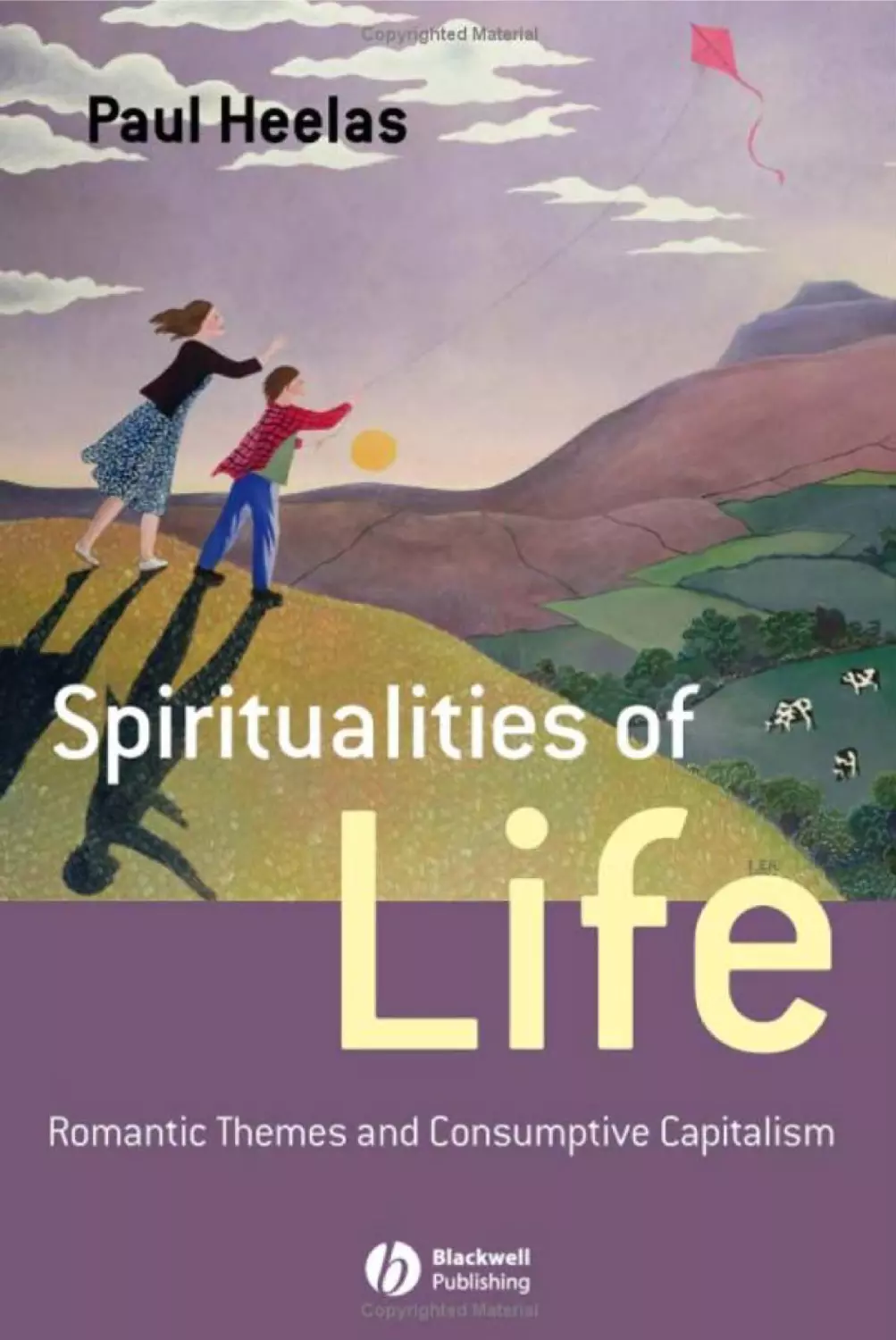
Front cover image: Lucy Raverat, Flying the Kite.
Lucy Rawlinson, who paints under her maiden name, is a dear old friend. A person with a
profound spiritual sensibility, Flying the Kite captures the magic of expressive freedom; of
harmony. Viewing Ingleborough from the farmhouse where she and her family used to live,
not far from our own family home, the painting captures the ‘presence’ of nature as well. I’m
sure Lucy would appreciate the words of the Lonsdale hermit – ‘To all blessed with true insight,
he [‘the mere man of craggy limestone’] is nothing less than a real personality, a creature with a
soul’. In the spirit of Lucy, a hermit who has rejected the clamour of life distorted by the lures of
the capitalistic mainstream:
I often seek his quiet company and take advantage of his noble patience. How can I estimate in
words or numbers the calm that he has breathed down upon me from his ancient heights when
the stirring voices of the far away multitudes have broken through to my seclusion and tempted
me from my loneliness into the thick of human conflict? Or how can I describe the benediction
of contentment he has bestowed upon me when thoughts of foolish ambition and of the
plaudits of crowds have risen to make me restless? He is a being full of speechfulness, full
of experience, full of romance, full of history. . . a living influence. (H. M. White, 1904, Old
Ingleborough. Ingleton: J. Brookes, pp. 6–7)

Spiritualities of Life: New Age Romanticism and Consumptive Capitalism
© 2008 Paul Heelas. ISBN: 978-1-405-13937-3

Paul Heelas

Heelas / Spiritualities of Life 9781405139373_1_pretoc

Final Proof page ii 1.2.2008 10:34am

RELIGION AND SPIRITUALITY IN THE
MODERN WORLD
Series Editors: Paul Heelas, Linda Woodhead, University of Lancaster
Editorial Advisor: David Martin, Emeritus Professor of the London School of
Economics
Founding Editors: John Clayton, University of Boston, and Ninian Smart,
formerly of University of California – Santa Barbara
The Religion and Spirituality in the Modern World series makes accessible to
a wide audience some of the most important work in the study of religion
and spirituality today. The series invites leading scholars to present clear and
non-technical contributions to contemporary thinking about religion and
spirituality in the modern world. Although the series is geared primarily to
the needs of university and college students, the volumes in the Religion and
Spirituality in the Modern World series will prove invaluable to readers with
some background in Religious Studies who wish to keep up with contemporary thinking about religion, theology and spirituality in the modern
world, as well as to the general reader who is seeking to learn more about
the transformations of religion and spirituality in our time.
Published
Don Cupitt
Paul Heelas, with the assistance of
David Martin and Paul Morris
Linda Woodhead and Paul Heelas
David Martin
Steve Bruce
David Smith
Peter Berger
Paul Heelas, Linda Woodhead,
Benjamin Seel, Bronislaw
Szerszynski and Karin Tusting
Bronislaw Szerszynski
Paul Heelas

Mysticism After Modernity
Religion, Modernity and Postmodernity
Religion in Modern Times
Pentecostalism: The World Their Parish
God is Dead
Hinduism and Modernity
Questions of Faith
The Spiritual Revolution
Nature, Technology and the Sacred
Spiritualities of Life

Forthcoming
Simon Coleman

The Gospel of Health and Wealth

Heelas / Spiritualities of Life 9781405139373_1_pretoc Final Proof page iii 1.2.2008 10:34am

Spiritualities of Life
New Age Romanticism and
Consumptive Capitalism

Paul Heelas

Heelas / Spiritualities of Life

9781405139373_1_pretoc Final Proof

page iv 1.2.2008 10:34am

# 2008 by Paul Heelas
BLACKWELL PUBLISHING

350 Main Street, Malden, MA 02148–5020, USA
9600 Garsington Road, Oxford OX4 2DQ, UK
The right of Paul Heelas to be identified as the author of this work has been asserted in
accordance with the UK Copyright, Designs, and Patents Act 1988.
All rights reserved. No part of this publication may be reproduced, stored in a retrieval system, or
transmitted, in any form or by any means, electronic, mechanical, photocopying, recording or
otherwise, except as permitted by the UK Copyright, Designs, and Patents Act 1988, without
the prior permission of the publisher.
Designations used by companies to distinguish their products are often claimed as trademarks.
All brand names and product names used in this book are trade names, service marks, trademarks, or registered trademarks of their respective owners. The publisher is not associated with
any product or vendor mentioned in this book.
This publication is designed to provide accurate and authoritative information in regard to the
subject matter covered. It is sold on the understanding that the publisher is not engaged in
rendering professional services. If professional advice or other expert assistance is required, the
services of a competent professional should be sought.
First published 2008 by Blackwell Publishing Ltd
1 2008
Library of Congress Cataloging-in-Publication Data
Heelas, Paul.
Spiritualities of life : New age romanticism and consumptive capitalism / Paul Heelas.
p. cm.—(Religion and spirituality in the modern world)
Includes bibliographical references and index.
ISBN 978-1-4051-3937-3 (hardcover : alk. paper)—ISBN 978-1-4051-3938-0 (pbk. : alk.
paper) 1. Spirituality—Western countries—History. 2. Western countries—Religious life and
customs. I. Title.
BL695.H44 2008
204.09’03—dc22
2007046638
A catalogue record for this title is available from the British Library.
Set in 10/11.5pt Galliard
by SPi Publisher Services, Pondicherry, India
Printed and bound in Singapore
by C.O.S. Printers Pte Ltd
The publisher’s policy is to use permanent paper from mills that operate a sustainable forestry
policy, and which has been manufactured from pulp processed using acid-free and elementary
chlorine-free practices. Furthermore, the publisher ensures that the text paper and cover board
used have met acceptable environmental accreditation standards.
For further information on
Blackwell Publishing, visit our website at
www.blackwellpublishing.com

Heelas / Spiritualities of Life 9781405139373_1_pretoc Final Proof page v 1.2.2008 10:34am

In memory of my teachers, E. E. Evans-Pritchard,
Rodney Needham and Ninian Smart,
and my old friends, Malcolm Crick and Ursula Lister

Heelas / Spiritualities of Life 9781405139373_2_toc Final Proof

page vii

29.1.2008 5:41pm

Contents

Preface

ix

Introduction

1

Part I

Portraying Spiritualities of Life

23

1 From the Romantics: The Repertoire
2 Wellbeing Spirituality Today

25
60

Part II

79

The ‘Consuming Growth’ Debate

3 The Debate
4 The Language of Consumption and Consumeristic
Aspects of Mind-Body-Spiritualities of Life
5 The Sacred and the Profane: Spiritual Direction or
Consumer Preference?
6 The Matter of Personal Significance:
Profaned Superficiality?
7 Work: Consumptive or Productive?

81
97
113
137
151

Part III To Work Beyond the Consuming Self

165

8 A ‘Fag Ending’ of the Sacred or Fit for the Future?
9 Inside Out

167
195

Epilogue: Birthright Spirituality Beyond the West

222

Heelas / Spiritualities of Life

viii

9781405139373_2_toc Final Proof page viii 29.1.2008 5:41pm

Contents

Appendix: Evidence Indicative of Inner Life ‘Beliefs’

233

Notes

236

References

255

Name Index

276

Subject Index: Some Main Themes and Arguments

283

Heelas / Spiritualities of Life 9781405139373_3_posttoc Final Proof

page ix 26.1.2008 11:26am

Preface

I was extremely fortunate to have been born in 1946. This has meant that
I have witnessed, and in measure experienced, the unfolding of spiritualities of
life from the time I came of age during that great ‘inner era’ known as the
sixties. My awareness of what has come to be called the ‘New Age’ dawned
whilst I was studying at Oxford. I was more a participant than an observer.
Since moving to the Yorkshire Dales, I have also been fortunate to live so close
to the homeland of the English Romantics, the Lake District. Students who I
taught at Lancaster University during the later 1970s and the 1980s helped
keep me abreast of developments: the way in which Bhagwan Shree Rajneesh’s
movement sustained the ‘sixties’ after the decline of the counter-culture in the
West (Thompson and Heelas, 1986), and the seminar spirituality which
flourished at this time, thereby contributing to my research on ‘alternative
spiritualities’ during the period. From 1997, I have been much preoccupied
with what has come to be called the ‘Kendal Project’ – a project which has
helped take me into the realm of wellbeing spirituality. During the last decade
or so, I have also been studying spiritualities of life overseas – first Dacca, then
Kampala, currently Islamabad and environs. All settings where ‘wellbeing’ is
frequently a much more fundamental issue than in most western settings.
During this long period of looking at the New Age, I have had three
experiences which will be with me until the day I die. In the spirit of Aldous
Huxley, a trip to remoter realms whilst listening to the Pink Floyd during an
open air festival; ‘participant’ observation of a 100 or so hour long Exegesis
seminar; and a sudden realization concerning the significance of the term
‘life’ whilst waiting at Schiphol airport. Academically useful experiences – but
not as useful as having had the fortune to live through the ‘working out’ of
what Charles Taylor (1991) calls the ‘massive subjective turn of modern
culture’ (p. 26): a turn which is very much bound up with the growth of
subjective wellbeing culture, including wellbeing spirituality.
This book completes a trilogy with Blackwell Publishing on the topic
of alternative spiritualities. The first volume, The New Age Movement, was

Heelas / Spiritualities of Life 9781405139373_3_posttoc

x

Final Proof page x

26.1.2008 11:26am

Preface

published in 1996. Much of it dwelt on seminar spirituality, studied during
the 1980s. The second volume, co-authored with Linda Woodhead, The
Spiritual Revolution, was published in 2005. It contains a fair amount on
the wellbeing spirituality which has become increasingly popular since the
early 1990s. Neither of these two volumes was of an especially ‘evaluative’
nature; and neither paid much attention to the matter of consumption.
Attending to these matters, Spiritualities of Life is significantly different
from what has gone before. Furthermore, account has had to be taken of
the consideration that the key word has ever more become ‘life’, in measure
supplanting ‘self’. I have also felt that it is now time to spread my wings,
to turn more controversial.
Consumption, it is often said, dominates life. Subjective wellbeing culture –
in the form of shopping to satisfy desire – is widely held to be a primary,
perhaps the primary, exemplification of consumer culture. My interest in
consumption derives from the consideration that New Age spiritualities
of life have come to make their mark within various realms of the culture of subjective wellbeing. Accordingly, much of what follows is a critical
assessment, written through the lens of consumption.
During the heyday of the Lancaster University Centre for the Study of
Cultural Values, the early 1990s were devoted to the interdisciplinary
study of aspects of consumer society and selfhood. Edited by Russell Keat,
Nigel Whiteley and Nicholas Abercrombie, The Authority of the Consumer
(1994) was perhaps the most significant outcome. The volume explores an
apparently radical shift of authority, away from the provider or producer,
towards the recipient or consumer. Judging the value and meaning of the
activities involved in this shift, judging the character of the social relations
at stake, the volume contributes to the debate between those who decry
the commercialization, populism and loss of integrity associated with the
apparent shift of authority, and those who commend the shift on the grounds
of its anti-elitism, empowerment and democratization. Stimulated by the
intellectual creativity of the Centre for the Study of Cultural Values, I tried
my hand at writing an essay – ‘The Limits of Consumption and the Postmodern ‘‘Religion’’ of the New Age’ – which appeared in The Authority of
the Consumer. The buzz of the time, however, was rather overwhelming.
As a consequence, the essay left me with a series of questions: questions
which have been nagging me ever since; questions which are now tackled
to the best of my ability.
Profound thanks are due to the inspiration of the ‘core’ team of the Centre
during the early 1990s, Nicholas Abercrombie, Russell Keat, Scott Lash,
Celia Lury, Paul Morris, John Urry and Nigel Whiteley. More recently, I owe
a great deal to conversations and correspondence with Colin Campbell –
whose writings on consumer culture and spirituality are surely of the highest
order. Steve Bruce – the Gordon Brown of the social scientific assembly
north of the Border – has been as invaluable as ever, his no-nonsense
arguments providing the perfect foil to what I hope are equally effective

Heelas / Spiritualities of Life 9781405139373_3_posttoc Final Proof

page xi 26.1.2008 11:26am

Preface

xi

counter-arguments. My wife, Mia Haglund Heelas, has been even more
invaluable. Having experienced holistic activities, she emphatically outdoes
Steve Bruce on the forthrightness front: simply consumeristic, ineffectual,
money-making ‘nonsense’, as she recently concluded after staying in that
hotbed of holistic activities, Bangkok. Discussion with the National Cancer
Research Institute’s Psychosocial Oncology Spirituality Subgroup has proved
exceptionally helpful, as have detailed comments provided by one of the
readers of the manuscript of the present volume and the first-rate copyeditor, Jack Messenger. I also greatly appreciate insights provided by my
daughter, Elissa Standen, friends and colleagues Dick Houtman, Gordon
Lynch, Stefania Palmisano, Elizabeth Walton and Scott Taylor, and – as ever –
my students, some of whom are referred to in what follows. A great debt is
owed to Steve and Zeba Rasmussen, guides par excellence in Pakistan. At
Lancaster University, I must acknowledge my gratitude to colleagues and
personal friends Gavin Hyman and Deborah Sawyer for having helped keep
me sane during a most difficult time at work, a time when I also benefitted
from close friends Bobby and Besty Ben, and GP Bill Hall. Born in the sacred
city of Kanchipuram, our 12-year-old son, Sebastian Heelas, has been of
great significance: not only by being so patient whilst I have worked away in
Islamabad, but also for being such an enthusiastic student of culture, stimulating my concern for inner-life universalism and freedom, and for telling me
more about the slogans of wellbeing culture.

What a piece of work is a man! How noble in reason!
how infinite in faculty! in form, in moving, how
express and admirable! in action how like an angel! in
apprehension how like a god! the beauty of the world!
the paragon of animals! And yet, to me, what is this
quintessence of dust? man delights not me; no, nor
women neither . . . (Hamlet, Act II, Sc. II)

h
It is in reverence for life that knowledge passes over
into experience . . . My life bears its meaning in itself.
And this meaning is found in living out the highest
and most worthy idea which my will-to-live can
furnish . . . the idea of reverence for life. Henceforth I
attribute real value to my own life and to all the
will-to-live which surrounds me; I cling to an activist
way of life and I create real values. (Albert Schweitzer,
1966, p. 261)

Heelas / Spiritualities of Life

xii

9781405139373_3_posttoc Final Proof

page xii

26.1.2008 11:26am

Preface
Like the ocean is your god-self;
It remains for ever undefiled.
And like the ether it lifts but the winged.
Even the sun is your god-self;
It knows not the ways of the mole nor seeks it
the holes of the serpent.
But your god-self dwells not alone in your being . . .
He who defines his conduct by ethics
imprisons his song-bird in a cage.
(Kahlil Gibran, 1976, pp. 46, 90)

h
. . . an . . . explosion in cultural consciousness – the
fusion of people not with one another, but with
material. Modernism has done much to unseat the
humanist tradition . . . The demise of romanticism
. . . (Kenneth J. Gergen, 2000, pp. xix, 227)

h
He who knows only his own side of the case knows
little of that. (John Stuart Mill, On Liberty, 1859)

Heelas / Spiritualities of Life

9781405139373_4_000

Final Proof

page 1

26.1.2008 11:21am

Introduction

Of all conceivable forms of enlightenment the worst is what . . . people call the Inner
Light. Of all horrible religions the most horrible is the worship of the god within . . .
That Jones shall worship the god within him turns out ultimately to mean that Jones
shall worship Jones . . . The mere pursuit of health always leads to something unhealthy. (G. K. Chesterton, 1909, pp. 136, 138)
I believe that art therapy saved my life by giving me the opportunity to get in touch
with my authentic self. This part of me is now allowed to have a life. The part that
existed before was a highly developed false self . . . [Art therapy] was a process of
gathering – my grief, my desolate childhood, my feminine qualities, divinity. They
were brought to my centre, later I mixed with a pulse of light and leaps of joy.
(Julie, with breast cancer, cited by Connell, 2001, p. 105)
. . . a spiritual stew. (Christopher Lasch, 1987, p. 80)
All life is sacred, interdependent and growing to fulfil its potential.
Love, Support and Protect all beings.
Connect. Grow. Serve. (William Bloom, www.williambloom.com)
There’s only one corner of the universe you can be certain of improving and that’s
your own self. (Aldous Huxley, Time Must Have a Stop, 1944)

Surprisingly, a recent survey finds that 37 per cent of the British sample agree
with the statement, ‘I believe that God is something within each person,
rather than something out there’. Whatever might be made of this – and
some will express disbelief – the finding serves to direct attention to inner
forms of the sacred. More specifically, it serves to direct attention to looking
at spirituality within life. Not the life of a transcendent theistic God, but
the life embedded within the here and now. A life, it is said, which can only
make a ‘true’ difference when it is experienced by the self. And a life which

Spiritualities of Life: New Age Romanticism and Consumptive Capitalism Paul Heelas
© 2008 Paul Heelas. ISBN: 978-1-405-13937-3

Heelas / Spiritualities of Life

2

9781405139373_4_000

Final Proof

page 2

26.1.2008 11:21am

Introduction

is very much to do with the free expression, and thus development, of
what it is to be ‘truly’ human. Such is the subject matter of this volume.
So to the big question of the volume: what, if any, are the capacities of
New Age spiritualities of life to make a positive difference to individual,
social or cultural life?
The significance of this question derives from the nature of modernity.
In the contemporary west, powerful forces are at work. Life is becoming
ever more regulated by legal, quasi-legal or economically justified procedures, rules, systems. David Boyle (2000) writes of ‘the tyranny of numbers’.
As has frequently been argued, the sacrifices to be paid for the positivistic
rule of reason are considerable. The freedom of the expressive self to live
‘out’ its own life by exercising experimentation is stifled. The affect/ive is
disempowered. Quality of life suffers by virtue of the stresses generated
by the culture of targets. The instrumentalization of relationships for the
sake of economic utility threatens the integrity and possibilities of personal
relationships, not least ‘being trusting’. Spontaneity – well! It might well
seem that life is becoming more and more akin to the antlike life of Dubai,
that most capitalistic of places, with money, security, comfort, wellbeing
galore for the better off, but with a deep, boring vacuity when it comes to
self-expression, creativity, that great Romantic theme of learning through
‘bitter’ experience. From atop a skyscraper in Dubai, the flow of gleaming
Mercedes revolving around the gleaming malls really does look like a series of
columns, manifesting those perquisites for control – barren purity, officiated
mundanity and self-mendacity.
Human flourishing is at stake. And I have to admit that as a libertarian
humanist, with a liberal Quaker background, I look with horror at the
ways in which life is becoming ever more restricted. The expressive self
undergoing the suffocating squeeze. The ability of modernity to ‘kill the spirit’,
as Kieran Flanagan (2007, p. 1) puts it. What makes things worse is that
the value of expressivistic-cum-humanistic values is increased in the face
of opposition. The possibility of becoming institutionalized aside, one
never values freedom so much as when one is in prison. Analogously,
one never values ‘human’ aspects of life – time to ponder, the opportunity
to be oneself, the possibility of living as a free spirit – so much as when one
feels oneself under the systems of capitalistic or quasi-capitalistic modernity;
the experiences of engulfment, of invasion; the sense of the doors clanking
shut to exclude ‘life’. What provides hope, though, is that by enhancing
the value of the values it excludes, capitalism fuels its own opposition.
Furthermore, without capitalism or similar ‘spanners in the works’, values
like freedom and equality would presumably lose their significance: now on
the grounds that to be free and equal all the time means that freedom and
equality cease to matter. (A reason, incidentally, why the utopian is
‘no where’.)
Emphasizing autonomous expressivity, emphasizing the ‘unbounded self ’
(Wexler, 2000, p. 2), New Age spiritualities of life appear to be opposed

Heelas / Spiritualities of Life

9781405139373_4_000

Final Proof

page 3

26.1.2008 11:21am

Introduction

3

to the restrictive, the regulatory, those impositions of external sources
of authority which are served by formal rules and regulations. So to the
political dimension of this volume. Quite simply, are New Age spiritualities
of life up to the task of responding to the ‘iron cages’ so widespread within
mainstream society and culture, with their strongly positivistic, that is
measurable and ‘narrow’, criteria of what it is be a ‘successful’ human? Do
we find significant responses to what Guy Debord (1995, p. 26) calls ‘the
world of the spectacle’, ‘the world of the commodity ruling over all lived
experience’? Do we find a form of the sacrality of the ‘bare life’ able to resist
the sociocultural inscriptions explored in Giorgio Agamben’s Homo Sacer
(1998)? In the spirit of Richard Sennett (2008), do we find ‘crafts of life’,
cultivating human flourishing, ‘making’ it happen, in the face of mainstream
forces as they move ever closer to the deeply pessimistic appraisal of modernity provided by Weber in the closing pages of The Protestant Ethic and
the Spirit of Capitalism (1985)? Do we find a counter-balance to the fact
that life is ever more threatened by the ever-increasing ability of capitalist,
quasi-capitalist and other organizations (including state education) to implement the idea that a (variously) specialized, boxed or bounded self is the
prerequisite for renumerative progress?
A great deal hangs on the extent to which New Age spiritualities of life
are privatized or consumerized. The common assumption among academics
is that the internalized authority which is such a pronounced feature of
New Age understanding is used to consume. Here we find ‘the self for
itself ’. Here we find intake for the sake of what it brings to what lies within.
Here we find those ‘living a life turned in on itself where people ignore the
consequences of their actions’, as the Bishop of London, Richard Chartres,
puts it in a succinct formulation (Leake, 2006, p. 1). Here we find people
intent on capturing their dreams by way of commodities.
If autonomy is exercised to consume in a self-absorbing fashion, the
response to positivistic iron-cage tendencies is going to be minimal, if not
non-existent. If Zygmunt Bauman is right with the theme of his book,
Consuming Life (2007), life is used up, engorged, for the sake of capitalistic
consumer culture. New Age spiritualities of life are an integral tool of
capitalism. If all those who treat New Age spiritualities of life as a form of
junk capitalism – providing tacky forms of ‘interior decoration’, handling
the suffocating squeeze by contributing to the great engorgement – are
right, their ‘revolutionary’ capacity is obviously zilch.
Alternatively, the argument is that ‘life’ is ‘consumed’ and ‘consuming’.
From this perspective, inner-life spirituality is drawn upon, that is ‘consumed’ in the sense of ‘used’ and put to work, to cultivate what it is to
be alive. To explore what it is to live beyond the narrow horizons of that
utilitarian individualism which focuses the self on the quantifiable externals
of life. And at least for some, inner-life spirituality takes one over (that is,
is ‘consuming’). Rather than the emphasis lying with the ‘good life’ of

Heelas / Spiritualities of Life

4

9781405139373_4_000

Final Proof

page 4

26.1.2008 11:21am

Introduction

materialistic utilitarianism, the emphasis lies with the ‘good life’ of expressivistic humanism.

Reflections on Shirley MacLaine: Possibilities
‘It all starts with self’, writes Shirley MacLaine (1988, p. 5). With this
proclamation in mind, we can ask questions of the kind:
.
.
.

.
.
.

.

To what extent do the fruits of the New Age spiritualities of life stay
locked within the self alone, remaining in and of the self itself?
To the extent that these spiritualities stay within the self itself, what kind
of self is at stake?
Is this a privatized self devoting itself to its ‘intray’ to develop
‘exceptional interiors’, with New Age spiritualities of life largely – if not
entirely – serving to encourage the self-indulgence of narcissistically or
sybaritically pleasuring the self? Or is this a self devoted to the interior
spiritual quest?
Is the ‘starting point’ relational rather than atomistic? Epistemologically
solipsistic or learning through others? Or both?
To what extent do New Age spiritualities of life take a relational, engaged
form, participants working from their ‘grassroots’, ignoring the privatepublic distinction to contribute to the world about them?
If contributions to the world are in evidence, are iron-cage tendencies
addressed head on? Are contributions found in connection with ways of
life – perhaps through downsizing or early retirement – which circumvent
the ‘bounding’ of the capitalistic mainstream?
Most fundamentally, are New Age spiritualities of life best thought of as
a component of the enlightenment trajectory of modernity in capitalistic
mode, or the romantic, expressivist strand? Or, with logical options in
mind, both?

Questions of this variety direct our attention to the greatest of the issues
raised by inner-life spirituality.1 For if New Age spiritualities of life
simply encourage what many regard to be the primary ‘sin’ of capitalism,
namely consumptive self-interest, we have an increasingly popular form
of the sacred, one which is increasingly rivalling the sway of Christianity
in western settings and which could well be doing more harm than
good. On the other hand, if the ‘spirituality’ of spiritualities of life lives
up to its promise, not least addressing the deleterious consequences
of consumer-producer capitalism, it provides an avenue for ‘true’ human
flourishing.
Do we side with Chesterton and Lasch or with Julie, Bloom and Huxley?
To scorn or to praise – or some combination of both evaluations?

Heelas / Spiritualities of Life

9781405139373_4_000

Final Proof

page 5

26.1.2008 11:21am

Introduction

5

Introducing Inner-Life Spirituality
Spiritualities of life today, on which I focus, typically take a holistic,
life-affirming form. Whether it be yoga in Chennai or yoga in San Francisco,
aikido in Islamabad or aikido in Birkenhead, one will encounter the theme
that what matters is delving within oneself to experience the primary source
of the sacred, namely that which emanates from the ‘meta-empirical’ depths
of life in the here-and-now (Hanegraaff, 1999, p. 152; see also Robertson,
1972, p. 47, on the ‘superempirical’). And it is also highly likely that one will
encounter the theme that experiential contact with inner-life spirituality enables it to ‘flow’ through other aspects of one’s being to integrate,
‘harmonize’ or ‘balance’ oneself; to draw one’s mind, body and spirit into
a whole by way of the sacralization of the body-cum-subjective life; to find
self-fulfilment by way of the craft of life; to enable ‘natural’ spirituality
to ‘fill’ the unique life rather than letting it ‘drain away’ by using up life for
the sake of the consumptive.
With the possible exception of a few countries like Somalia (although
indigenous healers there could very well be working with inner-life forces),
holistic activities are now found across the nations of the globe. In western
settings, mind-body-spirituality activities, in the hands of spiritual practitioners – which is what is concentrated on in this volume – have grown fairly
rapidly, especially during and since the counter-cultural sixties. In some
western countries, inner-life ‘beliefs’ have almost certainly become more
popular than beliefs in the theistic personal God of traditional Christianity.

A Beneficial Development
Needless to say, many participants and believers are delighted with what is
underway. As an experiential spirituality, nothing less than the transformation
of the quality of personal, subjective life lies to hand. As an expressive spirituality, rather than ending with the self itself, inner-spirituality is held to
(greatly) enhance the quality of personal relationships, one’s creativity and
self-responsibility whilst being with others. And as a humanistic, egalitarian
spirituality, rather than a secular form of humanism, concern is expressed
for human wellbeing in all its aspects. The inner-life is held to contribute to
what Martha Nussbaum (1997) calls ‘the cultivation of humanity’ – the
liberation of ‘the mind from the bondage of habit and custom, producing
people who can function with sensitivity and alertness as citizens of the whole
world’; people who ‘recognize the worth of human life wherever it occurs’
(pp. 8–9). The jobs are clear; for participants, so is the efficacy of the work.
No wonder that considerable numbers of the medical profession in various
western countries have been attracted by what inner-life spirituality is seen
to offer when caring and quality of life matters are to hand. No wonder that

Heelas / Spiritualities of Life

6

9781405139373_4_000

Final Proof

page 6

26.1.2008 11:21am

Introduction

CAM (Complementary and Alternative Medicine), where mind-bodyspirituality is often in evidence, has become so popular. No wonder that
inner-life spirituality is proving increasingly attractive to primary school
teachers in the UK and elsewhere, with the child-centred approach emphasizing the ‘whole’ of the individual pupil. No wonder that inner-life spirituality is
proving increasingly attractive to secondary school teachers in the UK, the
importance it attaches to the shared spiritual life of all humans serving as a
way of addressing multiculturalism. No wonder that inner-life spirituality
is a growing presence within the domain of paid employment, among other
things being taken to contribute to the self-work ethic. No wonder that
this kind of spirituality has been deemed worthy of government support
in the UK and elsewhere, President Musharraf of Pakistan, for instance,
lending his official backing, as Patron-in-chief, to an inner-life orientated
Sufi organization, the National Council of Sufism, primarily designed to
combat the exclusivistic with the inclusivistic.
Whether it be the personal life of subjective experience, the personal life
of the ‘familiar’ world of daily activities, or the cultivation of humanity, it
seems as though holistic spirituality has a great deal to offer.2 We might well
want to conclude that if it continues to become more popular, it will provide
a worthy successor to Christianity in western settings; and, in the longer
term, to exclusivistic, iron-cage forms of Islam (for example) in countries like
Pakistan. Indeed, among other reasons, the ability of spiritualities of life to
handle both the unique and the universal could mean that it will provide a
more worthy successor: quite probably the best hope for the future of the
sacred in a world where the cry ‘Only Connect’ is likely to become more and
more urgent – not least to combat the divisive Truths of numerous forms of
religious tradition.

A Deleterious Development
Turning to the other side of the coin, New Age spiritualities of life have
long been subject to criticism. Think of Chesterton. Providing a very brief
history of the main tools which have been used to beat New Age spiritualities
during the last few decades, forty years ago talk was of the acid-riddled
hippies of the counter-culture, twenty-five years ago of the brainwashed
participants of fascistic enlightenment seminars; today, talk is of the consumption of mind-body-spirit dross. Of all the controversies surrounding contemporary inner-life spiritualities, by far and away the most significant within
the academy and beyond revolves around the criticism that the great majority
(or virtually all) of provisions and activities serve as consumer products.
The refrain is that the key product of the New Age is experience. ‘Spiritual’
experiences, if that is what they can be called, are taken to be consumed,
used, for the sake of enhancing hedonistic experiences – broadly on a par
with a pampering session at a mind-body spa, or reading pulp fiction.

Heelas / Spiritualities of Life

9781405139373_4_000

Final Proof

page 7

26.1.2008 11:21am

Introduction

7

Putting it vividly, only the self can consume – by and for itself. One cannot
consume for others. When individuals consume, they, and they alone, absorb
or use what is on offer, the experiences belonging to their private, interior,
life. Especially when people consume for the sake of their own pleasure
rather than out of necessity, ‘the pursuit of happiness’ only too readily results
in ‘the dead end of a narcissistic preoccupation with the self’ (Lasch, 1980,
p. xv; my emphasis). The joys, wonders, experiences of one’s own essence –
that is, one’s own ‘spirituality’ – might themselves be consumed. In answer
to one of the questions raised earlier – namely, to what extent do New Age
spiritualities of life stay locked into the self, itself? – the short answer is that
this is where they remain. And in answer to another question – to the extent
that these spiritualities stay with the self itself, what kind of self is at stake? –
the answer is equally obvious. We are in the land of the self-indulgent self; the
self consumed by worldly provisions. We are in the land of those rationalchoice and post-modernist theorists who, in Stephen Hunt’s (2002, p. 42)
summary, see spirituality as ‘partak[ing] of the consumer ethic’. We are
in the land of the ‘I am what I am – and I want more from the material
world’. We are in the land of Burger King’s ‘Get the Urge, Get to Burger
King’; of the ‘Have it Your Way’.
Whatever value or usefulness New Age spiritualities of life might possess –
as a way forward, perhaps as a force for good in the longer-term future –
is ravaged, dissipated by consumption. Worse, we shall see, it can be argued
that these spiritualities contribute to the very thing that they proclaim, in
egalitarian mode, to be combating: elitist, show-off, indulgent, excessive
capitalism, the wealthier affirming their difference from the less well-off;
exploiting their position in life to fuel experiences of deprivation. Except
for successful capitalists, spiritualities of life do much more harm than good.

Comparison
The beneficial and deleterious ways in which holistic spiritualities of life
are understood and appraised are poles apart. On the one hand, we find a
person-centred, expressivistic, humanistic, universalistic spirituality. We find
a spirituality praised by participants for the ways in which it stimulates the
flourishing of what it is to be human; a spirituality credited with the power
to heal ‘dis-ease’, to enhance wellbeing or ‘wellness’; a spirituality which
professionals seek to introduce or encourage within the mainstream realms
of education, health and the capitalist workplace (etc.); a spirituality deemed
worthy of governmental support; a spirituality which provides a ‘politics’ of
values to bring about a better world in which to live.
On the other hand, we find capitalist-driven gratification of desire, the
pleasuring of the self, self-indulgence, if not sheer greed. Rather than contributing to the quality of life for increasing numbers of people, the growth
of New Age spiritualities makes things worse. Increasingly, purveyors dress

Heelas / Spiritualities of Life

8

9781405139373_4_000

Final Proof

page 8

26.1.2008 11:21am

Introduction

their products and services with spirituality to make ‘The Promise’. Their aim
is to stimulate demand by titillating hopes and desires. Playing on the
‘consumer emotions’ of the individual – of the ‘I’ll only be happy when
I have experienced this . . . ’ variety – the end result is Lasch’s dead end.
Prompted by provisions and services to dwell on the state of play and
requirements of their pleasure zone, the more that individuals take in (or
are taken in by) what is on offer, the more privatized or selfish they become,
perhaps to the extent of treating even ‘close’ relationships in the mode
of instrumental self-gratification. Consequently, the less likely they are to
contribute to the wellbeing of those around them during their daily lives,
let alone to engage in ‘direct’ political action more generally.

Introducing the Argument
What is to be made of this clash of understanding and evaluation? What is to
be made of the argument that consumerism is alive and well, if not rampant,
within the sphere of inner-life spirituality? To the degree that the language
of consumption is rejected by participants, do the ‘implied’ meanings of
these spiritualities, their nature, form or function, nevertheless justify the
application of the language? It would be rash in the extreme to reject the
claim that the growth of New Age spiritualities of life can contribute to selfindulgence and other forms of consumption. It would also be rash to reject
the claim that the purveyors of ‘spiritually’ significant products or services
‘sell out’ in the context of consumer culture, with some having ‘sold out’
to it. However, there are good grounds for concluding that attempts to
‘reduce’ spiritualities of life more or less in toto – which is what some critics
do – is to neglect the irreducible.
Recent years have seen the publication of a number of volumes, articles
and Ph.D. theses written in the spirit of Christopher Lasch. That is to say, the
emphasis lies with the ‘nothing (much) more than hedonistic consumption’
point of view. It is time for a response: one which is not driven by purist ideas
of what counts as true, that is world-rejecting, spirituality; one which does
not derive from particular versions of what counts as political activism (those
to the left arguing that the turn within deflects from ‘real’, that is secular,
activism); and, for that matter, one which is not driven by the doctrines, fear or
envy of the Christian establishment (see Ward, 2006). To counter the sledgehammer approach of so much of what has become the ‘reduction’ to consumption orthodoxy of many critics, as well as to generate debate, I attempt to
dislodge some familiar arguments. It is time to rectify the balance against the
polemical, rhetorical and – it has to be said – the frequently ill-informed.3
In The Politics of Experience (1967), R. D. Laing writes:
Our behaviour is a function of our experience. We act according to the way we
see things . . . If our experience is destroyed, we have lost our own selves. (p. 2)

Heelas / Spiritualities of Life

9781405139373_4_000

Final Proof

page 9

26.1.2008 11:21am

Introduction

9

In The Art of Happiness (1998) the Dalai Lama speaks the language of highly
egalitarian, humanistic, expressive, ‘loving kindness’ spirituality, arguing for
what he calls ‘basic spirituality’: ‘the basic human qualities of goodness,
kindness, compassion, caring’ (p. 258; his emphasis). As the Dalai Lama
continues,
as long as we are human beings, as long as we are members of the human family,
all of us really need these basic human values. Without these, human existence
remains very hard, very dry. As a result, none of us can be a happy person, our
whole family will suffer, society will be more troubled. So, it becomes clear that
cultivating these kinds of basic spiritual values becomes crucial. (p. 258; his
emphasis)

Drawing on Laing and the Dalai Lama, it is virtually a truism that the ways in
which people experience, understand and value themselves, those around
them and those further abroad, has huge significance for how they act in the
world. And as anthropologists, for example, have demonstrated, to have new
experiences, to acquire new understandings, to change values during the ritual
process – exemplified by rites de passage – frequently has profound significance
for life.4 Leaving exploration of the ‘changes’ which might occur during the
‘ritual process’ of participation in holistic, mind-body spirituality until later
in this book, the important point for now is that the values of the Dalai
Lama’s ‘basic spirituality’ (and of course his list is not exhaustive) are widely
abroad within spiritualities of life. For introductory purposes, it suffices to
say that participation can serve to make a difference to the ways people live
‘out’ their lives.
My main intention is to argue the case for ‘spiritual’ significance or reality,
arguing in turn that the growth of New Age spiritualities of life is by no
means entirely ‘eaten up’ by the bodies-cum-psychologies of consumers.
That instead, ‘ethical demands’ are frequently experienced as emanating
from within. Adopting a term from Isaiah Berlin’s Against the Current
(2001) – an analysis of those precursors of contemporary spiritualities of
life, the Romantics – I argue as forcefully as possible that holistic, face-to-face
activities (in particular) can facilitate a ‘current’ of meaningful experiences.
These flow through the lives of participants to infuse their outlook on life
and their values. Flowing through those who have, in measure, moved
beyond the allures of consumer culture; those who are cultivating basic
spirituality rather than merely using their activities to gratify their consumptive emotions; those who aim to ‘Grow into Life’ (an apt expression!), as a
psychodrama group which has met in Lancaster calls itself; those who seek
‘to bring the daily activities of our lives into a more health-promoting way’,
as a leaflet circulated by a Kendal practitioner of the Alexander Technique
and Reflexology puts it; those who seek what ‘The Headless Way’ has to
offer, according to a promotional flyer – ‘See Who you really are. Our selfconcept affects our behaviour, so an expanded sense of self has important
implications for our lives.’

Heelas / Spiritualities of Life 9781405139373_4_000 Final Proof page 10 26.1.2008 11:21am

10

Introduction

A Personal Bias?
To engage with the ‘reduction’ to consumption thesis by drawing attention to
its defects, and to do this by referring to the ‘spiritual’ significance or reality of
holistic activities, could easily be taken to mean that I am defending spiritualities of life.5 It can then be inferred that my defence is due to the fact that I am
committed to what they have to offer. It can thus be concluded that I am
biased in favour of these spiritualities. And indeed Steve Bruce (2006, p. 42)
writes that I am one of those who is ‘sympathetic to New Age spirituality’.
In one sense, Bruce understates his case. As will become perfectly apparent, I am deeply committed to the beneficial efficacy of inclusivistic (albeit
tension-laden) humanistic values – the same values which are sacralized by
so many New Age spiritualities of life. In another sense, though, Bruce’s
observation has to be qualified. I am equally committed to basing as many
interpretations and judgements as possible, most especially those to do with
beneficial efficacy, on publicly accessible evidence. Given the absence of publicly available empirical evidence for inner-life spirituality itself, I am certainly
not committed to the unscholarly exercise of couching inquiry in terms of
the presumed ontological-cum-experiential truth of what lies deep within.
As reported by participants, the ‘spiritual’ significance of holistic activities is,
of course, another matter. For it is then an aspect of ethnographic reality.
Furthermore, on the point of evidence and efficacy, it should be born in
mind that it is not as though I am making things easy for myself. For some
time now, I have argued that the provisions and activities of holistic spiritualities of life in measure belong to subjective wellbeing culture.6 Writes David
Cohen (2000) in an article on a course at the University of Alberta which
attends to Oprah Winfrey, The Oprah Magazine ‘maintains that one can and
should feel better about oneself – ‘‘This magazine is about helping you become
more of who you are,’’ says Winfrey’s introductory note’ (my emphases). With
the emphasis on quality experiences for the (relatively) well-to-do, subjective
wellbeing culture in its purchasing, high-street mode is often seen as epitomizing the self-indulgent aspect of consumer culture; a bourgeois bastardization of that great theme of the fin-de-siècle Decadents, critical fascination
with insatiability and the quest for sensual gratification at all costs. To argue,
as I do in this volume, that holistic, mind-body-spirituality activities also have
much to do with a subjectivized rendering of the ethic of humanity – which
in effect is what the Dalai Lama is referring to – flies in the face of what
readily come to mind when one thinks of quality of life purchasing culture:
luxuries for the spoilt.

More Controversies
Hopefully, this volume is controversial. Given that it intersects with several
debates within various quarters of the academy, it should be.

Heelas / Spiritualities of Life 9781405139373_4_000 Final Proof page 11 26.1.2008 11:21am

Introduction

11

Thinking of the (ill-named) sociology of religion (for spirituality should
now be included), the sometimes heated debate is between those who
emphasize the market, self-interest and preferences and those who emphasize
the continuing significance of the ‘Durkheimian’ sacred as an authoritative
order. Including New Age spirituality under the rubric of religion, Stephen
Hunt (2002) writes, ‘if there is any one theme which unites sociologists
in the area today then it is the matter of choice and consumption in the field
of religion’ (p. 210). True, not all the sociologists he has in mind are united
in the importance they ascribe to self-indulgent consumption. However,
his generalization stands – which means that I have to argue against the
consensus: among other strategies, by adopting a modified Durkheimian
approach.
A related point of controversy concerns the growing tendency for secularization theorists to explain away the growth of New Age spiritualities of life by
arguing that activities (and beliefs?) have much more to do with the ends of
individualistic, secular or psychological consumption than with anything
over and above that which is ‘taken in’ to satisfy preferences.
Within that important field of cultural studies, namely the investigation of
the consumer, consumer culture and consumption, the debate between
those who envisage the consumer as a passive, decentred, saturated, moreor-less conformist, opiated victim of the formations and stratagems of
capitalism, and those who emphasize the libertarian, emancipatory role
of consumer activities and autonomous self-expression, is as hotly contested
as ever. The debate between those who are negative – sometimes exceedingly
so – about what consumer culture has to offer, and those who emphasize
creative, ‘meaning-making’ aspects, cannot be ignored in what follows. Even
when mind-body-spirituality activities or provisions are consumeristic, they
could be enabling more than the passive consumption of ‘mere’ pleasure.
Controversy is fuelled by virtue of the fact that the topic of consumption
more or less inevitably raises issues to do with elitism. For Graham Ward
(2006), ‘rather than functioning as an integrating factor in the life of a
society’, religion – especially what he calls ‘spiritualism’ – is well on the way
to becoming ‘self-help as self-grooming’, providing forms of ‘custom-made
eclecticism that proffer a pop transcendence and pamper to the need
for ‘‘good vibrations’’ ’ (p. 185). Ward might be partially correct. Before
making assessments of this variety, however, it is worth taking a close look
at the evidence. It is only too easy to make disparaging judgements of
New Age provisions or services, dismissing them as consumer garbage.
(I wonder what Ward would have to say about Enhancing Your Mind Body
Spirit magazine, each £2.99 issue complete with ‘Course Equipment’ such
as an amethyst crystal, advertised on TV in Britain over the last few years
during the Christmas period?) Indeed, it could well be argued that there
is a long tradition, going back to Weber (for example) with his category
of the virtuosi, which parallels the kind of cultural elitism exemplified,
more generally, by the likes of Nancy Mitford. My own ‘bias’ is to value

Heelas / Spiritualities of Life 9781405139373_4_000 Final Proof page 12 26.1.2008 11:21am

12

Introduction

respect – not just as a value, but because of the importance of ethnographic
accuracy.
It might be easy to poke fun at the £2.99 pack. It might be easy to ridicule
the adaptation of the ‘Tao’ as in ‘With Tao Tile Imports it’s not merely about
seeing – it’s about experiencing our range’. It might be tempting to dismiss
‘Aromatherapist Glenda Taylor, founder of Cariad essential oils’ when she
tells journalist Jacqui Ripley (2002) that the oil ‘sooths frayed emotions,
calms nerves and lifts the spirits’ (p. 311). It might be easy to laugh at the
‘6,000 square ft Roman Spa, complete with marble columns and floors,
offering all kinds of herbal baths and therapy’ (CTS Magazine, 1991, p. 3)
which has been built in Norway. It is equally easy to note that, ‘These days,
you can get hold of green-tea bags infused with ancient wisdom and £80
tracksuit bottoms with the Buddha writ large in self embroidery’ (Ives,
2007). It might be very easy indeed to ridicule Tony Blair for drinking
from a personalized ‘name’ mug which begins, ‘Anthony, your refined
inner voice drives your thoughts and deeds’. But let us first look closely
at what the £2.99 pack, for instance, contains: whether ‘eastern’ themes
have been recontextualized to incorporate significant values; whether there
is spiritually informed advice about how to become a better person, both
for one’s own sake and for the sake of others. Let us also first hear what
purchasers have to say. Their judgements (‘Oh, I realized it was complete
junk and chucked it’ or ‘eye opening’) can then inform academic assessments. Despite the postmodern sensibility – the value attached to ‘little
things’, the importance of ‘valuing the other’, the egalitarian ethos – the
(supposedly) refined tastes of the scholar only too readily (I shall argue)
translate into summary devaluation: especially when ignorance of anything
other than surface appearances is involved. The inspirational, the auratic,
need not be limited to Wagner. Basically, I’m anti-elitist, my adherence to
cultural democracy entailing equal adherence to ethnographic contextualization – and vice versa.
Probably, there is also a degree of disrespectful elitism – together with
self-interested protectionism – at work among those (often high-ranking)
medical professionals like Nobel prizewinner for medicine Sir James Black
who dismiss CAM as ineffectual tosh. The counter-argument is that CAM
provisions and activities, including the spiritually informed, are best seen as a
major aspect of subjective wellbeing culture, the popularity of CAM helping
demonstrate its success in enhancing the quality of life.
On his deathbed, blind and unable to speak, Aldous Huxley made a
written request to his wife, Laura Huxley, for an intramuscular injection of
100 mg of LSD. He died peacefully a few hours after the injection. A form
of escapism, akin to the role played by soma which he had so sharply
criticized in Brave New World? A CAM-like intake to ‘ease’ his ‘final journey’
and render it ‘a more conscious experience’, as Susan Blackmore (2006)
would have it? An ecstatic experience, with the expectation of providing
experiential ratification of his understanding of The Tibetan Book of the

Heelas / Spiritualities of Life 9781405139373_4_000 Final Proof page 13 26.1.2008 11:21am

Introduction

13

Dead? Or simply a final act of consumption, with hedonistic under- or overtones? Although the ‘simply’ hedonistic is (highly) unlikely, I doubt that we
will ever know. But in the contemporary world, we are at least in the position
to explore the significance of consumption, as intake, at first hand: to do our
best to put our prejudices aside to explore what is taking place before
reporting – or judging – whether it is edifying or demeaning; a force for
the better or for the worse.
Other points of controversy are raised as we proceed. One, though, deserves
immediate note. It concerns the ethic of humanity, an ethic which revolves
around the values ascribed to the ‘golden triangle’ of life, equality and freedom, an ethic which is dominant in western cultures, and an ethic which is
central to spiritualities of life. The ethic is also highly controversial. It has been
subjected to what can only be described as savage criticism, proclamations of
the ‘death of the human’ or of ‘humanity’ itself serving to reject its very
foundations. Sacralized within spiritualities of life, to argue that the growth
of these spiritualities can contribute to personal and multicultural relationality
therefore entails defending the ethic. Fortunately, help is to hand – provided, for
example, by Martha Nussbaum and Amartya Sen (1993), Nussbaum (1997,
2000, 2007), Sen (2005, 2006) and Sarbani Sen (2007).

A Brief Guide to this Book
The first chapter provides an overview of contemporary mind-body spirituality, introducing the reader to main characteristics and how this form of
spirituality differs from others. To ground the contemporary, as well as to
illustrate basic themes and their variations, it includes a fair amount of
historical contextualization. Evidence of recent growth is looked at in the
second chapter, attention being paid to the nature of wellbeing spirituality
today, including how it appears in various sociocultural settings in the West.
Focusing on activities, the central section of the volume concentrates on
the ‘consuming growth’ debate. The most important argument employed by
secularization theorists to handle the growth of New Age spiritualities of life
is to interpret them as engulfed by the psychologies of consumption, including secular consumer culture. What is growing is consumed, used (up), to
the extent that significantly spiritual growth (especially values experienced
as spiritually informed) is unimportant, or virtually absent. Having gone
further into the contours of the debate in the third chapter, the fourth serves
to introduce the reader to the language of consumption. At the same time,
I draw attention to how the key senses of this language have been, or can be,
applied to tease out consumeristic aspects of New Age spiritualities of
life. Notwithstanding the presence of consumeristic aspects, however, the
remaining chapters of the central section provide a battery of arguments
designed to reveal the limitations of the ‘reduction’ to consumption
approach, especially when the approach takes the form of in toto, or virtually

Heelas / Spiritualities of Life 9781405139373_4_000 Final Proof page 14 26.1.2008 11:21am

14

Introduction

in toto, blanket coverage. The arguments take into consideration the fact that
the commodities and holistic mind-body-spirituality activities of broadly
conceived subjective wellbeing culture are more likely to be consumeristic
in some contexts (upmarket stores, for instance) than others (terminal lifecare in many hospices).
In the concluding section, attention is turned to what inner-life activity
can contribute to a ‘politics’ of the ‘good life’; to a politics which explores
avenues, ways of life, which are not reducible to the ‘spiritual’ consummation
of consumer capitalism; to a politics which might not have much to do
with Timothy Leary’s The Politics of Ecstasy (1970) of the counter-cultural
sixties, but which nevertheless shares with it an expressivistic, humanistic,
value-laden alternative, response to, if not stand against, the ‘high road’
of capitalism, specifically in the mode of ‘excessive’ consumption.7 A Politics
Beyond Excess. The argument is that spiritualities of life, today, inform a more
subtle, whilst more effective, ‘counter-culture’ – better, ‘counter-current’ –
than that of 35 or so years ago; ways of living which are ‘normal’, familiar,
everyday, yet able to make a difference. Having discussed this in connection
with western settings, the Epilogue introduces an international perspective.
It raises the question as to whether the growth of inner-life spirituality in
countries like Pakistan or India can serve as a ‘counter’ to the excesses of
individualistic, self-centred, discriminatory consumer capitalism. It raises the
matter of how spiritualities of life can function ‘in their own right’ – that
is significantly beyond consumption – to play a crucial, universalistic or
inclusivistic role in combating divisive, dangerous exclusivism. To combat
those Truth-driven ‘us-them’ mentalities which, in Marxist vein, owe a great
deal to capitalism, not least inequalities generated by the lust for consumption among wealthy elites.
To what extent has inner-life spirituality resisted sliding into self-absorbed
consumption? Readers looking for a comprehensive and determinate assessment of the extent to which New Age spiritualities of life are bound up with
the dynamics and values of consumption – or not – will be disappointed.
Apart from the fact that the research agenda stretches well into the future,
I argue that it is highly unlikely that any particular activity or provision is
either an act of consumption or not. My answer to the question ‘When is an
act of consumption?’ is that acts (or indeed natural ‘events’ like fires, triggered
by spontaneous combustion, consuming forests) are never simply a matter of
consumption. Aldous Huxley might have consumed LSD; but given his life,
it would be foolhardy to limit attention to the ingestion itself.

In Short
At a time when the incidence of Christian practice (gauged by church
attendance) and belief (gauged by ‘personal God’ survey data) is collapsing
in many European countries, as well as elsewhere, the question is whether

Heelas / Spiritualities of Life 9781405139373_4_000 Final Proof page 15 26.1.2008 11:21am

Introduction

15

the incontestable growth of holistic, mind-body spirituality activities
(publications, etc.) is primarily to do with the engorgement of capitalism
or the development of a valuable, perhaps invaluable, ultimate resource.
Rather than activities collapsing into the secularities of self-centred emotions
and feelings to dissipate the significance and distinctiveness of growth, are
we witnessing the flowering of the ‘practically spiritual’? A flowering of that
Romantic trajectory of modernity which is provided by spiritual practitioners
whose practices bring spirituality to life, inspiring participants to live a life
of good practice? A flowering which is only sometimes ‘practically spiritual’ in
the sense of being ‘not quite’ the ‘real thing’?

Two Provisos
With 200,000-plus separate mind-body-spirituality activities run by spiritual
practitioners taking place in Great Britain today, with the figure for the
world going into the millions, it is inevitable that the present volume is
of a somewhat tentative nature. Although I have been studying and researching New Age spiritualities of life for some 35 years (longer, if one includes
sixties experiences), it is simply impossible to keep up with all that has
developed. And though it is wonderful learn from colleagues in a number
of countries, they, too, are faced with the challenge of keeping abreast
with what is appearing or developing. There is certainly a wealth of things
to research, a wealth which is increasing virtually everywhere. We researchers
hardly have time to draw our breath. In the field of readership studies,
for instance, very little is known about the role of texts written out of
the ‘sacred’ (inspirational? helping place ‘issues’ in perspective? titillation?
‘authoritative’?). We do not even know, for example, the approximate percentage of New Agers who are pacifists, who opposed the invasion of Iraq.
With so many gaps in the evidence, I have sometimes felt that I have been
ploughing a rather uncertain furrow. My consolation is that the more
insecure, less certain passages of the volume will nevertheless set something
of a research agenda: of value to those non-committed academics who are
intent on exploring whether the ‘balance’ can be rectified by seeing what
New Age spiritualities of life have to offer – rather than simply indulging
in criticism.
Some of the content of this book is certainly rather less well informed than
would be the case if there were more researchers in the field: not just in
Britain, but more importantly in countries like Pakistan. I am reasonably
confident, however, that the rather ‘utopian’ (as some might see it) account
of New Age spiritualities of life is just that – reasonable. Inevitably, the
portrayal, the generalizations made in what follows, are open to the criticism,
‘But x is not like this’ or ‘y differs in the following ways . . . ’. I just pray that
I am reasonably accurate – that is, accurate enough to encourage the search
for greater accuracy. I am fully aware – indeed, hoping – that what follows

Heelas / Spiritualities of Life 9781405139373_4_000 Final Proof page 16 26.1.2008 11:21am

16

Introduction

will be criticized, especially on the basis of better ethnographic evidence.
There are too many provisos of the ‘it is highly likely. . . ’ kind for my taste.
On the other hand, the relative paucity of relevant information cuts both
ways. Just as I sometimes flounder for evidence, so – presumably – do those
who advocate the ‘reduction’ to consumption interpretation. Hopefully, it
is easier to undermine the generalizations of the ‘deleterious’ camp than
vice versa.
Although contemporary aspects of capitalism play an important role in
this book, the topic of spirituality and commodified production for the
market is not dwelt on to the extent that it deserves. To do justice to this
enormous topic, involving the diverse ways in which inner-life spirituality is
put to work within the context of economic productivity, would require
another volume.

Starting with the Self to ‘Big Designs’
One of the characters of Ian McEwan’s Black Dogs reflects:
Everyone has to take responsibility for his own life and attempt to improve it,
spiritually in the first instance . . . Without a revolution of the inner life, however
slow, all our big designs are worthless. The work we have to do is within
ourselves if we are ever going to be at peace – the good that flows from
it will shape our societies in an unprogrammed, unforeseen way, under the
control of no single group or set of people or set of ideas.

The emotionally dead aside, we all know the difference that activities (from
sleep to tennis) can make to subjective life; we all know the difference that
subjectivities can make to our daily lives – our routine tasks, our work, our
relationships; generally speaking, we appreciate the value of empathy, of
understanding others; generally speaking, we enjoy having a sense of purpose
or hope and the driving force which goes with looking to the future; we all
value the cultivation of companionship, of love, of learning about ourselves
with others, of coming to terms with problems; to some degree or another
we all appreciate the ways in which self-expression can contribute to the lives
of others – reciprocally, what our own lives owe to others; a great many of
us seek to become more fully human – not by filling life up with material
commodities or trivia, but by affirming and ‘extending’ life with and
‘through’ other people in ‘postmaterialist’ vein.8 On common-sense
grounds alone, finding ways of being calmer, or more focused, can make a
great contribution to the art of life. Maybe this does not have to do with
‘a revolution of the inner life’. But this is the kind of subjective-life territory
where inner-life spiritualities get to work. Improving life for oneself, and
therefore for others. The nurse who has problems at work; who joins a tai chi
group; who returns to work to contribute more ‘life’ to the ward.

Heelas / Spiritualities of Life 9781405139373_4_000 Final Proof page 17 26.1.2008 11:21am

Introduction

17

In his Anthropology from a Pragmatic Point of View (1978), Kant wrote:
The cynic’s purism and the hermit’s mortification of the flesh, without social
good-living, are distorted interpretations of virtue and do not make virtue
attractive; rather, being forsaken by the Graces, they can make no claim on
humanity. (p. 191; my emphases)

In not dissimilar vein, Julian Huxley, in his Religion Without Revelation
(1941), argues, ‘any religion which stresses the need for propitiating an
external Power will be diverted away from the more essential task of using
and organizing the spirituality forces that lie within each individual’ (p. vii;
my emphasis). Without for one moment wishing to imply that Kant and
Huxley belong to the camp of spiritualities of life (although scientistic
Huxley sometimes veers perilously close), the thrust of mind-body spirituality is very much towards practical application; their spiritual realities
are very much to do with ‘social good-living’. At least from the perspective of the great majority of spiritual practitioners, and many of their
participants, it is all about spiritually suffused, expressivistic, humanistic,
wellbeing ‘flow’.
In The New Age Movement (1996a) I wrote, ‘The New Age is ‘‘of’’ the self
in that it facilitates celebration of what it is to be and to become; and is
‘‘for’’ the self in that by differing from much of the mainstream, it is
positioned to handle identity problems generated by conventional forms
of life’ (pp. 173–4). Developments since the 1980s, when most of the
research for The New Age Movement was carried out, mean that I am
no longer so happy with the terms ‘celebration’ and ‘identity problems’.
Developments also mean that I now greatly prefer the formulation ‘a spirituality ‘‘of’’ and ‘‘for’’ what it is to live out of life’. Fundamentally, we are
looking at a spirituality ‘of’ and ‘for’ being truly human: ‘of’ because it is
experienced and understood to emanate from the depths of subjective life,
if not life itself; ‘for’ because of its practicality – its (apparent) ability to make
a positive difference to subjective life and the life around us: as well as
elsewhere.
The point (or criticism) is often made that one of the most significant
differences between New Age spiritualities of life and many forms of traditional religion is that the former don’t make much of a difference – when, as
we know only too well, the latter can readily implement or support ‘big
designs’. Whether taken individually or collectively, New Age spiritualities
of life, it is argued, are too superficial, too insubstantial, too vague, too
inward looking, too selfish, and – of course – too consumerized, too much
‘of’ and ‘for’ the pleasures or luxuries of secular consumption, to be other
than inconsequential, ineffectual. Casual and largely irrelevant to important
matters, they lack ‘impact’.
However, if participant testimonies, the spiritual meaningful realities
of their activities, the literature they read, the work they do (for example)

Heelas / Spiritualities of Life 9781405139373_4_000 Final Proof page 18 26.1.2008 11:21am

18

Introduction

is anything to go by, spiritualities of life are able to make a real difference.
As experienced and valued, ‘spiritual power’ or ‘force’ (as Comte called it
in quasi-secular mode) works. Such is my central argument. The greatest
challenge, though, is arguing the case when so much difference is of
a qualitative nature. As anyone who has read Robert Pirsig’s Zen and the
Art of Motorcycle Maintenance might well appreciate, ‘quality’ is a tricky
matter – certainly not one readily tackled quantitatively. Quality, though is
not invisible.
But what of humanity? It is frequently claimed that ‘the aim’ of the New
Age is to ‘change oneself rather than change the world’ (the point is made
here by Nadia Garnoussi, 2005, p. 197). Even if sceptics grant that innerlife spirituality can serve to inform the life of the self together with a
politics of ethics, with values-cum-experiences serving as a (relatively)
gentle current within more personal, familiar, localized settings, it might
well be objected that spiritualities of life, today, show little of the political
clout of, say, the counter-cultural sixties. As a universalistic spirituality
of humanity, one would expect to see New Agers regularly protesting
outside the American Embassy (etc.), to protest against the situation in
Iraq – as counter-culturalists did against the war in Vietnam. One might
expect to see more effort being put into working from the self, and the
‘local’ or familiar where the self spends much of life, to the far away.9 Or is
this unfair? The matter is returned to later – including the significance of
inner-life humanism as a force of (and for) good, able to work wonders. So
too is the consideration that there is sound evidence that as nations become increasingly wealthy, democratic, ethic of humanity values tend to
become increasingly significant, as do expressivist values, as does inclusivistic, humanistic spirituality: or is this last a mask for the possessive,
consuming individualism of the wealthy in countries like Pakistan or
India? Not so much commodity worship, but the ‘worship’ of their own
experiences?
More harm than good or more good than harm? That is the question.
Given the decline of traditional religion in western settings (and the damage
it can do elsewhere), given the growth of the inner-life spirituality ‘replacement’, the stakes are high. A genuine attempt to incorporate more spiritual
values and practices within the mainstream in order to ‘transform’ it, or
mumbo-jumbo – Christopher Lasch’s (1987) ‘spiritual stew’, ‘lacking any
intrinsic value’? Who is right – Chesterton or Julie? Or are both somehow
making valid points? Is it in order that humanistic spirituality is being
developed within the mainstream of institutions in England, with ‘nursing
spirituality’ being developed, with the government agency Ofsted inspecting spiritual development in schools? In short, what, if any, is the significance
beyond consumption – especially in the world ‘beyond’ the self, where
the inner-life could have a critical role to play in contributing to the
harmonization of the cultures of the globe?

Heelas / Spiritualities of Life 9781405139373_4_000 Final Proof page 19 26.1.2008 11:21am

Introduction

19

Policy Implications
When I tell my wife about the exciting data (most especially the percentage
who ‘believe’ in the God within) from her home country, Sweden, the
response is a shrug. And as County Director of the INGO Plan Pakistan,
it certainly appears that she has more important statistics to consider.
However, the growth of inner-life beliefs and activities seems to have a
great deal to offer the sociocultural realm – in the west and most especially
elsewhere. Among many other considerations, humanistic, perennialized
spirituality provides a middle way between the dangers of multiculturalism
informed by exclusivistic, life-as-a-True-believer forms of theism and the
various values of the ‘merely’ secular domain. Emphasizing the shared whilst
embracing diversity and the unique, humanistic inner-life spirituality can
enter into the educational system without much fear of offence – especially
if proper attention is paid to inner-life aspects of Sufism and Hinduism, for
example. In hospitals and hospices, all but the most die-hard of atheists
and the most conservative of the religious are likely to appreciate what
inner-life carers or therapists have to offer. Which is why the policy of
the UK Department of Education and Skills, and that of Health, is to
encourage inner-life practices (teaching and healthcare); which is why the
government-supported, best-established and largest system of private
education in Pakistan is grounded in the work of that influential inner-life
educationalist, Montessori. The SLS Montessori & School, with its ‘‘Seek
the Light & Spread it’’ manifesto – facing a traditional Islamic school
in Islamabad, a school belonging to the AIMS Education System, whose
manifesto is ‘Learning with Faith’.
At least in the present context, it is not my job to provide suggestions
for policy makers, let alone offer concrete proposals. It is my job, though,
to explore what inner-life spirituality has to offer. The sacralization of
subjectivity: a kind of ‘cult’ for the self-absorbed and absorbing, a route to
self-fulfilment and happiness, a way of propagating or vitalizing the ethic of
humanity to find a way within the multi-religious . . . ? Are government
agencies getting it right, or will social significance always remain minimal?
And recalling the quotation from Shakespeare which appears in the preface to
this volume, even if social impact is insignificant, do we so to speak find a way
of cheering Hamlet?

Conceptualizing New Age Spiritualities of Life
To contextualize the volume, and to alert the reader to complementary
reading, I provide a brief list of some of the most relevant ways in which
‘alternative spiritualities’ have been conceptualized by contemporary

Heelas / Spiritualities of Life 9781405139373_4_000 Final Proof page 20 26.1.2008 11:21am

20

Introduction

academics. In alphabetical order, Michael Brown (1997), North American
culture; Steve Bruce (2002), secularity; Colin Campbell (2007), eastern
themes; Jeremy Carrette and Richard King (2005), capitalism; Andre
Droogers (2007), Kim Knibbe (2007) and Peter Versteeg (2007), Christian
spirituality; Wouter Hanegraaff (1998), western esotericism; Paul Heelas,
life; James Herrick (2003), enlightenment liberal Christianity; Dick
Houtman and Peter Mascini (2002), individualization; Joel Kovel (1999),
liberation; Gordon Lynch (2007), progressive pan(en)theism; Christopher
Partridge (2004, 2005), occulture; Wade Clark Roof (1999), baby boomers;
Leigh Schmidt (2006), leftist American religious liberalism; Robert Solomon
(2002), emotional engagement; David Tacey (2004), spirituality; Charles
Taylor (2002), the subjective turn, ‘a secular age’ (2007); Mark C. Taylor
(1992), art; Steven Tipton (1982), ethicality Philip Tovey, John Chatwin
and Alex Broom (2007) and Jennifer Barraclough (2001), CAM; Robert
Wuthnow (1998), spiritual trends. Bar ‘life’ (perhaps!), I agree and disagree
with much of this literature. To my regret, I did not read an additional key
publication, Philip Wexler’s Mystical Society. An Emerging Social Vision
(2000), until completing what follows. His volume is brimming with ideas
to do with the meaning of the new spirituality for daily life and education
(and social theory), and will be invaluable for the book which I am currently
writing: Expressive Life (2008a).
On the grounds that it is always useful to locate publications within
the extant literature, the most relevant of the above is Jeremy Carrette and
Richard King’s spirited $elling Spirituality. The Silent Takeover of Religion
(2005). Spiritualities are taken to fall along a spectrum running from ‘revolutionary or anti-capitalist spiritualities’ to ‘business-ethics/reformist spiritualities’ (providing ethical guidance within capitalism) to ‘individualistic/
consumeristic spiritualities’, then to ‘capitalist spiritualities’ (providing
means to wealth creation) (pp. 17–21). There is a great deal to be said for
this spectrum (Heelas, 1996a). There is even more to be said for Carrette
and King’s politics: their argument that ‘engaged spiritualities’ have a very
considerable amount of work to do in western (and other) contexts to
challenge or resist neoliberal consumer and corporate capitalism (see, for
example, pp. 169–82). However, there is considerably less to be said for
their claims of the kind, ‘Privatized spirituality emerges . . . as the new cultural prozac bringing transitory feelings of ecstatic happiness and thoughts
of self-affirmation, but never addressing sufficiently the underlying problem
of social isolation and injustice’ (p. 77; their emphasis). Maybe not ‘sufficiently’ (for what would sufficiently be?). But among other things I shall be
arguing that ‘cultural prozac’ is not the be-all and end-all of ‘privatized
spirituality’, not least yoga.
Contextualizing on a broader scale, a significant amount has been written
on the relationship between humanistic, expressivistic and subjective wellbeing
values/experiences on the one hand, and the market economy/capitalism on
the other. The ‘good society’ debate is flourishing. Together with publications

Heelas / Spiritualities of Life 9781405139373_4_000 Final Proof page 21 26.1.2008 11:21am

Introduction

21

referred to in what follows (and much else besides), Robert Lane’s The Loss
of Happiness in Market Democracies (2000) is well worthy of consideration.
So is Amitai Etzioni’s The New Golden Rule. The Community and Morality
in a Democratic Society (1998), a volume of particular note in that it explores
the values required for social interactions of a kind which combine with the
exercise of autonomy.
Narrowing down the contextualization, it is probably fair to say that James
Beckford is one of the few ‘critical edge’ academics to have drawn attention
to what holistic activities can contribute to the quality-cum-ethicality of
life. He is also one of the first academics in Britain to have identified
and emphasized the theme of the holistic (Beckford, 1984; Hedges and
Beckford, 2000).

Immanent frames and the vitality of the contemporary study of
spiritualities of life
Steven Tipton’s Getting Saved from the Sixties (1982) remains the touchstone against which all subsequent studies of ‘the immanence’ of alternative
spiritualities have to be gauged – despite the fact that Wade Clark Roof and
Robert Wuthnow have also made invaluable contributions. However, it very
much looks as though a research era is now emerging which will add up to at
least an approximation of the great days of Durkheim, Simmel and Weber;
which will be much more in the spirit of the ‘immanence-life’ themes of
Simmel rather than the emphasis on transcendent theism of Durkheim and
Weber.
Thus a major theme of Mark C. Taylor’s After God (2007) is encapsulated
in the lines, ‘After God – art; after art – life’ (p. 345), life being understood
holistically in the here-and-now. Minimally, the theme ‘to be is to be connected’ (p. 313) is to reject stronger, ‘wholly other’ forms of transcendence.
Similarly emphasizing the increasing salience of ‘the immanent’ in the culture and academy, Robert Bellah’s summa, Religion in Human Evolution:
From the Paleolithic to the Axial Age, is nearing completion. Then there is
Charles Taylor’s magisterial publication, A Secular Age (2007). In accord
with the Latin in manere, ‘to remain within’, but without monism or
anything akin to it, the primary sense of ‘the immanent frame’ refers to the
secular; that which ‘constitutes a ‘‘natural’’ order, to be contrasted to a
‘‘supernatural one,’’ an ‘‘immanent’’ world, over against a possible ‘‘transcendent’’ one’ (p. 542; and see p. 594). Taylor also argues, though, that for
a variety of reasons some tend to deal with the restrictions of the immanent
by seeking the transcendent. Accordingly, there are ‘a number of middle
positions, which have drawn from both sides’ (p. 595). Arguably, though,
Taylor rather downplays another form of immanence – that ‘God within’
which is pretty much all that is left as Christianity (in particular) detraditionalizes; what is left of the immanent which was once closely bound up with,

Heelas / Spiritualities of Life 9781405139373_4_000 Final Proof page 22 26.1.2008 11:21am

22

Introduction

‘descended from’, the transcendent (Heelas and Houtman, forthcoming).
Equally arguably, Taylor also rather downplays ‘Holy Spirit’ forms of transcendent theism, especially those forms where the indwelling Holy Spirit
becomes relatively divorced from its traditionalized setting to become quite
strongly ‘immanentized’. Then there is ‘dual source’ spirituality, anchored in
both the transcendent and the inherently ‘within’ (Heelas, forthcoming).
Furthermore, I’m pretty certain that Taylor underestimates the ‘functional’
significance of another aspect of the ‘immanent frame’. Directing criticism at
myself, the argument is that spiritual ‘immanence’ of the inner-life variety
does relatively little to cater for the aspiration of going ‘beyond ordinary
human flourishing’ (p. 510). Whatever the truth of this – and I shall be
arguing to the contrary – the overall virtue of the Taylor, Bellah, Mark Taylor
triumvirate is the attention being paid to ‘immanent (and life-inherent)
frames’: the kind of attention which is called for by significant religio-cultural
developments. The immanent frame has come into focus. Whether it be the
secular aspect, Taylor’s ‘middle way’, the immanence of ‘post-Christian’ loss
of transcendent theism, the immanence of some forms of Holy Spirit religion, the (partial) immanence of the ‘dual source’, or the ‘immanence’ of
(‘birthright’) spiritualities of life, numerical (etc.) significance is very considerable. Studying these frames and – of course – their interplays, we are in for
an exciting time! With the foci they provide, the frames are great to think
with.
In Britain, what might be thought of as the postwar wave of sociologists of
religion – most noticeably Eileen Barker, James Beckford, Grace Davie,
David Martin, Bernice Martin and Bryan Wilson – have largely applied
their well-honed expertise to the sociology of religion (including new religious movements). Together with myself (if I may be permitted to say so),
Steve Bruce, Colin Campbell, Don Cupitt – whose Taking Leave of God
(2001, orig. 1980), and subsequent volumes, have done much to illuminate
life-freedoms (pp. xiv–xviii) – and, more recently, Gordon Lynch, are, I
suppose, rather exceptional in devoting considerable attention, over the
years, to matters New Age. The ‘immanent’ has come into focus on this
side of the Atlantic, too. Unfortunately, there is something of a generation
gap between those scholars, like Campbell, who have been studying what he
calls the monistic, and younger (post-doctorate, etc.) researchers. But perhaps this is not such a worry. If Suha Taji-Farouki’s ground-breaking Beshara
and Ibn ‘Arabi: A Movement of Sufi Spirituality in the Modern World (2007)
is anything to go by, the future of the study of ‘the immanent’ by scholars in
Britain looks most promising.

Heelas / Spiritualities of Life 9781405139373_4_001 Final Proof page 23 26.1.2008 11:01am

Part I
Portraying Spiritualities of Life

Spiritualities of Life: New Age Romanticism and Consumptive Capitalism Paul Heelas
© 2008 Paul Heelas. ISBN: 978-1-405-13937-3

Heelas / Spiritualities of Life 9781405139373_4_001 Final Proof page 25 26.1.2008 11:01am

Chapter 1
From the Romantics: The Repertoire

The ground-concept is life. (M. H. Abrams, 1973, p. 431)
. . . the spirit of life. (Wordsworth, Preface to the 1798 edition of the Lyrical
Ballads)
Life in the spirit of love. (Hilma af Klint)
. . . a way of living life itself. (Georg Simmel, 1997, p. 21)
Grow into Life. (Flyer for a Kendal psychodrama group)
The New Age movements represent several very different dynamics, but they thread
together to communicate the same message: there is an invisible and inner dimension to all life – cellular, human and cosmic. The most exciting work in the world is
to explore this inner reality. (William Bloom, 1991, p. xvi)

The Core Repertoire
The expression ‘spiritualities of life’ refers to all those ‘teachings’ and
practices which locate spirituality within the depths of life. Spirituality is
identified with life-itself, the agency which sustains life; spirituality is found
within the depths of subjective-life, our most valued experiences of what it is
to be alive. In all its forms, spiritualities of life can be contrasted with those
varieties of spirituality which operate from beyond whatever life in this world
has to offer, thereby serving as spiritualities for life.
Bearing in mind the confusion that currently reigns over the meaning of
the term ‘spirituality’, let alone attempting to distinguish between different
forms of spirituality, the aim of this historically informed chapter is to arrive
at a clear idea as possible of the expression ‘spiritualities of life’, and to

Spiritualities of Life: New Age Romanticism and Consumptive Capitalism Paul Heelas
© 2008 Paul Heelas. ISBN: 978-1-405-13937-3

Heelas / Spiritualities of Life 9781405139373_4_001 Final Proof page 26 26.1.2008 11:01am

26

Portraying Spiritualities of Life

show how it differs from other forms of spirituality or spirituality-cumreligion. This paves the way for addressing the matter of consumption.
When appropriate, points made now are reactivated and developed later in
the volume.
Thinking of the meaning of the expression ‘holistic spiritualities of life’,
my own ‘realization’ of the key term, ‘life’, remains vividly etched in my
mind. For a number of years leading up to 1998 I had been content with
the expression ‘Self-spirituality’, even ‘New Age’. Early in 1998, however,
I was waiting for a flight at Schiphol airport, reading Martin Goodman’s
In Search of the Divine Mother. The Mystery of Mother Meera (1998) – a
volume about Goodman’s encounter with a ‘mystic’ from Tamil Nardu,
resident in southern Germany. Arriving at page 216, I read of ‘the forces
of life’; of the ‘current of life’. On the same page, I came to the passage
which runs,
Slowly, against my resistance, I was brought back into connection with what
I call the divine but what is really the essence of living. Slowly, I was brought to
see that what is so is so. There is one force that connects all life, that is all life.
(Goodman, 1998, p. 216)

These lines triggered a eureka moment. ‘Life’ is the term, not ‘Self-spirituality’,
with its connotations of the self-obsessed. ‘Life’ is what lies at the heart
of the so-called ‘New Age movement’; the ‘life’ of so-called ‘alternative
spiritualities’ is what provides the crucial link with the greatest, the most
fundamental of all our cultural values – life-itself and the fulfilled experiential
life. Reflecting upon the eureka moment as I flew back to Manchester,
I became more and more convinced of what had in fact long been staring
me in the face – that the term was perfect for the job. I thought of all the New
Age publications with the term in their titles, for example Count Hermann
Keyserling’s The Art of Life (1937); I thought of the massage outlet I had
just walked past at Schiphol, namely ‘Back to Life’; I recalled what I had read
of the Romantics, not least Wordsworth’s ‘the spirit of life’; I appreciated the
significance of what I had quoted in The New Age Movement (1996a), namely
William Bloom’s ‘All life – all existence – is the manifestation of Spirit, of the
Unknowable, of that supreme consciousness known by many different
names in many different cultures’ (p. 225). By the time I arrived home, I
had come to the conclusion that the key to making sense of a very great deal
of the ‘alternative’ sphere lay with the simple equation life ¼ spirituality ¼
life ¼ spirituality, when this conjunction is taken to be at the heart of what it
is to live in the here and now. My vocabulary changed: from ‘Self-spirituality’
to ‘inner-life spirituality’, ‘spiritualities of life’ or (for the sake of publishers),
‘New Age spiritualities of life’, for example. (Given terminological controversies, this last must be emphasized.)
Seeking to test this realization, I first turned back to the Romantics – in
particular M. H. Abrams’ classic, Natural Supernaturalism (1973). Having

Heelas / Spiritualities of Life 9781405139373_4_001 Final Proof page 27 26.1.2008 11:01am

From the Romantics: The Repertoire

27

drawn attention to ‘the high Romantic words’, namely ‘life, love, liberty,
hope, and joy’, Abrams continues:
The ground-concept is life. Life is itself the highest good, the residence and
measure of other goods, and the generator of the controlling categories of
Romantic thought . . . Life is the premise and paradigm for what is most
innovative and distinctive in Romantic thinkers. Hence their vitalism: the
celebration of that which lives, moves, and evolves by an internal energy, over
whatever is lifeless, inert, and unchanging. (1973, p. 431)

Alongside other Romantics, Hegel’s ‘Only the living, that which is spirit, sets
its own self in motion and develops’ is then referred to by Abrams (p. 432).
I then turned to the nineteenth-century, predominantly Germanic, popular romanticisms of healing, health, nature and education; the countercultural 1960s (which bear many resemblances to the applied romanticisms
of the nineteenth century); the seminar spirituality of the 1970s and
1980s (of which est is the most famous); and the beliefs and activities
found today: the wellbeing spirituality of the purchasing culture of high
street shops, spirituality in business, spirituality in education, spirituality in
CAM, spirituality in mainstream healthcare, and so on.
Notwithstanding the fact that the language of ‘life’ – of inner-life spirituality or spiritualities of life – has rarely been given prominence in the
academic literature on the history of ‘alternative spiritualities’ and their
contemporary manifestations, I became convinced that the ‘life’ epiphany
at the airport was justified. For whatever the differences between the ways in
which ‘alternative’ spirituality has been manifested during and since the
Romantic Movement, the enduring refrain is that spirituality lies at the
heart of life in the here-and-now. For participants, spirituality is life-itself,
the ‘life-force’ or ‘energy’ which flows through all human life (and much else
besides), which sustains life, and which, when experienced, brings all of life
‘alive’. For participants, spirituality is the truth of subjective-life, the truth of
expressivity, love, harmony, vibrant health, agency; the essential truths of
what it is to be alive. And granted the importance of holism, especially
today, spirituality ultimately belongs to – more accurately, should be enabled
to flow through – the mind-body nexus. Hence the (current) appropriateness
of the term ‘mind-body-spirituality’ or ‘holistic spiritualities of life’.1
Spiritualities of life can readily be distinguished from spiritualities
associated with the God of transcendent theism. Quoting from Webster’s
New International Dictionary of the English Language, Charles Hartshorne’s
(1987) characterization of ‘transcend’ runs, ‘The term is used of ‘‘the relation
of God to the universe of physical things and finite spirits, as being . . . in
essential nature, prior to it, exalted above it, and having real being apart
from it’’’ (p. 16). As for theism, Robert Wuthnow’s (1976) characterization
of a theistic worldview is one which involves ‘an understanding of life that
identifies God as the agent who governs life. God is assumed to have a purpose

Heelas / Spiritualities of Life 9781405139373_4_001 Final Proof page 28 26.1.2008 11:01am

28

Portraying Spiritualities of Life

for each person’s life’ (pp. 3–4). Accordingly, transcendent theism involves
a God who is essentially located beyond this world, acting upon this world and
the life within it. The spiritualities of transcendent theism are spiritualities
for life. The spirituality of experiencing the Godhead itself, typical of more
God-focused paths (including the path of many mystics), serves to transform
life; the spirituality of the Holy Spirit, most pronounced in more charismatic or
Pentecostal paths, is a spirituality which emanates from the transcendent realm
to inform life in this world; the spirituality of obeying the will of God, typical of
more conservative religions of the text, serves to direct life in this world.
The contrast, then, is between spiritualities for life and spiritualities of life.
Fundamentally, the God of transcendent theism is not of the world of the
here-and-now. (‘My kingdom is not of this world’: John 18: 36.) Remove the
God of transcendent theism, and Christianity – as it is widely understood –
collapses. As Caryl Matrisciana (1985) puts it, ‘Without Him there is no
spirituality’ (p. 184). Remove the God of transcendent theism, and spiritualities of life continue much as, if not entirely as, before. Quite simply, when
spirituality emanates from the depths of life within the here-and-now, with the
inner realm of life serving as the source of significance and authority, the realm
of transcendent theism does not enter into the monistic ontology.2
Going further into the contrast, the God of transcendent theism is
revealed, put into operation, in this world by way of tradition-informed or
tradition-rendered religion and spirituality. As the source of truth and
authority, God is put into practice by renderings of the sacred which transpose the source into human affairs. Religion-cum-spirituality is thus of a lifeas nature. For the adherent, what matters is obeying the source. To strive to
live one’s life as a good Christian is to strive to conform to what has been laid
down from on High. And it is this conformity – ultimately to the ‘life’ of the
God of transcendent theism – which generates a crucial disjuncture with
inner-life spirituality.
Leaving to one side for the moment holistic versions of inner-life spirituality where the whole is more than the sum of the parts, with the whole
thereby functioning with transcendent, totalized supra-self authority, innerlife spiritualities are very much bound up with the theme of transforming the
quality of the unique life of the person. When spirituality is experienced as
one’s true, essential self, when spirituality is experienced as flowing through
other aspects of one’s life, it can but only serve to cater for one’s distinctive,
singular life. Clearly, uniqueness – and the freedom which is required to
develop and express one’s uniqueness – is attacked if one has to conform to
an order which is not of one’s making. In short, life as conformism prevents
inner-life spirituality from doing its job, the reverse side of the coin being
that inner-life uniqueness throws various spanners into the operation of
transcendent theism.
Durkheim (1971) found it necessary to distinguish his ‘social’ definition
of religion as ‘a unified system of beliefs and practices relative to sacred
things’ from another form of ‘religion’ (as he called it), one ‘which would

Heelas / Spiritualities of Life 9781405139373_4_001 Final Proof page 29 26.1.2008 11:01am

From the Romantics: The Repertoire

29

consist entirely in internal and subjective states, and which would be
constructed freely by each of us’ (p. 47). The ruach (‘spirit’) of the Old
Testament gives life and animation rather than being the same as this-worldly
life-itself. Jesus’ ‘I am’ pronouncements, most famously ‘I am the way, the
truth and the life’ (my emphases), are far removed from Romantic Georg
Simmel’s (1997) insistence that ‘We are life in its immediacy’ (p. 24;
emphasis provided). The spirituality of ‘God’s Way Is the Way’ certainly
need not be the same as the spirituality of ‘My Way’. ‘Surrendering’ to the
authority and power of the Holy Spirit clearly differs from the egalitarianism
found between selves who are at heart equally spiritual. ‘Aspiring to Higher
things’ is different from ‘getting in tune with what lies within’. The expressions ‘Let the spirit take you’ or ‘May be spirit be with you’ mean one thing
when the theistically grounded Holy Spirit is at issue, another when the spirit
is ‘your’ spirit and the ‘relationship’ is utterly egalitarian. Spirit possession
from ‘on High’ is not the same as from within or from another ‘level’ source.
Being directed or instructed by a transcendent spiritual being (which might
have been ‘transposed’ from life in this world) is one thing; interacting with
spiritual beings in much the same way as interacting with (human) spiritual
practitioners is another.
Faith and belief are not the same as experience and veridical or ‘inner’
knowledge. Faith in the texts of traditions is very different from treating the
past by way of the present to liberate the future. The formulation ‘For the
best psychiatrist in town, talk to god. He knows you better than anyone’
(New Year card from India) means one thing for those who are ‘talking’ to
a theistic God, another to those who are having an internal conversation
within themselves. ‘Life’ dependent on the sacrality of another is not the
same as ‘life’ which is ours and ours alone. Chesterton’s (1909) ‘Insisting
that God is inside man, man is always inside himself. By insisting that God
transcends man, man has transcended himself’ (p. 248) is clearly very different from the rhetorical line of a Zen poem, ‘If you do not get it from
yourself, where will you go for it?’ Being true to ‘oneself’ by being faithful
and obeying (or ‘having’) the will of God is very different from what Charles
Taylor (1991) calls the ‘ethic of authenticity’, an ethic where ‘Being true to
myself means being true to my own originality. . . something only I can
articulate and discover’ (p. 29). Finding the Truth of the transcendent for
oneself is not the same as finding what is true about oneself. With Truth
differing between the different formalized traditions of transcendent theism,
Truth (including the Truth of life) is exclusivistic; with Truth experienced by
way of the spirituality at the heart of all (human) life, Truth is inclusivistic.
In a nutshell, the hierarchical dualism of the spiritualities of transcendent
theism contrasts with the egalitarian, monistic holism of spiritualities of
the unique life; the sanctity of life deriving from the God of Catholicism
contrasts with the sanctity of life per se; finding life within life, the self-life, the
living life, contrasts with finding the true life through what often amounts
to the scripted life of scripture. With Abrams’ ‘Life is itself the highest good,

Heelas / Spiritualities of Life 9781405139373_4_001 Final Proof page 30 26.1.2008 11:01am

30

Portraying Spiritualities of Life

the residence and measure of other goods’ in mind, when ‘goods’ do not
measure up to what life has to offer, the Romantic route goes within.
Denying that life within this world ‘is itself the highest good’, the Christian
route is to apply the ‘measure’ of the requirements of tradition to go beyond
human life as such. And above all – authority over life is very different from
authority within life.
The heart of the matter
The heart of the matter lies with a spiritually informed fusion of expressivism
(owing a great deal to Romanticism) and the ethic of humanity (owing a
great deal to the Enlightenment and Romanticism). In the scholarly literature, these two ethicalities are almost always discussed in relative isolation
from one another. On the one hand, discussion is of expressivist values
and assumptions: the ‘true’ or ‘authentic’ self; the importance of breaking
through disfigured aspects of selfhood to experience one’s truth; the value of
self-expression and creativity. On the other hand, discussion is of humanistic
values: the ‘ultimate’ value ascribed to the value of humanity per se; the
‘ultimate’ value ascribed to life-itself; egalitarianism, respecting the other,
and freedom. Furthermore, on the one hand the ‘language’ of expressivism
is – well – expressive: the arts, poetry, music, the emotionally charged, the
language, sentiments and sensibilities of the heart, the expressive ethicality of
inner-wisdom. And it is perfectly true that one can readily ‘be’ expressivistic
without paying much attention to humanistic values, by heeding the voice
while being self-absorbed, greedy or selfish, for example. On the other hand,
one can readily be humanistic without being expressivistic – by heeding
legalistic renderings of the ethic for fear of being caught, for example, or
by heeding the injunctions of liberal Christianity because of one’s faith in
what has been laid down by God. In addition, formulations of the ethic of
humanity provided by national constitutions or international charters (etc.)
relatively rarely incorporate subjectivities by according happiness (say) the
status of a human right. (Increasingly, though, the ‘rights’ of subjectivities
are entering the picture.)
Typically, the ‘teachings’ of spiritualities of life fuse the two by avoiding
the individualism often associated with expressivism and the legalistic formalism often associated with the ethic of humanity. Hence their expressivist
humanism or humanistic expressivism. Value clashes can occur between the
values found within the expressive ethic and within the ethic of humanity
(for instance, between freedom and equality), but the fusion as a whole is
perfectly smooth. The ‘freedom’ component of the ethic of humanity fuses
with self-expressive freedom. The ‘egalitarian’ component of the ethic of
humanity fuses with the theme of spiritual unity, and thus equality. Egalitarian
respect for the other permits self-expression. Most fundamentally, the idea of
the ‘true’ self fuses with monistic humanity itself – which is where spirituality
is found by participants: the depths of the subjective life (as emphasized by

Heelas / Spiritualities of Life 9781405139373_4_001 Final Proof page 31 26.1.2008 11:01am

From the Romantics: The Repertoire

31

expressivists) and the universal life-itself (emphasized by humanists). The voice
of ethical authority is experienced as coming from within: one can readily argue
that this voice (or ‘conscience’, to mention a much more widely used term)
derives from the internalization of formalistic renderings of the ethic of
humanity (as taught at school, for example), but it is experienced as ‘natural’ –
as expressive rather than as a socioculturally laid down ‘ought’. The ethic of
humanity is so to speak ‘expressivized’. (One consequence of the fusion, it will
be noted, is that humanism is recast away from that old enemy of religion and
spirituality – the secular humanism of atheists.)
Near the beginning of this chapter, I offered an equation, life ¼ spirituality ¼
life ¼ spirituality. Taken alone, it is of course too simplistic. Theistic, life of
God-on-High believers could agree. Adding ‘holistic’ to the equation does not
do the trick, for theistic believers could very well hold that the Holy Spirit serves
to unify or harmonize the self. Adding the term ‘nontheistic’, in the sense
of moving beyond transcendent theism, and used by Talcott Parsons (among
others) in his discussion of the spirituality of the counter-culture (1978, p. 313),
is a help. Perhaps even more fundamentally, though, the defining marks of
inner-life spirituality – as the term is used in this volume – are ‘the equal’, ‘the
unique’ and ‘the interior’. This is a spirituality which serves the life of the unique
person – which means it has to belong to the person, or flow from others on an
egalitarian basis: rather than exercising superior authority from without to
disrupt or take away from the unique. Putting it somewhat differently, the
way to cultivate the unique life is considered to be for people to experience
their ‘own’ spirituality – albeit an aspect of the universal – flowing through the
intricacies of their own lives to ‘transform’ them – not by belonging to a ‘whole’
organized ‘from the top’, hierarchically. (And see Taylor, 1989, p. 376.)
Be yourself only better, as perfect as possible: when the strong tendency, in
inner-life circles, is for the search for the ‘better’ to occur within the activities
which emphasize expressivist-cum-human values. ‘The essence of what you
want will arrive’, writes Gill Edwards (1993, p. 79) of her practice. What you
want, though, is unlikely to be just any ‘old’ thing. It is much more likely to
be informed by key ‘inner’ values or experiences. The equation is thus I am
what I truly am þ I aim to become ‘better’ þ in the way I ‘know’ to be good:
the search for the fulfilment of life taking place in the context of expressivistic
humanism, all understood spiritually. ‘Fuzzy’?
An a priori definition carving out what I want to carve out? Maybe there is
some truth in this – but the characterization is much more significantly
informed by what is clearly going on in the culture. To use jargon, the
characterization is etic (conceptual) and emic (empirical).
In his analysis of the ethics of wellbeing, Richard Kraut (2007) argues that
human beings flourish ‘by developing properly and fully, that is, by growing,
maturing, making full use of the potentialities, capacities, and faculties . . .
they naturally have at an early stage of their existence’ (p. 131; my
emphasis). ‘The elements in the life of the soul’ (p. 137), to which he also
refers, provide the basis for the good life, in both senses of the word (morally

Heelas / Spiritualities of Life 9781405139373_4_001 Final Proof page 32 26.1.2008 11:01am

32

Portraying Spiritualities of Life

and psychologically). A Rousseauian-akin account, which conceives human
nature in a way which elevates virtues like honesty, justice, respect, fulfilment
and commensurate pleasures, whilst devaluing the pursuit of things like
riches, fame and domination and the pleasures they bring. New Age spiritualities of life, we shall see, are often not far removed from this vision of
wellbeing.

Keywords
Going deeper into what spiritualities of life are all about, keywords – signalling
recurrent, prominent themes – are now briefly introduced. The illustrative
material is drawn from a range of sources going back to the late eighteenth
century, with particular attention being paid to the contemporary context.
To emphasize the obvious fact that ‘spiritualities of life’ are all about what
it is to be alive, countless examples could be provided of the ways that the
deceptively simple word ‘life’ is used in ‘alternative’ spirituality circles. ‘Trust
in the process of life’, writes ‘practising metaphysician’ Gill Edwards in her
book Stepping into Magic. A New Approach to Everyday Life (1993, p. 79).
Robin Oxley (2001), also working in the Lake District, says, ‘Your life is
strewn with reminders and messages from you inner self that can be understood when you start to listen’ (p. 13). ‘Spirit-soul-matter are a Trinity
synthesized by Life, which pervades them all’, says a recent edition of the
Alice Bailey-inspired World Goodwill Newsletter. To further set the tone, we
can think of book titles – Larry Rosenberg’s Living in the Light of Death.
On the Art of Being Truly Alive (2000); the volume published by the Dalai
Lama and Howard Cutler (1998), The Art of Happiness. A Handbook for
Living; Don Cupitt’s The New Religion of Life in Everyday Speech (1999).
Most graphically, perhaps, we can think of Pierre in Tolstoy’s War and
Peace – ‘Life is everything. Life is God . . . To love life is to love God’; or
Wordsworth’s ‘spirit of life’. As for academics, Martin Ramstedt (2002) puts
it aptly: ‘the realization of life-affirming values’; ‘life-affirming experiences
of sacredness’ (pp. 2, 4).
But what does ‘life’ mean? In general terms, two dimensions are found.
In the spirit of D. H. Lawrence or Virginia Woolf (and many others of their
time), one aspect has to do with life-itself. For the secularist, ‘Life . . . is the
something which a man or any other organism loses at death’ (C. S. Lewis,
1967, p. 269). Enriching this raw ‘something’, there is what Madeleine
Bunting (2000) describes as the ‘vital animating essence’ (p. 22) – again,
constitutive of life itself. Taking a step further, this is explicitly identified
with spirituality. Belonging to our very nature, this is not something to
be acquired through worship, or by being born again. It is the heart of life,
the ‘vital energy’, ‘universal energy’, ‘life-force’, chi, ki, prana, yin and yang, the
force of kundalini (Krishna, 1997), typically, the intangible ‘inner spirituality’
with which we are born (hence the expression I have coined, ‘birthright

Heelas / Spiritualities of Life 9781405139373_4_001 Final Proof page 33 26.1.2008 11:01am

From the Romantics: The Repertoire

33

spirituality’). The language of energy, of a force which flows, is widely abroad in
the realms of spiritualities of life, as when Goodman (1998) refers to Mother
Meera facilitating ‘the free flow to the full force of life’ (p. 37); E. P. Thompson
(1997) notes that Coleridge ‘postulat[ed] a God who was in some sense
identifiable with ‘‘Nature’s vast ever-acting Energy’ (p. 138); ‘The primary
IMAGINATION I hold to be the living Power . . . the infinite I AM’, as
Coleridge wrote (cited by Taylor, 1989, p. 379).
Turning to the second dimension, ‘life’ has to do with subjective-life.
Broadly speaking, the term ‘subjective-life’ refers to anything which enters
into the realm of conscious experience: from unprovoked memories to onlyto-be-expected bodily sensations; from internal conversations or the life of
the mind, to raw passions or the life of the emotions; from judgements made
on the basis of objective knowledge to judgements made on the basis of the
promptings of conscience. Narrowing our focus, Wade Clark Roof (1999a)
observes that ‘spirituality’ has come to be associated with ‘yearnings for a
reconstructed interior life’ (p. 35). Flowing from the heart of life, spirituality
is expressed as love, tranquillity, the wisdom of the ‘inner voice’, health,
wellbeing, creativity, a sense of holistic integration; a plenitude of being.
‘Occultist’ Count Hilma af Klint (1862–1944) attached the words ‘Life in
the Spirit of Love’ to her painting ‘Rose’ (wording which surely provides one
of the best of renderings of subjective-life spirituality); Liza Fodor, who looks
after a meditation centre in the Yorkshire Dales, says ‘Love is God, God is
Love’. Flowing from the core experiences of life, spirituality also comes
to bear on negative subjectivities – depression, low self-esteem, isolation,
for example. Rather than sacralizing these subjectivities per se, they are
thereby ‘transformed’ or ‘experienced in a new light’. Human nature is
perfect in and of itself; so are the subjectivities it can interfuse. The contrast
with Hobbesian or Freudian views of what lies within is stark. (See John
Passmore’s The Perfectibility of Man (1970) for a general discussion.)
The life-itself dimension only comes to matter when it enters into
consciousness. To be a spiritual being, by nature, whilst not experiencing
this spirituality, is of little value. Hence the importance attached to activities
or practices. Ranging from yoga (relatively longstanding in western settings)
to spiritual aromatherapy, these enable participants to make contact with,
and thus experience, the spirituality of life-itself – thereby making a difference
to their subjective-lives. In the graphic words of the founder of the School
of Wisdom in Darmstadt (1920), Count Keyserling (1880–1946), ‘In Life,
as in music, the lived subjective element stands foremost . . . – a melody that is
not played does not exist, nor a life that is not lived by a subject . . .
Essentially, Spirit is personal and subjective’ (1937, pp. 43–4). Practices:
to experience spirituality and to put spirituality into practice. Practices: not
taken to ‘construct’ the ‘truth’ of what we are through ‘laid-down’
performance (as the likes of Foucault would have it), but experienced as
revealing the truths of life to create life-with-a-difference (as the Romantics
would have it).

Heelas / Spiritualities of Life 9781405139373_4_001 Final Proof page 34 26.1.2008 11:01am

34

Portraying Spiritualities of Life

With activities enabling participants to experience spirituality flowing
through their lives – for many, through all lives in nature – spiritualities of
life are holistic. Albeit in various ways, once experienced inner-life spirituality
is always held to enter into other aspects of what it is to be in the world – a
consideration which serves to distinguish this form of spirituality from
dualistic Gnosticism. Schiller’s ‘transmutative force’, he ‘felt’, heals the ‘rift
between the world and the spirit’ (cited by Hinderer and Dahlstrom, 1998,
p. x). Turning to holism and personal life, the widely used expression of
contemporary culture, ‘mind-body-spirit’, serves to indicate the importance
attached to bringing together the various dimensions of personal life. To
draw on interviews which took place during the Kendal Project,3 yoga
teacher Gill Green says, ‘What I’m aiming for really is a union between
body, mind and spirit; to make people feel more integrated’; kinesiologist
Jan Ford Batey talks of ‘dealing with emotional, mental, physical and spiritual
aspects of the whole being’; astrologer Helen Williams says, ‘If you’ve got a
sense of all the bits of you and how they can be integrated together, you can
actually move through and grow’; yoga practitioner Celia Hunter-Wetenhall
talks of the importance of ‘weaving in the spiritual element, the relationship
between the mind and the body and the spirit’; and Eliza Forder, who runs a
meditation centre, seeks ‘to feel at one’. To give another example, this time
from an editorial, ‘Spirituality Defined’, for the magazine Women in Action
(1996), ‘spirituality is the integration of our being’. Thinking back over the
last two hundred or so years, dualistic themes (‘lower’ v. ‘higher’ self, for
example) have often been in greater prominence – although as we shall see
shortly, this does not mean that the theme of union has not also been
prominent.
The holistic thrust of subjective-life spirituality is intimately bound up with
the importance widely attached to healing. Whether it be among CAM
spiritual practitioners (providing homeopathy or reflexology, for example),
or nurses and counsellors who have adopted the mind-body-spirituality
approach, an important goal is to enable people to deal with their suffering.
‘Dis-ease’, to use contemporary parlance, is to be ‘out of balance’. It is to
be the victim of those stresses, strains, bad habits, ‘blocks’, and negative emotions generated by the rush or isolation of life in the mainstream of society. The
outcome of living without spirituality, dis-ease is tackled by cultivating the
spiritual dimension of life; by tapping into the personal vitality and energy
which lies deep within. As a Kendal homeopath says, ‘I pick the right remedies’;
‘the homeopath is only the instrument’; the healing comes from ‘you’.
Over the last two hundred or so years, spiritualities of life have sometimes
focused on healing, in the sense of curing, physical complaints – complaints
due to ‘externals’ disrupting life-itself. Today, the term ‘healing’ is most
frequently used in connection with ‘ill-being’. That is to say, it is used in
connection with dealing with those ‘issues’ or complaints which prevent
people from experiencing all that their subjective wellbeing is capable of achieving. Above all, the holistic milieu of Kendal and environs – where around

Heelas / Spiritualities of Life 9781405139373_4_001 Final Proof page 35 26.1.2008 11:01am

From the Romantics: The Repertoire

35

100 spiritual practitioners provided mind-body-spirit activities during
the autumn of 2001 – is a subjective wellbeing zone. With questionnaire
respondents reporting above-national average satisfaction with their health,
participants are engaging with activities which generally focus on improving
the quality of their ‘health’. A reiki practitioner, for example, offers an
activity which ‘energizes, relaxes, and promotes a feeling of wellbeing’.
And it is not without significance that one of the best-known figures in the
holistic world today, Deepak Chopra, has established The Chopra Centre
for Well Being.
Together with healing and wellbeing, another widely encountered theme in
subjective-life spirituality circles involves love. Love is ‘the characteristic par
excellence of the spiritual person’, as Clive Beck puts it (1986, p. 150). One
might recall Klint’s arresting ‘Life in the Spirit of Love’. Countless more
illustrations could be provided of the way in which love is valued as a spiritually
suffused experience of the good life, including what the austere Talcott
Parsons (1978) wrote of the counter-culture of the sixties: ‘The most salient
feature . . . is the emergence of a movement that resembles early Christianity
in its emphasis on the theme of love’ (p. 313). More recently, John and
Eliza Forder (Eliza’s meditation centre is in Dent, not far from Kendal) cite
a Yorkshire life-mystic, Richard Rolle (1290–1349): ‘Love is indeed a
transforming force, diffusive and binding’ (Fodor and Fodor, 1995, p. 51).
Closely bound up with love, spiritualities of life generally incorporate
humanistic values – values that are experienced as ‘natural’, flowing from
the inner life. In not dissimilar vein to Rousseau, Tennessee folk singer Nanci
Griffith (2001) says, ‘I’m into everything that’s about the goodness of
humanity, spiritually’ (my emphasis). Thinking of the Kendal Project, we
found that a considerable number of those active in the realm of spiritualities
of life equate spirituality with ‘being a decent and caring person’. To give
another example, David Bell, the Chief Inspector of Schools of England and
Wales, has humanistic values in mind when he notes that ‘spirituality has
come into its own as encapsulating those very qualities that make us human’
(cited by Smithers, 2004). Going back in time, Schiller might have been
more theistically inclined than many of his peers, but his ‘theism’ was
undoubtedly considerably more egalitarian than hierarchical: ‘The destiny
of man is to be God’s peer’ (Hinderer and Dahlstrom, 1998, p. x). From
Schiller’s ‘Ode to Joy’, that paean to an expressivist, quasi-theistic rendering
of the ethic of humanity, and gloriously put to music by Beethoven:
Joy, bright spark of divinity,
Daughter of Elysium,
Fire-inspired we tread
Thy sanctuary.
Thy magic power reunites
All that custom has divided,
All men become brothers
Under the sway of thy gentle wings.

Heelas / Spiritualities of Life 9781405139373_4_001 Final Proof page 36 26.1.2008 11:01am

36

Portraying Spiritualities of Life

And Wordsworth emphatically announced his commitment to (countercultural) egalitarianism when he wrote, ‘I am of that odious class of men
called democrats’ (cited by Thompson, 1997, p. 75).
‘Loving’, ‘caring’, ‘being decent’, ‘respecting others’, ‘being compassionate, forgiving and sensitive’, ‘being companionable’, or, to use a rather
old-fashioned expression, ‘showing fraternity’: terms like these show the
extent to which spiritualities of life involve affective, expressive relationality.
William James (1960) famously wrote of ‘the feelings, acts, and experiences
of individual men in their solitude, so far as they apprehend themselves to
stand in relation to whatever they may consider the divine’ (p. 50; my
emphases). This obscures the fact that during the last two hundred or so
years a great deal has revolved around relational activities. The popular image
of the Romantic as a ‘wandering exile’ does not do justice to the fact that the
Romantics were too relational, too intent on the unitary quest, too informed
by experiences of the unitary within for this characterization per se. One
can think of all those Romantics with their deep, ‘holistic’ friendships;
for instance, Coleridge, Southey and de Quincey spending time with the
Wordsworths at their cottage in the Lakes. And affective relationality was
frequently experienced with nature. One can think of Byron’s
I live not in myself, but I become
Portion of that around me; and to me
High mountains are a feeling.

or Wordsworth’s
To every natural form, rock, fruit and flower
Even the loose stones that cover the highway,
I give a moral life; I saw them feel,
Or linked them to some feeling

More recently, one can think of the spiritual communes of the sixties. Then
there is Star Wars and ‘The force linking everybody’. Today, one can think of
the relationality, the close encounters found within mind-body-spirit circles
(Heelas and Woodhead, 2005, pp. 98–107). As our 2000–2 research in
Kendal shows, a great many of those participating in holistic activities attach
very great significance to the importance of working with others – in small
groups or on a one-to-one basis – in order to ‘grow’ by way of relational
experiences (what Leder (1990) calls ‘co-feelings’; what is perhaps better
described as ‘feeling with’). Among other factors, people participate because
they have ‘issues’ in their lives – issues which they cannot deal with by
themselves or during their everyday life with spouses, relatives or friends;
people participate because they appreciate that they need to work with others
in order to progress. Furthermore, spiritualities of life are often found in
person-centred – and thus relational – contexts within the mainstream of

Heelas / Spiritualities of Life 9781405139373_4_001 Final Proof page 37 26.1.2008 11:01am

From the Romantics: The Repertoire

37

society: for example, child-centred classrooms in primary schools; patientcentred nursing (most especially in hospices); and client-centred spas or
health and fitness centres.
The value attached to experiencing or developing relationships is
grounded in a closely linked characteristic of spiritualities of life – the unitary
nature of inner-life spirituality. The spirituality or life force which flows
through all that lives is essentially the same. It is Coleridge’s ‘benevolent
world-spirit’ (Thompson, 1997, p. 137). Wordsworthian life-itself is lifeitself, wherever it is found. As Taylor (1989) says of contemporary expressivism, ‘A cosmic dimension intrudes to the extent that we see the source not
just as nature in us but as linked with the larger current of life or being, as
most of the great writers did in the Romantic period’ (p. 377) – to which it
can be added that for many the ‘source’ is explicitly sacred and utterly
egalitarian. Then there is Edward Carpenter, coining the expression ‘cosmic
consciousness’. Going further back to Wordsworth himself,
O’er the wide earth, on mountain and on plain
Dwells in the affects and the soul of man
A Godhead, like the universal PAN;
But more exalted.

To provide a key finding from the Kendal Project, 82.4 per cent of respondents
to the questionnaire distributed to those participating in holistic, mind-bodyspirituality activities say that ‘some sort of spirit or life force pervades all
that lives’. ‘Others’, especially ‘other’ people, are valued as ‘manifestations’
of the spiritual whole. In contradistinction to Joseph de Maistre’s famous
observation – ‘I have seen in my time Frenchmen, Italians and Russians.
I have known, thanks to Montesquieu, that one may be a Persian, but as for
Man, I declare that I have never met him in my life; if he exists it is without my
knowledge’ (cited by Leach, 1982, p. 56) – Tennyson wrote, ‘I am part of
all that I have met’ (‘Ulysses’). And today one encounters expressions like
‘There are no strangers in the New Age’. Going a little back in time, when
seminar spirituality was much more popular than it is today, Steven Tipton
(1983) writes of est:
est professes a[n] . . . ethic of compassionate service based on the monistic
identification of each individual with every other by reference to the universal
‘being’ they all share. ‘Transformation of Self as humanity’ will make the world
work. (pp. 280–1)

And no doubt inspired by the counter-culture of the 1960s and its immediate
descendents, Marilyn Ferguson (1982) says,
All souls are one. Each is a spark from the original soul, and this soul is inherent
in all souls . . . You are joined to a great Self . . . And because that Self is inclusive,
you are joined to all others. (p. 418)

Heelas / Spiritualities of Life 9781405139373_4_001 Final Proof page 38 26.1.2008 11:01am

38

Portraying Spiritualities of Life

At heart we are all the same. At the same time spiritualities of life emphasize
the value of the unique. Rousseau, that pivotal figure of the cultural history
of the turn to subjective-life, begins his Confessions (completed 1765; first
published 1781) with the lines,
I have resolved on an enterprise which has no precedent, and which, once
complete, will have no imitator. My purpose is to display to my kind a portrait
in every way true to nature, and the man I shall portray will be myself.
Simply myself. I know my own heart and understand my fellow man. But
I am unlike any one I have ever met; I will even venture to say that I am like no
one in the whole world. I may be no better, but at least I am different. (1954,
p. 17)

Having lived a life which no one else has experienced, one’s subjective-life is
unique. The more experiences one has, not least those through relationships,
the more unique one becomes. Embedded within the person, spirituality
caters for this often ‘ego’ uniqueness. The spirituality ‘itself’ might be
universal. But since it ‘flows’ through the specific life-experiences of each
person, it comes to be experienced as one’s ‘own’ spirituality; a spirituality of
singularity. As Taylor (1989) makes the point, ‘We are all called to live up to
our originality. . . If nature is an intrinsic source, then each of us has to follow
what is within; and this may be without precedent’ (p. 376). Turning to the
present, and a couple of interviews carried out during the Kendal Project,
reiki practitioner Fay Bailey spoke of the spirituality which lies ‘within us and
makes us a person’; kinesiologist Jan Ford Batey of ‘dealing with issues of all
the content in life from that aspect, the core of the person, the essence
of the person’. Then there is Ofsted (1994), the school inspection agency
of England and Wales, an organization which defines spiritual development
as relating ‘to that aspect of inner life through which pupils acquire insights
into their personal existence which are of enduring worth’ (p. 86; my
emphasis).
The value ascribed to singularity goes hand in glove with the value ascribed
to freedom. One cannot live one’s unique life if one has to conform to an
established order. By definition, established orders specify roles, duties, and
obligations which apply to categories of people, not the person per se.
To conform means being the same as at least some others. To live ‘out’
one’s unique life, to be ‘true to oneself’, means finding the freedom,
the autonomy, to be oneself, to become oneself, to ‘turn’ into oneself, to
live one’s life to the full. Hence the importance attached to activities
which enable participants to experience a sense of liberation. Not permanent
liberation – for that is very rarely promised – but enough freedom from
the conformist authority of established orders to enable participants to
listen to their ‘inner voice’ or ‘true self’ to live their own lives; to exercise
self-responsibility.
Catering for the experience of inner-directed freedom, activities are
participant-centred – in contrast to relying on what Taylor (1989) calls

Heelas / Spiritualities of Life 9781405139373_4_001 Final Proof page 39 26.1.2008 11:01am

From the Romantics: The Repertoire

39

‘models without’ (p. 376). This means that activities (in particular) are
(relatively) detraditionalized; more comprehensively, are (relatively)
de-externalized. That is to say, rather than inculcating the truths of established orders – what Hegel (1988) called the ‘positivity’ of many forms of
religion, in evidence when agency is ‘posited’ for the individual by religious
institutions (p. 98) – activities are typically experienced as resources: resources
which participants can draw upon to ‘fulfil’ their own lives; resources which
can be used in ways which are geared to ‘what works best’ for the individual
lives of participants; teachings as resources rather than dictations. As the
website presentation of Common Ground, the most important Californian
directory for people interested in the unfolding quest, puts it:
There are undoubtedly as many paths to personal transformation as there are
people. Which is why, for the past 25 years, Common Ground has been a
directory rather than a guide or handbook. We’re not trying to tell you what
all these things are, let alone which is best for you. We’re simply providing access
to resources. Whether a resource is useful to your personal transformation is
a matter of attunement. (Common Ground Online, 30 January, 2003)

Thinking of the Kendal Project, spiritual healer Celia Forestal says:
With healing you are using spiritual energy, for the nature of it is spiritual. But
I don’t preach my spiritual views. In general, the less said about it the better.
But if they ask me about that then we may get into a really interesting
conversation.

And reiki practitioner Fay Bailey affirms, ‘I’m not a leader or master, I’m
there as a guide’.
The importance attached to experiencing what one’s unique, ‘free’ life has
to offer means that attention is focused on the here-and-now – the immediacy
of the experiencing self. Life before birth or after death is not of especial
concern. Rooted in the super natural, spiritualities of life bypass that supernatural realm which exists before and after life in this world. Celebrating the
moment, one of the great classics of the sixties counter-culture was Ram
Dass’s Be Here Now. In negative vein, and with an eye on the inner-life
spirituality which he saw around him, Chesterton (1909) poured scorn on
Matthew Arnold’s ‘Enough we live’ (p. 128). Given the huge value attached
to experience of spirituality-cum-sensory ‘input’ within inner-life spiritual
circles, it is not surprising to find equally significant value attached to living
in the present, rather than diluting what the moment has to offer by overlaying it with the past or too much of the future. The imperative of the
present, ‘the spirit of presentism’, encouraged by practitioners, and being
neatly captured in the lines of a traditional poem: ‘Exhaust the little moment,
soon it dies / And be it gash or gold, it will never come / Again in this
identical guise’. The uniqueness of each passing, idiosyncratic moment – not
replicating the paradigmatic past as faithfully as possible in the manner

Heelas / Spiritualities of Life 9781405139373_4_001 Final Proof page 40 26.1.2008 11:01am

40

Portraying Spiritualities of Life

aspired to, say, by devout, conservative Muslims in Pakistan. T. S. Eliot’s lines
from East Coker serve to express the significance of immediacy:
The knowledge imposes a pattern, and falsifies,
For the pattern is new in every moment
And every moment is a new and shocking
Valuation of all we have been.

Mention of the term ‘supernatural’ prompts attention to that central term,
super natural. Probably a more accurate designation than ‘meta-natural’ or
‘metaphysical’, this is certainly more accurate than the use, in this context,
of the highly misleading term ‘supernatural’ – a term best reserved to refer to
what transcends life in the here-and-now. Whether it is the life of the human
realm or of nature as a whole, the great majority of holistic participants would
resist the idea that spiritualities of life are reducible to the physical world as
such. These spiritualities are natural – but go beyond the ‘nature’ which lies
within the orbit of scientific investigation: whether past, present or future.
As for that absolutely central (analytical) concept, authority, around which
so much revolves, suffice it to say for the moment that authority is primarily
taken to lie with the realm which can be most directly, immediately, experienced – the depths of one’s nature. So long as relationships are egalitarian,
the spiritually informed authority of others or of the natural world as a whole
are also important, but generally not so important as the unmediated source.
And finally, thinking of truth, the authority of experience – most critically,
spiritually suffused experience – is the key. ‘It is a little-known fact that truth
cannot be memorized’, writes Barry Long in his Knowing Yourself (1983):
Truth has to be discovered now, from moment to moment. It is always fresh,
always new, always there for the still, innocent mind that has experienced life
without needing to hold on to what has gone. (Preface)

Differences Within the Recurrent
The keywords serve to identify themes which run through spiritualities of
life since the late eighteenth century (and before). However useful these
keywords might be, they must not be allowed to mask the very real differences which also exist. The seminar spirituality of the 1980s, for example,
might have had holistic themes, but it was considerably more dualistic than
the mind-body-spirituality which is popular today. Basic themes, basic similarities, get played out in several major developments or waves: the inner-life
spirituality of the Romantic Movement and its more immediate successors,
the counter-cultural spirituality of the sixties, the seminar spirituality which
reigned during the 1980s, the prosperity spirituality which probably peaked
during the same decade, and the holistic wellbeing spirituality of today.

Heelas / Spiritualities of Life 9781405139373_4_001 Final Proof page 41 26.1.2008 11:01am

From the Romantics: The Repertoire

41

To enrich the picture of what spiritualities of life are all about, to place
contemporary mind-body-spirituality in historical context by showing how
various elements derive from the past of the west, and to start reflecting
on questions to do with consumption, these developments are now alltoo-briefly introduced. By drawing attention to variations, I also aim to
avoid the charge of being an essentialist; that spiritualities of life are just
one thing – a charge which has been rather unfairly levelled against The New
Age Movement volume (Heelas, 1996a).4
The inner-life spirituality of the Romantic Movement and its more immediate
successors
How did the Romantics envisage the sacred? Generally speaking, they looked
beyond traditional, theistic Christianity. Some rejected most, if not all, of
traditional Christianity. Some simply pushed Christianity to one side, treating
it as more or less irrelevant. And some worked with a highly romanticized form
of Christianity (for example, many passages of the ‘early’ Schleiermacher’s
On Religion, 1958, pp. 49–50). Providing a summary of the Romantic
Movement, Charles Taylor (1989) writes of
the gradual fading of a believable notion of cosmic order, whose nature could
be specified and understood independently of the realization/manifestation of
the current of nature in our lives. The old order based on the ontic logos was
no longer acceptable. (p. 380)

What did the Romantics find beyond the orthodoxies of the mainstream
Christianity of their time? Abrams (1973) identifies a fundamental, widely
shared theme – ‘highly elaborated and sophisticated variations upon the
Neoplatonic paradigm of a primal unity and goodness, an emanation into
multiplicity which is ipso facto a lapse into evil and suffering, and a return to
unity and goodness’ (p. 169). Or again: ‘The myth is that of primordial man
as a cosmic androgyne, who has disintegrated into the material and bisexual
world of alien and conflicting parts, yet retains the capacity for recovering
his lost integrity’ (p. 155). As it can also be put, the Romantics worked with
a ‘myth’ of change from life as non-differentiated to life as differentiated to
life as de-differentiated.
The ‘fall’ from the original state of unity and goodness results in suffering.
Suffering, for the Romantics, largely deriving from the sociocultural world
they inhabited, is due to the fragmentation of life – fragmentation which the
Romantics specifically attributed to political factors (especially in divided
Germanic countries), to all the dislocations caused by the industrial revolution (Blake’s ‘dark Satanic Mills’ being a familar example), and to the
Enlightenment, the emphasis attached to the autonomous, the exercise of
the will by way of the exercise of reason seen as serving to sunder the self
from the remainder of its qualities.

Heelas / Spiritualities of Life 9781405139373_4_001 Final Proof page 42 26.1.2008 11:01am

42

Portraying Spiritualities of Life

At the same time, the fall from the original state of unity and goodness
provides the opportunity for people to achieve a higher state of being: one
which is ‘higher . . . not only because it preserves diversification and individuality, but also because, instead of being a condition which has merely
been given to man, it is a condition which he must earn by incessant striving
along an inclined circuitous path’ (Abrams, 1973, p. 185; my emphasis).
(When the going gets tough, the Romantics get going! – the theme of
suffering as good for the soul not exactly being conducive to valuing the
cocooned comforts of some of the forms of wellbeing found today.) The
quest for ‘unity’ – which Abrams describes as being for ‘a unitive relationship
within a man, as well as between man and nature and between an individual
and other men, which has been lost and will be found again’ (p. 246); which
Hugh Honour (1979) refers to as the ‘Romantics extoll[ing] the perfect union
of bodies and souls in a love at once physical and spiritual’ (p. 305) – requires
the challenges which life throws up. Or to refer to Mark Taylor’s marvellous
book, Disfiguring (1992), and his discussion of the impact of theosophy
on artists like Kandinsky and Mondrian, ‘the goal of theoesthetics is union
with the Absolute or Real, which underlies or dwells within every person and
all phenomena’ (p. 52). An Absolute, it can be noted, which is universal –
thereby requiring the ‘disfiguring’ of the particular, ultimately its erasure.
Paradise lost, paradise regained – biblical influences are obvious. However,
the Romantics typically accorded creative agency to the serpent of Genesis,
envisaging it as that ‘saviour’ which explains the biblical lines ‘And the Lord
God said, Behold, the man is become as one of us’ (Genesis 3: 22; see
Abrams, 1973). The sacralization of life – not the Fall of so much orthodox
Christianity. More fundamentally, the difference from the orthodoxies of
theistic Christianity lies with the ontology, priority, and value of the sacred
as immanent. Hence Abrams’ (1973) book title, Natural Supernaturalism.
An immanent frame clearly seen in Herder’s ‘life reverberates to life’ and
‘The artist is become a creator God’, Novalis’ ‘The heart is the key to the
world and life’, Holderlin’s ‘one unified, eternal glowing Life’, and Coleridge’s ‘primary imagination’ as the ‘living Power’ (respectively cited in
Taylor, 1989, pp. 369, 378, 371, 386, 379). An immanence equally clearly
seen in Wordsworth’s characterization of the poet as the person ‘who rejoices
more than other men in the spirit of life that is in him’ (Abrams, 1973,
p. 433), with Abrams writing that for the Romantics, ‘Love . . . expresses the
confraternity of the one life shared not only with other men but also with a
milieu in which man can feel fully at home’ (p. 431).
The presence of the sacred within this world helps explain why the
Romantics attached such value to unique subjective-life experience. Quite
simply, if the key to a great deal of Romanticism lies with an immanentist
ontology of ‘life’-cum-sacrality, most especially the ‘life’ of the individual
Romantic experiencing and transforming it by learning from experiences of
disunity as well as ‘through’ others and nature, the key necessarily involves
the agency, the ‘work’ of the unique person. Only I can experience, and

Heelas / Spiritualities of Life 9781405139373_4_001 Final Proof page 43 26.1.2008 11:01am

From the Romantics: The Repertoire

43

transform, my life. Only I as an ‘original’ can be creative. No one else can
experience my unique creativity for me; no one else can express it, in my life,
for me. ‘Every Romantic work of art is unique – the expression of the artist’s
own personal living experience’, writes Honour (1979, p. 20; my emphasis);
and every ‘successful’ work of art is a realization along the path to unity.
Spirituality of life themes are clearly apparent: life-itself as sacred, the
sacralization of subjectivities, the holism (as we would say today), the
emphasis on the unique. And the ‘expressivism’ – that expressivism which
Taylor (2002) describes as ‘the invention of the Romantic period in the late
eighteenth century’ ( p. 81). From the time of Rousseau (1712–78) and
Herder (1744–1803) to the First World War and later, artists, composers,
life-philosophers, novelists, poets, and ‘orientalists’ like Friedrich Schlegel
(who coined the expression ‘the oriental renaissance’ in 1808) served as
‘creators’ – inspired from within, including ‘experiences’ from and ‘of’ the
east or of ‘traditions’ like shamanism, to bring life to life. All replete with
expressivistic spiritualities of life. The Romantics ultimately lived their lives
through their art or ‘philosophy’; their art is the art of life. Writing about
Byron, Charles Whibley (1920) notes: ‘He could not detach his work from
his experience. His poetry was but his life transmuted into another shape’
(p. xiv). The Romantics practised their spirituality through their art or lifephilosophy, often informing their utopian ‘Genius’ – that is, their experience
of the creativities of the life-within – by ‘reflecting’ on nature, the Wye above
Tintern Abbey inspiring and ‘unifying’ Wordsworth, for example. Some
dwelt in artist villages or colonies (including Worpswede where Rilke lived);
or places such as Ascona, itself attracting people like Herman Hesse – even,
with profound ambivalence, Max Weber on at least one occasion.
Although the Romantics of the Romantic Movement were few in number,
‘popular romanticism’, or ‘romanticism in practice’, took root during the
nineteenth century. The Naturmenschen, Jugendbewegung (with its Wandervogel branch) and quite probably much of the Lebensreform movements provide illustrations (charted by Thomas Nipperdey’s (1988) historiography of
‘vagrant religion’ and see de Ras, 2008). Spiritualities of life entered into
realms like health, education and agriculture. Probably the most significant
concerns health applications: the spa, homeopathy, osteopathy and chiropractic, for example. Setting the temper, Christoph Wilhelm Hufeland (1762–
1836), friend and personal physician of Goethe, Herder, Schiller and Weiland,
and who also was acquainted with Hahnemann, Gall, Fichte, Hegel and
Schelling, published The Art of Prolonging Life (translated into English in
1797) and Das Makrobiotik. Die Kunst das Menschliche Leben zu Vertlangern
(Kant wrote his own commentary). Macrobiotics is presented as a ‘science’
based on the principles of natural laws, prolonging life via diet, exercise,
lifestyle, fresh air, sunbathing, cleanliness, stimulating travel and meditation.
Hufeland also wrote articles about acupuncture, crainoscopy, hydrotherapy and
homeopathy. Talk was of ‘metaphysical spirit’. Dwelling with homeopathy,
‘founder’ Samuel Hahnemann (1755–1843) published his ‘definitive’ edition

Heelas / Spiritualities of Life 9781405139373_4_001 Final Proof page 44 26.1.2008 11:01am

44

Portraying Spiritualities of Life

of the Organon of Medicine in 1842, the heilkunst (‘art of healing’) being
envisaged as informed by ‘the spirit-like vital force (dynamis)’ or ‘the life-force
itself ’ which operates holistically (1982, pp. 14, 76). ‘In the state of health’, we
read, ‘the spirit-like vital force (dynamis) animating the material human organism reigns in supreme sovereignty’ (p. 14); ‘The organism is the material
instrument of life: but it is no more conceivable without life-giving, regulating,
instinctively feeling dynamis than this dynamis is conceivable without the
organism’ (p. 20). (Such is life!)5
Then there are educational applications. One can think of Rousseauinspired Johann Pestalozzi (1746–1827) and Friedrich Froebel (1782–1852).
Zurich-born Pestalozzi’s How Gertrude Teaches Her Children was first
published in 1801, the ‘Pestalozzi Method’ coming to fruition in his school
at Yverdon (established 1805). Immanentism is well in evidence: ‘entrust it
[education] to the eternal powers of nature herself, to the light which God has
kindled and kept alive in the hearts of fathers and mothers, to the interests of
parents who desire their children grow up in favour with God and with men’
(Silber, 1965, p. 134). So is what today would be called child-centred holism –
the education of all aspects of the child by equilibriating the three elements,
‘hands’, ‘heart’ and ‘head’. ‘As ‘‘a little seed . . . contains the design of the
tree’’’, Pestalozzi frequently commented. Briefly mentioning Friedrich
Froebel, influenced by Pestalozzi as well as by the Romantics themselves, in
turn becoming considerably more influential, he published his Education of
Man in 1826. The first kindergarten was established in 1839; the first kindergarten in Britain (Hampstead) in 1854. In his Autobiography (1903), Froebel
clearly saw ‘dogmatic’ forms of Christianity as an impediment, politely but
bluntly stating: ‘the naturally trained child requires no definite Church forms’
(2007, p. 74). For him, ‘Nature’ – which includes the nature of the child – is
all about ‘the unity of her inner working, of her effective force’ (p. 76);
the objective of ‘self-culture’ is to seek out ‘innermost unity’, ‘the spiritual’
(p. 107). Later, there are Rudolf Steiner (anthroposophy) and Maria
Montessori (theosophy) – both influential in educational circles today (Waldorf
schools, for example; Montessori in Pakistan).
By the time of the First World War, Romantic-inspired subjective-life
spirituality had clearly made its presence felt, most noticeably, it appears,
in Germany. In Germany, vitalist, life-philosopher-cum-sociologist Georg
Simmel (1997, pp. 20, 24), Troeltsch (1960, p. 794) and Weber (see
Robertson, 1978) were among those who noted the fact. In France, so too
did Durkheim (1971, p. 47); and in England, Chesterton (1909). Just
to mention a couple of specific indicators of (relative) popularity, one is
provided by the success of Bibby’s Annual, a ‘glossy’, up-market magazine,
run by a theosophical magnate based in Liverpool, which tended to focus on
the spirituality of nature; another by the fact that George Cadbury could
refer to ‘mind, body and spirit’ in a letter he wrote to the Prime Minister in
1916, the context of use strongly suggesting that the term had become
(relatively) common currency. Without going into matters any more in the

Heelas / Spiritualities of Life 9781405139373_4_001 Final Proof page 45 26.1.2008 11:01am

From the Romantics: The Repertoire

45

present context, it is reasonable to say that by 1914 virtually all the major
themes and many of the activities found today were in evidence, with most
directly descended from the Romantic Movement. Most especially, the dualistic theme that sacrality lies within the depths of life, the ‘profane’ with
malfunctioning social, cultural and traditional arrangements.6
Holistic, subjective wellbeing culture – to use parlance from the twenty-first
century – was reasonably well established, especially in the realm of alternative
healing, but also in educational circles. (Whilst the theme of interconnection
was widely abroad, Smuts did not coin the term ‘holism’ until 1926.) Since
the language of consumption has been applied to wellbeing mind-bodyspirituality today, should the ‘classical’ Romantics and their more ‘practical’
successors be thought of accordingly? Regarding the classical Romantics,
not many of us today would consider this to be a wise move (other, that is,
than in connection with their daily shopping and the like). However, the
matter is not as simple as all that. Byron (1974), for instance, wrote:
The great object of life is Sensation – to feel that we exist – even though in
pain – it is this ‘craving void’ which drives us to Gaming – to Battle – to Travel –
to intemperate but keenly felt pursuits of every description whose principal
attraction is the agitation inseparable from their accomplishment. (p. 109; my
emphasis)

Although a certain amount hangs on the significance of the term ‘accomplishment’, I think it is fair to say that we here see consumeristic indicators
of the Romantic Movement – aspects which Colin Campbell explores in
The Romantic Ethic and the Spirit of Modern Consumerism (1987): a volume
which argues that Romanticism, as ‘a castle of Romantic dreams’ (p. 227),
has played a pivotal role in the construction of consumer culture. On the other
hand, it can surely be argued that the expressive, creative, artistic, philosophical, poetic, ‘life-work’ which lies at the heart of the Romantic Movement
does not belong to the register of consumption: an argument to do with
‘work’ and ‘ends’, among other things, which will be developed later.
Romanticism, classical or popular, has a great deal to do with what can be
thought of as ‘autonomous holism’. At the same time, there is the quest for
the unitary. The Romantics ‘all strove to unite radical autonomy and expressive unity’ (Taylor, 1989, p. 385; and see p. 382); the unique with the
universal; self-expression with self-dissolution. The tensions are obvious.7
Despite the importance attached to the quest for the unitary, however,
the Romantics generally attached too much value to the creativity of unique
selfhood to go all that far along the path which leads to the dissolution of the
self – their own lives – into the whole (the unitary largely ‘existing’ in their
creative, artistic expressions). The same cannot be said of the main eruption
of ‘inner-life’, ‘expressivist’ ‘romanticism’ after the First World War – that
which took place in the years leading up to, and during, the Third Reich.
For here we find the full flowering of the idea that the whole is greater

Heelas / Spiritualities of Life 9781405139373_4_001 Final Proof page 46 26.1.2008 11:01am

46

Portraying Spiritualities of Life

than the sum of the parts, with individuals, their unique subjective-lives,
conforming – perhaps even dissolving – accordingly.
Nazi spirituality
During the 1930s, German biologist Bernhard Durken wrote, ‘We are
presently experiencing a spiritual revolution of powerful proportions’ (cited
by Harrington, 1999, p. 177). Inspired by Romanticism, among other
sources, that ‘transmutation’ of inner-life spirituality which so pervaded the
intelligentsia, ‘explorers’ and power-men-as-God of the Third Reich, meant
that Romantic spirituality developed with a distinctive emphasis (Mosse,
2003). Holistic – but with the whole being more than the sum of the
parts – the spirituality functions with transcendent authority. The ‘whole’,
that is the Volk, of inner-life was transposed from the life of any particular,
unique individual (other than power-infused leaders like Himmler) to serve
as a unitary realm (Harrington, 1999). Mind-body subsumed by land-theunitary, an important role being played by the experienced ‘depths’ of the
deeply familiar ‘land/scape’. (Darre, the Minister of Agriculture, promoted
the fusion of ‘blood and soil’.) In a manner reminiscent of Hegel’s ‘The
truth is the whole’, the totalized, reified sum of all the truths of the inner-life
constituents thus served in life-as, dictatorial fashion, encompassing
the (dutiful, etc.) individual to mould and hold him or her (although fewer
women were involved in the ‘revolution’) as a powerful expression of
the unitary. The unique is sacrificed for the whole. A life-as rendering of
subjective-life spirituality, we can say – and one which strongly emphasized subjective wellbeing culture and provisions: the cruises, the holiday
camps, the sports and athletics, the breeding of absolutely perfect bodies,
the ‘education’ of the body more than the mind (a theme of Mein Kampf ),
the model villages and townships, the quality-of-life work floor and office
design, the plan to turn Poland into one large ‘garden’, the heritage industry
(including the ‘aesthetically’ evocative construction of ancient monuments),
and so on. ‘Strength through Joy’; or in reality was it more to do with the
consuming pleasures of a wellbeing culture, not all that different from what
we find today? The title of Shelly Baronowski’s book is Strength Through Joy
(2004); the subtitle is Consumerism and Mass Tourism in the Third Reich.
As Anne Harrington charts in her Reenchanted Science. Holism in German
Culture from Wilhelm II to Hitler (1999), ‘Romantic’ mind-body-spiritearth themes became increasingly widespread during interwar Germany. Of
particular note, naturopathic and homeopathic approaches were developed
to contribute to the ‘New German Therapy’ (p. 186). And given that yoga
was practised at Himmler’s Wewelsburg Castle, there is little doubt that it
was practised elsewhere: especially for the more elitist to pursue the quest to
become ‘god-men’.
Holistic spiritualities of life, it appears, thrived. However, with so much
emphasis on ‘volkische wholeness’, ‘the cosmos of life’ (Harrington, 1999,

Heelas / Spiritualities of Life 9781405139373_4_001 Final Proof page 47 26.1.2008 11:01am

From the Romantics: The Repertoire

47

p. 177), with the whole being more than the sum of its components, the
holism of the Third Reich operated as a form of dictatorial spirituality – with
anyone deviating from the totality losing some or all of their value. The
quality of subjective-life might well have been enhanced for those members
of the SS who engaged in the pagan rituals which Himmler was so devoted
to, but enhancement involved surrendering the unique in favour of the
‘transindividual’ onto-whole (p. 177). De-differentiation now – rather than
the myth-like time of the future of the Romantics.
The ‘spiritual revolution’ of interwar Germany, also propagated in other
Germanic and Baltic countries, does not belong to the history of the development of spiritualities of life as I have characterized them. The discordant
individual is swamped by the powerful expression of the whole; the concordant individual lives as an expression of the whole; one way or another, the
whole consumes the individual. Inner-life immanentism there might have
been, but this was an immanentism strongly tempered by forces beyond
the individual: the volk itself, the pagan gods, ‘empowered’ leaders
like Himmler, the Fuhrerprinzip, the forces discussed in the Nazi cultural
magazine Das Innere Reich, with the first issue referring to ‘this eternal Inner
Germany, the ‘‘Holy Heart of Nations’’ ’ (Hale, 2004, p. 161); ‘the indestructible life force of the nation’ (p. 177). Subjective-life was set in this
context (‘Strength through Joy’); so was subjective wellbeing culture. With
the (expected) collapse of the ‘unique’ among the masses, though, this
totalizing, totalistic, totalitarian utopianism, this ‘determination to create a
new man’ (Hitler, cited by Fest, 1974, p. 555), means that this kind of innerlife holism is taken out of the orbit of what we are attending to in this volume
into another sphere. Indeed, Peter Levenda (2003) goes so far as to claim
that ‘There was no such thing as a ‘‘human spirit’’ ’; ‘there was only a racial
[or ‘Aryan’] spirit’ (p. 294). Not the will-power of the individual (apart
from, of course, that exercised by the super-elite); rather, the will-power of
the superior whole (the engulfment of the individual by the wellbeing of the
mass vividly conveyed by Leni Riefenstahl’s film of Nuremberg Party rallies)
(Salkeld, 1996). Furthermore, we most certainly do not find the theme
of universalized humankindness. With the holism circumscribed by blood
(or race), Himmler spoke for many when he announced, ‘One principle must
be absolute for the SS man: we must be honest, decent, loyal and friendly to
members of our blood and to no one else’. Subjective wellbeing culture
took the form of ‘feeling right’, ‘being right’, when the ‘right’ is provided
by the all-encompassing – whilst delineated – Volk: rather instructive for
the comparative study of subjective wellbeing culture. ‘Romanticism’ with
a sharp cutting edge wielded from above.
The inner-life spirituality of the counter-culture of the sixties
In his Varieties of Religion Today (2002), Charles Taylor writes, ‘I believe,
along with many others, that our North Atlantic civilization has been

Heelas / Spiritualities of Life 9781405139373_4_001 Final Proof page 48 26.1.2008 11:01am

48

Portraying Spiritualities of Life

undergoing a cultural revolution in recent decades’ (p. 81). Another
‘revolutionary’ in this regard, Talcott Parsons (1978), uses the term ‘expressive
revolution’ specifically to refer to the sixties. Discussing the ‘possibility’ that
‘a new religious movement of far-reaching importance’ will develop (namely,
what I am calling inner-life spirituality), he continues (albeit in ‘Parsonseze’):
If this does occur, it will be a major aspect of what I would call the expressive
revolution. It would result in a tilting of the previous balance between
the rational-cognitive components of our cultural orientation and the modes
of its institutionalization in favour of the affect-expressive relative to the
cognitive-rationalistic emphasis. (p. 320).

Basically a clash between the values and assumptions of the Enlightenment
and the Romantic Movement, more accurately their legacies, the immense
value accorded to self-expression meant that the sixties were precisely the
reverse of that highly dangerous aberration, Nazi spirituality. In more secular
mode, ‘expressivism’ is all about living life authentically – being true to one’s
‘own’ life, and living it ‘out’ accordingly. In more spiritual mode, ‘The good
life comes to consist in a perfect fusion of the sensual and the spiritual,
where our sensual fulfilments are experienced as having higher significance’
(Taylor, 1989, p. 373). The hippies would have concurred enthusiastically.
Rooted in the longstanding expressive trajectory of modernity, the counterculturalists of the later 1960s and earlier 1970s exemplified many aspects of
whatever ‘revolution’ might have been underway. To the extent that the
sacred was in evidence among the counter-culturalists, their ‘imagination’
tended to gravitate towards the inner-life; its potentials and expression.
The historical record is too scanty for a clear picture to emerge, but it is
reasonable enough to say that a significant number of the counter-cultural
wing of the ‘cultural revolution’ despatched the Christianity they had been
brought up with to turn to what I’m calling spiritualities of life. There is
certainly enough evidence to support Hugh McLeod’s (2007) assessment:
For most counter-culturalists it was axiomatic that mainstream religion and
churches were part of the conventional society which they had rejected . . .
Belief in God, adherence to any formal code of morality, or loyalty to any
kind of institution were often seen as ways of abdicating the individual’s
responsibility for self-realization, without any interference from external
authority of any kind.

This turn to self-realization is hardly surprising. For the later 1960s did
indeed witness a fairly radical shift of cultural values and associated modes
of self-understanding – not just among the counter-culturalists, but more
generally (Yankelovich, 1974). A shift from the conformist, ‘stifling’ thrust
of the 1950s, when what mattered was matching one’s subjective-life with
the norms, rules, statuses, and roles of the established order (Kynaston,
2007), to the exercise of self-responsibility with regard to the development

Heelas / Spiritualities of Life 9781405139373_4_001 Final Proof page 49 26.1.2008 11:01am

From the Romantics: The Repertoire

49

and expression of subjectivities themselves. (For who else can be responsible
for one’s own life-as-sum-of-experiences, available only to oneself?) Among
sectors of the populations of many western countries, most especially
the counter-culturalists, we find the intensification of subjectivities; the
expansion of consciousness; the Dionysian spirit of self-exploration; the
magic sought through hallucinogens and music; the ‘revelations’ of new
horizons/new dimensions/alternative realities; new views of life, in one’s
head or by journeying to the east; the untrammelled; the liberated; the
flowering of subjective-life: all came to be regarded – at least on occasion –
as the key sources of significance: the essence of life with/in powerful
states of consciousness. Not so much ‘meaningful’ as ‘life-full’, with a strong
emphasis on open horizons, expansion; on intense experiences as the
measure of what life should be about (even if the attempt to obliterate egoawareness sometimes involved suffering, and took a number to the ultimate
loss of the ego). Hence the main reason for the gravitation of the sacred to
this ‘interior’ realm of being alive; why the founder of the influential Whole
Earth Catalogue (regularly issued between 1968 and 1972), Stewart Brand,
could affirm, ‘We are as gods and might as well get good at it’.
With the importance attached to the liberation of the subjective-life from
the imposition or internalization of conformist regimes, counter-cultural
spirituality quite naturally took a dualistic form. Rather than emphasizing
mind-body-spirituality as an integrated personal whole, this dualistic mode
emphasizes the shortcomings, if not ‘fallen’ nature of those aspects of the self
which have been ‘acquired’ from, that is determined by, the mainstream;
those aspects of the mind, for example, which have been ‘developed’ by
way of over-rationalized education. The mainstream of society – especially
consumer culture and the income maximization complex – was seen as
capitalizing upon the attachment or ‘clinging’ proclivities of the kind of
life – the psychological slum – which the mainstream has constructed.
Liberation from ‘the policeman in my head’, as hippies used to say, is called
for; liberation from the cognitive processing of the mind, as LSD users often
said of their quest to (in effect) destroy the Enlightenment; liberation from
the ‘machine’ that runs our lives so appallingly (as Gurdjieffian-influenced
enlightenment seminar leaders emphasized from the early 1970s); ‘Leave
your minds and shoes here’, ran the notice outside the entrance to
Bhagwan’s ashram in Poona (an ashram which grew up to perpetuate the
spirit of the 1960s), Bhagwan inside proclaiming, ‘Off with your heads!’
(Thompson and Heelas, 1986, p. 36). On Having No Head (1971) wrote
Douglas Harding; Cutting Through Spiritual Materialism (1973) wrote
Chogyam Trungpa, not simply rejecting consumeristic attachments to
material goods, but also attachment to ‘love’ as it is experienced in the
everyday world. There is a distinctly gnostic feel to the counter-culture –
rarely radical world-rejection, but as much rejection of the polluting mainstream as feasible. A soaring of the spirit, the imagination, in the face of
pedantry. The transgressive, not infrequently taking a radical form, for

Heelas / Spiritualities of Life 9781405139373_4_001 Final Proof page 50 26.1.2008 11:01am

50

Portraying Spiritualities of Life

the sake of freedom of expression and the experiences the transgressive
brings with it.
So far as I can see, hippies and other counter-culturalists did not use
the language of ‘wellbeing’. Neither was happiness the name of this ‘game’
of life. No doubt there were some who used spirituality as a means to the
end of ‘feeling good about oneself ’ (in a comfortable kind of way), spirituality arguably serving as a consumer good, but this does not capture
the exploratory, boundary transgressing, learning-from-new-experiences,
spirit of the age. Nor does ‘healing’ – older people might sometimes have
turned to (often Romantic-inspired) alternative healing activities, but rarely
the youthful, vibrant counter-culturalists. Instead, concern primarily lay
with finding ways to allow the current of ‘life’ to take them beyond
the ravages of the conventional to engage in adventure, exploration, experimentation (where will this take me?), going where it goes (or ‘go with the
flow’), moving beyond the confines of the mundanities of conformity,
the mendacities, to experience altered, heightened states of consciousness,
with some taking up Romantic themes to do with union, the radicalities of
‘absolute’ connection.8
Hedonistic consumption there certainly was. But many participants were
‘spiritual’ on one occasion, hedonistic on another. Even within the orbit of
‘sex, drugs and rock ‘n’ roll’, though, the ecstatic typically had greater
significance than ‘mere’ pleasure. Certainly, the hedonism of the vulgar
capitalism of ‘straight’ society virtually became a synonym for sin. And
hedonistic self-interest was widely tempered by the expressivistic humanism
of the time – the deeply felt concern for the North Vietnamese, love, the
‘I-thou’ relationships which Victor Turner (1974) describes as ‘communitas’, the ‘sentiment of humankindness (p. 91); the ‘spiritual solidarity’
described by Parsons (1978, p. 318). (See Bernice Martin (1983), whose
volume is the best academic work on the sixties, on the human/ity values
of the period; see also Peter Berger and Richard Neuhaus (1970) on what
they describe as those ‘authentic humanistic impulses that offer great hope’
(p. 49).)
‘Dear Brothers and Sisters’, begins a letter from a member of a commune,
I’m female, nineteen, and a college drop out. Right now, I’m trying to keep
from being swallowed by a monster – plastic, greedy, American society. . . I need
to begin relating to new people who are into taking care of each other and
earth. (Cited by Melville, 1972, p. 134; my emphases; see also Bruce, who
somewhere cites a contributor to Kindred Spirit, speaking of how the world
has become ‘consumed by greed’)

The primary source of consumption is clearly the totalized ‘system’: invasive,
continually intent on consuming ‘life’; to be cast off accordingly. An entirely
different goal to the consumptive intentions of Nazi spirituality: the
volk-system to consume individuals in the sense of ‘taking them over’.

Heelas / Spiritualities of Life 9781405139373_4_001 Final Proof page 51 26.1.2008 11:01am

From the Romantics: The Repertoire

51

Seminar spirituality
If I had to sum up the sixties in a few words, they would be ‘powerful,
significant subjective experiences; pronounced ‘‘reality swerves’’ on occasion, revealing . . . ’. The same can be said for the seminar spirituality which
grew as the sixties waned. The Sufi-like ‘shift’, best illustrated, as is done in
Pakistan, by slightly but abruptly moving one’s straight right hand, raised in
front of one’s face.
Whilst internalizing the sins of modernity ( ‘the policeman in my head’, for
example), the counter-culturalists tended to emphasize the conflict between
‘straight society’ as an external force (the equivalent of Blake’s ‘dark Satanic
Mills’) and the truths of subjective experience as their primary source of positive
significance. The dualism of seminar spirituality is more markedly internalized –
as a conflict between the ‘lower self ’ or ‘ego’ and the ‘higher self ’ or the
spirituality of the inner realm, with significantly less attention paid to the role
played by the sociocultural sources of ego-problems or issues. If you like,
seminar spirituality is more ‘psychologized’, with much more emphasis on the
endogenous limitations of the ‘mind’. At the same time, though, the dualism,
the conflict between the ‘lower’ and the ‘high’ modes of selfhood, mean that
holistic integration of all aspects of the person is not emphasized to the same
extent as today. Having said this, however, seminar ‘graduates’ were not adverse
to saying that experiences of their inner being flow through their being as
a whole, thereby working to ‘transform’ the quality of the life of the mind.
Springing into life with the ‘creation’ of est (Erhard Seminars Training) in
1971, during the next twenty or so years an as yet uncounted number of
seminars, or similar organizations, catered for considerable numbers of
people: certainly more than 5 million, with the great majority in western
settings. Employing a range of (often highly structured) techniques (‘processes’), seminars ‘provided the opportunity’ to experience what lies beyond
that mechanistic, conditioned machine known as ‘the mind’. To experience
the ‘source’, ‘spirituality’ or the ‘God’ within: with Erhard saying, for
example, ‘We have met the Creator and He is Us’ (Rhinehart, 1976,
p. 108). (Rhinehart’s volume is the best ethnographic account of seminar
spirituality.) ‘Successful’ est seminar ‘graduates’, namely those who have got
‘It’, come to appreciate the ‘wisdom’ of Werner Erhard’s clarion cry: ‘The
organizing principle of est is: Whatever the world is doing, get it to do that’
(cited by Bartley, 1978, p. 221). Bearing in mind that those attracted by
seminar spirituality tended to be ex-counter-culturalists who had entered the
mainstream as young professionals, perhaps to become yuppies, it can hardly
be doubted that numbers of the more individualistic, the more self-centred
came to appreciate consumption in terms of their spiritual awakening (or
‘enlightenment’, to use a participant term), enjoying getting this aspect of
‘the world’ to work for themselves. A mainstream-affirmation which is not
exactly in the spirit of the Romantics. At the same time, though – and my

Heelas / Spiritualities of Life 9781405139373_4_001 Final Proof page 52 26.1.2008 11:01am

52

Portraying Spiritualities of Life

own research during the 1980s, when seminar spirituality for the general public
peaked, supports this – numbers of participants came to the ‘realization’ that
the ego is a clanking Buddhist-like attachment mechanism, which is merely
fuelled by the lures of consumer culture: a culture which does not cater for true
expressivism. Indeed, a fair number of those most ‘immersed’ in seminar
spirituality have moved on to work as holistic practitioners, or to work for
development agencies such as the Hunger Project in countries like Uganda.
Individualistic prosperity spirituality
Then there are the more ‘brash’ – that is, considerably more world-affirming,
‘go-getting’, individualistic, ‘magical’ (‘create your own reality’) – forms of
prosperity spirituality: teachings and practices which nurture and release
inner-spirituality for rampant, avid success in the spheres of production and
consumption; which ensure that you never have to drop whilst you shop;
which are basically of a ‘tap in, make out’ nature. Typically providing ‘innertechnologies’ to enable participants to experience wealth creation and
expenditure as the manifestation of inner-spirituality. Prosperity spirituality
seeks totalizing, comprehensive holism. (Poverty does not belong to the
‘whole’ of prosperity consciousness.) Money is an expression of the spiritual
dimension. Spirituality, the generative ‘supply’, is simply applied to income
generation, spending and consumption as ends in themselves. Rather than
the ‘natural supernaturalism’ of Abrams and the Romantics, this exemplifies
what Trungpa calls ‘spiritual materialism’. Rhonda Byrne’s The Secret (2006),
devoted to wealth (etc.), and not to be confused with Michael Berg’s (2004)
book of the same title devoted to a Kabbalistic ‘being of caring’, was number
nine on the Amazon.com listing in August 2007. And activities like the staff
wellbeing workshop run by London South Bank University to enhance inner
powers for career success (Baty, 2007) can readily be found. However,
apparently heavily consumerized forms of instrumentalized, means-end
rendering of inner-spirituality of the ‘God is unlimited . . . Shopping is
unlimited’ (Ray, 1990, p. 135) variety have waned in western settings
(although most certainly not in countries like Nigeria), now being something of a shadow of themselves when compared with the ‘go get it’ 1980s
and early 1990s: and this despite the waxing of spirituality in business
life. Although the waning of prosperity inner-life spirituality means that
detailed attention need not be paid to it in a volume which dwells on holistic,
inner-informed wellbeing, the phenomenon provides a useful comparative
frame of reference for exploring the relationships between consumption,
interior – predominantly ‘postmaterialist’ – wellbeing, and spirituality.9
Wellbeing spirituality today
In western settings today, spiritualities of life are markedly holistic, albeit
with a personal orientation. Whether it be group activities (of which yoga is

Heelas / Spiritualities of Life 9781405139373_4_001 Final Proof page 53 26.1.2008 11:01am

From the Romantics: The Repertoire

53

the most popular) or one-to-one practices (of which homeopathy and
spiritual massage are probably the most popular), or whether it be mindbody-spirit publications, the basic theme is very simple indeed: contact with,
specifically experience of, the inner-realm enables spirituality to infuse life,
transforming the quality of those aspects of one’s being which have previously been divorced from the inner-life. Mind-body-with-spirit; emotionsfeelings-somatic experiences-with-spirituality; the experiential aspects of all
relationships-with-spirituality; and most comprehensively, wellbeing-withspirituality. And with spirituality serving as the essential core of one’s
being, the realization can but only serve one’s unique life of experience
and expression.
Above all else, wellbeing spirituality is about the ‘whole’ person. Although
the spirituality of nature is by no means absent, with Fodor and Fodor
(1995), for example, writing that ‘the ultimate goal is to feel at One – within
oneself, within Nature, and with each other’ (p. 7), there is less concern with
connecting with the natural world than found among the Romantics and
their successors; certainly less than found within Nazi culture. There is also
much less concern with connecting with ‘external’ prosperity than is found in
what is left of the prosperity spirituality camp. In fact, during the Kendal
Project, we did not encounter any signs of emphatic world-affirmation of the
prosperity variety. What is emphasized, though, is the potential for spirituality to flow through the person to render the person ‘holistic’ or integrated as
mind-body-spirit; to provide ‘harmony’ or ‘balance’; to ‘heal’; to bring
wisdom; to facilitate genuine wellbeing. And the potential is fulfilled when
activities enable the spiritual flow to help overcome ‘blocks’, or dams, within
subjective-life and the body. The dualistic orientation of seminar spirituality
has faded from view.
Like the Romantics and the counter-cultures of the nineteenth century
and the sixties, wellbeing spirituality practitioners typically work with a fusion
of the expressivistic and humanistic. Unlike the Romantics, however, there
are few signs of artistic, philosophical expressivism – so important for the
Romantics as a mode of self-fulfilment, with poetry, for example, serving as
the expression of, and contribution to, one’s true and unfolding life. For
practitioners, as well as for many of their participants, activities like yoga
provide the vehicle, the ‘paint brush’; and personal life is the work of art:
a work, we shall emphasize, which is widely conceived to be relational
rather than unduly individualistic or solitary. As for the anti-establishment
thrust of previous counter-cultures, there has undoubtedly been a shift of
emphasis from ‘change-the-world’ idealism to personal wellbeing and
growth by addressing ill-being – although as I shall argue in the last chapters,
this is not to say that wellbeing spirituality is largely reserved for the wellbeing of the person and the person alone. Henceforth refraining from using
the rather ugly term ‘practically spiritual’, the fact remains that there is a
significant practicality to inner-life spirituality today: wellbeing for the self
and for and with others.

Heelas / Spiritualities of Life 9781405139373_4_001 Final Proof page 54 26.1.2008 11:01am

54

Portraying Spiritualities of Life

Summary
If it is true that subjective wellbeing spirituality today is largely, or entirely,
a matter of consumption, then it is highly likely that so are great swathes of
the expressivist trajectory of modernity. For although the ‘Neoplatonic
paradigm’ which Abrams locates at the heart of Romanticism has almost
entirely faded from awareness, it is clear that the romantic spirit is alive and
well within wellbeing spiritualities of life: the themes of ‘energy’, holism,
learning ‘through’ suffering or by tackling ‘issues’, among others. And it is
equally apparent that many of the activities and applications found today are
rooted in the history of romantic expressivism: most especially those to do
with healing (as in spiritual CAM) and education.
A note on dualistic-holism today
The ideal for more radical world and mind rejecters is a holism bound up
with inner-life spirituality itself, perhaps ultimately dissolving into the holism
of the spirituality of the universal (a theme also found in passages of the
Romantics). Whilst recognizing that the ‘machine’ that is the mind will never
disappear, activities emphasizing mind-rejection or the experience of ‘minddistance’, not infrequently coupled with, or reinforced by, more comprehensive world-rejection (during the counter-cultural sixties, for instance), are of
very little numerical importance today. When it is found, the teachings and
practices of dualistic-holism make a stand against the lures of consumer
culture, consumption, ‘mere’ wellbeing.

Spiritualities of Life and Spiritualities within Religious
Traditions of Transcendent Theism
Durkheim (1971) wisely notes,
it is necessary to begin by defining what is meant by a religion; for without this,
we would run the risk of giving the name to a system of ideas and practices
which has nothing at all religious about it, or else of leaving to one side many
religious facts, without perceiving their true nature. (p. 23)

The same applied to spirituality, perhaps even more so. For if the great
majority of commentators are to be believed, it is virtually impossible to
‘define’ spirituality, let alone to identify different forms. This is not just
a matter of spirituality, or those spiritualities, beyond the confines of
Christianity. For the picture is complicated by the fact that spirituality,
or spiritualities, are widely reported within different mainstream forms of
religion.

Heelas / Spiritualities of Life 9781405139373_4_001 Final Proof page 55 26.1.2008 11:01am

From the Romantics: The Repertoire

55

Thus far, a main aim has been to ensure that we have a reasonably good
idea of what spiritualities of life are all about. Another way of elucidating the
meaning of the term ‘spiritualities of life’ is by comparing it with variants of
spirituality which are found within major religious traditions. For the sake of
brevity, attention is limited to Christianity. Very similar, if not identical
distinctions can be made within other religious traditions.
To varying degrees, religious traditions take the form of ‘life-as’ religion
(Heelas, 2002, p. 371). Grounded in the past, life-as religion provides
detailed information about how one ought to live one’s life. Beliefs, commandments, and ethical precepts are among the numerous vehicles which
spell out the good life: the nature of the good itself, what has to be avoided if
one is to live the good life, what should be done in order to live the really
good life. Life-as religion tells one what one has to ‘live up to’. The emphasis
is on conformity, the ‘match’: being a good Christian by electing to live up to
authoritative tradition.
Within the realm of life-as religion, spirituality – too – takes a general lifeas form. In contrast to the spirituality of the inner-life, and the importance
attached to freedom, uniqueness and expressivity, life-as spirituality has to do
with experiences provided by tradition and God. For Alister McGrath
(1999), ‘Christian beliefs interact with spirituality, fostering and encouraging
certain approaches to the spiritual life and rejecting or criticizing others’
(p. 25; my emphases). For Eolene M. Boyd-MacMillan (2006), Christian
spirituality is all about transformation by way of embracing God. Regulation,
probably relatively determinate construction, is in evidence in these spiritualities for life.10
Life-as spirituality is exemplified by what I shall call transcendent spirituality.11 Found in conservative forms of Christianity which emphasize the
otherness, power and glory of God, the authoritative nature of biblical text
and the importance of obedience, this is a spirituality of the transcendent
God. The contrast with spiritualities of life in the here-and-now is obvious.
Another variant of life-as spirituality is found in forms of Christianity which
incorporate an emphasis on experience. These combine the authority of
biblical text and the otherness of God with the experiential immediacy of
the Holy Spirit. For the born again Christian, the Holy Spirit has come to
dwell at the heart of subjective-life. Transforming or healing subjective-life,
there are certainly parallels with spiritualities of life. However, the Holy
spirituality of the experience of the Holy Spirit takes place within life-as
tradition. Accordingly, rather than the Holy Spirit being associated with
the essentially inner-directed self-expression of spiritualities of life, it
is associated with those experiences demanded or validated by scriptural
authority. The third variant of life-as spirituality is found within liberal,
humanistic forms of Christianity. Rather than emphasizing the texts of
tradition, or the Holy Spirit, importance is attached to the sacrality of all
people. This spirituality of theistic humanism has much in common with the
humanistic spirituality of the inner life (most obviously linking spirituality

Heelas / Spiritualities of Life 9781405139373_4_001 Final Proof page 56 26.1.2008 11:01am

56

Portraying Spiritualities of Life

with extensive relationality) – with the critical difference that the humanism
is grounded in a transcendent Godhead. Finally, immanent spirituality is
found in those forms of Christianity which most emphasize the God ‘within’.
As with the Quakers and many Unitarians, spirituality is found within the
depths of life. With the importance attached to the idea that spirituality
belongs to human nature, and with the importance which is attached to
the idea that inner-spirituality can speak to and flow through the person,
light-within spirituality is very similar to spiritualities of life – a major difference being that the freedom which is required to grow as a unique person –
to be and become oneself – is restricted by the life-as ethicality (often of a
strict variety) sustained by the God which is also ‘without’.

Critical Reflections
Returning to spiritualities of life per se, to further aid our understanding of
what they are all about, I briefly attend to three criticisms of the distinction
between spiritualities of life and spiritualities/religions for life.
According to Jan-Olav Henriksen (2005), the distinction is between
experiences determined or otherwise influenced by religious tradition,
beliefs, doctrines and so on, and experiences which are somehow ‘pure’
manifestations of the depths of the interior life (pp. 75–6). In reply, as an
academic I am certainly not committed to the belief that there is such a thing
as a pure experience (or experiences) of inner-spirituality. I am committed,
though, to making a distinction based on what is publicly available – the
evidence provided by what believers or participants say. In The Spiritual
Revolution we wrote of ‘subjective-life forms of the sacred which emphasize
inner sources of significance and authority and the cultivation or sacralization
of unique subjective-lives’ (Heelas and Woodhead 2005, p. 6). Rather than
being based on agreement with the participant assertion that there is an
(unmediated) inner source, the characterization is based on the nature of
the assertion itself.12
Kimmo Ketola’s (2005) criticism of the distinction drawn in The Spiritual
Revolution, and developed here, has a rather different emphasis. As Ketola
makes his point:
Religion is something that requires you to live your life according to externally
imposed expectations, roles, and duties, while – of course – spirituality is
nothing of the sort! This sounds rather dubious, to put it mildly. The distinction between religion and spirituality as used in the book is exceedingly vague
and ambiguous. (p. 290)

In reply, I am certainly not committed to the non-academic belief that innerlife spirituality somehow operates – in experience, let alone practice – without
the help of ‘externally imposed expectations, roles, and duties’. As I have
argued elsewhere (Heelas, 2006a), and will also argue later here, it is

Heelas / Spiritualities of Life 9781405139373_4_001 Final Proof page 57 26.1.2008 11:01am

From the Romantics: The Repertoire

57

perfectly possible for the researcher to draw attention to the operation of
‘context setting’ and performing rules, principles, cultural and/or practicespecific expectations, values, meanings and truths in yoga groups, for
example. It is for this reason that we wrote of ‘subjective-life forms of the
sacred’ in The Spiritual Revolution (Heelas and Woodhead, 2005, p. 6; my
emphasis). However, whatever the role played by sociocultural factors, quite
possibly sometimes exercising conformist pressure, the fact of the matter
is that participants or ‘believers’, most especially practitioners, generally
understand things differently. Talk is of being ‘free spirits’, being ‘in tune
with inner truth’ or of ‘living out of the spiritual dimension’. And by virtue
of the fact that participant understanding takes such a detraditionalized,
de-externalized nature, we are provided with the ethnographic reality
which serves to ground the distinction between inner-life spirituality and
life-as religion and spirituality.
As for the third criticism, Steven Sutcliffe (2006) writes of The Spiritual
Revolution, ‘I can find no clear, unequivocal definition of ‘‘spirituality’’ ’
(p. 307). The definition we offer, he claims, is ‘fuzzy’ (p. 308). If inner-life
spirituality is so lacking in clarity, it would indeed be difficult to measure the
extent to which beliefs (and activities) have increased in popularity; even to
know what to study in connection with issues like consumption. Whether
because of their aversion to ‘belief’ as opposed to experiencing experience,
or because of the mystery they found in life, it is true that the participants we
talked with during the research which informed much of The Spiritual
Revolution volume (relatively) rarely tried to explicate or elaborate on what
they meant by life-spirituality in and of itself. However, they were more than
happy to talk about the depths of life serving as the key to bringing life alive,
or about the ways in which spirituality was making a difference to their lives,
including the values they experienced as being bound up with living the
spiritual life. And this is the discourse which provides our fairly determinate
characterization. One thinks of the biblical epistemological pragmatism,
‘Ye shall know them by their fruits’ (Matthew 7: 16).
Criticisms aside, I am convinced that there is a world of difference between
inner-life spirituality and the spiritualities of life-as religion. Basically – or
logically, if you prefer – they are incompatible. Logically, it is impossible to
reconcile an inner ‘god’ which facilitates self-actualization, the expression of
the uniqueness or originality of the person, with the transcendent, theistic
God of life-as religion-cum-spiritualities, which emphasizes adherence ‘to’
and places limits on autonomous self-development and expression (notwithstanding the fact that one might have initially elected to take the conformist
path). The ‘god’ within and the God without cannot serve at one and the
same time as absolute and different sources of significance and authority.
Neither, for that matter, can one reconcile a spirituality which is generally
taken to flow through all that lives, where we ‘are all god/s’, and which
is thus fundamentally egalitarian, with spiritualities bound up with and
emanating from a hierarchically located Godhead on High.

Heelas / Spiritualities of Life 9781405139373_4_001 Final Proof page 58 26.1.2008 11:01am

58

Portraying Spiritualities of Life

Indeterminacies
To orientate the reader by focusing this volume as clearly as possible, it is
helpful to bear in mind two indeterminate zones which ‘surround’ the
primary subject matter.
Consider, first, the relationships with traditional theistic Christianity. As
just indicated, logically speaking the sacred with an inner locus and the sacred
with an outer locus cannot both serve as ‘absolutely’ different sources of
significance and authority at one and the same time – especially if the outer
locus is at the top of the power hierarchy. Hence Georg Simmel’s (1976)
observation, ‘We all know the great polarization that has split the religious
life of our times . . . : the split between Christianity and a religion which
repudiates any historical content, whether it be undogmatic monism, or
pantheism, of a purely spiritual condition not entailing any specific beliefs’
(pp. 258–9). But with the notable exception of rational choice theorists, few
would dream of arguing that human affairs are exactly logical, many also
arguing that human affairs should not always seek to conform to the dictates
of the exercise of ‘enlightened’, ‘de-emotionalized’ or disembodied reason.
In practice, a great many of those participating in the networks, small groups,
retreats and all those other activities operating on the ‘edges’ of theistic
Christianity are more or less at one and the same time drawing on the two
sources of authority and significance. The God within and the God without;
the God within, not without, and the God without; an autonomous spirituality of the unique self and conformist spiritualities of theism; an egalitarian,
pantheistic spirituality and a hierarchical, ‘supremacist’ form emanating from
God on High: perhaps welded together by way of the language of ‘mystery’;
perhaps coexisting in creative tension; perhaps with a supra-logical ‘synthesis’
of the ‘thesis’ (transcendent theism) and the ‘antithesis’ (inner-life spirituality); perhaps ‘selecting’ the best of what the god within and the god without
have to offer, to find some kind of experiential harmony; perhaps ‘yoga in the
aisles’ coexisting in an uneasy relationship with ‘worship in the pews’.13
Other than making the point that many of the arguments which follow in
this book almost certainly apply to this zone betwixt and between inner-life
spirituality and transcendent theism, further analysis is not carried out here.
The same applies to a somewhat related zone of indeterminacy. Just as
theistic Christian-cum-Romantic inner-life intersections have grown during
recent decades, so have those concerning paranormal-cum-spiritualities of
life. At least in Britain, paranormal ‘activities’ have traditionally attached
considerable importance to contacting the ‘other side’ – the ‘side’ of spiritual
power, agency and knowledge or wisdom; the side which largely transcends
what is available within life in the here-and-now (including human paranormalcum-spiritual capacities); the side which is between heaven and earth but
which often owes something to contributions from both heaven and earth.
Recently, though, paranormal fairs and other activities such as those held in

Heelas / Spiritualities of Life 9781405139373_4_001 Final Proof page 59 26.1.2008 11:01am

From the Romantics: The Repertoire

59

spiritualist ‘Christian’ churches have to varying degrees and in varying
ways incorporated or drawn upon holistic mind-body-spirituality. It is not at
all easy to answer the question, ‘Does this development belong to the camp of
inner-life spirituality, or not?’ Suffice it to say, for present purposes, a more
extensive critical analysis of consumption and spirituality would certainly have
to attend to this growing development.14

Onwards
We now move on from the nontheistic ‘tradition’ of inner ‘enlightenment’ to
say more about the nature of wellbeing spirituality today: our substantive
focus for addressing the ‘consuming growth’ debate. To re-emphasize a key
point: if what is found today is consumeristic, then so, in various ways, is
much of what has contributed to the present situation.

Heelas / Spiritualities of Life 9781405139373_4_002 Final Proof page 60 26.1.2008 11:05am

Chapter 2
Wellbeing Spirituality Today

The span of transcendence is shrinking. Modern religious themes such as
‘self-realization’, personal autonomy and self-expression have become dominant.
(Thomas Luckmann, 1990, p. 138)
New Age beliefs and attitudes are now so widespread in our society and
its culture as to effectively dominate all areas of life. (Colin Campbell, 2004,
p. 40)
‘There is a new market category called wellness lifestyle, and in a whole range
of industries, if you are not addressing that category you are going to find it
increasingly hard to stay in business’, enthuses Kevin Kelly. This broad new
category, Mr Kelly goes on, ‘consolidates a lot of sub-categories’ including spas,
traditional medicine and alternative medicine, behavioural therapy, spirituality,
fitness, nutrition and beauty. As more customers demand a holistic approach
to feeling well, firms that have hitherto specialized in only one or two of these
areas are now facing growing market pressure to broaden their business. ‘You can
no longer satisfy consumers with just fitness, just medical, just spa’, says Mr Kelly.
(Economist, 6–12 January, 2007, p. 51)
The Wellness Revolution. How to Make a Fortune in the Next Trillion
Dollar Industry. (Paul Pilzer, 2003)
Take some time out for yourself and try a taster session or a talk from the Natural
Health Care Team in the Chaplaincy Centre, including homeopathy and reflexology. Every day the Sports Centre is hosting taster sessions at lunch time, everything from salsa to yoga. (Lancaster University ‘Staff Learning Festival’, 10–15
July 2006)
. . . the number of adherents (if that is not too strong a term for the consumers of
cultic religion) will decline. (Bruce, 2002, p. 79; my emphasis)

Since one of the main arguments I am addressing is that the growth of
New Age spiritualities of life can be explained away as being largely – if not

Spiritualities of Life: New Age Romanticism and Consumptive Capitalism
© 2008 Paul Heelas. ISBN: 978-1-405-13937-3

Paul Heelas

Heelas / Spiritualities of Life 9781405139373_4_002 Final Proof page 61 26.1.2008 11:05am

Wellbeing Spirituality Today

61

entirely – a matter of secularistic consumption of a superficial kind, I now
provide a brief survey of some of the evidence for the recent growth
of wellbeing spirituality, paying particular attention to some of the more
significant sociocultural contexts where growth has occurred and the forms
it takes in these contexts. Without going into matters in any depth,
salient explanations are introduced when appropriate. (Salient because they
are drawn upon later.) What follows thus provides an opportunity for saying
something about where, how and why consumer activities could be in
evidence.
Of particular significance, I chart some of the ways in which innerlife spirituality has permeated a great deal of the culture and its institutions. Generally restricted to counter-culturalists during the sixties, then
the ‘cultic milieu’ which developed (including those more seriously involved
with seminar spirituality), it now has a home within an albeit variegated
cultural milieu. Writing in 1983, Martin Marty notes, ‘religion has unmistakably and increasingly diffused through the culture’ (p. 273). Since
then, indeed since earlier, it has been the turn of spirituality to develop
into something akin to a ‘sacred canopy’. Certainly, inner-life spirituality
has sprung up within influential mainstream domains of the culture, such
as the press, perhaps relatively autonomously, perhaps influenced by
more specialized holistic activities and publications. It has also entered
‘nooks and crannies’, specific sites like bed and breakfast establishments,
Burnley College (Hopi healing in the one of the most deprived towns in
Britain), Looking Well (a holistic centre located in a ‘genuine’ working
people’s town, High Bentham near where I live), or the Sports Centre
of Lancaster University. In many parts of Britain, small villages or their
environs are likely to have a practitioner or two. More generally, the expression ‘mind-body-spirit’ has entered the ranks of ‘cultural belief’; so has the
term ‘holistic’, now encountered in contexts as diverse as medispas and
university mission statements, or for that matter, the Dawn newspaper
of Pakistan, one headline running, ‘Soomro [the Senate Chairman] for
Holistic Approach to Combat Terror’ (3 October, 2006, p. 19); and terms
like ‘inner-child’ have become a staple of the middlebrow press and women’s
magazines.
In some quarters, it has become customary to discuss the numerical
significance of ‘spirituality’ in ways which smack of exaggeration, often
with the feel of the indeterminate, and tending to gain their effect by listing
relatively ad hoc illustrations or by using poorly evidenced generalizations.
In The Making of the New Spirituality. The Eclipse of the Western Religious
Tradition (2003), for instance, James Herrick claims:
For many Westerners, the long-prophesied new spiritual age certainly has
arrived. The Revealed Word and its busy, personal God have faded into our
collective spiritual memory, and bright new spiritual commitments encourage
fresh religious thought. (p. 16)

Heelas / Spiritualities of Life 9781405139373_4_002 Final Proof page 62 26.1.2008 11:05am

62

Portraying Spiritualities of Life

‘I have been asserting that a massive shift in Western religious attitudes
has taken place’, continues Herrick, then noting that ‘perhaps some basic
evidence of such a change is in order’ (p. 17; my emphasis). Whilst going on
to provide a certain amount of useful data, Herrick also makes statements of
the kind, ‘The pervasiveness of alternative spiritualities forcefully confronted
Americans with revelations that Ronald and Nancy Regan sought advice
from an (expensive) astrologer’ (p. 17). The relative paucity of survey data,
of information gathered by way of locality research, systematic interviewing
and the like means that it is tempting to have recourse to this kind of
statement. I shall do my best to avoid it.

What is Growing
With the development of the assumptions, beliefs, values and associated
experiences of the autonomous self, especially during and since the sixties,
subjective-life – so vital an aspect of the self-understanding of the unique
autonomous agent – has unquestionably become an ever-increasing focus of
attention and concern. (See Patricia Clough’s edited volume, The Affective
Turn, 2007.) Catering for subjective-life, fuelling the massive subjective turn
of modern culture, perhaps in measure constituting elements of subjectivelife, subjective wellbeing culture has thus entered a range of occupations, from
shop floor assistants in major stores to spiritual therapists in hospices.1
Careers where subjective wellbeing culture, in various forms and in various
ways, has become a significant aspect of work, now add up to one of the
largest – if not the largest – employment ‘sectors’ of contemporary modernity. And especially during the last decade or so, the development of the
culture of subjective wellbeing has increasingly become very much part and
parcel of the development of inner-life spirituality.
All cultures are bound up with the (subjective) wellbeing, or not, of
their citizens. Subjective wellbeing culture is marked out by the explicit,
sometimes highly elaborated, attention paid to subjective life. One sees
this, for example, in the difference between the car ad that provides the
objective facts (fuel consumption, number of cylinders, etc.) and those that
declare, ‘Experience’, ‘Experience the Difference’ or ‘The Drive of Your Life’,
with only a photograph. Clearly, you might be pleased about the fuel
consumption figure. But the fact remains that the life of experience is not
explicitly addressed in objective, impersonal promotions of the factual variety.
Those working within subjective wellbeing culture seek to align their
provisions and activities with the elementary ‘logic’ of enhancing the quality
of subjective-life. Within the constraints of brand identity or style, the fact
that the subjective-life of any particular individual is unique means that
provisions or activities are personalized or individualized as much as possible
(or are left intentionally vague so as to be inclusive whilst being open to
personal interpretation). The key is to enable people to be themselves (which is

Heelas / Spiritualities of Life 9781405139373_4_002 Final Proof page 63 26.1.2008 11:05am

Wellbeing Spirituality Today

63

where the unique comes in) only better (which is where the enhancement
of quality comes in) – a two-fold aim which is frequently advanced by
encouraging people to go ‘deeper’ into their experiences of themselves to
develop their qualities and circumvent their limitations (and especially for all
those who regard life as unfathomable, there is plenty of scope for going
deeper). ‘Feel the difference’ or ‘‘‘know the difference’’ for yourself ’ are
perhaps the major litmus tests for wellbeing-cum-wellness in subjectivized
mode. From child-centred, progressive or ‘independent’ education, to the
manager-centredness of ‘soft capitalism’, to patient-centred nursing, to
guest-centred spas and hotels, to the more individuated health and fitness
clubs, to customer-centred shop floor assistants, to ‘person’-centred call
centre operatives, to viewer-centred reality TV shows, to reader-‘engaging’
or ‘life-provoking’ autobiographies and women’s magazines, to advertising,
to client-centred therapists, to life-skill coaches – provisions and services offer
a wide range of ways of being yourself only better. The child-centred primary
school teacher works in the spirit of Rousseau or Froebel to cultivate the
particular abilities or ‘gifts’ of individual children and to help particular
children to develop their own ‘well-rounded’ personalities; the therapist at
the spa endeavours to work with her guest to facilitate the best possible
experiences; those producing reality TV shows aim to provide as many opportunities as possible for the individual viewer to learn from the ‘personalities’,
both how to avoid ill-being and how to be happy and successful as a person;
those working for development agencies increasingly ‘put people first’ – their
‘capacities’, ‘capabilities’, their ‘potential’ (Nussbaum and Sen, 1993).
What has all this got to do with the growth of New Age spiritualities of
life? Within the ranks of those supplying the provisions of purchasing culture,
any good market researcher will be aware of the numerical significance of the
inner-life beliefs of the kind reported by Eileen Barker and others (see below
and the Appendix). Market researchers will know that the sales of newspapers
like the Daily Mail or magazines like O The Oprah Magazine benefit
from the inclusion of articles catering to the hopes of those with beliefs of
a mind-body-spirituality variety; market researchers will know that ‘spiritual’
products sold in health and beauty shops are likely to appeal to those who
think that holistic spirituality might well improve their quality of life. And in
turn, the widespread presence of spiritually ‘significant’ provisions – not least
the many books housed under the ‘self-improvement’, ‘health and fitness’
and, of course, ‘mind-body-spirit’ categories in the wellbeing zones of major
bookstores – could sometimes be contributing to the number of people who
‘believe’ in inner-spirituality, perhaps by influencing all those who say they
‘believe in something’ or ‘definitely believe in something’ but who do not
know what to call it; who have not wanted to pin it down or take away the
mystery by applying an unrealistic ‘label’.
‘Capitalizing’ on widespread ‘beliefs’ in what lies within and what this
realm has to offer, many of the provisions and activities of subjective wellbeing culture have introduced holistic, mind-body-spirit themes. Sometimes

Heelas / Spiritualities of Life 9781405139373_4_002 Final Proof page 64 26.1.2008 11:05am

64

Portraying Spiritualities of Life

these are well developed; sometimes they provide a ‘taste’; sometimes they
take the form of allusions to inner-life spirituality and hints of what
it promises. Relative to the context of subjective wellbeing culture, innerlife spirituality is thriving. It adds to the ‘better’ or ‘more’ of more secular
forms of subjective wellbeing culture by offering additional means to the end
of the ‘more’. Working from within the heart of the person, to flow through
her or his personal life, it does not distract from the unique – the ‘I am what I
am’ anchorage of so much of modern culture – and appeals accordingly.
Whether or not people are taken in by the advertising (etc.) of much of
subjective wellbeing culture, what matters is that they have the opportunity
to be ‘taken in to’ their subjectivities – and this leads some to the ‘real
thing’ – activities like reflexology. The heartland of inner-life spirituality,
today, is found within the holistic milieu. The milieu takes the form of holistic
activities – activities which are run by spiritual practitioners. Some run small
groups; others one-to-one activities. Adept in the arts of practising spiritualities of life of the mind-body-spirit variety, the focus of tai chi groups
or one-to-one reiki sessions, for example, is generally orientated towards
wellbeing-cum-‘healing’-cum-health; the ‘well-life’.
The assumptions and values of subjective wellbeing culture – the
importance of subjective life; the positive, ‘can do’ way it is envisaged; the
theme of exercising autonomy to develop, express and celebrate who you
really are – are writ large in the holistic milieu. The affinities are close.
Accordingly, expectations aroused by subjective wellbeing culture can serve
to direct people to the specialized zone of the milieu itself. Here, they can
engage in associational, face-to-face activities to go (yet) deeper into what is
to be found in other areas of the culture. One reads about yoga and wellbeing (or ‘wellness’) in a popular magazine; one decides to ‘work out’ whilst
watching a yoga DVD; one gets interested, buys a book or two and reads
about chakras, energy flows, kundalini, and what yoga has to do with the
purpose of life; one gets older and starts thinking about one’s health and
what one’s life is all about; one exercises one’s autonomy to find out what
works best; one finally settles with a tai chi group; one ‘realizes’ things about
oneself that one had not fully appreciated or known about before. Or again:
a primary school teacher feels that she should really do something to prepare
for the upcoming Ofsted inspection during which ‘spiritual development’
will be assessed; she introduces ‘stilling’ sessions; she experiences the effects
for herself and observes the results in the classroom; she decides to join
a meditation group.
Many of the practitioners and participants of the holistic milieu work, or
have worked, in person-centred, wellbeing professions – nursing, education,
counselling, therapy, HRD, and so on. Some become active in the holistic
milieu because they have been unable to fulfil their holistic, person-centred,
subjective wellbeing concerns within the workplace. Take NHS hospital
nurses as an example. On the one hand, governmental policies direct them
to respond to the ‘spiritual needs’ of their patients; on the other, they are

Heelas / Spiritualities of Life 9781405139373_4_002 Final Proof page 65 26.1.2008 11:05am

Wellbeing Spirituality Today

65

terribly busy working to comply with scientistic and bureaucratic procedures.
A number of nurses who have been interviewed are seriously interested in
their own ‘growth’, by working closely with others, and with what holistic
spirituality has to offer their patients, but have become so frustrated with the
iron cage of the ward, perhaps fed, especially the seemingly ever-increasing
number of regulations, procedures and targets, that they have simply left or
gone part-time – to liberate themselves by learning to become holistic
practitioners in their own right (Heelas, 2006b).
Summarizing the evidence for growth rather more systematically, during
the Kendal Project research we erred on the side of caution by working with a
strict definition of what counts as belonging to the holistic milieu (Heelas
and Woodhead, 2005, pp. 36–7). Our paradigmatic criterion of a holistic
milieu activity is that it is run by a spiritual practitioner. Normally open to
the public, activities are held in private. The milieu is comprised of specialized activities. That is to say, rather than taking place within and with
reference to more encompassing sociocultural contexts like schools or companies, groups and one-to-one activities are ‘self-contained’. All that is
required is available within them. Taking place in a setting like a hired
room which is not ‘linked up’ with surrounding (or other) settings, activities
are specifically focused on what is taking place as people gather to make
progress. Activities provide ‘time-out’. Not taking place within and with
reference to broader institutional contexts, institutional issues need not
dominate. This characterization certainly serves to distinguish holistic milieu
activities from – say –spiritually or holistically informed management training
taking place within a company, and therefore open to all sorts of company
factors (aims, ‘philosophy’, etc.).
Kendal Project research shows that during the autumn of 2001, 95
spiritual practitioners were providing the activities of Kendal and environs.
During a typical week, 600 people were participating in 126 separate
activities – comprising 1.6 percent of the population of the area. As argued
in The Spiritual Revolution, there are very good reasons for supposing
that Kendal can be taken to be representative of Great Britain as a whole.
This means that slightly over 900,000 inhabitants are active on a weekly
basis in the holistic milieux of the nation, of whom 146,000 are spiritual
practitioners.2 At much the same time, Church of England regular Sunday
attendance was around 960,000 (Brierley, 2003, p. 8.3); as of 2005, for
England, 870,600 (Brierley, 2006, p. 2.3). Thinking of the USA, using
different sources of evidence (including recent surveys), our estimate is that
between 2.5 and 8 percent of the population are involved in holistic milieu
activities provided by spiritual practitioners. And in Britain, together with
many other western countries, holistic milieu activities have grown during
the last few decades – from being very few and far between in Britain in
1960 or 1970, to the number we find today.
One of the drawbacks of the research carried out during the Kendal
Project is that we did not think through the very tricky problem of

Heelas / Spiritualities of Life 9781405139373_4_002 Final Proof page 66 26.1.2008 11:05am

66

Portraying Spiritualities of Life

distinguishing holistic milieu activities from relatively ‘specialized’ activities
taking place within the primary schools of Kendal, the local hospital and
the like; or, for that matter, Kendalians participating in spiritual reflexology
one-to-one sessions whilst on a cruise holiday: ‘specialized’, but with a good
chance of the experiences, challenges and opportunities of life aboard entering into the sessions. For complicated reasons, I am now pretty firmly
convinced that it not possible to identify a strictly defined holistic milieu
of the kind we attempted to operationalize during the Kendal Project.
Accordingly, for present purposes I am going to drop the tricky ‘selfcontained’ criterion. I shall simply use the term ‘holistic activities’ to refer
to mind-body-spiritualities, run by spiritual, holistic practitioners, wherever
they are found.
Mind-body-spirituality wellbeing activities have become relatively widespread in a range of contexts where person-centred subjective wellbeing
culture is in demand. These include hotels (of the more luxurious variety),
spas (again, of the more upmarket variety), ‘adventurous’, New Age holidays
(where the experiential adventures lie within), shops (like the ‘therapy
rooms’ of the naturalistic outlet, Org, in Leeds), stores (Boots toyed with
it, Harvey Nichols have done it), beauty salons, airports, prisons, (relatively)
designated spaces in hospitals, general practices, Healthy Living Centres,
meeting places for pensioners, (some) nursing homes, rehabilitation centres
(tai chi at the Meadows), training or personal consultancy rooms in companies, lecture rooms in Colleges of Further Education (especially when
the topics include beauty treatments, health and fitness), classes within
Adult Education facilities, MA/MBA university courses (whether in state
or private management or business schools), some restaurants and clubs,
health and fitness emporia, the areas around bed and breakfast facilities
in remoter reaches of the land, new social movements (in particular
environmentalist), primary school quiet rooms, class rooms, assemblies and
after-school activities, sporting and recreational activities (meditative forest
walking, for example) and the meeting rooms of therapists and counsellors
(although my own counsellor is primarily psychological-cum-humanistic,
he nevertheless describes himself ‘as God’). Then there are also enclaves
within – or associated with – the United Nations (Mikhail Gorbachev and
Maurice Strong’s ‘The Earth Charter’, with ‘sacred trust’ placed in the
‘interconnected[ness]’ of the ‘environmental, economic, political, social
and spiritual challenges facing the world), government quarters, most
especially departments of health and education, and to go further afield,
INGOs and NGOs.
Before looking more closely at several of these settings, I should emphasize
that the term ‘wellbeing’ (or the somewhat more health-focused term ‘wellness’) should not be taken to automatically evoke the ideas of the trivial or
the consumeristic. True, the term is used in the sense of ‘feeling good about
oneself’ – the ‘feelgood’ factor that one should experience after a pampering

Heelas / Spiritualities of Life 9781405139373_4_002 Final Proof page 67 26.1.2008 11:05am

Wellbeing Spirituality Today

67

session at a spa. However, the term is also used in somewhat different
contexts. Amartya Sen, for example, writes:
The functionings relevant for well-being vary from such elementary ones as
escaping morbidity and mortality, being adequately nourished, having mobility,
etc., to complex ones such as being happy, achieving self-respect, taking part in
the life the community, appearing in public without shame . . . The claim is that
these functionings make up a person’s being, and the evaluation of a person’s
well-being has to take the form of an assessment of these constituent elements.
(1993, pp. 36–7)

As it might be said, much of what used to go under the rubric of welfare now
falls under the rubric of wellbeing; or the shift of emphasis from the basics of
traditional trade unionism to the subjective wellbeing and personal qualities
of soft, ‘participatory’ capitalism. Much of expressivistic subjective wellbeing
culture is humanistic – not just within national and international charities
or other organizations, but also within (certain) shops on the high street
and (certain) businesses. Although there are basic themes running through
subjective wellbeing culture per se, the extent to which its products or
services are so to speak ‘taken in’ in an arguably consumeristic manner, or
the extent to which products or services have to do with the kind of more
‘complex functionings’ which Sen writes about, depends on context.

Google Data
For obvious reasons, this kind of data provides only a rough guide. Nevertheless, a simple search using Google serves to indicate the relative popularity of
ways in which spirituality has come to be considered. At the end of January
2006, a straightforward search for ‘spirituality and . . . ’ on Google.com
resulted in the following figures: spirituality and health, 20,400,000; spirituality and business, 16,100,000 (with Peter Senge heading the list); spirituality
and education, 14,800,000, spirituality and enlightenment, 2,200,000.
A search at the end of January 2007, now using Google.co.uk, provides
the same sequencing: health, 1,270,000; business, 1,200,000; education,
918,000 and enlightenment, 132,000. With this pulse of public, quasi-academic
and academic interest in mind, I adopt the same sequence.3

Health
By 2001, almost half the general practices of England were providing access
to CAM activities – those complementary and alternative forms of medicine
which take a ‘mind-body’ form (approximately two thirds) together
with those of a ‘mind-body-spirituality’ nature.4 Almost one third of the

Heelas / Spiritualities of Life 9781405139373_4_002 Final Proof page 68 26.1.2008 11:05am

68

Portraying Spiritualities of Life

CAM activities were provided in-house by doctors themselves or their staff
(Dobson, 2003). Much the same picture is found in the USA, one indicator
being that 75 out of 125 medical schools, including Harvard, offer courses
on CAM, including prescribing courses of action (Wetzel et al., 1998; and
see Baer, 2004). Given that around a third of CAM activities incorporate a
spiritual dimension, generally of an inner-life variety, it is apparent that the
inner-life is by no means viewed unfavourably by considerable numbers of
the medical establishment.
Within the sphere of public services, specifically the UK’s National Health
Service, government charters and plans state that nurses must attend to
‘the spiritual needs’ of their patients. Reflecting their own experiencescum-beliefs, it is perfectly apparent that hospital nurses are increasingly
exercised by the values and experiences of holistic, mind-body-spirit spirituality, their growing interest owing a fair amount to what patients are
looking for in terms of their prior values, beliefs or expectations. Turning
to hospices, cancer care centres (normally charities) and similar organizations, holistic spirituality is considerably more in evidence – almost certainly
to the extent of having eclipsed Christianity. Cancer Care-Kendal, for
example, provides an ‘extensive range of complementary therapies’, including those with a spiritual dimension; the Penny Brohn Cancer Care
Centre (formerly the Bristol Cancer Help Centre) offers ‘a unique range of
physical, emotional and spiritual support’, facilitating ‘inner strengths and
resources’. (See also Hedges and Beckford, 2000; Partridge, 2005, pp. 4–41;
Heelas, 2006b.)
As for CAM itself, a considerable amount of research attests to its popularity. To mention several indicative findings, Toby Murcott (2005) reports
that ‘Half the population of the UK has visited an alternative practitioner’
(p. 36), many of whom will be working with spirituality. And during 2007
it was widely reported that Britons spent £1.6 billion annually on CAM.
As long ago as the mid-1990s, the New Age and kindred therapeutic practices of the USA – which will certainly have included a considerable amount
that has come to be known as CAM – were generating around $14 billion a
year from personal spending (Ferguson and Lee, 1996); and arrestingly,
Raymond Tallis (2004) reports research which shows that ‘By 1996,
expenditure [on ‘alternative therapies’] in the USA . . . exceeded the total
amount out-of-pocket in the entire mainstream medical system’ (p. 127).
Returning briefly to the UK, under the title ‘Booming Subjects’, The
Times Higher Educational Supplement (19 January 2007, p. 19) places
‘complementary medicine’ first, undergraduate applications having increased
by 36.5 per cent between the years 2005 and 2006; and, it can be added, rose
by 31 per cent during the 2006–7 admission process (Paton, 2007).
‘Nothing really matters except health’, says Danish supermodel Helena
Christensen. Surely a widely held evaluation, and one which helps explain the
conjunction of spirituality with the wellbeing of health – one which directs us
to the realm of health and fitness clubs, spas and the like.

Heelas / Spiritualities of Life 9781405139373_4_002 Final Proof page 69 26.1.2008 11:05am

Wellbeing Spirituality Today

69

Leo Hickman (2006) states that ‘On January 1, 2005, there were
7,036,118 members of 5,486 public and private health and fitness clubs in
the UK – 11.8 per cent of the population’ (p. 5). Tom Dart and Jonathan
Keane (2002) provide more information: ‘Between 1994 and 1999 the value
of the UK fitness market grew by 81 per cent’, also noting that ‘14 per cent
of the [American] population belongs to a health club’ (p. 31). And
Matthew Goodman (2006) notes that the health and beauty-spa market of
Britain is valued at £1.5 billion. Every health and fitness club (or leisure
centre) which I have visited to collect brochures (and this is now a significant
number) provides holistic activities; interviews and other sources of
information indicate that these are normally run by spiritual practitioners.
These are the new cathedrals of so many of our towns and cities – externally
bare, bland and monumental shells housing the life of health and fitness.
Remaining with the theme of capitalist services in the mode of relaxation,
pleasure or rejuvenation (capitalist in that they almost always aim to make
a good profit), the International Spa Association’s (ISPA) definition of a spa
transforms the Latin salus per aquam (‘health from water’) to an ‘entity
devoted to enhancing overall wellbeing through professional services that
encourage the renewal of mind, body and spirit’. The Association reports
that in 2001, 156 million spa visits were made in the USA, with $11 billion
in revenue (up from $6 billion in 1999). Certainly, the more up-market (and
utterly luxurious) spas of the USA, Britain, Bali or that world capital,
Bangkok, and – indeed – those located all over the globe in uplifting places,
have drawn on their market research (which presumably shows the popularity
of the spiritual dimension of the life of wellbeing for the people they aim to
attract) to invest considerable sums in catering for the spiritual expectations
of their target clientele.5

Mainstream Business
In Madeleine Bunting’s (2004a) estimation, ‘what the ‘‘super-performance’’
companies require from employees involves a process of transformation
of potential, of self-discovery and self-realization and transcendence of limitations, which springs directly from the New Age spirituality of the sixties’
(p. 115). Within the context of what has come to be known as soft capitalism
(Thrift, 2005), talk is of ‘bringing life back to work’, ‘people come first’, ‘the
learning organization’, ‘personal growth through work’ – and, of course,
‘unlocking human potential’. The state of being of employees is taken to be
critical. The emphasis lies with work ‘from the inside out’. So if called for,
inner-life spirituality is quite naturally at home.
As indicated by the Google measuring rod, holistic spirituality has established a relatively significant presence within the heartlands of ‘big business’
capitalism: corporate cultures, trainings, weekend courses, talks, seminars
and so on. Clearly, the Google figure for ‘spiritual and business’ will include

Heelas / Spiritualities of Life 9781405139373_4_002 Final Proof page 70 26.1.2008 11:05am

70

Portraying Spiritualities of Life

businesses of an ‘alternative’ bent. However, the Google figure for ‘spirituality and alternative business’ is 1,970,000 – a relatively small percentage of
the 16,100,000 items under ‘spirituality and business’. Equally clearly, the
Google figure for ‘spiritual and business’ will include Christian spirituality.
However, my 2006 Google.com search provided a figure of 13,500,000
for ‘New Age spirituality and business’ (in effect ‘out of’ the 16,100,000
number) – compared with a figure of 1,700,000 for ‘Evangelical Christianity,
spirituality and business’.6
Moving to more solid ground, Douglas Hicks (2003) summarizes his
study of USA companies by noting:
One of the most significant and complicated developments in American
religion that contributes to interest in spirituality at work and elsewhere is the
rise of New Age traditions. Indeed, along with a new public Christian evangelicalism, New Age language fundamentally shapes discussions of contemporary
workplace spirituality. (p. 31; my emphasis)

Significantly, Hicks also notes that ‘the aging of the boomer-dominated
workforce has been a prime factor of the rise of spirituality in the office’
(p. 28) – significantly because many of these boomers, who have obtained
positions of influence (especially in HRD, etc.), will previously have had
contact with the spiritualities of the 1960s whilst they were at college. These
are the people, one can surmize, who are likely to have faith in what lies within;
the contribution it can make to the workplace. These are the people who
organize or participate in the training, courses and seminars – the events which
aim to release and optimize the resources of the inner-life; the spiritual
‘energy’, ‘wisdom’ and ‘creativity’ (‘spark’ or ‘flair’). These are the people
who read, and contribute to, the journals which have flourished, largely during
and since the 1980s. These are the people who buy works by Peter Senge (for
example The Fifth Discipline, 1999): minimally quasi-spiritual in approach, a
person who has become increasingly spiritually orientated over the years, who
refers to ‘the spiritual revolution’, and who is of very considerable influence
as an advocate of the self-development focused ‘learning organization’.
Ian Mitroff and Elizabeth Denton’s A Spiritual Audit of Corporate America
(1999) provides more evidence. Although the surveys and interviews of their
project can hardly be said to address corporate America as a whole (a huge
task!), this pioneering study is reasonably representative. Finding that the ‘first
choice of everyone we interviewed regarding what gave them meaning and
purpose in their job was ‘‘the ability to realize my full potential as a person’’’
(p. 36), it comes as no surprise to read that ‘Roughly 60 per cent, of the
majority of those to whom Mitroff talked, had a positive view of spirituality
and a negative view of religion’ (p. 39). ‘For these people’, we also read, ‘it is
taken for granted as a fact that everyone is a spiritual being and that spirituality
is an integral part of humankind’s basic makeup’ (p. 41) – with ‘integration’
and cooperation being highly valued.

Heelas / Spiritualities of Life 9781405139373_4_002 Final Proof page 71 26.1.2008 11:05am

Wellbeing Spirituality Today

71

Briefly mentioning spiritual activities (management training, etc.), the
popular demand indicated by Google, together with the amount of material
which has been written about spirituality and business (publications which
have taken off since the earlier 1980s), suggests that many are interested in
implementing what they have read about (perhaps by looking at the wealth
of material in Robert Giacalone and Carol Jurkiewicz’s edited volume,
Handbook of Workplace Spirituality and Organizational Performance,
2004). Comparing the situation with the 1980s and earlier (which I endeavoured to chart in The New Age Movement, 1996), it is perfectly clear that
there is much more activity taking place today – one source of information
being all those journals which have sprung up catering for interest in what
workplace spirituality can offer; in its effective implementation.7

Mainstream Education
I might have missed something, but it very much looks as though systematic
investigations, whether by way of locality study or by way of survey, have yet
to be carried out. A big job, which would require looking at syllabuses,
teaching content and practice, assemblies, after-school activities, activities
on university campuses, departments in universities (including management
and health), colleges (including beauty and health departments), adult
education, and so on.
All the schools of England and Wales are legally required to attend to the
spiritual development of their pupils. David Bell, until recently the Chief
Inspector of Schools of England and Wales, sets the tone when he says (it will
be recalled) that ‘spirituality has come into its own as encapsulating those
very qualities that make us human’ (my emphasis). More formally, to cite in
full the definition of spirituality used by Ofsted (1994), the non-ministerial
government department responsible for inspecting the standards of schools
and teachers in England,
Spiritual development relates to that aspect of inner life through which pupils
acquire insights into their personal experience which are of enduring worth.
It is characterized by reflection, the attribution of meaning to experience,
valuing a non-material dimension to life and intimations of an enduring reality.
(p. 86; my emphases)

It is then explicitly stated that ‘ ‘‘spiritual’’ is not synonymous with religious’
(p. 86). Going a little more comprehensively into the matter of the nature of
the ‘spiritual’, probably the most useful document is Ofsted’s ‘Promotion
and Evaluating Pupils’ Spiritual, Moral, Social and Cultural Development’
(2004). A web-based publication, it includes most of the relevant points.
To pull some of them out, we read of the acquisition of ‘personal beliefs and
values’ (pp. 10–11); ‘the spiritual quest’ (p. 11); ‘the belief that one’s inner

Heelas / Spiritualities of Life 9781405139373_4_002 Final Proof page 72 26.1.2008 11:05am

72

Portraying Spiritualities of Life

resources provide the ability to rise above everyday experiences’ (p. 12); ‘the
essence of being human, involving the ability to surpass the boundaries of the
physical and material’ (p. 13); ‘a propensity to foster human attributes such
as love, faithfulness and goodness, that cannot be classed as physical’ (p. 13);
‘the inner world of creativity and imagination’ (p. 13); ‘the quest for meaning
in life (p. 13; my emphasis); ‘the sense of identity and self-worth which
enables us to value others’ (p. 13); ‘the human spirit’ (p. 14); ‘their own
spirituality’ (p. 14; my emphasis); ‘a pupil’s ‘‘spirit’’ ’ (p. 12); and of
‘encouraging pupils to explore and develop what animates themselves and
others’ (p. 18). Vitalism alive and well today.
Although there are also more theistically orientated passages (partly so as
not to leave anyone out), it is clear that the extracts I have provided associate
spirituality with humanistic-cum-expressivistic values, and more than hint
that many will find that the ‘inner world’ is important. Taking their cue
from governmental documentation, it is certainly the case that numbers of
teachers encourage inner-life spirituality. After all, schools are inspected, the
Chief Inspector of Schools having the general duty of keeping the Secretary
of State informed about spiritual – moral, social and cultural – matters. The
emphasis is on spiritual development, frequently taking place within child- or
student-centred contexts where holistic themes are in evidence, where a
fair number of teachers are ‘believers’ (maybe holistic participants, even
practitioners), with faith in ‘spirituality’ as a way of being inclusivistic enough
to handle monocultural and multicultural issues; teachers who welcome
relief from the routine focus on exam results. With these and other factors
encouraging ‘spiritual development’ in addition to ‘merely’ teaching about
spirituality, it is not surprising that inner-life, experiential activities are
becoming more popular within the mainstream educational system.8
Although I do not yet have systematic evidence, research to date in an area
around Lancaster ranging from Blackpool in the southwest to Settle to the
northeast suggests that many primary schools now provide yoga or tai chi for
their pupils (and parents); some have special areas where pupils can go for
creative, calming and holistic therapies. Certainly, local schools around where
I live in the Yorkshire Dales (perhaps an unlikely setting in that many pupils
come from traditional, Methodist farming families), including Ingleton
Middle School and the Church of England Primary School which I serve as
a member of the Board of Governors, are active.

Provisions
In 1998, Daniel Mears and Christopher Ellison (2000) carried out an
innovative study. With a 60 per cent response rate to their telephone survey
of Texas residents, they found that 22 per cent of respondents answered
in the affirmative to the question, ‘In the past year, have you purchased,
read or listened to any ‘‘New Age’’ materials (books, magazines, audio or

Heelas / Spiritualities of Life 9781405139373_4_002 Final Proof page 73 26.1.2008 11:05am

Wellbeing Spirituality Today

73

videotapes)?’ (p. 297). What is especially important to note is that New
Age themes are in evidence: 66 per cent of the 22 per cent of purchasers
believe that ‘spiritual truth comes from within’, for instance (p. 300). The
‘consumption’, as Mears and Ellison designate it, of ‘New Age materials’ is
predominantly by ‘New Agers’ (p. 300).
A great deal of hard evidence, collected by publishers and publishing
agencies, supports the contention that the most noticeable area of growth
of New Age provisions along the high street has taken place within bookshops (or shops which have a book section). Volumes addressing inner-life
spirituality are becoming ever more numerous, one major chain in Britain
(which must remain anonymous) selling something in the order of four
times more mind-body-spirituality publications than those devoted to traditional theistic world religions. And in newsagents, magazines and newspapers
contain increasing amounts of material on mind-body-spirituality. More
systematically, unpublished research by Andrea Cheshire (2001), then of
Lancaster University, shows that in January 2001, 56 of the 187 high-street
shops of Kendal were selling New Age products – products which signalled,
encouraged or aimed to facilitate holistic spirituality. Replicating the research
in April 2003, Cheshire found that the proportion of these shops had risen
from 30 to 45 per cent, with a number being serviced by companies specializing in New Age provisions. It is true that ‘new spiritual outlets’, as I call
those ‘alternative’ shops specializing in New Age provisions, have not grown
as fast as one might expect – but this is surely due to their being rendered
relatively redundant by the ‘mainstreaming’ of such provisions within more
conventional outlets.9

The Unbelievable
Probably the most arresting evidence concerning the popularity of New Age
spiritualities of life is provided by the numerical significance of relevant
‘beliefs’.10 The findings from a number of countries are indeed rather
unbelievable.
The RAMP (Religious and Moral Pluralism) survey of the late 1990s was
carried out in 11 European countries. Of particular significance for present
purposes, religious ‘beliefs’ were probed by adding an option to the kind of
list which has long been in use. In answer to the question ‘Which of these
statements comes nearest to your own?’ respondents were provided with the
opportunity to select ‘I believe that God is something within each person,
rather than something out there’. Drawing on a range of sources, including
Eileen Barker (2004 ‘Summary of Research Results’, www.regard.ac.uk),
respondents from the 11 countries provided the following responses:
Portugal (979 respondents)
Great Britain (1,423 respondents)

39.1 %
37.2 %

Heelas / Spiritualities of Life 9781405139373_4_002 Final Proof page 74 26.1.2008 11:05am

74

Portraying Spiritualities of Life

Sweden (1,007 respondents)
Italy (2,149 respondents)
Denmark (597 respondents)
Belgium (1,659 respondents)
Finland (758 respondents)
Netherlands (1,002 respondents)
Norway (480 respondents)
Hungary (979 respondents)
Poland (1,133 respondents)
Total

36 %
35.9 %
35.2 %
30.8 %
28.9 %
26.4 %
25 %
24.6 %
18.4 %
29 %

It is also noteworthy that in 6 of the 11 countries, percentages for the ‘God
within’ are higher than percentages for the ‘personal god’:
Sweden

personal
God ¼ 18 %
Denmark
personal
God ¼ 20.1 %
Great Britain personal
God ¼ 23.4 %
Portugal
personal
God ¼ 25.9 %
Belgium
personal
God ¼ 21.5 %
Netherlands personal
God ¼ 23.4 %

God within ¼ 36 %

difference ¼ 18 %

God within ¼ 35.2 % difference ¼ 15.1 %
God within ¼ 37.2 % difference ¼ 13.8 %
God within ¼ 39.1 % difference ¼ 13.2 %
God within ¼ 30.8 % difference ¼ 9.3 %
God within ¼ 26.4 % difference ¼ 3 %

Using ‘I believe in a God with whom I can have a personal relationship’ as
a rough guide to belief in the theistic God of Christianity (and other traditions), and using ‘God within’ as a rough guide for inner-spirituality, the
data could be taken as signifying a spiritual revolution of belief.
In the USA, Wade Clark Roof (1999b) draws attention to the fact that
‘The Barna Research Group estimates that one out of five Americans, or
20 per cent, are what it calls ‘‘New Age Practitioners’’ ’ (p. 136). The
importance of inner-life spirituality is also indicated by George Gallup and
Timothy Jones’s (2000) finding that ‘almost a third of our survey defined
spirituality with no reference to . . . a higher authority’, a typical response
being that spirituality is ‘the essence of my personal being’ (p. 49).
Although longitudinal comparison is somewhat tricky – not least because
survey questions have tended to change over the years – it is safe to say that
there has been a considerable increase in the number of people in Europe,
and almost certainly the USA and elsewhere (including Australia and Japan),
who have ‘turned within’ for belief. It is not an exaggeration to say that the
inhabitants of a number of European countries are living through the most
radical period of spiritual-religious change of belief since Christianity took

Heelas / Spiritualities of Life 9781405139373_4_002 Final Proof page 75 26.1.2008 11:05am

Wellbeing Spirituality Today

75

root in their lands.11 Without denying for one moment that there are
problems with this kind of data, including the near-certainty that God within
‘beliefs’ does not always mean that respondents explicitly refer to inner-life
spirituality, the findings can hardly be ignored. (For further discussion, see
Heelas, 2007a, 2008a; Heelas and Houtman, 2008; Palmisano, forthcoming.)
They must indicate something – almost certainly a great deal. And the fact
that a broadly similar picture emerges from other surveys gives us some
confidence that the findings are reasonably reliable (see the Appendix).
The numerical importance of inner-life beliefs among the general population of Britain and elsewhere is considerable. Obviously, though, buying
a mind-body-spirit volume, let alone reading a mind-body-spirit article in a
magazine or newspaper, could indicate interest or amusement rather than
belief. Neither does participating in mind-body-spirituality activities within a
relatively secular spa necessarily involve belief. Far from it. With only around
half of the participants of the holistic milieu of Kendal according spiritual
significance to their activities, the figure is likely to be less within spas. Nor,
for that matter, need belief be involved when primary school teachers are
leading ‘centring’ activities – neither for the teachers themselves nor for their
students. Nevertheless, publishers and spa owners, for example, would not
be interested in the holistic, spirit-body-mind dynamic if their market
research had not led them to the conclusion that there was a market to be
catered for; a ‘cultural platform’ to capitalize upon. Equally, businesses
would not spend considerable sums on cultivating inner-life spirituality
among employees unless employers had a good idea that it would be adopted
(and prove effective).
The number and range of provisions and activities found in cultural-cuminstitutional settings would not have proliferated as they have unless there
was a receptive sector of the population; unless they were in tune with the
beliefs, expectations, values or interests of a significant number of people.
The 37 per cent of the British who apparently see God as ‘inside each person’
serves as a basis for provisions and activities to cater for, for spirituality to
flow into new settings. And given the pretty solid evidence from a reasonable
amount of research showing that inner-spirituality is associated with expressivistic values, higher levels of educational attainment and the person-centred
professions (see chapter 5), there is little doubt that teachers, nurses, HRD
personnel and the like are most likely to be ‘believers’, maybe contributing to
growth in their sectors of expertise accordingly.

Concluding Thoughts
Earlier in this chapter I mentioned the fact that slightly over 900,000
inhabitants of Great Britain are active on a weekly basis in the holistic milieux
of the nation. Numbers of participants swell if one includes those who
experience their activities as spiritual even though their practitioners do

Heelas / Spiritualities of Life 9781405139373_4_002 Final Proof page 76 26.1.2008 11:05am

76

Portraying Spiritualities of Life

not. Given the ‘God within’ percentage, and the likelihood that this is higher
among those attracted by (say) more secular (body-mind) holistic forms
of CAM, the number of participants of this kind could be considerable.
Furthermore, there are those who ‘participate’ alone: yoga at home; lifemeditation whilst walking; etc. Mike Savage et al.’s (1992) analysis of British
Market Research Bureau data suggests that this number could be relatively
significant for those health, education and welfare professionals who practise yoga (p. 108). As for beliefs, much hangs on whether one includes
those humanistic expressivists who ‘believe’ in their ‘true’ or ‘authentic’
self; those who do not use the language of spirituality but who ‘believe’ in
an inner, authentic self which somehow lies beyond society and culture. On
the one hand, the idea of this true self most certainly smacks of the metaphysical (Shils, 1981, pp. 10–11; Tipton, 1982; Heelas, 2000, pp. 244–48).
It is an interior self which has a great deal in common with the ‘spiritual self ’.
One might say it is spiritual in all but name – Gilbert Ryle’s (1963) ‘ghost in
the machine’ comes to mind. On the other hand, though, the language of
spirituality is not used; and perhaps other than serving as an inner source of
wisdom, the authentic self of the mode of expressive humanism under
consideration is relatively secular. The (healing, etc.) powers of the sacred
are not in evidence. At the same time, however, the mode of selfhood under
consideration is only relatively secular: various aspects of inner-life spirituality, such as the theme of holistic integration, could well be in evidence –
‘psychological’ integration of a ‘magical’ kind which scientistic psychologists
would dismiss. In short, there is a spectrum between the spiritual self and the
relatively secular, numerical significance varying in accord with where a line is
drawn; and it has to be said that it is exceedingly doubtful that a useful line
can be drawn between, say, the functionally (and to an extent metaphysically)
similar ideas of ‘unlocking human potential’ and ‘expressing one’s spirituality’.
(See also chapter 8.)
Drawing his discussion of religion and ‘alternative’ spirituality in Britain to
a close, Bruce (1996) writes that ‘in so far as we can measure any aspect of
religious interest, belief or action and can compare 1995 with 1895, the only
description for the change between the two points is ‘‘decline’’ ’ (p. 273).
Whatever the very considerable virtues of Bruce’s data survey in connection
with the decline of traditional, theistic religion, in so far as ‘alternative’
spiritualities are concerned the evidence which has been presented shows
that Bruce’s assessment can be reversed – to run, ‘the only description
for . . . change . . . is ‘‘growth’’ ’. ‘New Age beliefs and attitudes’ might not
have become important enough to ‘effectively dominate all areas of life’, as
Campbell would have it (to think of the quotation at the beginning of this
chapter). But the flow through society and culture, as well as whatever
‘independent ‘‘invention’’ ’ which has taken place, is of an arresting order.
Even Gleneagles, that bastion of baronial establishmentarianism, has ‘gone
with the flow’ – ‘The Spa’, ‘recognized as the best hotel spa in Scotland
following the Annual Conde Nast Reader Traveller Awards 2006’, ‘offers

Heelas / Spiritualities of Life 9781405139373_4_002 Final Proof page 77 26.1.2008 11:05am

Wellbeing Spirituality Today

77

beauty care and therapeutic treatments for ladies and gentlemen, including
the innovative ESPA holistic programmes in life enhancement and unique
organic healing and therapeutic Ytsara treatments’. (ESPA treatments are as
much for the ‘inner self’ as anything else.)
Spiritual revolutions – defined as beliefs and/or activities of an inner-life
spirituality nature becoming more numerous than the beliefs and/or activities
of life-as religion and the spiritualities of transcendent theism – have taken
place, or might very well be underway, in a variety of contexts: book store
chains, associational activities (the fortunes of the holistic milieu compared
with the fortunes of the congregational domain), educational practices,
mainstream health provision, mainstream business activities, personal beliefs,
for example. But are these revolutions – or revolutions in the making –
significantly ‘spiritual’?
Growth: which means that more people have the opportunity to engage
in ‘spiritual’ consumption than, say, in 1970. The pleasurable titillation of
the spiritual massage; the healthy hedonism provided by the holistic spa; the
glow that comes from believing that one is a spiritual being; the enchantment
stimulated by the ‘moving’ spiritual autobiography; the purchased freedom
provided by the spiritual adventure story; the pride felt in connection with
the status display of the ‘Tibetan’ Buddha in the hall (that ‘symbol of
restrained good taste’, as Mick Brown (1998) puts it). Or is this entirely
fair, at least as an overall portrayal? Could it be the case, for example, that
even the most ‘trivial’ of New Age provisions or services can serve to lead
people away from whatever consumeristic processes are in evidence to ‘deeper’
things – beyond the orbit of ‘merely’ gratifying the individual? Then what
about nurses and primary school teachers? Is it a matter of somehow dividing
up the provisions and activities of New Age spiritualities of life into consumer
and non-consumer dominated categories?
It is likely that a considerable number of those purchasing commodities are
already of a spiritual disposition. Mears and Ellison’s finding – that the
‘consumption’ of New Age materials is predominantly by New Agers –
provides support. So does the consideration that those who purchase commodities are primarily middle class, expressivistic, and more likely to belong
to the ‘God within’ camp than the 37 per cent for Britain as a whole; and are
also more likely to see ‘God’ as a spirit or life-force than the typical person
(the national average being 14 per cent – see the Appendix). Perhaps
‘believers’ are less likely to be consuming New Age commodities than nonbelievers. Perhaps they are more likely to be finding spiritual significance in
what they buy, over-and-above secular self-satisfaction.
It can be argued that inner-life beliefs are sustained, perhaps developed,
perhaps solidified, perhaps enriched by mind-body-spirituality provisions,
let alone holistic activities. It can be argued that inner-life beliefs would
not be so popular without the provisions (and holistic activities) – provisions
(including magazine articles about celebrities and spirituality) playing an
important role in acclimatizing, perhaps interesting, younger people, for

Heelas / Spiritualities of Life 9781405139373_4_002 Final Proof page 78 26.1.2008 11:05am

78

Portraying Spiritualities of Life

example. It can be argued that provisions (and activities) would not be so
popular without the beliefs, the popularity of provisions owing a great deal
to the ways in which they resonate with beliefs, associated expectations,
‘demand’. It could also be argued that feedback is taking place, commodities
contributing to belief, belief encouraging appropriate purchases. But none
of these possibilities are especially significant if the presence of spirituality
really only means the presence of consumption.
Finally, although I have not gone into it in detail in this chapter, governmental agencies in the UK (most noticeably in the form of Ofsted and
the NHS), and no doubt governmental agencies elsewhere, have had a role
in encouraging some of the growth areas. This is taken up later.

Heelas / Spiritualities of Life 9781405139373_4_003 Final Proof page 79 26.1.2008 11:06am

Part II
The ‘Consuming Growth’ Debate

Spiritualities of Life: New Age Romanticism and Consumptive Capitalism Paul Heelas
© 2008 Paul Heelas. ISBN: 978-1-405-13937-3

Heelas / Spiritualities of Life 9781405139373_4_003 Final Proof page 81 26.1.2008 11:06am

Chapter 3
The Debate

What is the spirituality revolution? It is a spontaneous movement in society,
a new interest in the reality of spirit and its healing effects on life, health,
community and well-being. It is our secular society realizing that it has
been running on empty, and has to restore itself at a deep primal source,
a source which is . . . at the very core of our experience. (David Tacey, 2004,
p. 1)
. . . the close parallels between the two [a New Age-style worldview and modern
consumerism]. (Colin Campbell, 2004, p. 40)
New Age discourse is continually redirected to address possible opportunities for
consumption in the lives of participants. (Guy Redden, 2005, p. 239)
New Age spirituality would seem to be a strong candidate for the future of religion
because its individualistic consumeristic ethos fits well with the spirit of the age.
(Steve Bruce, 2006, p. 45)

The consumer, it appears, more or less makes the world go round. Capitalism
works through ‘consumer seduction’ (Lyon, 2000, p. 39). The macroeconomy of the globe is influenced by inflation, in turn influenced by rates
of consumption. Voting patterns reflect consumer-orientated promises. At
least from the time of Vance Packard (1957), followed by the influential
Ralph Nader (Bollier, 1991), the ‘active consumer’ has been identified as
the responsible citizen. Work ethics – in the workplace and at home – are
indissolubly linked with consumer ‘ethics’. For many, living life to the full has
come to mean fulfilling the promises of consumer culture. Personal identities
are linked with consumer provisions. Age, ethnic, national, class, gender,
religious, community, ‘tribal’ and friendship matters are articulated and
contested through patterns of consumption. An apparently ever-increasing
number of activities and ideas – educational, aesthetic, romantic love, mainstream health provision, for example – have come to be envisaged in terms

Spiritualities of Life: New Age Romanticism and Consumptive Capitalism Paul Heelas
© 2008 Paul Heelas. ISBN: 978-1-405-13937-3

Heelas / Spiritualities of Life 9781405139373_4_003 Final Proof page 82 26.1.2008 11:06am

82

The ‘Consuming Growth’ Debate

of the basic language of consumption: ‘consumption’ itself, ‘consume’, ‘consumerism’, ‘consumerization’, ‘the consumer’, ‘consumer culture’. The term
‘the consumer’ has progressed in the direction of rivalling, even displacing,
more traditional terms like ‘the student’, ‘the audience’, ‘the client’, ‘the
patient’, ‘the spectator’, ‘the purchaser’, ‘the customer’. Responding to a
questionnaire, one of my undergraduates wrote ‘I consume information’.
For Habermas, ‘the consumption of culture’ more or less in toto is now
widely in evidence (Calhoun, 1996, p. 21). Zygmunt Bauman recently
published Consuming Life (2007), Benjamin Barber Consumed. How Markets
Corrupt Children, Infantilize Adults, and Swallow Citizens Whole (2007) and
Antonella Caru and Bernard Cova Consuming Experience (2006); and then
there is Sara Henderson and Alan Petersen’s edited volume, Consuming
Health (2001).
Reflecting on contemporary culture, Karin Ekstrom and Helene Brembeck
(2004) note, ‘Consumer culture is a way of looking at, and seeking to
derive, value in the world that has far reaching consequences’ (p. 3; my
emphasis) – fuelling the spread of individualistic, self-centred, ‘emotivist
culture’ (MacIntyre, 1985, p. 22), it can be added; fuelling the ‘ethic’
that people should deploy choice on the basis of their own evaluations of
their own subjectivities to satisfy their own preferences. As Ekstrom and
Brembeck also note:
Consumption (and consumerism) is gradually trickling into all areas of human
life. It is closely related to all aspects of being human, and is – for good or bad –
the foundation of human existence. (pp. 1–2; my emphasis)1

In similar vein, Colin Campbell (2004) argues, ‘Since . . . more and more
areas of contemporary life have become assimilated to a ‘‘consumer model’’
it is perhaps hardly surprising that the underlying metaphysic of consumerism has in the process become a kind of default philosophy for all of modern
life’ (pp. 41–2; my emphasis). For Zygmunt Bauman (1992), ‘consumption’
is ‘steadily’ becoming the ‘moral focus of life’ (p. 49).2 And, at greater
length, Jean Baudrillard (1988), who, it will be noted, goes so far as to
claim that there is a cultural bond between consumption, happiness and
being social:
The consumer, the modern citizen, cannot evade the constraint of happiness
and pleasure, which in the new ethics is equivalent to the traditional constraint
of labour and production. Modern man spends less and less time in production, and more and more in the continuous production and creation of
personal needs and of personal well-being. He must constantly be ready to
actualize all of his potential, all of his capacity for consumption. He is therefore
not passive: he is engaged, and must be engaged, in continuous activity.
Otherwise he runs the risk of being satisfied with what he has and of becoming
asocial. (p. 48)

Heelas / Spiritualities of Life 9781405139373_4_003 Final Proof page 83 26.1.2008 11:06am

The Debate

83

Just as the language – if not the reality – of consumption has grown
in significance during the last few decades, so, we have seen, have all
those New Age provisions, activities and beliefs which locate the heart of
spirituality within the depths of life in the here-and-now rather than
within a transcendent, over-and-above-this-world source. Consumption
is significant; spiritualities of life have apparently come to comprise a
significant aspect of the ‘sacred’ – so what are the relationships between
the two? Awash in a sea of consumption: can anything counter the
rising tide?
At least since the time of Chesterton, scholars have clearly enjoyed using
their acerbic skills to criticize ‘alternative’ spiritualities. Generally speaking,
the ‘reduction’ to consumption strategy has been their favoured tool – for
some, because it can be used in their war against the increasing significance
of the ‘sins’ of capitalism; for others, to show that the sacred has taken
corrupt forms under the influence of modernity. From G. K. Chesterton
(1909), with his argument that ‘god within’ believers are consumed by selfinterest (p. 136), to Christopher Lasch’s (1980, 1987) equally forceful
‘narcissism’ critiques, to Zygmunt Bauman’s (1998) even more forceful
attacks focusing on ‘consumer self-indulgence’ (p. 70), to Jeremy Carrette
and Richard King’s $elling Spirituality (2005) with their ‘capitalist spiritualities’ and ‘the promotion of unrestrained desire-fulfilment as the key
to happiness’ (p. 21), to Kimberly Lau’s New Age Capitalism (2000) and
Adam Possamai’s (2005) ‘hyper’ consumption, New Age spiritualities have
received something of a battering. The most radical of the frequently
encountered claim that ‘alternative’ spirituality is privatized, selected and
purchased in the consumer culture marketplace to serve as leisure-time
self-gratification, is that New Age spiritualities of life in general are fullyfledged forms of consumption. Thus, for Possamai (2005), ‘New Age is the
consumer religion par excellence’ (p. 49), those involved with ‘alternative
spiritualities . . . consum[ing] products for gathering and enhancing sensations’ (2003, p. 31). For Lau (2000), even ‘responsibility’ belongs to the
realm of consumption: in New Age circles, ‘financial sacrifice is rewarded
with the cultural capital and moral sense of having consumed ‘‘responsibly’’ – whether that means responsibility toward one’s own personal
consciousness and spiritual development, one’s community, or one’s planet’
(p. 18).
In stark contrast, those active within inner-life circles generally avoid the
language of consumption like the plague. Practitioners of the very large
number of holistic activities currently available use terms like ‘group
members’ or ‘clients’ to refer to their participants; browsing through the
voluminous mind-body-spirit literature, almost entirely written by practitioners, one virtually never comes across the language – other, that is, than
when consumer culture is criticized for diverting people from what really
matters in life. This is hardly surprising. Such language has so many negative
associations.

Heelas / Spiritualities of Life 9781405139373_4_003 Final Proof page 84 26.1.2008 11:06am

84

The ‘Consuming Growth’ Debate

‘The word ‘‘consume’’ ’, writes Alan Aldridge (2003),
dates from the fourteenth century. Its original meaning was pejorative: to use
up, destroy, devour, waste, squander, exhaust. ‘Consumer’ dates from the
sixteenth century, with similar pejorative connotations. ‘Consumption’ originally referred to any wasting disease, before becoming the term for severe
pulmonary tuberculosis. (p. 2)3

With an eye on present circumstances, Aldridge continues, ‘The pejorative
meanings associated with consumption, consumerism and ‘‘the consumer’’
are ammunition for cultural critics’ (p. 3; see also p. 84). The term is used to
refer to the trivialization of provisions in order to pander for the lowest
common denominator, thereby maximizing profits; spoon-feeding or giving
people what they want by making away with anything challenging – to please
students, for example. In the words of Aldridge (2003) again, ‘Much of the
sociological literature . . . paints a portrait of consumers as pathetically warped
pleasure-seekers devoid of moral worth’. In short, according to this critical
usage, ‘Consumerism does not raise us up, it drags us down’ (p. 25, 9).
Given these negativities, those researching or commenting upon mindbody-spiritualities can readily draw on the language of consumption – and
associated subjectivities – as a powerful critical tool: my favourite exemplification being theologian Graham Ward’s (2006) claim (previously mentioned
in part) that the more that spirituality-cum-religion ‘becomes commodified’,
the more it will
develop forms of hyper-individualism, self-help as self-grooming, custom-made
eclecticism that proffer a pop transcendence and pamper to the need for ‘good
vibrations’. By means of this ‘spiritualism’ – that is sensation hungry and the
counterpart to extreme sports – a collection of religious people will emerge
(are already emerging) who will be unable to tell the difference between
orgasm, an adrenalin rush and an encounter with God. (p. 185)

The Debate and the Nature of Growth
There is, then, a pronounced contrast between all those ‘outsiders’ who
apply the language of consumption, often in critical vein, and all those
participants who steer well clear of the language of consumption (except,
that is, to criticize the mainstream of modernity). This raises a fundamental
issue, namely, who is right over the matter of whether New Age spiritualities
of life largely, if not entirely, belong to that major feature of modernity – the
core values and assumptions of consumer culture – rather than providing
a counter-current, perhaps some kind of ‘break’ to make a stand.
I now list the interpretive options.
On one side of the debate the argument is that many – or virtually all –
mind-body-spiritualities are deeply imbued with the spirit of consumption.

Heelas / Spiritualities of Life 9781405139373_4_003 Final Proof page 85 26.1.2008 11:06am

The Debate

85

‘Consumer culture’, writes Mike Featherstone (1991a), ‘uses images, signs
and symbolic goods which summon up dreams, desires and fantasies which
suggest romantic authenticity and emotional fulfilment in narcissistically
pleasing oneself ’ (p. 27). Apparently sacralizing consumption, though in
fact heavily consumeristic, in practice holistic spiritualities function to
generate ‘images, signs and symbolic goods’ to evoke ‘dreams, desires and
fantasies’: with the promise, suggestion or indication of fulfilment; with the
promise of ‘changing your life’ or of enabling you to ‘get a life’ (to think of
two major slogans of western culture); with the possibility of actualizing
the veritable barrage of ‘makeover’ dreams-cum-‘realities’ proffered by the
media (‘makeover’ being a sub-slogan of the ‘changing your life’ theme);
with the possibility of at least doing something to match the high expectations which so characterize cultures in the west. (Jokingly, Terry Pratchett
says he ‘doesn’t want to get a life, because it feels as though he’s trying to
lead three already’.) Although it might be accepted that ‘producers’ or
‘suppliers’ sometimes have honourable spiritual intentions, their consumers
are seen as obtaining ‘spiritual’ highs of a ‘merely’ psychological variety.
Especially when taken to be ultimate, the presence of inner-life spirituality
products and services within consumer culture arouses hopes of ‘perfect’
wellbeing, ‘spiritual beauty’ (Cartner-Morley, 2001), wellness, pleasure,
sensory experience. ‘Magical’ products and services serve to provide the
opportunity to experience the ‘best’, the consummation of what consumer
products and services have to offer – ‘ultimately’ suffused or heightened
experiences. The consumer culture wing of modernity is epitomized; consumption is consummated, if not brought to ‘completion’, ‘fruition’ or
‘fulfilment’; that utopianism so characteristic of so much consumer culture
is at least assuaged. A ‘cultural extremity’ of consumer culture.4 The self
consuming itself – the self as the sum of consumer experiences, flooded
‘with’ spirituality, ‘narcissistically pleasing’ itself, a consummation of the
self-absorbed – is at least on the horizon.
Whether used for critical purposes or not, the language of consumption
is perfectly applicable. New Age consumers who do not recognize this are
suffering from some kind of false consciousness or reality aversion syndrome.
On the other side of the debate, one argument is that participants have
to be listened to seriously when they explicitly reject the idea that their
activities (or beliefs) have anything (much) to do with consumption.
A complementary, albeit more significant argument, is that the nature, the
meaningful reality of their beliefs, experiences, values and activities shows
that spirituality – the ‘ethos’ (to recall the introductory quotation from
Bruce), the ways it is held to work – transcends conformity to consumer
culture, perhaps resisting it or reacting to it to facilitate or support the
difference that makes a difference over-and-above what everyday consumer
culture has to offer.
Then there is the possibility of some sort of middle way (or ways), one
which recognizes that certain aspects of certain activities call for the

Heelas / Spiritualities of Life 9781405139373_4_003 Final Proof page 86 26.1.2008 11:06am

86

The ‘Consuming Growth’ Debate

selective use of the language of consumption, whilst also recognizing that
other aspects should be portrayed in other languages, such as that of
the ethic of humanity; languages which locate New Age spiritualities of life
within and beyond consumer culture – without reducing to either.
Finally, there is the possibility that much of the debate can be resolved,
or bypassed, simply by avoiding the language of consumption as much as
possible – if at all – using other terms (like ‘recipient’) to make relevant points.
The importance of the debate: the salience of growth
Few, if any, scholars deny that mind-body-spirituality is a growing presence in the UK (or elsewhere in the west). As we saw in the last chapter,
whether it be associational, face-to-face, holistic activities like yoga, tai chi
or spiritual aromatherapy, inner-life spirituality within the realms of mainstream institutions like schools (especially primary schools), hospitals, hospices or companies (especially ‘cutting-edge’ businesses), commodities
(including books, magazines and New Age artefacts), the (possibly) less
tangible provisions of subjective wellbeing culture (including those provided
by spas, ‘wellness’ or health and fitness centres), or beliefs in the general
population, indices show growth, not decline. But what is growing? Is
secular consumer culture consuming – that is, using or absorbing the ‘sacred’
like blotting paper – to provide an attractive bonus to fuel its growth, or are
spiritualities of life ‘consuming’, now in the sense of (significant numbers of)
participants having been ‘taken over by’, or ‘absorbed by’, the spirituality
of being?
Growth raises issues for secularization theorists. Faced with the evidence,
the strategy is to argue that growth is more apparent than real. Accepting
that the ‘offerings’ of the ‘cultic milieu’ have become more popular (Bruce,
2002, p. 85), Steve Bruce (2006) argues, ‘What matters for testing the
secularization thesis is not the range of spiritual offerings being purveyed
but the numbers who take them up and the spirit in which they do so’ (p. 39;
my emphasis); and the ‘spirit’ of ‘New Age spirituality’, he continues, takes
the form of an ‘individualistic consumeristic ethos’ (p. 45).
Thinking of one of the two meanings of the expression ‘consuming
growth’, the argument is that growth is largely, if not entirely, consumed:
‘taken in’ to be ‘used up’ by people, especially those absorbed by consumer
culture. Rather than being spiritual in any ‘serious’ or ‘significant’ sense of
the term, activities and provisions are a ‘fag ending’ of the sacred, if not
essentially secular. The language of ‘spirituality’ takes its place alongside all
those other expressions and devices which consumer culture uses to stimulate and satisfy desire. Using expressions like ‘yoga highs for perfect wellbeing’, mind-body-spirituality activities take their place alongside the ‘I’m
luving it’ of the fast-food trade, the ‘Because you’re worth it’ of the beauty
industry, the ‘Experience the drive of your life’ of the car advert. Even if the
growth of New Age spiritualities of life suggests that a spiritual revolution

Heelas / Spiritualities of Life 9781405139373_4_003 Final Proof page 87 26.1.2008 11:06am

The Debate

87

is underway – with inner-life spiritual activities and beliefs becoming, or
having become, more important than those associated with the God of
transcendent theism – it is far from being a spiritual revolution. A false
dawn of the sacred; a travesty of the real thing. The consuming way, and
away, of growth. The abortion.5
Thinking of the second meaning of the expression ‘consuming growth’,
the argument now is that what is growing is able to be ‘consuming’. As in
expressions like ‘consumed with anger’, when one is ‘taken over by’ an
emotion, the idea is that that the realm of the sacred is in the process of
being ‘taken over by’ inner-life spiritualities. Furthermore, the argument
is that many of those involved with particular activities, like meditation
groups, are working to experience being consumed by what they take to
be spirituality – rather than somehow consuming meditation or yoga simply
to pleasure themselves. As a meaningful spiritual reality, growth is real.
The ‘consuming growth’ debate is important. The spiritual salience of
growth is not simply a matter of academic curiosity. From an existential
viewpoint, the significance of inner-life spirituality for participants is at
stake. Just another kind of gratificatory consumption, akin to a good meal?
Or Roof’s (1999b) more precise ‘thin . . . chicken soup’ (p. 138)? Recalling
what has been said in the Introduction, the significance of inner-life spirituality for relationships, including relationships with kin, friends and colleagues, is also at stake. Just an enhancement of the narcissistic, the
self-absorbed? And from the sociopolitical, ethical and activist perspectives,
there is the significance of humanistic ethicality. Just another kind of selfish
consumption, dressed up as ‘self-realization’ but actually serving to sap the
will to change anything beyond the self, including the ways the self has
been instrumentalizing activities and people? Just a capitalistic tactic, an
opiate diverting people from what matters in the world at large by seducing
them with forms of consumption which actually harm the world – the poor
who could be helped if resources were allocated differently; the environment
if people did not fly off for mind-body-spirit spas on distant islands?

Religion
The ‘consuming growth’ debate also has a significant bearing on the study
of traditional religion – although now with regard to the overall decline of
Christianity in the great majority of countries in the west. On the one hand,
it is argued that the consumerization of religion contributes to decline;
on the other, to the stability or the growth of some forms of Christian tradition. Whatever the case, the matter of consumption and Christianity is
not without importance.
On one, entirely plausible, Romantic-inspired interpretation, the verse
from Genesis running ‘For God doth know that in the day ye eat thereof,
then your eyes shall be opened, and ye shall be as gods, knowing good

Heelas / Spiritualities of Life 9781405139373_4_003 Final Proof page 88 26.1.2008 11:06am

88

The ‘Consuming Growth’ Debate

and evil’ is best interpreted by way of the verse which comes next: ‘And when
the woman saw that the tree was good for food, and that it was pleasant to
the eyes, and a tree to be desired to make one wise, she took the fruit thereof,
and did eat, and gave also unto her husband with her; and he did eat’
(Genesis 3: 5, 6; my emphases). The first significant awakening of autonomy,
which renders Eve and Adam ‘as gods’, derives from the satisfaction of
desire. In the first instance, knowledge of good and evil is nothing to do
with ‘abstract’ ethicality. In measure, it is more akin to the kind of knowledge
or ‘wisdom’ provided by a consumer guide. Humanity begins with an act of
consumption.6 And one which elicits the wrath of God. ‘I also will do this
unto you; I will even appoint over you terror, consumption, and the burning
auge, that shall consume the eyes, and cause sorrow of heart’, reads a verse
from Leviticus (26: 16). The initial act of consumption elicits another kind
of consumption – from the God of the Old Testament.
Today, as swathes of Christianity in the west detraditionalize, intentionally
or unintentionally shifting from the authority of the traditionalized past
to come into alignment with the authority, values, (rational) choices and
expectations of the more individualistic, arguably more consumeristic
present, the locus of consumption has shifted correspondingly: from the
Godhead to the person. In the words of Christian Smith (2005):
The more American people and institutions are redefined by mass-consumer
capitalism’s moral order, the more American religion is also remade in its
image. Religion becomes one product among many others existing to satisfy
people’s subjectively defined needs, tastes, and wants. Religious adherents thus
become spiritual consumers uniquely authorized as autonomous individuals to
pick and choose in the religious market whatever products they may find
satisfying or fulfilling at the moment. And the larger purpose of life comes to
be defined as optimally satiating one’s self-defined needs and desires. (p. 176;
my emphasis)

By and large, New Age spiritualities of life are further along the ‘fully
traditionalized’–‘fully detraditionalized’ (or ‘post-traditional’) ideal-type
spectrum than virtually all forms of Christianity.7 Being further along this
spectrum, indeed sometimes reaching the end point of the detraditionalized
(where there are no external voices of sacred authority for participants),
issues to do with the significance of consumption are highlighted. Taking
things more or less to the limit, the study of consumption and New Age
inner-spirituality provides an excellent context for probing the language of
consumption and the sacred. Accordingly, it is more than likely that conclusions drawn from the study of the more radically detraditionalized can
contribute to the study of the (generally) less radical forms of detraditionalization increasingly found within Christianity in the west. Whether detraditionalized forms of religion or New Age spiritualities of life, though, the
great danger is the much the same – fuelling self-centred consumption.

Heelas / Spiritualities of Life 9781405139373_4_003 Final Proof page 89 26.1.2008 11:06am

The Debate

89

Some Challenges
It is one thing for believers to hold that their meaningful reality, especially
when it is experienced or taken to be of ontological standing, is far removed
from the consumeristic sins of excess-capitalism, far enough removed to
resist profanation, abuse or dissolution into de-generative ‘comfort’; far
enough removed for their meaningful realities to ‘work’ in their lives and
the world around them to make a difference. It is another for the academic to
make the same kind of case.
One reason is that it is easy to find evidence which appears to favour the
‘consumption of spirituality’ interpretation. Rather than providing examples
from western settings, which readers might have encountered already,
I briefly turn east, to the arguably unlikely setting of Pakistan, where in
fact New Age mind-body-spirituality provisions and services are very similar
to those found in (say) Britain or the USA. Turning to Pakistan also serves
to introduce spirituality in a country which is returned to in the Epilogue.
Government tourist promotion banners (December 2006) announce, ‘Let
the Spirit Take You’ – a reference to the spiritual ‘traditions’ of the country.
The Pearl Continental Hotel Bhurban, north of Islamabad, announces on
a prominently displayed poster: ‘Hospitality without a Break. A Spiritual
High Atop the Mountains’. In Islamabad itself, ChenOne (a fashionable
‘Changing Lifestyles’ store) uses the slogan ‘The Spirit Within’. Also within
Islamabad, the Nirvana Day Spa & Salon proclaims ‘A State of Spiritual Joy’,
a booklet reading, ‘NIRVAVA has been designed to excite all your senses
and take you on a path to wellness’. ‘A sensory journey through the orient,
a fusion of Balinese grace, Thai charm, Japanese elegance and everything in
between’ is promised, with ‘body, mind and spirit’ activities – like Elemis
Body Therapy – ‘soothing your soul’. ‘Spirituality’ serving to ice the cake
of luxury, the jazzed-up subjective wellbeing culture in Pakistan? If true,
I cannot resist adding, where there are surely better things to do.8
Illustrations like these – and I have a very considerable number from a
range of countries, including Uganda – indicate, perhaps demonstrate, that
terms like ‘spirituality’, ‘spirit’ and ‘spiritual’ have a role to play in consumer
culture. As we shall see, the very tricky challenge – empirical and conceptual –
is to establish where provisions, services or activities, together with those
involved, lie with the predominantly consumptive (presumably as within the
commercial setting of ChenOne) or the predominantly not (perhaps for
some involved with NIRVAVA) spectrum. If indeed this task is (always)
feasible.
A second challenge derives from the fact that so much of western culture –
including ‘western’ culture found elsewhere in cosmopolitan places like
Islamabad – favours the ‘reduction’ to consumption thesis. It has become
virtually standard practice to proclaim that consumer culture is central to
life in the west; ‘mass-consumer capitalism fundamentally constitutes the

Heelas / Spiritualities of Life 9781405139373_4_003 Final Proof page 90 26.1.2008 11:06am

90

The ‘Consuming Growth’ Debate

human self ’, emphasizes Christian Smith (2005, p. 176). If so many of our
lives are so dominated, perhaps constituted by consumption, by the purchase, by the experience of ownership or possession, then the expectation is
that commodified forms of the sacred – in particular – will tend to fall
‘victim’ to consumeristic intake. Furthermore, precisely because we live in a
‘risk society’, we also live in a risk-averse culture. Hence the great popularity
of the ethic of ‘comfort’: the infatuation with ‘feeling comfortable’; the
continual questioning along the lines of ‘Are you feeling comfortable?’.
(To make someone feel uncomfortable places them ‘at’ risk, with the same
applying to oneself, not least if the ‘just in case’ protective conventions
of political correctness have been transgressed, or if emotional-response
features of harassment rules have been violated.) And with the valorization
of comfort, it is only to be expected that many seek to experience comfort
as much as possible – by being pampered by a mind-body-spirituality
practitioner by entering the security of a holistic spa, for example. Mindbody-spirituality promises to enable participants to ‘live ‘‘life’’ to the full’: so
why not fill it up with the nice and easy, and safe?
Colin Campbell (2004) asks whether ‘the New Age worldview can be
regarded as coming into existence as a consequence of extrapolation from
the assumptions that underlie modern consumerism’ (p. 40). The possibility
is that New Age spiritualities of life add up to a capitalist-led phenomenon,
the ‘massive subjective turn of modern culture’ (itself fuelled by capitalism
among other factors) stimulating consumption (with providers catering
for requirements of subjective life), thereby contributing to sales and the
capitalist system (as well as the ‘turn’ itself ).9 The argument owes much
to the consideration that knowing what you want from life is one thing;
getting it is another. Consumer culture cultivates the ‘knowing’. Within
those high-street shops where subjective wellbeing products are on sale,
the argument continues, the ‘magic’ of ‘spirituality’ is called into play to
appeal to expectations, desires, wishes or dreams. ‘Homeopathy, aromatherapy and a pharmacy. All from the experts in retail therapy’ (Tesco); ‘The
Perfectly Balanced Range’ (Waitrose);‘Meditation Balm’ (Global Gatherings); ‘Miracle So Magic’ (Lancome). And tending to concentrate on offering the magic of that product known as perfect wellbeing – well, as perfect as
‘humanly’ possible – specialized holistic activities have grown in popularity
accordingly. There is little doubt that by encouraging the search for the
experientially laden ‘more’, thereby widening the gulf between what one
has and what one expects from subjective life, consumer culture plays a role
in generating and sustaining holistic spiritualities.10 Neither can it be
doubted that there are those who swallow up ‘spirituality’ for the sake of
psychological wellbeing: pleasuring the self rather than living out of spiritual
reality. Given that the New Age can serve as a spirituality of and for consumer
culture, especially in its subjective wellbeing mode, the challenge is to show
when this is not (significantly) the case. What the purchase can – can not,
does not – do for the inner life . . .

Heelas / Spiritualities of Life 9781405139373_4_003 Final Proof page 91 26.1.2008 11:06am

The Debate

91

Remaining with Colin Campbell, a challenge is posed for his ‘easternization
of the west’ thesis. The thesis is bold, even bolder than the spiritual revolution
thesis offered by Heelas and Woodhead (2005). It is that,
the worldview characteristic of the East is in the process of replacing the
formerly dominant Western view – in other words, that metaphysical monism
is replacing materialistic dualism. More precisely, it means that belief in a
transcendental, personal god is giving way to belief in an immanent and
impersonal one; that all dualisms are being rejected, whether that of god and
mankind, mankind and nature, mind and body, or body and soul, in favour of
generally holistic assumptions. (2007, p. 66)

As Campbell himself points out, however, when yoga in the west (the most
popular ‘import’) is ‘stripped . . . of its spiritual associations and purpose’ –
which is by no means uncommon – it is ‘doubtful’ whether it can ‘justifiably be deemed to constitute an aspect of Easternization’ (p. 34). Citing
Steve Bruce (2002), the significance of the east is undermined by ‘causal
‘‘consumerist’’ interest’ (p. 31).
To refer to just one other challenge – perhaps the most significant of
them all – holistic spiritualities of life themselves tend to lend themselves to
consumerization. Falling around the detraditionalized end of the external–
internal voices of authority spectrum, there is plenty of scope for participants
to exercise their own say; pursue their own desires – which could well have
been stimulated by the psychological dynamics of consumer culture. Being
‘an essentially inward-looking endeavour’, Stephen Hunt (2005) more than
implies that this orientation is linked with ‘consumerist trends’ (pp. 154–6).
What goes in goes in. Somewhat conversely, it is highly likely that most
practitioners are fully aware of the power of the ‘ego’ – the realm of the
‘lower self’ – which takes participants away from going within to experience
their inner-spirituality in favour of ‘wrong’ kinds of wellbeing (such as
finding pleasure by being selfish); ‘ego’-power which might well be exercised
in favour of the ‘externals’ of consumer culture (such as purchasing for
competitive status display). The challenge is thus to show that activities can
work, as mind-body-spiritualities, despite their apparent vulnerabilities.
For Zygmunt Bauman (1998), ‘‘‘self-improvements’’ movements’ – including what I am calling mind-body-spirit activities – ‘are aimed . . . at the training
of ‘‘perfect consumers ’’; at developing to the full the capacities of the experienceseeking and sensation-gathering life of the consumer/chooser demands’
(pp. 71–2) – capacities which serve ‘a life devoted to the art of consumer
self-indulgence’ (p. 70). Is he right? Tackling yet another challenge – ‘defining’ consumption – we will shortly see that there is some truth to the ‘consuming spirituality’ argument. As chapters unfold, though, it should become
increasingly apparent that the vague and elusive meanings of the key terms
of the language of consumption enable them to function along what could
well be the slippery slope favouring erroneous reduction to consumption.

Heelas / Spiritualities of Life 9781405139373_4_003 Final Proof page 92 26.1.2008 11:06am

92

The ‘Consuming Growth’ Debate

The Nature of the Evidence
As the chapters unfold, it will also become increasingly apparent that a
good deal of the argument hangs on what participants have to say. This
immediately raises a whole series of doubts. Can’t participants be evasive,
perhaps embarrassed about what they are really up to – consumption? Aren’t
they likely to be biased or to exaggerate? Aren’t social scientists perfectly
justified in arriving at conclusions which differ from whatever ‘truth-value’
might be accorded by participants? And most fundamentally of all, can they
be relied upon when they report spirituality?
The ‘consuming growth’ debate is big enough; the participant validity
debate is much bigger, with many issues still left unresolved. Compressing
some of the arguments as much as possible, let me begin with the last of the
above questions, not least because it is the easiest to address.
As social scientists, we do not have independent access to ‘spirituality’.
By this I mean that if spirituality exists, it is highly likely that it exists as
a state of affairs which lies beyond anything which can be studied, scientifically, by way of publicly accessible information. Regarding my use of the
expression ‘highly likely’, it would be to beg the question of the reliability
of participant discourse to believe what they have to say about the supraempirical nature of spirituality or about it being ‘Unknowable’ (Bloom,
cited in Heelas, 1996a, p. 225). I say ‘highly likely’ on the commonsense
ground that it is highly unlikely that our evolutionary past has provided
us with the mental equipment to understand more than a fraction of what
is taking place within the universe – including states of affairs, such as
putative spirituality, which are totally beyond our ken as empirical investigators. However skilled we become at empirical investigation, the likelihood remains – although, of course, not the certainty – that there is an
Einsteinian ‘more’ which we simply don’t know about. (Describing himself
as ‘pantheistic’ in the fashion of Spinoza, Einstein wrote of ‘the insufficiency of the human mind to understand deeply the harmony of the
Universe’) (Jammer, 1999, pp. 75, 121–2; cf. Vallentin, 1954). ‘There are
more things in heaven and earth, Horatio, Than are dreamt of in your
philosophy’ matches the bill to some extent: although Hamlet has to
‘know’ this to say it. In reply to the objection, ‘But surely it is an act of
faith to claim that the unknowable, the mysterious, will always remain?’, my
reply is ‘Maybe, but especially with some humility, not a very significant
one’. Certainly, participants are fond of saying things like ‘The Tao which
can be known is not the Tao’. Or as one participant said to me (quoting
someone, I think), ‘The universe is stranger than you imagine; the universe
is stranger than you can imagine’. From the perspective of many participants, if the sacred can be comprehended it is not significantly ‘more’
than what our comprehension is capable of. From my own perspective,
I have to say that it would be extraordinary if it were not the case that

Heelas / Spiritualities of Life 9781405139373_4_003 Final Proof page 93 26.1.2008 11:06am

The Debate

93

the sheer limitations of the human condition entail that nothing can be
discounted about the nature of the realm of ultimacy. Akin to ants ‘listening’ to Mozart . . .
Faced with this situation, my ‘wager’ is that it is best to take participants
seriously when they say that they are spiritual, or are in contact with a
spiritual dimension. We don’t have to believe the ontological truth of
what they report, but it is appropriate to take their word.11 With no independent access to spirituality per se (if it exists, that is), we are simply not in
the position of, say, the social scientist studying class, when one can argue,
for example, that a neighbourhood is working class (as evidenced by occupations, choice of newspaper, housing, etc.) even though they consider themselves to have moved ‘up’. In other words, even if it were the case that
spirituality exists, there is no objective reality (other than meanings) to test
what participants have to say about it.
But what of the objection that participants are simply mistaken when
they say, for example, ‘spiritual healing will cure my terminal cancer’ (then
moving on to die); or, if they are prosperity orientated, ‘chanting will
‘‘manifest’’ money’ (then going broke)? As anthropologists like EvansPritchard (1937) have for long argued, the problem here is that spirituality
(or magical powers) can only too readily be brought into play to render
apparent falsifications non-falsifiable. Spirituality, the argument goes, protects itself: the death bed utterance, ‘Well, the spiritual healing didn’t work –
that’s because I didn’t remain in contact with my spirituality for long
enough’. How is the social scientist to dismiss this as mistaken?
For reasons like this, even that supposedly exemplary figure of the Enlightenment, Richard Dawkins, says, ‘How do I know there isn’t a spirit world?
Well, I don’t.’ He is only prepared to say, ‘It seems improbable’ (‘The Enemies
of Reason’, Channel 4, 13 August, 2007; my emphasis).
Of course, my wager does not stand in the way of research directed at
trying to ascertain whether participants use the language of spirituality in
a secular way, for instance referring to possibly secular referents like being
in ‘high spirits’. But this depends on what participants have to say.12 If
they mean ‘good feelings’, fine – ‘spirituality’ is secular; but if they mean
something metaphysical, something other than the secular, then that is
equally fine.
David Voas and Steve Bruce (2007) write, ‘Spirituality is clearly religious
(in a broad sense) to the extent that it involved non-natural forces’ (p. 51).
They also write, ‘the descriptions of spirituality given by the Kendal
respondents [deriving from the Kendal Project] seem to have little to do
with the supernatural or even the sacred; it appears to be a code word
for good feelings, the emotional rather than the material’ (p. 51). My
answer for now, and it is elaborated later, is that if the evidence supports
a super natural (not supernatural) referent, then whatever the interfusion
with ‘good feelings’, spirituality it is. After all, we are in the realm of the
holistic.

Heelas / Spiritualities of Life 9781405139373_4_003 Final Proof page 94 26.1.2008 11:06am

94

The ‘Consuming Growth’ Debate

Broadening our compass, Alasdair MacIntyre (1971) argues:
Beliefs and actions are . . . intimately related, since it is a central feature of
actions that they are expressive of beliefs; and this is not just a contingent fact
about actions. An action is identifiable as the action that it is only in terms of
the agent’s intention. (p. 253)

Primarily advanced by the Wittgensteinian fideists, most noticeably Peter
Winch (1963), and then by some of those of postmodernist persuasion, this
kind of argument has considerable force, and has had commensurate influence. Take away the meanings of getting married in church and the bodies
inside the church would be left with very little indeed – except chaos in all
probability. Particular ‘acts’, like hitting someone, can mean very different
things – thereby serving as very different forms of activity. (For an application
of this anti-positivist argument to the issue of characterizing supposedly
peaceful societies, see Heelas, 1989.) From a different perspective than the
strict fideist, Michel Foucault nevertheless argues the key point: meanings are
realities. As he puts it from a radical constructivist perspective:
It would be wrong to say that the soul is an illusion, or an ideological effect. On
the contrary, it exists, it has a reality, it is produced permanently around, on,
within the body by the functioning of a power . . . on those one supervises,
trains and corrects, over madmen, children at home and at school, the colonized, over those who are stuck at a machine and supervised for the rest of
their lives. (Foucault, 1991, p. 29; my emphasis; cf. Rose, 1990)

To put it mildly, whether it be getting married, engaging with spirituality,
or states of affairs such as the soul, meaningful realities are hard to ignore.
(See also the useful discussion in McCarthy, 1979, esp. p. xi.) Applying the
fideist approach to mind-body-spirituality, when holistic participants do
not believe that their activities, or their intentions, are anything to do with
consumption (for example), then their activities are not about consumption.
Advanced by Freudians, structuralists (in particular Lévi-Strauss), sociological symbolists (like Durkheim) and many other schools of thought,
the counter-argument is that although participants might be telling the
truth as they see it, we social scientists (or psychotherapists) can establish
the real truth: the signified of the symbolic system, the hidden or disguised
meanings, the latent functions which show that the ‘authentic self’ is nothing
less than a cultural ploy, the false consciousness. (On the last, see MacIntyre,
1971, p. 217.) Applying this argument to spiritualities of life, the conclusion
is clear: even though participants might insist that their meaningful reality
has nothing to do with consumption, as social scientists we can detect that
consumption is in evidence – thereby justifying provision of a reductionist
account.
Rather than engaging with the philosophy of social science to settle the
matter (which in any case is far from settled), a way forward has to do with

Heelas / Spiritualities of Life 9781405139373_4_003 Final Proof page 95 26.1.2008 11:06am

The Debate

95

what is involved in ‘detecting’ consumption, or aspects of consumption:
when participants use different forms of discourse to characterize their activities. Detection is surely perfectly justified when social scientists, working
with a ‘checklist’ of what counts as consumption, apply their list to activities
to show that consumption (better, aspects of consumption) is in evidence.
If someone is ‘clearly’ using participation in an activity as a way of boasting
at the dinner table, we are entitled to note this as a consumeristic latent
function – latent in that the person involved talks about the activity in other
ways. The same general point applies to the participant who uses words
like ‘pamper’, ‘pleasure’ and ‘not spiritual’, but is ‘uncomfortable’ with the
language of consumption – for we are then surely entitled to apply the
language.
However, to move beyond the participants’ frame of reference requires
good evidence: perhaps the participant letting slip; perhaps observational
evidence; perhaps contradictions. What we social scientists should not do,
it seems to me, is apply a checklist of what counts as consumption to ‘read
off’ consumption simply or largely because of the checklist – rather than
because of good evidence. To illustrate, just because ‘purchasing’ is on the
checklist, and just because purchasing is in evidence, it is a mistake to judge
this as evidence of consumption when the act of purchasing is understood –
say – as buying a gift for a close friend or flowers for a grave. In other words,
detection of consumption requires at least reasonably sound evidence
showing that purchasing has consumer or consumer-like meanings: going
beyond denial (‘I’m not a couch potato’, for example) to show that that is
what the person ‘actually’ is. And as we shall see, it is the frequent absence of
satisfactory evidence to support the move beyond the (non-consumeristic)
participant’s frame of reference which persuades me that it is often better
to ‘go along’ with the participants.
But having said this, I fully accept that it is all very tricky. And to compound matters, we shall see in the next chapter that the language of
consumption is indeed elusive. I, for one, am still uncertain about exactly
what is involved in calling an act an act of consumption – if indeed any act
is simply, or very largely, an act of consumption. Holistic participants, it is
probably fair to surmize, are also pretty unclear. So to ask them about
consumption might not elicit a very helpful (or comprehensive) response.
After all, the majority of participants won’t have thought as deeply about
what counts as consumption as interested academics – meaning that they
might well not ‘know’ how to respond to the academic’s list of what counts
as consumption. (The academic’s list of ‘consumer items’, as it might be
put.) As Colin Campbell makes the point, ‘Most people rarely think of
themselves as consumers. On the contrary, we tend to think of ourselves as
‘‘shoppers’’ or ‘‘customers,’’ or engaged in ‘‘eating,’’ ‘‘watching a film,’’
‘‘going on holiday’’, etc.’ (personal communication). Furthermore, academic inquiry on the matter might well be thought offensive, putting
participants off. And in addition, it has to be kept in mind that it is not

Heelas / Spiritualities of Life 9781405139373_4_003 Final Proof page 96 26.1.2008 11:06am

96

The ‘Consuming Growth’ Debate

uncommon for participants to use the language of consumption as a way of
‘downing’ those holistic activities which they do not approve of – without
good evidence, and almost certainly in ways which should be handled with
circumspection.
I have spent some time on the issue of participant understanding because
it really matters. For policy makers, for instance, the question of what
credence, what significance or weight, to attach to what people have to say
about spiritual counselling in hospices is important; or what teachers
and pupils have to say about ‘spiritual development’ and associated values
(if any). On policy grounds alone, the marked contrast between all those
holistic participants who steer well clear of the language of consumption and
all those academics (and others) who apply the language in dismissive vein,
requires critical scrutiny – hopefully arriving at a better idea as to who is
right, and about what.
Above all, perhaps, the fact that social scientists are not in the position
to know anything about spirituality per se – that is, if it exists – entails that
we have to take the meanings, the meaningful activities, of participants into
account. If we don’t, there is very little to study. We would not even know
that we were studying ‘spirituality’.
Unless there is good evidence of some kind to move beyond the participants’ frame of meanings, I proceed on the basis of what participants have
to say. And the more frequently that any particular participant says – for
example – that ‘this spiritual healing is all about coming to terms with my
anger, although I sometimes think that it makes me feel self-indulgent’,
the better. Meanings matter for social scientists. In answer to the question
‘Meaning for whom?’ priority has to be given to our subject matter – the
meaningful experiences, values and activities of participants. Priority (even)
when a participant insists that ‘pleasuring the self’ is spiritual. How do we
academics know how to disagree?
There remains the consideration that it can readily be argued that spirituality per se does not have to be present for spiritualities of life to be
efficacious. Placebos, as performative beliefs, could be at work enhancing
subjective wellbeing. For many people, values – such as respecting others –
are not taken to depend on spirituality for their efficacy. Meanings qua
meanings matter.

Heelas / Spiritualities of Life 9781405139373_4_004 Final Proof page 97 26.1.2008 11:07am

Chapter 4
The Language of Consumption and
Consumeristic Aspects of
Mind-Body-Spiritualities of Life

There is nothing stable or obvious at all about consumption. (Karin Ekstrom and
Helene Brembeck, 2004, p. 2)
People involved in Alternative Spiritualities are part of . . . consumer religions.
They consume products for gathering and enhancing sensations . . . the
consumption of ‘sensations’. (Adam Possamai, 2003, pp. 31–2; my emphasis)

So what is to be made of the argument that consumption is alive and well,
if not rampant, within the expanding spheres of spiritualities of life, perhaps
leaving them as little more than empty shells of ‘spirituality’? This is by no
means an easy question to address in order to provide answers. For among
other reasons, consumption is a slippery customer. More exactly, the language of consumption is multi-faceted, terms being ripe with connotations,
with many spill-overs of meanings.
Richard Wilk (2004) makes two key points. First, the ‘vague, undefined
and intangible nature of the concept of consumption that most social scientists use in their work’ (p. 11). Second, he writes that ‘any enterprise that
sets out to find an objective category of consumption as a simple category
of objects or activities that is ‘‘out there’’ as a bounded and measurable
group, is doomed from the start’ (p. 24) – a point also made by Ekstrom
and Brembeck (2004) when they write that ‘consumption is elusive in that
it is not possible to identify. . . some clearly demarcated practices’ (p. 6).
Accordingly, it appears that we are faced with a situation in which (a) the
concept of consumption is obscure; and (b) that the application of any
straightforward definition, or definitions – if they can be identified – to
characterize the ‘totality’ of z or y ‘out there’ is destined to fail.
Looking more closely at the first of these points, in the introduction
to their aptly titled volume Elusive Consumption (2004), Ekstrom and

Spiritualities of Life: New Age Romanticism and Consumptive Capitalism Paul Heelas
© 2008 Paul Heelas. ISBN: 978-1-405-13937-3

Heelas / Spiritualities of Life 9781405139373_4_004 Final Proof page 98 26.1.2008 11:07am

98

The ‘Consuming Growth’ Debate

Brembeck suggest that ‘consumption is elusive in that it is not possible to
identify one single definition’ (p. 6). As a cursory look at the voluminous,
largely sociocultural literature on consumption serves to indicate, the
elementary language of consumption – ‘consumption’ itself, ‘consume’,
‘consumerism’, ‘consumerized’, ‘the consumer’, ‘consumer culture’ – serves
a wide range of uses. As we shall see in greater detail in a moment, these
include the exercise of choice, the act of purchasing, the ‘act’ of passive
and superficial absorption, the utilization of products required to sustain
life, the pleasuring of the self, and the affirmation or creation of identity.
Of particular note, the language spans two very different kinds of end
products:
The eating and burning metaphors [widely abroad in the language of consumption] tell us that the inevitable result of consumption is ashes and waste,
of little or no value, malodorous and filthy. [However,] there are some kinds
of consumption that actually raise and increase the value of things . . . You buy a
house on the market, and consume it very much the way you consume a car
or a television set, but a house is usually more valuable after ten years than it
was when you bought it. (Wilk, 2004, p. 21)

From the destructive to the constructive, from the passive to the active, from
the superficial to the necessary: it is not just that the range of uses is wide;
some, at least, are contradictory.
It might well be expected that the scholarly literature on alternative
spiritualities or New Age spiritualities of life would have gone a considerable
way in establishing the nature and significance of consumption within this
New Age territory. Unfortunately, this is not the case. Typically, researchers
use the language of consumption without spelling out what they have in
mind. They might well indicate their primary definition, but what else they
might – or might not – have in mind is left hanging in the sphere of
implication. Expressions like ‘the consumer’, for example, are frequently
encountered in the literature. Is this just another word for the ‘primary’
senses of ‘the one who chooses’ and/or ‘the purchaser’ (for example)? Or
does it also imply self-gratification and/or status display (for example)? The
matter is left unclear. ‘New Age is the consumer religion par excellence’,
writes Adam Possamai (2005, p. 49) – but his Religion and Popular Culture
(2005) does little, if anything, to spell out and demonstrate the states of
affairs or processes which he has in mind, and therefore the extent to which
they operate to justify the ‘par excellence’. ‘The consumption of media
and popular culture with a religious or spiritual content’ is how one of the
themes of a 2007 conference is formulated. With consumption taken to
be operative, the reader is expected to know what this signifies. Would that
this be the case for me! (Or is the theme left intentionally vague to widen
appeal?)1

Heelas / Spiritualities of Life 9781405139373_4_004 Final Proof page 99 26.1.2008 11:07am

The Language of Consumption

99

The casual way in which the basic language of consumption is employed,
the lack of specificity about the particular senses which are discerned within –
or attributed to – New Age spiritualities of life, and (it can be emphasized) the
strong tendency to prioritize assertion over evidence, means that a great deal
remains opaque. To compound matters, there is Wilk’s second point. Like
any other cultural provision or activity, those provided by New Age spiritualities of life are multi-aspectual. Their ‘embodied’ assumptions, meanings and
values – namely, those provided within texts, chants, activities – are multifaceted; the ways in which they are interpreted and ‘experienced’ by participants even more so. It might be possible to characterize aspects of a yoga
group by drawing on specific usages of the basic language of consumption. But
it could very well be the case that what is taking place within a yoga group,
for example, is too ‘rich’ for the language of consumption to handle – a
possibility, indeed strong likelihood, which can only be explored once the
language of consumption has been applied precisely enough to show its limits.
In short, the vague use of the language of consumption, which is such
a feature of the secondary literature, means that a great deal of the scholarly
appraisal of New Age spiritualities of life fails to provide a determinate picture
of the consumeristic aspects – the arguably consumeristic ‘ways’ – of these
spiritualities.
Given this lack of clarity, a reasonable way forward is to draw on the
literature in the fields of sociology and cultural studies to tease out some
of the key meanings which have been ascribed to the language of consumption. Working through these ‘marks’, they are applied to address the
question of whether spiritualities of life are – in measure – functioning
consumeristically. Since the great majority, if not all, New Age provisions
or activities are complex, especially when recipient understandings and
experiences are taken into consideration, with many shades of ‘embodied’
and interpretive meanings, it must be stressed that the ‘definitional’ markers
which follow should be thought of as indicating different aspects of the
processes or activities under consideration – aspects which can also readily
combine in various ways. Certainly, to apply a key meaning, or a combination
of key meanings, should not be taken to mean that any particular provision
or activity consideration is simply to do with consumption. It should also
be borne in mind that (a) the use of some of the key terms is not limited
to the language of consumption per se; (b) the list of key terms does not
add up to a coherent whole; and that (c) until a great deal more research is
done, and quite possibly not even then, we are simply not in the position
to determine where many things – provisions like mind-body-spirit books
and their readers, activities like yoga and their participants – rank on some
sort of ‘more consumeristic–less consumeristic’ scale. Finally, whilst critical
appraisals of how the ‘keys’ of the language of consumption have been
applied to spiritualities of life receive preliminary attention now, most are
returned to in greater detail in later chapters.

Heelas / Spiritualities of Life

100

9781405139373_4_004

Final Proof page 100 26.1.2008 11:07am

The ‘Consuming Growth’ Debate

Markers
What can be involved in consuming something? Answers are legion. However obvious the answers which are now provided might be, the ways in
which the key terms of the language of consumption have been characterized should help tackle ‘elusiveness’; should enable us to reflect on
how characterizations apply, or don’t apply, to spiritualities of life. Drawing
on the voluminous literature, markers – signals, keys, simply meanings or
characterizations, if you prefer – include the following.
First, the consumer envisaged as someone who has the freedom to exercise
choice. The connection between ‘the consumer’ and the person who exercises
choice to live their ‘own’ lives is deeply rooted. Thinking of the important
political dimension of this association, at least since Vance Packard (1957),
and then Ralph Nader (see Bollier 1991), many have equated the consumer
with the active citizen. Politicians like Margaret Thatcher play the freedom
and liberation card by glorifying the subject as the ‘sovereign consumer’
or ‘enterprising self’, elevating the individuation of decision-making over
and above being dependent on decisions made by others (Heelas, 1991,
1992a). Today, the Labour Party also caters for the value ascribed to choice
by using the phrase ‘the consumer’ as often as is required to emphasize
emancipating choice within the spheres of healthcare, education and public
services in general (ESRC, 2006).
In connection with spiritualities of life, Bruce (1995) writes of provisions
being supplied by way of ‘a cafeteria counter’, allowing ‘consumers to make
their own choices, not only about what is good or moral but also about
what cures ailments and explains the nature of the universe’ (p. 122). The
self-referential, autonomous authority which Bruce ascribes to the ‘consumer’ is even more clearly seen when he states, ‘New Agers maximize
their returns by choosing what suits them best’ (2002, p. 89; see also
p. 77); by selecting what does most for them. Briefly assessing the significance of the role played by choice, together with the word-of-mouth factor,
the most important organizational mode of New Age spiritualities of life
takes the form of ‘listings’ – from the San Francisco Bay area’s Common
Ground (which began early in the 1970s) to guides to yoga or spas in
national newspapers. What Jenny-Ann Brodin (2003) calls the ‘matter of
choice’ (p. 381) is clearly widely in evidence, people ‘shopping around’ to
decide what to do (or do next).2 Holistic practitioners typically encourage
their participants to elect to ‘go by’, or only ‘stay with’, what ‘works for
them’ – that is to say, to exercise their choice on the basis of their experiences.
And as we shall see later, the exercise of choice is by no means devoid
of ‘political’ significance. However, the role played by choice is by no
means all-pervasive. ‘Belief’ in inner-life spirituality is rarely, if ever, chosen.
One might dearly love to be spiritual, but it is highly unlikely that any
amount of conscious decision-making will bring this about. Coming to

Heelas / Spiritualities of Life

9781405139373_4_004

Final Proof page 101 26.1.2008 11:07am

The Language of Consumption

101

‘believe’ – better, to have veridical experiences – is not like feeling the need
for a vacation and going ahead and taking it. No doubt one can choose
one’s particular ‘beliefs’ once one ‘believes’. No doubt one can put oneself
in situations where one could have veridical experiences. But the ‘active
convert’ literature notwithstanding, however hard one tries, needs or wants
to move beyond the secular realm, nothing is likely to happen through
will-power alone. One cannot elect to have the spiritually significant event
(Heelas, 1996a, pp.181–200).
Second, the consumer envisaged as someone who purchases things. The close
connection between the act of purchasing things and acting as a consumer
is shown by the fact that the Central Statistical Office of the UK records
‘patterns of consumption’ on the basis of expenditure – expenditure which
includes ‘motoring and fares’ and ‘personal services’ (Bocock, 1992,
pp. 135–6); and consumer trends surveys report spending on things like
private healthcare and private education. In connection with those mindbody-spirituality provisions and services which are provided by others, it
hardly needs stating that they normally have to be purchased (Mears and
Ellison, 2000). However, just as one does not have to pay anyone to pray at
one’s bedside, so one does not have to spend anything to meditate alone
in one’s home, to reflect on the spirituality of nature whilst walking in
Wordsworthian mode or to practise yoga in a tranquil spot. And neither do
primary school children, for example, have to pay anything when ‘centring’
meditations are run by their teachers. Furthermore, just as one cannot
choose to believe or to have a spiritual experience (except, possibly, by taking
LSD or the like in the right setting), one cannot buy belief or convincingly
spiritual experiences.
Third, the consumer envisaged as someone who is passive, therefore favouring
ease of consumption. For Adorno, ‘Before the theological caprices of commodities, the consumers become temple slaves’ (Arato and Gebhardt, 1982,
p. 280). For all those working in the tradition of the Frankfurt School,
a defining characteristic of consumers is their passivity. It marks the contrast
between high and mass culture. High culture has active knowledgeable connoisseurs, mass culture has passive consumers. (Aldridge, 2003, p. 84)

Buy a TV on a state handout, slouch on the couch, have a real leisure
experience; pay for it, have the orgasm; hand over, handed back – the easy
mechanical transaction; the soma-ites of Brave New World – whose
‘ladies’, as Adorno (1967) puts it, ‘converse only as consumers’ (p. 76;
my emphasis); let the suppliers do the work, I’ll sit back and consume the
product – experience – ‘without effort’ (Lasch, 1980, p. 151). From the
‘classic’, total passivity of the couch potato’s reception of the ‘readymade’, to the partial passivity of those whose goals and preferences are
set and cultivated by consumer culture but who nevertheless exercise their
consumer ‘skills’ (including a degree of choice) to obtain the best buy,

Heelas / Spiritualities of Life

102

9781405139373_4_004

Final Proof page 102 26.1.2008 11:07am

The ‘Consuming Growth’ Debate

to those who are consumed by powerful experiences – the passive consumer is variously envisaged. ‘The ‘‘intentions’’ of the producers are
simply absorbed whole and unmediated by the unsuspecting and passive
‘‘consumer’’ ’, write Miles et al. (2002, p. 3.); ‘the theory of the autonomy and sovereignty of the consumer is thus refuted’, writes Baudrillard
(1988, p. 37) in his discussion of alternatives to conformity-to-input
theory; the ‘ideology that the meaning of life is to be found in buying
things and pre-packaged experiences’, writes Bocock (1993, p. 48) of
‘consumerism’. ‘Until graduate school’, writes Stark (1992, p. 635),
‘one is a consumer of knowledge – and one succeeds by learning about
what other people think about various matters’;3 the decentred self,
following the sensate flows of the emotion-‘games’ and tricks of consumer
culture rather than exercising its own ‘stand-apart’, unitary authority.
Basically, the externally preformed is replicated within to form the ‘mindset’; the ‘at your leisure’ subject of the easy and quick fix of consumption.
(Not so far removed from how Enlightenment thinkers regarded the
passive replication of tradition.)
In connection with spiritualities of life, depending on how one happens
to feel, one simply ‘buys into’ neatly prepared offerings. It is all very ‘comfortable’. In the words of Lau (2000), ‘the commodified forms of these
bodily practices [like yoga or tai chi] and their related products offer tangible ways of addressing . . . wellness through the easy mode of consumption’
(pp. 9–10). Now in the words of Colin Sedgwick (2004), there are many
who ‘want the feelgood factor, but not the cost of commitment’.
Briefly assessing this kind of claim, certainly there are those who lie back
and let themselves be pampered; who recline and let the New Age music
wash over them; who buy ‘this brilliant little gadget off the internet that
does your meditation for you’ – whilst you are sleeping, and so that you
awake ‘chilled, fresh, spiritual’ (Wilde, 2005). Equally certainly though,
to introduce a point which is returned to, many are far from passive or
especially comfortable. One point can be dealt with now – namely, the idea
that ease of consumption is greatly facilitated by the immediacy factor. For
Lasch (1980), the ‘demand’ for ‘immediate gratification’ is one of the
hallmarks of our times (p. xvi); to modify the ‘We want the world and we
want it now’ of the Doors, ‘I want the world and I want it now’; for
Frederic Jameson (1991), ‘instant pleasure’ has become the game of life
(p. 18). Frequently, New Agers have been accused of being too fast –
expecting processes to work when ‘traditionally’ they have taken years to
perfect (a point made, for example, by the Dalai Lama and Daniel Goleman,
2003). Whatever the relationship between speed and spiritual efficacy – and
as academics we are not able to study the matter – the fact remains that a
good case can be made for arguing that holistic activities can provide an
opportunity for slowing down rather than speeding up.4 Reading a book by
the Dalai Lama on the tube; getting up early to practise yoga – what matters
is not so much the ‘space’ (and certainly not the ‘spaced out’ space of the

Heelas / Spiritualities of Life

9781405139373_4_004

Final Proof page 103 26.1.2008 11:07am

The Language of Consumption

103

1960s) as time-out: the time by myself, the ‘time for myself ’ (cf. Black,
2004, p. 59).
Fourth, the consumer envisaged as someone who has (varying degrees of )
authority over the producer or supplier. By virtue of the role played by choice
in a market economy, producers or suppliers have to cater for the authority
of the consumer or customer. To refuse to respond to the authority of
choice is to run the risk of going out of business or not capitalizing on
demand. Even the ‘laid back’ passive consumer likes quality. The ‘commodification’ of New Age provisions, writes Bruce (2002, p. 101), ‘leaves the
consumer in command’; or as he elsewhere puts it, ‘the fact that the [New
Age] revelation is paid for strengthens the hand of the consumer’ (1995,
p. 119). The fact that many provisions are purchased over the counter means
that it is easy for the purchaser to decide to select another product (something which is not so easy to do when personal bonds such as loyalty or
friendship are involved). Briefly assessing this claim, high-street shopping
chains in the increasingly competitive subjective wellbeing market carry out
market research to ascertain the scale of the demand for ‘spiritual’ products;
to work out how to respond to particular requirements (Redden, 2005,
p. 235); aspirant New Age authors might well be keeping an eye open for a
new market niche; those writing mind-body-spirituality articles for the Daily
Mail bow to the nature of the demand to try to ensure that the nature
of their ‘supply’ matches the reader. And it is undoubtedly the case that
Darwinian forces are at work in New Age circles: the ineffectual practitioner
has to close down, for example. However, personal bonds frequently develop
during the course of holistic practice, diminishing the significance of the
rational or experiential pressure-through-choice of ‘the consumer’; and, no
doubt, authors build up loyal readers.
Fifth, and in closely related vein, the consumer envisaged as someone who
exercises autonomy to decide on the nature and significance of what is actually
provided. As Miles et al. (2002) argue,
producers of commodities have little or no control, despite the rhetoric of
marketing and advertising, over their deployment and use. Therefore we
should not fall into the naive fallacy of assuming that the ‘intentions’ of the
producers are simply absorbed whole and unmediated by the unsuspecting and
‘passive’ consumer. (p. 3)

Identifying ‘the central tenet of the modern consumer ideology’ as ‘the
assumption that personal experience and personal experience alone . . . constitutes the highest authority’, Colin Campbell (2004, p. 40) highlights the
point. In our pragmatically and experientially orientated times, ‘consumers’
who acquire ownership and freedom of use put their experiences to work to
exercise their right to determine what they value about their purchases; their
right to ignore the intentions of producers. As David Harvey (1989), with
the ‘death of the author’ literature no doubt in mind – albeit ignoring all

Heelas / Spiritualities of Life

104

9781405139373_4_004

Final Proof page 104 26.1.2008 11:07am

The ‘Consuming Growth’ Debate

those attempts by producers-cum-suppliers to establish influential relationships with their customers – sees it:
The cultural producer merely creates raw materials (fragments and elements),
leaving it open to consumers to recombine those elements in any way they
wish. The effect is to break (deconstruct) the power of the author to impose
meanings or offer a continuous narrative . . . The effect is to call into question
all the illusions of fixed systems of representation. (p. 51; see also Featherstone
1991b, p. 134)

In the New Age context, Bruce (2002) writes that ‘consumers . . . are not
locked into open-ended commitments of reciprocal obligation; they buy
the book, tape or training session, and are free to make of it what they will’
(p. 90); ‘New Agers determine for themselves the extent of their involvement’ (p. 94; and see p. 77; see also ‘the purchaser decides the extent and
nature of his or her commitment’: Bruce, 1995, p. 119). Most graphically,
to cite Bruce (1995) again, ‘With everyone paying the piper, everyone calls
his or her own tune’ (p. 119). Briefly reflecting on this kind of claim, it
is unquestionably the case that those purchasing New Age publications,
music (etc.) have very considerable freedom to play their ‘own tune’: that
many ‘raid’ books, for example, to devour all that is useful and to discard or
strip away all that is deemed worthless; that in ‘private’ individuals decide
what to make of the spiritual authors or ‘ultimate’ life-meanings they have
encountered.5 As we shall see, however, although the autonomy of the
participant is catered for within associational activities, it rarely runs riot in
anything approaching a smash-and-grab, anything-goes, sense. The practitioner has as much say as the participant – typically, more. Unless very
specifically requested (‘I’m only paying you for this session to have a good
moan’), practitioners rarely relinquish all their ‘spiritual authority’ to capitulate to whatever their participants might be demanding. Paying to become
a member of a yoga group purchases a certain amount of control, the right
of self-expression via the experience of ‘ownership’ (‘we all own the group,
we are all responsible for its success’) – but you do not own, let along buy,
the group by virtue of paying up and going along.
Sixth, the consumer envisaged as someone whose authority-by-way-ofautonomous-choice, and whose passivity favours ease of consumption, is catered
for by producers and suppliers providing the consumer-friendly. ‘The key is to
keep the customer satisfied’ (Halpin, 2006) – not surprisingly the slogan
of neo-liberal capitalism in selling mode (and Tony Halpin is talking about
universities). More cynically, the key is ‘pandering to the philistines’. To draw
on a term from the OED’s definition of consumere, producers and suppliers
aim to ‘make away with’ anything which is too challenging or off-putting.
In the acerbic words of Curtis White (2004),
this bland, no-thinking-required ‘product’ that passes for culture . . . a mainstream consensus that pleases everyone but moves, challenges or shocks no

Heelas / Spiritualities of Life

9781405139373_4_004

Final Proof page 105 26.1.2008 11:07am

The Language of Consumption

105

one: . . . from free-market ideology to TV arts programmes, New Age self-help
and Oprah’s Book Club. This is a book [The Middle Mind] for anyone who
thinks culture should be a force for change, not just something to acquire and
consume; who wants to reclaim the destabilizing power of the imagination –
and start thinking for themselves. (Back cover)

Or as Lasch (1980) writes of the ‘culture of commodities and consumerism’,
‘experiences formerly reserved for those of high birth, deep understanding, or
much practical acquaintance of life can be enjoyed by all without effort, on
purchase of the appropriate commodity’ (p. 151) – once the preserve of the
elite, the auratic is defiled by being replicated through mass production for
the leisure pleasures of the masses.
To thrive by appealing to the lowest common denominators of the mass
market, producers and suppliers – including political parties (the ‘voting for
values’ questionnaire which has been used by the Labour Party), capitalistic
universities using the language of equality and accessibility to ensure they
have enough students, and even the royal family (Hardman, 1998) – use
market research to pursue the strategy of beefing up the ‘nice bits’; of
‘modernizing’; of ‘dumbing-down’, ‘selling out’. The student as consumer
judges the previously ‘inviolate’ lecturer by way of the course assessment
questionnaire; to provide good data to enhance promotion prospects, the
lecturer meets the demand (for ease, enjoyment, etc.) by trivializing to
spoon-feed. Thinking of the New Age in particular, the claim is that ‘suppliers’ are thoroughly consumer orientated. Their products and services are
‘commodified, sanitized, and thus neutralized for easy consumption’ (Lau,
2000, p. 12; her emphasis). Or, to refer to Bruce (2002), ‘particular elements of the New Age easily lose their essence, through either the selective
attention of the consumers or the cynical marketing strategies of commercial
enterprises’ (p. 103); we ‘only’ find ‘an individualistic gutting of a rich
variety of traditions’ (1995, p. 119). ‘Traditional’ yoga is consumed by
capitalism.6
Briefly reflecting on claims of this debased, defilement variety, there is
no doubt that religious traditions are widely experienced by New Agers as
being clogged up with unnecessary, often harmful, baggage: doctrines and
dogmas, traditions of discrimination against women, and so on, all serving
to detract from their shared spiritual core. There is also no doubt that worldrejecting, ‘beyond-the-ego’, ‘purists’ (like Chogyam Trungpa, 1973) consider the majority of western practitioners with distaste, guilty of reducing
traditional eastern practices to ‘convenience spirituality’ – easy-to-do guides
and activities serving the counter-productive attachments of the ‘ego’. Eastern practices are judged to have become too simplified, too sanitized, too
trivialized, too speedy, too self-centred a fashion to be other than working to
reinforce what is wrong with life. Too much has been destroyed for the sake
of comfort, too much has been ‘used up’ in order to please the participant,
for them to be other than a travesty of what they ought to be. However,

Heelas / Spiritualities of Life

106

9781405139373_4_004

Final Proof page 106 26.1.2008 11:07am

The ‘Consuming Growth’ Debate

Falun Gong is much the same in China as in the west; Vedanta for
management in a luxury hotel in Chennai is no more or less consumerfriendly than Vedanta for management in Boston; Zen for wellbeing in
Tokyo is little different from wellbeing Zen in London. More significantly
(explored further in chapters 5 and 8), although participants have the
authority to judge on the basis of what rings true in their personalcum-spiritual experience and have considerable freedom to ‘play their own
tune’, western-based practitioners exercise their spiritually informed virtuosite´,
their accumulated wealth of experiential authority, to practise in terms of
what they take to be the effective substance of their ‘eastern’ (or more local)
teachings – rather than simply staying with what they might consider to
be the superficial preferences of those ‘stuck’ with ‘the nice bits’. The
autonomy of the participant rarely runs riot. Furthermore, it can readily
be argued that to engage in ‘tailoring’ (much in the manner of the traditional Indian village storyteller), to adapt to, to take into account, to respect
the values and expectations of participants is to facilitate engagement
and effectiveness (Stark and Iannaccone, 1993) – an argument which can
equally readily be enhanced by pointing out the ways in which ‘appropriated’ teachings and activities from ‘traditional’ settings are typically
enriched by ‘culture-friendly’ – as indigenous – themes and practices: for
example, the enrichment of many forms of shamanism by way of psychotherapeutic sensibilities and processes. Certainly, from the practitioners’
perspective, tailoring language for participants is defensible in that what
matters is not remaining faithful to the ‘certainties’ of eastern (etc.) texts in
the manner of the scholar, but using language in whatever ways – however
‘uncertain’ or suggestive – which are most effective for the evocation of
experience.7
Seventh, the consumer envisaged as someone who is content with the superficial. Those academics and commentators who emphasize the passivity
of consumers, intent on doing as little as possible to satisfy themselves,
also emphasize the superficiality of involvement. For Bruce (1996), ‘most
[New Age ‘products’] are consumed by people as a slight flavouring to
their mundane lives’ (p. 261). According to Carrette and King (2005), it
will be recalled, ‘What is being sold to us as radical, trendy and transformative spirituality in fact produces little in the way of a significant change
in one’s lifestyle or fundamental behaviour patterns’ (p. 5). Briefly reflecting
on this kind of claim, it is no doubt valid for many purchasers of New Age
provisions. One certainly cannot discount the possibility that a large number
of those who read mind-body-spirituality literature, for example, are content
with a ‘slight flavouring’ (or might simply get bored). However, as we shall
see in chapter 6 and later, much of what takes place is far from superficial or
inconsequential.
And eighth, ‘mere’ superficiality aside, the consumer envisaged as someone
who puts provisions or services to various forms of use. Drawing on the extensive
literature, deployment includes the following.

Heelas / Spiritualities of Life

9781405139373_4_004

Final Proof page 107 26.1.2008 11:07am

The Language of Consumption

107

(1) Vital requirements. As Bocock (1993) notes, ‘Consumption appears
to be rooted in the satisfaction of purely natural, biological or physical needs’
(p. 212). Material provisions are consumed for the sake of survival, to sustain
life. If they are not available to be used up, the outcome is suffering or death.
Briefly assessing this claim, some of those active within the inner-spirituality
orbit have life-threatening conditions. In accord with Bocock’s (1993)
‘material use value’ (p. 95) characterization, participants whose lives are at
risk, who are seeking to prolong their lives, are engaging in consumption
when they practise inner-spirituality healing. Whether by way of ingesting
efficacious potions or tapping into the energy flow of one’s practitioner,
oneself or nature, spirituality is drawn upon to serve the end of life itself.
However, one of the more surprising findings of the Kendal Project is that
very few of those active in the mind-body-spirituality milieu of Kendal
and environs were suffering from serious or terminal illness (Heelas and
Woodhead, 2005, pp. 91–2).
(2) Social and cultural currency. Beyond matters of survival, consumption
is frequently discussed in connection with social and cultural performance,
display and identity. One’s ‘radar system . . . monitors the behaviour of other
people and seeks to align [one] with it’ (Aldridge, 2003, p. 71). Purchases
are deployed to facilitate sociocultural progress: the conspicuous consumption of trading in a middle-range car for a more upmarket model, for
example, demonstrating – and helping to construct – upward mobility and
aspired status. Purchases are used to affirm one’s position in life to one’s
peers: the wine bought for the middle-class dinner party serving to confirm
that one belongs to a particular habitus. Purchases are used to distinguish
one’s way of life from that led by others: making sure that one lives in the
‘right’ neighbourhood, rather than getting mixed up with ways of life found
in the wrong kind of locality (Bocock, 1992, p. 148). Purchases contribute
to the cultural capital of the lifestyle expressivism of postmodernists (Aphonen, 1990). In connection with spiritualities of life, Lau (2000) writes that
‘purchases [of ‘alternative health’] reflect social status and class distinctions’
(p. 17); ‘identities become commodities to buy’, ‘purchased identities’ in
particular serving to signal ‘elite culture’ (pp. 13, 14, 17); journalist Anna
Pasternak (1999) notes that ‘The height of chic is to gain an audience with
the Indian spiritual guru, Mother Meera, in Germany’ (p. 3); a product line,
Yogitoes, is promoted with the words:
All Yogitoes products are available in a beautiful range of full-spectrum
Chakra colours: Choose the hue to suit your mood. Each product features
a signature orange zen dot at the end: They benefit your yoga and they look
cool! (www.yogamatters.com; my emphasis)

Ways of life are reified by the sacred (Hunt, 2005, p. 170). Briefly reflecting
on claims of this variety, it is perfectly reasonable to suppose that those
engaged with spiritualities of life have social and cultural requirements.

Heelas / Spiritualities of Life

108

9781405139373_4_004

Final Proof page 108 26.1.2008 11:07am

The ‘Consuming Growth’ Debate

Although many might be reluctant to talk about it, activities are used – for
example – to affirm their way of life. ‘I have a Reiki Master’ could well go
together with ‘I am a caring person, a vegetarian. I value authentic, deep
relationships and person-centred, rather than money-measured or grabbing
occupations’ (cf. Lau, 2000, p. 14). Those who buy provisions from highstreet shops are arguably even more likely to use to their purchases to express
life-values and interests: New Age enlightenment volumes in the lounge,
with ‘healing’ foods in the kitchen serving to express a way of life which
goes beyond the ‘superficialities’ of consumer culture at large. However,
as we shall see in later chapters, it is highly likely that a fair proportion of New
Age services – in particular – do far more than serve as social and cultural
markers.
(3) Personal display and identity requirements. Here, ‘individuals are
governed . . . by a gyroscope attuned to internalized values’ (Aldridge,
2003, p. 71), the aim being to align consumption with oneself; to find
self-expression via material (and other) provisions. Discussing Simmel’s
seminal work on metropolitan life, David Frisby (1985) writes of the ‘individual’s struggle for self-assertion’, a struggle which ‘may take the form of
stimulating a sense of distinctiveness’ (pp. 131–2). Increasingly, as consumption becomes more ‘individuated’ or ‘post-Fordist’ (Urry, 1990, pp. 13–14;
see also Heath and Potter, 2006, p. 20), products and services are used to
express one’s own uniqueness; one’s own ‘lifestyle’ (Featherstone, 1987);
to engage in ‘self-branding’.8 With regard to New Age spiritualities of life,
Lau (2000) claims, ‘these discourses [‘around aromatherapy’, etc.] sell the
possibility of exchanging one’s own bodily status for another, higher
one through the use of alternative practices that promise to reshape and
rework the body’ (p. 15); consumption is used ‘to create differential identities’
(p. 16).9 Briefly reflecting on this kind of claim, given the variety of activities
provided by spiritualities of life practitioners, given the variety of products
available from high-street shops, and given the individualistic values of western culture, it is only to be expected that activities and products are used to
help meet the requirement of expressing or ‘creating’ the singular. ‘Free
spirits’, those who do not like being ‘labelled’, seek out their own paths.
Rather than participating in more popular forms of yoga, for example, they
find a more obscure version. The unconventional is favoured over the
conventional. To be the only one of one’s peer group who knows about
the new practitioner in the vicinity is pleasing. However, the consumptionfor-the-sake-of-individual-uniqueness thesis should not be overstated.
During any given historical period spiritualities of life are characterized by
the recurrence of themes, the dominant theme today being holistic wellbeing
(Heelas, 1996a, 2006a; Heelas and Woodhead, 2005; Aupers and Houtman,
2006). One of the characteristics of contemporary mind-body-spirituality
is the operation of the ‘blockbuster’ – the spiritual volume which ‘you simply
must read’; another is the (sheer) repetitiveness of New Age music, a great
deal aimed at evoking the experience of tranquillity; and so on.

Heelas / Spiritualities of Life

9781405139373_4_004

Final Proof page 109 26.1.2008 11:07am

The Language of Consumption

109

Then there is what is being displayed, namely self-identity ‘itself’, what
Adorno (1967, p. 78) thought of as ‘pseudo-uniqueness’. The most
frequently encountered argument concerns a form of possessive individualism: a materialistic individualism where the ‘possessive’ constitutes the
individual. ‘To have is to be’, as it is sometimes put (Paterson, 2006,
p. 52). Thinking of holistic spirituality, the considerable majority of
participants (especially practitioners) are almost certainly ‘postmaterialists’
(Inglehart, 1990; Heelas, 1996d; Heelas and Woodhead, 2005). Some are
‘post’ because they devalue what the materialistic life has to offer – by
downsizing, for example – to look for ‘the more’ of the personal or expressive; some retain a materialistic orientation, but are ‘post’ in that they are
also looking for similar forms of ‘the more’. Prosperity New Agers aside –
and they have declined in significance since the early 1990s – few are satisfied
with the identity of materiality.10
(4) Hedonistic requirements. Whereas the social and cultural utility values
of consumption are primarily realized by way of public gaze and evaluation,
the hedonistic aspect of consumption has a more immediate bearing on
subjective-life. Rather than the emphasis lying with materialistic products
(signs or images), the product is basically the vehicle for experience.
Purchases are primarily valued for their ‘production’ of inner results – most
obviously pleasure. The culture of this ‘mode’ of consumption is that of the
desire-fulfilment of self-centred, self-interested, self-absorbed individualism.
Consumption is about the ‘narcissistic’ self in Bauman’s (2001) sense of the
term, namely what takes place when desire ‘has itself for its paramount
object’ (p. 13). Consumption involves ‘immediate gratification’ (Lasch,
1980, p. xvi). ‘An ethic of hedonism, of pleasure and play – in short a
consumption ethic’ is held to be abroad (Bell, 1976, p. 63). ‘Consumer
culture uses images, signs and symbolic goods which summon up dreams,
desires and fantasies which suggest romantic authenticity and emotional
fulfilment in narcissistically pleasing oneself’, to recall Featherstone’s
argument (1991a, p. 27).
This is the consumption of ‘utilitarian individualism’ (Bellah et al., 1985);
of ‘consumers [who] have needs that are created by people who then
purport to satisfy them’ (Aldridge, 2003, p. 2); more exactly, of those who
are locked into the market economy in that their emotions, their desires,
are stimulated by capitalist producers and suppliers in order to enhance
the consumption of commodities. As for this ‘mode’ of consumption and
spiritualities of life, it will also be recalled that Bauman (1998) believes
New Age activities ‘are aimed . . . at the training of ‘‘perfect consumers’’; at
developing to the full the capacities which the experience-seeking and
sensation-gathering life of the consumer/chooser demands’ (pp. 71–2) –
capacities which serve ‘a life devoted to the art of consumer self-indulgence’
(p. 70). In measure, with their reference to a ‘feelgood spirituality’, Carrette
and King (2005) join the ranks (p. 158). In line with Baudrillard’s (1995)
analysis of the Gulf War (The Gulf War Did Not Take Place), in line with

Heelas / Spiritualities of Life

110

9781405139373_4_004

Final Proof page 110 26.1.2008 11:07am

The ‘Consuming Growth’ Debate

de-authenticating and delegitimizing the favelas of Rio by treating them
as an entertaining ‘human zoo’ (Hyde, 1997), in line with reducing
Mount Everest to a luxury status symbol, replacing challenge and bravery
with ‘The Everest Experience’ (Weaver, 1992), what takes place in the
world is orchestrated so as to enhance sensation. Hence the popularity
of New Age holidays (‘A Journey to the Dragon Kingdom of Bhutan’)
and the appearance of theme parks such as the I Ching park in China,
with its Taiji (‘Ultimate Principle’) pyramid (Parkins, 1994).11 Briefly
assessing claims of this variety, it is certainly true that participants are
sometimes hedonistic. Princess Diana explicitly distinguished her ‘pamper
Diana days’ from more ‘serious’ holistic activities (Heelas, 1999). With just
7.6 per cent of the respondents to a Kendal Project questionnaire stating
that they were basically seeking ‘pleasure, enjoyment or a treat’ from their
mind-body-spirit activities (Heelas and Woodhead, 2005, p. 91), it is clear
there are not that many engaging in ‘pamper me’ events. That 92.4 per cent
did not select this questionnaire option paves the way for one of the
key themes of what follows in this volume: more is going on than the
hedonistic.

Summary
Whether it be the exercise of choice, the act of purchasing, the passivity
and ease of consumption, the authority of the consumer in the market, the
autonomy of the consumer in connection with what is drawn upon, the
provision of the consumer-friendly, contentment with the superficial, vital
requirements, social and cultural currency, personal display and identity
requirements or hedonistic gratification, it is perfectly clear that one or
more, in various combinations, can be found within the general territory
of spiritualities of life.12 Whether harder or softer, well in evidence or less so,
the empirical findings are frequently incontestable. It is perfectly obvious,
for example, that purchasing choice is often exercised. It is also pretty
obvious that what appears to be spiritual is sometimes so-to-speak ‘consumed away’: enter Harvey Nichols; talk with someone engrossed in retail
therapy who says, ‘I’ve been feeling low; I’ve just bought at handbag;
I’m just going to Urban Retreat for a spot of Reiki to help me feel good’.
‘Spiritual?’ you ask. ‘Good gracious, no.’ Clear evidence for the ‘consuming
growth’ argument . . .
But are the commonly used ‘marks’ of consumption as reliable as they
might appear to be? Consider the exercise of choice. On the one hand,
consumption (in the sense of ‘taking in’) can take place in the absence
of choice (as in the traditional prison system, when prisoners did not
decide to have porridge for breakfast). On the other hand, choice need
not have much to do with consumption in toto. To say that someone who
ingests a potion to commit voluntary euthanasia is engaging in an act of

Heelas / Spiritualities of Life

9781405139373_4_004

Final Proof page 111 26.1.2008 11:07am

The Language of Consumption

111

consumption is surely to misrepresent the overall significance of the act,
doing the gravest injustice in the process. For the child-centred educationalist to encourage the choices of the child is not to treat the child as a
consumer (neither is learning sacred texts by heart, with no choice in the
matter). The fact that I decide which voluntary association to work with,
which political party to vote for, which ‘aims and values’ to tick for a ballot
paper for the Labour Party, shows that ‘choice’ is a broader category than
anything which can reasonably be thought of as an act of consumption. That
Huxley decided to ingest (‘consume’) LSD is surely not the sum of the
matter. Or consider the purchaser. The ‘consumer’ – that is, the purchaser –
very often does not consume, a considerable amount of shopping being
for gifts. (And is the reception of a gift best thought of as an act of
consumption?) Or consider a surgeon selecting, purchasing and using a
specific instrument – to call this an act of consumption is surely to miss
the point of much of what is going on. The same applies to the craftsman,
using (not consuming) his newly acquired tool – albeit obtaining a certain
‘hedonistic’ delight whilst using it.
Whatever the value of ‘marks’ in guiding our attention to consumeristic
aspects of holistic spiritualities of life, the one thing which these signs – quite
naturally – do not do is guide our attention to other aspects of what might be
taking place. The frame of reference provided by the language of consumption might make it easy, or relatively easy, to spot signs of ‘consumption’ –
like the exercise of purchasing choice – in the territory of holistic spiritualities
of life.
In his pioneering The Invisible Religion (1967), Thomas Luckmann
writes of ‘ ‘‘autonomous’’ individuals who are potential consumers of their
[‘sacred’] ‘‘product’’ ’ (p. 107); a recurrent theme of Reginald Bibby’s
Fragmented Gods (1987) is of the ‘sacred’ being ‘reduced to consumption
fragments’ (p. 175). Together with the fact that these academics are
not exactly clear about what they respectively mean by ‘consumers’ and
‘consumption fragments’, the main issue to hand is that they are even less
clear about what – if anything – is ‘left’. Bluntly, what are the characteristics
of the aspectual – perhaps sui generis – qualities of meaningful spiritual life
which transcend the consumeristic?
As I am sure the contributors to Elusive Consumption would agree, the
apparently simple questions – ‘When is an act an act of consumption as
opposed to some other form of act?’ and ‘When is an act more to do with
consumption than other acts? – have yet to be satisfactorily answered.
Maybe purchasing and then studying Kant’s Critique of Pure Reason is not
an act of consumption. But what about an easy-to-read introduction to
Kant, one which makes you feel good and status laden? On the other
hand, what about reading a pulp novel which happens to make you think?
Finally, maybe the ‘When is an act an act of consumption . . . ’ question
is misleading – the more useful approach being the one advocated by
Marcel Mauss with his notion of ‘the total social fact’: teasing out as many

Heelas / Spiritualities of Life

112

9781405139373_4_004

Final Proof page 112 26.1.2008 11:07am

The ‘Consuming Growth’ Debate

aspects of ‘the fact’ as possible to try to gauge the significance of their
‘weight’ in any particular provision, service or activity. As we shall now see,
though, this way forward does not rule out the possibility of determining
a – if not the – paradigmatic case of consumption: use for utilitarian selfgratification. A determination which is of great value in identifying and
analysing those aspects of New Age spiritualities of life which go beyond
the consumeristic.

Heelas / Spiritualities of Life

9781405139373_4_005

Final Proof page 113 26.1.2008 11:08am

Chapter 5
The Sacred and the Profane:
Spiritual Direction or Consumer
Preference?

What is missing in the new surrogate religions is a spiritual discipline – submission
to a body of teachings that has come to be accepted even when it conflicts with
immediate interests or inclinations and cannot constantly be redesigned to individual specifications . . . eclecticism in general makes few difficult demands, as
a believer can shuffle the ingredients to suit his requirements for psychic comfort.
(Christopher Lasch, 1987, p. 82; my emphasis)
The decline of value consensus which is exemplified in the individualism and
consumerism in the New Age. (Steve Bruce, 2000, p. 234)

To recap some key observations, by and large those studying, commenting
upon or criticizing inner-life spirituality (or Christianity) are vague about
their use of the language of consumption, most especially in providing
empirical evidence to show that a particular aspect of ‘consumption’ – say
purchasing choice – is in fact operating in conjunction with other aspects of
the provision or activity under consideration: aspects which might, or might
not, be accurately described by using the language of consumption. The fact
that activities – on which I concentrate henceforth – are ‘purchased’ once
people have ‘shopped around’ could imply a great deal about consumer use:
passivity, contentment with ease and blandness, using up for self-indulgence,
the exercise of unadulterated self-interest, above all the gratification of
consumptive ‘preferences’. But need this be the case?
To test the ‘reduction to consumption’ thesis, we first have to go further in
pinning down ‘the elusive’ to arrive at a more determinate picture. Critically,
we have to find workable ways of determining those aspects of spiritualities
of life which, if any, do not deserve to be characterized in terms of the
language of consumption: at least not in any of the ‘serious’ senses which
that language has to offer.

Spiritualities of Life: New Age Romanticism and Consumptive Capitalism Paul Heelas
© 2008 Paul Heelas. ISBN: 978-1-405-13937-3

Heelas / Spiritualities of Life

114

9781405139373_4_005

Final Proof page 114 26.1.2008 11:08am

The ‘Consuming Growth’ Debate

On Pinning Things Down
A brief excursus into Durkheim’s The Elementary Forms of the Religious Life
(1971) is called for. On page 47, the most important in the book, Durkheim
provides his famous definition of religion:
A religion is a unified system of beliefs and practices relative to sacred things,
that is to say, things set apart and forbidden – beliefs and practices which unite
into a single moral community called a Church, all those who adhere to them.

Higher up on the same page – and this is what gives the page its particular
importance – Durkheim writes:
There still remain those contemporary aspirations towards a religion which
would consist entirely in internal and subjective states, and which would be
constructed freely by each of us.

This ‘religious individualism’ (p. 47), he also observes, is associated with
‘private religions’, religions ‘which the individual establishes for himself
and celebrates by himself’ (p. 45) – to the extent that when they take root,
‘there will be no other cult than that which each man will freely perform
within himself’ (p. 46).
Looking more closely at the first, much better-known, of these two
definitions, Talcott Parsons (1968) provides a useful elucidation of the
meaning of the ‘sacred’. Contrasting it with the ‘profane’, he writes:
. . . the profane activity par excellence is economic activity. The attitude of
calculation of utility is the antithesis of the respect for sacred objects. From
the utilitarian point what is more natural than that the Australian should eat
and kill his totem animal? But since it is a sacred object, this is precisely what
he cannot do . . . Thus sacred things, precisely in excluding this utilitarian
relationship, are hedged about with taboos and restrictions. Religion has to
do with sacred things. (p. 412)

Contrary to Frazer’s view of totemism – ‘a magic production and consumption club’, as Freud (1938, p. 179) summarizes it – totems belong
to a realm which is sacred precisely by virtue of the fact that it operates overand-above the desires or needs of the individual. As supra-self sources of
power and authority, existing before and after the this-worldly life of any
particular person, totems are set apart from individual interference. They
are grossly violated, cease to work as they should as sources of power and
agency, if they are consumed. To work as the sacred, the sacred must remain
inviolate. You cannot argue with the sacred per se.
For Parsons, as for Durkheim, consumption is the exemplary manifestation of the profane. More precisely, utilitarian consumption, namely the use

Heelas / Spiritualities of Life

9781405139373_4_005

Final Proof page 115 26.1.2008 11:08am

The Sacred and the Profane

115

of provisions or activities – especially when the sacred is involved – to cater
for individual self-interest, is taken to be paradigmatic of what counts as
the profane, as profanation.
This Durkheimian/Parsonian legacy remains firmly in evidence today.
By no means infrequently, scholars elucidate what they mean when they
apply the language of consumption to forms of religion and – especially –
New Age spiritualities of life, by thinking in binary terms. Whether explicitly
or implicitly, whether justifiably or not, the Durkheimian sacred of ‘true’
religion is used as a touchstone, a point of contrast to highlight the ‘profane’,
the ‘less-than-true’, if not the secular.1 Thus in his discussion of ‘new forms
of this-worldly religion’, Stephen Hunt (2002) writes:
. . . it may be argued that little of what now passes as religion, particularly in
its new forms, has any great substance, any great degree of spirituality. . . .
consumerism . . . locates meaning not in the things held sacred but in the
profane pursuit of self-gratification. Religion is thus reduced to what it does
for individuals in this world and not in the next. It will tend to advance a
philosophy of human potential, health, and wealth – whatever the spiritualized
clothing it is dressed up in. It will be void of an abstract system of morality
imposed by divine being which demand human obedience. The tendency will
be to play down beliefs that the divine impinges its will upon this world. (p. 43;
my emphasis)

The imperative values of the ‘true’ religion of Durkheim’s ‘moral community’
include obedience, adherence, duty and obligation (the last explicitly contrasted with consumption by Davie, 2004, p. 78; 2006, p. 27), commitment
(contrasted with consumption by Bibby, 1987, p. 169), deference, dependence (rather than the inappropriate exercise of self-responsibility), surrender,
submission, obligation, self-discipline, self-denial (Bauman 1998, p. 70), selfsacrifice, dutiful service, faithfulness, certainty, security, and perhaps above
all else piety and conformity. The ultimate goals of believers are provided
by the way of life laid down by the sacred – an eternal way of life which must
be aspired to in this world. To ensure that the sacred works for life in the hereand-now and the hereafter, the often ‘costly’ challenge (Pickering 1968, p. 83)
is to resist the profanities of utilitarian consumption, working instead to live
up to the requirements of the sacred to ensure that it does its work.
Jean Baudrillard (1988) argues, ‘Traditional morality only required that
the individual conform to the group; advertising ‘‘philosophy’’ requires that
they now conform to themselves’ (p. 13). Thinking of a topic on which
Durkheim wrote extensively, when the authority and practices of the teaching profession are in practice, students ‘conform to’ – more accurately, aspire
to – inviolate standards. Students become ‘consumers’ when they exercise
their authority (via course assessments, student representation, etc.) to
attempt to ensure that their courses conform to their own expectations,
pleasures, self-interest. In similar vein, the difference is between the person
conforming to – matching up to – the true religion of the sacred moral

Heelas / Spiritualities of Life

116

9781405139373_4_005

Final Proof page 116 26.1.2008 11:08am

The ‘Consuming Growth’ Debate

community and the person who seeks to ensure that religion conforms to –
caters for – his or her self: an internalization of authority which means that
what religion might offer is filtered through, altered by, quite possibly
curtailed by, the capacities, the abilities, the desires, the self-understanding,
the horizons of the ‘believer’.
What, then, of Durkheim’s ‘religion which would consist entirely in
internal and subjective states, and which would be constructed freely by
each of us’? Written as his own last major publication, The Elementary
Forms of the Religious Life has little to say on the matter. Given what
he writes elsewhere about the pervasiveness and dangers of utilitarian or
‘egotistical’ individualism, however, it is reasonable to suppose that he
would have associated this kind of individualism with the ‘religious individualism’ of his second definition. Whatever Durkheim might have had in
mind, it is certainly the case that the ‘private religions which the individual
establishes for himself and celebrates by himself’ provide ample scope for
‘sacralizing’ those ‘internal and subjective states’ which constitute them –
‘states’ which presumably include the promptings of self-interest and the
desires of consumption, and which therefore would not appear to belong
to the realm of the sacred as Durkheim characterizes it. The indestructibleas-incontestable, the non-negotiable, appears to have evaporated.
Since Durkheim’s time, ‘those contemporary aspirations’ which he saw
around him, and which surely had much to do with the popular romanticisms
of his time, have of course developed into all that we find today: all the New
Age spiritualities of life dwelling on ‘internal and subjective states’ rather than
being couched in terms of the inviolate, transcendent sacred of Durkheim’s
first, most influential definition. And a number of scholars have indeed
explicitly associated this form of the sacred, if that is what it can still be called,
with the paradigmatic consumptive activities of utilitarian individualism.
Surveying the literature, Hunt (2002) writes that ‘new spiritualities . . . are
constantly influenced by the fads and fashions of today’s culture . . . They
thus tend to be void of all that is usually appraised as a true religiosity that
adheres to an unchanging morality, belief and practice, and endures through
the generations as an unquestioned ‘‘rock of ages’’ ’ (p. 212; my emphases).
From the Durkheimian perspective, the ‘fads and fashions’ of (consumer)
culture eradicate the sacred. With participants exercising their choices on
the basis of those needs or desires which they feel by virtue of the operation
of the psychological ‘logic’ of ways in which consumer culture values,
expectations or promises are promoted, and with participants selecting
those provisions or services which provide the most consumer-friendly
ways of meeting their needs or desires, spiritualities of life become a matter
of utilitarian preference writ large. Rather than ‘really’ improving life by
challenging, changing or disciplining preferences in the fashion of ‘true’,
‘impervious’ religion-cum-spirituality, provisions and activities are selected
to be used to satisfy the given of the desire-seeking case. Adapting or
conforming to the ‘needs’ of the ‘consumer’ (Hunt 2002, p. 34), rather than

Heelas / Spiritualities of Life

9781405139373_4_005

Final Proof page 117 26.1.2008 11:08am

The Sacred and the Profane

117

vice versa, the authority of the utilitarian consumer is very much in evidence.
The greater the extent to which spiritualities of life are about utilitarian
preference and consumption, the lesser the extent of the Durkheimian
sacred – and, accordingly, the lesser the extent that the growth of the
provisions and services of inner-life spirituality can work as the Durkheimian
sacred is supposed to work: according to the sociological point of view under
consideration, that is.
In The Economy of the Earth, Mark Sagoff (1990) introduces his chapter on
‘Values and Preferences’ with the New Yorker and the Devil:
A New Yorker magazine cartoon depicts the Devil introducing newcomers to
hell. ‘You’ll find there’s no ‘‘right’’ or ‘‘wrong’’ here’, he tells them, ‘just what
works for you. (p. 99)

The Devil is most attracted by the most popular. As befits a detraditionalized
modernity, with ‘truth’ reduced to the pragmatism of ‘what works for me’
rather than being provided by authoritative narratives or traditions, the
Devil’s job is to be as devilish as possible. He thus contradicts his promise,
dashing hopes by going to the heart of what really matters. As Sagoff puts it,
‘His goal is to defeat or frustrate preferences insofar as he can’ (p. 99). Given
the pre-eminent value ascribed to the ‘no rules, only choices’ nature of emotionally driven, ‘how you feel about things’, relativized consumer culture of
many of his captives today, the Devil does not have to bother very much with
‘absolute’ values beyond the emotional life (Ewen and Ewen, 1982, p. 250).
On first sight, the Devil is just waiting to have a field-day with those
currently participating in mind-body-spirituality activities. Rather than
being dictated to by strict, conformist, transcendent renderings of the
sacred-as-inviolate, the authority of participants would appear to be considerable indeed. Kendal spiritual practitioner Beth Tyers (homeopathy and
massage) emphasizes, ‘I certainly don’t have a fixed faith or dogma which
I adhere to’; Kendal shiatsu practitioner Jenny Warne stresses, ‘it’s very much
the person working with you, we don’t want to be something we impose on
somebody else . . . and the more the person can actually be involved in the
process, the better it is really’; William Bloom stresses that practitioners
should ‘Listen with care and enable people to clarify and own their own
psycho-spiritual development’ (www.williambloom.com; my emphasis).
Practitioner observations of this kind are legion. The freedom, the ‘space’
accorded the participant; the extent to which the participants are encouraged
to engage in self-reflection, monitoring themselves, carrying out their own
‘internal conversations’; the respect accorded the words of participants, those
‘free spirits’-in-the-making; the value practitioners ascribe to participants
testing ‘what works in their own experience’; the significance attributed
to the authoritative reality of those experiences which inform judgement (de
gustibus non est disputandum – ‘there is no disputing about tastes’, as Campbell, 2004, p. 33, emphasizes); the moral or expressive ‘individualism’ which

Heelas / Spiritualities of Life

118

9781405139373_4_005

Final Proof page 118 26.1.2008 11:08am

The ‘Consuming Growth’ Debate

is widely in evidence (Houtman and Mascini, 2002); the fact that practitioners sometimes serve those who have turned away from being dependent
on doctors in order to exercise their own self-responsibility to heal and
express themselves: there would appear to be ample opportunity for preferences, even whims, to be well in evidence. Taking points of this kind on
board, Bruce (1995) can therefore argue that there is little or no ‘binding
tradition’ within New Age quarters (p. 119); that unlike the traditionsustained forms of the sacred of transcendent theism, ‘There is no corresponding power in the cultic milieu to override individual preferences’ (Bruce, 2002,
p. 99; my emphasis; cf. Hunt, 2002, p. 40). It appears that Durkheim’s
‘consist entirely in internal and subjective states’ characterization (my
emphasis) is by no means inapplicable today.

Practitioners at Work
So how are we to argue against the claim that holistic activities are frequently,
if not virtually always, mere vehicles – nay, excuses – for the gratification of
preferences? What, if anything, lies ‘beyond’ utilitarian, self-interested, selfabsorbed consumption, to provide participants with the opportunity to
go beyond their ‘mere’ preferences? I now bring Durkheimian and other
arguments to bear to criticize the claim that associational activities – especially
from the perspective of practitioners – are reducible to utilitarian consumption.
An obvious way of arguing against the profanation thesis is to draw
attention to the multifarious ways in which activities are orchestrated by
their practitioners. Russell Keat (1992) suggests,
the basic meaning of being a consumer is that the meaning, value, etc. of the
‘object’ concerned is seen exclusively in terms of how its ‘receiver’ understands,
interprets, judges, etc. it – in terms of ‘what it did’ for him/her, of its
significance for him/her, of how it related to his/her particular projects,
aims, needs, etc; rather than in terms of how its provider or producer regarded
the object in these respects, and/or what meaning, etc. the object itself
possessed, a meaning that it might gain by virtue of its position in relation to
a certain tradition, practice, etc. (p. 1)

Using Keat’s language, I argue that the ‘receiver’ is by no means running
the show in the great majority of holistic activities. Rather than the death of
the ‘provider’, the practitioner is the ‘conductor’. Bearing in mind that participants generally pay to be ‘served’ by, or engage with, practitioners, practitioners normally have a certain standing, a reputation (most typically passed on
by word of mouth) for being good at their job. They are seen as having
spiritual expertise, an expertise acquired by virtue of their being more practised; of their being ‘more in touch with their spirituality’. For participants,
practitioners have a measure of ‘in-built’ authority. Since most practitioners are
skilful (for if they were not they would soon go out of business), and often

Heelas / Spiritualities of Life

9781405139373_4_005

Final Proof page 119 26.1.2008 11:08am

The Sacred and the Profane

119

allude to the fact that their skills are due to their years of experience in
acquiring spiritual virtuosity, wisdom, and ‘depth’, their authority is enhanced
during activities themselves. Their expectations also come to bear: expecting
progress from participants, participants increasingly expect to progress themselves – and in at least some cases accord with what is expected of them.
Furthermore, participants look to their conductor. Frequently experiencing
themselves as stuck in their lives, they are looking for help to move on. In
order to get in touch with true spirituality, to find the true source of ethicality,
spiritually orientated participants (in particular) seek guidance, helpful assessments or ‘judgements’ to enable them to recognize misleading, ego-generated
experiences from those emanating from the ‘real’ source. And more basically
still, in most activities assistance is required simply to learn how to practise.2
The authority and spiritual wisdom of practitioners, which in a basic sense
are the activities they orchestrate, means that participants are not left bereft
of guidance, suggestions, cues. ‘Take anything you’re told as a suggestion, not
solid advice’, says one practitioner. Affirming the importance of freedom,
self-expressivity and self-exploration, emphasized within holistic activities,
‘strong advice’ of the ‘If I were you . . . ’ variety is avoided. But ‘suggestions’,
gentle ‘direction’ or ‘orientation’, the ‘wink’, the ‘nudge’, the non-verbal
communication are called into play to help participants: the wisdom of
the more ‘experienced’ serving the less experienced, those who are more
‘artificial’ or ‘plastic’, to indicate whether they are on the right path, the
progressive path. And as anyone who has participated in ‘non-directive’
counselling or psychotherapy, let alone mind-body-spirituality activities, will
know, the ‘suggestion’ (‘Why don’t you consider dropping that mask you put
on when you meet people who frighten you?’; ‘It might be a good idea for
you to think about your childhood before we next meet’; ‘I’ll only mention it
in passing, but it might be worth reflecting on the humility you have told
me you show in your relationships’) has an uncanny habit of taking root.
For example, ‘advice’ provided by a spiritual practitioner played a role in
one participant firming up his conclusion that ‘I don’t need the cars and fancy
ties and all those trappings that consumed me once’: a kind of outcome
which is not at all unusual.3 Strong advice of the ‘If you don’t experience
the life-force flowing through your back pain there must be something wrong
with you’ or ‘If I were you . . . ’ variety is not typical; subtle, ‘person-tested’
advice is. Encouragement when things are going along the right lines, then
mutual affirmation when things are going really well, can readily be effective.
As the conductor, the practitioner is primarily responsible for orchestrating
the ethicality, ethos, expressivity, emotional tone, the sentiments of the practice.4 This can be considered in connection with what Charles Taylor (1994)
has to say about ‘recognition’:
Our identity is partly shaped by recognition or its absence, often by the
misrecognition of others, and so a person or group of people can suffer real
damage, real distortion, if the people or society around them mirror back

Heelas / Spiritualities of Life

120

9781405139373_4_005

Final Proof page 120 26.1.2008 11:08am

The ‘Consuming Growth’ Debate

to them a confining or demeaning or contemptible picture of themselves.
Nonrecognition or misrecognition can inflict harm, can be a form of oppression, imprisoning someone in a false, distorted, and reduced mode of being.
(p. 75)

A primary aim of practitioners is to enable participants to ‘be themselves’.
To recognize themselves, each other, their practitioners as they ‘truly’ are; to
be with each other – together with their practitioners – in what Martin Buber
(2004) describes as the ‘I-thou’ mode of being. Caring and sharing, giving
and taking, opening up, expressing and confessing, seeking advice or help,
exercising the arts of recognition and relatively non-judgemental acceptance
(a more appropriate term than ‘forgiveness’), showing respectfulness
(although not respectability), being trusting, ‘allowing yourself to be
known’ (as one participant told me, citing Arthur Miller), being as noncompetitive as possible, listening as carefully as possible (‘while you are
concerned with an opinion about a person’, writes Barry Long (1983,
p. 6), ‘you cannot listen and might miss the truth’): so personal, often
intimate or intersubjective, almost always affect-laden reciprocal bonds
tend to develop, with people ‘cherishing’ one another.5 On the one hand,
these bonds mean that one-to-one clients or group members are unlikely to
be any more ‘in command’ than their practitioners. On the other, since the
practitioner is crucial for the ‘unison’, the cooperation or musical co-subjectivity of the orchestra, the practitioner remains the person who is most at
work in connection with the activity as a whole. Utilitarian, consumption
preferences could enter into the orchestration – only significantly, though, if
they are included in the orchestration of the conductor.

The Significance of Taylorian ‘Horizons’
For that great philosopher of forms of expressivism, Charles Taylor (1989),
Our normal understanding of self-realization presupposes that some things are
more important beyond the self, that there are some goods or purposes the
furthering of which has significance for us and which hence can provide the
significance a fulfilling life needs. A total and fully consistent subjectivism
would tend towards emptiness: nothing would count as a fulfilment in a
world in which literally nothing was important but self-fulfilment. (p. 507;
my emphases)

Durkheim’s ‘no other cult than that which each man will freely perform
within himself’ might very well ‘tend towards emptiness’, most noticeably
the emptiness of the egotistical self, a self somehow using holistic activities
and/or provisions to provide self-indulgent, perhaps rather vacuous
‘fillings’. But times have moved on. Of the 200,000 or so separate holistic

Heelas / Spiritualities of Life

9781405139373_4_005

Final Proof page 121 26.1.2008 11:08am

The Sacred and the Profane

121

associational activities run by mind-body-spirituality practitioners in Britain
today, it is fair to say that the great majority are well-honed (or relatively wellhoned) ways of facilitating growth, ‘by’ and through those who are active
within particular activities.
Of these ways, I now argue that the role played by ‘horizons’ is central.
According to the SOED, a horizon is ‘The boundary-line of that part of the
earth’s surface visible from any given point; the line at which earth and sky
appear to meet’. Less to do with physicality, another of the definitions offered
runs, ‘The boundary or limit of any circle or sphere of view, thought, action,
etc.; limit or range of one’s knowledge, experience, or interest’. Following
Roget’s Thesaurus, the words which come to mind are ‘distance’, ‘edge’,
‘limit’ and ‘view’. Following Eliza Fodor of the Meditation Centre
in Dent, ‘Horizons expand’ (2002 leaflet). Horizons can limit; equally, to
broaden horizons is to open new things up – which could be significant
enough to work towards.
Thinking of those things which are ‘important beyond the self’, Taylor
draws on Romantic themes to develop the notion of ‘horizons’ (a term used
in a number of his publications, including The Ethics of Authenticity, 1991).
Drawing in turn on Taylor, I now explore what horizons have to do with
the orchestration of holistic activities. Horizons are meaningful; indeed, as
illustrated by the work of Casper David Friedrich, for instance, ripe with
significance. Viewed from afar, horizons hint at, perhaps express, perhaps
even reveal, the allure, the ‘gravitational pull’ of what lies within them or
beyond. Horizons can serve to take you out of yourself – leaving your
everyday restrictive view of the world to pursue visions. Beckoned on,
experiencing challenges, opportunities, the life-enhancing en route, counterculturalists of the 1960s took the ‘magic bus’ from Amsterdam or London
for the journey to the east, encountering new vistas, new openings, new
experiences in the process. The horizon in view ever recedes; the quest for
what could lie beyond the visible horizon never ceases. In the process, though,
the experiential life is enriched. Assuming that you have decided to go in the
right direction, and/or have been guided there, consciousness ‘expands’
as one travels through the initial ‘view’ towards the horizon, and expands
even more if the horizon takes a form (like a range of hills) which provides
another perspective on what the world has to offer.6
From the viewpoint of practitioners, participants are typically seen – better,
‘experienced’ – as living in terms of unduly restrictive, narrow horizons.
When they look out to see what life has to offer, participants (especially
newcomers) tend to work within a relatively circumscribed frame of reference. Some, for example, might tend to limit the pleasurable to the measurable: to what money can demonstrably buy. Others might be content with
‘getting on as best they can’, by living with, tolerating, their lack of dynamism or their shyness. In astronomy, the term ‘horizon’ is used to refer to
the limit of the theoretically possible universe. Within holistic activities, the
job of the practitioner is to help participants cast doubt on or undermine,

Heelas / Spiritualities of Life

122

9781405139373_4_005

Final Proof page 122 26.1.2008 11:08am

The ‘Consuming Growth’ Debate

perhaps assist in demolishing or bypassing the ‘theoretically’ impossible; to
open up vistas of significance; to bring more into view. The job of the
practitioner is to encourage participants to travel from the ‘narrow-minded’
expectations of what (many) take to be the theoretically, empirically, psychologically, realistically possible, towards the beckoning, more expansive
experiences promised by what comes into ‘sight’. Practitioners serve as
beacons, signalling, pointing or directing the way to more distant horizons;
beacons which encourage participants to ‘move on’ to appreciate, to (more)
fully experience, what ‘life’ has to offer. The New Age shaman enables
participants to go where they have never been before: the inner recesses of
their consciousness where they find sacred ‘symbols’ or imagery, serving as a
new, liberating horizon of significance – perhaps helping individuals address
relationship ‘issues’. A one-to-one practitioner might serve to enable her
participant to see that it is possible to have reciprocal relationships in the
context of ‘duty’-bound care. The undoubted skill of most practitioners lies
with their ability to reveal, open up, those horizons which ‘take you out of
yourself’ to provide new perspectives – not least beyond that vision provided
by the monetary version of ‘man is the measure of all things’ positivism,
associated with the limited goal of satisfying preferences by way of secular
consumption. The skill is to enable participants to question their restrictive
horizons; to release themselves from mundane routines or ‘blocks’ which
stand in the way. Rarely ‘literalizing’ or spelling out the nature of horizons in
the language of the ‘ought’ (as with ‘this is the horizon you ought to aim
for’), the ‘opening up’ process caters for the freedom of the participant.
At the same time, though, the practitioner is there is provide ‘bearings’ if
they are called for. Participant: ‘I couldn’t possibly be like that’; Practitioner:
‘Try it this way and see’.
In Martin Eden, Jack London writes, ‘She would never have guessed that
this man who had come from beyond her horizon, was . . . flashing on beyond her horizons with wider and deeper concepts’. The ultimate horizon of
holistic mind-body spirituality is expressed by experiences of the spiritual
realm. For the seeker (the practitioner as well as the participant), this is
the horizon which beckons in experience. Just as the visual horizon of the
seafarer constantly recedes, so does this spiritual horizon: the flotsam and
jetsam of everyday life, which continually interrupt the spiritual quest, take
care of this. However, since the horizon expresses the spiritual realm, seekers
perpetually experience it as ‘flashing on’ with what spirituality has to offer.
As with many of the works of art of the Romantics, that familiar quality of
horizons – the (apparent) intersection of the earth and the sky, or the sea
and the sky – ‘flashes’, illuminates the message of the unitary. Today, the
spirituality ‘behind’ the horizons of everyday circumscriptions manifests itself
through the ultimate horizons of what caring for or enabling others, being
cared for or enabled oneself, loving and being loved, health, tranquillity,
peace, harmony, ‘balance’, energy, vitality, can really be like. In short,
horizons, and what they express (especially via their beacons), beckon you

Heelas / Spiritualities of Life

9781405139373_4_005

Final Proof page 123 26.1.2008 11:08am

The Sacred and the Profane

123

on, open up directions in life. Travel to the island on the horizon; stay at
the New Age centre; travel beyond what you normally expect of life; pursue
what you find.
To reach the horizon which expresses the spiritual realm per se is to enter it
for the rest of your life. However, like their Romantic precursors, few if any
participants today think that this is possible. Life in the everyday world
generates too many diversions, pitfalls, materialistic temptations, along the
route. But this should not detract from the key point: that for many active
within the holistic milieu, spiritual horizons ‘call’, practitioners serving as
revealing lighthouses – which are relatively rarely focused on lighting up the
world of secular purchasing culture. Ultimately, spiritual horizons are meant
to serve to inspire; to enable participants to move past their limited frames
of reference; to take them out of their ‘normal’ selves. Of particular note, a
pivotal feature of the horizons of good practice is provided by the horizon of
Buberian ‘I and Thou’ relationships: the ‘work’ that has to be done to move
beyond the ‘appearance’, the ‘dress’, the ‘presentation of self’, the ‘ego
games’, the ‘defence mechanisms’, the ‘It’ of the ‘I-It relationship as Martin
Buber (2004) calls it, to enter the openings, to fulfil the visions of the ‘I and
Thou’ dimension of life. Overall, glimpsed by the spiritual seeker through
the mountains of the ego, that ultimate horizon, the spiritual dimension,
with all its promise, serves to set the journey. So long as horizons are in place,
Chesterton got things wrong.

MacIntyrian Practices: The Authority of Activities
Most practitioners are practiced practitioners. To remain in work, they have
to be ‘experienced’ as ‘experts’. They know what to do, and when to do it.
Albeit serving the goal of autonomous self-realization, much of substance is
brought into play by practitioners through ‘their’ work and the ways in
which events are orchestrated. To help ensure that ‘their’ activities work as
effectively as possible, frames of reference, practical rules, ‘principles’, ‘how
to’ instructions, structured ways of growing (required to deal with harmful
ego-attachments), hypothetical imperatives of the kind ‘if you want it to
work, do it’, even ‘taboos’ to prevent activities from being disrupted or
damaged too much, are (variously) in evidence.
To advance the analysis, we can consider what Alasdair MacIntyre (1985)
has to say about the notions of ‘a practice’ and ‘a virtue’. ‘By a ‘‘practice’’ ’,
he writes,
I am going to mean any coherent and complex form of socially established
cooperative human activity through which goods internal to that form of activity
are realized in the course of trying to achieve those standards of excellence which
are appropriate to, and partially definitive of, that form of activity, with the result
that human powers to achieve excellence, and human conceptions of the ends and
goods involved, are systematically extended. (p. 187)

Heelas / Spiritualities of Life

124

9781405139373_4_005

Final Proof page 124 26.1.2008 11:08am

The ‘Consuming Growth’ Debate

And concerning virtues:
A virtue is an acquired human ability the possession and exercise of which tends
to enable us to achieve those goods which are internal to practices and the lack
of which effectively prevents us from achieving any such goods. (p. 191)

Generally speaking, holistic, mind-body-spirituality activities are MacIntyrian
‘practices’. Internal goods are in evidence, for example spiritually informed
health. Internal goods are realized by way of appropriate activity, which
in turn develops virtues. And human conceptions of ends and goods are
systematically extended – for example by being inspired by new horizons of
experiential-cum-existential significance to come to experience what it is to
be ‘truly’ wise in one’s relationships. What matters is doing what is required
for the practice to work, for instance by obeying ‘ground rules’ for the sake
of the ‘goods’ of the practice – freedom and authentic self-expressivity.
(A most helpful analysis of how ‘disciplinary’ rules serve the goal of liberation
or self-expressivity is provided by Steven Tipton’s (1982) discussion of what
he calls ‘rule-egoism’.) Unhelpful preferences and other states of mind,
namely those which disrupt the point of good practice, have to be gently
(in exceptional circumstances, not so gently) ‘handled’. Those who are
apparently content to languish in their ‘comfort zone’, whilst showing
clear signs of having ‘issues’ which they (awkwardly or hesitantly) want to
address to become ‘truly’ at ease with themselves, will be ‘nudged’ into
action. Accordingly, practitioners are likely to say things along the lines of,
‘If you want it to work, all you have to do is do this – don’t worry if it makes
you feel uncomfortable to begin with’; ‘Don’t clog up your mind with worries
and doubts’; ‘Live with your boredom to allow it to work’. Requirements – not
duties – are taken to be operative. Guided by their practitioners, participants
are not encouraged to dwell on ‘restrictive’ or disruptive preferences-cumbeliefs of the ‘I’ll only be happy when I look beautiful’ or ‘All I really want is a
luxurious house’ variety. The holistic ‘goods’ of practitioners count against
this; so does their concern to guide participants within – rather than (further)
into the material world; so does the experiential thrust of practices, with
participants being discouraged from indulging in their (perhaps deeply
engrained) beliefs about beauty or luxury; so does one of the basic themes of
holistic practitioners – that spirituality flows through all that lives – participants with selfish, racist, elitist life-values or tendencies being urged to try out
other more holistically encompassing approaches to life.
As a ‘socially established cooperative human activity’ (MacIntyre, cited
above; my emphasis), a key feature of good practice within holistic activities is
cooperative learning and growing (c.f. Crossley, 2004), Taylor (1994) serves
to make the point:
On the intimate level, we can see how much an original identity needs and is
vulnerable to the recognition given or withheld by significant others. It is not
surprising that in the culture of authenticity, relationships are seen as the key

Heelas / Spiritualities of Life

9781405139373_4_005

Final Proof page 125 26.1.2008 11:08am

The Sacred and the Profane

125

loci of self-discovery and self-affirmation. Love relationships are not just
important because of the general emphasis in modern culture of the fulfilments
of ordinary needs. They are also crucial because they are the crucibles of
inwardly generated identity. (p. 81; my emphasis)

Holistic participants enter into contexts where the emotional reality almost
invariably requires being ‘emotionally transparent and literate about [one’s]
own processes – actively seeking and welcoming feedback from others’
(Bloom, 2006). Also in the words of Bloom (2004):
We celebrate the fact that we may be wrong.
We warmly welcome opposing views.
The more different from us you are, the better we like you.
We trust that the universe is just fine with all this diversity and change.
These are our beliefs and core values – value them or not.
We are interested in you, whatever you feel or think about us. (pp. 43–4)

However utopian this passage might appear to be, it emphasizes the importance of difference for inwardly generated identity and ‘authenticity’ (Heath
and Potter, 2006, p. 270). The same encountering the same is not all that
helpful. For activities to work as well as possible – which is what spiritual practitioners, in particular, are aiming for – participants (together with practitioners)
‘should’ be prepared to doubt themselves in the light of others; ‘should’
be open to learning from the ‘views’ of others; ‘should’ welcome the opportunity of revising their own ‘views’ of themselves especially in view of the
experiences of others – thereby extending their appreciation of what life
has to offer; ‘should’ appreciate the opportunity of recognizing what is
wrong with their own lives by seeing what is not working in the lives of
their co-participants; ‘should’ be prepared to show their trust in others by
acknowledging their failings – thereby encouraging others to reciprocate in
trust. Taking place within the context of relatively coherent, cohesive and
‘established’ activities, honed by practice, good work thus serves as a powerful learning experience of interchange – ‘those standards of excellence’,
including honesty and openness, which serve as the ‘point’ (the internal
goods) of MacIntyrian practice encouraging participants to ‘move on’:
‘beyond’ disequilibriating (perhaps materialistic, perhaps personal) attachments; beyond their distorted, their bad habits of the heart – which no one is
ever entirely free of. ‘Life’, not undue materiality or distorted relationality.7
As good practice, the authority of the group member or one-to-one client
is negotiated within (many) face-to-face holistic activities, taking its place
together with the expertise of those spiritual virtuosi, the practitioners. It is
quite likely that happenstance ‘preferences’ are incompatible with the good
practice being pursued. Generally speaking, the ‘ethic’ of ‘what you want is
what you should have’ does not rule the roost. Mere preferences are rarely
allowed to run riot, transgressing the ‘control’ of the guidance of the
practitioner and her or his orchestration of practice. Hanegraaff (1999), for

Heelas / Spiritualities of Life

126

9781405139373_4_005

Final Proof page 126 26.1.2008 11:08am

The ‘Consuming Growth’ Debate

example, surely overstates his case when he writes that ‘[New Age] religion
becomes solely a matter of individual choice’ (p. 153; my emphasis). Provided
by practitioners who consider their activities to be of spiritual significance,
associational activities are ‘sacred’ in a way which is akin to the Durkheimian
sense – albeit serving the expression and development of the uniqueness of the
lives of participants rather than the conformist order of traditional religion
with its transcendent Godhead. Activities are inviolate in that if they are
‘profaned’, treated without respect, or severely disrupted, they are very unlikely to be experienced as working – especially by participants who are
spiritually committed. Bruce’s (1995) point that ‘With no comprehensive
and binding ethical code, in the New Age there is always the danger that
pursuing self-growth actually means pursuing self-interest’ (p. 120), and
Lasch’s (1980) more radical point concerning ‘the dead end of narcissistic
preoccupation of the self’ (p. xv) cannot be discounted in toto. But in connection with a great many associational activities, where relational receptivity
and expressivity are so significant for good practice, we can already see why the
danger is by no means as great as is often supposed. The extent to which
practitioners serve as influential ‘role’ models remains open to debate (debate
which awaits further ethnographic and social psychological research). What
we can say, though, is that practitioners take primary responsibility for the
quality of their practices, including guidance with regard to the ethos of
expressivity and receptivity and the value of ‘growing’ through and with
others; including instructions with regard to the ‘how to’ of practice, indications about how their facilitatory rules contribute to ‘life’. After all, this is what
many participants expect – and pay for: good practice, with its valued ends and
experiences serving as an end in itself, rather than bad practice, serving as the
means to external ends which do not chime with the practice itself.

Durkheim’s ‘Religion of Humanity’
Recalling the importance which Charles Taylor ascribes to the point ‘that
some things [‘goals and purposes’] are more important beyond the self’, it
is apparent that not everything expressed by way of spiritually informed
horizons or visions need be of equal significance. Take ‘perfect’ health or
wellbeing, for example. This could be sought just for oneself, and no doubt
this is sometimes the case. Even in instances like this, though, the ‘beyond
the self’ could very well be in evidence – one’s ‘own’ health or wellbeing
taken to enhance the quality of what one has to offer others (perhaps as
simply as by being happy).
What lends credence to this theme of ‘wellbeing for others’, and what –
more generally – provides a powerful argument against the ‘the profane
pursuit of self-gratification’/‘consumer preferences’ treatment of holistic
activities, is that the ethic of humanity is widely abroad within New Age
spirituality of life circles.

Heelas / Spiritualities of Life

9781405139373_4_005

Final Proof page 127 26.1.2008 11:08am

The Sacred and the Profane

127

To briefly refer to the ethic in its more ‘secular’ mode, the ethic is a mode
of evaluation and decision-making which is driven by the claim that there is a
universal or unitary ‘humanity’. The core value of the ethic lies with life itself
and its basic attributes. What we all share by virtue of the life of humanity
lies beyond all differences, whether biological (pigmentation, for instance),
ethnic, religious, gendered or national, etc. Since we are all humans, we are
all fundamentally equal; since we are all humans, we are equally entitled to
the same freedoms to develop and express ourselves. Other values, including
respecting the dignity of the other, respecting the other by telling the truth,
applying justice equitably, flow accordingly. Acknowledging that no one
human being is the same as another, the respect accorded to the other goes
together with the value of freedom: the freedom for people to ‘live out’ their
humanity in their own way – so long as life itself, the freedom of others, the
dignity of others, is not unduly at stake. The ultimate value assigned to life
itself by what is surely the dominant ethic of the west (and in other parts of
the world) means that it is not surprising that Durkheim (1971) called the
ethic the ‘religion of humanity’ (p. 46; my emphasis).
In explicitly sacralized mode, the ethic of humanity in expressivist mode of
self-understanding serves as the most significant ethicality of spiritualities of
life. The sacred is located within the depths of the shared life. To think of an
important Kendal Project finding, 82 per cent of questionnaire respondents
agreed with the statement that ‘some sort of spirit or life-force pervades all that
lives ’ (Heelas and Woodhead, 2005, p. 25; my emphasis).8 In common
with more ‘secular’, formalistic renderings (the UN’s Universal Declaration
of Human Rights, for example), there is a universal core to life – a core which
expresses or ‘manifests’ itself through the unique life-experiences of particular
individuals by virtue of the (relative) freedom provided by the ethic. In
common with more ‘secular’ renderings, only now informed by the spiritual
dimension, the fact that we are all spiritual beings, of fundamentally equal
value, means that it is vital to strive to be as open, honest, trusting, caring and
respectful with others as possible. Where the sacralized ethic differs, however,
is that it speaks ‘from the heart’, not ‘out of’ duty. That is to say, rather than
the ethic operating in terms of the requirements, demands or threats of
rationalistic, codified, legalistic prescriptions – as befits its development with
the Enlightenment – the values of the ethic are experienced as flowing from
what it is to be true to life: as befits its development during and since the
Romantic movement. An ‘emotionalistic’ rendering is in evidence, valueinformed and affect-laden ‘sentiments’ (a term favoured by Durkheim) flowing
from within (‘my heart goes out to you’) as befits expressive ethicality.9
With around 80 per cent of mind-body-spirituality associational participants reporting ‘belief’ in inner-life spirituality, and with the values of the ethic
of humanity so widely in evidence in inner-life circles, the ethic can be
experienced as functioning as an inner-directed, that is expressivist, form of
the Durkheimian sacred. It is an experientially laden form of metanarrative –
‘meta’ in that it is experienced as transcending, going over and above, narratives

Heelas / Spiritualities of Life

128

9781405139373_4_005

Final Proof page 128 26.1.2008 11:08am

The ‘Consuming Growth’ Debate

of reason. It provides a ‘horizoned’ promise, to do with living in the spirit of
truth, honesty, wisdom, love, harmony, understanding (in the sense of being
understanding), empathy and openness; the spirit of enablement or care, of
looking for the best in others, appreciating others and what they have to offer,
of relating with others through emotion-laden ethicality (a much better
expression, in this context, than ‘emotional intelligence’), of forgiveness,
compassion, and the integration of life – not just ‘spirit’ as in the casual sense
of ‘let us get this sorted out in the spirit of reconciliation’, but in the profound
experiential sense of ‘true’ spirituality. Infusing the values of the ethic of
humanity with sacrality, this ‘articulated spirituality’, ‘spiritual code’, ‘spiritual
ethicality’ or ‘spiritual direction-finder’ is experienced as serving as the key
litmus test of ways of life: the key test of what is appropriate or inappropriate; of
authenticity and inauthenticity; of good practice. According to this litmus test,
for example, many participants experience, or re-experience, the ‘truth’ that it
is much more important to be in tune with oneself, for others, than to be
‘consumed’ – taken over – by one’s looks, by how one appears to other people.
You cannot expect much from yoga if you treat it as a display of radical chic
rather than an unfolding ‘life-vista’ making a difference to those around you –
or so your yoga practitioner is likely to remark. For practices to fulfil their
potential – that is, to open up horizons to experience more of the ‘true’ life –
there is no point in indulging in the ‘you’ whose preferential ‘truths’ of selfinterest come from, are limited to, materialistic consumer culture. To be guided
by the truths of the pregnant ethicality of so much of inner-life spirituality, the
‘you’ of the ‘what works for you’ has to be encouraged – if indeed it needs
encouragement – to go beyond the ‘you’ of narrow horizons, the ‘promises’,
‘hopes’, aims, targets, of secular routine – to work with and for others.10
It remains to emphasize the important point that many participants report
experiencing the values – the ‘timeless truths’ – of the ethic of humanity
as emanating from the sacrality of the interior life. The values are experienced
in expressive mode. Unless they emanate from a spiritual realm which really
exists, the values must be internalizations, subjectivizations, of the ethic as it
operates within society. Whether or not it has been acquired by virtue of
socialization, the fact that the values are typically experienced as coming from
within, ‘from the heart’, by way of the voice of the ‘inner child’, or through
the promptings of ‘inner’ conscience, means that they are one’s ‘own’ – in the
sense of being experienced at first hand – values. Rather than being experienced as restrictive duties, obligations or responsibility, the values are an aspect
of one’s self expression. The value of freedom is not undermined.11

Bruce’s Self of Preferences?
The importance Bruce attaches to individual preferences within the cultic
milieu (as he often calls it) prompts the thought that for Bruce the participant
(or practitioner) is little more than the sum of her or his preferences. A good

Heelas / Spiritualities of Life

9781405139373_4_005

Final Proof page 129 26.1.2008 11:08am

The Sacred and the Profane

129

way of undermining the claim that holistic spiritualities of life (in particular
activities, which I continue to dwell on) are little more than consumeristic
preferences writ large is to show that the ‘preferential’ aspects of the selfhood
of those involved are nowhere near as important as Bruce (and others, like
Bauman) would have it.
A difficulty immediately rears its head. Use of the term ‘preference’ can
only too readily run out of control. Most generally, as exemplified by use
within rational choice economics, the term refers to choices between alternatives, alternatives being ranked according to preference or ‘taste’.12 Somewhat more specifically, the term can refer to a stronger liking or
predisposition – as with ‘my own preference is for good literature, but if
absolutely necessary I’ll read anything’, or as with ‘my preference is to stay at
home, but I have to go out to work’. The term can also refer to less
determinate forms of liking – as with ‘both kinds of chocolate are nice, but
I’m inclined to favour the dark variety’. Whether it be likes, desires, needs,
inclinations or tastes, the term is applied in connection with a range of forms
of choice.
To cut things down to empirically useful scope and applicability, I follow
what I think lies at the heart of the way Bruce, among others, uses the term.
(I emphasize ‘think’ because use is generally pretty indeterminate.) Whilst
undoubtedly used in connection with subjectivities, like desires and tastes,
the term primarily refers to those choice-prompting experiences which
belong to that aspect of being known as ‘utilitarian individualism’ – the
‘life devoted to the calculating pursuit of one’s own material interests’, as
Bellah et al. (1985, p. 33) put it. (They could well have added ‘one’s own
material-cum-subjective interests’.) In other words, ‘preferences’ have their
primary, paradigmatic home in those aspects of the self which have become
bound up with the ‘truths’ of a great deal of shopping culture, including
associated media presentations: preferences prompted by advertising; preferences which you feel are your own but which would not exist in the absence
of purchasing culture (or consumer culture, if you prefer); preferences which
translate into concrete choices on the basis of your expectation that the
selected items will work for ‘you’ – when the you is the consumerized you.
Accordingly, preferences can be distinguished from other modes of choice
or agency: the urging of one’s conscience, one’s heartfelt sense of having
to go out of one’s way to help another, one’s decision to take on one’s
responsibilities or duties, one’s ‘inner voice’ suddenly urging, ‘this is the
person I must marry’; one’s intuitive sense that ‘this really is not the right job
for me’; the shock of discovering that an intimate friend is living a lie; one’s
realization that ‘I simply must do something about my life’ – to join a tai chi
group. In these, and many other ways, then, the life of any particular
individual is rarely, if ever, a totality of consumerized preferences. There is
much to be said for ‘the human beyond preferences’! And more empirically,
there is much to be said for the arguments of those like Amitai Etzioni
(1990): ‘There is more to life than a quest to maximize one’s satisfaction’

Heelas / Spiritualities of Life

130

9781405139373_4_005

Final Proof page 130 26.1.2008 11:08am

The ‘Consuming Growth’ Debate

(p. 13); less politely, as it can be put, people are not merely the sum of their
preferences – with large appetites.
With the possible – some might say highly likely – exception of those
attracted to holistic activities taking place within settings like spas and hotels,
selves of a strongly consumerized bent are almost certainly few and far
between in most holistic, associational contexts. Practitioners and participants are mostly drawn from the ranks of predominantly expressive, rather
than utilitarian, ‘individualists’ – people for whom the utilitarian mode ‘leave[s]
too little room for love, human feeling, and a deeper expression of the self’
(Bellah et al., 1985, p. 33). Those attracted generally have a ‘post’-materialist
outlook, some (but not many today) making considerable efforts to cut
the materialistic aspects of life to the bone in counter-cultural fashion;
some (but probably not all that many today) attaching considerable value
to what the material world has to offer whilst also wanting ‘more’ (the bestof-both-worlds ‘yuppies’ of the 1980s); some (the majority) exercising
moderation with regard to the materialities of life, to concentrate on the
(relatively) non-materialistic goals of living the more harmonious (less cluttered as less materialistic) life – the ‘quality of life’ life, where quality is found
through friendships, golfing clubs, walking, relaxed gift shopping, ‘going for
a drive’, good-quality food – and above all, being as authentic as possible, as
true as possible to what one has learnt from one’s life experiences – especially
as one enters the time zone where one’s sense of morality is likely to loom
ever larger, focusing one’s attention on what really matters in life: the
personal, interior life, not the external ‘trappings’; perhaps, as death
approaches, the living spirit coming ever more important while the ‘shell’
of one’s disintegrating body becomes of ever less value.13
Those attracted to holistic activities are largely mid-life women, many
with good educational qualifications, many with expertise in person-centred
relational careers like nursing, primary school teaching, many (probably of a
significant numerical order) having downsized, with a great many committed
to expressive-cum-‘humanistic’ values or ethicality – being true to oneself
and growing through relationships, for example; finding self-fulfilment by
helping others to grow. As is only to be expected, many of those attracted
already hold many of the key values and ‘beliefs’ of associational settings
(Heelas, 2006a, p. 231; and see below), thereby contributing to the cultural
substance of the associational. Those nurses or primary school teachers,
intent on exploring their self-identity by seeking to become more secure,
‘centred’ or ‘experienced’ in themselves – for the wellbeing of others
(Heelas and Woodhead, 2005, pp. 98–107) – are not the kind of people
who are in much danger of suddenly changing their life-values to leap into
hedonistic self-interest and absorption; to leap from caring values to become
grossly individualistic; to apply some kind of cost-benefit analysis to suddenly
exclaim, ‘I’m worth it’ and take up yoga accordingly. Far from it: productivity
for the sake of money, many consumer culture commodities, the glorification

Heelas / Spiritualities of Life

9781405139373_4_005

Final Proof page 131 26.1.2008 11:08am

The Sacred and the Profane

131

of the ‘I’ are rarely ‘truly’ valued by the people under consideration, not
infrequently being seen as a cause of ‘dis-ease’, disequilibrium, the unbalanced
life. And as we have seen, to the extent that utilitarian self-aggrandizement
comes into evidence, then to that extent practitioners are likely to get to
work to serve as beacons to ‘open up’, reveal or illuminate broader, spiritually
infused horizons. Furthermore, even if participants are exploring their own
selfhood, it is highly likely that the majority do so because they want to
become better people for others – for the wellbeing of others (Heelas and
Woodhead, 2005, pp. 98–107).14
In some kinds of activities, if participants ask to be pleasured they will get
a good pampering or ‘seeing to’. Many of those purchasing mind-body
spirituality publications are surely intent on ‘simply’ having a good read or
time. But the treatment of holistic activities as part-and-parcel of the selfgratifications of consumer culture ‘preferences’ clearly has its limitations. The
role played by that experiential pragmatism which is driven by utilitarian
preferences must not be overemphasized; not all ‘preferences’ – if that is what
they are – are equally ‘right’ (that is, effective for the ‘good’ life). Participants
with consumeristic, ‘mere-pleasure’, selfish, greedy, anti-humanitarian preferences or attachments are like to be encouraged to ‘move on’ by ‘going deeper’ –
or simply move on by leaving. Many find that their sense of liberation from
the rat race of keeping up with the fashions and trends of consumer culture,
achieved in the first instance by downsizing – going part-time, taking up
voluntary work or turning to less well-paid albeit person-centred careers – or
by retiring (approaching a quarter of Kendal participants), can be complemented with activities catering for the liberation of personal and intra-personal
‘growth’.15
For Taylor (1991), ‘the powerful moral ideal . . . behind self-fulfilment is
that of being true to oneself’ (p. 15). For him, the core value underpinning
the ethics of authenticity is that ‘everyone has a right to develop their own
form of life, grounded on their own sense of what is really important or of
value’ (p. 14). The right to become an ‘authentic’ consumer of the de-limited
realm of consumer culture preferences is not what (many) associational
activities are all about. To emphasize this point, if the ‘you’ of ‘what works
for you’ were of the consumerized kind, we would expect to find a great deal
more of the ‘practise this – earn more money – have more to spend’ variety of
prosperity, utilitarian, ‘enterprising’ (as in ‘enterprise culture’) New Age
activity.16 Instead, holistic activities work with expressivist-humanist
experiential-cum-cultural assumptions, values, ‘beliefs’ and practices, thereby
catering for, whilst being ‘solidified’, mutually reaffirmed, by those with a
similar, if not identical, outlook. (A nurse responding to a primary school
teacher after a tai chi session, saying, ‘That is amazing; I experienced a
profound sense of integration at exactly the same time’; ‘ . . . the most exciting
thing on this journey is finding your own thoughts are the same as someone
else’s’, as an interviewee told one of my research students, Janet Eccles.)

Heelas / Spiritualities of Life

132

9781405139373_4_005

Final Proof page 132 26.1.2008 11:08am

The ‘Consuming Growth’ Debate

Under the Spell of Modernity
Adapted from the title of a volume by Stef Aupers, In de Ban van Moderniteit
(2005), the phrase ‘under the spell of modernity’ serves to direct our
attention to arguably the most important ways in which holistic activities
provide a solid base – and one which transcends utilitarian consumption.17
Typically, participants enter holistic activities with the key values and assumptions which they then encounter through participation. They come with the
values and assumptions of the ethic of humanity. They come with the values
and assumptions of expressivism, most especially that of the authentic or true
self. They come with the values and assumptions of a postmaterialist outlook
on life. They arrive with their moral individualism – an individualism framed
in terms of the ethicality of expressivistic humanism. And as we shall see
in the next chapter, they generally come with at least a modicum of ‘belief’ in
the spirituality which lies within. Furthermore, although the evidence is not
so conclusive on this point, it is highly likely that many arrive with prior
‘experience’ or ‘knowledge’ derived from mind-body-spirituality literature
or other sources of information. Prior ‘beliefs’, values, assumptions, quite
probably experiences in many cases, undoubtedly play a role in ‘solidifying’
holistic practices. Speaking much the same language, mutual affirmation
takes place between participants. A feedback process occurs during participation, between that which is prior – and the commitments which go with
it – and that which is encountered, a feedback process which contributes
to the plausibility of what is provided by holistic activities: most especially
the plausibility of the ‘more’ – the greater ‘depth’, the greater efficacy of
inner-spirituality – which is encountered.18
‘The New Age lacks [a] solid base’, writes Bruce (2002, p. 101). Others
also claim that the activities are under-institutionalized. Far from it. The
continuities between what participants bring with them and what they
engage with alone ensures this. To say that holistic practitioners and participants are ‘under the spell of modernity’ might be to exaggerate the point.
What this expression indicates, though, is that those concerned are under the
spell of what is promised by major assumptions and values of modernity:
what is promised by becoming ‘truly’ authentic, spiritual, expressive, caring
and so on. And this is where practices come in. Meaningful activities, which
precisely because of the nature of their meanings serve to articulate, amplify
and explore values and assumptions through action.19 An action-based learning environment. One where the ‘experienced’ truths of practices have to be
taken seriously if participants want to get anywhere. One in which one can go
‘deeper’ into what it is to respect others by ‘listening’ and responding to
what they have to say about their activity-revealed experiences; a learning
environment in which one becomes more aware of the extent to which one’s
self-expression has been hampered by one’s bodily movements, one’s tone of
voice, one’s defensive ego-games . . .

Heelas / Spiritualities of Life

9781405139373_4_005

Final Proof page 133 26.1.2008 11:08am

The Sacred and the Profane

133

The basic point cannot be emphasized enough. Values are deeply embedded
in virtually all practices; the practising bodies (c.f. Crossley, 2004). Values in
action enable change, typically embedded by virtue of practitioners talking
along the lines of ‘To get anywhere, it’s really important for you to try your
very best to say what you really mean’ or ‘What I’m about to show you is a
practice which will enable you to respect what lies beneath aggression’.
The spiritually informed, humanistic-expressive values and assumptions
of holistic activities, taken to be of the sacred and articulated and explored
through authoritative practices, with relationality, skilfully authoritative
orchestration and beckoning horizons in action as well: rather than being
insubstantial or precarious, good practice is substantive and cohesive. At least
when practices are in full swing, they are effective in ways which cannot be
captured by using the language of consumption: not unless one wants to
treat the ethic of humanity in this way, that is. Plenty of spiritual direction
and – through good practice – discipline here, meaning that activities are fit
for the future: themes developed in later chapters, when additional points are
provided. The Substantive.

Conclusion
For Bruce (1995) the New Age ‘illustrates the zenith of individualism’
(p. 122) for Ward (2006), we find ‘hyper-individualism’ (p. 185); for
Possamai (2000), New Agers are ‘the perfect individualists of religion’
(p. 368); and for Possamai (2003), ‘a strong detachment from systematized
belief and practice’ is in evidence, with ‘an extreme form of individualization’
(p. 40). Prompted by their (necessarily) individualistic ‘preferences’, ‘everyone calls his or her own tune’ (to recall the words of Bruce, cited in the last
chapter). As I have argued, rather than the application of a simple binary
opposition – ‘principles come before feelings’ for transcendent theistic tradition (Combe, 1998), ‘preferences instead of principles’ for New Age spiritualities of life – something different is going on in holistic activities.
Something different which involves the cultural values of the expressivist
ethic of humanity, the ethic of relationality, the articulation of inner-spiritualitycum-the-true-self, the role played by horizons of significance, the ‘principles’
(and other characteristics) of practices, the ways practices with their embedded
values are orchestrated, and last – but by no means least – the presence of so
many postmaterialists. Something different, which goes a long way toward
explaining why New Age spiritualities of life do not lapse into spiritualities of
consumeristic preference. Although holistic activities do not operate with the
‘external’, theistically sustained doctrines, orders, injunctions, commandments
and duties of ‘strong’ tradition, they do operate as orchestrated repertoires,
whose ‘performance’ strongly discourages ineffectual, or counter-effectual,
refuge in an uncritical, non-reflexive ‘I’m happy simply doing what happens to

Heelas / Spiritualities of Life

134

9781405139373_4_005

Final Proof page 134 26.1.2008 11:08am

The ‘Consuming Growth’ Debate

do most for me’. ‘What you want to have is what you should or must have’ – by
no means necessarily ! The vistas provided by spiritually informed horizons of
expressivist-cum-humanist significance – horizons opening up ever more vistas
with their directions and opportunities – see to that. So does the fact that the ‘I’ of
‘You don’t make up the rules, I do’ is customarily replaced with the authority of
‘experiential tradition’.
And even if the positivistic or atheistic social scientist is justified in claiming
that the ultimate (sacred) ‘author’ or ‘composer’ of inner-life spirituality
does not exist, there remains the ‘conductor’ or the ‘harmonizer’ – the
practitioner who relishes the opportunity of enabling participants to go
beyond the mundanities of the grasping, attachment-laden materialism
mindset to open up ‘new dimensions’; the practitioner who far from relishes
the prospect of participants dismantling practices to use them in any way they
happen to wish – thereby diminishing or destroying their efficacy. Thinking
of the observation made by Lasch, cited at the beginning of this chapter,
the person-centred approach of practitioners means that ‘individual specifications’ are taken into account – but especially in group activities, and
practices are not ‘constantly redesigned’ to suit the individual. (This would
result in chaos in groups.) Practices have an ethical ‘weight’, so to speak, of
their own; practices have been honed over time, the honed, so to speak,
being the honed.
The back cover of Crook et al.’s Postmodernization (1992) provides the
statement that we are witnessing ‘the collapse of culture into a postmodern
cafeteria of ‘‘styles’’ ’. Taking a cue from the Quakers, the form of holistic
spiritual meetings (or gatherings), where people come together to practise,
enables them to chart a course between the conformity of traditionalized,
theistic transcendent religion, where Durkheim’s classic definition of religion
has its home, and antinomian individualism where utilitarian preferences are
able, indeed likely, to run riot. At least for engaged seekers, the sacred of
holistic activities is inviolate. As the key constitutive aspect of MacIntyrian
good practice, it cannot be questioned, altered or changed or ignored for
convenience. To persist in praising racial intolerance during a one-to-one
spiritual healing course (for example) would be to miss the point of the
practice, thereby destroying it for oneself, probably others; rendering it
inefficacious. Just as the ‘secular’ ethic of humanity brings its illiberal edge
into play when its key ‘sacred’ values are disregarded (UN agencies being
prepared to sacrifice life to prevent genocide, for example), when holistic
activities themselves are too threatened, the toleration of holistic milieu
practitioners is replaced by action (‘If you really want to persist with your
racism, please don’t come back’).
Ultimately, mind-body spirituality is not about personal contentment –
that is, the satisfaction of those subjectivities stimulated or aroused by the
more capitalistic aspects of everyday life. By definition, expressivists are
looking to express themselves by broadening their creative horizons. To

Heelas / Spiritualities of Life

9781405139373_4_005

Final Proof page 135 26.1.2008 11:08am

The Sacred and the Profane

135

cater for them, to cater for the quest for the fullness of life, to cater for body,
mind and spirit, horizons have to be expanded. Practitioners (themselves
often working with other practitioners) facilitate the expansion of experience
– rather than just catering for participants within their comfort zone.20
Hence the importance of spiritual direction for the best route to the horizon –
and beyond. The ‘better’ the horizon, the ‘better’ the vision, the ‘better’ the
practice, the ‘better’ the living of life. Those intending to participate might
well ‘shop around’ to select the activity which they think is best suited for
them. But active participation could well mean that significant ‘suitability’ is
only appreciated when participants have dealt with those more self-indulgent
‘I want to feel good’ aspects which might have contributed to initial appeal –
but which have subsequently transpired to be disruptive barriers or attachments. In any case, the ‘you’ of the ‘what works for you’ is most frequently
the ‘you’ of a humanistic-expressivist, postmaterialist orientation, already
well on the road beyond those who find the pleasures, the ‘truths’, of
much of life via consumeristic, utilitarian, materialistic culture. The ‘you’
of expressions like ‘what works for you’ or ‘what does most for you’ can mean
so many things: the person testing out a new sport; the person trying
out a new musical instrument or a new novelist. The ‘you’, it seems, need
not mean the consuming ‘you’ of consumption. And given the nature of
the ‘you’ that is emphasized by holistic participants in continuity with their
prior values, ‘beliefs’ and assumptions, rather than the ‘you’ of the utilitarian
individualist mode having to be constantly overridden, it is relatively
inconspicuous – a point taken up in chapter 8.
One thing is for sure. In much of the associational realm, experiential
ethicality – where feelings, ‘principles of spiritual efficacy’, values and – no
doubt – ‘beliefs’ so-so-speak fuse in the experience of activities guided by the
‘good’ practitioner (who is far from ‘dead’, as with the ‘death of the author’),
relatively few ‘pipe’ – or rather consume – as they like. Other than those
who have sought out practitioners who are happy to serve consumeristic
preferences, the self of narrow, restricted horizons, valuing life within the
circumscribed, valuing consumption according to the sway of consumer
culture, is not the name of the game.21
Although additional evidence is required, which will be provided in
due course, it is fairly safe to arrive at a couple more conclusions. One
concerns Taylor’s (1991) point that ‘Issues where we were meant to accept
the dictates of authority we now have to think out for ourselves’ (p. 81; my
emphasis). Holistic activities, we have seen, hardly operate with ‘dictates’;
and neither do they leave participants alone. The second concerns Taylor’s
(1991) point that for self-centred, highly individualist expressivists, ‘there is
nothing there beyond the self to explore’ (p. 90). The operation of the ethic
of humanity, alone, counts against this (with the anti-relational unlikely to be
attracted in the first place, or to stay). A humanistic ethicality is surely not
a consumptive ethic: most certainly not when it is put into practice to

Heelas / Spiritualities of Life

136

9781405139373_4_005

Final Proof page 136 26.1.2008 11:08am

The ‘Consuming Growth’ Debate

contribute to the lives of others; when the ‘me’ serves the ‘we’. To treat the
values of the ethic of humanity as ‘marks’ of consumption would be strange
indeed.
Seneca famously observed, ‘Mirrors were discovered in order that man
might know himself.’ Within holistic practices, ‘mirrors’ are other people,
reflecting one’s activities to encourage self-reflection. In addition, one
sees oneself in others and one learns from the lives of others. And above
all else, others – most especially practitioners – serve to enable spiritual
direction.

Heelas / Spiritualities of Life

9781405139373_4_006

Final Proof page 137 26.1.2008 11:09am

Chapter 6
The Matter of Personal Significance:
Profaned Superficiality?

Much of what passes as spirituality is as thin as chicken soup and as transparent as
celestine profits. (Wade Clark Roof, 1999b, p. 138)
Spirituality isn’t instant soup. (Adi Bloom, 2007)
Spiritual drumming has been saving and changing my life. (Undergraduate
student, Lancaster University)
Experience the difference. (Paul Heelas)
The mix of ingredients is too unstable to hold together, to provide a coherent
explanation of things or even a coherent answer to the personal difficulties that
attract people in the first place. (Christopher Lasch, 1987, p. 80)
Rather than simply a pretext for the ransacking of other cultures, the individualist
and perennialist philosophies of New Age and alternative spiritualities can be a
source of personal meaning that supports and enables multiple values and ideologies. (Stewart Muir, 2005, p. 101)

It is not just that those favouring reductionism emphasize consumption.
There is also a strong tendency for theorists to emphasize the superficiality
of consumption. Steve Bruce (1996) writes that New Age ‘products’ are
‘consumed by people as a slight flavouring to their mundane lives’ (p. 261);
Christopher Lasch (1987) of ‘spiritual stew’ (p. 80); Terry Eagleton (2007)
‘New Ageist claptrap’ (p. 40).
One of the strongest arguments against applying the language of
consumption – most especially terms used to highlight the supposed
superficialities of utilitarian, hedonistic individualism – is that many of
those participating in holistic activities are trying to do something about,
transform if not change significant aspects of their experiences of themselves.
Rather than being lightweight or inconsequential, I now argue that many

Spiritualities of Life: New Age Romanticism and Consumptive Capitalism Paul Heelas
© 2008 Paul Heelas. ISBN: 978-1-405-13937-3

Heelas / Spiritualities of Life

138

9781405139373_4_006

Final Proof page 138 26.1.2008 11:09am

The ‘Consuming Growth’ Debate

activities ‘ ‘‘make’’ a difference’: most noticeably when they address challenging ‘issues’ by ways which themselves can be challenging. Obviously, the
arguments of the last chapter against the claim that utilitarian preferences run
riot come to bear here. For the less that untrammelled preferences – perhaps
fuelled by consumer-culture expectations, promises or desires – are in evidence,
the less likely it is that easy-to-use acts of consumption are operative. In other
words, the greater the significance of the ‘Durkheimian’-like sacred, the less the
likelihood of activities being superficial in the sense of indulging those feelings
which people happen to have when their minds-bodies-emotions are engrossed
by the everyday secularities of purchasing culture.1
The case for experiential significance now has to be made more comprehensively. The focus in this chapter is on the ‘inner-life’, the subjective life;
on how participants experience themselves. More ‘externally’ orientated,
practical or applied aspects of spiritually informed selfhood, including more
on self-evaluation, self-understanding and motivation, are looked at in later
chapters.
Before proceeding any further, I should emphasize that I am not focusing
on the highly controversial matter of whether holistic spiritualities ‘really’
work – in the sense of really curing physical illness, for example. There is no
need to dwell on the bearing of ‘real’, that is ‘hard’ scientific evidence, in
connection with bodily changes: whether providing the case for improvement, regression or no demonstrable change. Fully accepting that physical
changes can have a bearing on how holistic participants are feeling, the
scientific research is too detailed, too contradictory, to enter into here.
Furthermore, the research is probably not of all that great a relevance.
Provided with a list of reasons for originally trying the activity in which
they had participated during the last seven days (or the most significant of
these activities if they had participated in more than one), respondents to the
holistic milieu questionnaire of the Kendal Project were asked to rank them
in order of significance. Just 3.4 per cent selected ‘dissatisfaction with
mainstream medicine’, even less – 0.8 per cent – ‘to complement mainstream
medical treatment’. True, 13.9 per cent selected ‘bodily pain or illness’. But
few were seriously ill. Thus in response to the question, ‘How would you
describe your state of health these days?’, 3 per cent answered ‘poor’ (the
‘Soul of Britain’ questionnaire finding was 6 per cent: see Heald, 2000),
none reported ‘very poor’ (the respective figure for Britain was 2 per cent),
whilst approaching 75 per cent replied ‘very good’ or ‘good’ – this last
percentage strongly suggests that significant numbers are intent on further
enhancing the quality of experienced health or fitness (stress levels, etc.)
rather than curing or even preventing physical illness (Heelas and Woodhead,
2005, pp. 91–2). In addition, there is the consideration that there is not an
especially strong link between bodily condition and experiential significance:
even when holistic participants are seriously ill, they often report (high)
quality experiences.

Heelas / Spiritualities of Life

9781405139373_4_006

Final Proof page 139 26.1.2008 11:09am

The Matter of Personal Significance

139

Julie
Julie has been suffering from breast cancer. She says:
I believe art therapy saved my life by giving me the opportunity to get in touch
with my authentic self. This part of me is now allowed to have a life. The part
that existed before was a highly developed false self. Every year it became harder
and harder to do everything that I thought I should do. I felt as though I was
running to stay still. My will power forced me to go on and my body forced
me to slow down. But I had no respect for my body even though I had breast
cancer. I continued to ignore my body’s messages until one day I scattered
into tiny pieces and my self-sufficiency, my bravado, my achievements trickled
out of my body as I sobbed and shivered. I could not hold in any more
suffering.
I was having psychotherapy, creating images with my mind, but in art therapy
my mind was not in charge. It did not control the paint or glue. I interacted
with it by relating to whatever materials I had chosen. It was like meeting
someone new. The materials would have their say, be whatever they were, show
their qualities and I would make a connection, engage with them. Images
emerged from an inner world that I had lost touch with. It was here that
I discovered my values, my priorities and came to understand that I had
sacrificed them for the most urgent demands of life. As time went on it was
here that I examined the parts of myself that had been scattered, and
I reclaimed those that I recognized as authentic.
These fragmented and lost parts appeared week by week on the paper. It was
a process of gathering – my grief, my desolate childhood, my feminine qualities,
divinity. They were brought to my centre, later I mixed with a pulse of light and
leaps of joy.
Art therapy is not for producing a picture for anyone else, it is about
being spontaneous, allowing something deep inside to express itself, to
make its mark. I believe that the body knows how to heal itself, redress
the balance. Feelings are processed and expressed without the involvement
of the ordinary mind. So I mix, glue, teat, and fix together. I construct
sculpture and structures which represent me as I change. Recently, I made
‘well’ my being which reached down into the watery depths and stretched up
higher than a spire to bubbles of joy. (Cited by Connell, 2001, p. 105; my
emphases)

For Julie, art therapy has nothing to do with satisfying the ‘preferences’
(if that is what they can be called) of what she came to understand to be
her false self. It has to do with liberating herself from its attachments
(previously the supposed most urgent demands of life) for much more
important ends. It is highly unlikely that this is the kind of activity (and
experienced ‘belief’) which Wade Clark Roof has in mind when he writes that
‘much of what passes as spirituality is as thin as chicken soup’ (my emphasis).
Would one use the language of consumption to characterize participation in

Heelas / Spiritualities of Life

140

9781405139373_4_006

Final Proof page 140 26.1.2008 11:09am

The ‘Consuming Growth’ Debate

creative art lessons in schools? If not, would you then apply it to people like
Julie? My answer: given her circumstances, it is even more ridiculous to think
of her therapy in terms of consumption than art lessons. Indeed, if Julie is
included within the register of consumption, what is not to be included?
Would it not leave us in the situation of having to say that we can all consume
pretty much anything?
Julie’s testimony serves to do two things. First, attention is drawn to how
spiritually infused practices are able to act; to what can be done to provide
experiential significance: in her case surely of an existential order, over-and
above a fortifying rich, nourishing, chicken broth, let alone a thin gruel. And
second, the testimony serves to introduce the point that rather than being
all that exceptional, it is very much in line with what has been reported
by people participating in many of the activities where spiritualities of life
are at work in similar, or relatively similar, circumstances. For as inner-life
spirituality becomes increasingly available within care centres, hospices, the
‘terminal’ or rehabilitation wards of hospitals, general practices and some
nursing homes, for instance, participant testimonies like Julie’s are becoming
increasingly frequent (Barraclough, 2001; Heelas, 2006b; Partridge, 2005).

From the Record
‘Pre-experience’ intentions
All I have in mind by the term ‘pre-experience’ is what holistic participants
refer to when they talk about their motivations or expectations prior to
participation. What has this to do with experiential significance? The answer
basically lies with their intentions. To explain, few people – certainly very few
of those belonging to the holistic milieu who responded to the Kendal
Project questionnaire – can hold up their hands and say, ‘My life is working;
I am perfectly content with the way it is’.2 Given that those attracted to
holistic activities almost always have (relatively) serious, challenging or
demanding ‘issues’, it is perfectly reasonable to suppose that they often
intend to tackle them. When a ‘burnt-out’ person decides to participate, it
is quite likely that that person will gravitate to an appropriate activity; when
people with ‘a mental handicap’ turn to yoga, they turn to the appropriate
kind (Bullard, 1988, p. 4). I am not for one moment suggesting that there is
always a perfect match between what holistic activities offer and the ‘issues’
of those attracted, but even when there is not it is likely that prior ‘issues’ will
‘come up’: during a tai chi group discussion, for example, whilst practising
at home, or whilst reflecting on the activity on has been practising. After all,
‘only connect’ is the definitive characteristic of holistic spirituality. And what
can be more valuable than connecting the fundamentals of one’s being with
the fundamentals of one’s ‘issues’? Hence the significance ‘from’ intentions.

Heelas / Spiritualities of Life

9781405139373_4_006

Final Proof page 141 26.1.2008 11:09am

The Matter of Personal Significance

141

Now to the nub. Given that the ‘issues’ which participants intend to
tackle are likely to ‘come up’ during, between or on completion of their
participatory activities, and given the fact that activities themselves typically
serve to ‘reveal’ additional issues (typically working from the somatic to
the emotional to further within), the challenges facing participants, their
related intentions or motivations, imbue activities with existential significance. Assuming that ‘issues’ are of a serious or relatively serious nature –
to do with matters of ‘life’ such as the ‘dis-ease’ generated by looking after
an elderly, solitary parent – activities are suffused with a significance which
far transcends mere status display or hedonistic gratification, for example.
As has been argued elsewhere (Heelas and Woodhead, 2005, pp. 83–94),
those attracted to holistic, mind-body-spirituality activities are often seeking
something other-and-above the ‘therapies’ provided by the over-the-counter
provisions of subjective wellbeing culture. Dissatisfied with anti-ageing
lotions, customers go to mind-body-spirituality spas. Other people are seeking ways of compensating for problems at work – nurses, for example,
frustrated by the suffocating iron cage of the ward (‘Number of inspections
‘‘choking life out of the NHS’’ ’, runs a recent headline), a cage which leaves
little room for being caring, by turning to activities where caring flourishes
(Heelas and Woodhead, 2005, p.103). Often with the encouragement of
practitioners, ‘issues’ will tend to emerge during practices; will be reflected
upon; could well be discussed. In short, what this boils down to is that the
purpose of many of those who decide to participate is to find ways of making
a difference to their lives; of healing their ‘wounds’; of defusing their worries.
Pre-participatory motivations and expectations, namely what people are
looking to do, accord significance to what they do. For Julie, the significance
of art therapy is inseparable from her already having had cancer. And, it can
be emphasized, when important personal matters are at stake, effective
activities are called for, their effectiveness then contributing to that personal
wellbeing shown by testimonies like Julie’s.3

Evidence from Kendal and Environs
Asked to ‘Indicate your most important reasons for originally trying this
[current] activity or therapy’, the 237 respondents to this particular question
of the survey distributed to the participants of the mind-body-spirituality
activities of Kendal and environs provided the following ‘first choice’ results:
‘health and fitness’, 23.2 per cent; ‘looking for spiritual growth’, 19.4 per
cent; ‘stress relief’, 15.2 per cent; ‘bodily pain or illness’, 13.9 per cent;
‘looking for personal growth’, 13.5 per cent; ‘pleasure, enjoyment or a treat’,
7.6 per cent; ‘life crisis (such as a relationship break-up, bereavement or
job loss)’, 6.3 per cent; ‘time out of daily routines’, 5.5 per cent; ‘to meet
like-minded people’, 5.1 per cent; with the remainder of selections being

Heelas / Spiritualities of Life

142

9781405139373_4_006

Final Proof page 142 26.1.2008 11:09am

The ‘Consuming Growth’ Debate

under 5 per cent. With the major exception of ‘looking for spiritual growth’
taking over from ‘health and fitness’ to take the number one spot, much the
same sequence appears in response to the request, ‘Please indicate the most
important reasons that you are now involved in this activity or therapy’:
a clear indication that ‘issues’ are addressed during practices.
Bearing in mind that just 7.9 per cent placed ‘pleasure, enjoyment or a treat’
as their first choice, experiential significance is indicated by at least several of
the other percentages. In addition, we also asked an open-ended question:
‘What would you say are the three most important problems facing you,
personally, these days?’ Answers to this question – which have only recently
been analysed in some detail – do not provide an entirely satisfactory account
of pre-participation problems: after all, the questionnaire was distributed to
active participants. However, bearing in mind that the majority of the problems listed are almost certainly of a long-term nature, and bearing in mind that
most participants (other than many practitioners) have not been participating
for all that long, I think it is fair to conclude that participant problems are
reasonably informative in connection with their pre-participatory self-understanding. The findings certainly serve to indicate what could very well come
up during activities – to imbue practice with significance.
Analysis to date shows that relationships are of greatest concern (cf. Heelas
and Woodhead, 2005, p. 105). Concerns are serious. Many of the relationship ‘issues’ have to do with the health of kin, in particular elderly parents.
Others have to do with the lack of relationships – loneliness or feeling
isolated. Concerns about the state of society or the world are of second
greatest importance. Again, they are far from trivial: ‘corporate greed’,
‘world injustice’, ‘lack of values’. Fitness and health follows next, with
a fair number of serious matters: ‘long-term recovery’, ‘mobility’, and
‘diabetes’, for example. Just to mention the next most important matter,
work-related issues basically revolve around the theme of there being too
great a workload for respondents to be able to exercise their own abilities,
their own unique gifts, satisfactorily. In short, with few exceptions, the great
majority of holistic participants report significant personal difficulties or
challenges, which helps explain the attraction of holistic activities and their
significance for them.

Participatory Experience Itself
It is terribly easy to cast one’s net to collect positive participant testimonies.
Some are very positive indeed. Julie can be recalled. Or we can think of the
Lancaster student who had been feeling desperately lonely after her arrival
from Japan who wrote in an essay, ‘spiritual drumming has been saving and
changing my life’. In similar vein, there is Henry Dent-Brocklehurst, stating,
‘I was feeling very low. But meditation saved my life’ (cited in Wolff, 1997,

Heelas / Spiritualities of Life

9781405139373_4_006

Final Proof page 143 26.1.2008 11:09am

The Matter of Personal Significance

143

p. 3). More modestly, a Bristol ‘Buddhist’ affirms, ‘I can determine my life
now; I do not feel at the mercy of things going on around me or my own
negativity. I am beginning to see myself as I am. You begin to see a much
truer picture of yourself’ (cited in Wigmore, 1985). Another testimony is
noteworthy in that ‘conversion’ is claimed. Having crashed her car, in the
process inadvertently killing her mother, Catherine Lucas (2005) later
started ‘therapy’. As she puts it:
And so my search for healing gradually revealed itself to be a spiritual journey.
Because whilst most psychotherapy stops at the level of the mind and the
emotions, the spiritual journey connects us to the source of that indwelling
happiness and wholeness – the great mystery we so often refer to as God. (p. 7)

Testimony from journalist Anna Pasternak (1999) serves to indicate emotional
significance. Participating in Foster Perry’s ‘hummingbird therapy’, ‘a spiritual
science that is akin to shamanism’ (p. 34), Perry ‘triggered deep seams of grief
with a sentence’ (p. 35). As Pasternak reports:
If . . . you feel you have been living below your potential on every level –
particularly emotional – I can’t recommend Perry highly enough. It seems as
if I have wiped a decade of unhappiness from my system and feel as I used to:
confident, optimistic and happy. (p. 35)

And as Perry told her, ‘Finally, you’ve realized that you can have what you
want in life. You can be yourself and be happy.’ Then we can think of Marco,
a Dutch businessman who left his mainstream workplace to found the New
Age centre Marlin:
. . . why I left business life. When I felt that I had to work on the basis of my
intuition, or my feelings, this became a problem . . . It was just not accepted that
such a thing as intuition existed. I had to base my accounts on numbers and
figures. I couldn’t bear that any longer. Now I want to do work that feels right.
(cited in Aupers and Houtman, 2006, p. 207)

Somewhat more systematically, data from the Kendal Project holistic questionnaire provides something of a picture. Asked to reply to the question,
‘How important is spirituality in your life?’, 38.1 per cent answered ‘very’ on
the 1 (not at all) to 10 (very) scale we used. Responses from 70.8 per cent fell
between points 6 and 10. Asked to reply to the question, ‘Which of these
statements comes closest to your beliefs?’, all bar 13 per cent ‘believe’ in
some form of the sacred. Asked to select the ‘best description of your core
beliefs about spirituality’, all bar 11 per cent selected choices which show
‘belief’ in spirituality, the great majority showing ‘belief’ in the inner-life
form. And spirituality certainly appears to be about important things. For
example, 76.9 per cent say it provides ‘special healing powers’. On the

Heelas / Spiritualities of Life

144

9781405139373_4_006

Final Proof page 144 26.1.2008 11:09am

The ‘Consuming Growth’ Debate

reasonable assumption that spirituality has something to do with the ‘meaning
and purpose of life’, it is also noteworthy that in response to ‘How often, if at
all, do you think about the meaning and purpose of life?’, 60 per cent stated
‘often’, 31 per cent ‘sometimes’, 8 per cent ‘rarely’ and 1 per cent ‘never’.
Directly comparable ‘Soul of Britain’ results run 38 per cent ‘often’, 33 per
cent ‘sometimes’, 19 per cent ‘rarely’, 10 per cent ‘never’ and 1 per cent ‘don’t
know’ (Heald, 2000).
The most convincing testimonies of all are provided by the ‘real’ thing,
ethnographic films. The most graphic that I know shows a sannyasin who is
about to die at Medina (an ashram of the Bhagwan Shree Rajneesh movement), a TV ethnography showing how peaceful he was as he moved on
‘in the spirit of Bhagwan’. Dying itself is ‘transformed’. Documentaries
collected over the years illustrate the experiential, often existential significance of holistic activities in ways which simply cannot be captured in print.
The significance of personal testimonies is also demonstrated by the fact
that they play a crucial role in attracting people to holistic activities (Heelas,
1987; Heelas and Seel, 2003). Testimonies serve to appeal, to diminish
the uncertainties of those considering participation (Brodin: 2003, pp. 381,
386–7). If testimonies alluded to the superficiality of particular practitioners,
they would rapidly go out of business. ‘Produce the goods or else’, to put it
bluntly. In addition, evidence of experiential significance might be sought by
formulations presented on flyers and websites (for example a Rebirthing
brochure stating, ‘We will look at thoughts and beliefs that no longer
serve’), and testimonies provided by books published by practitioners (ten
or so volumes from Kendal practitioners alone) and others (especially in the
business and spirituality territory, as well, of course, ‘fictional’ accounts).
There is also the academic publication, researchers providing verbatim
accounts together with interpretative ethnographic material. Stewart Muir’s
(2005) interpretation of the ways in which Australian ‘aboriginality’ is drawn
upon in New Age circles provides a good illustration of this last, Muir writing
of ‘the attempt to incorporate the missing or alienated part of oneself’
(p. 146); of being ‘inspired by’ indigenous teachings and practices (p. 245);
of ‘an endlessly renewable source of meaning’ (p. 243). On the grounds that
actions speak louder than words, experiential significance is also seen in the
behavioural consequences of participation. Resources would not be allocated
to mind-body-spirituality management trainings unless there was at least some
evidence of their efficacy, perhaps with regard to motivational issues; teachers
would not be interested in working with holistic spirituality unless they found
that it worked in practice – considerations developed in later chapters.4

Critical Reflections
Intentions, expectations, hopes, sometimes desperate hopes, testimonies and
the other kinds of evidence which have been all-too-briefly introduced, all

Heelas / Spiritualities of Life

9781405139373_4_006

Final Proof page 145 26.1.2008 11:09am

The Matter of Personal Significance

145

count against the experiential inconsequentiality claim. This said, the fact
remains that not everyone will be convinced. Positivistic and not so positivistic social scientists will raise some pretty obvious objections. The most
obvious of all concerns the issue of representativeness. The objection is
that the evidence is selective. Although the evidence of the kind which
I have been drawing upon might show that experiential significance is
considerable, it does not include instances of superficiality. It does not
show the ratio between the significant and the superficial (or, indeed, the
positively negative). Another problem concerns the reliability of participant
testimonies or reports. It can readily be argued that books published
by practitioners, for example, provide camped-up, exaggerated accounts,
including the ‘good’ at the expense of the ‘bad’. Yet another problem is
that it can readily be argued that positive testimonies own little or nothing to
active participation. Consider the ‘meaning and purpose of life’ findings.
True, they are considerably higher than the national data. But the possibility
remains that they could be due to participants already being more interested
in exploring the ‘meaning and purpose of life’ than most people.
Reflecting on the first of these objections, the ideal would be to carry out
a research project which (a) systematically explored experiential significance
for participants and (b) systematically explored experiential significance for
participants and ex-participants. To the best of my knowledge, the first of
these aims has yet to be adequately addressed. I do not know of research
which systematically studies all the participants of all the yoga groups of a
particular town (for example), using a questionnaire, then interviewing a
representative sample of respondents. To the best of my knowledge, neither
has the second of these aims been adequately addressed to date. Unless
ex-participants are interviewed (etc.), we are left with the problem of bias:
that is, of not taking into account the fact that those who find activities too
superficial (or negative) simply leave, leaving us with a biased sample of those
who have remained with activities. As for the second objection concerning
reliability, I think that common sense it called for. Unless we can somehow
devise a magical litmus test to distinguish between the ‘authentic’ testimony
and the (variously) distorted, the only way forward is to exercise very
considerable caution indeed when drawing upon sources of information
like interviews with journalists (when participants could aim to impress).
However, who is to disbelieve people like Julie?
We are a long way from establishing the numerical importance of the
experientially significant and insignificant. What is pretty incontestable,
though, is that the former is in evidence. And most probably in considerable
evidence. For who would pay ‘good money’ for a bland ‘soup’ – one too
‘thin’ even to provide a good dose of pleasure?
There remains the worry that participants are so-to-speak bringing
the benefits they report with them as they come to participate, rather than
experiencing the benefits through active participation. Building on what
was said in the previous chapter, about the continuities (expressivistic,

Heelas / Spiritualities of Life

146

9781405139373_4_006

Final Proof page 146 26.1.2008 11:09am

The ‘Consuming Growth’ Debate

humanistic, egalitarian) between holistic activities and the more general
values and assumptions of (most) participants, it can be added that there is
a very strong likelihood that most participants are already spiritual. On the
one hand, all bar 11 per cent of Kendal holistic questionnaire respondents
selected options which show ‘belief’ in spirituality, the great majority
showing ‘belief’ in the inner-life form. On the other hand, only around
50 per cent regard their current activities as being spiritually significant.
This makes it likely that around 40 per cent ‘arrive with’ spirituality.
Furthermore, there is a consideration deriving from the fact that around
a third of the adult population of Britain are reported as ‘believing in’ the
God within, not without (chapter 2). Those attracted by holistic activities
typically belong to that sector of the population – expressivistic, postmaterialistic, person-centred, egalitarian, mildly or non-competitive in spirit – which
almost certainly has a much higher percentage of ‘God within believers’. (See
chapter 5; also see Inglehart and Welzel, 2005.)
Thinking of the seminar spirituality which flourished during the 1980s,
seminar experiences were clearly powerful, powerful enough for conversion
to occur (see, for example, Heelas, 1996a). Although conversion cannot be
ruled out in toto – and indeed examples have been provided earlier in this
chapter – it is extremely unlikely that it is widespread today. For many
participants, though, what is almost certainly happening is that ‘issues’ are
addressed, recast, reframed, re-experienced; that horizons are expanded; that
spirituality is ‘deepened’, that ‘insights’ are experienced, that the quality
of relationships is enhanced, and so on (matters which are returned to later
in the volume).5 Quite simply, unless something was happening – over and
above the superficial – it is terribly difficult, probably impossible, to explain
why holistic activities are growing. Why should participants continue to
practise, whilst spending money (and time) in the process, unless they
experienced benefits or progress? Found the meaning of healing?
Experienced the healing of feelings? Felt the difference of the healing?
For Lasch (1987), ‘a spiritual stew does not make a synthesis, and the
indiscriminate eclecticism of these movements provides an important clue to
their lack of staying power’ (p. 80). Yet according to Stewart Muir’s (2005)
research, New Age incorporations from ‘other’ cultures ‘can be a source of
personal meaning that supports and enables multiple values and ideologies
(p. 101; my emphasis). Much too much has been made of the instability and
incoherence of the radical bricolage which is supposedly going on; of the idea
that the sacred has been fragmented, ‘deconstructed’ into loose elements
which are left to the individual to attempt to ‘integrate’ (if the person
attempts to at all) according to the sole criterion of personal preference.
Enriching what was said in the last chapter about the orchestration of
the consensual by the practitioner, ethnographies like Muir’s provide additional evidence that there is sufficient coherence to enable participants
to have experiences which they value. Practitioners do not ‘ransack’ other
cultures; they exercise their skill to craft activities which draw upon those

Heelas / Spiritualities of Life

9781405139373_4_006

Final Proof page 147 26.1.2008 11:09am

The Matter of Personal Significance

147

‘experienced’ elements from ‘other’ cultures which chime with the values of
expressivistic-humanistic spirituality. To say that Julie’s art therapy (which
draws on various sources) is not coherent enough, rich enough, to serve the
cause of existential significance is simply not true. As befits their trade,
practitioners – with their participants – aspire to be experts at making
connections. ‘Only connect’ lies at the heart of their practice: which makes
it difficult to see the significance of Bruce’s (2002) claim that ‘The New Age
is eclectic to an unprecedented degree’ (p. 105).6
As Wouter Hanegraaff (1999) makes the point, ‘New Age religion[s] . . .
provide exactly what religion has always provided: the possibility of ritually
maintaining contact with a more general meta-empirical framework of meaning, in terms of which people give meaning to their experiences in daily life’
(p. 152; my emphasis). Testimony after testimony after testimony: evidence
is provided which is a far cry from Bruce’s claim (already cited) that New Age
‘products’ are ‘consumed by people as a slight flavouring to their mundane
lives’, or Wade Clark Roof’s ‘thin as chicken soup’ claim. Although ‘impact’
varies considerably from activity to activity, participant to participant, ‘slight
flavouring’ is certainly not in evidence in what a colleague wrote to me after
having taken an Advanced Diploma in Psychodrama at Findhorn – ‘it took
me three weeks to recover from a five-day residential, such was the raw power
of the collective unconscious in the group process, and of transference and
counter-transference’ (personal communication; my emphasis). Neither is it
in evidence in journalist Anna Pasternak’s (1999) report of her encounter
with ‘soul retrieval’ with Foster Perry of ‘hummingbird therapy’, ‘trigger
[ing] deep seams of grief with a sentence’ (p. 34). Nor is inconsequentiality
in evidence in all those TV programmes which have been documenting what
can only be called the existentially significant. (‘Faith in the Future: The New
Age’, shown in the 1990s, provides a good illustration, especially the footage
of a shamanic, inner-exploration group.) And neither will it be in evidence in
the future, when ‘issues’ really become significant for the baby-boomers who
came of age during the 1960s and now face old age.
As a final critical reflection, it is interesting to see that reductionists are by
no means agreed about what is taking place. For in contrast to the ‘thin as
chicken soup’ brigade, there are those who emphasize the climatical. Bauman
belongs to this camp. For him, ‘If the religious version of the peak-experience
used to reconcile the faithful to a life of misery and hardship, the postmodern
version reconciles its followers to a life organized around the duty of an
avid, perpetual . . . consumption’ (1998, p. 70; my emphasis). For him, it is
perfectly in order to write of ‘the orgasmic experience of the postmodern
sensation-gatherers’ (p. 70) – a theme also taken up by Graham Ward (2006)
with his point that the ‘sensation hungry’ are attracted by alternative spiritualities, people who are looking for the ‘orgasm’, the paroxysm of desire
(p. 185). To reduce to the orgasm is surely not to reduce to the superficial.
Something must be amiss when such divergent, whilst summary assessments
of significance are abroad.

Heelas / Spiritualities of Life

148

9781405139373_4_006

Final Proof page 148 26.1.2008 11:09am

The ‘Consuming Growth’ Debate

Conclusion
The spirit of a great deal which is taking place within holistic activities is
not the spirit of ‘one-dimensional’ consumption (Smith, 2005). The ‘ends’ of
the intentions, hopes and expectations which are largely in evidence are not
those of the utilitarian individualism of hedonistic gratification. It is surely
noteworthy that only 7.6 per cent of respondents during the Kendal Project
reported ‘pleasure, enjoyment or a treat’ as an original reason for participating. This alone suggests that more is going on than can be adequately
captured by the language of consumption-cum-capitalism. ‘Health and fitness’,
‘looking for spiritual growth’, ‘stress relief’, ‘bodily pain or illness’, ‘looking
for personal growth’, ‘life crises’, ‘emotional support or human contact’,
‘dissatisfaction with mainstream medicine’, ‘to complement mainstream
medical treatment’, even ‘time our of daily routines’ and ‘to meet like-minded
people’: these reasons for initial and subsequent participation suggest that
activities are no more ‘consumeristic’ than those provided by the gym, the
health and fitness club, the general practitioner, the psychotherapist, or
the elderly people’s club – if they are consumeristic at all.
Seeking to go deeper into what life is all about is no more (and quite
probably less) a form of superficial consumption than seeking profundities by
way of classical music or novels. Working hard by dedicating oneself to
infinite tai chi is no more a form of superficial consumption than seeking
the truth as an industrious student or academic. ‘Listening to one’s inner
wisdom’ to act on this basis is no more a form of superficial consumption
that ‘heeding one’s conscience’. Practising spiritual tarot to discern what is
wrong with one’s life need not be any more a form of superficial consumption than going to a psychotherapist or taking a psychometric test during a
job interview. Trying to avoid being self-centred by practising aikido is no
more a form of superficial consumption than having an open self-revealing
discussion with one’s wife. Practising rebirthing to ‘develop awareness,
sensitivity and self-confidence . . . a developing sense of physical safety, of
trust in relationships’ (cited in Heelas and Woodhead, 2005, p. 29) is no
more a form of superficial consumption than participating in a Christian
‘small group’. Seeking to become more loving, caring, compassionate, trusting, open and reciprocal is no more a form of superficial consumption than
seeking to develop these qualities with one’s family or friends. Going to a
spiritual healer to deal with chronic back pain is no more a form of superficial
consumption than going to a GP (who you might have gone to already).
Seeking to provide better palliative care in a hospice by way of New Age
spiritualities of life is no more a form of superficial consumption that seeking
to provide better palliative care by way of more secular forms of counselling
or interpersonal psychology. Seeking to implement the injunctions of Ofsted
bearing on ‘spiritual development’ by encouraging primary school children
to meditate in nature or to practise yoga is not more a form of superficial

Heelas / Spiritualities of Life

9781405139373_4_006

Final Proof page 149 26.1.2008 11:09am

The Matter of Personal Significance

149

consumption than an inclusivistic school assembly. Learning to take better
responsibility for oneself is not any more a form of superficial consumption
than acquiring this at an AA meeting.
The significance of the ‘issues’ which are discussed in a great deal of the
mind-body-spirituality literature, the significance of the ‘three most important problems facing you these days’ discerned during the Kendal Project, the
significance of the reasons provided for participating and continuing with
participation, the significance which practitioners find in their activities – a
considerable amount supports the contention that many are seeking to
change aspects of their lives, and at least in measure succeeding in doing so.
Certainly going beyond the orbit of the passive, pleasuring-the-self mode of
life, the significance of change itself is provided by the most useful of the
evidence: positive personal accounts of meaningful experiences which are not
sensibly thought of in terms of the language of consumption.
Another way of looking at the matter of triviality is to think of expressions
which are frequently used in holistic circles. They include: feeling uplifted, a
sense of integrity, unburdening the past, dwelling on the present, feeling less
selfish, feeling more centred or balanced, finding oneself, feeling more
hopeful, feeling more self-fulfilled, a sense of greater self-esteem or confidence, deeper self-understanding, feeling good about oneself, feeling a
greater sense of purpose, becoming more open-minded and open-hearted,
becoming more caring, feeling healthier, feeling more empowered, being
more happy, feeling more alive than ever, understanding anger better, living a
richer life, feeling more relaxed about life, feeling ‘good enough’, gaining
insight into issues, appreciating that life is good, going with the ‘flow’ of
life, becoming aware of how happy one is, taking ‘time out’ to reflect,
overcoming a sense of separation from others, feeling more energized and
motivated, feeling more valued, feeling more trusting and forgiving, being
more expressive, being more honest, being more loving, coming to terms
with the past, becoming a ‘better’ person, feeling good about one’s body,
and forgetting oneself, release of tension, placing ‘proving oneself’ in perspective, feeling a sense of liberation, perhaps shifting the emphasis from
‘taking in’ to ‘giving out’.
Feelings and ‘beings’ galore; feeling in measure being the being.7 However, expressions of this variety hardly belong to the register of consumption,
to the language of the trivial. Generally speaking, they are best regarded as a
relatively modest contribution to Schiller and Weber’s theme
of ‘reenchantment’. Maybe not often the ‘life-changing’ experience so
frequently reported when gap-packers return from a first visit to India, but
to say that the New Age works ‘no wonders’ (Lasch, 1987, p. 82), or to write
of the ‘flakiness’ of spirituality (Roof, 1999b, p. 157) as though it were a
certain kind of chocolate, is to detract from what holistic spirituality can offer
to the lives of participants, and indeed often delivers. The nurse who feels
repressed at work, who revitalizes herself by way of holistic activity, who then
tries to integrate what she has found with her patients . . . Would you use the

Heelas / Spiritualities of Life

150

9781405139373_4_006

Final Proof page 150 26.1.2008 11:09am

The ‘Consuming Growth’ Debate

language of consumption to characterize creative art lessons in schools?
If not, would you still apply it to people like Julie? For that matter, would
you apply the language to the famous actress who says, ‘It’s more about
walking into your own creativity, discovering what you are like inside and
what you want to say to the world’. And what of the experience of the
‘healthy death’? (Surely worth dying for . . . )
I have to admit that the evidence for significance, sometimes profundity, is
reassuring. Frequently more than ‘the spice of life’. I would hate to think that
I’ve been spending much of my life studying the airy-fairy. Important intentions, commitments, valuable experiences, though, are clearly in evidence:
which leads to the next topic – working for what practices have to offer.

Heelas / Spiritualities of Life

9781405139373_4_007

Final Proof page 151 26.1.2008 11:09am

Chapter 7
Work: Consumptive or Productive?

Snow White’s education is itself a commodity, the consumption of which promises to
‘fulfil her creative potential’. (Christopher Lasch, 1980, p. 152)
Don’t ask questions – that was the first rule for a quiet life with the Dursleys.
(J. K. Rowling, 1997)
. . . artifice was considered by Des Esseintes to be the distinctive mark of human
genius. Nature, he used to say, has had her day . . . In fact, there is not a single one
of her inventions, deemed so subtle and sublime, that human ingenuity cannot
manufacture. (J.-K. Huysmans, 1959, pp. 36–7)
Doing nothing sucks. Doing nothing sometimes has terrible consequences. (William
Bloom, 2006, www.williambloom.com)
The consumer orientation contrasts with the idea that most things worth doing
require work to do well. Consumers watch other people play baseball, rather than
learning to play themselves. (Robert Wuthnow, 2005, p. 44)

When I tell my students that there are those in governmental and educational
quarters who say that students are consumers, they tend to get upset.
‘We might be consumers when we go shopping or eating in Lancaster’,
they reply, ‘but here at the university we are working.’ Although I only
have a handful of interviews with mind-body-spirituality practitioners to
draw upon concerning the point, I strongly suspect that practitioners in
general would think that it is an insult to describe their group members or
clients as consumers. Connoting as it so readily does the idea that their
participants are using spirituality up, absorbing it like blotting paper, without
doing much, if any, work, the language of consumption is regarded to be
inappropriate, perhaps a hurtful insult. In the eyes of practitioners, participants are not passengers – certainly not if they want to move forward.

Spiritualities of Life: New Age Romanticism and Consumptive Capitalism Paul Heelas
© 2008 Paul Heelas. ISBN: 978-1-405-13937-3

Heelas / Spiritualities of Life

152

9781405139373_4_007

Final Proof page 152 26.1.2008 11:09am

The ‘Consuming Growth’ Debate

As we have seen in the last two chapters, the sacred dimension of mind-body
spirituality can provide valuable ‘additions’, over and above the everyday
world. The key argument of this chapter is that for the sacred to work, the
difference it can make has to be worked at – the opportunity critically being
provided by way of practices.

Consumption and Production: General Considerations
Most comprehensively, consumption has to do with ‘taking in’, production
with ‘making out’ – making something out of something. Or so the academic
literature indicates. Marx’s observation, ‘Consumption is . . . immediately production’ (in Clark et al., 2003, p. 252), serves to highlight the fact
that production always requires an input. The apparently necessary relationship between ‘using up’ and production means that it is not surprising to find
that a great deal of what is discussed under the head of ‘consumption’ in the
voluminous literature in fact has to do with – broadly conceived – ‘production’. In contrast to the passive consumer approach, the active, positive or
creative (so-called) consumer is at work: performing, expressing, producing,
making, crafting. Duc Jean des Esseintes, of Huysmans’ Against Nature
(1959), agonizes over what to purchase to create the perfect aesthetic for his
utopian milieu. One does not simply ‘become one’s own designer product’
(Ward, 2006, p. 185; my emphasis), one has to work at it. For Richard Elliot
and Kritsadarat Wattanasuawan (1998), ‘the search for self-identity is a
key determinant of postmodern consumption’ (p. 131; my emphasis). For
Jonathan Friedman (1994) and Daniel Miller (1998), commodities are used
for the production and performance of selfhood. For 2005 Health Secretary
John Reid, ‘New Labour. . . will develop a politics of consumerism . . . [which]
ensures that the consumer, who is determined to shape her own life, is also aware
of her potential contribution to the wider systems on which she depends’
(Webster and Jameson 2005; my emphases). For Celia Lury (1996), consumer
culture is an important context for everyday creativity, including the creation
of social and political identities. In the spirit of Timothy Leary’s The Politics of
Ecstasy (1970), Shane Blackman (2004) writes of the cultural politics of
substance consumption.1 The implementation of the ‘to have is to be’ strategy
might involve ready-made, quite possibly standardized, purchased components, but how they are selected, assembled and deployed in particular circumstances is rarely limited to replicating the initial provisions or services (Harvey,
1989, p. 51). The autonomous authority of the purchaser comes to bear,
utilizing the possibilities, the evocations, of the pre-packaged.

Holistic Activities at Work Within
Possibly the best argument against the most damming, the most popular
version of the ‘reduction to consumption’ claim – namely the idea that

Heelas / Spiritualities of Life

9781405139373_4_007

Final Proof page 153 26.1.2008 11:09am

Work: Consumptive or Productive?

153

spiritualities of life are basically, largely or entirely all about utilitarian
individualism in receptive, self-centred, hedonistic mode, passively absorbing
whatever is pleasurable without contributing anything, turning off the input
when it becomes boring, paying for ready-made experiences without doing
anything much – is that participants who ‘want something to happen’
typically work to change the ways they experience and understand themselves,
others and the world around them. Maybe not the ‘four years of meditation,
prayer and study cut off from the world in a Dumfriesshire retreat’ reported
by Michael Smith (1993), but work it is. The emphasis lies with the doing,
not the using or the relying.
Writing about ‘spiritual’ people who ‘quest’ beyond ‘organized religion’,
Pastor Colin Sedgwick (2004) claims, ‘ ‘‘I want the feelgood factor, but not
the cost of commitment’’ – that, in reality, is what such people are saying’.
With breast cancer, Julie would be profoundly perturbed. For Julie, change
does not just happen. Whatever she might use (up) – like paint – she has to
do something. Asked to describe the ‘three most important problems facing
you, personally, these days’, respondents to the associational milieu questionnaire of the Kendal Project referred to things like ‘sharing life with a
husband who has health problems’, ‘growing old’, ‘constructive use of my
free time to be useful still in society’, ‘elderly relative care’, ‘helping my
daughter sort her life/health/relationships to achieve a happy life’ and ‘stress
and pressure’. As we have seen in the last chapter, the holistic – ever-flowing,
encompassing – nature of mind-body-spiritual associational practices means
that there is a strong likelihood of these problems, especially those to do
with relationality, ‘coming up’ during one-to-one or small group activities.
Participants are thus provided with the opportunity to do something about
their ‘issues’. Assuming that they realize that the everyday same, more of
the same, is not exactly a recipe for change, their interest, enthusiasm,
commitment and desire are likely to be called into play. Motivated to do
something about their issues, they work at it. Indeed, they have to work at
it – for unless I am very much mistaken, few spiritual practitioners think that
they, and they alone, can supply change.2
For many, associational practices provide a – sometimes the – key vehicle
for ‘good work’. Holistically speaking, ‘dis-ease’ must always have a cause.
At the end of the day, major contributory causes lie with society, culture,
socialization, and the choices one has made and continues to make about
how to live one’s life with regard to the externals of life (a rush-around
lifestyle choice, for example, generating internal disequilibrium, manifested
as an aching stomach). At the beginning of the day, the cause lies with/in
oneself. Simply, one is not ‘in touch’ with spirituality – neither one’s own,
nor the spirituality of the lives taking place in one’s surroundings or the
world. The pressing task, in other words, is to ‘get in touch’; is to enable
the spirit to flow – and this is where practices come in. Only then can
one develop as a ‘whole’; only then can one fully ‘realize’ what it is to
be an authentic agent acting in and for the surrounding world; only

Heelas / Spiritualities of Life

154

9781405139373_4_007

Final Proof page 154 26.1.2008 11:09am

The ‘Consuming Growth’ Debate

then can one ‘truly’ improve the quality of the lives of others; only then can
one ‘move on’ to tackle the causes which lie with disequilibriating sociocultural factors. Or so it is experienced by practitioners and their ‘good’
participants.
Whereas the work of everyday purchasing activity, for example using
‘consumer guides’ to work out what to buy (Aldridge, 2003, p. 143),
is often directed to the end of satisfying established (or relatively wellestablished) recurrent ‘appetites’, needs or desires, the work within holistic
associational activities is typically to the end of changing unsatisfactory
‘attachments’, ‘appetites’, needs or desires – for example, those belonging
to what Julie came to realize was her ‘false self’ – by making contact with, or
making deeper contact with, the spiritual dimension of life. And at least from
the perspective of practitioners, as well as more ‘experienced’ participants,
this is not such an easy thing to do. Bad habits of the heart – replete with illbeing, internalized by way of socialization, sustained by and reflected in the
bad habits of everyday life – are deeply ingrained. To prise oneself away from
the ‘prizes’ which the ‘lower self’ awards itself to feel secure or comfortable
(such as overdoing the exercise of power on receiving promotion to
compensate for lack of control, insecurity, fear) requires real effort. Holistic
mind-body spiritualities today might not emphasize the ‘tyrannical’, regulatory
hold of the ‘ego’ or ‘lower self’ to the extent that has often been the case in
the past (Heelas, 1996a, pp. 18–20). Nevertheless, spiritual seekers today
come to appreciate the skills of their socialized selves in resisting change – in
effect what Anna Freud wrote of under the title The Ego and the Mechanisms
of Defence (1968); come to appreciate that one cannot ‘really’ change one’s
externally manifested harmful habits until they have been illuminated by
what lies within. (‘Externally’ in the sense of being manifested from within,
through, whilst beyond one’s body.)
Challenges have to be faced and worked through (breast cancer, especially
its deeper significance, in the case of Julie); challenges have to be revealed
(for example, when repressed anger is ‘discovered’ to be a root of back pain).
Sheer physical work is often called for to engage in ‘good’ practice to
experience change, as in many forms of yoga, for instance – see Iyengar
(2005) on the ‘tough’ (p. xvi), on the ‘sweat’ (p. 24). There is the sheer
concentration required to meditate or ‘still’ effectively. ‘Issues’ have to be
worked at in order to ‘come to terms’ with them by placing them within a
broader context – not least the spiritual aspect of life. Practices might not be
as severe and demanding as those adopted by the spiritual virtuosi of the
traditional east; with exceptions like some Gurdjieffian groups, few practices
today are as challenging as the confrontational seminar spiritualities which
flourished during the late 1970s and then the 1980s.3 However, with their
intention to improve or change their lives, it is highly likely that relatively
few participants are long content with passivity; activities which ‘please
everyone but move or challenge no one’ – to slightly modify the citation
from Curtis White provided earlier. Even in holistic spas, I surmize, few

Heelas / Spiritualities of Life

9781405139373_4_007

Final Proof page 155 26.1.2008 11:09am

Work: Consumptive or Productive?

155

spiritual practitioners are content with their clients in passive mode, seizing
opportunities to encourage ‘real’ work.
Yoga of Discipline (2006) write Swami Chidvilasananda and David Katz.
The great German countertenor and mystic, Andreas Scholl, says, ‘Real
enlightenment takes an effort, and people don’t want effort’ (Ashley,
2000). As we have seen, few of the asssociational, face-to-face activities
around and about today are primarily focused on enlightenment as an end
in itself. For good practice, though, virtually all require active, really active
involvement. Just as one will not get very far if one visits one’s relatively
secular person-centred therapist and remains silent for session after session,
so one will not get very far if one plays the couch potato ‘game’ whilst
visiting one’s spiritual homeopath. As an MA student of mine has said of
her first-hand experience of spiritual homeopathy, ‘You have to put something into it; you have to bring something yourself ’. Palmistry, provided at
the Pearl Continental Hotel Burban (north Pakistan), is described as ‘about
bringing balance to all areas of body-mind & soul’. To ‘Take control of your
life by understanding your strengths and weaknesses’, clients are encouraged
to engage in guided, often distressful, introspection: recognizing, ‘returning’
and working through disturbances which have been repressed – to release
‘The Star in You’. The stagnant self, stagnating in its dammed-up pool, is not
the name of the game.
Work is required for productive participation: cognitive-work; emotion-work,
verbal-work, learning emotion-scripts (to be cynical), perhaps struggling to
say the unmentionable to others; working at exercising self-responsibility,
working oneself at revealing oneself in ‘public’. As the title of David
Dunning’s book – Self-Insight. Roadblocks and Detours on the Path to Knowing Thyself (2005) – implies, it is not easy to ‘go within’ – one argument
being that we all erect ‘psychological barriers’ precisely to avoid the fears
which we think we need to avoid but which we actually need to encounter.
Recalling Bocock’s (1993) characterization of consumerism as the ‘ideology
that the meaning of life is to be found in buying things and pre-packaged
experiences’ (p. 48), for participants to insist on remaining with the
‘pre-packaged’ (if it is available, that is) is to remain with the static – leaving
practitioners waiting for signs that the creative life of growth is emerging. In
the spirit of romanticism, for those seeking the ‘more’ of change, challenge –
not pampering – is called for. As participant testimonies like Julie’s serve to
demonstrate, a great deal can then be ‘learnt’; a great deal can change. Those
who ‘are called upon to be true to themselves and to seek their own selffulfilment’ (Taylor 1991, p. 14; my emphasis), namely those (expressivistscum-postmaterialists) who swell the ranks of those active within holistic
mind-body-spirituality practices, have to seek, have to feel and think about
themselves more ‘profoundly’, if they are to fulfil the promises of the
activities they are engaged in – as well as their own promises. And although
practitioners, with their practices, might be considered to be of great, quite
probably vital, assistance, ultimately no one other than oneself can pursue the

Heelas / Spiritualities of Life

156

9781405139373_4_007

Final Proof page 156 26.1.2008 11:09am

The ‘Consuming Growth’ Debate

inner quest. The very ‘moral ideal behind self-fulfilment’, namely ‘being
true to oneself ’ (Taylor, 1991, p. 15; my emphasis), means that only the
participant can find what truly matters: the inner realm that no one else can
experience as profoundly and vividly as oneself; that no one else can grasp in
all its ‘sum of one’s life-history’ depth, uniqueness and immediacy. Holistic
questing thus calls for the exercise of self-responsibility, the exercise of selfdiscipline to monitor and address one’s state of being – to prize oneself away
from the glittering – but sham – prizes to discover, within, what only the self
can truly discover about its Self.
Work is most especially required for productive participation when it is too
late to do much, if anything, about what have become the basic circumstances and conditions of one’s life. Whether due to the decisions one has made
during one’s lifetime, whether due to more inevitable states of affairs such
as the ageing process itself, one apparently has to live, then die, with the
consequences: the ‘dis-eases’ which have been generated within oneself.
Under these circumstances, inner-work really comes into its own. As we
have seen in the last chapter, although it is unlikely that many expect to be
cured of those dis-eases which manifest themselves in the physicalities of their
being, the intention of doing something about the experiential is widely in
evidence among those who become involved with holistic activities when
they are seriously ill or approaching death. When the cost of failure is high –
that is, not learning to live with cancer, not acquiring the context to approach
death with equanimity – the ‘cost’ of work is likely to increase. Consequentially, one is likely to put more effort into it. The significance of what one is
doing is of paramount importance; one’s commitment is correspondingly
high. Hence the amount of inner-work which takes place in settings like
hospices. Here, in particular, Bruce’s (2002) observation – that commitment
is ‘slight’ in New Age circles – is inapplicable.
In an article called ‘Dialogue with Life’, Lin Fang-ju (1995) writes of the
importance of being truthful, honest and ‘blunt’ with one’s self-appraisal, of
being self-critical, of having illuminating conversation with oneself. What
needs to be emphasized is how difficult it is to move beyond the delusions
or half-truths we all live with. Cynics aside, who see practitioners (psychotherapists, etc.) busily constructing difficulties to ensure that their assistance
is required for reasons of income and professional standing, we surely all
know from personal experience that a very close friend (say) can help one
confront the repressed or disentangle the confused. Knowing oneself, the
path of self-discovery, is hard work. What also needs to be emphasized is that
there are so many holistic activities. Very considerable skill is required for
‘good’ practice: the ‘internal’ monitoring of the states of being of one’s
partner by discerning the significance of movement (especially important in
activities like spiritual aikido); learning how to concentrate to clarify or
quieten the mind (especially important in the various meditations); acquiring
positional skills (especially important in activities like yoga), and so on. With
so much work to do, it is not surprising that on average all those participating

Heelas / Spiritualities of Life

9781405139373_4_007

Final Proof page 157 26.1.2008 11:09am

Work: Consumptive or Productive?

157

in the holistic activities of Kendal and environs had previously been involved
with six of the activities we asked them about – together with their current
activity or activities. And this does not include what they were doing at home
or elsewhere.
A pre-prepared sandwich of experiences on a plate? Hardly. Bad habits of
the heart – the proximate cause of dis-ease – have a habit of clinging on.

Into the World: Holistic Activities at Work Within and Without
Shifting the focus from inner-work to work which takes place through, whilst
going ‘beyond’, the person, we now enter the public world.
John Elster’s (1986) Marxist-based analysis of that central theme – ‘selfrealization’ (equivalent to Taylor’s ‘self-fulfilment’) – helps shed light on the
productive aspect of spiritualities of life in the public domain. Elster argues
that ‘at the centre of Marxism is a specific conception of the good life as
one of active self-realization, rather than passive consumption’ (p. 97),
self-realization being ‘the full and free actualization and externalization of
the powers and abilities of the individual’ (p. 101). ‘Self-actualization’, then
‘self-externalization’, is of the essence. To illustrate the difference from
consumption, Elster writes:
One may train one’s ability to enjoy poetry or wine, but the use of this power is
not part of the public domain. It is consumption rather than self-realization.
One may, however, externalize the power by interpreting poetry for others or
taking up the occupation of wine taster, in which case the activity becomes a
potential vehicle for self-realization. (1986, pp. 102–3)

Although self-actualization is required for self-realization, until ‘externalized’
or turned into ‘actuality’ (p. 102) it remains an act of consumption. As for what
it is for something to be ‘externalized’, Elster writes that self-actualization has
to have ‘an external goal’ or ‘purpose’, that it has to be seen to be ‘performed
more or less well’ (pp. 99–100), for it to be self-realization rather than
consumption. Elster then provides examples: the classics from Marx, namely
art and science (p. 112); people ‘stretching and growing as human beings’
in the ‘challenging’ workplace (p. 113); the themes of ‘self-realization
for others’ and ‘production with others’ (p. 119) – the latter involving
what Marx and Engels describe as ‘the free development of each [as] the
condition for the free development of all’, and being illustrated by way of
‘the players in an orchestra’ (p. 121).4
The analysis enables us to highlight the extent to which the activities of
spiritualities of life have to do with ‘productivity’ in the public world. Rather
than involving the (supposed) ‘consumption’ of self-actualization when it
occurs without self-externalization, activities are deeply infused with practicality. Whether it be the primary school classroom, the management training,

Heelas / Spiritualities of Life

158

9781405139373_4_007

Final Proof page 158 26.1.2008 11:09am

The ‘Consuming Growth’ Debate

the personal relationship, or relationships with nature, ‘external’ goals –
which serve, or should serve, as ‘goods’ within MacIntyrian good practice
or as Taylorian horizons ‘beyond the self’ – are in evidence: what it is to be a
‘true’ manager, for example; or what it is to be a ‘real’ teacher, nurse or
spiritual therapist, working to introduce, sustain or improve holistic practices
in primary schools, hospitals or hospices. So, too, are ways of gauging
‘productive’ achievement or progress (the Ofsted inspection of spiritual
development, for instance) – a point to which we return.
The analysis also helps us see the extent to which the activities of spiritualities of life have to do with productivity within – better, the crafting of – the
‘private’ world. The argument is that inner-work, where the emphasis lies
with self-actualization (and supposed consumption), is crucially bound up
with the ‘way’ of ‘externalization’. Elster’s point – ‘One may train one’s
ability to enjoy poetry or wine, but the use of this power is not part of the
public domain. It is consumption rather than self-realization’ – detracts from
the fact that it is often difficult, sometimes impossible, to train one’s ability
without engaging with others: others who contribute feedback, a frame of
reference for self-cum-other evaluation or appraisal, guidance and so on. The
idea that there is such a thing as ‘self-actualization’ without externalization
(thereby supposedly taking the form of ‘consumption’) would appear to be
strange. Certainly, it does not have much (if any) applicability to holistic
activities of life. One works on oneself by expressing oneself to one’s practitioner or group, this enabling one to ‘test’ oneself; one works on oneself as a
player in the ‘orchestra’ that is the yoga group with much the same kind of
‘horizon’ of good practice, harmonization or ‘flow’ as in an orchestra itself.
At least to begin with, one is not going to be especially productive in
‘producing’ one’s inner-self alone – and indeed might end up as ‘a morass
of subjectivity’ (Elster, 1986, p. 106). Solitary meditation, etc., might well
come later, after associational practice. However, it is not really practised
alone: memories or routines, acquired from others, are ‘in mind’; and when
it takes place without prior associational practice, the person meditating will
presumably have learnt about ‘what it is to meditate’ from conversations,
books, articles or DVDs.
Whether it be relating with others, or more specific activities such as
teaching, counselling, managing, nursing, healing, caring or working as a
‘cultural creative’ (Ray and Anderson, 2000), or, of course, holistic milieu
activities themselves, that paradigmatic example of self-realization for Marx –
art – is here the art of life; the art of crafting one’s life, or craft work, within
what are experienced to be sacralized frames of significance: oneself, one’s
encounters with the spirituality of the world.
Complementing Elster’s succinct analysis of self-realization via paid
work, relationships and so on, Colin Campbell (2004) provides a thoughtprovoking and illuminating analysis of New Age themes in connection with
modern consumerism itself, most especially shopping. His basic argument is

Heelas / Spiritualities of Life

9781405139373_4_007

Final Proof page 159 26.1.2008 11:09am

Work: Consumptive or Productive?

159

that ‘the activity of consuming . . . has become a kind of template or model
for the way in which citizens of contemporary Western society have come to
view all their activities’ (p. 41; my emphasis) – activities including New Age:
at least, that is, in that there are ‘close parallels’ between ‘a New Age-style
worldview and modern consumerism’ (p. 40). However, he explicitly rejects
the idea that modern consumption means that ‘we are all victims of a selfish
materialism and acquisitiveness’ (p. 42). A great deal of modern consumerism has to do with much more elevated concerns than these. In a (relatively)
detraditionalized world, where the verity-cum-reality of ‘emotional states’
(p. 34) contributes so much to a sense of self, the ‘I shop therefore I am’ or
the ‘we are what we buy’ (or ‘who we buy’, if one employs an entourage for
status purposes) themes of ‘modern consumption’ – providing customers
with ‘the basic certainty of their existence’ (p. 33) – cannot be ignored.
Arguably more importantly, neither can the ‘I shop in order that I might
discover who I am’ (p. 33) theme, with ‘our reaction to products’ helping us
to ‘ ‘‘ discover’’ who we ‘‘really are’’’ (p. 33).5 Without going into the
analysis in further detail, Campbell thereby moves to his point that shopping
often takes the form of ‘retail therapy’ (p. 40). Shopping provides the
opportunity for customers to throw off their inhibitions, express themselves,
exercise the authority of their ‘tastes’, refine their tastes, work at discovering
themselves (p. 41); ‘feel . . . uniqueness’ (p. 31); and – perhaps – ‘create . . .
identities’ (p. 30). Rather than a panacea for, a diversion from, self-ontology
issues, shopping can provide solutions (p. 42).
‘Certainly, shopping does indeed commonly (although obviously
not always) resemble therapy as New Agers understand that term’, writes
Campbell (p. 41). To the extent that shopping ‘produces’ or facilitates the
effects that Campbell argues for, he is surely right. But does this mean that
the New Age is basically a matter for the language of consumption rather
than productivity’? I think not. Agreed, shopping serving to provide secular
products or the provisions of ‘promotional spirituality’ belonging to the
subjective wellbeing range, together with holistic activities per se, involve
aspects of ‘consumption’ (consumer choice, the purchase, etc.). But much
of Campbell’s account of modern consumer culture (including New Age)
is surely more appropriately described by way of the language of insight,
self-exploration and creativity, Elster’s self-realization, with Campbell
himself now working with the notion of ‘craft’ (paper in preparation).
Much of what is called ‘consumption’ has to do with the activity of bringing
one’s ‘true’ identity out, rather than forging an identity through or in terms
of the externals which are bought and brought in. Locating consumer culture
within the romantic, expressivist trajectory of modernity, Campbell’s ‘elevation’ of much of modern consumerism is best read as supporting the case
that the New Age is much more productive than is allowed for by the
consumptive, utilitarian satisfaction of preferences, the emotions of consumer culture perspective.6

Heelas / Spiritualities of Life

160

9781405139373_4_007

Final Proof page 160 26.1.2008 11:09am

The ‘Consuming Growth’ Debate

Work Itself
The most obvious place to look for evidence that inner-life spirituality is
productive rather than consumptive is to look at what takes place within the
realm of paid work. On the one hand, it is true that consumption is very
much in evidence within the workplace. For Marx, just as ‘Consumption
is . . . immediately production’, so ‘Production is . . . immediately consumption’ (in Clark et al., 2003, p. 252). Raw materials are used, often used up,
during the production process; and more arguably, as Marx puts it, the
individual ‘expends [his abilities], uses them up in the act of production’
(p. 252) – a theme explored more recently by Paul du Gay in Consumption
and Identity at Work (1996). On the other hand, though, production is not
consumption. Consumption might often enable production, but the dynamics, purposes, values, meanings are too different for the two to be the thought
of as the same or similar.
Of all the ways in which spirituality enters into the lives of some of the
28.94 million people employed in Britain, I concentrate on what I’ll call
‘targeting spirituality’. Whilst a longstanding feature of the workplace, recent
decades have seen an intensification of ‘the culture of ‘‘the target’’ ’:
a proliferation of terms and mechanisms, an extension of the scope; an
enhancement of the ‘efficacy’. Generally speaking, the shift has been from
basing pay on the job to be done (the ‘mere’ job description) to basing pay
on how successfully the job has been done.7 Targets, together will all their
apparatus (performance indicators, performance-related pay scales or
bonuses, etc.), might appear to be a strange context in which to find
spirituality at work. After all, many of the sins of the contemporary workplace
are laid at the door of target achievement. Some telephone travel agents only
get paid if they meet the targets which have been set for them – with all the
anxiety this elicits. Within the university sector and elsewhere, ‘priorities’
function rather like juggernauts: one lumbers into view (rather more speedily
if down hill), stands throbbing for awhile, then slowly moves on; another
appears, then another; sometimes several are lined up at once. The result?
Feelings of confusion, inadequacy, stress, chaos; and inefficiency. Set by
aspirations generated by published league tables, targets are blamed for
grade inflation in schools and higher education (Mansell, 2007). Thinking
of the NHS, targets are blamed for the impoverishment of the ‘personal
touch’, nurses, for example, having to spend less time with their patients.
More generally, targets are blamed for the impoverishment of life in the
workplace by virtue of the fact that targets entail the measurement of
performances. Ignoring the sign which Einstein had hanging in his Princeton
office – ‘Not everything that counts can be counted, and not everything that
can be counted counts’ – the target-setter has to prioritize the measurable
(say, income generation within the university sector) over the less readily
measurable (say, creative teaching). The culture of the target, it can be said,

Heelas / Spiritualities of Life

9781405139373_4_007

Final Proof page 161 26.1.2008 11:09am

Work: Consumptive or Productive?

161

is inherently reductionistic. Furthermore, for ease of accountancy and
accountability the life of the employee is typically focused on narrow targets
(so many sales, so many clients, so many students) to the exclusion of
(supposedly) irrelevant aspects of what it is to be at work. The self at work
virtually becomes the means to the end of the target which is being aimed
for. A mere resource. Life as: All rather ironic, given that the great slogan of
‘soft capitalism’, that form of capitalism which puts people first, is ‘bringing
life back to work’ – life in all its richness (Heelas, 2008b).
Despite all these drawbacks, perhaps because of some of them, the culture
of the target can provide a home for inner-life spirituality. Like darts, in many
regards archery exemplifies the target. Eugen Herrigel’s somewhat contested
classic, Zen in the Art of Archery (1953), explains the connection with
inner-life spirituality:
By archery in the traditional sense, which he esteems as an art and honours as a
national heritage, the Japanese does not understand a sport but, strange as this
may sound at first, a religious ritual. And consequently, by the ‘art’ of archery
he does not mean the ability of the sportsman, which can be controlled, more
or less, by bodily exercise, but an ability whose origin is to be sought in spiritual
exercises and whose aim consists in hitting a spiritual goal, so that fundamentally the marksman aims at himself and may even succeed in hitting himself.
(p. 14)

Growth through expression: that great theme of the Romantics, namely
creative work, it is worth emphasizing. Archery provides the opportunity
for expressing what one is and what one is capable of becoming – in order to
hit the target with greater and greater accuracy. In the process, one has the
opportunity for cultivating, exercising, one’s mind-body spirituality; one’s
‘balance’, one’s ‘focus’, one’s practical spirituality. Practice makes perfect;
expression makes perfect one’s practical spirituality (recall Elster on ‘training’).
During the process one also has the opportunity for gauging self-development –
simply by using the target as the measure. What I call the self-work ethic is
in evidence: by working (at archery) one works on oneself, with outcomes
serving to assess inner and outer ‘results’ at one and the same time. The more
one practises, the greater one’s progress is likely to be. (And the less practice
appears to work, the more that work is called for.) As for one’s motivation,
the more one values the cultivation of what lies within, the more one appreciates
that to work for results in the external world is but the means to the end of what
really matters.
In relatively secular mode, call-centre work provides a good illustration.
Typically, personal development profiles are drawn up for newcomers.
Targets are set. Newcomers are ‘encouraged’ to appreciate the importance
of unlocking and expressing their ‘potential’ to carry out their emotion
labour as effectively as possible (Dormann and Zijlstra, 2003). Through
their work on the phone, together with associated trainings, employees
work on themselves (with the rewards this brings) to be more effective

Heelas / Spiritualities of Life

162

9781405139373_4_007

Final Proof page 162 26.1.2008 11:09am

The ‘Consuming Growth’ Debate

phoners (with the rewards this brings). Thinking of explicitly spiritual work,
managers, those working in the expressive, creative, caring, educational
professions, can take courses which promise to unlock their potential,
perhaps their spirituality – expressed (or applied) in the workplace to enable
them to meet their ‘own’ targets. Sometimes, spirituality is instrumentalized
to the extent that target attainment becomes more or less the end in
itself, with few consequences for the development of ‘much’ of the person.
More typically, though, targets are of such a nature as to serve as broader
‘horizons’, calling for the development of the person as a whole. To illustrate,
a target like creating an advertisement by the end of the year requires inner-life
spirituality – that is the expressive professional or cultural creative person
involved – to flow through a range of personal qualities. In the company
which I have studied in depth, Programmes Limited, even the ‘narrow’ aim
of meeting telesales targets was experienced as functioning in this kind of
holistic, encompassing way (Heelas, 1992b, p. 157; 1996a).
The productive self, the productivity of the self, the ‘production’ of the
self: the language of consumption is simply not a useful way to talk or write
about targeted spirituality. The same applies to other applications of spirituality in the workplace, for instance among those working in hospices who
‘believe’ that what matters is being spiritual themselves, expressing this
with those they are ‘working’ with, enabling the ‘cared’ to be as spiritual as
possible, and enabling the ‘cared’ to ‘expressly’ reciprocate. Or again, among
those whose work involves encouraging spiritual development within
schools: teachers working on themselves to be in line with their target of a
good result when the Ofsted inspectors come; teachers working with their
pupils accordingly.
No doubt some would argue that consumption is in evidence when
spirituality is ‘working out’; working in and working out; the spiritual
work-out. They might draw attention to the consumption of the good
feelings aroused by target attainment, for example. However, this kind of
argument can be applied to all kinds of work, including the relief felt by the
Romantics after the struggles typically experienced as they wrote, painted or
composed. To throw the anti-consumption argument into stark relief, for
the spiritually-inspired today, work is akin to the work of the Romantics
themselves: through expression at work, and through how others respond to
it, enrich it with meanings, one learns more about oneself, one’s drawbacks,
one’s ‘gifts’. Especially if trainings and courses are provided by the ‘learning
organization’, one has the opportunity to hone one’s abilities, deal with
one’s ‘blocks’, find out more about oneself, become more alive. For the
spiritually-inspired at work, self-cultivation comes with self-expression in
tandem with going within. In short, New Age spiritualities of life can serve
to ‘enrich’ the employee, the self-work ethic alone plausibly helping ‘enrich’ the
organization. And if this does not convince, there remains the consideration
that according to participant accounts, holistic activities within, or associated
with, the workplace can function to contribute to wellbeing; enthusiasm,

Heelas / Spiritualities of Life

9781405139373_4_007

Final Proof page 163 26.1.2008 11:09am

Work: Consumptive or Productive?

163

perhaps harmonious working relationships; the ‘buzz of energy’ of what
Lynda Gratton (2007) calls (successful) ‘hot spots’. Above all, ‘bringing
life back to work’. Not living to work or working to live, but working in
order to live a richer life within the workplace; and perhaps living with the
‘lessons’ elsewhere in life. Or so it seems.

Conclusion
Recalling the citation from Christopher Lasch at the beginning of this
chapter, Snow White’s education might have been a ‘commodity’, ‘the
consumption of which promises to ‘‘fulfil her creative potential’’ ’, but
what counts as true fulfilment within the great majority of mind-bodyspirituality practices does not work like this. Recalling the brief extract
from J. K Rowling’s novel – ‘Don’t ask questions – that was the first rule for
a quiet life with the Dursleys’ – Harry Potter remains unenlightened, makes
no real progress, within the restrictive confines of the repetitive bourgeois
‘quarter-life’ of the Dursleys until he enters Hogwarts School of Witchcraft
and Wizardry. To acquire his skills, Harry then has to get to work. Holistic
milieu practitioners expect – or hope – that their participants will take on the
responsibility of getting to work to ‘find their lives’. The typically implicit
working assumption is: ‘Your everyday routines don’t appear to have
worked; far from it; as you well know, they have left you with ill-being;
unless you want to continue living an unfulfilled life of ‘‘poverty,’’ something
different is required; you already know in your heart what you could become;
you can let your intentions off the leash; give the practice a try; you will have
to work to experience anything of true value according to the practice.’ Elster
is surely correct to argue that the notion of consumption does not lie at the
heart of what self-realization is about. That in effect, the significance of the
sacred owes a great deal to it being put to work – a topic returned to when
we look again at the transposition of the inner-life into action in the world.
As for des Esseintes – practices better than nature . . . 8
To pull things together, work also has a bearing on a matter discussed in
chapter 5, the ‘solidity’ of holistic activities. As Durkheim long ago argued
in The Division of Labour in Society (1984; orig. 1893), the simple point is
that by working together, by relying on one another, people come together.
Reciprocal bonds are developed, all the more so when work is for a significant
shared goal. Rather than that ‘parcelling-out of the Soul’ to which Max
Weber refers (cited in Grant et al., 2004, p. 265), cohesiveness is enhanced
through relationality.

Heelas / Spiritualities of Life

9781405139373_4_008

Final Proof page 165 26.1.2008 11:10am

Part III
To Work Beyond the Consuming Self

Spiritualities of Life: New Age Romanticism and Consumptive Capitalism Paul Heelas
© 2008 Paul Heelas. ISBN: 978-1-405-13937-3

Heelas / Spiritualities of Life

9781405139373_4_008

Final Proof page 167 26.1.2008 11:10am

Chapter 8
A ‘Fag Ending’ of the Sacred
or Fit for the Future?

Rather than see the New Age as an antidote to secularization, it makes more sense
to see it as a style and form of religion well-suited to the secular world (Steve
Bruce, 2000, p. 235)
. . . the emergence of secular spiritualities. (Wouter Hanegraaff, 1999, p 152; his
emphasis)
We are entering a new aeon, governed by a new ethos and a new spirit. (David
Tacey, 2004, p. 16; my emphasis)

A ‘Last Gasp’ of the Sacred?
The idea that spirituality – whether inner-life or not – represents some sort
of ‘last gasp’ of the sacred is becoming increasingly popular. For Penny
Marler and Kirk Hadaway (2002), for example, ‘some marginal Protestants
who readily admit they are ‘‘less religious’’ say they are ‘‘spiritual’’ by
default. It is what is left: a residual spirituality that is described as something less, something ‘‘naked,’’ or less ‘‘powerful’’ ’ (p. 297; my emphases).
Focusing on what I am calling spiritualities of life, for David Voas and Steve
Bruce (2007), ‘Unconventional spirituality is a symptom of secularization,
not a durable counterforce to it’ (p. 43). One of the reasons they put forward
to support their case is that ‘Much of what is called ‘‘spirituality’’ seems to
be merely pseudo-science’ (p. 51). A similar argument is that spirituality
‘seem[s] to have little to do with the supernatural or even the sacred; it
appears to be a code word for good feelings, the emotional rather than the
material’ (p. 51). The outcome is clear. Envisaging ‘spirituality’ as ‘a label
for a ragbag of beliefs and practices that have slightly exotic origins’, they
conclude that ‘participation . . . is becoming less rather than more like
religious activity’ (p. 52). Then there is the argument elsewhere emphasized

Spiritualities of Life: New Age Romanticism and Consumptive Capitalism Paul Heelas
© 2008 Paul Heelas. ISBN: 978-1-405-13937-3

Heelas / Spiritualities of Life

168

9781405139373_4_008

Final Proof page 168 26.1.2008 11:10am

To Work Beyond the Consuming Self

by Bruce himself: that a great many of the activities and provisions which
are a growing presence are consumed – ‘used up’ – for the sake of the
‘profanities’ of consumption. Treating spirituality as something to be
drawn upon as a means to the end of consumption, it will be recalled that
Bruce argues that ‘most’ [alternative religions] are consumed by people as a
slight flavouring to their mundane lives’ (1996, p. 273; my emphasis).
Again, ‘In this cultic market place [the annual Mind, Body and Spirit convention in London], the individual consumer is sovereign. You select which
bits work for you’ (Bruce, 1993, p. 10). As a ‘consumer’, the ‘you’ of this
self ‘indulges’ (p. 10) itself. Here is a great example of a secularization
theorist using the ‘tool’ of consumption to help explain away the growth
of the ‘sacred’.1
Quite clearly, the greater the extent to which the kind of argument which
Voas, Bruce and others advance is true, the greater the extent to which the
‘spirituality’ of the spiritual revolution (more specifically, of particular spiritual revolutions which might be underway or completed in various sociocultural territories) becomes a matter of catering for whatever temptations
or desires are already in evidence on the consumption front – ensuring that
‘revolutionary’ change is nothing of the sort. Growth of anything much,
other than a quite highly instrumentalized ‘spirituality’, is more apparent
than real; little is developing which can contribute to the ways in which
spirituality can be experienced as making a qualitative or behavioural difference to life: to what life is about; to living life; to living out one’s life by acting
accordingly.

Blanket Reduction?
The fag-ending claim is exemplified by those who treat all, or virtually all,
holistic provisions or activities as consumer items. What I am calling ‘blanket
coverage’ is clearly seen in the work of Kimberly Lau (2000), for example.
For her, ‘alternative health practices’ – broadly equivalent to New Age
spiritualities of life – are very much part of ‘the contemporary consumer
landscape’ (p. 7). For her, even the most committed of participants is
engaged with acts of ‘consumption’ (p. 11):
One might practise yoga with the intention of creating a leaner, stronger body
or one might move to a yoga commune where the philosophy behind yoga
offers a complete lifestyle; one might eat at a macrobiotic restaurant occasionally or one might follow the strictest macrobiotic diet. It is only at the most
radical ends of the continuum that practitioners create seemingly whole alternatives to the familiar structures of everyday life . . . And yet, even the more
radical interpretations of these bodily practices open themselves up to the
processes of commodification. A way of life becomes another commodity to
consume and sell. (pp. 7, 17; my emphasis)

Heelas / Spiritualities of Life

9781405139373_4_008

Final Proof page 169 26.1.2008 11:10am

Fit for the Future?

169

Like Bauman (1998) and Lasch (1980, 1987) – and to a considerable degree
Bruce (2000, 2002), Carrette and King (2005, p. 19), Redden (2002, 2005)
and others, Lau applies the language of consumption to the New Age in
a comprehensive way, blanketing out, ‘stubbing out’ anything which might
deserve to be treated otherwise. New Age spiritualities of life are considered
to be entirely about consumption; they are a form of consumer ‘spirituality’.
And this means that they are not fit for much of a future other than filling
up the consumeristic self.
Naturally, it is perfectly in order to use the language of consumption in
comprehensive, blanket fashion when ‘marks’ of consumption serve to characterize more or less everything that is going on. Equally naturally, though,
to reduce spiritualities of life to the language of consumption just because
of the justified applicability of markers like commodification, shopping
around or the display of status, is bad social science. It is to leap in to act
like a bull in a china shop, ignoring anything – specifically, the operation
of the inner-life rendering of the ‘Durkheimian’ sacred – which might be
present, which might be irreducible to ‘the passive consumer’, the ‘slight
flavouring’ of the ‘mundane lives’ of participants, the hedonistic ‘ease’ of
‘consumption’.
The nature of any particular activity or provision, the talk of any particular
practitioner, the intentions of any particular participant: they are likely to be
too aspectual – too complicated, with too many meanings or purposes
involved for one-dimensional characterization – for serious consideration
not to be given to the presence of the irreducible. And as I am arguing in
this volume, a considerable amount is irreducible to the language of consumption. At least for those who experience or sense inner-life spirituality
as a meaningful reality, an inviolate source of significance is in evidence.
For this to be expressed in their lives, practices have to be followed; work
has to be done. For the sacred to work, it must provide something over
and above everyday life – that life which, being associated with the instillation
of dis-ease, can hardly be expected to provide the solutions. It must provide
something apart from everyday life, rather than something sucked into,
and profaned by, the exigencies of the workaday world. For the holistic to
satisfactorily enter everyday life, to be existentially-cum-practically significant, it is widely held to be vital to engage in practices – in groups, on
a one-to-one basis, or alone – informed by the horizons, the ‘goods’ of the
sacred: vital because according to New Age understanding of the human
condition, it is only to easy to rest content with customary habits of the
heart – warts and all.
Minimally, when the experience-cum-reality, the expression of inner-life
spirituality, is in evidence, that is, when participants talk about innerlife spirituality as being in their experience, values and expression, blanketcoverage claims are wrong. When appropriate, characterizations drawn from
the language of consumption (such as the consumer as the purchaser) might
be in order. But they have to take their place alongside all those other

Heelas / Spiritualities of Life

170

9781405139373_4_008

Final Proof page 170 26.1.2008 11:10am

To Work Beyond the Consuming Self

characterizations which apply in particular cases and to particular aspects:
‘healing’, ‘caring’, ‘empathic understanding’, ‘self-fulfilment’, ‘a sense of
purpose’, ‘seeking the truth of my being’, introspective reflection for
wisdom, the acknowledgement of and ‘liberation’ from bad habits, and
so on. And when existentially significant states of affairs of this variety are
in evidence, and when they are experienced as emanating from the inner-life
rendering of the ‘Durkheimian’ sacred, they could well have as little to do
with the gratification of ‘any old preference’, the ‘art of consumer selfindulgence’ (Bauman, 1998, p. 70) or consumptive success ‘in the material
world’ (Bruce, 1995, p. 102), as those transcendent, theistic forms of
religion which also seek to lift adherents beyond the self-interested greed
of possessive individualism. Self-fulfilment can certainly bring pleasure and
hedonistic consumption if Lasch is correct about what he says using Snow
White as an illustration. But the likelihood of this being the case is greatly
diminished when the point of practices is provided by a spiritual realm which
expresses or articulates basically supra-consumptive values such as enabling
others to flourish, practices themselves serving to encourage participants to
‘shift’ away from those secular attachments – such as undue consumption of
the wrong kinds of food – which are problematic; and which, if perpetuated,
are only likely to make ‘dis-ease’ worse.

Worldly Rather than Spiritual?
Readers might agree that blanket-coverage claims are incorrect. It could
still be the case, though, that a considerable number of activities are a fag
ending of the sacred in that they are ‘this-worldly’. More exactly, they are
directed to secular ends, including those to do with consumption.
‘In much New Age spirituality’, writes Bruce (2002), ‘therapy is the
manifest, not the latent, function. Good health, self-confidence, prosperity
and warm supportive relationships are no longer the accidental by-product
of worshipping God; they are the goals sought after through the spiritual
activity’ (p. 85). What is most important about a great deal of ‘alternative’
spirituality today, it might well be concluded, are the secular ends which it
serves. Also attending to the New Age, Wouter Hanegraaff (1998) argues
in much the same vein. ‘Its own foundations consist of an already thoroughly
secularized esotericism’ – one which ‘increasingly shows symptoms of being
annexed by liberal utilitarian culture’ (p. 523; my emphasis); one which
involves this-worldly types of holism; one which, indeed, involves ‘the
emergence of secular spiritualities’ (1999, p 152).2
Bruce and Hanegraaff are among all of those who quite rightly emphasize
the ‘this-worldly’ orientation of spiritualities of life today. Briefly recalling
Kendal Project questionnaire findings, the five highest ‘reasons for originally
trying’ responses turned out to be ‘health and fitness’ (23.2 per cent),
‘looking for spiritual growth’ (19.4 per cent), ‘stress relief’ (15.2 per cent),

Heelas / Spiritualities of Life

9781405139373_4_008

Final Proof page 171 26.1.2008 11:10am

Fit for the Future?

171

‘bodily pain or illness’ (13.9 per cent) and ‘looking for personal growth’
(13.5 per cent) (Heelas and Woodhead, 2005, p. 91). Just 7 per cent of
respondents considered spirituality to be ‘overcoming the ego’ (Heelas and
Woodhead, 2005, p. 30), a percentage which indicates that few are intent
on seeking ‘enlightenment’ – as an end in itself – when enlightenment to
taken to require liberation from ego-attachments. Furthermore, although
19.4 per cent prioritize ‘looking for spiritual growth’, the holistic nature
of their activities means that it is highly likely that this is often bound up
with the aim of enabling spirituality to flow through their lives – to ‘heal’
their this-worldly ‘issues’ to do with ill-being.
More evidence, if it is required, of the this-worldly orientation of so
much of what is taking place today is provided by the fact that mind-bodyspirituality provisions and services are abroad within the relatively secular
and widespread culture of subjective wellbeing (Heelas 2006d; Heelas and
Woodhead 2005, pp. 84–94). Commodified provisions and activities –
including health and fitness clubs, spas, the health and beauty literature,
the ‘experiential’ holiday – explicitly promise to serve the goal of, the
means to the end to, enhancing the quality of subjective-life. The ‘spiritual’
dimension is often included to promise ‘the more’ which the denizens of
subjective wellbeing culture are typically seeking. And for many, ‘the more’
promoted by way of ‘spiritually’ imbued provisions or services – of ‘extreme
beauty’, ‘perfect health’, ‘perfect happiness’, ‘perfect wellbeing’, more modestly of ‘increased vitality’, ‘greatly reduced stress’, feeling really good,
let alone ‘the more’ of ‘spiritual’ status display – certainly would appear to
belong to this world.3 Furthermore, it is highly likely that a great many of
those active within subjective wellbeing culture more or less ignore the
spiritual dimension. Given that only around half of those active in the
specialized, face-to-face holistic activities of Kendal and environs understand
their activities to be of spiritual significance (Heelas, 2007b, p. 74), it is
virtually certain that the percentage is lower for those who are content
with buying mind-body-spirituality literature (for example) rather than
participating in the more person-focused activities of spiritual practitioners.
A great deal of subjective wellbeing culture, not least promotional use of
‘spirituality’, belongs to the secular register of emotion, desire, want and
taste. Capitalistic providers, it might well be concluded, titillate purchasers
by adding a spiritual dressing – to cater for this-worldly ends. ‘You can’t
buy a bar of soap these days without being promised a spa experience’, writes
Ian Penman (2006); ‘You can’t have a spa experience without being promised a spiritual experience for your psychological wellbeing’, we might add.
To the extent that the New Age provisions and services of subjective wellbeing culture are simply or largely about fulfilling the experiential, secular
promises of the culture – about feeling good, displaying status or individuality, about providing people with whatever consumer-culture experiences
they happen to want, about pandering to their desires – with only lip-service,
or less, paid to the experienced-cum-‘believed’ reality of spirituality, then

Heelas / Spiritualities of Life

172

9781405139373_4_008

Final Proof page 172 26.1.2008 11:10am

To Work Beyond the Consuming Self

to that extent provisions and services are secular. They are not grounded in
the scientifically inexplicable, a realm which is beyond the pale of this-worldly
inquiry.
For many holistic participants, including virtually all practitioners, however, it is not accurate to say that spiritual activities – or spirituality itself – are
‘consumed’ in the sense of being used for secular ends. This is especially
the case for those participating in face-to-face associational, spiritually significant activities. As befits activities taken to be ‘comprehensively’ holistic in
nature by those concerned, the aim is for health and fitness to be experienced
as spiritually-informed health and fitness; stress relief as the restoration
of spiritual wellbeing; and so on. Holistically speaking, in other words,
spirituality is understood to flow through the secular realm of ill-being,
that is, all those aspects of one’s life which are ‘dis-eased’ or out-of-balance
precisely because they have yet to be ‘touched’ by spirituality. This is a flow
which transforms ill-being into wellbeing by ‘completing’ the mind-bodyspirituality nexus. A flow which sacralizes the whole. For many, then, the
cultivation of spirituality matters – perhaps not per se, as an end in and of
itself, but as a matter of enabling spirituality to flow through life. As Marion
Bowman (1999) puts it, ‘much . . . is essentially about looking after the
spiritual well-being of the individual self’ (p. 182; my emphasis). As might
also be emphasized, a spiritual sense of purpose, meaning-in-life, ‘depth’
of relationships, experiences of creativity. Unless we are to discount participant understanding, unless we can somehow establish that participants
are not telling the truth, this is not secular. And even among those who
are not participating in face-to-face associational activities run by spiritual
practitioners, the fact that around a third of adult Britons apparently ‘believe’
in inner-life sacrality means that it is likely that numbers of those who
participate in mind-body forms of CAM, or who purchase mind-bodyspirituality literature, often think of themselves, perhaps experience themselves, with some reference to spirituality.
It is certainly true that the this-worldly orientation of so many holistic
activities means that we cannot argue that the ‘other-worldliness’ factor, the
quest for spirituality as an end in and of itself, serves as a stand ‘against’
secular ends, thereby not being secular spiritualities. If the meaning of
the term ‘secular’ is taken to be worldly rather than spiritual, however, it
remains the case that the great majority of applied spiritualities of life are
spiritual-cum-worldly, not worldly per se. What spiritual elitists or, if you
prefer, virtuosi, like Chogyam Trungpa (1973) dismiss as ‘spiritual
materialism’ – including love as commonly experienced – remains spiritual
in self-apprehension. Just because ends – like the relatively frequent ‘issue’
of dealing with back pain – are secular until spirituality comes to bear does
not mean that the spirituality which flows through them becomes secular.
Instead, the back pain – more precisely, how it is experienced – is sacralized.
To take the argument further, Bruce (1995) argues that the New Age is
‘directed to helping consumers . . . succeed in the material world’ (p. 102;

Heelas / Spiritualities of Life

9781405139373_4_008

Final Proof page 173 26.1.2008 11:10am

Fit for the Future?

173

my emphasis). Bruce might be right to attach importance to ‘this-worldly’
ends. But is materialism in such evidence?
As we have seen in chapter 5, most of those attracted by holistic spiritualities of life hold postmaterialist, expressivist values. Although few reject
materialism to the extent of the counter-culturalists of the 1960s, few are
rampant materialists. With the fading of prosperity spirituality in many
western countries (chapter 1), those who tap into spirituality for its utility
value generally do so for postmaterialist, quality of subjective-life ends. ‘A life
devoted to the calculating pursuit of one’s own material interests . . . leaving
too little room for love, human feeling, and a deeper expression of the
self’, which, it will be recalled, is how Robert Bellah and his colleagues
characterize utilitarian individualism, is not for them (1985, p. 33). The
person going to a holistic spa, quite probably already holding holistic ‘beliefs’,
is much more likely to be concerned with the quality of her psychologicalcum-somatic life than anything else. To recall the five highest rankings
of the Kendal Project questionnaire data on reasons for original involvement, namely ‘health and fitness’, ‘looking for spiritual growth’, ‘stress
relief’, ‘bodily pain or illness’ and ‘looking for personal growth’, postmaterialist, frequently non-materialist, quality-of-life concerns are in evidence, with little if anything to do with success explicitly identified as
success in the material world.4
Probably a clinching argument against the idea that New Age spiritualities
are put to work for this-worldly ends, with spirituality rendered secular by
virtue of the fact that it is used for these ends, derives from Durkheim’s
understanding of the sacred. As we saw in chapter 5, for Durkheim, the more
the sacred adapts to the secular person-cum-world rather than vice versa,
the more the sacred ceases to be sacred. However, Durkheim considered
totemism to be of a sacred order – whilst serving the good of the community.
That totems have a utilitarian aspect certainly does not entail the profanation
of the sacred. Indeed, one might say that if the sacred does not have utility
value, if it is not that which is required for certain ‘needs’, then it is of
little or no value. Drawing on N. J. Demerath (2000), Hunt (2005) argues
precisely this: ‘the sacred is nothing if not a statement of function’ (p. 168) –
Hunt then drawing the obvious conclusion that this means that ‘several
strands of the New Age and self-spiritualities’ are sacred (p. 168). And
not just the New Age. For the functionality of the ‘sacred’ – as a state of
affairs whose authority and power must be kept intact, rather than consumed
by way of the authority of the consumer – is surely why we do not apply the
word ‘secular’ to most of the activities provided by the religio-spiritualities
of the world; namely, all those which are primarily put to use for apparently
‘secular’ ends; namely, all those which draw on the power of the sacred as
a (often the) means to the ends of consumption, production, wealth or
status creation.5 In a nutshell, characterized substantially and functionally,
the sacred is there to be used; and rather than the sacred being secularized,
this means that the tendency is for secular features of life in the everyday

Heelas / Spiritualities of Life

174

9781405139373_4_008

Final Proof page 174 26.1.2008 11:10am

To Work Beyond the Consuming Self

world to be sacralized (see chapter 9). As if the sacred is only that which is
worshipped or otherwise addressed in and of itself.
New Age spiritualities of life are ‘this-worldly’ – they belong to the life
of this world (for many, the life of any other world as well). But this does
not mean that they belong to the secular world. Inner-life spirituality is
located ‘within’ the secular world, that is, the world which has yet to be
touched by the inner spiritual dimension and which is only rarely considered
to be too ‘negative’ to ever be touched. Grounded in the spirituality of the
life of this world, the only way that activities can become secularized is for
spirituality itself (and therefore its applications) to become secularized: a
consideration to which we now turn.

Spirituality Itself as Secular?
If the preceding argument is correct, the practical, this-worldly thrust
of New Age spiritualities of life does not entail that they are secular. But if
the ‘spirituality’ which serves as the means to the ends of consumption (or
making money, etc.) is not at all spiritual, then of course neither is the entire
means-ends nexus. A real fag ending – more accurately, an extinguished butt:
serving a future devoid of sacrality.
David Voas and Steve Bruce (2007) argue that ‘the descriptions of spirituality given by Kendal respondents [to the questionnaire sent to those
participating in holistic activities] seem to have little to do with the supernatural or even the sacred’ (p. 51). For Voas and Bruce, the descriptions
demonstrate ‘pseudo-science’ (p. 51). However, very few respondents use
the language of ‘science’ to legitimate their spirituality, for example. Talk of
the ‘deep inner self’ and ‘inner knowing’, or statements like ‘The more
you get in touch with your true nature, the more peaceful and loving you
will be’, do not belong to the language of science, ‘new’ science or even
pseudo-science. ‘Creative intelligence’, ‘the wisdom of the inner-child’, and
other renderings of how the inner-life is held to provide knowledge and
ethicality, do not belong to the scientific register. The vitalism experienced
at the heart of life – the chi, ki, yin and yang, prana, the ‘vital energy’ concentrated in the chakras, or, more generally, the ‘life-force’ – is not considered to be the same as anything which scientists have been able to find or find
in the future: thus being ‘metaphysical’ (Coulter 2004, p. 113; cf. p. 103; see
Bechtel and Richardson, 1998, on vitalism). Generally speaking, although
the chakra system, for example, is thought of as ‘natural’ in the sense of lying
at the heart of what life is by nature, it is explicitly distinguished from the
‘merely’ physical realm. Furthermore, many nurses turn to spiritual CAM
precisely when the limitations of scientific medicine call for another, additional or alternative approach to healing. Leading figures of the medical
establishment would not be engaged in forthright criticism of CAM if it were
otherwise.6

Heelas / Spiritualities of Life

9781405139373_4_008

Final Proof page 175 26.1.2008 11:10am

Fit for the Future?

175

Bearing in mind that around half of the respondents surveyed during the
Kendal Project did not appear to attribute spiritual significance to their
current activities, Voas and Bruce (2007) quite correctly observe that
generally speaking the least spiritual of the activities – as gauged by the
self-understanding of participants – are expanding the fastest (pp. 51–2).
Incontestably, here is evidence to support the view that – in measure – the
New Age is moving in the direction of ‘mind-body-feelings’ secularity. At
the same time, however, the number of those experiencing the spiritual
significance of their activities is growing (Heelas, 2007b, p. 75) – with
many of the (increasing) number of practitioners, and no doubt the more
active, regular, ‘immersed’ participants, in particular, being consumed by
the spiritual dimension.7 And slightly over 80 per cent of questionnaire
respondents agree that ‘some sort of spirit or life-force pervades all that
lives’ (Heelas and Woodhead, 2005, p. 25). Taking into account the consideration that it is highly likely that many of a more ‘mind-body-emotions’
persuasion consider themselves to be working to experience the more, the
additional, the different, the (relatively) inexplicable, the supra-scientific
holistic connection to deal with their ‘issues’, ‘mere’ accommodation to
secular consumption is surely not in much evidence.
Does consumption secularize the sacred or is it already secular? My answer
to the first part of this twofold question is that this can happen, but
only when spiritual ‘believers’ somehow lose faith in spirituality whilst continuing to use it for purely secular purposes. My answer to the second part is
that everything depends on what participants have to say. Recalling the
argument at the end of chapter 3, if participants say that there is a ‘subtle
energy (or energy channels) in the body’ – which is what around two
thirds of holistic participants of Kendal and environs maintain (Heelas and
Woodhead, 2005, p. 25) – and if participants equate this with a spirituality,
a spiritual ‘magic’, which is clearly capable of operating over and above what
is scientifically possible and/or which exists beyond the empirical frame of
reference, we have to take their word for it. Furthermore, as understood
by practitioners (in particular), mind-body-emotions holism is not strictly
secular. And neither is the true, inner self of more humanistic renderings
of the ethic of authenticity: the highly optimistic, Pelagian, Rousseauian,
view of human nature, beyond all conditioning, would be regarded as a
utopian ‘no where’ by most scientists and many philosophers: a ‘no where’
of Gilbert Ryle’s (1963) ghost in the machine – ‘minds are . . . merely ghosts
harnessed to machines’ (p. 21) as he puts it. (See also chapter 2.)
One might blanch at the idea that Amida Spas, advertised in the Daily
Mail with the words, ‘A haven of tranquillity, the therapy rituals combine
ancient Eastern philosophy with Western technology’, have anything to do
with spirituality. My students frequently cannot believe it when they see
things like ‘vision therapy’ or ‘art therapy’ included on the list of holistic
activities in Kendal and environs (Heelas and Woodhead, 2005, pp. 156–7).
However, 40 per cent of those practising vision therapy say it is spiritual,

Heelas / Spiritualities of Life

176

9781405139373_4_008

Final Proof page 176 26.1.2008 11:10am

To Work Beyond the Consuming Self

as do 35 per cent of the art therapy participants. Some of those visiting
Amida Spas will almost certainly think the same.
It has to be accepted, though, that there is a spectrum running from
the obviously secular to the obviously spiritual. When one reads of ‘these
divine dishes that both delight the palate and capture the imagination’ (the
Marriott in Islamabad also referring to ‘culinary avatars’), of ‘Good Spirits’
(a headline in connection with Warwick University monies from Smirnoff)
or of an article entitled ‘Spirits sag as the sense of isolation on the farm
deepens’, one can be pretty sure that one is in the realm of the secular
(although less obviously so with the last example). At the other end of the
spectrum are statements of the kind, ‘My spirit is immortal’, meant literally.
In between lie the less indeterminate: intermediary usage, illustrated by
examples like: ‘Live8. The biggest spiritual event ever . . . The core of the
experience is both celebratory and moral – ‘‘spiritual’’ by any other name’,
‘Perfect time for a getaway to improve the mind and spirit’, ‘a threat to
spiritual integrity, gentrification that will drive out the poor’, ‘songs of the
spirit’, and ‘She is spiritual; she is so deep’; or, from the National College of
School Leadership, ‘Spirituality is the journey to find a sustainable, authentic
and profound understanding of the existential self which informs personal
and social action’.
With applications ranging from the vodka bottle and its consequences
to the spirit of mind-body-spirit, the word ‘spirit’ enables the words ‘spiritual’ and ‘spirituality’ to function in different ways in different contexts.
Unlikely to be applied to the drinker (although there is Gurdjieff with his
spiritual drinking), the language of spirituality can certainly be applied to
what appears to be the intermediary zone of the ‘moving’, ‘uplifting’, the
existential. So to the key question: to what extent does talk of an apparently
intermediary nature – common among holistic participants, with observations like ‘it was such a moving, spiritual experience’ – signify ‘true’ spirituality, that is, a state of affairs beyond the scientific, empirical register? For the
greater the extent to which this is the case, the greater the extent to which
holistic spiritualities of life move beyond the secular.
Until much more research is done, the answer is that we don’t know.
However, we do know that ‘true’ spirituality is widely abroad among holistic
participants. Like Wordsworth’s ‘imagination’, enabling the poet to move
from the finite to the infinite, holistic practices enable participants to transcend the limitations of secular experience-cum-comprehension to what
they experience as the ‘truly’ spiritual. Forever beyond the compass of
science, of ‘merely’ human knowledge, scientific advance can never ‘catch
it’. To say that the term ‘spirit’, even ‘spiritual’, can refer to the secular does
not involve a contradiction in terms. To say that ‘true’ spirituality is secular
is self-contradictory. And spiritual ‘believers’ who use the language of spirituality to differentiate themselves from those who are content with the
scientific (or pseudo-scientific) frame of reference, who use the language
to emphasize the importance they attach to experiencing the different,

Heelas / Spiritualities of Life

9781405139373_4_008

Final Proof page 177 26.1.2008 11:10am

Fit for the Future?

177

to make a difference, resist the secularity which awaits the final consumptive
gasp of the cigarette; and which appears when it is stubbed out.

In Praise of Subjective Wellbeing
Another way of combating the fag-ending judgement is to argue that
subjective wellbeing culture, even in apparently ‘junky’, ‘lowest common
denominator’ mode, is by no means necessarily devoid of value. In contrast
to those (typically elitist academics) who would argue that the presence of
mind-body spirituality within subjective wellbeing culture, in particular
shops and spas, shows the extent to which it has capitulated to the indulgent,
the ego-trip, the counter-case is that subjective wellbeing culture need not
be without more significant forms of value – which people are prepared to
pay for.
The Harvey Nichols chain of stores lies at the very heart of well-heeled
purchasing culture in Britain. An ‘exemplary’ subjective wellbeing zone,
‘Urban Retreat’ is at the back of the store, at least the one located in a
prime site within central Manchester. The ‘consultation’ and ‘therapy’
rooms – offering mind-body-spirituality services – are behind the desk of
the staff, who look remarkably like nurses. Beyond the stereotyped joking
which can readily be elicited when the ‘sophisticated’ see the ‘nurses’ and
their wealthy clients, however, it could be the case that the private one-to-one
encounters with spiritual practitioners are similar to less obviously jokeinspiring holistic activities, such as those drawn upon by ‘real’ nurses. Both
could be helping to put anxious or distressed people at ease, for example.
To lend credence to this possibility, I briefly enter the territory of consumer culture studies. For it is frequently argued that significance can be
found in what elitists look down upon, perhaps dismiss, as consumer-laden,
commodity rubbish. Setting the tone of this brief discussion, John Fiske
(1989) argues:
Popular culture is not consumption, it is culture – the active process of generating and circulating meanings and pleasures within a social system: culture,
however industrialized, can never be adequately described in terms of the buying
and selling of commodities. (p. 23; my emphasis)

In similar anti-reductionist fashion, albeit with a sense of irony, Betty Friedan
(1965) cites an advertising executive who says, ‘American housewives can
be given a sense of identity, purpose, creativity, the self-realization, even
the sexual joy they lack – by the buying of things’ (p. 181). Executive hype
you might think. But then there is the frequently advanced case – here
summarized by Bocock (1993) – that ‘many people’s sense of identity is
now bound up with their patterns of consumption rather than their work
roles’ (p. 109; my emphasis); the ‘to have is to be’ (Lury, 1996) or ‘who

Heelas / Spiritualities of Life

178

9781405139373_4_008

Final Proof page 178 26.1.2008 11:10am

To Work Beyond the Consuming Self

are what they buy’ claims; the argument that meanings have more to do
with what people consume that what they produce; the Lévi-Straussian
argument that ‘Commodities are not just objects of economic exchange;
they are goods to think with, goods to speak with’ (Fiske, 1989, p. 31; and see
Campbell, 2004); food for thought, one might say. Then there is the more
empirically grounded literature: Paula Black (2004) on the beauty industry
and the phrase often heard in salons – ‘making the best of yourself’ (p. 52;
my emphasis) – ‘a glib phrase which disguises a large amount of complex
knowledge’ (p. 181). ‘Pampering’ is by no means the whole of the story
(p. 58) – a theme also addressed by Debra Gimlin in her Body Work (2002):
a volume about the ways women ‘beat the beauty trap’ (as it may be put) –
one major ‘issue’ being the fact that many fear dying less than getting fat
(p. 4) – by, for example, ‘renegotiating meanings of body and self, even
when aerobics provides little actual physical change’ (p. 51).
Until more research has been done on mind-body-spirituality activities
in spas, stores like Harvey Nichols, ‘holiday’ venues, company weekends and
so on, until more research has been done on how people treat New Age
artefacts – such as the Buddha in the living room – or on how mind-bodyspirituality literature is read, we remain in relative ignorance. Rather than
assuming, in elitist fashion, that services or provisions are of little or no ‘real’
value, however, I think that we have a duty to see if existential or other forms
of significance are in evidence. My own very strong hunch is that careful,
and tricky, research will show that use of a £3.99 feng shui kit, with the
packaging promising to align your garden with the natural forces of life, is
by no means always reducible to some kind of trivial pursuit, ‘instant soup’
in the garden, a pleasuring of the self: perhaps instead contributing to a
sense that one’s garden provides a tranquil refuge from the chaos of the
outside world. For one client, beauty therapy is a ‘form of work’; for another
person, obsessive pampering (Sharma and Black, 1999). For one reader of
‘pulp’ spirituality, an entertainment jag; another, the experience of ‘truth’.
For one person, junk; for another, a haven or illumination. This is not
relativism, it is reasonable ethnography. Apparent junk, spiritual kitsch,
should never be automatically discarded in the fashion of the elitist; value
might well lie there; and to add another consideration, junk could be a gift.
(See Colleen McDannell’s Material Christianity (1996) for a first-rate
analysis of Christian artefacts along these lines.)
Akin to those who see eastern traditions providing a path from more
graspable levels to the less intangible, apparent junk with its ‘mumbojumbo’ (Wheen, 2004), the apparently pleasure-focused, can provide a starting point for the more significant (Heelas and Seel, 2003). Disillusionment
with the promises of more secular versions of subjective wellbeing culture,
together with the satiation factor, can lead to ‘the deeper’ – rarely the more
superficial. Contact with the deeper, offered by associational mind-bodyspirituality activities, and (perhaps less frequently) by way of literature, can
open up horizons to be explored. And with the possible exception of the

Heelas / Spiritualities of Life

9781405139373_4_008

Final Proof page 179 26.1.2008 11:10am

Fit for the Future?

179

strictly indulgent, even the relaxing pleasures of holistic ‘pampering’ – lying
back to let the ‘happy’ energy flow through to sooth – are not simply acts of
indulgence for the busy person seeking to recharge daily life.

In Praise of Happiness
Happiness is very much on the wellbeing agenda. A 2007 happiness survey,
the first to be carried out by the government, finds that ‘most of us are
happy’ (Branigan, 2007, p. 8): David Cameron with his (Bhutan-inspired)
‘It’s time we focused not just on GDP, but on GWB – general wellbeing’
(Elliott, 2007); lessons in happiness for 11-year-olds in the state schools of
Britain (Harris, 2006); the Journal of Happiness Studies, ‘devoted to subjective wellbeing’. Economists are at work; for instance, Luigino Bruni and
Pier Porta’s Handbook on the Economics of Happiness (2007); so too are the
philosophers and political scientists (Lane, 2000); and there are major
newspaper articles (Elliott and Newell, 2006).
According to the best comparative study of happiness on a global scale,
‘High-income countries are particularly likely to show increases: 88 per cent
of them show rising levels of happiness’; ‘favourable existential conditions
nourish a sense of human autonomy, which promotes a sense of subjective
well-being’ (Inglehart and Welzel, 2005, p. 130). Together with other
factors, it looks as though subjective wellbeing culture is doing its job.
Drawing on Kendal Project findings, those active within the holistic milieu
of the town reported somewhat higher levels of satisfaction with their health,
their home life and their working lives than the national average (Heelas
and Woodhead, 2005, pp. 106, 92). Living in a country which is already
‘happy’ according to the Inglehart and Welzel index (2005, p. 141), it thus
looks as though they are somewhat happier than many adults. It is then easy
to claim that these are people who are already happy ‘enough’, it being
indulgent for them to seek yet more of the happiness quotient from holistic
activities.
As a recent YouGov poll shows, although most Britons are satisfied with
their overall personal wellbeing, most are also unhappy about specific things –
like corruption in politics (Smith and Gadher, 2006). One counter-argument
against the indulgence claim is that holistic activities have enabled participants to experience greater happiness about relatively specific things
which matter. As we saw in chapter 6, many have worrying ‘issues’. And at
least in measure, these issues can be put into perspective, experienced more
positively or resolved through participation. A related argument is that
happiness (or satisfaction) about their home and work lives owes something to participation. Consider, for example, the person who recharges
her batteries by going to a tai chi group twice a week, also practising at
home, thereby enhancing the quality of her working life. It is not indulgent
to deal with pressure, stress or irritation in this way. Another possible

Heelas / Spiritualities of Life

180

9781405139373_4_008

Final Proof page 180 26.1.2008 11:10am

To Work Beyond the Consuming Self

counter-argument derives from Baudrillard’s observation (cited in chapter 3):
‘The consumer, the modern citizen, cannot evade the constraint of happiness.’ We might be happy, but we can never be happy enough. Relative to
what happiness could be, relative to our ‘right’ to be happy, we are unhappy.
Holistic activities could help bridge this gap. Or is this indulgent?
Most fundamentally, is it possible to argue that the importance attached
to happiness (satisfaction, pleasure) in subjective wellbeing culture (specifically, mind-body-spirituality provisions and services) should not be automatically dismissed as that key sign of the fag ending, namely self-indulgence?
Whatever the standing of European and North American countries on
Inglehart and Welzel’s index, the fact of the matter is that we are often
unhappy, sometimes for long periods of time, entailing that to experience
happiness or pleasure is not exactly a bad thing. In our frequently humdrum,
stressful or jaded lives, happiness or pleasure is not a bad experience for the
soul, the ‘spirit’ – perhaps serving to inspire, perhaps serving to emphasize
the positive aspects of life, perhaps highlighting what is wrong with life to
focus attention on what needs to be done, perhaps enhancing the quality of
relationships, perhaps simply paving the way for being joyful. Hummingbird
therapist Foster Perry’s ‘You can be yourselves and be happy’ (Pasternak
1999: 35) would certainly meet with the approval of the Dalai Lama, with his
The Art of Happiness (1998). Indeed, a great many spiritual ‘masters’, both
in the east and in the west, attach very considerable importance to the value
of happiness, often pleasure and satisfaction. For them, happiness belongs
to the spiritual life. (Recall the Dalai Lama’s ‘basic spirituality’.) It is a noble
gift, a capacity of mind-body-spirit to be nurtured, in particular by focusing
on what you have, including relationships, rather than on money as the key
means to, and measure of, happiness. To be ‘happy with life’ means being
at peace with oneself, finding rhyme and rhythm or integration; being
cheerful with others and receiving cheer back. Then, the ‘joys of life’.
Rhetorically, why on earth shouldn’t happiness and pleasure belong to the
sacred? Why shouldn’t these experiences take a form which serves as a
bulwark against the fag ending of the pleasures of the selfish? In defence
of happiness: for the holistic person happiness is not end in and of itself – that
is, when it is experienced as flowing through one’s life to serve both oneself
and others.
In defence of ‘junk’, even if ‘tacky’ consumption is involved – lying back,
letting the ‘happy’ energy flow to sooth and tingle – happiness, pleasure,
treats as ends in and of themselves are not a trivial matter. In defence of
‘junk’, even if ‘tacky’ consumption is involved, a spicy, pleasurable taste
can serve as a starting point, opening up the way for higher things. After
having read Boots’ ‘Time to Treat Yourself’ and made a purchase or two,
after having decided to ‘make the best of oneself’, one could very well feel
better about oneself, with all the consequences. In praise of the smile! What
is wrong with pampering sessions, the sense of wellbeing, when so many of
us are so hard at work? What is wrong with holistic happiness during

Heelas / Spiritualities of Life

9781405139373_4_008

Final Proof page 181 26.1.2008 11:10am

Fit for the Future?

181

retirement when so many have to recuperate from their working lives to
restore ‘life’ to life? As long as the ‘hedonistic’ does not translate into greed,
harmful selfishness and lack of concern for others, what is so amiss?
One thing that the postmodern turn, as a valorization of aspects of the ethic
of humanity, has emphasized ad infinitum is the egalitarian value of respecting
others (Benhabib, 1992, p. 2; Heelas, 2005). Often influenced by the ‘turn’,
many of those working in the field of consumer studies have taken this on
board. It is highly likely, if not certain, that the most ‘junky’ of the holistic is
simply not junk for some, perhaps many; that it has real significance which
transcends the ‘me, me, me’ of the thrust of subjective wellbeing culture in
utilitarian, self-centred, self-preoccupied, possessive, calculative, egocentric,
or compensatory ‘I’m worth it’ mode (cf. Health and Potter, 2006, pp. 100–
37). The ‘little things suit little minds’ mentality of the elitist must surely not
be allowed to obscure what holistic purchases or participants, if listened to,
could often have to say. For example: ‘I have realized that to be truly happy I
must stop taking my happy pills and deal with the root causes; I might not get
very far, but at least I’ll have the satisfaction of having worked at it.’

Casual Usage and a Bad Name
Many of the ways in which the language of consumption has come to be
used in sectors of the scholarly literature on spirituality (and religion) have
served to heighten the impression that holistic spiritualities of life are a fag
ending of the sacred. This is because a considerable amount of the deployment of the language of consumption is casual, if not vague. Even though
this causal usage is not often explicitly aimed at making the ‘fag ending’
argument (as exemplified by ‘blanket coverage’ use of the language of
consumption), by giving this impression it serves to give undue prominence
to whatever capitalistic aspects might be present – thereby doing injustice to
those forms of the sacred which are in evidence. And this leads the reader
to the idea that holistic spiritualities are only fit for a future of consumption.
Growing out of the 1960s, a great deal of postmodern or postmoderninfluenced ‘discourse’ takes the form of passive consumption. Terms are
plucked out of the array – that obscurantist term ‘nuanced’ (typically used
to justify the significance of laboured, inconclusive ‘texts’), the ‘hyper-’ this
and ‘hyper-’ that, ‘interrogate’ (which simply sounds authoritarian, if not
aggressive or demeaning), ‘inscribe’, and much of the language of consumption (most especially ‘postmodern consumer culture’) – to be used for the
sake of fashion. Like so many others terms associated with postmodern
‘thought’, we might say, the language of consumption has become a consumer good – one which has been consumed by many within the academy,
perhaps taking them over.
It is pretty certain that postmodern – ‘out of fashion’ – factors help explain
the popularity of the ‘consumeristic’ use of the language of consumption

Heelas / Spiritualities of Life

182

9781405139373_4_008

Final Proof page 182 26.1.2008 11:10am

To Work Beyond the Consuming Self

among those studying spirituality – and religion. More generally, there is
a strong tendency for the term ‘consumption’ to replace, or tend to replace,
‘use’ or ‘need’; the term ‘consumed’ to replace, or tend to replace, the
‘used’. The kind of claim made by Steven Miles et al. (2002) – ‘Everything
we do, see, hear, and even feel appears to be connected in some way to our
experience as consumers’ (p. 1) – is in measure due to how easy it is to use
the language of consumption. Succinctly put by Amartya Sen, the underlying
point is that ‘It is possible to define a person’s interest in such a way that
no matter what he does he can be seen to be furthering his own interests
in every isolated act of choice’ (in Nussbaum and Sen, 1993, p. 322; see also
Dalai Lama and Cutler, 1998). Even when I engage in the most altruistic
or loving of acts, I can still question the role played by self-interest; can still
ask myself, ‘What am I getting out of it?’ The wants/needs/self-use/utility
value ‘card’ is easy to play. Bearing in mind Demerath’s Durkheimian argument, namely that the sacred is there to be used, the utilitarian aspects, the
ways in which the sacred is adapted or adopted to cater for human ‘needs’,
seem to call out for the application of the language of consumption.
Just because someone desires, wants or needs a good university education,
perhaps thinking ‘Which course is most likely to do most for me?’, does
not (necessarily) mean that this is just a consumptive business. The same
point applies to a good holistic ‘education’. Casual usage of the language
of consumption, however, all too readily means that whatever ‘more’, over
and above consumption, which might be in evidence becomes obscured,
perhaps lost.
Given that terms like ‘needing’ and ‘using’ can be applied to so much of
human life – the surgeon needing to use a particular form of equipment,
the yoga teacher feeling that she needs to encourage her group to use a
new asana – the language of consumption is utilized accordingly.8 The
combination of fashionability and ease of use, facilitated by the ‘elusiveness’
discussed in chapter 4, goes a long way toward explaining why the language
of consumption – ‘consumer demand’, ‘the consumer of commodified New
Age products’ and the like – is so commonly used in MA essays, doctorates,
articles and books on New Age spiritualities of life. Despite that supposed
virtue of the postmodern sensibility, namely, paying attention to the
‘nuanced’ by way of the ‘nuanced’ to recognize, specify, respect, perhaps
valorize difference, terms drawn from the language of consumption are
typically applied casually, with vagueness in evidence. What exactly does
Bibby (1987) have in mind when he makes (frequent) reference to ‘religion
[encompassing spirituality] as a consumer item’? Grace Davie (2004), who
emphasizes the change ‘from obligation to consumption’ (p. 78), refers to
our ‘culture of consumption or choice’ (2006, p. 27), writes of the person
attending church ‘to fulfil a particular . . . need in my life’ (p. 27), and writes
of ‘close similarities to the leisure pursuits of the secular world’ (2001,
p. 106). What exactly are the ‘close similarities to the leisure pursuits of
the secular world’ which Davie has in mind? Many others, especially those

Heelas / Spiritualities of Life

9781405139373_4_008

Final Proof page 183 26.1.2008 11:10am

Fit for the Future?

183

who emphasize the marketing, ‘supply-side’ of religion and spirituality,
attach considerable importance to the ways in which spirituality and religion
adapt to cater for the ‘needs’ of ‘consumers’. To what extent do they reduce
spirituality or religion to the meeting of needs? What is implied by those
who write of ‘spiritual shopping’? When the language of consumption is
applied to spiritual massage, does the phrase ‘the consumer’ merely refer
to the fact that someone has paid for spiritual massage or does it also refer to
the massage itself? Even though it is sometimes fairly easy to spot the primary
sense of any particular application of the language of consumption – ‘the
consumer’ as one who chooses, for example – I, for one, am often left
scratching my head about what is implied; even more importantly, what is
not in the mind of the author.
To remain puzzled is not too bad a thing. But casual, vague usage can be
dangerous. When the meanings of terms like ‘consumer’ or ‘consumption’
are not specified, mental associations or semantic connotations are let off the
leash. To simply refer to holistic participants as ‘consumers’ can only too
easily bring to mind the wrong signals: that they are hedonistically pleasuring
themselves, when in fact they are doing nothing of the sort – perhaps even
working to counter the hedonistic. To use the term ‘spiritual commodity’
might accurately describe the purchasing aspect of what is taking place –
but without further qualification could well imply that commodities are
things which are used in a ‘pre-packaged’ fashion, which might be incorrect.
Given the danger of erroneously tarring spiritualities with the brush of
misleading or inappropriate meanings, when terms like ‘consume’ are applied
to an aspect (or aspects) of an activity or provision, it is imperative to specify
their meaning, to justify their applicability whilst showing their limitations,
to show how they coexist or interplay with other meanings, in short to
make aspectual distinctions to acknowledge or recognize the multifaceted
nature of what might very well be taking place; indeed, which is virtually
certain to be in evidence. For someone who is wrestling with their experience
of cancer whilst also using their spiritual art as a status symbol, the language
of consumption is applicable – but primarily, perhaps only, to this symbolic
aspect of their participation.
Even with precise, empirically justified use, the language of consumption
remains dangerous. The language has so many powerful, negative connotations for so many people that it is perhaps best avoided altogether – all
the more so in that it is most forcefully used by critics favouring blanket
coverage rather than (systematically) looking for evidence of other aspects,
and whose portrayals can help confirm the (possible) prejudices of students,
for example. Accordingly, I originally thought of calling this book ‘On
Banning ‘‘Consumption’’ ’ – a polemical step too far, I have come to appreciate, in that in would curtail what we should be aiming for: as rich a
language as possible to tease out the aspectual. The fact remains, though,
that it is much ‘safer’ – that is, more open to critical debate, and less likely
to involve the unjustified incorporation of negative baggage – accurate and

Heelas / Spiritualities of Life

184

9781405139373_4_008

Final Proof page 184 26.1.2008 11:10am

To Work Beyond the Consuming Self

determinate, as well as easy, to replace ‘the consumer’ with ‘the purchaser’
when appropiate; ‘consumer choice’ (Bowman 1999, p. 185) with ‘people
making purchasing decisions’; to replace Bruce’s (2002) ‘consumer in command’ (p. 101) with ‘reader in command’ or ‘participant in command’; when
circumstances require, to replace ‘consumer-friendly’ with ‘culturally appropriate’, ‘conspicuous consumption’ with ‘displaying status’; to replace ‘the
consumer’ with ‘the seeker’, ‘consumer culture’ with ‘purchasing culture’
(Heelas and Woodhead, 2005, p.164); to find other or additional ways of
talking about ‘spiritual shopping’, ‘supermarkets’ (Lasch, 1980, p. 14), ‘the
supermarket approach’ (Duffy, 1998), the ‘spiritual marketplace’ (Van Hove,
1999), the ‘spiritual supermarket’ (Lyon, 2000), the ‘hypermarket’ (Bowman,
1999, p. 188), the ‘smorgasbord’ (Rubin, cited by Lasch, 1980, p. 14), ‘spiritual disneylands’ (Heelas, 1994), ‘circus’ (Bhagwan, cited by Heelas, 1994),
‘fair’ (Corrywright, 2003, p. 88), (perhaps) the ‘supra-market’ (a term used by
Eileen Barker), the ubiquitous ‘pick and mix’ (‘counter’) (Bruce, 1993, p. 3;
Hamilton, 2000), ‘religious consumption à la carte’ (Possamai, 2003; and see
Bibby, 1987, p. 80) rather than the ‘set menu’ of the traditional church, the
‘cafeteria’, with David Spangler (1993) suggesting that when the New Age is
compared with traditional Christianity, it is ‘more like a flea market or country
fair’ (p. 77). As for the recently popular term ‘spiritual capital’ (for example
Zohar and Marshall, 2005), the less said the better.9
Clearly, the operation of the market plays an important role with regard
to the advertising, demand, supply, commodification, costing, product differentiation and product bunching, etc. of many provisions and services
(Redden, 2005). Equally, though, to make too much play of the language
of the market (even metaphorically) is to run the risk of overemphasizing
particular aspect/s of what is taking place – and, of course, deflecting
attention from the very considerable number of activities (and ‘beliefs’)
which do not enter the market.10 As for the consumptive obsession with
the language of serving food, although there are positive associations
(healthy eating, etc.), this root ‘metaphor’ of consumption (Wilk, 2004,
pp. 17–19, 20–1) also carries many negative associations: unhealthy junk
food from the cafeteria, conspicuous consumption if not gluttony with the
self-service of ‘as much as you can eat’, and so on. It is also implied that
spirituality – like food – is ‘eaten up’: misleading in that ‘spirituality’ is
generally considered to be inexhaustible.
Summarizing Raymond Williams (1976) on the language of consumption
and the cultural power of capitalism, Aldridge (2003) writes:
‘Consumer’ and ‘consumption’ . . . have become the dominant terms through
which we conceptualize our relationship to all manner of goods and services.
Relevant distinctions are in danger of being lost. (p. 3; my emphasis)

The richer the language we use the more likely it is to ‘bring out’, specify,
those aspectual complexities which are so often ignored when researchers

Heelas / Spiritualities of Life

9781405139373_4_008

Final Proof page 185 26.1.2008 11:10am

Fit for the Future?

185

unintentionally or intentionally contribute to the ‘fag ending’ argument by
making a meal out of the languages of the market, shopping, food (etc.):
employed out of fashion, and readily (if not explicitly) importing shrouds
of – often inappropriate – baggage of a negative kind rather than referring
to any ‘trails of glory’ which might be in evidence. The ways in which
so many academics (and others) have used the language of consumption to
date only too promptly serves to mask, obscure, ignore and demean aspectual distinctions which – if made – could very well serve to reveal the limitations of the hegemonic tendencies of casual use; as well as the hegemonic
claims made by authors like Lau with their blanket coverage.
In a nutshell, aspectual distinctions have to be made to escape from
the stranglehold of the hegemonic; to arrive at a more accurate picture of
what is growing by distinguishing as best we can that which is ‘consumed up’
and that which serves the ‘life’ of the spirit; to gauge the extent to which
spiritualities of life have resisted capitulation to those ‘capitalistic desires’
embedded within the capitalist system, the profanities of self-interest, the
‘merely’ secular, consumptive habits adopted in the search for quality of
life; to ascertain the spiritual significance of the growth of New Age spiritualities of life by exploring how spirituality operates in various ways in various
contexts; basically, to explore the extent to which New Age spiritualities of
life are not compromised by the market economy.
With an eye on the next chapter, where I argue that inner-life spirituality
can serve to provide counter-currents, arguably a ‘counter-cultural’ stand
against some of the excesses or distortions of capitalistic modernity, it must
be emphasized that the great danger of casual, vague use of the language
of consumption is that it only too easily results in, or encourages, illtreatment. That is to say, it generates a misleading impression of the extent
to which mind-body spiritualities are capitalistic: a form of colonization
or academically driven imperialism, which does not help those advancing
the cause of the counter-current and what it can offer the future. It does
not help policy makers arguing the case for more holistic activities to be
provided for pensioners or for a more pronounced shift towards spirituality in schools. The perceived, experienced value of tai chi for mid-life
professional women is clearly diminished if they end up feeling that they
are gullible consumers. Primary teachers might be put off from providing
meditative ‘quiet rooms’, stilling practices, or after-school yoga. The commitment of nurses to the holistic practices they hear about whilst studying
at university could be undermined. The political will to nurture holistic,
humanistic spirituality – in evidence in UK governmental quarters as well
as elsewhere – could be sapped. It is not exactly inspiring for teachers to
gain the impression that the ‘use value’ they attribute to spirituality is in
fact part and parcel of the fag ending of the sacred. Neither does it do much
good to point out that the supposed placebo effect of activities is due to
the internal consumption of opiates, triggered by performative expectations
or beliefs (Devlin, 2007). To ‘expose’ what is ‘really’ going on in this kind

Heelas / Spiritualities of Life

186

9781405139373_4_008

Final Proof page 186 26.1.2008 11:10am

To Work Beyond the Consuming Self

of way could serve to diminish or destroy the effectiveness of certain
spiritual CAM ‘beliefs’-cum-activities. The experiential value of the mindbody-spirituality form of CAM could well be discredited in the eyes of
doctors: unless, that is, they accept that ‘imagined’ wellbeing is wellbeing;
that ‘imagined’ stress relief or the lifting of depression is just that.11
Making distinctions, recognizing rather than obscuring differences within
the realm of the holistic, is important. Given that it is easy, and more
ethnographically accurate, to use other terms when appropriate, it seems to
me that Campbell’s use of the language of consumption, for example, by
no means always provides the best way of characterizing what he is portraying. Following his analysis, would it not be better to characterize swathes of
so-called ‘consumer culture’ by emphasizing the language of ‘self-discovery’,
for example? The creative purchaser? To the extent that they are studying
and interpreting something else, there is no need for researchers to use the
language of consumption. The use of the term ‘church’ in the title of Nurit
Zaidman’s recent article, ‘The New Age Shop – Church or Marketplace?’
(2007), might be problematic. But at least it directs attention away from
the ‘mere’ marketplace.

The Volume Thus Far: Pulling Things Together
I now draw on some of the main points made in this chapter, as well as pulling
together some of the key points made earlier, to come to as determinate
a conclusion as possible at this stage.
John Elster (1986) writes of ‘consumption, understood in a broad sense
that includes aesthetic pleasures and entertainment as well as consumption
of goods in the ordinary sense’ (p. 97). Among other things, I have been
arguing that general, broad, inclusivistic, vague or casual use of the language
of consumption, especially by the elitist (the ‘holier than thou’, ‘I know
better than you’ brigade, sustained by a ‘little things for little minds’ mentality) only too readily brings the baggage carried by the language to bear
when it is inappropriate, thereby contributing to the impression that
New Age spiritualities of life are a fag end of the sacred. By dwelling on
the elementary point that one or two of the ‘marks’ of consumption are
frequently in evidence, the significance of what lies over and above the
‘consumptive’ is neglected. And by neglecting the ‘deeper’, less visible
aspects of what is taking place within the spa, the reader’s mind, the yoga
group, the reductionistic literature has the unfortunate consequence of
contributing to the image of the colonization of capitalism. And if holistic
activities are ‘a good thing’, harm results.
Obviously, some will insist that holistic activities are not a good thing;
that it is fine to hasten the fag ending by emphasizing the consumptive. Our
primary task as social scientists, though, is to provide as accurate an account-cuminterpretation of what is taking place in the world as possible – not to

Heelas / Spiritualities of Life

9781405139373_4_008

Final Proof page 187 26.1.2008 11:10am

Fit for the Future?

187

contribute to stereotypes or misleading climates of opinion. With Marx’s
‘consumption is immediately production’ in mind, for this reason alone it is
highly unlikely that any one act is ever an act of consumption, an act of
consumption through and through. The teasing out of the aspectual is
essential for this reason alone. And since it very much looks as though
holistic activities of life benefit a great many participants ‘themselves’, as
well as how they engage with the world around them, it is all the more
important to identify and explore what activities have to offer over and above
the consumptive – as well as the number of activities and the number of their
participants.
For Bruce (2006), it will be recalled, ‘What matters for testing the secularization thesis is not the range of spiritual offerings being purveyed but
the numbers who take them up and the spirit in which they do so’ (p. 39;
my emphasis). The spirit of this observation is spot on. Unlike Bruce,
though, I think that the range of ‘offerings being purveyed’ does matter.
Since ‘offerings’ only stay in existence because they attract people, they
serve as an good index of popularity; even though ‘supply’ contributes to
‘demand’, it also reflects ‘demand’ (compare Bruce, 2006, p. 45). And as
we saw in chapter 2, there are almost 200,000 separate holistic milieu
activities in Great Britain, provided by some 146,000 spiritual practitioners,
with many more activities available in contexts such as primary schools
and mainstream businesses. As for the ‘numbers who take them up’, as of
2001 slightly over 900,000 inhabitants of Great Britain were active on a
weekly basis in the holistic activities of the kind we counted during the
Kendal Project (Heelas and Woodhead, 2005, p. 53).12 And as for ‘the spirit’
of those involved, among other things I have argued that the quest for the
‘different’, to make a difference, serves to resist the strict secularity which
awaits the stubbing out of the cigarette.
A state of affairs akin to the inviolate Durkheimian sacred only works
within and for ‘good practice’ when it is not profaned, rendered blasé, by
being subjected to monetary or any other form of the utilitarian individualism of self-interest. To work, spirituality is understood and experienced
as serving from over and above the secular – thereby being able to do
something about this-worldly ‘issues’. There has to be something more
than the mundane to make a difference to life – especially when the mundane
has generated the ‘issues’, or failed in the task of addressing them. Crudely,
the same working on much the same is hardly effective; to keep the customer
satisfied is to keep the customer satisfied (see Heelas 1994). Even those
more ‘yuppified’ expressivists – who seek the very best, the ultimate ‘more’
of perfect wellbeing or quality of life by turning to holistic, mind-bodyspirituality activities – are highly likely to encounter the requirements,
the ‘demands’, of their practitioners: encouraging them to do what is necessary for the sacred to do its work. Alexis de Tocqueville wrote of people
‘enclosed in their own hearts’ (quoted in Taylor 1991, p. 9); Christopher
Lasch (1980) of ‘the dead end of a narcissistic preoccupation with the self’

Heelas / Spiritualities of Life

188

9781405139373_4_008

Final Proof page 188 26.1.2008 11:10am

To Work Beyond the Consuming Self

(p. xv). If participants of holistic activities remain consumed by their own
hearts of narcissistic desires, rather than ‘exploring’ themselves through
intimate, revealing encounters with their practitioners, they might as well
leave – or so their practitioner might hint. Assuming they do not leave, the
transformative significance accorded relationality could serve to ameliorate
the more anonymous, impersonal aspects of life in capitalistic modernity,
for instance.
Thinking of Carrette and King’s (2005) ‘the promotion of unrestrained
desire-fulfilment as the key of happiness’ (p. 21), it is now safe to draw the
conclusion that holistic activities do not exactly promote the unrestrained
satisfaction of any old desire. Neither does the very language of ‘desire’
capture what is often ‘experienced’ as ‘flowing out of’ inner-spirituality. As
befits the unique life-histories, the unique past-present-future circumstances
of participants, flow is experienced in different ways – for those whose ‘issue’
is low self-confidence, as confidence-raising; for those whose issue is pressure, as relaxing; for those who tend to be intolerant, greater toleration. But
at heart this spirituality is about the ‘realization’ and expression of truth,
honesty, openness, wisdom, love, harmony, integration, life-affirming vitality, the quality of the inner life, and wellbeing: the bringing of life to life
(chapter 6). It is experientially significant for the participant, and, as we shall
see more closely in the next chapter, ‘flowing’ beyond the interior life to
find expression in everyday life – thereby providing further evidence against
the fag ending argument. The multi-functionality of what ‘comes out’ of
holistic activities must not be neglected at the expense of what might ‘go
inside’ to satisfy the desires of the everyday self.
To the extent that ‘marks’ of ‘consumption’ are in evidence in the realm of
holistic activities, a great deal hangs on what, say, purchasing is for. Whereas
the raw act of consumption, in the sense of ‘taking in’ to ‘use up’, is
meaning-independent in the lives of the non-human, among humans ‘taking
in’ is fundamentally (or also) about meanings: meanings to do with purposes,
intentions, commitments, ends; meanings which can turn the raw act into
any number of forms of significance. To provide a vivid example from the
1960s, people consumed, that is ingested, LSD. But to what end? When
the goal was ‘spiritual’ experience, it is highly debatable that the ingestion
is best thought of as primarily to do with consumption. ‘Consumption
immediately becomes production’ – for a purpose: medicine for treating a
bad heart, for instance. As for holistic activities today, we have seen that
critical ends are provided by the spiritually grounded values of expressivistic humanism. What matters is becoming aware, in ‘experience’, of what
being truly loving or caring or happy is all about, and acting accordingly. The
preferences of the secular self – so emphasized by rational choice theorists –
encounter the authority of substantive values, values which are experienced
as flowing from the depths of life, as bound up with one’s true self; values
which inform many of the ends of life.13 To seek to value others in the
best possible manner, to aspire to express one’s feelings as honestly as

Heelas / Spiritualities of Life

9781405139373_4_008

Final Proof page 189 26.1.2008 11:10am

Fit for the Future?

189

one can: whatever ‘marks’ of consumption might be apparent, the orchestrated activities are goal-directed. Primarily, substantive values – serving to
provide a framework of aims, aspirations, validations, inspirations – function
to help inform life, ‘direct’ action, rather than somehow being ‘used up’.
Relatively trivial senses or ‘marks’ of consumption do not justify the reductionism claim, that is when the senses are trivial relative to other aspects
of participant understanding. To reduce to one or two aspects as though
other aspects were not there . . . Whatever the role that subjective wellbeing
culture might play in prompting some to ‘go deeper’, the humanistic values
of so many holistic activities alone serve to differentiate them from much of
so-called consumer culture (cf. Campbell, 2004, p. 40): values which judge
excessive, especially materialistic, consumption as selfish or hedonistic.

Fit for the Future
If mind-body spirituality is thoroughly mired in the junkyard of the ‘merely’
indulgent, if holistic activities are too poorly organized to have anything
other than a short shelf life, if critics (with academics largely setting the pace)
succeed in shifting public and governmental opinion away from the relatively
or very favourable assessment, then the future is far from promising.
An effective ethicality
Steven Tipton (1982) notes, ‘The expressive style of evaluation appears
somewhat ambiguous regarding its use of a deontological or a teleological
theory of right acts’ (p. 284). The latter is seen in the importance ascribed to
finding out ‘what works for me’. As a form of pragmatism, truth would
appear to be relative to the test of (successful) experience. The deontological
‘theory’ of what counts as a right act is seen in the importance ascribed to
those ‘timeless truths’ which are ‘experienced’ as emanating from within.
Whether these ‘truths’ derive from the internalization of cultural formations
by way of socialization or derive from the spiritual realm itself, spiritual
participants take them to be part and parcel of their true, authentic selfhood.
Accordingly, the teleological aspect of the ethicality can (or ‘should’)
function in terms of the test of experience provided by this inner self. In
answer to the question, ‘Works for what?’, the answer is, ‘A particular selfmode of selfhood’. To put it starkly, the truth of what ‘works for me’
crucially depends on the ‘ultimates’ – the ‘cannot-be-questioned’ values of
the expressivist-humanist ‘experiencing me’. What rings true is the ethicality;
what works in experience is what works for authenticity; what works in
experience is what works in terms of the humanistic expressivism of the
depths of the participant. Rather than being ‘ambiguous’, as Tipton suggests, the complex coheres. Coherence is also seen in the fact that although
it has sometimes been claimed that the ethic of humanity and the expressive

Heelas / Spiritualities of Life

190

9781405139373_4_008

Final Proof page 190 26.1.2008 11:10am

To Work Beyond the Consuming Self

ethic tend to clash – the former emphasizing ‘the same’, the latter ‘the
unique’ – the very fact that the operation of the expressive ethic serves to
express an authentic self which is so to speak laden with humanistic values
means that clashes are minimized. Furthermore, with the values ascribed to
freedom and respecting the other, the ethic of humanity is typically ‘open’
enough, or flexible enough, to permit a very considerable degree of unique
self-expressivity.14
Daniel Bell’s (1976) criticism – that the self is taken as the basis of cultural
judgement, more exactly, that ‘acting out of impulse’ has become ‘the
touchstone of satisfaction’ (p. xv) – is of limited applicability to holistic
participants. For the greater the extent to which the values of their spirituality are in tune with widespread humanistic and expressivistic cultural
values, the greater the extent to which they are unlikely to be self-interested,
with ‘purely’ individualistic, self-contained ‘touchstones’ in evidence. The
(great) majority of participants are simply not capitalistic, utilitarian selves.
With their values embedded in their self-understanding as expressivistic
humanists, participants think and experience themselves accordingly. The
‘body of teachings’ (Lasch, 1987, p. 82) embedded in holistic practices,
discussions, literature (etc.) serves to reinforce the message. This is not an
‘ethical no-man’s land’ (York, 2001, p. 367). Holistic activities are not
settings where there is ‘no room for the controlling influence of truth’;
where ‘an endlessly fragmented labyrinth of unlimited choices’ results
accordingly (Possamai, 2003, p. 37). The teleological consequences of action
normally accord with the deontological nature of action.15
A balancing act, a ‘tuneful’ act
Even if it is accepted that holistic activities typically offer much more than
those aspects which can be characterized by the ‘marks’ of consumption,
with growth being more than the growth of a fag end, the fact remains that
a fair number of academics judge inner-life spirituality to be precarious,
and for this reason alone not fit for the future. The reason for the judgement
is simple. The values of freedom, spontaneity, uniqueness, being true to
oneself, and epistemological – better, experiential – individualism count
against coherence or stability.
Anyone involved in running activities which cater for self-expressivity has
to face the challenge of ensuring that their activities retain at least a degree
of integration. Self-expressivity can become anarchical. Self-expressivity can
serve to disguise the selfish. Self-expressivity can function to undermine
good practices, perhaps to the extent of their collapsing into the disordered.
And there is a long tradition of commentators claiming that expressivist
activities frequently succumb to the ‘wrong’ kinds of expressivism. Emphasizing freedom – required for self-expressivity – the activities do not provide
enough guidance or ‘regulation’ to handle the ‘deregulated’, disruptive
expression of the ‘ill-informed’ self. Following Arnold Gehlen – that great

Heelas / Spiritualities of Life

9781405139373_4_008

Final Proof page 191 26.1.2008 11:10am

Fit for the Future?

191

pioneer of this tradition of analysis-cum-evaluation – Peter Berger et al.
(1974) write of the ‘precariousness’ of ‘under-institutionalized’, expressivistic, ‘secondary institutions’ (p. 168). In much the same vein, Bruce
(2002) argues that the deregulated individualism found in New Age circles
means that the number of adherents will ‘decline’ (p. 79). And reflecting on
the longer-term prospects of the New Age, Hunt (2005) draws attention to
the consideration that there is too little cohesive substance for effective
transmission over time: ‘Much depends on their pick ‘n’ mix form of belief
and practice. These would be hard to sustain over generations, since personal
belief systems would have to be reinvented again and again’ (p. 169).
In short, holistic activities have no staying power.
The challenge continually facing practitioners (in particular) is to exercise
their skill – their ‘skilful means’ (Pye, 1978) – to cater for autonomy, freedom or self-expressivity on the one hand, whilst providing enough ‘input’
to enable participants to experience ‘a difference’ on the other. The greater
the structured input (what Adorno called the ‘administered life’) (Jarvis,
1998, p. 72), the greater the risk of undermining the moral individualism
of self-fulfilment; the less the input, the greater the risk of not providing
the guidance, the help required to enable participants to move beyond
their ‘blocks’, ‘barriers’, ‘stuckness’; to counteract those lures of the selfish
life which never go away; to tackle those things which are hard to face on
one’s own.
Detailed analysis of how the balancing act which is required is ‘played out’
would take another book. With some activities more structured than others
in this regard, variation would have to be taken into account.16 More
significantly, we need to move on from the ‘assertive’ social psychology of
those working in the Adorno-Foucault tradition: a tradition which asserts
that ‘authorial’ authority-cum-power is all-powerful, working through
meaningful realities, but without providing sound evidence and without
explaining the psychological processes involved.17 Unlike the sale of New
Age commodities – where despite the rhetoric of marketing and advertising,
producers have little or no control over their deployment and use – it could
be the case that on occasion the intentions (etc.) of the holistic practitioner
are ‘simply absorbed whole and unmediated by the unsuspecting and ‘‘passive’’ ’ recipient, as Miles et al. (2002, p. 3) make the point. Taking practitioner/participant understanding into account, however, and also bearing in
mind the fact that self-reflexivity and questioning are strongly encouraged in
most activities, it is much more likely that social psychological processes enter
into the guiding or ‘influencing’ dynamic in ways which are much less
transgressive of the autonomous values which participants bring with them
from what they value of their everyday lives. Whatever, the fact that participants are ‘determined’ to be free – maybe in that sense of the word which is
in line with Foucault, but certainly in the sense of their own self-determination – helps counter the Foucault-inspired objection that ‘autonomy’ and
‘autonomous choice’ are subverted by implicit regulatory, ‘pre-formed’ or

Heelas / Spiritualities of Life

192

9781405139373_4_008

Final Proof page 192 26.1.2008 11:10am

To Work Beyond the Consuming Self

constructivist processes. (See Crossley, 2004.) Yoga. The Discipline of Freedom (1998) as Barbara Miller’s title proclaims.18
By far the most illuminating analysis of the exercise of authority and
the associated ethicalities of New Age activities, Steven Tipton’s Getting
Saved from the Sixties (1982) serves to enrich the picture of the ‘balancing
act’. My own, more modest, contributions (e.g. Heelas, 1996a, 2006a)
might also be referred to; as can chapter 5 of the present volume (where
attention is drawn to the role played by ‘horizons’, of especial note in that
they are directive without being impositional). The literature on egalitarian
Christian ‘small groups’ is also relevant in interpretive and theoretical regards
(see, for example, Wuthnow, 1994). For present purposes, though, it suffices
to emphasize just two points. First, the evidence of growth serves to speak
for itself. If holistic activities were as precarious or ‘infirm’ as has been
claimed, if the ‘author’ is as ineffectual (dead?) has been suggested, if
participants are left to themselves to the extent which has been claimed,
the fact of growth is virtually impossible to explain.19
Second, there is the argument that practitioners have a pretty easy time
balancing freedom and their ‘authority’, charting a course between the
pitfalls of unfettered freedom and restrictive conformity to render their
activities fit for the future. As we saw in chapter 5, the typical participant
already holds expressivistic, humanistic, postmaterialistic values, with at least
a degree of spiritual ‘belief’. Mid-life or older women, often with, or having
had, careers in the expressive professions, do not make the life of the
practitioner especially difficult (except, perhaps, by way of professional scrutiny). It is not as though Lasch’s narcissistic preoccupation with the self
is much in evidence, with self-glorification taking precedence over respecting others. It is not as though utilitarian individualistic renderings of
‘you must have what you must have’ or ‘I’m worth it’ rule the roost. It is
not as though the Hobbesian or Freudian ‘problem of order’ is much in
evidence; namely, the problem that freedom releases antinomian, conflictual
passions or drives, taking ‘the lid off the id’, with all its consequences. The
values, assumptions and ‘beliefs’ which enter holistic activities with their
participants are very similar to, if not identical with, those embedded in
the practices and spirituality of the great majority of activities. Accordingly,
the sustenance, sustainability, harmonization, the viability, the plausibility of
activities and their practitioners are greatly enhanced. With much the same
values, many participants have much the same overarching approaches to
life, with all the implications this has for unity and coherence. Even if there
is no such thing as inner-spirituality, the strongly internalized, deeply socialized values of participants are at work – maintenance enhanced by the
veridicality of the internalized being mediated by way of what is taken to
be the ‘ultimate’ authority of the spiritual dimension: a dimension which
is not experience as performing a regulatory, duty-bound role in that it
comes from the (albeit quite possibly socialized) heart. (See Amitai Etzioni’s
(1990) illuminating analysis of the role played by internalized values and the

Heelas / Spiritualities of Life

9781405139373_4_008

Final Proof page 193 26.1.2008 11:10am

Fit for the Future?

193

consequences of participation in what he calls ‘the response community’.)
Finally, a considerable amount of holistic activity takes place within mainstream institutions – contexts where good practice really matters; contexts
where holistic activities are provided in connection with commensurate
values, goals, purposes and targets. The patient-centred, ‘whole-person’,
caring values of the NHS, for example; the values and assumptions embedded in Ofsted’s emphasis on humanistic spirituality. Rather than ‘precariousness’, inner-life spirituality is here sustained by institutionalized
arrangements, perhaps structures.

Conclusion: Fit for Work
I think a rather good case can be made for concluding that holistic activities are neither over-socialized nor under-socialized; and, it can be added,
there is little or no evidence that they are comprehensively de-socializing.
Contra Bruce (2002), holistic activities are substantive and cohesive enough
to serve as an appropriately ‘solid base’ (p. 101). The crafted balance is just
right, it seems, for freedom-loving humanistic expressivists to find that
difference, that difference which also requires direction; to exercise selfreliance with a guide. Then there is that most elemental of points: the
‘balancing act’ is greatly assisted by the fact that the value of freedom is
enhanced by virtue of the limitations of disciplines. Unalloyed freedom
without its other is tantamount to vacuity, and certainly raises no ‘growth
challenges’. And just as discipline is good for freedom, so release from the
unnecessarily restrictive is good for the experience of liberation.
When required, the meaningful realities of holistic activities are set fair
to continue trumping consumption. Without the wilder, utopian dreams of
Victor Turner (1974), this is ‘normative’-cum-existential communitas in
action. Relationality, solidarity, perhaps effective ‘solidity’ of purpose – not
infirmity. Values which are not reducible to consumption in any sensible sense
of that language. Values of expressivistic humanism suffused by what are
taken to be experiences of inner-spirituality; the significance of experiences
of the sacred for the profoundness of the ‘existential’; the very real work that
has to be done in the context of spiritual direction – this does not look like a
fag ending to me, let alone a discarded butt. It is set fair to grow, with
significance. So long as people continue to become participants, that is.20
Holistic activities can run as smoothly as clockwork. As the conductor,
a measure of authority is exercised by the practitioner. But since the ‘belief’
among many of those participating is that all are equally spiritual at heart,
this is fine for those who seek to ‘get the best from life’. And when tensions
do appear between the authority of the practitioner and the authority of
the participant/s, creative dynamism, spice, is added to what is taking place,
and people have the opportunity to critically reflect on what authority or
power means to them – including the virtues of a middle way with others.

Heelas / Spiritualities of Life

194

9781405139373_4_008

Final Proof page 194 26.1.2008 11:10am

To Work Beyond the Consuming Self

After all, if activities should become too suffocating, participants can just
stop going along.
At the heart of it all lies a particular understanding or evaluation of the
‘self’. Discussing the ‘ideal of authenticity itself’, Taylor (1994) writes:
. . . it calls on me to discover my own original way of being. By definition,
this way of being cannot be socially derived, but must be inwardly generated.
But in the nature of the case, there is no such thing as inward generation,
monologically understood. (p. 79)

As he continues, the solution to this conundrum lies with the fact that
human life is fundamentally dialogical in character. We become full human
agents, capable of understanding ourselves, and hence of defining our identity,
through our acquisition of rich human languages of expression . . . In the
culture of authenticity, relationships are seen as the key loci of self-discovery
and self-affirmation. (pp. 79, 81)

Leaving aside the consideration that inward generation is possible if spirituality actually exists, the heart of the matter is that many of those active in
the New Age zone of the culture of authenticity have internalized the
expressivistic-humanistic complex by virtue of the way they have been
brought up, practised enabling or helping them to ‘re-experience’ the
ethicality ‘from within’, so-to-speak ‘monologically’. The goal of ‘making
the best of life’, ‘becoming all that one can be’ for oneself and others, is
served by the test of ‘inner’ experience – value-laden experience which helps
direct life accordingly. Enough of the targets ‘set’ by consumer culture . . .
There is nothing miraculous about inner-life spiritualities ‘speaking’ with
the voices of the cultural values in which they are set. The internalization of
the authority of the voice of the authentic self as a socialized sociocultural
construct sees to that. That is, if inner-life spirituality does not ‘really’ exist,
and probably, perhaps certainly, even if it does. A dynamic which is fit for the
future of particular values in the world, values replete with spiritually suffused sentiments – giving (descriptive) substance to John Fiske’s claim that
‘culture, however industrialized, can never be adequately described in terms of
the buying and selling of commodities’ (cited by Paterson, 2006, p. 30; my
emphasis). And at the individual level, Julie (and all those she typifies) does
not consume; she is not a capitalist. Instead, her spiritual art therapy transports her into a personal culture fit for her own future. Most decidedly not a
fag ending. Equally decidedly, at least for me, a rich view of human capacities,
abilities, and quality of subjective life. Whatever the plausibility of Colin
Campbell’s (1987) innovative argument that the ‘spirit’ of modern consumerism owes a considerable amount to ‘the Romantic ethic’, Romantic
antecendents were clearly about much more than the consumeristic. And it is
this ‘more’ which is most in evidence, today: other, that is, than for the
‘dream merchants’ of the consumer, for profit, industry.

Heelas / Spiritualities of Life

9781405139373_4_009

Final Proof page 195 26.1.2008 11:11am

Chapter 9
Inside Out

. . . the culture of competitive individualism, which in its decadence has carried the
logic of individualism to the extreme of a war against all, the pursuit of happiness
to the dead end of a narcissistic preoccupation with the self. (Christopher Lasch,
1980, p. xv)
The only way to achieve true joy and fulfilment is by becoming a being of sharing.
(Michael Berg, 2004, back cover)
Cultic religion lacks the social significance of the church and the sect. (Steve
Bruce, ‘The Failure of the New Age’, 2002, ch. 4, p. 79)
[Socrates’] mission is useful for the city – more useful than the Athenians’ victory
in Olympia – because in teaching people to occupy themselves with themselves,
he teaches them to occupy themselves with the city. (Michel Foucault, 1988,
p. 20)
. . . the great current of life. (Charles Taylor, 1989, p. 376)
The new age is simply a symbol representing the human heart and intellect
in partnership with God building a better world that can celebrate values of
community and wholeness. (David Spangler, 1989, p. 1)
It grows out of the individual person from an inward source, is intensely intimate
and transformative, and is not imposed upon the person from an outside authority
or source. (David Tacey, 2004, p. 8)

A standard argument runs that after the political activism of the sixties,
and after the failure of the counter-culture to change swathes of the mainstream for the better, activists and fellow alternative travellers retreated
into themselves and disengaged so as to attend to developing the quality of

Spiritualities of Life: New Age Romanticism and Consumptive Capitalism Paul Heelas
© 2008 Paul Heelas. ISBN: 978-1-405-13937-3

Heelas / Spiritualities of Life

196

9781405139373_4_009

Final Proof page 196 26.1.2008 11:11am

To Work Beyond the Consuming Self

their own lives. This is the ‘flight from politics’ which Lasch, more than
anyone, has documented and bemoaned – a flight clearly seen in the importance attached by the seminar spirituality which developed out of the sixties,
to carrying out highly focused inner-work to ‘transform’ experience of the
mainstream institutional order rather than explicitly endeavouring to change
the organization of the mainstream itself.
As we have seen, more recently it has also become a standard argument
to claim that contemporary forms of holistic, wellbeing-focused spiritualities
of life are ineffectual – for what they do for the person; and, more glaringly,
for what they contribute to relational, social or cultural life. I now look
more closely at the critical claim that inner-life spirituality does little to
address the major spanner in the works of life: all the adverse consequences
which are taken to result from the emphasis on ‘the economic’, exemplified
by the neoliberal capitalist system. I begin with a brief summary of some of
the ‘sins’ of capitalism – sins which one might expect inner-life spirituality
to address. This provides the context for going further into the matter of
how holistic spiritualities of life enable participants to make a stand against
many of the defects of the mainstream, a stand which serves as a basis for
action. Holistic participants are certainly encouraged to ‘go within’ – beyond
the ‘outside’, in. However, they are not encouraged to stay within; which
in any case is exceedingly hard to do. Inward looking for the outward bound
is what the great majority of holistic activities are all about. To the extent
that the evidence permits, I shall also address the question, ‘How much does
‘‘going within’’ matter to the world around about?’ Answering that it
does matter, that it can make a difference, the conclusion to be drawn is
that a politics of wellbeing is emerging.

Some Perceived Sins of Modernity
If critics of modern times are to be believed, there is a great deal to make
a stand against. It is widely maintained that liberal values – individualism,
freedom and the pursuit of happiness – mean that the person ‘is the best
judge of his own welfare’ (Sagoff, 1990, p. 99) – with all the negative
consequences which flow when the individualism is that of the self-possessed
or absorbed variety. MacIntyre (1985) argues that ‘we live in a specifically
emotivist culture’ (p. 22), one where the ‘reduction of morality to personal
preference’ (p. 20) is widely in evidence, one where people consume other
people; that is, use them to fulfil ‘desires without a concern for any good
but their own’ (p. 24). This is a culture where morality has become a matter
of individual taste; where morality has come to mean ‘the path that leads
to emotional satisfaction’ (as an article in Pakistan’s Dawn newspaper
puts it); a culture rife with moral subjectivism; a culture where the rightness
of desires is tantamount to desires having rights; a culture where feelings –
most noticeably, today, feeling ‘comfortable’ or ‘uncomfortable’ – have

Heelas / Spiritualities of Life

9781405139373_4_009

Final Proof page 197 26.1.2008 11:11am

Inside Out

197

come to exercise very considerable ‘ethical’ authority – in the eyes of some,
including myself, sometimes exercising psycho-ethical tyranny; an emotivist
culture which, taken to its reductio ad absurdum, results in kinds of judgement like ‘murder is wrong because it makes me feel distressed’ or ‘hanging
is good because I enjoy watching it’.1
In similar vein, Herbert Hendin (1975) argues that we live in an ‘age
of sensation’, an age ‘marked by a self-interest and ego-centrism that increasingly reduces all relations to the question: What am I getting out of it?’
(p. 86); a raiding of the sociocultural realm, and the world of nature, to
satisfy the self; the Byronic quest for sensational sensations. More recently,
R. W. Fevre (2000) presents the case for the ‘demoralization’ of western
culture, a process which is driven by ‘the only things that common sense
trusts’, namely ‘sensations’ (p. 82). Especially among postmodernists, it has
become a commonplace to claim that our personal world of preferences,
desires, dreams and needs, the last term often serving to legitimate desires
(Walter, 1985), has undermined or weakened the realm of ‘traditional’
values, ‘rights and wrongs’ via the process of consumer-driven, ‘for me not
for the sake of the established order’, process of this form of detraditionalization (Crook et al. 1992; Heelas, 1996b). Stimulated and – in measure –
satisfied by consumer culture, the needs and desires of this culture ensure
that the tradition-grounded value previously accorded to ‘thrift’ has come to
be replaced by the spendthrift; self-discipline by self-indulgence (Lasch
1980, p. 64; see also Bell, 1976). Culture as a supra-self order of truths,
virtues, values gives way to a culture where ‘truths’ are provided by, or
expected from, the goals, promises, experiences of the ‘dismal’ life of capitalism: that ‘cultural monstrosity’; that ‘spoilt brat of affluence’; that ‘junk
culture’ engaged in ‘ceaseless acts of profanation’ as Margaret Archer (1990)
summarizes a body of literature (p.102; my emphasis). Generated by the
capitalist system for its own ends, possessive individualism quite naturally
generates selfishness.
‘All fixed, fast-frozen relations, with their train of ancient and venerable
prejudices and opinions are swept away, all new-formed ones become antiquated before they can ossify. All that is solid melts into air, all that is holy
is profaned’, runs one of the most famous passages of The Communist
Manifesto (Marx and Engels, 1985, p. 83; my emphasis). Liquid, secularized
modernity. Although Marx and Engels do not specifically attribute profanation to the development of consumer culture, favouring instead the role
played by the ‘constant revolutionizing of production’ (p. 83), academics
have increasingly emphasized the role played by consumption.
Of particular note, money – that great tool to enable the satisfaction of
needs and desires – is held to exercise a corrosive effect on ‘higher’ values.
The argument cannot be better put than by Georg Simmel (1978):
The more money becomes the sole centre of interest, the more one discovers
that honour and conviction, talent and virtue, beauty and salvation of the soul

Heelas / Spiritualities of Life

198

9781405139373_4_009

Final Proof page 198 26.1.2008 11:11am

To Work Beyond the Consuming Self

are exchanged against money, and so the more a mocking and frivolous attitude
will develop in relation to these higher values that are for sale for the same kind
of value as groceries, and that also command a ‘market price’. The concept of a
market price for values, which, according to their nature, reject any evaluation
except in terms of their own categories and ideals, is the perfect objectification
of what cynicism presents in the form of a subjective reflex . . . Whoever has
become possessed by the fact that the same amount of money can procure all
the possibilities that life has to offer must also become blasé. (p. 256)

Revolving around the value ascribed to money, especially by those prioritizing the values of utilitarian or possessive individualism, the ‘commodity
frontier’, as Arlie Hochschild (2003, p. 40) calls it, moves on to colonize
more and more – Hochschild herself dwelling on what her book title
identifies as ‘the commercialization of intimate life’. Schor (2003) bemoans
the ‘commodification of childhood’; Adatto (2003) the ‘selling out of
childhood’; Davis (2003) ‘the commodification of the self’ itself. Kel Fidler
(2006), the vice-chancellor of Northumbria University, UK, states, ‘Students
today do not see university as a privilege so much as a commodity they buy’.
Leading National Union of Students representative Gemma Tumelty notes,
‘we are beginning to see a situation in which a university degree is seen as a
commodity – where you get what you pay for’ (Shepherd, 2006). Returning
to intimate life, increasingly, emotions are commodifed. Madeleine Bunting
(2004b) suggests, ‘Emotional engagement, energy and time are finite
resources – the more they are invested at work, the less there is available at
home’ (p. 2; my emphasis); the price of regulative emotion-work is reflected
in the energy used up by airline hostesses; the price of emotion-work, it
might be added, also being reflected in a certain loss of authenticity or
‘reality’; of ‘genuine’, that is ‘natural’, spontaneity.
To apply the value of money to determine the value of any number of
things, critics maintain, is to devalue them. To literally purchase a university
degree is to debase it; it is to let the money do the work, not the student,
with all the implications this has for self-development. To engage in what
has come to be known as ‘transplant tourism’ can brutalize other people.
To purchase a body part from an executed criminal is to take away dignity
(and perhaps encourage the execution in the first place). To ‘value’ your
friend as a utility, with monetary implications (such as treating your ‘friend’
as a means to the end of promotion) is to instrumentalize, mechanize the
friendship. To engage in ‘self-branding’ is to engage in a ‘strategy of cultivating a name and image of ourselves that we manipulate for economic gain’
(Davis, 2003 p. 41; my emphasis) – the self as a series of commercialized
stratagems. When ‘self-understanding is mediated by the consumption of
goods and images’, to cite from Joseph Davis again (2003, p. 41), the self
is in danger of becoming one dimensional – largely on the material plain,
thereby losing sight of a great deal of the other ways of being human.
Drawing on another famous passage from The Communist Manifesto, the
rise of the bourgeoisie

Heelas / Spiritualities of Life

9781405139373_4_009

Final Proof page 199 26.1.2008 11:11am

Inside Out

199

has drowned the most heavenly ecstasies of religious fervour, of chivalrous
enthusiasm, of philistine sentimentalism, in the icy water of egotistical calculation. It has resolved personal worth into exchange value. (p. 82)

On Not Making a Stand
For Stephen Hunt (2005), ‘The key question is whether the New Age is
essentially culture-resisting or culture-conforming’ (p. 154). He speaks for
many by continuing to note that ‘aspects of both can be discerned, although
the general tendency is towards cultural conformity’. Hunt also claims that
the New Age today is ‘more subject to consumerist trends’ than during the
counter-cultural 1960s (pp. 155–6). Then there are those for whom he does
not explicitly speak – those who claim that the New Age has more or less
entirely capitulated to conformity, with the consequence that it does
not provide that difference which is required to make a difference. Far
from it. By being so immersed in consumer culture, and, in measure, business culture, New Age spiritualities of life in fact contribute to the sins of
capitalism. (See also Carrette and King (2005) on ‘the silent takeover of all
aspects of life by the corporate word and the interests of capital’, including
‘spirituality’: p. 170; my emphasis.)
As we have seen, it is claimed that New Age spiritualities of life contribute to capitalism. Practitioners (and others) have ‘sold out’. They sell ‘out’
to their market; their aim is to sell out; and they have sold out on ‘true’
spirituality. The creativity of capitalist enterprise is witnessed in the proliferation of ‘new’ mind-body-‘spirituality’ provisions within subjective
wellbeing culture, aimed as a seductive bait to fuel the purchase, to fuel
consumption; holistic activities are served up as a promising means to the
end of recharging, reenergizing, ‘empowering’ managers for commercial,
wealth-creation, shareholder, ends; publishers try to ensure that mind-bodyspirituality books are composed and presented to maximize sales.
On these and other fronts, New Age spiritualities of life have been consumed by consumer culture and not via the kind of ‘self-developmental’
shopping to which Campbell directs attention. For some within the workplace, inner-life spiritualities contribute to how work has become an allconsuming way of life. Spiritualities of life certainly appear to be an adjunct,
an extension of capitalism. The growth of holistic activities serves capitalist
ends. Despite the best efforts of a few practitioners, the offerings of their
quite possibly fashionable activities are swallowed up. Subjective wellbeing
culture engorges itself.
It is not difficult to make the case that many of the holistic provisions and
services of subjective wellbeing culture are mired in the excesses of consumer
culture: jetting off to a luxurious ‘meditation spa’ at the up-country Four
Seasons in Bali, thereby helping destroy the ozone layer; spending money
on this kind of thing without caring for others; putting one’s own pleasures

Heelas / Spiritualities of Life

200

9781405139373_4_009

Final Proof page 200 26.1.2008 11:11am

To Work Beyond the Consuming Self

first, rather than contributing to INGOs; falling for the ‘magical’ promise
to be yourself ‘only better’ via consumption; celebrating being ‘worth it’ in
a calculative ‘after what I’ve done I’ve earned it’ sense; ignoring political
activism, perhaps any form of politics, in favour of personal wellbeing; becoming captivated by the ‘soma’, the dynamos of seduction, operating within
consumer culture under the control of manipulative producers and suppliers.
The untrammelled consummation of consumptive capitalism. The imperialism of needs. A ‘new’ form of exploitation. A ‘new’ form of quietism. ‘New’
dealers in emotions, stimulating the quest for the juicier and the juicier.
Directing her sights on the ‘impotence’ of the ‘culture of modernism’,
Margaret Archer (1990) notes that this means it cannot ‘criticize nor redirect
post-industrial society’ (p. 102). For Bauman (1991), ‘The most seminal of
privatizations was that of human problems and of the responsibility for their
resolution’ (p. 261). He also argues that ‘adamant and uncompromising
privatization of all concerns has been the main factor that has rendered
postmodern society so spectacularly immune to systemic critique and radical
social dissent with revolutionary potential’ (p. 261). By this he means that
more and more people have shifted their attention from major public issues
to those personalized ‘social’ issues taking place in their vicinity; those which
affect their immediate wellbeing. Social issues have become private concerns,
with concern for others – remoter from oneself – suffering accordingly.
Rather than acting as a ‘citizen’ to address the sociocultural roots of issues,
emphasis lies with the inward looking. Attention is focused on the solutions
of self-gratification or interior rebalancing. Dissent is psychologized, internalized, depoliticized. The self is too busy saturating itself with as many
pleasurable, ‘healthy’ experiences as possible to really care about major
‘external’ issues; the lures of consumer culture explain the demise of the
counter-cultural as a force to be reckoned with; the decline of protest
movements; the decline of alternative ways of life.2
The Kendal Project questionnaire distributed to holistic participants provides evidence which appears to support the picture of middle-of-the-road
conformism. Most pertinently, asked to locate their political views along
a ‘Left’ to ‘Right’ spectrum from 1 to 10, the mean is 4.5 – very slightly
to the Left. With the ‘Soul of Britain’ survey reporting a mean of 5.1
(Heald, 2000), it is clear that Kendal participants are only a little more
inclined to radicalism than many of the general population. And this fits
in with the (supposedly) denuded nature of their practices. Focused on
the shift from dis-ease to wellbeing, whatever ethical principles practices
which might have been provided in ‘the past’ of (say) yoga, such as negative
evaluations of materialistic attachments, are dropped. As Carrette and King
(2005) make the point, yoga has been ‘recoded in the terms of modern
psychological discourse and the individualistic values of the western society
from which the mindset originates’, in the process losing much of what
made it ‘genuinely counter-cultural, transformative and challenging to western cultural norms’ (p. 117); or as one of my students, Aleisha LaChette,

Heelas / Spiritualities of Life

9781405139373_4_009

Final Proof page 201 26.1.2008 11:11am

Inside Out

201

puts it, ‘yoga has been enfolded into the Western culture of capitalism and
individualization that inactivates much of its power as a true political strategy’ (2006). Rather than providing an alternative to capitalist culture and
society, yoga provides new contexts, new choices, new promises to facilitate
the expansion of capitalism; to make more money for New Age and other
companies. And, of course, the commodification which is involved is seen as
playing a key role in focusing attention on what can be measured, evaluated
by money – and little else.
According to this perspective, the market is hard at work at the colonization of the ‘sacred’ by way of commodification, the cultivation of the
pleasure principle, the cultivation of highly self-centred hedonism, the
transformation of the ‘existential’ self into the consuming self (Adorno,
1973). Whatever ethical stands might have been provided by spiritual activities in the past have been replaced by the requirements of solace, contentment, pleasure. A milder form of recreational drug-use provided by
the ‘new’ opiate of wellbeing, with ‘comfortable’ wellbeing taking the
form of an ‘ethical’ imperative. Political engagement is not the name of
the game. If there is a new world, it is within – and shallow at that.
The sociocultural, family circumstances, the real ‘root’ causes of ill-being, are
of little concern. So long as I can find ways of feeling okay, perhaps together
with my closest, nothing else matters very much; so long as I am in touch
with my spirituality, all will be well within this all-important circumference.

Counter-Currents
It appears that holistic activities are an entirely implausible candidate for
a new form of ‘counter-culture’. I now argue that although the ‘counterculture’ of today is nothing like as ‘counter’ as that of the 1960s, it nevertheless runs ‘counter’ to a number of key features of capitalistic modernity.
In common with the 1960s, ‘It all starts with self’ (to recall Shirley
MacLaine). Rather than ending with the interiorities of some of the sixties
‘freaks’, though, expressive spirituality – together with spiritually imbued,
humanistic values and outlooks – so to speak moves from the self to the
relational; to the ‘public’ realm; into use. However else it might be experienced, spirituality flows. After all, this is a key feature of what it means to
call it holistic – the integrative. It is held to flow through the person (the
intra-dynamic). It flows from the person into the relational – entering into
the spiritual person’s self-expression with others and their interactivity
(the inter-dynamic). It thereby enters into ‘public’ contexts, like teaching
in schools. Spirituality flows to ‘encompass’, to ‘incorporate’ what it touches.
Not a stoic humanism, but an ‘inspired’ flow of life.
Flowing from the self, spirituality is not normally experienced as flowing
from a self replete with ‘authenticity’ derived from consumer culture and
its advertising (Adorno, 1973). As argued in the last chapter, the dynamic is

Heelas / Spiritualities of Life

202

9781405139373_4_009

Final Proof page 202 26.1.2008 11:11am

To Work Beyond the Consuming Self

‘outside in’ (via socialization) and then ‘inside out’ (via expression), the
ethicality of humanity, for example, being internalized and then expressed
‘from within’. Bearing in mind the possibility that ontological spirituality
also contributes to the process, what we can say is that the socialized
individualism of the authentic, true, spiritual self serves as a kind of spirit
‘possession’ from within, informing or directing life without. With holistic integration encouraged during practices, Weberian ‘inner values’
(Robertson, 1978, p. 120) help inform emotional expressivity. Durkheimian
‘sentiments’ – namely authoritative, ethically laden, emotionally charged,
motivational values – are nurtured. Claims like Gill Edwards’ (1993) ‘If
you complete these steps, the essence of what you want will arrive’ (p. 79),
have to be understood in this context. That crucial aspect of spiritual currents, the flow of sentiments, serves to direct (validate, etc.) life according
to their nature: Victor Turner’s (1974) ‘sentiment of humankindness’
(p. 91); the ‘oughts’ of expressivism.3 (see also Roberts, 2007.)
With the major exception of commodification as an aspect of consumption, I am henceforth going to resist further engagement with the ‘reduction
to consumption’ thesis. With the conclusions drawn towards the end of
the last chapter in mind, the only sensible course of action is to proceed
on the grounds that what experiences of mind-body spirituality and associated values can bring to life-in-experience goes beyond the simply (or
largely) consumptive. In other words, a Durkheimian-like sacrality is
at work within holistic activities (and possibly for many non-practising
‘believers’); conversely, values are not completely ‘subjective’, a matter for
individual choice.4 A stand can be made, a point which is now placed in
context by looking at various currents associated with inner-life spirituality.
First, the current ‘staying in’. This is the current of Kant’s hermit (cited in
the Introduction). This is the current which Chesterton (1909) saw around
him, operative within Christianity as well as beyond it: a current of innerdirected individualism generating what he described as ‘social indifference’
(p. 248). In Weberian language, in its more radical form this is the current
of ‘other-worldly asceticism’, progressive disassociation from this-worldly
sentiments or attachments tending to an ‘acosmicism’ of indifference to
the condition of the world (Robertson, 1978, pp. 129, 125; and see Bellah,
1999). In less radical form, it is the current of ‘inner-worldly’ spirituality,
with ‘brotherliness’ being more in evidence (Robertson, 1978, pp. 129, 125;
see also p. 128). Albeit to varying degrees, world-rejection is a key component of the dynamic of the inner quest for both forms. Other than the
ways the sins of capitalism render the inner quest yet more challenging,
sins are ignored. The outside world is only called upon to provide the
essentials of life. Basically, the self ‘stays in’. Although present today, this
kind of ever-deeper spiritual current is not found within the realm of
wellbeing spirituality. The reason is simple. Wellbeing spirituality is holistic.
With spirituality experienced as flowing through life, including life with
others, gnostic tendencies are held firmly in check.

Heelas / Spiritualities of Life

9781405139373_4_009

Final Proof page 203 26.1.2008 11:11am

Inside Out

203

Second, the consuming current. Diametrically opposed to the current of
world-rejection, the emphasis here very much lies with ‘spirituality’ flowing
from provisions and services to enhance self-gratification and pleasure; the
hedonistic. With the self absorbed with itself, turned in on itself, this current
shares a major characteristic with inner-worldly asceticism. The self stays
in, enclosed in itself with no concern for addressing the sins of capitalism
(other than the fact, for the second current, that not enough consuming
pleasures are available from it). Fuelling capitalism, affirming what consumer
culture has to offer, the greater the emphasis on the intake, the less the
likelihood of the self moving from the inward to the out. As I have noted
in previous chapters (particularly chapter 2), with relatively few signs of
the ‘outing’ of the prosperity self in evidence today, this kind of ‘spiritual’
current is not especially important. It is certainly present, but must not be
overemphasized. Relatively few practitioners focus on strongly instrumentalized, prosperity applications of spirituality. Within companies, the
spiritual development (some would say the construction) of systematically
commercialized or commercial selves – at the expense of other aspects of
selfhood – is rarely talked about as such.
Third, the current through subjective-life. Here, I am thinking of the difference that inner-life spirituality can be experienced as contributing to
the quality of one’s experiences of or within oneself: from the somatic
to the emotional to the mental, and now over and above what utilitarian
consumption has to offer. Since this is a topic which has been considered
earlier in the book (especially chapter 6, where Julie’s account of her selfexperience, self-knowledge and sense of meaningful control highlights
the matter), the only point which remains to be emphasized is that so far as
I can ascertain this current is rarely experienced as ‘staying at home’ – locked
within the self. For to enhance the quality of one’s subjective-life – the quality
of the back ‘pain’ in experience, to feel more ‘spirited’ about life – generally
goes hand in glove with self-expression: a consideration now turned to.5
Fourth, the current through familiar life. Generally speaking, to feel ‘better’ about oneself is to express oneself accordingly. To be ‘better’ with
others, perhaps taking some of the strain out of one’s marriage; perhaps
being more cheerful or relaxed at work; perhaps expressing more affection
for one’s children. To experience ‘resolution’, or to come to terms with
the kind of ‘issues’ discussed in chapter 6, is to take at least a step towards
being in the position to make more of a contribution to those around
you. Familiar relationships within the home, with close kin, with neighbourly friendships, with intimate friends, with close colleagues at work: all
benefit. From the malfunctioning ‘we’ of the marriage to the ‘me’ – and then
inside out again, so to speak. With a few noticeable exceptions, including
the research of Kim Knibbe (2007), the evidence here is not what it could be.
However, on commonsense grounds alone (‘Smile, and the whole world
smiles with you’), it is perfectly reasonable to suppose that New Age
spiritualities of life often make a significant contribution to the quality of

Heelas / Spiritualities of Life

204

9781405139373_4_009

Final Proof page 204 26.1.2008 11:11am

To Work Beyond the Consuming Self

the familiar life. It is highly likely that to ‘transform’ the back pain translates
into behaving somewhat differently when one is with (close) others.
For Richard Sennett (1977), ‘The reigning belief today is that closeness
between persons is a moral good’ (p. 259). Also for Sennett, the more the
self is ‘privatized’, ‘the more difficult it is for us to feel or to express our
feelings’ (p. 4). Spiritualities of life can get to work. Furthermore, a fair
amount of evidence – presented in Heelas and Woodhead (2005) as well as in
previous chapters here – suggests that many participants believe that other
people are essential for growth. Alan Aldridge’s (2003) comment, ‘The quest
for self-actualization is not necessarily incompatible with a desire for deep
social relationships with others’ (p. 74), does not do justice to how selfactualization ‘best’ takes place: ‘through’ others. Whether or not other
people are also self-consciously spiritual, they too are experienced as spiritual
at heart. The current is reciprocal. ‘Without them we would not have been
ourselves’, runs part of the dedication at the beginning of Gregory Bateson
and Mary Catherine Bateson’s Angels Fear. An Investigation into the Nature
and Meaning of the Sacred (1987). Hence the importance of inner-life
spirituality in the context of opening up to others and vice versa; reciprocal
sharing and caring. As is sometimes said in holistic circles, relationships are
‘generative’. De Tocqueville’s ‘enclosed in their own hearts’ hardly applies.
For Max Weber,
The fate of our times is characterized by rationalization and intellectualization
and, above all, by the ‘disenchantment of the world’. Precisely the ultimate
and most sublime values have retreated from public life either into the transcendental realm of mystic life or into the brotherliness of direct and personal
human relations. (In Gerth and Mills, 1997, p. 155; my emphases)

This ‘brotherliness’ has little to do with the ‘acosmic benevolence’ and love of
which he also writes (p. 330). For rather than being ‘detached’ and universal,
brotherliness is clearly bound up with immediate relationships. The meaning
of ‘brotherliness’ has to be discerned from Weber’s contention that, ‘What is
hard for modern man, and especially for the younger generation, is to
measure up to workaday existence’ (p. 148). ‘The ubiquitous chase for
‘‘experience’’ stems’ from this (p. 148). Disenchantment, ‘experience’, and
the ultimate value of brotherliness.
Fifth, the current through the ‘public’ domain. Weber’s reference to ‘workaday
existence’ leads us to everyday life – typically still familiar, but taking place within
realms like the civic, the economic, the educational. For Steve Bruce (1995),
whatever it does for how those involved feel and think about the world, the
New Age has far fewer behavioural consequences than sectarian religion. There
is little or no impact on the world at large. The state, civic society, the polity, and
the economy remain unaffected. (p. 118; my emphasis).

New Agers, it seems, are Thatcherites, in that they, too, devalue ‘society’.

Heelas / Spiritualities of Life

9781405139373_4_009

Final Proof page 205 26.1.2008 11:11am

Inside Out

205

Leaving Bruce’s comparison with sectarian religion to one side for the
moment, one thing which requires emphasizing at this point is that how
one feels and thinks about the world is highly likely to have ‘behavioural
consequences’. To recall R. D. Laing’s point, made in The Politics of Experience (1967), which I drew on in the Introduction, ‘Our behaviour is a
function of our experience. We act according to the way we see things’
(p. 2) – the corollary being that ‘Taking action is a vital part of bringing
our consciousness into form and making a real change’ (Gawain, 1993, p. 8).
One does not have to turn to social psychology to back up the point that
how we understand ourselves, experience ourselves, evaluate ourselves –
and each other – is the prime motor of how we act, not least in connection
with the sociocultural order. Marx and Engels (1985) might have raised the
rhetorical question, ‘Does it require deep intuition to comprehend that
man’s ideas, views and conceptions, in one word, man’s consciousness,
changes with every change in the conditions of his material existence, in his
social relations and in his social life?’ (p. 102), continuing:
What else does the history of ideas prove, than that intellectual production
changes in character in proportion as material production is changed? The
ruling ideas of each age have ever been the ideas of its ruling class. (p. 102)

But unless one wants to virtually abolish human agency, ‘consciousness’
matters. And so attention is directed to those public territories where spiritualities of life are at work in connection with ‘consciousness’ and associated
activities: in schools, hospitals, hospices, businesses, and so on.
As of now, the evidence of ‘behavioural’ – and other – change might be
relatively scanty. But it is there: the introduction of courses on spirituality
and nursing in universities, for example; or the implementation of inner-life
management trainings. Furthermore, unless activities of this variety were
judged to be efficacious, considerable sums of money would not be spent
on developing spirituality within public spheres, whether financed by the
government or by the private sector. In short, the available evidence strongly
suggests that spiritually informed humanistic expressivism is helping to make
a difference: helping to ‘bring life back to work’; helping to humanize the
workplace by encouraging equality of expression; helping to ameliorate the
stresses of life in the fast lane; contributing to the quality of life of the ill
or dying; fostering the value of equality among primary school children to
help combat racism; contributing to social rejuvenation by way of Healthy
Living Centres; providing the opportunity to reflect on the disadvantages
of being over-competitive or over-ambitious; providing the opportunity to
reflect on the drawbacks of continually feeling that one has to prove oneself,
to oneself as well as to others; and so on. The currents at work.
Sixth, the current through the ‘counter-cultural’. Rather than comparing
holistic activities today with Bruce’s sectarian religion, I briefly compare
like with like. A useful comparison is with the counter-cultural spirituality

Heelas / Spiritualities of Life

206

9781405139373_4_009

Final Proof page 206 26.1.2008 11:11am

To Work Beyond the Consuming Self

of the sixties. For this comparison directs our attention to the matter of
whether there is anything significantly counter-cultural about contemporary
mind-body-spirituality activities (and provisions). Are there any signs of
attempts to develop alternative ways of life to bypass the sins of capitalism
in the fashion of the communards of the 1960s?
On first sight, the answer would appear to be ‘no’. There seems to be
a world of difference between the sixties counter-culturalists and the middleaged (or older) professional (ex-professional, retired) women who tend to
populate the holistic milieu today. On second sight, though, there is the
consideration that around a third of those participating in the holistic activities of Kendal and environs, with the same percentage probably applying
to the holistic activities of the nation, consider themselves to be ‘a child of
the sixties’. More fundamentally, there is the consideration that there are
strong value continuities between the present and the sixties. In an especially
significant passage of what is surely the best volume on the counter-cultural
sixties (and its more immediate aftermath), Bernice Martin’s A Sociology of
Contemporary Cultural Change (1983), we read:
What it ‘countered’ was not so much traditional cultural values as the contrasting hemisphere of instrumentality and power, work and politics. The
counter-culture was historically continuous with the humanistic/expressive
values of the traditional cultural elite. (p. 21; my emphases)

Essentially – and a great deal of evidence supports this – the counter-culturalists
and the participants of holistic activities today share the same, or very similar
values – the humanistic/expressivistic. For the sixties counter-culturalists,
expressive-cum-human values played the major role in generating the rebellion against the mainstream, humanistic values in particular generating
opposition to, frequently hatred of, the inequalities they saw in the hierarchical orders of ‘straight society’ or the establishment: the racism, the gender
inequality, the violence against the victimized North Vietnamese (see Berger
and Neuhaus, 1970). And as we have seen, holistic activities today typically
attract the humanistic, the expressivistic. At the same time, though, the
contemporary situation is far from being counter-cultural in the sense of
attempting to develop, or succeeding in developing, alternative ways of life.
Virtually all holistic participants today live in middle-class dwellings, not in
communes. Very little attention is paid to seeking out new ‘comprehensive’
ways of life, provided by inner-life new religious movements, for example.

The ‘Counter’-Culture Today: Gentle Flows
Are we witnessing a spiritually grounded politics of wellbeing values? Rather
than having an articulate politics affirming the capitalist mainstream –
perhaps excusing or justifying the apparent sins of capitalism – the majority

Heelas / Spiritualities of Life

9781405139373_4_009

Final Proof page 207 26.1.2008 11:11am

Inside Out

207

of holistic participants have a politics of wellbeing which involves some sort
of stand to ‘counter’ the derelictions of the mainstream. Unless one is going
to capitulate to the sins to indulge in them, or unless one is to ignore them,
some sort of stand has to be made.
Leaving self-indulgent consumers to one side, the stand is primarily
afforded by the humanistic-expressivistic value complex. A value-laden
‘stand’ to make a stand: one which serves to illuminate the sins of productive and consumptive capitalism and which enables action to be taken.
A stand which identifies ‘restrictive practice’ due to syllabus regimes in
schools, for instance, and prompts some kind of response. A stand which
sensitizes participants to the detection of the slightest whiff of harassment
or bullying and serves to contribute accordingly. A stand which works with,
or within, the system to identify, and act upon, the inhuman of the corporate world. A stand which frowns on excessive hedonistic consumption.
A stand which counteracts the perpetual lures of the life of the material
world and status display. A stand which could well be associated with valuing
non-violence, pacifism, and can translate directly into voting over issues
like the invasion of Iraq or the defence of animal rights. Perhaps a stand
against the artifices of emotion-work in favour of authenticity. Certainly,
a stand in favour of self-responsibility and authoritative control – finding
this connection with health by visiting CAM practitioners rather than
simply depending on that external authority known as The Doctor, for
instance. Of particular note, 71 per cent of respondents to the Kendal Project
survey of holistic participants think that economic growth is ‘mostly harming’ (rather than ‘mostly helping’) humanity, a clear indication of a postmaterialist orientation. Furthermore, in answer to the question, ‘What
would you say are the three most important problems facing you, personally,
these days?’ (my emphasis), a significant number bemoan the sins of the
mainstream: typically in a somewhat toned-down version of the judgemental language of the sixties. And virtually all are environmentalists or
‘earth-concerned’ in one way or another.
The kind of forceful, radical critique characteristic of the sixties is not in
evidence among most holistic participants. Although the street protests
against governmental policies over Iraq have surely included the holistically
orientated, the protests do not match those of the sixties, especially those
aimed at equality or the liberation of Vietnam. The dualistic view of the
self of the sixties – the self as contaminated by the sins of the system as
opposed to the true self – is nowhere near as apparent today. Nevertheless, it
is easy to spot critiques and critical responses to the capitalistic mainstream:
sometimes relatively implicit, very often devoted to small-scale matters, very
often relatively gentle. Those whose expressivistic and humanistic values
and life-leanings have been stamped on by the ‘chain of being’ of the
McKinsey-esque managerial, ‘bow to those above, dominate, and bully if
you can, those below’ system – which is increasingly coming into evidence –
are especially vociferous in their attacks. Especially when they are in the

Heelas / Spiritualities of Life

208

9781405139373_4_009

Final Proof page 208 26.1.2008 11:11am

To Work Beyond the Consuming Self

process of being squeezed out of work by the value clashes they experience.
Upper-echelon workers who feel that rather than ‘getting a life’ through
the ‘learning organization’ of their company have lost their ‘life’; school
teachers who are too burdened to be child-centred; nurses who are lost in
paper, who are spending a great deal of their time striving to obtain scientistic, measurable targets: who accordingly neglect the less-than-measurable,
namely the patient (Aupers and Houtman, 2006; Heelas, 2006b).
Bloch (1998) argues that in alternative ‘movements, emphasis is placed
not on strong organizational ties or explicit political agendas, but on advancing new communication codes that challenge existing social controls and
dogma’ (p. 115). Rarely with the same anger, on occasion the ferocity, of
the hippies/political activists of the sixties, the critique of major features of
capitalistic modernity continues. Often taking place in the classroom, the
common room, the personnel or HRD offices, or similar settings, the ethical
struggle between the values of ‘the system’ and the values of humanistic
expressivism have certainly not died away, with the politics of inner-life
spirituality playing a role when, for example, an HRD department seeks to
introduce inner-life, humanizing management trainings.6
Margaret Archer (1990) draws attention to those like Daniel Bell who
claim that ‘Junk culture is the spoilt brat of affluence, but in its ceaseless
acts of profanation and unprincipled celebrations of novelty, it also denies
the possibility of any debate on the Good Society predicated as that must be
on enduring, if contested, principles and on rational discourse for their
contestation (p. 102; my emphasis). If holistic spirituality were to be largely,
or entirely, a matter of ‘junk culture’, it could not provide the basis for
debate. Since it is by no means entirely a matter of ‘junk’ (whatever that
is), holistic participants have a sound basis for articulating their views. Prince
Charles, with his strong romantic, holistic orientation provides an exemplificatory illustration, the holistic informing his public announcements on
agriculture, architecture, CAM, the environment, interfaith dialogue, painting, and the natural (Lorimer, 2003).
It might even be argued that the gentle path – gentle relative to the
sixties – is more effective than radicalism. Radicalism readily generates forceful opposition (this dynamic probably serving as a major factor in the demise
of the counter-culture during the early 1970s). By definition, radicalism preempts that gradual, progressive change which – it can readily be claimed –
works best in the longer term. It can also be argued that it is best to start
with the self. That rather than believing in big ideas, big political strategies,
big utopian promises, it is more advisable to work out from the self; to work
out from those ‘micro’ experiences and experience-laden values which make
a difference to one’s own life, those around you, those who can team
together (in a small company, for example) to try to make a bigger difference.
Inside out.
Without enough ‘hard’ evidence to make a conclusive case, I have been
suggesting that a politics of expressivistic, humanistic values, underpinned

Heelas / Spiritualities of Life

9781405139373_4_009

Final Proof page 209 26.1.2008 11:11am

Inside Out

209

or informed by the sacred in the form of inner-life spirituality, serves as a
form of counter-culture to combat the sins of capitalism: a counter-culture
strengthened by virtue of well-qualified people leaving their mainstream,
often person-centred occupations to become practitioners. Unlike declining,
liberal or humanistic forms of traditional religion, it can be added, the
expressivism of the spirituality provides what is probably ‘the vital difference’.
Religions of humanity are not exactly renowned for their expressivism.
With this poorly represented, they are unable to ‘tune in’ with what so
many people are looking for – more viable ways of being true to themselves;
of acting authentically by expressing their authenticity.
Finally, attention can be drawn to another strength of the counter-currents
under consideration. Unlike seminar spirituality, for example, we saw earlier
in this book that there is little evidence that holistic activities (let alone
provisions like books) serve to convert; to perform relatively radical forms
of change (Heelas, 1996a). Holistic activities today do not function as a
kind of emotion machine, changing subjectivities in the way which is often
claimed by Durkheimian social constructivists or cognitive behavioural
therapists. As we have also seen earlier, most of those who come to participate are already ‘believers’ of inner-life spirituality. Most already hold
expressivistic and humanistic values, with corresponding evaluations of
their emotions – better, sentiments. The kind of radical or fairly radical
change implied by the term ‘conversion’ is thus rarely in evidence.
Rather than assuming that this is disadvantageous, it has its advantages.
For holistic activities frequently amplify previous convictions or tendencies,
amplification or magnification serving to reinforce, consolidate, perhaps
validate what is good about existing ways of life; serve to encourage the
translation of ‘beliefs’ and values into practice. Holistic activities are built
on a firm value-base, and can function accordingly. Consider postmaterialism. Given the available evidence (the number who have downsized, for
instance, or attitudes to economic growth), many of those coming to participate in holistic activities are of a postmaterialist bent. They have come to
appreciate that what can be measured, and thus purchased or invested, is
not the sum of life. They ‘realize’ the value of what cannot be bought. For
them, there is ‘the more’ of the more intangible – like ‘feeling centred’.
Although it is highly unlikely that the postmaterialist orientation is generated
by holistic participation, it is highly likely that the orientation can be
reinforced or cultivated. The ‘garbage’ of what could be bound up with
undue, ‘decentring’ attachment to, indulgence in, materialistic consumption being placed under scrutiny. In any case, the lure of life in the material
world and associated selfish tendencies always requires attention. To provide another illustration, those participating in mind-body-spirituality
forms of CAM, who are already health conscious, will almost certainly be
encouraged to become yet more health conscious (including the health of
the environment), altering aspects of diet and ‘lifestyle’ accordingly. Or
again, those attracted could well be provided with the opportunity for

Heelas / Spiritualities of Life

210

9781405139373_4_009

Final Proof page 210 26.1.2008 11:11am

To Work Beyond the Consuming Self

reflecting on their humanistic or expressivist values: putting them to the test
of experience (‘how did I feel when I did not give money to the street
person?’); perhaps validating an approach when value-tension exists (‘Yes,
I should care for myself more rather than devoting myself to others quite
so much’); and probably experiencing a greater ‘spiritual depth’ to valueladen subjectivities like ‘being loving’ and being ‘truly expressive’. What is
considered to be the ‘good’ life is reinforced; temptations to deviate are
diminished.

The Issue of Commodification: The Mastery of Money?
Commodification: the issue which crops up time and time again during discussions after talks or lectures. The fact that so many holistic activities and
provisions have to be paid for prompts critics to think that capitalism has
won the day. Using Arlie Hochschild’s (2003) term, the argument is that the
‘commodity frontier’ has extended to encompass much of what goes under
the term ‘New Age spiritualities of life’. The (apparent) failure to resist the
‘frontier’, the scant attention paid to developing non-commodified alternatives, leads critics to think that holistic participants are quite content to
have sold out to capitalism; even that participants assume that money can
purchase spirituality. Commodification runs counter to any counter-cultural
stand. It is victory for the commercial ‘outside in’. It demonstrates capitalism
using its powers to the full, commodification of the sacred contributing to
the consummation of capitalism itself.
To overemphasize the case, I now argue that by and large commodification
does not matter (much). Although the ‘inside out’ flow of life frequently takes
place within settings where time (etc.) is money, this does not invalidate the
point that non-capitalistic counter-currents are operative.
‘Commercial relations are the dominant mechanism determining such
access [to groups, etc.] in New Age circles’, writes Guy Redden (2005,
p. 234). As he also notes, ‘If ‘‘seekership’’ is the dominant mode of participation, it is – in material terms – primarily effected through selection and
consumption of commodified goods and services made available by New Age
businesses’ (p. 240). Nothing to dispute here. However, he elsewhere claims
that the New Age ‘transmits ideology through commodity exchange’ (2002,
p. 44; my emphasis). This begins to smack of the kind of monetary reductionism which Marx and Engels (1967) noted with alarm – as when they
claimed that bourgeoisie economics has ‘reduced the family to a mere money
relation’ (p. 82). In other words, Redden is at least implying that the
transmission of ‘ideology’ is by way of the purchase: that you get what you
pay for; that what the supplier provides depends on the depth of your wallet;
that money more or less determines the nature of transactions. This is an
illustration of the (adverse) consequences which so many find in what
Cathryn McConaghy (2000) sees as ‘a central feature of contemporary

Heelas / Spiritualities of Life

9781405139373_4_009

Final Proof page 211 26.1.2008 11:11am

Inside Out

211

colonialism’, namely ‘cultural commodification’ (p. 50). That you have to
work to experience spirituality drops out of the picture.
‘Are there some things which money should not buy?’ asks Michael Sandel
(2003, p. 77). Essentially, postmaterialists or expressivists – who are much
more likely to be attracted to spiritualities of life than materialists or utilitarian individualists (see chapters 1 and 5) – are those who have realized
the limitations of the purchase; who have realized the value of that which
cannot be purchased. The reduction or exclusion of a great deal of life to
‘only’ that which money can buy is not for them. To varying degrees, and in
varying ways, a stand is (typically) taken against the excesses of ‘monetary
positivism’, namely, prioritizing the value of currency as the measure. Postmaterialists-cum-expressivists would concur with Jonathan Sacks (1990):
‘the human being as consumer neither is, nor can be, all we are’. Few are
interested in cultivating the kind of ‘commercialized self’ which Hochschild
(2003) detects in her analysis of (often, New Age-orientated) self-help
literature; few are intent on developing the kind of enterprising self which
Paul du Gay (1996) found within the companies he studied. Few would
liken themselves to those students who would exercise their authority to ‘pay
the piper [to] call the tune’ (Marcus, 2006).
Given the amount that has been written on commodification and the
purchase – what can, should not and cannot be bought – I am only able to
dip into matters here. (The special issue of the Hedgehog Review (2003),
‘The Commodification of Everything’, contains much of analytical purchase.) Fully accepting that Simmel’s ‘blasé’ can be found – money counting
to provide the culture capital of the ‘absolutely fabulous’ Buddha in the hall,
for example – a great deal of what is going on within spiritualities of life
cannot be reduced to monetary exchange, to what money can buy. With it
being widely accepted that it is fine to pay for yoga (for example), it is true
that many do not make a stand with regard to the ‘commodity frontier’
in this kind of regard. But this does not mean that many think it is possible
to buy what goes on during practice. Just as pretty well everyone agrees
that ‘Money can’t buy you love’ (only a semblance or travesty of it), so
have I never come across anyone who claims that money, and money alone,
can buy you spirituality. ‘You get what your pay for’ – fine for a Lexus, not
so fine when a university degree is treated as a commodity, and considerably
less fine when one tries to purchase spirituality, for you won’t get anything
(much) at all. As they are understood and experienced, love and spirituality –
let alone tranquillity, wisdom, a sense of being ‘centred’ – transcend the
capacities of cash flow. And it has to be emphasized that practitioners
frequently exercise their arts to ‘open up’ the significance of what lies beyond
the limitations of the competitive, monetary frame of reference – the life
circumscribed by attachment to wealth accumulation or ‘the consumptive’ –
thereby making a stand against ‘colonization’ of the hedonistic.
Furthermore, contrary to what many of my students think (for example),
I have never come across any evidence of participants thinking that payment

Heelas / Spiritualities of Life

212

9781405139373_4_009

Final Proof page 212 26.1.2008 11:11am

To Work Beyond the Consuming Self

makes an iota of adverse difference to the authority or experienced authenticity of – say – yoga, let alone the ‘halo’ of the practitioner. ‘I have to pay
for yoga? Fine!’ Indeed, it is highly likely that payment actually increases
value, a sense of ownership, a sense of authority among participants – an
‘investment’ signally that they want something to happen; and one which
contributes to their commitment (which Bruce (1996, p. 273), it can be
noted, thinks is ‘slight’). In addition, participants generally appreciate the
fact that payment tends to be relatively modest (that is, relative to activities
like psychotherapy); that practitioners have to make ends meet; that practitioners are hardly ‘in it’ to become even reasonably wealthy. Neither is there
any evidence, that I know of, which suggests that ‘exchange value’ means
that practitioners join the ranks of those referred to by Marx and Engels
(1967) when they wrote,
The bourgeoisie [dominated by the ‘callous ‘‘cash payment’’ ’] has stripped of
its halo every occupation hitherto honoured and looked up to with reverent
awe. It has converted the physician, the lawyer, the priest, the poet, the man of
science, into its paid wage-labourers. (p. 82)

The ‘halo’ of the practitioner depends on her skill; her arts of life. She does
not want to lose her halo, not least because her halo signals that rather than
dumbing down she is working with that degree of skill and ‘knowledge’
which deserves respect; which works.
Having noted ‘the encroachment of commodification into almost every
aspect of life’, the author of the Introduction to a special issue of the
Hedgehog Review (2003) then makes the point that ‘the very character of
life seems increasingly consumeristic and commercial’ (p. 5; my emphasis).
Money might be a prerequisite for participation in most groups and oneto-one holistic activities, but I do not for one moment think that the
monetary factor means that the very character of life within activities is
affected. Cash enables entry – perhaps for a six-week course. What goes on
after entry is not a matter of a cash nexus – with the exception, that is, of a
few miserly types, who, no doubt, will be encouraged to get to work on their
‘issue’ with money. To think that self-expressivity – the expression of one’s
unique feelings, so central to many holistic activities – is somehow ‘forced’
into commodifiable form in the fashion of training a sales assistant how to
‘smile’ is to miss the point. To think that expressivistic values, the values of
the ethic of humanity, can somehow be commodified, subjected to money
flow – well, together with the implausibility of this, I know of no evidence.
Experiences-cum-understandings of authenticity, justice, deep selfhood:
where is the evidence of the impact of ‘commodification’? Where is the
evidence for the calculative instrumentalization or ‘maximization’ of friendships or working relationships between practitioners and participants? Other
than a few instances, where is the evidence that money is the Master? To pay
the piper certainly need not kill the tune.

Heelas / Spiritualities of Life

9781405139373_4_009

Final Proof page 213 26.1.2008 11:11am

Inside Out

213

Asking the question, ‘If a commodity is a product, something that can be
bought and sold, then in what sense can the self be commodified?’, Joseph
Davis’ (2003) answer is, (a) ‘that self-understanding is mediated by the
consumption of goods and images . . . We know who we are and we judge
the quality of our inner experience through identification with the things we
buy’; and (b) that ‘self-commodification involves the reorganization of our
personal lives and relationships on the model of market relations’ (p. 41).
There is undoubtedly some truth to this when New Age products are
purchased. But as noted in chapter 4, however hard one tries, one cannot
choose to be spiritual, decide to be spiritual, buy ‘belief’. (A similar point can
probably be made with regard to attempting to buy happiness – the more
you try, the less likely you are to be happy: cf. Lane, 2000, pp. 59–76.) There
are some things which money cannot buy – and the reality of spirituality,
which cannot be commodified per se, is one of them. What takes place within
holistic activities is not a commodified, spiritual version of an organ transplant. Self-understanding and experience are primarily ‘mediated’ by the
practitioner and the practices; the ‘reorganization’ of personal lives and
relationships which might take place flows from the activities – with ‘market
relations’ playing a very small role indeed, if any.
The market so clearly has its limits; the reduction of spiritual growth to
what money can buy is so clearly misguided, as is the application of monetary
positivism – only valuing what is measurable; the very idea that emotions are
commodified, when all one’s efforts, all one’s work, is directed at being as
‘natural’ as possible (let alone the fact that emotions, per se, are not priced);
the very idea that money is the measure of life rather than life-growth through
self-expression and interaction. Small wonder, then, that holistic participants rarely express any concern about the ‘commodity frontier’ encompassing
their territory; of money coming to be treated as the measure of success. There
is no need for a counter-current in this regard – especially as practitioners
typically aim to be professional, making their own stand against the ineffectual
currying of favour; of spoon feeding. And after all, hippies customarily
purchased their LSD and much else of alternative significance besides.
In short, although spiritualities of life might appear to be part of a broadly
conceived capitalist market ‘system’, much does not belong to the register
of the monetary. Even when the money-grasping use New Age products to
help line their pockets, the link – if there is one – between ‘the author’
and ‘the recipient’ is surely not of a kind to facilitate the transmission of
money-grabbing intentions.

Concluding Thoughts
Writing in response to the ‘naked, shameless, direct, brutal exploitation’
which they largely attributed to ‘Free Trade’ capitalism, Marx and Engels’
(1985) ten concrete ‘measures’ were radical (pp. 104–5). Some have more or

Heelas / Spiritualities of Life

214

9781405139373_4_009

Final Proof page 214 26.1.2008 11:11am

To Work Beyond the Consuming Self

less come to pass, including ‘Free education for all children in public schools’
(p. 105); some might well meet with the approval of a number of holistic
participants – a ‘heavy progressive or graduated income tax’ (p. 104), for
example; some would probably be rejected on the grounds that the centralized state generates regulative control, pressure, dependency. What Marx
and Engels would think of the holistic today is best left to the reader’s
imagination.
In comparison with their ten measures, contemporary mind-body spirituality is modest – a gentle current, not a torrent or ‘force’ (as powerful
flows of water are called in the Yorkshire Dales where I live). In comparison
with most of the previous counter-cultural manifestations of the expressivisticcum-humanistic trajectory of modernity, it is also fairly modest. The mainstream of modernity is not criticized as it was by the Romantics (‘dark
Satanic Mills’); alternatives like the communes of the 1960s are not sought.
However, as I have previously indicated, the very modesty of what is taking
place today could be a great virtue. No doubt writing with an eye on the
counter-culture of the time, Roland Robertson (1972) refers to ‘the affairs of
the empirical being subordinated to the non-empirical’ (p. 47). The prioritization of ‘non-empirical’ states of liberated, individual consciousness by
so many counter-culturalists largely explains why ‘empirical’ ways of life, such
as all those communes which became routinized, did not last long. And it
also helps explain why counter-culturalists did little to attempt to change or
improve ‘the system’ from within itself. Even if they were old enough to do
so, few counter-culturalists were attracted by the possibility of exercising
authority by working within mainstream schools, hospitals or businesses.
Things are different today. There is real engagement within the mainstream,
often involving people like educationalists, management trainers or HRD
personnel with real influence. Furthermore, although the accusation of
‘hyper-individualism’ (Ward, 2006, p. 185) which is so often levelled at
New Age spiritualities of life today could apply to those counter-culturalists
who sacrificed relationality, communalism or tribalism in favour of exploring
their own altered states of consciousness, the accusation is much less relevant
today. For the emphasis now lies with exploring or developing ‘consciousness’, that is subjective-life, through relationships: in holistic groups and
one-to-one encounters; with the dying person in the hospice; within the
workplace.
‘All you need is love’ still rings in the minds of those who came of age
during the sixties. The utopianism of ‘All you need is love’ has become
a memory. Typically, subjective-life ‘utopianism’ has gone inside out. In
The New Age Movement (1996a), I asked the question, ‘Given that New
Agers tend to be highly critical of mainstream education, why are there not
more alternative educational practices?’ (p. 80). Since the time I researched that
volume, ‘alternative’ educational practices have flourished: not just the alternative ‘mainstreamed’ (Waldorf, Montessori, etc.), but also in the hands of
agencies like Ofsted. Not the life of the hippie, rather the life of the teacher,

Heelas / Spiritualities of Life

9781405139373_4_009

Final Proof page 215 26.1.2008 11:11am

Inside Out

215

the nurse, the manager. Bruce’s claim, cited earlier, that ‘There is little or
no impact on the world at large’, would seem to ignore the extent to which
the impact is now clearly visible: embedded in many institutions, where
holistic ‘teachings’ and activities are surely making a degree of difference;
and albeit less clearly in sight, with regard to the wellbeing of personal
relations. The ‘institutionalization’ of holistic activities provides pretty hard
evidence against the ‘little or no impact’ claim.
I have indicated that the available evidence is unlikely to convince the
critic. Inward bound, outward bound: the critic will presumably agree that
the former trajectory is operative, especially when in consumptive mode –
but not the latter. More research is needed to evaluate the argument
that spiritualities of life serve the self and what lies beyond the individual
qua individual. As things stand, though, it is probably more difficult to
argue the ‘no impact’ case than the ‘making a difference’ one. Whatever,
the challenge lies with doing this research, in particular paying heed to the
old adage, that ‘actions speak louder than words’. ‘Micro-activities’, where
change might be tracked, can be virtually inaccessible to the academic: oneto-one holistic healing or counselling sessions, for example. It is far from
easy to shadow people who regularly practice spiritual reflexology to see
how it might enter into their intimate relationships. Taking place during
the spiritually informed management trainings of ‘zenployment’, ‘micropolitics’ might well escape the attention of the academic. So might the
consequences of the experiential teaching of university management schools.
As I know only too well, trying to ascertain the significance of after-school
yoga for an eight-year-old is far from easy. Neither is it easy to ascertain
the significance of inclusivistic, inner-life, humanistic spirituality in schools
where racism is a problem (and where Christianity is rejected more or less in
toto by the pupils). Neither is it at all easy to track the contribution which
holistic spirituality might be making to ‘happy-being’, then tracking how
this might contribute to economic productivity. (See The Economist of
23 December–5 January, 2007, on ‘hedonimetrists’, the turn of economics
to ‘feelings’, and the implications for work and the productivity of the
nation.)
Some research will be easy to do, for example establishing the percentage
of retired people (who it will be recalled approach a quarter of the Kendal
Project questionnaire sample) who devote time to charitable works in their
local communities; arriving at a better picture of the role played by innerlife spirituality within some new social movements; or determining more
accurately the number of holistic practitioners and participants who link
up with each other in interactive communities of value. Other research will
most definitely not be easy. How many find that holistic activities help
keep their spirits high? How many find that they can ‘re-experience’ their
nagging back pains, becoming friendlier, more invigorated husbands in the
process? Questions are legion. How do we test the idea that among other
things meditation serves as a mental training, developing capacities such

Heelas / Spiritualities of Life

216

9781405139373_4_009

Final Proof page 216 26.1.2008 11:11am

To Work Beyond the Consuming Self

as attentiveness and concentration which are beneficial for life more generally? That the sense of union generated by a ‘good’ yoga group is extended
into everyday life? That mind-body-spirituality publications can make a
difference?7
Governmental support certainly points to efficacy ‘without’.8 So does
capitalist investment. (The objection that market research simply allows
spa companies (etc.) to capitalize on preferences is met by arguing that unless
customers felt better ‘about themselves’, spas (etc.) would go out of business.) So do available ethnographic accounts, including film footage of
people at work. Then there is the simple but powerful consideration that
highly practical forms of holistic activities have long been deployed in eastern
settings. There is absolutely no reason to suppose that what helps alleviate
ill-being or enhance wellbeing in the east (laughing yoga before going to
the office in Chennai) cannot work just as well in the west: that is when
there is little to differentiate activities at the practical level. The dream of
pioneers like Vivekananda and Sivananda – to get things ‘back on track’ – is
coming to some fruition (Strauss, 2005, p. 138).
The critic might now argue: ‘Yes, all well and good. But people like
Vivekananda and Sivananda are long dead. Haven’t you forgotten about
those half a million or so people in Britain who are participating in holistic groups or one-to-one activities, provided by spiritual practitioners
during any given week, who do not report anything of spiritual significance?’ Together with the consideration that there is nothing to show
that this means they are consumeristic, the answer is simple enough.
They too encounter humanistic, expressivistic assumptions, values, modes
of expression, all serving to contextualize and inform what counts as
wellbeing. Nothing unfamiliar to them – but quite possibly serving to
remind, enhance or inspire, with their activities quite possibly helping
them to clear out some of the ‘junk’ in their lives; quite possibly providing
them with a time for reflecting on priorities; quite possibly opening up
‘new’ avenues – ‘new’ ways of relating with others, or appreciating the
environment and shopping accordingly; perhaps galvanizing those who are
in the position to influence mainstream policies. Whether or not the
spiritual dimension of the growing number of holistic activities is experienced during practice, the activities can nevertheless serve as an aid to
living up to what are taken to be the ‘higher’ things of everyday life –
especially as the great majority of participants are in any case ‘believers’
in spirituality and probably are holistically orientated.9 Furthermore, although the development of New Age spiritualities of life within settings
like spas, hotels, beauty salons or health and fitness centres might be
associated with ‘secularization’, it is very unlikely that the same can be
said for developments in the hands of primary school teachers, nurses and
so on. There is nothing to suggest that these developments are accommodating to ‘cultural norms’ (Bruce, 2002, p. 102), most especially
secular consumer culture.

Heelas / Spiritualities of Life

9781405139373_4_009

Final Proof page 217 26.1.2008 11:11am

Inside Out

217

Summation
Reflecting thus far, to reduce the values, assumptions and expressions of
the ethic of humanity and the ethic of authenticity to consumption is of
course ridiculous. But in effect this is what many critics do. At the very heart
of the language of consumption lies the idea that intake is for the self
itself; more exactly, for the self content with being itself via capitalistic
provisions and expectations; content with being in terms of what consumer
culture has to promise. In contrast, although holistic activities involve
experiential ‘intake’, the primary concern of practitioners and many participants is to inform their lives by what they ‘take’ to be spiritual experiences.
Whatever other contributions inner-life spirituality might make to life, the
importance of the values, assumptions and expressions of expressive humanism means that they are sacralized. What is good enough for middle aged,
discerning, people-centred, postmaterialistic, professional women might
not be good enough for the likes of Bauman (with his ‘orgasmic experience’)
or Ward (with his ‘hyper-individualism’). (These are women like my mother,
with her Quaker, inner-life, educationalist, feminist outlook!) For those who
seek to make a modest contribution to the life around them,
though . . . And for those like teachers, nurses and activists among the retired,
who are ‘person-influential’ . . . The ethicality of humanity-cum-expressivism
in sacred operation. And even if ‘the sacred’ could be shown to be some kind
of false consciousness, the values of expressivistic humanism are surely considerably less open to this criticism, if at all.
Hindu Magazine provides a graphic example of the permissive, selfindulgent message. Discussing the theme of ‘For her own good’, Kalpana
Sharma (1993) writes that an advertisement
showed an attractive young woman sitting on a living room floor, wearing
a scuba diving mask and flippers on her feet. She had ski poles in one hand, a
tennis racquet in the other. The caption reads: ‘I love me.’ It went on to say,
‘I’m just a good friend to myself and I like to do what makes me feel good. Me,
myself and I used to sit around putting things off until tomorrow. . . But now I
make my dreams come true today, not tomorrow.’ The message from this and
similar advertisements is clear: what you want is what you should have. There is
no concept of either need or greed.

Neither is there a concept of being a friend with others. The accusation of
selfishness – putting oneself first and last by not contributing to others –
probably applies to this young woman. But it hardly applies to many holistic
participants – possibly the least likely of all sectors of the population to
deserve this accusation.
To think in terms of John Donne’s famous lines, ‘No man is an island,
entire of itself’, neither is ‘inner’ wellbeing. Wellbeing is not easily hidden.

Heelas / Spiritualities of Life

218

9781405139373_4_009

Final Proof page 218 26.1.2008 11:11am

To Work Beyond the Consuming Self

Activities devoted to the nurturing of spirituality typically bring much in
their wake: the expression of wellbeing in the workplace, with one’s children,
for instance. Self-fulfilment, making the best of oneself, living life to the full,
can be selfish, as when one fills oneself up with consumptive experiences
(Gabriel and Lang, 2006, p. 8). However, a life enriched by quality experiences (including what can be learnt from ‘negative’ experiences) most emphatically need not involve selfishness. To ‘fill up’ with experiences of this
variety is quite probably to be a better person for others. The accomplishment of making the best of oneself normally requires recognition by others;
what one’s life expresses normally is for others. To experience the sacred
in nature, in the spirit of the Romantics, can make a difference to the wellbeing of the natural realm. What is good for one’s own life is good for life
more generally. Colin Sedgwick’s (2004) blanket dismissal – ‘feelgood’,
‘selfish religion’ – is incorrect. Basically, we are talking about the non-theistic
(as transcendent), holistic aspect of what Gordon Lynch (2007) calls ‘progressive spirituality’. To develop capacities through expressive practices with
others, through the self-work ethic at work, with the ‘right’ values in evidence, is not to be selfish. Neither is being enthusiastic about life in general.
Progressive: now with an eye on those with influence, not least policy
makers, the importance of academic research can really be emphasized:
research on the experiential outcomes of UK government initiatives to
provide CAM (including spiritual CAM) for the elderly; on the existential
efficacy of the holistic for palliative care; on the introduction of holistic
spirituality to citizenship studies in schools (helping ‘form’ the citizen with
sensibilities?); on whether it is a good idea to devote resources to teaching
spirituality to students studying nursing at university; on whether holistic
networks can help address that homelessness at home experienced by
some of the retired, taking them out of the memories of their hearts; on
what the holistic ‘wise woman’ might be contributing to rural communities;
on what holistic activities might contribute to stress and happiness in primary schools; on whether companies are justified in investing in holistic
management trainings; on whether there is a connection between experiencing the sacred in nature and shopping selections; and so on. Drawing from
a key finding from the Burnley Project (details on Google), which I have
helped run, let me provide a concrete example. One of the schools we have
looked at is virtually entirely ‘white’. The great majority of the socioeconomically disadvantaged 15-year-old students of this school most emphatically
reject or ignore Christianity; and around half are racist. If holistic spirituality
were taught to them (I hesitate to suggest practised), it would be wonderful
to see if the universalism of this spirituality could mitigate in-group, outgroup racism: not implausible, for students might be more engaged by the
‘exotic’ (perhaps Sufi), meaning that the perennialist message of inner-life
spirituality could be appreciated.
One thing is certain. ‘Simply’ self-indulgent or the (waning) forms of
prosperity spirituality activities aside, the evidence does not support the

Heelas / Spiritualities of Life

9781405139373_4_009

Final Proof page 219 26.1.2008 11:11am

Inside Out

219

idea that inner-life spirituality encourages the poisoned fruits of (relatively)
free-market capitalism – the increasing equality gap, the erosion of some
communities, the excesses of individualism, the vaunting of ambition, the
‘I-pride’. As for the sapping of the political will, my answer is: at the microlevel, almost certainly no; at the macro-level of national politics, probably
not. As things currently stand, although New Age spiritualities of life are not
winning the cultural war against the repressive, they are contributing to
the quality of life. In praise of wellbeing! Caring for the wellbeing of others,
and oneself, is rather important – the quality of the ‘well’-led life to die with.
The romantic or expressivist trajectory of modernity has for long served
as a counter-balance or antidote to the sins of capitalistic modernity. Relative
to where utilitarian individualism – or corporate anality – can lead, I cannot
but conclude that informed as it is by expressivist, humanistic values, the
inner world of the politics of life serves as a real life for a politics of wellbeing.
The life paths of this form of ‘inside out’ can make valuable contributions to
life as we know it in the contemporary west. Inner values for inside out.
Government initiatives are surely worthy of support. And we surely have to
agree with the Dalai Lama’s (1998) enthusiasm for corporate enterprises
which cultivate spiritual humanism; which endeavour to combat disharmonious inequality.
Looking to the future, if expressivistic and humanistic values continue to
become more important, and if the former – in particular – become evermore squashed by the ever-increasing monitoring, regulation and erosion
of life-freedoms which is so clearly taking place, the expectation is that New
Age spiritualities of life will become more important: both in the numerical
sense, and in the ways in which they will contribute to people resisting or
otherwise engaging with regulatory imperialism. Inner-directed resistance
is significant as a counter-current. There are a lot of jobs to be done. And
given that approaching a third of the UK adult population apparently
‘believe’ in the ‘God within’, there are already plenty of people (including
teachers) who so-to-speak form a pool of potential recruits, including those
who could become inner-life activists, working to implement or stimulate
inner-life values in the mainstream. Not the ‘State’ centralism of Marx and
Engels (1985) to bring about a situation ‘in which the free development
of each is the condition for the free development of all’ (pp. 104–5), but a
more modest contribution to developing the personalized, expressivistichumanistic strand of modernity; working to turn Ronald Inglehart’s
(1977) ‘silent revolution’ into something more vocal.
As for the objection that practitioners of mind-body-spirit activities are
‘preaching to the converted’, a parallel can be drawn with the oft-repeated
point that Nonconformism bred generations of people of sterling worth
and transparent honesty. The objection that Nonconformist Christianity
was in fact largely preaching to people who had already been raised with
concordant values is the same objection as that which can be levelled against
mind-body-spirituality practitioners. And no doubt there is some truth to

Heelas / Spiritualities of Life

220

9781405139373_4_009

Final Proof page 220 26.1.2008 11:11am

To Work Beyond the Consuming Self

this concern. The fact remains, however, that just as the Nonconformist
Christian leader encouraged, inspired, reaffirmed, reinforced, validated,
magnified certain values, so does the holistic practitioner – only more gently.
Both serve to provide the opportunity for learning more about how to live
out a better life – the journey through the everyday world.10 And like
traditional Nonconformist activities, the holistic is increasingly entering
territories where there are real challenges: including schools with a significant
number of prejudiced, blinkered pupils, inner-city healthy living centres or
corporate enterprises.
Secularization theorists have countered the claim that New Age spiritualities of life are growing by arguing that they are in fact declining and/or are
numerically insignificant. They have also argued the case for insignificant
salience. I do not agree. When life is taken to be an adventure in selfdevelopment and expression, over and above money as the major or sole
measure of success, the sacred serves as a locus and focus for what cannot
be measured. As a state of affairs which is incompatible with the sins of
consumption. As a state of affairs which has to do with acting out of values,
not acting out of measurable choices. Or so it can be experienced.
In Der Deutsche Mensch als Symptom, Robert Musil writes:
The enormous cruelty of our political and economic social structures, which do
violence to the feelings of individuals, is so unescapable because these very
social structures at the same time give the individual a shape and the possibility
of an expression. Thus, one might say that man becomes man only through
expression that is formed in the context of social structures.

True – to an extent. For we must not forget that alongside the narcissistic personality – the self-love, the lack of empathy, the compulsion to
instrumentalize and exploit others – which tends to be ‘shaped’ by the
political-economic orders of capitalistic modernity, there exists the romantic
trajectory. One where the sacred is pivotal. Even if the sacred does not exist
as an ontological sui generis, it serves as a meaningful reality, affirming
(some might say ‘symbolizing’) what the positivistic aspects of our times
treats as the fluff of the intangible. Not having had the experience myself, for
me this affirmation is what the sacred of inner-life spirituality is all about.
Consumption is not the measure of success for holistic practitioners
(and I don’t know of any who promote disciplines for self-interest in quite
the spirit of Ayn Rand); neither is it for a considerable number of participants. By carrying the beacon of sacralized values, holistic participants
enter the struggle which lies at the heart of western modernity: the qualitative versus the quantitative, the expansive versus the restrictive, the expressive versus the channelled, the priceless versus the philistine, the bloom
versus the cage. Nothing new about this. And nothing new about the way
the struggle keeps modernity itself alive. But there is a great deal to be said of
that liberatarian moralism which spiritualities of life are basically about – that

Heelas / Spiritualities of Life

9781405139373_4_009

Final Proof page 221 26.1.2008 11:11am

Inside Out

221

creativity which lies at the heart of relational human flourishing; that
humanism which devalues the ultimately exploitative nature of consumer
culture expectations when they are put into (fully-fledged) practice.
One of Goethe’s characters, Werner, advises his brother-in-law, Wilhelm
Meister, ‘This then is my merry confession of faith: to do business, make
money, amuse yourself with your own people and have no further care for
the rest of the world, except in so far as you can make use of it’ (Goethe,
1795–6, p. 77). Today, with the talk of ‘brain training’, ‘mental toughness’,
‘the Prozac nation’, even ‘natural’ pleasures are under threat. In complicated
ways, ‘life-as’ formations are developing – not least by way of the culture of
the economic (or economically significant) target, with targets dictating
the nature of those human resources (‘mental toughness’, etc.) which are
required for target performance. No longer of a significantly religious nature
in Britain (and elsewhere), life-as formations nevertheless disrupt the
‘rounded life’. Aristotelian eudaimonia, namely the focus on personal development and character that enables people to live rich, aspectual and intrinsically rewarding lives, does not flourish. One in two Britons want a second,
more compassionate career for the last two decades of their working life,
alternative therapy being one of the top ten second-career options.
This is the context for reflecting on the modest contributions of New Age
spiritualities of life (modest, although every little bit helps.) Sometimes
mopping up some of the sins of capitalism; sometimes healing fissures,
such as the conflicts between work and life at work; sometimes restoring
trust; more or less always aiming to replace alienation and division with
connection, the ‘rounded life’ of the holistic. Returning to the beginning
of this book, where I wrote of ‘the expressive self undergoing the suffocating
squeeze’, it can readily be argued that consumer culture provides the context for exercising freedom to compensate for the ‘pressure shop’ of much
of the mainstream. I think it is fair to conclude that for many holistic
participants the more vamped-up aspects of consumer culture are themselves
a component of the squeeze. Not a form of submersion for the ‘whole life’.
In the spirit of Aldous Huxley’s ‘Experience is not what happens to a man.
It is what a man does with what happens to him’ (1949; my emphasis), I hope
I have made some progress in making the case that the ‘doing’ is well in
evidence, and generally is a force for good. And as I now extend the
argument, this evaluation is even more pertinent in impoverished countries,
where spiritualities of life have vastly more important roles to play that
serving the consumptive self-interests of the wealthy.

Heelas / Spiritualities of Life 9781405139373_5_endmatter Final Proof

page 222 26.1.2008 11:24am

Epilogue: Birthright Spirituality
Beyond the West

If religion is a delusion, it is a delusion with a future, which it may be hazardous
for us to deny. A shared conception of the soul, the sacred and transcendental
values may be a prerequisite for any viable society. (Richard Shweder, 2006)
. . . the most significant institutional revolution of the twentieth century – the
growth of universal human rights. (Bryan Turner, 2006, p. 6)
We need to adopt Sufism in our lives to end oppression and suppression. (Chaudhry
Shujaat Hussain, Pakistan Muslim League president, Dawn, 13 October, 2006,
p. 3)
Religion can in principle offer a great deal to the public culture of a pluralistic
democracy [specifically India]. (Martha Nussbaum, 2007, p. xi)

Although attention is increasingly being turned to the matter, the study of
the role played by inner-life spiritualities in developing countries is relatively
embryonic. Since the inner-life spiritualities of many of these countries are
functioning within different circumstances than those prevailing in the west,
consideration is first paid to two of the most significant differences: those
to do with religion and poverty. This paves the way for saying something
about the jobs which inner-life spirituality can perform in more impoverished
lands.

Religion and Poverty
Generally speaking, the population of the world is religious. Adherents.com
provides the most reliable and up-to-date information. As of 2005,
33 per cent of ‘adherents’ belong to the category Christianity, 21 per cent
to Islam, and 14 per cent to Hinduism. Just 16 per cent belong to the

Spiritualities of Life: New Age Romanticism and Consumptive Capitalism
© 2008 Paul Heelas. ISBN: 978-1-405-13937-3

Paul Heelas

Heelas / Spiritualities of Life 9781405139373_5_endmatter Final Proof

page 223 26.1.2008 11:24am

Epilogue

223

category ‘non-religious’ – a percentage which includes atheists, agnostics and
secular humanists, together with people who report ‘none’ or who have no
religious preference. Atheists constitute a small subset of this grouping.
Many of the non-religious are European. Elsewhere, the situation tends
to be very different. Beliefnet.com – which draws on Pearson Education’s
database – provides the most reliable and up-to-date information on developing countries (as well as those which are in economic decline). As of 2007,
100 per cent of the population of Nigeria is religious (50 per cent Islam,
40 per cent Christianity, 10 per cent indigenous beliefs). The same total
percentage applies to Uganda (33 per cent Roman Catholic, 33 per cent
Protestant, 16 per cent Islamic, 18 per cent indigenous beliefs), as it does
to Pakistan (97 per cent Sunni and Shiite, 3 per cent Christian, Hindu
and other).
Most adherents or believers in developing countries are theistic, with a
considerable number belonging to what can be thought of as ‘hard’ forms
of tradition. They belong to forms of tradition which emphasize ‘The
Truth’ – forms of tradition which correspondingly regard traditions other
than themselves as inferior, false or blasphemous; whose adherents are
judged sinful, less than human, inhuman, even non-human.
Under particular sociocultural conditions, tendencies already present
within ‘hard’, exclusivistic forms of theistic religion are likely to become
more pronounced. That is to say, their inherent tendencies to disparage,
demean and discredit forms of life which deviate from ‘The Truth’ are
exacerbated. Of these conditions, arguably the most important concern
poverty and the unequal distribution of resources. According to a December
2006 UN report, the world’s richest 2 per cent of adults owns more
than half the global household wealth (measured by criteria like land
ownership), with half the world’s population owning just 1 per cent.
More significantly for present purposes, within virtually all developing
countries discrepancies between the affluent and the poor are growing.
Exploitation is clearly in evidence. Water shortages and population pressures
serve to intensify competition for resources among the impoverished themselves. Under these circumstances, hard forms of exclusivistic religion –
such as Ten Commandment Christianity in sub-Saharan Africa – serve
as vehicles for remedial action, empowering, legitimating and otherwise
facilitating poverty alleviation and resource acquisition in ways which
target others.
The hardening of theistic traditions widely seen in developing (and
regressing) countries today means that liberal forms of religion are under
threat. Their very inclusivity, the value attached to respecting the other,
helps explain why they do not find it easy to cope with the powers of the
exclusivistic. So does the perception among many of the poor that liberal
forms of religion are associated with the better educated, the wealthier,
an exploitative elite. Furthermore, those foundational values of the ethic
of humanity emphasized by liberal theism – in particular the basic equality

Heelas / Spiritualities of Life 9781405139373_5_endmatter Final Proof

224

page 224 26.1.2008 11:24am

Epilogue

of all humans – are often seen as ‘secular’, western-contaminated attacks:
attacks on the foundational values of that exclusivistic tradition which
alone will lead to a better world.

Birthright Spirituality
Before arguing that ‘birthright spirituality’ has a great deal to contribute to
the lives of the impoverished-cum-religious, the term needs to be introduced. One contrast is with secular renderings of the ethic of humanity,
renderings which legitimate the ethic by referring to ‘the people’ rather than
(explicitly) referring to the nature of people at birth. Thus the Preamble
of the Constitution of India begins, ‘We, the people of India, having solemnly resolved to constitute India into a sovereign social secular democratic
republic and to secure all its citizens: Justice . . . Liberty. . . Equality. . . and
to promote among them all Fraternity.’ In other secular renderings of the
ethic of humanity, however, birth is in evidence. Consider, for example,
Article 1 of the Universal Declaration of Human Rights, adopted and
proclaimed by the UN General Assembly on 10 December 1948: ‘All
human beings are born free and equal in dignity and rights. They are
endowed with reason and conscience and should act towards one another
in a spirit of brotherhood.’ On one reading of this Article, what can be called
‘naked-life’ – namely, that which all humans have in common before they
are differentiated by society and culture – provides the ontological foundation of the ethic. This is the life humans are born with (hence, ‘naked’); the
‘life-itself’ which is universal; the life which is equally dignified in and of
itself; the life with provides the capacities to exercise reason, conscience,
freedom and the ‘spirit of brotherhood’ as maturation takes place. This is
the life-in-common which justifies the right to be treated equally before
the law, for example. More generally, by virtue of birth, people are entitled
to the rights of the UN’s Universal Declaration.
Other formulations of the ethicality of naked-life are sacralized. When the
sacred is incorporated, values, rights, obligations and moral sentiments
grounded in human nature at birth take two broad forms. One is provided
by liberal versions of theistic traditionalism. A good illustration is provided by Pope John Paul II. During an Address to the UN General Assembly,
he spoke of ‘a moral logic which is built into human life’; a moral logic
grounded in the fact that ‘Each and every human person has been created
in the ‘‘image and likeness’’ of the One who is the origin of all that is’
(1995, pp. 295, 299). The other is provided by the sacrality of life of
and in itself; the spirituality we are all born with; the inheritance of what
it is to be human. Recall the Dalai Lama’s ‘basic spirituality’. Good illustrations are also found in the work of Gandhi: ‘I know that God is neither
in heaven, nor below, but in every one’; ‘God is not a Power residing in the
clouds. God is an unseen Power residing within us and nearer to us than

Heelas / Spiritualities of Life 9781405139373_5_endmatter Final Proof

page 225 26.1.2008 11:24am

Epilogue

225

finger-nails in the flesh’; writing of God as ‘the essence of life’ (cited by
Hay, 1988, pp. 270–1). Gandhi often expressed himself in terms of what
we are calling inner-life spirituality. Although he did not greatly favour the
legalistic language of human rights, there is absolutely no doubt that he
emphasized the underpinning values as forcefully as he could. The values of
the God-life embedded in birth-nature.

Some Virtues of Birthright Spirituality
Whether liberal theistic, inner-life non-theistic, or some interrelationship
between the two, human rights are grounded, informed and legitimated
by a sacred ontology of humanity-itself. In developing countries, where the
sacred is widely in evidence, this means that the authority and power of
the sacred can be brought to bear to propagate the values and codifications
of human rights. To illustrate, although the Constitution of India took
a secular form from the moment of its inception, and although Gandhi
was not a member of the Drafting Committee, the universalistic spiritual
humanism which he did so much to advance helped establish that climate
of values – transcending sociocultural differentiations – which facilitated
the implementation of the Constitution. Other factors undoubtedly had
a role to play (Sarbani Sen, 2007). However, the influence of Gandhian
inclusivism, together with the contribution of leaders like Tagore (1961)
with his ‘religion of man’ (my emphasis), played a crucial role in paving the
way for the greatest of democratic revolutions to date.
The virtues of inner-life spirituality are not limited to the sphere of human
rights; are not limited to helping generate that recognition of equality
which is required for all adults to be seen as worthy of the right to vote,
for instance. The phrase ‘ethic of humanity’ refers to more than legalistic
human rights, especially when they emphasize ‘negative freedom’ (Berlin,
1969) – that is, freedom from unjustified interference or assault. For it also
refers to positive agency: the freedom to develop and express one’s capacities;
the motivations, moral sentiments, responses to suffering, ethically significant aspects of understanding oneself and others regarding what it is to
be truly human. Spirituality present from birth ‘as of right’ contributes
accordingly, Gandhi, for example, writing of ‘the transformed conduct
and character of those who have felt the real presence of God within’; of
his own goal to ‘identify myself with life, with everything that lives’; of the
fact that since ‘God is in every one of us . . . we have to identify ourselves
with [and ‘love’] every human without exception’; of his own endeavour
‘to see God through service to humanity’ (cited in Hay, 1988, p. 271).
To emphasize the role which inclusivistic inner-life orientated birthright
spirituality can play in responding to conflictual difference, and its advantages over liberal religion, consider contemporary Pakistan. Here, the main,
ostensive point of conflict is between liberal and conservative forms of Islam.

Heelas / Spiritualities of Life 9781405139373_5_endmatter Final Proof

226

page 226 26.1.2008 11:24am

Epilogue

No doubt with leaders of conservative factions having in mind the second
sentence of the Preamble of the Constitution of the Islamic Republic
of Pakistan, where reference is made to ‘the will of the people’, as well as
articles to do with gender equality (etc.), conservatives criticize or reject the
Constitution as ‘secular’ or worse (c.f. Sachedina, 2007). Since the ruling
factions are (currently) committed to the Constitution, they too are tarred by
the same brush and are seen as using liberal Islam – which they generally favour
– to counter the aspirations of ‘true’ Muslims: to establish an Islamic theocracy. Accordingly, liberal Islam is not an especially effective vehicle for propagating the ethic of humanity among the more conservative of the population.
This is where inner-life spirituality enters the picture. Increasingly, the
attempt by those running the country is to reduce conflict by finding
common ground between liberal and conservative forms of Islam – as well
as, for that matter, between the Sunni and the Shiite versions of Islam –
by appealing to universalistic, humanistic and widely respected Sufi spirituality. A ‘third way’, found within virtually all the numerically significant
forms of Islam in Pakistan, including the highly conservative Islams of
the ‘tribal’ areas where the so-called Taliban are active. By virtue of not
being associated with any particular form of Islam, the idea is that the Sufi
emphasis on what is shared by virtue of the creation of human life can
help undermine the clash of localized traditions. And Sufi teachings and
practices are peculiarly suited for the task. On the one hand, timeless
and placeless; on the other, highly context-specific: meaning that Sufism
can so-to-speak shift between the theistic and the non-theistic – thereby
appealing to the conservative as well as the liberal. Furthermore, unlike
liberal Islam, Sufism in Pakistan is not tarred by the brush of secularity.

Utopian?
Remaining with Pakistan, it is all too easy to dismiss the idea that spiritualities
of life – in the form of aspects of Sufism (and other inner-life teachings) – have
anything much to offer. Talking with the previous Foreign Minister, Riaz H.
Khokhar, now the Prime Minister’s Special Envoy for Inter-Civilizational
Relations, I was told that ‘religion continually gets in the way’ of what
universalistic spirituality has to offer. ‘A great idea’, he said, but ‘hopeless’.
I begged to disagree. For one thing, I had the President on my side of
the argument – the Patron-in-Chief of the National Council of Sufism,
working to combat hard forms of exclusivistic, anti-democratic Islam.
I also had the leaders of the powerful Pakistan Muslim League on board.
The National Council is chaired by the head of the League. As Secretary
General of the League, Senator Mushahid Hussain made his case in a recent
speech: ‘the 500 million Muslims of South Asia owe gratitude to Sufi saints
like Syed Ali Hamdani and it was their contribution which projected the true
essence of Islam based on love, tolerance and peaceful coexistence’. The

Heelas / Spiritualities of Life 9781405139373_5_endmatter Final Proof

page 227 26.1.2008 11:24am

Epilogue

227

Senator said that his party ‘would support all . . . initiatives for projecting the
philosophy of such great Sufi saints since they are rooted in Islam and
they are also the antidote of extremism’ (reported in Dawn Islamabad, 19
October 2006, p. 18).
And it is not as though there is not already a great deal to encourage.
According to Jurgen Frembgen (2006), a leading authority on Sufism in
contemporary Pakistan, ‘the local cultures of Punjab and Sindh in particular are deeply permeated and shaped by Islamic mysticism’ (p. 1). ‘These
lowland regions of the Indus valley are virtually dotted with innumerable
shrines’, he goes on to write, ‘the ‘‘abodes of bliss and peace’’ ’ (p. 1).
Typically emphasizing peace and unity, teaching through practice the
importance of helping, caring, and healing those in need, these ‘abodes’
(including one located behind the centre of government in Islamabad, where
Lala Ji Sarkar is a central figure attracting large numbers from diverse walks of
life) might not announce the ethic of humanity in formal terms. But the
sacralized values and sentiments of the ethic are there.
Another strand of my argument with Riaz Khokhar focused on what can
be called ‘the influential elite factor’. Whereas popular Sufism in Pakistan
revolves around the murshid or pir, combining (or contextually oscillating
between) inner-life spirituality – where the aim is to ‘refine the divine
qualities hidden in the human soul’ (Frembgen, 2006, p. 5) – with a ‘theistic
orientation’ (p.1), among the elite of cosmopolitan cities like Islamabad
and Lahore (or cities like Tehran for that matter) ‘God-within’ aspects
tend to come to the fore. Here we find immanentist Sufism taking its
place alongside the voluminous mind-body-spirituality literature found in
all the major bookshops. Here we find the wife of the Foreign Minister
running the largest private school system in Pakistan (and, so it is claimed,
the world), Beacon House: inspired by the truth-within ‘philosophy’ of
Maria Montessori – the author of the lines, ‘From birth the child has a
power in him. We must not just see the child, but God in him. We must
respect the laws of creation in him’ (1989, p. 98). Here we find the heartlands of inner-life humanistic – and, to an appropriately modest degree,
expressivistic – spirituality among the professionals.
In Modernization, Cultural Change, and Democracy (2005), Ronald
Inglehart and Christian Welzel draw on survey data collected between
1981 and 2001 from 81 countries containing 85 per cent of the world’s
population, to arrive at the following, interrelated conclusions:
Socioeconomic development brings cultural changes that make individual
autonomy, gender equality, and democracy increasingly likely, giving rise to a
new type of society that promotes human emancipation on many fronts. (p. 2)
Socioeconomic modernization involves ‘a cultural shift toward a rising
emphasis on self-expression values’. (p. 2).
With socioeconomic modernization, ‘There is a shift from institutionally fixed
forms of dogmatic religion to . . . spiritual religion’. (p. 31)

Heelas / Spiritualities of Life 9781405139373_5_endmatter Final Proof

228

page 228 26.1.2008 11:24am

Epilogue

Without going into the ‘causal’ dynamics of the interrelationships involved,
the message provided by the survey data is clear. Socioeconomic development, especially evident in the cosmopolitan cities of countries like Pakistan,
results in increasing interest in inner-life spirituality. So long as socioeconomic development continues, the opposition to exclusivistic traditionalism
is surely going to gain in strength among those who influence national
affairs, in particular educationalists (cf. Hefner and Zaman, 2007).

Back to the Poor
Whether it be inner-life or inner-life-cum-theistic forms of Sufism (or equivalents within other traditions elsewhere in the developing world), their
significance cannot be emphasized enough. Assuming they grow, that is.
For by providing a sacralized basis for the ethic of humanity, more is
at stake than contributing to the struggle against radicalized religious
exclusivism per se.
In Pakistan, the average time spent by girls attending primary school is
1.3 years. In some of the rural areas of the North West Frontier Province
which I have visited the veil is rarely worn – the reason being that women
have no need of it because they virtually never leave their homesteads during
daylight hours. Inequality and oppression is rife. Conservative mullahs work
with ‘feudal’ landowners and their money lenders to exploit the poor of the
Punjab. Thinking of healthcare, human life is not equally respected, in
particular with regard to budget allocations to provision for the poor,
more especially with regard to poor women, and even more especially with
regard to that religiously sensitive issue, natal care. In these and many other
instances, versions of the ethic of humanity which draw on the authority of
the sacred can do a great deal to alleviate poverty and suffering.
Referring to Martha Nussbaum’s Women and Human Development:
The Capabilities Approach (2000), Bryan Turner (2006) writes, ‘Economic
development cannot take place without the development of social and political rights, and social development cannot take place without women’s
equality, especially through the provision of education’ (p. 80). In Pakistan,
as elsewhere, most INGOs, many NGOs and other agencies would concur
emphatically. Individual rights, together with the ‘right’ of communities to
have their say, are taken to be a, if not the, key to development: by increasing
the possibility of income-generating work by enabling girls and younger
women to go to school, college or university, for example. And education
matters. Accordingly to Inglehart and Welzel’s (2005) scale which can be
used to measure conformity, Pakistan is currently the most conformist
country of all (p. 220). As well as stifling the entrepreneurial spirit,
conservative ‘replication of the past’ teaching methods in Pakistan tend to
go together with the exclusivistic, quite possibly the divisive and disruptive –
hardly a recipe for the kinds of cooperation required for ‘enlightened

Heelas / Spiritualities of Life 9781405139373_5_endmatter Final Proof

page 229 26.1.2008 11:24am

Epilogue

229

modernization’, as the government calls it. The ethic of humanity in the
classroom is called for. Sufi spirituality is just the job: hence Mushahid Hussain
of the National Council of Sufism recently announcing, ‘a Ph.D. degree
programme on teaching Sufism will be initiated in all universities of the
country’ (Dawn, 13 October 2006, p. 3). (See Sachedina, 2007, pp. 52, 60.)
Then there is the matter of ‘good work’ after formal education.
Founded by Sufi mystic and Pakistani financier Aghan Hasan Abedi in
1972, the Bank of Credit and Commerce International grew to be the
fifth largest in the world. Ideally, it was run by way of inner-life Sufism.
Very much Sufism in engaged, progressive mode, it can be emphasized – a
bank whose founder saw as serving the ‘under-privileged’; a bank which
Abedi wanted to become ‘the largest possible organization performing a
service to humanity’ (cited in Heelas, 1992c, p. 2). Given the fate of the
bank, drowned in criminality by 1991, it is easy to be cynical about this
attempt to alleviate the lot of the poor via the fulfilment of birthright
spirituality via Sufism in practice. However, credence is lent to Abedi’s
highly expressivistic spiritual humanism by virtue of the consideration that
in 1982 BCCI, the United Nations Centre for Human Settlements, and
the Government of Pakistan signed an agreement to help develop the
Orangi Pilot Project (Hasan, 2005, pp. xxiii–xxiv). Itself under the guidance of inner-life spiritual humanist Akhtar Hameed Khan, the Orangi
Pilot Project has since ‘helped transform the lives of people in the biggest
hatchi abadi of Asia’ (Ali, 2006). Poverty alleviation not quite on the scale
of Nobel Peace Prize recipient, Muhammad Yunus, and the Grameen Bank
of Bangladesh, but certainly a world-famous example, in development
circles, of what can be done when grassroots, ‘only connect’ communitycentred activity is inspired by someone committed to birthright spirituality:
committed to the motivational, value-laden, sentiment-laden value of spirituality as birthright, a spirituality serving to emphasize the importance of
recognizing and including others as equally human, fully deserving good
will and assistance when called for; and serving as the critical foundation
for human rights in a religious country.

Conclusion
Richard Shweder’s (2006) suggestion – that ‘A shared conception of the
soul, the sacred and transcendental values may be a prerequisite for any viable
society’ – might be unrealistic and unnecessary (see also Shweder et al.,
2004). But it serves to draw attention to the fact that nations are hardly
likely to be ‘viable’ when the sacred forces of the exclusivistic are deployed to
overrule those of the inclusivistic. What remains to be ascertained is the
extent to which birthright spirituality – the sacralization of human rights,
obligations and moral sentiments from within ‘naked’ human nature – is
already at work in developing countries, especially those where the sacred is

Heelas / Spiritualities of Life 9781405139373_5_endmatter Final Proof

230

page 230 26.1.2008 11:24am

Epilogue

pervasive, drawing on faith in the sacred to serve values which counter inhuman forms of exclusivistic, repressive or exploitative difference. A vital topic
for research, replete with policy implications, addressed by a growing body of
literature which I very much hope to contribute to: not least to arrive at a more
comprehensive and accurate picture than the one I have been able to provide
here. Hesitantly, though, a conclusion about what is developing in Pakistan.
The signs are that Sufism has the sacred authority, capacity and appeal to serve
as a way of countering at least some of the consequences of capitalist exploitation, whilst also countering that other response to the inequality found in
impoverished regions – namely Islam, empowered the ‘hard’ way. The Orangi
Pilot Project has demonstrated what humanistic, inner-life inspiration can
contribute; so does the welfare work of the local murshid or pir. And, it can
be added, Sufism has a stature within the Islamic culture of a ‘seriously’
religious, generally conservative, country which probably explains why there
is little evidence of it being used as a hedonistic plaything among the elite. The
‘real’ sanctity of life itself is too much at stake. Sufism in action. Sufi pantheism
or panentheism, not dissimilar from what is found in the works of the revolutionary Thomas Paine – albeit ‘beyond’ reason; or Shaftesbury’s innate
endowment (Taylor, 1989, p. 255).
‘Life is calling’, says a Smirnoff advertisement. In the developing world,
the ‘calls’ of life are rather a more serious matter than calls for alcohol to
consume. Vulnerability requires the cultivation of humanity, not consumption. When the sacred is widely abroad, engaged spirituality of an inclusivist
nature has a huge amount to commend it. The rights of human life. The
wellbeing of the spiritually suffused, grounded, ethic of humanity.
To counter the objection that the cultivation of transhumanistic birthright spirituality in countries like Pakistan is somehow bound up with the
colonization of western human rights, the obvious point to make is that
indigenous ‘traditions’ are at work. To counter the objection that the ethic
of humanity takes away the unique, the theme is that ‘we’re all the same
and yet different’: the same at the basic level of spirituality per se; different
by virtue of the exercise of autonomy and the particularities of the life
circumstances of any given individual. And to counter the objection
that birthright spirituality readily comes to be associated with repressive,
restrictive ways of life, we can think of Kant’s (1959) point that, ‘Out of
such crooked material as man is made of, nothing can be hammered quite
straight’ (p. 27). Unless spirituality per se is actually at work, the clashes
between the values of the sacralized (or not) ethic of humanity can never
be resolved, leaving ample scope for choice, debate, even conflict
(cf. Hunter, 1999). The Crooked Timber of Humanity (Berlin, 1991) does
not lend itself to the system, the world order. Then there is Edward Shils’
(1968) related point:
The proposition that life is sacred is no more than a guiding principle. The
forms of human life that are sacred, however, are so variegated, so often in

Heelas / Spiritualities of Life 9781405139373_5_endmatter Final Proof

page 231 26.1.2008 11:24am

Epilogue

231

tension with each other, and so resistant to being placed on a clear-cut scale
of degrees of sacredness, that infinitely difficult problems remain in deciding
what is permissible or intolerable. (p. 2)

So long as the sacralized values of human life coexist – typically in unresolved
tension – rather than being ranked hierarchically, the particularities of selfexpression are assured – albeit within the values of the ethic as a whole (see
Sen, 2006, pp. 16–17). Freedom to consume, for instance, albeit with an eye
on the implications for others. Or so it should or could work in practice.

Comparison
In western cultures, I have argued that New Age spiritualities of life are
called upon to contribute to the task of sustaining or developing the
‘expressive life’. They contribute to ‘the resistance’: the resistance against
the erosion of the expressive, that crucial aspect of the ‘fully human’, by
those powerful forces bent on hierarchical control; bent on focusing ever
more on what it is to be human in terms of that supreme target, wealth
creation; bent on implementing the maximal ‘squeeze’ to ‘construct’ the
self in terms of this ultimate goal. The languages and experiences of spirituality, it might be said, serve as a vehicle for critical reflection, with humanistic ‘secular’ usage also entering the picture by affirming non-materialist
experiences or values of much the same order.
Rather than contributing to the perpetuation of the Romantic trajectory
of western modernity, enhancing the subjective quality of life, or attending
to the ‘prosperous discontent’ of the better-off, in South Asian cultures
spiritualities of life are called upon to do considerably more serious work:
ultimately to do with life-itself. Specifically discussing the ‘clash of civilizations’ within India, Martha Nussbaum (2007) writes, ‘One civilization
delights in its diversity and has no fear of people who come from different
backgrounds; the other feels safe only when homogeneity reigns and the
different are at the margins’ (p. 332). Infused with the love of humanity,
of affinity, spiritualities of life enter into the resistance which Nussbaum
explores in her volume to help combat those who are unable to live
with others of different persuasions.
Whether west or east, whether in Christian countries like Brazil where
theistic aspects are more in evidence (Boff, 1997), spiritualities of life
and how they work as ethically laden, universalistic sources of significance,
have much in common. Namely, the cultivation of those values of the
spirit of life which are disrupted, perhaps eradicated, by the operation of
‘systems’ which serve to dictate from beyond the person; which maintain
that they are ‘The Truth’. In this regard, long live the spirit of the sixties!
Long live efforts to erode or bypass ‘the encumbering’, the ‘targetconditioning’ of life, the mutilation of the Wordsworthian ‘spirit of life’!

Heelas / Spiritualities of Life 9781405139373_5_endmatter Final Proof

232

page 232 26.1.2008 11:24am

Epilogue

To end with the birthplace of our son, India. The world’s largest democracy;
now with the world’s largest middle class; and now with a large and rapidly
growing mind-body-spiritual-wellbeing sector rooted in both the indigenous
and the western (Warrier, 2005; cf. Hatcher, 2007). It will be interesting in the
extreme to track how this sector might contribute to the humanistic liberality
of so many of the middle class as they experience ‘the clash within’: Nussbaum’s clash within Indian society and within themselves as they encounter
‘dangerous’ difference. Perhaps Tagore’s ‘classic’ expressivistic humanism will
thrive yet more as the beacon of life with (a) difference.
Your children are not your children.
They are the sons and daughters of Life’s longing
for itself.
They come through you but not from you,
And though they are with you yet they belong
not to you.
You may give them your love but not your thoughts,
For they have their own thoughts.
You may house their bodies but not their souls,
For their souls dwell in the house of tomorrow,
which you cannot visit, not even in your dreams.
You may strive to be like them, but seek not
to make them like you.
(Kahlil Gibran, 1976, p. 20)

h
An extract from The Prophet, written by a ‘Christian’ Arab of a
humanistic anarchist persuasion, serving to illustrate
birthright spirituality (in effect operating hermaphroditically
at the most basic of levels), with the emphasis on life, love and
autonomy. Widely read by counter-culturalists during the
1960s, and very considerably more popular today, Gibran’s
‘way’ does not value ‘Know yourself’ in an intellectual or selfidentity sense. What matters is to ‘Expand your horizons’ – the
Romantic theme of moving beyond the mediocrity of life
through experience, creation, expression with others (see
Waterfield, 1998).

h
My work is my love. (Sufi dental hygienist, Islamabad)

Heelas / Spiritualities of Life 9781405139373_5_endmatter Final Proof

page 233 26.1.2008 11:24am

Appendix: Evidence Indicative of
Inner Life ‘Beliefs’

First, according to Robin Gill, C. Kirk Hadaway and Penny Long Marler’s
(1998) review of almost one hundred surveys carried out in Britain, during
the 1940s and 1950s, 38 per cent believed in ‘God as Spirit or Life Force’ –
a figure which can be compared with 43 per cent who believed in ‘God
as Personal’. During the 1990s, however, the respective figures became
40 per cent and 31 per cent (p. 509).
Second, in answer to the question, ‘Which of these statements comes
closest to your beliefs?’, 21 per cent of respondents to the ‘Soul of Britain’
2000 survey selected the ‘There is some sort of spirit or life force’ option,
23 per cent ‘There is something there’ – a total of 44 per cent, compared
with the 26 per cent ‘There is a personal God’ response. In addition, in
answer to the question, ‘Independently of whether you go to church or not,
which of these would you say you are?’, 31 per cent reported ‘A spiritual
person’, 27 per cent a ‘religious person’ (Heald, 2000).
Third, and turning to Denmark, Lars Ahlin (2006) reports a European
Value Systems Study Group finding of a 2000 survey, namely that ‘belief in
a personal God’ rests at 25 per cent. This compares with surveys which
show that 21 per cent believe in ‘an impersonal higher power or energy’
and the 35 per cent that hold the ‘god is something that is inside man rather
than outside’ belief (pp. 1–2).
Fourth, and turning now to Sweden, Eva Hamberg (2003) draws on
the 1981 European Values Study to report that 37 per cent affirmed belief
in ‘some kind of spirit or life force’ – another survey showing that this
figure had risen to 44 per cent by 1990, with the figures for belief in a
personal God dropping from 20 per cent in 1981 to 15 per cent in 1990
(p. 48). (See also Frisk, 2003, p. 244, on percentages from the EVSSG
survey of 1990 – and how they compare with her questionnaire study of
some New Age groups in Sweden.)
Fifth, to look more closely at the situation in Sweden by drawing on
findings from the Enkopingstudien questionnaire (2004; N ¼ 958) and
Spiritualities of Life: New Age Romanticism and Consumptive Capitalism Paul Heelas
© 2008 Paul Heelas. ISBN: 978-1-405-13937-3

Heelas / Spiritualities of Life 9781405139373_5_endmatter Final Proof

234

page 234 26.1.2008 11:24am

Appendix

comparing them with RAMP figures for the country as a whole (1998; N ¼
1007), in response to the question, ‘Which of the following statements most
correctly reflects your view?’, 14.6 per cent of the 1,000 or so respondents
from Enkoping selected ‘I believe in a God with whom I can have a personal
relationship’ (RAMP Sweden 18 per cent), 16.4 per cent ‘I believe in an
impersonal spirit or life force’ (RAMP Sweden 19.7 per cent), 24.4 per cent
‘I believe that God is something within each person, rather than something
out there’ (RAMP Sweden 36 per cent), 15.3 per cent ‘I don’t believe there
is any sort of God, spirit or life force’ (RAMP Sweden 11.6 per cent), and
29.2 per cent ‘I really don’t know what to believe’ (RAMP Sweden 14.7 per
cent) (Palmer and Willander, forthcoming, for the Enkopingstudien data;
Pettersson and Gustafsson, 2000 for Swedish/Nordic RAMP data). It can
be added that according to Harri Heino’s (2006) summary of the 1995/6
World Values survey, in Sweden (and Denmark) ‘more than half the population (56 per cent) believe in God in a different way from that taught by
the church’.
Sixth, now moving west to Norway, Pal Botvar (2006) writes, ‘One way to
separate the ‘‘New Age sympathizers’’ is to put in one category those who
believe in the majority of such New Age ideas as astrology, reincarnation,
Karma, fortune tellers and spiritism. By doing this we end up by calling
approximately 15 per cent of the population ‘‘New Agers.’’ One way to
operationalize church orientated religiosity is by making a category out of
those who believe in a personal god and regard Jesus Christ to be their
saviour (about 20 per cent of the population)’ (p. 2).
Seventh, a 2004 survey of the ‘religious identity’ of urban young adults
in the Helsinki metropolitan area, reported by Kati Niemela (2006), finds
that 34 per cent identity themselves as ‘spiritual but non-religious’, a percentage which can be compared with the 8 per cent who are ‘religious but
non-spiritual’ (p. 157).
Eighth, and briefly moving beyond northern Europe, Ralph Hood (2005)
reports ‘The persistent finding that about 25–30 per cent of individuals in
US culture identify themselves as spiritual but not religious’ (p. 350).
Ninth, to return to Britain, data provided by Lynda Barley (2006)
shows that 26 per cent ‘believe in a personal God’ and 67 per cent ‘believe
in God’ – which means that 41 per cent believe in a non-conventional or
detraditionalized God (p. 2).
Tenth, to think of Scotland and the 2001 Scottish Social Attitudes Survey,
Tony Glendinning and Steve Bruce (2006) write, ‘The Scottish sample was
more or less equally split between respondents who believed in a personal
God, those who believed in a ‘‘spirit or life-force,’’ those who held a more
diffuse belief in ‘‘something there,’’ and secular respondents who believed
none of these things’ (p. 402).
And eleventh, to conclude with an overview of countries, Dick Houtman
and Stef Aupers’ analysis of 1981, 1990 and 2000 World Values Survey

Heelas / Spiritualities of Life 9781405139373_5_endmatter Final Proof

page 235 26.1.2008 11:24am

Appendix

235

data from a number of European nations shows that ‘mean affinity with
spirituality’ is highest in the Netherlands, followed by Great Britain, Sweden,
France, Belgium, and West Germany, southern (Mediterranean) countries,
Spain and Italy, being lower (Houtman and Aupers, 2007). The sequence of
those not attending church (indicated by ‘post-traditionalism’) runs
along broadly similar lines (Houtman and Aupers, 2007).

Heelas / Spiritualities of Life 9781405139373_5_endmatter Final Proof

page 236 26.1.2008 11:24am

Notes

Introduction
1

2

3

4
5

6

7

To say that this is the great issue is not to deny that there are other important
matters crying out for more attention, However, a considerable amount of
progress has recently been made in Europe (in particular) in connection with
two other main issues: exploring the question of growth (including current
numerical significance) and explaining growth when it is in evidence (including
the role played by the fact that at least until very recently significantly more
women than men have participated in holistic, mind-body-spirituality activities).
The term ‘familiar’ is used in a similar way to that developed by Kim Knibbe
(2007). In her highly illuminating Faith in the Familiar. Continuity and Change
in Religious Practices and Moral Orientations in the South of Limburg, the Netherlands, she argues that the Spiritual Association of the Hills (and the humanistic
Christian Pastoral Centre) serve to ‘ ‘‘familiarize’’ and domesticate authority’
(p. 194) – thereby infusing aspects of local, familiar life with religious/spiritual
significance.
Significantly enough – for it indicates the ‘seriousness’ with which holistic activities and themes are taken within the mass media, and there is little need to ‘take
on’ those contributing to mass media provisions – contributions are generally
favourable; arguably, too favourable. There is not even much joking of the ‘Spa
Special. The world’s best places to get thin, get fit, get spiritual and, erm, get a
colonic’ variety (front cover, The Sunday Times Style, 31 December, 2006).
See Herdt (1981), for example, on the efficacy of rites of passage.
Inverted commas are placed around the term ‘reduction’ to signal the fact that
fully-fledged reduction is only in evidence when analysis moves beyond participant understanding to another (in this case consumptive) frame of reference,
with the latter transgressing the former.
The argument was first presented at the Engelsberg Seminar 2001 (published in
Almqvist and Wallrup, 2006 – see Heelas, 2006d), later developed as a major theme
of the Spiritual Revolution volume (Heelas and Woodhead, 2005, pp. 82–94).
The ‘sixties’ is taken to mean the time span between approximately 1965 and
1975, during which period the counter-cultural impetus waxed and waned.

Spiritualities of Life: New Age Romanticism and Consumptive Capitalism
© 2008 Paul Heelas. ISBN: 978-1-405-13937-3

Paul Heelas

Heelas / Spiritualities of Life 9781405139373_5_endmatter Final Proof

page 237 26.1.2008 11:24am

Notes to pages 16–34

237

8 In his foreword to Inglehart and Welzel (2005), Klingemann (2005) reports
that in 1971 ‘materialists outnumbered postmaterialists heavily – by about four
to one – in . . . six Western societies . . . Today, postmaterialists have become as
numerous as materialists in all six of these societies’ (pp. ix–x). The category
‘postmaterialists’ is much the same as what others call ‘expressive individualism’
(Bellah et al. 1985), the cultural terrain of selfhood where one is most likely
find explicit use of the language of ‘self-fulfilment’.
9 Thus, for Bruce (2002), the New Age has ‘little social impact’ (p. 91). Putting it
rhetorically, he asks, ‘where are the New Age schools, nurseries, communes,
colleges, ecological housing associations, subsistence farming centres, criminal
resettlement houses, women’s refuges, practical anti-racism projects and urban
renewal programmes?’ (p. 97). Comparing the New Age with Methodism, he
writes, ‘Methodism profoundly changed those people who adopted it and it
profoundly changed their society. The New Age has changed very little’ (p. 98).

Chapter 1 From the Romantics: The Repertoire
1 Whilst the basic generic terms I use are (the interchangeable) ‘inner-life spirituality’ and ‘spiritualities of life’, I am also using affiliated expressions like ‘expressive
spirituality’, ‘subjective-life spirituality’, ‘life-itself spirituality’, ‘mind-bodyspirituality’, ‘holistic spirituality’, ‘seminar spirituality’, ‘wellbeing spirituality’,
‘birthright spirituality’, and ‘New Age spiritualities of life’. (I refrain from using
the term ‘New Age Movement’; given its popularity, the expression ‘New Age’ is
of some value, although it should not be taken to infer that matters astral are
especially significant today in holistic circles.) These spirituality are used to
draw attention to the differences which exist between – say – the Romantic
Movement (expressive spirituality being a useful term here) and the countercultural spirituality of the sixties (subjective-life spirituality now being a useful
term). Thinking of the term ‘Self’, it remains appropriate for those periods
when the word ‘Self’ was used much more frequently than ‘life’ among participants and in publications, but it is considerably less appropriate today: even
with a capital ‘S’ to signal the universal, the term has too many individualistic
connotations.
2 I try to avoid the term ‘monism’. It emphasizes the unitary at the expense of the
unique; it does not encompass beliefs of the ‘God within the individual self, not
without’ variety, it does not handle criticism of the negative (M.C. Taylor, 2007,
p. 298). Neither, do I greatly favour the term ‘immanent’ in connection with
inner-life spirituality. It tends to imply a progression from the transcendent to that
which lies within. As for the term ‘transcendent’, although it is often used in
connection with inner-life spirituality to refer to going beyond the lower self to
deeper realms, it is best reserved for the kind of transcendence found in traditional
Christianity. Thinking of the term ‘the new spirituality’, the problem is that there
is little that is ‘new’ – other than popularity, that is. Overall, it is best to use other
expressions to characterize (aspects of) spiritualities of life, such as ‘indwelling’,
‘life-itself’, ‘subjective-life spirituality’, ‘pantheism’ (although this term implies
that God is everything, which is by no means always the case), and so on.
3 For information on the Kendal Project, see www.kendalproject.org.uk. With
the Kendal Project informing much of The Spiritual Revolution (Heelas and

Heelas / Spiritualities of Life 9781405139373_5_endmatter Final Proof

238

4

5

6

7

8

9

page 238 26.1.2008 11:24am

Notes to pages 41–52

Woodhead, 2005), further information is found there. Given that later an essay
written in 1999, called ‘The Spiritual Revolution’ (2002), laid out the main
ideas of the Kendal Project and linked volume, and given that I was the Principal
Applicant, with ‘prime and direct responsibility for the research and its writing
up’, I should perhaps mention that criticisms of the Project and its main outcomes
are best directed at me – in particular the study of the holistic milieu (Heelas and
Woodhead, 2005, p. 152). On the topic of holism, it can be noted that there is a
spectrum from ‘dissolution holism’ (where the self dissolves into the whole) to
‘individuated holism’ (where everything is the expression of the person).
The characterizations which follow are based on a very considerable amount of
research. It goes without saying that the Romantic Movement, in particular, is
of very great complexity and elusiveness (for what is involved in portrayal, see
Berlin, 2000; Honour, 1979). It also goes without saying that my focus on
several ‘waves’ of inner-life spirituality does not mean that I am unaware of
what has taken place in between the waves. Far from it.
It can be noted that a number of popular versions of CAM, to use contemporary
parlance, are rooted in nineteenth-century popular romanticism – especially in
Germany, where CAM is probably more popular than anywhere else.
Interviewing avant-garde artists, James Davidson Hunter and associates (1994)
show that the Romantic emphasis on art remains of at least some importance:
‘Expression, for these artists, is the measure of our being existence. To express
oneself is to participate in the creation of reality, a process coterminous with life
itself. Conversely, not to express oneself is not to exist’. ‘Life is sacred’ is a
continual refrain (p. 88).
One ‘resolution’ of this tension lies in seeing the exercise of autonomy as vital
for progressing along the path to unity; another lies in the idea of ‘a grain of
sand in an ocean’. Michel Le Bris (1981) follows this formulation with the lines,
‘What the Romantics discovered, or came to believe, following the footsteps of
William Blake and Caspar David Friedrich, is that while each grain is unique and
irreplaceable, it also contains within it the whole ocean and the whole world’
(p. 9). As the title of Gerald Izenberg’s (1992) volume, Impossible Individuality,
indicates, the tension was fundamental – as in Coleridge’s ‘distinction without
division’. On ‘the Sun’, see Carter (2007).
Gordon Kennedy’s Children of the Sun (1998) tracks the emigration of
nineteenth-century German counter-culturalists to the USA, and their contribution, then their descendents’, to counter-cultural aspects of life in their new
homeland, then later in the 1960s.
Written during the early 1990s, The New Age Movement (Heelas, 1996a) drew on
research largely carried out during the 1980s – the period when dualistic seminar
spirituality and prosperity spirituality reached their apogee in western settings.
The fact that wellbeing mind-body-spirituality was of relatively little significance
during the 1980s explains why it is not emphasized, this also explaining why The
New Age Movement only serves to provide the background to certain specific
aspects of the present work. For more on (arguably) strongly instrumentalized,
materialistic prosperity spirituality (of the kind seen in the Successories chain
today), see for example Harris (1981, pp. 141–65) and Heelas (1996a); see also
chapter 7, below. Douglas Ezzy (2006) draws attention to the rather exceptional:
that contemporary ‘purveyors of white Witchcraft do not challenge or question
the goals of consumer capitalism, but explicitly celebrate them’ (p. 15; c.f. 2003).

Heelas / Spiritualities of Life 9781405139373_5_endmatter Final Proof

page 239 26.1.2008 11:24am

Notes to pages 55–59
10

11

12

13

14

239

Previously, I have sometimes used the expression ‘theistic spiritualities of life
(see, for example, Heelas, 2002, pp. 366–9). I now think that this is a misnomer,
a self-contradiction.
This term does not imply that other forms of Christian spirituality are not
‘transcendent’: the term is used in order to emphasize a particular ‘kind’ of
spirituality. The same point applies to other terms introduced here.
Attempts to make the distinction between spiritualities of life and spiritualities/
religions for life based on how feelings or emotions are expressed or are otherwise ‘toned’ are doomed to failure. Matters are too variegated and there is
little difference in this kind of regard between a meditation group at Dent and
a Friends meeting, for example.
During the Kendal Project our resources, together with our theoretical frame
of reference, meant that we were not able to devote adequate attention to this
‘middle ground’, especially among congregants, and those who have been active
within – or still retain some links with – congregations. As a consequence, The
Spiritual Revolution provides an unrealistically polarized picture of the sacred,
overemphasizing the ‘gulf’ between the holistic milieu and the congregational
domain to effectively ignore what can be thought of as a middle territory:
a middle ground where languages of inner-life and theistic spiritualities are
used (Heelas, 2007a). In retrospect, I think we were wrong to agonize about
whether certain activities belong to the congregational or the holistic camps,
finally allocating them to one or the other. The misgivings that I, for one, felt at
the time would have been avoided if we had adopted the strategy of drawing up
a third category to add to the congregational and the holistic: activities which
work with the logically incompatible, namely external and internal equally
primary whilst different sources of significance and authority. Not either-or, but
both-and (Heelas, 2007a; forthcoming). This said, however, it is often possible to
‘allocate’ to the holistic milieu or the congregational domain. For example, the
former when ‘Christian’ Richard Schacht (in Phillips and Tessin, 1997) claims
that the divine is a quality of human experience, nothing more; something
we should celebrate. It can be noted that the terms ‘pantheism’ and ‘panenthesim’, or what Gordon Lynch (2007) calls ‘pan(en)theism’ (p. 11), do not
apply to the middle ground. For these forms of spirituality revolve around one
God, thereby not operating with two different and absolute sources of authority.
Quakers, for instance, often use inner-life language. But the fact that many retain
theism in panentheistic mode, typically with a moralistic emphasis, means that
these Quakers are probably best thought of as belonging to traditional theistic
Christianity. Conversely, pantheistic paths, where immanence is ‘total’, are probably best considered to belong to the realm of inner-life spiritualities. This said, it
is terribly difficult, if not impossible, to draw a boundary line between more
egalitarian forms of pantheism (egalitarian by virtue of universal immanence,
‘the ‘‘One’’ as the all’ ) and more hierarchical forms of panentheism (hierarchical
by virtue of the Godhead incorporating human life, ‘the all in the ‘‘One’’ ’).
For a brilliant analysis of the interplay between ‘other side’ paranormality and
spiritualities of inner-life, see Kim Esther Knibbe (2007) – an analysis which
includes discussion of consumption. Some of the best statistical (etc.) research
on the paranormal has been carried out by Ulf Sjodin (see, for example, Sjodin,
2003). Although 60.5 per cent of respondents to the questionnaire distributed
to holistic participants during the Kendal Project agree that there is ‘a spirit

Heelas / Spiritualities of Life 9781405139373_5_endmatter Final Proof

240

page 240 26.1.2008 11:24am

Notes to pages 62–69

world’, this is related to in an egalitarian manner – which means that the ‘spirit
world’ enters into New Age spiritualities of life. However, there is almost certainly
a spectrum from egalitarian relationships to those where spirits serve as externally
powerful agencies. With a spectrum in evidence, it is almost certainly impossible
to say ‘this is where inner-life spirituality ends; external authority has become too
influential’ (Heelas, 1996a, p. 35). It is clear, though, that with Christians,
atheists and agnostics holding paranormal ‘beliefs’, the orbit of the paranormal
extends well beyond the orbit of inner-life spirituality.

Chapter 2 Wellbeing Spirituality Today
1 In contemporary parlance, the terms ‘wellbeing’ and ‘wellness’ overlap considerably in meaning. However, although one can say ‘I am worried about my daughter’s wellbeing as a voluntary worker in the Sudan’, one would probably not use
the term ‘wellness’ in this context. In general, I prefer the more encompassing
term, wellbeing. See Baer (2004) on the roots of ‘wellness’ (p. 91).
2 This figure – to be exact 193,677 as of 2001 – is extrapolated from data provided
in Heelas and Woodhead (2005, p. 40). ‘Separate activities’ means any activity
(say a form of yoga) which is provided by a practitioner for a group/s or for a
client/s. A practitioner running four similar yoga groups during a particular week
is counted as providing four activities; a practitioner providing the same kind of
spiritual aromatherapy for a number of clients during one week is counted as one
providing one activity. Many practitioners, it can be noted, run more than
one kind of activity. It can also be noted that for reasons discussed in Heelas
(2007b), I am now pretty convinced that we underestimated the percentage of
the population of Kendal and environs who were participating in the holistic
milieu during the week of our ‘census’. The figure is more likely to be 2.2 than
1.6 per cent: a figure which is hardly ‘minute’ (Bruce, 1996, p. 273) (a term
which Bruce applies to those ‘who have shown any interest’, not just to participants); a percentage which, contra Bruce (2002), more than serves to ‘fill the
space left by the decline of just one denomination’ (p. 81); and a percentage
which is not all that much less than that for all the regular churchgoers of Sweden.
3 Useful information on the topics which are now addressed, and other topics, can
be found in Partridge’s two volumes (2004, 2005) and in Campbell (2007).
Heelas and Woodhead (2005) provide a certain amount of information, including
evidence concerning the growth of subjective wellbeing culture and specific
activities like yoga. I have box files of relevant material, which unfortunately
cannot be drawn on for present purposes. Lambert (1999) presents an overall
picture of change.
4 Containing as it does the term ‘medicine’, CAM is something of a misnomer.
Meredith McGuire’s (1997) ‘non-medical healing’ (p. 1) is much more suitable.
More data on CAM and its growth can be found in Heelas (2006b); see also
Heelas and Woodhead (2005), especially pp. 52–53 and p. 72. It can be noted
that an estimated 15 million Americans are involved in some form of 12-step
programme, many of which have affinities with CAM. Sharma (2002) provides
a useful discussion, with data on ‘integrated medicine’.
5 Earle-Levine (2004) and O’Dell (2005) provide data on spas; the latter also
providing an illuminating account.

Heelas / Spiritualities of Life 9781405139373_5_endmatter Final Proof

page 241 26.1.2008 11:24am

Notes to pages 70–82

241

6 Addition of the figures for New Age and Evangelical Christianity provides a
figure which is very close to the total – which suggests these are the two major
forms of ‘spirituality’ within the world of business.
7 Albeit only touching on spirituality (see p. 115), Madeleine Bunting’s Willing
Slaves (2004a) provides a first-rate analysis of the dynamics which move companies into the ‘soul’ and the ‘soul’ into companies. Good ethnographic material
can be found in Salamon and Ramstedt (forthcoming) and Lofgren and Willim
(2005). For more general considerations, see Casey (2002) and Giacalone et al.
(2005). Ramstedt’s portrayal and analysis, ‘New Age and Business’ (2007), is of
considerable value. See also Gockel (2004); Zohar and Marshall (2005).
8 The study of religion and/or spirituality in schools is clearly another matter.
Here, teachers are not trying to facilitate ‘spiritual’ experiences, or encourage the
adaptation, or intensification, of particular beliefs or truths.
9 See Lau (2000) on New Age suppliers, especially in the USA. More data on
provisions is supplied by Redden (2002), including information on market
research, trade organizations and trade magazines.
10 The experiential empiricism of inner-life spirituality means that the word ‘belief’
(or ‘faith’: Bruce, 2002, p. 79) is not very appropriate. What matters is ‘knowing’ at first hand, carrying out experiments to find out what is true in experience;
what matters is going beyond the beliefs of traditions to experiences of them.
The veracity of ‘what I know to be true’. As New Age shaman Leo Rutherford
says on a TV documentary, ‘Not beliefs but knowledge from within’. On the
fragility of ‘belief’ as a category within our own culture, let alone cross-culturally,
see Rodney Needham’s brilliant Belief, Language, Experience (1972). Galina
Lindquist (1997), in her excellent account of neo-shamanism in Sweden, notes
the advantages of ‘commitment’ over ‘belief’ (p. 258). One can argue that
commitment and doubt interplay, sometimes with the former taking precedence,
sometimes the latter. As for the term ‘faith’, many participants are happy to use
it in connection with trust (‘I have faith in myself’; ‘I have faith in you’), but
would not be happy with using it as in ‘act of faith’. There is no need for such
an act when experiential veridicality is in evidence.
11 As for the number of ‘believers’ who practise alone, although detailed research
has yet to be done, indications are that numbers are considerable.

Chapter 3 The Debate
1 Extensiveness of use, and evidence (apparently) supporting Ekstrom and
Brembeck’s ‘trickling into all areas of human life’ point, is indicated by Richard
Wilk (2004), who includes ‘putting a painting on the wall’ and ‘lying on the
beach in the sun’ – together with ‘flushing the toilet’ – as ‘acceptable examples of
consumption’ (p. 16), also writing that ‘we consume music’ (p. 17). Robert
Bocock (1992) includes ‘novel reading’ and ‘ideas of romantic love . . . in
songs and poetry’ among the ‘patterns of consumption’ he discusses (p. 123).
Christopher Lasch (1980) states that ‘education is itself a commodity, the
consumption of which promises to ‘‘fulfil . . . creative potential’’ ’ (p. 151), with
Howard Newby claiming that ‘students are consumers and should be treated as
such’ (cited by Whybrow, 2006, p. 17). Raymond Tallis (2004) notes how
National Health Service patients have come to be called ‘consumers’

Heelas / Spiritualities of Life 9781405139373_5_endmatter Final Proof

242

2

3

4

5

6
7

page 242 26.1.2008 11:24am

Notes to pages 82–88

(p. 89). Colin Campbell (2004) writes of ‘goods and services which are consumed
by the community (such as defence or law and order)’ (p. 28). John Urry has
written The Tourist Gaze (1990) and Consuming Place (1995), the former ‘about
consuming goods and services which are in some sense unnecessary’ (p. 1).
See also Sampson (1994), arguing that ‘Once established [the] culture of consumption is quite undiscriminating and everything becomes a consumer item,
including meaning, truth and knowledge’ (p. 31); Lyon (2000), that ‘consumerism leaves no area of life untouched’ (p. 80); and the editorial of the 2003
Introduction to the Hedgehog Review’s issue on The Commodification of Everything (p. 5): ‘We now live not only in a market economy, but also in a market society,
where the market and its categories of thought have come to dominate ever
more areas of our lives’. Smith (2005) provides an excellent formulation of
the operation of capitalism in general vis-à-vis the culture: ‘Capitalism is not
merely a system for the efficient production and distribution of goods and
services; it also incarnates and promotes a particular moral order, an institutionalized normative worldview comprising and fostering particular assumptions,
narratives, commitments, beliefs, values and goals’ (p. 176).
The Latin consumere is defined by the OED as ‘to take up completely, make away
with, eat up, devour, waste, destroy, spend’ – largely negative meanings which
remain potent today.
If intensity of experience is at issue, then this might have to be qualified – that is,
if high-risk experience sports, which ‘take it to the limit’, are counted as belonging to the register of consumption. One might also want to think of drug
addicts. However, holistic spirituality (supposedly) enables everyday consumer
culture to arrive at its ‘perfect ending’, taking it to its ‘cultural extremity’ (Heelas,
2001).
For more on the meaning of the term ‘spiritual revolution’, see Heelas (2002) and
Heelas and Woodhead (2005); for use of the term in the plural, see Heelas
(2006c).
I am indebted here to an essay being prepared by Deborah Sawyer for publication.
An excellent illustration of strongly traditionalized Christianity is provided by
Christopher Hill: ‘It [the Church ‘down to the seventeenth century’] guided all
the movements of men from baptism to the burial service, and was the gateway
to that life to come in which all men fervently believed. The church educated
children; in the village parishes – where the mass of the people was illiterate – the
parson’s sermon was the main source of information on current events and
problems, of guidance on economic conduct . . . The church controlled men’s
feelings and told them what to believe . . . That is why men took notes at
sermons; it is also why the government often told preachers exactly what to preach
(Hill 1955, pp. 10–11). Another excellent illustration, written from first-hand
experience, is recounted in Malachi O’Doherty’s I Was a Teenage Catholic
(2003). At the other end of the spectrum under consideration, where the realm
of the post-traditional is apparently entered, we find books (for example) with
titles like If You Meet the Buddha on the Road, Kill Him! (Kopp, 1974) and
On Having No Head (Harding, 1971). (You can hardly follow a tradition with
no head!) In intermediary territory we find, for example, less formal forms of
Christianity, where consumeristic trends would appear to be in evidence: see
Robert Wuthnow’s (1994) study of small groups in the USA for concrete illustrations of (relatively) detraditionalized Christianity, Wuthnow arguing that

Heelas / Spiritualities of Life 9781405139373_5_endmatter Final Proof

page 243 26.1.2008 11:24am

Notes to pages 89–98

8

9

10

11

12

243

many participants are looking for a God who is ‘now less of an external authority
and more of an internal presence’ (p. 3), the sacred becoming more ‘serviceable’
in meeting individual needs and ‘more a feature of group processes’ (p. 4). See
Heelas et al. (1996) for more on the concept of detraditionalization.
A record has been kept of primary material (booklets, leaflets, etc.) of this kind,
care having been paid to retaining copies of material which are probably difficult
to obtain by readers in the west. Copies are available for research purposes. More
generally, given the widespread use of Google and similar search engines, web
material which appears in quotation marks, and which is not referenced in
this volume, can readily be accessed. One advantage of this is that one can also
look at the citations in their broader, webpage contexts. To ensure that a record
is kept in case web material gets removed (or changed), a copy of everything has
been filed.
An excellent, albeit somewhat exaggerated formulation of what is involved in
the ‘massive subjective turn’, is provided by Simmel: ‘The essence of the modern
is psychologism, the experience and interpretation of the world according to
the reactions of our inner selves, as if in an inner world; it is the dissolving of all
stability in subjectivity’ (cited by Rider, 1993, p. 29). Advertisers (etc.) attempt
to ‘play’ with ‘the reactions’ to satisfy subjectivities accordingly.
Without going into details here, together with continually fuelling utopian
expectations by the ‘what can be achieved if you purchase suitable commodities
to make your perfect home perfect with its perfect experiences’ kind of message,
consumer culture also contributes to the appeal of mind-body-spiritualities by
propagating mind-body-spirituality language or themes.
Thinking of the quotation from David Tacey with which I began this chapter,
it is reasonably clear that Tacey ‘believes’ in the ‘deep primal source’. I should
perhaps emphasize that I am not advocating this strategy in the present context.
Among those who are not afraid to make non-academic judgements of the reverse
kind, that is, denying the existence of spirituality, it is fair to count Bauman:
people might talk about their authentic and true selves, but they are really just
striving to become ‘perfect consumers’ (1998, p. 71; my emphasis), with ‘fickle
and plastic dreams of authenticity and an ‘‘inner self’’ waiting to be expressed’
(2001, p. 14).
The matter is complicated. If someone were to say, for example, that their
spirituality was in their body, a body which is physical, research to date indicates
that the person would nevertheless probably be referring to spirituality as an
‘invisible’ or ‘mysterious’ dimension of their body. After all, that is what being
holistic is about. (Mysterious) metaphysical physicality.

Chapter 4 The Language of Consumption and Consumeristic
Aspects of Mind-Body-Spiritualities of Life
1 An example in connection with Christianity is provided by Grace Davie (2001).
She writes, ‘those congregations which derive their strength from consumption –
i.e. this is something that I choose to do . . . display close similarities to the leisure
pursuits of the secular world’ (pp. 105–6). A suggestive observation – but
without the detailed analysis of the ‘close similarities’ which it deserves.

Heelas / Spiritualities of Life 9781405139373_5_endmatter Final Proof

244

page 244 26.1.2008 11:24am

Notes to pages 100–110

2 A Which? guide to yoga is only a matter of time.
3 Many schools in Pakistan, including the madrassa-akin establishment facing me
across the road from where I am writing (whose motto is ‘Learning with Faith’),
are populated by ‘consumers’ according to Stark’s definition.
4 As should be apparent from the section of the last chapter on the limitations of
academic inquiry, it suffices to make the point that I do not think that it is
possible for academics to study whether ‘spiritual purists’ like Chogyam Trungpa
(1973) are correct when they claim that the task of moving beyond the blocks
set up by ‘ego’ or ‘lower self’, in anything like a successful manner, takes a
considerable amount of time.
5 ‘Do you believe in horoscopes and things like that?’, journalist Jose Olivar asks
Sophia Loren. ‘I do when they say nice things, otherwise I forget about them’,
comes the response (Olivar, 1996, p. 7). As long ago as 1970, Benita Luckmann
wrote of the private sphere where ‘man is free to choose and decide on his own
what to do with his time, his home, his body, and his gods’ (1970, p. 581)
6 ‘Western’ religion-cum-popular spirituality is also seen as undergoing the same
process, journalist Jonathan Freedland (1998), for example, writing that ‘The
Little Book of Calm works by offering the comforts of religion, with none of the
aggregation’.
7 Fortunately, for the purposes of this volume there is no need for us to enter the
tricky ethical territory of the rights and wrongs of ‘expropriation’, ‘appropriation’, ‘cultural rights’ and the claim of ‘cultural theft’ (see Brown, 2004, for an
excellent discussion). The empirical, ethnographic matter of whether ‘ransacking’ other cultures for spirituality, as it is sometimes put, leaves little or nothing
for the recipient is returned to in chapter 6.
8 As it has been said, clothes have more to do with identity than the weather.
9 On ‘counter-cultural’ articulations of individuality and uniqueness, see Heath
and Potter (2006); and see Thomas Frank’s The Conquest of Cool. Business
Culture, Counterculture and the Rise of Hip Consumerism (1998).
10 The matter of materialistic prosperity spirituality was introduced in chapter 1 and
is returned to in chapter 7.
11 Critics have a field-day with this kind of material: spirituality put to use as a
component of the ‘25 Steps to Happy, Healthy Partying’, as a magazine article
by Jacqui Ripley (2002, p. 311) is called; the ‘God is unlimited. Shopping can be
unlimited’ claim of Ray (1990, p. 135), with spirituality helping ‘attract more
prosperity and fun to yourself’ (p. 130).
12 In their eminently useful volume, which argues that ‘the consumer has become
a totem pole around which a multitude of actions and ideologies are dancing’,
Gabriel and Lang (2006) work with the following ‘faces of the consumer’:
the consumer as ‘chooser’, ‘communicator’, ‘explorer’, ‘identity-seeker’, ‘hedonist’, ‘artist’, ‘victim’, ‘rebel’, ‘activist’ and ‘citizen’ (p. 8). Those senses which
bear on creativity, activity and self-fulfilment are discussed later in the present
volume. Alan Aldridge (2003), in another extremely useful book on consumption, provides a discussion and elaboration of Gabriel and Lang’s map
of senses (pp. 10–22). Additional works addressing themes we have been
looking at include Caru and Cova’s edited collection, Consuming Experience
(2006), and Lash and Lury’s Global Culture Industry. The Mediation of Things
(2007).

Heelas / Spiritualities of Life 9781405139373_5_endmatter Final Proof

page 245 26.1.2008 11:24am

Notes to pages 115–125

245

Chapter 5 The Sacred and the Profane: Spiritual
Direction or Consumer Preference?
1 Carrette and King (2005) tend to use a somewhat different strategy, one which
is less frequently encountered among scholars, although common among New
Age activists – mainstream-critiquing, engaged forms of spirituality-cum-religion
are used as the touchstone to identify the consumeristic.
2 Together with the evidence of skill provided by participant observation (including
from my own research), skills are demonstrably required in order to cater for
discerning, predominantly professional mid-life women who provide the main
clientele, whose jobs (or previous jobs) in person-centred careers have provided
them with the (relatively) sophisticated ability to spot the less-than-skilful,
let alone rubbish. Indeed, numbers have (or have had) careers which require
psychological expertise. Regarding the matter of ‘judgement’, Michael Brown
(1997) provides a sophisticated analysis. If judgements are too harsh, it can be
added, the harmony of the ‘learning environment’ of holistic activities is likely
to be disrupted. In general, the aim is to ensure that person-person judgements
are made on the basis of ‘experience’ which includes others. Given that everyone
is equally spiritual, ultimate judgements are ruled out of court.
3 Evidence for this kind of liberation, including reference to those who have
taken early retirement from careers in the heartland of capitalism, is provided by
Houtman and Aupers (forthcoming).
4 ‘Emotional tone’ should not be taken to imply that the same kind of emotional
tone is found across all activities. Far from it: some, like ‘stilling’ meditations, are
predominantly quietist; others include ‘spells’ of cathartic release.
5 The relationality of holistic activities is one of the major themes explored in The
Spiritual Revolution: see, for example, Heelas and Woodhead (2005, pp. 27–9,
96–105). The importance attached to relationality obviously goes together with
the value attached to the theme of holistic integration. Relationality incontestably
facilitates recognition, validation, legitimation. Obviously, the relationality is
encouraged by the relatively non-judgemental or tolerant tone of most activities
today, this in turn being bound up with the value ascribed to each and every life.
6 Discussing Colin Campbell’s (1987) analysis of ‘imaginative hedonism’ (pp. 88–95),
John Urry (1990) writes, ‘If Campbell is right in arguing that contemporary
consumerism involves imaginative pleasure-seeking, then tourism is surely the
paradigm case. Tourism necessarily involves daydreaming and anticipation of
new or different experiences from those normally involved in everyday life’
(p. 13). However, for Urry, ‘such daydreams are not autonomous; they involve
working over advertising and other media-generated signs, many of which relate
very clearly to complex processes of social emulation’ (p. 13). Although the
imagination is clearly influenced by cultural provisions, the participant testimonies
which we will look at in chapter 6 surely provide evidence that consciousness,
awareness, senses of significance, can be expanded in experience.
7 The (Romantic) theme of growing with and through others, of the self-inrelation, is central to the analysis of holistic activities carried out in Heelas and
Woodhead (2005, e.g. pp. 27–9). Aikedo provides an excellent example of a

Heelas / Spiritualities of Life 9781405139373_5_endmatter Final Proof

246

8

9

10

11

12

13

14

page 246 26.1.2008 11:24am

Notes to pages 127–131
holistic practice in which relationality is strongly emphasized: to work, it is
imperative that participants pay the closest of attention to each other – not just
by way of their movements, and their movement-integrated discussions, but also
by way of discerning what lies behind talk (and other noises) and movement
(a theme explored by Dia Miller whose Ph.D. I am supervising). As Amitai
Etzioni (1990) formulates the general point, ‘The I’s need a We to be’ (p. 9).
Hasselle-Newcombe’s (2005) case study of Iyengar yoga arrives at a similar
percentage. Although not enough systematic research has been carried out to
be entirely sure, it is highly likely that the 80 or so per cent figure is typical of
the situation in Britain (and probably elsewhere, in countries like Holland and
Sweden). For more data, and discussion, see Heelas (2007a, 2007b; Heelas and
Houtman, forthcoming). On the representativeness of data from research in
Kendal, see Heelas and Woodhead (2005, esp. pp. 52–3).
For further discussion of the ethic of humanity, in more secular and in more sacred
modes, see Heelas (1996c, 1996d, 2001). The evidence demonstrating the
significance of the ethic of humanity within holistic circles is incontestable: elements of the ethic, if not the ethic more or less as a whole (Bloom, 2004), appear
time and time again, not just in activities but also in the literature, films, etc.
Furthermore, given the backgrounds of the people participating in activities, it
can hardly be doubted that the great majority adhere to the ethic. Thinking of
what might be called ‘motivational monism’, together with the motivations
associated with the values which are experienced as ‘flowing’ from the universal,
there is the basic sense that ‘you are me and I am you’ – to be valued accordingly.
See Tipton (1982, 1983); for more on the ‘emotional’ current of humanistic
sentiments, see below, chapter 9; and Taylor (1989, pp. 248–65).
Reflecting on a course on Buddhist spirituality which he had taken, Lin Fang-ju
(1995) writes: ‘The emphasis was on life and living, and the Professor made
an observation that we should not slavishly follow the views of others, but with
freshness and vigour, act according to our own personal views in judging people,
the material world, and various other issues’ (p. 46). I mention this because
even if it were the case that practitioners expected participants to ‘slavishly’
follow their views, participants might well not require it: as we shall see, many
are already of a postmaterialist orientation – and so require little if any encouragement, let alone strict leadership, to lighten the load of whatever issues they
might have with the material world.
Evidence for moral individualism/the expressive ethic within holistic activities
is summarized in Heelas and Woodhead (2005). See also Heelas (1996a) for
evidence concerning this ethic during earlier periods of the development of the
New Age.
As the foremost sociology of religion critic of rational choice theory, with the
importance that theorists of this persuasion attach to preferences and needs, it is
interesting to note that Bruce also emphasizes preferences.
During the two years he spent preparing for death, my father frequently spoke
of his burnt-out shell – as opposed to his lively spirit. It will be interesting to see
how widely this kind of language will be adopted as those who came of age
during the sixties enter the dying zone.
A very considerable amount of evidence, going back to studies of the
sixties, shows that there is a strong connection between holistic participation
or inner-life ‘beliefs’ and those who already hold humanistic, expressivistic or

Heelas / Spiritualities of Life 9781405139373_5_endmatter Final Proof

page 247 26.1.2008 11:24am

Notes to pages 131–132

15
16

17
18

247

postmaterialistic values. As well as Heelas and Woodhead (2005), see for
example Inglehart and Welzel (2005), Houtman and Mascini (2002), Grant
et al. (2004) and Heelas (1996a). The significant matter of the intentions or
motivations of those participating in mind-body spiritualities is looked at in the
next chapter – where we will see that the thrust is towards the non-materialistic
rather than using spirituality as a means for materialistic ends. Even in the
heartlands of capitalism, where one might expect utilitarian spirituality to flourish, it appears that those attracted are of an expressivistic/humanistic persuasion.
Rather than being converted to this persuasion, the evidence quite clearly shows
that in the great majority of instances this is already their outlook on life.
See Heelas and Woodhead (2005) for information on downsizing.
See chapter 1. It can be added that we found virtually no signs of moneymaking, instrumentalized prosperity spirituality in Kendal and environs when
we carried out the Kendal Project (Heelas and Woodhead, 2005, p. 30).
See also Partridge (1999) on modernist conceptions of truth.
Prior ‘experience’ or ‘knowledge’ derived from mind-body-spirituality literature
or other sources of information is indicated by responses to question 20 of the
holistic questionnaire used during the Kendal Project (www.kendalproject.org.
uk). Among other findings, 60 per cent of respondents say they have read
‘spiritual or religious’ (not specifically Christian) books or magazines. It is
unlikely that many started reading once they had come to participate. Thinking
of how the literature can contribute to the ‘solidity’ of holistic activities (and
‘beliefs’), contra all those such as Bruce who maintain that the literature,
activities, etc., are too fragmented, with too many different messages, ‘to create
a cultural movement with momentum’ (Bruce, 2000, p. 234; see also Hunt,
2005, p. 169), there is very considerable consistency of message, which can thus
help ‘solidify’ (reinforce, lend plausibility to) reception. Andrew Ross (1991)
even goes so far as to argue: ‘In the absence of any central institutional forum, its
networking communities and the internal debates about the direction of the
New Age movement (quite explicit in the pages of prominent magazines like
New Age) take on the function of regulating codes that hold the disparate range
of practices and disciplines together’ (p. 72; my emphasis). See also Partridge
(1999) on ‘some common themes running through New Age thinking’ (p. 78);
Redden (2005) on ‘recurrent motif[s] in teachings’ (p. 232), the ‘New Age
lingua franca’ (p. 238) and the presence of ‘established themes’ (p. 240); Aupers
and Houtman (2006); and compare Lewis (2007). Specifically thinking of
practices, these commonalities have a great deal to do with the fact that activities
almost always show internal coherence – not rag-bag, cobbled-together bricolage: an integrative quality which also owes a great deal to the skill of practitioners in interfusing, say, tennis and Zen to arrive at Zennis; and to the theme of
the universal. See Hervieu-Leger (2006); Heelas (2006a, 2007a). On the role of
‘cultural language’ as a ‘cultural resource’ which helps ‘guide’ what is called
‘reflexive spirituality’, see Besecke (2001, 2005). Regarding the feedback process, Stark (2006) makes the general point that ‘An individual’s confidence in
religion is strengthened to the extent that others express their confidence in it’
(pp. 55–6). Wood (2007), it can be noted, emphasizes the role of social authority and spirit possession (the latter replicating and enhancing the former).
I would prefer to emphasize the ways in which spirit guides (etc.) contribute
to cohesiveness by serving as ‘additional’ practitioners.

Heelas / Spiritualities of Life 9781405139373_5_endmatter Final Proof

248
19

20

21

page 248 26.1.2008 11:24am

Notes to pages 132–144
A great deal could be said about how action-based learning environments
operate ethically. From the practitioner’s perspective, the publications of the
most influential of all yoga teachers – B. K. S. Iyengar – are recommended (e.g.
Iyengar 2005). Strauss (2005) is illuminating on yoga from an academic
viewpoint; more generally, see also Heelas (2006a), and below, chapter 8.
Anthropologist Roy Rappaport (1999) argues that ritual is the basic social act.
It should be emphasized, though, that if those participating in one-to-one
activities (where there is no danger of upsetting the progress of the group)
request the pleasures of the comfort zone, practitioners might acquiesce.
Thinking of the fact that just 7.6 per cent of holistic respondents to the
questionnaire of the Kendal Project stated that they had been attracted by
reasons to do with pleasure, enjoyment or a treat, few exercise the authority
of the payment to ask for ‘mere’ pampering, perhaps trumping the authority of
the practitioner in the process.

Chapter 6 The Matter of Personal Significance: Profaned
Superficiality?
1 I am not for one moment implying that superficiality reigns supreme in everyday purchasing culture. For robust arguments demonstrating the significance,
the value of shopping, arguments which draw attention to the importance of
purchasing for others and the exercise of thrift, see Daniel Miller (1998).
2 Only a handful of the 252 people who responded to the questionnaire answered
with a ‘none’.
3 The greater the seriousness of intentions, the less the likelihood of ‘mere’
preferences ruling the roost – a point which can be added to those made in the
last chapter. Lyon (1994b) argues that in postmodern culture religion and
spirituality have ‘become a neatly packaged consumer item – taking its place
among other commodities that can be found or bypassed according to one’s
consumption whims’ (p. 62; my emphasis); as he also writes, New Age ‘clearly has
little to do with the conventional monotheism of Christianity and much to do
with the market place . . . of religion and quasi-religious elements focused on self
and choice (1994a, p. 117; my emphasis). In similar vein, Bibby (1987) writes of
religion and spirituality as ‘commodities that can be bought or bypassed according to one’s consumption whims’ (p. 2; my emphasis). The presence of significant intentions is clearly incompatible with ‘I feel like a spot of . . . ’ whims.
4 Like Muir, Catherine Garrett (1998) provides an illuminating, academically
informed account of participant understanding and experience. CAM research
is becoming increasingly sophisticated: see, for example, the House of Lords
report (2000), Lake and Spiegel (2007) and the many articles in the journal
Complementary Therapies in Medicine on therapeutic benefits (or not). For first
rate research on the efficacy of spirituality, see King et al. (2006) and Walsh et al.
(2002). For an exploration of the significance of spirituality for ‘midlife transition’, see Geertsma and Cummings (2004). Barraclough’s edited volume,
Integrated Cancer Care (2001), is most helpful; so are the growing number of
volumes on nursing and mental health care, including Koenig (2007), Lake and
Spiegel (2007), O’Brian (2002), Taylor (2007) and White (2006). For a review,

Heelas / Spiritualities of Life 9781405139373_5_endmatter Final Proof

page 249 26.1.2008 11:24am

Notes to pages 146–154

249

see Heelas (2006b, pp. 70–1). Although it does not focus specifically on innerlife spirituality, Robert Wuthnow’s All in Sync (2005) contains a judicious
appraisal of the ‘spirituality is shallow’ claim (pp. 21–55). On CAM in general,
whilst that arch-critic Dawkins rejects participant testimonies of efficacy as ‘anecdotal’, he rather contradicts himself by saying, ‘The belief, I’m sure, is therapeutic’
(‘The Enemies of Reason’, Channel 4, 20 August 2007).
5 Kendal Project questionnaire results show a certain intensification of spirituality.
With active involvement, ‘looking for spiritual growth’ overtakes ‘health and
fitness’ as the most important reason for participation. According to Voas and
Bruce’s (2007) analysis of the Kendal Project data, 33 per cent were originally
‘looking for spiritual growth’, a percentage which rises to 41 with participation.
Also on the subject of ‘arriving with’ spirituality, see Hasselle-Newcombe’s
(2005) discussion of a ‘pre-existing orientation towards spirituality’ (p. 24). See
also Heelas (2007b). ‘I used to be an atheist until I realized I was God’, it says on
a card I received recently: a rare event in connection with any form of the sacred.
6 Thinking back to the last chapter, a major reason for coherence of practice is
that practitioners have a common stock of themes to draw upon, not least provided
by the mind-body-spirituality literature and that experiential, perennialistic interpretation of ‘different’ religious traditions which is characteristic of the genre.
7 Although it cannot be gone into here, much supports the contention that New Age
spiritualities are not primarily about meanings as explanations, let alone serving to
provide ‘identity’. Rather than talking about ‘meanings’, it is frequently more
appropriate to refer to ‘meaningful experiences’. Regarding identity provision,
the ongoing process of healing, say, is not best described in terms of the language
of identity, including, in many instances, those to do with gender (Heelas, 2008b).
The processual, the potential, the possible, the unfolding, the interruption,
the dynamic, and, it can be added, the mysterious, are much more useful terms
than ‘identity’. So are expressions like ‘restoring faith in ourselves’ after having
experienced ‘low self-esteem’ (expressions frequently deployed by Oprah Winfrey)
(Harris and Watson, 2007). Obviously, meanings enter into experiences, feelings,
sentiments and so on; and as we shall observe later, meanings-as-purposes are also
important. Purposes, the purposes of life (perhaps sharing what one has to offer with
others) are not properly reducible to matters of identity. The language of identity, of
identity politics, primarily belongs to the rhetorics of collective, essentialized,
quantifiable formations – not the conflictual, creative diversity so characteristic
of human life (Berlin, 1991). Indeed, there is much to be said of the contention
that the thrust of New Age spiritualities of life, with their ‘open’ horizons, is to
enable participants to liberate themselves from the restrictive horizons of socially
‘laid down’ role, national, ethnic, etc. identity formations to experience the less
determinate (see, for example, Heelas, 1996a). In measure, to ‘de-identify’.

Chapter 7 Work: Consumptive or Productive?
1 Thinking of myself, the (hopefully creative) effort put into writing this book has
seemed to depend on the consumption of nicotine.
2 The same is not so true of provisions, some of which promise more or less
automatic, passive intake, change (see chapter 4).

Heelas / Spiritualities of Life 9781405139373_5_endmatter Final Proof

250

page 250 26.1.2008 11:24am

Notes to pages 157–168

3 A ‘half-alive’ to ‘near-alive’ to ‘fully alive’ route facilitated by confrontation is
brought brilliantly to life by the film and novel, Fightclub.
4 The texts drawn upon by Elster include those where Marx-the-Romantic is clearly
in evidence. The ‘utopian’ (Elster, 1986, p. 101); the ‘essential nature’ of the
human (p. 120); the value of expressivity.
5 Campbell’s approach, developed in his seminal The Romantic Ethic and the Spirit of
Modern Consumerism (1987), has certain affinities with Jackson Lears’ (1983)
work. For the latter, products are idealized by advertising. ‘Therapeutic promotion’ aims to ‘arouse consumer demand by associating products with imaginary
states of wellbeing’ (p. 19), as vehicles for self-realization. They provide therapeutic
outcomes for the consumer for whom selfhood has ‘grown fragmented, diffuse
and somehow unreal’ (p. 4): an idea which first became pervasive in the marketing
cultures of the late nineteenth and earlier twentieth centuries when the shift of
emphasis from informational advertising to therapeutic ‘imaginary’ states of wellbeing took place. Freud’s nephew came to play a major role in this development.
6 Use of the term ‘productive’ should not be taken to imply ‘production’ as in ‘mass
production’, for example. In many ways, New Age activities are best thought of
as a ‘craft’, a term which has come to belong to the realm of individualistic
expressivism. Were it not for the fact that it is too individuated, too much
smacking of cobbled ‘together’ bricolage, the expression ‘do-it-yourself spirituality’ has much to be said for it, alluding as it does to the theme of ‘making’.
7 I write ‘generally speaking’ because there are examples which flow against the tide.
In several departments at Lancaster University, including my own, recent moves
have meant that administrative jobs are now ‘measured’ before they are done
(from a sociological point of view, an ideal case study. . . ). Writing of ‘targets,
targets everywhere’, Briscoe (2005) provides a useful discussion of ‘target setting
terms’ (p. 41) (he lists 25), ‘the measurement culture’ (p. 40), and the pros and
cons of working with targets.
8 Issues about paid work and inner-life spirituality which fully deserve further attention are legion. Are we witnessing a capitalist trick – the velvet glove in an iron cage?
Is it best to speak of the employee in terms of ‘make up’ (du Gay, 1996, p. 53), even
‘making it up’, or ‘making out’? Then there is the matter of the self-employed,
setting their own targets, having greater freedom to link means with ends, and
engaging in their own self-monitoring. There is also the matter of spiritual humanism entering into ethical businesses, a development which the Dalai Lama is especially interested in advocating: see, for example, his introduction to Wedemeyer and
Jue’s The Inner Edge. Effective Spirituality in Your Life and Work (2002), an
exploration of ‘inner values’. A great deal more could be said about how inner-life
spirituality is advocated as a way of ‘transforming’ workplace ethicalities for the
better; see, for example, Heelas, 2008b; for a more general discussion, see Carrette
and King (2005, pp. 169–82). In addition, there is the issue of the relationship
between horizons and targets. Can it be argued that targets can serve to ‘stretch’ the
self within existing horizons, thereby opening up new horizons?

Chapter 8 A ‘Fag Ending’ of the Sacred or Fit for the Future?
1 I should emphasize that the image of the ‘fag’ only refers to cigarettes. Briefly
mentioning the ‘fag ending’ argument in connection with Christianity, Davie

Heelas / Spiritualities of Life 9781405139373_5_endmatter Final Proof

page 251 26.1.2008 11:24am

Notes to pages 170–184

2
3

4

5

6
7

8
9

251

(1994) argues that those who stop going to church or chapel on anything like a
regular basis ‘drift’ away from whatever orthodox Christian beliefs they might
have held in the first place (p. 76). Having ceased to be immersed in congregational life, and with the culture no longer doing much to transmit Christian
teachings, people’s beliefs become increasingly attenuated, inconsequential,
vague or ‘nominal’ (p. 43). A considerable amount of belief, in other words,
amounts to something approaching the last flicker of Christianity – perhaps set to
fade away altogether in the near/ish future. At the same time, however, Davie
states that ‘Nominal (as opposed to organized) Christianity. . . provides a rich
seedbed for alternative [New Age, etc.] versions of the sacred’ (p. 43; my
emphasis). Without going into the issue of whether an important ‘seedbed’
lies here, Davie’s use of the term ‘sacred’, together with her statement that ‘the
New Age provides yet further evidence that the British are far from being – or
becoming – a secular society in any strict sense of the term, ‘‘particularly if by that
omnibus adjective we mean an increasing approximation of average thinking to
the norms of natural and social science’’ (Martin, 1969, p. 107)’ (pp. 83–4),
shows that she belongs to the ranks of those who see much of Christianity
entering the fag-ending zone, with the New Age being on a different trajectory
with regard to secularity.
Hanegraaff’s (1998) account is qualified by the consideration that he also writes
of a ‘qualitatively new syncretism of esoteric and secular elements’ (p. 521).
‘Get spiritual’, writes Wilde (2005) in her ‘Vanessa Wilde’s Secret Diary’ on
‘extreme beauty’, in the ‘Style’ section of the Sunday Times, continuing: ‘I’ve
always known that thinking beautiful thoughts makes you beautiful – very good
for stress and toxins and your skin tone – and kabbalah is still very now, obviously’
(p. 30).
Recall what has already been said, most noticeably in chapter 1, concerning the
relative unimportance of prosperity teachings today. There are not even that many
of the ‘best of both worlds’ (wealth within and without) people around in most
western settings.
Of the many volumes on this-worldly orientations found in all the ‘major’
religions, I just refer to Lise McKean’s Divine Enterprise. Gurus and the Hindu
Nationalist Movement (1996).
Fierce attacks from within the medical establishment are also no doubt due to
prestige, turf-war factors.
During the autumn of 2001, 30 per cent of the acts of weekly participation
involved respondents to the holistic milieu questionnaire of the Kendal Project
who were currently practising more than one activity; on average, all respondents
had previously been involved with six of the activities comprising the milieu in
2001, a figure which rises if one included their current activities; 55 per cent
meditate at home, 46 practise yoga (also at home) and 60 per cent read relevant
literature (www.kendalproject.org.uk; Heelas, 2006a, p. 235; as well as the website, the list of current activities can also be found in Heelas and Woodhead, 2005,
pp. 156–7).
Writing of ‘employees consumed or used’, Paul du Gay (1996, p. 174) illustrates
how the language of consumption readily gravitates to ‘use’ contexts.
Although it smacks of market promotion, I am happier with the term ‘do-ityourself religion’ (used by Cor Baerveldt, 1996, for example) – more of the
‘making’, less of the consuming, is clearly implied.

Heelas / Spiritualities of Life 9781405139373_5_endmatter Final Proof

252
10

11

12
13

14

15

16

17

18

page 252 26.1.2008 11:24am

Notes to pages 184–192
‘Beliefs’ enter the market in that they are associated with particular products.
It is highly unlikely that they are sold per se, with people purchasing ‘belief’ in
holistic spirituality. See chapters 2 and 4.
Providing a powerful index of the extent to which spiritualities of life have
entered the mainstream, journalists and newspaper editors – who are in the
best position to do any influential ‘dirty work’ – do not often rubbish New
Age mind-body-spirituality as consumer dross. Far from it. Generally speaking,
the message is one of positive benefits or significance. This cultural input serves
as a massive counter-weight to whatever negative messages nurses, teachers
and so on might receive from more academic quarters. Regarding the (apparent)
role of opiates in connection with the placebo effect, ‘hippies’ would surely
applaud.
The figure for Great Britain was probably more than that in 2001 (Heelas,
2007b); it is almost certainly higher today.
See Nussbaum and Sen (1993) for useful discussions of the meaning of
‘substantive’, namely those ‘elements that make human life valuable’ (p. 5).
See also Taylor (1994) on the distinction between ‘procedural’ forms of moral
commitment and those of a substantive nature, the later ‘concerning the ends
of life’ (p. 92).
See Taylor (1994) on the clash which can occur between ‘the ideal of authenticity’ and universal human values (p. 82). It can be borne in mind that clashes
are also minimized by virtue of the fact that ‘the unique’ derives from the sum of
one’s life-experiences. Although the ‘voice’ coming from within might be
experienced as the ultimate values of one’s true-cum-‘universal’ self, expressive
ethicality flows through one’s own socialized, ‘experience-full’ self. Since no one
else has had the experiences, the education, the socialization that one has had
oneself, since spirituality is experienced as flowing through, or expressed
through, one’s own ‘blocks’, ‘barriers’ or ‘divisions’, the unique is firmly in
evidence (cf. Tipton, 1982, p. 284). ‘Big truths’ (Partridge, 1999, p. 80) are
relativized in the sense of being experienced in the context of one’s unique life.
This is neither ‘unmediated universalism’ nor ‘unmediated individualism’.
Significantly, the language of ‘needs’ – widely deployed within the NHS, for
example – often explicitly frames the teleological in terms of the deontological.
NHS Forth Valley (2004), for example, refers to ‘A need to give and receive
lov. . . A need to be valued as a human being . . . A need to express feelings
honestly’ (p. 1).
Although there is no hard and fast line to be drawn, activities, teachings and
beliefs which emphasize structure, dictation, external authority or hierarchy to
the extent of generating what is taken to be conformism or dependency – rather
than experiences of the liberation, freedom or expressivity of the unique – should
not be included within the camp of New Age spiritualities of life (Heelas, 1996a,
2007a; forthcoming).
And if there is a Freudian ‘I know better than you, I’ve seen it all before’
operative on occasion – which, human nature being what it is, there surely
must be – it is unlikely to interfere with a key point of good practice – to
acknowledge and nurture the true self of the participant/s. For to interfere
would encourage participants to leave.
Issues under consideration here intersect with major debates in related fields of
inquiry. Thinking of the controversy over the nature and exercise of authority

Heelas / Spiritualities of Life 9781405139373_5_endmatter Final Proof

page 253 26.1.2008 11:24am

Notes to pages 192–202

19

20

253

within more secular forms of therapy, there are those such as Giddens (1991)
who emphasize ‘the reflexive project of the self’ (p. 180); then there are those
such as Furedi (2004) who emphasize the substantive and therefore the imposition of conformity. There is also, of course, the debate within consumer culture
studies – between the passive, ‘taken in by’, victim approach and the activist,
meaning-making consumer. The literature on self-help is relevant as well.
Only interested in religious-cultural traditions of ‘lasting and visible societal
importance’, Weber adopted a ‘scathing attitude towards [the] individualistic,
diffuse religious tendencies [found in] industrial societies’ (Robertson, 1978,
p. 55). I wonder what he would make of the fact that spiritualities of life of
much the same kind that he saw around him are very much alive and well today.
Enough is known from a range of sources to be reasonably sure that the
‘balancing act’ account is along the right lines and worthy of further examination: to explore the ways in which ‘non-directive directions’ operate, for
example. Further research is also required to try to arrive at a better idea of
the numbers who experience a basically similar ‘Durkheimian’ sacred of expressivistic-cum-humanistic values and sentiments. Conversely, more research is
required to arrive at an overall determination of the extent to which ‘marks’ of
consumption are in evidence with regard to those engaging with activities,
services or products. As for the future vitality of New Age spiritualities of life,
the reader is referred to the closing chapter of Heelas and Woodhead (2005).
Inglehart and Welzel (2005) provide a valuable account of the cultural trends –
most significantly involving ‘self-expression values’ (p. 3) – which will surely
sustain momentum in the future, especially if those holding these values feel
suffocated by increasing restrictions within the workplace, the restrictions
encouraging them to seek ‘alternative’ contexts for ‘growth’. At a time when
belief and externally imposed duties are progressively being replaced by experiential, New Age versions of the biblical ‘O taste and see that the Lord is good’
(Psalm 34: 8) within the sphere of the sacred, humanistic expressivists seeking
deeper growth or ‘richer’ lives will almost certainly be attracted in increasing
numbers. Especially as there is the ‘pool’ of around a third of the adult population who appear to ‘believe’ in ‘the God within and not without’ to serve as a
basis for the future. And especially with so many seeking to downsize; to find
‘Zenployment’ (Daily Telegraph, 11 May 2007, p. 15).

Chapter 9 Inside Out
1 It can readily be argued that the psycho-ethical tyranny of the ethic of comfort,
seen for example in the ways in which harassment legislation is formulated, owes
a considerable amount to the value which ‘feeling comfortable’ has been
accorded by that major comfort-promising feature of western society: consumer
culture.
2 Hunt (2005) attaches considerable significance to the privatization of alternative
spiritualities (pp. 150, 173).
3 Hugh Honour (1979) is among all those who have drawn attention to the
emotionally charged aspects of that primary source of the expressivist strand of
modernity, Romanticism: the artist as ‘a passionate individualist’; the importance

Heelas / Spiritualities of Life 9781405139373_5_endmatter Final Proof

254

4

5

6

7

8

9

10

page 254 26.1.2008 11:24am

Notes to pages 202–220
of the ‘way of feeling’ (p. 14; my emphasis); the ‘inner truth’ of ‘emotional
‘‘authenticity’’ ’ (p. 20). Although many of the Romantics certainly expressed
the sentiments of the ethic of humanity, it is of course true that their art far
transcended the compass of what is expressed today by holistic participants.
Since virtually nothing is known about the behavioural consequences of the
inner-life ‘beliefs’ held by the large numbers of Britons who ‘believe’ but
(apparently) do not practise, the matter is not pursued any further for now.
Arguably, the focus on subjective-life per se is most likely to be found among
those who feel homeless at home: the lonely, the retired who live alone; the
elderly who have lost many of their friends and longstanding neighbours; the ill,
where the ‘home’ has become the hospital or hospice; those who have just
retired and experience the loss, perhaps shock, of losing their ‘outside’ life.
The focus on subjective-life per se could very well be in evidence among those
who are intent on ‘finding life again’ after having had to leave what they have
experienced as the ‘iron cage’ of the workplace.
Discussed in volumes edited by Lynne Hume and Kathleen McPhillips (2006)
and Jeffrey Kaplan and Helene Loow (2002), more radical oppositional, often
inner-life, organizations or networks function today. Typically, though, they are
small in size.
It is wonderful that research is now underway, such as Knibbe (2007) and in my
own department, research students looking at the significance of holistic activities, and ‘sacred texts’, for people’s self-understanding and daily lives. It could
be argued that Victor Turner’s (1974) account of how ‘communitas’ operates is
helpful. Perhaps it is in general, context-setting terms – but is marred by being
unduly speculative. Naturally, the most formidable problem facing research is
that the significance of subjective realities, like ‘loving others’, is terribly difficult
to gauge, precisely because so many aspects are beyond the measure of the
quantitative. Deploying ingenious research strategies, Siobhan Chandler (2008,
forthcoming) paves the way for the future. An outstanding essay, helping to
confirm the ‘socially engaged’ thesis.
The administration of the Third Reich led the way by allocating large sums to
develop health and fitness; general wellbeing of a holistic order for the nation
(Baronowski, 2004).
A key finding from the Kendal Project is that 82 per cent of holistic questionnaire respondents ‘believe’ in humanistic spirituality. Even in relatively secular
forms of CAM, it can be added, the search for wellbeing typically takes place
within the context of humanistic-expressivistic values. To feel better about oneself, together with these values, makes it likely that one will have a happy heart
for others as well as oneself.
My concern with the term ‘spiritual seekership’, it can be added, derives from the
fact that it tends to imply that spirituality is quested as an end in itself – thereby
downplaying the significance of the spiritual journey through everyday life with
spirituality.

Heelas / Spiritualities of Life 9781405139373_5_endmatter Final Proof

page 255 26.1.2008 11:24am

References

Abrams, M. H. 1973: Natural Supernaturalism. London: W. W. Norton.
Adatto, Kiku 2003: Selling Out Childhood. Hedgehog Review (2&3), pp. 24–40.
Adorno, Theodore W. 1967: Prisms. London: Neville Spearman.
Adorno, Theodor W. 1973: The Jargon of Authenticity. London: Routledge and
Kegan Paul.
Adorno, Theodore W. 1982: On the Fetish Character of Music. In Andrew Arato
and Eike Gebhardt (eds), The Frankfurt School Reader. New York: Continuum,
pp. 48–69.
Adorno, Theodore W. 1994: Adorno. The Stars Down to Earth and Other Essays on the
Irrational in Culture. London: Routledge.
Agamben, Giorgio 1998: Homo Sacer. Sovereign Power and Bare Life. Stanford:
Stanford University Press.
Ahlin, Lars 2006: A Spiritual Revolution in Denmark? Paper delivered to the 18th
Nordic Conference in Sociology of Religion, University of Aarhus, August.
Aldridge, Alan 2003: Consumption. Cambridge: Polity Press.
Ali, F. 2006: Messiah of the Poor. Dawn Islamabad Metropolitan, 27 November,
p. 13.
Almqvist, Kurt and Erik Wallrup (eds) 2006: The Future of Religion. Perspectives from
the Engelsberg Seminar 2001. Stockholm: Axel and Margaret Ax:son Johnson
Foundation.
Aphonen, Pirkkoliisa 1990: Signifying the Signs. Simulating Cultural Political
Subjectivity in Postmodernity. Acta Sociologica, 33 (4), pp. 341–57.
Arato, Andrew and Eike Gebhardt (eds) 1982: The Frankfurt School Reader. New
York: Continuum.
Archer, Margaret S. 1990: Theory, Culture and Post-Industrial Society. In Mike
Featherstone (ed.), Global Culture. Nationalism, Globalization and Modernity.
London: Sage, pp. 97–119.
Ashley, Tim 2000: Angel at My Table. Guardian, 8 September, p. 10.
Aupers, Stef 2005: In de Ban van Moderniteit. Amsterdam: Het Spinhuis.
Aupers, Stef and Dick Houtman 2006: Beyond the Spiritual Supermarket. The Social
and Public Significance of New Age Spirituality. Journal of Contemporary Religion,
21 (2), pp. 201–22.

Spiritualities of Life: New Age Romanticism and Consumptive Capitalism Paul Heelas
© 2008 Paul Heelas. ISBN: 978-1-405-13937-3

Heelas / Spiritualities of Life 9781405139373_5_endmatter Final Proof

256

page 256 26.1.2008 11:24am

References

Baerveldt, Cor 1996: New Age Religiosity as a Process of Individual Construction.
In Miranda Moerland (ed.), The Fence, the Hare, and the Hounds in the New Age.
Utrecht: Jan van Arkel, pp. 33–48.
Barber, Benjamin 2007: Consumed. How Markets Corrupt Children, Infantilize
Adults, and Swallow Citizens Whole. New York: W. W. Norton.
Barker, Eileen 2004: The Church Without and the God Within: Religiosity and/or
Spirituality? In Dinka Marinovic Jerolimov, Sinisa Zrinscak and Irena Borowik
(eds), Religion and Patterns of Social Transformation. Zagreb: Institute for Social
Research, pp. 23–47.
Barley, Lynda 2006: Christian Roots, Contemporary Spirituality. London: Church
House Publishing.
Baronowski, Shelly 2004: Strength Through Joy. Consumerism and Mass Tourism in the
Third Reich. Cambridge: Cambridge University Press.
Barraclough, Jennifer (ed.) 2001: Integrated Cancer Care. Holistic, Complementary
and Creative Approaches. Oxford: Oxford University Press.
Bartley, William 1978: Werner Erhard. New York: Clarkson N. Potter.
Bateson, Gregory and Catherine Bateson 1987: Angels Fear. An Investigation into
the Nature and Meaning of the Sacred. London: Rider.
Baty, Phil 2007: Psychic Offers Career Advice. The Times Higher Educational
Supplement, 27 April, p. 2.
Baudrillard, Jean 1988: Selected Writings. Cambridge: Cambridge University Press.
Baudrillard, Jean 1995: The Gulf War Did Not Take Place. Sydney: Power Publications.
Bauman, Zygmunt 1991: Modernity and Ambivalence. Cambridge: Polity Press.
Bauman, Zygmunt 1992: Intimations of Postmodernity. London: Routledge.
Bauman, Zygmunt 1998: Postmodern Religion? In Paul Heelas, Scott Lash and Paul
Morris (eds), Religion, Modernity and Postmodernity. Oxford: Blackwell, pp. 55–78.
Bauman, Zygmunt 2001: Consuming Life. Journal of Consumer Culture, 1 (1),
pp. 9–29.
Bauman, Zygmunt 2007: Consuming Life. Cambridge: Polity Press.
Bechtel, William and Robert C. Richardson 1998: Vitalism. Routledge Encyclopaedia
of Philosophy, Vol. 9. London: Routledge, pp. 639–43.
Beck, Clive 1986: Education of Spirituality. Interchange, 17, pp. 148–56.
Beckford, James A. 1984: Holistic Imagery and Ethics in New Religions and Healing
Movements. Social Compass, 32 (2–3), pp. 259–72.
Bell, Daniel 1976: The Cultural Contradictions of Capitalism. London: Heinemann.
Bellah, Robert N. 1999: Max Weber and World-Denying Love. A Look at the
Historical Sociology of Religion. Journal of the American Academy of Religion,
67 (2), pp. 277–304.
Bellah, Robert N., forthcoming: Religion in Human Evolution. From the Paleolithic
to the Axial Age.
Bellah, Robert N., Richard Madsen, William M. Sullivan, Ann Swidler and Steven
Tipton 1985: Habits of the Heart. Berkeley: University of California Press.
Benhabib, Seyla 1992: Situating the Self. Cambridge: Polity Press.
Berg, Michael 2004: The Secret. San Francisco: Kabbalah Publishing.
Berger, Peter L. and Richard John Neuhaus 1970: Movement and Revolution. New
York: Doubleday.
Berger, Peter L., Brigitte Berger and Hansfried Kellner 1974: The Homeless Mind.
London: Penguin.
Berlin, Isaiah 1969: Four Essays on Liberty. Oxford: Oxford University Press.

Heelas / Spiritualities of Life 9781405139373_5_endmatter Final Proof

page 257 26.1.2008 11:24am

References

257

Berlin, Isaiah 1991: The Crooked Timber of Humanity. London: Fontana.
Berlin, Isaiah 2000: The Roots of Romanticism. London: Pimlico.
Berlin, Isaiah 2001: Against the Current. Princeton: Princeton University Press.
Besecke, Kelly 2001: Speaking of Meaning in Modernity. Reflexive Spirituality as a
Cultural Resource. Sociology of Religion, 62 (3), pp. 365–81.
Besecke, Kelly 2005: Seeing Invisible Religion. Religion as a Societal Conversation
about Transcendent Meaning. Sociological Theory, 23 (2), pp. 179–196.
Bibby, Reginald W. 1987: Fragmented Gods. The Poverty and Potential of Religion in
Canada. Toronto: Stoddart.
Black, Paula 2004: The Beauty Industry. London: Routledge.
Blackman, Shane J. 2004: Chilling Out. The Cultural Politics of Substance Consumption, Youth and Drug Policy. Milton Keynes: Open University Press.
Blackmore, Susan 2006: Take a Trip to Ease Your Final Journey. The Times Higher
Educational Supplement, 10 February, p. 23.
Bloch, J. P. 1998: New Spirituality, Self, and Belonging. How New Agers and
Neo-Pagans Talk about Themselves. Westport: Praeger.
Bloom, Adi 2007: Spirituality Isn’t Instant Soup. The Times Educational Supplement,
January 26, p. 14.
Bloom, William (ed.) 1991: The New Age. An Anthology of Essential Writings.
London: Rider.
Bloom, William 2004: Soulution. The Holistic Manifesto. London: Hay House.
Bloom, William 2006: Spiritual Companions Statement version 2. www.william
bloom.com.
Bocock, Robert 1992: Consumption and Lifestyles. In Robert Bocock and Kenneth
Thompson (eds), Social and Cultural Forms of Modernity. Cambridge: Polity Press,
pp. 119–67.
Bocock, Robert 1993: Consumption. London: Routledge.
Boff, Leonardo 1997: Cry of the Earth, Cry of the Poor. New York: Orbis.
Bollier, David 1991: Citizen Action and Other Big Ideas. A History of Ralph Nadir
and the Modern Consumer Movement. www.nader.org/history_bollier.html.
Botvar, Pal Ketil 2006: The ‘Spiritual Revolution’ in Norway. Why New Age Spirituality Will Not Oust Christianity. Paper delivered to the 18th Nordic Conference in
Sociology of Religion, University of Aarhus, August.
Bowman, Marion 1999: Healing in the Spiritual Marketplace. Consumers, Courses
and Credentialism. Social Compass, 46 (2), pp. 181–9.
Boyd-MacMillan, Eolene M. 2006: Transformation. Oxford: Peter Lang.
Boyle, David 2000: The Tyranny of Numbers. London: Harper Collins.
Branigan, Tania 2007: Happy Land. Some Reasons to be Cheerful in England.
Guardian, 10 August, p. 8.
Brierley, Peter 2003: UK Christian Handbook. Religious Trends 4. London: Christian
Research.
Brierley, Peter 2006: UK Christian Handbook. Religious Trends 6. London: Christian
Research.
Briscoe, Simon 2005: Britain in Numbers. London: Politico’s.
Brodin, Jenny-Ann 2003: A Matter of Choice. A Micro-Level Study on how Swedish
New Agers Choose their Religious Beliefs and Practices. Rationality and Society,
15 (3), pp. 381–405.
Brown, Michael F. 1997: The Channeling Zone. American Spirituality in an Anxious
Age. Cambridge, MA: Harvard University Press.

Heelas / Spiritualities of Life 9781405139373_5_endmatter Final Proof

258

page 258 26.1.2008 11:24am

References

Brown, Michael F. 2004: Who Owns Native Culture? Cambridge, MA: Harvard
University Press.
Brown, Mick 1998: The Buddha of Suburbia. Telegraph Magazine, 12 December,
p. 22.
Bruce, Steve 1993: All Wrapped Up in a Pick and Mix Religion. Herald, 10 April,
pp. 2–3.
Bruce, Steve 1995: Religion in Modern Britain. Oxford: Oxford University Press.
Bruce, Steve 1996: Religion in Britain at the Close of the 20th Century. A Challenge to
the Silver Lining Perspective. Journal of Contemporary Religion, 11 (3), pp. 261–75.
Bruce, Steve 2000: The New Age and Secularization. In Steven Sutcliffe and Marion
Bowman (eds), Beyond New Age. Exploring Alternative Spirituality. Edinburgh:
Edinburgh University Press, pp. 220–36.
Bruce, Steve 2002: God is Dead. Oxford: Blackwell.
Bruce, Steve 2006: Secularization and the Impotence of Individualized Religion.
Hedgehog Review, 8 (2), pp. 35–45.
Bruni, Luigino and Pier Luigi Porta (eds) 2007: Handbook on the Economics of
Happiness. Abingdon: Edward Elgar.
Buber, Matin 2004: I and Thou. New York: Continuum.
Bullard, Maria 1988: Yoga for People with a Mental Handicap. Mencap News,
November, pp. 4–5.
Bunting, Madeleine 2000: The Sacred in Life. In Jonathan Rutherford (ed.), The Art
of Life. London: Lawrence and Wishart, pp. 19–34.
Bunting, Madeleine 2004a: Willing Slaves. How the Overwork Culture is Ruling Our
Lives. London: Harper Collins.
Bunting, Madeleine 2004b: I Work, Therefore I Am. Guardian, 14 June, pp. 2–3.
Byrne, Rhonda 2006: The Secret. New York: Atria.
Byron, Lord Alfred 1974: Byron’s Letters and Journals, vol. 3, ed. Leslie A. Marchand.
Cambridge, MA: Harvard University Press, Belknap.
Calhoun, Craig 1996: Habermas and the Public Sphere. Cambridge, MA: MIT Press.
Campbell, Colin 1987: The Romantic Ethic and the Spirit of Modern Consumerism.
Oxford: Blackwell.
Campbell, Colin 2004: I Shop Therefore I Know That I Am: The Metaphysical Basis
of Modern Consumerism. In Karin M. Ekstrom and Helene Brembeck (eds),
Elusive Consumption. Oxford: Berg, pp. 27–44.
Campbell, Colin 2007: The Easternization of the West. A Thematic Account of
Cultural Change in the Modern Era. London: Paradigm Publishers.
Campbell, Colin (in preparation): The Craft Consumer: Culture, Craft and Consumption in a Postmodern Society.
Carrette, Jeremy and Richard King 2005: $elling Spirituality. The Silent Takeover of
Religion. London: Routledge.
Carter, Simon 2007: Rise and Shine. Oxford: Berg.
Cartner-Morley, Jess. 2001: Spirit of Beauty. Guardian, 16 November, p. 1.
Caru, Antonella and Bernard Cova (eds) 2006: Consuming Experience. London:
Routledge.
Casey, Catherine 2002: Critical Analysis of Organizations. London: Sage.
Chandler, Siobhan 2008: The Social Ethic of Religiously Unaffiliated Spirituality.
Religion Compass.
Cheshire, Andrea 2001: What Provisions are Available for the New Age Individual on
Kendal High Street? Unpublished Dissertation, Lancaster University.

Heelas / Spiritualities of Life 9781405139373_5_endmatter Final Proof

page 259 26.1.2008 11:24am

References

259

Chesterton, G. K. 1909: Orthodoxy. London: Bodley Head.
Chidvilasananda, Swami and David Katz 2006: Yoga of Discipline. New York: SYDA
Foundation.
Clark, David B., Marcus A. Doel and Kate M. L. Housiaux (eds) 2003: The
Consumption Reader. London: Routledge.
Clough, Patricia Ticineto (ed.) 2007: The Affective Turn. Durham, NC: Duke
University Press.
Cohen, David 2000: Oprah Understood. Guardian Education, 2 May, p. 9.
Combe, Victoria 1998: Rome Takes Hard Line on Sharing Eucharist with Other
Churches. Daily Telegraph, 1 October, p. 6.
Connell, Camilla 2001: Beyond the Image: Art Therapy and a Note on Poetry. In
Jennifer Barraclough (ed.), Integrated Cancer Care. Holistic, Complementary and
Creative Approaches. Oxford: Oxford University Press, pp. 94–107.
Corrywright, Dominic 2003: Theoretical and Empirical Investigations into New Age
Spiritualities. Oxford: Peter Lang.
Coser, Lewis A. and Bernard Rosenberg 1964: Sociological Theory. A Book of
Readings. New York; Macmillan.
Coulter, Ian 2004: Integration and Paradigm Clash. The Practical Difficulties of Integrative Medicine. In P. Tovey, G. Easthope and J. Adams (eds), The Mainstreaming of
Complementary and Alternative Medicine. London: Routledge, pp. 103–22.
Crook, Stephen, Jan Pakulski and Malcolm Water 1992: Postmodernization. London:
Sage.
Crossley, Nick 2004: The Circuit Trainer’s Habitus: Reflexive Body Techniques and
the Sociality of the Workout. Body and Society, 10 (1), pp. 37–69.
Cupitt, Don 1999: The New Religion of Life in Everyday Speech. London: SCM.
Cupitt, Don 2001: Taking Leave of God. London: SCM.
Dart, Tom and Jonathan Keane 2002: Modern Life Makes Us Ill. The Times
Magazine, 19 October, pp. 31–4.
Davie, Grace 1994: Religion in Britain since 1945. Oxford: Blackwell.
Davie, Grace 2001: The Persistence of Institutional Religion in Modern Europe. In
Linda Woodhead et al. (eds), Peter Berger and the Study of Religion. London:
Routledge, pp. 101–11.
Davie, Grace 2004: New Approaches in the Sociology of Religion. A Western
Perspective. Social Compass, 51 (1), pp. 73–84.
Davie, Grace 2006: Is Europe an Exceptional Case? Hedgehog Review, 8 (1&2),
pp. 23–34.
Davis, Joseph E. 2003: The Commodification of the Self. Hedgehog Review (2&3),
pp. 41–9.
de Ras, Marion E. P. 2008: Body, Femininity and Nationalism. Girls in the German
Youth Movement 1900–1934. New York: Routledge.
Debord, Guy 1995: The Society of the Spectacle. New York: Zone Books.
Demerath, N. J. 2000: The Varieties of Sacred Experience. Finding the Sacred in a
Secular Grove. Journal for the Scientific Study of Religion, 39, pp. 1–11.
Devlin, Hannah 2007: How Power of the Mind Can Help Patients Feel Better.
The Times, 18 June, p. 22.
Dobson, R. 2003: Half of General Practices Offer Patients Complementary
Medicine. British Medical Journal, 327, p. 1250.
Dormann, Christian and Fred R. H. Zijlstra (eds) 2003: Call Centre Work. Smile by
Wire. European Journal of Work and Organizational Psychology, 12 (4), pp. 305–430.

Heelas / Spiritualities of Life 9781405139373_5_endmatter Final Proof

260

page 260 26.1.2008 11:24am

References

Droogers, Andre 2007: Beyond Secularization versus Sacralization. Lessons from a
Study of the Dutch Case. In Kieran Flanagan and Peter C. Jupp (eds), A Sociology of
Spirituality. Aldhershot: Ashgate, pp. 81–99.
du Gay, Paul 1996: Consumption and Identity at Work. London: Sage.
Duffy, Eamon 1998: The Pagan Millennium? Daily Telegraph, 31 December, p. 30.
Dunning, David 2005: Self-Insight. Roadblocks and Detours on the Path to Knowing
Thyself. London: Psy Press.
Durkheim, Emile 1971 [1912]: The Elementary Forms of the Religious Life. London:
George Allen and Unwin.
Durkheim, Emile 1984 [1893]: The Division of Labour in Society. Basingstoke:
Macmillan.
Durman, Paul 2006: Simple Idea for Soap Spas Chain. The Sunday Times, Business,
20 August, pp. 1, 3.
Eagleton, Terry 2007: The Meaning of Life. Oxford: Oxford University Press.
Earle-Levine, J. 2004: Glorious, Luxurious Mud. Financial Times, 22–3 May,
p. W10.
Economist 2007: The Wellness Boom. 6–12 January, pp. 51–2.
Edwards, Gill 1993: Stepping Into the Magic. A New Approach to Everyday Life.
London: Piatkus.
Ekstrom, Karin M. and Helene Brembeck 2004: Introduction. In Karin M. Ekstrom
and Helene Brembeck (eds), Elusive Consumption. Oxford: Berg, pp. 1–7.
Elliott, John 2007: Happiness is a Chat over the Fence. The Sunday Times, 7 January,
p. 4.
Elliott, John and Claire Newell 2006: Coming Soon. The Viking Guide to Happiness. The Sunday Times, 30 July, p. 19.
Elliot, Richard and Kritsadarat Wattanasuawan 1998: Brands as Symbolic Resources
for the Construction of Identity. International Journal of Advertising, 17 (2),
pp. 131–44.
Elster, John 1986: Self-Realization in Work and Politics. The Marxist Conception of
the Good Life. Social Philosophy and Policy, 3 (2), pp. 97–126.
ESRC 2006: The Edge, Issue 23, edge@esrc.ac.uk.
Etzioni, Amitai 1990: The Moral Dimension. Towards a New Economics. New York:
Free Press.
Etzioni, Amitai 1998: The New Golden Rule. The Community and Morality in a
Democratic Society. New York: Basic Books.
Evans-Pritchard, E. E. 1937: Witchcraft, Oracles, and Magic among the Azande.
Oxford: Clarendon Press.
Ewen, Stuart and Elizabeth Ewen 1982: Channels of Desire. New York: McGrawHill.
Ezzy, Douglas 2003: New Age Witchcraft? Popular Spell Books and the
Re-enchantment of Everyday Life. Culture and Religion, 4 (1), pp. 47–65.
Ezzy, Douglas 2006: White Witches and Black Magic: Ethics and Consumerism in
Contemporary Witchcraft. Journal of Contemporary Religion, 21 (1), pp. 15–31.
Falk, Pasi and Colin Campbell (eds) 1997: The Shopping Experience. London: Sage.
Fang-ju, Lin 1995: Dialogue with Life. Inter-Religio, Winter (38), pp. 36–48.
Featherstone, Mike 1987. Lifestyle and Consumer Culture. Theory, Culture and
Society, 4, pp. 55–70.
Featherstone, Mike 1991a: Consumer Culture and Postmodernism. London: Sage.

Heelas / Spiritualities of Life 9781405139373_5_endmatter Final Proof

page 261 26.1.2008 11:24am

References

261

Featherstone, Mike 1991b: Consumer Culture, Postmodernism, and Global
Disorder. In Roland Robertson and William R. Garrett (eds), Religion and Global
Order. New York: Paragon House, pp. 133–59.
Ferguson, Marilyn 1982: The Aquarian Conspiracy. Personal and Social Transformation in the 1980s. London: Granada.
Ferguson, Tim W. and Josephine Lee 1996: Coin of the New Age. Forbes, 9 September,
pp. 86–7.
Fest, Joachim C. 1974: Hitler. New York: Harcourt Brace Jovanovich.
Fevre, R. W. 2000: The Demoralization of Western Culture. New York: Continuum.
Fidler, Kel 2006: Accusations of Bullying Tactics are Annoying. Times Higher
Educational Supplement, 15 October, p. 5.
Fiske, John 1989: Understanding Popular Culture. London: Routledge.
Flanagan, Kieran 2007: Introduction. In Kieran Flanagan and Peter C. Jupp (eds),
A Sociology of Spirituality. Aldershot: Ashgate, pp. 1–21.
Fodor, John and Eliza Fodor 1995: The Light Within. A Celebration of the Spiritual
Path. Dent: Usha Publications.
Foucault, Michel 1991: Discipline and Punish. London: Penguin.
Foucault, Michel 1988: Technologies of the Self. In Luther H. Martin, Huck
Gutman and Patrick H. Hutton (eds), Technologies of the Self. London: Tavistock,
pp. 16–49.
Frank, Thomas 1998: The Conquest of Cool. Business Culture, Counterculture and the
Rise of Hip Consumerism. Chicago: University of Chicago Press.
Freedland, Jonathan 1998: It’s the New Religion – Putting the Me back into
Meaning. Guardian, 15 April, p. 9.
Frembgen, Jurgen Wasim 2006: The Friends of God. Sufi Saints in Islam. Karachi:
Oxford University Press.
Freud, Anna 1968: The Ego and the Mechanisms of Defence. London: Hogarth Press.
Freud, Sigmund 1938 [1919]: Totem and Taboo. London: Penguin.
Friedan, Betty 1965: The Feminine Mystique. London: Penguin.
Friedman, Jonathan (ed.) 1994: Consumption and Identity. London: Routledge.
Frisby, David 1985: Fragments of Modernity. Cambridge: Polity Press.
Frisk, Liselotte 2003: New Age Participations in Sweden. Background, Beliefs,
Engagement and Conversion. In Mikael Rothstein and Reender Kranenborg
(eds), New Religions in a Postmodern World. Aarhus: Aarhus University Press,
pp. 241–55.
Froebel, Friedrich 2007 [1903]: Autobiography of Friedrich Froebel. London:
Kessinger.
Furedi, Frank 2004: Therapy Culture. London: Routledge.
Gabriel, Yiannis and Tim Lang 2006: The Unmanageable Consumer. London:
Sage.
Gallup, George, Jr. and Timothy Jones 2000: The Next American Spirituality.
Colorado Springs: Chariot Victor.
Garnoussi, Nadia 2005: Le Developpement de nouvelles ressources de sens ‘psychophilo-spirituelles’. Deregulation des savoirs et nouvelle offre ideologique. Social
Compass, 52 (2), pp. 197–210.
Garrett, Catherine 1998: Beyond Anorexia. Narrative, Spirituality and Recovery.
Cambridge: Cambridge University Press.
Gawain, Shakti 1993: The Path of Transformation. How Healing Ourselves Can
Change the World. Mill Valley: Natarji.

Heelas / Spiritualities of Life 9781405139373_5_endmatter Final Proof

262

page 262 26.1.2008 11:24am

References

Geertsma, Elisabeth J. and Anne L. Cummings 2004: Midlife Transition and
Women’s Spirituality Groups. A Preliminary Investigation. Counseling and Values,
October, 49, pp. 27–36.
Gergen, Kenneth J. 2000: The Saturated Self. New York: Basic Books.
Gerth, H. H. and C. Wright Mills 1997: From Max Weber. London: Routledge.
Giacalone, Robert A. and Carole L. Jurkiewicz (eds) 2004: Handbook of Workplace
Spirituality and Organizational Performance. Gurgaon: Spring Books.
Giacalone, Robert A., Carole L. Jurkiewicz and Louis W. Fry 2005: From Advocacy
to Science. The Next Steps in Workplace Spirituality Research. In Raymond F.
Paloutzian and Crystal L. Park (eds), The Handbook of the Psychology of Religion and
Spirituality. New York: Guilford Press, pp. 515–28.
Gibran, Kahlil 1976: The Prophet. London: Heinemann.
Giddens, Anthony 1991: Modernity and Self-Identity. Stanford: Stanford University
Press.
Gill, Robin, C. Kirk Hadaway and Penny Long Marler 1998: Is Religious Belief
Declining in Britain? Journal for the Scientific Study of Religion, 37, pp. 507–16.
Gimlin, Debra L. 2002: Body Work. Berkeley, CA: University of California Press.
Glendinning, Tony and Steve Bruce 2006: New Ways of Believing or Belonging. Is
Religion Giving Way to Spirituality? British Journal of Sociology, 57 (3), pp. 399–414.
Gockel, Annemarie 2004: The Trend Toward Spirituality in the Workplace. Overview
and Implications for Career Counseling. Journal of Employment Counseling, 41,
pp. 156–67.
Goethe, Johann Wolfgang von 1795–6: Wilhelm Meister’s Years of Apprenticeship.
London: John Calder.
Goodman, Martin 1998: In Search of the Divine Mother. The Mysteries of Mother
Meera. London: Thorsons.
Goodman, Matthew 2006: A Thing of Beauty. The Sunday Times (Business), 20
August, p. 1.
Grant, Don, Kathleen O’Neil and Laura Stephens 2004: Spirituality in the Workplace.
New Empirical Directions in the Study of the Sacred. Sociology of Religion, 65 (3),
pp. 265–83.
Gratton, Lynda 2007: Hot Spots. Why Some Teams, Workplaces, and Organizations
Buzz with Energy – And Others Don’t. London: Berrett-Koehler.
Griffith, Nanci 2001: A Life in the Day. The Sunday Times, Magazine section,
21 October, p. 90.
Hahnemann, Samuel 1982 [1842]: Organon of Medicine. Washington, DC: Cooper
Publishing.
Hale, Christopher 2004: Himmler’s Crusade. London: Bantam.
Hall, Peter A. 1999: Social Capital in Britain. British Journal of Politics, 29, pp. 417–61.
Halpin, Tony 2006: Universities Must Make Students an Offer They Can’t Refuse.
The Times 2, 6 June, p. 9.
Hamberg, Eva 2003: Christendom in Decline. The Swedish Case. In Hugh McLeod
and Werner Ustorf (eds), The Decline of Christendom in Western Europe, 1750–2000.
Cambridge: Cambridge University Press, pp. 47–62.
Hamilton, Malcolm 2000: An Analysis of the Festival for Mind-Body-Spirit, London.
In Steven Sutcliffe and Marion Bowman (eds), Beyond New Age. Edinburgh:
Edinburgh University Press, pp. 188–200.
Hanegraaff, Wouter J. 1998: New Age Religion and Western Culture. Esotericism in
the Mirror of Secularism. New York: State University of New York Press.

Heelas / Spiritualities of Life 9781405139373_5_endmatter Final Proof

page 263 26.1.2008 11:24am

References

263

Hanegraaff, Wouter J. 1999: New Age Spiritualities as Secular Religion. A Historian’s
Perspective. Social Compass, 46 (2), pp. 145–60.
Harding, Douglas 1971: On Having No Head. Zen and the Re-discovery of the
Obvious. London: Arkana.
Hardman, Robert 1998: Palace Focuses on Public Opinion. The Times, 1 May, p. 1.
Harrington, Anne 1999: Reenchanted Science. Holism in German Culture from
Wilhelm II to Hitler. Princeton: Princeton University Press.
Harris, Marvin 1981: America Now. New York: Simon and Schuster.
Harris, Jennifer and Elwood Watson 2007: The Oprah Phenomenon. Lexington:
University Press of Kentucky.
Harris, Sarah 2006: Stressed-out Pupils will get Lessons in Happiness. Daily Mail,
10 July, p. 32.
Hartshorne, Charles 1987: Transcendence and Immanence. In Mircea Eliade (ed.),
The Encyclopedia of Religion, Vol. 15. London: Collier Macmillan, pp. 16–20.
Harvey, David 1989: The Condition of Postmodernity. Oxford: Blackwell.
Hasan, Arif 2005: Introduction. In Akhtar Hameed Khan, Orangi Pilot Project.
Karachi: Oxford University Press Pakistan, pp. xi–xli.
Hasselle-Newcombe, Suzanne 2005: Spirituality and ‘Mystical Religion’ in Contemporary Society. A Case Study of British Practitioners of the Iyengar Method of
Yoga. Journal of Contemporary Religion, 20 (3), pp. 305–21.
Hatcher, Brian A. 2007: Bourgeois Vedanta. The Colonial Roots of MiddleClass Hinduism. Journal of the American Academy of Religion, June, 75 (2),
pp. 298–323.
Hay, Stephen (ed.) 1988: Sources of Indian Tradition, Vol. 2. New Delhi: Penguin
Books India.
Heald, Gordon 2000: Soul of Britain. London: Opinion Research Business.
Heath, Joseph and Andrew Potter 2006: The Rebel Sell. How the Counter Culture
Became Consumer Culture. New York: Capstone.
Hedgehog Review 2003: The Commodification of Everything, 5 (2), pp. 1–121.
Hedges, Ellie and James A. Beckford 2000: Holism, Healing and the New Age.
In Steven Sutcliffe and Marion Bowman (eds), Beyond New Age. Edinburgh:
Edinburgh University Press, pp. 169–87.
Heelas, Paul 1987: Exegesis: Methods and Aims. In Peter Clarke (ed.), The New
Evangelists. Recruitment, Methods and Aims of New Religious Movements. London:
Ethnographica, pp.17–41.
Heelas, Paul 1989: Identifying Peaceful Societies. In Signe Howell and Roy
Wallis (eds), Societies at Peace. Anthropological Perspectives. London: Routledge,
pp. 225–43.
Heelas, Paul 1991: Reforming the Self. Enterprise and the Characters of Thatcherism. In Russell Keat and Nicholas Abercrombie (eds), Enterprise Culture. London:
Routledge, pp. 72–90.
Heelas, Paul 1992a: Enterprise Culture. Its Values and Value. In Paul Heelas and Paul
Morris (eds), The Values of the Enterprise Culture – the Moral Debate. London:
Routledge, pp. 1–15.
Heelas, Paul 1992b: The Sacralization of the Self and New Age Capitalism. In
Nicholas Abercrombie and Alan Warde (eds), Social Change in Contemporary
Britain. Cambridge: Polity Press, pp. 139–66.
Heelas, Paul 1992c: God’s Company. New Age Ethics and the Bank of Credit and
Commerce International. Religion Today, 8 (1), pp. 1–4.

Heelas / Spiritualities of Life 9781405139373_5_endmatter Final Proof

264

page 264 26.1.2008 11:24am

References

Heelas, Paul 1994: The Limits of Consumption and the Post-modern ‘Religion’ of
the New Age. In Russell Keat, Nigel Whiteley and Nicholas Abercrombie (eds), The
Authority of the Consumer. London: Routledge, pp. 102–15.
Heelas, Paul 1996a: The New Age Movement. The Celebration of the Self and the
Sacralization of Modernity. Oxford: Blackwell.
Heelas, Paul 1996b: Introduction: Detraditionalization and its Rivals. In Paul Heelas,
Scott Lash and Paul Morris (eds), Detraditionalization. Critical Reflections on
Authority and Identity. Oxford: Blackwell, pp. 1–20.
Heelas, Paul 1996c: Detraditionalization of Religion and Self. The New Age and
Postmodernity. In Kieran Flanagan and Peter Jupp (eds), Postmodernity, Sociology
and Religion. London: Macmillan, pp. 64–82.
Heelas, Paul 1996d: On Things Not Being Worse, and the Ethic of Humanity. In
Paul Heelas, Scott Lash and Paul Morris (eds), Detraditionalization. Critical
Reflections on Authority and Identity. Oxford: Blackwell, pp. 200–22.
Heelas, Paul 1999: Diana’s Self and the Quest Within. In Jeffrey Richards, Scott
Wilson and Linda Woodhead (eds), Diana. The Making of a Media Saint. London:
I. B. Tauris, pp. 98–118.
Heelas, Paul 2000: Expressive Spirituality and Humanistic Expressivism. Sources
of Significance Beyond Church and Chapel. In Steven Sutcliffe and Marion Bowman
(eds), Beyond New Age. Edinburgh: Edinburgh University Press, pp. 237–54.
Heelas, Paul 2001: New Age Utopianism, Cultural Extremities and Modernity.
In Kieran Flanagan and Peter Jupp (eds), Virtue Ethics and Sociology. London:
Macmillan, pp. 155–69.
Heelas, Paul 2002: The Spiritual Revolution. From ‘Religion’ to ‘Spirituality’.
In Linda Woodhead, Paul Fletcher, Hiroko Kawanami and David Smith (eds),
Religions in the Modern World. London: Routledge, pp. 357–77.
Heelas, Paul 2005: Postmodernism. In John R. Hinnells (ed.), The Routledge
Companion to the Study of Religion. London: Routledge, pp. 259–74.
Heelas, Paul 2006a: The Infirmity Debate: On the Viability of New Age Spiritualities
of Life. Journal of Contemporary Religion, 21 (2), pp. 223–40.
Heelas, Paul 2006b: Nursing Spirituality. Spirituality and Health International, 7,
pp. 8–23.
Heelas, Paul 2006c: Challenging Secularization Theory: The Growth of ‘New Age’
Spiritualities of Life. Hedgehog Review, Critical Reflections on Contemporary
Culture, 8 (1&2), pp. 46–58.
Heelas, Paul 2006d: The Sacralization of Life and the Future of Wellbeing Spirituality. In Kurt Almqvist and Erik Wallrup (eds), The Future of Religion. Perspectives
from the Engelsberg Seminar 2001. Stockholm: Axel and Margaret Ax:son Johnson
Foundation, pp. 37–42.
Heelas, Paul 2007a: The Spiritual Revolution of Northern Europe: Personal Beliefs.
Nordic Journal of Religion and Society, 1, pp. 1–28.
Heelas, Paul 2007b: The Holistic Milieu and Spirituality: Reflections on Voas and
Bruce. In Kieran Flanagan and Peter C. Jupp (eds), A Sociology of Spirituality.
Aldershot: Ashgate, pp. 63–80.
Heelas, Paul 2008a (forthcoming): Expressive Life.
Heelas, Paul 2008b: Spiritualities of Life. In Peter Clarke (ed.), The Oxford Handbook
of the Sociology of Religion. Oxford: Oxford University Press.
Heelas, Paul (forthcoming): Research Note: Conceptualizing the Relationship
between Inner-Life and Transcendent Spiritualities – An Interface, or Interactive?

Heelas / Spiritualities of Life 9781405139373_5_endmatter Final Proof

page 265 26.1.2008 11:24am

References

265

Heelas, Paul and Dick Houtman (forthcoming): Research Note. RAMP Findings and
the Question of the ‘God Within’.
Heelas, Paul, Scott Lash and Paul Morris (eds) 1996: Detraditionalization. Critical
Reflections on Authority and Identity. Oxford: Blackwell.
Heelas, Paul and Benjamin Seel 2003: An Ageing New Age? In Grace Davie, Paul Heelas
and Linda Woodhead (eds), Predicting Religion. Aldershot: Ashgate, pp. 229–47.
Heelas, Paul and Linda Woodhead 2005: The Spiritual Revolution. Why Religion is
Giving Way to Spirituality. Oxford: Blackwell.
Hefner, Robert W. and Muhammad Qasim Zaman (eds) 2007: Schooling Islam. The
Culture and Politics of Modern Muslim Education. Princeton: Princeton University
Press.
Hegel, G. W. F. 1988: Early Theological Writings. Philadelphia: University of
Pennsylvania Press.
Heino, Harri 2006: The Status of Traditional Religiosity in the Nordic Countries.
www.evl.fi/kkh/ktk/english/norden.htm.
Henderson, Sara and Alan Petersen 2001: Consuming Health. London: Routledge.
Hendin, Herbert 1975: The Age of Sensation. New York: W. W. Norton.
Henriksen, Jan-Olav 2005: Spirituality and Religion – Worlds Apart? Tidsskrift for
Kirke Religion Samfunn, 1 (18), pp. 73–88.
Herdt, Gilbert H. 1981: Guardians of the Flutes. New York: McGraw-Hill.
Herrick, James 2003: The Making of the New Spirituality. The Eclipse of the Western
Religious Tradition. Downers Grove: Intervarsity Press.
Herrigel, Eugen, 1953: Zen in the Art of Archery. London: Routledge and Kegan
Paul.
Hervieu-Leger, Daniele 1998: The Figure of the Converted as Descriptive Figure of
Religious Modernity. A Reflection Based on the File of Conversions to Catholicism
in France. In Rudi Laermans, Bryan Wilson and Jaak Billiet (eds), Secularization
and Social Integration. Leuven: Leuven University Press, pp. 277–85.
Hervieu-Leger, Daniele 2006: In Search of Certainties. The Paradox of Religiosity
in Societies of High Modernity. Hedgehog Review, 8 (1&2), pp. 59–68.
Hickman, Leo 2006: Health and Fitness. Guardian (G2), 9 January, pp. 4–5.
Hicks, Douglas 2003: Religion Within the Workplace. Pluralism, Spirituality,
Leadership. Cambridge: Cambridge University Press.
Hill, Christopher 1955: The English Revolution 1640. London: Lawrence and
Wishart.
Hinderer, Walter and Daniel O. Dahlstrom (eds) 1998: Friedrich Schiller. Essays. New
York: Continuum.
Hochschild, Arlie Russell 2003: The Commercialization of Intimate Life. Berkeley:
University of California Press.
Honour, Hugh 1979: Romanticism. London: Allen Lane.
Hood, Ralph 2005: Mystical, Spiritual, and Religious Experiences. In Raymond F.
Paloutzian and Crystal L. Park (eds), Handbook of the Psychology of Religion and
Spirituality. London: Guilford Press, pp. 348–64.
House of Lords 2000: Science and Technology – Sixth Report.
Houtman, Dick and Stef Aupers 2007: The Spiritual Turn and the Decline of
Tradition: The Spread of Post-Christian Spirituality in 14 Western Countries,
1981–2000. Journal for the Scientific Study of Religion, 46 (3), pp. 305–20.
Houtman, Dick and Stef Aupers (forthcoming): The Spiritual Revolution and
the New Age Gender Puzzle. The Sacralization of the Self in Late Modernity

Heelas / Spiritualities of Life 9781405139373_5_endmatter Final Proof

266

page 266 26.1.2008 11:24am

References

(1980–2000). In Giselle Vincett, Sonya Sharma and Kristin Aune (eds), Women
and Religion in the West. Challenging Secularization. Aldershot: Ashgate.
Houtman, Dick and Peter Mascini 2002: Why Do Churches Become Empty, While
New Age Grows? Secularization and Religious Change in the Netherlands. Journal
for the Scientific Study of Religion, 41 (3), pp. 455–73.
Hume, Lynne and Kathleen McPhillips 2006: Popular Spiritualities. The Politics of
Contemporary Enchantment. Aldershot: Ashgate.
Hunt, Stephen J. 2002: Religion in Western Society. Basingstoke: Palgrave.
Hunt, Stephen J. 2005: Religion and Everyday Life. London: Routledge.
Hunter, James Davidson 1999: Culture Wars. New York: Basic Books.
Hunter, James Davidson, James L. Nolan and Beth A. Eck 1994: Is ‘‘Nothing’’
Sacred? ‘‘Sacred’’ Cosmology among the Avant-Garde. In Arthus L. Greil and
Thomas Robbins (eds), Religion and the Social Order, Vol. 4. London: JAI Press,
pp. 79–94.
Huxley, Aldous 1949: Texts and Pretexts. London: Chatto and Windus.
Huxley, Julian 1941: Religion Without Revelation. London: Watt.
Huysmans, J.-K. 1959: Against Nature. London: Penguin.
Hyde, Jeannette 1997: When in Rio Head for the Slums. Weekend Telegraph, 11
January, p. 21.
Inglehart, Ronald 1977: The Silent Revolution. Princeton: Princeton University Press.
Inglehart, Ronald 1990: Culture Shift in Advanced Industrial Society. Princeton:
Princeton University Press.
Inglehart, Ronald and Christian Welzel 2005: Modernization, Cultural Change,
and Democracy. Cambridge: Cambridge University Press.
Ives, Laurel 2007: Beyond Belief. The Sunday Times, Style, 21 January, pp. 10–12.
Iyengar, B. K. S. 2005: Light on Life. The Journey to Wholeness, Inner Peace and
Ultimate Freedom. London: Rodale.
Izenberg, Gerald N. 1992: Impossible Individuality. Romanticism, Revolution
and the Origins of Modern Selfhood, 1787–1802. Princeton: Princeton University
Press.
James, William 1960: The Varieties of Religious Experience. London: Collins.
Jameson, Frederic 1991: Postmodernism, or the Cultural Logic of Late Capitalism.
Durham, NC: Duke University Press.
Jammer, Max 1999: Einstein and Religion. Princeton: Princeton University Press.
Jarvis, Simon 1998: Adorno. A Critical Introduction. Cambridge: Polity Press.
Kampion, Drew and Phil Catalfo 1992: All in the Family. New Age Journal, July/
August, Vol. 2, pp. 54–9, 127–9.
Kant, Immanuel 1959 [1784]: Idea of a Universal History from a Cosmopolitan
Point of View. In Patrick Gardiner (ed.), Theories of History. New York: Free Press,
pp. 22–34.
Kant, Immanuel 1978: Anthropology from a Pragmatic Point of View. Carbondale:
Southern Illinois University Press.
Kaplan, Jeffrey and Helene Loow (eds) 2002: The Cultic Milieu. Oppositional
Subcultures in an Age of Globalization. Walnut Creek: AltaMira Press.
Keat, Russell 1992. The Authority of the Consumer. Unpublished document,
Lancaster University.
Keat, Russell, Nigel Whiteley and Nicholas Abercrombie (eds) 1994: The Authority of
the Consumer. London: Routledge.
Kennedy, Gordon 1998: Children of the Sun. Ojai: Nivaria Press.

Heelas / Spiritualities of Life 9781405139373_5_endmatter Final Proof

page 267 26.1.2008 11:24am

References

267

Ketola, Kimmo 2005: Review of Paul Heelas and Linda Woodhead The Spiritual
Revolution and Jeremy Carrette and Richard King Selling Spirituality. Temenos,
Nordic Journal of Comparative Religion, 41 (2), pp. 287–92.
Keyserling, Hermann, Graf von 1937: The Art of Life. London: Selwyn and Blount.
King, Michael, Louise Jones et al. 2006: Measuring Spiritual Belief. Development
and Standardization of a Beliefs and Values Scale. Psychological Medicine, 36,
pp. 417–25.
Klingemann, Hans-Dieter 2005: Foreword. In Ronald Inglehart and Christian
Welzel, Modernization, Cultural Change, and Democracy. Cambridge: Cambridge
University Press, pp. ix–x.
Knibbe, Kim E. 2007: Faith in the Familiar. Continuity and Change in Religious
Practices and Moral Orientations in the South of Limburg, the Netherlands.
Amsterdam: De Vrije Universiteit Amsterdam.
Koenig, Harold G. 2007: Spirituality in Patient Care. Pennsylvania: Templeton
Foundation Press.
Kopp, Sheldon 1974: If You Meet the Buddha on the Road, Kill Him! London:
Sheldon Press.
Kovel, Joel 1999: History and Spirit. An Inquiry into the Philosophy of Liberation.
Warner, NH: Essential Book.
Kraut, Richard 2007: What is Good and Why. The Ethics of Well-Being. Cambridge,
MA: Harvard University Press.
Krishna, Gopi 1997: Kundalini. The Evolutionary Energy in Man. San Francisco:
Shambhala.
Kynaston, David 2007: Austerity Britain 1945–51. London: Bloomsbury.
LaChette, Aleisha 2006: Protest or Community? Unpublished research, Lancaster
University.
Laing, R. D. 1967: The Politics of Experience. London: Penguin.
Lake, James H. and David Spiegel (eds) 2007: Complementary and Alternative
Treatments in Mental Health Care. London: Eurospan.
Lama, Dalai, and Howard C. Cutler 1998: The Art of Happiness. A Handbook for
Living. London: Hodder and Stoughton.
Lama, Dalai, and Daniel Goleman 2003: Destructive Emotions. London: Bloomsbury.
Lambert, Yves 1999: Religion in Modernity as a New Axial Age. Secularization or
New Religious Forms? Sociology of Religion, 60 (3), pp. 303–33.
Lane, Robert E. 2000: The Loss of Happiness in Market Democracies. New Haven: Yale
University Press.
Lasch, Christopher 1980: The Culture of Narcissism. London: Picador.
Lasch, Christopher 1987: Soul of a New Age. Omni, October, pp. 78–80, 82,
84–5.
Lash, Scott and Celia Lury 2007: Global Culture Industry. The Mediation of Things.
Cambridge: Polity Press.
Lau, Kimberly J. 2000: New Age Capitalism. Philadelphia: University of Pennsylvania
Press.
Le Bris, Michel 1981: Romantics and Romanticism. London: Macmillan.
Leach, Edmund 1982: Social Anthropology. London: Fontana.
Lears, T. J. Jackson 1983: From Salvation to Self-Realization. Advertising and the
Therapeutic Roots of the Consumer Culture, 1880–1930. In Richard Wightman
and T. J. Jackson Lears (eds), The Culture of Consumption. Critical Essays in
American History, 1880–1980. New York: Pantheon, pp. 1–38.

Heelas / Spiritualities of Life 9781405139373_5_endmatter Final Proof

268

page 268 26.1.2008 11:24am

References

Leake, Jonathan 2006: It’s a Sin to Fly, Says Church. The Sunday Times, 23 July,
pp. 1–2.
Leary, Timothy 1970: The Politics of Ecstasy. London: Paladin.
Leder, Drew 1990: The Absent Body. Chicago: University of Chicago Press.
Levenda, Peter 2003: Unholy Alliance. A History of Nazi Involvement with the Occult.
New York: Continuum.
Lewis, C. S. 1967: Studies in Words. Cambridge: Cambridge University Press.
Lewis, Sarah 2007: The New Age. London: I. B. Tauris.
Lindquist, Galina 1997: Shamanic Performances on the Urban Scene. Stockholm:
Stockholm University Press.
Lofgren, Orvar and Robert Willim (eds) 2005: Magic, Culture and the New Economy.
Oxford: Berg.
Long, Barry 1983: Knowing Yourself. London: Barry Long Centre.
Lorimer, David 2003: Radical Prince. The Practical Vision of the Prince of Wales.
Edinburgh: Floris Books.
Lucas, Catherine 2005: My Grief Poured Out. The Times (T2), 15 June, pp. 6–7.
Luckmann, Benita 1970: The Small Life-Worlds of Modern Man. Social Research,
37 (4), pp. 580–96.
Luckmann, Thomas 1967: The Invisible Religion. London: Collier-Macmillan.
Luckmann, Thomas 1990: Shrinking Transcendence, Expanding Religion? Sociological Analysis, 50 (20), pp. 127–38.
Lury, Celia 1996: Consumer Culture. London: Routledge.
Lynch, Gordon 2007: The New Spirituality. An Introduction to Progressive Belief
in the Twenty-first Century. London: I. B. Tauris.
Lyon, David 1994a: A Bit of a Circus. Notes on Postmodernity and New Age.
Religion, 23, pp. 117–26.
Lyon, David 1994b: Postmodernity. Buckingham: Open University Press.
Lyon, David 2000: Jesus in Disneyland. Cambridge: Polity Press.
McCarthy, Thomas 1979: Translator’s Introduction. Jürgen Habermas. Communication and the Evolution of Society. London: Heinemann, pp. vii–xxiv.
McConaghy, Cathryn 2000: Rethinking Indigenous Education. Culturalism, Colonialism and the Politics of Knowing. London: Post Pressed.
McDannell, Colleen 1996: Material Christianity. New Haven: Yale University Press.
McGrath, Alister E. 1999: Christian Spirituality. Oxford: Blackwell.
McGuire, Meredith 1997: Mapping Contemporary American Spirituality. A Sociological Perspective. Journal for the Society for the Study of Christian Spirituality,
5 (1), pp. 1–8
MacIntyre, Alasdair 1971: Against the Self-Images of the Age. London: Duckworth.
MacIntyre, Alasdair 1985: After Virtue. London: Duckworth.
McKean, Lise 1996: Divine Enterprise. Gurus and the Hindu Nationalist Movement.
Chicago: University of Chicago Press.
MacLaine, Shirley 1988: It’s All in the Playing. London: Bantam.
McLeod, Hugh 2007: The Religious Crisis of the 1960s. Oxford: Oxford University
Press.
Macpherson, C. B. 1964: The Political Theory of Possessive Individualism. Oxford:
Oxford University Press.
Mansell, Warwick 2007: Education by Numbers. The Tyranny of Testing. London:
Politico.

Heelas / Spiritualities of Life 9781405139373_5_endmatter Final Proof

page 269 26.1.2008 11:24am

References

269

Marcus, Jon 2006: Students Who Pay the Piper May Call the Tune. The Times Higher
Educational Supplement, 18 August, p. 9.
Marler, Penny Long and C. Kirk Hadaway 2002: ‘Being Religious’ or ‘Being Spiritual’ in America: A Zero-Sum Proposition? Journal for the Scientific Study of
Religion, 41 (2), pp. 289–300.
Martin, Bernice 1983: A Sociology of Contemporary Cultural Change. Oxford:
Blackwell.
Martin, David A. 1969: The Religious and the Secular. London: Routledge.
Martin, Luther H., Huck Gutman and Patrick H. Hutton 1988: Technologies of the
Self. A Seminar with Michel Foucault. London: Tavistock.
Marty, Martin 1983: Religion in America since Mid-Century. In Mary Douglas and
Steven Tipton (eds), Religion and America. Boston: Beacon Press, pp. 273–87.
Marx, Karl and Friedrich Engels 1985: The Communist Manifesto. London: Penguin.
Matrisciana, Caryl 1985: Gods of the New Age. Eugene: Harvest House.
Mears, D. P. and C. G. Ellison 2000: ‘Who Buys New Age Materials?’ Exploring
Sociodemographic, Religious, Network, and Contextual Correlates of New Age
Consumption. Sociology of Religion, 61 (3), pp. 289–313.
Melville, Kenneth 1972: Communes in the Counter Culture. New York: William
Morrow.
Miles, Steven, Kevin Meethan and Alison Anderson 2002: Introduction. The Meaning of Consumption; the Meaning of Change? In Steven Miles, Alison Anderson
and Kevin Meethan (eds), The Changing Consumer. London: Routledge, pp. 1–9.
Miller, Barbara Stoler 1998: Yoga. The Discipline of Freedom. London: Bantam.
Miller, Daniel 1998: A Theory of Shopping. Cambridge: Polity Press.
Miller, Lucy 2003: Yourself. Daily Express (Express Woman), 6 January pp. 34, 39.
Mitroff, Ian and Elizabeth Denton 1999: A Spiritual Audit of Corporate America.
San Francisco: Jossey-Bass.
Montessori, Maria 1989 [1935]: The Child, Society and the World. Oxford: Clio Press.
Mosse, George L. 2003: Nazi Culture. Institutional, Cultural and Social Life in the
Third Reich. Madison: University of Wisconsin Press.
Muir, Stewart 2005: Healing and Redemption. New Age and Alternative Spiritualities and Aboriginality in Southeast Australia. La Trobe.
Murcott, Toby 2005: Alternative Medicine on Trial? Basingstoke: Macmillan.
Musil, Robert 1961: Der Deutsche Mensch als Symptom. Hamburg Rowohlt.
Needham, Rodney 1972: Belief, Language, Experience. Oxford: Blackwell.
NHS Forth Valley 2004: Spiritual Care Policy. Caring for the Whole Person. March.
Edinburgh: Health Planning and Quality Division, pp. 1–11.
Niemela, Kati 2006: Does Religious Upbringing Matter? In Kirsi Tirri (ed.), Religion,
Spirituality and Identity. Oxford: Peter Lang, pp. 153–69.
Nipperdey, Thomas 1988: Religion in Umbruch. Deutschland 1870–1914. Berlin:
C. H. Beck.
Norman, Edward 1994: Church’s Net Loss. Sunday Telegraph, 6 March, p. 29.
Nussbaum, Martha C. 1997: Cultivating Humanity. A Classic Defense of Reform in
Liberal Education. Cambridge, MA: Harvard University Press.
Nussbaum, Martha C. 2000: Women and Human Development. The Capabilities
Approach. Cambridge: Cambridge University Press.
Nussbaum, Martha C. 2007: The Clash Within. Democracy, Religious Violence, and
India’s Future. Cambridge, MA: Harvard University Press.

Heelas / Spiritualities of Life 9781405139373_5_endmatter Final Proof

270

page 270 26.1.2008 11:24am

References

Nussbaum, Martha C. and Amartya Sen (eds) 1993: The Quality of Life. Oxford:
Clarendon Press.
O’Brian, Mary Elizabeth 2002: Spirituality in Nursing. London: Jones and Bartlett.
O’Dell, Tom 2005: Meditation, Magic and Spiritual Regeneration. Spas and the Mass
Production of Serenity. In Orvar Lofgren and Robert Willim (eds), Magic, Culture
and the New Economy. Oxford: Berg, pp. 19–36.
O’Doherty, Malachi 2003: I Was a Teenage Catholic. Dublin: Marino.
Ofsted, 1994: Handbook for the Inspection of Schools. Part 4. Inspection Schedule
Guidance. Consolidated Edition. London: HMSO.
Ofsted, 2004: Promoting and Evaluating Pupils’ Spiritual, Moral, Social and Cultural
Development. www.ofsted.gov.uk.
Olivar, Jose 1996: Sophia Loren Opens Her Heart. Hello!, 405, 4 May, pp. 4–12, 22.
Oxley, Robin 2001: Insight. Journeys to Happiness. Kendal: Lakeland Health.
Packard, Vance 1957: The Hidden Persuaders. London: Longmans Green.
Palmer, Brian and Erika Willander (forthcoming): Is Sweden Leading the Spiritual
Revolution?
Palmisano, Stefania (forthcoming): Spirituality in Italy.
Parkins, Geoffry 1994: I Ching Theme Park Opens Soon. The Times Higher Educational Supplement, 17 June, p. 14.
Parsons, Talcott 1968: The Structure of Social Action, Vol.1. London: CollierMacmillan.
Parsons, Talcott 1978: Action Theory and the Human Condition. New York: Free
Press.
Partridge, Christopher H. 1999: Truth, Authority and Epistemological Individualism
in New Age Thought. Journal of Contemporary Religion, 14 (1), pp. 77–95.
Partridge, Christopher H. 2004: The Re-Enchantment of the West, Vol. 1. London:
T. & T. Clark.
Partridge, Christopher H. 2005: The Re-Enchantment of the West, Vol. 2. London:
T. & T. Clark.
Passmore, John 1970: The Perfectibility of Man. London: Duckworth.
Pasternak, Anna 1999: Mind and Body. The Sunday Times, Style, 23 May, pp. 34–5.
Paterson, Mark 2006: Consumption and Everyday Life. London: Routledge.
Paton, Graeme 2007: Universities ‘Cash in by Running Soft Courses’. Daily
Telegraph, 27 July, p. 14.
Penman, Ian 2006: Quality Time. The Sunday Times, Style, 5 March, pp. 48–9.
Pettersson, Thorleif and Goran Gustafsson 2000: Folkkyrkor och Religios Pluralism.
Den Nordiska Religiosa Modellen [Folk Churches and Religious Pluralism. The
Nordic Religious Model]. Stockholm: Verbum.
Phillips, D. Z. and Timothy Tessin (eds) 1997: Religion Without Transcendence?
London: St. Martin’s Press.
Pickering, William 1968: Religion – a Leisure-time Pursuit? In David Martin (ed.),
A Sociological Yearbook of Religion in Britain. London: SCM, pp. 77–93.
Pilzer, Paul 2003: The Wellness Revolution. How to Make a Fortune in the Next
Trillion Dollar Industry. London: John Wiley.
Pope John Paul II 1995: The Fabric of Relations among Peoples. Origins, 25 (18),
pp. 293, 295–9.
Possamai, Adam 2000: A Profile of New Agers. Social and Spiritual Aspects. Journal
of Sociology, 36, pp. 364–77.

Heelas / Spiritualities of Life 9781405139373_5_endmatter Final Proof

page 271 26.1.2008 11:24am

References

271

Possamai, Adam 2003: Alternative Spiritualities and the Cultural Logic of Late
Capitalism. Culture and Religion, 4 (1), pp. 31–45.
Possamai, Adam 2005: Religion and Popular Culture. A Hyper-Real Testament.
Oxford: P.I.E.-Peter Lang.
Pye, Michael 1978: Skilful Means. A Concept in Mahayana Buddhism. London:
Duckworth.
Ramstedt, Martin 2002: Empowering the Self. The Authority of Transformative
Experience and New Forms of Religiosity in Secularized Dutch Society. Paper
delivered to the 2002 CESNUR International Conference.
Ramstedt, Martin 2007: New Age and Business. In Daren Kemp and James R. Lewis
(eds), Handbook of New Age. Leiden: Brill, pp. 185–205.
Rappaport, Roy A. 1999: Ritual and Religion in the Making of Humanity.
Cambridge: Cambridge University Press.
Ray, Paul H. and Sherry Ruth Anderson 2000: The Cultural Creatives. New York:
Three Rivers Press.
Ray, Sondra 1990: How to be Chic, Fabulous and Live Forever. Berkeley: Celestial Arts.
Redden, Guy 2002: The New Agents. Personal Transfiguration and Radical Privatization in New Age Self-Help. Journal of Consumer Culture, 2 (1), pp. 33–52.
Redden, Guy 2003. The New Agents. New Age Ideology and the Fashioning of the
Self. Ph.D. dissertation, University of Queensland, Media and Cultural Studies
Centre.
Redden, Guy 2005: The New Age. Towards a Market Model. Journal of Contemporary Religion, 20 (2), pp. 231–46.
Rhinehart, Luke 1976: The Book of est. New York: Holt, Rinehart and Winston.
Rider, Jacques Le 1993: Modernity and Crises of Identity. Cambridge: Polity Press.
Ripley, Jacqui 2002: 25 Steps to Happy, Healthy Partying. Cosmopolitan, December,
pp. 311–2.
Roberts, Robert C. 2007: Spiritual Emotions. London: Eerdmans.
Robertson, Roland 1972: The Sociological Interpretation of Religion. Oxford:
Blackwell.
Robertson, Roland 1978: Meaning and Change. Explorations in the Cultural
Sociology of Modern Societies. Oxford: Blackwell.
Roof, Wade Clark 1999a: Spiritual Marketplace. Baby Boomers and the Remaking of
American Religion. Princeton: Princeton University Press.
Roof, Wade Clark 1999b: American Spirituality. Religion and American Culture, 9,
pp. 131–9.
Rose, Nikolas 1990: Governing the Soul. The Shaping of the Private Self. London:
Routledge.
Rosenberg, Larry 2000: Living in the Light of Death. On the Art of Being Truly Alive.
London: Shambhala.
Ross, Andrew 1991: Strange Weather. London: Verso.
Rousseau, Jean-Jacques1954 [1781]: The Confessions of Jean-Jacques Rousseau.
London: Penguin.
Rowling, J. K. 1997: Harry Potter and the Philosopher’s Stone. London: Bloomsbury.
Ryle, Gilbert 1963: The Concept of Mind. London: Penguin.
Sachedina, Abdulaziz 2007: The Clash of Universalisms: Religious and Secular in
Human Rights. Hedgehog Review, 9 (3), pp. 49–62.
Sacks, Jonathan 1990: The Persistence of Faith. The Reith Lectures, Radio 4.

Heelas / Spiritualities of Life 9781405139373_5_endmatter Final Proof

272

page 272 26.1.2008 11:24am

References

Sagoff, Mark 1990: The Economy of the Earth. Cambridge: Cambridge University
Press.
Salamon, Karen Lisa G. and Martin Ramstedt (eds) Forthcoming: Spiritual Capitalism.
Alternative Spirituality in the Corporate World.
Salkeld, Audrey 1996: A Portrait of Leni Riefenstahl. London: Jonathan Cape.
Sampson, Philip 1994: The Rise of Postmodernity. In Philip Sampson, Vinay Samuel
and Chris Sugden (eds), Faith and Modernity. Oxford: Regnum, pp. 29–57.
Sandel, Michael J. 2003: What Money Shouldn’t Buy. Hedgehog Review, 5 (2),
pp. 77–97.
Savage, Mike, James Barlow, Peter Dickens and Tony Fielding 1992: Property,
Bureaucracy and Culture. London: Routledge.
Schleiermacher, Friedrich 1958 [1799]: On Religion. Speeches to Its Cultured
Despisers. London: Harper and Row.
Schmidt, Leigh 2006: Restless Souls. The Making of American Spirituality. San
Francisco: Harper San Francisco.
Schor, Juliet B. 2003: The Commodification of Childhood. Tales from the Advertising Front Lines. Hedgehog Review, Summer (2&3), pp. 7–23.
Schweitzer, Albert 1996: The Spiritual Life. Selected Writings of Albert Schweitzer
(Charles R. Joy, ed.). Hopewell, NJ: Ecco Press.
Sedgwick, Colin 2004: Gimme that Organized Religion. Guardian, 12 June, p. 17.
Sen, Amartya 1993: Capability and Well-Being. In Martha Nussbaum and Amartya
Sen (eds), The Quality of Life. Oxford: Clarendon Press, pp. 31–53.
Sen, Amartya 2005: The Argumentative Indian. London: Penguin.
Sen, Amartya 2006: Identity and Violence. The Illusion of Destiny. London: Allen
Lane.
Sen, Sarbani 2007: The Constitution of India. Popular Sovereignty and Democratic
Transformations. New Delhi: Oxford University Press India.
Senge, Peter M. 1999: The Fifth Discipline. The Art and Practice of the Learning
Organization. London: Random House.
Sennett, Richard 1977: The Fall of Public Man. Cambridge: Cambridge University
Press.
Sennett, Richard 2008: The Craftsman. Forthcoming.
Sharma, Kalpana 1993: Metaphors for Consumer Culture. Hindu Magazine,
28 November, p. 1.
Sharma, Ursula 2002: Integrated Medicine. In Gillian Bendelow, Mick Carpenter,
Caroline Vautier and Simon Williams (eds), Gender, Health and Healing. London:
Routledge.
Sharma, Ursula and Paula Black 1999: The Sociology of Pampering. Beauty Therapy as
a Form of Work. Working paper. University of Derby, Centre for Social Research.
Shepherd, Jessica 2006: Top-Up Teens Want More for Their Money. The Times
Higher Education Supplement, 30 June, p. 8.
Shweder, Richard A. 2006: Atheists Agonistes. New York Times, 27 November.
Shweder, Richard, Martha Minow and Hazel Rose Markus (eds) 2004: Engaging
Cultural Differences. New York: Russell Sage Foundation.
Shils, Edward 1968: The Sanctity of Life. In Edward Shils et al. (eds) Life or Death.
Seattle: University of Washington Press, pp. 1–23.
Shils, Edward 1981: Tradition. London: Faber and Faber.
Silber, K. 1965: Pestalozzi: The Man and His Work. London: Routledge and Kegan
Paul.

Heelas / Spiritualities of Life 9781405139373_5_endmatter Final Proof

page 273 26.1.2008 11:24am

References

273

Simmel, Georg 1976 [1917]: The Crisis of Culture. In P. A. Lawrence, Georg Simmel,
Sociologist and European. Sunbury-on-Thames: Thomas Nelson, pp. 253–66.
Simmel, Georg 1978 [1900]: The Philosophy of Money. London: Routledge and Kegan
Paul.
Simmel, Georg 1997 [1918]: Essays on Religion. New Haven: Yale University Press.
Sjodin, Ulf 2003: The Paranormal in Swedish Religiosity. In Grace Davie, Paul
Heelas and Linda Woodhead (eds), Predicting Religion. Aldershot: Ashgate,
pp. 203–13.
Smith, Christian, with Melinda Lundquist Denton 2005: Soul Searching. The
Religious and Spiritual Lives of American Teenagers. Oxford: Oxford University Press.
Smith, David and Dipesh Gadher 2006: Britons Happier, but Not with Britain. The
Sunday Times, 31 December, p. 7.
Smith, Michael 1993: Buddhists March Back to the Present Day. Daily Telegraph,
8 March, p. 34.
Smithers, Rebecca 2004: Ofsted Chief says Scrap Law on Worship. Guardian,
22 April, p. 6.
Solomon, Robert C. 2002: Spirituality for the Skeptic. The Thoughtful Love of Life.
Oxford: Oxford University Press.
Spangler, David 1989: Defining the New Age. London: World Goodwill Occasional
Papers.
Spangler, David 1993: The New Age. The Movement Toward the Divine. In D. S.
Ferguson (ed.), New Age Spirituality. An Assessment. Louisville: Westminster/John
Knox Press, pp. 77–105.
Stark, Rodney 1992: Sociology. Belmont: Wadsworth.
Stark, Rodney 2006: Economics of Religion. In Robert Segal (ed.), The Blackwell
Companion to the Study of Religion. Oxford: Blackwell, pp. 38–60.
Stark, Rodney and L. Iannaccone 1993: Rational Choice Propositions about
Religious Movements. In David Bromley and Jeff Hadden (eds), Handbook on
Cults and Sects. Greenwich, CT: JAI Press, pp. 19–31.
Strauss, Sarah 2005: Positioning Yoga. Oxford: Berg.
Sutcliffe, Steven J. 2006: Rethinking ‘New Age’ as a Popular Religious Habitus.
A Review Essay on The Spiritual Revolution. Method and Theory in the Study of
Religion, 18 (3), pp. 294–314.
Tacey, David 2004: The Spirituality Revolution. The Emergence of Contemporary
Spirituality. New York: Brunner-Routledge.
Tagore, Rabindranath 1961 [1931]: The Religion of Man. London: Unwin.
Tallis, Raymond 2004: Hippocratic Oaths. Medicine and Its Discontents. London:
Atlantic Books.
Taylor, Charles 1989: Sources of the Self. The Making of the Modern Identity.
Cambridge: Cambridge University Press.
Taylor, Charles 1991: The Ethics of Authenticity. Cambridge, MA: Harvard University
Press.
Taylor, Charles 1994: The Politics of Recognition. In David Theo Goldberg (ed.),
Multiculturalism. A Critical Reader. Oxford: Blackwell, pp. 75–106.
Taylor, Charles 2002: Varieties of Religion Today. Cambridge, MA: Harvard University
Press.
Taylor, Charles 2007: A Secular Age. Cambridge, MA: Harvard University Press.
Taylor, Elizabeth Johnston 2007: What Do I Say? Talking with Patients about
Spirituality. West Conshohocken, PA: Templeton Foundation Press.

Heelas / Spiritualities of Life 9781405139373_5_endmatter Final Proof

274

page 274 26.1.2008 11:24am

References

Taylor, Mark C. 1992: Disfiguring. Art, Architecture, Religion. Chicago: University
of Chicago Press.
Taylor, Mark C. 2007: After God. Chicago: University of Chicago Press.
Thompson, E. P. 1997: The Romantics. Woodbridge, Suffolk: Merlin Press.
Thompson, Judith and Paul Heelas 1986: The Way of the Heart. The Rajneesh
Movement. Wellingborough: Aquarian Press.
Thrift, Nigel 2005: Knowing Capitalism. London: Sage.
Tipton, Steven 1982: Getting Saved from the Sixties. Berkeley: University of California
Press.
Tipton, Steven 1983: Making the World Work. Ideas of Social Responsibility in
the Human Potential Movement. In Eileen Barker (ed.), Of Gods and Men. New
Religious Movements in the West. Macon, GA: Mercer Press, pp. 265–82.
Tovey, Philip, John Chatwin and Alex Broom 2007: Traditional, Complementary
and Alternative Medicine and Cancer Care. London: Routledge.
Troeltsch, Ernst 1960 [1911]: The Social Teaching of the Christian Churches, Vol. 2.
New York: Harper and Brothers.
Trungpa, Chogyam 1973: Cutting Through Spiritual Materialism. London: Watkins.
Turner, Bryan 2006: Vulnerability and Human Rights. Philadelphia: Pennsylvania
State University Press.
Turner, Victor W. 1974: The Ritual Process. London: Penguin.
Urry, John 1990: The Tourist Gaze. London: Sage.
Urry, John 1995: Consuming Place. London: Routledge.
Vallentine, Antonina 1954: Einstein. A Biography. London: Weidenfeld and Nicolson.
Van Hove, Hildegard 1999: L’Emergence d’un marche spirituel. Social Compass,
46 (2), pp. 161–72.
Versteeg, Peter 2007: Spirituality on the Margin of the Church. Christian Spiritual
Centres in The Netherlands. In Kieran Flanagan and Peter C. Jupp (eds), A
Sociology of Spirituality. Aldhershot: Ashgate, pp. 101–14.
Voas, David and Steve Bruce 2007: The Spiritual Revolution. Another False Dawn for
the Sacred. In Kieran Flanagan and Peter Jupp (eds), A Sociology of Spirituality.
Aldershot: Ashgate, pp. 43–61.
Walsh, Val, Michael King, Louise Jones, Adrian Tookman and Robert Blizard 2002:
Spiritual Beliefs May Affect Outcome of Bereavement. A Prospective Study. British
Medical Journal, 324, pp. 1551–4.
Walter, Tony 1985: Need. The New Religion. Unmasking Today’s Secular Morality.
Downers-Grove: Intervarsity Press.
Ward, Graham 2006: The Future of Religion. Journal of the American Academy of
Religion, 74 (1), pp.179–86.
Warrier, Maya 2005: Hindu Selves in a Modern World. Guru Faith in the Mata
Amritanandamayi Mission. London: Routledge Curzon.
Waterfield, Robin 1998: Prophet. The Life and Times of Kahlil Gibran. London:
Penguin.
Weaver, Maurice 1992: The World’s Top Tourist Attraction. Daily Telegraph, 14 May,
p. 18.
Weber, Max 1985 [1904–5]: The Protestant Ethic and the Spirit of Capitalism.
London: Unwin.
Webster, Phillip and Angela Jameson 2005: Policy on Choice Opens Leadership
Campaign for Reid. The Times, 28 January, p. 2.

Heelas / Spiritualities of Life 9781405139373_5_endmatter Final Proof

page 275 26.1.2008 11:24am

References

275

Wedemeyer, Richard A. and Ronald W. Jue 2002: The Inner Edge. Effective Spirituality in Your Life and Work. London; McGraw-Hill.
Wetzel, M. S., D. M. Eisenberg and T. J. Kaptchuk 1998: Courses Involving
Complementary and Alternative Medicine at US Medical Schools. Journal of the
American Medical Association, 280, pp. 784–7.
Wexler, Philip 2000: Mystical Society. An Emerging Social Vision. Boulder: Westview
Press.
Wheen, Francis 2004: How Mumbo-Jumbo Conquered the World. London: Fourth
Estate.
Whibley, Charles 1920: Literary Portraits. London: Macmillan.
White, Curtis 2004: The Middle Mind. London: Penguin.
White, Gillian 2006: Talking about Spirituality in Health Care Practice. London:
Jessica Kingsley.
Whybrow, Peter 2006: My, My, Haven’t We Grown? The Times Higher Educational
Supplement, 6 January, pp. 16–17.
Wigmore, Nigel 1985: Eavesdropping on Another World. Guardian, 15 May p. 8.
Wilde, Vanessa 2005: Extreme Beauty. Sunday Times Style, 2 January, p. 30.
Wilk, Richard 2004: Morals and Metaphors. The Meaning of Consumption. In Karin
M. Ekstrom and Helene Brembeck (eds), Elusive Consumption. Oxford: Berg,
pp. 11–26.
Williams, Raymond 1976: Keywords. A Vocabulary of Culture and Society. Glasgow:
Fontana.
Winch, Peter 1963: The Idea of a Social Science and Its Relation to Philosophy.
London: Routledge and Kegan Paul.
Wolff, Isabel 1997: Henry’s Spiritual Home. Weekend Telegraph, 31 May, p. 3.
Wood, Matthew 2007: Possession, Power and the New Age. Ambiguities of Authority in
Neoliberal Societies. Aldershot: Ashgate.
Wuthnow, Robert 1976: The Consciousness Reformation. Berkeley: University of
California Press.
Wuthnow, Robert 1994: Sharing the Journey. London: Free Press.
Wuthnow, Robert 1998: After Heaven. Spirituality in America Since the 1950s.
Berkeley: University of California Press.
Wuthnow, Robert 2005: All in Sync. Berkeley: University of California Press.
Yankelovich, Daniel 1974: The New Morality. A Profile of American Youth in the 70s.
New York: McGraw-Hill.
York, Michael 2001: New Age Commodification and Appropriation of Spirituality.
Journal of Contemporary Religion, 16 (3), pp. 361–72.
Zaidman, Nurit 2007: The New Age Shop – Church or Marketplace? Journal of
Contemporary Religion, 22 (3), pp. 361–74.
Zinnbauer, Brian J. et al. 1997: Religion and Spirituality. Unfuzzying the Fuzzy.
Journal for the Scientific Study of Religion, 36 (4), pp. 549–64.
Zohar, Danah and Ian Marshall 2005: Spiritual Capital. Wealth We Can Live By.
London: Bloomsbury.

Heelas / Spiritualities of Life

9781405139373_6_index Final Proof

page 276 29.1.2008 5:39pm

Name Index

Abedi, Aghan Hasan 229
Abercrombie, Nicholas x
Abrams, M. H. 25, 26–7, 29–30, 41,
42, 52, 54
Adatto, Kiku 198
Adorno, Theodore W. 101, 109, 191,
201
Agamben, Giorgio 3
Ahlin, Lars 233
Aldridge, Alan 84, 101, 107, 108, 109,
154, 184, 204, 244
Ali, F. 206
Almqvist, Kurt 236
Aphonen, Pirkkoliisa 107
Aranold, Matthew 39
Arato, Andrew 101
Archer, Margaret S. 197, 200, 208
Ashley, Tim 155
Aupers, Stef 108, 132, 143, 208, 234,
235, 245, 247
Baer, Hans 68, 240
Baerveldt, Cor 251
Bailey, Alice 32
Bailey, Fay 38, 39
Barber, Benjamin 82
Barker, Eileen 22, 63, 73, 184
Barley, Lynda 234
Baronowski, Shelly 46, 254
Barraclough, Jennifer 20, 140, 248
Bartley, William 51
Bateson, Gregory and Catherine 204

Batey, Jan Ford 34, 38
Baty, Phil 52
Baudrillard, Jean 82, 102, 109, 115,
180
Bauman, Zygmunt 3, 82, 83, 91, 109,
115, 129, 147, 169, 170, 200,
217, 243
Bechtel, William 174
Beck, Clive 35
Beckford, James A. 21, 68
Beethoven, Ludwig van 35
Bell, Daniel 109, 190, 208
Bell, David 35, 71, 197
Bellah, Robert N. 21, 109, 129, 130,
173, 202, 237
Benhabib, Seyla 181
Berg, Michael 52, 195
Berger, Peter L. 50, 191, 206
Berlin, Isaiah 225, 230, 238, 249
Besecke, Kelly 247
Bibby, Reginald W. 111, 115, 182,
184, 248
Black, James 12, 103
Black, Paula 103, 178
Blackman, Shane J. 152
Blackmore, Susan 12
Blair, Tony 12
Blake, William 41, 51, 238
Bloch, J. P. 208
Bloom, Adi 137
Bloom, William 1, 4, 25, 26, 92, 117,
125, 151, 246

Spiritualities of Life: New Age Romanticism and Consumptive Capitalism
© 2008 Paul Heelas. ISBN: 978-1-405-13937-3

Paul Heelas

Heelas / Spiritualities of Life

9781405139373_6_index Final Proof

page 277 29.1.2008 5:39pm

Name Index
Bocock, Robert 101, 102, 107, 155,
177, 241
Boff, Leonardo 231
Bollier, David 81, 100
Botvar, Pal Ketil 234
Bowman, Marion 172, 184
Boyd-MacMillan, Eolene M. 55
Boyle, David 2
Brand, Stewart 49
Branigan, Tania 179
Brembeck, Helen 82, 97–8, 241
Brierley, Peter 65
Briscoe, Simon 250
Brodin, Jenny-Ann 100, 144
Brown, Michael F. 20, 244, 245
Brown, Mick 77
Bruce, Steve x, 10, 20, 22, 50, 60,
76, 81, 85, 86, 91, 93, 100, 103,
104, 105, 106, 113, 118, 126,
128–9, 132, 133, 137, 147, 156,
167–8, 169, 170, 172–5, 184, 187,
191, 193, 195, 204–5, 212, 215,
216, 234, 237, 240, 241, 246,
247, 249
Bruni, Luigino 179
Buber, Martin 120, 123
Bullard, Maria 140
Bunting, Madeleine 32, 69, 198, 241
Byrne, Rhonda 52
Byron, Lord Alfred 36, 45
Cadbury, George 44
Calhoun, Craig 82
Cameron, David 179
Campbell, Colin x, 20, 22, 45, 60, 76,
81, 82, 90, 91, 95, 103, 117, 158–
9, 178, 186, 189, 194, 199, 240,
242, 245, 250
Carpenter, Edward 37
Carrette, Jeremy 20, 83, 106, 109,
169, 188, 199, 200, 245, 250
Carter, Simon 238
Cartner-Morley, Jess 85
Caru, Antonella 82, 244
Casey, Catherine 241
Chandler, Siobhan 254
Charles, Prince 208
Chartre, Richard 3
Cheshire, Andrea 73

277

Chesterton, G. K. 1, 4, 6, 18, 29, 39,
44, 83, 123, 202
Chidvilasananda, Swami 155
Chopra, Deepak 35
Christensen, Helena 68
Clark, David B. 152, 160
Clough, Patricia 62
Cohen, David 10
Coleridge, Samuel Taylor 36, 37, 42,
238
Combe, Victoria 133
Comte, Auguste 18
Connell, Camilla 1
Corrywright, Dominic 184
Coulter, Ian 174
Crook, Stephen 134, 197
Crossley, Nick 124, 133, 192
Cupitt, Don 22, 32
Cutler, Howard 32
Darre, Walther 46
Dart, Tom 69
Dass, Ram 39
Davie, Grace 22, 115, 182, 243,
250–1
Davis, Joseph E. 198, 213
Dawkins, Richard 93, 249
de Ras, Marion E. P. 43
Debord, Guy 3
Demerath, N. J. 173, 182
Dent-Brocklehurst, Henry 142
Devlin, Hannah 185
Diana, Princess 110
Dobson, R. 68
Donne, John 217
Dormann, Christian 161
Droogers, Andre 20
du Gay, Paul 160, 211, 250, 251
Duffy, Eamon 184
Dunning, David 155
Durken, Bernhard 46
Durkheim, Emile 21, 28–9, 44, 54, 94,
114–16, 118, 120, 126–7, 134,
163, 173
Eagleton, Terry 137
Earle-Levine, J. 240
Eccles, Janet 131
Edwards, Gill 31, 32, 202

Heelas / Spiritualities of Life

278

9781405139373_6_index Final Proof

page 278 29.1.2008 5:39pm

Name Index

Einstein, Albert 92, 160
Ekstrom, Karin M. 82, 97–8, 241
Eliot, T. S. 40
Elliot, Richard 152
Elliott, John 179
Elster, Jon 157–9, 161, 163, 186, 250
Engels, Friedrich 157, 197, 198–9,
205, 210, 212, 213–14, 219
Erhard, Werner 51
Esseintes, Duc Jean des 151, 152, 163
Etzioni, Amitai 21, 129–30, 192–3,
246
Evans-Pritchard, E. E. 93
Ewen, Stuart and Elizabeth 117
Ezzy, Douglas 238
Fang-ju, Lin 156, 246
Featherstone, Mike 85, 104, 108, 109
Ferguson, Marilyn 37
Ferguson, Tim W. 68
Fest, Joachim C. 47
Fevre, R. W. 197
Fidler, Kel 198
Fiske, John 177, 178, 194
Flanagan, Kieran 2
Fodor, Eliza and John 34, 35, 53, 121
Forestal, Celia 39
Foucault, Michel 33, 94, 191, 195
Frank, Thomas 244
Frazer, James 114
Freedland, Jonathan 244
Frembgen, Jürgen Wasim 227
Freud, Anna 154
Freud, Sigmund 114, 250
Friedan, Betty 177
Friedman, Jonathan 152
Friedrich, Casper David 121, 238
Frisby, David 108
Frisk, Liselotte 233
Froebel, Friedrich 44, 63
Furedi, Frank 253
Gabriel, Yiannis 218, 244
Gallup, George Jr. 74
Gandhi 224–5
Garnoussi, Nadia 18
Garrett, Catherine 248
Gawain, Shakti 205
Geertsma, Elisabeth J. 248

Gehlen, Arnold 190
Gergen, Kenneth J. xii
Giacalone, Robert A. 71, 241
Gibran, Kahlil xii, 232
Giddens, Anthony 253
Gill, Robin 233
Gimlin, Debra L. 178
Glendinning, Tony 234
Gockel, Annemarie 241
Goethe, Johann Wolfgang 43, 221
Goodman, Martin 26, 33
Goodman, Matthew 69
Gorbachev, Mikhail 66
Grant, Dan 163, 247
Gratton, Lynda 163
Green, Gill 34
Griffith, Nanci 35
Gurdjieff, G. I. 176
Gustafsson, Goran 234
Habermas, Jürgen 82
Haglund Heelas, Mia x, 19
Hahnemann, Samuel 43–4
Hale, Christopher 47
Halpin, Tony 104
Hamberg, Eva 233
Hamdani, Syed Ali 226–7
Hamilton, Malcolm 184
Hanegraaff, Wouter J. 5, 20, 125–6,
147, 167, 170, 251
Harding, Douglas 49, 242
Hardman, Robert 105
Harrington, Anne 46–7
Harris, Jennifer 249
Harris, Marvin 238
Harris, Sarah 179, 249
Hartshorne, Charles 27
Harvey, David 103–4, 152
Hasan, Arif 229
Hasselle-Newcombe, Suzanne 246,
249
Hatcher, Brian A. 232
Hay, Stephen 225
Heald, Gordon 138, 144, 200, 233
Heath, Joseph 108, 125, 181, 244
Hedges, Ellie 21, 68
Heelas, Paul ix, 20, 21, 36, 41, 49, 55,
56, 57, 65, 68, 75, 76, 91, 92, 94,
100, 101, 107, 108, 109, 110, 127,

Heelas / Spiritualities of Life

9781405139373_6_index Final Proof

page 279 29.1.2008 5:39pm

Name Index
130, 131, 137, 138, 140, 141, 142,
144, 146, 148, 154, 161, 162, 171,
175, 178, 179, 181, 184, 187, 192,
197, 204, 208, 209, 229, 236,
237–8, 239, 240, 242, 243, 245,
246, 247, 248, 249, 250, 251,
252, 253
Heelas, Sebastian xi, 232
Hefner, Robert W. 228
Hegel, G. W. F. 27, 39, 43, 46
Heino, Harri 234
Henderson, Sara 82
Hendin, Herbert 197
Henriksen, Jan-Olav 56
Herder, Johann Gottfried 42, 43
Herdt, Gilbert H. 236
Herrick, James 20, 61–2
Herrigel, Eugen 161
Hervieu-Leger, Daniele 247
Hesse, Herman 43
Hickman, Leo 69
Hicks, Douglas 70
Hill, Christopher 242
Himmler, Heinrich 46, 47
Hinderer, Walter 34, 35
Hitler, Adolf 47
Hochschild, Arlie Russell 198, 210,
211
Holderlin, Friedrich 42
Honour, Hugh 42, 43, 238, 253–4
Hood, Ralph 234
Houtman, Dick xi, 20, 22, 75, 108,
118, 143, 208, 234–5, 245, 246,
247
Hufeland, Charles 43
Hume, Lynne 254
Hunt, Stephen J. 7, 11, 91, 107, 115,
116, 118, 173, 191, 199, 247,
253
Hunter, James Davison 230, 238
Hunter-Wetenhall, Celia 34
Hussain, Chaudhry Shujaat 222
Hussain, Mushahid 226, 229
Huxley, Aldous and Laura ix, 1, 4, 12,
14, 111, 221
Huxley, Julian 17
Huysmans, J.-K. 151, 152
Hyde, Jeannette 110
Hyman, Gavin xi

279

Inglehart, Ronald 109, 146, 179, 180,
219, 227, 228, 237, 247, 253
Ives, Laurel 12
Iyengar, B. K. S. 154, 248
Izenberg, Gerald N. 238
James, William 36
Jameson, Frederic 102
Jammer, Max 92
Jarvis, Simon 191
John Paul II, Pope 224
Jones, Louise 248
Julie 1, 4, 18, 139–41, 142, 145, 147,
150, 153, 154, 155, 194, 203
Kant, Immanuel 17, 43, 111, 202, 230
Kaplan, Jeffrey 254
Keat, Russell x, 118
Kennedy, Gordon 238
Ketola, Kimmo 56
Keyserling, Hermann, Graf von 26, 33
Khan, Akhtar Hameed 229
Khokhar, Riaz H. 226, 227
King, Michael 248
King, Richard 20, 83, 106, 109, 169,
188, 199, 200, 245, 250
Klingemann, Hans-Dieter 237
Klint, Hilma af 25, 33, 35
Knibbe, Kim E. 20, 203, 236, 239,
254
Koenig, Harold G. 248
Kopp, Sheldon 242
Kovel, Joel 20
Kraut, Richard 31
Krishna, Gopi 32
Kynaston, David 48
LaChette, Aleisha 200–1
Laing, R. D. 8, 9, 205
Lake, James H. 248
Lama, Dalai 9, 10, 32, 102, 180, 182,
219, 224, 250
Lambert, Yves 240
Lane, Robert 20, 179, 213
Lasch, Christopher 1, 4, 7, 8, 18, 83,
101, 102, 105, 109, 113, 126, 134,
137, 146, 149, 151, 163, 170, 184,
187–8, 190, 192, 195, 196, 197,
241

Heelas / Spiritualities of Life

280

9781405139373_6_index Final Proof

page 280 29.1.2008 5:39pm

Name Index

Lash, Scott x, 244
Lau, Kimberly J. 83, 102, 105, 107, 108,
168–9, 185, 241
Lawrence, D. H. 32
Le Bris, Michel 238
Leach, Edmund 37
Leake, Jonathan 3
Lears, T. J. Jackson 250
Leary, Timothy 14, 152
Leder, Drew 36
Levenda, Peter 47
Lévi-Strauss, Claude 94
Lewis, C. S. 32
Lewis, Sarah 247
Lindquist, Galina 241
Lofgren, Orvar 241
London, Jack 122
Long, Barry 40, 120
Loren, Sophia 244
Lorimer, David 208
Lucas, Catherine 143
Luckmann, Benita 244
Luckmann, Thomas 60, 111
Lury, Celia x, 152, 177, 244
Lynch, Gordon 20, 22, 218, 239
Lyon, David 81, 184, 242, 248
McCarthy, Thomas 94
McConaghy, Cathryn 210–11
McDannell, Colleen 178
McEwan, Ian 16
McGrath, Alister E. 55
McGuire, Meredith 240
MacIntyre, Alasdair 82, 94, 123–4,
196
McKean, Lise 251
MacLaine, Shirley 4, 201
McLeod, Hugh 48
Maistre, Joseph de 37
Mansell, Warwick 160
Marco 143
Marcus, Jon 211
Marler, Penny Long 167
Martin, Bernice 22, 50, 206
Martin, David A. 22, 251
Marty, Martin 61
Marx, Karl 152, 157, 158, 160, 187,
197, 198–9, 205, 210, 212,
213–14, 219, 250

Mascini, Peter 20, 118, 247
Matrisciana, Caryl 28
Mauss, Marcel 111–12
Mears, Daniel P. 72–3, 77, 101
Meera, Mother 26, 107
Melville, Kenneth 50
Miles, Steven 102, 103, 182, 191
Mill, John Stuart xii
Miller, Arthur 120
Miller, Barbara Stoler 192
Miller, Daniel 152, 248
Miller, Dia 246
Mitford, Nancy 11
Mitroff, Ian 70
Montessori, Maria 44, 227
Morris, Paul x
Mosse, George L. 46
Muir, Stewart 137, 144, 146, 248
Murcott, Toby 68
Musharraf, Pervez 6, 226
Musil, Robert 220
Nader, Ralph 81, 100
Needham, Rodney 241
Newby, Howard 241
Niemela, Kati 234
Nipperdey, Thomas 43
Norman, Edward 194
Novalis, Friedrich 42
Nussbaum, Martha 5, 13, 63, 67, 182,
222, 228, 231, 232, 252
O’Brian, Mary Elizabeth 248
O’Dell, Tom 240
O’Doherty, Malachi 242
Olivar, Jose 244
Oxley, Robin 32
Packard, Vance 81, 100
Paine, Thomas 230
Palmer, Brian 234
Palmisano, Stefania xi, 75
Parkins, Geoffry 110
Parsons, Talcott 31, 35, 48, 50, 114
Partridge, Christopher H. 20, 68, 140,
240, 247, 252
Passmore, John 33
Pasternak, Anna 107, 143, 147, 180
Paterson, Mark 109, 194

Heelas / Spiritualities of Life

9781405139373_6_index Final Proof

page 281 29.1.2008 5:39pm

Name Index
Paton, Graeme 68
Penman, Ian 171
Perry, Foster 143, 147, 180
Pestalozzi, Johann 44
Pettersson, Thorleif 234
Phillips, D. Z. 239
Pickering, William 115
Pilzer, Paul 60
Pirsig, Robert 18
Possamai, Adam 83, 97, 98, 133, 184,
190
Pratchett, Terry 85
Pye, Michael 191
Rajneesh, Bhagwan Shree ix, 49, 144,
184
Ramstedt, Martin 32, 241
Rand, Ayn 220
Rappaport, Roy A. 248
Rasmussen, Steve and Zeba xi
Ray, Paul H. 158
Ray, Sondra 52, 244
Redden, Guy 81, 103, 169, 184, 210,
241, 247
Regan, Ronald and Nancy 62
Reid, John 152
Rhinehart, Luke 51
Rider, Jacques Le 243
Riefenstahl, Leni 47
Rilke, Rainer Maria 43
Ripley, Jacqui 12, 244
Roberts, Robert C. 202
Robertson, Roland 5, 44, 202, 214,
253
Rolle, Richard 35
Roof, Wade Clark 20, 21, 33, 74, 87,
137, 139, 147, 149
Rose, Nikolas 94
Rosenberg, Larry 32
Ross, Andrew 247
Rousseau, Jean-Jacques 35, 38, 43, 44,
63
Rowling, J. K. 151, 163
Rubin, Gerry 184
Rutherford, Leo 241
Ryle, Gilbert 76, 175
Sachedina, Abdulaziz 226, 229
Sacks, Jonathan 211

281

Sagoff, Mark 117, 196
Salamon, Karen Lisa G. 241
Salkeld, Audrey 47
Sampson, Philip 242
Sandel, Michael J. 211
Savage, Mike 76
Sawyer, Deborah xi, 242
Schacht, Richard 239
Schelling, Friedrich Wilhelm Joseph 43
Schiller, Friedrich 34, 35, 149
Schlegel, Friedrich 43
Schleiermacher, Friedrich 41
Schmidt, Leigh 20
Scholl, Andreas 155
Schor, Juliet B. 198
Schweitzer, Albert xi
Sedgwick, Colin 102, 153, 218
Seel, Benjamin 144, 178
Sen, Amartya 13, 63, 67, 182, 231, 252
Sen, Sarbani 13, 225
Seneca 136
Senge, Peter M. 67, 70
Sennett, Richard 3, 204
Shaftesbury, Anthony 230
Sharma, Kalpana 217
Sharma, Ursula 178, 240
Shepherd, Jessica 198
Shils, Edward 76, 230–1
Shweder, Richard A. 222, 229
Silber, K. 44
Simmel, Georg 21, 25, 29, 44, 58,
108, 197–8, 211, 243
Sivananda 216
Sjodin, Ulf 239
Smith, Christian 88, 90, 148, 242
Smith, David 179
Smith, Michael 153
Smithers, Rebecca 35
Smuts, Jan Christian 45
Snow White 151, 163, 170
Solomon, Robert C. 20
Spangler, David 184, 195
Spinoza, Benedict 92
Standen, Elissa xi
Stark, Rodney 102, 106
Steiner, Rudolf 44
Strauss, Sarah 216, 248
Strong, Maurice 66
Sutcliffe, Steven J. 57

Heelas / Spiritualities of Life

282

9781405139373_6_index Final Proof

page 282 29.1.2008 5:39pm

Name Index

Tacey, David 20, 81, 167, 195, 243
Tagore, Rabindranath 225, 232
Taji-Farouki, Suha 22
Tallis, Raymond 68, 241
Taylor, Charles ix, 20, 21, 29, 31, 33,
37, 38–9, 41, 42, 43, 45, 47–8,
119–20, 120, 121, 124–5, 126,
131, 135, 155–6, 157, 187, 194,
195, 230, 246, 252
Taylor, Elizabeth Johnston 248
Taylor, Glenda 12
Taylor, Mark C. 20, 21, 42, 237
Taylor, Scott xi
Tennyson, Alfred 37
Thatcher, Margaret 100
Thompson, E. P. 33, 36, 37
Thompson, Judith ix, 49
Thrift, Nigel 69
Tipton, Steven 20, 21, 37, 76, 124,
189, 192, 246, 252
Tocqueville, Alexis de 187, 204
Tolstoy, Leo 32
Tovey, Philip 20
Troeltsch, Ernst 44
Trungpa, Chogyam 49, 52, 105, 172,
244
Tumelty, Gemma 198
Turner, Bryan 222, 228
Turner, Victor W. 50, 193, 202, 254
Tyers, Beth 117
Urry, John

x, 108, 242, 245

Vallentine, Antonina 92
Van Hove, Hildegard 184
Versteeg, Peter 20
Vivekananda 216
Voas, David 93, 167–8, 174–5, 249
Walsh, Val, 248
Walter, Tony 197
Walton, Elizabeth xi

Ward, Graham 8, 11, 84, 133, 147,
152, 214, 217
Warne, Jenny 117
Warrier, Maya 232
Waterfield, Robin 232
Weaver, Maurice 110
Weber, Max 3, 11, 21, 43, 44, 149,
163, 204, 253
Webster, Phillip 152
Wedemeyer, Richard A. 250
Wetzel, M. S. 68
Wexler, Philip 3, 20
Wheen, Francis 178
Whibley, Charles 43
White, Curtis 104–5, 154
White, Gillian 248
Whiteley, Nigel x
Whybrow, Peter 241
Wigmore, Nigel 143
Wilde, Vanessa 102, 251
Wilk, Richard 97, 98, 99, 184, 241
Willander, Erika 234
Williams, Helen 34
Williams, Raymond 184
Willim, Robert 241
Wilson, Bryan 22
Winch, Peter 94
Winfrey, Oprah 10, 105, 249
Wolff, Isabel 142
Wood, Matthew 247
Woolf, Virginia 32
Wordsworth, William 25, 26, 36, 37,
42, 43, 176
Wuthnow, Robert 20, 21, 27–8, 151,
192, 242–3, 248–9
Yankelovich, Daniel 48
York, Michael 190
Yunus, Muhammad 229
Zaidman, Nurit 186
Zohar, Danah 184, 241

Heelas / Spiritualities of Life

9781405139373_6_index Final Proof

page 283 29.1.2008 5:39pm

Subject Index: Some Main Themes
and Arguments

‘beliefs’ 73–5, 233–5
birthright spirituality 224–32
capitalism, absorbed by 6–7,
199–201
commodification 210–13
conclusions 133–6, 186–9, 193–4,
213–20, 229–32
consumeristic aspects 97–112
consumption, language of 83–4,
97–112, 181–6
consumption, religion 87–8
consumption and growth 79–96
controversies 10–13
counter-currents and the countercultural 2–4, 47–50, 201–10
ethicalities, expressive/humanistic,
30–2, 189–90
functionality 132–3, 190–3
happiness 179–81
holistic spiritualities of life 5
horizons 120–3
humanity, religion of 126–8
introducing the argument 8–9
modernity, sins of 196–9
modernity and the consumer 81–3
Nazi spirituality 46–7
participant understanding 92–6
practices and authority 123–6
preferences 128–32

prosperity spirituality 52
reductionism 8, 168–70
sacred-profane 114–18
secularity 170–7
seminar spirituality 51–2
significance, personal 137–50
spiritualities of life, business 69–71,
160–3
spiritualities of life, central themes 1–2,
25–32
spiritualities of life, critical
reflections 56–8
spiritualities of life, differences within the
recurrent 40–54
spiritualities of life, education 71–2
spiritualities of life, indeterminacies
58–9
spiritualities of life, key words 32–40
spiritualities of life, provisions 72–3
spiritualities of life, the Romantic
Movement 41–6
spiritualities of life and health 67–9
spiritualities of traditions of transcendent
theism 54–6
subjective wellbeing culture 62–7,
177–9
targeting spirituality 160–2
wellbeing spirituality 52–4, 60–78
work 118–20, 151–63

Spiritualities of Life: New Age Romanticism and Consumptive Capitalism
© 2008 Paul Heelas. ISBN: 978-1-405-13937-3

Paul Heelas