/
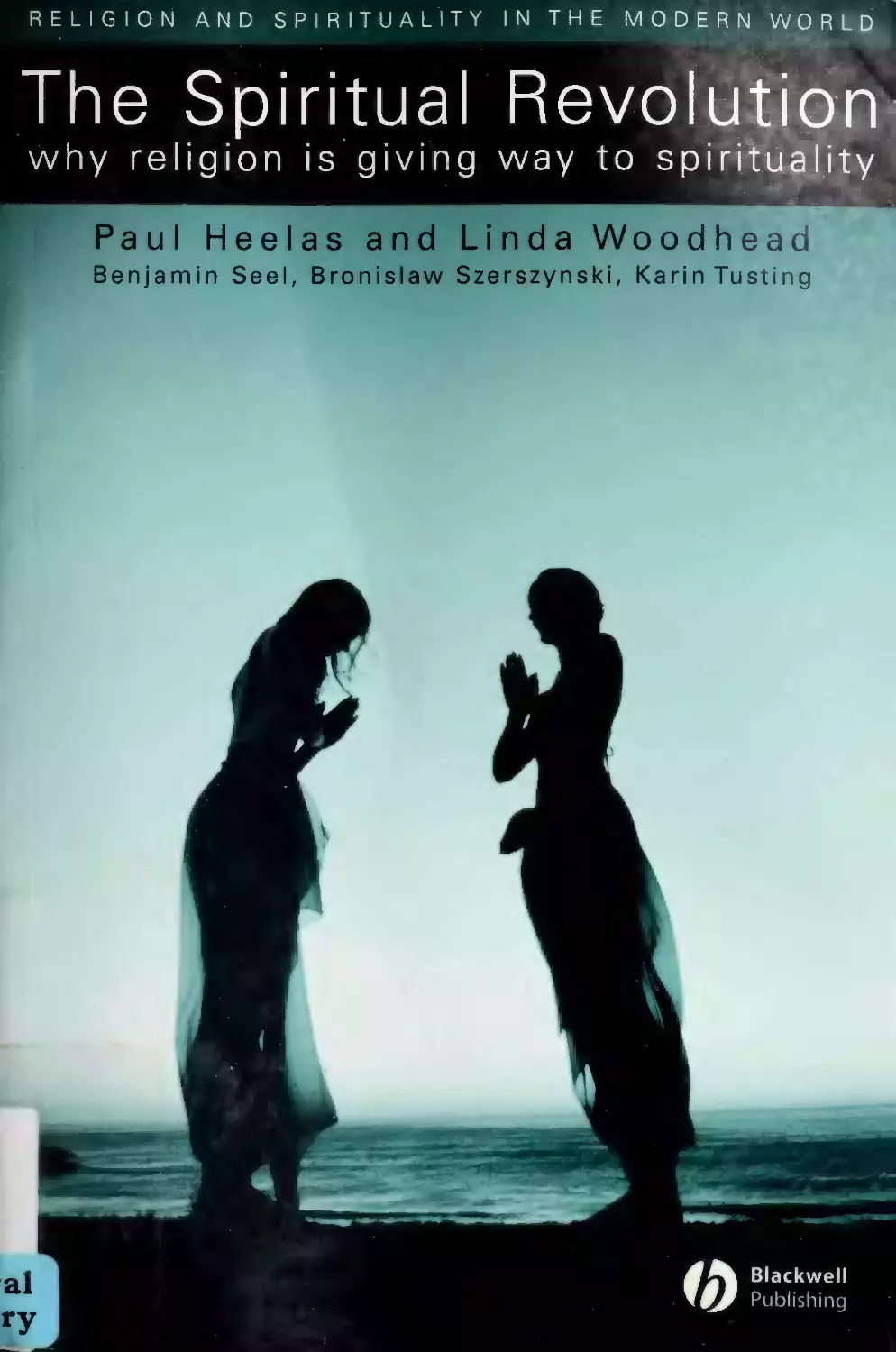


Автор: Heelas P. Woodhead L.
Теги: spirituality religious studies spiritual practices social philosophy
ISBN: 1-4051-1958-6
Год: 2005

Текст
RELIGION AND SPIRITUALITY
The
why
IN
THE MODERN WORLD
Spiritual Revolution
religion
is
giving
way
Paul Heelas and Linda
to spirituality
Woodhead
Benjamin Seel, Bronislaw Szerszynski, Karin lusting
Boston PubNc Libiary
Boston, MA 02116
The
Spiritual
Revolution
AND SPIRITUALITY
THE MODERN WORLD
RELIGION
IN
Linda Woodhead, Lancaster University
Series Editors: Paul Heelas,
London
Editorial Advisor. David Martin, Emeritus Professor,
School of
Economics
Foundin£f Editors: John Clayton, formerly University of Boston^
and Ninian Smart, formerly University of California - Santa Barbara
The Religion and
ible to a
Spirituality in the
Modern World
series
makes
access-
wide audience some of the most important work in the study of
reUgion today. The
series invites leading scholars to present clear
technical contributions to
ituality in the
and non-
contemporary thinking about religion and
modern world. Although
the series
is
spir-
geared primarily to the
needs of university and college students, the volumes in Religion and Spirituality in the
background
Modern World
will
in Religious Studies
prove invaluable to readers with some
who
wish to keep up with contemporary
thinking in religion, theology and spirituality in the
to the general reader
of religion and
who
is
spirituality in
modern world
as well as
seeking to learn more about the transformations
our time.
Published:
Don
Cupitt - Mysticism After Modernity
Paul Heelas, with the assistance of David Martin and Paul Morris Religion, Modernity
and Postmodernity
Linda Woodhead and Paul Heelas - Religion in Modern Times
David Martin - Pentecostalism: The World Their Parish
Steve Bruce - God is Dead
David Smith - Hinduism and Modernity
Peter Berger - Questions of Faith
Paul Heelas and Linda Woodhead, with Benjamin Seel, Bronislaw
Szerszynski and Karin Tusting - The Spiritual Revolution
Forthcoming:
Bronislaw Szerszynski - Nature, Technology and the Sacred
Simon Coleman - The
Gospel of Health
and Wealth
The
Spiritual
Why
Religion
is
Revolution
Giving
Way
to Spirituality
Paul Heelas and Linda
Woodhead
with Benjamin Seel, Bronislaw Szerszynski and Karin lusting
0^
Blackwell
Publishing
© 2005
by Paul Hcclas
nd Linda Woodhead
.
BLACKWELL PUBLISHING
350 Main Street, Maiden, MA 02148-5020, USA
108 Cowley Road, Oxford OX4 IJF, UK
550 Swanston Street, Carlton, Victoria 3053, Australia
The
right of Paul Heelas
this
Work
and Linda Woodhead to be identified
as the
Authors of
UK
Copyright, Designs, and
may be
reproduced, stored in a
has been asserted in accordance with the
Patents Act 1988.
No
All rights reserved.
part of this publication
retrieval system, or transmitted, in
ical,
as permitted by the UK Copyand Patents Act 1988, without the prior permission of the publisher.
photocopying, recording or otherwise, except
right, Designs,
First
any form or by any means, electronic, mechan-
published 2005 by Blackwell Publishing Ltd
Library of Congress Catalo£iin£f-in-Publication Data
The
spiritual rex olution
Paul Heelas
p.
cm.
.
.
.
:
why
religion
is
gi\'ing
way
to spiritualit}'
/
[et al.].
— (Religion
in the
modern world)
Includes bibliographical references and index.
ISBN 1-4051-1958-6
paper)
(alk.
paper)
Heelas, Paul.
1. Spiritualit^^ I.
— ISBN 1-4051-1959-4 (pbk.
:
alk.
It. Series.
BV4501.3.S663 2005
200'.9'0511-dc22
2004007692
A catalogue
Set in 10
record for this
on 13 pt
title is
available
from the
British Library.
Galliard
by Kolam Information Services, Pm:. Ltd, Pondicherry, India
bound in the United Kingdom
Books Ltd, Bodmin, Cornwall
Printed and
by
MPG
The
publisher's policy
is
able forestry policy, and
acid-free
to use permanent paper from mills that operate a sustainwhich has been manufactured from pulp processed using
and elementary chlorine-free practices. Furthermore, the publisher ensures
and cover board used have met acceptable environmental
that the text paper
accreditation standards.
For further information on
Black\\'ell
Publishing,
visit
our website:
\v^\^\'.blackwellpublishing.com
For
Sebastian, Elissa and
and
Sandy
Mia
Digitized by the Internet Archive
in
2015
https://archive.org/details/spiritualrevolutOOpaul
Contents
List
of Plates
viii
x
Preface
Introduction
1
1
Distinguishing Religion and Spirituality: Findings from Kendal
12
2 Testing the Spiritual Revolution Claim in Kendal
3 Evidence for a Spiritual Revolution: Britain and
4 Bringing
49
the Sacred to Life: Explaining Sacralization
and Secularization
5
33
USA
77
„
Looking to the Future
129
Appendices
151
Notes
159
References
1
76
190
Index
Plates fall between pp. 99
and 100
Plates
99 and 100
The main street of Kendal. Private collection
2 The Kendal Project team: Benjamin Seel, Bronislaw Szerszynski,
Linda Woodhead, Karin Tusting and Paul Heelas (with Abby Day,
second to left). This photograph, taken in Dent (near Kendal),
Plates fall between pp.
Plate 1
Plate
also illustrates the spiritual revolution in action: the
front of a building that was once a chapel
.
and
is
team stand
now
in
part of a
meditation centre. Private collection.
Plate 3
Imposing authority: the medieval parish church
in
Kendal -
a con-
gregation of humanity (Anglican). Private collection.
Plate
4 Informal
Willow Creek Community Church,
Chicago - a flourishing con-
relationality: inside
on the
a 'seeker church'
outskirts of
gregation of experiential difference. Private collection.
Plate 5
Rainbow Cottage,
a holistic centre
on the
outskirts of Kendal.
Private collection.
Plate 6
Church attenders
at the parish
church
Plate 7 Holistic contact: practitioner Linda
with researcher Benjamin Seel.
©
in Kendal. Private collection.
McGarvey of Rainbow Cottage
The Westmoreland Gazette
Plate 8 Life-as religion, clearly stated by an advert in the
USA.
Private
collection.
Plate 9 'Psychological
and
Biblical truth': the discourse
of experiential difference.
Plate
10 The unique, the
©
holistic,
and wellbeing: craniosacral therapy,
© Adam Rubinstein R.C.S.T., Kendal.
Yoga in the mainstream of
© Kendal Leisure Centre.
Kendal.
Plate II
of a congregation
Willow Creek Association.
life.
List
Plate 12 Soft capitalism at
work
©The
Guardian, image
of Plates
ix
©Getty Images.
Reprinted with permission
Plate
13 Sanctified capitalism: the Congregational church opposite the
main entrance to what was once the world's
Saltaire,
Plate 14
A
largest textile mill,
near Bradford. Private collection.
holistic
shop overlooking the
evolved into an upmarket
mill at Saltaire
-
a mill
which has
wellbeing zone. Private collection.
Plate 15 Objective wellbeing culture in action.
Plate 16 Subjective wellbeing culture in action.
Plate 17
The two worlds meet: spiritual wellbeing enters the congregational domain in a parish in the south of England. © Tim
Higgins.
Preface
This book explores the spiritual revolution claim: that traditional forms of
particularly Christianit)^,
religion,
sometimes
still
In order to
called
'New
are
giving
way
to holistic spirituality,
Age'.
make headway in testing this claim, we have found it necesdraw on the work of many colleagues in the sociology of
sary not only to
religion, but to
form of
undertake research of our own. This research took the
study in the north-west of England, close to the Lake
was named after the town in which it took place: the Kendal
Project. Although the book draws on findings from the Project, much of
the volume looks at the spiritual revolution claim in connection with evidence from Britain and the USA.
The volume has been written by Paul Heelas and Linda Woodhead, who
take fiill responsibility for its arguments, not to mention any mistakes of
fact, interpretation or theory. We have been assisted throughout by Benjamin Seel, Bronislaw Szerszynski and Karin Tusting, who have commented
on drafts of every chapter and whose advice has helped shape the final
product. The five of us were also the team who carried out the research in
Kendal, with Heelas, Szerszynski and Woodhead directing the Project and
a locality
District. It
Seel and Tusting as fijll-time researchers.
Other individuals who have provided substantive input to the volume, and to
are extremely gratefiil, include Kajsa Ahlstrand, Andrea Cheshire,
Abby Day, Eliza Forder, Gordon Heald, Sandy Miller, Rosemary Mingins,
Gordon Neal, Liz Puttick, Desmond Ryan, Margaret Stelfox, and David Voas.
Funding for the Kendal Project was provided by a generous grant from
whom we
the Leverhulme Trust.
We
thank the Trust,
its
Director
at
the time, Barry
of the application. A feasibilit)' study
paving the way for the Project was handed by a seedcorn grant from the
Faculty of Social Sciences, Lancaster University.
Supple, and the
anonymous
referees
Preface
Lancaster University,
tute
the
for
its
laivironnient. Philosophy
ported the Kendal Project
space and equipment. Kate
Wendy
Department of Religious Studies and the
in
Public
anil
xi
Insti-
(Il^PPP) sup-
Policy
material ways, not least by providing office
Lamb
of Il.PPP assisted with data input, and
Francis of Religious Studies helped with budgetary matters, mail
ings and
other queries.
We
also
received excellent support
from (^are
Hindle of the Lancaster University Research Support Office.
Students from the Department of Religious Studies assisted us in a
number of ways: by helping us test and strengthen our ideas in our teach
ing, by supplying good ideas and quotes, and by assisting us in the headcount we made of the churches and chapels in Kendal.
We would like to acknowledge the helpful feedback we received from
colleagues and students at other universities where we delivered papers on
findings from the Kendal Project, and tried out ideas and arguments for
the book.
who
Thanks
are also
due to the colleagues from other
began the research
in
Kendal,
we
held a
weekend workshop
which spe-
spirituality
generously
on contemporary
religion
and
how we
should proceed.
in
research
to thank the participants: Sylvie (Collins, Clrace Davie,
Mathew
Cuiest,
we
at
shared their experience and advice on
cialists
like
universities
contributed to research meetings held during the Project. Before
We would
Douglas Davies,
Mike Hornsby-Smith, Penny Long Marler, Hernice Martin,
David Martin and Martin Stringer.
There was one person present at that workshop to whom we owe a
debt of gratitude. Steve Bruce's interest and advice have been unwavering over the whole six years it has taken to complete this project. His
challenging questions, clear thought, and supportive friendship have been a
spur and encouragement throughout.
Finally, we winild like to thank the people of Kendal and environs who
took part in our research. They granted access to their churches, chapels,
meeting houses, centres, groups, practice rooms, shops, and homes. They
gave generously of their time, and spoke frankly and openly about matters
of personal significance. People were enthusiastic about our research, and
willing to go to considerable lengths to help us achieve our objectives.
The authors and publisher wish to thank the following for permission to use
copyright material: Tim Higgins; Wade (^lark Roof; Adam Rubinstein; South
Lakeland Leisure; l^he Westmoreland Ciazette; Willow Oeek Association; Ihe
Guardian and Getty Images; Spar (UK) Ltd; edcy Ltd; and A. P. Watt Ltd on
behalf of Michael B. Yeats and Scribner, an imprint of Simon & Schuster Adult
Publishing Clroup, for permission to reprint
he Nineteenth Century and
from
The
Yeats
Collected
After' by W. B.
Works of W. H. Teats, Volume I: The
Poems, Revised, edited by Richard ]. Finneran. (copyright
1933 by The
Macmillan Cvompany, copyright renewed
1961 by Bertha Cleorgie Yeats.
special
l
'
i
(
(('.j
;
Listen!
You hear
the grating roar
Of pebbles which
At
their return,
the waves draw back, and fling,
up the high strand
Begin, and cease, and then again begin.
With tremulous cadence
The
slow,
and bring
eternal note of sadness in
The Sea of Faith
Was once, too, at
the
Lay
like the folds
of a bright girdle
But
now
Its
I
full,
and round earth's shore
furl'd.
only hear
melancholy, long, withdrawing roar.
Retreating, to the breath
Of the night-wind, down the vast
And nalced shingles of the world.
edges drear
Matthew Arnold (from 'Dover Beach')
Though
the great song return
There's keen delight in what
no more
we
have:
The rattle of pebbles on the shore
Under the receding wave.
W
B. Yeats ('The Nineteenth
Century and After')
Introduction
.
.
.
those contemporary aspirations towards a religion which would consist
entirely in internal
freely
.
.
.
and subjective
states,
and which would be constructed
by each of us. (Durkheim, [1915] 1971,
p.
47)
more personal and indi(The Catholic Communica-
the passage from traditional forms of religion to
vidual expressions of
what
tions Office,
2003,
Whether we
believe in
spiritual, that
called 'spirituality'.
is
p. 1)
God
or not,
I
think most of us have a sense of the
recognition of a deeper meaning and purpose in our
believe that this sense flourishes despite the pressures of
Elizabeth
and
1
Christmas Day Broadcast, 2000)
II,
influence of reUgion - particularly Christianity - in western
The dedining
societies has
lives,
our world. (Queen
been
tiie
chief topic of the study of religion for over a century,
but in recent years the emergence of something called 'spirituality' has increasingly - demanded attention. Survey after survey shows that increasing numbers of people
'religious'.
Terms
like
now
prefer to call themselves 'spiritual' rather than
spirituality,
yoga, feng shui, chi and chakra have
New
hoUsm,
become more common
culture than traditional Christian vocabulary.
the local bookshop or a
stroll
doubt that Christianity has
'The times',
Though
in
it
a
Age, mind-body-spirit,
Even
in the general
a cursory glance
around
around the shopping centre leaves
new competitor
little
in 'the spiritual marketplace'.
seems, 'they are a-changing'.
it is still
important to attend to the decline of traditional religion
western societies, we can no longer evade the challenge of assessing and
explaining the growth of such 'spirituaUty'.
cant
is its
West.>
this
growth.^
Are we
Is it
living
book attempts
altering the
through
exactly
a 'spiritual revolution'.>
to answer.
that will be introduced here,
What
is
it.>
How
signifi-
whole shape of the sacred landscape
They
These
in the
are the questions
translate into three fairly distinct tasks
and tackled
in the chapters that follow.
The first is to bring some clarity to the notion of 'spirituality'. As Meredith
McGuire (1997) notes, 'we do not yet have the language or conceptual
2
Introduction
apparatus for refining our understanding of spirituality' (p. 8). Only by de-
we hope
veloping such apparatus can
temporary landscape.
we
If
to shed light
not clear what
are
with 'religion', then
'spirituality' in contrast
will
it
on changes in the conmeant by the term
be impossible to make
is
much progress.
Having
is
clarified the
to assess
meaning of
significance.
its
Some understand
of concern with the sacred
doomed
argue that
we
our next - and main - task
as the last
it
gasp and whimper
West, an inconsequential dabbling that
in the
to disappear almost as quickly as
and Stark, 1992). Others view
will
'spiritualit)^',
it
as vastly
it
is
appeared (Bruce, 2002; Finke
more important than
and
that,
are witnessing a tectonic shift in the sacred landscape that
prove even more significant that the Protestant Reformation of the
What we
sixteenth century.
are living through, they argue,
is
nothing
less
than radical change in which religion - namely Christianity - has been
eclipsed by spirituality
this 'spiritual
made about
being
devoted to testing
The
(Luckmann, 1967, 1990; Campbell, 1999). Since
is the most striking and provocative claim
revolution claim'
final task
is
the contemporary sacred scene,
it
what
time explain the decline of some
offer
is
surely the 'holy grail' of the
forrris
Since
much of
underlies
calls 'the
them
one and the same
rise
of others.
make
to a single process - to
massive subjective turn of
'The turn'
is
the argument of this book,
turn of
informs our approach
some
contem-
modern
Turn
this 'massive subjective
it
is
26)}
Subjective
it
book
the 'subjectivization thesis', a thesis that attempts to
is
what Charles Taylor (1991)
The
at
of the sacred and the
sense of both decline and growth by relating
culture' (p.
this
by way of research devised expressly for the purpose.
to pursue
porary study of religion, namely a theory which can
What we
much of
It is a
'objective' roles, duties
culture',
to religion, spirituality
shorthand for
experience.
modern
a
life
and obligations, and
reference to one's
own
vidualistic). If, for
example,
will
shift
of which we
lived in terms
a turn
how
all
have
of external or
towards
subjective experiences (relational as
I
begin with
and change.
major cultural
turn away from
we
and go on to explain
life
much
lived
by
as indi-
have slotted myself into the role of a dutiful
daughter and a loving and caring wife and mother, and tend to disregard
my own
feelings
of exhaustion, unhappiness and periodic disgruntlement
Introduction
because that
am
is
not what
the role
I (in
But
living according to external expectations.
subjective states, to listen to
prompting by
my
altering
what they
me, and to
life
my own
lived according to external expectations, to
subjective turn
I
on
act
their
my own unique
am turning away
life
lived according to
thus a turn away from
is
lived as a dutiful wife, father,
husband, strong leader, self-made
etc.) to 'subjective -life' (life lived in
deep connection with the unique
'life-as' (life
man
The
inner experience.
then
I
suit
needs, desires, capabilities and 'relationalities', then
from
feeling,
decide to heed those
if I
are telling
ways that better
in
life
ought to be
occupy.)
I
3
experiences of my self-in-relation).
Exploring the idea a
little
people think of themselves
and
'given' orders of things
further, the turn
first
is
and foremost
which
away from worlds
as
in
which
belonging to established
are transmitted
from the past but flow
forwards into the future. Being 'higher' and 'greater' than the individual
self
such transcendent, collective, supra-self orders serve
'sources of significance' (to use Taylor's
what matters
tradition - whether
ingly,
a nation-state,
living one's life-as a
is
takes the
it
form of
one's duties or
may
fulfils
life
member of
and accord
a
communit)^ or
What
matters
life.
These higher authorities
real value to
some
it
when one performs
cases the roles of life-as
appear 'natural' and be pursued unreflectively; in others there
'the
good
life'
is
which stand over and above the
one's obligations. In
pressure to monitor one's
and
life
primary
a kinship system, a feudal system,
and bestow meaning upon
serve to direct one's
as people's
useful expression). Accord-
system or a particular religion.
a class
obeying, heeding, pursuing ways of
individual self
1989
may
be
self-consciously in order to conform. Virtue
life
are characterized in terms of sacrificing, disciplining or
masking those aspects of oneself that
pull
one away from the 'oughts' of
The most extreme examples of life-as can be found in
military contexts (where, to quote Tennyson in 'The Charge of the Light
Brigade', it is 'Theirs not to make reply/Theirs not to reason why/Theirs
but to do and die'), or in the religious life (where, to quote the Constitutions of the Societ}^ of Jesus, the Jesuit should become 'a corpse which
suffers itself to be borne and handled in any way whatsoever').
If the 'massive turn' in modern culture is thus a turn away from life-as, it
is correspondingly a turn towards subjective-life. The latter has to do with
the
embedded
states
life.
of consciousness,
states
of mind, memories, emotions, passions, sen-
sations, bodily experiences, dreams, feelings, inner conscience,
ments - including moral sentiments
of each individual become
a,
if
like
and
senti-
compassion. The subjectivities
not the, unique source of significance.
4
Introduction
meaning and
full
Here
authority.
good
'the
life'
consists in living one's
life
in
awareness of one's states of being; in enriching one's experiences; in
finding ways of handling negative emotions; in
to find out where and
how
may be improved. The
goal
becoming
the quality of one's
life
not to defer to higher
is
own
the courage to become one's
authority.
Not
enough
sensitive
- alone or
in relation
-
but to have
authorit)^,
to follow established
own inner-directed, as subjective, life. Not to
become what others want one to be, but to 'become who I truly am'. Not
to rely on the knowledge and wisdom of others ('To the other be true'),
but to live out the Delphic 'know thyself and the Shakespearian 'To thine
paths, but to forge one's
own
be
self
true'.
Thus the key
value for the
authority, whilst the key value
mode of life-as
for the mode of
is
conformity to external
subjective-life
connection with the inner depths of one's unique
mode
there
as
has
own
its
satisfactions,
authentic
is
life -in -relation.
Each
but each finds only danger in the other, and
deep incompatibility between them. Subjectivities threaten the
is
mode -
may
emotions, for example,
one ought to be
living,
easily disrupt the
and 'indulgence' of personal
proper discharge of duty impossible. Conversely,
of
integrity
subjective-life.
Given that only
because the latter
is
is
life
feelings
makes the
demands
attack the
necessarily unique.
T can be that particular individual with the particular and
irreplaceable experiences
'oughts' of
This
life-as
life-
course of the
life-as
and
history that
life
threaten not only
my
make me who
values but
my
I
am, the
very existence.
Differing attitudes towards an institution like marriage illustrate the incompatibility
tution,
very
it is
clearly.
To
those
who
believe that marriage
obvious that one should
sacrifice
is
a sacred insti-
one's personal happiness for
the sake of one's marital duty. Life-as a responsible father or a faithful wife
will always
trump the
'selfish'
demands of subjective-life. Yet
for those
who
cherish subjective -life, the sacrifice of desires for the sake of an 'external'
institution like traditional marriage will be experienced as disruptive, under-
mining and damaging - for to do
this
is
to deny, override and take away
the inner realities that play such an important role in constituting individ-
and making people who they
ual lives
As to
how
the shift from
general cultural change,
life-as
it is
are.^
to subjective-life operates with regard to
important to
stress that
minute suggesting that subjective -life was absent
as has
disappeared today. Far from
suppose,
is
universal. Equally,
it is
it.
we
are
in times past,
Subjective-life,
it
is
reasonable to suppose that
not for one
nor that
life-
reasonable to
life-as
forma-
tions are always required for the organization and regulation of social
life.
Introduction
Nevertheless,
we
believe that Eric
5
Hobsbawro (1995), Ronald Inglehart
(1997), Charles Taylor (1989, 1991, 2002), Joseph Veroff et
al.
(1981) and
become the defining
The
evidence, which is
cultural development of modern western culture.
extensive, will be explored throughout this volume. What we will see is that
others are right in supposing that the subjective turn has
both self-understanding and socio -cultural arrangements have been developing in a 'person-centred' or 'subjectivity- centred' direction. In education cul-
we
ture,
'child-centred' or 'learner-centred'; in
see a turn towards the
purchasing culture, towards the 'consumer-centred'; in health culture, to-
wards the 'patient-centred'; in work culture, towards the personal develop-
ment of employees. Each of
these shifts involves a turn
hierarchical, deferential, life-as order
keeper, the doctor, the
for the
manager was
away from
a
more
of things in which the teacher, the shop'god'.
Thus those
institutions that cater
unique subjective -lives of the 'centred' are on the increase, whilst
those that continue to operate in
life-as
mode find themselves out of step with
the times.
Distinguishing Religion and Spirituality
One of
that
it
the great virtues of the language of
'life-as'
and 'subjective -life'
enables us to sharpen up the distinction between 'religion' and
ituality'
by distinguishing between
life-as religion
and
is
'spir-
subjective-life spiritu-
bound up with the mode of life-as - indeed it sacralizes
life-as. By contrast, the latter is bound up with subjective-life - indeed it
sacralizes subjective -life. Thus the former involves subordinating subjectiveality.
life
The former
the
to
is
authority of transcendent meaning,
'higher'
goodness and
truth, whilst the latter invokes the sacred in the cultivation
of unique
subjective-life.
important to
It is
tween
stress that the distinction
'subjective-life spirituality'
with the ways in which the terms
culture.
For example,
and
'spirituality'
'spirituality' is
press devotion to
God
'obedience to the
will
we
use in this volume be-
'life-as religion' is
and
is
in the
when
spirituality
is
thought of
as
of God' with the believer entering into an intense
subjective in the sense that
something which
used
often used in Christian circles to ex-
or Christ - as
relationship (involving self-surrender) with the divine.
awe, sorrow, gratitude
not always identical
'religion' are
etc.),
it
Such
spirituality
is
involves often intense experiences (of joy,
but objective in the sense that
it is
focused on
and remains external to and higher than the
self This
6
is
Introduction
experience of the sacred as transcendent, higher
way of the
and
inspiration of the
tradition. It
is
Holy
life
- whether
directly
by
or indirectly by way of scripture
Spirit,
not an experience of the sacred
as integral to, insepar-
from and flowing through one's own subjective- life. As such, it might
be called 'life-as spirituality' - and is clearly not the same as what we mean
able
by subjective-life
of Christian
unique
spirituality.
(This
is
not to deny that there may be forms
spirituality that are centrally
concerned with the cultivation of
subjective-life, particularly in the mystical tradition.)
many common usages of 'spirituality' and 'religion' which
overlap much more closely with our categories of 'subjective-life spirituality' and 'life-as religion'. Most notably the term 'spirituality' is often used
to express commitment to a deep truth that is to be found within what
belongs to this world. And the term 'religion' is used to express commitment to a higher truth that is 'out there', lying beyond what this world has
But there
to offer,
rituals,
The
are
and exclusively
related to specific externals (scriptures,
dogmas,
and so on).^
Spiritual Revolution
Claim
Given the cultural significance of the subjective turn, we would expect the
sacred landscape to be affected by
to operate in life-as
mode
it.
If 'secular' institutions that continue
increasingly find themselves out of step with the
times, whilst those that cater for unique subjective-lives are flourishing,
then
it
is
certainly
worth exploring the
possibility that the
same thing
happening within the sphere of the sacred. What we would expect
forms of the sacred that are experienced
as
is
is
that
compatible with the turn to
subjective-life will be faring better than those that serve to reinforce life-as
modes of existence.
In order to explore this possibility,
we work
with a simple formulation of
the spiritual revolution claim:
1
Life-as
forms of the sacred, which emphasize a transcendent source of
significance
and authority to which individuals must conform
at the ex-
pense of the cultivation of their unique subjective-lives, are most
be
likely to
in decline;
2 Subjective -life forms of the sacred, which emphasize inner sources of
significance
and authority and the cultivation or
subjective-lives, are
most
likely to
be growing.
sacralization
of unique
Introduction
To put
this
concretely, the expectation .would be that in the
more
those forms of religion that
tell
7
West
their followers to live their lives in con-
formity with external principles to the neglect of the cultivation of their
unique subjective-lives
will
West
By
churches and chapels are
contrast, those forms of spirituality in the
that help people to live in accordance with the deepest, sacred dimen-
own unique
sion of their
lives
can be expected to be growing. These
include the multifarious forms of sacred
together under collective terms
'alternative'
reiki,
Many
be in decline.
likely to fall into this category.
or
'holistic'
meditation,
ology,
much
tai chi,
wicca and
like
spirituality,
'body,
which
mind and
are often
spirit',
and which include
aromatherapy,
many more
activit\^
much paganism,
(a ftiller
will
grouped
'New Age',
yoga,
(spiritual)
rebirthing, reflex-
survey of such activities
is
offered in the pages that follow).
As
come about when
More specifically, given
for the spiritual revolution, this can be said to
subjective-life spiritualit}' overtakes life-as religion.
book (see below), the spiritual revoluwhen 'holistic' activities having to do with
attract more people than do 'congregational'
the primary empirical focus of this
tion can be said to take place
subjective -life
activities
spiritualit)^
having to do with
life-as religion.
Testing the Spiritual Revolution Claim
This clarification of the spiritual revolution claim renders
it
rigorous
enough to be tested empirically. The most straightforward way of doing so
would be by way of existing studies and surveys of religion and spirituality
in the West. Those of a more qualitative, ethnographic variety might enable
us to see how much now has to do with subjective -life activities rather than
those of a life-as form, whilst those of a more quantitative, longitudinal
nature would help us compare the relative fortunes of these two varieties to
see
whether the former
Whilst there are
draw
is
many
overtaking the
in this task, there are,
on which we can
however, only a few that are direcdy focused on
the issues which concern us most.
good ethnographic
latter.
excellent studies of Christianity
And
whilst there are a
studies of 'alternative spiritualities',
number of equally
and there
is
accu-
mulating evidence from both sides of the northern Atlantic that interest
'expressive',
'holistic'
growing, there
question of just
is
(mind-body-spirit),
as yet litde
how many
or
New Age
spiritualities
or no hard evidence that bears on the
people have become active
in this sphere.
in
is
critical
8
Introduction
Our
search.
only option, therefore, was to carry out additional empirical
We
did so by
way of
a locality
the relatively self-contained market
Cumbria,
District.
in the
re-
study of 'Patterns of the Sacred'
in
town and regional centre of Kendal,
north-west of England, just to the south-east of the Lake
By taking
- population 27,610
a single relatively small locality
in
1999 - we could be fairly confident of systematically exploring what was
going on by way of face -to -face, associational religious and spiritual activity.
We would also be able to look at such activity in some detail through indepth qualitative research.
We
town
for the spiritual revolution claim
ground
as a testing
'spiritual laboratory', as
feasibility study,
continued until
would,
in other
words, be able to treat the
one inhabitant of Kendal put
-
of
as a sort
After an
it.
initial
the Kendal Project began in October 2000, and research
end of June 2002, with some follow-up work
the
extending into 2003. (A summary of the research strategies of the Project
can be found in Appendix
Kendal
is
1;
the question of the representativeness of
addressed in later chapters, in particular Chapter Three.)
The primary concern of
places
most
where
religious
and
it is
here that
women
a
and
life.
These
are the
clearly visible
men come
and
together
whose primary purpose
to engage in face -to -face, associational activities
church and chapel,
most
spiritual activities are
richly in evidence, for
engagement with the
we came
the Kendal Project was to study what
to think of as the heartlands of religious and spiritual
is
One was obvious: the very public activities of
heartland we came to call the congregational domain
sacred.
(other than Christians, there are very few adherents of world religions in
Kendal).
is
The other was
obvious: the
less
often called alternative or
New Age
refer to as the holistic milieu.
religious
uals,
and
Though
spiritual activity in
incorporated into the
nesses), for the sake
of the
more
'invisible' activities
spirituality
-
clarity
we came
a heartland
to
there will certainly be other forms of
Kendal (carried out
activities
of what
in solitude
of institutions
like
of comparison we needed
the spiritual revolution claim effectively,
we decided
by individ-
schools or busiin
order to
to concentrate only
test
on
the heartlands.
We set ourselves
tive:
two main empirical
to see whatw2is going on.
tasks in Kendal.
The second was
The
first
was
quantitative: to see
qualita-
how much
(of the different forms of engagement with the sacred) was going on. By
investigating the
what we were able to distinguish between those
associ-
whose primary concern was with Ufe-as, and
those whose primary concern was with subjective -life and the care of the self.
We did not assume a priori that all of the congregational activities would fall
ational forms of the sacred
9
Introduction
into the former category, nor that
We
into the latter.
fall
Chapter
and
One
findings about
the
different forms of religion
'how much' of the heartland
life-as,
we
a spiritual
activities
how much
and
Chapter Two. They allow us to give
question whether or not
C^hapter Three
how
subjective-lives.
present) were concerned with
are presented in
USA. In
a clear
answer to the
revolution has taken place in Kendal. In
more
how
we
also consider
and
religion
life-as
what
sites
- and
in
widely,
and
in
happening within
is
subjective-life spirituality are
faring in the media, schools, hospitals, purchasing-culture
The
and
consider the wider relevance of these findings, asking
the same chapter
portant cultural
(past
with subjective-life,
spiritual revolution has taken place in Britain
the wider culture:
variety w^ould
Kendal do or do not channel the sacred towards the
enhancement of unique
whether a
the^ 'alternative'
provides our findings, showing
spirituality in
Our
of
all
simply wanted to find out what was the case.
connection with popular
beliefs.
Growth and Decline
Subjectivization Thesis: Explaining
Without giving everything away by revealing
and other im-
at the outset
whether or not
we have found that the spiritual revolution has taken place in Kendal,
Britain or the USA, we can say that we have found robust evidence of a
pattern: a correlation
between
one hand, and between
means
subjective-life spirituality
life-as
religion
that our findings have a bearing
and growth on the
and decline on the other. This
on the
issue that has
long domin-
ated the study of religion - the study of secularization - as well as the
increasingly important issue of whether there
is
growth
in the territory
of
the sacred - the study of sacralization.
Those who defend theories of secularization and those who oppose them
with accounts of sacralization are divided over
planation. Controversy rages between those
the sacred
is
largely if not entirely
velop theories to explain
this,
fact,
who
undergoing
and those
who
interpretation
and
ex-
claim that the sphere of
relentless decline
and de-
claim that certain forms are
growing and develop explanations accordingly. The
title
of Steve Bruce's
God is Dead (2002 ), signals his role as a forcefiil proponent of
view. Luckmann (1967, 1990) and Campbell (1999) articulate the
recent book,
the
first
second position.
Rather than viewing decline and growth
dence we present suggests that the West
as
mutually exclusive, the
is
currently experiencing both
evi-
10
Introduction
and
secularization (with regard to life-as forms of religion)
And
(with regard to subjective-life forms of spirituality).
extremely interesting question: could
sacralization
be the case that there
it
an
this leads to
is
a single
explanation of both processes? Answering this question' in the affirmative,
we
of secularization per
offer neither a theory
but of coexistence. Without for a
change,
we
offer in
moment
se^
nor of sacralization per
Chapter Four what we
more people who
-
if
with, the sacred - are
modern
subjectivization thesis as
call the
the key to explaining both growth and decline.
'massive subjective turn' of
The
culture to explain
they are concerned about, or
much more
them
those forms which help
likely to be,
cultivate the
their subjective-lives than those
se^
ruling out other explanations of
thesis invokes the
why
there are ever
become concerned
or become involved with,
unique
of
'irreplaceabilities'
which emphasize the importance of con-
forming to higher authority.
we therefore
more about the winners and losers
in the contemporary spiritual marketplace. We show that the former are
most likely to be those that appeal to the increasing numbers of people for
whom subjective-life is the key source of significance. They succeed because
By taking
believe that
seriously the significance of the subjective turn
possible to understand
it is
they 'bring the sacred to
selves
and
tinction
most
their
life',
enabling participants to remain true to them-
significant relationships,
between personal and
turn helps explain
why
spiritual
little
numbers of people orientated
sources of significance, for there are fewer and fewer
who
remain committed
for,
demand
the living of life according to external expectations.^
to,
who
to
are
forms of the sacred which
looking
or
or no dis-
the losers are most likely to be those life-as forms of
the sacred which cater for the decreasing
life-as
and making
growth. Conversely, the subjective
Summary
We
bond between western
is to make appeal
and that in its place we
are interested in the idea that the great historical
cultures
and
a Christianity
to transcendent authority
are seeing the
growth of
whose
is
characteristic
rapidly dissolving,
mode
a less regulated situation in
which the sacred
experienced in intimate relationship with subjective-lives.
this
volume
considering
possibility.
is
to shed light
the
extent,
is
The purpose of
on the contemporary sacred landscape by
significance
and
causes
of
this
revolutionary
Introduction
11
The unique
'I
know my own
one
I
ha\ e e\ cr met;
whole world.
1971,
heart and understand
p.
1 }.
I
fellow
better, but at least
what follows we consider the
In
man. But
even venture to say that
will
may be no
I
my
culture of the Rousseauian belief that
'I
am
I
am
I
am
central
I
like
am
unlike any
no one
in the
different' (Rousseau,
importance
in
modern
unique', and what this has to
do with the sacred landscape. This does not mean
that
we
offer
some
sort
of paean of praise for the self-centred self 'Subjectivization' should not be
confused with
'indi\'idualization'. WTiilst
sees individuals
authorit)', this
atomistic, discrete or selfish. For as
is
'holistic',
involving
we
true that the subjective turn
as the true, subjective, 'me'.
as their
source of
need not imply that they
will see,
abo\e
self-in-relation
Hence it is common for
Carson McCuUers (1973) refers to as
in-isolation.
stood
is
emphasizing their personal experiences
meaning, significance and
spiritualit}'
it
all
will
be
else subjective-life
rather
than
a
self-
the subjective turn to involve
what
the Sve of me' (p. 39; being under-
One
Chapter
Distinguishing Religion
and Spirituality: Findings
from Kendal
You
call
us to leave our self behind
.
.
.
Son of God
.
.
.
grow
in us, so that
Your
ways may become ours. (Intercessions, Anglican Parish Church, Kendal)
Religion asks you to learn from the experience of others. Spirituality urges
you to seek your own. (From an interview with
who
The aim
give
a
Kendal Unitarian Christian
also involved in holistic activities)
is
is
to build
my own
ideas,
on people's own resources,
spiritual resources. I
but see what comes from the
client.
never
(Meg McCalden,
hypnotherapy and relaxation therapy, CancerCare, Kendal)
According to the
is
growling and
may be
two
spiritual
life -as
revolution
religion declining
eclipsing the latter.
An
effective
distinctive associational territories,
jective-life
spirituality,
claim,
way of testing
this
one having to do
other chiefly with
the
subjective -life
spirituaUt)^
- to the extent that the former
is
by comparing
chiefly with sub-
reUgion.
life-as
We now
show that we found such distinctive but comparable associational territories
on the ground in Kendal. And in the process of doing this, we put
empirical flesh on the stark analytical bones of our language of subjective
life
and life-as, thereby clarifying what we mean by 'the spiritual
revolution'.
The Kendal
Project began
life
with a
feasibility study.
to the designated places of worship in the town, where
as
rehgion, and to what
activities,
is
Attention was paid
we hoped
loosely referred to as 'alternative' or
where we hoped to find
to find
life-
'New Age'
we
subjective-life spirituality. In particular,
wanted to know whether there were enough alternative activities taking
place to justify taking things further. Having established that this was the
case, the Project got underway. However, we were taking something of a
gamble.
We
might have had
a fair
hunch, but we were
far
from certain that
Distinguishing Religion and Spirituality
the congregational
life -as
domain
(as
we came
was predominantly of
to calUt)
nature, or that the holistic milieu (as
13
we came
to
call it)
was
a
chiefly
focused on the cultivation of subjective-life.
We now
to
show
enter into the heartlands of religion and spirituality in Kendal
that conformity to
life -as
is
dominant emphasis
in fact the
in the
congregational domain - and, conversely, that the resourcing of unique
subjective -lives
is
in
the primary focus of the holistic milieu.
fact
We
words, that the congregational domain basically has to do
find, in other
with people being guided by higher authority to find fiilfilment in a
common
good, whilst the sacred of the
own
to help people live out their
holistic
milieu basically serves
own unique
interior lives in their
ways.
Accordingly, the comparison of the two associational territories undertaken
of the
in the next chapter will constitute a fair test
claim. (It
way of
spiritual revolution
would be misleading to test the spiritual revolution claim by
this
comparison were
it
to be the case, for example, that the
amount of
congregational domain contains a considerable
subjective -life
spirituality.
tlie Congregational Domain: The
of the Spiritual Revolution Claim
Life in
When we
began our research
in
Kendal
*^Religion'
in the year
2000
there were
congregations. All are rooted in the Christian tradition. (For a
see
Appendix
2.)
congregational
Since
all
have
their
includes
that
service
as
main
activity
worship,
theistic
ftiU
25
list
a weekly public
is
nearly
always
held on a Sunday, and generally takes place in a designated building,
we had
little
difficulty
to their corporate
for
research
life
in
identifying
proved
relatively
and locating them.
Initial
access
unproblematic, and fiarther access
purposes was kindly granted by
all
the congregations in
Kendal.
Unity-in-variety in the congregational
domain
As we pushed open the doors of the churches, chapels and meeting houses
on consecutive Sunday mornings, we became aware of a similarity that
overrode
one's
all
other differences.
attention
To
step into a worship service
being directed away from
oneself towards
is
to find
something
14
Distinguishing Religion and Spirituality
By
higher.
become
contrast, as will
chapter, to enter into the holistic milieu
wards oneself and one's inner
Thus we found
all
the conviction that truth and goodness
much
common,
and expressed
in visions
in
it
is
of Kendal to be united by
not
society, in
lies
As
a
privileged over subjective-life uniquenesses,
'what
I
am'. Yet
it
is
and music,
art
in
subserve
sum of
it
is
always
and, as such,
it
their
own,
parts.
its
it
for the
Authority
outside rather than within, and with
'the same' rather than 'the unique'.
this
good may be envisioned
ideals,
more than they would be on
domain
in the congregational
of unique
by way of conformity
concepts of God. But
who
considered to be greater than the
is
in the cultivation
in
in rules,
higher than those
binds them into something
whole
lie
authoritative good. This
different ways:
of a family- based
transcendent:
to find attention directed to-
as in curbing such individuality
individuality so
to a higher,
is
life.
congregations
the
the second section of this
clear in
consequence,
and 'what
important to emphasize
roles are
life-as
should be' over
I
the very outset that
at
does not mean that we found subjective-life to be wholly neglected
within the congregational domain. Rather, as
we
shall see,
we found
instead of being 'authorized' (treated as the primary authority in
often 'normativized'
that
life) it is
(channelled into conformity with supra- individual
norms).
The common good,
the higher authority, the focus of united
striving in the congregational
domain,
is
represented in
terms in different congregations. In some
it
takes the
hope and
somewhat
different
form of an encom-
passing social vision: of a united and harmonious society in which even
strangers
gregation
It
become neighbours. In others
itself,
to
its
growth
can vary in scope, and
every case,
we found
it
it is
in faithfulness
more
and
closely tied to the con-
its
success in evangelism.
can vary in degree of other-worldliness. But in
that belonging to a congregation
had more to do
with being caught up into a vision of the higher good than
in
going
inwards to discover truth and goodness by trusting and exploring one's
own
feelings, intuitions
and experiences. Thus 83.5 per cent of respondents
to our questionnaire survey of a cross-section of congregations indicated
that the statement 'the important thing
their belief than the statement 'the
(15 per cent). (Appendix
tionnaire.) This
I
is
to
important thing
dut\^'
came
closer to
to
fulfil
yourself
is
provides fijrther information about the ques-
was consonant with the way
placed strong emphasis
do your
upon
in
which many congregations
the importance of self-sacrifice, and the
way
Distinguishing Religion and Spirituality
in
which
liturg\'
surrender and
and hymns were saturated with the language of obedience,
self- giving.
The same dynamics
found to be
15
on deference
explain the pervasive stress
characteristic
of congregational
that
we
Whilst different congre-
life.
showed their priest
hierarchical form of organiza-
gations differed slightly in the degree of deference they
or minister, nearly
all
were characterized by
a
which the most important decisions and
tion in
of a small number of authorized personnel,
bilit}'
male. Such deference was but a reflection of the
that
who were nearly always
much greater deference
was expected to be shown to 'Almightx' God'. In
congregations
God
were the responsi-
activities
but
all
a
couple of
was approached by way of male pronouns and imagery,
particularly fatherhood,
and was portrayed
powxr who created and controls
as a
His
things.
all
personal being of unlimited
will
is
made known
in the
and communit)^, and is to
that God - and the Bible or
external, mediating authorities of text, tradition
be willingly obeyed. The underlying belief
the church -
knows what
is
better than our subjectivities
told in scripture not to
Roman
might
tell us.
one should only go to church on
the church give us an obligation to
basic
it
feel';
and
as a
if
one
feels like
go to mass? Because
human
ourselves,
it,
and
'We're
member of the
(having just criticized the idea that
Sunday
a
know
As one evangelical put
go on about how we
Catholic congregation put
we won't because our
is
best for us better than w^e
it):
if left
nature, our fallen nature,
'Why does
to ourselves
is
pulling us
away from God'.
We
found that
for
many
in the congregational
domain
it
w^as Jesus Christ
w^ho functioned as the immediate focus of devotion, reverence and defer-
model of perfect obedience and
ence, and as the inspiring
w^as
self-sacrifice.
He
interpreted not as an example of self-realization to be imitated by
own
'going one's
way', but as an example of deference w^ho must be de-
ferred to - by 'following
disciple',
heard
and 'giving
many
on
in his footsteps',
life
'obeying the Lord', 'becoming a
to Christ', to pick a variet\^ of expressions
we
times in interviews and worship services. As one evangelical
Christian put
there
my
it:
'All I
want to do
that [judgement] day
is
to
obey the Lord.
and hear him
say,
I
want to stand
"Well done, good and
faithful servant"'.
The congregational
life
of Kendal
is
also characterized
strong ethical and metaphysical dualism - a stress
on
throughout by a
the difference between
Creator and created, the supernatural and the natural, the overarching
moral order of things and the everyday (dis)order of things,
my
'life
I
16
Distinguishing Religion and Spirituality
should be
that the
and
living'
body
my
explicitly repudiated,
is
and the body. Not
actual subjective -life, the spirit
nor that
its
appetites are disciplined
by way of systematic asceticism. Rather, they are handled by being channelled into acceptable forms of expression rather than being allowed to 'do
their
own
only
when
riage
and family and
thing'.
Thus
sexual
activit}^,
is
viewed
as acceptable
expressed in the context of faithful, loving, heterosexual mar-
of a higher good (love, children
for the sake
for the sake of pleasurable sensation
ferred
for example,
to as 'disordered' sexuality
teaching as a key
symptom of
is
That which
itself.
is
etc.),
often presented in congregational
a disordered out- of- control
in
one
which the minister told the congregation that 'wholeness' (of
in
mind and
body,
We
society.
found the general view of such matters to be well summed up
sermon
not
revealingly re-
spirit)
should be of
less significance
to Christians than
'holiness'.
The
example points to
last
belief in overarching
element
a final essential
lized life-as in Kendal: a strong moralism.
moral authority, there
in the logic
Not only
is
is
of sacra-
there widespread
also general acceptance that
the authorities of church and chapel are there to instruct people in
live their lives.
We
found the idea that there
are standards,
how
norms,
to
ideals
and expectations to which subjective -life must be conformed to be pervasive.
Moral judgement and the language of 'should' and 'ought'
are a
of the currency of the congregational domain, and many
inter-
central part
viewees spoke about
how
they appreciated the clear moral guidance offered
by their church or chapel.
living,
had helped them move from chaos to orderly
It
from meaninglessness to meaningfulness, and from
fearfiilness to
embedded institutionally: in the very
practice of preaching, the very medium of the sermon, the very office of
the priest or pastor. Individuals are told what to do by higher authority,
security.
Such moralism
is
deeply
rather than being encouraged to look to their
decide for themselves. Moral guidance
terms. As an
OHP
slide at
Testament teaching to
puts
A
lay
is
own
inner resources to
often offered in clear and concrete
an evangelical church, which draws on
down
New
the ideal characteristics of a church elder,
it:
person
is
disqualified if he
is
self-indulgent or self-seeking. His qualifica-
tions are that he should be an integrated/controlled personality,
shows concern
wife, his
home
for moral standards.
At home
and that he
he should always have only one
should be hospitable and his children disciplined. At work, he
Distinguishing Religion and Spirituality
17
should be organized and focused. In the world, he should have a good
reputation.
The
effect
of such moral preaching
to discipline subjectivities by select-
is
nurturing some sentiments and dispositions whilst rendering others
ively
invisible.
Since anger, hatred, sexual desire and ambition (for example) find
space for expression in the congregational domain, they either have to
little
be renounced or expressed under the cover of more acceptable sentiments.
Thus
'I
it
is
much more common
was saddened to
ence' than
'I
felt
setting about the
to hear
members of congregations
learn' than
'I
was
proud'.
is
rare to hear
full
It
experi-
people speak openly
in this
was
a
range of their emotions. Generally speaking, that
which one should be tends to be given more prominence
gational
domain than
that
which one
as this
throughout, we found that
in different
covered that congregations
fell
life-as
congregational
in the
roles to
be predominant
emphasis varied, and that subjectivities
this
ways
congre-
domain
commonality, we also found variety
domain. Though we found emphasis on
were handled
in the
is.
Variety-in-unity in the congregational
As well
say,
humbling
furious', or 'It
in different types
into
of congregation.
one of four main types
We
dis-
in this regard.
Making use of the typology first developed in Woodhead and Heelas
(2000), we classified these as 'congregations of difference', 'congregations
of humanity', 'congregations of experiential difference', and 'congregations of
experiential humanity'. Congregations of difference are those
the distance between
God and
which
stress
humanity, creator and creation, and the
necessary subordination of the latter to the former. Congregations of hu-
manity narrow
this distance
God and human
beings have in
importance of worshipping
take
more
by singling out 'humanity'
God
common;
something that
they tend to emphasize the
by serving humanity. Both types can also
experiential forms, placing
subjective experience in the religious
tial
as
more emphasis on the authority of
Thus congregations of experien-
life.
difference continue to stress the
gap between the divine and the
human, but believe that God can enter directly into subjective experience
as the Holy Spirit. And congregations of experiential humanity, whose
humanitarian
stress has already
diminished the gap between the divine and
18
Distinguishing Religion and Spirituality
the
human,
close
it still
further by teaching that the divine
is
more
be found in inner experience than in the externals of religion
and sacraments. (For
which
type, see
on which congregations
details
Appendix
Kendal belong to
in
2.)
For congregations of humanity
churches of mainline -liberal de-
(chiefly
common
nominations, both Catholic and Protestant), the authoritative
good and
likely to
like scripture
'higher authority'
These churches emphasize
God-in humanity and humanity-in-God.
is
ethics over
dogma,
love over the law, this world
over the next, and unity over division. Since what matters, above
human
benevolence towards fellow
tively 'liberal', offering a
beings, these congregations are rela-
The
effect
emphasis on caring for others, and putting
however, to render these the
types. Instead
is
degree of freedom and tolerance with regard to
other matters of belief and practice.
is,
all,
of their strongly moralistic
God and
least subjectivized
neighbour before
self
of all the congregational
of focusing on individual experiences, needs,
desires,
moods,
bodily and emotional sensations, they direct their members' attention not
inwards to themselves, but outwards towards
God and
fellow
humans
in
need of care.
Within congregations of humanity the acceptable
not dwell on
ments such
its
as
own
neighbour second,
this
subjectivities,
'love',
'care',
self last,' as
attention to their
own
one that does
is
but expresses appropriate moral senti-
'compassion' and 'gentleness'. 'God
first,
one interviewee explained. So powerful
message that individuals are
much
self
likely to
experience guilt
subjective-lives.
We
found
if
telling that
it
is
they pay too
many
people within these congregations were uncomfortable talking about anything too personal - anything to do with their inner
matters of
faith.
As one Anglican gentleman put
doesn't talk a lot about
...
we
are
much
it:
'it's
repetition of set liturgies, responses,
and by the shaping of personal time
dar, congregations
Christ's
life.
falls
is
hymns, and
very
.
.
.
such a
difficult'.
ritual actions,
conformity with the church's calen-
of humanity conform subjectivities to
Attention
common good
in
something one
better at the weather
deep and private thing... to leap straight into that
Through
including
lives,
so definitively
common
life
and
on the higher authority of the
that the unique remains always in the
shadows of
'service'
-
both the worship service and service to others.
By
contrast, congregations of difference and, to an even greater extent,
congregations of experiential difference, give more explicit attention to
individual selves
and
and hopes. (In Kendal
evangelical, whilst congregations of
their feelings, fears, desires
congregations of difference are largely
Distinguishing Religion and Spirituality
experiential difference are charismatic-evangelical.)
congregation are united by the
between
will
God and
The
life'.
enhancement and
subjective
less
who submit
than reconstructed inner
lives
which such congregations play
'trick'
of
t\^pes
they place' on the absolute difference
the world, they promise that those
be rewarded by nothing
again' to 'new
stress
Though both
19
is
to
God
- 'born
to offer
terms that can make sense to a
cultivation in
subjectivized culture, but to insist that this
comes not through
on
reliance
one's inner resources but through submission to the higher authority of
God,
and congregational instruction. As one charismatic
Christ, the Bible
minister in Kendal put
it,
quoting Bob Dylan, 'You gotta serve somebody'.
Both congregations of
powerful appeal to people
and experiential difference make
difference
who
feel their lives are
a
not working by offering
to heal their brokenness and restore joy, contentment, calm,
hope and
They teach that each and every one of us is uniquely
make a free, personal decision to give our life
the means of salvation is placed in our own hands in the form
security in the Lord.
loved by
God and
to him, that
called to
of the Bible, and that fulfilment
will
be found in surrender to Jesus and on-
going, affective, relationship with him.
ious attention to
Many
such congregations pay
ser-
problems and to the healing of minds and even
life
bodies, and they devote considerable energ\' to affecting and enhancing
memories, moods and feelings
tive choruses).
The promise
is
(for
example, by extensive singing of emo-
up to God
that lives that are offered
be
will
healed, enhanced, reordered and redeemed. Congregations of humanity
offer to
make
individuals into (morally) better people; congregations of
difference and experiential difference also offer to
Yet although
we found
make people feel
catered for, nurtured and developed in such congregations,
them
own
better.
individual subjective- lives to be attended to,
we
did not find
to be fully authorized. Individuals are not encouraged to pursue their
spiritual paths
guided by way of
lated roles
and
on the
basis
own
of their
deepest experiences, but are
clearly defined, extensively articulated
Thus the climax of
duties.
evangelical
and
life
is
tightly regu-
the point at
which the individual surrenders his or her uniqueness and autonomy to
God - the point of conversion. This becomes very clear in the 'testimony'
narrative that
we found
to play such an important part in evangelical
Kendal. Although testimonies as to
how one was
'saved'
life
in
begin with
detailed attention to unique subjectivities including sexual urges, anger,
drug-fiielled states of
mind and so on,
these 'negativities' are given over to
their climax
God and
cleansing. The language used to describe
this
is
the point at which
destroyed
process
is
in the fires
of
that of unique
his
life
20
Distinguishing Religion and Spirituality
being 'broken', 'poured out', 'surrendered',
God',
of personal
as the full array
Thus the new
faithful disciple.
Christian
is
and 'given over to
of a
sacrificed in favour
authorized repertoire that conforms to the laid-down lineaments
far smaller
of the
'sacrificed'
subjectivities
is
highly normativized:
life
life
that begins for the born-again
and
lived according to models, rules
way of
expectations that are detailed and often rigorously enforced by
a
'discipling' that quickly shades into 'disciplining'.
Though
these general remarks apply both to congregations of experien-
and to congregations of difference, we
difference
tial
cant distinction between them. In the
-
lie
latter,
found
a signifi-
God and
scripture
also
authority -
good life is the life that is lived in strict conformmore charismatic congregations, however, we
outside one, and the
to this authority. In the
ity
found some disdain
for such an 'externalized'
Christian discipleship.
explained
why he
As
left
a
and
'rigid'
understanding of
congregational leader in Kendal put
it
when he
an evangelical congregation to found a charismatic
one, 'For us evangelism became a living thing, an experience, people were
sharing reality rather than concepts', and as another charismatic explained,
God
'You know, when
speaks to us, he speaks,
of experiential
congregations
difference,
in
into our hearts'. In
like,
words,
other
as
well
as
God 'comes within'. The
'Word' must be not merely followed but internalized - 'eaten' and 'swal-
remaining external and over- against the believer,
lowed'.
It
must go
of conversion
is
all
the
way down. In such congregations the real point
at which God, as Holy Spirit,
understood to be the point
enters directly into an individual's experience. Far from overruling unique
subjective -life, the
Holy
guiding and directing
the Spirit, so that
lives
Spirit
becomes the inner core of
from within. The
no longer
I
who
live
believer's
life is
subjective-life,
'possessed' by
but [the Spirit of] Christ
who
within me' (Galatians 2:20).
Because of
experiential
much
is
'it is
it
this inspiration
difference
less externally
little
by way of
is
from within, the worship
characteristically
in
congregations of
emotive and expressive, and
regulated than in other types of congregation. There
set liturgy,
are more
on what can be
and hierarchies of leadership
and informal. Nevertheless, there
are
still
clear limits
fluid
said,
done,
felt, and expressed. Subjective-life is authorized only insofar as it
conforms to external expectations and guidelines - above all, biblical teach-
ing.
Individuals
are
encouraged not
in
self-expression
but
in
Spirit-
expression, and the limits of what counts as spiritual inspiration are clearly
laid
down.
We
found that only
a relatively
narrow range of emotions and
dispositions were able to be expressed in collective worship (even in small
Distinguishing Religion and Spirituality
group contexts), abo\c
must always be the
gratitude, joy, love an^i celebration.
all
of God, not
glorification
matic service in Kendal declared
wants you to
a
The purpose
member of a
charis-
the middle of a service: 'The Lord
in
your eyes on him. Fake them off yourself. Irrespective,
fix
them off
take
As
self.
21
and
yourself,
your eyes on him. He'll sort out what's
fix
going on and what needs sorting out."' And
as the service leader replied
in response,
we must keep our
Yeah,
Lord God.
He
is
eyes fixed
who
the only one
Of
all
all
the answers,
all
the answers. He's got
the congregations in Kendal,
tions of experiential
us out of our
lift
own
only, Jesus, the
selves,
own
our
Let's just start again to look at Jesus as the
introspcctiveness, so to speak
one who has
on him, on the one and
can
we found
humanity (including the
of Friends) that went furthest
in
all
authority.
that
was the congrega-
it
LInitarian chapel
and Society
authorizing subjective-life. Rather than
preaching a higher truth which believers were expected to hear, follow and
obey, such congregations actively encouraged individuals to forge their
own unique
life
paths and
'Sermons' took the form of
spiritual
paths
their
in
own unique
on 'what
a personal rellection
1
be helpful', with the preacher sometimes suggesting that those
might disagree. In worship
listening
ways.
have found to
who were
services as well as small groups, the
assumption was not that authorized teachers should be instructing the
but that each individual had the
ability
rest,
and responsibility to develop
a
personally meaningful spiritual path. As the Unitarian minister said proudly
of
congregation,
his
truth
.
.
.
all
who was
on
their
they
own
are
path'.
'people
And
as a
of
strands,
all
searching
experimenting with different types of spirituality told
helpful in the spiritual
life
we found
'spiritual'
dimension of
all
what was
that these were the congre-
gations which went furthest in presenting and picturing
set
us,
was to follow 'whatever seems heart centred to
you'. In keeping with this emphasis,
of an external authority
for
member of the same congregation
God
not
in
terms
over against the individual, but as the deepest,
life
and
all
human
an external check on what counts as spiritual,
lives.
it is
Instead of there being
only within the depths of
personal experience that the Spirit can be encountered - indeed the Spirit
these depths, depths in which individual
other
life
is
found to connect with
is
all
life.
Despite strong tendencies in the direction of subjective- life spirituality,
however, we also found some countervailing tendencies
in
congregations
22
Distinguishing Religion and Spirituality
of experiential humanity. For one thing, we found that older members
of these congregations tended to be more comfortable with more structured and patterned ways of proceeding, and that moves towards a deeper
emphasis on subjective-life were often being made by younger people
outside the context of the main worship service (e.g. by setting up small
spiritual groups).
we found
In addition,
with congregations of humanity a strong
that these congregations share
stress
on the overriding duty of
humanitarian care. Instead of merely encouraging individuals to discover
the sacred in their
own
way, whatever that might be, these congregations
human
often identify the sacred task with the duty of care for fellow
beings and the whole planet (justice, peace and ecology). As a conse-
own
quence, the encouragement to probe one's
spiritual
depths
checked or even contradicted by appeal to the higher good of
may be
a loving
community.
we found
Overall then,
realm
in
which
the congregational
who
to 'become themselves', those
conform
to
'disciples',
and heeding the voice of
than within; the divine
say
that
participate in this
their lives to higher authority.
'servants', 'children'
than by relying on one's
is
subjective-life
domain of Kendal
to be a
take precedence. Rather then being encouraged
life-as roles
and
They
The
inner voice.
are exhorted
are 'hearers', 'followers',
'sheep'. Salvation
'the shepherd', 'the Lord',
own
domain
truth
comes by hearing
'Our Father', rather
is
'out there' rather
transcendent rather than immanent. This
ignored or neglected in the
is
is
not to
congregational
domain of Kendal, merely that it is expected to be conformed to acceptable
norms rather than being regarded as a source of authority in its own right.
Nevertheless,
we found some
of congregations
life
1
and bring
it
interesting variations
in the characteristic
in
ways
between different types
which they handle subjective-
in
touch with the sacred. To sum up:
Congregations of humanity expect subjective-lives to be wholly dedicated to the service of
found outside
God and
oneself, in one's
oneself in the depths of one's
self-sacrifice overrides
fellow
human
neighbour
own
beings.
is
to be
in need, rather than inside
experience. Since the imperative of
any impetus towards self-cultivation, these congre-
gations tend to offer least in terms of the cultivation and
of unique
God
enhancement
subjective-life.
2 Congregations of difference render
beings and teach that he
is
known
God
wholly external to
human
only through Jesus C'hrist and the
Distinguishing Religion and Spirituality
Word of
scripture.
sacred
the
only
Individual
lives
obeying
by
come
these
saving
-into
higher
23
with
contact
Such
authorities.
congregations make an explicit offer of subjective reconstruction and
satisfaction,
but
subjectivities
comes about not by heeding one's unique
but by putting them under the control of higher authority.
name
3 As their
insist that this
suggests, both congregations of experiential difference
and experiential humanity
are the
most willing to accept that God
is
not
only external, but can also enter into individuals' unique experience. As
such, they travel furthest in the direction of a subjective-life spirituality.
However,
of experiential
congregations
insisting that subjective
experience of
difference
God
always be checked against the higher authority of the
And
qualify
this
by
or the Holy Spirit must
word of
scripture.
congregations of experiential humanity step back from the
full
au-
thorization of subjectively guided spirituality by steering subjective-life in
a
humanitarian direction.
none of these
Since
spirituality^
of the
variations qualifies our overall observation that the con-
domain
gregational
is
predominantly a realm of
life-as religion
rather than subjective-life spirituality, they
do not
spiritual revolution claim in the following chapter.
and
affect
life-as
our
test
Their significance
become apparent later in the volume when we broaden our horizons to
some of the more highly experiential forms of congregation found elsewhere may be developing in such a way that they have tipped
over, or will at some point tip over, into the category of subjective-life spir-
will
consider whether
momentum
we
ituality,
and so add
look
another possibility - that more subjectivized forms of life-as religion
and
at
life-as spirituality are
doing
decline of the congregational
the
to a spiritual revolution. In addition,
momentum which favours
relatively well, serving to
domain
as a
also
down the
slowing down
slow
whole and thereby
the spiritual revolution claim.
Life in the Holistic Milieu:
Spiritual Revolution Claim
The
Having
conclusion concerning the congregational
arrived at this
domain, we
now
showing that the
'life-as'
'Spirituality'
of the
pave the way for testing the spiritual revolution claim by
activities
of the
holistic milieu are
tated around the cultivation of subjective-life.
predominantly orien-
24
Distinguishing Religion and Spirituality
Nuts and
Two
bolts
main forms of
found
associationai activity are
in the holistic milieu
of Kendal and environs (the area within a five-mile radius of the town):^
groups and one-to-one practices. During the autumn of 2001, there
were approaching one hundred practitioners catering
what they understand to be
members of
for the
these groups and the clients of these one-to-one practices,
providing
all
activities.
Although
number of groups is the same as the number of one-to-one
groups are more popular: around two thirds of those active in
provisions,
significant
spiritually
the
belong to them. Regarding the
aromatherapy to Buddhism,
naturopathy to
circle
dancing to the Alexander Technique,
The most popular
reiki.
the milieu
themselves, they range from
activities
yoga, followed by various
is
versions of massage, aromatlierapy, homeopathy, reflexology, the Alexander
Technique,
osteopathy,
chi,
tai
Activities take place in a variety
the
Town
and
reild
Hall and the Quaker Meeting House.
main specialized
centres,
the Fellside Centre
training school), the Lakeland College of
(largely
flower
essences
therapy.
of settings, including people's homes,
Many
take place at four
(an Alexander Technique
Homeopathy, Loop Cottage
groups and workshops) and Rainbow Cottage (largely one-to-one
activities).
In addition, holistic activities are catered for by relatively
self-
contained enclaves within institutional settings (settings which provide
a
wider range of provisions for the public): Kendal College (with
Holistic Therapy
Care
(with
its
Centre (with
its
Diploma and various evening
complementary health
six
yoga and
portrayal of the milieu
events - the gatherings,
as
tai
and
chi groups). Finally,
Kendal Cancer
Kendal
workshops and
fairs, festivals,
Kendal and environs taking place
our introductory
on
list
a
talks that take place
of holistic milieu
weekly basis
activities
during the
autumn of 2001; Chapter Two provides an account of how we
the
Leisure
would be incomplete without mention of one-off
occasion demands. (Appendix 3 provides a
in
classes),
practices)
its
arrived at
list.)
As we enter into the
What
evidence
is
holistic milieu,
we
turn to the
nub of
the matter.
there that subjective-life spirituality and the nurturing of
unique
subjectivities
religion
and
is
characteristic
life -as spirituality.^
of
this
territory, rather
than
life -as
Distinguishing Religion and Spirituality
25
Statistics
some
Let us set the scene with
more informaIn answer to the question 'Do you
the greatest number of respondents
tion regarding the questionnaire.)
lielieve
any of the following!*'
in
(82.4 per cent) agree that 'some sort of
lives',
from the questionnaire we
statistics
distributed within the holistic milieu. (See
with 73 per cent expressing belief
Appendix
or
spirit
life
in 'subtle
nels) in the body'. Presented with a range
1
for
force pervades
that
all
energy (or energy chan-
of options and asked to select
the statement which best describes their 'core beliefs about spirituality',
40 per cent of respondents equate
spirituality
and decent person', 34 per cent with 'being
'healing oneself and others' or 'living
belongs to
alive)
and
ituality
is
life-itself ('subtle
energy
life
in the
understood to dwell within the
is
'a
appears,
full'. Spirituality, it
body' which serves to keep us
seems that spirit/energy/spir-
lives
of participants, an interpret-
supported by the finding that very few associate
spirituality
with a transcendental, over-and-above-the-self, external source of
cance. Just 7 per cent of respondents agreed that spirituality
God's
will'. It
being integral to
(By
life
from beyond the
'perv^ading' or flowing
life:
contrast,
that almost
is
signifi-
'obeying
appears, then, that rather than spirituality serving to dictate
the course and nature of
alive.
caring
touch with subtle energies',
to the
subjective-life ('love', 'caring'). It
ation that
with 'love' or being
in
the
60 per cent
congregational
self,
domain
believe that 'spirituaUty
it
through
is
is
experienced as
life,
bringing
questionnaire
obeying God's
almost 70 per cent agreeing with the statement that
'I
life
shows
will',
with
obey God's
commands'.)
Holistic activities
From
the statistical evidence, then,
subjectivities
may indeed be
it
appears that the cultivation of unique
central to the holistic milieu.
But
statistics
only
where what matters has much more to
do with activit)^-cum-experience than belief systems. So let us turn to our
more in-depth research on whether the spiritually informed activities of the
take us so
far, especially in a setting
milieu serve to cultivate unique subjectivities.^
26
Distinguishing Religion and Spirituality
On
entering the milieu, one
immediately struck by the pervasive use of
is
language: 'harmony', 'balance', 'flow', 'integration', 'interaction',
'holistic'
'being at one', and 'being centred'.
To
connect'.
upon from our
aiming for
feel
more
The
we might say, is 'only
many which could be drawn
great refrain,
provide three examples from the
interviews, yoga practitioner Gill
really
a
is
Green
union between body, mind and
integrated', kinesiologist Jan
Ford Batey
says that 'what
spirit;
talks
to
I'm
make people
of 'dealing with
emotional, mental, physical and spiritual aspects of the whole being', and
astrologer
Helen Williams told us
how
of you and
that 'If you've got a sense of
the bits
all
move
they can be integrated together, you can actually
through and grow'.
Above
the activities of the milieu provide the opportunit)^ for partici-
all,
pants to 'grow': to
with
'habits' associated
dis-ease has to
move beyond
those 'barriers', 'blocks', 'patterns' or
by making new connections. So whether
'dis ease'
do with the bad
habits of the
body (manifested
as
back
aches, for example), emotional blockages or dysfunction (involving stress
or anger, for example), or problems in relationships at
home
work
or at
(such as an inability to assert one's needs or a sense of low self-esteem), the
important thing
is
to
move on or 'grow' by
linking
up more
holistically
with other aspects of life - in particular with the spiritual dimension.
Reiki practitioner Fay Bailey
one
bit
without the other'.
the 'other' which
is
makes the general point, 'You cannot heal
And
for the practitioners
of greatest significance
is
of the
holistic milieu,
the spiritual aspect of life. For
whatever progress might be made by addressing bodily complaints (for
example) by linking them up with and exploring underlying emotional
factors (for example), the ultimate goal
aspect of
that in
with
its
life
is
to facilitate contact with the
which best serves the dynamics of the whole. For the
which
all
things
come together, and in which each
To illustrate, yoga practitioner
deepest dimension.
Wetenhall affirms the importance of 'weaving in the
relationship
between the mind and the body and the
reconnects
life
Celia Hunter-
spiritual
spirit'.
spirit is
element, the
And
Julie
Wise
describes her Infinite Tai Chi group as providing a 'very integrative ap-
proach' that serves 'to aid spiritual awakening and growth'. Participants,
she says, are provided with the opportunity to 'undo those patterns and
habits'
which keep them locked into impoverished modes of being. They
touch with their 'true nature' - the 'energy' which,
are enabled to get in
once experienced, serves to suffuse their
life:
'The more you get
with your true nature, the more peace and love you have,' she
one-to-one aromatherapist practitioner Linda McGarvey puts
in
says.
it,
touch
Or
as
'because
Distinguishing Religion and Spirituality
we
are part
matters
is
of the
spiritual path, the
who they are', thereby 'helping
own personal healing process'.
of
is
towards wholeness'. What
who
they are and the potential
journey
'helping people to connect with
each person, whatever they are, in their
go deeper to bring
Typically, then, activities enable participants to
ituality (or functional equivalents
on
'true nature') to bear
esteem, aches and pains,
tate the
within
such
stress,
of their experiences (low
and so on). Holistic milieu
spiritual
spir-
or
as 'energ\^', 'chi', 'qi', 'prana',
the particularities
convergence of the
27
self-
activities facili-
path and the personal path.
What
lies
often envisaged as being person-specific. Fay Bailey, for instance,
is
spoke of that which
makes us
'within us and
lies
a person',
and Linda
McGarvey of the importance she attaches to the 'deep inner self and deep
inner knowing'. Numerous group facilitators and one-to-one practitioners
spoke of enabling people to get
'dealing with issues of
all
in
touch with and explore the
the content in
life
the person, the essence of the person' as Jan Ford Batey put
people's
own
spiritual aspect
accordingly. Personal
ity
truth',
it;
of releasing
'heal
provided
'true nature', the 'inner-directed solutions'
of one's being serve to cultivate one's personal
life
it.
themselves' or, as
Participants are enabled 'to live their
we might
say,
are
provided with
the opportunity to he-come themselves. 'Live in harmony with your
flyer for
put
life
thus remains as unique or distinctive as the spiritual-
or 'deep inner self which suffuses
own
of
spiritual resources, as others said.
Flowing from one's
by the
'true' self;
from that aspect, the core of
Raja yoga meditation puts
it
- 'bringing out yourself,
as
life', as
a
we might
it.
Relationships
Additional evidence that the spiritually informed
milieu are serving to nurture unique subjectivities
activities
is
of the
holistic
provided by the nature
of the relationship between practitioners and participants. Time and time
again,
their
we
hear practitioners rejecting the idea that their relationships with
group members or
what we
clients
are calling in this
Statements
like that
fixed faith or
dogma
have anything to do with pre-packaged, or
volume
'life-as',
ways of transmitting the sacred.
of homeopath Beth Tyers,
I
adhere to' were
typical.
'I
certainly don't have a
So were words to the
effect
of Shiatsu practitioner Jenny Warne's affirmation, 'We don't want to be
something that we impose on somebody
else'.
Jaquetta
Gomes, of
the
28
Distinguishing Religion and Spirituality
Theravada Buddhist group, explained that 'People don't want
a package,
they want to think for themselves'.
Far from telling their group
or
feel, in
the
members or
manner of life-as
clients
what to think, do,
religion, practitioners continually
the importance observing' their participants. Their language
is
believe
emphasize
of 'helping',
'guiding', 'supporting', 'working with', 'encouraging', 'enabhng', 'nurtur-
and
ing', 'facilitating'
rather than
to-one
'steering'.
The focus
on some higher authority or
activities,
but also in groups
on
is
common
the unique participant
good. Especially
in one-
(in particular smaller ones), practitioners
explore what kinesiologist Jan Ford-Batey
calls
'presenting details', namely
the 'issues', the hopes and fears, of their participants. Practitioners say that
they are then more than happy to tailor their
particularities they
duced to the
engage with the
have encountered. Clients and participants are not intro-
central, spiritual
become 'open' or
activities to
dimension of the dynamic 'whole'
'ready to hear' about
it (if at all).
In short, to draw on the
words of acupuncturist Janet Conway, 'Because everybody
everybody is treated completely differently'.
With widely used expressions
tic
like 'child -centred
until they
is
so different,
education' in mind, holis-
milieu practitioners are thus highly 'participant-centred'. Fully recogniz-
ing that participants, alone, can truly experience their
the practitioner
their
own
life
is
to enable participants to
own
lives,
the job of
become themselves by
'trusting
experience', to use Julie Wise's words, by 'listening' to
their bodies, feelings, intuitions, 'inner
cated meanings have to
tell
what
knowledge' or personally authenti-
them, and by sensing what
is
'out of balance' so
they can 'work through their blocks' appropriately. If participants should
discover that a particular activity
them
is
not working for them, then
to look elsewhere: 'They've got to find out
basically', as
it is
what works
right for
for
them,
massage practitioner Chloe Crossley emphasizes.
Psychosyn thesis practitioner Caroline Cattermole provides a good formuof the kind of relationship - between practitioners and participants -
lation
which
is
widely encountered within the milieu.
What
she does, she says,
involves 'the client having a conversation with themselves,
simply making sure that that conversation
this, participants are
ity whilst
is
an honest one'.
To
provided with the freedom to exercise their
and you
are
elaborate
on
own
seeking to heal themselves, grow, develop their life-paths,
authorlive
out
their lives, express themselves. Practitioners certainly see themselves as able
to serve their participants, but generally speaking this
egalitarian, sharing, reciprocal relationships
tion
of unique
lives
rather
than
the
which
is
done by way of
greatly favour the cultiva-
application
of the authoritative
Distinguishing Religion and Spirituality
(Freudian)
'I
know
you
better than
.
.
imposiJ:i()n
'
.
we encountered
ized ways of life. Indeed,
in the introduction
exaggeration to say that
and developed
many of those
And
lives
also
theme
to introduce a
Chapter Four,
in
active in the milieu
developing the 'me' of their
selves to be
of correct or standard-
number of practitioners who
a
participated in the activities of other practitioners.
mentioned
29
not an
it is
understand them-
by way of the 'we' of group and
one-to-one encounters.
^
Experiences
remains to emphasize the extent to which the holistic
It
of the
activities
milieu serve to address, nourish, cultivate and enrich the experiences of
out what
is
on
McKay's
Qi
is
good
out of
life';
at
health, fulfilling relationships
moving
freely,
leaflet
we
on
spell
Kendal Leisure Centre
Jane Deeks's reiki offers
sense of
'a
and enthusiasm for
life';
Shiatsu explains that
'When our
experience overall wellbeing and
Neil
'good
nutritional consultancy offers 'emotional balance' as well as
Jenny Warne's
health';
Yoga
offer in the holistic milieu.
offers 'to take the stress
wellbeing,
and brochures
Publicity material such as the leaflets
subjective-life.
energ)^ or
vitality';
Berna-
dette Riley's brochure states that 'Rebirthing sessions develop awareness,
sensitivity
and self-confidence
trust in relationships';
'deep relaxation
.
.
.
developing sense of physical
... a
and craniosacral therapist
calmness and wellbeing
.
.
.
Adam
of
safety,
Rubinstein writes of
vitality'.
In virtually every case, the publicity material which
we have
collected,
which covers the great majority of the holistic activities of Kendal and
environs, refers to the
Hardly
experiences.
theme. To
theme of enhancing the
surprisingly,
many
Waters
(client
illustrate, Jeff
Rainbow Cottage)
talks
of
'life
having
tional level', Marilyn Solsbury (yoga
side to
life',
quality of subjective-life
participants
refer
to
of kinesiologist Fiona
felt lighter
the
same
Adams
at
and better on an emo-
group member) of 'getting to
a
calmer
and Erica Donnison (yoga group member) of yoga being
'pretty high for overall wellbeing'. Likewise,
having said that
'spirituality is
often about feelings'. Infinite Tai Chi practitioner Julie Wise spoke of 'em-
bracing things
form
like
our anger - love
it,
and by doing so to gradually
trans-
it'.
Another way of making the point that the spiritualit)^ of the milieu is
very much to do with the enhancement of the quality of personal experience
is
by showing that other goals are not to the
fore.
Consider,
first,
the
30
Distinguishing Religion and Spirituality
quest for enlightenment. Questionnaire returns
show
that just 7 per cent
consider spirituality to be 'overcoming the ego', and under 10 per cent of
participants in the holistic milieu are involved with activities, in particular
groups, which focus on this quest.
significant
numbers
Or
consider the opposite possibility that
are deploying spirituality to
advance their progress with
way of spiritualmake more money; or drawing on spirituality to enhance their performance of life-as roles. Without denying that some in the holistic milieu
attend to the 'externals' of life, we did not meet many who were using
spirituality in an instrumentalized way, as a means to achieve prosperity.
Neither did we find much evidence of the application of spirituality to
serve life-as duties, obligations and responsibilities. The focus is very much
on making life work by enhancing the quality of personal - belonging-tothe-person - experiences rather than on improving the qualit)^ of experiregard to the 'externals' of life: empowering themselves by
ity to
ences by conforming to
To
pull out the
life-as roles.
main points of our discussion of the
holistic milieu:
rather than imposing pre-packaged life-as values, beliefs or injunctions, the
great majority of the holistic practitioners of Kendal and environs are intent
on enabling their participants to he-come themselves. Participants are not
called upon to be anything other than what they are at heart. Practitioners
work with their participants to enable them to be true to their deepest
experiences of themselves, to know themselves, to build upon themselves.
And by
virtue of being holistic, practitioners enable their participants to
experience spirituality as integral to the 'wholeness' of their being. Spirituality,
however
through
directive
subjectivities,
it
might
itself be,
is
thereby experienced as flowing
without violating or harming the unique
as the
sum
of personal life-experience.
Finally,
although the
and environs has
this
tivities,
where
is
in
Kendal
do with the nurturing of unique
subjec-
spirituality
a great deal to
of the
in the milieu.
end of
Numbers of
participants
great
many of
evidence."^
to be
is
draw on
practise
found every-
activities for this-
yoga
little
as
the
holistic, let
means
alone
being attached to their engagement. However,
does nothing to detract from the
a
Some
alleviating stress, for example, with
spiritual, significance
importance to
of the milieu
not to say that holistic spirituality
worldly, personally orientated purposes.
to the
activities
fact that virtually
their participants
subjective-life
are
spirituality,
holistically
with
all
practitioners
this
and
orientated, attaching
life-as
religion scarcely in
Distinguishing Religion and Spirituality
Conclusion:
Our
31
Two Worlds
research in Kendal (and environs) has revealed that the 'massive sub-
more evident in the holistic
milieu than in the congregational domain. For we have found that whilst
the former is predominantly to do with holistic spirituality which acts with
of modern culture'
jective turn
and through the
do with
to
indeed
is
far
of subjective-lives, the
particularities
which
theistic authority structures
latter
direct
is
very largely
to be lived in
life
accordance with 'higher' values.
Thus the congregational domain and holistic milieu of Kendal are largely
The one emphasizes life-as and the normativi-
separate and distinct worlds.
zation of subjectivities, the other subjective -life and the sacralization of
unique
subjectivities. In the former, self- understanding,
change, the true
sought by heeding and conforming to a source of significance which
life, is
ultimately transcends the
change, the true
a source
has to
life, is
life
of this world; in the
sought by seeking out, experiencing and expressing
of significance which
do with
latter, self- understanding,
lies
within the process of
life itself.
The one
deferential relationship to higher authority, the other with
chasm lies between
domain ('God .knows what is
than we know ourselves', 'Fix your eyes on him. Take
holistic relationship to the spirit- of- life. Concretely, a
what we have heard
best for us better
them
in the congregational
.
.
own selves') and the holistic milieu
own resources, spiritual resources'.^
off yourself, 'Lift us out of our
where
This
'the
is
aim
is
to build
on people's
not to deny that we found something of a spectrum from congre-
gations of difference and congregations of humanity at one end (placing
more emphasis on
jective-life at
'this-life').
tial
truth without than truth within) to spiritualities of sub-
the other (with the importance they attach to what belongs to
Somewhere between
more
two we
the
difference and, even
find congregations of experien-
humanity, whose relative
so, experiential
openness to the entry of the sacred into personal experience brings them
closer to holistic spiritualities
of the very few individuals
domain and the
of
who
this-life.
Revealingly,
are active within
holistic milieu are associated
we found
that
most
both the congregational
with the Unitarian chapel
(however, the total numbers participating in experiential religions of hu-
manity are small, around 6 per cent of the congregational domain
whole). Overall then,
we found
very
of the congregational domain and
little
as a
overlap between the 'two worlds'
holistic spirituality,
with only around 4
32
Distinguishing Religion and Spirituality
per cent of congregational
week
members having
in holistic activities that
significance,
native or
participated in the previous
they regarded as having spiritual or religious
and only 6.4 per cent agreeing with the statement that
complementary non-church forms of
spirituality
'alter-
have things to
teach Christianity'.
Post-modernists write about the disintegration of boundaries, the
or 'hybridization' of previously distinct beliefs and
activities,
fiision
and of people
drawing on provisions which used to be kept apart. Journalists speak of
new
'pick 'n' mix' attitude to religion
such a post-modern condition
gational
is
and
spirituality.
a
In Kendal at least,
scarcely in evidence. Instead, the congre-
domain and holistic milieu constitute two largely separate and
So far as the spiritual revolution claim is concerned, this
distinct worlds.
means
that they can readily be used to see
ive-life spirituality are faring
the latter
is
- and thereby
overtaking the former.
how
life-as religion
test the validity
and subject-
of the claim that
Chapter Two
Testing the Spiritual Revolution
Claim
Kendal
in
Scholars have talked about the decline of the sacred, seeing
by
but have
secularity,
were changing. (Robert Wuthnow, 1998,
The emergence of
Stacey,
We
2000,
p.
how
failed to see fully
Life, rather
it
being replaced
understandings of the sacred
p. 3)
than God, as the
site
of worship. (Jackie
124)
have supposed that what has been happening has been the secularization of
religion^
life,
and we have
even though
it
failed to see the
much
greater extent of the sacralization of
has already deeply affected us
The previous chapter
has established that
all.
(Don
we can
Cupitt, 1999, p. 2)
use the two associational
heartlands of Kendal to determine whether those forms of the sacred which
respect, relate to, resource or serve peoples'
unique subjective -lives are
faring well whilst those which do not are faring badly. In this chapter
way
in
which the sacred
is
we
underway - or has taken place - in the
embodied, experienced and understood in face-
therefore see whether a revolution
is
to-face settings.
Our
in
initial task is
to provide a snapshot of the
the congregational
whether the
domain and the
holistic milieu.
spiritual revolution has already
ciational activities.
We
can then
move on
numbers of people involved
This
will
sometime soon, even
if it
us
to the second task: tracing change
over time. This will enable us to see whether the spiritual revolution
to take place
tell
taken place in the realm of asso-
is
likely
has not already done so.
Counting the heartlands
TTje con^re£fational
domain
Locating the congregations we planned to count involved some detective
work, for we were anxious not to miss any.
Many were prominent
in the
34
Testing the Spiritual Revolution Claim
town, for they are housed
in
and chapels which often have
tourist information
lists
Kendal
in
dedicated and purpose-built historic churches
a
visible presence.
powerful
directories,
and newspaper advertisements of worship service
times helped us locate the harder- to- find congregations,
recently established, and
Phone
some 'hidden'
in a
meeting
some of them
hall
quite
or (in one case) a
cemetery chapel. Having looked into the possibility that there might be
churches outside the town boundary that were heavily used by Kendalians,
and which might therefore have to be included
in
they very largely served their local communities.
attention to the places of worship where
our count, we found that
We
therefore confined our
most of the churchgoing popula-
tion of Kendal are to be found, namely those within the
town
itself.
Having located all the congregations, we established contact with their
and gained permission to undertake our research. Initial observa-
leaders,
tion of their activities helped us think through the issue of
Since worship was the central activity for
we needed
clear that
all
numbers involved
to count the
what to count.
these congregations,
Sunday continues to be the main day of worship
in worship.
it
was
Since
for the congregations
Kendal,
we decided
yield
one of the best-established measures of congregational
of
would be best to count attendance at Sunday
worship. Although the 'typical Sunday attendance' figure that this would
is
that
it
the study of Christianity, there has recently been debate about
Afi:er
like
having considered the arguments
in favour
we were
Sunday attendance would be the best measure
that t)^pical
spiritual revolution claim.
its validity.
of alternative measures
average weekly attendance over a month, however,
of testing the
vitality in
for
satisfied
our purpose
^
Having made these decisions about what to count, we began to think
about
how
best to undertake the task.
the well-established
(doorstep,
methods
postal
methods
or
We
could have used one or more of
for determining attendance figures: surveys
telephone)
or
are not necessarily reliable.
clergy
estimates.
reviewed in Chapter Three, indicates that polling
lation
may
we
among
USA,
the general popu-
of attendance. Aiming to be
yield exaggerated figures
ate as possible,
However, such
Research in Britain and the
as accur-
therefore decided to adopt the strategy of counting
every single person entering a place of worship in Kendal on a typical
Sunday.
To
the best of our knowledge, this
headcount has been carried out
(1904) organized a similar count
in
in
is
Britain
London
the
since
in
first
time that such a
Richard Mudie-Smith
1903.
Though
a challenge
to organize and administer, such a headcount would yield an accurate and
reliable figure for typical
Sunday attendance
in
Kendal.
Testing the Spiritual Revolution Claim
Our
in
35
Kendal
plan was to station counters at every entrance to every church, chapel
or meeting house in Kendal on a typical Sunday.
congregational leaders in advance (though
we
We discussed the count with
did not disclose the date
it
would be carried out), and we noted down all the Sunday service times, and
the number of entrances to each building. Since we needed 29 'counters', we
asked 24 volunteers from amongst our Religious Studies undergraduates at
Lancaster Universit)^ to serve as additional counters alongside the core
research team. After a pilot count at one of the
the town, a 'master plan'
was drawn up
medium -sized churches
in
for the co-ordination of the day. All
the counters were issued in advance with clear instructions concerning their
duties,
and were trained
The headcount was
in
how to undertake
carried out
which we took to be pretty
holiday period or church
the count.
on Sunday 26 November 2000,
typical in that
festival
day.
it
did not
fall
in,
a
day
or near, a
Counters were stationed
at
every
entrance to every church, chapel or meeting house, at least half an hour in
advance of every service of the day. They were asked not only to count
attenders but to record their gender and estimate their age.
To
this
end
they were supplied with count sheets on which they were asked to place
tally
mark
young
for each attender in
M or F' (primary school
and 'adult, M or F' (18 and
for counter to distinguish gender), 'child,
age), 'adolescent,
above).
a
one of the following categories: 'baby' (too
M
or F' (high school age)
Where churches had more than one
double or treble counting individuals
who had
service, in order to avoid
already attended a service,
counters asked each person whether they had attended earlier that day. At
three sites where this proved difficult, congregational leaders or greeters
were asked to estimate numbers of double attendances.
Everything went according to plan. By the end of the day
we were
in
on the basis of which we could tally
numbers and work out gender ratios and age profiles for each congregation. Once we had analysed the data, we sent all congregational
possession of a sheaf of count sheets
overall
leaders a
summary of
complete
a brief questionnaire to
the figures
we had gathered, and asked them to
compare our numbers with their own
Sunday attendance. It was found that in most
numbers were very similar (apart from the Salvation Army where
we had been forewarned that owing to practical transport difficulties that
week the attendance would be lower than usual).
clergy estimates of typical
cases the
Our key
finding was that 2,207 people (adult and younger) attended
the 25 churches and chapels of the congregational
November 2000;
that
is
domain on Sunday 26
7.9 per cent of the total population of Kendal.
36
Testing the Spiritual Revolution Claim
The
holistic
Kendal
in
milieu
According to Steve Bruce (1996a),
it
is
'clearly impossible' to
'count the
numbers involved' in the 'New^ Age' (p. 222). Difficult, yes; impossible,
no. The task was demanding, for it was by no means easy to track down all
those activities which have to
do with
was by no means easy to count those
holistic spirituality.
who
Furthermore,
it
are involved in these activities,
an obvious challenge being to find a way to avoid double (treble,
etc.)
counting of participants.
Preparing for the count
At the very beginning of the Kendal
Project,
we had
to decide whether
it would make sense to count holistic milieu participants on a 'typical day'
- thereby retaining strict comparability with the congregational domain
The
count.
holistic
milieu, however,
Christian Sunday. Nevertheless, the
no
has
day similar to the
single
rhythm of activity
is
of a similar weekly
order: the weekly group, the weekly visit to the one-to-one practitioner,
or even more frequent participation.
then, was to decide to count
on the
The only
basis
realistic
way forward,
of participation during a
typical
week.^
We
ity
also
had to make
we were
to count.
a decision regarding the kind
We
had to
of associational
specify those associational activities
activ-
which
were similar enough to the congregational domain to ensure that we could
compare
like
ensure that
with
like,
whilst at the
we could compare
same time being
different
enough
to
the relative vitality of subjective-life forms of
the sacred with those of a congregational, life-as variety.
In order to retain comparability with the congregational domain,
employed the following
specifications. First, given that
we
our study of the
congregational domain has not included anything which individuals might
do on their own (such as praying or reading the Bible), we determined that
we would only count those involved in associational, face-to-face activities
(rather than people meditating alone or reading
for example).
mind- body-spirit books,
Second, given that our study of the congregational domain
has only looked at designated places of worship
schools, for example),
we determined
involved in activities taking place within
(rather
than
taking place
within
and
(not
Christianity
in
we would count only those
their own self-contained contexts
that
witli
reference
to
such
broader
Testing the Spiritual Revolution Claim
institutional contexts as schools or businesses)^
And
in
37
Kendal
third, just as congre-
gational activities are taken to be of sacred significance by those
who
lead
them, so we determined that we would only count those involved with
activities
which were taken to be of sacred significance by those who pro-
vide them.
In order to make sure that there was also the necessary difference with
domain to make it possible to test the spiritual revoluwe of course decided that we would only count those activities
which had to do with the cultivation of subjective -life spirituality in the
the congregational
tion claim,
understanding of the practitioners
Having
specified
who
offered them.
what to count, our next
was to locate
task
it.
As we
have already explained, where the congregational domain was concerned
we
our study to the town boundary, since church and chapel
restricted
provision for Kendal's population
is
largely concentrated within that area.
In order to be comparable, however, we found that
needed to take place not
holistic milieu research
town, but within a five-mile radius
just in the
of the town. This was because two key
holistic centres
which
lie
just out-
side the town (Loop Cottage and Rainbow Cottage) cater for a significant
number of Kendalians. If we had excluded the activities taking place within
them, we would have failed to count a significant segment of Kendal's
holistic scene. When we come to calculate the numbers involved in
the holistic milieu, we therefore express them not as a proportion of the
Kendal population
congregational numbers), but as a proportion of
(as for
the population of 'Kendal and environs' (1999 population 37,150).
Turning to how we found the specific activities we wanted to count, we
wanted to make sure that we did not miss anything relevant to do with
Guided by our four
subjective-life spirituality.
sought to build up
kind of
of every
activity
specifications,
we
therefore
which mi^ht have to do with the
under consideration. This 'mapping' exercise was not
spiritualit}^
light task.
a list
For whereas most of the congregations of Kendal meet
identifiable buildings, associational activities
more
often considerably
difficult to locate.
beyond church and chapel
Groups
a
in clearly
are
(for instance tai chi) or
one-to-one encounters (for instance aromatherapy) often take place in
rented rooms and
halls,
involved a considerable
cafes, shops,
or in private houses. Accordingly the
amount of
other public places such
and
tourist information centres
and
spirituality like
ing anything
of
detective work. Visits were
as the
Hall, the Library, leisure
and specialized centres
Rainbow Cottage,
spiritual
Town
mapping
made to
for holistic healing
to look for flyers and cards advertis-
or spiritual-cum-religious
significance.
These
38
Testing the Spiritual Revolution Claim
in
Kendal
adverts varied widely from minimal, handwritten details ('Elaine, Shiatsu
and
phone...')
Reiki,
publications
the
such
and
(free
Cumbria Green Handbook,
national
more
sold),
North West
the
as
produced posters or
professionally
to
Noticeboards, local newspapers
magazine
listings
New Age
and
Caduceus and Body and
zines like Kindred Spirit,
Cumbria Yellow Pa^es, were all checked
visits were made to groups and centres,
who
for leads.
leaflets.
specialized regional
Cahoots and
holistic health
maga-
Soul, as well as the
And
same time
at the
know people
many of whom who did not
in order to get to
could direct us to other practitioners,
advertise.
In order to test the spiritual revolution thesis, however,
take a second step. It w^as crucial that
we
whittled our
we needed
most
initial,
to
inclu-
sive, list
down
'spiritual
dimension', and which, more precisely, had to do with subjective-
life
spirituality.
virtually
all
to just those activities
Accordingly,
we
which practitioners
interviewed
the one-to-one practitioners (a
all
saw^ as
having a
the group facilitators and
number by
telephone). In add-
enabled us to establish close relationships with key net-
ition, fieldwork
workers - people with wide-ranging experience and knowledge of the kind
of activities we wanted to find out about. On the basis of all this research
we compiled a list of activities to be counted: a list which included practitioners who used the term 'spiritual' - or close cognates such as 'chi',
'energy' or 'vibrational qualities' - to refer to the 'flow' or inherent nature
of life, and which excluded those
have
a spiritual
who
said that
what they practised did not
dimension. (Some osteopaths, for example, were therefore
included, whilst others were not.) Overall, then,
it
onto our 'counting'
ers
task
who
list
attached at least
had group
all
the activities that
made
and one-to-one practitionsome importance to 'inner' spirituality - to the
facilitators
of enabling their participants to get in touch with inner 'energy' or
'spirit'
which could
Appendix 3
The count
for a
summary of the
number of individuals
week, we attended
their activities to be
of
all
how
involved in groups during a
those groups run by practitioners
spiritual significance as the
course. Attendance figures were noted
asked
their lives. (See
itself
In order to ascertain the
typical
empower and ftilfil
activities we identified.)
holistically heal,
Kendal Project ran
down, and group
facilitators
when
there
its
practitioners
were
on the
basis
representative they were. Figures were only revised
of information given by group
who took
seemed
to be very
Testing the Spiritual Revolution Claim
why
clear reasons
they were abnormal. Otherwise,
it
in
Kendal
39
was assumed that
divergences from norms would even out between groups overall.
In trying to gauge the
Kendal and environs during
ual practitioners of
faced with a
far
more
to the one-to-one spirit-
numbers of clients going
challenging task.
Many
week, we were
a typical
one-to-one practitioners
could not say what a typical week was because numbers could vary so
much from one week
The
to another.
estimates that they were willing to
were often based on different time
give
One
scales.
person might
any one time'; another, 'about 20 a month';
at
to estimate' or, 'about
Some
tricky.
others,
still
'it's
'up
too
difficult
books'. Using such information was
answers, such as the overall
books, could not be used, in
er's
my
200-300 on
say,
20 or 30
to five people a day, three days a week'; another might say, 'about
number of clients on
this case
a practition-
because different clients' patterns
of attendance vary widely from two or three visits a week to a one-off visit
for a particular ailment - so knowing how many clients practitioners have
on
their
books gives
little
clue as to
how many
they will see in an average
week. But where practitioners gave figures for different lengths of time,
such
weekly or monthly
as daily,
simple, but conservative, maths.
of
clients,
it
figures, these
Where
practitioners did not give a
number
was sometimes possible to assign conservative estimates based
on some knowledge of
their practice, such as
worked. Working carefully through our
was thus possible to come up with
the
could be standardized using
number of
dimension to
clients attending
list
how many
days a
week they
of one-to-one practitioners,
a conservative overall
it
weekly estimate of
one-to-one practitioners with a
their practice at a location in or within five miles
spiritual
of Kendal.
A picture of the numbers involved in a typical week was beginning to build
up. However, fieldwork had
there were around
those
'acts'
840
'acts
made
it
increasingly apparent that although
fair number of
more than one activity.
of participation' each week, a
were by the same individuals engaging
in
To retain comparability with our headcount of the congregational domain,
we had to find a way of avoiding double (treble, etc.) counting. Furthermore, fieldwork was making
found
their activities to be
it
increasingly clear that not
all
participants
of spiritual significance (some, for example, told
us that they were practising yoga to 'de-stress'). In order to address such
issues,
and gather other information, we used the
naire (see
ities
Appendix
I).
holistic milieu question-
By providing respondents with
(taken to be spiritual by their practitioners) that
and environs, and by
been involved
in
aslcing
them
a
list
of all the
we had found
in
activ-
Kendal
to tick the activity or activities they had
during the preceding week, we were able to measure the
40
Testing the Spiritual Revolution Claim
in
Kendal
extent of multi-participation and reduce our weekly participation figures
We
accordingly.
activities as
were
having
also able to establish the
'a spiritual
So what were our key
practitioners
Of
these,
their
dimension' (see below).
During the autumn of 2001, 95
findings?
were providing the
and environs.
numbers who regard
activities
of the
holistic milieu
spiritual
of Kendal
41 were group practitioners serving 63
different
groups, while 63 were one-to-one practitioners serving individual clients
and having an estimated average of four
established during the
were taking part
year of the Kendal Project that
which enabled us to
in
more than one
provided us with our
final figure:
involved in the 126 separate
assess the
one-to-one
activity
it
Having
some 840
asso-
number of people who
associational encounter per week. This
during a typical week, 600 people were
activities
provided by the holistic practitioners
Two
of Kendal and environs: 1.6 per cent of the population.
600 people,
clients.)
were taking place weekly, we then carried out ques-
ciational encounters
tionnaire research
first
week.
clients per practitioner per
(Thus nine practitioners serve both groups and individual
can be added, were participating
activities,
in groups,
thirds of the
and one third
in
with significant numbers engaging in more than one
- whether group, one-to-one or both.^
These figures had been determined by the end of 2001 At the close of the
.
end of June 2002), and thus with an additional six
months of research completed, we were finally in a position to scrutinize all
the information we had gathered - questionnaire findings, field notes, interKendal Project
(at the
views, the primary literature
we had collected - to assure ourselves that we had
only counted those involved with spiritually informed activities
drawn upon to
cater for
unique
subjective-life.
ition to assure ourselves that the spirituality
and environs
is
which can be
Only then were we
of the
holistic milieu
in a pos-
of Kendal
predominantly of subjective-life significance. In short, only
the end of the Project did
number of people
we
definitively
at
conclude that the milieu - and the
involved - provided what was required to test the spiritual
revolution claim. (See Chapter
One for the detailed evidence.)^
Counting the Heartlands Over Time
The decline of the congregational domain
Reliable longitudinal
domain
in
Kendal.
data
Some
is
hard to come by for the congregational
churches and chapels have no records
at
all.
Testing the Spiritual Revolution Claim
Others have only
partial
in
Kendal
and/or patchy records. Openings, closings and
mergers of various churches and chapels add a, further complication.
is
more, there
data that
is
Some
What
of comparabilit}^ between and within the
a frequent lack
available.
is
41
congregations record attendance numbers,
numbers of communicants, still others record membership
figures (with membership itself being defined in different ways), and some
congregations have changed the way they count at some point in their
record-keeping. Prior to the Kendal Project, there had been no systematic
others record
study of the congregational domain in Kendal, and subsequent to Horace
Mann's (1854) census of churchgoing in 1851, there appears to have been
no serious attempt to arrive at a reliable figure for church attendance in the
town.
numbers in the congredomain in Kendal over time we have therefore relied on tw^o
methods. The first was to gather what figures we could for the main types
In order to build up a picture of the changing
gational
of congregation in Kendal that were discussed
in the last chapter.
We
to select as representative a sample of congregations as possible,
our
final selection
was constrained by
availability
tried
though
of records (most notably,
the lack of reliable longitudinal figures for a congregation of difference).
The congregations
Holy
selected were
Trinity Anglican
Church (congre-
gation of humanity), St Thomas's Anglican Church (congregation of experiential
New
difference).
experiential difference),
ential
Community Church (congregation of
Life
and the Society of Friends (congregation of experi-
humanity). The second method was to draw on trend data for Great
Britain as a whole, particularly that gathered in the three clergy- estimate
censuses for
in
t)^pical
Sunday church attendance
carried out by Peter Brierley
1979, 1989 and 1999. Since our longitudinal data for particular types of
congregation largely corresponds with national findings, and since our
head count figure of 7.9 per cent
is
identical with Peter Brierley's
figure for Great Britain (p. 2.23), the picture in
Kendal
is
(2001)
unlikely to
deviate significantly from the national picture.
Both the
in overall
local
and the national data suggest severe and
church attendance
in
Kendal since the 1960s
prior to that time, see Chapter Five).
To begin with
relentless decline
(for the picture
the national longitu-
dinal figures, according to Brierley (2001, p. 2.23) 11.8 per cent of the
population of Great Britain attended church in 1980, 11 per cent in 1985,
10.3 per cent in 1990, 8.8 per cent in 1995, and (as
7.9 per cent
years.
in
2000:
a decline
we have
just seen)
of almost exactly one third over
just
20
42
Testing the Spiritual Revolution Claim
in
Kendal
Clearly these figures conceal differing rates of change experienced by
different types of congregation.
But
we
if
we
turn next to the figures
gathered from the four Kendal churches, the picture - though more
differentiated -
is still
one of decline
The raw,
show
(relative to the population).
non-adjusted, attendance figures at Holy Trinity and St Thomas's
congregational numbers to have been
fairly static since
the 1960s;
New
Life
in 1981) experienced growth until the late 1990s followed by
and the Society of Friends has been in decline since the 1960s. If
(founded
decline;
population growth over the same period
is
none of these congregations has managed
New Life
taken into account,
to keep pace -
we
find that
and that
all
but
have declined by around a half since the 1960s, for the population
of Kendal grew from 18,599
cent. Indeed, at the time
in
1961 to 27,610
in
1999 -that
is,
by 48.4 per
of our research we did not find any hard evidence
to suggest that any of the congregations of Kendal, of whatever type, had
managed
to keep pace with population
period, probably
no more than
growth (other than
a decade, as in the case of
for a short
New Life).^
Thus, taking population growth into account, the overall picture
is
of
domain in Kendal. In terms of
numbers most congregations have been static or declining since
the 1960s, and relative to the growth of the town the congregational
domain appears to have followed the national trend and declined by
the steady decline of the congregational
absolute
around
a half since that time.
The growth of the
Academics
holistic
milieu
rarely claim that holistic ('alternative',
sive') spiritualities are in decline.
Even
'New Age'
or 'expres-
secularization theorist Steve Bruce
(1996a) writes of 'the flowering of alternative ideas and therapies' and the
'enduring
demand
for such practices' (pp. 233-4).
Such claims have been
supported by various forms of evidence, including mind- body-spirit book
sales
and population surveys. To the best of our knowledge, however, no
one has ever addressed the matter by way of
a locality study, charting face-
to -face holistic activities over time.^
One way of building up
interviewed
some 25 long-standing
urally, their oral histories
comparing the interviews
a
a picture
is
by way of memories. To
end,
we
participants in the holistic milieu. Nat-
cannot be taken
it
this
as the
was possible to
gospel truth. However, by
arrive at
what appeared to be
reasonably reliable delineation of the broad contours of change. In
Testing the Spiritual Revolution Claim
addition,
wc
in
collected old brochures and flyers advertising holistic activities
- material which helped confirm the picture provided by the oral
We
43
Kendal
also delved into the past
histories.
by way of the Yellow Paqes, the trade
listing
felecom Archives' records of
phone directory in the UK. Using the British
the Cumbria and North Lancashire Yellow Pajjes, which
ran back to 1969,
we were able to chart the number of one-to-one Kendal-based 'comple
mentary
therapists' advertising their services.
of growth, from
not
complementary
all
having
a spiritual
The
picture which emerges
nothing to almost 40 services
virtually
homeopaths)
therapists (say
dimension,
this research strategy
an exact measure of change with regard to the
is
1999. CJiven that
in
see their practices as
does not
number of
in itself
provide
holistic activities
taken to be spiritual by their providers. Hut our mapping at the beginning
of the Kendal Project of
those
all
activities in
Kendal and environs which
could have been of spiritual significance (thus including
all
homeopaths,
for
example) shows that roughly two thirds of one-to-one or 'complementary'
practitioners (as of
a ratio
2001
sec their practice as having a spiritual dimension:
will
on the
light
complementary
ten adverts for Kendal
or so
)
which can be used to shed
when we
past in that
therapists in 1990,
find
likely that six
it is
have been providing spiritually significant provisions.
So what has emerged from our study of the
1960s and 1970s, say interviewees, was
servative with a small
"c"
',
The Kendal of
past?
the
well-heeled market town', 'con-
'a
a traditional
place 'with only four types of
it hardly comes as any surprise
Hunter Wetenhall reporting that 'Kendal was
vegetable available in local greengrocers'. So
to find yoga teacher Cclia
not touched by the
first
clear signs
sixties'.
As the 1970s progress, however, we
of the emergence of
regular Transcendental Meditation meetings in
three
complementary
therapists advertising their wares.
More groups appeared during
first
the earlier 1980s, for example Kendal's
Buddhist group (formed 1982) and
Alexander technique school, running
gramme, was
established in
1985
in a
Fellside Centre. This also provided an
one-off workshops with
drama,
tai chi,
1980s wore
Ian
first
astrology classes (1985).
building which became
And
as the
Universal Peace Dancing, psycho-
spiritual
on. Overall, though, by say
groups.
known
important venue for new groups and
and energy and auric work. There was
new
An
three-year teacher training pro-
a
activities like
report, of the coalescence of a
spiritual
find the
odd yoga group,
someone's home, around
holistic activities: the
a sense, interviewees
network
1987 there were
neither were there
in
Kendal
still
many one-to-one
as
the
relatively
few
practitioners:
Watson (today co-director of the Lakeland College of Homeopathy)
44
Testing the Spiritual Revolution Claim
told us, for example, that only
a
week) was
active
HoUigan, reported
in
in
Kendal
one homeopath (practising
for just
one day
Kendal around 1985. Another homeopath,
that, 'If
you
said to
someone
Sally
you were studying
that
homeopathy, they would often say "What's that then?"'
During the
later
new
entered a
New Age
the
1980s, however, the development of the holistic milieu
phase.
hands-on healer and
real
turning point was reflected in the founding of
facilitator
of Findhorn-inspired workshops, reports
between 1989 and 1991 cards began to appear
that
for
A
high street shop 'Turning Point' in 1988. Suzanna Michaelis,
and the
in cafes
like
homeopathy, acupuncture and massage bearing names she had never
heard of before (prior to
1992
CHOICE
ment) was
this,
she
knew
all
the practitioners in the area). In
(Complementary Health Options In a Caring Environand in 1993 Ian Watson founded the Lakeland College
initiated,
of Homeopathy and Personal Development. From an
intake of 18,
initial
by 2001 the college had over 140 students enrolled on three-year and
post-graduate courses. Kendal College started running a Holistic Therapy
Diploma
1994 (CeUa Hunter Wetenhall, having estimated an intake of
40 had enrolled), and also started running evening
in
16, was shocked to find
courses
bow
on
crystal healing, the
Alexander technique, and astrology. Rain-
room
Cottage, providing outlets for one-to-one practitioners and a
for spiritual groups,
was established by Linda McGarvey
Loop Cottage -
a somewhat more
- developed during 1997.
Just as the
casual centre for groups
in
1999; and
and workshops
growth of centres and courses took off during the later
number of spiritual groups - Buddhist and yoga groups,
1980s, so did the
for example.
One-to-one
activities
have also grown since the
Thus the number of complementary
later
1980s.
therapists advertising in the Tellow
Pa£fes started to rise quite sharply as the
1980s drew to
a close. Indeed,
numbers have roughly tripled since 1990 (from 10 in that year to 36
1999) - an increase which of course includes non-spiritual forms of
their
in
complementary
activities,
but which also includes the approximately two
thirds of one-to-one practitioners
who
consider their activities to be
spir-
itually significant.
Given that our research indicates that the number of groups
proximately tripled during the
last
also ap-
10 or so years of the twentieth century,
we can work backwards from the 126 separate activities on offer in 2001 to
conclude that about 40 activities would have been available in 1990 (our
evidence also indicating that there were around 30 in 1987, when the
growth of the groups and one-to-one
activities
of
holistic
spiritualities
Testing the Spiritual Revolution Claim
began to take
Overall,
off).
it
somewhat
Kendal
45
evidence unequivocally demonstrates
the
growth: from the virtually non-existent in 1970 to
today - or, to put
in
differently,
from
fact that the
is
available
nobody involved
of
a typical week
600
with groups or one-to-one practices in 1970 to the
of 2001. Furthermore, although the
that
all
virtually
population of Kendal has
grown by 48.5 per cent between 1961 and 1999 means that the congregational domain has declined considerably more than is suggested by how
congregations themselves have been faring (and perceive themselves to
have been faring), the population increase does very
picture of holistic milieu growth. For to
tic
milieu has
grown from
during the 1990s,
all
and
scratch,
Associational
to
undermine the
holis-
grew by around 300 per cent
it
when population growth was
Comparing the Two
little
and purposes the
intents
just
1
1.4 per cent.
Domains of Kendal:
A Spiritual Revolution?
Recalling the
numbers involved
in the
two
associational heartlands, at the
time of our study 2,207 people (or 7.9 per cent) were active in the congregational
domain of Kendal, and 600 people
we can
milieu of Kendal and environs. So
(or 1.6 per cent) in the holistic
say with
during a typical week in 2001 there were five times
in the congregational
domain
as there
were
in the holistic milieu.
Regarding the two associational heartlands,
a spiritual revolution
has not taken place.
that the holistic milieu
declining.
rate as
it
So
2ls
some confidence that
many people involved
it is
thus perfectly clear that
However,
it
is
equally clear
growing whilst the congregational domain
is
2/ the holistic milieu continues to
grow
at the
same
is
(linear)
domain continues
has done during the same period, a
has done since 1970, and 2/ the congregational
to decline at the same (linear) rate as
spiritual revolution
would
it
take place during the third decade of the third
millennium
This speculative scenario
is
critically assessed later in
immediately apparent, however,
is
the volume.
What
is
that although claims of a spiritual revo-
lution are exaggerated, a major shift has occurred in the sacred landscape.
The 1851
Religious Census
showed
that
up
to 47,7 per cent of the popula-
tion of 11,829 in Kendal took part in religious worship
on census day
(Mann, 1854, pp. 39-55). Even though this number is swollen by double
and triple attendances, it points to a society in which churchgoing was
normal rather than exceptional, and
in
which the congregational domain
46
Testing the Spiritual Revolution Claim
occupied an unchallenged position
as
in
Kendal
the monopolistic supplier of the
By the time we undertook our research
sacred in Kendal.
Kendal,
in
however, the congregational domain was facing serious sacred competition
for the
first
time in
its
Even though the
history.
'mini-revolutions' clearly have.
size
of the
gational
One
mini-revolution concerns the relative
and the major denominations within the congre-
holistic milieu
domain -
not taken place, a number of
spiritual revolution has
now outnumbers
for the holistic milieu
every single
major denomination besides the Anglicans. Thus our count shows that
comparison with the 600 people
Sunday there
in
a typical
531 Roman Catholics, 285 Methodists, and 160 Jeho- and 674 Anglicans. And if what is happening elsewhere in
are
vah's Witnesses
Great Britain, where Anglicanism
nominations,
on
active in the holistic milieu,
is
is
anything to go by,
one of the most
it is
swiftly declining de-
soon
virtually certain that there will
be more people active in the holistic milieu in Kendal than in Anglican
churches. Other mini-revolutions concern the relative vitality of particular
of
types
holistic
activity
and various denominations. Take yoga,
example, the most popular form of holistic group
environs: around
there are
250 people
are active
more people involved
in a
denomination besides the Anglican,
during
activity in
a typical
yoga group
Roman
Kendal and
week. This means
Kendal than
in
for
any
in
Catholic or Methodist.
Before drawing the discussion to a close, three important considerations
remain to be addressed. The
first
derives
from the
according to
fact that
the holistic milieu questionnaire 55 per cent of the respondents to the
multiple choice question 'Does this activity [practised during the
last
seven
days] have a spiritual dimension for you.>' answered in the affirmative. This
means
that during a typical
week not
1.6 per cent but 0.9 per cent of the
population of Kendal and environs were involved in what they (together
with the practitioner) took to be spiritually significant associational
ities.
What
is
to be
made of
this finding?
activ-
Should we use the 0.9 per cent
compare with the 7.9 per
figure, rather than the 1.6 per cent finding, to
cent figure for the congregational domain.^"'
The
validity
of testing the
spiritual revolution thesis
by comparing the
1.6 per cent figure for the holistic milieu with the 7.9 per cent figure for
the congregational
domain
lies
namely the numbers involved
be of
had
spiritual
with the fact that
it
compares
in associational activities
or religious significance by those
who
tried instead to use the 0.9 per cent figure for
we would have
faced the
difficult)^
of arriving
at a
like
which
with
like:
are taken to
organize them. If
we
comparative purposes
comparable figure for the
Testing the Spiritual Revolution Claim
congregational domain - namely
t±ie
47
Kendal
in
percentage attending Sunday worship
who consider their activit}^ to be of religious Or spiritual significance. We
know from fieldwork in Kendal that people attend churches and chapels for
a
wide variety of reasons, not
all
of which might be thought of
uphold
(or spiritual): for moral reasons (e.g. to
as religious
civic values), for social
reasons (one interviewee described his church as 'the best club in town'),
in order to have their children experience the benefits
ment, to
'get in touch' with a departed relative, to
cially in the case
on. Since
of newcomers), to find
we have not been able
doing so, we do not
difficulty in
of church involve-
meet new people (espeand reflect - and so
a space to relax
and given the
to quantify such matters,
think that
it is
useful to use the 0.9 per
cent figure for comparative purposes. (Interestingly, however, even
were to compare
holistic milieu
like
if
we
with unlike by using the 0.9 per cent figure for the
and 7.9 per cent for the congregational domain,
if
the latter
continues to decline at same rate as in recent decades, and the former to
continue to grow
as
it
has done, then the spiritual revolution can
predicted to take place just a few years later than
is
if
the
1 .6
still
be
per cent figure
used.)^
The second
typical
consideration derives from the fact that
Sunday attendance
weekly attendance
(for the congregational
(for the holistic milieu).
If research elsewhere in Britain
is
we have compared
domain) with
But what of longer time
typical
spans.>
anything to go by, monthly church
tendance figures tend to exceed weekly figures
by
a multiplier
at-
of about 1.5
(Benson and Roberts, 2002), and yearly attendance figures (not including
attendance
(Brierley,
baptism, wedding or funeral) by a multiplier of around 2.2
at a
2000,
p. 78).
And we know from our
people are often involved in holistic
time, their
short period of
place then being taken by others
which suggests that the
longer the time span
will
research in Kendal that
we
activities for a relatively
take, the greater the
number of
individuals that
be found to have been involved in the milieu. However, since formid-
able research difficulties - to do with tracking participation and avoiding
counting people more than once - mean that monthly or yearly figures
cannot readily
(if
ever) be established for the holistic milieu,
we
feel confi-
dent that the comparison we have carried out provides the most reliable
measure of the
The
final
relative strength
consideration
is
of the two heartlands.*^
that talk of a 'spiritual revolution' can easily
give the misleading impression that sacred activities are
the contrary, our findings
way,
it is
show
that even
if a spiritual
growing
overall.
revolution
is
To
under-
taking place within a realm of associational activities which
is
in
48
Testing the Spiritual Revolution Claim
decline. For the
pensating
tor
grow th of the
the
(
rcKui\cl\
of the
decline
in
Kendal
smalH
holistic milieu
(considerabh
is
n(^r
com-
congregational
larger)
domain.
Summary
Kendal has ntu experienced
a fiilK
tledged spiritual rexolution, e\en though
the sacred landscape has altered quite dramatically since the 1960s, with
mini levolutions graphically illustrating the degree of change.
of
life-as
ities
of
And
tc^
forms of religion
subjective-life
set the
is
clearh- in e\ idence, as
- albeit w ithin an ox
tone for the
last
decline
the turn to spiritual-
framework of secularization.
chapter of this \"olume,
ha\e charted continue into the future,
within the next 30 or so vears.
erall
is
The
if
the trends w e
a spiritual re\c^lution will take place
Chapter Three
Evidence for a Spiritual
Revolution: Britain and
Two
extraordinary facets of contemporary
confront a sociologist of religion. The
exploding - panoply of various regimes,
in
.
.
any large or middle-sized American
is
showing the world how
(Callum Brown, 2001,
p.
immediately leap out to
the sheer - and exponentially
spiritual therapies
city.
gone
.the culture of Christianity has
Britain
spiritualit}^
first is
.
.
USA
and groups
available
(John A. Coleman, 1997,
9)
p.
of the new millennium.
we have known it can die.
in the Britain
religion as
198)
Eight out of ten Americans, not just 'religious' people, express desire for
growth. (George Gallup
spiritual
Jr.
and Timothy Jones, 2000,
p.
45)
we move fiarther afield in our quest to test the spiritual
we do so we become increasingly reliant on research
out by others. Though we draw on work of the highest quality, it
In this chapter
revolution claim. As
carried
has rarely been designed with our questions in mind. That
why
the conclusions of this chapter must be
that have preceded
it.
less
is
one reason
determinate than those
Another has to do with the chapter's scope.
thing to ask whether the spiritual revolution has taken place in a
some 28,000
It is
one
town with
inhabitants (Kendal), but quite another to ask whether
it
has
taken place on a national or international scale. Towards the end of this
chapter
we
also
move away from
the relatively clear-cut business of measur-
ing associational religious and spiritual
of assessing whether a
large
We
in
and
in the
turn
first
realm of personal
it
USA
congregational and hohstic milieu
is
now
The USA
is
to the
more
tricky business
taken place in the culture at
belief.
to Britain and the
picture as in Kendal.>
activit\^
spiritual revolution has
to
compare the numbers involved
activities.
Do we
find
much
the same
particularly intriguing in this regard, since
widely claimed to be 'exceptional' (Finke and Stark,
Warner, 1993; Berger, 1999; Davie, 2002). The most
common
1992;
claim
is
50
Evidence for a
that there
possible
Spiritual
Revolution
simply 'more' religion in the
is
form of exceptionalism: could
USA. Our
be the case that there
it
evidence for the spiritual revolution claim in the
Remaining with
we have
characterized predominantly by
spirituality.
Now we
on both
Finally,
is
religion rather than subjective-life
life-as
is
true,
cultivate
we would have
unique
fiirther
subjective-lives.
sides
we broaden
of the Atlantic to consider
spiritual
We
is
taking place
enter Christian
this possibility.
moving beyond the realms of congre-
the picture by
revolution
To
evidence to support the
gational and holistic milieu associational activities altogether.
whether the
domain
consider evidence that congregational activities else-
within rather than outside the congregational domain.
territory
more
consider another inter-
revolution claim - evidence provided by what
spiritual
is
in Britain?
seen that the congregational
where may be serving to authorize and
the extent that this
USA than
we then
associational activities,
esting possibility. In Kendal
interest lies in another
We
consider
underway, or has taken place, with
is
regard to widespread cultural provisions, including products on sale in
shops, media content, and activities in educational and health care contexts.
We
also consider another possibility: that subjective-life spirituality
flourishing in the realm of beliefs.
sions
and popular
Could
may be
be the case that cultural provi-
beliefs indicate that the spiritual revolution has
more headway outside the realm of
within
it
made
'heartland' associational activity than
it>
These are big
issues
and big questions.
definitively in a single chapter.
We
We
cannot hope to
settle
them
can, however, marshal available evidence
to provide provisional answers.
Spiritual Revolution in Britain
and the USA?
Britain
According to our measure of
activity
during
a typical
week, the
spiritual
revolution has not taken place in the associational heartlands of Kendal,
but can the same be said for Britain
Until
now
as a
whole.
the problem with determining the current level of weekly
church attendance in Britain has been not a lack of data, but discrepancy
between different sources of
data.
According to national sample
polls, at-
tendance has been at the level of around 12 per cent or more for several
decades. For example, the British Social Attitudes survey of 1997 reported
Evidence for a Spiritual Revolution
51
that 12 per cent of the population of Britain attended weeldy (Brierley,
2000,
p. 72),
and the Soul of
of 2000 provided a figure of
Britain survey
15 per cent (Heald, 2000). According to the polls the proportion claiming
to have gone to church on the Sunday prior to interview has been relatively
steady since the 1950s at 10 to 15 per cent (Field, 2001, p. 10).
Since 1979, however, polls have been supplemented by another source:
Peter Brierley's surveys of church attendance in Great Britain, which are
based on individual clergy reporting
levels
of
typical
Sunday attendance
in
own churches and chapels. These surveys report a lower level of
Sunday church attendance in Great Britain than the polls: 10.3 per cent in
their
1990 and 7.9 per cent
in
2000 (2001,
Brierley concludes that
p. 2.23).
people say they go to church more often that they
'reporting factor'
that has not varied in the
For the
first
really
do, and that the
about double the true level of churchgoing - a ratio
is
20
began
years since his surveys
(p. 5.15).
members in Kendal
findings. Our results sup
time, our headcount of congregational
allows us to adjudicate between these discrepant
port Brierley's findings over the polls, for Brierley finds that 7.9 per cent of
the population (4,604,500 people) attended church on a typical Sunday in
the year 2000, and our head count revealed that 7.9 per cent of the population
of Kendal (2,207 people) attended church on
2000. This finding would not be decisive
if
there were
thinking that Kendal was not representative of the
will see
below that
in
Nor do we know of any
domain
in
Kendal
is
Sunday
good grounds
UK as
a
whole, but
in
for
we
socio-demographic terms Kendal does not seem to
deviate from the national picture in any striking
ness').
a typical
way (other than
its
'white-
reason for thinking that the congregational
particularly unusual.
In any case, the Kendal Project yielded additional evidence to support
the accuracy of data yielded by clergy- reporting over that based on
reporting. In 1998, before
we
carried out our
headcount
in
self-
Kendal, and
before clergy and congregational leaders had been told such a count would
we asked them to estimate the numbers in their congregations
typical Sunday. The total clergy-estimate figure came to 2,466. Since
take place,
on
this
a
is
only slightly higher than the figure yielded by the headcount carried
out two years
later,
it
helps confirm the accuracy of individual clergy-
reporting as a source of information about attendance.
Thanks to these findings we
are
now
able to rely
on
Brierley's research
with confidence, including his findings about the decline of the congre
gational
Two
domain
in
Great Britain over time.
It will
be recalled from Chapter
(p. 41) that Brierley's surveys reveal the severe and
ongoing decline of
52
Evidence for a Spiritual Revolution
regular attendance in the congregational
last
domain
Great Britain over the
in
couple of decades, by almost exactly a third since 1980 (2001,
Evidence presented
Chapter Five
in
p. 2.23).
139) shows that Sunday attendance
(p.
has probably declined by around a half since 1950.
When we
milieu,
we
from the congregational domain to the
shift attention
find that
far
it is
holistic
harder to arrive at a figure for national involve-
ment. Given the amount of research that would be required to establish
number of people
the
on
practising holistic, mind-body-spirituality activities,
a weekly basis, in various kinds
regions (north, south west, etc.),
amount of work remains
Our
strategy
is
of
localities (inner city, rural, etc.)
So how
to be done.
are
we
to proceed?
to extrapolate from Kendal findings to arrive at a figure
for Great Britain.
To do
this,
though, we obviously have to show that
Kendal findings are representative of the national picture. But
do
this
when we do not know
activities,
To
on
a
weekly
tackle this
basis, in the
the
numbers involved
can
we
in holistic milieu
problem, we draw on the few relevant figures which are
available for the nation.
These derive from research which has been carried
not perfect for our
task.
Many of
not consider their practices to be of
activities
how
nation as a whole.
out into complementary and alternative medicine (or
are
and
hardly surprising that a considerable
it is
CAM).
CAM
those providing
spiritual significance,
CAM
figures
activities
do
and many of the
we found in Kendal and environs (such as yoga or tai chi) are not
much of the CAM literature. However, if we can show that the
discussed in
numbers involved with
of Kendal and environs
CAM
activities
which belong to the
are in line with national figures,
holistic milieu
we can support
the
case for using Kendal Project findings to provide a national figure for holis-
milieu participation during a typical week.
tic
Simon
Mills
and Sarah Budd (2000) estimate that there
aromatherapy practitioners
Kendal and environs
is
in the
UK
thus four or
Budd
(p.
five;
17). The
we found
predicted
six.
are
6,943
number
Regarding
for
reflex-
The prediction
for Kendal and environs is eight; we found eight. Given that we have only
found one anomaly (homeopaths, the prediction being that we would find
one whereas we actually found nine), we can thus be confident that the
ology, the Mills and
CAM activities
tive
of Britain
of the
as a
national figure
holistic milieu
is
12,648
(p. 37).
of Kendal and environs are representa-
whole. In addition. Mills and
Budd
estimate that there
60,000 practitioners of CAM in the UK (p. 55). This indicates that we
ought to find 38 practitioners based in an area with the population of
are
Kendal and environs; we found 42.
53
Evidence for a Spiritual Revolution
CAM
taken to involve one-to-one participation.
activities arc generally
So we have
what of the group
to ask:
activities
of the
Kendal and environs? Pulling together evidence from
we
holistic milieu
estimate that between 400,000 and 500,000 people are participating
yoga groups
the nation, and around 100,000
in
in tai chi
former figures predict between 253 and 316 participants
groups.
Furthermore,
there
if
CAM
no reason
is
looks as
it
activities are also in line witii Britain as a
activities
in
The
Kendal and
in
environs (we found 250), the latter 63 (we found 63). So
though these two group
of
of sources,
a variety
whole.
of Kendal and environs are representative,
same does not apply to group
to suppose that the
activities.
What makes
more confident of being
us even
able to extrapolate from
milieu
of
our 1.6 per cent weekly participation figure for the
holistic
Kendal and environs to provide
that data concern-
ing the
town of Kendal
a figure for the
nation
corresponds very closely with that for Eng-
itself
land and Wales. Adding together the 2001
(>ensus figures for the
Kendal wards, and comparing them with the overall
and Wales, we
find that Kendal's age
occupational grouping
occupations), and so
fact that
is
the fact that there are
social gradation
is
statistics for
and gender structure
is
14
England
typical, so
is
being slightly skewed towards lower income
(albeit
Kendal College
is
not
and educational attainment (the
a college
somewhat fewer
of Higher Education explaining
full-time students than the national
figure).
Overall then,
it
is
safe to extrapolate
from the
fact that 1.6
per cent of
the population of Kendal and environs are involved on a weekly basis in
associational
This
means
activities
that
regarded
slightly
as
over
spiritually
900,000
the holistic
of Great
inhabitants
(57,103,927 according to the 2001 Cknsus)
by practitioners.
significant
are active
on
a
Britain
weekly basis
in
milieu of the nation (913,663 to be exact) - of whom 146,000
are spiritual practitioners. (It
figure provided for
is
interesting to
compare
this
with the 1994
GPs by The Royal College of General
Practitioners,
namely 37,352; or the widely cited figure of 25,000 therapists
with an equal number of clergy.) We can also assume that just
in Britain,
as
55 per
cent of the holistic milieu of Kendal and environs take their current holistic
practice to be of spiritual significance, so will
milieu of the nation - that
would obviously
rise if
is,
on
a
a
million people. (The
one included those engaged with
cant practices during any time
practising
about half
around 55 per cent of the
in
the past but
group or one-to-one
who
arc
basis). In addition,
number
spiritually signifi
no longer currently
and thinking of the
54
Evidence for a
we
mini-revolutions
600
Spiritual
Revolution
discussed in the
chapter, the fact that
last
individuals (42 per cent) of the holistic milieu of Kendal
practise
yoga during
a typical
week
approaching 400,000 individuals
attending
many of the main
372,600
in
Kendal and environs suggests that
in
in
practise this activity during a typical
250 of the
and environs
the holistic milieu of Great Britain
week -
a
larger
number than
are
Christian denominations (Methodists totalling
2000, Pentecostals 216,400, according to Brierley (2001,
p. 2.23)).
To close our discussion of the holistic milieu in Britain, we must consider
how it has been faring over time. In Kendal and environs, it will be recalled
from the
tic
last
chapter,
activities prior to
we found
virtually
We
1970.
applies to the nation overall.
no evidence of associational
are pretty confident that
much
holis-
the same
Even where the counter-culture was most
in
evidence, namely uni\ersity towns and rural areas like the Welsh Borders,
there were very few groups and one-to-one activities of the kind
today. This
is
not to deny that the
we
find
(running from the mid-1960s to
'sixties'
the mid-1970s) saw plent\^ of subjective-life spiritual activity - whether
exploring 'inner space' by way of
East. Indeed,
and some
it is
rural areas, there
were
subjective- life spirituality in (say)
incontestable fact
activities
1960s -
LSD, music, nature or
the journey to the
highly likely that in Britain, especially in university towns
is
as
many
if
not more individuals pursuing
1970 than
in (say)
1985. However, the
that the subjective-life spiritual groups
and one-to-one
we measure grow^th have grown nationally since the
they have grown in Kendal. They must have done so in
by which
just as
order to have attained their current numerical significance relative to the
situation in 1970.^
We
conclude that
just as the spiritual revolution, as
we have
defined
it
by
reference to the relative weight of congregational and holistic milieu activities,
has not taken place in Kendal, so
it
has not taken place in Britain.
True, there might well be some hot spots around the nation where
taken place (places
localities
like
Totnes and the Dart
valley,
it
has
perhaps, or specific
of north London). Equally, there might well be some 'cold spots'
where there
is
little
sign of a spiritual revolution taking place. But con-
sidered overall the sacred landscape in the country remains dominated by
the congregational: the same ratio that applies to Kendal, namely 1:5 in
favour of the congregational domain, applies also to Great Britain.
The
implications for the scholarly literature are clear. Insofar as associ-
ational involvement
holistic milieu
is
concerned, the figure
we have
(900,000 plus) shows that Bruce (1996b)
arrived at for the
is
wrong when he
55
Evidence for a Spiritual Revolution
claims that 'the
number of people
in alternative religions
is
[in Britain]
minute'
(p.
who
have shown any interest
273). Certainly the 900,000 plus
no more 'minute' that the 2001 Census finding that there are
people
of Hindu affiliation in the UK, some of whom will not be
558,810
figure
is
participating in temple associational activities. (For comparative purposes
is
worth noting
that the census yielded a figure of 1,591,126 for
Where associational involvement
(1999) and Luckmann (1990) who suggest
affiliation.)
bell
is
concerned, those
it
Muslim
like
Camp-
that a spiritual revolution
something very close to it) has already taken place in countries like
Britain are also wrong - or perhaps premature. And, we can add, our
findings support those - most noticeably Bruce (2002) - who see secular(or
ization continuing in Britain.
holistic milieu has
For whether
it
be Kendal or the nation, the
not become large enough to compensate for the decline
of the considerably larger congregational domain.
USA
In the
USA,
unlike Great Britain, there
congregational domain
is
in
is
widespread confidence that the
robust good health. In a typical week,
many
books and magazines tell us, 40 per cent of the population will be in
church - making the USA an 'exceptionally' Christian nation when compared with Britain and the
this
commonly
rest
of Europe. The most important source for
40 per cent figure is the Gallup
The finding is based on responses to
cited
tional attendance.
polls
you, yourself, happen to attend church or synagogue in the
or
Other sources, however,
not.>'
of congrega-
the question: 'Did
seven days,
last
arrive at different figures for
weekly con-
gregational attendance. For example, the General Social Surveys that, like
Gallup, ask questions of a representative sample of the
US
report a figure of 30 per cent attending 'nearly every week' in
now, 2003,
An
p. 3).^
even lower figure has been arrived
test the
population,
2000 (Wuth-
at
by researchers
who
set
out to
accuracy of the polls' self-reported attendance figures by counting
attendance in different ways. Using three different forms of data collection
(clergy- reporting,
a
headcounting and counts of cars
1992 study of church attendance
churches
in
in
in
church parking
lots)
an Ohio county, and of Catholic
18 dioceses, found that actual weekly attendance was slightly
over half the rate indicated by national polls (Hadaway, Marler and Chaves,
1993). Additional research by this team of scholars, using
a
variety
of
56
Evidence for a Spiritual Revolution
methods including headcounts, has
consistently arrived at a figure of typical
weekly attendance of 'probably between 22 and 24 per cent' (Marler and
Hadaway, 2000, p. 42; see also Chaves and Cavendish, 1994; Hadaway,
Marler and Chaves, 1998; Marler and Hadaway, 1999; Hadaway and Marler, 2003). Though the higher self-reported figure yielded by the polls has
been vigorously defended (Hout and Greeley, 1998), the accumulating
evidence convinces us that the lower figure
true picture (and the
methods used
is
more
to arrive at
are
it
likely to represent the
more
compar-
readily
which yielded the figures of 7.9 per cent for Kendal and
We conclude that the proportion of the population regularly
able with those
Great Britain).
involved in the congregational domain
in the
USA
How
than Great Britain, not
is
probably about three times higher
times higher.
five
do the two domains compare over
time.>
We
have noted that
at-
tendance in Great Britain has declined by a half since 1950 - has the same
thing happened in the
USA}
It
is
even harder to answer
to find out about current attendance levels in the
either
from
polls or
have already noted the tendency of
ance
not
this
question than
since data derives
from ecclesiastical-reporting (data collected by denom-
inations/national church bodies concerning their
We
USA,
own
self- reporting
levels
of adherence).
to exaggerate attend-
and ecclesiastical-reporting seems beset by other
levels,
least that
difficulties,
church bodies tend to report 'adherence' rather than 'attend-
ance' and to define
it
in very different
ways - many adherents may have
stopped attending long ago.
Most of the
peak
in the
and then
national sample polls suggest that churchgoing reached a
USA
fell
in the
1950s
in the
immediate afi:ermath of World War
quite sharply in the 1960s
and/or
early
out. According to the Gallup polls, for example,
1970s before
II,
levelling
49 per cent of the
US
population attended church in 1958 and the level had fallen to 40 per cent
in
1975, since when
it
has been
fairly steady;
the General Social Surveys
agree but suggest very slight decline in the 1990s (Gallup and Lindsay,
1999,
p. 15;
Wuthnow, 2003,
p. 3).
A
similar picture
astical-reporting, with the Yearbook of
emerges from
ecclesi-
American and Canadian Churches
recording a drop in adherence of 12 percentage points between 1970 and
2001 (Lindner, 2003), and data collected by the Glenmary Institute showing a drop in adherence of 4 percentage points between 1971 and 1990
(Johnson, Picard and Quinn, 1974; Quinn, Anderson, Bradley, Goetting
and Shriver 1982; Bradley, Green, Jones, Lynn and McNeil, 1992).'^
It
can be argued in favour of such data that even
denominations exaggerate their
levels
if
individuals and
of attendance and adherence, such
57
Evidence for a Spiritual Revolution
exaggeration
is
likely to
be stable over time. Against
this,
Hadaway, Marler
and Chaves (1993) have suggested that whilst individuals' perceptions of
behaviour
their
may have remained
constant since the 1950s, their actual
behaviour appears to have changed considerably. They suggest that whilst
church attendance
people
now
is still
perceived as socially desirable in the
attend, and that the gap between
they say they
do may have widened
(1998) offer evidence to support
steadily.
this
USA, fewer
what people do and what
Hadaway, Marler and Chaves
hypothesis from Catholic (clergy-
show attendance declining by a half, whilst self-reported levels remain steady. The implication is
that churchgoing in the USA may have fallen from a 'real' level of 40 per
reported) attendance rolls in San Francisco, which
cent in the early 1960s to the 22-4 per cent level today, thus mirroring the
decline of around
50 per cent which has been experienced over the same
period in Great Britain. Independent supporting evidence for a decline of
this sort
of magnitude comes from time-use studies conducted in the
since the
1960s which reveal
a
fall
in
USA
attendance from around 40 per cent
25 per cent (Presser and Stinson, 1998).
Although there are counter- arguments in favour of the accuracy of the
to around
more
optimistic trend- data yielded by the polls,
evidence points to
the
USA since the
decline, however,
some
significant decline
may not be
believe the weight of
in
1960s. In the absence of conclusive data on the rate of this
we can
safely say
between about 5 and 50 per
States
we
of the congregational domain
cent.
only that
We
it lies
somewhere
in the
range
conclude that even though the United
quite as 'exceptionally' religious as
some
like to claim, its
congregational domain
is significantly more robust than in Great Britain:
more of the population, and declining less quickly.
Turning from the congregational domain to the holistic milieu of the
USA, establishing the weekly numbers of those involved in associational
subjective -life activities provided by spiritual practitioners is no easy task.
So far as we are aware, research focusing on this topic has not been carried
out in the USA.
A way forward is to draw on self- reported poll data. According to Wade
Clark Roof (1999), 14 per cent of baby boomers (namely those born
between 1946 and 1962) are 'metaphysical believers and seekers' (p. 204).
Since baby boomers constitute one third of the USA population, around
involving three times
5 per cent of the general population belong to
what Roof describes
as the
who emphasize 'immanent' spirituality and
211) - what we are calling subjective-life spirituality.
'subculture' (p. 203) of those
'self-expansiveness' (p.
But
how many
are also involved with relevant associational activities during
58
Evidence for a Spiritual Revolution
week? Roof
a typical
of
states that a third
seekers report that they arc
'in
his
metaphysical believers and
support groups where they can share experi-
ences and receive spiritual support from others
Expressed
themselves' (p. 205).
like
a proportion of the national population,
as
around 1.65 per cent
this
means
tliat
are involved with spiritually significant associational
groups."^
boom
Since this figure only refers to baby
metaphysical believers and
seekers involved in spiritually significant support groups,
into account the numbers involved with one-to-one
aromatherapy) or those group
as spiritual
not appear to qualify
activities
'support groups'.
as
We
do
mind
(such as yoga) which
also have to bear in
that the 1.65 per cent figure does not include those
cerned with drawing on
does not take
it
holistic activities (such
who
are
more con-
holistic spirituality to address dis-ease (etc.)
with spiritual seekership- cum -metaphysics, nor those
in secular ways,
body- spirituality resources
who draw on mind-
without any
And,
'spirituality'.
of course, the 1.65 per cent figure does not take into account people
might be involved with the
thirds of the population
who
holistic milieu
are
The number of those involved
who belong
but
One argument
'metaphysical
amount
milieu.
USA
to
in the holistic milieu
derives from, the fact that
and seekers'
who
it is
can infer that
it is
five
are 'metaphysical believers
milieu in the
USA
two
USA is
of the
clearly
how much
highly unlikely that
involved in groups
active in Kendal's holistic
reasonable to suppose that the holistic milieu of the
unlikely to be so very different
we
it is
also
are
more than 20 per cent of those
Given that
is
Britain),
who
believers
to the
who
not baby boomers.
higher than that indicated by the 1.65 per cent figure. But
higher.>
than
from
its
equivalent in Kendal (or
times as big as the percentage of people
and
seekers'
- so
if
20 per cent of the
are seekers, the total percentage involved in the holistic
would be around S.^
Another argument involves
milieu
Davis, Ettner et
al.
CAM
usage. Figures provided by Eisenberg,
(1998) indicate that 19.5 per cent of the
USA
popula-
tion saw an alternative, one-to-one therapist in 1997.
Thomas, Nicholl and
Coleman (2001) arrive at a broadly comparable figure for England of 13.6
per cent (p. 2). Assuming that spiritually inclined practitioners make up at
least as large a
proportion of
CAM
practitioners overall in the
England, that means that the number of
practitioners in the
England.
of use
in
And
the
USA in
a given year
given that there
USA
is
is
clients seen
by
USA
spiritual
as in
CAM
about 50 per cent higher than
no obvious reason why temporal
in
patterns
should be radically different from England, we can
59
Evidence for a Spiritual Revolution
conclutic with sonic confidciuc
cfiil
more
than
in
onenlaled
(
the
There
is
than
larger
that
i
urck .ipproaching SO per
m
reasonahle lo assunu- lhal
1
per cent
.6S
the
that
it
milieu
holistic
'metaphysical
ol
figure
argument indicates
true that holistit milieu
is
the S.in fr.uicisco P)ay
the
ol
l>ut
area by the earlier 1970s ~
has the holistic
middle sized American city\ provided
in
Wuthnow (1976)
'in
1970. Summari/ing evidence drawn from
hard copy listings' and on websites),
articles
which
hav^e
press and magazines like 'lime, and .uademic publications
of growth.
the
If
Web
had existed
around IS, 000 different
sites
in the
around 22
where the
1970, we very
in
USA, and
t()
is
we conclude
possibly
ec)ui\alenl figure
for that critical test
spiritual revolution
in a
involves
cent, the ratio
is
the
in
much doubt
in
in
is
that
New
is
7.9
is
|)er
cent.
given
a spiritual
namely the
ratio
The
lu^listic
but
milieu of the U'SA
it
would
In-
if
is
it
is
revolution to have taken place. As
of
what could turn out lo be
between congregation.il
week - we have seen
3:1; but
a typical
on any reckoning,
that
in
(ireat
24 per cent of the population and the
is
under-
clearly larger than in (Jreat l^ritain
of the development
used, the ratio
carried out,
is
Great Britain? With
l>ritain
favour of congregational numbers. If the congregational
figure
in
the picture
24 per cent of the populati()n pr()bably attending on
by no means large enough for
numbers
appeared
revolution
a s|)iritual
more advanced than
also larger than the 1.6 per cent of l>ritain
USA
range of
would have been advertising yoga
Sunday, the congregational domain
is
a
would
they do today.^
as
Pulling things together, can
way
any large or
the start of this chapter,
at
hand
first
including primary material (in particular adverts for events
sources
York
in places
surely the case that
is
it
contemporary situation
the
of
and
believers
were present
.ittivities
experience of yoga during this [x-riod. However,
CyolemaiTs description
ISA
I
could go up to 8 per cent; our
reports that H per cent of inhabiianis of the Kay area had had
not have applied
means
vvhicii
approaching SO per cent
l^e
could go up to close to 2.S per cent.
It
healer
spiririially
per cent figure for Hngland (or Britain)/'
the
it
more
orientated group praetitioners
wliole could well
as a
(>AM
spmin.ilU oncjiiatcd
a
here are pioportionarely
doiihting the fact that
first
milieu grown?
like
.6
little
is
seekers'. ()iir
second
spiiitiially
USy\ milieu
1
if
}',i\(
.1
healers lhan in laiu,laiuh H
more
larger than the
consull
iirihermore,
1
^AM
there are also
dial
USA
people- in ihc
l.n[;laiui.
m
ih.ii
.iiui
ii
is
domain
a
holistic
S:l
of
in
the
holistic milieu 8 per
the (approaching) 2.S per cent holistic milieu
around 10:1.
L'ntil
further research has been
foolharcK' to suggest a precise ratio.
60
Evidence for a Spiritual Revolution
Looking
wc
longitudinal c\ idcncc, although
at the
arc prctU' certain that
domain in the USA is taking place at a
faster rate than is often thought, sound evidence to say how fast it is
declining is simply not available. There is certainly no reliable evidence to
show that it is declining as tast (or taster) than the congregational domain
in Great Britain - evidence that would be required to help support the case
the decline of the congregational
that the trends that there
USA
tion in the
now
momentum
greater
is
than in Great Britain. As for
almost certainly bigger in the
probably
much
the same size in 1970,
taster rate since the
about
USA
1960s. That said,
behind
tJie holistic
growth. As things stand
at the
it is
grown at a
however, we do not know enough
has almost certainly
it
moment,
domain
gro\\ing
trends which
milieu, since
than in Great Britain, and was
current size to be able to assess the scale or
its
a spiritual revolu-
momentum
of
its
then, the only safe conclusion
USA
and the
is
that the congregational
is
milieu
certainly ha\'e to be present if a re\ olution
is
is
declining in the
holistic
to take place in the future.
A Spiritual Revolution in Christianity?
Up
to this point
wc ha\e
than
tic
life-as religion
the spiritual re\'olution claim - that
tested
is set to become, more important
- by treating the congregational domain and the holis-
become, or
subjective -life spiritualit)^ has
milieu as separate 'blocs'. In the case of Kendal,
this
was
life
spirituality
justified
by the
in
the
fact that there
it
and
in the
within Christianity.^ If this were true
the
\'italit)'
subjective-life spirituality
holistic
is
it
evidence of subjectivelife-as
religion
in
becoming increasingly intluenw ould mean diat our simple
and congregational
of subjective-life
that
be the case that in Britain more widely,
tial
comparison of
litde
congregational domain, or of
the holistic milieu. But could
USA,
was very
we have shown
spiritualit)^ in tiie
vitalit)^
has under-estimated
sacred landscape as a whole.
We
must therefore look within the congregational domain on both sides of
the Atiantic to see whether a Hfe-as emphasis in Christianity is being supplanted by developments of a
variet}'
more
subjectivized nature. Given the internal
of the congregational domain, the best way of doing
considering in turn each of the four main
oudined
in
Chapter One. As well
as
subjectivization within each variet),
decades.
x
arieties
of
Christianit)'
this
is
b)'
w hich
w^e
exploring the nature and degree of
we
will
consider their fate in recent
Evidence for a Spiritual Revolution
61
Con^re£fations of difference
Given that congregations of difference are defined by their orientation
towards the higher, external authority of a Ciod to w hich human beings
must conform
their lives in order to be saved,
might seem unlikely that
it
the influence of subjective-life spirituality could creep into this sector of
Ammerman's (1987)
Christianity. In-depth qualitative research like
of a conservative Baptist congregation
USA
in the
confirms the picture of
strongly 'differentiated' communities in which individuals defer to
women
to
men and
which
children to parents, and in
study
life is
to very clearly defined roles authorized by the infallible
God,
lived according
word of scripture.
how-
In his studies of evangelicals and evangelicalism in the early 1980s,
Hunter (1987) discovered evidence of
ever.
subjectivization in evangelical ranks.
ceticism' giving
way
growing
a
He found
liberalization
to a 'fascination with the self and with
and
and moral
'self-sacrifice
human
as-
subject-
(pp. 65-71). But a recent study which replicated Hunter's research
design discovers that the 'coming generation' of evangelicals has not subivity^'
jectivized as uniformly as
Hunter predicted (Penning and Smidt, 2002). To
the contrary, American evangelicals appear to have become somewhat more
conservative with regard to theology, morality (particularly with regard to
the family) and politics.
Only where
concerned
there
is
evidence of a growing subjective turn, with 94 per cent of evangelicals
in
1996 agreeing
self-identity
that 'self-improvement
is
is
important to me' compared with
87 per cent in 1982, and 75 per cent feeling 'a strong need
ences' compared with 68 per cent in 1982 (p. 89).
What we seem
a
concern with
constrained by a
find
is
growth'
is
its
strict
cultivation, but only insofar as
it
theological and moral framework.
^'^
is
Even when the language of
adopted,
it
is
used to speak of a
and conforms to God-given
gations of difference have
fully
unfavourably
rules
and
is
begun to draw
subjectivized
as
experi-
in
forms
'New Age') and
of
a
What we do not
'spirituality'
life
is
contained and
in
moral and
and
'spiritual
which the individual
roles rather than to his or her
inner feelings, convictions, instincts and judgements. Indeed
tween
new
of) subjective-life,
any clear evidence of an authorization of subjective-life
religious matters.
listens
for
to be finding in Christian congregations of difference
growing recognition of the importance of (the quality
and
is
a sharp
and
spirituality
many congre-
critical
(often
the true Christian way.
contrast be-
categorized
The same
critique
offered by conservative Catholics as by conservative Protestants: that
62
Evidence for a Spiritual Revolution
New Age
order of things
As
new form of 'gnosticism' which turns the proper
upside down by putting human beings in the place of God.
spirituality
is
for the fortunes
a
of congregations of difference,
in Britain (including
Kendal) some of the smaller denominations of hard difference have declined very fast since the 1960s, even to the point of near extinction (the
Christadelphians in Kendal, for example). Yet attendance in the single largest conservative
evangelical denomination in England, the Baptists, has
almost managed to keep pace with population growth since the
which
in the rapidly secularizing British
cess (Brierley,
2000,
late
1970s,
context represents remarkable suc-
p. 37). This success
is
echoed
USA, where
in the
the
(more conservative) Southern Baptist Convention (SBC) has been one of
the most successhil of
all
large
US
Kelley (1995) pointed out (pp.
as a
whole
is still
growing,
xi-xii,
rate
its
denominations over the same period,
of growth
in the
as
SBC
20-5). However, although the
1990s slowed to around
Roozen and
0.6 per cent (Wuthnow, 2003, p. 10; Shibley, 1996, p. 58;
Hadaway, 1993, pp. 52-3).
Congregations of experiential difference
Though
they share important characteristics with congregations of differ-
ence, congregations of experiential difference place greater stress
importance of inner experience of the divine by way of the Holy
on the
Spirit.
In
Kendal we found such Christian experientialism to be firmly constrained by
a
framework of
life-as roles (see
Chapter One), but there
dence to suggest that elsewhere, particularly in the USA,
ing free of such constraints to take a
Donald Miller (1997) argues
experiential difference in the
tianity.
Could
be that the
it
ive-life spirituality,
and
is
more
that the
new paradigm
is
growing
may be
hally subjectivized
most
USA represent
it
is
a
successfLil
evi-
break-
form. Thus
congregations of
'new paradigm' within Chris-
beginning to embrace subject-
thus the vanguard of the spiritual revolution in
the congregational domain.
In support of this conclusion, one can cite evidence presented by Miller
in his study
periences,
of
new paradigm megachurches. Here
skills,
hurts, traumas,
vidual are taken far
the needs, desires, ex-
dilemmas and 'uniquenesses' of the
indi-
more seriously than is common elsewhere in the
Not only are there many small groups in which
congregational domain.
'individualities'
can be expressed and
churches organize their
lives,
'healed'
(see
worship and teaching
in
below), but these
such a way that the
ior
t vid(-'rK.(.'
imprc-ssion
II. il
l.ivonr
in
of
liidin^',
c-iuc-
c\ci\
with
.md
'msi
dcsigiK'd to
lull
liiiu-
way
fit
ways
vice- vcrs.i.
lh.it
.illhou^h these
.issistaiits
.IS
the-
the-
.1
holistic
is
<i
ive-
t
niilie-ii,
them
give
more heed
tion
is
go so
iiK
new
of
the-
life-
m.iy
The
they
Nowhere
own
still
c
cluster of
P>97,
'H-'l
(
in.il
huK
t
li
p.ir
l.iy
;ilvvays
is
lod
r
,i
lo he
is
p iniu
e
"i
lil<"
.ind
tluic
lli.il
xpc
c
ii
which hodv, mind,
111
other words,
is
hurc
the-
ne.ir
.r.
resistance to the
full
.ire>und
otlicT
sul))e(
li
they
I'or .iltlioiij.di
iiidividu.ils' subject-
tlie in.
I
hey
e
Word
of (lod.
to the point
nibraee
is
not
te)
they
tli.it
The- inte n
which they
.it
iod of jesus Christ .ind are
(
the-
I
lolv
fSarge
Spirit
.int,
as (a discipline- of (Jirist etc.;
life
tli.it
su).?,^csts
th.iii
nor to suggest
w.iy,
to
sceins
lies
which
i/c-d
iv
t
nowhere-
.lui
lion/. it ion
such congreg.itions' strong support
'family values', centred
c
indiv uhi.il, i.ithe*r
e\i(le-iic(siib)e-c
iiltiv.itc-
them
to bring
life.
in
"
.ind loi
in de
.luthori/c-
tli.in
and control subjective
tliis
is
clearer than
npl.ivfd
(MilUi,
r.-H
openness, but their mtcntion
to continue- in their
in
dow
r.
worship
uiii(|iie-
more-
are-
to
.is
.iiid
to their subjectivities
aim,
t
p.ir.idii'.m
counter
be-
'reborn' as children of dexl by the action of
|")ossess
il
is
ss.ij.?,r
of the-
(voluntarilyj surrender to the authority of the
should
Spn
on}',(
(thoiiji,h
n.iture-
even help
f.ir
to 'convert' indiviehials
2()()()).
c
or even the gener.il culture-.
Seekers' with warmth, toleranceeiuour.igc-
.is
iirj'.ics
III
life
lic
I
j^ooel de.il of
conji,rc}:^alioiis
not
j.
u.ilit y'
suhjcc
to, e.iter for .ind
do
they
ive lives,
lod
scl
holistic
lii}i,hl\'
Spirit
the-
Yet there-
.ippe.il
(
on die individ
n
hclicl
mvolveef.
p.irts e)f'tlic ce)n}j,rcgatioiial doniaiii,
rccogni/e,
ol
IcmIuics of
of exte rn. il conformity, but
.ill
.iroiind
dow
iiir,
d<')f',in.ilu
of toii}i,rcg.U ion.il
.ispcct
than
vi/ed
cl
c-
ioiliT
ii iit
v Ix Mi
il
it
of icl.ixfd .ind infonn.il
l.ivoiii
spirit arc
iii.iny
111
hoi
cxpcTitnc
personal
M'>xtt rn.il\
iransforinatie)n of
.111(1
einotioiis
.iiit
iinporl.nui- ol coi
lu-
I
not only hy
lius
.iiid
ii.il
i
(iircnt
111
p.islor
f
known
i
i
rc)(clcd in
litip.ition
hie
I
Old. lined .ind rohcd pi icslliood,
.111
iiHisic, .uf
c
Cx
)f
120 33).
pp.
c
<
inmiini/c-(l.
IS
6i
Revolution
Sfjirilij<il
>i
'i
of
fe)r
.1
subjective- lives
very
lonaT gender
r.idit
p.irticiil.ir
roles,
bor
example, individuals Struggling' with same sex relationships m.iy be enC()uraged to join small groups desigFied lo 'help' them.
is
in
not to
listen to
subjective
more
'Ciodly'
subjective
Though
life
and
them and honour
spiritualities;,
'bil-)licar
but
I
their sexual onc nt ition
to
direction.
re-oric
This
life
is
('.is
.is
would be
it
inner .ind oute
iit
however,
he- .iim,
r
life
in
.1
spirit u.ilit v r.ithcr th.iii
life spirituality.
Miller doiis not supply numbers,
digm megachurches
impressive fthey
are
growing
ne)rni.illy
h.ive
.1
r.ipidly,
he-
.iiid
thinks
tlu
ir
tli.ii
the
sheer si/e
new
is
para-
cert.iiiily
me-mbe-rship of well e)ver 2, ()()();,
The
64
Evidence for a Spiritual Revolution
most informative numerical data comes from the Faith Communities Today
US megachurches as lying in the
study which estimates the membership of
region of 1.2-2 million, with 'nearly
all
of the growth of the megas' having
taken place 'since the 1970s' (Lindner, 2003, pp. 16-19; see also Bradley et
453 and Roozen and Hadaway, 1993, pp. 25-8). However, not
are new paradigm churches, and not all congregations of
al.
1992,
all
megachurches
p.
experiential difference are
periential congregations
new paradigm
churches. Just as in Kendal, ex-
of difference may also take the form of individual
congregations within broader denominations which have been strongly
fluenced by the charismatic renewal
1970s (most towns
in Britain
congregation; most
cities
movement which got underway
USA
and the
many more). Whilst
have
will
(2002) in the
USA
one such
no
systematic
there has been
at the
like Francis,
and Shibley (1996) and Tamney
in Britain
suggest that since the 1980s they have been
successhjl than any other type of congregation.
been largely
in the
at least
attempt to assess the growth of such congregations, studies
Lankshear and Jones (2000)
more
Such success seems to have
expense of other varieties of Christianity, with research
by Perrin, Kennedy and Miller (1997) revealing that the majority of
ates to the
in-
'new paradigm' megachurches were raised
affili-
in congregations
of
humanity.
Congregations of humanity
Because congregations of humanity are often referred to
might be assumed that they
are the
most
of the subjective turn in the religious
life
likely to
is
very
'liberal',
it
- since they appear to provide the
necessary basis of freedom and tolerance. As
worship in such congregations
as
be open to the influence
much
we saw
in Kendal,
however,
focused on praise of God, and
preaching tends to take a humanitarian rather than a libertarian direction,
with more emphasis being placed on duty and
dom,
phasis
self-realization
on
directive
life-as
is
in
in Britain
ecclesiastical
generally.
evidence of a systematic and
life
spirituality in
subjective-life.
free-
This em-
and organizational structures,
liturgical
officially
re-
worship.
Kendal appears to be
more
than on
often reinforced by the survival of hierarchical,
and formalized
What we found
humanity
and the cultivation of unique
duties
and dominating
sidual clericalism,
self-sacrifice
typical
of congregations of
Thus we have found no
significant
sponsored turn towards subjective-
congregations of humanity. This
is
not to deny an appar-
65
Evidence for a Spiritual Revolution
cnr growth of interest on the part ol
eongregations
in
in
'mystieism\
such
may
individual nienibers ot sueh
some more suhjeetivi/ed forms of (Christian
Nor
meditation and so on.
'C.eltic spirituality',
spirituality
to
is it
cater for such spirituality (see p. 69). The point, howexer,
activities
remain peripheral to the
tion of humanity,
l
hough mainline
official life
deny
C>hristianity in the
tutional and humanistic checks appear to hold
Halmer (1996) and
tions, as recent studies by
indicate. Again, this
is
that
LISA may show some
insii
the majority of congrega-
Ammerman
(1997a, 1997b)
not to underestimate the significant revival of interest
on the part of some
(such as Cirace (Cathedral
in
individuals and pioneering congregations
San Francisco).
been sufficient to
interest has not
in
is
of the average congrega
greater tendencies towards subjectivization (Tamney, 2002), here too
in 'spirituality'
-
eongregations - such as St James, Piccadilly - and retreat
that individual
centres
some
It
is
simply to note that sucli
emphasis of the worshipping
shift the
life
of the average congregation of humanity away from duties and obligations to
God and neighbour
towards the cultivation of unique
subjectivity.
conservative critics of liberal C'hristianity tend, rightly, to accuse
izing rather than subjectivizing (Reeves, 1996;
tcr Five for further reflection
As
for the fortunes
on
in the
cent, and in the United
last
in the
in
the Methodist (>hurch by
in
Roman
likely that significant
USA.*^^
Fhere
is
as yet
Roman
47
44 per
(Hrierley,
2000,
mainline Protestant congrega-
between 1971 and 1990,
at
the
same time
19.9 per cent (Shibley, 1996,
(Catholic (>hurch in Fjigland declined by
42 per cent between 1979 and 1998
is
broad consen
three decades. In Faigland typical
that the national population increased by
it
is
Reformed ('hurch by 39 per cent
tions declined by 8.S per cent
Attendance
(see C>hap
(Anglican) C>hurch of Fjigland declined by
pp. 33-8). In the LISA adherence le\els
p. 27).
Hven the
of human
this topic.)
1979 and 1998,
per cent bet^veen
Norman, 2002).
of congregations of humanity, there
sus about their steep decline over the
Sunday attendance
it
in
the
UK
(Hrierley,
2000,
p.
34), and
(Catholic decline has also occurred in the
no evidence of bottoming out
in
these rates of
decline.
Con^f reflations of experiential humanity
Finally
we come
to congregations of experiential humanity,
are associated with the Unitarians
Given their heritage and
many of which
and the Society of Friends (Quakers).
their traditional tentiency to stress the authority
66
Evidence for a Spiritual Revolution
of the voice of
God
speaking in the heart of the individual,
to find that congregations of experiential difference are
embrace
a spirituality orientated
around
of Christianity. Though there
ieties
we found
is
subjective-life than are other var-
a dearth
As Pilgrim (2003) finds
gations appear to be divided between those
tend
to
of research in
good
to be true in Kendal appears to hold
USA more
generally.
humanistic
authoritative
stress
no surprise
more likely to
it is
in Britain,
what
and the
many such congre-
(usually older
values,
this area,
in Britain
members) who
and (usually younger)
members who give greater authority to personal experience in the spiritual
life. In some cases, those who move furthest towards the latter position
may find themselves moving outside congregational life altogether following a path set by Emerson well over a century before when he abandoned Unitarianism in favour of spiritual 'self-reliance'.
In England average Sunday attendance levels in the Society of Friends
rose
no
in the
the
per cent between 1989 and 1998 (Brierley, 2000, p. 45), whilst
United States data collected by the Glenmary
number of adherents
(Quinn
et
1982; Jones
al.
et
Institute indicates that
by 17 per cent between 1980 and 2000
fell
al.,
2000). (The contrast
may be accounted
some Quaker congregations seems to be
numbers of committed 'members' has been falling.) The
for by the fact that attendance at
growing, whilst
Glenmary data shows Unitarian- Universalist adherence
in the
ing by 17 per between 1980 and 2000. Yet despite this
picture, overall
numbers involved
in congregations
USA
of experiential humanity
remain tiny and represent only a small fraction of congregational
Quakers represented
whilst Quakers
just
0.2
grow-
healthy
fairly
activity
per cent of English attenders in
-
1998,
and Unitarian- Universalists combined represented 0.2 per
cent of adherents in the
USA in 2000
(Brierley,
2000; Jones
et
al.,
2000).
Small groups
In this volume our main concern
is
to test the spiritual revolution claim by
reference to weekly involvement in the associational activities of the con-
gregational
domain and the
'countability'
holistic
network. For the sake of simplicity,
and comparability, we have deliberately excluded
'para' or-
ganizations and affiliations from our considerations of the congregational
domain. As we broaden our focus, however,
the explosion of small groups in the
congregations.
Wuthnow
it is
important simply to note
USA, many of them
attached to
(1996) estimates that around 40 per cent of the
adult population of the
USA
Evidence for a Spiritual Revolution
67
(75 million people) claim to be involved
in 'a
small group that meets regularly' (p. 45), that*57 per cent of the groups in
question are 'part of the regular
activities
church or synagogue'
a
(p.
small groups are estimated to have a religious
92), and that a majority of
all
or spiritual focus
Wuthnow
(p. 76).
of
themselves to the cultivation of a
groups lend
also suggests that small
less
'transcendent' form of
spirituality
because they allow the expression and 'sharing' of personal, intimate, experiences, problems, hopes and desires
group.
It is
on the part of every member of the
possible, then, that the spirituality of the spiritual revolution
may be more
in evidence in
ship (though our
own
such groups than within congregational wor-
research in small groups attached to evangelical
congregations in Kendal - and elsewhere - finds even small group subjectsharing in the congregational domain to be constrained by a frame-
ive-life
work of life-as
roles).
Conclusion
We
no reason
find
evidence
to argue with the growing
of subjectivization within
many
number of studies which
parts
of the
find
congregational
domain (Tipton, 1982; Hunter, 1987; Hammond, 1992; Miller, 1997;
Shibley, 1996; Smith, 2002; Tamney, 2002). Our conclusion is simply that
such subjectivization does not go deep enough to add weight to the spiritual revolution claim. It
a
is
question of perspective: whether one sees the
subjectivization glass as half
full
or half empty. Relative to
much
pre-
existing Christianity, there has certainly been a significant subjective turn,
especially in congregations
deal by
of the
of experiential difference, which promise a good
way of the enhancement of subjective-life. But from the
holistic milieu, or
much of
of experiential difference seem 'half empty' where the
authority of each unique subjective-life
Our
only qualification
is
that
is
many
phasis
much of the
on
life-as
of individuals involved
that their
numbers
towards the
who
and use the resources provided to
own unique
in small
expression of the
evidence which leads us to this
individuals within congregations
spiritual lives in their
full
concerned.
conclusion concerns the 'supply-side' of religion, and
are
ways. This
is
it
may
ignore the
be that there
'official'
em-
cultivate their subjective
even more
likely to
groups linked to congregations.
are growing,
perspective
the general culture, even congregations
It
be true
may be
and these numbers would certainly count
spiritual revolution claim.
However, we cannot, add them to
68
Evidence for a Spiritual Revolution
our estimation of
ible
of arriving
a spiritual revolution, since the task
estimate of their significance
at a sens-
impossible on the basis of existing
is
evidence.
A Spiritual Revolution
Broadening our approach
in the Culture?
still
we move beyond
further,
holistic associational activities to see
whether there
is
congregational and
more
subjective-life
spirituality than life- as religion in the culture at large. For could
case that
what we might
spiritual revolution claim
call
is
it
be the
the 'cultural transformation' variant of the
better supported than the 'associational heart-
lands' rendering.^
This
a
is
huge
topic,
and
a definitive
answer to the question would
growth or de-
require thorough investigation of the presence or absence,
of
cline,
and subjective -life
life-as religion
spirituality in the educational
system, in health provision, in the workplace - and in
spheres of
modern
society. It
would
and shops.
the other main
involve an exploration of wellbeing
culture to see which sorts of religion
fitness centres, spas, hotels
all
and
And
spirituality are faring best in
it
would
necessitate a detailed
content survey of books, magazines, newspapers, websites, television and
radio programmes, adverts, songs and films and other media of
communi-
cation and entertainment. Given the scale of these tasks, and given the fact
that a great deal of research remains to be done, the following discussion
We
necessarily provisional.
dence.
We
believe this
tentative conclusion
is
offer
no more than
a quick review
of key
enough, however, to allow us to draw
about the
validity
is
evi-
at least a
of the cultural transformation claim
with regard to Britain. (Our evidence concerning the
USA is
here confined
to endnotes.)
To begin with purchasing-culture, research by one of our students,
Andrea Cheshire, shows that in January 2001 56 of the 187 high street
shops of Kendal were selling products like books, crystals and CDs which
signalled,
encouraged or
was replicated
in April
facilitated holistic spirituality.^^
2003
it
When
the research
was found that the proportion of shops
supplying such goods had risen from 30 per cent to 45 per cent. By contrast
goods related to
life-as religion like Bibles,
cards and crucifixes were
stocked by just 7 per cent of Kendal's high street shops in 2003. Looking
at the situation
Sainsbury's, the
more generally, many major national chains like Boots,
Body Shop, Lush, Dr & Herbs and W. H. Smith now contain
69
Evidence for a Spiritual Revolution
products which can be drawn upon for holistic mind-body-spirituality
purposes/^ Virtually
By
contrast,
street chains,
all
urban centres of any
Christian
provisions
size also
have
extremely rare
are
specialist shops.
high
national
in
and the only shops dedicated to them tend to be Christian
outfitters and suppliers. In
bookshop and one Christian cafe/
bookshops (often church-supported), or clergy
Kendal there
is
one small evangelical
drop-in centre, both of which are subsidized by Kendal congregations.
Taking our discussion of purchasing-culture a
viders
street
further,
many
pro-
and provisions cater for cultivation of subjective wellbeing. High
goods - from magazines to perfumes - promise to malce people 'feel
So do provisions which involve more by way of
better about themselves'.
and
face-to-face contact: fitness, health, beauty
massage centres (including provisions
sonal development or
retreats, outlets in
on. In
all
life
tai
engaged with
its
absence.
chi classes.
at airports), courses,
workshops, perclasses,
up-market hotels, many sports centres and gyms, and so
Every leisure or
or
and
leisure centres, spas
coaching programmes, adult education
these 'quality of
practitioners
tion.
littie
By
life'
contexts,
it
fitness centre that
we have
contrast, life-as religion
The only
more common
far
is
subjective-life spirituality
to find
than Christian instruc-
visited in Britain runs
and
spirituality
is
yoga
noticeable by
significant exception concerns spiritual retreats, nor-
mally held in designated Christian retreat centres, which are often historic
buildings
owned by major
Christian denominations.
that the market for such retreat activity
for retreats that involve
spiritual
growth
one-to-one
(tellingly,
we
ment' beginning to be offered
'spiritual
is
enquiries suggest
demand
growing, with particular
spiritual direction
found the term
also
Our
aimed
'spiritual
at
personal
accompani-
as a substitute for 'spiritual direction',
and
What is more, this is the one area
where we found evidence of the sacred being
guide' for 'spiritual director').
of Christian
activity in Britain
unambiguously associated with the cultivation of subjective wellbeing:
most strikingly in Christian 'massage retreats', but also in explicit advertising of the benefits to be had by
and so
way of
'relaxation', 'inner calm', 'focus'
on.^"^
Discussion of purchasing- culture must also dwell on another highly
of interest
in
Located most obviously
in
nificant fact: the veritable explosion
spiritualities
of
life.
bookstore chains labelled 'Mind Body and
the topic also makes
headings
like
its
appearance
in
books to do with
Spirit'
many
sig-
holistic
those sections of major
or words to that effect,
publications shelved under
'Health and Beauty' or 'Self Help'. According to Liz Puttick
(2003), mind-body-spirit literature's 0.9 per cent share of the total market
70
for
Evidence for a Spiritual Revolution
books
1998 jumped to 3.8 per cent in 1999 and then to
become a bigger sector of publishing than cook-
in Britain in
5.8 per cent in
2002 -
ery, history, sports
to
According to the Bookseller (2002,
or business.
'the self-help genre
and the broader mind, body and
p. 13),
category ac-
spirit
counts for between 7 per cent and 12 per cent of sales in bookshops around
the world, and continues to grow', whilst 'James Redfield's The Celestine
Prophecy [wasj the biggest selling book in the world during the 1990s\
And
Mind Body
as the
sections
Spirit section
formerly devoted
shrink. In Ottakers, the
of major bookshops expands, so the
'Religion',
to
major bookshop
Spirit section has
shop
in recent years, whilst Christianity
grown
to
in
is
than a few Bibles and prayer books. In the
books published
1928 were
represented by nothing
UK as
a
Mind
largest sections in the
more
whole, 6.8 per cent of
classified as 'religious';
by 2000 that had
per cent (Brierley, 2001, p. 6.3).
fallen to 4.2
As
in
Kendal, for example, the
become one of the
Body
and 'Theology'
'Christianity'
we have recently conducted several content surveys
for a month of publications). We found that the two
for newspapers,
(each taking place
middle-class, middle-brow English newspapers, the Daily Express^ with
its
on Wednesday' and 'Express Woman. Alternative
and the Daily Mail (with relevant articles), have far more
'mindbodyspirit. Life
Health' sections,
content on holistic spirituality than theistic religion.
spirituality
ity
sex
is
And whereas
generally presented in a favourable light, articles
on
holistic
Christian-
on the bad news (declining attendance, internal wrangles,
abuse scandals). Even the broadsheets The Times znd The Observer^ the
often dwell
former with
its
Saturday 'Body
&
Soul' supplement and the latter with
its
more of the holistic
of The Times are more likely to
regular 'Barefoot Doctor' feature, have considerably
than the theistic (though the editorials
represent a broadly 'Christian' viewpoint than a holistic one).^''
Regarding magazines, our
(if
visits
to
any) which mention Christianity,
W. H. Smith show that it stocks few
alone dwell on it. But their health,
let
beauty, glamour, celebrit)^ and lifest^de magazines are
ftill
of a concern with
wellbeing of body and mind, which by no means infrequently involves
discussion of spiritual health and growth as well.
stock the most explicitly spiritual
Lifestyles}^
with telling
about to
magazine they have ever taken Spiritual
is
'life-as' women's magazines
Woman^ Woman^s Own^ Good Housekeeping^ which
(An exception concerns the more
titles like
tend to focus only on family,
no
W. H. Smith
home and
bodily health matters - but have
explicitly religious or spiritual content.) Film, television
also appear to be giving increasing space to
and the Internet
new forms of
spirituality^.
Evidence
l\irllv,
bill
no means
l->y
terms of siihjeetiye
meditation and
yant», tao,
through (he
only,
sueh
spirituality
life
a
lost
vitality
its
hakra,
iia\e
(1999) on Mhe new
lailinu,
c
hi,
ym and
novy entered
relijAion
By eontrast,
of
lile
in
heist ie lant;uage
l
ordinary lani;uap,e, with expressions
in
idioms
theistie
c
71
ihe iiudu, key
ol
iiilliuiuc
(Ciod he with you), 'bless (you)' losint; their oiii'jnal
new
Revolution
Spirilu<il
as lent; shui,
eyerytlay spceeh'; see also Partritlt;e (2004).
has
<i
wiiole host ol 1ile' idioms
see Cupitt
into eyerytlay lant;uat;e
for
like
liieistie
\t!,()()dhye'
relerenee, and
to emert;e.
lather of the
nine-
teenth eentury Tory Prime Minister, would employ only Methodists
in his
What about
Robert
f^roduetion eullure?
IVel, the
Lancashire eotton mills and ealieo print inu, laetories beeause ol their sobri
ety,
honesty and responsibility. To
intents and purposes, the hainessinu,
all
religion to the eiuis of produetion eulture in Britain had ceasetl
ol" theistie
and there haye been no serious
by the end of the nineteenth eentury
signs ol reyival. By eontrast
produetiyit\'
)
'New Age'
holistie,
spiritualities ol
lile
(and
loree in 'solter', 'person eentred' lorms
growing
are elearly a
ol eapitalism.
In the eultural sites
has
a
mueh
looked
ample eyidenee
not stoek
'Mind Body
until the
a
'spiritual'
produets until quite
of
it
Up
is
also
haying oyertaken
growing, but where there
life
as religion.
19Fj()s,
whilst
that
of
'spirituality'
'religion'
has been
to the later 196()s, the emphasis in the British public educa
tional system
truth
we must consider other
mainstream education culture, the influence of
has been waning since the
waxing.
articles extolling
Ihese changes are telling, but before draw
holistic spirituality
less clear cut eyitience
first at
The expression
reeently.
conclusion about cultural transformation,
which
is
grown. Prior to around 1970,
Newspapers did not eontain sections or
199()s.
Looking
spirituality elearly
not become popular within the book selling trade
Spirit' did
cultural sites in
is
lile
trainings simply did not exist, liigh street stores
the holistic during the 196()s.
ing
subjeetiye
far,
that the holistie presenee has
'New Age' management
did
thus
at
greater presenee than theistie religion. Inirthermore, there
was yery much on 'Religious instruction', which assumed the
of" ( Christianity,
'ibday, howeyer, 'All schools are legally recjuired to
attend to the spiritual deyelopments of their pupils and the cjuality of
provision
for spiritual
education
inspection service tor schools
OFSTHl') defines
life
'spiritual
through which pupils
which
are
of"
in
is
regularly assessed
laigland and Wales
development'
acc]uire
enduring worth...
a
()l\S'i"P>l)
(Wright, 2000,
as relating 'to that aspect of
insights
non
|'
by
into their personal
material
dimension to
|the
p.
i).
inner
existence
life',
and
72
Evidence for a Spiritual Revolution
explicitly states that
'
"spiritual"
not synonymous with religious'. Yet the
is
contemporary picture remains mixed due
in part to the fact that central
go\'ernment regulation and inspection tends to be more relaxed in relation
to religion than
most other
areas of the curriculum, leaving greater scope
for individual education authorities, schools
many primary and secondary
policies. In
spiritual-cum-personal growth
is
and teachers to
own
set their
schools, the emphasis given to
certainly greater than that
which
is
given
to any form of 'religious instruction'. In others (including church schools)
Christianity
is
still
privileged,
Christian character'
is
still
seems to be ignored by
and
worship 'of a broadly
daily collective
compulsory
(though the law
in state schools
Sunday Schools, however,
a majority).
are in very
1957 Gallup survey 73 per cent of Britons said they
regularly. By the year 2000 the number of
Sunday School attendees in Britain had fallen to 4 per cent of the populaserious decline. In a
had attended Sunday School
tion (Bruce, 2002, pp. 68, 104).^^
Looking next
at
mainstream health -culture,
it
is
clear that there have
been many recent moves within the British National Health Service, both
official
and
unofficial, to introduce
Many
care.
trainee nurses learn
more by way of spirituality and
about
and ward
care; hospital
spiritual
spiritual
mission statements often use the language of spirituality (or care for the
CPs increasingly refer patients to body- mind- spirituality
(House of Lords, 2000); and some doctors seek qualifications
in CAM themselves. Even though they often have Christian foundations,
many hospices are also drawing increasingly on themes from holistic spir'whole' person);
practitioners
itualit)^ (see,
for example,
with 'living with dying'
Tony Walter (1996) on
(p.
spirituality in
connection
353), and Walter, 2002.) In hospitals the role
of the hospital chaplain, traditionally an ordained Christian minister,
with
transition,
in
couched
and
new understandings of
hospital
chaplaincy
terms of a dut}^ of care for the spiritual health of
in
staff regardless
of their religious commitments
Woodward, 1995). As
in education-culture,
(see,
all
is
also
being
patients
for example.
however, the picture
in health-
culture at the turn of the millennium today remains mixed, with institutional
more
and
financial factors lagging
holistic
and inhibiting
understanding of health
care. In the
cultural shift towards a
meantime,
CAM
provi-
sions (often with a spiritual dimension) continue to proliferate.^^
To conclude
this brief investigation
of cultural transformation with regard
to the sacred: although the spiritual revolution has not taken place with
regard to weekly associational
occurred, or
is
activities, it
looks very
much
as
though
it
has
occurring, in significant sectors of the general culture - that
73
Evidence for a Spiritual Revolution
the culture to which the majority of people have access and
is,
exert influence,
we
on which they
particularly by way of market demand. In this regard at least,
Luckmann, Campbell and other proponents of the spiritual
believe that
revolution claim - or something close to
it
- have got
^
it
right. ^
A Spiritual Revolution in Personal Belief?
Given cultural transformation with regard to the sacred, we might expect
a
related revolution in the realm of personal belief. Is there evidence that the
growing presence of subjective-life
spirituality in the general culture
is
asso-
ciated with a shift in beliefs about the sacred?
Just as
more
detailed
and comprehensive study of religion and
spirituality
in the culture remains a research challenge, so does the in-depth study of
Until further research has been carried out,
personal beliefs.
rely
on the findings of general
Hadaway and Penny Long
surveys.
According to Robin
we must
Gill,
C. Kirk
Marler's (1998) extensive review of almost
one hundred surveys, during the 1940s and 1950s 43 per cent of the
population of Britain believed in 'God
cent
who
believed in
'God
as Personal'
compared with 38 per
During the 1990s,
as Spirit or Life Force'.
however, the respective figures became 31 per cent and 40 per cent. The
apparent conclusion - that more obviously Christian theistic belief has
been overtaken by belief having more to do with spirit/uality-cum-life is
supported by the 'Soul of Britain' survey carried out
26 per cent now
finds that only
cent either reporting belief in 'some sort of
is
spirit
something there' (Heald, 2000;. The same
cent consider themselves to be
that they are
God
2000 which
44 per
'a spiritual
or
force' or 'there
life
poll also finds that 31 per
person', and
27 per cent
say
religious person'.
God remains much higher
Britain and Europe
72 per cent of the population say they believe in
In the
than in
'a
in
believe in 'a personal God', with
USA,
it is
true that belief in a personal
described as the 'all-powerfiil, all-knowing, perfect creator of the uni-
who rules the world today' (Barna, 2001 But 10 per cent now believe
that God 'represents a state of higher consciousness', whilst an additional 7
per cent believe that God is 'the total realization of personal human potential' (Barna, 2001). And Phillip Hammond's (1992) survey shows that 29
per cent agree with the statement 'People have God within them, so the
verse
church
).
isn't really necessary' (p. 80).
What
is
more, according to Gallup and
Lindsay (1999), 'In 1984, just over half of the nation (56%)
felt
the need to
74
Evidence for a Spiritual Revolution
experience spiritual growth and development. By 1998
cent of aciults
now
the need to
feel
grow and mature
...
eighty- two per-
spiritually' (p. 66). In
addition, almost a third of respondents in a recent Gallup poll 'defined
with no reference to
spiritualit)^
God
'Do you think of spirituality^ more
when
asked
personal or individual sense, or
more
or a higher authority', and
in a
terms of organized religion and church doctrine.^' 72 per cent opted for
in
the 'personal or individual sense' (Gallup and Jones, 2000, pp. 49-50).^"^
would appear to show that beliefs more obviously akin
to inner-life-spiritualit\' have become of considerable importance. Indeed,
some of the longitudinal data we have cited would appear to indicate that
Findings
like
these
more obviously
However, in the final
inner- life beliefs have overtaken, or are overtaking, beliefs
belonging to a traditional
we
analysis
on how
light
among
frame of reference.
theistic
are not sure that survey findings can really shed
subjective-life spirituality
Much
the population.
and
much
that
life-as religion beliefs are faring
survey data seems too open to interpretation
for determinate conclusions to be drawn.
key word,
all
To
illustrate
by reference to that
57 per cent of those responding to our questionnaire
'spirituality':
study of the congregational domain of Kendal said that spirituality
'obeying God's
will',
with the proportion rising to 92 per cent for Parr
Street (a congregation of difference)
and 100 per cent of
gregation of experiential difference). In the
that
50 per cent of tJiose who
ment
To
who
it is
clear,
'God
agency which operates
who
as Spirit
much
literally,
word
like
40 per cent of the
British population
the traditional Christian
'as'
a source
life-as religion
to beliefs to
similar evidence
and personal growth
from the
support for the
do with
is
God; and the 31
the
we have
underway from
God
presented for
beliefs to
do
and
al-
subjective-life spirituality,
USA could
now mean much
draw the conclusion
of
the person.
Britain could very well indicate that a shift
reluctant to
word'
or Life Force' could be referring to that
Therefore, even though the longitudinal survey data
though
for
report belief in 'God as Personal' could be referring to the
of theism or to the god within or
with
reports
signify subjective -life spiritual-
which informs from 'within' - or they could be referring to
per cent
Life (a con-
USA, Wuthnow (2003)
need not
provide another illustration, the
report belief in
New
'value spiritual growth' agree with the state-
that 'Everything in the Bible should be taken
(pp. 40-1). 'Spiritualit)^',
ity.
is
very well indicate that spiritual
same thing
for
many people, we
are
that such evidence offers straightforward
spiritual revolution claim.
There
is
clearly a pressing
need
for
survey questions to be reformulated in order to discriminate more effectively
between
life-as religion, life-as spirituality
and
subjective-life spirituality.
75
Evidence for a Spiritual Revolution
Conclusion
The
first
conclusion of this wide-ranging chapter
jective-life spirituality has
Britain or the
not eclipsed associational
USA, even though
both countries and the
that associational sub-
is
life-as religion either in
domain is declining in
growing. The relative success of
the congregational
holistic milieu
is
congregations of experiential difference helps explain
tional
domain has not declined more
rapidly. It
is
the congrega-
undoubtedly the
however, that the developments which might lead to
in the future are considerably
why
case,
a spiritual revolution
more advanced than they were 40
ago -
years
especially in Britain.
The second conclusion
is
that even
though
a spiritual revolution has
taken place in associational activities relating to the sacred,
key sectors of the culture.
may
It
is
of personal
required to establish the point.
explorations of the associational heartlands of Britain and the
what we call the
more encompassing than the
lead to a final conclusion concerning
tern or claim. This
claim, for
life-as
has taken place in
also have taken place in the realm
belief - though additional research
Our
it
is
not
USA
subjectivization patspiritual
revolution
whereas the former only involves a comparison of associational
religion with associational subjective-life spirituality, the latter in-
volves comparison of different forms of associational
spirituality with each other
and with associational
as religion
life
subjective-life spirituality
(according to their relative degrees of subjectivization). Taken as
the following pattern emerges from the evidence
and
a
whole,
we have gathered
in this
chapter. In terms of numbers:
1
Holistic milieu, subjective-life spirituality - which pays most attention to
the cultivation of unique subjectivities - tends to be faring
best.
2 Religions of experiential humanity and experiential difference - which
address unique subjectivities whilst placing
reference - tend to be faring relatively
3 Religions of difference - which pay
whilst emphasizing life-as
Clearly
we
a life-as
frame of
well.
some
attention to unique subjectivities
'oughts'
tend to be faring relatively badly.
4 Religions of humanity - which pay
- tend to be faring
them within
/^^^r attention to
unique subjectivities
worst.
are speaking here only of fortunes within the realm
associational activity. Equally clearly,
we
of sacred
are assessing the fortunes
of the
76
Evidence for a Spiritual Revolution
four main types of activity relative to one another.
We
say that (2)
(3) 'relatively badly', because
we
are
'relatively well'
and
with the greater growth of
(4),
(1). If
we would of course have
words, compared to that which
subjectivities (religions
be said to be 'half
which
is
'full'
experiential
full'
we were
to say that
is
compare
(2) or even (3) with
faring relatively well. In other
relatively 'empt)^'
of such attention (subjective -life
of attention to unique
spirituality), religions
difference seem 'half empty' - and so do
on which the
tempt to explain why
faring
of humanity), experiential religions of difference can
- and so do (relatively) better. But compared to that
In the next chapter our primary aim
'extremes',
to
it is
is
comparing them
is
(relatively) badly.
to explain the fortunes of the
spiritual revolution claim focuses.
holistic activities
of
Thus we
which enable individuals to
live
two
at-
out
own unique lives in their own unique ways are generally faring well,
and why associational activities which neglect, regulate, over-rule, dominate
their
or possess subjectivities in the
ally faring
why
much
less well.
name of a
higher, life-as authorit}^ are gener-
In rather less detail,
different forms of life-as religion
better, or worse, than others.
and
we
will also briefly
spirituality fare
consider
may be
faring
Chapter Four
Bringing the Sacred to
Life:
Explaining Sacralization and
Secularization
Become what you
I
am
a part
are! (Friedrich
of all that
I
Nietzsche, 1981, p. 252)
have met. (Alfred Lord Tennyson, 'Ulysses')
'Personal experience' constitutes 'personalit\''.
1997,
xVIills,
p.
For many people today, to
some
(Max Weber,
in
Gerth and
137)
set aside their
external authority^ just doesn't
own
path in order to conform to
seem comprehensible
as a
form of spirit-
ual Hfe. (Charles Taylor, 2002, p. 101)
Contemporary quests
for spiritualit}' are really yearnings for a reconstructed
mterior Ufe. (Wade Clark Roof, 1999,
We
have seen that there
is
subjective-life spirituality
activities
the
p.
35)
a connection between the associational activities of
and growth on the one hand, and the associational
of life-as religion and overall decline on the other. But
numbers involved
in the holistic milieu
number involved in the congregational domain is declining?
we offer the 'subjectivization thesis' as an explanation of the
secularization
and
sacralization in the
brief introduction to the thesis,
we
why should
be growing whilst the total
In this chapter
co-existence of
contemporary sacred landscape. After
use
it first
to explain the
hoUstic milieu, then the decline of the congregational domain.
a
growth of the
Our aim
is
not
only to illuminate the evidence by way of the theory, but to test the theory by
way of the evidence. As we do so we refine the thesis in order to take account
of some of the most striking features of the contemporary sacred landscape,
including the crucial role played by gender.
Above
all,
we argue
that by
way
of this single theory it is possible to make sense of apparently contradictory
trends - towards growth in some forms of associational acti\'ity oriented
towards the sacred, and decline
in others.
78
Bringing the Sacred to Life
The
Subjectivization Thesis
In a nutshell, the subjectivization thesis states that 'the massive subjective
turn of
of
modern
spirituality
culture' favours
and reinforces those
which resource unique
subjectivities
(subjective-life)
and
treat
them
forms
as a pri-
mary source of significance, and undermines those (life-as) forms of religion which do not. In other words, the thesis explains the varied fortunes
of different forms of religion and
process - the widespread cultural
spirituality
shift in
today by reference to a single
emphasis from the value ascribed
to life-as to the value ascribed to subjective -life. This does not, however,
imply that the subjective turn
become) involved
will necessarily
that 2/ they are (or do), their involvement
which
encourage people to stay (or
spirituality - merely
forms of religion or
in associational
cultivate subjective-life than those
is
more
which
likely to
be with those
prioritize life-as beliefs
and
values.
Underlying the subjectivization
people are more
likely to
'consistent with their
(2002, p. 227) puts
which
it
the Durkheimian principle that
one can therefore expect to find forms of
which reinforce and legitimate those
resource people in living
those forms of
life
spiritualit)^
example, in highly
ituality^
is
ongoing values and beliefs' - as Joseph Tamney
- than with those which are not. In a society in
life-as roles are central,
life-as religion
thesis
be involved with forms of the sacred which are
in
roles,
and support and
terms of them, to be doing better than
which undermine or ignore such
stratified, hierarchical societies charismatic
roles.
(For
forms of spir-
with egalitarian tendencies are unlikely to become mainstream.)
Conversely,
when
the cultivation of unique subjective-lives has greater cul-
then those forms of spirituality which cater for
- offering individuals a sense of harmony and serenity,
tural priority in society,
subjective-life tasks
for
example - are
religion
is
likely to fare
much
better.
This
is
not to imply that
merely an epiphenomenon of culture, nor to deny that there can
be 'prophetic' forms of religion and spirituality which challenge prevailing
cultural values. It
than dominant
When we
is
merely to suggest that the
in the sacred
latter will
be marginal rather
landscape of their time.
apply the general Durkheimian principle to a society^ character-
we can see that it is reasonable to expect that
number of those who prioritize subjective -life as their
ized by the subjective turn,
the greater the
source of significance, the greater the likelihood that forms of the sacred
which work
for
them
will
grow. Conversely, the smaller the pool of people
79
Bringing the Sacred to Life
who
prioritize lifc-as as their
primary source of significance, the greater the
work
likelihood that forms of the sacred which
The evidence which undergirds
for
them
will decline.'
the claim that there has been a massive
turn to subjective-life in contemporary Western societies
weighty. Ronald
is
Inglehart's analysis of successive rounds of value surveys
number of
'post-materialists' has
been growing
terms and relative to the number of
whose prime concern
of
ities
intent
is
The
in
absolute
latter are
those
with obtaining the material necessities and secur-
whilst the former are those
life,
both
steadily,
'materialists'.
shows that the
who
value self-expression and are
on 'maximizing subjective well-being' (1997,
p. 36). 'In
1970-71',
writes Inglehart,
overwhelming luimcrical preponderance ()ver postmaterioutnumbering them by nearly four to one. By 1990, the balance had
Materialists held an
alists,
shifted dramatically, to a point
ists
where
materialists
by only four to three. Projections
terialists
and postmatcrialists
will
...
outnumbered postmaterial-
2000 mamany Western
suggest that by the year
be about equally numerous
in
countries' (1997, p. 35).
A
growing body of
literature exploring various aspects
turn supports Inglehart's findings. Charles Taylor's
mentioned. Other
influential studies include
Robert Bellah
already been
et al's
Habits of
Heart (1985), Anthony Giddens's The Transformation of Intimacy
the
(1993), Martin Gross's
Triumph of
Man
^The Psychological Society
(1977), Joseph Veroff ct
New
al's
Rules (1981).
subjective turn has affected the
Westerners
now
that the turn
(1979), Philip Rieff's The
the Therapeutic (1987), Richard Sennett's
Yankelovich's
becoming
is
on the
this literature
suggests that the
whole of Western culture, nor that
The suggestion
is
all
rather
increasingly influential and thereby placing life-as
defensive.
As we have suggested previously
bound up with
The Fall of Public
The Inner American (1981), and Daniel
None of
subscribe to subjective-life values.
values increasingly
To
of the subjective
work has
in the
volume, the subjective turn
is
the development of a wide array of provisions and activities.
give just a few examples, the 'disciplined' family of traditional values has
increasingly been replaced by the expressive family of emotional bonds.
The
hierarchical
one has
command structure of the old-style business, where everynow has to compete with flatter, more fluid and indi-
their place,
vidual-worker-centred systems, and with business cultures which promise
to 'bring
life
back to work' and encourage people to 'grow'
in
their
80
Bringing the Sacred to Life
one to 'work' on oneself-
a self- work ethic
way of
'learning environmcrjts' by
(work which enables
Similarly, educational provisions
emphasis from authoritative teaching of the
have shifted
in
of the matter to 'bringing
facts
out' the abilities of the child. Personal, relational
life
now
has
less
to
do
with belonging to a specific, ordered community, and more to do with
developing an array of interactions which serve to cater for different aspects
of subjective-life concern. Voluntary associations, which have grown since
the 1950s in Britain,
show
a distinct shift
from those run along
life -as
lines
women's organizations and trade unions are in decline) to
more 'quality of subjective-life' variety (support groups and pre-
(traditional
those of a
school play groups are growing). Nursing and caring staff are encouraged
to pay as
much
attention as possible to the quality of
(in rehabilitation
wards for the
alternative medicine,
elderly, for
life
of their patients
example). Complementary and
which includes emphasis on the importance of the
do hospices in which
family become the focus of
healing of feelings, grows in significance annually, as
the subjective lives of the terminally
and
attention
and (most recently)
their
number of
counsellors,
therapists
has expanded significantly since the
trainers'
'life
and
ill
the
Similarly,
care.
1960S.2
One
can
also
cite
the
which enable people to
daytime
TV shows
growing
reflect
probe
on
cultural
prominence of provisions
private or subjective-life.
life-issues;
Bi0 Brother and other
For example,
reality
TV shows
display people's lives; biographies
and autobiographies increasingly take the
form of what Virginia Woolf
called
'life-writing'
or
'the
writing
of
the self; books and articles devoted to matters of psychology and self-help
proliferate;
even the weather forecast ceases to be an authoritatively intoned
summary of meteorological
'facts'
and becomes the weather-with-feeling. In
the realm of advertising, the trend
is
towards the personalized: the
also
presentation of variety to cater for individual tastes, and the appeal to the
enhancing.
might be
And
last,
but by no means
called 'the ethic
of
least,
there
subjectivity',
is
which
life-
the role played by what
is
evident in the value
attached to self-expression and fulfilment; to doing 'what feels right',
'following your heart', 'being true to yourselP, cultivating 'emotional
intelli-
gence' and respecting other people's feelings. Very telling in this regard
the value which has
able' (as in
come
'how do you
is
and being 'comfortyou comfortable with this
to be attributed to 'feeling',
feel
about
that.>'
and
'are
decision?').
Though many more examples could be given of how cultural provisions
activities have become more person-centred and subjectivity-centred,
and
Bringing the Sacred to Life
this
81
should suffice to give an indication of the^ cultural significance of the
subjective turn. It
whether
it
not our intention to evaluate
is
really as liberating as
is
many
feel
it
this turn,
to be.
nor to decide
No
doubt many
that embrace the turn have developed sophisticated new
methods of control and regulation, including accountability systems, inspections, mentoring, job descriptions and performance-related pay. No
institutions
doubt the subjective turn
with the demands of
flourishes, in part, because
late capitalism (for flexibilit)^
proves compatible
it
of labour, individual
entrepreneurship, 'expressive' consumption and so on) (Rose, 1999). But
may
important though they
be,
none of these considerations
that very significant cultural value has
as a
come
alters the fact
to be ascribed to being treated
uniquely valuable person, finding out about oneself, expressing oneself,
discovering one's
we
themes,
own way of becoming
shall shortly see,
cultural expression
which
all
that
one can (reasonably) be -
are central to the
most widespread
of the turn to date, namely subjective wellbeing culture.
Meanwhile, the idea of denying or
of
sacrificing oneself for the sake
a
supra-self order of things, or even of living by reference to such an order,
becomes
culturally marginal. Deference to 'higher authority' could hardly
be said to be
It
can
at the forefront
safely
be
as 'expected', 'given'
concluded
and
'laid
that
the
down' to the
subjective
from
turn,
interior experiences
life
of subject-
of considerable significance. Given the Durkheimian principle,
ive-life, is
we would
sacred to
of recent cultural change.
expect the realm of associational
activities
focused on the
be affected accordingly, with the subjective-life
activities
of
the holistic milieu growing because they cater for the subjective turn of the
culture,
and the
because they
life-as
do not
activities
of the congregational domain declining
cater for the turn to subjective-life.
As we have seen
previous chapters, this expectation seems to be fulfilled insofar as
in
we have
detected a pattern whereby those forms of the sacred which cater for
the
cultivation
of unique
subjective-life
than
are
faring
better
which do not. What we hope to demonstrate
in this
chapter
pattern
is
not
a
is
those
that this
mere coincidence, but that it is their ability or inabilit)^ to
which is a key cause of the growth or decline
cater for the subjective turn
of those different forms of associational
activity orientated
towards the
sacred.
It
a
could, of course, be objected that the subjectivization pattern
mere coincidence, and
that secularization
and
sacralization in the
is
contem-
porary sacred landscape should therefore be explained by other factors.
For example,
it
might be argued that people
are
leaving the churches
82
Bringing the Sacred to Life
because they have
lives
the
lost
their
not being catered
are
subjectivization
thesis
In order
we must
evidence that the subjective turn
because their subjective-
rather than
faith
for.
strengthen the case for
to
appeal
therefore
indeed operative.
is
to
We
an important reason for the growth of the holistic milieu
fact caters for people
who
identify with the cultural turn,
important reason for the decline of the congregational domain
valuing subjective-life as a source of significance have
independent
must show
is
that
that
it
in
and that an
is
that selves
in fact stopped
attending.
Not
that
ever bear
toto.
we wish
the
would be
It
to
suggest that the subjectivization thesis could
burden of explaining
and secularization in
sacralization
imagine that there could be any single
unrealistic to
We
cause of such massive and complex phenomena.
subjectivization factor only as
to religious and spiritual decline or growth, and
on
that
was appropriate. However, since we find
other, complementary, factors as
and
to support the subjectivization thesis,
considerable confidence in
explaining change,
it
proposing the
in relation
we would expect
to
and when the evidence suggested
bolt
we have
are
one explanation amongst others
its
certainly invokes
a
little
value.
a
good
deal of evidence
that counts against
If
it,
not the only key to
dynamic that should not be
ignored.
The Growth of the HoHstic MUieu
The argument in general
It will
be clear by
now
that our general
associational, holistic spiritualities
ability to cater for the values
ities
of those
who
life
argument
owes
and expectations,
is
that the
growth of
a very great deal to their
potentialities
and vulnerabil-
attach importance to subjective-life as a primary source
of significance. To attach value to
unique
of
(for one's subjective -life
is
subjectivities
the
sum of
is
the authority of the person (for only the person has
knowledge of the unique), and to freedom
mations
is
cultivate
and express
required
if
one
life
is
to attach value to the
a particular life -history), to
first
hand, experiential
(for liberation
from
life -as
for-
to have the freedom to be unique and to
accordingly).
In the realm of associational activity orientated to the sacred, these values
are
catered for
when
the sacred
is
experienced as dwelling within the
83
Bringing the Sacred to Life
unique. Because
t±ie
knows you,
inner 'You'
it is
experienced as truthful,
real, reliable, effective.
When
the sacred flows from within subjective-life,
offers 'inner solutions'
which
are uniquely appropriate to the challenge
opportunity of becoming
alive
fully
in
here- and- now.
the
them
orientated selves seek forms of the sacred which enable
their progress in
life
by reference to the
informed knowledge and
experientially
qualit)^
is
and
Subjectively
to monitor
or authenticity of personal,
than by reference
authority^, rather
to the standards of an overarching order which, since
making,
it
not of one's
it is
own
therefore alien. Such an 'inner' sacred offers people the freedom
to find their
own
to follow, and
path rather than telling them the path which they ought
enables
it
their experiences
of
them
life.
to test activities to find
Conversely, they
what works best
for
do not look for forms of the
lives. They greatly prefer
sacred which transcend the particularities of their
personal exploration and discovery to the authority or 'straightjacket' of
established orders which, by virtue of being overarching, cannot take ac-
count of individual uniqueness. The sacred 'without' can only too readily
serve to disrupt
life -experiences
The
life
understood
as the
sum of
distinctive
and irreplaceable
'within'.
of experience' rather than the practice of belief systems;
'practice
the cultivation rather than the repression of the unique; the freedom
to explore and express the truth of one's being rather than adhering to
truth
the
of tradition
who draw on
the
-
sacred
subjective-life
to
spirituality
seek sources
works
those
for
of significance within their
subjective-lives.
The development of Hhe new age of wellheing^
As
influence has extended during the
its
last
few decades, the subjective
turn has increasingly taken shape in subjective wellbeing culture. This cul-
become
By making
ture has
the most widespread expression of the subjective turn to
date.
reference to this significant development,
tiate
our general argument that the success of holistic
to their ability to cater for the subjective turn. That
subjective- life spiritualities
people
More
who
owes
tively specialized
we argue
to say, the
a great deal to the fact that
are already involved with the culture
specifically,
is
or distinctive variant of the
means
substanis
linked
growth of
they attract
of subjective wellbeing.
that holistic spiritualities of
ture of subjective wellbeing. This
wx can
spiritualities
life
provide a
much more widespread
rela-
cul
that these spiritualities can attract
84
Bringing the Sacred to Life
those involved with the more widespread culture
who
are looking for activ-
which are in tune with what they are already familiar with whilst taking
them further or 'deeper'. The success of the subjective turn, institutionally
embedded in subjective wellbeing culture, thus contributes directly - and
ities
increasingly - to the success of the holistic milieu.
Subjective wellbeing culture in general
In a branch of the newsagents and bookseller
W. H. Smith,
centrally lo-
cated in a large city of northern England, there
is
a large array
of wellbeing
publications.
Around
the perimeter of the area devoted to the topic there
are sections labelled 'cookery', 'nature', 'gardening', 'travel', 'self-help',
'self-development' and 'beauty'. 'Health' and 'mind, body,
found around the central
The
What all
area.
displayed at the very centre.
Dalai Lama's The
self.
Art of Living
these sections have in
concern with experience: the experience of good food,
to be
spirit' are
common
travel, health,
is
is
a
one-
Even though many of these books may make reference to the outside
world, their prime objective
is
to help enhance readers' inner worlds - to
improve the quality of their subjective -lives.
We
use the term 'subjective wellbeing culture' to refer to
tural provisions or activities
of
all
which, explicitly dwell on enhancing the quality
subjective-life. In contrast to those provisions or activities
on the
'facts'
or 'necessities' of
the price of getting from
A
life
(the travel
book which concentrates on
on the
of being an
considerably
more psychologized. For example,
treatment -
it
is
is
which dwell
to B, the training which concentrates
technicalities
settings in hospitals
those cul-
effective
manager), subjective wellbeing culture
is
health care in subjectivized
not simply a matter of hygiene or providing medical
also being
aware of the value of making sure that the
The seminars, trainings, courses
more concerned with the personal
patient feels as comfortable as possible.
and workshops of
qualities
soft capitalism are
of participants than with abstract or functional procedures. Child-
centred teachers concentrate on the development of the 'whole' child, not
teaching the same to the same.
ential
Many
advertisements emphasize the experi-
rather than the utility value of products (for example those car
adverts which internalize the car as experience - 'the journey of your
rather than mentioning technical specifications, or the sticker
of
a
Wilton Broadloom carpet sample which announces
Benefits').
A
great
many
fitness centres, spas or
its
life'
-
on the back
'Emotional
health clubs, detox centres, gyms, sports centres,
beauty salons go beyond (or within) the task of
85
Bringing the Sacred to Life
simply keeping
or looking good. Supermarkets subjectivize food and
fit
other provisions (Sainsbury's, with
&
example, or Marks
for this
think of
all
'Making
taste better' slogan, for
life
Spencers' C^afe Revive chain - not just a place to eat,
where to go to
is
its
'relax
.
.
.
refresh
.
.
.
rewind
those publications - not least articles
magazines - which cater for those
who want
.
.
revive').
.
Or we
can
the press and popular
in
to attend to feeling
good
about themselves.'^
Given that the
distinctive
life
of any one person
subjective-life
bound up with a
on the xalue of
is
history, subjective wellt)eing culture focuses
that uniqueness. Pr(wisions
and
activities
have to acknowledge the author
of personal experience. (To exercise superior, external authority to
ity
people what their subjective-lives ought to be
away
their uniqueness - thereby
culture
is
all
like
tell
to diminish or take
is
undermining what subjective wellbeing
about.) In accord with the authority of personal experience,
the ethic of unique subjectivity pervades subjective wellbeing culture as a
whole. The health club chain Fitness
'Be yourself only
slogan,
First's
better' says a very great deal; Sainsbury's in effect rewrites the Shakespearian
'To thine
own
self
be true'
as
'Be
good
to yourself. C>ultural provisions
or activities cater for the value attached to having the freedom to be
touch with, or true
to, subjective-life as a
evocative nature of subjective
what to
feel
(a
photo of
life
a car
in
source of significance. Hence the
advertising, promising feelings but not
combined with
just
one word,
'desire');
own path. Begin your journey
www.timberland.com'; hence the emphasis on the unique - or personal
ized - to cater for the unique. And, thinking of other regions of wellbeing
hence the Timberiand slogan, 'Follow your
at
culture, hence the importance attached by hospices to encouraging per-
sonal relationships to help enable the terminally
'live
ill
to enrich their lives, to
with death'; hence the care taken to respond to the personal needs of
the elderly in subjectivized rehabilitation wards; and hence the importance
in many educational circles.
we may conclude, has to do with the cultiand is ultimately focused on feeling good about
attached to 'learning from experience'
Subjective wellbeing culture,
vation of 'good' feelings,
oneself But that
is
not to deny another major characteristic, namely the
importance attached to relationships,
albeit subjectively
role-based relationships, lo transform one's
bathroom
based rather than
into a personalized
spa or to experience one's garden as a tranquil haven or one's car as a
vehicle
of desire involves the cultivation of
'objects'.
ally
The
activities
and provisions
a
of subjective
relationship
with
those
wellbeing culture tvpic-
promise to work 'through' the person, offering to enable people to
86
Bringing the Sacred to Life
'feel
good about themselves' by way of a
better relationship with their
own
and subjective experiences. For Sainsbury's, food does not just
serve to make you feel better by satisfying your appetite - it has to do with
inner
life
'Making
life
you smell nice holiday
is
For the Body Shop, scent does not simply make
taste better'.
not
just
it
serves as 'the scent of your soul'. For
the 'amazing things w^hich
mind'. Holistic themes are
La Source,
a
good time - it enables you to experience
happen when you introduce your body to your
in evidence. And by no means infrequently, the
about having
a
'whole' includes a spiritual dimension. At least in Britain, the expression
'mind- body-spirit' (or something akin to
it)
has
become widely adopted -
by book shops, newspapers and magazines, for example.
It is difficult
to
which does not cater for the spiritual dimension
seek it. Products - such as those found in the
wellbeing zones of major stores in Britain - link health, relaxation or
find a fitness centre or spa
of wellbeing for those
who
beauty with 'inner' dimensions ('the truth of
self^,
your
And
'energy^' or 'spirit').
who you
spiritualit}^ also
are',
'your natural
enters into the holistic
discourses and practices found in mainstream professions - including teach-
ing and nursing.^
In recent decades, subjectivized wellbeing culture has developed into a
major sphere of provision and
activitx^
Comparing
the situation in the
USA
between 1957 and 1976, Joseph Veroff et al. (1981) concluded that 'there
has been a shift from a socially integrated paradigm for structuring well-
more personal or individuated paradigm for structuring
well-being'. They write of 'the diminution of role standards as the basis for
adjustment', 'increased focus on self-expressiveness and self-direction in
being
to
social
life'
a
and of
'a shift
of concern from
to interpersonal intimacy' (p. 529).
More
social organizational integration
recently, Inglehart
(1997) con-
cludes that 'Increasingly, the publics of advanced industrial societies have
come
to emphasize qualit)^ of
life
concerns'
(p. 36). Suffice
it
to say, for
present purposes, that everything under discussion has grown, or has been
developed, since the 1950s, with the most rapid growth occuring most
recently.^
Subjective wellbeing culture in particular: the ^new a^e of wellbein^^
The next
home
step of our
within the
argument
more general
is
to
show
that the holistic milieu has
its
culture of subjective wellbeing whilst also
being a relatively distinctive or specialized variant of the more widespread
culture.
For
if this is true,
growth could well ow^e
a considerable
amount
to
87
Bringing the Sacred to Life
more
the
specialized variant appealing to those
who
are already involved
with the more general.
Looking
first at
what the
holistic milieu has in
common
widespread culture of subjective wellbeing, the key
lies
with
tlie
more
with the value
which both ascribe to the cultivation or nurturing of subjectivities. Both
thus share the 'logic of the unique' - they pay attention to and respect the
unique, and provide the opportunity for participants to exercise their authorit)' to 'be'
unique
or 'turn into' themselves by finding their
own
of their
basis
do with
deal to
Chapter One, the
in
To
illustrate
Dudley
(if
of Kendal has
holistic milieu
the cultivation of subjective-life.
prise to find that 'wellbeing'
very similar to
paths on the
developing the quality of subjective-life.
subjectivities whilst
As we have seen
own
experience; they enable people to remain true to their
a great
thus comes as no sur-
It
often referred to - and in ways which are
is
not identical with) usage within the more general culture.
by reference to advertising brochures, homeopathist Maggie
'restoration of health
offers
and well being';
reiki
master Lucy
Trufkruyer indicates that her practice 'energises, relaxes, and promotes a
Adam w rites
feeling of wellbeing'; kinesiologist Fiona
Improved
levels.
Less stress';
fitness.
Greater
Ruth Francis
flexibility.
advertises
of 'Higher energ)^
Clearer thinking. Better sleep.
'Therapeutic Massage for tension,
stress,
and increased well-being'; and rebirther Bernadette Riley notes the
'direct
connection between mental and physical well-being and the openness
of the breathing'. Further
USA,
Scandinavia and the
sites,
books,
own
interviews
articles,
for example), primary material (brochures,
magazines,
paint
(elsewhere in Britain, the Netherlands,
afield
much
same
the
picture.
that best-selling 'wellbeing' books, listed by
amazon.com, frequently have
quest for quality of
Inspirations for
life
titles
which
for example).
person in the world of subjective-life
established 'The
Chopra Centre
more general
common
is
spirituality
offer
teristics
noteworthy
link spiritual practices
And
spirituality
Tojja.
and the
Exercises
and
perhaps the best- known
- Deepak Chopra - has
fact that
much of the
holistic milieu
and
culture of subjective wellbeing have a great deal
in
mind the point made earlier that subjective -life
by no means absent in the more general world of wellbeing.
to bear in
is
However, the
on
also
is
www.amazon.co.uk or www.
for Well Being'.
Another way of emphasizing the
the
It
(Anton Simmha's Ashtanjja
Well-Bein^f^
web-
publications and our
'listings'), scholarly
more
holistic milieu
generally.
of the
activities
does not simply replicate provisions that are
One of the most important
on
offer in
the
milieu
is
distinguishing characthat
they are of an
88
Bringing the Sacred to Life
- something that
'intensive', facc-to-iace relational nature
for example,
when people
Second, these relational
found elsewhere
is
not
in evidence,
read in private about spirituality and wellbeing.
activities are
of
a
more
specialized kind than those
wellbeing culture.
in subjective
When
holistic spiritualities
of life are drawn upon by schools or businesses, for example,
it is
w ithin
the
context of achieving broader institutional aims ('the spiritual, moral, cultural,
mental and physical development of pupils
ety',
according to the 1988 Education Reform Act; becoming a more
effective
New Age
manager, according to
personal subjective-life per
And
se.
subjective wellbeing. In
course, spirituality
many
is
'Ohm
the
is
more widespread
tioners
culture,
And
of
which
at all (the self-help literature
in other
only mentioned in passing - or just hinted at (as with
by Olay' advert, 'Holistic beauty from head to soul. Feel beautiful
and out. Experience Ohm'). In the
inside
more
general culture of
adopts the psychological frame of reference, for example).
quarters, spiritualit)'
quality of
considerably
much of the more
quarters of the
not to be found
is
on nurturing the
is
third, spiritualit)^
than in
in the hoUstic milieu
school and of soci-
business consultants or trainers).
In the holistic milieu, however, the focus
prominent
at the
holistic milieu,
by contrast,
consider their activities to be of spiritual significance, and
all
ticipants are at least offered the
practi-
par-
all
opportunity of 'going deeper' to explore and
experience the spiritual dimension of the holistic mind-body-spirit dynamic.
'The deeper the better' captures the general sentiment.
The path from general subjective wellbeing culture
Above
all,
to the holistic
then, the holistic milieu offers a 'new age of wellbeing', and
more widespread
represents a relatively distinctive manifestation of the
ture with
to
milieu
which
it is
so closely connected. So
do with the growth of
growth of the
we now
holistic activities, the
cul-
explore what this has
argument being that the
owes a great deal to the fact that it caters for
go further along the path towards subjective wellbeing.
Although subjective wellbeing culture in general might have much to offer,
the holistic milieu in particular provides a way of deepening the quest. The
those
holistic milieu
who want
to
fact that the latter has
relatively easy for
ally,
much
in
common
with the former means that
people to step into the more specialized.
the fact that holistic themes (including holistic
More
it is
specific-
spiritualit)^) are
found
within the broader culture means that the culture can serve to 'prime'
people for the
activities
of the
holistic milieu.
At the same time, however,
the relatively specialized nature of the holistic milieu contributes to
its
89
Bringing the Sacred to Life
appeal and allows
to capture a niche market
it
owes
holistic milieu
a great deal to
want to pursue the quest
as
is
who
success in attracting people
its
for subjective wellbeing
more of the same
are neither just
by offering more than
sum, the appeal and the growth of the
available elsewhere in the culture. In
by way of activities which
those on offer
more
nor too
generally,
different or strange.
An
excellent illustration of the priming process
that the
virons,
most popular
activities
of the
is
provided by the
holistic milieu in
Kendal and en-
and no doubt elsewhere, include yoga, massage (including Indian
head massage), aromatherapy, homeopathy and reflexology. For these
ities
fact
are also
among
most popular
the
in subjective
activ-
wellbeing culture in
on
general: the books, the articles, the high street products, the references
TV
chat shows, the literature for teachers and parents
children, the literature
on
spirituality
qualit}^
and so on. Those
of their subjective
lives (or
and
spirituality
and nursing or counselling,
first-hand involvement whilst at a spa,
improving the
on
a taste
of
ways of
seelcing
the lives of others) are
become
amount about them. And
relatively short step to move into the more specialized realm
milieu: the step from seeing yoga on TV to trying out
thus likely to encounter these provisions or activities (and others),
familiar with
them, perhaps learn
then but a
it is
of the
holistic
a considerable
beginners' yoga at a leisure centre; from reading about reflexology in the
Daily Mail or
in Boots'
Health and Beauty magazine to trying
from selecting aromatherapy products
oneself;
fOr use in the
it
out for
bathroom
having an aromatherapy massage; from having an Indian head massage
beauty salon to going to an Indian head massage
that massage
specialist;
to
at a
from reading
works by way of 'energy' to rejuvenating the body by going
along to a one-to-one practitioner; from reading about what celebrities are
doing to seeing
more on
if it
works for oneself (See Heelas and
Especially for the considerable
or
life
force'
2003, for
number of people who
believe in a 'spirit
(40 per cent, according to a finding reported in the
chapter, p. 73),
it is
by no means
difficult to
move along
much
last
the path from the
wider culture of subjective wellbeing into the holistic milieu
ing
Seel,
the priming process.)
itself
Address-
the same wellbeing and 'ill-being' issues as those addressed by
wellbeing culture at large (see below for fiarther discussion), the milieu
is
in
tune with the broader culture. Those conversant with the broader culture
are thus unlikely to dismiss the milieu as counter-cultural, strange or deviant.
Furthermore, those
who might
be considering becoming actively
volved need not be put off by the spirituality of the milieu.
The
in-
fact that
90
Bringing the Sacred to Life
do not impose spirituality on tliose who are not inclined to
for them means that it is perfectly possible to be active in the
milieu without having to 'go deeper' into the spiritual dimension/ The
practitioners
see if it
fear
works
of 'indoctrination',
particular
in
lessened by virtue of the fact that those
with regard to emotions,
who might
also
is
be inclined to enter the
do not have to face the hurdle of encountering doctrinal
belief systems; do not have to malce commitments to life-as teachings,
telling them what they ought to believe, what they ought to do, what they
must sacrifice; do not have to face the prospect of being preached at or
judged. Unlike 'religion', we were told on a number of occasions, 'spirituality is without the baggage'. As in subjective wellbeing culture more generally, the pra£fmatic individualism of holistic milieu activities means that
what matters is finding out 'what works' by way of the truth of one's
experience, not obeying what others take to be the truth whatever the
holistic milieu
particularities
It
of one's
might be
experiences might have to say.^
life
from the more general subjective wellbeing
a short step
culture to the holistic milieu, but a step
not the same
as practising
it is.
To
read about reflexology
with a reflexologist. But the
it
fact that there
step surely contributes to the appeal - and thus growth - of the
milieu.
is
is
a
holistic
For by virtue of providing something 'more' than can be found
elsewhere in subjective wellbeing culture, the milieu stands out from the
crowd.
What
is
on
offer are 'inner solutions' for
path to subjective wellbeing:
holistic
activities
which
nurturing of unique subjectivities;
going further along the
are specifically focused
activities
on the
which provide the op-
portunity for sustained, intensive or focused practice;
activities
which
enable participants to establish close relationships with practitioners
ways of
are experienced with the
caters for those
who want
to
spii-ituality.
go deeper
who
In short, the holistic milieu
in their exploration
of what works
in experience.
Evidence
Charting what would appear to be the obvious path for people to
follow to enter the holistic milieu
cant
numbers have
jective wellbeing culture
that
many of
is
one thing. Demonstrating that
actually followed the path
is
another.
We
signifi-
from the more general sub-
concentrate
first
on the evidence
those attracted to the milieu are looking for subjective well-
being, whether or not they have been involved with subjective wellbeing
culture.
We
then consider whether there
is
any evidence to show that prior
Bringing the Sacred to Life
91
contact with subjective wellbeing culture in particular has had a role to
play.
Questionnaire research amongst those active in the holistic milieu in
Kendal and environs shows the importance for these participants of the
quest to improve the quality of subjective-life. Provided with
a
list
of
reasons for originally trying the activity in which they had been involved
during the past seven days (or the most significant of these
activities if
they
more than one), respondents were asked to rank them
in order of importance. The percentages of those selecting our various
options as their first choice are shown in Figure 4.1. (See www.kendalproject.org.uk for more detailed results regarding Question 3 of the holistic
had participated
in
milieu questionnaire.)
25
20
23.2
19.4
15.2
Bc
15
13.9 13.5
0)
o
0)
Q_
10
7.6
6.3
5.5
5.1
3.8
3.4
0.8
i
1
%o
\—
w
W
O
<D
0)
CC
CD
1
C/D
Q.
c
o
w
a3
CL
(/)
0)
_c
o
c
O
O
Q.
O
CD
o
Q.
D
CD
CO
o
o
"3
C
o
0)
-o
C
c
o
o
c:
CO
E
CO
o
o
SZ
-a
o
E
E
o
c
CD
CL
Q.
CO
0)
13
w
c
E
1-
o
tf)
"cO
c
o
o
E
I—
CO
E
c
0)
E
OJ
Q.
E
o
o
o
Figure 4.1
Reasons for involvement
92
Bringing the Sacred to Life
Concentrating on the
replies, 'health
and
of the options, where
first five
fitness'
and
'stress relief are
subjective wellbeing culture. For
in
most of the
pretty clearly to do with
find
answer to another of the questions we
'how would you describe your
asked, namely
we
state
of health these
days?',
approaching three quarters reply 'very good' or 'good', which suggests
numbers
that large
enced health and
2001,
Fuller,
ill
-
p. 102).
fiirther
enhancing the quality of experi-
than curing or even preventing
Regarding 'bodily pain or
illness',
'How would you
our question,
in response to
health these
on
are intent
fitness rather
illness (cf
few are seriously
describe your state of
only 3 per cent answer 'poor', none reporting 'very
days.>',
poor'. (Respective figures for the general population are 6 and 2 per cent
(Heald, 2000).) For many, what matters
is
dealing with relatively minor
common)
complaints (backaches being one of the most
to obtain a sense
of wellbeing, rather than the instrumental, raw necessity of staying
and 'looking for personal growth',
for 'looking for spiritual growth'
ual
growth could have more to do with the quest
than with wellbeing per
se;
with, say, developing one's
the quality of experience.
of the
those
milieu
who
is
as
wellbeing
on
(an
many of
the activities
communicated
emphasis
that
it
prioritize spiritual or personal
we saw
in
know
is
to
highly likely that most
growth
as their
reason for
that 'growth' concerns subjective-life. Fur-
Chapter One, under 10 per cent say that
'overcoming the ego', which
intent
fact that so
be interested in participating by way of advertising
having become involved
thermore,
spirit-
for 'truth' (for example)
market than with enhancing
for the job
word of mouth) means
material and
of those
As
and personal growth could have more to do
skills
However, the
emphasize
who might
alive.
is
liberating themselves
spirituality
a strong indication that only a
few are
from 'ego-attachments', including
well-
being desires.
Many of
those
attracted
to
the
holistic
milieu,
it
is
apparent,
are
motivated by the search for subjective wellbeing: an interpretation of
questionnaire evidence which
very difficult to see
is
buttressed
why many should be
by the argument that
attracted
unless they
it
is
were
interested in improving the quality of their subjective-lives. Quite simply,
given the importance of subjective wellbeing within the holistic milieu,
it
quite naturally tends to attract people with appropriate interests or
concerns.
Thus
because
far
it
we have provided
has attracted people
quality of their subjectivities.^
evidence that the holistic milieu has grown
who
are looking for
We now
ways of improving the
have to consider the question:
is
Bringing the Sacred to Life
there any evidence
t±iat
prior contact with subjective wellbeing culture has
played an important role? Although
possible that
is
it
subscribe to subjective beliefs and values but have
with the culture have been attracted,
many people
that
enter the milieu by
widespread provisions and
its
comes
ture,
it
is
little
For
some people who
or no acquaintance
highly and increasingly likely
way of prior
activities.
participation in
some of
as the latter proliferate,
it
be-
increasingly difficult to avoid contact with subjective wellbeing cul-
and unlikely that people with
their quality
more
likely to
milieu than those
who
become primed
are
for
of subjective-
and
are likely to turn to subjective wellbeing culture,
they are
would want
a subjectivized orientation
So those looking to improve
to avoid contact.
life
93
in
doing so
involvement with the
holistic
not engaged with the more general culture of
wellbeing.
Looking
at the socio- cultural characteristics
of those
who
have become
out during the Kendal Project
active within the milieu, interviews carried
show that the great majority of those who referred to their employment
had been, or currently were, involved with professions having to do with
wellbeing culture, and in which one could expect to find subjective-wellbeing values in evidence. Job descriptions include:
needs teacher',
'special
'art teacher', 'college lecturer', 'psychiatric nurse', 'social
worker
in child
abuse', 'adult education', 'primary school teacher', 'head teacher', 'nurse',
worker',
'care
'lecturer
and
in
art
'working with abused children', 'educational therapist',
and design',
'religious education
'environment agency
'ecologist',
Many
advisor'.
are
person- centred or expressive careers of this variety,
because
infer,
life.
officer',
(or have been) active in
it
is
reasonable to
of the value they attach to improving the quality of
Furthermore, interview material also provides evidence of downsizing.
Although we cannot provide an exact
emerged from the ethnography is of
who have moved from reasonably
figure,
the
picture
which has
numbers within the
which lefi: them
little time for themselves, to work, often of a part-time nature, which
provides greater opportunities for the development of subjective-life (see
milieu
significant
well paid careers,
below).
As
for educational
background, returns from the questionnaire
distrib-
uted to the holistic milieu show that 57 per cent have a university or
college degree, a percentage which
is
way above the national average of 20
when most obtained their qualifi-
per cent at the time (20 or 30 years ago)
cations.
level
And
as Inglehart's
(1997) survey research shows, the higher the
of educational attainment the greater the likelihood of a
shift
of em-
94
Bringing the Sacred to Life
from seeking value by way of achievement
phasis
seeldng value by way
thereby being
likely to
world to
in the material
of what subjective-life has to offer - and,
we can
add,
be involved with aspects of subjective wellbeing
culture including the holistic milieu.
Together with the key consideration that
a significant
number of
those
attracted to the holistic milieu have been, or are, active in wellbeing careers
where they
will
have acquired considerable experience of what
in nurturing subjective-life, subjective wellbeing culture
populated by women. This suggests that
women
are
to encounter the messages, provisions and activities
them
for
milieu
what the
holistic milieu has to offer.
predominantly populated by
is
subjective wellbeing culture has
(The role played by gender
had
women
The
is
more
is
involved
predominantly
likely
than
men
which serve to prime
fact that the holistic
also serves to indicate that
a role to play in stimulating interest.
explored in considerably greater depth in the
is
next section.)
Thus the evidence
as
to date strongly suggests that the subjective turn,
manifest in subjective wellbeing culture, explains
of the
has
And
holistic milieu.
grown during
it
is
the growth
surely not a coincidence that the milieu
those
exactly
much of
decades
which
have
also
witnessed
the development, indeed the fully-fledged establishment, of the subjective
wellbeing
culture,
cultural
'industry'.
Holistic
spirituality
engages
and provides the opportunity for people to see
deeper into what
it is
if
with
this
they can go
to be themselves, thus enhancing the quality of their
lives.^^
Revisiting the Subjectivization Thesis: The Growth of the
HoUstic MiUeu and the Significance of Gender and Age
The gender puzzle
According to our questionnaire survey, 80 per cent of those
holistic milieu
active in the
of Kendal and environs are female; 78 per cent of groups are
women; 80 per cent of one-to-one practitioners are
The conclusion is obvious: much of the growth of associational,
led or facilitated by
women.
holistic spiritualities
participate.
We
of
Why should
life is
this
due to the
be the
fact that
women
have decided to
case.>
are immediately faced with a puzzle.
We
have been arguing that the
subjective turn plays a key role in explaining the
growth of the
holistic
95
Bringing the Sacred to Life
milieu.
Most
generally, the subjective turn
Houtman and
'the granting
Peter Mascini (2002)
call
invokes the turn to what Dick
'moral individualism' - namely
of a moral primacy to individual
liberty' (p.
459).
The person
serves as the locus of moral authority, with value being attached to staying
true to oneself rather than
Houtman and
Mascini also
succumbing to outside agency. However,
'We know
say,
as
of no research demonstrating
gender differences with respect to [moral] individualism' (p. 464).^^
Hence our puzzle - if indeed the gender ratio is 50:50 among subjectivized
gauged by moral autonomy, how
selves as
the ratio of the holistic milieu
is
80:20
we
are
in favour
to explain the fact that
of women.>
Revisitinff the subjectivization thesis
The answer must lie with the fact that the subjective turn involves not
one but two modes of moral individualism or autonomous selfhood. One
is more characteristic of men, which means they are not likely to be attracted to the associational activities of subjective wellbeing culture in general
or the holistic milieu in particular.
which means they
Though
are
much more
the subjective turn
tiated process,
we must
is
The other
likely to
largely involves
women,
be attracted to these spheres.
so often discussed as a single and undifferen-
therefore revisit and refine
it
in the light
of our
empirial findings.
Most comprehensively, and by definition, the subjective turn is the turn
to the autonomous self It is a turn away from being told what or how to
be yourself to having the freedom to be yourself. To be, or become, oneself
obviously entails that one assumes - by way of culture and/or experience that one has a self to be and become; you cannot be autonomous without
having what Lionel Trilling (1974) refers to
as the 'internal space'
from
act (p. 24). Since the autonomous self cannot be a life-as self, it
must be based not on external obligation but on what one 'is' - one's own
unique subjective-life. So one acts on the basis of an intuition that all is not
well with a situation, or on the inner promptings of one's conscience, or
which to
the realization that a relationship
is
having a negative effect on one's sense
of wellbeing, the sense one gets that another person
is
in distress,
and so
on.
But the direction that
its
autonomous
subjective-life
basis can vary.
be thought of in terms of
a
Our
may
take as
it
extends out beyond
findings suggest that this variation can
spectrum between two poles. At one extreme
96
iies
Bringing the Sacred to Life
what we
will call
many
subjectivism, with
who
tries
individuated subjectivism and at the other relational
intermediate positions in between. Every person
to live by the authority of subjective-life rather than, or together
with, external guidance or dictation can be located
somewhere along
this
spectrum.
The
position of the individuated subjectivist
is
well described by Clifford
Geertz (1984) when he writes of 'The Western conception of the person
a
bounded, unique, more or
universe, a
less
as
integrated motivational and cognitive
dynamic center of awareness, emotion, judgement, and action
organized into a distinctive whole and set contrastively both against other
such wholes and against
its
social
and natural background'
end of the spectrum of the subjective turn, the
with the experience of the
self
entity. Typically, subjective- life
is
'voice
(p.
126). At this
of the unique'
catered for by going outside oneself to
find external solutions, rather than by going deeper into one's inner
The
quality of subjective-life
feeling successfial
is
lies
operating as a (relatively) self-contained
life.
enhanced by addressing the problem of not
enough, of not having enough pleasurable experiences, of
not having achieved
all
one might achieve, and so on.
Subjectivities are
catered for by going out into the world to procure the commodities (a
new
house) or success (promotion) which serve desire, happiness or content-
ment. (Bellah
et
al.
(1985), in the footsteps of Durkheim, refer to
position as 'utilitarian individualism'.)
developed by way of atomized
self as
unique and
distinct.
The emphasis
is
on
(self-reliant, self-sufficient)
Competition
is
likely to
this
subjective -life
agency,
on the
be a more important
theme than the connections of personal relationships, and there are obvious
links between this mode of selfliood, possessive individualism, and entrepreneurial capitalism.
At the other end of the spectrum the
mode. The commitment to autonomous
subjective turn takes a relational
subjective-life
and the
cultivation
of the unique remains, but with an emphasis on the relational and going
y^//^ development
autonomously pursued - though
deeper. Steven Lukes (1973) writes that 'The very idea of
logically implies that the
clearly its course
development
can be substantially assisted by providing the appropriate
conditions and encouragements'
point
is
is
(p.
136; our emphasis). Although the
often neglected in the literature
on
the subjective turn, as
cated by the fact that the term 'expressive individualism*
this
connection
(see, for
example, Bellah et
al.,
is
is
indi-
often used in
1985), Lukes reminds us
that other people can have an important role to play.
One
can, of course,
seek to cultivate one's subjective-life by oneself. Hermits aside, though,
it is
Brinf^in/^
surely the t.isc th.u the euh
iv.u
ion of subjective
life
eontexl of persouil eneoiiiKers: 'talking things
visilinji, a
therapist, counsellor or
human
97
tho Sacred to Life
besl lakes pl.ue in the
lhrou}i,h'
vvilh
Iriend;
a
resource specialist; reading biog
raphies or autobiographies; viewing close relationships
on TV;
rellecting
on
one's relationshi|^ with one's children or parents; discussing bad or gooti
personality cjualities with pupils
iiulividuated
ism
is
alone
(let
life
as)
modes
ol"
subjective
associated with the tendency to^^r; deeper,
oneseh by
tliscussing one's anger with a
jealousy with a lover, for example.
relational
mode of
the unique,
autonomy or moral
relational subjectiv
life,
one
finds out
more about
1^'inally,
it
must be emphasized
need
nol^
individualism. Since
imply
a
that the
diminution of
no one person has the
another, the more variegated the rel.uional
as
unlike
close fiiend or by dealing with
subjective-life selfhood
same relationships
And
primary school, and so on.
at
the
life
more unicjue the 'me' becomes - with the "voice of the uniciue' speaking
accordingly. Recalling the
words of (^arson McCAillers,
the Introduction to this volume, relational subjectivity
ol nie'
developing one's
to one's
life,
own
subjective
life,
cited at the
is
all
be/coming
end of
about 'the wc
oneself, relating
ihroujjh one's relationships. In this context interdependence
goes together with independence.'^
Previously
(1991)
calls
volume we have tended
in this
'the
massive subjective turn of
most general sense,
its
the subjective
life
as
which
modern
culture' (p.
26)
having to do with the turn to autonomy
is
in
.nui
entailed. Prompted by our research
we must now nuance this usage more
therel')y
findings and the gender puzzle,
precisely.
to refer to what (liarles Taylor
Taylor completes the sentence above by speaking of the subjective
turn as being towards
'a
new form
of
inwardness,
in
which we come to
think of ourselves as beings with inner depths' (p. 26). Without disagreeing,
we note
go all the way to such 'depths'
we would argue, relational subjectivism), or remain
more individuated and externally orientated form of sub
that the subjective turn can
(typically involving,
at
the level of a
jcctivism (often dismissive of the deeper subjective turn).
out our understanding of the turn
in
this
way,
we have
By broadening
therefore distin-
guished between two modes or aspects of autonomous personhood: individuated
subjectivism,
where the strong tendency
is
to
be
externally
orientated, seeking indirect solutions (material, etc.) to cater for subjectivelife,
and
ing
more directly
as we shall now
And
puzzle.
where the tendency is towards concentraton the exploration of the intricacies of the inner life.
relational subjectivism,
see, this distinction enables us to tackle the
gender
98
Bringing the Sacred to Life
Relationality
women
Given that both
men
and
are equally subjectivizcd in the general
autonomous/moral individualism sense, we have to explain why women are
more likely than men to be attracted to the holistic milieu and subjective
wellbeing culture. So
let
us apply our distinction
individuated forms of subjective-life
women
tic
men
than
milieu.
and
relational
are attracted to subjective wellbeing culture
The key
and the
holis-
more women than men tend
and conversely that more men than
to solving the puzzle
to emphasize relational subjective-life,
women
- between
- to the puzzle of explaining why more
is
that
tend to emphasize the individuated or distinct variant. Accordingly,
since subjective wellbeing culture
and the
holistic milieu
is
so relational, their
women
provisions or activities attract subjectively orientated
(in particular)
who seek to develop their subjective-lives through associational encounters.
And since much of subjective wellbeing culture and the holistic milieu in toto
emphasize
'inner' relationality, their provisions or activities are considerably
appeal to those
less likely to
men
(in particular)
who
seek to develop their
subjective-lives
by going out into the world to achieve and compete whilst
retaining their
own
boundaries and sense of being
high percentage of women
In order to substantiate these points in greater detail, the
re-emphasize
is
Hence
in control.
the
in the milieu.
first
thing to
the strongly relational nature of the holistic milieu. In
answer to the (single response) question 'Which of the following
best description of your core beliefs about spirituality.^', 21
the
is
per cent of
respondents to the holistic milieu questionnaire used in the Kendal Project
answered
'Spirituality
'Spirituality
is
love';
is
being a decent and caring person'; 20 per cent
and 10 per cent
'Spirituality
is
healing oneself and
others'. In other words, over half associate spirituality with relationality.
What
is
more,
in
response to another question ('Do you beheve in any of
the following.^'), 82 per cent expressed belief in 'some sort of spirit or
force that pervades
all
that
lives'.
Recalling Chapter
that practitioners in the holistic milieu
doubt elsewhere -
are very
is
it
is
also clear
of Kendal and environs - and no
much concerned
cal^ egalitarian, trusting, holistic
matters
One,
with developing close, recipro-
relationships with their participants.
What
intimate disclosure, the encounters of what Giddens (1992)
the 'pure relationship'.
What
life
calls
is growing oneself through the exWhether it be practitioners, one-to-one
matters
periences of associational activities.
or group participants, the important thing
is
to share, express, care and to
99
Bringing the Sacred to Life
go beyond the
The
conventions.
mension
at
'the distinct' as that
spiritual
which
all life
Granted that the milieu
are
(basically)
roles, rules
understood
and
as the di-
women? More
is
strongly relational, what
this
exactly,
is
is
the evidence to
key factor in explaining the predomin-
a
what
is
the evidence that
more women than
seek to develop their subjective-lives through relationships - and so
more
likely to
turn to relational, holistic milieu
source of evidence
women
men
than
is
activities.^
An important
Many more
provided by subjective wellbeing culture.
are active in this culture, with
sions, or participating in activities,
significantly
tions
is
life -as
connects, and where the individual realizes her or
support our argument that
ance of
dimension
marked out by
nature in relationship with the 'whole'.
his true
men
is
Of particular
of a relational kind.
more women than men
are active in
where subjective wellbeing values
primary school teaching and
many encountering
human
provi-
note,
person -centred occupa-
important - nursing, caring,
are
resource development, for example.
Research carried out by Thomas, NichoU and Coleman (2001) on associational
CAM
activities
shows that the female-male
ratio
is
60:40
in favour
of women (with over 70 per cent of 'over the counter' sales being to
women). (See also Wootton and Sparber, 2001.) Jackie Stacey (2000)
reports that 67 per cent of those purchasing 'healing and self- improvement/awareness' literature are women (p. 117). Debra Gimlin, in her
Body Work. Beauty and Self-Ima^e in American Culture (2002) finds
women to be preponderant, with (for instance) 90 per cent of both students and instructors of aerobics being female
In their study of the
(p. 51).
beauty salon, Ursula Sharma and Paula Black (1999) find
there are virtually
no men -
women
- for
to be adopting an increasingly 'therapeutic'
dimension, encounters within the salon providing the opportunity for
dis-
Our own relatively informal
women outnumber men in fitness and health
few men indeed are to be found in holistic spas.
cussing personal issues, especially relationships.
research
centres,
indicates
that
and that very
Likewise, content analysis indicates that there are vastly
more
articles in
magazines and newspapers dwelling on subjective wellbeing for
than on subjective wellbeing for men.
More
generally, Paul
women
Ray and Sherry
Anderson (2000) report that there are twice as many women as men
amongst the 24 million 'core cultural creatives' (people greatly concerned
with quality of
life
issues) in the
USA, with 91 per
creatives affirming that 'helping other people'
ant'
is
'very or extremely import-
and 89 per cent believing that 'every person has
(p. 15).
cent of core cultural
a
unique
gift
to offer'
Plate
1
Plate 2
The main
street of Kendal. Private collection.
The Kendal
Project team: Benjamin Seel, Bronislaw Szerszynski, Linda
Karin Tusting and Paul Heelas (with
Dent (near Kendal), also illustrates the
a building that was once a chapel and
Abby
Day, second to
left).
spiritual revolution in action:
is
now
Woodhead,
This photograph, taken
the team stand
in
in
front of
part of a meditation centre. Private collection.
Plate
4
Informal relationality: inside Willow Creek
outskirts of
Plate 5
Community Church, a
'seeker church'
Chicago - a flourishing congregation of experiential difference. Private
Rainbow Cottage, a
holistic
on the
collection.
centre on the outskirts of Kendal. Private collection.
Plate
Church attenders
6
at the parish
church
in
Kendal. Private collection.
The WemnoHiind Gazette, S<'ptemb<;r
28,
2001
Plate 7
SOOTMWG:
Holistic contact:
practitioner Linda
UrKte Mc<*»rv«y
flMng «
client
message
Cottage.
EiKlmoof.
«t
McCarvey
of
Rainbow
Cottage with researcher
Seel, c) The
Westmoreland Gazette.
Benjamin
Plate 8
A
Life-as religion, clearly stated
S(^e place
is
by an advert
in
the USA. Private collection.
WHAT ARE HOLISTIC
an informative
on-going support group to help
nnen and women grov^ and
heal through the pain of sexual,
emotional and relational
THERAPIES
The
experiences, past
Christian therapists provide
an
and Biblical truth
same sex issues,
in
may
This
our
include physical traumas,
illnesses
and accidents, and
environmental factors as well as
and unresolved emotional
integrative teaching of
emphasizing growth
ail
and present, contribute
to our current state of health.
Book study along w'lih periodic
presentations by licensed
pertaining to
approach of natural
therapies recognises that
struggles.
psychological
holistic
?
stress
issues.
Such experiences sometimes get 'locked
up* into the body's tissues.
healthy
relating patterns with oneself,
others
These patterns of stored traumas and
and God.
stresses
can
restrict the
easy functioning and
Small group interaction
will
also
body's normal
may
problems over the
give rise to
years.
facilitate
healing
and growth through
The
effect
may
be physical, such as
gracious, supportive
pain, migraine or digestive disorders, or
relationships.
emotional such as anxiety and
depression.
The
right holistic therapy for
you can
help restore your well-being.
Plate
9
truth':
'Psychological and Biblical
the discourse of a congregation
of experiential difference.
Creek Association.
(
Willow
Plate
10
The unique, the
holistic,
and
wellbeing: craniosacral therapy, Kendal.
© Adam Rubinstein
R.C.S.T, Kendal.
o
pri
1CU
Lfi
o
<U
bjO
n3
-1—
E
E
>>
-t-j
<D
-(->
Q.
o
©
o
So
rsi
n3
c
o
LU!
issi
an,
o
cu
Q-
f5
=5
erm
CL
x:
o 1
14 A holistic shop overlooking the mill
upmarket wellbeing zone. Private collection.
Plate
at Saltaire
- a
mill
which has evolved
into
an
Body
Touching the
& Soul
Spirit of Well being
Saturday, 22
I
May 2004
lam - 3pm
at St Mary's Church, Aylesbury
An opportunity to experience energy
for
Well being and health
Demonstrations of Tai Chi, and Circle Dance
Sign up: enrolling for
new classes
Experience meditation relaxation, head and shoulders
massage and aromatherapy
Exhibitions and display of the life of St Mary's
Fairly traded coffee, tea and snacks.
Further details: phone
Plate
17
The two worlds meet:
parish in the south of England.
(
spiritual
Tim
Higgins
424276 or 437641
wellbeing enters the congregational domain
Tim Higgins.
in
a
100
Bringing the Sacred to Life
Cutting
a
we
long story short, what
CAM,
person-centred occupations,
find
is
whether we look
that
at
those health and fitness activities which
involve self-expression (as provided by Fitness First, for example), or the
self- development
which encourages
literature
through
gardening, cooking or interior design, those active in subjective well-
like
we of me'. And
being culture are by no means unfamiliar with 'the
those attaching importance
are
'relational' activities
predominantly women,
since
to the relational path to experiential wellbeing
it
makes perfect sense that those who turn to
the associational activities of the holistic milieu are also predominantly
women. Conversely, it makes equal sense to conclude that an important
reason why significantly fewer men are active in the milieu is that fewer are
accustomed
ive
many
bounded,
private
by what an intercon-
are threatened
nected 'we' might do to the 'me'
Durham
path to subject-
to, or value, the intimate, expressive, relational
wellbeing - indeed, that
as
a (relatively) protected,
guarded,
Thomas
In the words of Calvin Mercer and
entity.
(1999), 'people with a masculine orientation are too agentic,
differentiating,
and
self-
become engulfed
in the mystical experi-
more women than men
are involved with sub-
analytical to
ence' (p. 180).^^
Having established
that
jective wellbeing culture,
and so are more
attracted by, holistic milieu activities,
still
leaves
open the
should be more
men
we might
fascinating question of
why
likely to fall at the relational
jectivism than the individuated end,
jective
likely to
come
leave
it
across,
at that.
should be:
this
and be
But that
why women
end of the spectrum of sub-
and hence be more attracted to sub-
wellbeing culture, and the holistic milieu, in greater numbers than
(thus contributing substantially to the growth of the milieu).
attempting to give anything
like a
fiall
Without
response to this question,
some key considerations.
Most have to do with deeply entrenched
labour. On the basis of what must surely be
we can
identify
and divisions of
most comprehensive review
cultural values
the
of relevant large-scale surveys to date, Geert Hofstede (2001) concludes
that 'almost universally
such
as relationships,
men
attach
279).
On
women
attach
more importance
to social goals
helping others, and the physical environment, and
more importance
to ego goals such as career and
the basis of their survey carried out in the
money'
(p.
USA, Joseph Veroff et
al.
(1981) find that 'women orient their behavior and self-defmition
toward other people more than men do' (p. 128), and note that 'more
men
than
people' (p.
women
give positive
125) and that
differentiations
women
'hold
more
of the
internal
self
from other
aspirations
for
Bringing the Sacred to Life
101
and Franccsca Cancian (1987) writes of the 'opposition
of masculine freedom to develop oneself vs. feminine attachment to others'
identity' (p. 127);
continuing,
(p. 6),
tionships,
Vomen
are expected to be responsible for close rela-
and men to be independent and preoccupied with work' (pp. 10-
11). Citing Carol Gilligan's (1982) research on the psychological develop-
ment of men and women, she agrees that from the male
tive, 'development itself comes to be identified with
cultural perspec-
attachments appear to be developmental impediments', and
emphasize attachment
Subjective
in their personal
wellbeing
culture
development'
women
aside,
As noted above, they
Even when
for
finds
in
the
case
the
in
of secretaries,
whether close tamily
'caring'
professions.
Rosemary
Adkins
Lisa
Hochschild (1983) for
in the tourist industry, Arlie
home women
prime
have
not part of the 'job description',
is
and Margaretha Jarvinen (1993)
In the
to
find themselves taking responsibility for this, as
still
(1989)
women
esses,
outnumber men
still
'Women
they interact in \'oluntary or paid work.
care for subjective wellbeing
women may
Pringle
whom
that
(p. S).
continue
responsibility for the subjective wellbeing of others,
and friends or those with
and
separation,
for
women
(1995)
air
host-
the sex industry.
in
continue to have more responsibility for childcare
than men, whether they are full-time mothers or working mothers. Julia
Brannen and Peter Moss's (1991) study of 250 dual-earner households
after the birth of a first child finds that it is women rather than men who
become
the 'managers' of the
new
lifestyle
and take prime responsibility
for
(1989) study of dual-earner parents in
found that domestic work was shared in only 18 per cent of
households, and that 'most women still did most of the work' (p. 20).
childcare. Similarly, Hochschild's
the
USA
Women
more
also take
spouse and other close
Leonard (1992)
responsibility for the subjective wellbeing
Husbands
more than 1
kin.
find that
aside, ('hristine
in
10 adult
of
their
Delphy and Diana
women
in Britain
have
someone other than a child who 'depends on them for some sort of care',
and that the number rises for women over 40 (pp. 228-36). Micaela
di Leonardo (1987) explores how women also take responsibility for maintaining kin relationships between households by
maintenance
telephone
and
calls,
ritual
celebration
of
ties,
way of
including
all
tative
these activities' (pp. 442-3). Robert
evidence
visits,
letters,
presents and cards to kin; the organisation of holiday
gatherings; the creation of quasi-kin relationships
on
'the conception,
to
American boys and
.
.
.
the mental refiection
Putnam (2000)
supplies quanti
support these observations, adding that
girls in
'Although
the 1990s used computers almost equally, boys
102
Bringing the Sacred to Life
were more
likely to use
them
to play games; girls
more
to email friends'
(p. 95).
women
not simply that
It is
find themselves with primary responsibility^ for
the wellbeing of those close to them, but that they tend to take responsibility
of the whole person - body, mind and sometimes
for care
workplaces, this
is
In
spirit.
becoming more formalized and recognized,
some
as in schools
Chapter Three pp. 71-2), but in general women's primary
responsibility of care for mind and body is culturally expected, even though
and hospitals
it is
given
less
it
in her
famous essay on why male academics
to cultivate 'disembodied reason',
men
Women
are
more
likely to
and sprucing
more
able than
spend
after the bodies
in order to turn 'houses into
spirit are
undertake a majority of what Hochschild (1983)
concerned,
calls
far
organic imme-
in order to nourish bodies,
(Delphy and Leonard, 1992). Where mind and
also
hill
spend time looking
of children and other dependents, cooking
cleaning, purchasing
are
characteristically
time caring for 'the particularities of persons in their
diacy' (p. 66).
As Dorothy Smith
cultural validation (Hochschild, 2003).
little
(1974) puts
women
(see
and
homes'
women
the 'emotional
labour' required to maintain subjective wellbeing, whether in comforting
children, supporting
and chatting with
them
good about
feel (sexually)
(1988) find that even
Given that more
jective wellbeing
that they are
who
women
spend more time 'feeding' the
they are talking to men.
than
men
are
concerned with the personal sub-
of others in their everyday
more
holistic milieu.
when
women
men and making
themselves. Sally Cline and Dale Spender
in conversation
interchange, especially
friends, or flattering
likely to
lives, it is
not surprising to find
enter subjective wellbeing culture and/or the
Quite simply, subjective wellbeing culture caters for those
already value being caring and expressive, being a person through
who appreciate the value of improving the quality
of subjective-life - rather than concentrating on improving the quality of
reciprocal relationships,
life
by way of autonomous, individuated and competitive agency in the
world.
Goin£f deeper
Thus
far
our exploration of the 'gender puzzle' has worked from the most
specific (the holistic milieu),
through subjective wellbeing culture, to the
most general (the culture at large). It is time to
paths from the most general into the milieu.
reverse the order, to trace
103
Bringing the Sacred to Life
woman
Consider a young
centred job
like
teachings about
were), she
is
leaving school to start a career in a person-
Even
women's
'calling' to care for
members of the
other
if
she
is
home
nurses once
as a
(perhaps helping her mother care for
family), at school (Collins,
1997) and during
leisure
that that entails with regard to the value of going 'deeper'
all
into friendships. Being primed in this
may view
many
others (as
be already embedded in personal relationships
likely to
key source of significance - at
time, with
no longer motivated by Christian
nursing.
nursing
as
way
to value the care of others, she
an attractive option because of the opportunities
it
person care'. But as the years roll by, disillusionment may
The mission statement of the ward might be about 'wellbeing', but
the reality of the ward is that there is simply not enough time to talk with
patients about their subjective wellbeing concerns. The 'iron cage' of buroffers for 'whole
set in.
eaucracy and targets dominates
become more authentic
Looking
'.>
So what can be done to 'go deeper and
life.
for
more opportunity
to improve quality
of life, looking for greater recognition of what she has to contribute, looking
for a
more congenial space
to care for her
own
subjective wellbeing as well as
that of others, the nurse begins to engage with holistic milieu activities
one-evening-a week
basis.
Her
intention
may be
cing her contribution to the workplace and alleviate the
cage, aspects of her working environment.
fiirther.
Or
holistic milieu
(We
some time
life-as,
iron
become
a holistic
sixth
who
are already
as a 'learning' participant, she decides to
part-time in nursing, or perhaps give
restrictive life
more
estimate that about a sixth of those active in the
of Kendal and environs aim to join the
practitioners.) After
a
nurse might not go any
she might join the ranks of those seeking to
milieu practitioner.
from the
Our
on
to explore ways of enhan-
it
up altogether,
in
go
order to escape
by setting up an outlet offering some form of body-
mind- spirituality provision
in the holistic milieu.
Evidence from the Kendal Project, particularly interviews which provided
life-histories,
suggest that our nurse
into the holistic milieu
issues (care
may
route they take,
and the
holistic
from unusual.
wellbeing.
related
pathway
in other profes-
which have been found to
ride
rough-
women
often assume in the
home
set-
enter the holistic milieu by a domestic route. Whatever
it is
likely that
miUeu
will
those
who
enter subjective wellbeing culture
be seeking not only to continue or deepen
responsibility of care for others, but also to devote
own
A
of self and others). Alternatively, given the
responsibility for holistic care that
ting, they
far
may be from other forms of work,
sions besides the caring professions,
shod over wellbeing
is
Women who
more
a
attention to their
have been devoted to 'giving out' for
many
104
Bringing the Sacred to Life
years (caring for the family, caring for the
subjective wcllbcing
is
home) may
feel that their
own
by duties or obligations, or neglected,
restricteci,
perhaps by an individuated husband or by thoughtless teenagers. (Interestingly, the first
usage recorded by the Oxford En0lish Dictionary runs, 'Man
did but from the well-being of this
They may
for self,
feel that
the time has
take',
dated 1613.)
to balance care for others with care
and to seek greater 'harmony'
or not been able, to care for their
woman
from
life
come
They have forgotten,
The time comes when
in their lives.
own
wellbeing.
complemented by 'taking in'. Women - most especially those who are not dominated by life-as roles and who thus appreciate
what subjective -life relationality can offer - accordingly turn to where supgiving out needs to be
port can be found.
According to
account,
this
many of
the
women who
turn to holistic
milieu activities are primarily concerned with caring for their
ive wellbeing (of body,
mind and
spirit).
The
own
subject-
value of caring for others
is
by no means absent
in the milieu, practitioners in particular attaching great
importance to
But
this.
a considerable
and elsewhere suggests that care for the
matters, in this regard,
is
amount of evidence from Kendal
self is at least as important. What
engaging with
activities
which enable one to
address the problem of the 'drained-out' self - by being cared for, touched
and listened
to;
by exploring ways of cultivating
a sense
of being recog-
nized, valued, affirmed or esteemed; by cultivating a sense of being what
one has to
As
offer as a
unique person.
for the evidence, the reader will recall
characteristic
from Chapter One that the
language of the milieu of Kendal and environs makes frequent
reference to the attention paid to 'your true nature', 'the essence of the
person' and the 'deep inner self.
is
The theme of 'integration' and
encountered, the implication being that
also
lives
'centring'
dispersed by
way of
looking after a diverse array of concerns can achieve a better 'balance' and
'harmony' of responsibilities and be re-integrated. Likewise, there
is
strong emphasis on what
low
energy
levels
'health
and
is
and 'blocked'
fitness'
is
offered by
energies.
way of easing
As we saw
stress, fatigue,
earlier in
this
a
chapter,
the single most important reason given for current
participation in the activities of the holistic milieu, with 'stress relief being
third.
The
significance of bodily issues as a reason for being active in the
holistic milieu
should not be underestimated (see the 'Age' subsection,
below, for further discussion), though
holistic
context
it
is
it is
also
important to note that
in a
not apt to completely separate bodily concerns from
other dimensions of health and wellbeing. In her research amongst those
105
Bringing the Sacred to Life
(20 miles to the south of Kendal),
active in holistic wcllbeing in Lancaster
Eeva Sointu (2004) argues that what
holistic milieu
taken
more
women
'recognition', with body,
is
experience above
mind and
seriously than in other spheres of their
personal concern that
in the
concerns being
spirit
life.
all
These are
issues
of
not be taken seriously by a husband, that can
may
perhaps not be voiced to colleagues, which might be dismissed
as trivial
or
untreatable by a GP, but which can be heard and recognized by a (normally
female) practitioner or fellow-participant. In the process one's sense of
oneself grows, as does one's self-esteem and ability to face, deal with,
understand and 'manage' one's
Whether the emphasis
subjectivities.
with relationships,
lies
one's spouse or one's friends, or issues
pital,
with patients in
as
more
specifically
a hos-
focused on
one's personal subjective wellbeing, as with feeling in tune with oneself, or
both
in
tandem, the paths to the
ing on have one thing in
ended) question of the
are the three
by
common:
relationality.
In answer to the (open-
most important problems facing you,
'What would you say
personally, these days.>',
relationships. It
is
not just that
self
being dealt with in a relational context, they are also being placed
in a
framework that seeks to
and
spirit,
and between
relationships
which
and
complete
demanding
full
which we have been dwell-
holistic milieu questionnaire,
most recurrent topic concerns
far the
issues are
holistic milieu
self
between body, mind
restore healthy relation
and others. Help
is
offered in dealing with
are currently hindering the experiencing
integrated
-
relationships
that
are
too
of oneself
restrictive
as
or
to allow one to creatively develop one's unique gifts and the
range of what one has to offer by way of oneself. Linda McGarvey
speaks for
many
in the holistic milieu
of Kendal and environs when she
refers to
people seeking 'the journey towards wholeness'; 'people are find-
ing out
who
what
their
life
they really are, and not
who
they've been taught to be or
experiences have taught them'; participants are finding out
who we can be';
potential of who they
'fully
people want 'to connect with
are'.
In short, the
mode of
subjectivism cultivated in the holistic milieu enable
who
they are and the
relational
many
autonomous
participants to
more deeply what they already know to be the case - that they
have more to offer, both with regard to themselves and to others - than is
explore
allowed expression in everyday, relational and other, spheres of life.
Drawing our exploration of the role played by gender to a close, there
two remaining topics to address. First, although the hoHstic milieu
are
attracts
women
seeking greater depth in their
lives
and relationships,
Kendal Project findings do not support the view that those attracted are
106
Bringing the Sacred to Life
unhappy with
especially
their everyday lives
forms of 'deprivation'. Questionnaire
home
rate their satisfaction with their
most
satisfied, the
mean of
results
nor suffering from significant
show
80 per cent
where 10 is
that almost
between 8 and 10,
life
comparing with the national mean of 7.9
8.1
(Heald, 2000); that 71 per cent say their health
Very good' or 'good'
is
compared with the national figure of 70 per cent (Heald, 2000); that
around 80 per cent of those in employment rate their level of work satisfaction at 6 to 10
on the
and that 51 per cent
54 per cent
drawn
fied
is
scale
of work satisfaction (10 being most satisfied);
- very close to Heald's (2000) figure of
are married
The conclusion
for Britain. (See also note 9, p. 167.)
that the holistic milieu appeals to those
with their
lives to believe that
ciently dissatisfied to believe such
humility ('my
life is
not
as
good
as
is
The second topic involves looking at
why men only comprise some 20 per
life')
men
to enter.
As we have already
likely to
be individu-
thus might well be dismissive of the intimate,
disclosing relationality of the majority of holistic milieu activities.
ideals
of masculinity to which many
tively clear
As one
in charge,
men
autonomy and competitive
holistic practitioner told us
and
this
is
spirit
achieve.^'.
subjective wellbeing, but they
desire,
in the cultivation
may
and even more
It
find
to achieve subjective well-
with a smile, 'Men do
something they can't be
nothing tangible to
need and
The
aspire involve maintaining rela-
male postgraduates commented, 'Why should
there's
self-
boundaries between self and others, and going out in the world
to exercise their
being.
both
have the
cent of the milieu in Kendal and
with a subjective -life bent are more
women, and
('1
the other side of the coin, namely
environs, and around the same percentage elsewhere.
ated than
suffi-
desirable. It takes
could be') and confidence
potential to be a better person/1 deserve a better
suggested,
to be
are sufficiently satis-
they are worth improving, but
improvement
it
who
is
it
in charge of!'
men
men do
not that
difficult to
of subjective wellbeing
(just as
men
women). As
when
not desire
acknowledge
are
to be
As one of our
enter the milieu
difficult to explicitly ask for
reluctant to visit the doctor than are
like
their
or offer help
somewhat more
holistic milieu practi-
Logan put it, 'I'm sorry to say it, but women are more open
than men. They talk about intimate things more. Men are more guarded
and protective of their views. They tend to talk more about things like
sport'. Furthermore, the masculine ideal of autonomy and self-sufficiency
tioner Tessa
may explain why it is relatively common to hear men (and sometimes
women) dismissing subjective wellbeing culture and the holistic milieu as
'narcissistic',
'pampering', and 'touchy- feely'. Equally, the attachment of
107
Bringing the Sacred to Life
many men
common
to the ideal of 'rational'
cluster
'unprofessional',
autonomy may be the cause of another
of negative comments about the
'not
qualified',
'flaky',
'irrational', 'unscientific',
'mumbo-jumbo',
'intangible'
nature of the holistic milieu.
Age
Not
only
is
the gender profile of the holistic milieu of Kendal and environs
significantly different
from the general population, so too
Seventy three per cent of
all
is
the age profile.
those active in the holistic milieu of Kendal
aged 45 and over, with 55 per cent of all participants aged
between 40 and 59 - in Kendal as a whole, only 12 per cent fall into the
and environs
latter
are
age range. Forty
women
per cent of
five
all
those active in the milieu are
aged between 40 and 60, with the equivalent figure for males
being just 10 per cent.^^ Furthermore, the majority of participants have
not been involved prior to mid- life. This
15 per cent of respondents to the
twenties and thirties;
it
is
is
holistic milieu questionnaire are in their
even more strongly indicated by the
around 40 per cent of practitioners (who
been involved
indicated by the fact that under
are
much more
in the milieu for longer periods than
most
fact that
likely to
have
participants) have
only been practising for up to four years. In addition, given the growth of
the milieu during the 1990s (when
profile,
it
how^ are
it
tripled in size),
and given the age
many must have entered during mid-life. So
'mid-life factor' - why the majority of partici-
stands to reason that
we
to explain the
pants only enter the holistic milieu in mid-life?
much systematic evidence as we would like,
numbers of those active in the milieu - most
obviously practitioners (around one sixth of participants) and those clients
and group members who are most involved (around another sixth) in that
Although we do not have
it is
as
clear that a considerable
many of them
are intending to
become
practitioners in the future
downsized or downshifted."^^ Accordingly,
downshifting can shed light on the mid-life
let
us see
if
- have
the literature on
issue.
According to Clive Hamilton's (2003) research, '25 per cent of British
30-59 have downshifi:ed over the last ten years', the average
adults aged
reduction in income being 40 per cent (pp. vii, viii). ('Downshifi:ers' are
defined as those who agree with the question, 'In the last ten years have
you voluntarily made
a
long-term change in your
planned retirement, which has resulted
in
you earning
lifestyle,
less
other than
money.>' (p.
vii)).
108
Bringing the Sacred to Life
Figures arc
much
our age puzzle
the same for the
and
forties
family' - 37.5 per cent of
just
are
19 per cent of those
much more
significant with regard to
is
that the primary reason given for downshifting by people
is
in their thirties
USA. What
that they
is
want to spend 'more time with
age range give this answer, compared with
this
making
likely to say (25 per cent, this
important reason for downshifting overall)
that
is
Only 9 per cent of those
'healthier lifestyle'.
What people
in their fifties (p. 20).
in their fifties
this the
second most
they are seeking a
in their thirties
and
forties
give this response (p. 20)
The
which emerges
picture
and the
flilfilment
of family
is
life
of younger adults prioritizing relationality
(and perhaps friendship networks
and of older adults prioritizing health. This
the younger are
much more
likely to
of older people have very probably
is
as well),
not so surprising, given that
be raising families, whilst the children
left
home
(in
Kendal and environs, for
example, only 19 per cent of respondents to the holistic milieu questionnaire report they have children
aged under 18
living in their
household,
compared with the national figure of 35 per cent (Heald, 2000)). And of
course, the older one becomes, the more health concerns are likely to loom
large.
Applying
to explain
this
younger parents (whether
relationalities
sisted
from
'mid-life
factor',
the likelihood
is
that
single or married) will be too involved with the
and/or friendship networks that may have perstudent days, to feel that they would benefit from explor-
of family
their
the
life,
ing their subjective-lives fiirther by entering the holistic milieu. In addition,
and bearing
forties
in
mind
who now
feel that
also
the
numbers of women
go out to work,
it is
in their twenties, thirties
also highly likely that
they have the time to add another sphere of
few
and
women
activities to their
constant round of work and home. (See Hochschild, 1997, on the 'time
and Hochschild, 2003, p. 2 on the point that in the USA in 2000
close to 70 per cent of married women worked for pay, compared to 40 per
bind';
cent in 1950 and
less
than a
home
of
1900.) However, as the family dimingoing off to college or university or leaving
fifth in
ishes in size, with teenagers
to get a job elsewhere, relational Ufe at
significance.
And
children later in
later forties
and
life
for
many
than in the past,
fifties.
All of
home
diminishes as a source
parents who, these days, are tending to have
this
may
coincide with entering their
which conspires to make the motivation to
home to find ways of improving the quality of relational
much stronger. For women sympathetic to relational subject-
look beyond the
subjective-life
ive-life values,
the holistic milieu beckons.
With more time and freedom
to
109
Bringing the Sacred to Life
look beyond the home, and accumulated experiences on which to draw and
reflect,
it>^
they
of their
may
enter into holistic activities in order to improve the qual-
lives
and
More
relationships.
specifically,
some might
well be
seeking to reactivate the relationality which they nostalgically recall from
the times at college or university, before they got
swamped by
family and
work.
As we saw
Kcndalians involved with the holistic
earlier in this chapter,
milieu refer to 'health and fitness' concerns as their primary reason for
originally
volved.
A
embarking on the
activities
with which they are currently
separate (open-ended) question enquiring about the
lems facing them also shows that health and
This very
fitness are
in-
main prob-
important concerns.
much matches Hamilton's (2003) finding that health is prioriwho downsize and who are aged between 50 and 60. Re-
tized by those
sponses to our open question make
'illness' is
the operative
word
it
very clear that 'health' rather than
in this context. (As
'very good' or 'good' health.) Given
noted above, most report
their age,
it
is
not surprising that
more aware of 'ageing' than younger
do something about it. Whilst specific
ailments like fatigue, a bad back, headaches and so on may prompt people
to enter the milieu, care for the 'whole person' is likely to become a more
these 'later mid-lifers' should be
people, and
more concerned
to
pressing concern - not least because the
participants to think
and
more
act in a
'spirit'
of the milieu encourages
holistic way.
And
that they are in
the cultivation of
should mean
the best possible shape to stay 'young' longer - to weather
the whole person, with the energy flowing through the
the storms which inevitably
Further research
lie
self,
ahead.
required in order to probe deeper into the 'mid-life
is
factor'. Interviews carried
out during the Kendal Project suggest further
hypotheses that could be tested. It could be argued, for example, that
takes time to accumulate the life-experiences
(the divorce, the sense of fragmentation
holistic milieu
from running
a
home and going
relationships, the
which can
second half of
on how
life
I
am') which come to the fore
is
'People
says,
had
not
a
a dress
who
to 'work things out'.
Or
that
it
is
left
as
home,
largely in the
become aware of the limits of life, of 'time
importance of making the most of what is left
that people
running out', of the
('life
arise
out to work, the 'unresolved' issues about
emerging sense of 'who
one gets older and has more time (with the teenagers having
etc.) to reflect
it
which may take one to the
As an informant from nearby Lancaster
themselves in holistic activities - they've probably
rehearsal').
find
journey to get to that point
.
.
.
and they've probably developed some
110
Bringing the Sacred to Life
women
For
self- awareness'.
in particular,
may
it
take until mid-life to rid
themselves of the widespread cultural belief that their happiness comes
from
'outside' (by
way of the 'knight
in
shining armour', the romance, the
perfect family, the beautiful house) and to realize that they need to take
responsibility for their
argued that
own
takes time to
it
happiness (Langford, 1999).
become
disillusioned by
could also be
It
what various forms of
have to offer, including mainstream professions (not
'life-as'
wellbeing professions), and to reach the point where one
up with bureaucratic
willing to put
least caring
no longer
is
restrictions ('I finally realized that
I
Then again it could be argued that for
demands of work and family it is not until
couldn't influence the system').
many women who
juggle the
mid-life that they have the opportunity^ (the
larly if
money, and the time, particu-
they have taken early retirement,^^ to explore aspects of their per-
sonal lives which have not been catered for by
work and home
life
-
perhaps self-esteem, perhaps a desire to reactivate the relationality of their
youth, perhaps simply a desire to
Finally,
live a 'richer' life.^^
what of people who have yet to reach 30 years of
Inglehart's (1997) survey findings indicate,
younger people
to value subjective-life than older people (and see
2002,
that
many younger people
and value
subjective-life
schools. Lynch,
expect
Houtman and
As
likely
Mascini,
it
young people
highly (see, for example, Collins,
activities
aged between 20 and 30). This
What we
this
orientation,
1997 on
one might
to find the basic values of the holistic milieu congen-
Kendal and environs (where only
research.
are deeply involved in relational
2002 on clubbing). Given
and to be more involved with
ial,
age.>
more
465). Research from a more ethnographic point of view supports
p.
judgement
the
are
than
just over 1
to be the case in
another issue which requires further
is
can hypothesize
we found
per cent of participants are
is
that a great
many pre-30s
(not just in
Kendal, of course, but more generally) have ample relationality by way of
the mobile phone, the love
affairs,
clubs and bars, the personalized
in
the extensive friendship networks, the
work groups.
such regards, which means there
is
little
Subjective -life
if
milieu to serve as a source of relational significance. Health
as
good
as
(typical, for
and the
it
is
and
is
and
full
holistic
likely to
be
ever going to be. In addition, very long working hours
desire to keep
little
the limits of
Seel,
rich
example, of work in finance, media or advertising industries),
ships, leaves very
finally,
is
any need for the
2003
up with
all
the friends and forge intimate relation-
time to become involved with holistic
'life'
have not yet made themselves
for further discussion.)
activities.
felt.
And
(See Heelas
Bringing the Sacred to Life
The Decline of Congregational
1 1
Activities
The argument in general
now
Turning
the
to the congregational domain, our task
show
to
is
that
growth of
on the decline of congregational
that can help explain the
same dynamic of subjectivization
the holistic milieu can also shed light
activities.
As we have seen
to the
of
Chapter One, when we move from the
in
congregational domain we move
holistic milieu
into a very different world: a world
God
religion rather than subjective-life spirituality; of praising
life-as
rather than delving into the
your
own
who
resist
thing'.
Such
self;
religion
of 'doing your duty' rather than 'doing
is
likely to
hold
the subjective turn than for those
more appeal
far
who go
for those
along with
it.
It
speaks their language, meets their expectations, and reinforces their values.
It offers
shape, order and
ive teachings. It helps
way of
meaning to
life
by way of clear and highly direct-
people go beyond what they would otherwise be by
clearly defined, externally
laid-down roles and duties that are not
only socially approved but divinely sanctioned. By way of preaching, teaching and ritual,
ively
life-as religion offers assistance in fulfilling roles
more
effect-
and indwelling them more completely - becoming, for example,
a better
mother, a more devoted
more Godly
disciple, a
father, a
more
obedient child, a Christian more closely conformed to Christ, or more
selflessly
devoted to the task of serving humankind.
Life-as religion also appeals in terms
wider contexts of
stabilit)^
roles,
and
life.
that wives should
congregational
level
of what
of the
it
can deliver in terms of the
family, for
through conformity to externally
security
sometimes of
At the
a hierarchical nature (as
obey
life it
their husbands,
when
laid
biblical
and children
down
it
offers
rules
teaching
their parents).
and
insists
Within
can sanctify hierarchies of leadership and control, as
well as supporting the roles of those responsible for
vices
example,
more 'mundane'
ser-
of care and maintenance (running the Sunday School, cleaning the
church).
Aid
within
civil
and national
life, life-as
religion promises to re-
inforce or reintroduce clearer roles, responsibilities
and regulations (keep-
ing Sunday special, supporting the nuclear family, upholding respect for
those in authority, sanctifying 'the American
So long
as these tasks are
flourish. In die
way of life' and so
widely approved of,
on).
life-as religion is likely
to
1950s, for example, following the trauma of world war and
112
Bringing the Sacred to Life
faced by the fear of cold war, a conservative
West which sought
security in the roles
mood
took hold
and values of the
traditional
in
the
home,
community, bureaucracy and workplace. Church attendance grew. Within a
single generation, however, the mood changed again, as significant numbers
of the baby
As
boom
generation reacted against the values of their parents.
subjective values
moved from
the counter-culture to mainstream culture
in the
decades that followed the 'revolution' of the
life-as
values and the institutions that upheld
so approval of
sixties,
them
also
waned. In the
process, hierarchically structured forms of voluntary association that had
been popular
ship
(Hall,
until the
1999).
1960s suffered
Political
a massive decline in active
working men's
parties,
women's organizations like the Women's Institute or
and so on simply lost their appeal for generations
their lives in their
roles
and
own unique ways
offices (the
clubs,
member-
traditional
the Mothers'
Union
that wished to live
rather than slotting into pre-existing
most important of which were often reserved
for
men).
Why
should the churches be immune? Since there
to think they have been, our
argument
in
same process that helps explain these other
is
what follows
social
no good reason
is
that the very
changes also helps explain
the decline of Christian congregations. In a nutshell, our argument
that churches
no longer
and chapels have suffered because many people
is
are simply
willing to submit to the roles, duties, rituals, traditions, offices
and expectations which these
institutions
impose.
In
support of
this
argument, we begin by marshalling evidence which indicates that the con-
domain continues to be populated by those who favour lifefailed to widen its appeal to those more influenced by the
subjective turn. We go on to show that it is no coincidence that the decline
of the congregational domain has coincided exactly with the period during
which the subjective turn has been gathering cultural momentum - and in
which other forms of life-as voluntary association have also been declining.
And we look in some detail at the explanations for leaving which are
offered by those who have turned their backs on the congregational
gregational
as,
and has
domain.
Without dismissing the importance of other causes of congregational
decline, our argument is thus that subjectivization is a, if not the^ major
cause of such secularization in the post-war period.
We show
that the sub-
jectivization thesis can help explain secularization as well as sacralization,
and we conclude by indicating how
fortunes of different
t}^pes
it
can also help explain the varying
of congregation.
Bringing the Sacred to Life
1 1
The picture today
We
have shown that the growth of the holistic milieu can be explained in
To show that the
to show that it
we
need
opposite is true for the congregational domain,
has failed to attract this growing constituency. Above all, we need to show
terms of
success in attracting subjectivized selves.
its
who
by demonstrating that those
this
predominantly of
remain active within the domain are
a life-as disposition, far
more
likely to display
higher authority than the authority of the unique inner
In Chapter
One we
support for
life.
established that the cultural expressions of the con-
domain of Kendal (preaching, worship and so on) display a
characteristic commitment to the higher authority of a common good.
Now we need to ask whether this commitment is shared by the majority of
congregational members. Our interviews suggest that it is. With the exception of some members of congregations of experiential humanity, most
congregational members speak of the good life in terms of faithfulness,
following, fitting in, being respectful, doing one's duty, serving others, and
remaining obedient to God, scripture and the church. The following comments from Kendal are typical of many others we might cite: T think what
gregational
we wanted
[for
our children] was a basic grounding in the principles of
and wrong, for
right
but that linked to
starters,
and wrong. The idea being that
Roman
couple from the
mind
his, is
totally to
that
.
.
.
absolutes,
life,
(female
it
.
.
I
.
God, giving him your
is
what we
free will
believe that
God
We
in your image.
X
you know. Generation
a reference point
and bending your
God
says,
.
.
.
'
(a
will to
T am
it
live
is,
in
a
we can't compromwe think .You're
.
Life
go to church because
the sad thing
....>'
is
world that doesn't have
constantly trying to
make
Now
(female
Community Church). T
I've
that people
been brought up to
now
feel
.
you know' (an elder from Parr
think
it,
Lord of
Jesus
which means doing what he wants rather than what
member of New
to church...
gion
of right
a Christian sense
them
Catholic church). 'Bending your heart and your
Street Evangelical Church).
that
give
we're not going to adapt things to suit what
not making
my
would
the only true offering that you can give' (another couple from the
same church). Tf this
ise
it
I
I
want!'
would
and I'm used to
so like a fish out of water
coming
[turning to the interviewer], what about your
member of Holy
When
reli-
Trinity Anglican church).
Questionnaire research in the congregational domain confirmed
picture.
say
asked, for example, 'What
is
this
the highest authority in your
114
Bringing the Sacred to Life
life?'
91 per cent of respondents replied 'God', 'the church' or
whilst just 7 per cent replied 'Your
own
'scripture',
reason or judgement' and 2
when
per cent 'Your intuition or feelings'. Similarly,
asked 'What
is
most
important to you?' 70 per cent replied 'Serving God' or 'Deepening
my
relationship with Christ', 15 per cent 'Loving fellow humans', with
just
9
per
cent
my
happiness in
saying
'Spiritual
and 6 per cent
growth'
'Finding
(Such responses contrast starkly with the more 'subby those within the holistic milieu - see Chapter
life'.
jectivized' responses given
One.)
What we
research
discovered in Kendal by
confirmed
is
way of in-depth and
largely qualitative
opposite end of the methodological and geo-
at the
graphical scale by national and international surveys of religion and values.
surveys
In his extensive
of value commitments, for example, Shalom
Schwartz finds evidence of
a strong correlation
between
life-as
values and
Schwartz and Huismans' (1995) study of religious believers
life-as religion.
and attenders from
five
countries uncovers their consistently
different
strong orientation to values of 'traditionalism' (submission of self to tran-
scendent
authorities
toward persons with
and past
whom
ideas)
one
is
and
'conformit\^'
(subordination
in current interaction).
The authors
conclude that 'the overall pattern of consistent religiosity-value correlations
suggests that valuing certainty, self-restraint, and submission to superior
external verities inclines people to
also Farias,
England
forthcoming, on the
become more
life-as profile
of
religious' (p. 105). (See
his
sample of Catholics
in
(p. 11)).
Schwartz's discovery of a strong correlation between 'conformist' values
and religion
is
confirmed by Ronald Inglehart's analyses of successive
rounds of the World Values and European Values Surveys. Inglehart finds
more likely to attend church and adhere to
norms than post-materialists. For example, a survey of six
European nations in 1970 showed that 38 per cent of materialists 'attend
at least weekly', compared to 11 per cent of post- materialists (Inglehart,
1977, p. 89). Analysis of a larger range of surveys of both European and
World values administered between 1980 and 1986 leads Inglehart (1990)
that materialists are significantly
(life-as) religious
to the conclusion that 'in every country studied. Materialists are substantially
more
likely
than Postmaterialists to adhere to traditional Judaeo-
Christian norms' (p. 185).^^
Such findings
domain
in the
are further
USA
supported by studies of the congregational
which probe die nature of
Extensive research by
affiliation
and
disaffiliation.
Dean Hoge (1974, 1979), David Roozen (1977
Bringing the Sacred to Life
research cited in
Hoge and Roozen, 1979,
pp. 59-61), and
115
Hoge and
Roozen (1979) uncovers a strong and continuing correlation between conservative, life-as value commitments and church affiliation during the
1950s, 1960s and 1970s. See also Hoge, Johnson and Luidens (1994) on
generalized
'a
of
lack
interest'
mainstream religion
in
by
'boomers'
Wade Clark Roof's (2002) study of genercontemporary congregational cultures finds that 'the
176). Jackson Carroll and
(p.
ational diversity in
churched population
is
the unchurched across
and post-boomers]'
low on
more conventional and
all
three generations
(p. 81). Phillip
his 'personal
autonomy
Hammond
pre-boomers, boomers
(1992) discovers that those
much more likely to be involved
who are high (pp. 68-9). In add-
index' are
with congregational religion than those
amongst returnees
ition, research
traditional- minded than
[i.e.
domain finds that
more to do with the attraction
values. Thus Hoge, McGuire and
to the congregational
the reasons they give for returning have far
of
life-as
than of more subjectivized
Stratman (1981) find that only 18 per cent of Catholic returnees
USA come
back
'in
in the
search of an answer to spiritual needs', whilst 55 per
cent return because they have children they want to be reared as Catholics,
8 per cent because they were influenced by a spouse or relative, and 14 per
cent out of a feeling of guilt (p. 139).^^
domain is largely populated by those who are committed to living by way of conformity to higher authority rather than
forging their own unique, experientially grounded life paths, the opposite
side of the coin is of course that a strong commitment to subjective-life
If the congregational
values
is
likely
to correlate negatively with congregational involvement.
Schwartz and Huismans (1995) note a negative correlation between
osity
size
and the
cluster
of 'Stimulation and
Self- Direction values' that
change and following one's independent judgements wherever they
lead' (p. 92), also writing that 'valuing
expression inclines people to
data from
43
become
countries, Inglehart et
openness to change and
less religious' (p.
al.
high score on
his 'Personal
Autonomy
related to parish involvement' (p. 66).
Netherlands, Dick
strong
Houtman and
correlation
between
moral primacy to individual
Hammond
(1992) finds that a
and negatively
Drawing on survey data from the
Index'
is
'strongly
Peter Mascini (2002) find that there
is
of
a
'individualization'
liberty')
('the
granting
and non- participation within the con-
gregational domain. Since they also find that individualization
ate
free self-
105). Summarizing
(1998) find fewer post- materialists
than materialists attending services (V147).
a
religi-
'empha-
may
correl-
not only with non- religiosity, but alternatively with involvement
in
1 1
6
Bringing the Sacred to Life
subjective-life spirituality, they
conclude that,
'a
process of individualization
has seriously undermined the moral basis of the Christian tradition
.
.
[and] caused the decline of the Christian churches since the 1960s and the
rise
New Age
of the
There
tional
is
and nonreligiosity during the same period'
(p.
468).
therefore considerable evidence to suggest that the congrega-
domain continues to be populated
thetic to the values
more sympathetic
of life-as, and that
it
largely
by those
who
are
sympa-
has failed to attract or retain those
to the subjective turn. Since the
numbers of subjectively
orientated selves has been growing for several generations now, this failure
of appeal
this
is
almost certainly a significant cause of decline. In order to test
hypothesis further,
to see whether there
we need
widen our
to
historical perspective in order
evidence of correlation between the gathering pace
is
of subjectivization since the 1950s and the increasing rate of congregational decline over the
same period.
The picture over time
When we
members of Kendal congregations what had changed
commented: 'Women don't wear hats
anymore'. Further questioning revealed the abandonment of hat- wearing especially but not exclusively in church - to be a symbol of more farreaching change. Change from a time when society was organized in a
more orderly and role-governed fashion to a time when 'anything goes'.
Change from a time when people 'knew their place' in the social hierarchy
most
asked older
in their lifetimes, they often
and expended considerable
not
least
effort in defending
by way of dress and religious
which gender
roles
the deference of
were more
women
to
tinctions.
Change,
1950s that prized
capitalist society
Change from
carefully distinguished
men
in
society
when churches and
stability
from the
and security to the advanced
we imagined
the
flexibility
life -path
had
a
social dis-
agricultural -industrial society
of today that values personal
Earlier in this chapter
was more
clergy
and were able to legitimate and reinforce
in short,
place,
a time in
and demarcated, and
home, church and
widely accepted. Change from a time
central role in society
and marking out that
affiliation.
of the
industrial, late
and change.
of a nurse
who
enters
the holistic milieu during mid- life. If she had been born in the 1930s
rather than the 1950s (or later), her story
She would
likely
might have been rather
at home, in
and/or Sunday School to which her parents took
have been socialized into Christian values
school, and in the church
different.
Bringing the Sacred to Life
Her
her.
faith, idealism
desire for a career
and
nursing, since she found the caring,
self- sacrificial
of the nurse to be strongly endorsed
women
contrast, other careers for
portance of their
of her
own
1 1
led her into
and other- regarding
in Christian circles
and
role
literature (by
tended to be frowned on, and the im-
taking up domestic
and not
roles
'stealing' jobs
from
male breadwinners received new emphasis in the immediate post-war
When she met the man of her dreams she gave up work in order to
years).
raise
her children, taking them to church
that they
her parents had taken her, so
as
might find comfort and inspiration
in religion as she herself
done. By mid-life she had become a respected and popular
local
had
member of her
community, spending her spare time running the Mothers' Union and
loomed large in her life: the
church, the beret she wore as a schoolgirl, the nursing
gaining her qualifications, the veil she wore to get
leading a Girl Guide pack. Hats have always
hat she
still
wears to
cap she wore after
when
married, the hat she wears
lutely refiises to
she
is
ships
wear a
hat,
a 'rebel': she shares her
and
is
affectionate
'Guiding'.
Her daughter, however, absoas well. Not that
and has given up churchgoing
and
mother's belief in the importance of relation-
caring.
But she
lives
her
life
in a
way
was
that
unimaginable for her mother, and she has no desire to inhabit many of the
roles that have given
though they
tionality
had
meaning and dignity to her mother's
are united
its
basis
life.
For
by their relational orientation, the daughter's
in
subjective-life
values,
al-
rela-
whilst her mother's
is
grounded in the guidance of life-as roles.
According to the social historian Galium Brown (2001), Christianity in
the 1950s - and for a century before - became so closely bound up with the
defence of 'traditional', 'feminine' roles for
tion of the 1960s proved the single
Christian Britain'.
Women
women
that the sexual revolu-
most important cause of
of the baby
boom
'the death
of
generation and after threw out
the baby of churchgoing together with the bathwater of traditional gender
roles.
The
keys to understanding secularization in Britain,
Brown
argues, are
consequently 'the simultaneous de-pietisation of femininity and the defeminisation of piety from the 1960s' (p. 192).
One
does not have to accept
Brown's exclusive focus on disillusionment with traditional gender roles to
accept his wider point: that the rejection of life-as, and particularly of roles of
defence and subordination, has been a major cause of disaffiliation from the
congregational Christianity that supported these roles.
one looks to the biographies and autobiographies of the generation
that lived through the upheavals of the sixties, one can see just how farIf
reaching the rejection of 'straight', 'square', 'established' society really was
1 1
8
Bringing the Sacred to Life
- and why
all
the churches.
changed
the institutions and roles
The
bound up with
men
'revolution' affected
their attitudes to
church
as well.
Watts's tellingly titled autobiography In
the
young Alan
'felt
as
To
as
physically sick' at the sight
women, and
has
one example, Alan
cite just
My Own Way
suffered, not least
it
much
(1973),
of upper-class
recalls
how
ladies in
fiir
coats and hats seated at the front of church and how, despite his later
ordination as an Anglican priest, he gradually came to find Christianity's
entire
'life -denying'
and
God;
that
is
in favour
of 'atheism in the name of
the realization that ordinary everyday
what the Hindus
than which there
call
is
His solution
role -reinforcing stance intolerable.
was to abandon Christianity altogether
sat-chit-ananda^ and which
no whicher'"
(p.
life
and consciousness
I translate as
is
"the which
116).
Survey evidence supports the impression that the counter- cultural turn
of the 1960s has led directly to congregational decline. Since young
people, rather than already socialized adults, tend to be most exposed to
and most influenced by new
levels
of congregational
cultural currents,
disaffiliation
we would
expect to find that
amongst those who were coming of
age in the 1960s - and thus coming under the influence of subjective -life
values - were unusually high. Robert
confirms these expectations
at
Wuthnow's research in the 1970s
By using surveys to compare
every point.
the behaviours and attitudes of the generation unit exposed to countercultural values with those
of previous generations, he finds not only that
between 1959 and 1971 the proportion of those aged 21 to 34 attending
church weekly declined 27 points, compared to 14 points for persons aged
over 35, but that this difference between generations
differences
found prior to the 1960s, thus suggesting
is
'a
greater than the
cohort difference
attributable to events having taken place during the 1960s'
(Wuthnow,
1976, pp. 856-8). What is more, he finds that even rather crude measurements of counter- cultural involvement indicate that such involvement accounts for most of the differences in religiosity between the generations in
question. (For
more on
in
Hammond,
1992, for
'the relatively sharp reversal
of trends
the impact of the
example pp. 7-8.)
Wuthnow's (1976) discovery that
sixties, see
organized religious commitment seems explicable only
in part,
as a
consequence,
of the more general countercultural unrest that preceded and
companied
it'
(p.
religious attitudes
ac-
is confirmed by Roof's (1993) later study of the
and behaviours of the baby boom generation. Using a
854)
large range of items to test counter- cultural subjective involvement, includ-
ing reliance on inner authority.
Roof
finds such involvement to be the
Bringing the Sacred to Life
single best predictor
He
disaffiliation (see
of congregational
Figure 4.2 below).
of indicators of traditional
also finds that a large set
1 1
theistic
belief
diminish with exposure to the counter-culture, including picture of
belief in the devil,
gational
attitude to meditation (pp. 123-5). This
and (negative)
research demonstrates that
young people's detachment from the congre-
domain has not only continued
since the sixties but has intensified,
with their religious commitment declining steadily over time.
more, young people have been leaving the churches
younger baby boomers
(p.
and grow
chiefly
Research in the
the congregational
were not for the
if it
an
earlier
and
is
earlier
155).
The alienation of young people from
be so serious for the churches
at
What
from 21 for older baby boomers
age, the average age for defection falling
to 18 for
God,
domain might not
fact that
churches survive
by recruiting the children of churchgoers (Hirst, 2003).
USA confirms
since the sixties has
that the chief cause of congregational decline
been not adult defection, but the
failure to retain the
(Hadaway and Marler, 1993). The hope
when they were young might boost numbers by
children of existing churchgoers
that
baby boomers
returning
when
who
left:
they get older has not been
with a smaller propor-
fulfilled,
becoming a 'returnee' in later life
The widening and deepening subjectivization
tion of each generation of 'dropouts'
(Marler and Roozen, 1993).
17%
30%
^^^^^^^
^^^^^^^
39%
17%
Low Exposure
to
High Exposure
60s
to
Regular Attenders
S
60s
Irregular Attenders
Non-Attenders
Figure 4.2
Exposure to
ation of Seekers by
sixties
Wade
and
level of religious
Clark Roof,
permission of HarperCollins Publishers
p.
Inc.
170.
(c)
attendance
1993 by
in
Wade
early 20s.
From A Gener-
Clark Roof. Reprinted by
120
Bringing the Sacred to Life
of each successive cohort of voung people since the 1960s (Inglehart, 1997
appears to be a key cause of congregational decline.
Reasons for leavin£f
x\nother w ay of testing the influence of subjectivization
decline
is
church or chapel.
Hoge and Roozen's (1979)
decline finds that
commitment
factor in disaffiliation than
by the
at
survey-based study of church
to values that are perceived to be incompat-
with those of the congregational domain
ible
fact that 'Belief in
96 per
on congregational
by considering the reasons people give for ceasing to attend
is
God
loss
or a universal
cent, as reported by Gallup
high for man\' decades, despite
important
in this regard,
much more important
a
is
of belief Their finding
falls
the
spirit' in
confirmed
is
USA
(currently
and Jones (2000, p. 177) has been
in attendance. But which values are
and does in-depth research amongst 'dropouts'
suggest that subjective -life values ha\e a particularly important role to
play.'
In 1978 the Princeton Religion Research Center's survey of the
churched American reported that,
say,
"when
I
going to church"'
unchurched
UK
behave by the church'
to personal
(p. 51).
T was
stopped
and
Leslie
What both
studies suggest
is
how
to
commit-
that
autonomy, independence, and freedom play an important
from the congregational domain. As
Catholic explains in
Hoge
et al.'s
people aren't going to
more"
...
108). Individuals
minds
are likely to react badly to being
had had
it'
(p.
determined to forge their
o\\'n,
older people to being told
my own
life
a
male
Roman
(1981) study of dropouts, '[one day]
just said to myself, "these
ted to 'living
likely to
I
of being told
tired
role in disaffiliation
I
most
my own,
church leavers found that 37 per cent of
sample agreed with the statement,
ment
are the
14). Twent}^ years later Philip Richter
(p.
Francis's (1998) study of
their
The
grew up and started making decisions on
Un-
who
tell
Like
me what
to
making up
I
do any-
their
own
Young people who are
independent identities may be as hostile as
w hat to
preached
think, feel
in m\' ow^n w^ay'.
at.
and do, and
Some
just
decide for themseh es, others cease to believe that there
just as
commit-
want to be able to
is
any truth besides
Hoge, Johnson and Luidens's
(1994) study of mainline and ex-mainline boomers puts it, 'The church is
wrong when it says "This is absolutely the truth". .although you might
personal truth. As a female dropout in
.
know
it
within yourself,
it's
not something provable'
(p.
157).
121
Bringing the Sacred to Life
domain seem to be rational,
own minds in their own
individuated subjectivists who
way; their motto might be Thomas Paine's 'my mind is my church'. But
there are probably as many, if not more, who leave because they do not like
Some of those who
leave the congregational
want to
the
way church makes them
nothing very
much
at all,
experience of church as
make
their
In some cases,
feel.
it is
simply that they
except perhaps 'bored'. People
may
feel
describe their
'dead', with
'dull', 'cold', 'formal', 'unexciting',
attendance 'having nothing to offer me'. 'What's the point in going.>',
some of our students respond when we
'you don't get anything out of
meaningless'.
it,
it
ask
why
they don't attend church,
my
simply does not touch
it's
life,
that few church services offer the strongly affective,
It is clear
intense experiences which young people can find elsewhere, whether by
way of relationships, music, movies, clubs and so on. Studies from the UK
suggest that young people today are more likely to find meaning, orientation
and value
whether
cases,
in
such experiences than
ecclesiastical
in life -as orientated institutions,
or otherwise (Collins, 1997; Lynch, 2002). In other
church dropouts report that church makes them
feel positively
contributing to subjective 'ill-being' rather than wellbeing. This
larly
common when
tional standards.
church
... I
had
people
Thus
a gay
feel
bad,
particu-
judged and found wanting by congrega-
man comments
this feeling that
is
I
that,
was hiding
'whenever
a part
I
went into
of myself (Hoge
et
a
al.,
1981, pp. 41-2).^^ A middle-aged defector from a congregation of humanity in Kendal recalls, 'As I walked out of the church door I said to myself:
that's the last
time I'm going in there to be
we interviewed explained
comments made about her private
female dropout
'bitchy'
on her wedding day despite
wanted to do my own thing:
'living in
I
made
to feel guilty'.
And
that she left church because
life
sin'
a
of
and her desire to wear white
with her boyfriend:
wasn't having anyone telling
'I
just
me what
to
do'.
It is
not simply that some people find that congregational involvement
does not improve their wellbeing and quality of
life
- though 75 per cent
of those questioned by the Princeton Religion Research Center say they
would welcome 'more emphasis on
self expression' in
churches and syna-
gogues (1988, p. 13) and 51 per cent of Richter and Francis' respondents
agree that 'The church failed to connect with the rest of my life' (1998,
p. 51). People also complain about congregational life failing to meet spiritual
needs.
To
cite
the Princeton Religion Research Center's findings
again, six in ten of the
gogues have
unchurched agree that 'most churches and syna-
lost the real spiritual part
of
religion',
and one
in five 'want
122
Bringing the Sacred to Life
deeper
meaning than I found in the church or synagogue' (1978,
Similarly, Richter and Francis (1998) find that 45 per cent agree
spiritual
pp. 8, 15).
that 'People have
God
41 per cent that
'I
them so churches
within
aren't really necessary',
my own
wanted to follow
and
without
spiritual quest,
religious institutions' (p. 51).
Interviews
the same story.
tell
and nearby, we spoke to one
of personal and
spiritual
mean
1
issues
it!
is
not
it's
enough time
woman
spiritual.
who
contrasted the lack
.
.
.
that was the start of
... 1
my
was
'I
didn't see
about dogma,
all
my
found
it
in a
personal journey.'
of the same age talked about her formation
It
life-
to address your self-esteem
didn't find any help in the churches
... 1
boarding school, and remarked,
being
couple of examples from Kendal
her forties
in
support group: 'A one hour service on
a
really
Twelve Step Programme
Another
cite a
support she found in church with the
changing experience of joining
Sunday.^
To
woman
in
an Anglican
Christian upbringing as
Something outside me.
beliefs.
There was nothing that ever touched me'. Her confirmation service proved
to be her 'unconfirmation', for she felt nothing
throughout the course of
when
'that
and experienced nothing
supposedly life-changing
this
began Transcendental Meditation many years
I
found the
1
A
vidual.'
spirituality I
wanted
.
.
middle-aged female Anglican
.
ritual. 'It
later',
was only
she explained,
the spirituality within each indi-
lay official
quoted by Richter and
Francis's (1998) study tells of 'a gradual process of getting angry' with the
church before leaving, 'getting in touch with a
spiritualit}^'
and learning to
own
She contrasts her
think she
(p.
would
[ever]
presume to
say,
42). Another female dropout
God
following
really
is
much more
feminine sort of
'most deeply in yourself (pp. 18, 31, 47).
rebellion with the loyalty of her mother: '1 don't
live
"And what about me
comments, 'Following
what the whole reason
for
my
in all
my
of this"
'
heart and
leaving was about'
(p. 43).
Of course,
these are not the only reasons for leaving the congregational
domain. Studies of disaffiliation often uncover other areas of dissatisfaction,
many having
man
to
do with
'local' factors
such
as a falling
out with a clergy-
or a lack of rapport with other congregational members. Other factors
probably include increased choice of options for the use of leisure time,
and increased pressure on time,
demands of both
due to
its
career and a
especially for
growing
perceived tendency to give
ment with
a
God who
also play a role. It
is
women
coping with the
family. Disillusionment with religion
rise
to violent conflict, and disillusion-
allows 'bad things to
happen to good people' may
highly likely that several reasons combine together to
123
Bringing the Sacred to Life
lead
individual finally to decide to cease attending church or chapel.
ail
More research is needed to build up a fuller picture. But the sorts of
comments we have cited above stand out as having a central importance,
and confirm that commitment to subjective-life values - whether individuated or relational, rational or affective -
is
often a key element in an indi-
vidual's decision to cease attending church.
Counter-evidence
As well
as
and argument
amassing evidence that supports the subjectivization
important to consider what might count against
thesis,
Most important
it.
it is
in this
body of literature that suggests that 'strict' and 'conservative'
churches are growing rather than declining, and that it is their life-as strictness and conservatism that causes them to grow. This case is made most
powerfully in Dean Kelley's Why Conservative Churches are Growing
regard
is
the
([1972] 1995), and has been restated by Laurence lannaccone (1994),
Roger Finke and Rodney
as the
category of what Kelley
close to
what we
(1992) and Stark and Finke (2000). Insofar
Stai'k
calls 'strict religion'
might be thought to be
are calling 'life-as religion', this
seems to contradict the
subjectivization thesis.
The
latter leads us to
expect that
life-as religion will
decline as the subjective turn takes hold, whereas Kelley can be read to be
claiming that
life-as religion
has been doing well'since the seventies.
The contradiction may not be
as great as
it
seems. For one thing,
never suggested that the subjective turn characterizes the
culture,
nor that individuals are powerless to
resist
it.
It is
we have
whole of Western
highly likely that
pockets of life-as culture will persist, that certain varieties of Christianity will
form such pockets, that Christianity can and
will
be effectively mobilized in
Durtheimian fashion to support threatened forms of Ufe-as
traditional
may do
resist
gender
well,
roles),
becoming
and that under such circumstances
a 'haven' or Counter-culture for those
the subjective turn of the wider culture. This
likely in a
country
as large as the
difference are able to shelter
their
own making
television channels
(for example,
(with
United
States,
outcome
is
wish to
particularly
where congregations of
from the subjective turn within
home
Christianity^
who
a sub-culture
of
schooling. Christian universities. Christian
and so on). In
all
these respects
we can
agree with Kelley,
Stark and others regarding the relative success of 'conservative' religion since
the seventies, especially in the
with them, however,
is
USA. The point
at
which we part company
the point at which they suggest that conservative
124
Bringing the Sacred to Life
religion
may come
more than a minority position in tiie
societies. As Christian Smith's (1998)
to occupy
and culture of subjectivized
society
recent
study of American evangelicalism indicates, the 'protesting' counter-cultural
of such congregations
status
size
is
nor shed their 'beleaguered'
We
likely to
energize and sustain them, whilst
not expand greatly
also ensuring that they will
if at all
beyond
their current
status.
also believe that the Kelley thesis fails to differentiate sufficiently be-
tween what we have been
experiential difference.
As we have seen
have demonstrated greater
have also seen, the
not
albeit
calling religions
vitality
of difference and religions of
in the previous chapter, the latter
more
latter are significantly
subjectivized than the former,
as subjectivized as holistic spirituality.
studies suggest, the
appears to
lie
not so
As
a
growing number of
success of congregations of experiential difference
much
in their strictness, as in their ability to
normative strictness with attention to and reconstruction of inner
ton, 1982; Shibley, 1996; Miller, 1997; Griffith, 199 7;
Mark
Shibley (1996) puts
those that fare best
it
do so
needs of individuals'
we
than the former since the seventies. As
in his
combine
lives (Tip-
Tamney, 2002). As
study of Southern Baptist congregations,
'precisely because they attend to the therapeutic
(p. 137); as one of our students puts
it,
such congre-
gations are attractive to subjectivized selves because 'the self becomes im-
portant to God'; as a convert from
congregation explained,
al.,
1981,
'strict'
p. 121). Since
congregations
is
'I
Roman
was looking
for
variety
That
life.
we have been arguing
life
flow.
.
.
'
is
(Hoge
et
that the relative success of
actually the success of congregations in
overarching framework of theistic authority
healing, cultivation
Catholicism to a charismatic
which an
combined with concern
for the
and enrichment of subjective -life, the fortunes of
this
of congregation confirm rather than disconfirm the subjectivization
claim and thesis (though not the spiritual revolution claim ).^^
The subjectivization thesis: explaining the general
fortunes of the congregational domain
To sum up
this
and varied
discussion of congregational decline, our argument in
general has been that the congregational domain's failure to retain or
tract subjective -life orientated selves has
cline.
on
a significant cause
of
its
de-
This stands in stark contrast to the success of holistic forms of
spirituality,
ize
been
at-
which have proliferated because they have been able to
the wider - and growing - cultural
demand
capital-
for subjective wellbcing.
125
Bringing the Sacred to Life
Further support for the subjectivization thesis arises from the fact that it
makes perfect sense of the varied fortunes within the congregational
domain which were uncovered
ing
momentum
in the previous chapter.
of the subjective turn and the quest for personal wellbeing,
the subjectivization thesis
humanity
predict that congregations of
would
be faring worst, since they offer
will
would predict
Given the increas-
by way of subjective wellbeing.
least
they offer to enhance subjective wellbeing by reconstructing inner
as
And
through conformity to God's laws.
and
tions of experiential difference
due to
best,
are
would
it
experiential
it
may have
As we have seen
borne out by the
in
a direct
lives
predict that congrega-
humanity
be faring
will
of personal
their abilit)^ to bring the sacred within the realm
experience, where
being.^^
It
that congregations of difference will be faring better insofar
impact on subjective -life and well-
Chapter Three (pp. 60-7)
all
these predictions
facts.
Conclusion
Madeleine Bunting (1996) writes, 'People are turning inside themselves for
answers rather than looking to external religions which people have to
into rather than finding
control over
all
other people
we
tell
them what
life,
to
spiritual
do or
fit
them. People are taking more
and health, rather than
believe' (p. 3).
letting
Not many people
would
say 'yes' to
'
.
every
what
aspects of their
fits
Thomas Carlyle's question in his 1840 lecOn Heroes, Hero- Worship and the Heroic in History.
does not
true man feel that he is himself made higher by doing reverence to
these days
tures
something which
is
really
live are
.
.
above him?'. For the pressing values of the culture in which
along the
lines
of
'Life
is
not made for you; you have to make
own ways of being and fialfilling
yourself. In the words of Zygmunt Bauman (2000), 'Needing to become
what one is is the feature of modern living' (p. 32). And in the words of
it'
or 'Take responsibility for finding
your
Gordon Allport (1962), what matters is 'the ri£iht of every individual to
work out his own philosophy of life to find his personal niche in creation,
as best he can. His freedom to do so will be greater if he sees clearh' the
forces of culture
and conformit)^ that
invite
him
to be content with a
merely second-hand and therefore for him, with an immature religion'
(pp.
vii-viii;
The
our emphases).
basic premise of the subjectivization thesis
ever-increasing
numbers of people having come
is
perfectly simple.
to value
what
With
subjectix e-lifc
126
Bringing the Sacred to Life
has to offer, the tendency
is
for
forms of associational
sacred within to be doing well. For
enced
by way of relationships)
when
of who you
as lying at the heart
the sacred, or spirituality,
is
experi-
coming from 'You' (not least
or constrain who you are. How
are, as
can hardly dictate
it
activity that locate the
on you when it is experienced to be your true
numbers of people having faith in life-as
values, the trend is for forms of associational activity, where the sacred operates from without, to be in overall decline. For religion which tells you what
to believe and how to behave is out of tune with a culture which believes that
can spirituality impose a
life
life.>
By
it is
up to us to seek out appropriate answers
contrast, with ever-declining
other source
who
I really
and
serves
tell me how to live my life,
am and what I may become.^
when
only
I
can
How
can any
know from
In short, subjective-life
contemporary core values,
reflects
for ourselves.
inside
spiritualit}^
in particular those associated
with going deeper into Trilling's 'internal space' in order to iive ouf of
one's
life.
The
thrust of life-as religion,
potentially anarchic
This
is
and
on the other hand,
life-as religion
Prime Minister, Lord Melbourne,
is
religion
is
moved
come
allowed to invade the sphere of private
We
Queen
Victoria's
reported to have complained,
hearing an evangelical sermon, that 'Things have
when
better'.
can change and that some import-
ant changes in a subjectivized direction can be observed.
first
to rein in the
of 'being yourself only
'selfish' possibilities
not to deny that
is
afi:er
to a prett}^ pass
Times have
life'.
have seen that those forms of congregational
reli-
gion which have done most to cater for the enhancement of 'private
life'
certainly
on.
are faring significantly better than others, thereby lending further support
to the subjectivization thesis - but not going so far as to support the
spiritual revolution claim.
Although we have been concentrating on the
gregational
domain
holistic milieu
and the con-
in this chapter, the subjectivization thesis
can also be
used to help explain changes that are underway beyond these two associational heartlands.
There
is
a clear link, for
example, between the trend to-
wards more subjectivized (child-centred) teaching
(patient- centred)
caring in the
spirituality in these spheres. (This
to play,
tings,
most obviously
whereas more
NHS, and
is
the growth of subjective -life
that inclusive spirituality
works
in multicultural set-
exclusivistic life-as religion runs into the difficulty
faith.)
There
in the general culture,
of beliefs of a non-theistic, inner variety
of not
are also prett)^ clear
between the increasing popularity of subjective-life
mind- body-spirit provisions
larity
primary schools, and
not to deny that other factors have a role
being able to cater for a diverse spread of
links
in
values, the shift to
and the increasing popu-
among the population.
127
Bringing the Sacred to Life
In
this
we have concentrated on • providing
chapter
support the siibjectivization thesis
measure to the USA).
is
is
We
in evidence.
example, where the subjective turn
religion
some
when
only of explanatory value
is
are
not for one
to
moment
relevant to the situation in sub-Saharan Africa, for
is
it
it
Clearly, the thesis
and where the subjective turn
suggesting that
as
evidence
applies to Britain (and in
flourishing,
where
scarcely in evidence,
is
and where there
much more
are
life -as
pressing needs
than the cultivation of unique subjectivities - most especially sustaining
life -itself.
One
thing
we have not concentrated on
the subjective turn has gathered pace at a
sixties
- when
decline.
At
in this chapter
the fact that
is
time - during and since the
overall associational involvement with the sacred has
least in Britain,
and almost
certainly in the
USA,
been
in
the growth of
the holistic milieu has not compensated for the decline of the congregational
domain. The 'massive subjective turn of modern culture',
thus
it
appears, has resulted in the secularization of the associational territory as a
whole. In a volume devoted to exploring the decline of
the growth of subjective-life spirituality,
we cannot
subjective turn
and
significance, or lack
religion
is
enter into the compli-
a causal link
of significance, of other developments (such
ing pressures on the time available to
women who go
as increas-
out to work and run
the home). (For ingenious and pioneering theoretical and empirical
on such
much
matters, see
Houtman and
Mascini,
2002 -
rival
theory of change, namely rationalization; see also
Yves Lambert, 1999 for a programmatic statement. )^^ Here
selves to just
one
probably that the
constituency.
We
holistic
likely to alienate
those - especially
many men -
seek to develop the quality of their subjective-lives by acting as indi-
does not seem to have attracted
it
which they were
not exercised
a
raised.
who
^
few decades the milieu
people; and,
we can
continue to support the
The simple
add,
life-
fact that the holistic milieu
wider appeal can thus greatly help explain
growth has not been able to compensate
decline.^
last
many younger
has not appealed to elderly people
as values in
its
limit our-
have noted that the intimate and personally relational
viduated selves in the world; that during the
has
we
main reason for overall secularization is
milieu has - to date - attracted a relatively small
point: that the
concerns of the milieu are
that
work
research which does
to confirm the subjectivization thesis, and which has the added ad-
vantage of testing a
who
and
between the
- and thereby establishing the
cated matter of establishing whether there
overall secularization
life -as
for congregational
why
domain
128
Bringing the Sacred to Life
We
draw
chapter to a close with an argument which
this
research agenda for the future. Although the subjective turn
ably a major feature of the cultural landscape in
capacities.
One
one to drive as
life-as
think sets a
unquestion-
is
which we dwell,
a great
emerged
in the
regulation and control with forceful
life-as
deal supports the contention that another major feature has
form of 'new' versions of
we
can think of the technologies of surveillance (which force
a
good
motorist, for example) or the auditing, monitoring,
and the public performance
inspecting, the performance-related pay
tables,
which impose themselves within the modern workplace, and require one to
work
as the institution
into any
in a
more
details,
demands
it is
world of 'meet them or
meaning
that
we have
thereby serving to
life-as
if
one
is
to be successful.
perfectly clear that
else
.
.
.
'
we spend
of targeting
in highly regulated ways -
targets, the process
to channel our efforts
instil
a very effective, because apparently self-chosen,
dimension to significant parts of many peoples'
Our
culture
hand those
is
lives.
experiencing a fundamental clash of values: on the one
associated with the cultivation of unique subjectivities,
other those associated with the iron cage of having to
In some spheres,
acute. In others
this clash,
Without going
a great deal of time
like
it
public-sector teaching or nursing, the clash
may be
better 'managed'
on
the
live the targeted-life.
may be
But given the prevalence of
and given the preference on the part of increasing numbers of
people for finding the freedom, the opportunity to be and become themselves,
it is
likely that
many
will
use their
'free'
their standard/ized, in effect regimented^
associational forms
work
life
If they
engage with
much more
likely to
be
than with role -enforcing
Seeking to escape from externally imposed targets elsewhere
in their lives, they will
sacred.
lives.
of the sacred, they are therefore
involved with freedom -loving spiritualities of
life-as religion.
time to seek liberation from
not want more of the same in the sphere of the
Chapter Five
Looking to the Future
... it will
who can keep alive and cultivate into a fuller perfecwho will be able to enjoy the abundance when it
be those people
tion the art of
life
itself,
comes. (John Maynard Keynes, 'Economic
Possibilities for
our Grandchil-
dren', 1931, p. 368)
[England]
do.
We
is
littered
with people
who
used to go to church but no longer
could well bleed to death. The tide
is
running out. At the present rate
of change we are one generation from extinction. (Peter
p.
Brierley,
2000,
236)
Does the future belong to the holistic miUeu.> And is there any reason why
the congregational domain should not decline to the 3 or 4 per cent
regular attendance level
chapter
we
it
has reached in, for example, Svv^eden.> In this
consider whether the trajectories of growth and decline
have found in Britain will be sustained in the future.
that the
growth of the
holistic milieu will 'top
Or whether
we
likely
off and even turn into
decUne of the congregational domain
decline, whilst the
it is
will
'bottom out',
and perhaps turn into growth.
We
argue that the future of associational forms of the sacred in Britain
depends on the future of
and the ways
in
'the massive subjective turn
which reHgions and
of modern culture',
spiritualities relate to
it.
Since
explained developments to date by reference to this cultural turn,
sense to treat
at
it
as the
key to unlocking the future. So
some of the reasons we think
subjective turn
is
going to
basis for prediction.
well
happen to the
persist, if
we begin by looking
embedded
not intensify - thereby providing
then go on to look in greater detail
holistic milieu
at
pull things together to reflect
larger than the congregational
a
what could
and the congregational domain
we
ing about a spiritual revolution.
makes
that the long-standing, deeply
become
future. Finally,
milieu will
We
we have
it
in the
on whether the holistic
domain - thereby bring-
130
Looking to the Future
The Cultural Momentum Factor
From
an empirical point of view, the force of the subjective turn
is
clearly
seen in the fact that institution after institution has shifted from emphasizing
formations
life-as
as the
primary source of significance to catering for
Examples have already been provided: the development of
subjective -life.
child-centred education, managerial-centred soft capitalism, patient-centred
health care - of subjective wellbeing culture in
many forms. Indeed,
it is difficult to think of institutions which have not moved some way
towards paying more attention to how people experience their own personal
and
lives,
it is
all its
of an institution which has
life-as - the institu-
virtually impossible to think
gone against the grain to become more focused on
tional
to
shift
being clearly linked with a
subjective-life
shift
in
self-
understanding.
From
current
a
is
more explanatory point of view, the momentum of this cultural
bound up with that of other major developments which, like
subjectivization
we now
itself,
We
live.
when
it
is
coming to
life
had when
it
a central role in
shaping the world in which
might think of the process of
and more forms of
credibility
have had
presented
it
as
pluralization.
any particular form loses the
The
authority which a religion has
existed alone.
truth', for example,
'the
With more
co-exist,
is
undermined when
other religious 'truths' enter the picture; and so people turn to their sub-
Or we might
jective-lives for a 'deeper truth'.
think of the 'democratic
revolution' and the closely allied development of the ethic of humanity.
By
emphasizing the value of equality, and the importance of respecting
how to live out their own lives, these
developments generate reactions against life-as systems - or meta-narratives
- which violate equality and which do not respect the unique subjectivethe freedom of others to decide
life.
Or we
can
recall the
process of autonomization, whereby people
come
to think of themselves as sovereign agents, and aim to enrich the quality
of their subjective -lives by going out into the world
powerfial or successfijl
the
process
whereby
(for
who
people
in
order to
feel
Then again, we might think of
example).
perceive
themselves
to
be
locked into anonymous 'iron cages' of procedures, rules and regulations
turn to their private, personal
lives
to
find
meaning,
satisfaction
and
significance.^
'Suppose that a hundred years hence', John Maynard Keynes (1931)
wrote some 70 years ago, 'we are
all
of us, on average, eight times better
Looking to the Future
off in the economic sense than
we
he con-
are today' (p. 365). 'Thus',
man
tinues, 'for the first time since his creation
131
be faced with his
will
real,
permanent problem - how to use his freedom from pressing economic
cares, how to occupy the leisure, which science and compound interest will
have won him, to live wisely and agreeably and well' (p. 367). For a large
his
proportion of the population of the West, Keynes's predictions about
creased affluence and 'the art of
come
itself
coming
into
in-
prominence have
true. Greater prosperity has provided the resources required for the
of subjective wellbeing (patient-centred nursing
cultivation
neither
is
of people
it
life
child-centred education).
who
feel that there
It
has
is
meant an increase
must be more to
life
not cheap,
number
in the
And
than wealth- creation.
more time
wellbeing. Thus in
has allowed growing numbers of 'post-materialists' to devote
and energy to concerns which go beyond material
number of spiritual
Kendal, a considerable
devote more of their
lives to
practitioners have
downsized to
the pursuit of quality of life; in Britain,
Hamilton
(2003) reports an estimated 1.7 million downshifting in 1997, 2.6 million
2002
in
(p. 11);
on an
World Values
evidence of the connection between economic
international scale, Inglehart's (1997)
surveys provide detailed
development and the attention paid to subjective wellbeing.^
This brief foray into
some of the dynamics of modern times enables
conclude that the massive subjective turn
we
a
integral to the
world
in
us to
which
Short of radical change - such
as would be brought
long lasting collapse of the standard of living, for example - it is
currently
about by
is
live.
highly unlikely that the quest for 'qualit)^ of
life'
will
not remain firmly on
the agenda for the foreseeable future.
What
life
are the implications for the future
spirituality
cessarily)
In Chapter Four
.>
performs
life-as
religion
And
has to offer.
The
the result
why
Hence the
ain
is
that since life-as religion (ne-
who
is
is
exacerbated by the fact that
the decline of the congregational
this
basis
likely to
is
have
life-as
undermines the significance of what
situation
cannot authorize the cultivation of unique, personal
that the subjective turn
reason
we argued
functions and appeals to those
requirements, the subjective turn
as religion
of life-as religion and subjective-
domain
life-
life-as
subjectivities.
to date. Given
not going to go away, we see absolutely no
undermining process should not continue
in
the future.
of our prediction that the congregational domain
continue to decline, even though,
may 'bottom out'.
Chapter Four we also argued that
as
we
shall
in Brit-
argue later in
this chapter, decline
In
since subjective-life spirituality per-
forms subjective-life jobs, the subjective turn means that
holistic activities
132
Looking to the Future
can benefit from the increasing
number of people who
never-ending task of improving the
Looking to the
qualit)'
of their
own
subjective-lives.
future, so long as value continues to be attached to the
development, cultivation and exploration of
subjective-life,
and so long
subjectivized culture extols the virtues of wellbeing, there
is
suppose that the future of subjective-life
secure.
happened to date
is
likely to
reason to suppose that
enced
Hence
as
on the
are dwelling
spiritualities
continue to happen
activities
is
as
every reason to
What
in the future; there
has
is
no
(such as yoga) which are currently experi-
'working' will not be experienced as 'doing the job' in the future.
the basis of our prediction that the holistic milieu of Britain
we
to stay, even though, as
shall argue,
growth
is
slow
likely to
here
is
down
somewhat.
Holistic Milieu Scenarios
Having discussed what underpins our
detail at
first at
how
predictions,
we now look
the holistic milieu of Britain could fare in the future.
two storms
that appear to be brewing
and which could
some
in
We
look
result in the
milieu going into decline.^
The Hast £fasp of the
The
first
sixties^ scenario
possible storm concerns the age profile of those involved in the
holistic milieu.
Kendal Project research shows that 48 per cent of the
ual practitioners operating at the time
of our study were aged between 45
and 54, 23 per cent were older, 30 per cent younger.
cohort, 17 per cent were aged between
their thirties,
and
just 1.3 per cent
group members and one-to-one
spirit-
Of
this
younger
40 and 44, 11 per cent were
were under 30.
clients are
much
It is
not
as
in
though
younger, with almost
three-quarters of those active in the holistic milieu being over 45 years old.
Given that much the same age
UK,
it
profile applies to the holistic milieu
of the
looks as though few of those currently active in the milieu will
still
be with us 40 to 50 years from now.
Looking more
closely at this scenario, there
is
another consideration to
take into account. It goes without saying that the existence of the milieu
depends upon people serving
came of age during the
as spiritual practitioners.
'sixties',
that
is,
Many
practitioners
during the period between the
133
Looking to the Future
mid 1960s and the mid-1970s when
tively
among younger
owe a great deal
college or university
widespread
thus appear to
became relapeople. Many would
subjecrivc-lif(f spirituality
to their first-hand experiences of Sixties
Ken Wilber says, 'the new age is a product of the baby boom
phenomenon, the "60s" generation' (cited by Rose, 1998, p. 9).) With so
much apparently depending on this particular cohort, which is moving into
values'. (As
old age, the last gasp of the
scenario could be pretty bleak. True, 30
sixties'
per cent of spiritual practitioners in Kendal are under 45, but only 12 per
cent of these are under 40. So
which
place at a rate
will
may be
it
compensate
that replenishment
for the loss
of the
not taking
is
sixties practitioners."^
The declining sacred capital scenario
To make
matters worse, there
According to
another storm on the horizon.
l^e
questionnaire fmding from our study of Kendal's holistic
a
58 per cent of the
milieu,
may
largely
middle-aged people active
the milieu
in
report that they have been 'brought up with a religious faith' at
per cent at school, and 57 per cent at church. (There
suppose
a
much
whole.) So
home, 54
no reason
the same does not apply to the holistic milieu of the
to
UK
seems possible that the growth of the milieu has owed
it
amount
considerable
is
to the fact that
it
caters for
many who were
their lives, but
might have something to
offer.
a
already in
who became disillusioned with
who have retained faith that the
possession of 'sacred capital': people
tianity earlier in
as
Chrissacred
(Although 57 per cent of those active
in
the Kendal holistic milieu report that they used to attend church regularly,
80 per cent of
this
number
say that they
had stopped attending by the age
of 24.) However, younger people today have been brought up
where regular church attendance
ably fewer
is
much
way of
family or school. So
correct, the holistic milieu
momentum
will
suffer
when
is
in a society
lower, where there are consider-
Sunday Schools, and where there
Christianity by
scenario
is
is
if
much
less
transmission of
the declining sacred capital
going to run into
difficulties. Its
there are fewer 'believers' around
seeking an alternative to the C^hristian religion of their
who
are
younger days.
The cultural transmission scenario
(^an
it
be argued, though, that
take the
'last
gasp' scenario
'fair
first,
is more likely to lie ahead.'
To
good reasons \\)r thinking that
weather'
there are
134
Looking to the Future
on those who came of ag
during the sixties. For younger people - too young to have directly experi
enced the sixties - are nevertheless growing up in a world where holisti.
the future does not depend, at least so
critically,
become mainstream. So the
spirituality has
younger people
are quite likely to
no longer needed
sixties are
encounter
holistic
themes by way of
al
those culturally acceptable, plausible, sometimes positively engaging, pro\
which we have discussed
sions
Whether
it
in
the last
two chapters of
this
be by way of education- culture, media-culture, purchasing-cul
ture, health- culture, production-culture, wellbeing-culture or
bination
mind- body- spiritualities, learn something about what
and perhaps become 'primed' to become
when
It
the time
is
some com
of these, younger people can readily become familiar
subjective-life
offer
i
volume
is
wirl
or
is
engaged with them
actively
right.
i
true that in Kendal and environs just 1.3 per cent of
all
those active'
in the milieu
were under 30 years of age, with only 27 percent of the
number of all
those active being younger than 45 and 17 per cent younger
than 40. But there
evidence elsewhere of younger people showing inter-
is
est in holistic spiritualities
of life. As suggested in Chapter Four
simply be that their priorities - relationships, student
may
making
their
way
in the
(or the resources) for
being or
'life-issues'
life,
(p.
110),
family
it
life,
world and so on - mean they do not have the time,
much
which
associational participation,
are catered for
by
and that those
holistic activities
well-
have yet to
become of concern. So our expectation is that the holistic milieu will attract more participants, including those who will become practitioners, as
they enter their mid-lives and have reason to dwell on improving the qualit)^ of their subjective-lives. And after all, 27 per cent of all those involved
in the holistic milieu
of Kendal and environs are younger than 45, which
is
not an inconsiderable figure.^
As
for the declining religious capital scenario, although religious instruc-
tion and education
this
is
might have become
less significant (see
not to say that Britain has become a society of
Chapter Three),
atheists. Far
the Soul of Britain survey reports that just 8 per cent identify as
vinced atheist' (Heald, 2000).
not resulted
in a
world of
The
atheists
encouraged
of
holistic
by, beliefs
of a
'a
it:
con-
decline of religious capital, then, has
-
a
world which would make
difficult for holistic spiritual practitioners. Instead, the
tural renderings
from
life
very
development of cul-
themes has no doubt encouraged, and been
'life-force'
or
'spiritual' variet)^,
and has gener
ated a 'spiritual capital' which will increasingly take over the role once
played by having been brought up in the Christian
faith.
135
Looking to the Future
Prediction: holistic milieu
We
therefore predict that the storms will not develop, and that the holistic
milieu of the
UK will
'New Age' or
or
alistic'
continue to grow. But
'alternative spiritualities',
dren, friends, etc.)
is
likely to
is
what
rate?
often claimed, are 'individu-
consensus
among
not sustained or reinforced by way of shared
'plausi-
structures'. Beliefs are 'precarious',
growth
it is
'relativististic', witli 'diffuse' beliefs.
participants, beliefs are
bilit)^
at
With
little
and transmission to others
slow down,
argument, our short answer
not turn into decline. In response to
if
it
extremely
we cannot
is
a point
had somehow been more
future
would be more promising
is
speculation.
and that the milieu
is
if
transmission were
What we do Icnow
no more
transmission factors in the future than
likely to
it
is
Of
weak.
rule out the possibility that the holistic milieu
faster if transmission
place,
grown -
difficult to claim that transmission
grown
proved. But this
would have
effective,
or that the
somehow
that
is
far
from being
'consumerist') as
is
the holistic milieu
to be im-
growth has taken
be adversely affected by
has been in the past.
holistic
as diffuse, individualistic, superficial (or shallowly
often claimed.
is
which
course,
Furthermore, a considerable amount of evidence shows that the
milieu
this
that the holistic milieu of Kendal, as else-
is
where, has not only persisted over the years but has
makes
(chil-
'weak' (see, for example, Bruce, 2002). Accordingly,
A
recurrent theme of this
volume
is
that
characterized by relationality; by the expression and
of unique, and thus autonomous, subjective-lives within associsettings. With so much sharing going on - especially in the highly
cultivation
ational
intimate, disclosing encounters of one-to-one activities, activities
also take place
holistic
between practitioners -
themes
like
it is
'subtle energy' (for example) are
great majority of participants of Kendal
which
not surprising to fmd that key
and environs
found among the
(see
Chapter One).
Indeed, although 45 per cent do not experience their current activity
being of spiritual significance, 90 per cent believe in
from being
superficially involved,
milieu, especially practitioners, to
subjective-life spirituality. In
activity (see
And
Chapter Two,
as
far
we found many of those active in the
be deeply embedded in the activities of
Kendal and environs, 30 per cent of
weekly participation are by people
one
spirituality.
who
acts
of
more than
on average all those
are currently practising
p. 40). In addition,
currently active in the milieu have been involved with six of the activities
comprising the milieu today (see Appendix 3) during the past (that
is,
prior
136
Looking to the Future
two or three, but rarely more, activities they had
been attending during the week when the holistic milieu questionnaire was
distributed).^ What is more, many more also meditate or practise yoga (for
example) at home, with the questionnaire showing that 55 per cent medito the one, sometimes
home, 46 per cent
tate at
and many
practise yoga,
also read relevant litera-
ture (60 per cent reading 'spiritual or religious (not specifically Christian)
books or magazines').
comes
It
no
as
surprise, then, to find that
cent of the participants in the Kendal holistic milieu
report that their offspring share their
ities
- not an
especially high figure,
parental transmission (alone)
Even
interest in holistic milieu activ-
but high enough to indicate that
not without importance.'^
is
is
no reason
that the holistic milieu will continue to
1980s and the 1990s
Britain as a whole).
For during
this
(a rate
unlikely,
at the rate
which
it
probably
is
however,
did in Kendal
t}^pical
for
period the milieu had a golden 'market
With the expansion of
opportunity'.
grow
is
fact
make any more
to think they are going to
difference to the fiiture than they have to the past. It
in the later
32 per
have children
argued that there are transmission problems, the
if it is still
remains that there
own
who
subjective wellbeing culture during
the last decade or two, spiritual practitioners have been able to cater for an
increase in the
number of people
interested in associational, holistic, quality
of life provisions. Recalling Kendal findings, however, 80 per cent of those
active in the milieu are
women, 83
than 40, 45 per cent of
60, over half of
many work
Those
all
all
per cent of
participants are
all
those active are older
women
aged between 40 and
and
participants have attended university or college,
(or have
worked)
in
people -centred wellbeing professions.
attracted, in other words, represent a relatively small sector
of the
population. Drawing on 2001 census data concerning occupation and educational attainment in
1000 women
in
England and Wales, there
Kendal and environs
are likely to
in their forties
and
be around
fifties
with the
kind of cultural capital that makes the holistic milieu an attractive option.
So the 45 per cent of those
are
women
in their forties
around 30 per cent of
have attracted
a
active in the milieu
and
this
fifties
during any given week
(numbering 270
number. The milieu,
considerable proportion of
its
in
who
individuals) represent
other words, seems to
primary 'market niche'
already.^
We
might well conclude that
growth
in the fiature, if
growth
will
expand
gradually. After
any
at
this
all.
means
that there will be very
In actual
fact,
we
think that slowish
be the order of the day. For the market niche
all,
this
is
little
is
likely
to
not a counter-cultural niche, and the
137
Looking to the Future
subjective turn will continue to support rather than threaten
wellbeing culture
influence.
is
surely not going to stop developing
Holistic
it.
and growing
in
College and university educational courses are devoting ever
more resources to preparing students for person- centred careers in the
caring and human resource development professions, for example, which
will surely
continue to proliferate.
It is
true that unless the milieu broadens
appeal by gender, age, educational background or occupation
its
not continue to expand
at the
same
rate as
it
is
too
much
the 'some sort of spirit or
life
force' variety, for
But grow
it
will.
During the
There
last
30
it
and too many
to
weekly participation in the milieu
years to take in a
little
beliefs
of
do otherwise.
of Britain has grown to
volve 1.6 per cent of the population during a given week.
continuing, but possibly slowing
might
has during the recent past.
in the culture,
years, the holistic milieu
it
down somewhat, our
in-
With growth
prediction
is
that
will double in size over the next 40 or 50
more than 3 per cent of the population of the
nation.^
Another possibility
Even as we write this chapter, however, we keep coming across new evidence - from Britain and more widely - that suggests our prediction for
the
holistic
may be too
milieu
cautious.
Let us mention just a few
examples, which suggest that the market niche
USA,
In the
90,000
in
the circulation of the
1998 to 300,000
this increase
is
due
in
2002.
is
in fact already
expanding.
To^a Journal has increased from
And
it
would appear
to the increasing popularity of yoga
that
much of
among younger
people: 25.2 per cent of the 15 million adults practising yoga (an increase
of 28.5 per cent on the previous year) are aged betw^een 25 and 34, only
slighdy less than the 26.9 per cent aged between 45 and 54 (15.7 per cent
being between 35 and 44) (Harris Interactive Service Bureau 2003 survey
of 4,000 respondents,
tion).
(The survey
statistically representative
of the
USA
adult popula-
also finds that that 25.5 million are very or extremely
and that 35.3 million intend to take up yoga during the
next 12 months - numbers which presumably include many younger
interested in yoga,
people.)
Then
cultural survey,
there
is
which
Franz Hollinger and Timothy Smith's (2002) crossfinds that 'most students have
such practices' (including
'spiritual
and
should be added, 'only a
healing'): although,
tion practises
it
one or more methods
some experiences with
techniques' and 'alternative medicine
relatively small
regularly' (p. 246). (See also
propor-
Houtman
138
Looking to the Future
and Mascini, 2002,
the Netherlands.
p.
)^^^
464
for the picture regarding
In addition, there
younger people and
some evidence of yoga
also
is
at-
more men - 'real men' doing 'athletic yoga' according to John
Capouya (2003). Likewise, new men's magazines like Best Life (in the
USA) suggest there is a new market amongst men for subjectivized wellbeing culture - which could mean diat the 'niche' on which the holistic
tracting
milieu can draw
set to
is
expand considerably.
Evidence of this sort - and more could be provided - cannot be ignored
when
considering the
among young adults
account the fact that GPs are
in cities like
increasingly
tioners (see Chapter Three, p. 72).
more
to
'orthodox'
There are
women
of the
tw^o.
- to turn to
also clear signs that in add-
(such
activities
increasingly encouraging patients - by
cated
(tai chi, etc.) becoming
London, we have to take into
making referrals to CAM practi-
Aside from anecdotal evidence of yoga
in Britain.
popular
ition
the market niche will also expand
possibilit)^ that
GPs
osteopathy),
as
no means
just mid-life, well-edu-
chi or
combinations
Furthermore, we can note the proliferation of
holistic activi-
activities
like
yoga,
tai
within the educational system (in particular colleges with health,
ties
or beauty courses, for example), where younger people predo-
fitness
minate.
ment
Then
there are the (preventative) health projects, such as govern-
'local health
where
particular,
'healthy
living
forums', that are being established in inner
holistic activities are in evidence. (See al Yafai,
centres',
example, can be found.)
more and more
'soft
where
And
massage
reflexology,
in addition, there
capitalism'
wellbeing advice and provisions -
companies
is
and
cities,
have
come
no doubting the
for
fact that
are providing healthcare or
many of which can
readily lead into the
We
Hindu temples/community centres/societies
mind- body- spirituality, with the Gujarat Hindu Societ}^ and temple
even
offering
in
2003 on
Shiatsu,
body, mind, spirituality dimension (see Roberts and Kelleher, 2004).
in Preston,
in
are
across
one of the
'Holistic
Living',
largest in Britain, currently offering popular courses
including reiki
(specifically
aimed
at
youth)
and
aromatherapy.
The upshot
in Britain will
is
that our prediction that the
growth of the
holistic milieu
be slower than during the 1990s could be wrong. The
developments highlighted here mean that growth may continue at a high
rate - high enough to bring about a spiritual revolution. Currently,
though, the milieu caters largely to the
relatively small
have described. Since evidence of expansion beyond
extensive,
we remain content
for
now
this
market niche we
niche
with the prediction above.
is
not yet
Looking to the Future
Congregational
Though
Domain
the holistic milieu,
it
Scenarios
momentum
the continuing
139
bodes
of the subjective turn bodes well for
domain. Insofar
for the congregational
ill
as
the latter remains predominantly in the business of supporting and secular-
precarious - but
izing
life -as
three
main scenarios to be considered.
roles, its future
is
how precarious? There
are
The continuing decline scenario
Strong support for the scenario of continuing decline comes from the
existing trend data for Christianity in Britain. Decline has
no
tained for over a century with
now been
sus-
significant reversals, save a short period
growth between 1945 and 1965. According to the most
of
reliable sources,
congregational membership shrank from 33 per cent of the population in
in 1930 to 24 per cent in 1960, followed by swifter
24 per cent in 1960 to 12 per cent in 2000. Figures for typical
Sunday attendance show the same pattern: from 19 per cent of the population in 1903 to 15 per cent in 1951 to 12 per cent in 1979 to lOper cent
in 1989 and 8 per cent in 2000.^^ If we step even further back in time to
1851 when Mann carried out his famous census of Religious Worship in
England and Wales (1854), the percentage of the population attending
church on census Sunday was around 39 per cent, although this may fall to
about 24 per cent if those who attended two or more times are only
1900
to
29 per cent
decline from
counted once
(Gill,
1993). Overall the picture
is
one of gradual decline
both membership and attendance between 1851 and 1960, with
'blip'
of growth
in
a short
1950s, followed by accelerated decline from the
in the
1960s to the present.
With the
rate
of decline of the
nominations
will
few decades
2031
.
.
.
British
be close behind'
(p.
Methodism
in
mind, Bruce (2003)
in
show
England speeded up
Britain will have
will die
61). But there
scenario for the churches. Brierley's surveys
congregational domain
in
from now, Christianity
forecasts that, 'three decades
largely disappeared ... In
last
is
and other de-
an even worse
that the decline of the
in the
1990s. In the
first
10-year period covered by his surveys (1979-1989) church attendance
dropped 1.8 per
cent.
In
dropped 2.4 per cent, that
the second
is,
nine-year period (1989-1998)
it
0.6 per cent more. If this rate of decline were
140
Looking to the Future
to continue, then in the next nine-year period (to 2007) the drop could be
by
a further 3 per cent,
and
in the following nine years (to
2016) by 3.6
per cent. By that time only 0.9 per cent of the English population would
be attending church (Brierley, 2000, p. 28).
still
unsound to make such a forecast on
the basis of a single nine-year period, there are some good reasons for
thinking that this scenario of accelerated decline - perhaps to near zero Even though
may be
file
it
would be
statistically
reasons concern the demographic pro-
The most important
likely.
of the congregational domain, and transmission
(2000)
issues. Brierley
two decades of the twentieth century the age profile
of congregations has changed, with the average age climbing and the proportion of young people declining. The average age of a churchgoer is now
higher than the average age in the population, and the number of young
notes that in the
last
people, under age 19, attending church has halved in the
25 per cent of
all
churchgoers
(p.
20
last
years to
95). In Kendal our headcount revealed
17 per cent of congregational attenders were under 18 (25 per cent of
the UK population as a whole is under 19) (Brierley, 2001, p. 4.3). And of
these, 12 per cent were babies and children and 5 per cent adolescents.
that
This would suggest that a significant and growing proportion of the
dren of churchgoers cease to attend
that this
haemorrhage
When
decline.
is
a
as
soon
they are able to
as
if,
and
the current (older) generations of churchgoers die out,
Of course
the holistic milieu, the congregational
like
so,
major and accelerating cause of congregational
there will be very few people to take their place.
fatal
do
chil-
by people joining
it
in later
life,
but there
happening on anything approaching
is
this
need not be
domain can be sustained
no evidence that this is
a significant scale.
Nor should
this
be
surprising, for unless the general culture can 'prime' people to enter an
associational heartland
entry route
likely
who
is
when
are
that the
-
of the
as in the case
holistic milieu
- the only
by way of socialization within that heartland (which
is
real
most
The fact that the numbers
way is shrinking so fast, and
parents bring children to church).
being
successfiilly socialized in this
general culture does
little
to reinforce
Christian beliefs, adds
weight to the scenario of accelerating decline.
It
can also be argued that congregational decline begets decline. Belief
may seem
less plausible
group worshipping
when
there are fewer
in a building
designed for
the 'collective effervescence' experienced in a
who
share
it.
ence can readily be of the 'empty crowd' (to paraphrase
The
quality of the worship
may
fall,
as
A
shrinking
many more cannot generate
larger assembly. The experi-
anyone
who
Gill,
2003).
has tried to sing
Looking to the Future
141
The
'cost'
unaccompanied hymns to tape-recorded organ music
will become higher
on fewer shoulders, and
as the jobs
of attending
gation
fall
may have
congregation
For
is
all
An
older
energy or enthusiasm for evangelism.
And
where the
aver-
become
as finances
stretched.
are unlikely to be attracted to congregations
young people
age age
less
will testify.
necessary to maintain a congre-
higher than their own.
far
these reasons, the scenario of the continued decline of the con-
domain
gregational
as
whole must be taken
a
Attendance
seriously.
in
Sweden where
considerably lower level, there is no
Great Britain continues to plummet, and
attendance has already fallen to a
in countries like
evidence of overall bottoming out.^^
The hottoming-out scenario
Even though the congregational domain as a whole is declining, we have
noted in earlier chapters that some forms of congregation have been able to
buck the general trend, even
gregation will exhibit sufficient
even to grow.>
Could
in Britain.
the years ahead to hold their
vitality in
And if they do, will
this
be that some forms of con-
it
whole from declining to zero and lead instead to
attendance
retaining
religion;
levels.^
There are three main ways
who
and attracting people
life-as religion,
their
those
predominantly
congregations will
who
be
who value
able
to
sacralize
and which may be
more widely. There
may be made.
most
strengthen
will
life-as
subjective-life or
likely that
by
their
contemporary
attendance
figures
by
seek externally authorized frame-
succeed
if
they are able to stabilize,
forms of life which significant numbers find
felt
attractive,
to be unsupported or under threat in the culture
are a
congregations
roles, duties
of
life-as
life-as profile, it is
works of meaning and value. They
and
could happen: by
value the authoritative approach of
who
First,
this
are attracted to the securitv^
retaining or attracting individuals
dignify
which
in
in overall
but also seek some subjective enhancement.
Retaining and attracting
Given
bottoming out
a
by attracting those with an orientation towards
retaining and attracting individuals
own, or
prevent the congregational domain as a
number of
may continue
and obligations, such
areas in
which such
life-as
provision
to play a role in upholding 'social'
as the role
of 'good
citizen'
and 'good
142
Looking to the Future
neighbour'
and international
at local, civic, national
level.
Churches may
provide the spaces where people can gather for civic or national celebrations or after disasters,
and serve
as the
point at which 'society' can hold up
an ideal image of itself, affirm core values and reinforce
its
identity (thus
per cent of the population identified as 'Christian' in the
2001, even though few attend church
as the place in societ)^
where people
'distant other', including those in
of welfare and
'social capital'
on behalf of the
developing countries. They can
think of and act
in
also serve as rallying points for the local
-
72
census of
Congregations may serve
regularly).
still
need
UK
community, perhaps
visiting the elderly,
as providers
looking after the be-
reaved, caring for the socially marginal and so on.
Second, congregations may continue to support a particular vision of the
ideal family,
its
and the domestic and sexual
roles
continued health and wellbeing. There
this provision if a significant
values' based
which
may be
portion of society continues to
demand
for
feel that 'family
around the preservation of heterosexual marriage, the nuclear
undermined by
family and differentiated gender roles are being
developments such
cultural
are seen as essential to
increasing
as a
climbing divorce
social
rate, co- habitation,
ing support for homosexual unions and increased tolerance of
and
grow-
new forms
identity. Those who wish to uphold more clearly
men and women, husbands and wives, parents and chilto congregations for support. Many churches, both Protest-
of sexual relationship and
defined roles for
dren,
may
turn
ant and Catholic, currently appear to be catering for such
upholding traditional gender
roles as
demand by
God-given, condemning homosexual
campaigning on behalf of the nuclear family and offering
activity,
a
wide
array of family- orientated provisions.
may continue
more
strictly
goods. By way of teaching, worship, example and
institu-
Third, congregations
religio- cultural
tional reinforcement they
roles, bring
to supply a range of
may continue
to support and reinforce religious
people into meaningfial contact with a transcendent God, pre-
serve connection with a 2,000 year old tradition of
life
and thought, and
bring externally defined meaning, structure and purpose to individual
lives
in the process.
Which of
fijture,
these functions are likely to be the
and which forms of congregation
demand
for them.>
will
most important
in the
be best equipped to meet
Given their established humanitarian emphasis, congre-
gations of humanity are best placed to uphold social and civic fiinctions.
However, these
are the very fimctions for
which demand seems to be
declining (Putnam, 2000). In any case, congregations can continue to
143
Looking to the Future
and civic
more regular attenders - as we
carry out their social
or in English villages, where
ftinctions without'necessarily attracting
see in the
many want
Church of Sweden,
for example,
the church to remain as a focus of
community, but few have the time to support
it.
(Similarly,
even
baptism and marriage remains,
for 'occasional offices' like
any
this
if
demand
does not
help raise regular attendance levels.)
By
two
contrast, there
is
less
The congregations
benefit are congregations of difference
most
prescriptive
comport themselves
sexuality)
and
subjective turn will
argued that
God. Of course
tradition rather than rely
how
Christians should
(particularly with regard to
it
could be argued that the
in these areas,
but
it
can equally be
congregations that hinction as safe havens and
counter- cultural refuges for those
in
one another
undermine demand
will benefit
it
best placed to
and experiential difference, which
and detailed teachings on
in relation to
in relation to
for the other
namely support for family values and provi-
sion of strictly religio-cultural goods.
offer the
demand
evidence of a slowdown in
areas of life-as provision,
on
their
who prefer to be guided by authoritative
own subjective resources. What is more,
upholding family values and supplying religio-cultural goods, the only
real
competition such congregations currently face
life-as religion
such
as
is
from other forms of
orthodox Judaism and Islam, and there
are often
cultural barriers to entering such religions. Consequently, if congregations
of difference
demand
a
and experiential difference do benefit from continuing
for the supply
of these Hfe-as
services, this
bottoming out of overall congregational
could help bring about
decline.
Attracting those who value unique subjective-life
Since the subjective turn has very considerable
way
in
momentum,
which attendance could be boosted would be
able to attract those
who
if
an alternative
congregations were
wish to cultivate their subjective-lives.
Given that they are the most
likely
of all types of congregation to encour-
age and resource unique subjectivities, and to authorize and
facilitate
en-
counter with the sacred in the depths of personal experience, congregations
of experiential humanity have the greatest potential in
there are
two
this regard.
serious stumbling blocks in the way. First,
However,
many such congre-
gations retain a high moral tone centred around selfless support of humanitarian values,
which
is
likely to
commitments should be
freely
be off-putting for those
who
feel that
value
chosen rather than externally imposed. The
emphasis placed by many Unitarians and Quakers on the importance of
144
Looking to the Future
'community' and, even more importantly, of humanitarian
peace') causes of universal applicability,
may
and
('justice
who are seeking
own unique ways.
alienate those
to explore their personal and spiritual depths in their
Second, subjectivized Christian congregations face serious competition from
the holistic milieu. Unless congregations of experiential humanity can offer
something unic]uely appealing to
spiritual
sulijective-life orientated
more
depth, the latter are more likely to follow the
from subjective wellbeing culture into the
holistic milieu.
life
direct route
Even
to
into their activities, they currently constitute such a small
proportion of the total congregational domain (around 5 per cent
that this
congre-
if
some who seek
gations of experiential humanity can succeed in diverting
develop inner
selves seeking
would be
Kendal)
in
bottoming out of
unlikely to be able to bring about a
attendance in the congregational domain as a whole.
Given the lack of attention they currently pay to the cultivation of
unique subjective-lives, congregations of humanity seem
be able to attract those
who
However, our research
in
much
wish to encounter the sacred
Kendal revealed that
a
'in
those
congregations have
fact that these
who
my own
to
way'.
few subjective -life orien-
may be
tated souls are 'clinging on' in such congregations. This
of the
less likely
indicative
at least the potential to appeal to
seek personally meaningful forms of spirituality. For one thing,
the relative lack of didacticism in such congregations
compared
to congre-
gations of difference and experiential difference gives participants a measure
of freedom to think their
spiritual paths
- even
if it
own thoughts and
means
pursue their
'letting the service
ing a lot of what goes on' (as one Anglican in Kendal put
thing, these congregations have the strongest liturgical
itions,
ritual
a
which can be compatible
and symbol
own
it).
and
'ignor-
For another
ritual
are open-textured
and non-dogmatic enough to provide
growth of Eastern Orthodox)^
in Britain
(It is
is
cathedrals seems to witness to the
same phenomenon.)
own
its
many
congrega-
Finally,
of humanity have the potential to appeal to those
subjective-life because they contain within their
highly
due to
attracting 'cultured' inner-directed selves; strong attendance levels at
tions
trad-
witli subjective-life spirituality insofar as
point of focus for individual meditation and spiritual growth.
likely that the rapid
personal
wash over' and
who
value
historic traditions the
and legacies of subjectivized forms of Christianity, most notably in
ascetic and mystical traditions which hold out the ideal of union with God
traces
through the indwelling of the Holy
Spirit
(Woodhead, 2004). How^ever,
apart from a few limited spheres (spiritual retreats, spiritual literature, conferences
and workshops on Christian meditation) there
is,
as
yet,
no
145
Looking to the Future
of humaniU'
of congregations
evidence
attracting
subjective-life orientated selves in anything like the
own
necessary to halt their
domain
change would be that current controversies
communion might
wing of the church free
tion by reclaiming
followers,
more
to de\'elop in a
how
and making
it
central to
its life
who
those
'saved' only
t}^pes
spirituality for its
and organization.)
-
difference and experiential difference.>
on
own
their
is
life?
subjective resources than
of congregation continue to
insist that
through surrender (of mind, body and
God who
the
leave a
Might
To
date
evidence that such congregations are able to appeal
prefer to rely
guidance. Both
ent
little
might
like
might
they be able to attract or retain those seeking to cultivate inner
we have found
this
subjectivized direc-
a heritage of experiential Christian
What of congregations of
ould be
that
churches
in 'broad'
lead eventually to schism that
Anglican
'liberal'
numbers
that of the congregational
(A very speculative scenario about
a whole.
as
mind
decline, never
of
constituency
a
made known above
all
in Christ
spirit)
and
on
external
the individual
is
to the transcend-
and both
in scripture,
types of congregation are united in opposition to 'secular modernit)^', in-
cluding subjective and humanist values (Marsden, 1991).
tions of experiential difference
'within',
by way of direct experience of God
Holy
Spirit.
This lends
much greater potential
and who wish to encounter
to attract
as
congregations of experiential difference
those
in the
who
is
encountered not only from 'without', but
in teaching that the sacred can be
from
Where congrega-
go further than congregations of difference
seek subjective satisfaction
the sacred
depths of personal experience. At present, however, such congrega-
tions insist that inner experience of the sacred
must be checked and validated
by the 'higher' external authorit)^ of scripture and of authorized interpreters
of scripture (pastors and
elders).
To
duty, based
on
biblical
than congregations of
a greater extent
humanity and experiential humanit\^ they preach
norms. Unless
this
strict
codes of morality' and
changes, even congregations of
experiential difference are unlikely to attract those of a subjectivized disposition, unless the latter are in the process
subjective- life values
'conversion'
and looking
of becoming disillusioned with
for stronger normative frameworks.
A
would be needed.
Retaining and attracting
work of life-as roles
The conclusion
domain is more
to
those
which we
who
are
likely to attract
seek subjective
drawn
those
is
who
enhancement
in a
frame-
that whilst the congregational
retain a
commitment
to life-as
146
Looking to the Future
than to subjective-life, congregations of experiential difference have an
advantage over other forms of congregation
attract
who
also wish to
They seem
both
who
not only those
resist
cater to
it
may be
they
in that
depths of inner experience.
in the
encounter the sacred
to have secured a competitive edge by virtue of the fact that they
the subjective turn by offering clear normative guidance
framework of
and
roles, obligations
who
What
Spirit.
want
duties, but also
to be healed, stimulated, enhanced,
with the Holy
and
families
subjective-lives.
how good
They want to
the Lord
Given the
lives.
make
a difference to the quality
the presence of
God,
to 'taste
societ)^,
of their
and
see'
to experience 'his blessings' in every aspect of their
is,
'joy'
'feel'
long for a more
'wholesome'
stable, ordered, hierarchical, respectful, family-based,
their religion to
that they
is
- from tradespeople
who
to administrators to solicitors to businesspeople -
who want
their subjective
means, in more concrete terms,
this
seek a clear
and transformed through contact
are likely to attract 'respectable' individuals
but
and
by offering intense personal experience of the sacred. As such,
experiential congregations of difference can appeal to those
lives
able to
seek the sacred in external obligation, but those
they have themselves experienced through being 'born
again', they are likely to be active in trying to convert others so that they too
may
experience the richness of a
lived 'in the Lord'
life
and
in everyday,
moment-to-moment, deeply subjective relationship with him.
As regards the future, the key question is whether there will be enough
such people around
in the future to allow
difference to stabilize or grow,
the congregational
domain
the children of those
who
the faith of the parents.
more thoroughly
and
as a
in
congregations of experiential
doing so slow down the decline of
whole. This depends, in part, on whether
currently attend will be effectively socialized into
The danger
is
subjectivized forms of
that they will be attracted by the
life
on
offer in the culture than by
the regulated subjective satisfactions available in congregations of experiential
difference.
Another danger
is
that charismatic enthusiasm
wanes
as
intense experience cannot be sustained, and so leads to congregational
decline. In
down
in
Kendal and in England
growth
rates
as a
whole there
is
gregation since the 1990s (Percy, 2003; Brierley, 2000,
On
the other hand,
religious validation
it
is
likely that
those
who
is
p. 54).
seek clear moral and
of traditional family values (amongst other things)
continue to be attracted to what Christianity has to
the subjective turn
evidence of a slow-
of the more 'charismatic' forms of evangelical con-
is
likely to
'out there' to think that
prime even those
it
who
offer.
And
will
given that
believe that the truth
should also be experienced within, and
147
Looking to the Future
harnessed to the healing and enhancement of 'subjective-life,
predict that congregations of experiential difference are likely
we would
to grow at
the expense of 'drier', less experiential and subjectively focused forms of
congregation (both congregations of humanity and of difference). In support, there
the
USA
is
clear evidence that the successfiil
attracting people
'new paradigm churches'
in
(see Chapter 3 pp. 63-4), and they have done so by
have grown
away from congregations of difference and congregations
of humanity (Perrin, Kennedy and Miller, 1997).
We
also note that congre-
gations of experiential difference are often extremely active in evangelical
endeavour
(for
example the Alpha Course), and that they are often more
successful than other forms of congregation in offering strong educational
provision at the congregational level - which
may
help socialize and retain
young people.
We
will
therefore think
likely that
it
congregations of experiential difference
be able to sustain their current
levels
of attendance. In support.
Greater London, Berkshire and Surrey - affluent 'home counties' where
many congregations of
experiential difference are located
-
are the only
counties in England that experienced static rather than declining attend-
ance levels between 1989 and 1998 (Brierley, 2001,
such congregations
will
England, evangelicalism
1998
2000,
(Brierley,
At worst,
probably suffer only very gradual decline
(in
whole declined by 3 per cent between 1989 and
as a
p. 51)).
In either case, the relative vitality of congre-
gations of experiential difference
means
that they
may
well be able to prevent
congregational 'decline to zero', and make the bottoming-out
overall
scenario
more
likely
- for such congregations constitute
tion of the congregational
domain
as a
p.
a sizeable propor-
whole. (Currently, evangelicalism
makes up 37 per cent of the congregational domain
2000,
p. 2.15).
in
England
67); in Kendal, congregations of experiential difference
(Brierley,
make up 21
per cent of the congregational domain, whilst congregations of difference
make up 18 per
cent.)
The revival scenario
The
final
scenario
holds
bottoming-out scenarios
tional Christianity
are
that
both
the
continuing
decline
and
the
too pessimistic about the future of congrega-
and that Christianity
will stage a revival, just as
it
has in
the past. This seems unlikely, since previous revivals, like that stimulated by
Methodism
in
the eighteenth century, took place in populations where
148
Looking to the Future
Christian capital was
high.
still
Some
suggest that the 'secular' West will be
reconverted by missionaries from overseas. However,
that missionaries
would have any success
hard to believe
it is
in converting the denizens
of
a
widely subjectivized culture which has actively rejected associational forms
of
Christianity. Still others argue that people will
and
illusory rewards
of an
return to the churches to
(Chapter Four),
however,
suggests
that
sick
of the shallow
culture and
'materialist'
the spiritual gap in their
much more
quality- of- life values, are
and
'individualistic'
fill
grow
lives.
The evidence
'post- materialists',
likely to
with
their
be attracted to the holistic
milieu than the congregational domain.
Prediction: congregational
domain
Drawing our discussion of congregational scenarios to a close, we find no
strong evidence to support the more optimistic scenarios, some evidence to
support the most pessimistic scenario of a decline to (near) zero, but the
greater weight of evidence supporting the bottoming- out scenario - with
the
domain being supported by the
relative vitality
of experiential congregations of difference. More
of the
precisely,
overall congregational decline to continue for the next
life -as
we would
we would
expect
25 to 30 years
attendance at congregations of humanity shrinks to around
population or below, but
spirituality
1
as
per cent of the
expect attendance at congregations of
experiential difference to remain fairly steady, thus leading to a levelling out
of the congregational domain
2030. This prediction
is
at
around 3 per cent of the population by
based on religions of humanity continuing to de-
cline at the same rate (around 50 per cent) as over the last two decades, and
on attendance at congregations of experiential difference remaining fairly
steady, or declining very gentiy, over the next three decades.
The
Spiritual Revolution: Past, Present
and Future
Some hundred years ago, Durkheim drew a distinction between 'a religion
handed down by tradition' and 'a free, private, optional religion, fashioned
according to one's own needs and understanding' (cited in Pickering,
1975, p. 96). Writing at much the same time, William James, Simmel,
Troeltsch and others drew similar distinctions.
itualities
They too thought
that spir
of life were a growing force, so they would not be surprised by the
149
Looking to the Future
extent to which the spiritual revolution has developed since their time, nor
about our predictions. Arguing that the sacred gravitates towards ultimate
value to affirm, enhance, validate and express that value, they
reflected
all
on the significance that was coming to be placed on subjective -life. As
Simmel (1997) put it so vividly, 'This emotional reality - which we can
claimonly call life - makes itself increasingly felt in its formless strength
our
existence'
value
of
ing inalienable rights as the true meaning or
(p. 24).
.
And
as it progresses,
the turn to subjective
life
.
.
draws the sacred within.
Following the lead of these giants of the past, we have argued in this
volume that a major cultural development - 'the massive subjective turn of
modern
culture'
- has served to
and to undermine
life -as
fuel the
religion.
growth of subjective-life
To summarize our
spirituality
findings concerning
the situation in Great Britain today, around 4,600,000 are active in the
congregational domain on a typical Sunday, and around 900,000 in the
holistic milieu
during a typical week. This means that the claim that a
ual revolution has taken place
strated that a
and
sixties,
major
and
shift
is still
ftiU-blown revolution,
already occurred.
what
is
we have noted
When
as a
few 'mini-revolutions' that have
a
is
taken to include
'cultural canopy', including the cultures
its
validity
is
been possible to quantify the growth of
it
fifties
cannot be described
the spiritual revolution claim
education, healthcare and wellbeing,
Had
it
spirit-
we have demon-
has occurred in the sacred landscape since the
continuing. Even though
happening within the
is
exaggerated. Nevertheless,
within and on the fringes of congregational
of
considerably enhanced.
subjective-life spirituality
activit)^,
particularly in small
we might have found additional evidence to support the claim.
Looking to the future, much suggests that the cultivation of subjective-
groups,
life is
going to remain of central importance and attain increasing cultural
significance.
Having considered the most
forms of the sacred
in this chapter,
likely scenarios for associational
we have concluded
that the holistic
milieu will continue to grow, albeit at a slower rate than in recent years, to
perhaps double
its
size
during the next 40 or 50 years.
concluded that although the congregational domain
a third
of
its
current size by 2030, decline
relative vitality
is
We
have also
will decline to
likely to
around
be stemmed by the
of experiential religions of difference. Pulling these two
we predict that in 40 or so years time the congredomain and holistic milieu of Britain will have become much the
same size. Between 3 and 4 per cent of the population will be active in each
conclusions together,
gational
during a typical week. As to whether a
after that
-
spiritual revolution will take place
well, predicting the future has
its
limits.
150
Looking to the Future
In any case, this volume does not stand or
prediction. Predictions are fun.
mind on
More
fall
with the accuracy of
current trends and their longer term significance.
It
may
-
as will
religions
happen
of difference
processes operate.
if
the holistic milieu widens
fail
its
be, for
40 or 50
instance, that the spiritual revolution will take place in the next
years
its
importantly, they serve to focus the
appeal, if experiential
to halt overall congregational decline, or if both
The main purpose of the volume has not been
to foretell
the future, but to study the tectonic shifts currently underway in the sacred
landscape.
We
have demonstrated that
unique change, and we have
this
ities
change. As
learn
are living
more about the
we
will learn
of religion and
their hands.
through
of
values, beliefs, experiences, activis
currently
more about what may happen
spirituality are
a period
and explain the nature of
and general outlook of the generation that
maturity,
fate
we
we
tried to characterize
next.
concerned, the future
is
So
coming to
far as the
very
much
in
Appendices
Appendix
1:
Strategies (1
The Kendal Project: Summary of Research
October 2000-30 June 2002)
Why Kendal>
Once we had decided
to undertake a locality study,
we had
not have been Kendal but, for the following reasons,
it
to select a town. It
need
was.
The chosen locality was within easy reach of our homes and workplace,
and we had some prior knowledge of the town and usefiil contacts within it.
Size. With its population of just under 28,000 Kendal was the right size to research
with the resources at our disposal. Our feasibility study showed it had enough
churches, chapels and 'alternative' forms of spiritual practice to make it possible to
Practicality.
test the spiritual revolution claim.
Boundedness. Kendal
is
a fairly self-contained
town. With the nearest other towns
being 10-25 miles away (Windermere, Penrith, Lancaster), the majority of people
could be expected to conduct
much of
their religious or spiritual lives within or
near the town rather than travelling elsewhere.
Homo£ieneity. Kendal has
been interesting
have
as
it
less
made
in
no
own
significant ethnic
right to study a
things considerably
was, and since
communities. Whilst
more
it
would have
would also
more complex. Since we were treading new ground
we had limited time and resources, we were happy to have one
its
complicating factor.
multi-cultural town,
it
152
Appendices
Division of Labour
We knew
from our
feasibility
study in Kendal (research carried out by Margaret
Stelfox during
1998) that the main forms of associationai
sacred
one of two
fell
termed
into
We
'holistic').
the same magnitude.
activity oriented to the
we
categories: congregational or 'alternative' (which
later
also
knew
We
therefore divided our research and researchers roughly
two
equally between these
that the task of studying each
'heartlands'.
one was of roughly
Linda Woodhead and research associate
Karin Tusting took responsibility for the congregational domain, Paul Heelas, Bronislaw Szerszynski and research associate Benjamin Seel for the holistic milieu.
meetings were held on a regular, typically weekly,
Team
basis.
Sequence of Tasks
1
Mapping
the associationai activities
Certain tasks had an obvious priority in the Project, most obviously the identification of all examples of associationai activity that could be relevant (see Chapter
for details of
how
this
was done). Each
was prepared, either on the
basis
of a
2 Follow-up research of the associationai
By
at least
and
about
a data sheet
it
activities
all
the 25 congregations in Kendal had
visited at least once. All the holistic milieu
had been interviewed
listed
or a telephone interview.
the time the Kendal Project had ended,
been
was
activity
visit
Two
group and one-to-one practitioners
once, and approximately 60 per cent of the holistic
milieu groups had been studied at
first
hand.
3 Longitudinal research
Initial archival
research into
how
the
numbers involved
in the
congregational domain
of Kendal had changed over time was carried out by Margaret Stelfox during the
feasibility study.
carried out
Detailed study of the attendance records of four congregations was
by Abby Day and Rosemary Mingins. The longitudinal picture of the
holistic milieu
was
methods oudined
in
built
up during the course of the Project by way of the three
Chapter
Two
(pp. 42-5).
4 Identifying and researching representative case studies
Selection of representative examples of the main types of activity
of the two heartlands took place
The three holistic
and Yoga at Kendal
a
characteristic
of each
commencement of
were Rainbow Cottage, Infinite
few months
after the
the
Project.
case studies selected
Chi,
Leisure Centre. Four congregational case studies were
Tai
153
Appendices
New Life Community Church,
selected:
Holy
Trinity (ATiglican)
Church, Parr Street
Evangelical Church and the Unitarian Chapel. Case study research continued until
the end of the Project. The full-time researchers. Seel and Tusting, were responsible
which was
for this research,
5
out by way of participant observation and
as fieldwork notes, the latter as full interview
were both semi-structured and unstructured, usually took
transcriptions. Interviews
homes and
place in people's
200
chiefly carried
The former was recorded
interview.
lasted for
between one and two hours. In
total
around
case study interviews were carried out.
Counting
The congregational domain was counted
of counting in the
methods employed
holistic milieu
first,
took place over
Chapter
are outlined in
more complicated business
more extended period. The
whilst the
Two
(pp.
a
33-40).
6 Questionnaires
The design and
Project,
distribution of questionnaires was deliberately left to the
when we had
a better idea
disconfirm, and could see
who would
to those
tional
tic
still
end of the
needed to find out and confirm/
best to frame our questions (in language appropriate
complete them). The two questionnaires - for the congrega-
domain and the
common
how
of what we
holistic milieu
questions, but differed
- were designed in tandem and had some
somewhat
in nature
and purpose. Whilst the
holis-
questionnaire was designed to provide information about the milieu as a whole,
the main purpose of the congregational questionnaire was to provide information
about the four main
and
results
We
varieties
can be found
distributed
at
of Christianity
in
Kendal. Copies of the questionnaires
www.kendalproject.org.uk.
516 copies of the congregational domain questionnaire to the four
case study churches as well as the
Roman
Catholic Church; 187 were completed and
returned (almost entirely by post), a response rate of 36 per cent. Administration of
more complicated. In order to handle the fact that
we could not make direct conof one-to-one practitioners (in particular), we distributed the ques-
the hoHstic questionnaire was
confidentiality/anonymity considerations meant that
tact
with clients
tionnaire to
with
all
all
spiritual
spiritual
one-to-one practitioners
who were happy
to help, together
group practitioners whose groups were scheduled to meet during
our chosen week. Asked to
fill
one
in themselves, practitioners
were
also asked to give
the questionnaire to willing one-to-one clients and group participants or to those
who came
along during a particular week in
November 2001.
A
pre-paid envelope
was enclosed with each questionnaire, respondents being requested to reply within
know how many questionnaires were distributed by the
we cannot provide a response rate in the normal way. Nevertheless, the
we received from 252 individuals make up 42 per cent of the 600 people
10 days. Since we do not
practitioners,
252
replies
154
Appendices
who we
finally
determined to be
active
during a typical week
in the life
of the
holistic
milieu.
Strategy for Writing the
The
task
of writing
Book
volume was divided equally between Heelas and Woodhead,
this
with Heelas taking responsibility for producing drafts of material dealing with the
holistic milieu,
Woodhead
those dealing with the congregational domain, and both
working on general conceptual and theoretical themes. After these had been produced, the material went through four
the
ftirther stages. First,
work of the other and made suggestions
which emerged from
this process
each author scrutinized
for revision. Second, the agreed draft
was sent to
all
the team members. Third, team
comments and suggestions were incorporated and accommodated
of the authors.
Finally,
uniformity and
make
both authors read through
all
at the discretion
the material in order to ensure
final revisions.
Appendix 2: The Congregational Domain in Kendal
(November 2000)
Type of
congregation
%
attenders by
(variety of
churchgoing
congregation
religion)
in
Total
Congregation
1
Allhallows (Church of
11
Religion of
15
Religion of
531
Religion of
195
Religion of
England)
2
Fellside
3
Holy
humanity
Methodist
humanity
Trinity
and St
George R.C.
4 Holy Trinity (Kendal
humanity
Parish Church)
humanity
(Church of England)
5 Sandylands
94
Methodist
6 St George's (Church
humanity
110
Religion of
176
Religion of
of England)
7 Stricklandgate
Methodist
Religion of
humanity
humanity
of total
Kendal by type
155
Appendices
8 United Reformed
81
Religion of
Religion of
humanity
humanity
19
Religion of
26
Religion of
Church
9 Bethel Evangelical
difference
(independent)
10 Church of Jesus
Day
(Mormons)
difference
Christ of Latter
Saints
11 Jehovah's Witness,
55%
98
Religion of
62
Religion of
16
Religion of
154
Religion of
difference
Highgate
12 Jehovah's Witness,
difference
Parkside
13 Kendal
difference
Christadelphians
14 Parr Street
Evangelical
Church
difference
(ex-Brethren,
independent)
15 South Lakes
10
Religion of
difference
Christadelphians
(self-report)
16 Our Lady and Saint
Religion of
Oswald (Anglo-
difference
Religion of
18%
difference
Catholic)
17 Heron Hill Free
29
Church
experiential
difference
(independent)
18
New Life
56
Community Church
Army
Religion of
experiential
difference
(independent)
19 Salvation
Religion of
22
Religion of
experiential
difference
20
St
Thomas's
300
(Church of
Religion of
experiential
England)
difference
21 St Thomas's,
58
Religion of
Religion of
Hallgarth (Church
experiential
experiential
of England church
difference
difference
= 21%
plant)
22 Beacon of Light
Spiritualist
Church
32
Religion of
experiential
humanity
Continued
156
Appendices
Appendix 2
Continued
Type of
Congregation
23
First
Total
congregation
%
attenders by
(variety of
churchgoing
congregation
religion)
in
Church of
of total
Kendal by type
Religion of
33
experiential
Christ, Scientist
humanity
24
Societ)^
29
of Friends
Religion of
(Quakers)
experiential
humanit}^
45
25 Unitarian Chapel
Religion of
Religion of
experiential
experiential
humanity
humanit)^
Appendix
3:
Forms of
Holistic Milieu Activities in
within Five Miles of Kendal
and
(Autumn 2001
Number participating
Activity
Acupressure
12
Acupuncture
5
Alexander technique courses and one-to-one
activities
Aromatherapy
Art therapy/groups
77
97
20
Astrology
36
Buddhist groups
43
CancerCare group
19
Chinese College of Physical Culture group
9
Chiropractice
36
Circle dancing
47
Counselling (Co-counselling/Person-centred counselling)
50
Craniosacral therapy
34
Energ}^
= 6%
2207
Total
management workshops
7
Flower essences therapy
54
Foot massage
48
Appendices
GrecnSpirit group
Healing/Spiritual healing groups and one-to-one
48
34
Herbalism
Homeopathy
course and one-to-one
88
activities
24
Hypnotherapy
Indian head massage course and one-to-one
25
activities
38
group
Inter- faith
^
.
activities
7
lona group
Kinaesiology
13
Massage
89
Meridian therapy
2
Metamorphic technique
9
Naturopathy
2
7
Nutritional therapy
Osteopathy
62
Pagan
1
activities
13
Palm readings
3
Play therapy
Psychic consultancy
22
Psychotherapy group/Psychosynthesis group
20
Rebirthing
12
Reflexology
79
Reiki
group and one- to-one
61
activities
17
Relaxation therapy
Sai
Baba group
•
5
Sea of Faith group
14
Shiatsu
35
3
Spinal touch therapy
Tai chi/Chi
kung groups
63
Taize singing group
19
Tarot card reading
30
True Vision group
3
Universal Peace dancing group
Women
Women's
2
group
spirituality
group
Yoga groups
The
during
a
7
128
from the holistic milieu questionnaire (response rate 42
They show the number of respondents who practised each kind of activity
particular week in the autumn of 2001 and/or prior to that. Activities
figures in the table are
per cent).
30
5
Vision therapy
Wild
157
158
Appendices
other than those indicated
as
being groups take a one-to-one form. 'One-off
events are not included.
It
one
should be borne
activity. It
must
in
mind
also be
that the figures cited here
that
some respondents were involved
in
emphasized that the 42 per cent response
do not represent the
total
numbers
more than
means
rate
participating in each
activity.
It
should also be noted that when,
as
is
normally the case, Christian -inspired
associational activities such as Taize have a life-as orientation (generally taking take
place within congregational settings or being affiliated to congregations) they have
not been included in the
holistic milieu.
Notes
Introduction
1
The themes and arguments explored in this volume owe a great deal to the
following, together with many other scholars: Bellah et al. (1985), Berger et al.
(1974), Durkheim (1971), Gehlen (1980), James (1960), Luckmann (1967,
1990), Simmel (1997), Roof (1993, 1999), Taylor (1989, 1991, 2002), Tipton
(1982), Troeltsch (1931) and
2
Wuthnow
(1998). For the development of our
own thoughts, see for example Heelas (1996, 2002a), Woodhead (2004) and
Woodhead and Heelas (2000).
This is also why the turn to subjective -life is bound up with an emphasis on the
value of individual freedom. The latter is a facilitating rather than a primary
value. What is of 'ultimate' value is the unique subjective-self But that self can
only be
itself
- discover
express
itself,
itself, fulfil itself
-
if it is free
from
exter-
compulsion, control, regulation and intrusion. As Lukes (1973) puts
nal,
'The very idea of 5^/^development logically implies that the development
autonomously pursued'
3
Our
for
use of the terms
(p.
it,
is
136).
'life-as religion'
and
'subjective-life spiritualit}^'
one moment be taken to imply that we
are reducing
whatever
is
should not
taken to be
sacred or ultimate to socio-cultural formations or subjectivities. Life-as Christians believe in a
although
we
God who
transcends this world and our experience of
And
it.
use the term 'subjective-life spirituality' because what matters
is
experience (which can only be subjective), this by no means rules out the fact
that this
form of spirituality
The language
is
of
is
also taken to
'spirituality
force or energy' (for example).
is
love, love
belong to the very act of being
is
spirituality' (for
alive.
example) and
'life
160
4
It
Notes to Pages 10-34
must be emphasized that
when
can flourish
1
this
does not rule out the
forms of
life
are present
-
fact that life-as religion
in conservative rural areas or
neighbourhoods, for example.
in city ethnic
Chapter
Kendal
life-as
Distinguishing Religion and Spirituality: Findings from
1
Two
See Chapter
(p.
why
37) for
taking place in the environs of Kendal
activities
are included in the holistic milieu.
2
3
What
follows
sions.
Fieldwork notes have also been taken into consideration.
largely based
Although participation has
roles
analysis
of some 100 interviews and discus-
a
if anything to do with dictating how life-as
number of participants told us that their holistic
served to improve the quality of their
See Chapter
It
on an
little
ought to be performed,
activities
4
is
Two
for further discussion
lives as (for
example) teachers.
of points summarized
in this paragraph.
should be borne in mind that although one or two of the Buddhist groups
might be
relatively tradition-informed,
subjective-life
We
holistic activities.
about whether to
hand there
is
faith in this
should also point out that we have debated long and hard
group
inclucie the Baha'i
an emphasis on immanent
active in the milieu;
sized. After
they belong to the holistic milieu in that
catered for; and participants are typically involved in other
is
much
in the holistic milieu.
spiritualit)'
on the other hand, the otherness of God
deliberation,
we have
finally
On
the one
and many participants
also
is
are
empha-
decided not to discuss the Baha'i
book. As Baha'i participants number 13 or so people, the figures
presented in what follows are not affected in any significant regard. Obviously,
the faith were larger in Kendal, with
milieu,
5
we would have included
Those thinking
in
tive'
or
life-as
Baha'is in the category of life-as religion.
argument that the
we
holistic milieu actually fimctions in a 'forma-
way. Whatever the truth of this argument, our characterization of
namely, what participants have to
1
(in particular
latter-day descendant, Foucault) will object that
the holistic milieu in this chapter has relied
Chapter 2
if
participants not active in the holistic
terms of the legacy of the Frankfurt School
Adorno, Fromm, and that
are ignoring the
many
on what we know
to be the case:
say.
Testing the Spiritual Revolution Claim in Kendal
The debate has been provoked,
has recendy changed
its
in part,
by the
fact that the
policy for gathering data
on
its
Church of England
attendance
levels,
from
counting typical Sunday attendance to counting average weekly attendance
during a month. This policy has been
criticized,
not
least
because
it
breaks the
Notes to Pages 35-42
continuity with existing time-series data (Gill, 2()()2).
A
61
1
we decided
reason
to
use the measure of typical Sunday attendance rather than average weekly attend-
ance was because
it
would allow us
to
make comparisons with the
existing
congregational data. In addition, our purpose was simply to arrive at one
reli-
able measure of attendance - a measure as close as possible to the 'typical
weekly' way in which
we planned
to measure the incidence of holistic milieu
participation.
2
The
possibility
of our using
a longer time-span
discussed later in this chapter.
is
Weekly participation within the congregational domain
9 below)
(see note
is
almost certainly very similar to typical Sunday participation - which (alone)
justifies
also be
our use of
a typical
weekly time span for the
noted that we decided not to include one-off workshops,
events in our holistic milieu count - their irregularity
been
produce
difficult to
means
that
estimate, and given that one-off events almost certainly attract
active in the holistic milieu,
sible) to avoid multiple
We
it
would have been extremely
basis
questionnaire said about the
'the past seven days' (Ql).
4
Some
difficult (if
were more
rough
already
not impos-
number of individuals
involved during a typical
of our mapping exercise (which gave us the number of
participation in a given week)
participants
a
many
events).
arrived at the figure for the
week on the
would have
counting (for that would have involved collecting the
names of everybody attending
3
or other
fairs
it
weekly figure that was anything more than
a
should
holistic milieu. It
and on the
basis
number of activities they had
We
likely to
fact that multi-
across a ciuestionnaire and so
15 respondents to the c]uestionnaire added
of
participated in during
have also taken into account the
come
acts
of what respondents to the
fill
activities to the list
it
in.
provided
in
the questionnaire (see Appendix 3), including, for example, channelling, pilates, a
and
Sufi group,
a gathering
people, practising what
we
is
of Brahma Kumaris (the
described as 'body, mind,
latter involving
spirit'
around 12
meditation). Although
are not certain that all these activities are provided by practitioners
sider
them to be
spiritual,
who
con-
or that they take place within Kendal and environs,
show
it is
we had not managed to identify
everything of relevance. Given the particular difficulties of tracking down activities in the rural area around Kendal, this is not surprising. (As Heelas knows from
very likely that the additions to the
list
that
his life in the Yorkshire Dales, activities in rural areas are, for
example, run from
converted farmhouses, with no advertising other than word of mouth.)
figure of 600 participants
5
Other than
New
is
Life (for
Our
thus on the conservative side.
which we have hard evidence), other congregations
that appear to have experienced brief spurts of
growth
at
some
point(s) between
the 1960s and early 1990s are: the Jehovah's Witnesses (religion of difference).
Parr Street (religion of difference),
ential difference),
difference,
and
a
Heron
Hill Free (Church (religion
of experi-
and St 1 homas's, Hallgarth (another religion of experiential
church plant).
1
62
6
Notes to Pages 42-54
Lowendahl (2002)
one of the few scholars to have found evidence
is
Sweden) suggesting that the 'New Age' might be
7
The 55 per cent
been determined so
8
Hard
data
is
62 per cent when the
figure rises to
week and/or
place during the previous
as to
it is
not
extremely difficult to obtain - even
at all clear
activity,
or
activities,
Both these
prior to that.
took
figures have
avoid counting acts of multi-participation.
many
chapel for non-religious reasons,
and
(in
in decline.
how one
if
people go to church or
are unlikely to
want to
talk
about
could establish whether or not those
they attend for religious reasons are 'actually' there for other reasons.
should add that the 0.9 per cent
was not determined
holistic figure
this;
who
say
We
until the
questionnaire research was carried out towards the end of the Kendal Project-
which meant
tional
9
As
that,
even
if it
had been possible, we did not have the opportun-
to try and find ways of arriving at a comparable figure for the congrega-
ity
domain.
for shorter time spans,
it
could be argued that just
pation in the holistic milieu by
way of
as
we measured particiwe have
the 'typical week', so should
gauged congregational domain participation by taking attendance
services into account as well as
Sunday attendance.
because the 'typical weekly' measure
means
it
is
of
little
resources which
is
We
at
did not do
mid-week
this, partly
used in other studies (which
rarely
comparative value), and partly because of the amount of
would have had to be devoted
to meeting the challenge of
avoiding double counting. In any case, our research in Kendal indicated that
mid-week attendance
also attend
it is
low, and
on Sundays. So even
unlikely that
figure
10
is
we have
it
would appear
if
we had adopted
would have made
arrived
largely to involve people
who
the 'typical week' approach,
a significant difference to the 7.9 per cent
at.
Since 16 per cent of the people active in the holistic milieu are also regular
churchgoers, overall associational activity
is
slightly smaller
than the 9.5 per
cent total arrived at by simply adding together the 7.9 per cent and 1.6 per
cent of the two heartland territories.
Evidence for a Spiritual Revolution: Britain and
Chapter 3
1
Although no one systematically counted groups and one-to-one
Britain during the 'sixties', primary
were few
activities
and secondary
of the kind found today. Being
literature
a 'child
USA
activities in
shows that there
of the
sixties',
Heelas
has monitored particular localities (for example Oxford) over the years - the
picture
is
unquestionably one of growth.
Mind Body
Spirit
It can be noted that the Festival for
- presenting the kind of activity which we are using to gauge
change - was not established
numbers
practising the
until
1977.
De
Michelis (2004) estimates that
two major schools of Postural Yoga have increased by
Notes to Pages 54-59
300 per cent from 1970
(to reach
1
around 120,000'participants by 1992-3); de
Michelis also reported research based on Lexis-Nexis findings regarding
newspaper
articles,
63
namely that there were no
on yoga
articles
in
UK
1980, with
2
numbers progressively increasing to 3,675 in 2001 (2004, p. 194).
Hadaway, Marler and Chaves (1993) survey academic and popular publications
3
to show how frequently the 40 per cent figure is cited (pp. 741-2).
The higher rate of decline indicated by the Yearbook may be a fianction of
not
fact that
all
the
the same church bodies report in the Yearbook each year, and
some of them change their counting methods. The same problems beset the
Glenmary data, but we have here relied on Shibley's analysis of the data which
attempts to correct these problems (Shibley, 1996), to which
we added Roman
Catholic numbers drawn from the Glenmary data.
4
Although
it
is
almost certainly the case that polls over-report congregational
attendance, surveys could under-report those involved with 'alternative' or
'New Age'
spiritualities
- the argument being that
in the
USA
the latter activ-
do not have the same social or cultural acceptability as the former.
Regarding the 20 per cent figure for Kendal, it is certainly unlikely to be
ities
5
Among
significance to the activity or activities
Chapter Two,
p. 46).
As
be so very different from
material
we have
USA
show
tliat
in
Kendal or
that a participant in Britain
USA
Britain, the
is
not
primary
is
readily
going to
feel at
many other countries). True, prosperity or 'how
example) are more significant in the USA - but the 'flow'
of 'New Age' themes and practices
6
found
(or indeed in
to' spiritualities (for
countries have
are currently practising (see
collected, together with other publications (including the aca-
demic), serve to
in the
which they
for the point that the holistic milieu of the
likely to
home
higher.
other considerations, 45 per cent of participants do not attach spiritual
much more
in
is
common
such that the
sales.
of the two
than not.
Additional evidence concerning the greater size of
by figures for over-the-counter
holistic milieus
For the
CAM in the USA
USA
see Astin
is
provided
(1998) and Eisen-
berg, Davis, Ettner et al. (1998); for Britain see White and Ernst (2000) and
Thomas, NichoU and Coleman (2001). This comparison suggests that CAM
could be up to 100 per cent larger in the USA.
7
For evidence regarding the growth of yoga, see the Harris Interactive Service
Bureau (2003) findings provided
in
Chapter Five; see also Ray and Anderson
(2000, pp. 328-32), including growth figures from the four million yoga participants in 1990 to the 18 million they report for 1998 (p. 329). Figures for
8
CAM
are also included (p. 330); other evidence for the
ities is
provided below,
Whatever the exact
in
size
Chapter Four, note
might be, the milieu
doubt on the claims of those who
ring to the
'New Age'
in
say that
growth of
it is
it
is
activ-
is
surely large
enough to
cast
numerically insignificant. Refer-
1992, Finke and Stark wrote of
tion' (p. 244): hardly an eruption,
CAM
5.
true; but even
'a blip,
not an erup-
10 or so years ago,
it
1
Notes to Pages 60 -70
64
was probably more than
ical
a blip. In contrast. Fuller's
(2001) account of numer-
significance suggests that the percentage could well be closer to 8 per cent
we
than the lower figure
'a fiill
have provided. (Fuller estimates, for example, that
20 per cent of the population can be
New Age movement'
(p. 99).)
This
is
be sympathetic with the
said to
also indicated
by
key finding from a
a
USA
survey which discovers that 7 per cent practise yoga in the
active Service Bureau,
2003) -
which includes people who
(Harris Inter-
percentage for the adult population, and
a
practise
yoga alone, but which
is
nevertheless indi-
cative.
9
10
A
good ethnographic illustration
Women's Aglow movement.
is
provided by Griffith's (1997) study of the
Whilst the Glenmary data indicates steady growth of
Roman
Catholic numbers
USA, Hadaway, Marler and Chaves (1998) and
Hadaway and Marler (1998) who relied on the more reliable clergy-reported
between 1970 and 2000
in the
attendance figures in their study of Catholic attendance in the Archdiocese of
San Francisco discovered
a
drop
of almost 50 per cent between
in attendance
1961 and 1996. Church participation of Roman Catholics, once much higher
than that of Protestants, has dropped over the
that of the latter
last
(Roozen and Hadaway, 1993,
30 years to near
parit)^
with
p. 252), whilst disaffiliation
high and switching to other denominational families
is
increasing
is
(Roof and
MacKinney, 1987; Hadaway and Marler, 1993).
11
We
deliberately avoid the
what
uct,
is
consumed
and
term 'consumer culture' because
that which
is
is
implies (1) that
relatively trivial
as
waste prod-
and subsequent involvement with the
and undemanding. Our objection
is
purchased need not be consumed in either of these senses
simple:
(a
copy
of die Bible or Kant's Critique of Pure Reason^ for example).
See Lau (2000) on 'New Age capitalism' in the USA, including strongly holistic-orientated companies like the
13
it
absorbed by the consumer - and expelled
(2) that the purchasing choice
purchased good
12
is
Thus the Roman Catholic
Aveda Corporation.
'Jesuit Spirituality Centre'
(Loyola Hall, Merseyside)
offered the following retreats for 2003: 'Rest and Relaxation', 'Spirituality of
Aging', 'God of the Senses', 'Changing Direction', 'What
ing the
Still
Point',
We May
Be', 'Find-
'12 Step Spirituality' and 'Sacred
'Celtic Spirituality',
Touch'.
14
It is important to add the proviso that this
and consolidation by booksellers - although
is
pardy due to recategorization
this in itself
is
indicative in tliat
the mindvbody-spirit category has served as the vehicle for reorganization. In
the
USA, according
to Puttick (2003),
90
million mind-body-spirit books
were sold during 1998.
15
The
place of 'religion' in the
that 'religion'
uncritical.
still
USA
media
is
explored by Silk (1998),
has prominence, and that coverage
is
who
finds
generally bland and
Notes to Pages 70-73
16
Health and women's magazines
in
probably more spintiially
are
more magazines dealing
clined than in Britain, and there are
inner-life spiritualit\'.
USA
the
165
There seem to be more of the
latter
on
in-
primarily with
shopping
sale in
malls and major bookstores than Christian equivalents.
see Zaleski (1997), Dawson and
Cowan
Hcnnebry (1999j and Haddcn and
(2000); on popular culture in the
USA, sec Ostwalt (2003), Moore (2003), and the review provided in Relijfious
17
On
18
See, in
and the Internet,
religion, spirituality
Studies Review (1999, 25(1), pp. 3
particular,
1
1
).
Salamon (2000, 2001, 2002);
see
also
and Taylor
Bell
(forthcoming), Carrette and King (2004), Casey (2000), Hicks (2003) and
Mitroff and Denton (1999).
On
soft capitalism
and
spirituality',
see Thrift
(1997) and Heelas (1996, 2002b). In the USA, however, Christianity does
seem to be harnessed to 'capitalist' ends more frequently - as book titles like
Jesus
19
CEO, The Management Methods
of Jesus and
See also Best (1996) on education and
to spirituality' are
now
God
spirituality.
widely available
is
My CEO indicate.
Courses including reference
in vocationally orientated colleges (in-
cluding Kendal C^ollege), adult education centres and similar institutions. In
the
USA,
there
is still
serious controversy surrounding prayer in public schools.
are more private schools, many of them religious. Likewise, the
movement is growing rapidly, especially in conservative evangel-
However, there
home
20
school
ical circles.
See Smith (2003) and the review in Religfious Studies Review (1997
23
35-9) for the overall situation
(1), pp.
The growth of CAiM
USA.
in the
has been discussed earlier in this chapter. For
more on
spirituality in health care contexts, including nursing, see Gilliat-Ray
Harrison and Burnard (1993) and Orchard (2001). Spirituality
During the
ingly in evidence within the helping professions.
is
later
be noted, the World Health Organization added the word
(2003),
also increas-
1980s,
'spiritual'
can
it
to
its
definition of health.
21
In the
USA
our strong impression
revolution in the culture
spirituality'
has also
is
grown
is
that the picture regarding a spiritual
both similar and different: similar
to
become
far
more
visible within
in that holistic
mainstream
cul-
ture in the last few decades; different in that Christianity has continued to
maintained a high cultural profile over the same period. The
way
to sustain Christian 'sub-cultures' in a
2002, pp. 220-8 and Chapter Four,
22
The most
p.
that
is
USA
is
also able
impossible in Europe (Bruce,
123).
pressing research challenge involves fiarther study of the beliefs of
the very large
number of Westerners who
are neither atheists/agnostics
nor
involved in associational religious or spiritual activities (Heelas, 2002a).
23
FLIsewhere in Europe,
their
respondents to
statement 'There
is
a
Houtman and
a
Mascini (2002) find that 27 per cent of
study carried out in the Netherlands agree with the
God who
personally occupies himself with every
being', 33 per cent agreeing that 'There has to be
something
like a
human
higher
166
Notes to Pages 74-86
force that contiols
God
in 'the
24
life'
(p.
462). In Sweden, a third of the population believe
within' (Anders Backstrom, personal communication).
For further information from the 'being religious/being
see for
Pargament, Cole
Chapter 4
spiritual' literature,
example Marler and Hadaway (2002), Scott (2001) and Zinnbauer,
et
al.
(1997).
Bringing the Sacred to Life: Explaining Sacralization and
Secularization
1
Durkheim (1971) himself very much concentrated on explaining
traditional
and practices
relative to
of
religion (defined as 'a unified system
life -as
sacred things, that
ence to
is
beliefs
to say, things set apart and forbidden' (p. 47)) by refer-
He
formations.
life-as socio-cultural
did not apply his replication ap-
proach to explain another form of the sacred which,
like
so
many
others of his
time, he was acutely aware was a growing force, namely one which consists
'entirely in internal
freely
2
by each of us'
and subjective
states,
and which would be constructed
(p. 47).
See Hall (1999) on voluntary associations; see also
and Veroff
(1981,
et al
Putnam (2000,
pp. 183-4)
p. 537). For an example of the subjectivization of
Mulgan (1994) on how personal sources of significance can inform
a 'new politics' of 'life values'; Chambers (1997), who defines wellbeing as 'the
experience of good quality of life' rather than in terms of 'wealth' (p. 9),
addresses the world of development agencies (see also Nussbaum and Glover,
politics, see
1996).
3
Regarding one sector of wellbeing publications. Bunting,
entitled 'Finding
appeal
much
like
The Little Book of Calm:
of comforting advice on
4
how
to
your
live
the feel -good market with plent)'
it's
life'.
Chapter Three provides more information concerning
vizcd) cultural settings.
rendering of
in a revealing article
your inner cook' (2000) writes: 'Cookery books have an
More
qualit}^-of-life
generally. Singer
ethics
(see
(2003) explores wellbeing and emotions
concept of eudaimonia
('a
complete
Baudrillard argues that 'individuals
Kleinig,
also
in
human
spiritualit)' in (subjecti-
(1993) provides
a philosophical
1991); and
Nussbaum
connection with the Aristotelian
life').
Regarding cultural
no longer compete
analysis,
for the possession
goods, they actualize themselves in consumption, each on
his
own'
of
(in Poster,
1988, p. 12); Campbell (2004) explores what he calls the 'emotional ontolog>''
of 'modern consumerism'; and Gimlin (2002) argues that activities like aerobics
'release notions
of selftiood from the physical'
(p. 50).
From
primary material, advertisements and products provide
a
the point of view of
good
indication of
values found in subjective wellbeing culture
-
you're worth
'personalized jewellery, glassw are.
it'
and 'Because I'm worth
it';
for example, L'Oreal's 'Because
Notes to Pages 86 -92
1
rugs, paintings and a variety of other items using an individual's genetic
fingerprint' (Designa Gifts,
offering products which could not be
67
DNA
much more
life' and 'Turn back in time' (Earth Therapeutics skin
your dream - change your life' (advert for a motorhome).
personalized); 'True to
lotion); 'Live
5
A
good index of the growth of
of complementary and
studies
Coleman (2001), '8.5% of
Nicholl and
seen a practitioner for one of the
months
in the past six
etc.]
subjective wellbeing culture
regarding the
et
provided by
the adult population [of England] had
main therapies [acupuncture, homeopathy,
six
1993, compared to 10.6% in 1998'
in
USA, Eisenberg
is
medicine. According to Thomas,
alternative
al.
(1998) report that 'Use of
(p.
at least 1
9);
of 16
from 33.8% in 1990 to
The House of Lords Report (2000) provides a
alternative therapies during the previous year increased
42.1%
1997'
in
1569).
(p.
summary of various
surveys, includes data concerning the large
volume of over-
the-counter sales (of herbal medicine, for example), and provides evidence that
CAM
(largely)
belongs to subjective wellbeing culture (Chapter
Anderson (2000) provide commercial
wellbeing culture in the
6
last
century
We
are
If
not suggesting that the
Kendal
who
USA, an
is
Ray and
$230 being spent
at the
end of the
sustainability' (p. 329).
holistic milieu in toto
is
simply a wellbeing zone.
anything to go by, there are certainly participants within the miheu
enlightenment or
are seeking
which
activities
estimated
of 'lifestyles of health and
in the area
1).
indicators of the importance of subjective
'truth'
most focused on
are
- but numbers are small, and even the
spirituality as
an end in
itself also ftinction
holistically.
7
Recall
tiie
finding, provided in Chapter
Two,
that only 55 per cent of those
dimension' in connection
- they have practised during the previous week. It
holistic milieu experience a 'spiritual
active in Kendal's
with the activity - or
activities
should also be borne
in
mind
that holistic milieu brochures or websites often
uses 'intermediary' terms like 'centredness', 'energy flow' or 'going deeper'
terms which suggest that there
do not
8
It is
more
to
life
than
-
might appear, but which
it
explicitly refer to spirituality.
noteworthy that
access
is
is
facilitated
if
the holistic milieu of Kendal
by the
(virtual)
absence of
life-as
is
anything to go by, ease of
new
those which Barker (1999) describes by reference to 'the
and certainty
in the belief systems',
movements unambiguous clarity
religious
and the 'commitment' which
is
expected
(p.
20).
9
This argument can be refined by showing that particular forms of wellbeing
and
ill-being are
3 of the
of
Kendal
little
holistic
significance.
As
is
shown by
questionnaire (p. 91
respondents prioritize 'pleasure, enjoyment or
ing involved.
And
only 6.3 per cent refer to
the responses to question
above), only 7.6 per cent of
a treat' as their
'life crises'.
together with ethnographic research, also provide
littie
reason for becom-
Questionnaire returns,
support for the idea that
people become inxohed with the milieu because they have lost
faith
in
the
Notes to Pages 92-94
168
Bcrgcr, Berger and Kellner (1974) were surely correct in argu-
modern world.
ing that loss of faith in the mainstream played a major role in the development
of the counter-cultural 1960s. But belonging
culture, the holistic milieu
as
it
does to subjective wellbcing
from being counter-cultural -
far
is
a point sup-
ported by questionnaire and other findings from Kendal which show that
participants
are
largely
with their everyday
satisfied
www.kendaIproject.org.uk for relevant questionnaire
in
lives
society.
(See
and see the
returns;
following section of this chapter 'Revisiting the Subjectivization Thesis'.)
10
The
largest
tion?',
number of those responding
amounting to 37 per
34
occupation';
nical
to the question 'What
cent, say they
per
cent
tioners of Kendal's holistic milieu;
the
into
fall
questionnaire, almost certainly including
is
your occupa-
belong to a 'professional or tech-
many of
of the
category
'other'
the
95 or so of the
practi-
and only 7.5 per cent describe themselves
as
a 'manual worker'.
11
much
Findings from Kendal are very
in line with those reported
from
else-
where. Roof (1993) writes of the 'highly active seekers' of his baby boomers
sample, 'Many have scaled
down
paying service professions such
ing' (p. 81); see also Yankelovich
most concerned with
many
their expectations
(1981) and
self-fiilfillment
activities
USA
his finding that
over half of those
Although McGuire's (1988) study of
somewhat more diverse array of
includes a
than are to be found in the holistic milieu of Kendal,
McGuire
significant that
in the lower-
work, and counsel-
have received some college education with
in 'white collar' jobs (pp. 59-61).
'alternative healing' in the
and work
as teaching, nursing, social
it is
nevertheless
reports that respondents 'are clearly middle-class
.
.
well-educated, social, culturally, and residentially established' (p. 13). Bruce
(1996a) writes of 'the university educated middle
classes
working
Houtman and
pressive professions: social workers, counsellors...' (p. 218).
Mascini (2002) provide evidence regarding
levels
Harris (2003) poll of yoga participants in the
of education
USA
in the ex-
(p.
464).
The
shows that around 90 per
cent have been to college or university, with over 30 per cent being on quite
high incomes. Jones (2003) gives data for Ramatha's School of Enlighten-
ment, including the
fact that
71 per cent are professionals
(p.
261);
Brown
(1997) reports that those involved with channeling 'are well educated and
ofi:en
(p.
affluent'
(p.
7).
243), Mercer and
tical
Frisk (2003) provides educational data for
Durham (1999)
experiences' (p. 176). See Gallup and Lindsay (1999)
educational attainment and 'spiritual growth' in the
et
al.
(1981,
p.
CAM,
(1997,
on the
(p.
link
between
79), and Veroff
Wootton and Sparber (2001)
for a profile of those involved
including data on education and income; Sharma (1995, chapter
1) for information concerning a range
man
USA
101) on the link between education and the cultivation of
subjective- life. See
with
Sweden
data for those most likely to have 'mys-
p.
of countries; and see Kelner and Well-
211) on educational attainment.
Notes to Pages 95-97
12
It is
extremely important to note that
by the
role played
tioners
-
we
are not for
one moment denying the
- most noticeably by
holistic milieu
holistic milieu practi-
development of the more general culture of
in contributing to the
subjective wellbeing. Holistic milieu practitioners publish
that
we know
upon to
called
of,
69
1
books
(at least
10,
have come out of Kendal and environs); practitioners are
contribute to the business activities of
soft:
both
capitalism,
in
the realms of production and (more importantly) advertising and consumption
(as consultants, etc.); practitioners are involved in the
development of
holistic
work within them); and so on. Then there is the role played
people like Leslie Kenton (one-time editor of tlie health and
spas (and indeed
by
influential
beauty section of Harpers and Queen) writing within the mainstream
who
are
also deeply versed in holistic spiritualities.
13
elsewhere. See, for example,
much
Brown (1997, p.
man and
468); Jones (2003); Lowendahl (2002); McGuire
Gender
findings from Kendal arc very
Mascini (2002,
p.
p.
(1995,
e.g. p.
35) for
with those reported from
95); Frisk (2003, p. 243);
Hout-
Wootton and Sparber (2001) and Sharma
12); Rose (1998, p. 6);
(1988,
in line
(>AM. The 'Yoga
in
America' questionnaire carried out
by the Harris Interactive Service Bureau (2003) finds that 76.9 per cent of
practitioners are
14
It is
women.
indicative that Inglehart, Basanez
difference
and Moreno (1998) find
a very small
between the percentages of males and females holding post-
materialist values (V405). See also Mitchell (1983, p. 279).
15
Some
excellent illustrations of
what we mean by
relational subjectivism, inter-
fusing the relational with the autonomous, are provided by
many of the
great
Romantics, Lukes (1973), writing that for Wilhelm von Humboldt, for
example, the '"true end of
development of
his
powers to
[was] the co-existence of
man" was
human
increasingly
sion
is
whole" [but] whose "highest
ideal
beings", constituted in "a union in which
each strives to develop himself from his
recendy, consider Cancian's
"the highest and most harmonious
a consistent
own inmost
nature"'
work (1987), whose general theme
(p. 68).
is
More
that couples
combine self-development with commitment, and whose conclu-
that 'There
is
plenty of evidence that the interest in personal growth
during the seventies was linked to close relationships; intimacy, not isolation,
was
now
a sign
of the developed self
(p. 9; see also p. 39).
regarding the contemporary situation,
is
(1977), writing that 'The reigning aspiration today
personality through experiences of closeness and
Another good example,
provided by Richard Sennett
is
to develop individual
warmth with
others' (p. 259).
See also Giddens (1993) and, from a social constructivist point of view, Gergen
(1987).
Or we might
'When I talk about
mean "private". "Personal" is deYou become a person more deeply through
think of Brother David Steindl-Rast:
a shift to "personal experience",
fined in terms of your relations
.
.
I
.
don't
your relations to other persons' (cited by (^.imino and Lattin, 2002,
p. 16).
1
70
16
Notes to Pages 98-1 05
Farias (forthcoming) provides a sophisticated social psychological analysis of
what he
'New Age', showing
calls
that
what he
calls a
'hybrid form of indi-
vidualism' emphasizes both the subjective -life of the 'holistic' and 'personal
autonomy'
12). This
(p.
characterized as 'holistic individualism' (p. 13).
is
Hedges and Beckford on 'Holism, HeaHng and the
and their exploration of the theme that 'The true self is not
And
see
atom:
17
It
it is
especially
much
only one part of a
could be objected
interpersonal
holistically
Age' (2000)
an island or an
larger whole' (p. 172).
point that
at this
New
...
some
or
Many yoga
groups,
example, involve individual practice with litde verbal self-disclosure.
sponse
is
movement
that bodily
is
not
holistic milieu activities are
intimate.
for
Our
highly expressive, communicative,
re-
self-
disclosing, with relationships being established with the practitioner. Further-
more, the perception of many men is that yoga groups - predominandy involving women - are contexts which belong to women and where your body is
going to be revealed: perhaps
clumsy and awkward.
in
How many
men
ways which are going to make
middle-aged
men want
feel
their bodies to be
taken seriously in public.^
18
As to why there should be
a
gendered division of labour, debate currently
rages between earlier feminist analyses which attributed differences to an early,
somewhat
passive, process
of socialization
(e.g.
De
Beauvoir, 1993; Gilligan,
1982) and more 'post-modern' feminist analyses which place more emphasis
on
the active and discursive negotiation of sex roles throughout a lifetime (e.g.
Stanley and Wise, 1983; Davies, 1989; Butter, 1990).
19
Care for the body may be an obvious place to
responsibilities often leave
tired than
them with
less
men, and reporting lower
1991). Having someone
else take care
start, particularly since
women's
time for themselves than men, more
levels
of health (Brannen and Moss,
of their bodies may be
ftiU
of
signifi-
cance for the authorization and enhancement of subjective-life, particularly
Adkins (1995)
men
is
right in her observation that
women
to feel 'limited ownership of their bodies' (p.
echoed by Gilligan (2002) and by Young (1990)
of 'Throwing
Both authors
like a Girl'.
it
are
more
likely
159). Adkin's point
in her
if
then
is
apdy tided discussion
investigate psychological
and other
causes of women's limited ownership of their bodies and (in Gilligan's case) of
20
men's limited ownership of emotional vulnerability and
relationalit)'.
One way of
an experimental social
conceptualizing the holistic milieu
space in which
but to give
women
this
are attempting to retain
commitment - which
threatened institutions of
basis.
In other words,
life-as like
many
tempt to reconcile the (often)
be'
and
retain
commitment
correct, then the milieu
is
is
as
commitment
to relationality,
has previously been validated by
the church - a new,
activities in the holistic
more
now
subjectivizcd
milieu represent an
culturally divergent imperatives to 'be
all I
at-
can
to care and relationality. If this characterization
is
undertaking what Hochschild (2003) considers to
Notes to Pages 105-121
be the most pressing need of our times, reconciliation between
demands of our workplaces, the
honour in modern life' (p. 3).
21
tic
'the
and the very structure of
equality of the sexes,
CAM.
See www.kendalproject.org.uk for an age profile graph for the holis-
milieu of Kendal and environs.
Regarding practitioners, many have given up careers which leave
time for milieu
23
and
The age profile of Kendal is very much in line with England and Wales, the
2001 Census showing (for example) that 19.56 per cent of the population of
Kendal are aged between 45 and 59, the equivalent figure for England and
Wales being 18.93 per cent. The age profile of the holistic milieu is much the
same elsewhere, including the USA: see Heelas and Seel (2003); McGuire
(1988, p. 13); Cimino and Lattin (2002, p. 27); Wootton and Sparber (2001)
for
22
'care'
171
moving to
activities,
jobs which enable
them
little
or no
to practise for
two
or three days a week, earning (on average) around
£20 an
21 per cent of participants
of Kendal and environs are
in the holistic milieu
hour.
retired.
24
Although we do not have the space to explore the
here,
it is
whole
implications of the fact
(1999) reports that voluntary associations
significant that Hall
are 'For the
fiiU
most part. .the preserve of those
Thinking back to points raised
earlier in this chapter,
middle age'
in
.
it is
also
(p.
as a
455).
noteworthy that
those involved in voluntary associations are increasingly drawn from the ranks
of
women
(p.
435); and
much
(p.
437); that involvement correlates with
level
of education
that the large majority are middle-class (p. 438). It
the same socio-demographic factors are at
work
as
is
clear that
with regard to holistic
milieu participation. Hall himself draws particular attention to the role played
by higher
levels
(1995, chapters
25
of education, especially of
1
Using global data
(as
from Hofstede, 2001,
the idea of trying to see
percentage of
religion.
women
437); see also Sharma
are
could be
a
we have toyed with
various populations and the
some
as the
amount of life-as
many variables
correlations, there are too
(such as the cultural revolution in China) to
Comparing countries such
for example),
there are cross-cultural correlations between the
if
'life-as' selves in
Although there
tural features,
(p.
and 3) on complementary medicine.
USA
much more
make
this a very usefiil exercise.
and, however, which have shared cul-
usefiil activit}^
- and one which we hope
to pursue in the future.
26
The Princeton Religion Research Center's study of The Unchurched American
(1988) finds that
less
'I
wanted
clusive)
'I felt
of mine to receive religious training' was
an inner need to go back to church' (40 per cent) and
inner need to rediscover
27
a child
a
important reason for returning (23 per cent) than the (somewhat incon-
Yip (2000) records
thesis,
made by
my
many
'1 felt
an
religious faith' (27 per cent).
similar remarks, supportive
disaffected gay Christians in the
UK.
of the subjectivization
Notes to Pages 122-131
172
28
A number
of studies which have tested Kelley's thesis by looking for factors
growth (or decline)
that predict
and Hoge, 1981). Studies of church
find that dropouts are
more
Hoge and Roozen, 1979 and
leavers in
likely to say they
Hoge
cent) (Richter and Francis, 1998, p. 118;
same
Hoge (1993) found
growth'
29
(p.
UK
both the
left
and
Perry
USA
both
because their congregation
was 'too conservative' (around 33 per cent) than 'too
arrive at exactly the
with
failed to find a significant correlation
congregational strictness (see, for example,
et
(around 7 per
liberal'
al.,
1981,
p.
Thompson,
figures). In a recent study,
that 'being theologically liberal
was
96 - both
Carroll and
church
a plus for
197).
Some congregations of experiential
USA, go even ftirther by offering
body - perhaps by way of a
difference in Britain, and
many more
in the
material prosperity
and/or healing of the
'miracle' (see, for example,
McGuire, 1988; Percy,
1996; Poloma and Hoelter, 1998).
30
The
research of Inglehart and associates
argument of
alienation
this chapter, Ingelhart
from
materialists to
traditional religion
is
also highly relevant to the general
(1997) stating that 'Despite their
.
.
.
more apt than the
postmaterialists are
spend time thinking about the meaning and purpose of
Traditional beliefs and the established religious organizations
but
their adherents,
285; see also
31
The
spiritual
life.
may be
.
concerns are becoming more widespread'
(p.
p.
why we
is
in overall decline alone suffices to
distance ourselves from those
who adopt
a
homeostatic view
with regard to the fortunes of different forms of the sacred - namely that
one form of the sacred declines another
example. Stark 1985).
carry
on
as
.
losing
284; and Inglehart, 1990, pp. 187, 192).
fact that the associational territory
explain
relative
It
will
grow
to take
its
as
place (see, for
trends in Kendal and environs
can be added that
charted from the 1960s, the 2001 figure of 9.5 per cent for the
congregational domain and the holistic milieu will not be matched until ap-
proaching the end of the century.
Chapter 5
1
The ways
Looking to the Future
in
which these (and other) processes operate
the fact that they often clash with one another.
The
is
complex, including
literature
on the
topic
huge, with only some of the more important publications being referred to
this
2
It
is
in
volume.
can readily be argued that the growth of subjective wellbeing culture
element of the
'logic'
ment of an 'experience economy', where
encourages consumer
culture - the
way
it
is
a
key
of contemporary capitalism, which has seen the develop-
activity.
'experiences' serve as the product that
Informed by
a
long-standing aspect of consumer
serves as a Utopian 'castle of romantic dreams' (Campbell,
Notes to Pages 131-136
1987,
being
227) - 'inner capitalism'
p.
on tKe
capitalizes
fact that subjective well-
a never-ending quest (for 'ill-being' can never be eradicated).
is
other considerations,
Among
can also be argued that the growth of subjective well-
it
being culture owes a considerable amount to the widespread view that
not
-
a rehearsal'
173
(relative) loss
'life
is
heavenly life-to-come contrib-
faith in the
of
uting to the value attached to making the most of
in the
life
here-and-now.
A
more comprehensive explanation of the development of subjective wellbeing
certainly have to take into account the role played
would
culture
Romanticism:
its
and during the Third Reich (when
particular being close to nature);
ities (in
by German
translation, during the nineteenth century, into popular activ-
nature was also important, as well as related activities such as homeopathy)
(Harrington, 1996).
3
See Heelas and Seel (2003) for more detailed discussion of holistic milieu scenarios.
4
Evidence drawn from a wide variety of sources, too numerous to be cited here,
provides support for the ageing cohort scenario in that the age of those partici-
pating in various 'new age' activities does indeed increase as one moves through
the decades since the
5
sixties.
See Heelas and Seel (2003) for some of the evidence of interest - and beliefs -
among younger
people, and the matter of (some) younger people turning to
holistic milieu activities as they
or
'last
gasp of the
tion of Chapter
sixties'
Four - namely that
become
The average of six activities
pants have not
6
of participants
grow
older.
Evidence against the ageing cohort
scenario has also been provided in the 'Age' subsecat least in
Kendal, the majority of partici-
involved prior to mid-life
will also
(p.
107).
an underestimate in that we
is
have been going to
activities
know
that a
number
run outside Kendal and
environs - including varieties which are not on offer in the town and environs.
Given that many have not been practising for a very long time, the average
figure
of
six indicates a
high
of embeddedness.
level
It
can be added that one
person (the 'record holder') had previously been involved with 33 of the different activities listed in Appendix 3.
7
Regarding shared knowledge,
it
provided the correct answer to
Q31 of the
'What
is
chi?'.
is
90 per cent of respondents
significant that
holistic milieu questionnaire:
namely,
See Heelas (1998) for further discussion of the complicated
matter of 'individualism' and shared
'beliefs'.
It
can be added that evidence
from the Kendal Project does not provide support
fiiseness (or incoherence)
fare well in the future.
date - meaning that
means
There
is
for the
that the spiritual aspect
no reasons
argument
of
that dif-
activities will
90 per cent of respondents
currently believe in spirituality
(Q9) with 71 per cent stating that spirituality is of important in their
(Q12) - will change in the future. And regarding Bruce's (1996b) claim
'the
not
to suppose that developments to
most popular products [of the 'New Age']
are those
which
are the
lives
that
most
1
74
Notes to Pages
secular'
(p.
273
1
36-1 48
around 50 per cent of participants
;,
most popular
the
yoga, consider their participation to be of spiritual significance - and
there
nothing to show that
is
this figure
Q4)
questionnaire responses (Q3,
growth' being the
spiritual
becoming involved
was higher
most frequently
fifth
in the past.
indicate a distinct shift
Since
21
p.
numbers of people
for
current activity of respondents to being the most
in the
ner and Wcllman, 1997,
Furthermore,
- from 'looking
cited reason for originally
(More
frequently cited reason for being currently involved.
8
in
activity,
generally, see Kel-
1.)
join
and leave the milieu,
it
almost certainly the
is
case that a higher proportion of the 'market niche' population than indicated
by
9
this figure
have been involved.
If the milieu
were to grow
at the
were to sustain
(linear) rate as
it
has
done
since the
it
1980s and during the 1990s,
later
same
would double in size in around 30 years time; if it
the growth seen in Kendal (and elsewhere) during the
beginning of the 1970s,
it
would double
around 20 years
in size in
time.
10
Bearing in mind evidence presented in the
that
many young
hand, and the
for the
last
chapter,
it
can readily be argued
adults, with their subjectivized, relational values
stresses
of making
a career
growth of yoga and cognate
on the
on the one
other, provide fertile territory
activities.
drawn from Wraight and
11
These figures
12
Church of Sweden Research Department for the
show that the number attending the main 11.00 am Sunday
service of the Church of Sweden is now so small that it would only be a slight
exaggeration to state that the only people attending on a regular basis are
those employed by the Church itself. A headcount carried out by Heelas in
2002 in the Swedish town of Smedjebacken (population approximately
(1999, pp. 12-25) collation of relevant research, including the authoritative data provided by Currie,
are
Brierley's
Gilbert and Horsley (1977).
Figures supplied by the
period 1998-2002
13
10,000) provides a typical Sunday attendance figure of 100 (1 per cent).
when members of such congregations orientate themselves to-
Conversely,
wards subjective-life they tend to step out of their existing congregations,
sometimes into the half-way house of
gelical'
14
As
movement and/or an
for the future
a
much more
subjectivized 'post-evan-
community (Guest, 2002).
of the congregational domain in the USA, the evidence
'alternative worship'
suggests that the same scenario will take place, but that bottoming out will
take place at a
much
higher
level
than in the
UK due
to the greater vitality of
congregations of experiential difference (and possibly the growing subjectivization of congregations of humanity).
As to why congregations of
difference should be faring better in the
there
is
a
much
larger
to the maintenance of
USA, we
and more organized constituency
life-as
experiential
suspect the reason
in the
values and - correspondingly -
USA
more
is
that
dedicated
life-as
jobs
Notes to Pages
to perform. This seems evident
first in
roles
(membership of congregations
good
citizenship),
and second
relation to -national
is
still
1
and
48-1 50
1
civic values
75
and
widely assumed to be a part of
in relation to family values
(hence the central importance given to these matters by
and gender
roles
many campaigning
Christian groups, and the intensity' of Christian concern over issues like abortion and homosexuality^.
USA, which seem
jectivized values
We
can also note the continuing 'culture wars' in the
to have the effect of both reinforcing
and opposing
life-as values.
highly 'post-materialist' and subjectivized
religions
of difference do
subcultures) than
offer
enhanced
more
less
well (even
society^, it is
tlie
USA
to subis
their
experiential difference
and by way of life-as
also a
not surprising that 'dry'
where they can maintain
subjectivized religions of
subjective-life in
commitment
But given that
roles.
own
which
References
Adkins, Lisa 1995: Gendered Work: Sexuality, Family
ingham, UK: Open University
and
Labour Market. Buck-
the
Press.
Gordon 1962: The Individual and His Reli£rion. New York: Macmillan.
Ammerman, Nancy 1987: Bible Believers: Fundamentalists in the Modern World.
Allport,
New
Brunswick, NJ: Rutgers University Press.
Ammerman, Nancy
New
1997a: Congregation and Community.
Brunswick, NJ:
Rutgers University Press.
Ammerman, Nancy 1997b: Golden
Rule Christianity: Lived Religion
in the
Ameri-
can Mainstream. In David D. Hall (ed.), Lived Religion in America: Toward a
History of Practice. Princeton, NJ: Princeton University Press, pp. 196-216.
John A. 1998: Why Patients Use Alternative Medicine. Journal for
American Medical Association, 279 (19), pp. 1548-53.
Astin,
Balmer Randall 1996: Grant Us Courage. Travels Alon£[
can Protestantism.
Barker, Eileen 1999:
Response.
Mainstream of Ameri-
New York: Oxford University Press.
New Religious Movements: Their Incidence
In Bryan Wilson and Jamie Cresswell (eds).
and
the
New
the
Reli£fious
and Significance.
Movements: Challenge
London: Routledge, pp. 15-31.
Barna Research Online 2001:
Beliefs:
General Religious: God. <http://www^barna.
= 2>.
Bauman, Zygmunt 2000: Liquid Modernity. Cambridge, UK: Polity.
Bell, Emma and Scott Taylor forthcoming: 'From Outward Bound to Inward
Bound'. The Prophetic Voices of Discursive Practices of Spiritual Management
org/cgi-bin/PageCategory.asp.>CategoryID
Development.
Bellah,
Human
Relations.
Robert N., Madsen, Richard, Sullivan, William M., Swidler, Ann and
Tipton, Steven
American
M. 1985: Habits
Life. Berkeley:
of the Heart: Individualism
University of California Press.
and Commitment
in
177
References
Benson, Paddy and Roberts, John 2002: Counting! Shhp: Attendance Patterns and
Pastoral
Strate^iy.
Cambridge, UK: Grove.
Berger, Peter (ed.) 1999: The Desecularization of the World: Resurgent Religion
World
Politics.
and
Washington, DC: Ethics and Public Policy Center; Grand Rapids,
MI: W. B. Eerdmans.
Berger, Peter, Berger, Brigitte and Kellner, Hansfried 1974: The Homeless
Modernization and Consciousness. Harmondsworth,
Best,
Ron
Bookseller
(ed.)
Mind:
UK: Penguin.
1996: Educatioji, Spirituality and the Whole Child. London: Cassell.
2002: Mind, Body
Bradley, Martin B., Green,
& Spirit.
Jr.,
Special edition,
Norman M.,
29 November.
Jones, Dale E., Lynn,
Mac, McNeil,
Lou 1992: Churches and Church Membership in the United States 1990: An Enumeration by Region, State and County Based on Data Reported for 133 Church
Groupings. Atlanta, GA: Glenmary Research Center.
Brannen, Julia and Moss, Peter 1991: Managing Mothers: Dual Earner Households
after Maternity Leave. London: Unwin Hyman.
Brierley, Peter 2000: The Tide is Running Out: What the English Church Attendance
Survey Reveals. London: Christian Research.
Brierley,
Peter
2001:
(ed.)
UK
Handbook:
Christian
Religious
Trends
3
(2002-2003). London: Christian Research.
Brown, Galium C. 2001: The Death of Christian Britain: Understanding Secularisation 1800-2000. London: Roudedge.
Brown, Michael
ious Age.
F.
1997:
Cambridge,
JTje
Channeling Zone: American Spirituality in an Anx-
MA: Harvard
University Press.
Bruce, Steve 1996a: Religion in the Modern World: Prom Cathedrals
to
Cults.
Oxford: Oxford University Press.
Bruce, Steve 1996b: Religion in Britain at the Close of the 20th Century:
A
Chal-
lenge to the Silver Lining Perspective. Journal of Contemporary Religion, 11 (3),
pp. 261-75.
Bruce, Steve 2002: God
is
Dead: Secularization in
the West.
Oxford: Blackwell.
The Demise of Christianity in Britain. In Grace Davie, Paul
Heelas and Linda Woodhead (eds), Predicting Religion: Christian, Secular and
Alternative Futures. Aldershot, UK: Ashgate, pp. 53-63.
Bruce, Steve 2003:
Bunting, Madeleine 1996: Shopping for God. The Guardian, 16 December, pp. 2-3.
Bunting, Madeleine 2000: Finding Your Inner Cook. The Guardian, 11 December,
p.
21.
Butler, Judith 1990:
Gender Trouble: Feminism and
the Subversion of Identity.
New
York: Routledge.
Campbell, Colin 1987: The Romantic Ethic and
the Spirit of Modern
Consumerism.
Oxford: Blackwell.
Campbell, Colin 1999: The Easternisation of the West. In Bryan Wilson and Jamie
Cresswell (eds).
New
Routledge, pp. 35-48.
Religious Movements: Challenge
and
Response.
London:
178
References
Campbell, Colin 2004:
I
Shop Therefore
Know
I
that
I
Am: The
Metaphysical Basis
of Modern Consumerism. In Karin Hkstrom and Helen Brembeck (eds). Elusive
Consumption. Oxford: Berg, pp. 27-44.
M. 1987: Love in America: Gender and Self-Development. CamUK: Cambridge Universit\' Press.
John 2003: Real Men do Yoga. Newnveek, 16 June, pp. 78-9.
Cancian, Francesca
bridge,
CapoLiya,
Carrette, Jeremy
Relijfion.
and King, Richard 2004:
Selling Spirituality. The Silent Takeover of
London: Routledge.
Carroll, Jackson
W. and Wacie Clark Roof 2002: Brid^in^ Divided
Worlds: Gener-
ational Cultures in Congregations. San Francisco: Jossey-Bass.
Casey, Catherine 2000: Spirit at Work. Incorporating the
at the
Working Knowlecige Conference, Sydney,
Catholic Communications Office 2003: Jesus Christ:
Life.
A
Christian Reflection
New
Australia,
Age.^ Paper delivered
11-13 December.
The Bearer of
the Water of
on the 'New Age', <http://www.vatican.va/roman_
curia/pontifical_councils/interelg/documents/rc_pc_interelg_doc_20030203_
new- age_en. html >
Chambers, Robert 1997: Whose Reality Counts? Putting!
the First Last.
London:
Intermediate Technology.
Chaves, Mark and Cavendish, James C. 1994:
Church Attendance. Journal for
the
More Evidence on
Scientific
Study
of
U.S. Catholic
Relijjion,
33
(4),
pp. 376-81.
Don
Cimino, Richard and Lattin,
the
New
2002: Shopping for Faith: American
Relipfion in
Millennium. San Francisco: Jossey-Bass.
Cline, Sally
and Spender, Dale 1988: Reflecting Men: At Twice
their
Natural
Size.
London: Fontana.
Coleman, John
Location
A., S.J. 1997: Exploding Spiritualities: Their Social Causes, Social
and Social Divide.
Christian
Spirituality
Bulletin^
5
(1),
Spring,
pp. 9-15.
Collins, Sylvia
1997: Young People's Faith in Later Modernity. Guildford,
UK:
University of Surrey Libary.
Cupitt,
Don
1999: The
New
Relifjion of Life in
Everyday Speech. London:
Currie, Robert, Gilbert, Alan and Horsley, Lee 1977: Churches
Patterns of Church Growth in the British
Lsles since
and
SCM.
Churchfioers:
1700. Oxford: Clarendon
Press.
Davie, Grace 2002: Europe: The Exceptional Case. Parameters of Faith in the Modern
World.
London: Darton Longman and Todd.
Bronwyn 1989: Fro£is and Snails and Feminist Tales. Sydney: xAJlen and
Unwin.
Dawson, Lorne L. and Hennebry, Jenna 1999: New Religions and the Internet:
Davies,
Recruiting a
New
Public Space. Journal of Contemporary Religion,
pp. 17-39.
De
Beauvoir,
Simone 1993: The Second
Sex.
London: D. Campbell.
14
(I),
179
References
De
Michelis, Elizabeth 2004:
A
History of Modern To/a.
London: Continuum.
Delphy, Christine and Leonard, Diana 1992: Familiar Exploitation:
of Marriage in Contemporary American
Societies.
Cambridge, UK:
Durkheim, Emile [1915]197L The Elementary Forms of the
George Allen
&
A New Analysis
Polity.
Reli^fious Life.
London:
Unwin.
Eisenberg, David M., Davis, Roger B., Ettner, Susan L., et
al.
1998: Trends
in
Alternative Medicine Use in the United States, 1990-1997. Journal of the American Medical Association, 280 (18), pp. 1569-76.
Miguel forthcoming:
Farias,
New Age Movement.
on the Adherence
Social-Psychological Study
to the
of Oxford.
sity
Field, Clive
for
A
Oxford: Department of Experimental Psychology, Univer-
D. 2001: 'The Secularized Sabbath
Sunday Observance
in
Contemporary
Opinion
Revisited':
Polls as Sources
Contemporary British
Britain.
History,
15 (1), pp. 1-20.
Finke, Roger and Stark,
Rodney 1992: The Churching of America, 1776-1990.
New
Brunswick, NJ: Rutgers University Press.
Francis, Leslie
J.,
Lankshear, David W. and Jones, Susan H. 2000:
Movement on
the Charismatic
Local Church Life:
A
The
influence of
Comparative Study among
Anglican Rural, Urban and Suburban Churches. Journal of Contemporary Religion, 15 (1), pp. 121-30.
Liselotte 2003: New Age
Engagement and 'Conversion'.
Frisk,
(eds).
New
Participants
in
Sweden. Background,
Beliefs,
In Mikael Rothstein and Reender Kranenborg
Religions in a Postmodern World. Aarhus: Aarhus University Press, pp.
241-55.
Fuller,
Robert C. 2001:
Spiritual,
But Not
Religious: Understanding
Unchurched
America. Oxford: Oxford University Press.
Gallup,
Jr.,
George and Jones, Timothy 2000: The Next American
Finding God in
Gallup,
Jr.,
the Twenty-First Century.
George and Lindsay, D. Michael 1999: Surveying
US
scape: Trends in
Beliefs.
Spirituality:
Colorado Springs, CO: Victor.
the Religious
Geertz, Clifford 1984: 'From the Native's Point of View':
On
the Nature of An-
thropological Understanding. In Richard A. Shweder and Robert A.
(eds).
Land-
Harrisburg, PA: Morehouse.
LeVine
Culture Theory. Essays on Mind, Self and Emotion. Cambridge,
Cambridge University
Gehlen, Arnold 1980:
UK:
Press, pp. 123-36.
Man
in the
Age of
Technology
New
York: Columbia Univer-
sity Press.
Gergen, Kenneth
Honess
J.
1987: Toward Self as Relationship. In Krysia Yardlcy and Terry
(eds). Self and Identity Ixondon:
John Wiley
Gerth, H. H. and Mills, C. Wright 1977: From
&
Max
Sons, pp. 53-63.
Weber Essays in Sociology
London: Routledge.
Giddens, Anthony 1993: The Transformation of Intimacy Stanford, CA: Standford
University Press.
180
Gill,
Gill,
References
Robin 1993:
TPje
Myth of the Empty Church. London: SPCK.
Robin 2002: Changing Worlds: Can The Church
London: Con-
Respond'^.
tinuum.
Gill,
Gill,
Robin 2003: The 'Empty' Church
Revisited. Aldershot,
Kirk and
Robin, Hadaway, C.
Marler,
UK:
Ashgate.
Penny Long 1998:
Is
Religious
Belief Declining in Britain? Journal for the Scientific Study of Religion^
37
(3),
pp. 507-16.
Gilliat-Ray,
Sophie 2003: Nursing, Professionalism, and
temporary Religion^ 18
(3),
Spirituality^
Gilligan, Carol 1982: In a Different Voice: Psychological Theory
opment. Cambridge,
MA: Harvard
and Women's
Devel-
University Press.
2002: The Birth of Pleasure:
Gilligan, Carol
Journal of Con-
pp. 335-49.
A
New Map
of Love. London: Chatto
and Windus.
Gimlin, Debra L. 2002: Body Work. Beauty
and
Self-image in American Culture.
Berkeley: University of California Press.
God's Daughters: Evangelical
Griffith 1997:
Women
and the Power of Submission.
Berkeley: University of California Press.
Gross, Martin 1979: The Psychological
Society.
New York: Simon
and Schuster.
Mathew 2002: Negotiating Community: An Ethnographic Study of an
Evangelical Church. Lancaster, UK: Lancaster University Library.
Hadaway, C. Kirk and Marler, Penny Long 1993: All in the Family: Religious
Guest,
Mobility in America. Review of Religious Research^ 35 (1), pp. 97-116.
Kirk and Marler, Penny Long 1998: Did You Really Go
Church This Week? Behind the Poll Data. The Christian Century^ May
Hadaway, C.
to
6,
pp. 472-5.
How Many
Hadaway, C. Kirk and Marler, Penny Long 2003:
Each Week? An Alternative Measurement
ISSR
'Reli-
Penny Long and Chaves, Mark 1993: Wliat the
Polls
gion and Generations' Conference, Turin, 21-25
Hadaway, C.
Kirk, Marler,
Don't Show:
A
Americans Worship
Strategy. Paper presented at
July.
Closer Looks at U.S. Church Attendance. American Sociological
Review, 58 (4), pp. 741-52.
Hadaway, C.
Kirk, Marler,
Church Attendance
American
Hadden,
Penny Long and Chaves, Mark 1998: Over- reporting
Demands the Same Verdict.
America: Evidence that
Sociological Review,
Jeffrey K.
Research Prospects
Hall,
in
Peter A.
63
(1), pp.
122-30.
and Cowan, Douglas E. (eds) 2000: Religion on
and
Promises.
Amsterdam:
1999: Social Capital
in
the Internet:
JAI.
Britain.
British Journal of Politics,
29,
pp. 417-61.
Hamilton, Clive 2003: Downshifting in Britain.
Happiness. Discussion Paper
Hammond,
Phillip E.
Number
A
58. Canberra:
Sea-Change in
The
the Pursuit of
Australia Institute.
1992: Religion and Personal Autonomy: The Third Disestab-
lishment in America. Columbia: University of South Carolina Press.
181
References
German Culture from
Harrington, Anne 1996: Reenchanted Science. Holism in
Wilhelm II
Princeton, NJ: Princeton University Press.
to Hitler.
Harris Interactive Service Bureau 2003: Yoga in America. <http://www^.yogajournal.
com/ about_press06 1 603 .cfm >
Harrison, Judy and Burnard, Philip 1993: Spirituality
shot,
and
Nursin£( Practice. Alder-
UK: Avcbury.
Heald, Gordon 2000: Soul of Britain. London: The Opinion Research Business.
Hedges, Ellie and Beckford, James A. 2000: Holism, Healing and the New Age. In
Steven Sutcliffe and Marion
Bowman
(eds).
Beyond
New
Age: Exploring Alterna-
Edinburgh: Edinburgh University Press, pp. 169-87.
tive Spirituality
Heelas, Paul 1996: The
New A^e Movement.
New Age
Heelas, Paul 1998:
Bruce. Journal of Contemporary
Heelas, Paul 2002a:
The
Linda Woodhead
Oxford: Blackwell.
Authenticity and Social Roles:
Reli^fion.,
13
Spiritual Revolution:
(2), pp.
From
A
Response to Steve
257-64.
'Religion' to 'Spirituality'. In
Modern World. London: Roudedge,
(ed.).
Religions in the
Work
Ethics, Soft Capitalism
pp. 357-77.
Heelas, Paul 2002b:
and the 'Turn to
Life'.
In Paul
du Gay and Michael Pryke (eds). Cultural Economy London: Sage, pp. 78-96.
Heelas, Paul and Seel, Benjamin 2003: An Ageing New Age? In Grace Davie, Paul
Heelas and Linda
Woodhead
Alternative Futures. Aldershot,
(eds). Predicting Religion. Christian, Secular
UK:
Hicks, Douglas A. 2003: Religion in the Workplace: Pluralism, Spirituality,
Leadership. Cambridge,
Hirst,
Rob 2003:
UK: Cambridge
and
University Press.
Networks and Personal
Beliefs:
An Example from Modern
Grace Davie, Paul Heelas and Linda Woodhead (eds). Predicting Reli-
Britain. In
gion:
Social
and
Ashgate, pp. 229-47.
Secular
Christian,
and Alternative
Futures.
Aldershot,
UK:
Ashgate,
pp. 86-94.
Hobsbawm,
Age of Extremes. London: Abacus.
1983: The Managed Heart: Commercialization of
Eric 1995:
Hochschild, Arlie R.
Feeling. Berkeley
and London: University of California
Hochschild, Arlie R. 1989: The Second
Home.
New York:
Shift:
Working Parents and
New York:
Home and Home
Metropolitan Books.
Hochschild, Arlie R. 2003: The Commercialization of Intimate
and Work.
the Revolution at
Viking.
Hochschild, Arlie R. 1997: The Time Bind. When Work Becomes
Becomes Work.
Human
Press.
Berkeley, Los Angeles and
Life.
Notes from
London: University of California
Home
Press.
Hofstede, Geert 2001: Culture^s Consequences. London: Sage.
Hoge, Dean
R. 1974:
Commitment on Campus: Changes
in Religion
and
Values
over Five Decades. Philadelphia: Westminster Press.
Hoge, Dean R. 1979: National Contextual Factors Influencing Church Trends. In
Dean R. Hoge and David A. Roozen (eds), Understanding Church Growth and
Decline 1950-1978.
New York: The
Pilgrim Press, pp. 94-122.
182
References
Hogc, Dean R. with McGuire, Kenneth and Stratman, Bernard F. 1981: Converts,
Dropouts, Returnees: A Study of Reli^rious Change Amon£i Catholics. Washington,
DC:
U.S. Catholic Conference;
Hoge, Dean
aries:
R.,
New York:
Pilgrim Press.
Johnson, Benton and Luidens, Donald A. 1994: Vanishin^f Bound-
The Religion of Mainline Protestant Baby Boomers. Louisville, KY: Westmin-
ster/John Knox Press.
Hoge, Dean R. and Roozen, David A. (eds) 1979: Understanding! Church Growth
and Decline 1950-1978. New York: The Pilgrim Press.
Hollinger, Franz and Smith,
Students:
A
Timothy
B. 2002: Religion
and Esotericism among
Cross-Cultural Comparative Study. Journal of Contemporary Reli-
Sion, 17 (2), pp. 229-49.
House of Lords 2000:
Science
and
Technology - Sixth Report. <wavw. pari lament.
the-stationery-office.co.uk/pa/ ldl99900/ldselect/ldsctech/123/12301 .htm>.
Hout, Michael and Greeley, Andrew 1998: What Church
Show: Another Look
at
Officials'
Reports Don't
Attendance Data. American Sociological Review, 63
(1),
pp. 113-19.
Houtman, Dick and Peter Mascini 2002: Why do Churches become Empty, While
New Age Grows.^ Secularization and Religious Change in the Netherlands. Journal for the Scientific Study of Religion, 41 (3), pp. 455-73.
Hunter, James Davison 1987: Evangelicalism: The Coming Generation. Chicago:
The
University of Chicago Press.
Why
lannaccone, Laurence 1994:
Sociology,
Strict
Churches Are Strong. American Journal of
(5), pp. 1180-1211.
99
Inglehart 1977: The Silent Revolution:
Changing Values and
Political Styles
Among
Western Publics. Princeton, NJ: Princeton University^ Press.
Ronald 1990: Culture
Inglehart,
Shift in
Advanced Industrial
Society.
Princeton,
NJ: Princeton University Press.
Inglehart,
and
Ronald 1997: Modernization and Postmodernization: Cultural, Economic
Change
Political
in
43
Societies.
Princeton, NJ: Princeton University Press.
Inglehart, Ronald, Basanez, Miguel and
and
Beliefs:
A
Moreno, Alejandro 1998:
Cross-Cultural Sourcebook.
Ann
Human
Values
Arbor: Universit}^ of Michigan
Press.
James,
William
[1902] 1960:
The
Varieties
of Religious
Experience.
London:
Fontana.
Jarvinen, Margaretha 1993:
Of Vice and Women:
Shades of Prostitution. Oslo: Scan-
dinavian University Press.
Johnson, Douglas W., Picard, Paul R. and Quinn, Bernard 1974: Churches and
Church Membership in
the
United States 1971:
An
Enumeration
and County Based on Data Reported for 133 Church
by Region, State
Groupings. Washington, DC:
Glenmary Research Center.
Jones, Constance A. 2003: Students in Ramtha's School of Enlightenment:
file
from
a
Demographic Survey,
A
Pro-
Narrative, and Interview. In Mikael Rothstcin
183
References
and Reender Kranenborg
(eds),
New
Religions in a Postmodern World. Aarhus,
Denmark: Aarhus University Press, pp. 257-85.
Jones, Dale E., Doty, Sherri, Grammich, Clifford
tions
and Membership
in the United States 2000:
and County Based on Data Reported for 149
et
An
al.
2000: Religious Congre^ja-
Enumeration by Region, State
DC:
Religious Bodies. Washington,
Glenmary Research Center.
Dean M. [1972] 1995: Why Conservative Churches Are Growing. Macon,
GA: Mercer University Press/Rose.
Kelner, Marrijoy and Wellman, Beverly 1997: Health Care and Consumer Choice:
Kelley,
Medical and Alternative Therapies. Social Science Medicine^ 45
(2), pp.
203-12.
Keynes, John Maynard 1931: Essays in Persuasion. London: Macmillan.
Kleinig,
John 1991: Valuing
Life.
Princeton, NJ: Princeton University Press.
Lambert, Yves 1999: Religion in Modernity
New
as a
New
Axial Age: Secularization or
Religious Forms? Sociology of Religion^ 60 (3), pp. 303-33.
Langford,
of Love.
Wendy
1999: Revolutions of the Heart: Gender, Power and the Dimensions
London: Roudedge.
Lau, Kimberly
2000:
J.
New Age
Capitalism:
Making Money East of Eden.
Phila-
delphia: University of Pennsylvania Press.
Leonardo, Micaela
Families and the
Lindner, Eileen
di
1987: The Female World of Cards and Holidays:
World of Kinship.
Signs.,
12
(3), pp.
Women,
440-53.
New
W. 2003: Yearbook of American and Canadian Churches 2003.
York: National Council of the Churches of Christ in the U.S.A.
Lowendahl, Lena 2002:
Med Kroppen som
Instrument. Lunds Universitet:
Lund
Studies in History of Religions.
Luckmann, Thomas 1967: The
Invisible Religion.
London:
Collier- Macmillan.
Luckmann, Thomas 1990: Shrinking Transcendence, Expanding Religion?
logical Analysis
(2), pp.
Socio-
127-38.
Lukes, Steven 1973: Individualism. Oxford: Basil Blackwell.
Lynch, Gordon 2002: After Religion: 'Generation X' and
the Search for
Meaning.
London: Darton, Longman and Todd.
Mann, Horace 1854:
Britain, 1851.
Marler,
Religious Worship in
England and
Wales,
Census of Great
London: George Routledge and Co.
Penny Long and Hadaway, C. Kirk 1999: Testing the Attendance Gap
in a
Conservative Church. Sociology of Religion 60 (2), pp. 175-86.
Penny Long and Hadaway, C. Kirk 2000: Attendance. In Wade Clark
Roof (ed.). Contemporary American Religion^ vol. 1. New York: MacMillan,
Marler,
pp. 40-2.
Marler,
itual'
Penny Long and Hadaway, C. Kirk 2002: 'Being Religious' or 'Being Spirin America: A Zero-Sum Proposition? Journal for the Scientific Study of
Religion A\ (2), pp. 289-300.
Marler,
Penny and Roozen, David A. 1993: From Church Tradition to Consumer
The Gallup Surveys of the Unchurched American. In David A. Roozen
Choice:
184
References
and Kirk C. Hadaway
Abingdon
Press, pp.
George
Marsden,
Church and Denominational Growth. Nashville, TN:
(eds),
253-77.
and
Understanding Fundamentalism
1991:
Grand Rapids, MI: W.
B.
McCiillers, Carson 1973: The
Member of the
Weddin^f.
New York: Bantam
McGuire, Meredidi, with Kantor, Debra 1988: Ritual Healing
New
ica.
McGuire,
Evan^ielicalism.
Eerdmans.
in
Books.
Suburban Amer-
Brunswick, NJ: Rutgers University Press.
Meredith
A Sociological
1997:
B.
Mapping Contemporary American
Spirituality:
Perspective. Christian Spirituality Bulletin 5(1), Spring, pp. 1-8.
Mercer, Calvin and Durham,
Thomas W. 1999:
Religious Mysticism and
Gender
Orientation. Journal for the Scientific Study of Religion, 38 (1), pp. 175-82.
Donald
Miller,
New
Mills,
E. 1997: Reinventing
American Protestanism:
Christianity in the
Millennium. Berkeley and Los Angeles: University of California Press.
Simon and Budd, Sarah 2000:
Professional Or£iptnisation of
Complementary
Medicine in the United Kin^idom 2000. Centre for Complementary Health Studies,
University of Exeter.
Mitchell, Arnold 1983: TTje
Mitroff, Ian
1
Nine American
Lifestyles.
and Denton, Elizabeth A. 1999:
A
New York:
Spiritual
Macmillan.
Audit of Corporate
America. San Francisco: Jossey-Bass.
Moore, R. Laurence 2003: Touchdown
American
History. Louisville,
Mudie-Smith, Richard
(ed.)
Mulgan, Geoffrey 1994:
Nietzsche, Friedrich
[
Jesus:
The Mixing of Sacred and Secular in
KY: Westminster John Knox.
1904: The Religious Life of London. London: Hodder.
Politics in
1883-5] 198 1
an
:
Antipolitical Age. Cambridge,
UK:
Polity.
Thus Spoke Zarathustra. Harmondsworth, UK:
Penguin.
Norman, Edward 2002: Secularisation. London: Continuum.
Nussbaum, Martha C. 2003: Upheavals of Thought: The Intelligence of Emotions.
Cambridge, UK: Cambridge University Press.
Nussbaum, Martha and Glover, Jonathan (eds) 1996: Women, Culture, and Development:
A
Study of Human Capabilities. Oxford: Oxford University Press.
Orchard, Helen (ed.) 2001: Spirituality in Health Care Contexts. London:
Jessica
Kingsley.
Ostwalt, Conrad (2003), Secular Steeples: Popular Culture
and
the Religious
Im-
agination. Harrisburg, PA: Trinity Press International.
Partridge, Chris 2004: Alternative Spiritualities,
ment of the West. In James
Movements.
New York:
New
Religions and the Re-enchant-
R. Lewis (ed.), Oxford
Oxford University
Handbook of New Religious
Press, pp. 39-67.
Penning, James M. and Corwin E. Smidt 2002: Evangelicalism: The Next Generation.
Percy,
Percy,
Grand Rapids, MI: Baker Academic.
Martyn 1996; Words, Wonders and Power. London: SPCK.
Martyn 2003: A Place at High Table.> Assessing the Future of Charismatic
Christianity. In
Grace Davie, Paul Heelas and Linda Woodhead (eds). Predicting
185
References
Relijfion: Christian,
Secular
and Alternative
Futttfes.
Aldershot,
UK: Ashgatc,
pp. 95-108.
Perrin, Robin, D.,
Kennedy, Paul and Miller, Donald E. 1997: Examining the
Sources of Conservative Church Growth: Where are the
ments Getting
New
Move-
Evangelical
36
their Numbers.^ Journal for the Scientific Study of Religion,
(1),
pp. 71-80.
and Hoge, Dean 1981: Faith
Perry, Everett
Growth or Decline of
in the
Priorities
of Pastor and
Lait\^ as a
Factor
Presbyterian Congregations. Review of Relijfious
Research 22 (3), pp. 221-32.
Pickering,
W.
F.
S.
1975: Durkheim on
Reli£[ion.
London: Routledge and Kegan
Paul.
Gay 2003: The Quakers. Towards an
Pilgrim,
Alternate Ordering. In Grace Davie,
Woodhead (eds). Predicting Religion: Christian, Secular
and Alternative Forms. Aldershot, UK: Ashgate, pp. 147-58.
Poloma, Margaret M. and Hoelter, Lynette F. 1998: The 'Toronto Blessing':
A Holistic Model of Healing. Journal for the Scientific Study of Reli^fion, 66,
Paul Heelas and Linda
pp. 257-71.
Poster,
Mark
(ed.)
1988: Jean Baudrillard: Selected
Cambridge, UK:
Writin^is.
Polity.
Presser, Stanley
and Stinson, Linda 1998: Data Collection
ability Bias in Self- Reported
63
Mode
ReHgious Attendance. American
and Social Desir-
Sociolojjical
Review
137-45.
(1), pp.
Princeton Religion Research Center 1978: The Unchurched American. Princeton,
NJ: Princeton Religion Research Center.
Princeton Religion Research Center 1988: The Unchurched American Ten Tears
Later. Princeton, NJ: Princeton Religion Research Center.
Pringle,
Rosemary 1989:
Secretaries Talk: Sexuality,
Power and Work. Sydney: Allen
and Unwin.
Putnam, Robert D. 2000: Bowlin^i Alone.
Puttick, Elizabeth
2003:
New Age
Paper delivered to the Alternative
The Open
New York: Simon &
Schuster.
Publishing: Reflecting or Creating the Trends.
Spiritualities
University, Milton Keynes,
and
New Age
Studies Conference,
30 May-1 June.
Quinn, Bernard, Anderson, Herman, Bradley, Martin, Goetting, Paul and
Peggy 1982: Churches and Church Membership
Enumeration by Region, State and County Based on Data Reported
Bodies. Atlanta,
GA: Glenmary Research Center.
Ruth 2000: The Cultural
Ray, Paul H. and Anderson, Sherry
Three Rixcrs
Reeves,
by 111
Creatives.
An
Church
New
York:
Press.
Thomas
New York:
Shrivcr,
in the United States 1980:
C. 1996: Ihe Empty Church: The Suicide of Liberal Christianity
Free Press.
and Francis, Leslie J. 1998: Gone but not Forjjotten: Church
and Returning. London: Darton, Ix)ngman and Todd.
Richter, Philip
Leavin^j
186
References
Rieff, Philip
Roberts,
1987: The Triumph of the Therapeutic. London: Chatto and Windus.
Kcllehcr, Ellen 2004: Alternative Therapy. US Companies Search
Dan and
for Radical
Ways
Cut the
to
Cost of Employee Healthcare. Financial
Spiralling
Times, 19 March, p. 11.
Wade Clark 1993: A Generation of Seekers: The Spiritual Journeys of the Baby
Boom Generation. New York: HarperSanFrancisco.
Roof, Wade Clark 1999: Spiritual Marketplace: Baby Boomers and the Remakin£f of
Roof,
American
Roof,
Wade
Religion. Princeton, NJ: Princeton University Press.
Clark and McKinney, William 1987: American Mainline Religion:
Changing Shape and Future.
New
Roozen, David A. and C. Kirk Hadaway 1993:
TN: Abingdon
1999: Inventing Our
Growth. Nashville,
Rose, Nikalas
bridge,
Rose,
UK: Cambridge
Involved and
What
Church and Denominational
Press.
Selves: Psychology,
Power and Personhood. Cam-
University Press.
An
1998:
Stuart
Its
Brunswick, NJ: Rutgers University Press.
Examination
Constitutes
its
of the
SpirituaHty.
New Age Movement: Who
is
Journal of Contemporary Religion,
13 (l),pp. 5-22.
Rousseau, Jean- Jacques [1781] 1971:
The Confessions of Jean-Jacques Rousseau.
London: Penguin.
Salamon, Karen 2000:
No
ganisational Holism. In
italism.
Borders in Business: The Managerial Discourse of OrTimothy Bewes and Jeremy Gilbert (eds). Cultural Cap-
London: Lawrence
& Wishart, pp.
134-57.
Salamon, Karen 2001: 'Going Global from the Inside Out': Spiritual Globalism
the Workplace. In Mikael Rothstein (ed.),
New Age
Religion
and
in
Globalization.
Aarhus, Denmark: Aarhus University Press, pp. 150-72.
Salamon, Karen 2002: Prophets of
a Cultural Capitalism:
mantic Spiritualism in Business Management.
graphic
Society,
44, pp 89 - 1
.
1
Folk.
An Ethnography
Journal of
the
of Ro-
Danish Ethno-
5
Kimon Howland 2000: Seeker Churches: Promoting Traditional Religion
in a Non-Traditional Way New Brunswick, NJ: Rutgers University Press.
Scott, Robert Owens 2001: Are you Religious or are you Spiritual.^ Spirituality &"
Sargeant,
Health, Spring Issue, pp. 26-31.
Schwartz, Shalom and Huismans, Spike 1995: Value Priorities and Religiosity in
Four Western Religions.
Social Psychology Quarterly,
Sennett, Richard 1977: The Fall of Public
58
(2), pp.
88-107.
Man. Cambridge, UK: Cambridge Uni-
versity Press.
Sharma, Ursula 1995: Conplementary Medicine Today: Practitioners and
Patients.
London: Routledge.
Sharma, Ursula and Black, Paula (1999): The Sociology of Pampering: Beauty Therapy as a Form of Work. Working paper. University of Derby: Centre for Social
Research.
References
Mark
Shibley,
187
A. 1996: Resurgent Evangelicalism in the United States: Mappin^f
Cultural Change Since 1970. Columbia: University of South Carolina Press.
Silk,
Mark 1998: Unsecular Media: Making News of Religion
and Chicago: University of Illinois
in America.
Urbana
Press.
New
Simmel, Georg 1997: Essays on Religion.
Haven, CT: Yale University
Press.
UK: Cambridge University Press.
Embattled and Thriving. Chicago: Univer-
Singer, Peter 1993: Practical Ethics. Cambridge,
Smith, Christian 1998: Evangelicalism:
sity
of Chicago
Press.
Smith, Christian 2002: Christian America^ What Evangelicals Really Want. Berke^
ley:
University of California Press.
Smith, Christian (ed.) 2003: The Secular Revolution: Power, Interests
the Secularization of
American Public
and
Conflict in
Life. Berkeley: University of California
Press.
Smith, Dorothy E. 1974:
Socio lo£rical Inquiry,
44
Women's
(1
),
Eeva 2004: The Wellbein£i
Soints',
Stacey, Jackie
Perspective as a Radical Critique of Sociology.
pp. 7-13.
Society Lancaster: Lancaster Universit}^ Library.
2000: The Global Within: Consuming Nature, Embodying Health.
In Sarah Franklin, Celia Lury and Jackie Stacey, Global Nature, Global Culture.
London: Sage, pp. 97-145.
and Wise, Sue 1983: Breakin£i Out: Feminist Consciousness and Feminist
Stanley, Liz
Research.
Stark,
London: Routledge.
Rodney 1985: Europe's
Receptivity to Religious
Movements. In Rodney
New York:
Paragon House, pp. 301-39.
Roger
Finke,
2000:
Acts
Faith:
Explaining the Human Side of
Stark, Rodney and
of
Reli£fion. Berkeley: University of California Press.
Stark (ed.). Religious Movements.
Tamney, Joseph
lar,
B.
2002: The Resilience of Conservative Religion: The Case of Popu-
Conservative Protestant Congregations. Cambridge,
UK: Cambridge Univer-
sity Press.
Taylor, Charles 1989: Sources of the
Self:
bridge, UK: Cambridge University
The Making of the Modern Identity.
Cam-
Press.
Taylor, Charles 1991: The Ethics of Authenticity Cambridge,
MA: Harvard
Univer-
MA: Harvard
Univer-
sity Press.
Taylor, Charles 2002: Varieties of Reli£[ion Today Cambridge,
sity Press.
Thomas,
K.
J.,
NichoU,
J.
Complementary Medicine
P.
in
and Coleman,
England:
A
P.
2001: Use and Expenditure on
Population Based Survey. Complemen-
tary Therapies in Medicine, 9, pp. 2-11.
Thompson, Wayne
Jackson W. and Hoge,
Dean R. 1993: Growth or
Roozen and C. Kirk HadChurch and Denominational Growth. Nashville, TN: Abingdon Press,
L., Carroll,
Decline in Presbyterian Congregations. In David A.
away
(eds).
pp. 188-207.
Thrift, Nigel
1997: Soft Capitalism. Cultural Values, 1(1), pp. 29-57.
188
References
Tipton, Steven
M. 1982:
Saved from the
Getting!
Sixties.
Berkeley: University of
California Press.
Trilling, Lionel
1974: Sincerity and Authenticity. London: Oxford University Press.
Troeltsch, Ernst 1931: The Social Teaching of the Christian Churches.
London: Allen
and Unwin.
Veroff, Joseph,
A
Douvan, Elizabeth and Kulka, Richard 1981: The Inner American:
1957
Self-Portrait from
Walter,
to
New York:
1976.
Tony 1996: Developments
in Spiritual
Basic Books.
Care of the Dying.
Reltgiion,
26
(4),
pp. 353-63.
Walter,
Tony 2002:
tive Medicine.,
16
Spirituality in Palliative Care:
(2),
Warner, R. Stephen 1993: Work
Sociological Study of Religion
98
(5), pp.
Opportunity or Burden.^ Pallia-
pp. 133-140.
Progress
in
in tlie
United
Toward a New Paradigm for the
American Journal of Sociology
States.
1044-93.
Watts, Alan 1973: In
My Own
An
Autobiography 1915-1965. London: Jona-
BBC
Survey of Complementary Medicine Use
Way.
than Cape.
White, A. and Ernst, E. 2000: The
UK. Complementary Therapies in Medicine., 8, pp. 32-37.
Wolffe, John 1994: God and Greater Britain: Religion and National Life in Britain
and Ireland, 1843-1945. London and New York: Roudedge.
Woodhead, Linda 2004: Introduction to Christianity. Cambridge, UK: Cambridge
in the
University Press.
Woodhead, Linda and Heelas, Paul
(eds) 2000: Religion in
Modern Times:
An
Interpretive Anthology. Oxford: Blackwell.
Woodward, James 1995: Encountering
Perspective. London: SCM.
Wootton,
J.
1.
and
Theological
General Trends and Demographic Groups. Journal of Alterna-
and Complementary
Wraight,
Voices in Pastoral
C. and Sparber, A. 2001: Surveys of Complementary and Alternative
Medicine. Part
tive
Illness:
Heather and
Medicine.,
Brierley,
7
(2), pp.
Peter
(eds)
195-208.
UK
1999:
Christian
Handbook,
2000-2001. London: Harper Collins.
Andrew 2000: Spirituality and Education. London: Routledge.
Wuthnow, Robert 1976 The Consciousness Revolution. Berkeley: Universit\^ of CaliWright,
fornia Press.
Wuthnow, Robert 1996: Sharing
the Journey:
Support Groups and Americans
New
Quest for a Community. London: The Free Press.
Wuthnow, Robert 1998: After Heaven.
Spirituality in
America Since
the 1950s.
Berkeley: University of California Press.
Wuthnow, Robert 2003: All
in Sync:
How
Music and Art are Revitalizing Ameri-
can Religion. Berkeley, Los Angeles and London: University of California Press.
Yankelovich, Daniel 1981:
Yafai, Faisal al
New
Rules.
New York: Random
2003: Failing Health. The Guardian, 23
House.
July, pp. 2-3.
References
Yip,
Andrew
K. T.: 2000: Leaving the
Church to Keep 'My
ences of Non-Heterosexual Christians. In Leslie
(eds),
and Leaving
Joining
J.
Faith:
The Lived
Francis and Yaacov
Religion: Research Perspectives.
189
ExperiJ.
Katz
Leominster,
UK:
Gracewing, pp. 129-45.
Young,
Iris
Philosophy
Marion 1990: Throwing
and
Social Theory.
it
Like a Girl
and Other
Esssays in
Feminist
Bloomington and Indianapolis: Indiana University
Press.
Zaleski, Jeff 1997: The Soul of Cyberspace.
New York:
Zinnbauer, Brian
I.,
Spirituality:
(4), pp.
J.,
Pargament, Kenneth
HarperCollins.
Cole, Brenda et
al.
1997: Religion and
Unflizzying the Fuzzy. Journal for the Scientific Study of Religion., 36
549-64.
Index
italics indicate tables and figures; those prefaced by PL
Where more than one sequence of endnotes appears on one page,
same number are distinguished by the addition of 'a' or 'b'.
Note: Page references in
indicate plates.
notes of the
activities, associational
8,
12-13, 25-9,
33, 82-3, 125-6
Ammerman, Nancy
Anglicanism
see
growth 43-5, 47-8, 54
Arnold, Matthew
numbers involved
52-8, 135-6
aromatherapy
small groups
8,
33-40, 45-8,
xii
7, 24, 26, 37, 138,
thesis
129
voluntary groups 80, 112, 127
association see activities, associational
As tin, John A. 163 n.6
acupressure 156
astrology 26, 43-4, 156
acupuncture 28, 44, 156
authority:
Adkins, Lisa 101, 170 n.l9
in
Adorno, Theodore 160 n.5
advertising, subjective -life 80, 84-5,
87, 88, 166-7 n.4
affluence,
and subjective
wellbeing 130-1
congregations of difference 19,
20, 61, 145
in
congregations of experiential
difference 63, 67,
145
of God-in-humanity 18
in life-as religion
2-5, 6, 10, 13, 14,
15-16, 19-20,22-3,31,81,
age
and congregational domain 140
and involvement
in holistic milieu
107-10, 132-3, 134, 136, 137
Alexander Technique 24, 43-4, 156
Allport,
156
numbers involved 52, 58, 89
art therapy 156
66-7
and subjectivization
61, 65
Church of England
Gordon 125
Alpha Course 147
113-15, 141
of subjective experience 11, 17, 28-9,
65-6, 82-3, 85, 87, 95-6,
1
18-19
autonomy 95-7, 105, 115, 120, 130,
135
and men 106-7
Index
Bruce, Stev^ 2, 9, 36, 42, 54-5, 72,
baby-boomers
135, 139, 165 n.21, 168 n.ll,
115,117-19
and
life -as
and
subjective-life spirituality
religion
173-4 n.7
57-8,
Baha'i faith 160 n.4b
Buddhism 24, 75(5, 160 n.4b
number of groups 43, 44
Theravada 28
Balmer, Randall 65
Bunting, Madeleine 125, 166 n.3
112, 132-3
Backstrom, Anders 165-6 n.23
business culture 71, 79-80, 88,
62
Baptists 61,
130
Barna Research Online 2001 73
166 n.4
Baudrillard, Jean
CAM
Bauman, Zygmunt 125
belief,
(complementary and
in
Kendal 44, 52-3
126
in
USA
Emma
165
Bellah,
n.
172-3 n.2
Robert N.
et
al.
79, 96, 159 n.l
Benson, Paddy and Roberts, John 47
CancerCare Group 24, 156
Cancian, Francesca
49
159 n.l,
Kellner, Hansfried
167-8 n.9
capital
cultural/social 136,
142
sacred 133, 134, 148
Ron 165
n.l9
capitalism
Bible, as authoritative
15, 19, 20, 23,
61, 145
sanctified
'soft'
body, concern for 15-16, 104-5
PI.
PL 13
71, 84, 130, 138, 169 n.l2,
12
and subjectivity 81, 172-3 n.2
books
mind body and
spirit
42, 68, 69-70,
136
Bookseller
in congregations
70
al.
56,
64
and gender 101, 103-4, 116-17,
170-1 n.20
Brahma Kumaris 161 n.4
Julia
and Moss, Peter 101,
170n.l9
47, 51-2, 54, 62,
65-6, 70, 129, 139-40, 146-7
spiritual revolution
50-5, 149
169 n.l3
Thomas 125
23,
Richard 165 n.l
Carroll, Jackson
F.
168 n.l
and Roof, Wade
Clark 115
case studies
Brown, Galium 47, 117
Brown, Michael
Carlyle,
Garrette, Jeremy and King,
Brierley, Peter 41,
and
of humanit}^ 18, 22,
64-5, 143
Bradley, Martin B. et
Brannen,
Capouya, John 138
care
wellbeing 87
Britain,
M. 101,
169 n.l5
Berger, Peter, Berger, Brigitte and
Best,
58-9
Campbell, Colin 2, 9, 55, 73, 166 n.4,
and Taylor, Scott
18
Berger, Peter
alternative
medicine) 73, 80, 99, 167 n.5
popular, and spiritual
revolution 50, 73-4, 75, 89, 98,
Bell,
191
152-3
Casey, Catherine 165 n.l
1,
Celtic spirituality
65
Census 2001 53, 55, 136
192
Index
and occasional
143
Census of Religion (1851) 41,45,
139
post-war 112
chakra 71
reasons for leaving 81-2, 120-3
Chambers, Robert 166 n.2
in
attendance figures 160-1 n.lb
73
charismatic renewal 19, 20-1, 64, 78,
declining attendance 41-2, 46, 65,
122, 145
146
Chaves, Mark and Cavendish, James C.
56
and
PL 4
Don
children
and congregational decline 119, 140,
146
circle
Collins, Sylvia 103, 110,
common
Culture 157
(Complementary Health
Options
in a
Caring Environment)
in
Christadelphians, decline 62
114-15
congregations of difference 20,
61
Christianity
in
congregational domain 8, 13-23, 54
3-4, 6
life- as
congregational domain 8, 13-23, 31,
154-6
declining influence 1-2, 10, 49,
139-41
and age
and education -culture 71-2
profile
118-20, 140
and bottoming-out 141-8
39-48
decline 40-2, 45-8, 51-2, 55-7, 59,
newspaper coverage 70
75, 77, 81-2, 110-25, 127, 131,
139^1
and purchasing-culture 68-9
147-8
future prospects 129, 131,
and
spiritual revolution 2,
and
spirituality
60-8
5-6, 65, 158
and
31-2, 60-8,
holistic milieu
PL 17
church attendance
and
bottoming-out 141-8
50, 60, 111
life-as religion
numbers involved
in
33-5, 45-6, 51,
77, 139, 149
decline 41-2, 45-8, 51-2, 55-7,
59-60, 65, 111-12
future prospects 129, 131,
139^8,
149
church, as authoritative 15, 16, 19
in
113
and congregational domain 14, 22,
31,
Chopra, Deepak 87
1
14, 18,
conformity
44
prospects
121
good, in congregational
domain
chiropractice 156
CHOICE
and Spender, Dale 102
Coleman, John A. 49, 59
136
Chinese College of Physical
revival
171 n.21
dancing 24, 156
Cline, Sally
holistic milieu
fliture
new paradigm 62^, 147,
Cimino, Richard and Lattin,
27, 38, 71
and
46
holistic milieu
churches,
Cheshire, Andrea 68
'chi'
55-7, 59-60, 65
Church of England
ehannelling 161 n.3
chaplaincy, hospital
USA
offices
reasons for leaving 81-2, 120-3
149
Kendal 33-5, 160-1 n.lb,
PI.
returnees 115, 119
6
and
revival
147-8
193
Index
and sexual revolution 117-18
reasons for leaving 121
and small groups 22, 66-7
and
spirituality
and
subjective-life
14-17, 22-3,
and subjectivization
thesis 81,
111-25, 126, 143-5, 146-7
and transmission 119, 140, 146
unity-in- variety 13-17
USA
55-6, 59-60
variet)'-in-unity
Conway, Janet 28
counselling 156
counter-cuhure
conservati\'e Christian
see also sixties
18-20, 22-3, 31, 155, PL 8
of growth 123-4
authorit)'
19, 20, 61,
145
craniosacral therapy 29, 156, PI. 10
crystal healing
44
and church attendance 140
education -culture 5, 71-2, 80, 84-5,
126, 130, 134, 137-8
145-7
and subjectivization 61-2, 123-4,
health-culture 5, 73, 85, 130, 134,
138
143
congregations of experiential
difference 17, 18-19, 31, 41, 155,
PI. 4, PI.
revolution
culture
decline 41-2, 62, 75
future prospects 143,
123-4, 143
132, 133-4
17-23, 60, 75-6,
congregations of difference 15-16, 17,
and
and worship 17, 18, 64
1960s 43, 54, 112, 118-19, 119,
125
areas
22, 64
conversion 19, 20, 63, 145
60-8
in
self-sacrifice
and subjectivization 64-5
121-2
and
production-culture 5, 71-2, 84,
134
9
and authority 63, 67, 145
purchasing-culture 5, 68-71, 84,
134
future prospects 143, 145, 148, 149
growth 63-4, 75-6, 124
and
humanity 17-18, 31, 155-6
future prospects 143-4
thesis
and subjectivization
and worship 21-2
thesis
78-82,
84, 111-12
wellbeing cuhure 83-94, 124, 130,
and subjectivization 21-2, 23, 65-6,
75, 113, 124-5
congregations of humanity 19, 154-5
68-73,
subjective turn see subjectivization
and worship 21-2
congregations of experiential
spiritual revolution 50,
75
and subjectivization 23, 62-4, 67,
75, 124-5, 143, 146-7
elements 128
life-as
132, 134, 136-7,
P/. 14,
PL
15,
PL 16
Cupitt,
Don
33, 71
Currie, Robert, Gilbert, Alan and
dechne 41-2, 65, 75
Horsley, Lee 174 n. 11
future prospects 142-3, 144-5,
148
and God-in-humanity 17,18
Davie, Grace
and humanitarian care 18, 22, 64-5,
143
49
Dawson, Lorne
L.
and Hennebry,
Jenna 165 n.l7
Day,
Abby 152
194
De
De
Index
Beauvoir, Simonc 170 n.l8
Michaelis, Elizabeth
evangelicalism
American 124
162-3 n.l
charismatic 19, 20-1, 64, 78, 146
deference, in congregational
domain
15, 31
,
and congregations of difference 15,
81
18,61, 147
Delphy, Christine and Leonard,
and subjectivization 61
Diana 101, 102
and testimony 19-20
difference see congregations of
experience, subjective
difference
69
direction, spiritual
domain, congregational,
82-3,85,87,95-6, 118-19
economy of 172 n.2
enhancement 29-30
and the sacred 31, 143, 145-6
20
see
congregational domain
downshifting
and age
profile
of holistic milieu
1
07-9
and quality of life 93, 131
and
relationality 108,
110
of experiential difference
experiential
domain 15-16
166
1,
and small group involvement 67
experiential difference see congregations
dualism, in congregational
Durkheim, Emile
11, 17, 28-9, 65-6,
as authoritative
discipline, in life-as religion
humanity
see
congregations
of experiential humanity
96, 148, 159 n.l,
Faith
n.l
Communities Today 64
family values 63, 79, 111, 142-3,
education
Farias,
and involvement
in holistic milieu
93^, 136
and subjectivization
feelings
and subjectivization 80, 146
5,
and wellbeing culture 85-6
71-2, 80,
84-5, 126, 130, 134, 137-8
M. et al. 58, 163
HM Queen 1
Eisenberg, David
Elizabeth
II,
20-1;
life-as religion
n.6
17, 19,
Festival for
Mind Body
Spirit
Rodney
Finke, Roger and Stark,
123,
162 n.l
D. 51
163^
2, 49,
n.8
flower essences therapy 24, 156
energies
and
feng shui 71
Field, Clive
see also feelings
'blocked'
Kendal 24, 43
Fellside Centre,
Emerson, Ralph Waldo 66
emotions, in
146-7
Miguel 99, 114
104
foot massage 156
subjective-life spiritualities 25,
26-7, 29, 38
Foucault, Michel 160 n.
Francis, Leslie
J.,
Lankshear, David W.
and Jones, Susan H. 64
'subde' 25, 135
energy management workshops 156
Frankfurt School 160 n.5
enlightenment, and subjective -life
freedom, and subjective-life 82-3, 95,
spirituality 30,
ethic
167 n.6
of subjectivity 80, 85, 130
115, 120
Frisk, Liselotte
ethnography of religion 7
Fromm,
European Values Surveys 114
Fuller,
168 n.l
1,
169
n.l
Erich 160 n.5
Robert C. 92, 163-4 n.8
Index
Gallup, George
Jr.
and Jones,
Jr.
groups, holistic 24, 27-8, 36
growth 43-5, 47
Timothy 49, 74, 120
Gallup, George
195
and Lindsay, D.
Michael 56, 73-4, 168 n.ll
numbers involved 38-40, 52, 57-9
growth
personal 26,92, 170 n.l6
Gallup polls
and church attendance 55, 56
and popular
74
beliefs
and Sunday School attendance 72
spiritual
49, 61, 69, 71-2, 74, 92,
114, 173-4 n.7
Guest, Mathew 174
n.l
Geertz, Clifford 96
Hadaway, C. Kirk and Marler, Penny
Gehlen, Arnold 159 n.l
Long
gender
and involvement
congregational
in
and Chaves, Mark 55-6, 57, 163
domain 116-17
and involvement
in holistic
milieu 94-5, 98, 102-7, 108-10,
and moral individualism 95
relationality
98-102, 103-5,
roles 63,
116-17, 142, 170 n.l8
men, women
General Social Surveys (USA), and
church attendance 55, 56
Gergen, Kenneth
169
J.
n.
125
Giddens, Anthony 79, 98, 169 n.l5
Gill,
Gill,
Robin 139, 140, 160-1 n.lb
Robin, Hadaway, C. Kirk and
Marler, Penny
Gilliat-Ray,
Long 73
Sophie 165 n.20
Gilligan, Carol 101,
170 nn.l8, 19
Gimlin, Debra L. 99, 166 n.4
Glenmary
Institute 56, 66,
164 n.lO
gnosticism, subjective -life spirituality
as
62
and Cowan,
Hall, Peter A.
166 n.2, 171 n.24
Hamilton, Clive 107, 109, 131
Phillip E. 67, 73,
115, 118
harmony 26, 27
and gender 104
Harrington, Anne 172-3 n.2
Harris Interactive Service Bureau 137,
163 n.7, 163-4 n.8, 168 n.ll, 169
n.l3
Harrison, Judy and Burnard, Philip 165
n.20
Heald, Gordon 51, 73, 92, 106, 108,
134
healing
and congregations of experiential
difference 19,
in life-as religion
172 n.29
19
in subjective-life spirituality
God
25-8,
44, 157
in humanit}'
17-18
and masculinit}' 15
in
164 n.lO
Jeffrey K.
Hammond,
108-10, 117
see also
n.2,
Hadden,
Douglas E. 165 n.l7
136
and
56, 164 n.lO
Hadaway, C. Kirk, Marler, Penny Long
popular
beliefs
73-4
Gomes, Jaquetta 27-8
Green Spirit group 157
Griffith,
124, 164 n.9
Gross, Martin 79
see also
CAM
health
and age 108-9
and subjectivization
5, 73,
80, 126,
130, 138
and wellbeing culture 84, 92, 109,
130
196
Index
heartlands activities 8
-9,
12-32, 152
change over time 40-5, 116-20
numbers involved
see also
in
33-40
congregational domain;
Ellie
A. 170 n.l6
n.l,
practitioners 24,
spirituality 8, 11,
13,23-30,31
and subjectivization
herbalism 157
thesis 77, 78,
81, 82-110, 137
Hicks, Douglas A. 165 n.l
transmission 135-6
hierarchy
in congregational
domain
15, 20, 64,
111, 116
management 79-80
Rob 119
Hobsbawm, Eric
Timothy 137
Holy
5
Hochschild, Arlie 101, 102, 108,
170-1 n.20
Hoge, DeanR. 114
Hoge, Dean R, Johnson, Benton and
Luidens, Donald A. 115, 120
Hoge, Dean R, McGuire, Kenneth and
Stratman, Bernard
F.
115, 120-1,
and subjective
homeopathy 24, 27-8, 44, 52, 87, 89,
157
hospices, and holistic spiritualit)^ 73,
80, 84, 85
hospitals,
and
holistic spirituality 73,
126
Hout, Michael and Greeley, Andrew
124, 172 n.28
and Roozen, David
56
Houtman, Dick and
A. 115, 120, 172 n.28
holistic milieu
Spirit,
experience 6, 17, 20, 21, 23,
62-3, 144-5, 146
Hofstede, Geert 100, 171 n.25
R
USA 49, 57-8, 60, 99, 137
and wellbeing culture 86-90
in
Hollinger, Franz and Smith,
Hirst,
Hoge, Dean
66-7
and subjective -life
110, 171 n.21, 173 nn.3, 5
in
26-9
52, 89-92, 91
small groups
Heelas, Paul and Seel, Benjamin 89,
36^0, 45-6,
reasons for involvement 29, 30, 39,
165 nn.l8, 22, 173 n.7,
174 n.l2
7,
52-5, 57-8, 77, 135-6, 149
and Beckford, James
Heelas, Paul 154, 159 n.l, 161 n.4,
162
mapping 37-8, 43, 152, 161 n.3
newspaper coverage 70
numbers involved
holistic milieu
Hedges,
growth 42-5, 47-8, 54, 59, 60, 75,
81-2, 88-90, 107
Mascini, Peter 95,
110, 115, 127, 137-8, 165-6
156-8
age profiles 107-10, 132-3, 134,
n.23, 168 n.ll, 169 n.l3
136, 137
and Christian background 133
humanity
and congregational domain 31-2,
hypnotherapy 157
see
congregations of humanity
Hunter, James Davison 61, 67
60-8, PL 17
and educational background 93-4,
136
future prospects 129, 131-8,
and gender 94-5, 98, 102-7,
108-10, 136
lannaccone, Laurence 123
Indian head massage 157
149
individualism, and subjectivism 95-7,
98-100, 106, 135, 148, 170 n.l6
individualization
Index
and congregational domain 14,
subjective-life spirituality
115-16
Ronald
5, 79,
Moreno, Alejandro 115, 169 n.l4
and
P/.
2
questionnaire
Kenton, Leslie 169 n.l
Keynes, John Maynard 129, 130-1
kinesiology^ 26, 28, 29, 87,
subjective-life
757
26, 86
spirituality'
inter-faith
152,
xiii,
see also
Miguel and
Inglehart, Ronald, Basanez,
PL 10
7,
team
86, 93-4,
110, 114, 120, 131, 172 n.30
integration,
23-30,
131-2, 133-4, 135-6, 156-8, PL
and subjectivization 11,90,95-7
Inglehart,
197
Lakeland College of Homeopathy 24,
group 157
43-4
lona group 157
Lambert, Yves 127
James, William 148-9, 159 n.l
Jarvinen,
Langford,
Wendy 110
language of subjective -life spirituality
Margaretha 101
70-1
Jehovah's Witnesses 46, 161 n.5
164 n.l
Jesuits 3
Lau, Kimberly
Jesus Christ, devotion to 15
Leonardo, Micaela
Johnson, Douglas W, Picard, Paul R.
liberalism, religious
Jones, Constance A.
168 n.l
66
al.
di
101
and church growth 172 n.28
and Quinn, Bernard 56
Jones, Dale E. et
J.
1,
169 n.l
and congregations of humanit}' 18,
64-5, 145
life
Dean M. 62, 123-i
Kelley,
in-relation
Kelner, Marrijoy and Wellman,
life-as
Beverly 168 n.ll, 173-4 n.7
Kendal 53,68-9, 151, PL
life-itself
as site
1
Kendal Cancer Care 24, 156
Kendal Leisure Centre 24, 29, 152,
25, 127
of worship 33, 38
50, 61-3, 68, 80, 82-4, 87,
149
PI.
11
see also life-as spirituality; subjective-
Kendal Project
12-32
xiii-xiv, 8,
age profile 107-10, 132-3, 134,
136
life spirituality;
life
trainers
113-14, 116, 121-2, 140, 144,
146-7, 154-6, PL
3,
PL 6
definitions of spirituality
feasibility
98
study 8, 12-13, 151
profile
94-5, 103-6, 136
research strategies
151-8
spiritual revolution 9,
33-48, 50
religion, life-as
80
life-as spirituality
congregational domain 13-23,
and
4
70
subjective-life 3-5, 6, 8-9, 25, 33,
Kendal College 24, 44, 53, 165 n.l9
gender
3,
6-7, 8-9, 22, 31
and decline 6-7, 9-10, 12, 23, 60,
111, 131
and external authority 2-5,
13, 14, 16,
and
6, 10,
61-3
subjective-life spirituality
60-8,
75
W. 56, 64
Loop Cottage, Kendal 24,
Lindner, Eileen
12-13, 32,
37,
44
Lc)wendahl, Lena 162 n.6, 169 n.l
1,
198
Index
Liickmann, Thomas
Miller,
2, 9, 55, 73,
Donald 62-3, 67, 124
Lukes, Steven 96, 159 n.2, 169 n.l
Simon and Budd, Sarah 52
Mingins, Rosemary 152
Lynch, Gordon 110, 121
Mitroff, Ian
159
Mills,
n.l
L and Denton, Elizabeth
nT8
A. 165
management
culture,
subjectivization
and
Moore, R. Laurence 165
71,79-80,88,130
moralism, and
Mann, Horace 41, 45, 139
Marler, Penny Long and Hadaway,
16-17,
18, 145
Mudie-Smith, Richard 34
Mulgan, Geoffrey 166 n.2
C. Kirk 56, 166 n.24
Marler, Penny
nT7
life-as religion
Long and Roozen,
mysticism. Christian 6, 65, 144
David A. 119
naturopathy 24, 157
Marsden, George 145
masculinity,
and
God
New Age
15
massage 24, 28, 44, 87, 89, 138, 157
massage
retreats
life
see holistic milieu; subjective-
spirituality
new paradigm churches 62-4,
69
materialism, and church attendance
147
114
McCullers, Carson 11, 97
new
McGuire, Meredith 1-2, 168 n.ll, 169
newspapers
CAM
meditation 7, 136
Christian 65,
n.
Norman, Edward 65
Nussbaum, Martha 166 n.4
Nussbaum, Martha and Glover,
see press; television
medicine, complementary and
alternative see
movements 167
see press
Nietzsche, Friedrich 77
n.l3, 171 n.21, 172 n.29
media
religious
Jonathan 166 n.2
144
nutritional therapy 29,
157
Transcendental Meditation 43, 122
megachurches, and experiential
difference 62-4,
obedience, in congregational
domain 15
147
men
Orchard, Helen 165 n.20
osteopathy 24, 38, 138, 157
and individuated
subjectivism 98-100,
involvement
106-7
in holistic milieu
106-7
paganism
Mercer, Calvin and Durham,
Thomas
W. 100, 168 nTl
meridian therapy 157
metamorphic technique 157
Methodist Church
holistic milieu
methodology
46, 54
see case studies;
questionnaire
7,
157
palm reading 157
Partridge, Chris 71
Penning, James M. and Smith,
Cor win
E.
61
Pentecostal Christians, and holistic
declining attendance 65, 139
and
Ostwalt, Conrad 165 n.l
95,
milieu 54
Martyn 146, 172 n.29
Perrin, Robin D., Kennedy, Paul and
Percy,
Miller,
Donald
E. 64,
147
Index
Perry, Everett
and Hoge, Dean R.
39-40, 46,
holistic milieu 25, 30,
91-3, 94, 98, 105-6, 107-8, 133,
172 n.28
136, 153, 157-8
161 n.4
pilates
199
Quinn, Bernard
Gay 66
157
pluralization 130
Pilgrim,
et
al.
56,
66
play therapy
politics, subjectivization
166 n.2
Poloma, Margaret M. and Hoelter,
Lynette
F.
148, 169 n.l4, 172 n.30
practitioners, holistic 24,
female
Ray, Paul
26-7, 36-8
107,132-3
94
H. and Anderson, Sherry
Ruth 99, 163 n.7
157
172 n.29
post-materialism 79, 114, 115, 131,
age profile
Rainbow Cottage, Kendal 24, 29, 37,
44, 152, PL 5
rebirthing 7, 29, 87,
recognition, in holistic milieu 105
Redfield, James
Reeves,
70
Thomas C. 65
reflexology 7, 24, 89, 138,
numbers 53, 59
number of practitioners 52
numbers attending 39-40, 57, 58
reiki
relationships with participants 27-9,
relationality
157
7,24,26,29, 87, 138, 157
and downshifting 108, 110
88,90,98
and gender 98-102, 103-5, 108-10,
press
and
holistic activities 59, 70,
162-3
and wellbeing culture 84
Presser, Stanley
and Stinson, Linda
relationships
and
subjective-life spirituality
Princeton Religion Research
Center 120, 121-2
Rosemary 101
prosperity,
and congregations of
experiential difference
172 n.29
psychic consultancy 157
and wellbeing culture 85-6, 88, 90,
103
relaxation therapy
157
religion, life-as 5, 6-7, 8-9, 31, 50,
125-6,
PI.
8
decline 6-7, 9-10, 12, 23, 48, 75-7,
81, 126-7, 131, 149
psycho-drama 43
and education-culture 71-2
psychosyn thesis 28, 157
future prospects 131,
psychotherapy 157
growth
Putnam, Robert D. 101-2, 142,
and
life-as life
and
life-as
166 n.2
Puttick, Liz
69-70
see
Society of Friends
questionnaire
congregational domain 14, 113-14,
153
areas
139-47
123-4
forms 160 n.4a
values 114-15, 141-3,
146-7
new
Quakers
27-8,
95-7, 98
57
Pringle,
117
and subjectivism 96-7, 135
n.l
religious
movements 167 n.8
and production-culture 71
and purchasing-culture 68-71
and
spirituality 2,
12-32
5-6,
200
Index
Romanticism, and culture of wellbeing
religion, lifc-as (cont'd)
and
172-3 n.2
siibjcctivization thesis 77, 78,
Roof,
111, 113
subjectivized 23,
religion,
62-3
119,
congregational domain
see also
and
Roof,
5-6, 73-4
spirituality
qualitative 7, 8,
C. Kirk 62, 64, 164 n.lO
Rose, Nikolas 81
144
revolution, sixties, see sixties revolution
revolution, spiritual 1-2,
in Britain 23,
6-9
Christianit)^ 2,
Rousseau, Jean-Jacques
13-23, 60-8
sacralization 6,
and
cultural transformation 50,
49-76
prospects 75, 148-50
holistic milieu
Sai
Salvation
33-48
81-110
Army 35
Kimon Rowland 63
Schwartz, Shalom and Huismans,
Spike 114, 115
and new paradigm churches 62-4
and personal
beliefs 50,
73^,
75,
89, 98, 126
Scott,
and subjectivization
self
130, 135
79
Kelleher, Ellen
in-relation 2, 11,
138
life-as
roles, life-as
14, 30, 62, 67, 78, 104,
111-12, 116-17, 139, 142
1,
15,
in
46
Centre 164
105
141-7
86
life-as religion
self-sacrifice
holistic milieu
Jesuit Spirituality
18,
self-realization 81,
and
Catholicism
declining attendance 65
15, 22, 121
3, 14, 15,
20, 61, 81
congregations of humanity 22, 64
Sennett, Richard 70, 169 n.l5
n.
13
sexuality, in life-as religion
16,
63
and returnees 115
Sharma, Ursula 168 n.ll, 171 n.24
and subjectivization 61
Sharma, Ursula and Black, Paula 99
in
USA
57
77
81-2,
autonomous 95-7, 105, 115, 120,
121-2, 172 n.28
Dan and
thesis
111-25, 127
49-50, 55-60, 165 n.21
Richter, Philip and Francis, Leslie 120,
Rieff, Philip
Robert Owens 166 n.24
Sea of Faith group 157
secularization 9-10, 33, 48, 55, 62,
and subjectivization 60-8
and
thesis
Schwartz, Shalom 114
mini-revolutions 46-8, 54, 149
Roman
82-3
Baba group 157
Sargeant,
and Kendal Project 9, 12-13, 32,
Roberts,
9-10, 33, 77
Salamon, Karen 165 n.l
6-7, 23-30, 31,
138
USA
1
subjective-life 31,
and subjectivization
68-73, 75
future
Rose, Stuart 169 n.l
50-5
evidence for 7-9,
in
Clark and MacKinney,
Roozen, David A. and Hadaway,
14
1
retreats, Christian 69,
and
159 n.l, 168 n.ll
Wade
William 164 n.l
quantitative 7, 8
and
Clark 57-8, 77, 118-19,
Roozen, David A. 114
research
and
Wade
Shiatsu
27,29, 138, 157
Index
Mark
Shiblcy,
A. 62, 64, 65, 67, 124,
subjective-life spirituality 5-7,
8-9
163 n.3
shops, and holistic spirituality 68-9
Silk,
in congregational
Mark 164 n.l5
in
Simmha, Anton 87
in
holistic milieu 43, 54,
132,
in
133^
and culture 68-73
and education-culture
counter-culture
Survey (1997) 50-1
Society of Friends:
fijture
as
declining attendance 41-2,
66
attendance 66
in
Southern Baptist Convention (US) 62
touch therapy 157
49, 54, 59, 65
Christian 5-6, 65, 121-2, 144-5
immanent 57
life-as 6-7,8-10,74
in press
and purchasing-culture
98-102, 135
173 n.7
5,
68-71, 84,
thesis 77, 78,
82-110
USA 49, 57-60
81,
in
see also holistic
see also life-as spirituality; subjective-
milieu
subjectivism, individuated/relational 2,
96-7, 98-100, 106, 170 n.l6
spirituality
33,99
Rodney and
and subjectivization
12-32
small-group 66-7
Stacey, Jackie
and media 70-1
134
2, 5-6,
significance 1-2,
25, 73-4, 89,
beliefs
98, 126, 137
meaning 1-2, 74
relationality
10
numbers involved 36^0, 52-5,
57-8, 135-6
and personal
spirituality:
subjectivization
Finke,
Steindl-Rast, David
169
Roger 123
n.
15
Margaret 152
and
USA
irreplaceabilities
and religion
thesis 77, 78,
81, 82-110, 137
134
stress,
9-10, 12, 42-5, 47-8,
75,77,81-2, 126-7,
and subjectivization
Soul of Britain Survey (2000) 51, 73,
Stelfox,
1,
149
in
Sointu, Eeva 105
Stark,
gnosticism 62
54, 60,
143-4
life
prospects 131-2
growth
and experiential humanity 21, 65,
and
71-2, 126,
and enlightenment 30, 167 n.6
Smith, Dorothy 102
Social Attitudes
5,
130, 137-8
Smith, Christian 67, 124
spinal
congregations of humanity 19-20,
22,23
impact on churches 112, 117-19, 119
growth
62^
congregations of experiential
humanity 21-2, 23, 65-6
sixties revolution:
see also
congregations of experiential
difference 23,
166 n.4
Singer, Peter
domain 14-17,
22-3, 60-8
Simmel, Georg 148-9, 159 n.l
and
201
holistic milieu
39, 52,92, 104
in Christianity
60-8, 144
and individualization
1
subjectivization thesis 2-5, 9-10, 31-2,
27, 29, 30,
75, 77, 149
and age 107-10, 132-3, 137
202
Index
subjectivization thesis
Tipton, Steven
canted)
(
and congregational domain 8 1
111-25, 126, 130-1, 143-5
cultural
14, 22, 142,
change 2-5, 78-82,
111-12, 116
cultural
145
Transcendental Meditation 43, 122
transmission, intergenerational
momentum 130-2
'
congregational domain 119,140,
146
and future of associational
129-50
activities
67, 124, 159 n.l
114
transcendence, in Christianity 3, 6, 10,
counter-evidence 123-4
and
M.
traditionalism 3,
holistic milieu
135-6
and gender 94-107
Trilling, Lionel 95,
and growth of holistic milieu 77, 78,
Troeltsch, Ernst 148-9, 159
126
nT
True Vision group 157
81, 82-110, 137
and wellbeing culture 83-94,
'Turning Point' shop 44
124
Sufism 161
uniqueness,
n.
Sunday Schools, decline 72, 133
Sweden, church attendance 129, 141,
62-3
difference
and congregations of humanit}^ 18
143
and
tai
human 11,13
and congregations of experiential
152, 157
subjective-life spirituality 4, 30,
31,50, 75,78,87,135
chi 7, 24, 26, 29, 37, 43, 69, 138,
and wellbeing culture 81, 82-5,
non-spiritual practice
87
52
numbers involved 53
Unitarianism, and experiential
Taize singing 157
Tamney, Joseph
B. 64, 65, 67, 78,
124
humanity 21, 31, 65-6,
143-4
United Reformed Church, declining
tarot card reading
157
attendance 65
Taylor, Charles 2-3, 5, 77, 79, 97,
Universal Peace dancing 43,
television, reality
shows 80
Tennyson, Alfred Lord
territory, associational
3,
8,
church attendance 55-7, 59-60, 65,
77
12-13, 33
120, 147, 174-5
nT4
congregations of difference 123
testimony, evangelical 19-20
and education-culture 165
Theravada Buddhism 28
growth
in small
growth
in subjective-life
Thomas,
K.
157
USA
159 n.l
J.,
Coleman,
NichoU,
P.
J. P.
and
58, 99, 163 n.6,
167 n.5
Thompson, Wayne L., Carroll,
Jackson W. and Hoge, Dean
165
holistic
49, 54, 59, 65
miheu 49, 57-8, 60, 99,
137
and
life -as
values
114-15
media 164 nT5, 165
R. 172 n.28
Thrift, Nigel
spirituality
and
nT8
and popular
nT9
groups 66-7
beliefs
nT6
73-4
Index
and
spiritual revolution
49-50,
55-60, 165 n.21
Women's spirituality group 157
Woodhead, Linda 144, 152, 154, 159
n.l
and wellbeing culture 86
Woodhead, Linda and Heelas, Paul
Woodward, James 72
146-7
Veroff, Joseph
166
n.2,
et
al.
5,
79, 86, 100,
Woolf, Virginia 80
Wootton,
168 n.ll
C. and Sparber, A. 99, 168
J.
n.ll, 169 n.l3, 171 n.21
157
vision therapy
World Values Surveys
Walter,
alternative
Watts, Alan 118
in
Max 77
in
in
retreats
in
124-5
20-1
congregations of experiential
congregations of humanity 17, 18,
64
and gender 98-107
holistic milieu
numbers involved 34-5, 140-1
29, 86-90, 124,
132, 136, PL 10,
PI.
Wraight, Heather and Brierley,
Peter 174 n.ll
14
and purchasing-culture 68-71
as quality
forms 174 n.l
humanity 21-2
69
congregational domain 121,
and
14, 131
congregations of experiential
difference
wellbeing
and Christian
1
worship
Tony 73
Warner, R. Stephen 49
Weber,
Andrew 71
Wuthnow, Robert 33,
Wright,
of life 84, 86, 87, 89, 94,
103, 131-2, 166 n.2
and subjectivization
55, 56, 59, 62,
66-7, 74, 118, 159 n.l
thesis 81,
83-94, 124-5, 130
Yafai, Faisal al
138
White, A. and Ernst, E. 163 n.6
Yankelovich, Daniel 79, 168 n.ll
wholeness, and subjective-life
Yearbook of American
spirituality
26-8, 30, 105
Wild
Ken 133
Women
group 157
in
congregational
in holistic milieu
relationality
Women's Aglow movement
in
groups
PI.
11
43^, 59
52
94-5,
98-102, 103-5,
108-10, 117
164 n.9
K. T. 171 n.27
non-spiritual practice 29, 30, 39,
102-7, 108-10, 136, 157
and
xii
Yip,
growth
domain 116-17
involvement
W. B.
Andrew
Yeats,
yoga 24, 26-7, 69, 757,
women
involvement
and Canadian
Churches 56
wicca 7
Wilber,
17,
159 n.l
113-16, 126, 141-3,
values, life-as
203
numbers involved 46, 53-4, 58, 89,
136, 137, 162-3 n.l
and
relationality
170 n.l
seen as spiritual 7, 173-4 n.7
and younger people 137-8
Young,
Iris
Marion 170
n.
19
204
Index
young people
in
and
holistic milieu
134,137-8
congregations of experiential
difference
and decline
affiliation
147
in
Zaleski, Jeff
church
165 n.l7
Zinnbauer, Brian
J.
et
al.
165 n.24
118-20, 140-1
hidex compiled by Mcjj Davics (Rejjistered Indexer, SocieW of Indexers)
J Of tne
Sale of this material
b^nf^C:
BOSTON PUBLIC LIBRARY
3 9999 04917 568 8
This book explores the significance
subjective turn
in
modern
culture.
for
contemporary
To understand
this,
religion
research and constant reflection on our categories. Heelas and
both
in
generous measure.' CA)ar/es7ay/or,
'This well-researched
Hugh McLeod,
all
University of
in
Woodhead supply
offers a challenging diagnosis of
and cogently argued study
those interested
spirituality of the
both careful empirical
/WcG/7/ L/n/Vers/Y/
the spiritual condition of present-day Britain.
theologians, and
and
we need
It
be hotly debated by sociologists,
will
the future of religion and
spirituality.'
^
Birmingham
'The Spiritual Revolution provides a much-needed survey and theoretical synthesis of
research on religious involvement, particularly
...The result
is
a
Great Britain and the United States
in
much more nuanced and productive account
change
of religious
than the usual secularization versus sacralization approach.' Penny Marler, Samford
University
Are
we
giving
^
living
way
.
through a
'spiritual revolution' in
which traditional forms of religion are
new forms of spirituality? Are yoga, reiki and
to become more popular than churchgoing?
to
practice set
other forms of holistic
This book addresses these questions by presenting findings from a major research
project designed to chart the state of religion
little
to support
more extreme claims
and
of change,
it
spirituality today. Though
demand conformity
to higher truth. These
faring far better than religions
developments are explained by
drawing attention to the significance of a 'subjective turn'
whereby conformity
to inner
to external obligations
and wellbeing.
life
finds
discovers that spiritualities which
engage with the depths of personal experience are
that
it
becomes
in
the wider culture -
less important than sensitivity
-
.
^.-^r
Paul Heelas
Lecturer
in
is
Professor
in
Religion
and Modernity and Linda Woodhead
Christian Studies, both in the
is
Department of Religious Studies
Senior
at
Lancaster University, UK. They have written extensively on religion and spirituality
in
the
modern world.
Cover photo
©
imagelOO/Alamy
Cover design by Raven Design
Printed in Great Britain
Visit our website at
www.blackwellpublishers.com
....