/






























































































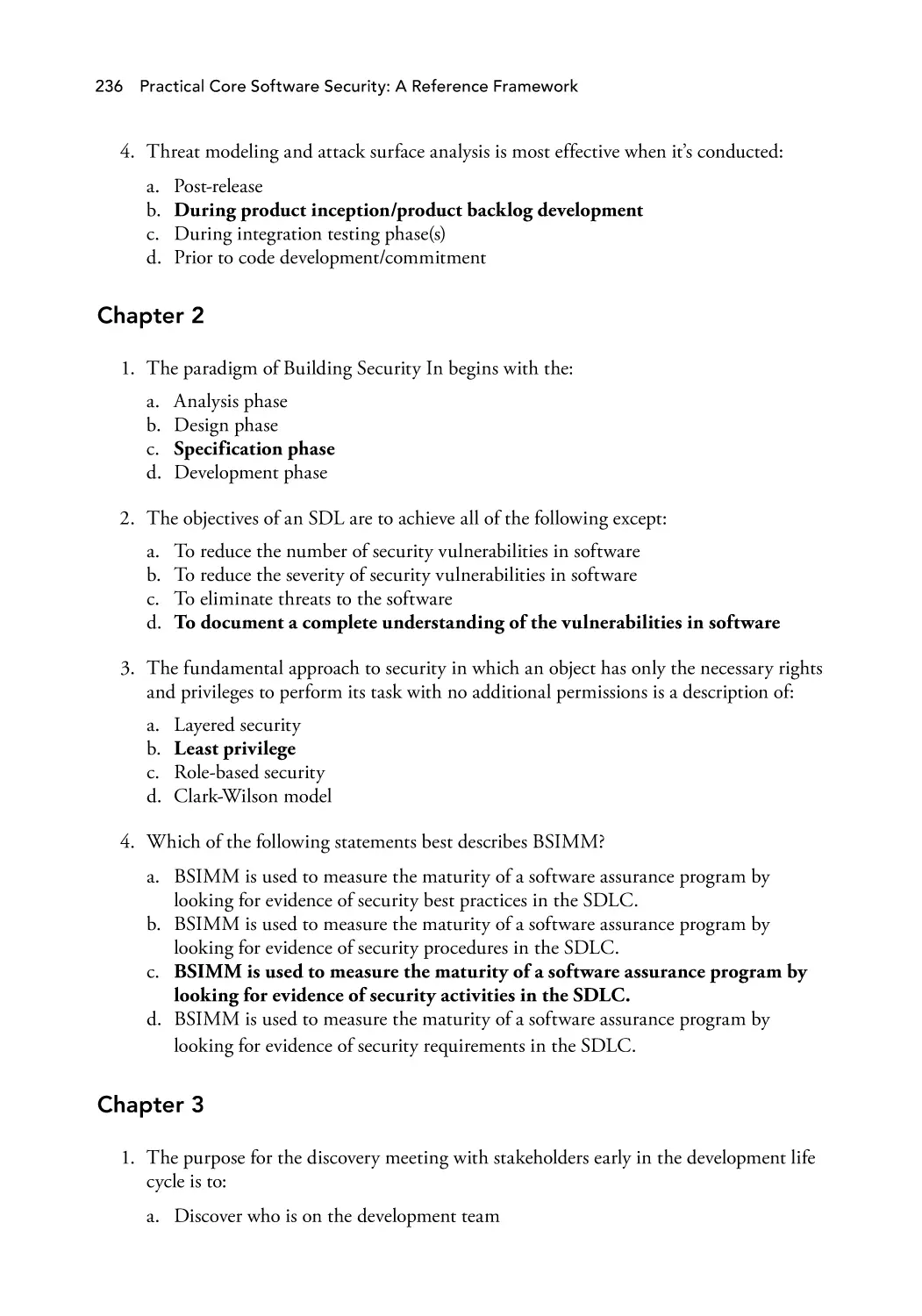















Текст
PRACTICAL CORE SOFTWARE SECURITY
As long as humans write software, the key to successful software security is making the
software development program process more efficient and effective. Although the approach
of this textbook includes people, process, and technology approaches to software security,
Practical Core Software Security: A Reference Framework stresses the people element of
software security, which is still the most important part to manage as software is developed,
controlled, and exploited by humans.
The text outlines a step-by-step process for software security that is relevant to today’s
technical, operational, business, and development environments. It focuses on what humans
can do to control and manage a secure software development process using best practices
and metrics. Although security issues will always exist, students learn how to maximize an
organization’s ability to minimize vulnerabilities in software products before they are released or
deployed by building security into the development process.
The authors have worked with Fortune 500 companies and have often seen examples of the
breakdown of security development lifecycle (SDL) practices. The text takes an experiencebased approach to apply components of the best available SDL models in dealing with the
problems described above. Software security best practices, an SDL model, and framework
are presented in this book. Starting with an overview of the SDL, the text outlines a model for
mapping SDL best practices to the software development life cycle (SDLC). It explains how to
use this model to build and manage a mature SDL program. Exercises and an in-depth case
study aid students in mastering the SDL model.
Professionals skilled in secure software development and related tasks are in tremendous
demand today. The industry continues to experience exponential demand that should continue
to grow for the foreseeable future. This book can benefit professionals as much as students.
As they integrate the book’s ideas into their software security practices, their value increases to
their organizations, management teams, community, and industry.
About the Authors
Dr. James Ransome, PhD, CISSP, CISM is a veteran chief information security officer (CISO),
chief security officer (CSO), and chief production security officer (CPSO), as well as an author
and co-author of numerous cybersecurity books.
Anmol Misra is an accomplished leader, researcher, author, and security expert with over
16 years of experience in technology and cybersecurity.
Mark S. Merkow, CISSP, CISM, CSSLP has over 25 years of experience in corporate
information security and 17 years in the AppSec space helping to establish and lead application
security initiatives to success and sustainment.
Some material in this book is taken from the following books written by one or both of the authors,
with permission from Taylor & Francis Group:
Core Software Security: Security at the Source / ISBN: 9781466560956 / 2013
Secure, Resilient, and Agile Software Development / ISBN: 978-0367332594 / 2019
PRACTICAL CORE
SOFTWARE SECURITY
A Reference Framework
James F. Ransome
Anmol Misra
Mark S. Merkow
Boca Raton London New York
CRC Press is an imprint of the
Taylor & Francis Group, an informa business
AN AUERBACH BOOK
First Edition published 2023
by CRC Press
6000 Broken Sound Parkway NW, Suite 300, Boca Raton, FL 33487-2742
and by CRC Press
4 Park Square, Milton Park, Abingdon, Oxon, OX14 4RN
CRC Press is an imprint of Taylor & Francis Group, LLC
© 2023 James F. Ransome, Anmol Misra and Mark S. Merkow
Reasonable efforts have been made to publish reliable data and information, but the author and publisher cannot assume respon
sibility for the validity of all materials or the consequences of their use. The authors and publishers have attempted to trace the
copyright holders of all material reproduced in this publication and apologize to copyright holders if permission to publish in this
form has not been obtained. If any copyright material has not been acknowledged please write and let us know so we may rectify
in any future reprint.
Except as permitted under U.S. Copyright Law, no part of this book may be reprinted, reproduced, transmitted, or utilized in any
form by any electronic, mechanical, or other means, now known or hereafter invented, including photocopying, microfilming,
and recording, or in any information storage or retrieval system, without written permission from the publishers.
For permission to photocopy or use material electronically from this work, access www.copyright.com or contact the Copyright
Clearance Center, Inc. (CCC), 222 Rosewood Drive, Danvers, MA 01923, 978-750-8400. For works that are not available on CCC
please contact mpkbookspermissions@tandf.co.uk
Trademark notice: Product or corporate names may be trademarks or registered trademarks and are used only for identification
and explanation without intent to infringe.
ISBN: 978-1-032-33314-4 (hbk)
ISBN: 978-1-032-27603-8 (pbk)
ISBN: 978-1-003-31907-8 (ebk)
DOI: 10.1201/9781003319078
Typeset in Adobe Garamond Pro
by DerryField Publishing Services
Dedications
To the next generation of defensive cyber warriors who will provide core software security to
the world’s software.
— James Ransome
To software security professionals committed to building secure software.
— Anmol Misra
This book is dedicated to the next generation of application security professionals to help alle
viate the struggle to reverse the curses of defective software, no matter where they show up.
— Mark Merkow
v
Contents
Dedications
v
Contents
vii
List of Figures
xiii
List of Tables
xv
Preface
About the Book
Audience
Support
Structure
Assumptions
xvii
xviii
xix
xix
xix
xix
Acknowledgments
xxi
About the Authors
xxiii
Chapter 1: Introduction
CHAPTER OVERVIEW
CHAPTER TAKE-AWAYS
1.1
The Importance and Relevance of Software Security
1.2 Software Security and the Software Development Life Cycle
1.3 Quality Versus Secure Code
1.4
The Three Most Important SDL Security Goals
1.5 Threat Modeling and Attack Surface Validation
1.6 Summary
Chapter Quick-Check
Exercises
References
1
1
1
2
5
7
8
9
11
11
12
12
vii
viii
Practical Core Software Security: A Reference Framework
Chapter 2: The Security Development Lifecycle
CHAPTER OVERVIEW
CHAPTER TAKE-AWAYS
2.1
Overcoming Challenges in Making Software Secure
2.2 Software Security Maturity Models
2.3 ISO/IEC 27034—Information Technology—Security Techniques—
Application Security
2.4 Other Resources for SDL Best Practices
2.4.1 SAFECode
2.4.2 U.S. Department of Homeland Security Software
Assurance Program
2.4.3 National Institute of Standards and Technology
2.4.4 Common Computer Vulnerabilities and Exposures
2.4.5 SANS Institute Top Cyber Security Risks
2.4.6 U.S. Department of Defense Cyber Security and
Information Systems Information Analysis Center (CSIAC)
2.4.7 CERT, Bugtraq®, and SecurityFocus
2.5 Critical Tools and Talent
2.5.1 The Tools
2.5.2 The Talent
2.6 Principles of Least Privilege
2.7 Privacy
2.8 The Importance of Metrics
2.9
Mapping the Security Development Lifecycle to the Software
Development Life Cycle
2.10 Software Development Methodologies
2.10.1 Waterfall Development
2.10.2 Agile Development
2.11 Summary
Chapter Quick-Check
Exercises
References
Chapter 3: Security Assessment (A1): SDL Activities and Best Practices
CHAPTER OVERVIEW
CHAPTER TAKE-AWAYS
3.1
Software Security Team Is Looped in Early
3.2 Software Security Hosts a Discovery Meeting
3.3 Software Security Team Creates an SDL Project Plan
3.4 Privacy Impact Assessment (PIA) Plan Initiated
15
15
15
16
17
18
19
19
19
20
21
22
23
23
23
24
25
29
30
31
33
35
39
40
43
43
44
44
47
47
47
47
49
51
51
Contents
3.5
Security Assessment (A1) Key Success Factors and Metrics
3.5.1 Key Success Factors
3.5.2 Deliverables
3.5.3 Metrics
3.6 Summary
Chapter Quick-Check
Exercises
References
Chapter 4: Architecture (A2): SDL Activities and Best Practices
CHAPTER OVERVIEW
CHAPTER TAKE-AWAYS
4.1
A2 Policy Compliance Analysis
4.2 SDL Policy Assessment and Scoping
4.3 Threat Modeling/Architecture Security Analysis
4.3.1 Threat Modeling
4.3.2 Data Flow Diagrams
4.3.3 Architectural Threat Analysis and Ranking of Threats
4.3.4 Risk Mitigation
4.4 Open-Source Selection
4.5 Privacy Information Gathering and Analysis
4.6 Key Success Factors and Metrics
4.6.1 Key Success Factors
4.6.2 Deliverables
4.6.3 Metrics
4.7 Summary
Chapter Quick-Check
Exercises
References
Chapter 5: Design and Development (A3): SDL Activities and Best
Practices
CHAPTER OVERVIEW
CHAPTER TAKE-AWAYS
5.1
A3 Policy Compliance Analysis
5.2 Security Test Plan Composition
5.3 Threat Model Updating
5.4 Design Security Analysis and Review
5.5 Privacy Implementation Assessment
5.6 Key Success Factors and Metrics
ix
56
56
58
59
59
60
60
61
63
63
63
65
65
66
66
69
74
89
93
95
95
95
96
97
97
98
99
99
103
103
103
105
105
112
113
115
117
x
Practical Core Software Security: A Reference Framework
5.6.1 Key Success Factors
5.6.2 Deliverables
5.6.3 Metrics
5.7 Summary
Chapter Quick-Check
Exercises
References
Chapter 6: Design and Development (A4): SDL Activities and Best
Practices
CHAPTER OVERVIEW
CHAPTER TAKE-AWAYS
6.1
A4 Policy Compliance Analysis
6.2 Security Test Case Execution
6.3 Code Review in the SDLC/SDL Process
6.4 Security Analysis Tools
6.4.1 Static Analysis
6.4.2 Dynamic Analysis
6.4.3 Fuzz Testing
6.4.4 Manual Code Review
6.5 Key Success Factors
6.6 Deliverables
6.7 Metrics
6.8 Summary
Chapter Quick-Check
Exercises
References
Chapter 7: Ship (A5): SDL Activities and Best Practices
CHAPTER OVERVIEW
CHAPTER TAKE-AWAYS
7.1
A5 Policy Compliance Analysis
7.2
Vulnerability Scan
7.3
Code-Assisted Penetration Testing
7.4
Open-Source Licensing Review
7.5
Final Security Review
7.6
Final Privacy Review
7.7
Key Success Factors
7.8
Deliverables
7.9
Metrics
7.10 Summary
117
118
119
119
120
120
120
123
123
123
125
125
128
132
135
138
140
142
145
146
147
147
148
148
149
151
151
151
153
153
156
158
160
163
164
165
166
167
Contents
Chapter Quick-Check
Exercises
References
Chapter 8: Post-Release Support (PRSA1–5)
CHAPTER OVERVIEW
CHAPTER TAKE-AWAYS
8.1
Right-Sizing Your Software Security Group
8.1.1 The Right Organizational Location
8.1.2 The Right People
8.1.3 The Right Process
8.2 PRSA1: External Vulnerability Disclosure Response
8.2.1 Post-Release PSIRT Response
8.2.2 Post-Release Privacy Response
8.2.3 Optimizing Post-Release Third-Party Response
8.3 PRSA2: Third-Party Reviews
8.4 PRSA3: Post-Release Certifications
8.5 PRSA4: Internal Review for New Product Combinations or Cloud
Deployments
8.6 PRSA5: Security Architectural Reviews and Tool-Based
Assessments of Current, Legacy, and M&A Products and
Solutions
8.6.1 Legacy Code
8.6.2 Mergers and Acquisitions (M&As)
8.7 Key Success Factors
8.8 Deliverables
8.9
Metrics
8.10 Summary
Chapter Quick-Check
Exercises
References
Chapter 9: Adapting Our Reference Framework to Your Environment
CHAPTER OVERVIEW
CHAPTER TAKE-AWAYS
9.1
Overview of the Top Four Environments in Which You Are Likely
to Deploy Your SDL
9.1.1 Agile
9.1.2 DevOps
9.1.3 Cloud
9.1.4 Digital Enterprise
xi
167
169
169
171
171
171
173
173
174
177
177
178
181
182
182
184
184
185
185
187
188
190
191
191
191
192
192
195
195
195
196
196
196
197
199
xii
Practical Core Software Security: A Reference Framework
9.2
Key Success Factors, Deliverables, and Metrics for Each Phase
of Our SDL Reference Framework
9.3
Software Security Maturity Models and the SDL
9.3.1 Maturity Models for Security and Resilience
9.3.2 Software Assurance Maturity Model—OpenSAMM
9.4
The Building Security In Maturity Model (BSIMM)
9.4.1 BSIMM Organization
9.4.2 BSIMM Software Security Framework
9.4.3 Deployment
9.4.4 BSIMM’s 12 Practice Areas
9.4.5 Measuring Results with BSIMM
9.4.6 The BSIMM Community
9.4.7 Conducting a BSIMM Assessment
9.4.8 Section Summary
9.5
Enhancing Your Threat Modeling Practice As Part of the SDL
9.5.1 Practical Threat and Application Risk Modeling
9.5.2 MITRE ATT&CK® and MITRE D3FEND®
9.6
Pulling It All Together
9.7
Overcoming Organizational and Business Challenges with a
Properly Designed, Managed, and Focused SDL
9.8
Software Security Organizational Realities and Leverage
9.9
Future Predictions for Software Security
9.9.1 The Bad News
9.9.2 The Good News
9.10 Comprehensive SDL Review
9.11 Conclusion
References
202
202
202
202
210
210
211
213
214
214
214
214
216
216
217
220
221
222
222
223
224
225
225
225
230
Appendix A: Case Study for Chapters 3 Through 8 Exercises
233
Appendix B: Answers to Chapter Quick-Check Questions
235
Glossary
241
Index
245
List of Figures
Figure 1.1
Cost to address software problems mapped to SDLC phases.
Figure 2.1
Design and development (A4) stage of the SDL activities and best
practices.
26
Visual representation of the cost of fixing defects at different stages
of the SDLC as part of the SDL process.
32
SDL phases S1–S3: defect identification and remediation filtering
process.
33
Mapping the security development lifecycle (SDL) to the software
development life cycle (SDLC).
34
Chapter 3: Security Assessment (A1): SDL activities and best
practices.
36
Figure 2.6
Chapter 4: Architecture (A2): SDL activities and best practices.
36
Figure 2.7
Chapter 5: Design and Development (A3): SDL activities and
best practices.
37
Chapter 6: Design and Development (A4): SDL activities and
best practices.
37
Figure 2.9
Chapter 7: Ship (A5): SDL activities and best practices.
38
Figure 2.10
Chapter 8: Post-Release Support (PRSA1-5): SDL activities and
best practices.
38
Figure 2.11
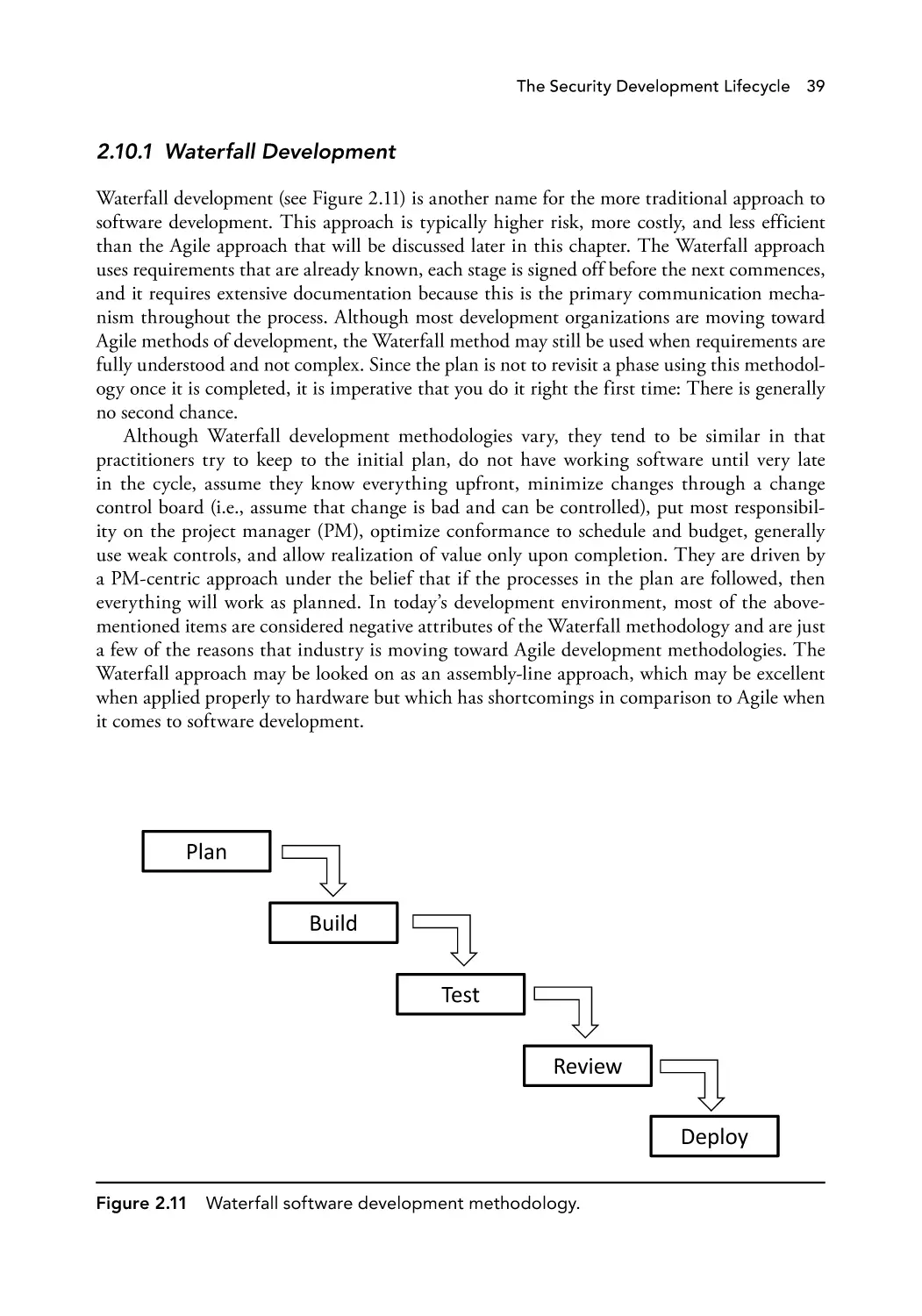
Waterfall software development methodology.
39
Figure 2.12
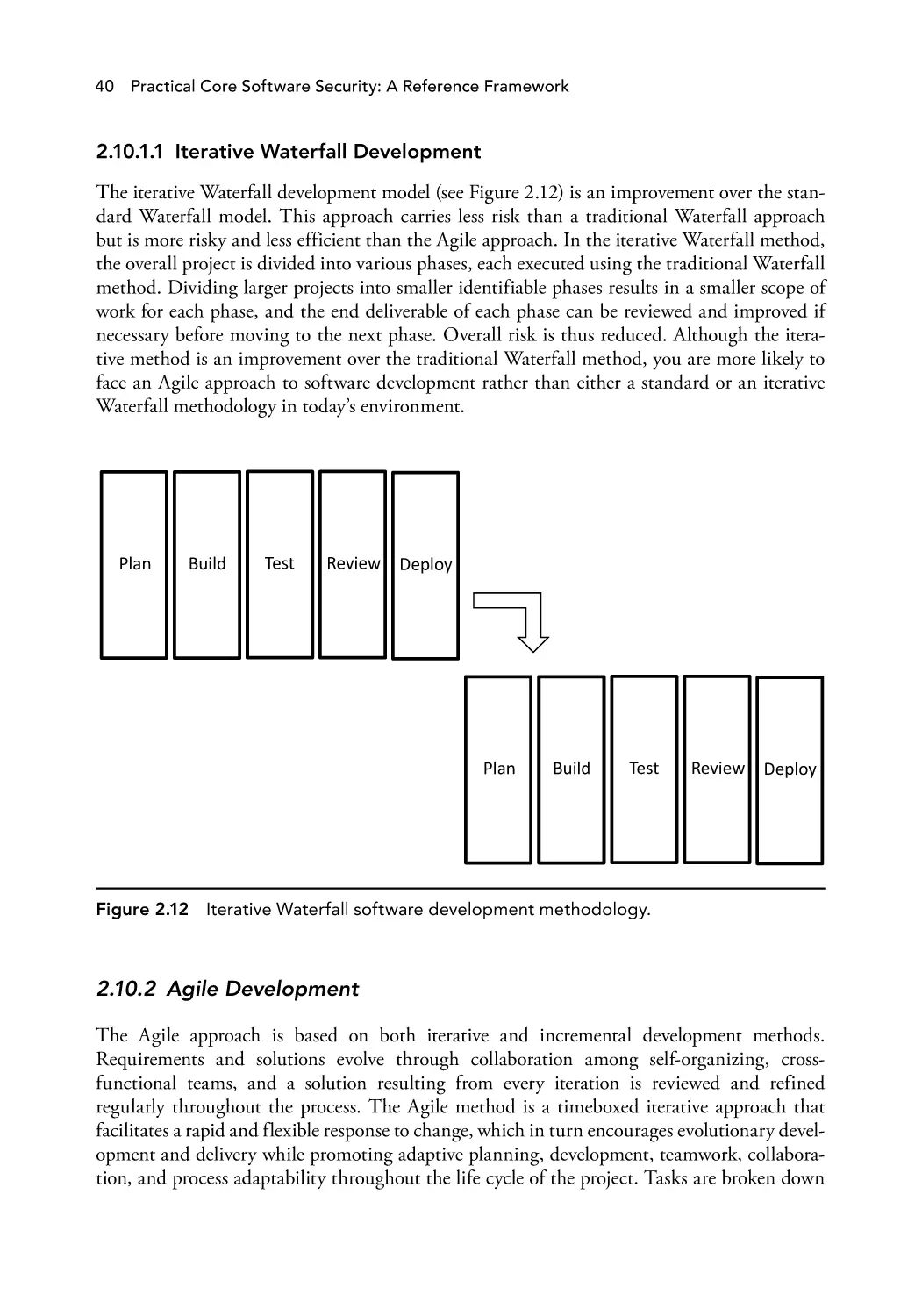
Iterative Waterfall software development methodology.
40
Figure 2.13
Scrum software development methodology.
41
Figure 2.14
Lean software development methodology.
42
Figure 3.1
Security Assessment (A1): SDL activities and best practices.
48
Figure 4.1
Architecture (A2): SDL activities and best practices.
64
Figure 4.2
The five steps of threat modeling.
67
Figure 2.2
Figure 2.3
Figure 2.4
Figure 2.5
Figure 2.8
4
xiii
xiv Practical Core Software Security: A Reference Framework
Figure 4.3
DFD element types.
70
Figure 4.4
Example data flow diagram for application threat modeling.
71
Figure 4.5
Example data flow diagram for a cloud-based application.
72
Figure 4.6
Threats affecting elements.
73
Figure 4.7
Risk assessment process.
79
Figure 4.8
DREAD threat rating table.
82
Figure 4.9
Elements of risk.
92
Figure 4.10
A holistic approach for software security risk assessment.
94
Figure 5.1
Design and Development (A3): SDL activities and best practices.
104
Figure 6.1
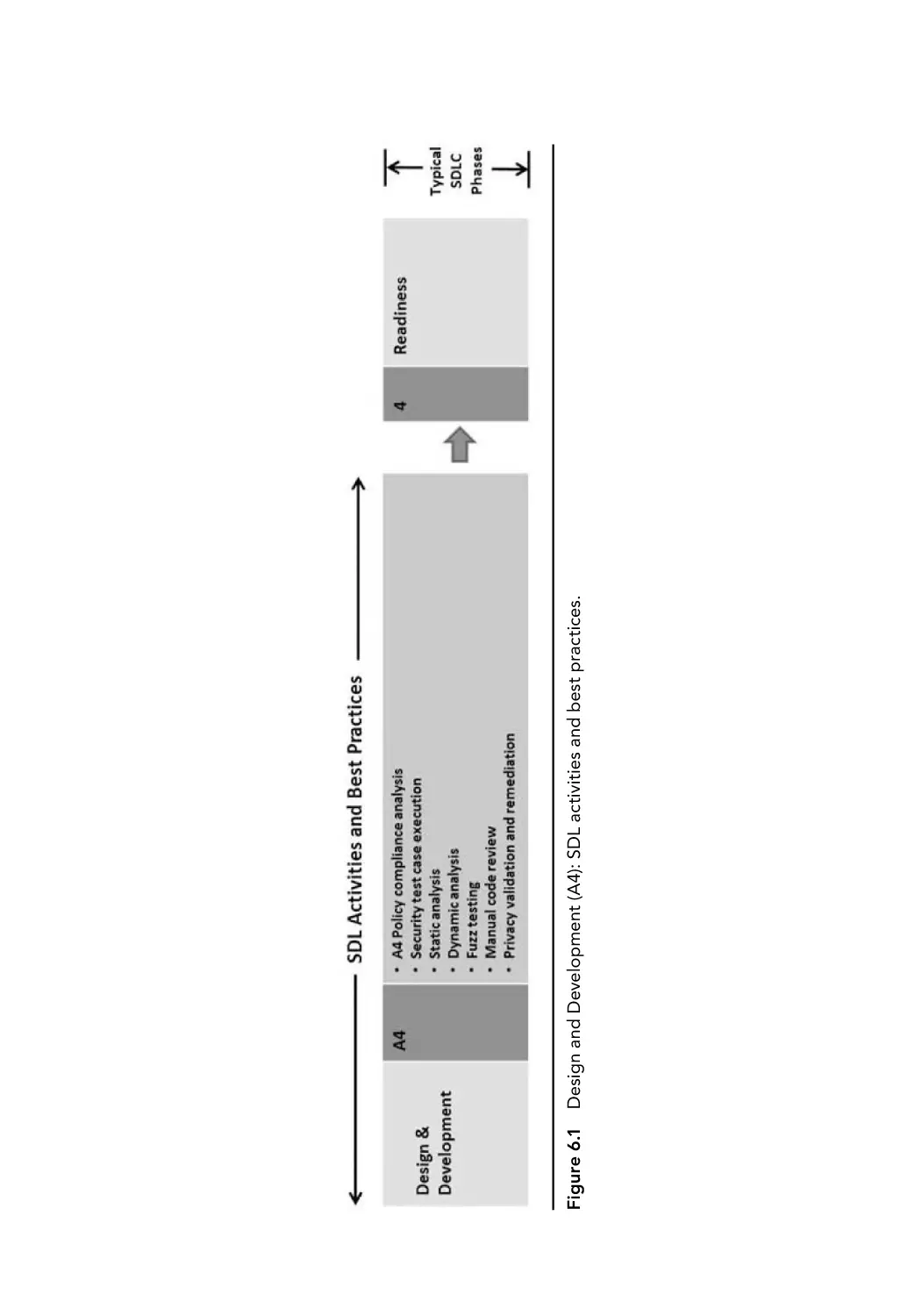
Design and Development (A4): SDL activities and best practices.
124
Figure 6.2
Four-step code review cycle.
129
Figure 6.3
Static analysis flow diagram.
136
Figure 6.4
Dynamic analysis flow diagram.
139
Figure 6.5
Fuzz testing flow diagram.
141
Figure 7.1
Ship (A5): SDL activities and best practices.
152
Figure 7.2
Typical vulnerability scan process.
155
Figure 7.3
The four-phase process of penetration testing.
157
Figure 7.4
Four-step final security review process.
162
Figure 7.5
A1 to A5 SDL activities and best practices.
168
Figure 8.1
Post-release support (PRSA1–5): SDL activities and best practices.
172
Figure 8.2
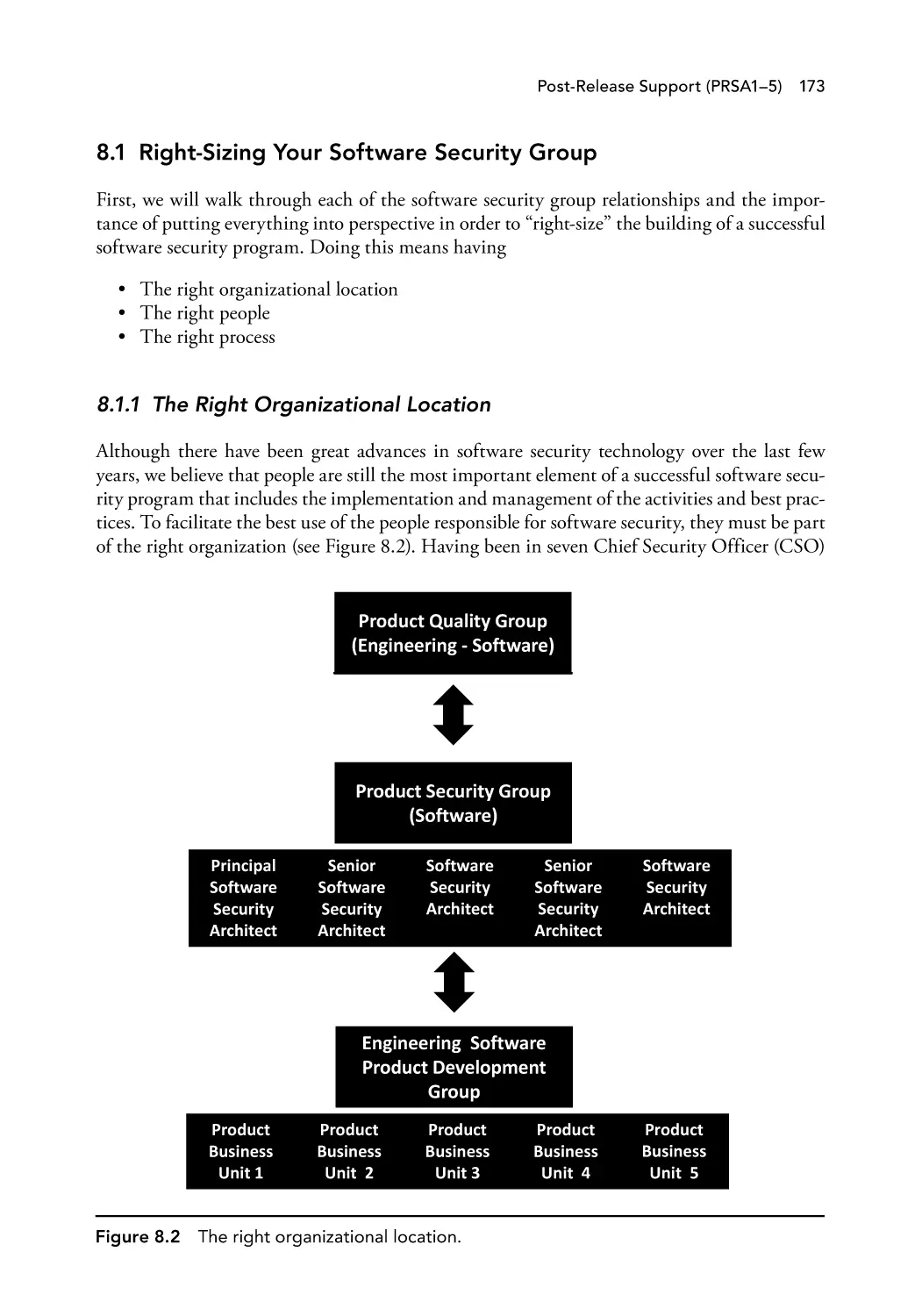
The right organizational location.
173
Figure 8.3
The right people.
175
Figure 8.4
SDL A1–A5 activities and best practices.
176
Figure 9.1
Agile/Scrum framework.
197
Figure 9.2
DevSecOps cycle.
198
Figure 9.3
OpenSAMM model.
204
Figure 9.4
Sample OpenSAMM assessment worksheet extract.
209
Figure 9.5
The BSIMM software security framework.
212
Figure 9.6
BSIMM’s 12 practices.
215
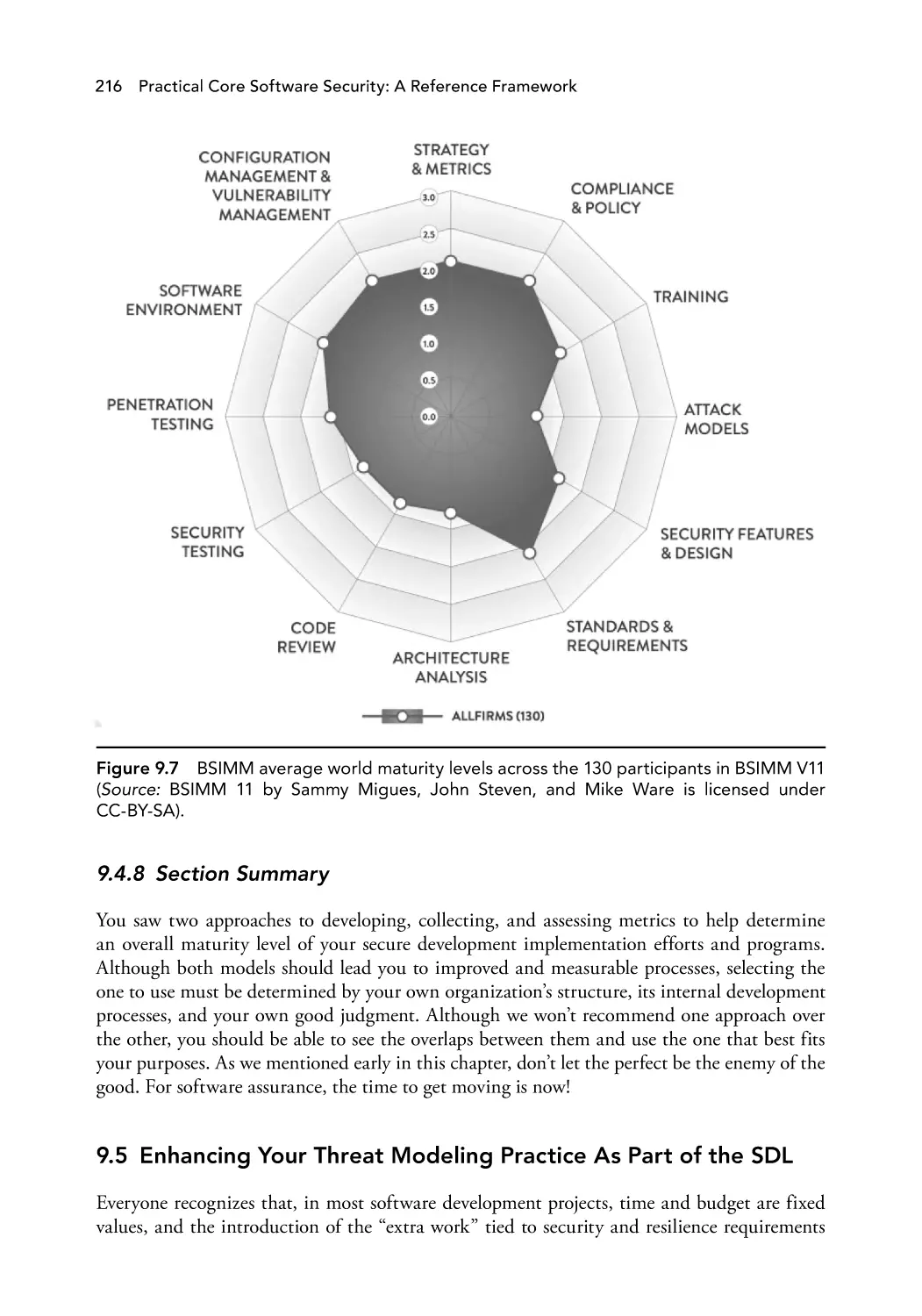
Figure 9.7
BSIMM average world maturity levels across the 130 participants
in BSIMM V11.
216
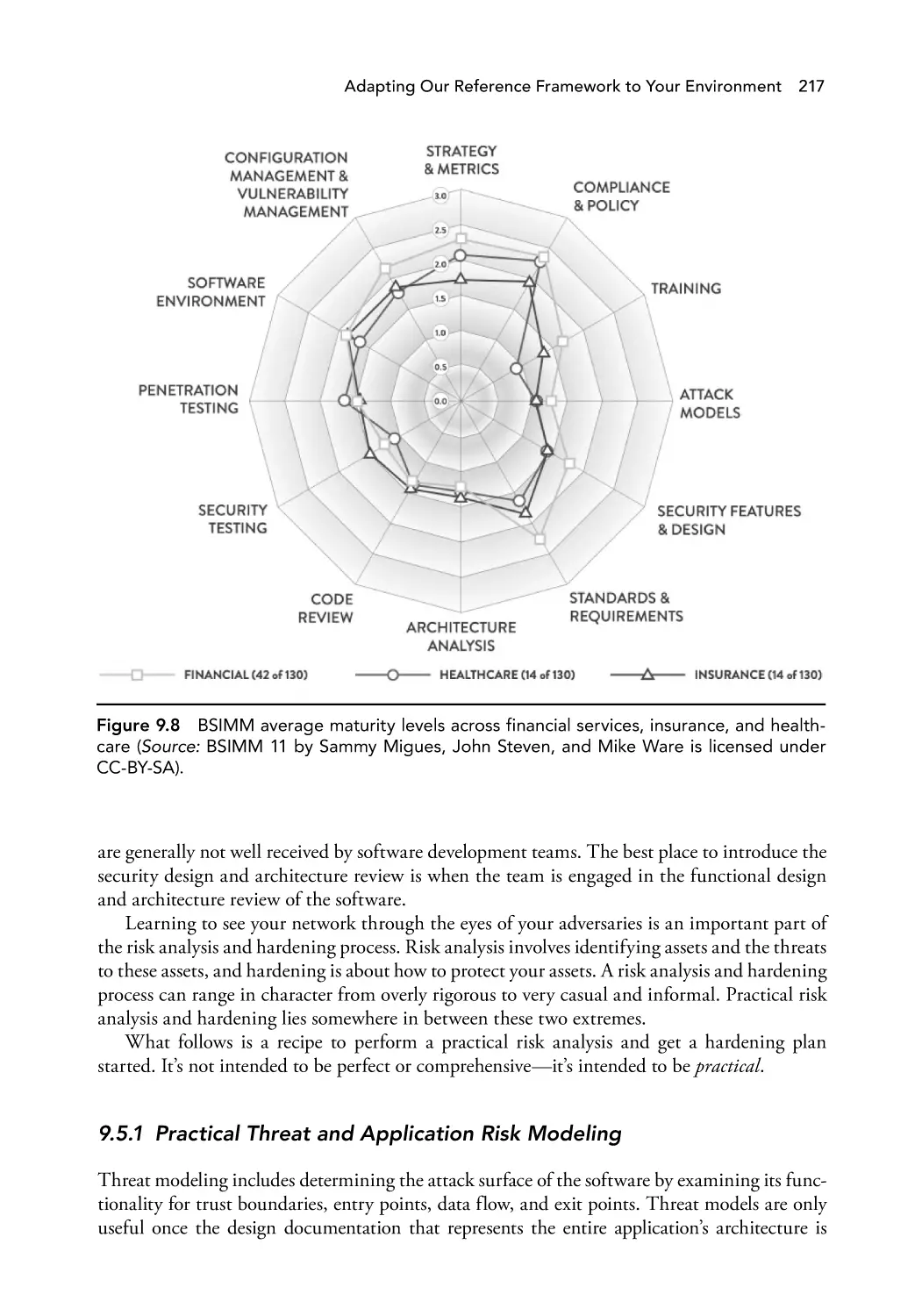
BSIMM average maturity levels across financial services, insurance,
and healthcare.
217
Figure 9.8
List of Tables
Table 3.1
Key Success Factors
56
Table 3.2
Deliverables for Phase A1
58
Table 4.1
Key Success Factors
95
Table 4.2
Deliverables for Phase A2
96
Table 5.1
Key Success Factors
117
Table 5.2
Deliverables for Phase A3
118
Table 6.1
Key Success Factors
145
Table 6.2
Deliverables for Phase A4
146
Table 7.1
Key Success Factors
164
Table 7.2
Deliverables for Phase A5
165
Table 8.1
Key Deliverables
190
Table 9.1
Key Success Factors for Each Phase of the Security Development
Lifecycle (SDL)
200
Deliverables for Each Phase of the Security Development
Lifecycle (SDL)
226
Metrics for Each Phase of the Security Development Lifecycle (SDL)
228
Table 9.2
Table 9.3
xv
Preface
The age of the software-driven machine has taken significant leaps over the last few years.
Human tasks, such as those of fighter pilots, stock-exchange floor traders, surgeons, industrial
production and power-plant operators that are critical to the operation of weapons systems,
medical systems, and key elements of our national infrastructure, have been or are rapidly
being taken over by software. This is a revolutionary step in the machine whose brain and
nervous system is now controlled by software-driven programs taking the place of complex
nonrepetitive tasks that formerly required the use of the human mind. This has resulted in
a paradigm shift in the way the state, military, criminals, activists, and other adversaries can
attempt to destroy, modify, or influence countries, infrastructures, societies, and cultures. This
is true even for corporations, as we have seen increasing cases of cyber corporate espionage over
the years. The previous use of large armies, expensive and devastating weapons systems and
platforms, armed robberies, the physical stealing of information, violent protests, and armed
insurrection are quickly being replaced by what is called cyber warfare, crime, and activism.
In the end, the cyber approach may have just as profound effects as the techniques used
before in that the potential exploit of software vulnerabilities could result in:
• Entire or partial infrastructures being taken down, including power grids, nuclear power
plants, communication media, and emergency response systems.
• Chemical plants modified to create large-yield explosions and/or highly toxic clouds.
• Remote control, modification, or disablement of critical weapon systems or platforms.
• Disablement or modification of surveillance systems.
• Criminal financial exploitation and blackmail.
• Manipulation of financial markets and investments.
• Murder or harm to humans through the modification of medical support systems or
devices, surgery schedules, or pharmaceutical prescriptions.
• Political insurrection and special-interest influence through the modification of voting
software, blackmail, or brand degradation though website defacement or underlying web
application takedown or destruction.
A side effect of the cyber approach is that it has given us the ability to do the above at a
scale, distance, and degree of anonymity previously unthought of from jurisdictionally pro
tected locations through remote exploitation and attacks. This gives governments, criminal
xvii
xviii
Practical Core Software Security: A Reference Framework
groups, and activists the ability to proxy prime perpetuators to avoid responsibility, detection,
and political fallout.
Although there is much publicity regarding network security, the real Achilles heel is the
(insecure) software that provides the potential ability for total control and/or modification of a
target, as described above. The criticality of software security as we move quickly toward this
new age of tasks previously relegated to the human mind being replaced by software-driven
machines cannot be underestimated. It is for this reason that we have written this book. In
contrast, and for the foreseeable future, software programs are and will be written by humans.
This also means that new software will keep building on legacy code or software that was writ
ten prior to security being taken seriously, or before sophisticated attacks became prevalent.
As long as humans write the programs, the key to successful security for these programs is in
making the software development program process more efficient and effective. Although the
approach of this book includes people, process, and technology approaches to software secu
rity, we believe that the people element of software security is still the most important part to
manage as long as software is developed, controlled, and exploited by humans. What follows
is a step-by-step process for software security that is relevant to today’s technical, operational,
business, and development environments, with a focus on what humans can do to control and
manage the process in the form of best practices and metrics. We will always have security
issues, but this book should help in minimizing them when software is finally released or
deployed. We hope you enjoy our book as much as we have enjoyed writing it.
About the Book
This book outlines a step-by-step process for software security that is relevant to today’s techni
cal, operational, business, and development environments. The authors focus on what humans
can do to control and manage a secure software development process in the form of best practices
and metrics. Although security issues will always exist, this book will teach you how to maxi
mize your organization’s ability to minimize vulnerabilities in your software products before
they are released or deployed, by building security into the development process. The authors
have worked with Fortune 500 companies and have often seen examples of the breakdown
of security development lifecycle (SDL) practices. In this book, we take an experience-based
approach to applying components of the best available SDL models in dealing with the problems
described above, in the form of an SDL software security best practices model and framework.
Practical Core Software Security: A Reference Framework starts with an overview of the SDL and
then outlines a model for mapping SDL best practices to the software development life cycle
(SDLC), explaining how you can use this model to build and manage a mature SDL program.
This is as much a book for your personal benefit as it is for your academic and organization’s
benefit. Professionals who are skilled in secure software development and related tasks are in
tremendous demand today, and we continue to see exponential demand that will continue to
grow for the foreseeable future. As you integrate these ideas into your daily duties, your value
increases to your company, your management, your community, and your industry.
Although security is not a natural component of the way industry has been building soft
ware in recent years, the authors believe that security improvements to development processes
are possible, practical, and essential. They trust that the software security best practices and
model presented in this book will make this clear to all who read the book, including execu
tives, managers, and practitioners.
Preface xix
Audience
This book is targeted toward students in higher education programs within the business or
engineering discipline and anyone who is interested in learning about software security in an
enterprise environment, including:
•
•
•
•
•
•
•
•
Product Security and Quality Executives
Software Security Architects
Security Consultants
Software Development Engineers
Enterprise SDLC Program Managers
Chief Information Security Officers
Chief Technology Officers
Chief Privacy Officers whose companies develop software
If you want to learn about how software security should be implemented in developing enter
prise software, this is a book you don’t want to skip.
Support
Errata and support for this book are available on the CRC Press website.
Structure
This book is divided into nine chapters. Chapter 1 provides an introduction to the topic of soft
ware security and why it is important that we get it right the first time. Chapter 2 introduces the
challenges of making software secure and the SDL framework. Chapters 3 through 8 provide
mapping of our SDL with its associated best practices to a generic SDLC framework. Chapter 9
describes how to adapt our reference framework to your environment successfully by applying
solutions proposed in Chapters 3 through 8. Each chapter includes learning objectives, along
with multiple choice questions and exercises to provide hands-on practice using a case study
to develop a custom SDL. Answers to the multiple-choice questions are found in Appendix B.
Each chapter logically builds on prior chapters to help you paint a complete set of practical
steps that lead to secure application software and responsive, secure development practices that
predictably and reliably produce high-quality and provably secure applications.
Assumptions
This book assumes that a reader is familiar with the basics of software development (and
methodologies) and basic security concepts. Knowledge of the SDL, different types of security
testing, and security architecture is recommended but not required. For most topics, we gently
introduce readers to the topic before diving deep into that particular topic.
Acknowledgments
I would like to thank all the team members, partners, collaborators, and coauthors who have
worked with me over the years and who continue to evangelize that cyber security must start
at the source, which is software. I would also like to thank Anmol and Mark for collaborating
with me on this book and the Taylor & Francis Group and Derryfield Publishing Services for
bringing this project our way.
— James Ransome
I want to thank everyone who has supported me over the years. And I want to thank Mark
Merkow for collaborating with James Ransome and me on the book. I would also like to thank
the Taylor & Francis Group and the Derryfield Publishing Services team for their help with
the manuscript.
— Anmol Misra
I can’t thank James and Anmol enough for the awesome opportunity to work on this book—
it’s been a pleasure and a joy!
I also want to thank the teams at the Taylor & Francis Group and Derryfield Publishing
Services for the privilege of working with some of the best professionals in the business!
— Mark Merkow
xxi
About the Authors
Dr. James Ransome, PhD, CISSP, CISM is the Chief Scientist for CYBERPHOS, an earlystage cybersecurity startup. He is also a member of the board of directors for the Bay Area
Chief Security Officer Council.
Most recently, James was the Senior Director of Security Development Lifecycle Engineering
for Intel’s Product Assurance and Security (IPAS). In that capacity, he led a team of SDL engi
neers, architects, and product security experts to drive and implement security practices across
the company. Prior to that, James was the Senior Director of Product Security and PSIRT at
Intel Security (formerly McAfee).
James’s career includes leadership positions in the private and public sectors. He served
in three chief information security officer (CISO) roles at Applied Materials, Autodesk, and
Qwest Communications and four chief security officer (CSO) positions at Pilot Network
Services, Exodus Communications, Exodus Communications—Cable and Wireless Company,
and Cisco Collaborative Software Group. Before entering the corporate world, He worked
in government service for 23 years supporting the U.S. intelligence community, federal law
enforcement, and the Department of Defense.
James holds a PhD (https://nsuworks.nova.edu/gscis_etd/790/) in Information Systems,
specializing in Information Security; a Master of Science Degree in Information Systems; and
graduate certificates in International Business and International Affairs. He taught Applied
Cryptography, Advanced Network Security, and Information Security Management as an
Adjunct Professor in the Nova Southeastern University’s Graduate School of Computer and
Information Science (SCIS) Information Security Program. The graduate school is designated
as a National Center of Academic Excellence in Information Assurance Education by the U.S.
National Security Agency and the Department of Homeland Security.
James is a Certified Information Security Manager (CISM), a Certified Information
Systems Security Professional (CISSP), and a Ponemon Institute Distinguished Fellow.
He has authored or coauthored 14 cyber-related books and is currently working on his 15th.
— James Ransome
xxiii
xxiv
Practical Core Software Security: A Reference Framework
Anmol Misra is an accomplished leader, researcher, author, and security expert, with over 16
years of experience in technology and cybersecurity.
His engineering, security, and consulting background makes him uniquely suited to drive
the adoption of disruptive technologies. He is a team builder focused on mentoring and nur
turing high-potential leaders, fostering excellence, and building industry partnerships. He is
known for his pragmatic approach to security.
As Senior Director—Infrastructure Security, Anmol is responsible for cloud and infor
mation security at Autodesk. Before Autodesk, he managed security and compliance for
Collaboration Cloud at Cisco. As part of Ernst & Young’s (EY’s) Advisory Services, before
Cisco, he helped Fortune 500 companies define and execute strategy; build and implement
secure, scalable solutions; and achieve regulatory compliance.
Anmol is one of the two authors of Android Security: Attacks and Defenses and Core Software
Security: Security at the Source. He is also a contributing author of Defending the Cloud: Waging
Warfare in Cyberspace. His books are used by leading universities worldwide to teach security.
He has taught security to students and professionals alike, and his work has been cited by
research papers in prestigious journals, including journals published by the ACM and the IEEE.
— Anmol Misra
Mark S. Merkow, CISSP, CISM, CSSLP has over 25 years of experience in corporate informa
tion security and 17 years in the AppSec space helping to establish and lead application security
initiatives to success and sustainment. Mark is a faculty member at the University of Denver,
where he works developing and instructing online courses in topics across the Information
Security spectrum, with a focus on secure software development. He also works as an advisor
to the University of Denver’s Information and Computing Technology Curriculum Team for
new course development and changes to the curriculum and for Strayer University as an advi
sor to the undergraduate and graduate programs in information security.
Mark has spent his IT career in a variety of roles, including application development, sys
tems analysis and design, security engineering, and security management. Mark holds a Master
of Science in Decision and Information Systems from Arizona State University (ASU), a
Master of Education in Distance Education from ASU, and a Bachelor of Science in Computer
Information Systems from ASU.
Mark has authored or coauthored 18 books on IT and has been a contributing editor to
four others. Mark remains very active in the information security community, working in a
variety of volunteer roles for the Phoenix Chapter of (ISC)2®, ISACA®, and OWASP®. You can
find Mark’s LinkedIn® profile at: linkedin.com/in/markmerkow
— Mark Merkow
Chapter 1
Introduction
CHAPTER OVERVIEW
Welcome to our book about what we still believe to be the most important topic in information
security for the foreseeable future: software security. In the following sections, we will cover
five major topics that highlight the need, value, and challenges of software security. This will
set the stage for the remainder of the book, where we describe our model for software security:
building security into your software using an operationally relevant and manageable security
development lifecycle (SDL) that is applicable to all software development life cycles (SDLCs).
CHAPTER TAKE-AWAYS
•
•
•
•
•
Describe the importance and need for software security.
Understand the role of security within the software development life cycle (SDLC).
Distinguish between quality and security attributes in code.
Describe the fundamental goals of the security development lifecycle (SDL).
Determine when and how to apply threat modeling and application risk analysis processes.
The rationale and the principles needed to achieve an effective software security program
include:
1. The importance and relevance of software security. Software is critical to everything
we do in the modern world and is behind our most critical systems. As such, it is impera
tive that it be secure by design. Most information technology (IT)-related security solu
tions have been developed to mitigate the risk caused by insecure software. To justify
a software security program, the importance and relevance of the monetary costs and
other risks for not building security into your software must be known, as well as the
importance, relevance, and costs for building security in. At the end of the day, software
security is as much a business decision as it is about avoiding security risks.
1
2
Practical Core Software Security: A Reference Framework
2. Software security and the software development life cycle. It is important to know
the difference between what are generally known in software development as software
security and application security. Although these terms are often used interchangeably, we
differentiate between them because we believe there is a distinct difference in managing
programs for these two purposes. In our model, software security is about building secu
rity into the software through a SDL in an SDLC, whereas application security is about
protecting the software and the systems on which it runs after release.
3. Quality versus secure code. Although secure code is not necessarily quality code, and
quality code is not necessarily secure code, the development process for producing soft
ware is based on the principles of both quality and secure code. You cannot have quality
code without security or security without quality, and their attributes complement each
other. At a minimum, quality and software security programs should be collaborating
closely during the development process; ideally, they should be part of the same organi
zation and both part of the software development engineering department. We will
discuss this organizational and operational perspective later in the book.
4. The three most important SDL security goals. At the core of all software security
analysis and implementation are three core elements of security: confidentiality, integ
rity, and availability, also known as the C.I.A. model. To ensure high confidence that
the software being developed is secure, these three attributes must be adhered to as key
components throughout the SDL.
5. Threat modeling and attack surface validation. The most time-consuming and mis
understood part of the SDL is threat modeling and attack surface validation. In today’s
world of Agile development, you must get this right or you will likely fail to make your
software secure. Threat modeling and attack surface validation throughout the SDL will
maximize your potential to alleviate post-release discovery of security vulnerabilities in
your software product. We believe this function to be so important that we have dedi
cated a SDL section and a separate chapter to this topic.
1.1 The Importance and Relevance of Software Security
Although dated, the following statements are still relevant and highlight the security challenges
that still exist in many software development organizations today. The 2005 U.S. President’s
Information Technology Advisory Committee (PITAC) report stated: “Commonly used soft
ware engineering practices permit dangerous errors, such as improper handling of buffer over
flows, which enable hundreds of attack programs to compromise millions of computers every
year.”1 This happens mainly because “commercial software engineering today lacks the scien
tific underpinnings and rigorous controls needed to produce high-quality, secure products at
acceptable cost.”2
The Gartner® Group reports that more than 70 percent of current business security vulner
abilities are found within software applications rather than the network boundaries.3 A focus
on application security has thus emerged to reduce the risk of poor software development,
integration, and deployment. As a result, software assurance quickly became an information
assurance (IA) focus area in the financial, government, and manufacturing sectors to reduce
the risk of unsecure code: Security built into the software development life cycle makes good
business sense.
Introduction
3
A U.S. Department of Homeland Security 2006 Draft, “Security in the Software Lifecycle,”
states the following:
The most critical difference between secure software and insecure software lies in the
nature of the processes and practices used to specify, design, and develop the software
. . . correcting potential vulnerabilities as early as possible in the software development
lifecycle, mainly through the adoption of security-enhanced process and practices, is far
more cost-effective than the currently pervasive approach of developing and releasing
frequent patches to operational software.4
At the RSA® 2011 USA conference, cloud security issues were highlighted, but very little
discussion was devoted to addressing the problem; however, at the 2012 conference, it was
all about addressing the security issues in the cloud that had been so aptly identified the year
before. The same thing happened in 2012, starting with a few key conferences, and contin
ued with a major focus on discussing solutions for software security in 2013. For example,
in early 2012, Information Week identified “Code gets externally reviewed” as one of the 10
security trends to watch in 2012,5 and stated that “this business mandate is clear: Developers
must take the time to code cleanly, and eradicate every possible security flaw before the code
goes into production.” There was also a popular security article published on March 1, 2012,
titled “To Get Help with Secure Software Development Issues, Find Your Own Flaws,” which
highlighted panel discussions at RSA 2012 in San Francisco.6 This panel did a great job of
identifying some of the critical issues but did not address solving the software security chal
lenges that it identified. However, things started to change mid-year 2012: The agenda for the
Microsoft® inaugural Security Development Conference, held in May 2012,7 was less about
Microsoft and more about bringing secure software development thought leadership together
and in three separate tracks to include “security engineering,” “security development lifecycle (SDL) & business,” and “managing the process” to discuss solutions to the most impor
tant security issue in industry—secure software development. This trend continued with
the blackhat® USA 2012 Conference,8 the RSA 2013 Conference,9 and the 2013 Microsoft
Security Development Conference.10
Think about it: What really causes a majority of the information security problems we
have today? What is the primary target of hackers, cybercriminals, and nation-state cyber war
riors? It is insecure code. What has quickly become the highest unnecessary cost to software
development? It is flaws arising from insecure code in software products that have already been
released to the market. When these flaws are discovered and/or exploited, they cause interrup
tions in current product development cycles to fix something that should have been fixed dur
ing the development of the product that has the flaw; they cause delays in product release dates
because individuals or teams working on current products are pulled off cycle to fix issues in
a previously released product; and they result in vulnerability scope creep because vulnerabili
ties discovered in one product may affect the security of others in web, Software-as-a-Service
(SaaS), and cloud applications. They also create legal issues, reputation degradation, and public
relations nightmares, such as those experienced by Sony®, Symantec®, and RSA over several
years. They can also result in significant liability to the company. In an age of extensive regula
tions governing privacy and exposure of data, this quickly adds up even for big corporations.
The point here is that even as the high-tech world, its consumers, customers, regulators, and
the media have started to realize that not only is it imperative to fix software security problems,
4
Practical Core Software Security: A Reference Framework
there is, in fact, a way to solve these issues in the form of a structured security software develop
ment life cycle or framework, such that all eyes will be on those who develop software code,
particularly code that is used in critical and sensitive applications to see if the developers are
adhering to this practice within their own environment—whether it be traditional/Waterfall,
Scrum/Agile, or a blended development methodology.
Every sector of the global economy, from energy to transportation, finance, and banking,
telecommunications, public health, emergency services, water, chemical, defense, industrial,
food, agriculture, right down to the postal and shipping sectors, relies on software. Anything
that threatens that software, in effect, poses a threat to our lives. Because of all the potential
harm that could occur from exploitation of coding defects, the product not only has to work
right (quality), it also has to be secure (security). Hence, we believe the title and content of this
book addresses perhaps the most critical challenge we face in information and cyber security
over the next few years.
Many believe that you can just fix software vulnerabilities after the product has been devel
oped and be done with it. This is not that easy, however, because the cost to fix vulnerabilities
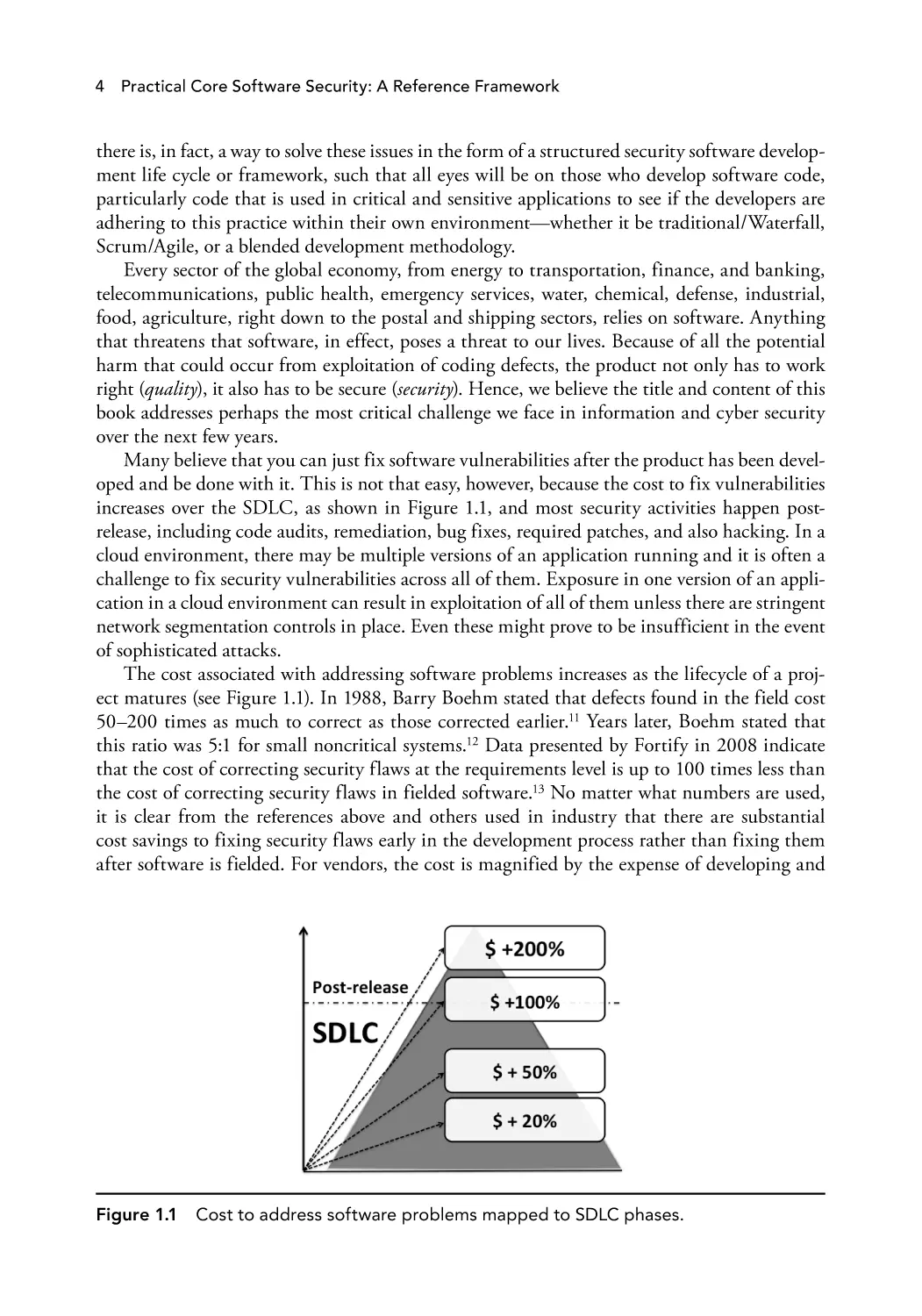
increases over the SDLC, as shown in Figure 1.1, and most security activities happen postrelease, including code audits, remediation, bug fixes, required patches, and also hacking. In a
cloud environment, there may be multiple versions of an application running and it is often a
challenge to fix security vulnerabilities across all of them. Exposure in one version of an appli
cation in a cloud environment can result in exploitation of all of them unless there are stringent
network segmentation controls in place. Even these might prove to be insufficient in the event
of sophisticated attacks.
The cost associated with addressing software problems increases as the lifecycle of a proj
ect matures (see Figure 1.1). In 1988, Barry Boehm stated that defects found in the field cost
50–200 times as much to correct as those corrected earlier.11 Years later, Boehm stated that
this ratio was 5:1 for small noncritical systems.12 Data presented by Fortify in 2008 indicate
that the cost of correcting security flaws at the requirements level is up to 100 times less than
the cost of correcting security flaws in fielded software.13 No matter what numbers are used,
it is clear from the references above and others used in industry that there are substantial
cost savings to fixing security flaws early in the development process rather than fixing them
after software is fielded. For vendors, the cost is magnified by the expense of developing and
Figure 1.1 Cost to address software problems mapped to SDLC phases.
Introduction
5
patching vulnerable software after release and can be a costly way of securing applications.
Furthermore, patches are not always applied by owners/users of the vulnerable software; and
patches can contain yet more vulnerabilities.14 We have seen patches that fix one security prob
lem but open (or re-open) other security issues. Companies are not always able to give each
patch (fix) the attention it deserves, or it may not go through the regular software development
life cycle, resulting in more security problems than the patch/fix is designed to mitigate.
For a number of years, the information security industry has focused on network and
application security, assuming that software is secure and their security controls are all that
is needed, instead of actually protecting organizations against software security failures. As
we review the security development lifecycle and its associated best practices in this book, it
should be clear that the network and application should come later in a comprehensive and
layered defense-in-depth security program, and that software security should be considered the
first step in the information security lifecycle, not the last. In a nutshell, network and applica
tion security programs are more about compensating controls, but it is only through addressing
security at the source that we can really address problems.
1.2 Software Security and the Software Development Life Cycle
One significant area of confusion in the security industry over the years has been a misunder
standing of the difference between software security and application security. Gary McGraw
has provided an excellent description of the difference between the two:
On one hand, software security is about building secure software: designing software to
be secure; making sure that software is secure; and educating software developers, archi
tects, and users about how to build security in. On the other hand, application security
is about protecting software and the systems that software runs in a post-facto, only after
development is complete.15
Software security has come a long way since first attacks on a reasonably large scale started
to materialize toward the end of the 1980s. Software back then was written without much
thought for security (e.g., UNIX code, TCP/IP stack). After the advent of Microsoft Windows®
and then the Web, attacks started increasing in sophistication and frequency, and thus it became
necessary to look at software security. Industry started to look for short-term fixes through
various “add-ons.” These resulted in anti-virus, firewalls, anti-spyware, and so on. However,
the real issue—how code was being developed and written—was not addressed. This started to
change only in the last decade when SDL practices started to be taken seriously. Many enter
prises impacted by software security defects (e.g., Microsoft) started to look seriously at how to
build security in software code by improving software development practices. This resulted in
recommended SDL practices from academia and software giants such as Microsoft. We now
had the theory and guidelines on how to build security into the code from the start and thus
lessen the possibility of software loopholes that could be exploited by attackers.
Confidentiality, integrity, and availability are the three primary goals that the industry
considers to be of the utmost importance in any secure software development process. What
the developers do to protect, enforce, and ensure these primary goals will equate to the “justifi
ably high confidence” part of the secure code definition. A developer can write very efficient
6
Practical Core Software Security: A Reference Framework
code that is easy to maintain and reusable; however, if that code allows an unauthorized user
to access the application’s assets, then that code is either exposed or it is not, and there is no
second chance for getting it right.
SDLs should not be confused with the standard software development life cycle. SDL
methodology, as the name suggests, is really aimed at developing secure software, not neces
sarily quality software. As defined in the IT Law Wiki, the “Security Development Lifecycle
is a software development process used to reduce software maintenance costs and increase
reliability of software concerning software security related bugs.”16 In January 2002, many
Microsoft software development groups prompted “security pushes” to find ways to improve
existing security code. Under this directive, the Trustworthy Computing (TwC) team formed
the concepts that led to the Microsoft Security Development Lifecycle. Established as a man
datory policy in 2004, the Microsoft SDL was designed as an integral part of the software
development process at Microsoft.17 The term SDL has been used by others since then—both
for representing the Microsoft process and as a generic term for the process defined in the IT
Law Wiki link above. Our use of the term SDL throughout this book will be to represent a
secure development process composed of software security best practices based on comparative
research on Microsoft’s SDL and alternative models developed since 2004; the authors’ experi
ence and research into what does and does not work in most current development organiza
tions; and the business realities of today’s development austerity requirements coupled with the
increasing demands for securing code at the source with relevant, cost-effective, and realistic
software security practices.
The goals of SDL are twofold: The first goal is to reduce the number of security vulner
abilities and privacy problems; the second goal is to reduce the severity of the vulnerabili
ties that remain. There are industry standards that define what needs to be done in software
development, such as ISO®/IEEE™, which define the primary phases of a traditional software
development approach to software engineering. The elements of an SDL are typically very
adaptive and are incorporated into the standard development life cycle for an organization.
Static analysis and threat modeling are among the tools used to develop secure code. Static
analysis tools use a technique called “Taint Analysis” to look for unfiltered or unsanitized
inputs (the scourge of software security) in application code. The greatest promise of static
analysis tools derives from their ability to identify many common coding defects related to
poor software development hygiene. Unfortunately, implementation bugs created by devel
oper errors are often only part of the problem. Static analysis tools cannot evaluate design and
architectural flaws. They cannot identify poorly designed cryptographic libraries or improp
erly selected algorithms, and they cannot point out design problems that might cause confu
sion between authentication and authorization. They also cannot identify passwords or magic
numbers embedded in code. Static analysis tools can, however, peer into more of a program’s
dark corners with less fuss than dynamic analysis, which requires actually running the code.
Static analysis also has the potential to be applied before a program reaches a level of comple
tion at which testing can be meaningfully performed. The earlier security risks are identified
and managed in the software development life cycle, the better!
Although these SDL practices have been good in theory, when applied to enterprises,
results have been mixed. There are multiple reasons for this. Legacy code still forms a large
codebase of our software industry, so going back in time and applying these practices is very
difficult. Software outsourcing or off-shoring is another area where these practices are difficult
Introduction
7
to implement efficiently. Software developers and companies often work under tight deadlines
to put a product out before competition, and thus software security has typically taken a back
seat. There is a lack of management commitment to effectively implement SDL practices in
such a fast-moving environment in which software security is often done as an afterthought.
Even though some security practices are common to both software and application secu
rity, such as penetration testing, source code scanning, security-oriented testing, and security
education, there is no substitute for integrating security into the software development life
cycle. The human element of the process is key to the success of any security development
process and requires very seasoned software security architects and engineers to be successful.
Threat modeling, applying principles such as least privilege and defense in depth, is perhaps the
most understood, important, and needed element of the software development life cycle and
requires human expertise and not tools to accomplish. One must also gather the real security
requirements for a system and consider compliance, safety issues, contractual requirements,
what data the application will process, and business risk.
Training is another critical element of the SDL that requires the human element. Training
helps to reduce the cost of security, and an effective training program will motivate your
development team to produce more secure software, with fewer problems and with more effi
ciency and cost effectiveness. It should be emphasized that no point solutions will provide a
single solution for software security; rather, a holistic defense-in-depth approach is required,
including a blend of people, process, and technology with a heavy emphasis on people. Although
tools can parse through large quantities of code rapidly, faster than a human could, they are
no replacement for humans. For the foreseeable future, software security will still be consid
ered an art, but the art can be augmented through process and technology, and contrary to
myths perpetrated by some practitioners, the art can be taught through proper mentorship by
seasoned software security architects and engineers. These are the team members who have the
experience, can think like an adversary, and do it throughout the development process, which
is a key element for the success of any SDL. Some authors differentiate between secure-coding
best practices and secure-design principles; we will address both in the software security best
practices presented in this book and leverage the experience of the seasoned architects and
engineers identified above to accomplish this.
Software security requires a focused effort to be successful and is not a natural outcome of
conventional software development processes, even from development groups that have good
traditional “quality” practices. Software security, however, should be a key of a mature quality
program. As we will explain in this book, secure code does not necessarily mean quality code,
and quality code does not necessarily mean secure code, but the foundation of software appli
cations and the development processes that produce them should be based on common best
practices of both quality code and secure code.
1.3 Quality Versus Secure Code
The foundation of software applications, and the development processes that produce them,
is based on the common best principles of quality code and secure code. These principles are
the driving force behind the concepts and design of industry best practices. To produce secure
code that will stand the test of time, you must learn how to incorporate these principles into
8
Practical Core Software Security: A Reference Framework
the development process. Remember that secure code is not necessarily quality code, and qual
ity code is not necessarily secure code.18
Secure code does not mean quality code: You must know how to write quality code before
you can write secure code. A developer can write very secure code that authorizes and authen
ticates every user transaction, logs the transaction, and denies all unauthorized requests; how
ever, if the code does not return expected results, then even this very secure code may never
see the light of day. Software quality characteristics are not the same as security. Quality is not
measured in terms of confidentiality, integrity, and availability, but rather in terms of ease of
use and whether it is reusable and maintainable.19
Quality code does not mean secure code: A developer can write efficient code that is easy to
maintain and reusable, but if that code allows an unauthorized user to access the application’s
assets, then the code is of no use. Unlike software quality, software security is not subjective.
Sensitive information is either exposed or it is not, and there is no second chance to get it right.
Ultimately, quality, security, and maintainability are the three primary goals the industry con
siders to be of the upmost importance in any secure software development process.20
You cannot have quality without security or security without quality. These two attributes
complement each other, and both enhance overall software product integrity and market value.
Good developers should be able to identify what quality factors are in software and how to
code them. Likewise, good developers should know how the software they develop can be
attacked and what the weakest areas are in the software; if the code allows an unauthorized
user to access the application’s assets, then that code is either exposed or it’s not, and there is
no second chance to get it right.21
1.4 The Three Most Important SDL Security Goals
Any competent developer can write very efficient code that is maintainable and easy to reuse;
however, if the code allows an unauthorized user to access the application’s assets, then that
code is not secure. Unfortunately, security is still an area that is often either overlooked or
minimally applied during the software development life cycle. There are three minimum goals
that that the information security industry considers of primary importance for an SDL:
1. Confidentiality
2. Integrity
3. Availability
These three goals are generally referred to collectively by the acronym C.I.A. It is generally
accepted that if the developers ensure, enforce, and protect C.I.A. throughout the software
development life cycle through generally accepted practices, this will justify high confidence
that the code is secure.
Information security, confidentiality, integrity, and availability are defined as follows in 44
U.S.C., Sec. 3542:
Information security: The protection of information and information systems from
unauthorized access, use, disclosure, disruption, modification, or destruction in order to
provide confidentiality, integrity, and availability.
Introduction
9
Confidentiality: Preserving authorized restrictions on information access and disclosure,
including means for protecting personal privacy and proprietary information.
Integrity: Guarding against improper information modification or destruction, and
includes ensuring information non-repudiation and authenticity.
Availability: Ensuring timely and reliable access to and use of information.22
Confidentiality, availability and integrity combined provide information security.
Confidentiality is achieved by keeping unauthorized users (human or software) from
accessing confidential information. By maintaining confidentiality, the software will be con
sidered trustworthy. Authorization and authentication are the two properties that support
confidentiality in that authorization ensures that the user has the appropriate role and privilege
to view data, and authentication ensures that the user is who he or she claims to be and that the
data come from the appropriate place. The integrity of the application is defined by the way
in which the application accepts, transmits, and stores data. The data must remain unchanged
by unauthorized users and remain very reliable from the data entry point all the way to the
database and back. Data encryption, digital signatures, and public keys are just some examples
of how to maintain integrity and confidentiality. Excluding any scheduled downtimes, avail
ability refers to the percentage of time a system or software is available during its normally
scheduled hours of operations. As key components of software security, the lack of confidenti
ality, availability, and integrity will degrade the reputation of the product, resulting in both loss
of reputation and loss of sales. In the end, software security is as much about a good business
process as it is about quality.
1.5 Threat Modeling and Attack Surface Validation
Threat modeling and attack surface validation are perhaps the most time-consuming, misun
derstood, and difficult parts of the SDL. They require the attention of the most seasoned and
experienced person of the software security team: the software security architect. The idea
behind threat modeling is simply to understand the potential security threats to the system,
determine risk, and establish appropriate mitigations (What? How bad is it? How can it be
fixed?). When it is performed correctly, threat modeling occurs early in the project lifecycle
and can be used to find security design issues before code is committed. This can lead to
significant cost savings because issues are resolved early in the development life cycle. Threat
modeling also helps businesses manage software risk, creates awareness of security dependen
cies and assumptions, and provides the ability to translate technical risk into business impact.
The bottom line is that the earlier security risks are identified and managed in the software
life cycle, the better.
The correct way of doing threat modeling requires getting into the mind of the hacker, and
this takes a special breed of software security professional: one who can think like a hacker and
imagine all the ways that an adversary could attack or exploit the software. It is thus a slightly
different way to test applications. Although quality assurance professionals can do security test
ing and can typically discover some vulnerabilities, they usually have the customers’ thoughts
in mind rather than those of the hacker. In many cases, companies do not have this talent
internally and have to hire third-party contractors to do this work.
10
Practical Core Software Security: A Reference Framework
A U.S. Data and Analysis Center for Software (DACS) October 2008 report, “Enhancing
the Development Lifecycle to Produce Secure Software: A Reference Guidebook on Software
Assurance,” defines a threat to a software-intensive system as “any actor, agent, circumstance,
or event that has the potential to cause harm to that system or to the data or resources to which
the system has or enables access.”23 A threat can be categorized based on its intentionality. For
example, a threat can be unintentional, intentional but non-malicious, or malicious; a mali
cious threat is assumed to be intentional. Although threats in all three categories have the
potential to compromise the security of software, only malicious threats are realized by attacks.
The DACS report also states:
The majority of attacks against software take advantage of, or exploit, some vulnerability
or weakness in that software; for this reason, “attack” is often used interchangeably with
“exploit,” though the Build Security In Attack Pattern Glossary makes a clear distinction
between the two terms, with attack referring to the action against the targeted software
and exploit referring to the mechanism (e.g., a technique or malicious code) by which
that action is carried out.
Modeling software is a way to envision the interactions of the proposed software within
its intended environment. The better the model reflects the intended environment, the more
useful the modeling approach becomes. Therefore, secure software design and development
benefits from modeling that explicitly incorporates security threats. As described in the DACS
2007 Software Security Assurance State-of-the-Art Report (SOAR), “[T]he primary issues
in modeling are doing it well; doing it thoroughly enough; and knowing what to do with
the results (e.g., how to transform the analysis into a metric and/or otherwise usable decision
point.” Combining the concepts of threats and modeling, the report defines threat modeling as
“a methodical approach for assessing and documenting the weaknesses of security risks associ
ated with an application. It allows a development team to identify the highest risk components
by approaching security from the perspective of an adversary who has specific goals in attack
ing an application.”24
Given the normal constraints of time and resources, it is not possible to test all code in an
application. However, at a minimum, testing should cover the entry points and exit points of
an application that may be accessible to an attacker, commonly referred to as the application’s
attack surface. Accessibility increases the attack surface. For example, code that is restricted
to local access by an administrator has a smaller attack surface than code exposed to remote
access by an anonymous user.
The attack surface should be fully tested by exercising all the code paths in an application
that are part of the attack surface. The elements of the attack surface can be identified with
the use of scanning tools, such as port scanning tools for open ports, and code analysis tools to
locate the portions of the code that receive input and send output. It may even be necessary to
develop custom tools, for example, to locate entry points specific to a custom application. The
minimum attack surface is typically defined early in the software development life cycle and
measured again through the later phases. It is often helpful to formally define and measure the
attack surface before testing. As we will discuss later in the book, although tools will be useful
at this stage of analysis, a human element is still required, and it will take the expertise of the
seasoned software security architect described above.
Introduction
11
1.6 Summary
Software is only as secure as the quality and relevance of the best practices that the software
development team uses. Software security must be built in from the very start. It must be a
critical part of the design from the very beginning and included in every subsequent develop
ment phase all the way through fielding a complete system. Correcting vulnerabilities as early
as possible in the SDLC through the adoption of security-enhanced processes and practices is
far more cost effective than attempting to diagnose and correct such problems after the system
goes into production. This will greatly reduce the need to patch the software to fix security
holes discovered by others after release of the product, which will degrade the reputation and
credibility of the vendor and adversely impact it financially. Today, we are seeing an increased
need for security in software development in that security requirements, design, and defensive
principles have to be worked into the traditional SDLC and, most important, in choosing secu
rity development practices that embrace this need throughout all the activities of the SDLC.
We have worked with Fortune 500 companies and have often seen examples of breakdowns
in SDL practices. In this book, we take an experience-based approach to applying components
of the best available SDLs models in dealing with the problems described above in the form
of an SDL software security best practices model and framework. We shall begin by giving an
overview of the security development lifecycle and then outline a model for mapping SDL best
practices to the software development life cycle and how you can use this to build a mature
SDL program. Although security is not a natural component of the way industry has been
building software in recent years, we believe that security improvements to development pro
cesses are possible, practical, and essential, and we trust that the software security best practices
and model presented in this book will make this clear to all who read this book, whether you
are an executive, manager, or practitioner.
Chapter Quick-Check
1. The costs to remediate security flaws once a software product is released can run as
much as ____ times the costs to remediate them while still in development:
a. 50
b. 100
c. 500
d. 1500
2. Defective software is:
a. A network security problem
b. An operating system security problem
c. A user-caused problem
d. A software development and engineering problem
3. The three goals of the security development lifecycle are:
a. Reliability, efficiency, and maintainability
b. Speed, quality, and continuous releases
12
Practical Core Software Security: A Reference Framework
c. Confidentiality, integrity, and availability
d. Availability, reliability, and portability
4. Threat modeling and attack surface analysis is most effective when it’s conducted:
a. Post-release
b. During product inception/product backlog development
c. During integration testing phase(s)
d. Prior to code development/commitment
Exercises
1. Visit the Significant Cyber Incidents site at the Center for Strategic and International
Studies for a timeline of significant cyber incidents since 2006. As you read through
these attacks, consider how a security development lifecycle and secure development
practices could have prevented these attacks or mitigated the damage from them. Are
there any specific types of attacks that require an intervention or change to the SDL?
How would you prioritize those changes?
2. The migration of applications, infrastructure, platforms, and administration to cloud
computing has forced a myriad of changes across IT departments. How does this migra
tion affect software planning, development, testing, and implementation from the secu
rity perspective? What needs to be preserved? What needs to be reimagined?
3. Education and awareness of software security are cornerstones for an effective program
since development teams are responsible for securing all the code they produce. How
would you convince IT development management that their teams need to be properly
prepared for their security responsibilities?
References
1. President’s Information Technology Advisory Committee. (2005). “Cybersecurity: A Crisis of
Prioritization,” Executive Office of the President, National Coordination Office for Information
Technology Research and Development, 2005, p. 39. Retrieved from https://www.nitrd.gov/pubs
/pitac/pitac_report_cybersecurity_2005.pdf
2. Ibid.
3. Aras, O., Ciaramitaro, B., and Livermore, J. (2008). “Secure Software Development—The Role
of IT Audit.” ISACA Journal, vol. 4, 2008, pp. 45–48. Retrieved from https://www.isaca.org
/resources/isaca-journal/past-issues
4. U.S. Department of Homeland Security. (2006). “Security in the Software Lifecycle: Making Software
Development Processes—and Software Produced by Them—More Secure,” DRAFT Version 1.2,
p. 13. Retrieved from https://resources.sei.cmu.edu/asset_files/WhitePaper/2006_019_001_52113.pdf
5. Schwartz, M. (2012). “10 Security Trends to Watch in 2012.” Retrieved from https://www.dark
reading.com/vulnerabilities-threats/10-security-trends-to-watch-in-2012
6. Parizo, E. (2012). “To Get Help with Secure Software Development Issues, Find Your Own
Flaws.” Retrieved from http://searchsecurity.techtarget.com/news/2240129160/To-get-help-with
-secure-software-development-issues-find-your-own-flaw
7. Taft, D. (2012). “Microsoft Holds Security Development Conference.” Retrieved from https://www
.eweek.com/security/microsoft-holds-security-development-conference/
Introduction
13
8. blackhat.com. (2013). Black Hat USA 2012 Conference webpage, July 21–26, 2012, Las Vegas,
NV. Retrieved from http://www.blackhat.com/html/bh-us-12
9. The OWASP Foundation. (2013). “Approaching Secure Code. Where do I start?” RSA 2013.
Retrieved from https://owasp.org/www-pdf-archive/MASTER-RSA2013-v3.pdf
10. Microsoft Corporation. (2012). Registration Open for 2013 Security Development Conference:
Calling All IT Security Professionals. Retrieved from https://news.microsoft.com/2012/12/18
/registration-open-for-2013-security-development-conference-calling-all-it-security-professionals/
11. Boehm, B., and Papaccio, P. (1998). “Understanding and Controlling Software Costs.” IEEE
Transactions on Software Engineering, vol. 14, no. 10, October 1988, pp. 1462–1477.
12. Beohm, B., and Basili, V. (2001). “Software Defect Reduction Top 10 List.” Computer, vol. 34,
no. 1, January 2001, pp. 135–137.
13. Meftah, B. (2008). “Business Software Assurance: Identifying and Reducing Software Risk in the
Enterprise,” 9th Semi-Annual Software Assurance Forum, Gaithersburg, MD, October 2008.
https://buildsecurityin.us-cert.gov/swa/downloads/Meftah.pdf
14. Viega, J., and McGraw, G. (2006). Building Secure Software: How to Avoid Security Problems the
Right Way. Boston, MA: Addison-Wesley.
15. McGraw, G. (2006). Software Security: Building Security In, p. 20. Boston, MA: Addison-Wesley.
16. IT Law Wiki. (2012). “Security Development Lifecycle Definition.” Retrieved from http://itlaw
.wikia.com/wiki/Security_Development_Lifecycle
17. Microsoft Corporation. (2021). “About the Microsoft SDL.” Retrieved from https://www.microsoft
.com/en-us/securityengineering/sdl/about#:~:text=The%20Microsoft%20Security%20Develop
ment%20Lifecycle%20%28SDL%29%20was%20an,the%20software%20development%20
process%20at%20Microsoft%20in%202004
18. Grembi, J. (2008). Secure Software Development: A Security Programmer’s Guide. Boston, MA:
Course Technology.
19. Ibid.
20. Ibid.
21. Ibid.
22. United States Government. (2006). “44 U.S.C., SEC. 3542: United States Code, 2006 Edition,”
Supplement 5, Title 44; CHAPTER 35 – COORDINATION OF FEDERAL INFORMATION
POLICY, SUBCHAPTER III – INFORMATION SECURITY, Sec. 3542 – Definitions. Retrieved
from http://www.gpo.gov/fdsys/pkg/USCODE-2011-title44/pdf/USCODE-2011-title44-chap35
-subchapIII-sec3542.pdf
23. Goertzel, K., et al., for Department of Homeland Security and Department of Defense Data and
Analysis Center for Software. (2008). “Enhancing the Development Life Cycle to Produce Secure
Software: A Reference Guidebook on Software Assurance,” Version 2, October 2008. Retrieved from
https://www.academia.edu/1383839/Enhancing_the_Development_Life_Cycle_to_Produce
_Secure_Software_A_Reference_Guidebook_on_Software_Assurance
24. Goertzel, K., et al. (2007). “Software Security Assurance: State-of-the-Art Report (SOAR),” July
2007. Retrieved from https://www.researchgate.net/publication/279351339_Software_Security
_Assurance_A_State-of-Art_Report_SAR
Chapter 2
The Security Development
Lifecycle
CHAPTER OVERVIEW
We start this chapter by introducing the concept of overcoming the challenges of making
software secure using a security development lifecycle (SDL). There will be further discussions
of the models, methodologies, tools, human talent, and metrics for managing and overcoming
these challenges. We will close with a discussion of the mapping of our SDL with its associated
best practices to a generic software development life cycle (SDLC), which will be the subject of
the next six chapters, followed by a chapter mapping our SDL best practices to several of the
most popular software development methodologies.
There is still a need for better static and dynamic testing tools and a formalized security
methodology integrated into SDLCs that is within the reach of a majority of software develop
ment organizations. In the past decade or so, the predominant SDL models have been out of
reach for all but the most resource-rich companies. Our goal in this book is to create an SDL
based on leveraged minimal resources and best practices rather than requiring resources that
are out of reach for a majority of software security teams.
CHAPTER TAKE-AWAYS
• Explain the underlying challenges in creating secure software as they exist in processes,
talent, and technology.
• Distinguish between the industry maturity models used for measuring the progress of
software security programs and the metrics needed for measuring progress.
• Compare and contrast various industry standards, guidance, and best practices for secure
software development programs.
15
16
Practical Core Software Security: A Reference Framework
• Understand the need for specialized development team roles that enable secure software
development success.
• Explore the various implementations of software development life cycles and methodolo
gies, along with the steps needed to convert them into a security development lifecycle.
2.1 Overcoming Challenges in Making Software Secure
As mentioned in Chapter 1, SDLs are the key step in the evolution of software security and
have helped to bring attention to the need to build security into the software development
life cycle. In the past, software product stakeholders did not view software security as a high
priority. It was believed that a secure network infrastructure would provide the level of pro
tection needed against malicious attacks. In recent history, however, network security alone
has proved inadequate against such attacks. Users have been successful in penetrating valid
channels of authentication through techniques such as Cross-Site Scripting (XSS), Structured
Query Language (SQL) injection, and buffer overflow exploitation. In such cases system assets
were compromised and both data and organizational integrity were damaged. The security
industry has tried to solve software security problems through stopgap measures. First came
platform security (OS security), then came network/perimeter security, and now application
security. We do need defense-in-depth to protect our assets, but fundamentally it is a software
security flaw and needs to be remediated through an SDL approach.
The SDL has as its base components all of the activities and security controls needed to
develop industry and government-compliant and best practices–hardened software. A knowl
edgeable staff as well as secure software policies and controls are required in order to truly
prevent, identify, and mitigate exploitable vulnerabilities within developed systems.
Not meeting the least of the activities found within the SDL provides an opportunity for
misuse of system assets from both insider and outsider threats. Security is not simply a net
work requirement, it is now an information technology (IT) requirement, which includes the
development of all software for the intent to distribute, store, and manipulate information.
Organizations must implement the highest standards of development in order to ensure the
highest quality of products for its customers and the lives that they protect.
Implementation of an SDL program ensures that security is inherent in good enterprise
software design and development, not an afterthought included later in production. Taking an
SDL approach yields tangible benefits such as ensuring that all software releases meet mini
mum security criteria, and that all stakeholders support and enforce security guidelines. The
elimination of software risk early in the development cycle, when vulnerabilities are easier and
less expensive to fix, provides a systematic approach for information security teams to collabo
rate with during the development process.
The most well-known SDL model is the Trustworthy Computing Security Development
Lifecycle (or SDL), a process that Microsoft® has adopted for the development of software that
needs to withstand a malicious attack. Microsoft’s SDL1 has been evolving for over a decade
and is considered the most mature of the top three models. Other popular SDL models are
the BSIMM SSDL Touchpoints,2 the OWASP® Code Review Guide,3 and the Cisco® Secure
Development Lifecycle (Cisco SDL).4
The Microsoft SDL also has a Security Development Lifecycle (SDL) Optimization Model5
designed to facilitate gradual, consistent, and cost-effective implementation of the SDL by
The Security Development Lifecycle
17
development organizations outside of Microsoft. The model helps those responsible for inte
grating security and privacy in their organization’s software development life cycle to assess
their current state and to gradually move their organizations toward adoption of the proven
Microsoft program for producing more secure software.
The SDL Optimization Model enables development managers and IT policy makers to
assess the state of the security in development. They can then create a vision and roadmap for
reducing customer risk by creating more secure and reliable software in a cost-effective, consis
tent, and gradual manner. As it moves through the maturity levels of the SDL Optimization
Model, your organization’s executive commitment to the goals and results of SDL will increase
from tentative acceptance to a strong mandate.6
2.2 Software Security Maturity Models
Over the years, two popular software security maturity models have been developed and con
tinue to mature at a rapid rate. One is BSIMM,7 and the other is the OWASP Open SAMM.8
BSIMM is short for Building Security In Maturity Model. The BSIMM is a study of realworld software security initiatives organized so that you can determine where you stand with
your software security initiative and how to evolve your efforts over time. It is a set of best
practices developed by analyzing real-world data from nine leading software security initiatives
and creating a framework based on common areas of success. There are 12 practices organized
into four domains. These practices are used to organize the 122 BSIMM activities.
By studying what the nine initiatives were doing, BSIMM’s creators were able to build a
best practices model that is broken down into 12 categories that software makers can follow:
1.
2.
3.
4.
5.
6.
7.
8.
9.
10.
11.
12.
Strategy and Metrics
Compliance and Policy
Training
Attack Models
Security Features and Design
Standards and Requirements
Architecture Analysis
Code Review
Security Testing
Penetration Testing
Software Environment
Configuration and Vulnerability Management9
The 12th release of BSSIM was published in 2021.10
The OWASP Software Assurance Maturity Model (SAMM™) is a flexible and prescriptive
framework for building security into a software development organization. Covering more
than typical SDLC-based models for security, SAMM enables organizations to self-assess their
security assurance program and then use recommended roadmaps to improve in a way that is
aligned to the specific risks facing the organization. Beyond that, SAMM enables the creation
of scorecards for an organization’s effectiveness at secure software development throughout the
typical governance, development, and deployment business functions. Scorecards also enable
18
Practical Core Software Security: A Reference Framework
management within an organization to demonstrate quantitative improvements through itera
tions of building a security assurance program.11
2.3 ISO/IEC 27034—Information Technology—Security
Techniques—Application Security
In 2011, the International Organization for Standardization (ISO®)/International Electro
technical Commission (IEC®) published Part 1 of 6 of the ISO/IEC 27034-1:2011 standard
for Application Security.12 The standard offers a concise, internationally recognized way to get
transparency into a vendor/supplier’s software security management process. It was designed
to be flexible enough to align with diverse engineering organizations but specific enough to
address real-world risk. It has now been published and is similar to the ISO/IEC 27001 for IT
Security in that both customers and partners will expect compliance. As a standard for soft
ware security from an international body and not a vendor, it is also not tied to specific tech
nology. Parts 2–7 are composed of the following: Part 2, Organization Normative Framework;
Part 3, Application Security Management Process; Part 4, Application Security Validation;
Part 5, Protocols and Application Security Control Data Structure; Part 6, Security Guidance
for Specific Applications; Part 7, Assurance Prediction Framework.13 Over the years, as organi
zations (and their customers) started paying attention to information security, the security and
compliance industry came up with a plethora of attestations, certifications, and methodolo
gies. These standards/attestations all claimed to be unique in the way they would measure the
security posture of an organization. Competition and marketing hype drove confusion, with
different organizations standardizing on different attestations. The authors have seen organiza
tions pushing their customers (in most cases, other companies) to adopt their recommended
attestation. For Fortune 500 companies this meant getting multiple attestations/certifications
as a proof of security posture. It didn’t help that most of these attestations/certifications focused
on “compliance controls” or “policy-based security.” The situation became worse with regula
tions such as SOX, GLBA, Safe Harbor, and HIPAA adding to the confusion. Companies
often went for a set of certifications—one each for compliance, security, privacy, credit card,
physical security, and so on.
The ISO/IEC developed the ISO/IEC 27001 (incorporating ISO/IEC 17799, which had
been the previous de facto ISO standard for information security). It is an information security
management system (ISMS) standard that specifies a management system intended to bring
information security under formal management control. It mandates specific requirements
that need to be met when an organization adopts the standard. The standard addresses infor
mation security holistically and encompasses everything from physical security to compli
ance. Industry has enthusiastically adopted the practices, and ISO/IEC 27001 is the leading
standard for an information security management system (ISMS) today. Most of the controls
from other standards can be mapped back to ISO/IEC 27001. This has enabled organizations
to consolidate multiple security efforts under one standard, pursue a single framework with
holistic security in mind, and collect metrics in a consistent manner to measure and govern
security in an organization.
The authors see the landscape for software security (and SDL) as similar to what it was for
information security as a whole a few years ago, before ISO/IEC 27001 came along. There
are multiple SDL methodologies (open and proprietary), each claiming to be better than the
The Security Development Lifecycle
19
next. Confusion prevails over the best way to accomplish software security in an organization.
Applying any one framework to an organization either requires the organization to adopt dif
ferent processes or to customize an SDL framework that will work in their environment. With
the coming of ISO/IEC 27034, the authors see consolidation on a software security standards/
framework as the ISO/IEC 27001 has done for information security. Even in its infancy, there
is awareness of the importance of ISO/IEC 27034. Microsoft declared its SDL methodology to
be in conformance with ISO/IEC 27034-1 shortly after its release.14 We expect to see similar
results for other frameworks in the near future.
The ISO/IEC 27034 standard provides guidance to help organizations embed security
within their processes that help secure applications running in the environment, including
application life cycle processes. It is a risk-based framework to continuously improve secu
rity through process integrating/improvements in managing applications. It takes a process
approach by design.
The authors’ recommended SDL framework can be mapped to ISO/IEC 27034 frame
works. We will lay out relevant mapping with ISO/IEC 27034 in Chapter 9.
2.4 Other Resources for SDL Best Practices
There are other sources for SDL best practices, and some of the most popular are described below.
2.4.1 SAFECode
The Software Assurance Forum for Excellence in Code (SAFECode) is a nonprofit organiza
tion dedicated to increasing trust in information and communications technology products
and services through the advancement of effective software assurance methods. SAFECode is a
global, industry-led effort to identify and promote best practices for developing and delivering
more secure and reliable software, hardware, and services. It is meant to provide a foundational
set of secure development practices that have been effective in improving software security in
real-world implementations by SAFECode members across their diverse development envi
ronments. These are the “practiced practices” employed by SAFECode members, which we
identified through an ongoing analysis of members’ individual software security efforts. By
bringing these methods together and sharing them with the larger community, SAFECode
hopes to move the industry beyond defining theoretical best practices to describing sets of
software engineering practices that have been shown to improve the security of software and
are currently in use at leading software companies.15,16
2.4.2 U.S. Department of Homeland Security
Software Assurance Program
Since 2004, the U.S. Department of Homeland Security (DHS) Software Assurance Program
has been involved in the development and management of the Build Security In (BSI) website,
along with the CERT® Division of the Software Engineering Institute (SEI) at Carnegie Mellon
University.17 BSI content is based on the principle that software security is fundamentally a
software engineering problem and must be managed in a systematic way throughout the SDLC.
20
Practical Core Software Security: A Reference Framework
The Department of Homeland Security Software Assurance (SwA) Program seeks to
reduce software vulnerabilities, minimize exploitation, and address ways to improve the rou
tine development and deployment of trustworthy software products. Consistent with the Open
Government Directive, the program enables public–private collaboration in developing, pub
lishing, and promoting the use of practical guidance and tools, fostering investment in more
secure and reliable software. The DHS Software Assurance Program collaborates with the
private sector, academia, and other federal departments and agencies to enhance the security of
software life cycle processes and technologies through activities such as the Software Assurance
Forum that it co-sponsors with the Department of Defense (DoD) and the National Institute
of Standards and Technology (NIST). A key initiative funded by the DHS and the National
Security Agency (NSA) is the Common Weakness Enumeration (CWE™). CWE is a joint
effort of the DHS with the NSA and the software community, including the government, the
private sector, and academia, with the MITRE Corporation providing technical leadership
and project coordination. Over 800 software weaknesses have been identified and cataloged.
More than 62 security products and services already use CWE in a compatible manner. With
the aim of reducing the most significant exploitable programming errors, the SANS Institute,
an active participant in the Software Assurance Forum, has promoted the Top 25 CWEs.
SANS came up with the idea of focusing on the Top 25 CWEs, and this effort represents a
community collaboration to prioritize the most exploitable constructs that make software vul
nerable to attack or failure.18 This promotes the DHS co-sponsored CWE efforts and plays off
the “Top XXX” brand that SANS has built since 2001, starting with their Top 10—the first
prioritized list of security problems that organizations should address.
The CWE is an important component of the DHS’s Software Assurance Program. This list
of errors brings CWE to a practical, actionable, and measurable focus that will enable people to
make and demonstrate real progress. Public–private collaboration forms the foundation of the
DHS SwA Program. CWE is a good example of the type of public–private collaboration the
department has been advocating. Consistent with the Open Government Directive, the SwA
Program’s sponsorship of CWE enables community participation, collaboration, and transpar
ency. CWE provides the requisite characterization of exploitable software constructs; thus, it
better enables the needed education and training of programmers on how to eliminate all-too
common errors before software is delivered and put into operation. This aligns with the Build
Security In approach to software assurance so that software is developed more securely on the
front end, thereby avoiding security issues in the longer term. The CWE provides a standard
means for understanding residual risks and thus enables more informed decision making by
suppliers and consumers concerning the security of software.19
2.4.3 National Institute of Standards and Technology
The National Institute of Standards and Technology (NIST) continues to be of great value in
providing research, information, and tools for both the government and corporate information
security community. The following are some of the key areas in which NIST contributes to the
software security community.
The NIST Software Assurance Metrics And Tool Evaluation (SAMATE) project is
dedicated to improving software assurance by developing methods to enable software tool
The Security Development Lifecycle 21
evaluations, measuring the effectiveness of tools and techniques, and identifying gaps in
tools and methods. This project supports the Department of Homeland Security’s Software
Assurance Tools and R&D Requirements Identification Program—in particular, Part 3,
Technology (Tools and Requirements): the identification, enhancement, and development of
software assurance tools. The scope of the SAMATE project is broad, ranging from operating
systems to firewalls, SCADA to web applications, source code security analyzers to correct-by
construction methods.20
NIST Special Publication (SP) 800-64, “Security Considerations in the System Development
Life Cycle,” has been developed to assist federal government agencies in integrating essential
information technology security steps into their established IT system development life cycle.
This guideline applies to all federal IT systems other than national security systems. The docu
ment is intended as a reference resource rather than as a tutorial and should be used in con
junction with other NIST publications as needed throughout the development of the system.21
The National Vulnerability Database (NVD) is the U.S. government repository of
standards-based vulnerability management data represented using the Security Content
Automation Protocol (SCAP). These data enable automation of vulnerability management,
security measurement, and compliance. The NVD includes databases of security checklists,
security-related software flaws, misconfigurations, product names, and impact metrics.22 The
NVD Common Vulnerability Scoring System (CVSS) provides an open framework for com
municating the risk characteristics and impacts of IT vulnerabilities. Its quantitative model
ensures repeatable accurate measurement while enabling users to see the underlying vulnerabil
ity characteristics that were used to generate the scores. Thus, the CVSS is well suited as a stan
dard measurement system for industries, organizations, and governments that need accurate
and consistent vulnerability impact scores. Two common uses of the CVSS are in prioritizing
vulnerability remediation activities and in calculating the severity of vulnerabilities discovered
on one’s systems. The NVD provides CVSS scores for almost all known vulnerabilities. In par
ticular, the NVD supports the CVSS Version 2 standard for all CVE vulnerabilities. The NVD
provides CVSS “base scores” which represent the innate characteristics of every vulnerability. It
does not currently provide “temporal scores” (scores that change over time due to events exter
nal to the vulnerability). However, the NVD does provide a CVSS score calculator to allow you
to add temporal data and even to calculate environmental scores (scores customized to reflect
the impact of the vulnerability on your organization). This calculator contains support for U.S.
government agencies to customize vulnerability impact scores based on FIPS 199 system rat
ings. We will discuss the use of CVSS scores for managing software security later in the book.23
2.4.4 Common Computer Vulnerabilities and Exposures
The Common Computer Vulnerabilities and Exposures (CVE®) is a list of information secu
rity vulnerabilities and exposures that aims to provide common names for publicly known
problems. The goal of CVE is to make it easier to share data across separate vulnerability capa
bilities (tools, repositories, and services) with this “common enumeration.” Information secu
rity vulnerability is a mistake in software that can be used directly by a hacker to gain access to
a system or network. See the Terminology page of the CVE website for a complete explanation
of how this term is used in the CVE. An information security exposure is a mistake in software
22
Practical Core Software Security: A Reference Framework
that allows access to information or capabilities that can be used by a hacker as a stepping-stone
into a system or network. Using a common identifier makes it easier to share data across sepa
rate databases, tools, and services, which, until the creation of CVE in 1999, were not easily
integrated. If a report from a security capability incorporates CVE Identifiers, you may then
quickly and accurately access fix information in one or more separate CVE-compatible tools,
services, and repositories to remediate the problem. With CVE, your tools and services can
“speak” (i.e., exchange data) with each other. You will know exactly what each covers because
CVE provides you with a baseline for evaluating the coverage of your tools. This means that
you can determine which tools are most effective and appropriate for your organization’s needs.
In short, CVE-compatible tools, services, and databases will give you better coverage, easier
interoperability, and enhanced security.
Bugtraq® IDs are identifiers for a commercially operated vulnerability database that are
used in security advisories and alerts, as well as for discussions on the Bugtraq mailing list.
CVE Identifiers are from an international information security effort that is publicly available
and free to use. CVE Identifiers are used for the sole purpose of providing a common name.
For this reason, CVE Identifiers are frequently used by researchers and the makers of security
tools, websites, databases, and services as a standard method for identifying vulnerabilities
and for cross-linking with other repositories that also use CVE Identifiers. A CVE Identifier
will give you a standardized identifier for any given vulnerability or exposure. Knowing this
identifier will allow you to quickly and accurately access information about the problem across
multiple information sources that are CVE-compatible. For example, if you own a security tool
whose reports contain references to CVE Identifiers, you may then access fix information in a
separate CVE-compatible database. CVE also provides you with a baseline for evaluating the
coverage of your tools.
The CVE list feeds the U.S. National Vulnerability Database (NVD), which then builds
upon the information included in CVE entries to provide enhanced information for each
CVE Identifier such as fix information, severity scores, and impact ratings. NVD also pro
vides advanced searching features such as by individual CVE-ID; by OS; by vendor name,
product name, and/or version number; and by vulnerability type, severity, related exploit
range, and impact.
CVE is sponsored by the U.S. Department of Homeland Security. US-CERT is the opera
tional arm of the DHS. US-CERT incorporates CVE Identifiers into its security advisories
whenever possible and advocates the use of CVE and CVE-compatible products and services
by the U.S. government and all members of the information security community. The MITRE
Corporation maintains CVE and this public website, manages the compatibility program, and
provides impartial technical guidance to the CVE Editorial Board throughout the process to
ensure that CVE serves the public interest.24,25
2.4.5 SANS Institute Top Cyber Security Risks
The SANS Top Cyber Security Risks, formerly the SANS Twenty Most Critical Internet
Security Vulnerabilities, is a consensus list of the most critical problem areas in Internet secu
rity that require immediate remediation if present on your systems. Step-by-step instructions
and pointers to additional information useful for correcting these security flaws are included as
part of the list. The SANS list includes CVE Identifiers to uniquely identify the vulnerabilities
The Security Development Lifecycle
23
it describes. This helps system administrators use CVE-compatible products and services to
make their networks more secure.26–28
2.4.6 U.S. Department of Defense Cyber Security and
Information Systems Information Analysis Center (CSIAC)
In September 2012, the Data & Analysis Center for Software (DACS), Information Assurance
Technology Analysis Center (IATAC), and Modeling and Simulation Information Analysis
Center (MSIAC) were merged to create the Cyber Security and Information Systems
Information Analysis Center (CSIAC). The CSIAC, one of eight Information Analysis Centers
(IACs) sponsored by DTIC, performs the Basic Center of Operations (BCO) functions neces
sary to fulfill the mission and objectives applicable to the Department of Defense Research
Development Test and Evaluation (RDT&E) and Acquisition communities’ needs for cyber
security, information assurance, knowledge management and information sharing, softwareintensive systems engineering, and modeling and simulation.29 In the past, the DACS has
produced some great documents on software security and the SDL for the community, most
notably, “Enhancing the Development Lifecycle to Produce Secure Software: A Reference
Guidebook on Software Assurance” (2008)30 and the joint IATAC/DACS report “Software
Security Assurance: State-of-the-Art Report (SOAR)” (2008),31 and we expect them to con
tinue to do so under the umbrella of the CSIAC.
2.4.7 CERT, Bugtraq®, and SecurityFocus
In addition to the sources we have discussed so far, the Carnegie Mellon Computer Emergency
Readiness Team (CERT),32 Bugtraq,33 and SecurityFocus34 are three other sources to be aware of.
CERT provides timely alerts on security vulnerabilities as well as a weekly summarized bul
letin on vulnerabilities (“CERT Cyber Security Bulletin”). Information in the bulletin includes
CVSS scores as well as CVE IDs to uniquely identify vulnerabilities. The compilation is based
on vulnerabilities recorded in the NIST NVD35 over the previous week. We will be discussing
the CVSS scoring process in more detail later in the book.
Bugtraq is an electronic security mailing list that provides information on security vulner
abilities as well as security bulletins and announcements from vendors. The list often contains
additional information such as examples of exploitations as well as fixes for the issues identi
fied. Bugtraq is part of Accenture®. There are other useful mailing lists as well, such as those
dedicated to Microsoft, Linux®, IDS, and incidents.
2.5 Critical Tools and Talent
As with all security tasks, whether they are offensive or defensive in their approach, there is
always a blend of process, technology, and people that is required to make it successful. So far,
the processes and models that are available for software security have been discussed in this sec
tion. There are two elements of the technology (tool) side of the triad that will make or break
you in terms of software security, and another on the people (talent) side.
24
Practical Core Software Security: A Reference Framework
2.5.1 The Tools
Three primary tools are basic to the SDL, which are categorized as fuzzing, static, and dynamic
analysis tools. Although we will go over the details of the best practices for their use in the SDL
later in the book, a high-level overview follows.
2.5.1.1 Fuzzing
Fuzz testing or fuzzing is a black-box software-testing technique that can be automated
or semiautomated, which provides invalid, unexpected, or random data to the inputs of a
computer software program. In other words, it finds implementation bugs or security flaws
by using malformed/semi-malformed data injection in an automated fashion. Inputs to the
software program are then monitored for exception returns such as crashes, failing built-in
code assertions, and potential memory leaks. Fuzzing has become a key element in the test
ing for software or computer system security problems. Fuzz testing has a distinct advantage
over other tools in that the test design is extremely simple and free of preconceptions about
system behavior.
Fuzzing is a key element of software security and must be embedded in the SDL. There are
many vendors to choose from in this space, and some developers even develop their own tools. As
you will see later on in the book, the timing at which the fuzzing tools are used in the SDL is crit
ical. It should also be noted that fuzzing is used for both security and quality assurance testing.
Fuzzing has recently been recognized as both a key element and a major deficiency in
many software development programs, so much so that it is now a Department of Defense
Information Assurance Certification and Accreditation Process (DIACAP) requirement.
2.5.1.2 Static Analysis
Static program analysis is the analysis of computer software that is performed without actually
executing programs. It is predominantly used to perform analysis on a version of the source
code; however, this kind of analysis may also be done on some form of the object code. In con
trast, dynamic analysis is performed by actually executing software programs. Static analysis is
performed by an automated software tool and should not be confused with human analysis or
software security architectural reviews, which involve manual human code reviews, program
understanding, and comprehension. When used properly, static analysis tools have a distinct
advantage over human static analysis in that analysis can be performed much more frequently
and with security knowledge generally superior to that of the standard software developer. It
also frees up the time of seasoned software security architects or engineers so that they only
need be brought in when absolutely necessary.
Static analysis, also known as static application security testing (SAST), identifies vulnera
bilities during the development or quality assurance phase of a project. It provides line-of-code
level detection that enables development teams to remediate vulnerabilities quickly.
The use of static analysis tools and your choice of the appropriate vendor for your environ
ment is another technology factor key to your success. Any technology that beneficially auto
mates any portion of the software development process should be welcome, but this software
The Security Development Lifecycle
25
has become “shelf-ware” in many organizations because the right people and right process were
not used in selecting the tool or tools. Not all tools in this space are created equal, and some are
better at some languages than others, whereas others have great governance/risk/compliance
(GRC) and metric analysis front ends. In some cases, you may have to use up to three different
tools to be effective. In the end, you need to choose tools that support your language, are scal
able, can be embedded with your development processes, and have minimum false positives.
Software development is a complex business, and anything you can do to make the pro
cess more repeatable, predictable, and reduce “friction” is a big win for most organizations.
There are many benefits to using static analysis tools. The most important reasons include the
following.
• Static analysis tools can scale. They can review a great deal of code very quickly, some
thing humans cannot do very well.
• Static analysis tools don’t get tired. A static analysis tool running for four straight hours
at 2:00 a.m. is just as effective as if it runs during business hours. You can’t say the same
thing about human reviewers.
• Static analysis tools help developers learn about security vulnerabilities. In many cases,
you can use these tools and educational resources from the vendor to educate your
development teams about software security.
2.5.1.3 Dynamic Analysis
Dynamic program analysis is the analysis of computer software that is performed by execut
ing programs on a real or virtual processor in real time. The objective is to find security errors
in a program while it is running, rather than by repeatedly examining the code offline. By
debugging a program in all the scenarios for which it is designed, dynamic analysis eliminates
the need to artificially create situations likely to produce errors. It has a distinct advantage of
having the ability to identify vulnerabilities that might have been false negatives and to validate
findings in the static code analysis.
Dynamic analysis, also known as dynamic application security testing (DAST), identifies
vulnerabilities within a production or production-ready application. These tools are used to
quickly assess a system’s overall security and are used within both the SDL and SDLC. The
same advantages and cautions about using static analysis tools apply to dynamic analysis tools.
The timing of the use of SAST and DAST tools in the SDL is critical and takes place
primarily in the design and development phase of the SDL we will be presenting later in this
book, as shown in Figure 2.1.
2.5.2 The Talent
2.5.2.1 Software Security Architects
As mentioned in Chapter 1, qualified senior software security architects will make or break
your software security program. On the people front, the most critical element of an effective
software security program is a cadre of senior level 3 and 4 software security architects. These
Figure 2.1 Design and development (A4) stage of the SDL activities and best practices.
The Security Development Lifecycle
27
are individuals who have 5 to 10 years of development/coding experience before they come into
the security field and who are also experienced in the areas of software, networking, and cloud/
SaaS architectural design.
These are not the typical folks in IT security who run tools; they are experienced architects
who understand development and system architecture as well as they understand security. In
addition, they must also have great political and people skills. These are the folks who are
going to touch every element of the SDLC and SDL; they should be part of the sign-off process
at each stage of the SDLC process, and they must be involved from pre-commit to post-release.
They will make or break your software security practice and are key to its survival and suc
cess. Your senior software/application security architects are critical to handle product security
escalations, train development team members, provide internal/external customer responses,
and solve complex software/applications issues in SaaS and cloud environments.
Distinguishing between architectural drivers and other requirements is not simple, as it
requires a complete understanding of the solution objectives. Software security architecture is
an interactive process that involves assessment of the business value of system requirements and
identifying the requirements that are most critical to the success of a system. These require
ments include the functional requirements, the constraints, and the behavior properties of the
solution, all of which must be classified and specified. These critical requirements are called
architectural drivers because they shape the design of the system.
The security architect must figure out how, at the architectural level, necessary security
technologies will be integrated into the overall system. In the cloud or SaaS environment,
this includes network security requirements, such as firewalls, virtual private networks, etc.
Architects explicitly document trust assumptions in each part of the system, usually by draw
ing trust boundaries (e.g., network traffic from outside the firewall is untrusted, but local traf
fic is trusted). Of course, these boundaries must reflect business requirements. For instance,
high-security applications should not be willing to trust any unencrypted shared network
media. Security requirements should come from the user. A typical job description for a sea
soned software security architect might be as follows.
The software security architect is responsible for providing architectural and technical
guidance to product security developers across all of Company X. The architect will design,
plan, and implement secure coding practices and security testing methodology; ensure that
practices meet software certification processes; drive the security testing of the products; test
and evaluate security-related tools; and manage third-party vendors to meet those responsibili
ties above. Specific roles and responsibilities include the following:
• Drive overall software security architecture.
• Provide technical leadership in the comprehensive planning, development, and execution
of Company X software security efforts.
• Work closely with product and engineering development teams to ensure that products
meet or exceed customer security and certification requirements. This includes ensuring
that the security architecture is well documented and communicated.
• Provide planning and input into the software engineering and product-development pro
cess related to security and sensitive to the constraints and needs of the business.
• Monitor security technology trends and requirements, such as emerging standards, for
new technology opportunities.
28
Practical Core Software Security: A Reference Framework
• Develop and execute security plans. This may include managing joint development with
third-party vendors, and providing guidance (with other departments) about the engi
neering and testing practices.
• Ensure, and create as needed, security policies, processes, practices, and operations to
ensure reproducible development and high quality, while keeping costs under control.
• Engage in hands-on, in-depth analysis, review, and design of the software, including
technical review and analysis of source code with a security perspective. Will include
reviews of in-house developed code, as well as the review of technologies provided by
third-party vendors.
• Provide a primary technical role in the security certifications process, including prepar
ing extensive documentation and working with third-party evaluations.
• Provide training to staff, contractors, development, and quality assurance teams, and
product/software security champions related to product security.
• Guide Company X software development teams through the Company X Security
Development Lifecycle (SDL) for its SDLC by participating in design reviews, threat
modeling, and in-depth security penetration testing of code and systems. These respon
sibilities extend to providing input on application design, secure coding practices, log
forensics, log design, and application code security.
The software security architects are the cadre who will be critical in overseeing and training
the efforts of software security champions that should be identified through a cross–business
unit/software security education and awareness program. The architects will also spot and
assess candidates for software security champions, as they are involved in various software
product SDLs from concept commit to post-release.
2.5.2.2 Software Security Champions
Funding for corporate security departments—whether IT, physical, or software—is not likely
to get any better in the foreseeable future, which means that you will have to be very judi
cious with your resources if you plan to be successful. As we implied earlier, seasoned software
security architects are few and far between, and at best you will not likely be able to find and
afford more than a handful in today’s market. As you look at the SDL model used in this
book or others referenced earlier in this chapter, you may be asking yourself how you can ever
scale to this task given the resources that security software and the development teams work
ing with them will have. The answer is that if you manage the software security team or have
that function working for you, you will use the recruitment and leverage of software security
champions (SSCs) to manage this daunting task. Candidates for this role should typically
have a minimum of three to five years of software development experience; a passion for or
background in software security; time to be trained in software security and on the centralized
software security teams tools, plans, and processes; and, most important, must not only know
how to develop (build) software but also how to deconstruct (take it apart) while “thinking
like a hacker” regarding all possible paths or exploits (attack planes) that an adversary could
take to exploit the software. Each product development organization should have at least one
individual who has the technical capability to be trained as a software security champion and
eventually as a junior software security architect to assist the centralized software security team
in architecture security analysis/threat modeling. It is also important that SSCs be volunteers
The Security Development Lifecycle
29
and not assignees who may lack the passion to succeed at this very challenging but rewarding
role. Each business unit for software development within a company should have at least one
SSC; for larger development organizations, it is preferable to have one for each tier product per
business unit. A typical job description for a software security champion is as follows:
• SSCs must have a minimum of three to five years of software development experience;
a passion for or background in software security; time to be trained in software security
and on the centralized and business unit–specific software security tools, plans, and pro
cesses; and, most important, must not only know how to develop (build) software but
also how to deconstruct it (take it apart) while “thinking like a hacker” regarding all pos
sible paths or exploits (attack planes) that an adversary could take to exploit the software.
• Each product development organization will have one individual that has the technical
capability to be trained as a software security architect to assist the centralized soft
ware security group in architecture security analysis/threat modeling. Ideally, each team
should have an additional product security champion whose role is to assist as a change
agent (more project/program–oriented individual) in addition to the technically oriented
product security champion, if deemed necessary.
• Specific roles and responsibilities include:
o Enforce the SDL: Assist the centralized software security group in assuring that the
security tenets of confidentiality, integrity, availability, and privacy are adhered to in
the SDL as part of the Company X SDLC.
o Review: Assist the centralized software security team software security architects in
conducting architecture security analysis, reviews, and threat modeling.
o Tools Expert: Be the representative centralized software security team software secu
rity tool expert (e.g., static and dynamic, including fuzzing) within each development
team, product group, and/or business unit.
o Collocate: Be the eyes, ears, and advocate of the centralized software security team
within each development team, product group, and business unit.
o Attend Meetings: Participate in monthly phone meetings and, as budgets permit,
twice-a-year face-to-face meetings, as members of a global Company X team of soft
ware security champions.
2.6 Principles of Least Privilege
In information security, computer science, and other fields, the principle of least privilege (also
known as the principle of minimal privilege or the principle of least authority) requires that in
a particular abstraction layer of a computing environment, every module (such as a process, a
user, or a program, depending on the subject) must be able to access only the information and
resources that are necessary for its legitimate purpose.36,37
Limiting the elevation of privilege is a significant part of threat modeling as a core com
ponent of the Architecture (A2) phase of our SDL, which we will discuss in Chapter 4. The
concept of elevation of privilege is considered so important that it is the theme of a Microsoft
Security Development Lifecycle card game designed to train developers and security profes
sionals to quickly and easily find threats to software or computer systems.38 An unauthorized
privilege escalation attack takes advantage of programming errors or design flaws to grant the
30
Practical Core Software Security: A Reference Framework
attacker elevated access to the network and its associated data and applications. These attacks
can be either vertical, where the attacker grants himself privileges, or horizontal, where the
attacker uses the same level of privileges he has already been granted, but assumes the identity
of another user with similar privileges.
Ensuring least privilege prevents the disclosure of sensitive data and prevents unauthorized
users from gaining access to programs or areas they were never meant to have. Software design
should follow the principle of least privilege, and this is a critical element in software develop
ment. Limiting the level of privilege is critically important because the elevation of privilege
can result in an attacker gaining authorizations beyond those granted to a normal user. For
example, an attacker with general user privileges that are set for “read only” permissions may
be able to hack the software to elevate his access to include “read and write.” Facilitating least
privilege requires that a user be given no more privilege than is necessary to perform a given
task. During the design phase of the SDL/SDLC, you will need to determine the minimum
set of privileges required to perform that job and restrict the user to a domain with those
privileges and nothing more. Ensuring least privilege includes limiting not only user rights
but also resource permissions such as CPU limits, memory, network, and file system per
missions. This requires that multiple conditions have been met before granting permissions
to an object because checking access to only one condition may not be adequate for strong
security. For example, an attacker may be restricted from conducting a successful attack if
he is able to obtain one privilege but not a second. Compartmenting software into separate
components that require multiple checks for access can inhibit an attack or potentially prevent
an attacker from taking over an entire system. Careful delegation of access rights can restrict
attackers from successfully attacking software or a system. The minimum rights and access to
the resource should be limited to the shortest duration necessary to perform the task.
2.7 Privacy
Protecting users’ privacy is another important component of the SDL process and should be
considered a system design principle of significant importance in all phases of the SDLC. Just
as with a failure in security, a failure to protect the customer’s privacy will lead to an erosion of
trust. As more and more cases of unauthorized access to customers’ personal information are
disclosed in the press, the trust in software and systems to protect customers’ data is deteriorat
ing. In addition, many new privacy laws and regulations have placed an increased importance
on including privacy in the design and development of both software and systems. As with
security, software that has already progressed through the development life cycle can be very
expensive to change; it is much less expensive to integrate privacy preservation methodolo
gies and techniques into the appropriate phases of the SDLC to preserve the privacy of indi
viduals and to protect personally identifiable information (PII) data. Some key privacy design
principles included in Microsoft’s SDL include the ability to provide appropriate notice about
data that is collected, stored, or shared so that users can make informed decisions about their
personal information; enable user policy and control; minimize data collection and sensitivity;
and the protection of the storage and transfer of data.39
It is imperative that privacy protections be built into the SDLC through best practices
implemented through the SDL. Ignoring the privacy concerns of users can invite blocked
The Security Development Lifecycle
31
deployments, litigation, negative media coverage, and mistrust. We have incorporated privacy
protection best practices into our SDL, which will be described in subsequent chapters.
2.8 The Importance of Metrics
In the words of Lord Kelvin, “If you cannot measure it, you cannot improve it.”40 This maxim
holds true today as it applies to product security and the need to measure a software develop
ment organization’s security posture accurately. Meaningful security metrics are critical as
corporations grapple with regulatory and risk management requirements, tightening security
budgets require shrewd security investments, and customers demand proof that security and
privacy is being built into their products rather than through the historical post-release fixes.
Metrics tracking is like an insurance policy for your software projects and also assists in
managing protection against vulnerabilities. As we have noted repeatedly, the cost of detect
ing a defect in successive stages of the SDLC is very high compared with detecting the same
defect at the stage of the SDLC where the defect originated. Metrics can track these costs
and provide significant help in various return-on-investment (ROI) calculations throughout
the SDL/SDLC process. As shown in Figure 1.1, it costs little to avoid potential security
defects early in development, especially compared to costing 10, 20, 50, or even 100 times
that amount much later in development. A visual representation of the cost of fixing defects
at different stages of the SDLC as part of the SDL process is given in Figure 2.2. It can be
argued that the cost of preventing just one or two defects from going live is worth the cost
of tracking metrics. The ability to foresee defects and remediate them is a good indicator of
a healthy software security program, but quality metrics throughout the SDL/SDLC process
can help in managing and often avoiding excessive remediation costs.
One goal of the SDL is to catch defects throughout the process as a multistaged filtering
process rather than through a single activity or point in time, thus minimizing the remaining
defects that lead to vulnerabilities. Each defect-removal activity can be thought of as a filter
that removes some percentage of defects that can lead to vulnerabilities from the software
product.41 The more defect-removal filters there are in the software development life cycle,
the fewer defects that can lead to vulnerabilities will remain in the software product when
it is released. More important, early measurement of defects enables the organization to take
corrective action early in the SDLC. Each time defects are removed, they are measured. Every
defect-removal point becomes a measurement point. Defect measurement leads to something
even more important than defect removal and prevention: It tells teams where they stand ver
sus their goals, helps them decide whether to move to the next step or to stop and take correc
tive action, and indicates where to fix their process to meet their goals.42 The SDL model that
we will present in this book will focus on filtering out defects throughout the SDLC, with a
particular focus on phases S1–S3 of our model (see Figure 2.3).
Security metrics can be an invaluable resource for assessing the effectiveness of an organiza
tion’s software security program. Meaningful metrics can be used to continually improve the
product security program’s performance, substantiate regulatory compliance, raise the level
of security awareness among management and stakeholders, and assist decision makers with
funding requests. Without metrics, organizations are reduced to operating their product secu
rity programs under FUD: fear, uncertainty, and doubt.
Figure 2.2 Visual representation of the cost of fixing defects at different stages of the SDLC as part of the SDL process.
The Security Development Lifecycle
33
Figure 2.3 SDL phases S1–S3: defect identification and remediation filtering process.
Meaningful security metrics allow an organization to determine the effectiveness of its
security controls. To measure the security posture of an organization effectively, product secu
rity must first ensure that the proper framework is in place in order to derive meaningful met
ric data. This includes a product security governance model suited to the entity’s strategic and
operational requirements. Such a model should support implementation of practical product
security policies and procedures, consistent deployment of best practices and measures, and
require strong executive management support across the organization. Best practices dictate
a model under which security is managed as an enterprise issue—horizontally, vertically, and
cross-functionally throughout the organization. This model is better suited to enable consis
tent monitoring, measurement, and reporting of an organization’s product-security posture.
For security to be measured effectively, it must be managed effectively. As companies strug
gle to protect valuable information assets and justify risk-based decision making, a centralized
metrics reporting mechanism is crucial for producing meaningful metrics and providing an
ongoing assessment of the state of product security within a software development organization.
Rather than include a separate chapter on metrics in this book, our approach will be to
include metrics in each step of the SDL model presented. This will cumulate in a discussion of
the use of SDL metrics in managing the overall corporate software security program.
2.9 Mapping the Security Development Lifecycle
to the Software Development Life Cycle
Whatever form of SDL you use, whether it is one that already exists, one you developed your
self, or a combination of both, you must map it to your current SDLC to be effective. Figure 2.4
Figure 2.4 Mapping the security development lifecycle (SDL) to the software development life cycle (SDLC).
The Security Development Lifecycle
35
is an SDL activity and best practices model that the authors have developed and mapped to the
typical SDLC phases. Each SDL activity and best practice is based on real-world experience
and examples from the authors to showing the reader that security can be built into each of the
SDLC phases—a mapping of security to the SDLC, if you will. If security is built into each
SDLC phase, then the software has a higher probability of being secure by default, and later
software changes are less likely to compromise overall security. Another benefit of this map
ping is that you will have presumably worked with the owner(s) and stakeholders of the SDL,
which will serve to build buy-in, efficiency, and achievable security in both the operational
and business processes of the SDLC and will include the developers, product and program
managers, business managers, and executives.
Subsequent chapters will describe each phase of the SDL presented in Figure 2.4 in detail.
In addition, each phase is broken down individually in Figures 2.5 to 2.10.
Please note that, unlike some of the SDLs you may have seen before, we include post-release
support activities and best practices in our SDL, as shown in Figure 2.10. We have included
this because most software security teams or their equivalent, especially those in mid-sized or
small companies, do not have the luxury of having an independent Product Security Incident
Response Team (PSIRT)—a team dedicated solely to conduct security M&A assessments,
third-party reviews, post-release certifications, internal reviews for new product combinations
of cloud deployments, or review for legacy software that is still in use or about to be re-used. It
takes some outside-the-box thinking to manage all of this with a small team. Later in the book,
we will discuss leveraging seasoned software security architects, software security champions,
specialized software, and third-party contractors to accomplish SDL goals and activities.
2.10 Software Development Methodologies
Earlier in the chapter we discussed the various SDLC models and provided a visual over
view of our mapping of our SDL model to a generic SDLC. It should be noted, however,
that multiple software development methodologies are used within the various SDLC models.
Every software development methodology approach acts as a basis for applying specific frame
works to develop and maintain software and is less concerned with the technical side but
rather the organizational aspects of the process of creating software. Principal among these
development methodologies are the Waterfall model and Agile together with its many variants
and spin-offs. The Waterfall model is the oldest and most well-known software development
methodology. The distinctive feature of the Waterfall model is its sequential step-by-step pro
cess from requirements. Agile methodologies are gaining popularity in the industry, although
they comprise a mix of traditional and new software development practices. You may see Agile
or traditional Waterfall or maybe a hybrid of the two. We have chosen to give a high-level
description of the Waterfall and Agile development models and a variant or two of each as an
introduction to software development methodologies. In this book, we are providing a detailed
framework in a Waterfall-type format, with associated lists that you can pick and choose from
to meet the needs of your environment for full or partial upgrade software-development needs.
In Chapter 9, we will show you how you can “build your own” SDL, building security into
a process that is appropriate for your specific needs and environment, whether it be Agile,
DevOps, Cloud, or a combination of two or more of these.
Figure 2.6 Chapter 4: Architecture (A2): SDL activities and best practices.
Figure 2.5 Chapter 3: Security Assessment (A1): SDL activities and best practices.
Figure 2.8 Chapter 6: Design and Development (A4): SDL activities and best practices.
Figure 2.7 Chapter 5: Design and Development (A3): SDL activities and best practices.
Figure 2.10 Chapter 8: Post-Release Support (PRSA1-5): SDL activities and best practices.
Figure 2.9 Chapter 7: Ship (A5): SDL activities and best practices.
The Security Development Lifecycle
39
2.10.1 Waterfall Development
Waterfall development (see Figure 2.11) is another name for the more traditional approach to
software development. This approach is typically higher risk, more costly, and less efficient
than the Agile approach that will be discussed later in this chapter. The Waterfall approach
uses requirements that are already known, each stage is signed off before the next commences,
and it requires extensive documentation because this is the primary communication mecha
nism throughout the process. Although most development organizations are moving toward
Agile methods of development, the Waterfall method may still be used when requirements are
fully understood and not complex. Since the plan is not to revisit a phase using this methodol
ogy once it is completed, it is imperative that you do it right the first time: There is generally
no second chance.
Although Waterfall development methodologies vary, they tend to be similar in that
practitioners try to keep to the initial plan, do not have working software until very late
in the cycle, assume they know everything upfront, minimize changes through a change
control board (i.e., assume that change is bad and can be controlled), put most responsibil
ity on the project manager (PM), optimize conformance to schedule and budget, generally
use weak controls, and allow realization of value only upon completion. They are driven by
a PM-centric approach under the belief that if the processes in the plan are followed, then
everything will work as planned. In today’s development environment, most of the abovementioned items are considered negative attributes of the Waterfall methodology and are just
a few of the reasons that industry is moving toward Agile development methodologies. The
Waterfall approach may be looked on as an assembly-line approach, which may be excellent
when applied properly to hardware but which has shortcomings in comparison to Agile when
it comes to software development.
Plan
Build
Test
Review
Deploy
Figure 2.11 Waterfall software development methodology.
40
Practical Core Software Security: A Reference Framework
2.10.1.1 Iterative Waterfall Development
The iterative Waterfall development model (see Figure 2.12) is an improvement over the stan
dard Waterfall model. This approach carries less risk than a traditional Waterfall approach
but is more risky and less efficient than the Agile approach. In the iterative Waterfall method,
the overall project is divided into various phases, each executed using the traditional Waterfall
method. Dividing larger projects into smaller identifiable phases results in a smaller scope of
work for each phase, and the end deliverable of each phase can be reviewed and improved if
necessary before moving to the next phase. Overall risk is thus reduced. Although the itera
tive method is an improvement over the traditional Waterfall method, you are more likely to
face an Agile approach to software development rather than either a standard or an iterative
Waterfall methodology in today’s environment.
Plan
Build
Test
Review Deploy
Plan
Build
Test
Review Deploy
Figure 2.12 Iterative Waterfall software development methodology.
2.10.2 Agile Development
The Agile approach is based on both iterative and incremental development methods.
Requirements and solutions evolve through collaboration among self-organizing, crossfunctional teams, and a solution resulting from every iteration is reviewed and refined
regularly throughout the process. The Agile method is a timeboxed iterative approach that
facilitates a rapid and flexible response to change, which in turn encourages evolutionary devel
opment and delivery while promoting adaptive planning, development, teamwork, collabora
tion, and process adaptability throughout the life cycle of the project. Tasks are broken down
The Security Development Lifecycle
41
into small increments that require minimal planning. These iterations have short time frames
called “timeboxes,” which can last from one to four weeks. Multiple iterations may be required
to release a product or new features. A cross-functional team is responsible for all software
development functions in each iteration, including planning, requirements analysis, design,
coding, unit testing, and acceptance testing. An Agile project is typically cross-functional, and
self-organizing teams operate independently from any corporate hierarchy or other corporate
roles of individual team members, who themselves decide how to meet each iteration’s require
ments. This allows the project to adapt to changes quickly and minimizes overall risk. The
goal is to have an available release at the end of the iteration, and a working product is demon
strated to stakeholders at the end of each iteration.
2.10.2.1 Scrum
Scrum (see Figure 2.13) is an iterative and incremental Agile software development method for
managing software projects and product or application development. Scrum adopts an empiri
cal approach, accepting that the problem cannot be fully understood or defined and focusing
instead on maximizing the team’s ability to deliver quickly and to respond to emerging require
ments. This is accomplished through the use of co-located, self-organizing teams in which all
disciplines can be represented. In contrast to traditional planned or predictive methodologies,
this concept facilitates the ability to handle churn resulting from customers that change the
requirements during project development. The basic unit of development for Scrum is called
a “sprint,” and a sprint can last from one week to one month. Each sprint is timeboxed so
that finished portions of a product are completed on time. A prioritized list of requirements is
Figure 2.13 Scrum software development methodology.
42
Practical Core Software Security: A Reference Framework
derived from the product backlog, and if they are not completed during the sprint, they are left
out and returned to the product backlog. The team demonstrates the software after each sprint
is completed. Generally accepted value-added attributes of Scrum include its use of adaptive
planning; that it requires feedback from working software early during the first sprint (typi
cally two weeks) and often; that it stresses the maximization of good change, such as focusing
on maximizing learning throughout the project; that it puts most responsibility on small, dedi
cated, tight-thinking, adaptive teams that plan and re-plan their own work; that it has strong
and frequent controls; that it optimizes business value, time to market, and quality; and that it
supports realization of value earlier, potentially after every sprint.
2.10.2.2 Lean Development
In our experience, for those of you who have recently moved from or are in the process of mov
ing from a Waterfall methodology for software development, Scrum is the most likely variant
of Agile that you will encounter. Lean (see Figure 2.14) is another methodology that is gaining
popularity and is thus worth mentioning. Unfortunately, there are many definitions of Lean,
and it is a methodology that is evolving in many directions. Although Lean is similar to Scrum
in that it focuses on features rather than groups of features, it takes this idea one step further
in that, in its simplest form, you select, plan, develop, test, and deploy one feature before you
select, plan, develop, test, and deploy the next feature. The objective is to further isolate risk to
the level of an individual feature. This isolation has the advantage of focusing on eliminating
“waste” when possible and doing nothing unless it is absolutely necessary or relevant. Lean
development can be summarized by seven principles based on Lean manufacturing principle
concepts: (1) eliminate waste, (2) amplify learning, (3) decide as late as possible, (4) deliver as
fast as possible, (5) empower the team, (6) build integrity in, and (7) see the whole. One of the
key elements of Lean development is to provide a model in which you can see the whole, even
when your developers are scattered across multiple locations and contractors. Although still
considered related to Agile by many in the community, Lean software development has evolved
into a related discipline rather than a specific subset of Agile.
Plan
Plan
Plan
Plan
Plan
Plan
Plan
Plan
Build
Build
Build
Build
Build
Build
Build
Build
Test
Test
Test
Test
Test
Test
Test
Test
Review
Review
Review
Review Review
Figure 2.14 Lean software development methodology.
Review Review
Review
The Security Development Lifecycle
43
2.11 Summary
In this chapter we described the importance and applicability of the SDL and its relation and
inclusion into the SDLC. Throughout the discussion, we highlighted the models, methodolo
gies, tools, human talent, and metrics for managing and overcoming the challenges of mak
ing software secure. Our SDL process encompasses a series of security-focused activities and
best practices at each of the phases of our SDL. These activities and best practices include the
development of threat models during software design; the use of static analysis code-scanning
tools during implementation; and the conduct of code reviews, security testing, and metrics.
Lastly, we discussed our model for mapping the SDL to the SDLC and the various popular
software methodologies to which we will apply the elements and best practices of our SDL in
Chapter 9. In the next chapter, we will start the process of walking through each step of our
SDL model and show that incremental implementation of the elements of the SDL will yield
incremental improvements in an overall holistic approach to software security.
Chapter Quick-Check
1. The paradigm of Building Security In begins with the:
a. Analysis phase
b. Design phase
c. Specification phase
d. Development phase
2. The objectives of an SDL are to achieve all of the following except:
a. To reduce the number of security vulnerabilities in software
b. To reduce the severity of security vulnerabilities in software
c. To eliminate threats to the software
d. To document a complete understanding of the vulnerabilities in software
3. The fundamental approach to security in which an object has only the necessary rights
and privileges to perform its task with no additional permissions is a description of:
a. Layered security
b. Least privilege
c. Role-based security
d. Clark-Wilson model
4. Which of the following statements best describes BSIMM?
a. BSIMM is used to measure the maturity of a software assurance program by looking
for evidence of security best practices in the SDLC.
b. BSIMM is used to measure the maturity of a software assurance program by looking
for evidence of security procedures in the SDLC.
c. BSIMM is used to measure the maturity of a software assurance program by looking
for evidence of security activities in the SDLC.
d. BSIMM is used to measure the maturity of a software assurance program by looking
for evidence of security requirements in the SDLC.
44
Practical Core Software Security: A Reference Framework
Exercises
1. What attributes of applications should be used to determine what level of attention to
security the application should appropriately have? Since no two applications are the
same, how can one prioritize one over the other to make sure that scarce resources are
not being wasted?
2. Any organization that handles or processes credit card data must comply with the stan
dards established by the Payment Card Industry (PCI) group that represents the inter
national credit card issuers (Visa, MasterCard, American Express, etc.). Within the Data
Security Standard (DSS), Section 6 is specific to securing applications and software that
process payment card data. What are these requirements? How do they affect how a
security development lifecycle is designed and implemented? In complying with PCI
DSS, what other industry secure development standards are also met?
3. The stakes for high-quality and secure software are high and getting higher as autono
mous vehicles replace traditional vehicles and as machine learning and artificial intel
ligence (AI) find their way into making decisions about our daily lives. What types of
guidance can you find on the Web to help management and development teams under
stand these stakes and prepare them to meet the responsibilities of software written that
makes choices related to life and limb?
References
1. Microsoft Corporation. (2021). “About the Microsoft SDL.” Retrieved from https://www.micro
soft.com/en-us/securityengineering/sdl/about#:~:text=The%20Microsoft%20Security%20
Development%20Lifecycle%20%28SDL%29%20was%20an,the%20software%20development
%20process%20at%20Microsoft%20in%202004
2. bssim.com. (2021). “SSDL Touchpoints.” Retrieved from https://www.bsimm.com/framework/soft
ware-security-development-lifecycle.html
3. owasp.org. (2021). “OWASP Code Review Guide.” Retrieved from https://owasp.org/www
-project-code-review-guide/
4. Cisco Systems. (2021). “Cisco Secure Development Lifecycle (CSDL).” Retrieved from https://
www.cisco.com/c/dam/en_us/about/doing_business/trust-center/docs/cisco-secure-development
-lifecycle.pdf
5. Microsoft Corporation. (2008). “Microsoft Security Development Lifecycle (SDL) Optimization
Model.” Retrieved from https://studylib.net/doc/7039753/introduction-to-the-sdl-optimization
-model
6. Ibid.
7. bssim.com. (2021). “About BSIMM.” Retrieved from https://www.bsimm.com/about.html
8. owasp.org. (2021). “OWASP SAMM.” Retrieved from https://owasp.org/www-project-samm/
9. bssim.com. (2021). “BSIMM Framework.” Retrieved from https://www.bsimm.com/framework.html
10. bssim.com. (2021). “BSIMM 12.” Retrieved from https://www.bsimm.com/download.html
11. owasp.org. (2021). “OWASP SAMM.” Retrieved from https://owasp.org/www-project-samm/
12. ISO. (2013). “ISO/IEC 27034-1:201: Information Technology—Security Techniques—Applica
tion Security—Part 1: Overview and Concepts.” Retrieved from http://www.iso.org/iso/catalogue
_detail.htm?csnumber=44378
The Security Development Lifecycle
45
13. Pickel, J. (May 2013). “ISO/IEC 27034—Why, What, and How.” PowerPoint presentation at
the 2013 Microsoft Software Development Conference, delivered on February 25, 2013, San
Francisco, CA.
14. Ashord, W. (2013, May 13). “Microsoft Declares Conformance with ISO 27034.” Computer
Weekly.com. Retrieved from http://www.computerweekly.com/news/2240184149/Microsoft
-declares-conformance-with-ISO-27034-1
15. SAFECode. (2021). “About SAFECode.” Retrieved from https://safecode.org/about-safecode/
16. SAFECode. (2018). “Fundamental Practices for Secure Software Development, 3rd ed., Funda
mental Practices for Secure Software Development: Essential Elements of a Secure Development
Lifecycle Program–March 2018.” Retrieved from https://safecode.org/wp-content/uploads/2018/03
/SAFECode_Fundamental_Practices_for_Secure_Software_Development_March_2018.pdf
17. Software Engineering Institute. (2021). “Secure Development Research.” Retrieved from https://
www.sei.cmu.edu/our-work/secure-development/index.cfm
18. mitre.org. (2021). “About CWE.” Retrieved from https://cwe.mitre.org/about/index.html
19. U.S. Department of Homeland Security. (2021). “Software Assurance.” Retrieved from https://
www.cisa.gov/uscert/sites/default/files/publications/infosheet_SoftwareAssurance.pdf
20. U.S. National Institute of Standards and Technology. (2012). “Introduction to SAMATE.”
Retrieved from http://samate.nist.gov/index.php/Introduction_to_SAMATE.html
21. U.S. National Institute of Standards and Technology. (2008). NIST Special Publication 800-64,
Revision 2: “Security Considerations in the System Development Life Cycle,” October 2008.
Retrieved from http://csrc.nist.gov/publications/nistpubs/800-64-Rev2/SP800-64-Revision2.pdf
22. U.S. National Institute of Standards and Technology. (2012). “National Vulnerability Database,
Version 2.2.” Retrieved from http://nvd.nist.gov
23. U.S. National Institute of Standards and Technology. (2021). “CVSS Version 2: Common
Vulnerability Scoring System Calculator.” Retrieved from http://nvd.nist.gov/cvss.cfm?version=2
24. cve.org. (2021). Common Vulnerabilities and Exposures (CVE) homepage. Retrieved from https://
www.cve.org
25. cve.org. (2021). Frequently Asked Questions (FAQs). Retrieved from https://www.cve.org
/ResourcesSupport/FAQs
26. SANS Institute. (2012). “Twenty Critical Security Controls for Effective Cyber Defense:
Consensus Audit Guidelines.” Retrieved from http://www.sans.org/critical-security-controls
27. The MITRE Corporation. (2012). “CVE-Compatible Products and Services.” Retrieved from
http://cve.mitre.org/compatible/compatible.html
28. The MITRE Corporation. (2012). “CVE Frequently Asked Questions.” Retrieved from http://
cve.mitre.org/about/faqs.html
29. U.S. Department of Defense Cyber Security and Information Systems Information Analysis
Center (CSIAC). (2012). CSIAC webpage. Retrieved from https://www.thecsiac.com/group/csiac
30. Goertzel, K., et al. (2008). “Enhancing the Development Life Cycle to Produce Secure Software:
A Reference Guidebook on Software Assurance, Version 2,” October 2008. Retrieved from
https://www.academia.edu/1383839/Enhancing_the_Development_Life_Cycle_to_Produce
_Secure_Software_A_Reference_Guidebook_on_Software_Assurance
31. Goertzel, K., et al. (2008). “Software Security Assurance: State-of-the-Art Report (SOAR),”
July 31, 2008. Retrieved from http://iac.dtic.mil/iatac/download/security.pdf
32. Cert.org. (2013). Carnegie Mellon cert.org webpage. Retrieved from http://www.cert.org
33. SecurityFocus. (2013). Bugtraq website. Retrieved from http://www.securityfocus.com/archive/1
34. SecurityFocus. (2013). Security website. Retrieved from http://www.securityfocus.com
35. National Institute of Standards and Technology. (2013). National Vulnerability Database webpage. Retrieved from http://web.nvd.nist.gov/view/vuln/search
46
Practical Core Software Security: A Reference Framework
36. Denning, P. J. (1976, December). “Fault Tolerant Operating Systems.” ACM Computing Surveys,
vol. 8, no. 4, pp. 359–389. DOI: 10.1145/356678.356680.
37. Saltzer, J., and Schroeder, M. (1975, September). “The Protection of Information in Computer
Systems.” Proceedings of the IEEE, vol. 63, no. 9, pp. 1278–1308. DOI: 10.1109/PROC.1975.9939.
38. Microsoft Corporation. (2012). “Elevation of Privilege (EOP) Card Game.” Retrieved from http://
www.microsoft.com/security/sdl/adopt/eop.aspx
39. Microsoft Corporation. (2012). “Microsoft Security Development Lifecycle (SDL), Version 3.2.”
Retrieved from http://www.microsoft.com/en-us/download/details.aspx?id=24308
40. Quotationsbook.com. (2012). Lord Kelvin quote. Retrieved from http://quotationsbook.com
/quote/46180
41. Noopur, D. (2013, July). “Secure Software Development Life Cycle Processes.” Retrieved from
https://www.cisa.gov/uscert/bsi/articles/knowledge/sdlc-process/secure-software-development
-life-cycle-processes
42. Ibid.
Chapter 3
Security Assessment (A1): SDL
Activities and Best Practices
CHAPTER OVERVIEW
In Chapter 3, we introduce the first phase of our security development lifecycle (SDL). This
phase (A1) is called Security Assessment. We will describe different activities within this phase,
why it is important, and then walk the reader through key success factors, deliverables, and
metrics from this phase.
CHAPTER TAKE-AWAYS
• Explore the practices that compose the Security Assessment (Phase A1) of the security
development lifecycle (SDL).
• Document the key success factors for completion of Phase A1.
• Create initial, draft deliverables for Phase A1 for the case study in Appendix A.
• Prepare an initial Privacy Impact Assessment (PIA) plan for the case study in Appendix A.
3.1 Software Security Team Is Looped in Early
Security Assessment (A1) is the first phase of our SDL (see Figure 3.1). This is the phase
in which the project team identifies the product risk profile and the needed SDL activities;
in some SDLs, it is called the discovery phase. An initial project outline for security mile
stones and controls is developed and integrated into the development project schedule to allow
proper planning as changes occur. Throughout this phase, four principal questions should be
addressed to determine what is required to ensure the security of the software:
47
Figure 3.1 Security Assessment (A1): SDL activities and best practices.
Security Assessment (A1): SDL Activities and Best Practices 49
1. How critical is the software to meeting the customers’ mission?
2. What security objectives are required by the software (e.g., confidentiality, integrity, and
availability [CIA], as described in Chapter 1)?
3. What regulations and policies are applicable in determining what is to be protected?
4. What threats are possible in the environment in which the software will be operating?
During the initial kick-off meeting, all key stakeholders should discuss, identify, and have
a common understanding of the security and privacy implications, considerations, and require
ments. The initial set of key security milestones, including time frames or development triggers
that signal a security step is approaching, is also outlined in these discussions to enable the
developers to plan to build security requirements and associated constraints into the project.
It also reminds project leaders that many decisions being made have security implications that
should be weighed appropriately as the project continues. These discussions should also include
the identification of all sources of security requirements, including relevant laws, regulations,
and standards.
Privacy, often neglected as part of the SDL in the past, is assessed at this phase as well. The
Privacy Impact Assessment (PIA) process evaluates issues and privacy impact rating related to
the privacy of personally identifiable information (PII) in the software and will be initiated
during this stage of the development process.
Software development life cycles (SDLCs) typically have formalized kick-off meetings, and
it is important that the software security team is included to ensure that security is a key ele
ment of the SDLC and is built into the process. An in-person or live web conference meet
ing will give attendees and stakeholders an important opportunity to gauge understanding
and awareness. Bringing the security team into the development process early is the most
cost-effective way to enable risk identification, planning, and mitigation. Early identification
and mitigation of security vulnerabilities and misconfigurations will result in a lower cost of
security control implementation and vulnerability mitigation, provide awareness of potential
engineering challenges caused by mandatory security controls, and identify shared security
services and reuse of security strategies and tools to reduce development costs while improving
security posture through proven methods and techniques. The early involvement of the secu
rity team will enable the developers to plan security requirements and associated constraints
into the project. It also reminds project leaders that many decisions being made have security
implications that should be weighed appropriately as the project continues. Early planning
and awareness will result in cost and time saving through proper risk management planning.
Security discussions should be performed as part of, not separate from, the development proj
ect to ensure solid understandings among project personnel of business decisions and their risk
implications to the overall development project.1
3.2 Software Security Hosts a Discovery Meeting
The discovery meeting is essentially an SDL kick-off meeting where the key SDLC stakeholders
get on the same page at the beginning of the process so that security is built in rather than
bolted on post-release. Security planning in the discovery meeting should include prepara
tions for the entire system life cycle, including the identification of key security milestones
and deliverables, as well as tools and technologies. Special consideration should be given to
50
Practical Core Software Security: A Reference Framework
items that may need to be procured, such as software security testing and assessment tools
and the potential use of third-party software security architects or engineers, if staff aug
mentation is needed or the customer requires third-party attestation. Other resource impacts
such as active testing, accreditation, and required training must be considered as well. A
series of milestones or security meetings should be planned to discuss each of the security
considerations throughout the system development. The outcomes of the discovery meet
ing are typically in terms of decisions that are made for future activities, which are followed
later in the SDL by actual security or privacy activities. A project schedule should integrate
security activities to ensure proper planning of any future decisions associated with schedules
and resources. All meeting participants and stakeholders should walk away from this meeting
with a common understanding of the security implications, considerations, and requirements
for the software.
The following four questions should be addressed in this phase to determine the security
controls that will be required for the software being developed:
1. How critical is the system to meeting the organization’s mission?
2. What are the security objectives required by the software in terms of confidentiality,
integrity, and availability (CIA)?
3. What regulations and policies are applicable in determining what is to be protected?
4. What threats are possible in the environment where the system will be operating?
Key tasks during the discovery meeting include the following:
• Develop an initial project outline for security milestones, which will be integrated into
the development project schedule and will allow proper planning as changes occur.
• Identify the sources for the security requirements, such as relevant laws, regulations,
standards, and customer requirements.
• Identify any required certification and/or accreditation requirements and the resources
required for them.
• Identify any third-party or open-source software that will be required.
• Identify the common security controls that will be used for the software being developed,
including those that will be needed if the software is to be used in a SaaS/cloud environ
ment or as part of a larger solution using multiple software products.
• Identify any API security requirements.
• Identify and define the required security reporting metrics in both tactical and strategic
(business) terms.
• Develop an initial framework of key security milestones, including time frames or develop
ment triggers that will signal a security step is approaching.
• Define the security responsibilities of the core software security team, the software secu
rity champions, developers, privacy team, and any other stakeholders required to support
security during the SDL/SDLC process.
• Identify and document the software security design, architecture, and security coding
practices to be used.
• Identify security testing and assessment techniques that will be used.
• Lay out a pre-privacy impact assessment process, including the determination of infor
mation categorization and identification of known special handling requirements to
Security Assessment (A1): SDL Activities and Best Practices 51
transmit, store, or create information, such as personally identifiable information, and
preliminary identification of any privacy requirements.
• When possible, project artifacts such as meeting minutes, briefings, and role identifica
tions should be standardized and provided to developers for proper level-of-effort plan
ning. This should be an ongoing process throughout the SDL.
3.3 Software Security Team Creates an SDL Project Plan
This can actually be considered initial project planning because the formal plan will be final
ized as an outcome of the design phase, which will be covered in the next chapter. At this
stage, the SDL project plan should outline security milestones based on the information gained
during the discovery phase in 3.1 and integrate them into the overall SDLC schedule to allow
proper planning as changes occur. As in the discovery phase, activities may be more in terms
of decisions translated into milestones that will be followed by security activities. This project
plan integrates the common understanding of security expectations identified in the discovery
phase reflecting the initial schedule of security and privacy activities or decisions.
3.4 Privacy Impact Assessment (PIA) Plan Initiated
There are a number of methods available that can be used to ensure privacy protection and for
management. In the past, however, privacy tools have generally been applied in an ad hoc way,
or in a piecemeal fashion to address immediate issues. As with security, these issues are typi
cally addressed post-release. Just as with security, treating privacy as a secondary consideration
or as an issue for future exploration during system design does not provide an effective level of
privacy protection. Addressing components of privacy issues and not through a holistic design
and implementation leads to further potential privacy issues. Privacy must be a fundamental
design consideration that is integrated into every phase of the SDLC.
There are a growing number of privacy regulatory requirements on a variety of levels—state,
federal, and international—resulting in a patchwork of compliance requirements that have seri
ous penalties for noncompliance. The cloud adds to the complexity of boundaries and require
ments. Rather than devote an entire chapter to recent and upcoming privacy requirements and
the potential ramifications of each, we will discuss the best practices needed to adequately cover
a majority of what you will face in terms of privacy, regulatory, and policy compliance. Software
programs are designed to integrate with the user’s computer and, therefore, may be able to access
and store personal information. Software developers must adhere to the guidelines and privacy
policies that relate to the operating systems and platforms for which their software is designed.
The bottom line is that when customers entrust your company with sensitive information,
every employee is obligated to protect that information. As with security, privacy violations
have significant implications for the trust customers have in you, which in turn will affect your
company’s reputation and the potential revenue from the software you develop.
Before you can begin developing a PIA, you will need to evaluate what regulatory legisla
tion or policies are applicable to the software you are developing. In some models, this is called
the data sensitivity assessment. Since most developers do not have a background in law, and
regulators generally do not have a background in software development, understanding the
52
Practical Core Software Security: A Reference Framework
issues surrounding regulatory compliance can be difficult and frustrating. It is often very diffi
cult for developers to understand fully the language and requirements described by legislation,
and it is often not easy to pin down explicit software requirements. To successfully translate
regulations into requirements, it will be necessary to engage with your corporate legal counsel
and any external legal privacy experts who may be on retainer. If you happen to have a chief
privacy officer (CPO), this person can be an ideal partner who can offer you the resources and
training you will need to meet the challenge of building privacy into the SDL and ultimately
the SDLC.
Microsoft®’s “Privacy Guidelines for Developing Software Products and Services”2 and NIST
Special Publication 800-64 Revision 2: “Security Considerations in the System Development
Life Cycle”3 are among the most popular references for developing a PIA in your SDL: You
can use either in its entirety or as a template to develop your own. Unfortunately, Microsoft’s
“Privacy Guidelines for Developing Software Products and Services” is no longer available;
however, its content is still relevant and of value. The key elements that you need from that
document are included in the remainder of this section and are also covered in Chapter 5. No
matter what methodology you use, the following should be included in your PIA:
• Summary of the Legislation: Explains the act from a developer’s point of view, telling
you what you need to know in order to understand its implications on your application
development.
• Required Process Steps: Explains in more depth which requirements are relevant to
software developers. Generally speaking, this section describes what types of data are
considered sensitive and how they need to be protected.
• Technologies and Techniques: Explains strategies and techniques for meeting the legis
lative requirements. These are separated into five main categories: Confidentiality, Integ
rity, Availability, Auditing and Logging, and Authentication.
• Additional Resources: Provides links where you can gather more information on the
legislation in question.4
The primary task of the PIA process is the determination of need in the system, along
with an initial definition of the problem to be solved. The PIA created at this phase is only a
preliminary version for initial system specifications and requirements and is designed to guide
developers in assessing privacy through the early stages of development. For simplicity, we have
included only the privacy design principles requirements analysis and part of the initial PIA
analysis. At its core, this stage of the PIA is the planning, documentation, and assessment of
preliminary requirements for PII and personal information used by the software and includes
or accesses the following:
• Education of stakeholders. All stakeholders should be educated on the “four C’s” of
privacy design (comprehension, consciousness, control, and consent) at the Security
Assessment (A1) discovery and kick-off meeting. The architects and developers should
be asking whether they need to collect the data and have a valid business need to do so,
and whether the customer will support the software’s business purpose for collecting
their PII.
• Additional software interaction. External system processes, other systems interacting
with the new software and their use of PII, personal information, and system users.
Security Assessment (A1): SDL Activities and Best Practices 53
• Collection of PII. The purposes and requirements for the collection of PII.
• PII storage retention. Proposed personal information retention periods and reasons for
the lengths of those periods.
• Access. Determine what entities will have access to the PII and personal information and
the preliminary design for the separation of duty/tasks/roles/data in the software.
• Privacy management tools. Identification of privacy management tools and system
processes that may be needed to manage personal information in the software and the
solution it may be part of. This is particularly important if the software is going to be a
component of an SaaS- or cloud-based solution.
• Security safeguards. The setting of requirements for security safeguards that will be
used to protect PII and personal information.
• Integrity of the data. Determine that PII and personal information is kept up to date
and accurate.
• Assess whether there are any conflicts between security and privacy requirements.
If so, they need to be addressed and resolved at this stage of the development process.
This step includes the categorization of the level of privacy and security protection that
the software will require.
• Apply the principle of least privilege. Essentially, this entails limiting access to “need to
know.” Access to user data should be limited to those who have a legitimate business pur
pose for accessing the data. In addition, nonusers, such as administrators or database man
agers, should only be given access to the smallest amount of user data needed to achieve
the specific business purpose. This must include third parties that have access to the data
or to which it is transferred: They should only be given the specific data they need to
fulfill their business purpose. Data protection provisions, including retention and destruc
tion requirements, are typically required of third parties through contract agreements.
• Websites and web services. All externally facing websites must have a link to a privacy
statement on every page. This includes pop-ups that collect PII. Whenever possible, the
same privacy statement should be used for all sites within a domain.
• The use of cookies. PII and identifiers that facilitate tracking may be stored in cookies
as small files that are stored on a user’s computer. They are designed to hold a modest
amount of data specific to a particular client and website and can be accessed either
by the web server or the client computer. Privacy guidelines for cookie usage apply to
locally stored text files that allow a server-side connection to store and retrieve informa
tion, including HTTP cookies (e.g., web cookies) and Flash cookies (e.g., Flash Shared
Objects). Persistent cookies must not be used where a session cookie would satisfy the
purpose. Persistent cookies should expire within the shortest time frame that achieves the
business purpose. PII stored in a persistent cookie must be encrypted.
• IP addresses. The customer’s IP address is always sent with the data as part of the com
munication protocol when it is transferred over the network. As of the date of this writ
ing, there is still a lot of debate and discussion as to whether or not an IP address is PII.
The fact that privacy regulators are even discussing this is a warning sign that we may
need to consider the possibility that this information will fall into the category of PII in
the foreseeable future. Storing an IP address with PII should be avoided if anonymity is
required in order to avoid correlation between the two. If possible, the IP address should
be stripped from the payload to reduce its sensitivity by limiting the number of digits.
The IP address can also be discarded after translating it to a less-precise location.
54
Practical Core Software Security: A Reference Framework
• Customer privacy notification. Software that collects user data and transfers it must
provide and give notice to the customer. These are also called disclosure notices and must
inform users of the type of information that software will collect and how it will be used.
Depending on the type of software, an opt-out clause may be required to allow users the
ability to withhold certain types of personal information if they so choose. The type of
notice and consent required depends on the type of user data being collected and how
it will be used. Customers must also be presented with a choice of whether they want
to share this information or not. All notices must be written in clear, easy-to-read lan
guage. There are two types of notification—prominent and discoverable. A “Prominent
Notice” is one that is designed to catch the customer’s attention and invites customers to
inspect the current privacy settings, learn more about their options, and make choices. A
“Discoverable Notice” is one the customer has to find. This can be done by selecting a
privacy statement link from a help menu in a software product or by locating and read
ing a privacy statement on a website. This notification typically includes the type of data
that will be stored, how it will be used, with whom it will be shared, how it is protected,
available user controls (including the update process, if the PII is stored and reusable), and
the company’s contact information. If you are developing a product to be used by another
company or as an original equipment manufacturer (OEM), the customer company typi
cally has specific privacy statements that third-party software developers are required to
include. Other companies may require that software that is designed to work with their
products contain a privacy statement that informs users that their information will not be
sold to other companies or displayed publicly. Software developers must inform users of
the software’s method of safeguarding users’ personal information in the privacy policy
and notification. As we will discuss later in the book, this can be done via a valid SSL cer
tificate, or by using other security and encryption methods. As with other privacy-related
areas, regulatory and other requirements are dynamic, and you should consult your pri
vacy expert or legal counsel for the latest guidance for your software.
• Children’s privacy. Care must be taken to consider children’s privacy, since they may
lack the discretion to determine when disclosing their PII may put them at risk. This
has become particularly important with the advent of collaboration and sharing features
found in social software. Parental controls are typically added to products, websites,
and web services to help protect the privacy of children. Special efforts must be made
to ensure that parents retain control over whether their children can reveal PII. There
are numerous privacy requirements for those offering websites and web services that tar
get children and/or collect the age of their customers. There are numerous existing and
forthcoming state, local, and international requirements for this area. Make sure you
consult your privacy expert and/or corporate counsel (or equivalent) if you have software
that will fall into this area.
• Third parties. Two types of third parties must be considered when assessing your pri
vacy requirements. One type of third party is authorized to act on the company’s behalf
and uses data in accordance with the company’s privacy practices. An independent third
party follows its own privacy practices and uses customer information for its own pur
poses, which require a contract specifying data protection requirements. This requires
a software provision for the customer to provide opt-in consent. The customer must
provide opt-in consent before PII is shared with an independent third party. Only a
Security Assessment (A1): SDL Activities and Best Practices 55
•
•
•
•
•
Discoverable Notice is required if PII is transferred via a third party authorized to act on
the company’s behalf.
User controls. User controls give users the ability to manage and control the privacy of
their data and change their settings. These controls should be intuitive and easy to find.
The data may reside on a computer, within a web service, or on a mobile device. A webpage
is used as the privacy site for web services. Privacy controls for mobile devices can be on the
device itself or via a computer-based user interface or a website that links to the device.
Privacy controls required for software used on shared computers. It is common for
software used in home or small office/home office (SOHO) environments to be shared
by multiple users. Software designed for use in these environments that also collects or
stores PII must provide controls over which users have access to the data. These controls
may include strict computer/file/document access control and file permissions or encryp
tion. Controls must also be a default setting and not opt-in. Shared folders must be
clearly marked or highlighted.
Collaboration, sharing, and social software privacy features. This is an area with
very complex challenges in that content can be shared among a community and, in some
cases, linked community members and shared friends or contacts. Software that supports
these types of applications should provide controls and notifications to help prevent inad
vertent sharing of PII with unintended audiences.
Security. Security, of course, is the topic of this book, and a critical element of both
privacy and quality. The security requirements will depend on the type of user data col
lected and whether it will be stored locally, transferred, and/or stored remotely. The end
goal for security controls and measures is to protect PII from loss, misuse, unauthorized
access, disclosure, alteration, and destruction. The controls and measures include not
only software controls such as access controls and encryption in transfer and storage but
also physical security, disaster recovery, and auditing. Compensating controls may be
needed when standard protection is not possible due to business needs, such as the use of
PII as a unique identifier or an IP address or e-mail address used for routing.
Privacy Impact Ratings. The Privacy Impact Rating (P1, P2, or P3) is a practice used in
the Microsoft SDL. It measures the sensitivity of the data your software will process from
a privacy point of view. Early awareness of all the required steps for deploying a project
with high privacy risk may help you decide whether the costs are worth the business value
gained. General definitions of privacy impact are as follows:
o P1 High Privacy Risk. The feature, product, or service stores or transfers PII or error
reports, monitors the user with an ongoing transfer of anonymous data, changes set
tings or file type associations, or installs software.
o P2 Moderate Privacy Risk. The sole behavior that affects privacy in the feature, prod
uct, or service is a one-time, user-initiated, anonymous data transfer (e.g., the user
clicks a link and goes out to a website).
o P3 Low Privacy Risk. No behaviors exist within the feature, product, or service that
affect privacy. No anonymous or personal data is transferred, no PII is stored on the
machine, no settings are changed on the user’s behalf, and no software is installed.5
The risk assessment questionnaire and risk ranking system developed by Microsoft can be
a great tool in assessing the risk and prioritizing the work to remediate those risks in the SDL.
56
Practical Core Software Security: A Reference Framework
In summary, the purpose of the PIA is to provide details on where and to what degree pri
vacy information is collected, stored, or created within the software that you are developing.
The PIA should continue to be reviewed and updated as major decisions occur or the proposed
use of the software and scope change significantly.
3.5 Security Assessment (A1) Key Success Factors and Metrics
3.5.1 Key Success Factors
Setting success criteria for any SDL phase will make it more effective and will help in perform
ing postmortem to understand what worked and what didn’t. Table 3.1 outlines success criteria
suggested by the authors. However, each environment is different, and security teams are in the
best position to understand success criteria within their own environment.
Table 3.1 Key Success Factors
Key Success Factor
Description
1. Accuracy of planned SDL activities
All SDL activities are accurately identified.
2. Product risk profile
Management understands the true cost of
developing the product.
3. Accuracy of threat profile
Mitigating steps and countermeasures are in
place for the product to be successful in its
environment.
4. Coverage of relevant regulations,
certifications, and compliance frameworks
All applicable legal and compliance aspects are
covered.
5. Coverage of security objectives needed for
software
“Must have” security objectives are met.
Success Factor 1: Accuracy of Planned SDL Activities
The Security Assessment (A1) phase is the first phase of our SDL and, therefore, is mostly
discovery in nature. It sets the tone and direction of future SDL activities. During this phase,
a rough outline of needed SDL activities is decided, as well as what emphasis should be placed
on each SDL activity (code review, threat modeling, etc.). Though one can always course cor
rect identified SDL activities and their importance later, a key measure of success of this phase
is how many revisions are made to initial requirements and the direction of the SDL. Though
this is not measurable at the start, once the SDL cycle is complete, one should go back to the
initial planning documents to identify its deviations and why those variances happened. It
should help in estimating future SDL activities more accurately.
Success Factor 2: Product Risk Profile
Another key success factor is a product risk profile. A baseline product risk profile can be pre
pared based on software, its importance to customers (including its use in their environment),
data processed through the software, relevant regulations, and target market/countries. The
Security Assessment (A1): SDL Activities and Best Practices 57
profile should include risk arising out of customer expectations and use of the product, regula
tory compliance, and security changes needed to cater to different markets. This will also help
articulate actual costs to management.
Success Factor 3: Accuracy of Threat Profile
Too often, the software is developed without a complete understanding of its intended use or
the environment in which it will operate. Though a product may be designed for specific uses,
customers often add enhancements and use them in ways that were not intended. Another
example is APIs exposed to the public. In most cases, the number of APIs exposed increases
over time (often after the software is released). However, the threat profile from exposure APIs
is not always considered or done correctly. In other cases, the software depends on open-source
(or closed-source) software that was not considered in defining the threat profile for the prod
uct. Thus, one of the critical success factors to take away from this phase is the accuracy of the
threat profile. The profile should cover perceived use cases, research on customer integrations,
and security exposure through dependency on other products or software.
Success Factor 4: Coverage of Relevant Regulations,
Certifications, and Compliance Frameworks
One key criterion for the success of this phase is whether all key regulations, compliance frame
works, and certifications for the product (or libraries) have been identified. This success factor
depends on understanding product objectives and customer uses. One may think that specific
regulations will not be applicable because their use cases are not considered valid. Customers,
however, often have a different take on this. A cloud product that a customer uses to interact
with other customers might not need to comply with HIPAA from one viewpoint. However,
for a customer, it is crucial that this product, if not compliant with HIPAA, at least does not
create issues that may result in noncompliance.
Compliance frameworks are another thing to watch out for. Depending on how the prod
uct is used (in-house or in the cloud), different permutations are expected by customers. If
customers require ISO® 27001 certification and use your product in a cloud environment,
they will expect a demonstrable and verifiable operational and product security posture. If
customers are paying for your service using credit cards, not only they but your environment
may fall under the regulations applicable to the payment card industry. Though we are focus
ing on product security here, operational security is equally important.
Finally, while covering regulations, compliance frameworks, and certifications, security
and development teams fail to look closely at dependencies. For example, if the product needs
to comply with the Federal Information Processing Standards (FIPS), how will using an opensource library affect compliance? If the product needs to obtain certification A, will dependent
software make or break this certification? These questions need to be carefully considered to
prevent future firefighting.
Success Factor 5: Coverage of Security Objectives Needed for Software
Finally, one should look at how many of the security objectives were met at the conclusion
of this phase. If some objectives were not met, why not? One may start with a laundry list of
58
Practical Core Software Security: A Reference Framework
security objectives, but they often compete with other product features and product manage
ment may shoot them down. An example might be logging. If one of the critical security
objectives is to detect and respond to threats as they happen, logging and real-time visibility is
crucial to the effort. However, the feasibility of logging relevant events (securely) may compete
with other product requirements (operational efficiency, features). One could insist on log
ging events securely by encrypting them and transporting them safely to a central repository.
However, depending on resources and other competing demands, such logging efforts might
not make it to the final list.
Before closing out the phase, it is good to see whether any security objectives were not met
in their entirety; if not, were these important to have, or were they just “nice to have.” This
knowledge should help future product SDL cycles. Having too many “nice to haves” may
undermine the credibility of the security team.
3.5.2 Deliverables
In each of our SDL phases, we will outline a key set of deliverables for that phase. The idea is
to make sure that all required activities have a tangible documented outcome. Often, we see
only verbal or nonofficial documents created and kept by a project management team. In our
opinion, formal documentation should be created and kept in a central repository with appro
priate sign-offs and versioning.
Key deliverables for Phase A1 are listed in Table 3.2 and discussed below.
Table 3.2 Deliverables for Phase A1
Deliverable
Goal
Product risk profile
Estimate actual cost of the product.
SDL project outline
Map SDL activities to the development schedule.
Applicable laws and regulations
Obtain formal sign-off from stakeholders on applicable laws.
Threat profile
Guide SDL activities to mitigate threats.
Certification requirements
List requirements for product and operations certifications.
List of third-party software
Identify dependence on third-party software.
Metrics template
Establish cadence for regular reporting to executives.
• Product risk profile. The product risk profile helps management see the actual cost
of the product from different perspectives, including selling it in different markets and
liabilities that might be incurred if it is a SaaS/cloud product.
• SDL project outline (for security milestones and mapping to development schedule).
An essential outcome of this phase is an SDL project outline or plan. The SDL plan should
include security milestones that will be met during each phase and mapped to the develop
ment plan/schedule. Reporting should be set up to keep track of progress on the project.
• Applicable laws and regulations. This deliverable is a comprehensive review of laws
and regulations that may be applicable to the product. The legal department should be
heavily involved in preparing this documentation and, for laws/regulations that are not
applicable, clearly articulate our understanding as to why those were not applicable.
Security Assessment (A1): SDL Activities and Best Practices 59
• Threat profile. This deliverable articulates our assumptions about the environment in
which the product will operate and potential threats in that environment. This will be
helpful in later stages to focus our SDL activities to ensure the product is as secure as
possible under the threat profile developed by the team. It will also be useful for post
mortem in case we missed a threat/scenario in the SDL phases.
• Certification requirements. This deliverable should clearly articulate certifications
needed for the product (e.g., FIPS) and resulting requirements. In the case of SaaS/cloud
software, it should identify operational controls that will be needed for the software to be
certified by various frameworks.
• List of third-party software. The purpose of this list is to identify all third-party
components to be used with our software and thereby incorporate them in our threat
profile. It should also help us to finalize the list of changes/requirements required for
certifications.
• Metrics template. This deliverable is a template on metrics that we plan to report to
management on a periodic basis.
3.5.3 Metrics
In the SDL model we propose, we outline metrics that should be measured in each and every
phase. First, however, we would like to point out a few things we have learned in our profes
sional careers.
We should decide what to measure upfront and stick to those decisions as much as possible.
Although we understand we may have to modify metrics as we go along, we should resist the
temptation to overhaul metrics frequently. The metrics template should be put together with its
audience in mind. However, there is a tendency among executives to ask for a slightly different
set of metrics as the project moves along. We should educate and make executives aware of why
the metrics were chosen and their importance to the SDL process. Often, that should take care
of conflicting suggestions on metrics. In a nutshell, identify a set of appropriate metrics for
your audience and stick to it. In the long term, metrics will guide your overall progress so that
whatever set of metrics you choose consistently, it will serve you well.
Here are our suggestions for metrics for this phase:
•
•
•
•
Time in weeks when the software security team was looped in
Percent of stakeholders participating in the SDL activities
Percent of SDL activities mapped to development activities
Percent of security objectives met
3.6 Summary
We have described the importance of and best practices for addressing security and privacy at
the very beginning of the SDLC process. By now, it should be clear that security and privacy
are fundamental aspects of quality required to have a secure software development process and
that the optimal time to define the requirements for these two areas is during the initial plan
ning stage described in this chapter. Defining and establishing these requirements allows the
60
Practical Core Software Security: A Reference Framework
team to identify key milestones and deliverables for the integration of security and privacy into
the software in a manner that will minimize disruption to plans and schedules. Identification
of the key stakeholders and security roles for the SDL/SDLC, assessment and specification of
minimum security and privacy requirements for the software to run in its planned operational
environment, the overall SDL plan, and an agreed-upon security vulnerability identification/
remediation work item tracking system are the key elements of the Security Assessment (A1)
phase described in this chapter. It should be clear that both security and privacy risk assess
ments are mandatory components of an SDL. These are key elements in defining functional
aspects of the software that will require a deeper review later in the development process.
Toward the end of the chapter, we discussed key success factors and their importance,
deliverables from this phase, and metrics that should be collected from this phase.
The best practices discussed in this chapter will serve as the groundwork and baseline for
the future phases of our SDL model. The next phase, Architecture (A2), will be discussed in
Chapter 4.
Chapter Quick-Check
1. The purpose for the discovery meeting with stakeholders early in the development life
cycle is to:
a. Discover who is on the development team
b. Discover what budgets and resources are available to the initiative
c. Discover how security can be built into the development process from the start
d. Discover which platforms and languages will be used for development of the
application
2. A Privacy Impact Assessment (PIA) is needed to:
a. Identify laws and regulations related to the controls needed for the application
b. Identify the data elements and their sensitivity for proper selection of security controls
c. Identify communications and platform controls to apply to data in acquisition, pro
cessing, and storage
d. None of the above
e. All of the above
3. A threat profile developed in Phase A1 serves as input to which subsequent development
activities?
a. Requirements gathering
b. Threat modeling
c. Static analysis
d. Post implementation sign-offs
Exercises
The following exercises are based on the case study discussed in Appendix A. These exercises
are intended to give you some practice in applying the steps and producing deliverables for
Phase A1 of the SDL.
Security Assessment (A1): SDL Activities and Best Practices 61
1. Document the stakeholders and agenda for conducting an initial discovery meeting that
will occur to determine the plans for redeveloping the Revvin’ Engines E-commerce
application and operating platform(s).
2. Map the SDL activities to the development activities that must be included in the project
plan for replacing the E-commerce application and processes.
3. Determine the regulatory and industry standards that govern the development of
E-commerce systems. Pay close attention to the payment aspects of the application and
determine which regulations and requirements must be considered.
4. Create an initial threat profile that considers the incident, threat actors, privacy aspects,
and possible threat vectors that plague E-commerce applications.
References
1. Kissel, R., et al. (2008). U.S. Department of Commerce, NIST Special Publication 800-64 Revi
sion 2: “Security Considerations in the System Development Life Cycle.” Retrieved from http://
csrc.nist.gov/publications/nistpubs/800-64-Rev2/SP800-64-Revision2.pdf
2. Microsoft Corporation. (2006). “New Guidelines to Help Developers Protect Customers’ Pri
vacy.” Retrieved from https://news.microsoft.com/2006/10/19/new-guidelines-to-help-developers
-protect-customers-privacy/
3. Kissel, R., et al. (2008). U.S. Department of Commerce, NIST Special Publication 800-64 Revi
sion 2: “Security Considerations in the System Development Life Cycle.” Retrieved from http://
csrc.nist.gov/publications/nistpubs/800-64-Rev2/SP800-64-Revision2.pdf
4. Security Innovation, Inc. (2006). “Regulatory Compliance Demystified: An Introduction to Com
pliance for Developers.” Retrieved from http://msdn.microsoft.com/en-us/library/aa480484.aspx
5. Microsoft Corporation. (2012). “Appendix C: SDL Privacy Questionnaire.” Retrieved from http://
msdn.microsoft.com/en-us/library/windows/desktop/cc307393.aspx
Chapter 4
Architecture (A2): SDL
Activities and Best Practices
CHAPTER OVERVIEW
During the second phase of the security development lifecycle (SDL), security considerations
are brought into the software development life cycle (SDLC) to ensure that all threats, require
ments, and potential constraints on functionality and integration are considered.
CHAPTER TAKE-AWAYS
• Explore the practices that compose the Architecture (Phase A2) of the security develop
ment lifecycle (SDL).
• Document the key success factors for completion of Phase A2.
• Create initial, draft deliverables for Phase A2 for the case study in Appendix A.
• Prepare a threat model for the case study in Appendix A.
Figure 4.1 illustrates the Architecture (A2) phase of the SDL in preparation for planning
future SDL activities. At this stage of the SDL, security is looked at more in terms of business
risks, with inputs from the software security group and discussions with key stakeholders in
the SDLC. Business requirements are defined in the security terms of confidentiality, integ
rity, and availability, and needed privacy controls are discussed for creation, transmission, and
personally identifiable information (PII). SDL policy and other security or privacy compliance
requirements are also identified at this stage of the SDL. This ensures that security and privacy
discussions are performed as part of, rather than separate from, the SDLC, so that there are
solid understandings among project personnel about business decisions and their risk implica
tions for the overall development project. A cost analysis for development and support costs
required for security and privacy consistent with business needs is also done as part of the
63
Figure 4.1
Architecture (A2): SDL activities and best practices.
Architecture (A2): SDL Activities and Best Practices 65
requirements analysis. As discussed previously, the planning and awareness of security, privacy,
and risk management early in the SDLC through the proper used of an SDL will result in
significant cost and time savings.
Perhaps the most important, complex, and difficult part of the SDL starts during this phase
of the SDL. As discussed previously, threat modeling and architectural security analysis typi
cally fall into the domain of the senior software security architects and require the most experi
ence and expertise of any of the tasks within the SDL. Fortunately, tools are currently available
and in the process of being developed that can assist in this phase and help leverage and scale
a skill set that is typically a limited resource in a software security group.
Additional security training that may be needed for key developers to understand the cur
rent threats and potential exploitations of their products, as well as training for secure design
and coding techniques specific to the software being developed and for the systems with
which the software will be interacting, are identified at this stage of the SDL. This enables
the developers to work more efficiently with the software security architects and others from
the software security group to create more secure designs and empower them to address key
issues early in the development processes.
4.1 A2 Policy Compliance Analysis
The purpose of a software security policy is to define what needs to be protected and how
it will be protected, including reviewing and incorporating policies from outside the SDL
that may impact the development process. These might include policies governing software or
applications developed or applied anywhere in the organization. During this phase, any policy
that exists outside the domain of the SDL policy is reviewed. Corporate security and privacy
policies will likely instruct designers and developers on what the security and privacy features
need to be and how they must be implemented. Other policies may include those that govern
the use of third-party and open-source software or the protections and control of source code
and other intellectual property within and outside the organization. Assuming the software
security group is separate from the centralized information security group, it is important that
both groups collaborate on all policies and guidelines related to the development and postrelease security support and response of software from that organization. It is also important to
collaborate with the privacy function of the company, whether it is part of a centralized group
or outside legal counsel.
4.2 SDL Policy Assessment and Scoping
The SDL also provides an invaluable guide for software developers setting a security standard
for their organization and should offer a roadmap for implementation without disrupting the
core business of producing quality software applications. Unless the senior leadership of the
development organization and the management team support this model, the SDL will likely
fail. It must be driven by a policy that is signed off, promulgated, and provides support by the
software development management team and ideally by the CEO. An organization should
have a documented and repeatable SDL policy and guideline that supports the SDLC, includ
ing its business needs, and as a complement to the engineering and development culture that
66
Practical Core Software Security: A Reference Framework
it supports. The culture and maturity of the organization are very important to consider in
the development of the SDL policy so that you ensure it will be both feasible and practical
to implement. The management style, complexity of people, process, and technology needs,
including the overall architecture of the product, will help determine how granular or objec
tive in focus the guidelines will be. The amount of outsourced development, if any, will need
to be assessed as part of this process as well. An internal development team will require more
detailed procedures, whereas an outsourced function will require more contractual objects, ser
vice levels, and detailed deliverables. The vulnerabilities and risk of using outsourced develop
ment resources will be covered later in the book.
4.3 Threat Modeling/Architecture Security Analysis
4.3.1 Threat Modeling
As discussed previously, threat modeling requires a special set of skills, experience, and mindsets: The people on the team who do this must be able to think like an adversary. A senior soft
ware security architect or one of the more seasoned software security champions typically runs
this aspect. The developers and team members who are pulled into this process must know not
only how to develop or build software but also how to deconstruct or take apart the software
and its architecture while thinking like an adversary.
Microsoft® first documented its threat modeling methodology in 1999, and its method has
evolved into an industry standard since that time.1 This was not the first time anyone threat
modeled at Microsoft, of course, but rather the first time the methodology was formalized
or considered as an abstracted engineering activity. The threat risk modeling process has five
steps, enumerated below and shown graphically in Figure 4.2. They are as follows:
1.
2.
3.
4.
5.
Identify security objectives.
Survey the application.
Decompose it.
Identify threats.
Identify vulnerabilities.
Following these five steps will help you understand what assets you need to protect, from
whom you need to protect them, how you can protect them, what is the implementation pri
ority, and what risk you will have to live with if a few of the threats are not included in the
implementation scope.
The focus of threat modeling should not be simply on the software product itself but also
include the context of the business and the user. The implementation priorities can be limited
to the software product itself after the threat modeling, analysis, and architectural security risk
analysis are completed. Besides the cost savings achieved by building security in early in the
process, another advantage is to take into account the business and user needs and require
ments so you can balance out and make security decisions that are cost-efficient and relevant
to the competitiveness of the product in addition to facilitating expected and required security
and privacy controls.
Figure 4.2
The five steps of threat modeling.
IdentifySecurity
Objectives
Application
Overview
Identify
Vulnerabilities
Decompose
Decompose
Application
Identify
Threats
68
Practical Core Software Security: A Reference Framework
The user context influences not only the scope of threats and vulnerabilities, it may also
strongly affect priorities for implementation. For example, if you are storing customers’ credit
card data in your hosting environment, then the threat of data stealing by your internal sup
port staff or employees will be much more critical to mitigate then an outside attack from an
unknown community. To understand this from a practical threat modeling perspective, some
of the scenarios that you should focus on with regard to this user-centric view include con
sidering any possibility that an unauthorized user of your software product could gain access,
whether there is any possibility that this same unauthorized user could escalate their privileges,
and whether either an authorized or unauthorized user could gain access to admin functions
or provide direct access to contents of back-end databases and then misuse the authority. One
of the worst-case scenarios would be an unauthorized user who could compromise the web/
front-end server and obtain escalated privileges on all resources available on the server; this
would provide the ability to exploit the trust relation to obtain unauthorized access to critical
information from access/event logs or configuration files. During the threat modeling process,
you must always think like an attacker and assume that all inputs to your software product
could be malicious and that all trust boundaries may be breached at the first level—the first
interaction layer between the software product and the end user.2
The goal of threat modeling is to gain an understanding of the software application by
decomposing it and understanding how it interacts with external entities. This is achieved by
information gathering and documentation into a clearly defined structure, which ensures that
the correct information is collected. From a security perspective, the key goal in threat model
ing is to gain an understanding of what success looks like, and in order to accomplish that,
you need a baseline of security success criteria. A useful list of such items appeared in MSDN
Magazine in 2006 and is reproduced here:
Design Principles
•
•
•
•
•
•
•
•
Open design: Assume the attackers have the sources and the specs.
Fail-safe defaults: Fail closed; no single point of failure.
Least privilege: No more privileges than what is needed.
Economy of mechanism: Keep it simple, stupid.
Separation of privileges: Don’t permit an operation based on a single condition.
Total mediation: Check everything, every time.
Least common mechanism: Beware of shared resources.
Psychological acceptability: Will they use it?
Security Properties
• Confidentiality: Data is only available to the people intended to access it.
• Integrity: Data and system resources are only changed in appropriate ways by
appropriate people.
• Availability: Systems are ready when needed and perform acceptably.
• Authentication: The identity of users is established (or you’re willing to accept
anonymous users).
• Authorization: Users are explicitly allowed or denied access to resources.
• Nonrepudiation: Users can’t perform an action and later deny performing it.3
Architecture (A2): SDL Activities and Best Practices 69
The key steps involved in threat modeling are as follows:4
1. Break down your product architecture using data flow diagrams
2. Use STRIDE threat categories to identify what threats are applicable to each
element of the data flow diagram.
3. Map all threats with relevant vulnerabilities as applicable in the context of the usage
scenario.
4. Rank threats. Assign a risk rating to each threat and vulnerability to understand
the impact; this will help define the priority for fixing. Use DREAD or other
methodologies.
5. Define the mitigation plan/countermeasures for each of the vulnerabilities identified.
6. Fix the vulnerabilities that are not acceptable to the business in order of priority as
decided in the preceding steps.
4.3.2 Data Flow Diagrams
The first step of the threat modeling process is to develop a visual representation of the threat
flows in the form of a diagram typically drawn during a whiteboard session. It is important to
provide a structure for this process. Providing structure helps avoid mistakes. Without a good
diagram, you likely won’t have a good threat model. It is important to understand, first, that
this exercise is about data flow and not code flow. This is a mistake often made by developers
on the team because they live, breath, and eat code development and are not typically focused
on the data security of the code they are developing. It should be no surprise that the diagram
produced in this stage of the threat modeling process is called a data flow diagram or DFD.
The focus of the DFD is on how data moves through the software solution and what happens
to the data as it moves, giving us a better understanding of how the software works and its
underlying architecture by providing a visual representation of how the software processes
data. The visual representation is hierarchical in structure, so it allows you to decompose the
software architecture into subsystems and then lower-level subsystems. At a high level, this
allows you to clarify the scope of the application being modeled; at the lower levels, it allows
you to focus on the specific processes involved when processing specific data.
Before you start developing your DFD, it is always a good idea to understand the element
images you are going to use. The basic elements and symbols that are typically used in DFDs
are shown in Figure 4.3. You build the DFD by connecting these various elements as data
flows and applying boundaries between the elements where appropriate.
Our first example of the use of a DFD is a data flow diagram for threat modeling of a web
application, as shown in Figure 4.4. This data flow diagram represents the process by which
customers and remote employees access corporate marketing data from a corporate website.
The first and most obvious security control differentiates between file access by an employee
of the company versus file access by a customer. The employee data might contain company IP
information authorized only for company employees and, depending on their role, very sensi
tive competitive marketing and pricing data authorized only for employees who have a “need
to know.”
Anelementoutsideyourcontrol and
externaltoyoursoftwareapplicationbut
maybecalledtoorinteractwiththe
b
ll d
i
ih h
softwarebeingmodeledviaanentry
point.
Thisrepresentsataskthathandlesdata
withinthesoftware.Thistaskmay
processorperform ataskbasedonthe
data.
Thisisusedtorepresentacollectionof
subͲprocessesforthedata andtypically
indicatesthatanotherDFDwillbe
involvedinwhichcaseitssubͲprocesses
arebrokendownandextendedintoan
additionalDFD.
Thisrepresentswheredataisstored but
notmodified.
Thisrepresentsthemovement ofthe
datawithinthesoftwareanditsdirection
ofmovementisrepresentedbythe
arrow.
arrow
Atrustboundaryoccurswhenone
componentdoesn'ttrustthecomponent
ontheothersideoftheboundary.Trust
boundariesalwaysexistbetween
elements running at different privilege
elementsrunningatdifferentprivilege
levels.Therecanalsobetrust
boundariesbetweendifferent
componentsrunningatthesame
privilegelevel.
External Element
Process
MultipleProcesses
DataStore
DataFlow
TrustBoundary
Figure 4.3 DFD element types.
TypeDescription
ElementType
ElementSymbol
Figure 4.4
Database
Files
SQL Query Calls
SQLQueryCalls
E xample data flow diagram for application threat modeling.
User/Web Server Boundary
User/WebServerBoundary
CorporateMarketing
ProductSheets
Database
Data
User/WebServerBoundary
Response
Request
Customers
Request
Corporate
Website
RemoteEmployees
Response
WebPages
onDisk
Response/Request
Customer/ServiceProviderTrustBoundary
CloudOperations/
SaaS Operations
Figure 4.5 E xample data flow diagram for a cloud-based application.
CustomerData
Data
Customers
Request
q
*aaS Service
[CloudServices]
Customer/ServiceProviderTrustBoundary
Response
AccesstoService
throughWeb,APIs
andApps
Architecture (A2): SDL Activities and Best Practices 73
The DFD in Figure 4.4 is for illustrative purposes only and does not represent the best way
to develop an application. Examining the flow diagram more closely, we notice the following:
• There is no segmentation between data for employees and customers.
• There does not seem to be two-factor authentication for remote employees (e.g., VPN)
before they access data on the site.
• Tiered structure that should be part of web applications is not developed fully (or at least
not part of this DFD). This might simplify the diagram, but it may also hide some use
cases and flows.
The DFD in Figure 4.5 is an example of *aaS-based services provided to customers. Instead
of a traditional web application, this DFD shows an example of how customers access ser
vices through a cloud provider. The most obvious security control is protecting customer data
through cloud operations. Customers can access service in multiple ways—through API calls,
web applications, or custom application development.
Examining the flow diagram more closely, we notice the following:
•
•
•
•
There is no distinction between application access through an API or the web.
Cloud operations is a high-level abstraction for more detailed cloud operations architecture.
The DFD does not tell us anything about segmentation between different customers.
It also does not show how secure the data is—that is, is it encrypted, are web servers talk
ing only to database servers in a cluster or is communication any-any?
Getting the DFD right is key to getting the threat model right. Spend enough time on
yours, making sure all the pieces of your system are represented. Each of the elements (pro
cesses, data stores, data flows, and interactors) has a set of threats to which it is susceptible, as
you can see in Figure 4.6. This chart, along with your DFD, gives you a framework for inves
tigating how your system might fail.5
DataFlow
DataStore
Spoofing
Tampering
3
Repudiate
Process
External
3
3
3
3*
3
Information
Information
Disclosure
3
3
3
Denialof
Service
3
3
3
Elevate
El
Privilege
3
3
Figure 4.6 Threats affecting elements. (*For data stores that are logs, there is concern
about repudiation issues, and attacks on the data store to delete the logs. A set of questions
to make these threats more concrete and accessible should be used to make this assessment
more complete.6)
74
Practical Core Software Security: A Reference Framework
The DFD process requires not only that you think like an attacker but possibly like mul
tiple attackers, particularly if your software product is going to be operating in the cloud or
an SaaS environment. Once the DFD is completed, you should have an accurate overview of
how data is processed by the software, including how it moves and what happens to it within
the application and others that may be associated with it. The high levels of the DFD clarify
the scope of the application, and the lower levels clarify processes involved when specific data
is being processed.
4.3.3 Architectural Threat Analysis and Ranking of Threats
4.3.3.1 Threat Determination
The first step in determining threats is to adopt a methodology by which you can categorize
them. This provides the ability to systematically identify sets of threat categories within the
software application in a structured and repeatable manner. STRIDE is a method of threat
categorization that was popularized by Microsoft a number of years ago and will be used in this
chapter as an example of a threat determination tool, but it is certainly not the only methodol
ogy that can be used. Each letter in the acronym STRIDE helps classify attacker goals:
•
•
•
•
•
•
Spoofing
Tampering
Repudiation
Information disclosure
Denial of service
Elevation of privilege7
The first step in STRIDE is to decompose your system into relevant components, then
analyze each component for susceptibility to the threats, and, finally, mitigate the threats. The
process is then repeated until you are comfortable with any remaining threats. The system is
then considered secure, since you have now broken your software application and system down
into individual components and mitigated the threats to each. Of course, this methodology
has its flaws in that the individual components of the software and system can be part of a
larger system, and you are only as secure as your weakest link. Individual components of a
software product and system may not be susceptible to a threat in isolation, but they may be,
once they are part of a larger system. This is particularly true for software products that were
not designed to be used on the Internet, in the cloud, or in an SaaS environment.
General threats and the security controls they may affect within each of the STRIDE cate
gories include the following:
• Spoofing: A threat action that is designed to illegally access and use another user’s cre
dentials, such as username and password—Authentication
• Tampering: Threat action aimed to maliciously change/modify persistent data, such as
persistent data in a database, and the alteration of data in transit between two computers
over an open network, such as the Internet—Integrity
• Repudiation: Threat action aimed to perform illegal operations in a system that lacks the
ability to trace the prohibited operations—Nonrepudiation
Architecture (A2): SDL Activities and Best Practices 75
• Information disclosure: Threat action to read a file that one was not granted access to, or
to read data in transit—Confidentiality
• Denial of service: Threat aimed to deny access to valid users, such as by making a web
server temporarily unavailable or unusable—Availability
• Elevation of privilege: Threat aimed to gain privileged access to resources for gaining
unauthorized access to information or to compromise a system—Authorization8
4.3.3.2 Threat Analysis
After you have completed the DFD, you should identify the design and implementation
approaches for input validation, authentication, authorization, configuration management,
and the other areas where applications are most susceptible to vulnerabilities, creating what is
called a security profile.
A practical example of the kind of questions that are typically asked in analyzing each
aspect of the design and implementation of your software application is the following.9 We
divide these into broad categories of input validation, authentication, authorization, configura
tion management, sensitive data, session management, cryptography, exception management,
parameter manipulation, and audit and logging.
Input Validation
The rationale behind this is that all user input should be considered untrusted and should be
validated before being used in software. Below are relevant questions to ask for input validation:
1. Is all input data validated?
2. Could an attacker inject commands or malicious data into the application?
3. Is data validated as it is passed between separate trust boundaries (by the recipient entry
point)?
4. Can data in the database be trusted?
5. Would you prefer whitelisting or blacklisting of user input?
Authentication
All user (and software/API) interactions with the overall system should be thought through
and validated through authentication. None of the services and functionality should be avail
able without validating if the user/system/API/component is legitimate. Whether it can use
the functionality takes us into authorization. Typical questions to ask for authentication are
as follows:
1.
2.
3.
4.
5.
6.
Are credentials secured if they are passed over the network?
Are strong account policies used?
Are strong passwords enforced?
Are you using certificates? Are there any wild card certificates in use?
Are password verifiers (using one-way hashes) used for user passwords?
How do system components authenticate to each other (e.g., how does a service authen
ticate to a database)?
76
Practical Core Software Security: A Reference Framework
7. During the boot process for the service/application, how do system components authen
ticate to each other?
8. Are keys used for authentication instead of passwords?
Authorization
Many times, we would like to restrict users/systems/API/components from accessing certain
functionality in a software system. Authorization enables us to do just that—that is, prevent
certain operations to certain agents. Questions typically related to authorization are as follows:
1.
2.
3.
4.
What gatekeepers are used at the entry points of the application?
How is authorization enforced at the database?
Is a defense-in-depth strategy used?
Do you fail securely and only allow access upon successful confirmation of credentials?
Configuration Management
Configuration management enables us to harden software, systems, services, and devices and
lock them down, thus reducing risk to the environment. Components of configuration man
agement include hardening standards and guidelines, reviewing application dependencies on
services, looking at user and administrator interfaces, security change management, and so on.
Questions are along the following lines:
1.
2.
3.
4.
5.
6.
What administration interfaces does the application support?
How are they secured?
How is remote administration secured?
What configuration stores are used and how are they secured?
Have hardening standards been developed for the software stack (OS, DB, application)?
Does the software system provide a way to detect variances from approved security con
figuration changes?
7. Do all groups (IT, QA, Engineering, Operations) only use approved (golden master or
hardened) software images for different components such as OS, DB, web, and applica
tion servers?
8. Are approved images used across the entire life cycle, from development to deployment?
Sensitive Data
This aspect deals with awareness around the type of data handled by the application and
systems. In many cases, we have found that developers and operations teams are not aware or
educated enough on the types of data their application will handle (either by design or mistake)
and if the protection is enough for the data elements.
1. What sensitive data is handled by the application?
2. What regulatory/compliance requirements are applicable to data/data elements?
3. How is it secured over the network and in persistent stores? Is this good enough, given
legal/regulatory requirements?
Architecture (A2): SDL Activities and Best Practices
77
4. What type of encryption is used and how are encryption keys secured?
5. Are sensitive data elements present in logs, source code, or configuration (e.g., XML) files?
Session Management
Securely establishing and mainlining the integrity of session is one of the key components of
today’s applications—specifically, web applications. Once the user is authenticated, a session
is established. This can result in multiple scenarios wherein a session can be abused. Session
management focuses on preventing such abuses. Questions asked for this aspect are typically
along the following lines:
1.
2.
3.
4.
5.
6.
7.
How are session cookies generated?
How are they secured to prevent session hijacking?
How is persistent session state secured?
Where is session information stored? On the server or the client side?
How is session state secured as it crosses the network?
How does the application authenticate with the session store?
Are credentials passed over the wire, and are they maintained by the application? If so,
how are they secured?
8. How are multiple sessions from a user/component handled?
Cryptography
Everyone uses cryptography. Cryptography tends to provide a sense of security for most devel
opers and users. However, proper use of cryptography is not that common in our experience.
Using cryptography to solve the wrong problem can often cause frustration and even exposure.
When dealing with cryptography, it is best to stick with well-tested, publicly available algo
rithms and libraries. Questions on cryptography can include the following:
1.
2.
3.
4.
5.
6.
What is the problem cryptography is going to solve (confidentiality, integrity, or both)?
What algorithms and cryptographic techniques are used?
Are there any proprietary or in-house algorithms used?
How long are encryption keys and how are they secured?
Does the application put its own encryption into action?
How often are keys recycled? Are certificates checked for their validity? Are certificates
checked against revocation lists?
Parameter Manipulation
Application often passes parameters to communicate with the other side. Parameters range
from (not so important) iterators, variable names, and values to session tokens. Man-in-the
middle (MITM) attacks and deliberate parameter tampering makes it important for us to
devise a mechanism to detect if parameters received are indeed safe and can be used as designed.
Imperative here is on the receiver side—like input validation, do not blindly trust parameters.
1. Does the application detect tampered parameters?
2. Does the application rely on only client-side validation, or is there server-side validation
as well?
78
Practical Core Software Security: A Reference Framework
3. Does it validate all parameters in form fields, view state, cookie data, and HTTP
headers?
4. Are parameters directly used in database queries?
5. Are parameters directly reflected back to the browser?
Exception Management
Gracefully handling error conditions and exceptions is critical to software applications. Often,
developers miss such conditions or handle them incorrectly. Side effects from improper error
handling/exception management range from denial of service or information leakage. Sample
questions to probe this aspect are as follows:
1.
2.
3.
4.
5.
6.
How does the application handle error conditions?
Is there a default catch for exceptions?
Are exceptions ever allowed to propagate back to the client?
Are generic error messages used that do not contain exploitable information?
Do exceptions log any sensitive information to logs?
Are built-in capabilities from programming languages used for this purpose, or do devel
opers rely on in-house modules?
Auditing and Logging
Audit and logging are critical for security, operations, debugging, compliance, and legal
reasons. Operations and debugging are often the drivers for audit/logging though security
requirements are considered integral today. Below are sample questions that can be asked to
understand audit and logging.
1. Does your application audit activity across all tiers on all servers?
2. How are log files secured?
3. Does the application log any sensitive information (e.g., credentials, data elements, ses
sion tokens)?
4. Are log files transported securely (e.g., TCP/TLS)?
5. Is the retention period clearly defined for log files? Does it align with regulatory and
legal requirements?
6. How often are logs rotated?
7. Are trigger levels defined for certain types of events?
Now that you have a visual representation of the threat and have answered questions as
above, the next step is to identify the threats that may affect your software application. This
is also where you bring together elements of the software security group and the develop
ment team for a whiteboard meeting to brainstorm cost-effective and practical solutions to
the vulnerabilities that have been identified in threat modeling. The goals of the attacker are
addressed in relation to the threats and questions during the STRIDE assessment. This is done
from a somewhat higher architectural and multifunctional perspective given the makeup of
the brainstorming team. It is also common practice to use any available categorized threat list
and apply it to any of the vulnerabilities identified earlier.
Architecture (A2): SDL Activities and Best Practices 79
Figure 4.7
Risk assessment process.
The use of attack trees and attack patterns is a traditional approach to threat assessment
that can help you identify additional potential threats. Although attack patterns represent
commonly known attacks, their combination with attack trees can be used for a greater depth
of analysis highlighting areas you may have missed in your initial analysis or through the use
of categorized lists of known threats. Since attack trees are in a hierarchical, structured, and
flow diagram style, they give a great visual representation of attacks and help focus efforts on
potential additional approaches to avoiding or mitigating such attacks. They are also useful
for the creation of test plans and the assessment of security costs. Since the primary focus of
attack patterns, attacker techniques, and STRIDE is on the goals of the attacker, using them
in combination with attack trees helps bring a holistic approach to this process, especially when
used in face-to-face brainstorming sessions.
Before you move on to the next stage of the threat modeling and architectural risk assess
ment process and start assigning values to the risk, it is important to be sure you have addressed
risk with regard to the ease of exploitation, possibility, and impact. A visual representation of
what knowledge you must have before moving on to the next step is given in Figure 4.7. If you
don’t have the information required to address an area of risk, you will need to go back through
the process and fill in the gaps in your knowledge and understanding.
4.3.3.3 Ranking the Threats
During the final stage of the threat modeling and architecture security analysis, the threats
are ranked from a risk perspective. Given that it may not be economically feasible to mitigate
80
Practical Core Software Security: A Reference Framework
all of the identified threats, they are ranked from the highest to lowest risk. Some threats may
also be ignored because of the very limited likelihood that they will occur, in addition to the
limited harm the vulnerabilities would cause if they were exploited. A prioritized list of threats
by risk will significantly help the priority and importance of mitigation. At a high level, these
risks will typically be ranked as high, medium, and low. A typical risk probability formula used
in industry shows the risk and consequence of a particular vulnerability as equal to the prob
ability of the threat occurring multiplied by the damage potential. That is,
Risk = Probability × Damage Potential
A 10-scale measurement is typically used in risk probability calculations, with the number 1
representing a threat or component of a threat that is least likely to occur and the number 10
representing that which is most likely to occur. The same 1-to-10 ranking system is used for
assigning damage potential, with 1 indicating the least damage potential and 10 the most.
As an example of the mechanics involved, a threat that is moderately likely to occur,
with a probability risk score of 5, and a high damage potential of 10 has a risk equal to that
of a threat having a probability risk score of 10 and a medium damage risk potential of 5.
Mathematically,
If Probability = 5 and Damage Potential = 10, then Risk = 5 × 10 = 50%
If Probability = 10 and Damage Potential = 5, then Risk = 10 × 5 = 50%
As you can see from this example, 100 can be divided into three ranges of numbers to indi
cate a high, medium, or low risk rating. Obviously, your level of priority to fix the vulnerabili
ties will start with the highest priority of risk, which likely means that immediate mitigation is
required. Then you would tackle vulnerabilities of medium risk, which should be done shortly
thereafter but with less priority. The priority of low risks, as noted previously, will depend on
the level of effort, exposure, and financial or legal risk also associated with the risk.
4.3.3.4 DREAD
Although many different risk models can be used when assessing vulnerabilities during the
software development process, the DREAD model used by Microsoft is one the most popular.
The acronym DREAD stands for Damage potential, Reproducibility, Exploitability, Affected
users, and Discoverability. Answers to questions used to establish a risk rating for each of
these elements produces a number from 0 to 10; the higher the number, the more serious is
the risk. These numbers are used as a classification scheme for quantifying, comparing, and
prioritizing the amount of risk presented by each evaluated threat and calculating the overall
risk in numeric form so that threats can be ranked and sorted with any other risks found in
the software application.
The DREAD algorithm, shown below, is used to compute a risk value, which is an average
of all five categories:
Risk_DREAD = (DAMAGE + REPRODUCIBILITY + EXPLOITABILITY +
AFFECTED USERS + DISCOVERABILITY)/510
Architecture (A2): SDL Activities and Best Practices 81
Here are some examples of how you arrive at the risk rating for a given threat by asking
questions to quantify the DREAD categories:11
Damage Potential
• If a threat exploit occurs, how much damage will be caused?
o 0 = nothing
o 5 = individual user data is compromised or affected
o 10 = complete system or data destruction
Reproducibility
• How easy is it to reproduce the threat exploit?
o 0 = very hard or impossible, even for administrators of the application
o 5 = one or two steps required; may need to be an authorized user
o 10 = just a web browser, and the address bar is sufficient, without authentication
Exploitability
• What is needed to exploit this threat?
o 0 = advanced programming and networking knowledge, with custom or advanced
attack tools
o 5 = malware exists on the Internet, or an exploit is easily performed using available
attack tools
o 10 = just a web browser
Affected Users
• How many users will be affected?
o 0 = none
o 5 = some users, but not all
o 10 = all users
Discoverability
• How easy is it to discover this threat?
o 0 = very hard to impossible; requires source code or administrative access
o 5 = can figure it out by guessing or by monitoring network traces
o 9 = details of faults like this are already in the public domain and can be easily discov
ered using a search engine
o 10 = the information is visible in the web browser address bar or in a form
The next step is to classify your threat ratings as low (value = 1), medium (value = 2), or
high (value = 3) for each category of DREAD based on your answers. Answers that would
indicate a low, medium, or high risk for each DREAD category are shown below:12
Damage Potential
Low (value = 1): Leaking trivial information.
Medium (value = 2): Leaking sensitive information.
High (value = 3): The attacker can subvert the security system; get full trust authorization;
run as administrator; upload content.
82
Practical Core Software Security: A Reference Framework
Reproducibility
Low (value = 1): The attack is very difficult to reproduce, even with knowledge of the secu
rity hole.
Medium (value = 2): The attack can be reproduced, but only with a timing window and a
particular race situation.
High (value = 3): The attack can be reproduced every time and does not require a timing
window.
Exploitability
Low (value = 1): The attack requires an extremely skilled person and in-depth knowledge
every time to exploit.
Medium (value = 2): A skilled programmer could make the attack, and then repeat the steps.
High (value = 3): A novice programmer could make the attack in a short time.
Affected Users
Low (value = 1): Very small percentage of users, obscure feature; affects anonymous users.
Medium (value = 2): Some users, nondefault configuration.
High (value = 3): All users, default configuration, key customers.
Discoverability
Low (value = 1): The bug is obscure, and it is unlikely that users will work out damage potential.
Medium (value = 2): The vulnerability is in a seldom-used part of the product, and only a
few users should come across it. It would take some thinking to see malicious use.
High (value = 3): Published information explains the attack. The vulnerability is found in
the most commonly used feature and is very noticeable.
DREAD Category
LowRisk(1)
MediumRisk(2)
HighRisk (3)
SubtotalRisk
Scores
DamagePotential(D)
Reproducibility (R)
Exploitability(E)
l
bl ( )
AffectedUsers(A)
Discoverability(D)
Figure 4.8
DREAD threat rating table.
TotalRiskScore
Architecture (A2): SDL Activities and Best Practices 83
These numbers can then be put into a matrix similar to the one shown in Figure 4.8. After
you count and sum the values for a given threat, the result will fall in the range of 5 to 15.
Threats with overall ratings of 12 to 15 are typically considered high risk, those with ratings
from 8 to 11 as medium risk, and those with ratings from 5 to 7 as low risk.
4.3.3.5 Web Application Security Frame
The Web Application Security Frame, also called the Application Security Frame (ASF), uses
categories to organize common security vulnerabilities focused on web software applications.
If you use these categories when you review your application design to create a threat model,
you can systematically reveal the threats and vulnerabilities specific to your application archi
tecture. There are nine frame categories; sample questions used in the process are listed below.
Web Application Security Frame Categories and Assessment Questions13
• Input and Data Validation
How do you know that the input your application receives is valid and safe? Input vali
dation refers to how your application filters, scrubs, or rejects input before additional
processing. Consider constraining input through entry points and encoding output
through exit points. Do you trust data from sources such as databases and file shares?
• Authentication
Who are you? Authentication is the process whereby an entity proves the identity of
another entity, typically through credentials, such as a user name and password.
• Authorization
What can you do? Authorization is how your application provides access controls for
resources and operations.
• Configuration Management
Who does your application run as? Which databases does it connect to? How is your
application administered? How are these settings secured? Configuration management
refers to how your application handles these operational issues.
• Sensitive Data
How does your application handle sensitive data? Sensitive data refers to how your appli
cation handles any data that must be protected either in memory, over the network, or in
persistent stores.
• Session Management
How does your application handle and protect user sessions? A session refers to a series of
related interactions between a user and your web application.
• Cryptography
How are you keeping secrets (confidentiality)? How are you tamper-proofing your data
or libraries (integrity)? How are you providing seeds for random values that must be
cryptographically strong? Cryptography refers to how your application enforces con
fidentiality and integrity.
84
Practical Core Software Security: A Reference Framework
• Exception Management
When a method call in your application fails, what does your application do? How much
do you reveal? Do you return friendly error information to end users? Do you pass valu
able exception information back to the caller? Does your application fail gracefully?
• Auditing and Logging
Who did what and when? Auditing and logging refer to how your application records
security-related events.
4.3.3.6 The Generic Risk Model
Microsoft threat modeling processes such as STRIDE and DREAD may not be appropriate
for your application, and you may want to use other threat risk models or modify the Microsoft
processes for your own use, adopting the most appropriate threat modeling methodologies for
your own organization. Using qualitative values such as high, medium, and low can also help
avoid the ranking becoming too subjective, as with the numbering system used in DREAD.
These examples help in the calculation of the overall risk values by assigning qualitative
values such as high, medium, and low to likelihood and impact factors. Here, too, using
qualitative values rather than numeric ones, as in the DREAD model, helps avoid the ranking
becoming overly subjective.
An example of a more subjective model is the Generic Risk Model, which takes into con
sideration the likelihood (e.g., the probability of an attack) and the impact (e.g., damage poten
tial) and is represented mathematically as14
Risk = Likelihood × Impact
The likelihood or probability is defined by the ease of exploitation, which depends mainly
on the type of threat and the system characteristics, and by the possibility to realize a threat,
which is determined by the existence of an appropriate countermeasure. The following is a set
of considerations for determining ease of exploitation:
1. Can an attacker exploit this remotely?
2. Does the attacker need to be authenticated?
3. Can the exploit be automated?
The impact depends mainly on the damage potential and the extent of the impact, such as
the number of components that are affected by a threat. Examples to determine the damage
potential are as follows:
1.
2.
3.
4.
Can an attacker completely take over and manipulate the system?
Can an attacker gain administration access to the system?
Can an attacker crash the system?
Can the attacker obtain access to sensitive information such as secrets, PII?
Examples to determine the number of components that are affected by a threat include:
1. How many data sources and systems can be impacted?
2. How “deep” into the infrastructure can the threat agent go?
Architecture (A2): SDL Activities and Best Practices 85
4.3.3.7 Trike
An alternative threat modeling methodology to STRIDE and DREAD is Trike. Trike is a uni
fied conceptual framework for security auditing from a risk management perspective through
the generation of threat models in a reliable, repeatable manner.15 Trike uses a threat modeling
framework that is similar to the Microsoft threat modeling methodologies. However, Trike
differs in that it uses a risk-based approach with distinct implementation, threat, and risk
models, instead of using the STRIDE/DREAD aggregated threat model (attacks, threats, and
weaknesses).16
Trike is distinguished from other threat modeling methodologies by the high levels of auto
mation possible within the system, the defensive perspective of the system, and the degree of
formalism present in the methodology.17 The latest version of the Trike tool can be downloaded
at the SourceForge® website at http://sourceforge.net/projects/trike/files/trike.
A security auditing team can use it to describe the security characteristics of a system
from its high-level architecture to its low-level implementation details. The goal of Trike is to
automate the repetitive parts of threat modeling. Trike automatically generates threats (and
some attacks) based on a description of the system, but this requires that the user describe the
system to Trike and check whether these threats and attacks apply.18 A key element of Trike
is the empowerment, involvement, and communications with the key stakeholders with com
plete progress and task status transparency so that they know the level of risk and can evaluate
acceptance of the risk throughout the software development process.
4.3.3.8 Process for Attack Simulation and Threat Analysis (PASTA)
In 2011, a new application threat modeling methodology developed by Marco Morana and
Tony Uceda Velez was presented. PASTA is a seven-step process that is applicable to most
application development methodologies and is platform-agnostic. It not only aligns business
objectives with technical requirements but also takes into account compliance requirements,
business impact analysis, and a dynamic approach to threat management, enumeration, and
scoring. The process begins with a clear definition of business objectives, security and compli
ance requirements, and business impact analysis. Similar to the Microsoft process, the appli
cation is decomposed into components, with use case diagrams and DFDs to illustrate the
threat model with which threat and vulnerability analysis can be performed. The next step
involves use of threat trees, abuse cases, scoring systems, and enumerations for further refer
ence in analysis. Following this, the threat model is viewed from an attacker perspective by
attack modeling in attack trees and attack surface analysis. In the final step, risk and business
impact can be qualified and quantified, and necessary countermeasures identified. This pro
cess combines the best of various threat modeling approaches, with the attack trees serving as
an attacker-centric means of viewing a threat, as well as, in combination with risk and impact
analysis, helping to create an asset-centric means of planning a mitigation strategy. The threat
trees, with mapping of threats to existing vulnerabilities, work in favor of easy and scalable
threat management. Beyond the technical aspects, the risk and business impact analysis take
threat modeling beyond just a software development exercise to involve participation of key
decision makers in the vulnerability management process. What differentiates this methodol
ogy from Trike is that it focuses on involving risk management steps in the final stage of the
process. This ensures that it is not limited to a specific risk estimation formula.19
86
Practical Core Software Security: A Reference Framework
The seven-step PASTA Threat Modeling Methodology is as follows:20
1. Define Objectives
• Identify business objectives.
• Identify security and compliance requirements.
• Business impact analysis.
2. Define Technical Scope
• Capture the boundaries of the technical environment.
• Capture infrastructure, application, and software dependencies.
3. Application Decomposition
• Identify uses cases and define application entry points and trust levels.
• Indentify actors, assets, services, roles, and data sources.
• Data flow diagramming and trust boundaries.
4. Threat Analysis
• Probabilistic attack scenarios analysis.
• Regression analysis on security events.
• Threat intelligence correlation and analytics.
5. Vulnerability and Weakness Analysis
• Queries of existing vulnerability reports and issues tracking.
• Threat to existing vulnerability mapping using threat trees.
• Design flaw analysis using use and abuse cases.
• Scorings (CVSS/CWSS) and enumerations (CWE™/CVE®).
6. Attack Modeling
• Attack surface analysis.
• Attack tree development and attack library management.
• Attack to vulnerability and exploits analysis using attack trees.
7. Risk and Impact Analysis
• Qualify and quantify business impact.
• Countermeasure identification and residual risk analysis.
• ID risk mitigation strategies.
There is threat-modeling tool called ThreatModeler® that supports the PASTA methodol
ogy. ThreatModeler is a threat modeling product that brings a mind mapping approach to
threat modeling. It allows companies to scale their threat modeling initiative across thousands
of applications easily and effortlessly. ThreatModeler automatically generates threats and clas
sifies them under various risk categories. It provides a centralized threat management platform
in which organizations can define threats related to network, host, applications, mobile, web
services, etc., and associate attributes such as technical impacts, business impacts, and threat
agents to better understand a threat and prioritize mitigation strategies.21,22
Although its original focus was on banking malware threats, PASTA certainly has applica
bility across all software applications and will fit well into most SDLCs. It will be interesting
to see how widely it is accepted in industry over the next few years.
Architecture (A2): SDL Activities and Best Practices 87
4.3.3.9 CVSS
Another risk assessment methodology that is very popular and is used extensively by corpo
rate product security incident response teams (PSIRTs) and internal software security groups
to classify externally discovered software vulnerabilities is the U.S. government’s Common
Vulnerability Scoring System (CVSS). The National Infrastructure Advisory Council (NIAC)
commissioned CVSS to support the global Vulnerability Disclosure Framework. CVSS is cur
rently maintained by the Forum of Incident Response and Security Teams (FIRST),23 and
was a joint effort involving many companies, including CERT®/CC, Cisco Systems, DHS/
MITRE®, eBay®, IBM® Internet Security Systems (ISS®), Microsoft, Qualys,® and Symantec®.
The CVSS model is designed to provide end users with an overall composite score representing
the severity and risk of a vulnerability. It is derived from metrics and formulas. The metrics are
in three distinct categories that can be quantitatively or qualitatively measured. Base metrics
contain qualities that are intrinsic to any given vulnerability; these qualities do not change over
time or in different environments. Temporal metrics contain characteristics of a vulnerability
that evolve over the lifetime of the vulnerability. Environmental metrics contain characteristics
of a vulnerability that are related to an implementation in a specific user’s environment. Scoring
is the process of combining all metric values according to specific formulas and based on a
series of measurements called metrics based on expert assessment, which is described below:24
• Base scoring is computed by the vendor or originator with the intention of being pub
lished, and, once set, is not expected to change. Base scoring is also computed from
confidentiality, integrity, and availability. This is the foundation that is modified by the
temporal and environmental metrics. The base score has the largest bearing on the final
score and represents vulnerability severity.
• Temporal scoring is also computed by vendors and coordinators for publication and modi
fies the base score. It allows for the introduction of mitigating factors to reduce the score
of a vulnerability and is designed to be reevaluated at specific intervals as a vulnerability
ages. The temporal score represents vulnerability urgency at specific points in time.
• Environment scoring is optionally computed by end-user organizations and adjusts the
combined base-temporal score. This adjusted combined score should be considered the
final score and represents a moment in time, tailored to a specific environment. User
organizations should use this score to prioritize responses within their own environments.
A useful tool is the Common Vulnerability Scoring System Version 3.1 Calculator, which
can be found at https://www.first.org/cvss/calculator/3.1.
The CVSS has become an industry standard for assessing the severity of computer system
security vulnerabilities. It establishes a measure of how much concern vulnerability should
warrant compared to other vulnerabilities so that mitigation efforts can be prioritized. As of
the writing of this book, the current version of CVSS is version 3.1.
The CVSS is typically used by an internal software security group to respond to a security
researcher or other source that has notified you that your software product has a vulnerability.
This provides the ability to keep your severity ratings normalized, consistent, and accurate.
The scores are also used in the communication to the customers acknowledging that there is
a vulnerability in the product that they have purchased, the severity of the vulnerability, and
what your company is doing to mitigate that vulnerability, including any patch releases for the
88
Practical Core Software Security: A Reference Framework
vulnerability. In turn, a security researcher will likely use the CVSS ranking system to provide
a risk rating to the company within whose software product they have found a vulnerability, so
that the vendor has a good idea of the severity of the vulnerability that is being disclosed and
the details of what to verify with its product development team.
It should be noted that the CVSS is not a threat modeling methodology and is not used to
find or reduce the attack surface or to help specify risks within a piece of code. It is, rather, a
risk scoring system and it adds complexities that don’t exist in STRIDE and DREAD. It is used
to calculate risks that are identified post-product release in addition to environmental factors.
4.3.3.10 OCTAVE®
Operationally Critical Threat, Asset, and Vulnerability Evaluation (OCTAVE) is a very com
plex risk methodology approach originating from Carnegie Mellon University’s Software
Engineering Institute (SEI) in collaboration with the SEI Computer Emergency Response
Team (CERT). OCTAVE focuses on organizational risk, not technical risk. It comprises a
suite of tools, techniques, and methods for risk-based information security strategic assessment
and planning. There are three OCTAVE methods: (1) the original OCTAVE method, which
forms the basis for the OCTAVE body of knowledge; (2) OCTAVE-S, for smaller organiza
tions; and (3) OCTAVE-Allegro, a streamlined approach for information security assessment
and assurance. All of the methods have specific catalogs of practices, profiles, and worksheets
to document the modeling outcomes. OCTAVE methods are founded on the OCTAVE crite
ria—a standard approach for a risk-driven and practice-based information security evaluation.
The OCTAVE criteria establish the fundamental principles and attributes of risk management
that are used by the OCTAVE methods.25
OCTAVE is a valuable structured approach to documenting and measuring overall IT
security risk, particularly as it relates to corporate IT and business risk management and when
documenting risks surrounding complete systems becomes necessary. Although a software
security professional may be involved in a portion of the assessment as a software or process
for building software security into the development process may be within its scope, it is not
valuable for modeling, defining, and ranking specific risks and vulnerabilities within the SDL
process. As with CVSS scoring, OCTAVE does not include threat risk modeling and is used
primarily to enumerate risk. It is also much more complex than most other risk assessment
and scoring methodologies in that it consists of 18 volumes with many worksheets to work
through. The comprehensive version of OCTAVE (unlike OCTAVE-S for small organiza
tions) defines “likelihood” assuming that the threat will always occur, which is not applicable
to many large organizations. For these reasons, it is not likely to be an approach that is used
throughout the software development life cycle.
4.3.3.11 AS/NZS ISO® 31000:2009
The Australian/New Zealand Standard AS/NZS 4360, first issued in 1999 and revised in
2004, was the world’s first formal standard for documenting and managing risk and is still one
of the few formal standards for managing it.26 AS/NZS ISO 31000:2009 is a newer standard,
published November 20, 2009, for managing risk and supersedes AS/NZS 4360:2004.27
ISO 31000:2009 provides principles and generic guidelines on risk management and can
be used by any public, private, or community enterprise, association, group, or individual. It is
Architecture (A2): SDL Activities and Best Practices 89
not specific to any industry or sector. It can be applied throughout the life of an organization,
and to a wide range of activities, including strategies and decisions, operations, processes, func
tions, projects, products, services, and assets. It can also be applied to any type of risk, what
ever its nature, whether having positive or negative consequences. Although ISO 31000:2009
provides generic guidelines, it is not intended to promote uniformity of risk management
across organizations. The design and implementation of risk management plans and frame
works will need to take into account the varying needs of a specific organization; its particular
objectives, context, structure, operations, processes, functions, projects, products, services, or
assets; and specific practices employed. It is intended that ISO 31000:2009 be utilized to
harmonize risk management processes in existing and future standards. It provides a common
approach in support of standards dealing with specific risks and/or sectors and does not replace
those standards.28
ISO 31000:2009 does not define the methodology to perform a structured threat risk
modeling exercise or a structured approach to specify software application security risks, and
it works best in evaluating business or systemic risks rather than for technical risks. As with
OCTAVE, this methodology is likely to be used by a centralized corporate risk management
team. Software security professionals may be involved in a portion of the assessment because
their software or process for building software security into the development process may be
in scope, but it is not likely that this methodology will be used in the SDL as a primary risk
methodology because it is not valuable for modeling, defining, and ranking specific risks and
vulnerabilities within the SDLC process.
4.3.4 Risk Mitigation
Before you move onto the risk mitigation phase you will need to make a master list of high-risk
vulnerabilities during the threat modeling process, including STRIDE or an equivalent. This
will give you a priority list from which to work as you follow through your mitigation plan.
There are four ways you can plan mitigation and address threats:29
1.
2.
3.
4.
Redesign the process to eliminate the threat.
Apply a standard mitigation as per general recommendations.
Invent a new mitigation strategy (risky and time-consuming).
Accept vulnerabilities with low risk and high effort to fix them.
Vulnerability threats that have no countermeasures in STRIDE or Application Security
Frame (ASF) are categorized, and countermeasured for specific threats that are identified for
each of the categories they fall into.
STRIDE Threat & Mitigation Techniques List30
Spoofing identity
• Appropriate authentication
• Protect secret data
• Don’t store secrets
90
Practical Core Software Security: A Reference Framework
Tampering with data
•
•
•
•
•
Appropriate authorization
Hashes
MACs
Digital signatures
Tamper-resistant protocols
Repudiation
• Digital signatures
• Timestamps
• Audit trails
Information disclosure
•
•
•
•
•
Authorization
Privacy-enhanced protocols
Encryption
Protect secrets
Don’t store secrets
Denial of service
•
•
•
•
•
Appropriate authentication
Appropriate authorization
Filtering
Throttling
Quality of service
Elevation of privilege
• Run with least privilege
ASF Threat and Countermeasures List31
Authentication
1.
2.
3.
4.
5.
6.
Credentials and authentication tokens are protected with encryption in storage and transit.
Protocols are resistant to brute force, dictionary, and replay attacks.
Strong password policies are enforced.
Trusted server authentication is used instead of SQL authentication.
Passwords are stored with salted hashes.
Password resets do not reveal password hints and valid usernames.
Authorization
1. Strong ACLs are used for enforcing authorized access to resources.
2. Role-based access controls are used to restrict access to specific operations.
Architecture (A2): SDL Activities and Best Practices 91
3. The system follows the principle of least privilege for user and service accounts.
4. Privilege separation is correctly configured within the presentation, business, and data
access layers.
Configuration management
1. Least privileged processes are used and service accounts with no administration capability.
2. Auditing and logging of all administration activities is enabled.
3. Access to configuration files and administrator interfaces is restricted to administrators.
Data protection in storage and transit
1. Standard encryption algorithms and correct key sizes are used.
2. Hashed message authentication codes (HMACs) are used to protect data integrity.
3. Secrets (e.g., keys, confidential data) are cryptographically protected, both in transport
and in storage.
4. Built-in secure storage is used for protecting keys.
5. No credentials and sensitive data are sent in clear text over the wire.
Data validation/parameter validation
1. Data type, format, length, and range checks are enforced.
2. All data sent from the client is validated.
3. No security decision is based on parameters—for example, URL parameters—that can
be manipulated.
4. Input filtering via white list validation is used.
5. Output encoding is used.
Error handling and exception management
1. All exceptions are handled in a structured manner.
2. Privileges are restored to the appropriate level in case of errors and exceptions.
3. Error messages are scrubbed so that no sensitive information is revealed to the attacker.
User and session management
1.
2.
3.
4.
5.
6.
7.
No sensitive information is stored in clear text in the cookies.
The contents of the authentication cookies is encrypted.
Cookies are configured to expire.
Sessions are resistant to replay attacks.
Secure communication channels are used to protect authentication cookies.
User is forced to re-authenticate when performing critical functions.
Sessions are expired at logout.
Auditing and logging
1. Sensitive information (e.g., passwords, PII) is not logged.
2. Access controls (e.g., ACLs) are enforced on log files to prevent unauthorized access.
3. Integrity controls (e.g., signatures) are enforced on log files to provide nonrepudiation.
92
Practical Core Software Security: A Reference Framework
4. Log files provide for audit trail for sensitive operations and logging of key events.
5. Auditing and logging is enabled across the tiers on multiple servers.
After you have identified the software threats and associated mitigation strategies and
ranked the risks, it is possible to identify a mitigation threat profile for each threat that has
been identified through the threat modeling/architecture security analysis process. The follow
ing criteria are used to categorize your final list from this process:
• Fully mitigated threats: Threats that have appropriate countermeasures in place and do
not expose vulnerability or cause impact.
• Partially mitigated threats: Threats partially mitigated by one or more countermea
sures, which represent vulnerabilities that can only partially be exploited and cause a
limited impact.
• Nonmitigated threats: Threats that have no countermeasures and represent vulnerabili
ties that can be fully exploited and cause an impact.32
Now that you have categorized your threats in one of the three categories above, you have
a choice to make concerning what strategy you are going to pursue. Your choices of action will
likely fall under one of the following five options:
1.
2.
3.
4.
Do nothing: for example, hope for the best.
Inform about the risk: for example, warn your user population about the risk.
Mitigate the risk: for example, by putting countermeasures in place.
Accept the risk: for example, after evaluating the impact of the exploitation (business
impact).
5. Transfer the risk: for example, through contractual agreements and insurance.33
Your decision as to which of the strategies listed above will be used will depend on several
factors:
• The impact an exploitation of a threat can have
• The likelihood of its occurrence
• The costs for transferring (i.e., costs for insurance) or avoiding (i.e., costs or losses due to
redesign) it34
Risk in this sense is an identified threatening situation due to the potential presence of an
actor, motivation, and vulnerability with a significant probability and business impact. The
Threat
Figure 4.9
Probability
Elements of risk.
Business
Impact
Risk
Architecture (A2): SDL Activities and Best Practices
93
risk of a threat is not the issue, but rather an identified risk that has been ranked in severity
with a significant business consequence as the result of the outcome of a threat. The probabil
ity of the threat is considered separately because it is affected by the motivation of the actor
and the specifics and external factors affecting the vulnerability. Business impact is also a key
element of risk that is affected by both the type of actor, which can be state, industrial, or
criminal, and the specifics of the vulnerability. This can be visualized as shown in Figure 4.9.
In this section, we have shown some of the options and standard methodologies that can be
used to assess your threats, rank your risk, and develop a risk mitigation plan. The process we
have described is visualized in Figure 4.10.
The bottom line is that risk assessment is about business risk and results in trade-offs as
it relates to security risk to the software, the system it interacts with, and the overall business
risk management strategy. It is important for security professionals to know this, and that
is why we have included two popular overall business risk assessment methodologies that
focus on information security risk, specifically, OCTAVE and AS/NZS ISO 31000:2009.
As with the ecosystem the software is part of, the risk assessment methodology used for
secure software development will also have points of intersection with the overall business
risk management methodology, and those areas need to be taken into account as part of the
software risk analysis.
Ultimately, this will be a business decision. This is why one decision may be to fix vulner
abilities only where the cost to fix is less than the potential business impact that might result
from exploitation of the vulnerability, or why another decision may be made to accept the risk
when the loss of some security controls (e.g., confidentiality, integrity, and availability) risks
only a small degradation of the service, not a loss of a critical business function.35
4.4 Open-Source Selection
There has been an increasing trend in the software industry over the last few years to draw on
the strengths of both open-source and proprietary software to deliver the highest value at the
lowest cost. The blend of both is called “mixed source” and is becoming a dominant practice
in industry. Understanding and managing the licensing of your software assets will be critical
as open source becomes an ever-greater part of the software development landscape, but this
is beyond the scope of our discussion and will be handled by others on the software develop
ment team.
There is an ongoing debate as to whether open-source software increases software secu
rity or is detrimental to it, but the bottom line is that you are importing software into your
software application or solution that your company did not develop or have security oversight
over. This will require an extensive review, typically called a third-party security assessment,
which will be conducted by your software security architect, a third party, or a combination
of both. Although it may be tempting to rely on tools and a cursory review of the open-source
development processes, without the proper training and experience, it is easy to misinterpret
results and difficult to create an actionable remediation strategy. That is why senior soft
ware security architects or a third-party equivalent must be involved in this review process.
They have years of code security auditing experience, routinely review and mitigate highly
complex and advanced software security and architectural challenges, know how to identify
IdentifySecurityObjectives
SurveytheApplication
D
i
Decomposeit
IdentifyThreats
IdentifyVulnerabilities
Architectural
Threat Analysis
ThreatAnalysis
Figure 4.10 A holistic approach for sof t ware securit y risk assessment.
x
x
x
x
x
ThreatModeling
Rankingof
Threats
Risk
Mitigation
g
Plan
RiskAnalysis
Architecture (A2): SDL Activities and Best Practices
95
and examine vulnerable points in design, and can uncover flaws that may result in a security
compromise. Without the proper training and experience, it is easy to misinterpret results
and difficult to create any necessary actionable remediation strategy. Essentially, the review of
any open-source software or component used in your software product will require both tool
assessment and follow-on threat modeling as well as risk assessment conducted by a seasoned
software security architect.
4.5 Privacy Information Gathering and Analysis
It is important to consider if the system will transmit, store, or create information that may be
considered privacy information early in the SDLC. The gathering of information and identi
fication and development of a plan for implementing proper safeguards and security controls,
including processes to address privacy information incident handling and reporting require
ments, are determined at this stage. This stage of the SDL is where the information gathering
and analysis for the Privacy Impact Assessment (PIA) begins. The analysis phase determines
how PII will be handled to ensure that it conforms to applicable legal, regulatory, and policy
requirements regarding privacy and what the risks and effects are of collecting, maintaining,
and disseminating privacy information in identifiable form in the software and overall system
being developed or one that it potentially interfaces with in a cloud or SaaS environment, and
it examines and evaluates protections and alternative processes for handling information to
mitigate potential privacy risks.
4.6 Key Success Factors and Metrics
4.6.1 Key Success Factors
The success of this second phase of the SDL depends on how well the SDLC identifies the
threats, requirements, and constraints in functionality and integration and mitigates the risk.
Key success factors for this second phase are listed in Table 4.1.
Table 4.1 Key Success Factors
Key Success Factor
Description
1. Identification of business requirements and
risks
Mapping of business requirements and risks
defined in terms of CIA
2. Effective threat modeling
Identifying threats for the software
3. Effective architectural threat analysis
Analysis of threats to the software and
probability of threat materializing
4. Effective risk mitigation strategy
Risk acceptance, tolerance, and mitigation plan
per business requirements
5. Accuracy of DFDs
Data flow diagrams used during threat
modeling
96
Practical Core Software Security: A Reference Framework
Success Factor 1: Identification of Business Requirements and Risks
During this phase, key stakeholders, including the software security group, help write out
business risks and requirements. Business requirements are defined through the CIA pillars of
information security. A successful SDL cycle must identify and capture all requirements to the
best extent possible.
Success Factor 2: Effective Threat Modeling
Though it is a complex and challenging task, the entire risk mitigation plan rests on threat
modeling. Any gaps in a threat model will result in ineffective secure development and deploy
ment controls.
Success Factor 3: Effective Architectural Threat Analysis
Architectural threat analysis enables the identification of threats and ranks them in order of
priority. All threat vectors resulting in the risk must be identified and prioritized.
Success Factor 4: Effective Risk Mitigation Strategy
A key outcome from threat modeling and analysis is risk acceptance and a mitigation plan.
Business appetite for risk acceptance and tolerance must be thoroughly vetted, including legal
and finance.
Success Factor 5: Accuracy of DFDs
DFDs are used during threat modeling to identify various components/elements of inter
est. DFDs should be as detailed as possible. Any assumptions should be reviewed carefully.
Specifically, trust boundaries (client/server, private/public infrastructure, tiered architecture)
should be properly documented and reviewed.
4.6.2 Deliverables
Table 4.2 lists deliverables for this phase of the SDL.
Table 4.2 Deliverables for Phase A2
Deliverable
Goal
Business requirements
Software requirements, including CIA
Threat modeling artifacts
Data flow diagrams, elements, threat listing
Architecture threat analysis
Prioritization of threats and risks based on threat analysis
Risk mitigation plan
Plan to mitigate, accept, or tolerate risk
Policy compliance analysis
Analysis of adherence to company policies
Architecture (A2): SDL Activities and Best Practices 97
Business Requirements
A formal business requirement is an artifact that lists software requirements and business risks
mapped to the three pillars of information security: confidentiality, integrity, and availability.
Threat Modeling Artifacts
Key artifacts include DFDs, technical threat modeling reports, high-level executive threat
modeling reports, threat lists, and recommendations for threat analysis.
Architecture Threat Analysis
The key artifact from this step of the SDL is an artifact that outlines the risks of threat materi
alizing. Another one that should be required from this step is threat ranking/priority.
Risk Mitigation Plan
The risk mitigation plan outlines risks (and threats) to be mitigated, accepted, or tolerated. For
each of these categories, it also outlines steps on mitigation risks. Finally, this report should be
presented to the business for sign-off before actual work on the project begins.
Policy Compliance Analysis
This artifact is a report on compliance with different security and nonsecurity policies within
the company—for example, how software or its components comply with information security
policy, data governance policy, data retention, cryptography policy, etc.
4.6.3 Metrics
The following metrics should be collected and recorded for this second phase of the SDL cycle:
•
•
•
•
•
•
•
•
List of business threats, technical threats (mapped to business threats), and threat actors
Number of security objectives unmet after this phase
Percent compliance with company policies (existing)
Number of entry points for software (using DFDs)
Percent of risk (and threats) accepted, mitigated, and tolerated
Percent of initial software requirements redefined
Number of planned software architectural changes (major and minor) in a product
Number of software architectural changes needed based on security requirements
4.7 Summary
The primary goal of the Architecture (A2) phase of our DSL model is to identify the overall
requirements and structure for the software from a security perspective. The key elements
of this phase are threat modeling, documentation of elements of the software attack surface
from an architectural perspective; definition of security architecture and design guidelines;
98
Practical Core Software Security: A Reference Framework
continued security, SDL, and privacy policy and requirements compliance reviews; and soft
ware product security release requirements.
These best practices result in the definition of the software’s overall structure from a secu
rity perspective. They identify those components whose correct functioning is essential to
security. They also identify the appropriate security design techniques applicable for the soft
ware product architecture, including the application of least privilege, and minimize the attack
surface of the software product and any supporting infrastructure. Although a higher layer
may depend on the services of lower layers, the lower layers are forbidden from depending on
higher layers. Although the security architecture identifies an overall perspective on security
design, the specifics of individual elements of the architecture will be detailed in individual
design specifications.
The identification and measurement of the individual elements of the attack surface pro
vides the development and software security team with an ongoing metric for default secu
rity and enables them to detect instances in which the software has been made susceptible
to attack. During this phase, all exceptions to reducing the attack surface must be reviewed
because the goal is to maximize security as a default for a software product that is being
developed. Threat modeling uses a structured approach at a component-by-component level,
identifying the assets that the software must manage and the interfaces by which those assets
can be accessed. The likelihood of harm being done to any of the assets identified during threat
modeling is estimated as a measure of risk. Countermeasures or compensating controls to miti
gate the risk are also identified. Where appropriate and feasible, tools should be used that can
capture the threat models in machine-readable form for storage and updating. Specific pre-ship
software security criteria are also identified at this stage of the SDL.
Toward the end of the chapter, we discussed key success factors and their importance, deliv
erables, and metrics that should be collected from this phase.
Chapter Quick-Check
1. Threats are identified using a process described by this mnemonic:
a. THREATEXPOSE
b. STRIDE
c. DREAD
d. CAPEC
2. Risk is calculated for each identified threat to prioritize findings and needs for remedia
tion using which technique?
a. RISKCOMPUTE
b. DANGER
c. DREAD
d. THREATORDER
3. Which of the following is not a mitigation method for threats identified in threat
modeling?
a. Redesign to eliminate vulnerability
b. Apply a standard mitigation
Architecture (A2): SDL Activities and Best Practices 99
c. Change the security requirements to eliminate the threat
d. Accept the vulnerability
4. The preferred security mitigation to use during threat modeling is:
a. A custom control created specifically for the threat
b. Encryption from an approved library to prevent information disclosure
c. Acceptance of the vulnerability
d. Standard enterprise-level security controls in common use
Exercises
1. For a replacement application, you’ll need to start with a drawing. If you have already
thought out what the architecture should be for the project, you can use that diagram. If
you have ideas on system flows, you can create a dataflow diagram like the ones shown
in Figures 4.4 and 4.5 in this chapter. Mark up the diagram with the sensitivity of the
data elements in the flows, the protection of those flows with network security protocols
(e.g., TLS), and what database security controls are present (row-level encryption, etc.).
At this point, you’ll have the basis to conduct a simple threat modeling exercise:
a. Look for all the assets being managed by the application and determine if any of
the classes of threats using STRIDE apply. If they do, document them as a possible
threat.
b. Continue this process until you’ve considered all the STRIDE classes of threats and
documented them. Five to eight identified threats are sufficient for this step.
c. Once you think that you’ve identified the threats to the would-be system, you can
move into the risk assessment step using DREAD.
d. Estimate the rankings for each DREAD category, sum up the rankings, and divide
by 5.
e. Continue this for each threat you identified, and once you’re done, you should have a
prioritized list of threats that need further analysis and countermeasure development
to remediate design defects or errors.
2. Once you’ve completed the threat modeling exercise activities, document the metrics
you’ve collected to close out Phase A2 of the SDL.
References
1. Kohnfelder, L., and Garg, P. (1999). “The Threats to Our Products.” Retrieved from https://www
.coursehero.com/file/107921084/The-Threats-To-Our-Productsdocx/
2. cisodesk.com. (2012). “SiteXposure: Threat Modeling Process—Overview.” Retrieved from http://
www.cisodesk.com/web-application-security/threat-modeling-overview
3. Hernan, S., et al. (2006). “Threat Modeling: Uncover Security Design Flaws Using the STRIDE
Approach.” Retrieved from http://msdn.microsoft.com/en-us/magazine/cc163519.aspx#S3
4. cisodesk.com. (2012). “SiteXposure: Threat Modeling—Practice.” Retrieved from http://www.ciso
desk.com/web-application-security/threat-modeling-in-practice
100
Practical Core Software Security: A Reference Framework
5. Hernan, S., et al. (2006). “Threat Modeling: Uncover Security Design Flaws Using the STRIDE
Approach.” MSDN Magazine. Retrieved from http://msdn.microsoft.com/en-us/magazine/cc163
519.aspx#S3
6. Shostack, A. (2008). “Experiences Threat Modeling at Microsoft.” Retrieved from http://www
.homeport.org/~adam/modsec08/Shostack-ModSec08-Experiences-Threat-Modeling-At-Micro
soft.pdf
7. microsoft.com (2009). “The STRIDE Threat Model.” Retrieved from http://msdn.microsoft.com
/en-us/library/ee823878(v=cs.20).aspx
8. OWASP. (2012). “Application Threat Modeling.” Retrieved from https://www.owasp.org/index
.php/Application_Threat_Modeling#Data_Flow_Diagrams
9. Meier, J., et al. (2003, June). “Microsoft Corporation MSDN Library Doc: Improving Web Appli
cation Security: Threats and Countermeasures.” Retrieved from http://msdn.microsoft.com/en-us
/library/ff648644.aspx
10. Conklin, C. (2021). “Threat Modeling Process.” Retrieved from https://owasp.org/www-com
munity/Threat_Modeling_Process
11. Ibid.
12. Meier, J., et al. (2003, June). “Microsoft Corporation MSDN Library Doc: Improving Web Appli
cation Security: Threats and Countermeasures.” Retrieved from http://msdn.microsoft.com/en-us
/library/ff648644.aspx
13. Microsoft MSDN. (2012). “Cheat Sheet: Web Application Security Frame—Web Application
Security Frame Categories.” Retrieved from http://msdn.microsoft.com/en-us/library/ff649461.aspx
14. Conklin, C. (2021). “Threat Modeling Process.” Retrieved from https://owasp.org/www-com
munity/Threat_Modeling_Process
15. Saitta, P., Larcom, B., and Eddington, M. (2005). “Trike v.1 Methodology Document.” (Draft).
Retrieved from http://octotrike.org/papers/Trike_v1_Methodology_Document-draft.pdf
16. Jagannathan, V. (2021). “Threat Modeling: Architecting & Designing with Security in Mind.”
Retrieved from https://owasp.org/www-pdf-archive/AdvancedThreatModeling.pdf
17. Saitta, P., Larcom, B., and Eddington, M. (2005). “Trike v.1 Methodology Document.” (Draft).
Retrieved from http://octotrike.org/papers/Trike_v1_Methodology_Document-draft.pdf
18. U.S. Department of Homeland Security—US CERT. (2009). “Requirements and Analysis for
Secure Software—Software Assurance Pocket Guide Series: Development, Volume IV Version
1.0,” October 5, 2009. Retrieved from https://www.yumpu.com/en/document/view/43001070
/requirements-and-analysis-for-secure-software-build-security-in
19. MyAppSecurity. (2012). “Comparison of Threat Modeling Methodologies: P.A.S.T.A (Process for
Attack Simulation and Threat Analysis).” Retrieved from http://www.myappsecurity.com/threat
-modeling/comparison-threat-modeling-methodologies
20. Morana, M., and Ucedavelez, T. (2011). “OWASP Threat Modeling of Banking Malware-Based
Attacks Presentation,” AppSec EU, June 10, 2011, Trinity College, Dublin, Ireland. Retrieved from
https://www.owasp.org/images/5/5f/Marco_Morana_and_Tony_UV_-_Threat_Modeling_of
_Banking_Malware.pdf
21. Morana, M. (2011). “Writing Secure Software Blog: Attack Simulation and Threat Analysis of
Banking Malware-Based Attacks,” June 10, 2011. Retrieved from http://securesoftware.blogspot
.com/2011/06/attack-simulation-and-threat-analysis.html
22. threatmodeler.com. (2021). “ThreatModeler.” Retrieved from https://threatmodeler.com
23. FiRST. (2021). FiRST Homepage. Retrieved from http://www.first.org
24. FiRST. (2021). “Common Vulnerability Scoring System version 3.1: Specification Document.”
Retrieved from https://www.first.org/cvss/specification-document
25. Caralli et al. (2007). “Introducing OCTAVE Allegro: Improving the Information Security Risk
Assessment Process.” Retrieved from https://resources.sei.cmu.edu/library/asset-view.cfm?assetID
=8419
Architecture (A2): SDL Activities and Best Practices 101
26. STANDARDS Australia–New Zealand. (2009). “AS/NZS ISO 31000:2009 Risk Management—
Principles and Guidelines.” Retrieved from https://www.isa.org.jm/files/files/documents/asnzs
_31000_2009.pdf
27. Ibid.
28. ISO. (2012). “ISO 31000:2009—Risk Management—Principles and Guidelines.” Retrieved
from http://www.iso.org/iso/catalogue_detail?csnumber=43170
29. Cisodesk. (2012). “Threat Modeling—Practice Guide.” Retrieved from http://www.cisodesk.com
/web-application-security/threat-modeling-in-practice
30. OWASP. (2012). “Application Threat Modeling: STRIDE Threat & Mitigation Techniques List.”
Retrieved from https://www.owasp.org/index.php/Application_Threat_Modeling
31. Conklin, C. (2021). “Threat Modeling Process.” Retrieved from https://owasp.org/www-com
munity/Threat_Modeling_Process
32. Ibid.
33. Ibid.
34. OWASP. (2021). “OWASP Risk Rating Methodology.” Retrieved from https://owasp.org/www
-community/OWASP_Risk_Rating_Methodology
35. Ibid.
Chapter 5
Design and Development (A3):
SDL Activities and Best Practices
CHAPTER OVERVIEW
This chapter covers the design and development (A3) phase when the end user of your software
is foremost in your mind. During this phase, you will do an analysis of policy compliance;
create the test plan documentation; update your threat model, if necessary; conduct a design
security analysis and review; and do a privacy implementation assessment so you can make
informed decisions about how to deploy your software securely and establish development best
practices to detect and remove security and privacy issues early in the development cycle.
CHAPTER TAKE-AWAYS
• Explore the practices that compose the Architecture (Phase A3) of the security develop
ment lifecycle (SDL).
• Document the key success factors for completion of Phase A3.
• Create initial, draft deliverables for Phase A3 for the case study in Appendix A.
• Prepare a testing plan for the case study in Appendix A.
Figure 5.1 illustrates the steps and activities found in Phase A3 of the SDL.
In Phase A3, you’ll perform a static analysis during both the design and development (A3)
and the ship (A4) phases of your SDL. We will provide a detailed description of a static analy
sis in the next chapter. You will build the plan for how you will take your project through the
rest of the SDL process, from implementation, to verification, to release. During the design
and development (A3) phase, you establish best practices for this phase using functional and
design specifications.
103
Figure 5.1 Design and Development (A3): SDL activities and best practices.
Design and Development (A3): SDL Activities and Best Practices 105
5.1 A3 Policy Compliance Analysis
A3 policy compliance analysis is a continuation of the A2 policy compliance review described
in Chapter 4. During this phase, any policy that exists outside the domain of the SDL pol
icy is reviewed. These might include policies from outside the development organization that
set security and privacy requirements and guidelines to be adhered to when developing soft
ware or applications. Corporate security and privacy policies will likely instruct designers and
developers on what the security and privacy features need to be and how they must be imple
mented. Other policies might focus on third-party and open-source software used as part of
a software product, or on the protection and control of source code and other intellectual
property within and outside the organization. Assuming the software security group is separate
from the centralized information security group, it is important that both groups collaborate
on all policies and guidelines related to the development and post-release security support and
response of software from that organization. It is also important to collaborate with the privacy
function of your company, whether it is a centralized group or outside legal counsel.
5.2 Security Test Plan Composition
Testing activities validate the secure implementation of a product, which reduces the likelihood
of security bugs being released and discovered by customers and/or malicious users. Software
assurance and competency from a security perspective is demonstrated by security testing and
the use of artifacts, reports, and tools. The goal is not to test for insecurity but rather to validate
the robustness and security of the software products before making the product available to
customers. These security testing methods do find security bugs, especially in products that
may not have undergone critical secure development process changes. The results of security
testing and evaluation may also uncover deficiencies in the security controls used to protect
the software that is under development. A detailed plan of action and milestone schedule are
required to document the corrective measures planned to increase the effectiveness of the secu
rity controls and provide the requisite security for the software prior to its release.
As with the risk analysis methodologies discussed in Chapter 4, a holistic approach is neces
sary for security testing to be effective. Security testing confirms that the software complies
with security requirements through design and code analysis and software behavior investiga
tion. In other words, security testing is conducted to demonstrate that the software functions
as specified by the requirements, and every software requirement must be tested using at least
one relevant test case. The number of requirements tested versus the total number of require
ments can be traced from test cases to functional requirements; then the ratio of requirements
tested to the total number of requirements will become a test requirement metric.
Another element of security testing is to identify software weaknesses so that security viola
tions and noncompliance with security requirements that could cause the software to fail or
be out of compliance with any of software security requirements are avoided. As discussed in
the risk analysis ranking section, due to resource limitations, security test plan efforts typically
focus only on software requirement items that are considered to be critical. A master test plan
is used to outline the entire test process and is augmented by detailed test plans for individual
test stages and individual modules.
106
Practical Core Software Security: A Reference Framework
Although traditional requirements-based testing is important for the correctness and ade
quacy of security functions implemented by software, no amount of testing can fully demon
strate that software is free from vulnerabilities; any such testing can only provide a small-scale
view of what is needed to verify the security of the software. Even the most robustly specified
security requirements are not likely to address all possible conditions under which the software
may be forced to operate in the real world, including the behavior of software under anomalous
and hostile conditions.
Generally, the shortcomings of requirements-based over risk-based software security testing
can be summarized as follows:
• The changing nature of threats to the software you have in development may result in
new attack methodologies, both pre- and post-release.
• Your software may change its position as a functional component of an SaaS- or cloudbased solution, which changes the attack surface, thus requiring new security fixes or
mitigations.
• In today’s competitive and rapidly changing environment, the design assumptions on
which the requirements were based may be obsolete by the time the software is ready for
testing.
• Other factors change frequently and likely more rapidly than your specification can keep up.
• If the software is going to use components acquired from a third party, the original
architecture may not account for future versions that were not planned for in the initial
implementation.
• The original design assumptions may not account for vulnerability susceptibilities due to
design changes or new external attacker capabilities or exploits that may occur during the
time taken to develop later versions of the software.
This list highlights why software risk-based security testing as described in this section
should always augment traditional requirements-based testing.
As mentioned previously and used as a continuing theme throughout this book, problems
found early in the software life cycle by “building security in” are significantly easier and less
costly to correct than problems discovered post-implementation or, worse, post-deployment.
This is why it is imperative that a disciplined approach to security reviews and tests begin early
in the software development life cycle (SDLC) process and continue post-release until the
software reaches end of life.
Software security testing takes the perspective that the tester is the attacker. Test scenarios
should be based on misuse and abuse possibilities developed through the methodologies and
threat modeling described in Chapter 4 and should incorporate both known attack patterns
as well as anomalous interactions that seek to invalidate assumptions made by and about the
software and its environment. Comprehensive test scenarios, test cases, and test oracles should
be derived. Be sure that all that misuse cases developed in the previous stage are executed and
thoroughly tested. The testing of each development iteration, use case, and misuse case will
identify major design flaws early in the SDL and should catch up to 95 percent of defects well
before the last phase.1
The test environment should duplicate as closely as possible the anticipated execution
environment in which the software will be deployed, and it should be kept entirely separate
Design and Development (A3): SDL Activities and Best Practices 107
from the development environment. It should also provide for strict configuration manage
ment control to prevent tampering or corruption of test data, testing tools, and the integrated
test environment, as well as the test plan itself and both the raw and finalized test results. It is
also important to ensure that each tool set and test technique is appropriate for the individual
software vulnerabilities that are being tested.
Testing for both functionality and security requires execution of the code and validation/
verification of the results. It is also not always automated, because human intervention by
experienced software security architects is typically needed. Because of the complexities and
interactions of software ecosystems such as SaaS or cloud environments, the knowledge of such
experts is required so that a wider range of scenarios can be tested.
As mentioned previously, the test plan lays out what needs to be tested for functionality,
protected for security, and how the application will react to specific attacks. The test plan is
a joint effort by the project management, development, and security teams, among others, to
specify the logistics of the test plan, including who will execute the testing and when testing
will begin and end.
The following are common steps that can be used to implement a test plan regardless of the
strategy, framework, or standard being used:
• Define test scripts. Scripts are very detailed, logical steps of instructions that tell a
person or tool what to do during the testing. Functional testing scripts are step-by-step
instructions that depict a specific scenario or situation that the use case will encounter as
well as the expected results. Secure testing scripts are scripts created specifically to test the
security of the application. The basis for these scripts comes from the threat models that
were generated during the design phase. Misuse cases define what needs to be protected
(assets) and what types of attacks can gain access to those assets. Secure test scripts define
the acts of carrying out those attacks.
• Define the user community. Defining the user community helps testers identify accept
able levels of failures and risk.
• Identify the showstoppers. Defining the must-haves and the “what-if-available” sce
narios should be in the use case. If not, a revisit to the requirements might be necessary
so that these specifications can be documented.
• Identify internal resources. Internal resources come from the company’s organization,
including developers, analysts, software tools, and sometimes project managers.
• Identify external resources. External resources are tools or people who are hired on a
temporary basis to come into a project, test the application, and report findings. External
resources are best suited for security testing because they typically come highly trained in
secure programming techniques and they are far removed from the code and any inter
nal politics. If external resources are needed, the test plan needs to answer the following
questions: (1) What are they going to test? (2) To whom will they report? and (3) With
whom will they be working?2
Assessing the security properties and behaviors of software as it intersects with external
entities such as human users, the environment, and other software and as its own components
interact with each other is a primary objective of security testing. As such, it should verify that
software exhibits the following properties and behaviors:
108
Practical Core Software Security: A Reference Framework
• Its behavior is predictable and secure.
• It exposes no vulnerabilities or weaknesses.
• Its error- and exception-handling routines enable it to maintain a secure state when con
fronted by attack patterns or intentional faults.
• It satisfies all of its specified and implicit nonfunctional security requirements.
• It does not violate any specified and implicit nonfunctional security requirements.
• It does not violate any specified security constraints.
• As much of its runtime interpretable source code and byte code as possible has been
obscured or obfuscated to deter reverse engineering.3,4
A security test plan should be included in the overall software test plan and should define
all security-related testing activities, including the following:
•
•
•
•
•
Security test cases or scenarios (based on abuse cases)
Test data, including attack patterns
Test oracle (if one is to be used)
Test tools (white box, black box, static, and dynamic)
Analysis to be performed to interpret, correlate, and synthesize the results from the vari
ous tests and outputs from the various tools5,6
Software security testing techniques can be categorized as white box, gray box, or black box:
• White box. Testing from an internal perspective, that is, with full knowledge of the soft
ware internals; the source code, architecture and design documents, and configuration
files are available for analysis.
• Gray box. Analyzing the source code for the purpose of designing the test cases, but
using black-box testing techniques; both the source code and executable binary are avail
able for analysis.
• Black box. Testing the software from an external perspective, that is, with no prior
knowledge of the software; only binary executable or intermediate byte code is available
for analysis.7,8
The commonly used security testing techniques can be categorized using the above as follows:
• Source-code analysis (white box). Source-code security analyzers examine source code
to detect and report software weaknesses that can lead to security vulnerabilities. The
principal advantage that source-code security analyzers have over the other types of static
analysis tools is the availability of the source code. The source code contains more infor
mation than code that must be reverse engineered from byte code or binary. Therefore,
it is easier to discover software weaknesses that can lead to security vulnerabilities. Addi
tionally, if the source code is available in its original form, it will be easier to fix any
security vulnerabilities that are found.
• Property-based (white box). Property-based testing is a formal analysis technique devel
oped by the University of California—Davis. Property-based testing validates that the
software’s implemented functionality satisfies its specifications. It does this by examining
Design and Development (A3): SDL Activities and Best Practices 109
•
•
•
•
•
security-relevant properties revealed by the source code, such as the absence of insecure
state changes. Then these security-relevant properties in the code are compared against
the software’s specification to determine if the security assumptions have been met.
Source-code fault injection (white box, gray box). Fault injection is a technique used
to improve code coverage by testing all code paths, especially error-handling code paths
that may not be exercised during functional testing. In fault injection testing, errors are
injected into the software to simulate unintentional attacks on the software through
its environment, and attacks on the environment itself. In source-code fault injection,
the tester decides when environment faults should be triggered. The tester then “instru
ments” the source code by non-intrusively inserting changes into the program that reflect
the changed environment data that would result from those faults. The instrumental
source code is then compiled and executed, and the tester observes the ways in which the
executing software’s state changes when the instrumental portions of code are executed.
This allows the tester to observe the secure and nonsecure state changes in the software
resulting from changes in its environment. The tester can also analyze the ways in which
the software’s state change results from a fault propagating through the source code. This
type of analysis is typically referred to as fault propagation analysis and involves two
techniques of source-code fault injection: extended propagation analysis and interface
propagation analysis.
Dynamic code analysis (gray box). Dynamic code analysis examines the code as it
executes in a running application, with the tester tracing the external interfaces in the
source code to the corresponding interactions in the executing code, so that any vulner
abilities or anomalies that arise in the executing interfaces are simultaneously located
in the source code, where they can be fixed. Unlike static analysis, dynamic analysis
enables the tester to exercise the software in ways that expose vulnerabilities introduced
by interactions with users and changes in the configuration or behavior of environmental
components. Because the software is not fully linked and deployed in its actual target
environment, the testing tool essentially simulates these interactions and their associated
inputs and environment conditions.
Binary fault injection (gray box, black box). Binary fault injection is a runtime
analysis technique whereby an executing application is monitored as faults are injected.
By monitoring system call traces, a tester can identify the names of system calls, the
parameters to each call, and the call’s return code. This allows the tester to discover the
names and types of resources being accessed by the calling software, how the resources
are being used, and the success or failure of each access attempt. In binary fault analysis,
faults are injected into the environment resources that surround the application.
Fuzz testing (black box). Fuzzing is a technique that is used to detect faults and
security-related bugs in software by providing random inputs (fuzz) to a program. As
opposed to static analysis, where source code is reviewed line by line for bugs, fuzzing
conducts dynamic analysis by generating a variety of valid and invalid inputs to a program
and monitoring the results. In some instances, the result might be the program crashing.
Binary code analysis (black box). Binary code scanners analyze machine code to model
a language-neutral representation of the program’s behaviors, control and data flows, call
trees, and external function calls. Such a model may then be traversed by an automated
vulnerability scanner in order to locate vulnerabilities caused by common coding errors
110
•
•
•
•
Practical Core Software Security: A Reference Framework
and simple back doors. A source code emitter can use the model to generate a humanreadable source code representation of the program’s behavior, enabling manual code
review for design-level security weaknesses and subtle back doors that cannot be found
by automated scanners.
Byte code analysis (black box). Byte code scanners are used just like source-code secu
rity analyzers, but they detect vulnerabilities in the byte code. For example, the Java®
language is compiled into a platform-independent byte code format that is executed in
the runtime environment (Java Virtual Machine). Much of the information contained
in the original Java source code is preserved in the compiled byte code, thus making decompilation possible. Byte code scanners can be used in cases where the source code is
not available for the software—for example, to evaluate the impact a third-party software
component will have on the security posture of an application.
Black-box debugging (black box). Debuggers for low-level programming languages
such as C or ASM are software tools that enable the tester to monitor the execution of a
program, start and stop a program, set breakpoints, and modify values. Debuggers are
typically used to debug an application when the source code or the compiler symbols
are available. The source-code and compiler symbols allow information, the values of
internal variables, to be tracked to discover some aspect of internal program behavior.
However, sometimes only the binary is available, and the binary was compiled from code
with no compiler symbols or debug flags set. This is typical in commercial software,
legacy software, and software that implements protective measures, such as code obfusca
tion, to prevent reverse engineering. In this case, traditional debugging is not possible. It
should be noted that if the focus of debugging effort is on the software interaction with
an external component, the binary may be all that is needed.
Vulnerability scanning (black box). Automated vulnerability scanning of operating
system and application-level software involves the use of commercial or open-source
scanning tools that observe executing software systems for behaviors associated with
attack patterns that target specific known vulnerabilities. Like virus scanners, vulner
ability scanners rely on a repository of “signatures,” in this case indicating recognizable
vulnerabilities. Like automated code review tools, although many vulnerability scanners
attempt to provide some mechanism for aggregating vulnerabilities, they are still unable
to detect complex vulnerabilities or vulnerabilities exposed only as a result of unpredict
able (combinations of) attack patterns. In addition to signature-based scanning, most
vulnerability scanners attempt to simulate the reconnaissance attack patterns used by
attackers to “probe” software for exposed, exploitable vulnerabilities.
Penetration testing (black box). The portion of security testing in which the evaluators
attempt to circumvent the security features of a system. The evaluators might be assumed
to use all systems design and implementation documentation, which can include listings
of system source code, manuals, and circuit diagrams. The evaluators work under the
same conditions as are applied to ordinary users.9–12
The test plan organizes the security testing process and outlines which components of the
software system are to be tested and what test procedure is to be used on each one. The outline
is more than just a list of high-level tasks to be completed; it should also include which arti
facts are to be tested, what methodologies are to be used, and a general description of the tests
Design and Development (A3): SDL Activities and Best Practices 111
themselves, including prerequisites, setup, execution, and what to look for in the test results.
The risk analysis described previously is typically used to prioritize the tests, since it is usu
ally not possible, given time and budget constraints, to test every component of the software.
Security test planning is an ongoing process, and the details of the test process are fleshed out
as additional information becomes available.
The developing organization may modify software because problems have been uncovered
and then send the software back to be retested. It is often more efficient that one component
is tested while other components of the same system are still being developed than for it to be
tested after development is complete. For larger projects, the test plan is typically broken down
into test cycles. Given the examples above, test cycles may be created because of the need to
retest software that was already tested once before; or test cycles may be created because the
nature of the development effort requires that different modules be tested at different times.
Intercomponent dependencies, including those elements or software components in an
SaaS or cloud environment that may interact with the software being developed, must be taken
into account so that the potential need for retesting is minimized. A development organization
typically has a very regimented development process, so the security team needs to be involved
from the beginning of the SDLC process. The security team needs to specify early the order
in which components should be tested, to ensure that each module is tested before other mod
ules that might depend on it are developed and tested. The concept of “building security in”
should be used not just to promote the security program; it must be strictly adhered to if the
SDL is to be successful. This means that the security team needs to be included in the general
test plan discussions to ensure that the elements of security are included in the validation of
the test environment and the test data, and how the test cases define the test condition. The
test condition is what is going to be tested to see how the software is actually going to respond.
Test cases are created during the test-execution process and include information about the test
pre-conditions and post-conditions, how it will be set up and terminated, and how the results
will be evaluated.
Automation will be key to making the process run smoothly and, most importantly, repeat
able, and it should be used wherever possible. As mentioned, previously, this will not always be
possible, and the human element will be absolutely necessary, particularly the skills of senior
software security architects. The test plan will be expected to provide as much guidance as pos
sible to let the tester know precisely what they are looking for in each test and what the specific
test preparations are.
Michael and Radosevich, of Cigital, listed the following typical elements of a security test
plan that can be used as a guideline for developing your own plan in their 2005 white paper
titled “Risk-Based and Functional Security Testing”:
• Purpose
• Software Under Test Overview
o Software and Components
o Test Boundaries
o Test Limitations
• Risk Analysis
o Synopsis of Risk Analysis
• Test Strategy
112
Practical Core Software Security: A Reference Framework
o Assumptions
o Test Approach
o Items Not to Be Tested
• Test Requirements
o Functionality Test Requirements
o Security Test Requirements
o Installation/Configuration Test Requirements
o Stress and Load Test Requirements
o User Documentation
o Personnel Requirements
o Facility and Hardware Requirements
• Test Environment
• Test Case Specifications
o Unique Test Identifier
o Requirement Traceability (what requirement number from
requirement document does test case validate)
o Input Specifications
o Output Specifications/Expected Results
o Environmental Needs
o Special Procedural Requirements
o Dependencies Among Test Cases
• Test Automation and Testware
o Testware Architecture
o Test Tools
o Testware
• Test Execution
o Test Entry Criteria
o QA Acceptance Tests
o Regression Testing
o Test Procedures, Special Requirements, Procedure Steps
o Test Schedule
o Test Exit Criteria
• Test Management Plan
• Definitions and Acronyms13
5.3 Threat Model Updating
After working through the threat modeling process described in Chapter 4, it is important to
know when you are done with the process. This will involve answering a few questions such
as the following, whose answers will likely depend on competing business and security risk
interests and may require some trade-offs:
1. Have you accounted for all the policies, laws, or regulations relevant to the software that
you are developing, and accounted for and gained approval for the level of effort for each
of these requirements?
2. Have all your stakeholders reviewed the security assessment and risks identified as a
result of the threat modeling process? The appropriate architects, developers, testers,
Design and Development (A3): SDL Activities and Best Practices 113
program managers, and others who understand the software should have been asked to
contribute to threat models and to review them. Broad input and reviews should have
been solicited to ensure that the threat models are as comprehensive as possible. It is also
important that all stakeholders agree on the threats and risks that have been identified. If
this is not the case, implementing appropriate countermeasures may prove to be difficult.
3. Have you accounted for and have your stakeholders agreed to the availability of time
and resources required as both a result of the threat modeling process and any resulting
mitigation and testing?
4. Have you ranked your threats and risks according to consensus from stakeholders? If
you were a buyer of this software, would you agree with this ranking?
5.4 Design Security Analysis and Review
In a 1974 paper, Saltzer and Schroeder of the University of Virginia addressed the protection of
information stored in a computer system by focusing on hardware and software issues that are
necessary to support information protection.14 The paper presented the following 11 security
design principles:
1. Least privilege. The principle of least privilege maintains that an individual, process,
or other type of entity should be given the minimum privileges and resources for the
minimum period of time required to complete a task. This approach eliminates the
opportunity for unauthorized access to sensitive information.
2. Separation of duties. This principle requires that completion of a specified sensitive
activity or access to sensitive objects is dependent on the satisfaction of multiple condi
tions. Separation of duties forces collusion among entities in order to compromise the
system.
3. Defense in depth. This is the application of multiple layers of protection, such that a
subsequent layer will provide protection if a previous layer is breached.
4. Fail-safe. This means that if a system fails, it should fail to a state where the security of
the system and its data are not compromised. In the situation in which system recovery
is not done automatically, the failed system should permit access only by the system
administrator and not by users, until security controls are reestablished.
5. Economy of mechanism. This promotes simple and comprehensible design and imple
mentation of protection mechanisms, so that unintended access paths do not exist or can
be readily identified and eliminated.
6. Complete mediation. This is where every request by a subject to access an object in
a computer system must undergo a valid and effective authorization procedure. This
mediation must not be suspended or become capable of being bypassed, even when the
information system is being initialized, undergoing shutdown, being restarted, or is in
maintenance mode. Complete mediation entails: (a) identification of the entity making
the access request; (b) verification that the request has not changed since its initiation;
(c) application of the appropriate authorization procedures; and (d) reexamination of
previously authorized requests by the same entity.
7. Open design. There has always been discussion of the merits and strength of security
of designs that are kept secret versus designs that are open to scrutiny and evaluation
by the community at large. For most purposes, an open-access control system design
114
8.
9.
10.
11.
Practical Core Software Security: A Reference Framework
that has been evaluated and tested by a large number of experts provides a more secure
authentication method than one that has not been widely assessed.
Least common mechanism. This principle states that a minimum number of protective
mechanisms should be common to multiple users, as shared access paths can be sources
of unauthorized information exchange. Shared access paths that provide unintentional
data transfers are known as covert channels. The least common mechanism promotes
the least possible sharing of common security mechanisms.
Psychological acceptability. This refers to the ease of use and intuitiveness of the user
interface that controls and interacts with the access control mechanisms. The user must
be able to understand the user interface and use it without having to interpret complex
instructions.
Weakest link. As in the old saying, “A chain is only as strong as its weakest link,” the
security of an information system is only as good as its weakest component. It is impor
tant to identify the weakest mechanisms in the security chain and layers of defense and
improve them so that risks to the system are mitigated to an acceptable level.
Leveraging existing components. In many instances, the security mechanisms of an
information system are not configured properly or used to their maximum capability.
Reviewing the state and settings of the extant security mechanisms and ensuring that
they are operating at their optimum design points will greatly improve the security pos
ture of an information system. Another approach that can be used to increase system
security by leveraging existing components is to partition a system into defended sub
units. Then, if a security mechanism is penetrated for one subunit, it will not affect the
other subunits and damage to the computing resources will be minimized.15,16
Designing good software isn’t easy, and building security in makes it even more difficult.
Although some software flaws may not matter from a user perspective, from a security perspec
tive they may matter because an attacker may be able induce failures by setting up the highly
specific conditions necessary to trigger a flaw. Something that may have had a low probability
of happening randomly and dismissed as irrelevant may be significant if an attacker can take
advantage of it. In the summary of Saltzer and Schroeder’s design principles, the principles are
stated clearly but they lack the success criteria for security. Fortunately, we have a general idea
of what security looks like and can avoid failure in this area by incorporating the long-accepted
properties of confidentiality, integrity, and availability into the design principles. There are,
of course, different views of security—from that of a software developer, who may think of
security primarily in terms of quality; to that of a network administrator, who may think of
security in terms of firewalls, IDS/IPS systems, incident response, and system management;
or even those of managers and academics, who may think of security mostly in terms of the
classic design principles described above or in terms of various security models. All of these
viewpoints are important in building secure systems and are relevant to modeling the overall
threat to your software. You must stay focused on the ultimate prize when designing security
in: the potential exploitation of the software you are developing.
Detailed design artifacts are used to build each software component needed to satisfy the
use case requirements required to effectively design your software for security. A thorough
analysis of each software artifact for possible vulnerabilities is conducted for every feature,
property, and service that exists in every component. As a result of analyzing each software
Design and Development (A3): SDL Activities and Best Practices 115
component for the use cases and in misuse case scenarios identified through the processes
described in Chapter 4, developers will be able to design appropriate countermeasures up
front and transparently, so that the entire team is able to see how software security is being
handled in the application. As a result, the use case concepts can be converted to actual
software requirement specifications. As the developers review the specific application soft
ware they are developing, they should also assess any vulnerabilities found in the associated
ecosystem it will support, including its network, architecture, and supporting software. It
is also important for the development security team to stay current with the latest vulner
abilities that may affect your specific software and associated ecosystem, both pre- and postrelease, to prepare for new potential planes of attack previously unknown or discovered,
both internally and externally. It will be much easier and less expensive to fix or develop a
countermeasure to an identified risk as the software is being designed and developed than
after it is released. Although the secure design of the code is critical and of upmost impor
tance, mistakes will be made and new attack methodologies will be discovered and will
continue to drive the need to research and assess new methods of attack and vulnerabilities
long after the product has shipped and, likely, until it reaches end of life. This, of course,
is why it is so important to minimize the attack surface through the methods described in
Chapter 4, combined with good design principles to maximize the limitation of severity of
any security flaws that may be missed in the code. The design as an organized framework
will be a strategy breaking down the problem into smaller parts that are more easily solved.
Threat modeling will be key to your success and process in this endeavor, as it will typically
identify a secure design issue that might have gone unnoticed until much later. The data
flow diagram results will be used next, along with the brainstorming of attacks and review
of known checklists. Apply whatever combined methodology works best for you, conduct all
the necessary research, and apply it early in your design to minimize any component failing
late in the development process.
5.5 Privacy Implementation Assessment
The authors believe that the most concise, clear, and field-tested privacy implementation
assessment processes, procedures, and guidelines for software development are available from
Microsoft® and are contained in three primary documents:
1. Microsoft’s “Privacy Guidelines for Developing Software Products and Services,” Ver
sion 3.1; September 200817 As noted in Chapter 3, this document is no longer available
online, but we include its pertinent elements as part of our privacy discussions.
2. Microsoft MSDN’s “SDL–Process Guidance–Appendix C: SDL—Privacy Questionnaire.”18
3. Microsoft’s “Simplified Implementation of the Microsoft SDL.”19
The process and guidance by which you determine your Privacy Impact Rating and
estimate the work required to be compliant is described in Microsoft’s “Privacy Guidelines
for Developing Software Products and Services,” Version 3.1; September 2008,20 and their
“SDL—Process Guidance—Appendix C: SDL Privacy Questionnaire.”21 The ratings (P1, P2,
or P3) represent the degree of risk your software presents from a privacy perspective. You need
to complete only the steps that apply to your rating, based on the following guidelines:
116
Practical Core Software Security: A Reference Framework
• P1: High Privacy Risk. The feature, product, or service stores or transfers person
ally identifiable information (PII), changes settings or file type associations, or installs
software.
• P2: Moderate Privacy Risk. The sole behavior that affects privacy in the feature, prod
uct, or service is a one-time, user-initiated, anonymous data transfer (e.g., the user clicks
on a link and the software goes out to a website).
• P3: Low Privacy Risk. No behaviors exist within the feature, product, or service that
affect privacy. No anonymous or personal data is transferred, no PII is stored on the
machine, no settings are changed on the user’s behalf, and no software is installed.22
The questions are designed to help you complete the privacy aspects of the SDL, and you
can complete some sections, such as the initial assessment and a detailed analysis, on your own.
It is recommended that you complete other sections, such as the privacy review, together with
your privacy advisor.23
One of the best ways to protect a customer’s privacy is not to collect his or her user data in
the first place. The questions that should constantly be asked by architects, developers, and
administrators of data collection systems include:
• “Do I need to collect this data?”
• “Do I have a valid business purpose?”
• “Will customers support my business purpose?”24
The development organization must keep in mind that for customers to have control over
their personal information, they need to know what personal information will be collected,
with whom it will be shared, and how it will be used. In addition:
• Customers must provide consent before any personal information is transferred from
their computer; and
• If customers’ personal information is transferred over the Internet and stored remotely,
they must be offered a mechanism for accessing and updating the information.25
As part of the design requirements activities, additional privacy actions include the creation
of privacy design specifications, specification review, and specification of minimal crypto
graphic design requirements. Design specifications should describe privacy features that will
be directly exposed to users, such as those that require user authentication to access specific
data or user consent before use of a high-risk privacy feature. In addition, all design specifica
tions should describe how to securely implement all functionality provided by a given feature
or function. It is good practice to validate design specifications against the application’s func
tional specification. The functional specification should include (1) an accurate and complete
description of the intended use of a feature or function, and (2) a description of how to deploy
the feature or function in a secure fashion.26
Security controls that help to protect PII data must consider all aspects of data protection,
including, but not limited to, access controls, data encryption in transfer and storage, physi
cal security, disaster recovery, and auditing. In many cases, the same security controls that are
essential to protecting critical business data, including confidential and proprietary informa
tion, from compromise and loss are the same that will be used to protect personal information
Design and Development (A3): SDL Activities and Best Practices 117
of customers and employees and should be leveraged whenever possible. This can only be
determined after identifying, understanding, and classifying the PII data that the organization
collects, stores, or transfers, according to the guidance described in this section.
5.6 Key Success Factors and Metrics
5.6.1 Key Success Factors
The success of this third phase of the SDL depends on a security test plan, design security
analysis review, and privacy implementation assessment. It is during this phase that a plan for
the rest of the SDL process, from implementation to testing, is built. Table 5.1 lists key success
factors for this third phase.
Table 5.1 Key Success Factors
Key Success Factor
Description
1. Comprehensive security test plan
Mapping types of security testing required at different
stages of SDLC
2. Effective threat modeling
Identifying threats to the software
3. Design security analysis
Analysis of threats to various software components
4. Privacy implementation assessment Efforts required for the implementation of privacyrelated controls based on assessment
5. Policy compliance review (updates)
Updates for policy compliance as related to Phase 3
Success Factor 1: Comprehensive Security Test Plan
During this phase, security architects and the assessment team define various aspects of the soft
ware that need to be tested and the types of testing that need to be scheduled and planned both
before and after the release of the software. The security test plan should map code develop
ment phases to the type of testing. For example, with every check-in–associated static analysis,
a comprehensive static analysis is a must after the final code commit. Once the software enters
the pre-release cycle, vulnerability assessments, gray box testing, and binary testing should be
scheduled. One of the most critical success factors of this phase and the overall SDL is that the
security test plan can eliminate most security vulnerabilities before the product is deployed.
Success Factor 2: Effective Threat Modeling
If a new threat or attack vectors are identified during this phase, the threat model and artifacts
need to be updated to make sure the risk mitigation plan is comprehensive.
Success Factor 3: Design Security Analysis
Along with the accuracy of security test plans, a software design review from a security view
point is perhaps the most crucial success factor during the first three phases of the SDL. It is
118
Practical Core Software Security: A Reference Framework
essential to minimize the attack surface and improve design principles to reduce the severity of
any security flaws that may be missed in the code.
Success Factor 4: Privacy Implementation Assessment
It is imperative that your estimate of work required in adhering to privacy policies and practices,
both within the company and outside it, is as accurate as possible. This will enable significant cost
savings down the road. For example, if privacy practices require that PII data be encrypted across
the board, it is critical that this need be identified during the design phase. Once the software is
in the execution and release stages, it is often cost-prohibitive. The authors have seen Fortune 500
companies where such decisions are taken during service pack release. By then, however, it is
extremely difficult to fix the problem accurately. It is also very expensive. Another example of
the problem is network segmentation. In a cloud/SaaS-based environment, this is an important
decision to make. Often there will be multiple products hosted out from this shared environment.
How to best protect one product from another is an important question for the design phase.
Success Factor 5: Policy Compliance Review (Updates)
If existing policies are updated, or additional policies are identified, it is a good idea to review
compliance against the new set of requirements. An example of an updated policy might be the
inclusion of any remaining privacy-related policies or forward-looking strategies.
5.6.2 Deliverables
Table 5.2 lists deliverables for this phase of the SDL.
Table 5.2 Deliverables for Phase A3
Deliverable
Goal
Updated threat modeling artifacts
Data flow diagrams, elements, threat listing
Design security review
Modifications to the design of software
components based on security assessments
Security test plans
Plan to mitigate, accept, or tolerate risk
Updated policy compliance analysis
Analysis of adherence to company policies
Privacy implementation assessment results
Recommendations from privacy assessments
Updated Threat Modeling Artifacts
Updated data flow diagrams (DFDs), a technical threat modeling report, a high-level executive
threat modeling report, threat lists, and recommendations for threat analysis based on any new
requirements/inputs to attack vectors that need to be created.
Design Security Review
This is a formal specification that lists changes to software components and design based on a
review from security architects and the assessments team.
Design and Development (A3): SDL Activities and Best Practices 119
Security Test Plans
This is a formal security test schedule that maps different stages of the SDL process to different
types of security testing (static analysis, fuzzing, vulnerability assessments, binary testing, etc.)
Updated Policy Compliance Analysis
Policy compliance analysis artifacts (see Chapter 4) should be updated based on any new
requirements or policies that might have come up during this phase of the SDL.
Privacy Implementation Assessment Results
This is a roadmap to implement recommendations from the privacy implementation assess
ment. It should be based on privacy risk (high, medium, or low).
5.6.3 Metrics
Since some of the success factors and deliverables are similar to those for Phase 2 of the SDL,
the same metrics should be collected and recorded:
• Threats, probability, and severity
• Percent compliance with company policies (updated)
o Percent of compliance in Phase 2 versus Phase 3
• Entry points for software (using DFDs)
• Percent of risk accepted versus mitigated
• Percent of initial software requirements redefined
• Percent of software architecture changes
• Percent of SDLC phases without corresponding software security testing
• Percent of software components with implementations related to privacy controls
• Number of lines of code
• Number of security defects found using static analysis tools
• Number of high-risk defects found using static analysis tools
• Defect density (security issues per 1000 lines of code)
Note that if too many controls related to privacy need to be implemented in the software
components, you might want to review the design of the components.
5.7 Summary
During our discussion of design and development (Phase A3), we described the importance of
an analysis of policy compliance; creation of the test plan documentation; updates to the threat
modeling discussed in the last chapter, if necessary; completion of a design security analysis
and review; and a privacy implementation assessment. Out of all of this, best practices are
created from the functional and design specifications that have been created that will be used
throughout the remainder of the SDL process. Toward the end of the chapter, we discussed key
success factors, deliverables, and metrics for this phase.
120
Practical Core Software Security: A Reference Framework
Chapter Quick-Check
1. The use of standardized design functions for similar or repeated functionality is referred
to as:
a.
b.
c.
d.
Psychological acceptability
Complete mediation
Open design
Economy of mechanism
2. Logging of errors and failure information should be designed to protect:
a. Sensitive information
b. Availability through resilient controls
c. Separation of duties
d. Fail-safe designs
3. Designing a system so all parties can easily understand design objectives and maintain
ing a simple design embrace the principle of:
a. Single point of failure
b. Least common mechanism
c. Fail-safe
d. Open design
4. The security principle of fail-safe is related to:
a. Session management
b. Exception management
c. Complete mediation
d. Single point of failure
Exercises
The following exercises are based on the case study discussed in Appendix A. These exercises
are intended to give you some practice in applying the steps and producing deliverables for
Phase A3 of the SDL.
1. Revisit your threat model and associated documentation for completeness, accuracy, and
assurance that all regulatory- and industry-dictated security requirements are present
2. Prepare a comprehensive testing plan for the applications once you’ve changed your sys
tem design to remediate defects you discovered during threat modeling.
3. Prepare or update your policy compliance review document.
4. Conduct a privacy implementation assessment for assurance that all privacy-related
requirements are present.
References
1. McConnell, S. (1996). Rapid Development. Redmond, WA: Microsoft Press.
Design and Development (A3): SDL Activities and Best Practices 121
2. Grembi, J. (2008). Secure Software Development: A Security Programmer’s Guide. Boston: MA:
Course Technology.
3. Krutz, R., and Fry, A. (2009). The CSSLP Prep Guide: Mastering the Certified Secure Software
Lifecycle Professional. Indianapolis, IN: John Wiley & Sons.
4. Goertzel, K., et al. (2007). “Information Assurance Technology Analysis Center (ITAC)/Data
and Analysis Center for Software (DACS): Software Security Assurance State-of-the-Art Report
(SOAR).” Retrieved from https://apps.dtic.mil/sti/pdfs/ADA472363.pdf
5. Krutz, R., and Fry, A. (2009). The CSSLP Prep Guide: Mastering the Certified Secure Software
Lifecycle Professional. Indianapolis, IN: John Wiley & Sons.
6. Goertzel, K., et al. (2007). “Information Assurance Technology Analysis Center (ITAC)/Data
and Analysis Center for Software (DACS): Software Security Assurance State-of-the-Art Report
(SOAR).” Retrieved from https://apps.dtic.mil/sti/pdfs/ADA472363.pdf
7. Krutz, R., and Fry, A. (2009). The CSSLP Prep Guide: Mastering the Certified Secure Software
Lifecycle Professional. Indianapolis, IN: John Wiley & Sons.
8. Goertzel, K., et al. (2007). “Information Assurance Technology Analysis Center (ITAC)/Data
and Analysis Center for Software (DACS): Software Security Assurance State-of-the-Art Report
(SOAR).” Retrieved from https://apps.dtic.mil/sti/pdfs/ADA472363.pdf
9. Krutz, R., and Fry, A. (2009). The CSSLP Prep Guide: Mastering the Certified Secure Software
Lifecycle Professional. Indianapolis, IN: John Wiley & Sons.
10. Goertzel, K., et al. (2007). “Information Assurance Technology Analysis Center (ITAC)/Data
and Analysis Center for Software (DACS): Software Security Assurance State-of-the-Art Report
(SOAR).” Retrieved from https://apps.dtic.mil/sti/pdfs/ADA472363.pdf
11. Fink, G., and Bishop, M. (1997). “Property-Based Testing: A New Approach to Testing for Assur
ance.” SIGSOFT Software Engineering Notes, vol. 22, no. 4, pp. 74–80.
12. Goertzel, K., et al. (2008). “Enhancing the Development Life Cycle to Produce Secure Software.
Version 2.0.” U.S. Department of Defense Data and Analysis Center for Software, Rome, NY.
Retrieved from https://www.researchgate.net/publication/233575692_Enhancing_the_Develop
ment_Life_Cycle_to_Produce_Secure_Software
13. Michael, C., and Radosevich, W. (2005). “Risk-Based and Functional Security Testing.” Cigital
white paper, U.S. Department of Homeland Security. Retrieved from https://us-cert.cisa.gov/bsi
/articles/best-practices/security-testing/risk-based-and-functional-security-testing
14. Saltzer, J., and Schroeder, M. (1974). “The Protection of Information in Computer Systems.”
Fourth ACM Symposium on Operating Systems Principle, October 1974.
15. Ibid.
16. Grembi, J. (2008). Secure Software Development: A Security Programmer’s Guide. Boston, MA:
Course Technology.
17. Microsoft Corporation. (2006). “New Guidelines to Help Developers Protect Customers’ Pri
vacy.” Retrieved from https://news.microsoft.com/2006/10/19/new-guidelines-to-help-developers
-protect-customers-privacy/
18. Microsoft Corporation. (2012). MSDN, “SDL—Process Guidance—Appendix C: SDL Privacy
Questionnaire.” Retrieved from http://msdn.microsoft.com/en-us/library/cc307393.aspx
19. Microsoft Corporation. (2011). “Simplified Implementation of the Microsoft SDL.” Retrieved
from http://www.microsoft.com/en-us/download/details.aspx?id=12379
20. Microsoft Corporation (2006). “New Guidelines to Help Developers Protect Customers’ Pri
vacy.” Retrieved from https://news.microsoft.com/2006/10/19/new-guidelines-to-help-developers
-protect-customers-privacy/
21. Microsoft Corporation. (2012). MSDN, “SDL—Process Guidance—Appendix C: SDL Privacy
Questionnaire.” Retrieved from http://msdn.microsoft.com/en-us/library/cc307393.aspx
22. Microsoft Corporation. (2011). “Simplified Implementation of the Microsoft SDL.” Retrieved
from http://www.microsoft.com/en-us/download/details.aspx?id=12379
122
Practical Core Software Security: A Reference Framework
23. Microsoft Corporation. (2012). MSDN, “SDL—Process Guidance—Appendix C: SDL Privacy
Questionnaire.” Retrieved from http://msdn.microsoft.com/en-us/library/cc307393.aspx
24. Microsoft Corporation. (2006). “New Guidelines to Help Developers Protect Customers’ Pri
vacy.” Retrieved from https://news.microsoft.com/2006/10/19/new-guidelines-to-help-developers
-protect-customers-privacy/
25. Ibid.
26. Microsoft Corporation. (2011). “Simplified Implementation of the Microsoft SDL.” Retrieved
from http://www.microsoft.com/en-us/download/details.aspx?id=12379
Chapter 6
Design and Development (A4):
SDL Activities and Best Practices
CHAPTER OVERVIEW
In this chapter, we will describe the activities for the design and development (A4) phase of our
security development lifecycle (SDL). This phase can be mapped to the “readiness” phase in a
typical software development life cycle (SDLC).
CHAPTER TAKE-AWAYS
• Explore the practices that compose the design and development (Phase A4) of the secu
rity development lifecycle (SDL).
• Document the key success factors for completion of Phase A4.
• Create initial, draft deliverables for Phase A4 for the case study in Appendix A.
• Prepare security testing reports for the case study in Appendix A.
Figure 6.1 illustrates the steps and activities found in Phase A4 of the SDL.
In Phase A4, we start with the continuation of policy compliance analysis for this phase and
then move on to describe the elements of security test case execution. Building on the proper
process for security testing that should have already been created, documented, and tested, the
analysis will continue until necessary tuning is identified in order to accomplish the required
security level. We then describe the use of automated tools, such as static, dynamic, and fuzz
test tools, to help automate and enforce security practices efficiently and effectively at a low
cost. Static analysis analyzes the source code prior to compiling, provides a scalable method of
security code review, and helps ensure that secure coding policies are being followed. Dynamic
analysis monitors application behavior and ensures that the software functionality works as
123
Figure 6.1 Design and Development (A4): SDL activities and best practices.
Design and Development (A4): SDL Activities and Best Practices 125
designed. Fuzz testing induces program failure by deliberately introducing malformed or ran
dom data to an application and can be used as an effective and low-cost way of finding poten
tial security issues prior to release and potentially throughout the SDL process. Fuzz testing
is a specialized form of dynamic analysis. By using the latest version of these automated tools,
the latest known automated security analysis, vulnerabilities, and recommended protections
will be identified. After these multiple automated tools have been used to quickly analyze
the flaws and vulnerabilities in the software, the code is then reviewed manually, every issue
validated, and the code inspected to overcome the limitations of automated tools and tech
niques. As part of this process, attack surface and threat model reviews will ensure that any
new attack vectors that have been created by any design or implementation changes have been
identified and mitigated. Finally, we discuss the need, value, and process for privacy valida
tion and remediation to be conducted during this phase of the SDL.
6.1 A4 Policy Compliance Analysis
This is a continuation of the A3 policy compliance review described in the previous chapter.
As you will see, we continue to perform policy compliance analysis during different phases
and review it again and again. It is of paramount importance that you persist through this and
not make an assumption that you have covered everything in previous iterations. You will be
surprised how often things are missed during initial phases/iterations of this step.
During this phase, any policy that exists outside the domain of the SDL policy is reviewed
(or reviewed again). This may include policies from outside the development organization that
carry security and privacy requirements and guidelines to be adhered to when developing soft
ware or applications anywhere within the organization. Often, too, policies are updated during
the development process, and new requirements are added. Thus, it is best to obtain a list of
updated policies and make sure you have incorporated any additional requirements.
Corporate security and privacy policies will likely instruct designers and developers on
what the security and privacy features need to be and how they must be implemented. Other
policies may focus on the use of third-party and open-source software used as part of a soft
ware product or on the protections and control of source code and other intellectual property
within and outside the organization. Assuming that the software security group is separate
from the centralized information security group, it is important that the two groups collabo
rate on all policies and guidelines related to the development and post-release security support
by the organization. It helps the information security group to fine-tune its policies not only
for corporate security policies/practices but also for software development. It is also important
to collaborate with the privacy function of your company, whether it be a centralized group
or outside legal counsel. If the company identifies potential new markets, privacy policies and
practices (for that particular market) may be updated.
6.2 Security Test Case Execution
Security testing is a time-consuming process that requires proper preparation, consistency, and
coordination with all stakeholders, as well as a deep understanding of what you are actually
126
Practical Core Software Security: A Reference Framework
testing. It starts early and continues throughout the SDLC process. The approach for security
testing is different from other forms of testing in that its purpose is to identify various vulner
abilities in a software design that are exposed and due to improper design or coding issues. The
premise of this book is to secure at the source, and testing at this level will prevent many of the
vulnerabilities that are typically found only when the software is exposed at the network level.
Security, especially at the design level, can help us identify potential security problems and
their impact before they are part of a larger system and network and perhaps cost-prohibitive
to fix. Software security is a dynamic risk management exercise in that you are balancing the
costs of potential assurance remedies against the skills and resources of adversaries—and there
are always intelligent adversaries who are focused on breaking and exploiting your software.
Thus, the security test itself must assess the probability of occurrence of an event based on
exploiting a vulnerability and the risk associated with each potential occurrence.
In a typical SDLC cycle, software goes through quality assurance (QA) testing that includes
unit, performance, system, and regression testing. If the software passes through test criteria
for this QA testing, it will be given a “Go” by the QA team. Basically, this means that the soft
ware has been tested for quality and is good to go. From the authors’ point of view, QA testing
is not complete unless all security tests have been performed and the security test acceptance
criteria are all met. Software cannot be a quality product unless it has been comprehensively
tested for security issues. Treating security testing as an add-on is a mistake that many com
panies still make. Once QA testing is complete, the software goes to the security team for
security testing. In our opinion, routine security testing should be part of the QA cycle. The
QA team should treat security testing just like any other testing and should create test cases
and perform both manual and automated testing just as they would any other testing. The
QA team, however, often does not have the skills to execute security test cases, which therefore
often means that the QA team relies on the security team to perform all testing. This approach
is not very effective and takes time away from the security team, which has to perform basic
security tests instead of looking at advanced threats/corner cases. QA security testing is not
meant to replace security testing by the security team. Instead, it should be looked upon as
enabling the security team to focus on advanced testing. Below are a few examples of issues
that QA security testing should look for:
•
•
•
•
•
•
•
Plaintext passwords/weak passwords in configuration files
Default accounts on the stack (web servers, database servers, operating systems)
Sensitive information in log files
Input validation (XSS, SQLi)
Parameter tampering for web applications
Insecure services used by the software team (e.g., Telnet)
Security configurations for various services (e.g., NFS)
The QA team should focus not just on application but also on the stack on which the soft
ware will run. This means testing various configurations of operating systems and related ser
vices, web servers, etc., from a security point of view. Before QA gives the “Go” for a product,
the entire stack (application, operation system, web servers, storage) should have been tested
for basic security issues.
Security test case execution is carried out from two primary perspectives:
Design and Development (A4): SDL Activities and Best Practices 127
1. Security mechanisms are tested to ensure that their functionality is properly imple
mented; and
2. Security testing is conducted in relation to understanding and simulating the attacker’s
approach as identified during threat modeling and other associated risk-based analyses.
Typically, three specific test type categories are performed on a software product and its
associated system(s):
1. Benchmarks. These tests are used to compare estimates to actual results.
2. Scheduled tests. These tests include mandatory requirements to validate the security of
the software and associated system(s) being tested, which must be conducted regardless
of whether security issues or vulnerabilities are detected or tuning is required.
3. Exploratory tests. Exploratory testing emphasizes the personal freedom and responsi
bility of the individual tester to continually optimize the quality of his or her work by
treating test-related learning, test design, test execution, and test result interpretation as
mutually supportive activities that run in parallel throughout the project.1 The tester
actively controls the design of the tests, and those tests are performed while testing to
design new and better tests.
A successful security test execution plan assumes that:
• You have done a detailed risk analysis to evaluate the software and the system(s) with
which it will be associated. This process was detailed in Chapter 5.
• Test assets have been developed as part of the risk management plan and the development
of a security engineering/development test strategy.
Successful security test execution includes the following:
• Baseline and benchmark tests have been performed to ensure that obvious security issues
have been identified early in the testing cycle.
• Automated test scripts have been validated as correct.
• Re-benchmarking testing has been conducted after tuning.
• A basis for future test comparison has been created.
• The results of the security test case execution have been analyzed.
o Test execution results have been evaluated. Your seasoned software security architects
have a key role here, as they apply their skills and experience to compare the evaluation
to previous tests, finding and analyzing patterns (including identification of obvious
or potential security issues and/or the effects of the tuning effort), and apply their past
experiences to the evaluation. Since this evaluation is more an art than a science, the
software security architects should also involve the testers and developers in the analysis
after the architects’ initial review and evaluation to optimize the results of the analysis
toward driving tuning efforts.
o You have determined whether security test case execution acceptance criteria have been met.
This is a result of comparing the results from the most recent test, or suite of tests, to
the acceptance criteria. If all of the results meet or exceed the security test execution cri
teria, then the test is complete; if not, the team should continue to evaluate the results.
128
Practical Core Software Security: A Reference Framework
o
You have determined whether the security test case execution results are conclusive. If the
results do not meet the acceptance criteria, then the test is likely inconclusive because
the test results are not reproducible and you are unable to determine what is causing
the security issue in the software. If results are inconclusive, an exploratory test will be
needed.
o You have determined whether tuning is required at this point. At this stage, either a secu
rity issue has been detected or more tests are needed to validate compliance with addi
tional acceptance criteria. Either the last test will be executed again to see whether the
results are reproducible, or you will move on to tuning.
o There are some tests where no security issues are found and no tuning is required, but
the software must be tested because there it is mandatory to validate the security of the
software and its associated system(s) against specifically known software security issues
and vulnerabilities.
Successful security test case execution completion criteria include the following:
• The specific target security requirements and goals of the software that has been tested
have been met.
• When a situation outside the control of the software security group or its equivalent can
not be resolved, the security testing may be deemed complete as a result of any one of the
following situations, if the company stakeholders responsible for the development of the
software accept the risk:
o The situation preventing the software security group or its equivalent from achieving
its security test case criteria is outside the group’s control or contractual obligations.
o The predetermined engagement end date is reached and company stakeholders respon
sible for the development of the software accept the risk of not meeting the security
criteria. In many cases, this is accepted if a commitment to fix the vulnerability is
scheduled for the next update of the product and/or patch release.
o The software security group or its equivalent and all other stakeholders agree that the
application performs acceptably, even though some security requirements or goals have
not been achieved. As with the previous situation, this is typically not accepted unless
the commitment to fix the vulnerability is scheduled for the next update of the product
and/or patch release.
6.3 Code Review in the SDLC/SDL Process
Code review can be especially productive for identifying security vulnerabilities during soft
ware development. A properly conducted code review can do more for the security of your
code than nearly any other activity. A code review allows you to find and fix a large number of
security issues before the code is tested or shipped. There are four basic techniques for analyz
ing the security of a software application: automated scanning, manual penetration testing,
static analysis, and manual code review. All of these methodologies, of course, have strengths,
weaknesses, sweet spots, and blind spots. Collectively, these four types of security code reviews
are likely the fastest and most accurate way to find and diagnose many security problems while
Design and Development (A4): SDL Activities and Best Practices 129
being less expensive or time-consuming than they are warranted to be. If planned for and man
aged correctly, code reviews are very cost-effective, especially if they are built into the SDLC
as part of the process, thereby avoiding the expensive process of handling, locating, and fixing
security vulnerabilities during later stages of development or after software product release.
Experienced and empowered security personnel who are knowledgeable about the four basic
techniques of code review should be employed to ensure that the various techniques are mixed
and matched as appropriate to create the most cost-effective and well-managed plan for identi
fying all potential and known significant security issues in the software being developed. The
human element in the process will also help apply context to the security vulnerabilities found
by the automated tools. This holistic approach will be able to find problems or potential issues,
prove that they are exploitable, and verify them by examining the code. Another advantage of
this approach is that it facilitates the experience and education of the development team in the
use of security best practices, which will help prevent future security issues. The process can be
broken down into four primary steps as shown graphically in Figure 6.2 and described below.
Figure 6.2 Four-step code review cycle.
1. Identify Security Code Review Objectives
During this step, goals and constraints are established for the review as the bases for an overall
plan. As with most projects, if there is no basis for a plan, there will likely be a failed project.
This is particularly the case when large amounts of code and/or complex SaaS/cloud applica
tions are involved. A focused code review is an effective code review. This is why it is important
to review the code with specific goals, time limits, and knowledge of the issues you want to
uncover. This will significantly increase your chances for success while reducing the amount
of time required for review. Having a plan will allow the reviewers to focus on reviewing the
code each time there is a meaningful change rather than trying to find all of the security issues
at once, or waiting until the end of the project and reviewing everything at one time. For
efficiency, you should also identify any stated security objectives that are already known prior
130
Practical Core Software Security: A Reference Framework
to review, so you can differentiate between vulnerability types that have elevated priority and
others that may be out of scope based on your security objectives.
Security code review is most successful if it is planned and executed in the context of other
security-related efforts such as threat modeling, as described in the previous chapter. Threat
modeling helps to identify a critical area of code that then becomes a subject of detailed review,
and its results can likewise be used to validate or question security assumptions specified in
a threat model and help to understand the application’s functionality, technical design, and
existing security threats and countermeasures. A security code review should begin with a
review of the threat models and design specifications, then move on to source code.
The ideal flow of activities for code review success is perhaps best described by the steps
identified by Chmielewski et al. in MSDN Magazine:
(a) Threat Modeling: Understand code and data flows; identify high-risk areas and entry
points.
(b) Code Reviews: Document all findings in an appropriate way, as well as the process itself.
(c) Resolve Problems: Cooperate with owners of code on applying fixes and further efforts.
(d) Learn the Lesson: Update tools, educate development teams, improve processes, and plan
future iterations.2
For an effective security code review, set goals and constraints for the following.
• Time: Set a time limit. This helps you to avoid spending too much time on a single issue.
Performing multiple, smaller reviews is more effective than doing one long review.
• Types of issues: Determine what types of issues you are looking for. For example, consider:
o General issues that affect confidentially, integrity, and availability
o Issues related to your application’s security quality-of-service requirements
o Issues related to your application’s compliance requirements
o Issues related to the technologies your application uses
o Issues related to the functionality your application exposes
o Issues you found during threat modeling
• Out-of-scope items: Identify what you will not be looking for. Explain why these things are
out of scope.3
2. Perform Preliminary Scan
Static analysis is used to find an initial set of security issues and to improve your understanding
of where you will be most likely to find security issues when you review the code more fully
as well as to discover hot spots where additional security issues are likely to be found in later
steps. This is typically done with automatic scans, manual scans, or a combination of both,
depending on the review objectives and time limitations of the code review plan. Automated
scans have an advantage in their ability to quickly identify “low-hanging fruit” across large sets
of applications. The results from these scans are used in creating a prioritized list of potential
security vulnerabilities and security mechanisms to review and investigate.
An automatic scan can be used to supplement a manual review, as an extra check to go
through large volumes of code that would be cost- and/or time-prohibitive to do manually,
Design and Development (A4): SDL Activities and Best Practices 131
to target areas to focus on for manual reviews, and to find security issues that may have been
missed during a manual review. Automatic scanning tools are typically good at finding secu
rity issues that are a result of single lines of code and finding security issues that span multiple
lines of code in a single function, and they may find problems that manual reviews will miss.
Although automatic scanning can supplement a manual review, it should not be used to replace
it because of the contextual problems and inability to find security issues over multiple func
tions, such as those found in SaaS/cloud applications. Another issue with automated tools is the
number of false positives and negatives that are found, which may require significant efforts to
tune down to a reasonable number. On the positive side, these types of results will force you
to gain a better understanding of the code, including controls and data flow, by forcing you to
review why a false positive is false. Another risk of using automated tools is the possible sense
of security in believing there are no security issues in your software if no security issues are
identified as a result of the scan. A significantly sized and complex software product should
never be assumed to be free of security vulnerabilities. All possible steps should be taken to
limit the number of coding errors and reduce their practical impact, but something is always
missed. Automated security tools are able to identify more and more coding errors, but some
vulnerabilities will still be missed and either not detected or hidden among large numbers
of false positives. Manual source code analysis is not a replacement for these tools, but it
helps maximize the identification of vulnerabilities when integrated with them. As mentioned
throughout this book, it requires a holistic approach to security, including a human element,
to ensure that both false positives are false and that the code is really free of security vulner
abilities in spite of being given what appears to be a clean bill of health by the automated tools.
Using both methods together enables reviewers to identify more software security vulnerabili
ties both efficiently and cost-effectively. For these reasons, automated review combined with a
manual review is the best approach.
To catch the simpler issues, available security tools should be run against the code before
manual review begins. To avoid finding known issues, all previously identified security vulner
abilities should be fixed. A manual scan is then conducted to gain a better understanding of
the code and to recognize patterns; the results of the scan will identify areas that merit further
analysis as the reviewers analyze the code for security issues in Step 3 below. This effort, how
ever, should be a small percentage of the total code review time and should focus on answering
the following questions:
• Input data validation: Does the application have an input validation architecture? Is vali
dation performed on the client, on the server, or both? Is there a centralized validation
mechanism, or are validation routines spread throughout the code base?
• Code that authenticates and authorizes users: Does the application authenticate users?
What roles are allowed, and how do they interact? Is there custom authentication or
authorization code?
• Error-handling code: Is there a consistent error-handling architecture? Does the application
catch and throw structured exceptions? Are there areas of the code with especially dense or
sparse error handling?
• Complex code: Are there areas of the code that appear especially complex?
• Cryptography: Does the application use cryptography?
• Interop: Does the application use interop to call into native code?4
132
Practical Core Software Security: A Reference Framework
3. Review Code for Security Issues
The results from Step 2 are typically used to focus the analysis of the reviewer during Step 3.
4. Review for Security Issues Unique to the Architecture
This is where the software security architect or seasoned software security champion come into
play. In some cases, a third party may be used if you don’t have the expertise in-house. This
allows experts to apply their knowledge of the business logic, use and abuse cases, and prior
experience to identify vulnerabilities while reducing the likelihood of false positives and false
negatives. Static analysis tools are incapable of finding application flaws and business logic
vulnerabilities and require the context and application understanding of a human analyst to
identify. Having seasoned security professionals involved throughout the SDLC process will
balance the developers’ tendency to overlook certain coding errors even though they wrote
the specific fragments of code and usually understand them best. Seasoned security experts
can also help in understanding the technological context of the code, including not only the
specific technologies that are used in the software product but also operating-system and thirdparty dependencies as well as tools used in development. From a security perspective, these
security experts can identify relationships between a product and other systems, applications,
or services. In the context of security, it is possible for them to determine what components
a product relies on, as well as what other software depends on the product, and how these
relationships can be used to determine how a product affects the rest of the system and how it
may be affected by it. Human errors are typically the cause of most security problems; given
the current shortcomings of automated tools, humans should also be part of the solution. For
example, a small coding error can result in a critical vulnerability that ends up compromis
ing the security of an entire system or network or may result from a sequence of errors that
occur during the course of the development cycle where a coding error is introduced and goes
undetected during the testing phases, and available defense mechanisms do not stop a suc
cessful attack. This is just another example of why the human element is necessary in the pro
cess—to be able to assess these types of situations, which are currently beyond the capabilities
of automated software security tools.
The basic design of a product may also contain flaws, and it should be noted that some
coding errors, although they may affect product reliability, are not actual vulnerabilities.
Remember that the ultimate goal of security code reviews is to find code vulnerabilities that
are accessible by an attacker and that may allow the attacker to bypass a security boundary.
6.4 Security Analysis Tools
The final goal of the security code review process is to improve the overall security of the prod
uct and to provide output that can be used by the development team to make changes and/or
mitigations that will achieve improved software product security compared to what existed at
concept commit for the start of the SDLC/SDL process. In this section, we discuss the details
of what functions and roles static analysis, dynamic analysis, fuzz testing, and manual code
review have in this overall process. Before we begin, however, it is important to recognize that
each approach has certain practical advantages and limitations.
Design and Development (A4): SDL Activities and Best Practices 133
Advantages of Static Code Analysis
1. Access to the actual instructions the software will be executing:
• No need to guess or interpret behavior.
• Full access to all of the software’s possible behaviors.
2. Can find exact location of weaknesses in the code.
3. Can be conducted by trained software assurance developers who fully understand the
code.
4. Allows quick turnaround for fixes.
5. Relatively fast if automated tools are used.
6. Automated tools can scan the entire code base.
7. Automated tools can provide mitigation recommendations, reducing research time.
8. Permits weaknesses to be found earlier in the development life cycle, reducing the cost
to fix.5,6
Limitations of Static Code Analysis
1. Requires access to source code or at least binary code and typically needs access to
enough software artifacts to execute a build.
2. Typically requires proficiency in running software builds.
3. Will not find issues related to operational deployment environments.
4. Time-consuming if conducted manually.
5. Automated tools do not support all programming languages.
6. Automated tools produce false positives and false negatives.
7. There are not enough trained personnel to thoroughly conduct static code analysis.
8. Automated tools can provide a false sense of security that everything is being addressed.
9. Automated tools are only as good as the rules they are using to scan with.
10. Does not find vulnerabilities introduced in the runtime environment.7,8
Advantages of Dynamic Code Analysis
1. Limited scope of what can be found:
• Application must be footprinted to find the test area.
• That can cause areas to be missed.
• You can only test what you have found.
2. No access to actual instructions being executed:
• The tool is exercising the application.
• Pattern matching on requests and responses.
3. Requires only a running system to perform a test.
4. No requirement to have access to source code or binary code.
5. No need to understand how to write software or execute builds:
• Tools tend to be more “fire and forget.”
6. Tests a specific operational deployment:
• Can find infrastructure, configuration, and patch errors that static analysis tools will
miss.
7. Identifies vulnerabilities in a runtime environment.
8. Automated tools provide flexibility on what to scan for.
134
9.
10.
11.
12.
Practical Core Software Security: A Reference Framework
Allows for analysis of applications without access to the actual code.
Identifies vulnerabilities that might have been false negatives in the static code analysis.
Permits validation of static code analysis findings.
Can be conducted on any application.9,10
Limitations of Dynamic Code Analysis
1.
2.
3.
4.
Automated tools provide a false sense of security that everything is being addressed.
Automated tools produce false positives and false negatives.
Automated tools are only as good as the rules they are using to scan with.
As for static analysis, there are not enough trained personnel to thoroughly conduct
dynamic code analysis.
5. It is more difficult to trace the vulnerability back to the exact location in the code, tak
ing longer to fix the problem.11,12
If you have no access to source or binaries, are not a software developer, and don’t under
stand software builds, or you are performing a “penetration test” or other test of an operational
environment, you will likely choose to use a dynamic tool; otherwise, you will likely use a static
analysis tool. Ideally, you should use both in combination to get adequate coverage.
Advantages of Fuzz Testing
1. The great advantage of fuzz testing is that the test design is extremely simple and free of
preconceptions about system behavior.
2. The systematical/random approach allows this method to find bugs that would often be
missed by human eyes. Plus, when the tested system is totally closed (e.g., a SIP phone),
fuzzing is one of the only means of reviewing its quality.
3. Bugs found using fuzz testing are frequently severe, exploitable bugs that could be used
by a real attacker. This has become even truer as fuzz testing has become more widely
known because the same techniques and tools are now used by attackers to exploit
deployed software. This is a major advantage over binary or source auditing—or even
fuzzing’s close cousin, fault injection—which often relies on artificial fault conditions
that are difficult or impossible to exploit.
Limitations of Fuzz Testing
1. Fuzzers usually tend to find simple bugs; plus, the more a fuzzer is protocol-aware,
the fewer weird errors it will find. This is why the exhaustive/random approach is still
popular.
2. Another problem is that when you do some black-box testing, you usually attack a closed
system, which increases the difficulty of evaluating the danger/impact of the found vul
nerability (no debugging possibilities).
3. The main problem with fuzzing to find program faults is that it generally finds only
very simple faults. The problem itself is exponential, and every fuzzer takes shortcuts
to find something interesting in a timeframe that a human cares about. A primitive
fuzzer may have poor code coverage; for example, if the input includes a checksum that
Design and Development (A4): SDL Activities and Best Practices 135
is not properly updated to match other random changes, only the checksum validation
code will be verified. Code coverage tools are often used to estimate how “well” a fuzzer
works, but these are only guidelines to fuzzer quality. Every fuzzer can be expected to
find a different set of bugs.13,14
Advantages of Manual Source Code Review
1.
2.
3.
4.
5.
Requires no supporting technology.
Can be applied to a variety of situations.
Flexible.
Promotes teamwork.
Early in the SDLC.
Limitations of Manual Source Code Review
1. Can be time-consuming.
2. Supporting material not always available.
3. Requires significant human thought and skill to be effective.15
6.4.1 Static Analysis
Static program analysis is the analysis of computer software that is performed without actu
ally executing programs. It is used predominantly to perform analysis on a version of the
source code; it is also performed on object code. In contrast, dynamic analysis is performed by
actually executing the software programs. Static analysis is performed by an automated soft
ware tool and should not be confused with human analysis or software security architectural
reviews, which involve manual human code reviews, including program understanding and
comprehension. When static analysis tools are used properly, they have a distinct advantage
over human static analysis in that the analysis can be performed much more frequently and
with security knowledge superior to that of many software developers. It thus allows for expert
software security architects or engineers to be brought in only when absolutely necessary.
Static analysis (see Figure 6.3) is also known as static application security testing (SAST). It
identifies vulnerabilities during the development or QA phase of a project. SAST provides lineof-code-level detection that enables development teams to remediate vulnerabilities quickly.
The use of static analysis tools and your choice of an appropriate vendor for your environ
ment is another technology factor that is key to success. Any technology that beneficially auto
mates any portion of the software development process should be welcome, but this software
has become “shelfware” in many organizations because the right people and/or the right process
was not used in selecting the tool or tools. Not all tools are created equal in this space: Some are
better at some languages than others, whereas others have great front-end GRC (governance,
risk management, and compliance) and metric analysis capabilities. In some cases, you may
have to use up to three different tools to be effective.
One of the challenges in using a static analysis tool is that false positives may be reported
when analyzing an application that interacts with closed-source components or external systems
because without the source code it is impossible to trace the flow of data in the external system
136
Practical Core Software Security: A Reference Framework
Input
(Source Code)
Testing
(Static Analysis)
•
•
•
Has access to the
actual instructions
the software will be
executiing.
Can provide exact
location of code
where problem
resides.
id
Can be executed by
software developers
before checking in
codde.
Output
(Potential Defects
Identified)
•
•
•
Defects identified
include
XSS, SQL injection,
specific
ifi
problems/errors with
applications,
configuration
miistakes,
k and
d patch
h
errors.
Limited scope of
what can be found
Id tifi
Identifies.
vulnerabilities in
operational
environment or
runti
time.
Figure 6.3 Static analysis flow diagram.
and hence ensure the integrity and security of the data. The use of static code analysis tools can
also result in false negative results when vulnerabilities exist but the tool does not report them.
This might occur if a new vulnerability is discovered in an external component or if the analysis
tool has no knowledge of the runtime environment and whether it is configured securely. A
static code analysis tool will often produce false positive results where the tool reports a possible
vulnerability that in fact is not. This often occurs because the tool cannot be sure of the integ
rity and security of data as it flows through the application from input to output.16
Michael Howard, in his Security & Privacy 2006 IEEE® article titled “A Process for
Performing Security Code Reviews,”17 proposes the following heuristic as an aid to determin
ing code review priority. The heuristic can be used as a guide for prioritizing static, dynamic,
fuzzing, and manual code reviews.
• Old code: Older code may have more vulnerabilities than new code, because newer
code often reflects a better understanding of security issues. All “legacy” code should be
reviewed in depth.
• Code that runs by default: Attackers often go after installed code that runs by default.
Such code should be reviewed earlier and more deeply than code that does not execute by
default. Code running by default increases an application’s attack surface.
• Code that runs in elevated context: Code that runs in elevated identities, for example,
root in *nix, for example, also requires earlier and deeper review because code identity
is another component of the attack surface.
• Anonymously accessible code: Code that anonymous users can access should be
reviewed in greater depth than code that only valid users and administrators can access.
Design and Development (A4): SDL Activities and Best Practices 137
• Code listening on a globally accessible network interface: Code that listens by default
on a network, especially uncontrolled networks such as the Internet, is open to substan
tial risk and must be reviewed in depth for security vulnerabilities.
• Code written in C/C++/assembly language: Because these languages have direct access
to memory, buffer manipulation vulnerabilities within the code can lead to buffer over
flows, which often lead to malicious code execution. Code written in these languages
should be analyzed in depth for buffer overflow vulnerabilities.
• Code with a history of vulnerabilities: Code that has shown a number of security
vulnerabilities in the past should be suspect, unless it can be demonstrated that those
vulnerabilities have been effectively removed.
• Code that handles sensitive data: Code that handles sensitive data should be analyzed
to ensure that weaknesses in the code do not disclose such data to untrusted users.
• Complex code: Complex code has a higher bug probability, is more difficult to under
stand, and may be likely to have more security vulnerabilities.
• Code that changes frequently: Frequently changing code often results in new bugs
being introduced. Not all of these bugs will be security vulnerabilities, but compared
with a stable set of code that is updated only infrequently, code that is less stable will
probably have more vulnerabilities.
In Michael Howard’s 2004 Microsoft® article titled “Mitigate Security Risks by Minimizing
the Code You Expose to Untrusted Users,”18 he also suggests a notional three-phase code
analysis process that optimizes the use of static analysis tools:
Phase 1: Run all available code analysis tools.
• Multiple tools should be used to offset tool biases and minimize false positives and false
negatives.
• Analysts should pay attention to every warning or error.
• Warnings from multiple tools may indicate that the code needs closer scrutiny (e.g.,
manual analysis). Code should be evaluated early, preferably with each build, and re
evaluated at every milestone.
Phase 2: Look for common vulnerability patterns.
• Analysts should make sure that code reviews cover the most common vulnerabilities and
weaknesses, such as integer arithmetic issues, buffer overruns, SQL injection, and crosssite scripting (XSS).
• Sources for such common vulnerabilities and weaknesses include the Common Vulner
abilities and Exposures (CVE®) and Common Weaknesses Enumeration (CWE™) data
bases, maintained by the MITRE® Corporation and accessible at https://www.cve.org
and http://cwe.mitre.org
• MITRE, in cooperation with the SANS Institute, also maintains a list of the “Top 25
Most Dangerous Programming Errors” that can lead to serious vulnerabilities (http://cwe
.mitre.org/top25/index.html).
• Static code analysis tools and manual techniques should, at a minimum, address the
“Top 25.”
138
Practical Core Software Security: A Reference Framework
Phase 3: Dig deep into risky code.
• Analysts should also use manual analysis (e.g., code inspection) to more thoroughly eval
uate any risky code that has been identified based on the attack surface, or based on the
heuristics as discussed previously.
• Such code review should start at the entry point for each module under review and should
trace data flow through the system, evaluating the data, how it is used, and whether secu
rity objectives might be compromised.
Below is an example of an issue that can be found through static analysis. Injection vulner
abilities are at the top of the OWASP® Top 10 2021 list.19 These vulnerabilities occur when
untrusted data is used directly for a query or as a result of construct commands without valida
tion. There are different types of injection vulnerabilities—SQL, OS, and LDAP among them.
SQL injection attacks are possible if user input is used directly to craft an SQL query.
Let’s say that a user wants to review his account details. The application needs his user id
or identifier to query account information from a back-end database. The application can pass
this on through a URL parameter by doing something like this:
http://example.com/application/reviewaccount?account_id=’1007’
In this case, the application is getting user account _ id ‘1007’ and will use this id to pull
information from the database. Let’s say the backend query looks like this:
String insecureQuery = “SELECT * FROM accounts WHERE
accountID=’ ” + request.getParameter(“account _ id”) + “ ’ ”;
If a malicious user changes the parameter value to ‘ or ‘1’=’1, the following string insecure
query will have the value
SELECT * FROM accounts WHERE accountID=’ ” ‘ or ‘1’=’1’;
‘1’=’1’ will always be true, and thus this query can yield information about all accounts. This
was not the intention of the developer, but by trusting user input to create a query, he or she
has allowed a malicious user to execute arbitrary database commands.
Static analysis tools executed against code will identify that the query is built with user
input and can result in SQL injection attacks.
6.4.2 Dynamic Analysis
Dynamic program analysis is the analysis of computer software that is performed by executing
programs on a real or virtual processor in real time. The objective is to find security errors in a
program while it is running, rather than by repeatedly examining the code offline. By debug
ging a program under all the scenarios for which it is designed, dynamic analysis eliminates the
need to artificially create situations likely to produce errors. It has the distinct advantages of
having the ability to identify vulnerabilities that might have been false negatives and to validate
findings in the static code analysis.
Design and Development (A4): SDL Activities and Best Practices 139
Figure 6.4 Dynamic analysis flow diagram.
Dynamic analysis (see Figure 6.4) is also known as dynamic application security testing
(DAST). It identifies vulnerabilities within a production application. DAST tools are used to
quickly assess a system’s overall security and are used within both the SDL and SDLC. The
same advantages and cautions about using static analysis tools apply to dynamic analysis tools.
The following explanation of how dynamic analysis is used throughout the SDLC is
taken from the Peng and Wallace (1993) NIST Special Publication 500-209, “Software Error
Analysis.”20
• Commonly used dynamic analysis techniques for the design phase include sizing and
timing analysis, prototyping, and simulation. Sizing and timing analysis is useful in ana
lyzing real-time programs with response time requirements and constrained memory and
execution space requirements. This type of analysis is especially useful for determining
that allocations for hardware and software are made appropriately for the design archi
tecture; it would be quite costly to learn in system testing that the performance problems
are caused by the basic system design. An automated simulation may be appropriate for
larger designs. Prototyping can be used as an aid in examining the design architecture
in general or a specific set of functions. For large, complicated systems, prototyping can
prevent inappropriate designs from resulting in costly, wasted implementations.21
• Dynamic analysis techniques help to determine the functional and computational cor
rectness of the code. Regression analysis is used to re-evaluate requirements and design
issues whenever any significant code change is made. This analysis ensures awareness of
140
Practical Core Software Security: A Reference Framework
the original system requirements. Sizing and timing analysis is performed during incre
mental code development, and analysis results are compared against predicted values.22
• Dynamic analysis in the test phase involves different types of testing and test strategies.
Traditionally, there are four types of testing: unit, integration, system, and acceptance.
Unit testing may be either structural or functional testing performed on software units,
modules, or subroutines. Structural testing examines the logic of the units and may be
used to support requirements for test coverage—that is, how much of the program has
been executed. Functional testing evaluates how software requirements have been imple
mented. For functional testing, testers usually need no information about the design of
the program because test cases are based on the software requirements.23
• The most commonly used dynamic analysis techniques for the final phase of the SDLC
are regression analysis and test, simulation, and test certification. When any changes to
the product are made during this phase, regression analysis is performed to verify that the
basic requirements and design assumptions affecting other areas of the program have not
been violated. Simulation is used to test operator procedures and to isolate installation
problems. Test certification, particularly in critical software systems, is used to verify that
the required tests have been executed and that the delivered software product is identical
to the product subjected to software verification and validation.24
Static analysis finds issues by analyzing source code. Dynamic analysis tools do not need
source code but can still identify the problem. During our discussion of static analysis, we
reviewed an SQL injection attack example. For that example, the tool would identify that
account_id is passed as a URL parameter and would try to tamper the value of the parameter
and evaluate the response from the application.
6.4.3 Fuzz Testing
Fuzz testing (see Figure 6.5), or fuzzing, is a black-box software testing technique that can be
automated or semiautomated and provides invalid, unexpected, or random data to the inputs
of a computer software program. In other words, it finds implementation bugs or security
flaws by using malformed/semi-malformed data injection in an automated fashion. Inputs to
the software program are then monitored for exception returns such as crashes, failing builtin code assertions, and potential memory leaks. Fuzzing has become a key element in testing
for software or computer system security problems. Fuzz testing has a distinct advantage
over other tools in that the test design is extremely simple and free of preconceptions about
system behavior.
Fuzzing is a key element of software security and must be embedded in the SDL. There are
many vendors to choose from in this space, and some even develop their own tools. Fuzzing
is used for both security and QA testing. Fuzzing has recently been recognized as both a
key element and a major deficiency in many software development programs, so much so
that it is now a U.S. Department of Defense (DoD) Information Assurance Certification and
Accreditation Process (DIACAP) requirement.
Fuzzing is a form of attack simulation in which unexpected data is fed to the system
through an open interface, and the behavior of the system is then monitored. If the system
fails, for example, by crashing or by failing built-in code assertions, then there is a flaw in the
Design and Development (A4): SDL Activities and Best Practices 141
Input
(Running application,
application
infrastructure, or
operational deployment
[Source Code not
required])
Testing
(Fuzz Testing)
•
•
•
Does not have
access to the actual
instructions the
sofftware will
ill be
executing.
Cannot point out
exact location of
probl
blem in codde.
Works by providing
random and invalid
inputs that can
cause appli
licati
tion to
crash.
Output
(Potential Defects
Identified)
•
•
Defects identified
include
application/system
h assertion
i
crashes,
failures, memory
leaks, error handling,
and invalid input
problems.
bl
Limited utility in
finding bugs that do
not cause crash.
Figure 6.5 Fuzz testing flow diagram.
software. Although all of the issues found by fuzzing tools are critical and exploitable, unlike
static analysis tools, fuzzing can only find bugs that can be accessed through an open interface.
Fuzzing tools must also be able to interoperate with the tested software so that they can access
the deeper protocol layers and test the system more thoroughly by testing multiple layers.
Although static analysis has the benefit of full test coverage and is a good method for
improving the general software quality level, it cannot easily provide test results that solve
complex problems, and, as discussed previously, it also results in a large number of false positives, both of which require further analysis by a human and consume valuable and limited
resources. There are no false positives in fuzz testing because every flaw discovered is a result
of a simulated attack
Static analysis is performed on code that is not being executed, and it can only be performed offline. In contrast, fuzz testing must be executed against executable code, can be run
against live software, and, therefore, can find vulnerabilities that may not be visible in the
static code. Fuzz testing targets the problems attackers would also find and, therefore, is a good
test for robustness while also streamlining the process by focusing only on the most critical
interfaces that may be susceptible to attack. Because of its ability to test robustness, fuzz testing is typically used during the verification phase of the SDLC just before product release. As
with static and dynamic analysis, fuzz testing can be used from the moment the first software
components are ready and even after release—not just at some point in time during the SDLC
process. This attribute, of course, can yield significant cost savings by finding and fixing vulnerabilities early in the SDLC.
Standard fuzz testing techniques are limited in their use of random mutation to create test
cases, which will find only some of the software vulnerabilities. However, this testing still has
value because these are the same vulnerabilities that attackers would find. It is important to
142
Practical Core Software Security: A Reference Framework
remember that attackers use fuzzing tools as well, and it is a tell-tale sign of a weak software
security development program if fuzzing tools by discoverers or attackers find flaws in prod
ucts you have already released to your customers. More sophisticated fuzzing techniques are
used to improve and optimize coverage by using protocol specifications to target protocol
areas most susceptible to vulnerabilities and to reduce the number of test cases needed without
compromising test coverage. Static code analysis is used to ensure that secure coding policies
are being followed, but protocol fuzzing tools are used to gain an attacker’s perspective to the
threat and risk.
Another advantage of fuzz testing is that it can be used with black-box, gray-box, or whitebox testing and does not require source code access. Like the dynamic analysis tools discussed
in this chapter, this feature makes it a great tool for testing third-party software or software
that has been outsourced for development. One drawback of fuzz testing, however, is that it is
intrusive and may well crash the system, which will likely require initial testing to occur in a
separate environment such as a testing lab or virtualized environment.
There are two main types of fuzz testing: “smart” and “dumb.”
• In “smart” (generational) fuzzing, the fuzzer pushes data to the program in a logical way,
usually by waiting for responses and possibly altering the stack. This method requires
in-depth knowledge of the target and specialized tools, but less crash analysis is required
and also less duplication of findings than with dumb fuzzing.25,26
• In “dumb” (mutational) fuzzing, the fuzzer systematically pushes data to the program
without waiting for proper responses. This method is closely tied to denial-of-service
(DoS) attacks. This method requires no knowledge of the target and uses existing tools.
However, more crash analysis is required, and there is more duplication of findings than
with “smart” fuzzing.27,28
To carry out a fuzz test, the following steps are followed for each file or field that feeds into
the application:
1.
2.
3.
4.
Enter random data or spaces to some part of the input file.
Execute the application with that input file.
Evaluate results. What broke? What ran as normal? What was expected to happen?
Number each test case and report findings to project management.29
6.4.4 Manual Code Review
Manual security code reviews are typically done as a line-by-line inspection of the software
to determine any security vulnerabilities in the software product. This will include a thor
ough review of programming source code of multitier and multicomponent enterprise software
products. After the use of multiple automated tools, which help quickly analyze flaws and
vulnerabilities, the code is reviewed manually. Every issue discovered is validated, and the
code is inspected to overcome the limitations of the automated tools and techniques. Coding
errors can be found using different approaches, but even when compared to sophisticated
tools, manual code reviews have clearly proven their value in terms of precision and quality.
Unfortunately, manual code reviews are also the most expensive to execute.
Design and Development (A4): SDL Activities and Best Practices 143
Manual code reviews by definition are human-driven, and although the highest value-add
for their use is for architectural design reviews, these software security reviews are done with
a holistic approach that includes people, policies, and processes. Assuming limited resources,
manual code review is best performed on only the most critical components of an application.
These reviews will also include manually reviewing the documentation, secure coding policies,
security requirements, and architectural designs. There is also a mentoring aspect of manual
reviews, in that the software security architects will be able to teach others on the development
team about the art of testing, how to understand the security process, policy awareness, and the
appropriate skills for designing or implementing a secure application. Even with seasoned and
security-savvy development teams, software security architects should adopt a trust-but-verify
model. This process is enhanced by the fact that the architects usually analyze documentation
together with the stakeholders and appropriate development team members and also interview
the designers or system owners for their input.
It should be noted that if good software engineering processes are adhered to, they can
alleviate many of the concerns that are being assessed by the code review team. In most cases,
static and dynamic analysis or fuzz testing is more efficient at catching implementation bugs
than code review, but if some of the security vulnerabilities that manual code review finds are
rare, it is the only way they will be found. Once a type of security vulnerability has been found
through manual code review, it should be incorporated into automatic code review tools. As
mentioned previously, efficient and effective software security requires a holistic approach and
includes not just manual software reviews but also mandatory software security training, secu
rity design reviews, threat modeling, fuzz testing, static and dynamic analysis, the identifica
tion of high-risk practices, and measurable criteria and requirements for each of the various
phases in the software life cycle, including servicing and support.
The following steps are typically used for manual software security reviews:
• The threat model that was used to identify the risk and tell the development team which
code to look at first and with the most scrutiny will also help the team to understand
existing security threats in relation to the software’s functionality.
• The various automated tools described above are used to assess the code for semantic
and language security vulnerabilities and to optimize the search for the highest risk and
the greatest effort to fix or mitigate.
• A line-by-line inspection of the software code is done manually to find logical errors,
insecure use of cryptography, insecure system configurations, and other known issues
specific to the platform.
Using a question-driven approach can help with the review activity. A list of standard ques
tions can help you focus on common security vulnerabilities that are not unique to your soft
ware’s architecture. This approach can be used in conjunction with techniques such as control
flow and data flow analysis to optimize the ability to trace those paths through the code that
are most likely to reveal security issues. Questions should address at least the most common
coding vulnerabilities. Ask these questions while you are using control flow and dataflow
analysis. Keep in mind that finding some vulnerabilities may require contextual knowledge
of control and data flow, whereas others will be context-free and can be found using simple
pattern matching. Some of the following techniques may be combined when doing a manual
security review of the code:
144
Practical Core Software Security: A Reference Framework
• Control flow analysis. Control flow analysis is the mechanism used to step through logi
cal conditions in the code. The process is as follows:
1. Examine a function and determine each branch condition. These may include loops,
switch statements, “if” statements, and “try/catch” blocks.
2. Understand the conditions under which each block will execute.
3. Move to the next function and repeat.
• Data flow analysis. Data flow analysis is the mechanism used to trace data from the
points of input to the points of output. Because there can be many data flows in an appli
cation, use your code review objectives and the flagged areas from Step 2 to focus your
work. The process is as follows:
1. For each input location, determine how much you trust the source of input. When in
doubt, you should give it no trust.
2. Trace the flow of data to each possible output. Note any attempts at data validation.
3. Move to the next input and continue.30
While performing data flow analysis, review the list of inputs and outputs, and then
match this to the code that you need to review. You must pay particular attention to prioritiz
ing any areas where the code crosses trust boundaries and where the code changes trust levels,
just as you did during the threat modeling process. A set of common validation routines that
your software can call as soon as it receives any untrusted data should be available which will
give your software product a central validation area that can be updated as new information
is discovered. As the data flow analysis is performed, give special attention to areas where the
data is parsed and may go to multiple output locations, to ensure that the data is traced back
to its source and trust is assigned based on the weakest link.
There are other lists of questions that should be considered. Some of these are organized
into sets of key areas based on the implementation mistakes that result in the most common
software vulnerabilities relevant to the software product or solution being developed, also called
hotspots. These questions are typically developed by the software security architect and revolve
around the last top 10 to 20 CVE or OWASP “Top 10” lists described earlier in the book.
A review for security issues unique to the architecture should also be conducted as part of
the manual security review process. This step is particularly important if the software product
uses a custom security mechanism or has features to mitigate known security threats. During
this step, the list of code review objectives is also examined for anything that has not yet been
reviewed. Here, too, a question-driven approach such as the following list will be useful, as the
final code review step to verify that the security features and requirements that are unique to
your software architecture have been met.
• Does your architecture include a custom security implementation? A custom security imple
mentation is a great place to look for security issues for these reasons:
o It has already been recognized that a security problem exists, which is why the custom
security code was written in the first place.
o Unlike other areas of the product, a functional issue is very likely to result in security
vulnerability.
• Are there known threats that have been specifically mitigated? Code that mitigates known
threats needs to be carefully reviewed for problems that could be used to circumvent
the mitigation.
Design and Development (A4): SDL Activities and Best Practices 145
• Are there unique roles in the application? The use of roles assumes that there are some users
with lower privileges than others. Make sure that there are no problems in the code that
could allow one role to assume the privileges of another.31
We would like to reiterate that it is not an either/or proposition between different types of
security testing. For a product to be secure, it should go through all types of security testing—
static analysis, dynamic analysis, manual code review, penetration testing, and fuzzing. Often,
trade-offs are made during the development cycle due to time constraints or deadlines, and
testing is skipped as a product is rushed to market. This might save some time and a product
may be released a few weeks/months sooner. However, this is an expensive proposition from a
return on investment (ROI) point of view. Further, security problems found after a product is
released can cause a lot of damage to customers and the brand name of the company.
6.5 Key Success Factors
The success of this fourth phase of the SDL depends on a review of policy compliance, security
test case execution, completion of different types of security testing, and validation of privacy
requirements. Table 6.1 lists key success factors for this phase.
Table 6.1 Key Success Factors
Key Success Factor
Description
1. Security test case execution
Coverage of all relevant test cases
2. Security testing
Completion of all types of security testing and
remediation of problems found
3. Privacy validation and remediation Effectiveness of privacy-related controls and remediation
of any issues found
4. Policy compliance review
Updates for policy compliance as related to Phase 4
Success Factor 1: Security Test Case Execution
Refer to Section 6.2 for details on the success criteria for the security test execution plan.
Success Factor 2: Security Testing
It is critical to complete all types of security testing—manual code review, static analysis,
dynamic analysis, penetration testing, and fuzzing. Issues found during each type of testing
should be evaluated for risk and prioritized. Any security defect with medium or higher sever
ity should be remediated before releasing or deploying a product. Defects with low severity
should not be ignored but should be put on a roadmap for remediation as soon as possible.
Success Factor 3: Privacy Validation and Remediation
Validation of privacy issues should be part of security test plans and security testing. However,
it is good to have a separate workstream to assess the effectiveness of controls in the product as
146
Practical Core Software Security: A Reference Framework
related to privacy. Any issues identified should be prioritized and remediated before the prod
uct is released or deployed.
Success Factor 4: Policy Compliance Review (Updates)
If any additional policies are identified, or previously identified policies have been updated
since the analysis was performed in Phase 3, updates should be reviewed, and changes to the
product should be planned accordingly.
6.6 Deliverables
Table 6.2 lists deliverables for this phase of the SDL.
Table 6.2 Deliverables for Phase A4
Deliverable
Goal
Security test execution report
Review progress against identified security test cases
Updated policy compliance analysis
Analysis of adherence to company policies
Privacy compliance report
Validation that recommendations from privacy
assessment have been implemented
Security testing reports
Findings from different types of security testing
Remediation report
Provide status on the security posture of product
Security Test Execution Report
The execution report should provide the status of the executed security tests and the frequency
of tests. The report should also provide information on the number of retests performed to
validate the remediation of issues.
Updated Policy Compliance Analysis
Policy compliance analysis artifacts (see Chapters 4 and 5) should be updated based on any
new requirements or policies that might have come up during this phase of the SDL.
Privacy Compliance Report
The privacy compliance report should provide progress against privacy requirements provided
in earlier phases. Any outstanding requirement should be implemented as soon as possible. It is
also prudent to assess any changes in laws/regulations to identify (and put on a roadmap) any
new requirements.
Security Testing Reports
A findings summary should be prepared for each type of security testing: manual code review,
static analysis, dynamic analysis, penetration testing, and fuzzing. The reports should provide
the type and number of issues identified and any consistent theme that can be derived from
the findings. For example, suppose there are far fewer XSS issues in one component of the
Design and Development (A4): SDL Activities and Best Practices 147
application compared to another. It could be because developers in the former were better
trained or implemented the framework more effectively. Such feedback should be looped back
into earlier stages of the SDL during the next release cycle.
Remediation Report
A remediation report/dashboard should be prepared and updated regularly from this stage.
The purpose of this report is to showcase the security posture and risk of the product at a
technical level.
6.7 Metrics
The following metrics should be collected during this phase of the SDL (some of which may
overlap metrics we discussed earlier).
• Percent compliance with company policies (updated)
o Percent of compliance in Phase 3 versus Phase 4
• Number of lines of code tested effectively with static analysis tools
• Number of security defects found through static analysis tools
• Number of high-risk defects found through static analysis tools
• Defect density (security issues per 1000 lines of code)
• Number and types of security issues found through static analysis, dynamic analysis,
manual code review, penetration testing, and fuzzing
o Overlap of security issues found through different types of testing
o Comparison of severity of findings from different types of testing
o Mapping of findings to threats/risks identified earlier
• Number of security findings remediated
o Severity of findings
o Time spent (approximate) in hours to remediate findings
• Number, types, and severity of findings outstanding
• Percentage compliance with the security test plan
• Number of security test cases executed
o Number of findings from security test case execution
o Number of retests executed
6.8 Summary
During our discussion of the design and development (A4) phase, we described the process for
successful test case execution, the process of proper code review through the use of both auto
mated tools and manual review, and the process for privacy validation and remediation to be
conducted during this phase of the SDL. The most critical processes and procedures described
in this chapter are those that provide the ability to effectively and efficiently test, tune, and
remediate known vulnerabilities and to ensure that secure coding policies have been followed,
which provide the necessary security and privacy vulnerability protections before moving on
to the product ship (A5) phase of the SDL.
148
Practical Core Software Security: A Reference Framework
Chapter Quick-Check
1. The following are primary mitigation methods except:
a.
b.
c.
d.
Locking down the environment
Input validation
Use of deprecated libraries for legacy code
Output validation
2. Elements of defensive coding include all the following except:
a.
b.
c.
d.
Custom cryptographic functions to avoid algorithm disclosure
Exception handling to avoid program termination
Interface coding efforts to avoid API-facing attacks
Cryptographic agility to make cryptographic functions stronger
3. Static analysis can be used to check for:
a. Approved function/library calls, examining rules and semantics associated with logic,
and thread performance management
b. Syntax, approved function/library calls, and race conditions
c. Syntax, approved function/library calls, and memory management
d. Syntax, approved function/library calls, and examining rules and semantics associ
ated with logic and calls
4. Automated testing has the following advantages over manual code review except:
a.
b.
c.
d.
Detection of unsafe or deprecated function calls
Identification of obfuscated routines
Speed of analysis
Integration into the IDE
Exercises
The following exercises are based on the case study discussed in Appendix A. These exercises
are intended to give you some practice in applying the steps and producing deliverables for
Phase A4 of the SDL.
At this point, you’ve created a management plan and a roadmap to implement an SDL at
Revvin’ Engines. With a solid system and process that yields secure architecture and design for
an API-based system of microservices that reflect the business requirements and the security
and nonfunctional requirements for an application, you can gain assurance that the applica
tions and infrastructure can stand up to the hostile public Internet.
As you move into the development activities, you’ll need a plan and roadmap for security at
development time, unit testing time, integration testing time, and pre-release testing for assur
ance that the applications are secure enough for release to production.
1. Revisit the initial testing plan and include all activities you deem are needed for the
application(s) testing—both manual and tool-based.
2. Design processes to integrate testing activities in development pipelines for automation
Design and Development (A4): SDL Activities and Best Practices 149
of testing tasks that can be automated. Make certain that all testing results are reported
to a gatekeeper function that will fail the build if the scan policies are unmet.
3. Establish the scanner policies needed for each scanning tool or process to determine
pass/failure limits that trigger appropriate security events.
4. Determine the metrics needed across all mandated testing processes and determine the
most appropriate reporting methods and mechanisms.
References
1. Kaner, C. (2008, April). “A Tutorial in Exploratory Testing,” p. 36. Retrieved from http://www
.kaner.com/pdfs/QAIExploring.pdf
2. Chmielewski, M., Clift, N., Fonrobert, S., and Ostwald, T. (2007, November). “MSDN Maga
zine: Find and Fix Vulnerabilities Before Your Application Ships.” Retrieved from http://msdn
.microsoft.com/en-us/magazine/cc163312.aspx
3. Microsoft Corporation. (2012). “How To: Perform a Security Code Review for Managed Code
(.NET Framework 2.0).” Retrieved from http://msdn.microsoft.com/en-us/library/ff649315.aspx
4. Ibid.
5. Jackson, W. (2009, February). GCN—Technology, Tools and Tactics for Public Sector IT: “Static
vs. Dynamic Code Analysis: Advantages and Disadvantages.” Retrieved from http://gcn.com
/Articles/2009/02/09/Static-vs-dynamic-code-analysis.aspx?p=1
6. Cornell, D. (2008, January). OWASP San Antonio Presentation: “Static Analysis Techniques
for Testing Application Security.” Retrieved from https://1library.net/document/y94orglq-static
-analysis-techniques-testing-application-security-antonio-january.html
7. Jackson, W. (2009, February). GCN—Technology, Tools and Tactics for Public Sector IT: “Static
vs. Dynamic Code Analysis: Advantages and Disadvantages.” Retrieved from http://gcn.com
/Articles/2009/02/09/Static-vs-dynamic-code-analysis.aspx?p=1
8. Cornell, D. (2008, January). OWASP San Antonio Presentation: “Static Analysis Techniques
for Testing Application Security.” Retrieved from https://1library.net/document/y94orglq-static
-analysis-techniques-testing-application-security-antonio-january.html
9. Jackson, W. (2009, February). GCN—Technology, Tools and Tactics for Public Sector IT: “Static
vs. Dynamic Code Analysis: Advantages and Disadvantages.” Retrieved from http://gcn.com
/Articles/2009/02/09/Static-vs-dynamic-code-analysis.aspx?p=1
10. Cornell, D. (2008, January). OWASP San Antonio Presentation: “Static Analysis Techniques
for Testing Application Security.” Retrieved from https://1library.net/document/y94orglq-static
-analysis-techniques-testing-application-security-antonio-january.html
11. Jackson, W. (2009, February). GCN—Technology, Tools and Tactics for Public Sector IT: “Static
vs. Dynamic Code Analysis: Advantages and Disadvantages.” Retrieved from http://gcn.com
/Articles/2009/02/09/Static-vs-dynamic-code-analysis.aspx?p=1
12. Cornell, D. (2008, January). OWASP San Antonio Presentation: “Static Analysis Techniques
for Testing Application Security.” Retrieved from https://1library.net/document/y94orglq-static
-analysis-techniques-testing-application-security-antonio-january.html
13. The Open Web Application Security Project (OWASP). (2012). “Fuzzing.” Retrieved from https://
www.owasp.org/index.php/Fuzzing
14. R2Launch. (2012). “Fuzz.” Retrieved from http://www.r2launch.nl/index.php/software-testing
/fuzz
15. The Open Web Application Security Project (OWASP). (2012). “Testing Guide Introduction.”
Retrieved from https://www.owasp.org/index.php/Testing_Guide_Introduction#Manual_Inspec
tions_.26_Reviews
150
Practical Core Software Security: A Reference Framework
16. The Open Web Application Security Project (OWASP). (2012). “Static Code Analysis.” Retrieved
from https://www.owasp.org/index.php/Static_Code_Analysis
17. Howard, M. (2006, July–August). “A Process for Performing Security Code Reviews.” IEEE Secu
rity & Privacy, pp. 74–79.
18. Howard, M. (2004, November). “Mitigate Security Risks by Minimizing the Code You Expose to
Untrusted Users.” Retrieved from https://docs.microsoft.com/en-us/archive/msdn-magazine/2004
/november/security-tips-minimizing-the-code-you-expose-to-untrusted-users
19. OWASP. (2013). “OWASP Top Ten.” Retrieved from https://owasp.org/www-project-top-ten/
20. Peng, W., and Wallace, D. (1993, March). NIST Special Publication 500-209, “Software Error
Analysis.” Retrieved from https://nvlpubs.nist.gov/nistpubs/Legacy/SP/nistspecialpublication500
-209.pdf
21. Ibid.
22. Ibid.
23. Ibid.
24. Ibid.
25. Royal, M., and Pokorny, P. (2012, April). Cameron University IT 4444—Capstone: “Dumb Fuzz
ing in Practice.” Retrieved from https://www.pdffiller.com/12963674-5pdf-Dumb-Fuzzing-in
-Practice-1
26. Manion, A., and Orlando, M. (2011, May). ICSJWG Presentation: “Fuzz Testing for Dummies.”
Retrieved from https://fuzzinginfo.files.wordpress.com/2012/05/ag_16b_icsjwg_spring_2011
_conf_manion_orlando.pdf
27. Royal, M., and Pokorny, P. (2012, April). Cameron University IT 4444—Capstone: “Dumb Fuzz
ing in Practice.” Retrieved from https://www.pdffiller.com/12963674-5pdf-Dumb-Fuzzing-in
-Practice-1
28. Ibid.
29. Grembi, J. (2008). Secure Software Development: A Security Programmer’s Guide. Boston, MA:
Course Technology.
30. Meier, J., et al. (2005, October). Microsoft Corporation—MSDN Library: “How To: Perform a
Security Code Review for Managed Code (.NET Framework 2.0).” Retrieved from http://msdn
.microsoft.com/en-us/library/ff649315.aspx
31. Ibid.
Chapter 7
Ship (A5): SDL Activities
and Best Practices
CHAPTER OVERVIEW
Now that you have reached the last phase of the software development life cycle (SDLC), you
need to ensure that the software is secure and that privacy issues have been addressed to a level
at which the software is acceptable for release and ready to ship. Software security and privacy
requirements should have come from initial phases and been refined throughout the cycle. In
this chapter, we will take you through the last stage of policy compliance review, followed by
the final vulnerability scan, pre-release penetration testing, open-source licensing review, and
the final security and privacy reviews.
CHAPTER TAKE-AWAYS
• Explore the practices that compose the Ship (Phase A5) of the security development lifecycle (SDL).
• Document the key success factors for completion of Phase A5.
• Create final deliverables for Phase A5 for the case study in Appendix A.
• Consolidate security testing reports for the case study in Appendix A.
Figure 7.1 illustrates the steps and activities found in Phase A5 of the SDL. As discussed in SDL
Phases (A1)–(A4), SDL policy compliance covers all projects that have meaningful security and
privacy risks and is analyzed in each phase and updated to cover new threats and practices. In
the final policy compliance review, the SDL policy will be reviewed to ensure that the policy
provides specific requirements based on different development criteria, such as product type,
code type, and platform.
A vulnerability scan will look for any remaining vulnerabilities in your software and asso
ciated systems and report potential exposures. This process is usually automated, and it will
151
Figure 7.1 Ship (A5): SDL activities and best practices.
Ship (A5): SDL Activities and Best Practices 153
typically be run by somebody in your own organization. In contrast, a penetration test actually
exploits weaknesses in the architecture of your systems and requires various levels of expertise
within your scope of the software and associated systems you are testing. A seasoned security
individual or team that is part of a third party to provide an independent point of view, highlevel or specialized external expertise, and “another set of eyes” typically conducts the testing.
During the final phase of the SDL security review of the software being assessed, all of the
security activities performed during the process, including threat models, tools outputs, and
performance against requirements defined early in the process will be assessed to determine
whether the software product is ready for release and shipping. We will discuss the three options
that can occur as part of this process.
It is essential to be in compliance with applicable open-source requirements to avoid costly
and time-consuming litigation. The two primary areas that need to be of concern for those
managing the SDL where open-source software is used as part of the product or solution are
license compliance and security.
The privacy requirements must be satisfied before the software can be released. Privacy
requirement verification is typically verified concurrently with the final security review and, in
many cases, is now considered part of the same process.
7.1 A5 Policy Compliance Analysis
As discussed for SDL Phases (A1)–(A4), SDL policy compliance covers all projects that have
meaningful security and privacy risks and is analyzed in each phase and updated to cover new
threats and practices. Specifically, activities and standards in the policy have been refreshed in
each SDL phase, and they have incorporated lessons learned from root-cause analysis of security
incidents, adapted to the changing threat environment, and will have resulted in tools and tech
nique improvements. During the subsequent phases, SDL policy compliance has been tracked
and, if needed, exceptions have been issued for high-risk projects. From the beginning of the
SDL process, the SDL policy has formally defined which projects qualify for SDL mandates
and what the requirements are for compliance. This policy has become a significant part in the
governance of the SDL process in that it:
• Standardizes the types of projects that fall under the SDL mandate and activities.
• Defines the policy and processes that must happen at each phase of the SDL/SDLC for
project compliance.
• Sets the requirements for the quality gates that must be met before release.
In the final policy compliance analysis, the policy will be reviewed to ensure that it provides
specific requirements based on different development criteria, such as product type, code type,
and platform.
7.2 Vulnerability Scan
Although there is no substitute for actual source-code review by a human, automated tools do
have their advantages and can be used to save time and resources. They are particularly useful
154
Practical Core Software Security: A Reference Framework
to conduct regression testing at this stage of the process, as a double check that any possible
vulnerabilities have not inadvertently been re-introduced into the code and that all previously
identified vulnerabilities have been mitigated throughout the process. It is also possible that
other products with similar functionality have had publicly disclosed vulnerabilities since the
beginning of the SDL for a particular software product, and these can be checked during the
final security review as well. Given that software products commonly include 500,000 lines
or more of code, vulnerability scanners can be very useful as a cost-effective and time-limited
final check of the SDL. These scanners can carry out complex and comprehensive data flow
analysis to identify vulnerability points that might be missed in the course of manual human
review. These products are a much quicker and more efficient way to analyze every possible
path through a compiled code base to find the root-cause-level vulnerabilities than using the
human approach. They are also good tools to “check the checker,” that is, the software security
architect who has conducted manual reviews throughout the process.
Vulnerability scanning tools explore applications and use databases of signatures to attempt
to identify weaknesses. Vulnerability scans are not the same as penetration tests and should
not be categorized as such; however, some of the same tools may be used in both processes. A
vulnerability scan is actually an assessment and, as such, will look for known vulnerabilities in
the software and associated systems. It is automated, it can typically be run by a technician, and
it will report potential exposures. Having your own development staff conduct the vulnerability
scans will help them not only build up a baseline of what is normal for software security but also
to understand it. In contrast, a penetration test actually exploits weaknesses in the architecture
of your systems and requires various levels of expertise within your scope of the software and
associated systems you are testing. Such testing is typically conducted by a seasoned software
security professional such as a software security architect or seasoned software security engineer.
Vulnerability scanning is a necessary part of software security and the SDL. Given its auto
mated nature and ease of performance, it should be run at various times through the SDL as
a cost-effective, efficient, and minimally intrusive way to continually check your work. The
results should be continually baselined to identify code or architectural changes that may have
introduced new vulnerabilities during the process.
Although every effort must be taken to remediate all discovered vulnerabilities, there are
some cases in which the scanner may falsely identify a vulnerability or exceptions are made.
False positives are vulnerabilities where the scanner has identified the software as being vulner
able when, in fact, it is not. Of course, once this is proven, the false positive can be discounted.
Exceptions are made because the remediation will prevent optimal software performance,
restrict a critical function in the product, or even require a complete architecture redesign. The
risk is deemed acceptable because compensating controls are in place or can be put in place
with minimal effort to mitigate the risk. Exceptions may be permanent or they may have an
expiration date attached. The typical vulnerability scan process is diagrammed in Figure 7.2.
Static or dynamic source-code vulnerability scanner tools, as discussed earlier in this book,
can be used during this phase as appropriate. If the software is a web application, you must use
tools designed specifically for web application vulnerability analysis. One mistake that should
be avoided if you are using a web application vulnerability scanner is not to scan for just the
OWASP “Top 10” vulnerabilities, but rather scan for all software application vulnerabilities.
As with static or other dynamic vulnerability scanners, if critical, high, or severe application
vulnerabilities are identified by scanning, those vulnerabilities must be fixed before the applica
tion is released to the production environment or shipped.
Ship (A5): SDL Activities and Best Practices 155
Figure 7.2 Typical vulnerability scan process.
You should use as many vulnerability scanners as possible across the stack. Web applica
tion scanning alone will not be sufficient, as the software stack (operating system, web servers,
application servers, database servers) can also have vulnerabilities that need to be remediated.
Vulnerability scanning should include external scans, internal scans and authenticated scans
of the entire stack (especially in a cloud environment). External scans are primarily targeted at
exploring security issues that can be found outside the firewall. Since a firewall often restricts
ports, these scans may be of only limited utility at times; however, they can still be very valuable
because findings from external scans are often also quite accessible to attackers. Internal scans
are executed from inside firewalls, and, thus, findings are not restricted to ports everyone can
see from outside firewalls. Internal scans allow us to identify security issues that an attacker or
malicious insider can exploit if he or she gets inside the network (and is not outside restricted
by firewalls). Authenticated scans are most comprehensive in that they not only identify issues
covered by external and internal scans but also identify missing patches and reduce false posi
tives. Authenticated scans require software to log on to a system to scan it, however, and thus
are most intrusive.
Earlier in the process, security architecture should have laid out configuration requirements
for the software stack to harden the stack and remove attack surfaces. Configuration guidelines
exist in various forms, including hardening standards for operating systems and other software
on which the product will be deployed. For example, off-the-shelf operating systems will have
many unnecessary services and configurations that increase the attack surface on the stack.
Hardening guidelines can be instrumental in reducing risk from the default configuration.
156
Practical Core Software Security: A Reference Framework
In addition to vulnerability scanning, the security configuration should also be validated to
ensure that the stack itself is hardened. An ideal solution is to create a “hardened image” of the
stack itself and stamp it with security approval. Any variances from this image should raise a red
flag when the product is finally deployed in the operational environment.
7.3 Code-Assisted Penetration Testing
Code-assisted penetration testing is a white-box security analysis of a software system to simu
late the actions of a hacker, with the objective of uncovering potential vulnerabilities resulting
from coding errors, system configuration faults, or other operational deployment weaknesses.
It is also used to validate whether code implementation follows the intended design, to validate
implemented security functionality, and to uncover exploitable vulnerabilities. White-box test
ing requires knowledge of how the system is implemented in order to ensure the robustness
of the software product and its associated systems against intended and unintended software
behavior, including malicious attacks as well as regular software failures. The white-box test
assessors must be skilled and seasoned security professionals who have the background and
knowledge as to what makes software secure or insecure, how to think like an attacker, and how
to use different testing tools and techniques to simulate the actions of a hacker. Penetration tests
are typically performed in conjunction with automated and manual code reviews and require
the analysis of data flow, control flow, information flow, coding practices, and exception and
error handling within the software and its associated systems.
To successfully conduct a white-box security test of the code being developed and the sys
tems with which it will be interacting, three basic requirements must be satisfied holistically,
not independent of each other. The assessor(s)/tester(s) must:
1. Have access to and be able to comprehend and analyze available design documentation,
source code, and other relevant development artifacts, and have the background and
knowledge of what makes software secure
2. Be able to think like an attacker and have the ability to create tests that exploit software
3. Have knowledge and experience with the different tools and techniques available for
white-box testing and the ability to think “outside the box” or unconventionally, as an
adversary would use the same tools and techniques.
Independence is a key element and requirement for penetration testing, which is why
engaging a third-party external security firm to conduct a security review and/or penetration
testing should always be considered. This provides the benefit of both an “outside set of eyes”
and independence and should be mandatory for all projects that are considered to be a high
business risk. An outside view and perspective will help identify the types of vulnerabilities that
other processes are not preventing and make the current state of security maturity clear to all.
The third party should be afforded access to the threat models and architectural diagrams cre
ated during the SDL to determine priorities, test, and attack the software as a hacker might.
The level of scrutiny will always be predicated on the available budget, since these types of firms
typically charge a premium for their services. Any security issues or vulnerabilities identified
during penetration testing must be addressed and resolved before the project is approved for
release and shipping.
Ship (A5): SDL Activities and Best Practices 157
Figure 7.3 The four-phase process of penetration testing.
To achieve the minimum requirements for penetration testing, the four-phase process
shown in Figure 7.3 should be followed.
The penetration test report is the final deliverable of the penetration test. The main body
of the report should focus on what data was compromised and how, and provide the customer
with the actual method of attack and exploit, along with the value of the data exploited. If
needed or desired by the SDL and development teams, possible solutions can be included in
the report as well. The detailed listing of the vulnerabilities that had attempted exploits and
the false positives or vulnerabilities that were exploited but resulted in no data loss should be
included in an appendix rather than the main body of the report in order to keep the primary
part of this report succinct and to the point.
The long list of possible exposures typically generated from a vulnerability scan should be
in the vulnerability scan report or readout and not part of the final penetration report. As men
tioned in the previous section, the purpose of each activity and its results are different.
Security has been in the limelight for all the wrong reasons of late, given that some very wellknown companies have been attacked, and some popular products have been in the news for
having security holes. This has resulted in customers (whether for traditional software or SaaS/
158
Practical Core Software Security: A Reference Framework
cloud service) asking that an enterprise demonstrate and prove its security posture for products/
services they are purchasing. At this point in the release cycle, it is a good idea to get together
with your sales and marketing team and create a framework for discussing security with cus
tomers. The group should consider creating a security whitepaper that can be given to customers
(and potential customers) during the sales cycle. They should also consider setting up an annual
review cycle for whitepapers as new issues are identified and hopefully remediated. Customers
often need to demonstrate security and compliance within their own company, and thus will
reach out to the product company for information about the security posture of the product
or service you are selling. In our experience, such requests often come in the form of requests
for penetration test results or detailed security findings reports on a regular basis (quarterly or
annually). Especially in a cloud or SaaS environment, it may not be feasible to either allow cus
tomers to perform their penetration tests or to share each and every security finding with them.
It is not feasible, however, to align the remediation service-level agreements (SLAs) of all your
customers. In a nutshell, a framework within which to discuss security with your customers is
very important if you do not want them to be setting or disrupting your own security priorities.
7.4 Open-Source Licensing Review
Although open-source software is free and it increases innovation, efficiency, and competi
tiveness for software product development, it must also be managed as an asset, the license
obligations observed, and it must be as secure as internally developed software standards and
requirements require. These sometimes unique and complex license and business risks can
delay, and potentially prevent, software deployment or shipment if not properly managed. It
is essential to be in compliance with applicable open-source requirements to avoid costly and
time-consuming litigation. The two primary areas that need to be of concern for those manag
ing an SDL in which open-source software is used as part of the product or solution are license
compliance and security.
1. Open-source software license compliance. Noncompliance with open-source software
licensing requirements can result in costly and time-consuming litigation, court time,
copyright infringement, public press exposure, bad publicity, and negative risk to the
noncompliant organization’s reputation and business relationships. Mismanagement and
noncompliance with open-source licenses may also result in the difficulty or inability to
provide software product support, the delay of current release and ship dates, or the stop
page of orders currently scheduled to ship.
2. Open-source software security. SDL and development teams, as well as their executive
sponsors, need to be aware of and understand vulnerabilities associated with open-source
software code to be used in their own software product. As with the software being
developed in-house, all vulnerabilities known to the open-source and software security
community must be identified, assessed, and mitigated throughout the SDL process and
include the same threat modeling, architectural security and privacy review, and risk
assessment rigor and as the code being developed in-house.
To put this into perspective, a few examples of the consequences of not properly managing
open-source software license or security are given below.
Ship (A5): SDL Activities and Best Practices 159
• Diebold® and PES. Artifex® Software, the company behind the open-source Ghostscript®
PDF processing software, filed a lawsuit against voting machine vendor Diebold and
its subsidiary Premier Election Solutions. Artifex said that Diebold violated the General
Public License (GPL) by incorporating Ghostscript into commercial electronic voting
machine systems. Ghostscript, which was originally developed in the late 1980s, is dis
tributed free under the GNU® GPL. This license permits developers to study, modify,
use, and redistribute the software but requires that derivatives be made available under
the same terms. Companies that want to use Ghostscript in closed-source proprietary
software projects can avoid the copyright requirement by purchasing a commercial license
from Artifex. Among commercial Ghostscript users who have purchased licenses from
Artifex are some of the biggest names in the printing and technology industries, including
HP®, IBM®, Kodak®, Siemens®, SGI®, and Xerox®.1
• Skype®. Skype was found guilty of violating the GNU GPL by a Munich, Germany,
regional court. This decision has influenced the way companies have approached GPL
compliance since then.2
• Verizon®. Two software developers reached a settlement in a lawsuit against Verizon Com
munications in which they claimed the telecom giant’s broadband service violated the
terms of the widely used open-source agreement under which their product was licensed.
The issue centered on claims that a subcontractor used an open-source program called
BusyBox in Verizon’s wireless routers. As part of the settlement, Verizon subcontractor
Actiontec Electronics must pay an undisclosed sum to developers Erick Andersen and
Rob Landley. It must also appoint an internal officer to ensure that it is in compliance
with licenses governing the open-source software it uses.3
• Google®. Google and other companies continue to receive bad publicity because they use
the Android™ mobile platform, which was launched with known security vulnerabilities
and continues to be a major target for hackers. Mobile malware tracked by McAfee®
exploded in 2012, growing almost 700 percent over the 2011 numbers. Close to 85 per
cent of this malware targets smart phones running Android. The big surprise in the huge
increase is not that Android is being attacked: Google’s smartphone platform has been a
key focus for the bad guys for some time. The big surprise is that Google has not managed
to stem the tide in any significant way. Security concerns about Android should not be
news to Google, and Google should be putting security at the top of its list of priorities.4
• Oracle®. Security experts accused Oracle of not paying attention to its flagship database
software and underreporting the severity of a “fundamental” flaw. Even as Oracle fixed
numerous flaws across multiple products in their January 2013 Critical Patch Update,
security experts criticized the company for the low number of database fixes and claimed
that the company is downplaying the severity of a flaw in its flagship relational data
base. As Oracle expands its product portfolio and increases the total number of products
patched through the quarterly CPU, there appears to be a “bottleneck” in Oracle’s patch
ing process. This CPU was the first time Oracle included the open-source MySQL data
base, which it acquired in 2010 as part of the Sun Microsystems® acquisition.5
• CNET Download.com. CNET Download.com was caught adding spyware, adware, and
other malware to thousands of software packages that it distributes, including their Nmap
Security Scanner. They did this even though it clearly violated their own anti-adware
policy. (They did remove the anti-adware/spyware promise from the page.) After wide
spread criticism of the practice, Download.com removed its rogue installer from Nmap®
160
Practical Core Software Security: A Reference Framework
and some other software, but the company still uses it widely and has announced plans
to expand it. For these reasons, we suggest avoiding CNET Download.com entirely. It is
safer to download apps from official sites or more ethical aggregators such as FileHippo®,
NiNite, or Softpedia®.6
Using manual methods to find, select, monitor, and validate open-source code is timeconsuming, inefficient, and an unnecessary drain on scarce development team resources.
Automation through tools such as Black Duck Software® (www.blackducksoftware.com) or
Revenera™ (http://www.revenera.com) is essential to effectively and efficiently incorporate
open-source software into SDLC development efforts to drive down development costs and
manage the software and its security throughout the SDL. Black Duck Software’s products and
services allow organizations to analyze the composition of software source code and binary files,
search for reusable code, manage open-source and third-party code approval, honor the legal
obligations associated with mixed-origin code, and monitor related security vulnerabilities.7–9
Revenera enables organizations to manage the growing complexity of multisource development
environments by answering the question, “What’s in your code?” Through detailed analysis of
the code base, customers gain insight into their code inventory—a critical component of qual
ity control, risk mitigation, and vulnerability assessment, with the goal of eliminating legal and
vulnerability concerns associated with its use.10
7.5 Final Security Review
During the final security review of software being developed, all of the security activities
performed, including threat modeling, tools output, and performance against requirements
defined early in the process, are assessed again to determine whether the software product is
ready for release and shipping. This process will result in one of three outcomes:
1. The final security review is passed. In this case, all final security review issues that have
been identified have been corrected, the software is certified to have met all SDL require
ments, and it is ready for release from a security perspective.
2. The final security review is passed with exceptions. In this case, not all issues that
have been identified have been corrected, but an acceptable compromise has been made
for one or more exceptions that the SDL and development team were not able to resolve.
As exceptions, the unresolved issues will not be resolved in the current release and will be
addressed and corrected in the next patch or release.
3. The final security review is not passed and requires an escalation. In this case, the
SDL and development team cannot reach a compromise on a specific security vulnerabil
ity and its remediation, and so the software cannot be approved for release and shipment.
There is typically a business justification identified earlier in the SDL process that pre
vents the identified issue from being compliant with an SDL security requirement. The
SDL requirements that are blocking the release cannot be resolved by the two teams and
must be escalated to higher management for a decision, which of course will take into
account the risk and consequences identified if the software is released without meeting
the requirement. The escalation to management should be a consolidated report com
posed by both the SDL and development teams that includes a description and rationale
of the security risk.
Ship (A5): SDL Activities and Best Practices 161
The final security review must be scheduled carefully in order to maximize the time needed
to fully analyze and remediate both known and any security issues that may be discovered dur
ing the final review, in ample time to account for the software product release and ship dates.
The final security review process should include the following:
• Scheduling. The product security review must be scheduled so that all required informa
tion from the SDL to complete this step has been acquired and is available, and enough
time has been allowed to minimize any delay in the release date. The start date cannot be
set until all security review activities defined and agreed to at the beginning of the SDL
process have been completed, including in-depth security vulnerability reviews, threat
modeling, and appropriate and relevant static, dynamic, and fuzz testing tool analysis.
• Specific final security review tasks.
o The SDL and development team will meet to review and ensure that satisfactory
responses have been made for all questions that have arisen and documented during
the SDL process.
o Threat models developed earlier in the process have been reviewed and updated as of
the start date of the final security review to ensure that all known and suspected threats
identified through the process have been mitigated.
o All security vulnerabilities have been reviewed against the criteria established for release
early in the process, and at least the minimum security standard has been enforced
throughout the SDL. Any security vulnerabilities that were rejected or deferred for
the current release of the software product must be reviewed as well. It is important to
note that if the SDL and development team is not constantly evaluating the severity of
security vulnerabilities against the standard that is used during the SDL process, then a
large number of security vulnerabilities may re-appear or be discovered during the final
security review and result in unnecessary and possibly significant use of resources and
time, thus delaying the release of the product.
o The static, dynamic, and fuzz testing tools should be run before final security review
so that results can be fully evaluated before a decision is made for final release. In some
cases, the tools may provide inaccurate or unacceptable results, in which case you may
need to re-run the tools or find more acceptable alternatives to the ones used during
the process.
o You must review and ensure that all of the relevant internal security policies and exter
nal regulatory requirements have been followed and that software being reviewed is in
compliance with the requirements for each.
o If a specific SDL security requirement cannot be met and the overall security risk is tol
erable, an exception must be requested, preferably well in advance of the final security
review and as early as possible in the process.
The final product security review can be described as a four-step process as outlined below
and represented graphically in Figure 7.4.
1. Assess resource availability. In this step, the resources that will be required and avail
able in order to conduct the final security review are identified. The ability to enforce
the quality gates required before the software can be released is also assessed. Minimum
acceptable levels of security as it relates to quality are established through quality gates.
162
Practical Core Software Security: A Reference Framework
Figure 7.4 Four-step final security review process.
Having the quality gates early in the SDLC process so that security risks are understood
early in the SDL process helps ensure that vulnerabilities are identified and fixed early,
which will avoid unnecessary work and delays later in the process. The SDL and develop
ment team must show compliance with the quality gates as part of the final security
review. If security has truly been built into the SDLC process as a result of the SDL, the
time required to complete the final security review will be minimal; if not, more time and
resources will be required, which might delay the ability to release and ship on time.
2. Identify feature eligibility. During this step, security tasks that are eligible for work in
the final security review are identified. Feature eligibility should have been done earlier in
the SDL process to avoid unfinished security work in the final security review. Scrutiny
should have also been given to areas or sub-teams where vulnerabilities have not been
reported yet during the SDL process but that have a history of vulnerabilities with high
scores that could bring a surprise task to the teams during the final security review.
3. Evaluate and plan for remediation. During this step, the stakeholders responsible for
the tasks identified in the previous step are notified, and scheduling for the final security
review is set.
Ship (A5): SDL Activities and Best Practices 163
4. Release and ship. The product security review is completed after all SDL requirements,
such as fuzzing, vulnerability scans, secure coding policies review, and other current secu
rity practices, as well as any exceptions to quality gates or vulnerabilities, have been
formally reviewed and approved. Functional regression will have typically taken place
during the final security review as well. Regression testing is used to discover new soft
ware vulnerabilities or regressions from what was already discovered, hence the term
regression. These regressions can be a result of changes in the existing functional and
nonfunctional areas of the software or the system after changes have been made. In short,
regression testing assesses whether a change in one part of the software has resulted in a
change in other parts of the software or system it interacts with.
7.6 Final Privacy Review
Typically, privacy requirements must be satisfied before the software can be released. Although
the final security review must be completed before release, security exceptions as discussed pre
viously highlight that not all security issues have to be satisfied before release. Privacy require
ment verification is typically verified concurrently with the final security review and, in many
cases, is now considered part of the same process. This requires that significant changes that
occurred after the completion of the general privacy questionnaire, such as collecting different
data types, substantively changing the language of a notice or the style of consent, or identifica
tion of new software behavior that negatively affects the protection of privacy, are addressed.
This entails reviewing the software for any relevant changes or open issues that were identified
during previous privacy reviews or as part of the final security review. Specific privacy require
ments for the final review should include the following:
• If the project has been determined to be a P1 project, then the SDL team and privacy lead
must review the Microsoft® SDL Privacy Questionnaire (Appendix C)11 mentioned in the
previous chapter or its equivalent to determine whether a privacy disclosure is required. If
the privacy lead determines that a privacy disclosure is waived or covered, then there is no
need to meet this requirement. The privacy lead will give final approval for release of the
privacy disclosure statement.
• If the project has been determined to be a P2 project, then the privacy lead will determine
if a privacy design review is being requested, provide a confirmation that the software
architectural design is compliant with privacy standards applicable to this software prod
uct, or determine if an exception request is needed. The privacy lead typically works with
the SDL and developer lead and legal advisor, as appropriate, to complete the privacy
disclosure before public release of the product and ensure that the privacy disclosure is
posted appropriately for web-centric products.
• If the project is a P3 project, then no changes affecting privacy requirements compliance
have been identified, no additional reviews or approvals are needed, and the final privacy
review is complete. If not, then the SDL team and privacy lead will provide a list of
required changes.
In addition to the responsibilities, process, and procedures required for a response to soft
ware product security vulnerabilities discovered after release and shipment, a similar function
164
Practical Core Software Security: A Reference Framework
to the product security incident response team (PSIRT) is created for response to privacy issues
discovered after release and shipment. This element will be discussed in the next chapter in rela
tion to the post-release support activities.
7.7 Key Success Factors
The success of this fifth phase of the SDL depends on the final review of policy compliance,
comprehensive vulnerability scanning and penetration testing, and final security and privacy
reviews. Table 7.1 lists key success factors for this phase, as discussed below.
Table 7.1 Key Success Factors
Key Success Factor
Description
1. Policy compliance analysis
Final review of security and compliance requirements
during the development process
2. Vulnerability scanning
Scanning of the software stack for identifying security
issues
3. Penetration testing
Exploiting any/all security issues on the software stack
4. Open-source licensing review
Final review of open-source software used in the stack
5. Final security review
Final review of compliance against all security
requirements identified during the SDL cycle
6. Final privacy review
Final review of compliance against all privacy
requirements identified during the SDL cycle
7. Customer engagement framework
The framework that defines the process for sharing
security-related information with customers
Success Factor 1: Policy Compliance Analysis
If any new security requirements have been identified (based on threats or updates to policies),
they need to be vetted for the feasibility of implementation so late in the development process.
Some requirements may not make it into the product, whereas others might be important
enough to delay the release date.
Success Factor 2: Vulnerability Scanning
Vulnerability scanning and security configuration validation provide one final opportunity to
identify and remediate security issues across the software stack. Vulnerability scanning and
security configuration validation should include assessments from different vantage points
(external, internal, and authenticated). It should also cover all layers in the stack, from the
operating system to applications.
Success Factor 3: Penetration Testing
Ensuring that there is no confusion between penetration testing and vulnerability scanning
is essential. Vulnerability scanning provides a list of validated security findings. Penetration
testing goes one step further and is more of an attack simulation on your target environment.
Ship (A5): SDL Activities and Best Practices 165
The outcome often depends on the penetration testers’ skills, imagination, and experience.
Vulnerability scanning feeds into penetration testing.
Success Factor 4: Open-Source Licensing Review
Final review of open-source software that ensures all licensing requirements have been met is
essential to mitigate legal liability. It also enables the identification of technologies that need to
feed into a different type of security testing (vulnerability scanning and penetration testing).
Success Factor 5: Final Security Review
It is critical that a final security review be performed before this phase of the SDL ends. If all
requirements are met, then security can say “Go” without any exceptions. If there are excep
tions to security requirements, they must be well documented and time-bound. An example is
a “conditional go,” under which unmet requirements do not stop release but will be remediated
by an agreed-upon date.
Success Factor 6: Final Privacy Review
Similar to Factor 5, this step allows final review of the product against privacy requirements laid
out at the start of the cycle and that have been updated or refined since then. If any require
ments are unmet, they should be documented as time-bound exceptions and require remedia
tion by a definite date.
Success Factor 7: Customer Engagement Framework
As discussed earlier in the chapter, it is important that a framework be defined to engage cus
tomers in security-related discussions both during and after the sale process. This can limit ad
hoc requests and escalations from customers and give them confidence that your company has
a handle on security.
7.8 Deliverables
Table 7.2 lists deliverables for this phase of the SDL.
Table 7.2 Deliverables for Phase A5
Deliverable
Goal
Updated policy compliance analysis
Analysis of adherence to company policies
Security testing reports
Findings from different types of security testing in this
phase of the SDL
Remediation report
Provide status on the security posture of product
Open-source licensing review report
Review of compliance with licensing requirements if
open-source software is used
Final security and privacy review reports
Review of compliance with security and privacy
requirements
Customer engagement framework
Detailed framework to engage customers during
different stages of the product life cycle
166
Practical Core Software Security: A Reference Framework
Updated Policy Compliance Analysis
Policy compliance analysis artifacts (see Chapters 4, 5, and 6) should be updated based on any
new requirements or policies that may have come up during this phase of the SDL.
Security Testing Reports
The findings summary (discussed in Chapter 6) should be updated to include vulnerability
scans (external, internal, and authenticated) and penetration testing findings during this phase.
A customer-facing report should also be prepared to share with enterprise customers.
Remediation Report
In addition to updating security testing reports (or findings), the remediation report should
also be updated to give a better idea of the product’s security posture going into the release. Any
findings that have not been remediated by now (and are not to be remediated before the release
date), should be discussed and put on a roadmap.
Open-Source Licensing Review Report
A formal review report of open-source software used in the software stack should be prepared
that outlines different licensing requirements (The MIT® License, GNU® General Public
License, GNU® Lesser General Public License, BSD® License) and how they are being met. The
security and privacy officers should review the report and sign off on it.
Final Security and Privacy Review Reports
After a final review of compliance against security and privacy requirements, a formal sign-off
by security and privacy officers should be required.
Customer Engagement Framework
A formally documented process to share security information with customers should be deliv
ered as part of this phase. The process should include types of information (and frequency)
shared with customers, notification in case of security incidents, security findings, and remedia
tion SLAs.
7.9 Metrics
The following metrics should be collected during this phase of the SDL:
• Percent compliance with company policies (updated)
o Percent of compliance in Phase 5 versus Phase 4
• Number, type, and severity of security issues found through vulnerability scanning and
penetration testing
o Overlap of security issues found through different types of testing
Ship (A5): SDL Activities and Best Practices 167
o
o
Comparison of severity of findings from different types of testing
Mapping of findings to threats/risks identified earlier
• Number of security findings remediated (updated)
o Severity of findings
o Time spent (approximate) in hours to remediate findings
• Number, types, and severity of findings outstanding (updated)
• Percentage compliance with security and privacy requirements
7.10 Summary
In this chapter, we have described the requirements for successful release and ship of the soft
ware product after it has finished the SDLC and associated SDL activities and best practices
(see Figure 7.5). Now that we have made it through SDL Phase A5 and the product has been
released, the next chapter will describe SDL Phase A6, which will outline the SDL post-release
support activity (PRSA) phase of our SDL. After a software product is released and shipped,
the software security, development, and privacy teams, with support from the corporate public
relations, legal, and other groups, must be available to respond to any possible security vulner
abilities or privacy issues that warrant a response. In addition, a response plan detailing appro
priate processes and procedures must be developed that includes preparations for potential
post-release issues. In addition to external vulnerability disclosure responses, this phase should
include internal review for new product combinations or cloud deployment, post-release cer
tifications, security architectural reviews, and tool-based assessments of current, legacy, and
M&A products and solutions, as well as third-party reviews of released software products that
may be required by customers, regulatory requirements, or industry standards.
Chapter Quick-Check
1. The post-release plan should have a policy to allow:
a.
b.
c.
d.
Rules
Deviations
Procedures
Practices
2. Management reviews recommend:
a.
b.
c.
d.
Best practices
Roles
Accountability
Corrective or remedial action
3. The aim of black-box testing is to confirm that a given input:
a.
b.
c.
d.
Is correct
Can be processed accurately
Produces a predictable output
Will not cause a defect
Figure 7.5 A1 to A5 SDL activities and best practices.
Ship (A5): SDL Activities and Best Practices 169
4. Configuration management exercises:
a.
b.
c.
d.
Rational control over the code
Rational control over the design
Rational control over the change process
Enforcement of the change process
5. The management level authorized to approve changes must be:
a.
b.
c.
d.
As high as possible
As simple as possible
Clearly defined
Approved
Exercises
The following exercises are based on the case study discussed in Appendix A. These exercises
are intended to give you some practice in applying the steps and producing deliverables for
Phase A5 of the SDL.
Within the last phase of the software development life cycle (SDLC), you need to ensure
that the software from the Revvin’ Engines team is sufficiently secure, that regulations and
industry requirements are met, and that privacy issues have been addressed to a level at which
the software is acceptable for release and ready to ship.
1. Conduct a final policy compliance analysis that answers the question of whether all inter
nal application security requirements and all industry requirements are met or not.
2. Create the plans for final security testing to include:
a. Static code testing for any residual vulnerabilities not addressed in earlier phases.
b. A penetration test from a qualified penetration tester or firm.
c. A final open-source and third-party library composition review to assure that only the
latest versions of libraries used within the application are present.
3. Conduct a final security review with the compliance reviews and testing results to estab
lish the parameters for release of the system.
4. Conduct a final privacy review to assure compliance with all privacy requirements in
addition to all security requirements.
5. Develop a plan for communication of security-related information that customer service
and the application support team will need to operate the system once customers begin
using it.
References
1. Paul, R. (2008, November 4). “Diebold Faces GPL Infringement Lawsuit over Voting Machines:
Artifex Software, the Company Behind Ghostscript, Has Filed a Lawsuit Against. . . .”
Arstechnica: Technology Lab/Information Technology. Retrieved from http://arstechnica.com
/information-technology/2008/11/diebold-faces-gpl-infringement-lawsuit-over-voting-machines
170
Practical Core Software Security: A Reference Framework
2. Broersma, M. (2007, July 26). “Skype Found Guilty of GPL Violations.” IDG News Service.
Retrieved from https://www.itworldcanada.com/article/skype-found-guilty-of-gpl-violations/9161
3. McDougall, P. (2008, March 17). “Verizon Settles Open Source Software Lawsuit: The Issue
Centered on Claims That a Subcontractor Used an Open Source Program Called BusyBox in
Verizon’s Wireless Routers.” Information Week. Retrieved from https://www.informationweek.com
/software/verizon-settles-open-source-software-lawsuit
4. Koetsier, J. (2012, September 4). “Sorry, Google Fanboys: Android Security Suffers as Malware
Explodes by 700%.” VentureBeat. Retrieved from http://venturebeat.com/2012/09/04/sorry-google
-fanboys-android-security-sucks-hard-as-malware-explodes-by-700/#FKvUAhZrG8g5jywy.99
5. Rashid, F. (2012, January 1). “Oracle Accused of Downplaying Database Flaws, Severity.” eWeek.
Retrieved from https://www.eweek.com/security/oracle-accused-of-downplaying-database-flaws-severity/
6. Insecure.org. (2013). “Download.com Caught Adding Malware to Nmap & Other Software.” Retrieved
from http://insecure.org/news/download-com-fiasco.html
7. Schwartz, E. (2007, August 6). “Open Source Lands in the Enterprise with Both Feet: Major Business
Applications on Linux Turns OS into a Commodity.” Infoworld. Retrieved from http://www.info
world.com/t/applications/open-source-lands-in-enterprise-both-feet-576
8. Worthington, D. (2007, August 6). “Quacking Through Licensing Complexity: Black Duck’s Open
Source Licensing Solution Tackles GPLv3.” SDTimes. Retrieved from http://www.sdtimes.com/link
/31007
9. Boston Business Journal Staff. (2007, December 17). “Battles over Open Source Carve Niche for
Startup.” Boston Business Journal. Retrieved from http://www.bizjournals.com/boston/stories/2007
/12/17/story13.html?page=all
10. Revenera. (2021). Revenera home page. Retrieved from https://www.revenera.com
11. Microsoft Corporation. (2012). “Appendix C: SDL Privacy Questionnaire.” Retrieved from http://
msdn.microsoft.com/en-us/library/windows/desktop/cc307393.aspx
Chapter 8
Post-Release Support (PRSA1–5)
CHAPTER OVERVIEW
Many of the functions and their associated activities and best practices described in this chap
ter are handled by groups other than the software security group that would have the principal
oversight over SDL activities and best practices (A1–A5) described in the previous chapters.
Here we’ll describe them as activities that are the responsibility of the centralized software
security group in an organization.
CHAPTER TAKE-AWAYS
• Explore the practices that compose the post-release support activities (PRSA) of the secu
rity development lifecycle (SDL).
• Document the key success factors for implementing the PRSA deliverables.
• Prepare plans and deliverables for the PRSA using the case study in Appendix A.
Figure 8.1 illustrates the post-release support activities (PRSA) and best practices.
Organizing the software security group with matrixed relationships enables the complete
implementation and operation of the SDL. The authors have found that this is a much more
cost-effective and efficient way to manage these activities with existing resources. This is pre
cisely the reason we highly recommend that the core software security group be composed of
senior software security architects who have hard “dotted-line” relationships with the software
security champions, who in turn have the same relationships with the software security evan
gelists. There should also be a strong relationship between the software security architects
in the centralized software security group and the product managers of each Tier 1 software
product, just as there is for the software security champions. It is also important that the soft
ware security group and function be in the right organization so they can be most successful.
171
Figure 8.1 Post-release support (PRSA1–5): SDL activities and best practices.
Post-Release Support (PRSA1–5)
173
8.1 Right-Sizing Your Software Security Group
First, we will walk through each of the software security group relationships and the impor
tance of putting everything into perspective in order to “right-size” the building of a successful
software security program. Doing this means having
• The right organizational location
• The right people
• The right process
8.1.1 The Right Organizational Location
Although there have been great advances in software security technology over the last few
years, we believe that people are still the most important element of a successful software secu
rity program that includes the implementation and management of the activities and best prac
tices. To facilitate the best use of the people responsible for software security, they must be part
of the right organization (see Figure 8.2). Having been in seven Chief Security Officer (CSO)
ProductQualityGroup
(EngineeringͲ Software)
ProductSecurityGroup
(Software)
Principal
Software
Security
Architect
Senior
Software
Security
Architect
Software
Security
Architect
Senior
Software
Security
Architect
Software
Security
Architect
EngineeringSoftware
ProductDevelopment
Group
Product
Business
Unit1
Product
Business
Unit 2
Product
Business
Unit3
Figure 8.2 The right organizational location.
Product
Business
Unit4
Product
Business
Unit5
174
Practical Core Software Security: A Reference Framework
and Chief Information Security Officer (CISO) roles, James Ransome, one of the co-authors
of this book, has had software security reporting to him in several of his roles. Based on both
his experience and communication with his peers in the industry, it is clear that the software
security function ideally should fall within the engineering (software development) function
and, in particular, within the quality function. The general consensus is that the application
security role typically reports to the centralized information security role CSO/CISO position
and should not be confused with the software security function. Typically, those who are in
an application security role within an IT security organization are great at running tools but
do not have the software development background necessary to fully interpret the results. To
make this point clear, it is important to differentiate between software and application security.
Perhaps the best way to clarify this distinction is with a quote from Gary McGraw:
Software security is about building secure software: designing software to be secure;
making sure making sure that software is secure; and educating software developers,
architects, and users about how to build security in. On the other hand, application secu
rity is about protecting software and the systems that software runs in a post facto way,
only after development is complete.1
Another advantage of having the software security experts reporting to the engineering
organization is that they are empowered by the fact that they are part of the same organiza
tion; are directly responsible for implementing the SDL policies and procedures and associated
tools; and understand software development, its architecture, and the level of effort required
to fix the same. Earlier in this book, we described the importance of software security as an
element of quality and organization, and the same relationship should exist within the engi
neering organization.
The authors believe that software security should be a group of its own within engineering/
software development and should work very closely with the central security group; it may even
have a “dotted-line” relationship to the CSO/CISO.
A few reasons for our preference for the software security group to report to the software
quality group include the following:
1. Security vulnerabilities are, by definition, quality issues.
2. Security features are architectural functions with a very close relationship to product
management.
3. Based on (1) and (2) above, security is both a feature and a quality function.
4. Quality is best served when it is integral to the development process (engineering) and
includes security.
8.1.2 The Right People
In Chapter 2, we discussed the talent required to make the SDL model we describe in this book
a success. This will include a minimum of one principal software security architect, a mix of
senior and general software security architects, and, ideally, one software security architect in
the software product security group per software product security group in the organization.
This relationship is represented in Figure 8.3. This talent pool provides the ability to scale
Figure 8.3 The right people.
Figure 8.4 SDL A1–A5 activities and best practices.
Post-Release Support (PRSA1–5)
177
in that there will also ideally be one software security champion (SSC) per Tier 1 software
product within each engineering software product development group. Another element of the
talent is the software security evangelists (SSEs) for organizations that are large enough to have
extra candidates for the software security champions’ (SSCs) role, who can be candidates for
SSEs until there is a slot for them as SSCs. An SSE has two roles—as an SSC in training and as
an evangelist for the overall software product security program promulgating policy, enforcing
policy, and evangelizing the overall SDL process.
8.1.3 The Right Process
The right process comprises the core SDL activities and best practices described in this book so
far and summarized in Figure 8.4. In addition to the core activities and best practices, we have
added the activities and best practices highlighted in Figure 8.1. Given the continued pressure
to do more with less, we don’t believe most organizations will have the luxury of having most
of the elements of PRSAs 1–5 as separate organizations but will need to provide for innova
tive ways to include them in their overall software security program to optimize the leverage
of use of available resources. Sections 8.2–8.6 of this chapter will provide our approach to the
activities and best practices required to make this a success in every organization in which it
is appropriate.
8.2 PRSA1: External Vulnerability Disclosure Response
One of the key elements of our post-release methodology is that the typical Product Security
Incident Response Team (PSIRT) function can be a shared responsibility within our proposed
leveraged organizational structure for software security and privacy that covers responses to
both post-release security vulnerability and privacy issue discoveries. No matter how good your
software security program and associated SDL is, the fact is that something will be missed at
some point, and you need a plan to respond to this. Most important, if discovery of software
security vulnerabilities and privacy issues in post-release software products is a common occur
rence, that is a clear sign that building security into the organization’s software development
life cycle (SDLC) through an SDL-like process is weak or nonexistent. Such weakness can
result in negative visibility due to publicly disclosed exploitation of vulnerabilities or security
flaws inherent to the post-release software, subsequent loss of market share due to brand defa
mation, lawsuits or breach of contracts, and a resultant major target for further exploitation by
adversarial opportunists.
Based on our experiences, we cannot emphasize enough how important it is to have a single
group that acts as a focal point for all communications with customers about security vulner
abilities. Often, we have seen at least three different groups communicating with customers:
customer support, sales, and an information security group. PSIRT may or may not be part of
the information security organization in a particular company, though this is certainly desir
able. To summarize, a clearly defined chain of communications with customers is of critical
importance to prevent disclosure of unintended information and to avoid panic and putting
entire accounts at stake.
178
Practical Core Software Security: A Reference Framework
8.2.1 Post-Release PSIRT Response
In relation to software security, a PSIRT is responsible for responding to software product
security incidents involving external discoveries of post-release software product security vul
nerabilities. As part of this role, the team manages the investigation of publicly discovered
security vulnerabilities of their company’s software products and the systems they interact
with. The external discoverers might be independent security researchers, consultants, indus
try organizations, other vendors, or benevolent or possibly even nefarious hackers who iden
tify possible security issues with software products for which the PSIRT is responsible. Issues
identified are prioritized based on the potential severity of the vulnerability, typically using the
CVSS scoring system described earlier in the book as well as other environmental factors. The
resolution of a reported incident may require upgrades to products that are under active sup
port from the PSIRT’s parent company.
Shortly after its identification and during the investigation of a claim of vulnerability, the
PSIRT should work collaboratively with the discoverer to confirm the nature of the vulner
ability, gather required technical information, and ascertain appropriate remedial action.
When the initial investigation is complete, the results are delivered to the discoverer along
with a plan for resolution and public disclosure. If the incident reporter disagrees with the
conclusion, the PSIRT should attempt to address those concerns.
The discoverer(s) will be asked to maintain strict confidentiality until complete resolutions
are available for customers and have been published by the PSIRT on the company’s website
through the appropriate coordinated public disclosure typically called a security bulletin (SB).
During the investigation and pre-reporting process, the PSIRT coordinates communications
with the discoverer, including status and documentation updates on the investigation of the
incident. Further information may also be required from the discoverer to validate the claim
and the methods used to exploit the vulnerability. Discoverers will also be notified that if they
disclose the vulnerability before publication by the PSIRT, then the discoverers will not be
given credit in the public disclosure by the company and the case will be treated as a “zero day,”
no-notice discovery that has been reported publicly by an external source. In the case of a zeroday discovery, the PSIRT and development teams work together to remediate the vulnerability
as soon as possible, according to the severity of the Common Vulnerability Scoring System
(CVSS) (https://www.first.org/cvss/v3.1/specification-document) scoring for the particular
vulnerability. In the case of a zero-day, highly scored vulnerability, the company’s PR team
will work closely with the PSIRT to manage potential negative press and customer reaction.
During the investigation of a reported vulnerability, the PSIRT coordinates and manages
all sensitive information on a highly confidential basis. Internal distribution is limited to those
individuals who have a legitimate need to know and can actively assist in the resolution of the
vulnerability.
The PSIRT will also work with third-party coordination centers, such as the CERT®
Coordination Center (CERT/CC) (https://www.kb.cert.org/vuls/), and others to manage a
coordinated industry disclosure for reported vulnerabilities affecting the software products
they are responsible for. In some cases, multiple vendors will be affected and will be involved
in the coordinated response with centers such as CERT. If a coordination center is involved,
then, depending on the circumstances, the PSIRT may contact the center on the behalf of the
discoverers, or assist them in doing it themselves.
Post-Release Support (PRSA1–5)
179
If a third-party component of the product is affected, this will complicate the remedia
tion process because the PSIRT will be dependent on a third party for remediation. A further
complication is that the PSIRT will have to coordinate and, in many cases, notify the vendor
directly to ensure coordination with the third-party coordination center and, likely, direct
involvement with the discoverer. Even though a third-party component has been used, the
assumption is that the owner of the primary software product is ultimately responsible for all
components of the software, whether they own them or not.
As mentioned above, PSIRTs generally use the CVSS to assess the severity of a vulnerability
as part of their standard process for evaluating reported potential vulnerabilities in their prod
ucts and determining which vulnerabilities warrant external and internal reporting.
The CVSS model uses three distinct measurements or scores that include base, temporal,
and environmental calculations, and the sum of all three scores should be considered the final
CVSS score. This score represents a single moment in time; it is tailored to a specific environ
ment and is used to prioritize responses to a particular externally discovered vulnerability. In
addition, most PSIRTs will consider modifying the final score to account for factors that are
not properly captured in the CVSS score. PSIRTs typically use the following CVSS guidelines
when determining the severity of a particular vulnerability and the need to report it:
•
•
•
•
Critical (C)— CVSS base score of 9.0–10.0
High (H)— CVSS base score of 7.0–8.9
Medium (M)—CVSS base score of 4.0–6.9
Low (L)—CVSS base score of 0.1–3.92
If there is a security issue involving a third-party software component in the product the
PSIRT is responsible for, then, depending on the situation and whether the third party has a
CVSS score, the PSIRT may use the CVSS score provided by the component creator and/or
may adjust the score to reflect the impact on the overall software product.
Public disclosure, including the relevant base and temporal CVSS scores and a CVE® ID3
report, is typically made for an external post-release discovery event when one or more of the
following have occurred:
• The incident response process has been completed and has determined that enough soft
ware patches or other remediations exist to address the vulnerability. Public disclosure of
code fixes can be issued to address high-severity vulnerabilities.
• Active exploitation of a vulnerability that could lead to increased risk for the PSIRT
company’s customers has been observed that requires a published security vulnerability
announcement. The announcement may or may not include a complete set of patches
or other remediation steps. When possible, compensating controls are included in the
public announcement to provide interim protection that will limit exposure until the
permanent fix is announced.
• A zero-day announcement or other potential for increased public awareness of a vulner
ability affecting the PSIRT company’s product is probable, which could lead to increased
risk for customers. In these cases, the PSIRT has worked closely with the company’s PR
team to help assess public indicators and warnings, such as Twitter feeds and blogs, that
this exposure is imminent, and it will have prepared a statement ahead of time. Again,
180
Practical Core Software Security: A Reference Framework
this accelerated public vulnerability announcement will not include a complete set of
patches or other remediation steps, but, ideally, interim compensating controls to limit
exposure can be identified.
A typical step-by-step PSIRT case-handling process will include the following steps:
1. Notification of vulnerability as assessed by an individual discoverer or organization is
received.
2. The responsible software product development group is identified, together with
resources required for assessment of the discoverers’ vulnerability claim.
3. If the claim is credible, an impact assessment is made and a timeline for a fix is deter
mined. The level of effort needed and priority to develop a fix is balanced against the
likelihood of public disclosure of the severity and risk of the vulnerability. In some cases,
external resources may be required due to other critical tasks the development team is
carrying out. If the claim is not credible, additional information is requested from the
discoverer to ensure that the threat was properly recreated in the testing environment. If
it is not credible after the testing environment has been confirmed, then the discoverer
is notified of the company’s findings. If the discoverer goes public claiming the vulner
ability is credible even though the company has determined it is not, then the PSIRT
typically works with the company’s PR team to publish the results of the company’s
finding as a counter to the discoverer.
4. The time frame for remediation, the resources needed to fix a confirmed vulnerability,
and the reporting format (e.g., security bulletin, knowledge base article, or other form of
public notification) are committed to.
5. After patch or other remediation methods have been identified, all customers are noti
fied simultaneously on the date of the availability of the fix through the reporting format
determined in Step 4.
8.2.1.1 ISO 29147 and ISO 30111
Two International Organization for Standardization (ISO®) standards relate to the proper
functioning of a vendor PSIRT:
1. ISO/IEC 29147:2018 [ISO/IEC 29147:2018]—Information technology—Security
techniques—Vulnerability disclosure
This standard provides requirements and recommendations to vendors on the disclosure
of vulnerabilities in products and services and is applicable to vendors who choose to practice
vulnerability disclosure to reduce risk to users of vendors’ products and services.
Vulnerability disclosure enables users to perform technical vulnerability management as
specified in ISO/IEC 27002:2013, 12.6.1. Vulnerability disclosure helps users protect their sys
tems and data, prioritize defensive investments, and better assess risk. The goal of vulnerability
disclosure is to reduce the risk associated with exploiting vulnerabilities. Coordinated vulnerabil
ity disclosure is especially important when multiple vendors are affected. This standard provides:
Post-Release Support (PRSA1–5)
•
•
•
•
•
•
181
Guidelines on receiving reports about potential vulnerabilities
Guidelines on disclosing vulnerability remediation information
Terms and definitions that are specific to vulnerability disclosure
An overview of vulnerability disclosure concepts
Techniques and policy considerations for vulnerability disclosure
Examples of techniques, policies (Annex A), and communications (Annex B)4
2. ISO/IEC 30111:2019 [ISO/IEC 30111:2019]—Information technology—Security tech
niques—Vulnerability handling processes
This standard provides requirements and recommendations for how to process and reme
diate reported potential vulnerabilities in a product or service and is applicable to vendors
involved in handling vulnerabilities. Other related activities that take place between receiving
and disclosing vulnerability reports are described in ISO/IEC 30111.5
8.2.2 Post-Release Privacy Response
In addition to post-release security issues that may be discovered and disclosed, potential pri
vacy issues may also be discovered. In our experience, privacy-related issues do not get as much
attention as security vulnerabilities, nor is a group charted specifically to deal with such issues.
A software development company may have a chief privacy officer (CPO) or equivalent, such
as a specialized counsel on retainer, but most do not have a staff and are likely limited to one
privacy support expert, at best. This necessitates a close alignment and working relationship
between the PSIRT function and the centralized software security group and the privacy func
tion of the company, whether the latter is in-sourced or out-sourced. A post-release privacy
response should be built into the PSIRT process just as security should be built into the SDLC.
Given the potential legal nature of privacy issues or privacy control vulnerability exploitations,
the privacy advisor should script basic talking points, response procedures, and legal escalation
requirements for the response team to use to respond to any potential privacy issues discovered
post-release. Some basic guidelines follow:
• Privacy experts should be directly involved in all incidents that fall into the P1 and P2
categories described earlier in this book.
• Additional development, quality assurance, and security resources appropriate for poten
tial post-release privacy discovery issues should be identified during the SDL process so
that can participate in post-release privacy incident responses.
• Software development organizations should develop their own privacy response plans
or modify the Microsoft® SDL Privacy Escalation Response Framework (Appendix K)6
for their own use. This should include risk assessment, detailed diagnosis, short-term
and long-term action planning, and implementation of action plans. As with the
PSIRT responses outlined above, the response might include creating a patch or other
risk-remediation procedures, replying to media inquiries, and reaching out to the exter
nal discoverer.
182
Practical Core Software Security: A Reference Framework
8.2.3 Optimizing Post-Release Third-Party Response
Collaboration between different teams and stakeholders provides the best possible chance of
success of post-release response. The collective of software security champions, software secu
rity evangelists, and an ongoing formal software security programmatic relationship with the
software development product managers and quality team to support and collaborate with the
centralized software security team as proposed in this book provides several distinct advan
tages over teams solely dedicated to handle post-release PSIRT and privacy support:
• Direct PSIRT and privacy response ownership is achieved by embedding these functions
into the engineering and development groups directly responsible for fixing the product
directly affected by the discovered vulnerability or privacy issue.
• Direct knowledge of the code, architecture, and overall software product design and
functionality with a direct influence on the remediation process will result in increased
efficiency, control, and response over an external organizational entity without direct
knowledge of the product. Essentially, this removes the middleman and streamlines the
process.
• This process provides for better return on investment (ROI) for both the PSIRT and
the privacy response function through the leverage of resources and direct knowledge of
the software product at the source through the direct involvement and ownership by the
development teams.
• Direct empowerment of the development teams and project managers, their more
direct ownership of the remediation process, and a centralized software security group
embedded in the engineering/software development group provide single-organizational
responsibility for the response.
• Software security champions and software security evangelists operate locally with the
software product manager and appropriate product development resources to directly
drive the assessment and remediation (if needed) of the claimed vulnerability by an exter
nal discoverer.
• All the above result in faster time to execution and response and, most important, help
speed up the mitigation of negative press exposure and customer risk. We believe there is
an advantage to our proposed organizational infrastructure in providing a cost-effective,
minimal resource, and efficient way to respond to this type of incident while reducing
the burden on resources dedicated to the development of the software itself.
8.3 PRSA2: Third-Party Reviews
Over the last few years, customers of software vendors have increasingly requested independent
audits to verify the security and quality of software applications that they have either pur
chased or are evaluating for purchase. Software vulnerabilities have increasingly been tied to
high-profile data breaches over the last few years and have resulted in more customers requir
ing independent and visible proof that the software they purchase is secure. This, of course,
has helped put pressure on companies that develop software to ensure that the secure soft
ware development processes are built into the SDLC to avoid the very costly discovery of
Post-Release Support (PRSA1–5)
183
vulnerabilities that are caught post-release—often a sign of an immature, ineffective, or non
existent software security program. Because of the preponderance of post-release code having
security vulnerabilities and privacy issues that should have been caught during development,
third-party assessment of post-release or near-release code has become the norm in the indus
try, whether the company producing the software has a reputation for producing secure code or
not. In some cases, it is demanded by the prospective or current customer, and in other cases,
it is conducted proactively by the company producing the code.
Even for companies that have outstanding software security programs, software applica
tions can alternate in and out of compliance with policies or regulatory requirements over long
periods of time for a variety of reasons. For example, a new functionality or use case in a new
version of the application may introduce new vulnerabilities or planes of attack, causing the
application to drop out of compliance. Additionally, these requirements may change over time.
Many companies use third-party code reviews to help identify these situations rather than
spend the limited resources of their internal teams.
Third-party testing should include testing the entire stack, not just your product. That
means performing testing as outlined in earlier chapters as well as continuous post-release test
ing. At a minimum, post-release testing should include annual penetration testing (application
and software stack). Any new code released after initial release should follow the SDL require
ments outlined in previous chapters.
The biggest challenge is to do this in a timely and cost-effective manner while also protect
ing the source code and other intellectual property during the process. Some of the choices for
third-party testing include the following.
1. Hand over source code to a third party for inspection. This is not a real option for those
who want to protect the most precious intellectual property that a software development
organization possesses—their source code.
2. Contract manual penetration testing services that can also do deep-dive code and software
architectural design reviews for each new release. To avoid the risk of source code leaving
the control of the company that is developing it, contractors must be required to work
on-site in a controlled environment, under special nondisclosure agreements and under
specific guidelines. These typically include a source-code protection policy and IP pro
tection guidelines. An alternative to this approach is to employ a company that uses
tools that require the exposure of binary code only. In this case, the contractor inspects
the application at the same level as it is attacked—the binaries—and can ensure that all
threats are detected. This type of testing can be done on-site or remotely as a service.
3. Purchase, install, and train development teams to use on-premise tools and function as lowerlevel software security architects as an extension of the software security group to conduct the
“people side” of the software security architectural review. Then invite auditors into your
organization to document your processes. Many mature software security organizations
have done this. A mature software security program such as that described in this book
will help scale and reduce the need for additional headcount to do this work. Building
this into your SDL/SDLC process is a cost-effective, efficient, and manageable way to
do this.
4. Require third-party suppliers of code in your application to do the same. In today’s software
development environments, a majority of software development organizations make use
184
Practical Core Software Security: A Reference Framework
of code developed elsewhere, either commercial off-the-shelf (COTS) or open-source soft
ware. Just as with internally developed software, a third party should prepare an attesta
tion report per the software application owner’s requirements, which may include an attack
surface review, review of cryptography, architecture risk analysis, technology-specific secu
rity testing, binary analysis if source code is unavailable, source code analysis if it is, and
fuzz testing in addition to a general penetration testing routine.
8.4 PRSA3: Post-Release Certifications
There are numerous security-focused certifications that a software development team may
face after the release of the product that are added on as a requirement rather than during the
development process, for a variety of reasons. These reasons may include use of the software
in industry or government sectors that were not planned for during design and development,
new uses for the software, and new government, country, regional, business or industry sector,
or regulatory requirements that did not exist prior to the release of the product. Post-release
certification requirements that did not exist prior to the release of the product are a forgivable
offense, but missing any that are currently required and were missed early in the SDL is not.
Avoiding noncompliance to certifications required for the use of the software that is being
developed requires either an internal resource in the company dedicated to following softwareuse certifications and other requirements, including privacy requirements, or an individual or
organization that specializes in this area of experience. This becomes particularly challenging
as the number of these types of certifications and requirements increases rapidly around the
globe. Following is a short list of examples of security or privacy certifications or standards that
could become necessary for a software product to comply with post-release requirements due
to market or use-case changes:
• The Federal Information Security Management Act (FISMA)7
• Federal Information Standard 140-2 (FIPS 140-2)—Security Requirements for Crypto
graphic Modules8
• The U.S. Department of Defense Information Assurance Certification and Accredita
tion Process (DIACAP)9,10
• The Health Insurance Portability and Accountability Act of 1996 (HIPAA) (privacy and
security rules)11
• Safe Harbor (privacy)12
8.5 PRSA4: Internal Review for New Product
Combinations or Cloud Deployments
In our profession, we continue to encounter the misconception that once software has been
through an SDL, you can reuse the software code any way you want. This presumption is
false because any architectural changes that have occurred after release of a software product
will likely introduce new attack vectors in the previously secure code. For this reason, software
code must be put through the SDL process again when there is a new use of the software or an
Post-Release Support (PRSA1–5)
185
architectural change to the code post-release. Any new code must also be vetted through the
various types of security testing outlined in earlier chapters.
8.6 PRSA5: Security Architectural Reviews and
Tool-Based Assessments of Current, Legacy,
and M&A Products and Solutions
8.6.1 Legacy Code
Although they may have once been viewed as an unnecessary cost burden, the best activities
and best practices we have outlined in our SDL are a consequence of the discovery that secu
rity was not always a key element of the software development process and sometimes led to
security vulnerabilities and risk mitigation costs that rivaled the initial cost of the software to
be developed. The acceptance of legacy code is based on an assumption of what is expected
to happen, in that the software must be proven to be functionally correct and operationally
viable. However, when it comes to software security, the unexpected is what typically causes
the vulnerabilities. Not only are these security vulnerabilities financially unacceptable, they are
also unacceptable from an operational, functional, and overall risk perspective. This is particu
larly true when the software supports embedded critical systems and applications such as those
found in national and regional infrastructures, transportation, defense, medicine, and finance.
In these applications, the liabilities, costs, mission, and business impacts associated with unex
pected security software and system vulnerabilities are considered unacceptable. Unless the
architecture of legacy software is correctly assessed and analyzed from a security perspective,
the impact of changes cannot be predicted, nor can changes be applied effectively. This is why
the same testing and review rigor that is followed during the SDL must be followed during
legacy code reviews: as a means of mitigating the unexpected. If done with the proper process
and rigor, this will go far in ensuring secure code implementation that is consistent between
legacy and new code.
A legacy software application is one that continues to be used because of the cost of replac
ing or redesigning it and often despite its poor competitiveness and compatibility with newer
equivalents. The most significant issue in this regard is that the organization has likely been
depending on this legacy software application for some time, and it predates software develop
ment security activities such as those described in our SDL and the mandates that currently
drive these practices. Further, a considerable amount of money and resources may be required
to eliminate this security “technical debt.” Technical debt is the difference between what was
delivered and what should have been delivered. The importance of working with legacy code
and technical debt is critical for most companies that develop software.13
Legacy code with technical debt can also exist because even though the product should
have been put in “end-of-life” status, one or more customers do not or cannot upgrade to
a newer version of the software, and that customer happens to be a critical customer who
considers this product essential to its business. This “critical customer” status often leads to
legacy code and products staying in service so that the relationship with the customer(s) still
using the product is not jeopardized.
186
Practical Core Software Security: A Reference Framework
It is not always necessary to pay your technical debt, as it is your financial debt. There may
be parts of the code that should be fixed, but the software product still works as advertised;
optimizing the code and removing known technical debt may not yield a worthwhile ROI. You
may also decide to just take the code out of the program because it no longer serves a purpose.
In cases like these, you may never need to pay off that technical debt.
Most important to this discussion is that the technical debt in legacy software may con
tain security vulnerabilities. Over the course of a project, it is tempting for an organization to
become lax regarding software quality and security. Most commonly, this results when teams
are expected to complete too much functionality in a given time frame, or quality and security
are simply not considered high-priority characteristics for the software.14 In these situations,
there may be security vulnerabilities in the legacy code that exist as a result of the technical
debt. From a software product security perspective, the key task when looking at legacy code
is to balance the ROI of addressing the security technical debt against the risk of leaving it in.
Two primary decisions must be considered:
1. How much new code presumably scrubbed by the SDL are you writing to replace the
existing old code? At what rate will the volume of old code be replaced, and what secu
rity risk is there for whatever remains?
2. Reviewing old code is a slow and tedious process. Serious ROI decisions must be made.
You must reserve resources for this work to reduce the technical security debt for current
resources. The level of effort for this work will depend on whether the SDL existed at the
time the code was developed. If there was no SDL at the time the legacy code was being
developed, the level of effort will be high.
This is the basic process for assessing the security of legacy software applications:
• Assess the business criticality of the application. The software application has likely been
successfully relied on for years, and this may be the first time it has been looked at from
a security perspective. In fact, it is highly probable that this is the first time it has been
examined with this level of scrutiny. If any security vulnerabilities or flaws are discov
ered, even though there may be only one or two, they will likely require a large-scale
effort and significant resources to mitigate. It is important to identify business criticality
in order to balance the business risk versus the security risk and ROI in these cases.
• Identify someone who is very familiar with the code. Since the legacy code is “old” code,
it most likely has not been updated recently, and there may be few if any people in the
organization who understand the software anymore. Further, it may have been devel
oped on top of an old language base and/or poorly documented or commented. If this is
the case, then the next step will be to conduct a software security assessment very similar
to what is done during the SDL process. If the original developers, documentation, and
history exist for the legacy software, and some security was built into the software, then
the security assessment process can be shortened to focus just on assessing the gaps in
current knowledge.
• Other basic questions should also be asked, such as:
o Has this application previously been exploited because of a known security vulnerabil
ity or flaw?
Post-Release Support (PRSA1–5)
187
o
o
Has it been fixed? If not, what can be done about it now?
Have there been any changes in the software architecture, function, or use that may
have added new security vulnerabilities or new planes of attack?
• Assess the security of the software using the key software security assessment techniques
of the SDL.
• Create a proposal that will tell the business how to remediate the security vulnerabilities
or flaws in the software (cost + time) or how quickly they should think about replacing
it (cost). If it is determined that the software is to be replaced, there will be risks in the
interim, so you need to make sure you know where the security vulnerabilities and flaws
are and develop a plan to mitigate and limit any damage that may result from an adver
sarial attack or exploitation of the software until the legacy code is replaced.
• If the cost of remediation is considered unacceptable by the business and there are no cus
tomer, industry, or regulatory requirements that require that security vulnerability or flaws
be fixed, then the senior management for the business unit developing the software and
possibly the head of the software engineering development organization and legal counsel
will be required to sign off on accepting the risk for continued use of the legacy software.
8.6.2 Mergers and Acquisitions (M&As)
To be competitive, most companies want to develop new products and access new markets and
will seek alternatives, such as a merger and acquisition (M&A), when they cannot do this with
their current resources. M&As occur for many reasons but are typically driven by the desire to
improve competitiveness, profitability, or other value to the company and its products. In the
software world, this is typically a function that you need in your solution set or in the product
itself. The talent that may come with acquisition will be a bonus if the primary focus of the
M&A is the software of the target company. The activities of an M&A start when the initial
discussions for the M&A begin and continue through the due diligence phase and on to the
integration of the target company and/or the acquired technology into the parent company.
The level of effort and scope of work in the process will depend on the size and complexity
of the effort. It should be noted that M&As do not always include all of the resources of the
target company. They may include the code for one software product, or multiple technologies
or products that are attractive and of value to the acquiring company.
The due-diligence phase of an M&A is critical, and security plays a vital role in helping
make it successful. If software is included as part of the M&A, a security architectural review
and use of automated tools will be required. This may be done either through the use of the
potential acquirer’s software security staff or through a third party, depending on the restric
tions that are imposed as part of the assessment and whether source code can be reviewed.
Due to the proprietary nature of source code, most target companies with not allow a review
of their source code during the M&A assessment process. Thus, an automated tool will be
needed that can conduct comprehensive code review via static binary analysis. This is done
by scanning compiled or “byte” code at the binary level rather than reviewing source code and
typically includes static, dynamic, and manual techniques.
Perhaps the best checklist for conducting a M&A software security assessment can be found
in Table 1, “Software Assurance (SwA) Concern Categories,” and Table 2, “Questions for GOTS
188
Practical Core Software Security: A Reference Framework
(Proprietary & Open Source) and Custom Software,” in the Carnegie Mellon “US CERT
Software Supply Chain Risk Management & Due-Diligence, Software Assurance Pocket Guide
Series: Acquisition & Outsourcing, Volume II, Version 1.2,15” which can be accessed at http://
osgug.ucaiug.org/utilisec/Shared%20Documents/Security%20Procurement%20Guidelines
%20and%20Language/DHS%20-%20Building%20Security%20In%20-%20Software%20
Supply%20Chain%20Risk%20Management%20and%20Due-Diligence.pdf. Another similar
and useful resource is the Carnegie Mellon Software Engineering Institute Working Paper,
“Adapting the SQUARE Method for Security Requirements Engineering to Acquisition,”16
which can be accessed at www.cert.org/.../SQUARE_for_Acquisition_Working_Paper_v2.pdf.
SQuaRE stands for Systems Quality Requirements Engineering and defined in ISO/IEC
25010:2011 (https://www.iso.org/standard/35733.html). This particular paper describes the
SQuaRE for acquisition (A-SQuaRE) process for security requirements engineering and is
adapted for different acquisition situations.
Some key items that a software security assessor should keep in mind during an M&A
software security review include the following:
1. The intent of the M&A software security review is not to focus on getting rid of ele
ments of the target software but rather to assess any business risk that could result from
any security risks identified.
2. Highlight anything that may shift the nature of the deal or negatively affect the
integration.
3. Look for anything that may be a possible deal breaker.
8.7 Key Success Factors
External Vulnerability Disclosure Response Process
In this post-release phase of the SDL cycle, it is critical to have a well-defined and documented
external vulnerability disclosure response process. Stakeholders should be clearly identified,
and a responsibility assignment or responsibility assignment matrix (Responsible, Accountable,
Consulted, and Informed [RACI] matrix) should be created. Most important, only one team
should be responsible for interfacing with customers to discuss vulnerabilities and remediation.
All other teams and stakeholders should work with that team and assure that there are no other
channels of communication or any information leaked selectively to customers. It is often the
case that large accounts or enterprise customers are given preferential treatment and are privy
to information that small- and medium-sized businesses are not. This is not a good security
practice. Vulnerability information should be disclosed to everyone or no one. Selective disclo
sure is not a good idea, plays favorites with customers, and, in some cases, may be illegal and
counter what constitutes fair and equitable treatment of all customers.
It is also important to define and formalize the internal vulnerability-handling process as
part of overall vulnerability management and remediation programs. In addition to security
teams and external researches, employees or internal customers of the products/services will
often identify security problems and communicate them to the product or operations team.
There needs to be a well-defined process to make sure all relevant security vulnerabilities are
captured and put through the remediation queue.
Post-Release Support (PRSA1–5)
189
Post-Release Certifications
Relevant certifications needed after the product is released (or deployed in the cloud) should
have been identified in one of the earlier phases of the SDL cycle. Requirements for certifica
tions should have been included in security and privacy requirements. This will prevent any
retrofitting or findings during compliance audits for certifications. Certifications often do
require annual audits or surveillance audits. The security team should work with the security
compliance team to ensure that all relevant controls requirements are met.
Third-Party Security Reviews
As we have discussed, third-party reviews are often critical to demonstrate “security” to end
users and customers. A preferred list of vendors should be created by the software team, and
these vendors should be vetted for their skills as well as ability to handle sensitive information.
Since these vendors will be handling sensitive security information, it is important to note if
they use full disk encryption, communicate securely, dispose of any customer data as soon
as testing ends, and so on. Any time there is a need for security testing, one of these vendors
should be selected for the testing. Security testing of the entire software stack and product
portfolio should be performed at least annually.
SDL Cycle for Any Architectural Changes or Code Reuses
Any architectural or code changes or code/component reuses should trigger SDL activities
(though not all may be needed, depending on the significance of the changes).
Security Strategy and Process for Legacy Code, M&A, and EOL Products
Legacy code most likely will never be updated or modified. In addition, a legacy software stack
will also never be patched or upgraded. Software running on old Apache web server will have
severe dependencies on it as well as the operating system and thus will not be upgraded without
the application itself being changed. Any security issues identified in legacy code will take a
long time to remediate (if at all). The best way to deal with legacy code is to move away from it
as soon as you can. Alternatives include defining a security process for managing security vul
nerabilities in legacy code, monitoring legacy code closely (at least annually), and quarantining
products running legacy code so that they pose minimal risk to the environment.
M&A security assessment strategy is one of the key success factors in the post-release phase.
As mentioned earlier, you may not have access to source code, so assessment strategies need to
take this into account—that is, you may need to use binaries rather than source code. In the
end, M&A security assessment should provide input into the overall quality of the software
being acquired. If this assessment is not thought through carefully or done correctly, the soft
ware security group or the information security group may end up dealing with repercussions
for a long time to come. A weakness in acquired software may weaken the software posture of
other products deployed in the environment.
In addition to a strategy for treating legacy code and products and M&A, it is important to
define end-of-line plans for the current version of the product/release. An end-of-line roadmap
can guide security strategy from this point on.
190
Practical Core Software Security: A Reference Framework
8.8 Deliverables
Key deliverables for this phase are listed in Table 8.1.
Table 8.1 Key Deliverables
Deliverable
Description
External vulnerability disclosure response
process
The process to define evaluation and
communication of security vulnerabilities
Post-release certifications
Certifications from external parties to demonstrate
the security posture of products/services
Third-party security reviews
Security assessments performed by groups other
than internal testing teams
Security strategy and process for legacy
code, M&A, and EOL plans
Strategy to mitigate security risk from legacy code
and M&As
External Vulnerability Disclosure Response Process
This deliverable should clearly identify stakeholders in the process and create a RACI for their
role in it. In addition, communication cadence with customers should be formalized and pub
lished so that everyone in the company is aware of it and can invoke it if needed. Most impor
tant, the process should be followed every time a security vulnerability comes from external
channels or needs to be disclosed to customers.
Post-Release Certifications
Post-release certifications may include multiple deliverables or certifications based on target
markets, regulatory needs, and customer requests. Any one of these factors may drive a certifica
tion strategy. Certification should be renewed if drivers for these certifications are still present.
Third-Party Security Reviews
This deliverable consists of multiple security assessments from independent third parties. At
least two reports based on assessments should be created: one for internal consumption and
one for external use. External reports should not list details of security vulnerabilities or expose
critical information. Reports for internal consumption should be as detailed as possible and
provide short- as well as long-term remediation recommendations.
Security Strategy for Legacy Code, M&A, and EOL Plans
There are three different deliverables under this umbrella: security strategy for legacy code and
products, security strategy for M&As, and end-of-life plans. Each of these should be vetted
with relevant stakeholders and implemented in practice only once they have been signed off
by everyone.
Post-Release Support (PRSA1–5)
191
8.9 Metrics
The following metrics should be captured as part of this phase of the SDL:
•
•
•
•
•
Time in hours to respond to externally disclosed security vulnerabilities
Monthly FTE (full-time employee) hours required for the external disclosure process
Number of security findings (ranked by severity) after the product has been released
Number of customer-reported security issues per month
Number of customer-reported security issues not identified during any SDL activities
8.10 Summary
This chapter concludes the step-by-step overview of our SDL and covers what we believe to be
a unique, practical, timely, and operationally relevant approach to post-release security and pri
vacy support. This approach not only brings the tasks and organizational responsibilities back
into the SDL but also keeps the centralized software security group and engineering software
development teams empowered to own their own security process for products they are directly
responsible for. Most important, we covered the organizational structure, people, and process
required to do this both effectively and efficiently while maximizing the ROI for security and
privacy support in the post-release environment. In the next chapter, we will take everything
we have discussed so far and make it relevant to the various software development methodolo
gies, whether Waterfall, Agile, a blend, or something in between. We have included deliverables
and metrics (Chapters 3 through 8), which can be used by organizations to manage, optimize,
and measure the effectiveness of their software security programs. In Chapter 9, we bring it all
together to apply elements of the SDL framework as solutions to real-world problems.
Chapter Quick-Check
1. Product deployment and post-release assurance requires:
a.
b.
c.
d.
Secure coding
Object-oriented management
Problem resolution
Configuration management
2. Incident response processes should be:
a.
b.
c.
d.
Routinely executed and tested.
Operationally complex
Strategically planned
Totally constrained
3. The incident management team is:
a. A strictly technical operation
b. Composed of the best programmers
192
Practical Core Software Security: A Reference Framework
c. Strictly composed of managers
d. Often a diverse bunch of people representing all relevant disciplines
4. The operations and management processes are lumped together into sustainment
because:
a.
b.
c.
d.
They are at the end of the life cycle.
They are the major activities during the software use life cycle period.
They are neither development nor acquisition.
They are strictly control processes for sustaining assurance.
Exercises
The following exercises are based on the case study discussed in Appendix A. These exercises
are intended to give you some practice in applying the steps and producing deliverables for the
PRSA Phase of the SDL.
With the completion of the development under your new SDL, it’s time to revisit some
of the choices you’ve made along the way and take a critical view of your new system and
processes. Is it right-sized in the right-way? Do supporting processes operate as intended and
desired? Are all supporting processes—inside and outside of IT—in place and operating as
expected?
In the PRSA Phase, you’re given the opportunity to adjust your team, your expectations,
and your results, while fortifying these processes with policy changes, operational support, and
engagement with outside parties for testing, certification, and accreditation of your application
and your program.
1. Prepare a draft statement for an External Vulnerability Disclosure Response Process
(e.g., a bug bounty program) following the guidance in Chapter 8.
2. Consider the needs for post-release assessments and certifications from regulatory bod
ies, such as the Payment Card Industry Data Security Standard (PCI-DSS).
3. Develop a plan for contracting and acquiring the services from a professional penetra
tion testing firm to gain an attacker’s view of your system.
4. Develop a draft strategy for addressing security risk from associated legacy systems,
M&As, and software end-of-life planning.
5. Document the key performance and key risk indicators as metrics for the ongoing opera
tion of the system and sustainment of the overall SDL.
References
1. McGraw, G. (2006). Software Security: Building Security In. Addison Wesley/Pearson Education,
Boston, p. 20.
2. first.org. (2021). “Common Vulnerability Scoring System v3.1: Specification Document.”
Retrieved from https://www.first.org/cvss/v3.1/specification-document
3. cve.org. (2021). “Overview—About the CVE Program.” Retrieved from https://www.cve.org
/About/Overview
Post-Release Support (PRSA1–5)
193
4. ISO®. (2018). “ISO/IEC 29147:2018 [ISO/IEC 29147:2018]—Information technology—Security
techniques—Vulnerability disclosure.” Retrieved fromhttps://www.iso.org/standard/72311.html
5. ISO®. (2019). “ISO/IEC 30111:2019 [ISO/IEC 30111:2019]—Information technology—Security
techniques—Vulnerability handling processes.” Retrieved from https://www.iso.org/standard
/53231.html
6. Microsoft Corporation. (2013). “Appendix K: SDL Privacy Escalation Response Framework (Sam
ple).” Retrieved from http://msdn.microsoft.com/en-us/library/windows/desktop/cc307401.aspx
7. U.S. Cybersecurity & Infrastructure Security Agency. (2021). “Federal Information Security
Management Act (FISMA).” Retrieved from https://www.cisa.gov/federal-information-security
-modernization-act
8. National Institute of Standards and Technology. (2001). “Federal Information Standard 140-2
(FIPS 14-2)—Security Requirements for Cryptographic Modules.” Retrieved from http://csrc
.nist.gov/publications/fips/fips140-2/fips1402.pdf
9. U.S. Department of Defense. (2013). “Department of Defense Information Assurance Certification
and Accreditation Process (DIACAP).” Retrieved from https://www.acqnotes.com/Attachments
/DoD%20Information%20Assurance%20Certification%20and%20Accreditation%20Process
%20(DIACAP)%20-BRIEF.pdf
10. U.S. Department of Defense. (2003). “Department of Defense Instruction Number 8500.2,
February 6, 2003—Information Assurance (IA) Implementation.” Retrieved from https://irp.fas.org
/doddir/dod/d8500_2.pdf
11. U.S. Government Printing Office. (1996). “Health Insurance Portability and Accountability Act of
1996 (HIPAA),” Public Law 104-191, 104th Congress. Retrieved from http://www.gpo.gov/fdsys
/pkg/PLAW-104publ191/html/PLAW-104publ191.htm
12. ftc.gov. (2015). “U.S.-EU & U.S.- Safe Harbor Framework.” Retrieved from http://export.gov/safe
harbor
13. Mar, K., and James, M. (2010). “CollabNet Whitepaper: Technical Debt and Design Death.”
Retrieved from https://www.scribd.com/document/2680060/Technical-Debt
14. Ibid.
15. United States Government—US CERT. (2009). “Software Supply Chain Risk Management &
Due-Diligence, Software Assurance Pocket Guide Series: Acquisition & Outsourcing, Volume II
Version 1.2,” June 16, 2009. Retrieved from http://osgug.ucaiug.org/utilisec/Shared%20Documents
/Security%20Procurement%20Guidelines%20and%20Language/DHS%20-%20Building%20
Security%20In%20-%20Software%20Supply%20Chain%20Risk%20Management%20and%20
Due-Diligence.pdf
16. Mead, N. (2010). “Carnegie Mellon Software Engineering Institute Working Paper: Adapting
the SQUARE Method for Security Requirements Engineering to Acquisition.” Retrieved from
https://resources.sei.cmu.edu/asset_files/WhitePaper/2010_019_001_51613.pdf
Chapter 9
Adapting Our Reference
Framework to Your Environment
CHAPTER OVERVIEW
Software is determined to be secure as a result of an analysis of how the program is to be used,
under what conditions, and the security requirements it must meet in the environment in
which it is to be deployed. The security development lifecycle (SDL) must also extend beyond
the release of the product. Therefore, if the assumptions underlying the software and their
previously implied requirements do not hold in an unplanned operational environment, the
software may no longer be secure, and the SDL process may need to start over, in part or as a
whole, if a complete product redesign is required. In this sense, we have established the need
for accurate and meaningful security requirements and the metrics to govern them, as well as
examples of how to develop them. It is also assumed that the security requirements are not all
known prior to the development process, and we have described the process by which they are
derived, analyzed, and validated.
CHAPTER TAKE-AWAYS
• Adapt your SDL to include key deliverables, metrics, and measurement tools for sustain
ing growth and operation.
• Examine the two leading SDL maturity models—OWASP®’s Security Assurance Matu
rity Model (SAMM)™ and Synopsys®’s Building Security In Maturity Model (BSIMM).
• Apply a seven-step recipe for detailed threat modeling and design vulnerability remedia
tion techniques.
• Learn how to apply the MITRE ATT&CK® and D3FEND® knowledge bases to your
threat management practices.
• Detemine how to adapt your SDL to future growth, expansion, and roadmaps for estab
lishing maturity levels over time.
195
196
Practical Core Software Security: A Reference Framework
Software executives, leaders, and managers must support the robust coding practices and neces
sary security enhancements as required by a business-relevant SDL as well as supporting the staff
ing requirements, scheduling, budgeting, and resource allocations required for this type of work.
We have described the process, requirements, and management of metrics for people in these roles
so that they can accurately assess the impact and resources required for an SDL that is relevant to
and will work best in their organization and environment. Our approach has been designed from
real-life, on-the-ground challenges and experiences, and we have described how to think about
issues in order to develop effective approaches and manage them as a business process.
One style of SDL isn’t relevant to all environments. What we have done in this book is
provide you with a detailed framework in a Waterfall-type format that provides lists from
which you can pick and choose to meet the needs of your environment or for full or partial
(upgrade) software development needs. We will start this chapter with an overview of the top
four environments you are likely to deploy your SDL in; then, we will summarize the key ele
ments of our SDL reference framework as well as the top maturity models you are likely to
build your SDL around, some final thoughts on enhancing your threat modeling practice as
part of the SDL, and, finally, guidance on pulling it all together.
9.1 Overview of the Top Four Environments in
Which You Are Likely to Deploy Your SDL
You can “build your own” SDL to build security into a process that is appropriate for your
specific needs and environment, whether it be Agile, DevOps, Cloud, Digital Enterprise, or a
combination of two or more of these. Each environment is described below.
9.1.1 Agile
Agile software development refers to software development life cycle (SDLC) methodologies
based on the idea of iterative development, in which requirements and solutions evolve through
collaboration between self-organizing, cross-functional teams. Agile development is designed
to enable teams to deliver value faster, with greater quality and predictability and greater abili
ties to respond to change.1
Scrum and Kanban are the dominant implementations of Agile, and Scrum is the one
most often found in software development organizations. There’s Agile/Scrum as a formal,
strict, tightly controlled process, and then there’s Agile/Scrum as it’s implemented in the real
world. Implementation of Agile will vary from the fundamentalist and purist views to various
elements that appear as Agile-like processes, and everything in between. It’s less important
HOW it’s implemented in your environment than it is to understand WHAT your specific
implementation means to your SDL.
9.1.2 DevOps
With the successful rise and proof of the viability of Scrum to speed up software development,
further changes made to speed up HOW software is deployed came on the scene with the mar
riage of development and operations.
Adapting Our Reference Framework to Your Environment 197
Figure 9.1 Agile/Scrum framework (Source: Neon Rain Interactive, licensed under CC BY-ND
3.0 NZ).
Now, development teams and operations teams work together as partners for ongoing
operations, enhancements, defect removal, and optimization of resources as they learn how
their product operates in the real world.
As AppSec professionals engage in the planning for continuous integration/continuous
deployment (CI/CD), DevOps, and new models for data center operations, DevOps began to
transform into what we’ll call DevSecOps.
Figure 9.1 is a simple depiction of how Agile and DevOps work in unison.2
Figure 9.2 shows what the marriage of Dev and Ops teams looks like when comprehensive
security controls transform DevOps into DevSecOps.3
9.1.3 Cloud
As organizations migrated to new uses of cloud technology, such as Platform as a Service
(PaaS), Infrastructure as a Service (IaaS), and containerization, it became obvious that a
lift and shift strategy was not going to fly. Rather, these new ways of operating data centers
required rethinking how applications are built, deployed, and used. Large, monolithic appli
cations started undergoing a refactoring process to break up the applications. This activity
involves isolating functions (services) around a central concept or entity—for example,
one microservice might deal with all the functions needed to create a client entity, another
microservice might represent the sales entity, yet another might represent order processing,
and so on. These microservices are activated using an application programming interface
(API) that describes what functions are available to access and what attributes are involved.
These APIs are most often developed using the representational state transfer,4 or REST,
architectural style.
Figure 9.2 DevSecOps cycle (Source: Retrieved from https://twitter.com/lmaccherone/status/843647960797888512. Used with permis
sion of L. Maccherone, Jr.).
Adapting Our Reference Framework to Your Environment 199
Application development using these microservices entails developing a series of API invo
cation processes that perform useful work without concern for how these services are imple
mented, while permitting enhancement and changes to occur without interface changes to
isolate the need for rebuilding every application that needs those services.
Traditional SDL mapping needs to be adapted to make it feasible to build and deploy
code where the velocity of deployments can be 100s or 1000s of changes a day. It increases the
need to make accurate threat models with a granular understanding of trust boundaries (e.g.,
between microservices).
One should ask if every API update needs all SDL activities. For feasible SDL activities,
triggers should be defined to kick off high-impact ones (e.g., dynamic security testing).
9.1.4 Digital Enterprise
A digital enterprise uses technology to enable and improve business activities to achieve a com
petitive advantage. This is why many start-ups have an advantage over established competitors.
They are able to start out small with agile business practices that are fast, agile, innovative,
and disruptive. Larger institutionalized companies must now move quickly to digitize all of
their operations to compete. This typically involves rapid and dramatic change. The ability to
respond to a changing marketplace is critical for their success. The principles used for Agile,
DevOps, and the cloud described in Sections 9.1.1 to 9.1.3 are used to build and enhance the
successful operations for a digital enterprise.
The traditional Waterfall method for software development is not feasible or practical
for the iterative product release cycle required for the digital enterprise. The elements of the
Agile development process and CI/CD should use early user testing, customer analytics, and
prioritization based on user feedback, thus providing a smoother path toward enhancing the
business value chain. Agility is achieved by eliminating wasted effort, thereby speeding up the
product release lifecycle. Automation, orchestration technology, and APIs are used to reduce or
eliminate manual security processes and interactions to shorten development times and deliver
new features, fixes, and updates aligned with the business. This will reduce the release times,
raise quality levels, and increase the productivity of the team members, as well as facilitate
security operating at speeds required in a cloud environment. Enterprise environments typi
cally include employee productivity tools (Slack®, Office 365®, messaging, emails) and business
systems such as CRM and HR (e.g., Workday®). Similar to the cloud, enterprise development
needs can be quite different from traditional products. The technology stack is likely to be
Microsoft®-based. Increasingly, on-prem business applications are being replaced by Software
as-a-Service (SaaS) applications.
As more companies have moved to public cloud services due to the end-to-end digital
transformation, from the customer interface through the back-office processes, security chal
lenges have significantly increased with the ever-changing and increasing footprint and attack
surfaces. Building security into the software development process as described in this book
has never been more important, and it is core to the successful operation of a digital enter
prise. Integrating third-party SaaS applications through APIs increases the attack surface and
changes trust boundaries in many cases. This supply-chain integration risk is enhanced today;
in all likelihood, the application stack is changing every day. SDL managers should pay special
attention to location-specific regulatory and privacy requirements.
Table 9.1 Key Success Factors for Each Phase of the Security Development Lifecycle (SDL)
Phase
Key Success Factor
Description
Security Assessment (A1): SDL
Activities and Best Practices
1. Accuracy of planned SDL activities
All SDL activities are accurately identified.
2. Product risk profile
Management understands the true cost of developing the product.
3. Accuracy of threat profile
Mitigating steps and countermeasures are in place for the product to be
successful in its environment.
4. Coverage of relevant regulations,
certifications, and compliance frameworks
All applicable legal and compliance aspects are covered.
5. Coverage of security objectives needed
for software
“Must have” security objectives are met.
1. Identification of business
requirements and risks
Mapping of business requirements and risks defined in terms of CIA.
2. Effective threat modeling
Identifying threats for the software.
3. Effective architectural threat analysis
Analysis of threats to the software and probability of threat materializing.
4. Effective risk mitigation strategy
Risk acceptance, tolerance, and mitigation plan per business requirements.
5. Accuracy of DFDs
Data flow diagrams (DFDs) used during threat modeling.
1. Comprehensive security test plan
Mapping types of security testing required at different stages of the
software development life cycle (SDLC).
2. Effective threat modeling
Identifying threats to the software.
3. Design security analysis
Analysis of threats to various software components.
4. Privacy implementation assessment
Efforts required for the implementation of privacy-related controls based
on assessment.
5. Policy compliance review (updates)
Updates for policy compliance as related to Phase 3.
Architecture (A2): SDL Activities
and Best Practices
Design and Development (A3):
SDL Activities and Best Practices
(A description of Table 9.1 can be found on the following page.)
Design and Development (A4):
SDL Activities and Best Practices
Ship (A5): SDL Activities and
Best Practices
1. Security test case execution
Coverage of all relevant test cases.
2. Security testing
Completion of all types of security testing and remediation of problems
found.
3. Privacy validation and remediation
Effectiveness of privacy-related controls and remediation of any issues
found.
4. Policy compliance review
Updates for policy compliance as related to Phase 4.
1. Policy compliance analysis
Final review of security and compliance requirements during the
development process.
2. Vulnerability scanning
Scanning of the software stack for identifying security issues, including
open-source and third-party libraries.
3. Penetration testing
Exploiting any/all security issues on the software stack.
4. Open-source licensing review
Final review of open-source software used in the stack.
5. Final security review
Final review of compliance against all security requirements identified
during the SDL cycle.
6. Final privacy review
Final review of compliance against all privacy requirements identified
during the SDL cycle.
7. Customer engagement framework
The framework that defines the process for sharing security-related
information with customers.
202
Practical Core Software Security: A Reference Framework
9.2 Key Success Factors, Deliverables, and Metrics for
Each Phase of Our SDL Reference Framework
In Chapters 3 through 7, we have outlined key success factors, deliverables, and metrics that
should be captured as part of our SDL model. In Chapter 8, the SDL post-release phase, we
outline the key deliverables and metrics. The key success factors, deliverables, and metrics
are not set in stone and may need to be tweaked as you map the SDL to your own SDLC.
In Table 9.1, we have summarized the key success factors that are described in Chapters 3
through 8. The Deliverables and Metrics are found at the end of this chapter to help you adapt
to your own SDL.
9.3 Software Security Maturity Models and the SDL
In this section, you will find a detailed examination of two measurement and metrics models
intended to help you determine the baseline maturity of the secure development integration
into your SDLC and the pathways to further improve the maturity of your program.
We’ll take a look at the two leading software security maturity approaches:
• OWASP’s Open Software Assurance Maturity Model (OpenSAMM)
• Building Security In Maturity Model (BSIMM v11)
9.3.1 Maturity Models for Security and Resilience
Jeremy Epstein, a senior computer scientist at SRI International, wrote about the value of a
software security maturity model5:
So how do security maturity models like OpenSAMM and BSIMM fit into this picture?
Both have done a great job cataloging, updating, and organizing many of the “rules
of thumb” that have been used over the past few decades for investing in software
assurance. By defining a common language to describe the techniques we use, these
models will enable us to compare one organization to another and will help organizations
understand areas where they may be more or less advanced than their peers. . . . Since
these are process standards, not technical standards, moving in the direction of either
BSIMM or OpenSAMM will help an organization advance—and waiting for the dust
to settle just means it will take longer to catch up with other organizations. . . . [I]n
short: do not let the perfect be the enemy of the good. For software assurance, it’s time
to get moving now.
9.3.2 Software Assurance Maturity Model—OpenSAMM
OpenSAMM is an open framework developed by the Open Web Application Security Project
(OWASP) to help organizations formulate and implement a strategy for software security that
Adapting Our Reference Framework to Your Environment 203
is tailored to the specific risks facing the organization. OpenSAMM offers a roadmap and a
well-defined maturity model for secure software development and deployment, along with
useful tools for self-assessment and planning. OpenSAMM comes as a 96-page PDF file with
detailed descriptions of each core activity and corresponding security processes.6
The resources provided by OpenSAMM aid in:
•
•
•
•
Evaluating an organization’s existing software security practices.
Building a balanced software security program in well-defined iterations.
Demonstrating concrete improvements to a security assurance program.
Defining and measuring security-related activities within an organization.
SAMM was defined with flexibility in mind so that it can be utilized by small, medium,
and large organizations using any style of SDLC. The model can be applied organization-wide
for a single line of business, or even on an individual project.
OpenSAMM was beta released under a Creative Commons Attribution Share-Alike license.
The original work was donated to OWASP and is currently being run as an OWASP project.
OpenSAMM starts with the core activities that should be present in any organization that
develops software:
•
•
•
•
Governance
Construction
Verification
Deployment
In each of these core activities, three security practices are defined for 12 practices that are used
to determine the overall maturity of your program. The security practices cover all areas rel
evant to software security assurance, and each provides a “silo” for improvement. These three
security practices for each level of core activities are shown in Figure 9.3.
9.3.2.1 OpenSAMM Business Functions
Each of these business functions is described below:
• Governance is centered on the processes and activities related to how an organization
manages overall software development activities. More specifically, this includes con
cerns confronting cross-cut groups involved in development as well as business processes
that are established at the organization level.
• Construction concerns the processes and activities related to how an organization defines
goals and creates software within development projects. In general, this includes prod
uct management, requirements gathering, high-level architecture specifications, detailed
design, and implementation.
• Verification is focused on the processes and activities related to how an organization
checks and tests artifacts produced throughout software development. This typically
includes quality assurance (QA) work such as testing, but it can also include other review
and evaluation activities.
Figure 9.3 OpenSAMM model (Source: OpenSAMM by OWASP is licensed under CC-BY-SA).
Adapting Our Reference Framework to Your Environment 205
• Deployment entails the processes and activities related to how an organization manages
the release of software that has been created. This can involve shipping products to end
users, deploying products to internal or external hosts, and normal operations of software
in the runtime environment.
Objectives under each of the 12 practice areas define how each practice can be improved
over time and establish a maturity level for any given area. The four maturity levels for a prac
tice correspond to:
0: Implicit starting point with the practice unfulfilled
1: Initial understanding and ad hoc provision of the practice
2: Increase efficiency and/or effectiveness of the practice
3: Comprehensive mastery of the practice at scale
9.3.2.2 Core Practice Areas
In this section, we’ll break down each of the practice areas into specific practices within it.
Governance Core Practice Areas
• Strategy and Metrics (SM) involves the overall strategic direction of the software assur
ance program and the instrumentation of processes and activities to collect metrics about
an organization’s security posture.
• Policy and Compliance (PC) involves setting up a security and compliance control and
audit framework throughout an organization to achieve increased assurance in software
under construction and in operation.
• Education and Guidance (EG) involves increasing security knowledge among person
nel in software development through training and guidance on security topics relevant
to individual job functions.
Construction Core Practice Areas
• Threat Assessment (TA) involves accurately identifying and characterizing potential
attacks on an organization’s software in order to better understand the risks and facilitate
risk management.
• Security Requirements (SR) involve promoting the inclusion of security-related require
ments during the software development process in order to specify correct functionality
from inception.
• Secure Architecture (SA) involves bolstering the design process with activities to pro
mote secure-by-default designs and control over technologies and frameworks on which
software is built.
Verification Core Practice Areas
• Design Review (DR) involves inspection of the artifacts created from the design process
to ensure the provision of adequate security mechanisms and adherence to an organiza
tion’s expectations for security.
206
Practical Core Software Security: A Reference Framework
• Code Review (CR) involves the assessment of an organization’s source code to aid vul
nerability discovery and related mitigation activities as well as establish a baseline for
secure coding expectations.
• Security Testing (ST) involves testing the organization’s software in its runtime environ
ment in order to both discover vulnerabilities and establish a minimum standard for soft
ware releases.
Deployment Core Practice Areas
• Vulnerability Management (VM) involves establishing consistent processes for man
aging internal and external vulnerability reports to limit exposure and gather data to
enhance the security assurance program.
• Environment Hardening (EH) involves implementing controls for the operating
environment surrounding an organization’s software to bolster the security posture of
applications that have been deployed.
• Operational Enablement (OE) involves identifying and capturing security-relevant
information needed by an operator to properly configure, deploy, and run an organiza
tion’s software.
9.3.2.3 Levels of Maturity
Each core practice area is further detailed with a defined level of maturity using the following
structure:
•
•
•
•
•
•
•
Objective
Activities
Results
Success Metrics
Costs
Personnel
Related Levels
9.3.2.3.1 Objective
The objective is a general statement that captures the assurance goal of attaining the associated
level. As the levels increase for a given practice, the objectives characterize more sophisticated
goals in terms of building assurance for software development and deployment.
9.3.2.3.2 Activities
The activities are core requisites for attaining the level. Some are meant to be performed
organization-wide, and some correspond to actions for individual project teams. In either case,
the activities capture the core security function, and organizations are free to determine how
they fulfill the activities.
Adapting Our Reference Framework to Your Environment 207
9.3.2.3.3 Results
The results characterize capabilities and deliverables obtained by achieving the given level. In
some cases, these are specified concretely; in others, a more qualitative statement is made about
increased capability.
9.3.2.3.4 Success Metrics
The success metrics specify example measurements that can be used to check whether an organi
zation is performing at the given level. Data collection and management are left to the choice
of each organization, but recommended data sources and thresholds are provided.
9.3.2.3.5 Costs
The costs are qualitative statements about the expenses incurred by an organization attaining
the given level. Although specific values will vary for each organization, these are meant to pro
vide an idea of the one-time and ongoing costs associated with operating at a particular level.
9.3.2.3.6 Personnel
These properties of a level indicate the estimated ongoing overhead in terms of human resources
for operating at the given level:
• Developers—individuals performing detailed design and implementation of the software
• Architects—individuals performing high-level design work and large-scale system
engineering
• Managers—individuals performing day-to-day management of development staff
• QA testers—individuals performing quality assurance testing and prerelease verification
of software
• Security auditors—individuals with technical security knowledge related to software
being produced
• Business owners—individuals performing key decision making on software and its busi
ness requirements
• Support operations—individuals performing customer support or direct technical opera
tions support
9.3.2.3.7 Related Levels
The related levels are references to levels within other practices that have some potential over
laps, depending on the organization’s structure and progress in building an assurance program.
Functionally, these indicate synergies or optimizations in activity implementation if the related
level is also a goal or already in place.
208
Practical Core Software Security: A Reference Framework
9.3.2.3.8 Assurance
Because the 12 practices are each a maturity area, the successive objectives represent the “building
blocks” for any assurance program. OpenSAMM is designed for use in improving an assurance
program in phases by:
• Selecting security practices to improve in the next phase of the assurance program.
• Achieving the next objective in each practice by performing the corresponding activities
at the specified success metrics.
9.3.2.4 Using OpenSAMM to Assess Maturity Levels
Each security practice also includes an assessment worksheet, with the answers indicating the
current level of maturity for that practice. A sample assessment worksheet extract for the educa
tion and guidance (EG) activities is shown in Figure 9.4.
Based on the scores assigned to each security practice, an organization can create a score
card to capture those values. Functionally, a scorecard can be the simple set of 12 scores for a
particular time. However, selecting a time interval over which to generate a scorecard facilitates
the understanding of overall changes in the assurance program during the time frame.
Using interval scorecards is encouraged for several situations:
• Gap analysis
○ Capturing scores from detailed assessments versus expected performance levels.
• Demonstrating improvement
○ Capturing scores from before and after an iteration of assurance program build-out.
• Ongoing measurement.
○ Capturing scores over consistent time frames for an assurance program that is already
in place.
One of the main uses of OpenSAMM is to help organizations build software security
assurance programs. That process is straightforward and generally begins with an assessment
to determine if the organization is already performing some security assurance activities.
Several roadmap templates for common types of organizations are provided. Thus, many
organizations can choose an appropriate match and then tailor the roadmap template to their
needs. For other types of organizations, it may be necessary to build a custom roadmap.
Roadmap templates are provided for:
•
•
•
•
Independent software vendors
Online service providers
Financial services organizations
Government organizations
These organization types were chosen because:
• They represent common use cases.
Figure 9.4 Sample OpenSAMM assessment worksheet extract (Source: OpenSAMM by OWASP is licensed under CC-BY-SA).
210
Practical Core Software Security: A Reference Framework
• Each organization has variations in typical software-induced risk.
• Optimal creation of an assurance program is different for each.
Roadmaps consist of phases in which several practices are each improved by one level.
Building a roadmap entails selecting practices to improve in each planned phase. Organizations
are free to plan into the future as far as they want, but they are encouraged to iterate based on
business drivers and organization-specific information to ensure that the assurance goals are
commensurate with their business goals and risk tolerance.
Once a roadmap is established, the build-out of an assurance program is simplified.
• An organization begins the improvement phases and works to achieve the stated levels by
performing the prescribed activities.
• At the end of each phase, the roadmap should be adjusted based on what was actually
accomplished, and then the next phase can begin.
9.4 The Building Security In Maturity Model (BSIMM)
The Building Security In Maturity Model (BSIMM)7 is a study of existing software security
initiatives. BSIMM is not a how-to guide, nor is it a one-size-fits-all prescription. The project’s
primary objective was to build a maturity model based on actual data gathered from nine largescale software development initiatives. Representatives from Cigital® and Fortify® conducted
interviews and collected data from nine original companies, including Adobe®, Dell® EMC®,
Google®, Microsoft, and five others. Using this data and conducting in-person executive inter
views, the team developed a Software Security Framework (SSF) that creates buckets and three
maturity levels for the 116 activities that they observed being performed in software develop
ment organizations. BSIMM has been updated over the course of its lifetime. Now, in its 11th
edition, it includes new activities that have been added to clearly show that AppSec in the cloud
is becoming mainstream and indicates that activities observed among independent software
vendors, Internet of Things (IoT) companies, and cloud firms have begun to converge, sug
gesting that common cloud architectures require similar software security approaches.
BSIMM is meant for use by anyone responsible for creating and executing a software secu
rity initiative (SSI). The authors of BSIMM observed that successful SSIs are typically run by
a senior executive who reports to the highest levels in an organization. These executives lead
an internal group that BSIMM refers to as the software security group (SSG), which is charged
with directly executing or facilitating the activities described in the BSIMM. The BSIMM is
written with the SSG and SSG leadership in mind.
9.4.1 BSIMM Organization
This model is divided into 12 practices, falling under four categories:
•
•
•
•
Governance
Intelligence
Software security development lifecycle (SSDL) touchpoints
Deployment
Adapting Our Reference Framework to Your Environment
211
BSIMM indicates that SSGs should emphasize security education and mentoring rather
than policing for security errors. BSIMM is not explicitly intended for software developers.
Instead, it’s intended for people who are trying to teach software developers how to do proper
software security.
Properly used, BSIMM can help you determine where your organization stands with
respect to real-world software security initiatives, what peers in your industry are doing, and
what steps you can take to make your approach more effective.
A maturity model is appropriate because improving software security almost always means
changing the way an organization works—something that never happens overnight. BSIMM
provides a way to assess the state of an organization, prioritize changes, and demonstrate prog
ress. Not all organizations need to reach the same security goals, but by applying BSIMM, all
organizations can be measured with the same yardstick.
9.4.2 BSIMM Software Security Framework
The BSIMM Software Security Framework (SSF) is shown in Figure 9.5.
9.4.2.1 Governance
Governance includes those practices that help organize, manage, and measure a software
security initiative. Staff development is also a central governance practice. In the governance
domain, the strategy and metrics practice encompasses planning, assigning roles and responsi
bilities, identifying software security goals, determining budgets, and identifying metrics and
gates. The compliance and policy practices focus on:
• Identifying controls for compliance requirements such as PCI-DSS and HIPAA.
• Developing contractual controls such as service-level agreements (SLAs) to help control
commercial off-the-shelf (COTS) software risk.
• Setting organizational software security policy and auditing against that policy.
• Training, because it fills a critical role in software security—software developers and
architects often start out with very little security knowledge.
9.4.2.2 Intelligence
Intelligence includes those practices that result in collections of corporate knowledge used in
carrying out software security activities throughout the organization. Collections include both
proactive security guidance and organizational threat modeling.
The intelligence domain is meant to create organization-wide resources. Those resources
are divided into three practices:
• Attack models capture information used to think like an attacker: threat modeling,
abuse-case development and refinement, data classification, and technology-specific
attack patterns.
Figure 9.5 The BSIMM software security framework.
Adapting Our Reference Framework to Your Environment
213
• The security features and design practice are charged with creating usable security pat
terns for major security controls (meeting the standards defined in the next practice),
building middleware frameworks for those controls, and creating and publishing other
proactive security guidance.
• The standards and requirements practice involves eliciting explicit security requirements
(nonfunctional requirements [NFRs] as acceptance criteria) from the organization,
determining which COTS software to recommend, building standards for major secu
rity controls (such as authentication, input validation, etc.), creating security standards
for technologies in use, and creating a standards review board.
9.4.2.3 SDL Touchpoints
SDL touchpoints include those practices associated with the analysis and assurance of particu
lar software development artifacts and processes. All software security methodologies include
these practices.
The SDL touchpoints domain is probably the most familiar of the four domains. This
domain includes essential software security best practices that are integrated into the SDLC.
The two most important software security practices are architecture analysis and code review.
Architecture analysis encompasses capturing software architecture in concise diagrams,
applying lists of risks and threats, adopting a process for review (such as STRIDE or archi
tectural risk analysis), and building an assessment and remediation plan for the organization.
The code review practice includes the use of code review tools, development of customized
rules, profiles for tool use by different roles (e.g., developers versus analysts), manual analysis,
and tracking/measuring results. The security testing practice is concerned with prerelease test
ing, including integrating security into standard QA processes. This practice includes the use
of black box security tools (including fuzz testing) as a smoke test in QA, risk-driven white box
testing, application of the attack model, and code coverage analysis. Security testing focuses
on vulnerabilities in construction.
9.4.3 Deployment
Deployment includes those practices that interface with traditional network security and soft
ware maintenance organizations. Software configuration, maintenance, and other environ
mental issues have direct impacts on software security.
By contrast, in the deployment domain, the penetration testing practice involves more
standard outside-in testing of the sort carried out by security specialists. Penetration test
ing focuses on vulnerabilities in the final configuration and provides direct feeds to defect
management and mitigation. The software environment practice concerns itself with operat
ing system and platform patching, web application firewalls, installation and configuration
documentation, application monitoring, change management, and, ultimately, code signing.
Finally, the configuration management and vulnerability management practice is concerned
with patching and updating applications, version control, defect tracking and remediation,
and incident handling.
214
Practical Core Software Security: A Reference Framework
9.4.4 BSIMM’s 12 Practice Areas
Under each BSIMM category, there are a number of objectives and associated activities that
determine the current level of maturity for that category. As you work your way down the list,
the evidence of additional activities moves the organization further along the maturity levels,
so that those organizations that claim to conduct all the activities in a specific category wind
up as the most mature, at Level 3. The 12 practices are shown in Figure 9.6.
9.4.5 Measuring Results with BSIMM
Figure 9.7 shows a spider graph of the average maturity levels from the 130 organizations that
have completed a BSIMM assessment by Synopsys. The average maturity is used to compare a
specific organization’s maturity to help determine gaps and areas for improvement, or to com
pare among overall industries (i.e., healthcare, insurance, financial services, etc.), as shown in
the example in Figure 9.8.
9.4.6 The BSIMM Community
The 130 firms participating in BSIMM form the community. A private online community
platform with nearly 600 members provides software security personnel a forum to discuss
solutions with others who face the same issues, refine strategy with someone who has already
addressed an issue, seek out mentors from those further along a career path, and band together
to solve hard problems. Community members also receive exclusive access to topical webinars
and other curated content. The BSIMM community also hosts annual private conferences dur
ing which representatives from each firm gather in an off-the-record forum to discuss software
security initiatives.
9.4.7 Conducting a BSIMM Assessment
The BSIMM document is published under the Creative Commons Attribution-Share Alike
3.0 License, and you can use the documentation to conduct your own assessment for internal
purposes. If you want your firm’s data and outcomes included in the BSIMM data pool that’s
used for updating BSIMM, you’ll need a contract with Synopsys to conduct an official assess
ment and report.
In preparation for that formal assessment, you’ll need to consider which application develop
ment teams to engage for the interviews. BSIMM assessments are conducted as a series of
interviews with subject matter experts (SMEs) and knowledgeable people in your organization
who are involved with your software security initiative. You can slice the potential assessment
population into any cross sections that you’d like, but try to select those teams that represent
actual outcomes from your efforts to roll out AppSec. In other words, you want teams who
have engaged in AppSec practices you’ve helped to implement and are showing positive out
comes from those engagements. To gain a representative view of the SSI itself, you’ll need a
good cross section of those whose lives you’ve touched with your program and who have a good
understating of your mission and objectives for AppSec.
Figure 9.6 BSIMM’s 12 practices (Source: BSIMM 11 by Sammy Migues, John Steven, and Mike Ware is licensed under CC-BY-SA).
216
Practical Core Software Security: A Reference Framework
Figure 9.7 BSIMM average world maturity levels across the 130 participants in BSIMM V11
(Source: BSIMM 11 by Sammy Migues, John Steven, and Mike Ware is licensed under
CC-BY-SA).
9.4.8 Section Summary
You saw two approaches to developing, collecting, and assessing metrics to help determine
an overall maturity level of your secure development implementation efforts and programs.
Although both models should lead you to improved and measurable processes, selecting the
one to use must be determined by your own organization’s structure, its internal development
processes, and your own good judgment. Although we won’t recommend one approach over
the other, you should be able to see the overlaps between them and use the one that best fits
your purposes. As we mentioned early in this chapter, don’t let the perfect be the enemy of the
good. For software assurance, the time to get moving is now!
9.5 Enhancing Your Threat Modeling Practice As Part of the SDL
Everyone recognizes that, in most software development projects, time and budget are fixed
values, and the introduction of the “extra work” tied to security and resilience requirements
Adapting Our Reference Framework to Your Environment
217
Figure 9.8 BSIMM average maturity levels across financial services, insurance, and health
care (Source: BSIMM 11 by Sammy Migues, John Steven, and Mike Ware is licensed under
CC-BY-SA).
are generally not well received by software development teams. The best place to introduce the
security design and architecture review is when the team is engaged in the functional design
and architecture review of the software.
Learning to see your network through the eyes of your adversaries is an important part of
the risk analysis and hardening process. Risk analysis involves identifying assets and the threats
to these assets, and hardening is about how to protect your assets. A risk analysis and hardening
process can range in character from overly rigorous to very casual and informal. Practical risk
analysis and hardening lies somewhere in between these two extremes.
What follows is a recipe to perform a practical risk analysis and get a hardening plan
started. It’s not intended to be perfect or comprehensive—it’s intended to be practical.
9.5.1 Practical Threat and Application Risk Modeling
Threat modeling includes determining the attack surface of the software by examining its func
tionality for trust boundaries, entry points, data flow, and exit points. Threat models are only
useful once the design documentation that represents the entire application’s architecture is
218
Practical Core Software Security: A Reference Framework
more or less finalized, so that the threat model is based on the intended, likely future of the soft
ware. Threat modeling is useful for ensuring that the design complements the security objec
tives, making trade-off and prioritization-of-effort decisions, and reducing the risk of security
issues during development and operations. Risk assessments of software can be accomplished by
ranking the threats as they pertain to your organization’s business objectives, compliance and
regulatory requirements, and security exposures. Once understood and prioritized, those newly
uncovered threats can then be sent into a phase of planning countermeasures and/or changing
the design to remove defects.
Threat modeling is performed during design work so that necessary security controls and
countermeasures can be defined for the development phase of the software.
SANS Institute Cyber Defense offers a handy seven-step recipe8 for conducting Threat
Modeling and Application Risk Analysis. The recipe is as follows:
Step 1:
Step 2:
Step 3:
Step 4:
Step 5:
Step 6:
Step 7:
Make a List of What You’re Trying to Protect
Draw a Diagram and Add Notes
Make a List of Your Adversaries and What They Want
Brainstorm Threats from These Adversaries
Estimate Probability and Potential Damage (The Overall Risk)
Brainstorm Countermeasures and Their Issues
Plan, Test, Pilot, Monitor, Troubleshoot, and Repeat
Detailed directions for each of these steps is provided at the site, along with a spreadsheet tem
plate you can use for data collection and analysis.
9.5.1.1 Brainstorming Threats
Step 4 of the recipe calls for brainstorming threats from your adversaries. One of the more pop
ular brainstorming techniques was popularized by Microsoft and is called STRIDE. STRIDE
is a mnemonic for:
•
•
•
•
•
•
Spoofing
Tampering
Repudiation
Information disclosure
Denial of service
Elevation of privilege
Section 4.3.3 covers the details for each category of STRIDE. The central idea behind
STRIDE is that you can classify all your threats according to one of these six STRIDE catego
ries. Since each category has a specific set of potential mitigations, once you have analyzed the
threats, categorized them, and prioritized them, you will know how to mitigate or eliminate
the defect that could lead to an exploit.
The STRIDE process is really a brainstorming activity conducted in person or via mediasharing channels (e.g., Zoom®, Microsoft Teams®, etc.). Participants use the documentation to
Adapting Our Reference Framework to Your Environment
219
identify assets in the architecture, their purpose, and their relative value. These become the
targets for would-be attackers. Next, they identify possible attackers and what they would want
from the system:
•
•
•
•
•
•
Who are your actual or likely adversaries?
What do they want to achieve?
What are their skills and resources?
How determined are they?
What would they be willing to risk or give up to achieve their goals?
What about insiders?
As you collect these across projects, you can also build a reusable catalog of attack profiles with
enough details to make them suitable for anyone who wants to conduct threat modeling.
Next, imagine that you are one of those adversaries and try to see your network through
their eyes. You know what you want; how would you try to get at it by misusing the application?
Just like the product backlog and user stories, a threat model is a living document—as
you change the design, you need to go back and update your threat model to see if any new
threats appear.
9.5.1.2 Risk Analysis and Assessment
For Step 5 of the recipe, we turn to another mnemonic from Microsoft, called DREAD,
described in Section 4.3.3.4. It scores 5 categories,9 which are added together and divided by 5,
yielding a result from 0 to 10, where 0 indicates little or no impact and 10 is the house-on-fire
situation.
Other risk analysis considerations include:
• Threats and vulnerabilities that exist in the project’s environment or that result from
interaction with other systems.
• Code that was created by external development groups in either source or object form.
It’s vitally important to carefully evaluate any code from sources external to your team,
including purchased libraries and open-source components and libraries that may be
present. Failing to do so might cause security vulnerabilities the team does not know
about or learns about too late.
• Threat models should include all legacy code if the project is a new release of an existing
program. Such code could have been written before much was known about software
security and, therefore, likely contains vulnerabilities.
• A detailed privacy analysis to document your project’s key privacy aspects. Important
issues to consider include:
○ What personal data is collected?
○ What is the compelling customer value proposition and business justification?
○ What notice and consent experiences are provided?
○ What controls are provided to both internal and external users of the application?
○ How is unauthorized access to personal information prevented?
220
Practical Core Software Security: A Reference Framework
Once your threat identification and prioritization steps are completed, you should have the
following sets of information available for the next steps, which comprise identifying different
design choices, countermeasures that should be added, and improvements in the design based
on the reviews. Completed threat-model documentation should include:
• A diagram and an enumeration and description of the elements in your diagram.
• A threat and risk analysis, since that is the core of the threat model.
In addition:
• For each mitigated threat that you identify in the threat analysis, you should include
the bug or defect number associated with the mitigation plan to add to your backlog of
required work.
• You should also have a one- or two-paragraph description of your software components
and what they do. Maintaining a list of key contacts for questions is also useful.
• You should confirm that threat model data and associated documentation (functional/
design specifications) is stored using the document control system used by the develop
ment team.
• You should consider reviews and approvals of threat models and referenced mitigations
reviewed by at least one developer, one tester, and one program or project manager. Ask
architects, developers, testers, program managers, and others who understand the soft
ware to contribute to the threat models and to review them. Solicit broad input and
reviews to ensure that the threat models are as comprehensive as possible.
And remember that threat modeling is never complete as long as the application continues
to gain features, is ported to other operating environments (e.g., cloud) or is rewritten as web
services, APIs, and microservices to take advantage of modern computing practices.
9.5.2 MITRE ATT&CK®10 and MITRE D3FEND®11
MITRE ATT&CK is a globally accessible knowledge base of adversary tactics and tech
niques that is based on real-world observations and is developed and published by the MITRE
Corporation. The ATT&CK knowledge base can save you countless hours of research time
and effort for conducting threat intelligence and threat management practices in your own
SDL. A companion MITRE project, MITRE D3FEND, is useful for protecting even the most
targeted IT infrastructures and applications.
The ATT&CK knowledge base is used as a foundation for the development of specific
threat models and methodologies in the private sector, in government, and in the cybersecurity
product and service community. ATT&CK is open and available to any person or organization
for use at no charge. ATT&CK was created out of a need to systematically categorize adver
sary behavior as part of conducting structured adversary emulation exercises within MITRE’s
FMX research environment.
The first ATT&CK model was created in September 2013 and was primarily focused on
the Windows enterprise environment. It was further refined through internal research and
Adapting Our Reference Framework to Your Environment 221
development and subsequently publicly released in May 2015 with 96 techniques under 9 tac
tics. Since then, ATT&CK has experienced tremendous growth based on contributions from
the cybersecurity community. MITRE has created several additional ATT&CK-based models
that were created based on the methodology used to create the first ATT&CK.
The knowledge base is a valuable resource for vulnerability managers with information and
insights:
• Detections and Analytics
ATT&CK can help cyber defenders develop analytics that detect the techniques used by
an adversary.
• Threat Intelligence
ATT&CK gives analysts a common language to structure, compare, and analyze threat
intelligence.
• Adversary Emulation and Red Teaming
ATT&CK provides a common language and framework that red teams can use to emu
late specific threats and plan their operations.
• Assessment and Engineering
ATT&CK can be used to assess your organization’s capabilities and drive engineering
decisions, such as what tools or logging you should implement.
The MITRE D3FEND knowledge base is a framework that provides defensive techniques
that system administrators can apply to counter the practices detailed in the ATT&CK knowl
edge base.
9.6 Pulling It All Together
Cyber threats result from software flaws, which are weakness that can be exploited by a cyber
attack or exploitation of a software application or system. In this book, we have covered strate
gies for implementing specific aspects of software security in the form of SDL best practices
to assist software development organizations in avoiding and reducing software flaws as an
essential element of effective core software security by providing security at the source.
Although achieving a vulnerability-free product is exceedingly difficult, maybe even impos
sible, it should always be your goal. By applying the best practices in this book, the software
you develop will be as free from security vulnerabilities as possible. The fewer the number of
vulnerabilities, the harder it will be for an attacker to exploit a given application.
By no means are we going to stop all threats through the use of software security best prac
tices, but maximizing the reduction of the attack surface is our ultimate goal in that it makes
our job as software security professionals easier and that of our adversaries more difficult. By
implementing the practices outlined in this book, you will be able to mitigate threats coming
from most threat actors.
This section describes how to apply everything you have learned in this book to the real
world through the use of a flexible, agile, and business-relevant SDL.
222
Practical Core Software Security: A Reference Framework
9.7 Overcoming Organizational and Business Challenges
with a Properly Designed, Managed, and Focused SDL
We have outlined an organizational structure with associated roles and responsibilities specific
to the tasks that are identified in our SDL model and that have been field-tested and opti
mized by the authors of this book. This previously described structure will serve you well to
effectively and efficiently create, deliver, and manage the best practices described in this book.
It will also assist in the successful buy-in and management of the tasks through A1–A5 in our
SDL model. As an added benefit, by using the organizational structure suggested, you will be
able to deliver the tasks described in Chapter 8 for post-release support (PRSA1–5), which are
typically conducted by other organizations than your own. By using the metrics described in
each section of the SDL model, you will not only be able to effectively manage and track your
software security programs and SDL success but also provide a dashboard to your corporate
management and internal customers as to the current state of your program. This dashboard
can also be used to identify gaps, which can be used to justify headcount, funding, and other
resources, when needed. Most important, by building security in, you will maximize the abil
ity to avoid post-release discoveries of security vulnerabilities in your software and increase
your ability to successfully manage these discoveries on the occasions when they do occur.
9.8 Software Security Organizational Realities and Leverage
Although an incremental headcount hire plan based on a progressive increase in workload is
typically the norm for most organizations, incremental growth isn’t the right model for what
has been proposed in this book and certainly isn’t a reality for those going through austerity
realities within their organizations. Doing more with less is a reality we all face, regardless of
the risks we are facing. To help solve this conundrum, we have proposed a model for a software
security group that doesn’t depend on continual growth, linear or otherwise. The virtual team
grows against linear growth, allowing a fully staffed, centralized software security group to
remain relatively stable. We believe that a centralized group comprising one seasoned software
security architect per main software product group and one for each software product within
that group in your software engineering development organization will be sufficient to scale
quite nicely as long as the software security champion program is adhered to, as proposed in
this book. In addition, by sharing the responsibility for a typical product security incident
response team (PSIRT) among the key software security champions for each software prod
uct in a development organization, a single PSIRT manager should suffice, given the shared
responsibilities of the task throughout the organization. As described earlier in the book, excel
lence is not about increasing numbers; it is about the quality of the staff you hire. Each of these
seasoned software security architects can coordinate and support the implementation of the
SDL within each business unit and software product line and will:
• Provide the associated software security champion with the centralized software security
group process and governance.
• Mentor the software security champions in security architecture and reviews.
• Support the associated business unit software security champion in the mentorship of
each software product line software security champion.
• Coordinate with product management for early and timely security requirements.
Adapting Our Reference Framework to Your Environment 223
• Help to calculate project security risk.
• Help to ensure that software security champions institute appropriate and full security
testing.
• Ensure that appropriate security testing tools are available (static, dynamic, fuzzing) for
use in the SDL, as appropriate.
Although these tasks benefit greatly from senior experience and discretion, there is a significant
opportunity in having these senior technical leaders’ mentor the software security champions
and software security architects, as both a wonderful growth opportunity for the individuals
involved and a cost savings to the company and the organization. Someone with the potential
to grow into a leader through experience and mentorship is a perfect candidate for the software
security champions in our model. We are the sum of everything we have ever done, which is
constantly being revised and remembered. The same can be said of software security architects;
it is a journey, not a point in time, and requires constant learning, mentoring, and collabora
tion with those who have been there before.
In our model, there are multiple paths to appropriate “coverage.” Unlike a fully centralized
function, a virtual team, handled with care, can be coalesced and led by a far smaller central
team. The authors have made this model work, sometimes numerous times in a number of
disparate organizations, and consider this a proven track record for a model that will constantly
evolve with the ever-changing realities we are faced with in software security. Each member of
the centralized software security group must be able to inspire, encourage, and lead a virtual
team such that the virtual members contribute key subject matter expert (SME) tasks but at
the same time do not become overloaded with additional or operational tasks. “Just enough,”
such that the PSIRT function can reap huge benefits through having true SMEs contribute
and enable, while at the same time making sure that no one person bears the entire brunt of a
set of operational activities that can’t be dodged.
Since our model for a centralized software security group makes use of an extended virtual
team, the need for a large central PSIRT staff, as may be found in other organizations, is not
needed. Tasks that can be managed in a decentralized manner are performed, such as technical
investigations, release planning, and fix development. However, there is a coordination role that
must be sophisticated enough to technically comprehend the implications and risks involved in
various responses. Peer review is a powerful tool for avoiding missteps. Further, the central role
within the engineering software development group itself provides coordination across teams,
something that is lacking in most organizations. We must not respond individually to a vul
nerability that affects many software products in unique and idiosyncratic ways. Further, it is
essential to provide an interface between PR (and sometimes marketing) support and the tech
nical teams who are involved in responding. You want your response to vulnerability reporters
to be consistent and to avoid putting your company and your brand at risk, externally.
9.9 Future Predictions for Software Security
We have divided this section into to two parts. First, the bad news, which is the things that we
see that will likely continue on in industry but that should be changed; and second, the good
things we see with regard to software security in the future—the light at the end of the tunnel,
if you will.
224
Practical Core Software Security: A Reference Framework
9.9.1 The Bad News
We’ll start with the bad news. For the most part, other than threat modeling and architectural
security reviews, which are an art—not a science, software security isn’t that difficult, but it is
an area that industry has known about for many years and yet has chosen to do almost noth
ing about. This is evident in the top software vulnerabilities in the Common Vulnerabilities
and Exposures (CVE®) and the OWASP® and CWE™/SANS Top 25 vulnerability lists, which
have remained essentially the same over the last 10 years. Although industry has started to take
leadership in this area over the last few years, we see software security as an ongoing problem
for the foreseeable future, and it will take time to finally steer industry in the right direction.
As discussed throughout the book, building security into the software development process
is more about an attitude change, management acceptance, and business/operational process
changes than blazing new trails in new scientific or technical disciplines.
The price of fixing vulnerabilities later in the cycle is very high. The effort required to tune
and maintain current product security tools can be more expensive than buying new tools.
Although much of the burden of making this change is on vendors, we have some thoughts
that may help change this paradigm. We propose a paradigm shift away from vulnerabilities in
software security. Not every vulnerability gets exploited, or is even exploitable. Often, mitiga
tions that are not obvious to vanilla vulnerability scanners make even garden-variety vulnera
bilities unattractive to attackers. We are not suggesting that we stop fixing bugs in code. Quite
the opposite, as should be clear from the contents of this book. Still, delivering reports with
thousands of vulnerabilities have not made software secure. However, as a collective whole, the
security industry continues to focus on vulnerability: every new type of attack, every new vari
ation, and every conceivable attack methodology. Instead, a focus on correct program behavior
aligns well with how developers approach designing and creating code.
Correctness goes to the heart of the software process. In our experience, developers are
rewarded for correctness. And it should be obvious that vulnerabilities are errors, plain and
simple. Focusing on correctness would, unfortunately, be a sea change in software security.
Tools today often don’t report the one, single bug that will respond to multiple variations of a
particular type of attack. Instead, too often, tools report each variation as a “vulnerability” that
needs to be addressed by the developer. This is the way security people think about the situa
tion. It’s an attacker’s view: Which attack methods will work on this particular system? That is
the question that most vulnerability scanners address today (as of this writing).
However, people who write code simply want to know what the coding error is, where it is
in the code, and what the correct behavior is that must be programmed. Often, if the tool con
tains any programming hints, these tend to be buried in the tool’s user interface. Instead, we
propose that a tool should be no more difficult to use than a compiler. The results could be a
list of code errors, coupled to line numbers in the code, with a code snippet pointing out where
the error lies. Of course, this is an oversimplification. Some kinds of security vulnerabilities lie
across code snippets, or even across a whole system. Still, focus could be on what is the coding
error and what is its solution. Logical errors could be described in terms of the design solution:
things such as randomizing session IDs properly or including nonpredictable session identifiers
with each web input (to prevent cross-site request forgery, for instance). In a world in which
tens of millions of people are writing web code, and a great deal of that code contains exploit
able vulnerabilities, we need an approach that simplifies the finding of the actual coding errors.
Adapting Our Reference Framework to Your Environment 225
Massive counts of the millions of vulnerabilities have not reduced the attack surface. We like
to suggest calling this new approach “developer-centric software security.” “Developer centric”
means that security people should understand developers’ focus and developers’ problems. The
security industry must begin to address these in order to get security considered in its rightful
place, right next to maintainability, correctness of algorithm, correctness of calculation, and all
the other problems that a skilled programmer must face.
9.9.2 The Good News
As discussed throughout the book and in the previous section, industry knows what to do, that
they should do it, and how to do it, but they don’t do it. Knowing what to do is a significant
portion of the battle that needs to be won. And we believe that pressure resulting from ISO
standards (27034, 29147, and 30111) and the recent increase in business and government com
munity awareness and oversight for software security that is built into the software development
process will finally make software security a priority and business enabler. Other good news is
that the tools and training for software security continue to improve. We also see more and more
mentoring of the next generation of software security architects, which will serve our industry
well over time. Most important, new organizational and management SDL models based on
real-life experiences and successes, such as the one described in this book, are being developed.
9.10 Comprehensive SDL Review
Earlier in this chapter, we summarizied the Key Success Factors for each phase of the SDL (see
Table 9.1). Here we include both the deliverables and metrics that should be included as regu
lar artifacts of your specific SDL. Table 9.2 summarizes the deliverables from each phase, and
Table 9.3 suggests some metrics that practitioners have found useful. With measurements of
program maturity that you have seen in this chapter, you should be able to further customize
the deliverables and metrics you need for operating the SDL and planning for its next evolution.
9.11 Conclusion
The criticality of software security as we move quickly toward this new age of tasks previously
relegated to the human mind and now being replaced by software-driven machines cannot be
underestimated. It is for this reason that we have written this book. In contrast and for the
foreseeable future, humans will continue to write software programs. This also means that new
software will keep building on legacy code or software that was written prior to security being
taken seriously or before sophisticated attacks became prevalent. As long as humans write the
programs, the key to successful software security is to make the software development pro
gram process more efficient and effective. Although the approach of this book includes people,
process, and technology approaches to software security, the authors believe that the people
element of software security is still the most important part to manage. This will remain true
as long as software is developed, managed, and exploited by humans. This book has outlined
Table 9.2 Deliverables for Each Phase of the Security Development Lifecycle (SDL)
Phase
Deliverable
Goal
Security Assessment (A1):
SDL Activities and Best
Practices
Product risk profile
Estimate actual cost of the product.
SDL project outline
Map SDL activities to the development schedule.
Applicable laws and regulations
Obtain formal sign-off from stakeholders on applicable laws.
Threat profile
Guide SDL activities to mitigate threats.
Certification requirements
List requirements for product and operations certifications.
List of third-party software
Identify dependence on third-party software.
Metrics template
Establish cadence for regular reporting to executives.
Business requirements
Software requirements, including CIA.
Threat modeling artifacts
Data flow diagrams, elements, threat listing.
Architecture threat analysis
Prioritization of threats and risks based on threat analysis.
Risk mitigation plan
Plan to mitigate, accept, or tolerate risk.
Policy compliance analysis
Analysis of adherence to company policies.
Design and Development
(A3): SDL Activities and Best
Practices
Updated threat modeling artifacts
Data flow diagrams, elements, threat listing.
Design security review
Modifications to the design of software components based on security
assessments.
Security test plans
Plan to mitigate, accept, or tolerate risk.
Updated policy compliance analysis
Analysis of adherence to company policies.
Privacy implementation assessment results
Recommendations from privacy assessments.
Design and Development
(A4): SDL Activities and Best
Practices
Ship (A5): SDL Activities and
Best Practices
Post-Release Support
(PRSA1–5)
Security test execution report
Review progress against identified security test cases.
Updated policy compliance analysis
Analysis of adherence to company policies.
Privacy compliance report
Validation that recommendations from privacy assessment have been
implemented.
Security testing reports
Findings from different types of security testing.
Remediation report
Provide status on the security posture of the product.
Updated policy compliance analysis
Analysis of adherence to company policies.
Security testing reports
Findings from different types of security testing in this phase of the SDL.
Remediation report
Provide status on the security posture of the product.
Open-source licensing review report
Review of compliance with licensing requirements if open- source software is used.
Final security and privacy review reports
Review of compliance with security and privacy requirements.
Customer engagement framework
Detailed framework to engage customers during different stages of the product
life cycle.
External vulnerability disclosure response
process
The process to define evaluation and communication of security vulnerabilities.
Post-release certifications
Certifications from external parties to demonstrate the security posture of
products/services.
Third-party security reviews
Security assessments performed by groups other than internal testing teams.
Security strategy and process for legacy
code, M&As, and EOL plans
Strategy to mitigate security risk from legacy code and mergers and acquisitions
(M&As).
Table 9.3 Metrics for Each Phase of the Security Development Lifecycle (SDL)
Phase
Metric
Security Assessment (A1): SDL Activities and
Best Practices
Time in weeks when software security team was looped in
Percent of stakeholders participating in the SDL activities
Percent of SDL activities mapped to development activities
Percent of security objectives met
Architecture (A2): SDL Activities and Best Practices
List of business threats, technical threats (mapped to business threats), and threat actors
Number of security objectives unmet after this phase
Percent compliance with company policies (existing)
Number of entry points for software (using data flow diagrams [DFDs])
Percent of risk (and threats) accepted, mitigated, and tolerated
Percent of initial software requirements redefined
Number of planned software architectural changes (major and minor) in a product
Number of software architectural changes needed based on security requirements
Design and Development (A3): SDL Activities and
Best Practices
Threats, probability, and severity
Percent compliance with company policies (updated)
Percent of compliance in Phase 2 versus Phase 3
Entry points for software (using data flow diagrams [DFDs])
Percent of risk accepted versus mitigated
Percent of initial software requirements redefined
Percent of software architecture changes
Percent of software development life cycle (SDLC) phases without corresponding software security testing
Percent of software components with implementations related to privacy controls
Number of lines of code
Number of security defects found using static analysis tools
Number of high-risk defects found using static analysis tools
Defect density (security issues per 1000 lines of code)
Design and Development (A4): SDL Activities and
Best Practices
Percent compliance with company policies (updated)
- Percent of compliance in Phase 3 versus Phase 4
Number of lines of code tested effectively with static analysis tools
Number of security defects found through static analysis tools
Number of high-risk defects found through static analysis tools
Defect density (security issues per 1000 lines of code)
Number and types of security issues found through static analysis, dynamic analysis, manual code review,
penetration testing, and fuzzing
- Overlap of security issues found through different types of testing
- Comparison of severity of findings from different types of testing
- Mapping of findings to threats/risks identified earlier
Number of security findings remediated
- Severity of findings
- Time spent (approximate) in hours to remediate findings
Number, types, and severity of findings outstanding
Percentage compliance with the security test plan
Number of security test cases executed
- Number of findings from security test case execution
- Number of retests executed
Ship (A5): SDL Activities and Best Practices
Percent compliance with company policies (updated)
- Percent of compliance in Phase 5 versus Phase 4
Number, type, and severity of security issues found through vulnerability scanning and penetration testing
- Overlap of security issues found through different types of testing
- Comparison of severity of findings from different types of testing
- Mapping of findings to threats/risks identified earlier
Number of security findings remediated (updated)
- Severity of findings
- Time spent (approximate) in hours to remediate findings
Number, types, and severity of findings outstanding (updated)
Percentage compliance with security and privacy requirements
Post-Release Support (PRSA1–5)
Time in hours to respond to externally disclosed security vulnerabilities
Monthly FTE (full-time employee) hours required for the external disclosure process
Number of security findings (ranked by severity) after the product has been released
Number of customer-reported security issues per month
Number of customer-reported security issues not identified during any SDL activities
230
Practical Core Software Security: A Reference Framework
a step-by-step process for software security that is relevant to today’s technical, operational,
business, and development environments. We have focused on what humans can do to control
and manage a secure software development process in the form of best practices and metrics.
Although security is not a natural component of the way industry has been building software
in recent years, the authors believe that security improvements to development processes are
possible, practical, and essential. We believe that the software security best practices and model
presented in this book will make this clear to all who read the book, including executives,
managers, practitioners, and students.
When it comes to cyber security, we believe it is all about the software and whether it
is secure or not. You can have the world’s best client, host, and network security, including
encrypted transmission and storage of data, but if software application vulnerabilities exist and
can be exploited, your defense-in-depth security approach has just become a speed bump to
the inevitable. As the old adage goes, you are only as good as your weakest link, and in today’s
world, that is still the software; and software permeates everything we do, from defense to
medicine, industry, banking, agricultural, transportation, and how we manage and live our
lives. This is a very serious and daunting vulnerability. You only have to look at how many
years the same software vulnerabilities have remained on the CVE Top 25 or OWASP and
SANS Top 25 to realize that organizations are still not taking software security seriously.
Even worse, experienced and professional adversaries will target vulnerable software and don’t
necessarily need it to be Internet-enabled to be at risk—that just makes the exploitation easier.
But software is still the primary target because if you can own the software, you can own the
data and the processes that it controls. In today’s world, this can result in life-threatening and
serious local, regional, and global consequences. Throughout this book, we have described the
SDL best practices and metrics to optimize the development, management, and growth of a
secure software development life cycle (SDLC) and program to maximize the mitigation of
this type of risk. Managing software security is an area that the authors live in on a daily basis,
and this book is based on our real-world experiences. We have worked with Fortune 500 com
panies and have often seen examples of the breakdown of security development lifecycle (SDL)
practices. In this book, we have taken an experience-based approach to applying components
of the best available SDL models in dealing with the problems described above in the form of
an SDL software security best practices model and framework. Most important, our SDL best
practices model has been mapped to the standard model for an SDLC, explaining how you
can use this to build and manage a mature SDL program. Although security issues will always
exist, the purpose of this book has been to teach you how to maximize an organization’s abil
ity to minimize vulnerabilities in your software products before they are released or deployed,
by building security into the development process. We hope you enjoyed reading this book as
much as we have writing it, as we are passionate about our efforts to help alleviate the risk of
vulnerable software in the world at large and, specifically, in our our readers’ organizations.
References
1. Trapani, K. (2018, May 22). What Is AGILE?—What Is SCRUM?—Agile FAQ’s. Retrieved from
https://www.cprime.com/resources/what-is-agile-what-is-scrum/
2. Vashishtha, S. (2012, August 3). “Agile vs DevOps: Demystifying DevOps.” Retrieved from http://
www.agilebuddha.com/agile/demystifying-devops/
Adapting Our Reference Framework to Your Environment
231
3. Maccherone, L. (2017, March 19). “DevSecOps Cycle” [Diagram]. Retrieved from https://twitter
.com/lmaccherone/status/843647960797888512
4. REST API Tutorial. (2017, June 5). “What Is REST: Learn to Create Timeless RESTful APIs.”
Retrieved from https://restfulapi.net/
5. Epstein, J. (2009, June 18). “Jeremy Epstein on the Value of a Maturity Model.” Retrieved January 7,
2022,fromhttps://www.opensamm.org/2009/06/jeremy-epstein-on-the-value-of-a-maturity-model/
6. OWASP. (2017, April 14). “OWASP SAMM v1.5 Released.” Retrieved January 7, 2022, from https://
www.opensamm.org/2017/04/owasp-samm-v1-5-released/
7. Migues, S., Steven, J., and Ware, M. (2021, September). “Building Security in Maturity Model.”
Retrieved January 13, 2022, from https://www.bsimm.com/
8. SANS Institute. (2021, December 8). “Practical Risk Analysis and Threat Modeling Spread
sheet.” Retrieved January 10, 2022, from https://www.sans.org/blog/practical-risk-analysis-and
-threat-modeling-spreadsheet/
9. “Security/OSSA-Metrics.” (n.d.). Retrieved from https://wiki.openstack.org/wiki/Security/OSSA
-Metrics#DREAD
10. MITRE Corporation (Ed.). (n.d.). “MITRE ATT&CK®.” Retrieved January 6, 2022, from https://
attack.mitre.org/
11. Ibid.
Appendix A
Case Study for Chapters 3
Through 8 Exercises
The following case study forms the basis for the exercises you’ ll find in Chapters 3 through 8.
Revvin’ Engines Auto Parts is a statewide retail and commercial supplier of auto parts through
out Illinois. They have a robust business from walk-in traffic and from their auto repair shops
close to their retail locations. Six months ago, the owners decided it was time to open their
catalog of items they sell to customers across the United States.
They hired a local Schaumburg software development company to design an Internet
E-commerce site, implement an online shopping cart, and permit credit card payments for
online orders. They even slapped together a mobile app for both iOS® and Android® devices.
Once the system was implemented, Revvin’ Engines decided it was time to bring in a new
staff of development team members to take over the applications for enhancements and main
tenance. They hired three local people and two remote employees for the new team:
•
•
•
•
2 C# programmers for .NET Core
1 tester
1 designer
1 lead engineer who handles the architecture and engineering of the application and the
corresponding system.
The team is relatively new, comprising people who have not worked together before and who
had no direct experience beyond programming courses they completed and some freelance
application development.
Future plans for the applications include expansion of capabilities and rewriting the appli
cations as cloud native, composed of a series of microservices and application programming
interfaces (APIs) using web services based on representational state transfer (REST).
233
234
Practical Core Software Security: A Reference Framework
The new site and mobile apps became wildly popular. Local customers appreciated the
convenience of ordering from home or their place of business. In addition, the rare auto parts
Revvin’ Engines often carries gained national attention, and new orders began coming in from
across the United States. Management was ecstatic about the site and decided it was time to
expand the catalog and the marketing of their business to areas never considered before.
One morning, the owners and employees came into work at HQ and found a huge number
of voice messages on their answering service and hundreds of email messages with complaints.
People were outraged that right after a purchase on the Revvin’ Engines website, their credit
card issuers began sending alerts of out-of-pattern purchases using their credit cards in other
cities, states, and countries throughout Eastern Europe.
Management was at a loss as to what to do and wound up calling NoMoreHacks Security
Consultants to come in and perform a forensics analysis on the site and the databases and an
analysis of how they’re protected. NoMoreHacks viewed web logs, server logs, application
logs, and Windows Event logs to see what may have happened. They found several critical
and high-level vulnerabilities in the web application and a severe lack of proper controls on
SQL Server databases. Some of the critical vulnerabilities included SQL injection, wherein
the attackers were able to learn about the structure of the database and all of its tables. They
found a series of SQL statements that the application dynamically generated that located the
database of credit card details, followed by an extract of all the credit card data. Since stolen
credit card data has a short shelf life, the attackers began using it right away, before the cards
could be reported stolen or compromised.
A postmortem of the incident led management to temporarily shut down the site and the
mobile applications while they took appropriate action to mitigate the damage and rebuild the
application to stand up to hostile and malicious criminals on the Internet.
One of these measures is to focus on how Revvin’ Engines develops or procures software,
and you’ve been called in to advise them and help them to build a security consciousness for
their development team and help them to establish a security development lifecycle (SDL)
that’s culturally appropriate and effective in producing secure software that management
trusts will stand up to attacks from malicious hackers on the Internet or by internal, knowl
edgeable insiders.
Appendix B
Answers to Chapter QuickCheck Questions
Appendix B provides the questions from each chapter’s Quick-Check with the correct answers
shown in bold to help you check your own understanding.
Chapter 1
1. The costs to remediate security flaws once a software product is released can run as
much as ____ times the costs to remediate them while still in development:
a.
b.
c.
d.
50
100
500
1500
2. Defective software is:
a.
b.
c.
d.
A network security problem
An operating system security problem
A user-caused problem
A software development and engineering problem
3. The three goals of the security development lifecycle are:
a.
b.
c.
d.
Reliability, efficiency, and maintainability
Speed, quality, and continuous releases
Confidentiality, integrity, and availability
Availability, reliability, and portability
235
236
Practical Core Software Security: A Reference Framework
4. Threat modeling and attack surface analysis is most effective when it’s conducted:
a.
b.
c.
d.
Post-release
During product inception/product backlog development
During integration testing phase(s)
Prior to code development/commitment
Chapter 2
1. The paradigm of Building Security In begins with the:
a.
b.
c.
d.
Analysis phase
Design phase
Specification phase
Development phase
2. The objectives of an SDL are to achieve all of the following except:
a.
b.
c.
d.
To reduce the number of security vulnerabilities in software
To reduce the severity of security vulnerabilities in software
To eliminate threats to the software
To document a complete understanding of the vulnerabilities in software
3. The fundamental approach to security in which an object has only the necessary rights
and privileges to perform its task with no additional permissions is a description of:
a.
b.
c.
d.
Layered security
Least privilege
Role-based security
Clark-Wilson model
4. Which of the following statements best describes BSIMM?
a. BSIMM is used to measure the maturity of a software assurance program by
looking for evidence of security best practices in the SDLC.
b. BSIMM is used to measure the maturity of a software assurance program by
looking for evidence of security procedures in the SDLC.
c. BSIMM is used to measure the maturity of a software assurance program by
looking for evidence of security activities in the SDLC.
d. BSIMM is used to measure the maturity of a software assurance program by
looking for evidence of security requirements in the SDLC.
Chapter 3
1. The purpose for the discovery meeting with stakeholders early in the development life
cycle is to:
a. Discover who is on the development team
Appendix B: Answers to Chapter Quick-Check Questions
237
b. Discover what budgets and resources are available to the initiative
c. Discover how security can be built into the development process from the start
d. Discover which platforms and languages will be used for development of the
application
2. A Privacy Impact Assessment (PIA) is needed to:
a. Identify laws and regulations related to the controls needed for the application
b. Identify the data elements and their sensitivity for proper selection of security
controls
c. Identify communications and platform controls to apply to data in acquisition,
processing, and storage
d. None of the above
e. All of the above
3. A threat profile developed in Phase A1 serves as input to which subsequent development
activities?
a.
b.
c.
d.
Requirements gathering
Threat modeling
Static analysis
Post implementation sign-offs
Chapter 4
1. Threats are identified using a process described by this mnemonic:
a.
b.
c.
d.
THREATEXPOSE
STRIDE
DREAD
CAPEC
2. Risk is calculated for each identified threat to prioritize findings and needs for
remediation using which technique?
a.
b.
c.
d.
RISKCOMPUTE
DANGER
DREAD
THREATORDER
3. Which of the following is not a mitigation method for threats identified in threat
modeling?
a.
b.
c.
d.
Redesign to eliminate vulnerability
Apply a standard mitigation
Change the security requirements to eliminate the threat
Accept the vulnerability
238
Practical Core Software Security: A Reference Framework
4. The preferred security mitigation to use during threat modeling is:
a.
b.
c.
d.
A custom control created specifically for the threat
Encryption from an approved library to prevent information disclosure
Acceptance of the vulnerability
Standard enterprise-level security controls in common use
Chapter 5
1. The use of standardized design functions for similar or repeated functionality is
referred to as:
a.
b.
c.
d.
Psychological acceptability
Complete mediation
Open design
Economy of mechanism
2. Logging of errors and failure information should be designed to protect:
a.
b.
c.
d.
Sensitive information
Availability through resilient controls
Separation of duties
Fail-safe designs
3. Designing a system so all parties can easily understand design objectives and
maintaining a simple design embrace the principle of:
a.
b.
c.
d.
Single point of failure
Least common mechanism
Fail-safe
Open design
4. The security principle of fail-safe is related to:
a.
b.
c.
d.
Session management
Exception management
Complete mediation
Single point of failure
Chapter 6
1. The following are primary mitigation methods except:
a.
b.
c.
d.
Locking down the environment
Input validation
Use of deprecated libraries for legacy code
Output validation
Appendix B: Answers to Chapter Quick-Check Questions
2. Elements of defensive coding include all the following except:
a.
b.
c.
d.
Custom cryptographic functions to avoid algorithm disclosure
Exception handling to avoid program termination
Interface coding efforts to avoid API-facing attacks
Cryptographic agility to make cryptographic functions stronger
3. Static analysis can be used to check for:
a. Approved function/library calls, examining rules and semantics associated with
logic, and thread performance management
b. Syntax, approved function/library calls, and race conditions
c. Syntax, approved function/library calls, and memory management
d. Syntax, approved function/library calls, and examining rules and semantics
associated with logic and calls
4. Automated testing has the following advantages over manual code review except:
a.
b.
c.
d.
Detection of unsafe or deprecated function calls
Identification of obfuscated routines
Speed of analysis
Integration into the IDE
Chapter 7
1. The post-release plan should have a policy to allow:
a.
b.
c.
d.
Rules
Deviations
Procedures
Practices
2. Management reviews recommend:
a.
b.
c.
d.
Best practices
Roles
Accountability
Corrective or remedial action
3. The aim of black-box testing is to confirm that a given input:
a.
b.
c.
d.
Is correct
Can be processed accurately
Produces a predictable output
Will not cause a defect
4. Configuration management exercises:
a. Rational control over the code
239
240
Practical Core Software Security: A Reference Framework
b. Rational control over the design
c. Rational control over the change process
d. Enforcement of the change process
5. The management level authorized to approve changes must be:
a.
b.
c.
d.
As high as possible
As simple as possible
Clearly defined
Approved
Chapter 8
1. Product deployment and post-release assurance requires:
a.
b.
c.
d.
Secure coding
Object-oriented management
Problem resolution
Configuration management
2. Incident response processes should be:
a.
b.
c.
d.
Routinely executed and tested
Operationally complex
Strategically planned
Totally constrained
3. The incident management team is:
a.
b.
c.
d.
A strictly technical operation
Composed of the best programmers
Strictly composed of managers
Often a diverse bunch of people representing all relevant disciplines
4. The operations and management processes are lumped together into sustainment
because:
a.
b.
c.
d.
They are at the end of the life cycle.
They are the major activities during the software use life cycle period.
They are neither development nor acquisition.
They are strictly control processes for sustaining assurance.
Glossary
API
ASF
Application programming interface
Application Security Frame
BCO
BSI
BSIMM
Basic Center of Operations
Build Security In
Building Security In Maturity Model
CERT®
CIA
CI/CD
CISO
COPPA
COTS
CPO
CR
CRM
CSDL
CSIAC
CSO
CVE
CVSS
CWE
Carnegie Mellon Computer Emergency Readiness Team
Confidentiality, integrity, and availability
Continuous integration/continuous deployment
Chief Information Security Officer
U.S. Children’s Online Privacy Protection Act of 1998
Commercial off-the-shelf
Chief privacy officer
Code Review
Customer relationship management
Cisco Secure Development Lifecycle
Cyber Security and Information Systems Information Analysis Center
Chief Security Officer
MITRE Corporation Common Computer Vulnerabilities and Exposures
Common Vulnerability Scoring System
Common Weakness Enumeration
DAST
DFD
DHS
DIACAP
Dynamic application security testing
Data flow diagram
U.S. Department of Homeland Security
U.S. Department of Defense (DoD) Information Assurance Certification
and Accreditation Process
U.S. Department of Defense
Design Review
DoD
DR
241
242
Practical Core Software Security: A Reference Framework
DREAD
Damage potential, Reproducibility, Exploitability, Affected users, and
Discoverability
EG
EH
Education and Guidance
Environment Hardening
FIPS
FIRST
FISMA
FUD
Federal Information Processing Standards
Forum of Incident Response and Security Teams
The Federal Information Security Management Act
Fear, uncertainty, and doubt
GPL
GRC
General Public License
Governance, risk management, and compliance
HIPAA
HMAC
HR
Health Insurance Portability and Accountability Act of 1996
Hashed message authentication code
Human Resources
IA
IaaS
IAC
IATAC
IEC
ISO®
Information assurance
Infrastructure as a Service
Information Analysis Center
Information Assurance Technology Analysis Center
International Electrotechnical Commission
International Organization for Standardization
M&A
MSIAC
Merger and acquisition
Modeling and Simulation Information Analysis Center
NCSD
NFR
NIAC
NIST
NSA
NVD
National Cyber Security Division
Nonfunctional requirements
National Infrastructure Advisory Council
National Institute of Standards and Technology
National Security Agency
U.S. National Vulnerability Database
OCTAVE®
OE
OEM
OpenSAMM
OWASP®
Operationally Critical Threat, Asset, and Vulnerability Evaluation
Operational Enablement
Original equipment manufacturer
OWASP’s Open Software Assurance Maturity Model
Open Web Application Security Project
PaaS
PASTA
PC
PCI-DSS
Platform as a Service
Process for Attack Simulation and Threat Analysis
Policy and Compliance
Payment Card Industry Data Security Standard
Glossary
PIA
PII
PITAC
PSIRT
Privacy Impact Assessment
Personally identifiable information
U.S. President’s Information Technology Advisory Committee
Product Security Incident Response Team
QA
Quality assurance
RDT&E
REST
ROI
Department of Defense Research Development Test and Evaluation
Representational state transfer
Return on investment
SA
SaaS
SAMM™
SANS
SAST
SB
SCAP
SDL
SDLC
SEI
SLA
SOHO
SM
SME
SR
SSC
SSE
SSG
SSI
ST
Secure Architecture
Software as a Service
OWASP® Software Assurance Maturity Model
SysAdmin, Audit, Network, and Security
Static application security testing
Security bulletin
Security Content Automation Protocol
Security development lifecycle
Software development life cycle
Carnegie Mellon University’s Software Engineering Institute
Service-level agreement
Small office/home office
Strategy and Metrics
Subject matter expert
Security Requirements
Software security champion
Software security evangelist
Software security group
Software security initiative
Security Testing
TA
TCP/IP
TLS
Threat Assessment
Transmission Control Protocol/Internet Protocol
Transport Layer Security
U.S.
US CERT
United States
Department of Homeland Security United States Computer Emergency
Readiness Team (US-CERT)
VM
Vulnerability Management
XSS
Cross-site scripting
243
Index
A
A2 Policy Compliance Analysis, 65
A3 Policy Compliance Analysis, 105
A4 Policy Compliance Analysis, 125
A5 Policy Compliance Analysis, 153
abuse cases, 85, 86, 108, 132
access controls, 55, 83, 90, 91, 114, 116
accreditation, 24, 50, 140, 184, 192
active testing, 50
advantages of dynamic code analysis, 133
advantages of fuzz testing, 134
advantages of manual source code review,
135
adversary, 7, 9, 10, 28, 29, 66, 126, 156,
217–221, 230
adversary emulation and red teaming, 221
affected users, 80–82
Agile, 2, 4, 35, 39–42, 191, 196, 197, 199,
221
Agile development, 2, 35, 39, 40, 196, 199
Agile software development, 41, 196
algorithm, 6, 77, 80, 91, 148, 225
analysis of computer software, 24, 25, 135,
138
analysis of policy compliance, 103, 119
analysis results, 140
Android™, 159
annual audits, 189
annual penetration testing, 183
anonymity, 53
anonymously accessible code, 136
applicable laws and regulations, 58, 226
application and software stack, 183
application decomposition, 86
application dependencies on services, 76
application programming interface, 197
application security, 2, 5, 7, 16, 18, 24, 25,
27, 83, 89, 135, 139, 169, 174, 202
Application Security Frame, 83, 89. See also
Web Application Security Frame
application servers, 76, 155
application vulnerability scanner, 154
appropriate authentication, 89, 90
appropriate authorization, 90, 113
appropriate skills, 143
architect, 5, 7, 9, 10, 24, 25, 27–29, 35,
50, 52, 65, 66, 93, 95, 107, 111, 112,
116–118, 127, 132, 135, 143, 144, 154,
171, 174, 183, 207, 211, 220, 222, 223,
225
architectural change, 97, 154, 184, 185, 189,
228
architectural design reviews, 143, 183
architectural designs, 27, 143, 163, 183
architectural diagram, 156
architectural drivers, 27
architectural security analysis, 65
architectural security risk analysis, 66
architectural threat analysis, 74, 95, 96, 200
245
246
Practical Core Software Security: A Reference Framework
architecture, 17, 27–29, 36, 50, 60, 63, 64,
66, 69, 73, 79, 83, 85, 92, 96–99, 103,
106, 108, 112, 115, 119, 131, 132, 139,
143, 144, 148, 153–155, 174, 182, 184,
185, 187, 200, 203, 205, 213, 217, 219,
222, 226, 228
architecture security analysis, 28, 29, 66, 79,
92
ASM, 110
AS/NZS ISO® 31000:2009, 88, 93
assessment, 27, 33, 35, 36, 47–52, 55, 56, 60,
65, 73, 78, 79, 83, 87–89, 93–95, 99,
103, 112, 115–120, 146, 154, 158, 160,
164, 167, 180–183, 185–187, 189, 190,
192, 200, 205, 206, 208, 209, 213, 214,
218, 219, 221, 226–228
assessment and engineering, 221
assessor, 156, 188
assess resource availability, 161
associated systems, 127, 128, 151, 153, 154,
156
assurance, 2, 9, 10, 17–21, 23, 24, 28, 43,
88, 105, 120, 126, 133, 140, 148, 181,
184, 187, 188, 191, 192, 195, 202, 203,
205–208, 210, 213, 216
assurance methods, 19
attacker, 5, 10, 30, 68, 74, 75, 78, 79, 81, 84,
85, 91, 106, 110, 114, 127, 132, 134,
136, 141, 142, 155, 156, 192, 211, 219,
221, 224
attack methodologies, 106, 115, 224
attack patterns, 10, 79, 106, 108, 110, 211
attack simulation, 85, 140, 164
attack surface, 2, 9, 10, 12, 85, 86, 88, 97,
98, 106, 115, 118, 125, 136, 138, 155,
184, 199, 217, 221, 225
attack surface validation, 2, 9
attempted exploits, 157
auditing, 52, 55, 78, 84, 85, 91–93, 116, 134,
211
auditing and logging, 52, 78, 84, 91, 92
audit trails, 90
Australian/New Zealand Standard AS/NZS
4360, 88
authenticated scans, 155
authentication, 6, 9, 16, 52, 68, 73–76, 81,
83, 89–91, 114, 116, 131, 213
authorization, 6, 9, 30, 68, 75, 76, 81, 83,
90, 113, 131
automated review, 131
automated security analysis, 125
automated simulation, 139
automated test scripts, 127
automatic code review tools, 143
automation, 21, 85, 111, 112, 148, 160, 199
B
back doors, 110
bad publicity, 158, 159
base scoring, 87
Basic Center of Operations, 23
benchmark, 127
benchmark test, 127
binary code, 109, 133, 183
binary code analysis, 109
binary fault analysis, 109
binary fault injection, 109
black box, 108–110, 213
black-box debugging, 110
black-box testing, 108, 134, 167
Black Duck Software, 160
brainstorm, 78, 218
brainstorming threats, 218
brand defamation, 177
breach of contracts, 177
BSD License, 166
BSIMM’s 12 practice areas, 214
buffer manipulation vulnerabilities, 137
buffer overflow, 2, 16, 137
buffer overflow exploitation, 16
buffer overflow vulnerabilities, 137
bug, 4, 6, 24, 82, 105, 109, 134, 135, 137,
140, 141, 143, 192, 220, 224
bug probability, 137
Bugtraq®, 22, 23
Bugtraq® IDs, 22
Building Security In Maturity Model, 17,
195, 202, 210
Build Security In, 5, 10, 19, 20, 174
Index
built-in secure storage, 91
business impact, 9, 85, 86, 92, 93
business manager, 35
business owner, 207
business relationships, 158
business requirements, 27, 63, 95–97, 148,
200, 207, 226
byte code analysis, 110
byte code scanners, 110
C
C/C++, 137
call trees, 109
capabilities, 21, 22, 78, 106, 132, 135, 207,
221
Carnegie Mellon Computer Emergency
Readiness Team (CERT®), 23
Carnegie Mellon University’s Software
Engineering Institute (SEI), 88
central security group, 174
centralized software security group, 29, 171,
181, 182, 191, 222, 223
central validation area, 144
CERT® Cyber Security Bulletin, 23
CERT® Division of the Software
Engineering Institute (SEI), 19
certificate, 54, 75, 77
certification, 24, 27, 50, 57–59, 140, 184,
190, 192, 226
certification A, 57
certification requirement, 27, 58, 59, 184,
226
checksum, 134, 135
checksum validation code, 135
check the checker, 154
Chief Information Security Officer, 174
chief privacy officer, 52, 181
Chief Security Officer, 173
children’s privacy, 54
Cigital, 111, 210
Cisco® Secure Development Lifecycle, 16
Cisco®, 16, 87
closed-source components, 135
closed system, 134
247
cloud environments, 4, 27, 50, 57, 107, 111,
155, 199
CNET Download.com, 159, 160
code analysis tools, 10, 136, 137
code change, 139, 144, 189
code inspection, 138
code review, 16, 17, 24, 43, 56, 110, 123,
128–132, 135–138, 142–148, 156, 183,
185, 187, 206, 213, 229
code type, 151, 153
coding error, 109, 131, 132, 142, 156, 224
coding practices, 27, 28, 50, 156, 196
collaboration, 20, 40, 54, 55, 88, 182, 196,
223
collection of PII, 53
commercial off-the-shelf, 184, 211
common coding vulnerabilities, 143
Common Computer Vulnerabilities and
Exposures, 21
common security controls, 50
common validation routines, 144
common vulnerability patterns, 137
Common Vulnerability Scoring System, 21,
87, 178
Common Weakness Enumeration, 20
compartmenting software, 30
compiler, 110, 224
complete architecture redesign, 154
complete mediation, 113, 120
complex code, 131, 137
compliance, 7, 17, 18, 21, 25, 31, 51, 52, 56,
57, 63, 65, 76, 78, 85, 86, 96–98, 103,
105, 117–120, 123, 125, 128, 130, 135,
145–147, 151, 153, 158, 159, 161–167,
169, 183, 189, 200, 201, 205, 211, 218,
226–229
compliance framework, 56, 57, 200
compliance requirements, 51, 63, 76, 85, 86,
130, 164, 201, 211
comprehensive SDL review, 225
comprehensive test scenarios, 106
computer software programs, 24, 140
conducting a BSIMM assessment, 214
confidentiality, integrity, and availability, 2,
5, 8, 12, 49, 50, 63, 87, 93, 97, 114
248
Practical Core Software Security: A Reference Framework
configuration, 17, 68, 75–77, 82, 83, 91,
107–109, 112, 126, 133, 143, 155, 156,
164, 169, 191, 213
configuration files, 68, 91, 108, 126
configuration management, 75, 76, 83, 91,
107, 169, 191, 213
consent, 52, 54, 116, 163, 219
construction core practice areas, 205
contextual knowledge of control and data
flow, 143
continuous integration/continuous
deployment, 197
continuous post-release testing, 183
contract manual penetration testing services,
183
control flow, 143, 144, 156
control flow analysis, 144
cookies, 53, 77, 91
coordinated public disclosure, 178
copyright infringement, 158
core practice areas, 205, 206
core SDL activities and best practices, 177
corner cases, 126
corporate legal counsel, 52
corporate security, 28, 65, 105, 125
correctness, 106, 139, 224, 225
cost to address software problems, 4
costly and time-consuming litigation, 153,
158
countermeasures, 56, 69, 84–86, 89, 90, 92,
98, 99, 113, 115, 130, 200, 218, 220
CPU, 30, 159
crashes, 24, 84, 140, 142
critical components, 143, 160
critical function, 91, 154
critical patch update, 159
cross-site scripting, 16, 137
cryptographic techniques, 77
cryptography, 75, 77, 83, 97, 131, 143, 184
customer engagement framework, 164–166,
201, 227
customer privacy notification, 54
customer requirements, 50
custom security implementation, 144
CVE® Identifiers, 22
CVSS “base scores”, 21
CVSS model, 87, 179
CVSS score, 21, 23, 179
cyber security, 4, 22, 23, 230
Cyber Security and Information Systems
Information Analysis Center, 23
D
damage potential, 80–82, 84
Damage potential, Reproducibility,
Exploitability, Affected users, and
Discoverability, 80
data exploited, 157
data flow, 69, 71–73, 86, 95, 96, 109, 115,
118, 130, 131, 138, 143, 144, 154, 156,
200, 217, 226, 228
data flow analysis, 143, 144, 154
data flow diagram, 69, 71, 72, 95, 96, 115,
118, 200, 226, 228
data integrity, 91
data loss, 157
data protection, 53, 54, 91, 116
data protection in storage and transit, 91
data retention, 97
data stores, 73
database software, 159
data validation, 83, 91, 131, 144
debuggers, 110
debugging, 25, 78, 110, 134, 138
decompose it, 66
deep-dive code, 183
default configuration, 82, 155
defect density, 119, 147, 228, 229
defect identification and remediation, 33
defects, 4–6, 31–33, 99, 106, 119, 120, 145,
147, 167, 197, 213, 218, 220, 228, 229
defended subunits, 114
defense, 4, 7, 20, 23, 24, 113, 114, 132, 140,
184, 185, 218, 230
defense in depth, 7, 113
define objectives, 86
define technical scope, 86
define test scripts, 107
define the user community, 107
Index
delegation of access rights, 30
deliverables, 47, 49, 58, 60, 63, 66, 96, 98,
103, 118–120, 123, 146, 148, 151, 165,
169, 171, 190–192, 195, 202, 207, 225,
226
deliverables for each phase of the security
development lifecycle, 226
denial of service, 74, 75, 78, 90, 218
denial-of-service (DoS) attacks, 142
Department of Defense Research
Development Test and Evaluation, 23
dependencies among test cases, 112
deployment, 2, 17, 20, 33, 76, 96, 133, 156,
158, 167, 191, 197, 203, 205, 206, 210,
213
deployment core practice areas, 206
design artifact, 114
design flaw analysis, 86
design-level security weakness, 110
design phase, 30, 43, 51, 107, 118, 139
design principle, 30, 52, 68, 113–115, 118
design review, 28, 117, 143, 163, 183, 205
design security analysis and review, 103, 113,
119
detailed security findings reports, 158
detections and analytics, 221
developer, 3–8, 24, 25, 27, 29, 35, 42,
49–52, 54, 65, 66, 69, 76–78, 105, 107,
112, 114–116, 125, 127, 132–135, 138,
147, 159, 163, 174, 186, 207, 211, 213,
220, 224, 225
development best practices, 103
development criteria, 151, 153
development methodology, 4, 35, 39–42
development triggers, 49, 50
DevOps, 35, 196, 197, 199
DevSecOps, 197, 198
Diebold, 159
digital enterprise, 196, 199
digital signatures, 9, 90
direct access to memory, 137
disclosure of unintended information, 177
discoverability, 80–82
discoverable notice, 54, 55
Discoverer, 178–182
249
discovery, 2, 47, 49–52, 56, 60, 61, 177–179,
181, 182, 185, 206, 222
discovery meeting, 49, 50, 60, 61
dotted-line relationships, 171, 174
DTIC, 23
due diligence phase, 187
duplication of findings, 142
dynamic analysis, 6, 24, 25, 108, 109, 123,
125, 132, 135, 138–143, 145–147, 229
dynamic analysis flow diagram, 139
dynamic application security testing, 25, 139
dynamic code analysis, 109, 133, 134
dynamic testing, 15
E
ease of exploitation, 79, 84
economy of mechanism, 68, 113, 120
education and guidance, 205, 208
elevation of privilege, 29, 30, 75, 90, 218
embedded critical systems and applications,
185
emergency services, 4
encryption, 9, 54, 55, 77, 90, 91, 99, 116,
189
encryption keys, 77
end-of-life status, 185
energy, 4
enforcing policy, 177
engineering organization, 18, 174
enhancing your threat modeling practice as
part of the SDL, 196, 216
environmental needs, 112
environment hardening, 206
environment scoring, 87
error handling, 78, 91, 131, 156
error-handling code, 109, 131
escalation, 27, 29, 160, 165, 181
evaluate and plan for remediation, 162
evangelist, 171, 177, 182
evangelizing the overall SDL process, 177
exception, 24, 75, 78, 84, 91, 98, 120, 131,
140, 148, 153, 154, 156, 160, 161, 163,
165
exception and error handling, 156
250
Practical Core Software Security: A Reference Framework
exception management, 75, 78, 84, 91, 120
exception request, 163
executable, 108, 141
executable code, 141
executing programs, 24, 25, 135, 138
execution environment, 106
executives, 11, 17, 33, 35, 58, 59, 97, 118,
158, 196, 210, 226, 230
exploit, 9, 10, 22, 28, 29, 68, 81, 82, 84, 86,
106, 134, 153–157, 178, 218, 221
exploitability, 80–82
exploitable bugs, 134
exploitable vulnerabilities, 16, 110, 156, 224
exploitation, 4, 16, 20, 79, 84, 92, 93, 114,
177, 179, 187, 221, 230
exploratory tests, 127, 128
external discoverer, 181, 182
external function calls, 109
external scans, 155
external systems, 52, 135
external vulnerability disclosure response
process, 188, 190, 192, 227
F
facility and hardware requirements, 112
failing built-in code assertions, 24, 140
fail-safe, 68, 113, 120
fail-safe defaults, 68
fail securely, 76
false negatives, 25, 132–134, 136–138
false positives, 25, 131–137, 141, 154, 155,
157
fault injection testing, 109
fear, uncertainty, and doubt, 31
Federal Information Processing Standards,
57
Federal Information Security Management
Act, 184
Federal Information Standard 140-2 (FIPS
140-2)—Security Requirements for
Cryptographic Modules, 184
FileHippo®, 160
filtering, 31, 33, 90, 91
final code review, 144
final privacy review, 163–165, 169, 201
final security and privacy review reports,
165, 166, 227
final security review, 153, 154, 160–165, 169,
201
final security review tasks, 161
final vulnerability scan, 151
finance, 4, 96, 185
findings, 25, 98, 107, 125, 127, 130–132,
134, 138, 141–143, 146, 147, 155, 158,
164–167, 180, 189, 191, 224, 227, 229
FIPS 199 System ratings, 21
fixing defects, 31, 32
flash cookies, 53
flow of data, 135, 144
Forum of Incident Response and Security
Teams, 87
four-phase process of penetration testing, 157
four-step code review cycle, 129
four-step final security review process, 162
full test coverage, 141
fully mitigated threats, 92
functional and design specifications, 103,
119
functional testing, 107, 109, 140
functionality test requirements, 112
future predictions for software security, 223
fuzzer, 134, 135, 142
fuzzing, 24, 29, 109, 119, 134, 136, 140–
142, 145–147, 163, 223, 229
fuzz testing, 24, 109, 125, 132, 134, 140–
143, 161, 184, 213
fuzz testing flow diagram, 141
G
Gartner® Group, 2
general privacy questionnaire, 163
General Public License, 159, 166
Generic Risk Model, 84
Germany, 159
GLBA, 18
GNU® General Public License, 166
GNU® Lesser General Public License, 166
Google®, 159, 210
Index
governance, 17, 25, 33, 97, 135, 153, 203,
205, 210, 211, 222
governance, risk management, and
compliance, 135
government, 2, 20–22, 87, 184, 208, 220,
225
gray box, 108, 109, 117
H
hacker, 3, 9, 21, 22, 28, 29, 156, 159, 178
hardened image, 156
hardening, 76, 155, 206, 217
hardening guidelines, 155
hardening standards and guidelines, 76
hashed message authentication codes, 91
hashes, 75, 90
Health Insurance Portability and
Accountability Act, 184
heuristics, 138
high-level tasks, 110
high-risk defects, 119, 147, 228, 229
high-risk privacy feature, 116
high-risk projects, 153
high-severity vulnerabilities, 179
holistic approach, 43, 79, 94, 105, 129, 131,
143
holistic approach to security, 131
Howard, Michael, 136, 137
HP®, 159
human analysis or software, 24, 135
human analyst, 132
human approach, 154
human element, 7, 10, 111, 129, 131, 132
human error, 132
human-readable source code, 110
human static analysis, 24, 135
I
identification of high-risk practices, 143
identification of known special handling
requirements, 50
identify external resources, 107
identify feature eligibility, 162
251
identify internal resources, 107
identify security objectives, 66
identify the showstoppers, 107
identify threats, 66
identify vulnerabilities, 23, 25, 66, 132, 138
impact assessment, 47, 49–51, 60, 95, 180
implementation, 2, 6, 12, 16, 19, 24, 33, 43,
49, 51, 60, 65, 66, 68, 75, 85, 87, 89,
103, 105, 106, 110, 113, 115, 117–120,
125, 139, 140, 143, 144, 156, 164, 171,
173, 181, 185, 196, 200, 203, 207, 216,
222, 226, 228
implementation bugs, 6, 24, 140, 143
incident response process, 179, 191
increased efficiency, 182
incremental code development, 140
independence, 156
independent audits, 182
in-depth security vulnerability review, 161
industry, 3–8, 11, 15, 16, 18, 19, 21, 35, 39,
44, 57, 61, 66, 80, 86, 87, 89, 93, 159,
167, 169, 174, 178, 183, 184, 187, 192,
211, 214, 223–225, 230
industry standard, 6, 15, 61, 66, 87, 167
Information Analysis Centers, 23
information assurance, 2, 23, 24, 140, 184
Information Assurance Technology Analysis
Center, 23
information categorization, 50
information disclosure, 74, 75, 90, 99, 218
information flow, 156
information security, 1, 3, 5, 8, 9, 16, 18–22,
29, 65, 88, 93, 96, 97, 105, 125, 174,
177, 184, 189
information security group, 65, 105, 125,
177, 189
Infrastructure as a Service, 197
injection vulnerabilities, 138
innovation, 158
input, 6, 10, 24, 27, 28, 60, 63, 68, 75, 77,
83, 91, 109, 112, 113, 118, 126, 131,
134, 136, 138, 140, 142–144, 148, 167,
189, 213, 220, 224
input and data validation, 83
input data validation, 131
252
Practical Core Software Security: A Reference Framework
input file, 142
input filtering, 91
input specifications, 112
input validation, 75, 77, 83, 126, 131, 148,
213
insecure system configurations, 143
insecure use of cryptography, 143
integrating security, 7, 17, 213
integrity and security of the data, 136
integrity controls, 91
integrity of the data, 53
intellectual property, 65, 105, 125, 183
intelligence, 44, 86, 210, 211, 220, 221, 210,
211, 220, 221
interactors, 73
interface propagation analysis, 109
internal review, 35, 167, 184
internal scans, 155
International Electrotechnical Commission,
18
International Organization for
Standardization, 18, 180
Internet, 22, 74, 81, 87, 116, 137, 148, 210
investigation, 105, 178, 223
IP address, 53, 55
IP protection guidelines, 183
ISO® 27001, 57
ISO® 29147, 180
ISO® 30111, 180
ISO® 31000:2009, 88, 89, 93
ISO®/IEC 27034, 18, 19
ISO®/IEC 29147:2018 [ISO/IEC
29147:2018]—Information
technology—Security techniques—
Vulnerability disclosure, 180
ISO®/IEC 30111:2019 [ISO/IEC
30111:2019]—Information
technology—Security techniques—
Vulnerability handling processes, 181
ISO® standards, 18, 180, 225
ISO® standards (27034, 29147, and 30111),
225
issues tracking, 86
IT security organization, 174
iterative Waterfall development model, 40
J
Java®, 110
K
Kanban, 196
key stakeholders, 49, 60, 63, 85, 96
key success factors, 47, 56, 60, 63, 95, 98,
103, 117, 119, 123, 145, 151, 164, 171,
188, 189, 200, 202, 225
key success factors, deliverables, and metrics,
47, 119, 202
key success factors for each phase of the
security development lifecycle, 200
knowledge base article, 180
knowledge of the target, 142
known attack patterns, 106
known security threats, 144
known threats, 79, 144
Kodak®, 159
L
laws, 6, 30, 49–51, 58, 60, 112, 146, 226
lawsuit, 159, 177
lean development, 42
least common mechanism, 68, 114, 120
least privilege, 7, 29, 30, 43, 53, 68, 90, 91,
98, 113
least privileged processes, 91
legacy code, 6, 136, 148, 185–187, 189, 190,
219, 225, 227
legal escalation requirements, 181
legal obligations associated with mixedorigin code, 160
legal privacy experts, 52
level-of-effort planning, 51
level of scrutiny, 156, 186
levels of maturity, 206
leveraging existing components, 114
libraries, 57, 86, 99, 148, 169
license compliance and security, 153, 158
limitations of dynamic code analysis, 134
limitations of fuzz testing, 134
Index
limitations of manual source code review,
135
limitations of static code analysis, 133
limited resources, 141, 143, 183
limit exposure, 179, 180, 206
line-by-line inspection, 142, 143
list of third-party software, 58, 59, 226
log files, 78, 91, 92, 126
logging, 52, 58, 75, 78, 84, 91, 92, 120, 221
logical errors, 143, 224
Lord Kelvin, 31
loss of market share, 177
lower-level software security architect, 183
low-hanging fruit, 130
M
M&A products and solutions, 167, 185
MACs, 90
making software secure, 15, 16, 43
malicious code execution, 137
malware, 81, 86, 159
managing open-source software license or
security, 158
manual code review, 110, 128, 132, 136,
142, 143, 145–148, 156, 229
manual human code review, 24, 135
manual scan, 130, 131
manual security code review, 142
manual source code analysis, 131
manufacturing, 2, 42
matrixed, 171
maximizing the reduction of the attack
surface, 221
McAfee®, 159
McGraw, Gary, 5, 174
measurable criteria and requirements, 143
measurement of defects, 31
measuring results with BSIMM, 214
medicine, 185, 230
memory, 24, 30, 83, 137, 139, 140, 148
mentoring, 143, 211, 223, 225
mentorship, 7, 222, 223
merger and acquisition, 187, 227
metric analysis capabilities, 135
253
metrics, 15, 17, 18, 20, 21, 31, 33, 43, 47,
50, 56, 58–60, 87, 95, 97–99, 117, 119,
147, 149, 166, 191, 192, 195, 196, 202,
205–208, 211, 216, 222, 225, 226, 228,
230
metrics for each phase of the security
development lifecycle, 228
metrics template, 58, 59, 226
Michael and Radosevich of Cigital®, 111
Microsoft®, 3, 5, 6, 16, 17, 19, 23, 29, 30, 52,
55, 66, 74, 80, 84, 85, 87, 115, 137, 163,
181, 199, 210, 218, 219
Microsoft® SDL Privacy Escalation Response
Framework (Appendix K), 181
Microsoft® SDL Privacy Questionnaire
(Appendix C), 163
Microsoft®’s SDL, 6, 30
minimal cryptographic design requirements,
116
minimal resource, 15, 182
minimize data collection and sensitivity, 30
mistakes, 21, 69, 76, 115, 126, 144, 154
mitigation of negative press exposure and
customer risk, 182
MIT License, 166
MITRE ATT&CK®, 195, 220
MITRE® Corporation, 20, 22, 137, 220
MITRE D3FEND®, 220, 221
mobile malware, 159
Modeling and Simulation Information
Analysis Center, 23
modules, 29, 78, 105, 111, 138, 140
Morana, Marco, 85
multitier and multicomponent enterprise
software products, 142
MySQL® database, 159
N
National Infrastructure Advisory Council,
87
National Institute of Standards and
Technology, 20
National Security Agency, 20
nation-state, 3
254
Practical Core Software Security: A Reference Framework
nature of the vulnerability, 178
need to know, 52, 53, 69, 116, 178
negative risk, 158
network, 2, 4, 5, 11, 16, 21–23, 27, 30, 53,
74–77, 81, 83, 86, 99, 114, 115, 118,
126, 132, 137, 155, 213, 217, 219, 230
new attack vectors in the previously secure
code, 184
new code, 136, 183, 185, 186
new software behavior, 163
NiNite, 160
NIST Software Assurance Metrics And Tool
Evaluation (SAMATE) project, 20
Nmap®, 159
noncompliance, 51, 57, 105, 158, 184
nonmitigated threats, 92
no-notice discovery, 178
nonrepudiation, 68, 74, 91
O
obfuscated, 108, 148
object code, 24, 135
off-the-shelf operating systems, 155
old code, 136, 186
open design, 68, 113, 120
Open Government Directive, 20
open interface, 140, 141
open software assurance maturity model, 202
OpenSAMM business functions, 203
open-source and third-party code approval,
160
open-source Ghostscript PDF processing
software, 159
open-source licensing review, 151, 158,
164–166, 201, 227
open-source selection, 93
open-source software, 50, 65, 93, 95, 105,
125, 153, 158–160, 164–166, 184, 201
open-source software license, 158
open-source software license compliance, 158
open-source software licensing requirements,
158
open-source software security, 158
Open Web Application Security Project, 202
operational deployment, 133, 156
operational deployment environment, 133
operational deployment weaknesses, 156
operational enablement, 206
Operationally Critical Threat, Asset, and
Vulnerability Evaluation, 88
optimal software performance, 154
optimizing the code and removing known
technical debt, 186
Oracle®, 108, 159
original equipment manufacturer, 54
out-of-scope items, 130
output encoding, 91
outside legal counsel, 65, 105, 125
outside-the-box thinking, 35
overall software product design and
functionality, 182
overcoming organizational and business
challenges, 222
overlap of security issues, 147, 166, 229
OWASP® “Top 10”, 138, 144, 154
OWASP® Open SAMM™, 17
OWASP® Software Assurance Maturity
Model, 17
P
P1 high privacy risk, 55, 116
P1 project, 163
P2 moderate privacy risk, 55, 116
P2 project, 163
P3 low privacy risk, 55, 116
P3 project, 163
parameter manipulation, 75, 77
partially mitigated threats, 92
password, 6, 74–76, 83, 90, 91, 126
password verifier, 75
patch error, 133
patch release, 87, 128
peer review, 223
penalty, 51
penetration test, 134, 153, 154, 157, 158, 169
penetration testing, 7, 17, 28, 110, 128,
145–147, 151, 156, 157, 164–166, 183,
184, 192, 201, 213, 229
Index
Peng and Wallace, 139
people side of the software security
architectural review, 183
performed offline, 141
permanent fix, 179
persistent cookies, 53
personally identifiable information, 30, 49,
51, 63, 116
personnel requirements, 112
PII storage retention, 53
plans, 27–29, 39, 42, 47, 49, 51, 58–61, 69,
79, 89, 93, 95–97, 103, 105, 107, 108,
110–112, 117–120, 127, 129, 130, 145,
147, 148, 160, 162, 167, 169, 171, 177,
178, 181, 187, 189, 190, 192, 200, 210,
213, 217, 218, 220–222, 226, 227, 229
platform, 12, 16, 51, 60, 61, 86, 143, 151,
153, 159, 197, 213, 214
Platform as a Service, 197
policy, 6, 16, 17, 28, 30, 31, 33, 49–51, 54,
63, 65, 66, 75, 90, 95–98, 103, 105,
112, 117–120, 123, 125, 142, 143, 145–
147, 149, 151, 153, 159, 161, 163–167,
169, 174, 177, 181, 183, 192, 200, 201,
205, 211, 226–229
policy and compliance, 205
policy awareness, 143
policy compliance, 51, 65, 96, 97, 103, 105,
117–120, 123, 125, 145, 146, 151, 153,
164–166, 169, 200, 201, 226, 227
policy compliance analysis, 65, 96, 97, 105,
118, 119, 123, 125, 146, 153, 164–166,
169, 201, 226, 227
policy compliance review, 105, 117, 118, 120,
125, 145, 146, 151, 200, 201
port scanning tool, 10
possible exposures, 157
post-release certifications, 35, 167, 184, 189,
190, 227
post-release fixes, 31
post-release phase, 188, 189, 202
post-release privacy response, 181
post-release PSIRT response, 178
post-release testing, 183
post-release third-party response, 182
255
potential exposures, 151, 154
potential memory leaks, 24, 140
practical threat and application risk
modeling, 217
practice, 2–8, 11, 12, 15–19, 24, 26–28,
30, 31, 33, 35–38, 43, 47, 48, 50, 51,
54, 55, 59, 60, 63, 64, 78, 88, 89, 93,
98, 103, 104, 116, 118–120, 123–125,
129, 143, 148, 151–153, 156, 159, 163,
167–169, 171–173, 176, 177, 180, 185,
188, 190, 192, 195, 196, 199–201, 203,
205–208, 210, 211, 213–216, 220–222,
226–230
predicted values, 140
preliminary scan, 130
Premier Election Solutions, 159
pre-privacy impact assessment process, 50
pre-release penetration testing, 151
pre-reporting process, 178
principle of least privilege, 29, 30, 53, 91, 113
privacy, 3, 6, 9, 17, 18, 29–31, 47, 49–56,
59–61, 63, 65, 66, 95, 98, 103, 105,
115–120, 125, 136, 145–147, 151, 153,
158, 163–167, 169, 177, 181–184, 189,
191, 199–201, 219, 226–229
privacy compliance report, 146, 226, 227
privacy controls, 55, 63, 66, 119, 181, 228
privacy design, 30, 52, 116, 163
privacy design principles, 30, 52
privacy design review, 163
privacy design specifications, 116
privacy disclosure statement, 163
privacy-enhanced protocols, 90
privacy expert, 52, 54, 181
privacy feature, 55, 65, 105, 116, 125
privacy function, 65, 105, 125, 181
Privacy Impact Assessment, 47, 49, 51, 60, 95
privacy impact ratings, 49, 55, 115
privacy implementation assessment, 103, 115,
117–120, 200, 226
privacy information gathering and analysis,
95
privacy information incident handling and
reporting requirements, 95
privacy issue discoveries, 177
256
Practical Core Software Security: A Reference Framework
privacy issues discovered post-release, 181
privacy laws, 30
privacy management tool, 53
privacy preservation methodologies and
techniques, 30
privacy protection best practices, 31
privacy regulators, 53
privacy regulatory requirement, 51
privacy requirement, 51, 53, 54, 60, 105,
125, 145, 146, 151, 153, 163–167, 169,
184, 189, 199, 201, 227, 229
privacy requirement verification, 153, 163
privacy response function, 182
privacy risks, 55, 60, 116, 119
privacy standards, 163
privacy statement, 53, 54
privacy team, 50, 167
privacy validation and remediation, 125, 145,
147, 201
privilege separation, 91
probabilistic attack scenarios analysis, 86
procedures, 33, 43, 66, 110, 112, 113, 115,
140, 147, 163, 167, 174, 181
Process for Attack Simulation and Threat
Analysis, 85
product manager, 171, 182
product portfolio, 159, 189
product release, 3, 129, 141, 161, 189, 199
product risk profile, 47, 56, 58, 200, 226
product security, 27–29, 31, 33, 35, 57, 87,
98, 132, 161, 163, 164, 174, 177, 178,
186, 222, 224
Product Security Incident Response Team,
35, 164, 177, 222
product type, 151, 153
program crashing, 109
program manager, 35, 113, 220
programmer, 20, 82, 191, 225
programming errors, 20, 29, 137
project artifacts, 51
project management, 58, 107, 142
project manager, 39, 107, 182, 220
project plan, 51, 61
prominent notice, 54
promulgated, 65
propagation analysis, 109
proprietary software, 93, 159
protect authentication cookies, 91
protect secret data, 89
protect secrets, 89, 90
protocol, 18, 21, 53, 90, 99, 141, 142
protocol layers, 141
prototyping, 139
PRSA1, 171, 172, 177, 222, 227, 229
PRSA2, 182
PRSA3, 184
PRSA4, 184
PRSA5, 185
PR team, 178–180
PSIRT case-handling process, 180
psychological acceptability, 68, 114, 120
public disclosure, 178–180
public press exposure, 158
public release of the product, 163
Q
QA acceptance tests, 112
QA cycle, 126
QA team, 126
QA testers, 207
QA testing, 126, 140
quality, 1, 2, 4, 6–9, 11, 16, 24, 28, 31, 42,
55, 59, 65, 90, 114, 126, 127, 134, 135,
141, 142, 153, 160–163, 174, 181, 182,
186, 188, 189, 196, 199, 203, 207, 222
quality assurance, 9, 24, 28, 126, 181, 203,
207
quality function, 174
quality gates, 153, 161–163
quality of service, 90
question-driven approach, 143, 144
R
random data, 24, 125, 140, 142
ranking the threats, 79, 218
rank threats, 69
reach a compromise, 160
real time, 25, 58, 138, 139
Index
re-authenticate, 91
re-benchmarking testing, 127
re-evaluate requirements and design issues, 139
reference framework, 195, 196, 202
regression analysis, 86, 139, 140
regression analysis on security events, 86
regression testing, 112, 126, 154, 163
regulation, 3, 18, 30, 49, 50, 52, 56–58, 60,
61, 112, 146, 169, 200, 226
regulatory requirements, 51, 76, 161, 167,
183, 184, 187, 218
relational database, 159
release, 2, 3, 5, 11, 16, 17, 19, 41, 87, 88, 98,
103, 105, 117, 118, 125, 128, 129, 141,
147, 148, 151, 153, 156, 158, 160–167,
169, 183, 184, 189, 195, 199, 205, 206,
219, 223
release and ship, 158, 161–163, 167
remedial action, 167, 178
remediate, 11, 22, 24, 31, 55, 99, 120, 135,
147, 154, 161, 164, 167, 178, 181, 187,
189, 229
remediation, 4, 21, 22, 31, 33, 60, 93, 95, 98,
125, 145–147, 154, 158, 160, 162, 165,
166, 179–182, 187, 188, 190, 195, 201,
213, 227
remediation report, 146, 147, 165, 166, 227
remediation steps, 179, 180
remote administration, 76
reported potential vulnerabilities, 179, 181
representational state transfer, 197
reproducibility, 80–82
repudiation, 73, 74, 90, 218
reputation, 3, 9, 11, 51, 158, 183
requirements-based testing, 106
requirement traceability, 112
response procedures, 181
Responsible, Accountable, Consulted, and
Informed [RACI] matrix, 188
retest, 111, 146, 147, 229
return on investment, 145, 182
reusable code, 160
Revenera™, 160
review code for security issues, 132
revocation lists, 77
257
right-sizing your software security group, 173
risk analysis and assessment, 219
risk assessment, 55, 60, 79, 87, 88, 93–95,
99, 158, 181, 218
risk assessment methodology, 87, 93
risk assessment rigor, 158
risk-based approach, 85
risk-based security testing, 106
risk of source code leaving the control of the
company, 183
risk mitigation, 86, 89, 93, 95–97, 117, 160,
185, 200, 226
risk mitigation plan, 93, 96, 97, 117, 226
risk probability, 80
risky code, 138
robustness, 105, 141, 156
role-based access controls, 90
role identifications, 51
root-cause analysis, 153
RSA, 3
runtime environment, 110, 133, 136, 205, 206
run with least privilege, 90
S
Safe Harbor, 18, 184
sales, 9, 158, 177, 197
salted hashes, 90
SANS Institute, 20, 22, 137, 218
SANS Institute cyber defense, 218
SCADA, 21
scanning tool, 10, 110, 131, 149, 154
scheduled tests, 127
scheduling, 161, 162, 196
Scrum, 4, 41, 42, 196, 197
SDL best practices, 11, 15, 19, 221, 230
SDLC/SDL process, 128, 132
SDL model, 16, 28, 31, 33, 35, 43, 59, 60,
174, 202, 222
SDL Optimization Model, 17
SDL policy assessment and scoping, 65
SDL project outline, 58, 226
SDL project plan, 51
SDL security goals, 2, 8
SDL security requirements, 160, 161
258
Practical Core Software Security: A Reference Framework
seasoned security professional, 132, 156
seasoned software security champion, 66, 132
secure code, 2, 5–8, 183–185
secure-coding best practices, 7
secure coding policies, 123, 142, 143, 147, 163
secure coding policies review, 163
secure communication channels, 91
secure design of the code, 115
secure-design principles, 7
secure implementation of a product, 105
secure programming, 107
secure software, 3, 5–8, 10, 15–17, 23, 44,
59, 93, 174, 182, 203, 230
security analysis tools, 132
security approval, 156
security architect, 7, 9, 10, 24, 25, 27–29, 35,
50, 65, 66, 93, 95, 107, 111, 117, 118,
127, 132, 135, 143, 144, 154, 171, 174,
183, 222, 223, 225
security architectural review, 24, 135, 167,
183, 185, 187
security assessment, 36, 47, 48, 52, 56, 60,
88, 93, 112, 118, 186, 187, 189, 190,
200, 226–228
security auditors, 207
security boundary, 132
security bulletin, 23, 178, 180
security change management, 76
security code review objectives, 129
security coding practices, 50
security configuration, 76, 126, 156, 164
Security Content Automation Protocol, 21
security defects, 5, 31, 119, 145, 147, 228, 229
security design review, 143
security development lifecycle, 1, 3, 5, 6, 11,
12, 15, 16, 28, 29, 33, 34, 44, 47, 63,
103, 123, 151, 171, 195, 200, 210, 226,
228, 230
security engineer, 154
security features, 17, 110, 144, 174, 213
security flaws, 3, 4, 11, 16, 22, 24, 115, 118,
140, 177
SecurityFocus, 23
security-focused certifications, 184
security functionality, 156
security guidelines, 16
security knowledge, 24, 135, 205, 207, 211
security M&A assessments, 35
security maturity models, 17, 202
security mechanisms, 114, 127, 130, 144, 205
security metrics, 31, 33
security milestones, 47, 49–51, 58
security objectives needed for software, 56,
57, 200
security posture, 18, 31, 33, 49, 57, 110, 114,
146, 147, 158, 165, 166, 190, 205, 206,
227
security professionals, 9, 29, 88, 89, 93, 132,
154, 156, 221
security requirements, 7, 11, 27, 43, 49, 50,
55, 78, 97, 99, 105, 106, 108, 120, 128,
143, 160, 161, 164, 165, 169, 184, 188,
195, 201, 205, 213, 222, 228
security responsibilities, 12, 50
security safeguards, 53
security-savvy development teams, 143
security techniques, 18, 180, 181
security test case, 108, 123, 125–128,
145–147, 201, 226, 227, 229
security test case execution, 123, 125–128,
145, 147, 201, 229
security test case execution acceptance
criteria, 127
security testing, 9, 17, 24, 25, 27, 43, 50,
105–108, 110, 111, 117, 119, 123,
125–128, 135, 139, 145, 146, 151, 165,
166, 169, 184, 185, 189, 199–201, 206,
213, 223, 227, 228
security testing and assessment techniques, 50
security testing report, 123, 146, 151, 165,
166, 227
security test plan composition, 105
security test requirements, 112
security violations and noncompliance, 105
selective disclosure, 188
semantic and language security
vulnerabilities, 143
senior software security architect, 25, 65, 66,
93, 111, 171
sensitive data, 30, 75–77, 83, 91, 137
Index
sensitive information, 8, 51, 78, 81, 84, 91,
113, 120, 126, 178, 189
separation of duties, 113, 120
separation of privileges, 68
service-level agreement, 158, 211
session cookie, 53
session management, 75, 77, 83, 91, 120
severity of a vulnerability, 179
severity of findings, 147, 167, 229
SGI, 159
shared computers, 55
shared folders, 55
shelfware, 135
shipping, 4, 153, 156, 160, 205
Siemens, 159
signatures, 9, 90, 91, 110, 154
significant cost savings, 9, 118, 141
simulated attack, 141
simulation, 23, 85, 139, 140, 164
Skype®, 159
small office/home office, 55
Softpedia, 160
software architectural design, 163, 183
software architectural design reviews for each
new release, 183
Software as a Service, 3, 199
software assurance, 2, 10, 17, 19–21, 23, 43,
105, 133, 187, 188, 202, 205, 216
Software Assurance Forum, 19, 20
Software Assurance Forum for Excellence in
Code (SAFECode), 19
software developer, 5, 7, 24, 51, 52, 54, 65,
114, 134, 135, 159, 174, 211
software development, 1–8, 10, 11, 15–17,
24, 25, 28–31, 33–35, 39–42, 49, 51,
59, 63, 65, 80, 85, 88, 93, 106, 115,
123, 125, 128, 135, 140, 151, 169, 174,
177, 181–185, 191, 196, 199, 200, 203,
205, 206, 210, 213, 216, 217, 221,
223–225, 228, 230
software development life cycle, 1, 2, 4–8,
10, 11, 15–17, 31, 33, 34, 63, 88, 106,
123, 151, 169, 177, 196, 200, 228, 230
software development methodologies, 15, 35,
191
259
software development organization, 2, 15, 17,
31, 33, 181, 183, 196, 210, 221
software engineering processes, 143
software error, 139
software licensing, 158
software product security vulnerabilities,
163, 178
software quality level, 141
software requirement specifications, 115
software risk, 9, 16, 93, 211
software security, 1–3, 5–12, 15–21, 23–25,
27–29, 31, 33, 35, 43, 47, 49–51, 59, 63,
65, 66, 78, 87–89, 93–96, 98, 105–108,
111, 115, 119, 125–128, 131, 132, 135,
140, 142–144, 151, 154, 158, 167, 171,
173, 174, 177, 178, 181–183, 185–189,
191, 202, 203, 207, 208, 210–214, 219,
221–225, 228, 230
software security architect, 7, 9, 10, 24, 25,
27–29, 35, 50, 65, 66, 93, 95, 107, 111,
127, 132, 135, 143, 144, 154, 171, 174,
183, 222, 223, 225
software security champion, 28, 29, 35, 50,
66, 171, 177, 182, 222, 223
software security engineer, 154
software security evangelist, 171, 177, 182
software security flaw, 16
software security group, 29, 63, 65, 78,
87, 96, 105, 125, 128, 171, 173, 174,
181–183, 189, 191, 210, 222, 223
software security initiative, 17, 210, 211, 214
software security maturity model, 17, 202
software security organizational realities and
leverage, 222
software security practice, 6, 27, 203, 213
software security program, 1, 2, 15, 25, 31,
33, 173, 177, 183, 191, 203, 222
software security programmatic relationship,
182
software security team, 9, 15, 28, 29, 35, 47,
49–51, 59, 98, 182, 228
software source code and binary files, 160
software units, 140
software verification and validation, 140
software weaknesses, 20, 105, 108
260
Practical Core Software Security: A Reference Framework
Sony®, 3
source code, 6, 123, 128–130, 132, 136,
142, 144
source code analysis, 131, 184
source-code fault injection, 109
source-code protection policy, 183
SOX, 18
specialized counsel on retainer, 181
special nondisclosure agreements, 183
special procedural requirements, 112
specifications, 43, 52, 60, 98, 103, 106–109,
112, 115, 116, 118, 119, 130, 142, 203,
220
spoofing, 74, 89, 218
Sprint, 41, 42
SQL injection attacks, 138, 140
stack, 5, 76, 126, 142, 155, 156, 164, 166,
183, 189, 199, 201
staff augmentation, 50
stakeholder, 16, 31, 35, 41, 49, 50, 52,
58–61, 63, 85, 96, 112, 113, 125, 128,
143, 162, 182, 188, 190, 226, 228
standard, 6, 15–22, 24, 27, 40, 44, 49, 50,
55, 57, 61, 65, 66, 76, 87–89, 91, 93,
98, 99, 107, 141, 143, 153, 155, 158,
161, 163, 167, 179–181, 184, 188, 192,
202, 206, 213, 225, 230
static analysis, 6, 24, 25, 43, 60, 103, 108,
109, 117, 119, 123, 128, 130, 132–141,
145–148, 228, 229
static analysis flow diagram, 136
static analysis tools, 6, 24, 25, 108, 119,
132–135, 137–139, 141, 147, 228, 229
static application security testing, 24, 135
static binary analysis, 187
static code analysis, 25, 133, 134, 136–138, 142
status and documentation updates, 178
strategy and metrics, 17, 205, 211
stress and load test requirements, 112
strict configuration management, 107
STRIDE, 69, 74, 78, 79, 84, 85, 88, 89, 98,
99, 213, 218
strong ACLs, 90
structural testing, 140
Structured Query Language (SQL) injection,
16
style of consent, 163
subject matter expert, 214, 223
subroutines, 140
Sun Microsystems®, 159
support, 9, 16, 21, 25, 33, 35, 38, 50, 52, 63,
65, 68, 76, 87, 89, 105, 113, 115, 116,
125, 133, 140, 143, 158, 164, 167, 169,
171, 172, 177, 178, 181, 182, 191, 192,
196, 207, 222, 223, 227, 229
surveillance audits, 189
Symantec®, 3, 87
synopsis of risk analysis, 111
system behavior, 24, 134, 140
system configuration faults, 156
system testing, 139
T
talent, 9, 15, 23, 25, 43, 174, 177, 187
talent pool, 174
tampering, 74, 77, 90, 107, 126, 218
tampering with data, 90
tamper-resistant protocols, 90
target security requirements and goals, 128
teamwork, 40, 135
technical debt, 185, 186
technician, 154
technology, 1, 2, 7, 15, 16, 18–21, 23, 24, 27,
66, 135, 159, 173, 180, 181, 187, 197,
199, 225
temporal scoring, 87
test approach, 112
test automation and testware, 112
test boundaries, 111
test case specifications, 112
test certification, 140
test condition, 111
test entry criteria, 112
test environment, 106, 107, 111, 112
tester, 106, 107, 109–112, 127, 140, 156, 165,
169, 207, 220
test execution, 112, 127, 145, 146, 226, 227
test execution results, 127
test exit criteria, 112
testing, 6, 7, 9, 10, 12, 15, 17, 24, 25, 27, 28,
41, 43, 50, 103, 105–113, 117, 119, 120,
Index
123, 125–128, 132, 134, 135, 139–143,
145–149, 151, 153, 154, 156, 157, 161,
163–167, 169, 180, 183–185, 189, 190,
192, 199–201, 203, 206, 207, 213, 223,
227–229
testing activities, 105, 108, 148
testing and review rigor, 185
testing multiple layers, 141
testing the entire stack, 183
test limitations, 111
test management plan, 112
test phase, 140
test plan, 79, 103, 105, 107, 108, 110, 111,
117–119, 145, 147, 200, 226, 229
test plan documentation, 103, 119
test procedures, special requirements,
procedure steps, 112
test requirements, 105, 112
test schedule, 112, 119
test strategy, 111, 127, 140
test tools, 108, 112, 123
testware, 112
testware architecture, 112
the BSIMM community, 214
the right organizational location, 173
the right people, 25, 135, 173–175
the right process, 135, 173, 177
third parties, 53, 54, 190
third-party assessment of post-release or
near-release code, 183
third-party attestation, 50
third-party code, 160, 183
third-party component, 59, 179
third-party coordination centers, 178, 179
third-party reviews, 35, 167, 182, 189
third-party reviews of released software
products, 167
third-party security assessment, 93
third-party software, 50, 54, 58, 59, 110,
142, 179, 226
third-party software security architects, 50
third-party suppliers of code in your
application, 183
third-party testing, 183
threat analysis, 74, 75, 85, 86, 95–97, 118,
200, 220, 226
261
threat assessment, 79, 205
threat determination, 74
threat intelligence, 86, 220, 221
threat intelligence correlation and analytics,
86
threat modeling, 1, 2, 6, 7, 9, 10, 12, 28, 29,
56, 60, 65–69, 71, 78, 79, 84–86, 88, 89,
92, 95–99, 106, 112, 113, 115, 117–120,
127, 130, 143, 144, 158, 160, 161, 195,
196, 200, 211, 216–220, 224, 226
threat modeling and application risk analysis,
1, 218
threat modeling artifacts, 96, 97, 118, 226
threat model updating, 112
threat profile, 56–61, 92, 200, 226
threat to existing vulnerability mapping
using threat trees, 86
throttling, 90
Tier 1 software product, 171, 177
timeboxed, 40, 41
time constraints or deadlines, 145
timestamp, 90
tool-based assessments of current, 167, 185
total mediation, 68
trade-offs, 93, 112, 145, 218
train development teams, 183
trained software assurance developers, 133
training, 7, 17, 20, 28, 50, 52, 65, 93, 95,
143, 177, 205, 211, 225
transportation, 4, 185, 230
trigger levels, 78
Trike, 85
trust boundary, 27, 68, 75, 86, 96, 144, 199,
217
trusted server authentication, 90
trust levels, 86, 144
Trustworthy Computing Security
Development Lifecycle (or SDL), 16
tuning, 123, 127, 128
typical vulnerability scan process, 154, 155
U
Uceda Velez, Tony, 85
unauthorized access, 8, 30, 55, 68, 75, 91,
113, 219
262
Practical Core Software Security: A Reference Framework
unexpected data, 140
unintended software behavior, 156
unique roles in the application, 145
unique test identifier, 112
unit testing, 41, 140, 148
University of California Davis, 108
unnecessary services, 155
untrusted data, 138, 144
untrusted users, 137
updated policy compliance analysis, 118,
119, 146, 165, 166, 226, 227
US-CERT, 22
U.S. Department of Defense, 23, 140, 184
U.S. Department of Defense (DoD)
Information Assurance Certification
and Accreditation Process, 140
U.S. Department of Homeland Security, 3,
19, 22
use cases, 57, 73, 115, 208
user and administrator interfaces, 76
user and session management, 91
user controls, 54, 55
user data, 53–55, 81, 116
user documentation, 112
user interface, 55, 114, 224
U.S. National Vulnerability Database, 22
U.S. President’s Information Technology
Advisory Committee, 2
V
validation of static code analysis findings,
134
variances, 56, 76, 156
verification, 103, 107, 113, 140, 141, 153,
163, 203, 205, 207
verification core practice areas, 205
verification phase, 141
Verizon Communications, 159
virtualized environment, 142
virtual processor, 25, 138
vulnerability, 3, 10, 17, 21, 22, 49, 60, 69,
80, 82, 85–89, 92, 93, 98, 99, 106, 109,
110, 117, 119, 126, 128, 130, 132, 134,
136, 137, 143, 144, 147, 151, 153–157,
160, 161, 163–167, 177–182, 186–188,
190, 192, 195, 201, 206, 213, 221, 223,
224, 227, 229, 230
vulnerability and weakness analysis, 86
vulnerability disclosure, 87, 167, 177, 180,
181, 188, 190, 192
vulnerability disclosure framework, 87
vulnerability handling process, 181, 188
vulnerability management, 21, 85, 180, 188,
206, 213
vulnerability report, 86, 181, 206
vulnerability scan, 151, 153–155, 157, 163, 166
W
Waterfall, 4, 35, 39, 40, 42, 191, 199
Waterfall development, 39, 40
weakest link, 74, 114, 144, 230
weaknesses, 10, 20, 85, 86, 105, 108, 110,
128, 133, 137, 153, 154, 156, 177, 189,
221
weak software security development
program, 142
web applications, 21, 69, 73, 77, 83, 126,
154, 155, 202, 213
Web Application Security Frame, 83
web servers, 53, 73, 75, 126, 155, 189
web software applications, 83
whiteboard meeting, 78
white box, 108, 109, 213
white list validation, 91
X
Xerox®, 159