/
































































Автор: Ravindra D.
Теги: programming languages programming computer science microprocessors crc press publisher reverse engineering
ISBN: 9781032492780




Текст
The Zero Trust Framework
The Cybersecurity landscape is a daunting one today. It is nothing like it was
10 years ago. Now, it has become very complex, covert, dynamic, and stealthy.
It has literally become a cat and mouse game, in which the Cyberattacker is
still one step ahead. This is despite all of the technology that is available to us
as a society, which includes Artificial Intelligence (AI) and Machine Learning.
Part of the other problem is that human beings are resistant to change. For
example, the password is still the favored way of authenticating and authorizing an individual, but it too has shown its grave limitations. Despite the use of
Password Managers, which can create long and complex passwords, people
still resort to their old fashioned ways of doing things.
So, what is needed now is an extreme change, in which, unfortunately,
people have no choice in whether or not they will participate. It is called the
Zero Trust Framework, and in this methodology, absolutely nobody can be
trusted in either the internal or the external environments. The mantra here is
to keep verifying everybody, all the time.
The Zero Trust Framework also involves the concept of segmentation, in
which the IT and Network Infrastructure of a business is broken down into
smaller components, much like a Subnet. Each component will have its own
layer of security, and every individual must be authenticated via the use of
Multifactor Authentication (MFA).
In this book, we review both the concepts and mechanics behind the Zero
Trust Framework. We also introduce advanced technologies into it, including
the use of Biometrics, the Public Key Infrastructure, and Quantum Mechanics/
Quantum Cryptography.
Ravindra Das is a Cybersecurity Consultant with his own practice, RaviDas.
Tech, Inc. (ravidas.consulting). He is Certified in Cybersecurity by the ISC(2),
has written and published 9 books with CRC Press, and self-published 24
eBooks on Amazon. His portfolio can be seen at: cybersecuritycontent.news
The Zero Trust
Framework
Threat Hunting & Quantum
Mechanics
Ravindra Das
First edition published 2024
by CRC Press
6000 Broken Sound Parkway NW, Suite 300, Boca Raton, FL 33487-2742
and by CRC Press
4 Park Square, Milton Park, Abingdon, Oxon, OX14 4RN
© 2024 Ravindra Das
CRC Press is an imprint of Taylor & Francis Group, LLC
Reasonable efforts have been made to publish reliable data and information, but the author and
publisher cannot assume responsibility for the validity of all materials or the consequences of
their use. The authors and publishers have attempted to trace the copyright holders of all material
reproduced in this publication and apologize to copyright holders if permission to publish in this
form has not been obtained. If any copyright material has not been acknowledged please write and
let us know so we may rectify in any future reprint.
Except as permitted under U.S. Copyright Law, no part of this book may be reprinted, reproduced,
transmitted, or utilized in any form by any electronic, mechanical, or other means, now known or
hereafter invented, including photocopying, microfilming, and recording, or in any information
storage or retrieval system, without written permission from the publishers.
For permission to photocopy or use material electronically from this work, access www.
copyright.com or contact the Copyright Clearance Center, Inc. (CCC), 222 Rosewood Drive,
Danvers, MA 01923, 978-750-8400. For works that are not available on CCC please contact
mpkbookspermissions@tandf.co.uk
Trademark notice: Product or corporate names may be trademarks or registered trademarks and are
used only for identification and explanation without intent to infringe.
Library of Congress Cataloging-in-Publication Data
Names: Das, Ravindra, author.
Title: The zero trust framework : threat hunting & quantum mechanics /
Ravindra Das.
Description: First edition. | Boca Raton : CRC Press, [2024] | Includes
bibliographical references and index.
Identifiers: LCCN 2023006003 (print) | LCCN 2023006004 (ebook) | ISBN
9781032492780 (hardback) | ISBN 9781032492810 (paperback) | ISBN
9781003392965 (ebook)
Subjects: LCSH: Computer networks--Security measures. | Computer security.
| Trust. | Internet users--Identification.
Classification: LCC TK5105.59 .D3738 2024 (print) | LCC TK5105.59 (ebook)
| DDC 005.8--dc23/eng/20230228
LC record available at https://lccn.loc.gov/2023006003
LC ebook record available at https://lccn.loc.gov/2023006004
ISBN: 978-1-032-49278-0 (hbk)
ISBN: 978-1-032-49281-0 (pbk)
ISBN: 978-1-003-39296-5 (ebk)
DOI: 10.1201/9781003392965
Typeset in Times
by SPi Technologies India Pvt Ltd (Straive)
This book is dedicated to my Lord and Savior, Jesus Christ, the Grand
Designer of the Universe, and to my parents, Dr. Gopal Das and
Mrs. Kunda Das.
This book is also dedicated to:
Richard and Gwenda Bowman
Anita Bhalla Das and Mary Hanlon Bhalla
Tim Auckley and his family
My loving cats, Fifi and Bubu
Contents
Acknowledgments
xi
1 Introduction
1
2 The Fundamental Components of the Zero Trust Framework 5
The Password
5
The Rise of Two-Factor Authentication
9
Multifactor Authentication
12
An Introduction to Biometrics
15
Definition and Unique Features
16
The Process of Identification
17
Other Important Concepts
20
The Biometric Sensor
22
A Review of Fingerprint Recognition
24
The Process of Fingerprint Recognition
25
Fingerprint Recognition Quality Control Checks
25
A Review of Facial Recognition
26
The Techniques of Facial Recognition – Unique Feature
Extraction
27
Iris Recognition
29
The Physiological Structure of the Iris
30
Iris Recognition: How It Works
31
Conclusions32
3 The Public Key Infrastructure and BioCryptography
An Overview of the Public Key Infrastructure (PKI)
What It Is All About
The Public Key and the Private Key
The Mathematical Algorithms of the PKI
The Components of the PKI
The Digital Certificates
How Public Key Infrastructure Works
Public Key Infrastructure Policies and Rules
35
36
37
38
39
41
41
42
43
vii
viii
Contents
The LDAP Protocol
The PKI Standards
Parameters of Public Keys and Private Keys
A Review into Biocryptography
The Cipher Biometric Template
Biocryptography in an MFA for the Zero Trust Framework
Biocryptography and Virtual Private Networks
The Hashing Mechanism
44
45
46
47
48
48
50
51
4 Quantum Physics
The Origins of the Zero Trust Framework
In 2011
In 2018
In 2019
In 2021
From 2021 to Present
The Demise of Perimeter Security
The Emergence of the Zero Trust Framework
The Basic Zero Trust Framework Model
What Is Segmentation?
The Advantages of the Zero Trust Framework
The Disadvantages of the Zero Trust Framework
Some of the Best Practices
The Flaws with the Traditional Zero Trust Framework Model
The Use of Biometrics
The Weakness of Repeated Authorization and Authentication
The Strains of an On Prem PAM
Why PAM Is Better Suited for the Cloud
The Advantages of Using PAM in the Cloud
A Best Practices Guide for Deploying a PAM-Based Solution
The Mistakes That Are Made When Deploying PAM Solutions
and How to Fix Them
The Importance of Just in Time (JIT) Access
The Types of JIT Access Accounts
The Benefits of JIT Access
The Four Pillars to PAM Success
The Finer Points of Privileged Access Management
The Use of Quantum Mechanics in Our Proposed Model
of the Zero Trust Framework
Quantum Cryptography
The Literature Review
55
57
58
58
58
59
59
63
64
68
69
71
75
78
82
83
85
87
87
89
91
93
96
96
97
98
100
103
104
105
Contents
The Quantum Key Distribution Center (QKDC)
The Photon Particle Array Structures
Our Proposed Zero Trust Framework Model
ix
108
109
110
5 Threat Modeling/Threat Hunting
What Exactly Is Threat Modeling?
The Process Involved in Threat Modeling
Making the Case for Threat Modeling
To the Software Development Team
From Upper Management
From the Project Management Team
How to Have Quality-Based Threat Modeling Meetings
The Composition of the Team Meetings
The Decision-Making Process
The Components of an Effective Threat Modeling Meeting
The Penetration Testing Process
Automated Penetration Testing and Its Benefits
How to Carry Out Threat Modeling in the Software
Development Lifecycle
The Waterfall Methodology
The Agile Methodology
Valuing Your Threat Modelers
Measuring the Overall Value of Threat Hunting
When Does Threat Modeling End in the Project Management
or SDLC?
Another Way to Measure Threat Modeling Success
Who Leads the Threat Modeling Team?
Widely Used Threat Modeling Techniques
Sources for Chapter 5
113
113
114
115
115
116
117
119
119
120
121
122
124
131
132
133
134
137
6 Conclusions
139
Index
143
127
127
128
130
130
Acknowledgments
I would like to thank Ms. Gabriella Williams, my editor, who made this book
into a reality.
xi
Introduction
1
The world of Cybersecurity is now a complex one. Gone are the days when
it was all just about Phishing attacks like in the late 90s. Now it is a myriad
of threat vectors, psychological tactics, and essentially digital warfare among
nations and its peoples. Unfortunately, as time goes on, this is only going to get
worse. This is best exemplified by the conflict between Russia and the Ukraine.
This war has been going on for almost a year now, with no end in sight.
True, there are the military machines of war present. But now, there is a
twist – Cyberattacks being launched against the Ukrainians by the Russians.
Never has this happened before in the history of warfare. In fact, it is expected
that even future wars will be fought mostly on the digital front, as there will be
no further need for the physical armor to be present.
Even future terrorist attacks will not involve airplanes crashing into buildings like we saw during 9/11. Now, it will be a series of large-scale Cyberattacks
aimed at the Critical Infrastructures of any one country. These will be simultaneous attacks aimed towards the oil and gas pipelines, water supplies, the food
distribution system, the national power grid, and even the nuclear facilities of
a country, literally bringing it down to its knees.
Even though the threat variants have become much more dangerous and
covert and even stealthier, so has the advancements been made in the various security technologies and tools that are designed to protect not only businesses but also individuals. For example, the tools of Artificial Intelligence and
Machine Learning are now being used to speed and automate processes that
would take days to achieve. Now, these tools are used to comb through large
amounts of data in order to unearth any hidden trends that could prove to be
useful for any IT Security team.
To some degree, they are also being used to predict what the future Cyber
Threat Landscape could potentially look like, as well as what the threat variants could be. But, it should be noted that these tools are only as good as the
data that is being fed into them. In other words, garbage in and garbage out.
Intelligence sharing has also greatly increased, between both the private and
government sectors. This has proven to be of great benefit, as the FBI has been
DOI: 10.1201/9781003392965-1
1
2
The Zero Trust Framework
able to take some of the most notorious Ransomware groups, and even retrieve
the money that was paid as ransom to the hackers.
But even despite all of this, it still seems like that it is not enough. The
crux of the problem here is that businesses in Corporate America are simply
way too reactive. The attitude seems to be of this: “If it has not hit me yet, the
chances are that it will never happen”. This is the main reason why people are
so ignorant about security issues. The other piece of the puzzle that is often
left to blame here in this regard is the cost of implementing security controls.
True, it can be a very exhaustive and time-constraining activity to conduct a Risk Assessment, but the truth of the matter is that security controls are
now very affordable today, especially to the small- and medium-sized business
(SMBs). Another problem here is that the primary tool that is used for authentication as well as authorization has been and continues to be the traditional
password.
There have been many advances made in password security, especially that
of the Password Manager. For example, it can create very long and complex
passwords that are almost very difficult to break. It can even remind employees
of when they need to reset their passwords, or it can even do it automatically
for them. It can also alert the employee if their password has been compromised in any way. Even despite all of this, people are still afraid to use, just
because this will mean a change in the routines in which things are done. By
nature, humans are very resistant to change, and this is a part of the reason of
why the Cyberattacker can still carry the way they do. This is an issue that will
be further addressed in Chapter 6.
Thus, the only way to guarantee that a business or an individual can
be mitigated as much as possible from a security breach is to take extreme
measures of all kinds. One such example of this is known as the “Zero Trust
Framework”. In this methodology, absolutely nobody or anything is to be
trusted in both the external and the internal environments. People simply cannot use their passwords anymore in order to gain access to the resources that
they need to conduct in their everyday job functions.
Instead, employees must be constantly verified all of the time, going
through at least three or more layers of proving and confirming their identities.
Also, the IT and Network Infrastructure of an organization is broken down
into different layers or segments, in order to make sure that the Cyberattacker
cannot break through any further. The thinking here is that if the Cyberattacker
can break through the first lines of defenses, the chances that they can break
through the other, subsequent ones become almost nil.
This is a far cry from the traditional approaches, which were called the
Perimeter Defense Model. With this kind of methodology, a business was surrounded by just one layer of defense, in a circle. Although this would have been
1 • Introduction 3
heavily fortified, but if the Cyberattacker were to break through, they would
then literally have free reigns over all of the digital assets of the company.
In this regard, the Zero Trust Framework can totally super cede the
Perimeter Defense Model, with all of the internal layers of security that it
consists of. Although the Zero Trust Framework is once again viewed as an
extreme, this is what is needed today to thwart off the Cyberattackers to the
greatest degrees possible.
Although this methodology has been around for quite some time (around
10 years or so), it is not until now that it has been formally adopted to varying
degrees. But for the most part, there has been success rate with it, as it has been
more difficult for the Cyberattacker to penetrate into.
Thus, the primary goal of this book is to review the Zero Trust Framework,
and how it can be possibly deployed even at your organization. But in this
regard, we break away from the traditional Zero Trust Framework Model, and
incorporate three new facets into it:
• The use of Biometric Technology;
• The Use of Quantum Mechanics;
• The Use of Asymmetric Key Cryptography, also known as the
Public Key Infrastructure, or the PKI.
The
Fundamental
Components of
the Zero Trust
Framework
2
In the world of security, not just Cybersecurity, the identification of an individual is not just a requirement these days, but it is an absolute must. But the
ways about going to conduct this identification process vary from company to
company; some require multiple layers of it, and some just require one mechanism in order to fully confirm the identity of the person in question (this will
be discussed in detail later on in this chapter). Probably, the most traditional
way of confirming somebody has been the password.
THE PASSWORD
In fact, the password is the dinosaur of identification, having gone back decades. It certainly has proved its identity over time, but now, given the sophistication of the Cyberattacker, it has literally outlived its usefulness. A primary
reason for this is that this is a much sought after prize for the hacker, because
after all, once they have a password, all they need to do is somehow guess the
username (unless they already have from a previous security breach).
Once this has been accomplished, then their reign of terror can begin. For
example, they can drain your bank accounts, and even launch credit card fraud
attacks (the author of this chapter has actually been a victim of this). Or, this
can be sold on the Dark Web for a rather nice profit, along with the other username/password combinations that have been heisted.
DOI: 10.1201/9781003392965-2
5
6
The Zero Trust Framework
Or in a new trend that is happening these days is that the Cyberattacker
can actually hire out another firm on the Dark Web and have them launch on
attack using the stolen credentials. This has become known as a “Ransomware
as a Service” attack. But even though the password has been such a huge target, many people still choose to keep on doing things associated with it as they
normally have.
Instead of heeding the warnings of their employers, many people do the
following with their passwords:
1) They reuse the same password across multiple platforms;
2) When it is time to reset the password, rather than coming up with
something different, they use just slightly different alteration of the
original password;
3) They will use a very easy-to-remember password; some of the following are typical examples that have been used and continue to do so:
• Password
• 123456
• 123456789
• 12345678
• 1234567
• Password1
• 12345
• 1234567890
• 1234
• Qwerty123
4) They will use other forms to create an easy-to-remember password,
such as a birthdate, name of a relative, or even the name of a previous employer. Now, these are obviously a little bit more secure to use
that the passwords listed in #3, but they are still very easy to guess,
given the use of OSINT (also known as Open Source Intelligence),
and the availability of Social Media profiles.
Because of this, almost 99% of all business in Corporate America have now
mandated that their employees come up with a much stronger password, one
that is much harder to crack and break into. Some of the guidelines for creating
these kinds of passwords include the following:
1) Keep the password long. Many Cyber vendors recommend creating
a password at least 15 to 16 characters long, and this should be interspersed with punctuation, numerical values, and upper and lower
case letters.
2) Avoid substitutions from previous passwords. The reason for this
is because there is a very strong possibility that the older one could
2 • The Fundamental Components of the Zero Trust Framework
have been hijacked in a previous security breach, and if it is altered
in just a slight way, it could still very well be detected in a later, brute
force attack. An example of substitutions include the following:
DOORBELL becoming D00R8377
3) Be careful of using keyboard shortcuts. If you have any key logger spyware maliciously deployed on your wireless device, it
can track these movements very easily and send them back to the
Cyberattacker in a Remote Code Execution (RCE) attack.
4) If you have an existing passphrase created elsewhere, it is recommended that you create a different version of that, using a combination of meaningless words in the process.
5) Another, more superior version of the passphrase is to create a sentence (not too long) as your password. Here is an example:
The Old Duke is my favorite pub in South London
Now becomes
ThOlDuismyfapuinSoLo
(SOURCE: https://blog.avast.com/strong-password-ideas)
Other examples include the following:
2BorNot2B_ThatIsThe? (To be or not to be, that is the question – from
Shakespeare)
L8r_L8rNot2day (Later, later, not today – from the kid’s rhyme)
4Score&7yrsAgo (Four score and seven years ago – from the Gettysburg
Address)
John3:16=4G (Scriptural reference)
14A&A41dumaS (one for all and all for 1 – from The Three Musketeers,
by Dumas)
(SOURCE: https://www.webroot.com/us/en/resources/tips-articles/
how-do-i-create-a-strong-password)
6) Another recommended way to create a very strong password is to
use your favorite websites, or the ones that you visit most commonly. Some typical examples of this include the following:
ABT2_uz_AMZ! (About to use Amazon)
ABT2_uz_BoA! (About to use Bank of America)
Pwrd4Acct-$$ (Password for account at the bank)
Pwrd4Acct-Fb (Password for a Facebook account)
(SOURCE: https://www.webroot.com/us/en/resources/tips-articles/
how-do-i-create-a-strong-password)
7
8
The Zero Trust Framework
7) In some places where a complex password is required, you can even
create an emoticon. The caveat here is that you can’t use the actual
image, you can only create one from the symbols that are available
on your keyboard. The following matrix displays this:
!
@
#
$
%
^
&
*
(
)
_
+
{
}
|
“
<
>
=
[
]
;
\
‘
,
.
/
Because these newer versions of passwords are far more complex than the easier ones just listed, people still tend to shy away from using these. The answer
is quite simple here, as they are too hard to remember. And that is using the
Password Manager.
It can be technically defined as follows:
They store your login information for all the websites you use and help you
log into them automatically.
(SOURCE: https://www.howtogeek.com/141500/why-youshould-use-a-password-manager-and-how-to-get-started/)
2 • The Fundamental Components of the Zero Trust Framework
9
Essentially, it is a software application package, which comes with the
following features:
•
•
•
•
•
•
•
•
•
It creates long and complex passwords that are hard to crack;
It stores those passwords;
It can reset passwords automatically on a preestablished timetable;
It will keep a track of all the websites that you visit, and store that
into its memory;
It will login into those websites automatically for you;
It will create passwords for all of the Operating Systems (OS’s) that
you may be using, including macOS, Windows, Linux, iOS, and
Android;
It will alert you if one your passwords has been hijacked and automatically reset it for you;
It will even scan the Dark Web for you to make sure that your login
credentials do not reside there;
It can also store your other important documents like your driver’s
license and insurance card.
To log into a Password Manager, you will need another use another form of
authentication, such as a One Type Password (OTP) or something similar to
an RSA Token. The former is sent to you as a text on your smartphone. But
even despite all of this, unless their job is dependent upon it, employees still
even ignore to use this tool. Instead, they would much rather use an easy-to-
remember password, or if they have to remember a long and complex password,
they will simply write it down next to their monitor, which will be available in
plain sight.
So, what can be done to rectify all of this, if the password is still to be
used? This is where the role of Two-Factor Authentication, also known as
“2FA”, comes into play.
THE RISE OF TWO-FACTOR
AUTHENTICATION
The last section just reviewed how passwords have been such a crux in our
digital society of today. But no matter how much we acknowledge the great,
inherent weaknesses that are in them, and even more so, how much we want
to get rid of them, the bottom line is that they will still be here for a long time
10 The Zero Trust Framework
to come. Despite the recommendation to further strengthen them, just about
a majority of the population here in the United States still likes to go back to
their old patterns of using passwords, not only putting themselves at a greater
risk, but the people around them as well.
So, the best that can be done here is to build a better mousetrap for authentication, while still using the password. So how does one go about this? Well
it comes down to using another authentication tool along with the password.
As mentioned earlier, it can range from using a challenge/answer response
question to using a smart card. This has now become known as “Two Factor
Authentication”, or simply known as “2FA”. It can be technically defined as
follows:
Two-factor authentication (2FA) is an identity and access management security method that requires two forms of identification to access resources and
data. 2FA gives businesses the ability to monitor and help safeguard their
most vulnerable information and networks.
(SOURCE: https://www.microsoft.com/en-us/security/business/
security-101/what-is-two-factor-authentication-2fa#:~:text=
Two%2Dfactor%20authentication%20(2FA),most%20vulnerable%20
information%20and%20networks)
Simply put, along with the password with another form of authentication.
An example of this is illustrated below:
Shared
Resources
Server
Authentication
#1: The
Password
Authentication
#2: The
RSA Token
In the above example, the employee is requesting to be authenticated so
that he or she can gain access to the server that houses the shared resources
that they need to complete a certain project. The first level of authentication
2 • The Fundamental Components of the Zero Trust Framework
11
is entering a password (no matter how easy or complex it actually is), and the
second level of authentication is the RSA Token. Once the employee passes
through these two hurdles, they can then be granted access to the server.
The primary aim of using 2FA is obvious: If the Cyber attacker can break
through the password, they still have to break through yet another line of
defense to get access to the server. And this one will probably prove to be more
difficult to crack. There are other types of 2FA tokens, and they include the
following:
1) Hardware tokens:
These are FOBs that produces a brand new, numerical code every
few seconds. In fact, the RSA Token works similarly in this manner.
2) Push Notification:
A One-Time Password (also known as an OTP) is sent as a text
message to your smartphone. Most of the time, it is just a five or six
number numerical value that you have to enter in the website you
are trying to get into. Many financial institutions use this technique
as a means of confirming your identity.
3) SMS Verification:
This is when a legitimate link is sent to your smartphone, and you
have to click on it in order to gain access. Amazon makes use of this
type of verification before you can gain access to your account.
4) Voice authentication:
This is a much more advanced technique in that Voice Recognition
is being used to confirm your identity. It is also another form of a
Biometric-based modality.
Along with the advantages that 2FA brings, it also has a number of key drawbacks as well, which include the following:
1) The user can be locked out:
Suppose the end user successfully enters in their password, but has
difficulty getting passed through the second one. Also assume that
this is a legitimate employee as well. This person can be locked after
a certain number of unsuccessful attempts (the limit here is usually
at three).
2) It can take more time:
With the technological advancements of today, 2FA should not take
more than a few minutes to accomplish. But technology can have
certain points of failures, and if the 2FA system is not an optimal
working mode, it can take even longer to get access. This only adds
more to the frustration level of the end user.
12 The Zero Trust Framework
3) It can be complex and expensive:
For a simple Mom and Pop business, deploying 2FA should be relatively quick and not too expensive. But if you are a Fortune 100
company or so, implementing a 2FA solution can take a much longer time to deploy, and can be much costlier as well, because of the
need to hire an outside vendor to the actual deployment.
4) A psychological issue:
The bottom line is that human beings are creature of habit. Most of
the time, we like to do things that we are accustomed to doing it, and
don’t want any change with it. The same is true of 2FA. It can take
a long time for employees to get adjusted to this process, and just
one bad experience can negate any benefit to be realized. Therefore,
2FA needs to be implemented in phased in approach, giving your
employees time to get used to a different way of authentication.
But probably the biggest disadvantage of 2FA is that once again with the technological advancements that are taking place today, it is now quite probable
that the Cyberattacker can break through now both lines of defense. This gives
rise to the need of what is known as “Multifactor Authentication”, or MFA for
short.
MULTIFACTOR AUTHENTICATION
As the name suggests, MFA uses more than two authentication mechanisms to
confirm the identity of an end user. It must make use of at least three, with even
more as needed (in this regard, theoretically, there is no limit that can be placed
on this). A technical definition of MFA is as follows:
It is an authentication method that uses two or more distinct mechanisms to
validate a user’s identity, rather than relying on just a simple username and
password combination. MFA helps prevent unauthorized access to applications and sensitive data, helping organizations defend against identity theft,
cyberattacks, and data breaches.
(SOURCE: https://www.cyberark.com/what-is/mfa/)
Although the definition above says two, in the real world, businesses
implement at least three or more layers of security. The basic premise of MFA
is almost the same as that of 2FA: If one line of defense is broken into, then
2 • The Fundamental Components of the Zero Trust Framework
13
the second line of defense becomes harder. But as stated in the last section, the
Cyberattacker of today is now able to even break through this second line of
defense.
So, the idea of MFA is that after a few unsuccessful attempts, the
Cyberattacker will simply give up in frustration, or if they are still successful,
the overall probability of he or she getting into something valuable (such as the
digital assets) becomes significantly lower. So, if a company is hit with a security breach, they may install even more layers of security, in order to mitigate
that particular risk from happening again in the future.
What are some of the benefits of using MFA? They are about the same as
2FA, but are different in some other areas. Here is a sample:
1) It can provide for limitless security:
Since there is no required number of authentication mechanisms
that you have to put into place, theoretically, your security posture
could be at almost 100%. But of course in the real world, this is not
really feasible.
2) Provides for more lines of defense:
With 2FA, you are only given two layers of security. So, if the password were to be known, you are teetering on the edge of being broken
into. But with MFA, since there is more than one layer of security,
the statistical odds of this happening are greatly diminished.
3) It affords more customization:
Although with 2FA you get some degree of flexibility of what you
can use for authentication mechanisms, but with MFA, you have a
much greater latitude in customizing your solution in order to meet
not only the needs of your employees, but your overall security
requirements as well.
4) It can work well with SSOs:
These days, many wireless devices already come with an authentication mechanism that is embedded into them. A typical example of this
are the newest brands of the iOS. They come with both Fingerprint
Recognition (“TouchID”) and Facial Recognition (“FaceID”). So,
you can use one or the other to log into your iPhone. This is an
example of a Single Sign Solution (SSO). If Apple decided to, it can
even implement MFA with this SSO by simply deploying two or
more differing authentication mechanisms into the iPhone.
5) Greater chances of compliance:
Today, there is a plethora of data privacy laws; some of the more
notable ones are the GDPR, CCPA, PCI-DSS, HIPAA, etc. Because
these regulations have their own set of tenets and provisions, it can
14 The Zero Trust Framework
be quite confusing for a CISO and their IT Security team to know
what they need to compliance into. But by having MFA, you are
actually increasing the odds that you will actually become compliant, even without you knowing about it.
6) Enterprise mobility is now a reality:
When COVID-19 hit, many companies in Corporate America were
left scrambling to find security resolutions to issues that were never
encountered before. Probably, the biggest example of this is the
meshing of the home network with the corporate network, especially from the standpoint of authentication. But with MFA being
deployed, this transition has now more or less been smoothened out.
Now with work model being sort of a hybrid based one, proper and
100% authentication is now a must today.
7) More applications for MFA:
By starting out with a larger number of authentication mechanisms,
you can now prune out more effectively which ones work and which
ones not with your employees. Here you are taking a trial-anduse approach, rather than simply guessing with a 2FA approach.
Although the role of MFA is to protect your shared resources at all
costs, you also need to take the time and see which variation(s) of
MFA work best with your employees. After all, they are the ones
that will be using it the most, and it is also equally important that
you have their buy in as well.
MFA, with its advantages, also comes with its setbacks, and in fact, they are
the very same as those for the 2FA, but since there are more authentication
mechanisms being used, you can magnify these cons probably to a much larger
degree.
A simple MFA is illustrated below:
Server With
Shared
Resources
Authenticati
on
Mechanism
#1: The
Password
Authenticati
on
Mechanism
#2: The RSA
Token
Authenticati
on
Mechanism
#3:
Fingerprint
Recognition
2 • The Fundamental Components of the Zero Trust Framework
15
In the end, MFA is a far more robust choice to use than 2FA, because it
addresses the three needs of authentication, which are as follows:
1) Something you know:
This can be a password, or an answer to a challenge/response question.
2) Something you have:
This can be an RSA token, a smart card, FOB, etc.
3) Something you are:
This is typically your Biometrics, whether it is physical or behavioral based.
Technically, you can deploy either the 2FA or MFA into the Zero Trust
Framework. Bur because constant verification is required, MFA has been the
top choice so far by many companies who have deployed it. Also, with regard
to authentication needs just outlined, it is Biometrics that seems to work the
best, although there has been some pushback.
Therefore, the rest of this chapter is devoted to a review of Biometric
Technology, with a primary focus on the following types of modalities:
1) Fingerprint Recognition:
This is where the tip of your fingers is scanned.
2) Iris Recognition:
This is where the unique features of your Iris are scanned.
3) Facial Recognition:
This is where the unique features of your face are scanned.
Going forward in this book, whenever we discuss MFA, it will be these three
above modalities that will comprise the three authentication mechanisms, as
this is what will be used for the Zero Trust Framework, which will be explored
in Chapter 5 of this book.
AN INTRODUCTION TO BIOMETRICS
Biometric Technology has actually been around for quite a long time, in fact,
going back to the 1960s. This is when the first Hand Geometry Scanners came
out, which was used primarily for Physical Access Entry applications. Instead
of using a traditional lock and key approach to secure a door, all one had to do
16
The Zero Trust Framework
was wire this Hand Scanner to an electromagnetic lock strike. After the individual’s identity was confirmed by the unique shape and structure of their hand,
the lock strike would then unlock, and the door would open up automatically.
The next oldest modality to come out was that of Fingerprint Recognition.
Mostly everybody has heard of this, because of its association with law
enforcement on a global scale. It was during the height of 9/11 that Biometric
Technology picked up a lot of interest. In this case, it was Facial Recognition
which received the most attention. However, the technology was still in emerging stages at the time, and it did not live up to all of the hype that the media
was giving it.
Once this happened, interest in Biometric Technology started to wane
quickly, but then yet picked up momentum again once Cybersecurity started
to catch fire. But this time, it was not looked as the primary means of defense,
just given how expansive and complex Cybersecurity can be. Rather, it is now
being looked at as an authentication mechanism in a 2FA or MFA role.
But before we move on any further, one may ask at this point, “Why has
there always been such an interest in Biometrics?” Well, the truth of the matter
is that it is one of the most reliable ways in which to confirm the identity of an
individual with near 100% accuracy. The primary reason for this is that it is
the unique characteristics of an individual that are being captured. Everybody
has unique characteristics; thus, this is what makes Biometrics stand out in the
world of Identity and Access Management (IAM).
DEFINITION AND UNIQUE FEATURES
Now that you have an idea of what Biometrics is about, a technical definition
of it can be given as follows:
A measurable physical characteristic or personal behavioral trait used to
recognize the identity, or verify the claimed identity, of an applicant. Facial
images, fingerprints, and iris scan samples are all examples of biometrics.
(SOURCE: https://csrc.nist.gov/glossary/term/biometrics)
As this term has been used repeatedly in this chapter, the key thing here is to
remember its uniqueness. We all have unique features, which separate us from
everybody else in the world. The following matrix describes these features that
can be used by a Biometric modality:
2 • The Fundamental Components of the Zero Trust Framework
Biometric
17
Its Unique Features
The Fingerprint
The whorls, valleys, and ridges found on the Fingertip
The Face
The unique distances of the prominent features of the Face
The Iris
The unique orientations of objects that are found in the Iris
The Retina
The unique mapping of blood vessels that are found in the
back of the eye, just ahead of the Optic Disc
The Voice
The unique inflections in our Voice when we speak
The Veins
The unique pattern of Veins found underneath the palm
The Keystroke
The unique typing pattern we have when typing on the
keyboard
The Signature
This does not refer to the actual signature itself, but the unique
mannerisms in which it is signed
So, as you can see from this matrix, there are two general categories of
Biometrics:
1) The Physical Biometrics:
This is where a biological sample is taken from an individual.
2) The Behavioral Biometrics:
This is where a behavioral sample is taken from the individual.
THE PROCESS OF IDENTIFICATION
Although Biometrics may sound like a complex piece of technology, it really
is not. In an ideal and optimal situation, a person can be identified in just 2 seconds or even less, depending on how recent or old the technology that is being
used. Although there is quite a bit that happens behind the scenes during the
identification process using Biometric Technology, the following will give a
summary of how it actually happens, and it should be enough of a background
once we embark on the chapter that reviews the Zero Trust Framework.
1) The Enrollment Process:
In this scenario, a raw image is captured of the physiological (or
behavioral) of an individual. A series of images are captured by
the camera of the Biometric device, and compiled into one master
18
The Zero Trust Framework
image. From here, the unique features are extracted, and stored permanently into the database of the Biometric database. This becomes
technically the “Enrollment Template”. This is illustrated below:
Fingerprint
Biometric
Device:
Creation of
Master
Image
Unique
Feature
Extraction:
Ridges,
Whorls and
Valleys
Creation of
Enrollment
Template
2) The Verification Process:
This is the step where the actual identification happens. But first,
the end user must present their fingertip once again to the Biometric
device. The same process occurs as in the Enrollment Process.
2 • The Fundamental Components of the Zero Trust Framework
19
A brand new template is now created, and this is called the
Verification Template. But this time, the Verification Template is not
stored, but instead is compared with the Enrollment Template. If
there is a close enough match (or a statistical correlation), then the
end user is granted authorization to the shared resources that he or
she is trying to access. This is illustrated below:
Enrollment
Template
Comparison
of
Enrollment
&
Verification
Template
Authorizatio
n to shared
resource
granted or
note
granted.
Verification
Template
It should be noted that both the Enrollment and Verification templates are not
the actual raw images of the fingertip. Rather, it is a mathematical representation of them, and in the case of this example, where Fingerprint Recognition is
being used, it is a Binary Mathematical File, consisting of a nothing but a series
of zeroes and ones like this:
So, the question gets asked: “What if a Cyberattacker steals my templates?”
Well really, there is nothing to worry about. What can they do with it?
Absolutely nothing. It’s not like the same as Credit Card theft.
20
The Zero Trust Framework
OTHER IMPORTANT CONCEPTS
When it comes to the other, relevant concepts of Biometrics, there are plenty
of them, but they remain out of the context of this book. But the ones that are
relevant to the Zero Trust Framework are related to the performance of the
Biometric systems. They specifically deal with the optimization of these systems, so that they are working at peak levels in order to keep the Zero Trust
Framework infrastructure of a company working on a 24 X 7 X 365 basis.
These concepts are as follows:
•
•
•
•
•
The False Acceptance Rate
The False Rejection Rate
The Equal Rate
The ability to verify rate
The failure to enroll rate
1) The False Acceptance Rate:
This is also known as “FAR”, or Type II Errors. This is when an
impostor is falsely authenticated by the Biometric system. In the
case of the ZTF, this would be the chance that one of the Biometric
modalities would actually authenticate and authorize an illegitimate
end user into the shared resources server.
2) The False Rejection Rate:
This is also known as the “FRR”, or Type I Errors. This is when a
legitimate end user is actually denied access to the shared resources,
for whatever reason. For example, there could be a glitch in the
Biometric device, or an effective physiological or behavioral set of
images was not captured from the end user.
3) The Equal Error Rate:
This is also known as the “ERR”. This is where the False Acceptance
Rate (FAR) and the False Rejection Rate (FRR) equal each other
out. Actually, this is the optimal point for a Biometric device (or
even system) to be at. This is illustrated below:
2 • The Fundamental Components of the Zero Trust Framework
FRR > FAR
% Of Error
FAR > FRR
The Equal
Error Rate
(ERR)
Threshold
Setting
4) The Ability To Verify Rate:
This is also known as the “AVR”, and this metric reflects the total
percentage of the end user base that can be legitimately enrolled into
a Biometric modality. With the Zero Trust Framework, this is the
total number of employees that can be legitimately enrolled into all
of the three Biometric modalities, and even more if necessary.
Mathematically, this can be represented as follows:
AVR
1 FER
1 FRR
21
22
The Zero Trust Framework
5) The Failure to Enroll Rate:
This is also known as the “FER”. This metric reflects the overall percentage of the population that cannot be enrolled into a Biometric
system. With respect to the Zero Trust Framework, this reflects the
total number of the employee population that cannot be enrolled into
a Biometric system, for whatever reason, whether it is a flaw in the
technology itself, or the end user has some physical ailment that is
prohibiting he or she from being enrolled into the Biometric system.
Ultimately, it is up to the security requirements of the business as to where the
ideal threshold should be at. Although the Equal Error Rate (ERR) is the ideal
place to be at, this is only theoretical. The ideal point would be somewhere
where the FRR > FAR. But keep in mind that in the Zero Trust Framework,
that if the Cyber attacker were to gain access into one Biometric system, they
still have two more to through, and the chances of getting through those are
almost nil.
THE BIOMETRIC SENSOR
In the Zero Trust Framework infrastructure, when it comes to the Biometric
devices themselves, a camera in the device itself is used to capture the raw
images of the fingerprint, iris, and face. But for the longest time, Fingerprint
Recognition has made use of a direct contact sensor. There are many vendors
out there who still use this, but now the trend is, after the COVID-19 pandemic,
to use non contactless image capture technology, like in the case of Facial
Recognition and Iris Recognition.
Fingerprint Recognition devices have typically used what are known as
“Optical Sensors”. In this kind of set up, the end user places their fingertip on
top of a platen. It is usually made from a glass composite and just underneath
the platen, a Light Emitting Diode (LED) a light is flashed towards the optical
sensor and is magnified by using a Charged Couple Device (CCD). It is essentially a camera that can transform any light pattern into a series of electrons.
Now, as the fingertip is placed onto the platen, the light (as just described)
captures the ridges of the fingerprint back into the CCD. The ridges (from
where a bulk of the unique features is captured from) appear as solid, dark
lines.
Another alternative to the Optical Sensor is what is known as the Solid
State sensor. But, rather than using a CCD, they use electrode arrays to capture
the image of the ridges of the fingerprint. To get the raw images of the fingertip,
2 • The Fundamental Components of the Zero Trust Framework
23
a capacitance level is formed between the fingertip and the electrode. There are
two types of Solid State sensors:
1) Many electrodes in which the entire image of the fingertip can be
captured.
2) Fewer electrodes which used a sweeping mechanism, to capture the
full image of the fingertip, by going left to right or right to left.
With regard to the non-contactless technology (as mentioned before), there are
three kinds of sensors:
1) Reflection based:
A light is shone onto the fingertip from different angles, using just
one kind of camera.
2) Transmission based:
A specialized red light is shined through the fingertip. Then, this
light is aimed towards the sides of the fingertip.
3) Three-dimensional:
Two different types of 3D scanning can be used:
• Parametric Modeling: The images of the fingerprint are projected
onto a cylindrical model and then from there, then onto a 2D print.
• Non Parametric Modeling: Various mathematical algorithms
are used to model the ridges of the fingertip, and are thus powerful enough to take into account any irregularities of the fingertip.
So as you can see, sensor technology, albeit a small component in the
grand scheme of things, still plays a critical role in keeping the Zero Trust
Framework infrastructure humming along. Any hiccups here can have still a
huge impact.
Now that we have gone over some of the major principles of Biometrics
in general, the rest of the chapter is devoted to reviewing in more detail
24
The Zero Trust Framework
the following Biometric modalities, which will be used in the Zero Trust
Framework:
• Fingerprint Recognition
• Iris Recognition
• Facial Recognition
A REVIEW OF FINGERPRINT RECOGNITION
The raw images of the fingerprint are broken down into three distinct levels:
1) Level 1: The pattern images which are present in the fingerprint;
2) Level 2: The minutiae points of the fingerprint (this is from where a
bulk of the unique features are actually extracted from);
3) Level 3: This includes the shapes and the images of the ridges, and
its associated pores.
The ridges (as stated in this chapter) are a prime source for unique feature
extraction. But there are other features as well, and they include the following:
1) Arches:
These are the ridges which just flow in one direction, without doubling back, or going backwards. These only comprise about 5% of
the features of the fingerprint;
2) Loops:
In this feature, the ridges go backwards, and go from either the left
to the right or from the right to the left. There are two distinct types
of loops: a) Radial loops which go downward; and b) the ulnar loop
which goes upwards on the fingerprint. These make up 65% of the
features within the fingerprint;
3) Whorls:
The ridges in the fingerprint make a circle around a core, and these
comprise 30% of the features in the fingerprint.
In addition to the above features which are collected by a fingerprint recognition system, the actual number of ridges, and the way that these ridges are
positioned (specifically their orientation) can also prove to be a very distinctive
feature as well, and can help to contribute to the verification and/or identification of an individual.
2 • The Fundamental Components of the Zero Trust Framework
25
The Process of Fingerprint Recognition
Fingerprint recognition follows a distinct methodology, which can be broken
down into the following steps:
1) Raw Data Acquisition:
The actual, raw images of the fingerprint are acquired through the
sensor technology, which is being utilized. This means that the raw
images which are collected are eventually examined by the biometric system to see if there is too much extraneous data in the fingerprint image, which could interfere in the acquisition of unique data.
If there is too much of an obstruction found, the fingerprint device
will automatically discard that particular image, and prompt the end
user to place their finger into the platen for another raw image of
the fingerprint to be collected. If the raw images are accepted, they
are subsequently sent over to the processing unit, which is located
within the fingerprint recognition device.
2) Unique feature extraction:
With the raw images which have now been accepted by the system, the
unique features are then extracted, and then stored as the enrollment
template. If fingerprint recognition is being used by a smartphone, a
smart card is then utilized to store the actual enrollment template, and
can even provide for some processing features for the smartphone;
3) Authentication and Authorization:
If the enrollment and verification templates are deemed to be close
in similarity, the end user is then verified and/or identified, and is
then granted physical or logical access to which they are seeking.
Fingerprint Recognition Quality Control Checks
The need to collect high-quality, raw images for the first time is of paramount
importance for the Zero Trust Framework. The following are the quality control checks for fingerprint recognition:
1) Resolution:
This refers to the total number of dots per inch (DPI), or also known
as the total pixels per inch (PPI). Most fingerprint algorithms require
a DPI or PPI resolutions of at least 250 to 300 DPI.
2) Area:
This is the actual size of the scanned and captured fingerprint image.
You need to have a minimum scanned fingerprint area of at least one
26
The Zero Trust Framework
square inch. Anything less than that will not produce a good quality
raw image.
3) Frames Per Second:
This is the total number of raw images the fingerprint recognition
device sends to the processing unit. Of course, the higher number of
frames per second means a much greater tolerance for any unwanted
movements of the fingerprint on the platen.
4) The Number of Fingerprint Pixels:
This refers to the total number of pixels in the scanned image.
5) The Dynamic Range:
This refers to the possible ranges which are available for the encoding of each pixel value; at least eight bits is optimal.
6) Geometric Accuracy:
These are the geometric differences between the enrollment and the
verification templates, and this is calculated via the deviations from
the X and Y axes on the fingerprint template.
7) The Image Quality:
This is the variable which refers to the indentifying, unique features
in the fingerprint, such as the ridgeline patterns and the various
minutiae, which are extracted.
The second modality in line for the MFA component of the Zero Trust
Framework is that of Facial Recognition, and is reviewed in the next section.
A REVIEW OF FACIAL RECOGNITION
Facial recognition technology relies upon the physical features of the face (see
Figure 5), which are determined by genetics. Also, this technology can either
be deployed as a fully automated system or as a semi-automated system. With
the latter, no human interaction is needed, and all of the verification and identification decisions are made by the technology itself. With the latter, human
intervention to a certain degree is required, and this is actually the preferred
method for deploying a facial recognition system.
The unique features that are captured include the following:
1) The ridges between the eyebrows;
2) The cheekbones;
3) The mouth edges;
4) The distances between the eyes;
2 • The Fundamental Components of the Zero Trust Framework
27
5) The width of the nose;
6) The contour and the profile of the jawline;
7) The chin.
To start the process of raw image collection, the individual must first either
stand before a camera, or unknowingly, have their face captured with covert
surveillance methods, such as using a CCTV camera system (with the technology that is available today, facial recognition can literally be implanted in
a CCTV).
Once the raw images are collected by the camera, the data is then either
aligned or normalized to help refine the raw images at much more granular
level. The refinement techniques involved include adjusting the face to be in
the middle of the pictures which have been taken, and adjusting the size and
the angle of the face so that the best unique features can be extracted and later
converted over to the appropriate verification and enrollment templates.
All of this is done via mathematical algorithms. As mentioned previously,
facial recognition is countered by a number of major obstacles, but even more
so at the raw image acquisition phase. These include a lack of subtle differentiation between the faces and other obstructive variables in the external environment, various different facial expressions and poses in subsequent raw image
captures, and capturing a landmark orienting feature such as the eyes.
The Techniques of Facial Recognition – Unique
Feature Extraction
There are two techniques that are involved with Facial Recognition, which are
as follows:
1) Appearance based;
2) Model based.
With appearance-based facial recognition techniques, a face can be represented
in several object views, and it is based on one image only, and no three-dimensional models are even utilized. The specific methodologies here include
Principal Component Analysis and Linear Discriminant Analysis. Model-based
facial recognition techniques construct and create a three-dimensional model
of the human face, and after that point onwards, the facial variations can be
captured and computed. The specific methodology here includes Elastic Bunch
Graph Mapping. All of these techniques will now be discussed in greater detail.
With Principal Component Analysis (this is linear based, also known
as PCA), this technique dates all the way back to 1988, when it was first
28
The Zero Trust Framework
used for facial recognition. This technique primarily uses what is known as
“Eigenfaces”. Simply put, Eigenfaces are just merely two-dimensional spectral
facial images, which are composed of grayscale features.
There are literally hundreds of Eigenfaces, which can be stored in the
database of a facial recognition system. When facial images are collected by
the system, this library of Eigenfaces is placed over the raw images that are
superimposed over one another. At this point, the level of variances between
the Eigenfaces and the raw images are then subsequently computed, averaged
together, and then different weights are assigned.
The end result is a one-dimensional image of the face, which is then
processed by the facial recognition system. In terms of mathematics, PCA
is merely a linear transformation in which the facial raw images get converted over into a geometrical coordinate system. Imagine if you will, a quadrant-based system. With the PCA technique, the data set with the greatest
variance lies upon the first coordinate of the quadrant system (this is also
termed the first Principal Component Analysis), the next data set with the
second largest variance falls onto the second coordinate, and so on, until the
one-dimensional face is created.
The biggest disadvantages with this technique are that it requires a full
frontal image, and as a result, a full image of the face is required. Thus, any
changes in any facial feature require a full recalculation of the entire Eigenface
process. However, a refined approach has been developed, thus greatly reducing the calculating and processing time which is required.
With Linear Discriminant Analysis (this is linear based, also known as
LDA), the aim is to project the face onto a vector space, with the primary
objective being to speed up the verification and identification processes by cutting down drastically on the total number of features which need to be matched.
The mathematics behind LDA is to calculate the variations which occur
between a single raw data point from a single raw data record. Based from
these calculations, the linear relationships are then extrapolated and formulated. One of the advantages of the LDA technique is that it can actually take
into account the lighting differences and the various types of facial expressions
which can occur, but still, a full face image is required.
After the linear relationship is drawn from the variance calculations, the
pixel values are captured, and statistically plotted. The resultant is a computed
raw image, which is just simply a linear relationship of the various pixel values. This raw image is called a Fisher Face, which can be seen in. Despite the
advantages, a major drawback of the LDA technique is that it does require a
large database.
With the Elastic Bunch Graph Matching (this is model based, also known
as EBGM) technique, this looks at the nonlinear mathematical relationships of
the face, which includes factors such as lighting differences, and the differences
2 • The Fundamental Components of the Zero Trust Framework
29
in the facial poses and expressions. This technique uses a similar technique,
which is used in iris recognition, known as Gabor Wavelet Mathematics.
With the EBGM technique, a facial map is created, and an example of
this can be seen. The facial image on the map is just a sequencing of graphs,
with various nodes located at the landmark features of the face, which include
the eyes, edges of the lips, tips of the nose, etc. These edge features become
two-dimensional distance vectors, and during the identification and verification processes, various Gabor mathematical filters are used to measure and
calculate the variances of each node on the facial image.
Then, Gabor mathematical wavelets are used to capture up to five spatial
frequencies, and up to eight different facial orientations. Although the EBGM
technique does not at all require a full facial image, the main drawback with
this technique is that the landmarks of the facial map must be marked extremely
accurately, with great precision.
The next section now looks at the third Biometric modality to be used in
the Zero Trust Framework; this is Iris Recognition. This is what will give the
MFA its very powerful features, because Iris Recognition is deemed to be the
most powerful modality of all, given its deep and unique features.
IRIS RECOGNITION
Iris recognition has developed so quickly that now images of the iris can be
captured at much greater distances, as well as when people are in movement.
Previously, an end user had to stand directly in front of the iris recognition
30 The Zero Trust Framework
camera, at a very close proximity. And now, even the unique pattern of the
blood vessels can also be scanned, and this will be examined after the section
on retinal recognition.
The Physiological Structure of the Iris
The iris lies between the pupil and the white of the eye, which is known as the
sclera. The color of the iris varies from individual to individual, but there is a
commonality to the colors, and these include green, blue, brown, and in remote
cases, even a hazel color can occur. And in even in the most extreme cases, a
combination of these colors can be seen in the iris. The color of the iris is primarily determined by the DNA code inherited from our parents.
The unique patterns of the iris start to form when the human embryo is
conceived; usually, this happens during the third month of fetal gestation. The
phenotype of the iris is shaped and formed in a process known as chaotic morphogenesis, and the unique structures of the iris are completely formed during
the first two years of child development.
The primary purpose of the iris is to control the diameter and the size of
the pupil. The pupil is that part of the eye, located in the back of the eye, which
allows for light to enter into the eye and in turn reaches the retina. Of course,
the amount of light which can enter the pupil is a direct function of how much
it can expand and contract, which is governed by the muscles of the iris. The
iris is primarily composed of two layers: (1) A fibrovascular tissue known as
the stroma, and (2) The stroma is in turn connected to a grouping of muscles
known as the sphincter muscles.
It is this muscle which is responsible for the contraction of the pupil, and
another group of muscles known as the dilator muscles govern the expansion of
the pupil. When you look at your iris in the mirror, you will notice a radiating
pattern. This pattern is known as the trabecular meshwork. When Near Infrared
Light (NIR) is flashed onto the iris, many unique features can be observed.
These features include ridges, folds, freckles, furrows, arches, crypts, coronas,
as well as other patterns, which appear in various discernable fashions.
Finally, the collaretta of the iris is the thickest region of it, which gives the
iris its two distinct regions, known as the pupillary zone (this forms the boundary of the pupil), and the ciliary zone (which fills up the rest of the iris). Other
unique features can also be seen in the collaretta region. The iris is deemed to
be one of the most unique structures of human physiology, and in fact, each
individual has a different iris structure in both eyes. In fact, even scientific
studies have shown that identical twins have different iris structures.
2 • The Fundamental Components of the Zero Trust Framework
31
Iris Recognition: How It Works
The idea of using the iris to confirm the identity of an individual dates all the
way back to 1936, when an ophthalomologist by the Frank Burch first proposed the idea. This idea was then patented in 1987 and by the mid-nineties;
Dr. John Daugmann of the University of Cambridge developed the first mathematical algorithms for it. Traditional iris recognition technology requires that
the end user stands no more than 10 inches away from the camera.
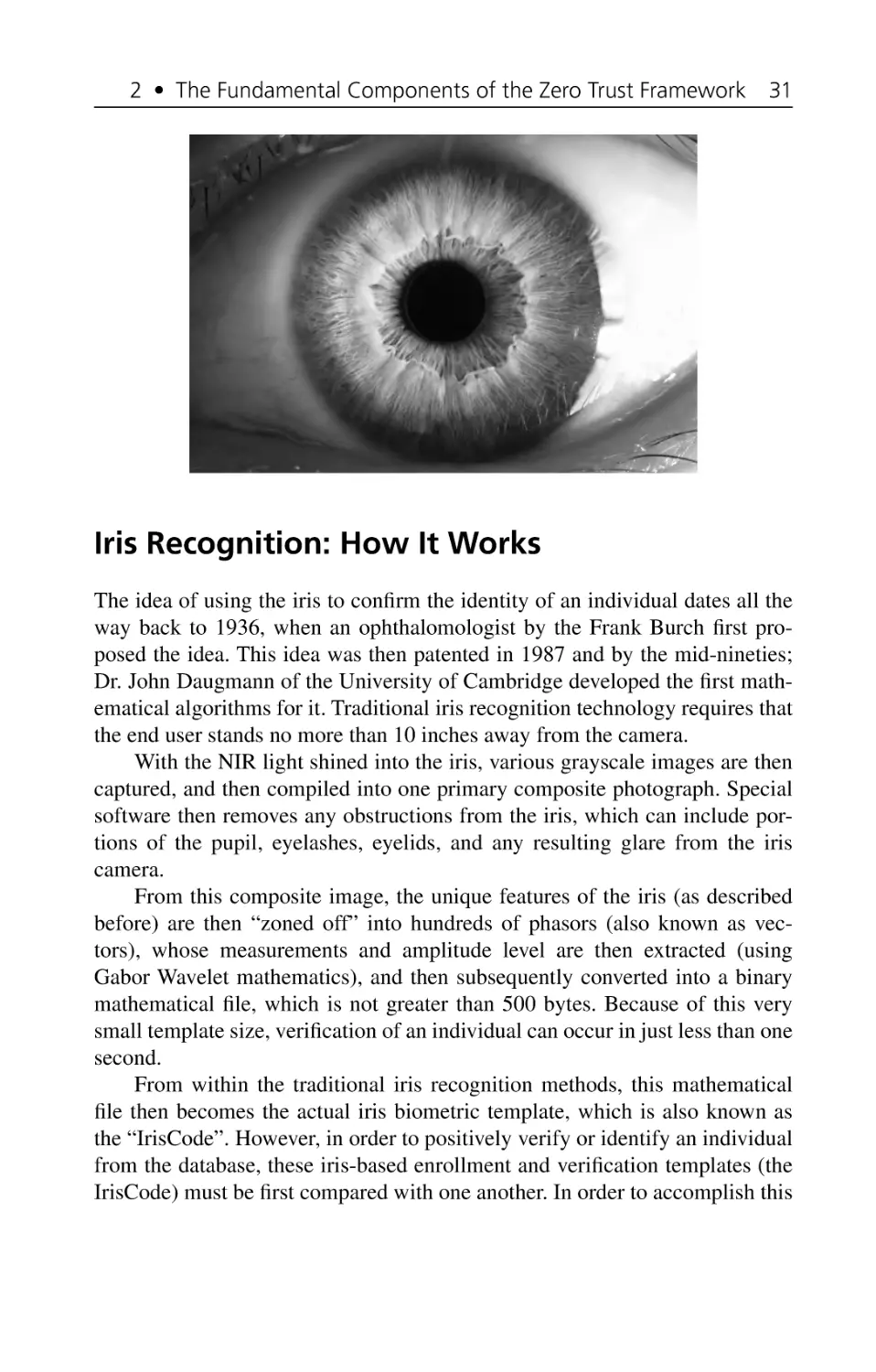
With the NIR light shined into the iris, various grayscale images are then
captured, and then compiled into one primary composite photograph. Special
software then removes any obstructions from the iris, which can include portions of the pupil, eyelashes, eyelids, and any resulting glare from the iris
camera.
From this composite image, the unique features of the iris (as described
before) are then “zoned off” into hundreds of phasors (also known as vectors), whose measurements and amplitude level are then extracted (using
Gabor Wavelet mathematics), and then subsequently converted into a binary
mathematical file, which is not greater than 500 bytes. Because of this very
small template size, verification of an individual can occur in just less than one
second.
From within the traditional iris recognition methods, this mathematical
file then becomes the actual iris biometric template, which is also known as
the “IrisCode”. However, in order to positively verify or identify an individual
from the database, these iris-based enrollment and verification templates (the
IrisCode) must be first compared with one another. In order to accomplish this
32 The Zero Trust Framework
task, the IrisCodes are compared against one another byte by byte, looking for
any dissimilarities among the string of binary digits.
In other words, to what percentage do the zeroes and the ones in the irisbased enrollment and verification templates match up and do not match up
against one another? This answer is found by using a technique known as
“Hamming Distances”, which is even used in iris recognition algorithms of
today.
After these distances are measured, tests of statistical independence are
then carried out, using high-level Boolean mathematics (such as Exclusive OR
Operators [XOR] and Masked Operators). Finally, if the test of statistical independence is passed, the individual is then positively verified or identified, but
if the tests of statistical independence failed, then the person is NOT positively
verified or identified.
CONCLUSIONS
Overall, this chapter has examined some of the major components that make
up the Zero Trust Framework:
1) Two-Factor Authentication (2FA);
2) Multifactor Authentication (MFA);
3) Biometric Technology.
Going forward into the rest of this book, only MFA will be considered for the
Zero Trust Framework, which will be examined in more detail in Chapter 4 of
this book. In the author’s view, the use of 2FA will soon be outnumbered, as
the Cyberattacker is now well prepared to break into two lines of defense, and
perhaps even more. This is why MFA is so important.
With the extra layers of defense that it does present, it lessens the statistical
odds that a Cyberattacker will break through all of the lines of authentication.
In theory, this is possible with the other types of authentication mechanisms,
but so far, this has not proven to be the case with Biometric Technology. The
primary reason for this is that it is almost close to impossible, if not difficult to
replicate somebody’s fingerprint, and especially the iris.
There are still some doubts about the face, but the reason it was included is
that it provides for a still very valuable line of defense, and that it is as contactless as well, given the society that we live in today. Also, the other Biometric
Technologies (as they were examined earlier in this chapter) still have some
2 • The Fundamental Components of the Zero Trust Framework
33
ways to go in terms of commercial adoption, thus they would not be a good
choice for a Zero Trust Framework.
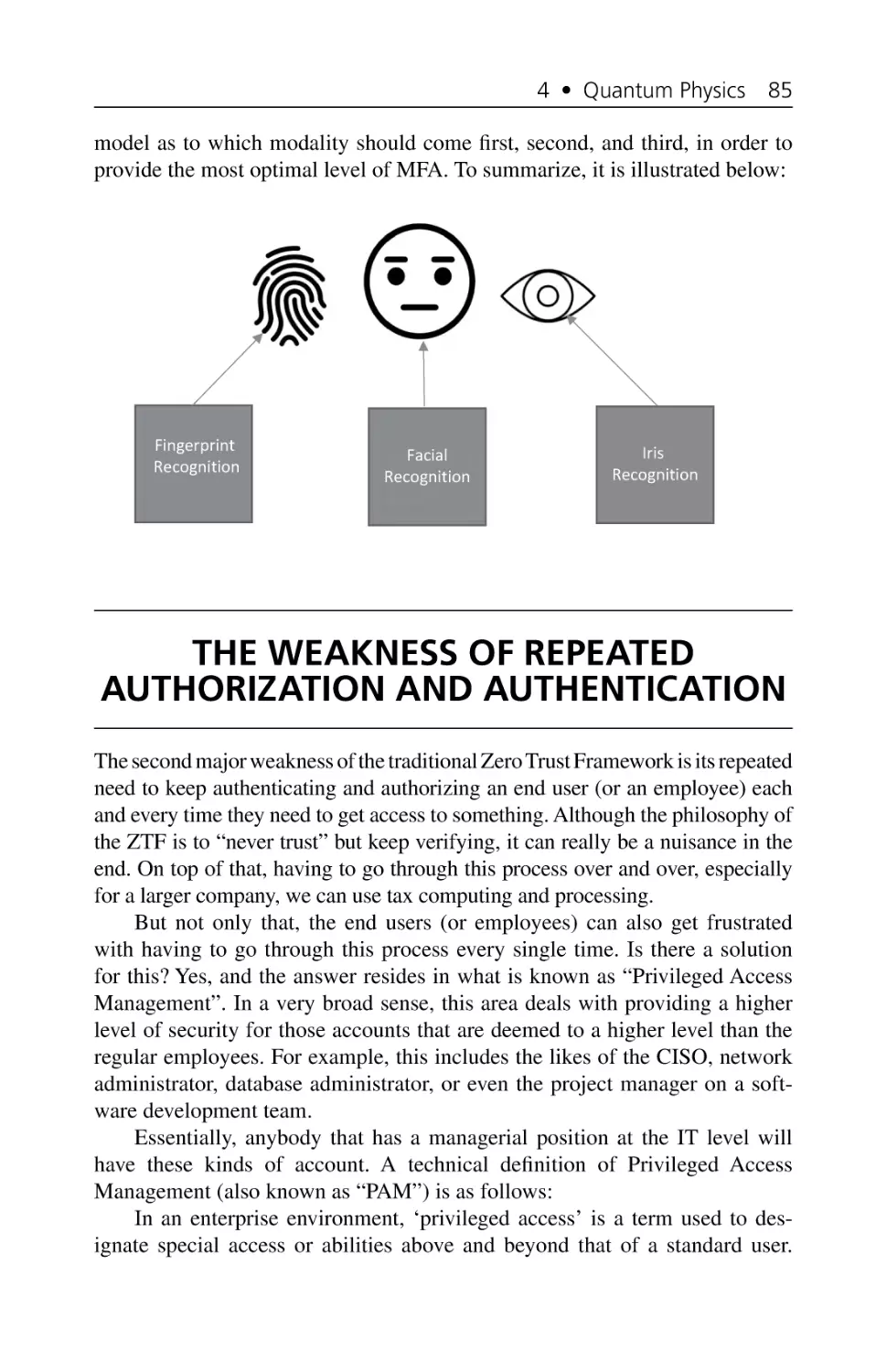
Also going forward into the rest of the book, the order of arrangement
for the Biometric modalities in terms of authentication will be as follows:
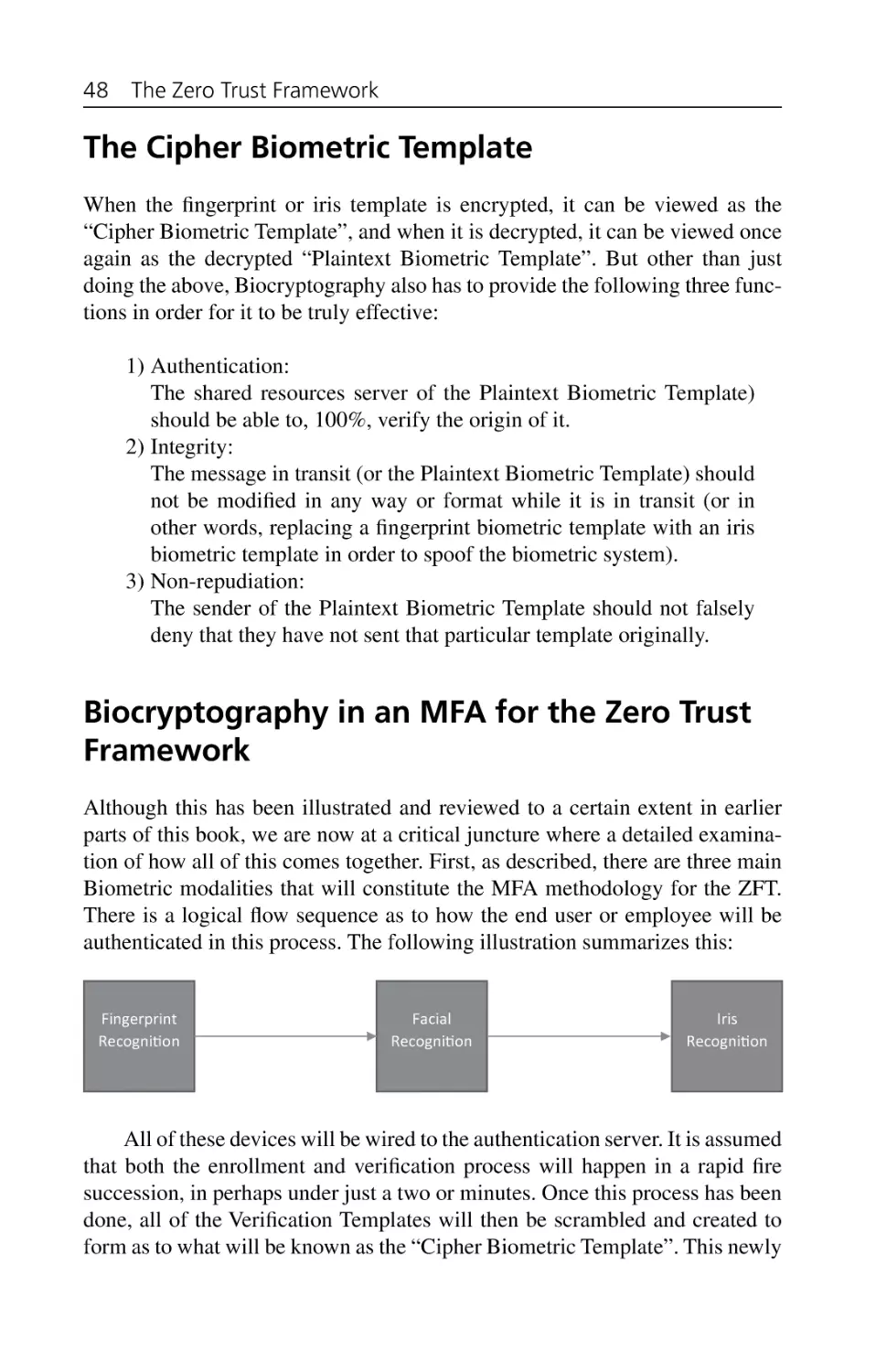
Fingerprint Recognition, Iris Recognition. This is illustrated in the diagram
below:
Authentication
Server
Fingerprint
Recognition
Facial
Recognition
Iris
Recognition
The next chapter of this book will do a greater examination of what is
known as “BioCryptography”. This is when the principles of Cryptography are
used to further protect the Biometric Templates.
The Public Key
Infrastructure
and
BioCryptography
3
Our last chapter reviewed some of the fundamental components that belong
to the Zero Trust Framework (ZTF). It reviewed in detail the concepts of
2FA, MFA, and the Biometric Technologies that are to be used in any kind
of Zero Trust deployment. In the end, it was concluded that MFA and the use of
Biometrics as the authentication mechanisms would prove to be of most value
and importance to a ZTF.
In the examples that we provided in the last chapter, they all shared one
common denominator: It was assumed that there was only one user accessing
one shared resource. In terms of mathematics, this can be represented as a
one to one, or 1: 1 relationship. But in the real world, ZTF deployments will
not be this direct. Rather, they will be more complex in nature, and utilize an
approach in which there will be many employees accessing many different
types and kinds of shared resources, possibly even across different servers that
are physically located apart from one another.
Thus, in this case, you want a ZTF which will take the form of what is
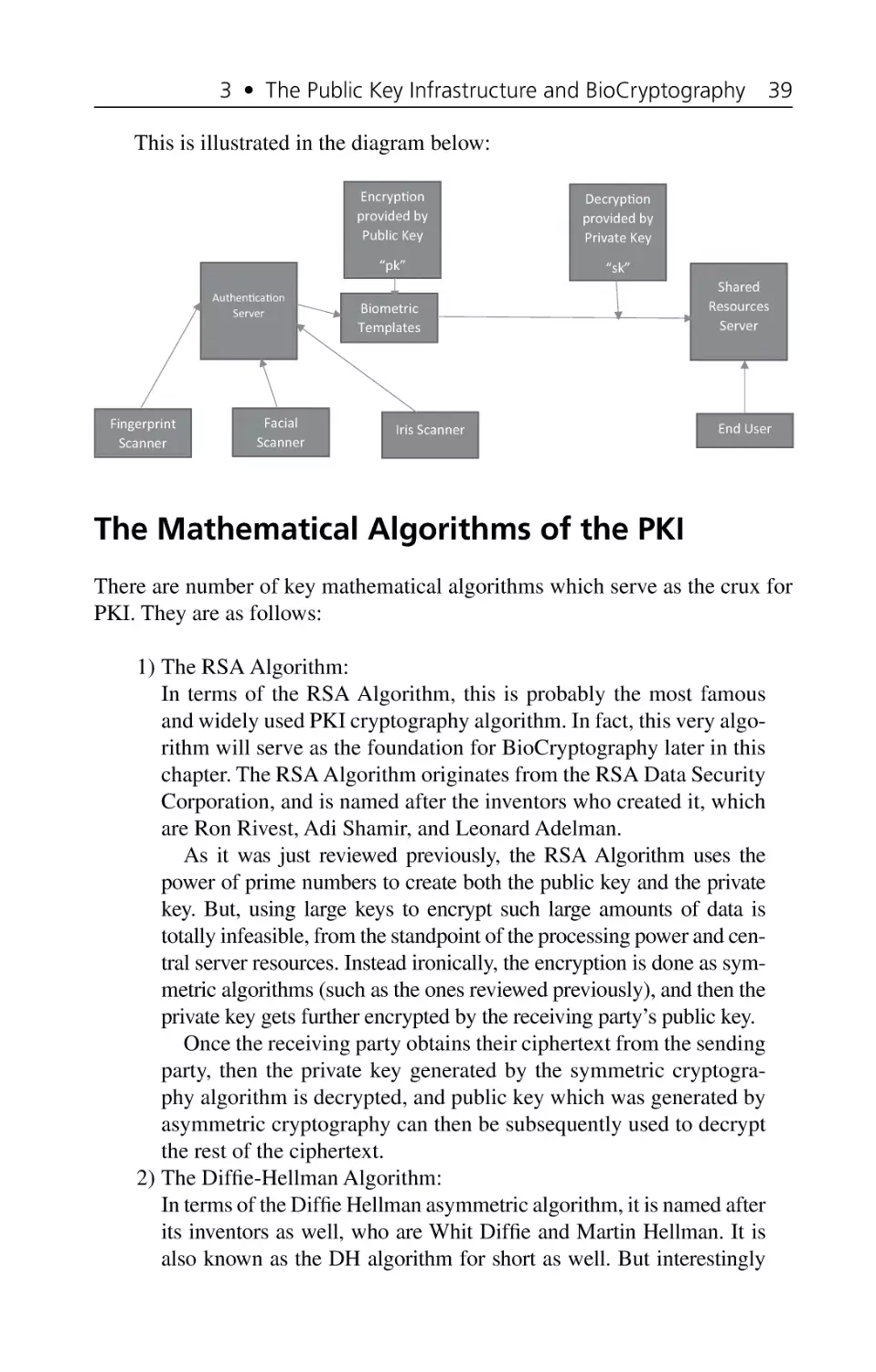
known as an “Asymmetric Key Cryptography” approach. This is where both
public and private keys are used to further protect the Biometric Templates as
they are in transit from the point of authentication to the point authorization.
As it was mentioned in the previous chapter, Biometric Templates are quite
strong in nature.
They are nothing but mathematical representations of our unique physiological and/or behavioral traits. In the end, if the Cyberattacker were to break
through a database and hijack them, there is hardly anything much that they
DOI: 10.1201/9781003392965-3
35
36 The Zero Trust Framework
can do with them. As pointed before, it is not the like the same thing as credit
card theft, where a hacker can literally run “amuck” with it, and make all kinds
of fraudulent purchases with it.
But the fact that a Cyberattacker can even entertain the thoughts of heisting these Biometric Templates, which are so crucial to a ZTF, means that there
is an inherent weakness in the framework that needs to be remediated, and
this can only be done by using the principles of Cryptography. Thus, it is the
Asymmetric Key approach, which can provide the best protection for these
Biometric Templates. This methodology is also referred to as the “Public Key
Infrastructure”, or “PKI” for short, and this referencing will be used throughout the remainder of this book.
In this chapter, we will lay down the foundations for the PKI, which will
be the model used to support our ZTF model in Chapter 5. After we introduce
the concepts of what it takes to protect these Biometric Templates, the next
point of issue that will be dealt with is how to ensure the integrity of these
Biometric Templates remain intact from the point of authorization to the point
of authentication, as they will be reused over constantly in order to grant access
to the shared resources the end user is trying to gain access to.
The ultimate goal here is once the employee has been enrolled into all
three Biometric modalities, they will never have to do it again, unless of course
something catastrophic happens, such as a natural disaster or security breaching occurring. Therefore, it is of paramount importance to make sure that the
Biometric Templates remain the same all of the time, without any alterations
being made for them. There is one solution for this, and that is making use of
Hashing Algorithms, which will be covered at the end of this chapter.
Also, this will give rise to the need for Privileged Access Management,
or PAM, to make sure that all of the access accounts of the employees remain
secure and are assigned properly, since the intention is to avoid having to go
through the authentication process repeatedly (and only once). This is a concept that will be further explored in Chapter 5 of this book.
AN OVERVIEW OF THE PUBLIC
KEY INFRASTRUCTURE (PKI)
A PKI can be a very large undertaking, or even just a smaller one, depending upon the size and the requirements of the company in question. But
generally speaking, setting up a PKI takes more time than it does using a
3 • The Public Key Infrastructure and BioCryptography 37
Symmetric Key Cryptography approach. This kind of approach would be
ideal to use in the examples that we have provided so far in this book, as we
have assumed thus far that it has been just one employee trying to access one
shared resource.
But, you do not see this approach being used in the real world, because of
the many security risks that it can pose. Therefore, the use of the PKI remains
to be the viable choice. In the rest of this chapter, we will introduce the important concepts of the PKI. We will then move onto the topic of BioCryptography,
which is the science of using Cryptography to protect Biometric Templates.
Finally, we will then delve into the topic of Hashing Algorithms.
WHAT IT IS ALL ABOUT
In the world of PKI, there are two primary keys that are used, and they are
called the public and the private key, and are also used to encrypt and decrypt
the plaintext, which is sent between the sending and the receiving parties as
they communicate with another. In the most simplistic terms, a PKI can be
likened to that of a safety box at a local bank. In this example, normally, there
are two sets of keys, which are used.
One key is the one which the back gives to you. This can be referred to
as the public key, because it is used over and over again by past renters of this
particular safety deposit box, and for other, future renters as well. The second
key is the private key, which the bank keeps in their possession at all times, and
only the bank personnel know where it is kept.
A PKI is just like this example, but of course, it is much more complex
than this in practice. To start off with, typically, it is the receiving party which
is primarily responsible for generating both the public and the private key. In
this situation, let us refer to the public key as “pk”, and the private key as “sk”.
So, to represent both of these keys together, it would be mathematically
represented as (pk,sk). It is then the sending party which uses the public key
(pk) to encrypt the message they wish to send to the receiving party, which then
uses the private key (sk), which they have privately and personally formulated
to decrypt the encrypted ciphertext from the sending party.
One of the primary goals of a PKI is to avoid the need for both the sending
and the receiving parties from having to meet literally face to face in order
to decide on how to protect (or encrypt) their communications with another.
So, at this point, the question then arises is, how does the sending party know
38 The Zero Trust Framework
about the public key (pk) generated by the receiving party so that the two can
communicate with each other?
The Public Key and the Private Key
There are two distinct ways in which this can be accomplished:
1) The receiving party can deliberately and purposefully notify the
sending party of the public key (pk) in a public channel, so that
communications can be initiated;
2) The sending party and the receiving party do not know anything
about each other in advance. In this case, the receiving party makes
their public key known on a global basis so that whoever wishes to
communicate with the receiving party can do so, as a result.
Now, this brings up a very important point: The public key is literally “public”,
meaning that anybody can use it. So, how does a PKI remain secure? It remains
solely on the privacy of the private key (sk), which is being utilized. In these
cases, it is then up to the receiving party now to share the private key (sk) with
any other party, no matter how much they are trusted.
If the privacy of the secret key (sk) is compromised in any way, then the
security scheme of a PKI is totally compromised. In order to help ensure that
the private keys remain private, the PKI uses the power of prime numbers
(also known as the “RSA algorithm”). The basic idea here is to create a very
large prime number as a product of multiplying two very large prime numbers
together.
Mathematically put, the basic premise is that it will take a hacker a very
long time to figure out the two prime number multiples of a very large product
which is several hundred integers long, and thus, give up in frustration. Even if
a hacker were to spend the time to figure out one of these prime numbers, the
hacker still has to figure out the other prime number, and the chances that they
will figure this out is almost nil.
As a result, only one portion of the (pk, sk) is figured out, and the PKI still
remains intact and secure. In other words, the hacker cannot reverse engineer
one key to get to the other key to break the ciphertext. It should also be noted
that in the PKI, the same public key can be used by multiple, different sending
parties to communicate with the single receiving party, thus forming a one to
many, or 1:N mathematical relationship.
3 • The Public Key Infrastructure and BioCryptography 39
This is illustrated in the diagram below:
Authencaon
Server
Fingerprint
Scanner
Facial
Scanner
Encrypon
provided by
Public Key
Decrypon
provided by
Private Key
“pk”
“sk”
Biometric
Templates
Iris Scanner
Shared
Resources
Server
End User
The Mathematical Algorithms of the PKI
There are number of key mathematical algorithms which serve as the crux for
PKI. They are as follows:
1) The RSA Algorithm:
In terms of the RSA Algorithm, this is probably the most famous
and widely used PKI cryptography algorithm. In fact, this very algorithm will serve as the foundation for BioCryptography later in this
chapter. The RSA Algorithm originates from the RSA Data Security
Corporation, and is named after the inventors who created it, which
are Ron Rivest, Adi Shamir, and Leonard Adelman.
As it was just reviewed previously, the RSA Algorithm uses the
power of prime numbers to create both the public key and the private
key. But, using large keys to encrypt such large amounts of data is
totally infeasible, from the standpoint of the processing power and central server resources. Instead ironically, the encryption is done as symmetric algorithms (such as the ones reviewed previously), and then the
private key gets further encrypted by the receiving party’s public key.
Once the receiving party obtains their ciphertext from the sending
party, then the private key generated by the symmetric cryptography algorithm is decrypted, and public key which was generated by
asymmetric cryptography can then be subsequently used to decrypt
the rest of the ciphertext.
2) The Diffie-Hellman Algorithm:
In terms of the Diffie Hellman asymmetric algorithm, it is named after
its inventors as well, who are Whit Diffie and Martin Hellman. It is
also known as the DH algorithm for short as well. But interestingly
40 The Zero Trust Framework
enough, this algorithm is not used for the encryption of the ciphertext,
rather the main concern of it is to address the problem for finding a
solution of the issue of sending a key over a secure channel.
Here is a summary of how it works, on a very simple level:
• The receiving party as usual has the public key and the private
key that they have generated, but this time, they both are created
by the DH Algorithm;
• The sending party receives the public generated by the receiving party and uses this DH Algorithm to generate another set of
public keys and private keys, but on a temporary basis;
• The sending party now takes this newly created temporary private key and the public key sent by the receiving party to generate a random, secret number; this is known as the “session key”;
• The sending party uses this newly established session key to
encrypt the ciphertext message, and sends this forward to the
receiving party, with the public key that they have temporarily
generated;
• When the receiving party finally receives the ciphertext from the
sending party, the session key can now be derived mathematically;
• Once the above step has been completed, the receiving party can
now decrypt the rest of the ciphertext.
3) The Elliptical Wave Theory Algorithm:
Finally, with Elliptical Wave Theory, it is a much newer type of
PKI mathematical algorithm. It can be used to encrypt very large
amounts of data, and its main advantage is that it is very quick, and
does not require a lot of server overhead or processing time. As its
name implies, Elliptical Wave Theory first starts with a parabolic
curve drawn on a normal x,y coordinate Caretesian plane.
After the first series of X and Y coordinates are plotted, various
lines are then drawn through the image of the curve, and this process
continues until many more curves are created and their corresponding, intersecting lines are also created.
Once this process has been completed, the plotted X and Y coordinates of each of the intersected lines and parabolic curves are
then extracted. Once this extraction has been completed, then all of
the hundreds and hundreds of X and Y coordinates are then added
together in order to create the public and the private key. But, the
trick to decrypting a ciphertext message encrypted by Elliptical Wave
Theory is that the receiving party has to know the shape of the original elliptical curve, and all of the X and Y coordinates of the lines
where they intersect with the various curves, and the actual starting
point at which the addition of the X and Y coordinates first started.
3 • The Public Key Infrastructure and BioCryptography 41
The Components of the PKI
It should be noted at this point that the Public Keys and the Private Keys in a
PKI are also referred to as “Digital Certificates”. Thus, going forward in this
book, that is how they will be referred to. The components of a PKI, and as it
relates to the ZTF, are as follows:
1) The Certificate Authority, also known as the CA:
This is the outside third party who issues the digital certificates.
2) The Digital Certificate:
As mentioned, this consists of both the private key and the public
key, which are issued by the CA. This is also the entity that the end
user would go to in case he or she needed to have a digital certificate
verified. These digital certificates are typically kept as the points of
authentication and authorization, respectively.
3) The LDAP or X.500 Directories:
These are the databases which collect and distribute the digital certificates from the CA.
4) The Registration Authority, also known as the RA:
If the place of business or organization has a large ZTF (such as
a multinational corporation), this entity then usually handles and
processes the requests for the required digital certificates, and then
transmits those requests to the CA to process and create the required
digital certificates.
The CA can be viewed as the main governing body, or even the king of the PKI
of the ZTF. In order to start using the Public Key Infrastructure to communicate with others, it is the Certificate Authority which issues the digital certificates, which once again, consists of both the public and private keys.
The Digital Certificates
Each digital certificate which is generated by the Certificate Authority consists
of the following technical specifications:
1) The Digital Certificate Version Number:
Typically, it is either version number 1, 2, or 3.
2) The Serial Number:
This is the unique ID number which separates and distinguishes a
particular Digital Certificate from all of the others (this can be likened
to each Digital Certificate having its own Social Security Number).
42 The Zero Trust Framework
3) The Signature Algorithm Identifier:
This contains the information and data about the mathematical algorithm used by the Certificate Authority to issue the particular Digital
Certificate.
4) The Issuer Name:
This is the actual name of the Certificate Authority which is issuing
the Digital Certificate to the place of business or organization.
5) The Validity Period:
This contains both the activation and deactivation dates of the
Digital Certificates; in other words, this is the lifetime of the Digital
Certificate as determined by the Certificate Authority.
6) The Public Key:
This is created by the Certificate Authority.
7) The Subject Distinguished Name:
This is the name which specifies the Digital Certificate owner.
8) The Subject Alternate Name Email:
This specifies the Digital Certificate’s owner Email address (this is
where the actual Digital Certificates go to).
9) The Subject Name URL:
This is the Web Address of the place of business or organization to
whom the Digital Certificates are issued to.
How Public Key Infrastructure Works
Below is a description of how the PKI would work for a ZTF:
1) The request for the Digital Certificate is sent to the appropriate
Certificate Authority;
2) After this request has been processed, the Digital Certificate is
issued to the person who is requesting it;
3) The Digital Certificate then gets signed by confirming the actual
identity of the person who is requesting that particular Digital
Certificate;
4) The Digital Certificate can now be used to encrypt the plaintext into
the ciphertext, which is sent from the sending party to the receiving
party.
The Registration Authority is also known as the RA, as eluded to before. The
RA is merely a subset of the CA, or rather, it is not intended to replace or
take over the role of the CA; instead, it is designed to help if it becomes overwhelmed with digital certificate request traffic.
3 • The Public Key Infrastructure and BioCryptography 43
However, the RA by itself does not grant any type or kind of digital certificates, nor does it confirm the identity of the person who is requesting the digital certificate. Rather, its role is to help process the requests until the processing
queue at the CA becomes much more manageable.
The RA sends all of the digital certificate requests in one big batch, rather
than one at a time. This process is known as “chaining certificates”. The RA
is typically found in very large, multinational corporations, where each office
location would have its own RA, and the CA would reside at the main, corporate headquarters.
Finally, all digital certificate requests are processed by the RA, which are
also associated with a chain of custody trail, for security auditing purposes.
The RA can be viewed as a support vehicle for the CA, in which a mathematical, hierarchal relationship exists.
Public Key Infrastructure Policies and Rules
It should be noted at this point that in order for either the Certificate Authority
or the Registration Authority to function properly in a ZTF, it is important to
have a distinct set of rules and policies in place. These surround the use of the
issuance, storage, and the revocation of the expired digital certificate. While it
is out of the scope of this book to get into the exact details of all these rules
and policies, the following is just a sampling of some of the topics which need
to be addressed:
1) Where and how the records and the audit logs of the Certificate
Authority are to be kept, stored, and archived;
2) The administrative roles for the Certificate Authority;
3) Where and how the public keys and the private keys are to be kept,
stored, and also backed up;
4) What is the length of time for which the public keys and the private
keys will be stored;
5) If public or private key recovery will be allowed by the Certificate
Authority;
6) The length of the time of the validity period for both the public keys
and private keys;
7) What will be the technique in which the Certificate Authority can
delegate the responsibilities to the Registration Authority;
8) Will the digital certificates to be issued by the Certificate Authority
be used for applications and resources;
9) If the digital certificates to be issued by the Certificate Authority be
used for the sole purposes of just encryption of the ciphertext;
44 The Zero Trust Framework
10) If there are any types or kinds of applications which should be
refused to have digital certificates;
11) When a digital certificate is initially authorized by the Certificate
Authority, will there be a finite period of time when the digital certificate will be subject to revocation.
As one can see, based upon the establishment of the many rules and policies
which need to be set into place, the actual deployment and establishment of a
Public Key Infrastructure in a ZTF can become quite complex, depending upon
the size and the need of the particular business or organization.
The LDAP Protocol
In terms of the database structure for the digital certificates, this is most useful
and effective when the LDAP servers are utilized. LDAP is merely an acronym
which stands for “Lightweight Directory Access Protocol”, and is simply a
database protocol which is used for the updating and searching of the directories which run over the TCP/IP network protocol (this is the network protocol
which is primarily used by the PKI Infrastructure for the ZTF).
It is the job of the LDAP server of the Public Key Infrastructure to contain
such information and data as it relates to the digital certificates, the public and
the private key storage locations, as well as the matching public and private
key labels.
The Certificate Authority uses a combination of the end user name and the
matching tags to specifically locate the digital certificates on the LDAP server.
From that point onwards, it is the LDAP server which then checks to see if the
requested digital certificate is valid or not, and it if it is valid, it then retrieves
from its database a digital certificate which can then be sent to the end user.
Although all digital certificates which are issued have a finite lifespan when
they are first issued, they can also be revoked for any reason at any time by the
Public Key Infrastructure Administrator.
In order to accomplish this very specific task, a Certificate Revocation
List, or a CRL is used. This list is composed of the digital certificate serial
numbers which have been assigned by the Certificate Authority. But, looking
at this type of information and data can be very taxing on the system resources
and processes.
Therefore, in this regard, it is obviously much easier to reissue the digital certificates as they expire, rather than to revoke them and then having to
reissue them again, and of course, which would mean that the Public Key
Infrastructure System Administrator would then have to update the Certificate
Revocation List.
3 • The Public Key Infrastructure and BioCryptography 45
The PKI Standards
The Public Key Infrastructure is also governed by a body known as the Public
Key Cryptography Standards, also known as the PKCS. The bottom line here
is that a smooth-running PKI will lead to an efficient and effective ZTF. The
first of these standards has been previously described, and they are the RSA
Encryption Standard, the Diffie-Hellman Key Agreement Standard, and the
Elliptical Wave Theory. The other sets of standards which define a Public Key
Infrastructure are as follows:
1) The Password-Based Cryptography Standard:
This describes how to encrypt a private key with a secret key which
is derived from a password.
2) The Extended Certificate Syntax Standard:
This is merely a set of attributes attached onto a Digital Certificate
which has been assigned by the Certificate Authority.
3) The Cryptographic Message Syntax Standard:
This standard specifically outlines how to put the digital signatures into digital certificate envelopes, and from there, put that into
another digital envelope.
4) The Private Key Information Syntax Standard:
This standard directly specifies what kind of information and data
should be included into a private key, and how that specific key
should be formatted.
5) The Selected Attribute Types:
This is a detailed list which at length describes the certain encryption attribute types for the last three standards.
6) The Certification Request Syntax Standard:
This provides the details for the syntax for the digital certificates.
Essentially, this standard simply sets forth the parameters which are
needed for the Certificate Authority to understand the digital certificate request.
7) The Cryptographic Token Interface Standard:
This is an Application Programming Interface (API) for specifying and handling the cryptographic functions as it relates to the
smartcards.
8) The Personal Information Exchange Standard:
This standard specifies exactly how an end user’s private keys should
be transported across the network medium.
9) The Cryptographic Token Information Format Standard:
This standard specifies how the applications at a place of business or
organization should interface with smart cards.
46
The Zero Trust Framework
In the world of Public Key Infrastructure, it should be remembered that the
public keys and the private keys (also known as the digital certificates) are created instantaneously and all of the time, whenever the need for access to shared
resources is required. In fact, public keys and private keys are everywhere in
a Public Key Infrastructure, even when one establishes a Secure Shell (SSH)
connection over the Internet with their particular brand of web browser (this
typically uses 128-Bit Encryption).
In fact, there are even public keys and private keys in the Public Key
Infrastructure which are only used once, terminated, and are literally discarded
away. These types of public keys and private keys are known more commonly
as “session keys”. In the end, digital certificates are nothing more than computer files.
Parameters of Public Keys and Private Keys
But before the actual public key or the private key can go out in the ZTF, it needs
to have certain parameters which are specified to it, and these are as follows:
1) The type of mathematical algorithm which should be used;
2) How many bits of data the public keys and the private keys should
be composed of;
3) The expiration date of both the public keys and the private keys.
Also, in order to keep the hackers at bay, it is equally important that not all of
the public keys and the private keys are used all the time in the communication
process between the sending and the receiving parties. It is also important to
keep the public keys and the private keys fresh, or in other words, it is important to introduce randomness into the Public Key Infrastructure.
Such randomness is known as “Entropy”, and this entropy is created
by what is known as “Random Number Generators”, and “Psuedo-Random
Number Generators.” Also, in a Public Key Infrastructure, there are different
classes of both public keys and private keys. Here is a listing of just some of
these classes of keys:
1) Signing Keys:
These are the keys to create the digital signatures.
2) Authentication Keys:
These are the keys which are created to authenticate computers, servers, and the receiving parties and the sending parties with one another.
3) Data Encryption Keys:
These are the keys which are used to encrypt the files.
3 • The Public Key Infrastructure and BioCryptography 47
4) Session Keys:
These are the types of keys which are used to help secure a channel
across an entire network for only a very short period of time.
5) Key Encryption Keys:
These types of keys literally wrap the ciphertext to provide further
protection between the sending and the receiving parties.
6) Reof Key:
This is the master which is used for signing all of the other public keys and private keys which originate specifically from the
Certificate Authority.
A REVIEW INTO BIOCRYPTOGRAPHY
Biocryptography provides the means to further biometric templates at these
critical junctures. As it was reviewed in Chapter 2 of this book, Cryptography
is the science of scrambling information and data which is transit across a
network medium, and then descrambling it at the receiving end into a decipherable format.
That way, if the scrambled information and data were to be intercepted
by a third party, there is not much which can be done unless they possess
the keys for descrambling the information. These concepts of scrambling and
descrambling can be very easily applied to Biometrics. This is formally known
as “BioCryptography”.
In other words, the Biometric Templates are protected by scrambling and
descrambling keys while they are stored in the database or in movement across
a network to the shared resources server.
To review, whenever we send a message to our intended recipient-whether
it is by e-mail, instant message, or even just a text message on our Smartphone,
this message is often sent as a “plaintext”, or “cleartext”.
This means that the actual message is being transmitted to the intended
recipient in the way it was originally constructed by the originator of the
message. Thus, the only true way to protect the information being sent is to
scramble it, in other words, “encrypt the message”. This encrypted (or now
scrambled message) is now known as the “ciphertext”.
The reverse of this process is known as “decryption”, with the end result
being a readable message to the intended recipient. As all of this relates to
Biometrics, the data packet which houses the biometric template (such as the
fingerprint or iris recognition template) can be viewed as the plaint text, or as
the “Plaintext Biometric Template”.
48 The Zero Trust Framework
The Cipher Biometric Template
When the fingerprint or iris template is encrypted, it can be viewed as the
“Cipher Biometric Template”, and when it is decrypted, it can be viewed once
again as the decrypted “Plaintext Biometric Template”. But other than just
doing the above, Biocryptography also has to provide the following three functions in order for it to be truly effective:
1) Authentication:
The shared resources server of the Plaintext Biometric Template)
should be able to, 100%, verify the origin of it.
2) Integrity:
The message in transit (or the Plaintext Biometric Template) should
not be modified in any way or format while it is in transit (or in
other words, replacing a fingerprint biometric template with an iris
biometric template in order to spoof the biometric system).
3) Non-repudiation:
The sender of the Plaintext Biometric Template should not falsely
deny that they have not sent that particular template originally.
Biocryptography in an MFA for the Zero Trust
Framework
Although this has been illustrated and reviewed to a certain extent in earlier
parts of this book, we are now at a critical juncture where a detailed examination of how all of this comes together. First, as described, there are three main
Biometric modalities that will constitute the MFA methodology for the ZFT.
There is a logical flow sequence as to how the end user or employee will be
authenticated in this process. The following illustration summarizes this:
Fingerprint
Recogni on
Facial
Recogni on
Iris
Recogni on
All of these devices will be wired to the authentication server. It is assumed
that both the enrollment and verification process will happen in a rapid fire
succession, in perhaps under just a two or minutes. Once this process has been
done, all of the Verification Templates will then be scrambled and created to
form as to what will be known as the “Cipher Biometric Template”. This newly
3 • The Public Key Infrastructure and BioCryptography 49
created template will then be further encased into another data packet, for an
added measure of protection.
From here, this new template will then be transmitted over to the authentication server so that the end user (or employee) will be granted access to the
shared resources that they are seeking to use. In this situation, there are two
important points to remember:
1) The newly created Verification Template will actually be a combination of the Fingerprint, Facial, and Iris Recognition Verification
Templates. This is what will be sent to the authentication server after
this newly created template has been scrambled and encapsulated
into another data packet.
2) One of the primary goals is that once the end user (or employee) has
been authenticated once, they will not be required to go through this
process again. Rather, it is the newly created Verification Template
that will be used repeatedly to allow access to the shared resources
server. This is where the concept of Privileged Access Management
will come into play, and will be further reviewed in detail in Chapter
5 of this book. The ultimate goal here is to create what is known as
“One Identity for Life”, thus eradicating the use of the password all
together.
The process for the newly created Verification Template is illustrated below:
Iris
Verification
Template
Facial
Verification
Template
Iris
Verification
Template
New
Verification
Template
which is
scrambled
Data Packet
New
Verification
Template
50
The Zero Trust Framework
The assumption so far is that the end user (or employee) in this MFA
approach for the ZTF is at the physical place of the business location. But
given the work dynamics of today’s environment, it is also important to address
as to how this methodology will work for a remote employee, located hundreds, or perhaps even thousands of miles away.
BIOCRYPTOGRAPHY AND
VIRTUAL PRIVATE NETWORKS
There is yet another tool of BioCryptography which would perfectly here
for the Remote Employee – this is known as a “Virtual Private Network” or
“VPN” for short.
1) The end user (or employee) has their fingerprint, face, and iris
scanned to create the respective verification template. This template
then gets broken down into a separate data packet. This data packet
(which contains the newly created verification template) is then further encapsulated (or encrypted) into another data packet, so it eventually becomes invisible as it traverses across the various network
media, as it makes its way to the servers of the hosting provider;
2) To ensure the integrity of this double-layered data packet, it would
also consist of headers which contain information about the size
and type of the newly created verification template. This would be
a confirmation to the shared resources server that this has not been
changed en route;
3) To create another layer of protection, a dedicated VPN channel can
be created. This would be a direct line from the point of origin of
the fingerprint or iris scanner all the way to the servers of the hosting party. This is known as specifically as “IP Tunneling”, and as
a result, this channel cannot be seen by other people accessing the
Internet across the same network media the data packets (which
contains the verification templates) are also traveling across;
4) Once this data packet arrives at the shared resources server, it is then
decrypted, and the end user (or employee) can then gain access to
the resources they need.
3 • The Public Key Infrastructure and BioCryptography 51
THE HASHING MECHANISM
As it was mentioned in the last section, one of the primary goals of the ZTF (or
at least the way that we are proposing it in this book) is to eliminate the need
for the end user (or employee) to have been authenticated over and over again.
The goal is that they get authenticated once, and that’s it. So because of this,
the newly created Verification Biometric Template (which can also be referred
to as the “Cipher Biometric Template”) gets two layers of protection, the first
of it being scrambled, and the second, having it encapsulated in second data
packet.
But, if the same Verification Template is to be used over and over again,
the shared resources need to have confirmation that this template has not been
altered or tampered in a way in the transition process. In other words, it has
retained its level of integrity, and will need to do so over and over again, until
a newer Verification Template has been created.
This is where the Hashing Function comes into use. In simplest terms, it
is a mathematical value that is computed at the point of authentication, and is
assigned to the data packet that encapsulates the newly created Verification
Template. If this value remains the same as it reaches the shared resources
server, then one can be assured that the integrity has remained the same. But, if
the mathematical value is different for any reason, then that will lead to suspicion that the Verification Template has been altered.
To fix this major security vulnerability, the newly created Verification
Template is combined with a “secret key” at the point of authentication first,
and then the hash value is created. As a result, this hash will then contain
specific information and data about the secret itself. As a result, the shared
resourced server can even be further ensured that the Verification Template
they have received is the 100% original sent by the authentication server.
This is so because even if the Verification Template, the hash, and the
associated secret key were to be intercepted, there is very little that a hacker
can do to alter the Verification Template and its associated hash, because they
have to have the information and data about the secret key, which is of course
something they will never gain access to.
Although the Hashing Mechanism provides for a far greater level of
assurance with regards to the integrity of the Verification Template, it is not
totally infallible either. Therefore, the use of Quantum Mechanics and Photon
Particles, at least in theory, could provide as much as 110% integrity assurances. This will be covered more in Chapter 5 of this book.
52 The Zero Trust Framework
The Hashing Function is illustrated below:
Certificate
Authority
Encryption
done via
Public Key
Numerical Value
the same? Yes,
integrity has
been preserved.
Numerical value
different? Yes,
compute new
Verification n
Template
Hashing
Algorithm
“pk”
LDAP/
X.500
Direct
ories
Authentication
Server
Fingerprint
Recognition
Data Packet
Data Packet
New
Verification
Template
New
Verification
Facial
Recognition
Template
Iris
Recognition
Shared
Resources
Server
Decryption
done via
Private Key
“sk”
MFA
This illustration is reviewed as follows:
1) The end user (or employee is enrolled and verified by MFA,
which includes Fingerprint Recognition, Facial Recognition, Iris
Recognition).
2) The enrollment template is stored in the database of the Authentication
Server (via the LDAP and/or X.500 Directories), and at this point,
the end user (or employee) goes through the verification cycle. From
here, the first Verification Template is then created. The person in
question is fully authenticated.
3) The new Verification Template is a culmination of all three templates after the first verification. It is encapsulated into another data
packet, and is encrypted via the Public Key.
4) At the point of authentication, the hashing algorithm and its numerical value are computed.
5) The data packet then makes its way to the shared resources server.
3 • The Public Key Infrastructure and BioCryptography 53
6) It is then decrypted with the Private Key, and access is granted to the
end user (or employee) to get to the shared resources that they need
to access.
7) Finally, if the numerical value of the Hashing Algorithm remains the
same, the Verification Template has remained intact. If not, it has
been altered, then the entire process has to be repeated again.
Quantum
Physics
4
The first three chapters of this book have reviewed the following topics, which
are all very important facets for the development of a Zero Trust Framework:
•
•
•
•
The basics of Cryptography;
Two-Factor Authentication;
Multifactor Authentication;
An examination of the key Biometric modalities that can be used for
an MFA approach:
• Fingerprint Recognition
• Iris Recognition
• Facial Recognition.
From this point, the book is then distributed into the fact that a Zero Trust
Framework does not have a single user approach, as our previous examples in
these chapters demonstrated. Rather, in today’s environment, especially in the
larger businesses, there will be many end users attempting to gain authentication to many other shared resources, across different servers. Thus, the need to
have Zero Trust Framework that can handle this load is a must.
Thus, the concept of Asymmetric Key Cryptography was introduced,
which is also known as a Public Key Infrastructure or PKI for short. With this
newer approach, many end users can be authenticated and authorized to gain
access to many shared resources. In of by itself, this kind infrastructure can be
resource intense, but in order to streamline this process, other concepts were
also introduced:
•
•
•
•
Public Keys;
Private Keys;
Certificate Authorities;
LDAP/X.500 Directory structures.
It is the Public Key which encrypts the Biometric Template, and the Private
Key which decrypts it. The Certificate Authority serves as the central point in
DOI: 10.1201/9781003392965-4
55
56
The Zero Trust Framework
which the Digital Certificates (also known as the Public Key and Private Key)
are issued. Further, they can be used again with some alterations made to them
at a subsequent point in time, and thus, these Digital Certificates are stored in
the LDAP/X.500 Directories, which serve as the database.
From here, Chapter 4 then delved into the topic of BioCryptography. This
is a new and upcoming area of Cybersecurity, and the basic premise of this
concept is to further fortify the strength of the Biometric Templates by encrypting them and further encapsulating into another data packet. Further, another
goal of the Zero Trust Framework is to create what is known as a passwordless
organization.
For example, in the context of the Zero Trust Framework model that we
have proposed in this book so far, the same Biometric Template can be used
over and over again without having the end user (or the employee) go through
the same authentication and authorization processes repeatedly. For example,
in the context that we have proposed, an end user (or an employee) would first
have to be authenticated by having themselves enrolled first via the three aforementioned Biometric modalities.
These newly created Enrollment Templates can be housed in the LDAP/
X.500 Directories, but in order to gain access to the shared resources, the end
user (employee) would have to go through another cycle, which will then lead
to the creation of the Verification Templates. In the end, it is the Enrollment
and the Verification Templates which are compared among one another, and if
there is a close enough match, then the identity of the end user (employee) is
confirmed, and thus, they will be given access to the shared resources server to
get access to whatever they are requesting.
But now, imagine having to go through this process each and every
time that your employee needs access to the shared resources. Not only
would it be a very time-consuming process, but the drain of resources and
the processing power of our proposed Zero Trust Framework would also be
immense. Therefore, the goal would be to create the ability to keep using the
same templates over and over again. Thus, the concepts of Privileged Access
Management (PAM) become critical here.
But, as it was reviewed in the last chapter, these different templates that
were created will have to be created into one master template, which would
then be sent over to the shared resources server for authorization. Because of
this, the integrity of this newly created template is absolutely critical. Thus,
the concept of Hashing Algorithms was introduced. But these too are prone
to a Cyberattack, and because of that, Quantum Mechanics was introduced
as a replacement for it. Finally, Chapter 3 concluded with a diagram of what
has been reviewed and proposed up to that point in time for our Zero Trust
Framework.
4 • Quantum Physics 57
We will go back to this very diagram, and from there, add the other key
features to our proposed Zero Trust Framework, which are as follows:
1) Privileged Access Management (PAM);
2) Quantum Mechanics (especially that of Quantum Cryptography);
3) Photon Particles.
But first, since this chapter is about the Zero Trust Framework exclusively, it
is important to review its origins and its other major facets, other than the ones
we have reviewed so far in this book.
THE ORIGINS OF THE ZERO
TRUST FRAMEWORK
In reality, the concept of the Zero Trust Framework is nothing new. In fact,
it dates back more than a decade ago, all the way to 2010. An individual by
the name of John Kindervag developed the philosophy that nothing should
be trusted at all, from both within the external and internal environments of a
company, or for that matter, any type of entity. The motto here was to get rid
all of levels of trust, even how slight it may be. The driving philosophy was to
“never trust, but always verify, no matter how many times it has to be done”.
Although the concept of the Internet of Things (IoT) was not even heard
back during those times, people trying to access connected devices could not
be trusted, everybody has to go through the same regimen of verification. John
Kindervag even related this concept to Joseph Stalin with his famous quote, “I
trust no one, not even myself”. Eventually, he named his theory the Zero Trust
Framework. Thus, as it will be elaborated more later in this chapter, the Zero
Trust Framework is not a “one size fits all” approach.
This means that whatever works for one entity regarding the ZTF will not
work for a different one. Rather, it is a methodology that has to be crafted and
molded to the exact and unique security requirements of the company.
Probably the first true commercial application of the Zero Trust Framework
came back when the United States Office of Personnel Management was hit
by a Cyberattack. The House of Representatives mandated the use of the ZTF
methodology in order to safeguard not only their digital assets, but also for the
rest of the US Federal Government.
Other notable events in the history of the Zero Trust Framework, which
have led to its higher levels of adoption today, are stated below.
58 The Zero Trust Framework
In 2011
Google came out with its own version of the Zero Trust Framework, and this
was called the “BeyondCorp”. The main trigger for this was the Cyberattack
known as “Operation Aurora”, which was launched in 2009. This was deemed
to be an Advanced Persistent Threat (also known as “APT”). The premise
behind this model was to do away with network segmentation all together,
and instead rely upon the use of Multifactor Authentication (MFA) as the main
source for both authentication and authorization. More information about
Beyond Corp can be seen at the link below:
https://www.beyondcorp.com/
In 2014, Google published a whitepaper about their proposed framework, which gave a rather big boost to the overall concepts of the Zero Trust
Framework. This is deemed to be an important piece of work, and it can be
downloaded and viewed at this link:
http://cyberresources.solutions/ZTF_Book/Beyond_Corp.pdf
In 2018
Forrester came up with their own model of the Zero Trust Framework, which
was entitled the “Zero Trust eXtended Ecosystem”. This methodology consisted of seven different layers, which are as follows:
•
•
•
•
•
•
•
Workforce Security;
Device Security;
Workload;
Network;
Data Security;
Visibility and Analytics;
Automation and Orchestration.
Also, the National Institute of Standards and Technology came out with yet
their own version of the Zero Trust Framework and this was released as Special
Publication 800-207. Subsequently in 2020, this publication was updated.
In 2019
Gartner, in a manner similar to that of Forrester, also launched their version of
the Zero Trust Framework, which was called the “Zero Trust Network Access”
(also known as the “ZTNA”). In return, this also gave birth to a new Cyber
concept (and even tool) called the “Secure Access Service Edge”, also more
commonly known as “SASE”. The premise of this is that any processing and
4 • Quantum Physics 59
transactions of datasets occur close to the device that is requesting these services, rather than having them done at the central database server.
In 2021
Another major catalyst for the adoption of the Zero Trust Framework was the
COVID-19 pandemic. With everybody now working from home, businesses
were seeking new ways in which to counter the new threat variants which persisted. In fact, according to a research report which was published by Microsoft
entitled the “Zero Trust Adoption Report”, an overwhelming 96% of the 1200
respondents polled said that they favored the concepts of the overall concepts
of the Zero Trust Framework.
From 2021 to Present
The Biden Administration has been the main trigger during this time frame,
with the following events being the main drivers:
• Executive Order on Improving the Nation’s Cybersecurity: This was
signed in May 2021, with the main intention of enhancing the security posture of the US Federal Government and the nation’s Critical
Infrastructure.
• The U.S. Office of Management and Budget (also known as the “OMB”)
further endorsed the adoption of the Zero Trust Framework.
• The Cybersecurity and Infrastructure Security Agency (also known as
the “CISA”) also came out with a different version of the Zero Trust
Framework, and it was called the “Cloud Security Technical Reference Architecture and Zero Trust Maturity Model”. This methodology
focused more upon Cloud-based security, especially focusing on data
leakages, whether intentional or not.
• The Acting Director of the OMB (Shalanda D. Young) gave Federal
Agencies until the end of the Fiscal Year of 2024 to deploy and implement certain controls to fulfill the following objectives of their own version of the Zero Trust Framework:
• Identity;
• Devices;
• Networks;
• Applications and Data.
• The CISA came and published the second version of their Cloud Security/Zero Trust Framework Publication. It can be downloaded and viewed
here:
http://cyberresources.solutions/ZTF_Book/CISA_Publication.pdf
• Okta conducted a major market research project which was entitled
“The State of Zero Trust Security 2022.” It was discovered that at least
60
The Zero Trust Framework
72% of all of the Federal Agencies had some sort of Zero Trust plan in
place, or they were at least working on the first drafts of one.
(SOURCE: https://www.techtarget.com/whatis/feature/
History-and-evolution-of-zero-trust-security)
The origins of the Zero Trust Framework can be summarized in the illustration
below:
A whitepaper is published by Digital Equipment
Corporation discussing how Firewalls can be used
in a segmented Network Infrastructure, in 1987
The concept of Virtual LANS (vLANS) is used is
introduced into the first segmented networks, in
the early 1990’s.
The IEEE Standards Association creates and
publishes the 801.X protocol for Network Access
Control (NAC) in 2001. The NAC is a component
of the Zero Trust Framework.
The Jerico Forum is established, and introduces
the first concepts of “deperimeterization” in
2004.
The first concept of the Zero Trust Framework is
introduced by John Kindervag, in a whitepaper
published in 2010.
The BeyondCorp model from Google is born, in
2014.
Zscaler createsthe first Zero Trust Framework
for a Cloud based Architecture, in 2016.
Gartner comes into the Zero Trust Framework
with its concepts of the SASE, in 2019.
The NIST comes into the Zero Trust
Framework with its SP 800-207 publication,
in 2021.
Gartner reveals another Zero Trust
Framework, in 2021.
The US Government starts to mandate the
Getting Away From Perimeter Security
Zero Trust Framework, in 2022.
4 • Quantum Physics 61
For the longest time, businesses have adopted what is known as “Perimeter
Security”. A technical definition for it is as follows:
Perimeter security is the philosophy of setting up functional apparatus or
techniques at the perimeter of the network to secure data and resources.
(SOURCE: https://www.techopedia.com/definition/33764/
perimeter-security)
In other words, imagine one large circle encompassing a business, which is
the main line of defense. That can be thought of as Perimeter Security. It is
from within the confines of this circle that a business will deploy all of the firewalls, network intrusion devices, routers, etc., as well as other types of security
technologies in order to fortify their defenses. It is also at this point that the
authentication mechanisms will be deployed, especially from the standpoint of
Physical Access Entry. This is illustrated in the diagram below:
Perimeter
Security
Loca on of
Business
Perimeter
Security
With this kind of approach to security, there was always an implicit level
of trust that was recognized. For example, if you were an employee gaining
access to shared resources, it was always assumed that you went through all of
the authentication processes that were in place. Even if you were a third-party
vendor, the vetting process was very easy and simple to get through, because
there was an implicit layer of trust that no intentional harm would ever be done
to the datasets or the business processes that were being outsourced. In other
words, the main concern was protecting the organization from threats that were
coming from the external environment.
Nobody was really ever concerned about the internal environment of the
business, because after all, once again, if you were an employee, nobody really
paid too much attention to your specific rights, permissions, and privileges.
It was always assumed that you were given the right amount to do your daily
job tasks. Because of this, the thoughts of an Insider Attack from precipitating
were pretty much null.
62
The Zero Trust Framework
But, there is one major problem with the Perimeter Security approach.
This model assumes only layer of security. Thus, if the Cyberattacker were
to penetrate through it, you then have pretty much given away the keys to the
crown jewels of your company, because there are no other layers of security
located from within the confines of the business.
There are other reasons for the eventual erosion of the Perimeter Security
model, which are as follows:
1) The remote workforce
Many people thought that a 100% Remote Workforce would transpire later this decade. But instead, the COVID-19 pandemic made
this into a reality within just a 3-month timespan. With the influx of
workers now working from home, there were many security issues
that transpire. One of the largest ones was the intermingling of both
the corporate network with the home-based networks. Gone were
the days where an employee could simply log into their workstation
with their username and password. Now, with two different types
of network infrastructures touching base with one another, remote
employees now absolutely had to be confirmed with more than just
one layer of authentication. As a result, many IT Security teams
were left scrambling to implement a system where at least two or
more layers of authentication would be required. This proved to be
a major catalyst for the companies to start at least thinking about
deploying the Zero Trust Framework in a serious manner.
2) The breakdown of the Virtual Private Network (VPN)
The VPN before the COVID-19 pandemic hit always provided a
secure way for employees to remotely login into the servers where
the shared resources were held. But during these times, only about
25-30% of employees were actually working remotely. But with the
rapid influx to a near 99% Remote Workforce, the VPN started to
show its breaking points. As a result, the Cyberattacker was able to
exploit new weaknesses in a legacy system. Once again, using two
or more layers of authentication and the concept of “Never Trust,
Always Verify” took even further hold.
3) The race to the Cloud
Along with the issue of the intermingling of corporate and homebased networks, many remote employees were given companyissued devices that were not properly fitted with adequate security
protocols installed onto them. Because of this, and other reasons,
many businesses started to migrate their On Premises Infrastructures
into the major Cloud-based platforms, such as that of the AWS and
Microsoft Azure. Since this was an unknown territory for many
4 • Quantum Physics 63
organizations, especially for the SMBs, many of them chose to
utilize the Private Cloud deployment because of the security that
was afforded. But as familiarity with the Cloud started to settle
in, many of them subsequently started to move out to the Hybrid
Cloud model. This is essentially a combination of the Private Cloud
and Public Cloud. But since lines access and separation were not
too clear, many login credentials became at risk here, as the IT
Security teams struggled to keep track which end user (or employee)
accounts needed to be created, and those which had to be deleted
and/or deprovisioned. Even to this day, this is a big problem, as data
leakage issues have emerged, especially with the AWS S3 buckets.
This is an area now in which the IT Security teams are starting to
realize, which needs much more attention, especially through the
use of automation. The use of PAM in a Zero Trust Framework is a
solution, and as mentioned earlier, it will be explored in more detail
later in this chapter.
4) Artificial Intelligence (AI) and Machine Learning (ML)
The last couple of years have a seen a huge rise in both of these technologies, especially when it comes to automation. This concept just
does not apply to manufacturing scenarios (this is where Robotic
Process Automation comes into play), but it can also apply to virtual processes as well, such as when it comes to optimizing and
parsing through large datasets (which is also known as “Big Data”).
For example, if there is one Virtual Machine (VM), which has SQL
Server running and another VM that is running an Oracle Enterprise
database, and they both are conducting automated tasks, there cannot be any kind of accidental data interchange between the two servers. Thus, only a Zero Trust Framework can help prevent this from
happening, as these VMs can be segregated from one another by
their own boundaries.
THE DEMISE OF PERIMETER SECURITY
In the end, the ultimate goal of Perimeter Security was to keep all assets,
whether they were digital, physical, or intellectual within the confines of the
business, and the Perimeter Defense would contain them there, and provide
protection under just one layer of security. But given the reasons in the last
subsection, as well as other factors (such as the rise of Insider Attacks and the
64 The Zero Trust Framework
overwhelming amount of threat variants from the external environment constantly pounding it), the demise of Perimeter Security finally happened.
Now, with offices and employees around the world and working in a virtual-based environment, the Perimeter Security Model will now no longer suffice. This scattering of assets and resources for a company can be seen below:
Human
Assets
Physical
Assets
Place of
Business
Digital
Assets
Intellectual
Assets
As a result, since everything is scattered all over the world, any kind of
trust cannot be afforded anymore, thus fueling the demand for the Zero Trust
Framework even more.
THE EMERGENCE OF THE ZERO
TRUST FRAMEWORK
So far in this chapter, we have provided a history of the evolution of the Zero
Trust Framework and reviewed the factors that led to the eventual demise (or
almost near collapse) of the Perimeter Security Model. Thus going forward,
we now assume that the Zero Trust Framework will be the methodology of
choice for not only keeping the IT and Network infrastructure secure for an
organization, but is also one of the most optimal ways in the authentication and
authorization for end users (or employees) to gain access to shared resources,
and other types of confidential assets.
4 • Quantum Physics 65
Before we resume with the initial Zero Trust Framework model we introduced at the end of Chapter 4, it is important to know some of the key properties of what truly makes up this framework. Some of these properties are as
follows:
1) It depends on risk
Theoretically speaking, you want to protect everything that is of at
risk in your business. But in a real-world sense, we know that this
totally infeasible. You can only give the highest levels of protection
to those assets that are the most vulnerable to a security breach.
Now, the question arises as to how to decide what is weak? One of
the best ways to figure this out is for you and your IT Security team
to take an inventory of all of the assets that your company has (both
digital and physical), and breaking them down into the different categories that they belong to. Once this has been completed, you can
then rank them on a scale, perhaps where 1 = Least Vulnerable and
10 = Most Vulnerable. Anything in the intermediate range would
get a medium ranking. Now, you take all of those assets and from
there determine the appropriate controls that they need. The bottom line here is that the depth of your Zero Trust Framework will
be dependent upon how many vulnerable assets you have, and how
much they worth that they have for the organization. Meaning if you
have a lot of them, you will need to break out your IT and Network
Infrastructure into more, smaller units. But if you are a smaller business, you may not have as many assets on hand, thus the need for
segmentation will not be as high, and you will need a lesser number
of units that are to be divided.
2) Repeated use of MFA
A constant theme throughout this book, especially in Chapters 3 and
4, has been the repeated use of MFA. For each and everything you
need to access to, you must keep getting reauthenticated and reauthorized. This is also a core element of the Zero Trust Framework. While
once again in theory this is probably the best way to fortify your lines
of defense, following this procedure in the real world could prove
to be very ineffective. For example, in the Public Key Infrastructure
(PKI) methodology that we have proposed, there will be an enormous drain on both resources and processing power. Therefore, one
of the goals is to introduce Privileged Access Management (also
known as “PAM”) which will allow for the end user (or employee)
to have to through the entire authentication and authorization only
once. This will also be reviewed in greater detail later in this chapter.
66
The Zero Trust Framework
3) Endpoints are further protected
One of the major pitfalls of the Perimeter Security Model is that
the Endpoint Security has often been a forgotten about topic.
Essentially, the endpoints are the points of origination and termination for the network lines of communication. Since they have been
ignored for such a long period of time, this has been a favorite point
of entry for the Cyberattacker to penetrate into an IT and Network
Infrastructure. As a result, they have been able to stay in for long
periods of time, and move laterally in a covert fashion. Because of
this, they also have been to exfiltrate data a bit at a time, very often
going unnoticed, until it was too late. But, of the strategic advantages of the Zero Trust Framework is that this is no longer an issue.
In other words, Endpoint Security is a very crucial component that
cannot be forgotten about.
4) Isolation
With the Perimeter Defense model, not only was it much easier
for a Cyberattacker to get in, but it was also easier for them to get
out of the system if they have been detected. But this is not the
case with the Zero Trust Framework. Because the IT and Network
Infrastructure is broken up into different segments, it makes that
much more difficult for the Cyberattacker to get through the crown
jewels of the organization. But by the time he or she has broken
through any lines of defense, the IT Security team will have alerted,
and corrective action would have followed immediately. Thus, there
are very good chances that the Cyberattacker will be isolated with
no point of exit possible.
5) Finer levels of control
Under Perimeter Defense, for the most part, the concept of Least
Privilege was followed. But most of the rights, permissions, and
privileges were of a “macro” one, meaning that it was quite possible for an end user (or employee) to still access other applications
when they had no reason to. In other words, people were put into
various groups and profiles into an Active Directory structure with
the rights, permissions, and privileges already preestablished into
it. There were no finer controls established to prevent unintended
access to other systems. This becomes especially crucial for those
Privileged Accounts. Thus, another key mandate of the Zero Trust
Framework is to establish a granular (or finer) set of controls that
will eliminate this kind of crossover to other applications.
6) Comprehensive auditing
Most companies set up their Perimeter Security to only audit certain parts of their IT Network Infrastructures. Most of them were
4 • Quantum Physics 67
set up to only monitor the flow of network traffic in and out of
the business, and to detect any rouge data packets. It wasn’t until
recently when the interest of detecting malicious or unusual behavior picked up, with the advent of both AI and ML tools. But with
the Zero Trust Framework, and especially for those deployed in a
Cloud-based environment, there are now tools available that give
the IT Security team the ability to audit everything in their respective infrastructures. This also includes the ever important endpoints,
and even the ability to track a wireless device on a real-time basis,
and even obtain a log file from that. Also with Perimeter Defense,
the IT Security team traditionally had to comb through all of the log
files that were outputted on a manual basis. Compounding this fact
was that security tools came from different vendors, and as a result
of that, different formats were created. But now, and with the growth
of the Zero Trust Framework, a central console can be used (which
is a Security Incident Event Manager, or “SIEM” for short) to see
the outputs of all of the log files from one central location.
7) The use of adaptive control
The common way to detect any sort of malicious or rogue behavior
under the Perimeter Security Model was to create a simple baseline
and from there, upon the thresholds set by the IT Security team,
anything outside of what was deemed to be normal would require
further attention. But this would often trigger what are known as
“false positives”. In order to alleviate this situation, there are other
variables that have to be taken into account in order to determine
true, rogue behavior. These are as follows:
• Time of the day;
• Day of the week;
• Geographic location;
• IP Address;
• Target Server;
• Target Application.
These kinds of specifications are more or less required by a Zero Trust
Framework, and to be conducted on a real-time basis. The variables just
examined above are also technically known as “Adaptive Controls”.
8) Contextual request
With implicit trust being used in a Perimeter Defense Model, any
elevation of privileges, rights, and permissions was often granted
without a second thought, especially for the privileged accounts. But
since the Zero Trust Framework means absolutely no trust whatsoever, the granting of super user permissions can only take place if
only questions such as the entity who is requesting this, the target
68
The Zero Trust Framework
server, why this kind of access is needed, and for how long it will be
required have all been answered.
9) Lateral movement
Since there are many layers of security in the Zero Trust Framework,
the lateral movement of a Cyberattacker is almost nil after even
penetrating the first one or two layers. This is unlike the Perimeter
Defense Model, while after piercing through the first and only line
of defense, the Cyberattacker will have complete reign in the IT and
Network Infrastructure.
The Basic Zero Trust Framework Model
Now that we have reviewed some of the most properties of the Zero Trust
Framework, it is now at this point we into actually present the basic model of
the Zero Trust Framework. Once again, keep that this is a methodology, and it
is not meant to be a cookie cutter approach to security. Businesses can modify
to it, by making additions to it as they see necessary.
The Model
Shared
Resources
Server
Authentication
Server
MFA #1:
MFA #2:
Password
RSA Token
MFA #3:
MFA #4:
Challenge/
Response
Any
Biometric
Modaility
This can be deemed to be the most fundamental model of the Zero Trust
Framework. For example, it first embraces MFA, in which at least three more
mechanisms are used. In the scenario above, there are four of them, and there are
three types of identification criterion that are met in this case, which are as follows:
1) Something you are
This is typically something that is permanent about you, such as
your physiological or behavioral self. This is where Biometrics
(reviewed in Chapter 3) will come into play (which is MFA #4).
4 • Quantum Physics 69
2) Something you know
This is a piece of information and/or data that you know of. It can be
a password, an answer to a challenge/response question, etc. These
are represented as MFA #1, and MFA #3, respectively.
3) Something you have
This is something in your position such as an RSA Token, smart
card, FOB, etc. This is represented as MFA #2.
Once the end user (or employee) has gone through all of these iterations, he
or she will then be granted access to whatever shared resources they need to
conduct their daily job tasks. But the caveat here is that each time the end user
wants to gain access to something else or different, they have to go through this
entire process once again. And, if this happens multiple times in a single day
(which is highly probable), then it will not only be a cumbersome process, but
it can also be a drain of processing power on part of the Authentication Server.
In our proposed model of the Zero Trust Framework, we theoretically do
away with this repetitive cycle by making use of the concepts of PAM. As mentioned, this will be reviewed in more detail later in this chapter.
Because of the almost near eradication of the Perimeter Defense Model,
this has left many businesses in what is called as an “amorphous state”.
Meaning, there are no clear-cut boundaries as to where all of the digital assets
now lie at; they are now technically speaking in different physical locations,
but virtually, they look like they are all in one place, if you are using a Cloudbased deployment. This now gives rise to a very important concept for the
traditional Zero Trust Framework Model: Segmentation.
What Is Segmentation?
When one thinks of this concept, the image of a large unit being broken into
smaller bits often comes to mind. This is true of the Zero Trust Framework.
A technical definition of Segmentation is as follows:
It is a network security technique that divides a network into smaller, distinct
sub-networks that enable network teams to compartmentalize the sub-networks
and deliver unique security controls and services to each sub-network.
The process of network segmentation involves partitioning a physical
network into different logical sub-networks. Once the network has been
subdivided into smaller more manageable units, controls are applied to the
individual, compartmentalized segments.
(SOURCE: https://www.vmware.com/topics/glossary/content/
network-segmentation.html)
70
The Zero Trust Framework
Although the entire processes and operation of a business can be broken into
smaller units or segments, it is typically the IT and Network Infrastructure
that is broken down, because it is deemed to be the most vital component
(or “heart and soul”) of any enterprise. So now, imagine all of those digital
assets (this can be everything from the data bases to the Virtual Machines to
the Virtual Desktops to all of the datasets, etc.) that are now in existence in
any kind of Cloud deployment (again, they are the Private, Public, and Hybrid
Clouds).
Per the permutations and requirements that have been set forth by the IT
Security team and the CISO, all of them now will reside into smaller units,
or what will now be termed as “Segments”. Each of these segments will be
surrounded by their own boundary, with all of the authentication mechanisms which support the MFA protocols. In more technical terms, these can
also be referred to as “Subnets”, as eluded to in the previous definition. These
Segments can still be, on a theoretical level, broken down into smaller ones,
which become known as “Microsegments”.
It is important to note at this point that this model of the Zero Trust
Framework (and even those going forward) requires that the authentication
methods that are being used be different from one another. This means that
for each boundary that encompasses a certain Segment, all the MFA mechanisms used must be totally different from one another. For example, one
could still be a password, one could be a smart card, and the other could be
a Biometric.
But the only caveat here is that there are a finite number of authentication mechanisms that can go around. But even with this, there are still quite
a number of possibilities in which you can set up your MFA strategies. For
example, you could take the MFA from one layer and use them three layers
up or down in the segmented IT/Network Infrastructure. Also, the Zero Trust
Framework mandates that the same authentication methods for supporting
the MFA should not be used for long periods of time. They once again should
follow a regular schedule of randomization by swapping them out to a pre-
established plan.
Probably the most important keywords to remember with the Zero Trust
Framework are that of Trajectory and Isolation. With the former, even though
the Cyberattacker might be able to break through one or two, and perhaps even
three layers of defense, the chances of he or she getting to the proverbial crown
jewels become almost statistically nil. With the latter, once a Cyberattacker has
broken though, the chances of him or her breaking out again are also almost nil
because they will be facing the issue of Isolation because of the other layers of
defense that will be surrounding them.
4 • Quantum Physics 71
The illustration below gives a three-dimensional picture of what
Segmentation looks like, especially in the highlighted areas:
But, this basic model of the Zero Trust Framework does not include the
following components of our proposed model, which include the following:
1)
2)
3)
4)
The Public Key Infrastructure;
Privileged Access Management;
BioCryptography;
Quantum Mechanics.
As mentioned previously, these above four components will be examined in
more detail toward the end of this chapter. But while we are still on this theme
of the basic Zero Trust Framework model, the next sections of this chapter will
cover the following topics:
• The advantages/disadvantages of the Zero Trust Framework;
• Best practices in deploying a basic Zero Trust Framework Model at
your business.
THE ADVANTAGES OF THE
ZERO TRUST FRAMEWORK
Although the basic model of the Zero Trust Framework may sound very complex in nature because of all of the Segmenting that will be going on, and
all of the MFA authentication mechanisms that will be deployed, once it is
72
The Zero Trust Framework
established, it won’t appear to be that way. But the key here is that whatever
Zero Trust Framework Model you deploy, it will have to be deployed in phases.
It simply cannot be implemented all at once, as grave mistakes are sure to
happen.
In fact, there will be a section later in this chapter that will outline some of
the best practices that you can take to deploy the basic model of the Zero Trust
Framework. But despite how complex it may look from the outset, there are a
number of key advantages that will far outweigh even the ones that are found
with the Perimeter Defense Model. Here are some of benefits of the Zero Trust
Framework:
1) Both kinds of threats are mitigated
By this, we mean the threats from both the external and internal
environments. While the Perimeter Defense Model can do a suffice
job with the former for a period of time, it does not offer a means
by which threats from the internal environment can be tracked. By
this, we mean the Insider Attacks. This kind of threat vector can
stem from any kind of source, but the common denominator here
is that it usually takes an employee from the inside to launch this
kind of attack. After all, he or she knows best the internal workings of a company (this depends on their specific job role), and they
will of course have some idea as to where the damage can be initiated. For example, this can be an employee who feels that they are
about to lose their job, or through a Social Engineering tactic, there
could be somebody from the outside world conning an employee to
launch such a threat vector. Under the traditional security practices,
it is very difficult to detect the beginning of an Insider Attack. At
best, the log files will alert the IT Security team for unusual behavior, but this is really not enough to tell with accuracy if anything is
about to happen. But with the Zero Trust Framework, the key here
is not to only protect from threat vectors that are posed from the
external environments, but those that are internal as well. Given all
the internal boundaries, and the many authentication mechanisms,
it will be a lot easier now to detect the precipitation of an Insider
Attack. In other words, with the Zero Trust Framework, the business
is protected from different kinds of environments, which is a huge
advantage to have.
2) Can see all of the actions
Before the COVID-19 pandemic hit, a lot of the IT Security teams
did not pay too much attention to the kinds of types of devices that
the employees were using, although they should have been. But once
it happened, the fears then quickly arose who was accessing what
4 • Quantum Physics 73
through which device, driven primarily because of the intermeshing of both the business and home networks. Another trigger point
for this Bring Your Own Device (BYOD), where remote employees were very often using their own personal device to conduct
their daily job tasks, rather than making use of the company issued
equipment. With the Zero Trust Framework, a much closer eye
can be kept on the devices that are being used to access the shared
resources. This is so because each device must now be registered
with the IT Security team, and since now MFA will be used, it will
be much more difficult for employees to access anything through
their personal devices. Also, since all network-based activities can
be seen through a central console, the IT Security team will now be
able to track down lost or stolen devices and from that point issue
a “Remote Wipe” command to permanently delete any confidential
information or data that may have been stored on it. Remember that
in the end,
3) Reduction in data loss
This has always been an issue, even before the COVID-19 pandemic
hit. But once it was completely unleashed, the issue of data leakage, whether intentional or not, became a much graver concern. For
example, most of the home networks that were being used to access
the business network were only using a password as the primary
means of defense. This constituted for a weak defense, at best. As
a result, the Cyberattacker could very easily have broken through
this line of access, and moved laterally into the business network.
From here, depending upon where they were at, they could then stay
in long enough to see where the datasets reside at, and which ones
were the most valuable to exfiltrate. Of course, they are not going to
do all of this at once; they are going to take out these datasets a bit at
a time, to go unnoticed. But if the Zero Trust Framework had been
implemented during this time frame, the fear of data loss would have
been greatly diminished, because of all of the layers of defenses
that the Cyberattacker would have to literally go through. Plus, each
defense layer will also have its own set of controls, thus making data
loss/exfiltration an almost impossible task to accomplish.
4) Security is better at the Cloud
As it has been mentioned throughout this book, many organizations
have been moving to the Cloud and migrating their On Prem infrastructure totally into it. Not only does it afford monthly pricing, but
one of the key strategies is that it is highly scalable. For example, if
you do have a Zero Trust Framework that is in the Cloud, it is quite
easy to break out new assets into their own distinctive segments, as
74
The Zero Trust Framework
well as deploying the appropriate MFA protocols and authentication mechanisms into place. If for some reason any assets have to
be deleted or deprovisioned, the Zero Trust Framework will adjust
accordingly, on an automatic basis without any human intervention involved. Also, the major Cloud Providers, especially that of
Microsoft Azure, already have a suite of MFA tools that can be
installed and deployed with just a few clicks of the mouse. However,
it should be noted that the debate between having a Zero Trust
Framework in the Cloud versus it being On Premises will always be
a continuing one. But making changes to it with the latter will obviously take longer, which is something no organization can afford.
Thus, the choice is quite clear in this regard.
5) A newer type of workforce model
The workforce when the COVID-19 pandemic hit was almost all
remote based. This meant that people could work from anywhere,
in their homes, or even in any other public location, as long as there
was a secure Internet connection. But, as the pandemic started to
ease down, many businesses started to reopen their doors. However,
a majority of the remote employees preferred to work from the physical location of their office only a few days a week. Thus, this gave
birth to a newer type of workforce model, called the “Hybrid Model”,
where the remote worker would spend one or two days in the office,
and the rest of the time would be spent working from home. Because
of this, many of these businesses then transferred their Cloud deployment to Hybrid one as well. With this kind of approach, if a Perimeter
Defense Model were to be used, it would be much more difficult to
keep track of where all of the devices were being used at, and which
end user (or employee) was accessing which shared resources. But
by using the Cloud, the Zero Trust Framework can easily keep track
of these geographically separated devices, and ensure that MFA is
still being used on them. But, the only issue here is keeping track of
all of the accounts and profiles in the Azure Activity Directory. But
this where the role of PAM will come into play.
6) Supports compliance across the board
The world today is filled with various data privacy laws. Some of
the most well-known ones are those of the GDPR, the CCPA, and
HIPAA. Depending upon their revenue and employee size, companies will have to come under the tight scrutinization of regulators
from each of these laws. If the right controls are not in place, or
there are any data leakage issues, the company will be in the cross
hairs for an audit and possible steep financial penalties. But with
the Zero Trust Framework, since there are so many controls and
4 • Quantum Physics 75
authentication mechanisms put into place (especially if you are using
a Cloud-based deployment), there is a much greater chance that you
will more or less be in compliance with these various data privacy
laws, and experience a much lower risk of data exfiltration issues.
THE DISADVANTAGES OF THE
ZERO TRUST FRAMEWORK
Despite the strategic advantages that the Zero Trust Framework brings to an
organization, it also has its set of disadvantages. Some of these include the
following:
1) It is viewed as extreme
To an end user (or an employee), the Zero Trust Framework is often
perceived as going way too far to the other extreme in security. But
unfortunately, despite all of the best efforts to provide employees
with security awareness training and trying to keep up with the
Cyber Threat landscape, there is really no other choice. There is
a lot at stake here for the CISO, as well as other members of the
C-Suite and even the Board of Directors, which are namely the protection of the digital assets and the confidential datasets of both the
employees and customers. The situation of Zero Trust has been for
a lack of a better term, forced upon us, given the dynamics that we
are facing today. We simply cannot take anything for granted anymore, because the Cyberattacker has also become a lot stealthier
and covert in the way they launch their threat vectors. Some of the
people that will feel the worst brunt of the Zero Trust Framework
will be those that have been around the longest in a company. Given
their long tenure, there is obviously a lot of trust that has been placed
with them. But to have that taken all that taken away at once and
then not trust them at all (from the standpoint of authentication and
authorization) can be traumatic. Therefore, one of the key aspects
when deploying a Zero Trust Framework is to keep a direct line of
communications open with the end users (or employees) and all levels of management, and vice versa. It is very important to get their
buy in even to the slightest degree possible, and explain the benefits
of what it is all about. If this is not done properly, resentment toward
the Zero Trust Framework will get even worse, and your end users
(or employees) may try to circumvent the system all together, thus
76
The Zero Trust Framework
defeating its very purpose. One way to alleviate this situation is to
deploy your Zero Trust Framework in phases, as it was pointed out
to earlier in this chapter. By taking this kind of approach, you will
be giving your end users (or employees) a time period to digest the
new changes that will be happening to them. Although it may take a
lot longer to completely build out your Zero Trust Framework to its
entirety, the slower the pace the better, at least from the standpoint
of end user (or employee) adoption.
2) The use of Micro Segmentation
As it was explained in great detail, the use of the Zero Trust Framework
relies heavily upon the concept of Segmentation. Once again, this is
where the entire IT and Network Infrastructure is divided up into
separate segments, with each of them being surrounded by its own
boundary, and MFA authentication tools. But if the organization is
a very large one, and if the Zero Trust Framework has proven to be
successful, the CISO and the IT Security team could consider making use of what is known as “Microsegmentation”. This is where
the given Segment is broken down yet into an even smaller one. A
benefit in this of course is an extra added layer of security. But if it
is deployed for no other reason, it can cause more complication to an
already existing Zero Trust Framework. Therefore, any other major
tweaks or adjustments like this should only be done if there is some
success that has been proven with it initially. In other words, don’t
add any more to your Zero Trust Framework until it has given you a
positive ROI for the time and money you have spent into it initially.
3) A mix of environments
Although many organizations have made their full shift to the Cloud,
there are some still out there that are hesitant to do this, so they have
resorted what is known as a “Mixed Model”. This is where they may
use part of the Cloud for some of their IT and Network Infrastructure,
and the rest still remains On Prem. While this approach may work
for some time, it is certainly not a suitable one for the Zero Trust
Framework. In other words, it can’t be deployed in half in one environment and half in another kind. It has to be implemented fully, and
in only one type of environment. One of the reasons for this is that
it will be a lot harder to keep track of all of the MFA mechanisms
that are in place, as well as of the accesses that are being made to the
shared resources. Therefore, before even starting to deploy a Zero
Trust Framework, you as the CISO, and your IT Security team need
to assess the best kind of environment a Zero Trust Framework will
work for you. Then, you need to plan accordingly. But, if there are
any lingering thoughts about making a full migration to the Cloud,
4 • Quantum Physics 77
you should do that first, and then consider the creation of a Zero
Trust Framework. But it is also important to keep in mind that a
Zero Trust Framework may not even be a viable solution for some
businesses, especially those that are classified as a “Small Business”
(around 15 employees or less). In these cases, perhaps just using a
Two-Factor Authentication (2FA) could work as well too.
4) Some flexibility is required
Although the Zero Trust Framework is inherently designed to be a
tight knit kind of environment, there may be some degree of flexibility that is needed in the initial outlay of it, as your end users (or
employees) are starting to get used to a brand new way of accessing resources that they need. But you and your IT Security team
should not let your guard down, as this could be pivotal moment
for the Cyberattacker to penetrate into walls of defenses. But even
after this, depending upon the job roles that your remote employees
have, there may be a need for some flexibility. This will be especially true for those that are deemed to be the “Road Warriors”, and
need access to applications and/or resources they need immediately
to which they never had before.
5) The IoT
This is an acronym that stands for the “Internet of Things”. Essentially,
this is where all of the objects that we interact with in both the physical and digital worlds are all interconnected together. While the IoT
has a certain number of key advantages for personal applications
(such as the “Smarthome”, the “Smart Car”, etc.), it can pose a serious threat to business applications and processes, and even to the
Zero Trust Framework. The primary reason for this is that many
of the interconnections in the world of the IoT are often insecure
as they remain unencrypted. In other words, any communications
that take place between devices, and any authentication/authorization credentials (such as your username/password, PIN number, etc.)
are sent as a “Cleartext”, which is decipherable to anybody. If this
were to be intercepted by a malicious third party, just about anything
disastrous can happen. Also, if any of these IoT devices were connected to a Zero Trust Framework without any prior authorization
from the IT Security team, this could yet be another avenue for the
Cyberattacker to get in, at least through the first layer of defense.
Now that we have reviewed some of the key advantages and disadvantages
of the Zero Trust Framework, we now turn our attention over to a set of best
practices that should be at least taken into consideration when deploying the
basic model of it.
78
The Zero Trust Framework
SOME OF THE BEST PRACTICES
Although the Zero Trust Framework model we have been reviewing thus far
in this chapter has been the basic one, there are still a number of key points to
keep in mind when you deploy it. Also remember that this methodology is not
designed to be a “one size fits all”. Meaning what will work for one environment will not work for yours. As mentioned, a lot will depend upon the Risk
Assessment that you and your IT Security team have compiled at a previous
point in time, and the appropriate set of controls you have decided upon as a
result.
Here are some of these key tips:
1) Form a Zero Trust Team
Before you even start to draft out a plan for deploying the Zero Trust
Framework at your organization, you first need to create a team with
the key stakeholders in mind. Obviously, this will consist of you,
the CISO, and a representative member of the IT Security team.
Keep in mind that this is a methodology which will have an impact
on everybody in the business. Therefore, it would be best to also
include a representative from the other departments. Perhaps even
consider including a member of the C-Suite, and the IT Department
as well. The purpose of this team is to address all of the concerns
and needs of the organization, and how you plan start the buy in
process from the other employees. Although in theory the Zero Trust
Framework in theory can be used by any business, in practicality, it
may not be the most suitable approach for a business. Therefore, this
is something that should be discussed as well before moving forward. Also, the impacts of a Zero Trust Framework on the technological components and the digital assets that your organization has
need to be taken into very serious consideration as well. But, this is
a more urgent matter if you still have an On Premises Infrastructure.
If you have a Cloud-based deployment, then this topic may not be as
important to discuss, as templates and strategies should be available
to you from your Cloud Provider in guiding you with this process.
2) Assess the environments that you are in
By this, if you are 100% in the Cloud, you and your IT Security
team need to take a very accurate stock of where digital assets are
at in terms of the deployments that you are using. For example, is
all of your IT and Network Infrastructure located in just the Private,
Hybrid, or Public cloud, or is it segregated amongst all three or just
4 • Quantum Physics 79
two of them? Or if you are still using an On Premises Infrastructure,
in which areas do you have your servers, workstations, and wireless
devices. From here, it is important to create a high-level map as to
where everything is located. This will then form as the foundation as
to how you will create the various Segments in your IT and Network
Infrastructure. Another key advantage of using the Cloud is that you
will have tools at your disposal to map this out fairly quickly.
3) Decide the authentication tools
If after completing the first two steps the decision is a “yes” to go
with the creation of a Zero Trust Framework, then an important next
step is to decide upon the kinds and types of authentication mechanisms that you and your IT Security team think will work best for
the security requirements of your company. Some of the favored
ones are the use of passwords, challenge/response questions, smart
cards, FOBs, RSA tokens, Biometrics, etc. In fact, with some of
these tools, there will be other complimentary tools that you can use
as well. For example, there are other technologies that are similar
with the RSA token, and you can use those in conjunction with RSA
one as well. Although we have detailed the Biometric modalities
of choice for a Zero Trust Framework in Chapter 3, there are still
others that you can choose from, but keep in mind that they are not
all commercially available yet. Another important tool that you can
give serious consideration and which is widely available is known
as the “SASE”. This is an acronym that stands for “Secure Access
Service Edge”. This is a SaaS-based device that creates and deploys
a Virtual Machine (VM) near the devices that are requesting access
to the shared resources, and processing of data. The idea is by having it closer to the end user (or employee), the transmission and
transaction times will be quicker, respectively. A theoretical illustration of the SASE is illustrated below:
80
The Zero Trust Framework
4) Develop your Zero Trust Framework Plan
Once you have decided the authentication mechanisms as reviewed,
the next step is to actually map as to how your Zero Trust Framework
will like, going into the granular detail as much as possible. Think of
this as the security blueprint for your company. In this set of documents, you should establish every Segment in your IT and Network
Infrastructure, as well as the authentication tools that will be used.
There are two key things to keep in mind here:
• This is a set of documents which is still theoretical in nature.
So far, they have not been tested in a real-world environment.
Therefore, you and your IT Security team need to literally test
each and every Segment in a sandbox-like environment to make
sure that it is working up to expectations, and that there are no
glitches which are involved. If there are any, then it must be
remediated immediately. Once one Segment has been deemed
to optimal, then it can be released into the production environment where your end users (or employees) will start the MFA
approach in order to gain access to the shared resources that
they are seeking.
• By taking the above approach, you will actually be developing
the plan as to how it will phase in your Zero Trust Framework.
True, you and your IT Security team can test all of the Segments
in the sandbox all at once, and deploy them into production that
same way also, but errors are prone to happen, which could
have a detrimental and cascading effect on the other layers of
security. Therefore, and as also stated previously in this chapter,
the Zero Trust Framework must be implemented in steps, or in
phases, to minimize any kind of downtime to your business. So,
the bottom line here is to test each component separately, and
then deploy it.
5) The complete deployment
At some point in time, after all of the diagramming, documentation,
and testing, your Zero Trust Framework should be up and running
in its full entirety. But keep in mind that it does not end just there.
Rather, you and your IT Security team, as well as the other key
stakeholders (as identified in the first step) need to keep a close eye
on how things are working. If there are any issues (there will most
likely be some in the first few months of actual deployment), they
need to be investigated and rectified immediately before they are
transmitted to the other segments of the Zero Trust Framework, if
4 • Quantum Physics 81
at all. Each segment of it will be independent from this, so this risk
should be minimal in terms of actual occurrence. But apart from
this, your team should also be kept apprised of other new kinds of
tools which emerge onto the marketplace that could potentially be
used in a Zero Trust Framework. Keep in mind that you want your
model to be as updated as possible in terms of newer technologies,
as well as having a regular software patch/update schedule for your
authentication mechanisms. In fact, if it is feasible for your organization, you may even want to consider having a dedicated Zero Trust
Framework team whose primary purpose is to keep tabs with what is
going on and make recommendations for improvement.
6) Always seek approval:
As your Zero Trust Framework Model continues to evolve throughout your business, keep in mind that changes and refinements will
always be made to keep up with the latest threat vectors that are
appearing on the Cyber landscape. But, one simply cannot change
something when they want to. Rather there has to be a solid system of checks and balances in place. This is where the Change
Configuration Committee comes into place. Every request for a
change or an upgrade must be brought up and approved at this level.
Any action taken must also be documented, not only for the sake of
compliance, but to also abide by the tenets of the various data privacy laws (such as the GDPR, CCPA, HIPAA, etc.).
Keep in mind that there are also key metrics that you can use to gauge the true
effectiveness of your Zero Trust Framework Model. Some of these include the
following:
1)
2)
3)
“Mean time to detect (MTTD):
This is a crucial element because the faster an organization identifies an
attack, the greater the odds it can contain it with minimal damage.
Mean time to respond (MTTR):
The ability to neutralize a threat and get systems back online is critical
because as events drag out, risks and costs increase.
Mean time to contain (MTTC):
This metric refers to the average time required to shut down all attack vectors
across all endpoints and minimize the probability of any further damage.”
(SOURCE: https://www.mimecast.com/blog/top-10cybersecurity-metrics-and-kpis/)
82 The Zero Trust Framework
THE FLAWS WITH THE TRADITIONAL
ZERO TRUST FRAMEWORK
MODEL
Up to this point in this chapter, we have reviewed the history of the basic Zero
Trust Framework model, as well as the Perimeter Defense Model. As it was
noted earlier, many businesses are now shying away from this, as it is not the
robust tool to be using anymore. Various reasons were also pointed out as well
as to how the basic Zero Trust Framework can overcome the shortcomings of
the Perimeter Defense model. The various reasons of the former were examined, as well as its strengths and advantages.
Finally, a set of best practices were also reviewed in detail. But believe it
or not, despite the basic Zero Trusts Framework “overpowering” the Perimeter
Defense model, it still has its own set of shortcomings as well. Thus, at the
end of Chapter 4, we proposed our own version of the Zero Trust Framework,
which we believe can overcome the weaknesses of the basic one. To summarize, here are weaknesses of it:
1) The use of MFA authentication mechanisms which can still be the
target of the Cyberattacker.
2) Having to the end user (or employee) to keep verifying and going
through all of the authentication and authorization processes over
and over again, each and every time they need access to shared
resources.
3) No integrity checks being conducted as authentication information and data is being transmitted to the authorization server,
which grants to the end user (or employee) access to the shared
resources.
4) Still heavy dependent upon using the password as one of the prime
mechanisms for the MFA methodology.
In the remainder of this chapter, we will address each of these shortcomings,
and how our proposed Zero Trust Framework can offset these disadvantages as
just described. It is important to note at this point that what we propose is still
theoretical in nature, and even before it can even be launched into a production
environment, it first must be tested. Second, keep in mind that the Zero Trust
Framework is designed to work in the internal environment of an organization.
It is not all designed to work in the external environment.
The next section will address the first and fourth areas of weaknesses.
4 • Quantum Physics 83
THE USE OF BIOMETRICS
We introduced the concept of Biometrics back in Chapter 3. Three separate
modalities were examined, which are as follows:
1) Iris Recognition;
2) Fingerprint Recognition;
3) Facial Recognition.
In Chapter 4, we discussed in detail how they can be used as the primary means
of both authentication and authorization in the Zero Trust Framework. The
three pillars of a successful authentication are:
1) Something you are;
2) Something you have;
3) Something you know.
While this can be achieved in a real-world setting, the truth of the matter is that
the second and third forms of authentication can still be easily hacked into. For
example, a smart card or an even RSA token can still be intercepted. Although
the smart card carries the credentials of the end user (or employee), the data
packets can still be intercepted by a malicious third party using a simple network sniffer. FOBs can also be lost or stolen easily, as with RSA tokens.
With the third one, there is still heavy usage of the password, no matter
how long or complex that it may be. Even though a password manager can
contain all of these passwords, the application can still be hacked into, because
even that requires the use of a master password. In the same manner, challenge/
response questions can also be tampered with, as the database which contains
them can be the target of a brute force or even a dictionary-like attack.
So in the end, the only way an end user (or employee) can positively
identify themselves is through the use of Biometrics. This is essentially where
a snapshot of either the physiological and/or behavioral characteristics is
captured, and the unique features are extracted. So in this regard, we firmly
believe that relying exclusively upon the use of Biometric technology is the
way to proceed with the Zero Trust Framework. In the end, the goal is to have
a passwordless environment for both authentication and authorization, and
Biometrics meets the criterion for both sets of circumstances.
But keep in mind that Biometrics may not be suitable for every end user
(or employee). For example, they have damage to their finger or even their iris
which can be an obstacle in getting an accurate scan. Or they simply may just
84
The Zero Trust Framework
refuse all together to use any kind of Biometrics, as it would be a total invasion
of their privacy rights and civil liberties. So, in these circumstances, a backup
or an alternative method must be used.
Biometrics offers a distinct set of advantages over the traditional password, and also any smart card, or token, or FOB. These are as follows:
1) The Biometric Template is nothing but a mathematical file, which
represents the image of the physiological and/or behavioral characteristics that were captured. So if for some reason, these templates
were to be hijacked by a malicious third party, there is really nothing
they can do with it. For example, they cannot take these files and try
to use them at a Zero Trust Framework in a different organization,
as each Biometric vendor has their own proprietary of processing
them. In other words, stealing a Biometric Template is not the same
thing as credit card theft.
2) If a Biometric Template were to be stolen, it is very easy to create
a new one, in just a matter of a few minutes. There are no calls that
are needed to the help desk, and best of all there are administrative
costs or overhead with resetting a Biometric Template, unlike the
password (where resetting them can be as much as $300-$400/year/
employee).
3) Biometric Templates offer a certain degree of non-repudiation. This
simply means that the end user (or employee) cannot deny that a
specific template is theirs. After all, they have been enrolled by the
Biometric system, and the template has been tagged with a unique
identifier in the database of the Zero Trust Framework.
4) Biometric Templates can be lost or stolen. The only way that a
Cyberattacker can gain access to it is if they rip off the body of the
end user (or employee).
5) There is little end user (or employee) training that is required. You
just give a demo of the modalities once and that should be enough to
complete all of these processes:
• Enrollment;
• Verification;
• Authentication;
• Verification.
6) Biometrics offers a very high degree of accurate identification, when
compared with passwords, challenge/response questions, etc.
Thus, with these compelling reasons, this is why we think that Biometric
Technology should be the sole and premier authentication tools for the MFA
component for the Zero Trust Framework. We also presented a sequencing
4 • Quantum Physics 85
model as to which modality should come first, second, and third, in order to
provide the most optimal level of MFA. To summarize, it is illustrated below:
Fingerprint
Recognition
Facial
Recognition
Iris
Recognition
THE WEAKNESS OF REPEATED
AUTHORIZATION AND AUTHENTICATION
The second major weakness of the traditional Zero Trust Framework is its repeated
need to keep authenticating and authorizing an end user (or an employee) each
and every time they need to get access to something. Although the philosophy of
the ZTF is to “never trust” but keep verifying, it can really be a nuisance in the
end. On top of that, having to go through this process over and over, especially
for a larger company, we can use tax computing and processing.
But not only that, the end users (or employees) can also get frustrated
with having to go through this process every single time. Is there a solution
for this? Yes, and the answer resides in what is known as “Privileged Access
Management”. In a very broad sense, this area deals with providing a higher
level of security for those accounts that are deemed to a higher level than the
regular employees. For example, this includes the likes of the CISO, network
administrator, database administrator, or even the project manager on a software development team.
Essentially, anybody that has a managerial position at the IT level will
have these kinds of account. A technical definition of Privileged Access
Management (also known as “PAM”) is as follows:
In an enterprise environment, ‘privileged access’ is a term used to designate special access or abilities above and beyond that of a standard user.
86
The Zero Trust Framework
Privileged access allows organizations to secure their infrastructure and applications, run business efficiently and maintain the confidentiality of sensitive
data and critical infrastructure. Privileged access can be associated with human
users as well as non-human users such as applications and machine identities.
As one can see from see this definition, even AI and ML can be given
a Privileged Level Access. It is important to note at this point that all of the
authorization and authentication information and data are kept in what is
known as a “Secret Vault”. This is the where the automation process comes
into play. For example, if a network administrator needs to gain access to a
server, all he or she has to do is simply click on the application icon, and they
will be automatically logged into the server.
The login credentials to this server are already stored in the Secret Vault.
The network administrator will have their own Privileged Account, and the
rights and privileges for the server will be stored here. So, when this individual
clicks on the application icon on their desktop or wireless device, this will
trigger a response to be sent from the Privileged Account to the Secret Vault,
requesting that access be made in this particular server. From here, the Secret
Vault will then transmit the login information to this server, and within seconds, the network administrator will be able to get into the server.
This is illustrated in the diagram below:
Secret Vault
with Login
Credentials
Account ,
which
contains
Rights and
Permissions
Server
Server Icon
on
Desktop/
Wireless
Device
This same approach can also be used for the Biometric Templates, and this
will be discussed later in this chapter. But since PAM is such an integral component of our proposed Zero Trust Framework, it is necessary to get a deeper
dive into it, in order to gain a much firmer understanding of it. The next few
sections will get into more detail.
4 • Quantum Physics 87
THE STRAINS OF AN ON PREM PAM
Before the COVID-19 pandemic hit, mostly all businesses had an On Prem
Infrastructure, or some parts of it were also located on a Cloud-based platform,
such as that of the AWS or Microsoft Azure. But using PAM in this manner is
now showing it is not viable for the following reasons:
• The IT and Network Infrastructures of today are no longer deemed
to be static in nature. Rather, they are dynamic, with many end users
logging in at the same time to access shared resources, as well as
the sheer influx of information that businesses have to store today in
data warehouses, and the various states that they have to go through.
These include if they are archived, being transmitted to different
points, or are being processed and analyzed.
• Access to the above often made use of GUIs in order to access a
PAM server to get the privileged login information. This was done
all manually, thus adding more administrative headaches to an
already strained process.
• Logging into separate applications required multiple logins into the
PAM server in order to access the proper credentials. Given today’s
mantra for automation and APIs, and as a result, this is no longer
feasible to use.
PAM-based solutions are much better suited for Cloud-based deployments,
especially when it comes to the Hybrid Cloud, as the next section examines.
WHY PAM IS BETTER SUITED
FOR THE CLOUD
As companies today make the full, 100% move to a Cloud based environment,
PAM will be far better suited here for this kind of environment, for the following reasons:
1) Direct access is now a reality
In today’s world, not only do software developers want quick
access to their code, but they also now have to follow the rules of
DevSecOps. Having a tool such as Active Directory not only provides a secure way to give out privileged access, but the same login
credentials can be used over and over again on different development
88 The Zero Trust Framework
tools until the so-called “Time To Live” request has expired. In this
case, the software developer will then have to go back to Active
Directory to get a new set of privileged credentials.
2) You can keep existing workflows
It is a basic fact that humans are sheer creatures of habit. We don’t
want to change unless we absolutely have to. This is especially true
of software developers. Once they have become accustomed to a
certain way of creating source code and the tools that are used to
compile it; they don’t ever want to adopt to a newer way of doing
things. But by using PAM in the Cloud, it allows for what is known
as “Native Tooling.” This allows for the software developers to keep
using the tools that they have become accustomed to for so long,
while adding in richer layers of authentication protocols.
3) You can make use of the latest code development practices
DevSecOps not totally embraces the automation process, but it also
allows PAM to support the following functionalities in the Cloud:
• Promote the usage of infrastructure as a code
This is simply the provisioning and management of your Cloud
infrastructure through the use of a certain programming language, rather than using the old fashioned, manual processes.
This enhances the speed automation, and helps to cut down on
the number of security-related mistakes that occur in the source
code creation process.
• Configuration as a code
This allows for an automated version control system to be
deployed in your Cloud infrastructure. Through this, you will
have increased states of visibility, automated Quality Assurance
(QA) testing, and ways to revert back to older editions of the
source code, if the need ever arises to do so.
4) It can help to support the various ChatOps tools
The Remote Workforce of today is heavily reliant upon the use of
various Instant Messaging (IM) tools now more than ever before.
Examples of these include platforms such as Slack and Microsoft
Teams. By integrating PAM here, such as Just In Time (JIT) requests
allow for privileged access provisioning and approval to happen a
lot quicker and more efficiently, than versus doing this on an On
Premises infrastructure.
5) It will help to create a passwordless environment
Let’s face it, the password has been the de facto standard for both
authentication and authorization purposes, and while it is expected
to do so, a PAM solution that has been built for the Cloud will help
to totally eradicate the need for passwords. This is so because many
4 • Quantum Physics 89
organizations are now making their best efforts to go to a Passwordless
system, such as using tokens, digital certificates, biometrics, etc.
6) It will support diverse kinds of operating environments
Although the movement now is to have PAM support gaining access
to administrative credentials that are based in the Cloud (such as that
of Azure), a workable solution will also support a Hybrid-like environment where credentials can be granted securely where a company
makes use of a Cloud and On Prem environment. This is so because not
all companies have chosen yet to make the full migration the Cloud,
some still prefer to have part of their infrastructure based on Prem.
THE ADVANTAGES OF USING
PAM IN THE CLOUD
Obviously, deploying a PAM-based solution in the Cloud is far better than
doing it On Prem. The benefits can be detailed as follows:
1) Centrally store and manage passwords
In today’s business world, passwords are among the biggest nemesis
that is faced. For example, the cost to reset a password is pegged to
be at about $100.00 per employee. If you are a smaller SMB, this
may not come to a lot of money in the end. But if you are Fortune
100 company with thousands of employees worldwide dispersed
globally, this cost can add up quickly and take a toll on the bottom
line. Sure, there are other tools you can use out there, such as the
basic Password Manager. But there are inherent security flaws with
those as well, especially when it comes to overseeing those employees that have privileged access accounts. What makes PAM unique
in this sense is that it brings to the Cloud a high powered “Password
Vault”, which allows you to manage and assign administrative privileges from a single dashboard in a very safe and secure environment.
Nobody else but you will be involved in this process, unless you
have other IT Managers that you want to grant this kind of access to.
2) Easier to enforce the concept of least privilege
One of the cardinal rules in Cybersecurity is to give employees just
enough access to shared resources for them to do their job on a daily
basis. Although this sounds simple in concept, enforcing it and keeping of what employees have is another story. For example, the IT
Security team may give out admin-level credentials for a contractor
90 The Zero Trust Framework
only for the time that they are at your business. Once they are done
with their work, this account should be immediately disabled, but
many times it gets forgotten about. Or employees may share their
passwords behind your back. Whatever the situation is, you need a
tool that can oversee and execute the concept of Least Privilege on
a real time basis. This is where PAM will play a crucial role. Once
deployed in a Cloud environment, it can automatically assign privileges on as needed basis, following the rules and permutations that
you have set forth. But best of all, it will terminate those accounts
in which no longer need those privileges for certain applications. In
other words, you don’t have to go from through every computer and
wireless device to make sure that the baseline rights and permissions have been assigned and/or deleted. The PAM can store all of
the employee profiles, and decide when to allocate and disable permissions automatically. This reduces the risk of forgotten accounts
still being activated, which could create a potential backdoor for a
Cyberattacker. This is also known as “Just In Time Access” and can
even use for members of the IT Security team in order to reduce
probability of misuse of admin level privileges.
3) Control remote access
With the COVID-10 pandemic still upon us to varying degrees, the
Remote Workforce is here to stay permanently. While many of the
initial security issues have been worked out when WFH was first
launched a couple of years ago, many of the traditional security
tools have been stretched beyond their breaking points. A prime
example of this is the VPN. Before the pandemic hit, it did an excellent job of encrypting and securing the network lines of communications. But this was when only 15–20% of all employees were
working from home, not the near 100% capacity we are seeing now.
Thus, the Cyberattacker now has greater ease in which to penetrate
into the VPN, gain access to privileged credentials, and even hijack
a remote session. But by implementing a PAM solution into your
Cloud environment, you can make use of the Zero Trust Framework
and implement what is known as the “Next Generation Firewall”,
which far surpasses the security thresholds that are offered by the
VPN. Not only will this prevent the hijacking of privileged access
credentials, but you will have logging activity recorded on a realtime basis, which makes auditing far easier and simpler.
4) Protecting Interconnectedness
As the digital world is coming together, so are the objects that we
interact with on a daily basis, which include those in the physical and
virtual worlds. This is technically known as the “Internet of Things”,
or the “IoT”. The Cloud has also made it to a great extent these
4 • Quantum Physics 91
objects to interact with another, but the problem is that the end users
still have the security set to the default level, which also includes
making use of a very weak password. When PAM is implemented
into IoT infrastructure you have deployed into the Cloud, it can manage the creation and assignment of appropriate privileges to the end
users on an automatic basis. It will even assign passwords that are
far most robust than what a traditional Password Manager can create.
5) Secure DevSecOps in the Cloud
This was a concept that was introduced in the last article. This is a
merging of three distinct teams:
• Software development;
• Operations;
• IT Security.
One of the central themes of DevSecOps is automation. While PAM
can be used here once to protect privileged access to the source
code, it can even do much more than that, for example:
• Secure developer accounts;
• Secure Encryption Keys;
• IT Security.
One of the central themes of DevSecOps is automation. While PAM
can be used here once to protect privileged access to the source
code, it can even do much more than that, for example:
• Secure developer accounts;
• Secure Encryption Keys;
• Secure Digital Certificates.
A BEST PRACTICES GUIDE FOR
DEPLOYING A PAM-BASED SOLUTION
Just deploying the Zero Trust Framework, deploying a PAM-based solution
takes careful planning, and testing before releasing it into the Production
Environment. Here are a few tips to help ensure a smoother deployment:
1) Understand why you need PAM in the first place
You simply should not deploy a PAM solution just because you
think you need to. You first need to think carefully why you need
one in the first place, and if you decide to have one, then you need
to map it very carefully how it will fit into your IT and Network
Infrastructure. You need to fully ascertain which systems, processes,
and technologies will be requiring this. Then you need to figure out
92 The Zero Trust Framework
who will have access to the PAM solution these are keys to the proverbial crown jewels of your organization.
2) Create a PAM password policy
You should already have a password policy in place, but the one for
PAM will be different in the sense that you need to craft it so that it
addresses the needs of those that have managerial or IT admin titles.
By having such a policy in place will help to avoid any misuse of
credentials, as Cyberattackers love to go after these kinds of passwords. Therefore, it is recommended that you follow the guidelines
from entities as SANS, NIST, and ISO. Remember to change the
passwords on a regular basis, and just like for your regular employees, they should be made long and complex and just a little bit more,
as these credentials will give access to the most sensitive areas of
your business. Also, make sure you implement MFA to make sure
100% that only the legitimate employees have access to privileged
accounts. Some of these second and third layers of authentication can include the use of passphrases, RSA tokens, Smart Cards,
Biometrics, etc.
3) Change out default passwords
Once you have created a privileged account, make sure that the person to whom it is assigned immediately changes the password. Even
though the default password may be long and complex, it is always
a good practice to make sure it is changed out when the account it is
first activated. Make sure you put into your PAM security policy as
to what these passwords need to contain. This will be an alphanumeric string, but to what detail it needs to contain needs to spell out
to avoid any confusion or mistakes. Remember, your employees do
not have to create these kinds of passwords. The PAM functionality
should take care of all of this on an automatic basis. But it is always
a clever idea to conduct an audit from time to time as to who has
what access when it comes to privileged accounts.
4) Keep tabs as to what is going on
Just as much as the IT Security team has their eye on the Cyber
Threat landscape, you also need to keep an eye as to what is happening to the privileged accounts that you assigned. For example,
you need to make sure that those employees who have these kinds
of accounts are abiding by every letter of the PAM password policy.
Of course, you will not be able to keep track of all of this on a 24 X
7 X 365 basis, so this where you can use the tools of both Artificial
Intelligence (AI) and Machine Learning (ML). They can keep an
eye for you on these accounts on a real-time basis, and alert you in
case there is any type of anomalous or suspicious behavior that is
4 • Quantum Physics 93
transpiring. By keeping track of all this will give you the essential
metrics that other members of the C-Suite will ask for, and even the
Board of Directors. Keeping track of this will also be very advantageous to you in case you are ever faced with an audit by a regulator
from the GDPR, CCPA, HIPAA, etc.
5) Make use of least privilege
This was reviewed in one of the previous articles. With this, you are
assigning the minimal number of permissions that are necessary for
your employees to conduct their daily job tasks. But this holds true
also for those employees that have privileged accounts. Just because
they are technically at a higher plane because of the level access,
you still need to follow the concept of Least Privilege here as well.
For instance, you would grant your IT Security Manager access
to all of the devices in your company, so that they can install the
needed software patches and upgrades, and perform other troubleshooting tasks. For your Network Administrator, you would assign
those rights and permissions that are needed to gain access to the
network, the servers, etc. These are privileges that your IT Security
Manager would not need, and vice versa.
6) Deletion of temporary accounts
At times, it may be necessary for you to set up a privileged account
for an outside third party, especially if you hire a vCISO. Rather
than assigning an original, privileged account for them, create a
cloned account, and from there, you can then specifically configure
the privileged access this individual will need, based upon their contractual obligations to you. Set this account to be inactive on their
last day. This way, you will not have to worry about forgetting this
task; it will be done automatically for you.
THE MISTAKES THAT ARE MADE
WHEN DEPLOYING PAM SOLUTIONS
AND HOW TO FIX THEM
Even despite the careful that you and your IT Security take, mistakes are always
inevitable. Here is the common list of mistakes made and how to correct them:
1) How up to date are your systems?
The PAM solutions of today are mostly compatible with the latest technologies. For example, deploying a solution for Windows
94
The Zero Trust Framework
10 will not work for Windows 8, as it is a much out-of-date system. Before you deploy a PAM configuration, it is very important to
make sure that it will work with all of the digital assets in your business. The best way to do this is to take an inventory of all of the hard
wired and wireless devices that you have. If anything is outdated,
then it is time to discard and upgrade ASAP. This is not just from the
standpoint launching PAM, but it is a rule of thumb in Cybersecurity
that any outdated device can pose a serious risk, as this this is one of
the first items that the Cyberattacker will go after.
2) Not applying passwords properly
This has been a widespread problem for decades, and it is only getting worse. Many employees are given admin passwords, whether
it is intentional or not. By doing this, they will be able to login into
the most sensitive areas of your business, and cause about any type
of havoc, such as data leakages. Or worst yet, they can accidentally
give out these passwords to a Cyberattacker in a Social Engineering
attack. Password sharing still remains a huge problem as well, and
this is one of the leading causes for Insider Attacks to precipitate.
To avoid all of these problems, you need to separate out the normal, everyday employees from those who are eligible to have privileged access. The former group should have its own set of security
policies, whereas the latter should have its own as well. While both
should be enforced equally, the group of employees with the privileged access needs to have further scrutinization. In other words,
you don’t want to have password misuse here, as the effects can be
far more serious. You are dealing with privileged accounts. In order
to make sure that all is airtight, it is imperative that you check for
any types of suspicious behavior on these types of accounts. This
can include multiple login attempts that have failed, or trying to
login to a resource to which they have no business in doing so. You
can keep a daily watch on all of this by implementing AI tools, and
having any alerts or warnings transmitted to the SIEM, where a
dedicated member of the IT Security team can proactively tirage
them.
3) Create the right kinds of profiles in Active Directory
One of the primary benefits of AD is that you can create as many
user groups as you need, and from there, assign privileges on ad hoc
basis. For example, you can create a user group for all of the accountants that work in your company, and import into that all of the individual usernames. From there, you can create all of the privileges
4 • Quantum Physics 95
for that profile, and deploy of all of the privileges and permissions
in a simultaneous fashion. While this is certainly advantageous, it
can also prove to be a serious mistake from the standpoint of the
privileged user groups. You do not want a help desk specialist to
have network administration privileges assigned to them by accident. So, in this manner, you are probably better off assigning rights
and privileges to privileged accounts manually, rather than on an ad
hoc basis. True, this will take more time, but at least you will have
confidence that the appropriate permissions have been applied. This
is where having a separate list created for the privileged accounts
will be very useful, as described earlier in this article.
4) The move to the Cloud
The movement to the Cloud is now happening at a pace than it was
ever imagined. A lot of this has been fueled by the COVID-19 pandemic, and in this rush, security is now a forgotten about topic here.
When you move all of your applications to the Cloud, you need
to take an inventory of what you have just moved, and from there,
determine which of those assets need the highest level of protection. Of course, you will need some sort of PAM architecture here,
but this too will need to protect as well. In other words, you simply
cannot assign privileged accounts and merely trust your IT Security
team will not run off with them. There could be a malicious threat
actor here as well. Therefore, you will even need to keep a careful
eye here, because in today’s world, you simply cannot trust anybody anymore, even those employees that have been around for a
long time. In other words, the days of having implicit trust even in
the most minute degree are now over; it is time for the Zero Trust
Framework.
5) Outside vendors
As the world becomes more interconnected partly fueled by the
Internet of Things (IoT) revolution, businesses are becoming more
dependent now upon hiring third-party contractors to help meet customer demands and expectations. It is highly recommended these
days that you have a deep vetting process in place before you make
a selection. But this is where most companies make their mistake.
They don’t continually monitor the hired third party after the fact.
It is very important that you do audits on a regular basis, in order
to confirm that there are no leakages of your datasets, and that all
privileged accounts that have been assigned are not being misused
in any way.
96 The Zero Trust Framework
THE IMPORTANCE OF JUST
IN TIME (JIT) ACCESS
In the world of supply chain management, there is a concept known as “Just In
Time Inventory”. This is when the raw inputs are delivered to the manufacturer
right before they are needed to complete the final product. The idea here is to
eliminate excess inventory in an effort to cut unnecessary costs. This is also
somewhat similar to JIT Access, but instead, it deals with the establishment of
the rights, privileges, and permissions that are needed in a privileged account,
and is assigned to a specific role right when it is needed the most.
To illustrate this example, take the role of the Project Manager that is overseeing a software development team. This group is developing a web-based
application for a client, and the Project Manager needs to gain superuser network access in order to see how the prototype product will work on both the
front and back ends of a server.
To accomplish, the IT Security team will provide JIT Access that is
designed specifically for the role of a Network Administrator. During this time,
the Project Manager will then see how the protype runs and make any notes of
tweaks and adjustments that need to be made to the source code. Once this task
is over, the IT Security team will then completely disable the JIT Access until
it is needed again for a similar situation.
This example illustrates what JIT Access is, and from the standpoint of a
specific role. In a company, there can be accounts that are established for specific privileged roles, with all of the rights and permissions that go with them.
So, when it is absolutely needed, it can be activated, and once the work is done,
it can be disabled, or deactivated once again.
The basic idea of JIT Access is to avoid keeping privileged access accounts
in an always “on mode”, which can be a huge risk from the standpoint of
Cybersecurity. It is also based upon the principle of “Least Privilege”, which
states that only the minimal rights and permissions should be given, even in the
case of super user accounts, like PAM.
The Types of JIT Access Accounts
There are a number of role-based JIT accounts that can be created, and some
of them are as follows:
1) Justification-based access
This can also be referred to technically as the “broker and remove”
accounts. For example, if the Project Manager needs to have Network
4 • Quantum Physics 97
Admin privileges, they have to provide written justification to the
manager of the IT Security team why this kind of access is needed
and for how long. Once this is deemed to be satisfactory enough, the
Project Manager is then given this type of role-based access once it is
needed, and will terminate immediately once the work is done. The
written justification must also include the tasks that will be done, and
anything that is done outside of these bounds will be red flagged as
suspicious behavior, and thus, the Project Manager will be stripped
of this super user access immediately. It is important to note here that
the login credentials in these JIT Accounts are locked in a separate
vault, and remain unknown to most people in the organization.
2) Ephemeral accounts
In this situation, JIT access is given to complete just one specific
task. For example, if you bring in a third-party contractor to deploy
a certain piece of software en masse to your employees wireless
device, then you will be giving them this only this of kind of access.
Once the work is done, this account will then be deleted by the IT
Security team.
3) Privilege escalation
This kind of JIT Access is used for your longer time employees,
typically the direct hire ones. Going back once again to the example of the Project Manager, if he or she needs only a subset of the
Network Administrator rights and privileges to complete just a few
tasks, then you can add these permissions into their existing PAM
account. Then once the Project Manager is done completing their
tasks, these elevated permissions can be quickly removed from their
existing PAM account. One of the advantages to this is that there is
no need to waste time switching complete accounts over, and flipping them back later, which can cause a security risk.
The Benefits of JIT Access
There are numerous strategic advantages to using this kind of approach, some
of which are as follows:
1) The level of Cybersecurity is improved
When employees are given just what they need to access shared
resources at the most minimal level possible, your Cybersecurity posture will be greatly strengthened. There are no lingering privileged
accounts out there that the Cyberattacker can take advantage of, and
by taking this kind of approach, your attack surface also decreases.
98
The Zero Trust Framework
2) The assignment of accounts can be automated
JIT Access can be provisioned on an automatic basis, thus eliminating paperwork and the time it takes to grant formal approval.
3) It can be applied to other areas
JIT Access can be flexible as well, and it is not a rigid methodology.
For example, software developers can be given JIT Access in order
of module templates, which supports the workflows of the DevOps
team. This is crucial when it is time to create software builds and
QA and test them. The concept of JIT Access can be applied to
other departments in your organization as well. For example, if the
Finance team needs to have access to employee salaries, JIT Access
can be used so that they can retrieve this data from the Human
Resources department for the time period that is needed.
4) Easier management of third parties
Whenever an outside contractor is hired, there is always some fear
that they might be given more access than what is needed. But by
using JIT Access, this problem is negligible, especially if you are
using Ephemeral-based accounts.
THE FOUR PILLARS TO PAM SUCCESS
The top four major components that the CISO and his or her IT Security team
need to examine are as follows:
1) Track every account
A privileged account is one which has some super user privileges
to a certain degree. These credentials could involve things such as
database administration, network administration, security administration, etc. Therefore, these kinds of accounts need to be safeguarded very carefully, and constantly monitored. After all, if a
Cyberattacker can gain access to just one on Privileged Account,
then the chances are much greater that they will be able to move
laterally in a quick manner to your digital assets. Therefore, any
good PAM solution should have functionality to keep track of each
and every account that has been, even if it is for just a few hours.
Also, the solution must be capable to either delete or deprovision
any inactive PAM-based accounts. Also, information about the use
of Privileged Accounts needs to be collected, which will form your
governance strategy as to how they will be given out into the future.
4 • Quantum Physics 99
2) The limiting of access control
There are two characteristics of Privileged Accounts that you need
to be aware of: 1) Access Control; and 2) Access Governance. With
the former, you need to keep track of all of the changes that are made
from the Privileged Accounts itself. For example, these accounts can
be regarded to be dynamic in nature. The profiles and the groups in
these accounts will change over time, depending largely on how the
security policy of your organization changes. Thus, the IT Security
team must keep track of these changes. If there are too many of
them being made from the established baseline, then this could
be a cause for concern. With the latter, you need to keep track of
what Privileged Accounts can access what. You do not want any
crossover between the entitlements that have been established for a
network administrator to have database privileges. In other words,
a Privileged Account should only give access to what is urgently
needed for just a brief period of time.
3) Record activity
Any good PAM-based solution must give the CISO and the
IT Security team the ability to capture the activity of all of the
Privileged Accounts on a real-time basis. The reason for this is that
this data will prove to be extremely valuable when it comes down
to doing an internal audit, or even one that may be conducted by
federal regulators. However, parsing through all of this data can be
a very burdensome task, and can even prove to be an administrative
nightmare. Thus, the PAM-based solution must have the ability to
give a visual representation to all of the information that is being
collected. Moreover, it should also have the functionality for the IT
Security team to build specific queries not only to extract data, but
to also examine what if scenarios down the road.
4) Automation
In today’s world, the IT Security team is inundated by threat vectors on a minute-by-minute basis. Although constantly Privileged
Accounts is of a high a priority, it cannot be done by a human
being; it is just too much to ask for. Therefore, any PAM-based
solution must have automation built into for the following, to just
name a few:
• Doing mundane and repeatable tasks;
• Establishing configuration changes;
• Conducting software upgrades and patch maintenance;
• Service shutdowns and startups;
• Event log management;
• The establishment of MFA.
100
The Zero Trust Framework
THE FINER POINTS OF PRIVILEGED
ACCESS MANAGEMENT
As you deploy the Zero Trust Framework for your organization, keep these
granular details in mind as well:
1) Privileged access governance
We all know that most organizations have higher level accounts
than from the rest of the employee base. These are the Privileged
Accounts, and these are typically assigned to those employees who
have some sort of administrative role, such as a network or even a
database manager. Even a project manager on a web development
project could very well be assigned a privileged account so that they
can oversee the project from the beginning to end. Although the goal
of a PAM-based solution is to properly govern these accounts when
they are needed and not needed, they do not observe how the privileged end user actually interacts with the sensitive data to which
they have been access to. For example, are there any malicious
activities that are transpiring? Are these privileged accounts being
abused in any way. This is where the Privileged Access Governance
component comes into play. From this, in a single view, you can
see any signs of abnormal behavior toward the data. There are log
files that are provided for this very reason, so you will be able to get
any first indicators of an insider attack that could be brewing. This
comes all under the umbrella of what is known as “User Behavior
Analysis”. The Privileged Access Governance functionality can also
draw out various visual diagrams as to where all of your sensitive
datasets reside at. This is especially useful to have in order to come
into compliance with various data privacy laws.
2) PAM discovery
If the organization is especially large (starting at a 1000-employee
size or greater), Privileged Accounts can be created and used without even the IT Security team knowing about it. The primary reason
for this is that it is the job of the IT department to do all of this.
Very often, there is a lack of communication between both parties,
and quite often, one party does know what the other is doing (and
vice versa). Therefore, you need some sort of functionality in your
PAM-based solution to keep of any Privileged Accounts that are
being created and onboarded. This is where the PAM Discovery
component will come into use. Scans can be triggered automatically
4 • Quantum Physics 101
and messages sent to the IT Security team whenever a brand-new
Privileged Account has been initiated and onboarded. This functionality will also give you the ability to keep a continuous eye on those
Privileged Accounts and recycle those that are outdated into a newer
state with updated rights, privileges, and permissions.
3) Privileged credential management
This is can also be referred to as “Privileged Password Management”.
However, this is not to be confused with that of a Password Manager.
This refers to just the creation and storage of passwords for the
everyday consumer, who has many passwords to remember. The
Privileged Credential Management component of a PAM-based
solution keeps track of those login credentials that are strictly associated with Privileged Accounts. Technically, it can be specifically
defined as follows:
It is the secure storing, sharing, creating, and handling of privileged passwords. Privileged password management may alternatively be referred to as
privileged credential management, enterprise password management, enterprise password management, enterprise password security. Privileged passwords are a subset of credentials that provide elevated access and permissions
across accounts, applications, and systems.
(SOURCE: https://www.beyondtrust.com/resources/glossary/
privileged-password-management)
As can be seen from the definition above, privileged passwords are
just one part of all of the passwords that are established for all of the
other employees of a company. But it is considered to be a subset,
given the special characteristics that they have. But passwords are
only a set of credentials that can be used with PAM-based solutions.
These include tokens, SSH keys, etc.
Because of the sensitivity that is involved with credentials associated with PAM accounts, they have to be monitored in a much
different way than other password management techniques. In this
regard, some of the best practices include the following:
• Keeping a constant eye on these kinds of credentials;
• On a 110% level, privileged credentials must be rotated on a regular basis as per the security policies that have been established;
• Bring all of the privileged credentials into one central location,
which is known as the “Vault”;
• Keep an on malicious behavior that can impact any PAM-based
credential. This should be an automated basis, which will most
likely make use of AI and ML plugins to comb through all of
the log files.
102
The Zero Trust Framework
4) Privileged session management
This component of a PAM-based solution is meant to serve as a system of checks and balances. For example, if a network administrator
logs in using a Privileged Account, then he or she can be observed
on a real-time basis by the IT Security team from the moment they
log in, when they are in session, and when they log out. The primary
objective here is that somebody else with the same privileges can
keep an audit trail by another person who also has the same types
and kinds of privileges. This can also serve to be very advantageous
for compliance reasons.
In Chapter 4, we presented an initial model of our proposed Zero Trust
Framework model, toward the end. In this chapter, we have broken down that
model, and discussed thus far, how it can overcome three of the weaknesses
of the basic Zero Trust Framework model. So, it is now important to review
to how the concepts of PAM will fit into our proposed model. This is what we
have so far:
Hashing
Algorithm
Authentication
Server
Fingerprint
Recognition
PAM Server,
making use
of Master
Biometric
Template
Facial
Recognition
Iris
Recognition
Shared
Resources
Server
Numerical Value
the same? Yes,
integrity has
been preserved.
Numerical value
different? Yes,
compute new
Verification n
Template
Request for
access to
Shared
Resources,
which is the
workstation
of wireless
device
Multifactor
Authentication
To summarize the key steps:
1) The end user (or the employee) requests access to the shared
resources, by clicking on the appropriate icon.
2) This is then transmitted as a message to the PAM Server, which then
pings the Authentication Server to send over the Master Biometric
4 • Quantum Physics 103
Template to the Shared Resources Server. Note that in Chapter 4 this
was referred to as the “New Verification Template”, which is a combination of the Fingerprint, Facial, and Iris Recognition Templates.
3) Authentication to the Shared Resources Server happens in just a few
seconds.
Thus, as one can see from the diagram above, the repeated authentication and
authorization are no longer needed in our proposed Zero Trust Model.
The next thing you will notice is the use of Hashing Algorithms. This is to
ensure that the Master Biometric Template remains intact on the route from the
Authentication Server to the Shared Resources Server. But even here, Hashing
Algorithms are prone to Cyberattacks as well, and will be addressed in the next
section. Also, this model as depicted will be updated in the next section as well,
which will present the final one. In it, we discuss how the Quantum Mechanics,
BioCryptography, Public Key Infrastructure, and various other mechanisms
will come into play.
THE USE OF QUANTUM MECHANICS
IN OUR PROPOSED MODEL OF THE
ZERO TRUST FRAMEWORK
We have now approached this phase of the book where we discuss how the
concepts of Quantum Mechanics could possibly fit into our proposed Zero
Trust Model. But it has been mentioned before, Quantum Mechanics is still
very much a theoretical field in the work of physics, so what we propose in this
part of chapter is strictly theoretical. But, we do believe that as research and
technology continue to evolve over time, it could become a reality one day.
But before delve any further, it is first important to provide a definition
of what Quantum Mechanics is all about. Technically, it is defined as follows:
Quantum Mechanics is the study of very small things. More specifically, it’s
the study of how matter and energy interact on the scale of atomic and subatomic particles.
(SOURCE: https://revolutionized.com/quantum-mechanics-101/)
In a small way, it can be likened to that of the Internet of Things (IoT). In this
instance, there is the study of how things interact with each other in both the
physical worlds. But the difference here is that we can actually see and even hold
some of these objects in our very own hands. But with Quantum Mechanics,
104 The Zero Trust Framework
these objects are at the atomic and/or the subatomic level. This area has a number of key properties that are associated with it, and they are as follows:
1) Positioning
The position and the motion of a particle are mathematically indeterminate. But if for some reason you can figure out the momentum,
it will be that much more difficult to compute the location of it.
2) Quantization
Objects in the world of Quantum Mechanics have only discrete,
mathematical values that are associated with it. If any of the characteristics of these objects change, they do not so in a gradual manner.
The values with them change in a “hard” manner, without taking a
slower, more measured approach.
3) Tiny particles
Matter is composed of electrons, protons, and neutrons. It is also
composed of light, and the particles that are associated with that are
known as “Photons”, which will be reviewed later.
4) Quantum entanglement
This is concept where it demonstrates what is known as “nonlocality”. It means that the particles are on a mathematical level,
permanently correlated with one another. Although these particles
are quite far apart from one another, any effect on one will have an
immediate effect on the remaining particles.
Finally, there is an area of Quantum Mechanics that is fast emerging beyond
the realms of just theory. It is known as “Quantum Computing”. This makes
use of uncertainty and the latest principles of data science to come up with a
newer and faster way to store what is known as “Bog Data”. These datasets are
broken into “Quantum Bits”, or “Qubits”, and are considered to be either in of
two states: on or off.
QUANTUM CRYPTOGRAPHY
A subset field of Quantum Mechanics is what is known as “Quantum
Cryptography”. As you can see, Cryptography plays a huge part in our proposed Zero Trust Framework model. But a specific area of this is known as the
“Quantum Key Distribution”. A technical definition of it as follows:
The process of using quantum communication to establish a shared key
between two trusted parties so that an untrusted eavesdropper cannot learn
anything about that key.
(SOURCE: https://sectigo.com/resource-library/quantum-cryptography).
4 • Quantum Physics 105
In the model that we proposed at the very end of Chapter 4, there was an
illustration of the Key Distribution Center (also known as the “KDC”). This
acts as a tool in which the digital certificates (which are also known as the
public and private keys) could be created and issued in an efficient manner to
both the Authentication Server and the Shared Resources Server. In fact, there
was even a review of it as well. But despite all of the safeguards that have been
taken to help protect it, it can still be prone to a Cyberattack.
Therefore, we will play very close attention to the KDC in this part of the
Chapter. So far, we have corrected three of the four major weaknesses of the
basic Zero Trust Framework, which are as follows:
1) Using Biometric Technology as the sole means for MFA;
2) Getting rid of the repeated need for verification;
3) Eliminating the need for the password in its entirety (again, by making use of Biometric Technology).
There is one more flaw that still remains, and that is providing a more robust
way for the integrity checks of the Master Biometric Template, as it gets transmitted from the Authentication Server to the Shared Resources Server. We
have pointed out in Chapter 4 that Hashing Algorithms can be used, but they
have their own security flaws as well (this is where the use of Photons would
come into play.
So in the end, there are three parts left before our proposed Zero Trust
Framework Model can be considered to be complete, at least on a theoretical
basis:
1) Adding further levels of protection to the Public Key Infrastructure;
2) Using the Quantum Key Distribution Center;
3) Making use of the Photon Particle Structures.
Once all of this has been reviewed, we will then provide an illustration of all of
this. But before we go into any further detail, we believe that a formal review
of the literature of what we are proposing should also be included.
This is the topic of the next section.
THE LITERATURE REVIEW
One of the more powerful and recent research studies of the Quantum Key
Distribution Center was conducted by Ram Kumar Jayaraman and Manoj Kumar.
Their work was entitled “Quantum Cryptography and Quantum Key Distribution”.
106
The Zero Trust Framework
The basis for their theoretical work states that the digital certificates (the
Public Key and the Private Key) are distributed between two endpoints (in our
proposed model of the Zero Trust Framework, this would be the Authentication
Server and the Shared Resources Server) using a series of photon-based particles. There are four major components here for Quantum Key Distribution,
and they are as follows:
1) The Heisenberg uncertainty principle
A scientist, known as W. Heisenberg, ran a series of experiments in
order to accurately gauge the mathematical position of any electron,
by making use of a gamma ray microscope. While the location of
electron can be accurately determined, the others cannot be measured, because it would disrupt the entire quantum-based system.
As it relates to our proposed Zero Trust Framework, a private key
can be sent from the Authentication Server to the Shared Resources
Server, which can be done by making use of a single photon. The
advantage here is that a Cyberattacker can maliciously intercept a
photon in transit without disturbing the integrity of the states of the
other photons. Thus, this provides another unique to positively identify the specific threat variant which has been launched.
2) The quantum entanglement
This is where a single photon can be split off into two separate ones,
by making use of a laser beam. This causes the two photons to be
entangled from within each other, and while the property of one photon could potentially be measured, the other cannot be quantitatively
determined. This could be another advantageous way to protect the
integrity of the Master Biometric Template. In other words, while it
could be possible for a Cyberattacker to intercept one photon, there
is nothing that they can do to the other photon, as its location will
not be known. This is illustrated in the diagram below:
Particle
A, in an
Upspin
Particle
B, In a
Downs
pin
4 • Quantum Physics 107
3) Photon polarization
This can be viewed as a two-state quantum system. For example,
it consists of rectilinear polarization basis and a diagonal polarization basis. With the former, the structure of the photons can be represented with either a 0-degree (horizontal) or 90-degree (vertical)
quantum state. With the latter, it can be represented with 45-degree
or 135-degree direction. The polarization of a photon is known only
at the time of actual measurement. It plays a major role in preventing
integrity issues in communications, where eavesdropping attacks
are common. This is illustrated in the diagram below:
90 Degrees,
Binary at 1
45 Degrees,
Binary at 0
135
Degrees,
Binary at 1
Photon
Particle
0 Degrees,
Binary at 0.
4) Quantum no-cloning
This is where an unknown quantum state cannot be cloned, thus
it is called a “No-Cloning Theorem”. In this kind of instance, a
Cyberattacker cannot modify the information and data that is being
transmitted between a sender and a receiver; in other words, there is
no further amplification that is involved.
5) The Ekert’s protocol
This is where the concept of photon entanglement comes into
play. The photon’s source is created by either the sender (the
Authentication Server) or the receiver (the Shared Resources Sever).
The source transmits entangled pairs of photons. The photons are
entangled because the directions in which they are spinning are not
known. This is yet another effective way to ensure the integrity of
the Master Biometric Template, as it makes its way across the two
servers. This is illustrated in the diagram below:
108 The Zero Trust Framework
Photon
Particle
A, in an
Upspin
Photon
Particle B,
in a
Downspin
Photon
Source
THE QUANTUM KEY DISTRIBUTION
CENTER (QKDC)
In our proposed Zero Trust Framework Model, the QKDC will establish a
shared private session between the Authentication Server and the Shared
Resources Server by making use of a series of photons to transmit Master
Biometric Template over the optical fiber cable. This is all based upon the
Heisenberg uncertainty principle, as described previously in this chapter. In
summary, it states that photons are generated randomly in one of the two polarized quantum states. Further, the property of a photon cannot be computed
without altering the information in the photon itself.
As long as the photons remain in an unaltered state, then the integrity of
the Master Biometric Template can be assured. But, if there is a change in state
of even a single photon in the array structure, then the Authentication Server
and Shared Resources Server will know that the Master Biometric Template
has been compromised and cannot be trusted.
It is important to keep in mind at this point that the QKDC can support
three types of certificates, which are as follows, and they all still live up to the
standards of the X.509 protocol:
1) Quantum safe certificates
These make use of quantum encryption algorithms, pending approval
by the National Institute of Standards and Technology (NIST).
2) Hybrid certificates
These kinds of certificates contain a traditional RSA key and signature, as well as quantum-based key and signature. This type of
4 • Quantum Physics 109
certificate for an organization to get prepared for a full migration
to a Zero Trust Framework that makes use of Quantum Mechanics.
3) Composite quantum - safe certificates
These kinds of certificates are close to Hybrid Certificates because
they contain a series of keys and signatures, but are different in the
sense that they use a combination of existing and quantum-safe
encryption algorithms.
As it was stated numerous times throughout this book, you simply cannot
migrate to a Zero Trust Framework in fell swoop, especially if it makes use
of the concepts of Quantum Mechanics. It is always best to use a phased in
approach, and here are some guidelines in doing that:
• Make sure that the Public Key Infrastructure (PKI) you are using
can support the QKDC. Most PKIs of today have some sort of key
infrastructure, but they must support quantum certificates.
• The Authentication and the Shared Resources Server must also be
updated in order to support both quantum-based certificates and the
photon particle array structures.
• Confirm that the applications which are stored in the Shared
Resources Server are updated so that they can also support the use
of quantum certificates and photon particle array structures.
• Every PKI has what is known as a “Root Store”. This contains all
of the digital certificates that are considered to be at the root level.
But, when making the move to a Zero Trust Framework based on
Quantum Mechanics, this Root Store has to be upgraded as well so
that it can handle the quantum-based certificates.
• Make sure to get rid of all of the old digital certificates, especially
the RSA-based ones.
THE PHOTON PARTICLE
ARRAY STRUCTURES
As it was reviewed in Chapter 4, it is the Hashing Algorithm that is primarily
used in PKIs today in order to confirm the integrity of a message that was sent
from the point of origin to the point of destination, and vice versa. Essentially,
by using this kind of technique, a numerical value called a “Hash” is computed.
If this number stays the same from Point A to Point B (and also vice versa),
110 The Zero Trust Framework
then one can confirm that integrity of the message has been intact, and it has
not been altered in any way in transit.
But, the Hashing Algorithm is prone to Cyberattacks as well; therefore, in
our proposed Zero Trust Framework, we make use of the Photon Particles as
a replacement for the Hashing Algorithm. In this regard, we propose an Array
Structure of at least two Photon Particles. This can be constructed by using any
of the theoretical frameworks discussed earlier in this chapter. For example:
1) With the Heisenberg uncertainty principle
If one Photon Particle is hijacked by the Cyberattacker, then the
integrity of the other will still remain intact.
2) With the quantum entanglement
If one Photon Particle is maliciously captured, the location of the
other will be indeterminate.
3) With photon polarization
The vector orientations of both Photon Particles will remain
unknown, thus making this one of the strongest options to use.
4) With quantum no-cloning
Under this scenario, both Photon Particles cannot be cloned, making
this a very secure option as well.
5) With the Eckert’s protocol
In this scenario, the two Photon Particles are spinning in an unknown
rotation, which can be very difficult for the Cyberattacker to accurately quantify. This is also yet another strong and viable option to
use.
The primary reason for choosing a two-photon Particle Array Structure is that
if one Photon were to be maliciously intercepted, the second will act as a form
of redundancy, thus ensuring the continued integrity of the Master Biometric
Template.
OUR PROPOSED ZERO TRUST
FRAMEWORK MODEL
Finally, taking into account the updates made to remediate the flaws of the
Basic Zero Trust Framework Model, our model now looks like this:
4 • Quantum Physics 111
Photon
Par cle
Array
Structure of
2 Photons
Encryp on done
via Quantum
Public Key
“pk”
Quantum
Key
Distribu on
Center
LDAP/
X.500
Direct
ories
Data Packet
Data Packet
Master Biometric
Template
Master Biometric
Template
Authen ca on
Server
PAM Server
Fingerprint
Recogni on
Facial
Recogni on
MFA
Shared
Resources
Server
Iris
Recogni on
Decryp on
done via
Quantum
Private Key
“sk”
Here is a detailed description of how our proposed Zero Trust Framework
Model works:
1) The end user (or employee) first gets enrolled into the Authentication
Server by completing the Enrollment Process. This means going
through each of the Biometric Modalities as depicted above. At this
stage, the Enrollment Template is created, and is stored permanently
in the LDAP/X.500 Directory Databases.
2) They then go through the Verification Process, which is the same
as the Enrollment Process. From here, the Verification Template is
created.
3) At this point, the Enrollment and the Verification Templates are created to form what is known as the “Master Biometric Template”.
The two are first matched, and a successful match is recorded into
the PAM Server. The Master Biometric Template is also stored in
the LDAP/X.500 Directories.
4) Suppose now the end user (or the employee) wishes to gain access
to the Shared Resources Server. All they have to do is click on the
appropriate icon onto their device. This will then trigger the following process to occur:
112 The Zero Trust Framework
• After clicking on the icon, this will transmit a signal to the
Authentication Server that a request is being made to access the
Shared Resources Server.
• From here, the Quantum Key Distribution Center will issue the
appropriate Public Key to encrypt the Master Biometric Template,
which is already encased into another Data Packet, following
the principles of Biocryptography, as detailed in Chapter 4.
• From here, the Authentication Server will transmit a message to the
PAM Server to send the credentials to the Shared Resources Server,
so that Authorization can happen immediately.
• The Master Biometric Template will also be transmitted to the
Shared Resources Server as well, and in this transmission process,
the Photon Particle Array Structure will protect the integrity of
the Master Biometric Template.
• At this point, the Master Biometric Template will also be decrypted
by the Shared Resources Server, by making use of the proper Private
Key, which is also issued by the Quantum Key Distribution Center.
It is important to note at this point that even though the PAM Server can instruct
the Shared Resources Server to grant access, the Encryption/Decryption process of the Master Biometric Template also serves as another or redundant
Authentication check.
Threat
Modeling/
Threat Hunting
5
So far in this book, we have covered a lot of concepts about the Zero Trust
Framework and the components that go into. But it is important to keep in mind
that this is a methodology that is designed to work primarily for the internal
environment of your business, not the external environment. You can segment
out your internal IT and Network environments, but not anything outside of it.
Even despite the resiliency of the Zero Trust Framework, it too can be
prone to Cyberattacks and hacks. Therefore, you need to protect this environment, with the tools of both Threat Hunting and Threat Modeling.
It is also important to keep in mind that Threat Modeling also makes use
of modern tools as well to predict the future Cyber Threat Landscape. In this
regard, the use of Artificial Intelligence (AI) and Machine Learning (ML) are
great boons to the Threat Modeler.
WHAT EXACTLY IS THREAT MODELING?
In broad terms, it is the process of looking and evaluating the risks that your
company faces (of course, you will only know this after you have conducted
an independent Risk Assessment Analysis), as well as any other threats, and
vulnerabilities that are known at that point in time.
From here, the statistical probabilities are mapped out on the chances of
being hit, and your ability to mitigate those beforehand.
It is important to keep in mind that with Threat Modeling you are taking a
holistic view of your environment, you are not just simply examining a group
of digital assets and the appropriate controls that go with them. With Threat
DOI: 10.1201/9781003392965-5
113
114 The Zero Trust Framework
Modeling, you are taking every bit of intelligence that you have, whether they
are log files or even reports outputted by your SIEM, and trying to come up
with the best to beef up your lines of defenses.
THE PROCESS INVOLVED IN
THREAT MODELING
There are typically four steps that are involved, and they include the following:
1) Deciding upon the framework:
Threat Modeling is also viewed as a science, and as such, it is imperative that you make use of some sort of methodology in order to yield
the maximum results from it. In this regard, probably the two most
popular frameworks that can be used are the Cyber Kill Chain from
Lockheed Martin (which can be seen here) and the OWASP (which
can be seen here). With this approach, you will be examining those
parts of the environment that you want to take a closer look at, in
terms of where they stand right now in terms of their security level.
2) Identification:
In this second step, you will take an inventory of those threats vectors,
both that are known and predicted, and examining the kind of damage they could potentially cause. Keep in mind that these are what if
scenarios, and because of that, you should consider making equal use
of AI and ML tools to help your IT Security come up with each and
every possibility that you can. However, you should also make use of
your team’s experience as well to come up with scenarios.
3) Mitigation:
At this stage, after you have carefully mapped out what could potentially go wrong, you and your IT Security team need to come up
with a plan as to how these variants, should they impact, your business can be remediated as quickly as possible. This is where the
Incident Response (IR) Plan and the Disaster Recovery (DR) Plan
will become especially important. These plans should be detailed
enough so that they can be used for any kind of attack, not just a particular one. After all in the end, once a breach has occurred, getting
back up and running ASAP will be crucial, and you simply will not
have the time to find the right one to use. In other words, these plans
should take the proverbial “one size fits all approach”. This part of
the Threat Modeling phase will also give you the time to also take
an inventory of all of the security tools and technologies that you
5 • Threat Modeling/Threat Hunting 115
have in place, and try to consolidate them as much as possible. For
example, suppose you have ten firewalls at certain locations in your
IT/Network Infrastructure. The question you need to be asking and
answering is how can we strategically place them so that only the
minimal is needed. For instance, how can we make use of instead
of three firewalls? This way of thinking will not only help to reduce
your attack surface, but will also help your IT Security analyze the
log files for investigative purposes after the breach has been stopped.
4) Remediation:
This last phase of Threat Modeling can be considered the simplest,
but it will require the teamwork of all of the employees in your company. This is the actual dress rehearsal of the both the IR and DR
plans. They will address two key concerns:
• How quickly a threat variant can be mitigated;
• How quickly you can bring back up your mission critical processes and operations.
The rehearsing of these plans is not a one-time deal, but rather, they should be
practiced on a regular basis, preferably at least once a quarter. Also, pieces of
documentation should be updated as quickly with any refinements or enhancements that are needed.
MAKING THE CASE FOR
THREAT MODELING
To the Software Development Team
As it was described earlier in this chapter, Threat Modeling is still almost a
brand new field in its own right. You simply don’t see a lot of people being
directly by it, like you would see Pen Testing. So, if Threat Modeling does not
exist at your organization, you the vCISO or CISO, are going to have to do a
really good job in making the case why you need to hire some talent in this
regard. You will probably get a lot pushback initially, from within different
groups in your organization.
First of course will be software development teams. These people literally
live in their own islands, and there is a lot of pressure now to bring the out into
the limelight into the world of Cybersecurity. The primary reason for this is
that they were never held accountable for any security risks in the source code
that they wrote for the Web applications they were creating for the client.
116
The Zero Trust Framework
But now, with the advent of open source software being used much more
now, there are also open sourced APIs that are being used. Many times, these
APIs are not tested or upgraded with the latest software patches and upgrades,
thus causing more risks in the source code that is being developed. This is a
whole new for software developers to face, and there is a lot of resistance to
it. Not to mention, there is also a strong move in Corporate America to create
a new team called “DevSecOps”. The attempt here is to bring in the software
development, IT security, and operations from within a company to act as double and even a triple check to the source code that is being developed.
So, now you throw into the mix Threat Modelers who also have to work
with the software development team. The primary reason for this is that the
Threat Modeler needs to know where the initial vulnerabilities are at so that
they can make predictions as to how future threat variants can penetrate into
them. Of course, software developers don’t want to know this even more than
what they already have heard.
Another primary reason why your software development team will have a
fierce opposition to any Threat Modeler coming on board to your organization
is that they will simply view as them as an extra layer of red tape that they need
to go through. In the world of software development, this is technically known
as “You Ain’t Gonna Need It”, also known as “YAGNI”. As a vCISO or CISO,
this is going to be a tricky situation to handle. Of course, you could just put the
hammer down and say, “This is the way it is going to be”, or you could try to
get them to adopt to the idea of working with a Threat Modeler just as much as
they have to work with a DevSecOps team.
From Upper Management
With this group of people, it is not the C-Suite, but rather, it is that group of people in your organization that hold some sort of managerial title, and they supervise a team of other individuals that work underneath them. A typical example
of this is the IT Security Manager. Of course, as vCISO or CISO, you have the
ultimate to basically them they need to accept the fact that a new Threat Modeler
is coming on board into the team, and that will have to supervise them whether
they like it or not. But of course, this is not the ideal situation to take either.
So in this particular situation, you need to come up with some sort of plan
that fully explains the need for a Threat Modeler on the IT Security team. This
does not have to be a 200-page report, but rather just a few pages summarizing
the need for such a title in your organization. Probably, the biggest case you
can make here is that after all, if you Pen Testing teams and Threat Hunting
teams, why not have a person that can take all of this intelligence and information/data that was collected in the reconnaissance phase and use that to help
predict what the future can hold?
5 • Threat Modeling/Threat Hunting 117
Of course, they will counter this argument by stating the fact that Artificial
Intelligence and Machine Learning tools exist that can do a lot of this already,
so why go into the extra expense of hiring somebody? Well, as the vCISO
or CISO, your counter will be much stronger: AI and MIL are just tools of
technology, and are prone to make some serious mistakes. You also need that
human eye to go over the outputs that they have created in order to make sure
that any predictions for the Cyber well-being of your company are both sound
and reasonable.
From the Project Management Team
As it was earlier stated in this chapter, ultimately, your Threat Modeler (or perhaps even Threat Modeling team) will have to work with a much larger group
of people, other than your software development team. This is the going to be
the Project Team that has been assigned a certain development project, such
as that of creating major Web application for an online store merchant. So, if
you want to Threat Modeler to play an integral part in this you have to have
the answers to the following questions already in for the Project Manager to
review. Examples of these include the following:
• How will the Threat Modeler be involved with the Project Management
team?
• What kinds of tasks will they do?
• How will they assist in the software development process?
• What kind of preparatory work will he or she need to do before each
sprint or milestone which is to be completed in this project?
• What further resources will be available to the Threat Modeler from
the Project Management team should they require it?
• If there are serious disagreements that arise from the Threat Modeler
and the Project Management team, how will they be resolved?
• What are the expected deliverables of the Threat Modeler to the
Project Management team?
• How will the Threat Modeler participate in the process of deliverables?
• How will interaction take place between the Threat Modeler and
others? (For example, will it be face to face, emails, video conferencing, etc.?)
• What are the documents that the Threat Modeler will have to produce?
• Who will have ultimate ownership and responsibility for these particular documents?
• What are the specific documents that will be needed?
• What will the naming and versioning conventions be for those
documents?
118
The Zero Trust Framework
• Where will these documents live, and how will they be secured?
(e.g., using Blockchain-based technologies)?
Remember in the end, your Threat Modeler or Threat Modeling team is just
one component of your Project Management team and your overall IT Security
strategy. For example, when it comes to the former, their role is to almost a
devil’s advocate. For all of the weaknesses and gaps that have been found (even
after they have been remediated), the Threat Modeler needs to pose serious
challenges to see how well the newly built application can counter effectively
future Cyber Threats, based on the intel and information/data that they already
have on hand.
Finally, the Threat Modeling and Project Management Dichotomy are
illustrated below:
The Threat Model:
Crea on, and Upda ng
Finding the Cyber
Threats:
Against System and
Against Mi ga on
Address the Cyber
Threats:
Redesign and
Mi gate
Validate:
Use Models and
Mi ga on
Strategies
5 • Threat Modeling/Threat Hunting 119
HOW TO HAVE QUALITY-BASED
THREAT MODELING MEETINGS
It is very important to keep in mind that Threat Modelers are also human
beings, and while a lot of the intel they need to conduct their research comes
from already collected information and data, a lot of knowledge can be shared
also with other members in the IT Security team. In fact, many businesses
across Corporate America have been heavily criticized for the lack of team
communications between the IT Security team and the CISO, and even the
vCISO and CISO.
So therefore in this subsection of this chapter, we take a critical look at this
aspect as you foster and continue to grow your Threat Modeling team.
The Composition of the Team Meetings
Of course, anybody can have a meeting for the sake of having one. But when
it comes to Cybersecurity especially, time is extremely valuable, and you
should really only schedule meetings with all members of your IT Security
team when needed. But for illustrative purposes, let us go back to the example
of the Project Management that was reviewed in detail. To have a really good
meeting that will be productive and which results will come out of it, you need
the following kinds of individuals, at a minimum:
1) The people who are involved with creating the actual Web-based app
This will be primarily the software developers, members of the
DevSecOps team, and IT Security, with of course, the Threat
Modelers being involved as well.
2) The QA test
This is an acronym that stands for “Quality Assurance”. Toward
the end of the development cycle of the Web app project, it will of
course have to be tested in order to make sure that it meets the needs
of the client. Of course, you will want the Threat Modelers to be
involved here as well, to see how the QA testing will stack up to any
future Cyber threats.
3) The business goals of the project
It is important to remember that it will not just be the “geeks” that
will be involved in these kinds of meetings. There will also be
the business side of the project, and these are the people that will
120
The Zero Trust Framework
understand the business perspective of what the client truly wants.
This is where the role of the Project Manager will come in, as they
will understand the business and requirements of the client the best.
4) Tracking of the project
This is where the project milestones will be captured, and flagged
down to make sure that all of them are being met. Rather than having more than manager looking at this (because of the multiple titles
of people being involved), it might just be wiser in the end to have
the CISO or vCISO oversee this part of the Web application project.
The Decision-Making Process
Although one of the primary goals in any Cybersecurity meeting is to share
knowledge and information, one of the other primary objectives as well what
the various Calls to Action (CTA) will be. This will of course be reviewed
and agreed upon in the meeting. But since Cybersecurity experts and software
developers and members of the DevSecOps teams all hold a wealth of knowledge, there will be the risk of course of conflict, and possibly even larger levels
of disagreements that could happen. Obviously, this is just human nature, in
both our professional and personal lives. And, in both situations, it is important
to resolve before they become too hard to handle.
Since Threat Modeling is just one of the components of the overall Project
Management efforts, it is very important that the team leader (or even the
vCISO or CISO) tries to keep the goals of the Threat Modelers as much aligned
as possible with the overall objectives. To help achieve these goals, many IT
Security teams use what is called the “RACI” model. It is designed for all of
the key stakeholders on meeting, and the following matrix breaks this down
further:
TASKS
ARCHITECT
SYSTEMS ADMIN
Threat Modeling
A
Security Design Principles
A
I
System Architecture
A
C
Architecture Design and
Review
R
DEVELOPER TESTER
I
I
I
After this matrix was created, Microsoft launched a version of its own that
added two variables to the Threat Modeling role. These Own, Participate, and
Validate. It is illustrated in the matrix below.
5 • Threat Modeling/Threat Hunting 121
SESSION
Requirements
Software
Model
Threat
Enumeration
Mitigations
Validate
ARCHITECT PROGRAM SOFTWARE PENETRATION DEVELOPER
MANAGER
TEST
TEST
O
P
O
P
V
O
P
V
V
O
P
P
V
O
V
P
O
P
O
O
P
V
P
O
P
Note that in the above two models, the variables are represented as follows:
R = Responsible
A = Approver
C= Consulted
I = Informed
O = Own
P =Participate
V = Validate
The Components of an Effective Threat
Modeling Meeting
Apart from the usual obstacles that occur in meetings, one of the other ones
that of the meeting objectives. Many times, the dynamics of the meeting can
change quite a bit because topics can change quickly. Probably one of the best
ways to handle this is simply print out the objectives and make it clear that
any deviations from it will not be tolerated by any means whatsoever. Get the
meeting done requires a rapid fire succession of items that needs to get done.
Also, try to keep it short, about 45 minutes. It would also be quite helpful if the
type of meeting is also discussed. For example, is it anyone of the following:
• A decision-making meeting;
• A working meeting;
• Or a review meeting?
A good example of an agenda is as follows:
• The Project Kickoff that succinctly details the objectives to be met
from the meeting;
• Any diagramming (or whiteboarding) that is needed;
122
The Zero Trust Framework
• Anything new that is happening in the realm the discovery of new
Cyber-based variants;
• How these new variants (if any) will be triaged (in this regard, you
can come up with a triaging tree).
The ultimate goal of course is collaboration. You want to have everybody more
or less on the same page after the meeting so at least you will have some degree
of assurance that there will be at team effort, as opposed to the siloed, which
was discussed earlier in this book. It is also important to note that overlap in
the meeting objectives can also happen. If this is the case, finish each objective
of the meeting, then on a whiteboard (or something similar) show the overlap,
and why it is important. Also, have a minute taker at these meetings, so that
past conversations can be visited again.
Also, make sure that everybody attending this meeting has at least one
Call to Action (CTA) that they need to work on and complete before the next
meeting. Make sure that the right people have been assigned to what they can
logically be accomplished. There is nothing worse than giving something to
somebody who has absolutely no idea about doing. Also, it is very important
to keep in mind that the words spoken can have profound affects, whether it is
for the good or the bad. In other words, don’t ever personalize anything, as the
intended person can take great offense to it.
Finally, keep these meetings in mind with diversity. For example, rather
than bringing in the same people week after week, bring in some outside participants, such as the customers themselves. After all, the project is about them,
and the most powerful input you can get will be from this group of people.
At this point, since we have examined conflict at Cyber meetings in some
detail now, let us take a step back and examine a real world example of this.
This is whether or not to use manual Pen Testing versus automated Pen Testing.
The Penetration Testing Process
Penetration Testing is probably one of the most thorough ways in which to
examine where the vulnerabilities and gaps lie in your IT and Network infrastructures. In a way, this can be compared to conducting an angiogram on the
human heart. This is the only way to confirm where the blockages are in the coronary arteries. But despite the advantages that Pen Testing can bring to the table,
it does suffer from numerous disadvantages as well that may not make the best
solution in the end.
For example:
1) They are manually executed:
Depending on what is required, many Pen Tests require the use
of at least two teams, which are known as the Red Team and the
5 • Threat Modeling/Threat Hunting 123
Blue Team. The former takes the role and mindset of an actual
Cyberattacker, in which the lines of defenses at your business are
broken down. But this of course is done in an ethical and legal manner, with contracts being signed ahead of time before the actual
engagement. It is important to note here that while a small portion
of a Pen Test is automated, a bulk of it done on a manual basis,
especially if you are using these teams to do it. Because of this,
conflicts could arise among the group members, and because of this,
the ultimate goal of meeting the needs of the client may not be best
achieved.
2) Scheduling conflicts:
Apart from the team issues, there could also be conflicts when it
comes to scheduling. For example, if the Pen Testing organization
has a strong brand reputation, it is quite likely that could overbook
client engagements. As a result, scheduled time could be bumped
down to a later time, or worst yet, it is quite possible that you could
be waiting months on end in order to firm up a date for a Pen Test
to be conducted at your business. And in the world of the Cyber
Threat Landscape, there is not one minute to be lost so that you do
not become a victim of a malicious payload.
3) It can be expensive:
Despite the old saying of “You get what you pay for”, it is well
known that a complete Pen Test (that is conducted manually) can be
quite expensive, thus causing many businesses to think twice if this
something that is of high priority. The average cost of a Pen Test can
range anywhere from $4000.00 to over $100,000.00. Keep in mind
that there are certain variables which determine the ultimate cost,
and these are as follows:
• The size of your company:
Obviously, the smaller is the size of your organization in terms of
employees, the lower the cost will be.
• The complexity of the test:
Let’s face it, protecting the digital assets of your organization
can take a lot of risk controls. This is what makes deciding what
should be tested even more difficult. The bottom line is that the
more you want examined from a Pen Test, the cost will drive up
even further immediately.
• The methodology that is being used:
Pen Testing is not a one size fits all approach. There are different
kinds of testing procedures and tools that can be used. Of course,
if you are going to be using multiple testing models with the most
sophisticated tools, the overall cost of the Pen Test will go up
with just a bat of your eye.
124
The Zero Trust Framework
• The experience:
Just like in a law firm, the most experienced attorneys are going
to cost a lot, lot more than the associate ones. So, if you are using
Pen Testers with a substantial amount of experience and training,
this will cost much more than say, a junior Pen Tester.
• The kind of testing that will be done:
Typically, most manual Pen Testing is done from the threats are
coming from the external environment. But it can also be done
for the environment that exists within your business, and this is
known as Internal Testing. While doing just one of them can be
expensive, attempting to do both will be at least 2x as much, if
not more.
• After the Pen Test:
After testing is done, the Pen Testing team will deliver to you
a report of what it has discovered in terms of the weaknesses,
gaps, and vulnerabilities that it has found. After that, technically
their job is done. But how do remediate all of these? Well guess
what… if you want further advice on the corrective actions that
need to be taken, that will also drive up the total cost of the Pen
Test.
• It is a time-consuming process:
A thorough Pen Test that is manually conducted can take quite a
bit of time to accomplish. Typically, they can last for up to a few
weeks, or even longer. Keep in mind that while you are spending
time doing this, new threat variants will emerge very quickly,
and can impact your business as the Pen Test exercise is being
conducted. For this reason alone, many organizations that choose
this type of Pen Testing route only do it once a year. But, this is
simply not enough in order to keep up with the dynamics of the
Cyber Threat Landscape.
AUTOMATED PENETRATION
TESTING AND ITS BENEFITS
Is there a solution to the weaknesses that are presented by manual Pen Testing?
Yes, there is, and it is actually automated Pen Testing. Using this kind of
approach, the need to have the human element involved in the actual process
5 • Threat Modeling/Threat Hunting 125
is often eradicated, of course with the exception of presenting the findings and
coming up with the corrective actions to the client.
Here are some of the key advantages of automated Pen Testing:
1) It saves time:
Just imagine all the time it takes to get a Pen Testing team put
together to conduct the analyses that are needed at your business.
Not only that, but it also takes time to fully assess the environment
of the client, and deciding what really needs to get tested. Then,
more time is needed in determining the specific tools that will be
needed to conduct the required test. But with an automated Pen Test,
no time is wasted. You basically plug in the permutations of what
needs to be tested, and off the system goes to find those gaps and
vulnerabilities. Best of all, the final report is also automatically compiled, so there is no time wasted with that either.
2) It is far less expensive:
Since the human element is almost taken out, the costs of actually launching and executing an automated Pen Test exercise is far
cheaper than the other alternative. In fact, the pricing points that are
associated with this are within the budgetary grasps of the Small- to
Medium-Sized (SMB) market, which is often an overlooked market
segment by the Cybersecurity Industry. For point of comparison, it
costs only a few hundred dollars to do an automated Pen Testing
exercise, versus the thousands of dollars with the manual process,
which is illustrated earlier in this chapter. The costs in this instance
are driven primarily by the total number of IP Addresses and/or
website domains that need to be scanned and assessed.
3) Scheduling is a lot easier:
As it was reviewed earlier, one of the main issues of the manual Pen
Test are the scheduling conflicts that can arise due to heavy demand
for the service, or even trying to get the right Pen Testers in place to
do the job. With the automated approach, there is nothing to worry
about this. You simply let your Managed Service Provider (MSP)
know when you want your Pen Testing to be done, and it will happen, no questions asked.
4) There is no biasness involved:
One of the key tenets when conducting a Pen Testing drill is for
the testers to remain as neutral as possible, so that they can deliver
an objective report to the client. But once again, conflicts can arise
with the team members, thus causing this biasness to actually happen, which can impact the outcome that is presented. With using the
126 The Zero Trust Framework
automated Pen Testing processes, this problem is 100% eradicated,
as many of the tools that are used are based upon the open source
concept, which allows the analyses to be vendor neutral. As a benefit
of this, the reports that are compiled for the client are also unbiased,
and even more importantly, are consistent. This allows for the client
to take the path that they need to in terms of utilizing the best remediative actions possible.
5) Tests can be run at any time:
Probably one of the best advantages of automated Pen Testing is that
it can be run at any time you want them to, unlike the manual way,
where it is only done 1x a year because of the prohibitive costs. In
fact, with the automated approach, you can run tests on a 24 X 7 X
365 basis, and even run different kinds of Pen Tests simultaneously.
This is truly one of the best approaches that you can when trying
to keep one step (preferably even more) of the Cyberattacker. Also
remember that humans are prone to fatigue over a long period of
time, which can increase the error rate of the tests that are being conducted. Automated software tools do not suffer from this setback.
6) It can be updated quickly:
The tools that are used in automated Pen Testing can be quickly
updated to reflect the latest advancements that are occurring. This
stands in total opposition to the time and expense it would take to
educate your Pen Testers and bring them up to speed with the latest
trends that are occurring.
The Cybersecurity Threat Landscape is constantly changing on a minute-by-minute basis, and because of that, companies simply cannot keep up
with fighting off the threat variants. Even if a manual Pen Test was to be done,
as also mentioned, there will be newer attack vectors that come out, even when
the Pen Testing exercise is being conducted. Thus, this defeats the purpose of
doing it all together.
But with making use of automated Pen Testing, you will know where your
gaps, vulnerabilities, and weaknesses lie on a real-time basis. Thus, you can
take steps to mitigate risks on the spot, on a real-time basis, and not after the
fact.
Finally, one other trend to be on the lookout for is that of Artificial
Intelligence (AI) and Machine Learning (ML). These technologies will
allow the software tools to even learn and make human-like judgments as
to what needs to be examined next as the automated Pen Testing is being
carried out.
5 • Threat Modeling/Threat Hunting 127
HOW TO CARRY OUT THREAT
MODELING IN THE SOFTWARE
DEVELOPMENT LIFECYCLE
In the world of software development, there are many kinds and types of methodologies that can be used to meet the development needs of the client, as well
as to ensure that the project is done on time and most important, under budget.
But once again, although the predominant crew here will be the software developers, you cannot count out the DevSecOps and even the IT Security teams,
which will include even the Threat Modelers. One of their roles could even be
possibly playing what if scenarios in order to make sure that the source code,
which is developed, is as strong as possible, and can even possibly withstand a
security if it was ever faced with one. In this subsection of this chapter, we look
at various methodologies, and how Threat Modeling can play a role in them.
It is important to note that all of these methodologies fall under the main
branch of what is known as the “Software Development Lifecycle” or “SDLC”
for short.
The Waterfall Methodology
This is a software methodology that emulates the flow of a waterfall. It can be
technically defined as follows:
The waterfall methodology is a linear project management approach, where
stakeholder and customer requirements are gathered at the beginning of the
project, and then a sequential project plan is created to accommodate those
requirements. The waterfall model is so named because each phase of the
project cascades into the next, following steadily down like a waterfall.
(SOURCE: https://www.projectmanager.com/guides/
waterfall-methodology)
With this kind of methodology, Threat Modeling can be used in the following
stages:
1) The requirements stage;
2) The design stage;
3) The testing phase (this is also where the QA process also starts as
well).
128
The Zero Trust Framework
In the first two stages, you are actually developing and creating the source
code, and hopefully, your software development team is also checking for bugs.
If there is a bug, then that is also a direct threat to the application especially, if
it goes unresolved. In the last part, which is testing, you are affirming that all of
the bugs are ironed out, and there are no obvious threats to the system. But this is
no guarantee obviously, as threats can still linger around, and even go unnoticed.
It is here, at this stage, that you may way to do both a Pen Test and a Threat
Hunting exercise to absolutely make sure there still in existence. In this regard,
you are checking for any covert backdoors that are well hidden intentional or not.
So, how can Threat Modeling work here? Well, if you are making use
of project-based milestones, which are also “gates”, you insert a permutation
into the Waterfall Methodology by stating that you cannot move further ahead
until the bugs are totally eradicated, with the help of Pen Testing and Threat
Hunting/Modeling. Just imagine at each module if there were hundreds of bugs
(which if theoretically possible), in each module. You would not be able to
move ahead onwards with the milestones until the preceding has been totally
100% taken care of.
Just think of it this way: If you are totally free of bugs at each step of the
development process, then that means once again on a theoretical basis) you
are free from all sorts of threats.
The Agile Methodology
In actuality, this is the methodology that is the probably used most by software
development teams. It can be technically defined as follows:
Agile software development refers to software development methodologies
centered around the idea of iterative development, where requirements and
5 • Threat Modeling/Threat Hunting 129
solutions evolve through collaboration between self-organizing cross-functional teams. The ultimate value in Agile development is that it enables teams
to deliver value faster, with greater quality and predictability and greater aptitude to respond to change. Scrum and Kanban are two of the most widely
used Agile methodologies.
(SOURCE: https://www.cprime.com/resources/
what-is-agile-what-is-scrum/)
So as you can see from the above definition, the idea of the Agile Methodology
is that you keep repeating each step until it is perfect to move onto the next one.
The idea here is to deliver the project deliverables in much smaller chunks to
the client, rather than have them to wait for the deliverable final to be produced.
Even if you use this kind of approach, the Threat Modeler has to be literally
on standby to help around for threats that could very well emerge from here.
This allows the Threat Modeler to jump from one kind of milestone to another
in this specific regard.
One area in Threat Modeling that is particularly useful is in a test-driven,
design environment. Here, along with the software development team, you
develop a series of tests and preconditions that are very carefully evaluated at
first. Then, you have serious discussions as to which each source code model
will do. By following these traditional rules, this will allow for both the Threat
Modeler and your software development team to critically think about the
potential security threats are, and how to even make best use cases out of them.
But it is important to keep in mind that if you are using this kind of software
methodology to build out your Web application project and from there find the
potential threat variants, you will actually need to have two kinds of models,
which are as follows:
• The model of the software itself;
• A model of the threats themselves.
130 The Zero Trust Framework
To accomplish the above task, you can use a technique that is known as
“Whiteboarding”. This is literally what it sounds like, in that you take a whiteboard, and draw out both models. Of course, it will be important to save both,
and you can do this quite easily with the camera of your wireless device. You
can also make use of other more well-established techniques such as that of
“YAGNI” (which was discussed at the beginning of this chapter) or even what
is known as the “Elevation of Privilege”.
VALUING YOUR THREAT MODELERS
When you undertake a huge Project Management task, it is by no doubt a complex process, with many moving parts to it. And of course, there is a direct correlation here: The more complex it becomes, the more people can get involved,
and there is the effect of overcrowding. Then, the realization becomes whose
word is more important, and which one carries more weight? This is of course
a very difficult question to answer, as there are many factors here at play. But
the worst part of this is that these are all qualitative components that are even
harder to understand, because so much of this based upon psychology.
Very often, this will leave a feeling of being undervalued, and thus not want
to contribute to the team anymore. But the one thing to keep them motivated is
to tell this: “For every bug that is found, that is a new threat discovered. And
of course you and I know that there is no such thing as a 100% bug free environment”. All of this should lead up to a feeling of importance to the Threat
Modeler, thus fueling their motivation even more so to do the best job that I can.
MEASURING THE OVERALL
VALUE OF THREAT HUNTING
In our world today, success or failure is dependent primarily upon meeting or
exceeding Key Performance Indicators (also known as “KPIs”), and other such
types of metrics, whether we like it or not. As humans, we hate it when we
know that we have done the best that we can, but we still fail because we did not
meet some sort of metric. This is probably exemplified by the “road warrior”,
who is the sales rep. If they don’t meet their sales quota for a certain quarter, the
chances are fairly high that their job could be in jeopardy. But to some degree or
another, in the world of Cyber, most professionals here in this arena don’t have
5 • Threat Modeling/Threat Hunting 131
to deal with metrics, because it so difficult to put a metric or even a KPI on a
threat variant. Probably the only ones that are used so far are those that relate to
how long it takes to detect a threat to actually responding to it.
And it is in this same fashion that it is hard to evaluate your Threat Modeler
just based upon some KPIs or metrics, which really are pretty useless in the
end. But unfortunately in the end, you being the vCISO or the CISO, you have
to somehow or another explain to the other members of the C-Suite and/or
even the Board of Directors just what kind of value that your Threat Modeling
team is bringing to the business. One obvious answer is that what the future
Threat Landscape looks like, and that is needed to keep tweaking your lines
of defenses.
To help you out in this goal, some time ago, Microsoft came up with a
model with what is known technically as the “Microsoft SDL Threat Modeling
Tool”. This is demonstrated in the matrix below:
RATING
0 – No Threat
Model Present
COMMENTS
Unacceptable
1 – Not Acceptable Out of date by design or document age
2 – OK
*DFD with tangible assets such as data stores, data flows,
and trust boundaries
*At least one threat per asset
*Mitigations for threats above a certain risk level
3 – Good
Meets the OK and most threats have been and/or are being
mitigated
4 – Excellent
Meets the good bar, and also:
*All STRIDE threats have been identified mitigated, and other
external threats have been identified
*Customer facing Cyber documents are available for quick
usage
WHEN DOES THREAT MODELING END IN
THE PROJECT MANAGEMENT OR SDLC?
Just like all things in life, the Software Development Lifecycle (SDLC) does
eventually come to an end. It may be just a few months, or it could even go
132
The Zero Trust Framework
on for a year so, it all depends upon the magnitude and scope of the work that
needs to get done. Of course you know the project will be officially done once
it has handed off to the customer. But the next question that will come into
mind is when the does the work of the Threat Modeler actually end? In the
world of Cybersecurity, we know the work never ends, and it will never end.
That is just the nature of the work of the work that is involved.
But when it comes to the Project Management team and efforts, when does
the Threat Modeler actually call it quits? Well, this is primarily based upon two
key factors, which are as follows:
• Can the Threat Modeling activity involved be viewed as a separate
activity?
• How deep was the Threat Modeler involved in the project?
Obviously, these two questions are literally intertwined with each other. For
example, if the Threat Modeler was deep into the project at hand, then it cannot be viewed as a separate activity. But if he or she (or even the entire Threat
Modeling team) was involved for just a short duration, then it can be viewed as
a separate activity. But in the end, it all comes down to the client. If the Project
Manager goes into detail to some degree about the kind of Cyber testing that
was done, they may want to retain that Threat Modeler on a contract basis –
after all finding a good Threat Modeler these days is still no easy task, as there
are not too many of them out there, at least not yet.
But back to the old mantra: Bugs will always be found, even in the software upgrades and patches that are found. These also will need to be investigated, because from here, even newer threat variants can be formulated. These
are technically known as “Zero Day Attacks”, because nobody else even knows
about them yet. But to discover them, you need to a good Threat Hunter on
hand to look at these variants, to predict what variants that emerge from these
Zero Day attacks will look like.
ANOTHER WAY TO MEASURE
THREAT MODELING SUCCESS
Earlier in this chapter, it was discussed how Key Performance Indicators (KPIs)
and other metrics are used to gauge an employee’s overall success in their job.
While it is useful in some industries more than others, it is hard to put a quantitative number for Cybersecurity. As it was also mentioned, the Cyber Threat
Landscape is always changing, so even if you could put numbers to employees,
5 • Threat Modeling/Threat Hunting 133
it won’t be effective for very long. Probably the best way is the qualitative way.
Simply put, you ask for feedback from the Project Manager, the IT Security
Manager, or even the vCISO and/or CISO themselves as to how they think that
the Threat Modelers have done in their last assignment. But in the end, it is the
first two titles that will give you the most valuable input
• After each milestone in the project management, a plan has been
completed;
• Immediately after finding a big in the source code during the development of the Web application project.
The most effective type of feedback will be with the second one. That is
because software bugs are not a planned activity, and you can get a true gauge
as to how your Threat Modeler did. For example, some of the questions that
you can ask include the following:
• How proactive was he or she when the software bug was first
discovered?
• How was the advice when it came time to remediate that specific
software bug?
• Were they quick enough to collect intel about the software bug and
trying to predict what future ones could look like throughout the
course of the SDLC?
Some of the more general types of questions that you can also ask include the
following about your Threat Modeler, or the team that they belonged in:
• What was truly effective that he or she really did?
• What could they have done better in the software bug detection and
variant modeling processes?
• What other types of additional tasks can the Threat Modeler take on
to improve upon and hone in their respective skills?
WHO LEADS THE THREAT
MODELING TEAM?
Whenever anybody imagines the IT Security team, one often thinks of people working together, in order beef up the lines of defenses for the company
they work at. But as it has been mentioned throughout this book, this is far
134 The Zero Trust Framework
from the reality. Many of the IT Security teams still remain disjointed as ever
before, and in fact, many of them still in work in siloes in this regard. This
simply means that people on the IT Security team often just work in their own
groups of a few people, or just a few people. This can also be said of the Threat
Modeler. They don’t even work with others; they sit at their desk all day, pouring over information and data, to try to predict the future.
So you may be asking at this point, being the vCISO or the CISO, just how
can you break down these silos so that the IT Security team can work as one
cohesive unit, and most importantly, get the Threat Modelers involved also?
After all, your team needs their valuable insight to predict what the future of
the Cyber Threat Landscape could look like:
1. Give everyone a seat at the Cyber table:
This means the entire team and everybody, not just a select few.
2. Integrate risk into processes:
Risk is at the crux of anything and everything related to Cybersecurity.
If relevant to the situation at hand, this topic must be discussed with
everybody.
3. Introduce a risk management survey:
As the CISO or vCISO, take the bold move and give employee of
your IT Security team a survey to fill out, asking them what steps
are needed from you to break down the walls of siloes. For the best
feedback, don’t give out multiple choice questions. Make them all
essay, so you get the most honest feedback possible.
4. Build trust and relationships with respect:
This is probably the hardest, but yet most important thing that can
be done. Always treat members, especially your Threat Modelers,
the way you want to be treated. Sounds antiquated, but it does really
work in the end.
5. Communicate:
This is also hard to accomplish, along with respect. But this has to
be accomplished. Hold team meetings at least once a week, and if
possible have quarterly outdoor meetings in a very casual, and fun
like environment.
WIDELY USED THREAT
MODELING TECHNIQUES
So far in this chapter, we have introduced various techniques that the CISO or
the vCISO can use in order to introduce the concept of Threat Modeling as well
5 • Threat Modeling/Threat Hunting 135
as that team in a positive way. After all of this is said and done, more than likely
you will be asked as to what kind of Threat Models you use. Well, we address
some of this in this subsection of this chapter.
1) The Stride Model:
This was created in 1999 and utilized by Microsoft in 2002, STRIDE
is the most, widely regarded threat-modeling method of today. An
example of this is seen below:
THREAT
PROPERTY
VIOLATED
THREAT DEFINITION
Spoofing Identity
Authentication
Mimicking another identity
Data Tampering
Integrity
Modifying data on the disk, or
memory, or anywhere else it may
reside at
Repudiation
Non-Repudiation
Claiming that you did not do a
certain event
Information Disclosure
Confidentiality
Giving access to data to someone
when they are not allowed to
have it
Denial of Service
Availability
Running out of resources to do a
job task
Privilege Escalation
Authorization
Allowing somebody to do a
certain task that they are not
allowed to do
It is important to note that the STRIDE model has been successfully
applied to many types and kinds of real-world Cyberattacks and events.
2) The LINDDUN Model:
This is an acronym that stands for Linkability, Identifiability,
Nonrepudiation, Detectability, Disclosure of Information, Unaware
ness, and Noncompliance. This is more designed for data privacy,
and is especially useful for coming into compliance with the data
privacy laws of the GDPR, CCPA, HIPAA, etc. It is illustrated
below:
136
The Zero Trust Framework
Define the
Data Flow
Map Privacy
Threats to
the DFD
elements
Problem
Space
Priorize
The Threats
Idenfy The
Threat
Scenarios
Get
Response
Strategies
Soluon
Space
Select The
Appropriate
Strategy
LINDDUN first starts with a Data Flow Diagram of the system,
which defines the data flows, data stores, and external processes.
By analyzing them from the point of view of threat categories, this
model can identify a threat’s applicability to the system and build
threat trees.
3) The CVSS:
This is an acronym that stands for The Common Vulnerability
Scoring System (CVSS). It captures the major functions of vulnerability and yields a numerical severity score. CVSS was developed
by the NIST and is now kept up to date by the Forum of Incident
Response and Security Teams (FIRST) with support and contributions from the CVSS Special Interest Group. This framework provides users a common and standardized scoring system for different
types and kinds of Cyber-based threats.
5 • Threat Modeling/Threat Hunting 137
4) The Attack Trees:
Attack trees are diagrams that emulate threat variants in a tree form.
The tree root is the starting point for the attack, and the leaves are
ways to achieve that goal. Each goal is represented as a separate
tree. The end result is a set of attack trees.
For example, attack trees can be built for each threat variant.
Administrators can build attack trees and use them to make security decisions; determine whether the systems are vulnerable to a
Cyberattack; and review and give feedback on a specific type of
attack.
5) The Quantitative Threat Modeling Method:
This hybrid method consists of attack trees, STRIDE, and CVSS
methods applied in synergy. The first step in this process is build
attack trees for the five threat categories of STRIDE. This activity
shows the dependencies among attack the various attack. After that,
the CVSS method is applied and scores are calculated for the threats
in the tree.
SOURCES FOR CHAPTER 5
1) Adam Shostack, “Threat Modeling: Designing For Security”, Wiley,
2015.
Conclusions
6
Overall, this book has covered the theme of what the Zero Trust Framework is
all about, as well as its limitations and advantages. The Cyber Threat Landscape
is changing at a very fast pace, and thus, it is very important to try to keep up
as much as possible. Other security solutions have been tried and for the most
part have failed, especially that of the Perimeter Defense Model, which was
also reviewed in detail in this book.
We need a newer solution that is unique, cutting edge, as well as scalable
for the long term. This is where the Zero Trust Framework comes into play.
This has been viewed as an extreme sort of methodology by both society and
business, because in it, nobody can be trusted whatsoever, from either the internal or the external environments. But wherever it has been deployed, there has
been some proven success with it, as it has helped to greatly reduce the statistical probability of being impacted by a Cyberattack.
But even here, the Zero Trust Framework is not without its own set of
flaws, especially in the following areas:
• Still using hackable forms of Multifactor Authentication (MFA);
• The repeated need to be authenticated over and over again;
• The possibilities of having the information and data transmitted
from the Authentication Server to the Shared Resources Server
being tampered with, and the integrity compromised.
We offered three distinct solutions for these flaws, which are as follows:
• Making use of Biometrics as the only form of MFA tools. In this
regard, the use of Fingerprint Recognition, Iris Recognition, and
Facial Recognition were introduced.
• The use of Privileged Access Management (PAM) as an alternative
to avoid having to be authenticated and authorized over and over
again.
DOI: 10.1201/9781003392965-6
139
140
The Zero Trust Framework
• Making use of the concepts of Quantum Mechanics and Quantum
Cryptography as a means to protect the integrity of the transmissions from the Authentication Server to the Shared Resources
Server.
At this point, it is important to review the highlights of what was covered in
each chapter of this book:
Chapter 1: Introduction
Chapter 2:
•
•
•
•
•
•
•
•
•
•
•
The Password
The Rise of Two-Factor Authentication
Multifactor Authentication
An Introduction to Biometrics
Definition and Unique Features
The Process of Identification
Other Important Concepts
The Biometric Sensor
A Review of Fingerprint Recognition
A Review of Facial Recognition
Iris Recognition
Chapter 3:
•
•
•
•
•
An Overview of the Public Key Infrastructure (PKI)
What It Is All About
A Review into Biocryptography
Biocryptography and Virtual Private Networks
The Hashing Mechanism
Chapter 4:
•
•
•
•
•
•
•
•
•
•
The Origins of the Zero Trust Framework
Zero Trust Framework & Quantum Mechanics
The Demise of Perimeter Security
The Emergence of the Zero Trust Framework
The Basic Zero Trust Framework Model
The Advantages of the Zero Trust Framework
The Disadvantages of the Zero Trust Framework
Some of the Best Practices
The Flaws with the Traditional Zero Trust Framework Model
The Use of Biometrics
6 • Conclusions 141
•
•
•
•
•
•
•
•
•
•
•
•
•
•
•
The Weakness of Repeated Authorization and Authentication
The Strains of on Prem PAM
Why PAM Is Better Suited for the Cloud
The Advantages of Using PAM In The Cloud
A Best Practices Guide for Deploying a PAM-Based Solution
The Mistakes That Are Made When Deploying PAM Solutions and
How to Fix Them
The Importance of Just in Time (JIT) Access
The Four Pillars to PAM Success
The Finer Points of Privileged Access Management
The Use of Quantum Mechanics In Our Proposed Model of the
Zero Trust Framework
Quantum Cryptography
The Literature Review
The Quantum Key Distribution Center (QKDC)
The Photon Particle Array Structures
Our Proposed Zero Trust Framework Model
Chapter 5:
•
•
•
•
•
•
•
•
•
•
•
What Exactly Is Threat Modeling?
The Process Involved in Threat Modeling
Making the Case for Threat Modeling
How to Have Quality-Based Threat Modeling Meetings
How to Carry Out Threat Modeling in the Software Development
Lifecycle
Valuing Your Threat Modelers
Measuring the Overall Value of Threat Hunting
When Does Threat Modeling End in the Project Management or
SDLC?
Another Way to Measure Threat Modeling Success
Who Leads the Threat Modeling Team?
Widely Used Threat Modeling Techniques
Remember, the Zero Trust Framework is a methodology that is meant to provide the highest levels of security of the internal environment of your business. Therefore, you and your IT Security team need to conduct regular Threat
Hunting and Threat Modeling exercises in order to make sure that there no
malicious threat actors in this environment.
It is important to keep in mind as well is that the Zero Trust Framework
is not a “one size fits all” solution. Instead, as its name points, it is merely a
framework from which a business has to fit, mold, and adopt to its own security
142 The Zero Trust Framework
requirements and environment. In other words, what works for one organization will not necessarily work for the other. Therefore, a lot of time and planning has to take place on the Zero Trust Framework that is most appropriate for
you and your employees.
Speaking of which, apart from deploying the Zero Trust Framework in
preplanned stages, it is also very important that you get the buy in from your
employees. After all in the end, change is something that most humans don’t
like to endure, and because of that, you need to have open lines of communications with them as each step of your Zero Trust Framework is being deployed.
If you do not get their buy in, they will be very hesitant to use it (or not even use
at all), thus defeating its purpose entirely. Not just your employees, but every
key stakeholder involved in your company must be informed as well.
Always be patient with the deployment of your Zero Trust Framework
Model. It won’t happen overnight, and in fact, if it is planned properly, it can
take as long as a year until (or even more) it is fully deployed.
Finally, the question gets asked is if one day the Zero Trust Framework
will make the password obsolete. The password has been around for quite a
long time, and it never seems like that it will go away in the long term. But
the potential for this to happen does exist, and the technology even is available
today to make this a reality, as it was discussed throughout this book with the
use of Biometric Technology. In the end, it all comes down to how much society really wants to change and improve their current levels of security.
As just stated, humans are by nature, very resistant to change, and are
happy staying with the status quo, even if that change is for something better.
This is the main hurdle that will need to be overcome if we are truly destined
to become a password less society. The tools are in place – we just have to see
the benefits of it and accept it in the end.
Index
A
C
ability to verify rate (AVR), 21
artificial intelligence (AI), 113, 126
asymmetric key cryptography, 3, 36, 55
attack trees, 137
authentication keys, 46
certification request syntax standard, 45
charged couple device (CCD), 22
ciphertext, 47
common vulnerability scoring system (CVSS),
136
COVID-19 pandemic, 22, 58, 62, 74, 87
cryptographic message syntax standard, 45
cryptographic token information format
standard, 45
cryptographic token interface standard, 45
cyberattacks, 1, 12, 103, 110, 113, 135
cybersecurity, 1, 5, 16, 56, 59, 89, 96–97, 115,
119, 120, 125, 126, 132, 134
Cybersecurity and Infrastructure Security
Agency (CISA), 59
cyber threat landscape, 1, 75, 92, 113,
123–124, 132, 134, 139
B
BeyondCorp, 58
biocryptography, 56
in an MFA for ZTF, 48–50
cipher biometric template, 48
definition, 47
and virtual private network, 50
biometric technology, 3, 139
ability to verify rate, 21
definition, 16
enrollment process, 17–18
equal error rate, 20–21
facial recognition
features, 26–27
techniques of, 27–29
failure to enroll rate, 22
false acceptance rate, 20
false rejection rate, 20
features, 17
fingerprint recognition
features, 24
process of, 25
quality control checks for, 25–26
three distinct levels, 24
identity and access management, 16
sensors
reflection based, 23
solid state, 23
three-dimensional, 23–24
transmission based, 23
verification process, 18–19
biometric templates, 36
Bring Your Own Device (BYOD), 73
D
Dark Web, 5–6, 9
data encryption keys, 46
decryption, 47, 112
DevSecOps, 87–88, 91, 116, 119–120, 127
Diffie Hellman asymmetric algorithm, 39–40
digital certificate, 41–46, 56, 89, 91, 105–106,
109
E
Eckert’s protocol, 110
elliptical wave theory algorithm, 40
equal error rate (ERR), 20–21
extended certificate syntax standard, 45
F
failure to enroll rate (FER), 22
false acceptance rate (FAR), 20
false rejection rate (FRR), 20
143
144
Index
H
P
hashing algorithm, 36–37, 52–53, 56, 103,
105, 109, 110
hashing mechanism, 51–53
machine learning (ML), 1, 63, 92, 113, 117,
126
Microsoft Azure, 62, 74, 87
multifactor authentication (MFA), 68–71, 82,
139
benefits of using, 13–14
definition, 12
idea of, 13
three needs of authentication, 15
password
definition, 5
guidelines for creating, 6–9
multifactor authentication, 12–15
two-factor authentication, 9–12
password-based cryptography standard, 45
Password Manager, 2, 8
perimeter defense model, 2–3
perimeter security model, 61–63
demise of, 63–64
personal information exchange standard, 45
plaintext biometric template, 47
private key information syntax standard, 45
privileged access management (PAM), 139
advantages of, 89–91
deployment, 91–95
finer points of, 100–103
four pillar to, 98–99
strains of, 87
suited for cloud, 87–89
weakness of repeated authenticating and
authorizing, 85
public key cryptography standards (PKCS), 45
public key infrastructure (PKI), 3, 55
definition, 37
Diffie Hellman asymmetric algorithm,
39–40
digital certificate, 41–42
elliptical wave theory algorithm, 40
LDAP protocol, 44
overview, 36–37
policies and rules, 43–44
primary goals of, 37
public key and private key, 38–39
parameters of, 46–47
RSA algorithm, 39
standards, 45–46
work for a ZTF, 42–43
N
Q
National Institute of Standards and
Technology (NIST), 58, 108
quantitative threat modeling method, 137
quantum cryptography, 140
definition, 104–105
literature review, 105–108
quantum key distribution center (QKDC),
108–109
quantum mechanics, 3, 56–57, 71, 103–104,
109, 140
I
Identity and Access Management (IAM), 16
Internet of Things (IoT), 57, 77, 90, 95, 103
J
just in time (JIT) access
benefits of, 97–98
idea of, 96
types of, 96–97
K
key encryption keys, 47
Kindervag, John, 57
L
light emitting diode (LED), 22
lightweight directory access protocol (LDAP),
44
M
O
one type password (OTP), 9
Operation Aurora, 58
optical sensors, 22
Index
R
Ransomware, 2, 6
remote code execution (RCE) attack, 7
Reof key, 47
RSA algorithm, 38–39
RSA Token, 9
S
Secure Access Service Edge (SASE), 58
secure shell (SSH), 46
segmentation, 69–71
session keys, 47
signing keys, 46
small- and medium-sized business (SMBs),
2, 125
T
threat modeling
automated pen testing, 124–126
definition, 113–114
leading the team, 133–134
measuring success, 132–133
measuring the value of, 130–131
meetings
components of, 121–122
composition of the team, 119–120
decision-making process, 119–121
penetration testing process, 122–124
process involved, 114–115
project management, 131–132
project management team, 117–118
in the Software Development Lifecycle
Agile methodology, 128–130
145
waterfall methodology, 127–128
software development teams, 115–116
techniques, 134–137
upper management, 116–117
two-factor authentication (2FA)
definition, 10
drawbacks, 11–12
hardware tokens, 11
push notification, 11
SMS verification, 11
voice authentication, 11
Z
zero day attacks, 132
Zero Trust eXtended Ecosystem, 58
zero trust framework (ZTF), 2–3, 35
in 2011, 58
in 2018, 58
in 2019, 58–59
in 2021, 59
from 2021 to present, 59–63
advantages of, 71–75
basic model, 68–71
concept of, 57
disadvantages of, 75–77
emergence of, 64–68
features, 57
flaws with, 82
key tips, 78–81
proposed, 111–112
use of biometrics in, 83–85
use of Quantum Mechanics, 103–104
Zero Trust Network Access, 58
ZTF, see zero trust framework