/






Текст
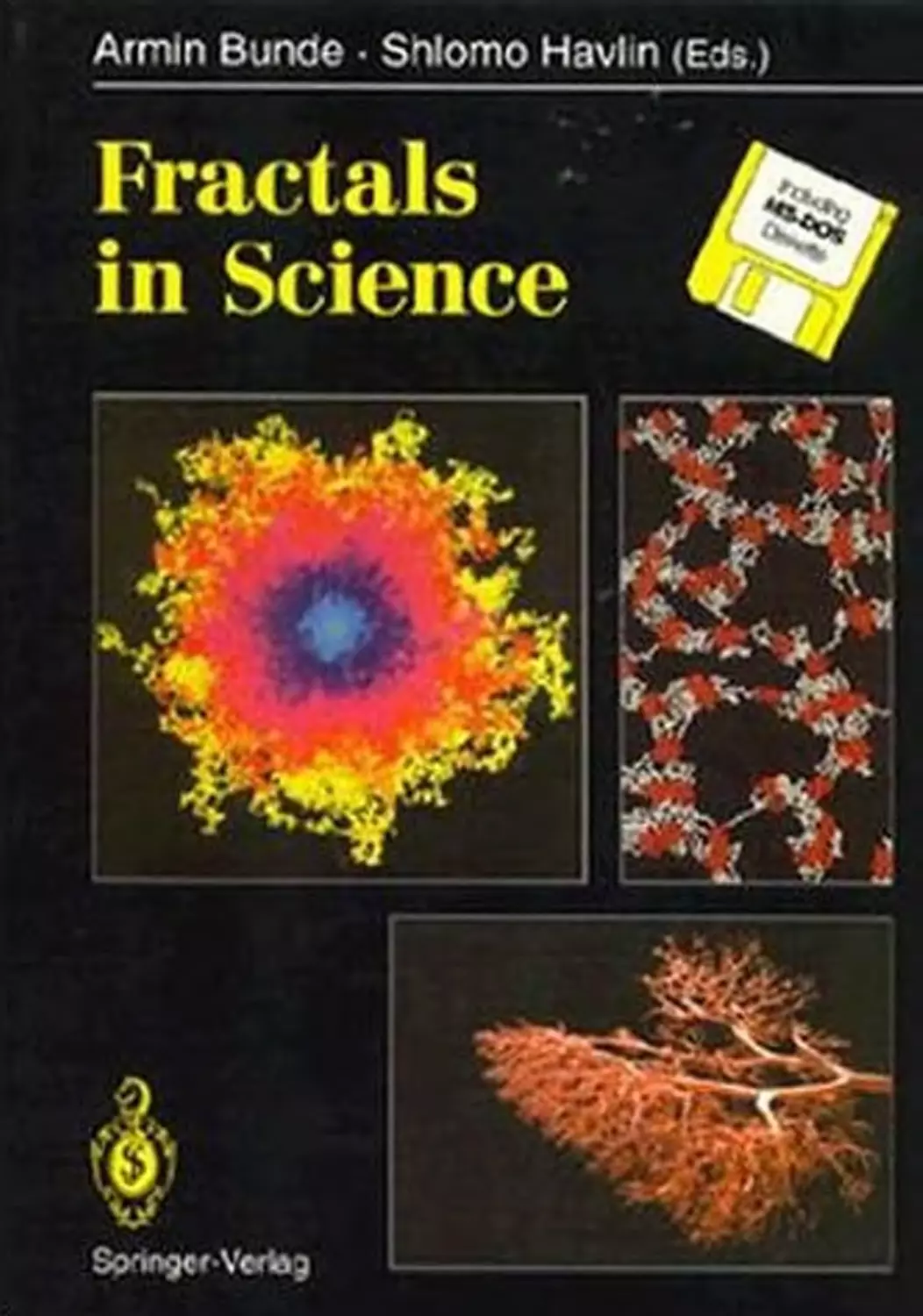
                    Armin Bunde Shlomo Havlin (Eds.)
Fractals
in Science
With a MS-DOS Program Diskette,
120 Figures and 10 Color Plates
Springer-Verlag
Berlin Heidelberg New York
London Paris Tokyo
Hong Kong Barcelona
Budapest

Preface
Applying fractal geometry to science is bringing about a breakthrough in our
understanding of complex systems in nature that show self-similar or self-affine
features. Self-similar and self-affine processes appear everywhere in nature, in
galaxies and landscapes, in earthquakes and geological cracks, in aggregates
and colloids, in rough surfaces and interfaces, in glassy materials and polymers,
in proteins as well as in other large molecules. Fractal structures appear also
in the human body; well known examples include the lung and the vascular
system. Furthermore, fractal geometry is an important tool in the analysis of
phenomena as diverse as rhythms in music melodies and in the human
heartbeat and DNA sequences.
Since the pioneering work of B.B. Mandelbrot, this interdisciplinary field
has expanded very rapidly. The scientific community applying fractal concepts
is very broad and ranges from astronomers, geoscientists, physicists, chemists
and engineers to biologists and those engaging in medical research.
The purpose of this book is to provide easy access to fractals in science
and to bridge the gap between the different disciplines. Similar in style to the
previous book Fractals and Disordered Systems in which the main emphasis
was on fractals in materials science, all chapters are written in a uniform
notation, and cross-references in each chapter to related subjects in other chapters
are provided. In each chapter emphasis is placed on the various connections
between theory and experiment. A special chapter (Chap. 9) entitled
"Computer Exploration of Fractals, Chaos, and Cooperativity" presents computer
demonstrations of fractal models. A diskette of these interactive programs, for
either Macintosh or PC-compatible computers, is enclosed.
The first chapter, by A. Bunde and S. Havlin, is for beginners in the field
and serves to introduce the basic ideas and concepts of fractal geometry. The
second chapter, by P. Bak and M. Creutz, deals with self-organized criticality,
a process that may explain why fractals occur so widely in nature. In the third
chapter, S. V. Buldyrev, A.L. Goldberger, S. Havlin, C.-K. Peng, and H.E.
Stanley describe fractal processes in biology and medicine with particular emphasis
on novel applications of fractal landscape analysis to DNA sequences and
cardiac rhythms. In Chap. 4, J. Kertesz and T. Vicsek present an introduction

VI Preface
to the new and fascinating field of self-afRne fractal surfaces generated by
natural processes like fractures, erosion, imbibition, and burning. In Chap. 5, G.
H. Weiss introduces the reader to the theory of diffusion and random walks,
which represent the basic mechanisms for disorder in nature, and describes
several applications to disordered media, semiconductors, and ecology. M. Daoud
reviews, in Chap. 6, fractal applications to polymer science, with emphasis on
single polymer chains, polymer solutions, melts, branched polymers, and gels.
Chapter 7, by S. Redner and F. Leyvraz, introduces the reader to the recent
developments in chemical reactions controlled by diffusion, a study relevant to
a wide range of processes including electron-hole recombination in
semiconductors, and catalytic reactions. In Chap. 8, D. Avnir, R. Gutfraind and D. Farin
discuss the use of fractal analysis in heterogeneous chemistry and demonstrate
the importance of fractal geometry to relevant chemical processes, including
the fundamental pharmacological problem of controlled drug release. In Chap.
9, D. Rapaport and M. Meyer present interactive computer demonstrations of
basic fractal models.
We wish to thank first and foremost the authors, and also our colleagues H.
Bolterauer, H. Brender, L. Lam, R. Nossal, S. Rabinovich, H..E. Roman, and
H. Taitelbaum for useful discussions. We kindly acknowledge the help of S.V.
Buldyrev, S. Glotzer, S. Harrington, M. Meyer, M. Sernetz, and P. Trunfio,
who contributed the color figures. We also wish to thank H.J. Kolsch and P.
Treiber from Springer-Verlag Heidelberg for their continuous help during the
preparation of this book. We hope that Fractals in Science can be used as a
textbook for graduate students, for teachers at universities preparing courses
or seminars and for researchers in a variety of fialds who are about to encounter
fractals in their own work.
Armin Bunde Giessen,
Shlomo Havlin Ramat-Gan,
February 1994

Contents
1 A Brief Introduction to Fracted Geometry
By A. Bunde and S. Havlin (With 22 Figures)
1.1 Introduction 1
1.2 Deterministic Fractals 2
1.2.1 The Koch Curve 3
1.2.2 The Sierpinski Gasket, Carpet, and Sponge 5
1.2.3 The Durer Pentagon 8
1.2.4 The Cantor Set 8
1.2.5 The Mandelbrot-Given Fractal 10
1.2.6 Julia Sets and the Mandelbrot Set 11
1.3 Random Fractal Models 12
1.3.1 Random Walks 12
1.3.2 Self-Avoiding Walks 13
1.3.3 Kinetic Aggregation 14
1.3.4 Percolation 16
1.4 How to Measure the Fractal Dimension 17
1.4.1 The Sandbox Method 17
1.4.2 The Box Counting Method 18
1.5 Self-Affine Fracals 19
1.6 Fractals in Nature 23
References 24
2 Fracteds and Self-Organized Criticcdity
By P. Bak and M. Creutz (With 10 Figures)
2.1 Introduction 27
2.2 Simulations of Sandpile Models 29

VIII Contents
2.3 Abelian Sandpile Models 33
2.3.1 The Abelian Group 33
2.3.2 An Isomorphism 37
2.3.3 A Burning Algorithm and the q = 0 Potts Model 40
2.4 Real Sandpiles and Earthquakes 41
2.4.1 The Dynamics of Sand 41
2.4.2 Earthquakes and SOC 43
2.5 1/f Noise 45
2.6 On Forest Fires and Turbulence 45
References 47
3 Fractals in Biology and Medicine:
From DNA to the Heartbeat
By S.V. Buldyrev, A.L. Goldberger, S. Havlin, C.-K. Peng,
and H.E. Stanley (With 17 Figures)
3.1 Introduction 49
3.2 Fractal Shapes 50
3.3 Long-Range Power Law Correlations 55
3.4 Information Coding in DNA 57
3.5 Conventional Statistical Analysis of DNA Sequences 59
3.6 The "DNA Walk" 60
3.6.1 Graphical Representation 60
3.6.2 Correlations and Fluctuations 61
3.7 Other Methods of Measuring Long-Range Correlations 64
3.8 Differences Between Correlation Properties
of Coding and Noncoding Regions 65
3.9 Long-Range Correlations and Evolution 67
3.10 Models of DNA Evolution 69
3.11 Long-Range Correlations and DNA Spatial Structure 74
3.12 Other Biological Systems with Long-Range Correlations .... 76
3.12.1 The Human Heartbeat 76
3.12.2 Physiological Implications 80
3.12.3 Human Writings 80
3.12.4 Dynamics of Membrane Channel Openings 81
3.12.5 Fractal Music and the Heartbeat 81
3.12.6 Fractal Approach to Biological Evolution 81
References 83

Contents IX
4 Self-AflBne Interfaces
By J. Kertesz and T. Vicsek (With 10 Figures)
4.1 Introduction 89
4.2 Roughness and Pinning in Equihbrium 92
4.3 Dynamic Scaling and Growth Models 95
4.4 Continuum Equations, Directed Polymers, and
Morphological TVansitions 98
4.5 Effects of Correlated, Power-Law, and Quenched Noise:
Nonuniversal Roughening and Pinning 107
4.5.1 Correlated Noise 107
4.5.2 Noise with Power-Law Distributed AmpUtudes 108
4.5.3 Quenched Noise 110
4.6 Siunmary 114
References 115
5 A Primer of Random Walkology
By G.H. Weiss (With 11 Figures)
5.1 Introduction 119
5.2 Basic Formalism 120
5.2.1 Jump Probabilities 120
5.2.2 Characteristic Functions 123
5.2.3 The Continuous-Time Random Walk (CTRW) 127
5.2.4 The Characteristic Function and Properties
of the Lattice Random Walk 129
5.3 Asymptotic Properties 132
5.3.1 The Central-Limit Theorem
and Some Generahzations 132
5.3.2 The Diffusion Approximation 137
5.3.3 A Mathematical Excursion:
Abelian and Tauberian Theorems 138
5.3.4 Asymptotic Properties of the CTRW
in an Unbounded Space 140
5.3.5 Asymptotic Properties of Random Walks
on a Lattice: Recurrent and Transient Behavior 144
5.3.6 The Expected Number of Distinct Sites Visited by
an n-Step Random Walk 146
5.4 Random Walks in Disordered Media 149
5.4.1 Introductory Remarks 149
5.4.2 The Trapping Model 151

X Contents
5.4.3 Some Models Based on the CTRW 155
5.4.4 The Effective-Mediiim Approximation 158
References 159
6 Polymers
By M. Daoud (With 14 Figures)
6.1 Introduction 163
6.2 Linear Chains and Excluded Volume 164
6.2.1 The Random Walk 165
6.2.2 The Self-Avoiding Walk 166
6.2.3 Dilute Solutions 169
6.2.4 Semi-Dilute Solutions 170
6.2.5 Dynamics 173
6.3 Adsorption 176
6.3.1 The Single Chain 177
6.3.2 The Plateau Regime 178
6.4 Branched Polymers and Gels 182
6.4.1 The Sol-Gel Transition 182
6.4.2 The Flory Approximation 184
6.4.3 Dilute Solutions 184
6.4.4 Semi-Dilute Solutions and Swollen Gels 188
6.4.5 Dynamics 190
References 192
7 Kinetics and Spatied Org£inization
of Competitive Reactions
By S. Redner and F. Leyvraz (With 6 Figures)
7.1 Introduction 197
7.2 Irreversible Homogeneous Reactions 199
7.2.1 Decay of the Density 199
7.2.2 Interparticle Distances 202
7.2.3 The Domain-Size Distribution in One Dimension .... 205
7.2.4 The Domain Profile 206
7.2.5 The Interparticle-Distance Distribution 208
7.3 Reactions with Particle Input 209
7.3.1 Steady Input and Diffusing Reactants 210
7.3.2 The Approach to Asymptotic Behavior 212

Contents XI
7.3.3 Immobile Reactants; Equivalence to Catalysis,
Kinetic Ising Models, and Branching Random Walks . 212
7.4 Heterogeneous Reaction Conditions 217
7.4.1 Transient Response - 218
7.4.2 Steady-State Behavior 220
7.5 Concluding Remarks 223
References 225
8 Fractal Analysis in Heterogeneous Chemistry
By D. Avnir, R. Gutfraind, and D. Farin (With 12 Figures)
8.1 Introduction 229
8.2 The Reaction Dimension 232
8.3 Surface Morphology Effects on Drug Dissolution 235
8.4 Size Effects in Catalysis 241
8.5 Multifractal Analysis of Catalytic Reactions 243
8.6 The Accessibihty of Fractal Surfaces
to Derivatization Reactions 247
8.7 Conclusion 252
References 252
9 Computer Exploration of Fractals,
Chaos, and Cooperativity
By Dennis C. Rapaport and Martin Meyer (With 10 Figures)
9.1 Introduction 257
9.2 The Software Collection 258
9.3 FVactaJs 260
9.3.1 Deterministic Fractals 260
9.3.2 Stochastic Landscapes 261
9.4 Cellular Automata 262
9.4.1 Cell Arrays 262
9.5 Cluster Growth 264
9.5.1 Diffusion-Limited Aggregation 265
9.5.2 Invasion Percolation 266
9.6 Cooperative Phenomena 266
9.6.1 Ising Model 267
9.6.2 Percolation 268
9.7 Many-Body Systems 269
9.7.1 Soft-Disk Fluid 269

XII Contents
9.8 Chaos 271
9.8.1 Logistic Map 271
9.8.2 Double Penduliim 272
9.9 More Collectivity 273
9.9.1 Polymers 273
9.9.2 Sandpiles 274
9.10 Iterative Processes 274
9.10.1 Affine Mappings 275
9.10.2 Mandelbrot Set 275
9.11 Siimmary 277
9A Appendix: Alphabetical Program List 277
9B Appendix: Mathematical Details 278
References 279
Subject Index 281

List of Contributors
David Avnir
Department of Organic Chemistry, The Hebrew University of Jerusalem
Jerusalem 91904, Israel
Per Bak
Department of Physics, Brookhaven National Laboratory
Upton, NY 11973, USA
Sergey V. Buldyrev
Center for Polymer Studies, Boston University
Boston, MA 02215, USA
Armin Bunde
Institut fiir Theoretische Physik, Justus-Liebig-Universitat
D-35392 Giessen, Germany
Michael Creutz
Department of Physics, Brookhaven National Laboratory
Upton, NY 11973, USA
Mohamed Daoud
Service de Physique Theorique de Saclay
F-91191 Gif-Sur-Yvette Cedex, Prance

XIV List of Contributions
Dina Farin
Department of Organic Chemistry, The Hebrew University of Jerusalem
Jerusalem 91904, Israel
Ary L. Goldberger
Cardiovascular Division, Harvard Medical School
Beth Israel Hospital, Boston, MA 02215, USA
Ricardo Gutfraind
Department of Organic Chemistry, The Hebrew University of Jerusalem
Jerusalem 91904, Israel
Shlomo Havlin
Department of Physics, Bar-Ilan University
Ramat-Gan 52100, Israel
Janos Kertesz
Technical University of Budapest, Budafoki ut 8
H-1521 Budapest, Hungary
Francois Leyvraz
Instituto de Fisica, Laboratorio de Cuernavaca
UN AM, Mexico
Martin Meyer
Institut fiir Theoretische Physik, Justus-Liebig-Universitat
D-35392 Giessen, Germany
C.-K. Peng
Center for Polymer Studies, Boston University
Boston, MA 02215, USA
Dennis C. Rapaport
Department of Physics, Bar-Ilan University
Ramat-Gan 52100, Israel

List of Contributions XV
Sidney Redner
Center for Polymer Studies, Boston University
Boston, MA 02215, USA
H. Eugene Stanley
Center for Polymer Studies, Boston University
Boston, MA 02215, USA
Tamas Vicsek
Eotvos University, Department of Atomic Physics
Puskin u. 5-7, 1088 Budapest, Hungary
George H. Weiss
Physical Sciences Laboratory, Division of Computer Research and Technology
National Institutes of Health, Bethesda, MD 20205, USA

2 Fractals and Self-Organized Criticality
Per Bak and Michael Creutz
2.1 Introduction
Many objects in nature are best described geometrically as fractals, with self-
similar features on all length scales. The universe consists of clusters of galaxies,
organized in clusters of clusters of galaxies and so on [2.1]. Mountain landscapes
have peaks of all sizes, from kilometers down to millimeters. River networks
consist of streams of all sizes. Turbulent fluids have vortices over a wide range
of sizes. Earthquakes occur on structures of faults ranging from thousands of
kilometers to centimeters. Fractals are scale-free in the sense that in viewing a
picture of a part of a fractal one cannot deduce its actual size if a yardstick is
not shown in the same picture.
If fractals are indeed the geometry of nature, one must still understand how
nature produces them. A good deal of effort has been put into the geometrical
characterization of these objects, but there has been practically no progress
in understanding their dynamical origin. We have a tendency to think of the
universe and the crust of the earth as static structures because the dynamics
that forms these structures have much longer time scale than the observation
period, which can be a human lifetime. The earthquakes that we observe last
at most a few seconds, whereas the fault formations appear static and are built
up over millions of years.
The origin of fractals is a dynamical, not a geometrical, problem. The laws
of physics are local, but fractals are nevertheless organized over the greatest
distances. The mystery is enhanced by the fact that large equilibriiim systems,
operating near their ground state, tend to be only locally correlated. Only at a
critical point where a continuous phase transition takes place are those systems
fractal.
Fig. 2.0. The sandpile model with 49 152 grains of sand added to a single point. The heights
Zi from 0 through 3 are represented by white, red, blue, and green, respectively

28 Per Bak and Michael Creutz
But real systems are dissipative, that is, they have friction, and rarely go
to their ground state, unlike the ideal models discussed in freshman physics.
Consider, for example, a pendulum. The ideal motion is periodic and for small
amplitudes is well approximated by a sine wave. To make it more realistic
one can put in a drag term, giving rise to a damped oscillatory behavior with
a decreasing amplitude theoretically continuing forever. However, in the real
world the motion will be impeded by some imperfections, perhaps in the form
of dust. Once the amplitude gets small enough, the pendulum will suddenly
stop, and this will generally occur at the end of a swing where the velocity is
smallest. This is not the state of smallest energy, and indeed the probability is
a minimum for stopping at exactly the bottom of the potential. In a sense, the
system is most likely to settle near a "minimally stable" state, far from any
"thermal equilibrium".
If we generalize to a multidimensional system of many coupled pendulums,
a new issue arises. A minimally stable state will be particularly sensitive to
small perturbations which can "avalanche" through the system. Thus small
disturbances could grow and propagate through the system with little resistance
despite the damping and other impediments. Since energy is dissipated through
this process, the energy must be replenished for avalanches to continue. The
systems that we shall study are ones where energy is constantly supplied and
eventually dissipated in the form of avalanches.
The canonical metaphorical example is a simple pile of sand. Adding sand
slowly to a flat pile will result only in some local rearrangement of particles. The
individual grains, or degrees of freedom, do not interact over large distances.
Continuing the process will result in the slope increasing to a critical value
where an additional grain of sand gives rise to avalanches of any size, from a
single grain falling up to the full size of the sand pile. The pile can no longer
be described in terms of many local degrees of freedom, but only a holistic
description in terms of one sandpile will do. The distribution of avalanches
follows a power law.
"Self-organized criticality" (SOC) refers to this tendency of large dissipative
systems to drive themselves to a critical state with a wide range of length and
time scales [2.2-4]. The idea provides a unifying concept for large-scale behavior
in systems with many degrees of freedom. It has been looked for in such diverse
areas as earthquake structure, economics, and biological evolution.
The critical state is an attractor for the dynamics. If a slope were too steep
one would obtain a large avalanche and a collapse to a flatter and more stable
configuration. On the other hand, if it were too shallow the new sand would
just accumulate to make the pile steeper. If the process is modified, for instance
by using wet sand instead of dry sand, the pile will modify its slope during a
transient period and return to a new critical state. It is this resiliency which
suggests that self-organized criticality might be a quite universal phenomenon.
If one builds snow screens locally to prevent avalanches, the pile will again
respond by locally building up to steeper states, and large avalanches will
resume. The large fluctuations associated with the avalanches are unavoidable;

2 Fractals and Self-Organized Criticality 29
this might provide some food for thought when applied to vast economic or
political systems.
Self-organized criticality complements the concept of "chaos" wherein
simple systems with a small niimber of degrees of freedom can display quite
complex behavior. Chaos is associated with fractal "strange" attractors in the phase
space spanned by nonlinear systems with only a few degrees of freedom. These
self-similar structures need have little to do with fractals in real spatially
extended physical systems. Specifically, chaotic systems exhibit white noise with
short temporal correlations, whereas fractal systems are expected to have long-
range temporal correlations. In contrast, self-organized criticality emphasizes
unifying features in the coherent evolution of systems with many degrees of
freedom.
2.2 Simulations of Sandpile Models
The convergence to the self-organized critical state can be demonstrated by
computer simulations on toy sandpile models (see also Chap. 9). The simplest
example is a cellular automaton formulated on a two-dimensional regular
lattice of A^ sites. Integer variables Zi on each site i are used to represent the
local sandpile height. Here we consider a two-dimensional lattice with open
boundaries. Addition of a sand particle to a site i is represented by increasing
the value of Zi at that site by unity. When the height somewhere exceeds a
critical value Zcr, here taken to be 3, there is a toppling event wherein 1 grain
of sand is transferred from the unstable site to each of the 4 neighboring sites;
i.e, the value of Zi is reduced by 4 and the values of z at the 4 neighboring
sites are increased by 1. The updating is done concurrently, with all sites
updated simultaneously. The initial toppling may initiate a chain reaction, where
the total number of topplings is a measure of the size of an avalanche. As an
example of a state in this model, in Fig. 2.0 we show the pile of sand resulting
from dropping 49152 grains on a single site. Already we see signs of a fractal
structure emerging.
To explore self-organized criticality in this model, one can randomly add
sand and have the system relax. The result of such an addition becomes
unpredictable, with one only being able to find the outcome by actually simulating
the resulting avalanche.
In Fig. 2.1 we show a typical state of the sandpile after a large amount of
sand has been dropped pseudo-randomly. The lattice here is 286 by 184 sites
and the boundaries are open. At first glance, the system appears quite random.
There are, however, some subtle correlations. For example, never do two black
cells lie adjacent to each other, nor does any site have four black neighbors.
This follows from the fact that in tumbling a site to height 0, a grain of sand
is dumped onto each neighbor.
To such a configuration a small amount of sand was added to a site near the
center, triggering an avalanche. We follow this avalanche in Fig. 2.2. To trace

30 Per Bak and Michael Creutz
Fig. 2.1. A typical critical state for the sandpile on a 286 by 184 lattice with open boundaries.
The heights zi from 0 through 3 are represented by black, red, blue, and green, respectively
the avalanche, we give the cells which have collapsed a cyan color. Figures 2.2a
and 2.2b show intermediate active stages in the collapse. Yellow sites inside or
outside the old avalanche area are still active. Figure 2.2c displays the final
stable configui-ation.
This was a particularly large avalanche, selected for illustrative purposes.
The initial state was not exactly that of Fig. 2.1 because in making this figure we
first produced several uninteresting small avalanches. Indeed the ultimate size
of the disturbance is unpredictable without actually running the simulation.
Some cascades may involve a single tumbling, and others collapse most of the
system.
Note in Fig. 2.2b the appearance of islands which have not yet collapsed.
These have all disappeared in Fig. 2.2c, the final relaxed state. This is an exact
result, special to this model; once in the critical ensemble, it is impossible to
trigger a set of avalanches which will leave an isolated island of unaltered cells
Figure 2.3 shows a log - log plot of the distribution of the avalanche sizes s
and durations t. The linearity indicates a power law,
P(.s)~s^-^, r~2.1, (2.1)
Fig. 2.2 a-c. The progress of an avalanche obtained by increasing one of the Zi in a critical
state. The undisturbed stable sites are colored as in Fig. 2.1 while the still active sites in
parts a and b are various shaxies of yellow, and the tumbled region is cyan

2 Fractals and Self-Organized Criticality 31

32 Per Bak and Michael Creutz
10"
10"
10-* h
10"
10"
10"
1
b
•
-
•
.
-
•
•
-
■
.
-
' 1 111 III
T^ 1—1 1 1 nil
-
■
-
■
.
-
-
.
\^
>v
>y^ .
10
100
1000
t
Fig. 2.3 a,b. A log - log plot of the distribution of (a) the avalanche sizes s and (b) durations
t for the sandpile model
where s is the number of tumblings in an avalanche and P is the probability
distribution for avalanches of a given size. Thus the state in Fig. 2.1, which
at first appears featureless, is actually remarkably correlated. For a random
distribution of z^s one would expect the chain reaction generating the avalanche
to be either subcritical, in which case the avalanche would die after a few steps
and large avalanches would be exponentially unlikely, or supercritical, in which
case the avalanche would explode with a collapse of the entire system. The
power law indicates that the reaction is precisely critical, i.e., the probability
that activity at some site branches into more than one active site is balanced
by the probability that the activity dies. Thus, by evolving through avalanche
after avalanche, the matrix has "learned" to respond critically to the next
perturbation.
Several other quantities which obey fractal scaling laws can be defined for
the sandpile. For instance, the duration t, that is, the number of updatings for
an avalanche to complete, has a distribution
Pit)
^l-^"t
Tt ~ 2.14
(2.2)
Also, the number of distinct tumbled sites, Sd, which is different from the total
number of topplings since some sites topple more than once, goes as
P{sd)
~ s
l-Td
Td ~ 2.07.
(2.3)
For some applications it is useful to define conditional expectation values. For
instance, one can define an exponent for the expectation value of the duration,
t, for an avalanche of size s:
t ~ s
,7ts
7ts ^ 0.61.
(2.4)
Similar relations connect mutually all the quantities s, t, Sd, and the linear
size r of the clusters [2.6]. The exponent relating Sd to r, ^s^r, appears to be 2,

2 Fractals and Self-Organized Criticality 33
indicating that the clusters are compact. The existence of relations between the
different stochastic variables suggests scaling relations between the exponents.
In general
ra, = 2 + {Ty- 2)h^y. (2.5)
As long as the variables x and y are reasonably correlated, this is a
mathematical identity and does not imply new physics. The compactness of clusters thus
suggests that (r^ — 2) = (r^ — 2)/2.
In order to calculate the power spectrum it turns out that one should
calculate the expectation value of s^ vs duration t, that is,
A(t) = Y^s'P{s,t). (2.6)
This quantity is given by the power law
A{t) ~ t^, /x ~ 2.1. (2.7)
The values of the exponents quoted here were calculated by Kim Christensen
[2.7]. The model can be defined in d = 3,4, etc. dimensions. For instance,
T ~ 2.31 in three dimensions; thus, the values of the exponents depend on d.
For an excellent discussion of these exponents and their relation to each other,
see the paper by Christensen et al. [2.6].
2.3 Abelian Sandpile Models
It would be highly desirable to have an analytical theory, such as the renormal-
ization group theory for equilibrium critical phenomena, by which one could
estimate the exponents and at the same time gain insights into the mechanisms
of self-organized criticality. We are not yet at that point. However, in a series of
papers Deepak Dhar and coworkers have shown that the sand model has some
rather remarkable mathematical properties [2.8-11]. In particular, the critical
attractor of the system is characterized in terms of an Abelian group. The
properties of the group can be used to calculate the number of states belonging
to the critical attractor, and the rate of convergence to the attractor. Further
consequences of the Abelian algebra have been explored by one of us [2.12-13],
and in the following we shall generally follow the discussion given in [2.13].
2.3.1 The Abelian Group
Dhar introduced the useful toppling matrix Ai^ with integer elements
representing the change in height, z, at site i resulting from a toppling at site j [2.8].
Under a toppling at site j, the height at site i becomes Zi — Aij. For the simple
two-dimensional sand model the toppling matrix is given as

34 Per Bak and Michael Creutz
Aij = — 1 i,j nearest neighbors, (2.8)
Ai,j = 0 otherwise.
For this discussion there is little special about the specific lattice geometry;
indeed, the following results easily generalize to other lattices and dimensions.
In fact, on a Cay ley tree the model can be solved exactly. The analysis requires
only that under a toppling of a single site i, that site has its slope decreased
{Ai^i > 0), the slope at any other site is either increased or unchanged (Aij <
0, j ^ i), the total amount of sand in the system does not increase (^ • Aij >
0), and, finally, each site can be connected through topplings to some location
where sand can be lost, such as at a boundary.
For the specific case in (2.8), the sum of slopes over all sites is conserved
whenever a site away from the lattice edge undergoes a toppling. Only at the
lattice boundaries can sand be lost. Thus the details of this model depend
crucially on the boundaries, which we take to be open. A toppling at an edge
loses one grain of sand and at a corner loses two.
The actual value of the threshold zt is unimportant to the dynamics. This
can be changed by simply adding constants to all the Zi. Thus without loss of
generality we consider zt = 3. With this convention, if all Zi are initially non-
negative they will remain so, and we restrict ourselves to states C belonging
to that set. The states where all Zi are positive and less than 4 are called
stable; a state that has any Zi larger than or equal to 4 is called unstable. One
conceptually important configuration is the minimally stable state C* which
has all the heights at the critical value zt- By construction, any addition of
sand to C* will give an unstable state.
We now formally define various operators acting on the states C. First, the
"adding sand" operator ai acting on any C yields the state aiC where Zi = Zi+1
and all other z are unchanged. Next, the toppling operator ti transforms C into
the state with heights Zj where Zj = Zj — Aij. The operator U which updates
the lattice one time step is now simply the product of U over all sites where
the slope is unstable,
i
where pi = 1 ii Zi > 4 and 0 otherwise. Using U repeatedly we can define the
relaxation operator R. Applied to any state C this corresponds to repeating
U until no more Zi change. Neither U nor R have any effect on stable states.
Finally, we define the avalanche operators Oj, which describe the action of
adding a grain of sand followed by relaxation
UiC = RaiC. (2.10)
At this point it is not entirely clear that the operator R exists; that is,
it might be that the updating procedure enters a nontrivial cycle. We now
prove that this is impossible. First note that a toppling in the interior of the
lattice does not change the total amount of sand. A toppling on the boundary,

2 Fractals and Self-Organized Criticality 35
however, decreases this sum due to sand faUing off the edge. Thus the total
sand in the system is a nonincreasing quantity. No cycle can have toppling at
the boundary since this will decrease the sum. Next, the sand on the boundary
will monotonically increase if there is any toppling one site away. This cannot
happen in a cycle; thus there can be no topplings one site away from the edges.
By induction there can be no toppling arbitrary distances from the boundary;
thus there can be no cycle, and the relaxation operator exists. Note that for
a general geometry this result requires that every site be eventually connected
to an edge where sand can be lost. With periodic boundaries no sand would
be lost and thus cycles are expected and observed. We call these unphysical
systems "Escher models" after the artist who constructed drawings of water
flowing perpetually downhill and yet circulating in the system.
It is useful to introduce the concept of recursive states. This set, denoted
TZ, includes those stable states which can be reached from any stable state by
some addition of sand followed by relaxation. As the minimally stable state
C* can be obtained from any other state by adding just enough sand to each
site to make Zi equal to three, it belongs to TZ. Thus, one might conveniently
define TZ as the set of states which can be obtained from C* by acting with
some product of the operators Oj.
It is easily shown that there exist nonrecursive, transient states; for instance,
no recursive state can have two adjacent heights that are both zero. One can also
show that the self-organized critical ensemble, reached under random addition
of sand to the system, has equal probability for each state in the recursive set.
The crucial result of [2.8-11] is that the operators a^ acting on stable states
commute, and that they generate an Abelian group when restricted to recursive
states. We begin by showing that the operators commute, that is, that aiajC =
ajttiC for all C. First we express the a's in terms of toppling and adding
operators,
aiajC=lf[tiAaJ J] uAajC, (2.11)
\fc=l / \fc=ni+l /
where the specific number of topplings rii and n depend oni, j, and C. Acting
on general states, the operators t and a all commute because they merely
linearly add or subtract heights. We can therefore shift ai to the right in this
expression:
aittjC = I n i/J aiajC. (2.12)
Now we rearrange the product of topplings. In the nontrivial case that the
a-operators render either i or j (or both) unstable, the product must contain
toppling operators corresponding to those unstable sites. We shift those
operators to the right. Those operators constitute by definition the update operator,
U, so we can write
aiUjC = (n^i.) UaiajC. (2.13)
The factors within the bracket are the remaining Vs. Now, the update
operator may leave some sites still unstable, and then the product must include

36 Per Bak and Michael Creutz
further toppling operators; working on those sites, we can pull out another
factor of the update operator. This procedure can be repeated until we have
used all the toppling factors and the state is stable. Thus, we can identify the
operator within the brackets in (2.12) as the relaxation operator R. But aiajC
is the same state as ajaiC, so aiajC = ajaiC.
A trivial consequence of this argument is that the total number of tumblings
occurring in the operations aiajC and ajUiC are the same. Of course, if a
particular site k tumbles it can be caused by either addition; the orders of the
tumblings may or may not be altered.
We now prove that the avalanche operators have unique inverses when
restricted to recursive states; that is, there exists a unique operator a~^ such
that ai{a~^C) = C for all C in TZ. This implies that the operators Ui acting
on the recursive set generate an Abelian group. For any recursive state C we
first find another recursive state such that at acting on it gives C, and we then
show that this construction is unique.
We begin by adding a grain of sand to the state C and allowing it to
relax. This generates a new recursive state aiC. Now, since the state C is by
assumption recursive, there is some way to add sand to regenerate C from any
given state. In particular, there is some product P of addition operators aj
such that
C = PaiC. (2.14)
But the a's commute, so we have
C = ttiPC, (2.15)
and thus PC is a recursive state on which a^ gives C.
We must still show that this state is unique. To do this consider repeating
the above process to find a series of states Cn satisfying
iai^Cn = a (2.16)
Because on our finite system the total number of stable states is finite, this
sequence must eventually enter a loop. As the original state C can be generated
by running around the loop in the opposite direction, C must itself belong to
the loop. Calling the length of the loop m, we have {ai)'^C = C. We now
uniquely define a~^C = d!^~^C.
We now have sufficient machinery to count the number of recursive states.
As all recursive states can be obtained by adding sand to C*, we can write any
state C G 7^ in the form
C=(IKMC*- (2-17)
Here the integers n^ represent the amount of sand to be added at the respective
sites. However, in general there are several different ways to reach any given
state. In particular, adding four grains of sand to any one site must force a
toppling and is equivalent to adding a single grain to each of its neighbors.
This can be expressed as the operator statement

2 Fractals and Self-Organized Criticality 37
at= U «J. (2-18)
jGnn
where the product is over the nearest neighbors of site i. We can rewrite this
equation by multiplying it by the product of inverse avalanche operators on the
nearest neighbors on both sides, thus obtaining
Y[af''=E, (2.19)
3
where E is the identity operator. This allows us to change the powers appearing
in (2.17). If we now label states by the vector n = (ni,n2,n3,... ,nAr) we
see that two such states are equivalent if the difference of these vectors is of
the form J^. (ijAij, where the coefficients /3j are integers. These axe the only
constraints; if two states cannot be related by toppling they are independent.
Thus any vector n can be translated repeatedly until it lies in an N- dimensional
hyper-parallelopiped whose base edges are the vectors Aji, j = 1, ,N. The
vertices of this object have integer coordinates and its volume is the number
of integer coordinate points inside. This volume is just the absolute value of
the determinant of A. Thus the number of recursive states equals the absolute
value of the determinant of the toppling matrix A.
For large lattices this determinant can be found easily by Fourier transform.
In particular, whereas there are 4^ stable states, there are only
(/.(tt.tt)
N
exp ( AT / —^ ln(4 - 2q^ - 2qy) I ~ (3.2102.. Y (2-20)
recursive states. Thus starting from an arbitrary state and adding sand, we see
that the system "self-organizes" into an exponentially small subset of states
forming the attractor of the dynamics.
2.3.2 An Isomorphism
Following [2.12], we now look into the consequences of stacking sandpiles on
top of one another. Given stable configurations C and C with configurations
Zi and z[, we define the state C ® C" to be the state obtained by relaxing the
configuration with heights Zi + z[. Clearly, if either C or C are recursive states,
so is C ® C
One can show that under the operation ® the recursive states form an
Abehan group isomorphic to the algebra generated by the a^. First, the addition
of a state C with heights Zi is equivalent to operating with a product of ai raised
to Zi, that is,
B®C={j{al'^B. (2.21)
The operation ® is associative and Abelian because the operators a^ are.
Since any element of a group raised to the order of the group gives the
identity, it follows that a\ ' = J5. This implies the simple formula a~^ = a\ '~\
The analog of this for the states is the existence of an inverse state, — C,

.!& d, reutz
Fig. 2.4. The identity state on a 286 by 184 lattice. The heights are color coded as in Fig. 2.1
-C = (|Z^1-1)®C. (2.22)
Here, n® C means adding n copies of C and relaxing. The state —C has the
property that for any state B ®C ® (—C) = B.
The state I = C ® {—C) represents the identity and has the property
I ® B = B ioY every recursive state B. The state which is isomorphic to the
operator Oj is simply ail. The identity state provides a simple way to check
if a state, obtained for instance by a computer simulation, has reached the
attractor, i.e., if a given state is a recursive state: A stable state is in TZ if and
only if C © / = C The proof is simple. By construction, a recursive state has
this property. On the other hand, since / is recursive, so is C i I.
The identity state can be constructed by taking any recursive state, say C*,
and repeatedly adding it to itself to use \A\®C = I. However, on any but the
smallest lattices, \A\ is a very large integer. A simpler scheme is given in [2.12].
Figure 2.4 shows the identity state on a 286 by 184 lattice. Note the fractal
structure, with features of many length scales.
Here we present another scheme to construct this state. Figui'e 2.5a,b shows
a sequence of configurations obtained by pouring sand in from the boundaries:

2 Fractals and Self-Organized Criticality 39
b
Fig. 2.5 a - d. A procedure for constructing the identity. In parts a and b an empty table
is having sand poured on from the edges. In part c the entire table is supercritical. In part
d the boundaries have been opened, and the sand is running back off. The system finally
relaxes the state shown in Fig. 2.4. In this sequence, heights are color coded as in Fig. 2.1,
with active sites in various shades of yellow

40 Per Bak and Michael Creutz
the heights at the edges are kept very high, and the inside is initially empty. A
variety of fractal structures emerge as the interior slowly fills up. Figure 2.5c
shows the final stationary state where the sand falling in from the boundaries
matches that falling off from the updating. Then we reverse the boundary
conditions and allow the sand to fall back off. Figure 2.5d shows an intermediate
state of this procedure. When the sand finally stops falling off, we obtain the
identity state as shown in Fig. 2.4.
2.3.3 A Burning Algorithm and the qr = 0 Potts Model
Majumdar and Dhar [2.11] have constructed a simple "bui-ning" algorithm to
check and enumerate the configurations belonging to the recursive set. The
boundary is included as a single site, labeled 0. To decide whether a given
configuration belongs to 7?-, consider first, at time t = 0, all the sites unburnt,
except 0 which is burnt. An unburnt site i is defined to burn at time t = 1 if
Zi exceeds the number of edges connecting i to other unburnt sites. Those sites
burn at t = 2, and so on. The fires start from the edge and burn inward. Once
some sites have burned, other sites may become burnable since the number of
edges is reduced. The path of the fire may be indicated by bonds connecting
burnt sites. If and only if all sites eventually burn under this algorithm does
the state belong to the recursive set.
The burning algorithm can also be described in the following way. For a
given configuration, add one particle to each of the edge sites, two particles to
the corners, and update according to the usual rules. If the original state is
recursive, this will generate an avalanche under which each site of the system
will tumble exactly once. If the state is not recursive, some untumbled sites will
remain. Figure 2.6 shows such a process underway on the lattice from Fig. 2.1.
Here sites which have already burned ai'e shown in cyan, while the remaining
sites in the center have not yet burned. The small number of sites shown in
light tan are the active burning sites. Note the fractal shape of the interface.
It is unclear whether the dynamics of the burning algorithm, intended to
identify and count allowed configurations, has anything to do with the
dynamics of avalanche formation. Majumdar and Dhar studied the scaling of the
extension r of the burning cluster vs time and found
tc^r^', 2'= 7^^ = 5/4. (2.23)
The spanning-tree problem corresponds to a problem in equilibrium
.statistical mechanics, namely the q = 0-state Potts model. The Potts model is
defined in terms of the Hamiltoniaii
H=g^^'5281^.,^,), 12.24)
where the a are ^--state spins and the summation is over nearest neighbors on a
two-dimensional lattice. Several results about the Potts model are known from
an equivalence with the two-dimensional Coulomb gas model and from con-

2 Fractals and Self-Organized Critical!ty 41
Fig. 2.6. The burning algorithm appHed to the state in Fig. 2.1. Burnt sites are cyan, burning
sites are yellow, and the remaining sites are colored as in Fig. 2.1
formal field theory. From this analogy Majumdar and Dhar [2.10] argue that
the height - height correlation {z{r')z{r' — r)) — {z^ varies as r~'^^^ for large
separations r, where Xt = 2 is the exponent for the energy - energy correlation
function for the Potts model. The height variable in the sandpile model
corresponds to the energy density for the Potts model. This again indicates that
there are strong correlations built into the seemingly random configurations
obtained numerically (Fig. 2.1) for the sandpile.
2.4 Real Sandpiles and Earthquakes
2.4.1 The Dynamics of Sand
"Sand" represents a "state of matter" to which not much attention has- been
paid. Sand can be shaped into many different forms; that is, it can exist in
very many stable states, almost all of which are out of the flat equilibrium

42 Per Bak and Michael Creutz
til
0)
o
§ 10-3
c
O -1
10-' -
10
•2 _
10
10-"
-3 _
1 1—I I I I I l| 1 1—I I I I I I
J I I oqI
I I I I I
\
J
—
1 1
gV
1 1
1 1 M 1 l|
1
1
^O
1
1 1 1 1 1 M
b
—
-jO
1 1 iSi 11
1
100
10
Number of Beads
Fig. 2.7a,b. The avalanche distribution from recent experiments by Grumbacher et al. [2.16]
state. Thus, sand contains memory: one can write letters in sand. If a heap
of sand is perturbed, for instance by adding more sand, by tilting the pile, or
by shaking it, the system goes from one metastable state to another. In some
sense this happens by a diffusion process, but this process is very different from
the process which relaxes a glass of water to equilibrium after being shaken.
The diffusion of sand can stop at any of many stable states, and the process
is a threshold process, since nothing happens before the perturbation reaches
a certain magnitude. It might therefore be reasonable to expect real sandpiles
to exhibit self-organized critical behavior.
After a couple of false starts with inconclusive results, there are now several
experiments reporting power law distributions of avalanches [2.14-16]. Figure
2.7 shows the results of recent experiments by Grumbacher et al. [2.16]. They
built small heaps on a scale, and monitored the distribution of avalanches of
particles falling off the edges. The figure shows log - log plots of the normalized
distribution function of avalanches. The experiments were performed using iron
spheres (triangles) and glass spheres (circles) of the same size. In all cases a
power law distribution function was found. In a remarkable experiment Bretz
et al. [2.15] were even able to image the flow of small avalanches not reaching
the edge and measure their flow and size.
The threshold dynamics of sand is a paradigm of many processes in nature.
Earthquakes occur only when the stress somewhere on the crust of the earth
exceeds a critical value, and the earthquake takes the crust from one stable state
to another. Economic systems are driven by threshold processes; the individual
agents may change their behavior only when conditions reach a certain level.

2 Fractals and Self-Organized Criticality 43
Biological species emerge or die when specific conditions in the ecology are
fulfilled. Neurons in a neiiral network fire when the input from other neurons
reaches a threshold level, etc. Indeed, the ideas of SOC have been applied to
these and many other natural phenomena, including volcanic activity [2.17]
and solar flares [2.18].
2.4.2 Earthquakes and SOC
The idea of self-organized criticality as applied to earthquakes [2.19-23], may
be visualized as follows. Think of the lithosphere of the earth as a collection
of tectonic plates, being squeezed very, very slowly into each other. At some
time in our geological history the stresses may have been small, without large
ruptures or earthquakes. During millions of years, however, the system evolved
into a kind of stationary state where the build-up of stress is balanced on
average by its release during earthquakes. Because of the long evolutionary
process, the crust has "learned," by suitably arranging the building blocks at
hand into a very balanced network of faults, valleys, mountains, oceans, and
other geological structures, to respond critically to any initial rupture. The
earthquake can be thought of as a critical chain reaction where the process is
just barely able to continue.
For a simple model, consider a two-dimensional lattice of interacting blocks.
The initial block structure represents a discretization of the space in much the
same way as the lattice in lattice gauge theories of particle physics. The block
size does not represent an intrinsic length scale in the problem. On each block,
at site {i,j) a force Fij acts in an unspecified general direction of motion in
some fault region. In the beginning, Fij may assume small random values. The
initial state is not important for the long term dynamics. Let the force increase
uniformly by a infinitesimally small amount per unit time; this simulates the
slow driving by the tectonic plate motion. Eventually, the force at some site
{i,j) will exceed a critical threshold value Fc for rupture. The value chosen
for Fc may be either uniform or random. The initial rupture is simulated by
updating the forces at the critical site and the sites of the neighbors at {i,j±l)
and{i±l,j):
''' ' (2.25)
where nn denotes the nearest neighbors and a is an adjustable parameter.
These equations represent the transfer of force to the neighbors. This may
cause the neighbors to be unstable and a chain reaction to take place. This
chain reaction is the earthquake. The equations are completely deterministic,
with no external noise. We are not dealing with a noise-driven phenomenon; on
the contrary, the physics turns out to be stable with respect to noise, i.e., noise
is irrelevant. When the earthquake stops, the system is quiescent until the force
at some other location exceeds the critical value and a new event is initiated.
The process continues again and again. One observes that for some time the
earthquakes become bigger and bigger. When one is convinced that the system
has self-organized into a stationary state, one can start measuring the energies

44 Per Bak and Michael Creutz
of subsequent earthquakes as defined by the total number of rupture events
following a single initial rupture.
This model was suggested by Olami, Christensen and Feder [2.22], who
realized that the picture could be directly related to earlier spring-block models.
The value of a is directly related to the elastic parameters of the crust of the
earth. For a = 1/4 the force is conserved, i.e., the amount lost on the unstable
site equals the total amount gained by the 4 neighboring sites. The criticaUty
in this case has been observed to prevail for values of a down to 0.05, with only
20% conservation. This came as a surprise since there was then a widespread
belief that the lack of conservation would spontaneously generate a length scale,
i.e., a "characteristic earthquake size." In fact, it seems that criticality occurs
generically almost independently of the details of the toppling rule. Another
model without conservation which appears to exhibit self-organized criticality is
the "game of life" [2.23] (Sect. 9.4), a cellular automaton representing a society
of Uving and dying individuals. Perhaps intermittent fluctuations in evolution,
like the extinction of the dinosaurs, can be seen as manifestations of SOC.
Figure 2.8 shows the distribution of earthquakes for a = 0.20. The straight
Hne yields a power-law distribution with an exponent b= l-r = 0.8. The line
indicates that the system has self-organized into the critical state. Indeed, real
earthquakes exhibit a power law distribution, known as the Gutenberg-Richter
law. The slope depends on the degree of dissipation, (1/4 — a), so there is no
universality of the exponent b in the nonconservative case. One should not look
for unique 6-values in nature. Indeed different values have been observed in
different geographical areas.
The power-law distribution of earthquakes stems from the fractal nature of
the SOC state, with correlated regions ranging over all length scales; these
correlated regions, generated by the long-term dynamics, are the equivalent of the
active faults or fault segments in real earthquakes. The fault structure changes
on large geological time scales. More realistic long-range SOC models produce
faults which topologically look much more Hke a real fractal arrangement of
two-dimensional faults in a three-dimensional matrix [2.21].
10"
10"
10* -
10* -
10" -
10
-
-
■I—[-I- . 1 r—r-|
\.
, 1 , , 1 , .
1 1 1 1 1
"
> .111
n2
10" 10' 10' 10- 10* 10°
Fig. 2.8. The distribution of earthqucikes for a = 0.20 for the model described in the text.
The straight line yields a power-law distribution with an exponent 6 = 1 — r = 0.8

2 Fractals and Self-Organized Criticality 45
1000
0.01 -
0.001
Fig. 2.9. (a) The distribution of A for a = 0.20 for the earthquake model described in the
text. The slope of the streiight line gives n = 0.8. (b) A direct measurement of the power
spectrum in the eeirthquake model
2.5 1/f Noise
One-over-/, 1//, noise can thought of as a signal arising from the superposition
of avalanches occurring in a self-organized critical state [2.2]. In order to
illustrate how this works, consider the weighted lifetime distribution of avalanches
A{t) as defined in Sect. 2.2. Christensen et al. [2.6] showed that if A has a
scaling behavior, A{t) ~ t^, then the power spectrum S(f) becomes
S(/)~r'-^, for -l</i<l. (2.26)
Figure 2.9a shows the distribution of A ior a = 0.20 for the above
earthquake model [2.24]. The slope of the straight line gives 6 -I-1 = 1.8.
Figure 2.9b shows a direct measurement of the power spectrum; an
exponent (f) = 1.75 was found from the slope of the log - log plot, in reasonable
agreement with the value 1.8 expected from the lifetime distribution function
defined above.
In nature, values of the exponent of the 1// noise in the interval 0.6-2.0
have been reported [2.25]. A value of 1 corresponds to /i = 0; this particular
value is obtained for a ~ 0.11 in the model. The exponent does depend on
the parameters of the model and thus is not universal, unlike the conventional
exponents for equilibrium critical phenomena.
2.6 On Forest Fires and Turbulence
A liquid driven by imposing a velocity difference v over a length scale L
undergoes a transition to a turbulent state with vortices exhibiting a large range
of length scales. The temporal variations of the velocity at a given spot are
intermittent, with large and small bursts of activity. The energy is dissipated
locally within a short length scale known as the Kolmogorov length.

46 Per Bak and Michael Creutz
Mandelbrot [2.1] has suggested that in turbulent systems the dissipation
of energy is confined to a fractal structure with features of all length scales.
This behavior can be simulated by a simple forest-fire model [2.26]. Distribute
randomly a number of trees {green dots) and a number of fires {yellow dots)
on a two-dimensional rectangular lattice. Sites can also be empty. Update the
system at each time t as follows: (1) grow new trees with probability p from
sites that are empty at time t — 1: (2) trees that were on fire at time t — 1
die (become empty sites) and are removed at time t; (3) a tree that has a fire
as a nearest neighbor at time t — 1 catches fire at time t. Periodic boundaries
are used. After a while the system evolves to a critical state with fire fronts
of all sizes (Fig. 2.10). Drossel and Schwabl [2.27] have extended the model by
adding a small probability / of igniting new fires at each time step. In the limit
f /p ~^ 0 the ignitions create forest fires where the number of trees burned, s,
follows a power law, P{s) ~ s^~'^, with r ~ 3. (For percolation models of forest
fires, see, e.g.. Chap. 2 in [2.28].)
Fig. 2.10. A typical state in the dynamics of the forest-fire model described in the text.
Trees are green, fires yellow, and empty sites black. The periodic lattice is 286 by 178 sites
and new trees are born on empty sites with a probability of 1/32 per time step

2 Fractals and Self-Organized Criticality 47
The physics of earthquakes can be described in a similar language. The crust
in a fault region is driven by imposing a force or a strain over a large length L. In
the stationary state, the energy is dissipated in narrow fault structures forming
a fractal set. The spatio-temporal correlation functions for the two phenomena
are quite similar although the time scales are vastly different. In both cases, the
energy enters the system uniformly (zero wave vector) and leaves the system
locally. There are a lot of similarities between the earthquake model studied by
Olami et al. [2.22] and the forest fire model. The analogy has been explored
in some detail by Kagan [2.29]. Maybe it is useful to think of self-organized
criticality and turbulence as one and the same phenomenon.
Acknowledgements. We are grateful for Kim Christensen for discussions and
help with preparing figures. This work was supported by the U.S. Department
of Energy under Contract No. DE-AC02-76CH00016. The color figures were
produced on a Commodore Amiga.
References
2.1 B.B. Mandelbrot: The Fractal Geometry of Nature (Freeman, San Francisco 1982)
2.2 P. Bak, C. Tang, K. Wiesenfeld: Phys. Rev. Lett. 59, 381 (1987); Phys. Rev. A 38,
3645 (1988)
2.3 C. Tang, P. Bak: Phys. Rev. Lett. 60, 2347 (1988)
2.4 K. Wiesenfeld, P. Bak, C. Tang: J. Stat. Phys. 54, 1441 (1989)
2.5 P. Bak, K. Chen: Sci. Am. (January 1991) p. 46
2.6 K. Christensen, H.C. Fogedby, H.J. Jensen: J. Stat. Phys. 63, 653 (1991)
2.7 K. Christensen: Thesis, University of Aeirhus
2.8 D. Dhar: Phys. Rev. Lett. 64, 1613 (1990)
2.9 D. Dhar, R. Ramaswamy: Phys. Rev. Lett. 63, 1659 (1989)
2.10 D. Dhar, S. N. Majumdar: J. Phys. A 23, 4333 (1990)
2.11 S.N. Majumdar, D. Dhar: Physica A 185, 129 (1992)
2.12 M. Creutz: Comp. in Phys. 5, 198 (1991)
2.13 M. Creutz: Nuc. Phys. B (Proc. Suppl.) 20, 748 (1992)
2.14 J. Rosendahl, M. Vekii, J. Kelley: Phys. Rev. E. 47, 1401 (1993)
2.15 M. Bretz, J.B. Cunningham, P.L. Kurczynski, F. Nori: Phys. Rev. Lett. 69, 2431 (1992)
2.16 S.K. Grumbacher, K.M. McEwen, D.A. Halvorson, D.T. Jacobs, J. Lindler: Am. J.
Phys. 61, 329 (1993)
2.17 P. Diodati, F. Marchesoni, S. Piazza: Phys. Rev. Lett. 67, 2239 (1991)
2.18 E.T. Lu, R.J. Hamilton: Astrophys. J. L89, 380 (1991)
2.19 P. Bak, C. Tang: J. Geophys. Res. B 94, 15635 (1989)
2.20 K. Ito, M. Matsuzaki: J. Geophys. Res. B 95, 6853 (1989)
2.21 K. Chen, P. Bak, S. P. Obukhov: Phys. Rev. A 43, 625 (1991)
2.22 Z. Olami, H.J. Feder, K. Christensen: Phys. Rev. Lett. 68, 1244 (1992)
2.23 P. Bak, K. Chen, M. Creutz: Nature 342, 780 (1989)
2.24 K. Christensen, Z. Olami, P. Bak: Phys. Rev. Lett. 68, 2417 (1992)
2.25 W. H. Press: Comments Astrophys. 7, 103 (1978)
2.26 P. Bak, K. Chen, C. Tang: Phys. Lett. 147, 297 (1990)
2.27 B. Drossel, F. Schwabl: Phys. Rev. Lett. 69, 1629 (1992)
2.28 A. Bunde and S. Havlin, eds.: Fractals and Disordered Systems (Springer, Heidelberg
1991)
2.29 Y. Kagan: Nonlinear Science Today 2, 1 (1992)

4 Self-AfRne Interfaces
Jdnos Kertesz and Tamds Vicsek
4.1 Introduction
Self-similar objects are the simplest examples for scale invariance. Scaling is
maintained, although in an anisotropic form, when the invariance is required
for the general affine transformation and not for pure dilation only. Examples
include critical directed percolation clusters, directed lattice animals, or the
record of a random walk. These objects are called self-affine.
For an interesting and quite common class of scaling objects the invariance
transformation can be represented by a diagonal matrix with all but one of the
eigenvalues equal to A and one to A'* with 0 < a < 1. Surfaces of homogeneous
(non-fractal) systems are often rough and show such self-affine structure.
Further examples of random self-affine functions can be found in fluctuating time
dependent phenomena (l//*^ noise).
The concept of self-affinity was introduced by Mandelbrot, who studied the
fractal properties of self-affine functions [4.1]. There are several reviews
describing self-affine geometry [4.2-4] including Chap. 7 (by J.-F. Gouyet, M. Rosso,
and B. Sapoval) in [4.5]. Therefore, we restrict ourselves in this chapter to
summarizing only the fundamental features and the important new developments
in this very active field of research.
The simplest example for the self-affine random function is the record h{x)
of a one-dimensional Brownian motion. The time is put on the x axis and the
position is denoted by h. In analogy with the case of self-similar fractal objects
the statistical scale invariance is reflected in the correlation functions. It is
convenient to consider the height-difference correlation function C{x). For a
Fig. 4.0. An example of a model interface describing imbibition. The front propagates in
the presence of quenched randomness Eind the pinning of the interface is governed by a
mechanism related to directed percolation. Different colors mean different heights. Courtesy
of S.V. Buldyrev

90 Janos Kert^sz and Tamas Vicsek
long record of the walk {0 < x < X)
Cix) = {[hix' + x)-hix')]yj\ (4.1)
where (• • ■)x' means averaging over the positions x'. Since the mean square
displacement of a Brownian particle is proportional to time, we have (see Chap,
C{x) ~ x'/^. (4.2)
For an arbitrary self-affine function of one variable
C{x) ~ x"", (4.3)
with a being the Hurst exponent, known in the case of surfaces as the roughness
exponent. Thus the Hurst exponent is 1/2 for the record of the Brownian motion
(see also Chap. 1).
The fractal dimension of a self-affine function can be determined by box
counting. Choosing the box length as e, the number N{e) of boxes needed to
cover the graph of the function on the interval X is
N{e) ~ - X — ~ 6"-^ (4.4)
e e
since the first term on the right-hand side is the number of subintervals of
length e and the second term is the number of boxes covering the graph in a
subinterval. The fractal dimension is therefore
df = 2-a, (4.5a)
since df = — lim£_>o(log7V(e)/loge). This df is the local fractal dimension.
In the case of self-similar fractals the dimension can also be calculated by
introducing a lower cut-off and covering the object with growing boxes. For self-
affine functions this procedure obviously leads to a different result, namely to
the trivial global dimension 1. The change in the behavior occurs at a crossover
point Xc defined by C{xc) — Xc. When e <C Xc, the second term on the right-
hand side of (4.4) is > 1. In the opposite limit, when e ^ Xc, this term is < 1,
thus one box is sufficient for covering the graph of the function in a subinterval
e. The generalization of these results to self-affine functions of d variables is
straightforward. The local fractal dimension is
df = d+l-a, (4.56)
while the global dimension is equal to d.
The position (h) and the time (x) are physically different quantities and
their units are independent of each other. Nevertheless, if the record as a
geometric object is considered, a length scale has to be set onto the "time axis"
as well. Since the ratio of the time and length units can be chosen arbitrarily,
the position of the crossover point Xc can be changed.
If the self-affine function is discrete, e.g., it represents the surface of a lattice
system, the units are fixed in all directions and the range below the crossover

4 Self-AfRne Interfaces 91
point is usually not present. Self-affine surfaces are in this sense not fractals.
Nevertheless, they can be transformed by scale transformations into objects
with nontrivial local fractal dimensions.
The fractal aspect of self-affine surfaces also becomes apparent when the
surface is cut by a d-dimensional (hyper-)plane with an orientation parallel to
the average orientation of the surface. The section is a self-similar object with
the fractal dimension dcut — df — 1 = d — a.
A concept analog to multifractality (see [4.2] and [4.5]), called multiaffinity
[4.6] can be introduced for the objects obeying affine scaling. Introducing the
generalized gth-order correlation functions
Cgix) = (|/i(x + x') - h{x')\^)^^,\ (4.6)
the expected behavior is
Cq{x)r^x'^^. (4.7)
In simple cases cng does not depend on q. For multiaffine objects the function
Oiq can be related to Dq or /(a) in the multifractal formalism [4.6].
In the following we shall concentrate on self-affine surfaces or interfaces
[4.3,7-13]. Prom the microscopic point of view it is a difficult problem to decide
which phase a particular point in the surface region belongs to. In a realistic
lattice model this feature is reflected in the occurrence of holes, high steps,
and overhangs, which makes it cumbersome to define the surface. A self-affine
single-yalued function results from a realistic surface by coarsening. Of course,
there are models particularly tailored to investigate such surface problems, like
the so-called solid-on-solid (SOS) models, where just these overhangs and holes
are forbidden by definition. For these models the equivalence of the simplified
surfaces with the real ones has to be shown.
The term "surface region" of the former paragraph needs further
specification [4.14]. The scaling fluctuations of physical self-affine surfaces (which are
either already defined on a lattice or have a lower cutoff anyway) is
observable in the long distance limit (rr —> co in (4.3)). These fluctuations result in
wandering of the surface and can be characterized by the surface width:
w'= {{h - (h))') = {h') - {h)\ (4.8)
where, in analogy with (4.1), (• • •) means spatial average over the range of x
above which the (coarsened) surface positions h{x) are defined. The scaling of
the surface can be described by the dependence of the width w on the linear
extent L of the system:
w^L'^. (4.9)
Relation (4.9) is valid for asymptotically large L values. Over short distances
the behavior is characterized by the so called intrinsic surface width, the range
over which one phase crosses over into the other (Fig. 4.1). For equilibrium
interfaces this range can be identified with the bulk correlation length.
What is the origin of the roughness of surfaces? One source can be
destruction, such as fracture [4.15-17], erosion [4.18,19] or burning [4.20]. In many cases

92 Janos Kertesz and Tamas Vicsek
^,
^
±
Fig. 4.1. The schematic structure of an interfeice. The intrinsic surfeice width Wi is indicated
in the inset. For the meaning of ^|| and ^± see (4.38)
rough surfaces are generated by a growth [4.2,3,10]. Rough interfaces often occur
under equilibrium circumstances as well [4.7,8]. It seems to be a general feature
that (time dependent or quenched) randomness is essential in the development
of self-affine surfaces.
4.2 Roughness and Pinning in Equilibrium
Let us consider a d +1 dimensional Ising model in zero external field below the
transition temperature with anti-periodic boundary conditions in one specific
direction and periodic boundary conditions in the other d directions. Owing
to the boundary conditions the system cannot order according to one of the
ground states and a d-dimensional interface is created. Using the lattice-gas
representation of the Ising model, where spins pointing in one direction are
identified with occupied sites and the other ones with empty sites, the above
configuration can be regarded as a model of a solid-vapor interface.
The interface is not a unique d-dimensional object because the
configurations contain overhangs, high steps, and holes; thus one phase goes into the
other one over a range characterized by the bulk correlation length ^j,.
Therefore, the intrinsic width of the surface can be identified with ^j,. It is generally
accepted that the behavior of the interface over distances much larger than
^b can be adequately described by SOS models, where overhangs and holes
are disregarded and the interface can be represented by a single valued height
variable h oi d spatial variables. An appropriate Hamiltonian is [4.7]
J
^ - "^ X/^^-?' ~ ^J+nnY
(4.10a)
3,nn
where nn means nearest neighbour. Equation (4.10a) has the continuum limit

4 Self-AfRne Interfaces 93
n=^ f d'^x\Vh\'^. (4.106)
This Gaussian model has the advantages of being solvable and it is general in
the sense that its long-wavelength limit describes the scaling properties of an
interface characterized by a surface tension.
Taking the Fourier transform of this equation one has
^=^E^'I^^I'' (4-11)
where
(l/L)'^/2 f h{x)e-'^'' (4.12)
and L is the linear extent of the d dimensional surface. Owing to the equipar-
tition theorem Jk'^\hk\'^ = T. The fluctuation of the interface over a distance
X — x' is therefore given as
^[l-cos(fc(a;-a;'))], (4.13)
where the k integral is limited from above by the inverse of the lower cutoff
in the system (lattice constant or interatomic distance). The evaluation of the
integral leads to C'^{x — x') ~ (rr — x'Y~'^ for all dimensions except d = 2,
where C'^{x — x') ~ log(rE — x') [4.7-9]. This result can be summarized as
2-d
a = ^-. (4.14)
The one dimensional interface of a two dimensional system is rough with a Hurst
exponent 1/2. The interface is marginally rough for the d = 2 interface because
of the logarithmic divergence - this is what is meant by the zero exponent in
(4.14). In higher dimensions the interface is flat, i.e., its width does not diverge
with increasing system size.
The possible lattice effects do not occur in the above consideration. It turns
out that the periodic potential due to the lattice is irrelevant for the one-
dimensional interface while it leads to the so called roughening transition for
the two dimensional interface. Below the roughening temperature Tr the
interface is smooth: the free energy of forming a step is larger than zero. At Tr
this free energy contribution vanishes and for T >Tii the surface becomes
logarithmically rough. Important properties such as equilibrium crystal shapes or
the growth rate depend heavily on whether the temperature is above or below
Tr.
The nature of the roughening transition has been intensely studied [4.7,8].
The two dimensional Hamiltonian to be considered is a modification of (4.10a):
n=- J2ihj - hj+nn)"" - 2yoJ J2 cos(27r/ij), (4.15)
j,nn j

94 Janos Kertesz and Tamas Vicsek
where the lattice effects are taken into account by the periodic potential.
Prom the point of view of critical behavior this Hamiltonian is dual to the
two-dimensional Coulomb gas or, equivalently, to the planar XY model; thus
the roughening transition is of the Kosterlitz-Thouless type. The logarithmic
roughness for T > Tji corresponds to the low-temperature correlations in the
Coulomb gas. This picture of the roughening transition based on the
mapping and on renormalization group calculations has been reinforced by exact
solutions and nimierical results [4.8,9].
The roughness of the equilibrium interface is generated by thermal
fluctuations. Quenched, time-independent noise also leads to the roughening of the
interface. The disorder can be in the couplings as represented by a zero-field
Ising Hamiltonian with random interactions so that the ferromagnetic ground
state is not destroyed. The continuum equation describing the interface is [4.21]:
n = J d''x[^\Vh\^+rj{x,h{x))], (4.16)
where the random potential can be approximated by Gaussian white noise. The
important difference in the thermal noise is that 77 in (4.16) is time independent,
i.e., quenched. There are two exponents characterizing the interface: H, the
roughness exponent, and to, defined by
AE ~ L'^, (4.17)
where AE is the fluctuation of the energy along the interface in the ensemble
of different noise configurations. There is a scaling relation between the two
exponents:
2a-uj=-2-d. (4.18)
In 1-1-1 dimensions the weight W of an interface (or a directed path) in a
random medium starting at (0,0) and ending at {x,y) satisfies the equation
[4.22]:
d,W{x, y) = {T/J)dlW{x, y) + {l/T)V{x, y)W{x, y). (4.19)
As we shall discuss later, at zero temperature this is equivalent to a global
optimization problem. Equation (4.19) can be transformed into the Burgers
equation with random force and can be solved exactly in H-1 dimensions. The
result is q; = 2/3 and uj = 1/3. Therefore the interface roughness with disorder
is larger than in the pure case because of the pinning effect of the impurities.
Enhanced roughening is caused by another type of quenched disorder when
the spins of an Ising model feel random, time-independent magnetic field rji:
n = -J Y^ SiSj + J2viSi, (4.20)
where the sum runs over nearest-neighbor pairs of spins. An interesting dynamic
effect in this model is that there is a depinning transition as a function of an
additional homogeneous external field H [4.23]. A finite H > He field is needed
to get the interface to move away from its pinned position. We shall come back
later to this problem of a moving interface in the presence of quenched disorder.

4 Self-AfRne Interfaces 95
4.3 Dynamic Scaling and Growth Models
In order to study the time dependent fluctuations of the interface it is useful
to introduce the Langevin equation corresponding to the Hamiltonian (4.10)
[4.7,8]:
9^^o=-^^^.+vM (4.21)
which leads to
dthjit) = -(r2J/r) J2 (hjit) - hj+Ut)) + r]j{t). (4.22)
nn
Here r]j is a Gaussian fluctuating white noise satisfying the fluctuation
dissipation theorem:
(77,(i)) = 0, (4.23)
{Vi{t)vj{t')) = 2r6ij6{t-t'). (4.24)
The continuum limit of this equation is
dth{x, t) = uV^h{x, t) + r]{x, t). (4.25)
It is simple to obtain the Fourier transform of the correlation function from
(4.25):
C\k,uj) = {hkiuj)h_k{uj)) (4.26)
and
'^('='") = ;;^T^- (^-2^)
The result (4.14) could have been calculated from this expression as well.
Moreover, another exponent, the dynamic exponent z, can be obtained using (4.27).
The right-hand side of (4.27) can be rewritten so that
C^{k,uj)=uj'^f{k^uj), (4.28)
where / is a scaling function and z = 2 in all dimensions for the above problem
[4.7].
What happens if the interface is driven by an external force? In this case
the position of the mean (h) changes with time and the fluctuating surface is
a result of a growth process:
dth{x, t) = F + i^V^hix, t) + r]{x, t). (4.29)
This is the Edwards-Wilkinson (EW) model of sedimentation [4.24]. Since both
the Laplace and the noise terms disappear if an average over the whole system
is taken, (h) = F and (4.29) can be transformed to (4.25) using a co-moving
frame. Therefore, the exponents a and z of this growth model are the same as
those for the thermal roughening problem.

96 Janos Kertesz and Tamas Vicsek
Much of the information about growth phenomena has been obtained by
studying simple computer models which cannot be related to Hamiltonians.
By analyzing such a model, Family and Vicsek postulated [4.25] the following
dynamic-scaling form of the width (4.8) of an initially flat surface developing
in a d + 1 dimensional space:
w{L,t) = L^f{t/L'), (4.30)
where L is the linear size of the substrate. In the limit where the argument
of the scaling function /(a) is small, a <C 1, the width depends only on t and
this implies that for small a the scaling function /(a) has to be of the form
/(a) ~ a^ with /3 = a/z. At large times the width saturates, i.e., /(a) goes to
a constant in that limit. Thus,
na)^h^^ if««l (4.31)
^ ^ [const, if a> 1. ^ ^
For short times {t <^ L^) the width depends only on the time
w ~ tf^, (4.32)
while for (t > L^)
w^L". (4.33)
Stationarity is reached for times t ^ t where the relaxation time r ~ L^ is
measured from the beginning of the growth.
Similar behavior is expected in the stationary state for the time-dependent
correlation function C{r,t), the generalization of (4.1)
C(r,t) = mx',t') - h{x' + x,t'+ t))yj,l, ~ r"/ (j^^ , (4.34)
with an /(a) analogous to (4.31); however, in this case L is replaced by r = |a;|.
For r <^ L, C{r,0) behaves as
C(r,0)~r", (4.35)
while for times t <C r
C{0,t)^t^. (4.36)
In the transient region, before stationarity sets in, the scaling can be studied
by the equal time correlation function C{r,t):
C{r, t) = mx',t) - h{x' + X, t))YJ,^ ~ r-/(t/r^). (4.37)
The spread of fluctuations in the direction parallel to the substrate is
characterized by the correlation length ^||(t). This shows how far the effect of a
perturbation can get after some time t along the surface (Fig. 4.1).
^ll~t^/^ for t<r and ^|| =-^^, for t > r. (4.38a)

4 Self-Affine Interfaces 97
The average height difference ^± over the distance ^y is
U = ef (4.386)
reflecting the affine relationship between directions parallel and perpendicular
to the substrate. According to (4.34-38), the surface has self-affine properties
up to the scale C\\{t) which grows with time (4.38). Dynamic scaling in self-
affine surface growth has been verified in many cases by different methods.
The scaling properties exist for large system sizes and long times as compared
to the microscopic length and time units. For intermediate times and lengths
corrections to the asymptotic scaling often have to be taken into account.
One of the simplest related system is the Eden growth process [4.26]. In
this model all perimeter sites of the cluster are growth sites with equal growth
probability and at one time one of the growth sites gets part of the cluster. The
initial stage is an occupied d-dimensional flat (hyper-)plane. Of course, other
initial geometries, such as a single seed, can also be considered. This model was
originally invented to describe biological growth, such as that of cancer cells,
but it can also be related to crystal growth.
Deep in the bulk, Eden clusters have no holes. The surface region is rather
complex with holes, high steps and overhangs. As in the situation of Ising-type
interfaces, these contribute to an intrinsic width of the surface which does not
scale with the system size. The effect on the scaling of the intrinsic width Wi
is well described by the convolution approximation:
^lotal = ^Icaling + ^1 (4.39)
where Wscaiing is described by (4.30). Equation (4.39) expresses the idea that
the fluctuations resulting in the intrinsic width and the scaling long wavelength
fluctuations can be considered independent. Reasonable scaling for the Eden
model in d + I = 2, 3 and 4 dimensions could be obtained [4.27] when the
corrections to scaling due to the intrinsic width were taken into account. The
results are: (3 ~ 0.33 (d = 1), /3 ~ 0.22 {d = 2), and /3 ~ 0.15 (d = 3), and a
scaling relation a{l + 1//3) = o; + 2; = 2, to be discussed later, seems to hold.
Another model which shows similar behavior is ballistic deposition [4.28],
which describes vapor deposition [4.29]. Particles - one after the other - fall
down at random positions on parallel straight paths and stick to the cluster
or deposit when they get into contact with it either by falling on the top of
a particle of the deposit or by touching one at the side. Again, the kinetic
roughening process starts with a flat surface. In contrast to the Eden model,
here holes survive forever since a particle stuck to the cluster screens all the
sites below it.
The numerical results on ballistic aggregation lead to exponents close to
those of the Eden model [4.30]; these models can therefore be assumed to
belong to the same universality class. As discussed above, the determination of
the exponents is hindered by the corrections due to the intrinsic width. There
are two ways to overcome this difficulty. One is to suppress the intrinsic width.

98 Janos Kertesz and Tamas Vicsek
This can be done for the Eden model by noise reduction [4.31] - in fact, the
results mentioned above were obtained using this method [4.27]. The other
way is to introduce models which belong to the same universality class but
have minimal intrinsic width by definition. Such are the single-step models.
The surface configurations are SOS-like without any overhangs, holes or high
steps.
In one of these models [4.32] the particles are assumed to rain down along
randomly positioned vertical trajectories as in ordinary ballistic deposition, but
they are incorporated into the deposit only if (a) the height difference between
any two columns is smaller than or equal to unity and (b) no overhangs occur,
i.e., a particle always has to sit on the top of another one. This model leads to
perfectly compact clusters, which have a surface with slopes 0 or ±1.
The extensive simulations of the above restricted solid-on-solid model has
resulted in accurate estimates of the exponent (3{d) in dimensions d+l = 2 — 5
[4.32]:
/3(1) = 0.332 ± 0.005, /3(2) = 0.25 ± 0.005,
/3(3) = 0.20 ±0.01, /3(4)~0.17. (4.40)
Now we turn to the description of the results obtained by the hypercube
stacking model [4.30,33,34]. In this model the surface of a stack of (hyper-)cubes
on a (11 • ••) substrate is considered. This means that the hypercubes are piled
up in such a way that one of their corners points downwards. The model is
defined as a sequence of stacking events; each time a hypercube is added to the
surface at a deposition rate p"*" or removed with a rate p" [4.33,34]. The single
step solid-on-solid condition is assumed at all stages. Forrest and Tang used
a multispin coding, parallel-processing algorithm to obtain accurate estimates
for this model.
The careful evaluation of the simulations carried out on systems of sizes
L = 11520^ in d + 1 = 3 and L = 2 x 192^ in d 4-1 = 4 dimensions has led to
the values
/3(2) = 0.24 ± 0.001 and /3(3) = 0.180 ± 0.005 (4.41)
which together with the scaling law a + z = 2 uniquely determine the other
exponent as well. Two comments are in order concerning (4.41). (a) The studied
system sizes are considerably larger than in any of the previous investigations,
and (b) the estimates (4.41) are in disagreement with earlier conjectures based
on numerical results [4.27,32].
4.4 Continuum Equations, Directed Polymers, and
Morphological Transitions
Why are the diverse models like Eden growth, ballistic deposition and the
different single-step models expected to belong to the same universality class? Long-
wavelength fluctuations, which are responsible for scaling can be described by

4 Self-Affine Interfaces 99
stochastic hydrodynamic (continuum) equations. It turns out that all these
models are described by the same continuum equation because they share a
relevant common property: the growth velocity depends on the tilt of the
substrate.
We have already seen the simplest continuum equation describing kinetic
roughening, namely the EW equation (4.29). The exponents of this equation
are different from the Eden universality class (4.39,40) (except for a = 1/2 for
the one dimensional surface). Edwards and Wilkinson have already pointed out
[4.24] that taking into account nonlinearities may change their result. Kardar,
Parisi and Zhang (KPZ) [4.35] suggested the following nonlinear equation:
dth = iyV^h + \/2{Vh)^ + r){x,t), (4.42)
where A/2 is the coupling of the nonlinear term. The constant force F has
already been transformed out. The noise r]{x,t) in (4.42) was assumed to be
uncorrelated and white and to have a Gaussian distribution, so that {r){x, t)) =
0, and
{ri{x, t)r]{x', t')) = 2D8^{x - x')8{t - t'), (4.43)
where D is a. constant. The origin of the nonlinearity can be understood if the
Eden-type growth is considered; in the continuum approximation, this is just
growth normal to the surface in the presence of noise. The surface is described
by a height function and therefore normal growth A at positions where Vh ^ 0
leads to an increment A^\ + (Vh)^ ~ A{\ + i^Kf jH). It is clear from this
argument that a nonlinear coupling A 7^ 0 is generated whenever the growth
velocity depends on the tilt of the surface. The coupling is positive if the velocity
increases (as in the Eden model) and negative if it decreases (as in the single-
step model) with the tilt. However, the scaling behavior is independent of the
sign of A since the relevant combination of the couplings is X^df/u^. If surface
relaxation is allowed in the ballistic deposition model, i.e., the particles roll
down and fill the holes, there will be no tilt dependence of the growth velocity
and the EW (or equilibrium) exponents are recovered [4.36]. The actual value
of the nonlinear coupling constant can be measured by investigating the tilt
dependence of the growth velocity [4.37] or by using inhomogeneous deposition
[4.38].
We have already referred to the scaling relation [4.30]
a + z = 2. (4.44)
(In 1 + 1 dimensions, where the equivalence to the equilibrium roughening
problem is valid, the corresponding equation is (4.18).) This equation (4.44)
is a consequence of the invariance of the KPZ equation with respect to an
infinitesimal tilt [4.39]. It can be understood in simple geometric terms if growth
normal to the surface is assumed [4.40]. Let us approximate the fluctuation of
size ^11 in the surface by a (hyper-)spherical calotte with a height and diameter
equal to ^± and ^y, respectively. The radius of the sphere grows proportionally
to the time t. Therefore,
i'-(i-e±)'=e^ (4.45)

100 Janos Kertesz and Tamas Vicsek
The term $,"]_ can be neglected for long times. The scaling relation (4.44) follows
if relations (4.38) are used in (4.45).
Using the so called Cole-Hopf transformation W{x,t) = exp[(A/2z/)/i(a;, t)]
the KPZ equation can be transformed into the diffusion equation with
multiplicative noise (the d + I dimensional generalization of (4.19)) describing the
problem of d + 1 dimensional directed polymers. At zero temperature this is
equivalent to finding the optimal directed path in a random potential, i.e., the
path along which the sum of the potential is minimal. As mentioned before, the
solution to (4.19) in 1 + 1 dimensions is known, thus the exponents of the KPZ
or Eden-type growth can be determined - but the meaning of the exponents
here is different. The roughening exponent for the equilibrium-interface
problem with quenched disorder is equal to the inverse of the dynamic exponent
in the surface growth process l/z = 2/3 while the exponent describing energy
fluctuations is equal to (3 = 1/3.
The relation between directed polymers and surface growth becomes more
explicit on the microscopic level using waiting time growth models [4.41],
moreover, the mapping can be made exact [4.42]. Imagine a hypercubic stacking
model where random waiting times are assigned to each growth site when they
are born. The time when a particular site at R becomes occupied satisfies the
equation
t{R) = t{R) + m3x{R'), (4.46)
where R' denotes sites preceding R. Applying (4.46) recursively it turns out
that the sites on the surface are connected to the substrate by ancestor lines
for which
t(R) = max V t(R'). (4.47)
Path O^R ^f-'
il'ePath
Thus the path is equivalent to a zero temperature directed polymer if —t{IV) is
identified with the random potential at site R. Besides its theoretical interest,
the model of directed polymers can be helpful in understanding the self-affine
structure of rupture lines, for example, in paper sheets [4.17].
The KPZ equation can be mapped to the Burgers equation [4.35] and this
allows us to apply the fenormalization group analysis of Forster et al. [4.43] to
this problem. The following picture emerged [4.35,39] (see Fig. 4.2). Up to a
critical dimension dc + 1 = 3 (two-dimensional substrate) the nonlinear term
dominates except if it is not present at all (A = 0). This means that for A = 0
the growth is described by the EW linear theory (thus, in d = 2 /3 = 1/4,
2 = 2), while for any nonzero A the strong-coupling fixed point dominates the
dynamics, leading to /3 = 1/3 and z = 3/2 in d = 2.
There are no exact results related to the KPZ equation for dimensions higher
than 1 + 1. However, the RG results and the computer simulations seem to be in
quite good agreement. The direct numerical solution of the nonlinear stochastic
differential equation [4.44,45] has been shown to be an effective tool and the
results support the picture obtained by the other methods. Recently alternative
approximate methods have been put forward by Schwartz and Edwards [4.46]

A
4 Self-Affine Interfaces 101
rough phase
smooth phase
d
Fig. 4.2. A phase diagram of KPZ-type surface growth [4.42]
as well as by Bouchoud and Gates [4.47]. In these similar but not equivalent
studies either a variational treatment of the Fokker-Planck equation is proposed
[4.46] or a self-consistent approach is applied to the KPZ equation [4.47]. The
numerical results for 2 + 1 dimensions are rather encouraging (a = 0.29 and
0.37, respectively). For higher dimensions the calculated values do not agree
well with the numerical results. It is not clear whether the conclusion of the
theories about the existence of an upper critical dimension du is correct but if
du exists at all it must be higher than predicted [4.47]. (For d > dy, the strong
coupling phase should vanish.)
For d > dc there is a finite, dimension dependent critical value of X^df/u^ at
which the smooth linear phase changes over to the rough phase. Less is known
about what happens right at dc- In fact, most of the computer simulations
devoted to detecting a transition at dc have been subject to criticisms of various
kinds. The renormalization group in this case suggests an exponentially slow
logarithmic to power-law crossover [4.48], and some of the simulations seem to
support this result.
Before reviewing the numerical results on morphological transitions in
surface growth let us discuss what are some of the major expected features of a
non-equilibrium transition of this kind. In the general case the transition takes
place between two morphologies characterized by different scaling exponents.
A well understood specific situation is when the transition is triggered by a
diverging length scale [4.49] ^r ~ \p — Pcl"'^^, where Up is some exponent and
the transition takes place at pc as the parameter p is approaching its critical
value. Under such circumstances the dynamic scaling (4.30) for the width has
to be modified according to the scaling ansatz
w^C'FiL/CrMr), (4.48)
where the anomalous values of the roughening and the dynamic exponents are
denoted by a' and z', respectively. The usual dynamic scaling is recovered only
in the limit L ^ ^^ and t ^ ^^ , when (4.48) becomes equivalent to (4.30). At
p = Pc the length ^j. diverges and the width scales as
w^L'^'f{t/L^'). (4.49)
The above phenomenological scaling theory has been tested using a polynu-
cleation growth model. In short, this model corresponds to a simultaneous
deposition of particles followed by a relaxation step when a particle is added at

102 Janos Kertesz and Tamas Vicsek
each kink position along the surface. This model can be treated in terms of
directed percolation [4.49] and the exact values of the anomalous exponents can
be obtained. The result a' — 0 has been verified by computer simulations which
indicate that
w{L,t) ~ {logty/^ and w{L,t = oo) ~ (logL)^/^ (4.50)
The morphological transition has an important effect on the shape of the
clusters grown from a central seed. Again, the relation to directed percolation
turned out to be helpful in describing this non-equilibrium roughening
transition [4.50].
Several communications reported on morphological phase transitions in
computer models of surface growth. The existence of a transition from the
smooth to the rough phase in dimensions d + 1 > 3 seems to be well
established (see, e.g., [4.34,45,51,52]).
The situation is less clear in d + 1 = 3, although this case is physically
relevant. In some papers the existence of a phase transition is indicated. The
problem of interest here is the question whether the observed transition is a
trivial one or whether it takes place for a parameter value of the models which
corresponds to a nonzero value of A in the language of the KPZ equation. By
a trivial transition here one means that by tuning the parameters of a model
it is in principle possible to achieve a situation in which the behaviour of the
model becomes linear (A — 0). (For example, A > 0 for ballistic deposition, but
A < 0 for the single-step models.) Then the smooth phase is reduced to a single
point as is predicted by the renormalization group for d < 2.
Morphology transitions were reported to occur in the following models.
Amar and Family [4.53] considered a modified solid-on-solid model in which
the probability of growing at a given site depended on the change of energy
(depending on a temperature-like variable and the number of neighbours) upon
adding a site to the deposit. By varying the temperature a sharp transition was
observed between two phases described by different exponents accompanied
by a flat phase at the point of the transition. Arguments based on the KPZ
equation suggested [4.53-55] that this transition is trivial in the above sense of
making A equal to zero by tuning the temperature. The difference in the values
of the exponents is not.explained by these arguments; it may be due to lattice
effects or to an extremely slow crossover.
Yan et al. [4.51] studied a ballistic deposition model in which the
particles were allowed to diffuse. The effect of diffusion was taken into account in
a manner which destroyed the discrete nature of the model in the growth
direction. As the parameter p of the model (controlling the rate of aggregation
versus diffusion) was changed, a marked decrease in the effective exponents
was observed at a critical value of p signaling a non-trivial phase transition
since the exponents remained small beyond Pc- Similar results were reported
by Pellegrini and JuUien [4.52], who investigated ballistic deposition of sticky
and nonsticky particles. However, it was concluded in a later publication by
these authors that no nontrivial phase transition is present [4.56].
The complexity of the situation is demonstrated in Fig. 4.3, where results
obtained for the hypercube stacking model are shown [4.34]. The quantity

4 Self-Affine Interfaces 103
10
1 -
% icr'
I
HO
CM
10-'
ia
1-2
: 1—1 1 1 iiii| r—
; (a) d=2
-
r
. •
t t 1 1 1 1 III 1
1 1 1 1 1 1ll| 1
r (6) d=3
■ L=192
- ° L=128
^
r ^
-
1 1 1 1 1 ml 1
1 1 11111] 1—r 1 1 im| 1—1 1 1 III!
.m= 0 ;
1 "••= 4
• . m= 8 ■
■ '.m=12:
• I
, m=16 -
1 I M 1 III 1 1 1 1 1 1 III
Tn.=32
1 1 II 1 ll| 1 1 1 II lll| 1—1—1 1 1 1II
,m= 0
Tn.= 4 1
,Tn.= 6 '.
.y^'^ y''^^ x^
1 1 1 nil! 1 II
,m= 7 ■
,m= 8-^
,m= 9 .
,m=10
josA 1 1
1
10
10^
t
10^
10*
Fig. 4.3a,b. Crossover in the hypercube stacking model in 2 + 1 dimensions and
morphological transition in 3 + 1 dimensions [4.34]. The strength of the nonlinear coupling is controlled
by p" at fixed p+ = 1/2. The EW (linear) case is p" = p+
w'^{2t) — w'^{t) is plotted versus the time t in order to exclude the effect of
the intrinsic width (4.39). The data are for various p~ = m/64 values for fixed
p~^ = 1/2. It can be clearly seen that as we approach the equilibrium case
(m = 32, A = 0) the crossover time, at which the asymptotic behavior sets in,
diverges rapidly. As a result, effective exponents different from the asymptotic
value can be associated with large fractions of the data. The situation in 2 + 1
dimensions is different (bottom); m = 8 seems to be a critical value: for larger
m the fluctuations of the interface decay in time, the surface remains flat. It
seems most probable that in 2 + 1 dimensions there is no nontrivial phase
transition and the data need vary careful analysis owing to the extremely slow
crossover at A = 0.
According to Villain [4.57] and Wolf [4.58], in some limit surfaces grown
by molecular beam epitaxy (MBE) can be described by the anisotropic KPZ
equation where the couplings v and A in (4.42) are substituted by direction
dependent, anisotropic couplings. For d — 2,a transition from the KPZ behavior
to the EW one is predicted [4.58] if the nonlinear coupling in one direction gets
a sign different from the sign of the coupling in the other direction.
An interesting question is whether there is an analog of the roughening
transition in a driven system. We have already mentioned -the transition triggered

104 Jdnos Kertesz and Tamas Vicsek
by directed percolation [4.49], but in this case a general constraint is
responsible for the smooth phase. The KPZ transition for d + 1 > 3 describes a change
from a smooth to a rough phase, but it is not justified to call it a roughening
transition since the smooth phase is not a consequence of the lattice.
Nozieres and Gallet [4.59] investigated the effect of the lattice periodicity
by introducing a sine term into the EW equation (4.27). Hwa et al. [4.60]
considered the analog extension of the KPZ equation:
fi-^dth = F + uV'^h - ysm{2'rvh) + \/2{yhf + r]{x, t). (4.51)
Both studies concluded that any finite F is relevant and destroys the smooth
faceted state. Although this is true in principle, for a finite system at finite times
it may have no practical meaning. Therefore, the effects should be studied close
to Tr. It turns out that the terms investigated by Nozieres and Gallet explain
very well the experiments on He IV while the roughening due to the nonlinear
term is not accessible experimentally because of the extremely large crossover
scales [4.61].
The experimental systems where KPZ-type kinetic surface roughening has
been expected include biological growth, vapor deposition (see Fig. 4.4),
roughening due to sputter erosion, and the motion of a fluid interface in a random
medium.
In biological growth the evolution of colonies of bacteria [4.62] and of fungi
[4.63] has been investigated. In these quasi two-dimensional systems exponents
a ~ 0.78 and a ~ 0.62, respectively, were measured, which are significantly
larger than the KPZ value (1/2). In these experiments the interface roughness
occurs on the mm-cm scale and the patterns are evaluated by digital-image
processing.
The roughness exponents measured in vapor deposited silver experiments by
Krim's group (see [4.64]) seem to depend on the material of the substrate and
they are also larger than the values predicted by KPZ (~ 0.4). The roughness
Fig. 4.4. An image of a vapor deposited surfeice. The picture was generated by using STM.
Courtesy of J. Krim

4 Self-Affine Interfaces 105
of an iron surface bombarded by Ar ions can be characterized by o; ~ 0.53. To
our knowledge, there are two experimental results compatible with the KPZ
theory: one is a measurement on heteroepitaxial film of Fe [4.65] and the other
is by the group of Williams on graphite erosion by sputtering [4.18,66]. The
recently developed powerful tools such as STM (Scanning Tunneling
Microscope) or AFM (Atomic Force Microscope) are essential in the investigation of
the microscopic roughness of these systems.
In fluid displacement experiments the roughening of an initially flat interface
is investigated. Here two fluids fill the gap between two parallel plates and the
more viscous one propagates. The static randomness in the prepared Hele-Shaw
cell causes the roughening. The exponents are again larger than predicted by
the KPZ theory [4.67,68]. Large exponents were also measured in the imbibition
experiments using paper as 1+1 dimensional and oasis brick as 2+1 dimensional
porous random media [4.69-71]. In Sect. 4.5 we shall discuss these experiments
in some detail.
At the end of this brief overview of experimental results we mention some
"exotic" systems: Zhang et al. investigated the propagation of the burning
front of paper [4.20] and obtained a ~ 0.7 for the roughness. By analyzing
the self-afflne scaling of rupture lines in paper [4.17] (see Fig. 4.5) a close
to 2/3 was obtained and this result was interpreted in terms of the directed
polymer model. In an experiment on mountain formation by erosion Vicsek et
al. produced [4.19] self-aifine structures with a roughness exponent close to 0.8.
The KPZ equation reflects some symmetry properties of the system. In
fact, this is the simplest nonlinear equation of surface growth which is
invariant under constant shift and inflnitesimal tilting. Other stochastic equations
have been proposed to describe kinetic surface roughening under different cir-
Fig. 4.5. A self-affine rupture line in a paper sheet. The roughness exponent is close to 2/3
[4.17]

106 Janos Kertesz and Tamas Vicsek
cumstances. Two equations of this type received special attention. The first is
a conservative version of the KPZ equation [4.72]:
dth = -V^[uV^h + A/2(V/i)2] + r]{x, t), (4.52)
where the noise is also conservative:
{ri{x, t)r]{x',t')) = -2DV^6'^{x - x')8{t - t'). (4.53)
Owing to conservation the total volume below the interface is constant. The
equation has been studied by RG and nontrivial results were obtained. The
scaling relation (4.44) is replaced by o; + 2 = 4 and the roughness exponent
can be calculated a = {2 — d)/3. The upper critical dimension is du = 2. The
nonlinearity arises from breaking the detailed balance of the dynamics, which,
however, generally induces a term V'^h [4.73]. Then the scaling is different; it is
characterized by the Edwards Wilkinson exponent, since the Laplace term is the
most relevant one. Therefore, the nontrivial behavior is just at a special value
of the parameters and cannot be considered generic. An interesting feature of
this model is the existence of a dynamic roughening transition [4.74].
The situation seems to be somewhat similar in the case of the equation
proposed to describe growth in Molecular Beam Epitaxy (MBE). Wolf and
Villain [4.75] as well as Das Sarma and Tamborenea [4.76] suggested an
equation similar to (4.52) but - according to the growth due to deposition - with
a non conservative noise term. The fourth-order derivative term is due to
surface diffusion [4.77] while the nonlinearity is the most relevant term if the
KPZ type squared gradient term reflecting the tilt-dependent growth velocity
is suppressed. In MBE this seems to be the case since no holes are present
in the deposit, and it is difficult to imagine a realistic mechanism leading to
tilt-dependent growth velocity without holes.
It turns out, however, that a Laplacian term is usually generated by the
dynamics [4.78-80], either driving the behavior to the EW one or leading to
surface instability. It depends on the sign of the coefficient of the Laplacian term
which of these possibilities is realized. The so called Schwoebel barrier [4.81]
in some systems hinders the atoms in rolling down at the edge of a terrace,
leading to a negative sign in the coefficient, and therefore an instability sets in.
Complicated crossovers often hinder the study of the asymptotic behavior,
but, from the theoretical point of view, it seems that there are three different
generic cases of kinetic roughening of growing surfaces. One is the KPZ
universality class, where the dominant term is the nonlinearity {Vh)"^. If this is
suppressed, i.e., the growth velocity is tilt-independent, the behavior is
governed by the (often dynamically generated) Laplacian term. If the coefficient
of the Laplacian is positive, EW exponents are observed, while for negative
coefficients instabilities occur. It should be emphasized that the very weak,
logarithmic roughness in 2 + 1 dimensional EW-type growth means a
practically flat surface. The instability corresponds to o; = 1 and in this case the
surface is not self-aifine.

106 Janos Kertesz and Tamas Vicsek
cumstances. Two equations of this type received special attention. The first is
a conservative version of the KPZ equation [4.72]:
dth = -V^[iyV^h + X/2{Vh)^] + r){x, t), (4.52)
where the noise is also conservative:
{r){x, t)r){x', t')) = -2DVH'^{x - x')8{t - t'). (4.53)
Owing to conservation the total volume below the interface is constant. The
equation has been studied by RG and nontrivial results were obtained. The
scaling relation (4.44) is replaced by o; + 2 = 4 and the roughness exponent
can be calculated o; = (2 — d)/3. The upper critical dimension is du = 2. The
nonlinearity arises from breaking the detailed balance of the dynamics, which,
however, generally induces a term V'^h [4.73]. Then the scaling is different; it is
characterized by the Edwards Wilkinson exponent, since the Laplace term is the
most relevant one. Therefore, the nontrivial behavior is just at a special value
of the parameters and cannot be considered generic. An interesting feature of
this model is the existence of a dynamic roughening transition [4.74].
The situation seems to be somewhat similar in the case of the equation
proposed to describe growth in Molecular Beam Epitaxy (MBE). Wolf and
Villain [4.75] as well as Das Sarma and Tamborenea [4.76] suggested an
equation similar to (4.52) but - according to the growth due to deposition - with
a non conservative noise term. The fourth-order derivative term is due to
surface diffusion [4.77] while the nonlinearity is the most relevant term if the
KPZ type squared gradient term reflecting the tilt-dependent growth velocity
is suppressed. In MBE this seems to be the case since no holes are present
in the deposit, and it is difficult to imagine a realistic mechanism leading to
tilt-dependent growth velocity without holes.
It turns out, however, that a Laplacian term is usually generated by the
dynamics [4.78-80], either driving the behavior to the EW one or leading to
surface instability. It depends on the sign of the coefficient of the Laplacian term
which of these possibilities is realized. The so called Schwoebel barrier [4.81]
in some systems hinders the atoms in rolling down at the edge of a terrace,
leading to a negative sign in the coefficient, and therefore an instability sets in.
Complicated crossovers often hinder the study of the asymptotic behavior,
but, from the theoretical point of view, it seems that there are three different
generic cases of kinetic roughening of growing surfaces. One is the KPZ
universality class, where the dominant term is the nonlinearity (Vh)'^. If this is
suppressed, i.e., the growth velocity is tilt-independent, the behavior is
governed by the (often dynamically generated) Laplacian term. If the coefficient
of the Laplacian is positive, EW exponents are observed, while for negative
coefficients instabilities occur. It should be emphasized that the very weak,
logarithmic roughness in 2 + 1 dimensional EW-type growth means a
practically flat surface. The instability corresponds to o; = 1 and in this case the
surface is not self-aifine.

4 Self-Affine Interfaces 107
4.5 Effects of Correlated, Power-Law, and Quenched
Noise: Nonuniversal Roughening and Pinning
4.5.1 Correlated Noise
The computer simulations and the continuum-equation approach are more or
less in agreement and provide a coherent picture of kinetic roughening. As
indicated in the previous section, the situation is much worse from the
experimental point of view. In most experiments the observed exponents are larger
than those one would expect by applying the theoretical considerations naively.
Therefore the assumptions of the theories have to be checked.
A very important input into the theories is the form of the noise in the
stochastic differential equations describing the evolution of the surface. Usually
Gaussian white noise (with or without conservation) is assumed. This, however,
may be an oversimplification. Instead of (4.43), Medina et al. [4.39] considered
the cases when the noise term is allowed to have long-range correlations in
space and/or time. The spectrum D{k,ui) of this kind of noise can be defined
through the noise correlator
{r]{k,u)r]{k',J)) = 2D{k,uj)6'^{k + k')6{uj + uj'), (4.54)
which has power-law singularities of the form
D{k,uj)^\k\-^''uj-^^. (4.55)
The results of a detailed study can be summarized as follows. In dimensions
higher than a critical dc weak and strong noise lead to different scaling
exponents, while for d < dc any amount of noise is relevant, resulting in the
strong-coupling behavior. For weak noise (A ~ 0) the exponent a has the
modified value a{\ ~ 0) = (2 — d)/2 + p + 29, while z is unchanged z{\ ~ 0) = 2.
For d < dc = 2 + 2p + 46 these results are not valid as A becomes a relevant
parameter. If ^ = 0 but p > 0, two regimes are found. For small p the exponents
a^ and z^ are the same as those obtained for white noise. When p becomes
larger than Pc{d) = a^ +-{d — Zw)/2 the long-range part of D{k) takes over and
the new exponents can be obtained by a simple Flory type scaling
a{d) = (4 - d + 2p)/3 and z{d) = (2 + d - 2p)/3. (4.56)
Furthermore, the scaling law a -{- z = 2 remains valid. Simulations with
correlated noise [4.82] are in agreement with the theoretical predictions. When
long-time temporal correlations are present the scaling behavior becomes rather
complicated and several regimes appear. Moreover, in this case the invariance
against infinitesimal tilting of the surface is lost and a. -{- z = 2 breaks down.
A possible source of long time correlations is nucleation: the first nucleated
terrace is likely to be the place where nucleation of the next generation starts
and so on [4.83].

108 Janos Kertesz and Tamas Vicsek
4.5.2 Noise with Power-Law Distributed Amplitudes
An effect due to another nontrivial form of the noise was investigated first
by Zhang [4.84]. He suggested white noise but a non-Gaussian distribution of
the noise amphtudes. This was shown to lead to nonuniversal exponents in a
surface-growth model.
Following Zhang let us consider uncorrelated noise with the amplitudes
according to the distribution density
P{V) =
/^
V
1+M
for t; > 1 and P{r]) = 0 otherwise.
(4.57)
This distribution has finite first and second moments (the second moment
diverges as /^ ^ 2), but it is not bounded like a Gaussian or exponential noise
where all moments exist. Correspondingly, rare events, i.e., very large values of
T], may appear with a relatively high probability (see Fig. 4.6). For independent
variables the conditions of the central-limit theorem would be fulfilled and no
effect should be expected. This is the case if the noise characterized by (4.57)
is introduced in the EW equation. The correlations due to the nonlinearity of
the KPZ equation change the situation dramatically.
If the noise (4.57) was introduced into models which belonged with Gaussian
or bounded noise to the KPZ universality class, nonuniversal, /^-dependent
exponents were obtained (with a + z = 2) [4.84]. Extensive simulations have
been carried out in 1 + 1 [4.85-87] and 2 + 1 [4.88] dimensions. There has been
some controversy about the existence of a critical fic above which the universal
KPZ exponents should set in. A simple theory [4.89], based on the assumption
that for fj, < f^c the roughening is dominated by the rare events, leads to:
Fig. 4.6. Ballistic deposition of rods with a size distrinbution according to (4.57). The effect
of rare events is apparent [4.86]

a =
d + 2
/i + 1
4 Self-Affine Interfaces 109
(4.58)
Since (4.44) is valid (4.58) determines both exponents. The critical value fic is
given by the condition:
aKPZ = -r, (4.59)
/ic + 1
where a^pz is the exponent from the KPZ equation with bounded noise.
Recently Lam and Sander argued that (4.58) with (4.59) should be exact [4.90].
It is remarkable that an analysis of the fluid-flow experiments by Horvath
et al. [4.91] supports the Zhang theory. It was found that the distribution of
the local jumps of the experimental interfaces (associated with noise) followed
a power law with an exponent /i ~ 2.67. For the measured roughness exponent
a ~ 0.81, (4.58) gives fi = 2.7 in surprisingly good agreement with the
experimental value. Similar results were obtained in the simulations of wetting in a
system of disks [4.92].
The Zhang model has interesting multiaffine aspects as well (c.f. (4.6,7))
[4.93]. Figure 4.7 presents data for a Zhang-type model, L = 2^^ at time t =
602890, i.e., deep in the saturation regime; an average over five runs was taken.
The important conclusions one can draw from these log-log plots showing the
gth-order correlation function as a function of q are the following: (i) The
initial part of the data sets for each q exhibits scaling behavior with a unique
slope depending on q, i.e., multifractal scaling is present, and (ii) this kind
of scaling crosses over into the uniform scaling behavior for x exceeding some
characteristic crossover length Xx-
Feature (ii) means that in addition to the characteristic length ~ t^^"
always present in kinetic roughening before the system size L is reached at
saturation, a new characteristic length Xx occurs in surface growth dominated by
rare events. For x < Xx the gth-order correlations show multifractal scaling be-
^4
-\ I I I I 1 I I I r
■5r
2h .•y'
_i I I I I L
< I I
0 2 4 6 8 10 12
ln(x)
Fig. 4.7. The qth order correlation function in a rare-events-dominated growth [4.93]

110 Janos Kertesz and Tamas Vicsek
haviour. For Xx < x < i^/" conventional scaling sets in, while no correlations
are present for x > t^/". The crossover length Xx depends on L. Estimation of
the size dependence of the crossover length demonstrates that as L is increased,
the relative size of the region over which the multifractal scaling behavior is
observed becomes larger.
4.5.3 Quenched Noise
In the above examples time-dependent fluctuations induce kinetic roughening.
If an interface propagates in a random medium, the noise is quenched. The
dynamics of interfaces whose motion is dominated by the pinning forces present
in a random medium is not yet solved and it represents one of the most actively
investigated areas in the field of rough surfaces. Since this case is relevant to
many experimental situations such as two phase fluid flows in porous
materials [4.67,68,94] the motion of domain walls in magnetically ordered systems
[4.23,95] or the pinning of charge density waves [4.96], it is of great importance
to understand the dynamics of such moving interfaces.
The main effect of the above mentioned pinning forces is that they are able
to dramatically slow down the motion of the interface. In particular, at the so
called pinning transition the pinning forces completely halt the interface.
The interest in the pinning dominated surface growth has been greatly
motivated by the fact that this process is expected to play a relevant role in the
development of wetting fronts which can be regarded as a typical experimental
realization of surface roughening. In these imbibition experiments a viscous
fluid driven by wetting forces invades a porous material. A possible realization
is glycerine entering a layer of glass beads or water penetrating a sheet of paper.
The values obtained in these experiments for the exponents a and /3 have been
found to be considerably different from the prediction of the KPZ theory. In the
most studied H-l dimensional case the observed wetting fronts gave estimates
0.63 < a < 0.81 and /3 ~ 0.65.
The main questions to be answered are: (i) Does a well-defined, distinct
universality class exist for kinetic roughening in disordered media close to pinning?
(ii) Do the surfaces exhibit any unusual behavior related to the appearance of
new exponents?
In the rest of this section we present the results of numerical and theoretical
investigations of various equations relevant from the perspective of the above
questions.
A natural approach to the study of the role of disorder is to examine the
behavior of the EW and KPZ equations (including the driving force F) with
a noise term {rj^x, h)) = 0 representing quenched noise with a Gaussian
distribution of amplitudes and a correlator, which in the continuum limit in 1 -|- 1
dimensions is formally given by
{t]{xo, ho)v{xo + x,ho + h')) = DS{h')S{x), (4.60)
where D is a constant. For a large diving force the universal behaviour is

4 Self-Affine Interfaces 111
expected but pinning the quenched disorder may have serious effects for small
values of F.
Let us next investigate the properties of the solutions of the KPZ equation
by comparing the scaling behavior of its various relevant terms.
The key point in such an analysis is the appropriate choice for the form
of the noise term. In other words, the results are determined by the assumed
dependence of the noise on h and x. If we intend to compare our
theoretical predictions with the results of the experiments and numerical integration
(simulation) of the above equations, we need to consider a noise term with
correlations corresponding to the conditions of the experiments and the numerical
methods. In the numerical studies the surface is discretized in the horizontal
direction (along the substrate) but is assumed to move continuously in the
vertical direction. Similarly, in the experiments there always exists a typical size
of the inhomogeneities in the disordered medium (for example, the diameter of
the glass beads) which plays the role of the lattice constant. Correspondingly,
we are led to study the effects of noise having the correlator [4.97,98]:
{t]{xo, ho)vixo +x,ho + h')) = A{\h'\)6''{x). (4.61)
In zA(|/i'|) is a monotonically decreasing function with a cut-off at a small
characteristic size a (corresponding to the lattice constant) playing the role of
the typical correlation length of the fluctuations of noise in the h direction.
Prom dynamic scaling it follows that the change Ah over an interval Ax
is proportional to zAx". The scaling of the noise term with Ax can be written
in the form Ax~'^^'^ since the integral of the correlations (t^t;) over the interval
Ax is normalized to 1. In the Ax -^ 0 limit the relevant terms in the equation
should scale the same way. Equating the (V/i)^ and the r] terms we get
{§f = ^-*^ (4.62).
Prom the condition Ah ~ Ax"' we immediately obtain a = ^^. Por d = 1
(4.62) predicts a = 0.75. Similarly, we can obtain for /3 the following expression:
/3 = (4 — d)/(4 -|- d), giving for the 1-1-1 dimensional case (3 = 0.6. These results
are in good agreement with the experiments.
The EW equation with quenched noise has been theoretically studied
by dimensional analysis [4.99] and dynamic-renormalization-group
calculations [4.100,101]. Since the critical dimension of the problem is d = A, the
renormalization-group results are given in terms of e expansion around d = A.
This theory predicts a = (4 — d)/3, and there are arguments that the result
a = 1 for the d = 1 dimensional case is exact to all orders in e. The
prediction a = 2/3 for d = 2 has been seen in Monte Carlo simulations of the
motion of rough domain walls in Ising ferromagnets. The 1-|-1 dimensional case
is more controversial; the experiments are not yet entirely conclusive. One of
the reasons for the complexity of the situation is that the scaling behavior of
the resting interface can be qualitatively different from the moving one, and
thus very severe crossover effects are expected close to the transition.

112 Janos Kertesz and Tamas Vicsek
The numerical integration of the quenched version of the KPZ and EW
equations led to the following results:
Additive noise, KPZ case. Just above the pinning threshold a scaling regime
of w{t) ~ t^ was observed with an exponent /3 = 0.61 ± 0.06. A further
important aspect of the growth is the geometry of the surface in the stationary regime.
Furthermore as the system size becomes larger the behavior of the surface
approaches self-affine scaling with a static exponent close to a = 0.71 ± 0.06.
This value is in agreement with our result a = 3/4 predicted by dimensional
analysis.
Additive noise, EW case. The latest, unpublished results indicate that in
the moving regime /3 is close to 3/4, in good agreement with the theoretical
predictions [4.99-101]. The resting interface can be characterized by a roughness
exponent a = 1. This is also in agreement with the theory; however, the moving
interface already cannot be described in terms of a = 1: it becomes rougher.
Detailed data for the scaling of the asymptotic surface velocity Va =
limt->oo 9th as a function of the distance from the critical driving force Fc
have also been obtained. It was found that Va vanishes at F = Fc and for
F - Fc > 0 < 1 it scales as Fa ^ {F - FcY [4.98]. To analyze the data it is
useful to assume that the combined scaling behavior of Va in the two regimes
(close and far from pinning) can be well represented by the expression
where A is some constant providing the best fit (together with the appropriately
chosen Fc and 9) to the data provided by the numerical integration. Since such
an analysis takes into account crossover effects, it is expected to provide a
considerably better estimate for 9 than a simple fit of a straight line to the
data for relatively (but not sufficiently) small F — Fc. Figure 4.8 shows the
rescaled data for various u and L = 1300. On the basis of Fig. 4.8 we conclude
that 9 is close to 0.5.
The detailed dynamics of the growing surface can be characterized by the
distribution of time intervals or waiting times the interface spends between two
grid points. Let us consider the development of the surfaces obtained for large
times (in the stationary regime) and determine the number of places N{t)
where the surface spends a given amount of time r, where r is the so-called
waiting time. This time strongly depends on the value of r] as well as on the local
geometry of the surface. The simulations showed that the uniform (Gaussian-
type) input noise is transformed by the growth mechanism into a power-law
distribution of the waiting times. In this respect the results for the exponents
a and (3 are consistent with the predictions of Tang et al. [4.42], who showed
that in models with a power law distribution of waiting times the statics and
the dynamics of the interface are described by nonuniversal exponents. In an
even wider perspective, we can conclude that the three seemingly different facts
(i) nonuniversal exponents, (ii) power law noise, and (iii) Gaussian-quenched
noise are intimately related and the uncovering of their connection is likely to
add greatly to the understanding of kinetic roughening.

1 ^«
log —
1.5
0.5
0
-0.5
-
-
o-
.o-o
1 1
t 1
r I
AJF J/ = 0.1
ipr 1^ = 0.5
^ ;^ = 3
J/ = 10
1^ = 100
;. = 0
1 '
+
D
X
A
*
o
-
-
1 0
V — Vr
log
Vr
Fig. 4.8. A scaling of the asymptotic velocity Va of the interface with the reduced driving
force (denoted here by (v — Vc)/vc)
Multiplicative noise. It has been proposed [4.102] that the development of
the interface h{x,t) in the experiments on quasi 1 + 1 dimensional viscous flows
is described by the equation
dth = (V^h + v{l + (V/i)2)V2^ (p + n), (4.64)
where p > 0 is some constant, v is the normal velocity and the term t; > 0
corresponds to quenched noise with no correlations as in (4.60). In this case t]
is assumed to follow some other simple distribution, for example, the Poisson
or the uniform distribution.
The main idea behind incorporating noise in a multiplicative form (4.64)
is that the motion of the flowing phase in an inhomogeneous medium is
determined by the simultaneous effects of surface tension, capillary forces, and local
flow properties (permeabilities of the channels), so that the local velocity
depends on the local properties of the medium, Vg = Fe, where Vg is the velocity
of the surface in the vertical direction, e (noise) is the randomly changing local
permeability, and F denotes a general driving force.
Figure 4.9 shows the calculated surfaces for the following sets of parameters:
L = 1500, p = 0.0001, V = 0.5, and A = 0. The simulated surfaces look very
similar to the observed ones. The corresponding exponent /3 was found to be
very close to the experimentally observed value of 0.65.
Growth models with percolative pinning. An alternative approach to the
interpretation of imbibition experiments is to study lattice growth models with
built-in quenched randomness. In the model of Buldyrev et al. the surface
advances in a system of available and blocked sites in a manner similar to
percolation and invasion percolation (see Chaps. 1 and 9 and Chaps. 1 and 2 in
[4.5]). The main new feature of the process is that the overhangs which would
necessarily appear in a standard growth regime are eliminated by an "erosion"

114 Jdnos Kertesz and Tamas Vicsek
Fig. 4.9. Successive interfaces resulting from the numerical solution of (4.64) [4.102]
type rule [4.69]. The simulations lead to the exponents a = 0.633 ± 0.001 for
a pinned (static) interface and ofdyn = 0.70 ± 0.05 for a moving (dynamic)
interface in 1 + 1 dimensions. In addition, it has been numerically observed
that for this model ^ ~ a. In this context Tang and Leschhorn investigated
independently a similar model [4.103] and later Sneppen [4.104] considered a
version corresponding to invasion-directed percolation [4.17]. In the model of
Sneppen a power-law distribution of the activity of the surface sites has also
been demonstrated [4.105].
The 2 4- 1 dimensional analog problem raises the question of percolating
directed surfaces [4.70,71]. (For a computer image of such an interface see Fig.
4.0.) Recently the relation of the random resistor-diode networks to the
percolating directed (hyper-)surfaces has been elucidated [4.106]. The exponents
measured in imbibition experiments on a three-dimensional porous medium
[4.71] are in reasonable agreement with the numerical simulations {a ~ 0.5).
4.6 Summary
In this chapter we have tried to show the less-often emphasized relations
between equilibrium and kinetic roughening, pointed out the main mechanisms
and the corresponding models leading to self-affine siirfaces, and discussed some
recent developments. It is clear that we could not cover all the important results
and we apologize to colleagues whose contributions have not been included.
The main conclusions are the following:
(i) Roughness of surfaces is the consequence of noise, either time dependent
or quenched.
(ii) In equilibrium the roughness exponent a is 1/2 in 1 4- 1 dimensions and 0
(logarithmic roughness) in 2 4-1 dimensions for the pure systems. There is
a Kosterlitz-Thouless type roughening transition in 2 4-1 dimensions owing
to the lattice periodicity.

4 Self-Affine Interfaces 115
(iii) For kinetic roughening in surface growth with bounded white noise there
seem to be three generic cases: the Edwards-Wilkinson universality class,
the Kardar-Parisi-Zhang universality class, and the case where
instability occurs, i.e., the assumption a < I breaks down. The dynamic scaling
hypothesis (4.30) for kinetic roughening of self-affine surfaces has been
established and verified in many different cases.
(iv) The different special forms of noise (correlated, power law amplitude,
multiplicative, and quenched) may lead to interesting effects including new
universality classes. The relation to other models of statistical physics,
such as directed percolation, can be helpful in understanding roughening.
There are several unsolved problems in the field which deserve more effort
directed to their resolution. The question of pinning is certainly one of them.
Another problem is the variety of measured exponents in deposition experiments.
Possibly both are closely related to the topic of crossovers. Theoreticians often
concentrate on the asymptotics in order to sort out the universal behavior. On
the other hand, in complicated, real systems with finite sizes and in finite times
the measured data can be heavily influenced by the (sometimes extremely slow)
crossovers.
More experiments are definitely needed for further progress. A challenge for
theoreticians is to construct realistic models based on microscopic interactions
in order to explain experimental findings. Surface instabilities during growth
are expected to attract increasing attention in the near future.
Acknowledgements. Collaboration with many individuals has been essential for
our understanding of the field. It is a pleasure to thank them, including A.-L.
Barabasi, R. Bourbonnais, S.V. Buldyrev, Z. Csahok, F. Czirok, F. Family, S.
Havlin, K. Honda, V.K. Horvath, G. Huber, M.H. Jensen, J. Krug, K. Moser, E.
Somfai, H.E. Stanley, L.-H. Tang, M. Vicsek, D.E. Wolf, and Y.-C. Zhang. The
support of the Hungarian Science Foundation OTKA 1218 is acknowledged.
References
4.1 B.B. Mandelbrot: Physica Scripta 32, 257 (1985); B.B. Mandelbrot, in: Fractals in
Physics, ed. by L. Pietronero, E. Tosatti (Elsevier, Amsterdam 1986)
4.2 T. Vicsek: Fractal Growth Phenomena, 2nd ed. (World Scientific, Singapore 1991)
4.3 F. Family, T. Vicsek, eds.: Dynamics of Fractal Surfaces (World Scientific, Singapore
1991)
4.4 J. Feder: Fractals (Plenum, New York 1988)
4.5 A. Bunde, S. Havlin, eds.: Fractals and Disordered Systems (Springer, Berlin 1991)
4.6 A.-L. Barabasi, T. Vicsek, P. Szepfalusy: Physica A 178, 17 (1990)
4.7 J.D. Weeks, in: Ordering in Strongly Fluctuating Condensed Matter Systems, ed. by
T. Riste (Plenum, New York 1980),
4.8 H. van Beijeren, I. Nolde, in: Structures and Dynamics of Surfaces 11, ed. by W.
Schommers and P. von Blanckenhagen (Springer, Berlin, 1987)
4.9 P. Nozieres, in: Solids far from Equilibrium: Growth, Morphology and Defects, ed. by
C. Godreche (Plenum, New York, 1990)
4.10 J. Krug, H. Spohn, in: Solids far from Equilibrium: Growth, Morphology and Defects,
ed. by C. Godreche (Plenum, New York, 1990)

116 Janos Kertesz and Tamas Vicsek
4.11 D.E. Wolf, in: Kinetics of Ordering and Growth on Surfaces, ed. by. M. Lagally
(Plenum, New York 1990)
4.12 R. Jullien, J. Kertesz, P. Meakin, D.E. Wolf, eds.: Surface Disordering: Growth,
Roughening and Phase Transitions (Nova, Commack N.Y. 1992)
4.13 P. Meakin: Physics Reports 235, 189 (1993)
4.14 J. Kertesz, D.E. Wolf: Physica D 38, 221 (1989)
4.15 H.J. Herrmann, S. Roux, eds.: Statistical Models for the Fracture of Disordered Media
(North Holland, Amsterdam 1990)
4.16 R.H. Daushardt, F. Haubensack, R.O. Ritchie: Acta Metall 38, 143 (1990)
4.17 J. Kertesz, V.K. Horvath, F. Weber: Fractals 1, 67 (1993)
4.18 R. Bruinsma, in: Surface Disordering: Growth, Roughening and Phase Transitions, ed.
by R. Jullien, J. Kertesz, P. Meakin and D.E. Wolf (Nova, Commack N.Y. 1992)
4.19 A. Czirok, E. Somfai, T. Vicsek: preprint
4.20 J. Zhcing, Y.-C. Zhang, P. Alstrom, M.T. Levinsen: in Surface Disordering: Growth,
Roughening and Phase Transitions ed. by R. Jullien, J. Kertesz, P. Mealcin and D.E.
Wolf (Nova, Commack N.Y. 1992)
4.21 D.A. Huse and C.L. Henley: Phys. Rev. Lett. 54, 2708 (1985)
4.22 D.A. Huse, C.L. Henley, D. Fisher: Phys. Rev. Lett. 55, 2924 (1985)
4.23 R. Bruinsma, G. Aeppli: Phys. Rev. Lett. 52, 1547 (1985)
4.24 S.F. Edwards, D.R. Wilkinson: Proc. Roy. Soc. London, Ser A 381, 17 (1982)
4.25 F. Family, T. Vicsek: J. Phys. A 18, L75 (1985)
4.26 M. Eden, in: Proc. of the IV-th Berkeley Symposium on Mathematics and Probability,
Vol. IV., ed. by J. Neyman (University of California Press, Berkeley 1961)
4.27 D.E. Wolf, J. Kertesz: Europhys. Lett. 4, 656 (1987)
4.28 M.J. Void: J. Coplloid Interface Sci. 14, 168 (1959)
4.29 H.J. Leamy, G.H. Gilmer, S. Liang, in: Current Topics in Mat. Sci., Vol. 6., ed. by E.
Kaldis (North Holland, Amsterdam 1980)
4.30 P. Meakin, P. Ramanlal, L. Sander, R.C. Ball: Phys. Rev. A 34, 5091 (1986)
4.31 J. Kertesz, D.E. Wolf: J. Phys. A 21, 747 (1988)
4.32 J.M. Kim, J.M. Kosterlitz: Phys. Rev. Lett. 62, 2289 (1989)
4.33 M. Plischke, Z. Racz, D. Liu: Phys. Rev. B 35, 3485 (1987)
4.34 B.M. Forrest, L.-H. Tang: Phys. Rev. Lett. 64, 1405 (1990)
4.35 M. Kardar, G. Parisi, Y.-C. Zhang: Phys. Rev. Lett. 56, 889 (1986)
4.36 F. Family: J.Phys. A 19, L441 (1986)
4.37 J. Krug: J. Phys. A 22, L769 (1989)
4.38 D.E. Wolf, L.-H. Tang: Phys. Rev. Lett. 65, 1591 (1990)
4.39 E. Medina, T. Hwa, M. Kardar, Y.-C. Zhang: Phys. Rev. A 29, 3053 (1989)
4.40 D.E. Wolf, J. Kertesz: Phys. Rev. Lett. 63, 1191 (1989)
4.41 S. Roux, A. Hansen, E.L. Hinrichsen: J. Phys. A 24, L295 (1991)
4.42 L.-H. Tang, J. Kertesz, D.E. Wolf: J. Phys. A 24, L1193 (1991)
4.43 D. Forster, D. Nelson, M.J. Stephen: Phys. Rev. A 16, 732 (1977)
4.44 J. Amar, F. Family: Phys. Rev. A 41, 3399 (1990)
4.45 K. Moser, J. Kertesz, D.E. Wolf: Physica A 178, 215 (1991)
4.46 M. Schwartz, S.F. Edwards: Europhys. Lett. 20, 301 (1992)
4.47 J.P. Bouchaud, M.E. Gates: Phys. Rev. E 47, R1455 (1993) and erratum
4.48 L.-H. Tang, T. Nattermann, T. and B.M. Forrest: Phys. Rev. Lett. 66, 2422 (1990)
4.49 J. Kertesz, D.E. Wolf: Phys. Rev. Lett. 62, 2571 (1989)
4.50 J. Krug, J. Kertesz, D.E. Wolf: Europhys. Lett. 12, 113 (1990)
4.51 H. Yan, D. Kessler and L.M. Sander: Phys. Rev. Lett. 64, 926 (1990)
4.52 Y.P. Pellegrini, R. Jullien Phys. Rev. Lett. 64, 1745 (1990)
4.53 J. G. Amar, F. Family: Phys. Rev. Lett. 64, 543 (1990);
D.A. Huse, J.G. Amar, F. Family: Phys. Rev. A 41, 7075 (1990)
4.54 J. Krug, H. Spohn: Phys. Rev. Lett. 64, 2332 (1990) -
4.55 J.M. Kim, T. AlarNissila, J.M. Kosterlitz: Phys. Rev. Lett. 64, 2333 (1990)
4.56 R. Jullien, Y.P. Pellegrini, P. Meakin, in: Surface Disordering: Growth, Roughening
and Phase Transitions, ed. by R. Jullien, J. Kertesz, P. Meakin and D.E. Wolf (Nova,
Commack N.Y. 1992)
4.57 J. Villain: J. Physique I 1, 19 (1991)
4.58 D.E. Wolf: Phys. Rev. Lett. 67, 1783 (1991)
4.59 P. Nozieres, F. Gallet: J. Physique 48, 353 (1987)
4.60 T. Hwa, M. Kardar, M. Paczuski: Phys. Rev. Lett. 66,-441 (1991)

4 Self-Affine Interfaces 117
4.61 S. Balibar, J.P.Bouchaud, F. Gallet, C. Guthmein, E. Rolley, in: Surface Disordering:
Growth, Roughening and Phase Transitions, ed. by R. Jullien, J. Kertesz, P. Meakin
and D.E. Wolf (Nova, Commack N.Y. 1992)
4.62 T. Vicsek, M. Cserzo and V.K. Horvath: Physica A167, 315 (1990)
4.63 S. Matsuura, S. Miyazima: Fractals 1, 11 (1993)
4.64 J. Krim, in: Surface Disordering: Growth, Roughening and Phase Transitions, ed. by
R. Jullien, J. Kertesz, P. Meakin and D.E. Wolf (Nova, Commack N.Y. 1992)
4.65 J. Chevrier, V. Le Thanh, R. Buys, J. Derrien: Europhys. Lett. 16, 737 (1991)
4.66 E. Eklund, R. Bruinsma, J. Rudnick, R. S. Williams: Phys. Rev. Lett. 67, 1759 (1991)
4.67 M.A. Rubio, C.A. Edwards, A. Dougherty, J.P. Gollub: Phys. Rev. Lett. 63, 1685
(1989)
4.68 V.K. Horvath, F. Family, T. Vicsek: J. Phys. A 24, L25 (1991)
4.69 S.V. Buldyrev, A.-L. Barabasi, F. Caserta, S. Havlin, H.E. Stanley, T. Vicsek: Phys.
Rev. A 45, R8313 (1991)
4.70 A.-L. Barabasi, S.V. Buldyrev, S. Havlin, G. Huber, H.E. Stanley, T. Vicsek, in: Surface
Disordering: Growth, Roughening and Phase Transitions, ed. by R. Jullien, J. Kertesz,
P. Meakin and D.E. Wolf (Nova, Commack N.Y. 1992)
4.71 S.V. Buldyrev, A.-l. Barabasi, S. Havlin, J. Kertesz H.E. Stanley, H.S. Xenias: Physica
A 191, 220 (1992)
4.72 T. Sun, M. Guo, M. Grant: Phys. Rev. A 40, 6763 (1989)
4.73 Z. Racz, M. Siegert, D. Liu, M. Plischke: Phys. Rev. A 43, 5275 (1991)
4.74 T. Sun, B. Morin, H. Guo, M. Grant, in: Surface Disordering: Growth, Roughening
and Phase Transitions, ed. by R. Jullien, J. Kertesz, P. Meakin and D.E. Wolf (Nova,
Commack N.Y. 1992)
4.75 D.E. Wolf, J. Villain: Europhys. Lett. 13, 389 (1990)
4.76 S. Das Sarma, P. Tamborenea: Phys. Rev. Lett. 66, 325 (1991)
4.77 W.W. MuUins: J. Appl. Phys. 28, 333 (1957)
4.78 M. Siegert, M. Plischke: Phys. Rev. Lett. 68, 2035 (1992)
4.79 J. Krug, M. Plischke, M. Siegert: Phys. Rev. Lett. 70, 3271 (1993)
4.80 D. Kessler: Physica A preprint; talk presented at the Bar Ilan Conference on Frontiers
in Condensed Matter Physics (March, 1993)
4.81 R.L. Schwoebel: J. Appl. Phys. 40, 614 (1969)
4.82 P. Meakin, R. Jullien: Europhys. Lett. 9, 71 (1989)
4.83 D.E. Wolf, J. Kertesz to he published
4.84 Y.-C. Zhang: J. Physique 51, 2129 (1990)
4.85 J. Amar, F. Family: J. Phys. A 24, L79 (1991)
4.86 S.V. Buldyrev, S. Havlin, J. Kertesz, H.E. Stanley, T. Vicsek: Phys. Rev. A 43, 7113
(1991)
4.87 R. Bourbonnais, H.J. Herrmann, T. Vicsek: Intl. J. Mod. Phys. C 2, 719 (1991)
4.88 R. Bourbonnais, J. Kertesz, D.E. Wolf: J. Physique II. 1, 493 (1991)
4.89 J. Krug: J. Physique 1. 1, 9 (1991);
Y.-C. Zhang: Physica A 170, 1 (1990)
4.90 C.-H. Lam, L.M. Sander: Phys. Rev. Lett. 69, 3338 (1992)
4.91 V.K. Horvath, F. Family, T. Vicsek: Phys. Rev. Lett. 67, 3207 (1991)
4.92 N. Martys, M. Cieplak, M.O. Robbins: Phys. Rev. Lett. 66, 1058 (1991);
M.O. Robbins: private communication
4.93 A.-L. Barabasi, R. Bourbonnais, M. Jensen, J. Kertesz, T. Vicsek, Y.-C. Zhang: Phys.
Rev. A 45, R6949 (1991)
4.94 S. He, G.L.M.K.S. Kahanda, P.-Z. Wong: Phys. Rev. Lett. 69, 3731 (1992)
4.95 H. Ji, M. O. Robbins, Phys. Rev. A44, 2538 (1991)
4.96 L.P. Gorkov, G. Griiner, eds.: Charge Density Waves (Elsevier, New York 1989)
4.97 D. A. Kessler, H. Levine, Y. Tu: Phys. Rev. A43, R4551 (1991)
4.98 Z. Csahok, K. Honda, T. Vicsek: J. Phys. A 26, L171 (1993)
4.99 G. Parisi: Europhys. Lett. 17, 673 (1992)
4.100 T. Nattermann, S. Stepanow, L-H. Tang, H. Leschhorn: J. Physique II, 2, 1483 (1992)
4.101 G. Narayan, D. Fisher: preprint
4.102 T. Vicsek, E. Somfai, M. Vicsek: J. Phys. A 25, L763 (1992)
4.103 L.-H. Tang, H. Leschhorn: Phys. Rev. A 45,, R8309 (1992)
4.104 K. Sneppen: Phys. Rev. Lett. 69, 3537 (1993)
4.105 K. Sneppen, M.H. Jensen: Phys. Rev. Lett. 71, 101 (1993)
4.106 S.V. Buldyrev, S. Havlin, J. Kertesz, A. Shehter, H.E. Stanley: Fractals 1, 827 (1993)

5 A Primer of Random Walkology
George H. Weiss
5.1 Introduction
The phenomenon of Brownian motion has been known since the time that van
Leeuwenhoek first peered through a microscope. Although it must have been
regarded as a nuisance by early microscopists, Brownian motion has played a
significant role in the development of our understanding of the physical world.
Indeed, Einstein's successful theoretical explanation of Brownian motion led
to a universal acceptance of the atomic hypothesis, which was by no means
evident to scientists as eminent as Ostwald and Mach in the early part of the
twentieth century. The basis of Einstein's explanation of Brownian motion is a
form of diffusion theory, although not termed as such in his original papers on
the subject.
Diffusion and diffusive effects are both observable and apparent to almost
anyone, and on the simplest level, the principal ideas underlying the theory
are a part of the training of every contemporary physical scientist. The fact
that diffusive phenomena very often exhibits a high degree of regularity masks
underlying fluctuations that occur at a microscopic level. These fluctuations
can be modeled in terms of properties of the random walk. More importantly,
an understanding of the kinetics of transport in fractal and disordered media is
almost necessarily phrased in terms of the random walk. The usual concepts of
transport by ideal diffusive motion are too narrow to encompass the diversity
of kinetic behavior possible for transport in disordered media.
One of the earliest applications of what is effectively diffusion theory is
to describe flow of liquids through porous media [5.1]. However, to engineers
working in this area, it is also well known that D'Arcy's law and the associated
theoretical framework based on this postulate are inadequate in a significant
Fig. 5.0. Contours of the two-dimensional surface representing the number of distinct sites
visited by 500 random walkers. The different colors represent different numbers of steps. The
surface of the disk exhibits roughening as time progresses (Courtesy of P. Trunfio)

120 George H. Weiss
number of instances for analyzing flow in porous media. Only in the past twenty
years has engineering empiricism given way to more systematic analytic
techniques in the study of the kinetics of transport in disordered media. These have
been mainly based on different versions of the theory of random walks.
The most elementary definition of the random walk is that it is a sum of
random variables. This, as will be seen, is much too simple for many of the
applications that we have in mind. In order to formulate a background for
generalizations found useful in the study of transport in a disordered medium
it will be necessary for us to discuss a number of the basic ideas, techniques, and
results useful in the study of properties of random walks in strictly homogeneous
media. The definition of a strictly homogeneous medium will be given later in
this section.
The terminology "random walk" is fairly recent [5.2], dating from a query
by K. Pearson published in Nature that posed a question phrased as follows: "A
man starts from a point O and walks a distance a in a straight line. He repeats
this process n times. I require the probability that after these n stretches he is
at a distance between r and r + dr from his starting point at O." While the
terminology relating to random walks may have dated from 1905, the ideas of the
random walk date back to the initial formulation and application to gambling
games of what we now know as mathematical probability [5.3]. Indeed, many
important results and a considerable amount of formalism useful for
elucidating the theory of random walks had been developed prior to the publication of
Pearson's query. Useful mathematical references to the general area of random
walks are to be found in [5.4,5], and four reviews written with the physicist in
mind are given in [5.6-9].
The random walk is useful because it allows one to study motion which
has random features. An important distinction between random walks on a
homogenous substrate and those on a disordered one is that disorder in the
underlying substrate introduces a source of fluctuations additional to those
inherent in the random walk itself. We are interested in studying the interplay
between both types of fluctuations, but in order to do so we must understand
a number of properties of random walks in a homogeneous medium. The
following two sections contain an introduction to the formalism and properties of
a homogeneous random walk which should be found useful for understanding
material in the remainder of these chapters. Section 5.4 discusses a small, and
by no means exhaustive, number of models for transport in disordered media.
5.2 Basic Formalism
5.2.1 Jump Probabilities
Let us start by considering the most elementary version of the random walk,
which is a random walk on a (d-dimensional) translationally invariant lattice.
In our initial version of the problem steps occur at uniform intervals in time

120 George H. Weiss
number of instances for analyzing flow in porous media. Only in the past twenty
years has engineering empiricism given way to more systematic analytic
techniques in the study of the kinetics of transport in disordered media. These have
been mainly based on different versions of the theory of random walks.
The most elementary definition of the random walk is that it is a sum of
random variables. This, as will be seen, is much too simple for many of the
applications that we have in mind. In order to formulate a background for
generalizations found useful in the study of transport in a disordered medium
it will be necessary for us to discuss a number of the basic ideas, techniques, and
results useful in the study of properties of random walks in strictly homogeneous
media. The definition of a strictly homogeneous medium will be given later in
this section.
The terminology "random walk" is fairly recent [5.2], dating from a query
by K. Pearson published in Nature that posed a question phrased as follows: "A
man starts from a point O and walks a distance a in a straight line. He repeats
this process n times. I require the probability that after these n stretches he is
at a distance between r and r + dr from his starting point at O." While the
terminology relating to random walks may have dated from 1905, the ideas of the
random walk date back to the initial formulation and application to gambling
games of what we now know as mathematical probability [5.3]. Indeed, many
important results and a considerable amount of formalism useful for
elucidating the theory of random walks had been developed prior to the publication of
Pearson's query. Useful mathematical references to the general area of random
walks are to be found in [5.4,5], and four reviews written with the physicist in
mind are given in [5.6-9].
The random walk is useful because it allows one to study motion which
has random features. An important distinction between random walks on a
homogenous substrate and those on a disordered one is that disorder in the
underlying substrate introduces a source of fluctuations additional to those
inherent in the random walk itself. We are interested in studying the interplay
between both types of fluctuations, but in order to do so we must understand
a number of properties of random walks in a homogeneous medium. The
following two sections contain an introduction to the formalism and properties of
a homogeneous random walk which should be found useful for understanding
material in the remainder of these chapters. Section 5.4 discusses a small, and
by no means exhaustive, number of models for transport in disordered media.
5.2 Basic Formalism
5.2.1 Jump Probabilities
Let us start by considering the most elementary version of the random walk,
which is a random walk on a (d-dimensional) translationally invariant lattice.
In our initial version of the problem steps occur at .uniform intervals in time

5 A Primer of Random WaJkology 121
ooooooo o
o o
ooooooo o
Fig. 5.1. An illustration of 8 steps of a random walk on a d = 2 lattice
thereby giving rise to what will be termed a random walk in discrete time.
The lattice points will be denoted by d-dimensional vectors of integers, and
the random walker is initially located at the origin of coordinates. Thus, the
position of the random walker after n steps is il„ which can be written as the
sum
Rn=ri + r2 + --- + rn. (5.1)
where rj is the random displacement on the jth step of the walk (see Fig. 5.1).
As an example, we show how a game called the gambler's ruin can be
described in these terms. In the gambler's ruin problem, two gamblers play a game
in which a coin is flipped at periodic intervals, heads resulting in the transfer
of one unit of money from A to B and tails leading to a similar transfer from
B to A. This game can be regarded as being a random walk in one dimension,
in which Vj is the amount of money won or lost by A at toss j and Rn is the
cumulative amount of money won or lost by A after n tosses of the coin. When
the coin is unbiased, that is, the probability that a head appears is equal to
1/2, the random variable Vj is characterized by the probability distribution
Prob{rj = 1} = Prob{rj = -1} = 1/2. (5.2)
where one assumes that the result on any given toss has no influence on any
other, which is to say that successive tosses of the coin give rise to random
variables that are independent.
Let the rj be random variables whose properties do not change with step
number. The properties of such variables can be described in terms of a set of
single-step transition probabilities, {p{j)}, in which p{j) is the probability that
the displacement of the random walker in a single step is equal to j. In this
chapter we restrict ourselves only to random walks for which the transition

122 George H. Weiss
probabilities axe independent of time. In the absence of any features of the
model which can remove random walkers from the system (exemplified by traps,
which we discuss in Sect. 5.4) the p{j) are required to satisfy the normalization
condition
J]p(j) = l. (5.3)
3
If, instead of having a lattice random walk, we think about a random walk
taking place in a continuum, say the Pearson random walk mentioned earlier,
the equivalent descriptive functions will be denoted by a function written p{r),
which is now a probability density. That is to say, the probability that the
displacement in a single step lies in an infinitesimal volume {r,r + d^r) is
equal to p{r)d'^r, where d is the number of dimensions. The normalization
condition equivalent to (5.3) is
/
p{r)d'^r = 1. (5.4)
The formal mathematics required to solve for the properties of discrete and
continuous random walks are quite similar. Indeed, lattice random walks can be
subsumed under the category of continuous random walks through the artifice
of introducing delta functions, that is, writing
P(^) = J] P(^)^('^ ~ J)- (5-5)
3
Because of this possibility we will use the terminology specific to continua,
pointing out any features that might be unique to lattice random walks when
these are relevant.
Let Pn(^) be the probability density for the location of an (ordinary, rather
than a persistent) random walker after n steps, and let p{r\r') be the probability
density for the displacement in a single step of the walk, conditional on the
random walker being at the point r'. This function can be found as the solution
of what we will term an evolution equation which, in the most general case of
spatially varying transition densities, can be written
Pn+i{r) = jPn{r')p{r - r'\r')d''r. (5.6)
A strictly homogeneous medium is one for which p{r\r') = p{r), in which case
the integral on the right-hand side of (5.6) is a convolution. This will not be
the case in a disordered medium. Most models for disordered media have a
property that we term statistical homogeneity, which means that there are
local fluctuations in properties of the medium but the probability distribution
of these fluctuations does not vary with location.
The principal tool for analyzing a number of properties of the simplest
version of the random walk is that of the characteristic function, which is the
Fourier series whose coefficients are the p{j) for lattice random variables, and
the Fourier transform of the p{r) for continuum random variables. Why this

5 A Primer of Random Walkology 123
can be regarded as the key tool for analyzing random walks is the subject of
the following section.
5.2.2 Characteristic Functions
A common, although not the only, problem in the application of random walks,
is that of finding the probability density of Rn given the transition for single
steps of the walk. This function will be denoted by Pn{f) and termed the n-step
transition density. We will show that the use of characteristic functions greatly
simplifies the analysis required for finding an expression for Pn{r) for a strictly
homogeneous medium.
Let {f{r)) denote the average of the function f{r) with respect to p{r),
which is to say that
(fir)) ^ j f{r)p{r)d''r. (5.7)
The assumption that random variables are independent is equivalent to a
statement that the joint probability density of the n variables t'i,t'2, •"" j^nj
p(^i)^2, • • ■ ,Tn) can be factorized as
n
p(ri,r2,---,rn)= f|p(rj), (5.8)
j=i
which is equivalent to the statement that there are no correlations between the
Tj. In more colloquial terms a knowledge of any one of the Tj cannot influence
the value of any other one of them.
The characteristic function, or Fourier transform of Rn is defined in terms
of a vector of transform variables ui = (u)i,ijj2, • • ■ ,^jJd) and will be denoted by
Cn(tt'). This function can be expressed as
Cniy}) = (exp(za; • Rn)) = (exp{(zu; ■ (ri + ra + ■ ■ • + r„)}). (5.9)
Because of the factorization property in (5.8) this can be further simplified to
n
Cn{u}) = n (exp(za; ■ r^)) = (exp(za; ■ r))" = p^'ioj). (5.10)
i=i
where p{u:) is defined as the characteristic function for a single step, that is, it
is equal to (exp(zci; • r)). As a result Pn{r) can be represented in terms of the
inverse Fourier transform as
P"(^) = 77^ / ■•■ / r(u;)exp(-za;-r)d'^a;. (5.11)
for the continuum random walk in d dimensions.
Although the same formalism can be used to treat both the continuum and
the periodic lattice, it is customary to define the characteristic function for a
lattice in terms of a Fourier series. That is to say, in the lattice case one defines
the characteristic function by

124 George H. Weiss
P{0) = YlP^J)e'^''■ (5-12)
j
in which case the analog of (5.11) is
PnU) = (^ /_/ ■ • j^^ ^"(^) ^^P(-^^ ■ ^■)^'^- (5-13)
The difference between the expressions for the n-step densities for the
continuum and the lattice cases appears only in the limits of integration as can be
seen by comparing (5.11) and (5.13). We remark, parenthetically, that while
the characteristic fimction is generally defined in terms of a Fourier transform,
it is sometimes convenient to define it in terms of other transforms. For
example, when the random variables are allowed to assume non-negative values only,
a definition in terms of Laplace transforms generally proves to be convenient
in further mathematical analysis. Another way to introduce the
characteristic function for a random walk in a homogeneous medium is to solve (5.6) by
means of Fourier transforms. Let ^{Pn{f)} = Pni}^)- The transform of (5.6)
in a strictly homogeneous space yields the relation pn+ii}^) = p{<^)Pn{(*j) or
Pn{u:) = [p(ci;)]", which is equivalent to (5.10).
It will later be shown that the characteristic function is a useful tool not only
for generating the probability density of the end-to-end distance of the random
walk, but also for providing asymptotic approximations for this function in the
limit of large numbers of steps. As will also be seen, a knowledge of analytic
properties of this function furnishes the starting point in the calculation of
many useful properties of different functionals of lattice walks. Because of the
general utility of the characteristic function it is useful to understand some of
its more elementary properties. Examples of these will be given, mainly for
one-dimensional systems, but we emphasize that these can be generalized to
higher dimensions quite straightforwardly.
A most important property of the characteristic function is that Cn(0) = 1,
since p{r) is normalized, its integral over all of accessible space being equal to
1. The characteristic function is also bounded by this value in the sense that
\p{u:)\<l=p{0), (5.14)
which is a consequence of the inequality
(a;)| =
f e''^''p{r)d'^r < I \e'^-''\p{r)(fr ^ j p{r)d'^r = \. (5.
15)
We will often make use of an assumption that the only solution of the equation
p{u}) = 1 is a; = 0. This can only be violated when the displacement r is a
lattice random variable, and the random walk is constrained to take place on a
sublattice [5.11]. In the analysis that follows we will assume that the inequality
in (5.14) is a strict one whenever ui ^0.
The final property to be mentioned is that the characteristic function can
be regarded as a moment-generating function. Consider a random variable in

5 A Primer of Random Walkology 125
one dimension, and expand the exponential that appears in the definition of
the characteristic function. When all of the moments are finite we have the
formal expansion
fOO OO
e''^''p{x)dx = / ^ , p{x)dx
-oo J-oo^^Q "•
, n "■■ -'-oo , n ""
n=0 "-'^ n=0
SO that the integer moments, when they exist, can be expressed in terms of
derivatives of p{u}) as
(P"D
(kj'
, n = 0,l,2,.... (5.17)
tj=0
This formula with p{u:) replaced by C„(ci;) from (5.9) can, for example, be
used to generate moments of the displacement in an n-step walk in terms of
the moments of single steps. Let {x^{n)) be the fcth moment of displacement
in an n-step walk. Using (5.17) we find for the mean and variance of the n-step
walk
{x{n)) = {x)n, a^{n) = {x^{n)) - {x{n)f = a^{l)n, (5.18)
and so forth.
What can be said about the characteristic function when only a finite
number of moments exist? In that case nothing can be said which has a comparable
level of generality to that of the power series in (5.16). When additional
information is available about the form of p{x) it is sometimes possible to derive
information about the analytical behavior of p{u}) in the neighborhood of a; = 0.
This will be shown to be of some significance later when asymptotic properties
of the one-dimensional Pn{x) will be discussed. Suppose, for example, that p{x)
has the property
p{x)^X''/\x\'^+\ (5.19)
for \x/X\ 3> 1, where X is a constant and 0 < o; < 1. Such a probability density
has no integer moments except for the zero'th. The characteristic function can
be expressed as
/oo poo
p{x)dx- / {1 - e''^'=)p{x)dx
-oo J — oo
/oo 1 /-oo / ri\
(1 - e''^'')p{x)dx = 1-- p ( - ) (1 - e'P)dp. (5.20)
-oo ^ 7-00 ^^^
We conclude from the last integral on the right-hand side that the behavior
of p{u) near a; = 0 depends mainly on the behavior of p{x) in the tails of the
curve, that is its behavior at large values of |a;/X|. On substituting (5.19) into
this integral, we find that for a; —> 0
p{u) ~ 1 - (X|a;|)'^ 1^ ^^^-^''' ^^-^^^

126 George H. Weiss
so that the asymptotic property oi p{x) in (5.19) implies the appearance of a
noninteger power of |a;| in the expansion of p(a;) in the neighborhood of a; = 0.
A somewhat less familiar result is that noninteger and negative moments
can also be calculated in terms of the characteristic function. Consider, for
example, a one-dimensional case in which a random variable, x, is restricted
to lie on the positive x axis (this can, for example, refer to the time when it is
a random variable), and one wishes to calculate the noninteger moment (x^)
where 0 < /3 < 1. The power x^ can be written as x/x^~^. The term l/x^~^
will be represented in terms of an integral as follows:
1 1 f°°
If p{x) is the probability density characterizing the random variable we can, by
making use of our representation of x^, write
x^p{x)dx = j——-j C^d^j^ xp{x)e-^-dx
in which, since the range of x is (0,oo), the characteristic function is defined
in terms of a Laplace transform.
There is an important distinction to be made between the expressions for
the integer moments and those for noninteger or negative moments. The former
depend only on local properties of the characteristic function at the origin, while
the latter, exemplified by (5.23), depend on values taken by the characteristic
function over the entire range of the transform parameter. Thus, a calculation of
these moments is intrinsically more difficult than that for the integer moments.
A function closely related to the characteristic function is termed the
cumulant-generating function, K{uj). This is defined as the logarithm of the
characteristic function. When all of the moments exist the one-dimensional
K{uj) can be expanded as
OO .jj jj
K{uj) = In p{u) = Y^ ^«n, (5.24)
n=l
where the known as cumulants. Since, when all of the moments are finite,
p{oj) can be written as a series in terms of the moments as shown in (5.16), the
cumulants are also expressible in terms of moments. On carrying out in detail
calculations based on this fact one finds that the first three in the hierarchy of
cumulants are ki = (x), K2 = (x^) — (x)^, and k^ = (x^) — 3(a;^)(a;) + (x)^.
Exact, but rather complicated, expressions are available for converting moments
into cumulants and vice versa. These relations have been tabulated up to order
10 [5.12]. When the moments do not exist the expansion in integer powers of
u) must generally be replaced by a more complex representation. For example,
when p{x) has the stable-law property indicated in (5.19) the first term in the
expansion of K(u)) will be replaced by a term proportional to la;!**.

5 A Primer of Random WaJkology 127
5.2.3 The Continuous-Time Random Walk (CTRW)
One of the earliest approaches to a purely phenomenological theory of transport
properties of a random medium is based on the continuous-time random walk,
or CTRW as it is almost universally termed [5.13]. This variation of the basic
random-walk model is based on the notion that the time between successive
steps of the random walk is itself a random variable. Hence at an arbitrary
time one cannot say how many steps have been taken. Let tj be the time at
which the zth step is made, where i = 1,2, The CTRW is generally defined
through the requirement that the {ti} (where U = tj+i — r^) are identically
distributed independent random variables (see Fig. 5.2).
T\
re '5
Fig. 5.2. An illustration of the CTRW in d = 2. The time at which the ith step is made is
Ti. The time differences ij = tj+i — Ti are chosen randomly from the same distribution
The probability density for the time interval between two successive steps
will be denoted by ■0(t), that is, the probability that t < U < t + dt is equal
to il){t)dt. The probability that a given interstep interval is > t will be denoted
by !f'(t), which is defined in terms of ■0(t) by "^{t) = j^ il){T)dT. Let ■0n(i) be
the probability density for the time at which the nth step occurs. This function
satisfies the recurrence relation
^i(t) = ^(t); ^n{t) = f ^(r)^„_i(t - r) dr, n > I. (5.25)
Jo
Because the relation between successive ■0n(i) is written in terms of a
convolution integral in time, it is natural to switch to the equivalent relation in terms
of Laplace transforms in order to transform this into a purely algebraic form.
Let ■0(s) denote the Laplace transform of ■0(t). Then (5.25) can be translated
to the recursion relation '0n(s) = '0(s)'0n-i(s), or
Ms) = [^(s)]". (5.26)

128 George H. Weiss
Later calculations are simplified by assuming that ■0o(^) = ^{t) which, by
convention, means that a step is always taken at t = 0.
Let us calculate the probability density p{r, t), i.e., the probability that the
position of a random walker is r at time t. Since the number of steps is discrete
we may use the integral representation in (5.11) to define the probability density
for the position of the random walker after n steps. Remembering that ^^(t) is
the probability that the time between two successive steps is > t we may write
p{r, t) = V Pn{r) / M-^Mt - r) dr, (5.27)
n=o -^0
where po{r) = 6{r) since the random walker always starts from the origin. The
nth term of this expansion says that the nth step occurred at a time r, the
random walker then being at r. The time to the immediately following step
must then be greater than t — t, to ensure that the random walker remains at
that position until at least time t.
Equation (5.27) can be simplified by taking its Laplace transform. Note first
that the transform of ^^(t) is
r e-^'dt r ^(r) dr = lllilfl. (5.28)
Jo Jt *
The Laplace transform of p(r, t) will be denoted by p{r, s) which, by combining
(5.27) and (5.28), can be expressed in the form
P^r;s) = Ld^f^p^^r)r{s), (5.29)
* n=0
which is seen to have the form of a generating function, i.e., a power series, the
expansion variable being ■0(s). This equation is further simplified by
substituting the integral representation for Pn{r) from (5.11) into it. Since the condition
Re{s} > 0 implies that |'0(s)| < 1, (5.29) is converted to a geometric series
which can be summed exactly, allowing us to write
., , l-^(s) f°° f°° exp(-za;-r) .
p{r- s) = .^ ,; ' / • ■ • / —^ ^d'^oj. (5.30)
(27r)'^s 7-00 J-ool-p{u:)iP{s) ^ '
This type of representation, (5.30), will later be used to generate asymptotic
results that are independent of the detailed form of p{r), but depend only
on the moments, which are very coarse properties of the distribution. Before
showing how this comes about we point out that (5.30) can be used to furnish
exact expressions for Laplace transforms of the moments of the cumulative
displacement at time t. For example, let (x") denote the nth moment of a
single jump in a one-dimensional random walk, and let (x"'(s)) denote the
Laplace transform of the nth moment of the position of the random walker at
time t. In our derivation we make use of a representation of the delta function,
i.e., 8{uj) = (27r)~^ /_ exp{—iujx)dx, and form the-averages

5 A Primer of Random Walkology 129
/oo
x''p{x,s)dx. (5.31)
-oo
After multiplying (5.30) by x and x'^ successively, one finds for the Laplace
transforms of the first two moments
s[l - ^(s)]'
{x{s)) =
«l I — 1IJI «ll
(5.32)
, ^ 2{x)'r{s) {x')i;{s)
^ S[l-^(s)]2 S[l-^(s)]'
and so forth. The moments in higher dimensions can be derived by a
straightforward extension of the one-dimensional calculation.
5.2.4 The Characteristic Function and Properties of the Lattice
Random Walk
Up to this point we have illustrated a number of ways in which the characteristic
function can be used to generate information related to random walks on strictly
homogeneous spaces. In this section we show that results of the calculation of
a number of properties of the lattice random walk, exemplified by the average
number of distinct sites visited by an n-step walk, are also expressible in terms
of the characteristic function. The relations to be derived will form the basis
of our derivation of asymptotic properties of these random variables.
A function that will prove of some importance in all of the following
calculations is the first passage time probability /n(j), defined as the probability
that the random walker reaches site j for the first time at step n. This differs
from the function Pn{j) which allows the random walker to be at j an arbitrary
number of times before reaching that site at step n. The relation between these
two functions is
n
PnU) = Sn,0Sj,O + Yl fk{3)Pn-k{0). (5.33)
A:=l
The first term on the right-hand side accounts for the initial step and the
summation term accounts for the possibility that the random walker, reached
j for the first time at step k, thereafter returning to that point after n — k
further steps. A numerical solution for fk{x) is shown in Fig. 5.3.
To produce a more useful relation between these two sets of probabilities
we introduce generating functions with respect to n. Specifically we define
oo oo
p(r,^)= E?'"(J>"' fU;^)=Yfn{3)z^. (5.34)
n=0 n=0
A relation between these generating functions is found by multiplying both
sides of (5.33) by z'^ and summing over all n. In this way we find that the
generating function /(j; z) is related to the p{j; z) by

5 A Primer of Random Walkology 129
/oo
x''p{x,s)dx. (5.31)
-oo
After multiplying (5.30) by x and x"^ successively, one finds for the Laplace
transforms of the first two moments
s[l-^(s)]'
{x{s)) =
(5.32)
, ^ 2{x)^r{s) {x^)i;{s)
^ ^' S[1-^(S)]2 S[l-^(s)]'
and so forth. The moments in higher dimensions can be derived by a
straightforward extension of the one-dimensional calculation.
5.2.4 The Characteristic Function and Properties of the Lattice
Random Walk
Up to this point we have illustrated a number of ways in which the characteristic
function can be used to generate information related to random walks on strictly
homogeneous spaces. In this section we show that results of the calculation of
a number of properties of the lattice random walk, exemplified by the average
number of distinct sites visited by an n-step walk, are also expressible in terms
of the characteristic function. The relations to be derived will form the basis
of our derivation of asymptotic properties of these random variables.
A function that will prove of some importance in all of the following
calculations is the first passage time probability /n(i)) defined as the probability
that the random walker reaches site j for the first time at step n. This differs
from the fimction Pn{j) which allows the random walker to be at j an arbitrary
number of times before reaching that site at step n. The relation between these
two functions is
n
PnU) = Sn,oSj,o + Yl fk{3)Pn~k{0). (5.33)
The first term on the right-hand side accounts for the initial step and the
summation term accounts for the possibility that the random walker, reached
j for the first time at step k, thereafter returning to that point after n — k
further steps. A numerical solution for fk{x) is shown in Fig. 5.3.
To produce a more useful relation between these two sets of probabilities
we introduce generating functions with respect to n. Specifically we define
oo oo
p{r,z)=Y.Pn{3)z^, f{3;z)=YU{3)z^. (5.34)
n=0 n=0
A relation between these generating functions is found by multiplying both
sides of (5.33) by 2" and summing over all n. In this way we find that the
generating function f{j; z) is related to the p(j; z) by-

130 George H. Weiss
0.015
0.010
fn{x)
0.005
0.000
20.0
80.0
Fig. 5.3. A plot of tiie first passage time probability fnix) as a function of x for d = 1 and
n =20 and 50 single-step random walks, (5.2). Note that in contrast to Pn{x), shown in Fig.
5.4, the maximum shifts to |x| 3> 1 when n is increased
fU;z)
j^O; f{0;z) = l-
p{0;z)
(5.35)
These relations are useful since we already have integral representations for the
Pnif)- This enables us to obtain integral representation of the p{j; z) by
inserting the expression for PniJ) from (5.13) into the definition of the generating
function in (5.34). By doing so we find that
p{j;z) =
(27r)'
J —TT J ■K
-exp(-ig-j) ■
(5.36)
An n-step random walk is likely to visit fewer than n distinct sites, since
it may double back on itself. The number of distinct sites visited by an n-step
random walk will be denoted by £)„. The problem of calculating the distribution
of Dn proves to be an extremely difficult one except for one dimensional random
walks which are constrained to make steps to nearest neighbors only. An easier
version of this problem is to find the first moment of this variable, or the
expected number of distinct sites visited in n steps. This will be shown to be
an important parameter in the study of the trapping problem, as discussed in
our description of that problem in Sect. 5.4.3. However, we will show that it is
not too difficult to calculate the generating function associated with the set of
expectations {D^^ which will suffice for finding its asymptotic behavior.

5 A Primer of Random Walkology 131
Our derivation is based on the observation that the probabihty that a new
site is visited at step n, An, can be written in terms of the fn{j) as
An=Y,fnU), (5.37)
3
where the sum is over all lattice sites.
The value of (Dn), where the average is over all n-step random walks,
is found by remarking that either one or no new site is visited on step k,
the probabilities for these events being equal to A^ and [1 — Aj] respectively.
Consequently the contribution of step k to (-Dn) is equal to 1 • A^+O- [1 — A^] =
Ak This gives us an expression for (Dn):
n
{Dn)=J2^k. (5.38)
fc=i
Let A{z) be the generating function of the An and D{z) be that of the (Dn)-
Since the generating function of the fnU) is given in (5.35) we can multiply
both sides of (5.37) by z'^, sum, and then substitute the expressions in (5.35)
into the result. The result of doing this is an expression for A{z) in terms of
the p{j;z):
^pU;z)- 1
^(^' = %(0;z) ■ (^■3''>
But since the Pnij) are normalized in the sense that
Y,PnU) = h (5.40)
3
we have
Ep(j';^) = r3^' (5-41)
3
which is found by taking the generating functions of both sides of (5.40). Hence
^(-z) = T. w^ X ■ (5.42)
(l-z)p(0;z) ^ ^
Finally we note that since An = {Dn) — (Dn-i), the generating function of the
{Dn) is
Diz) = ^ (5.43)
(l-2)2p(0;z)
Recently, this last equation has been generalized by deriving the generating
function of the expected number of sites visited by A?" > 1 independently moving
random walkers each of which is initially located at the origin [5.14], Let Fnir)
be the probability (for the case N = 1) that r has not been visited by the
random walker by step n. This is expressed in an obvious way in terms of the
fnij)- The average number of distinct sites visited by N random walkers in n
steps is then

132 George H. Weiss
{DN{n))=^Y.^l-r:^{j)]. (5.44)
J
In this formulation of the problem it is convenient to take the generating
function with respect to N rather than with respect to n. Since this involves only
a geometric sum, as seen from the last equation, one finds that
3
from which the asymptotic properties of the DN{n) can be deduced. The
generating functions of other kinds of random parameters exemplified by the average
occupancy, i.e., the average number of times an n-step random walk visits a
given site or given set of sites can also be exactly expressed in terms of the
pij;z) [5.13].
If we suppose that we are dealing with a CTRW rather than a discrete-
time random walk, we can still use the formalism leading to (5.43) with only
one slight difference. Let (-Dctrw(O) ^e the expected number of distinct sites
visited by a CTRW in time t. The analog of D{z) in continuous time requires
the replacement of the discrete generating function by a Laplace transform.
This will be denoted by (-Dctrw(s))- Recall that our derivation of D{z) in
discrete time depended on our having an expression for the generating function
of first-passage times to site j, i.e., the function f{j; z), which in turn can be
related to the p{j; z). Since the number of steps taken by a CTRW at time t is
a random variable, the Laplace transform p(j; s) can be expressed as shown in
(5.30). The point to be emphasized is that p(j; s) is proportional to a generating
function, the transform parameter z being replaced by i){s). Hence (-Dctrw(s))
can be found from (5.43) by simply replacing the generating function variable
z by the Laplace transform il){s).
5.3 Asymptotic Properties
5.3.1 The Central-Limit Theorem and Some Genereilizations
Up to this point all that we have shown is that the use of characteristic functions
is useful in translating exact results into a somewhat simpler, but equivalent,
mathematical form. This may be cosmetically pleasing, but the
characteristic function has much more powerful properties. In this section we show that
certain universal asymptotic properties can be calculated from the analytical
behavior of the characteristic function in the neighborhood of the origin in the
transform parameter space. A peripheral remark is that if no universal
properties existed random-walk theory would be fragmented into a large number
of special examples, which would make it very much less interesting than it is
in practice. There are many properties of the random walk that are
asymptotically independent of the detailed form of the underlying probability density

5 A Primer of Random Walkology 133
for single-step displacements but depend only on the moments of this density.
The first important example of how an asymptotic property is described is
the so-called central-limit theorem, which gives an asymptotic expression for
the probability density for the end-to-end distance Pn{r) for large n. We give
a brief and somewhat heuristic, derivation of this result for a random walk in
one dimension. Our derivation contains the essence of fully rigorous derivations,
details of which can be found, for example, in the monograph by Gnedenko and
Kolmogoroff [5.11].
A natural starting point for such a derivation is one of the exact expressions
found in (5.11) or (5.13), depending on whether the random walk occurs on a
lattice or in a continuum. To keep the appearance of our results simple only
the case of the one-dimensional continuum walk will be discussed. In order for
the central limit theorem to be valid it is necessary for the first two moments,
(x) and (x^), to be finite. The central-limit form for Pn{x) is based on an
approximate evaluation of the integral representation in (5.13). The intuitive
reason why it is possible find an approximation to it is based on the inequality
for p{uj) given in (5.14). This, together with the assumption that a; = 0 is
the only root of the equation p{u)) = 1, implies that in the limit n —> oo
the major contribution to the integral is due to the behavior of Cn(a;) in the
neighborhood of a; = 0. Hence one strategy for generating an approximation to
Pn{x) is to accurately approximate to p^{uj) near a; = 0 and essentially ignore
contributions from other values of a;. Write p^{ol>) = exp[nK{uj)] in terms of
the cumulant generating function K{uj). Because of our assiunption that the
first two moments of the displacement are finite we may expand the expression
for p'^{uj) around a; = 0 up to second order
(5.46)
(5.47)
p^{(jj) ~ exp < n i{x)uj ——o;^
On substituting this expression into the integral in (5.11) we find that
(x — n{x)y
2a^n
That is, the lowest order of approximation to Pn{x) furnished by the central-
limit theorem is a Gaussian whose mean is n{x) and whose variance is equal to
a'^n. To illustrate the accuracy of (5.47) see the comparison of results in Fig.
5.4.
Our derivation has been given in terms of a random walk along a line, but
the result for the lattice random walk is essentially identical to that for the
random walk in a continuum. The reason for this is that the expression for
PniJ) in (5.11) is identical to that in (5.13) except for the limits of integration.
Since, when n —> oo, the major contribution to the integral comes from the
neighborhood of a; = 0 the contribution from larger values of \uj\ will be much
smaller, and indeed can be shown to go to zero in the limit a; —> 0, generally
as a power of uj higher than the second, in compared to the Gaussian function
ofwin (5.46).

134 George H. Weiss
0.15
0.10
Pn{r)
0.05
0.00
-25.0
-15.0
-5.0
5.0
15.0
25.0
Fig. 5.4. Comparison of the approximate expression Pn{x) from (5.47) with the exact
numerical solution from the binomial distribution at n = 10 and 50 steps
In our exposition we have assumed that successive steps are identically
distributed random variables. However, the central-limit theorem provides an
approximation that may also be useful when the jth step is characterized by
a probabiUty density for single-step displacements that is a function of j. This
is an important consideration in crystallographic applications of random walk
theory. In such a case, let Pj{uj) = (exp^iuxj)). Then the characteristic function
for the sum xi 4- X2 H + Xr
IS
Cn{uj) = Ylpjiu).
(5.48)
The central-limit approximation to Pn{x) is found by expanding each of the
Pj{uj) around c*; = 0, and also leads to an approximation that can be expressed
as a Gaussian. How accurate this approximation will be depends on the degree
of similarity between the Pj{x).
At least four comments are in order about the Gaussian approximation
resulting from the central-limit theorem in the last paragraph. Firstly, these
results are trivially extended to higher dimensions, at least at the level of rigor
of our demonstration in one dimension. The result of such a calculation is
expressible in terms of the variance-covariance matrix. Let d be the number of
dimensions. The vector of mean displacements will then be denoted by (r) of
which the jth component is the average displacement along the jth
coordinate, (xj), and the associated covariances by {xjXk),j, k = 1,2,... ,d, which is
defined by
/■oo /-oo
(xjXk) = ■■■ XjXkp{r)d'^r. (5.49)
J—oo J— oo

5 A Primer of Random Walkology 135
Let M denote the d x d variance-covaxiance matrix whose jA;th element is
equal to (xjXk) — {xj){xk), and \M\ the determinant of M. The Gaussian
approximation to Pn('") to second order in the A;'s can then be written
Our second comment is that the Gaussian approximation is generally found
to be accurate in the neighborhood of the peak, the accuracy falling off rather
drastically in the tails of the distribution (See Fig. 5.4). Other techniques are
required to deal with the problem of approximating to the tail of the density,
one of which, the saddlepoint approximation, will be mentioned below.
Thirdly, it is possible to calculate corrections to the basic Gaussian
approximation provided that moments higher than the second are finite. A calculation
of the next correction to the Gaussian requires that the third moment be finite
and of order n""^/^ relative to 1. Further corrections in higher powers of n""^/^
can be found provided that the appropriate number of moments of p{x) are
finite.
A fourth comment is that one can achieve a considerable improvement over
the Gaussian approximation by choosing a different strategy for approximating
the integral representation of p„(x) in (5.13). One excellent technique available
is the so-called saddlepoint approximation, which makes use of the method of
steepest descents to evaluate the integral [5.15,16]. Without going into great
detail about this technique we point out two considerable virtues of the
approximation. The first is that the accuracy of the approximation tends to be
nearly uniform across the range of the curve rather than falling off in the tails of
Pn{x), and the second is that it is intrinsically more accurate than the Gaussian
approximation (to which it reduces in the immediate vicinity of the peak) as
a function of n. In fact it can be shown that the lowest-order correction to
the saddlepoint approximation goes like n~^/^ rather than n""^/^, and higher
order corrections fall off in powers of n~^ rather than n""^/^ [5.17]. On the
debit side is the fact that the equation(s) determining the saddlepoint is (are)
usually transcendental which means that it (they) must be solved numerically.
Applications of this technique to the analysis of simple random walks in one
dimension have been made by Domb and Offenbacher [5.18] and by Weiss and
Kiefer [5.20].
Separate consideration must be given to the case in which moments of
the single-step displacements are infinite, but the general method of deriving
asymptotic results in such cases is still based on the characteristic function.
Let us, for example, suppose that p{x) has a stable-law form. That is, for large
values of |xI it is proportional to
p(x) ~ L'*/|x|'*+\ (5.51)
where L is a scaling parameter and a satisfies 0 < a < 2. Such walks have been
called Levy walks. For more results generalizations and application of the Levy

136 George H. Weiss
walk model see [5.19,20]. The nth power of the characteristic function p{u) in
such a case can be expanded in the neighborhood of c*; = 0 as
p"(a;) ~ (1 - |La;|'*)" ~ exp(-n|La;|'*), (5.52)
with the result that
1 f°°
Pn{x) ^-— / exp{—n\Lu}\°') cos(u}x) dcj
27r J_oo
1 f°° ( nL«|t;|«\ , , , , ,
= T—;—r / exp , cos(t;)dt;, (5.53)
which reduces to a Gaussian when a = 2. This integral can be evaluated in
closed form for only a few values of a, but extensive numerical tables exist for
the range (0,2) [5.21]. It can be shown that if a limit law exists for the sum
of independent random variables then that law can only be a Gaussian or a
stable law [5.11]. An important observation is that the approximation to Pn{x)
in (5.53) has a scaling form, which is to say that the integral depends on n
and X only in the combination |x|'*/n. We can find the behavior oipn{x) in the
limit \x/L\ '> n^/°' by expanding the exponential in (5.53). The first two terms
of such an expansion are
1 f°° ( nU^\v\°^\
^"^^^ ^ 2^ y_^ y ~ \x\- ) '"''"^''^ ^''' ^^-^^^
The first term in brackets just gives rise to a delta function at x = 0, which
cannot contribute to the tail behavior of p„(x). The second term, which does
contribute to this behavior, gives
^"^^^ ~ ~27r|x|^+i J_^ '''''' ''''^'''"^ "^"^
nL°' f°°
= —^11—TT lim / e~^"|t;|'*cos(t;)dt;
27r|x|«+i €^oy_^ ' ' ^ ^
= r(l + a)sm(-)^^^i^i^^ (5.55)
A comparison of (5.51) with this equation indicates that the large |x|
dependence of p„(x) is the same as that for p{x). The same technique can be used to
generate an asymptotically convergent infinite series [5.21]. A simple example
which can be solved in closed form is that of the Cauchy density
whose characteristic function is p{u;) = exp(—L|ci;|). The nth power oip{uj) has
the same functional form except that L is replaced by nL, which means that
Pn{x) is also a Cauchy density with the same replacement of L by nL.

5 A Primer of Random Walkology 137
5.3.2 The Diffusion Approximation
The reader will notice that the Gaussian approximation in (5.50) can also be
regarded as the solution to a diffusion equation provided one replaces the factor
2<T^n by 4Dt, where D is a diffusion constant. It is instructive to derive the
diffusion equation directly from the master equation in (5.6) to see which scaling
assumptions ensure its validity. A heuristic derivation will be given here, but
a more general, and mathematically more rigorous, treatment of this topic is
to be found in [5.22]. We discuss the process in one dimension only, in order
to keep the analysis simple. The diffusion equation can only be expected to
hold for random motion on a strictly homogeneous line, which is to say that
without further validation we cannot expect the diffusion equation to be a
correct description of the motion along a line which has disorder built into it.
Hence we restrict our remarks at this point to the case of a random walk on a
homogeneous line for which the evolution equation is that given in (5.6).
The basic idea is that the diffusion equation is a correct approximation when
jumps are not too large in a sense to be specified shortly. The time between
successive steps is constant and will be set equal to At, which will be taken to
zero in the derivation. We will then write t = nAt, which implies that since all
values of t are considered, the parameter n will be large. In the one-dimensional
version of (5.6) we have
/oo
Pn{x-y)p{y)dy. (5.57)
-oo
An expansion of the left-hand side of this equation to lowest order with respect
to At then reads
p„+i(x) r^p{x,t) + At^^^. (5.58)
On the right-hand side of (5.57), remembering that jumps are required to be
small so that the position is localized, we expand Pn{x — y) to second order:
/ X / ,^ dp{x,t) 1 2<9M^.*) /c- c:n\
Pn{x-y) ^p{x,t)-y ^^ +-y^ ^^^ . (5.59)
1
Since the time between successive steps is taken to zero we also require
that the displacement in any step should also be small. A more precise way of
stating this requirement is that
Hm — / ^p(Od^ = V, lim —- / ^^p(0^^ = D,
. r °° (5.60)
where v and D are constants. The combination of (5.57), (5.59), and (5.60)
then leads to a diffusion equation of the form

138 George H. Weiss
dp d^p dp
It is necessary to retain terms up to second order in (5.59) because when the
process is symmetric v — Q. The flip side of our derivation is that when a
second moment does not exist in the sense of (5.60) a diffusion equation will
not provide an accurate characterization of the transport process.
A point which can sometimes be a cause of confusion in the simulation of
diffusion processes is that the diffusion equation is a mean-field equation, which
is to say that if one looks at a single realization of a symmetric diffusion process
it is quite likely to be asymmetric. It is highly probable, for example, that a
single diffusing particle initially at the origin will visit the half-line on only one
side of the origin rather than spending an equal amount of time on both sides
of the origin. This was originally remarked on in the context of an analysis of
polymer configurations [5.23,24] and a simpler model of this phenomenon was
given in [5.25].
5.3.3 A Mathematical Excursion: Abelian and Tauberian Theorems
Random-walk properties that may be termed universal are generally
asymptotic ones. In order to find asymptotic properties of quantities exemplified by
{Dn)-, we must be able to invert the generating function D{z) given in (5.43).
However, only very large values of n are interesting as since when n = 0(1)
random properties of physical interest generally depend on the specific choice of
the jump probabilities rather than on the moments, which depend only weakly
on these probabilities. Similar problems arise in trying to find many asymptotic
properties of the CTRW. The functions describing these properties are usually
representable in terms of Laplace transforms. While there are inversion
formulae for both generating functions and Laplace transforms, it is quite difficult
to make use of these for computation in the asymptotic range. Fortunately,
many of the resulting problems can be handled by methods based on what are
known as Abelian and Tauberian theorems which apply to both power series
and different kinds of transforms [5.26]. These theorems, in the context of power
series, relate singular behavior of a power series to the asymptotic behavior of
the coefficients, and, in the context of Laplace transforms, relate the singular
behavior of the transform to asymptotic behavior of the original function.
Abelian theorems relate to series in which the asymptotic behavior of
coefficients of a power series is given. The knowledge of this behavior enables one to
predict the singular behavior of either the generating function or Laplace
transform in the neighborhood of the origin in transform parameter space. Tauberian
theorems, which are generally harder to prove, proceed in the opposite
direction, which is to say that a knowledge of the transform in any neighborhood in
which it is singular allows the inference of asymptotic behavior of the function
in the original space. Both types of theorem have been used extensively in the
theory of random walks. We will not prove these theorems but try to make
plausible the motivation behind them and then list the most important ones

5 A Primer of Random Walkology 139
for our purposes. Observe that the Laplace transform can be regarded as a
continuum analog of a power series, which is to say that if one takes the series
oo
n=0
replaces the discrete parameter n by a continuous variable t, the summation
by an integration, and the parameter z by e""^, the result will be the Laplace
transform
/»= / fit)e-''dt. (5.63)
Henceforth we will use the parameter z to refer to the generating function in
(5.62) and the parameter s to refer to the Laplace transform as in this last
equation.
We now present some of the more useful results of Abelian and Taube-
rian theorems. Define a slowly varying function, L{t), to be one which has the
property
lim L{ct)/L(t) = 1
t—►oo
for every c > 0. A typical example of such a function is L{t) = \n(t). Suppose
that we know that a function f{t) behaves asymptotically as f(t) ~ At^L(t),
where A is a constant. An Abelian theorem relates this behavior to that of /(s)
in the limit s —> 0. To see how this comes about heuristically, change variables
in (5.63) to p = st, in which case we have
where we have made use of the property L{p/s) ~ L{l/s) as s —> 0. The
corresponding Abelian theorem for power series follows from the observation
that the limit s —> 0 corresponds to z —> 1. Consequently if /„ ~ An^L{n) in
(5.62), then we can assert that
in the limit z —> 1. Both (5.64) and (5.65) show that the behavior of /„ or
f(t) for large n or t implies specific singular behavior of the transforms. As
an application of (5.65) let /„ = exp(—l/n)/ln(n). The logarithmic term is a
slowly varying function and the exponential approaches 1 in the limit n —> oo.
Hence (5.65) permits the conclusion that f{z) ~ 1/[(1 — z) ln{l/(l — z)}] in the
limit z —> 1.
As mentioned, Tauberian theorems allow one to go from a knowledge of
singular behavior in the transform domain to asymptotic behavior in the
independent variable. Here, some caution is required because the inversion requires

140 George H. Weiss
the use of assumptions regarding the behavior of the function in real space
additional to a knowledge of the nature of the singularity in transform space.
The most useful form of a Tauberian theorem for power series that has been
used in random walk appUcations is the following. Let U{z) be defined by
oo
U{y)= 5^a„e-"^ (5.66)
n=0
where a„ > 0. Let U{y) have the specific singularity in the limit y —> 0,
U{y)r^y-^L{y-'), (5.67)
where L{z) is a slowly varying function. Prom this we can conclude that the
am have the asymptotic property [5.26]
ai + a2 + ■ • • + a„ ~ \ (5.68)
-'(1 + 7)
as n —> oo. If it is also known that the a^ are monotonic ior n > N one can
formally differentiate this formula to find
7n^-^L(n)+n^L^(n)
an j;^^-^^^ . (5.69)
The tools provided by Abelian and Tauberian theorems allow us to exploit
exact results expressible in terms of either generating functions or transforms
for the CTRW and for lattice random walks.
5.3.4 Asymptotic Properties of the CTRW in an Unbounded Space
A number of phenomenological techniques for analyzing properties of transport
in disordered media are based on the CTRW [5.13,24]. We therefore return to
this type of random walk to see how the relevant asymptotic properties can be
derived through the application of techniques discussed in the last subsection.
Consider, for example, the expression for the Laplace transform of the average
displacement of a one-dimensional CTRW given in (5.32), and suppose that
ip{t) has the fractal time property ip(t) ~ T°'/t°''^^, where 0 < a < 1 and
(t/r) '> 1. As we have already shown, when the average displacement in the
course of a single step is finite this property of the probability density ipit) in
the time domain implies the property '0(s) ~ 1 — {Ts)°' as s —> 0 with the
result that
The continuum analog of the Tauberian theorem summarized in (5.69) can be
invoked to predict the long-time behavior of (x(t)), which is

5 A Primer of Random WaJkology 141
This should be contrasted to the asymptotic behavior of the mean
displacement {x{t)) ~ {x){t/{t)) which is valid provided that (t), the average time
between successive steps, is finite. In similar fashion we can find the
asymptotic behavior of the variance of the displacement for ipit) having the stable-law
property. The results of the analysis depend on whether the average
displacement in a single step equals zero or not. The two results are
(x)
a'{x{t))
n{l-a)
2 r . . n (5-72)
r(l + 2a) n{l + a)
, (x) 7^ 0,
as first derived by Shlesinger [5.28].
Essentially the same techniques can be exploited to find asymptotic
properties of p(r,t). We illustrate how such a calculation goes in the case of the
CTRW in one dimension, starting from the integral representation in (5.30).
Recall that p(0) = 1 and \p{u})\ < 1 ior lo ^ 0. Since '0(s) is also a characteristic
function it can be shown that when Re{s} > 0, |'0(s)| < 1. The asymptotic
properties of p(x, t) result from the singular behavior of the integrand of (5.30),
which is defined by the condition ip{s)p{uj) = 1. By our earlier remark, this can
only occur when s = lo = 0. Hence the strategy in developing the asymptotic
expansion will be to expand the denominator in (5.30) around the singular
point to lowest order enabling us to evaluate the resulting approximation in
closed form. Before examining any more exotic variety of CTRW we show that
the central-limit approximation can be found by this technique provided that
both the mean time between jumps, (t), and the second moment of the
displacement in a single step are both finite. Without loss of generality we can
restrict ourselves to the case of the symmetric one-dimensional walk. This
allows us to utilize the approximations ip^s) ~ 1 — s{t) and p{lo) ~ 1 — a^uP" jl
in (5.30). If we retain only the lowest order terms in the denominator we find
that
P{x,s)^j-^ -^-2 duo- (5-73)
^ ' 27r j_^ ^ + s{t) ^ '
The inverse Laplace transform of the integrand is readily found, which
allows us to write
This result is identical to that in (5.50), provided that one replaces the number
of steps, n, appearing in that equation by t/{t), i.e., by setting t = n{t).
The same strategy can be used to find the form of p(x, s) in cases in which
the first moment of il){t) fails to exist. Because there are an infinite number of
forms of '0(0 whose first moment is infinite we cannot expect to find results
quite as general as that shown in (5.74). They rather depend on the asymptotic
properties of'0(t). We will choose the so-called fractal time form for il){t), which

142 George H. Weiss
is defined by the property il){t) ~ j^ot j^a+i ^^^ large t/T and 0 < a < 1, and
which has been used in a number of investigations of transport in disordered
media [5.29,30]. Without losing generality we can put T = 1 and work in terms
of a dimensionless time r = t/T. We have shown that the Laplace transform
can be expanded around s = 0 as '0(s) ~ 1 — s'*. It will be convenient for the
following calculation to replace this form by
V'(s)~(l + s'*)-^ (5.75)
For simplicity we consider only the case of a one-dimensional symmetric
random walk for which <t^ < oo, although more general cases can also be
analyzed [5.31]. To illustrate a number of points we consider a lattice random
walk and calculate the asymptotic time dependence of the probability of being
found at the origin, p(0,t). To this end we go to the Laplace domain, again
expanding (5.38) around the singularity at s = c*; = 0. In this way we find that
One further simplification can be made in finding the final form of the result.
Since the integral converges over the entire interval (—00,00) but the principal
determinant of asymptotic behavior is the analytic behavior near the origin, we
can, in fact, extend the interval of integration to the entire line. The integral
is then trivially evaluated and leads to the result
„a-l /■oo . „a/2-l
P(0, s) ~ ^ / %^r7K = ^—1=- (5-77)
^^ ' ^ 27r J_^ s« + a^ujy2 ayf2 ^ '
in the limit s —> 0. This implies that as r —> 00
Notice that the power of r that appears is a/2. When a > 1 the fractal time
form of ipit) does have a finite first moment and one finds that p(0, r) ~ r"^/^
so that there is a transition in the behavior of the exponent at a = 1. When a
decreases from 1, p(0,t) will go to zero more slowly than when a = 1. This is
understandable on the consideration that the first jump, on the average, takes
much longer to execute, so that the chance that a random walker remains at
the origin without ever leaving before time r is considerably increased.
Essentially the same technique can be used to find an approximation to
p(x, r) as a function of x in the neighborhood of the origin. For this purpose
one leaves the exponential in (5.30) and evaluates the resulting integral for
■p{ijj, s), the final result being
p(x,s) ~ r__exp I-i::^WM. (5.79)

5 A Primer of Random Walkology 143
While the indicated transform can be expressed as an integral of the function
fa{t) = £"~^{exp(—s'*/^)}, for present purposes it is simpler to expand the
exponential since we are interested in the small-|s| regime. The transforms
that appear after this step are readily evaluated, which then gives
p{x,t) ~p(0,t)
~ p(0, r) exp
ni-a/2) \x\
ar{l - a) T«/2
r{l-a/2) \x\
ar{l - a) T«/2
(5.80)
The derivative of this function is discontinuous at x = 0, in contrast to the
behavior of the Gaussian that follows from the central-limit theorem. Notice
that the case a = I cannot be recovered from the expansion in this last equation
because of the factor r{l — a) that occurs in the denominator. Rather, one must
set a = 1 in (5.79) and evaluate the inverse directly, which leads to the Gaussian
density in (5.74). The first and the second moments scale as {x{t)) ~ t'*/^ and
(x^(t)) ~ t"' respectively. The diffusion exponent d„, defined by the relation
(x^(t)) ~ t'^/dw^ jg therefore given by d„ = 2/a. For a detailed discussion of
anomalous diffusion on fractals see Chap. 3 in [5.8,9a]. The extension of this
analysis to symmetric models in a greater number of dimensions is described
in [5.31], as is the approximation suitable for describing the behavior of p(x,t)
in the tail of the curve defined by [x^/(<t^t'*)] » 1.
A slightly different strategy, based on the combined utilization of both
Abelian and Tauberian theorems, is required to find results analogous to those
of the last few paragraphs when the underlying random walk is biased. As
an illustration of the formalism, let us show how it may be used to find the
small-|s| behavior of p(0,s) in one dimension. For this purpose we write
-in -, " r ^
s
a-1 /■oo
27r
/ e-'^^di / e-«[i-P('^)W. (5.81)
Jo J -oo
The idea behind the calculation is that the integral with respect to ^ can be
regarded as a Laplace transform. Hence the small-|s| behavior is determined
by the behavior of the (^-integral at large ^. However, when ^ is large, the
major contribution to the (^-integral comes from the neighborhood in which
the exponent vanishes, i.e., from the neighborhood oi p{u) = 1 or c*; = 0. In
that neighborhood we expand p{ijS) to the lowest non-vanishing term in c*;, i.e.,
p{(jj) ~ H-z(x)A;, and evaluate the resulting integral with respect to u. Since this
is a delta function we find the small-|s| approximation p(0, s) ~ s"'"^/{2{x)),
equivalent to the asymptotic r result
This result goes to zero faster than the corresponding result for the symmetric
random walk (which goes like r"^/^) because the effectof the field is to diminish

144 George H. Weiss
the probability that the random walker will return to the origin after it leaves
it for the first time. For a more complete development of the theory, including
a derivation of the asymptotic expression for p(r, r) in d dimensions, the reader
is again referred to [5.31].
5.3.5 Asymptotic Properties of Random Walks on a Lattice:
Recurrent and Transient Behavior
Up to this point we have shown how to calculate properties of the probability
density for the displacement of a random walk at time r. There are, however,
a number of properties of lattice random walks that are indirectly related to
this function. In this subsection we present a sampling of asymptotic results for
lattice walks, not only because these are significant in and of themselves but
also because in the course of our derivation of them we will be able to illustrate
mathematical techniques based on Abelian and Tauberian theorems discussed
earlier.
The first property illustrates a very important transition in certain
properties of random walks attributable to the dimensionality of the walk. The basis
of this distinction was originally suggested in a paper by Polya in 1921 [5.32],
who posed the question of finding the probability that a random walker initially
found at the origin will, at some point during the course of the walk, return
to its starting point. A natural generalization is to find the probability that
the random walk eventually reaches a specified site j. The answers to both of
these questions are related and can be determined using essentially the same
analytical tools. Let us first address the Polya problem in its simplest form. Let
the random walker initially be at the origin of a d-dimensional uniform lattice.
The probability that the random walker returns to the origin for the first time
at step n is /n(0) (with the convention that /o(0) = 0) so that the probability
of eventual return is
ret —
n=0
E/"(«)■ (5-83)
But the sum can be regarded as the value of the generating function /(O; z)
defined in (5.34) evaluated at z = 1. Consequently one has from (5.35) that
where an integral representation for p(0; z) can be found from (5.36). Equation
(5.84) states that the probability of return to the origin is equal to 1 when
p(0; 1) = oo and is less than 1 otherwise. One is therefore directed towards
determining the convergence or divergence of the integrals in (5.36) with z set
equal to 1.
We will examine the behavior of these integrals under the specific
assumptions that

5 A Primer of Random Walkology 145
^JkPU) =0;
^ (5.85)
3
The first of these says that the average displacement in a single step is equal
to zero and the second says that the variances associated with the transition
probability along each of the axes are equal, and, furthermore, that there are no
correlations between the components of displacement. Each of these
assumptions can easily be relaxed but the resulting expressions are then somewhat
more complicated in appearance.
If the integral representation of p(0; 1) is singular it can only be so because
the denominator of the integrand in (5.36) vanishes. By our earlier assumptions
this can only occur at 0 = 0. Consequently, to determine the behavior of p(0; z)
in the neighborhood oi z — 1, we expand the denominator around the origin
in 0-space, with the assurance that there can be no other source of singular
behavior of the integral. Doing so leads to the approximation
p(0;z) ~ -i^ r ... r '^^^-^-. (5.86)
Since we eventually want to set z = 1 we see that the convergence or divergence
of this integral can only be due to the behavior of the integrand in the
neighborhood oiO = 0. With this as justification we can extend the limits of integration
to (—oo, oo) and examine singular behavior only in the neighborhood of 0 = 0.
Because the integrand is a function of the magnitude d only, we can
introduce d-dimensional spherical coordinates and integrate over all angles, which
contributes only a numerical factor multiplying the integral. Hence we have
/oo nd—l^n
where K is a. constant which has no effect on the convergence properties being
sought. An examination of this integral shows than when d = I and 2 the
integral will diverge when z is set equal to 1 (the behavior of the integrand at
6 = ±oo being of no consequence), and when d > 3 the integral will converge.
Hence in d = 1 and 2 the random walker returns to the origin with a probability
equal to 1, while in higher dimensions the probability of return to the origin
is less than 1, which is to say that in higher dimensions the random walker
can escape without ever returning to the origin. In mathematical terminology
one says that one and two-dimensional random walks are recnrrent while those
in higher dimensions are transient. It is easy to show that the probability of
reaching a lattice site other than the origin is certain when the random walk is
recurrent and occurs with a probability < 1 when the random walk is transient.
An interesting observation is that even when the random walk is recurrent,
the average number of steps required for the first return to the origin is infinite.
A derivation of this is similar to that for the probability of return to the origin.

146 George H. Weiss
Although the results stated so fax apply to lattice random walks there are also
continuum analogs. It would be incorrect to try to calculate the probability of
return of a diffusion process to a point in dimensions greater than 1, since that
probability is identically equal to 0. This is because a point has no dimensions.
However, suppose that a hypersphere is centered at the origin, the surface of
the sphere consisting entirely of traps. The trapping surface is defined by saying
that a particle that reaches the surface of the sphere immediately disappears.
In this system the probability that a diffusing particle is eventually trapped
is equal to 1 in d = 1 and 2 dimensions and is strickly less than 1 in d > 3
dimensions which is the analog to the original Polya property for lattice walks.
A further point is that when the jump lengths of the random walk do not
have finite second moments these results will be modified. In one dimension,
for example, when p{j) is a stable law having the form shown in (5.19) it can
be shown that the random walk is transient.
5.3.6 The Expected Number of Distinct Sites Visited
by an n-Step Random Walk
The generating function for the expected number of distinct sites visited by
an n-step random walk, D{z), is given in (5.43). In this section we make use
of Abelian and Tauberian techniques to calculate the leading terms in the
asymptotic form of (Dn) in different numbers of dimensions. This again depends
on, and can be calculated from, a knowledge of the analytic behavior of p(0; z)
in the neighborhood of z = 1. We do this for the case of one dimension. Since
the singular behavior comes from the behavior of the integrand of (5.36) in the
neighborhood of ^ = 0 we may extend the limits of integration to (—oo, oo),
thereby finding that
p(0;z)^-^ , = , (5.88)
On substituting this estimate into (5.43) we find that
This approximation to D{z) impHes according to the Tauberian theorem for
power series discussed early, that for large n
(5.90)
In one dimension one can also calculate the probability distribution of Dn for
large n, while in higher dimensions a calculation of the analogous results
requires the use of much more complicated mathematical tools [5.33]. The
asymptotic form for {Dn) is readily found for random walks in higher dimensions by
applying techniques similar to those we have used in the case of one dimension.

5 A Primer of Random Walkology 147
Details of the computation are to be found in [5.13]. When properties of the
random walk are completely isotropic and the variances of individual steps are
finite, one finds the results
where in d > 3 dimensions it can be shown that p(0; 1) is finite. One can observe
that in one and two dimensions the asymptotic form for {D^^) depends only on
<T^ and on no other property of the transition probabilities, while in higher
dimensions it depends on the detailed form of these probabilities since these
are used in the evaluation of p(0; 1). In Fig. 5.5 we compare exact numerical
results of (D„) for d = 1 and 2 with the asymptotic results [5.46]. Asymptotic
forms for {D^) similar to those just summarized for the case <t^ < oo have been
derived for classes of random walks with a^ = oo by Gillis and Weiss [5.34].
As mentioned, a generalization of the problem of finding {D^) for large n
has recently appeared, in which one is interested in the analogous parameter
for N independent random walkers is sought [5.14]. Let {Dji{N)) denote this
function. The analysis in this case is based on the generating function given in
(5.45). We summarize the results obtained in one dimension since these are also
representative of results obtained in higher dimensions. We will suppose that
the transition probabilities are such that the random walker can visit no more
than a finite number of sites, say M, on a single step. In the limit in which n
is held fixed and A?" —> oo it is easy to convince oneself that {Dn{N)) ~ Mn.
That is to say, all possible accessible sites will be visited. In contrast, when N
is fixed and n increases indefinitely one finds that
{Dr^{N))^aVn\nN, (5.92)
so that the effect of having N, rather than a single, random walkers is
contained in the factor vlnJV while the dependence on n has the square root form
found for the asymptotic behavior of (D^) for a single random walker. It can
be shown that the crossover time between these two behaviors is of the order
of \nN. Numerical results in support of (5.92) are shown in Fig. 5.6. Higher
dimensional results are also characterized by a number of regimes that depend
on n and N. Figure 5.0 shows some contours of the surface obtained from
snapshots at successive times of the territory covered by 500 random walkers
in two dimensions as a sequence of times. As might be expected, the surface
of the disk roughens as the number of steps increases since the density
(random walkers/area) decreases. The random-walk approach was generalized to
include long-range correlations between different steps. This has been applied
to generate one and two-dimensional surfaces in which the roughness can be
varied. For more details on rough surfaces see Chaps. 1, 4 and [5.10,35].

148 George H. Weiss
1000
100
(Dn) 10
10000
1000
1000
n
Fig. 5.5. Comparison of the asymptotic results (5.90) and (5.91) (dashed line) with the exeict
numerical results (continuous line). The upper figure is for d = 1, the lower figure is for d = 2

5 A Primer of Random Walkology 149
SN(t)
Fig. 5.6. The number of distinct sites visited by N random walkers in d = 1. The numerical
results agree with the prediction of (5.92)
5.4 Random Walks in Disordered Media
5.4.1 Introductory Remarks
Since this book is primarily dedicated to properties of fractals and disordered
media we briefly discuss some approaches to transport in disordered media that
are based on the theory of random walks. Classical approaches to describing
the transport of matter in homogeneous materials are generally based on or
related to diffusion theory. However, when properties of the material are random
such an approach is no longer adequate. A number of analogs of the diffusion
equation have been proposed (cf., for example [5.36,37]), but these are purely
phenomenological models. Hence very different approaches to those based on
the diffusion equation are required, and these, by and large, have been phrased
in terms of random walks. Many physical and mathematical examples of
disordered media that have found application in the natural sciences are described
in [5.10] as well as in the review articles of Haus and Kehr [5.7], Havlin and
ben-Avraham [5.8], and Bouchard and Georges [5.9]. We describe here just a
small number of models to give the reader a feel for the flavor of the anomalous
properties to be expected in transport in disordered media, and to present a
sampling of some of the techniques which have been used to analyze anomalous
diffusion.
One most common manifestation of transport in a disordered medium is
that the linear time (or step number, in discrete time) dependence of the mean-
squared displacement of a particle in a homogeneous medium, {r^{t)), i.e., the
relation
lim (r'^it)) oc t,
t—>oo
(5.93)
is replaced by a dependence which is commonly expressed as

150 George H. Weiss
lim {r^{t)) oc i^/'i-. (5.94)
t—>oo
In most, but not all, models that have been studied, the fractal dimension d„
exceeds 2. The implication of this is that disorder tends, on average, to slow
down the motion of a particle moving in such a medium. In one of the most
widely studied models of this phenomenon originally proposed by Sinai [5.36],
the mean-squared displacement exhibits the even more drastic asymptotic
dependence
(r2(n))~ln^n (5.95)
in discrete time. We will see that properties other than the mean-squared
displacement are also generally changed when a particle moves in a disordered
medium. Equations (5.94) and (5.95) indicate that the order of the mean-
squared displacement is diminished by disorder. This can be understood in
terms of the random walker being trapped in regions in space in which, roughly
speaking, it tends to oscillate for a long period before resuming motion outside
of the region. For example, the Sinai model is a one-dimensional model in which
site i has attached to it a probability Pi which is a random variable. At site i,
the random walker steps with probability pi to site i + I and with probability
1 — Pi to site z — 1. In one version of this class of models Pi = p with probability
1/2 and pi = q = I — p with probability 1/2. Suppose that p = 0.95, which,
in an almost deterministic manner, biases the motion of the random walker to
move in the direction of increasing site number. Then a quasi-trapping region
would be one in which the sequence of transition probabilities is • • ■ pppqqq ■ ■ ■
over some wide range of contiguous sites (see Fig. 5.7).
The slow behavior exemplified by that in (5.95) simply means that the
random walker inevitably finds itself in such a region. While most of the commonly
studied models of disordered media lead to the slowing of net displacement of
the random walker [5.8,9,9a] this is by no means inevitable, and there are other
models in which {r^{t)) oc i^ where p>l [5.38-40].
What I mean to suggest in these preliminary remarks is that the possible
variety of behavior that occurs in random walks in a disordered medium is much
richer than that for transport in a strictly homogeneous medium. Furthermore
there are no theorems that have the nearly universal scope of the central-
limit theorem for strictly homogeneous media; hence the study of transport
"Trap"
0000000000000000000000000000
Fig. 5.7. A sketch of the Sinai model. At each site, the prefered direction of the random
walker is designated by downhill arrow, pointing to the right or to the left

5 A Primer of Random Walkology 151
in a disordered medium often consists of the analysis of disparate models, the
strategy being to discover phenomena which one might hope to see in physical
systems. We consider a few of these in the following sections, with a view
towards illustrating some of the effects caused by local fluctuations in properties
of the medium as well as some of the analytical tools used in this field.
5.4.2 The Trapping Model
One of the earliest models of a disordered system is the so-called trapping
model as originally suggested in the context of models for annealing in metals by
Beeler and Delaney [5.41] and Beeler [5.42], and in relation to solid state models
by Rosenstock [5.43]. Many related models have been analyzed in relation to
models for chemical reaction rates [5.44]. The most common version of the
trapping problem is defined in terms of a lattice random walk. Each site of
the lattice is designated as a trap with probability c or as a conducting site
with probability 1 — c. A random walker is injected at a random site on the
lattice. When the walker moves onto a trapping site it immediately vanishes.
The problem most often posed about such a system relates to the survival
probability of the walker, which is the probability that the walker survives for
at least n steps before being trapped. A second parameter whose dependence
on n has also been analyzed is the mean-squared displacement of random walks
conditional on survival till step n.
We indicate some of the typical results for such a system in one dimension
where exact results are available. An exact expression may be given for the
survival probability, Sn, in terms of the number of distinct sites visited by
an n-step random walk, D„. This is valid in any number of dimensions, but
of course an evaluation in detail of such an expression poses some extremely
tricky mathematical problems. The survival probability may be written as
5„ = ((l-c)^") (5.96)
where the average is taken with respect to the placement of the traps and
to all realizations of the random walk. Equation (5.96) is derived by noting
that in order for the random walker to survive till step n, each of the distinct
sites visited must have been a conducting rather than a trapping site. It has
not proved possible to evaluate (5.96) exactly, but it can be used to generate
heuristic approximations [5.45].
The one example of the trapping problem that can be solved exactly and
that sheds considerable light on the nature of what might be expected more
generally is the one-dimensional random walk. The solution of this case is simple
because of the restricted geometry possible on a line. That is to say, a line with
traps consists of segments of trap-free sites separated by the trapping sites.
We briefly outline the solution of the continuum version of this problem since
a number of asymptotic results that appear in higher dimensions occur in a
rather transparent form in the one-dimensional case. Because only the large-n
limit will be discussed we can replace the random wa,lk in discrete time by a
diffusion process.

152 George H. Weiss
The analog of having a constant probability of a site being a trap on a lattice
is that the density of traps is constant on the continuous line. Hence for the
diffusion process the probability that a trap occurs in the interval (x,x + dx)
is equal to cdx, where c is a constant. The probability density for the spacing
between two adjacent traps to be equal to L is therefore
(/?(L) = ce-'^^. (5.97)
The survival probability in this model will be found by considering a single
trap-free interval of length L with a diffusing particle randomly inserted along
the interval at i = 0, and two traps at the ends of the interval at a; = 0 and
X = L. Kt the final step one performs an average over all L to find the survival
probability for the entire system. The mathematical statement of the problem
requires a solution of the diffusion equation
where the solution is to be found subject to the boundary conditions
p(0,i) =p(L,i) =0 (5.99)
together with the initial condition p(a;,0) = 8{x — Xq), the initial position, xq,
being uniformly distributed over the interval (0,L). An equivalent statement
is that p(a;,0) = 1/L. The solution to this problem can be found by standard
methods for the solution of the diffusion equation [5.46], and, with the fixed
boundary condition, is given by
Pix,t) = ;^ J^exp ( j^t\ sm (-^ j sm (-^ j. (5.100)
n=0 ^ ^
The survival probability for a particle on an interval of length L, SL^t), is
related to p(x, t) by
S,(t) = -l d.oJ^ ,(,,t)d. = -^—L^-—^. (5.101)
The final step in our calculation requires an average of Sl (t) with respect
to L. One might naively think that this average is to be taken with respect to
the function (f{L) defined in (5.97), but this would be incorrect because it does
not take into account the fact that the diffusing particle is more likely to be
found initially in a large rather than a small interval. The relative probability
of finding it in an interval of length L' rather than one of size L is equal to
L'/L. It therefore follows that the probability density for the size of interval
that surrounds the initial position of an arbitrary random walker is given by a
new probability density p(L), which must be proportional to L. This function
is therefore found from (p{L) by multiplying it by L and by a constant chosen
to ensure that p(L) is normalized to 1. Thus, we have the relation

5 A Primer of Random Walkology 153
PiL)= r^f';\,=c'Le-^\ (5.102)
Jo ^^Wi
with which we can calculate the survival probability of an arbitrary diffusing
particle as the average value
S(t)= f SL{t)p{L)dL. (5.103)
Jo
The result of inserting the exact expression for S^it) given in (5.101) into
this integral will be a series of integrals each of which must be integrated
numerically. However, if we restrict ourselves to the long-time regime defined
by the condition c^Dt '> 1, then we can derive an asymptotic expression for
S(t). Because of the restriction to large times we need only consider the n = 0
term in (5.101), finding in this way that
Sit) ~ ^c2 P Lexp f-cL - ^]dL
.5 n+\ ^/^ roo
8(^) I £exp
(7rVDi)V^(£+l
dt (5.104)
Since the coefficient of the ^-dependent term in the exponent is large by
assumption, the dominant contribution to the integral comes from the
neighborhood of the value of £ that minimizes £+l/i'^. An expansion of the integrand
in the neighborhood of this value of £ to second order in £ and evaluation of
the resulting integral (this is essentially Laplace's method for the asymptotic
evaluation of integrals [5.15]) leads to the approximation
Sit)^Aic''Dty/^exp
^ (n^c^Dty/^
22/3
(5.105)
where A is a constant of no significance to our point.
The important feature of this formula is the form of the exponential, which
is proportional to t^^^ rather than t as one might naively guess. The origin
of this seemingly curious behavior is readily explained in more intuitive terms
since the behavior of the- survival probability at long times is mainly due to
particles initially found in large trap-free intervals. One can take advantage of
this general notion to derive, by means of a heuristic argument, the asymptotic
form of Sn in d dimensions [5.47-49] (when d > 1 we must return to the lattice
picture). This is found to have the form
ln5„~ -Kd(c)n'^/('^+2), (5.106)
in which Kdic) is a constant. A related result is that for the long-time limit
of the mean-squared displacement of a particle surviving until time n, {r'^(n)).
This is found to be proportional to n^/('^+^^, which, since the exponent differs
from 1, is indicative of anomalous diffusion, as can be verified in detail in the
case of the one-dimensional trapping problem. While the argument suggesting
the validity of (5.106) is definitely not a rigorous pr-oof, this deficiency has

154 George H. Weiss
been remedied by Donsker and Varadhan [5.50], whose analysis relies on rather
complicated mathematical reasoning not readily summaxizable in this article.
For other variants of the trapping problem see also [5.51].
Even though the formula shown in (5.106) is well known in both the
mathematical and physical literature, there remains the issue of how large t in
continuous time, or the step number n in discrete time, has to be in order for
it to yield a useful approximation. This problem can be approached by
calculating corrections to (5.103), which has only been done in one dimension in
which the correction term has been found to be 0{t~^'^) [5.52]. Another
approach is through a numerical calculation using the so-called method of exact
enumeration, which is basically a numerically exact solution of the evolution
equation [5.8,53]. Such a calculation has been used to suggest that (5.106) is
useful only at times for which Sn is of the order of approximately 10~^^, the
exact probability depending on the concentration, in two and three dimensions.
This very small trapping probabiUty is in a range unhkely to be measureable
in any physical realization of a trapping system.
Approximations in the opposite limit of small and therefore physically
useful values of n can be derived by returning to the exact representation of the
survival probability in (5.96) and expanding it in a series of powers of the
parameter A = — ln(l — c). This cumulant expansion leads to a series of
approximations in terms of the moments of Dji, of which the second is
Sn ~ exp
2
-HDn) + y m) - {Dn?)
(5.107)
The lowest-order approximation in this hierarchy was originally suggested
by Rosenstock [5.43], and the validity of higher-order approximation based on
this expansion was explored by Zumofen and Blumen [5.45], who showed that
(5.107) is quite accurate at very low concentrations and over a sufficiently wide
range of survival probabilities to be physically interesting. The only problem
with a more systematic exploitation of (5.107) is that while one has asymptotic
approximations to {D^) as we have already seen, the same cannot be said for
the second moment, {D'^), although there are some results for the asymptotic
behavior of this quantity in two and three dimensions in the mathematical
literature [5.33]. The dependence on n of higher moments of Dn has not been
explored so far.
Results obtained in the trapping problem have a number of properties found
in a number of other versions of models for transport in disordered media. That
is, one can explicitly demonstrate the property of anomalous diffusion in the
sense of (5.94), and asymptotic behavior tends to set in at very large step
numbers. Because of the many chemical and physical applications the trapping
problem has been studied quite extensively. A recent summary of research on
this subject is to be found in [5.54].

5 A Primer of Random Walkology 155
5.4.3 Some Models Based on the CTRW
One of the early approaches taken to develop phenomenological models for
transport in disordered media was based on the CTRW [5.55,56]. The major
assumption in these models is that the disorder of the underlying medium
can be incorporated into a CTRW on a regular lattice, the disorder being
incorporated into the pausing-time density ipit). In particular, a number of
investigations have been based on CTRW's having an anomalous probability
density for interstep time intervals [5.27]. The most widely applied models axe
based on fractal-time forms for ip{t), i.e., ip^t) ~ yQ^/^Q^+i for t '> T, where
0 < Q! < 1. With this V'(i) the average time between successive steps is infinite.
It is clear that a model based on the CTRW can never be rigorously correct
because it does properly account for the quenching property by which we mean
that once a transition probability has been assigned to a site by some random
mechanism, that site retains the particular probability for all time. In spite of
this obvious deficiency, models based on the CTRW have been applied quite
successfully in solid state physics [5.57] and axe therefore worthy of mention.
They tend to work better as the number of dimensions is increased. Applications
to one-dimensional models must always be checked carefully.
The first such model was discussed by Scher and Lax who were interested
in developing a phenomenological model for frequency-dependent conductivity
in disordered solids [5.55]. Conductivity is implicitly related to transport
properties since it is proportional to the frequency-dependent diffusion constant.
We will describe a second model due to Scher and MontroU for transport in
amorphous semiconductors [5.56], because it predicts an interesting transition
in behavior which is experimentally observable. The experiment to which the
theory applies is schematized in Fig. 5.8.
LIGHT FLASH
SAMPLE
SEMI-TRANSPARENT
ELECTRODE
I(t)
RC<< tT
Fig. 5.8. A schematic diagram of the physical experiment in which transient
photoconductivity is induced by a laser pulse impinging on one side of a semiconducting slab and is
measured as a current on the second side of the slab

156 George H. Weiss
\^
—
—
1 1
Plateau
1 1
1 1 1 1 1
^""^-"•"^......^Tail
1 1 1 1 1
1 1
—
1 1
Tr
0.2 msec/div
Fig. 5.9. A plot of a typical current treice produced by the experiment performed on a — As2
by G. Pfister [5.58]
The left-hand face of the slab is illuminated by a pulse of light which creates
electron-hole pairs in the sample. An imposed electrical field causes the holes
to migrate to the opposite side of the sample where it produces an output
current I{t). A measured current in such an experiment is shown in Fig. 5.9,
where one sees that an initial spike is followed by a plateau followed by a long-
tailed decay. This suggests some sort of two-phase behavior, in contrast to the
qualitatively different single-phase behavior predicted for a model in which the
holes migrate by ordinary diffusion.
The two regimes in Fig. 5.9 can be described in terms of the behavior
of a CTRW with a fractal time form for il>{t). A physical description of the
two regimes attributes them, respectively, to holes in the neighborhood of the
illumination point, a; = 0, and those in the neighborhood of the second face at
X = L. The current is proportional to the velocity, v{t), of the holes, which can
be related to the mean displacement {x{t)) by v{t) = d{x)/dt. Since holes near
X = 0 tend to be unaffected by the presence of the second face at L we can
approximate {x{t)) from (5.32) as {x{t)) ~ {x){t/T)°' so that the current from
this set of holes is proportional to {t/T)'^~^.
A calculation of the second component of the current starts by finding an
expression for the probability density for the displacement of a particle at time
t in the presence of an absorbing boundary at x = L. This will be denoted by
p{x, t). It is found in terms of the corresponding density in the absence of the
boundary, po{x, t), by subtracting from this quantity the contribution of all of
those random walks which have reached x = L before time t. Let F{L, t) be the
probability density for a random walker to reach L for the first time at t. The
relation between p{x, t) and po{x, t) can be written in terms of this quantity as
p{x,t) = po{x,t) - F{L,T)po{L-x,t-T)dT. (5.108)
Jo
The function F{L, t) can also be found in terms oi p{x, t) by noting that
po{L, t)= f F{L, t)po{0, t - t) dr. (5.109)
^0

5 A Primer of Random Walkology 157
Both Eqs (5.108) and (5.109) axe simplified by taking their Laplace
transforms. Denote the Laplace transform oip{x, t) by p{x, s), with a similar notation
for other transforms. Then (5.109) implies that
F{L,s)=po{L,s)/po{0,s), (5.110)
which, together with (5.108), yields
p{x, s) = po(a;, s) - ^ ' po{x - L, s). (5.111)
Po(0,s)
This relation can be used to find an expression for the Laplace transform of
the average displacement, by multiplying both sides by x and integrating with
respect to x in the interval (0, L). This leads to the relation
{x{s)) - (^o(s))[l - F{L, s)] + LF{L, s) / po{x, s)dx. (5.112)
Jo
When the fractal form for tp^t) is assumed, the small-s expansion of {xo{s))
can be shown, by a Tauberian theorem, to imply that
(Ms)) - 5;^ (5.113)
so that
<^(^)) ~ ^(^ + ^)+LJ%o{x,s)dx. (5.114)
The transform of the average velocity is {v{s)) — s{x{s)), from which we
infer that the leading term in the singular behavior of {v{s)) is proportional to
s~". This is equivalent to the statement that the asymptotic behavior of {v{t))
in the second, or boundary-determined, regime is
{v{t)) ^ K2t-^''+''\ (5.115)
where K2 is a constant. This is to be contrasted to our earlier result in which
{v{t)) at earlier times was found to be asymptotically proportional to t~^^~°'\
The significant feature emerging from this comparison is that the sum of the
two exponents is equal to —2. This prediction of the theory is borne out by the
data shown in Fig. 5.10. Other varieties of models for disordered media based
on the CTRW include those for transport in chromatographic columns [5.59]
and comb models [5.60,61].
An abbreviated introduction to the somewhat related subject of the
effective-medium approximation will be the subject of the following section. As our
final comment we point out that the class of CTRW models, developed on
purely phenomenological grounds, has proved to be effective and insightful in
a number of analyses of problems involving disordered media.

158 George H. Weiss
S 0
o
O
tj(ms)
• 2
o 14
n40
A150
1 1
Vi^ a-As2Se3
SLOPE = -0.43 ^*fc^>-^
'-'o\ ^^
\
SL0PE=-1.50 ^
\
-1
LOG (t/tj)
Fig. 5.10. A plot of experimental data that illustrates the prediction of CTRW theory that
the sum of exponents should be equal to —2. The parameter ^t is a standard transit time,
which is proportional to slab thickness. The data is taJcen from [5.58]
5.4.4 The Effective-Medium Approximation
The effective-medium approximation was first introduced for tlie approximate
solution of problems in multiple-scattering problems by Lax [5.62] and is now
a very commonly used tool for the study of random walks in disordered media.
Rather than discuss the theory in great generality we present the basic idea
in the context of a solvable example without carrying out all the steps in the
analysis. Consider a one-dimensional lattice random walk which is allowed to
move in one direction only. Let the jump rate for the transition j —> j + 1 be
kj so that the set of equations describing the evolution of the state probabiHty
is
Pn{t) = kn-lPn-l " knPn, Tl > 0, (5.116)
where P-i{t) = 0, which reflects the random walker's initial position at n = 0.
The basic idea in this type of approximation is that the disordered medium is
homogeneous and its properties axe summarized by the single non-local rate
function K{t), which is initially unknown. This function characterizes the
effective medium. Thus, the somewhat complicated set of equations in (5.116) is
replaced by another approximate set for state probabilities {qn{t)} which take
the form
qn{t) = f K{t- T)[qn-i{r) - qn{r)] dr (5.117)
Jo
where, as before, q-i{t) = 0. The Laplace transform for this set of equations
is readily solved. The crucial step in this technique is that of determining the
function K{t).

5 A Primer of Random Walkology 159
In the lowest order of a hierarchy of approximations one replaces the rate
function K(t) at a single site by a random rate constant k and solves the
resulting equations for a homogeneous medium in which is embedded a single
random rate constant. Let the solution to this set of equations at site n be
denoted by qeff,n{t', k). The final step of this analysis requires that the solution
of the modified equations be self-consistent with (5.116), which translates into
the requirement that
{qeff,n{t;k))k = qn{t), (5.118)
where the average is taken with respect to the random variable k. This step
suffices to determine the function K{t) and therefore, to lowest order, the nature
of the effective medium. Higher-order approximations axe equivalent to solving
the equations for the random walk in a homogeneous medium with 2,3,...,
rate functions being replaced by random rate constants, afterwards enforcing
the requirement of self-consistency in (5.118). A more complete discussion of
some of the results obtained using this type of approximation is to be found in
the review by Haus and Kehr [5.7]. Variations on this general theme in which a
disordered medium is replaced by a homogeneous one, the link between the two
being based on the requirement that some property of the solution is required to
be self-consistent, can be found in articles by Lax and Odagaki [5.63], Movaghar
et al [5.64], and many others.
A number of methods have been developed for analyzing properties of
random walks in random media based on the exact evolution equations from which
one derives systematic approximations to the exact solution based on such
techniques as a scaling ansatz [5.65], renormalization group methodology [5.66], and
perturbation theory [5.67,68]. Several of these are restricted in applicability
because they depend strongly on the underlying model being one-dimensional.
The variety of techniques brought to beax on the class of problems
involving disordered media is a rich one, suggesting both the difficulties inherent in
the analysis of random walks in random media and the amount of work still
remaining in exploring qualitative and quantitative properties of such systems.
This article has hopefully provided a general introduction to random-walk
theory as well as to the challenges posed by a class of problems involving transport
in random media, which might be said to be understood in outline but not in
detail.
References
5.1 A.E. Scheidegger: The Physics of Flow through Porous Media (University of Toronto
Press, Toronto 1974)
5.2 K. Pearson: Nature 72, 294 (1905)
5.3 A. Hald: A History of Probability and Statistics and their Applications before 1750
(John Wiley, New York 1990)
5.4 F. Spitzer: Principles of Random Walk, 2nd ed. (Springer-Verlag, Berlin 1976)
5.5 G.F. Lawler: Intersections of Random Walks (Birkhauser, Boston 1991)
5.6 G.H. Weiss, R.J. Rubin: Adv. Chem. Phys. 52, 363 (1983)

160 George H. Weiss
5.7 J.W. Haus, K.W. Kehr: Phys. Rep. 150, 263 (1987)
5.8 S. Havlin, D. ben-Avraham: Adv. Phys. 36, 695 (1987)
5.9 J.P. Bouchaud, A. Georges: Phys. Rep. 195, 127 (1990)
5.10 A. Bunde, S. HavHn, eds.: Fractals and Disordered Systems (Springer-Verlag,
Heidelberg 1991)
5.11 B.V. Gnedenko, A.N. Kolmogorov: Limit Distributions for Sums of Independent
Random Variables, (Addison-Wesley, Cambridge 1954)
5.12 A. Stuart, J.K. Ord: Kendall's Advanced Theory of Statistics, vol. 1 (Oxford University
Press, Oxford 1987)
5.13 E.W. Montroll, G.H. Weiss: J. Math. Phys. 6, 167 (1965)
5.14 H. Larralde, P. Trunfio, S. Havlin, H.E. Stanley, G.H. Weiss: Phys. Rev. A 45, 7128
(1992); Nature 356, 168 (1992)
5.15 N. Bleistein, R.A. Handelsman: Asym,ptotic Expansions of Integrals (Dover reprint.
New York 1986)
5.16 H.E. Daniels: Ann. Math. Stat. 25, 631 (1954)
5.17 H.E. Daniels: Biometrika 43, 169 (1956)
5.18 C. Domb, E. Offenbacher: Am. J. Phys. 46, 49 (1978)
5.19 M.F. Shlesinger: Ann. Rev. Phys. Chem. 39, 269 (1988); M.F. Shlesinger, I. Klafter, in:
On Growth and Form: Fractal and non-Fractal patterns in Physics, ed. by H E. Stanley
and N. Ostrovsky (Nijhoff, Dordrecht 1985)
5.20 J.E. Kiefer, G.H. Weiss: AIP Conference Proceedings 109, 11 (1984)
5.21 M. Dishon, J.T. Bendler, G.H. Weiss: J. Res. Nat. Inst. Stand. Techn. 95, 433 (1990)
5.22 A. Khintchin: Asymptotische Gesetze der Wahrscheinlichkeitsrechnung (Chelsea, New
York 1948)
5.23 W. Kuhn: Koll. Zeit, 68, 2 (1934)
5.24 K. Sole, W. Stockmayer: J. Chem. Phys. 71, 2756 (1971)
5.25 G.H. Weiss, H. Weissman: J. Stat. Phys. 52, 287 (1988)
5.26 G.H. Hardy: Divergent Series (Clarendon, Oxford 1949)
5.27 M.F. Shlesinger: Ann. Rev. Phys. Chem. 39, 269 (1988)
5.28 M.F. Shlesinger: J. Stat. Phys. 10, 421 (1974)
5.29 H. Scher, M. Lax: Phys. Rev. B 7, 4502 (1973)
5.30 H. Scher, E.W. Montroll: Phys. Rev. B 12, 2455 (1975)
5.31 H. Weissman, G.H. Weiss, S. Havlin: J. Stat. Phys. 57, 301 (1989)
5.32 G. Polya: Math. Ann. 84, 149 (1921)
5.33 N.C. Jain, W.E. Pruitt, in: Proceedings of the Sixth Berkeley Symposium, vol. HI
(University of Ccdifornia Press, Berkeley 1971), p. 31
5.34 J.E. Gillis, G.H. Weiss: J. Math. Phys. 11, 1308 (1970)
5.35 J. Feder: Fractals (Plenum, New York 1988)
5.36 Ya.G. Sinai: Theory Prob. Appl. 27, 256 (1982)
5.37 H. Kesten: Physica A 138, 299 (1986);
B. Derrida, Y. Pomeau: Phys. Rev. Lett., 48, 627 (1982);
A. Bunde, S. Havlin, H.E. Stanley, B.L. Trus, G.H. Weiss: Phys. Rev. B 34, 8129
(1986);
E. Koscielny-Bunde, A. Bunde, S. Havlin, H.E. Stanley: Phys. Rev. A 37, 1821 (1988)
5.38 G. Matheron, G. de Marsily: Water Resources Res. 16, 901 (1980)
5.39 S. Redner: Physica D 38, 287 (1989)
5.40 G. Zumofen, J.K. Klafter, A. Blumen: Phys. Rev. A 42, 4601 (1990);
M. Araujo, S. Havlin, H.E. Stanley: Phys. Rev. A 44, 6913 (1991);
S. Havlin, M. Araujo, H. Larralde, H.E. Stanley, P. Trunfio: Physica A 191, 143 (1992);
S. Havlin, M. Araujo, H. Larralde, A. Shehter, H.E. Stanley: Fractals 1, 405 (1993)
5.41 R.J. Beeler, J.A. Delaney: Phys. Rev. 130, 962 (1963)
5.42 R.J. Beeler: Phys. Rev. A. 134, 1396 (1964)
5.43 H.B. Rosenstock: Phys. Rev. 187, 1166 (1969); J. Math. Phys. 11, 487 (1970)
5.44 D.F. Calef, J.M. Deutch: Ann. Rev. Phys. Chem. 34, 493 (1983)
5.45 G. Zumofen, A. Blumen: Chem. Phys. Lett. 83, 372 (1981); 88, 63 (1982)
5.46 H.S. Carslaw, J.C. Jaeger: Conduction of Heat in Solids (Clarendon, Oxford 1959)
5.47 B.Ya. Balagurov, V.G. Vaks: Sov. Phys. JETP 38, 968 (1974)
5.48 P. Grassberger, L Procaccia: J. Chem. Phys. 77, 6281 (1982)
5.49 R.F. Kayser, J.B. Hubbard: Phys. Rev. Lett. 51, 79 (1983); J. Chem. Phys. 80, 1127
(1984)

5 A Primer of Random Walkology 161
5.50 M.D. Donsker, S.R.S. Varadhan: Comm. Pure and Appl. Math. 32, 721 (1979)
5.51 A. Bunde, L. Mosely, H.E. Stanley, D. ben-Avraham, S.Havlin: Phys. Rev. A 34, 2575
(1986);
M. Araujo, S. Havlin, H. Larralde, H.E. Stanley: Phys. Rev. Lett. 68, 1791 (1992)
5.52 J.K. Anlauf: Phys. Rev. Lett. 52, 1845 (1984)
5.53 S. Havlin, M. Dishon, J.E. Kiefer, G.H. Weiss: Phys. Rev. Lett. 53, 407 (1984)
5.54 Proceedings of the NIH Meeting on Diffusion Controlled Reactions, J. Stat. Phys. 65,
837 (1991)
5.55 H. Scher, M. Lax: Phys. Rev. B 7, 4491 (1973)
5.56 H. Scher, E.W. Montroll: Phys. Rev. B 12, 2455 (1975)
5.57 G. Pfister, H. Scher: Phys. Rev. B 15, 2062 (1977)
5.58 G. Pfister: Phys. Rev. Lett. 33, 1474 (1976)
5.59 G.H. Weiss, in: Transport and Relaxation in Random Materials, ed. by J. Klafter,
R.J. Rubin, M.F. Shlesinger (World Scientific, Singapore 1986), p. 394
5.60 I. Goldhirsch, Y. Gefen: Phys. Rev. A 33, 2583 (1986)
5.61 G.H. Weiss, S. Havlin: Physica A 134, 474 (1986); Phil. Mag. B 56, 941 (1987)
5.62 M. Lax: Rev. Mod. Phys. 23, 287 (1951); Phys. Rev 85, 621 (1962)
5.63 M. Lax, T. Odagaki: AIP Conf. Proc. 109, ed. by M. F. Shlesinger, B. J. West
(American Institute of Phys. New York 1984), p.l33
5.64 B. Movaghar, M. Griinewald, B. Pohlmann, D. Wiirtz, W. Schirmacher: J. Stat. Phys.
30, 315 (1983)
5.65 S. Alexander, J. Berneisconi, W.R. Schneider, R. Orbach: Rev. Mod. Phys. 53, 175
(1981)
5.66 J. Machta: J. Stat. Phys. 30, 305 (1983)
5.67 R. Zwanzig: J. Stat. Phys. 28, 218 (1982)
5.68 K. Kundu, P. Phillips: Phys. Rev. A 135, 857 (1987)

6 Polymers
Mohamed Daoud
6.1 Introduction
Even people living in a remote paxt of the jungle have probably heaxd about
nylon, polystyrene, or plexiglas. If they have not, they may be forgiven; they
are good (and wise) savages. Macromolecules or polymers are essential
products in everyday life and tend to become more and more so, because they axe
essentially synthetic materials that substitute for natural materials that axe
becoming scaxce and expensive. Plastics is the best-known name to designate
them, but they axe much more than that: rubbers, paints, adhesives, fibers, and
glasses axe made of polymers, and probably very soon batteries, will be too.
They have in common the fact that they axe huge macromolecules, made of
millions of atoms. They are usually the repetition of a unit called a monomer. But
they may also be made of two different monomers A and B in either regulax
or random succession. They are then called copolymers. They may be
neutral or electrically chaxged. In the latter case they axe named polyelectrolytes.
All biological molecules axe copolymers of this type. They may be lineax or
branched. In the latter case, they may eventually form a solid, a gel. Finally,
they may be either amorphous or crystalline. In the former case, their structure
is random, whereas in the latter, they form a regular structure which is never
completely ordered: an amorphous fraction is most usually present between
organized regions.
Because of the diversity of the possible structures, it is easy to realize that
these polymers will exhibit a wide vaxiety of properties. Interestingly, those that
seemed to be the most difficult to understand a priori turn out to be the ones
that we master most these days. The reason for this is that they axe fractals
[6.1] (for an introduction to fractals see Chap. 1), and it is their features we are
going to discuss in this chapter. The discussion will be limited to those cases
that we understand best, and to only some of their properties, because of space
limitation. The first case will be the conformation of amorphous, linear, neutral
Fig. 6.0. A model of a cross-linking polymer system quenched into the two-ph£ise region. Note
that this system has the potential to be a "filter" of a mesh size given by the chareicteristic
spacing between the polymer strajids. Courtesy of S. Glotzer

chains [6.2-4]. Actual chains axe dissolved in a solvent, and this case will deal
mostly with what is called a good solvent, which will be defined below. As we
will see, the simplest way to model a polymer chain is to assume that it is a
random walk (see Chap. 5). Actual chains, however, have a steric interaction
that prevents monomers from lying on top of each other. This is the excluded-
volume interaction and leads to a swelling of the chains, which we will discuss
in detail in Sect. 6.2.
The second example we will consider concerns surfaces. Solutions such as
those considered above always have surfaces: those of the container, and
possibly the interface between air and the solution. Most usually, polymers interact
very strongly with these surfaces. They may be either attracted or repelled.
This corresponds respectively to adsorption and depletion of the polymer by
the surface. We will consider mainly the case of the adsorption of linear chains
by an attractive surface (Sect. 6.3). Self-similarity comes naturally into the
problem both in the resulting concentration profile that builds up from the
surface because of the adsorption and in the loop structure of the adsorbed
polymers.
In Sect. 6.4, we will consider the structure of branched macromolecules,
and the sol-gel transition [6.5]. A very important class of the latter which is
characterized by a very broad fractal distribution of molecular weights for the
polymers (called polydispersity) may be described by percolation [6.6] (see also
Chaps. 2 and 3 in [6.7]). Two consequences will be discussed: in a dilute solution
where every branched polymer is a fractal, the observed "fractal" dimension
is an effective dimension that depends on the Euclidean dimension, and also
on the distribution of masses; the dynamics is also characterized by a fractal
distribution of relaxation times that leads to unusual anomalous relaxations.
6.2 Linear Chains and Excluded Volume
In this section, we will consider the conformation of random linear chains. As
mentioned above, this means that we consider a solution of a polymer in a
solvent. Typical examples axe polystyrene in benzene or polydimethylsiloxane
in toluene or cyclohexane. We assume in the following that the macromolecules
axe made of N statistical units which are randomly oriented with respect to
each other. Because the actual monomers have to respect chemical bond
angles, independent units can be regarded as being made of some monomers. It is
possible to define such independent units, which will be used in all cases. This
procedure was first presented by Kuhn, who defined the concept of local
rigidity of a polymer [6.4]. Here, we consider the chains to be completely flexible,
and we do not distinguish between actual monomers and statistical
independent units. In general, however, a statistical unit is made of some monomers.
We will first consider the single-polymer case, corresponding to very dilute
solutions where one may neglect the interactions between macromolecules in a
first approximation. Then we will study the effect of finite concentration. Static
properties will be considered first.

6 Polymers 165
6.2.1 The Random Walk
The simplest model to describe the structure of a linear chain made of N units
each of length £ is the random walk (see Chap. 5). This is an ideal chain where
no interactions axe present between monomers. As the statistics axe well known
in this case, we mexely xecall some xesults. The distxibution function P{r, N),
which is the pxobability that a chain made of N steps staxts at the oxigin and
ends at a distance r is a Gaussian. In thxee-dimensional space it is
F(r, N) = {3/2nN£y/^ exp{-3r^/2Nf}. (6.1)
From the second moment we define the fxactal dimension df of the walk by
(^^2^df/2 ^ jy ^ggg Chap. 1). It is easy to show that, fox any dimension d, the
second moment Rq = (r^) of F(r, N) is
Rl ~ Ni^. (6.2)
Thus the fxactal dimension is d/ = 2 fox any d. It is impoxtant to stxess
that any definition of a chaxactexistic length fox the xandom walk leads to this
xesult.
Fox a polymex chain, it is possible to use the mean squaxe end-to-end
distance, as we did above. It is also possible to define the avexage xadius of gyxa-
tion. One finds that all the lengths axe pxopoxtional to each othex, and that the
fxactal dimension is 2 (fox a discussion, see Chap. 1 in [6.7]). This is the xeason
fox using the pxopoxtionality sign ~ in all the xelations below. It is impoxtant
that the pxecise way the length is defined will change the pxefactox, but not
the exponents. In this sense, we can say that thexe is only one chaxactexistic
length, and we will not be intexested in the diffexences between the constants.
The fxactal dimension may be obsexved expeximentally by light ox neutxon
scattexing [6.8]. The scattexed intensity S{q) is the Fouxiex txansfoxm of the
paix coxxelation function
N
S{q) = J2 i^MMri - Vj)]), (6.3)
whexe the bxackets (...) xepxesent an avexage ovex all configuxations, and q
is the momentum txansfex in the scattering expeximent: fox a neutxon with
wavelength A elastically scattexed with an angle 6 (see Fig. 6.1), we have
4tt e , ,
9 = ysm-. (6.4)
Because (6.1) is valid fox any paix of units in a xandom walk, (6.3) may be
calculated exactly. This was done by Debye [6.4] some yeaxs ago. He found
that
5(g) = ^(e-^-l + X), (6.5)
with
X = q^R^/3. (6.6)

166 Mohamed Daoud
Fig. 6.1. The scattering vector as a function of the incident and final wavevectors and the
scattering angle
Here, Rq is the radius of gyration of the ideal chain. In the intermediate range,
£~^ ~> q ^ Rq^ , where the fractal nature of the walk is observed, relation (6.5)
may be approximated by
S{q)
-2
(6.7)
This relation provides a convenient way to measure the fractal dimension of
a single polymer, whenever the intermediate range may be reached
experimentally. Neutron scattering is an excellent technique for this: the available
wavevector range is particularly well suited for polymers, since the typical unit
size is around 10 A, and the radius of gyration is several hundred A. Linear
chains actually behave as random walks in two cases: in a melt, when no solvent
is present, and in the so-called theta solvent [6.9]. The latter is introduced in
the next section, when we discuss the actual interactions between monomers.
6.2.2 The Self-Avoiding Walk
Random walks are ideal chains in the sense that there is no interaction
between monomers. For actual polymers, there is an interaction between any two
monomers that has the shape shown in Fig. 6.2.
(V(r)
Fig. 6.2. The actual potential between monomers

6 Polymers 167
The interaction consists of an attractive paxt for laxge distances, goes
through a minimum at intermediate distances, and becomes a repulsive core
at short distances. Because of this steric constraint, two monomers cannot be
in the same location. At high temperatures, the repulsive core is dominant,
and the local minimum may be neglected completely. This is the excluded-
volume effect and corresponds to what is called a good solvent [6.10,11]. As the
temperature is lowered, the presence of the minimum becomes more and more
important. There exists a special temperature called the Flory theta
temperature, where the excluded-volume effect and the attractive part compensate
each other. Such solutions are said to be in a theta solvent [6.12-14]. For still
lower temperatures, the attractive part of the potential becomes dominant, and
although two monomers axe not allowed to be in the same location, they tend
to be in the vicinity of each other. As a consequence, the chain tends to collapse
on itself [6.15-17]. Solvents in which this happens are known as poor solvents.
As mentioned above, at the theta temperature, because of the compensation
between attractive and repulsive paxts of the potential, the random-walk model
gives an adequate description of a polymer chain in three-dimensional space.
Actually, there axe still logaxithmic corrections, but they may be neglected.
In two dimensions, a chain at theta temperature is still not equivalent to a
random walk [6.18]. In what follows, we will be concerned with solutions in
a good solvent. It was realized by Edwards [6.10] that the exact shape of the
potential is not important and that it could be described by a parameter v(T),
where T is the temperature, called the excluded-volume parameter, defined as
v(T) = I [I - e-^M/'=^]dr. (6.8)
This paxameter is positive in a good solvent, vanishes at the theta temperature,
and becomes negative in a poor solvent.
In the good solvent, steric interactions axe dominant, as mentioned above,
and the polymer is swollen compared to the ideal chain. This swelling, however,
does not correspond to a change in the prefactor but to a change in the fractal
dimension of the chain, which now becomes smaller than 2.
The fractal dimension was calculated by various renormalization-group
techniques and by computer simulations [6.19,20]. Here, we describe the Flory
approximation, which, although wrong, gives the fractal dimension to very high
accuracy for all dimensions. In this approximation one assumes that the free
energy can be written as
The first term is the elastic energy, in which one considers the chain to be a
spring with spring constant l/R^, where Rq is the ideal radius from (6.2). The
radius R is the actual radius of the chain and is to be determined. The second
term is the interaction energy which can be estimated as follows. In a unit
volume, the concentration of monomers is N/R'^, the number of pair interactions
scales as {N/R'^Y, and the interaction energy is therefore v{N/R'^y. Thus,

168 Mohamed Daoud
the total interaction energy in the volume R'^ scales as R'^v{N/R^Y, which
is the second term in (6.9). Minimizing F with respect to R gives the fractal
dimension df of a linear chain in the Flory approximation,
N
df
R'^f.
d + 2
(6.10a)
(6.106)
Note that we recover the ideal chain dimension for d = 4. This is the upper
critical dimension above which the excluded-volume interaction becomes
irrelevant, and the chain is ideal. For higher dimensions, the interaction with itself
is neghgible, because space is sufficiently laxge that the polymer almost does
not cross itself. Therefore, for d > dc chains with or without interactions are
equivalent.
Equation (6.10) was checked directly, using polymers with different masses.
It was also tested using scattering experiments, by measuring the Fourier
transform S{q) of the pair correlation function. As above (6.7), one can show that
the scattered intensity is related to the wavevector q by the fractal dimension.
In d = 3 one finds, using (6.10), that
S{q) ~ g-3 (r^ » q » R^').
(6.11)
Relations (6.10) and (6.11) were tested experimentally by small-angle neutron
scattering. Figure 6.3 shows the scattered intensity in the intermediate range
for a dilute solution of polystyrene in CS2- In the same plot axe also shown
the scattered intensities for a dilute solution of polystyrene (PS) in deuterated
cyclohexane, which is a theta solvent for PS, and for a deuterated chain of PS
in a matrix of hydrogenated PS. The latter two curves show that the fractal
dimension of a chain is 2 for the theta solvent, as discussed above.
Fig. 6.3. The scattered intensities in a smedl ajigle neutron experiment by a chain in a good
solvent (A), a theta solvent (B), and a melt (C)

6 Polymers 169
6.2.3 Dilute Solutions
So far, we have considered only a single polymer chain. Actual solutions contain
several of them. We expect the above results to hold as long as the various
polymers axe far from each other. This is the case for dilute solutions, where
we expect the concentration effects to be only perturbations to the various laws
that we have found.
Let C be the monomer concentration. It is common to define the overlap
concentration C*, where the distance between centers of masses of the chains is
of the order of the radius of the macromolecules. If we assume that the polymers
are randomly distributed, the average distance 8 between their centers of masses
is
8 ~ (C/AT)-!/^. (g -^2)
Equating (6.12) to the radius of gyration, and using (6.10), we get
C* ~ A^i-^/^/ f« Ar-4/5 {d = 3). (6.13)
Relation (6.13) exhibits the fractal character of the chains; because they are
fractals, their volume grows faster than their mass. Therefore, the overlap
concentration decreases as the polymers become larger.
As mentioned above, we expect two concentration regimes, with C/C*
smaller or larger than unity. Therefore, we do not expect N and C to act
as independent variables for all the properties but to appear only through the
ratio C/C*. This scaling behavior occurs in many properties, but we will
consider here only the radius of gyration R and the osmotic pressure n. In both
cases, one may write a scaling relation deduced from the definition of the
fractal dimension (6.10) (for a general discussion of scaling behavior see Sect. 2.5
in [6.7]):
R{N, C) ~ N'/'^ff{C/C*) (6.14a)
and
7v{N,C) = ^g{C/C*), (6.146)
where the prefactor Cp = C/N in (6.14b) is merely the pressure of an ideal gas
that is obtained for very low concentrations when the chains are very far from
each other.
The unknown functions f{x) and g{x) may be expanded for small x in the
dilute regime but have singular behavior for large x in the semi-dilute regime
(see Sect. 6.4.2 ). Therefore, in the dilute-concentration regime, one expects
corrections for both the radius and the osmotic pressure. In the latter case, we
may write
n{N, C) = ^{1 + aC/C* + (3{C/C*f + ....}, (6.15a)
where a,(3, ... are constants. This may be identified with a virial expansion,
n{N,C) = ^+A2C^ + .... (6.156)

170 Mohamed Daoud
Comparing (6.15a) and (6.15b) and using (6.13) and (6.10) leads to the
following expression for the second virial coefficient:
A2 ~ (NC*)-'^ ~ N^/'^f. (6.16)
A similar expansion can be obtained for the scattering intensity S{q,C). For
very low q, in the Guinier regime qR <^ 1, this expansion is the basis for the
so-called Zimm plots that are commonly used to determine the radius of a chain
and the second virial coefficient of a solution.
6.2.4 Semi-Dilute Solutions
When the concentration C is increased above the overlap concentration C*,
one reaches a different regime where the macromolecules interpenetrate each
other, and we expect the concentration effects to become dramatic. In dilute
solutions, the concentration effects are represented by corrections to the power
laws. Because the chains are fractals, the volume they occupy grows much
faster than their mass. As indicated by (6.13), the larger the macromolecule,
the smaller C* is. For a typical polymer of 10^ units, C* is of the order of
IQ-^ g/cm^.
For infinite chains, the overlap concentration vanishes, and one is left with
only the semi-dilute range. In this range, because the chains are flexible, they
overlap each other, and we expect the simple laws we discussed above to break
down. Still, the scaling laws (6.14) are valid, but one has to look for other
limits. The basic idea for understanding the behavior of a polymer in this
regime was given in the limit of a melt by Flory [6.4] and was later generalized
to semi-dilute solutions by Edwards [6.21].
In a melt, the average interaction should cancel, since each monomer is
surrounded by other monomers, and therefore the polymer should behave as
an ideal chain.
We will see below that although this argument is valid for lineai' chains, it
turns out to be wrong for branched polymers. The reason for this is related
to the interpenetration of the various chains. For linear chains, this interpen-
etration effect was studied by Edwards [6.10], who introduced the concept of
a screening length ^. The idea here is that if we consider two monomers on
a given chain, their total interaction is the sum of the direct excluded-volume
interaction and all the contributions coming from indirect interactions between
them via other monomers belonging to other chains. This is equivalent to the
Debye-Hiickel screening in an electrolyte solution.
a) Distances. In the following, we will assume the existence of a screening length
and evaluate it using the above scaling laws. First note that this screening
length coincides with the radius of gyration at C*, since in dilute solutions the
polymers are characterized by a single length. In the semi-dilute regime, we
expect the solution to be characterized both by the radius of the chains and
by the screening length ^. Therefore, the scaling relation (6.14a) should lead to
both lengths for C » C*. To obtain them we assume that the scaling functions

6 Polymers 171
fn^x) and /^(x) behave as power laws. The exponents axe determined by the
following conditions on R and ^. As discussed above, the screening length is
only due to concentration effects and thus should be independent of the mass
A'' of the polymers in the semi-dilute regime. Using this condition and (6.14a),
one finds [6.22] that
^ ~ C^/ids-d) ^ Q-
3/4
rf = 3.
(6.17)
Similarly, the radius of gyration is obtained by assuming that the excluded-
volume interaction between monomers is screened. Therefore, for distances
larger than ^, one should recover the ideal chain behavior. The condition for R
is that its mass dependence is the same as for the ideal chain. This yields
R ~ Arl/2c(2-d,)/2(d,-d) ^ ^1/2^-1/8^ ^ ^ 3^
(6.18)
where we have used Flory's result (6.10) in the last equality.
Both relations (6.17) and (6.18) were tested by small-angle
neutron-scattering experiments with polystyrene dissolved in good solvents. The radius was
measured by labelling several chains in a semi-dilute solution in order to create
a contrast between those and the rest of the matrix. The labeling is performed
by replacing hydrogen by deuterium atoms. This is deuteration, which does not
change the chemical nature of the labeled polymers and avoids, to some extent,
the phase separation that occurs commonly between different polymers. Prom
this point of view, neutron scattering is an invaluable tool because it allows
the direct observation of a chain in the presence of others without perturbing
the system. The screening length is measured without any labeling since it is a
property of the solution rather than of the individual chains. The experimental
data are shown in Figs. 6.4 and 6.5 and axe in very good agreement with the
above considerations.
10-2 10-
C gcnr^
Fig. 6.4. Variation of the screening length with concentration in a semi-dilute solution in a
good solvent

172 Mohamed Daoud
5
Mw
2
100
5
2
10
_
-
1
-0.25
• "^
t
1
1 ' '
~~*~~~~»-^
c*
1
1 t •
1
-
—
-
1
10-2 2 5 10"' 2 5 1
C gcnr^
Fig. 6.5. Variation with concentration of the squared radius of a labeled chain in a semi-dilute
solution in a good solvent
b) Osmotic pressure. The last quantity we will consider is the osmotic pressure.
We may use the same arguments as above to determine its dependence on C,
starting with (6.14b). In the semi-dilute regime, we do not expect the expansion
(6.15) to be valid, since the variable x = C/C* is larger than unity. Instead,
we assume that g{x) behaves as a power law. Its exponent is determined by
the following condition. In this concentration range, we expect the osmotic
pressure to be given by the density of contacts between polymers. This is again
a collective property of the solution that should depend only on concentration
and not on the mass of the individual chains. Using this condition, we find that
^_^-d/(d,-d)^^9/4^
(6.19a)
a relation that was found first by des Cloizeaux [6.23]. A more direct argument
is as follows. The screening length may be considered the average distance
between successive contacts of a chain. Therefore, the osmotic pressure, which
is proportional to the density of contacts, scales as
TT
(6.196)
Using (6.19b) and (6.17), one recovers (6.19a). Equation (6.19a) was tested
experimentally by Noda et al. [6.24] and found to be in very good agreement.
Many points are remarkable in (6.17-19). The first is that these results differ
greatly from what one would expect in a mean-field approach. The latter would
give the classical C~^/^ variation for the screening length, as in the Debye-
Hiickel theory for instance. The second, and most remarkable, result is that
the fractal dimension controls the thermodynamic properties of the solution.
This is extremely interesting because the fractal dimension was introduced
to describe the properties of a single chain, where only small concentrations

6 Polymers 173
and distances in the order of several hundreds of Angstroms were considered.
We are now discussing thermodynamic, macroscopic properties of a solution
that is semi-dilute and where the polymers strongly interact. Thus what was
introduced to describe a local property of a single chain controls a solution that
may be quite concentrated: even a 20% solution may be in this concentration
range!
6.2.5 Dynamics
So fax, we have considered the average conformation of polymers and have
shown that fractal geometry is very important for the description of dilute and
semi-dilute solutions. The dynamics [6.2,25] of the chains in the dilute regime
is classic in the sense that hydrodynamic interactions are present. Thus the
motion of a monomer at position r is dependent on the motion of the solvent
in the surroundings. The dynamics is more interesting in the concentrated
regime when hydrodynamic interactions axe screened. This occurs for distances
comparable to the screening length ^.
In order to avoid unnecessaxy difficulties, we will consider only the case
of polymer melts, in the absence of solvent. For the intermediate cases, one
has to generalize the considerations that we had in semi-dilute solutions and
distinguish between various behaviors depending on the distance scales. In a
melt, two regimes may be found, depending on the mass of the chains. For
short chains, the viscosity is proportional to the mass of the polymers. For
large macromolecules, it becomes proportional to A''^'^. Simple models describe
these two regimes, namely the Rouse [6.2,4,25] model for low masses, and the
reptation model for laxge ones [6.2,25-29]. Both models lead to interesting
behavior at intermediate times smaller than the characteristic time required by
a polymer to diffuse on a length of the order of its radius of gyration. In both
cases, one gets anomalously slow diffusion owing to the polymeric nature of the
chains.
a) The Rouse model. For short chains, because the hydrodynamic interactions
are screened, the monomers can be regaxded as independent. This implies that
the friction coefficient of a chain is A'' times that of a monomer. Therefore the
diffusion coefficient Dr is
Dr^N'K (6.20)
The characteristic time Tr for a chain to diffuse over a distance of the order of
its radius R is
Ti?~^~iV2, (6.21)
Ur
where we have used the fact that a chain has an ideal behavior in a melt. For
times larger than Tr, we expect normal diffusion to occur. The average distance
the chain will have traveled during a time t is
{r^{t))^DRt, t:$>TR. (6.22a)

174 Mohamed Daoud
For a time t smaller than Tr, only a portion of the length N{t) of the chain
will have diffused with a diffusion coefficient N~^{t). The time dependence of
N{t) can be found by generalizing relation (6.21). This implies that
N{t)^t'/^, (6.23)
which yields
r
(t)) ~ il/2 ^ ^ rp^ (g 226)
b) Reptation. For larger masses, a chain in a melt moves along itself. This
motion, called reptation by de Gennes, is due to the fact that the other chains
are exerting a topological constraint because a probe cannot cross the other
macromolecules. This constraint was also modeled by Doi and Edwards [6.25]
who introduced a tube to represent the average effect of the matrix, inside which
the diffusion of the polymer takes place. Therefore, the motion of sufficiently
long chains is a one-dimensional diffusive motion along a tube that is roughly
centered around their initial position.
The tube model is also interesting because it gives an idea about the
relaxation of a polymer: during its motion, the chain ends escape from the initial
tube. As time goes on, the initial tube decreases in time where the central part
of the chain is still located, as shown in Fig. 6.6. The outer parts have reptated
outside and lost the memory of the initial location of the chain.
There is a characteristic time, Tj-^p, at which the chain has diffused
completely out of its initial tube. This corresponds to a complete renewal of the
configuration. Therefore, any constraint that was initially applied to the
polymer is relaxed after such a time. It is possible to evaluate this relaxation time
1 /2
in a simple way. We assume that the radius of the tube is ro ~ A^e a, where
Ne is the contour length along the chain characteristic of the topological
constraints mentioned above. The contour length Ne is also called the entangle-
Fig. 6.6. The relcLxation of a reptating chain is controlled by the remaining part (dashed
region) of the initial tube as time goes on. Full line: the original configuration of the chain
at time t = 0. Dashed line: the configuration at time t

6 Polymers 175
ment length. The motion of the probe can be divided into two successive steps:
(a) a local motion, and (b) a reptation motion.
The local motion is within the tube, that is, for distances shorter than tq.
This motion is the Rouse motion as discussed above and corresponds to times
smaller than
Tr^N^U, (6.24)
where ti is the typical diffusion time for a monomer. For larger distances or
times, the motion is reptation. We are led to consider the reptation of a chain
that is made of N/Ne units. Every unit has a Rouse dynamics. This leads us
to define a diffusion coefficient Dt for the motion of the chain inside its tube.
As this is a one-dimensional motion, we have
Dt-^N-^Di, (6.25)
where Di is the diffusion coefficient for a monomer and we have used the
fact that there is a local Rouse motion inside the units. The longest time
corresponds to the one-dimensional diffusion out of the original tube, that is,
1 /2
along a distance L = {N/Ne)Ne ,
Finally, the diffusion coefficient Dc of the center of mass [6.30] in real space is
evaluated in a direct way:
i?2 A^,
Note that when N is of the order of A^e, both results cross over to the Rouse
equations (6.21) and (6.20) respectively. It is interesting to consider the
diffusion of a monomer as a function of time. For times t larger than Tr, it simply
follows the diffusion of the whole chain, and we expect the conventional result
(r^it)) r^ Dct. (6.28a)
c) Local motions. For times smaller than the reptation time, but larger than
a time Td to be discussed below, (6.29) we expect the chain to have a motion
that is a local reptation inside a part of the tube with length L{t). One may
consider that the chain diffuses in the tube with a diffusion coefficient Dt- The
contour length s{t) that it has moved along is
(s2(t))~At~^t;
the distance it has diffused in real space is therefore
/TV \^/2

176 Mohamed Daoud
The motion of the polymer is made by the diffusion of defects along it. There is
an equilibration time Td needed by these defects to equilibrate along the chain.
This corresponds to the time that is necessary for a defect to diffuse all along
the chain. We find that
Td-^N%. (6.29)
For times smaller than the equilibration time, the defects are not equilibrated
along the chain. But one may find a portion of the macromolecule with length
n{t) along which local equilibrium is reached. Generalizing (6.29) for times
shorter than T^, we find that
n{t) ~ {t/tiY/^. (6.30)
We are then led to consider tube portions made of n{t) units instead of the
entire tube as before. The mobility of any portion is fj,{n) = n^i. The diffusion
coefficient inside the portion is Dn ~ l/A^n = Di/n. Generalizing the approach
that we used above, we find for the diffusion of a monomer that
t .n^'/'
s (t) ~ £)i— ~ a
n \ti
and
{r\t)) ~ 7Vy2ti/4 (r^ » t ^ Tr). (6.28c)
Finally, for times shorter than Tr, one gets back to a Rouse motion:
(r2(t))~tV2 (t«rfl). (6.28d)
The various regimes (6.28) were tested by computer simulations [6.31-33] and
by neutron spin echo [6.34,35].
6.3 Adsorption
The last section dealt with solutions. The presence of surfaces was neglected
completely. Polymers, however, interact very strongly with surfaces, which may
be either the walls of the container or the solution-air interface. The reason
for such a strong interaction lies again in the fact that a macromolecule is
made of a large number of units. We will see that because of this, a large
number of monomers stay on the surface. Therefore, even when the interaction
between the surface and a monomer is small, the total energy gained by the
polymer may be large, so that it remains adsorbed. This has many practical
applications, ranging from surface protection to the stabilization of colloids or
water purification [6.36]. In what follows, we will see that in practical cases,
the concentration profile due to the higher surface concentration is self-similar.
To this profile one may associate the presence of a broad distribution of loops
in the polymer structure, which is self-similar. We will first discuss the case
of a single-chain adsorption where the conformation of the chain is a pancake.

6 Polymers 177
Then we will consider the case of the so-called plateau, when the surface is
saturated with polymers. This is the most interesting case, since the polymers
have a fractal distribution of loop sizes.
6.3.1 The Single Chain
a) Monomers on the surface. Let us consider a polymer solution with a fiat
interface. Let 8 be the energy gain per monomer on the surface. Because of
the polymeric nature of the macromolecule, whenever a monomer is on the
surface, there is an increased probability for a monomer of the same chain also
to be on the surface, even when the chain is not adsorbed. Because of this, the
number A^^ of monomers that are located on the surface when the polymer is
still isotropic is
A^, ~ A^"^. (6.31)
This may be understood by considering a Gaussian chain with one point on a
plane. Then, it may be shown that such a chain cuts the plane N^'"^ times. For
an actual polymer, where excluded-volume interactions are present, the number
of monomers is also a power of N that depends on the space dimension and the
nature of the solvent and the surface. In the following, we will consider only
a good solvent, with a two-dimensional surface. Even with these
characteristics given, one still has to define the surface more carefully. Two possibilities
[6.37,38] are present, as shown in Fig. 6.7.
In the first one, the surface is impenetrable, and the polymer may be on
one side only. In the second one, the surface may be crossed by the chain. In
the latter case, the surface is called a surface of defects, whereas in the first
one, it is called an impenetrable surface. The exponents 4> are different for both
cases. It was shown that for surfaces of defects [6.39], the cross-over exponent,
denoted by (t)^, is related to the fractal dimension df of the chain.
(/)d ~ 1 - d
-1
(6.32)
Such a simple relation does not exist for impenetrable surfaces. However, com-
^^VV^V^k^^V
TTTTT-rTTN
X N N N N
T7
^
r./\ t
Fig. 6.7. (a) Adsorption of a linear chain on an impenetrable surface and (b) on a surface
of defects

178 Mohamed Daoud
puter simulations show that for a single chain and a three-dimensional solution,
(j) is very close to dl^. This is the only case that will be considered below, and
we will assume [6.40] that cj) has the Flory value 3/5. For simplicity, we will
consider a chain with one end fixed on the attractive surface. The energy gain
is therefore,
Fa ~ 8N^I^. (6.33)
b) Conformation of the chain. The entropy loss corresponding to the
confinement of the center of mass close to the surface when the chain is adsorbed is of
the order of 1 in units of fcT, where k is Boltzmann's constant and T the
temperature. Therefore, there is a cross-over from a non-adsorbed, isotropic state
as long as 8N^/^ <C 1 to an adsorbed state where the chain has an anisotropic
pancake shape along the wall when the inequality is reversed [6.41,42]. Note
that in the adsorbed state, the number of monomers on the surface becomes
proportional to N. Using (6.31) and (6.33), one may write a scaling relation
for Ns,
Ns ~ N^^^f{8N^/^). (6.34a)
Assuming that f{x) behaves as a power law for large values of x, one finds that
N.r^NS^/^ {6N^/^ :$>!). (6.346)
It is also possible to study the width D of the pancake by using similar
scaling arguments. The condition here is that the size normal to the surface is
independent of N and depends on the interaction S only. We find by assuming
u pn (p pn 3/5 that
L>~(5-^ (6.35)
It is also possible to show that the structure of the chain is a two-dimensional
array of units [6.42], called adsorption blobs, each of these being isotropic. Let
g be the number of monomers per blob; one obtains, using (6.33),
g ~ 6-^/^. (6.36a)
The width of the adsorbed chain is the size of a blob,
D^g^l^, (6.366)
whereas its extension R\\ along the surface is
R\\ ~ {N/gfl^D. (6.36c)
Because of space limitations we will not give more details about the structure
of a single chain, and we will consider the plateau regime, when the surface is
saturated with polymers.
6.3.2 The Plateau Regime
a) The concentration profile. In the previous section, we considered the single-
chain case. In a dilute solution, there is a partition of the polymers between
the bulk and the surface. As usual, there is a Boltzmann factor between the

6 Polymers 179
fraction of the polymers on the surface and on the wall. As the interaction 8 or
the bulk concentration Ch increases, various surface-concentration regimes may
be obtained, which will not be discussed here. Our discussion will be restricted
to the case where the surface is saturated with polymers. Saturation here does
not mean that the surface is totally covered with monomers, except when 6
is of the order of unity or higher. When the interaction is weak, the surface
is covered with adsorption blobs of size D mentioned above. Thus the surface
concentration (pg is
(5, (6.37)
A 9s
where Qs ~ g^'^ is the number of monomers per adsorption blob on the surface.
Thus, although the surface is covered with blobs, its concentration may be
small, except when 6 is large. Note that although the surface is saturated, the
bulk may be either in the dilute or the semi-dilute regime.
Three distance regions were defined by de Gennes [6.43,44]. The proximal
range is within a blob, for distances smaller than D. When 5^1, this regime
reduces to the size of a monomer. The central range is the self-similar regime
and extends to the radius of a chain or to the bulk screening length, depending
on the bulk concentration. Finally, in the distal range, the concentration, which
was higher at the surface than in the bulk, decays exponentially back to its bulk
value. We will consider only the first two regimes, where characteristic power
laws appear. The most commonly found one is the central regime, because
the interaction between the surface and the monomers is usually large. Let us
assume that it is of the order of unity. Then, as mentioned above, the proximal
range reduces to the size of a monomer, and the surface concentration is unity.
The concentration profile </)(z) falls off as a power law, where z is the distance
from the surface. Assuming power-law behavior, the exponent may be found
in two different ways. The first way, due to de Gennes, is to realize that the
profile is self-similar, so that no distance scale should be present, as shown in
Fig. 6.8.
However, two length scales may be defined. The first is z. The second is
a screening length ^{z). This is related to the fact that for any distance from
the wall, the concentration is in the semi-dilute regime, so that there is a local
"vt!
\ V
vv
T'^
^^
""\ t
V't;
"\ V
SH
VT,
x >
V V
\
Fig. 6.8. In the plateau regime, the concentration profile is self-similar: the screening length
at depth z is proportional to z

180 Mohamed Daoud
0(2)
Fig. 6.9. The concentration profile as a function of distance z from the adsorbing surface
screening length. This is related to the local concentration by the same law as
we saw in the previous subsection,
Because of self-similarity, these two lengths have to be identified with each
other, that is, ^(z) ~ z. Using the above relation between ^ and (/>, we get
</>(z)
~ z
'^1^ iD^z^R,0.
(6.38)
Another way to derive (p{z) is to assume a power law and to determine the
exponent by the requirement that for z ^ R, (f) should be of the order of the
overlap concentration. For a bulk semi-dilute solution, for 2; ~ Cb ~ Cj^ , (f)
should be of the order of the bulk concentration Cb- Using these conditions,
one recovers (6.38).
The proximal range may be discussed by merely assuming continuity at
both D and a: for both distances, one has to recover the value in the central
range and the surface concentration (pg. We find that
(f>{z) ^ (psz-^/^ (a«:z<L»).
The resulting concentration profile is shown in Fig. 6.9.
(6.39)
b) The loop structure. It is interesting to relate these power laws to the
structure of the polymers. We will do this for the 1 and for the central
range, but a similar approach may be applied to the adsorption cross-over for a
single chain or in the proximal range when 6 <^1. Because the macromolecules
are adsorbed, they are made of a succession of loops of different sizes. Let P{n)
be the probability per unit surface of finding a loop with n monomers [6.45].
The distribution may be found by assuming that every loop behaves as a single
polymer chain with excluded volume; its radius is
z{n)
n
i/df
n
5/3
(6.40)

6 Polymers 181
It is then possible to assume that the concentration at a distance z from
the surface is mainly due to those loops that reach that size. Then we have
</.(z)dz = nP{n)dn. (6.41)
Using (6.40) and (6.41), we find that
P(n) ~ n-^^l^. (6.42)
This distribution is also interesting because it allows us to consider the set
of monomers that are located on the surface, or equivalently, the projection of
an adsorbed polymer. Because the units are the projection of loops, it is easy
to reaUze that they do not have a fixed length but a broad distribution [6.46].
Let g{f) be the probability of finding a unit with length i in this projection.
This is related to P(n):
g{i)di = P{n)dn, (6.43)
where i is the end-to-end distance of a loop and is given by (6.40). Using (6.40)
and (6.43), we find that
g{i) ~ r^. (6.44)
Note that the distribution of step lengths, g{i), decreases rapidly so that the
projection is as in a random walk and not as in a Levy flight [6.47]. It would be
interesting to look at the influence of roughness on this distribution and to see
if there are cases where the distribution falls off to a lesser extent so that the
projection of the polymer on the surface has exponents different from those of
a self-avoiding walk.
The concentration profile was observed experimentally using various
techniques. Although the power laws mentioned above are still in question, we
discuss some experiments showing such behavior. The first and second moments
of the profile were observed by ellipsometry and hydrodynamic thickness
measurements [6.48,49]. All experiments were performed on systems with S ph I. It
is interesting to note that because of the form that we found, the first moment
is not proportional to the radius of gyration of the chains, whereas the second
one is:
L>e~/ z(j){z)dz ^ R^'^ ^ N"^'^. (6.45)
J a
This was observed by Takahashi, Kawaguchi, and co-workers [6.48]. Two
sets of neutron experiments were performed. Small-angle neutron scattering by
Auvray et al. [6.50] on polymers absorbed on porous silica, and neutron reflec-
tometry by Sun et al. [6.51]. Both techniques led to reasonable agreement with
the above results. Note, however, that some of these results were challenged by
Cosgrove et al. [6.52], who could not reconcile their results with power laws.
Further studies were performed by looking at rough and fractal surfaces [6.53].
As this is still being debated, we will not discuss their results but turn to a
third example showing the fractal behavior of another class of macromolecules,
namely branched polymers and gels.

182 Mohamed Daoud
6.4 Branched Polymers and Gels
So far we have considered polymers made of bifunctional units. These may
react by means of two ends, or functionahties. When the monomers are more
than bifunctional, polymerization leads to branched structures, and eventually
to a solid called a gel [6.1,2]. In this section we will consider this case. As we
will see, every polymer still has a fractal behavior. In addition to this, there is a
very broad distribution of molecular weights, known as polydispersity. Because
of this, what is observed is an effective dimension that also depends on the
dimension of the distribution. This holds for many polydisperse systems, with
restrictions that will be discussed below. We will first present the distribution
of molecular weights that is naturally found in the reaction bath. We will turn
to dilute solutions, where the fractal dimension is smaller because of swelling.
We will discuss the effective dimension that is observable. Then we will turn
to the semi-dilute solutions and to the swollen gels. Finally, we will discuss the
dynamics of these systems in the reaction bath.
6.4.1 The Sol-Gel Transition
Let us consider multifunctional monomers in a vessel. These may react by /
functionalities. We assume that the probability that any two neighboring
functionalities react is a constant. As time proceeds, there is formation of dimers,
trimers, ..., polymers; this is the sol. This process makes the solution more and
more viscous, because of the presence of large macromolecules. The viscosity
diverges, and this defines a threshold time tc- For t > tc, in addition to the sol,
there is an infinite molecule, the gel. Thus, there appears an elastic modulus
due to the presence of a solid phase.
Although there are probably other universality classes, this transition
was successfully modeled by bond percolation [6.54]. Sites are the unreacted
monomers, bonds are the reacted functionalities. Clusters are the polymers,
and the infinite cluster is the gel. We recall very briefly some results of
percolation that will be used below. For a general review on percolation see Chaps.
2 and 3 in [6.7]. The main result concerns the distribution of cluster sizes. This
corresponds to what we called polydispersity. The distribution is very broad.
If we call p the probability that a bond is reacted and p^ is its value at the
threshold the probability P{N, e) of finding a polymer with size N at a distance
e = p — pc from the threshold is
P{N, e) ~ N-^f^eN"), (6.46)
where r and a are percolation exponents ([6.55], see also Chap. 2 in [6.7]) to
be discussed below. The moments of the distribution have several interesting
properties. The first moment is normalized below pc- The higher moments
diverge with different exponents
jN'P{N,e)dN
^- ~ jNPiN,e)dN ~ ' ^^-^^^

6 Polymers 183
and
' SmP(N,s)dN ^ '
Higher-order moments defined in the same way as above are proportional to
The exponent 7 is the susceptibility exponent in percolation. Similarly, one
may also define a characteristic length, corresponding to the size of the largest
polymers in the sol or to the mesh size of the gel. This diverges as
r^-/
e-\ (6.49)
Using (6.48) and (6.49), we find the fractal dimension d/ for percolation
clusters,
d/ = av. (6.50)
Let us stress that this is the fractal dimension of the polymers in the
reaction bath. We assume that all polymers that constitute the sol have this same
fractal dimension. This was calculated by renormalization-group techniques and
computer simulations [6.56-60]. We will give a simple Flory derivation [6.61]
that is close to the former results for all space dimensions. The polydispersity
exponent r can be shown to be related to the fractal dimension:
T = l + d/d/. (6.51)
This hyperscaling relation is valid for space dimensions d < 6. We will restrict
ourself in the following to d = 3, although the two-dimensional case may also
be of interest. Equation (6.51) implies that the distribution is very special; if
one considers polymers with a given mass, they are in a C* situation, that is,
they are in a space-filling configuration. Since they are fractals, however, voids
are left in the structure. These voids are filled by polymers with smaller masses,
with the same requirement for every mass: each one is in a C* situation. The
total concentration is unity, since we are considering site percolation. Therefore,
if one looks at the distribution, for any size considered, one always observes
polymers at C*. In this sense, the distribution is fractal [6.62,63]. Note that it
is possible to relate the masses N^ and Nw defined above by eliminating £,
N,-^Nt''^'"^'"^\ (6.52a)
Using (6.51), we get
N, ~ Nll^^-^\ (6.526)
Note that both relations (6.52) hold only if d/ < d, or equivalently if r > 2.
If d/ = d, or T = 2, both masses become proportional to each other, and
in our definitions, there is only one mass present in the problem. This is the
case in percolation, and it will prove to be important in the discussion for the
scattered intensity for dilute solutions below. We will define two more exponents
related to the viscosity and the modulus close to the gelation threshold when
we consider the distribution of times below.

184 Mohamed Daoud
6.4.2 The Flory Approximation
Let us consider the large polymers, with mass A^^ and radius ^ in the
distribution. In the Flory approximation, one writes down a free energy made of two
contributions
|. + ^^- (6.53)
The first one is an entropic term where we assume that the polymer behaves
like a spring with constant ^g) where ^o is the radius of an ideal chain when no
interactions are present. The second term is the interaction energy in which v
is the excluded volume interaction, that was discussed for linear chains. Except
for the presence of A^„ this is very similar to what we considered for chains. The
presence of this factor is due to the fact that the large polymers are penetrated
by the small ones. Because of this, there is a screening of the interactions, as
in the semi-dilute case for linear chains. The precise form for the energy was
evaluated by Edwards [6.21] and de Gennes [6.64] in a Debye-Hiickel
approximation. The ideal chain radius ^o was calculated on a Cayley tree [6.65] and
was shown to be
TV,-Co- (6.54)
In the Flory approximation, all quantities, except the radius, which is to
be calculated, are assumed to have a mean-field behavior. Therefore there is a
relation between A^, and A^„,
Nz-^Nl (6.55)
Minimizing the free energy with respect to ^ and using (6.54) and (6.55), we
get the fractal dimension df of the large clusters,
df = ^{d + 2). (6.56)
This was tested indirectly by measurements of the mass distribution and
the exponent r (6.51). The results of the Kodak group [6.66] on polyesters
are shown in Fig. 6.10. They were obtained by size exclusion chromatography
coupled with light-scattering experiments.
6.4.3 Dilute Solutions
Once the distribution of polymer sizes is known, it is possible to dilute the sol,
and to consider dilute solutions. Let us stress that the growth of the polymers is
quenched before dilution and that the distribution function is given. Because of
the excluded volume interactions the polymers swell and their fractal dimension
changes from df to dj. The new fractal dimension dj may be obtained within a
Flory approximation by considering a free energy similar to that in (6.53). The
difference between a dilute solution and the reaction bath considered above
is in the interaction term. We expect that the excluded volume interactions
are present in the dilute case whereas they are fully screened in the previous
case [6.67]. Therefore, this contribution has the same form as in (6.9) for linear
chains. It is straightforward to minimize the free energy with respect to the
radius, which yields

6 Polymers 185
8*
5
4
3
2
1
0
1
2
1 '^
~
-
-
1
\^^ 1
«
1
1 1
1 1
1 1
^flfA
1 1
1 1 1 1
TIl*
155S
171
183E
183D
125F
125E1
125D
173
191D
191E
191F
91C
' 91D
• 91E
^t' ' •'•'^
nil
•\
1 1 1 \ 1
-
~
~
-
-
-
-3.5
-3.0
-2.5
-0.5
0.0
0.5
1.0
-2.0 -1.5 -1.0
iog(M/M,,3,)
Fig. 6.10. The distribution of sizes in a sol close to the gelation threshold decreases £is
a power law with a cut-off for very large masses. The quantity Mchar is the largest mass
measured by light scattering and corresponds to A^^ (after [6.66])
d'}
-(d + 2).
(6.57)
The observation of this fractal dimension, however, is not easy, as we now
discuss. Any experiment provides the average of the observed quantity over the
whole distribution of masses. This averaging procedure leads to an effective
dimension [6.68-71] that is different from the actual one. In order to see this,
let us consider the scattered intensity. For a single mass, we have
S,{q,N) = Nf[qR{N)l
(6.58a)
where the function f{x) behaves as a power law in the fractal range, qR > 1 and
ga "C 1, in such a way that the mass dependence disappears. For a distribution
of masses, and in the dilute regime where one may neglect correlations between
monomers belonging to different polymers, the total scattered intensity [6.72]
is
5totai(g) = 5]Arp(7V,£)5i(g,7V). (6.586)
Using (6.58) and (6.46) and (6.47), we get
5total(g) = CNu^fiqR,),
(6.58c)
where C is the monomer concentration and Rz is the radius of the largest
polymers,
jN^R^{N)P{N,e)dN
R,
jN^P{N,e)dN
(6.59)

186 Mohamed Daoud
10^ -
10' —
10"
10' 10^ lO''
Fig. 6.11. The average radius of gyration in a diluted sol as a function of the average
molecular weight (after [6.70])
The radius Rz can be related to the largest masses A^^, (6.48) through the
fractal dimension
R, ~ N? ^ N^/^ (6.60)
This relation was tested by light-scattering measurements and found to be
in good agreement with experimental results (see Fig. 6.11). In the intermediate
scattering range, i~^ > g > R^^, the function f{x) in (6.58c) behaves as a
power law. The exponent of Srmtotai (?) is determined by the requirement that
we are now in the fractal regime where no explicit mass dependence should
appear. Using (6.52), we get
StoUq) ~ g-^/(^-^) ^ q-'/' (r 1 » q » R;').
(6.58d)
Therefore, an effective fractal dimension appears that describes the behavior of
the poly disperse system. As can be seen from (6.58b), this effective dimension is
related to the actual one but also to the exponent r characterizing the
distribution of masses. Note that this holds for percolation and for other distributions,
as long as T > 2, as discussed above. The polydispersity effect disappears when
T = 2. In this sense, we will say that such systems are not polydisperse. The
difference between the scattered intensities [6.73] of a polydisperse solution and
a monodisperse solution is shown in Fig. 6.12.
This has an important implication. Measuring an exponent in a scattering
experiment does not necessarily imply that one gets the fractal dimension
directly. First one has to check the polydispersity by independent measurements,
either with viscosity or with second-virial-coefficient experiments. The latter
may be calculated following the same steps as above and taking into account
the interactions between the centers of masses of different polymers. We will

6 Polymers 187
10^
10^ -
10 -
Fig. 6.12. Scattered intensities in a SANS experiment in the hactal regime. Curve (A)
represents the polydisperse (natural) distribution. Curve (B) represents a monodisperse
(fractionated) sample (eifter [6.73])
not give this derivation here because of lack of space. For a detailed derivation
the reader is referred to [6.74]. The results are
with
Iiq^0,C) = CNUl-A2C),
_d (J. LN
(6.61a)
(6.616)
Here, the index p stands for polydispersity. Note that when no polydispersity
is present the complicated relation (6.616) simply becomes
12m
j\^d/d'} ^ 7v3/2_
(6.61c)
Here, the index m stands for monodisperse.
Similarly, it is possible to show that the measured [6.66,68] intrinsic viscosity
[v] is
(W) = lim (^ - Vs)/VsC ~ ^2,
o —►u
where 77 and 77^ are respectively the viscosities of the solution and of the solvent.
Finally, the overlap concentration C* that separates the dilute concentration
regime from the semi-dilute range is also very different in both cases. It was
found that C* ~ I/A2. The overlap concentration C* for a polydisperse system
is very different from that of a monodisperse one, and it is quite straightforward
to check whether the observed exponent is the actual dimension or an effective
one due to polydispersity effects.

188 Mohamed Daoud
6.4.4 Semi-Dilute Solutions and Swollen Gels
In the semi-dilute concentration range, the polymers interpenetrate each other
in a very special way. Whereas two macromolecules with similar sizes never
overlap, smaller ones may penetrate large ones. The reason for this stems from
the features of the reaction bath that were given above. When no solvent is left,
the polymers interpenetrate as was discussed in Sect. 6.1. For C* -C C >C 1,
this can be partly effected. It is possible to divide the distribution into two
parts [6.74]. One will include the large polymers that are penetrated by the
smaller ones, and are screened. The other part will include those smaller ones
that have the same behavior as in a dilute solution. Let ^ be the cross-over
length between these two length scales. The behavior of a swollen gel is in
principle identical to that of a semi-dilute solution. The only difference is the
fact that one may dilute a solution made of the sol part to any extent. The gel,
however, may be swollen only up to a finite size. We will assume that when the
typical size becomes swollen, it corresponds to a C* situation.
a) Voliune change. It is now possible to use the fractal behavior of polymers
to calculate the maximum and intermediate swelling of a gel. This is done as
follows. Let us consider a cell of a gel of radius ^j containing Nz monomers
in the reaction bath. As mentioned earlier, swelling corresponds to a change
in the fractal dimension. This change is from the percolation value df = 5/2
in the reaction bath to a value which is assumed to be d"^ = 2 in the swollen
state. For the maximum swelling, we get
A^. ~ef^'~e/, (6.62a)
where ^/ is the swollen length of the cell. From (6.62a), we get
O-e^. (6.626)
The swelling ratio Q, which is the ratio between the final and initial volumes,
is given by,
~er~ArV8, (6.62d)
where we have used (6.52b) and (6.56). Because the initial concentration, Ci,
in the reaction bath is of the order of unity, we get the overlap concentration,
Cf^C*r^ N-^/\ (6.63)
This result is in agreement with (6.61b). For intermediate swelling
concentration C, (6.62c) provides the mesh size
O-CiC-^/^ (6.64)
Here C is the final concentration. We stress that the initial state is that of the
reaction bath, without any solvent, but with the presence of the sol fraction.

6 Polymers 189
Note that an implicit assumption in (6.62c) is that there is only one (or a
finite number of) infinite clusters. We know that in the case of vulcanization,
when linear chains are crosslinked in order to get a gel, this assumption does
not hold since the critical region is very narrow [6.75-78]. Thus, we do not
expect (6.63) and (6.64) to hold in this case. For vulcanization, it has been
shown that in addition to the change in the fractal dimension there is also a
full disinterpenetration of the various networks upon swelling. So far, it has
been assumed that there is a full disinterpenetration [6.79]. Obviously, this
assumption should break down for high crosslink densities [6.80-83], and more
research work is needed to clarify this point.
Finally, the screening length ^/ may also be calculated for the intermediate
regime. Using (6.62b,c), we get
Cf ~ C-^/^ (6.65)
This characteristic length is also the screening length in a semi-dilute regime
and corresponds to the radius of the separation between small and large
polymers mentioned above.
b) Other properties. Among the other properties which may be calculated for
semi-dilute solutions, we mention briefly the scattered intensity at zero angle,
5(0), and the osmotic pressure tt. The first one may be estimated by simple
scaling arguments. In a dilute solution, we have
5(0) ~ CN^ (C < C*). (6.66a)
To find the concentration dependence, one may assume the following scaling
form:
5(0, C) ~ CN^fiC/C*). (6.666)
For large concentrations, C ^ C*, we expect the intensity to be independent
of the average mass of the distribution and to depend only on concentration.
Assuming that f{x) in (6.66b) behaves as a power law, and using (6.63), we
obtain
5(0,C>C*)~C-^/^ (6.66c)
This scaling relation was found to be in good agreement with the experimental
data [6.84], as shown in Fig. 6.13.
Finally, one may assume a similar scaling form for the osmotic pressure, tt.
There is, however, an important difference that comes from considering dilute
solutions. The ideal-gas contribution for a very dilute solution is merely the
concentration in polymers. This gives
TT = -^giC/C*), (6.67)
where the prefactor is the concentration of polymers irrespective of their mass,
and Nn is the average molecular weight. Thus, one does not expect any simple
concentration power-law behavior for the osmotic pressure in the semi-dilute
regime. This also implies that there is no simple relationship between the
osmotic pressure and the zero-angle scattered intensity. This may be understood

190 Mohamed Daoud
0.1
Fig. 6.13. The normalized scattered intensity for a semi-dilute polydisperse solution of
randomly branched polymers as a function of normalized concentration for various q values. The
mELximum indicates the screening length (6.65) (after [6.84])
if one considers the system as a multicomponent one, where each of the masses
acts as an independent component. For such systems, we know that 5(0) is not
related simply to the compressibility [6.85].
6.4.5 Dynamics
a) Rheology. Because of polydispersity, the dynamics of the branched polymers
become rather interesting. The reason is that we find that polydispersity implies
a broad distribution of relaxation times. In order to discuss this distribution,
we need to retiirn to the behavior of the viscosity r] and the modulus G in
the vicinity of the gelation transition. It has been shown that one can define
two exponents [6.86-90] that describe the divergence of the viscosity and the
vanishing of the modulus:
T] ~ £-" (e < 0) (6.68)
and
G^e^ (£>0). (6.69)
Both (6.68) and (6.69) are valid for vanishing frequencies. For nonvanishing
frequencies, one may introduce a complex modulus, (5(a;), or a complex viscosity,
fj{u>), such that
■G{uj) = G{uj) + juT]{u) = jufjiu), (6.70)
where j = -\/—T and u the frequency.

6 Polymers 191
10^
10'
10^
10^
. G'.G- '
•
•
1
«•• ^^^^ _
-
^(Hz)
10 10 1 10
Fig. 6.14. The real and imaginary parts G' and G" of the complex modulus behave as power
laws for high frequencies (after [6.95])
It was shown in Refs. [6.91-94] that it is possible to express the complex
response function, G{u}), in the scaling form
G{uj)^e''U{juje-'-n,
(6.71a)
where f±{x) are the functions above and below the threshold. For high
frequencies, when one is probing finite regions, the response function should be
independent of e and be a function of frequency only. Assuming that f{x)
behaves as a power law, we find that
G{(jj) ~ {JLO}
iJ./{s + iJ.)
(we-^-^ » 1).
(6.716)
This implies that both the real and the imaginary parts of the complex
modulus behave as power-laws with the same exponent and that the loss angle is
a constant. The scaling assumption (6.71a), as well as the power-law behavior
(6.716), were tested experimentally by Durand et al. [6.95], Rubinstein et al.
[6.96], Martin et al. [6.97], Axelos et al. [6.98] and Devreux et al. [6.99]
respectively on polyurethane, polyester, epoxy resins, pectin, and silica gels. They all
find a value of 0.7 for the exponent /^/(s -|- fj,). Figiire 6.14 shows the results
of Durand et al. Thus, the scaling assumption for the complex viscosity and
modulus seems to give a good description of the experimental results.
b) Distribution of relaxation times. Their interpretation for this exponent is,
however, different as we discuss below. The complex viscosity is directly related
to the distribution H(t) of relaxation times [6.100] by
r]{uj)
/i
Hjr)
-JU>T
■dr.
(6.72)

192 Mohamed Daoud
Using (6.71a) and (6.72), we get [6.101,102] the scaling form for the distribution
of relaxation times:
H{t) ~ T-^/("+^)/i±(T/ri) (6.73)
and
T2 ~ e-'-f". (6.74a)
The quantities Ti and T2 are the first and second moments of the distribution
H{t), defined as
and
Note that all normalized higher order moments diverge as T2. The reason for
this is that both the numerator and the denominator diverge, whereas for Ti,
the denominator does not diverge. Thus the distribution may be characterized
by two diverging times. The shortest one diverges as the viscosity, as may be
seen directly from (6.72). The second one is the longest cut-off time.
Both characteristic times were measured by light-scattering and Theological
experiments such as those discussed above. The results are not as universal as
for the high-frequency complex modulus. In these experiments, what is
measured is not a ratio between exponents but the exponents s and /j, themselves.
Two sets of results have been obtained, corresponding roughly to the Rouse
and Zimm assumptions for the hydrodynamics. It may be shown that if one
neglects interactions between monomers, the exponents are [6.87,88,103]
sji = s/u = 2-p = 2-d + df^{6- d)/2, (6.75a)
and
fiR = d. (6.756)
When hydrodynamic interactions are present [6.104], it was conjectured
that [6.105-108]
sz^l-^/2 = l-{d~ df)/2 « (6 - d)/4 (6.75c)
and
fiz = d-2 + C/2^{5d- 6)/4, (6.75d)
where (^ is the exponent for the shortest, or elastic path. Note that the last
approximate terms in the above equalities are the Flory approximations.
Both sets of values were observed experimentally. The first was found by
Martin et al. on silica gels [6.109], by Colby et al. on polyesters [6.110], and by
Sorensen et al. on gelatin [6.111]. The second was observed by Adam et al. on
polyurethane [6.112], and by Axelos et al. on pectin [6.98].
Finally, Devreux et al. found a crossover from scalar to vectorial percolation
[6.113-117] as one goes fiirther from the gelation threshold. It is not clear at

6 Polymers 193
present whether there are two universahty classes for the dynamics or if highly
nontrivial spurious effects affect some of the measiirements. Arbabi and Sahimi
[6.118] gave the first attempt to unify the various points of view. It is possible to
consider the time-dependent properties, as we did above for the linear chains.
For literatiire on the dynamical properties, see also [6.119-122].
Acknowledgements. The author is much indebted to M. Adam, E. Bouchaud,
R. Colby, M. Delsanti, D. Durand, B. Farnoux, P.G. de Gennes, O. Guiselin,
G. Jannink, L.T. Lee, L. Leibler, J. E. Martin, and M. Rubinstein for many
discussions.
References
6.1 B.B. Mandelbrot: The Fractal Geometry of Nature (Freeman, San Francisco 1977)
6.2 P.G. de Gennes: Scaling Concepts in Polymer Physics (Cornell University Press,
Ithaca 1979)
6.3 J. des Cloizeaux, G. Jannink: Polymers in Solution (Clarendon Press, Oxford 1S87)
6.4 P.J. Flory: Principles of Polymer Chemistry (Cornell University Press, Ithaca 1953)
6.5 M. Gordon, S.B. Ross-Murphy: Pure Appl. Chem. 43, 1 (1975)
6.6 D. Stauffer: Phys. Rep. 54, 1 (1979); Introduction to Percolation Theory (Taylor and
Francis, London 1985)
6.7 A. Bunde, S. Havlin, eds.: Fractals and Disordered Systems (Springer, Berlin 1991 )
6.8 J. Teixeira, in: On Growth and Form , ed. by H.E. Stanley, N. Ostrowski (Martinus,
Nijhoff 1985)
6.9 J.P. Cotton, D. Decker, H. Benoit, B. Farnoux, J. Higgins, G. Jannink, R. Ober, C.
Picot, J. des Cloizeaux: Macromolecules 7, 863 (1974)
6.10 S.F. Edwards: Proc. Phys. Soc. 65, 613 (1965)
6.11 P.G. de Gennes: Phys. Lett. 38A, 339 (1972)
6.12 M.J. Stephen: Phys Lett. 53A, 363 (1975)
6.13 M. Daoud, G. Jannink: J. Physique Lett. 37, 973 (1976)
6.14 M. Moore: J. Phys. A 10, 305 (1977)
6.15 I.M. Lifshitz, A. Grosberg, A. Khakholov: Rev. Mod. Phys. 50, 685 (1978)
6.16 M. Nierlich, J.P. Cotton, B. Farnoux: J. Chem. Phys. 69, 1379 (1978)
6.17 C. Williams, F. Brochard, H.L. Frisch: Ann. Rev. Phys. Chem. 32, 433 (1981)
6.18 B. Duplantier: Phys. Rev. Lett, 59, 539 (1987)
6.19 B. Derrida: J. Phys. A 14, L5 (1981)
6.20 H.J. Hilhorst: Phys. Rev. B 16, 1253 (1977)
6.21 S.F. Edwards: Proc. Phys. Soc. 88, 265 (1966)
6.22 M. Daoud, J.P. Cotton, B. Feurnoux, G. Jannink, G. Sarma, H. Benoit, R. Duplessix,
C. Picot, P.G. de Gennes: Macromolecules, 8, 804 (1975)
6.23 J. des Cloizeaux: J. Physique, 36, 281 (1975)
6.24 I. Noda, N. Kato, T. Kitano, M. Nagasawa: Macromolecules 14, 668 (1981)
6.25 M. Doi, S.F. Edwards: The Theory of Polymer Dynamics (Oxford Science, London
1986)
6.26 J.F. Joanny, S.J. Candau, in: Comprehensive Polymer Science, ed by G. Allen (Perg-
amon. New York 1989)
6.27 T.P. Lodge, N.A. Rotstein, S. Prager: Adv. Chem. Phys. 79, 1 (1990)
6.28 W.W. Graessley: Adv. Pol. Sci. 47, 68 (1982)
6.29 G.H. Weiss, J.T. Bendler, M.F. Slesinger: Macromolecules 21, 317 (1988);
J.T. Bender, M. Dishon, H. Kesten, G.H. Weiss: J. Stat. Phys. 50, 1069 (1988)
6.30 L. Leger, H. Hervet, F. Rondelez: Macromolecules 14, 1732 (1982)
6.31 A. Baumgartner, K. Binder: J. Chem. Phys. 75, 2994 (1981)
6.32 K. Kremer, G.S. Grest: J. Chem. Phys. 92, 5057 (1990)
6.33 A. Kolinski, J. Skolnick, R. Yaris: J. Chem. Phys. 86, 7174 (1987)
6.34 D. Richter, K. Binder, B. Ewen, B. Stiihn: J. Phys. Chem. 88, 6618 (1984)

194 Mohamed Daoud
6.35 J.S. Higgins, J.E. Roots: J. Chem. Soc. Faraday Trans. II 81, 755 (1985)
6.36 R.H. Ottewill,. C.H. Rochester, A.L. Smith, eds.: Adsorption from Solutions
(Academic, New York 1983)
6.37 T.C. Lubensky, M.H. Rubin: Phya. Rev. B 11, 543 (1975); B 12, 3885 (1975)
6.38 K. Binder, in: Phase Transitions and Critical Phenomena , vol. 8, ed. by C. Domb,
J. Lebowitz (Academic, New York 1983)
6.39 A.J. Bray, M.A. Moore: J. Phys. A 11, 1927 (1977)
6.40 E. Eisenriegler, K. Binder, K. Kremer: J. Chem. Phys. 77, 6296 (1982)
6.41 P.G. de Gennes: J. Physique 37, 1445 (1976)
6.42 E. Bouchaud, M. Daoud: J. Physique 48, 1991 (1987)
6.43 P.G. de Gennes: Macromolecules 13, 1069 (1980)
6.44 P.G. de Gennes, P. Pincus: J. Physique Lett. 44, 241 (1983)
6.45 P.G. de Gennes: Comptes Rendus Ac. Sci. (Paris) II, 294, 1317 (1982)
6.46 E. Bouchaud, M. Daoud: J. Phys. A 20, 1463 (1987)
6.47 M.F. Shlesinger: Ann. Rev. Phys. Chem. 39, 269 (1988);
M.F. Klafter, in: On Growth and Form: Fractal and Non-Fractal Patterns in Physics,
ed. by H.E. Stanley and N. Ostrowsky (Nijhoff, Dordrecht 1985);
M.F. Shlesinger, G.M. Zaslavshy, J. Klafter: Nature 363, 31 (1993)
6.48 M. Kawaguchi, M. Mikura, A. Takahashi: Macromolecules 17, 2063 (1984)
6.49 R. Varoqui, P. Dejardin: J. Chem. Phys. 66, 4395 (1977);
E. Pefferkorn, A. Carroy, R. Varoqui: J. Pol. Sci. Pol. Phys. Ed. 23, 1997 (1985)
6.50 L. Auvray, J.P. Cotton: Macromolecules, 20, 202 (1986)
6.51 X. Sun, B. Farnoux, E. Bouchaud, A. Lapp, M. Daoud, G. Jannink: Europhys. Lett.
6, 207 (1988)
6.52 T. Cosgrove, T.G. Heath, K. Ryan, T.L. Crowley: Macromolecules 20, 2879 (1987)
6.53 D. Hone, H. Ji, P. Pincus: Macromolecules 20, 2543 (1987);
F. Brochard: J. Physique 46, 2117 (1985)
6.54 D. Stauffer: J. Chem. Soc. Faraday Trans. II 72, 1354 (1976)
6.55 H. Nakanishi, H.E. Stanley: Phys. Rev. B 22, 2466 (1980)
6.56 P.J. Reynolds, W. Klein, H.E. Stanley: J. Phys. C 10, L167 (1977);
P.J. Reynolds, H.E. Stanley, W. Klein: Phys. Rev. B 21, 1223 (1980)
6.57 T.C. Lubensky, J. Isaacson: Phys. Rev. Lett. 41, 829 (1978); Phys. Rev. A 20, 2130
(1979)
6.58 B. Derrida, J. Vannimenus: J. Physique Lett. 41, 473 (1980)
6.59 G. Parisi, N. Sourlas: Phys. Rev. Lett. 46, 891 (1981)
6.60 B. Derrida, L. de Seze: J. de Phys. 43, 475 (1982);
F. Family: J. Phys. A 16, L97 (1983);
B. Derrida, D. Stauffer, H.J. Herrmann, J. Vannimenus: J. de Phys. Lett. 44, 701
(1983);
H.J. Herrmann, B. Derrida, J. Vannimenus: Phys. Rev. B 30, 4080 (1984)
6.61 J. Isaacson, T.C. Lubensky: J. Phys. 42, 175 (1981)
6.62 M.E. Gates: J. de Phys. Lett. 38, 2957 (1985)
6.63 M. Daoud, J.E. Martin, in: The FYactal Approach to Heterogeneous Chemistry ed.
by D. Avnir (Wiley, New York 1990)
6.64 P.G. de Gennes: J. Pol. Sci. Pol., Symp. 61, 313 (1977)
6.65 B.H. Zimm, W.H. Stockmayer: J. Chem. Phys. 17, 1301 (1949)
6.66 E.V. Patton, J.A. Wesson, M. Rubinstein, J.C. Wilson, L.E. Oppenheimer;
Macromolecules 22, 1946 (1989)
6.67 M. Daoud, J.F. Joanny: J. de Phys. 42, 1359 (1981)
6.68 M. Daoud, F. Family, G. Jannink: J. de Phys. Lett. 45, 119 (1984)
6.69 S.J. Candau, M. Ankrim, J.P. Munch, P. Rempp, G. Hild, R. Osaka, in: Physical
Optics of Dynamical Phenomena in Macromolecular Systems (W. De Gruyter, Berlin
1985), p. 145
6.70 F. Schosseler, L. Leibler: J. Phys. Lett. 45, 501 (1984)
6.71 F. Schosseler, L. Leibler: Macromolecules 18, 398 (1985)
6.72 J.E. Martin, B.J. Ackerson, Phys. Rev. A 31, 1180 (1985)
6.73 E. Bouchaud, M. Delsanti, M. Adam, M. Daoud, D. Durand: J. Physique Lett. 47,
1273 (1986)
6.74 M. Daoud, L. Leibler: Macromolecules, 41, 1497 (1988)
6.75 P.G. de Gennes: J. de Phys. Lett. 38, 355 (1977)
6.76 M. Daoud: J. de Phys. Lett. 40, 201 (1979)

6 Polymers 195
6.77 C. Allain, L. Salome: Macromolecules, 20, 2957 (1987)
6.78 L. Salome: Ph.D. Thesis, Universite Paris 11 (1987)
6.79 M. Daoud, A. Johner: J. Physique 50, 2147 (1989)
6.80 S.J. Candau, J. Bastide, M. Delsanti: Adv. Pol. Sci. 44, 27 (1982)
6.81 R.W. Richards, N.S. Davidson: Macromolecules, 19, 1381 (1986)
6.82 J.P. Cohen Addad, C. Scmit: J. Pol. Sci., Pol. Lett. 25, 487 (1987)
6.83 S. Mallam, F. Horkay, A.M. Hecht, E. Geissler: Macromolecules, 22, 3356 (1989)
6.84 J.P. Munch, M. Delsanti, D. Durand: Europhys. Lett. 18, 557 (1992)
6.85 J. des Cloizeaux, G. Jannink: Physica, 102 A, 120 (1980)
6.86 P.O. de Gennes: J. Physique Lett. 37, 1 (1976)
6.87 P.G. de Gennes: J. Physique Lett. 40, 197 (1979)
6.88 M.J. Stephen: Phys. Rev. B 17, 4444 (1978)
6.89 A. Coniglio, H.E. Stanley: Phys. Rev. Lett. 52, 1068 (1984)
6.90 J. Kertesz: J. Phys. A 16, L471 (1983)
6.91 A.L. Efros, B.I. Shklovskii: Physica Status Solidi, B 76 475 (1976)
6.92 D.C. Hong, H.E. Stanley, A. Coniglio, A. Bunde: Phys. Rev. B 33, 4564 (1984)
6.93 J.M. Laugier, J.P. Clerc, G. Giraud, J.M. Luck: J. Phys. A 19, 3153 (1986)
6.94 M. Daoud, D.C. Hong, F. Family: J. Phys, A 21, L917 (1988)
6.95 D. Durand, M. Delsanti, M. Adam, J.M. Luck: Europhys. Lett. 3, 297 (1987)
6.96 M. Rubinstein, R.H. Colby, J.R. Gillmor: Pol. Preprint, 30, 1 (1989)
6.97 J.E. Martin, D. Adolf, J.P. Wilcoxon: Phys. Rev. Lett. 61, 2620 (1988)
6.98 M. Axelos, M. Kolb: Phys. Rev. Lett. 64, 1457 (1990)
6.99 F. Devreux, J.P. Boilot, F. Chaput, L. Malier, M.A.V. Axelos, to be published.
6.100 J.D. Ferry: Viscoelastic Properties of Polymers (Wiley, New York 1980)
6.101 M. Daoud: J. Phys. A 21, L973 (1988)
6.102 J.E. Martin, J. Wilcoxon, D. Adolf: Phys. Rev. A 36, 3415 (1987)
6.103 M. Daoud, A. Coniglio: J. Phys. A 14, L301 (1981)
6.104 W.H. Stockmayer, in: Molecular Fluids, ed. by R. Balian and G. Weill (Gordon and
Breach, New York 1977)
6.105 J. Kertesz: J. Phys. A 16, L471 (1983)
6.106 A. Coniglio, H.E. Stanley: Phys. Rev. Lett. 52, 1068 (1984)
6.107 A. Coniglio, F. Family: J. Physique Lett. 46, 9 (1985)
6.108 S. Roux: C.R. Ac. Sci. (Paris) 301, 367 (1985)
6.109 J.E. Martin, J. Wilcoxon, J. Odine: Phys Rev. A 43, 858 (1991); see also J. E. Martin,
in: Time Dependent Effects in Disordered Systems, ed. by R. Pynn and T. Riste
(Plenum, New York 1987), p. 425
6.110 M. Rubinstein, R. Colby, J.R. Gillmor: Space-Time Organization in Complex Fluids,
ed. by F. Tanaka, M. Doi, T. Ohta, (Springer Series in Chemical Physics 51, 1989)
6.111 W.F. Shi, W.B. Wang, CM. Sorensen: unpublished
6.112 M. Adam, M. Delsanti: Contemporary Physics 3, 203 (1989)
6.113 S. Alexander, in: The Physics of Finely Divided Matter, ed. by M. Daoud and N.
Boccara (Springer Verlag, Berlin 1985)
6.114 D.J. Bergman, Y. Kantor: Phys. Rev. Lett. 53, 511 (1984)
6.115 Y. Kantor, I. Webman: Phys. Rev. Lett. 52, 1891 (1984)
6.116 S. Feng, P. Sen: Phys. Rev. Lett. 52, 216 (1984)
6.117 S. Alexander: J. Physique 45, 1939 (1984)
6.118 S. Arbabi, M. Sahimi: Phys. Rev. Lett. 65, 725 (1990)
6.119 S. Alexander, R. Orbach: J. de Phys. Lett. 43, 625 (1982)
6.120 R. Rammal, G. Toulouse: J. de Phys. Lett. 44, 13 (1983)
6.121 E. Courtens, J. Pelous, J. Phalippou, R. Vacher, T. Woignier: Phys. Rev. Lett. 58, 128
(1987)
6.122 S. Havlin, D. Ben Avraham: Adv. in Phys. 36, 695 (1987);
H.E. Roman, M. Schwartz, A. Bunde, S. Havlin: Europhys. Lett. 7, 389 (1988)

7 Kinetics and Spatial Organization
of Competitive Reactions
Sidney Redner and Francois Leyvraz
7.1 Introduction
In this chapter, we review some kinetic and geometric properties of two-species
annihilation in which an encounter between two distinct species A and B leads
to the formation of an inert product /, A + B -^ I [7.1]. Examples of this
reaction include electron-hole recombination in irradiated semiconductors [7.2],
catalytic reactions on surfaces [7.3], exciton dynamics [7.4], and annihilation
of primordial monopoles in the early universe [7.5]. At a more abstract level,
two-species annihilation is a realization of an interacting Brownian particle
system, a connection which has been helpful in establishing rigorous results
[7.6]. For detailed discussion of Brownian motion see Chap. 5. For other types
of reactions see Chap. 8.
Under homogeneous symmetric conditions, that is, where the two species
are initially present at equal, spatially uniform concentrations, or are fed into
the system homogeneously at equal rates, there is a spontaneous symmetry-
breaking in which large-scale single-species heterogeneities form [7.7-18]. This
spatial organization invalidates the mean-field approximation and its
corresponding predictions. One of our goals is to outline mechanisms that lead to
this spatial organization in two-species annihilation. In addition to the
microscopic reaction itself, the rate of transport (usually diffusion) and the rate of
input of new reactants play a fundamental role in governing the reaction
kinetics. We shall discuss how the interplay between external input, the microscopic
reaction, and transport influence the overall reaction kinetics and the growth
of spatial heterogeneities.
Fig. 7.0. Position of A and B particles in two species annihilation on a square 1000 X 1000
lattice after 1000 time steps. Here one of the species is static. To make each individual particle
visible, 9 colored pixels are used to mark the particle position. Notice the clearly defined
domains in which the mobile species are smoothly distributed while the immobile species
have a singular spatial distribution. Since the immobile species are strongly clustered, the
display algorithm distorts their apparent concentration. Courtesy of Stephen Harrington

198 Sidney Redner and Francois Leyvraa
To analyze two-species annihilation, a crucial observation is that the
difference in the concentration of As and 5s is conserved, both globally and in each
individual reaction. Thus the dynamical equations which describe the
densities of As and 5s contain the same reaction term. Therefore the equation for
the concentration difference is a linear one in which only transport and input
terms appear. This observation, together with plausible physical hypotheses
about the system, provides a solution for the individual species concentrations.
When there is no input or back reaction, the reactant densities decay mono-
tonically. If the microscopic reaction rate is small compared to the rate of
collisions between reactants, the process is reaction-limited. In this case, many
collisions occur before a reaction event so that there is time for substantial
mixing. Thus one expects the mean-field predictions to hold. In the opposite
diffusion-limited process, the microscopic reaction is fast and the overall
process is limited by the rate at which reactive pairs are brought together. In low
spatial dimension, this implies lack of mixing, a feature which is responsible for
large-scale coarsening of the reactant distributions. To quantify the distinction
between these two limiting situations, consider the relation between the two
fundamental time scales tR, the typical time for a given particle to react with
an arbitrary particle, and to, the time required for a particle to diffuse to a
nearest neighbor. If the reactant concentration is c(t), then within mean-field
theory tR is of the order of l/{kc), where k is the rate constant, whereas for
diffusing reactants to is of the order of c~'^^'''/D, where d is the spatial
dimension. Thus for d <2, the system eventually reaches the limiting situation where
tR <^ to, that is, the diffusion-limited case. If A; <C 1, however, there may be
a large crossover regime before diffusion-limited behavior is reached [7.11]. In
fact, for two-species annihilation, the asymptotic diffusion-limited regime
extends up to d = 4 since domain formation greatly increases to relative to a
homogeneous system.
When the reactants are externally fed into the system at equal rates, the
balance between the input and annihilation may lead to a steady state [7.
ISIS]. However, diffusive fluctuations can still promote a continuously coarsening
pattern of j4-rich and 5-rich domains and steady behavior occurs only when
the input is sufficiently coupled in both time and space to counteract diffusive
fluctuations [7.16]. An important limiting case arises when the reactants are
static after input. This can be viewed as a model catalytic reaction in which the
input corresponds to the adsorption of reactants onto vacant sites of a catalytic
surface (whose dimension need not be two). The adsorbates remain immobile,
a characteristic feature of the adsorption of many gases on metal surfaces. A
nearest-neighbor adsorbed AB pair forms a product at some finite rate which
then immediately desorbs. These steps define the monomer-monomer-catalysis
model [7.19-22], in which the formation of the AB product is assisted by the
mere presence of the catalytic surface. Even when the adsorption rates of the
two species are equal, this deposition of static particles leads to growing
domains of A and B form owing to fluctuation in the reactant input [7.19-21]. This
coarsening terminates in saturation, where a finite-size surface is fully occupied
by only one of the two species, and further reactions cannot occur [7.22].

7 Kinetics and Spatial Organization of Competitive Reactions 199
The tendency for domain formation in two-species annihilation confines the
microscopic reaction to the interfacial regions between domains. This motivates
the investigation of the reaction under heterogeneous conditions which promote
the existence of a localized interface [7.23-35]. Two such examples include a
system with initial semi-infinite domains of As and 5s which meet at a common
boundary, or a finite system with input of As and Bs at opposite edges. Such
geometries may also be more amenable to experimental realizations than a
homogeneous system [7.27]. For these situations, the investigation of the reactive
interface opens up a rich variety of phenomena from which useful insights about
the microscopic reaction process can be obtained.
Our goal is to elucidate kinetic and spatial organization effects in these
situations. We first discuss irreversible two-species annihilation for spatially
homogeneous systems in Sect. 7.2. For equal initial densities of the two species,
some basic geometric properties of the mosaic of continuously growing A and
B domains are outlined. Although domains grow diffusively, a multiplicity of
independent length scales is needed to characterize the spatial distribution of
reactants properly [7.36,37]. In Sect. 7.3, we discuss the kinetics of the reaction
under steady, spatially homogeneous input, where an exact solution for the
continuum system can be derived [7.16-18]. For the special case of no
transport (the monomer-monomer model) and infinitely large input rate, the lattice
system can be mapped onto a kinetic Ising model [7.38], a birth-death process
(in one dimension only) [7.39], and the "voter" model [7.40]. Through these
mappings, the exact solution for the kinetics and the spatial correlations can
be found. These results account for the coarsening of domains and the
ultimate saturation of the surface by a single species. In Sect. 7.4, we discuss the
reaction kinetics of the spatially inhomogeneous system [7.23-35]. Dimensional
arguments of a mean-field spirit are used to characterize the geometry of the
"reactive zone" at the interface. This approach is inadequate in low spatial
dimensions, however, and we discuss analytical approaches and numerical
investigations of interfacial profiles in one dimension. We give a brief summary
in Sect. 7.5.
7.2 Irreversible Homogeneous Reactions
7.2.1 Decay of the Density
Consider two diffusing species A and B which are originally distributed at
random with respective concentrations ca{0) and cb(0). When two particles
of opposite species approach within the (fixed) reaction radius, they react
irreversibly to form a third, inert species, which is then disregarded. For
unequal initial concentrations, the minority concentration quickly decays to zero,
whereas the majority concentration approaches a constant. For equal initial
densities, the concentration of each species, c{t), decays as a power law in time.
Associated with this relatively slow kinetics is a large-scale spatial organiza-

200 Sidney Redner and Francois Leyvraa
tion of reactants in low spatial dimensions. These features are the focus of this
section.
To estimate the decay of the density within a mean-field approximation,
note that in a time interval of order 1/c, each particle will come into contact
with another particle, on average. Consequently, in a time interval At oc 1/kc,
where k is the reaction rate, the concentration will decrease by an amount of
order c, that is, Ac oc —c. This gives the mean-field rate equation
c^^<x-kc\ (7.1)
with solution c{t) = c(0)/(l + kc(0)t) ~ {kt)~^. Thus the exponent of the
decay is —1, and the time scale is set by k. This exponent value turns out to be
correct only for spatial dimension d> A, corresponding to the regime of validity
of the mean-field prediction. However, this prediction for the exponent is clearly
incorrect for spatial dimension d <2 because the time interval for reactions to
occur IS now At <x e^/D, where £ oc c ^/'^ is the typical interparticle spacing
and D is the diffusion coefficient. Notice that the reaction rate does not enter
into this time scale because random walk trajectories are compact. Thus if two
reactants collide once, they will collide an infinite number of times and the
reaction rate rescales to a large value. The rate equation now becomes
c = ^ oc-Dci+2/d^ (7.2)
with solution c(t) ~ {Dt)~'^^'^. This approach shows how microscopic details
determine the effective "order" of the reaction.
Both of the above predictions for c{t) are incorrect for d < 4 because
domains containing only one of the two species form [7.10-14,37]. This
invalidates the homogeneity assumption of the mean-field approximation. Explicit
accounts of the local density fiuctuations are needed to understand the
longtime behavior of c{t). Within a scaling formulation, this can be accomplished
by considering a system with slightly different initial densities [7.11]. For this
system, there exist regions of characteristic size ^ oc {6c)~'^^'^, where 6c is the
initial density difference, below which the identity of the local majority species
is ambiguous because of local density fiuctuations. Consequently, for times less
than a characteristic time scale t^ ~ (,'^/D, the density decays as a power law,
while a faster-than-power-law decay is expected at longer times. Since this time
scale is simply related to the conserved density difference, it is possible to infer
the form of the decay through scaling ideas.
An explicit, but qualitative, version of the above approach is to note that the
number difference between As and 5s in a finite volume fi of linear dimension
C remains nearly constant during the time for a particle to traverse the volume
by diffusion, t£ ~ C^/D. However, at t = 0, this difference is of the order of
the square root of the initial particle number,
Na-Nb^±Vc^C'^^^. (7.3)

7 Kinetics and Spatial Organization of Competitive Reactions 201
If we assume that As are initially the local majority in fi, then for d < 4,
essentially no 5s will remain at time t£. Thus A^a(^£) is approximately equal
to y/c(0)C '"^. Elimination of £ in favor of t gives
c(t) ^ N{t)/C'^ ~ V^ {Dty^/^ {d<A). (7.4)
Thus a homogeneous system is predicted to evolve into a mosaic of domains
whose individual identities are determined by the species in the local majority
in the initial state. At time t, these domains will be of typical length -\/Dt
within which a single species of density ^Jc{Q){Dt)~'^/^ remains.
The above line of reasoning is invalid for d > 4, however. To appreciate
what occurs in this case, suppose that a reaction-generated domain mosaic
is used as an initial condition. For domains of linear dimension C and local
concentration of order C~ ' , let us estimate the probability that an A particle
is unsuccessful in crossing a typical B domain. For d > A, the particle needs
C time steps to cross and will visit C distinct 5-occupied sites during the
traversal. At each site, the A will react with a probability that is of the order
of the B concentration, C~ '"^. Therefore the probability that an A particle is
unsuccessful in traversing a B domain is of the order of £^ ~ '' . Since this
vanishes as £ -^ oo if d > 4, the domain mosaic is unstable to diffusion for
d> A.
A more rigorous argument for the fluctuation-dominated behavior focuses
on the evolution of the local concentration difference c_(a;,t) = CA{x,t) —
CB{x,t). This difference evolves by pure diffusion [7.10], so that the time
dependence of the Fourier transform is simply c_(fc,t) = c-{k,t = 0)e~^'^ *. At
long times, the existence of domains implies that there is minimal coexistence
of As and 5s. Thus the product ca{x, t)cB{x, t) = 0, which implies that
/ dxcA{x,tf ~ ^ / dk\c^{k,0)\^exp{-Dk'^t)
oc
(Dt)-''/' J dq |c_{q/{DtY/\ t)|2 exp(-g2).
(7.5)
For a random initial condition, |c_(fc,t = 0)^ = A'' for all fc, since the mean-
square involves the sum of A'' random unit vectors. Thus the integral over
q in (7.5) is independent of t, so that (cA(a3,t)^) ~ y {Dt)"'^/'^. Finally the
assumption of no cross correlations implies that {cA{x.,t)'^) = {cA{x,t))'^ and
(7.4) is reproduced. Notice that the random initial condition is a crucial aspect
for obtaining the anomalous slow decay. In particular, for correlated initial
conditions with no long-wavelength fluctuations in c_(a;, t), the integral over q
will vanish as t —>^ oo, thus invalidating the above reasoning [7.12,41].
It is also instructive to give a dimensional argument for the \/c{Q) prefac-
tor in the expression (7.4) for the density. There are only two dimensionless
parameters that can be constructed using the available model parameters D,
k, and c(0), namely
DciOffH, X = ^^
(2-d)/d
(7.6)

202 Sidney Redner and Francois Leyvraa
Thus on purely dimensional grounds, c{t) must be equal to c(0)^(a;,r) for
arbitrary x and r. If c(t) oc t~'^/^ as t —>^ oo, then ${x,t) must have the form
C{x)t~'^^^' as r —>^ oo. This reproduces (7.4), except for a possible prefactor
which depends on cc. If one further assumes that the asymptotic behavior of
the concentration is independent of k, one obtains exactly (7.4). The numerical
verification of the ycifi) prefactor is not fully settled, however. While it is
reasonably confirmed in one dimension [7.11], Cornell et al. appear to find a
different initial density dependence in their two-dimensional simulations [7.42].
Further work is needed to clarify the origin of this discrepancy.
By further assuming that the limit A; —>^ 0 corresponds to the mean-field
behavior, one obtains ^{x,t) ra x/t, as cc —>^ oo. This indicates that the crossover
from mean-field to diffusion-limited behavior occurs when r f« cc^/^^"'^). Thus
if A; <C 1, there is a large temporal domain of mean-field behavior [7.11]. This is
physically reasonable, since the low reaction probability renders small-scale
heterogeneities transparent. For long times, however, sufficiently large
heterogeneities occur which are opaque to the local minority species. Thus the
fluctuation-dominated behavior of (7.4) should result in sufficiently low spatial
dimension.
The fluctuation-controlled kinetics is not qualitatively modified by varying
the diffusion constants of the two species, even in the extreme case where one
species is immobile. The basic analysis about fluctuations can also be
generalized to fractals [7.43-45,37], where one obtains that c(t£) is approximately
given by y/c(0)C~ ^''^, and t£ is equal to £ "", leading to the time dependence,
c(t) ~ t~'^^/^. Here, df is the fractal dimension, dy, is the dimension of a random
walk on the fractal, and ds the spectral dimension. While an alternative line
of reasoning has recently been given [7.44], numerical results do appear to
suggest that the decay kinetics is determined by simply making the replacement
d ^>- ds [7.45]. For a short introduction to fractals see Chap. 1. For dynamical
processes on fractals see Chap. 3 in [7.46].
Thus the kinetics of the A + B ^^ I reaction is determined by the
competition between A and B domains. This process depends fundamentally on
geometric features of these domains, such as the interparticle distances
between closest-neighbor like and unlike species and the domain size distribution.
Some unexpected properties emerge from these quantities as we discuss in the
rest of this section.
7.2.2 InterpEirticIe Distances
A surprising feature of the spatial distribution of reactants is that the typical
distances between AA and AB closest-neighbor pairs, see Fig. 7.1, £a.a and £ab,
respectively, grow with different powers of t for d < 3 [7.37]. This indicates that
there is a nontrivial modulation in the reactant density over the extent of a
domain.
To determine the time evolution of £ab in one dimension, consider the
behavior of cab, the concentration of closest-neighbor AB pairs. In a time

7 Kinetics and Spatial Organization of Competitive Reactions 203
'AA '^'AB
AABBBA ABA
Fig. 7.1. Definition of fundamental interparticle distances in one dimension: the typical
distance between closest-neighbor same-species particles, £aAj the distance between closest-
neighbor unlike species, £ab (the gap between domains), and the typical domain length,
L
increment At ~ £\q/D, there is sufficient time for essentially all such AB pairs
to react, since one-dimensional random walks are compact. Consequently, the
number of reactions per unit length is of the order of cab- Thus the rate of
change of the concentration is
At- 'i\,/D- ('•')
This relation holds only for spatial dimension d < 2, since the compactness
of random walks is an essential hypothesis. Since we independently know the
left-hand side of (7.7) from c{t) itself, the behavior of cab determines the time
dependence oi £ab- In one dimension, cab scales as {Dt)~^/'^, since the typical
domain size is {Dty/^ and there is one AB pair per domain. Therefore [7.37]
iAB - c(0)-^/^ pt)3/8. (7.8)
Thus at least three lengths are needed to characterize the spatial
distribution of reactants: the average domain size, which scales as (Dt)^^^; the
typical interparticle spacing, which scales as c{t)~^ oc t^/^; the interdomain gap
£ab- (see Figs. 7.1 and 7.2) The stronger time dependence of Iab compared
to that of the typical interparticle spacing is a manifestation of an effective
"repulsion" between opposite species particles. Nearby opposite-species pairs
annihilate preferentially, leaving behind a population where opposite species
are separated by a distance which is larger than the typical interparticle
separation.
The time dependence of the average distance between same-species nearest-
neighbor pairs, (Iaa), is characterized by an exponent which is close to, but
measurably larger than, the value of 1/4 that one might naively expect. This
larger exponent value arises because the local density vanishes near the domain
edge and causes the average distance between neighboring particles to be larger
than the typical distance. Below, we show that this modulation in the domain
profile leads to a multiplicative logarithmic factor in the scaling behavior of
(Iaa) compared to the typical value.
Remarkably, the average interparticle distances depend on the mobility ratio
of both species. The most interesting situation is that of one immobile species
(B), where the effective exponent for (Ibb) slowly approaches its asymptotic
value, whereas the effective exponent for (Iaa) is roughly the same as in the

204 Sidney Redner and Francois Leyvraz
1000
time
Fig. 7.2. Time dependence of {Iaa) (°)) {^Ab) (n), and the average domain length, (L) (v)
for a one-dimensional system when both species have the same mobility. The dashed lines of
respective slopes of 1/4, 3/8, and 1/2 serve as guides to the eye
equal mobility case. Interestingly the effective exponent for (^bb) remains below
1/4 over a large temporal range, even though the asymptotic value of this
exponent can be bounded from below by 1/7. This anomaly stems from a short-
distance power-law tail in the distribution of separations between neighboring
5s, a feature which is a vestige of the initial distribution of BB separations.
To generalize to spatial dimension 1 < d <2, note that the time dependence
of £ab should still follow by applying (7.7), since it holds whenever random
walks are compact. To estimate cab, we assume a smooth domain perimeter
of length t('^~^)/2 and that particles in the perimeter zone are separated by a
distance of the order of Iab, irrespective of identity. This approach leads to
the following generalization of (7.8):
(d+2)
Iab oc t4(d+i)^
d(d+3)
CABit)(Xt 4(d+i)
(7.9)
which yields £ab ~ t^^^ and CAB{t) ~ t~^/^ in d = 2.
In three and higher dimensions, the transience of random walks implies
that two neighboring opposite species particles which are confined to a region
of linear dimension £ab will react within a time of the order of ij^^ (rather
than i^s)- Consequently, (7.7) must be modified to
^C CAB
rN_/ Lt
^t ^\b
(7.10)
This relation, together with the assumption of a smooth interfacial region
between domains, gives, in d dimensions:
d^ + hd-A
CAB ~ t ^(2d-i) ^
d+1
Hab ^ i^(2d-i) ^
(7.11)

7 Kinetics and Spatial Organization of Competitive Reactions 205
which coincides with (7.9) at d — 2. For d = 3 (7.11) yields
CAB^t-\ iAB^t'/\ (7.12)
These exponents represent limiting values: indeed, there is no mechanism
whereby {iAs) could become less than {Iaa), and the non-trivial scaling of in-
terparticle distances disappears in three dimensions and above. This has been
confirmed in large-scale three-dimensional numerical simulations [7.47]. Thus
for d > 3, there is no appreciable depletion in the average density in the interfa-
cial region between domains. Thus the predictions of (7.11) are expected to be
valid only below an upper critical dimension which is equal to 3. The existence
of this critical dimension for the behavior of the interparticle distances is
remarkable, as the upper critical dimension equals 4 for the behavior of c(t) and
equals 2 for the case of two-species annihilation with input or back reactions.
7.2.3 The Domain-Size Distribution in One Dimension
A more complete understanding of the spatial organization of reactants can
be gained by considering the distribution of domain sizes. This distribution
can be deduced indirectly by considering the dynamics of the domain walls
(W), roughly defined as the midpoint between two unlike neighboring particles.
Since individual particles diffuse, it is natural to postulate that the walls also
move diffusively. This approximation is questionable, however, since
annihilation events can lead to large distance jumps in the wall position. Nevertheless,
we adopt the hypothesis of diffusing domain walls, since it leads to several
correct predictions about the domain size distribution. Since domain walls
annihilate on contact, their dynamics should coincide with that of the density
in the exactly soluble single-species annihilation model, W + W ^^ I [7.48-50].
Thus the distribution of domain sizes in two-species annihilation corresponds to
the interparticle distance distribution in single-species annihilation. This latter
quantity is known to decay exponentially for large separations and vary linearly
in separation in the small-distance limit [7.48].
Consequently the number of domains of length L at time t, N(L,t), may
be written in the scaling form
N{L,t)^^^{L/^/i), (7.13)
where the scaling function ^(x) has the following asymptotic limits:
^(cc) ~ cc cc —>^ 0
~ e~'-'^, cc —*• cxD.
The prefactor 1/t in (7.13) ensures that the system length, ^ LN{L, t), is time
independent. This scaling form has several non-trivial consequences which have
been verified numerically. For example, the small-cc behavior of ^{x), leads to
a t~^/'^ decay of the number of fixed-size domains.

206 Sidney Redner and Francois Leyvraz
When the Bs are immobile, the domain size distribution develops an cc"^/^
power law tail in the small-size limit. This exponent value can be accounted for
by the following random walk argument. Consider the initial density difference
c-{x, 0) = ca{x, 0) — cb{x, 0) which traces a random walk along x. As a function
of time, this function relaxes by diffusion in the regions where the density
difference is positive, while only the reactions influence the evolution of regions
of negative density difference. Thus any region where C-{x,0) was initially
positive will ultimately leave a gap of the order of its length between two B
particles. Thus the gaps between consecutive Bs are distributed in the same
way as first return times to the origin of an ordinary one-dimensional random
walk [7.51], that is, as cc"^/^. From this, it follows that the domain lengths,
which are the sum of the gaps of the distances between the constituent B
particles, are distributed as x~^/'^.
Thus for immobile 5s, the scaling form for the distribution of B domain
sizes is
N{L,t)r^^^{L/^/i), (7.15)
with ^{x) ~ x~^^'^ as cc —>^ 0 to account for the power-law tail for small domain
sizes. Consequently the number of domains of fixed size L vanishes as t~^/^ as
t —>^ oo, as has been confirmed numerically [7.37].
7.2.4 The Domain Profile
A revealing physical picture of the spatial distribution of the reactants can
be obtained from the average density profile of the domains. Within a scaling
formulation, it is natural to define the density profile as the probability of
finding a particle at a fixed scaled distance from the domain midpoint, using
either the typical domain size (the canonical profile) or the size of the domain to
which the particle actually belongs (the microcanonical profile) as the rescaling
factor. For the canonical profile, the ordinate is therefore proportional to the
density times the number of domains. By dividing by these factors, one obtains
the canonical density profile, P^'~'\x), the probability of finding a particle at
a distance xy/Dt from the center of the domain at time t. In contrast, the
microcanonical profile P^^^ (x) is obtained by superposing the density profiles
of all domains, when each domain is rescaled to a fixed length, and then dividing
by the product of the average concentration, the number of domains, and the
average domain size. For numerical simulations see Fig. 7.3.
The roughly sinusoidal microcanonical profile is reminiscent of the
probability distribution for pure diffusion in a fixed-size absorbing domain. In fact,
the t^^'^ growth of the average domain size in two-species annihilation is at the
limit of applicability of the adiabatic approximation. Thus the adiabatic
approximation should provide a valid prediction for the domain profile [7.52]. For
the absorbing domain [—L{t)/2, L{t)/2] with L{t) growing deterministically as
t^^'^, the adiabatic approximation predicts the density profile cos{iTx/L{t)) (as
in the case of a static absorbing domain). A more complete model would ac-

7 Kinetics and Spatial Organization of Competitive Reactions 207
10"
■10 -5 0 5 10
x/(average domain size)
*-4-J
cC
c
o
C
o
o
cu
13
o
en
2 -
' 1
^^ ^ ^
^^
? . 1 ,
1
*v
1
' 1
^ A
V^**^^
A A^
A ^
^
1
(b)
>)
^Kl
-1.0 -0.5 0 0.5
x/(domain radius)
Fig. 7.3. (a) The canonical density profile of As at t = 194 (o) and t = 1477 (n), and
Bs at t = 194 (A) and t = 1477 (v) for the case of immobile Bs. (b) The corresponding
microcanonical density profile for the Bs at t = 194 (A), t = 1477 (v), and t = 11222 (o)
count for the stochastic motion of the domain walls by considering the extreme
particle in each of the two enclosing domains to be wall particles W, with the As
and Ws reacting via W + W ^^ I and W + A ^>- W to describe two-species
annihilation. This mapping to an exactly soluble three-particle system of a single
A between two Ws [7.53] neglects the possibility that a W particle can
disappear in an encounter with another W before reacting with the A. Proceeding
nevertheless, we postulate that the Ws diffuse with a diffusion constant Dw,
so that the determination of the density profile of the As reduces to obtaining
the probability distribution of a random walker between the two absorbing wall
particles. The exact solution to this three-particle problem again predicts the
profile cos{'irx/L{t)), independent of the diffusion coefficients of the two species.
The linear decay of the tail of the microcanonical profile and the roughly
constant concentration in the domain core provides a revealing alternative
approach for determining the t^/^ growth of the gap length £ab [7.54]. Within a
quasi-static approximation, the density near the domain edge varies as u
Here u is the distance to the domain edge (defined to be at w = 0), and the
time dependence of the denominator ensures that this density profile matches
smoothly onto the core density of order t~^/^, when u ~ ti/2. The location of
the "first" particle in this distribution, u\, is given by the condition that there
is one particle in the range [0, Wi], that is, Q^ dvl u'/t^^^ = 1. This immediately
gives Ui ~ t^/^, which also gives the time dependence of ^^b-
Although the canonical and microcanonical density profiles are obtained by
very different prescriptions, they are simply related. Namely, the contribution to
the canonical density profile at scaled position x is equal to the microcanonical
density profile at scaled position cc/a, times the probability of finding a domain
of scaled length a, summed over the possible values of a. Therefore

208 Sidney Redner and Francois Leyvraz
/•OO
piC)(^x^= da${a)P^^\x/a), (7.16)
where ^{a) is the scaling function for the probability of finding a domain of size
od}!'^. From the large-distance asymptotic form of ^, we immediately conclude
that the large-distance tail of the canonical distribution should decay
exponentially in X as has been observed numerically over many decades [7.34]. An
additional noteworthy feature of the canonical profile for the immobile species
is the sharp peak near the origin due to the x"^!'^ singularity in the distribution
of small-sized B domains. In contrast, the canonical profile for the A?> has a
smooth peak at the origin.
It is worth mentioning that the spatial distribution of the reaction product
for initially separated reactants (Sect. 7.4) appears to have the same
exponential decay as the canonical profile. This feature suggests that there may be a
simple explanation for the nature of the reaction zone in terms of a mapping
to an equivalent single-species annihilation process.
7.2.5 The Interpsirticle-Distance Distribution
The inhomogeneity of the domain profile also governs the distribution of inter-
particle distances. Particles are separated by the typical interparticle separation
within the core of the domain, but systematically become more sparse as the
domain edge is approached. This large-scale modulation in the interparticle
spacings leads to an interparticle-distance distribution which is controlled both
by the gap length IIa.b and the typical spacing between same species particles
iAA-
The crucial element in the determination of the spatially averaged distance
distribution is the incorporation of the density modulation within a domain.
Thus to calculate the average probability of finding a local AA separation of
length IaAi we assume a local Poisson distribution of distances, pe~P^^^, in
which p is of the order of t~^/^ in the domain core and vanishes linearly in
the distance to the domain edge. Upon averaging the local Poisson distribution
over this slow density variation, the spatially-averaged distribution of nearest-
neighbor distances is
PAA{x,t)~x-^ex.^{-xt-^'^), (7.17)
where x — Iaa^"^^'^ is the scaled distance. In unsealed units, the decay length
in the exponential increases as t^/^ rather than the t^l^ growth that would be
expected naively.
From this interparticle-distance distribution, the corresponding moments
are
M^{t)^{i\^{t)Yl-
/•OO
/ a;"PAA(a;,t)(ia;
l/n
t'/\ n < 1; (7-18)
t^/^'lnt, n = l;
^(3n-l)/8n , „ > i_

7 Kinetics and Spatial Organization of Competitive Reactions 209
While numerical simulations are consistent with most of these predictions, the
case n = 1 is somewhat problematical and the source of the discrepancy has
not yet been resolved.
Rather unusual behavior occurs when one species {B) is immobile. Regions
of initially closely spaced Bs contribute to the x~^/^ tail in the probability
of finding a BB closest-neighbor distance equal to x for x < f^/-^. For such
a distribution, the time dependence for the reduced moments of interparticle
distances between the immobile species is
Mn{t)^ < Int, n= 1/2; (7.19)
[ t(2n-l)/4n^ „ > 1/2.
Owing to the relatively large number of small BB distances, the reduced
moments of order less than 1/2 have a finite limiting value as t —> oo, while
higher-order moments grow indefinitely and are dominated by very large BB
distances of the order oi t^^^. These results indicate that immobile Bs have a
fractal spatial distribution (see Fig. 7.0).
To generalize to higher dimensions for equally mobile species, we treat the
density profile as the probability distribution of a particle diffusing within an
absorbing sphere whose radius expands as y/t. The adiabatic approximation
still applies in this case, so that the density should decay linearly to zero in the
radial coordinate near the extremity of the domain. By following exactly the
same calculation as in one dimension, the reduced moments M„(f) axe
(^1/4^ n < 2;
ti/4(inf)i/2, n = i (7.20)
t(2n-l)/6n^ Ti > 2.
These predictions have yet to be adequately tested, however. This stems, in
part, from the algorithmic difficulty in defining a domain in higher dimensions.
It is natural to define a microcanonical density profile by superposing the
profiles from one-dimensional slices through the system. This gives, however, a
density which varies non-linearly in the distance to the edge of the domain.
The reason for this untenable feature is as yet unresolved. It should also be
noted that the limiting case of immobile Bs has not been treated adequately in
greater than one dimension. Indeed the Bs develop a self-similar distribution
(Fig. 7.0) which has not yet been properly analyzed.
7.3 Reactions with Particle Input
An important realization of two-species annihilation is the situation where reac-
tants are continuously fed into the system. This input may arise from a constant
external source [7.15-18] or from the back reaction I ^ A + B [7.11,55-61]. In
the former case, the long-time behavior depends sensitively on the interplay
between the input, the rate of transport, and the reaction itself. Although a

210 Sidney Redner and Francois Leyvraz
steady state is to be anticipated when there is input, transient behavior persists
if the input of the two species are not sufficiently correlated with each other.
To determine the long-time behavior of the driven reaction, we make use of the
fact that the equation for the concentration difference is reaction independent.
This simplification permits a simple analysis of whether a steady state is
actually reached. Interestingly, the approach to the long-time asymptotic behavior
for both a steadily driven reaction and a reversible system is not exponential,
as in mean-field theory, but occurs at a power-law rate [7.11,55-61]. This
behavior originates from the diffusive relaxation of a conserved reaction variable
{ca — cb for the steadily driven system and c^ + cb — 2c/ for the reversible
system) and is therefore independent on microscopic details.
When the species are immobile, two-species annihilation with particle input
is closely related to the monomer-monomer model of surface catalysis [7.19-
22]. This limiting situation merits attention because of the connection with
catalysis and related interacting-particle models [7.40], and also because of the
variety of interesting methods for analyzing this system. The input of particles
now corresponds to their adsorption onto a reactive substrate whose presence
promotes the transformation of neighboring A and B reactants into an AB
product, which immediately desorbs from the surface. Since the input in the
catalytic system is typically uncorrelated, there will be no steady state, but
rather the surface eventually fills with only a single species and the reaction
stops. We will discuss the rate at which this saturation phenomenon occurs.
7.3.1 Steady Input and Diffusing Reactants
For a constant feed of mobile reactants, the reaction-diffusion equations for the
concentrations axe
^^^^^^=DV'c.Ax,t)-n + r,.Ax,t), (7.21)
where TZ represents the reaction term whose precise form is unknown, and
Va,b{x, t) axe the input rates of A and B, respectively, at position x and time t.
Since the reaction term is the same for both species, the concentration difference
c_(a3, t) = Ca{x, t) — Cb{x, t) satisfies
dc-(x,t) _„, / X / s , s
^ = DV^c^{x,t) + n^{x,t), (7.22)
where ri-{x,t) = riA{x,t) — rj^ixji), and the (unknown) form of the reaction
term does not enter. The solution for the instantaneous concentration
difference can now be found by standaxd Fourier transform methods. Following ben-
Avraham and Doering [7.16], it is more revealing to consider the temporally-
averaged two-particle correlation function
(c_(fc,t)c_(fc',t)) = fdU /*dt2e-^^'(*-*^)-^^"(*-*^)(77_(fc,ti)77_(fc',*2)),
JO Jo
(7.23)
whose behavior depends on the precise form of the paxticle input.

7 Kinetics and Spatial Organization of Competitive Reactions 211
Consider first spatially and temporally uncorrelated input with a Poisson
distribution for the number of particles. Thus the noise correlation is
{'nA{x,t)r]A{x',t'))=H'^+N8{x-x')8{t-t'). (7.24)
Here A/* = (?7^(a;, t)) = (77^(03, t)) is the average number of particles injected per
unit volume per unit time, and the Poissonian nature of the input is reflected
by the fact that (77^(03, t)'^) = N"^ + Af. Substitution of the Fourier transform
(77_(fc,t)77_(fc',t')) = 2Af6{k + k')6{t - t') into (7.23) and inverting, gives, for
the concentration difference squared at a given point in an infinite volume,
Kf r dk 1 - p-'iDkH ( const., d > 2;
DJ (277)^^ A;2 [t(2-d)/2^ ^<2.
In a finite volume, however, the spectrum of wavenumbers is discrete. Thus
at long times only a single (smallest) wavenumber dominates in the sum
corresponding to the finite-volume analogue of (7.25). The long-time behavior of
(c?.(a3, t)) can therefore be estimated as the A; = 0 component of (7.25), yielding
{ci{x,t))^t. (7.26)
These results have a simple interpretation. In a finite volume, diffusive
relaxation to spatial uniformity has time to occur and the concentration difference
at a given position is governed only by imbalance in the input of As and Bs. In
an infinite volume, however, diffusional relaxation modes of all time scales
exist, and they aid in reducing the fluctuations compared to those characteristic
of a finite volume system. Thus the growth of (c?_(a3,t)) is slower than linear
in t for d < 2, while diffusive relaxation is sufficiently fast that a steady state
is achieved for d > 2.
However, a steady state is more likely to be reached for an input that
explicitly conserves the particle number difference. For example, when As and
Bs are introduced simultaneously (e.g., from the back reaction I ^f A + B)
and at a constant rate, the noise correlation obeys {ri-{x,t)ri^{x',t')) =
2{riA{x,t)riA{x',t')) — 2{riA{x,t)riB{x',t')), with the second term equal to
2Af'^ + 2AfS{t — t')p{x — x'), rather than vanishing as in the case of temporally
uncorrelated input. Here p{r) is the probability that an AB pair is created
with separation r. Prom the Fourier transform for the noise correlation
function (77_(fc,t)77_(fc',t')) = 2Af6{k + k')[l - p{k)]6{t - t'), where p{k) is the
Fourier transform of p(r), the correlation function for c_(a3,t) is
Kf r dk 1 - p-^Dk^t
The long-time behavior of the correlation function in an infinite volume is
now controlled by the small-A; behavior oi p{k). The integral converges only if
|1 —p{k)\ < \k\°', with a > 2 — d. This, in turn, implies that p{x) < \x\~^, with
(3 > 3 — d. Thus AB pairs must be fed in with sufficient spatial correlation to
achieve steady behavior in an infinite system. For a finite-volume system, the
factor 1 — p{k) vanishes at A; = 0, which implies that steady behavior is always
achieved, independent of the extent of the spatial correlation of AB pairs.

212 Sidney Redner and Francois Leyvraz
7.3.2 The Approach to Asymptotic Behavior
The approach to the long-time behavior for both two-species annihilation with
steady input and in the presence of back reactions follows the power law
\cA,B{t) — Cool ~ t"'^/'^ for any spatial dimension d [7.11,55-61]. This result
is essentially independent of microscopic details. In contrast, the asymptotic
density is approached exponentially in the mean-field limit, suggesting that
the upper critical dimension of such systems is infinite. The power-law
approach to the asymptotic state arises from the microscopic conservation law.
The conserved quantity equals ca — cb in the case of A + B ^f I with steady
input, and equals ca+cb — 2ci for the case oi A + B ^ I. Since this conserved
quantity relaxes only by diffusion (although driven by the external noise in the
case oi A — B ioT A + B ^^ 0 with input) an excess of the conserved quantity
in a given region decays as V'^l'^.
More quantitatively, consider P{x,t) = (c_(a3, t)c_(0,0)). Prom the initial
reaction-diffusion equations for the system, the equation of motion of this
correlation function is
^^^^ = DV^P{x,t) with P{x,0) = 8{x). (7.28)
Such an equation holds for any linear quantity which is unaffected, on average,
by the reaction (statistical conservation law). It therefore follows that P{x,t)
decays as t"'^^'^ in any dimension d. A similar equation holds for the case of
A-\-B ^ I^ so that identical conclusions may be drawn. A remarkable aspect of
the latter result is that the system with back reactions satisfies detailed balance
and tends to an uncorrelated equilibrium state, corresponding to a complete
lack of interaction. Thus the existence of diffusive dynamics and a conservation
law generally implies a slow approach to an equilibrium state. One can therefore
conjecture a similar approach to equilibrium for the kinetic Ising model with
Kawasaki dynamics, a feature which has in fact been proved by Spohn [7.62].
7.3.3 Immobile Reactants; Equivalence to Catalysis, Kinetic Ising
Models, and Branching Random Walks
When the reactants axe immobile, driven two-species annihilation can be
regarded as an idealized catalysis model in which the input corresponds to the
irreversible adsorption of gaseous reactants onto a catalytic surface, and a
reaction occurs only when a nearest neighbor AB pair is created by the input
[7.19-22]. These steps can be represented as
A + S^A,
B + S^Bs (7.29)
As + Bs^{AB)'{+2S.
If the adsorption rates for each species, A;^,A;s, axe much greater than the
surface reaction rate kr, the process is reaction-limited, while the process is
adsorption-limited otherwise. In the adsorption-limited case, a newly-formed

7 Kinetics and Spatial Organization of Competitive Reactions 213
nearest-neighbor AsBs pair immediately reacts and desorbs. In the
complementary reaction-limited process, an initially empty substrate quickly fills up,
as any nearest-neighbor reactive pairs are quickly replaced by the (relatively)
rapid input.
In the context of catalysis, the input is temporally uncorrelated,
corresponding to the catalytic surface being placed in a large reservoir of reactants. The
resulting non-conservation in the concentration difference implies that a finite-
size system is unsteady, even for equal rates of A and B input. This leads
to coarsening domains of A and B, a process which ends when the surface is
completely covered by only A or B and no further reaction is possible [7.22].
We will focus on the reaction-limited process because it can be solved
exactly and because of its connection to disparate statistical models.
(Qualitatively similar behavior occurs in the adsorption-limited case.) In an elementary
reaction event, a nearest-neighbor AB pair reacts and desorbs, and the two
vacated sites are immediately replenished by AA, BB, BA, or AB. When the
input rates of the two species are equal, each of these possibilities occurs with
probability 1/4. This system can be mapped onto a kinetic Ising model by
identifying an yl as a spin up and a B as a spin down [7.38]. In the spin
representation, the first two of the above pair updates correspond to single-spin
flip events, while the third corresponds to spin exchange. Thus the evolution of
the catalytic system is equivalent to a kinetic Ising model with mixed Glauber
[7.63] and Kawasaki [7.64] dynamics at T = 0 and T = oo, respectively. The
monomer-monomer catalysis model is also related to the Voter model [7.40],
an interacting-paxticle system in which each site of a lattice is in one of two
states. The time evolution is defined by picking a site at random and defining
its state to coincide with that of a randomly chosen nearest neighbor. This
can be viewed as a population of infinitely gullible "voters" in which a
randomly selected voter adopts the opinion of one of its nearest neighbors in an
elemental time increment. In spin language, this updating corresponds to a zero
temperature Glauber dynamics, since spin exchange AB —> BA cannot occur.
a) Mean-field theory. In the mean-field limit, the concentration of ^s evolves
according to
x = 2{p-q)x{l~-x). (7.30)
Here p = kA/{kA + A;s) and q = 1 — p axe the relative adsorption probabilities
of A and B. For p ^ q, the system approaches saturation exponentially quickly,
with a time constant r = l/{p — q). When p = q, x = 0; thus at the level of
average densities the system is static.
More detailed information within the mean-field approximation is provided
by the master equation for the probability distribution of the particle numbers,
P{nA,nB)- To write this equation, consider the reaction on an AT-site complete
graph in which each pair of sites is connected. When an AB pair reacts, it
is replaced by AA, BB, AB, or BA, with probabilities p'^, (^, pq, and pq,
respectively. Thus PinAiUB) evolves according to a stochastic process with
the corresponding hopping probabilities

214 Sidney Redner and Francois Leyvraz
„2
with W{nA,nB -^ ri^,ris) = l-W{nA,nB ^ n^ + l,ns - 1) - W{nA,nB -^
n^ — l,ns + 1). Prom the master equation for P{nA,nB), the corresponding
Fokker-Planck equation for P{x) in the continuum limit, when p = q, is
dP{x,t) 1 d^ (
dt 2N dx^
(x{l-x)P{x,t)). (7.32)
The state-dependent diffusion coefficient D{x) = x{l — x) reflects the
probability of a reaction event being proportional to the concentration of AB pairs,
x{l — x). Thus the evolution of the surface concentration is analogous to
diffusion in a medium that is increasingly "sticky" near the extremities of a finite
absorbing interval.
The solution to the Fokker-Planck equation can be written as an eigen-
function expansion over the Gegenbauer polynomials of order 3/2 [7.22].
Interestingly, the lowest mode of this expansion is a constant, compared to the
sinusoidal profile associated with diffusion on a finite absorbing interval with
a spatially constant diffusion coefficient. The uniform probability distribution
reflects a balance between the decrease in the diffusion coefficient near
saturation and the depletion of probability at x = ±1. Prom the eigenfunction
expansion, the survival probability S{t) = J^ P{x, t) dx decays exponentially
at long times with a characteristic decay time equal to N; thus the typical
time until a system saturates is proportional to N. The mean time until
saturation for a given initial condition can be computed from the adjoint recursion
formula for the first passage time to reach saturation when starting from an
arbitrary initial-state site [7.65]. In the continuum limit, the solution to this
adjoint equation is
t{x) = -2Ar [(1 - x) ln(l -x)+xlnx], (7.33)
where t{x) denotes the first-passage time to reach saturation, x = 0,1, when
the initial concentration of ^s equals x. Thus the mean saturation time for
system with equal initial concentration of As and Bs (x = 1/2) equals 2N\n2,
while the mean saturation time is proportional to In N when starting very close
to saturation, x =■ I — \/N.
b) Mapping to a kinetic Isiag model. Despite the inherent approximations of the
mean-field approach, it provides an attractive intuitive picture of the kinetics
for both the reaction-limited and adsorption-limited processes which turns out
to be quantitatively valid when the substrate dimensionality d is greater than
2. However, the reaction-limited process can be solved exactly in all dimensions
through the mapping onto the kinetic Ising model [7.38]. We present here the
approach given by Krapivsky. The crucial aspect that leads to the solution is
that the master equation for the probability density of a spin configuration is
linear, and the corresponding hopping rates can be written directly in terms
of the spins. Due to the constraint that the square of a spin value is unity, one
can decouple and thus solve the hierarchy of equations for the time dependence
of spin correlations.

7 Kinetics and Spatial Organization of Competitive Reactions 215
According to the reaction-limited monomer-monomer dynamics, the
probability of a given spin configuration, P{{s}, t), evolves according to the master
equation.
ftP({'ht) =T.[Uras}r)Pas}r,t) - C/,(H)P(M, t)]
(7.34)
r,r'
Here {s}r denotes the configuration derived from {s} with the spin at r
reversed, while {s}r,r' has the spins at r and r' reversed. Further, Ur is the rate
at which single spin flips occur at r while Vr^r' is the rate at which the spin at
r changes due to spin exchange between r and r', with r' a nearest-neighbor
of r. For the monomer-monomer catalysis model, these rates are given by
Ur{{s})=-A[2z-SrY^Sr'] Vr{{s}) = A[l - Sr^^Sr'], (7.35)
with z the lattice coordination number, and A an arbitrary overall rate which
may be set equal to unity. Thus the first term in (7.34) gives the change in
P{{s},t) due to single spin fiip events {AB —> AA or AB —> BB), while the
second term gives the contribution due to spin exchange {AB —> BA).
From the master equation, it can be shown that the mean magnetization
at a given site r obeys the discrete Laplace equation
f^{s{r)) = A{s{r)), (7.36)
where the discrete Laplace operator is defined as A{s{r)) = —z{s{r)) +
^^, (s(r')), where r' is a nearest-neighbor of r. Using standard methods, the
solution for the magnetization can be expressed in terms of modified Bessel
functions [7.38]. The basic feature of this solution is that the magnetization of
a translationally invariant initial state remains at its initial value.
More useful information is obtained by considering the two-spin correlation
function C{x,y,t) = {sijSi+x,j+y)- In the laxge-distance continuum limit the
correlation function obeys the diffusion equation
^^ = \v^Cir,t), (7.37)
subject to the initial condition of C{r,t = 0) = 0 for all non-zero r, and the
boundary condition C{r = 0,t) = C{\r\ = L,t) = 1, where L is the system
length. Due to the fixed boundary condition at r = 0, there will be a diffusive
spread of non-zero correlation function to increasing \r\. This is the underlying
mechanism that leads to a coarsening pattern of A- and B-domains.
In greater than two dimensions (the mean-field limit), the correlation
function approximately obeys the Laplace equation, C{r,t) ex l/r^'^~'^\ for r < V^
and C{r, t) —> 0 rapidly for r > -\/f. Consequently, the spatial integral of the
correlation function, the "correlation volume", varies as (X
t. When this quantity becomes of the order of the system volume, saturation

216 Sidney Redner and Francois Leyvraz
(a) AAABBB
BBABB
(b)
AAABBB AAAABB AABBBB AABABB
BBBBB
1 \ / /f
• • • • • •
Fig. 7.4. Illustration of the mapping between the dynamics of the reaction-limited monomer-
monomer catalysis model and branching annihilating random walks, (a) In a single update
of the reactive AB pair, the possibilities AB —> AB, AA, BB, and BA each occur with
probability 1/4. These events are equivalent to the domain wall {open circle) remaining
fixed, hopping to the right, hopping to the left, or branching, respectively, (b) When two
domeiin walls meet, they annihilate
occurs. Thus we conclude that the saturation time is proportional to the
system volume Q in the mean-field limit. In two dimensions and below, there is no
steady solution for the correlation function for r < %/t and one must explicitly
consider the full time-dependent solution. In two dimensions, this leads to the
logarithmic correction, (t) oc Q\nQ. In fact, detailed information exists about
domain coarsening and spatial correlations in the closely related Voter model
[7.40]. In one dimension, one finds that the spread of unit correlation function is
governed by an error-function profile which advances as %/t. Saturation occurs
when this unit correlation extends to the system length L, which leads to a
saturation time which is proportional to L^.
c) Mapping onto branching random walks. Another creative exact solution in
one dimension was developed by Takayasu and Inui in which the dynamics
of domain walls (the point between two oppositely oriented sites) is mapped
onto a soluble birth-death process [7.39]. In this mapping, (see Fig. 7.4) a
domain wall is a "particle" which can hop to a neighboring site, "triplicate",
or annihilate with a neighboring wall upon contact in a single reaction event.
These interactions can also be viewed as a mass-conserving aggregation process
modulo 2. Thus the mass in a finite interval is simply given by the number of
domain walls in the interval (mod 2). In a single reaction event, the mass inside
a fixed interval changes only by diffusion of mass into or out of the interval.
Since the particles move by one lattice spacing, the mass of an interval of length
r depends only on the mass within intervals of length r and r ± 1 at the previous
time step.
By enumerating all the ways in which the total mass within an r interval,
Mr{t) = [mj^t) + ... + mj+j—i(i)](niod2), changes in a single reaction event,
it is straightforward to show that the probability of finding an odd number of
particles in an interval of length r at time t obeys the recursion relation

7 Kinetics and Spatial Organization of Competitive Reactions 217
Pr{t + 1) = (1 - ^)Pr{t) + ^Pr+l{t) + ^^-l(t) (7.38)
for r > 2, where N is the number of sites in the system. (A slightly modified
version of this equation holds for the special case r = 1.) The kinetics of the
catalytic system is naturally expressed in terms of the two-particle correlation
function, Cr{t) = {aj{t)aj+r{t)), where crj{t) = 1 if site j is occupied by an A at
time t and crj{t) = —1 if j is occupied by a B. Then aj{t)aj+r{t) = +1 if there
is an odd number of particles in the interval [j,j + r] and aj{t)aj+r{t) = — 1 if
there is an even number of particles in [j,j + r]. As a consequence,
{aj{t)aj+r{t)) = pToh{Mr{t) even} - pToh{Mr{t) odd} = 1 - 2Pr{t). (7.39)
This linear relation between the occupation number (mod 2) inside an r-interval
and the correlation function implies that these two quantities obey the same
same dynamical recursion relation. In the continuum limit, this leads to the
correlation function satisfying the diffusion equation, thus reproducing the results
found by the Ising mapping.
7.4 Heterogeneous Reaction Conditions
Under homogeneous initial conditions, the reactants in two-species annihilation
evolve into a coarsening mosaic of A- and S-domains in which the reaction rate
at domain interfaces controls the kinetics. Because of the central role of these
interfaces, considerable effort has recently been devoted to studying a system
which is prepared with a single reactive interface, i. e., initially separated
components. This classic problem was apparently first studied by Zeldovich in his
investigation of the combustion of unmixed gases in a virtually unknown paper
[7.23]. A more recent pioneering investigation by Galfi and Racz [7.25] has
stimulated considerable investigation [7.23-35]. This reactive configuration is also
important because initially separated components are relatively simple to
prepare experimentally [7.27]. The interesting geometric and dynamical features
of this system provide a useful laboratory for the microscopic investigation of
two-species annihilation.
There are two complementary situations under which the reaction interface
may be investigated. Transient response occurs when the two components are
initially separated, and then some form of mixing occurs. Due to the effective
reaction-induced repulsion of opposite species, there is a weak tendency for the
two components to recede from each other when diffusion is the only mode of
transport. Consequently, the reaction zone, the region within which the inert
product is formed, gradually increases in width, while the overall rate of
reaction decreases. On the other hand, the two components may be continuously
fed into the system from localized sources. For many geornetries, a steady state
is reached where reactions at the interface compensate for the input of new
reactants. We will discuss the dynamical properties of the interface as a function
of the geometry of the reactive system.

218 Sidney Redner and Francois Leyvraz
7.4.1 Transient Response
Consider a d-dimensional system which is divided in two by a (d — 1)-
dimensional hyperplane at x = 0. Initially As are homogeneously distributed
in the region x > 0 and Bs are placed in the region x < 0. In a mean-field
description, the kinetics is described by the reaction-diffusion equations
—Ci(x, t) = Di\/^Ci{x, t) - kcA{x, t)cB{x, t), (7.40)
where i refers to either the A or B species and k is the reaction constant. The
appropriate initial conditions are CA{x,t = 0) = caqH{x), and CB{x,t = 0) =
cboH{—x), where H{x) is the Heaviside step function.
A straightforward dimensional analysis predicts the width of the reaction
zone w and the overall reaction rate [7.25]. For simplicity, consider a one-
dimensional geometry with no dependence on transverse coordinates, with
cao = cbq, Da = Db, and A; » 1. Because of this latter condition, the
domain of one species acts as a nearly fixed absorbing boundary condition for the
opposite species. Accordingly, the density profile of the As, for example, can be
well approximated by that associated with independently diffusing particles in
the presence of a fixed absorbing boundary at x = 0, namely, cq eTi{x/VADt).
The essential feature of this profile is a depletion layer of width y/Dt, where the
density decays linearly to zero as the absorber is approached, which matches
smoothly onto the constant concentration Cq far from the interface. The
corresponding asymptotic forms of this density profile are
,( i)=/cox/x/4Dt forO<^«x/4Dt .^^^.
\cq for VADi < X. ^ ^
The properties of the reaction interface are determined by balancing the
concentration-gradient driven flux into the reaction zone, j = —Dc' = y^D/tco,
with the rate at which particles are annihilated. Within the mean-field
approximation, the total number of reactions per unit time equals the integral of
kcA{x,t)cB{x,t) over the extent of the reaction zone. We estimate this integral
as the square of a typical concentration within the zone times the zone width.
The typical concentration, in turn, is of the order of Cyi(x, t) evaluated at x = w.
Therefore, from (7.41), the total reaction rate is kc{w,tYw ~ k(^w^/{Dt).
Equating this to the flux, gives the reaction zone width:
w ~ {Dh/k'ciy'^. (7.42)
Correspondingly, the local production rate within the reaction zone (oc c{w, t)^)
vanishes as t""^'^. The geometrical properties of the reactive interface are shown
in Fig. 7.5.
Interestingly, w can be recast as a geometric average of basic lengths
w ~ {Dty/^ c-'/' i^y/' ^ {iDhlRfl^ (7.43)
Here Id = \fDt is the diffusion length, 1/co = ^o is the initial interparticle

7 Kinetics and Spatial Organization of Competitive Reactions 219
X
Fig. 7.5. The geometry of the reeictive interface in two-species annihilation with initially
separated components. For diffusive transport, there is a depletion zone of width y/Dt, where
the concentration decays as the opposite species domain is approached. The reaction zone is
typically deep within the depletion zone
separation (in one dimension), and Ir = D/k is related to the "extrapolation
length" associated with a semi-infinite population of reactants which obeys a
radiation boundary condition at an interface [7.66]. Very roughly, this length is
related to the penetration depth of As into a partially absorbing medium whose
trapping rate is related to k. This conspiracy of three independent lengths may
offer a clue toward understanding the essential nature of the reaction interface.
The spatial distribution of the local production rate within mean-field
theory can be obtained by employing a quasi-static approximation to (7.40).
Assuming that the concentration profile is nearly linear in the reaction zone, as
in (7-41), one may then write an approximation equation for the deviation of
the profile from linearity by a perturbative expansion of (7.40). This resulting
equation is linear and the solution can be expressed in terms of Airy functions.
In the spatial region t^/^ <^ x <^ t^/^, the asymptotic form of the production
rate is [7.30]
n{x, t) ~ t-2/3^3/4 exp(-az3/2)^ (744)
where z = x/t^'^ and a is a constant.
Numerical simulations confirm the mean-field predictions in two dimensions
[7.26,29], and quantitatively similar behavior is anticipated to hold in greater
than two dimensions. However, the situation in one dimension is problematical.
A plausible first guess is that the width of the reaction zone should be of the
order of the typical distance between the nearest AB pair in the system, a
distance which is expected to scale as t^/"* [7.54]. However, simulations in one
dimension indicate that tt; ~ t" with a = 0.3, while the local reaction rate
varies as t"^ with (3 = 0.8 [7.28,30,34]. The source of this discrepancy is not
yet fully resolved. Cornell and Droz [7.34] have recently suggested that it is
a finite-time effect and that the correct transient behavior can be inferred by
analysis of the steady-state response (see the next section). Araujo et al. [7.35]
argue that the spatial distribution of the product exhibits multiscaling in which
the reduced moments [J dxx'^TZ{x,t)Y/'^ ~ t"(") with a{n) ranging from 1/4
for n —>^ 0 to 3/8 for n -^ oo. Here TZ{x, t) denotes the spatial distribution of the
production rate at time t. Thus they conclude that there is no unique measure
of the reaction zone width, very much reminiscent of the multiscaling exhibited
by the interparticle-distance distribution in the homogeneous system.

220 Sidney Redner and Francois Leyvraz
When one of the species is static, the preceding mean-field approach
suggest that the reaction-zone width is constant, while the local production rate
vanishes as t~^/^. In one dimension, it is possible to formulate an appealing
model for the stochastic recession of the boundary between the static and
mobile species as reactions occur. In this approach, the static particles recede at an
average rate of 1/%/t owing to the flux of the mobile species but with a
superimposed random component that accounts for the discreteness of the system. By
taking the simplest possible form for this fluctuating contribution and solving
the resulting random-walk process, one finds a reaction zone which translates
at a rate of %/t and whose width grows as t^/"*. This length is a lower bound
to the width of the reaction zone in the case where both species diffuse.
Correspondingly, the rate production of the inert species in one dimension varies
as t-3/4.
An intriguing feature of the transient system is that it can exhibit short-
time behavior which is markedly different from that of the asymptotic limit
for appropriate values of basic system parameters. For example, if the reaction
rate is vanishingly small, then the two species will initially penetrate over a
region whose extent grows as \/Dt. Within this region, reactions will occur
homogeneously, leading to an initial reaction rate which also grows as \/Dt [7.28].
However, for a low-dimensional system this penetration is eventually damped
by the reaction because the effective reaction rate is infinite due to the recurrent
nature of one-dimensional random walks. Another interesting phenomenon is
that non-monotonic interface motion can be realized for a system with a small
reaction rate when Da > Db but cao < cbo, as was recently shown by Taitel-
baum et al. [7.33]. At early times, the diffusive penetration is dominated by the
faster motion of the As and the reaction interface moves toward the Bs.
However, the interface motion at long times is ultimately controlled by the majority
species, so that the interface moves toward the As. This non-monotonicity has
been observed on a time scale of the order of hours in a simple bimolecular
reaction scheme.
7.4.2 Steady-State Behavior
Complementary results for the reactive interface can be obtained for a steady
system [7.32] where particles are confined to a finite d-dimensional bar with
equal fluxes of As and Bs injected from opposite directions on {d — 1)-
dimensional hyperplanes. In the steady state, we can redefine the concentrations
by ca ^ DbCa and cb ^ Dacb to map the general problem to the case of
equal diffusion coefficients for the two species without loss of generality. In the
mean-field approximation, this system is described by the steady-state version
of (7.41) ,
DV'^ca = DV^cb = kcACB, (7.45)
with boundary conditions
Dc'a\ ,=--Dcr| r=-3 and Dc'^l , = Dc'J ,=0,

7 Kinetics and Spatial Organization of Competitive Reactions 221
corresponding to a constant flux of a species at one end of the system and
reflection at the opposite end.
Properties of the reactive interface can be obtained by the same dimensional
considerations as in the transient case. Consider first the large-flux limit, which
leads to a linear concentration profile near the domain boundaries, with the
magnitude of the slope proportional to j/D. Since the reaction zone is the
region for which the concentrations of both species are non-negligible, then the
typical concentration in the reaction zone is of the order of Czone ~ jw/D.
Consequently, the number of annihilation events per unit time is of the order
of kcl^^^w, which is obtained by integrating the reaction term over the reaction
zone. Equating this number to the particle flux j then gives
«,-(-) , (7.46)
while the typical concentration in the reaction zone is
Czone-W-D-I^l . (7.47)
These results apply as long as the width w is much less than L, which
corresponds, from (7.46), to j > jo ~ D'^/kL^.
It is reassuring that the previously derived transient behavior can be
recovered by applying a quasi-static approximation to the steady-state description
[7.32]. In this approach, the time derivative in the diffusion equation is
neglected but the time dependence is implicitly incorporated through a moving
boundary condition. For the transient system, the growing depletion layer of
the order of L ~ y/Dt provides the requisite moving boundary and corresponds
to a time-dependent flux that is proportional to ^fD^ft. Using this flux in the
steady-state expression for ty, (7.46), the transient result w ~ {D'^tjk'^CQ)^!^
is recovered. A posteriori, the high-flux limit is appropriate, since the flux
j ~ t""^/^ is much greater than jo ~ L"^ ~ f^l"^.
The steady behavior in both the low- and high-flux limits can be obtained
by a direct analysis of the reaction-diffusion equations for c± = ca^cb- From
c_ (x)" = 0, with the boundary conditions Dc- {x = ±L)' = j, one has c_ (x) =
jx/D. Then c+{x) obeys Dc+{x)" = 2kcACB, which, using 4:CaCb — c\ — c^_,
can be rewritten as
u r
=-W"=2^
C+
-(f)-
(7.48)
with the boundary conditions Dcj^{x = ±L)' = ±j. Notice that this can be
brought into the dimensionless form c" (x) = c^ — x^ when the length is
written in units of wo = {D'^/jky/^ and the concentration is expressed in units
of Co = {j'^/kDy/^, thereby reproducing the conclusions from the large-flux
dimensional analysis.
For large flux, j > jo, it is easy to verify that c+ has the power-law form
c,(z)/c„ = (i)'/3 + ^ _£! + ..., (7.49)

222 Sidney Redner and Francois Leyvraz
where z = x/wq <^ 1. This series for c+ matches c_ at w ocwq, thus providing
an independent determination of the reaction zone width.
Outside the reaction zone, the concentration of the minority species can be
obtained directly by substituting the large-x approximation ca — cb + {jx/D)
in the steady-state equation for cb to give Dcb{x)" = kcsicB + jx/D). This
reduces to the Airy equation cb{z)" = zcb{z) for z » 1 with solution
CB(x)/co~z-'/^exp(-2^3/2/3). (7.50)
Thus in the high flux limit, the concentration of Bs is approximately —jx/D
for X < —w, exponentially small for x > w, and equal to (c+ — c_)/2 oc. j^/^ in
the reaction zone. The concentration of As is the mirror image of cb{x) about
X = 0.
In the low-flux limit, the density varies weakly in space, and it can be easily
verified that
is an accurate approximation for the entire domain [—L, L]. The second term is
determined by the boundary conditions on c+ at x = ±L, and the leading term
is then determined from (7.48). Notice that the magnitude of the concentration
variation (~ j) is small compared to the value of the concentration itself (\/?).
An interesting feature which emerges is that the local reaction rate TZ{x) =
kcA{x)cB{x) is unimodal for large flux and bimodal otherwise. That is, for j >
jo, TZ{x) oc {jw^ — const, x (jx)^, so that the reaction rate is large only within
a region of width wq about x = 0, while for j < jo, TZ{x) oc j + const, x j^/^x^,
so that the reaction rate is large only near the edges of the system.
The validity of the mean-field approximation and the nature of the steady
state in a one-dimensional system has been investigated only very recently, and
the results may also shed light on the puzzling behavior of the corresponding
transient system [7.34]. On dimensional grounds, the system is characterized
by three basic parameters, namely j, D, and k. In spatial dimension d < 2,
the recurrence of random walks implies that particles meet infinitely often, and
hence react, irrespective of A;. Thus the reaction rate can be disregarded. It then
follows that the only length in the system is (Z)/j)^/('^+^). In one dimension,
this gives an interface width which scales as j"^^"^. Furthermore, the mean-field
result of ty oc j~^/^ is recovered for d = 2, indicating that d = 2 is indeed the
upper critical dimension for this problem.
This line of reasoning relies crucially on the time independence of the
reaction, so that the width of the reaction zone is fixed by the unique dimensional
length scale. In contrast, several independent lengths exist for the transient
system, and the interface width cannot be obtained unambiguously through
dimensional analysis alone. However, one can infer the transient behavior by
again applying the quasi-static approximation to the steady-state results. As
discussed above, the flux in the transient system decreases as t~^/^ which, when
substituted into w oc j"^^'^, gives w oc t^/"* [7.34].

7 Kinetics and Spatial Organization of Competitive Reactions 223
Another remarkable property of the one-dimensional system is the large-
distance behavior of the reaction profile. Whereas mean-field theory predicts an
exp(—x^/^) decay of the density of the reaction product at large distances, it is
found numerically that the decay is a pure exponential [7.30]. The exponential
decay is particularly puzzling in light of the fact that in the large-distance
asymptotic region there is a well-defined majority species with little fluctuation.
Under these circumstances, the mean-field prediction is expected to hold in this
region (S. Cornell, private communication).
The above approaches can be extended in several interesting ways [7.32].
One physically relevant situation is when reactants drift toward each other,
as would occur if two oppositely charged species were in a uniform electric
field. For relatively weak drift, the density profile of each species is nearly
constant and of the order of j/v outside a boundary layer of thickness D/v,
and varies linearly with position inside the boundary layer where diffusion
predominates. This reasoning is valid as long as the thickness of the boundary
layer D/v is larger than the reaction-zone width (D'^/jky^^, or, equivalently,
V < vo ~ {Djky/^.
Another example is an annular geometry in which a flux j of Bs is injected at
an inner radius ri, and a flux —j of As is injected at outer radius r2. When both
radii are large with their difference remaining finite, the solution to the radial
Laplace equation for the concentration difference predicts that the reaction
zone center is at vq = (ri + r2)/2, with the density profiles and the reaction
zone width behaving in the same manner as in one dimension. However, if
f2/fi -^ oo, then the reaction zone center remains very close to the inner
radius with ro = rs/^/e for d = 2 and ro = 2r2/3 for d = 3 [7.32]. When one
species is injected at a point in a background medium of the opposite species
rather different behavior occurs. When both species are mobile, the reaction
zone center is at ro ~ vtlnt and the width of the zone is proportional to
t^/^ times a logarithmic correction, within mean-field theory [7.67]. When the
background consists of immobile particles, then the number of injected particles
which remain unreacted increases slower than linear in time for d = 3 [7.68].
These radial geometries offer a new range of phenomena that merit further
exploration.
7.5 Concluding Remarks
In diffusion-limited two-species annihilation, an initially homogeneous
distribution of As and Bs at equal initial densities evolves into a mosaic of growing
single-species domains. When both species are equally mobile, the
concentration within the domain core is roughly uniform and proportional to t"'^/'*,
while the concentration vanishes linearly in the distance to the domain edge
for spatial dimension d < 2. This linear decay leads to a new length scale, ^ab,
intermediate to the typical interparticle spacing and the typical domain size, as
well as multiscaling in the reduced moments (^^yi(i))^^"'- When one species is

224 Sidney Redner and Francois Leyvraz
immobile, the domains of immobile species evolve only by infiltration of mobile
species from the exterior, and vestiges of the initial distribution persist in the
domain interior. This leads to a power law distribution for the separations of
the immobile particles in which (^^^(i))^^"' appears to increase as a power law
in time for n > 1/2, but approaches a finite limiting value for n < 1/2.
In higher dimensions, there is less understanding of domain structure and
the spatial organization of reactants. A good algorithm is needed to
unambiguously define domains in greater than one dimension. This would aid in
addressing questions such as the distribution of domain sizes, the nature of the
density profile within a domain, and the spatial organization of the domains.
Numerical evidence indicates that anomalous scaling of interparticle distances
exists in d = 2 but not in d = 3. Thus d = 3 appears to be a critical
dimension above which there is no substantial depletion layer at the periphery of a
domain.
There are several generalizations of two-species annihilation that raise a
variety of interesting questions. For example, consider immobile reactants in
which the reaction is mediated only by long-range exchange [7.69,70]. For an
exchange rate which decreases exponentially in the particle separation, the
density decays as (Int/r)"*^/^ and large-scale reactant segregation ensues. Another
potentially important situation is two-species annihilation in the presence of
(unscreened) Coulomb forces. A scaling argument suggests that the decay is
mean-field-like in all dimensions [7.71], but this has yet to be tested numerically.
Anomalous initial conditions, such as a lamellar configuration, are also found to
influence the kinetics [7.72,73]. Many of the interesting properties of two-species
annihilation also arise in related stoichiometries such as higher-order reactions
[7.74] and n-species reactions [7.75]. In particular, in two-species competition
[7.76-78] species A and B evolve both by logistic growth (with the associated
rate equation c = kic— k2C^) and mutual annihilation. This can be regarded
as a prototypical model for interspecies competition in a biological context.
A homogeneous initial state evolves into single-species domains which coarsen
logarithmically in one dimension and at a power-law rate in two dimensions.
This latter growth strongly resembles that observed in spinodal decomposition
[7.79].
With constant input of reactants, there is a relatively good understanding
of the conditions needed to achieve a steady state. Typically, a steady state
is reached when there is complete temporal correlation and relatively strong
spatial correlation of particle-antiparticle pairs. The situation where the
reactants are immobile is particularly noteworthy because of the connection to the
monomer-monomer catalysis model. This model is exactly soluble in all
dimensions by a mapping onto a kinetic Ising model. Close connections also exist
with the voter model and with branching random walks. All of these
connections provide useful insights for understanding the basic mechanism of domain
coarsening and saturation in the monomer-monomer model.
At the microscopic level, two-species annihilation is controlled by the rate
at which reactions occur at the interface between A and B domains. This
observation, together with recent experimental work,-provides the motivation for

7 Kinetics and Spatial Organization of Competitive Reactions 225
considering geometries which possess a single reaction interface. Prom
analysis of the reaction-diffusion equations or by dimensional analysis, geometrical
properties and the reactivity of the reaction zone at an AB interface can be
determined. The one-dimensional case is especially intriguing as there are
indications that many length scales are needed to characterize the reaction zone.
This focus on the reaction interface in microscopic modeling may prove
fruitful for other reactions. A classic example is that of the growth and wave-like
spread of a localized population whose dynamics is governed by logistic growth
[7.74,80,81]- While mean-field theory predicts the existence of a soliton-like
propagating wave front, an exact solution in one dimension shows that the
width grows as ^/t [7.82], while numerical simulations [7.83] indicate that the
width grows in the same manner as that KPZ-like growth [7.84].
Acknowledgements. We thank D. ben-Avraham, E. Ben-Naim, D. Considine,
K. Kang, P. Meakin, G. Murthy, H. Takayasu, and J. Zhuo for pleasant
collaborations on various aspects of reaction kinetics. We have also greatly benefitted
from helpful discussions with M. Araujo, E. Clement S. Cornell, M. Droz, S.
Havlin, H. Larralde, and G. Zumofen. We also thank E. Ben-Naim, S. Havlin,
and H. Larralde for a critical reading of the manuscript and helpful suggestions.
Finally, we gratefuUy acknowledge grants DAAL03-86-K-0025 and DAAL03-89-
K-0025 from the ARO, INT-8815438 from the NSF, DGAPA project IN100491,
and project #903922 from CONACYT for partial financial support of this
research.
References
7.1 For recent reviews on two species annihilation see e. g., Ya.B. Zeldovich, A.S. Mikheiilov:
Sov. Phys. - Usp. 30, 23 (1988); V. Kuzovkov, E. Kotomin: Rep. Prog. Phys. 51, 1479
(1988); R. Kopelman: Science 241, 1620 (1988); A.S. Mikhailov: Phys. Repts. 184, 307
(1989); A.A. Ovchinnikov, S.F. Timashev, A.A. Belyy: Kinetics of Diffusion Controlled
Chemical Processes (Nova Science Publishers 1990)
7.2 Z. Vardeny, P.O'Connor, S. Ray, J. Tauc: Phys. Rev. Lett. 44, 1267 (1980)
7.3 I.M. Campbell: Catalysis at Surfaces (Chapman and Hall, New York 1988);
G.C. Bond: Heterogeneous Catalysis: Principles and Applications (Clarendon Press,
Oxford 1987)
7.4 W.M. Yen, P.M. Selzer, eds.: Laser Spectroscopy of Solids, 2nd ed. (Springer-Verlag,
Berlin 1986)
7.5 J. Preskill: Phys. Rev. Lett. 43, 1365 (1979)
7.6 M. Bramson, J.L. Lebowitz: Phys. Rev. Lett. 61, 2397 (1988); M. Bramson, J.L.
Lebowitz: J. Stat. Phys. 62, 297 (1991); M. Bramson, J.L. Lebowitz: J. Stat. Phys. 65,
941 (1991)
7.7 Ya.B. Zeldovich, A.A. Ovchinnikov: Chem. Phys. 28, 215 (1978)
7.8 S.F. Burlatskii: Sov. Theor. Exp. Chem. 14, 483 (1978)
7.9 S.F. Burlatskii, A.A. Ovchinnikov: Russ. J. Phys. Chem. 52, 1635 (1978)
7.10 D. Toussaint, F. Wilczek: J. Chem. Phys. 78, 2642 (1983)
7.11 K. Kang, S. Redner: Phys. Rev. Lett. 52, 955 (1984); Phys. Rev. A 32, 435 (1985)
7.12 K. Lee, E.J. Weinberg: Nucl. Phys. B 246, 354 (1984)
7.13 P. Meakin, H.E. Stanley: J. Phys. A 17, L173 (1984)
7.14 G. Zumofen, A. Blumen, J. Klafter: J. Chem. Phys. 82, 3198 (1985)
7.15 L.W. Anacker, R. Kopelman: Phys. Rev. Lett. 58, 289 (1987); L.W. Anacker, R.
Kopelman: J. Chem. Phys. 91, 5555 (1987)

226 Sidney Redner and Francois Leyvraz
7.16 D. ben-Avraham, C.R. Doering: Phys. Rev. A 37, 5007 (1988)
7.17 K. Lindenberg, B.J. West, R. Kopelman: Phys. Rev. Lett. 60, 1777 (1988)
7.18 E. Clement, L.M. Sander, R. Kopelman: Phys. Rev. A 39, 6455 (1989); Phys. Rev. A
39, 6466 (1989)
7.19 R.M. Ziff, K. Fichthorn: Phys. Rev. B 34, 2038 (1986)
7.20 P. Meakin, D. Scalapino: J. Chem, Phys. 87, 731 (1987)
7.21 K. Fichthorn, E. Gulari, R.M. Ziff: Phys. Rev. Lett. 63, 1527 (1989)
7.22 D. ben-Avraham, D. Considine, P. Meakin, S. Redner, H. Takayasu: J. Phys. A 23,
4297 (1990); D. ben-Avraham, S. Redner, D. Considine, P. Meakin: J. Phys. A 23,
L613 (1990)
7.23 Ya.B. Zeldovich: Zh. Tekh. Fiz. 19, 1199 (1949); A.S. Mikhailov: in [7.1]
7.24 LM. Sokolov: Sov. Phys. JETP Letters 44, 67 (1986)
7.25 L. Galfi, Z. Racz: Phys. Rev. A 38, 3151 (1988)
7.26 Z. Jiang, C. Ebner: Phys. Rev. A 42, 7483 (1990)
7.27 Y.-E.L. Koo-, L. Li, R. Kopleman: Mol. Cryst. Liq. Cryst. 183, 187 (1990); Y.-E.L.
Koo, R. Kopleman: J. Stat. Phys. 65, 893 (1991)
7.28 H. Taitelbaum, S. Havlin, J.E. Kiefer, B. Trus, G.H. Weiss: J. Stat. Phys. 65, 873
(1991)
7.29 S. Cornell, M. Droz, B. Chopard: Phys. Rev. A 44, 4826 (1991)
7.30 M. Araujo, S. Havlin, H. Larralde, H.E. Stanley: Phys. Rev. Lett. 68, 1791 (1992); H.
Larralde, M. Araujo, S. Havlin, H.E. Stanley: Phys. Rev. A 46, 855 (1992)
7.31 H. Larralde, M. Araujo, S. Havlin, H.E. Stanley: Phys. Rev. A 46, 6121 (1992)
7.32 E. Ben-Naim, S. Redner: J. Phys. A 25, L575 (1992)
7.33 H. Taitelbaum, Y.-E.L. Koo, S. Havlin, R. Kopelman, G. H. Weiss: Phys. Rev. A 46,
2151 (1992)
7.34 S. Cornell, M. Droz: Phys. Rev. Lett. 70, 3824 (1993)
7.35 M. Araujo, H. Larralde, S. Havlin, H.E. Stanley: Phys. Rev. Lett. 71, 3592 (1993);
S. Havlin, M. Araujo, H. Larralde, H.E. Stanley: Physica A 191, 143 (1992)
7.36 The importance of of interparticle distributions in two-species annihilation was
apparently first raised in P. Argyrakis, R. Kopelman: Phys. Rev. A 41, 2121 (1990)
7.37 F. Leyvraz, S. Redner: Phys. Rev. Lett. 66, 2168 (1991); Phys. Rev. A 46, 3132 (1992)
7.38 E. Clement, P. Leroux-Hugon, L.M, Sander: Phys. Rev. Lett. 67, 1661 (1991)
P.L. Krapivsky: Phys. Rev. A 45, 1067 (1992); J. Phys. A 25, 5831 (1992)
7.39 H. Takayasu, N. Inui: J. Phys. A 25, L585 (1992)
7.40 T.J. Cox, D. Griffeath: Ann. Probab. 14, 347 (1986); for general results about the
voter model, see e. g., R. Durrett: Lecture Notes on Particle Systems and Percolation
(Wadsworth & Brooks/Cole, Pacific Grove, CA 1988); M. Scheucher, H. Spohn: J. Stat.
Phys. 53, 279 (1988)
7.41 K. Lindenberg, B.J. West, R. Kopelman: Phys. Rev. A 42, 890 (1990)
7.42 S. Cornell, M. Droz, B. Chopard: Physica A 188, 322 (1992)
7.43 See e. g., S. Havlin, D. ben-Avraham: Adv. Phys. 36, 695 (1987)
7.44 W.-S. Sheu, K. Lindenberg, R. Kopelman: Phys. Rev. A 42, 2279 (1990); K.
Lindenberg, W.-S. Sheu, R. Kopelman: Phys. Rev. A 43, 7070 (1991); K. Lindenberg, W.-S.
Sheu, R. Kopelman: J. Stat. Phys. 65, 1285 (1991);
7.45 G. Zumofen, J. Klafter, A. Blumen: Phys. Rev. A 43, 7068 (1991); G. Zumofen, J.
Klafter, A. Blumen: J. Stat. Phys. 65, 1015 (1991)
7.46 A. Bunde, S. Havlin, eds: Fractals and Disordered Systems (Springer, Heidelberg 1991)
7.47 F. Leyvraz: J. Phys. A 25, 3205 (1992)
7.48 M. Bramson, D. Griffeath: Z. Wahrsch. verw. Gebiete 53, 183 (1980)
7.49 D.C. Torney, H.M. McConnell: Proc. Roy. Soc. London Ser. A 387, 147 (1983);
A.A. Lushnikov: Sov. Phys. JETP 64, 811 (1986); J.L. Spouge: Phys. Rev. Lett. 60,
873 (1988)
7.50 C.R. Doering, D. ben-Avraham: Phys. Rev. A 38, 3035 (1988); D. ben-Avraham, M.A.
Burschka, C.R. Doering: J. Stat. Phys. 60, 695 (1990)
7.51 See e. g., W. Feller: An Introduction to Probability Theory and its Applications (Wiley,
New York 1968), Vol. 1
7.52 See e. g., L.D. Landau, E.M. Lifshitz: Quantum, Mechanics (Pergamon Press, New
York 1977).
7.53 F. Leyvraz: unpublished notes; D. ben-Avraham: J. Chem. Phys. 88, 941 (1988); M.E.
Fisher, M.P. Gelfand: J. Stat. Phys. 53, 175 (1988)

7 Kinetics and Spatial Organization of Competitive Reactions 227
7.54 This approeich for finding the "first" particle in a distribution was first considered for
the case of a fixed trap by G.H. Weiss, S. Havlin, R. Kopelman: Phys. Rev. A 39, 466
(1989); see also S. Redner, D. ben-Avraham: J. Phys. A 23, L1169 (1990); S. Havlin,
H. Larralde, R. Kopelman, G.H. Weiss: Physica A 169, 337 (1990); H. Taitelbaum,
R. Kopelman, G. H. Weiss, S. Havlin: Phys. Rev. A 41, 3116 (1990); H. Taitelbaum:
Phys. Rev. A 43, 6592 (1991)
7.55 Ya.B. Zel'dovich, A.A. Ovchinnikov: Sov. Phys. JETP Letters 26, 440 (1977)
7.56 Ya.B. Zel'dovich, A.A. Ovchinnikov: Sov. Phys. JETP 47, 829 (1978)
7.57 S.F. Burlatskii, A.A. Ovchinnikov: Sov. Phys. JETP 65, 908 (1987)
7.58 Y.-C. Zhang: Phys. Rev. Lett. 59, 1726 (1987)
7.59 S.F. Burlatskii, A.A. Ovchinnikov, G.S. Oshanin: Sov. Phys. JETP 68, 1153 (1989)
7.60 N. Agmon, A. Szabo: J. Chem. Phys. 92, 570 (1990)
7.61 D. Huppert, S.Y. Goldberg, A. Masad, N. Agmon: Phys. Rev. Lett. 68, 3932 (1992)
7.62 H. Spohn, in: Statistical Physics and Dynamical Systems: Rigorous Results, eds. L.
Pritz, A. Jaffe, D. Szasz, (Birkhauser 1985)
7.63 R.J. Glauber: J. Math. Phys. 4, 294 (1963)
7.64 K. Kawasaki, in: Phase Transitions and Critical Phenomena, eds. C. Domb and M.S.
Green (Academic, New York 1976)
7.65 G.H. Weiss: Adv. Chem. Phys. 13, 1 (1966); J. Stat. Phys. 24, 587 (1981)
7.66 E. Ben-Naim, S. Redner, G.H. Weiss: J. Stat. Phys. 71, 75 (1993)
7.67 E. Ben-Naim, S. Redner; unpublished
7.68 H. Larralde, Y. Lereah, P. Trunfio, J. Dror, S. Havlin, R. Rosenbaum, H.E. Stanley:
Phys. Rev. Lett. 70, 1461 (1993).
7.69 J.R. Eggert: Phys. Rev. B 29, 6664 (1984);
T.M. Searle, J.E.L. Bishop: Philos. Mag. B 53, L9 (1986)
7.70 H. Schnorer, V. Kuzovkov, A. Blumen: Phys. Rev. Lett. 63, 805 (1989)
7.71 T. Ohtsuki: Phys. Lett. A 106, 224 (1984)
7.72 F.J. Muzzio, J.M. Ottino Phys. Rev. Lett. 63, 47 (1989); Phys. Rev. A 42, 5873 (1990)
7.73 l.M. Sokolov, A. Blumen: Phys. Rev. A 43, 2714 (1991)
7.74 K. Kang, P. Meakin, J.H. Oh, S. Redner: J. Phys. A 17, L665 (1984)
7.75 D. ben-Avraham, S. Redner: Phys. Rev. A 34, 501 (1986)
7.76 J.D. Murray, Mathematical Biology, (Springer-Verlag, Berlin 1989)
7.77 S.F. Burlatskii, K. A. Pronin: J. Phys. A 22, 531 (1989)
7.78 J. Zhuo, G. Murthy, S. Redner: J. Phys. A 25, 5889 (1992)
7.79 See: e. g., J.D. Gunton, M. San Miguel, PS. Sahni: in Phase Transitions and Critical
Phenomena, Vol. 8, C. Domb, J.L. Lebowitz, Editors (Academic Press, London 1984)
7.80 A. Kolmogorov, I. Petrovsky, N. Piscounov: Moscow Univ. Bull. Math. 1, 1 (1937)
7.81 R.A. Fisher: Ann. Eugenics 7, 353 (1937)
7.82 C.R. Doering, M.A. Burschka, W. Horsthemke: J. Stat. Phys. 65, 953 (1991)
7.83 E. Ben-Naim, S. Redner: unpublished
7.84 M. Kardar, G. Parisi, Y.-C. Zhang: Phys. Rev. Lett. 56, 889 (1986)

8 Fractal Analysis
in Heterogeneous Chemistry
David Avnir, Ricardo Gutfraind, and Dina Farin
8.1 Introduction
Chemical reactions axe traditionally treated in terms of three major parameters:
the nature of the chemical bond which is formed between the reacting molecules;
the stereochemical requirements or restrictions which govern this molecular
association; and the energetic profile of the reaction. Heterogeneous chemistry
introduces a fourth parameter: the structure and geometry of the environment
in which the reaction takes place. The geometry parameter is as important as
the three other parameters to the extent that it alone can dictate whether a
reaction will take place at all.
Despite its importance, the quantitative treatment of this parameter and
of its relation to the other reaction parameters has been sluggish and
cumbersome. The main reason for this situation has been the very nature of the
structures involved: the majority of materials and their surfaces is
characterized by extremely complex geometry (Fig. 8.0). Metallic catalysts, for instance,
are disordered compact aggregates, the building blocks of which are imperfect
crystallites with broken faces, steps, and kinks. Many of the supports of
heterogeneous reactions (sihca, alumina, carbon-blacks) are high-surface-area porous
materials with convoluted surfaces. ZeoUtes, those highly ordered materials,
are an exception which illuminates the geometry problem prevailing in most
industrial and laboratory-scale chemically reactive materials.
The geometry problem has two important consequences: first, on the basic-
science level, it becomes exceedingly difficult to study geometry-efficiency
relations, both phenomenologically and in a predictive fashion; and second, on
the practical side, quality control has routinely focused on parameters such as
particle size, surface area and pore size but neglected the geometric parameter
which is not less important, namely, the surface morphologies of the reactive
material.
Fig. 8.0. Electrodeposition of copper. (Prom [1.14], courtesy of V. Fleury)

230 David Avnir, Ricardo Gutfraind, and Dina Farin
A traditional approach to the problem of complex morphologies has been
to select some "ideal" reference shape (a straight line, a flat plane, a sponge
with equally spaced, single-sized pores, etc.) and try to quantify by how much
the material under study deviates from that ideal reference. Quite often, the
result is a very cumbersome collection of many parameters needed for the task
[8.1]. In addition to this inherent difficulty, one must also question whether the
analysis of a natural phenomenon in terms of a deviation from an arbitrarily
chosen ideal reference is the best approach one can take. Although many felt
that the answer to this is negative, better general solutions were not at hand
until the recent advent of fractal geometry and the theory of chaos. These seem
to provide a principle new framework of discussion for some old problems in
chemistry.
A general theme of this book is that fractal geometry treats structures
which have a certain repetitive morphological feature over a certain size range.
Figure 8.1 shows one such structure: it is a theoretical object known as the
Devil's Staircase, and one can see that it is characterized by a typical feature,
a step, which appears on many scales.
One can already point at this stage to the apriori attractiveness that fractal
geometry offers: its theoretical objects are strikingly similar to objects found
in reality. For instance, the Devil's Staircase structure resembles very much the
edges of imperfect crystals [8.2] and the edges of laminar structures like clays
and graphites. Another example is the Sierpinski Carpet (see e.g., [8.2,3] and
Chap. 1) in which the repetitive feature is a triangle. A randomized form of
it can be found on defective surfaces of diamonds (features known as trigons)
[8.4].
An important empirical observation was that the similarity of real objects to
the theoretical fractal objects goes beyond superficial resemblance: both obey
the simple scaling relation
Fig. 8.1. The Devil's Staircase. The step edges form a frcictal set of points, with a fractal
dimension, df, of 0.63. This object is a convenient model of a catalytic fructured metal
crystallite. (Shown is a random version - c.f. Fig. 8.5)

8 Fractal Analysis in Heterogeneous Chemistry 231
number of features ~ resolution of measurement . (8-1)
Fractal geometry emerges, therefore, as a natural descriptive tool of complex
structures, which takes the very complexity as a starting point and not as a
deviation. It should be noted that the descriptive applicability of fractal
geometry crosses over virtually all domains of the natural sciences, from molecular
assemblies [8.5] through geological features [8.6] and up to galaxies [8.7]. Why
is it so common in nature is a key enigma yet to be solved.
Returning to (8.1), we see that another important generalization has
emerged [8.5]: it became clear that one cannot talk about the geometry of
a structure, say a catalytic surface, but that, instead, one has to talk about a
plethora of effective surfaces for specific processes. For instance, in catalysis an
immediate well-known example is the fact that quite often not all of the surface
of the catalyst participates in the reaction but only a subset of reactive sites
do so. One can envisage the structure in Fig. 8.1 as a metallic imperfect
crystallite (such as obtained by dispersing a metal catalyst on an inert support) in
which not all of the stepped surface is active but only the step vertices. So for
that specific catalytic process the geometry of relevance is the pattern of the
collection of the vertices. Similarly, one can ask what is the effective geometry
of that object with regard to weak adsorption of say, nitrogen molecules - then
the full boundary line in Fig. 8.1 is probably the relevant surface. And another
example follows. Consider a high-surface area porous catalyst or porous
adsorbent. Here one may distinguish between two types of surfaces which may
or may not coincide with each other. One is the surface which is available for
incoming molecules: only the molecularly accessible portions of the surface are
relevant here [8.8]. The other is the surface which can scatter radiation such as
X-rays (at low angles) [8.9]. Since X-rays penetrate the material everywhere,
they probe surface zones which are totally inaccessible to molecules such as
closed pores or pores with bottle-neck entrances. The generalized form of (8.1)
is therefore
am,ount of m,aterial property ~ resolution of measurement . (8.2)
Examples of "amount of material property" could be the accessible surface
area for adsorption [8.10], the reactive area or the reaction rate itself [8.11],
the intensity of scattered X-rays [8.9], etc. Examples of various yardsticks which
can be used in order to vary the resolution of measurement are magnification
changes in microscopy [8.12], the classical compass step-size as used in
geographical distance measurement [8.13], the size of the object itself (to which
we return below) [8.21], diffusional distances to the surface [8.14], the
scattering angle of X-rays [8.9], and varying the size of the molecules which interact
with the surface [8.15]. It is therefore helpful to mark the D with a subscript
which points to the property and method of measurement applied. Thus, dad
would be the fractal dimension of the surface accessible for adsorption [8.10],
dre would be the fractal dimension of the area participating in a reaction [8.11],
etc. As mentioned above, dad ~ die is a possibility, but not a necessity, and
useful information can be elucidated from the comparison of these two values
(see Sect. 8.2).

232 David Avnir, Ricaxdo Gutfraind, and Dina Farin
In the following sections we have collected together a number of specific
examples in order to illustrate how fractal-geometry considerations can be used
to approach typical problems in chemistry, which involve complex geometry.
We begin (Sect. 8.2) with a description of the reaction dimension, namely the
fractal dimension of the subset of sites of an object which participates in a
reaction. In Sects. 8.3 and 8.4 we describe the applications of that concept to
pharmacology and catalysis. We continue with catalysis in Sect. 8.5 and fine-
tune the analysis with the aid of the multifractal approach. And finally, in Sect.
8.6, we describe the surface accessibility problem, and exemplify it for the case
of chromatographic materials.
8.2 The Reaction Dimension
The parameters which dictate the chemical reactivity of a fractal object are
both numerous and difficult to separate; yet it is possible to describe the sum
of these effects in an empirical scaling exponent, the reaction dimension, dre- In
many cases dre can be interpreted as the effective fractal dimension of the object
towards a reaction. A priori, one would expect that, in general, dre would be
smaller than the surface fractal dimension because of selective participation of
surface sites in the reaction. However, heterogeneous reactions are phenomeno-
logically much richer, creating also, as we shall see, cases with the opposite
relation.
If the surface is a fractal, then the surface area, A (m'^/g), is related to the
particle radius, r, as
A^r'^f-^, (8.3)
where df is the fractal dimension determined by that method; (it not always
coincides with dad [8-21])• Many materials obey this relation [8.10,15-21].
Replacing the total surface area. A, by the effective one for reaction, S, one similarly
gets
S ~ ^'^--^ (8.4)
in which d^e is the reaction dimension of the effective surface, S. Since the
initial rate of a reaction with a surface, v (moles/time/g), is given by the very
old Wenzel law (1777) [8.22], v ~ 5, one can determine dre from
V ~ r'^--^. (8.5)
In Table 8.1 (see also Figs. 8.2 - 4) we have collected the analyses of many
surface reactions according to (8.5). It can be concluded that the whole
spectrum of relations between the surface dimension and the reaction dimension is
possible: dre ^ df, d^e < df, dre > df■

I
I
§
1
Q
O
8 Fractal Analysis in Heterogeneous Chemistry 233
QUARTZ DISSOLUTION
2.0
0.3
-1.4
dre(HF) = 1.59 ± 0.05
^(NaOH)
1.25
0.60
-0.05
-0.45
0.85
o
09
O
t
09
-0.02 0.42
log particle diameter (microns)
Fig. 8.2. Surface area (right axis, A, data from [8.32]) and dissolution rates (left axis,
data from [8.32]; ■, NaOH, data from [8.92]) of quartz as a function of particle size
HF,
The relation between these two parameters is governed by one or more of
the following effects:
(a) Screening [8.23 - 25]: Sterically hindered and inner parts of the surface are
diffusionally inaccessible to the reactive molecules. This would lead to an
effective smoothing of the surface, i.e., dre < df.
(b) Chemical selectivity: Since reactive sites are a subset of all surface sites,
one expects that dre < df when this effect operates.
(c) Roughening and smoothing: The morphology of a surface may change (not
always - see below) in the course of the reaction [8.26]. If this change is very
rapid, or if it occurs at the very first instances of the reaction, then the
experimentally determined "initial rate" will actually refer to this modified
morphology, dre may then be larger (roughening) or smaller (smoothing)
than df.
(d) Trapping [8.23,27]: Reactive molecules may be trapped in a small portion
of cracks and narrow pores, finding it difficult to escape these cages
either because of diffusional limitations or because of stronger adsorbate -
adsorbent interactions.

234 David Avnir, Ricardo Gutfraind, and Dina Farin
It should be noted that many theoretical simulations [8.14,23 - 29] have
indeed demonstrated that all of these effects, namely screening, trapping,
selective reactivity, roughening and smoothing, when applied to fractal or smooth
objects, result in (effective) structures which are still describable in terms of
scaling fractal exponent. In view of this multiplicity of factors, it seems that it
should be quite difficult to elucidate the source for the deviation of dre from
df. However, we briefly highlight a few examples from Table 8.1 to show that
quite often the origin of the specific relation between these two dimensions can
be explained by using other information about the reacting system.
Love and Whittaker [8.30] studied the acidic dissolution of limestones and
found that "both total and reacting surface areas studied increased much less
rapidly with particle size reduction than did the geometric surface". In our
interpretation, this may indicate fractality of both types of surface. Indeed
analysis of their data reveals that the limestones have fractal surfaces and
fractal reaction areas (1 — 4 in Table 8.1). Furthermore, the hypothesis of the
authors that "the total surface appears to consist of an interior surface that has
little or no effect on the chemical reactivity of the limestone", i.e., a screening
effect, is nicely indicated by the dre < df values. That the low dre values
originate mainly from screening and not so much from chemical selectivity is
apparent from the fact that, in the absence of porosity, df ^ dre in this type of
reaction (6 in Table 8.1). In another set of experiments. Love and Whittaker
studied the effect of decrease in particle size (owing to the reactive dissolution)
6n the reaction rate. Interestingly we find (5 in Table 8.1) that (ire remains
constant down to 80% consumption of the particles! This seems to indicate
structural homogeneity of the investigated particles.
A case of dre > df, which originates from a reaction which occurs selectively
in micropores, is apparently the observation of Holdren and Speyer [8.31]. These
authors studied the dissolution of feldspars (natural aluminosilicates) at various
pH's. They observed the empirical relation
v^A", (8.6)
in which /x, the reaction order in surface area, is < 1. Analysis of their data,
(10 — 13 in Table 8.1) shows that both the surface and the reactive surface are
fractals. Prom (8.3-5) it is readily seen that
^_^(dre-3)/(d,-3)^ (8.7)
i.e.,
H = {dre-S)/\df-3). (8.8)
Equation (8.7) is a generalization of the original Wenzel law, in which the
distinction between S and A was not made, /x < 1 values indicate a weak
dependency of S on particle size, r. The dependency of the total surface area,
A, on r is composed of two contributions: the outer particle surface area, which
depends strongly on r, and the hidden inner area, which is less sensitive to r. (At
the extreme, A of highly porous materials is independent of r.) Consequently if
a reaction takes place preferentially in internal parts, it will show up in /x < 1.

8 Fractal Analysis in Heterogeneous Chemistry 235
It is thus possible to increase the efficiency of such reactions by increasing the
relative contribution of these internal parts, i.e., by increasing particle size.
And so dre > df situations are expected to occur in cases where there is a
mechanism for preferential selection of cracks, defects, and narrow pores. Such
surface zones are characterized by a higher density of adsorption or reactive
sites, and consequently the residence time of the molecules near the surface
increases, increasing the probability of reaction. This picture is in keeping with
the defects mechanism suggested repeatedly by Holdren and Speyer in their
paper [8.31]. An important conclusion made is therefore that reaction efficiency
can be increased by reducing the particle size for d^e < df, fi > 1 cases and
increasing particle size for d^e > df, fi < 1 reactions.
The dissolution of quartz provides an example for the role of chemical
limitations: When nonporous quartz is dissolved in concentrated HF, one gets
D ~ dre ~ 2.1 (14,15 in Table 8.1) [8.17]. However, in dilute acid (16 in Table
8.1) or base (17 in Table 8.1), the dissolution reactions become much more
difficult [8.32]. Only selected surface sites (probably weak crystalline
imperfections) are capable of reacting, and therefore one gets d^e < 2 (Fig. 8.2).
We notice that cZre(HF) is somewhat smaller than dre(NaOH) (1.59 and 1.78,
respectively) and that the prefactors (the intercepts) are quite different: 25.3
g-h-mg~^ for dissolution in HF and 0.44 g/img~^ for NaOH. These
observations seem to indicate that, despite the difference in reaction rates, a similar
collection of active sites reacts both under the acidic conditions and under the
basic conditions.
8.3 Surface Morphology Effects on Drug Dissolution
The approach outlined in Sect. 8.2 can be extended [8.33] to an important
problem in pharmacology, namely the rate of dissolution of drug particles. The
dissolution properties of a drug are crucial in determining its bioavailability.
In addition to the solubility constant of the drug crystallites, the dissolution
process, both in vivo and in vitro, is determined by a variety of other properties
of the drug particles, such as surface morphology, degree of porosity, surface
area, particle size, size distribution, pai-ticle shape, and diffusion constant of
the dissolved material.
One of the oldest equations derived for the drug dissolution rate is the 1897
Noyes and Whitney equation [8.34], which was later reformulated as follows
[8.35,36]:
-— = kAtiwe - wq + w), (8.9)
where dw/dt is the dissolution rate (g/min). At is the total surface area (m'^),
and We,wo, and w are the weight of the drug necessary to saturate the solution,
the initial weight of the drug, and the weight of the undissolved drug after
time t, respectively. The constant A; is a function of the drug diffusivity and

236 David Avnir, Ricaxdo Gutfraind, and Dina Farin
I^blc 8.4. Reaction dimension of catalytic and non-catalytic processes
No.
a.
1
2
3
4
5a
5b
5c
5d
5e
5f
6
7
8
9
10
11
12
13
14
15
16
17
18
19
20
21
Reaction
Non-Catalytic Reactions
acidic dissolution in NH4CI
acidic dissolution in
oxalate buffer
acidic dissolution in
NR,CI
acidic dissolution in
oxalate buffer
acidic dissolution in
NR,CI
after 10% decomposition
after 20% decomposition
after 30% decomposition
after 50% decomposition
after 80% decomposition
acidic dissolution in
seawater
acidic dissolution in
seawater
acidic dissolution in
seawater
acidic dissolution in
seawater
dissolution in HCI
(PH3)
dissolution in HCI
(pH5)
dissolution in boric acid
buffer (pH 9)
dissolution in K-biphtalate
KOH buffer (pH 6)
dissolution in HF
(3.66M)
dissolution in HF
(3.66M)
dissolution in HF
(O.IM)
dissolution in dilute
NaOH
dissolution in distilled
water
dissolution in 0.1% and
l%sodium lauryl sulfate
dissolution in distilled
water
dissolution in 0.1% and
1% sodium lauryl sulfate
Material or Catalyst
Upper Columbus dolomite'
Upper Columbus dolomite
Niagara dolomite
Niagara dolomite
Niagara dolomite
Niagara dolomite
Niagara dolomite
Niagara dolomite
Niagara dolomite
Niagara dolomite
nonporous rombic calcite
(CaCOs)
Halimeda skeletal carbonate
(green algea)
Fungia (coral) skeletal carbonate
(CaCOs)
Clypeaster skeletal carbonate
(CaCOs/MgCOs)
Hybia alkali feldspar
(potassium aluminosilicate)
HybIa alkali feldspar
(potassium aluminosilicate)
HybIa alkali feldspar
(potassium aluminosilicate)
sodium aluminosilicate
quartz
Ottawa sand (quartz)
Madagascar quartz
Madagascar quartz
Sulfisomezole
Sulfisomezole
Sulfamelhizole
Sulfamelhizole
Particle Size Range'*'
(no. of fractions)
163-2605 (5)
163-2605(5)
163-2605 (5)
163-2605(5)
81-325(3)
81-325(3)
81-325 (3)
81-325(3)
81-325(3)
81-325(3)
5,81*'
81-513 (5)
51-513(5)
81-513(5)
56-400 (4)
56-400 (4)
56-400 (4)
56-400 (4)
45-1000(10)
89-711 (7)
0.4-6 (14)
0.4-6 (4)
194-650 (6)
194-650(6)
81-650(7)
97-650 (7,9)
d„(d,)
2.15 ±0.10
(2.9)
2.34 ± 0.04)
(2.9)
2.07 ± 0.06
(2.6)
2.19 ±0.05
(2.6)
2.40 ± 0.08
(2.6)
2.32 ±0.08
(2.6)
2.37 ± 0.06
(2.6)
2.40 ± 0.06
(2.6)
2.37 ± 0.08
(2.6)
1.96(2.0)
2.05 ± 0.08
(3.0)
1.98 ±0.07
(2.7)
2.15 ±0.07
(2.7)
3.0 ±0.1
(2.4)
2.95 ±0.16
(2.4)
3.06 ±0.06
(2.4)
2.81 ± 0.01
(2.4 - 2.6)
2.14 ±0.06
(2.1)
2.15 ±0.06
(2.1)
1.59 ±0.05
(2.0)
1.78 ±0.07
(2.0)
1.89 ±0.04
2.0
2.07 ± 0.04
2.0
[Refs.]
[8.30]
[8.30]
[8.30]
[8.30]
[8.30]
[8.30]
[8.30]
[8.30]
[8.30]
[8.93]
[8.93]
[8.93]
[8.93]
[8.31]
[8.31]
[8.31]
[8.31]
[8.94]
[8.94]
[8.32]
[8.92]
[8.95]
[8.96]
[8.95]
[8.96]
'Dolomit= CaCOs/MgCOs

8 Fractal Analysis in Heterogeneous Chemistry 237
l^blc 8.1. Reaction dimension of catalytic and non-catalytic processes, (conld.)
No. Reaction Material or Catalyst Particle Size Range*"'
(no. of fractions)
d„=(df)
[Rcfs.]
b.
22
23
24a
24b
25
26a
26b
26c
26d
26e
26f
27a
27b
28
c
29
30
31
32
33
34
35
36
37
38
39
40
41
42
43
44
45
46
47
48
49
Catalytic Reactions
coal liquefaction
propylene polymerization
dehydrogenation of butcne
to butadiene
dehydrogenation of butcne
to butadiene
oxidation of tetralin
re-csterification of ethyl-
acetate with 1-propanol
re-csterification of ethyl-
acetate with 1 -propanol
re-csterification of ethyl-
acetate with 1-propanol
re-csterification of ethyl-
acetate with 1-propanol
re-csterification of ethyl-
acetate with 1-propanol
re-csterification of ethyl-
acetate with 1 -propanol
oxidation of acetaldehyde
to peracetic acid
oxidation of acetaldehyde
to peracetic acid
oxidation of 3,5-di-tert
butyl catechol
Shell 324 (NiMO/AljOs) 840-3400 (4)
NiCl3/0.33AlCl3
BiMo
FC203
Co*Vsi02
sulfonated styrene ion-
exchanger SS-2
sulfonated styrene ion-
exchanger SS-25
sulfonated styrene ion-
exchanger SS-50
sulfonated styrene ion-
exchanger MS-10
sulfonated styrene ion-
exchanger MS-15
sulfonated styrene ion-
exchanger MS-60
Co*'Dowex X2
Co*'Dowex X8
PVl'-Cu(n)
Reactions on Dispersed Metal Catalysts
water cleavage
ethane hydrogcnolysis
ethane hydrogcnolysis
ethane hydrogcnolysis
ethane hydrogcnolysis
cyclopropane hydrogenolysi.
cyclopentane hydrogcnolysis
cyclopentane hydrogcnolysis
cyclopentane hydrogcnolysis
propene hydrogenation
benzene hydrogenation
benzene hydrogenation
ethylene oxidation to
ethylene oxide
ethylene oxidation to
ethylene oxide
ethylene oxidation to
ethylene oxide
ethylene oxidation to CO2
ethylene oxidation to CO2
ethylene oxidation to CO2
ammonia synethesis
CO methanation
epimerization of cis-1,2-
dimethylcyclohexane
Pt/PVA
Pl/SiOz
P1/AI2O3
PI/A1203
PI/A1203
PI/AI2O3
PI/A1203
P1/AI2O3
Rh/Al203
Ni/Al203
Pd/charcoal
Pl/SiOz
Ag/Cab-O-Sil
Ag/Cab-O-Sil
Ag/silica Z
Ag/Cab-O-Sil
Ag/Cab-O-Sil
Ag/silica Z
Fe/MgO
Ni/Al203
PI/AI2O3
0.05-0.3 (9)
160-3100(6)
0.15-0.61
(3.6)
50-500 (6)
50-405 (3)
50-405 (3)
50-405 (3)
50-405 (3)
50-405 (3)
50-405 (3)
50-200 (4)
140-830(5)
37-550 (4)
0.011-0.053(4)
(c)
10-118(8)
32-147 (5)
23-150(9)
13-175 (7)
19-175(6)
66-150(5)
(c) (6)
8-224 (4)
23-213(7)
66-379 (5)
61-290 (5)
200-450 (7)
66-392 (5)
61-290(5)
200-450 (7)
66-392 (5)
10-110(17)
21-144(57)
11-118(8)
2.0 - 2.2
(±0.02)
2.18 ±0.05
3.02-3.11
1.1 ±0.2,
1.29 ±0.04
2.41 ±0.12
2.97 ± 0.02
2.83 ± 0.03
2.68 ± 0.09
2.79 ± 0.01
2.93 ± 0.01
3.02 ± 0.02
2.65 ± 0.02
2.61 ± 0.03
2.87 ± 0.04
1.93 ±0.08
0.75 ±0.21
2.8 ± 0.2
2.9 ± 0.2
3.1 ±0.3
2.29 ± 0.07
2.1 ±0.1
2.02 ± 0.05
3.1 ±0.2
1.65 ±0.05
1.59 ±0.04
1.1 ±0.1
1.2±0.1
0.7 ± 0.2
1.6±0.1
0.4 ± 0.2
0.2 ± 0.2
0.7 ± 0.2
5.8 ± 0.5
2.8 ±0.2
1.98 ±0.04
[8.97]
[8.98]
[8.99]
[8.38]
[8.100]
[8.101]
[8.101]
[8.101]
[8.101]
[8.101]
[8.101]
[8.102]
[8.102]
[8.103]
[8.104]
[8.48]
[8.105]
[8.105]
[8.105]
[8.106]
[8.107]
[8.107]
[8.108]
[8.109]
[8.110]
[8.111]
[8.112]
[8.113]
[8.112]
[8.112]
[8.113]
[8.112]
[8.114]
[8.115]
[8.116]
*'' Particle sizes are given in/xm for reactions 1-29 and in A (metal particle size) for reactions 31-36, 38-49.
^* Reference tests for examples 7-9.
*'' Original particle size data in dispersion units.

238 David Avnir, Ricaxdo Gutfraind, and Dina Farin
a reciprocal function of the sample solution volume and of the diffusion layer
thickness [8.36]. (The symbol k is used here and below as a "constant" in general,
regardless of its different units in the various equations.)
If the drug particles have a smooth surface and are spheroidal, with size r
and with a narrow dispersion, then one can insert into (8.9)
At^r^^w^/^, (8.10)
obtaining
= kw^^^{we-wo+w). (8.11)
dw
~~dt
Equation (8.11) is a widely used form of the Noyes - Whitney equation.
However, (8.11) does not apply to surfaces which are not smooth. By employing
the more general relation
St = kw'^'% (8.4a)
in which St (m'^) is the total area which is reactive in the dissolution process (the
difference between (8.4) and (8.4a) is only in units - m'^/gr and m'^, respectively,
as the different trades customarily use it), one obtains the fractal form of the
Noyes - Whitney equation:
--^ = kw^^'^'^^iwe -wq+w). (8.12)
For low-porosity drug particles which are not sparingly soluble, one may assume
dre = df.
Following Hixon and Crowell [8.35], two special cases of (8.12) are treated
next.
Case 1. This case was developed for dissolution under far-from-saturation
conditions. Such conditions are fulfilled at short times or when the drug is sparingly
soluble. One may then assume that in (8.12) w = wq (i.e., We — wq + w = We).
Equations (8.11) and (8.12) simplify then to (8.13) and (8.14), respectively:
—^ = kwew^'^ (8.13)
and
-— = kw^w'-''''^. (8.14)
Notice that the far-from-saturation conditions imply that We^ w and
therefore that also Wg » wq. The meaning of (8.13) is simple. Since the area of
a spheroidal particle is proportional to ly^/^, then (8.13) states that the rate
is proportional to the area which undergoes the dissolution reaction. This is
Wenzel's law of the 18th-century [8.22,33]. A similar interpretation is also
applicable for the fractal form (8.14), since the area of a spheroidal particle with
fractal surface irregularity is ~ w^/^.

8 Fractal Analysis in Heterogeneous Chemistry 239
Notice that for dre = 3, (8.14) becomes a first-order decay equation
—— = kweW. (8.15)
at
A classical interpretation of (8.15) would be that dissolution occurs at equal
rates from all of the bulk of the particle. This may occur if the particle (or
an outer shell of the particle) is so highly porous that most of the material is
exposed at the pore interface. Alternatively d^e = 3 may represent a special
ca.se of growth rate of dissolution sites with particle size; here the resemblance
of (8.15) to a first-order decay is artificial.
Case 2. In this case, by contrast with case 1, the initial weight is the one
necessary to obtain saturation after full dissolution (i.e., w^ ~ vjq). This means
that the dissolution is carried out under conditions which are allowed to develop
up to saturation. In this case, (8.11) and (8.12) reduce, respectively, to (8.16)
and (8.17)
-^ = fc^^/^ (8.16)
and
_^ = kw^d..+^y\ (8.17)
Since in this case w < We{= wq), the dissolution rate is slower than for
case 1. The physical picture reflected by the faster behavior of (8.14) is that
it represents a situation which is still far away from saturation. Case 2, on the
other hand, still holds the properties of the general case (8.12), which treats
dissolution in solutions which already contain some dissolved drug, namely, a
system which is already on the way to saturation hence, its slower behavior.
(For comparison p\irposes, wq = We was taken for the two cases. Under these
conditions, the difference between the two equations is only the condition w =
Wq for case 1.)
The integrated form of the Noyes - Whitney equation is known as the Hixon
- Crowell cube root law [8.35]. For case 1 integration of (8.14) yields the fractal
form of that law (Fig. 8.3a):
"re 3
Notice that, since w is positive, the following physical condition must be obeyed
throughout the dissolution:
dre — 3,
kWet
3
For case 2 integration of (8.17) yields (Fig. 8.3b)
3
< \wQ^^-'^^<'^/^\ (8.19)
(y;-dre/3 _ l(;o-dre/3) ^ ^^^ (8.20)
with the condition

240 David Avnir, Ricardo Gutfraind, and Dina Farin
10.0
5.00
xlO-3
t (arbitrary units)
10.0
a
S 6.50
3.00
0.00
t (arbitrary units)
Fig. 8.3. The eimount of undissolved drug w as a, function of time t according to (a) Case 1
(Eq. (8.18) with wo = 10, Wc = 100, fc = 1) or (b) Case 2 (Eq. (8.20) with wq = Wc = 10,
fc = 1). All data are in arbitrary units. For dre = 3.0 in Case 1, the integrated form of (8.15)
is plotted

8 Fractal Analysis in Heterogeneous Chemistry 241
\-^kt\
< \wo
-(ire/3 I
(8.21)
It is seen (Fig. 8.3) that for a given d^e, the dissolution rate is faster for case
1 than for case 2. The explanation for this was proposed above. To the best of
our knowledge, the treatment described in this section is the first attempt to
quantify drug-particle surface morphology effects on the rate of active
dissolution.
8.4 Size Effects in Catalysis
A third important class of reactions which can be analyzed by the approach of
Sect. 8.2 is the catalytic reactions. As an example, we consider the dehydro-
genation of butenes to butadienes: the catalytic dehydrogenation of n-butenes
to butadiene is a widely used reaction, which has been carried out
industrially since 1943 on various types of catalysts. We found that different catalysts
are also characterized by different dre values. Thus a commonly used catalyst
for butene dehydrogenation is (supported and unsupported) Fe203. The
particle size effect on the reaction rate of this catalyst was studied by Yang et
al. [8.38] in order to reveal what are the likely causes of the size dependence
of activity and selectivity. They could not, however, provide a definite answer
and suggested a number of possible explanations (see below). The analysis of
the scaling relations between the reaction rate and particle size (8.5), based on
the data in Table 8.1 in [8.38], gave dre = 1.08 ± 0.20 and dre = 1.29 ± 0.04
for T = 300 and 375°C, respectively (246 in Table 8.1, Fig. 8.4). These very
low dj-e values are indicative of a subset of active sites and support two of the
3.90
I
2.80
1.70
1.00
1.20
1.60
1.80
1.40
log particle size (nm)
Fig. 8.4. The oxidation rate of butene to butadiene on Fe203 as a function of catalyst
particle size and of reeiction temperature (o : 300°C; • : 375°C) '

242 David Avnir, Ricaxdo Gutfraind, and Dina Farin
authors' suggestions as to the origin of the particle size dependence: that the
production of butadiene may require specific sites such as anion or cation
vacancies, or that the reaction may be crystal face specific. In both cases only a
subset of the surface sites participates in the reaction, a situation which leads
to dre < 2. Several other examples of catalytic reactions are collected in Table
8.1.
A related family of reactions which we found to be describable by (8.5) is
catalysis on dispersed metal catalysts (on inert supports) and the associated
well-known "structure sensitivity" issue [8.39]. Here the size of relevance is that
of the metal crystallite [8.41] and not, as in the previous example, the whole
catalyst pellet [8.40]. The characterization of these catalytic reactions by (8.5)
has been found to be applicable in virtually all types of catalytic reactions.
These include [8.16,21,41 - 46] hydrogenolyses with Pt, Ir and Rh supported
on AI2O3, hydrogenations on, e.g., Ni/Al203, Pd/C, Pt/Si02, ethylene
oxidations under various conditions, electrooxidations and electroreductions, an
isomerization, photocatalytic reactions [8.37], CO methanations, and ammonia
synthesis. A wide range of dre values was found: from close to zero, indicating
weak dependence of the activity on particle size, up to dre ~ 6. It has been
suggested that the observed dre values reflect specific population distributions
of surface active sites, and fits between observed dre values and specific
distributions of sites on model crystallites were shown [8.41,43].
In its simplest form, the catalytic activity of the surface atoms of a
crystallite is determined by the type of coordination at the surface and all exposed
surface atoms participate in the reaction: the reaction is insensitive to surface
structure. A structure-insensitive [8.39] case is therefore recognized by dre ~ 2.
An example is the benzene hydrogenation study of Mutin et al. [8.47],
carried out on Pt/Al203. These authors studied several catalysts prepared by
different methods and analysis of all their experimental results reveals that
dre = 2.03 ± 0.03, in agreement with their hypothesis that all atoms of the
100 and 110 surface planes of Pt participate in the reaction. This structure-
insensitivity result for benzene hydrogenation seems to be quite general: we
obtained dre ~ 2.0 values from the analysis of various independent studies and
on various additional catalysts [8.41,43].
In the absence of additional experimental data, it is difficult to attach a
imique model fit to an observed dre 7^ 2 value: several surface site selections can
result in similar dre's. In the process of choosing a model, we suggest following
two principles: first, that the model is chemically and physically feasible and
in agreement with the known features of the reaction imder study; and second,
that the distribution law is kept as simple as possible. The application of these
principles is illustrated in the following case.
Guczi and Gudkov [8.48] studied dispersity effects on the hydrogenolysis of
ethane on Pt/Si02. Analysis of their data by (8.5) yields dre = 0.75 ± 0.21 (30
in Table 8.1). Standard-geometry considerations predict dre ~ 0 and dre ~ 1
for a reaction which occurs on corner atoms or on edge atoms, respectively,
of ideal crystallites. Guczi and Gudkov indeed "put forward the idea that the
increase in the proportion of corner and edge atoms"- may be responsible for the

8 Fractal Analysis in Heterogeneous Chemistry 243
observed structure sensitivity, by virtue of enhancing the rate of C - C rupture
on such sites. Since Cantor gap-set distributions (and Devil Staircases) have
been found, at least macroscopically, in several cases [8.49,50], we suggest that
a Cantor distribution of active strips with die = 0.75 is a feasible interpretation
here too. For a detailed discussion, see [8.21,41,43]. Table 8.1 contains further
examples.
8.5 Multifractal Analysis of Catalytic Reactions
In the previous section we analyzed size effects on catalytic reactions, using
a single D value. A finer picture will now be presented in this section: we
show now how multifractal analysis methods can be used to characterize
heterogeneous catalytic reactions and, in particular, to elucidate the details of the
influence of the surface geometry on specific catalytic processes [8.51].
Objects of similar D may exhibit different site-specific accessibilities, i.e.,
different degrees of steric screening for an incoming molecule (Sect. 8.6).
Different connectivities may lead to different site-specific accessibilities or different
reaction probabilities with an incoming molecule. Here we show how to
characterize the ensuing reaction probability distribution (RPD) using multifractal
functions. These functions proved to be useful in describing processes in
environments of complex scale-invariant geometry [8.52 - 56].
The studied objects are Devil's Staircases (DS) and Cantor sets (CS) in
random (Fig. 8.1) and deterministic (Figs. 8.5,6) versions. The former is a
multiple-step structure in which the tips of the stairs constitute a fractal CS
subset of the surface.
The CS and its corresponding DS are characterized by the same fractal
dimension, so they allow the testing of morphological effects in the case of
catalysts characterized by similar fractal dimension.
When the probability of reaction of a fractal set with diffusing molecules is
measured, reaction probability-distribution (RPD) curves of the type shown in
Fig. 8.7 are usually obtained.
It is seen that the observed probability is distributed in a nonhomogeneous
form on the fractal substrate. The multifractal formalism provides the function
which characterizes the dependence of these probability distributions on the
yardstick used to measure them and enables one to transform the RPD profiles
into a workable form.
We discuss first the origin of this type of nonhomogeneous distribution
in the case of deterministic CS and DS catalytic structures, when they react
under steady-state conditions with molecules that diffuse from the bulk and
react upon collision with the surface active sites (Eley - Rideal mechanism).
The peaks in the distributions and their relative size arise from two effects:
(a) the reflection of the diffusing molecules on the nonactive gaps results in
a higher reaction probability of the active sites near wide gaps, and (b) the
inner sites in the DS are screened by the outer ones. Owing to effect (b), in

244 David Avnir, Ricaxdo Gutfraind, and Dina Farin
Fig. 8.5. A deterministic 6-iteration Devil's Staircase (DS) structure of 64 steps. The fractal
dimension of the tips of the stairs is that of the representative Cantor sets of Fig. 8.6. The
dashed line is the average slope. Also shown is the neighboring volume to the fractal set of
eictive sites of the deterministic 6-iteration DS
nil III! INI INI INI INI INI INI
Fig. 8.6. A deterministic Cantor set (CS): representation of the iterative generation process.
The fractal dimension (as measured by a box-counting technique) is 0.62
the deterministic DS the singularities of the RPD appear as sharper peaks
than in the CS. Moreover, the symmetry shown by the RPD of the CS is lost
in the case of the DS, which is due to the nonsymmetric screening. These
two phenomena (higher singularity and nonsymmetric RPD of the DS) can be
explained as follows. One draws a line connecting the ends of the DS structure
(Fig. 8.5). Since the source is a line parallel to this line, the arrangement which
is symmetric for the CS is no longer symmetric here: active sites on the left
part of the DS are closer to the source than those on the right part of it and, in

8 Fractal Analysis in Heterogeneous Chemistry 245
0 . 06 -f
0.05-
0.04-
0 . 03 -
0.02-
0.01
0 .00 H,
n ! 1 1 1 r
10 20 30 40 50 60 70
site position
0 . 03 -f
0.02-
0.01
0 . 00 -I
i
10
1 r
20 30 40 50
site position
r
60
70
Fig. 8.7. Reaction probability as a function of eictive site position for (a) the deterministic
DS and (b) the deterministic CS. There are 64 eictive sites which are numbered from left to
right along the horizontal 2txis. The vertical axis shows the probability of reeiction of such
sites with the diffusing molecules
particular, of the two sites near the largest terrace, the right one is more buried
than the left one. This difference leads to the sharper central peak in the RPD
profile of the DS. The same phenomenon occurs on all scales, namely, sharper
peaks are generated on the sides of the central peak.
The multifractal formalism enables the transformation of these RPD
profiles into a useful condensed form through the /(a) curves, which we briefly
review next [8.52,57]. In order to perform the multifractal analysis, the fractal

246 David Avnir, Ricardo Gutfraind, and Dina Farin
substrate is divided into boxes of linear size r and the probability of reaction,
the Eley - Rideal reaction in our case, associated with each box is measured.
In the limit of small r values a scaling exponent ai is defined:
Pf(r)~r-S (8.22)
where pi is the reaction probability at box i. The exponent ccj is dispersed owing
to the different values the probability can take, depending on the location of i.
If one then looks at the collection of ai values that fall within a small region
[a, a + da], a second scaling assumption can be made, namely that the number
n{a)da of regions which obey (8.22) with an a value between [a, a + da] scales
with r as
n(a)d(a) ~ r--^("\ (8.23)
To calculate /(a), we notr that it is related to measurable properties of the
probability distribution, namely, to the moments Mq and to their scaling
exponents r(g),
Mq = Y.Vi" = ^n(p)p'' ~ r^'i^, (8.24)
i p
where q is the moment order, r(g) is a scaling exponent, and n(p) is the number
of boxes with reaction probability p. Assuming that n{p)p'^ has a sharp
maximum at a value p{q), then one can approximate Mq by the element of the sum
that takes the maximum value. Then substituting (8.22) and (8.23) in (8.24)
yields
r{q) = qa{q)-f{a). (8.25)
The value that dominates the sum in (8.24) is associated with the smallest
r(g); thus a{q) is given by the extremal condition
^[qa{q)-f{a)]=0. (8.26)
It also follows from (8.25) and (8.26) that
^^[r{q)]=a{q). (8.27)
For details see [8.58].
In the f{a) spectra we first evaluate the range of a values, which indicates
the range of reaction probablities (8.22 ). As expected from the RPD profiles
one sees that the range is larger in the DS compared to that of the CS (Figs.
8.8 and 8.9). The difference between the deterministic and random DS (Figs.
8.8b and 8.9b) can be explained in terms of the random scrambling of the sites
in the latter compared to the former, causing a decrease in the average distance
of the sites from the average slope of the structure.
The structures differ at the low-probability end of the spectrum (CS: ^ 0.7,
DS: ~ 0.9). This observation reflects the screening operating in the DS, which
adds low-probability values and extends the a range.

8 Fractal Analysis in Heterogeneous Chemistry 247
0.7-1
O . 6
O. 5
0.4-
O. 3
O . 2
O . O
O . 7
O . 5
0.4-
0.3-
0.2-
0.1-
O . O -l
Fig. 8.8. f(a) curves and their dependence on the recursion level of the deterministic (a)
DS and (b) CS. The solid line is for the structures of 4 iterations, the dashed line is for 5
iterations and the solid-dashed line is for 6 iterations
In the multifractal formalism, scaling assumptions are made for the
moments and the singularities of the distributions (8.22 - 24), namely, that, at
the limit of small r values, the r(g) and /(a) curves converge to a unique r-
independent curve. In the deterministic objects these assumptions were checked
by measuring the RPD for objects of three different recursion levels (four, five
and six), whereas for the random structures this was done by changing the
minimum gap size with which the structure was constructed [8.58].
Convergence has not been observed at the recursion level studied for the deterministic
structures (Fig. 8.8). However, in the low-a- value domain of the random DS
a full convergence to a single curve has been observed (Fig. 8.9a).
We thus see how the combined analysis of catalytic reaction using both
fractal (Sect. 8.4) and multifractal tools, provides insight of structure-sensitivity
relations, which has been a classical, major issue in catalysis.
8.6 The Accessibility of Fractal Surfaces to Derivatization
Reactions
Our final example deals with a basic property of fractal surfaces that has
already been mentioned above: their accessibility to incoming molecules depends
on their size [8.10,15,21,59 - 78]. We analyze here the implications of this
property on the derivatization of surfaces. Derivatization of surfaces is a key process
in the preparation of chromatographic materials, giving the ability to fine-tune
the type of surface - adsorbate interactions by a suitable choice of the deriva-
tizing agent [8.79 - 83]. This is particularly true for silylation reactions, which

248 David Avnir, Ricaxdo Gutfraind, and Dina Farin
o. 7
0.6-
0.5-
0.3-
0.2-
0.1-
o. o
O . 7
O . 6
O . 5
0.4-
0 . 3
0 . 2
O . O
(b)
0.4 0.5 0.6 0.7 O.B 0.9
1 . O
0.5 0.6 0.7 O.B 0.9
Fig. 8.9. The dependence of the i{a) curve on the set size of the random (a) DS and (b)
CS. The solid line is for the 32-site structure (the analog to the 5-iteration deterministic
object) and the dashed line is for the 64-site structure (the analog to the 6-iteration object).
A complete convergence to a unique curve independent of size is observed in the low-a zone
of the DS
are the focus of this section. It is well established that the performance of the
chromatographic material is determined not only by the nature of the phase-
reversing ligand, but also by other material properties, the most important of
which are the packing density of the Hgands on the surface, the surface
concentration or coverage, the area per ligand, and the proportion of surface sites
that undergo reaction. For silica in its various forms all of the above-mentioned
parameters are determined by the availability of silanols to silylation reactions
and by their distribution (the surface heterogeneity) [8.83,84]. There are three
main factors that determine the accessibility of silanols to reaction. The first
one is relatively simple to evaluate - the "umbrella" effect of the ligand. Most
ligands have cross-sectional areas that shield more than the silanol(s) with
which they react. The second factor is the surface irregularity, tortuosity, and
connectivity and the degree to which these pore and surface features shield
the silanols from an incoming reagent molecule. The third parameter is surface
heterogeneity, from the point of view of both the possible clustering of reactive
sites and the differences in reactivities of silanols due to inductive effects of
surrounding moieties.
A routine practice in many chromatographic studies is the use of the
nitrogen-BET value as a basic parameter of the material. However, the silylat-
ing reagent (SR) is much bulkier than nitrogen, and consequently the smaller
molecule has a much better accessibility to the silanols than has SR. In other
words, the nitrogen-BET value is of no relevance in calculating various grafting
parameters when the accessibility of the surface is not equal for N2 and SR.
The relevant surface area in all cases is
A = Noma,
(8.28)

8 Fractal Analysis in Heterogeneous Chemistry 249
where A is the apparent surface area (m^/gr silica), m is the experimental
monolayer value (rnol/gr silica) for a ligand with cross-sectional area a (jn^),
and A^o is Avogadro's number. (For the nontrivial task of evaluating a, see
[8.85].) For an irregular surface, the accessibility decreases with increasing a,
and therefore
An2 > AsR. (8.29)
An immediate consequence is that the standard procedure of calculating the
area, cr^, occupied by, e.g., an alkyl chain from
aa = A^JiNomsR), (8.30)
is correct only for flat surfaces and gives overestimates for an irregular
surface. Quantitative estimation of the effects of surface irregularity and chemical
selectivity on surface derivatization parameters is possible by applying
msR ~ a-"^'^/^, (8.31)
where msR is the number of moles of SR needed to densely coat the surface.
From (8.31) we obtain a measure for silanol accessibility to silylation (or
any other) reactions [8.21,61,86]:
accessibility = msR/mon = {(Jsr/(^oh)~^'"^^, (8.32)
where the index OH refers to surface silanol and then, if one can assume that
An2 probes "all" silanols,
accessibility = msR/mN2 = (cTsR/cTNa) ' • (8.33)
The dependence of the accessibility on the ratio ctsr/ctoh for various dre
values is shown in Fig. 8.10.
In view of this picture, we analyze now the work of Larsen and Schou
who studied the silylation of various silicas with trimethylchlorosilane (TMS)
and with dimethyloctadecylchlorosilane (ODS) [8.87]. From their data we
first calculate dre for porous silica with an average pore size of 60A (Si-60):
ctNj = 16.2A ; CToDS = 46A (or 48A from the fractal analysis we described
in [8.20], regarding the a values of anchored n-alkanols); A-^^ = 505 m^/gr,
-4oDs(average)=304 m^/gr. From (8.33), dre=2.98. The agreement between this
value and the value dre = 2.97 obtained for a series of spherical alcohols
adsorbed on Si-60 is indeed remarkable: furthermore, the agreement is not only
in the exponent but also in the prefactor. For alcohols we obtained [8.20]
2 97
log m = 2.50 - —- log a, (8.34)
whereas the prefactor for Larsen's N2 value is 2.52 and the value for ODS is
2.51 (8.31 ). Equation (8.34) served as a calibration curve for determination of
a for n-alkanols and n-alkanoic acids. The good fit of Larsen's data to (8.34)
(see Fig. 8.11) suggests that this equation can be used for silylation as well, at
least for a preliminary estimate of asR-

250 David Avnir, Ricardo Gutfraind, and Dina Farin
1.00
a:
o
0.67-
0.33-
0.00
1.00
3.25
5.50
O" Sr/ O- oh
7.75
10.0
Fig. 8.10. Surface accessibility of silanols, msR/moH) as a function of the relative size of
silylating reagent, 0sr/<^OHi for various reaction dimensions, dre=l-0 (a), 1.5 (b), 2.0 (c),
3.0 (d), 4.0 (e), 6.0 (f)
o
E
E
iS
o
c
o
E
D)
O
0.75-,
0.50
0.25
0.00
1.15
1.30 1.45
log cross section area (A^)
1.60
1.75
Fig. 8.11. Monolayer values for the adsorption of "spherical alcohol" (o; from left to right,
methanol, ethanol, 2-propanol, tert-butanol and triethylcaibinol) and for the adsorption of
N2 (A; by the BET method) vs. cross-sectional area, and the fit to the Larsen and Schou
[8.87] data (d ; left, N2; right, ODS) to this line. Si-60, dad = 2.97 ± 0.02

8 Fractal Analysis in Heterogeneous Chemistry 251
In other words, it seems that the two types of process (hydrogen bonding
and silylation) halve similar effective accessibilities for the silica surface, with
dg,^ = dre- The result presented here adds to accumulated data that indicate
that dad of Si-60 is in the range 2.8 - 3.1 [8.10]. (In a recent study it was also
found that for the interaction of alcohols with vigorously dried silica, dre ~ 6
[8.88]. This could be reflecting an increase in the surface chemical reactivity
with decrease in the alcohol chain length [8.84,89,90].) Hydrothermal treatment
of silica is known to smooth the texture and widen the pores. Indeed an analysis
of Larsen's data on Si-60 after this treatment reveals that dre = 2.24 (silica 3
in Table 8.1 of [8.87]; A^^=216 mVgr, Atms(average) = 193 m^/gr, cttms =
38A').
Finally we comment on the area occupied by a grafted ligand. We discuss
this issue by commenting on a study of LochmuUer and Wilder [8.91]. These
authors derivatized Si-60 (Ans = 550 m^/gr) with the alkyl chains indicated
in Table 8.2, to maximum coverage. The first three columns in this table are
reproduced from Table 8.2 in [8.91].
Ibble 8.2. Area per alkyl chain for a scries of rcverscd-phase silicas
Stationary phase msH Alkyl chain cl,'' <7^)j <7*''
(no. of carbons) (/xmol/g) per 100 A^ (A^/chain) (A^/chain) (A^/chain)
Pentyl (Cj)
Hexyl (Ce)
Heptyl (C7)
Octyl (Cg)
Decyl (Cio)
Dodecyl (C12)
Octadecyl (Cig)
Docosyl (C22)
1.30
1.23
1.18
1.07
1.04
0.98
0.83
0.75
1.42
1.34
1.29
1.17
1.13
1.07
0.91
0.82
70.4
74.6
77.5
85.5
88.5
93.5
109.9
122.0
43.5
45.2
46.4
49.6
50.6
52.6
58.9
63.0
40.4
42.0
43.2
46.1
47.0
48.9
54.7
58.6
'*' From Eq. (8.30) (the reciprocal of the value in the third column)
<*> From Eq. (8.33)
''> From Eq. (8.34)
We focus our discussion on the third and fourth columns, which show how
much area, <Ta, is available for each alkyl chain, if the silica surface is that of
a "flat table", as shown in Fig. 8.2 of [8.91]. As discussed above [8.61] this
leads to an overestimation of a a- The reference area for calculating <Ta must be
the effective area for the chains investigated and not for N2. Since msR is the
maximum experimental capacity for the alkyl chain, the best one can say is
(Ja = f^SR = AsR/msRNo (8.35)
Thus the problem boils down to an independent estimation of asR- Methods
for evaluating cross-sectional areas of molecules have been discussed in detail
in the literature and have recently been reviewed with the emphasis on
associated difficulties [8.10,85]. Here we show how knowing dre can be useful for this
purpose by use of two (related) methods. In the first method, we calculate each

252 David Avnir, Ricardo Gutfraind, and Dina Farin
of the CTSR values by using (8.33) with dre = 3 for this Si-60. The results are
shovirn in the fifth column of Table 8.2: Oa decreases significantly if Asr is used
instead of A^^. The second technique is the use of a calibration curve for a and
m. The closest we have at the moment is (8.34) (Fig. 8.11), which worked for
Larsen's data. By using it, we obtain the data in the sixth column, which are
similar to those in the fifth column. Thus these two columns corroborate each
other.
8.7 Conclusion
The examples collected in this review seem to indicate that the promises of
fractal geometry have, at least in part, been fulfilled. Fractal geometry has provided
the proper language and the necessary vocabulary to reformulate some classical
problems in heterogeneous chemistry, and the crucial importance of being able
to do so for scientific progress cannot be underestimated. And, if nothing else,
fractal analysis of these problems has provided at least an indication of the
trend of change of reaction parameters with changes in the morphology and
structure of the chemically reactive environments. As detailed in Sect. 8.1, the
geometry problem in chemistry had been in the past unapproachable. This, we
believe, has been changed for good.
Acknowledgments. Scientific activity in this area is currently supported by the
US - Israel Bi-National Science Foundation. D.A. is a member of the F.Haber
Research Center for Molecular Dynamics and of the Farkas Center for Light
Energy Conversion. R.G. thanks M. Sheintuch for supervising the study described
in Sect. 8.5. D.F. thanks the Valatzi - Pikovski Foundation for support.
References
8.1 T.R. Thomas, ed.: Rough Surfaces (Longman, Hailow 1992)
8.2 B. Mandelbrot: The Fractal Geometry of Nature (Freeman, San Francisco 1982)
8.3 H.-O. Peitgen, P.H. Richter: The Beauty of Fractals (Springer, Berlin, Heidelberg 1986)
8.4 C.K.R. Varma: Phil. Mag. 1, 959 (1967), Fig. 8.1.
8.5 D. Avnir, ed.: The Fractal Approach to Heterogeneous Chemistry: Surfaces, Colloids,
Polymers (Wiley, Chichester 1989, 3rd corrected reprinting 1992)
8.6 P.A. Burrough: Nature 294, 240 (1981)
8.7 L.Z. Fong: Modern Phys. Lett. 1, 601 (1986)
8.8 M. Sato et al: Chem. Phys. Lett. 181, 526 (1991)
8.9 A. Hurd, D.W. Schaefer, D.M. Smith, S.B. Ross, A. Le-Mehaute, S. Spooner: Phys.
Rev. B 39, 9742 (1989)
8.10 D. Avnir, D. Farin, P. Pfeifer: New J. Chem. 16, 439 (1992)
8.11 D. Farin, D. Avnir: J. Phys. Chem. 91, 5517 (1987)
8.12 M. Yaworski, J.G. Byrne: Metal. Trans A 19, 1371 (1988)
8.13 B.H. Kaye: A Random Walk Through Fractal Dimensions (VCH, Weinheim 1989)

8 Fractal Analysis in Heterogeneous Chemistry 253
8.14 A. Seri-Levy, D. Avnir: Surf. Sci. 248, 258 (1991)
8.15 D. Avnir, D. Farin, P. Pfeifer: Nature 308, 261 (1984)
8.16 D. Faiin, D. Avnir: Proceedings of tiie lUPAC Symposium on Characterization of
Porous Solids, Germany, 1987; K.K. Unger, D. Behrens, H. Krai, eds. (Elsevier,
Amsterdam 1987)
8.17 D. Avnir, D. Farin, P. Pfeifer: J. Colloid Interface Sci. 103, 112 (1985)
8.18 S.H. Ng, C. Fairbridge, B.H. Kaye: Langmuir 3, 340 (1987)
8.19 This is true for particles which are not mass fractals, and this is usually the case for
mechanically stable particles: M. Ben-Ohoud, F. Obrecht, L. Gatineau, P. Levitz, H.
Van-Damme: J. Colloid Interface Sci. 124, 156 (1988) H. Van-Damme, P. Levitz, L.
Gatineau, J.F. Alcover, J.J. Fripiat: J. Colloid Interface Sci. 122, 1 (1988)
8.20 D. Farin, A. Volpert, D. Avnir: J. Am. Chem. Soc. 107, 3368, 5319 (1985)
8.21 D. Farin, D. Avnir, in [8.5], Sect. 4.1.2
8.22 C.F. Wenzel: Lehre von der Verwandschaft der Korper 8 (Dresden 1777); R. Winder-
lich: J. Chem. Educ. 27, 56 (1950)
8.23 A. Coniglio, H.E. Stanley: Phys. Rev. Lett. 52, 1068 (1984)
8.24 M. Silverberg, D. Farin, A. Ben-Shaul, D. Avnir: Ann. Isr. Phys. Soc. 8, 451 (1986)
8.25 P. Meakin: CRC Crit. Rev. Solid State Mater. Sci. 13, 143 (1987)
8.26 G.E. Blonder: Phys. Rev. Condens. Mater. 33, 6157 (1986)
8.27 M. Matsushita, K. Honda, H. Toyoki, Y. Hayetkawa, H. Kondo: J. Phys. Soc. Jpn 55,
2618 (1986)
8.28 C.-L. Yang, Z.-Y. Chen, M.A. El-Sayed: J. Phys. Chem. 91, 3002 (1987)
8.29 H.E. Stanley, N. Ostrowsky, eds.: On Growth and Form (Nijhof, Dordrecht 1986);
NATO ASI Ser.
8.30 K.S. Love, C-W. Whittaker: J. Agric. Food Chem. 2, 1268 (1954)
8.31 G.R. Holdren, P.M. Speyer: Geochim. Cosmochim. Acta 49, 675 (1985)
8.32 I. Bergman: J. Appl. Chem. 12, 336 (1962); 13, 356 (1963)
8.33 D. Farin, D. Avnir: J. Pharm. Sci. 81, 54 (1992)
8.34 A.A. Noyes, W.R. Whitney: J. Am. Chem. Soc. 19, 930 (1897)
8.35 A.W. Hixon, J.H. Crowell: Ind. Eng. Chem. 23, 923 (1931)
8.36 R.J. Hintz, K.C. Johnson: Int. J. Pharm. 51, 9 (1989)
8.37 D. Farin, J. Kiwi, D. Avnir: J. Phys. Chem. 93, 5851 (1989)
8.38 B.L. Yang, F. Hong, H.H. Hung: J. Phys. Chem. 88, 2531 (1984)
8.39 M. Boudart: Adv. Catal. 20, 153 (1969)
8.40 D. Avnir, J.J. Carberry, O. Citri, D. Farin, M. Gratzel, A.J. McEvoy: Chaos 1, 397
(1991)
8.41 D. Farin, D. Avnir: J. Am. Chem. Soc. 110, 2039 (1988)
8.42 D. Avnir, A. Seri-Levy, D. Farin, O. Citri, in: Proceedings of the 23rd Biannual
Conference of the Royal Spanish Society of Chemistry, Salamanca, Spain, 1990; ed. by A.
San Feliciano, M. Grande, J. CasaAo, pp. 309-319
8.43 D. Faiin, D. Avnir, in: Proceedings of the 9th Int. Congress on Catalysis, ed. by M.J.
Phillips and M. Ternan, Vol. 3, Chem. Inst. Ottawa, Canada, 1988; pp. 998-1005
8.44 S.D. Jackson: React. Kinet. Catal. Lett. 39, 223 (1989)
8.45 A. Seri-Levy, J. Samuel, D. Farin, D. Avnir: Stud. Surf. Sci. Catal. 47, 353 (1989)
8.46 D. Avnir, O. Citri, D. Farin, M. Ottolenghi, J. Samuel, A. Seri- Levy, in: Optimal
Structures in Heterogeneous Chemistry ed. by P. Plath, Springer Ser. Syn. (Springer,
Berlin, Heidelberg 1989), pp. 65 - 81
8.47 R. Mutin, J.M. Basset, M. Prette: C.R. Acad. Sc. Paris 273C, 1704 (1971)
8.48 L. Guczi, B.S. Gudkov: React. Kinet. Catal. Lett. 9, 343 (1978)
8.49 P. Bak: Physics Today, Dec. 1986, p. 39
8.50 T. Kleiser, M. Bocek: Z. Metalkde 77, 582 (1986)
8.51 R. Gutfraind, M. Sheintuch, D. Avnir: Chem. Phys. Lett. 147, 8 (1990)
8.52 P. Meakin, A. Coniglio, H.E. Stanley T.A. Witten: Phys. Rev. A 34, 3325 (1986)
8.53 H.E. Stanley, P. Meakin: Nature 335, 405 (1988)
8.54 J. Lee, H.E. Stanley: Phys. Rev. Lett. 61, 2945 (1988)
8.55 R. Blumenfeld, A. Aharony: Phys. Rev. Lett. 62, 2977 (1989)
8.56 S. Havlin, B.L. Trus: J. Phys. A 21, L731 (1988)
8.57 T.C. Halsey, M.H. Jensen, L.P. Kadanoff, I. Procaccia, B.L Shraiman: Phys. Rev. A
33, 1141 (1986)

254 David Avnir, Ricardo Gutfraind, and Dina Farin
8.58 R. Gutfraind, M. Sheintuch, D. Avnir: J. Chem. Phys. 95, 6100 (1991); for general
discussions see the chapters by H.E. Stanley, A. Ahaiony, and B. Mandelbrot and C.
Evertsz in: FYactals and Disordered Systems, ed. by A. Bunde and S. Havlin (Springer,
Berlin Heidelberg 1991)
8.59 D. Avnir, D. Farin, P. Pfeifer: J. Chem. Phys. 79, 3566 (1983)
8.60 D. Avnir, D. Farin: New J. Chem. 14, 197 (1990)
8.61 D. Farin, D. Avnir: J. Chromatogr. 406, 317 (1987)
8.62 G. Guo, Y. Chen, Y. Tang, X. Cai, S. Lin: Preprints of the lUPAC Symp. on
Characterization of Porous Solids, Germany, 1987, p. 77
8.63 H. Frank, H. Zwanziger, T. Welsch: Fres. Z. Anal. Chem. 326, 153 (1987)
8.64 S.V. Christensen, H. Topsoe: Private Communication (1987)
8.65 H. Spindler, P. Szargan, M. Kraft: Z. Chem. 27, 230 (1987)
8.66 W.I. Friesen, R.J. Mikula: J. Colloid Interface Sci. 120, 263 (1987)
8.67 H. Spindler, G. Vojta: Z. Chem. 28, 421 (1988)
8.68 C. Fairbridge: Catal. Lett. 2, 191 (1989)
8.69 D.H. Everett: Private Communication; D.H. Everett: Ph.D. Thesis (Oxford 1942)
8.70 E. Ignatzek, P.J. Plath, U. Hundorf: Z. Phys. Chem (Leipzig) 268, 859 (1987)
8.71 D.L. Stermer, D.M. Smith, A.J. Kurd: J. Colloid Interface Sci. 131, 592 (1989)
8.72 K. Nakanishi, N. Soga: J. Non-Cryst. Solids 100, 399 (1988)
8.73 J.W. Larsen, P. Wernett: Energy Fuels 2, 719 (1988)
8.74 S. Ozeki: Langmuir 5, 186 (1989)
8.75 A.D. Palmer, M. Cheng, J.C. Goulet, E. Furimsky: Fuel 69, 183 (1990)
8.76 G. Cheng, C. Tao, S. Pang: Proceedings Natl Sci. Congr. on Theory and Application
of Fractals, Sichuan Univ. (Chengdu, China 1989) p. 35
8.77 L. Piscitelle, R. Segars, R. Kramer, R.L. Bagalawis, in: Fractal Aspects of Materials,
MRS Extended Abstracts EA-20, ed. by J.H. Kaufman, J.E. Martin, P.W. Schmidt
(MRS Pittsburgh 1989), pp. 115 - 118
8.78 R.R. Mather: Pigments and Dyes 14, 49 (1990)
8.79 F. Riedo, M. Czencz, O. Liardon, E. Sz. Kovats: Helv. Chim. Acta 61, 1912 (1978)
8.80 G. Korosi, E. Sz. Kovats: Colloids Surf. 2, 315 (1981)
8.81 N. Le Ha, J, Ungvarai, E. Sz. Kovats: Anal. Chem. 54, 2410 (1982)
8.82 J. Gobet, E. Sz. Kovats: Ads. Sci. Technol. 1, 111 (1984)
8.83 K.K. linger: Porous Silica (Elsevier, Amsterdam 1979)
8.84 R.K. Her: The Chemistry of Silica (Wiley, New York 1979)
8.85 A.Y. Meyer, D. Farin, D. Avnir: J. Am. Chem. Soc. 108, 7897 (1986)
8.86 D. Avnir: J. Am. Chem. Soc. 109, 2931 (1987)
8.87 P. Larsen, O. Schou: Chromatographia 16, 204 (1982)
8.88 Y.E. Kutsovskii, E.A. Paukshtis, Y. Aristov: React. Kinet. Catal. Lett. 46, 57 (1992)
8.89 S. Shioji, K. Tokami, H. Yamamoto: Bull. Chem. Soc. Jpn 65, 728 (1992)
8.90 [8.83], pp. 116 - 117.
8.91 C.H. LochmuUer, D.R. Wilder: J. Chromatogr. Sci. 17, 574 (1979)
8.92 I. Bergman, S. Paterson: J. Appl. Chem. 11, 369 (1961)
8.93 L.M. Walter, J.W. Morse: J. Sediment. Petrol. 54, 1081 (1984)
8.94 J. Gross: U.S. Bur. Mines Bull. 1, 402 (1938)
8.95 N. Kaneniwa, N. Watari: Chem. Pharm. Bull. 22, 1699 (1974)
8.96 N. Watari, N. Kaneniwa: Chem. Pharm. Bull. 24, 2577 (1976)
8.97 C.W. Curtis, J.A. Guin, B.L. Kamajian, T.E. Mody: Fuel Process Technol. 12, 111
(1986)
8.98 Z.W. Wilchinsky, R.W. Looney, E.G. Tornqvist: J. Catal. 28, 351 (1973)
8.99 G.R. Taylor, R. Hughs: J. Chem. Technol. Biotechnol. 29, 8 (1979)
8.100 A.V. Artemov, E.F. Vainshtein: Zh. Prikl. Khim. 60, 1578 (1987)
8.101 O. Rodrigues, K. Setinek: J. Catal. 39, 449 (1975)
8.102 B.J. Hwang, T.-C. Chou: I&EC Res. 26, 1132 (1987)
8.103 S. Tsuruya, H. Kuwahara, M. Masai: J. Catal. 108, 369 (1987)
8.104 J. Kiwi, M. Gratzel: J. Am. Chem. Soc. 101, 7214 (1979)
8.105 J. Barbier, A. Morales, R. Maurel: Bull. Soc. Chim. Fr. 1-2, 1-31 (1978)
8.106 J. Barbier, P. Marecot, R. Maurel: Nouv. J. Chim. 4, 385 (1980)
8.107 J. Barbier, P. Marecot, A. Morales, R. Maurel: Bull. Soc. Chim. Fr. 7-8, 1-309 (1978)
8.108 S. Fuentes, F. Figueras, R. Gomez: J. Catal. 68, 419 (1981)
8.109 Y. Takai, A. Ueno, Y. Kotera: Bull. Chem. Soc. Jpn 56, 2941 (1983)

8 Fractal Analysis in Heterogeneous Chemistry 255
8.110 A. Benedetti, G. Cocco, S. Enzo, F. Pinna: React. Kinet. Catal. Lett. 13, 291 (1980)
8.111 T.A. Dorling, R.A. Moss: J. Catal. 5, 111 (1966)
8.112 J.C. Wu, P. Harriott: J. Catal. 39, 395 (1975)
8.113 M. Jarjoui, P.C. Gravelle, S.J. Teichner: J. Chim. Phys. 75, 1069 (1978)
8.114 H. Topsoe, N. Topsoe, H. Bohlbro, J.A. Dumesic: Stud. Surf. Sci. Catal. 7, 247 (1981)
8.115 S. Bhatia, N.N. Bakhshi, J.F. Mathews: Can. J. Chem. Eng. 56, 575 (1978)
8.116 J. Barbier, A. Morales, R. Maurel: Nouv. J. Chim. 4, 223 (1980)