/

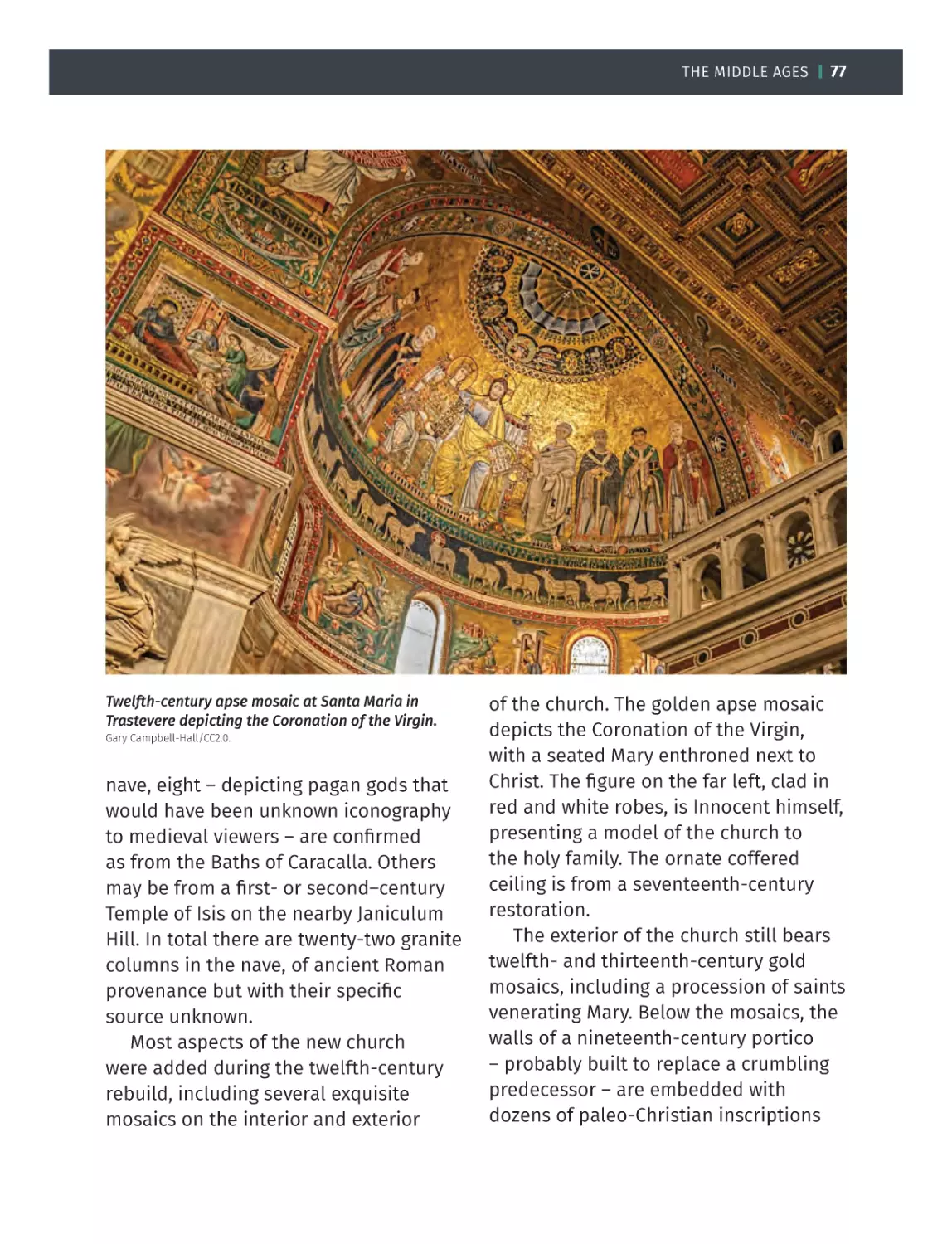
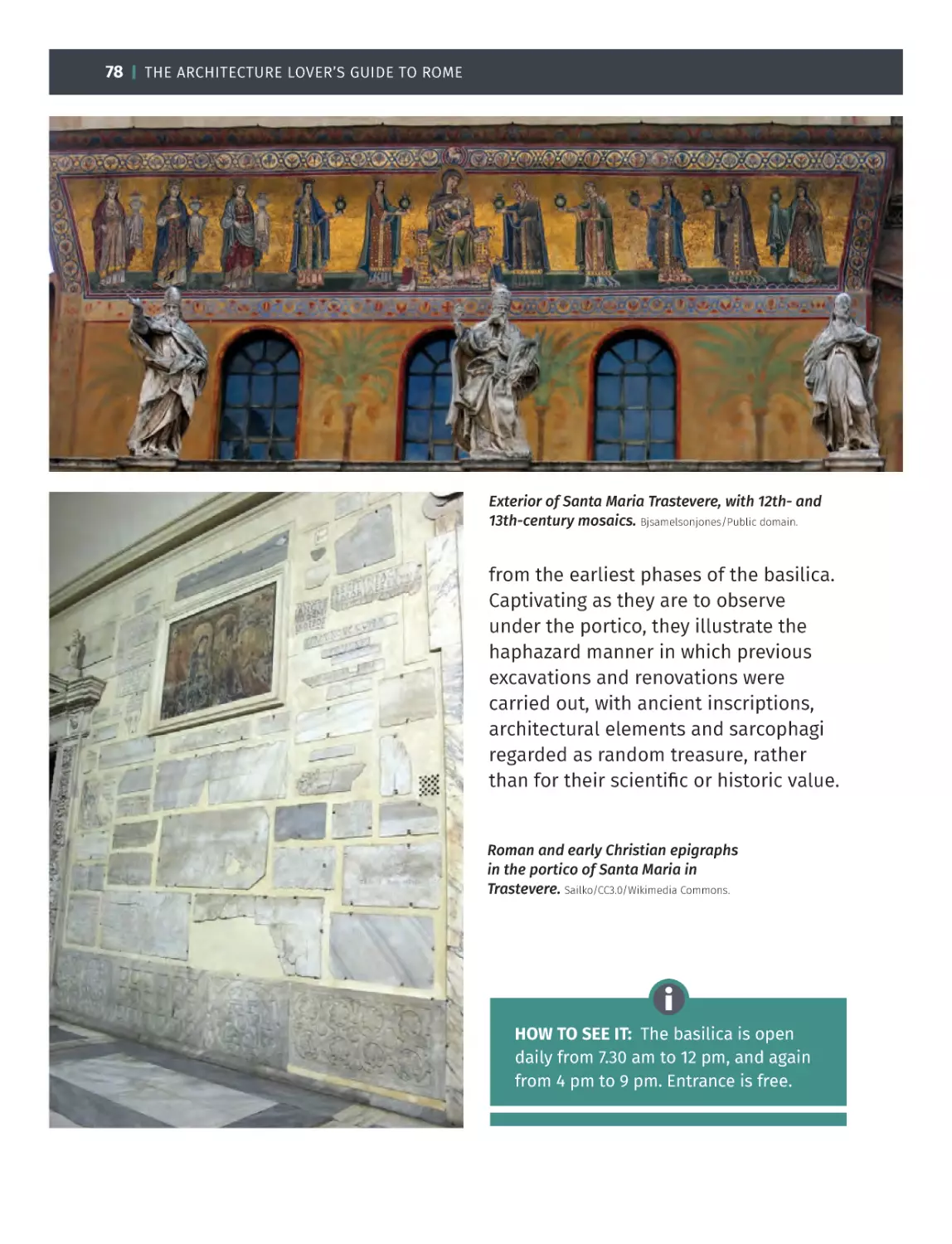
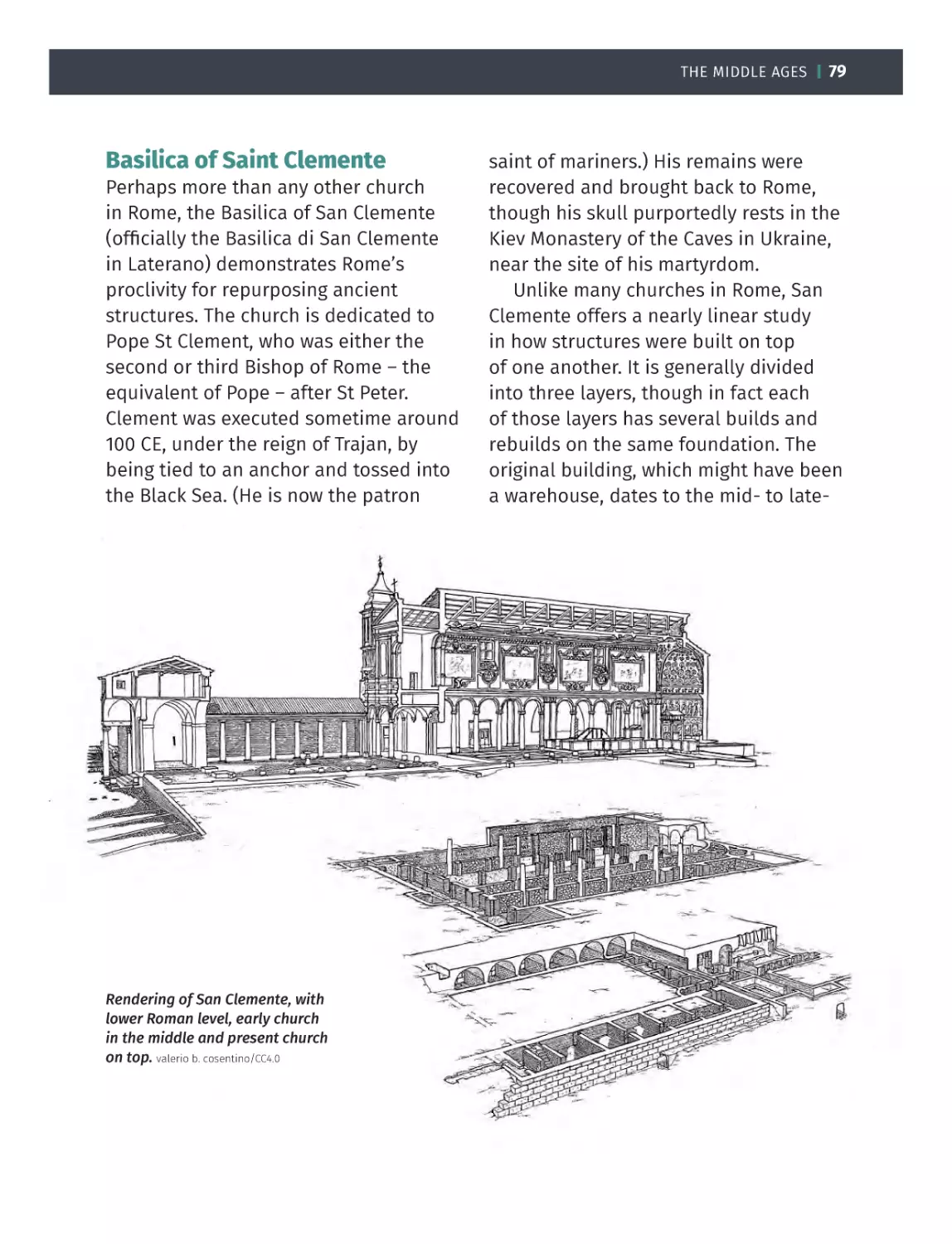
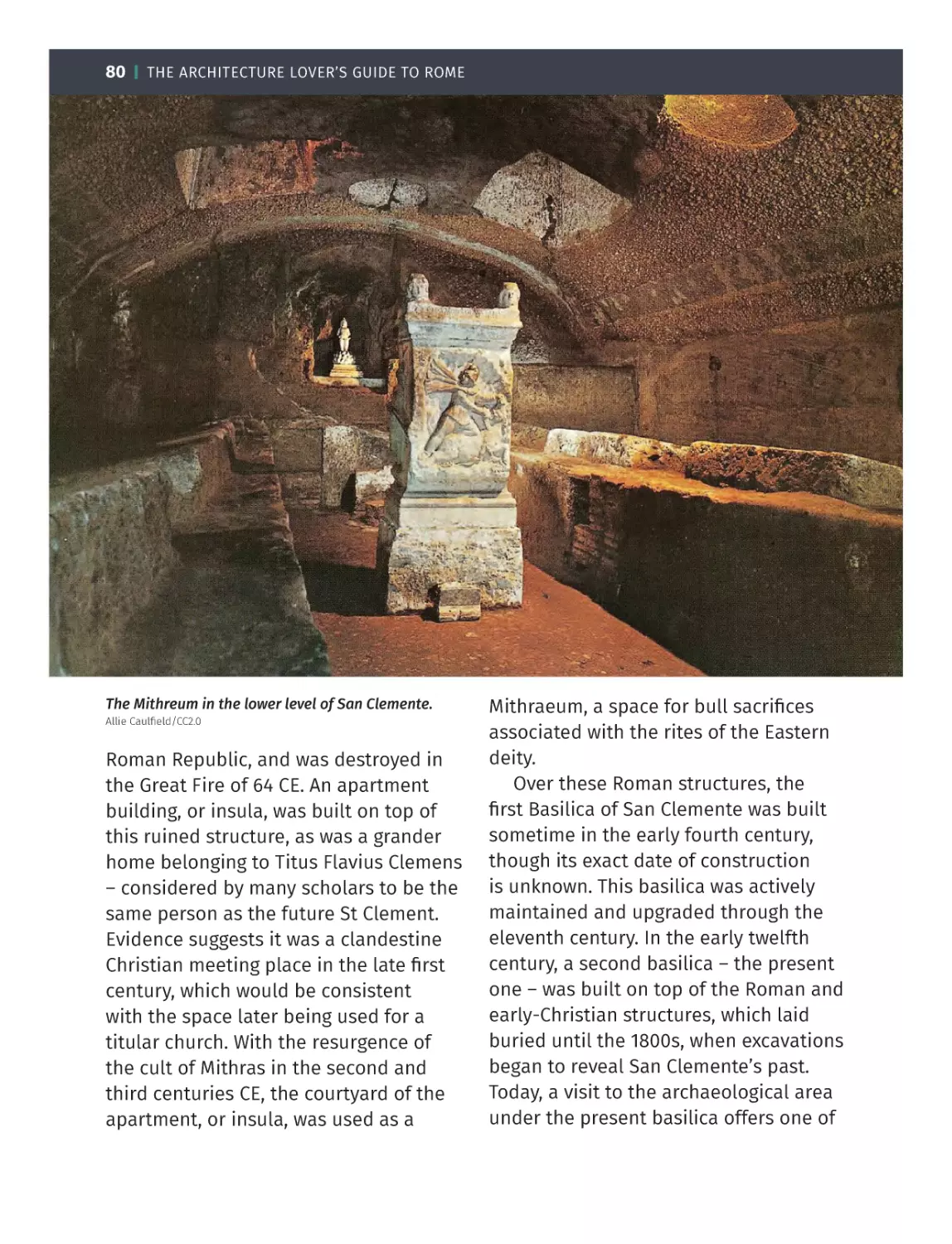


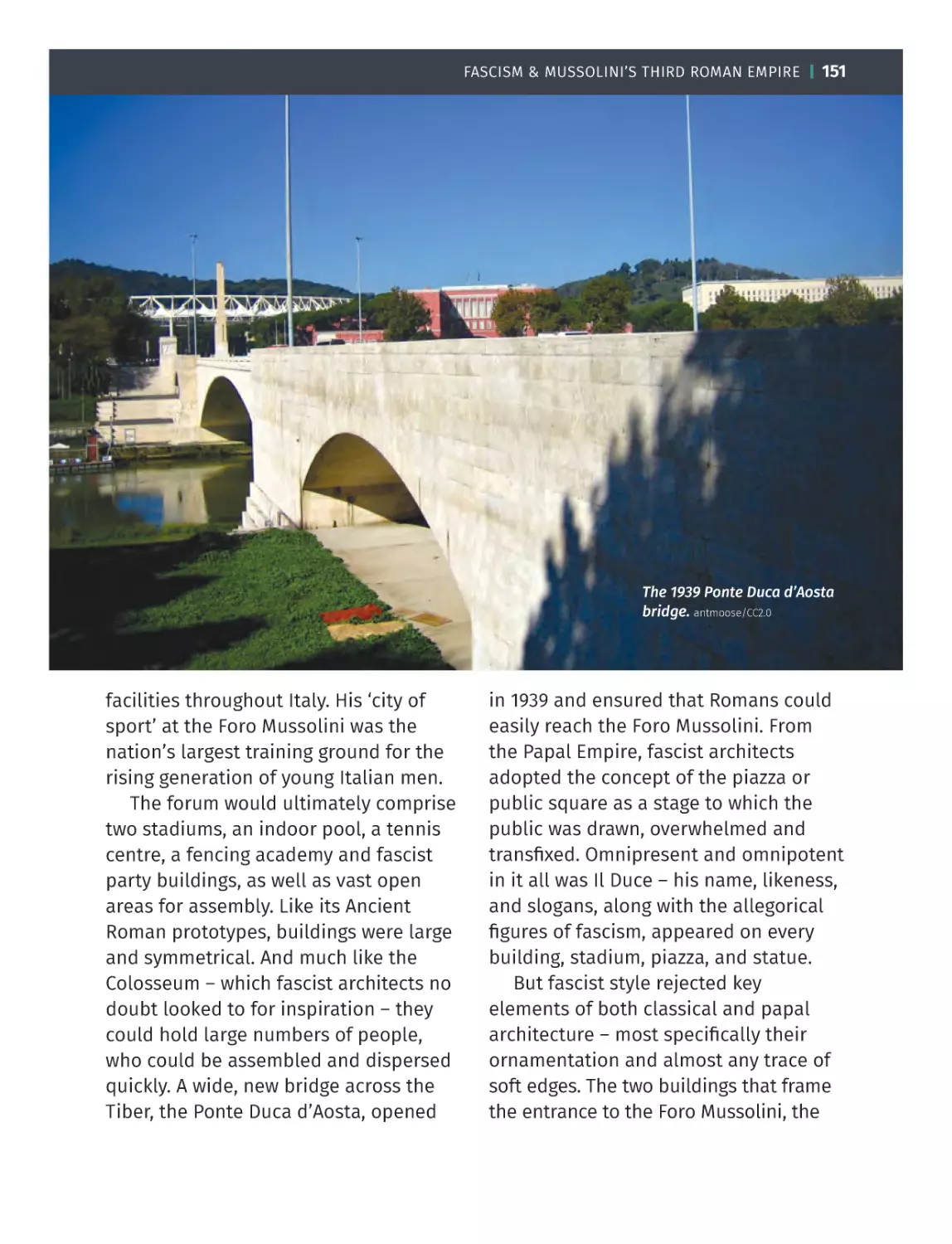
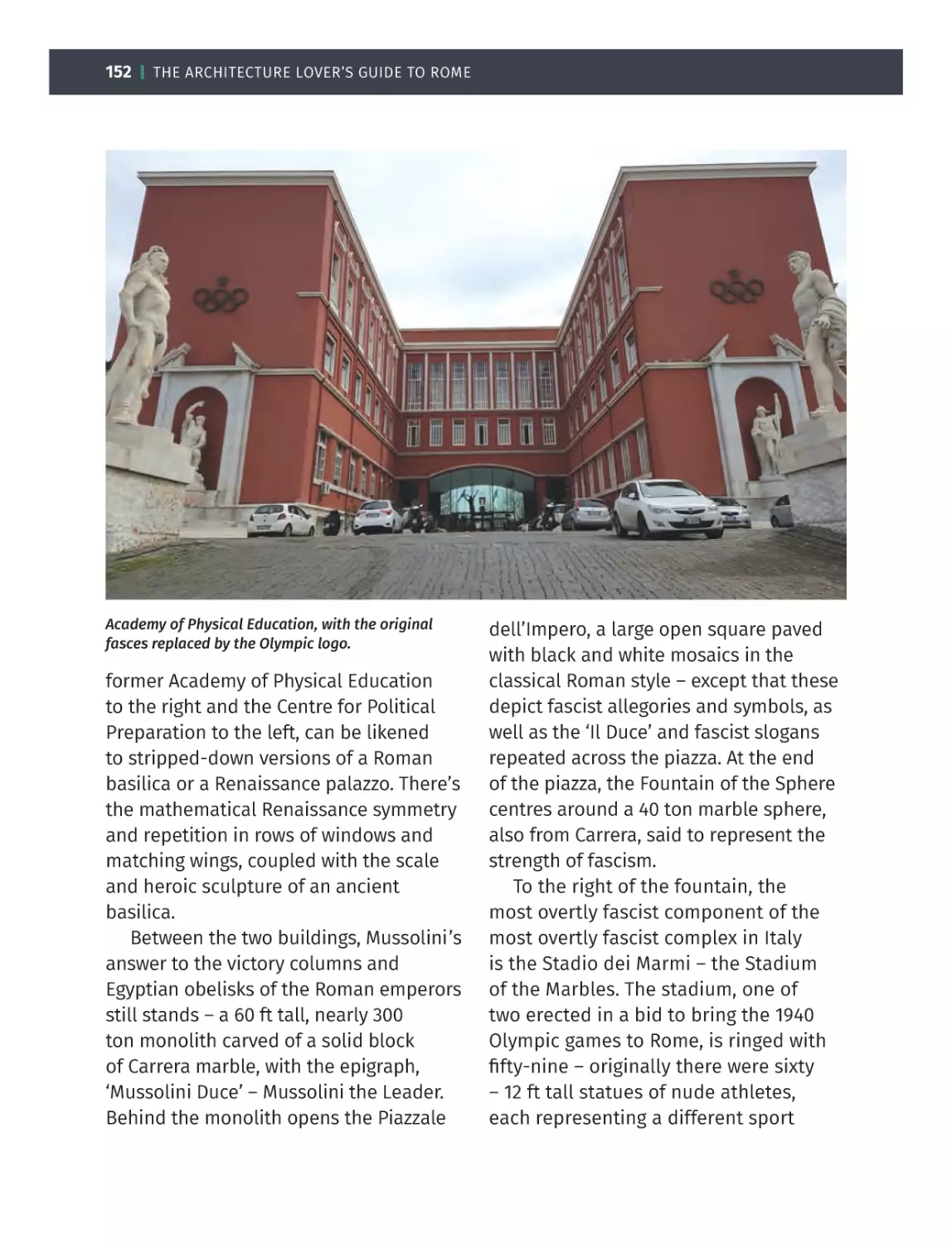
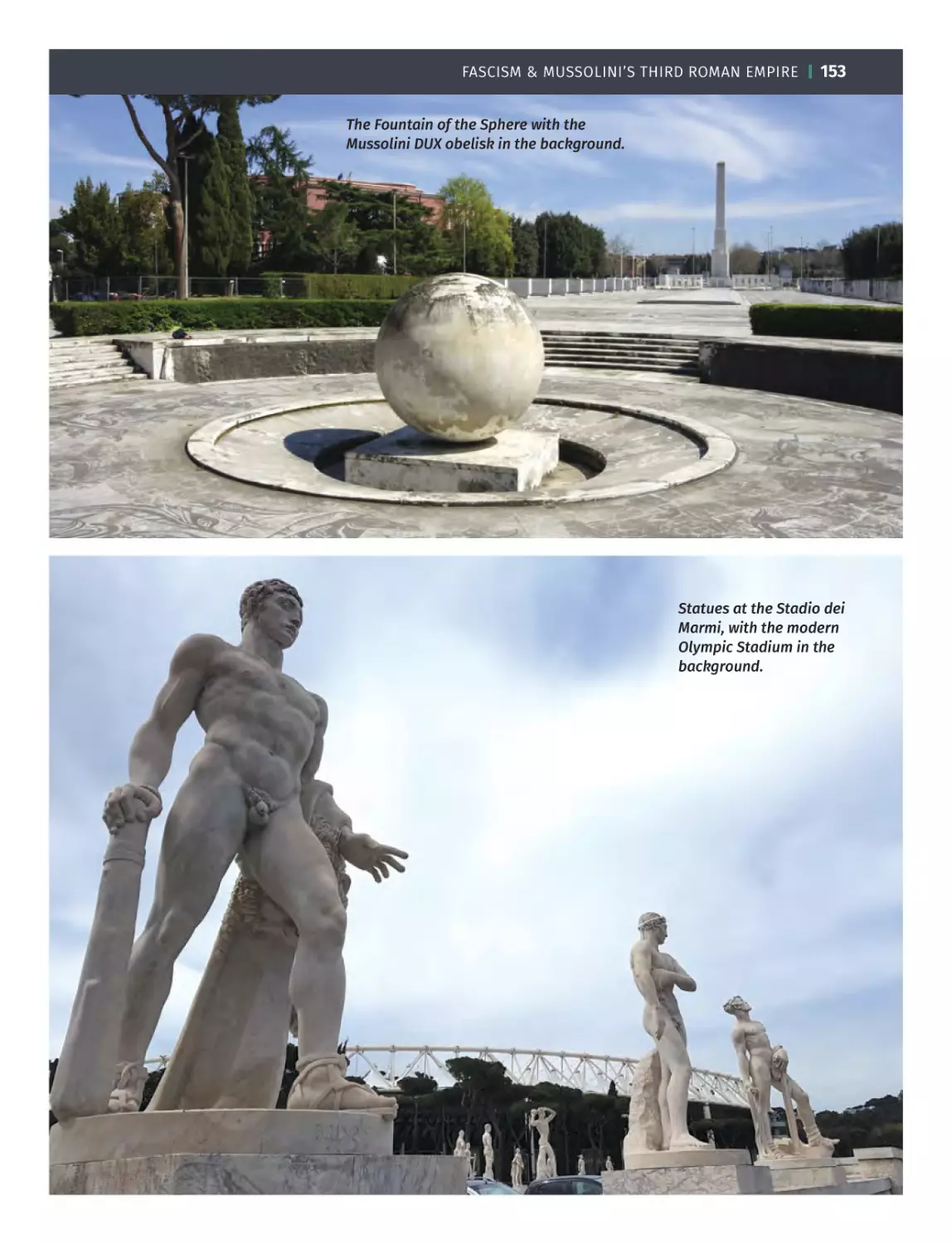
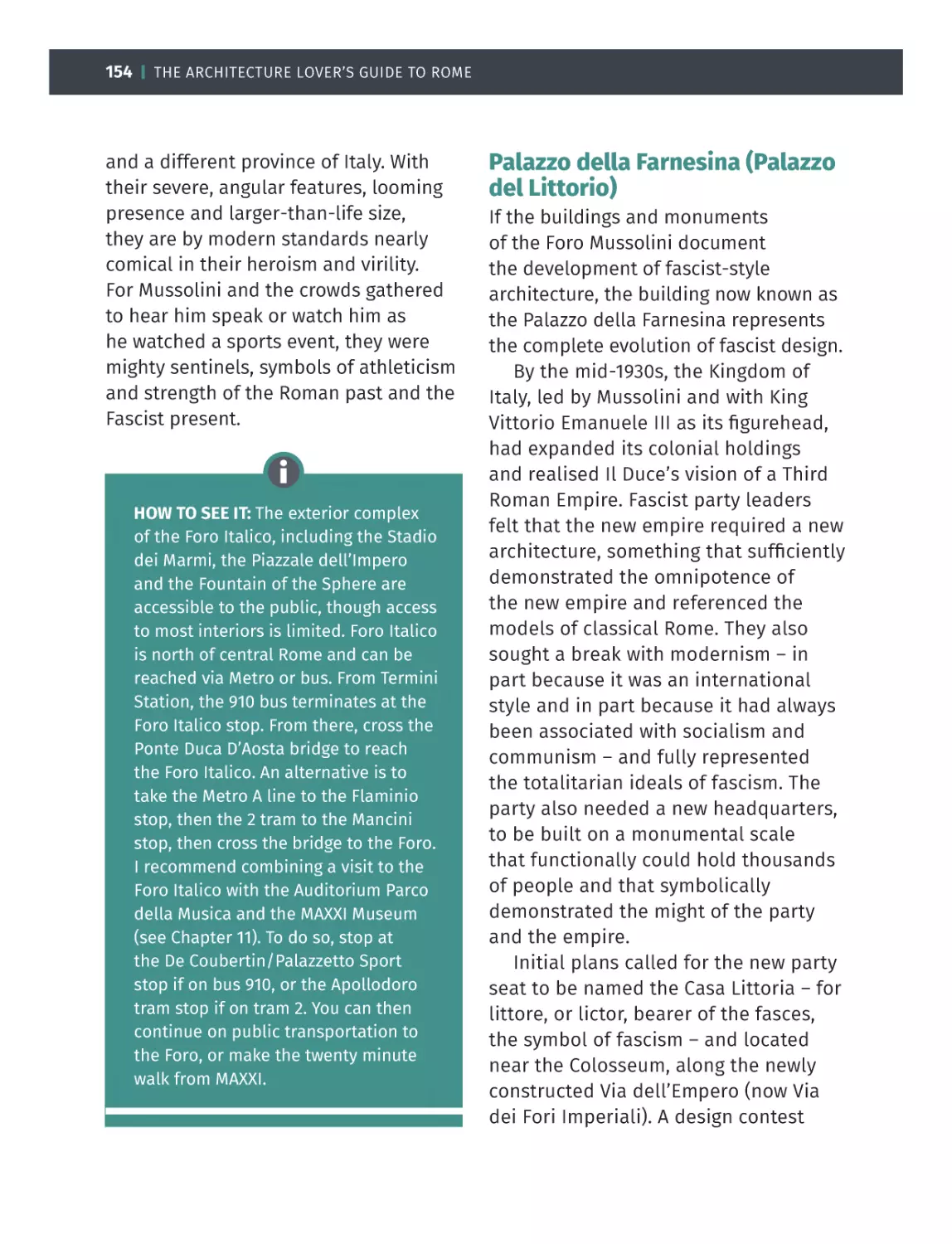
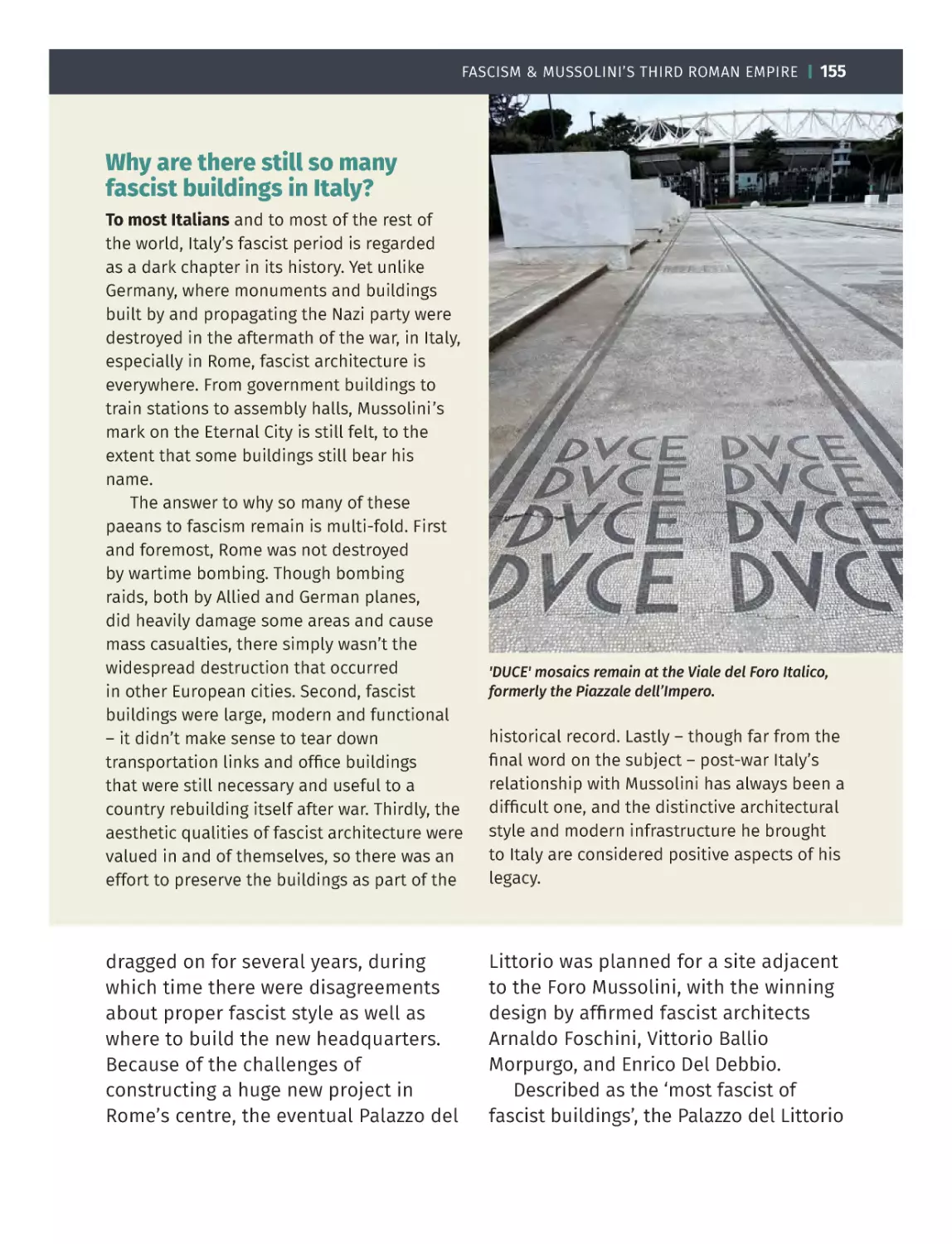
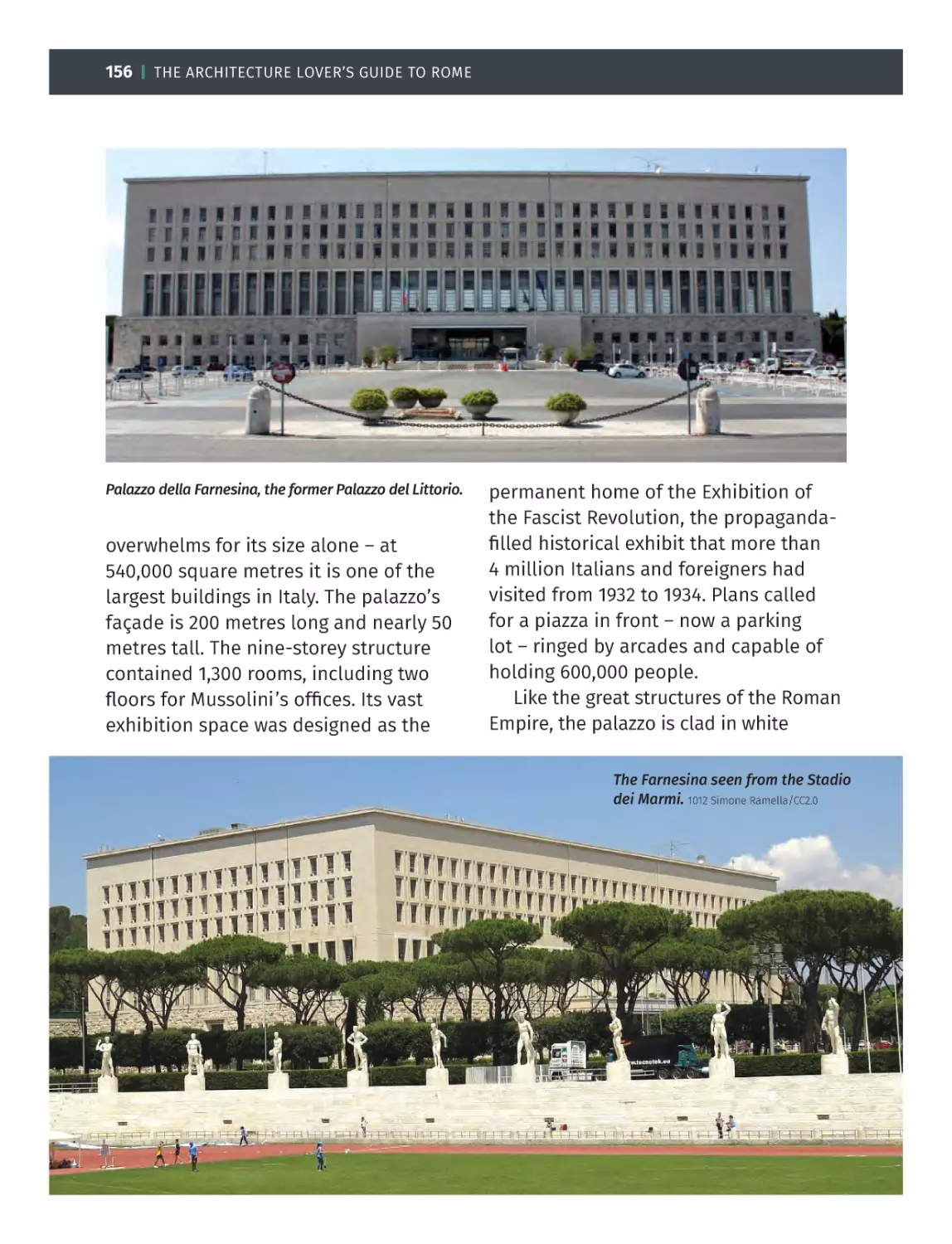
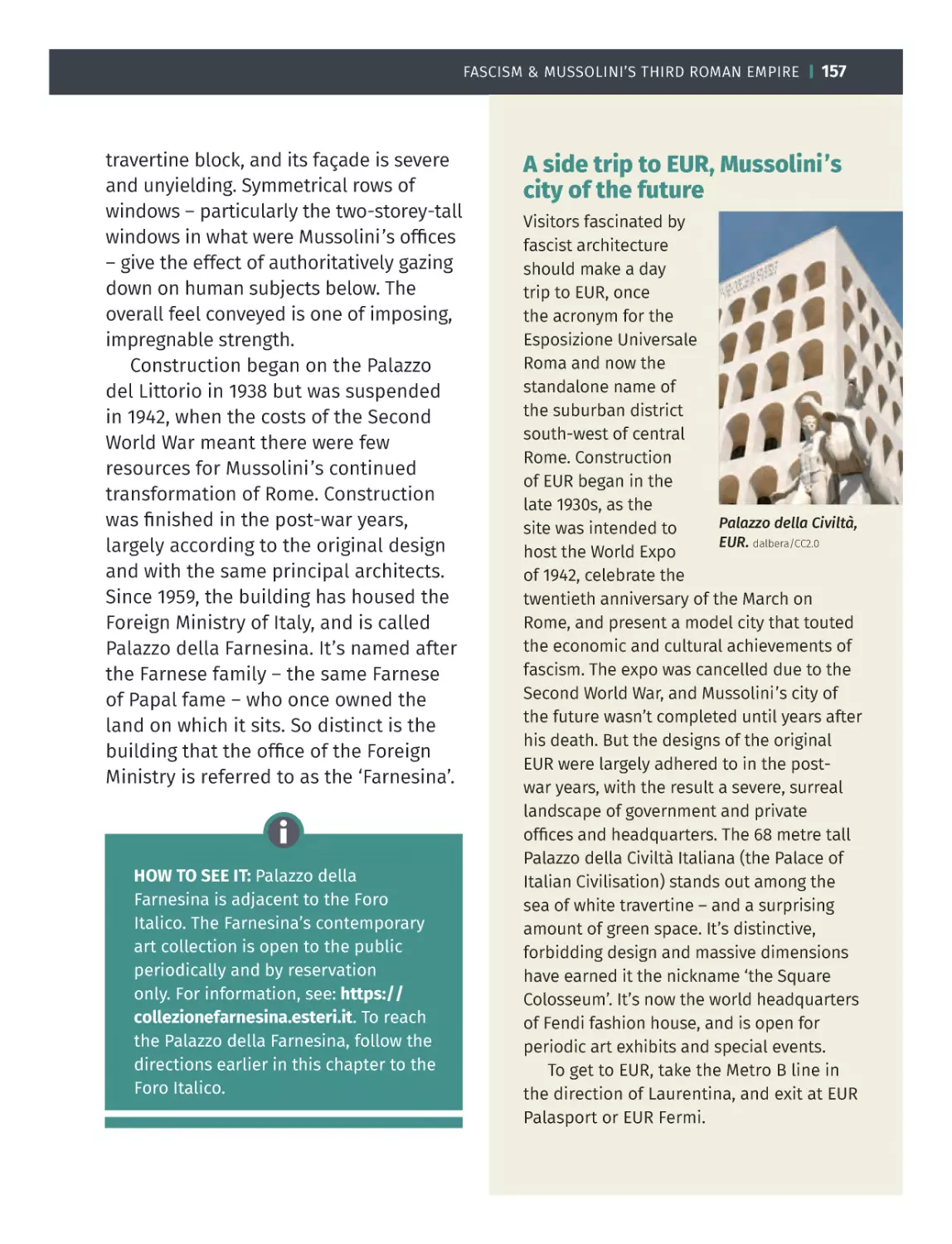
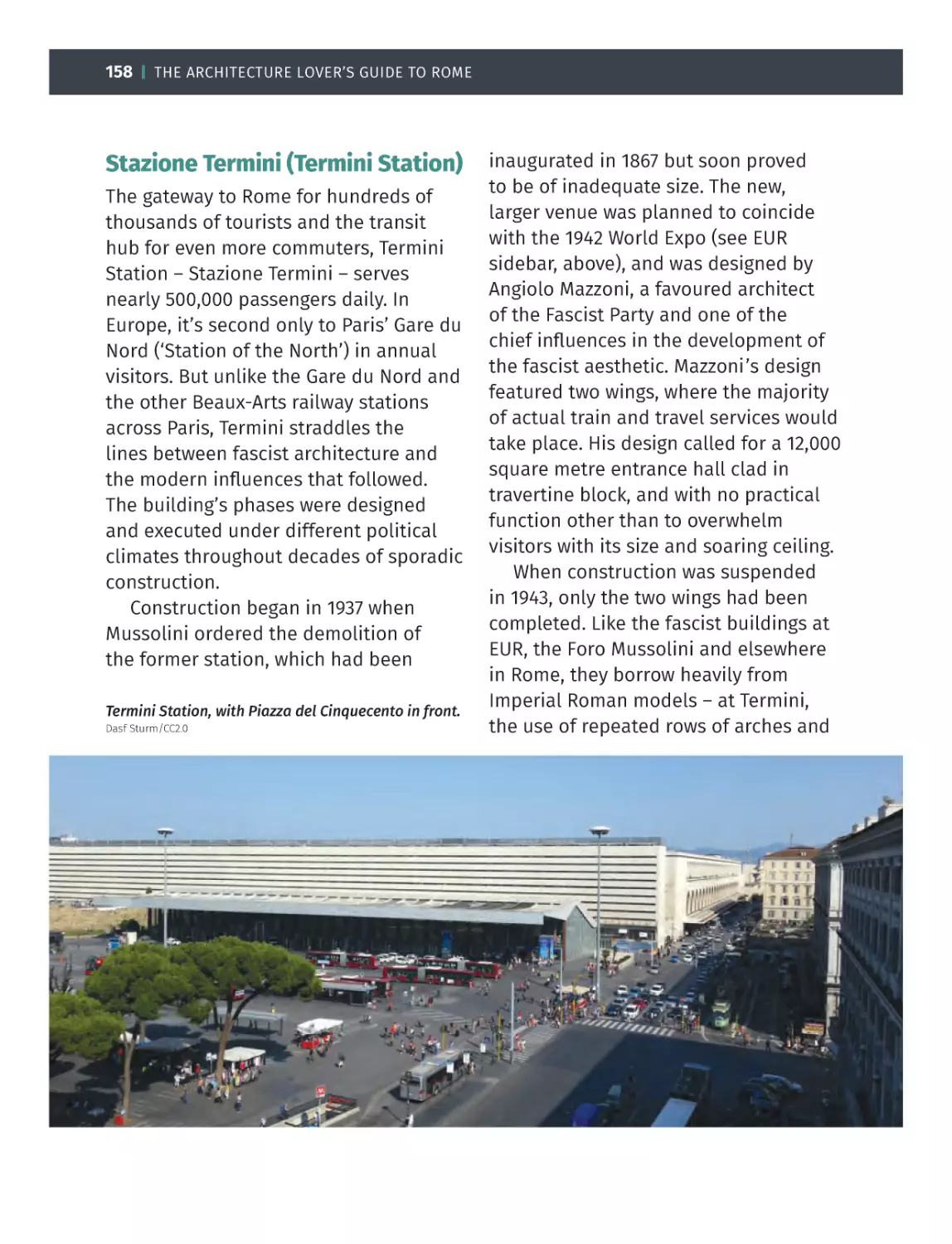
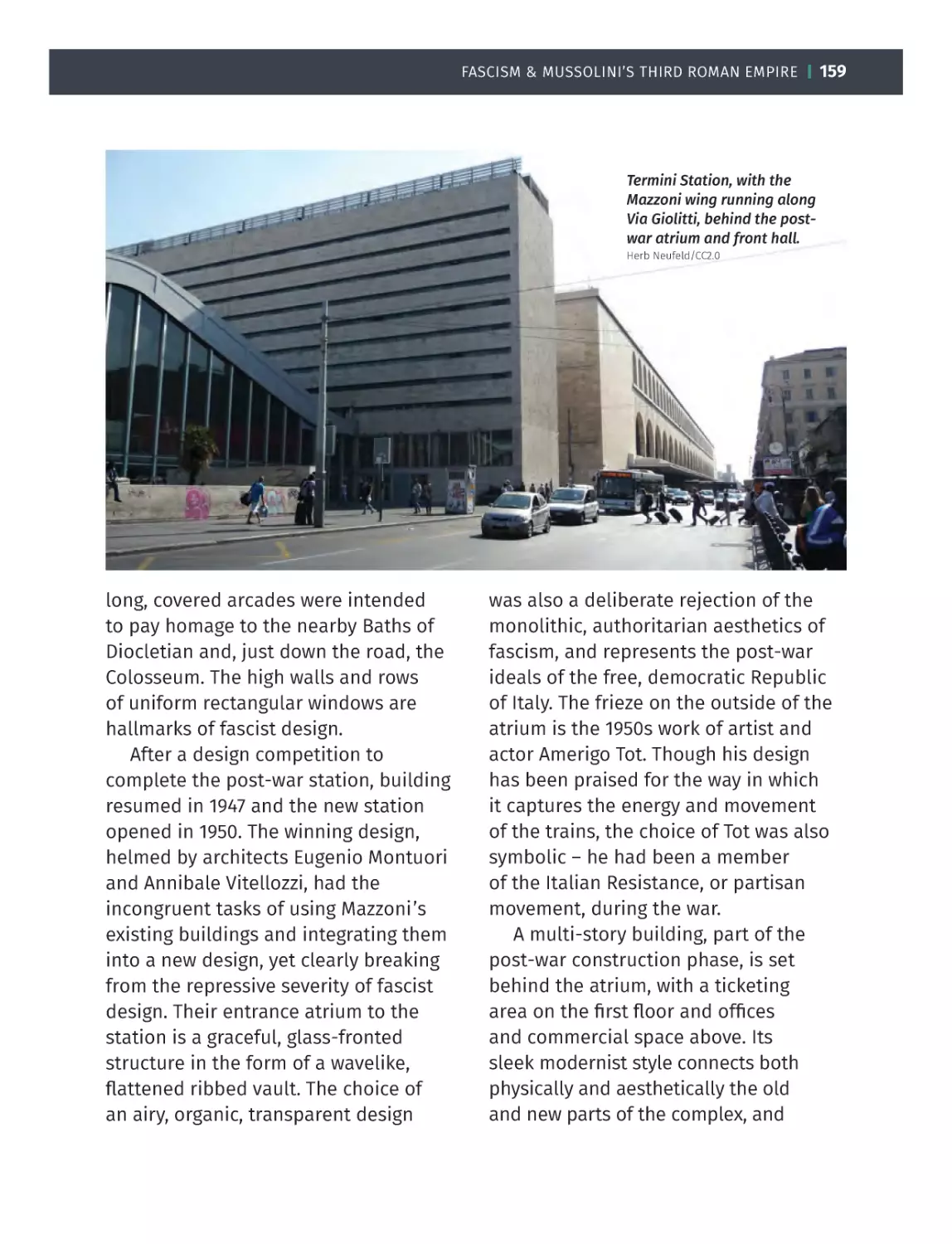
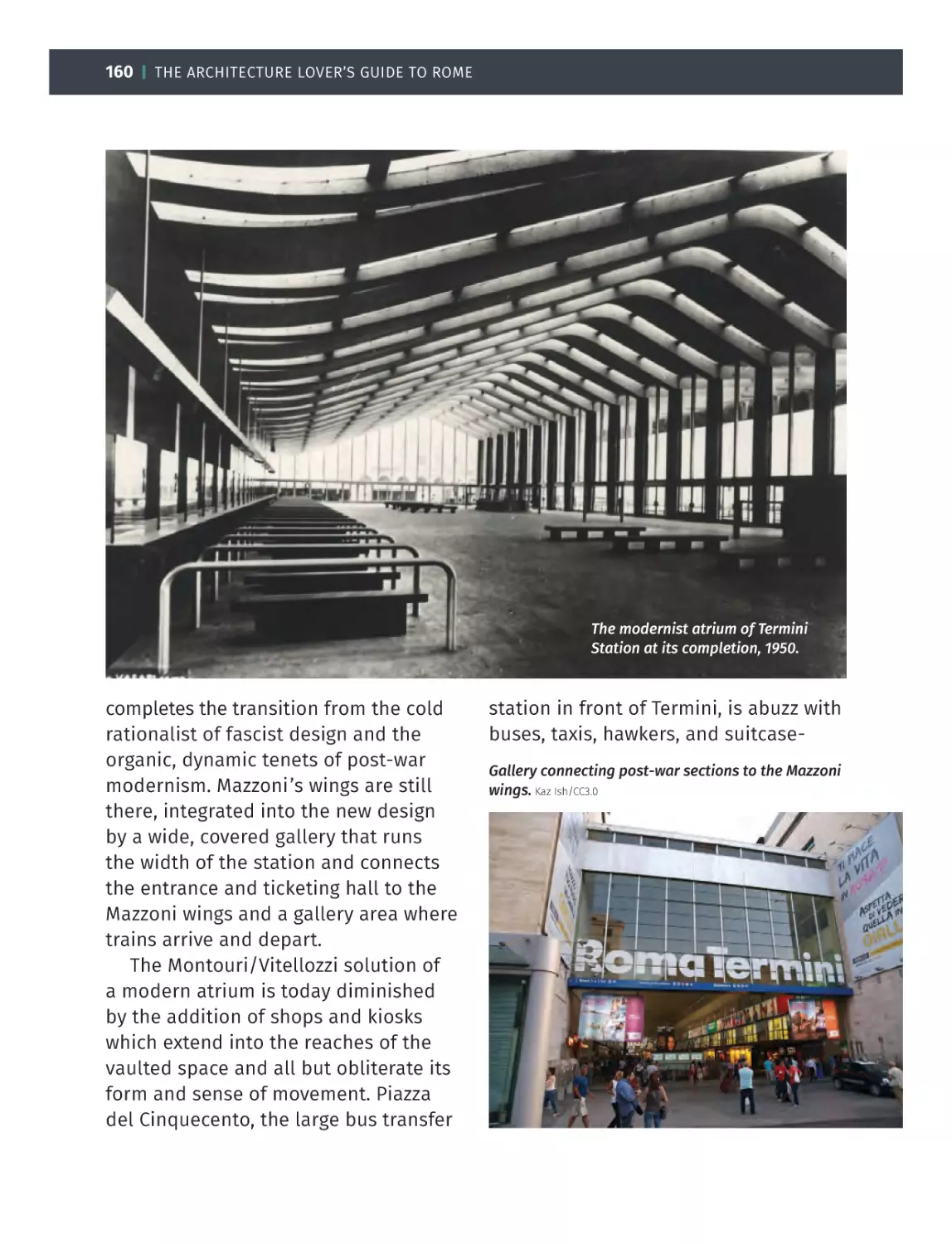
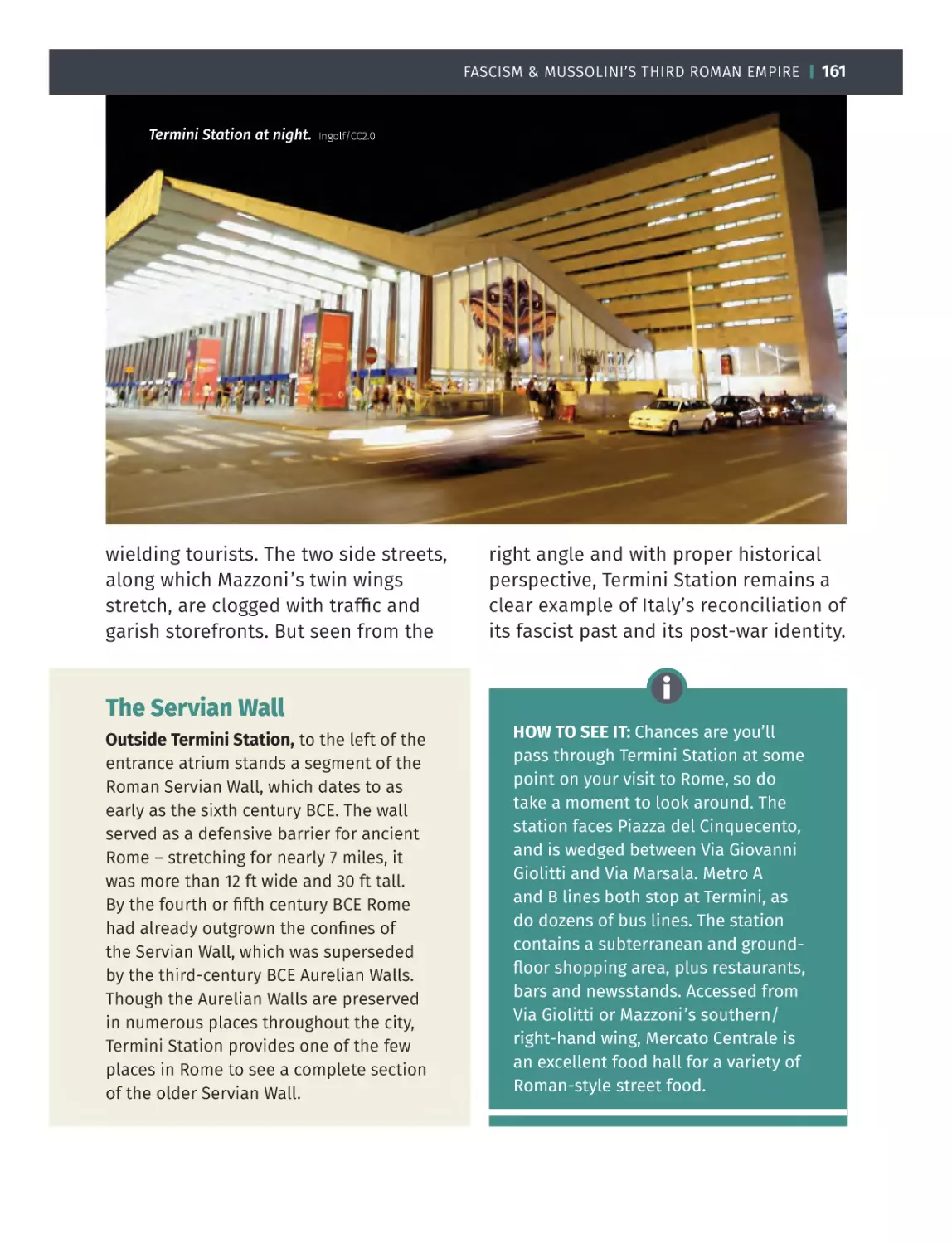
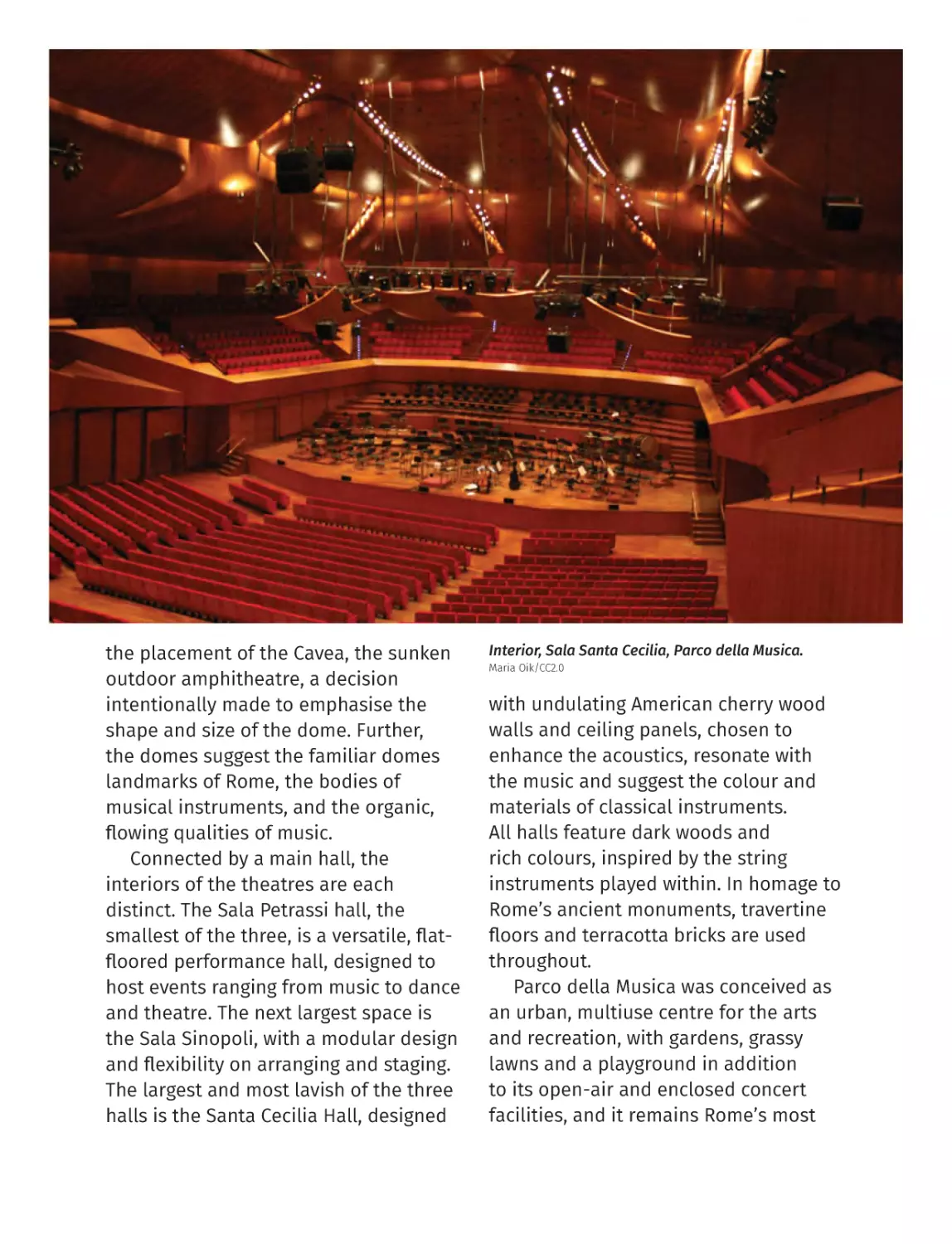
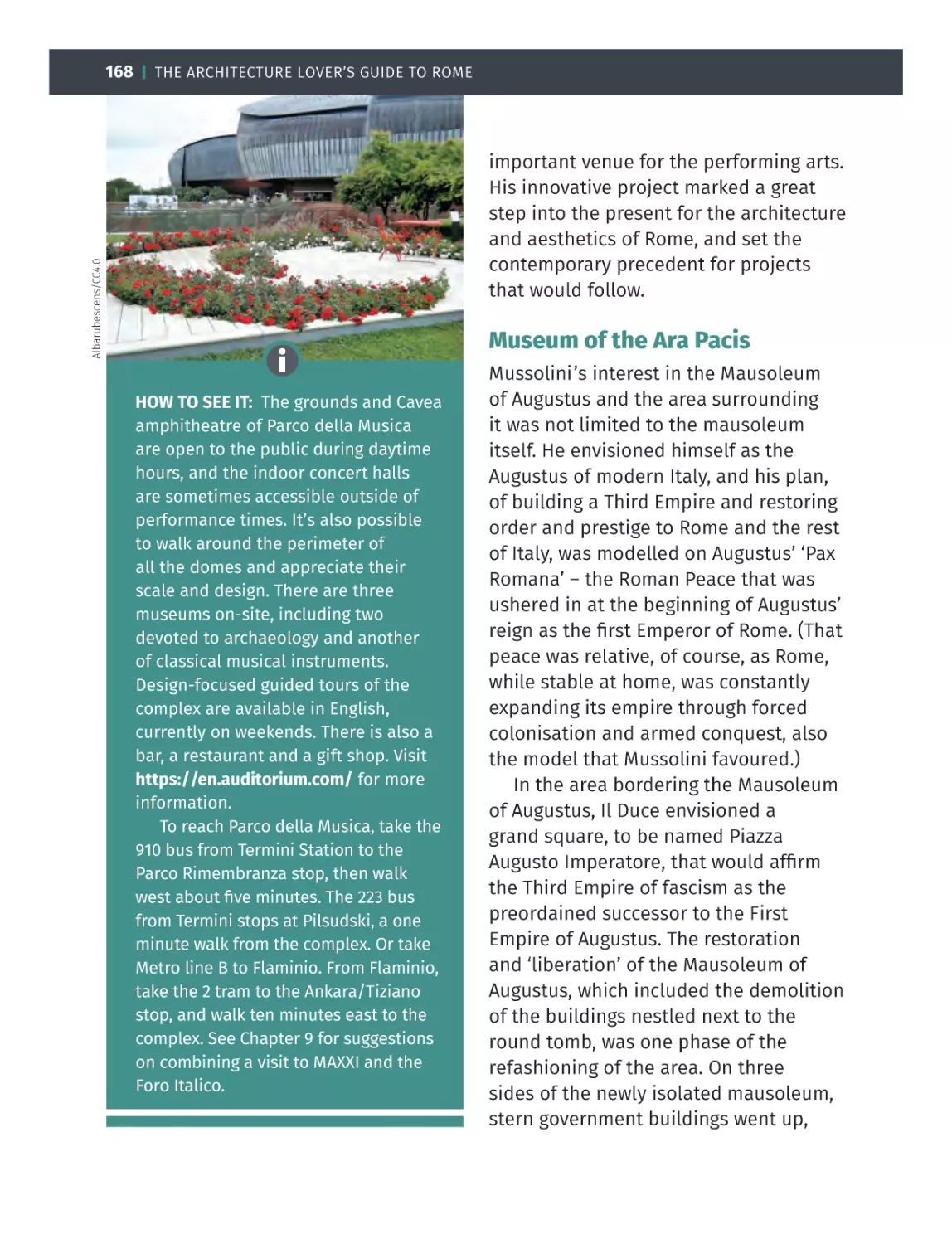
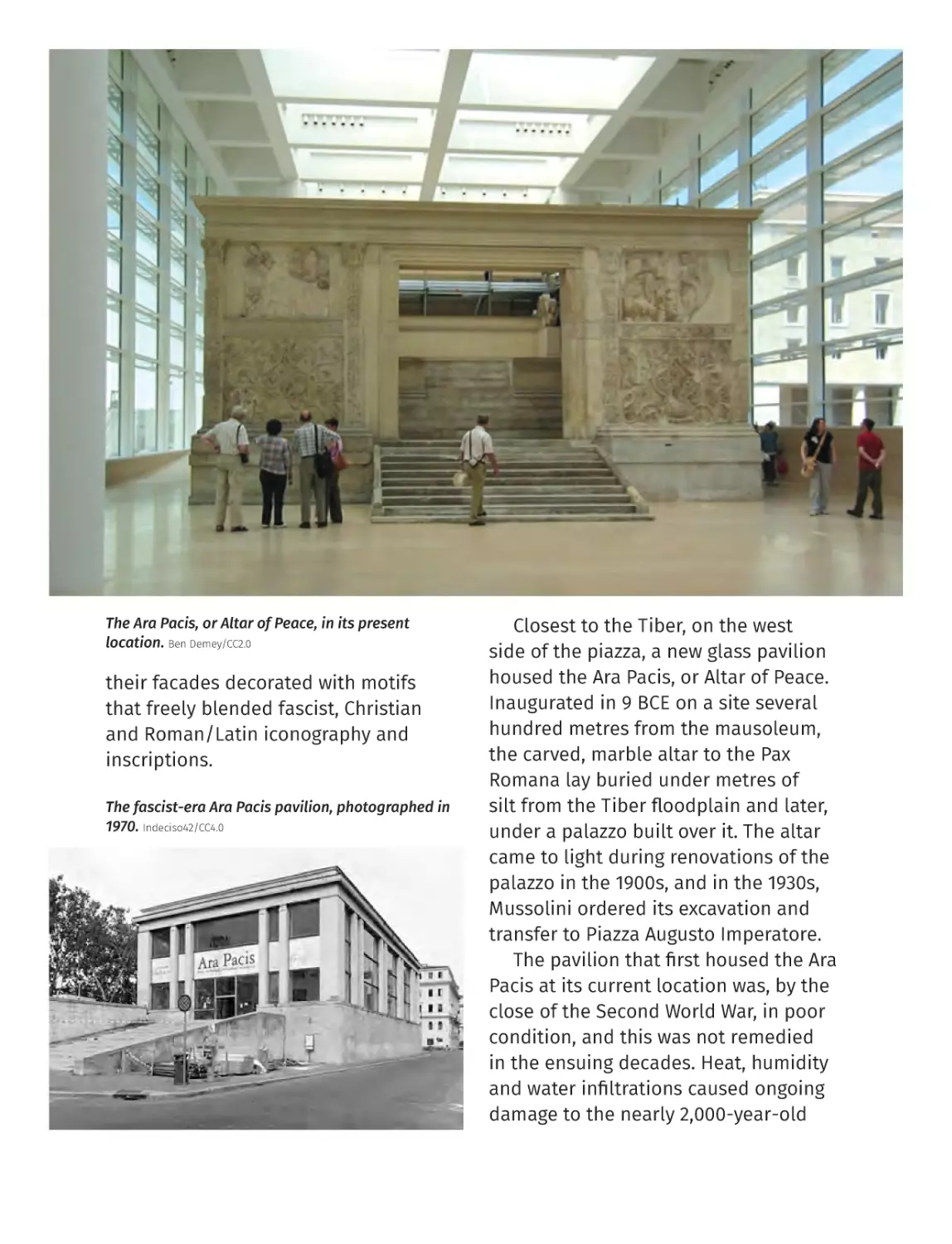
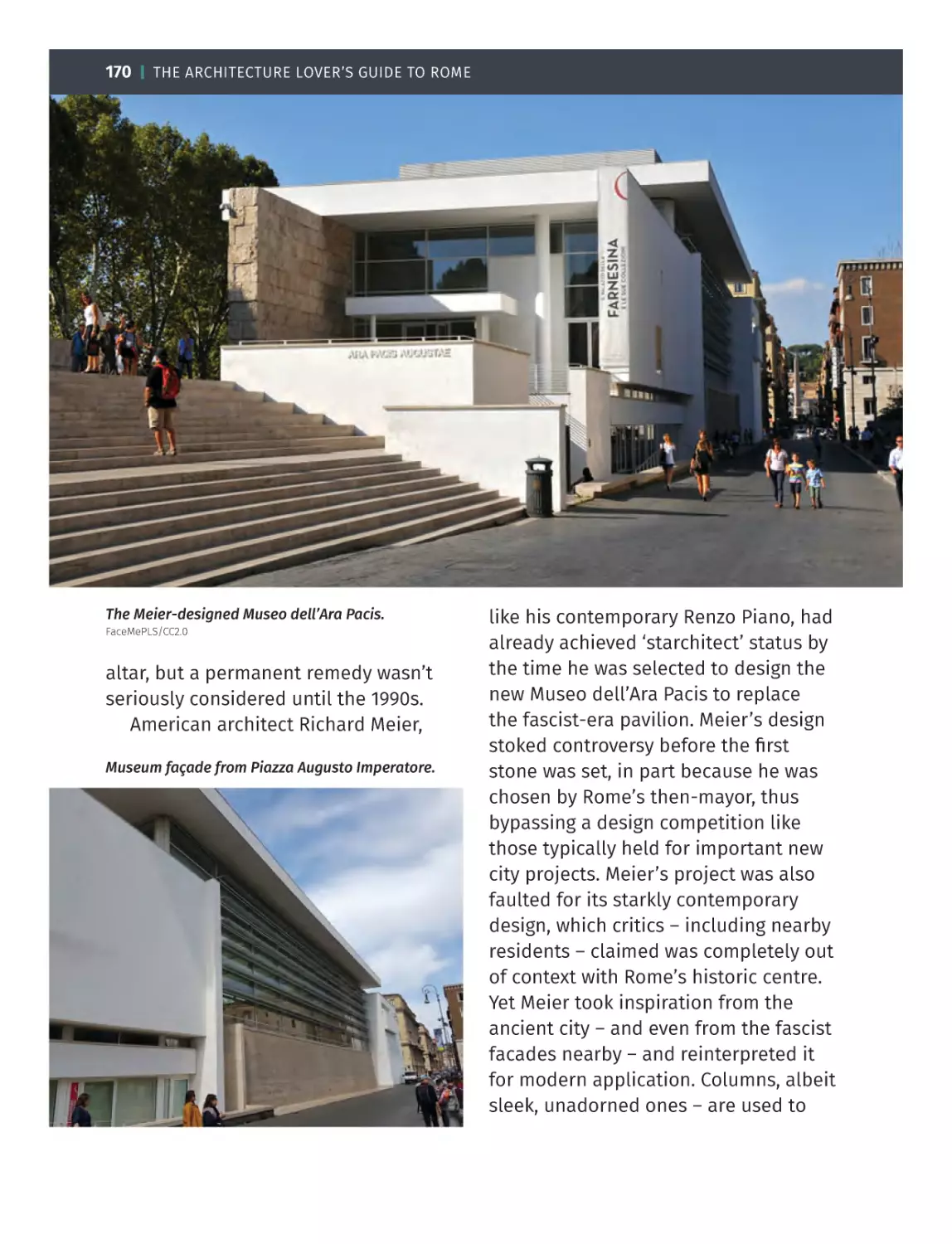
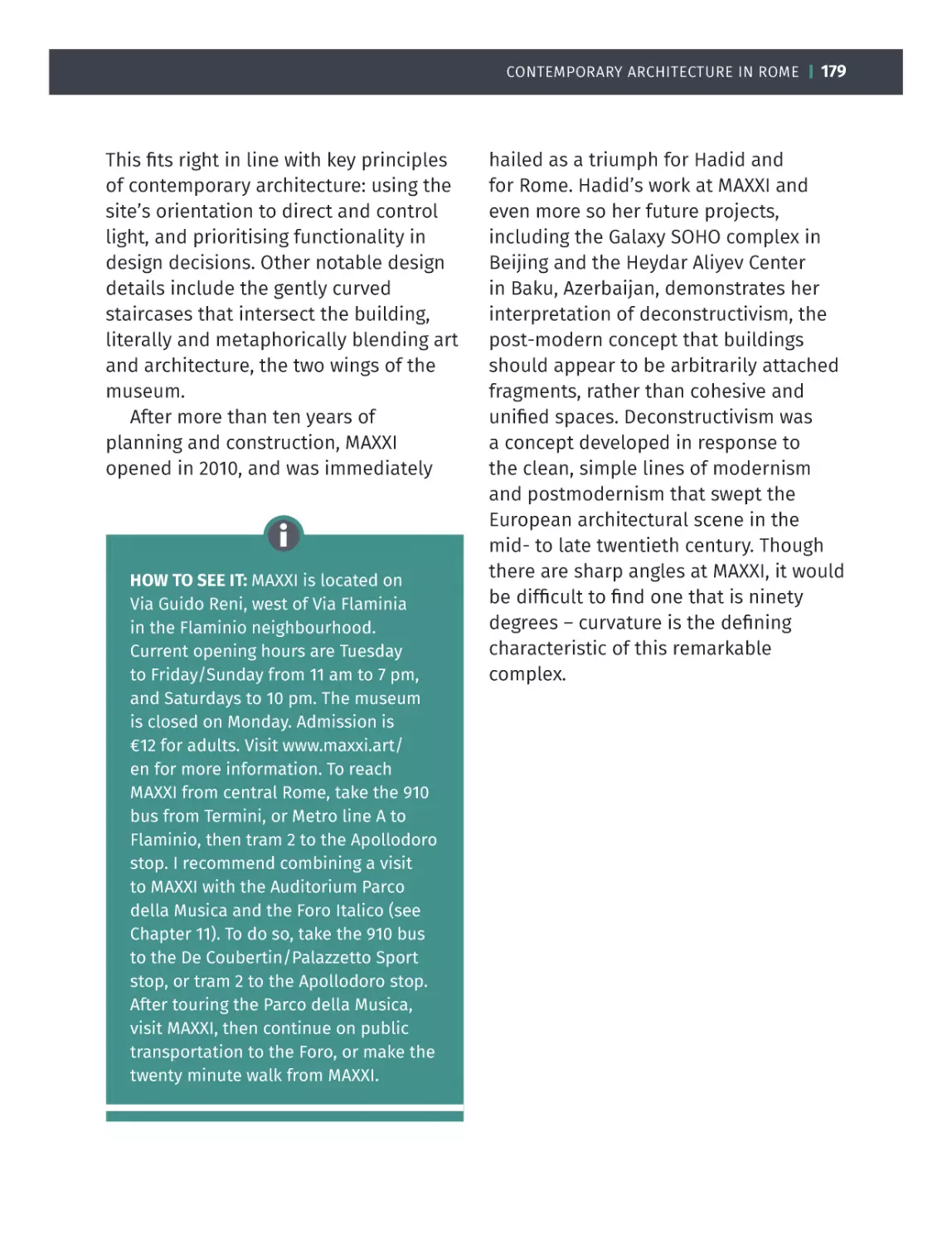

Автор: Heath E.F.
Теги: culture geography architecture rome local history
ISBN: 9781526735799
Год: 2019



Текст
                    ROME
THE ARCHITECTURE LOVER’S GUIDE TO

When I was in my second year of art school, I had an art history
professor whose method of teaching changed my way of thinking about
art and architecture. Rather than just have us memorise names and
dates and genres, he presented the arts in their historical context, and
described how they were influenced by and reflective of contemporary
events. In my mind, it was as though someone had turned on a light to
illuminate the past. His lectures were engaging and insightful, and his
enthusiasm for the material was infectious. Later in life, I was honoured
(and still a little star-struck) to count him as a friend and colleague. He
died too young, and with plenty still left to teach.

Thank you, Kevin Dean, for turning on the light.

4

| THE ARCHITECTURE LOVER’S GUIDE TO ROME

First published in Great Britain in 2019 by
PEN & SWORD WHITE OWL
An imprint of
Pen & Sword Books Ltd
Yorkshire - Philadelphia
Copyright © Elizabeth F. Heath, 2019
ISBN 9781526735799
The right of Elizabeth F. Heath to be identified as
Author of this work has been asserted by her in
accordance with the Copyright, Designs and Patents Act
1988. A CIP catalogue record for this book is available
from the British Library.
All rights reserved. No part of this book may be
reproduced or transmitted in any form or by
any means, electronic or mechanical including
photocopying, recording or by any information storage
and retrieval system, without permission from the
Publisher in writing.
Printed and bound by Replika Press Pvt. Ltd.
Design: Paul Wilkinson.
Cartographer: Liz Puhl
Research Assistant: Suzie Dundas
Pen & Sword Books Limited incorporates the imprints
of Atlas, Archaeology, Aviation, Discovery, Family
History, Fiction, History, Maritime, Military, Military
Classics, Politics, Select, Transport, True Crime, Air
World, Frontline Publishing, Leo Cooper, Remember
When, Seaforth Publishing, The Praetorian Press,
Wharncliffe Local History, Wharncliffe Transport,
Wharncliffe True Crime and White Owl.
For a complete list of Pen & Sword titles please contact
PEN & SWORD BOOKS LIMITED
47 Church Street, Barnsley, South Yorkshire, S70 2AS,
United Kingdom
E-mail: enquiries@pen-and-sword.co.uk
Website: www.pen-and-sword.co.uk
Or
PEN AND SWORD BOOKS
1950 Lawrence Rd, Havertown, PA 19083, USA
E-mail: Uspen-and-sword@casematepublishers.com
Website: www.penandswordbooks.com

|

5

CONTENTS

Introduction
The Portico of Octavia as Parable:
Architecture and Complexity in Rome........................................................................... 6

Chapter 1
Romulus puts down roots:
The Palatine Hill and the Romulan Hut......................................................................12
Chapter 2
From Kingdom to Republic: The Temple of Jupiter Optimus
Maximus & the temples of Portunus & Hercules Victor............................. 16
Chapter 3
From Brick to Marble: Early Imperial ambitions at the
Basilica Julia, Nero’s Domus Aurea, and the Colosseum............................ 24
Chapter 4
The Apex of Empire: Trajan’s Markets, the Pantheon, and
the Baths of Caracalla................................................................................................................40
Chapter 5
Christianity Takes Hold: Old St Peter’s Basilica, Santa Sabina
and San Saba.....................................................................................................................................58
Chapter 6
The Middle Ages: The Basilicas of Santa Maria in Trastevere,
San Clemente & San Nicola in Carcere...................................................................... 72
Chapter 7
Renaissance Rome: Santa Maria del Popolo, Palazzo Farnese,
Villa Medici.......................................................................................................................................... 88
Chapter 8
Birthplace of the Baroque: Piazza Barberini, Sant’Ivo alla
Sapienza & St Peter’s Basilica........................................................................................ 104
Chapter 9
Neoclassical Eclecticism: St John in Lateran,
Palazzo Braschi & the Vittorio Emanuele monument............................... 128
Chapter 10
Fascism & Mussolini’s Third Roman Empire: Foro Italico, Palazzo
della Farnesina, Termini Station................................................................................... 146
Chapter 11
Contemporary Architecture in Rome: Auditorium Parco della Musica,
the Ara Pacis Museum & MAXXI Museum of 21st Century Arts.......... 162
Index....................................................................................................................................................... 180

6

| THE ARCHITECTURE LOVER’S GUIDE TO ROME

INTRODUCTION

THE PORTICO
OF OCTAVIA AS
PARABLE
Architecture and
Complexity in Rome

THIS IS THE Porticus Otaviae, the Portico d’Ottavia or the
Portico of Octavia, located in the heart of Rome’s centro
storico, the historic centre. In Roman architecture, a
portico, also called a pronaos, is essentially a much more
elaborate version of what we think of as a porch. This was a
monumental covered entryway, or propylaeum, that formed
the entrance to a temple complex. It was the focal point of
a colonnaded walkway that formed a perimeter around the
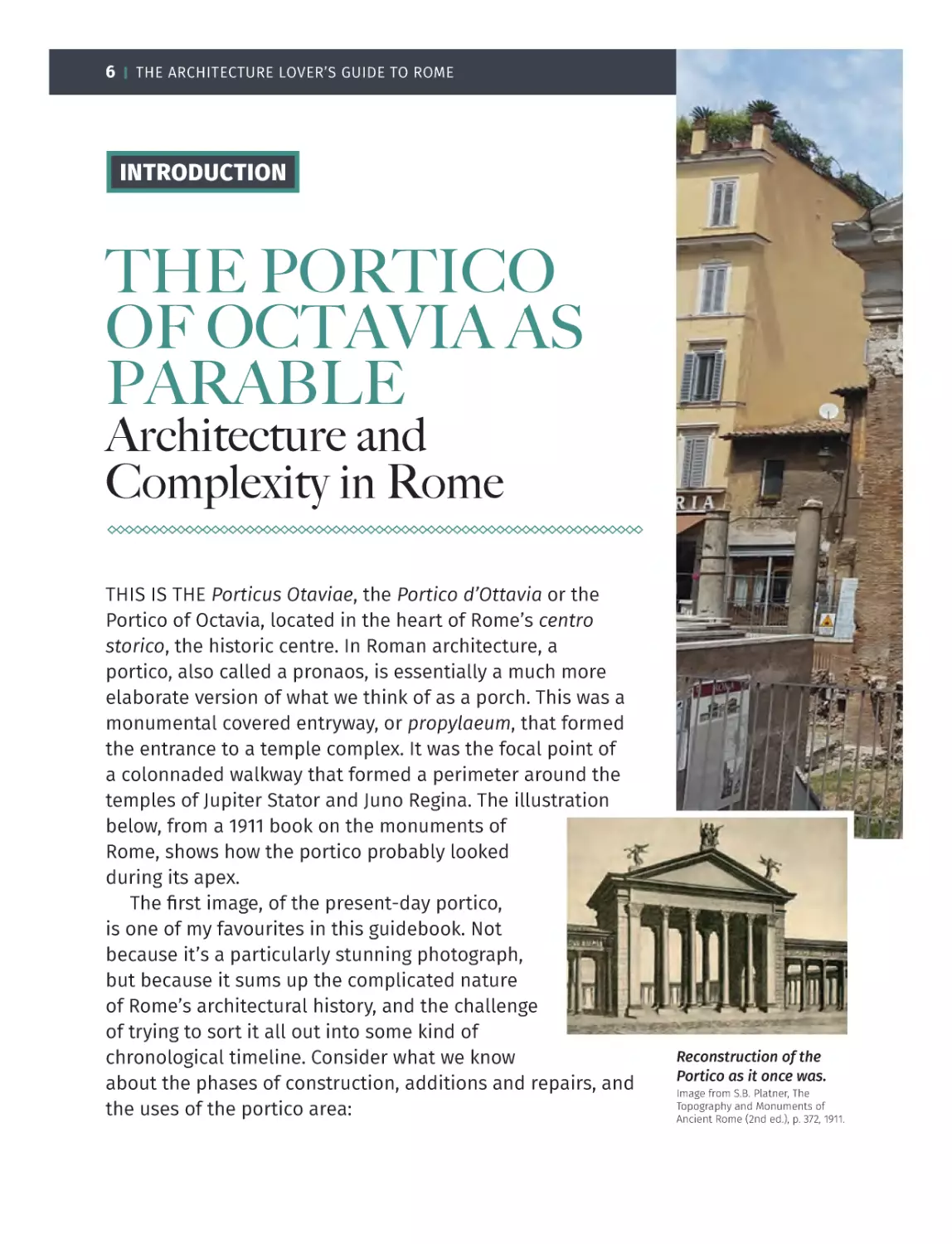
temples of Jupiter Stator and Juno Regina. The illustration
below, from a 1911 book on the monuments of
Rome, shows how the portico probably looked
during its apex.
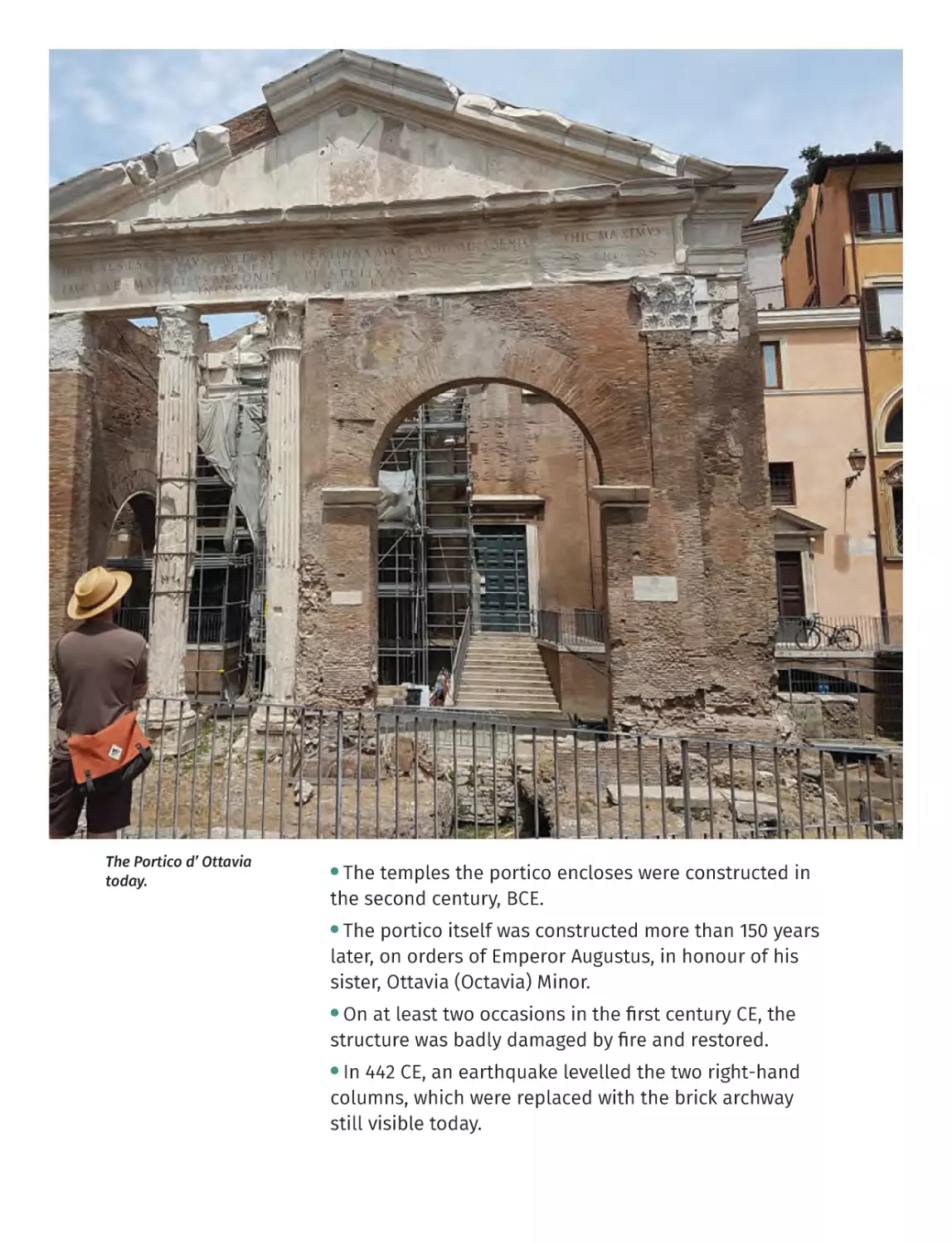
The first image, of the present-day portico,
is one of my favourites in this guidebook. Not
because it’s a particularly stunning photograph,
but because it sums up the complicated nature
of Rome’s architectural history, and the challenge
of trying to sort it all out into some kind of
chronological timeline. Consider what we know
about the phases of construction, additions and repairs, and
the uses of the portico area:

Reconstruction of the
Portico as it once was.

Image from S.B. Platner, The
Topography and Monuments of
Ancient Rome (2nd ed.), p. 372, 1911.

The Portico d’ Ottavia
today.

• The temples the portico encloses were constructed in
the second century, BCE.

• The portico itself was constructed more than 150 years
later, on orders of Emperor Augustus, in honour of his
sister, Ottavia (Octavia) Minor.
• On at least two occasions in the first century CE, the
structure was badly damaged by fire and restored.

• In 442 CE, an earthquake levelled the two right-hand

columns, which were replaced with the brick archway
still visible today.

8

| THE ARCHITECTURE LOVER’S GUIDE TO ROME

• By the early Middle Ages, a fish market was established
on the ruins of the portico.

• In 772, the church of Sant’Angelo in Pescheria (pescheria
refers to the fish market) was built over the original
temples. The stairs and green door at the back of the
portico belong to the church, and three columns from the
portico were incorporated into the left-hand side of the
church façade.

• In 1555, Pope Paul IV ordered that all of the city’s Jewish
population be forcibly moved into an area of a few square
blocks adjacent to the portico. The area, which became
known as the Ghetto of Rome, was walled-in and had four
gates, which were locked shut at night. One gate was to the
left of the Portico of Octavia. The Ghetto was an unsanitary,
overcrowded neighbourhood subject to frequent flooding
and outbreaks of disease. Residents were only allowed to
leave the Ghetto during daylight hours, and they had to be
back inside the walls by sundown.
• In the late 1700s, Jews from the Ghetto were forced to
attend Jesuit sermons every Saturday, delivered in the
ruins of the Portico of Octavia, which also remained a fish
market well into the 1800s.
• With the establishment of the Kingdom of Italy in 1870,
the Ghetto was abolished. In 1888 the Ghetto walls were
torn down. In 1943, the Nazis occupied Rome, and sent
more than 1,000 of its Jewish residents to death camps. A
plaque near the portico remembers those who were sent
away and never returned.

• Today, the Portico of Octavia flanks the eastern entrance
to the area still referred to as the Ghetto. Romans and
tourists alike visit here today, to look for traces of its
past as a Jewish enclave and to eat in one of the many
restaurants along Via del Portico d’Ottavia, where RomanJewish cuisine is the specialty.
A first-century BCE monument, built over second-century
temples, with fifth-century restorations and an eighth-century

INTRODUCTION | 9

church growing out of its ruins. A bustling marketplace and
a symbol of religious prosecution. A tourist attraction and a
place of remembrance.
Welcome to Rome!
The Portico of Octavia serves as a fitting example of how
architecture has evolved organically in a city that’s been
continuously occupied for nearly 3,000 years. Rome has
never been frozen in time – it’s been an evolving, constantly
changing city since its inception. It’s never completely intact
and it’s rarely pristine – even buildings like the Pantheon and
St Peter’s Basilica, both models for their architectural styles
and periods, differ significantly from their original designs.
Instead, the architecture of Rome is the stage set on which a
dynamic, living city goes about its daily business. It’s at turns
soaring and inspirational, crumbling and chaotic, functional
and severe. It’s been pillaged and preserved, restored and
bastardised. Its most revered monuments, before they were
elevated to their current iconic status, were once cattle
pastures, marble quarries and yes, fish markets.
So, how can a casual guidebook on the architecture
of Rome sort out this complicated chronology and
overlapping layers of styles, periods and modifications?
To do so comprehensively would take years of research,
and result in a voluminous academic tome instead of an
accessible, portable guidebook. Instead, this guide uses
some of Rome’s key buildings and monuments as examples
of the major styles and phases of architecture that have
risen in the city over its long history. It offers a ‘greatest
hits’ timeline – as well as some worthy B-sides – that
demonstrate the practical, political and spiritual uses of
architecture in Rome, what each building represented at its
zenith, and what each has come to represent since. Instead
of a complete guide to the Roman Forum or a directory of
every important church, I’ve chosen to highlight specific
buildings that exemplify a style or time period. In doing
so, I hope to provide some context and subtext for readers
fascinated by the architecture of the Eternal City and hoping
to make at least a little sense of it all.

10 | THE ARCHITECTURE LOVER’S GUIDE TO ROME

A note on how to use
this guidebook
Since there’s nothing linear
about the architectural
history of Rome, it’s
likewise impossible
for a tour of Rome’s
architectural highlights
to proceed in any kind of
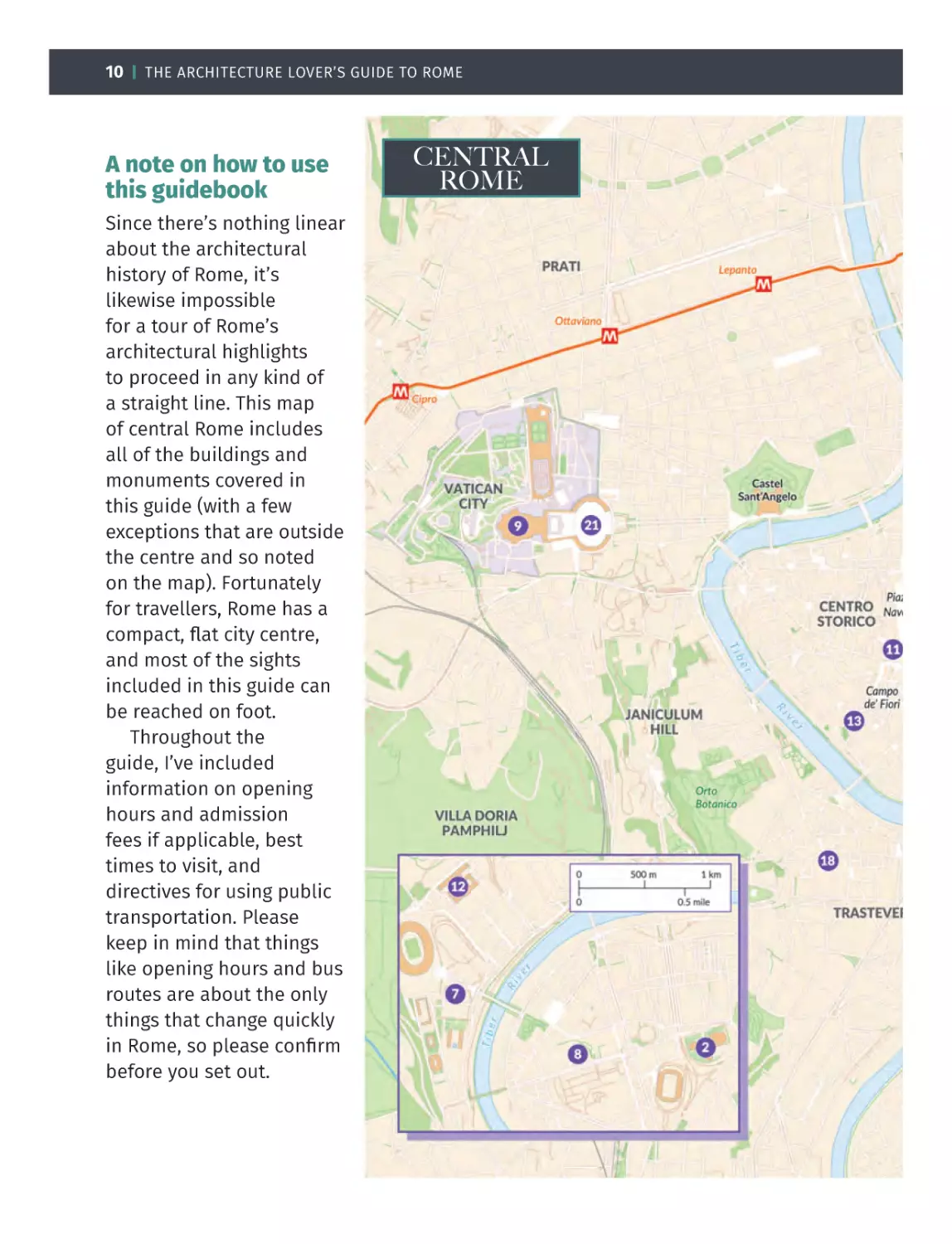
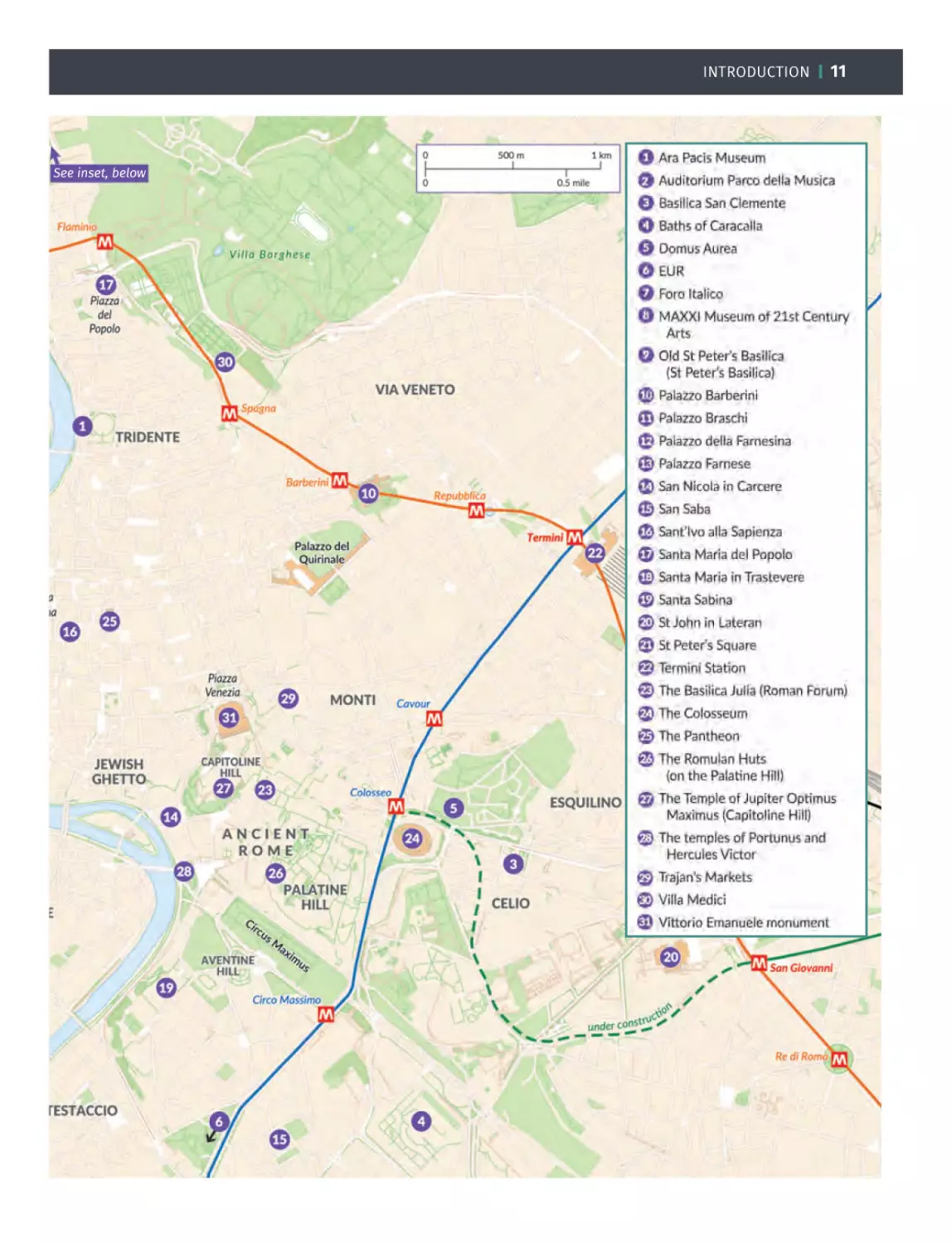
a straight line. This map
of central Rome includes
all of the buildings and
monuments covered in
this guide (with a few
exceptions that are outside
the centre and so noted
on the map). Fortunately
for travellers, Rome has a
compact, flat city centre,
and most of the sights
included in this guide can
be reached on foot.
Throughout the
guide, I’ve included
information on opening
hours and admission
fees if applicable, best
times to visit, and
directives for using public
transportation. Please
keep in mind that things
like opening hours and bus
routes are about the only
things that change quickly
in Rome, so please confirm
before you set out.

CENTRAL
ROME

See ins

INTRODUCTION | 11

See inset, below

12 | THE ARCHITECTURE LOVER’S GUIDE TO ROME

1

ROMULUS PUTS
DOWN ROOTS

The Palatine Hill and the Romulan Hut
The origins of Rome are a blend in equal parts of legend, hypothesis and
verifiable evidence. The architecture of Rome, along with first-person
accounts written by the likes of Julius Caesar, Augustus, Livy and Plutarch,
is perhaps the most essential aspect of that verifiable evidence.
The legend is that twin brothers
Romulus and Remus, abandoned as
infants and suckled by a she-wolf, were
the children of Rhea Silvia, a vestal
virgin seduced by Mars, the god of war.
When, as adults, the twins quarrelled
about where to found a new settlement
and who would lead it, Romulus killed
his brother. On 21 April 753 BCE, he is
said to have founded his new city on the
Palatine Hill, named it after himself and
made himself its first king. He is credited
with creating the Senate, establishing
military and religious customs and
a pantheon of gods, and codifying
Rome’s earliest laws regarding property,
civil rights and citizenship. Some fifty
years into his rule, he is said to have
disappeared in the midst of a storm,
only to be installed on Mount Olympus
as the god Quirinus.
As Rome transformed from primitive

riverine settlement to an organised
republic and, centuries later, an empire,
this foundation myth endured and was
enhanced. By the first century BCE, Virgil,
at the behest of Emperor Augustus,
nephew and adopted son of Julius
Caesar, had penned his epic poem, The
Aeneid. It traced the journey of Aeneas,
one of a handful of survivors of the Sack
of Troy, from the near east to Carthage
and Sicily and eventually, to the Italian
peninsula. Virgil’s epic firmly affixed
Aeneas as the heroic forbearer of the
Roman people.
The Aeneid also established a
direct bloodline from Aeneas to Rhea
Silvia. Because Aeneas was the son of
Venus (the Roman version of the Greek
Aphrodite), his progeny, including
Romulus and Remus, were therefore of
divine origin, as were the emperors of
the Julian family, including Julius Caesar

ROMULUS PUTS DOWN ROOTS | 13

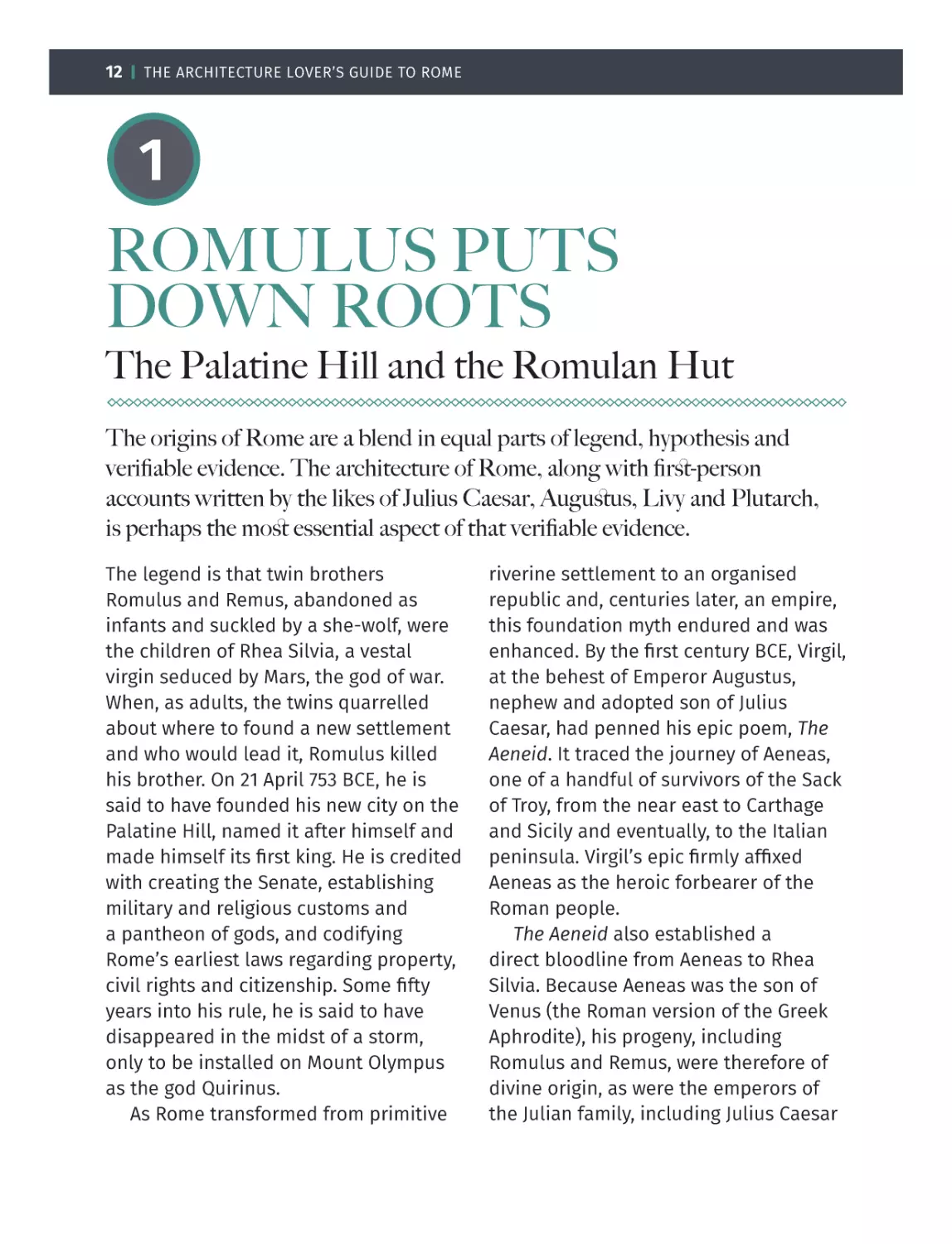
An Iron Age funerary urn suggests the likely shape of
the Romulan Hut. Walters Art Museum.

and Augustus. Romulus himself was
deified after his death; 21 April is still
celebrated as the anniversary of the
founding of Rome.
The accepted hypothesis is that
sometime in the eighth or ninth century
BCE, a permanent settlement was
established on the Palatine Hill, which
was bordered on one side by the Tiber
River and on the other by a swampy
valley – the area that would become the
Roman Forum. Other Latin tribes built
similar, simple pastoral communities
on neighbouring hills; eventually these
were absorbed, either organically or by
force, into the city that would grow into
the Roman Republic.
The authenticity of Romulus as
a historical figure is far less widely
accepted. For the most part, Classical

scholars believe that Romulus and
Remus were not actual historical figures,
but an amalgam of several Greek and
Latin legendary and real characters.
They theorise that even the name
‘Romulus’ was created retroactively to
support the foundation myth as it was
codified into Roman history.
The verifiable evidence is where
architecture comes in. The Palatine Hill is
home to one of the oldest archaeological
remains in Rome, the so-called Romulan
Hut, or Casa Romuli. This Iron Age (900–
700 BCE) hut was made of wattle and
daub, with a straw roof, a small awning
and an animal-skin flap at the doorway.
All that remains today are the postholes,
which confirm its circular shape. During
a 2006 excavation in the Roman Forum,
tombs were found containing hut-shaped
funerary urns. These dated to the same
period and culture as the hut remains
on the Palatine. Since it was customary
for the ashes of the dead to be housed
in clay urns that mimicked the shape
of their dwellings, the urns further
corroborate the style of the hut.
The site of the Romulan Hut was a
place of reverence in Republican Rome,
and it was maintained and restored
through the Late Republican era. The
Palatine Hill became the site of Imperial
residences; Augustus symbolically chose
a location adjacent to the Romulan Hut
to build his palace, large parts of which
are still extant today.
Modern visitors to the Palatine Hill
can visit the Romulan Hut (Casa Romuli),

14 | THE ARCHITECTURE LOVER’S GUIDE TO ROME

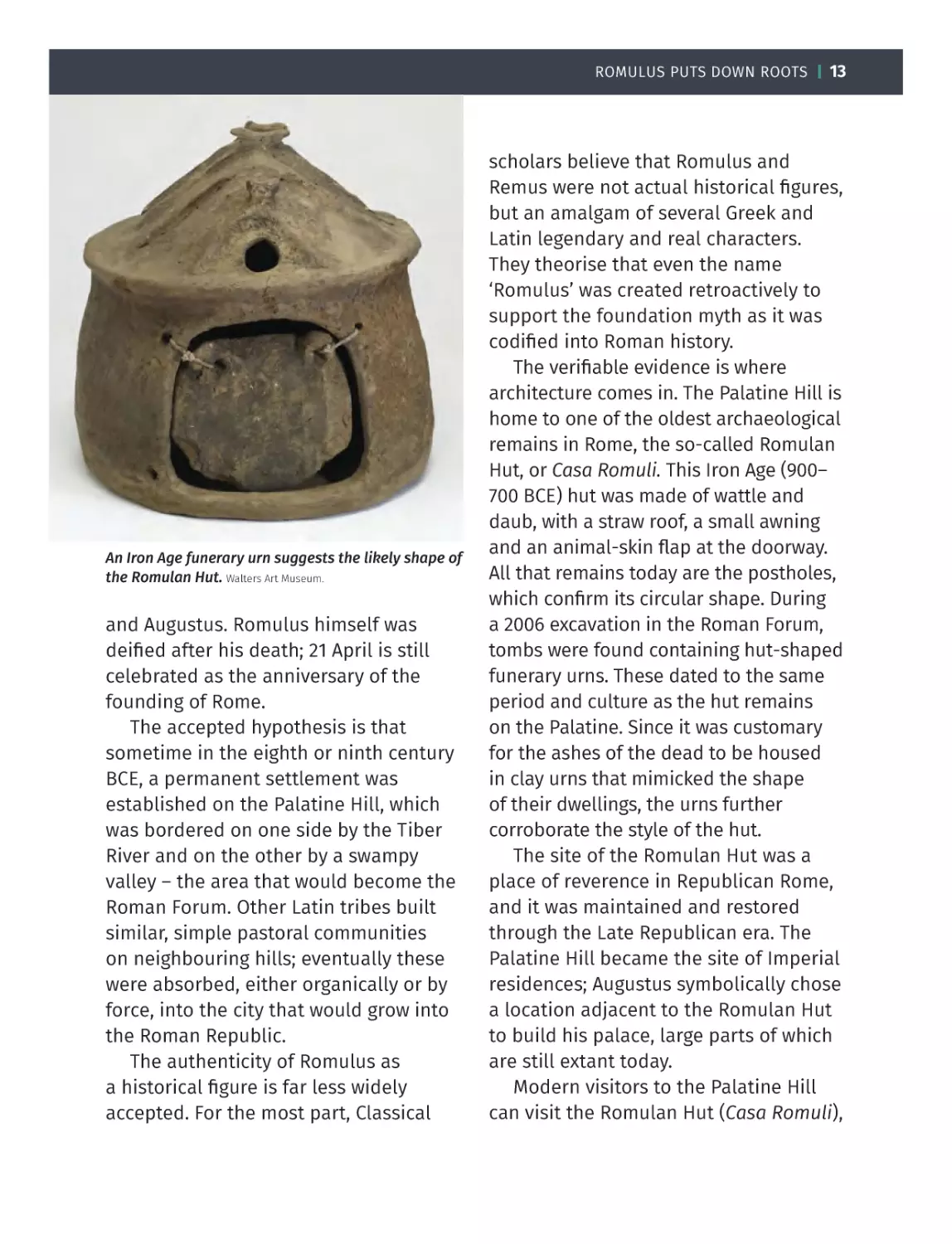
but some imagination is needed to
envision what it once looked like. A
cluster of postholes – the impressions
left where wooden posts, since
deteriorated, once held up the roof – are
etched into the tufa bedrock that forms
much of the Palatine. Crisscrossing
these scant remains are Republicanand Imperial-era foundation walls and
haphazardly placed marble fragments.
While the name Casa Romuli takes
Postholes and foundation floor of the Casa Romuli,
with later walls and foundations built on top.
Vitold Muratov/Wikimedia Commons.

some creative license, the term correctly
links the remains to the approximate
era of the Romulus and the founding of
Rome in the eighth century BCE. Still,
the presence of the hut remains does
not confirm a solid date, prove Rome’s
foundation myth or verify the existence
of Romulus; it only provides evidence
that at least as early as 800–701
BCE – and possibly several hundred
years earlier than that – a permanent
settlement existed on the Palatine.
Unlike the largely accepted consensus

ROMULUS PUTS DOWN ROOTS | 15

reached among academics concerning
the Romulan Hut, interpretation of a 1988
excavation has generated controversy
and a fair amount of scepticism. During
a multi-year excavation on the northeastern slope of the Palatine Hill, an
archaeological team unearthed a wall
built from red tufa blocks. It fronted a
large, natural gully that had been made
steeper as a result of human excavations
– typical of early defensive walls. Pottery
sherds and other physical evidence date
the wall to at least the seventh century
BCE, and possibly earlier.
Ancient Roman historian Livy
wrote that: ‘Romulus’s first act was to
fortify the Palatine, the scene of his
upbringing.’ Other ancient sources also
claim that Romulus ordered the wall
built as his first step in establishing his
settlement.
Some scholars have pointed to
Livy, Virgil and other sources of the
foundation myth, together with the
discovery of the wall, to claim that the
discovery was of a specific moment
in ancient history – when Romulus
drew the boundary of his new city and
ordered that a wall be built to defend
it. This theory supports the ‘historicity,’
or actual existence of Romulus. Critics
of the thesis argue that science cannot
use ancient literature to prove the
origins of the wall, and in turn use the
wall to prove the veracity of the ancient
literature – and that of Romulus himself.
Still, like the Romulan Hut, the
Palatine Wall, which can today be seen

i
HOW TO SEE IT: To see the remains of the Casa
Romuli, visit the Palatine Hill archaeological
area. A combined ticket includes admission
to the Palatine, the Colosseum and the
Roman Forum. The site opens at 8.30 am and
remains open until 4.30 or 5 pm during winter
months, and until 7.15 pm during peak summer
season. Check https://www.coopculture.it/
en/heritage.cfm?id=4 for current information.
Also look for information about a S.U.P.E.R.
Ticket, which includes admission to the
houses of Livia and Augustus and other sites
otherwise inaccessible. Due to long lines at
the Colosseum, we recommend you begin your
tour at the Palatine, where there is never a line
to enter and crowds are far less dense. Then
continue on to the Forum and Colosseum.

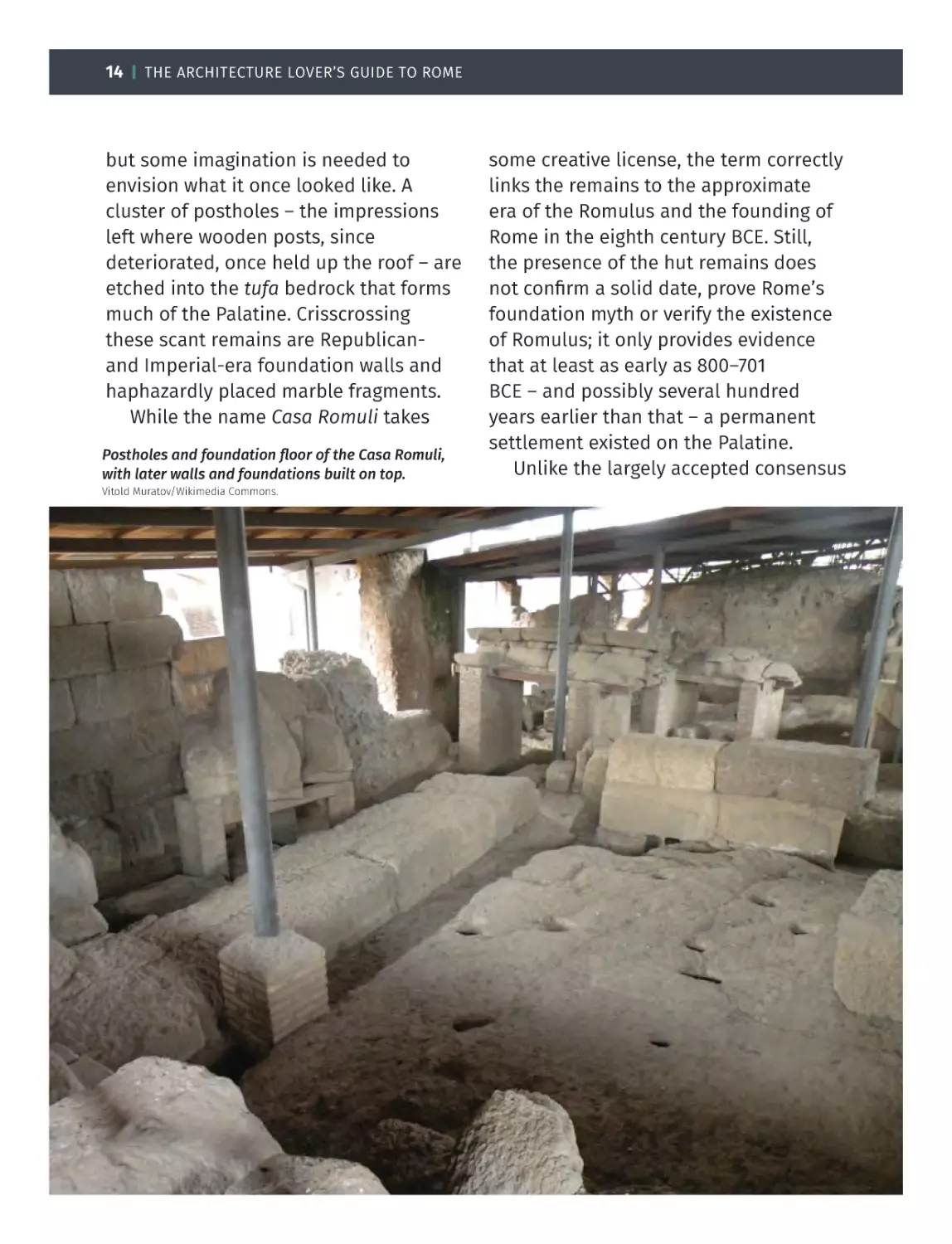
at the base of the Palatine Hill, west of
the House of the Vestal Virgins, does
fill in some of the blanks of the earliest
days of Rome. Also like the hut, it further
supports the theory that the city that
would become Rome did in fact emerge
from humble beginnings on the Palatine
Hill and, in fewer than 1,000 years, grow
to control the entire Mediterranean,
Western Europe, the Isle of Britain,
Eastern Europe, the Middle East and the
southern half of the Black Sea.

16 | THE ARCHITECTURE LOVER’S GUIDE TO ROME

2
FROM KINGDOM
TO REPUBLIC

The Temple of Jupiter Optimus Maximus &
the temples of Portunus & Hercules Victor
A timeline of the earliest centuries of Rome is speculative at best, as it relies on
sources that, while ancient, were recording a history that had already unfolded
hundreds of years in the past. Dionysius of Halicarnassus and Livy, the two
major sources for the story of the foundation of Rome, both lived at the turn of
the millennium – at least 800 years after Romulus.
While Dionysius’ writings dealt primarily
with Romulan legend, Livy’s History of
Rome, recorded at the end of the first
century BCE, chronicled the history of
the city as it evolved from kingdom to
republic. The written sources and oral
histories Livy relied on would have been
created to cast a flattering light on the
actions of Rome’s most-favoured leaders.
Lines were blurred between divine
intervention and historical fact, both as
a means of reinforcing the concept of
Rome’s manifest destiny and simply for
the sake of telling a better story.
After Romulus’ death, Rome is said
to have been ruled by a succession
of kings, the last three all of Etruscan
origin, meaning they came from the
region north of Rome that includes

present-day northern Lazio (the region
of Rome), Umbria and Tuscany (the
latter of which takes its name from
the Etruscans). Ostensibly to offset the
powers of the monarchy, Rome had a
Senate, a body which had existed since
the time of Romulus. Rome’s last king,
Etruscan Lucius Tarquinius Superbus,
was unpopular with the Roman people
and is said to have abused his power
and undermined the Senate. He was
overthrown and banished from the city
and in 509 BCE the Roman Republic was
formed. Through civil wars, far-reaching
conflicts and conquests of territories
throughout Europe, North Africa and
the Middle East, the Republic lasted
until 27 CE.
While the historicity and chronology

FROM KINGDOM TO REPUBLIC | 17

of the Etruscan kings and the formation
of the Republic can never be precisely
verified, the influence of Etruscan
culture on Rome is extensive and
demonstrable. From the Etruscans,
Rome absorbed its earliest rituals and
systems of worship, including its three
most important deities: Juno, Minerva
and Jupiter, the latter the mythological
equivalent of Zeus. From the Etruscans,
Romans learned how to build roads and
municipal projects (Rome’s massive
drainage canal, Cloaca Maxima, was
built by the Etruscan kings and still
empties into the Tiber today) and, most
importantly, they learned how to build
temples.

The Temple of Jupiter Optimus
Maximus
That Livy and Dionysius of Halicarnassus
relied on unverifiable sources for their
written histories of Rome is certain, but
what is also certain is that when these
chroniclers were active in Rome, they
frequently set eyes on the city’s most
important ancient temple, around which
every significant ritual, political or military
event in the history of Rome centred: the
Temple of Jupiter Optimus Maximus.
Also known as the Temple of Capitoline
Jupiter, the Temple of Jupiter Optimus
Maximus – which translates to the Jupiter
‘best and greatest’ – was a massive
structure set at the top of the Capitoline
Hill and visible from virtually every part
of Rome. It was built on the orders of
Lucius Tarquinius Superbus, but would

be dedicated around the time of the
formation of the Republic, in 509 BCE. The
foundation of the original temple was
made of cappellaccio, a porous volcanic
tufa stone that could be easily quarried
and cut. The foundation measured at least
55 x 60 metres, meaning there was simply
nothing else in Rome, or in the world
known to most Romans, that approached
its size.
Though speculation exists as to its
design, scholars agree that the temple,
raised on a podium, or platform reached
via a flight of stairs, followed then
contemporary Etruscan design. It had a
portico supported by at least four, and
more likely six, columns set three or
four rows deep. The portico covered the
entrances to three cellae, or chambers,
each dedicated to a member of the
triad: the largest and central cella was
for Jupiter, with Juno’s to the left and
Minerva’s to the right.
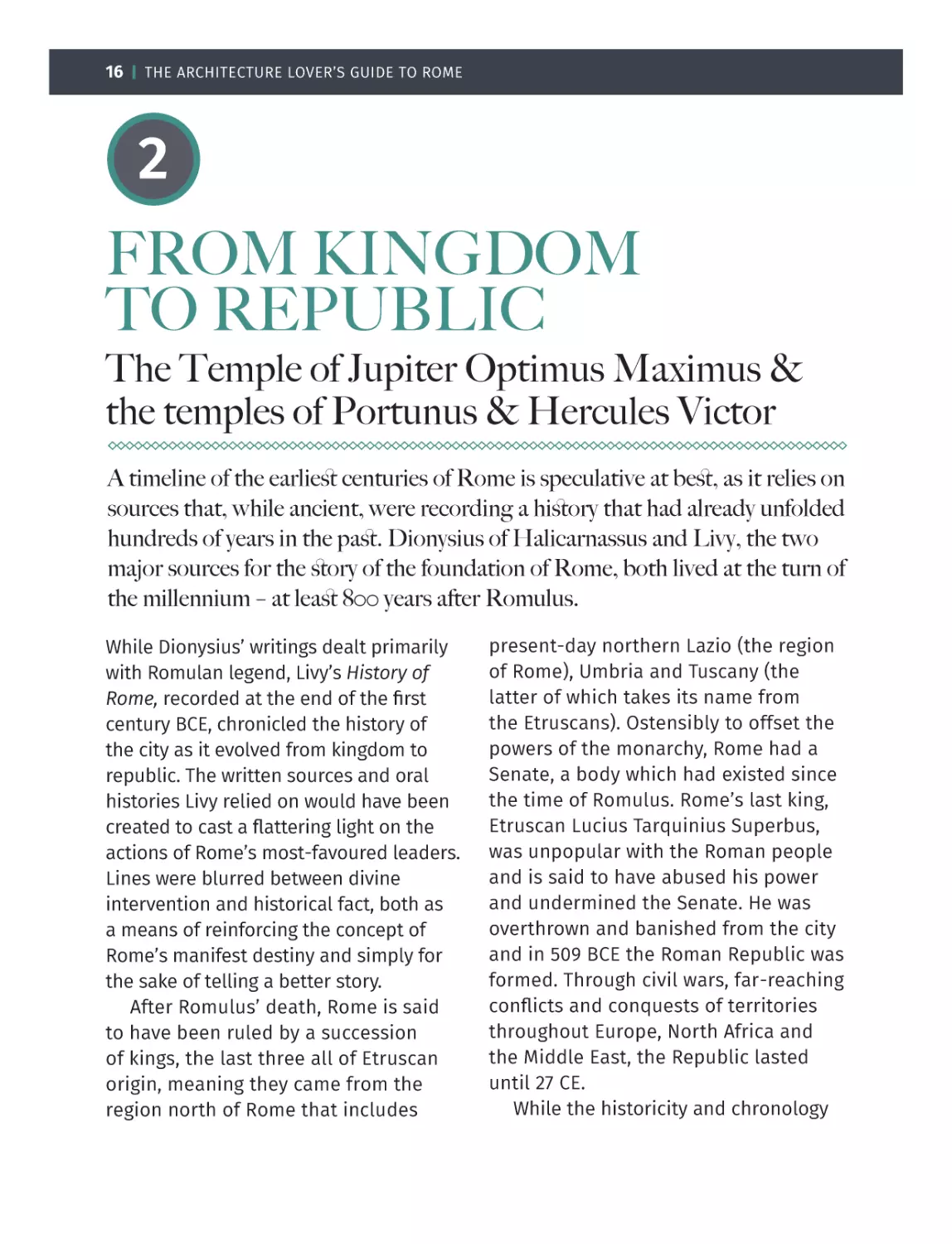
The earliest temple was likely
Model of the Temple of Juno Optimus Maximus.
Sailko/Wikimedia Commons.

18 | THE ARCHITECTURE LOVER’S GUIDE TO ROME

constructed of mud brick covered in
stucco, which would have been brightly
painted, all the more to make the
temple a beacon and symbol for miles
around. The roof of the temple was
made of terracotta tiles supported by
wood beams. The front of the roof had a
pediment, or triangular panel, decorated
with painted bas-relief (low-relief )
sculptures. A terracotta sculpture on the
peak of the roof depicted Jupiter driving
a chariot drawn by four horses.
Inside the central cella was a cult
statue of Jupiter, also in terracotta and
painted a deep red. The temple was the
symbolic home of the triad of deities,
and the statue of Jupiter was a spiritual
link to the god himself. When triumphal
processions – parades of a victorious
general, his legions and the spoils of
war, including prisoners destined for
slavery or execution – wended their way
through the city and along the Via Sacra,
their endpoint was the temple. There,
the general, his face painted red to
match that of the statue, would oversee
sacrifices – both human and animal –
and leave offerings to Jupiter.
With its status as the most important
religious building in Rome, the Temple
of Jupiter Optimus Maximus served
as a reminder, both to Romans and
outsiders, of the pre-eminence of Rome,
its ordained-by-the-gods superiority
over its rivals, and the permanency and
immovability of its dominance.
But the temple itself proved far less
immovable. In 83 BCE, during a period

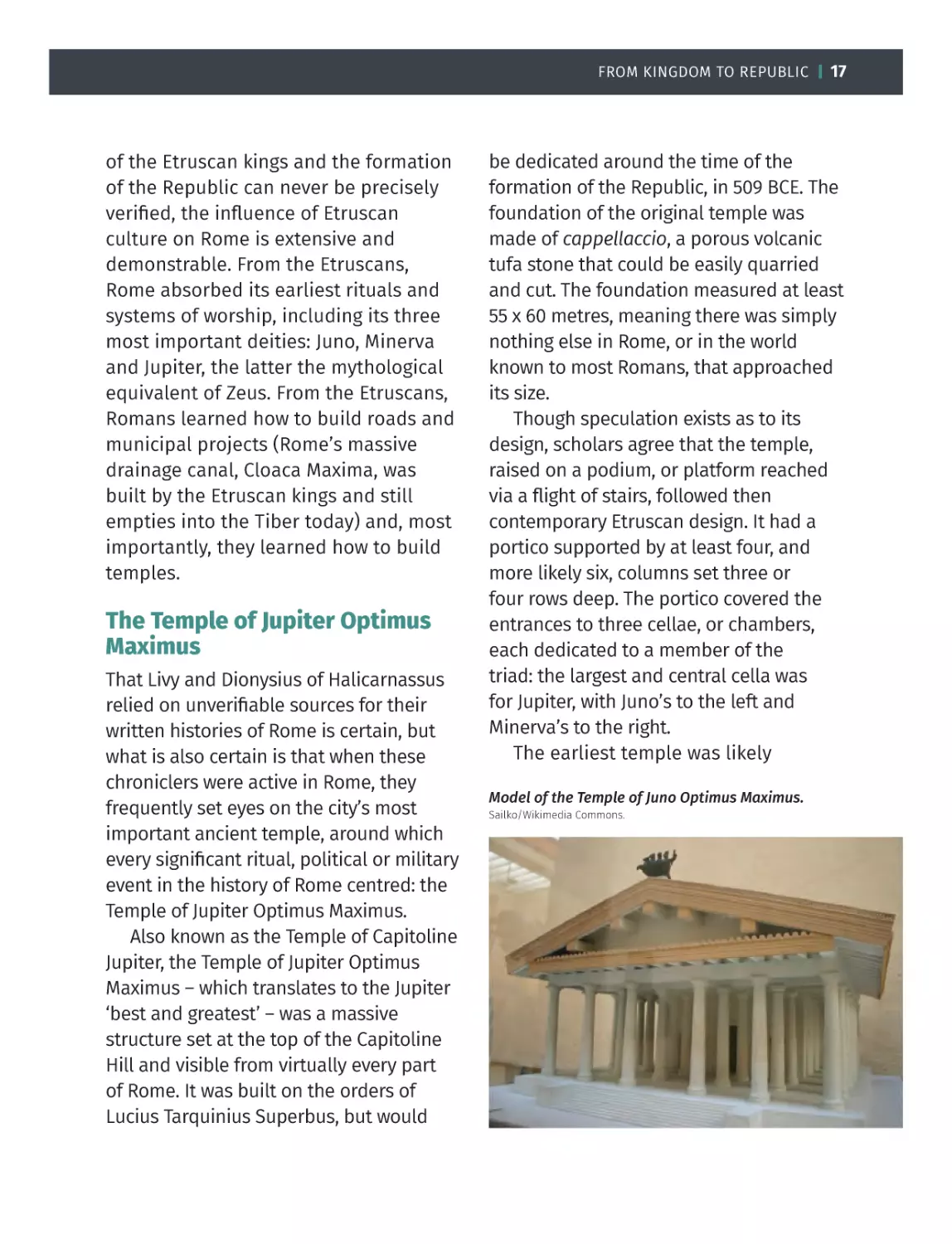
Remains of the podium of the Temple of Juno Optimus
Maximus in the Capitoline Museums.
Courtesy Capitoline Museums.

of civil war in Rome, the first temple
burned to the ground, leaving only
the foundation and podium. A second
temple, dedicated in 69 CE, burned down
during internecine fighting that same
year. The third temple, built by Emperor
Vespasian and dedicated in 75 CE, burned
down in a widespread fire in 80 CE.
Each reconstruction of the temple
was increasingly more elaborate
and completed with more expensive
materials. The fourth, and final temple
– the version that Livy and Dionysius
of Halicarnassus would have seen –
was the most extravagant, with marble
construction, bronze roof tiles, goldplated doors, marble columns and
intricate carvings on the pediment. This
iteration of the temple stood until the
late fourth century CE, when Emperor
Theodosius made Christianity the
official religion of Rome and ordered the
closing of all pagan places of worship.
The Temple of Jupiter fell into a gradual
state of disrepair and parts of it were
plundered for use in other structures.

FROM KINGDOM TO REPUBLIC | 19

Rome was sacked by Vandals in the fifth
century, and the temple was further
pillaged. It stood in ruins until the
1500s, when it was definitely razed and
its materials used to build the Palazzo
Caffarelli, which still stands and is now
the property of the City of Rome.
Thus Rome’s oldest and most
important temple has all but vanished.
Knowledge of the temple architecture
comes from a handful of ancient
sources, including coins and relief
carvings, and from illustrations
predating the palazzo. The majority of
the temple foundation lies underneath
Palazzo Caffarelli, which is currently
closed to the public. In the Palazzo dei
Conservatori, one of the twin edifices
that make up the Capitoline Museums,
sections of the podium and foundation
are still visible. Outside the museum, on
Via del Tempio di Giove, behind Rome’s
city government offices, a corner of
the temple foundation and podium is
preserved under a glass canopy.

i
HOW TO SEE IT: Located at the top
of the Capitoline Hill, the Capitoline
Museums (Musei Capitolini) contain
sections of the temple and offers
didactic information on the structure
and its significance to ancient Rome.
The museums are open daily from
9.30 am to 7.30 pm. Visit http://
www.museicapitolini.org for more
information.

The Temple of Portunus
Fortunately for modern visitors, not all
of Rome’s most ancient temples have
been reduced to their foundations. The
Temple of Portunus was built in the
third or fourth century BCE, and its high
state of preservation makes it a model
for understanding the characteristics of
temple design and construction during
the Republican era.
Set on land that was once part of the
Forum Boarium, the temple was dedicated
to Portunus, the god associated with
livestock and river travel. The Forum
Boarium was the cattle market and
mercantile area right at the port of Rome,
so the temple served an auspicious
purpose in protecting the livestock-laden
ships arriving from the Port of Ostia and in
ensuring prosperous trade.
The Temple of Portunus was
built in the Etruscan style, and can
be understood as prototypical of
Republican temples, none other of which
came close to the scale of the Capitoline
Jupiter (discussed above). Although the
temple was rebuilt in the first century
BCE, its design is thought to follow the
original. The temple measures just 10.5 x
19 metres, and sits on a raised podium,
from which it would have been visible
to arriving ships. It has a tetrastyle, or
four-column portico and a single cella,
or interior chamber. The temple sat
overlooking a bend in the Tiber, which
still flows just yards away but has since
been hemmed in with a high stone
embankment.

20 | THE ARCHITECTURE LOVER’S GUIDE TO ROME
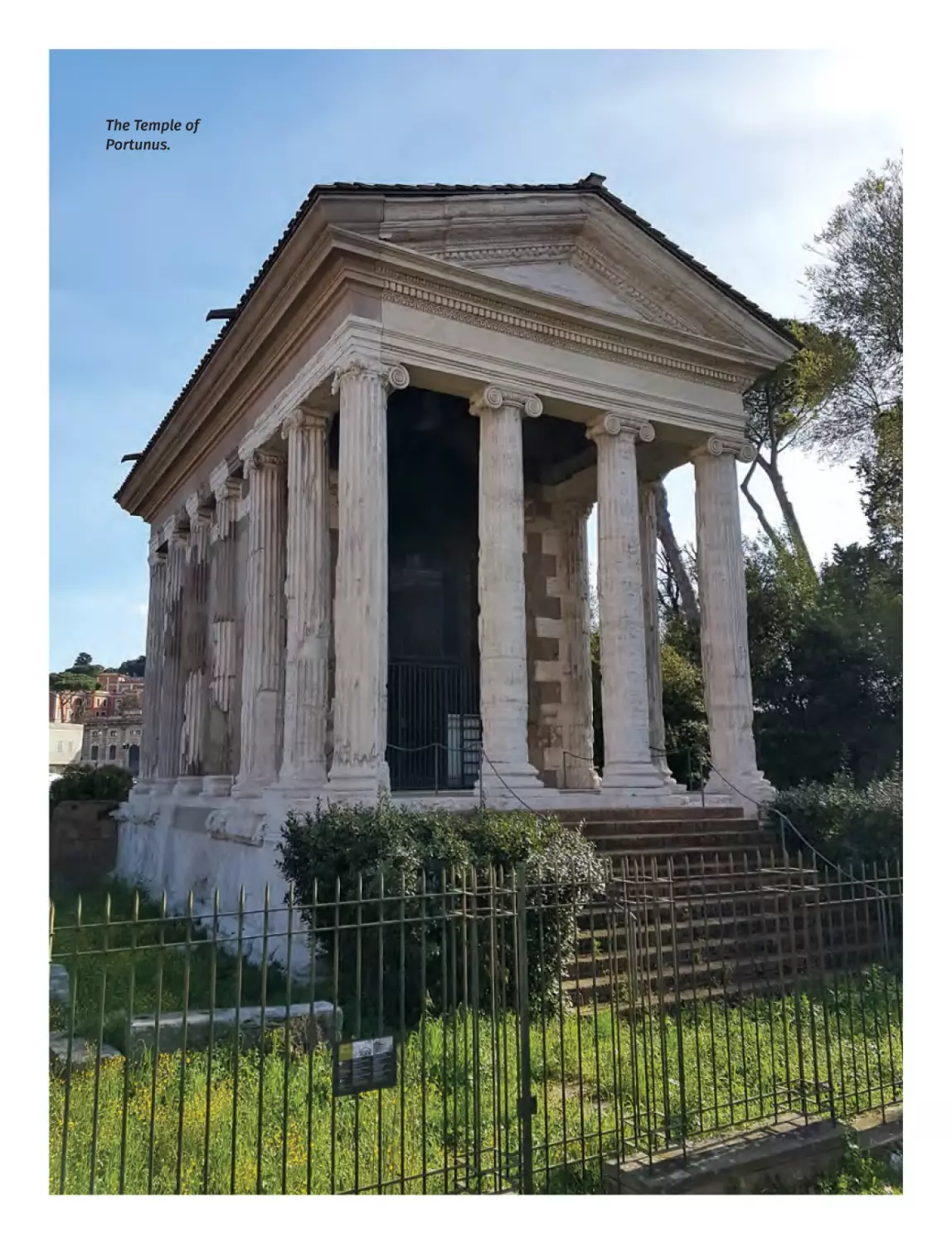
The Temple of
Portunus.

FROM KINGDOM TO REPUBLIC | 21

The portico is held up by a total of
six columns, which are fluted, or incised
with channels of equal size. They are
topped with ionic capitals, identified by
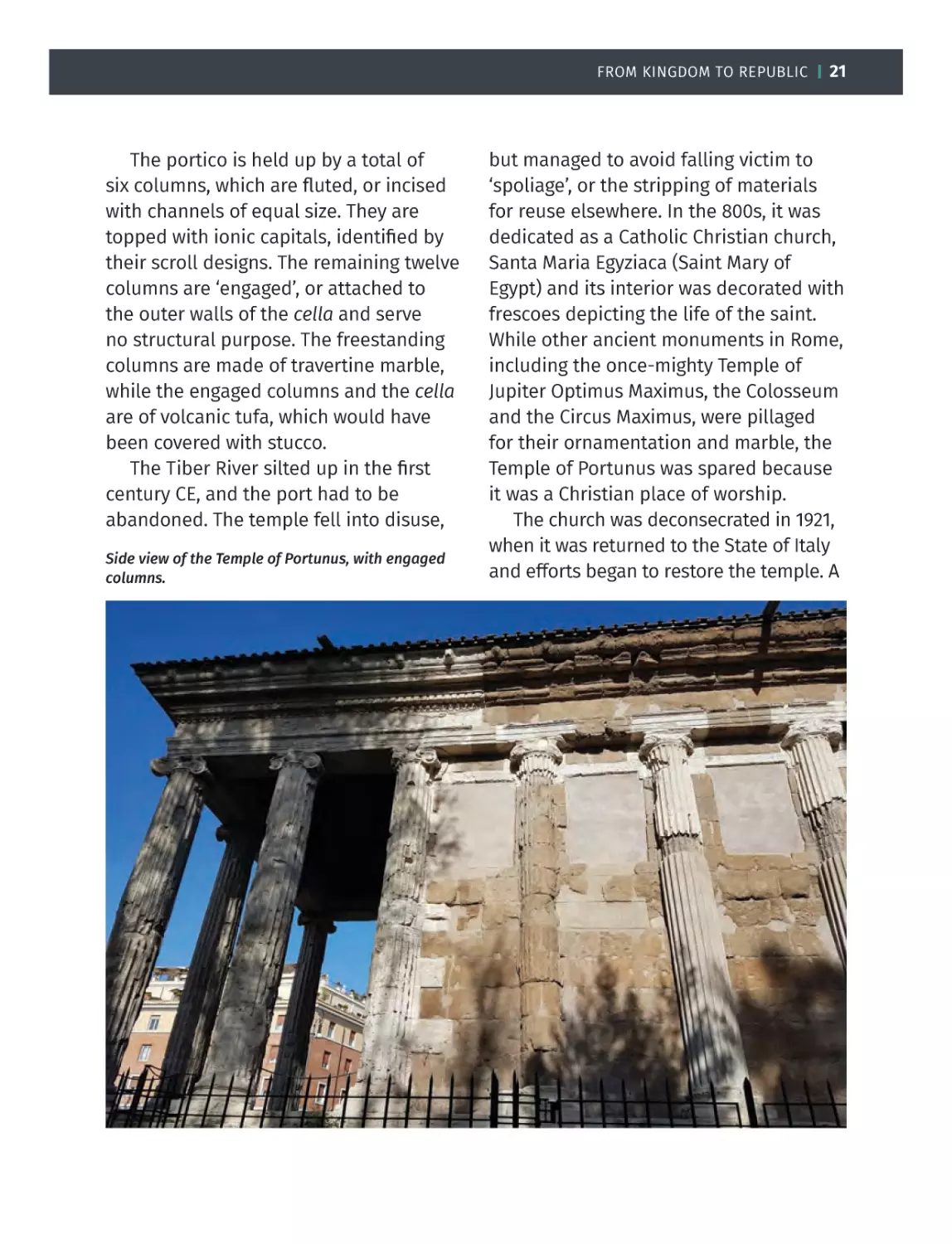
their scroll designs. The remaining twelve
columns are ‘engaged’, or attached to
the outer walls of the cella and serve
no structural purpose. The freestanding
columns are made of travertine marble,
while the engaged columns and the cella
are of volcanic tufa, which would have
been covered with stucco.
The Tiber River silted up in the first
century CE, and the port had to be
abandoned. The temple fell into disuse,
Side view of the Temple of Portunus, with engaged
columns.

but managed to avoid falling victim to
‘spoliage’, or the stripping of materials
for reuse elsewhere. In the 800s, it was
dedicated as a Catholic Christian church,
Santa Maria Egyziaca (Saint Mary of
Egypt) and its interior was decorated with
frescoes depicting the life of the saint.
While other ancient monuments in Rome,
including the once-mighty Temple of
Jupiter Optimus Maximus, the Colosseum
and the Circus Maximus, were pillaged
for their ornamentation and marble, the
Temple of Portunus was spared because
it was a Christian place of worship.
The church was deconsecrated in 1921,
when it was returned to the State of Italy
and efforts began to restore the temple. A

22 | THE ARCHITECTURE LOVER’S GUIDE TO ROME

series of major restorations began in 2006
and continued through 2016, and included
cleaning and reinforcement of the
temple exterior, a roof replacement, and
restoration of the early medieval frescoes
of the interior. Wherever possible, original
building materials were reused.

The Temple of Hercules Victor
One hundred metres from the Temple
of Portunus sits the second of Rome’s
best-preserved Republican temples,
that of Hercules Victor. Built around 120
BCE, the temple is thought to have been
commissioned to commemorate the
Roman military victories in Greece. The
temple is of Greek design, and notable
for its round shape and that it is the
oldest surviving marble building in Rome.
The temple is about 15 metres in
diameter, and has a round cella ringed
by twenty marble columns – nineteen
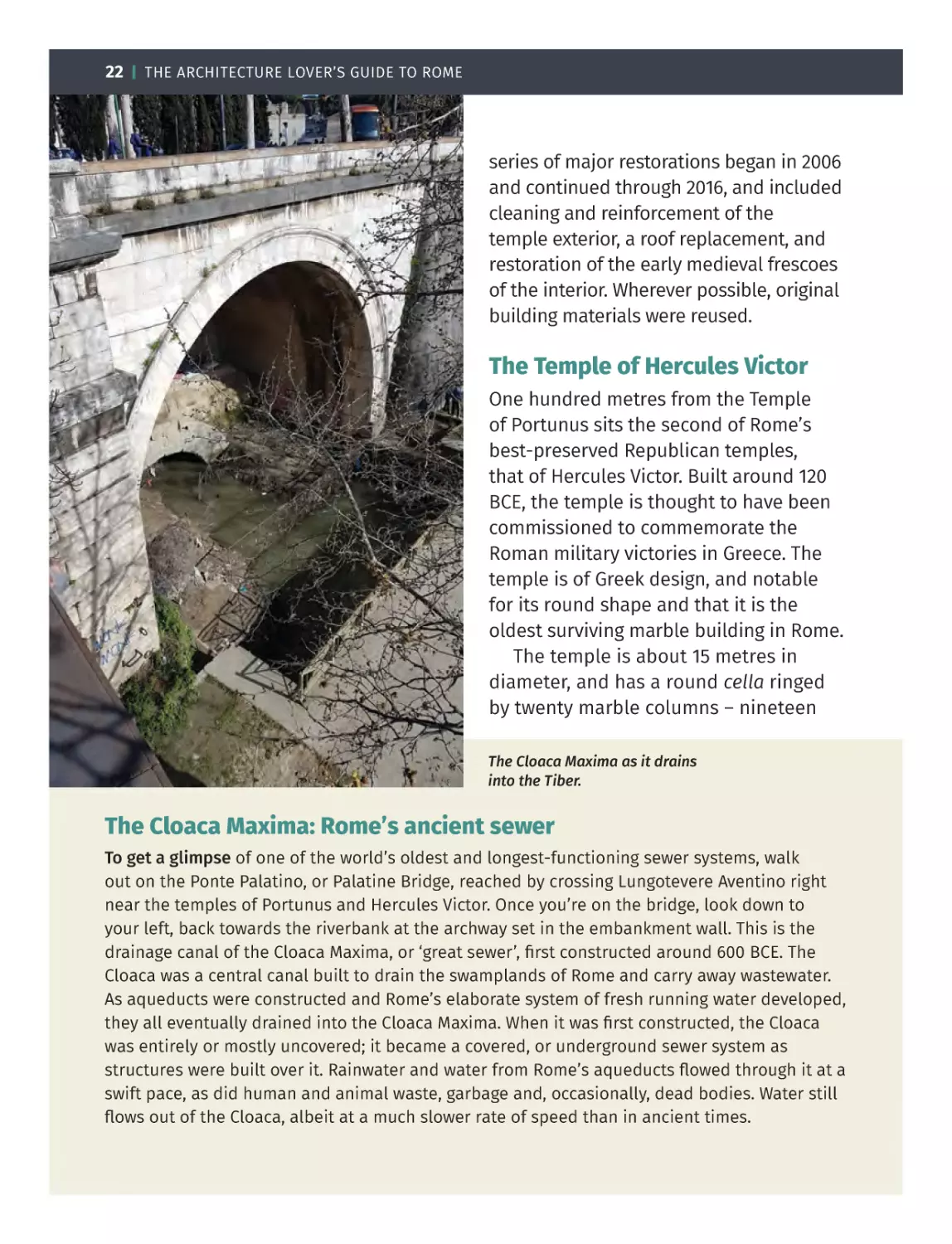
The Cloaca Maxima as it drains
into the Tiber.

The Cloaca Maxima: Rome’s ancient sewer
To get a glimpse of one of the world’s oldest and longest-functioning sewer systems, walk
out on the Ponte Palatino, or Palatine Bridge, reached by crossing Lungotevere Aventino right
near the temples of Portunus and Hercules Victor. Once you’re on the bridge, look down to
your left, back towards the riverbank at the archway set in the embankment wall. This is the
drainage canal of the Cloaca Maxima, or ‘great sewer’, first constructed around 600 BCE. The
Cloaca was a central canal built to drain the swamplands of Rome and carry away wastewater.
As aqueducts were constructed and Rome’s elaborate system of fresh running water developed,
they all eventually drained into the Cloaca Maxima. When it was first constructed, the Cloaca
was entirely or mostly uncovered; it became a covered, or underground sewer system as
structures were built over it. Rainwater and water from Rome’s aqueducts flowed through it at a
swift pace, as did human and animal waste, garbage and, occasionally, dead bodies. Water still
flows out of the Cloaca, albeit at a much slower rate of speed than in ancient times.

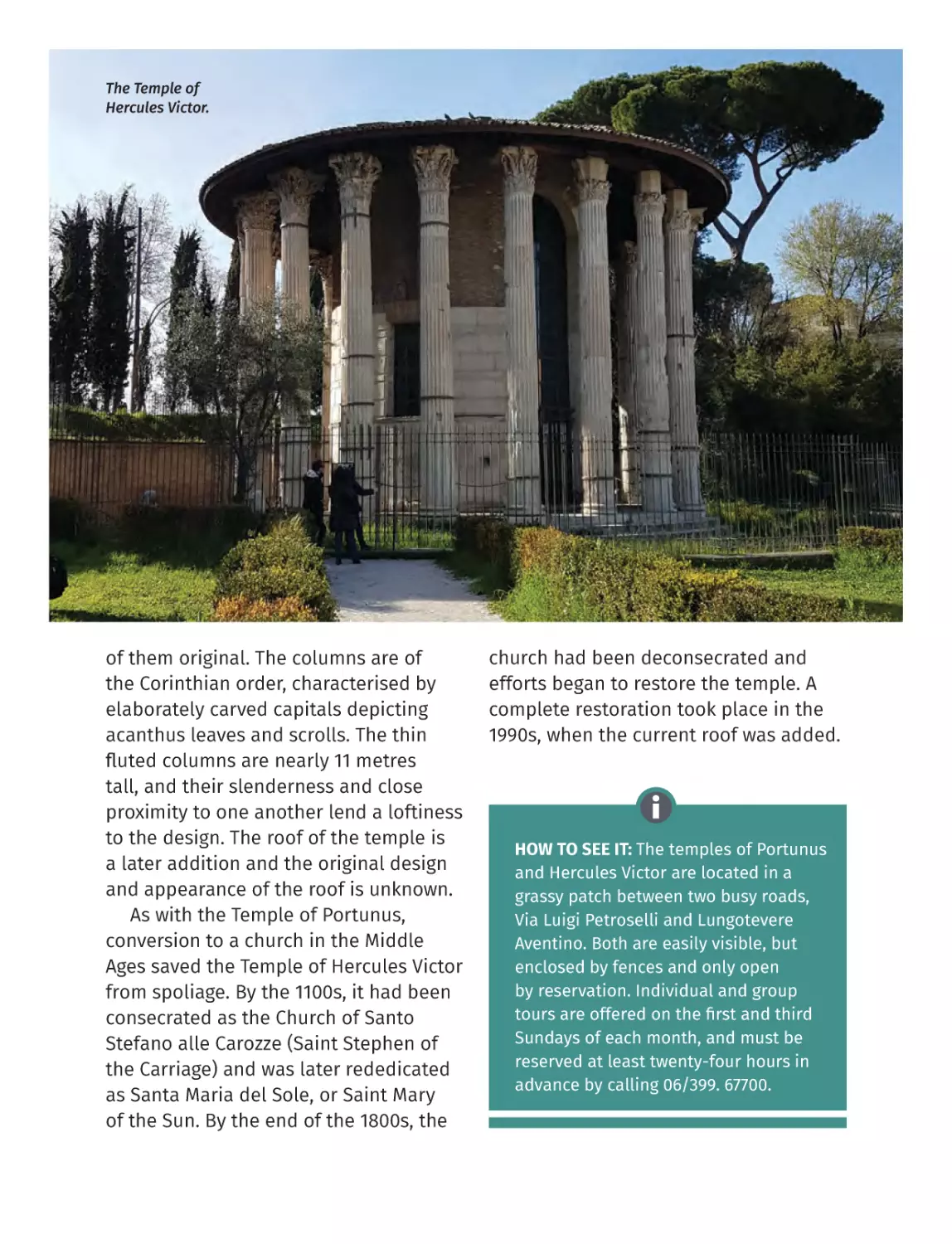
The Temple of
Hercules Victor.

of them original. The columns are of
the Corinthian order, characterised by
elaborately carved capitals depicting
acanthus leaves and scrolls. The thin
fluted columns are nearly 11 metres
tall, and their slenderness and close
proximity to one another lend a loftiness
to the design. The roof of the temple is
a later addition and the original design
and appearance of the roof is unknown.
As with the Temple of Portunus,
conversion to a church in the Middle
Ages saved the Temple of Hercules Victor
from spoliage. By the 1100s, it had been
consecrated as the Church of Santo
Stefano alle Carozze (Saint Stephen of
the Carriage) and was later rededicated
as Santa Maria del Sole, or Saint Mary
of the Sun. By the end of the 1800s, the

FROM KINGDOM TO REPUBLIC | 23

church had been deconsecrated and
efforts began to restore the temple. A
complete restoration took place in the
1990s, when the current roof was added.

i
HOW TO SEE IT: The temples of Portunus
and Hercules Victor are located in a
grassy patch between two busy roads,
Via Luigi Petroselli and Lungotevere
Aventino. Both are easily visible, but
enclosed by fences and only open
by reservation. Individual and group
tours are offered on the first and third
Sundays of each month, and must be
reserved at least twenty-four hours in
advance by calling 06/399. 67700.

24 | THE ARCHITECTURE LOVER’S GUIDE TO ROME

3
FROM BRICK
TO MARBLE

Early Imperial ambitions at the Basilica Julia,
Nero’s Domus Aurea, and the Colosseum
ʻUrbem latericium invenit, marmoream reliquitʼ.
ʻHe found a city of brick; he left a city of marbleʼ.
These words are attributed to Caesar Augustus, the first emperor of Rome,
and were etched on his tomb. Though humility may not have been Augustus’s
strong suit, his self-ascribed epitaph was not inaccurate – in the decades of his
rule, Rome undertook ambitious building projects of monumental scale and
engineering, with a grandeur befitting the most important city of what was
then the most dominant empire of the known world.
The last century BCE would also mark
the last century of the Roman Republic.
A series of conflicts within Rome and
its hinterlands, as well as on its more
distant borders, destabilised the
Republic in the early decades of the
century. As Julius Caesar conquered
territories in northern Europe in the
name of Rome, he amassed tremendous
wealth and influence, and the loyalty
of his military legions. His march on
Rome in 49 BCE sparked a civil war and
further weakened an already faltering
republic. Caesar consolidated power and
engineered to have himself declared

dictator for life, effectively ending the
republican form of government.
Julius Caesar’s assassination on the
Ides of March, 44 BCE, was an effort by a
group of conspiring senators to restore
the Republic. Instead, it prolonged the
civil wars for several years. In his will,
Caesar adopted his grand-nephew,
Octavian, as his son and sole heir, thus
legitimatising the latter’s claim as
successor of Caesar. Years of war and
conflict culminated in 31 BCE, when
Octavian defeated Mark Antony and
Cleopatra at Actium, Greece. Though it
would be a few years before Octavian

FROM BRICK TO MARBLE | 25

was declared by the Senate ‘Augustus’,
or ‘illustrious one’ – he later also
adopted the title Imperator Caesar – 31
BCE is considered the definitive end
of the Republic and the beginning of
the reign of Caesar Augustus, the first
emperor of the Roman Empire.

Basilica Julia
When Julius Caesar died, he left behind
several unfinished building projects,
which Augustus completed on an
even grander scale. One of the most
important of these was the Basilica Julia,
a large public building on the Roman
Forum, the low-lying area between the
Palatine and Capitoline hills that for
more than 1,000 years was the centre of
Roman commercial, political and social
life.
Although ‘basilica’ is a term most
commonly associated with Christian

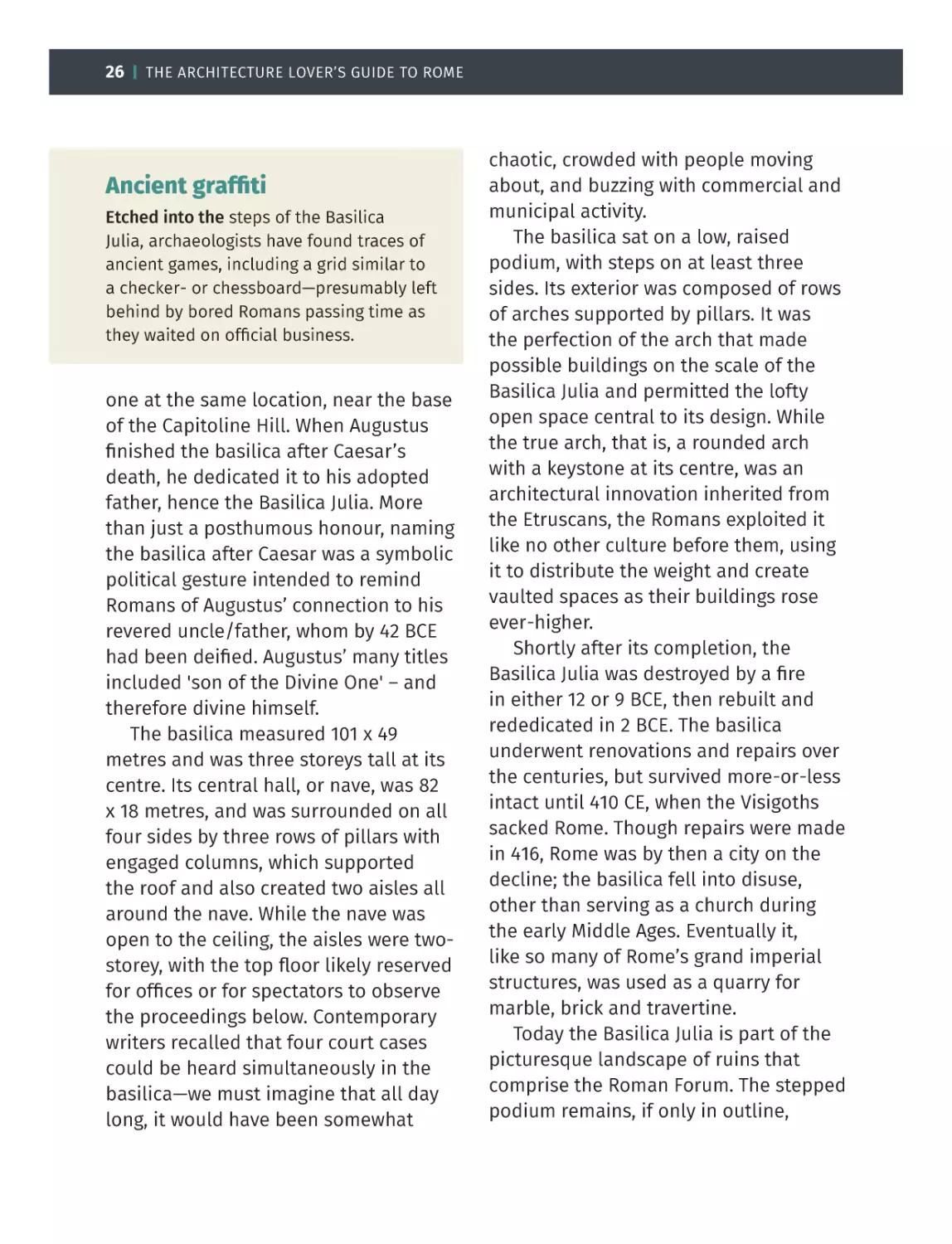
Model of the
Basilica Julia.

Lasha Tskhondia/
L_VII_C_Creative Commons

Catholic churches, its concept and
design originated with the Romans. A
basilica was a large, rectangular building
with a central nave, or hall, flanked
by two or four aisles. The space was
intended to accommodate large groups
of people and for this reason, its design
was later appropriated by the church.
But the original basilica model was
that of a public, or municipal building,
typically the site of civil court hearings,
government and banking offices, and,
frequently, small shops. Unlike its later
manifestations, the Roman basilica
had no religious function and was
very much the centre of public life in
the city. For perspective, there are the
ruins of seven basilicas on the Roman
Forum alone, several of which were
contemporaneously in use.
Julius Caesar began construction of
a basilica to replace a Republican-era

26 | THE ARCHITECTURE LOVER’S GUIDE TO ROME

Ancient graffiti
Etched into the steps of the Basilica
Julia, archaeologists have found traces of
ancient games, including a grid similar to
a checker- or chessboard—presumably left
behind by bored Romans passing time as
they waited on official business.

one at the same location, near the base
of the Capitoline Hill. When Augustus
finished the basilica after Caesar’s
death, he dedicated it to his adopted
father, hence the Basilica Julia. More
than just a posthumous honour, naming
the basilica after Caesar was a symbolic
political gesture intended to remind
Romans of Augustus’ connection to his
revered uncle/father, whom by 42 BCE
had been deified. Augustus’ many titles
included 'son of the Divine One' – and
therefore divine himself.
The basilica measured 101 x 49
metres and was three storeys tall at its
centre. Its central hall, or nave, was 82
x 18 metres, and was surrounded on all
four sides by three rows of pillars with
engaged columns, which supported
the roof and also created two aisles all
around the nave. While the nave was
open to the ceiling, the aisles were twostorey, with the top floor likely reserved
for offices or for spectators to observe
the proceedings below. Contemporary
writers recalled that four court cases
could be heard simultaneously in the
basilica—we must imagine that all day
long, it would have been somewhat

chaotic, crowded with people moving
about, and buzzing with commercial and
municipal activity.
The basilica sat on a low, raised
podium, with steps on at least three
sides. Its exterior was composed of rows
of arches supported by pillars. It was
the perfection of the arch that made
possible buildings on the scale of the
Basilica Julia and permitted the lofty
open space central to its design. While
the true arch, that is, a rounded arch
with a keystone at its centre, was an
architectural innovation inherited from
the Etruscans, the Romans exploited it
like no other culture before them, using
it to distribute the weight and create
vaulted spaces as their buildings rose
ever-higher.
Shortly after its completion, the
Basilica Julia was destroyed by a fire
in either 12 or 9 BCE, then rebuilt and
rededicated in 2 BCE. The basilica
underwent renovations and repairs over
the centuries, but survived more-or-less
intact until 410 CE, when the Visigoths
sacked Rome. Though repairs were made
in 416, Rome was by then a city on the
decline; the basilica fell into disuse,
other than serving as a church during
the early Middle Ages. Eventually it,
like so many of Rome’s grand imperial
structures, was used as a quarry for
marble, brick and travertine.
Today the Basilica Julia is part of the
picturesque landscape of ruins that
comprise the Roman Forum. The stepped
podium remains, if only in outline,

FROM BRICK TO MARBLE | 27

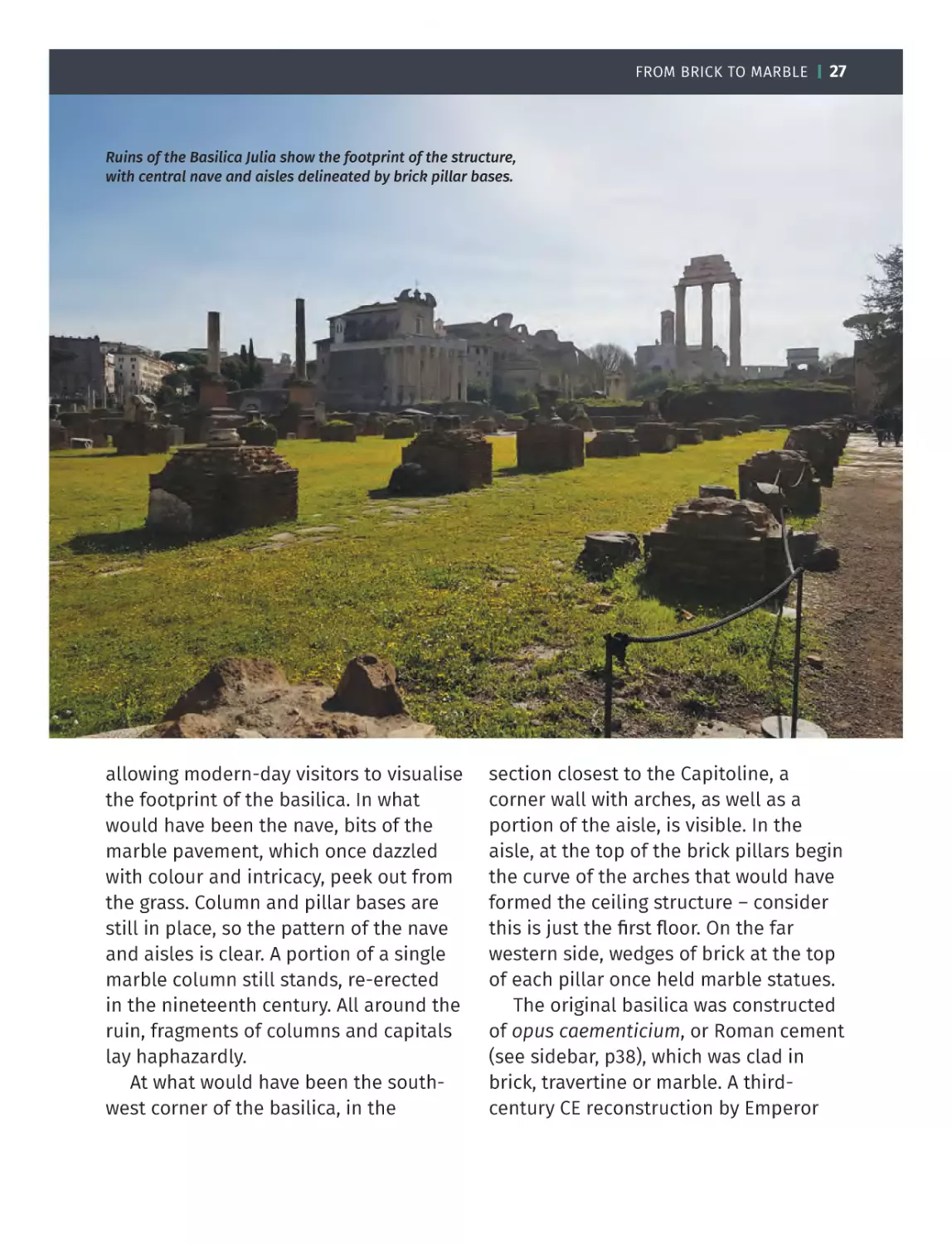
Ruins of the Basilica Julia show the footprint of the structure,
with central nave and aisles delineated by brick pillar bases.

allowing modern-day visitors to visualise
the footprint of the basilica. In what
would have been the nave, bits of the
marble pavement, which once dazzled
with colour and intricacy, peek out from
the grass. Column and pillar bases are
still in place, so the pattern of the nave
and aisles is clear. A portion of a single
marble column still stands, re-erected
in the nineteenth century. All around the
ruin, fragments of columns and capitals
lay haphazardly.
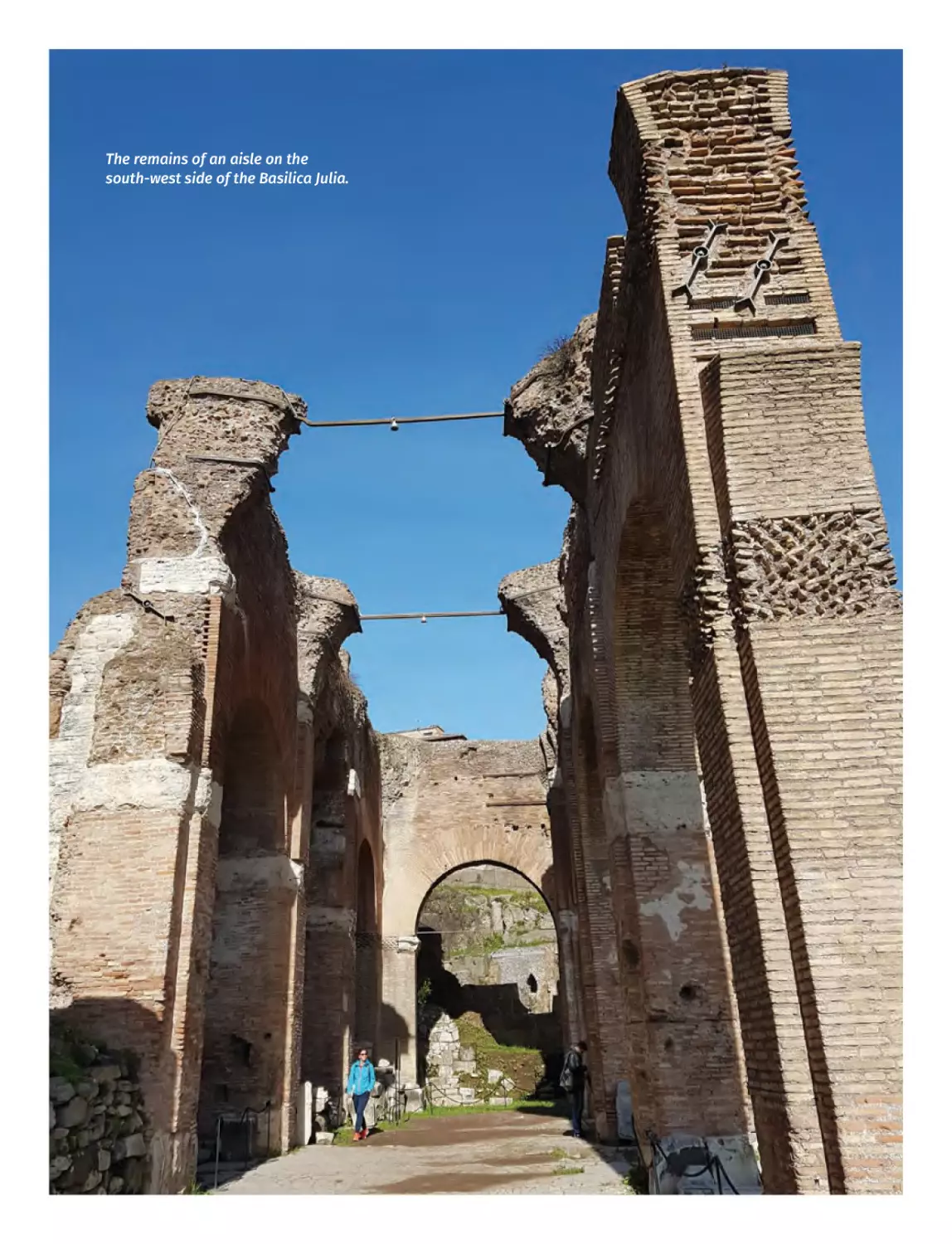
At what would have been the southwest corner of the basilica, in the

section closest to the Capitoline, a
corner wall with arches, as well as a
portion of the aisle, is visible. In the
aisle, at the top of the brick pillars begin
the curve of the arches that would have
formed the ceiling structure – consider
this is just the first floor. On the far
western side, wedges of brick at the top
of each pillar once held marble statues.
The original basilica was constructed
of opus caementicium, or Roman cement
(see sidebar, p38), which was clad in
brick, travertine or marble. A thirdcentury CE reconstruction by Emperor

28 | THE ARCHITECTURE LOVER’S GUIDE TO ROME

The remains of an aisle on the
south-west side of the Basilica Julia.

FROM BRICK TO MARBLE | 29

Diocletian—again as the result of a
devastating fire, this time in 283—meant
that walls were rebuilt entirely in brick.
While the dimensions and design of
the third-century phase are thought to
have been in keeping with the original
scheme, the Augustan basilica was very
likely a much more opulent space than
its later iterations.
The south-west corner of the basilica
survived, relatively speaking, because
the church built into that small section
of the building in the seventh or eighth
century CE was not subject to spoliage.
Despite its poor state of preservation
today, the significance and scale of this
monumental building demonstrate well
the ambitions of Augustus’ building
initiatives—to dazzle Romans and
visitors alike with a massive display of
the engineering capabilities of the new
empire, to overwhelm with dimensions
never before seen, and to impress with

i
HOW TO SEE IT: To the remains of
the Basilica Julia are within the
Roman Forum archaeological area. A
combined ticket includes admission to
the Palatine, the Colosseum and the
Roman Forum. The site opens at 8:30
am and remains open until 4:30 or 5
pm during winter months, and until
7:15 pm during peak summer season.
Check https://www.coopculture.it/
en/heritage.cfm?id=4 for current
information.

the extreme wealth that was required to
realize such a project.

The Domus Aurea
Augustus and his successors brought to
the Roman public architecture on a scale
and splendour that had never before
been seen. Yet privately, Augustus and
his wife Livia were said to have lived in
relatively modest surroundings – for an
emperor, at least. The Domus Augusti, or
House of Augustus, sat on the western
edge of the Palatine Hill, its position
strategically selected for its proximity
to the Casa Romuli and sacred sites
associated with the founding of Rome.
There, in two side-by-side houses,
Augustus and Livia had large public
receiving-rooms decorated in an austere
manner. Separate from these was a
section of private chambers, including
bedrooms, studies and guest quarters,
which were small and brilliantly adorned
with colourful wall paintings, many of
which have been brought back to life
through ongoing restorations. While
Augustus and his wife presumably
lived with every comfort and luxury, he
saved the grandeur and ostentation for
religious and municipal buildings that
everyday Romans would see, and that
would remind them of his benevolent
and paternalistic role as the father of
Rome.
Augustus’ great-great grandson,
Nero (his full title was Nero Claudius
Caesar Augustus Germanicus) was the
fifth emperor of Rome (54-68 CE), and

30 | THE ARCHITECTURE LOVER’S GUIDE TO ROME

Whether he was the hero
the last member of the Julioor villain of the Great Fire,
Claudian dynasty to rule
Nero did take advantage of
the empire. Nero’s name
the damage it wrought. He
evokes images of a crazed
ordered the construction
despot, though recent
of new housing for
reconsiderations suggests
displaced residents, with the
a more complicated legacy
requirement that buildings be
– of a charismatic, complex
of brick, rather than wood. Yet
and quite possibly mentally ill
he also engaged in a land
leader who was popular with
grab, claiming a huge swath
the common people, reviled by
of the Palatine, Caelian,
the Senate and upper classes,
Esquiline and Oppian hills
and historicised as a tyrant
to build his immense palace,
in accounts written in the
the Domus Aurea, or Golden
years after his death. Stories
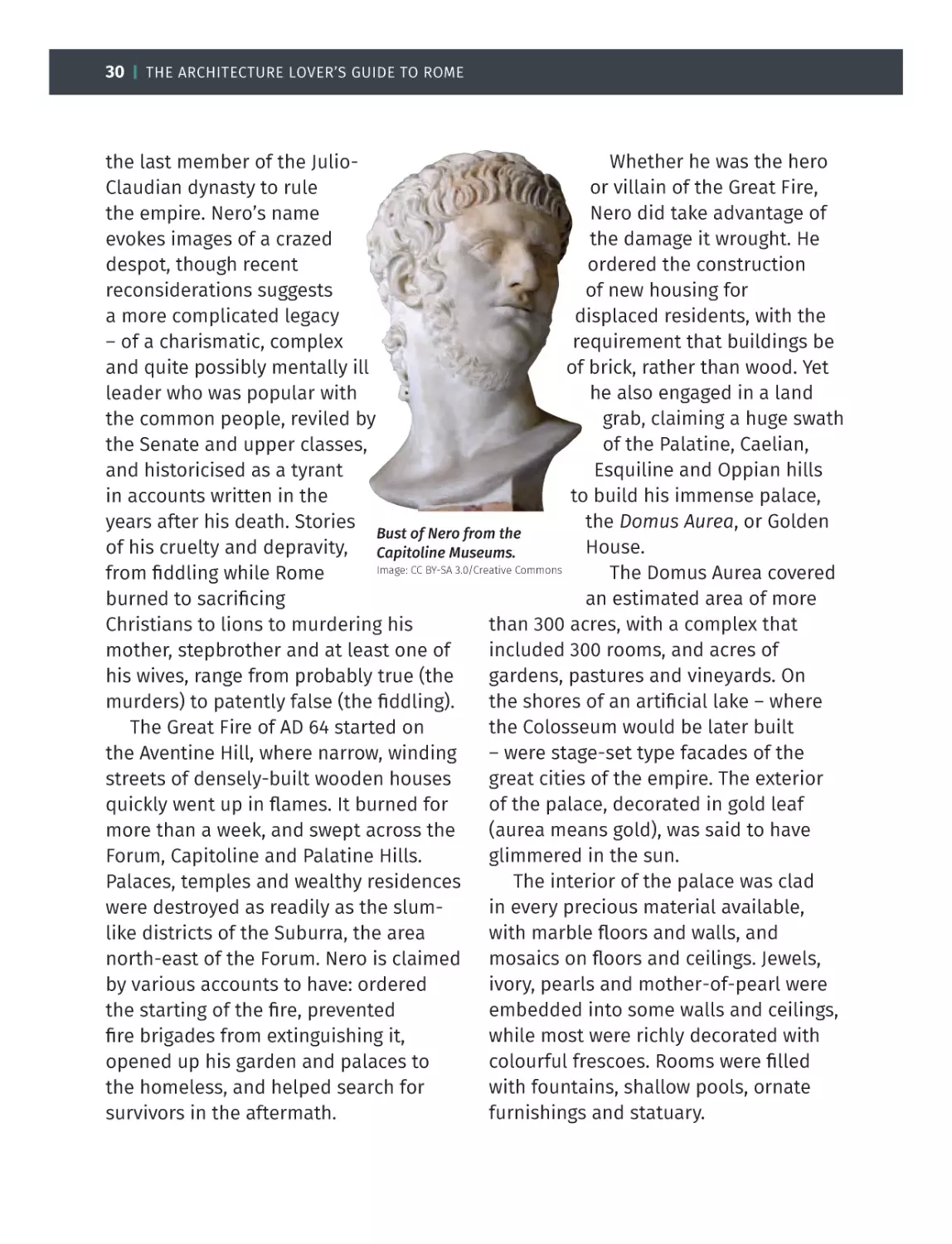
Bust of Nero from the
House.
of his cruelty and depravity, Capitoline Museums.
Image: CC BY-SA 3.0/Creative Commons
The Domus Aurea covered
from fiddling while Rome
an estimated area of more
burned to sacrificing
than 300 acres, with a complex that
Christians to lions to murdering his
included 300 rooms, and acres of
mother, stepbrother and at least one of
gardens, pastures and vineyards. On
his wives, range from probably true (the
the shores of an artificial lake – where
murders) to patently false (the fiddling).
the Colosseum would be later built
The Great Fire of AD 64 started on
– were stage-set type facades of the
the Aventine Hill, where narrow, winding
great cities of the empire. The exterior
streets of densely-built wooden houses
of the palace, decorated in gold leaf
quickly went up in flames. It burned for
(aurea means gold), was said to have
more than a week, and swept across the
glimmered in the sun.
Forum, Capitoline and Palatine Hills.
The interior of the palace was clad
Palaces, temples and wealthy residences
in every precious material available,
were destroyed as readily as the slumwith marble floors and walls, and
like districts of the Suburra, the area
north-east of the Forum. Nero is claimed mosaics on floors and ceilings. Jewels,
ivory, pearls and mother-of-pearl were
by various accounts to have: ordered
embedded into some walls and ceilings,
the starting of the fire, prevented
while most were richly decorated with
fire brigades from extinguishing it,
colourful frescoes. Rooms were filled
opened up his garden and palaces to
with fountains, shallow pools, ornate
the homeless, and helped search for
furnishings and statuary.
survivors in the aftermath.

FROM BRICK TO MARBLE | 31

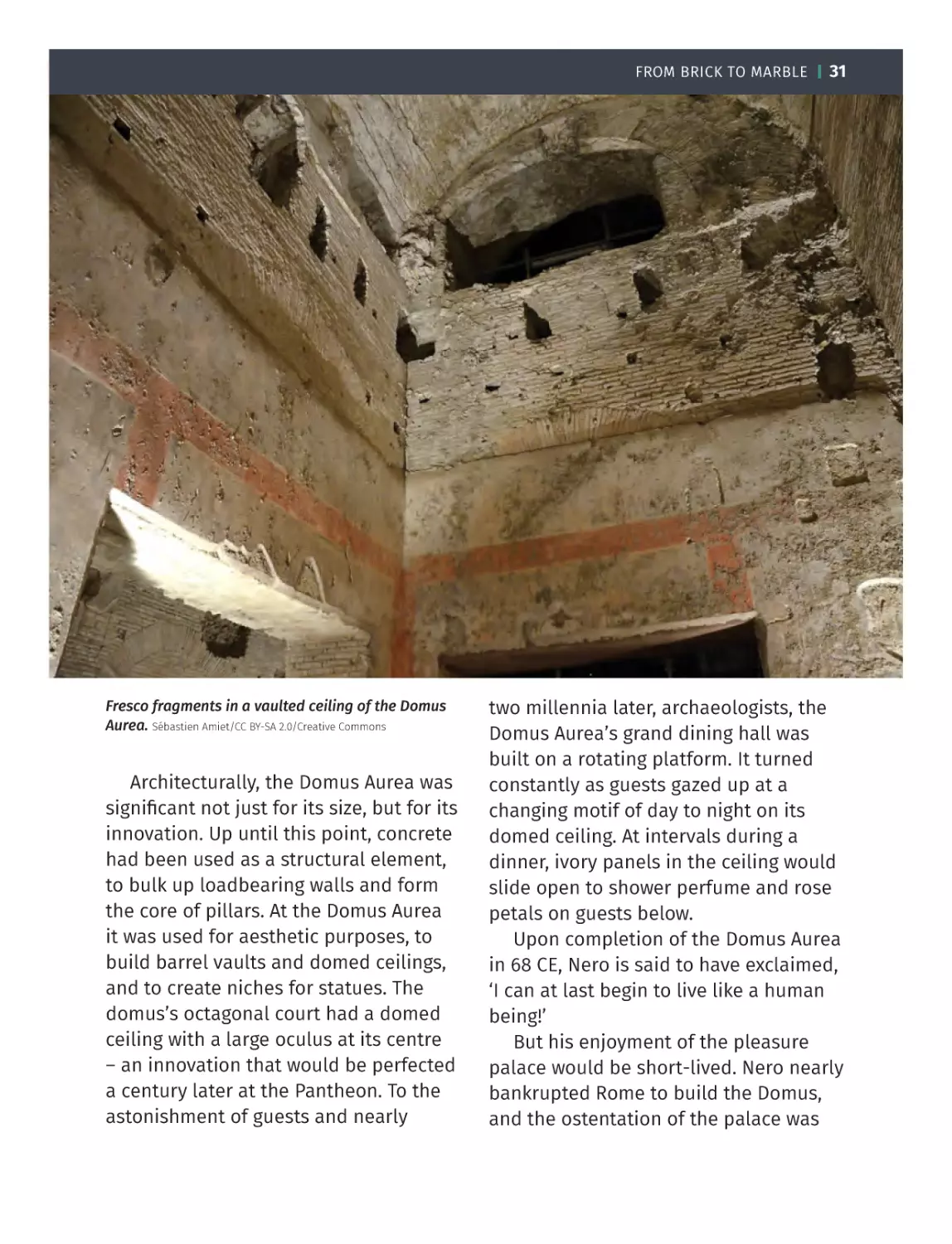
Fresco fragments in a vaulted ceiling of the Domus
Aurea. Sébastien Amiet/CC BY-SA 2.0/Creative Commons

Architecturally, the Domus Aurea was
significant not just for its size, but for its
innovation. Up until this point, concrete
had been used as a structural element,
to bulk up loadbearing walls and form
the core of pillars. At the Domus Aurea
it was used for aesthetic purposes, to
build barrel vaults and domed ceilings,
and to create niches for statues. The
domus’s octagonal court had a domed
ceiling with a large oculus at its centre
– an innovation that would be perfected
a century later at the Pantheon. To the
astonishment of guests and nearly

two millennia later, archaeologists, the
Domus Aurea’s grand dining hall was
built on a rotating platform. It turned
constantly as guests gazed up at a
changing motif of day to night on its
domed ceiling. At intervals during a
dinner, ivory panels in the ceiling would
slide open to shower perfume and rose
petals on guests below.
Upon completion of the Domus Aurea
in 68 CE, Nero is said to have exclaimed,
‘I can at last begin to live like a human
being!’
But his enjoyment of the pleasure
palace would be short-lived. Nero nearly
bankrupted Rome to build the Domus,
and the ostentation of the palace was

32 | THE ARCHITECTURE LOVER’S GUIDE TO ROME

the Colosseum and
too much, even for a
eventually, the Domus
Senate accustomed to
Aurea was forgotten.
imperial excesses. His
The Domus Aurea
extravagances at the
remained buried until
Domus Aurea, combined
the Renaissance era,
with his hedonistic
when it became a
lifestyle and flaunting
curiosity for artists
of imperial protocols,
like Michelangelo and
turned the Senate and
Raphael, who would
the wealthy class of
lower themselves on
Rome against him. In the
ropes into the buried
days before his death,
‘grottoes’ of the
Nero had fled several
domus to observe the
miles from Rome. Upon
fantastical frescoes –
hearing that the Senate
the term ‘grotesque’
had declared him a
– grotto-esque – comes
public enemy and that
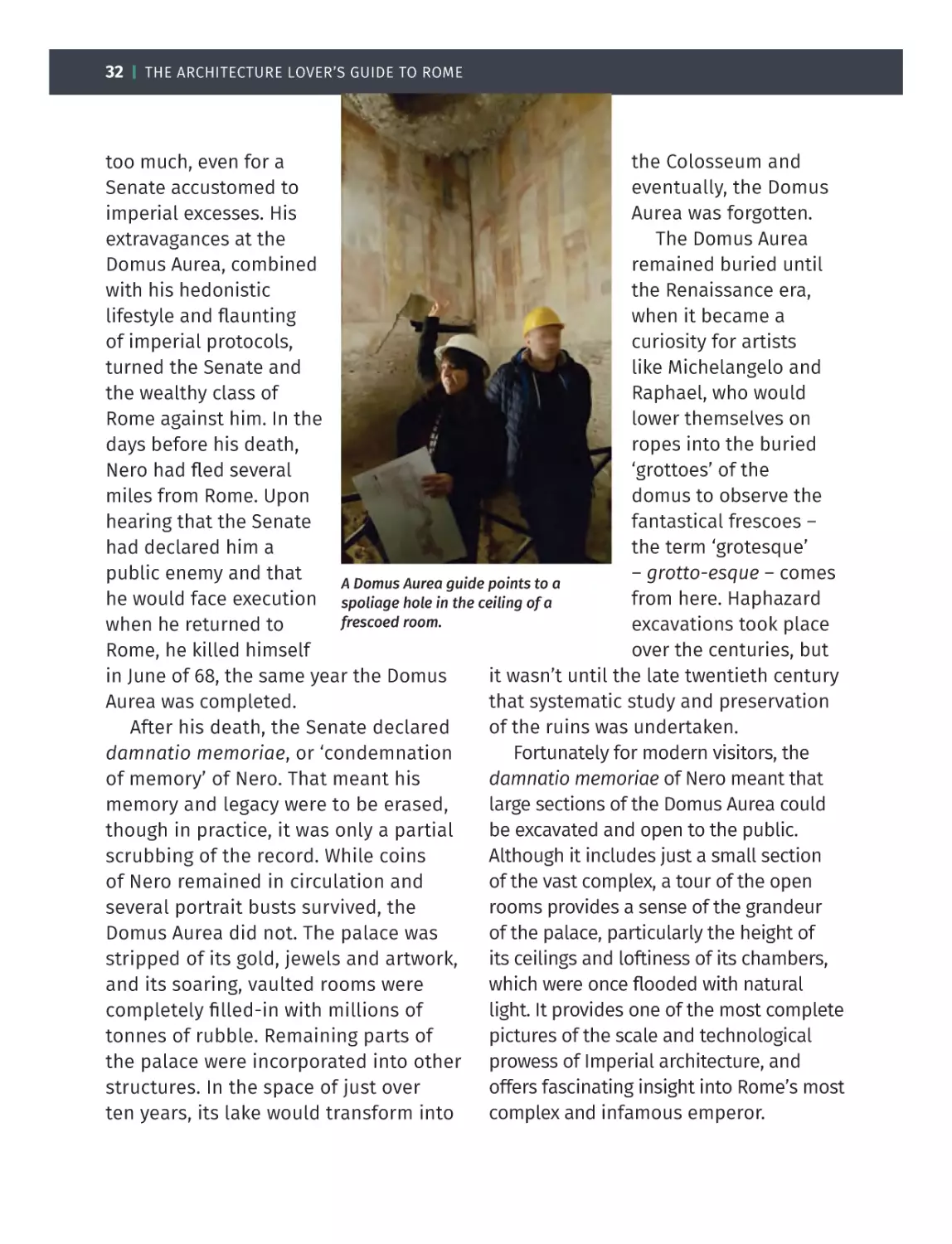
A Domus Aurea guide points to a
from here. Haphazard
he would face execution spoliage hole in the ceiling of a
frescoed room.
excavations took place
when he returned to
over the centuries, but
Rome, he killed himself
it wasn’t until the late twentieth century
in June of 68, the same year the Domus
that systematic study and preservation
Aurea was completed.
of the ruins was undertaken.
After his death, the Senate declared
Fortunately for modern visitors, the
damnatio memoriae, or ‘condemnation
damnatio memoriae of Nero meant that
of memory’ of Nero. That meant his
large sections of the Domus Aurea could
memory and legacy were to be erased,
be excavated and open to the public.
though in practice, it was only a partial
Although it includes just a small section
scrubbing of the record. While coins
of the vast complex, a tour of the open
of Nero remained in circulation and
rooms provides a sense of the grandeur
several portrait busts survived, the
of the palace, particularly the height of
Domus Aurea did not. The palace was
its ceilings and loftiness of its chambers,
stripped of its gold, jewels and artwork,
which were once flooded with natural
and its soaring, vaulted rooms were
light. It provides one of the most complete
completely filled-in with millions of
pictures of the scale and technological
tonnes of rubble. Remaining parts of
the palace were incorporated into other prowess of Imperial architecture, and
offers fascinating insight into Rome’s most
structures. In the space of just over
complex and infamous emperor.
ten years, its lake would transform into

FROM BRICK TO MARBLE | 33

i
HOW TO SEE IT: The entrance to the
Domus Aurea is in the Parco delle Colle
Oppio, in the area immediately northnorth-east of the Colosseum. Guided
tours of the Domus Aurea include a
virtual reality experience that vividly
recreates the palace as it looked in
Nero’s time. Tours are currently offered
Saturdays and Sundays only, and may
sell out weeks in advance. Visit www.
coopculture.it/en for more information
and to book a tour.

The Colosseum
Following the death and damnatio
memoriae of Nero, his eventual
successor, Vespasian, undertook
projects intended to return lands seized
by Nero for the Domus Aurea to the
people of Rome. Foremost among these
was the Flavian Amphitheatre, better
known as the Colosseum, which was
named for the Flavian dynasty, which
included emperors Vespasian, Titus and
Domitian. Vespasian’s choice to set the
amphitheatre in the centre of Rome was
a political move meant to symbolize the
largess of the new imperial dynasty and
further eradicate Nero’s legacy.
The project to build the world’s
largest arena was funded from the spoils
of the First Roman-Jewish War, which
ended with the complete destruction
of much of the city of Jerusalem and
the burning and pillaging of its Second
Temple, Judea’s most important religious

complex. More than 100,000 Jews were
brought to Rome as slaves, and tens of
thousands of them were used as forced
labour to build the Colosseum.
The gruesome nature of the
Colosseum is well known and
undisputed. Hundreds of thousands of
people and millions of wild animals –
sometimes thousands in a single day
– were killed there in bloody spectacles,
brutal executions, gladiatorial fights and
staged hunts.
It’s difficult today to understand
the bloodlust that drove Roman
spectators by the tens of thousands to
the Colosseum. Why would they delight
in the sadistic slaughter of terrified
animals, criminals or prisoners of war,
or cheer for the death of a stricken
gladiator? The Colosseum has to be
considered as representative of the
Roman Empire at its most powerful:
it had subjugated most of the known
world, subjected those who resisted,
tamed wild beasts and conquered

Nero’s Colossal Ego
The Colosseum earned its name from a
30-metre bronze statue of Nero which once
stood at the entrance to the Domus Aurea.
After Nero’s death the head of the statue
was refashioned as the sun god, Sol, and it
was moved to a site adjacent to the Flavian
Amphitheatre, where it remained for several
centuries afterward. The statue was known
as the Colosso, and the nickname for the
amphitheatre stuck.

34 | THE ARCHITECTURE LOVER’S GUIDE TO ROME

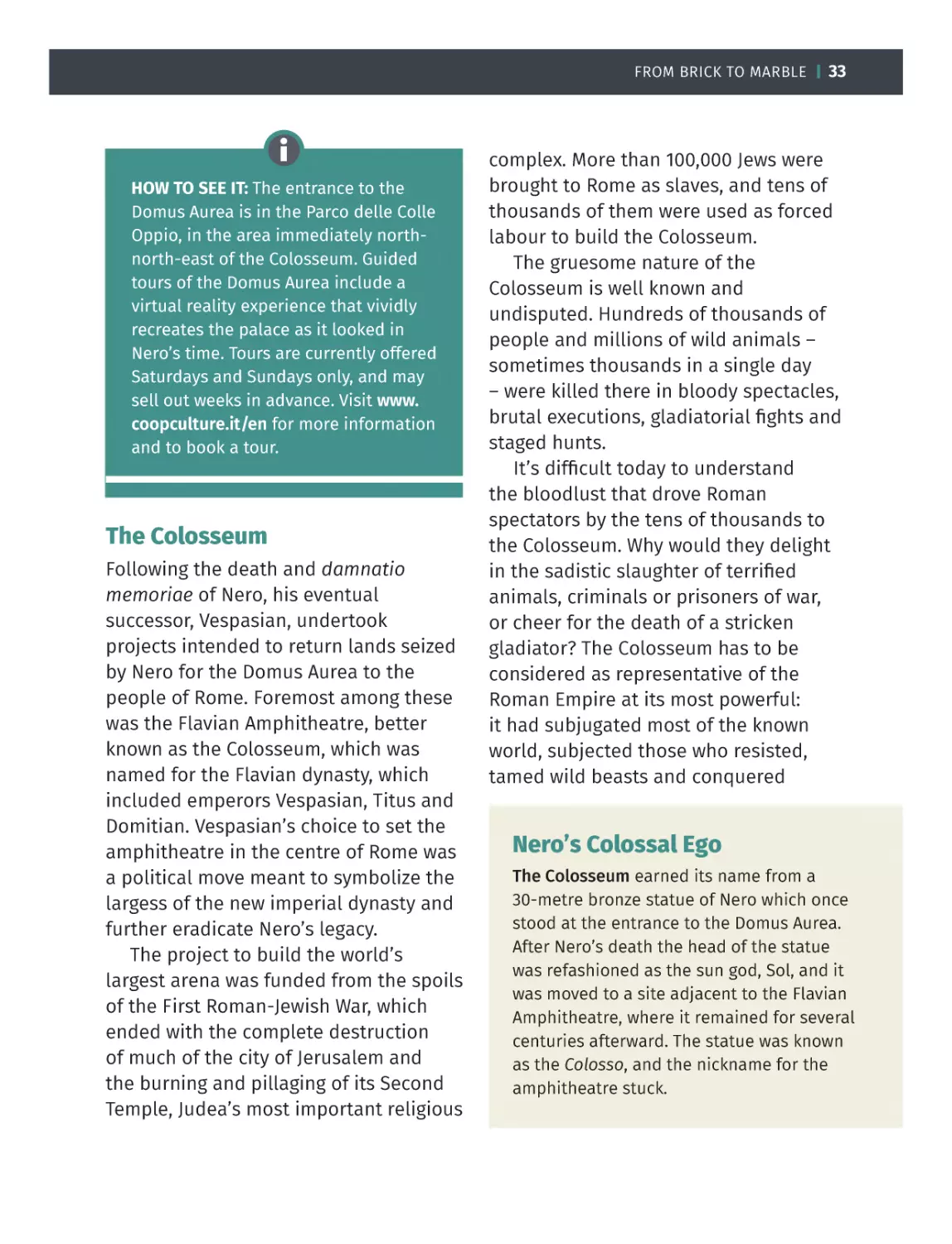
The Colosseum.

exotic, far-flung lands. The hunts, the
ritual executions and the gladiatorial
combats were the physical, depravedly
gory embodiment of that dominance.
But if you were watching the bloodshed,
even if you were a plebeian or a slave on
the lowest rungs of Roman society, you
were on the winning side.
Today, the Colosseum is the most
popular attraction in Italy – in 2017 it
received more than 7 million visitors.
It’s an internationally recognised icon
that is a symbol of Rome itself. While
the gory legacy of the Colosseum
undoubtedly contributes to its appeal
for modern tourists – and those

centuries before them – it is also an
architectural achievement unparalleled
in the world.
For an initial understanding of the
design of the Colosseum, consider it as
two semi-circular Roman theatres set
facing one another (see Sidebar p.35) to
form an oval shaped arena. While the
freestanding arena model was not new
to Roman architects, the Colosseum
was their largest, tallest undertaking to
date, and remains the largest arena of
the ancient world. It originally measured
545 metres in circumference and nearly
50 metres tall. Its three main levels
were composed of eighty arches, which

FROM BRICK TO MARBLE | 35

were supported by pillars and halfcolumns. The arches on the second and
third floors held statues, most likely of
mythological figures, deities and past
emperors. The fourth level, called an
attic, was a later addition ordered by
Emperor Diocletian. Instead of arches
this level had windows, as well as a row
of 240 sockets, which held wood masts
over which a protective awning could be
unfurled on particularly sunny days.
The Colosseum had interior and
exterior ring walls supported by vaulted
porticos. The corridors created by these
two walls allowed access to stairs and
different, numbered exits and seating
areas. The seating levels were divided
by social hierarchy – with the ancient
equivalent of premium box seats for
emperors and Vestal Virgins. Members of
the senate sat outside the boxes but at
the same level. Heading up from there
were seats for the Roman public. Lower
seats and better views were reserved
for wealthier Romans – the higher
up spectators were, the lower their
economic or social standing. Slaves,
women and poor people were relegated
to wooden benches on the fourth
level, which was the highest and least
comfortable.
Like modern arenas, entry and exit
doors and stairs were numbered, and
each spectator was given the ancient
equivalent of a ticket – a numbered
tesserae, or terracotta tile, that directed
them to the correct doorway, stairs and
level. It is said that the arena, which

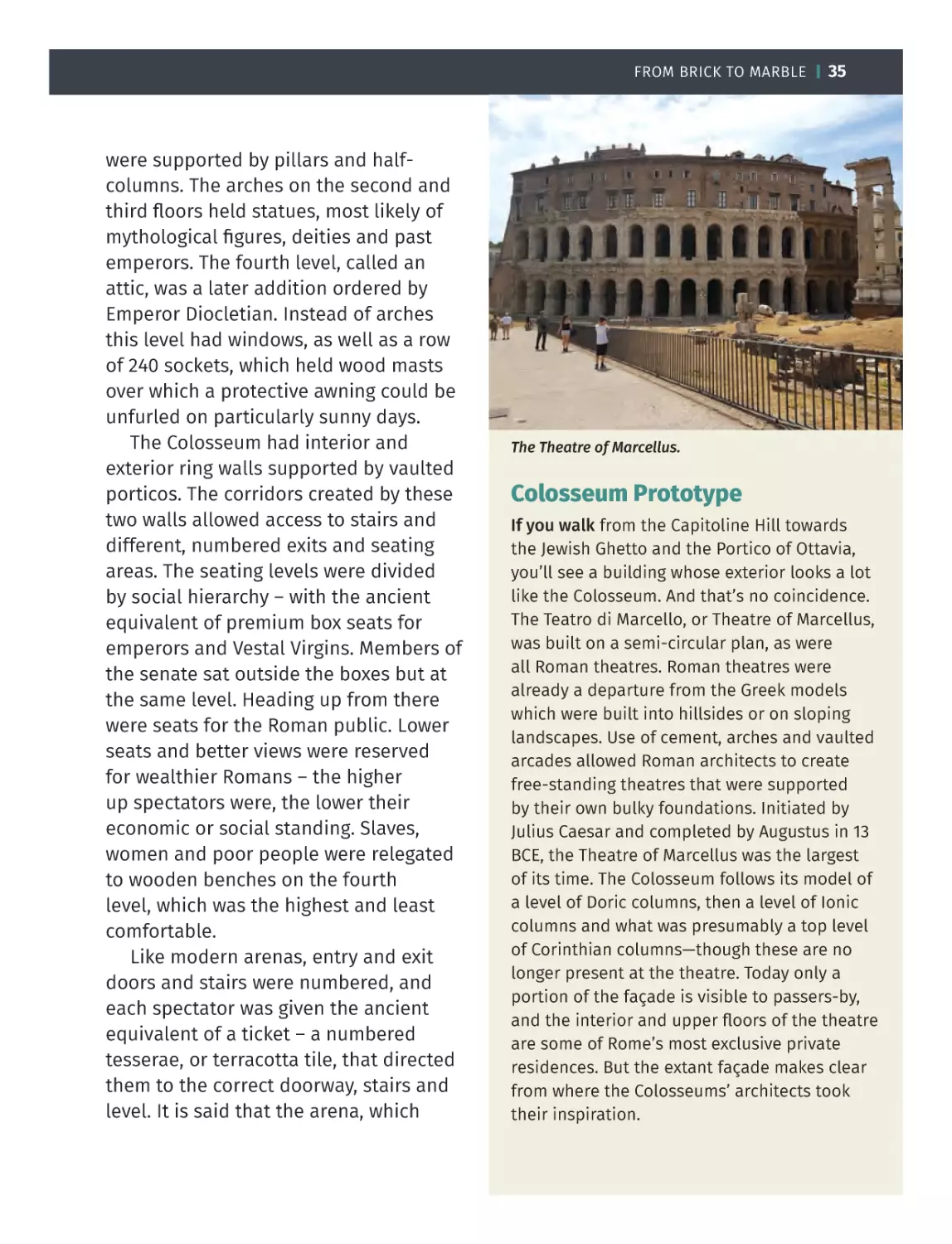
The Theatre of Marcellus.

Colosseum Prototype
If you walk from the Capitoline Hill towards
the Jewish Ghetto and the Portico of Ottavia,
you’ll see a building whose exterior looks a lot
like the Colosseum. And that’s no coincidence.
The Teatro di Marcello, or Theatre of Marcellus,
was built on a semi-circular plan, as were
all Roman theatres. Roman theatres were
already a departure from the Greek models
which were built into hillsides or on sloping
landscapes. Use of cement, arches and vaulted
arcades allowed Roman architects to create
free-standing theatres that were supported
by their own bulky foundations. Initiated by
Julius Caesar and completed by Augustus in 13
BCE, the Theatre of Marcellus was the largest
of its time. The Colosseum follows its model of
a level of Doric columns, then a level of Ionic
columns and what was presumably a top level
of Corinthian columns—though these are no
longer present at the theatre. Today only a
portion of the façade is visible to passers-by,
and the interior and upper floors of the theatre
are some of Rome’s most exclusive private
residences. But the extant façade makes clear
from where the Colosseums’ architects took
their inspiration.

36 | THE ARCHITECTURE LOVER’S GUIDE TO ROME
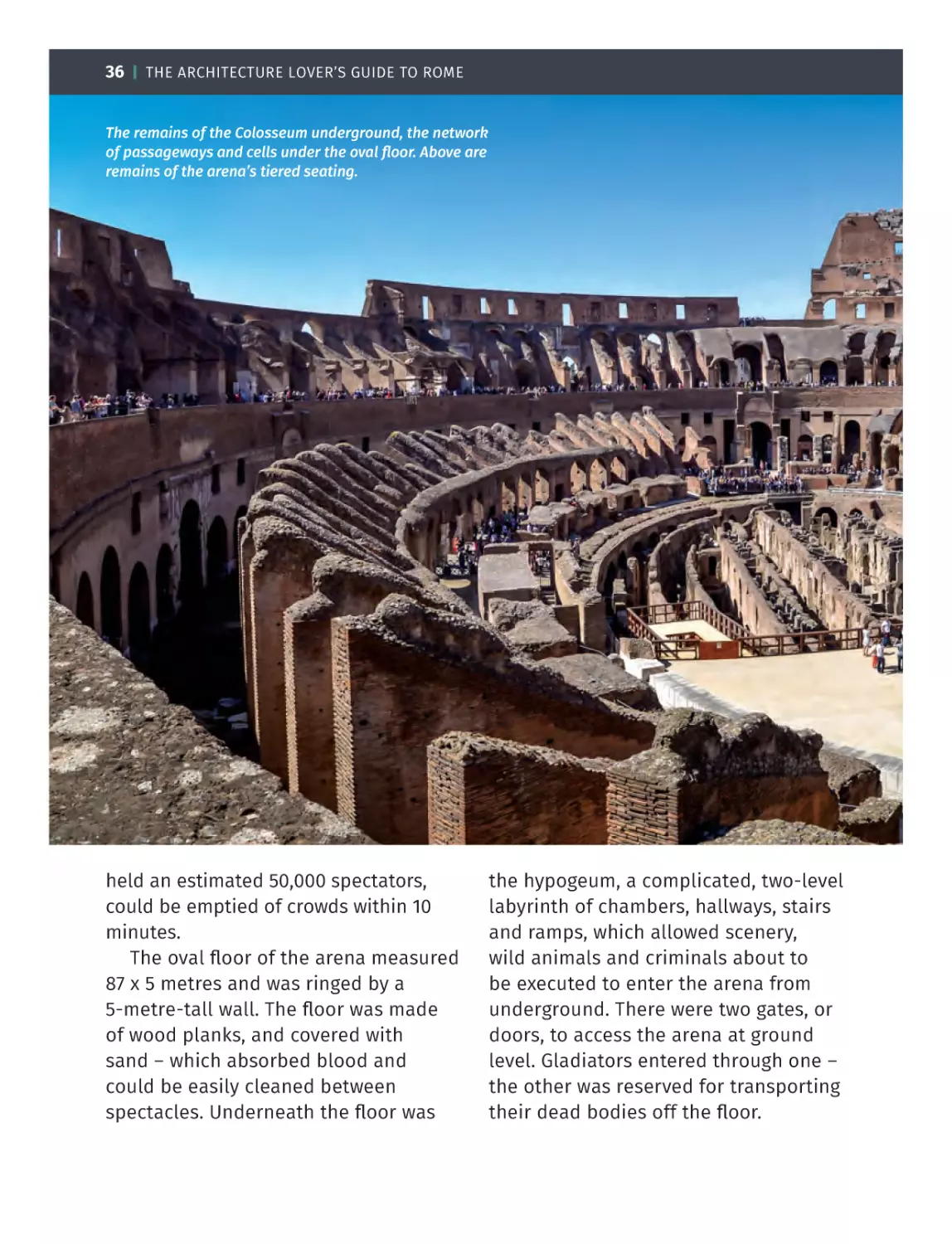
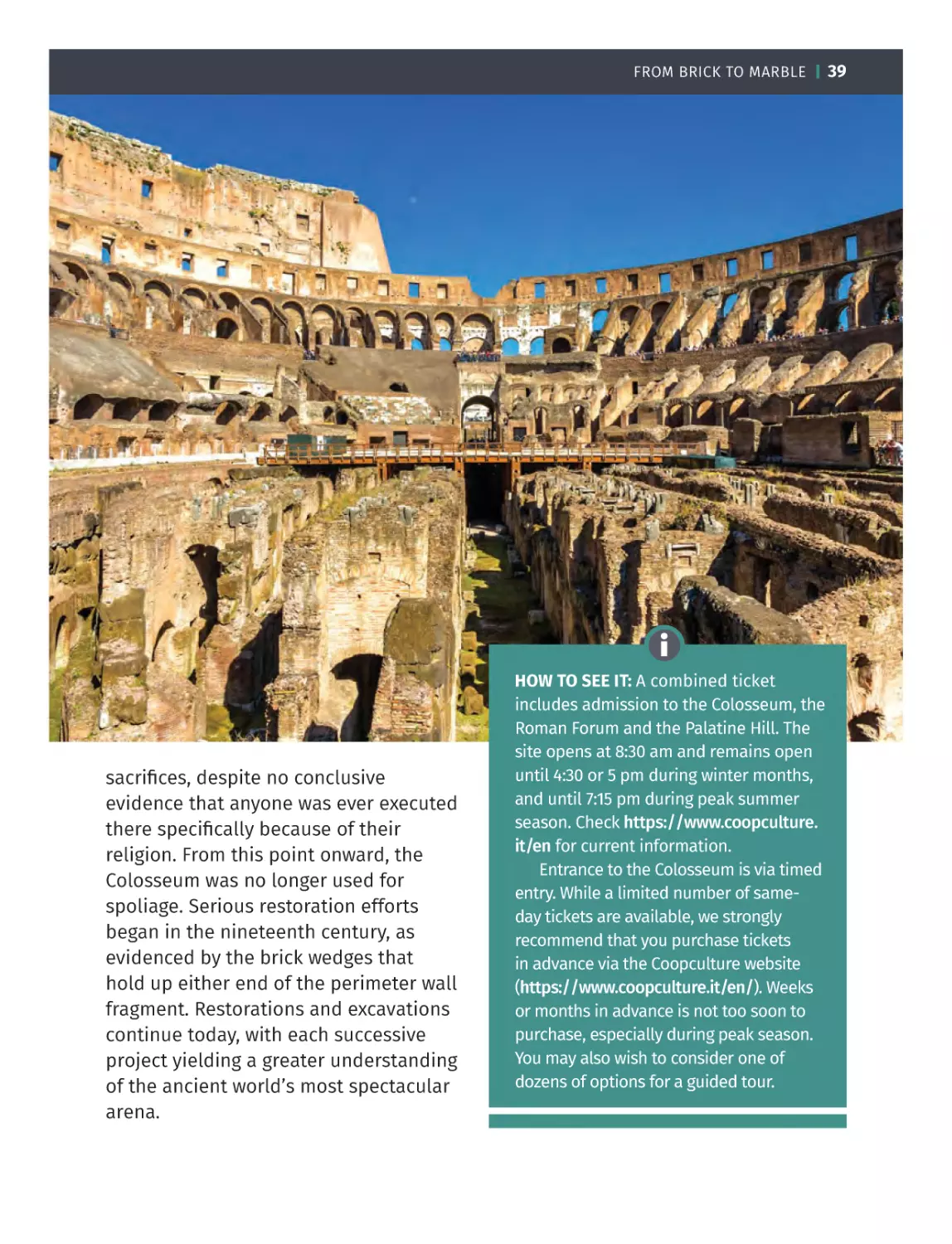
The remains of the Colosseum underground, the network
of passageways and cells under the oval floor. Above are
remains of the arena’s tiered seating.

held an estimated 50,000 spectators,
could be emptied of crowds within 10
minutes.
The oval floor of the arena measured
87 x 5 metres and was ringed by a
5-metre-tall wall. The floor was made
of wood planks, and covered with
sand – which absorbed blood and
could be easily cleaned between
spectacles. Underneath the floor was

the hypogeum, a complicated, two-level
labyrinth of chambers, hallways, stairs
and ramps, which allowed scenery,
wild animals and criminals about to
be executed to enter the arena from
underground. There were two gates, or
doors, to access the arena at ground
level. Gladiators entered through one –
the other was reserved for transporting
their dead bodies off the floor.

FROM BRICK TO MARBLE | 37

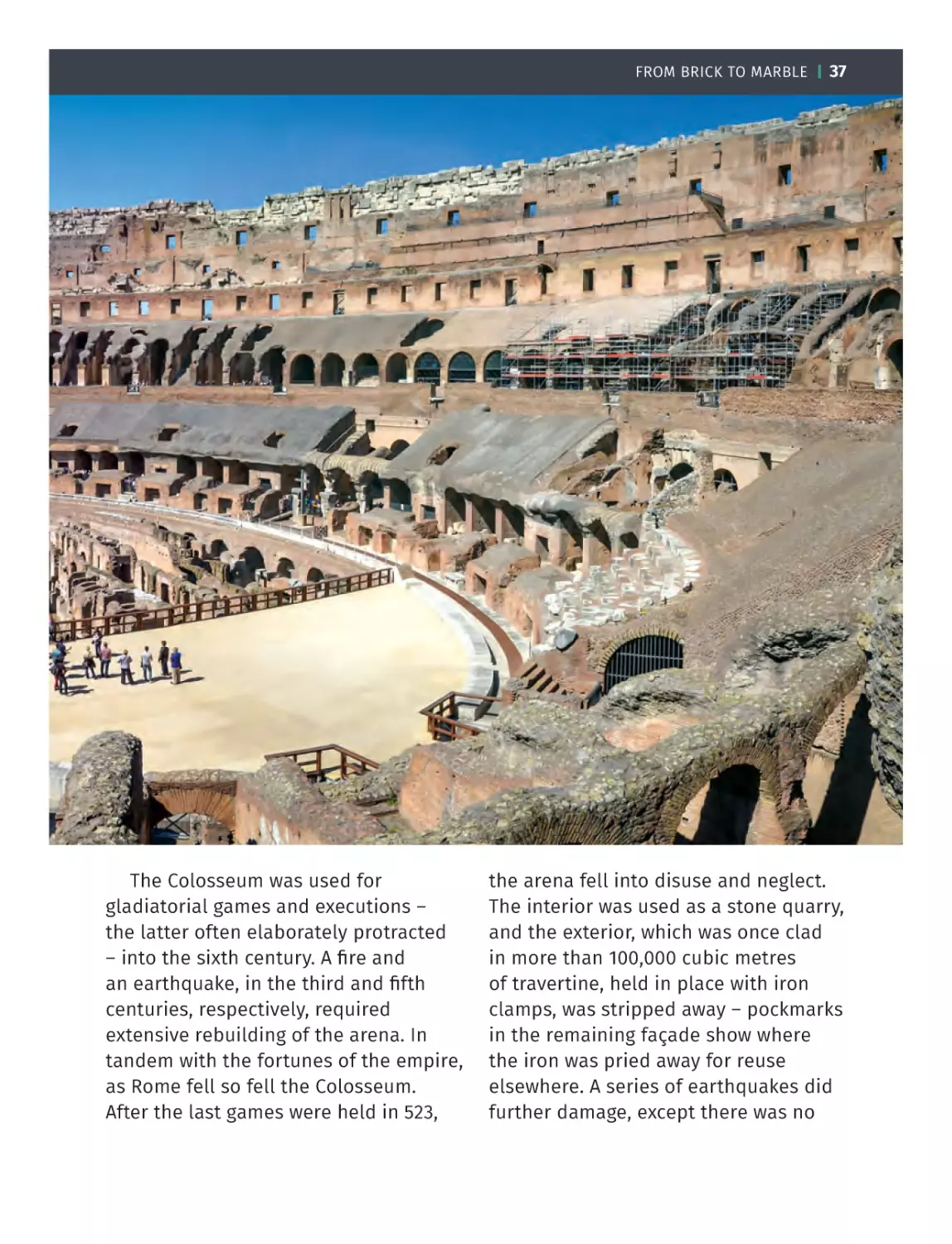
The Colosseum was used for
gladiatorial games and executions –
the latter often elaborately protracted
– into the sixth century. A fire and
an earthquake, in the third and fifth
centuries, respectively, required
extensive rebuilding of the arena. In
tandem with the fortunes of the empire,
as Rome fell so fell the Colosseum.
After the last games were held in 523,

the arena fell into disuse and neglect.
The interior was used as a stone quarry,
and the exterior, which was once clad
in more than 100,000 cubic metres
of travertine, held in place with iron
clamps, was stripped away – pockmarks
in the remaining façade show where
the iron was pried away for reuse
elsewhere. A series of earthquakes did
further damage, except there was no

38 | THE ARCHITECTURE LOVER’S GUIDE TO ROME

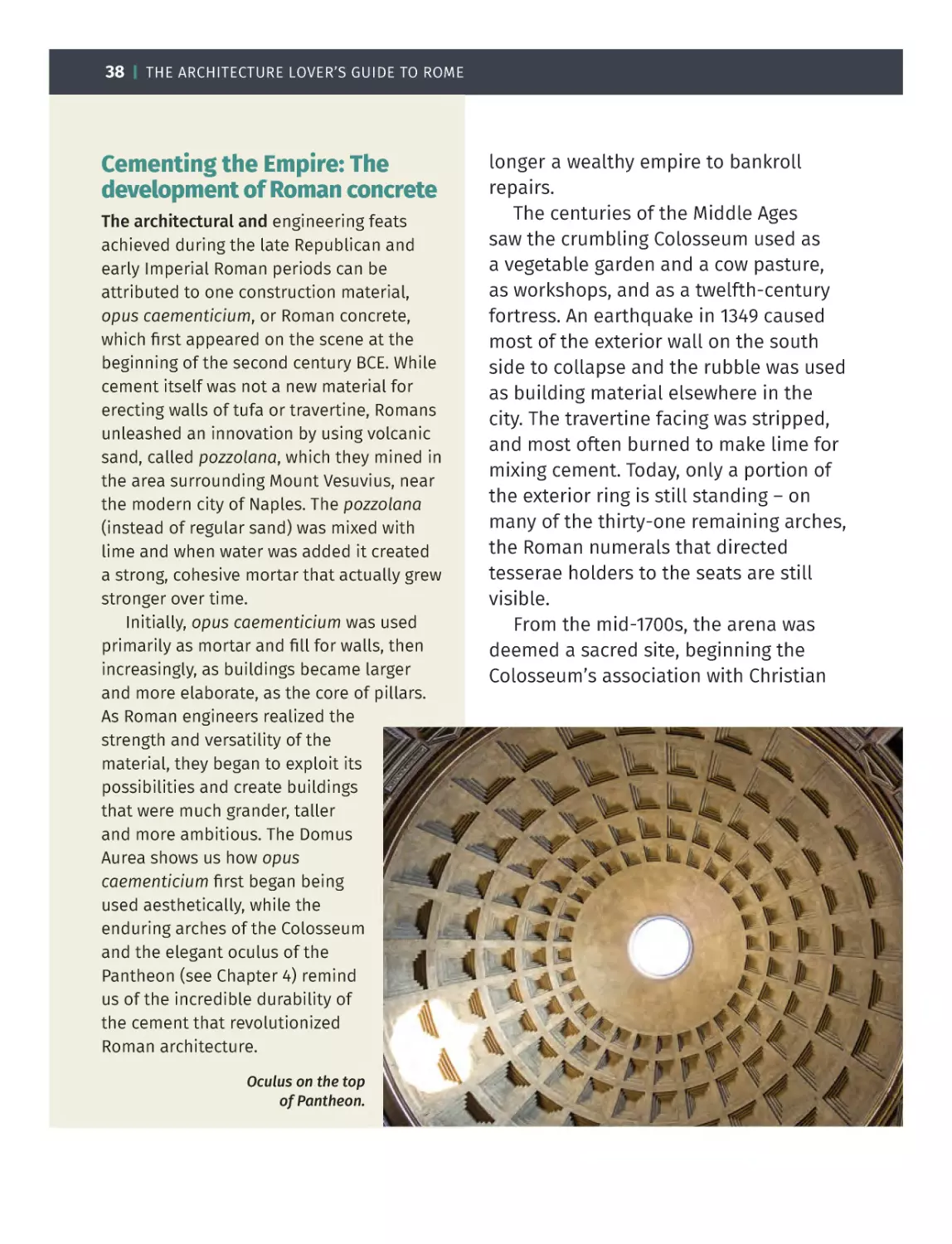
Cementing the Empire: The
development of Roman concrete
The architectural and engineering feats
achieved during the late Republican and
early Imperial Roman periods can be
attributed to one construction material,
opus caementicium, or Roman concrete,
which first appeared on the scene at the
beginning of the second century BCE. While
cement itself was not a new material for
erecting walls of tufa or travertine, Romans
unleashed an innovation by using volcanic
sand, called pozzolana, which they mined in
the area surrounding Mount Vesuvius, near
the modern city of Naples. The pozzolana
(instead of regular sand) was mixed with
lime and when water was added it created
a strong, cohesive mortar that actually grew
stronger over time.
Initially, opus caementicium was used
primarily as mortar and fill for walls, then
increasingly, as buildings became larger
and more elaborate, as the core of pillars.
As Roman engineers realized the
strength and versatility of the
material, they began to exploit its
possibilities and create buildings
that were much grander, taller
and more ambitious. The Domus
Aurea shows us how opus
caementicium first began being
used aesthetically, while the
enduring arches of the Colosseum
and the elegant oculus of the
Pantheon (see Chapter 4) remind
us of the incredible durability of
the cement that revolutionized
Roman architecture.
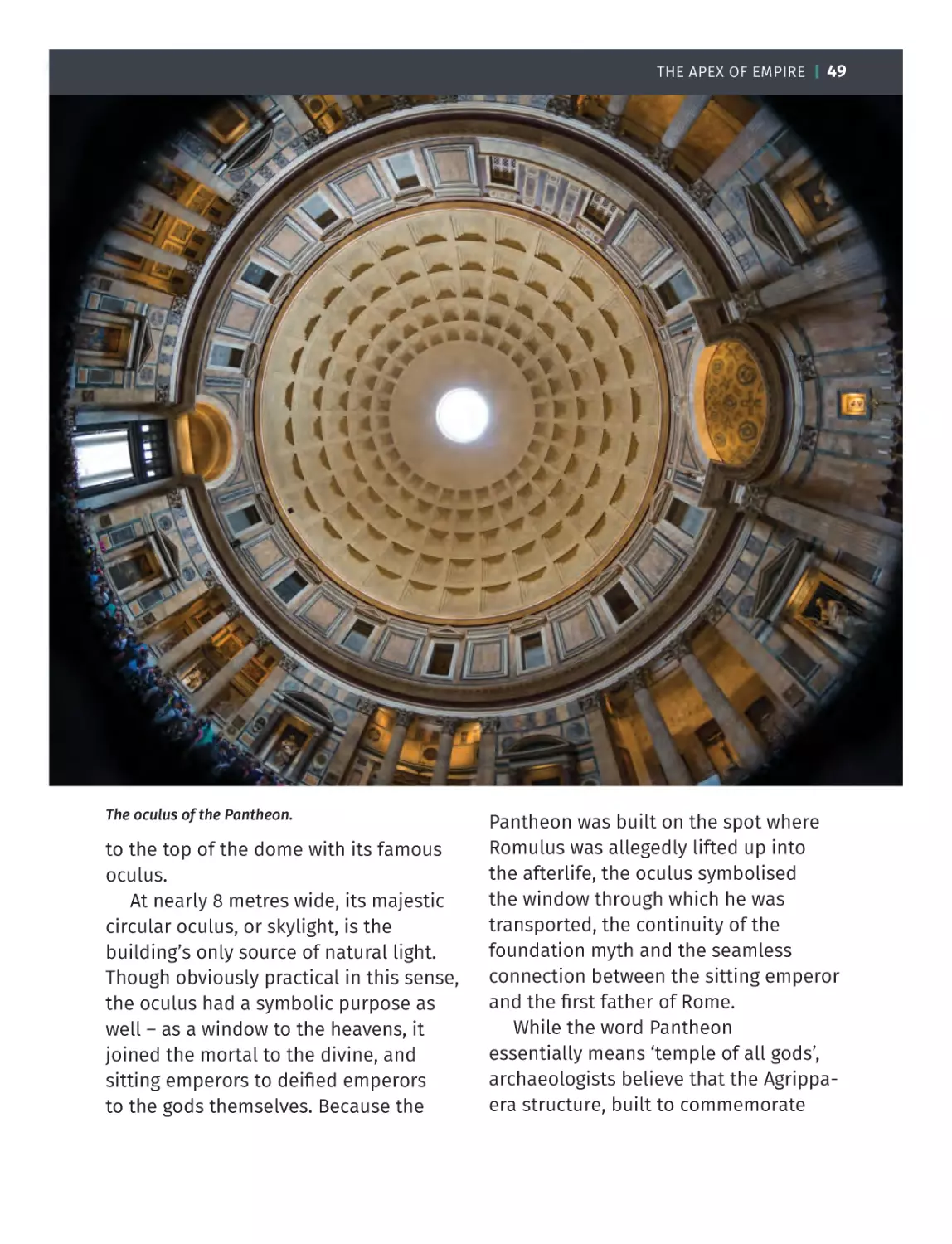
Oculus on the top
of Pantheon.

longer a wealthy empire to bankroll
repairs.
The centuries of the Middle Ages
saw the crumbling Colosseum used as
a vegetable garden and a cow pasture,
as workshops, and as a twelfth-century
fortress. An earthquake in 1349 caused
most of the exterior wall on the south
side to collapse and the rubble was used
as building material elsewhere in the
city. The travertine facing was stripped,
and most often burned to make lime for
mixing cement. Today, only a portion of
the exterior ring is still standing – on
many of the thirty-one remaining arches,
the Roman numerals that directed
tesserae holders to the seats are still
visible.
From the mid-1700s, the arena was
deemed a sacred site, beginning the
Colosseum’s association with Christian

FROM BRICK TO MARBLE | 39

i

sacrifices, despite no conclusive
evidence that anyone was ever executed
there specifically because of their
religion. From this point onward, the
Colosseum was no longer used for
spoliage. Serious restoration efforts
began in the nineteenth century, as
evidenced by the brick wedges that
hold up either end of the perimeter wall
fragment. Restorations and excavations
continue today, with each successive
project yielding a greater understanding
of the ancient world’s most spectacular
arena.

HOW TO SEE IT: A combined ticket
includes admission to the Colosseum, the
Roman Forum and the Palatine Hill. The
site opens at 8:30 am and remains open
until 4:30 or 5 pm during winter months,
and until 7:15 pm during peak summer
season. Check https://www.coopculture.
it/en for current information.
Entrance to the Colosseum is via timed
entry. While a limited number of sameday tickets are available, we strongly
recommend that you purchase tickets
in advance via the Coopculture website
(https://www.coopculture.it/en/). Weeks
or months in advance is not too soon to
purchase, especially during peak season.
You may also wish to consider one of
dozens of options for a guided tour.

40 | THE ARCHITECTURE LOVER’S GUIDE TO ROME

4
THE APEX OF EMPIRE
Trajan’s Markets, the Pantheon, and the
Baths of Caracalla

By the time the fourth tier of the Colosseum was set in place in the late first
century CE, Rome was in the midst of a full-blown architectural revolution.
The Classical order and symmetry appropriated from the Greeks had melded
with the engineering and aesthetic possibilities of arches, vaults and cement,
and Roman architects exploited these potentials to the utmost.
Rome’s military dominance across
Europe, the Mediterranean, North Africa
and the Near East meant that public and
private architecture was well-funded,
the hands to build it – in the form
of slave labour – were plentiful, and
innovation and experimentation were
encouraged by emperors and wealthy
patrons intent on leaving an enduring
mark on the city’s landscape.
The opening of the second century CE
began what is considered the Empire’s
peak period of prosperity and supremacy.
It’s marked by the period of the ‘Five
Good Emperors,’ so-called because of the
stability and egalitarianism – the latter at
least for Roman citizens and allies – with
which they reigned. Though the borders
of the Empire were aggressively expanded
and defended during this century, in
Rome, at least, daily life was predictable

and reasonably safe, even if the quality
of one’s life was strictly determined
by social caste. It was also during this
period of time that some of Rome’s most
monumental, ambitious and enduring
public building projects were undertaken.
At a time when the vast majority of Rome’s
more than one million residents lived in
dark, cramped quarters, the grand public
spaces created during this era provided
not only (and quite literally) breathing
room, but a reminder – just as the games
of the Colosseum were a reminder – of
the powerful empire of which they were
privileged to be a part.

Trajan’s Market
Second in the succession of ‘Good
Emperors’ (following Nerva, who ruled
for just two years before his death),
Trajan was emperor from 98 to 117 CE.

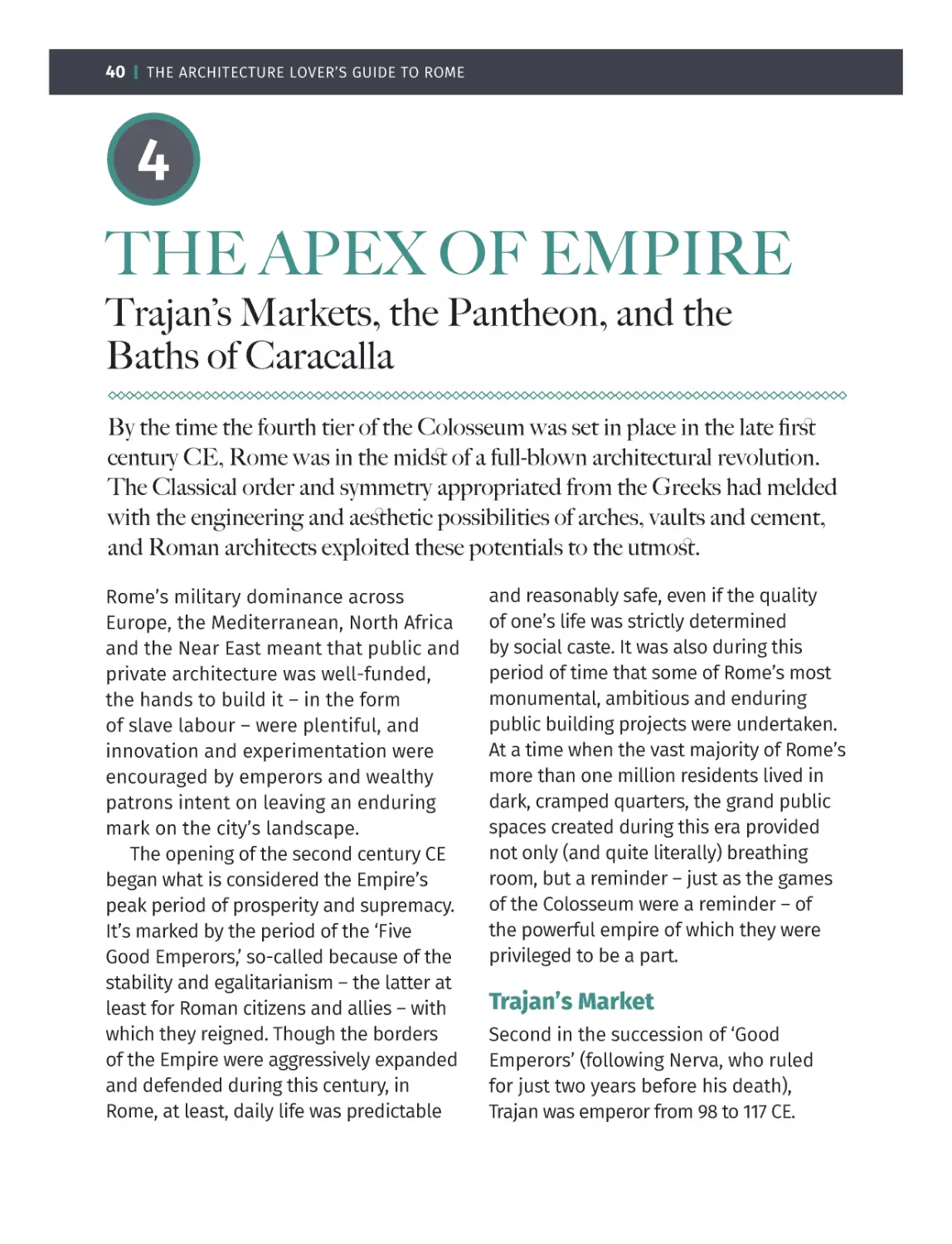
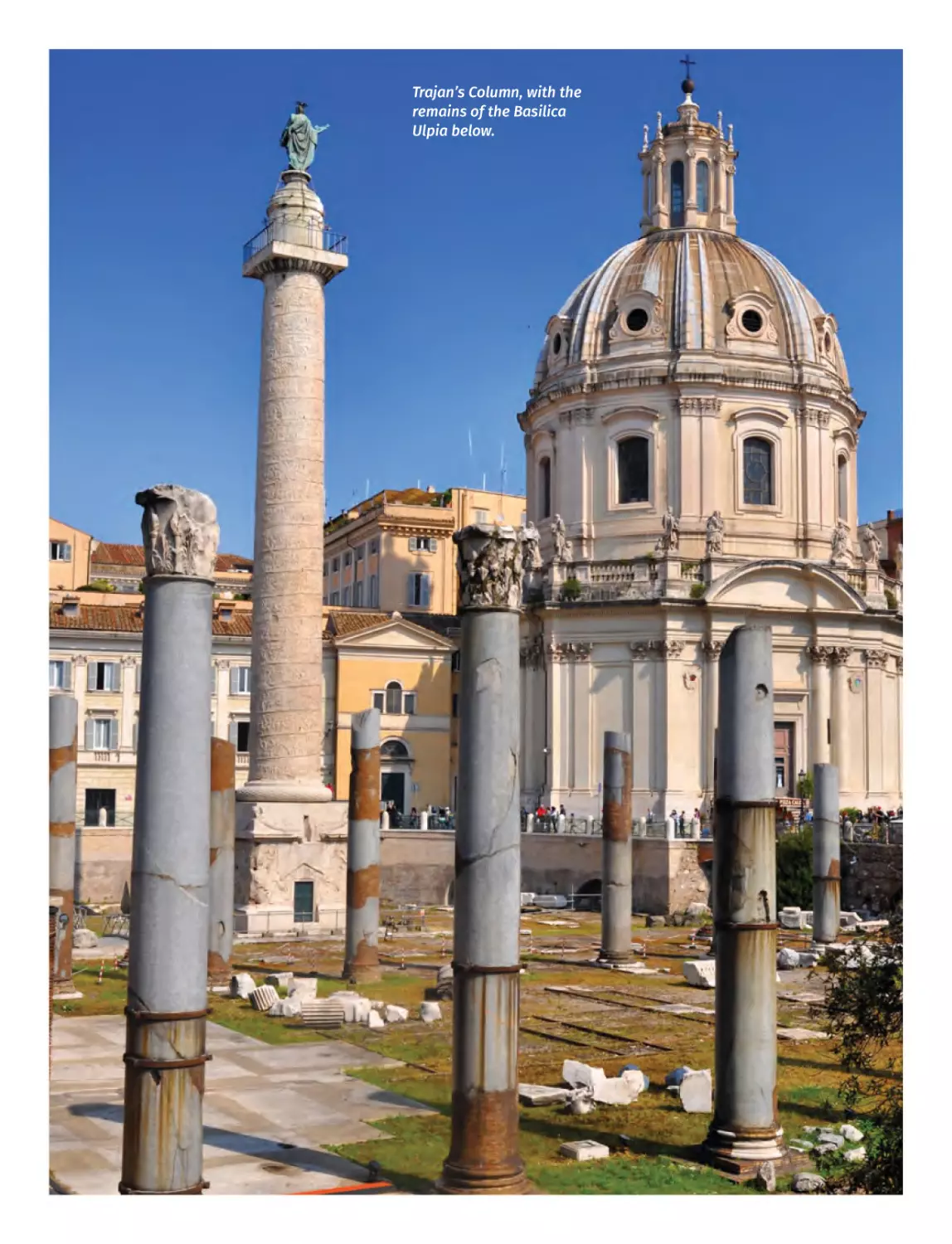
Trajan’s Column, with the
remains of the Basilica
Ulpia below.

THE APEX OF EMPIRE | 41

42 | THE ARCHITECTURE LOVER’S GUIDE TO ROME

Distinguished for his successful military
campaigns in Dacia (modern Romania),
Trajan was already popular with the
Roman people when he became
emperor. His massive building project,
the Forum of Trajan, commemorated his
military triumphs, particularly in Dacia,
and contained the grand Basilica Ulpia,
two libraries, and a richly decorated
portico. The 30-metre tall, marble
victory column that depicts the Dacian
campaign in carved relief is still a
landmark in the centre of Rome.
Standing at the foot of Trajan’s
Column and looking south-west, the
partially restored columns of the
Basilica Ulpia are beneath the column,
ringed by the remains of the portico
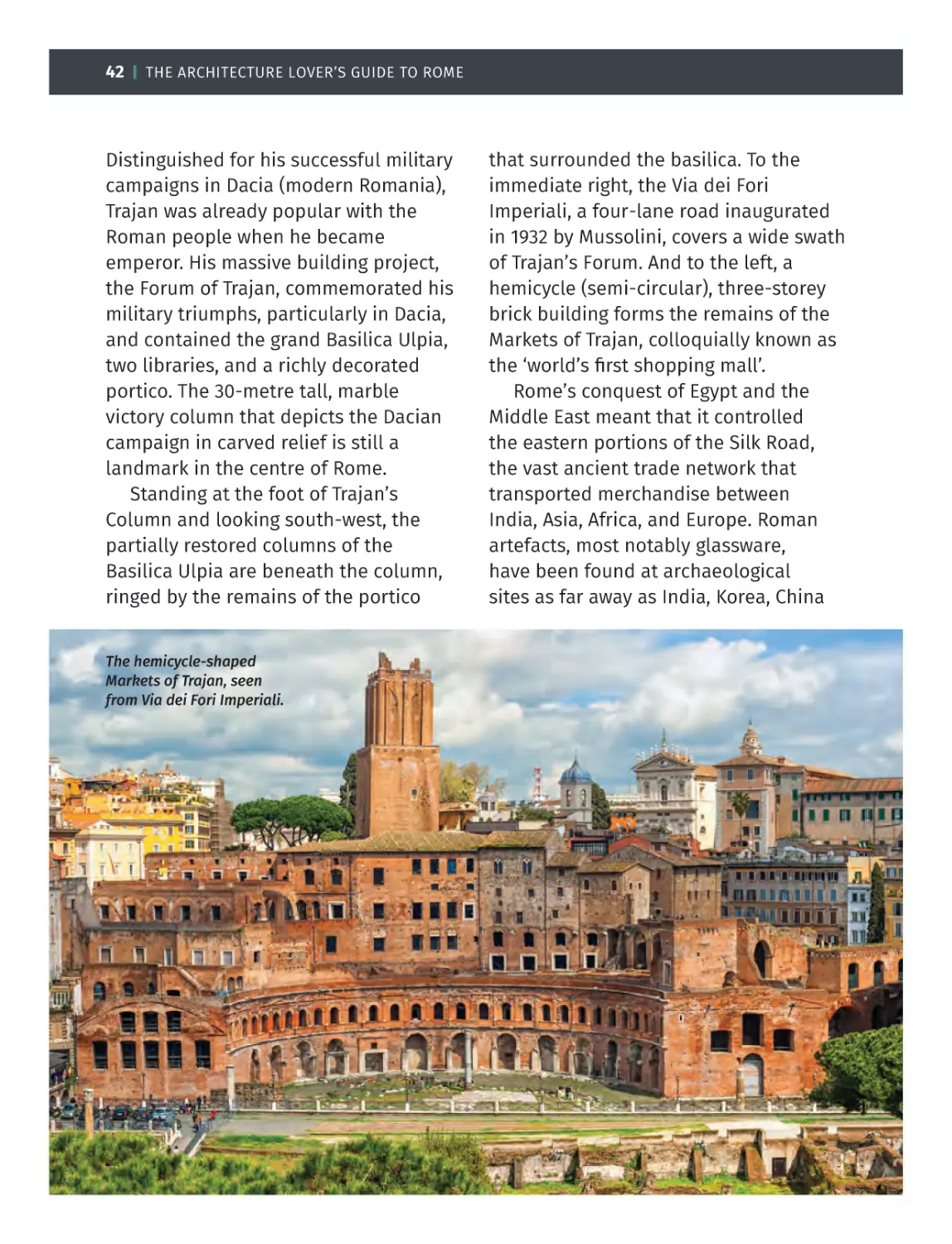
The hemicycle-shaped
Markets of Trajan, seen
from Via dei Fori Imperiali.

that surrounded the basilica. To the
immediate right, the Via dei Fori
Imperiali, a four-lane road inaugurated
in 1932 by Mussolini, covers a wide swath
of Trajan’s Forum. And to the left, a
hemicycle (semi-circular), three-storey
brick building forms the remains of the
Markets of Trajan, colloquially known as
the ‘world’s first shopping mall’.
Rome’s conquest of Egypt and the
Middle East meant that it controlled
the eastern portions of the Silk Road,
the vast ancient trade network that
transported merchandise between
India, Asia, Africa, and Europe. Roman
artefacts, most notably glassware,
have been found at archaeological
sites as far away as India, Korea, China

THE APEX OF EMPIRE | 43

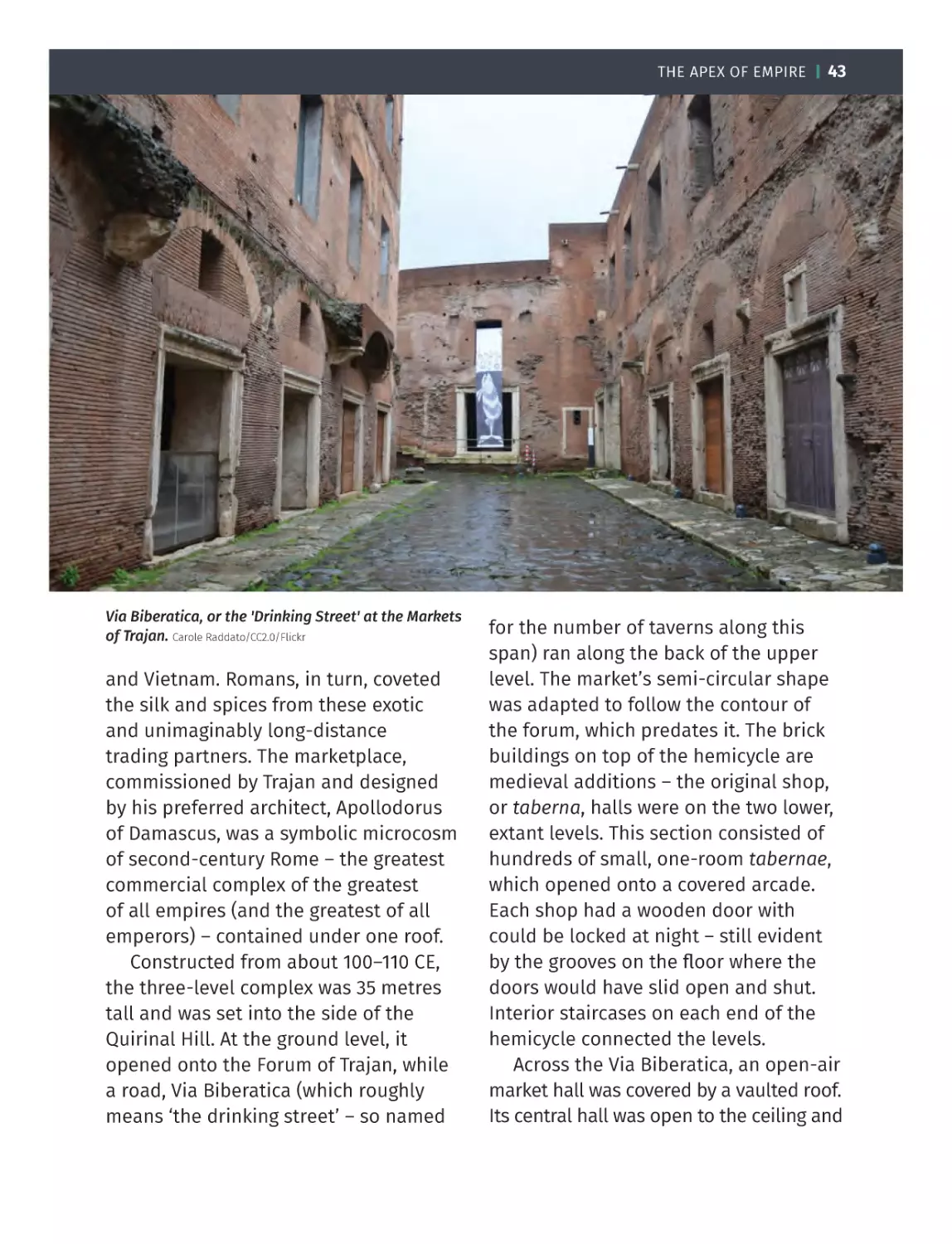
Via Biberatica, or the 'Drinking Street' at the Markets
of Trajan. Carole Raddato/CC2.0/Flickr

and Vietnam. Romans, in turn, coveted
the silk and spices from these exotic
and unimaginably long-distance
trading partners. The marketplace,
commissioned by Trajan and designed
by his preferred architect, Apollodorus
of Damascus, was a symbolic microcosm
of second-century Rome – the greatest
commercial complex of the greatest
of all empires (and the greatest of all
emperors) – contained under one roof.
Constructed from about 100–110 CE,
the three-level complex was 35 metres
tall and was set into the side of the
Quirinal Hill. At the ground level, it
opened onto the Forum of Trajan, while
a road, Via Biberatica (which roughly
means ‘the drinking street’ – so named

for the number of taverns along this
span) ran along the back of the upper
level. The market’s semi-circular shape
was adapted to follow the contour of
the forum, which predates it. The brick
buildings on top of the hemicycle are
medieval additions – the original shop,
or taberna, halls were on the two lower,
extant levels. This section consisted of
hundreds of small, one-room tabernae,
which opened onto a covered arcade.
Each shop had a wooden door with
could be locked at night – still evident
by the grooves on the floor where the
doors would have slid open and shut.
Interior staircases on each end of the
hemicycle connected the levels.
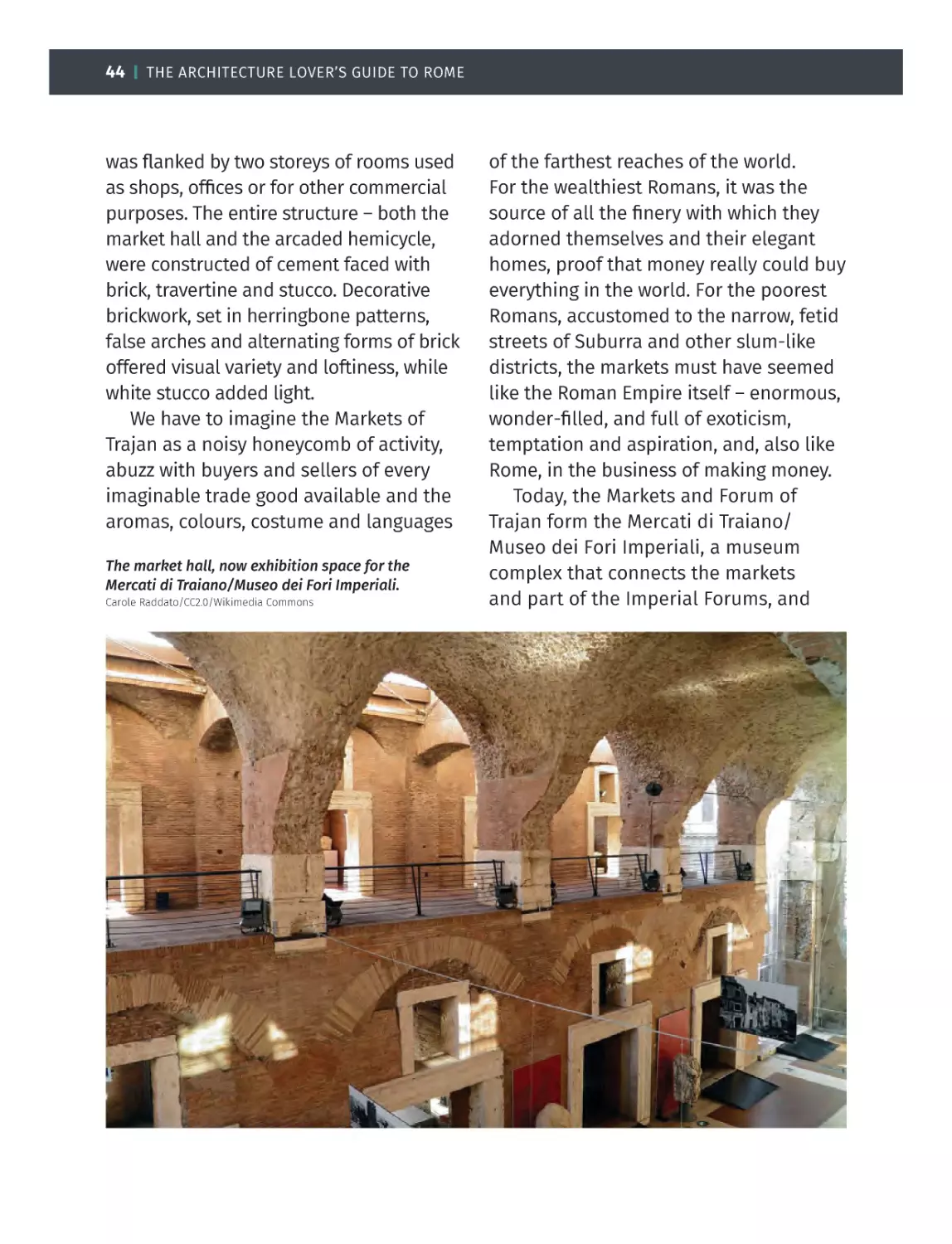
Across the Via Biberatica, an open-air
market hall was covered by a vaulted roof.
Its central hall was open to the ceiling and

44 | THE ARCHITECTURE LOVER’S GUIDE TO ROME

was flanked by two storeys of rooms used
as shops, offices or for other commercial
purposes. The entire structure – both the
market hall and the arcaded hemicycle,
were constructed of cement faced with
brick, travertine and stucco. Decorative
brickwork, set in herringbone patterns,
false arches and alternating forms of brick
offered visual variety and loftiness, while
white stucco added light.
We have to imagine the Markets of
Trajan as a noisy honeycomb of activity,
abuzz with buyers and sellers of every
imaginable trade good available and the
aromas, colours, costume and languages
The market hall, now exhibition space for the
Mercati di Traiano/Museo dei Fori Imperiali.
Carole Raddato/CC2.0/Wikimedia Commons

of the farthest reaches of the world.
For the wealthiest Romans, it was the
source of all the finery with which they
adorned themselves and their elegant
homes, proof that money really could buy
everything in the world. For the poorest
Romans, accustomed to the narrow, fetid
streets of Suburra and other slum-like
districts, the markets must have seemed
like the Roman Empire itself – enormous,
wonder-filled, and full of exoticism,
temptation and aspiration, and, also like
Rome, in the business of making money.
Today, the Markets and Forum of
Trajan form the Mercati di Traiano/
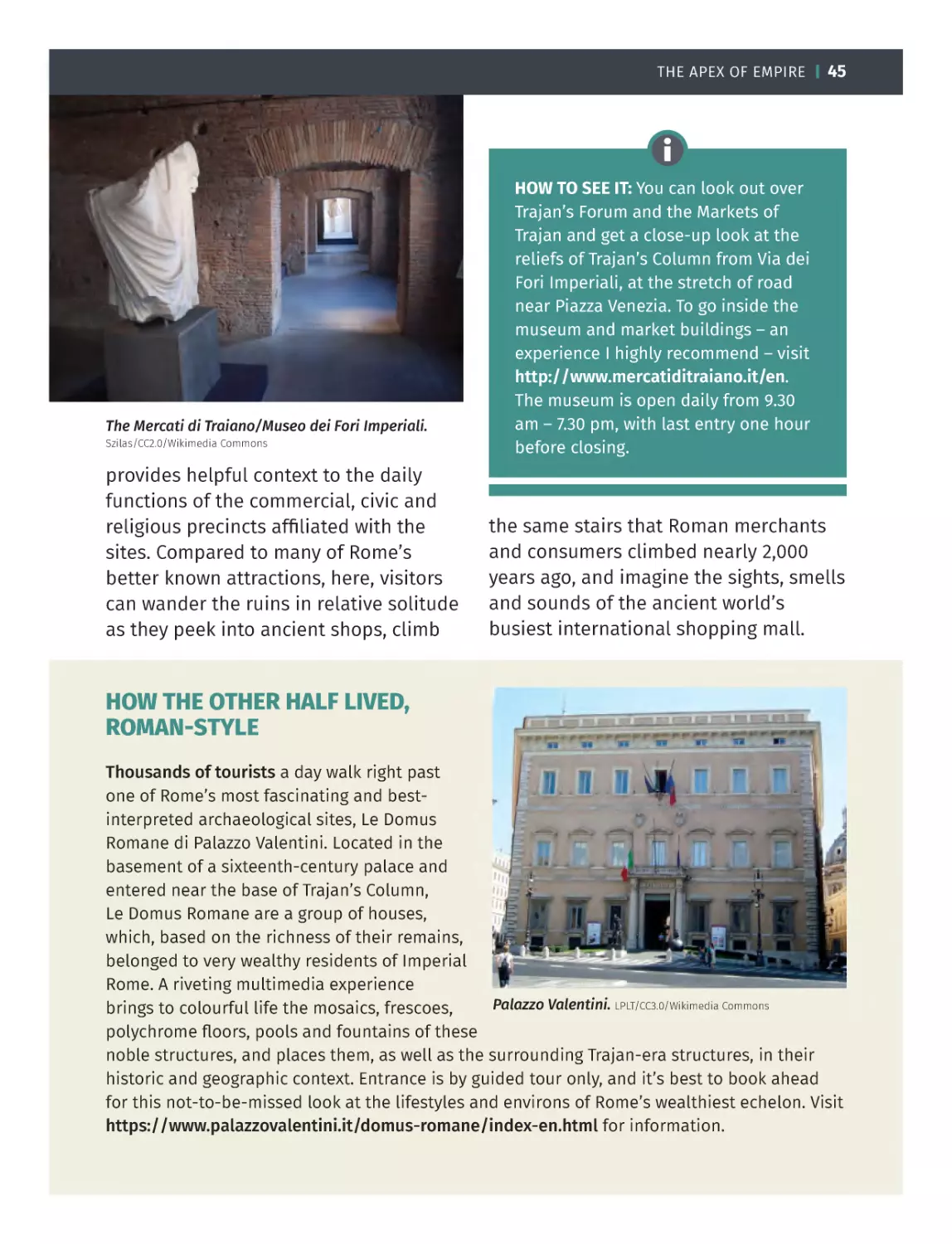
Museo dei Fori Imperiali, a museum
complex that connects the markets
and part of the Imperial Forums, and

THE APEX OF EMPIRE | 45

i

The Mercati di Traiano/Museo dei Fori Imperiali.
Szilas/CC2.0/Wikimedia Commons

provides helpful context to the daily
functions of the commercial, civic and
religious precincts affiliated with the
sites. Compared to many of Rome’s
better known attractions, here, visitors
can wander the ruins in relative solitude
as they peek into ancient shops, climb

HOW TO SEE IT: You can look out over
Trajan’s Forum and the Markets of
Trajan and get a close-up look at the
reliefs of Trajan’s Column from Via dei
Fori Imperiali, at the stretch of road
near Piazza Venezia. To go inside the
museum and market buildings – an
experience I highly recommend – visit
http://www.mercatiditraiano.it/en.
The museum is open daily from 9.30
am – 7.30 pm, with last entry one hour
before closing.

the same stairs that Roman merchants
and consumers climbed nearly 2,000
years ago, and imagine the sights, smells
and sounds of the ancient world’s
busiest international shopping mall.

HOW THE OTHER HALF LIVED,
ROMAN-STYLE
Thousands of tourists a day walk right past
one of Rome’s most fascinating and bestinterpreted archaeological sites, Le Domus
Romane di Palazzo Valentini. Located in the
basement of a sixteenth-century palace and
entered near the base of Trajan’s Column,
Le Domus Romane are a group of houses,
which, based on the richness of their remains,
belonged to very wealthy residents of Imperial
Rome. A riveting multimedia experience
Palazzo Valentini. LPLT/CC3.0/Wikimedia Commons
brings to colourful life the mosaics, frescoes,
polychrome floors, pools and fountains of these
noble structures, and places them, as well as the surrounding Trajan-era structures, in their
historic and geographic context. Entrance is by guided tour only, and it’s best to book ahead
for this not-to-be-missed look at the lifestyles and environs of Rome’s wealthiest echelon. Visit
https://www.palazzovalentini.it/domus-romane/index-en.html for information.

46 | THE ARCHITECTURE LOVER’S GUIDE TO ROME

The Pantheon
M•AGRIPPA•L•F•COS•TERTIVM•FECIT.
The inscription on the front of the
Pantheon is immodest, and also a little
misleading. It essentially translates
to ‘Marcus Agrippa built this’. Agrippa
was a statesman, consul, general, and,
most importantly, son-in-law and
closest confidant of Augustus. As a
general, he won decisive victories with
Augustus' legions and as a politician
and strategist, he helped consolidate

Augustus’ power and install him as the
first Emperor of Rome. Agrippa was
also an architect, and he designed and
oversaw the construction of the earliest
iteration of the Pantheon in the first
century BCE, built to honour Augustus’
victory over Antony and Cleopatra at the
Battle of Actium.
Scant evidence remains of the first
temple. It was destroyed by fire around
80 CE, and rebuilt by Emperor Domitian.
Fire struck again in 110 CE and this

THE APEX OF EMPIRE | 47

time, Trajan undertook reconstruction.
Stamped bricks at the site date to
Trajan’s era, so work was already well
underway, though unfinished, when
he died in 117 CE. Trajan’s successor,
Hadrian, oversaw its completion. Third of
the ‘Five Good Emperors’, Hadrian was a
patron of the arts and architecture, and
an architect himself. He commissioned
religious, domestic and municipal
building projects – including a rather
famous wall spanning the width of
Britain – across what was now a vast
empire. On the architectural landscape
of the city of Rome, the Pantheon is
doubtlessly his greatest and most
enduring contribution. That he included
the inscription which credited its
original architect, Agrippa, was intended
to symbolise his modesty and piety –
both traits not typically associated with
Roman emperors.
The Agrippa inscription on the Pantheon.

While it was once thought that
the Pantheon of Hadrian, completed
between 118 and 128 CE, bore little to no
resemblance to the Pantheon of Agrippa,
recent research has called into question
that thinking. Early scholars surmised
that Agrippa’s temple was a simple,
small rectangular plan, when in fact it
might have been a more complex design
with dimensions and features closer
to those of the Hadrianic structure,
including a portico and a circular hall,
or rotunda. So perhaps in attributing
the building to Agrippa, Hadrian was
demonstrating not just piety (whether
genuine or feigned) but honesty as well.
What is certain about the
second-century Pantheon is that
it was revolutionary in its design
and construction. While its portico
supported by free-standing columns
was not new to Roman monumental
structures (starting with the Temple
of Jupiter Optimus Maximus, Chapter

48 | THE ARCHITECTURE LOVER’S GUIDE TO ROME

The portico of the Pantheon. Sailko/CC3.0/Wikimedia Commons

2), these Corinthian columns were
more than 12 metres high and were
made of monolithic Egyptian granite
– unlike typical columns formed of
sections of poured concrete cylinders
fused together and clad in brick and
travertine, these were solid stone. Built
in the wake of Augustus and Agrippa’s
defeat of Antony and Cleopatra, it’s
no coincidence that the Pantheon

incorporated these massive components
quarried in Egypt – now another of
Rome’s vassals.
The interior of the Pantheon was
– and is – tremendously innovative
and daring. Consider the geometrical
perfection of a perfect sphere resting
on a cylinder, which supports the
world’s largest and oldest unreinforced
concrete dome. The height of the dome,
43 metres, is equal to its diameter and
were it an actual sphere, its bottom
would just graze the floor. The structure
is composed of concrete faced with
brick, with coffers formed in the rotunda
to lighten its mass. While the interior of
the dome forms a perfect half-circle, if
we could see the roof from a bird’s-eyeview, we’d see not a semi-circular but a
more oval shape – the roof is formed of
stepped rings of concrete, each smaller
and thinner than the other, leading up
The stepped dome of the Pantheon. Anthony Majanlahti/CC2.0

THE APEX OF EMPIRE | 49

The oculus of the Pantheon.

to the top of the dome with its famous
oculus.
At nearly 8 metres wide, its majestic
circular oculus, or skylight, is the
building’s only source of natural light.
Though obviously practical in this sense,
the oculus had a symbolic purpose as
well – as a window to the heavens, it
joined the mortal to the divine, and
sitting emperors to deified emperors
to the gods themselves. Because the

Pantheon was built on the spot where
Romulus was allegedly lifted up into
the afterlife, the oculus symbolised
the window through which he was
transported, the continuity of the
foundation myth and the seamless
connection between the sitting emperor
and the first father of Rome.
While the word Pantheon
essentially means ‘temple of all gods’,
archaeologists believe that the Agrippaera structure, built to commemorate

50 | THE ARCHITECTURE LOVER’S GUIDE TO ROME

Take a moment to be dazzled
Second to the Colosseum, the Pantheon
is the most recognised building in Rome.
And winding through the maze of centro
storico streets and emerging onto Piazza
della Rotunda, the square where the
Pantheon sits, and gazing at the front of
this exquisitely preserved, 2,000-yearold temple remains one of the most
breath-taking experiences in travel. I’ve
stumbled across it hundreds of times,
and it still bowls me over.

the victory at Actium, was also intended
as a sanctuary to Julius Caesar, a
sacred space that further linked him
to Augustus and Augustus to the gods
themselves. The concept of emperor as
god was taking hold – remember that
Augustus gave himself the title ‘Son
of the Divine One’ – and the Pantheon
provided a setting in which Caesar could
be worshipped at a level of importance
with the gods themselves. During
the early decades of the Pantheon,

THE APEX OF EMPIRE | 51

the niches at the top of the drum, or
cylindrical section of the rotunda, held
statues of the gods. By Hadrian’s era,
when the deification of emperors was
part and parcel of Roman political and
religious life, the statues of the gods
were replaced with statues of past
emperors.
As Rome began to decline in the 400s,
so did the significance of the Pantheon.
In 613 CE, the Byzantine Emperor Phocas
granted the Pantheon to Pope Boniface
IV, for the purpose of converting it from
a pagan site to a church, which would
eventually be known as Santa Maria
della Rotunda. It is because of this
seventh-century conversion that the
Pantheon remains in such an excellent
state of preservation, though its original
gold and bronze cladding and marble
statuary were lost to spoliage along the
way. Still, on its exterior and interior,
the Pantheon today is a building
that Hadrian would know, even if the
precinct around it would be completely
unrecognisable to him.
Present-day visitors to the Pantheon
still pass between those massive

i
HOW TO SEE IT: The Pantheon is set in
the heart of Rome’s centro storico, and
is open daily from Monday to Saturday
from 8.30 am to 7.30 pm (Sundays 9 am
to 6 pm). Admission is currently fre. For
more information, visit http://www.
pantheon-rome.com.

Egyptian granite columns and under the
portico inscribed with Agrippa’s name.
They enter through fifteenth-century
bronze doors not dissimilar to the
original. They walk on the same marble
floors, with their colourful circle and
square pattern, and see the same walls
and niches covered in marble. And they
gaze up at the same coffered ceiling
and at the light of the same oculus –
unchanged since the second century.ART
BOX OUT] How to see it:

The Baths of Caracalla
The death of Marcus Aurelius in
180 CE marked the end of the era of
the Five Good Emperors, and also
the climax of Rome’s most peaceful,
prosperous period. Though the borders
of the Empire expanded during the
193–211 reign of Septimus Severus, his
campaigns drained Rome’s coffers,
and his attempts to have his two
sons, Caracalla and Geta, serve as coemperors had calamitous results that
further destabilised the state.
In 211, Caracalla had Geta murdered
– in the presence of their mother – and
had thousands of his enemies and
political rivals executed. He ordered
the damnatio memoriae of Geta,
whose image was struck from coins,
monuments and the triumphal arch of
Septimius Severus, which still stands
in the Roman Forum. Caracalla lived in
constant fear of assassination and spent
the remainder of his reign on military
campaigns far from Rome. To ensure the
loyalty of the legions, he raised soldiers’

52 | THE ARCHITECTURE LOVER’S GUIDE TO ROME

Remains of the Baths of Caracalla, with supporting pillars
of the domed calidarium. Image: PCDazero/CC0

Bust of
Caracalla.

Museo Archeologico
Nazionale di
Napoli/CC2.5

salaries, but sunk the Empire further into
debt in the process. He made citizens of
all freed men in all Roman territories,
ostensibly an egalitarian move, but more
likely so that these new citizens would
pay taxes and relieve Rome’s debt. His
lasting mark on the Roman landscape
was another attempt to endear himself to
the public, and was one of the last great
building projects of the Roman Empire –
the Baths of Caracalla.
Though the bath complex was
likely initiated by Severus, primary
construction took place under Caracalla.

THE APEX OF EMPIRE | 53

The site for the sprawling bath complex,
then the city’s largest, was in the
southern part of Rome, where there was
enough undeveloped space for such a
large project (which would ultimately
cover about twenty-five hectares). The
position at the end of the Appian Way
meant that visitors, immediately upon
entering Rome, would be astounded
by the scale of the complex and the
vision and capability of the Empire
and, more practically, could also clean
themselves before going on to the city.
Most importantly, the new baths were in
proximity to the Aqua Marcia aqueduct,
which would provide a steady supply of
clean, free-flowing water for thousands
Mosaic floors at the Baths of Caracalla. Pascal Reusch/CC3.0

of bathers every day.
At least 21 million bricks and 6,300
cubic metres of marble were used to
construct the baths, which were built
by a combination of slave and skilled
labourers. The central bath building
was 44 metres tall and measured 214
by 114 metres. Inaugurated in 216 as
the Thermae Antonianae, but familiarly
known as the Baths of Caracalla,
the main complex consisted of an
Olympic-size swimming pool, which
was uncovered, plus a wide corridor
connecting to cold, tepid, warm
and hot baths, plus steam rooms.
Side rooms and adjacent buildings
contained changing areas and lockers, a

54 | THE ARCHITECTURE LOVER’S GUIDE TO ROME

1924 illustration of the Baths of Caracalla. Wellcome Images/CC4.0

gymnasium with weightlifting facilities,
and areas for massages and relaxation.
In another section of the complex, a
market-like area offered taverns, shops,
salons and libraries, while outdoors,
there were sports fields, a running track,
gardens and pavilions. In modern real
estate terms, the Baths of Caracalla were
a mixed-use entertainment and retail
development.
About 1,600 bathers could use the
aquatic facilities at any one time,
leading scholars to believe that the
complex served a total of as many as
8,000 users per day. They moved among
great halls, corridors, and chambers
decorated with inlaid marble and
painted stucco, with niches filled with
sculptures depicting Greek and Roman
myths. Virtually every floor surface was
covered with mosaics, ranging from
black and white geometric patterns to
colourful, fantastical depictions of sea
creatures and allegorical figures.

Bathers moved between the
frigidarium, which housed four cold
baths, the tepidarium, with ambienttemperature baths, and the swimming
pool. From there they could access
the caldarium, the domed room 36
metres in diameter, with seven hot
pools. To the senators, nobility, plebs,
freed men and slaves, all of whom had
free access to, and commingled in,
the baths, the facility was a visually
dazzling, technologically marvellous
pleasure palace where clean water
circulated continuously, and was offered
at different, consistent temperatures
depending on the experience bathers
were seeking. It must have seemed
effortless, almost magical, for a facility
to provide so many bathing options
for so many people, in a building
of such grand scale. Behind – or in
this case, under – the scenes, in two
levels of subterranean tunnels, were
hundreds of metres of sewer pipes for

THE APEX OF EMPIRE | 55

outgoing water, and a hypocaust heating
system where incoming water from
the aqueduct was heated over wood
fires. The entire complex was tended by
thousands of slaves and workers, and
it’s estimated that more than 10 tons
of wood were burned daily to keep the
bathwaters heated.
Also underground was a mithraeum,
a ritual site associated with worship
of the Eastern god Mithras, who had
developed a following among the Roman
elite of the second and third centuries.
The mithraeum was used for sacrificing

Bathtubs in the piazza
Though the peripheral location of the
Baths of Caracalla meant they did not get
built over in the ensuing centuries, their
decorations and precious materials were
stripped and reinstalled across Rome
and the rest of Italy. If you visit the lovely
Piazza Farnese (see Chapter 7), set just off
Campo de'Fiori in Rome’s centro storico,
take note of the two graceful fountains,
their bases shaped like giant bathtubs.
These carved Egyptian granite vessels are
from the Baths of Caracalla, where they
were once used – as giant bathtubs.

56 | THE ARCHITECTURE LOVER’S GUIDE TO ROME

Mosaic at the ruins of the Baths of Caracalla.

bulls, whose blood would pour down on
worshippers below.
Caracalla never visited the bath
complex that bears his name. In 217, he
was killed by one of his own soldiers.
The baths remained in operation until
537, when invading Goths cut off the
city’s water supply. The area around the
baths fell out of use – too far from the
city centre to be useful to a dwindling
population. This physical location saved

the Baths of Caracalla from complete
destruction or, as was so often the
case in Rome, incorporation into later
structures. They were, however, used
as a quarry – even the finely
carved marble statues that once
looked down on bathers were
reduced to lime. An earthquake
in 847 did major damage to the
complex and it was never restored. By
the mid-1500s, spoliage excavations had
stripped the baths of any remaining
marble, bronze and statuary. Well into
the 1800s, excavations ostensibly aimed
at archaeological investigation, resulted
in the baths’ treasures being carted away,
as often as not to the Vatican Museums.
Despite the long centuries of
degradation, the Baths of Caracalla
remain one of Rome’s most impressive
archaeological sites. Surrounded by a

THE APEX OF EMPIRE | 57

large open space dotted with umbrella
pines, the baths are one of the few sites
where modern visitors can really grasp
the scale of the original complex. Still
standing are several two-storey sections
of brick walls, which convey the height
and bulky massiveness of the structure.
Remarkably intact are several large
sections of the mosaic floors which once
covered the entire interior pavement.
Access to the underground tunnels
includes the mithraeum, and exhibits
that explain the hypocaust and other
hydraulic workings.
While the Baths of Diocletian,
inaugurated around 305, were larger
than the Baths of Caracalla and could
hold more bathers, they never rivalled
the grandness and ornamentation of
the latter. Like his predecessor 100 years
before him, Diocletian ruled over an

empire whose decline had already begun.
With the menace of foreign marauders,
the toll of internecine struggles for the
emperorship, the erosion of traditional
beliefs among the populace, and
Diocletian’s move to divide the Empire
into Western and Eastern halves,
Rome was ripe for change. It came in
many forms – most significantly for its
architectural landscape, in the worship of
a new god: Jesus Christ.

i
HOW TO SEE IT: The Baths of Caracalla
complex is about 5 minutes’ walk from
the Circus Maximus (Circo Massimo)
Metro stop, and is open daily from
9 am to dusk (Mondays to 2 pm). For
more information, visit https://www.
coopculture.it/en/heritage.cfm?id=6.

58 | THE ARCHITECTURE LOVER’S GUIDE TO ROME

5
CHRISTIANITY
TAKES HOLD

Old St Peter’s Basilica, Santa Sabina
and San Saba
Roman magistrate Pontius Pilate attempted to squelch an upstart religious
cult when he – by some accounts, reluctantly – ordered Christ’s crucifixion in
Jerusalem sometime around 33 CE. But as the story of Christ’s suffering and
martyrdom drew followers to him posthumously, an empire well connected
by roads and shipping channels made it easier for his disciples to spread
his teachings, through their own travels, through clandestine meetings and
through the sharing of written versions of his works.
Throughout the Empire, there were
always great disparities between rich
and poor, slaves, plebs and ruling class,
and human suffering was markedly
higher the lower one’s social status.
So Christian doctrines of charity and
compassion for the sick and the poor,
the rejection of material trappings and
the possibility of eternal salvation,
regardless of caste, found a ready
audience in the putrid Roman slums and
among its rural, impoverished tenant
farmers.
For Roman emperors and upper
classes, outnumbered by millions of
disaffected subjects, an emboldened

populace was an unmitigated threat.
And while Rome was generally tolerant
of different religions and even willing
to adopt some foreign gods, it always
required that Roman emperors be
worshipped along with these other gods.
Christians, by refusing to worship, make
offerings to or accept the divinity of the
emperor, were considered treasonous,
a danger to the legitimacy of the entire
socio-political structure of the empire.
At least from the beginning of the
reign of Nero in 64 CE, Christians were
intermittently persecuted in Rome
and throughout the Empire. Diocletian
is recorded as the most ruthless and

CHRISTIANITY TAKES HOLD | 59

The Dream of Constantine, from a 9th C manuscript.
Bibliothèque nationale de France/public domain

enthusiastic oppressor. During his reign
(284–305) and immediately following,
Christian buildings and homes were
razed, and hundreds of thousands of
Christians were executed, often in brutal
public spectacles. Diocletian’s successor,
Galerius, continued the persecutions
until 311, when a policy of tolerance was
adopted.
The period of transition from
persecution to tolerance to adoption
of Christianity took place during
decades of division and unrest within
the empire. Not only was it divided
between eastern and western halves,
the Roman Empire was also governed
by the Tetrarchy. This four-way powersharing scheme, initiated by Diocletian
as a means of preserving the empire,
quickly descended into intrigues, power
struggles and ultimately, open warfare.
In October 312, Constantine won a

The Chi Ro, an early symbol of Christianity.

decisive victory at the Battle of the
Milvian Bridge in Rome and took control
of the Western Empire. Historical
accounts and liberal doses of poetic
licence recall that either the day or night
before the battle, Constantine had a
dream or vision of the sun with a cross
above it. Other accounts claim that
Constantine saw the Chi-Rho symbol, the
Latin cross with its upper point in the
form of a P – an early symbol for Christ.
He also saw the words, in hoc signo
vinces (in this sign, you will conquer),
and reportedly had the shields of his
infantrymen painted with the Chi-Rho
– making them the first army to march
under the protection of the Christian
god.
Constantine’s victory at the Milvian
Bridge the next day affirmed his

60 | THE ARCHITECTURE LOVER’S GUIDE TO ROME

faith, even if he himself reportedly
did not convert to Christianity until
his deathbed. The Edict of Milan was
declared just a few months later. It
decriminalised Christianity and set in
motion the transition to Christianity as
the official religion of Rome.

Old St Peter’s Basilica
Constantine, whether an avowed
Christian or not, saw himself as emperor
of the Christian people, who were now
free to worship publicly, build churches
and hold public office. He became a
patron of the church, and sponsored
the construction of church buildings
throughout the empire. In Rome, his
greatest building legacy would be what
is now known as Old St Peter’s Basilica.

Sometime between 318 and 322,
Constantine ordered the construction
of a basilica over the Circus of Nero,
the arena and racecourse where the
martyrdom of Peter the Apostle is said
to have occurred more than 250 years
earlier, during the reign of Nero. By
the second century, the circus was no
longer in use and the site was used as
a necropolis. Even in the decades when
Christianity was outlawed in Rome,
the location where Peter was crucified
contained a small shrine and was a site
of veneration. Its location determined
the design of the fourth-century basilica
as well as that of the sixteenth-century
version that stands there today.
The original church followed some
aspects of the Roman basilica plan,

Plan of the Circus of Nero, with the footprint of Old St Peter’s in black and the dotted outline the current
basilica.

CHRISTIANITY TAKES HOLD | 61

which was so effective for assembling
large groups of people under one roof.
Like the Basilica Julia on the Roman
Forum, St Peter’s featured a 110-metre
long central nave with a lofty ceiling
and two aisles on either side. Visitors to
the basilica entered through a narthex,
a covered area similar to the Roman
portico. In a departure from the basilica
plan, it also used the form of the Latin
cross, with the nave forming the long
end of the cross. The crossing, or the
intersection of the transept (the short
span of the cross) with the nave, formed
the focal point of worship in the church,
as it was the location of the raised altar
and the remains of St Peter. In the apse,
or semi-circular area behind the altar,
a mosaic depicted Constantine and St
Peter presenting a model of the church
to Christ.
When it was completed about
thirty years after construction began,
the basilica could hold 3,000–4,000
worshippers at a time. While the exterior
of the basilica was of fairly unadorned
brick, the interior was ornate at every
turn, with mosaics, frescoes and marble
columns illuminated by tall clerestory
windows in the nave and transept.
The basilica was the site of papal
coronations, and the most important
pilgrimage destination in Europe.
Wealthy pilgrims brought offerings of
statuary, artwork and jewel-encrusted
reliquaries, and by the ninth century, the
basilica was overflowing with treasures.
Papal tombs and altars, each more

Follow the Graffiti to Peter’s
Tomb
The tour of the archaeological excavation,
or scavi, under St Peter’s Basilica
leads visitors to what the Catholic
Church reasonably believes is the tomb
containing the bones of Peter the Apostle.
Researchers have pieced together
evidence of the layout of the Roman-era
necropolis where Peter was buried and,
based on historical accounts and the
results of years of excavations, have found
the street of the necropolis, and even the
stairs leading to Peter’s tomb. A big piece
of circumstantial evidence is the ancient
graffiti on the walls of the necropolis,
including the Chi-Ro sign, that seems
to point the faithful in the direction of
Peter’s tomb. In the vicinity, they’ve even
found a wall fragment with the inscription,
Petros eni, which means ‘Peter is here’. A
small glass box filled with bones, said to
be Peter’s, is tucked in a wall niche. While
there may never be a way to definitively
prove the bones’ provenance, there is
convincing evidence that since the earliest
days of Christian worship, the site has
been venerated as Peter’s Tomb.

elaborate than the next, were added to
the perimeters of the aisles. In 800 CE,
Charlemagne was crowned emperor of
the Holy Roman Empire at St Peter’s.
The safety and security once assured
by the Roman Empire had long since
vanished, and Rome was frequently and
catastrophically menaced by foreign
invaders. In 846, Saracens sacked the
basilica and stripped it of much of its

62 | THE ARCHITECTURE LOVER’S GUIDE TO ROME

riches. Despite various efforts to repair
St Peter’s over the centuries, by the
1400s it was in such terrible condition
that it was at risk of collapsing. Pope
Julius II, who served from 1503 to 1513,
ordered the basilica – henceforth ‘Old’
St Peter’s – to be torn down and a new
one built in its place.
Today, there are scant remains of
the original St Peter’s, though the focal
point of the church remains the tomb
of Peter, now under a grand bronze
baldacchino, or pavilion, designed by
Bernini. Eight of the original twelve
Solomonic, or corkscrew-style columns
that Constantine brought back from an
Eastern temple, are now set in the four
piers that support St Peter’s massive
dome. In the grotto of St Peter’s, traces
of the pre-sixteenth-century foundations
can be seen, as can a glimpse of what is
allegedly Peter’s Tomb. In order to see
parts of the original basilica, mosaicked
and frescoed tombs from the late Roman
necropolis, and to get close to the tomb
believed to be that of the Apostle Peter,
visitors must arrange in advance to tour
the scavi, or archaeological excavations
(see information below). For the devout,
a tour of the underground scavi is a
visit to one of the most revered and
historically significant places in all
Christendom. And regardless of one’s
religious convictions, the scavi tour
offers a captivating history lesson and
a chance to glimpse a tangible, hidden
and vitally important piece of Rome’s
past.

Baldachin with two pairs of original Solomonic
columns set in the piers on either side.
Bengt Nyman/CC2.0/Wikimedia Commons.

i
HOW TO SEE IT: What remains of Old
St Peter’s is accessed by visiting new
St Peter’s Basilica. Entrance to the
church and grotto are free. As with
all churches in Rome, proper dress is
required, meaning no shorts or skirts
above the knee, no bare shoulders or
tank tops, and no hats. The basilica
is open every day from 7 am to 7
pm in summer, and to 6 pm from
October to March. See http://www.
vaticanstate.va/content/vaticanstate/
en/informazioni-utili.html for more
information. To visit the scavi and St
Peter’s Tomb, reserve tickets at http://
www.scavi.va/content/scavi/en.html.
The tour currently costs €13 per person
and lasts about thirty minutes.

CHRISTIANITY TAKES HOLD | 63

Santa Sabina
To appreciate what the original version
of St Peter’s Basilica looked like, journey
to the Aventine Hill and visit the Basilica
of Santa Sabina. The church, now the
mother church and headquarters of the
Dominican Order, was built between 422
and 432, near the site of a Temple of
Juno, on a high point of land overlooking
the Circus Maximus and the Tiber River.
Some accounts maintain that the church
was built over the home of Sabina, a
wealthy Roman woman martyred in
the first or second century because
she converted to Christianity. Another
credible hypothesis doesn’t concern
Exterior of Santa Sabina with nave, clerestory
windows and rounded apse.

Dnalor 01/CC3.0/Wikimedia Commons

martyrdom; because Christians first
worshipped secretly in private homes,
it is thought that the church was simply
built over the home – of a woman
named Sabina – where early services
took place in the first centuries after
Christ. As Christians were at last free
to worship in large, organised groups,
it was one of about two-dozen titular
churches built in Rome in the fifth
century, so named because they were
built over privately owned places of
worship and took the name, or title, of
the owner of the building.
As Christianity transitioned from
being an outlawed cult to being the
state religion of Rome, it was essential
that it appeared stately and omnipotent,
and that it crushed the remnants of

64 | THE ARCHITECTURE LOVER’S GUIDE TO ROME

Interior of Santa Sabina, with Corinthian
columns from the temple of Juno

CHRISTIANITY TAKES HOLD | 65

preserved early Christian church in
Rome and provides a clear model for
other churches of its era. The church
follows the Roman basilica plan, but
begins a period of transition between
the typical basilica design of a long,
central nave flanked by aisles, and later
Christian churches in the form of the
Latin cross. Whereas Santa Sabina did
not have a transept like Old St Peter’s, it
departed from the basilica plan in that it
had only one aisle running along either
side of the nave. The clerestory, with its
rows of windows set above the nave, is
supported by twenty-four Corinthian
marble columns from the former temple

Detail of a Corinthian column from the former pagan
temple of Juno.

paganism. Adopting the basilica plan
transferred the symbol of Roman
authority to the Christian church, and
permitted thousands of worshippers to
assemble in a space that simultaneously
represented the protective embrace
of Christ and the might of the church.
Placing the church over or near a site
of pagan worship – as was so often the
practice throughout the early Christian
world – was the literal and figurative
annihilation of the pagan gods.
Santa Sabina was one of several
similar churches in Rome when it was
constructed, but today it is one-of-akind, in the sense that it is the best

The Aventino: A bourgeois
address from the start
Sabina, the wealthy Roman woman for
whom Santa Sabina is named, lived in one
of ancient Rome’s nicest neighbourhoods,
the Aventino. Houses positioned on this
high promontory were set well above the
fetid streets of nearby Suburra to the east.
They had sweeping views of the city and
countryside, fresh air, and ample space
for elegant villas with gardens and follies.
With the collapse of Rome, the Aventino
was eventually abandoned as a residential
area, and became pasture and farmland.
In the nineteenth and early twentieth
centuries, the Aventino once again became
a desirable neighbourhood, and elegant Art
Deco villas and apartment buildings sprang
up across the hill. Today, as in ancient
times, it is considered one of the nicest
addresses in Rome.

66 | THE ARCHITECTURE LOVER’S GUIDE TO ROME

Original wooden door panel at Santa Sabina, with
one of the earliest depictions of the Crucifixion of
Christ. Peter1936F/CC4.0/Wikimedia Commons

of Juno – spoliage that was both practical,
and symbolic of the church’s dominance
over the pagan past. The interior of the
church, now relatively unadorned, was
once lined with gold and multi-coloured
mosaics, which would have reflected the
light beaming in from the tall clerestory
windows. The effect was intentionally
celestial – the worshipper was entering
not just a building, but the light-filled
domain of Christ.
Though its interior has been heavily
restored through the centuries, the
brick exterior of Santa Sabina looks
very much like it did in the fifth century,
with the long nave, clerestory windows
with selenite, rather than glass, panes,
and the curved apse. The wooden doors
through which the church is entered are
original, with eighteen carved panels
still surviving. One of these, in the topleft corner of the door, is one of the
earliest depictions of Christ’s crucifixion.
Above the doorway, the original fifth-

century Latin dedication remains intact,
and mentions Peter of Illyria, the priest
who founded the church, and Pope
Celestine I, who served from 422–432
and oversaw construction of the basilica.
Restorations of Santa Sabina occurred
at various points over the centuries, but
the Aventine was eventually abandoned
as Rome became an increasingly lawless,
disease-filled place and its population
dwindled. The bell tower was added in
the 900s, during which time the church
was fortified with a perimeter wall and
served as fortress. In 1218, the basilica was
granted to the Dominican friars, who built
a friary that now abuts the western end
of the nave. Other than a brief period at
the turn of the twentieth century, Santa
Sabina has served as the mother church
of the Dominican Order. Restorations in
the twentieth century returned the interior
to a close approximation of its early
Medieval state – minus the mosaics which
would have run above the nave.

i
HOW TO SEE IT: Santa Sabina is open
daily from 8.15 am to 12.30 pm and from
3.30 to 6.00 pm, with periodic closures
when Mass is being celebrated. To
reach the church, you have to walk
(or take a taxi) up the Aventine Hill,
starting from the ESE end of Via del
Circo Massimo. From there, walk up the
Clivio dei Publicii, then turn right on
Via di Santa Sabina. The short, steep
climb will take about ten minutes.

CHRISTIANITY TAKES HOLD | 67

Basilica of San Saba

A Secret Keyhole on the
Aventino
If you’ve made it up to Santa Sabina,
continue on less than a block to the
headquarters of I Cavalieri di Malta, or the
Knights of Malta, one of the few surviving
orders of knights of the Crusades. On
the piazza, peer through the ‘secret’
keyhole into the gardens of the Villa del
Priorato di Malta, and onto a tunnel-like,
perfectly framed view of St Peter’s dome.
The knights have always taken seriously
their vows to protect the church, and the
novelty keyhole symbolises their watchful
eye. If there happens to be a long line
of people waiting to peep through the
keyhole, you’ll understand that it’s not
quite such a ‘secret’ – but still a fun thing
to do if you’re already up on the Aventine.

A short distance from Santa Sabina, on
the Piccolo Aventino, or ‘Little Aventino’
hill, the smaller Basilica of San Saba sits
on a quiet, shady spot among residential
buildings. There’s been some form of
house of worship on this site, said to
have been the home of Silvia (later
Santa Silvia), mother of Pope Gregory
I (‘Gregory the Great’), since at least
the seventh century. Today, San Saba
presents an intriguing scavenger hunt
of sorts, to find the pieces of its earliest
past and establish a linear sense of its
complicated chronology.
The basilica was first established in
645 by monks from the monastery of
Mar Saba, near the Dead Sea in what
is now Israel. Fleeing Islamic invaders,
they sought protection in Rome, and
were granted a piece of land on the
The Basilica of San Saba.

68 | THE ARCHITECTURE LOVER’S GUIDE TO ROME

Piccolo Aventino, where a fourth-century
domus, or Roman house had stood. As
at Santa Sabina, the existing domus
was probably a private site of worship
during the period when Christianity
was outlawed. Its association with the
mother of Gregory the Great, is harder
to establish and is likely more legendary
than factual.
The followers of San Sabas, a fifthcentury priest and monk venerated
in both the Catholic Church and the
Eastern Orthodox Church, constructed a
basilica in the Roman style, with a nave
and single aisles. This seventh-century
basilica differed from the Roman style
in a distinctly Eastern way: it had a
triple apse plan, or a large central apse
flanked by two smaller ones. These
remain part of the extant footprint of
the basilica. By the 600s, San Sabas was
already widely revered as a performer of
miracles and a founder of several major
monasteries through the Middle East,
and his basilica and monastery in Rome
soon became one of the most important
and prosperous in the city. As an Eastern
church closely linked to Constantinople,
it served as an important conduit
between the Eastern and Western
churches.
By the tenth century, deteriorating
relations between Rome and
Constantinople meant that San Sabas
cult fell out of favour, and possession of
the monastery was granted to monks of
the Order of St Benedict, who were seen
as being more loyal to the papacy. They

The narthex at San Saba, with some of the earliest
relics from the site.

reconstructed the church in the 900s
and the basic form we see now dates
to that era. By the 1100s the monastery
was passed to another Benedictine sect,
who undertook a renovation in 1205.
It was rebuilt again in the late 1400s,
but San Saba’s days as an important
monastery had long passed. In 1573, it
was granted to the Pontificium Collegium
Germanicum et Hungaricum de Urbe, a
German-speaking seminary for Roman
Catholic priests. They held it through the
early twentieth century, albeit in an allbut-abandoned state.
In the early 1900s, San Saba was a
little-visited monastery on a deserted

CHRISTIANITY TAKES HOLD | 69

hill – inside the city walls but still very
much on the outskirts of Rome, but an
early twentieth-century building surge
in Rome meant that attention was
again paid to San Saba. The monastic
complex was granted to the Jesuit
order in the 1930s. Serious renovation
and archaeological excavations were
undertaken in 1943 and again in 2010,
in an attempt to return the complex to
the way it would have appeared in the
middle ages.
Excavations have revealed parts of
the seventh century building, as well
as a fourth-century aula, a nave-form
assembly hall that was part of the
original Roman domus. The original
façade is covered by a portico, or
Cosmatesque mosaic floors at San Saba.
Cosmatesque column with Corinthian capital, San
Saba.

external narthex, built in the 1400s and
featuring six ancient columns pillaged
from other Roman sites. The portico
contains some of the oldest pieces
of the site, including a carved Roman
sarcophagus and other sculptural
fragments. Particularly rare pieces
are those that decorated the seventhcentury monastery, including a relief of
a knight and a falcon. From the portico,
the central doorway, flanked by two
blocked, arched doorways, marks the
entrance to the fourth-century aula,
which originally had three doors.
The nave of San Saba is supported by
pillaged columns. Especially noteworthy

70 | THE ARCHITECTURE LOVER’S GUIDE TO ROME

in the church is the well-preserved
thirteenth-century cosmatesque flooring,
a style imported from Byzantium and
typified by colourful patterns of inlaid
stone. The decorative style also appears
on bits of door moulding and columns

in the church interior. The crypt, which
once housed the tomb of San Saba (his
remains, brought to Rome by twelfthcentury Crusaders who stole them from
the Holy Land, were returned to the Mar
Saba monastery in Israel in 1965 – today,

CHRISTIANITY TAKES HOLD | 71

Fresco fragments
at San Saba.

practices of spoliage, reincorporating
old parts into new structures, filling in
old structures and building on top of
them make a chronological reading of
the basilica all but impossible, even
to the trained eye. Coupled with that,
the nineteenth- and twentieth-century
practice of restoring early churches by
removing evidence of later renovations
was often carried out in a manner that
was haphazard at best. Still, the basilica
complex, apart from offering a quiet,
verdant space away from the crowds
of central Rome, offers a tantalising
glimpse of monastic architecture in the
early middle ages.

i

only an arm bone remains) is built into
the fourth-century Roman domus.
For modern visitors, San Saba
presents the very complicated nature
of parsing the architecture of Rome in
the early Middle Ages. The widespread

HOW TO SEE IT: San Saba is on the
Piccolo Aventino and is reached by
heading about five minutes on foot up
Via di San Saba, from where it meets
Viale Aventino at the bottom of the
hill. A visit here can be combined with
a day spent exploring nearby Santa
Sabina (1 km north-west), and the
Baths of Caracalla, which are about 1
km north-east of San Saba. The basilica
is open Monday through Saturday from
8 am to 12 pm and again from 4 pm to
7 pm. On Sundays, it opens at 9.30 am.
Non-worshippers will not be able to
enter the church when Mass is being
held. The basilica’s official website,
https://sansaba.gesuiti.it, contains
some helpful information but is geared
toward the current activities of the
Jesuit community.

72 | THE ARCHITECTURE LOVER’S GUIDE TO ROME

6
THE MIDDLE AGES

The Basilicas of Santa Maria in Trastevere,
San Clemente & San Nicola in Carcere
By the high Middle Ages, the period generally defined as 1ooo–13oo, Rome’s
population had fallen from as much as one million during the Empire to a
mere 3o,ooo living within the third-century Aurelian walls. Crumbling ancient
monuments, including the hulks of the Colosseum, the Baths of Caracalla and
the ruins of the Forum dotted the cityscape. Defensive towers constructed by
rival and often warring families poked out from what would have appeared as
an otherwise low-rise – and surprisingly pastoral – panorama. With the lack of
a consistently functioning central government, residents organised themselves
into village-like neighbourhoods, usually built around a titular church, basilica
or monastery, and especially close to the Tiber, the only source of water since
the aqueducts had long since been destroyed.
While control of the city had ostensibly
belonged to the papacy since the 600s,
the centuries after the fall of Rome were
marked by frequent, violent clashes
for claim to the Papal throne and
catastrophic sackings of the city. During
periods of relative stability, building
projects were undertaken, either
sponsored by the church or a wealthy
patron, but never at the pace or scale
of the Roman Empire, or even with the
frequency and ambition of the dozens
of titular churches built during the early
days of Christian Rome.

Rome has been called a city nearly
devoid of Medieval architecture, and
the cityscape does appear to leap
directly from classical monuments to
Renaissance structures. Understanding
this gap in the architectural timeline
means jumping forward to the fifteenthcentury Renaissance era, when Europe
emerged from the so-called ‘Dark Ages’
and entered a period of intellectual and
creative growth that was likened to the
glory days of the Empire. As a result,
buildings constructed after the fall of
Rome and well into the late Middle

THE MIDDLE AGES | 73

Ages were considered representative of
unenlightened times. As the architects
of the Renaissance looked to the
elegant symmetrical designs and
engineering marvels of their ancient
Roman predecessors, the often clumsy,
utilitarian buildings of the Middle Ages
were pulled down, replaced with new
structures that reflected the grandeur of
Ancient Rome.
Further destruction of Rome’s
Medieval past occurred in the
late nineteenth century, with the
construction of the Vittoriano (see
Chapter 9), the monument to Vittorio
Emanuele II, the first king of unified Italy.
Building the massive structure, now a
major landmark in Rome, meant wiping
out an entire Medieval neighbourhood,
including several churches, at the
base of the Capitoline Hill. Via dei Fori
Imperiali, built by Mussolini in the 1920s
and 30s, cut a swath across more of
Medieval Rome and levelled buildings
dating from the ninth century onwards.
As a result, buildings that preserve
the true character of the high Middle
Ages are rare in Rome, and are primarily
churches. And as seen in Chapter 5,
there are virtually no examples of a
‘pure’ form of Medieval architecture
in Rome. From the fall of the Empire
up to (and to an extent, including)
the Renaissance, the practice of
spoliage laid waste to Rome’s ancient
monuments. The use of old building
parts to construct new buildings was the
symbolic triumph over the pagan past,

as well as an exercise in trophy-hunting.
But it was also very much a custom of
necessity – it was simply cheaper and
easier to use existing materials like iron,
marble and brick than it was to forge,
carve or pour new ones. So just as there
are few early Christian buildings that
aren’t held up – at least in part – by
Classical columns, there are no extant
buildings from the high Middle Ages
that don’t bear evidence of layers of
construction, spoliage and restoration,
and the liberal mixing of styles of
different epochs.

Santa Maria in Trastevere
If you could walk around the perimeter
of the Basilica of Santa Maria in
Trastevere, you’d see a building that
looks very much like a smaller version
of Old St Peter’s – a Roman basilica plan
with a central nave and aisles, a transept
forming a modified Latin cross, and a
semi-circular apse. Today, the church
and the piazza in front of it are the heart
of Trastevere, one of Rome’s oldest and
most colourful neighbourhoods.
While the basilica may have once
been a freestanding building in the
midst of a working-class Rome suburb,
it’s now tucked tightly into a dense
warren of medieval – and in some cases,
older – buildings. Though few traces of
the original basilica remain, the Santa
Maria in Trastevere is a remarkable
study in how an early church evolved
through remodels and restorations, and
it’s a case study in how Papal spoliage

74 | THE ARCHITECTURE LOVER’S GUIDE TO ROME

Santa Maria in
Trastevere.

stripped ancient Roman monuments
of their valuable materials in order to
create and enhance churches that are
now themselves part of Rome’s cultural
patrimony.
Most of the current Santa Maria
in Trastevere dates from a twelfthcentury renovation under the direction
of Pope Innocent II, who most likely
came from a family of the Trastevere
district. However, this has been a place
of worship since as early as 220 CE,

when Pope Callixtus dedicated a titular
church here, at a site thought to be near
his home. By the mid-fifth century the
church was dedicated by Pope Celestine
to the Virgin Mary, making it one of the
oldest – if not the oldest – churches in
Rome in her honour.
Between Santa Maria in Trastevere’s
founding in the third century and the
current build from the twelfth century,
it had been damaged and restored
several times, including after the 410

THE MIDDLE AGES | 75

Getting lost in Trastevere
Despite it no longer being an ‘undiscovered’
enclave outside of Rome’s centro storico,
Trastevere (the name means ‘across the
river’) retains its outsider appeal and,
most charmingly, its Medieval character.
Streets here follow the narrow paths they’ve
wound since at least the early Middle Ages.
There’s been a fountain at the centre of
Piazza di Santa Maria in Trastevere since
the age of Augustus and today, the buzzing
piazza is still very much the heart of the
neighbourhood. At night, the basilica’s gold
mosaics are floodlit to a dreamy glow. Still,
I encourage you to explore the winding
streets leading off from the piazza, where
you’ll find fewer crowds, cosy little trattorias
and simple bars, and a true sense of a real
Roman neighbourhood.

so was the extensive and elaborate
rebuilding of the basilica in Trastevere,
one of the few vanity projects he was
able to realise during his troubled tenure.
Sack of Rome by the Visigoths. In 1140,
when Pope Innocent II ordered a major
renovation of Santa Maria in Trastevere,
most of the church was demolished,
though the approximate footprint of the
structure was retained.
Innocent II’s thirteen-year papacy
was tumultuous, with a Papal schism
dominating more than half of it. With a
rival ‘antipope’ laying claim to the Holy
See, Innocent struggled to prove his
power and efficacy. One means of doing

A 12th century mosaic from Santa Maria in
Trastevere, with Pope Innocent II holding a model of
the church.

76 | THE ARCHITECTURE LOVER’S GUIDE TO ROME

Marble columns in Santa Maria in Trastevere, some
of which are known to have come from the Baths of
Caracalla.

Scholars know that materials
used in Santa Maria’s Middle Ages
reconstruction were taken from

buildings dating from the Roman
empire, but determining which spolia
was sourced from where – and which
were indeed ‘new’ in 1140 – is more
challenging. Of eighteen pre-medieval
column capitals lining either side of the

THE MIDDLE AGES | 77

Twelfth-century apse mosaic at Santa Maria in
Trastevere depicting the Coronation of the Virgin.
Gary Campbell-Hall/CC2.0.

nave, eight – depicting pagan gods that
would have been unknown iconography
to medieval viewers – are confirmed
as from the Baths of Caracalla. Others
may be from a first- or second–century
Temple of Isis on the nearby Janiculum
Hill. In total there are twenty-two granite
columns in the nave, of ancient Roman
provenance but with their specific
source unknown.
Most aspects of the new church
were added during the twelfth-century
rebuild, including several exquisite
mosaics on the interior and exterior

of the church. The golden apse mosaic
depicts the Coronation of the Virgin,
with a seated Mary enthroned next to
Christ. The figure on the far left, clad in
red and white robes, is Innocent himself,
presenting a model of the church to
the holy family. The ornate coffered
ceiling is from a seventeenth-century
restoration.
The exterior of the church still bears
twelfth- and thirteenth-century gold
mosaics, including a procession of saints
venerating Mary. Below the mosaics, the
walls of a nineteenth-century portico
– probably built to replace a crumbling
predecessor – are embedded with
dozens of paleo-Christian inscriptions

78 | THE ARCHITECTURE LOVER’S GUIDE TO ROME

Exterior of Santa Maria Trastevere, with 12th- and
13th-century mosaics. Bjsamelsonjones/Public domain.

from the earliest phases of the basilica.
Captivating as they are to observe
under the portico, they illustrate the
haphazard manner in which previous
excavations and renovations were
carried out, with ancient inscriptions,
architectural elements and sarcophagi
regarded as random treasure, rather
than for their scientific or historic value.
Roman and early Christian epigraphs
in the portico of Santa Maria in
Trastevere. Sailko/CC3.0/Wikimedia Commons.

i

HOW TO SEE IT: The basilica is open
daily from 7.30 am to 12 pm, and again
from 4 pm to 9 pm. Entrance is free.

THE MIDDLE AGES | 79

Basilica of Saint Clemente

Perhaps more than any other church
in Rome, the Basilica of San Clemente
(officially the Basilica di San Clemente
in Laterano) demonstrates Rome’s
proclivity for repurposing ancient
structures. The church is dedicated to
Pope St Clement, who was either the
second or third Bishop of Rome – the
equivalent of Pope – after St Peter.
Clement was executed sometime around
100 CE, under the reign of Trajan, by
being tied to an anchor and tossed into
the Black Sea. (He is now the patron

Rendering of San Clemente, with
lower Roman level, early church
in the middle and present church
on top. valerio b. cosentino/CC4.0

saint of mariners.) His remains were
recovered and brought back to Rome,
though his skull purportedly rests in the
Kiev Monastery of the Caves in Ukraine,
near the site of his martyrdom.
Unlike many churches in Rome, San
Clemente offers a nearly linear study
in how structures were built on top
of one another. It is generally divided
into three layers, though in fact each
of those layers has several builds and
rebuilds on the same foundation. The
original building, which might have been
a warehouse, dates to the mid- to late-

80 | THE ARCHITECTURE LOVER’S GUIDE TO ROME

The Mithreum in the lower level of San Clemente.
Allie Caulfield/CC2.0

Roman Republic, and was destroyed in
the Great Fire of 64 CE. An apartment
building, or insula, was built on top of
this ruined structure, as was a grander
home belonging to Titus Flavius Clemens
– considered by many scholars to be the
same person as the future St Clement.
Evidence suggests it was a clandestine
Christian meeting place in the late first
century, which would be consistent
with the space later being used for a
titular church. With the resurgence of
the cult of Mithras in the second and
third centuries CE, the courtyard of the
apartment, or insula, was used as a

Mithraeum, a space for bull sacrifices
associated with the rites of the Eastern
deity.
Over these Roman structures, the
first Basilica of San Clemente was built
sometime in the early fourth century,
though its exact date of construction
is unknown. This basilica was actively
maintained and upgraded through the
eleventh century. In the early twelfth
century, a second basilica – the present
one – was built on top of the Roman and
early-Christian structures, which laid
buried until the 1800s, when excavations
began to reveal San Clemente’s past.
Today, a visit to the archaeological area
under the present basilica offers one of

THE MIDDLE AGES | 81

the best places in Rome to understand
the practice of filling in ancient
structures to make new ones, and of the
repurposing of old buildings.
The church was restored in the
1700s, its interior – in particular the
elaborate gilded and frescoed ceiling –
was largely refashioned in the Baroque
style. Still, the present church features
an exceptionally noteworthy collection
of Middle Ages art, decor, and relics. Its
floorplan still follows the traditional
basilica form of a long nave and aisles
Floor mosaics from the fourth-century church of San
Clemente. Palickap/CC4.0.

Nave and apse of the 12th-century, upper church of
San Clemente. Sixtus/CC3.0.

capped by an apse, with later chapels
added along the aisles. The restored
cosmatesque mosaic floor dates from
the 1100s, while the marble choir box
near the front of the nave is original to
the church below, and dates from the
sixth century. When the basilica below
San Clemente was filled in with rubble,
this schola cantorum was saved and
reassembled in the new building. Roman
spolia columns separate the current
nave from the aisles. Much of the altar

82 | THE ARCHITECTURE LOVER’S GUIDE TO ROME

dates from the seventeenth-century
restoration, though the stone awning
dates from the Middle Ages, and the
throne behind the altar is from the lower
basilica.
Underground, further extensive
evidence of the first basilica still exists,
including frescoes lining the nave

The entrance to the Basilica of San Clemente.
Nicholas Frisardi/CC2.0.

i

HOW TO SEE IT: The easy-to-miss
entrance to the basilica is on Via
San Giovanni in Laterano, a 5-minute
walk east of the Colosseum. It’s open
Monday to Saturday from 9 am to 12.30
pm, and again from 3 pm to 6 pm, and
on Sundays from 12–5.30 pm. Entrance
to the church is free, but a self-guided
tour of the underground costs €10
per person. Photos are not permitted
in the excavations, and visitors are
required to dress modestly, as they
would to visit a church.

An underground river
At almost any point of the underground
tour of San Clemente, you’ll hear the
sound of rushing water. And in a few
places, you can see the subterranean
river that’s part of the Cloaca Maxima,
the underground sewer system built
in the sixth century BCE and that
eventually empties into the Tiber. For
more on this ancient Roman sanitation
system, see Chapter 2.

and dating from the ninth to eleventh
centuries, making them among the
oldest and best-preserved Christian
imagery in Rome. The length of the first
nave is open, and visitors can see the
Mithraeum and rooms of the Roman
houses. Take note, though, of the
staircases and doors that are sealed off
with brick or stone, evidence that there
are potentially many more rooms and
spaces to be excavated.
In comparison to its rich interiors
and atmospheric underground levels,
the exterior of San Clemente is
restrained to the point of banality. It’s
hemmed in by a windowless wall, and
entered through a Baroque-era side
door with minimal signage. The original
entrance to the basilica at the short
end of the nave is slightly below street
level but is now closed. Unlike the
elaborate facades of the Renaissance
and Baroque churches that would
come after it, San Clemente keeps its
treasures hidden on the inside. [END]

THE MIDDLE AGES | 83

San Nicola in Carcere.

San Nicola in Carcere
The name San Nicola in Carcere
translates to ‘Saint Nicolas in Prison’,
suggesting a straightforward story of a
Christian saint once imprisoned on the
site of this church west of the Capitoline
Hill. But the etymology of this mostly
eleventh-century church is far from
clear, since there is no reliable means
of dating the church to prior to 1088.
Scholars surmise that one of the three

Roman-era temples on which the church
is built may have served as a prison
during the fifth or sixth century. It’s also
possible that a prison was nearby, and
the term came to refer to the entire
area. San Nicola – the same St Nick of
Santa Claus fame – lived during the third
and fourth century and by the seventh
century was widely venerated in the
Eastern Orthodox church. His relics were
stolen from Myra, in present-day Turkey,

84 | THE ARCHITECTURE LOVER’S GUIDE TO ROME

Southern façade of San Nicola in Carcere, with
columns from the Temple of Spes. Berthold Werner/CC3.0.

and brought to Bari, Italy, in 1087, after
which time his cult of worship became
widespread. There is no evidence that
he ever set foot in Rome or has other
associations with titular basilica in
Rome that bears his name.
Much like the Basilica of San
Clemente – though not nearly as
neatly vertically oriented – San Nicola
in Carcere is built upon the ruins of
three Republican-era temples, at the
site of the former Forum Horitorium,
a produce market where fruits and

vegetables were sold. In the typical
practice of adaptive reuse, the temples
were incorporated throughout the
basilica, most obviously on its exterior;
its façade contains two fluted ionic
columns from the second-century BCE
Temple of Juno Sospita. The left, or
southern exterior wall of the church
(if looking at the front of the church),
incorporates six columns from the
third-century BCE Temple of Spes. Built
into the right/northern exterior wall are
columns belonging to the former Temple
of Janus. The bell tower, however, dates
from the thirteenth century.
Though a Christian place of worship

THE MIDDLE AGES | 85

may have been sited over at least one
of the temples as early as the 500s, the
earliest reliable dating suggests that the
present footprint of the basilica dates
to the eleventh century, when it was
built or rebuilt under the supervision
of Pope Urban II. For the next 500 years,
the church went through a series of
redesigns and restructurings, as well as
different names. It was known briefly
as San Nicola Petrus Leonis, during

which time a Cosmatesque patterned
floor and choir stall were added. Both
the floor and the schola cantorum have
been remarkable well preserved, despite
the frequent structural and interior
renovations.
In 1599, the church was again rebuilt
and the present façade was added.
It was renovated several times in the
1800s, but barely survived Mussolini’s
city planning – note the hulking FascistNorthern façade of San Nicola in Carcere, with
columns from the Temple of Janus. Jensens/Public domain.

86 | THE ARCHITECTURE LOVER’S GUIDE TO ROME

Nave of San Nicola in Carcere, with mismatched
columns of various origin. Luc./CC1.0.

era government complex right next door
– which levelled the Medieval residential
area around the basilica and resulted in
the neighbourhood being depopulated.
Archaeologists believe that the
original basilica – from the sixth century
or later – incorporated the main Temple
of Juno by using its columns to delineate
the nave from the aisles and support the
clerestory above the nave. The exterior
walls of the original basilica were

formed by the northern row of columns
from the Temple of Spes and the
southern row of columns of the Temple
of Janus, which were filled in with brick
to make solid walls. This theory does not
explain, however, why the nave is formed
by a mismatched pastiche of fluted and
smooth, Corinthian and Ionic columns
which clearly didn’t originate in a single
temple. One theory is that the temple
was in such a state of disrepair by the
Middle Ages that the original columns
would not have had the structural

THE MIDDLE AGES | 87

integrity to support the new church, and
other spolia was utilised.
Under the altar, modern visitors
can access the crypt containing the
foundations of the three temples.
Between the column podiums of the
central temple of Juno Sospita and
northern temple of Janus, a piece of the
ancient road that ran through the Forum
Horitorium has been uncovered. Also
located in this room are several large
square chambers, the exact purpose of
which are unknown, and a small chapel,
thought to be from the 600s. Like the
temples of Portunus and Hercules
Victor, their much-better preserved

Republican temple foundations underneath the
present San Nicola in Carcere. Lalupa/CC3.0.

contemporaries down the road, these
temple remnants represent some of the
oldest Republican-era ruins in the city.

i
HOW TO SEE IT: San Nicola in Carcere
is open daily from 10 am to 5 pm.
The archaeological area in the crypt
has the same hours, but is closed
on Wednesdays. Access to the crypt
is by guided tour only, after which a
donation is expected.

88 | THE ARCHITECTURE LOVER’S GUIDE TO ROME

7
RENAISSANCE ROME
Santa Maria del Popolo, Palazzo Farnese,
Villa Medici

A series of events over decades and centuries helped create the foundation
for the cultural flowering in Europe that would become known as the
Renaissance. In northern Europe, the unsparing devastation of the Black
Death in the mid-1300s eroded faith in God and the Catholic church,
and laid the groundwork for the intellectual and spiritual revolutions
that characterised the Northern Renaissance. But in Italy, it was largely
the growth, not the weakening, of the church that fomented the Italian
Renaissance. For the papacy, the definitive fall of Constantinople and the
Eastern Roman Empire to the Ottomans in 1453 was a turning point.
The Catholic church was now the
unrivalled spiritual voice of the Christian
world, and Rome was once again its
epicentre of political power, financial
resources and military might. This
ushered in a period of both secular
and non-secular building that was
unprecedented since Imperial Rome.
Rival city Florence may have been the
artistic hub of the Italian Renaissance,
but for architectural achievements,
Rome was its centre.
In Rome, the epoch of grand public
architecture, in the form of temples and
basilicas, had long ago ebbed with the
Empire. But the desire for grandiosity

remained, and the means for realising
epic building works were in the hands
of either the popes or wealthy, noble
families, most of whom had Papal
connections or ambitions. In place
of public architecture came new and
completely renovated churches, and
ostentatious private palaces and villas.
As Italy and all of Europe emerged
from the ‘dark’ centuries of the Medieval
era, Rome was a city desperately in
need of a facelift. Its population had
dwindled; its churches and basilicas
had fallen into disrepair and its ancient
monuments had been pillaged for spolia
or pulled down during periods of violent

RENAISSANCE ROME | 89

invasions. Architecturally, the new ‘kings’
of Rome – the Popes – and the artists
who carried out their bidding did much
like Mussolini would do five centuries
later; they looked to the peak period of
the Roman Empire for the inspiration to
remake Rome. The ancient principles of
order and symmetry, and the resilient
elements of arches, domes and columns
were all rediscovered and reconsidered
during this period, as the artists and
architects whose legacies were born
in the Renaissance sought to take the
lessons of Imperial Rome and apply
them to the age in which they lived.

Santa Maria del Popolo
Unlike many churches in Rome whose
origins are documented often as far
back as antiquity, the Basilica of Santa
Maria del Popolo starts sometime in the
eleventh century, with a myth. According
to writings dating from the fifteenth
century, the basilica stands at the spot,
now on the Piazza del Popolo, where
Emperor Nero was buried. A tree grew
from his bones, and was supposedly
inhabited by otherworldly creatures –
said to be demons, anti-Christian spirits
or even the ghost of Nero himself. The
tomb was near the Porta Flaminia, one
of the main points of entry into the
city, and the tree was said to attack
travellers – who would have been
many – passing through the area. Pope
Paschal II, who reigned from 1099 to
1118, led an exorcism of the tree, which
was then removed. The stone set in its

Petrarch’s Pejorative
This sleep of forgetfulness will not
last forever. – Petrarch
Fourteenth-century scholar and poet
Petrarch (1304–1374) took a dim view of
the age in which he lived, to the point
that he is credited with introducing the
term ‘Dark Ages’ to refer to the period
from the fall of Rome to the birth
of the Renaissance in the mid-15th
century. While the term is no longer
used among scholars to describe
the period, the association has been
hard to shake. Petrarch’s writings
contrast the periods of Greek and
Roman Antiquity as ones of cultural
and intellectual enlightenment versus
the period after the fall of Rome as
one of cultural stagnation and human
degradation and suffering. Given that
Petrarch lived through the 1347–48
outbreak of the Bubonic Plague, one
of the most climatic and catastrophic
events of the Middle Ages, perhaps
it’s no surprise that he had such
a pessimistic view of the human
condition.
place allegedly became the first stone of
the altar of the church that would later
become Santa Maria del Popolo.
The name del popolo – ‘of the
people’ – may come from the belief
that Paschal delivered the people of
Rome from the evil scourge of the tree,
or, more simply, may be derived from

90 | THE ARCHITECTURE LOVER’S GUIDE TO ROME

Basilica di Santa
Maria del Popolo.
Picture by M0tty/CC3.0

the poplar trees that were said to have
grown in the area. Research indicates
that Nero was not buried on this spot.
And the menacing tree of Medieval
lore was more likely the bandits of the
area, who lay in wait – perhaps hidden
in trees – ready to ambush hapless
travellers entering or leaving the city.
Still, the basilica grew in importance as
a pilgrimage church.
Francesco della Rovere assumed the
papacy in 1471 as Sixtus IV, and quickly
positioned himself as the rebuilder of
Rome. His papacy marks a clear flowering

of the Roman-Papal Renaissance, as he
brought to the city painters, sculptors
and architects with the intention of
securing his legacy and establishing
Rome once and for all as the spiritual
and intellectual centre of Europe.
When he became pontiff, he ordered a
complete rebuilding of the basilica, which
is the current structure still seen today.
The medieval church, of which very little
is known, was completely demolished.
The church that went up in its place is
still considered a prototype for early
Renaissance architecture.

RENAISSANCE ROME | 91

Fifteenth century
plan of Santa
Maria del Popolo.
Zello/CC4.0

Though firmly fixed in its epoch, a
quick study of the façade of Santa Maria
del Popolo reveals just how carefully
Renaissance architects were studying
the works of their Roman predecessors.
The basilica’s façade is restrained,
nearly flat and geometrically precise,
with traits that harken back to Rome’s
earliest temples, beginning at the stairs
that lead up the podium to its doors.

Two smaller entrances flank a central,
main entrance, much like the three
entrances that once led to the cellae of
the Temple of Jupiter Optimus Maximus
on the Capitoline Hill. The four pilasters,
or false columns topped by Corinthian
capitals, and the three false pediments
over the doors have no structural
function but instead pay homage to
their Imperial counterparts.
Inside, the floorplan follows that
of a Roman basilica and subsequent
Christian structures: a central nave with
an aisle on either side and an apse at
one end. The aisles are delineated with
pillars formed of engaged columns
surmounted by arches. The basilica
is in the form of a Latin cross, with a
dome over the crossing of the nave
and transept. The octagonal dome
– the first to be built in Rome since
Antiquity – served as a precursor to
the more elegant and architecturally
complex domes that would rise during
the Renaissance. The choir, added
to the apse between 1505 and 1510,
was designed by Renaissance master
architect Donato Bramante, once
contained paintings by Raphael and
features some of the oldest stained
glass windows in Rome.
As Sixtus IV, his successors and
his cohorts, many of whom were his
nephews, increasingly administered
the papacy like a monarchy, they, like
the emperors of Rome, had motives
to present shows of grandiosity. Santa
Maria del Popolo provides examples

92 | THE ARCHITECTURE LOVER’S GUIDE TO ROME

Octagonal dome of Santa
Maria del Popolo.

of this Papal propaganda in its side
chapels, which were purchased by
cardinals – and sometimes by future
Popes – to serve as elaborately

decorated tombs. The chapels of Santa
Maria del Popolo are the vanity pieces of
the Renaissance (and later, the Baroqueera) Papal families, adorned with

RENAISSANCE ROME | 93

intricate paintings and sculptures and
ostentatious tombs. Best known among
them is the Chigi Chapel, designed by
Raphael for Agostino Chigi, a wealthy
banker. The artist is known to have
looked to the Pantheon as inspiration
for the ornate chapel. It also features
a dome, decorated with mosaics from
Raphael – the only surviving example of
his work in mosaic.
While the floorplan and architectural
‘bones’ of Santa Maria del Popolo retain
the characteristics of the Renaissance
structure, much of the ornamentation

Dome of the Chigi Chapel, with design and mosaics
by Raphael.

in the basilica is full-on Baroque. A
renovation, begun in 1658 at the behest
of Pope Alexander VII and executed
by Gian Lorenzo Bernini, added the
white stucco embellishments and
dramatically changed the size of some
windows to better control the light – a
concept begun in the late Renaissance
but heavily emphasised during the
Baroque. Alexander VII was of the Chigi
family, and oversaw the refurbishment
of the Chigi Chapel to include its

94 | THE ARCHITECTURE LOVER’S GUIDE TO ROME
Bramante’s Tempietto
at Chiesa di San
Pietro in Montorio.

Bramante’s Renaissance perfection
If you climb the stairs from Trastevere to the Janiculum Hill (Gianicolo in Italian), you’ll walk past
the Chiesa di San Pietro in Montorio and should by all means go inside. The church with the austere
façade has a nearly riotous interior, rich with Renaissance and Baroque paintings and sculptures,
including a chapel designed entirely by Bernini. But the treasure most visitors seek is outdoors, in the
cloister; the Tempietto, or ‘little temple’ created by Donato Bramante sometime around 1502. Built on
what is traditionally considered the exact spot where St Peter was martyred, the Tempietto is a small,
circular tomb monument that serves no real architectural function yet is regarded as a prototype
of High Renaissance architecture. Bramante studied the round Temple of Vesta at Hadrian’s villa at
Tivoli, outside Rome, the Pantheon, as well as the Temple of Hercules Victor at the Forum Boarium
(see Chapter 2) to create the petite monument, which soon after its completion was considered the
epitome of Renaissance perfection. The architectural elements most visible in the Tempietto – its
dome and simplified Classical columns – combined with it symmetry, geometric perfection and
restrained ornamentation, made it a model for other works in Rome and throughout Italy, including
Brunelleschi’s dome of the Duomo in Florence, and Bramante’s own work at St Peter’s Basilica.
Note that the Tempietto is in the courtyard of what is now the Spanish Academy
(www.accademiaspagna.org/). Current visiting hours are Tuesday – Sunday from 10 am to 6 pm.

RENAISSANCE ROME | 95

current Baroque elements.
Although the Baroque influence is
heavily felt at Santa Maria del Popolo,
the façade, floorplan and aspects of the
interior are true to their Renaissance
roots. The two artistic and architectural
epochs, combined, make the basilica
a treasure trove of liturgical art; in
addition to the works of Raphael
and sculptures and embellishments
from Bernini, the basilica contains
two of Caravaggio’s most important
paintings, the Crucifixion of St
Peter and Conversion on the Way to
Damascus, plus works from Pinturicchio,
Annibale Carracci, and other lesserknown stars of the Renaissance and
Baroque.

i

HOW TO SEE IT: The basilica is at the
northern end of Piazza del Popolo,
with the entrance just to the right of
the Porta del Popolo old city gate.
Visiting hours to the basilica are
Monday-Friday from 7.30 am to 12.30
pm, and from 4 pm to 7 pm. Saturday
hours are 7.30 am to 7 pm. On Sunday,
the basilica is open from 7.30 am to
1.30 pm, and from 4.30 pm to 7 pm. For
the best viewing times with the least
crowds, try visiting when the basilica
opens at 7.30 am, or in the evenings
just before closing. The basilica
is closed to visitors during Mass.
Admission is free, though you will need
euro coins to illuminate the Caravaggio
paintings.

Palazzo Farnese
Long considered Rome’s most
celebrated example of High and Late
Renaissance architecture, Palazzo
Farnese, now the home of the Embassy
of France, was first commissioned as
the home of the wealthy and powerful
Farnese family. It took more than
seventy years to complete and as
a result, Palazzo Farnese bears the
influence of some of the most important
architects of the sixteenth century,
including Michelangelo, who oversaw
one phase of its design and execution.
Construction of the Palazzo Farnese
began at the behest of Cardinal
Alessandro Farnese. Farnese had been
named a cardinal by Pope Alexander
VI, the notorious Borgia Pope whose
long-time mistress, Giulia Farnese,
was Alessandro’s sister. For decades
after Alexander VI’s death in 1503,
Cardinal Farnese wielded influence
with successive popes and built his
family’s fortune. As the profile of the
Farnese Family grew, they needed a
palatial home that demonstrated this
wealth and influence. In 1517, Alessandro
Farnese commissioned Antonio de
Sangallo the Younger to design the
palace and oversee its construction.
De Sangallo had been an assistant to
Donato Bramante and was already an
established architect when he undertook
Palazzo Farnese. He was charged with
building Rome’s most magnificent
palace, one befitting the princely status
and lifestyle of the Farnese cardinal.

96 | THE ARCHITECTURE LOVER’S GUIDE TO ROME

Front façade of Palazzo Farnese. Peter1936F/CC4.0

Progress on the palace was
interrupted during the 1527 Sack of
Rome by invading troops of Holy Roman
Emperor Charles V. Rome remained in
turmoil for several years and by the
time Alessandro Farnese ascended to
the Papal throne as Paul III in 1534,
the Catholic church was dealing with a
new threat in the north: the Protestant
Reformation.
While the Reformation movement
started by Martin Luther in 1517
would create distraction and discord
in Northern Europe for more than a
century, and ultimately undermine the
influence of the Catholic church in the
north, in Italy it had an almost opposite
effect: the menace of the Reformation
allowed the church to tighten its grip in
Italy and achieve even greater wealth
and power. Reformers in Italy were
treated as heretics and dealt with swiftly

and harshly, to the point that there was
no real Reformation threat within the
Italian peninsula.
The re-solidified wealth and power
of the church in Italy extended to the
personal fortunes and prestige of
the Pope himself, and Paul III turned
his attention to constructing Palazzo
Farnese on an even grander scale. By
1545, Sangallo was still the architect of
the palazzo but had apparently fallen
out of favour with the Pope. In a turn
of events said to have contributed to
Sangallo’s death the following year
(though he died from malaria, rather
than shame), he was replaced as lead
architect by Michelangelo. However, the
building was only under Michelangelo’s
guidance for four years, as his own
deteriorating health and other projects
pulled him away from the work. The
design was left to Giacomo Barozzi da
Vignola, who stayed mostly true to the

RENAISSANCE ROME | 97

Palazzo Farnese in an 18th-century etching by
Giuseppe Vasi.

previous designs, followed by Giacomo
della Porta, who lent a late mannerist
influence to the building's interiors and
top floor.
Sangallo’s original plans for the
palace revealed a true dedication to
Renaissance principles of symmetrical,
yet rhythmical design, with rows of
rectangular windows on the piano nobile
(noble floor, in this case, the second
storey) capped by alternating triangular
and segmental, or curved, pediments.
This symmetrical field of windows
across the three floors of the palace
form a harmonious grid, that gives
the imposing, square-shaped building
an almost monolithic appearance,
interrupted only by a substantial door
and balcony in the centre of the facade.
The palace was designed around a

central courtyard, which Sangallo based
on the front façade (no longer extant)
of the Theatre of Marcellus (see Chapter
3), with its lower level of pillars engaged
Doric columns, Ionic pilasters on the
second level and Corinthian pilasters on
the third, uppermost level.
When Michelangelo took over the
direction of the palace’s construction, he
adhered to Sangallo’s design for the first
two floors, with a few notable additions,
including the large architrave, or lintel,
above the main door. He also added the
massive Papal coat-of-arms above the
balcony from which Paul III would hold
public audiences on the square facing
the palace – proof that Michelangelo
knew how to ingratiate himself to his
fickle patron. The deep, sharply angled
cornice, or moulding, at the roof level is
also the work of Michelangelo.
Paul III died in 1549, with

98 | THE ARCHITECTURE LOVER’S GUIDE TO ROME

Balcony of Palazzo Farnese, with Farnese family
Papal coat of arms. Jean-Pierre Dalbéra/CC2.0

the palace still incomplete. In
1550, Giacomo Barozzi da Vignola took
over as chief architect, though his role
was mostly to execute the existing
designs of his predecessors. Palazzo
Farnese’s final architect, Giacomo della
Porta, was responsible for many of the
details added after 1570, including in
the courtyard. Michelangelo’s original
concept for the third storey included a
loggia, or covered porch, on the northeast, or piazza-side wing overlooking
the courtyard that would have melded
indoor and outdoor living spaces.
Della Porta, instead, built the third floor
as a solid, windowed wall.
On all three levels of the courtyard,

the exaggerated proportions of the
engaged columns, the juxtaposition of
triangular pediments set in arches along
the second level, the non-structural
rectangular insets on the third level
The enclosed courtyard of Palazzo Farnese.

RENAISSANCE ROME | 99

and the presence of sculpted garlands
along the architraves are the hallmarks
of the Late Renaissance. Also referred
to a Mannerism in art and architecture,
the style is distinguished by willingness
to depart from the sober harmony
and symmetry of the Renaissance,
for an effect that is more decorative
and whimsical. Mannerism is seen
as the precursor to the unbridled
ornamentation of the Baroque style that
would dominate in the 1600s.
With its epitomical High Renaissance
façade and the interior courtyard
that clearly marks the stylistic
bridge between the Renaissance
and the Baroque, the palazzo is also
remarkable in that its architecture
has been painstakingly preserved and
unaltered since its completion in 1589.

i
HOW TO SEE IT: Filled with artistic
masterpieces of the Renaissance and
Baroque, Palazzo Farnese is the seat
of the French Embassy in Rome and
as such, is not open to the public on
a walk-in basis. Instead, tours can be
booked through InventerRome, the
only group authorised for bookings.
Tours in English are offered one day
a week (currently Wednesdays) and
are limited to twenty-five persons
per tour. This means you’ll need to
reserve your visit months in advance.
Tours currently cost €9 per person,
and can be booked at https://www.
inventerrome.com/index.php/en/.

While construction of grand buildings
stretching over decades – or even
centuries – was not unusual in Rome,
the continuity achieved at Palazzo
Farnese, despite decades of work and a
handful of architects, solidifies its place
as Rome’s finest Renaissance building.
[START BOXOUT]How to see it: [END BOXOUT]

Villa Medici

Perhaps no family name is more
connected with the Italian Renaissance
than that of the Medici. The Medici,
a family of bankers, were a political
and religious force in Italy from the
thirteenth to the eighteenth centuries,
associated with everything from the
rise of Papal power to the economic
and political scandals that shaped the
country’s development for hundreds of
years to follow. As a result of their direct
financial support of the arts, the Medici
are mentioned in the same breath as
Italy’s best-known artists and architects,
and countless important buildings and
monuments – especially in Florence –
are attributed to their patronage.
The Medici dynasty figured
prominently in the papacy of the
sixteenth century, with three Medici
serving as Popes (Leo X [1513–21],
Clement VII [1523–34], and Pius IV
[1559–65]), though the latter was a
distant relative of the main Medici
bloodline. Leo X and Clement VII,
while remembered for commissioning
works from the leading artists of the
Renaissance, particularly Michelangelo
and Raphael, also presided over and

100 | THE ARCHITECTURE LOVER’S GUIDE TO ROME

were at least partly responsible for
decades of war and shifting alliances,
which ultimately weakened Rome and
the papacy. So it is ironic, perhaps, that
the most prominent building in Rome
to bear the Medici name was neither
constructed during the High Renaissance
nor by a Medici Pope, but decades later,
when the Medici influence in Rome had
already started to wane.
Villa Medici sits on the Pincian Hill,

The streetside exterior of Villa Medici.
José Luiz Bernardes Ribeiro/CC4.0

An esteemed ‘prisoner’
Galileo Galilei was a friend of the Medici
court, even when that friendship ran afoul
of the papacy. When, in 1633, Galileo was
ordered to Rome to face charges of heresy
brought by the Roman Catholic Inquisition,
he was a guest – under ‘house arrest’ – at
Villa Medici. Found guilty in June of that
year of ‘vehement suspicion of heresy’ for
proposing his theory that the sun was the
centre of the universe, Galileo remained
briefly at Villa Medici before returning
to Florence and remaining more or less
under house arrest – and the protection
and patronage of the Medici – for the rest
of his life.

north of Rome centro storico and near
the Spanish Steps and Piazza del Popolo.
Given its dominant location overlooking
the heart of Rome, it’s no surprise that
site had long been inhabited – the first
home and gardens on the site are thought
to date to 60 BCE. It’s unclear what
became of the space between the fall of
the Roman Empire and the acquisition
of the property by influential Cardinal
Giovanni Ricci in the mid-sixteenth
century. Ricci began the construction of a
villa and extensive gardens, but his project
was never realised.
After Ricci’s death, the property was
purchased in 1576 by the Grand Duke of
Tuscany Ferdinando I de’ Medici, son of
Cosimo I de’ Medici, a direct descendant
of the family line that started the Medici
Bank Florence, the original source of
the family’s historical levels of wealth.
And even if later Medici no longer had
Papal ambitions, they still wielded
considerable influence in banking, with
Ferdinando I proving his abilities both

RENAISSANCE ROME | 101

Rear façade of
Villa Medici.

Jean-Pierre Dalbéra/CC2.0

as a financier and as a political figure,
particularly in Tuscany. In Rome, the
family required a prominent foothold,
and Villa Medici, as the property became
known, provided this.
Ferdinando I commissioned two
prominent Florentines: architect
Bartolomeo Ammannati to expand the
building and painter Jacopo Zucchi,
a painter in the style now known as
Mannerism, to adorn its exterior and
interior walls of his newly acquired villa
in Rome.
The front façade of Villa Medici
gives some clues to the break from
Renaissance aesthetic that would take
place behind the villa walls. Instead of

rows of uniform windows on every level,
the four storeys of Villa Medici alternate
between rectangular and nearly squaredoff, and a monumental entrance door
features oversized, Doric pillars.
The rejection of the Renaissance rules
are in full evidence on the rear, or northeast, façade, to the point that entering
through the front façade and exiting
through the rear feels like stepping
into one building and stepping out of
another. Ornate bas-relief sculptures
are inset between windows, and empty,
low-relief arched and circular niches
are set at regular intervals and serve a
strictly decorative purpose. Gone is the
solidity and uniformity of the exterior

102 | THE ARCHITECTURE LOVER’S GUIDE TO ROME

Detail of the rear façade of Villa Medici.
Jean-Pierre Dalbéra/CC2.0

of the Palazzo Farnese, replaced with a
gloriously busy pattern of arches, insets,
garlands and carved portraits. Broken
pediments – where the normally curved
or triangular window pediment features
a gap, or a break and which would
become a hallmark of the Baroque
– make an early appearance here.
Mannerist architecture is characterised
by these architectonic details, which
play with space and depth in purely
aesthetic ways. While the front façade
may have emphasised the stately, noble
nature of the Medici dukes, the rear

façade demonstrated their interest in
celebrating beauty and aesthetics – a
sort of ‘art for art’s sake’ ethos centuries
before that term would be used by
nineteenth-century aesthetes.
Inside Villa Medici, the lines between
art and architecture blur. Much of the
villa’s interior went through redesigns
and refurbishments over time, but on
a broad scope, the rooms follow the
principles of Mannerist design: heavy
artifice, bright colours, distortion of
space and perspective, and exaggerated
representations of people and things.
Much like the contorted, elongated,
and emotionally charged depictions of

RENAISSANCE ROME | 103

17th-century etching of the Villa Medici and gardens
by Giovanni Battista Falda.

humans seen in Mannerist paintings,
the architecture of the period also plays
with preconceived concepts of shape
and space.
By 1587, Ferdinando I de’ Medici
had returned to his duties in Florence,
and many artistic works in the villa
remained unfinished. Villa Medici was
passed down to Medici males until the
1737 death of Grand Duke of Tuscany
Gian Gastone de’ Medici, the last of the
Medici line. By that point, the Medici
power had waned in Rome, and they
had little reason to visit the villa. As
Gian Gastone de’ Medici was the last
male heir, the palace and grounds went
through ownership by several other
wealthy Roman families, eventually
ending up in possession of Napoleon
Bonaparte after he annexed the region
during his conquests of the eighteenth
century. In 1803, Bonaparte made Villa
Medici the home of the French Academy
in Rome.

Salon ceiling at Villa Medici by Mannerist
painter Jacopo Zucchi. sailko/CC3.0

i

HOW TO SEE IT: The interior and
extensive formal gardens of Villa Medici
are open to visitors Tuesday to Sunday
from 9.30 am to 5.30 pm. To reach the
villa, climb the Spanish Steps to via
della Trinità dei Monti, then turn left
and walk about two minutes to the villa
entrance. Admission is currently €12
per person. Guided tours are available
several times a day; check the website
for current information. https://www.
villamedici.it/en/about/visits/

104 | THE ARCHITECTURE LOVER’S GUIDE TO ROME

8
BIRTHPLACE OF
THE BAROQUE

Piazza Barberini, Sant’Ivo alla Sapienza
& St Peter’s Basilica
No architectural and artistic period is more closely associated with Rome
than the Baroque. While the style manifested in regional variations
throughout Europe in the 1600s, it was born in Rome and permeates the
architectural aesthetic here as in perhaps no other city in the world.
In the most fundamental terms, Baroque
architecture in Rome is characterised by
its often massive proportions, theatrical
use of light and dark, and extreme
use of colour, sculptural elements and
trompe-l’oeil to create an exaggerated,
dramatic experience. The rationality
of the Renaissance, already starting
to fade in importance with the rise of
Mannerism in the second-half of the
sixteenth century, was fully abandoned
– and with wild abandon – by the turn of
the 1600s.
That the Baroque found its
creative origins in Rome, the cradle
of Catholicism, was no coincidence.
The church had been successful in
minimising the Reformation’s influence
within the Italian peninsula, but for the
first time in more than a millennium,

it felt the pressure of competition for
the hearts of the faithful. While nascent
Protestant sects espoused virtue and
closeness to God through humility and
good works, the Catholic church turned
to what it knew – the construction and
adornment of both public spaces and
houses of worship that were intended to
overwhelm, intimidate, and demonstrate
the power, wealth and righteousness of
the church and the papacy.
Decades after the devastating 1527
Sack of Rome, its effects were still
evident. While grand building projects
were still underway well into the 1500s,
Rome was far from being a model
Renaissance city – for everyday Romans
it was dirty, malodorous, disease-ridden,
and dangerous after dark. Pope Sixtus
V, though seated for only five years

BIRTHPLACE OF THE BAROQUE | 105

until his death in 1590, undertook an
ambitious urban transformation of the
city. Old aqueducts were restored, new
ones were constructed, and periphery
marshes were drained to improve the
flow of the Tiber. Large swaths of Rome’s
confused warren of Medieval streets
were razed, replaced with wide, straight
thoroughfares punctuated by grand
piazzas, usually adjacent to the city’s
most important pilgrimage destinations.
Even today, the streets that fan out
diagonally from the Piazza del Popolo,
San Giovanni in Laterano, St Peter’s
and Santa Maria Maggiore all follow the
urban design of this period.
Later Popes, especially Urban
VIII, Innocent X and Alexander VII, who
ruled consecutively from 1623 to 1667,
continued Sixtus V’s efforts to reclaim
the city from years of degradation
and further raise its visual appeal to
arriving pilgrims. Their mission – or
more specifically the mission with which
they charged their chief architects
and artists – was to create a city filled
with dazzling, art-filled churches and
magnificent piazzas. The desired effect
was for viewers to be awestruck, both by
the unmatched beauty of the spaces and
the unrivalled wealth and potency of the
church.
The forty-four years of combined
rule of these three Popes marked the
peak period of the Roman Baroque,
established Rome as the most important
artistic centre in Europe, and assured
that works of artist-architects Gian

Lorenzo Bernini and Francesco
Borromini would define the aesthetic
identity of the Eternal City.

Palazzo Barberini
A century before the Barberini clan
raised their grand palace at this location
on the north-west side of Rome’s
Quirinal Hill, the property belonged to
the Sforza family, who once controlled
Milan and had ties to the Holy Roman
Empire. As the Sforza fortunes faded
in the sixteenth century, the family
began unloading assets, including
their compound on Quirinal Hill. The
Florence-born Barberini were rivals of
the Medici, who controlled Florence.
Several family members fled Florence for
Rome, where their ascension to power
reached its peak with the 1623 election
of Maffeo Barberini to the Papal throne.
He ruled as Urban VIII, and purchased
the Sforza property in 1625.
An 18th-C engraving of Palazzo Barberini, by
Giovanni Piranesi.

106 | THE ARCHITECTURE LOVER’S GUIDE TO ROME

In the epitome of papal nepotism,
Urban VIII installed several family
members into the church, including three
relatives appointed cardinals, a brother
named as a duke in Rome, and a nephew
appointed Prince of Palestrina, a territory
just east of Rome. When Pope Urban VIII
purchased the site, the property housed
a small home built by the Sforza family.
This building later became part of an
enormous new palace, which Urban VIII
ordered built as a means of cementing –
literally and figuratively – the Barberini
status in Rome.
Carlo Maderno began the design in
1627, in partnership with his nephew
West façade of Palazzo Barberini, with top floor
windows by Borromini. Jean-Pierre Dalbéra/CC2.0

and protégé Francesco Borromini.
Upon Maderno’s death in 1629, Gian
Lorenzo Bernini, the favoured artist
of the Barberini, was appointed chief
architect. At that point Bernini was still
known primarily as a sculptor, and that
he was chosen over Borromini would
doubtlessly have been an insult and
embarrassment to the older architect
and assistant to Maderno. Borromini
continued to work on the project after
Bernini’s appointment and by some
accounts, the two architects worked
collaboratively during some phases of
construction. Each left their distinct
handprints on a palace, though it was
Bernini who saw the project through to
its completion in 1633.

BIRTHPLACE OF THE BAROQUE | 107

Gardens of Palazzo Barberini. Jean-Pierre Dalbéra/CC2.0

Like the Barberini rivals the Farnese
(see sidebar, below) had done at Palazzo
Farnese nearly a century earlier, Urban
VIII commissioned Palazzo Barberini to
be opulent and impressive. Architects
Maderno, Borromini and – perhaps to
a greater extent – Bernini understood
their dual tasks of creating something
that was both awe-inspiring to the
public and obsequious of a difficult,
powerful patron-client. At the same
time, they sought to create a design
that was of its time, that reflected
the aesthetic liberty of the postRenaissance era and that would confirm
Rome’s status as the epicentre of a new
architectural style.

Urban VIII required that his new
palazzo house in princely comfort
two of his cardinal nephews and their
families. This living arrangement alone
necessitated a break from traditional
palazzo design, in that the nephews
each required their own equally
resplendent quarters. The solution was
to divide the palace into two immense,
private wings connected by a threestorey façade and a ground-floor
loggia. The innovation of Maderno’s
original design is that it breaks from
the traditional blocky, square plan of
a palace with three or four sides that
are more or less equal in size and
appearance, surrounding a central
courtyard. Instead Maderno designed an
open, H-shaped structure that was more

108 | THE ARCHITECTURE LOVER’S GUIDE TO ROME

in keeping with the style of a country
villa than an urban palace.
It’s also believed that the slope of the
Quirinal Hill necessitated a wider, more
spread-out design, rather than the large,
deep rectangular shape of similar noble
palaces. The result was remarkable
for its era and genre, with the airy
ground-floor loggia connecting to an
immense formal garden, and the two
wings functioning almost as separate
households.
Given the overlap in architects –
Maderno and Borromini, then Bernini
and Borromini – it’s not possible to
attribute all the design elements to

Borromini-designed staircase at Palazzo Barberini.
Sailko/CC3.0

just one designer or design phase. It’s
generally understood that the footprint
is attributable to Maderno, and that
Bernini and Borromini largely adhered
to his design, while presumably adding
more of the elements that we now
associate with Baroque style – including
exterior elements like the arched
window lintels, carved garlands and
greenery, and first-floor pilasters.
That said, there are specific elements
of Palazzo Barberini for which each
architect is remembered. To Borromini,
scholars credit the row of windows on

BIRTHPLACE OF THE BAROQUE | 109

the top floor of the west entrance. Here,
the architect utilised false perspective –
the windows are set back from the plane
of the façade, surrounded by a frame that
angles inward and topped by a shallow
arch that makes it wider at the top than at
the sides, giving the appearance of being
set deeper back than they really are. This
would become an exceedingly Baroque
tradition – an architectural trompe l’oeil to
create drama and depth for an imposing
and intense first impression.

Defining each wing is a monumental
staircase. In the southern wing is one of
Borromini’s most magnificent works – a
three-storey helicoidal, or oval-shaped,
staircase, supported by pairs of Tuscan,
or simplified Doric order, columns.
The staircase undulates upwards like
a graceful, fluid stone wave, towards
a rooftop window through which light
pours downwards.
Bernini-designed staircase at Palazzo Barberini.
Sailko/CC3.0

110 | THE ARCHITECTURE LOVER’S GUIDE TO ROME

In the opposite wing, and Bernini’s
staircase is the angular response to
Borromini’s curved version, and seems
to suggest that the two architects were
in a collaborative phase when both
staircases were completed. Bernini’s
stairs also span three levels, and
are defined by pairs of Tuscan/Doric
columns that serve as the staircase’s
outer supports, and false windows along
the staircase’s inner silo add depth and
create shadows in the light from the openair skylight above. On both sets of stairs,
the signature Barberini bees are carved
into the column and pilaster capitals.
Bernini is also credited with the
central two-storey entrance hall, the
ceiling of which was frescoed by Pietro
da Cortona. The latter’s vastly unsubtle
Allegory of Divine Providence and
Barberini Power is the stunning focal
point of the palazzo, an overwhelmingly
busy and dizzying composition of
trompe l’oeil painted architectonic
elements, mythological and liturgical
figures. The painted rectangular frame
of the composition is broken by figures
within and outside of the central panel,
as if their energy can’t be contained
by the faux-stone confines. As the title
suggests, the fresco depicts allegorical
figures presenting the Papal keys and
vestments to a swarm of Barberini bees,
signalling the divine destiny by which
Maffeo Barberini ascended to the papal
throne. Cortona’s Allegory was one of
the last major works to be completed
at the palace, and would become a

Right: Allegory of Divine Providence and Barberini
Power by Pietro da Cortona. Livioandronico2013/CC4.0

veritable prototype for the riotous
Baroque frescoes that would follow in
the seventeenth century, particularly in
Roman churches and basilicas.
Descendants of the Barberini lived in
the palazzo until the mid-1950s, when
it became the seat of the National
Gallery of Antique Art. The collection
includes works from the eleventh through
the eighteenth centuries, including
outstanding masterworks from Raphael
and Caravaggio. Its stunning interiors are
as much the draw as the art collection,
as visitors access the two exquisite
staircases, Cortona’s frescoed ceiling, and
formal gardens that lie hidden behind the
palace’s perimeter walls. On the extensive
grounds are the remains of a Mithraeum
thought to date to the second century.

i
HOW TO SEE IT: The National Gallery
of Antique Art at Palazzo Barberini is
located at Via delle Quattro Fontane
13, about a 15–20 minute walk from
Termini Station. It is also adjacent to
the Barberini metro stop and served
by several bus routes. Current hours
are Tuesday to Sunday from 8.30 am to
7 pm. Admission is €12, and includes
access to the Galleria Corsini, which is
also a branch of the National Gallery of
Antique Art. The combined ticket is valid
for ten days. For more information, visit
www.barberinicorsini.org/en.

BIRTHPLACE OF THE BAROQUE | 111

112 | THE ARCHITECTURE LOVER’S GUIDE TO ROME

A most notorious Pope
As a patron of the arts, Pope Urban VIII
was responsible for commissioning
some of the most exceptional artistic
endeavours in Rome, and championing
the work of Gian Lorenzo Bernini. But
little else complimentary can be said
about the legacy of Maffeo Barberini,
whose years on the papal throne
were defined by nepotism, ego, and
aggression for the sake of personal
gain. He installed no less than five
family members into high-ranking
positions within the church immediately
upon his ascension to the throne and
appointed both his brother Carlo and
nephew Taddeo as gonfalonier of the
church, which meant they led the papal
armies. He started several wars with
neighbouring regions, over what were
essentially insults to his family. Even
amid centuries of papal excesses, Urban
VIII ranks among the most notorious
and excessive.
Interestingly, Urban VIII was a friend
and patron to Galileo Galilei, and
supported his work despite the fact that
much of it was perceived to challenge
Portrait of Urban VIII by Pietro da Cortona, ca.1624-1627.
church doctrine. Urban VIII encouraged
the scientist’s research into heliocentrism
– the theory that the earth revolved around the sun – until the publication of Galileo’s Dialogue
Concerning the Two Chief Systems of the World in 1632. Pope Urban VIII felt as though he had been
portrayed in a way that was embarrassing to the church and, more importantly, to him personally,
and he ordered Galileo to defend and recant his viewpoints. Famously, Galileo stuck to his
convictions and was sentenced to house arrest until his death in 1642.
Pope Urban VIII’s reign ended upon his death in 1644, by which point he was already
exceedingly unpopular. His wars and excesses left Rome nearly bankrupt, and after his death
much of his family had to flee Rome. Giovanni Battista Pamphilj – long Urban VIII’s biggest rival
in the cardinalate – was elected Pope and took the name Innocent X, a not-so-subtle dig at his
predecessor. Pope Urban VIII’s reputation for greed, warmongering, and nepotism may explain
why no Pope since then has assumed the name ‘Urban’.

BIRTHPLACE OF THE BAROQUE | 113

Sant’Ivo alla Sapienza
Among Rome’s leading Baroque
architects, Francesco Borromini is
considered to have possessed a
keener sense of the physical structure
of architecture, beyond its aesthetic
properties. He trained as a young
man in building and stonemasonry,
the tenets of which he carried into
his work as an architect. Bernini,
his sometime colleague and more
frequently, chief rival, was heralded for
his celebration of the human form as
realised architectonically. Borromini,
instead, is remembered for his use of
geometry as the basis for his designs,
and for his willingness to break the
rectilinear properties of the wall in
order to challenge the traditional
conventions of space. His complex mix
of geometry, spatial relationships and

the use of light as an architectural
element are elegantly, surprisingly
presented at the church of Sant’Ivo
alla Sapienza.
When, in 1642 he was commissioned
to create a new chapel for the palace
of La Sapienza, the name of the
University of Rome, Borromini was
presented with a set of limitations.
The exterior of the Palazzo alla
Sapienza was (and remains) a blocky,
stoic building with a front, street-side
section and a right and left wing. These
three sides wrap around an open
courtyard designed a half-century
earlier by Giacomo della Porta and in
the Mannerist style. The three-level
courtyard has two stories of open
arcades delineated by arches, while
A 1665 engraving of Sant'Ivo alla Sapienza by G. B.
Falda.

114 | THE ARCHITECTURE LOVER’S GUIDE TO ROME
Borromini-designed
courtyard and curved
façade of of Sant'Ivo
alla Sapienza.
Fb78/CC 3.0

BIRTHPLACE OF THE BAROQUE | 115

the façade of the third storey features
S-curved, swan-neck style pediments,
above which a row of circular insets
contain sculpted bees – the symbol for
the Barberini family, who were both the
patrons of La Sapienza and the family of
Pope Urban VIII.
Borromini’s task was to work within
the confines of the existing courtyard,
to add at its open end a chapel
dedicated to Sant’Ivo, the patron saint
of lawyers. His solution was absolutely
novel – a star-shaped building with a
curved façade that serves to continue,
rather than cut off, the harmonious
arch patterns of della Porta’s courtyard.
Borromini’s design was revolutionary
in that it ‘broke the wall’ – instead
of closing the courtyard with the
predictable straight-walled façade
of the new church, he created a
graceful concave form, which carries
the viewer’s eye from the courtyard’s
rows of arches to the entrance of the
church. It’s been likened that the
wings of the palazzo are the arms of
the church, reaching out to envelop all
those who approach, and that the open
space of the courtyard itself becomes
an element in the architecture of the
church.
Borromini continued the pattern
of arches on the first two levels of the
façade, as well as the Doric pilasters of
the first level and the Ionic pilasters of
the second. On top of, and behind the
concave façade, Borromini juxtaposed
the convexly curved, hexagonal drum

The cupola of Sant'Ivo alla Sapienza.
Stefano80/CC3.0

of the dome, whose plump sections
are delineated by Corinthian pilasters.
Sitting on top of the dome is a lantern,
capped with a corkscrew-shaped spire
that finishes in a crown topped by a
cross – emblematic of the search for
wisdom in service of Christ and the
church.
The exterior of Sant’Ivo alla Sapienza
is recognised for its architectural
innovations, but its interior is no less
important in demonstrating Borromini’s
use of geometry. He chose a rounded,

116 | THE ARCHITECTURE LOVER’S GUIDE TO ROME

The dome of Sant'Ivo alla Sapienza. Archidas/CC 4.0

six-point star shape, which at the time
represented the Star of Solomon, a
symbol of wisdom. (It wasn’t until
the nineteenth century that the Star
of Solomon, also known as the Star
of David, became more exclusively
a symbol of Judaism.) When one is
standing in the centre of the rotunda,
the geometric forms of two overlaid
triangles are revealed, with one
triangle’s points cut off in concave
forms and the others in widely arcing
circles. A radiating star pattern
emanates from the centre-point of the
black and white floor tile, which was

Borromini’s design for the dome of Sant'Ivo.

also Borromini’s design.
The concave and convex
juxtaposition continues upwards, in the
intricate, delicate dome, where light
floods in through six windows and the

BIRTHPLACE OF THE BAROQUE | 117

Duelling Papal Insignias
Borromini worked on Sant’Ivo from 1632
and 1667, and served three Popes in
the process. They too, left their marks
on the church, in the form of their
family insignias. Pope Urban VIII was
a Barberini, and his family symbol of
the bee features prominently in the
courtyard – though subsequent Popes
apparently removed several conspicuous
bee carvings inside the church.
Succeeding Urban VIII, Pope Innocent
was a Pamphilj. His family symbol, the
dove with an olive branch and the fleur
de lys, appears on a medallion on the
drum, overlooking the courtyard, on the
lantern and at points inside the rotunda.
Pope Alexander VII, of the Chigi family,
left the most obtrusive and inelegant
of insignias – his family symbol of six
mountains under an eight-point star,
which appears on three sections of the
dome. Large, three-dimensional versions
of the Chigi symbol cap each end of the
façade, and the eight-point star motif
is repeated throughout the interior and
exterior.

windows of the lantern, and sets the
white stucco aglow.
Borromini’s work at Sant’Ivo was
first greeted with admiration, which
less than a century later turned to
disdain. The rationality and order
of neoclassicism meant that the
complicated patterns and decorative
nature of Borromini’s work was
scoffed at, and the church fell out of

fashion as an architectural monument.
Sant’Ivo’s was deconsecrated in the
early twentieth century, and was only
re-consecrated after the university
moved out of Palazzo alla Sapienza and
into a new campus near present-day
Termini station. The palazzo became
the headquarters of the state archives,
and remains so today. Only after the
Second World War was Sant’Ivo’s
again recognised as an important
architectural monument.

i
HOW TO SEE IT: The entrance to
Sant’Ivo della Sapienza is from the
della Porta courtyard and within
the Palazzo alla Sapienza, now the
Archivio di Stato di Roma, or State
Archives. Though you should be able
to step into the courtyard and see
Borromini’s façade any time during
regular business hours, the church
itself is only open on Sunday mornings
from 10 am to 12 pm. It’s closed
all month during July and August.
Because it is a popular destination for
architecture aficionados, it’s best to
arrive a little before 10 am and wait
for the doors to open. The entrance
is at Corso del Rinascimento 40, the
main thoroughfare just east of Piazza
Navona. Note that Mass is observed at
11 am on Sundays, during which time
it is disrespectful to take photographs
or walk around inside the church. More
information (in Italian only) is available
at http://www.sivoallasapienza.eu/.

118 | THE ARCHITECTURE LOVER’S GUIDE TO ROME

Bernini & St Peter’s Basilica
The history of St Peter’s Basilica is long,
the building is immense, and its phases
of design, construction and renovation
could – and do – fill volumes. The hands of
countless artists, architects, stonemasons,
and craftspeople have left their mark on
St Peter’s. Some of them are known to us
– Giotto, Canova, Bramante, Raphael and
others – while still untold more laboured
in anonymity or have had their names lost
to time. Michelangelo adapted the designs
of his predecessors to create much of the
present-day interior architecture of St
Peter’s including its soaring dome, but he
did not live to see his project realised. This
was not the case for Gian Lorenzo Bernini,

who worked for more than fifty years on
the basilica, and lived to see realised
his designs for its colonnaded piazza,
magnificent baldachin structure over the
tomb of St Peter, and numerous other
Papal tombs and embellishments within.
It is Bernini more than any other who left
the Baroque stamp on St Peter’s and who
is most responsible – and remembered –
for the basilica’s current appearance.
By the time he moved with his family
from Naples to Rome in 1606, then
8-year-old Gian Lorenzo Bernini was
already considered an artistic child
prodigy. He soon found a patron in
Cardinal Scipione Borghese, nephew to
Pope Paul V. Borghese commissioned

BIRTHPLACE OF THE BAROQUE | 119

several works of art, which in the space
of just a few years established Bernini,
still in his twenties, as the master
sculptor of his time. His masterpieces,
including Apollo and Daphne and David,
both viewable in the Galleria Borghese,
demonstrated, in solid white marble, a
sense of emotion, movement and drama
that had few equals in the history of
Western art. When depicting mythological
subject matter, he captured a specific
dramatic moment – for example, his
David bites his lower lip as his body
twists in motion, the exact moment
before he hurls a stone at the giant
Goliath. By comparison, Michelangelo’s
David is concentrated, stoic and
motionless, while Bernini’s is all emotion,
action and dramatic tension. In his work

at St Peter’s, he imparted this same
sense of emotion, and represented the
curvature and movement of the human
body in architectural forms.
Bernini was already the favoured artist
and architect of the Barberini family
when Maffeo Barberini was elected to
the Papal throne in 1623. In 1629, after
the death of Carlo Maderno, Bernini –
just 31 years old – was appointed chief
architect of St Peter’s and charged with
continuing a restoration and expansion
of the basilica that had been ongoing
for more than a century. He inherited
works in progress and the plans of
preceding architects for most of the more
significant components of the basilica.
The baldachin of St Peter’s Basilica. Jorge Royan. CC3.0

120 | THE ARCHITECTURE LOVER’S GUIDE TO ROME

Detail of the baldachin of St Peter’s Basilica.
Herb Neufeld/CC2.0

And although he worked in collaboration
with Francesco Borromini (before their
rivalry intensified), it is Bernini alone
whose name is associated with the
monumental Baldacchino di San Pietro,
or St Peter’s Baldachin.
The 95-ft-tall baldachin is the bronze
canopy which forms the focal point and
ultimate destination within the basilica.
The concept of the baldachin refers to
Catholic convention of a cloth canopy over
sacred spots, or as a protective awning

carried over the Pope. The baldachin
of St Peter’s sits under Michelangelo’s
soaring dome and over the tomb of St
Peter, the most important and sacred
area of the basilica. Bernini’s baldachin is
as much sculptural as it is architectural,
and is regarded as the first of his works
to fully meld these two disciplines and
demonstrate his mastery of both.
The baldachin’s dominant feature are
the four spiralling, or helical, columns
that hold up the massive canopy. These
66-ft-tall bronze columns intentionally
mimic the spiral columns which had

BIRTHPLACE OF THE BAROQUE | 121

previously stood near the tomb, and
which were allegedly pillaged from the
Hebrew Temple of Solomon in Jerusalem
and brought to Rome by Constantine.
These eight older, marble columns now
form decorative elements in the four
piers – also designed by Bernini – that
support the dome. Apart from the four
marble plinths on which the helical

Labour Pains?
The giant columns of the baldachin of
St Peter rest on four, four-sided marble
plinths as intricately decorated as the
rest of the monument. Two sides of each
plinth are set with shields of the Barberini
family coat of arms, which includes three
of the familiar bees. At the top of each of
the eight shields is a woman’s face, and
each face is different. Starting from the
plinth on the front left-hand side (facing
the entrance), and viewed clockwise,
the woman’s expression changes from
calm and composed to dishevelled and
screaming – with the last face replaced
by the face of a winged baby, or putto.
The sequence represents the stages
of childbirth, but Bernini’s motives for
the cycle remain unresolved. A nobler
theory maintains that Bernini intended to
represent the labours and rewards of the
papacy. Another, more tantalising claim
is that Bernini hid the symbolic sequence
in the baldachin as revenge against
Alexander VII, who refused to recognise
an illegitimate child born to his nephew,
Cardinal Taddeo Barberini, and the sister of
one of Bernini’s assistants.

columns rest, the entire structure is
composed of intricate cast bronze.
The scalloped roof of the baldachin
was designed to look like the cloth
of the traditional papal canopy, and
is decorated with the Barberini bees,
as well as symbols of the radiant sun,
intended to represent both the Holy
Spirit and Pope Urban VIII’s family.
Cherubs hold the papal keys and tiara
over the Barberini insignias, while from
each corner of the roof, four largerthan-life-sized angels look down on
worshippers below.
Visible beyond the baldachin at
the far end of the basilica, Bernini’s
Cathedra Petri is a massive chair built
to house the relic of the throne of
St Peter, which most likely dates to
centuries later than the time of Peter
the Apostle. Bernini completed the work,
made entirely of bronze, in the 1660s,
when he had already been working at
St Peter’s for nearly four decades. The
throne is surrounded by sculptures of
the four doctors of the church and rises,
seemingly weightlessly, on a billow of
clouds, from which a riot of angels and
cherubs emerge. In the centrepiece
of the vignette, above the throne, a
stained-glass window of the dove of
peace glows with white and golden light.
To the left of the throne and
baldachin, the Monument to Pope
Alexander VII was the last work of the
great sculptor and architect, completed
in 1678 when Bernini was 80 years old.
Alexander VII, who was Pope from 1655

122 | THE ARCHITECTURE LOVER’S GUIDE TO ROME

The tomb monument to Pope Alexander VII.
Jean-Pol GRANDMONT/CC3.0

The Cathedra Petri. Dnalor/CC3.0

to 1667, had commissioned Bernini to
design his grandiose tomb monument
well before his death. Work did not
begin on the tomb until several years
after the Pope’s death, but Bernini
achieved Alexander VII’s desire to
leave an enduring papal monument.
And, perhaps because an aging Bernini
was contemplating his own mortality
– he died in 1680, just two years after
the tomb was finished – the funerary

monument is among his most haunting.
An oversized statue of the Pope, shown
kneeling in prayer, commands the top
of the monument. Allegorical figures
of Truth, Justice, Charity and Prudence
surround the Pope. They rest on top
of a heavy marble drapery, from under
which emerges the figure of Death,
depicted as a bronze, winged skeleton,
gesturing towards Alexander VII with
an hourglass in his hand – a momento
mori, or reminder that Death comes for
everyone, regardless of their status in
life. The eerie figure, its face and head
obscured by the drapery, writhes and

BIRTHPLACE OF THE BAROQUE | 123

floats while the other figures seem
anchored in time and space – and serves
as a sharp, ominous contrast to their
tranquillity and piety.
Bernini’s most readily visible
contribution to St Peter’s is the huge
piazza in front of the basilica, which
Alexander VII commissioned him to
finish in 1656. The architect conceived
the vast open space, ringed by two
curved colonnades, or columned
walkways, as symbolising the welcoming

arms of the basilica and the Catholic
church itself.
But the space Bernini inherited
for the piazza had limitations around
which he had to adjust his design,
including the Maderno-designed façade,
completed in 1612, and an enormous
obelisk in the centre of the piazza.
Brought from Egypt by Caligula, the
obelisk had been erected in the Circus
of Nero in 37 CE, and is said to have
‘stood witness’ to the crucifixion of

Piazza San Pietro as seen from the dome of the basilica. valyag/CC3.0

124 | THE ARCHITECTURE LOVER’S GUIDE TO ROME

Aerial view of St Peter’s in 1922, before the creation
of Via della Conciliazione.

Peter at that site. The obelisk’s symbolic,
spiritual and historical importance
meant that Bernini had to build his
piazza around it. To the right of the
obelisk, a fountain designed by Maderno
was already in place.
Bernini designed a matching fountain
to be set to the left of the obelisk, but
was still faced with the conundrum
of what form the piazza should take.

A rectangular piazza, with the obelisk
at its centre, would have required the
demolition of several nearby Papal
buildings, and its vast size would have
minimised the importance of Maderno’s
façade. His innovative solution was to
divide the piazza into two parts – the
colonnaded oval that embraces visitors,
and the trapezoidal shaped portion
closest to the basilica, that widens at the
end closest to the façade. This makes
the façade look closer and taller than
it actually is, and minimises the width

BIRTHPLACE OF THE BAROQUE | 125

of the façade, which had long been a
criticism of the Maderno design.
For more than 250 years after its
completion, pilgrims and visitors made
their way to St Peter’s Basilica via an
area of densely set residential houses
and narrow streets. When they emerged
from these tight, dark confines onto
the open vastness of Piazza San Pietro
and its sweeping colonnades, they must
have felt as though they were arriving
in Paradise itself. This effect, called the
‘Baroque Surprise’ of St Peter’s, lasted
until 1936, when Mussolini ordered
the demolition of the Medieval and
Renaissance neighbourhood outside St
Peter’s. In its place now is the long, wide
promenade of Via della Conciliazione,
which, while continuing the monumental
and theatrical approach to St Peter’s,
destroyed forever an essential part of
the experience of arriving at the basilica.
Still, Bernini’s piazza, which was
largely completed by 1667, fully
represents the Baroque concept of
breaking the frame – of challenging
the space between subject and viewer
and of imbuing a sense of unrestrained
emotion and movement. The façade of
St Peter’s becomes part of the set – not
merely the backdrop but the focal point
– of the stage that is St Peter’s Square,
and visitors are drawn to the basilica –
enveloped by it, really – long before they
reach its doors. If the Baroque aesthetic
philosophy can be described as one
of pulling viewers close with theatrical
emotion, overwhelming scale and

artistic and architectural trompe l’oeil,
Piazza San Pietro is the magnum opus,
of both Bernini’s long and illustrious
career and the era of Roman Baroque
architecture.

i
HOW TO SEE IT: St Peter’s Basilica is
open every day from 7 am to 7 pm from
April to September, and to 6 pm from
October to March. St Peter’s Square is
always open. Admission is free. Lines
to enter the basilica are often very
long and while they keep moving, it’s
not unusual to wait in line an hour
or more during peak season. Plan to
arrive first thing in the morning or late
in the afternoon for the shortest wait
times. The alternative is to book a selfguided ‘skip the line’ tour through Vox
Mundi (www.voxmundi.eu/), the official
tour provider for the basilica. Tours
start at €23.
The basilica is 1.5 miles, or about a
thirty to thirty-five minute walk from
Piazza Venezia, and twenty minutes
from Piazza Navona. The closest Metro
stop is Ottaviano, a ten minute walk
from the basilica.
All visitors to the basilica must
dress modestly, which means no
shorts or skirts above the knee, no
sleeveless or low-cut shirts and no
hats. These guidelines apply for men
and women and are strictly enforced.
For more information, visit www.
vaticanstate.va/content/vaticanstate/
en/informazioni-utili.html.

126 | THE ARCHITECTURE LOVER’S GUIDE TO ROME

A City of Fountains
While seventeenth-century Popes were
engaged with building projects at Vatican
City and the construction or renovation of
churches all over the city, they also turned
their attention to vanity projects intended
to earn the loyalty and admiration of the
Roman people. The development of Piazza
Navona, Piazza del Popolo and the Spanish
Steps (Piazza Spagna) date to this period. But
the secular landmarks most associated with

Fountain of the
Four Rivers.

Roman Baroque, and most fondly appreciated
to this day, are undoubtedly the monumental
fountains created in the 1600s, many the work
of or directly influenced by Bernini:

• Pope Innocent X commissioned Bernini to
design the breath-taking Fountain of the Four
Rivers as the focal point of Piazza Navona.
• Though not completed until the 1760s,
when the Baroque style was falling well out
of fashion, the Trevi Fountain, Rome’s largest

Triton Fountain.

BIRTHPLACE OF THE BAROQUE | 127

Trevi Fountain.

fountain and a veritable symbol of the Baroque,
was first commissioned by Pope Urban VIII in
the 1630s. Bernini, da Cortona and Mannerist
architect Alessandro Galilei all competed to
design it, though none lived to see it completed.
• Traffic races around the Fontana del
Tritone (Triton Fountain), where a sinewy seagod Triton rides atop a base adorned with
four dolphins and the Barberini bees – the
fountain was commissioned by Urban VIII for
the piazza in front of Palazzo Barberini.

• The Barberini bees also buzz at the
comparatively modest Fontana della Barcaccia,
designed by Bernini as the grace note at the
foot of the Spanish Steps.
Beyond their considerable aesthetic merits,
these fountains and others throughout the city,

Fontana della Barcaccia.

brought clean water to the streets of Rome
– and their construction was a sure way for
shrewd Popes to curry favour with the people.

128 | THE ARCHITECTURE LOVER’S GUIDE TO ROME

9
NEOCLASSICAL
SOBRIETY

St John in Lateran, Palazzo Braschi & the
Vittorio Emanuele monument
By the early decades of the 1700s, the Baroque style of art and architecture
had evolved – or devolved, depending on one’s taste – into the frenzied
excessiveness of the Rococo. Once considered part of Late Baroque style but
now recognised as a separate artistic period, the Rococo was characterised,
in art, architecture and furniture design, by its extreme ornamentation, gilt,
high relief and theatricality. Rococo palaces and churches, particularly their
interiors, are overwhelming in detail and decoration. The visual ‘noise’ they
create could be likened to a musical crescendo: the final, rousing, emotional
act of a style – and a period in European history – that was coming to a
close. And the abandonment of the ornamentation of the Baroque and the
frivolity of the Rococo can be linked to several overlapping developments in
eighteenth-century Europe
By the early decades of the 1700s, the
Baroque style of art and architecture
had evolved – or devolved, depending
on one’s taste – into the frenzied
excessiveness of the Rococo. Once
considered part of Late Baroque style
but now recognised as a separate artistic
period, the Rococo was characterised,
in art, architecture and furniture design,
by its extreme ornamentation, gilt,
high relief and theatricality. Rococo

palaces and churches, particularly
their interiors, are overwhelming
in detail and decoration. The visual
‘noise’ they create could be likened to
a musical crescendo: the final, rousing,
emotional act of a style – and a period
in European history – that was coming
to a close. And the abandonment of the
ornamentation of the Baroque and the
frivolity of the Rococo can be linked to
several overlapping developments in

NEOCLASSICAL ECLECTICISM | 129

Riotous rococo: The circa 1730s Gallery of Mirrors at
the Palazzo Doria Pamphilj, Rome. Sailko/CC3.0

eighteenth-century Europe.
From a European socio-political
standpoint, the excesses of the Baroque
and Rococo periods were emblematic
of monarchies and aristocracies grossly
out-of-touch with and unconcerned by
the hardships of their less-fortunate
subjects. The stirrings of revolution
in France and the American Colonies,
and the increasingly diminished
governing role of the British monarchy

did not have direct impact on papal
or aristocratic supremacy in Italy. But
the threat of a desperate, dissatisfied
and possibly mutinous population did
awaken Rome’s ruling classes to the
possibility of popular unrest and the
need to exercise some restraint – or at
least the appearance of restraint – in the
face it presented to the public.
Intellectually, the artists, architects
and philosophers of the period
that would become known as the
Enlightenment looked, as their
Renaissance predecessors had done,

130 | THE ARCHITECTURE LOVER’S GUIDE TO ROME

to the treatises of ancient Greece
and Rome as models for the study
of natural sciences, political science
and philosophy. The Enlightenment
diverged from the Renaissance in
terms of the former’s increasing
embracement of secularism, as religion
(in its Catholic and, now, Protestant
forms) exerted less and less influence
on science and education. While the
Renaissance celebrated the perfection
of human capabilities in the service
of the Christian (Catholic) God, the
Enlightenment questioned the very
nature of God and the state of the
human condition. The intellectual
and political revolutions of the
Enlightenment would help foment
the coming Risorgimento, the Italian
unification movement of the nineteenth
century.
Culturally, the Enlightenment’s
referral to the models of ancient
Greece and Rome brought a renewed
interest in these epochs across all
fields of study and artistic endeavour.
Archaeological excavations at Pompeii
and Herculaneum, which had been
rediscovered in the 1730s, enabled
artists and architects to see, for the
first time, what the interiors and (to
a lesser extent) exteriors of Roman
domestic and municipal buildings
really looked like. The influence these
excavations had on the cultural output
of the Enlightenment/neoclassical
era simply can’t be overstated. While
Renaissance architecture looked to the

architectonic ruins of ancient Rome
for the inspiration for their designs,
neoclassical architects considered the
ancient Greek and Roman remains as
the ideal architectural model, one which
there was little need to modify. Pompeii
and Herculaneum completed the picture
of the Roman past and in the Eternal
City, their influence was strongly felt.

The Archbasilica of St John
Lateran
There’s been a place of worship on
the site of the Archbasilica of St John
Lateran, also known as San Giovanni
in Laterano, or the Lateran Basilica,
since the fourth century, when newly
victorious Emperor Constantine gave
the site to the Bishop of Rome (the
Pope). In 324, it was named the Lateran
Palace and the seat of the church. Even
today, while St Peter’s Basilica is the
closest to the Pope’s official residence
in Vatican City, St John Lateran is the
Pope’s ‘mother church’, and spiritually
the most important basilica – and the
only one with the title ‘archbasilica’
– in the Catholic faith. The complex’s
timeline, both historically and
architecturally, is long and tumultuous,
but the present façade dates to 1735
and aptly represents the transition
from the Rococo to neoclassical style of
architecture.
The Lateran Basilica and its adjacent
papal residence, the Lateran Palace,
takes its name from any of several
individuals from the family Sextius

NEOCLASSICAL ECLECTICISM | 131

The façade of San Giovanni in Laterano ca 1765,
etching by Giovanni Vasi.

Lateranus, who were among the first
plebeians (plebs), or commoners, to
achieve important ranks in Republican
Rome. The family was influential through
the end of the Republic and into the first
centuries of the Roman Empire, and its
members served several emperors. The
last member of the Laterani line, Titus
Sextius Magius Lateranus, was known to
have served Emperor Septimus Severus
at the end of the second century CE.
Severus built a military fort adjacent
to Titus Lateranus’ palace – hence the
Lateran Palace – on the Caelian Hill,
about 2 km east-south-east of the
Colosseum.
After Constantine defeated Maxentius
at the Battle of the Milvian Bridge in
312, he ordered the fort destroyed and

took possession of the Lateran Palace,
which by then belonged to his second
wife, Fausta, who was also the sister of
Maxentius. The transfer of the palace to
the papacy appears to have occurred
shortly after 312, with Pope Sylvester I
(seated 314–34) the first Bishop of Rome
to reside in the Lateran Palace. The
palace, which would have had a basilica
area for Lateranus to receive visitors
and conduct business, was expanded
under Sylvester and became the first
Cathedral of Rome. The first basilica, of
which we know very little design-wise,
was destroyed by an earthquake in 897.
It was rebuilt soon after, according to
a footprint that very likely followed
the original floorplan and the familiar
basilica style of a central nave and two
aisles.
The Lateran Archbasilica and palace

132 | THE ARCHITECTURE LOVER’S GUIDE TO ROME

A Grateful Constantine
The history of the earliest decades of the
Catholic church are murky at best, but
Constantine is known to have been very
generous to the church when Sylvester
I was Pope, including his gifting of the
Lateran Palace. A legend, probably
developed in the sixth century, records
that Pope Sylvester I cured Constantine
of leprosy and to show his generosity,
Constantine granted Sylvester and the
church not just the Lateran Palace but
supremacy over all of Rome. Shortly after,
Constantine left Rome for Constantinople
and essentially left Sylvester and
successive Popes in charge. Evidence of the
‘Donation of Constantine’, as the transfer
of power came to be known, was used to
establish the church’s claim to lands once
controlled by the Roman Empire. It was
widely accepted as a forgery by the 1400s.

was the home of every Pope and the
seat of the church until 1309 when
the papacy moved to Avignon, France.
By the time the papacy returned to
Rome in 1376, the complex had been
severely damaged by two fires and was
deemed uninhabitable. After the papal
home transferred to St Peter’s, the
Lateran complex lay in disrepair for two
centuries, until Pope Sixtus V ordered
a concerted rebuilding. Its interior was
redesigned by Francesco Borromini, who
was commissioned by Pope Innocent
X (seated 1644–55). Created during
the height of the Roman Baroque, the
massive nave bears all the hallmarks of
the era and of Borromini’s style, with its

geometric complexity, play of light and
dark colours and extensive use of high
relief to create a chiaroscuro effect.
The exterior of the archbasilica was
commissioned by Pope Clement XII
(seated 1730–40), and is remarkable
for its departure from traditional
basilica design and the then-norms
of the Late Baroque/Rococo. The
architect, Alessandro Galilei, was
known for his ‘anti-Baroque’ style and
adherence to classical design. His
work on the façade, executed in 1735,
was immediately criticised as being fit
for a palace but not a basilica – and
the starkly different design must have
indeed been shocking at the time. In
place of a typically steeply gabled roof
of traditional models, Galilei created
a façade that resembled an ancient
temple, with central, two-storey tall
pediment supported by massive
The Borromini-designed interior of San Giovanni in
Laterano. tango7174/CC4.0

NEOCLASSICAL ECLECTICISM | 133

San Giovanni in Laterano, with
the Lateran Palace to the right.
Berthold Werner/Public domain

Corinthian pilasters. To each side of the
main doorway are two square-roofed
entries to the narthex, or open, covered
porch. On the second level, five arches
open to a loggia, where a series of
shallow, arched niches give the illusion
of receding space.
Galilei’s façade contradicts traditional
basilica style in that its rectangular
form, broken only by the pediment
and small central gable, nearly masks
the presence of the wide interior nave
and four side aisles. A balustrade,

or low railing, runs along the roof of
the structure, over which stands a
statue of Christ flanked by ten saints,
including St John the Baptist and St
John the Evangelist, the two patrons
of the archbasilica. The dramatic and
powerful figures stand in exaggerated
contrapposto, or counterpoised stance,
carved robes rippling in movement and
most gesturing in the air with one hand.
While the statues echo the overstated,
emotional style of the Late Baroque,
the massive columns and the almost

134 | THE ARCHITECTURE LOVER’S GUIDE TO ROME

i
HOW TO SEE IT: After admiring the
Galilei’s façade of the Archbasilica
of St John Lateran (San Giovanni in
Laterano), take time to explore the
interiors of the vast complex, which
include a sacristy, a cloister, a museum
filled with papal treasures, traces
of the Roman-era buildings and,
of course, Borromini’s spectacular
Baroque nave and aisles. The
archbasilica is open daily from 7.30
am to 6 pm. The museum of the
archbasilica is open daily from 10 am
to 5.30 pm. To reach the complex, you
can take the Metro to San Giovanni
station and walk about three minutes
to Piazza San Giovanni in Laterano.
From the Colosseum, the archbasilica
is a fifteen to twenty minute walk. From
central Rome, buses 51, 81, 85 or 87 are
the most convenient. The archbasilica
website is in Italian only, but you can
check for the latest hours: http://
www.vatican.va/various/basiliche/
san_giovanni/index_it.htm.

impersonal feel evoked by the façade
are a clear precursor to the relative
eclecticism of neoclassical architecture.

Palazzo Braschi
Occupying an entire city block in densely
built-up area and fronting a small piazza
that doubles as a taxi stand, Palazzo
Braschi looks like many of the other
stately, neoclassical buildings in the
surrounding neighbourhood between
Campo de’Fiori and Piazza Navona,

1775 painting of Pius VI by Pompeo Batoni, National
Gallery of Ireland.

with their neat rows of curved- and
segmental-pediment windows looking
down on tourists and traffic milling
below. But the history of the palazzo
marks a turning point in the history of
Italy and Rome, and recalls the seeds
of revolution, the curtailment of Papal
power, the formation of the Italian state
and the rise of fascism.
When Duke Luigi Braschi Onesti
purchased the Renaissance-era Orsini
Palace in 1790, he did so with economic
support from his uncle, Giovanni Angelo
Braschi, who since 1775 had reigned
as Pope Pius VI. Luigi’s title of Duke
of Nemi, a city south-east of Rome,

NEOCLASSICAL ECLECTICISM | 135

had been granted to him by Pius VI,
as had a number of other titles and
gifts that allowed the Papal nephew to
accumulate wealth and power. The Pope
approved the razing of Palazzo Orsini
and, in the spirit of the Barberini and

Façade of Palazzo Braschi from Piazza di San
Pantaleo. Achille83/Public domain

Farnese popes before him, financed
the construction of a grand new family
palazzo that would affirm the Braschi
family status in the Eternal City.

136 | THE ARCHITECTURE LOVER’S GUIDE TO ROME

The French Revolution had
commenced in 1789, and Pius VI
presumably did not anticipate the
profound ripple effect it would have in
the Italian peninsula. The Revolution
was hostile to the papacy well before
1793, when Pius VI declared Louis XVI,
the executed King of France, a martyr.
Pius had long opposed the Revolution,
which took control of Church assets
in France. Papal troops fought against
French Republican troops, who were
under the command of Napoleon
Bonaparte. In 1796 Napoleon’s army
invaded the Italian peninsula and
quickly bested the papal armies. By 1798
they entered Rome and declared it the
Roman Republic. When Pius VI refused
to cede power, he was arrested and

eventually held in Valence in southern
France, where he died, still imprisoned,
in 1799.
The turn of events marked the
effective end of papal nepotism and
more significantly, the decline of the
power of the papacy. Prompted by the
Revolution and the French occupation,
Italy’s gradual move towards a
republican form of government meant
that subsequent Popes would never
again wield the political authority and
influence that had defined centuries of
history in Rome and the rest of Europe.
In the midst of all this, construction
of Palazzo Braschi moved in fits and
starts. Work was suspended in 1798,
when the French took control of the
palazzo and other properties associated

Mussolini was here
The neoclassical structures discussed in
this chapter all served as the backdrop for
key moments or periods of Mussolini’s rule
during the fascist era. The 1929 Lateran
Accords, which ended decades of bitter
hostility between the Catholic church and the
Kingdom of Italy, were named for the Lateran
Palace, where they were signed by Mussolini
and a representative of Pope Pius XI. The
accords created the independent state of
Vatican City, giving the church the sovereignty
that it had sought for years, and helping
Mussolini assuage Italy’s Catholic population.
Palazzo Braschi was the Fascist Party
from 1922 until Mussolini’s arrest in 1943.
During the 1934 election campaign, Italians
were asked to vote ‘si’ or ‘no’ on a slate of
400 fascist party officials nominated to the

Palazzo Braschi during the 1934 election campaign.

Chamber of Deputies – the equivalent of a
parliament. All other political parties had been
outlawed since 1926 and a yes vote was never
in doubt. Nevertheless, a giant sculpture of
Mussolini was hung on the façade of Palazzo

NEOCLASSICAL ECLECTICISM | 137

with the papacy. While it’s not entirely
clear what stage the palace had reached
before work stopped in this tumultuous
period, its footprint was probably close
to that of the present day – and the
building was at least finished enough to
be occupied by French officials.
The palace’s unusual trapezoidal
shape, with four sides of different
lengths, reflects the limits set by the
streets surrounding it. The smallest
side of the four-storey building faces
Piazza San Pantaleo, while its opposite,
parallel but longer side faces Piazza
Navona. Elements of the Braschi and
Onesti insignias are numerous on the
façade – in the Braschi family symbols of
stars, and lilies withstanding a blowing
wind, and in the Onesti symbols of lions’

Braschi, set on a field of giant repetitions
of the word ‘si’. The fascist slate – to which
there was no alternative – won the election
with nearly 99 per cent of the vote.
Mussolini’s offices were at Palazzo
Venezia, overlooking the Vittoriano
monument. In order to isolate the
monument and make it appear even more
grand, he ordered the destruction of all
the buildings abutting it. His propagandist
nation-building campaign included the
installation of the Tomb of the Unknown
Soldier at Vittoriano, where it is now a key
component of the monument. In May 1938,
on the steps of the Vittoriano, Mussolini
stood side-by-side with Adolf Hitler, who had
been given a hero’s welcome on his visit to
Rome. Two years later, Italy would enter the
the Second World War as Germany’s ally.

heads with pine cones in their mouths.
Architect Cosimo Morelli is responsible
for the palazzo’s design, including its
façade, which looks to Renaissance and
classical models. Its alternating rows
of triangular and segmental pediments
recall the façade of Palazzo Farnese,
and its severe exterior suggests a
new understanding or recognition of
Roman residential architecture, where
blocky, imposing facades gave way
to open, airy interiors. The central,
enclosed courtyard of Palazzo Braschi
largely mimics the façade, except that
it extends for only two floors – a third
storey terrace looks down on the open
courtyard.
Inside the palace, the focal point is
a magnificent staircase designed by
Morelli, very likely in collaboration with
fellow architect Giuseppe Valadier, who
also designed furnishings, decorative
arts and silver tableware. With wide,
shallow stairs spanning two storeys,
the square staircase is supported by
eighteen red granite columns, originally
from a portico built by Emperor Caligula
(ruled 37–41 CE), which are topped by
Ionic capitals with the insignias of the
Braschi and Onesti. The vaulted ceilings
of the staircase are adorned with
intricate plaster carvings, some of which,
in typical Neoclassical manner, depict
scenes from the Iliad and the Odyssey.
The numerous salons and rooms of
the palace apartments are decorated
in styles inspired by Pompeii and
Herculaneum, with subject matter

138 | THE ARCHITECTURE LOVER’S GUIDE TO ROME

Morelli-designed staircase at Palazzo Braschi. Lalupa/CC3.0

NEOCLASSICAL ECLECTICISM | 139

Oculus of the staircase at Palazzo Braschi.
Miguel Hermoso Cuesta/CC4.0

the artists either saw first-hand or
in illustrations coming out of the
excavations of those sites. Vaulted ceilings
are painted with busy, vibrantly coloured
scenes of grotesque figures and delicate
patterns, while walls feature the trompe
l’oeil architectonic effects, geometric
motifs and scenes from classical
mythology. Throughout the palace,
ancient Greek and Roman sculptures
sit side-by-side with their neoclassical
counterparts, and murals and paintings
depict both mythological scenes and the
bucolic landscapes and heroic historical
narratives popular in the Napoleonic era.

Despite the treatment of his uncle
at the hands of the French, Papal
nephew Luigi Onesti had motivation
to adopt a taste for all things French.
In the aftermath of Pius VI’s death
while a prisoner of France, Napoleon
sought to reconcile with the Catholic
church. Onesti, first ousted from Palazzo
Braschi when the French claimed Rome,
was reinstalled in 1809, when he was
appointed Mayor of Rome, which was
still under the control of France.
Onesti died in 1816, his palace – and
Rome’s last vestige of Papal shows of
family wealth and supremacy – still
unfinished. The palace was eventually
sold to the Kingdom of Italy, which

140 | THE ARCHITECTURE LOVER’S GUIDE TO ROME

Detail of a ceiling at Palazzo Braschi, depicting
Apollo on a chariot. Livioandronico2013/CC4.0

had been established just ten years
prior. From 1920 to 1943, Palazzo
Braschi served as the headquarters
of Benito Mussolini and the Partito
Nazionale Fascista, or National
Fascist Party. For years, the building
was emblazoned with a giant relief
sculpture of Mussolini’s face. The
palace fell into disrepair in the postwar years, until the 1950s, when it
became the main location of the Museo
di Roma (Museum of Rome). Today, the
palazzo that stood witness to the most
important decades in the formation of
modern Italy serves as a fitting setting
for the museum’s collection of period

costumes, vintage carriages, historical
items and works of art from the Middle
Ages through the nineteenth century.

i
HOW TO SEE IT: Palazzo Braschi sits
on Piazza San Pantaleo, between
the Corso Vittorio Emanuele II
thoroughfare and Piazza Navona.
There are entrances from both piazzas.
Several bus lines run along Corso
Vittorio Emanuele II (stop is S.A. Della
Valle), and the 8 tram stops at Largo
di Torre Argentina, a five minute walk
from the museum. Opening hours are
Tuesday to Sunday from 10 am to 7
pm, and admission is currently €9.50
for adults. For more information, visit
www.museodiroma.it/en.

NEOCLASSICAL ECLECTICISM | 141

Vittorio Emanuele II Monument

Il Vittoriano.

The Monumento Nazionale a Vittorio
Emanuele (Vittorio Emanuele National
Monument), also known as the Altare
della Patria (Altar of the Fatherland)
and the Vittoriano, is an example of
neoclassical architecture that can’t be
missed, quite literally. It’s the largest
national monument, not just in Rome,
but in all of Italy, and typifies the
grandeur and aggrandisement that were
the hallmarks of Italy’s neoclassical
movement. The Vittoriano, as much as
any other structure in Rome, symbolises
the socio-political and propagandising
objectives in a work of architecture –
concepts which Mussolini would refine
to frightening effect just decades later.
The Risorgimento may be a short
period in the long history of the Italian
peninsula, but it’s one of the most
turbulent, unstable and formative
periods in the modern history of Italy.

The stirrings of the Risorgimento (which
literally translates to ‘re-rising’ or ‘rising
again’) began with the dissolution of
the Holy Roman Empire in 1806 and
Napoleon’s final downfall at the Battle
of Waterloo in 1815, which released
Italy from French control. The regions
of the Italian peninsula reverted to
being governed as separate kingdoms,
dukedoms and as the Papal States,
which covered an irregularly shaped
swath of central-northern Italy from
Rome to Ravenna. But the seeds of
unification had already been planted,
and underground conversations
around the concept of unification were
occurring behind the walls of coffee
houses and cafes throughout many of
Italy’s divided territories. By the mid1800s, the kingdoms and dukedoms had
begun the process of breaking with their
foreign leaders; the most significant

142 | THE ARCHITECTURE LOVER’S GUIDE TO ROME

King Vittorio Emanuele II ca. 1861.

break was the Sardinian revolution
against Austrian rule, which culminated
in 1859 with Austria’s defeat.
The Sardinian King Vittorio Emanuele
II now ruled over the combined Kingdom
of Sardinia-Piedmonte – a unification
of two of Italy’s once independent and
once Austrian-ruled states. Vittorio
Emanuele battled Papal States’ troops in
Northern Italy and quickly annexed that
portion of papal territories. Around this
same time, General Giuseppe Garibaldi
conquered Naples for SardiniaPiedmont, meaning that apart from

Rome and parts of Lazio (the region
surrounding Rome), which remained
under the Papal States, Vittorio
Emanuele controlled all of Italy. In 1861,
the Kingdom of Italy was established,
with Vittorio Emanuele II as its king.
The 1866 annexation of the Veneto,
the region of Venice, to the Kingdom
of Italy left only Rome outside of
its control. In 1870, the Italian army
marched into Rome and claimed the city,
after then-Pope Pius IX refused an offer
of a friendly hand over of the city to the
Italian Kingdom. The Papal States, which
had figured so dominantly in centuries
of Italian history and politics, all but
ceased to exist, and the Pope remained
confined inside the Leonine Walls,
the defensive enclosure around the
Apostolic Palace and St Peter’s.
Vittorio Emanuele II remained King
of Italy until his death in 1878, though
in his later years his governing role was
greatly reduced and usurped by Italy’s
parliament. Still he is regarded as the
‘Father of the Fatherland’ – the figure
most responsible for unifying Italy
and establishing it as a central power
in Europe. The Vittoriano monument,
dedicated both to the king and to the
decades-long struggle for unification,
is imposing and powerful, intended
to represent the potency – real and
embellished – of the newly formed state.
The structure wasn’t completed until
1935, but the design was finalised in
1885 by Giuseppe Sacconi, who won
the role of lead architect in a design

NEOCLASSICAL ECLECTICISM | 143

The future site of the Vittoriano in 1870, prior to
demolition.

competition but would not live to see its
completion. Criticism of the monument
began even before its construction,
which required the complete demolition
of a medieval neighbourhood, which
included Roman ruins and several
Il Vittoriano. Paolo Costa Baldi/CC3.0

historic churches. Construction also
required carving into a huge section
of the Capitoline Hill at a time when
the area’s archaeological layers and
complexity were only beginning to be
scientifically studied. The monument’s
grandiosity and its dominance of the
Roman skyline were criticised, as were
its lack of homogeny with surrounding

144 | THE ARCHITECTURE LOVER’S GUIDE TO ROME

Baroque and ancient structures.
Architecturally, the monument has been
criticised for being too cold, primarily
due to its white marble construction and
boxy, stacked design. Its obtrusiveness
and unmistakable qualities have earned
it several pejorative nicknames among
Romans, ranging from ‘the wedding cake’
to ‘the dentures’ and ‘the typewriter’.
Popular response to the Vittoriano
notwithstanding, it remains an
archetypal example of monumental
neoclassicism, albeit minus the restraint
of other contemporary buildings.
Roman- and Greek-inspired elements
define the façade, which includes
Corinthian columns, carved acanthus
leaves, friezes with relief sculptures,
steps leading to a massive podium, an
immense, heroic equestrian statue of
Vittorio Emanuele II, and monumental
allegorical sculptures. In borrowing the
design principles of the great Classical
empires, the Vittoriano was intended
to be the first major symbol of the new
collective Italian identity, and harken
back to a time when Italy – by way of
Rome – was the world’s most powerful
empire. The Kingdom of Italy was
essentially a new-born nation building
itself from scratch, and the Vittoriano
monument was meant to convey its
unity, strength and collective identity.
Even in its nascent years, Italy was trying
to position itself as a world power –
including through disastrous invasions
of North Africa – and the grandiose
Vittoriano was always intended to be a

physical symbol of that megalomania.
The theme of unification is evident
throughout the monument – it’s not
just the size and scale that represent
the struggle to which it’s dedicated. On
either side of the monument are two
small fountains representing the two
seas surrounding Italy – the Adriatic to
Italy’s east and the Tyrrhenian to the
west. Friezes along the oval-shaped
base on which the Vittorio Emanuele
II statue stands depict the regions
of Italy personified, all of which are
collectively supporting the new king. By
Sculptures depicting the regions of united Italy.
Carlomorino/CC4.0

NEOCLASSICAL ECLECTICISM | 145

i

Hard to miss anywhere in the city: Il Vittoriano as
seen from Pincio Hill, 1 ½ mles away. Federampa/CC3.0

incorporating and acknowledging Italy’s
independent regions and geographical
distinctions, yet depicting them in a
partnership to (literally) support the new
king, the Vittoriano acknowledges the
localised identity of each region while
nonetheless making it clear that the
allied state has power above all.
Arguably, the monument has unified
Italy, but perhaps not in the way Sacconi
hoped. For many, it is a symbol of blind
nationalism and cultural pretension
rather than a site of civic tribute and
pride as originally intended. (Its later
associations with Mussolini and fascism
only contributed to its controversial role
in Italian identity.) For the most part,
what unites Romans and Italians may be
their universal distaste of the massive
‘birthday cake’ that dominates the city
centre.

HOW TO SEE IT: Even if you’re not intent
on visiting the Vittoriano, you really
can’t miss it if you try. The massive
white monument sits at Piazza Venezia
and the bottom of Corso Cavour, the
main north-south thoroughfare in
central Rome. It’s a point of reference
for visitors, and the piazza in front
is a major transit stop of city buses.
The monument houses a museum
dedicated to the Risorgimento, an art
gallery (both free except during special
exhibitions), the Altar of the Fatherland
and the Tomb of the Unknown Soldier.
Access to the monument is free, and a
climb to the top offers sweeping views
of the Roman Forum behind it. An
elevator ride to the very top terrace –
the only way to reach this area – costs
€7. The monument is open daily from
9.30 am – 7.30 pm, with last admission
at 6.45 pm. The closest Metro stop is
Colosseo (Colosseum), and several
buses, including 40, 44, 64 and 84, stop
nearby. For more information, visit
http://www.turismoroma.it/cosa-fare/
le-terrazze-del-vittoriano?lang=en.

146 | THE ARCHITECTURE LOVER’S GUIDE TO ROME

10
FASCISM &
MUSSOLINI’S THIRD
ROMAN EMPIRE
Foro Italico, Palazzo della Farnesina,
Termini Station

The period of the Risorgimento is recalled with pride and nostalgia in Italy,
when citizens of the newly formed country were united in their newfound
identity and nationhood. But for most everyday Italians, particularly those
living in the south, the end of the nineteenth and turn of the twentieth
centuries offered little cause for optimism or national pride.
The new government overtly favoured
Northern Italy over the south, in part
because most elected and appointed
officials were from the north, and in part
because of lingering prejudices which
regarded southern Italians as ignorant
and backwards. The north industrialised
and modernised, as Genoa became a
centre for shipbuilding and military
manufacturing, Turin, home of Fiat and
Alfa-Romeo, grew a nascent automotive
industry and Milan emerged as a
banking capital.
Southern, and to a lesser extent,
central Italy, continued to rely on
agriculture to support its economy, often

with calamitous results. Rural Italians
in these regions essentially worked
as tenant farmers, with no financial
or housing security and often on the
brink of starvation. Disease, hunger
and crushing poverty drove millions
of Italians from the south and Sicily to
migrate, either to the north or to the
United States. Meanwhile, the Kingdom
of Italy was engaged in an aggressive
and expensive policy of colonialism,
which saw it invading and claiming as
its territories Ethiopia, Libya, Somalia,
Eritrea and parts of Greece.
Italy’s entry into the First World War
was widely unpopular among Italians.

FASCISM & MUSSOLINI’S THIRD ROMAN EMPIRE | 147

Italian immigrants arrive at Ellis Island, U.S.
immigration station in New York Harbor.

Its army was unprepared and underequipped to wage war, and while the
Allies, of which Italy was a part, emerged
victorious, the toll was profoundly felt.
More than 650,000 soldiers and civilians
were killed during the war, and a million
more injured. The expected payoff in
exchange for aligning with the Allies
was to be the annexation of large parts
of modern Croatia, the Tyrol region of
Austria, plus Albania and the Greek
Dodecanese Islands. Italy received only
a portion of these territories after the
war, and the ‘mutilated victory’ of these
broken promises, plus the staggering
debts run up in the country’s failed

colonial ambitions, further fuelled
popular discontent.
In the sixty years since its formation,
Italy had had thirty-seven prime ministers,
with most of them serving less than one
year. Regional tensions were at an all-time
high, agricultural and factory workers
frequently staged strikes, and partisan
violence, among forces representing
anarchists, socialists, conservatives and
nationalists, was the norm.
Into this crisis of leadership and amid
the widespread, prolonged desperation
of the Italian people walked Benito
Mussolini – almost literally, with the
promise to re-establish order, prop up
the middle classes and restore Italy’s
status as a global power. A figure in
Italian politics since 1919, his 1922
March on Rome – in which he didn’t
actually march, but arrived a day later
– marked a decisive point in his quick
rise to power. King Vittorio Emanuele
III, grandson of Vittorio II, appointed
The March on Rome reaches Il Vittoriano, 1922.

148 | THE ARCHITECTURE LOVER’S GUIDE TO ROME

ambitious and effective construction,
transportation, and manufacturing
programs that modernised the country,
and created jobs, relative economic
stability and ease of mobility.
Perhaps most surprising to modern
visitors to Italy, and to Rome especially,
is that so much evidence of Mussolini
remains – in the distinctive form of
Fascist architecture. From government
offices to sporting facilities, train
stations, planned cities and public
squares, Mussolini’s vision for the Third
Roman Empire – the next great rising
of Rome after the era of the Emperors
and the Popes – remains most evident
in his ambitious and grandiose plans for
rebuilding the Eternal City.

1940 hand-coloured photo of Benito Mussolini by
Roger Viollet.

Mussolini Prime Minister the next day.
Within three years, Mussolini had dropped
all pretence of constitutional government
and positioned himself as dictator.
Mussolini’s complicated legacy in
Italy still resonates, more than seventy
years after his execution by antifascists. He created an absolute police
state in Italy, violently suppressed all
political parties but his own, ordered the
assassinations of his rivals, and led Italy
in a disastrous wartime alliance with
Adolf Hitler. He is also widely credited
with pulling Italy out of the nineteenth
century and into the modern era, with

Foro Italico (formerly the Foro
Mussolini)
When work began on the Foro Mussolini
in 1928, modernism as an aesthetic and
philosophy was already entrenched in
Europe. The style rejected what was
perceived as the false pretence of
neoclassicism, as well as neoclassicism’s
mimicking of the past. For a generation
of artists, architects and intellectuals
that had, during the Great War, witnessed
the horrors of mechanised warfare, the
decorative aspects of neoclassicism
represented the outdated ideals of
the now-irrelevant noble classes. For
post-war Europe, reeling from years of
conflict and searching for solutions to the
challenges of modern life, neoclassicism
was simply superfluous.

FASCISM & MUSSOLINI’S THIRD ROMAN EMPIRE | 149

Fascist youth salute Mussolini, 1935.

In its place rose modernism, which
championed the idea of ‘form follows
function’ – that a building (or any
industrial design) must first be completely
functional and efficient. Architecturally,
buildings were designed to improve
lives, relieve overcrowding in cities and
best serve the needs of the occupant.
Decoration was minimal to non-existent,
and used only to the extent that it
complemented the object’s function.
Champions of the style in Germany
included Walter Gropius and Mies Van der
Rohe, and in France, Le Corbusier.
While modernism had different
aesthetic proponents and offshoots
across Europe and the United States, in
Italy, its hybrid, and precursor to fascist
architecture, was rationalism. Italian

rationalism espoused the tenets of pure
geometry and science in architectural
design, and, like modernism, rejected
anything deemed excessive or
unnecessary. In fascist architecture, the
simple geometry of rationalism met
with the totalitarianism of Mussolini’s
state, for an architectural style that was
minimalist, yet overwhelming in scale
and referent to Rome’s imperial past.
Mussolini’s concept for a Third
Empire drew on the ideals of Imperial
Rome, and his sprawling Foro Mussolini
(Forum of Mussolini) was an overt
reference to the past glories of the
Empire. Only Roman emperors had
forums named after them, so in naming
a new forum after himself, Mussolini's
intentions were clear – to align himself
and the state (and he was the state),
with the illustrious empire of the past.

150 | THE ARCHITECTURE LOVER’S GUIDE TO ROME

Casa delle Armi, an
architectural anomaly in the
Foro Mussolini
At the far southern end of the Foro Italico
complex, behind an unsightly white
fence sits one of the complex’s most
architecturally significant buildings, the
former Casa delle Armi (House of Arms),
which once housed the fascist fencing
academy. Designed by Luigi Moretti – who
would later design the famed Watergate
complex in Washington, DC, the Casa delle
Armi is an example of sleek, innovative
modernism, minus the dogmatic style,
heavy-handed symbolism, and severity
of the surrounding fascist architecture.
Currently used by CONI, the Italian Olympic
Committee, this early work of Moretti
appears to be in a poor state of repair and
is marred by the ugly fence. Visitors can
walk around the outside, but not enter.

The sprawling complex, located north
of the centro storico and Vatican City,
is today one of the clearest surviving
examples of his totalitarian vision.
In Italy’s youth, Mussolini saw the
future of the Fascist party and of the
new empire. In models borrowed both
from classical Rome and from Adolf
Hitler – with whom he was increasingly
allied – Mussolini’s fascism had at
its epicentre the concepts of physical
prowess, athletic perfection and mental
sharpness in service to the state. In
conjuring the idea of the strong young
fascist willing to fight and die for his
country – and his Duce – Mussolini
imbued Italy’s youth with nationalistic
and imperialistic fervour. To that end,
he ordered the construction of sports

Luigi Moretti’s Casa delle Armi. 0000ff/CC3.0

FASCISM & MUSSOLINI’S THIRD ROMAN EMPIRE | 151

The 1939 Ponte Duca d’Aosta
bridge. antmoose/CC2.0

facilities throughout Italy. His ‘city of
sport’ at the Foro Mussolini was the
nation’s largest training ground for the
rising generation of young Italian men.
The forum would ultimately comprise
two stadiums, an indoor pool, a tennis
centre, a fencing academy and fascist
party buildings, as well as vast open
areas for assembly. Like its Ancient
Roman prototypes, buildings were large
and symmetrical. And much like the
Colosseum – which fascist architects no
doubt looked to for inspiration – they
could hold large numbers of people,
who could be assembled and dispersed
quickly. A wide, new bridge across the
Tiber, the Ponte Duca d’Aosta, opened

in 1939 and ensured that Romans could
easily reach the Foro Mussolini. From
the Papal Empire, fascist architects
adopted the concept of the piazza or
public square as a stage to which the
public was drawn, overwhelmed and
transfixed. Omnipresent and omnipotent
in it all was Il Duce – his name, likeness,
and slogans, along with the allegorical
figures of fascism, appeared on every
building, stadium, piazza, and statue.
But fascist style rejected key
elements of both classical and papal
architecture – most specifically their
ornamentation and almost any trace of
soft edges. The two buildings that frame
the entrance to the Foro Mussolini, the

152 | THE ARCHITECTURE LOVER’S GUIDE TO ROME

Academy of Physical Education, with the original
fasces replaced by the Olympic logo.

former Academy of Physical Education
to the right and the Centre for Political
Preparation to the left, can be likened
to stripped-down versions of a Roman
basilica or a Renaissance palazzo. There’s
the mathematical Renaissance symmetry
and repetition in rows of windows and
matching wings, coupled with the scale
and heroic sculpture of an ancient
basilica.
Between the two buildings, Mussolini’s
answer to the victory columns and
Egyptian obelisks of the Roman emperors
still stands – a 60 ft tall, nearly 300
ton monolith carved of a solid block
of Carrera marble, with the epigraph,
‘Mussolini Duce’ – Mussolini the Leader.
Behind the monolith opens the Piazzale

dell’Impero, a large open square paved
with black and white mosaics in the
classical Roman style – except that these
depict fascist allegories and symbols, as
well as the ‘Il Duce’ and fascist slogans
repeated across the piazza. At the end
of the piazza, the Fountain of the Sphere
centres around a 40 ton marble sphere,
also from Carrera, said to represent the
strength of fascism.
To the right of the fountain, the
most overtly fascist component of the
most overtly fascist complex in Italy
is the Stadio dei Marmi – the Stadium
of the Marbles. The stadium, one of
two erected in a bid to bring the 1940
Olympic games to Rome, is ringed with
fifty-nine – originally there were sixty
– 12 ft tall statues of nude athletes,
each representing a different sport

FASCISM & MUSSOLINI’S THIRD ROMAN EMPIRE | 153
The Fountain of the Sphere with the
Mussolini DUX obelisk in the background.

Statues at the Stadio dei
Marmi, with the modern
Olympic Stadium in the
background.

154 | THE ARCHITECTURE LOVER’S GUIDE TO ROME

and a different province of Italy. With
their severe, angular features, looming
presence and larger-than-life size,
they are by modern standards nearly
comical in their heroism and virility.
For Mussolini and the crowds gathered
to hear him speak or watch him as
he watched a sports event, they were
mighty sentinels, symbols of athleticism
and strength of the Roman past and the
Fascist present.

i
HOW TO SEE IT: The exterior complex
of the Foro Italico, including the Stadio
dei Marmi, the Piazzale dell’Impero
and the Fountain of the Sphere are
accessible to the public, though access
to most interiors is limited. Foro Italico
is north of central Rome and can be
reached via Metro or bus. From Termini
Station, the 910 bus terminates at the
Foro Italico stop. From there, cross the
Ponte Duca D’Aosta bridge to reach
the Foro Italico. An alternative is to
take the Metro A line to the Flaminio
stop, then the 2 tram to the Mancini
stop, then cross the bridge to the Foro.
I recommend combining a visit to the
Foro Italico with the Auditorium Parco
della Musica and the MAXXI Museum
(see Chapter 11). To do so, stop at
the De Coubertin/Palazzetto Sport
stop if on bus 910, or the Apollodoro
tram stop if on tram 2. You can then
continue on public transportation to
the Foro, or make the twenty minute
walk from MAXXI.

Palazzo della Farnesina (Palazzo
del Littorio)

If the buildings and monuments
of the Foro Mussolini document
the development of fascist-style
architecture, the building now known as
the Palazzo della Farnesina represents
the complete evolution of fascist design.
By the mid-1930s, the Kingdom of
Italy, led by Mussolini and with King
Vittorio Emanuele III as its figurehead,
had expanded its colonial holdings
and realised Il Duce’s vision of a Third
Roman Empire. Fascist party leaders
felt that the new empire required a new
architecture, something that sufficiently
demonstrated the omnipotence of
the new empire and referenced the
models of classical Rome. They also
sought a break with modernism – in
part because it was an international
style and in part because it had always
been associated with socialism and
communism – and fully represented
the totalitarian ideals of fascism. The
party also needed a new headquarters,
to be built on a monumental scale
that functionally could hold thousands
of people and that symbolically
demonstrated the might of the party
and the empire.
Initial plans called for the new party
seat to be named the Casa Littoria – for
littore, or lictor, bearer of the fasces,
the symbol of fascism – and located
near the Colosseum, along the newly
constructed Via dell’Empero (now Via
dei Fori Imperiali). A design contest

FASCISM & MUSSOLINI’S THIRD ROMAN EMPIRE | 155

Why are there still so many
fascist buildings in Italy?
To most Italians and to most of the rest of
the world, Italy’s fascist period is regarded
as a dark chapter in its history. Yet unlike
Germany, where monuments and buildings
built by and propagating the Nazi party were
destroyed in the aftermath of the war, in Italy,
especially in Rome, fascist architecture is
everywhere. From government buildings to
train stations to assembly halls, Mussolini’s
mark on the Eternal City is still felt, to the
extent that some buildings still bear his
name.
The answer to why so many of these
paeans to fascism remain is multi-fold. First
and foremost, Rome was not destroyed
by wartime bombing. Though bombing
raids, both by Allied and German planes,
did heavily damage some areas and cause
mass casualties, there simply wasn’t the
widespread destruction that occurred
in other European cities. Second, fascist
buildings were large, modern and functional
– it didn’t make sense to tear down
transportation links and office buildings
that were still necessary and useful to a
country rebuilding itself after war. Thirdly, the
aesthetic qualities of fascist architecture were
valued in and of themselves, so there was an
effort to preserve the buildings as part of the

historical record. Lastly – though far from the
final word on the subject – post-war Italy’s
relationship with Mussolini has always been a
difficult one, and the distinctive architectural
style and modern infrastructure he brought
to Italy are considered positive aspects of his
legacy.

dragged on for several years, during
which time there were disagreements
about proper fascist style as well as
where to build the new headquarters.
Because of the challenges of
constructing a huge new project in
Rome’s centre, the eventual Palazzo del

Littorio was planned for a site adjacent
to the Foro Mussolini, with the winning
design by affirmed fascist architects
Arnaldo Foschini, Vittorio Ballio
Morpurgo, and Enrico Del Debbio.
Described as the ‘most fascist of
fascist buildings’, the Palazzo del Littorio

'DUCE' mosaics remain at the Viale del Foro Italico,
formerly the Piazzale dell’Impero.

156 | THE ARCHITECTURE LOVER’S GUIDE TO ROME

Palazzo della Farnesina, the former Palazzo del Littorio.

overwhelms for its size alone – at
540,000 square metres it is one of the
largest buildings in Italy. The palazzo’s
façade is 200 metres long and nearly 50
metres tall. The nine-storey structure
contained 1,300 rooms, including two
floors for Mussolini’s offices. Its vast
exhibition space was designed as the

permanent home of the Exhibition of
the Fascist Revolution, the propagandafilled historical exhibit that more than
4 million Italians and foreigners had
visited from 1932 to 1934. Plans called
for a piazza in front – now a parking
lot – ringed by arcades and capable of
holding 600,000 people.
Like the great structures of the Roman
Empire, the palazzo is clad in white
The Farnesina seen from the Stadio
dei Marmi. 1012 Simone Ramella/CC2.0

FASCISM & MUSSOLINI’S THIRD ROMAN EMPIRE | 157

travertine block, and its façade is severe
and unyielding. Symmetrical rows of
windows – particularly the two-storey-tall
windows in what were Mussolini’s offices
– give the effect of authoritatively gazing
down on human subjects below. The
overall feel conveyed is one of imposing,
impregnable strength.
Construction began on the Palazzo
del Littorio in 1938 but was suspended
in 1942, when the costs of the Second
World War meant there were few
resources for Mussolini’s continued
transformation of Rome. Construction
was finished in the post-war years,
largely according to the original design
and with the same principal architects.
Since 1959, the building has housed the
Foreign Ministry of Italy, and is called
Palazzo della Farnesina. It’s named after
the Farnese family – the same Farnese
of Papal fame – who once owned the
land on which it sits. So distinct is the
building that the office of the Foreign
Ministry is referred to as the ‘Farnesina’.

i
HOW TO SEE IT: Palazzo della
Farnesina is adjacent to the Foro
Italico. The Farnesina’s contemporary
art collection is open to the public
periodically and by reservation
only. For information, see: https://
collezionefarnesina.esteri.it. To reach
the Palazzo della Farnesina, follow the
directions earlier in this chapter to the
Foro Italico.

A side trip to EUR, Mussolini’s
city of the future
Visitors fascinated by
fascist architecture
should make a day
trip to EUR, once
the acronym for the
Esposizione Universale
Roma and now the
standalone name of
the suburban district
south-west of central
Rome. Construction
of EUR began in the
late 1930s, as the
Palazzo della Civiltà,
site was intended to
EUR. dalbera/CC2.0
host the World Expo
of 1942, celebrate the
twentieth anniversary of the March on
Rome, and present a model city that touted
the economic and cultural achievements of
fascism. The expo was cancelled due to the
Second World War, and Mussolini’s city of
the future wasn’t completed until years after
his death. But the designs of the original
EUR were largely adhered to in the postwar years, with the result a severe, surreal
landscape of government and private
offices and headquarters. The 68 metre tall
Palazzo della Civiltà Italiana (the Palace of
Italian Civilisation) stands out among the
sea of white travertine – and a surprising
amount of green space. It’s distinctive,
forbidding design and massive dimensions
have earned it the nickname ‘the Square
Colosseum’. It’s now the world headquarters
of Fendi fashion house, and is open for
periodic art exhibits and special events.
To get to EUR, take the Metro B line in
the direction of Laurentina, and exit at EUR
Palasport or EUR Fermi.

158 | THE ARCHITECTURE LOVER’S GUIDE TO ROME

Stazione Termini (Termini Station)
The gateway to Rome for hundreds of
thousands of tourists and the transit
hub for even more commuters, Termini
Station – Stazione Termini – serves
nearly 500,000 passengers daily. In
Europe, it’s second only to Paris’ Gare du
Nord (‘Station of the North’) in annual
visitors. But unlike the Gare du Nord and
the other Beaux-Arts railway stations
across Paris, Termini straddles the
lines between fascist architecture and
the modern influences that followed.
The building’s phases were designed
and executed under different political
climates throughout decades of sporadic
construction.
Construction began in 1937 when
Mussolini ordered the demolition of
the former station, which had been
Termini Station, with Piazza del Cinquecento in front.
Dasf Sturm/CC2.0

inaugurated in 1867 but soon proved
to be of inadequate size. The new,
larger venue was planned to coincide
with the 1942 World Expo (see EUR
sidebar, above), and was designed by
Angiolo Mazzoni, a favoured architect
of the Fascist Party and one of the
chief influences in the development of
the fascist aesthetic. Mazzoni’s design
featured two wings, where the majority
of actual train and travel services would
take place. His design called for a 12,000
square metre entrance hall clad in
travertine block, and with no practical
function other than to overwhelm
visitors with its size and soaring ceiling.
When construction was suspended
in 1943, only the two wings had been
completed. Like the fascist buildings at
EUR, the Foro Mussolini and elsewhere
in Rome, they borrow heavily from
Imperial Roman models – at Termini,
the use of repeated rows of arches and

FASCISM & MUSSOLINI’S THIRD ROMAN EMPIRE | 159

Termini Station, with the
Mazzoni wing running along
Via Giolitti, behind the postwar atrium and front hall.
Herb Neufeld/CC2.0

long, covered arcades were intended
to pay homage to the nearby Baths of
Diocletian and, just down the road, the
Colosseum. The high walls and rows
of uniform rectangular windows are
hallmarks of fascist design.
After a design competition to
complete the post-war station, building
resumed in 1947 and the new station
opened in 1950. The winning design,
helmed by architects Eugenio Montuori
and Annibale Vitellozzi, had the
incongruent tasks of using Mazzoni’s
existing buildings and integrating them
into a new design, yet clearly breaking
from the repressive severity of fascist
design. Their entrance atrium to the
station is a graceful, glass-fronted
structure in the form of a wavelike,
flattened ribbed vault. The choice of
an airy, organic, transparent design

was also a deliberate rejection of the
monolithic, authoritarian aesthetics of
fascism, and represents the post-war
ideals of the free, democratic Republic
of Italy. The frieze on the outside of the
atrium is the 1950s work of artist and
actor Amerigo Tot. Though his design
has been praised for the way in which
it captures the energy and movement
of the trains, the choice of Tot was also
symbolic – he had been a member
of the Italian Resistance, or partisan
movement, during the war.
A multi-story building, part of the
post-war construction phase, is set
behind the atrium, with a ticketing
area on the first floor and offices
and commercial space above. Its
sleek modernist style connects both
physically and aesthetically the old
and new parts of the complex, and

160 | THE ARCHITECTURE LOVER’S GUIDE TO ROME

The modernist atrium of Termini
Station at its completion, 1950.

completes the transition from the cold
rationalist of fascist design and the
organic, dynamic tenets of post-war
modernism. Mazzoni’s wings are still
there, integrated into the new design
by a wide, covered gallery that runs
the width of the station and connects
the entrance and ticketing hall to the
Mazzoni wings and a gallery area where
trains arrive and depart.
The Montouri/Vitellozzi solution of
a modern atrium is today diminished
by the addition of shops and kiosks
which extend into the reaches of the
vaulted space and all but obliterate its
form and sense of movement. Piazza
del Cinquecento, the large bus transfer

station in front of Termini, is abuzz with
buses, taxis, hawkers, and suitcaseGallery connecting post-war sections to the Mazzoni
wings. Kaz Ish/CC3.0

FASCISM & MUSSOLINI’S THIRD ROMAN EMPIRE | 161

Termini Station at night.

Ingolf/CC2.0

wielding tourists. The two side streets,
along which Mazzoni’s twin wings
stretch, are clogged with traffic and
garish storefronts. But seen from the

The Servian Wall
Outside Termini Station, to the left of the
entrance atrium stands a segment of the
Roman Servian Wall, which dates to as
early as the sixth century BCE. The wall
served as a defensive barrier for ancient
Rome – stretching for nearly 7 miles, it
was more than 12 ft wide and 30 ft tall.
By the fourth or fifth century BCE Rome
had already outgrown the confines of
the Servian Wall, which was superseded
by the third-century BCE Aurelian Walls.
Though the Aurelian Walls are preserved
in numerous places throughout the city,
Termini Station provides one of the few
places in Rome to see a complete section
of the older Servian Wall.

right angle and with proper historical
perspective, Termini Station remains a
clear example of Italy’s reconciliation of
its fascist past and its post-war identity.

i
HOW TO SEE IT: Chances are you’ll
pass through Termini Station at some
point on your visit to Rome, so do
take a moment to look around. The
station faces Piazza del Cinquecento,
and is wedged between Via Giovanni
Giolitti and Via Marsala. Metro A
and B lines both stop at Termini, as
do dozens of bus lines. The station
contains a subterranean and groundfloor shopping area, plus restaurants,
bars and newsstands. Accessed from
Via Giolitti or Mazzoni’s southern/
right-hand wing, Mercato Centrale is
an excellent food hall for a variety of
Roman-style street food.

162 | THE ARCHITECTURE LOVER’S GUIDE TO ROME

11
CONTEMPORARY
ARCHITECTURE
IN ROME

Auditorium Parco della Musica, the
Ara Pacis Museum & MAXXI Museum
of 21st Century Arts
In the post-war years, Italy underwent a period of growth referred to as the
‘Economic Miracle’ – also called the ‘boom economico’ in Italian. The nation
benefited from significant US aid, both in the form of immediate post-war
assistance and then from the four-year Marshall Plan, intended to rebuild and
modernise the infrastructure of war-shattered Europe.
From a country in ruins and a society
which, pre-war, was already fractured
between north and south, Italy built
factories, highways and rail lines, and
created a social safety net that improved
the lives of Italians at every rung of
the economic ladder. Upward mobility
created by manufacturing jobs fomented
a rising middle class.
Another prerogative of the Marshall
Plan, apart from rebuilding Europe,
was to create an economically strong,
democratic buffer between Western
Europe and the Iron Curtain, and Italy
was seen as both critical to that agenda

and vulnerable to communist influence.
Thus even after the Marshall Plan ended,
the US had incentive to continue to
bolster Italy as a trade partner and close
ally, and the boom continued well into
the 1960s.
Poor and working-class Italians,
many from the south, flooded into
urban areas, where new social housing
developments sprang up in city
peripheries, which quickly became
urbanised. Some of these projects stood
out for their experimental approaches to
densely packed housing, and many were
designed by architects who had been

CONTEMPORARY ARCHITECTURE IN ROME | 163

Modern apartment blocks near Ciampino, Rome.
Arpingstone/Public domain

favourites of the Fascist Party. Still more
were blocky, banal apartment buildings
that have not aged well on Italy’s
cityscapes and ultimately contributed
to a sense of urban blight outside city
centres.
Meanwhile, the architecture of
Italy’s city centres, especially in nonindustrialised cities like Rome, which
did not incur major damage from Allied
or German bombs, remained largely
static. Most of Rome’s centre within the
Aurelian Walls was, and is still, the Rome
of Mussolini, of the neo-classicists,
of the Baroque era and of the Roman
emperors. From approximately 1950,
when the last of the fascist-era building
projects were completed with a postwar political scrubbing, to the 2000s,
no contemporary building projects
were undertaken in the historic centre.
Even in the San Lorenzo district, where
proximity to a major railyard meant
extensive wartime bombing, post-war

buildings were built in neoclassical
style or what might best be described
as ‘fascism-light’ – with fascism’s blocky
rationalism and lack of ornament, minus
its severe and jingoistic aspects.
Rome is described, often
disparagingly, as a city that looks to its
past rather than its future. Yet despite
a struggling infrastructure, a sometimes
dysfunctional city government and
roads, bus fleets and monuments
desperately in need of repair, there’s
a civic pride that comes from living in
the city that once ruled over the largest
empire in the world, and that is known
for its enduring monuments and artistic
treasures, which most visitors have
seen in history texts or guidebooks
long before they set foot in the Eternal
City. Rome is Italy’s most-visited tourist
destination, and those millions of
annual visitors pour into Rome not
to see modern architecture, but for
the glories of its past. Introducing a
contemporary architectural aesthetic
into this storied cityscape is fraught with
complications. Perhaps that's why it
didn’t occur in earnest until the turn of
the twenty-first century, with the debut
of three innovative and controversial
projects in or near the historic centre.

Auditorium Parco della Musica
Founded in 1585, the acclaimed
Accademia Nazionale di Santa Cecilia
music academy has counted as members
and honorary members renowned
musicians and composers, including

164 | THE ARCHITECTURE LOVER’S GUIDE TO ROME

Entrance to Parco della Musica.

Corelli, Rossini, Mendelssohn and
Mahler. From 1908 to 1936, its resident
concert hall was the Augusteo, a 3,000seat auditorium built into the ruins
of the first-century BCE Mausoleum
of Augustus. The drum-shaped tomb,
nearly 300 ft in diameter and once
nearly 140 ft tall, held the sarcophagi
and funerary urns of Emperor Augustus,
his wife, Livia, several subsequent
emperors and dozens of imperial family
members. After the 410CE Sack of Rome
by the Visigoths, the mausoleum was
used at various times as a fortress, a
garden, and a bullfighting ring before
being converted into a concert hall.
In 1936, as part of his revitalisation
of Rome, Mussolini ordered the
demolition of the Augusteo auditorium,

restoration of the mausoleum and the
reconstruction of the square blocks
around the mausoleum. That left the
Accademia Nazionale di Santa Cecilia
without a permanent concert hall for the
rest of the twentieth century.
When architect Renzo Piano and his
firm won the design contest to create a
permanent residence for the academy,
he was already – and remains – Italy’s
best-known living architect, having burst
onto the international stage with his
co-design of the revolutionary Centre
Georges Pompidou in Paris, which
opened in 1977. Piano’s subsequent
major works have included airport
terminals, museums and cultural
centres, and skyscrapers, including
London’s iconic The Shard. His 1994

CONTEMPORARY ARCHITECTURE IN ROME | 165

winning design would be located in
the Flaminio neighbourhood just north
of the historic centre, at the site of
the 1960 Olympic Village and Flaminio
Stadium, which had served as an
Olympic venue. The location outside of,
but connected to, the city centre was
chosen firstly due to logistics – there
simply wasn’t available open space
within the centre to build a complex of
any size. The second motivation was to
bring an artistic and cultural meeting
place to the close-in Roman suburbs:
the Olympic complex had quickly fallen
out of use after the 1960 games, and the
surrounding neighbourhood was in need
of revitalisation.
The finished complex that makes
up the Auditorium Parco Della Musica
consists of three indoor concert halls,
an outdoor amphitheatre, a theatre,
gardens and meeting spaces, for a total
seated capacity of approximately 7,500
guests. The complex is remarkable,
not just for its contemporary design,
but also in its execution of modern
architectural principles, specifically, the
idea that architecture is about more
than materials and physical forms.
Like Piano’s other projects, the
complex is stunningly out-of-theordinary, with three pod-like, oblong
domes – which Piano calls ‘music boxes’
as its focal point. Clad with lead panels,
the domes reflect light differently
throughout the day, effectively changing
the colour and appearance of the
building depending on the time and

season. Where the roof meets the sides
of each dome – affectionately and notso-affectionately referred to as ‘beetles’
or ‘blobs’ by critics – a gentle wave-like
formation seems to overtake the sides
of the structure, fold in and bend to the
roof. The domes appear to float above
the ground – an effect also aided by

Construction delays
Building projects in Rome very often run
into delays, since it’s hard to put a shovel
in the ground of the Eternal City without
hitting ancient ruins. Parco della Musica
was no exception. Soon after construction
began in 1995, workers discovered the
ruins of a Roman villa complex dating to
the early sixth century BCE. Piano had
to make major revisions to the design in
order to incorporate the ruins and add a
small museum to artefacts recovered from
the site. Completion of the complex was
delayed by one year – or just the blink of an
eye in Rome’s 3,000-year history.
Roman villa remains at the Parco site.

166 | THE ARCHITECTURE LOVER’S GUIDE TO ROME

The Cavea outdoor
amphitheatre at Parco
della Musica.

One of three dome-shaped auditoriums at the Parco.
Detail of the domes.
giorgio minga/CC3.0

CONTEMPORARY ARCHITECTURE IN ROME | 167

the placement of the Cavea, the sunken
outdoor amphitheatre, a decision
intentionally made to emphasise the
shape and size of the dome. Further,
the domes suggest the familiar domes
landmarks of Rome, the bodies of
musical instruments, and the organic,
flowing qualities of music.
Connected by a main hall, the
interiors of the theatres are each
distinct. The Sala Petrassi hall, the
smallest of the three, is a versatile, flatfloored performance hall, designed to
host events ranging from music to dance
and theatre. The next largest space is
the Sala Sinopoli, with a modular design
and flexibility on arranging and staging.
The largest and most lavish of the three
halls is the Santa Cecilia Hall, designed

Interior, Sala Santa Cecilia, Parco della Musica.
Maria Oik/CC2.0

with undulating American cherry wood
walls and ceiling panels, chosen to
enhance the acoustics, resonate with
the music and suggest the colour and
materials of classical instruments.
All halls feature dark woods and
rich colours, inspired by the string
instruments played within. In homage to
Rome’s ancient monuments, travertine
floors and terracotta bricks are used
throughout.
Parco della Musica was conceived as
an urban, multiuse centre for the arts
and recreation, with gardens, grassy
lawns and a playground in addition
to its open-air and enclosed concert
facilities, and it remains Rome’s most

Albarubescens/CC4.0

168 | THE ARCHITECTURE LOVER’S GUIDE TO ROME

important venue for the performing arts.
His innovative project marked a great
step into the present for the architecture
and aesthetics of Rome, and set the
contemporary precedent for projects
that would follow.ND BOXOUT]

i
HOW TO SEE IT: The grounds and Cavea
amphitheatre of Parco della Musica
are open to the public during daytime
hours, and the indoor concert halls
are sometimes accessible outside of
performance times. It’s also possible
to walk around the perimeter of
all the domes and appreciate their
scale and design. There are three
museums on-site, including two
devoted to archaeology and another
of classical musical instruments.
Design-focused guided tours of the
complex are available in English,
currently on weekends. There is also a
bar, a restaurant and a gift shop. Visit
https://en.auditorium.com/ for more
information.
To reach Parco della Musica, take the
910 bus from Termini Station to the
Parco Rimembranza stop, then walk
west about five minutes. The 223 bus
from Termini stops at Pilsudski, a one
minute walk from the complex. Or take
Metro line B to Flaminio. From Flaminio,
take the 2 tram to the Ankara/Tiziano
stop, and walk ten minutes east to the
complex. See Chapter 9 for suggestions
on combining a visit to MAXXI and the
Foro Italico.

Museum of the Ara Pacis
Mussolini’s interest in the Mausoleum
of Augustus and the area surrounding
it was not limited to the mausoleum
itself. He envisioned himself as the
Augustus of modern Italy, and his plan,
of building a Third Empire and restoring
order and prestige to Rome and the rest
of Italy, was modelled on Augustus’ ‘Pax
Romana’ – the Roman Peace that was
ushered in at the beginning of Augustus’
reign as the first Emperor of Rome. (That
peace was relative, of course, as Rome,
while stable at home, was constantly
expanding its empire through forced
colonisation and armed conquest, also
the model that Mussolini favoured.)
In the area bordering the Mausoleum
of Augustus, Il Duce envisioned a
grand square, to be named Piazza
Augusto Imperatore, that would affirm
the Third Empire of fascism as the
preordained successor to the First
Empire of Augustus. The restoration
and ‘liberation’ of the Mausoleum of
Augustus, which included the demolition
of the buildings nestled next to the
round tomb, was one phase of the
refashioning of the area. On three
sides of the newly isolated mausoleum,
stern government buildings went up,

CONTEMPORARY ARCHITECTURE IN ROME | 169

The Ara Pacis, or Altar of Peace, in its present
location. Ben Demey/CC2.0

their facades decorated with motifs
that freely blended fascist, Christian
and Roman/Latin iconography and
inscriptions.
The fascist-era Ara Pacis pavilion, photographed in
1970. Indeciso42/CC4.0

Closest to the Tiber, on the west
side of the piazza, a new glass pavilion
housed the Ara Pacis, or Altar of Peace.
Inaugurated in 9 BCE on a site several
hundred metres from the mausoleum,
the carved, marble altar to the Pax
Romana lay buried under metres of
silt from the Tiber floodplain and later,
under a palazzo built over it. The altar
came to light during renovations of the
palazzo in the 1900s, and in the 1930s,
Mussolini ordered its excavation and
transfer to Piazza Augusto Imperatore.
The pavilion that first housed the Ara
Pacis at its current location was, by the
close of the Second World War, in poor
condition, and this was not remedied
in the ensuing decades. Heat, humidity
and water infiltrations caused ongoing
damage to the nearly 2,000-year-old

170 | THE ARCHITECTURE LOVER’S GUIDE TO ROME

The Meier-designed Museo dell’Ara Pacis.
FaceMePLS/CC2.0

altar, but a permanent remedy wasn’t
seriously considered until the 1990s.
American architect Richard Meier,
Museum façade from Piazza Augusto Imperatore.

like his contemporary Renzo Piano, had
already achieved ‘starchitect’ status by
the time he was selected to design the
new Museo dell’Ara Pacis to replace
the fascist-era pavilion. Meier’s design
stoked controversy before the first
stone was set, in part because he was
chosen by Rome’s then-mayor, thus
bypassing a design competition like
those typically held for important new
city projects. Meier’s project was also
faulted for its starkly contemporary
design, which critics – including nearby
residents – claimed was completely out
of context with Rome’s historic centre.
Yet Meier took inspiration from the
ancient city – and even from the fascist
facades nearby – and reinterpreted it
for modern application. Columns, albeit
sleek, unadorned ones – are used to

CONTEMPORARY ARCHITECTURE IN ROME | 171

Fountain and stairs at the
approach to the museum.

172 | THE ARCHITECTURE LOVER’S GUIDE TO ROME

The Ara Pacis seen from the western side, with trees
along the River Tiber embankment reflected in the
museum windows. Lalupa/CC4.0

support the roofing structure both
inside and out. Rough-hewn travertine
block is used for some exterior walls,
echoing both the colour and material
of the fascist buildings on the piazza
and the Roman remains across the
city. A shallow, rectilinear fountain
gives way to low, wide steps that lead
to the museum entrance and offer

a processional effect, suggestive of
how ancient worshippers might have
approached the altar to worship and
leave offerings.
Though travertine is used throughout
the museum, its main materials are
glass and concrete. The large cube
room that houses the Ara Pacis is
almost entirely glass, with large
skylights that shine natural light on
the ancient structure. The objective –
which some say Meier actually failed to

CONTEMPORARY ARCHITECTURE IN ROME | 173

Architect Richard Meier’s signature on the plaza in
front of the museum.

achieve – is for emphasis to be on the
temple itself, rather than the structure
protecting it. Though the space is heavy
on glass, it aims to control light by way
of thin horizontal supports across the
glass curtain wall, which help both to
support the structure and break up
the strong light. The insulated glass
windows are treated with a curtain
of air, which prevents condensation
and creates an internal microclimate
to protect the marble altar, which sits
on a raised platform in the centre of
the building. Unlike most museums
whose collections are visible only
upon entering, the glass curtain walls,
particularly the one on the Tiber/west
side of the museum, allows passers-by

to observe the altar at all hours of the
day.
The museum opened in 2006 to both
fanfare and disdain – perhaps more of the
latter than the former. While advocates
praised the building’s smart use of
light and focalisation on the Ara Pacis
rather than on the building itself, critics
called it overbearing and insensitive to
its historical surroundings. An editorial
in the New York Times described the
new museum as ‘absurdly overscale’
and indifferent to the antique beauty
of Rome. After being elected to office in
2008, Rome’s mayor Gianni Alemanno
vowed to tear down the Meier building
and launch a new design competition for
its replacement. Alemanno is gone, but
the Museo dell’Ara Pacis remains, one of
the most controversial – and discussionworthy – structures in Rome.

i
HOW TO SEE IT: The Museo dell’Ara
Pacis is located at Lungotevere in
Augusta, a ten minute walk from the
Spanish Steps and the Spagna Metro
stop (line A). Several bus lines stop
at or near Piazza Augusto Imperatore,
including the 70, 81, 87, 492 and 628
lines. Current opening hours are
daily from 9.30 am to 7.30, with last
admission one hour before closing.
Admission is €10,50 for adults, or €15
including entrance to special exhibits.
Visit http://www.arapacis.it/en for
more information.

174 | THE ARCHITECTURE LOVER’S GUIDE TO ROME

MAXXI (Museo nazionale delle
arti del XXI secolo/National
Museum of 21st Century Arts)
Construction on Renzo Piano’s Parco
della Musica was already well underway
in 1998, when Rome’s Minister of Culture
announced a design competition to
build nearby Rome’s first cultural
complex dedicated to art of the
twenty-first century. The competition
was awarded to architect Zaha Hadid,

MAXXI exterior.

who had already stirred waves for her
gravity-defying designs and treatment
of buildings as works of sculpture.
Hadid’s design for what would become
the Museo nazionale delle arti del
XXI secolo/National Museum of 21st
Century Arts – fortunately called MAXXI
for short – is an example of her careerdefining aesthetic concepts – graceful,
massive, yet seemingly weightless

CONTEMPORARY ARCHITECTURE IN ROME | 175

Under the exterior portico, MAXXI.

forms that fold and curve in space. Like
Parco della Musica, the MAXXI complex
is in Flaminio, built on the site of an
abandoned military barracks. Together
with Piano’s Parco, Hadid’s MAXXI newly
defined the Flaminio precinct as Rome’s
hub for cutting-edge, contemporary art
and architecture.
MAXXI is divided into two separate
museums, devoted to art and
architecture respectively and totalling
more than 20,000 square metres. Inside
and out, MAXXI is the antithesis of the
architectural past of Rome. Gone are the
geometrically balanced and city-block

Cantilever level with windows.

wide dimensions of Rome’s ancient,
Renaissance and fascist edifices,
replaced by curves and angles which
intersect each other without apparent

176 | THE ARCHITECTURE LOVER’S GUIDE TO ROME

Zaha Hadid in 2013. Dmitry Ternovoy/Free Art License

The Legacy of Zaha Hadid
In the 1980s, when Iraqi-born Zaha Hadid
was a newly minted architect in London,
her designs were considered too radical
to actually be built. Her first major
commission didn’t occur until 1991, after
which her creative career caught fire. For
decades, she was one of the most soughtafter architects in the world, especially
when a project was to be realised in a
way that would be daring, breath-taking
and outlandishly contemporary. She
won architecture’s most prestigious
prizes and was made a Dame by Queen
Elizabeth II. Hadid died in 2016 at the
age of 65, unexpectedly and after a short
illness. Posthumous accolades regularly
refer to her as the world’s great female
architect, but qualifying her achievements
based on her gender gives short shrift to
her rightful title as one of the greatest
visionaries of the twenty-first century.

reason, and corridors and staircases
that defy gravity and pierce the façade
from within.
MAXXI’s exterior, surrounded by
a large pedestrian plaza, is flowing,
surprising and incredibly complex.
The main entrance to the building is
through glass-doors, part of a glass
wall set under a heavy portico formed
by the second floor, which extends over
the entry and is supported by rows
of steel columns, creating a modern
colonnade. Above that, another floor is
set back, and emerged perpendicularly,
with a large rectangular section
cantilevering out over the building’s
plaza. Mirrored glass windows at the
end of the cantilever reflect the piazza
and neighbouring buildings, providing
an urban example of contextualism, the
contemporary principle of designing
buildings sympathetic to their
environments.
From an aerial view, the MAXXI
museum forms what can best be
described as a reclining L shape,
effectively creating two large wings
connected by a central atrium. Walkways
– often visible as small rectangles
protruding from the exterior – gently
weave through the centre of the
museums, creating a natural flow of
traffic for visitors.
Inside the museum, the stairs and
walkways cross over each other above
the atrium, creating what creatively
could be called a knot to tie the two
wings and three floors together. Modern,

CONTEMPORARY ARCHITECTURE IN ROME | 177

MAXXI interior with installation.

178 | THE ARCHITECTURE LOVER’S GUIDE TO ROME

MAXXI interior. Commonurbock23/CC3.0

industrial-inspired materials like cement
and steel are the primary construction
mediums, creating a contemporary and
neutral palette as the backdrop for the
art displayed within.
Throughout the museums, the
seemingly random intersections
continue, though they’re designed in

such a way as to encourage the flow of
humans through the space. Large, open
spaces serve as both flexible exhibition
spaces and communal meeting spaces.
Though the windows and forms of the
building may look random and, indeed,
even a little brutalist from the exterior,
it’s clear from the atrium that allowing
natural light to enter the space was a
central factor in planning the project.

CONTEMPORARY ARCHITECTURE IN ROME | 179

This fits right in line with key principles
of contemporary architecture: using the
site’s orientation to direct and control
light, and prioritising functionality in
design decisions. Other notable design
details include the gently curved
staircases that intersect the building,
literally and metaphorically blending art
and architecture, the two wings of the
museum.
After more than ten years of
planning and construction, MAXXI
opened in 2010, and was immediately

i
HOW TO SEE IT: MAXXI is located on
Via Guido Reni, west of Via Flaminia
in the Flaminio neighbourhood.
Current opening hours are Tuesday
to Friday/Sunday from 11 am to 7 pm,
and Saturdays to 10 pm. The museum
is closed on Monday. Admission is
€12 for adults. Visit www.maxxi.art/
en for more information. To reach
MAXXI from central Rome, take the 910
bus from Termini, or Metro line A to
Flaminio, then tram 2 to the Apollodoro
stop. I recommend combining a visit
to MAXXI with the Auditorium Parco
della Musica and the Foro Italico (see
Chapter 11). To do so, take the 910 bus
to the De Coubertin/Palazzetto Sport
stop, or tram 2 to the Apollodoro stop.
After touring the Parco della Musica,
visit MAXXI, then continue on public
transportation to the Foro, or make the
twenty minute walk from MAXXI.

hailed as a triumph for Hadid and
for Rome. Hadid’s work at MAXXI and
even more so her future projects,
including the Galaxy SOHO complex in
Beijing and the Heydar Aliyev Center
in Baku, Azerbaijan, demonstrates her
interpretation of deconstructivism, the
post-modern concept that buildings
should appear to be arbitrarily attached
fragments, rather than cohesive and
unified spaces. Deconstructivism was
a concept developed in response to
the clean, simple lines of modernism
and postmodernism that swept the
European architectural scene in the
mid- to late twentieth century. Though
there are sharp angles at MAXXI, it would
be difficult to find one that is ninety
degrees – curvature is the defining
characteristic of this remarkable
complex.
[START BOXOUT]How to see it: [END BOXOUT]

180 | THE ARCHITECTURE LOVER’S GUIDE TO ROME

INDEX
Accademia Nazionale di Santa Cecilia,
163-164
Aeneas, 12
Alemanno, Gianni, 173
Antonio de Sangallo the Younger, 95-97
Apollodorus of Damascus, 43
Appian Way, 53
Aqua Marcia aqueduct, 53
Ara Pacis/Ara Pacis Museum/Museo
dell'Ara Pacis, 162, 168-173
Auditorium Parco della Musica, 162-163,
165
Augustus/Caesar Augustus/Emperor
Augustus/Octavian, 7, 12, 13, 15, 24-26, 29,
34, 46, 48, 50, 75, 164, 168
Aurelian Walls, 72, 161, 163
Aventine Hill, 30, 63, 66
Barberini, Maffeo, 105, 110, 112, 119
Basilica Julia, 24-29, 61
Basilica of San Clemente, 77-82
Baths of Caracalla, 51-57, 71-72, 76-77
Baths of Diocletian, 57, 159
Bernini, Gian Lorenzo 62, 93=95, 105-113,
118-127
Bonaparte, Napoleon, 103, 136, 139, 141
Borromini, Francesco, 105-109, 113-117,
120, 132
Bramante, Donato, 91, 94-95, 118
Braschi, Giovanni Angelo, 134
Caelian Hill, 131
Caligula, 123, 137

Capitoline Hill, 17, 25-26, 35, 73, 82, 91
Capitoline Museums, 18-19, 30
Caracalla, 51-52, 56,
Caravaggio, 95, 110
Cardinal Alessandro Farnese, 95-96
Cardinal Giovanni Ricci, 100
Cardinal Scipione Borghese, 118
Cardinal Taddeo Barberini, 121
Casa delle Armi, 150
Charlemagne, 61
Chiesa di San Pietro in Montorio, 94
Chigi Chapel, 93
Church of Santo Stefano alle Carozze, 23
Circus Maximus, 21, 63
Circus of Nero, 60, 123
Cleopatra, 24, 46, 48
Cloaca Maxima, 17, 22, 82
Colosseum, 21, 30, 32-40, 50, 72, 130, 134,
151, 154, 157, 159
Constantine, 59-62, 121, 130-132
da Cortona, Pietro, 110-112, 127
da Vignola, Giacomo Barozzi, 96, 98
de’ Medici, Cosimo I, 100
de’ Medici, Ferdinando I, 100-101, 103
de’ Medici, Gian Gastone, 103
Del Debbio, Enrico, 155
della Porta, Giacomo, 97-98, 113, 115, 117
della Rovere, Francesco, 90
Diocletian, 29, 35, 57-59
Dionysius of Halicarnassus, 16-18
Domitian, 33, 46,
Domus Aurea, 24, 29-34, 38

INDEX | 181

Duke Luigi Braschi Onesti, 134, 137, 139
Emperor Charles V, 96
Emperor Phocas, 51
Esquiline Hill, 30
EUR, 157
Farnese, Giulia, 95
Flavian Amphitheatre, 33
Foro Italico, 146, 148-154
Foro Mussolini, 148, 148-154
Forum Boarium,
Forum Horitorium, 84, 87
Forum of Trajan, 42-44
Foschini, Arnaldo, 155
Fountain of the Four Rivers, 126
Galerius, 59
Galilei, Alessandro, 127, 132
Galilei, Galileo, 100, 112
Galleria Borghese, 119
Garibaldi, Giuseppe, 142
Geta, 51
Hadid, Zaha, 174, 176
Hadrian, 47, 51
Herculaneum, 130, 137
Hitler, Adolf, 137, 148, 150
House of Augustus, 29
Imperial Forums, 44
Janiculum Hill, 77, 94,
Jesus Christ, 57, 59, 61, 63, 65-66, 77, 115,
133
Jewish Ghetto, 8, 35
Julius Caesar, 12, 24-26, 35, 50
King Louis XVI, 136

Kingdom of Italy, 8, 136, 139, 142, 144, 146, 154
Knights of Malta, 67
Livia, 15, 29, 164
Livy, 12, 15-18
Lucius Tarquinius Superbus, 16-17
Maderno, Carlo, 106-108, 119, 123-125
Marcus Agrippa, 46-47
Marcus Aurelius, 51
Mark Antony, 24, 46, 48
Markets of Trajan/Trajan's Markets, 42-45
Martin Luther, 96
Mausoleum of Augustus, 164, 168
Maxentius, 131
MAXXI Museum of 21st Century Arts, 174-179
Mazzoni, Angiolo, 158-160
Mercati di Traiano/Museo dei Fori
Imperiali, 42-45
Michelangelo, 32, 95-97, 99, 118
Milvian Bridge, 59, 131
Mithras, 55, 80,
Montuori, Eugenio, 159-160
Morelli, Cosimo, 137-138
Moretti, Luigi, 150
Morpurgo, Vittorio Ballio, 155
Mussolini, Benito, 42, 73, 88, 125, 136-137,
140-141, 145, 147-155
National Gallery of Antique Art, 110
Nero, 29-33, 58, 60, 88, 90, 123
Nerva, 40
Old St Peter’s Basilica, 60-61
Oppian Hill, 30
Palatine Hill, 12-15, 29-30
Palazzo alla Sapienza, 113, 117

182 | THE ARCHITECTURE LOVER’S GUIDE TO ROME

Palazzo Braschi, 134-140
Palazzo Caffarelli, 19
Palazzo dei Conservatori, 19
Palazzo del Littorio/Palazzo della
Farnesina, 154-157
Palazzo della Civiltà Italiana, 157
Palazzo Farnese, 95-99, 102, 107, 137
Palazzo Orsini, 135
Palazzo Valentini, 45
Pamphilj, Giovanni Battista, 112, 117
Pantheon, 9, 31, 38, 46-51, 93-94
Petrarch, 89
Piano, Renzo, 164-165, 170,
Piazza Augusto Imperatore, 168-170
Piazza del Cinquecento, 158, 160-161
Piazza del Popolo, 89, 100, 105, 126
Piazza della Rotunda, 50
Piazza di Santa Maria in Trastevere, 75
Piazza Navona, 126, 134, 137
Piazza San Pantaleo, 137
Piazza San Pietro/St Peter's Square, 122,
125
Piazza Venezia, 145
Piazzale dell’Impero, 152, 154-155
Piccolo Aventino, 67-68
Plutarch, 12
Pompeii, 130, 137,
Ponte Duca d’Aosta, 151
Pontius Pilate, 58
Pope Alexander VII, 93, 105, 117, 121-122
Pope Boniface, 51
Pope Callixtus, 74
Pope Celestine I, 66, 74,
Pope Clement VII, 99
Pope Clement XII, 132
Pope Gregory I/Gregory the Great, 67-68
Pope Innocent II, 74-75
Pope Innocent X, 105, 112, 126, 132

Pope Julius II, 62
Pope Leo X, 99
Pope Paschal II, 89
Pope Paul III, 96-97
Pope Paul IV, 8
Pope Pius IV, 99
Pope Pius IX, 142
Pope Pius VI, 134-136, 139
Pope Sixtus IV, 90-91
Pope Sixtus V, 104-105, 132
Pope St Clement, 79-80
Pope Sylvester I, 131-132
Pope Urban VIII, 105-107, 112, 117, 121, 127
Porta Flaminia, 89
Quirinal Hill, 43, 105, 108
Raphael, 32, 91, 93, 95, 99, 110, 118
Remus, 12
Rhea Silvia, 12
Roman Forum, 9, 13, 25-26, 51, 61
Romulan Huts/Casa Romuli, 13-15, 21
Romulus, 12-15, 49
Sabina, 63
Sacconi, Giuseppe, 142, 145
San Giovanni in Laterano/St John in
Lateran/Lateran Basilica, 104, 130-134
San Lorenzo, 163
San Nicola, 83
San Nicola in Carcere, 83-87
San Nicola Petrus Leonis, 85
San Saba, 67-71
Sant’Angelo in Pescheria, 8
Sant’Ivo alla Sapienza, 113-117
Santa Maria del Popolo, 89-95
Santa Maria del Sole, 23
Santa Maria della Rotunda, 51

CONTEMPORARY ARCHITECTURE IN ROME | 183

Santa Maria Egyziaca (Saint Mary of
Egypt), 22
Santa Maria in Trastevere, 73-78
Santa Maria Maggiore, 105
Santa Sabina, 63-68
Septimus Severus, 51-52, 131
Servian Wall, 161
Silk Road, 42
Silvia/Santa Silvia, 67
Spanish Steps/Piazza Spagna, 100, 126-127
Peter the Apostle/St Peter, 60-62, 66, 79,
94-95, 118, 120-121, 124
St. Peter’s Basilica, 60-63, 65, 67, 73, 94,
105, 118-125, 130, 132, 142
Stadio dei Marmi, 152-154, 156
Suburra, 30, 44, 65
Teatro di Marcello/ Theatre of Marcellus,
35, 97
Tempietto, 95
Temple of Hercules Victor, 22-23, 94
Temple of Isis, 77
Temple of Janus, 84-87
Temple of Juno Sospita, 84, 87
Temple of Jupiter Optimus Maximus, 1719, 21, 47, 91
Temple of Portunus, 19-23
Temple of Spes, 84, 86
Termini station, 158-161
Theodosius, 18
Thermae Antonianae, 53
Tiber River, 13, 17, 19, 21-22, 63, 72, 82, 104,
151, 169, 172-173
Titus, 33
Titus Flavius Clemens, 80
Titus Sextius Magius Lateranus, 131
Tot, Amerigo, 159
Trajan, 40-43, 45, 47, 79

Trajan’s Column, 41-42, 45
Trastevere, 73-75, 94,
Trevi Fountain, 126-127
Valadier, Giuseppe, 137
Vatican City, 126, 130, 136, 150
Vatican Museums, 56
Vespasian, 18, 33,
Vestal Virgins, 15, 35
Via Biberatica, 43
Via dei Fori Imperiali, 42, 154
Via del Tempio di Giove, 19
Via della Conciliazione, 124-125
Via Sacra, 18
Villa Medici, 99-103
Virgil, 12, 15
Vitellozzi, Annibale, 159-160
Vittorio Emanuele II, 73, 142, 144
Vittorio Emanuele III, 147, 154
Vittorio Emanuele monument/Vittoriano,
72, 137, 141-145, 147
Zucchi, Jacopo, 101, 103