/






















































































































































































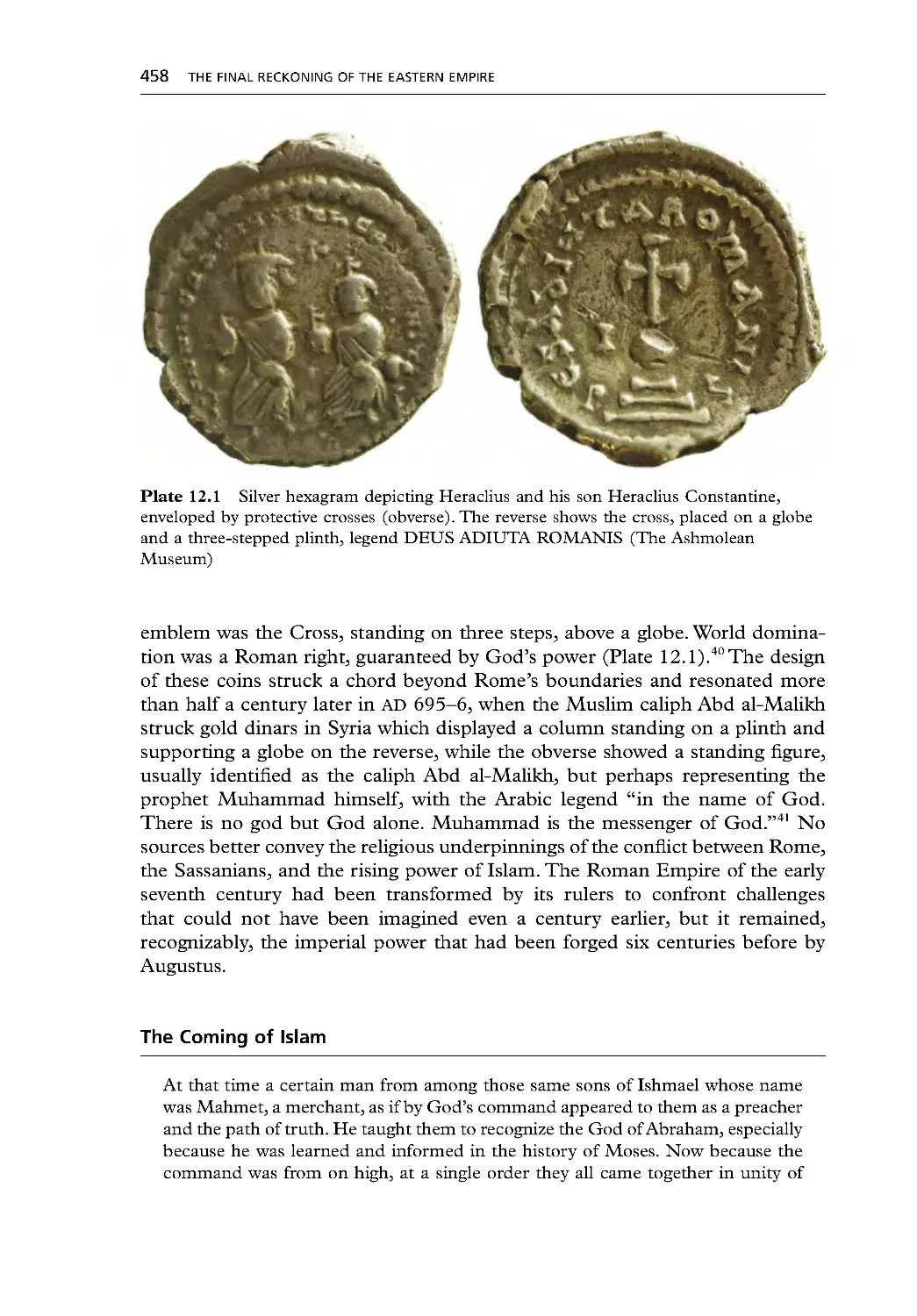

























Текст
                    Praise for A History of the Later Roman Empire, AD 284–641,
Second Edition
“A provocative and highly readable synthesis of the most important period of
transition and transformation in the history of the western world.” Ralph W.
Mathisen, University of Illinois at Urbana-Champaign
“Stephen Mitchell provides an exceptionally clear and detailed account both of
the march of events and of the structures of the Empire. His discussions of
major problems are both balanced and forceful, not shrinking from indicating
what his preferred solutions are. The book is a model exposition of a complex
subject.” Fergus Millar, Oxford
“Mitchell deploys his comprehensive knowledge of the sources to construct
a veritable fortress of erudition. This updated second edition stands up to
all contenders as the most solid introduction to the later Roman Empire.”
Noel Lenski, University of Colorado at Boulder
“S. Mitchell’s second edition provides a lucid and informed reading of the
period. The inclusion of recent advances in archaeology is most necessary for
understanding the changes that took place over these centuries, and the new
inal chapter is a welcome overview of the perennial debate over the decline
and fall of the Roman Empire. It serves as a wonderful introduction to the
complexities of this period.” Michele Renee Salzman, University of California,
Riverside

Blackwell History of the Ancient World
This series provides a new narrative history of the ancient world, from the
beginnings of civilization in the ancient Near East and Egypt to the fall of
Constantinople. Written by exper ts in their ields, the books in the series offer
authoritative accessible sur veys for students and general readers alike.
Published
A History of the Hellenistic World
R. Malcolm Er rington
A History of the Ancient Near East, second edition
Marc Van De Mieroop
A History of the Classical Greek World, second edition
P. J. Rhodes
A History of the Later Roman Empire, AD 284–621
Stephen Mitchell
A History of Byzantium, second edition
Timothy E. Gregor y
A History of Ancient Egypt
Marc Van De Mieroop
A History of the Archaic Greek World, second edition
Jonathan M. Hall
A History of Greece, ca. 1300 to 30 BC
Victor Parker
In Preparation
A History of the Roman Republic
John Rich
A History of the Roman Empire
Michael Peachin
A History of Babylon, 2200 BC–AD 75
Paul-Alain Beaulieu
A History of the Achaemenid Persian Empire
Maria Brosius
A History of the Ancient Near East, third edition
Marc Van De Mieroop

A History of the Later
Roman Empire,
AD 284–641
Second Edition
Stephen Mitchell

This second edition irst published 2015
© 2015 John Wiley & Sons, Inc.
Edition history: Blackwell Publishing Ltd (1e, 2007)
Registered Ofice
John Wiley & Sons Ltd, The Atrium, Southern Gate, Chichester, West Sussex, PO19 8SQ, UK
Editorial Ofices
350 Main Street, Malden, MA 02148-5020, USA
9600 Garsington Road, Oxford, OX4 2DQ, UK
The Atrium, Southern Gate, Chichester, West Sussex, PO19 8SQ, UK
For details of our global editorial ofices, for customer services, and for information about how
to apply for permission to reuse the copyright material in this book please see our website at
www.wiley.com/wiley-blackwell.
The right of Stephen Mitchell to be identiied as the author of this work has been asserted in
accordance with the UK Copyright, Designs and Patents Act 1988.
All rights reserved. No part of this publication may be reproduced, stored in a retrieval system, or
transmitted, in any form or by any means, electronic, mechanical, photocopying, recording or
otherwise, except as per mitted by the UK Copyright, Designs and Patents Act 1988, without the
prior per mission of the publisher.
Wiley also publishes its books in a variety of electronic formats. Some content that appears in print
may not be available in electronic books.
Designations used by companies to distinguish their products are often claimed as trademarks. All
brand names and product names used in this book are trade names, service marks, trademarks or
registered trademarks of their respective owners. The publisher is not associated with any product
or vendor mentioned in this book.
Limit of Liability/Disclaimer of Warranty: While the publisher and author have used their best efforts
in preparing this book, they make no representations or warranties with respect to the accuracy or
completeness of the contents of this book and speciically disclaim any implied warranties of
merchantability or itness for a particular purpose. It is sold on the understanding that the publisher
is not engaged in rendering professional services and neither the publisher nor the author shall be
liable for damages arising herefrom. If professional advice or other expert assistance is required, the
services of a competent professional should be sought.
Library of Cong ress Cataloging-in-Publication Data
Mitchell, Stephen, 1948-
A history of the later Roman empire, AD 284–641 / Stephen Mitchell. – Second edition.
pages cm
Includes bibliographical references and index.
ISBN 978-1-118-31242 -1 (pbk.)
1. Rome–History–Empire, 284–476 . 2 . Rome–History–Germanic Invasions, 3rd–6th
centuries. 3. Byzantine Empire–History–To 527. 4. Europe–History–392 –814 . I . Title.
DG311.M66 2015
937'.09–dc23
2014011405
A catalogue record for this book is available from the British Library.
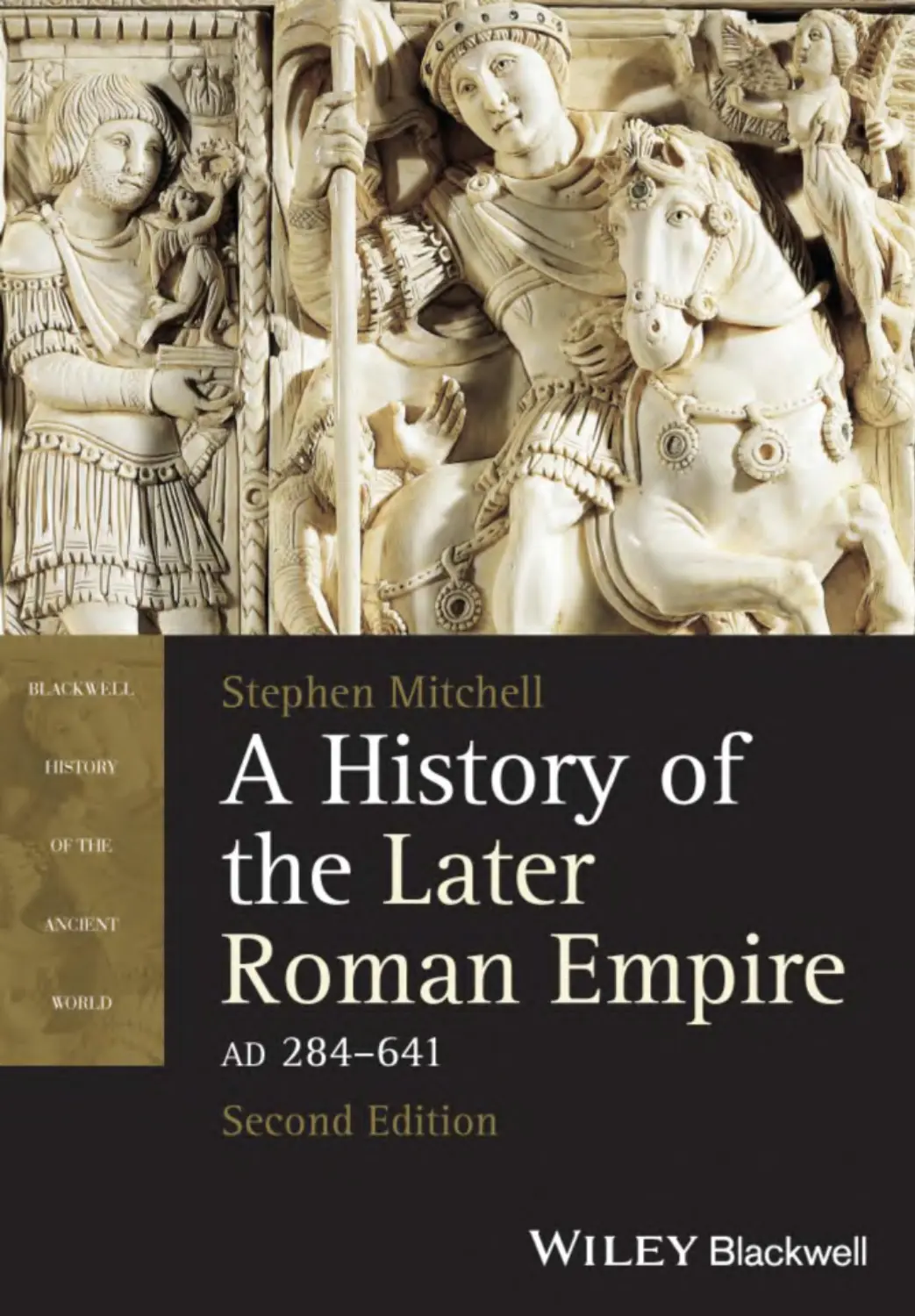
Cover image: Detail from the Barberini Diptych, ivory tablet with four relief decorated plaques,
Byzantine, ir st half of 6th century. De Agostini Picture Library / G. Dagli Orti / The Bridgeman Art
Library.
Set in 10.5/12.5 pt PlantinStd by Toppan Best-set Premedia Limited
1 2015

For Lawrence, Daniel, and Samuel Mitchell, and Polat Aydal,
students of science, law, histor y, and business,
shapers of an uncertain future

Contents
List of Illustrations
viii
List of Maps
x
List of Diagrams
xi
List of Abbreviations
xii
Preface to the First Edition
xv
Preface to the Second Edition
xviii
1 An Introduction to Late Roman History
1
2 The Nature of the Evidence
15
3 The Roman Empire from Diocletian to Alaric
51
4 The Roman Empire of the Fifth and Sixth Centuries
108
5 The Roman State
165
6 The Barbarian Kingdoms
206
7 From Pagan to Christian
242
8 Conversion to Christianity and the Politics of Religious Identity
277
9 The Political Economy of the Later Roman Empire
325
10 Society and Economy in the Mediterranean and the Near East
355
11 The Challenges of the Later Sixth Centur y
408
12 The Final Reckoning of the Eastern Empire
441
13 The Fall of the Roman Empire
466
Bibliog raphy
497
Chronological List of Emperors and Other Rulers
522
Index
524

Illustrations
2.1 The Price Edict of Diocletian
42
2.2 Statue fragments of Constantine at Rome
44
3.1 The four rulers of the irst tetrarchy
61
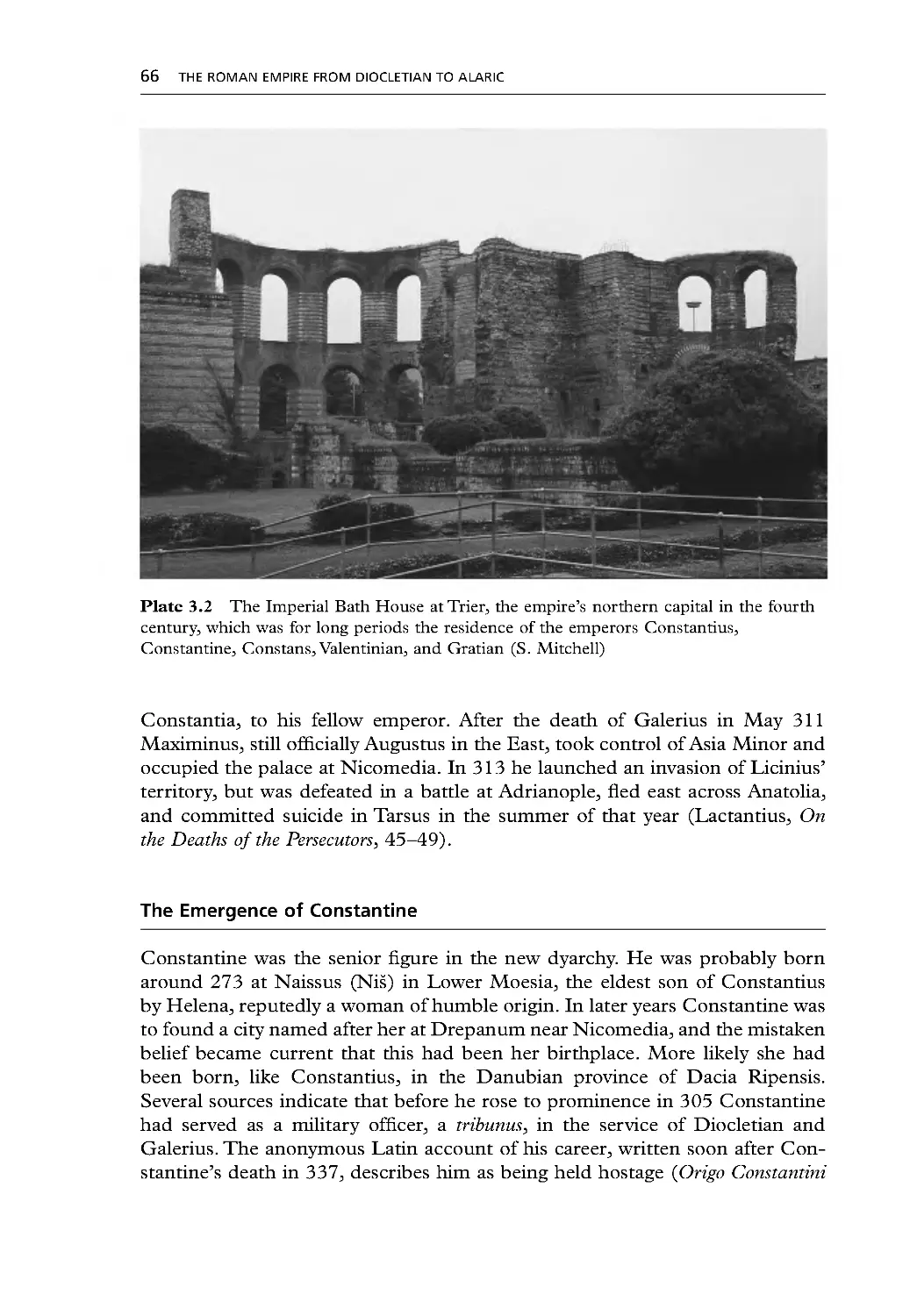
3.2 The Imperial Bath House at Trier
66
3.3 The Death of Julian
83
3.4 The Theodosian base at Constantinople
92
3.5 Ivory diptych of Stilicho, Serena, and Eucherius
97
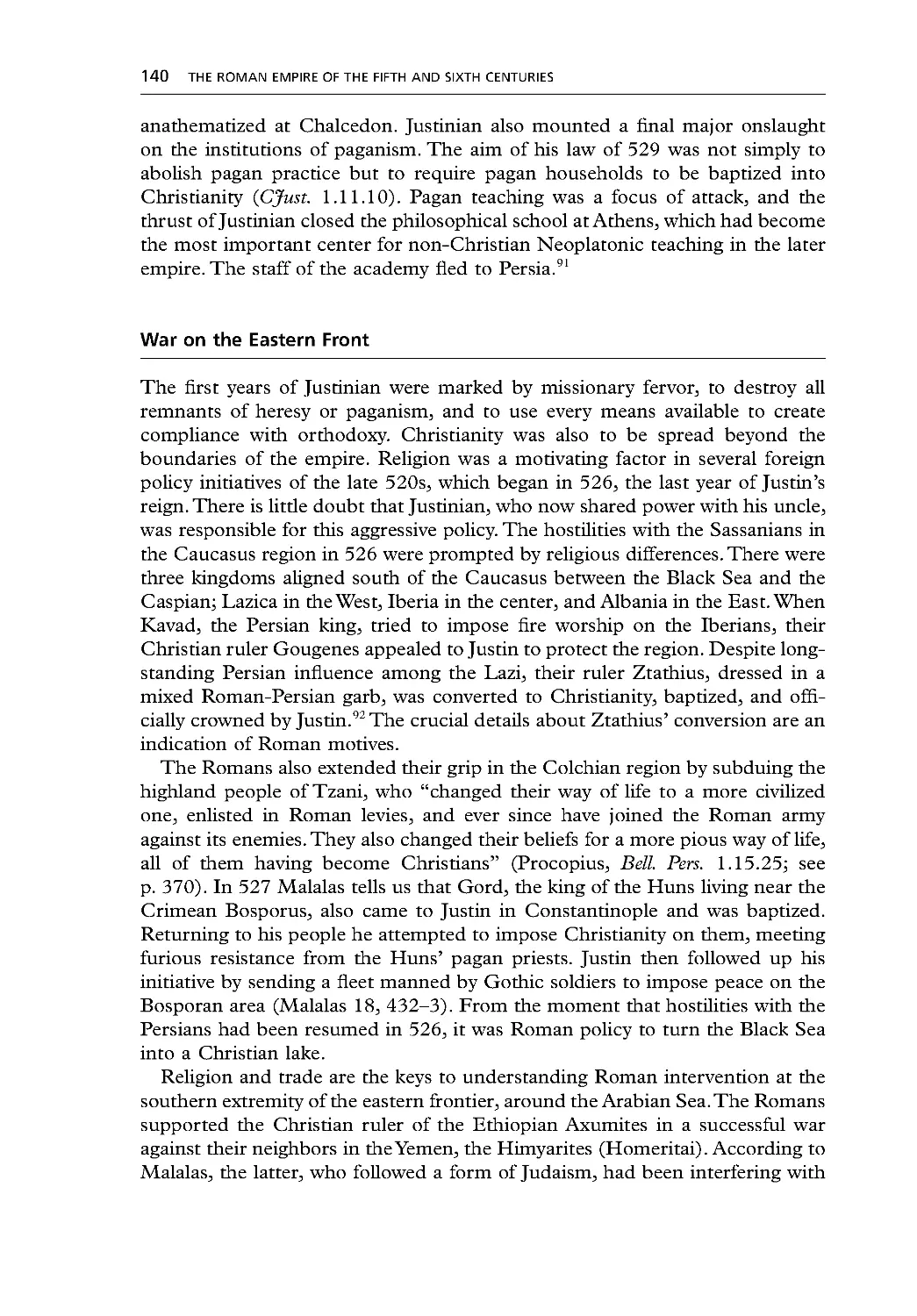
4.1 Porphyrius the charioteer
144
4.2 Church of St Sophia
148
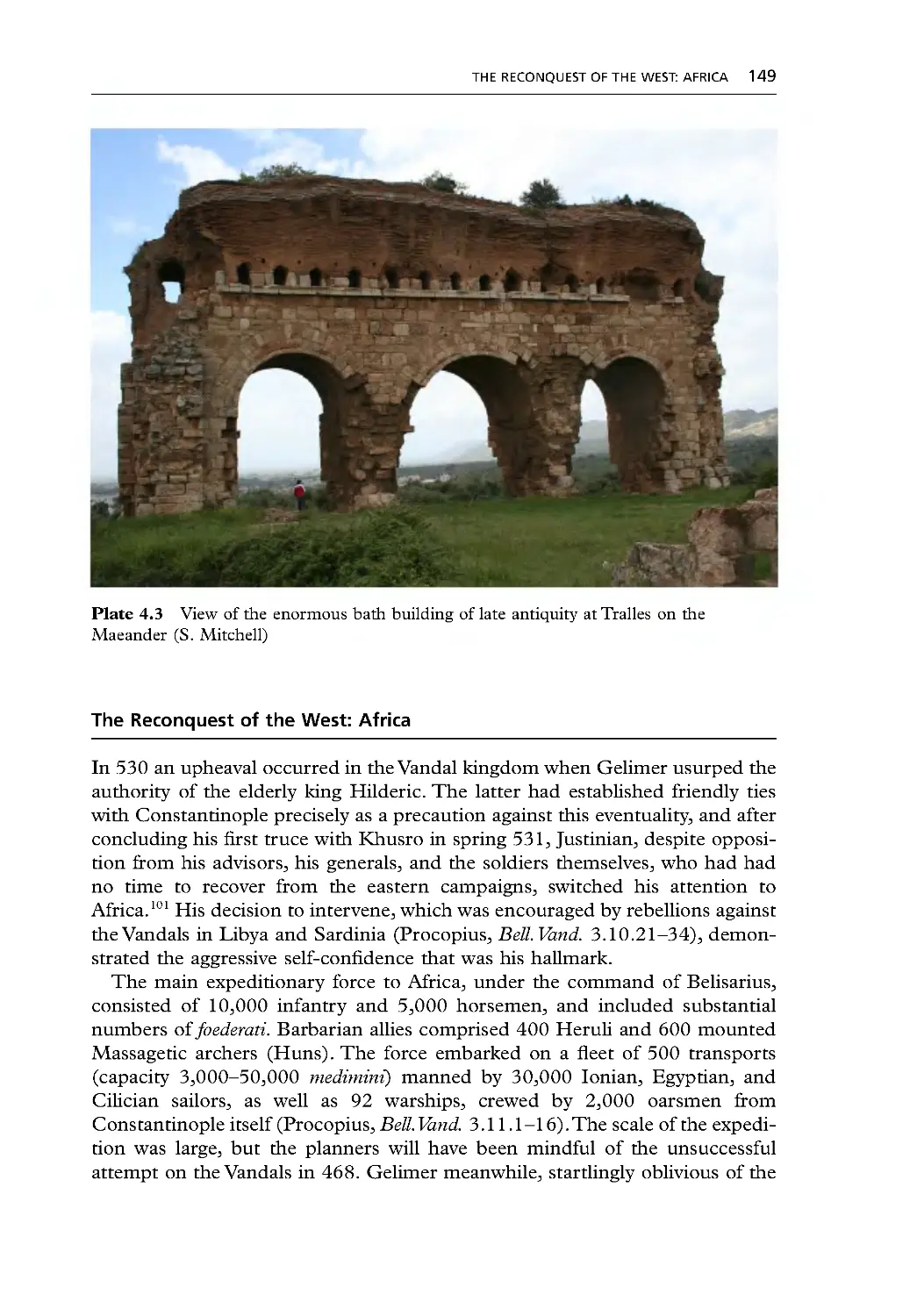
4.3 Bath building at Tralles on the Maeander (“Üçgözler”)
149
5.1 The Arch of Constantine
169
5.2 The Arch of Constantine (detail)
170
5.3 The obelisk of Theodosius I
171
5.4 The Theodosian base in the Hippodrome
172
5.5 The Barberini ivory
174
5.6 Church of S. Vitale, Ravenna
175
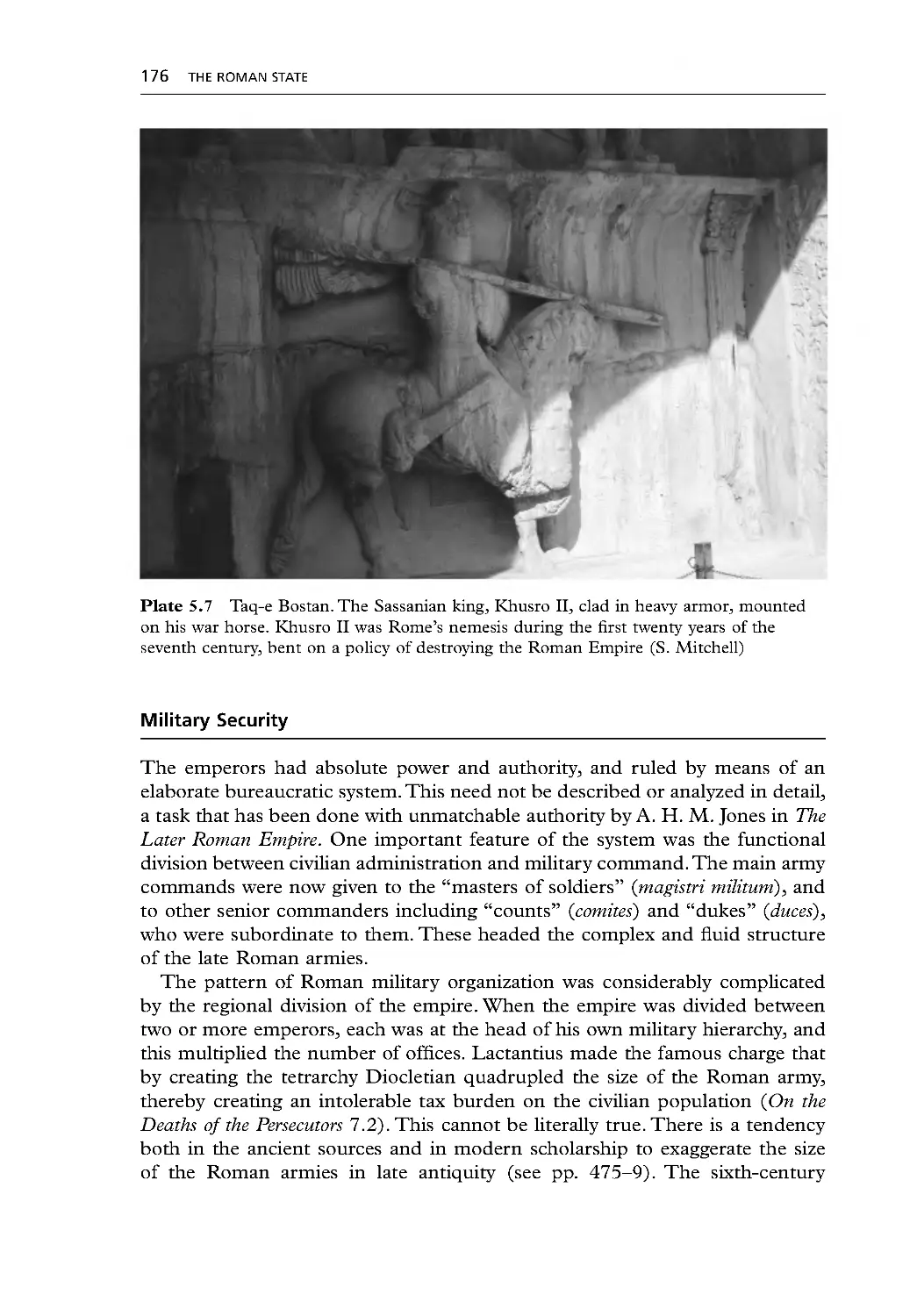
5.7 Khusro II at Taq-e Bostan
176
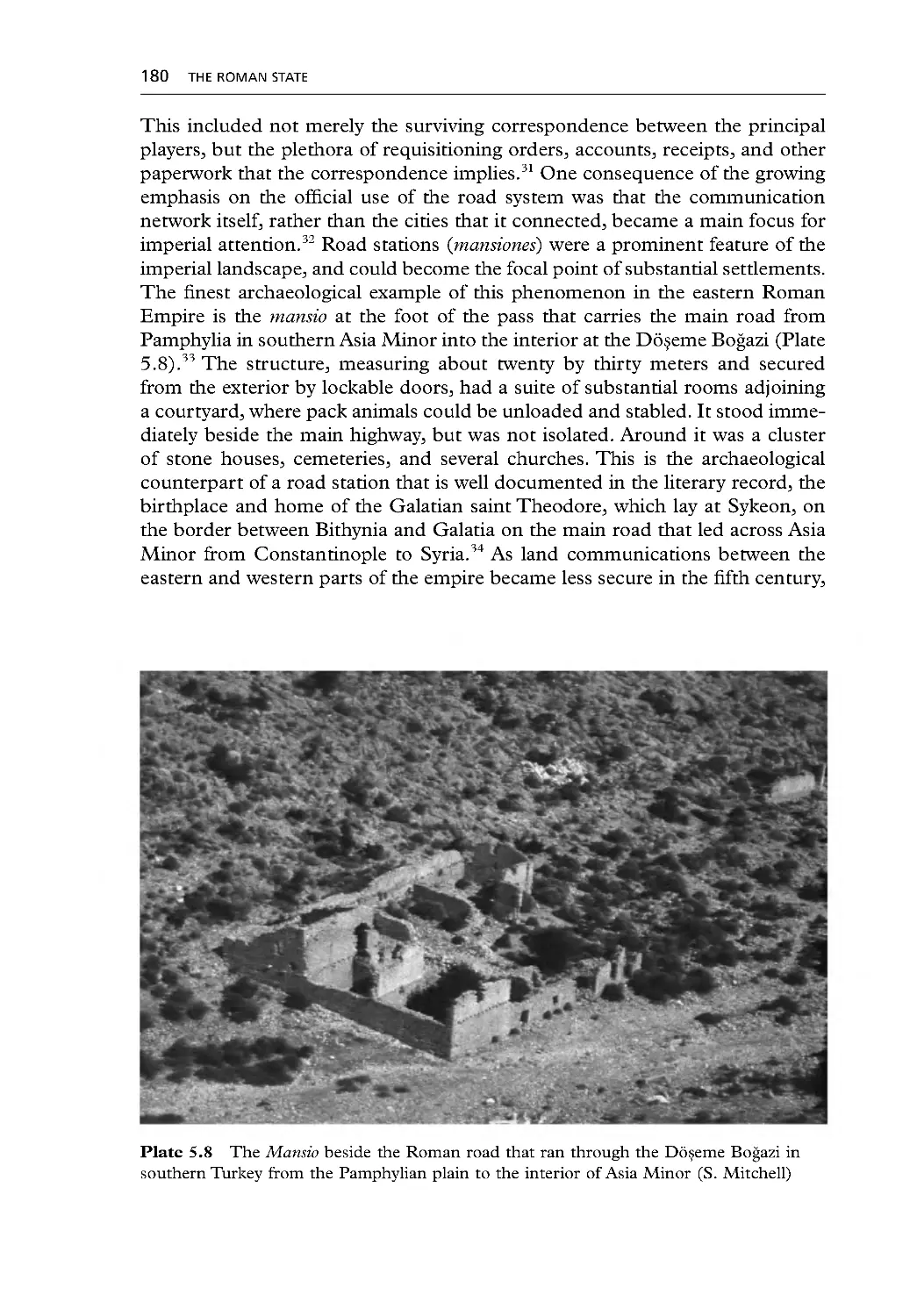
5.8 The Mansio at the Döşeme Boğazi in southern Turkey
180
5.9 Inscribed rescript of Justinian of 533
189

IllustratIons ix
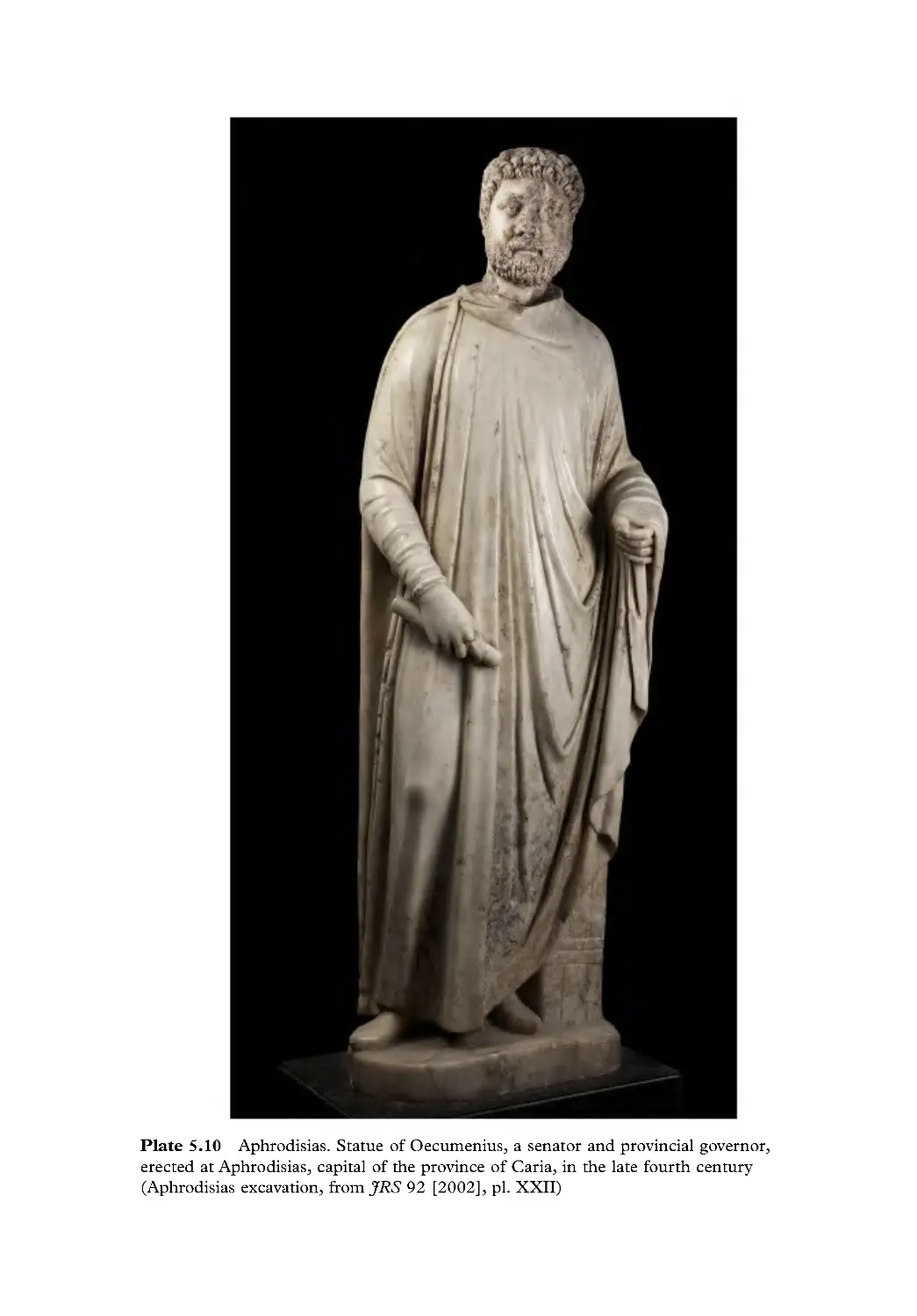
5.10 Statue of Oecumenius, erected at Aphrodisias
198
6.1 Mausoleum of Theoderic at Ravenna
236
7.1 Mosaic portrait of Ambrose, bishop of Milan, in the Basilica
Ambrosiana
266
8.1 Bronze coin of Constantine depicting the Labarum above
a serpent
281
8.2 Silver Medallion from Ticinum of AD 315
281
9.1 Arch of Constantine (Rome). Relief of Constantine
delivering a speech from the rostra in the forum
334
9.2 The Golden Gate at Constantinople
340
9.3 The Theodosian Walls of Constantinople
341
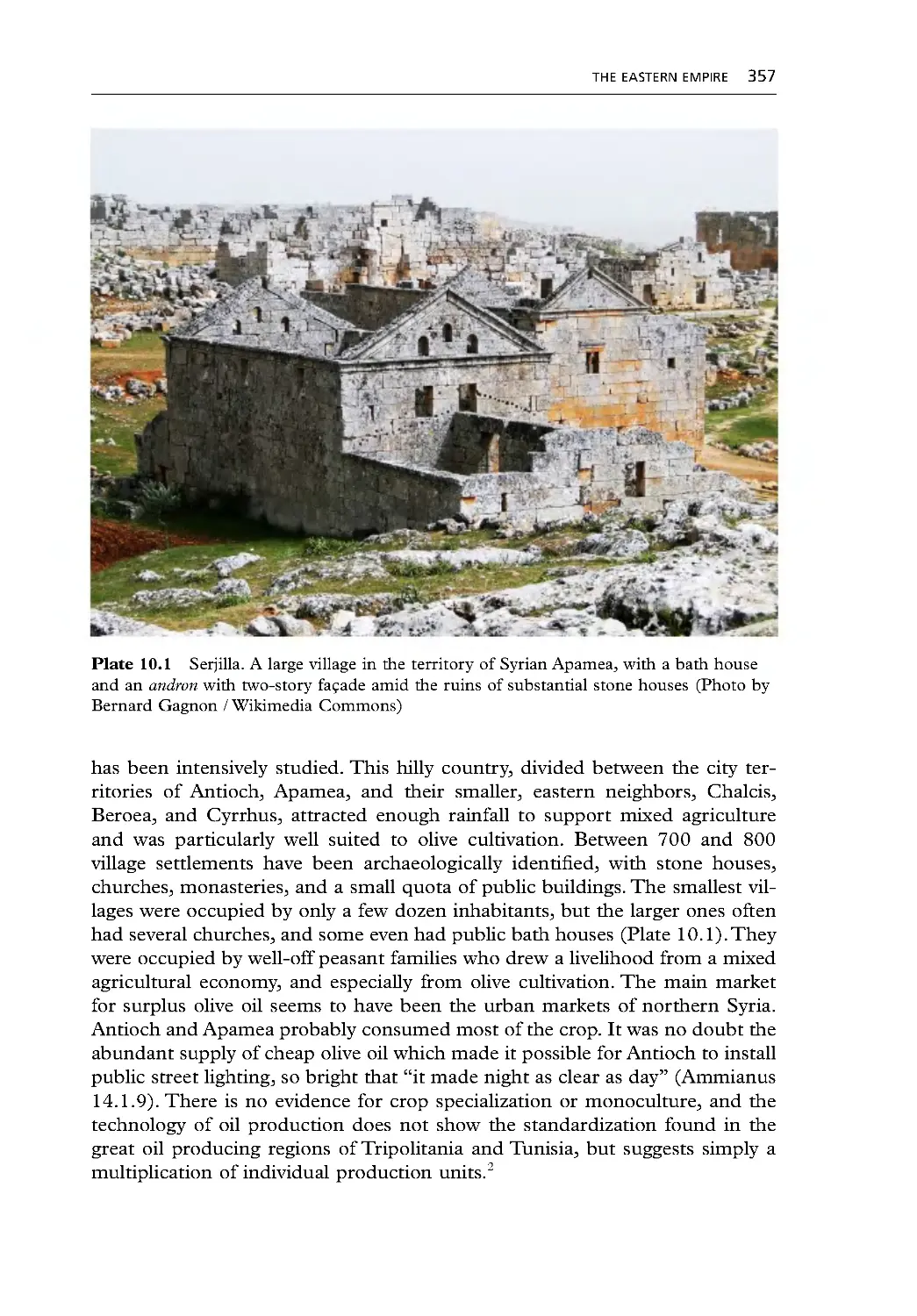
10.1 Serjilla. A late Roman village in north Syria
357
10.2 Scythopolis in Palestine
360
10.3 The fortiications of Dara in Mesopotamia
371
10.4 The Dominus Iulius Mosaic from Carthage
381
10.5 Trier. Basilica of Constantine
386
12.1 Silver hexagram of Heraclius
458

Maps
3.1 The empire of the tetrarchs c.300
54
3.2 Illyricum. The battleground of the empire
77
3.3 The administrative dioceses of the empire in 395
96
4.1 Map of barbarian settlement in the western empire in the
mid-ifth century
119
4.2 The Roman Empire and the barbarian kingdoms around 525
134
4.3 The Roman–Sassanian frontier in the sixth century
142
4.4 The new Mediterranean empire of Justinian
158
6.1 Map of barbarian kingdoms in the west c.500
231
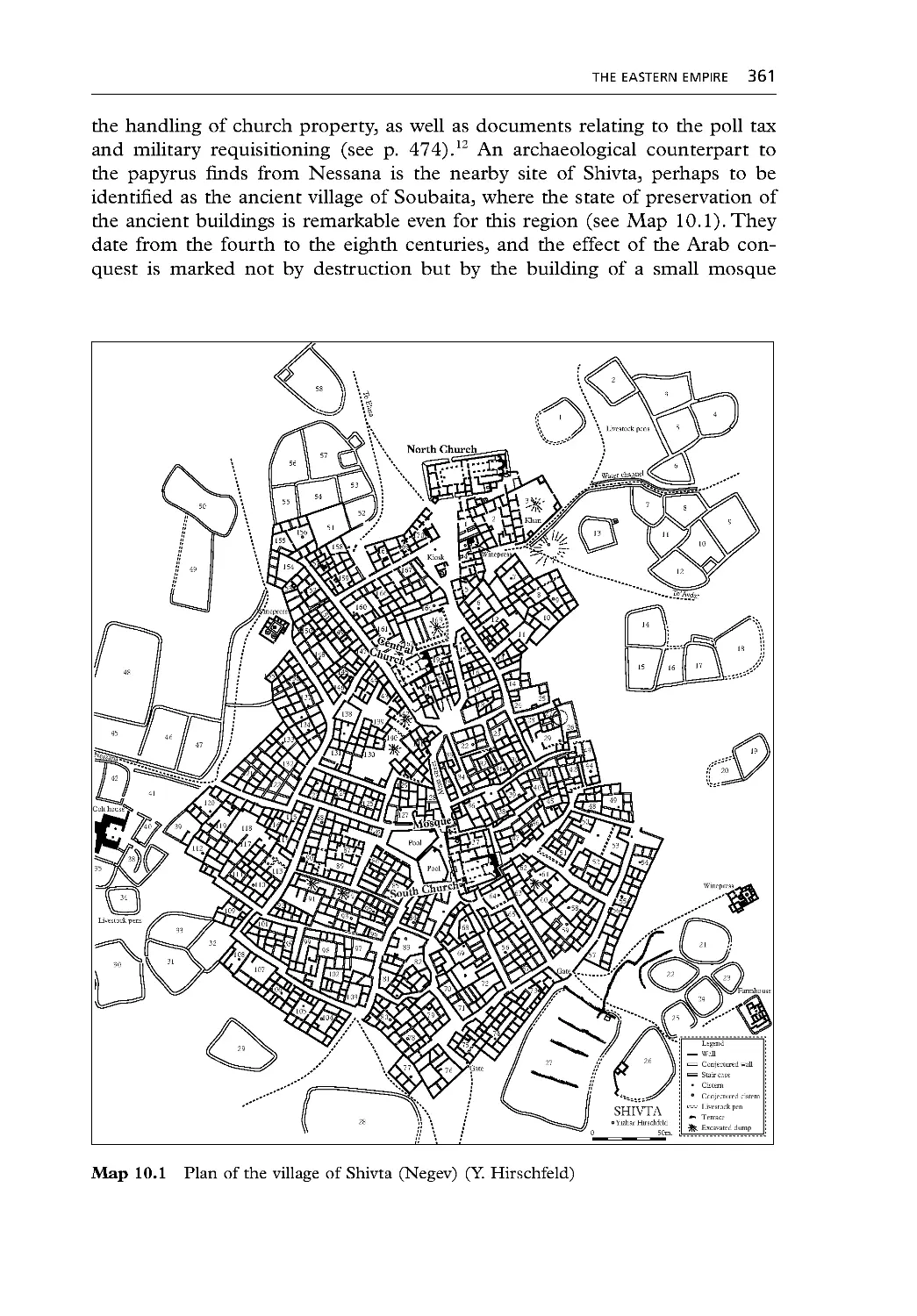
10.1 Plan of the village of Shivta (Negev)
361
11.1 The Roman Empire and the East in late antiquity
426
Maps 3.1, 3.3, 4.2, and 4.4 are adapted from Grosser Historischer Weltatlas I.
Vorgeschichte und Altertum (Munich, 1963), 40–3. Map 3.2 is based on N.
McLynn, Ambrose of Milan. Church and Court in a Christian Capital (Berkeley,
1994), 89. Map 4.3 is based on M. Meier, Justinian. Reich, Religion und Herrschaft
(Munich, 2004), endpaper. Map 10.1 is from Journal of Roman Archaeology 16
(2003), 398 ig. 3. Reprinted by permission of the Jour nal of Roman Archaeology.
Map 11.1 is based on G. Fowden, Empire to Commonwealth. Consequences of
Monotheism in Late Antiquity (Princeton, 1993), endpaper.

Diagrams
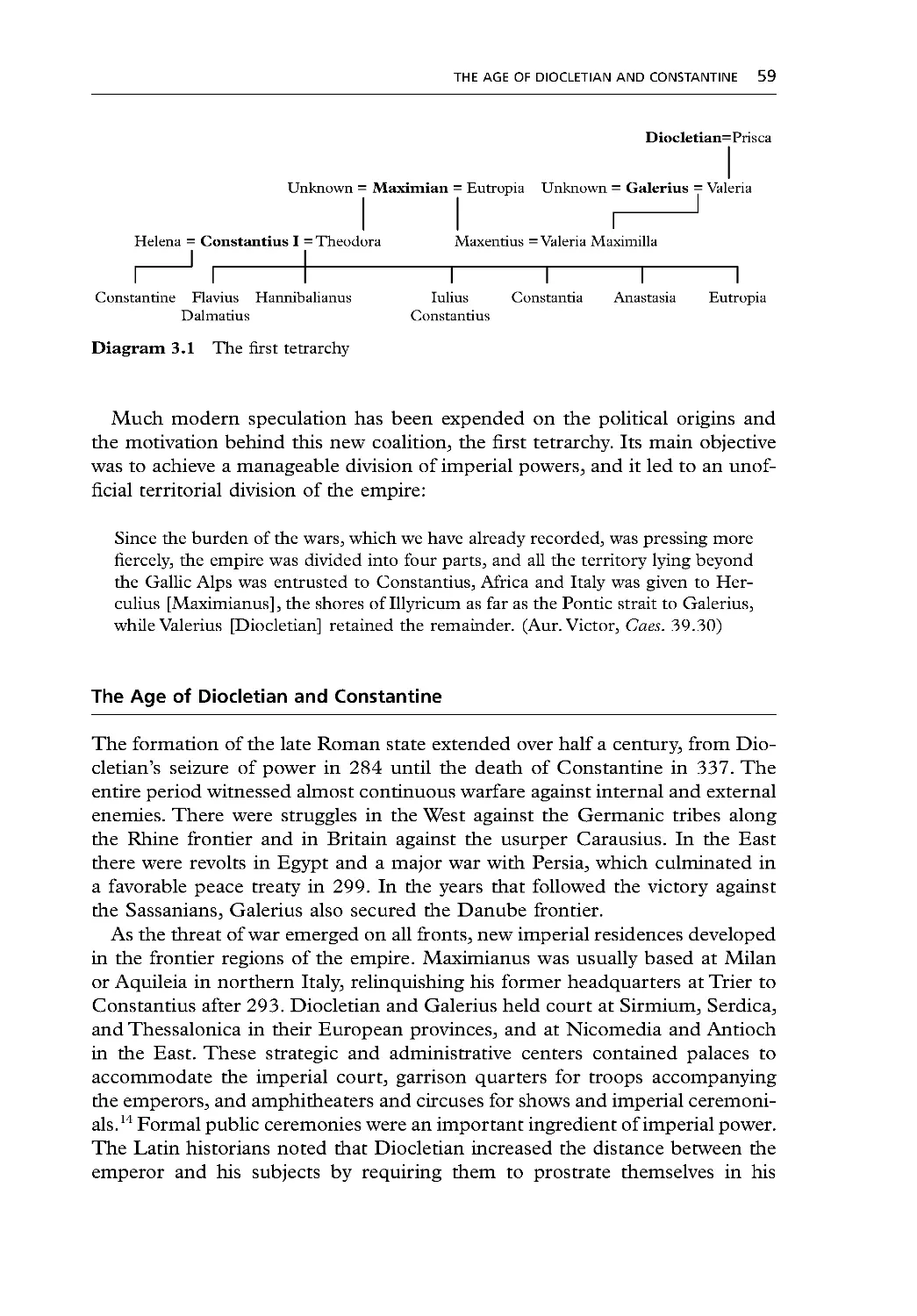
3.1 The irst tetrarchy
59
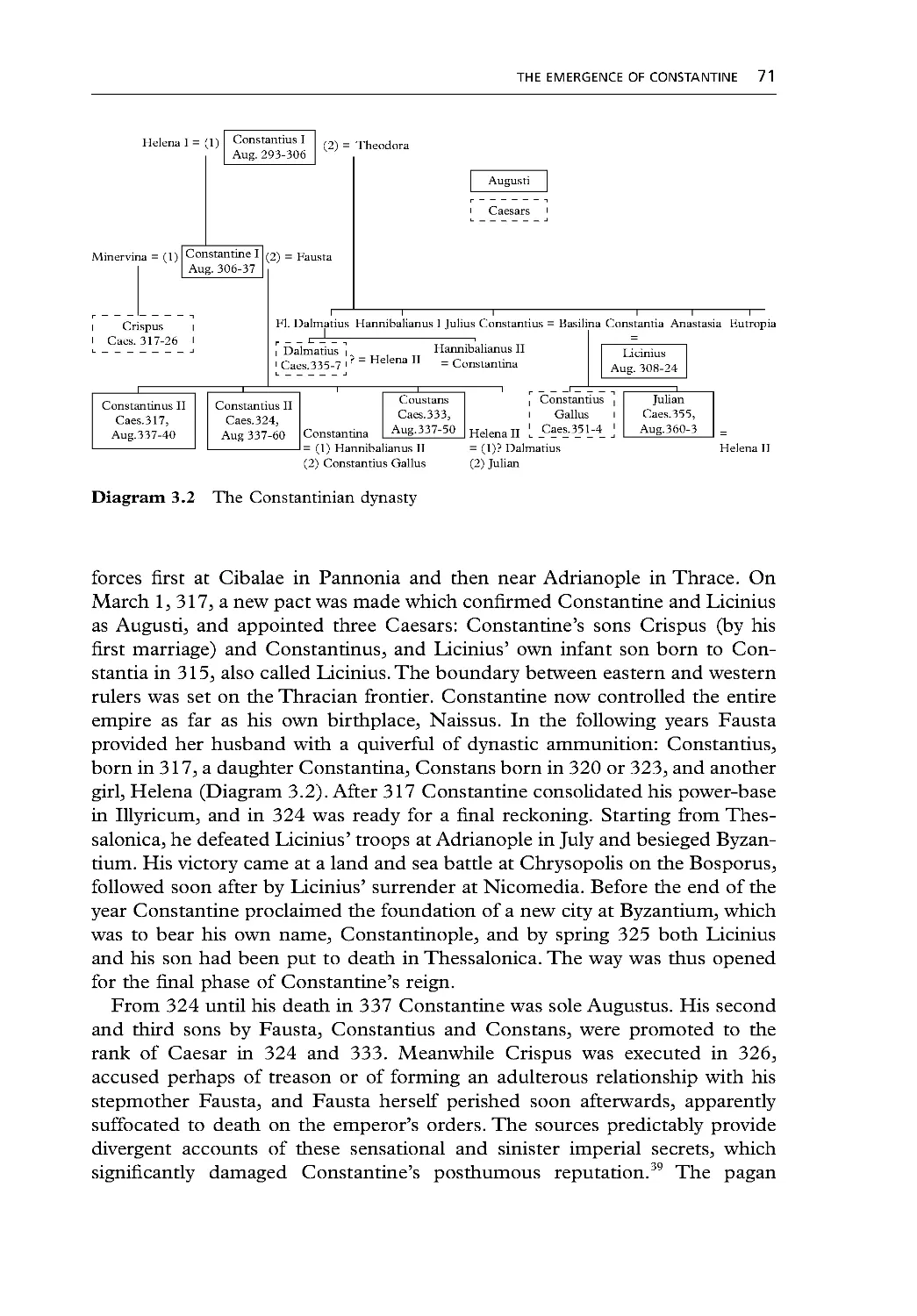
3.2 The Constantinian dynasty (from G. W. Bowersock, Julian the
Apostate [London, 1978], 35)
71
4.1 The Theodosian dynasty (from K. W. Holum, Theodosian
Empresses [Berkeley, 1982], 133)
112
5.1 The East Roman high command and the military structure
177
5.2 Praetorian prefectures, dioceses, and provinces under Justinian
(after R. Talbert [ed.], The Barrington Atlas of the Greek and
Roman World [Princeton, 2000], 102, and A. H. M. Jones,
The Later Roman Empire II, 1456–61)
186
5.3 The organization of civilian government at Constantinople
(after D. Feissel, in C. Morrisson [ed.], Le monde byzantin I
[2004], 79–110)
187
5.4 The social hierarchy of the Roman Empire in the third and
fourth centuries (from A. Demandt, Die Spätantike
[Berlin, 1989], 505)
195

Abbreviations
REFERENCE WORKS AND JOURNALS
AJA
American Journal of Archaeology
Ant. Tard.
Antiquité Tardive
Byz. Zeitschr. Byzantinische Zeitschrift
CAH
Cambridge Ancient Histor y
CQ
Classical Quarterly
EHR
English Historical Review
GRBS
Greek, Roman and Byzantine Studies
HSCP
Harvard Studies in Classical Philology
JHS
Journal of Hellenic Studies
JRA
Journal of Roman Archaeology
JRS
Journal of Roman Studies
JTS
Journal of Theological Studies
PBA
Proceedings of the British Academy
PBSR
Papers of the British School at Rome
PCPS
Proceedings of the Cambridge Philological Society
REA
Revue des études anciennes
ZPE
Zeitschrift für Papyrologie und Epigraphik
ANCIENT AUTHORS, WORKS, AND DOCUMENTS
(DETAILS OF TRANSLATIONS CAN BE FOUND IN THE BIBLIOGRAPHY)
HE = Historia Ecclesiastica (Ecclesiastical Histor y)
AÉ
L’Année épigraphique, published in Revue
Archéologique and separately. 1888–

AbbreviAtions xiii
Anon. Val.
Anonymus Valesianus
Anth. Pal.
Anthologia Palatina
Aur. Victor, Caes.
Aurelius Victor, de Caesaribus (On the
Emperors)
Cassiodorus, Var.
Cassiodorus, Variae
Chron. Gall.
Chronica Gallica (Chronicles of Gaul)
Chron. Min.
Chronica Minora (Monumenta Germanicae
Historiae)
Chron. Pasch.
Chronicon Paschale (Easter Chronicle)
CIL
Corpus Inscriptionum Latinar um. 1863–
CJust.
Codex Iustinianus (Code of Justinian)
Claudian, de bello Gothico
On the Gothic War
Claudian, In Eutrop.
Claudian, In Eutropium (Against Eutropius)
Constantine
Constantine Porphyrogennitos,
Porphyrogennitos, De Caer.
De Caerimoniis (On Ceremonies)
CTh.
Codex Theodosianus (Code of Theodosius II)
De Caer.
Constantine Porphyrogennitos, De Caerimoniis
(On Ceremonies)
Epiphanius, Pan.
Epiphanius, Panarion (Medicine Chest Against
Heresies)
Eusebius, VC
Eusebius, Vita Constantini (Life of
Constantine)
Eutropius, Brev.
Eutropius, Breviarium (Abbreviated History of
Rome)
Festus, Brev.
Festus, Breviarium (Abbreviated Histor y of
Rome)
FHG
C. Müller. Fragmenta Historicorum Graecor um.
1841–70
Greg. Tur., Hist.
Gregory of Tours, Historiae (Histor y of the
Franks)
Hieron. Chron.
Hieronymus (Jerome), Chronica
ILS
H. Dessau. Inscriptiones Latinae Selectae.
Berlin. 1892–1916
John Lydus, de mag.
John Lydus, de magistratibus (On Magistrates)
Jordanes, Get.
Jordanes, Getica (Getic [Gothic] History)
Julian, Caes.
Julian, Caesares (The Emperors)
Justinian, Nov.
Justinian, Novellae (New Laws)
Lactantius, DMP
de mortibus persecutorum (On the Deaths of the
Persecutors)
Libanius, Or.
Libanius, Oratio
MAMA
Monumenta Asia Minoris Antiqua
Marcellinus, Chron.
Marcellinus, Chronicle
Optatus, app.
Optatus, Against the Donatists, appendix of
documentar y evidence
Pan. Lat.
Panegyrici Latini (Latin Panegyrics)

xiv AbbreviAtions
Photius, Bibl. cod.
Photius, Bibliotheke codicum (Library of
Manuscript Books)
Procopius, Bell. Goth.
Procopius, Bella Gothica, Persica, Vandalica
(Pers., Vand.)
(Gothic [Persian,Vandal] Wars)
Ps-Joshua, Chron.
Pseudo-Joshua, Chronicle (The Chronicle of
Ps-Joshua the Stylite)
SEG
Supplementum Epigraphicum Graecum
SHA [Carus]
Scriptores Historiae Augustae (Vita Cari [Life
of Carus])
Sidonius, Carm.
Sidonius Apollinarius, Carmina (poems)
Sulpicius Severus, Martin
Sulpicius Severus, Life of Martin
Symmachus Rel.
Symmachus, Relationes
Theophanes, Chron.
Theophanes, Chronog raphia

Preface to the
First Edition
There have been many historical accounts of the later Roman Empire. Edward
Gibbon’s The Decline and Fall of the Roman Empire has stimulated rather than
deterred a host of followers, although none has matched the scale and eloquence
of that masterpiece. My attempt to ind a way through the immense complexi-
ties and sheer bulk of the evidence has been guided by four principles. Firstly,
my aim throughout has been to focus on the evolution of the Roman Empire
from the late third to the early seventh centuries. This book is therefore written,
for the most part, from a top-down perspective. In this respect it is much closer
to the tradition of scholarship that extends from Gibbon to A. H . M. Jones than
to the revolutionary approach to the study of late antiquity, which has been
created, with captivating effect, by Peter Brown and his many followers, espe-
cially since the publication of Jones’ The Later Roman Empire in 1964. However,
this work on late antiquity has changed our perceptions of the later Roman
Empire ineradicably, and to a large extent supplanted the paradigm of decline
and fall, established by Gibbon, that had set a conscious or unconscious frame-
work of interpretation for historians of the nineteenth and twentieth centuries
studying this period. Approaching the period from a background of study in
the Hellenistic world and the early Roman Empire, I have attempted, as my
second principle, to explain historical developments as transformations in
response to circumstances, rather than to interpret them for signs of decadence
and collapse.
The third of my primary aims in writing this book has been to create as
precise a picture as I could of major events and historical processes. This has
meant including a good deal of detailed information about dates and geogra-
phy, to ix those events in time and place. There is a greater emphasis on a
historical narrative than has been the case with most recent studies of the

xvi PrEFacE to thE First Edition
period. I have been sparing in developing lengthy and complex explanations
of cultural developments and have preferred, as a fourth principle, to let the
primary evidence and contemporary witnesses speak for themselves. The
numerous quotations from the primary source material, principally from con-
temporary observers, are included precisely for this purpose. My greatest debt
in this respect has been to the small army of scholars, in particular in recent
years, who have produced scholarly translations of the literature of late antiq-
uity. These translations, particularly in the series of Liverpool Translated Texts
and those from Oxford University Press, contain much of the inest scholarly
work on the period, and have made it immeasurably easier to write works of
histor y such as this one. At the same time as trying to do justice to the primary
source material, I have aimed to absorb as much as possible of the secondary
literature. Much superb work in ancient history has been written about the
later Roman period. I have drawn on this bibliography for ideas and informa-
tion with grateful enthusiasm, and incorporated as much as I could into my
notes and bibliographies.
There are speciic debts to acknowledge. I am grateful to the University of
Exeter, which granted me a year of study leave in 2003/4 during which most
of the book was written. Several of the illustrations have been provided by
courtesy of the German Archaeological Institute’s branches in Berlin, Istanbul,
and Rome, with the particular assistance of Dr Richard Posamentir (Istanbul)
and Dr Michael Wörrle, as well as my own colleague Professor Barbara Borg.
Fergus Millar has encouraged me by advice and example, and channeled a
stream of insights emerging from his own work on the Roman Empire of the
ifth centur y. I have beneited from many obser vations from Wolf Liebeschuetz.
Mark Whittow provided invaluable guidance on recent archaeological litera-
ture, and Geoffrey Greatrex was an inspirational tutor on Procopius. Al Ber-
trand commissioned the volume for the Blackwell series in May 2002. I should
also like to thank the team that has turned my manuscript into a inished
book: Angela Cohen and Louise Spencely (editorial), and Bill MacKeith
(index). As I was working on the inal chapter I came across a passage from
the great Persian Book of Kings by the epic poet Ferdowsi, which seemed curi-
ously apt to the relationship of editor and author.
At Shushtar there was a river so wide that even the ish could not traverse it,
and the Sassanian king said to the Roman emperor Valerian, “If you are an
engineer, you will build me a bridge as continuous as a cable, such a one as will
remain everlastingly in position as a pattern to the wise when we have turned to
dust. The length of this bridge, reckoned in cubits, shall be one thousand; you
may demand from my treasury all that is required. In this land and region apply
all the science of the philosophers of Rum, and when the bridge is completed, you
may depart to your home or else remain my guest as long as you live.” In gallant
fashion the emperor undertook the task and brought the bridge to completion in
three years. (Ferdowsi, Shahnameh, abbreviated translation by R. Levy, London
1967, 143)

PrEFacE to thE First Edition xvii
Three years later, having completed a survey of the history of Rum, not a thou-
sand cubits but 357 years long from the accession of Diocletian to the death
of Heraclius, I shall be glad, like Valerian, to accept the offered respite from a
task that has been as satisfying as it has been demanding.
Stephen Mitchell
Exeter, April 2006

Preface to the
Second Edition
The main incentive to prepare an enlarged new edition of this book has come
from the abundance of new research and major publications on later Roman
and early medieval histor y since 2005 which have directly or indirectly thrown
light on the histor y of the later Roman Empire. Much of this work, in particular
that of Chris Wickham, has been crucially important for restating questions
about the decline of the empire and the historical transition to a post-Roman
world in Europe and in the Middle East. Within the limits available to me I
have tried to address these questions, especially in the new chapter, 13, which
deals with questions of tax and the state economy, Rome’s declining military
capability, and the evidence for demographic collapse after the mid-sixth century
resulting from repeated outbreaks of bubonic plague. In other sections of the
book I have substantially modiied the sections dealing with Constantine (chap-
ters 3 and 8) and the Roman state (chapter 5), and enlarged the treatments of
Asia Minor and Egypt in chapter 10. Many smaller corrections and additions
have been made elsewhere. The bibliography has been updated and the publish-
ers have allowed me to add several new illustrations to the selection provided
in the irst edition.
Many sections of this book deal with the Near East in late antiquity. Most of
the work on the revised second edition was done against a horrifying backdrop
of anarchy, violence, and civil war unfolding across the entire Arab Middle East,
from Libya and Egypt to Syria and Iraq. It is impossible to contemplate the
conlicts that engulfed this region in late antiquity without also calling to mind
the bloodshed, political turmoil, and human misery of the present day.
In preparing this edition I owe thanks to many people. Six anonymous users
of the irst edition provided reports to the publishers and made many valuable
suggestions for improvements. Wiley’s own team, steered by commissioning
editor Haze Humbert, has been as eficient and supportive as the Blackwell
group that brought the irst edition into print: Ben Thatcher and his successor

PrEfacE to thE SEcond Edition xix
Allison Kostka (project editors), Ashley McPhee (cover), and Morgan Dale
(translation rights). Emma Brown (picture research and permissions) and Giles
Flitney (project manager) have put in many hours of detailed work on the
illustrations and the text respectively, and I hope that readers will be as grateful
for their skill and commitment as I am. For obtaining new illustrations and
permissions to use them I am personally grateful to Professor Kay Ehling
and Nicolai Kästner (Staatliche Münzsammlung, Munich), Dr Julian Baker
(Ashmolean Museum, Oxford), and Nihat Erdoğan (Mardin Museum) for their
prompt and unbureaucratic assistance. My former student Professor Turhan
Kaçar (Pamukkale University) has suggested many detailed corrections while
preparing a Turkish translation of the revised version, and has been a constant
source of support and encouragement.
Stephen Mitchell
Shefield, October 2013

1
An Introduction to
Late Roman History
250
300
350
400
450
500
550
600 650
The evolution of the classical world in late antiquity
The later Roman Empire or late antiquity?
Change and development in late antiquity
Summary of this book
This book is concerned with the inal three and a half centuries of classical
antiquity. This lengthy period in the history of the ancient world was character-
ized by profound transformations in its character, and led to the emergence in
the west of medieval European civilization, and, in the east, of a world domi-
nated by a new religion, Islam.
The ancient classical world was formed from the interlocked civilizations of
the Greeks and the Romans. Greek culture was based on a closely integrated
community of city-states, which irst took shape in the Aegean region around
1000 BC. These city-states, called poleis, evolved a style of self-government that
was designed to preserve and promote their collective and community interests,
which we still designate by the word politics. Over a period of some 1,500 years,
these small- and medium-scale communities explored and developed amid
myriad variations a pattern of social organization and collective action which
A History of the Later Roman Empire, AD 284–641, Second Edition. Stephen Mitchell.
© 2015 John Wiley & Sons, Inc. Published 2015 by John Wiley & Sons, Inc.

2 AN INTRODUCTION TO LATE ROMAN HISTORY
has inspired all western democracies today. Although Greek city-states were a
highly localized form of political organization, each making its own political
decisions, they were bound together by strong cultural and social ties. Except
to a very limited degree, the homogeneity and unity of the Greeks was not based
on ethnicity, however that be deined, but on a shared language and a common
religious outlook. While individual city-states aspired to run their own business
and restricted membership to their own citizens, there were virtually no
limits to the spread of Greek culture, which proved overwhelmingly attractive
to the other peoples of the Mediterranean and the Near East. The outcome
was a process which we call Hellenism. Innumerable communities beyond the
core region of the Aegean adopted the language, religious notions, and political
ideas of the Greeks. They thus created the foundations of a common culture
whose features could be identiied among peoples extending from Spain to
Afghanistan.
As this culture spread more widely, especially in the eastern Mediterranean
and the Near East, it adapted to other forms of political organization, in par-
ticular the creation of large territorial kingdoms and empires. The emergence
of such large scale territorial political units had been an eastern development,
exempliied by the ancient civilizations of Egypt, Mesopotamia, and, especially
during the seventh to fourth centuries BC, which were a critical period for the
histor y of the Greek city-states, of Persia. This model of the large hegemonic
empire was fused with the Greek city-state system after the fall of the Persian
Empire to Alexander the Great between 334 and 323 BC. During the following
three hundred years most of the east Mediterranean and the Near East was
controlled by the Graeco-Macedonian kingdoms that succeeded Alexander.
Increasing numbers of the inhabitants of these regions began to use the Greek
language, modiied their religious beliefs and institutions in conformity with
Greek models, and adopted the city-state as the basis for local community poli-
tics. The whole era is consequently known as the Hellenistic period.
From the third century BC the Romans exercised a fundamental and dramatic
inluence on the Hellenistic world. Rome itself was in origin a city-state, which
broadly resembled the Greek political pattern. However, like the other city-
states of central Italy it belonged to a different cultural tradition, with its own
language and religious system. During the fourth and third centuries BC Rome
succeeded in conquering much of Italy. The growth of Roman power led in the
third century BC to a hegemonic clash with Carthage, the other major power
of the western Mediterranean, which resulted in Roman dominion extending
beyond the Italian peninsula to Spain, north Africa, and Sicily. After the defeat
of Hannibal, the Carthaginian leader, Rome became embroiled in the affairs of
the east Mediterranean. Two further centuries of expansion and conquest
extended the limits of the Roman Empire to the river Euphrates during the irst
century AD.
Along this eastern frontier the Romans confronted Persian power in a new
guise: the successive empires of the Parthians and Sassanians, based in Lower
Mesopotamia and the Iranian plateau, which had regained control over the

AN INTRODUCTION TO LATE ROMAN HISTORY 3
eastern parts of the Hellenistic world. Throughout the remaining centuries of
antiquity the Roman and Persian empires faced each other across a line which
extended from the east end of the Black Sea to the Persian Gulf. Territory on
either side of this frontier was disputed between the opposed great powers, and
regularly became a theater for war and campaigning.
The Romans thus incorporated within their empire almost the entire Hellen-
ized world. They made no efforts to suppress or replace the system of city-states,
or Greek culture as a whole, but rather incorporated both of these into their
empire. The Romans were successful from the outset as conquerors, but more
important than this was their ability to evolve a style of imperial rule which was
sustained for almost a thousand years. One of the crucial strengths of the
Roman Empire was its capacity to incorporate newcomers and outsiders. Thus,
so far from being deined by ethnic or even broader cultural boundaries, the
Roman state was continually replenished and revitalized by new blood drawn
from its subject provinces. As early as 200 BC the granting of Roman citizenship
to outsiders was a recognized source of political resilience, and the strategy of
inclusivity was particularly critical when a succession of imperial dynasties,
which began with Augustus, took over from the earlier republican system of
government. Although the privileges of citizenship became less signiicant in
the late empire, the habit of absorbing new human resources from marginal
areas was ingrained, and was exempliied throughout late antiquity in the rela-
tionships between the Roman Empire and its barbarian neighbors. Moreover
regional differentiation within and between provinces was overridden by the
emergence of hierarchies throughout the empire that conformed to one another
and to a Roman archetype. Provincial societies, both in the eastern and in the
western empire, were highly stratiied, with a massive and growing gulf between
the rich and the poor. The richest property owners, who controlled most of the
empire’s resources, were those most closely aligned with the ideals and objec-
tives of the Roman state.
Equally important for the longevity of the Roman Empire was an evolving
mastery of the arts of hegemonic rule. In the initial phases of conquest there
was a greater emphasis on outright military power. This was achieved not simply
by the courage and commitment of citizen soldiers and by ambitious and tal-
ented military leaders, but by a much higher degree of military organization
than was achieved by other ancient states. After the creation of the monarchic
system by Augustus this experience and talent for organization was transferred
to the mechanisms which were devised for ruling provinces, assessing and col-
lecting taxation, and developing a universal legal system. The empire combined
Greek political ideas, including theories about just rulership, with a practical
attention, based on experience, to the crafts of administration.
The emperors also adapted techniques, which had been honed in the eastern
monarchies, for projecting an ideal image of the rulers, which embodied their
imperial might. These conveyed a fundamental message that the earthly empire
was sustained as part of an overall structure of cosmic order, and that harmony
and stability was guaranteed by a religious compact between the rulers of men

4 AN INTRODUCTION TO LATE ROMAN HISTORY
and the divine world. As the Roman polity developed into a worldwide empire
increasing emphasis was placed on the state religion. It was an article of faith
that Rome’s success was due to the support of the gods. Roman emperors were
seen as controlling all religious activity in their territories, and were regarded
as custodians of a pact with the gods, the pax deorum. This central feature of
the ideology of Roman rule was projected in all the available media of imperial
propaganda: panegyric speeches, the designs of buildings and sculptures, com -
memorative inscriptions, the legends and designs used on Roman coinage.
These structural features are clearly identiiable in the history of late antiq-
uity. Rome’s empire and the opposing eastern empire of the Sassanians in
Persia continued to be the dominant powers, and they set the framework
within which large scale interstate activity took place. Rome continued to
control her subjects by deploying organized military power, by employing the
sophisticated machinery of government and administration, and above all by
maintaining an ideology of empire that was rarely called into question. During
late antiquity, when the Roman world, and especially the Roman state, became
Christian, the substance and form of this ideology inevitably changed, but the
signiicance of religion in maintaining the Roman Empire increased. The city-
states of the earlier classical periods were still the most important settlements
and communities of most of the ancient world, especially in the eastern parts
of the Roman Empire, but they too underwent radical changes. They lost most
of their political independence and the right to self-determination. But they
remained for most people the most important fora of social, economic, and
religious activity and retained their overall importance within the wider scheme
of ancient civilization.
Historical circumstances brought about a major geo-political split between
the western and eastern parts of the Roman Empire. Between the fourth and
the seventh centuries, German-speaking tribes such as the Alemanni, Franks,
Vandals, and Goths, the Huns, Alans, and Avars, who had moved west from
central Asia, and the Slavs and Turks, broke through the old frontiers of the
Rhine and Danube rivers. As the northern boundary of the empire collapsed,
much of the Balkan region slipped from Roman control, and regular overland
communications between east and west were seriously threatened. While the
former eastern provinces of Asia Minor, the Near East, and Egypt remained
relatively unscathed, the western empire proved unable to defend itself militarily
from the barbarian newcomers. Accordingly, Rome devised new strategies of
accommodation, by which the barbarian peoples were integrated into the
western classical world. The major Germanic tribes divided up large parts of
Roman territory into kingdoms, although they continued in most cases to
acknowledge the sovereignty of the emperors. Roman militar y and political
weakness in the west thus led to the abandonment of the former Roman prov-
inces in Britain, Gaul, Spain, and the Danubian region. Even Italy itself
was relinquished after the fall of the last western emperor in 476. But the idea
of a uniied empire, including these territories, was never abandoned, and
during the sixth century the emperor Justinian made a partially successful

THE LATER ROMAN EMPIRE, LATE ANTIQUITY, AND THE CONTEMPORARY WORLD 5
attempt to reunite eastern and western territories under a revived system of
direct imperial rule.
The Roman state during this period was anything but weak and degenerate.
The empire was resilient and highly effective. Emperors, whatever their indi-
vidual qualities, generally had long reigns. Internal conlict and civil war between
rival contenders for power extended through the third and fourth centuries, but
the imperial system as such was not called into question. Remarkably, the same
situation can be obser ved both in Sassanian Persia, Rome’s eastern counterpart,
and in the major Germanic kingdoms which were established in north Africa
and western Europe. Their rulers too evolved ideological and administrative
systems which provided long periods of stability.
The Later Roman Empire, Late Antiquity, and the Contemporary World
Historical approaches to the inal centuries of classical antiquity have been
very varied. The differences between them are implicit in the various names
that have been applied to the period in modern scholarship: the later Roman
Empire; the early Byzantine Age, late antiquity. These variations reveal diver-
gent perspectives. Historians who have identiied their subject as the later
Roman Empire have generally focused their attention on the history of the
Roman state and its institutions, usually from an empire-wide perspective.
Studies of Byzantium or the Byzantine Age, whatever chronological limits are
adopted, necessarily deal with the eastern part of the empire, which was ruled
from Constantinople. Histories of the west naturally have a very different
emphasis, on the rise of the Germanic kingdoms and the origins of medieval
western Europe.
Late antiquity is at irst sight a less slanted term, embracing the entire geo-
graphical range of the Roman and post-Roman world. However, in practice,
the study of late antiquity has acquired much more speciic connotations. It has
mostly been concerned with the eastern Mediterranean region and the Near
East, concentrating on social, cultural, and religious themes, at the expense of
political or institutional history. Histories of late antiquity have looked beyond
the Roman state or the Roman Empire and drawn attention to other underlying
conditions which gave unity to the period. Inevitably they place most stress on
religious history, above all on the change from the polymorphous paganism of
the ancient classical world to the predominantly monotheistic systems of early
medieval Europe and the Near East: Judaism, Christianity, and Islam.
This change of focus also tends to involve displacing the chronological
boundaries of the period. While most studies of the later Roman Empire cover
the period from c.300–600, limits which are explicable principally in terms of
political developments, writing on late antiquity usually favors a longer span
from around 200 to 800, sometimes referred to as the “long late antiquity.” This
period covered two great religious transformations and their social conse-
quences: the conversion of the Roman world to Christianity and the emergence

6 AN INTRODUCTION TO LATE ROMAN HISTORY
and rapid spread of Islam in the Near East in the seventh and eighth centuries.
The educated classes of the Greek-speaking East and their less numerous
western counterparts also preserved large elements of the classical culture of
the Greco-Roman world. Students of late antiquity are as much concerned with
the sur vival of this culture as they are with the impact of Christian and Islamic
monotheism.
There are, therefore, radically different ways of approaching the last centuries
of antiquity. The greatest historian of the period, Gibbon, pre-empted the
choice for most of his successors by writing his Histor y of the Decline and Fall
of the Roman Empire. The famous title not only placed the Roman state in the
foreground of his study, but also set a historical agenda which has dominated
the thinking of most historians since his time. The challenge is to analyze and
explain Rome’s decline. The Roman Empire remains the central point of focus
for most major studies of the period written since Gibbon. This is explicitly
acknowledged in the titles of J. B. Bury, The Later Roman Empire from the
Death of Theodosius I to the Death of Justinian (395–565) (1923), E. Stein, Ges-
chichte des spätrömischen Reiches I (284–476) (1928) and Histoire du Bas-Empire
II. De la disparition de l’empire de l’ocident à la mort de Justinien (476–565) (1949),
and A. H. M. Jones, The Later Roman Empire 284–602. A Social, Economic and
Administrative Sur vey (1964). These major studies, together with A. Demandt,
Die Spätantike. Römische Geschichte von Diocletian bis Justinian 284–565 n. Chr.
(1989), still today offer the most ambitious and comprehensive surveys of later
Roman history.
The inspiration for the alternative approach can be attributed to the inluence
of a single scholar, Peter Brown. His short book, The World of Late Antiquity,
which was loosely deined chronologically as covering the period from Marcus
Aurelius to Muhammad, effectively tore up the late Roman agenda and rede-
ined the period as an object of study. Brown’s own large output, and that of a
generation of scholars inspired by him, has explored areas and aspects of the
histor y of late antiquity which were hardly noticed in the mainstream tradition
of later Roman history. From the prodigious abundance of early Christian lit-
erature Brown and his followers have teased out and expounded an extraordi-
narily variegated picture of society and culture in all its regional diversity.
Underlying this project is a pervading concern to explore the effects of religious
change on individual and collective mentalities.
1
The impact of this new approach to late antiquity has been enormous but
uneven. Without question it has brought new impetus and vitality to the study
of the period, especially in the English-speaking world. It has shifted attention
away from the traditional objects of historical attention – emperors, generals,
empires, states and armies – to religious igures, above all Christian writers,
to communities united by faith, and to the role of common men and women
living in uncommon or remarkable times. It is, of course, far harder to elicit
generalized patterns of meaning from studies of this sort. Individual episodes
and individual lives stand out from the crowded texture of events, sometimes
with dazzling immediacy and vividness, but it is not easy to locate them within

THE LATER ROMAN EMPIRE, LATE ANTIQUITY, AND THE CONTEMPORARY WORLD 7
a larger context, and harder still to transform these contexts into an accurate
representation of a social and cultural zeitgeist. Classical and medieval histo-
rians alike have been captivated by these studies, but not always convinced
by them.
2
No one studying late antiquity today can fail to be inluenced by the work
of Peter Brown and his school, and much contemporary scholarship on the
period, at least by English-speaking historians, tends to be eclectic. Thus the
Cambridge Ancient Histor y volumes XIII and XIV, which between them cover
the period from 337 to c.600, combine a core of narrative history, emphasiz-
ing political, military, and broad institutional themes, with discussions of
family and social life, religious phenomena, and approaches to the mentalité
of the period. Brown himself has contributed important sections to both
volumes. The titles of Averil Cameron’s two books written in the early 1990s
illustrate the same dichotomy of approach. The Later Roman Empire AD 284–
430 (1993) is a largely traditional history of the late Roman state, while The
Mediterranean World in Late Antiquity (1993, extensively revised second edition
2011), written for another series, abandons the chronological framework and
detailed discussion of the institutions of the empire, in favor of a looser the-
matic survey, with a greater emphasis on social, economic, and religious
issues. David Potter’s detailed and challenging survey of Roman histor y from
180 to 395, The Roman Empire at Bay, is an ambitious attempt to represent
many facets of social, intellectual, and religious history within the grand
sweep of political events.
The irst decade of the twenty-irst century has seen signiicant new develop-
ments and approaches with regard to the later Roman period, especially relating
to the transition to the early middle ages. The most important contributions
have come not from classical historians but from medievalists. Chris Wickham’s
magnum opus, Framing the Early Middle Ages. Europe and the Mediterranean
400–800 (2005), is the most important landmark in the study of this period
since A. H. M. Jones, The Later Roman Empire. This is an exhaustive “bottom-
up” survey and analysis of changing social and economic conditions across the
entire area occupied by the Roman Empire, with the exception of the Balkan
regions, but including Britain and southern Scandinavia. Wickham’s emphasis,
in the Marxist tradition, is on the control, ownership, and exploitation of the
land, on relations between peasants and aristocrats, and on modes of produc-
tion, rents, and taxation. He argues that one of the key distinctions between the
post-Roman polities and states and the uniied empire that preceded them, was
the inability of any of the powers after Rome to levy universal forms of taxation
from their subjects, and the need for landowners, and political power-holders,
to rely on land rents to sustain their political and military and institutions.
A process of evolution, including long periods when the peasantry enjoyed rela-
tive autonomy from aristocratic control, led in due course to various forms of
feudalism, in which power depended not on the imposition of centralized taxa-
tion, but on services and rents delivered to powerful landowners. Wickham has
also written another large-scale history of the period, The Inheritance of Rome.

8 AN INTRODUCTION TO LATE ROMAN HISTORY
A history of Europe from 400 to 1000 (2009). This too ranges beyond the bounda-
ries of modern Europe and includes a major section on the empires of the
East from 550 to 1000, integrating the socio-economic analysis that underpins
The Framing of the Early Middle Ages into a cultural and political history which
culminates in the contrast between Carolingian Europe and the Islamic world
of the Abbasids. Both books emphasize the economic relationships relating to
land tenure which transcended the division of the Roman Empire between East
and West, and suggest that similar transformational patterns in social and eco-
nomic conditions can be observed across the entire region, albeit at different
periods. This approach, relying heavily on archaeology and the evidence of
early medieval charters, tends to play down, although it certainly does not
overlook, the impact of warfare on post-Roman society, in marked contrast to
other recent approaches to the late Roman West, which have emphasized the
devastation, dislocation, and economic collapse caused by the barbarian inva-
sions of former Roman territory.
3
Another important synthesis by Peter Sarris,
Empires of Faith. The fall of Rome to the rise of Islam, 500–700 (2011), has the
same geographical scope but an earlier chronological terminus than Wickham,
placing more emphasis on political and religious factors than Wickham’s mate-
rialist analysis.
New attention has also been given to the question of economic relationships
between the Near East and the western Mediterranean environment, the subject
of Henri Pirenne’s classic study, Mohammed and Charlemagne (1937). Pirenne’s
hypothesis, that up to c.700 East and West were tied together by economic links
based on long-distance trade, until these were broken by the early Arab con-
quests, and that links were not resumed again until the eleventh century, has
been questioned and revised in the light of archaeological evidence, as well as
on the basis of a more rigorous appraisal of the structures of the ancient and
medieval economy, in which local and regional production not the long-distance
transport of goods was paramount.
4
Indeed the approach developed in P.
Horden and N. Purcell, The Corr upting Sea (2000) seeks to establish that the
Mediterranean should not be approached as a historical unity, but as an inter-
locking system of sub-regions, strongly emphasizing the signiicance of local
environments and shorter links at the expense of all-encompassing interpreta-
tions of the region’s historical geography and the social systems that it gener-
ated. Meanwhile a new standard work evaluates the evidence for maritime
connections across the Mediterranean during later antiquity, M. McCormick,
Origins of the European Economy: Communications and commerce AD 300–900
(2001).
These important studies of the transition from the late Roman to the post-
Roman period in Europe and the Near East have made it desirable to add a
new chapter to the second edition of this book surveying the overall pattern of
historical evolution from Late Antiquity to the early Middle Ages (Chapter 13).
However, this book conforms to the older pattern of late Roman history. There
are several reasons for this. One is quite simply that it is easier to organize the

THE LATER ROMAN EMPIRE, LATE ANTIQUITY, AND THE CONTEMPORARY WORLD 9
teeming abundance of historical evidence within the traditional contours than
it is to reconigure the framework into completely new thematic patterns. The
point will be obvious to anyone who compares a volume such as CAH XIV, or
the current standard German history, A. Demandt’s Die Spätantike, with Bow-
ersock et al.’s Late Antiquity. A Guide to the Postclassical World (1999), which is
the irst attempt to collect the har vest of the Brownian approach into a single
handbook. Chronology, emperors, and armies are almost entirely jettisoned to
make way for four thematic chapters on religion, two on attitudes to the past
and the classical tradition, two on material culture, and one each on barbarians
and ethnicity, and on war and violence. Only the last two overlap substantially
with the more traditional agenda. The new approach is original, stimulating,
and often carries historical conviction, but it also demands a huge sacriice. The
volume edited by Simon Swain and Mark Edwards, Approaching Late Antiquity
(2004) follows a more conservative agenda, in part due to the decision to focus
on a much shorter period, from around 200 to 400.
Among the victims of the preference for the late antiquity rather than the
late Roman history approach to the period are the historians of the period
themselves. Historical writing was a central part of the educated culture of
antiquity and it lourished in late antiquity. Between the fourth and sixth
centuries writers of extraordinary talent carried on the heritage and tradition
of classical historical writing, which began with Herodotus and Thucydides.
The histories of Ammianus Marcellinus and Procopius are essential for
understanding the Roman Empire in the fourth and sixth centuries respec-
tively. Their ifth-century counterparts, including Olympiodorus, Priscus, and
Malchus, survive only in fragments, but these are suficient to demonstrate
their quality. The period was also documented by numerous less ambitious
chroniclers, who presented visions of world history from the creation up to
the writers’ own times, but with a localized, regional focus. The longest surviv-
ing example is the Chronicle of Malalas of Antioch. Late antiquity also wit-
nessed the birth of an entirely new historical genre, Church history. This was
created by Eusebius, whose history of the Church up to Constantine was
continued and emulated by four works of the mid-ifth century, the histories
of Socrates, Sozomen, Theodoret, and the Arian Philostorgius, and by the
sixth-centur y writers, Evagrius, John of Ephesus, and Ps-Zachariah of Mytilene.
The work of these igures taken collectively underpins serious history of the
later Roman Empire. It contributes only marginally to studies in the modern
fashion of late antiquity.
Modern historiographical interests have also inevitably shaped contemporary
approaches to the late classical world. Historians of the late twentieth centur y
have widened the deinition of their subject dramatically by choosing new
themes and approaches. There has been a tendency to study social attitudes
rather than social structures, popular activity in preference to high culture,
mentalities rather than educational patterns, issues of personal or communal
identity rather than questions of national politics. One general feature of these

10 AN INTRODUCTION TO LATE ROMAN HISTORY
new approaches has been to play down the signiicance of individuals or speciic
events and look instead for underlying patterns, unconscious inluences on
human behavior, and, in social and economic history, to the importance of
long-term, slow-moving change, the longue durée. The classic modern exposition
of longue durée history, F. Braudel’s The Mediterranean in the Age of Philip, has
been a huge inluence on historians of late antiquity.
This approach, however, suggests a distinct detachment from the world that
we experience. Modern media and the dissemination of news and information
make it easier for us to appreciate the impact of historical developments as they
unfold, and we should not too readily underestimate the signiicance of these
changes simply because they have occurred in a short space of time. The
extraordinarily rapid breakdown of the Soviet empire in 1989/90 not only
revealed how fragile imperial structures may be, but has also led to major shifts
in the balance of world power. Within the same few years one of the world’s
great religions, Islam, has also undergone a drastic transformation. Radical
movements have become prominent, religious belief has crystallized into violent
political action, and secular statecraft has lost ground to the charisma of reli-
gious leadership. Similar developments can easily be identiied within Christian-
ity and Judaism. The signiicance of the Islamic terrorist attack on the twin
towers in New York has been colossal. Events of this magnitude lead to huge
shifts in the world’s historical alignments. The nations of the world have been
presented with stark choices about the nature of their relationship to the remain-
ing imperial power, the USA. The nations of Europe after the collapse of the
Russian empire have been reconigured into the European Union, the world’s
most powerful economic bloc. Its members confront the implications of this for
their own nationhood, and debate whether religious identity should be a prime
criterion for membership. Population transfers and large scale migration, espe-
cially within Europe, have had profound social and economic implications, and
have contributed to the formation of new communal identities. The viability of
nation-states themselves, the foundation of the modern world order, faces
serious challenges both from transnational economic corporations and from
religious ideologies.
Within our own immediate recollection we can appreciate the impact of
imperial power and the entanglement of religion and secular politics. We have
not only observed but undergone changes in national character and communal
identity, and our recent experience enables us to document the vulnerability of
national sovereignty to economic, political, or religious pressures. In addition
many of the shifts in our collective perceptions can be traced to speciic events
and political developments. The world is not immune to the impact of histoire
événementielle. The events through which we have lived in the last twenty years
cast a strong light back on later Roman history. They help to enhance our
understanding of the evolution of the Roman and Sassanian empires, the role
of Christianity as a deining force within society, the role of smaller civic units,
the impact of the barbarian migrations, and the political and social transforma-
tions that followed from them. The history of the later Roman Empire holds

CHANGE AND DEVELOPMENT 11
up a mirror to the world we live in today. Through our contemporary experience
we are better able to appreciate and learn from the past.
5
Change and Development
Since the preponderance of recent studies of late antiquity have been themati-
cally organized, there has been a relative neglect of chronology. But historical
change occurred over time and has to be traced sequentially. It is important
not to conlate evidence from widely disparate periods. There was an enormous
difference between the Roman Empire of the fourth century, which was shaped
by the actions of emperors and their oficials who were constantly on the move
and actively engaged in warfare, and that of the ifth and sixth centuries, when
the rulers and their courts were conined to Constantinople. The religious
landscape also changed radically. In the fourth century Christianity was still
challenged by the numerous forms of pagan polytheism. In the sixth century it
faced no serious rivals as a universal religious system. The character of the cities
of the ancient world was also transformed. In the fourth century cities were still
nominally governed by local landowners, who represented local interests.
During the ifth and sixth centuries this form of “constitutional” civic govern-
ment was replaced by a more patriarchal system, in which power was largely
monopolized by imperially nominated oficials, estate-owning grandees, or
bishops. It is crucial to keep this change in view in studying the evolution of
urban life in the later empire.
6
The time span from the accession of Diocletian in 284 to the death of Hera-
clius in 641 is a long one and the study of this period covers several concurrent
and interlocking histories. It deals with the later Roman Empire, the early
history of Christianity, and the barbarian invasions and settlement of western
Europe, to say nothing of the newer agendas within the study of late antiquity.
The geographical scope of these histories encompasses all of Europe south of
the rivers Rhine and Danube, the Mediterranean basin, and the Near East, with
consideration given also to the Iranian plateau, the Caucasus region, and the
steppes of eastern Europe and western Asia. Each of these histories had its
own chronological dynamic and developed with considerable regional variety.
The chapters that follow this one provide a variety of approaches to these
histories.
Chapter 2 surveys the main sources for the period, with particular emphasis
on the historians. These need to be read not merely for the information they
contain, but for the views they took of Roman and Christian history, and for
their understanding of the world they lived in.
Chapter 3 is a chronological narrative of the history of the empire from the
accession of Diocletian in 284 to the beginning of the ifth century, ending in
the west with the sack of Rome by the Gothic leader Alaric, and in the east
with the accession of Theodosius II. The fourth century was an age of warrior
emperors, engaged in unceasing struggles against external enemies and also

12 AN INTRODUCTION TO LATE ROMAN HISTORY
in civil wars against would-be usurpers. Military history is inevitably the domi-
nant theme.
Chapter 4 takes the narrative forward until the middle years of Justinian and
the great plague which swept through virtually the entire inhabited world in
542. The destinies of the eastern and western provinces of the empire parted
ways during the ifth century. During this period, the supremacy of the western
emperors was challenged and eventually superseded by the Germanic king-
doms, which led to their eclipse in 476. However, the eastern rulers remained
closely involved in the immensely complicated political events which encom-
passed the end of the western emperors in 476. Meanwhile the eastern empire
itself enjoyed a long period of relative stability and growing prosperity, which
was largely due to peaceful relations with the Sassanian Empire along the
eastern frontier. These were interrupted when war broke out with Persia at the
beginning of the sixth century, but the early years of Justinian’s reign witnessed
a major reassertion of Roman dominance. The unforeseeable outbreak of the
plague and the other enormous setbacks which Rome encountered during the
540s mark a major caesura.
Chapter 5 is concerned with the Roman state and the nature of Roman ruler-
ship. It focuses on the use of ritualized political procedures, the use of visual
propaganda, the ideology of the emperors and the ruling class, and the admin-
istrative framework of the empire.
Chapter 6 is a corresponding study of the major barbarian powers of the west,
including the so-called empire of the Huns, and the kingdoms of the Visigoths,
Burgundians, Franks, and Ostrogoths, which assumed political power in western
Europe. Within each there were contrasting forms of military organization and
mechanisms for asserting state power and projecting an ideology of rulership.
The continuing inluence of the Roman Empire remained strong in all cases.
Chapter 7 traces the religious development of the Roman world after the
third century. It analyses the diversity of religious practice and experience with
which the period began and the reasons behind the enormous change that led
Christianity to become the dominant religion of the empire by the end of the
fourth century. The chapter also examines the position of the state in matters
of religious tolerance, both from the perspective of pagan rulers in the face of
Christianity, and of their Christian counterparts who confronted the survival
of paganism.
Chapter 8 looks at the social context of religious conversion by examining
the three best documented individual examples from the fourth century, the
emperors Constantine and Julian, and the greatest igure in western Christian-
ity, St Augustine. The chapter then turns to the study of Christianity as a politi-
cal phenomenon in the late empire, and the evolving doctrinal disputes around
the central tenets of Christian belief. Discussions were carried on amid bitter
controversy at the highest level by leading bishops and theologians, under the
eye of the emperors. The political objective was to establish a uniied Roman
state that was co-extensive with a uniied Christian Church. Church politics,
therefore, are central to the history of the late Roman Empire. Orthodox

CHANGE AND DEVELOPMENT 13
Catholic Christianity became the central feature of the political ideology of the
empire, and thus the main symbolic identiier of the Roman inhabitants of
the empire.
Chapter 9 is concerned with the economic basis of the empire, and the politi-
cal and social institutions by which this was maintained. It draws attention to
the importance of distinguishing local economies, patterns of interregional
trade, and the development of city life. The survival of the Roman Empire
depended on the sustainability of long-distance links, enabling the circulation
of people, goods, and ideas. Without these its political unity and common
culture would have disintegrated. Particular emphasis is placed on the economic
importance of the state annona system. The organization of the annona is also
a major factor explaining the extraordinary growth of the capital cities, Rome
and Constantinople, and of the major regional centers at Alexandria, Carthage,
and Antioch.
Chapter 10 turns to the regions and provinces, considering the evidence for
patterns of rural settlement, the evolution of civic life, and the importance of
regional security to economic development, which played a decisive role in the
split between the eastern and western parts of the empire.
Chapter 11 resumes the narrative pattern of chapters 3 and 4. The focus is
on the enormous challenges that the Roman Empire faced in the middle years
of the sixth century. In the forefront were the blows dealt by the plague, which
recurred throughout the century, other devastating environmental disasters, and
earthquakes. These were compounded by militar y setbacks arising from the
reconquest of Africa and Italy, and by the resurgent power of Sassanian Persia.
Although these challenges led to major internal changes to Roman society, and
in particular to a much more explicit reliance on religious means to maintain
the morale and coherence of communities, they did not impair the Roman will
to maintain the empire, which proved resilient against the growing threats to
its existence.
Chapter 12 examines these threats in the inal phase which led to the loss of
more than half the eastern empire. It traces the impact of new barbarian incur-
sions from central Asia and northern Europe, the arrival of Avars and Turks,
Slavs and Lombards; the resurgent militarism of the Sassanian Empire, which
culminated in the great struggles of the early seventh century between the
Roman Empire of Heraclius and Persian Empire of Khusro II; and inally the
transformation of tribal society in the southern areas of the Levant, which her-
alded the coming of Islam and the Arab conquests. These enormous external
forces, rather than internal decadence and decay, provide the main clues to the
decline and fall of the Roman Empire. When Heraclius died in 641 his rule
extended southeast of Constantinople only as far as the Taurus mountains,
retaining Asia Minor, but excluding all territor y to the south.
Chapter 13, newly written for the second edition of this book, takes a fresh
look at the perennial problem of the decline and fall of the Roman Empire.
Three themes are discussed in detail: Rome’s ability to maintain its tax revenues
in the later sixth century; the evidence for military decline as Roman forces

14 AN INTRODUCTION TO LATE ROMAN HISTORY
were reduced in size; and the demographic impact of the bubonic plague, which
recurred repeatedly throughout and beyond the empire for two centuries after
its initial outbreak in 541/2.
NOTES
1 See Averil Cameron, “The long late antiquity,” in T. P. Wiseman (ed.), Classics in
Progress: Essays on Ancient Greece and Rome (Oxford, 2002), 165–91; W. Liebeschuetz,
“The birth of late antiquity,” Antiquité Tardive 12 (2004), 253–61, reprinted in his
Decline and Change in Late Antiquity. Religion, barbarians and their histor iography
(London, 2006), ch. XV.
2 See Alexander Murray, “Peter Brown and the shadow of Constantine,” JRS 73
(1983), 191–203 .
3 P. Heather, The Fall of the Roman Empire (Oxford, 2005); B. Ward-Perkins, The Fall
of Rome and the End of Civilization (Oxford, 2005).
4 R. Hodges and D. Whitehouse, Mohammed, Charlemagne and the Origins of Europe
(London, 1983) for an early reappraisal of the archaeology; C. Wickham, Framing
the Early Middle Ages (Oxford, 2005), 700–8 and 800–1, and The Inheritance of Rome
(London, 2009), 223–4 for a structural critique.
5 For an important appraisal of the impact of contemporar y multiculturalism on
approaches to the study of late antiquity, see W. Liebeschuetz, “Late antiquity, the
rejection of decline, and multiculturalism,” in Decline and Change in Late Antiquity
(London, 2006), ch. XVII; see also B. Ward-Perkins, The Fall of Rome and the End
of Civilization (Oxford, 2005), 169–83 for similar points.
6 W. Liebeschuetz, The Decline and Fall of the Roman City (Oxford, 2001).

2
The Nature of
the Evidence
250
300
350
400
450
500
550
600
650
Christian sources
Hagiography
Panegyrics
Secular historical writing
The church historians
Chronicles and digests
Legal and administrative sources
Letter collections
Inscriptions
The material world
The history of the later Roman Empire depends on a copious and diverse range
of written and non-written material. It would be futile to try to identify and
characterize the entire spectrum of sources for the period. The quantity and
variety of the written material alone far exceeds what is available for earlier
periods of Graeco-Roman antiquity, such as classical Athens or late republican
Rome, and archaeological remains of late antiquity, which of course overlie
earlier levels on classical sites, are also extremely proliic, although they remain
A History of the Later Roman Empire, AD 284–641, Second Edition. Stephen Mitchell.
© 2015 John Wiley & Sons, Inc. Published 2015 by John Wiley & Sons, Inc.

16 THE NATURE OF THE EVIDENCE
understudied. The overall extent, especially of the written material, is simply
too wide to encompass. More importantly, the sources are not an inert mass of
potential information, waiting to be quarried, but yield different answers to
different questions. The approach to the history of the period not only deter-
mines the range of sources that are examined but also the way in which they
are interrogated. The following selective survey is inevitably an individual one.
The Problem of Christian Sources
The written sources in particular are dificult to interpret, not least because the
categories and genres to which they belong are substantially different from those
for earlier periods of Roman histor y. Most of this new literature is Christian.
This survives in prodigious quantity, including works of hagiography, church
histor y, sermons, and theological discussions, which correspond to little that
survives from the pagan tradition. Much of this Christian literature is transpar-
ently and unabashedly partisan in the way that it portrays the world of late
antiquity. Few Christian writings make allowance for the existence of pagans
and their place in the world, still less for the substance of their beliefs. This
poses a problem for interpreting all Christian sources and relating them to their
wider context.
Pagan writings are much more sparsely represented than Christian ones,
especially because Christians were not interested in copying and reproducing
work in genres that lay outside the Christian tradition. Christians disseminated
their own literature but had an interest in suppressing the products of pagan
culture. We may see this in the preservation of mainstream historical writing.
Three large-scale church histories written in the middle of the ifth century by
Socrates, Sozomen, and Theodoret survive in their entirety, and we even have
extensive fragments of the historical work of the Arian Philostorgius. On the
other hand only highly selective excerpts are preserved from the secular histo-
rians of this period – Eunapius, Olympiodorus, Priscus, and Malchus – even
though the last two of these were certainly themselves Christians. The one
surviving pagan historical narrative from late antiquity, by Zosimus, is missing
part of its second book, which may have been suppressed by copyists as it must
have contained a strongly anti-Christian view of the persecutions at the begin-
ning of the fourth century.
Some pagan writings are preserved, especially from the time of Julian and
from Roman writers of the late fourth century, and the pagan philosophical
tradition is also represented. But these were theoretical treatments that give
little indication about the vitality of paganism on the ground. Pagan authors of
the later fourth century were discreet and unassertive in the face of Christian
orthodoxy. Prominent pagans, such as the political orators Themistius and
Libanius, and the leading Roman senator Symmachus, adopted an eirenic
approach and wrote pleas for mutual tolerance between themselves and their

HAGIOGRAPHY 17
Christian counterparts. Most writers of panegyrics avoid the issue. By the
ifth centur y the game was almost up, and the only substantial pagan literary
products to survive, apart from works of philosophy, are Eunapius’ Lives of the
Sophists, comprising short biographies of several leading pagan intellectuals of
the fourth century, and Zosimus’ truncated history.
The large discrepancy in the survival rate of Christian and pagan literature
from late antiquity makes it dificult to assess the relative importance of the
religious cultures throughout the period, and to trace the speed of Christian
progress and pagan decline. The problem is compounded by the nature of the
literature that does survive. No writers of the period undertook to provide a
balanced and non-partisan account of the rise of Christianity in relation to
pagan polytheism. The secular historical writers of the fourth century were
either, like Aurelius Victor or Eutropius, conventionally indifferent, or, like the
militantly pagan Eunapius (in the form preserved for us by Zosimus), scath-
ingly hostile to Christianity. Neither these writers nor Ammianus Marcellinus,
whose views on Christianity were more complex, have much, if anything, to
say about the extent and inluence of the Christian community as a whole.
Subsequent historical writers in the secular tradition up to the sixth century,
even though almost all of them were Christians themselves, presented Chris-
tianity as an epiphenomenon, rather than as a central feature of their times.
Even so, the growing domination of religious ideas and institutions within the
fabric of social life as a whole leads it to occupy a larger place in the later
narratives.
1
The problem is even more acute when viewed from a Christian perspective.
Eusebius’ Ecclesiastical History and his Life of Constantine relate early fourth-
century history exclusively from a Christian viewpoint, and it is almost a matter
of accident that these works sometimes provide a glimpse of the wider pagan
or secular environment. The same is true to a lesser extent of the church his-
torians of the ifth century, who were embedded in a culture which was almost
completely Christian. However, the integration of church and state had advanced
so far by the time that they were writing, that their work inevitably contains
important information about state affairs in general.
Hagiography
Biographies were in vogue in late antiquity. Whereas the earlier classical tradi-
tion of biographical writing, represented above all by Plutarch, used the lives
of prominent men to illustrate general truths about human character, the genre
was increasingly used after the third century to relect the aura of charismatic
individuals. The subjects are represented as possessing divine or semi-divine
status, and this was often demonstrated by their supposed supernatural powers.
It is no coincidence that these works began to appear during the most important
period of change from pagan polytheism to Christianity, since they served as

18 THE NATURE OF THE EVIDENCE
ammunition in the propaganda war between rival religious and philosophical
camps. Philostratus’ Life of Apollonius of Tyana, Porphyry’s Life of Plotinus, and
Iamblichus’ Life of Pythagoras, written in praise of philosophical heroes, as well
as Eunapius’ Lives of the Sophists, show that such charismatic biographies could
serve the pagan cause.
2
Eusebius’ Life of Constantine, the most important single
source for the irst Christian emperor, an extraordinary collage of panegyric,
documentary history, and hagiography, is a hybrid work that belongs to this
period of literary experimentation and intense religious competition. Like his
Church Histor y (see pp. 33–4) it incorporated many contemporary documents
verbatim, notably several letters from the emperor himself. Critical engagement
with the Life is essential to any modern reappraisal of Constantine’s religious
views and political achievements. The major problem lies not with the veracity
of what Eusebius says, but in appreciating the context of his claims and gaining
a good perspective on how much he omits.
3
Christian hagiography is arguably the most distinctive literary genre of late
antiquity. By deinition hagiographies were written by Christians about Chris-
tian heroes, usually martyrs or ascetics. The era of the persecutions from the
mid-third to the early fourth century provided writers with vivid subject matter,
and the stories of heroic Christian deaths inspired the early church with extraor-
dinary conidence. As Tertullian had rightly anticipated when persecution was
inlicted on the Christian community of Carthage around 200, the blood of
martyrs would be the seed of the church. Eusebius’ Martyrs of Palestine, a record
of the impact of the persecution of Maximinus on his home region, was a pio-
neering work. Some of the earliest saints’ lives, however, relate not to martyrs
but to heroic igures of the pre-Constantinian church or leading ascetics. The
most inluential of these was the Life of Antony, written around 357 and gener-
ally attributed to Athanasius of Alexandria. Antony, inspired by reading the
gospels, foreswore a secular career for a life of increasing asceticism and seclu-
sion. Worldly goods were traded for holiness; the comforts of a suburban exist-
ence in the Nile valley for a bleak hovel in the eastern desert. By resisting
temptations and mortifying the body through fasting Antony acquired talis-
manic power. The story was rapidly translated, perhaps from a Coptic original,
into Greek, Syriac, and at least twice into Latin. Augustine in his Confessions
famously recalls how two imperial civil servants of the emperor Gratian were
converted at Trier after a reading of the Life. This work was enormously inlu-
ential and provided a hagiographical template which was replicated many times
over in narratives of less famous saints. Hagiography was a popular genre that
was produced for the ediication of local congregations and communities.
Although saints’ lives routinely invent or distort much of their material, they
often preserve valuable information about local religious practices, topography,
and even church politics.
4
The lives of Symeon the Stylite in northern Syria,
Daniel the Stylite in ifth-century Constantinople, Nicholas of Sion in Lycia,
and Theodore of Sykeon in late sixth-centur y Anatolia, for instance, have been
quarried for detailed local information about the places and regions where holy
men exercised their inluence.
5
Again a word of caution is in order: the writers’

PANEGYRICS 19
gaze in these works was always irmly ixed on their saintly heroes, and the
background may be blurred and distorted.
Panegyrics
Another factor that inluences the evidence as a whole is related to the auto-
cratic and authoritarian nature of the late Roman state. We may reasonably
suppose that major political and social issues were subject to debate and discus-
sion, as they are in most societies, but open dissent was not encouraged, or even
tolerated, by those in power. We thus ind the extremes of praise and vitupera-
tion, but little between them by way of measured discussion. Among the most
important sources for the history of the period are panegyric speeches or poems,
which present the character and actions of emperors and high oficials in the
most lattering terms. It is tempting to dismiss them out of hand as unreliable,
but when their context, rhetorical style, and habits of omission and exaggeration
are taken into account they emerge as critical historical sources for many aspects
of high politics. Key works in this genre are the twelve Latin panegyrics, which
were probably compiled by the Gallic orator Pacatus, and were prefaced by the
younger Pliny’s lengthy panegyric for the emperor Trajan (I). Apart from
Pacatus’ own work of 389 in praise of Theodosius I (II), this includes speeches
for Maximianus in 289 (X, by the elder Cl. Mamertinus) and 291 (XI), for
Constantius the father of Constantine in 296 (VIII) and 298 (IX), for the mar-
riage of Constantine and Fausta in 307 (VII), for Constantine in 310 (VI), 312
(V), 314 (XII), and 321 (IV, by Nazarius), and for Julian in 362 (III, by the
younger Cl. Mamertinus on his own appointment to the consulship). The earlier
works are indispensable for a historical reconstruction of the tetrarchy and the
rise of Constantine.
6
The other side of the coin during this period is found in
the polemic satire of Lactantius’ On the Deaths of the Persecutors, probably
written around 314. This blatantly partisan and distorted account of the tetrar-
chic period nevertheless preserves in recognizable form a kernel of historical
accuracy in relation to major policies and initiatives of the period.
7
There is a substantial number of later panegyric works. The speeches of
Themistius are critically important for our grasp of the political history of the
Roman state in the fourth century. Themistius belonged to the irst generation
of public men who grew up at Constantinople. He played a key role in building
up the status and authority of the Constantinopolitan senate in the late 350s,
and rose to become prefect of the city under Theodosius I. Throughout this
period he was a close advisor to the emperors from Constantius to Theodosius.
Many of the speeches he delivered in their presence offer a subtle exposition of
imperial policy on major matters, including pagan-Christian relations, foreign
affairs, and taxation policy. It was clearly not the purpose of these speeches to
offer the speaker’s personal views on these high affairs of state, but to publicize
and argue for policies that had essentially been formulated, after consultation,
by the emperors themselves. Themistius was thus a spokesman for the regime.

20 THE NATURE OF THE EVIDENCE
The general tone is not dissimilar to that of speeches delivered today at the US
party conventions during a presidential campaign, or at party-political con-
gresses. That is, they present a simpliied and rhetorically powerful case for
controversial policies within a wider framework which praised the emperor and
argued or implied that he was the ideal ruler to carr y them through. Although
Themistius was not a Christian himself, this proved no obstacle to his dealings
with Christian emperors, and his entire career suggests that the atmosphere of
public life in the eastern capital was much less concerned with religious differ-
ences than we would suppose from Christian authors of the period.
8
Themistius’ counterpart and contemporary was the rhetorician and teacher
Libanius, who spent most of his career in his native Antioch. His students were
mainly from the city-based upper classes of the eastern provinces, and many of
them aimed at careers in state service. Libanius’ proliic correspondence (over
1,000 letters survive) documents the network of contacts that he maintained,
and illuminates the role of this highly educated middle class and its impact on
contemporary civic life. His pupils were as likely to be Christians as pagans,
but the cultured education (paideia) which he offered was entirely rooted in the
classical tradition.
9
Libanius’ speeches have a more parochial perspective than
those of Themistius. They relate to society and politics at Antioch, drawing
attention to local and regional issues, rather than high imperial policy. Some of
these, including those written after the riot of the statues in 387, when the city
faced potentially devastating punishment by Theodosius, were cast as direct
appeals to the emperor, but it is not clear that they were actually delivered to
him. The young Julian had been prevented from attending Libanius’ lectures at
Nicomedia in the late 340s, but the two came into close contact when Julian
stayed at Antioch as emperor in 362–3, and ive of Libanius’ works are panegyr-
ics in his honor. The longest and most important of these, a virtual biography
from a passionate pagan admirer, is the funeral oration.
10
It is appropriate at this point to mention the works of the emperor Julian
himself, as these are a key to his motives and personality. Julian had acquired
both a pagan and a Christian education, and stood squarely between the two
traditions. More than any other works of the period, his private letters, longer
tracts, such as the Letter to the Athenians, the Letter to Heraclius, a Cynic philoso-
pher, and occasional pieces in many genres, illuminate the cultural and religious
outlook of the eastern provinces in the middle of the fourth century. He alone
offers a view of the Roman world, which takes in both the Christian and non-
Christian perspectives.
11
While he was Caesar Julian himself contributed to the panegyric genre,
writing two speeches in praise of the emperor Constantius and one for his wife
Eusebia, although it seems unlikely that any of these works, which are by no
means straightforward encomia, were delivered in the presence of their subjects
and it is unclear for what audiences they were originally intended. The Caesares,
purportedly a humorous piece devised for recitation at the festival of the Sat-
urnalia, was written in the tradition of the Greek satirist Lucian. It portrays a
banquet on Mount Olympus at which the gods pass judgment on Rome’s rulers,

THE SECULAR HISTORIANS 21
with Alexander the Great added for good measure. Marcus Aurelius, Julian’s
philosophical predecessor, is voted to be the best emperor, while Constantine
is mocked and belittled in terms similar to those found in the pagan historian
Zosimus: Constantine had turned to Christianity because Jesus offered forgive-
ness through baptism for the sins of pleasure-seeking and incontinence to which
he had been addicted. Julian’s most famous work, the Misopogon (“Beard-
hater”), was another parodic and apparently self-mocking defense against the
scurrilities and abuse which he had encountered during his stay in Antioch.
A new study of the speech argues that it was delivered on his departure from
the city, that the hostile relationship between Julian and the people of Antioch
remained unresolved, and that several of Libanius’ speeches relating to Julian
should be read as retrospective attempts to assuage the differences between the
city and the emperor.
12
The most notable exponent of the panegyric tradition at the end of the fourth
century was the Egyptian poet Claudian. Like the historian Ammianus he broke
away from his Greek-speaking background to write Latin hexameter poems in
praise of the emperor Honorius, the generalissimo Stilicho, and other leading
political igures of the western empire; devastating attacks on Ruinus, the prae-
torian prefect of the East, and his eunuch successor Eutropius; and verse
accounts of the wars against the usurper Gildo in Africa and Alaric the Goth.
13
Claudian’s work was clearly an inspiration to the versatile and highly talented
Sidonius Apollinaris, whose letters, collected and published in nine books,
illuminate the preoccupations of the cultured landowning society of southern
Gaul between c.460 and 480, poised in their allegiance between the Roman
Empire and the barbarian kingdoms. Sidonius, who ended his career as bishop
of Clermont-Ferrand, was the last Roman poet of the West who wrote with
complete mastery of the high tradition of classical Latin poetr y. He wrote sub-
stantial verse panegyrics for the emperors Avitus and Majorian, as well as
occasional poetry, which shows virtuoso mastery of several metrical genres.
14
Two panegyrics in praise of Anastasius are particularly important, as no sub-
stantial historical narrative survives for his reign. Priscian, from Caesarea in
Mauretania, was an active teacher of grammar and rhetoric in Constantinople
and wrote a Latin verse panegyric for the emperor in 503. This celebrated his
victories in the Isaurian wars and his generosity in peacetime, notably the aboli-
tion of the tax known as the chrysargyron, when the records of debtors were
burned in the hippodrome. Its prose counterpart is the classicizing work of
Procopius of Gaza, written in Greek, which compared the emperor to great
igures of the Greek past.
15
The Secular Historians
Our knowledge of the events that gave an overall shape to later Roman history
derives in the irst instance from the secular historians of late antiquity. Their
prime object was to preserve a record of the successes and failures of the Roman

22 THE NATURE OF THE EVIDENCE
Empire and its rulers, including the activities of emperors and senior oficials,
of armies and campaigns, of diplomacy and power struggles, and other political
events. We are well served by them. Some of the inest historical writing from
the ancient world comes from late antiquity. These major writers, who were well
aware of the tradition to which they belonged, continued the secular tradition
of historiography that had begun in the ifth century BC. The best historians of
the period, Ammianus Marcellinus, Procopius, and the fragmentarily preserved
Greek writers of the ifth century, bear comparison with their classical predeces-
sors, Herodotus, Thucydides, Polybius, and Tacitus.
16
Almost all the secular historians of late antiquity share two characteristics.
Firstly, they held ofice in the Roman government, as lawyers, diplomats, or
military oficers, and participated in state affairs at a high level. Secondly, they
wrote not about the distant past but about events that they had lived through
themselves, or that were within the memory of people they talked to. They were
thus men close to the center of Roman power with access to good information
about major events. Like the emperors themselves and other high oficials, they
formed a view of what was going on in the empire as a whole. In view of the
pressures and military uncertainties which beset the Roman state throughout
the period, they also devoted much attention to regions and peoples beyond
the imperial boundaries. These political historians, as we may reasonably call
them, took advantage of the highly privileged positions they occupied. The
universal historians of late antiquity exploited their access to the inner circle of
power, because this was the only vantage point from which a synoptic overview
of the ancient world was possible.
This point is of some importance also for understanding how emperors and
their advisors operated. They had access to the same level and quality of infor-
mation as the historians, and were able to take this into account in devising
their own policies and responses to conditions and situations across the empire.
The secular histories were critical for contemporaries, as they are for us, in
shaping and articulating a relective view of Rome’s place in relation to its
neighbors, and of grasping similarities and differences between one region and
another, of identifying shifts in policy, and making reasoned judgments about
political behavior. News about what was going on in other places in general
traveled slowly and itfully. Unlike in today’s global village, very few people had
any accurate idea of events taking place beyond the region where they lived.
Modern media and news dissemination allow us to form perspectives today
which were inconceivable in antiquity. Without the historians of late antiquity
it is unlikely that we would be able to make any uniied sense of the period.
One of the major problems in reconstructing the political history of the irst
half of the fourth century is the lack of any large-scale historical narrative from
the period. What we do possess are three summaries written in the 360s and
370s by Latin writers who had held positions at court or in the army, and whose
purpose was to provide succinct historical information, perhaps for oficial
purposes. Aurelius Victor published a series of short imperial biographies from
Augustus to Constantius, called Caesares, in 360. Eutropius wrote a Breviarium,

THE SECULAR HISTORIANS 23
a history in ten short books from the foundation of Rome to the accession of
Valens, which appeared in 369, when he held the post of a libellis and was the
emperor’s magister memoriae. About the same time Festus, who also held the
post of magister memoriae, produced another Breviarium organized on a different
principle, thirty chapters devoted to the origins of each of the provinces of the
empire. An anonymous Epitome de Caesaribus covered similar ground to Aure-
lius Victor’s work, but brought the record up to 395. These short works evi-
dently drew on a now lost common source, which has been dubbed the
Kaisergeschichte, a history of the emperors, and is thought to have been written
c.337. Another source for Constantine, independent of this tradition, is an
anonymous Latin account of his reign, probably written around 390, whose one
surviving manuscript bears the misleading title Origo Constantini Imperatoris. It
is brief , but sober.
Ammianus Marcellinus is the most important historical writer of the fourth
century, and has a claim to be the inest Latin historian of any period. This is
the more remarkable for the fact that he was born in a Greek-speaking milieu
of the Near East, perhaps at Syrian Antioch, and acquired Latin as a second
language, doubtless partly in the course of ser vice as a senior army oficer (a
protector domesticus) under Constantius and Julian. He was born in the mid-
330s, and served in Gaul from 354, during the period when Julian was Caesar,
until he was transferred to Milan in 354, where he was based until 357, when
he moved back to the East with Ursicinus, a personal friend and one of the
heroes of his narrative (Ammianus 16.10.21). One of the most dramatic sec-
tions of his history describes his own escape from the Persian siege of Amida
in 359. Subsequently he took part in Julian’s Persian expedition, and returned
to Antioch in the autumn of 363, where he seems to have resided through the
370s. Ammianus’ military service is one of the keys to his historical personality,
and explains the scorn in which he held most civilian courtiers and other impe-
rial advisors. His experience reinforced the view he shared with other historians
and political commentators, that emperors were often the victims of malicious
and partisan advice. Between travels, he spent most of the last phase of his life
at Rome, and probably completed his history before the death of Theodosius
in 395.
Ammianus provided the clearest pointer as to how his histor y should be read
and understood in the inal paragraph of the whole work:
This is the history of events from the reign of the emperor Nerva to the death of
Valens, which I, a former soldier and a Greek, have composed to the best of my
ability. It claims to be the truth, which I have never ventured to pervert either by
silence or a lie. The rest I leave to be written by better men whose abilities are in
their prime. But if they choose to under take them, I advise them to cast what they
have to say in the grand style. (Ammianus 31.16 .9, trans. Hamilton)
Service as a military oficer provided Ammianus with the privileged access
to information and to high-level informants, who were indispensable for

24 THE NATURE OF THE EVIDENCE
his historical project. At the beginning of book 15, in a passage that deliber-
ately echoes Thucydides, Ammianus makes plain that such sources were
invaluable:
Using my best efforts to ind out the truth, I have set out, in the order in which
they occurred, events which I was able to observe for myself or discover by thor-
ough questioning of contemporaries who took par t in them. The rest, which will
occupy the pages that follow, I shall execute to the best of my ability in a more
polished style, and I shall pay no heed to the criticism which some make of a work
which they think too long. Brevity is only desirable when it cuts short tedious
irrelevance without subtracting from our knowledge of the past. (Ammianus
15.1.1, trans. Hamilton)
Active, energetic, and often brutal military service meant that he had little time
for the imperial court and its intrigues, which he frequently paints in a lurid
light. Unlike Procopius, however, he was not primarily a war historian, and he
set Roman warfare and campaigns within the full scope of political and diplo-
matic activity. Following the example of many of his Greek and Latin predeces-
sors, he interspersed the narrative with large-scale excursuses, on ethnographic
matters, natural phenomena, and other matters of major interest. Like all
serious historians of antiquity, he saw his task not merely as a matter of record,
but also as a matter of judgment. Moralizing appraisals of particular actions
or of men’s entire lives are a pervasive feature of his writing, and these judg-
ments of course reveal his own personality and prejudices. They do not, however,
compromise the seriousness with which he attempted to maintain high stand-
ards of accuracy and detail.
His decision to write in Latin, not his native Greek, which continued to inlu-
ence his style and expression, is readily explicable by the environment in which
he worked. His history was begun in the time of Valentinian and Valens, when
the leadership of the empire was in the hands of a Latin-speaking dynasty. In
later years he was active in the cultivated senatorial circle at Rome.
17
Many of
these senators were still pagans, and so was Ammianus at this stage of his life.
By describing himself as a Graecus he identiied himself as a Hellene in the
sense that it would be understood in the fourth century, a pagan whose outlook
was shaped by Greek culture and religion. While Ammianus’ decision to write
in the secular tradition of classical historiography precluded any extensive dis-
cussion of Christian events and institutions, his work contains much subtle
polemic against Christianity.
18
His own religious views were a sophisticated
form of pagan monotheism, inluenced by Neoplatonic philosophy. They dif-
fered in signiicant ways from those of Julian, who nevertheless was portrayed
with enthusiasm that verged on the panegyrical.
The inal sentences of his work, quoted above, underlined Ammianus’
ambition, and made a programmatic statement that his intention was to
write critical history. By choosing the death of Nerva as his starting point he
explicitly claimed that he was the successor of Tacitus, whose Annals and

THE SECULAR HISTORIANS 25
Histories, covering the history of the irst century AD, had not been matched by
any subsequent historical writing in Latin. Ammianus’ surviving books, num-
bered XIV–XXXI, cover the period from 353 to 378, ending soon after the
defeat and death of Valens at Adrianople.
19
In fact there is a chronological gap
of three years between the events recounted in book 30 and the catastrophic
defeat of the Romans by the Goths at Adrianople, which is the subject of book
31.
20
Ammianus could not hope to maintain the critical stance towards Valen-
tinian II, who succeeded Valentinian I in 375, and Theodosius I, who came to
power in 379, that had been possible when he was writing about dead emperors.
Thus he ironically relinquishes responsibility for writing about the period
after Adrianople to “better men” who would write in a grander style, that is in
a suitably panegyric manner.
Ammianus’ claim to be a dispassionate searcher after the historical truth
cannot be left uncontested. He famously acknowledged the partisanship in his
own account of Julian’s career as Caesar and Augustus (Ammianus 16.1). His
writing is spiced with satire and personal prejudice. Editorial judgment is barely
distinguished from factual reporting, and he can be as biased in his presentation
of individuals as Tacitus. Furthermore the excursuses on ethnic groups, for all
their vivid rhetorical coloring, tend to be works of the schoolroom, culled from
outdated sources, and written with more of an eye for literary effect than for
historical accuracy. But the weaknesses of Ammianus’ Res Gestae are far out-
weighed by their strengths. The sweep and dynamism of the narrative are con-
veyed in colorful, pointed prose, and laced with acerbic judgments. Most
important of all is that the huge canvas is crammed with detail. In contrast to
the anemic Latin chroniclers of the fourth century, or the church historians
with their narrower focus, Ammianus offers a panoramic view of the Roman
world of the fourth century.
21
Ammianus’ work was continued by Sulpicius Alexander, a Latin writer who
began his history at the point where Ammianus left off , but only fragments from
the period 387–93 survive, in excerpts quoted by Gregory of Tours (Histories
2.9). One other Latin history survives from this period, the Histor y Against the
Pagans, which was completed in 417 by the Spanish priest Orosius (see p. 34).
We are less well served for the ifth than for the fourth century. An important
sequence of Greek writers took up the challenge of writing large-scale histories
of the Roman Empire. Their subject matter was not conined to the eastern
provinces, but only fragments of their work are preserved and it is very dificult
to form an impression of how they interpreted the history of the period as a
whole.
22
A large proportion of the fragments were preser ved in a tenth-century
collection of “Excerpts concerning diplomatic embassies,” Excerpta de legationi-
bus. These contain important detailed information, and have a bearing on major
issues of Roman foreign policy, but of necessity they give a misleading impres-
sion of imperial history as a whole, neglecting warfare, internal dynastic affairs,
and other matters. A consequence of this uneven survival has been that modern
scholarship in turn has concentrated to a considerable degree on diplomacy
during this period.
23
In particular it is extremely dificult to form a balanced

26 THE NATURE OF THE EVIDENCE
picture of the processes by which the various Germanic tribes and the Huns
increasingly dominated the western part of the empire and brought about its
dissolution in the 470s. This was a major theme for any historian, and it is a
serious loss that no contemporary presentation survives in full.
The fragmentary classicizing historians of the ifth century AD, as they are
labeled in the collected edition with translation and commentary by Blockley,
are an indispensable source for the history of the period. The irst major igure
was Eunapius, a pagan author from Sardis in western Asia Minor, who was
born around 349, and died after 404. One of his works, the Lives of the Sophists,
is preserved, and provides a series of portraits of important pagan intellectuals
and philosophers of the fourth century, among them some of the teachers of
Julian. His main work was a Universal History covering the period 270–404,
which is now only preserved in fragments. These are couched in obscure lan-
guage and display vituperative pagan prejudice. It is clear that this served as a
main source for the later pagan historian Zosimus for events from Constantine
up to 404.
24
Eunapius’ work was continued by another pagan writer, Olympi-
odorus of Thebes, who wrote a histor y covering the period from 407 to 425,
which was also cited or summarized at length in books 5 and 6 of Zosimus,
and extensively used by the church historians, especially Sozomen. The frag-
ments of Olympiodorus are enough to show that his work was of much higher
historical quality than Eunapius’.
Priscus, from the Thracian city of Panion, who lived from around 420 to 479,
wrote a history in eight books, which seem to have covered most of his own
lifetime from 434 to 474. The starting-point was determined by an event not
in Roman but in barbarian history, the moment when Attila the Hun assumed
power from his uncle Rua, initially in consort with his brother Bleda. The Huns
took center stage at least in the irst part of Priscus’ history, and Attila emphati-
cally dominates the surviving fragments. The longest of these provides a com-
pelling and memorable account of the Constantinopolitan embassy to Attila of
449, in which Priscus himself participated (discussed on pp. 215–7 and 397).
Priscus’ style, like those of the other ifth-century historians, was especially
inluenced by Thucydides, but the embassy to Attila shows him to have been a
writer of perception and imagination, and a keen and alert historical observer.
25
If his work had survived in full there is no doubt that he would be seen as one
of the major historians of antiquity.
Malchus of Philadelphia wrote a history in seven books of the period 474–
480, which was published around 491. The fragments are the most important
source for relations between Zeno and the Goths and also for the emergence
of the Isaurian dynasty at Constantinople. He offers a very hostile view of the
Isaurians, which doubtless relected the general opinion of the educated class
in Constantinople. The history of the Isaurian dynasty certainly formed the
main focus of the work of their compatriot, Candidus, who wrote a history in
three books, which began with the accession of Leo in 457 and ended with the
death of Zeno in 491. Its contents are known to us from the succinct summary
of Photius, made in the tenth centur y (Blockley fr. 1; FHG IV, 135–7). Many

THE SECULAR HISTORIANS 27
more fragments survive of the history written by John of Antioch, but these
appear to have been composed at the earliest in the seventh centur y. They lack
the authority of Priscus or Malchus, although they must of necessity be pressed
into service to reconstruct a narrative framework for the period.
Zosimus was the only major historian whose works survive who is known to
have been active under Anastasius. His New Histor y, written in six books around
the year 500, covered the period from Augustus to 409, where the manuscripts
break off in the middle of book 6, shortly before the sack of Rome by Alaric,
which may have formed a melancholy climax to the narrative.
26
Zosimus wrote
from an aggressively pagan viewpoint, and it is a matter for ongoing dispute
how much of this stance is due to his copying the pagan views of his main
sources, especially Eunapius, and how much represents his own convictions.
Much of book 2, covering the period of Diocletian and the tetrarchy, is not
preserved, and we may reasonably guess that it contained a vehemently anti-
Christian account of the period of the Great Persecution, which seems to have
provoked the deliberate removal of part of the manuscript. The period up to
404 is heavily dependent on Eunapius, and from 406/7 to 409 on Olympio-
dorus. Zosimus’ overall motivation was to offer an explanation for Rome’s
decline from its former greatness. He contrasts his task with that of Polybius.
While Polybius had traced Rome’s rise to imperial power in a mere ifty-three
years, Zosimus claimed that Rome’s power had been ruined in an equally short
space of time (Zosimus 1.1 and 57). His explanation for the decline was the
conversion of Rome to Christianity, which he held responsible for the corrup-
tion of Rome’s political virtues. The most militantly Christian emperors of the
fourth century, Constantine and Theodosius, are viciously pilloried; the account
of Julian is as positive as that of Ammianus, and both authors often drew on
the same sources of information. When describing how Theodosius visited
Rome, and abolished state support for public sacriices, in deiance of the wishes
of the senators, Zosimus comments that the city had been preserved intact for
1,200 years by obser ving these traditional rites. It was their abandonment that
caused the empire to be reduced and to become a home for barbarians, or
to be so depopulated that places which had once been cities could now no
longer be recognized (Zosimus 4.59). Zosimus also identiied the barbarization
of the empire as another cause of its ruin. At the end of his lengthy account of
how Diocletian staged the secular games in 305, he quoted the Sibylline oracle
which associated Roman success with the conduct of the major public sacriices
on this occasion. “But once this festival was neglected after Diocletian’s abdica-
tion, the empire gradually collapsed and was imperceptibly barbarised” (Zosimus
2.6, trans. Ridley). The two themes of barbarization and the neglect of the gods
surely coalesced in the missing account of the sack of Rome by Alaric. The loss
of this section may either be the responsibility of Christian copyists, exercising
their form of religious censorship, or be due to the accidental loss of the work’s
inal pages. Although Zosimus is an indispensable source, especially for the
period after 378 where Ammianus had stopped, the historical quality of
the work is low, marred by careless use of sources leading to doublets in the

28 THE NATURE OF THE EVIDENCE
narrative and other errors, as well as by transparent prejudice. These drawbacks
are exposed, but also redeemed, by the splendid detailed edition and commen-
tary by Paschoud.
Almost contemporary with Zosimus is the invaluable Syriac Chronicle attrib-
uted to Joshua the Stylite, the pseudonym of a monk from Edessa in Mesopo-
tamia, who was commissioned by his abbot to write an account of the aflictions
suffered in Mesopotamia in the years around 500, which culminated in war
with the Persians. The year 500 aroused millenarian expectations, and the
earthquakes, plagues, famine, and pestilence, which were observed at the time,
strengthened men’s conviction that the end of the world was at hand.
27
The
Chronicle noted with relief that they had somehow evaded destruction:
For look, the aflictions of famine and plague bore down on us at the time of the
locusts, until we were close to being reduced to destruction. Then God had com-
passion on us, undeser ving as we were, and gave us a brief breathing-space from
the aflictions pressing in upon us. (Ps-Joshua, Chron. 5, trans. Watt)
The author described himself as a man of plain speech who recorded the truth
about what people in Edessa had experienced, and the work is full of detailed
circumstantial information about the conditions in the city at a time when it
was beset with natural disasters and warfare. However, it also provides a remark-
ably well-informed perspective on events on the world stage as they appeared
to a community on the border between the Roman and Persian empires. Ps-
Joshua traced the origins of the Persian invasion of Roman territory in 502 back
to the 480s, and provided many details about the internal condition of both
empires at this period.
28
He took trouble to establish the facts:
Father (Sergius), I believe I have now told you enough about the cause of the war
and how it was provoked, even although in order to avoid a lengthy account I have
made these narratives brief. I found some of the infor mation in old books, some
of it I learnt from meeting men who had been on embassies with the two sover-
eigns, and other things I discovered from those who had been present at the events.
But now I wish to tell you about the things which happened to us, for in this year
there began the series of heavy punishments and signs which occurred in our time.
(Ps-Joshua, Chron. 25, trans. Watt)
The Chronicle is the most remarkable example of a local history to survive from
late antiquity, and is all the more valuable for the fact that no contemporary
general history survives from the early part of the sixth century.
Much retrospective information about the reigns of Anastasius and Justin is
found in the enormous oeuvre of Procopius, the last great historian of antiquity
and the main chronicler of the age of Justinian. Procopius, who was born around
500 and died c.560, was one of the extraordinarily talented generation that
emerged in Constantinople in the late 520s, and contributed to the dynamism
of the irst half of Justinian’s reign. He reveals that he was an assessor, or legal

THE SECULAR HISTORIANS 29
advisor, on the staff of Belisarius in 527 (Bell. Pers. 1.1.3, 1.12.24) and accom-
panied the general on campaign in Mesopotamia, in Africa and in Italy until
the siege of Ravenna in 540, when Belisarius was recalled to Constantinople.
His narrative of the various wars indicates that he took signiicant responsibili-
ties as a prominent staff oficer (Bell. Vand. 3.14.7–17, 3.21.6; Bell. Goth.
5.4 .1 –2).
His main work was a history of the wars under Justinian, comprising
two books on the Persian Wars (1–2), two books on the Vandal Wars (3–4), three
books on the wars with the Ostrogoths in Italy (5–7), with a inal book continu-
ing the story on all three fronts (8). This unusual form of organization has its
precedent in Appian’s account of Roman history, written in the middle of the
second century AD, which was arranged according to the various regions where
Romans campaigned against major enemies. The work covers the period 527–
551. The scheme is remarkably effective, and enables Procopius to provide very
coherent accounts of Roman activities in each of the theaters of war, without
sacriicing detail. There are inevitable problems of achieving clarity where the
chronology of the wars overlapped. The histor y of the campaigns against the
Persians presents no complications up to the “eternal peace” of 532, but later
diplomatic and militar y activities in the East occurred during the period of the
wars against the Goths in Italy, which seriously hampered the Roman war effort
in the East. The highly successful African campaign against the Vandals of
533–4 is convincingly portrayed in the two books of the Vandal Wars; less effec-
tive is Procopius’ much less detailed account of later developments in Africa,
when the Roman grip was threatened by Moorish and other rebellions. Com-
mentators have drawn a distinction between the positive, even triumphal, tone
of the irst seven books of the wars, when Roman successes far outweighed their
failures, and the subdued note struck by book VIII. In this inal book Procopius
extended his narrative through the middle of the sixth centur y, culminating in
the inal Roman victor y over the Goths in Italy in 553. A close reading of Wars
as a whole shows that Procopius was neither a supporter of Justinian’s imperial
ambitions nor sympathetic to the tenor of his reign as a whole. On the contrary
he used highly sophisticated literar y artistry to criticize the regime which he
served. His is one of the most extraordinary dissident voices to have made itself
heard in a totalitarian state.
29
The aptest parallel to his achievement may be
found in a very different context. The compositions, and especially the sympho-
nies, of Dmitri Shostakovich, the most important composer of the twentieth
century, provide a mocking, often terrifying, critique of the tyranny of Lenin,
Stalin, and later Soviet rulers, while simultaneously presenting a face that was
for the most part acceptable to and applauded by the regime.
Procopius left two other works, which have been as inluential as Wars in
shaping modern perceptions of the age of Justinian. Buildings is a lengthy, pan-
egyrical account of building undertaken by Justinian throughout the empire,
including churches, fortiications, and even new cities. Much effort has been
devoted to matching Procopius’ descriptions to the archaeological evidence on
the ground, with conlicting results. Unsurprisingly Procopius tends to ascribe

30 THE NATURE OF THE EVIDENCE
as much building work as possible to Justinian’s efforts, but in particular cases,
as for instance his account of the frontier fortress city of Dara in Mesopotamia,
it seems that he has effectively withheld credit which is due to Justinian’s pre-
decessors.
30
This may have been a deliberate ploy by Procopius to undermine
the credibility of his own work. He was an embittered and acerbic critic of
Justinian’s policies, and writing panegyric will not have been a welcome task.
The famous Secret History or Anecdota (literally “not published”) is a pungently
critical reappraisal of the workings of the Justinianic state. It unveils the dis-
reputable intrigues and dubious, self-interested motives behind the actions and
policies of the leading igures in the regime, in particular Justinian and the
empress Theodora, Belisarius and his wife Antonina. The tone adopted for the
Secret History is not unparalleled in Wars. Some short passages are common to
both works, and the two analyses present views of the age of Justinian from the
inside and the outside, which are carefully designed to complement one another.
The criticisms found in the Secret Histor y can be paralleled in the work of many
earlier historians writing about dead emperors and their associates. Condemna-
tion of court intrigues, for instance, is an essential ingredient of Ammianus’
histor y. Procopius, however, goes far beyond retelling court scandals and immo-
ralities, to deliver a devastating indictment of an emperor whom he came to
regard as an incarnate demon. It may have been that Procopius expected to
integrate the indings of his Secret History into his main work after Justinian’s
death. As it was the emperor outlived him, and the fusion was never achieved.
Jordanes, the irst major chronicler of barbarian histor y, was also active at the
same time as Procopius and wrote two works, the Getica and the Romana, in
551. The former is of particular importance, as it is the irst comprehensive
narrative account of Gothic history. The author was himself a Goth, and notarius
to a noble Gothic family (Get. LX, 316). One of the sources which inspired
this work was a lost account of Gothic histor y by the Roman senator Cassio-
dorus, which is described in a letter written by the Gothic king Athalaric to the
Roman Senate in 533:
Why, honourable sirs, should you suppose that Cassiodorus was content merely
to essay the study of living lords, a task of inevitable tedium, although they may
be expected to reward it? (4) He extended his labours even to the ancient cradle
of our house, learning from his reading what the hoary recollections of our elders
scarcely preserved. From the lurking place of antiquity he led out the kings of the
Goths, long hidden in oblivion. He restored the Amals, along with the honour of
their family, clearly proving me to be of royal stock to the seventeenth generation.
(5) From Gothic origins he made a Roman histor y, gathering, as it were, into one
garland, lower buds that had previously been scattered throughout the ield of
literature. (Cassiodorus, Var. 9.25 .3 –5, trans. Barnish)
Jordanes explained his debt to Cassiodorus in his own preface:
You urge me to leave the little work I have in hand, that is the abbreviation of the
chronicles, and to condense in my own style in this small book the twelve volumes

THE SECULAR HISTORIANS 31
of Senator on the origin and deeds of the Getae from olden times to the present
day, descending through generations of the kings. (Jordanes, Get. LX, 316)
Jordanes avowed that this was a dificult task:
But worse than any other burden is the fact that I have no access to his books
that I may follow his thought. Still – and let me lie not – I have in times past read
the books a second time by his steward’s loan for a three-day reading. The words
I recall not, but the sense and the deeds related I think I retain entire. To this I
have added itting matters from some Greek and Latin histories. I have also put
in an introduction and a conclusion and inserted many things of my own author-
ship. (Jordanes, Get. I .1 –2)
The format of the irst half of the Getica precisely corresponds to the descrip-
tion of Cassiodorus’ lost work.
31
Most of this is etiological or genealogical
iction, designed to enhance the dignity and antiquity of the Gothic race and
place them on a level with Romans, Greeks, and Jews.
32
As a source of historical
information Jordanes is most valuable for his excerpting and use of Priscus,
who is cited by name in four passages and is clearly the main source for the
account of the mid-ifth century. This includes extended descriptions of the
defeat of the Huns at the battle of the Catalaunian Plain, the encounter between
Attila and Pope Leo, and the death of Attila. Mommsen drew attention to the
much higher quality of these sections of Jordanes:
in these pages are found accurate descriptions of the distinguishing traits of various
peoples, a life-like and truthful portrayal of men, a keen and careful analysis of
the causes and meanings of various events, and the use of apt igures of speech
and comparisons.
At the same time as Jordanes was active, an anonymous writer, known to
modern scholars as the anonymus Valesianus, wrote a short Latin account of
events in Italy from 474 to 526, concentrating on the achievements of the
Ostrogothic king Theoderic. He had access to well-informed sources, including
Maximinus, bishop of Ravenna in the 540s and 550s. He had also read and
cited the Life of St Severinus of Noricum (Anon. Val. 10.45–46). This short
biography, written by Eugippius, one of the inhabitants of the former Roman
province who sought refuge around the Bay of Naples at the beginning of the
sixth century, is a circumstantial account of conditions along the northern
frontier of the empire at the end of the ifth century, when the region was given
up deinitively to the barbarians.
The next sur viving “chronicle of barbarian history” after Jordanes is the work
of Gregory of Tours, the founder of early medieval Latin literature. The ten
books of his Histories (widely referred to today as the History of the Franks) are
reminiscent not only in their title but also in their content of Herodotus, as they
relate the affairs of Gaul under the Frankish kings in astonishing detail up to

32 THE NATURE OF THE EVIDENCE
c.590. The last ive books, covering the period from 575 to 591, were effectively
a chronicle of his own times, concentrating especially on the activities of the
Frankish kings and leading igures in the church, which Gregory brought up to
date on a yearly basis until two years before his death. They present a world
that has almost lost contact with its classical Roman roots.
Three major historians covered the second half of the sixth century. Agathias
of Myrina began where Procopius’ Wars had left off.
33
He was also the author
of a substantial collection of verse epigrams. He conceived his history on a large
scale, and the ive books that survive cover only the period from 553–9. Agathias
shared Procopius’ interest in technical matters and practical achievements. It
has recently been argued that both writers belonged to the shrinking circle of
pagan intellectuals.
34
However, the differences between the two authors were
greater than their similarities. While Procopius wrote about Justinian’s wars as
a participant obser ver, Agathias compiled his history at the end of his life, prob-
ably between 579 and 582, and at a considerable remove from the events he
described and the persons who had lived through them. His focus was on the
period when Justinian’s regime had turned in on itself, and the narrative lacks
the dramatic wartime narratives and overall political grasp of Procopius. The
work is notable for important digressions on the Sassanians and the Franks,
and for events in Lazica, at the east end of the Black Sea, which had become
the main theater of war between Rome and Persia.
35
Overall, however, there is
a notable emphasis on the unexpected blows of fate which the empire endured,
and the natural catastrophes and disasters which aflicted Constantinople in the
550s, to the extent that these become the guiding elements in Agathias’ pessi-
mistic reading of Justinian’s later years.
36
The history of Menander Protector (“the Guardsman”), which was written
in the 580s, covered the period from the 559 to the death of Tiberius II in 582.
It perpetuates the qualities of the best ifth-century historians, and provides a
sober and reliable guide to events. Most notably, it preserves the full text of the
treaty struck between Rome and Persia in 561/2. As with Priscus, most of the
fragments of Menander derive from the tenth-century Excerpta de legationibus,
thus creating the impression that Roman foreign policy depended dispropor-
tionately on diplomacy. In contrast to Agathias and Procopius, Menander makes
his personal Christian convictions clear.
Theophylact Simocatta wrote his substantial secular history in eight books
in the reign of Heraclius (610–41). It was devoted to the reign of the emperor
Maurice. Most of the content of his history concerns the wars fought by Mau-
rice’s generals, in the East against the Persians, and in Thrace and Illyricum
against the Avars. He creates the impression more of a litterateur than a histo-
rian. The style is over-elaborate and often bombastic, and he makes little
attempt to reconcile conlicting narratives that he found in his sources. These
often contained identiiable biases. Chronology and the topography of cam-
paigns are confusingly reproduced. He is a lawed but indispensable authority
for the last quarter of the sixth century, and the value of his work stands out

THE CHURCH HISTORIANS 33
the more for the fact that no large-scale historical narrative of the following
reigns of Phocas and Heraclius has survived.
37
The Church Historians
In addition to the secular histories, late antiquity saw the birth of the new genre
of church history, created by Eusebius of Caesarea at the beginning of the
fourth century. Eusebius conceived his task as that of chronicling the Christians
as a nation. Christianity, he believed, had always been the archetypal and pri-
meval religion, but its truth was obscured until the birth of Christ, God’s son.
This coincided with the reign of the emperor Augustus, so for Eusebius the
Roman Empire had brought about conditions which allowed the full truth of
Christianity to be revealed. He outlined the subject-matter of Christian histor y
in his opening paragraph: the achievements of the heirs of the holy apostles
since Christ’s day, important matters in the histor y of the church, the doings
of its leaders and the preachings and writings of those who had spread God’s
word, including those who introduced error into doctrine. He was also con-
cerned with the disasters that befell the Jews who had conspired against the
Savior, the struggles of Christians against the gentiles, and the trials of mar-
tyrdom that Christians suffered in their cause (Eusebius, HE I.1.1 –2). The
closest model for this program came from the Jewish writer Josephus, whose
two great works on the Antiquities and Wars of the Jews adopted a similar
approach in presenting the history of a religious movement as a type of national
history. Eusebius also took further a very important feature of Josephus’ his-
torical writing, which was not part of the secular historical tradition. This was
the practice of incorporating verbatim transcripts and citations of relevant
documents. The appeal to the ipsissima verba of written evidence was a natural
one for writers whose faith involved belief in the authority of holy books, and
the practice remains characteristic of much Christian and Jewish historical
writing today. In a few cases versions of documents quoted by Eusebius
have survived independently as papyri or inscriptions, and they conirm the
authenticity of the record he preserved.
38
The Church Histor y was the subject
of revision and expansion as history itself unfolded in the irst decades of the
fourth century. A major issue is the question of when Eusebius wrote his irst
version. T. D. Barnes has argued that books 1–7 were completed before 300.
This would imply that the church had established a conident foothold in the
mainstream of social and religious activity before the Great Persecution and
the conversion of Constantine. A later date of composition harmonizes better
with the opposing view, that Christianity remained relatively insigniicant as a
political and social force until 312.
39
Eusebius’ Church Histor y was edited and brought up-to-date by Ruinus,
who published a Latin translation with two additional books in 402,
40
but his
most important successors were the Greek writers Socrates, Sozomen, and

34 THE NATURE OF THE EVIDENCE
Theodoret, who published a trio of surviving church histories between 439
and the early 450s. Socrates’ irst book replicates some of the ground covered
by the last section of Eusebius’ work in order to include additional documents
and further discussion of the origins of the Arian heresy and the split in the
church which followed the Council of Nicaea. These writers share much
material in common, but were, to some extent, written from different cultural
perspectives. Socrates and Sozomen had received training as lawyers in Con-
stantinople, and wrote as committed laymen, not as clerics. Sozomen pre-
serves information and insights related to his place of origin, Gaza in Palestine.
Theodoret, by contrast, was born in Syrian Antioch and became bishop of
Cyrrhus in northern Syria. He also published a series of short biographical
sketches of Syrian holy men, and an extensive correspondence, much of it
devoted to petitioning the imperial authorities on behalf of his community.
All these writers, but most of all Socrates, relected the eirenic ideals of
Theodosius II’s religious policies. Socrates condemns violent conlicts in the
church. While supporting the orthodox theology which was the touchstone of
imperial religious policy after the Council of Constantinople in 381, he treats
the views of schismatics, notably the Novatian Church, about which he was
well informed, and even those of heretics, with sympathy. Socrates’ work
served as the main, but not the only source for Sozomen, who wrote in a
more elaborate rhetorical style and laid greater emphasis on the growth of
asceticism and the monastic movement. All three authors incorporated refer-
ences to secular affairs in their account of church affairs, and Sozomen in
particular quoted at length from Olympiodorus’ history of the irst quarter
of the ifth century. This tendency was not simply a matter of authorial choice,
but an inevitable relection of the increasing fusion of church and secular
matters in the Theodosian period.
The universal Histor y Against the Pagans of Orosius, written in the 420s and
dedicated to St Augustine, represents a different tradition of Christian histori-
ography. Like the compilers of Christian chronicles, Orosius made a major
effort to integrate secular classical history with the chronologies of other world
empires and with Christian chronology. Unlike the chronicles, however, his
work was conceived on a large scale and was designed to demonstrate that
disasters, above all the sack of Rome in 410, had not come into the world
through the fault of the Christians and due to neglect of the old gods. On the
contrary Roman history before Constantine was replete with disaster and
oppression. The fall of Rome itself was appropriate punishment for the sins of
its leaders, who had espoused paganism too readily, and mitigated by the fact
that the city’s conqueror, Alaric, was himself a Christian.
41
The seventh book
covered the period from the time of Augustus and the life of Christ up to
Orosius’ own day, and is valuable for his observations on events and episodes
in the western provinces, as they were being overrun by the Visigoths and the
Vandals. The work reached the paradoxical conclusion that Rome was now
equipped by the Christian Church to recover from the disasters which had
previously beset its history.
42

THE CHURCH HISTORIANS 35
Three church histories survive from the sixth centur y. The Monophysite
Zacharias followed a legal career in Constantinople before becoming bishop of
Mytilene in 527. His history covered the period from c.450 to 491. Only books
3–6 survive in a Syriac version. This forms part of a larger historical compila-
tion, put together by an anonymous author, known to modern scholarship as
Pseudo-Zachariah, and published in 568/9. This added accounts of the reigns
of Anastasius, Justin, and Justinian up to 554.
43
John of Ephesus wrote an
ecclesiastical history during the reign of Maurice, which also survives in a Syriac
version. Evagrius of Antioch began at an earlier date and continued beyond
Zacharias up to the twelfth year of the emperor Maurice in 593. After brief
preliminaries, which identiied the six books as a sequel to the work of Eusebius
and the Theodosian trio of writers, Evagrius began in earnest with an account
of the Council of Ephesus of 431. This introduced the fundamental controversy
concerning the one or two natures of Christ, which was to divide the eastern
church throughout the rest of antiquity. The early part of his histor y is domi-
nated by long summaries of the proceedings of the church councils at Ephesus
in 431 and 449 and at Chalcedon in 451, where this matter dominated the
doctrinal agenda. The irst two books contain extensive excerpts from the docu-
ments of these Councils, which are also independently preserved. The later
books contain a much higher proportion of non-ecclesiastical material. They
effectively provide a narrative thread through the political and external histor y
after the mid-ifth century, while paying particular attention to major religious
initiatives, such as Zeno’s attempt to unify the Monophysite and Chalcedonian
branches of the church with his Henotikon, and the Monophysite tendencies of
Anastasius. Evagrius is also a major source for events in Antioch and in Syria,
especially during the Persian invasions of the sixth century. He made extensive
use of secular sources, including Procopius’ Wars, and his work, like that of John
of Ephesus, is not only valuable for church history.
On a less ambitious scale there were numerous chronicles and digests of
historical events. These took the Creation of the World as their starting point,
and began with rapid chronological summaries of Biblical history which were
cross referenced, as far as possible, with secular events, and thus served to
illustrate the workings of divine providence in human affairs. The seventh-
century Chronicon Paschale was a summary account of the events of world
history told from a Constantinopolitan viewpoint. It contains invaluable, but
also limited, information about episodes in the eastern capital, and is especially
important for the reign of Heraclius. The haphazard Chronicle of John Malalas
of Antioch is full of incoherent and poorly organized information, much of it
wholly unreliable. A recent study argues persuasively that much of it, including
most of its supposed sources, rests on invention. The only veriiable source used
by the author was the now lost two-book work of another Antiochene, Eustath-
ius, called the Chronological Epitome, which also provided much of the material
for the Chronological Histor y of the monk John of Antioch, which itself was
completed after AD 610.
44
Chronicles were written in a terse, non-rhetorical
style with few literary pretensions, but it appears that in their original form

36 THE NATURE OF THE EVIDENCE
many of these chronicles were supplied with illustrations, which will have
enhanced their popular appeal.
45
These eastern compilations were matched by
Latin authors, and partly overlap with them. Hydatius from Gallaecia in north-
west Spain wrote a continuation of Eusebius’ chronicle, beginning in 379, and
the account is particularly valuable for its record of the major barbarian groups
that ravaged and dominated the western empire in the ifth century, the Goths,
the Suevi, and the Vandals.
46
Marcellinus comes, a native of Illyricum who was
based in Constantinople, took the same starting point and wrote a chronicle,
organized by consular years, which provided brief notices of events between
379 and 534, culminating in Justinian’s reconquest of Africa. It largely focuses
on events in the eastern empire.
47
The chronicles are an invaluable source of
information for the chronology of events in late antiquity, and often preser ve
notice of events and episodes for which we have no other information, but they
rarely provide a context for their historical interpretation. The Chronog raphia of
Theophanes, a Constantinopolitan work in this genre, deserves to be men-
tioned, even though it was written in the early ninth centur y, since it preserves
important detail about the campaigns of Heraclius in the 620s, and is thus
one of the critical sources of information about this momentous decade (see
pp. 451–5).
48
The Legal and Administrative Sources
The narrative of Roman history contained in this book depends to a large
degree on histories and chronicles, but thematic study of the period draws on
other sources. The great compilations of legal texts – the Theodosian and Jus-
tinianic Codes; the new regulations, Novellae, issued by ifth- and sixth-century
emperors, especially Justinian, who was by far the most energetic legislator; as
well as smaller compilations of a similar nature – illustrate the workings of the
Roman state from the perspective of the rulers. These oficial collections of
material underpin virtually all modern attempts to reconstruct how the empire
was governed. The Theodosian Code was a compendium of about 2,500
rescripts and a few edicts, issued by all the legitimate emperors since Constan-
tine, organized into sixteen books by topic. It was compiled by a team of jurists
who had been commissioned by Theodosius II and was designed as an authori-
tative handbook of Roman public law, valid for both parts of the empire. The
work was published in 437, perhaps in connection with the marriage at Con-
stantinople of Theodosius’ daughter Eudoxia to the western ruler Valentinian
III, and a copy was formally presented to the Roman Senate in January 438. It
thus emphasized the constitutional unity of the eastern and western provinces.
The compilers drew their material from various sources, including local pro-
vincial archives, and this is relected in the type of document found in the col-
lection. The general laws and imperial edicts of empire-wide scope, are vastly
out-numbered by speciic decisions addressed to named Roman oficials in
speciic places and provinces.

THE LEGAL AND ADMINISTRATIVE SOURCES 37
The Theodosian Code is admirably systematic in conception. Each entry
was listed with the name of the ruling emperor(s), the name and rank of the
oficial who received the decision, the place and date, and details about the
receipt and publication of the order. Laws were listed in chronological order
and in each case the latest decision on a given issue was held to be legally
deinitive. In practice inevitable mistakes occurred, and details were sometimes
garbled. The rulings themselves were not given in full but usually in a radically
abbreviated form. The versions of Roman laws preserved in the Theodosian
Code focus on the substantive rulings, but often omit details of the context
in which decisions were made, or the political and ideological justiications for
them. However, by far the biggest problem that arises from studying the work-
ings of the empire through the Code is the false impression that it creates of
the emperor and his advisors acting as a pro-active legislature, in the manner
of modern governments. The role of emperors in the early principate was
almost entirely a reactive one. Problems that arose in the cities and provinces
were brought to the emperor’s or his oficials’ attention by letter or by personal
petition, and were then dealt with on a piecemeal basis.
49
In the late empire
the monumental presence of the Theodosian Code suggests at irst sight that
the ruling emperors had initiated countless measures to deal with all manner
of problems. In fact, it is obvious in almost every case that the initiative lay
with their subjects and oficials, who had raised matters of concern which
required a decision or some other form of intervention. The pattern of petition
and response thus continued to characterize late Roman rule. The imperial
replies varied in tone between rulers, and thanks to the work of Tony Honoré
it is possible to assign many of them to speciic oficials, the imperial quaes-
tors, who were responsible for drafting the emperors’ responses.
50
In general
they were written in an overblown rhetorical style, which denounced illegalities
in a highly exaggerated way. Late Roman law was marked by increasing judi-
cial savagery,
51
although on closer inspection the scope of imperial action and
the scale of punishments appears to have been less drastic than appears at
irst sight. The Theodosian Code is an indispensable source of information for
social and cultural history, although we may be led to overestimate its histori-
cal importance because of the wealth of detail that it contains. Its contents
relect not the activities of society as a whole, but only those areas in which
the state intervened.
The Justinianic Code formed one part of the enormous work, which has been
known since the sixteenth century as the Corpus Iuris Civilis, the Body of Civil
Law.
52
The other sections were the Digest, a deinitive compendium of Roman
private law, and a large scale legal manual, the Institutes. The Code of Justinian
added relevant imperial rulings from the period before Constantine, including
many of Diocletianic date. It subsumed all the material from the Theodosian
Code and the rulings of subsequent emperors, thus superseding all previous
forms of imperial legislation. The corpus was one of the most astonishing monu-
ments, some would argue the deining achievement, of the age of Justinian. A
irst edition of the Code was issued in 529, the Institutes and the Digest appeared

38 THE NATURE OF THE EVIDENCE
in 533, and a second edition of the Code in 534. The driving force behind the
enterprise was Tribonian, in charge of an editorial commission of ten lawyers.
They submitted their work to the emperor seven years ahead of the planned
schedule for completion.
53
Much of the imperial legislation collected in the
Theodosian and Justinianic Codes camoulages imperial decisions in a torrent
of hostile rhetoric. The imperial rulings give ample evidence for the ideological
and moral high ground claimed by the Roman state, but often tell us very little
about how such legislation was applied to actual cases.
The law codes map out the scope and range of state activities, from lofty
matters of high politics to the dealings and legal competences of the most
humble citizens. At one extreme, for instance, the letter of Justinian to Arche-
laus, the irst praetorian prefect of Africa after it was recovered from the Vandals
in 533, sets out the entire ideology of the conquest, as well as details of how
the whole region, now seven provinces, should be governed, by a staff of 396
persons attached to the prefect, and ifty to each of the three senior, consular,
governors. A parallel letter to Belisarius set out the speciic military arrange-
ments for troops and the locations of the garrisons (CJust. 1.27). In an entirely
different sphere, the same emperor wrote three years earlier to Julianus, praeto-
rian prefect at Constantinople, to rule on whether persons suffering from a
mental illness could make a valid will:
We order that a will of this kind, where the testator became insane while in the
ver y act of making it, shall be void. If, however, he should, during a lucid interval,
wish to execute a will, or make any inal disposition of his estate, and, being of
sound mind all the time and without the return of his afliction he began and
inished the will, or other inal disposition of his estate, we decree that it shall
stand, provided that all the formalities required by law in instruments of this kind
are observed. (CJust. 1.22 .9, Sept. 1, 530)
Legal rulings illuminate features of late Roman history, which we might other-
wise take for granted. Labeling heretical sects after their leaders was a practice
enshrined in a law of Theodosius II:
Nestor, the founder of a monstrous superstition, having been condemned, remem-
ber that it is proper for his followers to be branded with his name, and not abuse
the appellation of Christians; but just as Arians are so-called from Arius, on
account of similar impiety, by the law of Constantine of divine memory, and
Porphyrians from Porphyr y, so everywhere the members of the infamous sect of
the Nestor shall be styled Nestorians. (CJust. 1 .5.6, Aug. 1, 435)
This style of referring to outlawed religious groups is, of course, familiar from
other evidence. By contrast, if it were not for the wording of another law of
Theodosius II, dating to 444, we might not suspect that statues in honor of
provincial governors or other ofice holders in the cities of the empire were to
be paid for at the expense of the person honored (CJust. 1.24.4).

THE LEGAL AND ADMINISTRATIVE SOURCES 39
The barbarian kingdoms of the West issued their own codes in imitation of
the great Roman compilations.
54
These too are essentially works of Roman law.
From time to time these allow a glimpse of Germanic Volksjustiz, but they draw
heavily on the rulings and practices of the imperial collections. The most impor-
tant of these were the Breviarium of Alaric the Visigoth (506), and the Lex
Burgundionum of Gundobad (c.500). Theoderic produced no similar code for
Ostrogothic rule, which was in line with the conception that he was ruling Italy
in the name of the eastern emperor.
Two other works from the fourth and sixth centuries are particularly valuable
for illustrating the role played by senatorial oficials in the government of Italy.
Quintus Aurelius Symmachus wrote forty-nine reports (relationes) to the western
emperors while holding the ofice of Prefect of Italy in 384.
55
In 537 Cassio-
dorus retired from a public career that had included seven major senatorial
positions. This is documented in his Variae, a collection in twelve books of the
oficial letters he had written on behalf of the ive successive Ostrogothic rulers
from Theoderic to Vitigis, and the Senate, as well as those issued in his own
right as Prefect of Italy from 533–6 .
56
The production of the legal codes was an attempt on the most ambitious
scale to introduce system and order to the process of Roman rule. The same
tendency is visible in the lists and catalogues, which described the compo-
nents of the empire. These included the Laterculus Veronensis (the Verona
List), which was a catalogue of the provinces around 314;57 the Notitia of
the city of Constantinople, which described the districts and buildings of the
city in the time of Theodosius II; and the Notitia urbis regionum XIV, which
was a similar gazetteer of the fourteen districts of the city of Rome in the
fourth century. The most important work in this genre to survive is the
Notitia Dignitatum, the catalogue of ranks, which covered the civilian and
militar y ofices both in the East, probably compiled around 401, and in the
West, dating to 425. These provided a list of oficials and military units, with
an indication of their location, and illustrated them with appropriate emblems:
magisterial insignia, shield blazons of military regiments, and forts controlled
by oficers in charge of frontier troops.
58
The Notitia Dignitatum, like the law
codes, has been a major source for the reconstruction of the late Roman
state, and especially for assessing its military strength and the deployment of
army units.
59
This approach, however, pays excessive credence to the value
of oficial lists. Even if we allow that the lists are accurate compilations in
themselves, it is unlikely that they conformed to reality. Commanders will
have overstated the numbers of active men in their units when they put in
claims for supplies; bureaucrats will have exaggerated the number and impor-
tance of ranks of all sorts, in order to enhance the empire’s and their own
importance.
60
One other class of documentation is even more abundant than the legal
sources; the records of church councils, notably Constantinople 381, Carthage
411, Ephesus 449, Chalcedon 451, and Constantinople in 536 and 553.
61
Although bishops were the main players at these ecumenical meetings, dealing

40 THE NATURE OF THE EVIDENCE
with major matters of doctrine and discipline, imperial oficials were inevitably
involved, and there was much related oficial correspondence between the
leading ecclesiastical politicians and the ruling authorities. The quantity of
surviving documentation may be explained by three converging factors: the
bureaucratization of the late Roman state, the importance within Christian
culture of the written word, and the obsession with absolute verbal accuracy in
recording creeds and doctrinal statements. The records of the councils at
Ephesus and Chalcedon reveal the complex networks that linked church and
state, and demonstrate in detail how the empire was governed from Constan-
tinople under Theodosius II.
62
The acts of the Council of Carthage in 411 are
one of the most extraordinary sets of records to have survived from antiquity.
The entire proceedings of the three-day meeting, which was designed to put an
end to the Donatist controversy, were recorded by two teams of stenographers,
acting for the two sides, and checked word for word against each other. The
proceedings of all but half a day have been preserved. We have, in effect, a real-
time record of every word and action of the meeting in which the emperor
Honorius imposed the will of the Catholic Roman Church on the African
schism.
63
Letter Collections
Law codes and oficial lists create an idealized view of the Roman Empire, as
it was conceived by lawyers, bureaucrats, and perhaps even emperors. The real
world was often different, and sources that relect local conditions throughout
the empire are the historian’s antidote to a surfeit of legal and administrative
rhetoric. Some of the best information for what Roman society was like and
how the empire worked in practice comes from contemporary letters. The bias
towards preser ving Christian texts has meant that most sur viving correspond-
ence was written by bishops, who frequently took the role of secular civic
leaders. From Gaul we have large collections of letters by Sidonius Apollinaris,
from Caesarius bishop of Arles in the early sixth century, his contemporary
Avitus of Vienne, and Remigius of Reims.
64
Other western collections in Latin
are those of Ambrose, bishop of Milan from the late fourth century, Augustine
in Africa in the early ifth century (including a newly discovered collection of
previously unpublished letters), and Ennodius of Pavia, the bishop of Milan,
relating to Ostrogothic Italy. In the East, Basil, bishop of Caesarea from 370 to
378, wrote numerous letters to oficials at all levels from the praetorian prefect
of the East to local censors. The majority of these petitions contained requests
for tax exemptions.
65
Basil’s closest ifth-century counterpart was Theodoret,
bishop of Cyrrhus in north Syria from 423 to c.460. His pleas for Cyrrhus and
its citizens included a letter to the Augusta Pulcheria herself (ep. 43), as well as
praetorian prefects, various quaestors of the imperial palace, leading patricians
of the time of Theodosius II, and military commanders.
66
The major churchmen

INSCRIPTIONS 41
of the period were usually proliic correspondents. Most of their letters relate
to internal church affairs and doctrinal matters, but supply many vital clues to
the wider social context in which the church was embedded. Some were selected
and edited for wider circulation, such as the main collection of Ambrose’s
correspondence, and these were doubtless designed to show the writer in a
favorable light.
67
Inscriptions
Very numerous inscriptions in Greek, Latin, and other peripheral languages
have survived from late antiquity, but they are less abundant than for the early
empire and have played a less important role in modern studies of the period.
Public inscriptions in particular were not produced in a vacuum, but relected
their institutional and cultural background. So the senatorial aristocracy of
Rome continued to be commemorated by honoriic inscriptions in the same
tradition as their predecessors in the early empire. These documents are
extremely important for deining the culture and political outlook of the inal
generations of pagan society in the West.
68
The thriving urban culture to be
found in North Africa up to the ifth centur y is revealed by the texts of honoriic
statue-bases set up for members of the local elites.
69
Two monographs have also
been written which chart the histor y of Athens and Attica, and of Carian Aph-
rodisias, through a study of their inscriptions.
70
The largest body of public
epigraphy from this period, however, is to be found at Ephesus in Asia Minor.
In Greek cities there was a growing vogue for verse inscriptions set up to honor
benefactors. Apart from over two hundred inscribed examples, many more
survive in the pages of the Palatine Anthology.
71
However, it is striking that
most of the honoriic texts of late antiquity in the eastern provinces were set
up not to honor local civic dignitaries but imperial oficials. They thus clearly
relect the growing centralization of authority and the decline in civic values.
Major imperial rulings continued to be published as inscribed documents
during the late empire. The most famous example is Diocletian’s Price Edict
of 301, known from multiple copies found in Greece and western Asia Minor
(Plate 2.1). There is also a growing number of other oficial edicts and rescripts
of tetrarchic date from the eastern provinces, all of which, signiicantly, were
inscribed in Latin.
72
Imposing imperial building inscriptions, put up in urban
centers and along the militar y frontiers, were another emphatic hallmark of the
new order of Diocletian and his colleagues.
73
Between the fourth and sixth
centuries Greek increasingly replaced Latin as the language of choice for such
documents in the eastern provinces, although Latin remained the language of
law and administration in Constantinople itself.
74
Inscribed acclamations are a
genre that is especially characteristic of late Roman public epigraphy. Chants
and shouts raised in public meetings to acclaim benefactors, governors, local
church leaders, or emperors were now carved in stone on columns, on the

42 THE NATURE OF THE EVIDENCE
exterior walls of buildings, or on statue bases, often in combination with the
symbol of the cross.
75
Epigraphy at a more vernacular level also relected cultural and social trends.
In the western reaches of Britain metrical Latin inscriptions reveal that the
inhabitants still retained knowledge of classical culture and could quote and
appreciate Vergil, long after the political structures of the empire had been
eclipsed.
76
Inscriptions set up in the Burgundian kingdom between the fourth
and sixth centuries used Roman consular dating as a mark of cultural and
political afiliation to the empire.
77
Above all inscriptions mark the spread of
Christianity. The heretical and schismatic Christian groups of central Asia
Minor – Novatians, Encratites, Montanists – and others, as well as Jews of the
diaspora, are readily identiiable from their inscriptions. The diversity of these
groups contrasts markedly with the general tone of patristic Christian litera-
ture, which asserted the triumph of a dominant orthodoxy.
78
The Christian
inscriptions of the Near East, including over a thousand texts relating to
church construction, are an enormous resource for understanding the cultural
development and social and economic relations in the region.
79
Another vital
body of epigraphic material from the Levant are the inscribed texts of the
Plate 2.1 The Price Edict of Diocletian, carved on the parapet wall of the circular meat
market at Aezani in Phrygia (S. Mitchell)

THE MATERIAL WORLD 43
seventh and eighth centuries which covered the era of the irst Islamic
conquests.
80
The Material World
Representational art is a particularly important source. As the emperors them-
selves became more remote from their subjects, the manner in which their
images were publicly presented became more contrived, and carried elaborate
encoded meanings. This is particularly evident in fourth-century representa-
tions of emperors and members of their families, which were subtly designed,
according to well-understood conventions, to convey essential propaganda mes-
sages about the regime. They express ideal relationships between the rulers and
their subjects. Free standing sculpture such as the porphyry groups depicting
the tetrarchs, igured friezes, like those on the obelisk base of Theodosius I in
Constantinople, and decorated silver plate, like the missorium of Theodosius
from Madrid, are a visual counterpart to the imperial panegyrics. They provide
a key to understanding how rulers conceptualized their ofice.
81
Portrait-
sculpture and coinage were also vital media for the presentation of a ruler.
During the period of Diocletian and Constantine portraits were used more than
at any time since the age of Augustus to project and differentiate the character
and regime styles of the emperors, and accentuated the competition between
them (Plate 2.2).
82
There was also still room in the fourth and ifth centuries
for statues of leading public igures, displayed along the streets and in the main
squares of provincial capitals and other large cities.
83
Notable groups have been
found at Ephesus and Aphrodisias, and exemplify the tradition of display that
remained central to civic life in the eastern empire. The choice of subject
relected cultural developments in late antiquity. A large house that seems to
have housed a pagan philosophical school at Aphrodisias was decorated with a
series of tondo portraits of famous intellectual igures from the Greek tradition.
The hippodrome at Constantinople was adorned with major monuments for
successful charioteers (Plate 4.1).
84
Imperial images on coins at this period were
also designed on the same principles. However, a major change is observable
after the end of the fourth century. It becomes impossible to distinguish one
imperial bust from another on most ifth- and sixth-century coin issues. As the
emperors themselves retreated into the seclusion of the palace, their authority
derived not from individual charisma and presence, but from the immanent
sacral and institutional power of their ofice. The coinage matched this develop-
ment. In the later Byzantine period, the imperial image vanished altogether and
was replaced exclusively by Christian symbolism.
However, the largest advances in understanding late antiquity from a material
perspective have not come from representational art, but from the archaeologi-
cal study of settlements and settlement patterns. In particular enormous atten-
tion has been given to investigating the remains of cities throughout the empire.
Civic life from the fourth to the sixth century is now no longer viewed through

Plate 2.2 The head and other fragments of a colossal marble statue of the emperor
Constantine, now on the Capitol at Rome. The emperor’s upward gaze is explained by
Eusebius, Life of Constantine 4.15: “In the imperial quarters of various cities, in the images
erected above the entrances, he was portrayed standing up, looking up to heaven, his
hands extended in a gesture of prayer” (S. Mitchell)

THE MATERIAL WORLD 45
the lens of Roman legislation, as it was when A. H. M. Jones completed his
massive survey of the later Roman Empire,
85
but as the much more complex
organism revealed by archaeology. Especially in the East it is now clear that the
booming urban development of the early imperial period did not go into reces-
sion, but continued through the fourth and ifth centuries.
86
More settlements
were described as cities in the Synekdemos of Hierokles, compiled in 527, than
at any earlier period, and the evidence on the ground suggests that many urban
settlements were larger than they had ever been. Of course archaeology dem-
onstrates not only continuity and growth, but also wholesale urban transforma-
tion, which accompanied Christianization and other deep-rooted social changes.
Meanwhile in the western part of the empire, archaeological survey of rural
settlements has been equally important in tracing the end of Roman villas and
the steady encroachment of a smaller scale, more localized village society across
western Europe at the expense of the earlier imperial structures and networks.
The degradation of material culture, exempliied through the archaeology, now
provides the most vivid illustration of the decline of the Roman Empire, espe-
cially in the West.
87
In both halves of the empire archaeologists have paid particular attention to
the evidence for trade, commerce, and exchange, especially by sea. Amphorae,
which were used for transporting oil, wine, and other foodstuffs, are the trace
element for the movement of goods in patterns of long distance maritime trade.
They have become the starting point for almost all serious work on the late
Roman economy.
NOTES
1 Alan and Averil Cameron, “Christianity and tradition in the historiography of the
late empire,” CQ 14 (1964), 312–28 .
2 Patricia Cox, Biography in Late Antiquity. A Quest for the Holy Man (Berkeley, 1983);
G. Fowden, “The pagan holy man in late antique society,” JHS 102 (1982), 33–59;
Mark Edwards, Neoplatonic Saints. The Lives of Plotinus and Proclus by their Students
(Liverpool, 2000); G. Clark, Iamblichus, On the Pythagorean Life (Liverpool, 1989).
3 The translation and commentary of Averil Cameron and Stuart Hall (Oxford,
1999). For the hybrid nature of the work see T. D. Barnes, “Panegyric, history and
hagiography in Eusebius’ Life of Constantine,” in R. Williams (ed.), The Making of
Orthodoxy; Essays in Honour of Henr y Chadwick (Cambridge, 1989), 94–123 .
4 T. D. Barnes, Early Christian Hagiog raphy and Roman Histor y (Stuttgart, 2010)
analyses the development of the genre and identiies a key moment around AD 360,
when transparent ictions replaced historical verisimilitude in the literary evolution
of saints’ lives.
5 R. Doran, The Lives of Simeon Stylites (Michigan, 1992); R. Lane Fox, “The Life
of Daniel,” in M. J. Edwards and S. Swain (eds.), Portraits: Biographical Representa-
tion in the Greek and Latin Literature of the Roman Empire (Oxford, 1995), 175–225;
C. Foss, “Cities and villages of Lycia in the life of St Nicholas of Sion,” Greek
Orthodox Theological Review 36 (1991), 303–37; Theodore: S. Mitchell, Anatolia II
(Oxford, 1995), 122–50.

46 THE NATURE OF THE EVIDENCE
6 B. Rodgers and C. E . V. Nixon, In Praise of Later Roman Emperors. The Panegyrici
Latini (California, 1994). There are translations of II (Theodosius) and III (Julian)
by Nixon and S. Lieu respectively in the Liverpool Translated Texts series.
7 Translation and commentar y by J. L . Creed (Oxford, 1984).
8 J. Vanderspoel, Themistius and the Imperial Court. Orator y, Civic Duty and Paideia
from Constantius to Theodosius (Michigan, 1995); P. Heather and D. Moncur, Politics,
Philosophy and Empire in the Fourth Centur y. Select Orations of Themistius (Liverpool,
2001); P. Heather and J. Matthews, The Goths in the Fourth Centur y (Liverpool,
1991), 13–50 .
9 S. Lieu, Select Letters of Libanius (Liverpool, 2003).
10 A. F. Norman, Libanius vol. 1 (Loeb Classical Librar y) contains the speeches for
Julian. Vols. 2 and 3 include a selection of his other important speeches.
11 N. Baker-Brian and S. Tougher (eds.), Emperor and Author.The writings of Julian the
apostate (Swansea, 2012) contains a collection of new essays on the corpus of
Julian’s writings. See also the major study of Susanna Elm, Sons of Hellenism, Fathers
of the Church. Emperor Julian, Gregor y of Nazianzus, and the vision of Rome (Berkeley,
2012).
12 L. Van Hoof and P. Van Nuffelen, “Monarchy and mass communication: Antioch
AD 362/3 revisited,” JRS 101 (2011), 166–84; Maud Gleason, “Festive satire:
Julian’s Misopogon and the new year at Antioch,” JRS 76 (1986), 106–19 argues
that the work was itself an attempt to resolve the differences between the ruler and
the city.
13 Alan Cameron, Claudian: Poetr y and Propaganda at the Court of Honorius (Oxford,
1970); M. Roberts, The Jewelled Style. Poetr y and Poetics in Late Antiquity (Ithaca
NY, 1989).
14 J. Harries, Sidonius Apollinaris and the Fall of Rome (Oxford, 1994); C. E . Stevens,
Sidonius Apollinaris and his Age (Oxford, 1934).
15 Both are edited in one volume by Alain Chauvot, Procope de Gaza, Priscien de
Césarée. Panégyr iques de l’empéreur Anastase 1e (Bonn, 1986).
16 See W. Rohrbacher, The Historians of Late Antiquity (London and New York, 2002);
G. Marasco (ed.), Greek and Roman Historiography in Late Antiquity, 4th–6th centur y
AD (Leiden, 2003); Warren Treadgold, The Early Byzantine Historians (London,
2010).
17 Alan Cameron, “The Roman friends of Ammianus,” JRS 54 (1964), 15–28 .
18 E. D. Hunt, “Christians and Christianity in Ammianus Marcellinus,” CQ 35
(1985), 186–200; “Christianity in Ammianus Marcellinus revisited,” Studia Patris-
tica 24 (1993), 108–13; and especially,T. D. Barnes, Ammianus Marcellinus (Cornell,
1998), 79–94 .
19 For the structure of the histor y, see Barnes, Ammianus Marcellinus, 20–31, who
argues that what is preserved may in fact be the second half of a work in 36 books,
which covered the period up to Constantine in brief, before launching into the
expansive treatment of the surviving books.
20 A recent study, M. Kulikowski, “Coded polemic in Ammianus book 31 and the
date and place of its composition,” JRS 102 (2012),79–102, which has implications
for the overall structure of Ammianus’ work, argues that the account of the Adri-
anople disaster was written as a separate monograph in Greek soon after the battle,
when the historian was resident in Rome, and formed part of a major discussion
among intellectual and political igures, who included Libanius and Themistius,
about the reasons for Rome’s failure.

THE NATURE OF THE EVIDENCE 47
21 He is thus both the subject and the inspiration for J. F. Matthews, The Roman
Empire of Ammianus Marcellinus (London, 1989).
22 C. D. Gordon, The Age of Attila. Fifth-Centur y Byzantium and the Barbarians (Michi-
gan, 1960), is an attempt to remedy the deiciency by producing a patchwork
narrative based on translations of the surviving historical fragments.
23 R. P. C . Blockley, East Roman Foreign Policy: Formation and Conduct from Diocletian
to Anastasius (Leeds, 1992); A. D. Lee, Infor mation and Frontiers: Roman Foreign
Relations in Late Antiquity (Cambridge, 1993).
24 The extent of Zosimus’ dependence on earlier writers (Dexippus of Athens,
Eunapius, and Olympiodorus) is controversial and the subject of much discussion.
See especially F. Paschoud’s commentar y on Zosimus for analysis at all levels.
W. Liebeschuetz, “Pagan historiography and the decline of the empire,” in G.
Marasco, Greek and Roman Historiog raphy in Late Antiquity (Leiden, 2003), 187–
218, argues that Zosimus contributed more than is generally supposed to his
history.
25 R. P. C . Blockley, “The development of Greek historiography: Priscus,
Malchus and Candidus,” in G. Marasco, Greek and Roman Historiography in Late
Antiquity, 289–315 . At 312 he incomprehensibly criticizes Priscus for “vagueness,
lack of interest in detail, over moralizing, poor strategic analysis, weak
causation.”
26 Evagrius 5.24 conirms that Zosimus’ narrative ended in the reigns of Arcadius
and Honorius.
27 For the issues see Wolfram Brandes, “Anastasios o dikoros, Endzeiterwartungen und
Kaiserkritik in Byzanz um 500,” Byz. Zeitschr. 90 (1997), 24–63; M. Meier, Justin-
ian. Herrschaft, Reich und Religion (Munich, 2004), 25–8 .
28 It has been conjectured that he had access to oficial war bulletins on the Roman
side (Howard-Johnston) or reports on the campaigns that were made public by
Anastasius at Edessa (Trombley). But Ps-Joshua makes no mention of these, and
this would not explain the quality of information which he had from the Persian
side.
29 A. Kaldellis, Procopius of Caesarea. Tyranny, Histor y, and Philosophy at the End of
Antiquity (Philadelphia, 2004).
30 B. Croke and J. Crow, “Procopius and Dara,” JRS 63 (1983), 143–59 . See the
volume of Antiquité Tardive 8 (2000) devoted to a reappraisal of Buildings.
31 For Jordanes, see J. J. O’Donnell, “The aims of Jordanes,” Historia 31 (1982),
223–40 . The historian may be identical with Bishop Jordanes of Croton, who
accompanied Pope Vigilius to Constantinople in 551 (one class of manuscripts of
the Getica call the author episcopus). He would have been based near the monastery
of Vivarium where Cassiodorus had retired and thus had access to Cassiodorus’
work at that time. A. Momigliano, “Cassiodorus and the Italian culture of his time”
PBA 41 (1955), 207–45, accepts the identiication, but this is contested by P.
Heather, Goths and Romans (Oxford, 1991), 34–67 .
32 P. Heather. “Cassiodorus and the rise of the Amals: Genealogy and the Goths under
Hun domination,” JRS 79 (1988), 103–28 .
33 Michael Whitby, “Greek historical writing after Procopius: Variety and vitality,” in
Averil Cameron and Lawrence Conrad (eds.), The Byzantine and Early Islamic Near
East I. Problems in the Literar y Source Material (Princeton, 1992), 25–80 .
34 A. Kaldellis, “The historical and religious views of Agathias: a reinterpretation,”
Byzantion 69 (1999), 206–52 .

48 THE NATURE OF THE EVIDENCE
35 Averil Cameron, Agathias (Oxford, 1970); “Agathias on the early Merovingians,”
Annali della scuola normale di Pisa 37 (1968), 95–140; “Agathias on the Sassanians,”
Dumbarton Oaks Papers 23–4 (1969–70), 1–150 .
36 M. Meier, Das andere Zeitalter Justinians (Göttingen, 2004), 235–45, 405–12 .
37 Michael and Mary Whitby, The History of Theophylact Simocatta (Oxford,
1986).
38 A. H . M . Jones, “Notes on the genuineness of the Constantinian documents in
Eusebius’ Life of Constantine,” Jour nal of Ecclesiastical Histor y 5 (1954), 196–200
(reprinted in The Roman Economy. Studies in Ancient Economic and Administrative
Histor y, ed. P. A. Brunt, 1974, 257–62); S. Mitchell, “Maximinus and the Chris-
tians: a new inscription from Pisidia,” JRS 78 (1988), 105–24 .
39 T. D. Barnes, “The editions of Eusebius’ Ecclesiastical Histor y,” GRBS 21 (1980),
191–201; cf. Constantine and Eusebius, 126–47 . For later composition see R. Lane
Fox, Pagans and Christians (London, 1985), 633–4, 774 n. 33; A. Louth, “The date
of Eusebius’ Historia Ecclesiastica,” JTS 41 (1990), 111–23; D. S . Potter, The Roman
Empire at Bay (London, 2004), 655 n. 59 .
40 P. R . Amidon, The Church Histor y of Ruinus of Aquileia Books 10 and 11 (Oxford,
1997).
41 D. Rohrbacher, The Historians of Late Antiquity (London and New York, 2002),
135–49 .
42 A. T. Fear, Orosius. Seven Books of Histor y against the Pagans (Liverpool, 2010); Peter
Van Nuffelen, Orosius and the Rhetoric of Histor y (Oxford, 2012).
43 For the complex problems concerning the composition of this work see the exem-
plary translation, edition, and commentary by G. Greatrex, Robert Phenix and
Cornelia Horn, The Chronicle of Pseudo-Zachariah Rhetor (Liverpool, 2011).
44 W. Treadgold, “The Byzantine world histories of John Malalas and Eustathius of
Epiphania,” Inter national Histor y Review 29 (2007), 709–45.
45 Michael and Mary Whitby, Chronicon Paschale 284–628 AD. Translation with Notes
and Introduction (Liverpool, 1989), xvii; for Malalas see W. Liebeschuetz, “Malalas
on Antioch,” in Decline and Change in Late Antiquity (London, 2006) ch. V.
46 R. W. Burgess, The Chronicle of Hydatius and the Consularia Constantinopolitana.
(Oxford, 1993).
47 B. Croke, The Chronicle of Marcellinus: A Translation and Commentar y (Sydney,
1995); B. Croke, Count Marcellinus and His Chronicle (Oxford, 2001).
48 C. Mango and R. Scott, Theophanes Confessor, Chronicle of Byzantine and Near
Easter n Histor y AD 284–813 (Oxford, 1997).
49 Fergus Millar, The Emperor in the Roman World (London, 1977).
50 T. Honoré, “The making of the Theodosian Code,” Zeitschrift der Savigny-Stiftung,
Römische Abteilung 103 (1986), 133–222; J. Harries, “The Roman imperial quaestor
from Constantine to Theodosius II,” JRS 78 (1988), 148–72; J. Harries and I Wood
(eds.), The Theodosian Code (London, 1993); J. F. Matthews, Laying Down the Law.
A Study of the Theodosian Code (New Haven, 2000); T. D. Barnes, “The Theodosian
Code,” in G. W. Bowersock et al. (eds.), Late Antiquity (Cambridge Mass., 1999),
721–2; “Foregrounding the Theodosian Code,” JRA 14 (2001), 671–85 .
51 R. MacMullen, “Judicial savager y in the later Roman empire,” Chiron 16 (1986),
43–62, reprinted in MacMullen, Changes in the Roman Empire (Princeton, 1990).
52 The English translation of S. P. Scott is available online at http://www.constitution
.o rg/sps/sps.htm.
53 T. Honoré, Tribonian (London, 1978).

THE NATURE OF THE EVIDENCE 49
54 T. M . Charles-Edwards, “Laws in the western kingdoms between the ifth and the
seventh centuries,” CAH 14, 260–87 .
55 R. H . Barrow, Prefect and Emperor. The Relationes of Symmachus AD 384 (Oxford,
1973).
56 For Cassiodorus see J. J. O’Donnell, Cassiodor us (Berkeley, 1979) available online
at http://www9.georgetown.edu/faculty/jod/texts/cassbook/toc.html (accessed Feb-
ruar y 27, 2014) with a “Postprint” (1995); M. Shane Bjornlie, Politics and Tradition
between Rome, Ravenna and Constantinople. A study of Cassiodor us and the Variae,
527–554 (Cambridge 2013). A selection has been translated by S. J. B. Barnish,
Cassiodorus: Variae (Liverpool, 1992).
57 T. D. Barnes, The New Empire of Diocletian and Constantine (Cambridge Mass.,
1982).
58 O. Seeck, Notitia Dignitatum (Berlin, 1876) also includes texts of the two urban
notitiae and the provincial gazetteers. R. Goodburn and P. Bartholomew (eds.),
Aspects of the Notitia Dignitatum (Oxford, 1986). R . Grigg, “Inconsistency and las-
situde: The shield emblems of the Notitia Dignitatum,” JRS 73 (1983), 132–42,
argues that the blazons are largely artistic inventions. For the date of the eastern
section, see C. Zuckerman, Antiquité Tardive 6 (1998), 137–47 .
59 See especially A. H . M . Jones, The Later Roman Empire II (Oxford, 1964),
1417–50 .
60 R. MacMullen, Corr uption and the Decline of Rome (Yale, 1988), 174.
61 R. W. Price and R. Gaddis, The Acts of the Council of Chalcedon (3 vols., Liverpool,
2005); R. W. Price, The Acts of the Council of Constantinople of 553:With related texts
on the three chapters controversy (2 vols., Liverpool, 2009–12).
62 Fergus Millar, A Greek Roman Empire: Power, Belief and Reason under Theodosius II,
408–50 (Berkeley, 2006).
63 S. Lancel, Actes de la Conférence de Carthage (4 vols. Paris, Sources Chrétiennes 194
[1972], 195 [1972], 224 [1975] and 373 [1991]).
64 W. Mathisen, People, Personal Expression, and Social Relations in Late Antiquity (2
vols., Ann Arbor, 2003).
65 S. Mitchell, Anatolia II (Oxford, 1993), 73–84 .
66 Y. Azéma, Théodoret de Cyr. Correspondance I (Paris, 1982), 44–56 .
67 See N. McLynn, Ambrose of Milan (Berkeley, 1994), 308 for a speciic example.
68 M. R. Salzman, The Christianization of the Roman Aristocracy (2003).
69 C. Lepelley, Les cités de l’Afrique romaine au bas-empire I. La permanence d’une civi-
lisation municipale (Paris, 1979).
70 E. Sironen, The Late Roman and Early Byzantine Inscriptions of Athens and Attica
(Helsinki, 1997); C. Roueché, Aphrodisias in Late Antiquity (JRS monograph,
London, 1989).
71 L. Robert, Epigrammes du bas-empire, Hellenica IV (1948); C. Roueché, “Benefac-
tors of the late Roman period,” Actes du Xe Congrès inter national d’épig raphie grecque
et latine (Nimes, 1992, publ. Paris 1997), 353–68 .
72 Simon Corcoran, The Empire of the Tetrarchs (Oxford, 2000); Michael Crawford,
“Discovery, autopsy and progress: Diocletian’s jigsaw puzzles,” in T. P. Wiseman
(ed.), Classics in Progress. Essays in Ancient Greece and Rome (British Academy/
Oxford, 2002), 145–63 .
73 Fergus Millar, The Roman Near East 31 BC–AD 337 (Harvard, 1993), 190–4.
74 D. Feissel, “Les inscriptions des premiers siècles byzantins (330–641),” in Atti del
XI congresso inter nazionale di epigraia greca e latina (Rome, 1997, publ. 1999),

50 THE NATURE OF THE EVIDENCE
577–89; see now D. Feissel, Documents, droit, diplomatique de l’empire romain tardif
(Paris, 2010).
75 C. Roueché, “Acclamations in the later Roman empire: New evidence from Aph-
rodisias,” JRS 74 (1984), 181–99 . Other bibliography in Feissel’s article (see previ-
ous note). For the phenomenon as a whole see now H. -U.Wiemer, “Akklamationen
im spätrömischen Reich. Zur Typologie und Funktion eines Kommunikationsritu-
als,” Archiv für Kulturgeschichte 86 (2004), 27–73 .
76 D. Howlett, Insular Inscriptions (Dublin, 2004).
77 M. Handley, “Inscribing time and identity in the kingdom of Burgundy,” in S.
Mitchell and G. Greatrex, Ethnicity and Culture in Late Antiquity (Wales and
London, 2000), 83–102.
78 S. Mitchell, Anatolia II (Oxford, 1993), 91–108; W. Tabbernee, Montanist Inscrip-
tions and Testimonia. Epigraphic Sources Illustrating the Histor y of Montanism (Macon,
1997); S. Mitchell, “An apostle to Ankara from the New Jerusalem. Montanists
and Jews in late Roman Asia Minor,” Scripta Classica Israelica 24 (2005), 207–23 .
For Jewish inscriptions see the excellent regional collections of W. Horbury and D.
Noy, Jewish Inscriptions of Graeco-Roman Egypt (Tübingen, 1992); D. Noy, Jewish
Inscriptions of Wester n Europe I. Italy (Tübingen, 1993); D. Noy, Jewish Inscriptions
of Wester n Europe II. Rome (Tübingen, 1995); and D. Noy et al. (eds.) Inscriptiones
Judaicae Orientis I. Eastern Europe (Tübingen, 2004); W. Ameling (ed.) II. Klein-
asien (Tübingen, 2004); D. Noy and H. Bloedhorn (eds.) III. Syria and Cyprus
(Tübingen, 2004).
79 F. R. Trombley, Hellenic Religion and Christianization II (Leiden, 1994), 247–373;
“Christian demography in the territor ium of Antioch (4th–5th c.): Observations on
the epigraphy,” in I. Sandwell and J. Huskinson (eds.), Culture and Society in Later
Roman Antioch (Oxford, 2004), 59–85 .
80 P.- L. Gatier, “Les inscriptions grecques d’époque islamique (VIIe VIII
e
siècles) en
Syrie du Sud,” in P. Canivet and J.- P. Rey-Coquais (eds.), La Syrie de Byzance à
l’Islam (Damascus, 1992), 145–57 .
81 F. Kolb, Her rscherideologie in der Spätantike (Berlin, 2001); S. MacCormack, Art
and Ceremony in Late Antiquity (1981).
82 R. R . R. Smith, “The public image of Licinius I: portrait sculpture and imperial
ideology in the early fourth centur y,” JRS 87 (1997), 170–202.
83 R. R . R . Smith, “Late antique portraits in a public context: honoriic statuary at
Aphrodisias in Caria,” JRS 89 (1999), 155–89; R. Chenault, “Statues of senators
in the Forum of Trajan and the Roman forum in late antiquity,” JRS 102 (2012),
103–12 .
84 R. R . R . Smith, “Late Roman philosopher portraits from Aphrodisias,” JRS 80
(1990), 127–55; Alan Cameron, Porphyr ius the Charioteer (Oxford, 1971).
85 A. H . M . Jones, The Later Roman Empire (Oxford, 1964), 712–66 .
86 W. Liebeschuetz, The Decline and Fall of the Ancient City (Oxford, 2001).
87 B. Ward-Perkins, The Fall of Rome and the End of Civilization (Oxford, 2005).

3
The Roman Empire
from Diocletian
to Alaric
250
300
350
400
450
500
550
600
650
Emperors come to power – Diocletian 284 and Jovian 363
284–379 The military monarchy
284–312 The age of Diocletian and Constantine
306–37 The emergence of Constantine
337–61 Constantine’s successors
355–63 Julian from Gaul to Persia
364–75 Valentinian, Valens, and the northern frontier
376–9 The Goths and the Battle of Adrianople
379–95 The reign of Theodosius I
391–410 The western dominance of Stilicho, the rise of Alaric the
Goth, and the fall of Rome
395–401 The consolidation of the eastern empire
Prelude
In the spring of 283 the Roman emperor Marcus Aurelius Carus died before
the walls of the Persian city of Ctesiphon, struck by a bolt of lightning. His son,
M. Aurelius Numerianus, who had accompanied him on campaign, was hailed
to succeed his father by the army, but soon perished himself. The sources say
A History of the Later Roman Empire, AD 284–641, Second Edition. Stephen Mitchell.
© 2015 John Wiley & Sons, Inc. Published 2015 by John Wiley & Sons, Inc.

52 THE ROMAN EMPIRE FROM DIOCLETIAN TO ALARIC
that he was taken ill with an eye infection and conined to a litter, in which he
was ambushed and killed by the praetorian prefect Aper. News of the assassina-
tion was kept from the troops, and the victim’s body was hidden by Aper until
the moment when he could seize power himself, but the crime was betrayed by
the stench of the putrefying corpse. The story reached its dénouement on
November 20, 284, at Nicomedia in Bithynia, when a council of army oficers
chose one of their number, Valerius Diocles (later Diocletianus), as the new
Augustus. Diocletian addressed the troops for the irst time at his inauguration,
called upon the sun god to avenge the death of his predecessor, and struck a
dagger into Aper, who was standing next to him. He swore an oath that he
himself had played no part in the death of Numerian or willed his own acces-
sion to power. The coup was not yet complete, for Carus’ elder son Carinus
still retained control of the western part of the empire. Diocletian led his forces
into Illyricum and confronted Carinus at the battle of Margus, near Vimi-
nacium, a short way east of modern Belgrade. Carinus succumbed, not appar-
ently to Diocletian’s forces but on account of the hatred he had incurred in his
own ranks. We are told that he had denounced and condemned innocent men
and seduced the wives of his oficers. At the end he was slain by one of his
tribunes, whose wife he had debauched.
This version of the accession of Diocletian derives from a group of fourth-
century Latin accounts, which were largely drawing on a single source.
1
It
depicts the key elements in imperial accessions during the third and fourth
centuries: the selection of the candidate by an inner circle of military oficers,
the ruler’s address to his troops, calling on the support of the gods for the new
regime, and their acclamation of the candidate.
2
These and other procedures
can be identiied in many other imperial proclamations of the period. However,
the accounts of Diocletian’s accession raise problems that recur throughout the
study of the later Roman Empire, which should be highlighted from the outset.
Firstly, and transparently, the narrative is almost wholly apologetic for the new
regime. It suggests that Diocletian was a reluctant nominee to imperial power
and had no part in the death of his predecessors; on the contrary he had actu-
ally avenged Numerianus’ presumed assassin, Aper. He might even have suf-
fered defeat by Carinus’ forces, had these not turned against their leader in
justiied outrage at his excesses. This was the authorized version of events,
and it is full of implausibilities. How had the murder of Numerian passed
unnoticed? Why had Aper failed to seize the initiative that he had created by
his crime? Why in any case had he allowed Diocletian to be acclaimed Augustus,
if this is what he had plotted for himself? If Diocletian was genuinely a reluctant
ruler, not responsible for overthrowing his predecessors, why should he have
led an army against Carinus in Illyricum, instead of offering loyal support
to him? Why then admit almost to losing the decisive battle and attribute
his opponent’s fall to his own moral degeneracy? A precise answer to all these
questions is beyond our reach. Imperial coups d’état were not the subject of
investigative journalism at the time, and the intrigues and plots which brought
down or created emperors spawned self-interested rumor and accusations, not

PRELUDE 53
dispassionate enquiries. However, a reasonable reading of the evidence would
acquit Aper of conspiracy and suggest that he had been the senior militar y
oficer who remained loyal to house of Carus, but had been killed by the new
man whose cause had been promoted by a rival group of army oficers. The
logic of usurpation then determined Diocletian’s attack on Carinus, while
the story that he had been killed by one of his own oficers diverted attention
from the crime of the usurper to those alleged against the incumbent emperor.
3
Behind the false certainties offered by the oficial sources, there are important
features of the narrative that no propagandistic distortion could obscure. Firstly,
the drama of Diocletian’s accession was acted out across the main axis of power
that joined the northern and eastern frontiers of the Roman Empire (Map 3.1).
The route that led Carus into battle against the Sassanian Empire and ended
before the walls of Ctesiphon had been trodden before him by the emperors
Trajan in 114, Lucius Verus in 165, and Septimus Severus in 198. It was to be
followed again by Galerius in 298, and most famously by Julian in his ill-starred
Persian campaign of 363. Nicomedia, at the hub of communication between
the Balkans and Asia Minor, had grown steadily in importance since Trajan’s
day and was soon to become Diocletian’s own imperial capital.
4
Finally the
decisive encounter between the rival rulers occurred in the middle Danubian
region, midway along the main military highway between the western and
eastern provinces. This was the critical zone for imperial civil wars, in military
terms a much more signiicant frontier than the outer boundaries of the empire.
The conlict of Diocletian and Carus at Margus presaged the battles between
Licinius and Constantine at Cibalae in 316, the army of Constantius and Mag-
nentius at Mursa in 351, and Eugenius and the forces of Theodosius at the river
Frigidus in 394.
Army commands and military power gave usurpers the capacity to seize
political control of the Roman Empire. The emperors themselves were ser ving
militar y oficers, and they achieved their positions with the help of demonstrable
support from the army; both from the oficers who organized the dynamics of
accession, and from the regular troops, whose raucous shouts and acclamations
formally bestowed the title of Augustus on new rulers. Events between 283 and
285 were deined by the use of extreme political violence: covert and public
assassinations; the manipulation of judicial processes, and civil war. In these
struggles for power the winners took all, and losers were not permitted to
survive to mount a future challenge.
The accession of Diocletian is often held to have ended the so-called period
of military anarchy, which had lasted since the fall of the Severan dynasty in
235, and brought an era of stability to the Roman world. However, much
remained unchanged by the new order. We need only to look ahead to the years
363–4, when the events of eighty years before were virtually replayed.
5
The
emperor Julian led a large military expedition to Ctesiphon. After initial suc-
cesses against Sassanian forces he too died on Persian soil, struck by an unknown
hand during a skirmish as his troops withdrew northwards beyond the river
Tigris. No Caesar was on hand to succeed him, and the oficers of the imperial

M
a
p
3
.
1
T
h
e
e
m
p
i
r
e
o
f
t
h
e
t
e
t
r
a
r
c
h
s
c
.
3
0
0
5
0
0
k
m
Y
Y
Y
o
r
k
o
r
k
o
r
k
Y
Y
Y
Y
Y
A
r
l
e
s
C
o
r
d
o
b
a
A
q
u
i
l
e
i
a
m
e
R
o
m
e
S
i
r
m
i
u
m
S
e
r
d
i
c
a
T
h
e
s
s
a
l
o
n
i
c
a
T
h
e
s
s
a
T
h
e
s
s
a
h
A
n
t
i
o
c
h
L
o
n
d
o
n
L
B
o
u
l
o
g
n
e
C
o
l
o
g
n
e
A
u
t
u
n
L
y
o
n
T
a
r
r
a
c
o
M
i
l
a
n
S
p
l
i
t
N
a
i
s
s
u
s
C
a
r
t
h
a
g
e
A
l
e
x
a
n
d
r
i
a
B
B
L
A
S
S
S
E
A
M
E
D
I
T
E
R
R
A
N
E
A
N
S
E
A
Y
o
r
k
Y
Y
I
m
p
e
r
i
a
l
r
e
s
i
d
e
n
c
e
s
L
i
m
i
t
o
f
t
h
e
e
m
p
i
r
e
T
h
e
a
r
t
e
r
i
e
s
o
f
t
h
e
e
m
p
i
r
e
T
T
r
e
r
i
e
C
a
e
s
a
r
e
a
a
e
m

PRELUDE 55
army, which combined forces from the western and eastern empire, wrangled
over the succession. The irst name to be proposed was a compromise igure,
the aged praetorian prefect Salutius Secundus, but he disqualiied himself (or
perhaps was seen as unacceptable by the oficer circle) on the grounds of his
advanced years and lack of militar y qualiications.
6
A younger candidate then
emerged, perhaps as the candidate of junior oficers rather than the high
command. Flavius Iovianus was the senior oficer of the regiment of domestici,
the palace guard, who had escorted the body of Constantius from Tarsus to
Constantinople in 361 and may well, therefore, have been related to the impe-
rial family.
7
Jovian’s reign proved shorter even than that of Numerian. In the crowded
days after Julian’s death the Roman army withdrew from its exposed position
beyond the Tigris. A route was chosen through desert country across Upper
Mesopotamia to Nisibis, and the march brought the army to near starvation.
The price of its rescue was a peace treaty which ceded much of Mesopotamia,
including the city of Nisibis, to the Sassanians, and relinquished Rome’s title
to a group of small provinces beyond the Tigris, which had been acquired in
298. Jovian himself drew back to Antioch in Syria and then made a winter
journey across Anatolia towards Constantinople. He ceremonially assumed the
consulate on January 1, 364, at Ancyra, and among other legislative acts,
rescinded Julian’s famous law which forbade Christians to be professional
teachers (CTh. 13.3.6). In February he continued his journey and reached the
small town and staging post of Dadastana in eastern Bithynia on February 17.
The following day he was found dead in his bed, allegedly suffocated by fumes
from a brazier which had been placed in his newly decorated bedroom.
Once again the main imperial highway (later to be known to Christians as
the Pilgrims’ Road to Jerusalem) witnessed a bizarre imperial death, which was
followed, like that of Numerian eighty years earlier, by the choice of a new
emperor (Ammianus 26.1–5). The entourage of oficers again considered can-
didates, and opted for Valentinian, who had recently been appointed by Jovian
to command a legion which was stationed in Ancyra. The new man was rushed
to join the army at Nicaea, where he mounted the platform to be acclaimed
Augustus by the troops. Within a month he co-opted his brother Valens to be
his colleague, and in May both set out westwards for Naissus on the boundary
of Thrace and Lower Moesia, where they parted ways. Valens returned to the
East, while Valentinian made his way to the western provinces, where he spent
the remaining eleven years of his reign securing the troubled frontier from
Germanic attacks and incursions.
The events of 363–4 are recorded in detail by the greatest Latin historian of
the fourth centur y, Ammianus Marcellinus, who had accompanied Julian’s
Persian expedition. In contrast to the situation that followed the fall of Numer-
ian and Carinus, alternative versions of the deaths of Julian and Jovian circu-
lated freely. Neither Jovian nor Valentinian had been directly implicated in his
predecessor’s death, and they had no need to produce a sanitized version of
their succession to power. However, the main features of the events of 363/4

56 THE ROMAN EMPIRE FROM DIOCLETIAN TO ALARIC
uncannily matched the precedent of 283/4. The theater of political activity
extended across the same long and narrow stage, the military roads that extended
from eastern Mesopotamia to the central Balkans. In each case an emperor died
on an eastern campaign, their successors succumbed on the highway across
northwest Asia Minor, and the emperors after them were elevated to power in
the leading cities of Bithynia, Nicomedia, and Nicaea. Once again a cabal of
oficers moved to present their chosen candidate to be hailed by the campaign-
ing army. Diocletian, Jovian, and Valentinian all came from similar backgrounds.
They were middle-ranking military men, aged in their thirties or early forties,
who had been born in the provinces of Illyricum: Diocletian from Salona in
Dalmatia, Jovian from Singidunum in Moesia, and Valentinian from Cibalae
in Pannonia. None of this may be regarded as coincidental. These narratives
relect both the realities of power and the political and military imperatives
which shaped life at the highest levels of the Roman state of the later third and
fourth centuries.
What are the lessons of this prelude? Reconstructing a historical narrative
for the fourth century is a necessary task, but an almost impossible one. Apart
from the twenty-ive-year period covered by Ammianus Marcellinus, which
included the reign of Jovian, the narrative sources are brief, and usually tenden-
tious or confused. Gibbon made the point in his famous adieu to Ammianus
when his own account reached the period after the battle of Adrianople in 378:
“It is not without the most sincere regret that I must now take leave of an
accurate and faithful guide, who has composed the history of his own times
without indulging the prejudices and passions which usually affect the mind of
a contemporary.”
8
Careful sifting of the evidence usually makes it possible to reconstruct events
in chronological order, and to identify time, place, and actors in historical
transactions. But questions of causation or motivation are always obscure, sub-
jective, and distorted. The way that most of our sources presented great events
in imperial history was usually determined by the victors, who created a nar-
rative and expounded an interpretation that justiied their own role in events.
This is particularly true at moments of regime change. The higher the political
stakes, the greater the likelihood of spin and distortion.
A Military Monarchy 284–395: Overview
From the accession of Diocletian to the death of Theodosius I (284–395), the
Roman state was ruled by warrior emperors, who strenuously campaigned
against internal rivals and defended its frontiers against external enemies. Then,
for more than two centuries until the accession of Heraclius in 610, emperors
and their courts became sedentar y. Emperors were based at Constantinople in
the East and Ravenna (or for short periods at Rome) in the West, and evolved
a style of ruling that was radically different from what had gone before. Thus
the basic framework of political and militar y activity in the earlier part of late

A MILITARY MONARCHY 284–395: OVERVIEW 57
antiquity up to 395 continued the pattern of the third century. In political terms
the main features of the fourth-century empire resembled those of the princi-
pate that had been founded by Augustus. After 395 the eastern emperor and
his court were permanently resident at Constantinople. As emperors ceased to
take part in campaigns themselves and became palace-based, the empire’s
ability to defend the northern frontier and retain the western provinces was
critically reduced.
The beginning of the Byzantine Empire is sometimes placed around 395.
That label cannot of course apply to the western provinces. From the late fourth
century the borders of the western empire became porous, and north European
tribal groups, speaking early forms of the German language, iniltrated the
regions adjacent to the former frontiers. Eventually, by the end of the ifth
century, all the former western provinces of the empire had been transformed
into kingdoms of a hybrid nature. They retained Roman legal systems and other
institutions, but were ruled by tribal Germanic kings. Here, therefore, was a
political transformation much more radical than anything experienced in the
East. Out of these conditions emerged the earliest structures of medieval Europe.
The history of the Roman state in late antiquity was forged in an environment
of warfare, battle, and military activity. It has been estimated that more than
two-thirds of the annual state budget, the income derived from taxation, tribute,
and the lease of imperial lands, was expended on soldiers’ wages and beneits,
on supplying and equipping the armies, and maintaining the military infrastruc-
ture.
9
This modern assessment is broadly conirmed by the remark of a sixth-
century military manual that military wages took up most of annual imperial
revenues.
10
The Roman army was overwhelmingly the most important compo-
nent of the organized Roman state.
Throughout the fourth century the aims and motives of Roman wars were
essentially threefold. Firstly, they were designed to maintain the integrity of the
empire within established frontiers against barbarian enemies. Secondly, they
were fought on Roman territor y by rivals for power; bloody civil wars are a
leitmotif of late Roman history. Thirdly, and no less importantly, warfare pro-
vided the armies, especially their elite squadrons, with their chief occupation,
ighting, and was the source of the spoils and booty that motivated the soldiers.
Each of these themes requires elaboration, and is illustrated from the detailed
record of Ammianus. His extensive, colorful, and often gripping description of
the events of 353–78 presents the many faces of Roman warfare. A recent study
suggests that his narrative omitted no signiicant engagements from this period.
11
There were skirmishes and ambushes on either side of the northern river fron-
tiers with Germanic barbarian groups. There was internecine warfare among
these groups themselves (cf . Pan. Lat. XI [3], 16.1–2). Punitive Roman expedi-
tions were sent beyond the Rhine and the Danube to assert Roman authority
over their often elusive foes. There were pitched battles with the barbarians,
successful against the Alemanni at Strasburg in 357, disastrous against the
Goths at Adrianople in 378. Warfare in the east included large-scale sieges of
the contested cities of Mesopotamia (Amida, Nisibis, Bezabde), as well as the

58 THE ROMAN EMPIRE FROM DIOCLETIAN TO ALARIC
cumbersome and draining logistic preparations for major invasions of Sassanian
territory. No less important were the bloody campaigns fought on Roman soil,
usually in the central Danubian region, between rival claimants to power.
Evaluation of the institutions of the Roman army and their economic implica-
tions belongs in a later chapter, but it is important to give military history pride
of place during the irst century of late imperial history, from the accession of
Diocletian in 284 until that of Theodosius in 379. One of the critical, but little
emphasized, aspects of this history is that throughout this period the rulers were
expected to lead all major campaigns in person, and almost always did so. The
youthful Constantine, serving as a cavalry oficer, personally seized a Sarmatian
warrior by his hair and threw him in triumph at the feet of his commander
Galerius, and led his troops through the marshes against the enemy.
12
In 302
Constantius I had to be hauled up by a rope when the gates of the Gallic town
of Langres were hurriedly shut to keep out an Alemannic raid, while the Caesar
was outside. His army managed to rescue him ive hours later and 60,000 Ale-
manni are said to have paid with their lives (Eutropius 9.23; Orosius 7.25). In
355 it was only after a long discussion that Constantius II relinquished personal
command of a minor sortie against the Alemannic Lentienses along the south
side of Lake Constance to his general, the magister militum Arbitio (Ammianus
15.4). Julian was killed when he recklessly plunged into a minor rearguard
engagement without putting on his body armor (Ammianus 25.3). The next
emperor to be lost in battle was Valens, who simply vanished in the pandemo-
nium of the battle of Adrianople against the Goths in 378 (Ammianus 31.13).
Adrianople was the irst time that a Roman army suffered a major defeat at the
hands of barbarians, and almost the last occasion, it seems, that any Roman
emperor led an army into battle in person for more than two hundred years.
The defeat changed the role and character of Rome’s monarchy.
The burdens of warfare were without question the main reason why Diocletian
created an imperial college to aid him in his ruler’s task. Maximianus had been
made Augustus in 286, and the second sur viving panegyric of the period, deliv-
ered in 291, proclaimed the concord and unity which existed between the two
emperors. They fulilled the twin roles of Jupiter and Hercules in ruling a
subdued and paciied world (Pan. Lat. XI [3]).
What age ever saw such harmony in the highest power? Which full or twin brothers
enjoy an undivided inheritance as equally as you share the Roman world? . . .The
Rhine and the Danube and the Nile and the Tigris with its twin the Euphrates
and the two Oceans where the sun sets and rises again, and whatever lands and
rivers and shores are between them, are as common to you, with ready goodwill,
as the daylight in which the eyes take pleasure is common to them. (Pan. Lat. XI
[3] 6.3, trans. Rees).
In 293 two Caesars were added to the team, Constantius, who had been a senior
military commander under Maximianus in the west and was already married
to his daughter Theodora,
13
and Galerius, who married Diocletian’s daughter
Valeria (Lactantius, DMP 50. 2; Diagram 3.1).

THE AGE OF DIOCLETIAN AND CONSTANTINE 59
Much modern speculation has been expended on the political origins and
the motivation behind this new coalition, the irst tetrarchy. Its main objective
was to achieve a manageable division of imperial powers, and it led to an unof-
icial territorial division of the empire:
Since the burden of the wars, which we have already recorded, was pressing more
iercely, the empire was divided into four parts, and all the territory lying beyond
the Gallic Alps was entrusted to Constantius, Africa and Italy was given to Her-
culius [Maximianus], the shores of Illyricum as far as the Pontic strait to Galerius,
while Valerius [Diocletian] retained the remainder. (Aur. Victor, Caes. 39 .30)
The Age of Diocletian and Constantine
The formation of the late Roman state extended over half a centur y, from Dio-
cletian’s seizure of power in 284 until the death of Constantine in 337. The
entire period witnessed almost continuous warfare against internal and external
enemies. There were struggles in the West against the Germanic tribes along
the Rhine frontier and in Britain against the usurper Carausius. In the East
there were revolts in Egypt and a major war with Persia, which culminated in
a favorable peace treaty in 299. In the years that followed the victory against
the Sassanians, Galerius also secured the Danube frontier.
As the threat of war emerged on all fronts, new imperial residences developed
in the frontier regions of the empire. Maximianus was usually based at Milan
or Aquileia in northern Italy, relinquishing his former headquarters at Trier to
Constantius after 293. Diocletian and Galerius held court at Sirmium, Serdica,
and Thessalonica in their European provinces, and at Nicomedia and Antioch
in the East. These strategic and administrative centers contained palaces to
accommodate the imperial court, garrison quarters for troops accompanying
the emperors, and amphitheaters and circuses for shows and imperial ceremoni-
als.
14
Formal public ceremonies were an important ingredient of imperial power.
The Latin historians noted that Diocletian increased the distance between the
emperor and his subjects by requiring them to prostrate themselves in his
Diagram 3.1 The irst tetrarchy
Diocletian=Prisca
Unknown = Maximian = Eutropia
Helena = Constantius I = Theodora
Unknown = Galerius = Valer
VV ia
Maxentius = Valer
VV ia Maximilla
Constantine Flavius
Dalmatius
Iulius
Constantius
Hannibalianus
Constantia
Eutropia
Anastasia

60 THE ROMAN EMPIRE FROM DIOCLETIAN TO ALARIC
presence. Modern commentators have sometimes interpreted this as a move to
orientalize the monarchy.
15
This habit at the imperial court can be traced back
to the Severan period, but it is evident that under the tetrarchs such practices
evolved into a much stricter court ceremonial, which deliberately increased the
literal and metaphorical distance between the rulers and their subjects.
16
The imperial residences became showplaces for Roman power and the most
important locations for representing imperial culture. Panegyric speeches, such
as the ones for Maximianus, simultaneously expounded the emperors’ virtues
and achievements and proclaimed the loyalty and devotion of their subjects.
The occasions chosen were the ive- or ten-year anniversaries of the ruler’s
term of ofice, their birthdays, or the successful conclusions of campaigns.
They lauded the generic imperial virtues of courage, strength, foresight, and
mercy, and hailed speciic achievements, notably successful campaigns. They
offered speakers the opportunity to add personal thanks to the rulers for
ofices they had been given, or to ask for future favors, particularly for the
cities of Gaul. The message of the speeches is interwoven with religious propa-
ganda and ideology. This is strikingly evident in the second panegyric for
Maximianus of 291, in which the speaker developed at length the equation of
Diocletian with Jupiter and Maximianus with Hercules, which had led the
emperors to adopt the names Iovius and Herculius respectively.
17
There is no
doubt that the themes covered in the panegyrics were approved by the emper-
ors themselves, at least in outline. Sometimes their wishes were explicit, as in
the instance where Maximianus had charged the orator of 289 to pass quickly
over his suppression of the Bagaudae. But in most cases the choice of topics
will have been evident to all parties.
The ideas and style which suffused the panegyrics were also a dominant
inluence on other media of imperial self-presentation. Key political slogans
and images became ubiquitous and were disseminated by coin types. Again the
allusions might be generic, for instance to the VIRTUS and CONCORDIA
AUGUSTORUM, or to the FELICITAS TEMPORUM, or they might refer
to speciic occasions and events. The coins also contain a full repertoire of
imperial portrait types. Since Augustus, Roman rulers had used their own image
to project the main moral and political characteristics of their reigns in a visual
medium. The tetrarchs developed stern and vigilant portraits; square jawed,
wide eyed, with the cropped hair and stubble beards of campaigning soldiers.
In a ground-breaking study of the imperial portraiture of this period, R. R. R .
Smith argues that these images embodied a radical new imperial idea and style.
The visual record emphasized two features above all; the collegiality of the
emperors, and their moral fundamentalism. Collegiality is expressed most
famously in the multiple portraits of the four rulers, carved in porphyry which
had been extracted from the imperial quarries in Egypt, clasping one another
in an embrace of soldierly solidarity. Moral severity radiates from their harsh
and unsmiling gaze (Plate 3.1).
18
Oficial propaganda represented the tetrarchy
as a united team of two senior and two junior members. At the same time it
was acknowledged that Diocletian was the dominant member of the group. The

Plate 3.1 The four rulers of the irst tetrarchy. This statue made from porphyry, the hard
purple g ranite of the imperial quarries in Egypt, was probably originally erected at
Nicomedia, Diocletian’s capital. It was transported and displayed at Constantinople, where
it was popularly known as the Philadelphion, “brotherly friendship” (see p. 339). After the
sack of Constantinople by the crusaders in 1204 it was taken to Venice, where it now
stands at the corner of St Mark’s cathedral (© Stefano Politi Markovina/Alamy)

62 THE ROMAN EMPIRE FROM DIOCLETIAN TO ALARIC
potential strains as well as the reality of the relationship were well caught by
the later emperor Julian, in his satirical essay on the Caesars, as he describes
the tetrarchs entering the banquet of the gods:
Diocletian led the procession in his pomp, bringing with him the two Maximi-
anuses and my grandfather Constantius. These held one another by the hands,
and did not walk in line with him but they surrounded him like a sort of dancing
troupe. They were like bodyguards, wanting to run out in front of him, but he
kept preventing them, for he did not want to claim more than they in any way.
19
Inscriptions focused the moral language of the panegyrics into lapidary for-
mulae. Apart from dedications to the piety, courage, justice, and concord of the
emperors, imperial edicts were enveloped in a wash of moralizing and propa-
gandistic rhetoric. The obscure, but grandiloquent opening sentences of the
famous price edict provide a good example:
Public honour, Roman dignity and Roman majesty require that the good fortune
of our state be administered in a trustworthy manner and properly adorned.
Alongside the immortal gods it is right to congratulate the state by recalling
the wars that we have successfully fought, at a moment when the world is in a
tranquil condition, placed in the lap of deepest calm thanks to the beneits of
peace, for which labour has been expended with copious sweat. Thus we, who by
kind favour of the gods have repressed the seething plunder previously inlicted
by barbarian nations by slaughtering those people themselves, have reinforced the
calm which has been established for all time with the necessary defences of justice.
(ILS 642)
The passage emphasizes the effort that had been required to achieve this state
of blessed tranquility, and the god whose endeavors had inspired and stood
behind the emperors was indisputably Hercules.
A variety of propagandistic media projected the ideology of the tetrarchic
rulers, and justiied the power of the reigning emperors within the Roman
world. Their purpose was not missionary, to win over new supporters, but was
to create a sense of moral and political purpose. They envisaged no opposition
or alternative to the emperors’ authority, but were addressed to the loyal mass
of imperial subjects.
Relief sculpture on oficial buildings commemorated imperial victories.
However, these were portrayed as a precursor of the peace and justice that the
warrior emperors had secured for their people. The sculptured panels of the
victory arch at Thessalonica, probably erected between 303 and 305, celebrated
Galerius’ triumph over the Persians. The centerpiece was a panel depicting the
two Augusti enthroned above two symbolic igures that may represent heaven
and earth. They are lanked by the standing igures of their two Caesars in the
act of raising two female igures to their feet. These doubtless represent the
subject regions of the empire. Behind and around this scene stand the gods,
protecting and supporting the empire’s rulers.
20

THE AGE OF DIOCLETIAN AND CONSTANTINE 63
The core political program of the tetrarchy was promoted in the ceremonies
which Diocletian held in Rome in 303 to commemorate the ten-year anniver-
sary of the creation of the tetrarchy. A relief on the arch of Constantine, com -
pleted in 315, depicts the later emperor delivering a speech from the rostra in
the Roman forum, amidst a gathering of magistrates and military oficers, in
front of a ive-columned monument (Plate 9.1). This had been erected for the
celebrations of 303. Two of the ive inscribed and sculpted bases of these
columns bore inscriptions which hailed the successful outcome of ten years of
rule by the Caesars, and twenty years of the Augusti, Caesarum decennalia felic-
iter; vicennalia imperatorum. The base for the Caesars, which is still extant,
depicts battle trophies on either side of the inscription, and shows on its other
three sides scenes of the Caesars completing a sacriice, a procession of armed
soldiers and civilians in togas, and the combined sacriice of ox, sheep, and pig,
which was offered to the war god Mars. The largest column bore a statue of
Jupiter, the others carried images which depicted the geniuses of the two
Augusti and the two Caesars. This presented the essence of tetrarchic rule,
which had brought order and peace to the Roman world under the religious
authority of the supreme god Jupiter.
21
Such propaganda was not conined to the main imperial residences. The
tetrarchs made enormous efforts to project the image of the revived Roman
state throughout the provinces. Architectural monuments were a favored
medium. In several cities of Syria and Egypt existing buildings were demolished
and the central civic squares were surgically enlarged to accommodate a new
building type, the tetrakionia, the “four columns.” These comprised rectangular
groups of four high podium bases, each in turn surmounted by four columns
and baldachin roofs.These podia supported over-life-size statues of the tetrarchs,
identiied by dedicator y Latin inscriptions. These monuments served no practi-
cal function but literally thrust the presence of the ruling college into the urban
communities of the eastern provinces.
22
Another decisive innovation of the tetrarchic period was the use of Latin for
all edicts published by the emperors, in the eastern as well as the western parts
of the empire.
23
The famous edict which set maximum prices for goods and
services, as a means of controlling military costs, is exclusively known from
copies set up in the eastern provinces, but in every case the text was carved in
Latin, a language that few of the local inhabitants would have been able to
understand. Latin was the language used for the imperial edicts which author-
ized measures against the Christians. Eusebius, who preserves the text of several
of these documents, points out in these cases that his own versions are transla-
tions of the originals.
Diocletian was not only concerned with the projection of monarchic power
but with measures of real substance. The irst systematic attempts to codify
Roman law, in the form of the Gregorian and Hermogenian codes, date to the
time of Diocletian. Although these are not explicitly known to be the result of
an imperial initiative, they clearly foreshadow the great codiication of Roman
law in the ifth and sixth centuries under Theodosius II and Justinian. The

64 THE ROMAN EMPIRE FROM DIOCLETIAN TO ALARIC
Gregorian Code, published around 292, consisted of some sixteen books, which
gathered imperial legal rulings issued since the mid-second century, arranged
by topic. The Hermogenian Code, published in 295, seems to have been a sup-
plement to this, compiled by Aurelius Hermogenianus, the author also of a
six-book digest of Roman civil law, who later held the ofice of praetorian
prefect. Both collections were evidently designed as guidance for governors and
other imperial oficials, and for the lawyers on their staffs.
24
But they also sym-
bolized the intention of the tetrarchs to re-forge the empire into a secure and
uniied political structure, upheld by a framework of law and justice. Systematic
publication of the rulings of the emperors, and hence of the laws of Rome, was
one of the major institutional developments of the late empire.
25
In 296 the tetrarchs reformed the procedures of the Roman census, replacing
the irregular periodic census held in the provinces with regular ive-year cycles.
This was matched by a comparable attempt to set a uniform measure for the
units of tax assessment, the caput and the iugum. The whole idea is set out in
an edict by the prefect Aurelius Optatus, which introduced these measures to
Egypt in 297:
The levy on each aroura according to the classiication of the land, and the levy
on each head of the peasantr y, and from which age to which, may be accurately
known from the recently issued divine edict and attached schedule, copies of
which I have prefaced for promulgation with this edict of mine. Accordingly, seeing
that in this too they have received the greatest benefaction, the provincials should
make it their business in conformity with the divinely issued regulations to pay
their taxes with all speed and by no means wait for the compulsion of the collec-
tor, for it is proper to fulill most zealously and scrupulously all the loyal obligation,
and if anyone should be revealed to have done otherwise after such bounty, he
will risk punishment. (P. Cairo Isidore 1, trans. Lewis and Reinhold, Roman Civi-
lization 2, 419)
This highly unpopular attempt to introduce more stringent tax collection led
to resistance, which is relected in Lactantius’ On the Deaths of the Persecutors.
It was followed by other measures to regulate the monetary economy. A cur-
rency edict of September 301 re-tariffed the imperial coinage at twice its previ-
ous face value, an attempt doubtless to keep pace with inlation. Two months
later the edict of maximum prices was intended to cap rising costs and prevent
avaricious proiteering. The consumers that the emperors most wanted to
protect were not the generality of their subjects, but soldiers. It appears, however,
that prices were in fact pegged at a level below market rates and were therefore
unsustainable. The experiment collapsed almost at once amid general rancor,
reported by Lactantius: “there was much blood shed over small and cheap
things, nothing went on sale and price increased all the worse, until the law was
abandoned after many deaths” (On the Deaths of the Persecutors 7.6–7).
In May 305, in accordance with a long-planned intention, Diocletian dis-
solved the irst tetrarchy. He and Maximianus retired from ofice, and their

THE AGE OF DIOCLETIAN AND CONSTANTINE 65
Caesars Galerius and Constantius were promoted to Augusti in their places.
Two new Caesars were nominated to the vacancies, Galerius Valerius Maximi-
nus, the son of Galerius’ sister, and Fl. Valerius Severus, whose relationship to
the other members of the ruling college is uncertain. The new arrangements
did not cater for the ambitions of Constantine and Maxentius, the sons of
Constantius and Maximianus respectively, and a civil war ensued. This was not
resolved until Diocletian was called from retirement to convene a conference
at Carnuntum in Pannonia, which created a new tetrarchy in November 308.
Galerius, Maximinus, Constantine, and Licinius, who was a protégé of Galerius,
became the new rulers, with Galerius and Licinius as the oficial Augusti, and
Maximinus and Constantine as the Caesars. The latter pair demanded and were
given the rank of Augusti soon afterwards. Diocletian and Maximianus were
conirmed in retirement, and Maxentius was again sidelined.
The conference at Carnuntum also produced one of the latest documents
which illustrates the religious and political ideals of the original tetrarchy, an
inscription which commemorates the building of a Mithraeum by the rulers:
The most religious Jovian and Herculian Emperors and Caesars restored the
sanctuar y for the unconquered sun god Mithras, the promoter of their empire.
(ILS 659)
This text combined the Jupiter–Hercules theology, which Diocletian had devel-
oped to represent the politico-religious aspirations of the tetrarchy, with another
central strand of late Roman imperial religion, the worship of the unconquered
sun, Sol Invictus, who was fused, as often in this period, with Mithras, who was
especially popular in military contexts.
Galerius and Maximinus now withdrew from the theater of civil war to the
East, basing themselves at Thessalonica and Antioch respectively, while Licinius
remained in Illyricum at Sirmium and Constantine in Gaul at Trier (Plate 3.2).
However, the fundamental instability due to Maxentius’ claims was still not
removed. Maximianus retired to southern Gaul, while Maxentius himself,
although not formally acknowledged by the tetrarchic college, established
himself as Augustus in Italy, Rome and North Africa.
In 310 Constantine moved against Maximianus, who had once again claimed
imperial power, and forced him to commit suicide near Massilia. Galerius died
in May 311, leaving the empire ruled by a triumvirate of Augusti: Licinius,
Constantine, and Maximinus. In 312 Licinius and Constantine converged on
Maxentius. Constantine delivered the decisive blow. After crossing the Alps, and
winning over most of the cities of northern Italy, Constantine defeated the bulk
of Maxentius’ forces at a battle outside Verona (Pan. Lat. XII [IX] 5–13; [X]
17, 21–24). He was now free to march on Rome, and delivered the coup de g râce
on the city’s doorstep at the battle of the Milvian bridge on October 28, 312.
Maxentius himself perished in the waters of the Tiber. The Senate recognized
Constantine as the senior Augustus, and he made a pact with Licinius at Milan
in February 313, which was concluded by the marriage of Constantine’s sister,

66 THE ROMAN EMPIRE FROM DIOCLETIAN TO ALARIC
Constantia, to his fellow emperor. After the death of Galerius in May 311
Maximinus, still oficially Augustus in the East, took control of Asia Minor and
occupied the palace at Nicomedia. In 313 he launched an invasion of Licinius’
territory, but was defeated in a battle at Adrianople, led east across Anatolia,
and committed suicide in Tarsus in the summer of that year (Lactantius, On
the Deaths of the Persecutors, 45–49).
The Emergence of Constantine
Constantine was the senior igure in the new dyarchy. He was probably born
around 273 at Naissus (Niš) in Lower Moesia, the eldest son of Constantius
by Helena, reputedly a woman of humble origin. In later years Constantine was
to found a city named after her at Drepanum near Nicomedia, and the mistaken
belief became current that this had been her birthplace. More likely she had
been born, like Constantius, in the Danubian province of Dacia Ripensis.
Several sources indicate that before he rose to prominence in 305 Constantine
had served as a military oficer, a tribunus, in the ser vice of Diocletian and
Galerius. The anonymous Latin account of his career, written soon after Con-
stantine’s death in 337, describes him as being held hostage (Origo Constantini
Plate 3.2 The Imperial Bath House at Trier, the empire’s nor thern capital in the fourth
century, which was for long periods the residence of the emperors Constantius,
Constantine, Constans, Valentinian, and Gratian (S. Mitchell)

THE EMERGENCE OF CONSTANTINE 67
imperatoris, Anon.Val. 2), but this assessment echoed Constantine’s own propa-
ganda, which was designed to distance him from the anti-Christian rulers
Diocletian and Galerius and misrepresented the real situation. In fact he had
certainly served for many years both at court and on campaigns led by Galerius,
as would have been natural for the son of Constantius, a member of the ruling
imperial college.
26
The same source also declares that we has a courageous
soldier, and this is not in question.
The turbulent events of 305 to 312 proved the making of Constantine. Three
traditional strands of Roman political life were interwoven in the struggles of
these years: dynastic claims to power, the support of the armies, and the har-
nessing of religious propaganda. The artiicial imposition of the tetrarchic
system devised by Diocletian proved weaker than dynastic claims when power
was transferred to a new ruler. Diocletian himself had implicitly recognized this
fact when he used marriage connections to bind the Caesars, Constantius and
Galerius, into the ruling coalition. The father–son combinations of Constantius
and Constantine, and Maximianus and Maxentius were resilient and politically
effective. Galerius compromised with Constantine, admitting him to the impe-
rial college in 306. Maxentius proved his mettle by six effective years of deiance
from his base at Rome. The panegyric of 310, delivered in praise of Constantine
shortly after the downfall of Maximianus in 310, puts forward a manifesto for
the primacy of familial claims to power:
I will begin with your origin, because very many people up till now perhaps do
not know it, but those who esteem you most do. The relationship of a grandson
lows down to you from that divine Claudius, who irst restored the lax and lost
discipline of the Roman empire, and destroyed in land and sea battles huge bands
of Goths who had poured forth from the gaping jaws on the Pontus and the
mouths of the Danube. . . .The ancient prerogative of the imperial house advanced
your own father, so that you should stand at the highest step, supreme over the
fate of human affairs, the third emperor after two members of your family had
been princes. Among all the sharers of your majesty, you have this status above
all, Constantine, that you were born an emperor, and so great is the nobility of
your origin, that the grant of empire added nothing to your honour. (Pan. Lat.
VII [6], 2)
The limsy claim that Constantine was in fact the grandson of the emperor
Claudius Gothicus appears here for the irst time.
27
It was designed to secure
Constantine’s position as the dominant emperor against the aspirations of
Galerius, Licinius, and Maximinus, who could boast no such lineages, and
against Maxentius, who had only been preceded by his father as Augustus. By
this time it must have been clear to all that the aim of the tetrarchy, to divorce
imperial power from family succession, was dead. The rivals for power played
the old game of dynastic politics for all it was worth.
The emperors also depended on the support of their troops. Backing from
the praetorians, who had certainly been induced by the prospect of substantial

68 THE ROMAN EMPIRE FROM DIOCLETIAN TO ALARIC
donatives, impelled Maxentius’ bid at Rome, and he also relied on the inluence
of his father Maximianus to win over troops from Severus, whose position was
vulnerable to this dynastic challenge. Maxentius’ own hold over the praetorians,
however, proved suficient to enable him to resist his father, when Maximianus
attempted to supplant his son and resume power himself. Constantine mean-
while, having been acclaimed by his father’s army in 306, had consolidated his
popularity with them by throwing the defeated kings of the Alemanni and the
Franks to the beasts in the arena.
28
Civil wars aroused hopes of rich pickings;
the prizes at stake were not modest plunder from barbarian villages, but the
substantial wealth and lands of Roman rivals. It is fair to guess that militar y
loyalty to a commander was never stronger than in civil wars fought against
their own kind. A telling document in this context is the bronze inscription
found at Brigetio in Pannonia, containing a letter issued at Serdica in June 311
by Licinius. A second copy of this text has been recovered in Bulgaria. It offered
the soldiers of the Balkan armies a huge reduction in their tax liabilities, by
allowing them exemption for up to ive capita (heads) in their households, when
these were assessed for their normal obligations to the military annona, in place
of the usual two. The purpose was to secure their loyalty in the forthcoming
war with Maximinus, who was simultaneously attempting to seal the loyalty of
his eastern subjects by targeting tax reductions on those who denounced the
Christians.
29
There is a striking parallel to this offer in a constitution of Constantine which
probably dates to 320, the period of Constantine’s own struggle with Licinius.
The emperor entered the imperial army headquarters, amid the acclamations
of his militar y prefects, tribunes, and other leading igures of the regime. He
was confronted by veterans, due for discharge from ser vice, who presented a
demand: “Constantine Augustus, to what purpose have we been made veterans
if we have no special grant of imperial privileges?” As the emperor made it clear
that he was willing to hear their petition, a spokesman made the speciic demand
that veterans be exempted from providing compulsory public services. Con-
stantine, in what was evidently a stage managed gesture, granted the request:
“Be it known that it has now just been conceded to all veterans by my munii-
cence that no one of them shall be compelled by law to perform a compulsory
municipal ser vice.”
30
The power struggles of the early fourth century were played out in a growing
atmosphere of religious rivalry. Religious reform had been the bedrock of the
new order imposed by Diocletian. World dominance was secured under the
guidance of the two gods Jupiter and Hercules. This religious ideology was
ubiquitous: The porticos of the theater of Pompeius at Rome were renamed
the porticus Iovia and the porticus Herculia and dedicated respectively to the
genii of Iovius Augustus (Diocletian) and Herculius Augustus (Maximianus);
the gates of Grenoble were labeled porta Iovia and porta Herculia.
31
It is impor-
tant to emphasize that although this new state religion gave prominence
to traditional gods, it assumed a radically different form from earlier oficial
cultic activity at Rome. There may even have been inluence from Christian

THE EMERGENCE OF CONSTANTINE 69
ideas, due to the similarity between Christian belief in God the Father and
God the Son, and the roles assigned to Jupiter as rector caeli, and Hercules as
pacator terrarum.
32
The promotion of new Roman gods was accentuated by the demonizing of
foreign enemies. The clearest example of this is the letter which was sent to a
proconsul of Africa about how to deal with the sect of the Manichees, perhaps
in 297. The introduction is highly illuminating for the religious temper of the
tetrarchic period. “The language is illed with signiicant words to denote
ancient Roman virtue and new Persian vice.”
33
It argued that in times of peace
the wicked tended to introduce ignorant and foolish doctrines, threatening the
moral order. Established religion must not be criticized by a new one, and it
was a most serious matter to tamper with what had been laid down since antiq-
uity. The emperors had a responsibility to punish those who propagandized new
sects (Mosaicarum et Romanar um Legum collectio XV.3; trans. in Stevenson, New
Eusebius 267 no. 236).
The legislation of this period included a law against eastern groups which
allowed incestuous marriages (CJust. 5.5.2). These measures provide a ready
context for understanding the most famous of Diocletian’s religious actions, the
decision taken in 303 to outlaw Christianity and to set in motion what has
become known as the Great Persecution. This received so much attention from
Christian writers, especially Lactantius and Eusebius, that it is easy to set these
events out of proportion. Lactantius, always given to highlight a colorful inci-
dent or anecdote, identiied the origin of the persecution at the occasion of a
ritual, during which the haruspices (priestly diviners) were unable to detect the
usual favorable signs in the entrails of sacriicial victims, and blame was cast on
Christians who were present at the ceremony.
34
He claimed that Diocletian,
under the strong inluence of Galerius, who had in turn been swayed by his
rabidly pagan mother, consulted irst his court and senior military oficers, and
then the oracle of Apollo at Didyma, before issuing an edict on February 23,
303, the Roman festival of Terminalia, from the imperial residence at Nicome-
dia. Although the wording of the edict is not preserved, its terms resembled the
outlawing of the Manichees. Churches were to be destroyed, and copies of the
scriptures sought out and burned. Christians were to be stripped of any rank
or honor they held, and were legally downgraded, to be liable to torture. Since
they would be required to swear a pagan oath, they were effectively denied the
right to take any action in a Roman court. The main church in Nicomedia,
which stood provocatively in full view of the palace, was razed to the ground
by the praetorian guard, but the effects of this measure were initially relatively
limited.
Thanks to the Christian writers we can follow the dissemination of the edict
through the empire in a way that is impossible for other imperial legislation.
Letters were sent to provincial authorities in 303 and 304 which urged them
to play an active role in arresting and imprisoning clergy. Later sources, con-
cerned with the origins of the Donatist controversy, provide a vivid account of
the hunting down and handing over of scriptures to be burnt in the African city

70 THE ROMAN EMPIRE FROM DIOCLETIAN TO ALARIC
of Cirta.
35
In effect everything depended on the zeal and enthusiasm of the
Roman authorities locally. This applied to the emperors themselves, as well as
to provincial governors. The Christian tradition is unanimous that Constantius
in Trier did little to trouble the Christians. Lactantius says he conined himself
to destroying some churches, but even this was denied by Eusebius.
36
Outside
Africa there is almost no trace of persecution in the western provinces. In any
case the edict was reluctantly rescinded by Galerius on the eve of his death in
May 311, apparently following similar actions taken by Constantine as early as
306, and by Maxentius perhaps in 308.
37
In the East the most energetic anti-Christian action came from the new
emperor Maximinus, whose actions must have been closely obser ved (although
they may have been exaggerated) by Eusebius, who was living in Caesarea, the
emperor’s residence from 306 to 308. After the death of Galerius in 311, Max-
iminus contrived to persuade eastern communities to send him petitions
demanding that persecution be carried on with full vigor, and in response to
these propounded a doctrine of pagan belief, which reasserted the powers of
the traditional gods and their inluence on world affairs:
Who is so obtuse as not to see that the benevolent concern of the gods is respon-
sible for the fertility of the earth, for keeping the peace, and defeating unrighteous
enemies, for curbing storms at sea, tempests and earthquakes, which have only
occurred when the Christians with their ignorant and futile beliefs, have come to
aflict almost the whole world with their shameful practices.
38
We must place the most dramatic and far-reaching religious event of the early
fourth century, Constantine’s conversion to Christianity, in this context. On the
eve of the decisive battle with Maxentius Constantine was convinced that a solar
apparition that he had experienced should be interpreted as a promise of victory
from the God of the Christians. Armed with this new conviction, and placing,
we are told, the sign of the cross on the shields of his soldiers, he led his out-
numbered troops to a bloody but decisive victory at the Milvian bridge over
the river Tiber. The nature of his vision and conversion are discussed on
pp. 278–85. It is generally acknowledged that there was a close afinity between
the Christianity which Constantine endorsed in 312 and contemporary solar
worship. The nature of his vision suggests that at the decisive moment of his
imperial career, Constantine’s belief in a supreme solar deity and belief in the
Christian God were virtually convergent.
After the twin victories over Maxentius and Maximinus in 312 and 313, the
relationship between the victors was uneasy and strained. The bond between
the two Augusti was symbolically forged by the marriage of Constantine’s sister
Constantia to Licinius. Licinius was now Augustus in the East but also in effec-
tive control of most of the Balkan region.
Constantine’s personal ambition far outweighed his collegial instincts, and
were spurred when his second wife Fausta gave birth to a son, Constantinus,
in spring 316. Between October 316 and January 317 he had defeated Licinius’

THE EMERGENCE OF CONSTANTINE 71
forces irst at Cibalae in Pannonia and then near Adrianople in Thrace. On
March 1, 317, a new pact was made which conirmed Constantine and Licinius
as Augusti, and appointed three Caesars: Constantine’s sons Crispus (by his
irst marriage) and Constantinus, and Licinius’ own infant son born to Con-
stantia in 315, also called Licinius. The boundary between eastern and western
rulers was set on the Thracian frontier. Constantine now controlled the entire
empire as far as his own birthplace, Naissus. In the following years Fausta
provided her husband with a quiverful of dynastic ammunition: Constantius,
born in 317, a daughter Constantina, Constans born in 320 or 323, and another
girl, Helena (Diagram 3.2). After 317 Constantine consolidated his power-base
in Illyricum, and in 324 was ready for a inal reckoning. Starting from Thes-
salonica, he defeated Licinius’ troops at Adrianople in July and besieged Byzan-
tium. His victory came at a land and sea battle at Chrysopolis on the Bosporus,
followed soon after by Licinius’ surrender at Nicomedia. Before the end of the
year Constantine proclaimed the foundation of a new city at Byzantium, which
was to bear his own name, Constantinople, and by spring 325 both Licinius
and his son had been put to death in Thessalonica. The way was thus opened
for the inal phase of Constantine’s reign.
From 324 until his death in 337 Constantine was sole Augustus. His second
and third sons by Fausta, Constantius and Constans, were promoted to the
rank of Caesar in 324 and 333. Meanwhile Crispus was executed in 326,
accused perhaps of treason or of forming an adulterous relationship with his
stepmother Fausta, and Fausta herself perished soon afterwards, apparently
suffocated to death on the emperor’s orders. The sources predictably provide
divergent accounts of these sensational and sinister imperial secrets, which
signiicantly damaged Constantine’s posthumous reputation.
39
The pagan
Diagram 3.2 The Constantinian dynasty
Constantius I
Aug. 293 -306
Augusti
(2) = Theodora
Helena I = (1)
Caesars
Constantine I
Aug. 306 -37
Crispus
Caes. 317-26
Minervina = (1)
(2) = Fausta
Fl. Dalmatius
Dalmatius
Caes.335 -7 ? = Helena II
Hannibalianus II
= Constantina
Hannibalianus I Julius Constantius = Basilina Constantia
=
Licinius
Aug. 308 -24
Anastasia
Julian
Caes.355,
Aug.360 -3
=
Helena II
Constantius
Gallus
Caes.351 -4
Coustans
Caes.333,
Aug.337-50 Helena II
= (1)? Dalmatius
(2) Julian
Constantina
= (1) Hannibalianus II
(2) Constantius Gallus
Constantius II
Caes.324,
Aug 337-60
Constantinus II
Caes.317,
Aug.337 -40
Eutropia

72 THE ROMAN EMPIRE FROM DIOCLETIAN TO ALARIC
historian Zosimus, who paints an unrelentingly hostile picture of Constantine,
alleged that the emperor’s conversion resulted from these events, as the
Christians were the only sect that could offer him absolution for his crimes,
through the rite of baptism, which in Constantine’s case was deferred until his
death bed.
40
After the defeat of Licinius Constantine continued an aggressive frontier
policy, designed to secure the Danube for Rome and to subordinate barbarians
living north of the river. Stone bridges were built across the Rhine, at Cologne
in 310 and across the Danube at Oescus in 328, protected in each case by forts
on the north banks of the rivers. The purpose of the bridge at Cologne is illu-
minated by a contemporary panegyric:
Furthermore, by building the bridge at Agrippinensis you defy the remnants of
the defeated tribe and compel them never to abandon their fears but to be in
constant terror, and to keep outstretched their hands in submission. However, you
are doing this more for the glor y of your empire and to embellish the frontier,
than to create an opportunity to cross into enemy territor y whenever you wish. . . .
(5) Certainly it brought you at its inception the submission of the enemy, who
came in supplication for peace and brought well born hostages. So no one can
doubt what they will do when the bridge is complete, if they are so ser vile when
it is only just started. (Pan. Lat. [VI], 13.1 –5, trans. Rodgers and Nixon)
These remarks make clear that the bridges were not designed to further exten-
sive campaigns across the riverine boundaries of the empire. They made a
conspicuous statement of Roman power, but also enabled trafic to pass across
the frontier.
Christian sources show that Constantine was heavily engaged with the affairs
of the church between 312 and the fall of Licinius. The compact at Milan in
313 proclaimed religious toleration for all, but particularly favored the Chris-
tians, since it brought a deinitive end to the persecution (see p. 260). More
than that, it provided both for the restoration of Christian property, and for
those who had obtained possessions coniscated from Christians to be compen-
sated at the state’s expense.
Constantine was at once involved in the problem of the Donatists in Africa.
The issue was quite simply to establish which was the oficial universal church
in the province. A complicated feud had developed between a rigorist group,
whose members reckoned that all who had compromised during the persecu-
tion were traitors to the church, and those who took a less severe line. The
consecration of Caecilian as bishop of Carthage, probably in early 312, was
challenged by the Donatist faction. Apart from the deeply held principle, there
were material matters at issue, notably which party should beneit from privi-
leges and imperial benefactions to the church (Eusebius, HE 10.5–7). In one
of his letters Constantine denounced the Donatists as persons of unstable mind.
But when they appealed, they received a remarkably even-handed reply from
the emperor. A schism was to be avoided at all costs (see pp. 302–5).

THE EMERGENCE OF CONSTANTINE 73
By engaging with the Donatist dispute Constantine began to formulate a new
view of his own responsibilities for religious affairs, and this was the irst step
towards a new style of Christian imperial rule. He saw himself as responsible
to God for the unity and harmony of the earthly kingdom which he ruled:
What greater obligation is imposed on me by my own intent and the bounty of
my sovereign, than that, dispelling errors and cutting shor t all rashness, I should
bring it about that everyone displays true piety, simple concord and the worship
itting for God Almighty. (Optatus, app. 7.34a, trans. Edwards)
Constantine now began, unsystematically, to accommodate the church and
its personnel within the wider institutions of the empire. He exempted clerics
from civic liturgies (CTh. 1 .16.1 –2) and from taxation (CTh. 16.2.10). To
balance this generosity, he also excluded rich persons from holding clerical
ofice (CTh. 16.2.6). He gave bishops rights of jurisdiction under Christian
law between Christian litigants (CTh. 1.27.1 [318] and Constitutiones Sir-
mondianae 1 [333]), and rescinded the penalties placed by Roman laws on
celibacy or on childless couples, thus endorsing the Christian reverence for
celibacy and virginity.
41
Virtually from the moment of his conversion he
began to endow church construction to further the worship of the Christian
God. The great basilica of John Lateran was constructed at Rome between
312 and 315 on the site of a cavalry barracks, which had housed the eques-
trian bodyguard of Constantine’s rival Maxentius. Further major church
building followed at Rome, including the Basilica of Santa Croce in Geru-
salemme, where Constantine’s mother Helena was buried. Although large-
scale engineering may have been started on the Vatican hill for the Church
of Saint Peter, this was not completed until the middle of the fourth century
(see p. 334). Imperially inanced churches were naturally built in the newly
created city of Constantinople, and at the holy places of Christ’s birth and
cruciixion in Palestine. Eusebius reports that bishops, like himself, received
letters from Constantine encouraging them to build new churches or restore
existing church buildings.
42
Other legislative measures were more ambiguous. In 321 a law was issued to
the effect that Sunday should be a rest-day for those working in cities, although
countr y dwellers were allowed to work their ields (CJust. 3.12 .2). Slaves could
be manumitted, but other legal business was forbidden. Eusebius interpreted
this as the designation of Sunday as the “Lord’s Day,” a day of Christian prayer
(VC 4.18.1), but in view of the blurred distinction, in Constantine’s own per-
ception, between sun worship and Christianity, the motivation behind this
action was certainly not simply to promote Christian worship. Eusebius adds
that Constantine instructed military units to address a prayer to the sun, to be
acknowledged as the one god and bringer of victory to the emperor and his
family (VC 4.20). This was similar to a prayer to the sun which Licinius had
asked his own army to offer before their decisive battle with Maximinus in 313
(Lactantius, On the Deaths of the Persecutors 46). Constantine’s measure would

74 THE ROMAN EMPIRE FROM DIOCLETIAN TO ALARIC
have been offensive to few, and made formal accommodation between pagan
and Christian worship easier than it had been.
Religious antagonism was built into the inal struggle with Licinius, but the
doctrinal conlict between him and Constantine was clearly exaggerated in the
context of the civil war between them (see pp. 259–60). In 325 Constantine
adopted his most prominent role in ecclesiastical politics, when he arranged for
the irst ecumenical council to be convened at Nicaea. It was almost certainly
at this gathering that he made his most famous statement relating to his own
role as a religious, as well as a political, leader:
Hence it was not without reason that once, on the occasion of his entertaining a
company of bishops, he let fall the expression that he himself too was a bishop,
addressing them in my hearing with the following words: “You are bishops (episko-
poi) whose jurisdiction is within the Church: I also am a supervisor (episkopos),
ordained by God to overlook affairs outside the Church.” And truly his measures
corresponded with his words; for he watched over all his subjects with an episcopal
care, and exhorted them as far as he could to lead a godly life. (Eusebius, VC
4.24, trans. Stevenson [adapted])
The central point of this statement was that Constantine acknowledged his own
responsibilities towards the non-Christian inhabitants of the Roman world.
Although he was a Christian by passionate personal conviction, and promoted
the interests of the church by many of his actions and decisions, he was also
committed to the well-being of the empire as a whole (see p. 262).
Constantine’s politics and the character of his reign have provoked passionate
discussion and disagreements among historians, and this is as evident in recent
as in earlier monographs and studies of the emperor. The terms of engagement
over the last generation have to a large extent been deined by T. D. Barnes’
seminal book, Constantine and Eusebius (1981), which presented a powerful and
densely documented case for Constantine as a ruler whose decisions and actions
were overwhelmingly guided by his Christian convictions, a perspective that is
derived from the most extensive single source for his rulership, Eusebius’ Life
of Constantine. Historical scrutiny, both offering support for and challenging this
assessment, has focused on central aspects of the emperor and his politics: the
legislative activity of the Constantinian period, the religious allegiance of other
leading political igures of the period, the relationship between the state and
the Church, the signiicance of the creation of a new imperial capital at Con-
stantinople. The credibility of the information contained in Eusebius’ Life, and
the emphasis that the Life places on Constantine’s promotion of Christianity to
the exclusion of almost all other aspects of his rulership, have repeatedly been
called into question by Barnes’ critics.
43
In the din of scholarly battle, it is
extraordinarily refreshing to have new evidence, and this has been provided by
the recent studies of Kevin Williamson, who has demonstrated that many of the
epigrams of the pagan Greek writer Palladas were composed in Constantinople
between c.325 and 335 and should be understood as the reaction during the

THE SUCCESSORS OF CONSTANTINE 75
foundation years of the new city of an educated Greek pagan, a Hellen, to the
Christian agenda, which was being realized in political terms by Constantine
after the defeat of Licinius. Constantine himself is not named, but identiied as
“the one whom God loves,” while Palladas and his pagan confrères could no
longer deceive themselves about the triumph of the Christians. The world, their
old world, had been turned on its head by the new ruler:
On the great wickedness of envy! A certain person hates the fortunate man whom
God loves. Thus we are irrationally deceived by envy, and thus we are readily
enslaved to folly. We Hellenes are men reduced to ashes, holding to our buried
hopes in the dead; for ever ything has been turned on its head. (Palladas, Anth.
Pal. 10 . 90, trans. Wilkinson)
Palladas’ viewpoint, as expressed in these epigrams, shows that the Eusebian
view of Constantine was also shared by intellectual pagan contemporaries,
and cannot be dismissed as the wishful thinking of an optimistic Christian
propagandist.
44
The Successors of Constantine
In the inal years of his reign Constantine had widened the circle of the ruling
dynasty. Two grandchildren of the collateral family line of Constantius and
Theodora were promoted to high ofice in 335. Hannibalianus was made “king
of kings and of the Pontic regions,” while his younger brother Dalmatius was
appointed Caesar and placed in charge of Thrace, Macedonia, and Achaea. The
political context of these new arrangements is far from clear, but in any case
they were soon overtaken by the dynastic crisis which occurred at the death of
Constantine on May 22, 337. None of the Caesars had been raised to the status
of Augustus, and an interregnum extended until September 9. During this
period Constantine’s army, which Zosimus says would tolerate no emperor
apart from Constantine’s sons, is said to have taken matters into its own hands
and murdered rival claimants to power, including Dalmatius, Hannibalianus,
and all the other male descendants of Constantius and Theodora apart from
Gallus and Julian, aged twelve and six years old respectively. Most sources,
beginning with Julian himself, suggest that Constantius was the instigator of
the murders.
The next phase of imperial history is poorly documented, until the surviving
narrative of Ammianus Marcellinus picks up the story in 353. However, the
main theme is continuing rivalry for power between Constantine’s successors
and other usurpers, resulting in a series of dynastic murders and civil wars.
Constans, the ruler of the western empire, displaced his elder brother Constan-
tine II from Africa and Italy, but was overthrown himself by Magnentius, a
senior military commander of barbarian origin (from a community of laeti,
German settlers, in northern Gaul), who executed a successful coup d’état at

76 THE ROMAN EMPIRE FROM DIOCLETIAN TO ALARIC
Autun on January 18, 350. Constantius, who had been dealing with sustained
Sassanian aggression along the eastern frontier during the 340s, brought his
troops into Europe to deal with the usurpation. His irst major action was to
neutralize the impact of Vetranio, another commander who had been pro-
claimed emperor by his troops in Pannonia in March 350. He then moved
against Magnentius. Constantius secured his dynastic position by arranging for
his cousin Gallus to marry his sister and raising him to the rank of Caesar. The
irst battle of the civil war was fought at Mursa on September 28, 351 (Map
3.2). The defeated Magnentius escaped to Gaul, where he joined his brother
Decentius, whom he had appointed as his own Caesar. Their resistance was
undermined by attacks from across the Rhine by the Alemanni, which had been
subsidized by Constantius. The end came at the battle of Mons Seleuci, near
Gap in the French Alps. Defeat led the rebels to take their own lives in August
353 (Zosimus 2.53).
Constantius was thus now sole ruler of the empire. His personality and ruling
style are vividly depicted by Ammianus Marcellinus, whose detailed histor y
begins for us with the events of 353. Constantius is represented as being harsh
and irritable in temper, and notably prone to baseless suspicion of would-be
conspirators and rivals, a tendency which was exacerbated by the lattery of his
courtiers. The most prominent victim of Constantius’ political insecurity was
the Caesar Gallus, who was suspected of treasonous behavior in Antioch, sum -
moned to the West, and executed at Histria in 354 (Ammianus 14.11.20–28).
As the historian puts it, Constantius’ courtiers encouraged the belief that the
fate of the entire world hung on the slender thread of the emperor’s own life.
This sentiment correlated precisely with the tone of panegyric oratory in the
fourth century, which relentlessly propounded the view that the empire’s well-
being in every respect depended on the vigilance, providence, and courage of
the emperors.
The drastic sequence of usurpation, civil war, and dynastic murder which
characterized the empire during the 350s led to wider insecurity. Zosimus
accurately summarizes the situation at the beginning of his third book:
Everywhere (Constantius) saw the Roman empire being dismembered by barbar-
ian incursions: the Franks, Alemanni and Saxons had already taken forty cities on
the Rhine and left them in ruins by carrying off countless numbers of their inhab-
itants and untold spoils; the Quadi and Sarmatians had very boldly overrun Pan-
nonia and Upper Moesia; and the Persians were continually harassing the East,
whereas previously they had been inactive for fear of being attacked by Gallus
Caesar. (Zosimus 3.1, trans. Ridley)
Gaul in particular had been devastated irst by the war requisitions of Magnen-
tius and then by the consequences of his defeat. The Alemanni were incited to
raid and devastate the countr y, and the appointment of Silvanus to deal with
them had ended in a self-inlicted catastrophe. It was against this background
that Constantius appointed a new Caesar, Gallus’ younger half-brother Julian,

M
a
p
3
.
2
I
l
l
y
r
i
c
u
m
.
T
h
e
b
a
t
t
l
e
g
r
o
u
n
d
o
f
t
h
e
e
m
p
i
r
e
R
A
E
T
I
A
R
I
P
E
N
S
E
H
I
S
T
R
I
A
P
A
N
N
O
N
I
P
P
A
S
U
P
E
R
I
O
R
VALERI
VV
A
S
A
V
I
A
A
A
D
a
b
e
D
r
a
v
a
P
o
T
h
T
T
ei
s
s
b
r
u
s
A
D
R
I
A
T
I
C
S
E
A
B
L
A
C
K
S
E
A
D
a
n
u
b
e
M
i
l
a
n
T
i
c
i
n
u
m
P
l
a
c
e
n
t
i
a
R
a
v
e
n
n
a
A
r
i
m
i
n
u
m
A
l
t
i
n
u
m
P
o
e
t
o
v
i
o
3
8
8
R
a
t
i
a
r
i
a
O
e
s
c
u
s
N
o
v
a
e
m
i
S
e
r
d
i
c
a
D
y
r
r
h
a
c
h
i
u
m
T
h
e
s
s
a
l
o
n
o
n
i
c
a
3
7
8
,
3
1
8
S
e
l
y
m
b
r
i
a
C
o
n
s
t
a
n
t
i
n
o
p
l
e
C
h
r
y
s
o
p
o
l
i
s
3
2
4
2
0
0
k
m
L
i
n
g
u
i
s
t
i
c
f
r
o
n
t
i
e
r
M
a
i
n
r
o
a
d
s
A
E
G
E
A
N
S
E
A
A
A
o
n
o
n
i
B
o
a
m
i
n
a
c
i
u
V
i
m
m
s
D
A
C
I
A
A
R
I
P
E
N
S
I
I
S
S
i
r
m
m
i
u
m
m
M
u
r
s
a
3
5
1
M
u
r
1
6
C
i
b
a
l
a
e
3
E
m
o
n
a
E
m
o
n
N
o
v
i
o
d
u
n
u
m
n
u
m
S
C
Y
T
H
I
C
Y
T
H
A
T
T
T
r
a
i
a
n
T
T
i
M
O
E
S
I
A
O
S
S
A
V
I
A
A
A
R
o
m
a
n
p
r
o
v
i
n
c
e
s
A
N
N
O
N
I
A
A
A
A
I
N
F
E
R
I
O
R
S
i
s
c
i
a
S
i
n
g
i
d
u
m
u
m
M
a
r
g
u
s
2
8
5
D
A
L
M
A
T
I
A
R
o
m
e
M
a
r
i
c
a
n
o
p
o
l
i
s
R
i
v
e
r
F
r
i
g
i
d
u
s
3
9
4
M
A
C
E
D
O
N
I
A
S
a
v
a

78 THE ROMAN EMPIRE FROM DIOCLETIAN TO ALARIC
who was summoned from his studies at Athens to the court at Milan in 355 to
undertake imperial responsibilities. Julian’s cause was championed by Constan-
tius’ wife, the beautiful but childless Eusebia, and his position at the heart of
the ruling family was strengthened by marriage to the emperor’s sister Helena.
During the late 350s the empire was exposed to more external pressure than
at any time since the 290s. Julian campaigned with unexpected energy and
success against Frankish and Alemannic incursions in Gaul throughout this
period. In 355 and 356 Constantius, based at Milan, also mounted expeditions
against Alemannic tribes in the upper Rhine valley. In 357 he paid a famous
visit to Rome, but returned to the Balkan frontier headquarters at Sirmium in
358 and 359, in order to deal with threats to the middle Danube area from the
Sarmatian Limigantes. During the emperor’s long absence in the West, the Sas-
sanian king Sapor II increased pressure on the Mesopotamian front, capturing
the city of Amida (Diyarbakır) in 359. Constantius returned to the East, spent
the winter of 359–60 in Constantinople, and in the following spring marched
as far as Cappadocia, before he heard news that his Caesar Julian had been
proclaimed Augustus by his troops in Paris. Even so, the Sassanian threat was
too serious to ignore (the frontier cities of Bezabde and Singara were taken in
360), and he continued to make a show of strength in Syria and across the
Euphrates in Mesopotamia over two campaigning seasons, before inally turning
back from Antioch to face the threat of civil war in autumn 361. A confronta-
tion with Julian loomed, but Constantius died in Cilicia at the road station of
Mopsucrene, in the foothills of the Taurus mountains, on November 3, aged
forty-four.
Julian
Julian is the best documented emperor of the fourth century. This contrasts
with the relative brevity of his reign (he was sole emperor for only twenty
months), but is to be explained above all by his unorthodox religious position,
namely his opposition to Christianity and his attempt to rekindle a coherent
pagan theology at the heart of the Roman state. This, combined with the dra-
matic events of his reign and his evidently charismatic personality, attracted the
admiration and attention of pagan intellectuals and writers. Thus Julian’s near
contemporary, Ammianus, who served under him both in Gaul and on the
Persian campaign, devoted the bulk of his surviving work to Julian’s role in
public life. Books 15–21 cover the period from his accession as Caesar to the
death of Constantius in 361, and books 22 to 25 his rule as sole emperor until
his death in Persia in July 363. Ammianus openly acknowledged that his admi-
ration for Julian lent his account many of the features of a panegyric:
The great improvements which his valour and good luck enabled him to bring
about in Gaul surpass many of the heroic actions of former times, and I shall
therefore describe them one by one in due order. I intend to employ all the

JULIAN 79
resources of my modest talent in the hope that they will prove adequate for the
purpose. My narrative, which is not a tissue of clever falsehoods but an absolutely
truthful account based on clear evidence, will not fall far short of a panegyric,
because it seems that the life of this young man was guided by some principle
which raised him above the ordinary and accompanied him from his illustrious
cradle to his last breath. (Ammianus 16.1, trans. Hamilton)
Ammianus was not above criticizing Julian openly on several occasions, for
instance for his excessive love of blood sacriice, and for his unfair law banning
Christian teachers, and at other times presents his actions in such a way as to
imply criticism. In fact, as these examples show, his own conception of paganism
differed from Julian’s.
45
His portrait of his hero is based more on admiration for
his achievements as a leader of men, than on sympathy for his religious position.
Ammianus’ portrait can be compared with that of Zosimus, who devotes book
three of his histor y to Julian. Zosimus’ main source, here as elsewhere in his
fourth century narrative, was the largely lost work of another pagan writer, Euna-
pius. Zosimus, however, dwelt even less on the religious issues than Ammianus,
focusing almost exclusively on Julian’s achievements as a military leader, in par-
ticular during the Persian campaign, which occupied the whole of the second
half of the book.
46
In the same mode as the pagan historians are the avowedly
panegyric speeches of Mamertinus, a Gallic supporter, delivered in praise of the
new ruler when he received the consulship in January 362, and the orations
which were completed after Julian’s death by the Anthiochian rhetor Libanius.
47
On the other side there is the hostile Christian tradition, notably the fourth
oration of the Cappadocian Gregory of Nazianzus, who had been a fellow
student with Julian in Athens in the mid-350s. The fullest narrative presentation
of the Christian view of Julian is book three of the Church Histor y of Socrates. In
addition to this rich and diverse tradition we can hear the voice of Julian himself,
preserved not merely in the letters and edicts which he issued as emperor, but
more importantly in private speeches, letters, and treatises.
After the murder of his father and several close relatives in 337 Julian was
transplanted from Constantinople to an imperial estate near Caesarea in Cap-
padocia, where he began his education. His mother tongue was Greek, not
Latin, and during the 340s and early 350s he developed into a passionate and
highly gifted intellectual, becoming absorbed in Christian and classical litera-
ture, and in Neoplatonic philosophy. After Cappadocia, his studies took him to
Nicomedia, Pergamum, and Athens, where he encountered two of the outstand-
ing Christian talents of his generation, the future bishops Basil of Caesarea and
Gregory of Nazianzus. During this period he was also attracted to pagan reli-
gious rituals, and Eunapius, in his life of the sophist Maximus of Ephesus, gives
an account of a theurgic ritual attended by Julian, which had the effect, as Julian
later averred, of converting him to belief in the old gods. Julian later claimed
that this conversion had taken place in 351, although he remained outwardly
an observer of Christianity until the moment of his inal break with Constantius
in 361 (see pp. 285–90).

80 THE ROMAN EMPIRE FROM DIOCLETIAN TO ALARIC
Thus, the Caesar who took over command in Gaul in 355 was radically dif-
ferent in character, background, and education from his imperial predecessors.
The imperial example which he consciously followed was that set by the phi-
losopher emperor Marcus Aurelius, who, like Julian, spent much of his reign
conducting wars along Rome’s frontiers. Julian’s literary tastes and education
gave him other models to emulate, most notably the tragic warrior hero of the
Iliad, Achilles, and Alexander the Great. Another igure from the past whose
shadow hung over him was that of a Roman general and man of letters, whose
rise to power was also based on successes won against barbarian enemies in
Gaul, Julius Caesar.
Julian’s aspiration to match the feats of these mighty predecessors gives the
lie to the idea that he was primarily a dilettante igure, reluctantly dragged into
imperial power. He was popular with his troops but frequently at odds with his
senior oficers, who had been appointed by Constantius to provide a strategic
lead in the West. Notably he came into conlict with Florentius, the praetorian
prefect, over the administration and the tax regime of Gaul. Florentius was
eager to press hard to extract tax revenues and military supplies. Julian’s
concern was to restore well-being to the region, and perhaps thereby to ensure
its support in a future civil war. Ammianus was as lavish in praise of Julian’s
fairness and generosity towards the provincials as he was of his military
successes:
Finally, to say nothing of the victorious battles in which he routed the barbarians,
who often fell ighting to the last, the beneits which he conferred on impoverished
Gaul when it was at the last gasp are most clearly illustrated by this fact: when he
arrived, he found that twenty-ive gold pieces per head were exacted by way of
tribute; when he left, seven suficed to meet all demands. This was like bright
sunshine breaking through dark clouds, and was greeted everywhere with dances
of joy. (Ammianus 16.5)
Julian achieved his single greatest military success in 357; the victory of his
own 13,000 troops over an army of 35,000 Alemanni led by the overconident
king Chnodomar at the battle of Strasburg (Ammianus 16.12). Credit for the
victory was variously assigned. Ammianus tells us that Constantius’ courtiers
denigrated Julian, calling him Victorinus as he so frequently reported victories
over the Germans in his dispatches, and ascribed the successes to the emperor.
In fact credit might properly be claimed irst and foremost by Julian’s troops,
and the oficer group under his praetorian prefect Florentius. Julian had marched
his troops twenty-one miles across the Jura mountains to within view of the
enemy and then proposed that they should rest for the night before engaging.
The troops themselves and their oficers had simply overruled this excess of
caution and impelled him to join battle at once, before the Alemanni could slip
away across the Rhine to safety. The result was one of Rome’s most crushing
victories against a barbarian enemy, which re-established their control over the
Rhine frontier for ifty years.

JULIAN 81
The success of the war along the Rhine contrasted with the dificulties which
Constantius faced, and he ordered detachments from some of Julian’s best
troops to be sent to the East. Julian raised no initial objection, except to point
out that some recent German volunteers had been enlisted on condition that
they should not serve beyond the Alps. However, the conlict of interest swiftly
developed into a crisis. The senior military commanders in Julian’s army were
naturally inclined to obey Constantius’ orders. The troops convened in Paris,
where Julian entertained their oficers to a banquet on the eve of their departure.
At irst light next morning soldiers surrounded Julian’s quarters, hailing him as
Augustus, and by the middle of the day, protesting, Julian had been lifted up
on the shields of his Germanic soldiers, equipped with a makeshift diadem, and
proclaimed Augustus. Arguments have raged ever since as to whether he had
orchestrated the whole affair, or was simply swept along by the tide of events.
Julian defended himself from charges of complicity in the Letter to the Athenians
(281c–286d). Ammianus provides a dramatic account, which leaves the ques-
tion of responsibility ambiguous (Ammianus 20.4). The pagan historian Euna-
pius, whose work was used by both Ammianus and Zosimus in constructing
their versions, was clear that Julian orchestrated the usurpation. Modern com-
mentators are disinclined to give Julian the beneit of the doubt. Constantius
certainly would not have done so.
48
The progress of the usurpation unfolded over the next twelve months, as
information and correspondence passed from one end of the empire to the
other. A careful diplomatic letter sent by Julian asked Constantius to approve
his elevation but was predictably rebuffed (Ammianus 20.8). Constantius’
uncompromising reply was the moment of truth for Julian. Mindful of the fate
of his half-brother Gallus, who had been summoned from the East and executed
by the suspicious emperor in 354, Julian prepared for civil war.
In the autumn of 361 Julian began his move east, shipping troops down the
Danube as well as overland towards Sirmium. A contingent was sent to besiege
Aquileia, which had been seized by two legions loyal to Constantius, while he
advanced to Naissus and the strategic Succi pass, which controlled the access
to Constantinople. The long march to the East must have been crucially impor-
tant for Julian, as it gave him the opportunity to cement the loyalty of his own
oficers and men. During the advance he used every means to rally support for
his cause, soliciting support from provincial communities and signaling his
impending arrival to the east Balkan provinces. The Letter to the Athenians was
written at this time, explaining Julian’s conduct in relation to Constantius both
before and during his term in Gaul, and justifying his decision to accept the
title of Augustus. In January 362 the new consul Claudius Mamertinus devoted
much of his panegyric to the emperor to an account of this formative journey.
Constantius rallied his own forces and prepared to bring them west for the
battle, but died before the march was long under way. Julian entered Constan-
tinople unopposed, as sole emperor, in December 361.
Julian was immediately responsible for many decisions relating to the admin-
istration of the empire. It is dificult to identify these as part of speciic policies

82 THE ROMAN EMPIRE FROM DIOCLETIAN TO ALARIC
or guiding principles. However, Julian’s approach to government seems to have
been more deliberate than that of other emperors. This is clearest in the way
he tackled religious issues and introduced many measures that were designed
to curb Christian inluence and advance pagan institutions, to be discussed on
pp. 263–4 and 285–90. However, we can see a deliberate plan behind several
other measures, which cohere with what we might expect from a ruler with his
distinctive combination of experience and intellectual background. Julian was
a passionate student of Greek culture, imbued in the literature, philosophy, and
religious ideas of Classical Greece. It is not surprising, therefore, that he was
prepared to champion the old ideal of the classical polis, the autonomous city-
state. He restored to cities the right to collect taxes and revenues from their
own lands, and allowed them to enlarge their councils. Meanwhile he attempted
to reduce the state’s own tax demands, and in particular tried to alleviate the
inancial burdens on city councilors, the curiales. These may all be seen as
attempts to shore up the system of city-state government, which had under-
pinned the political arrangements of the early Roman Empire, but had become
seriously eroded by state intrusion, increasing tax demands, and the enlarge-
ment of the imperial administrative bureaucracy through the third and fourth
centuries. Julian’s desire to put the clock back was not restricted to his religious
initiatives.
Julian developed and put into practice his ideas of government, statecraft,
and religious ideology against the background of his main undertaking, an inva-
sion of Persia, which would reverse the setbacks which Rome had suffered on
the eastern frontier under Constantius. He surely hoped that success in this
undertaking would demonstrate the eficacy of his religious reforms, in bringing
the Roman world back to belief in the old divine order, after the misguided
imperial mission begun by Constantine to supplant this with Christianity.
Moreover, his aspirations were kindled by contemplation of his own militar y
successes. For ive years he had campaigned with conspicuous distinction in
Gaul. In securing the Rhine frontier he had had to contend with not only with
the barbarian threat, but also with the conlicting strategies of Constantius’
generals, and had emerged as their military superior. When it came to the ulti-
mate test of Roman military command in the fourth centur y, victory in civil
war, he had prevailed, albeit by default, over a rival whose prowess in these
matters was legendary:
Constantius, though he suffered grievous defeats in foreign wars, prided himself
on his successes in civil conlicts, and bathed in the blood which poured in a
fearful stream from the internal wounds of the state. (Ammianus 21.16 .15)
Julian left Constantinople in May 362, and reached Antioch a month later.
There followed a period of eight months, in which troops were assembled and
preparations made for the Persian expedition. The period proved too long
for the patience of the predominantly Christian people of Antioch, and the
relationship between the emperor and the host city worsened rapidly as a grain

JULIAN 83
shortage, exacerbated by the growing demands of the troops, drove up prices
and led to insupportable proiteering by dealers. Julian found himself in conlict
with Christians and pagans alike in religious matters. The relationship between
city and emperor is memorably encapsulated in the self-mocking speech,
the Misopogon, which Julian addressed to the Antiochenes at the festival of the
New Year.
49
The emperor left the city at the head of 65,000 troops on March 5, 363. The
high point of the campaign was a hard-won victory over a large Sassanian force
outside the walls of Ctesiphon, but the city itself appeared impregnable. Julian
now led his troops northwards on the far side of the Tigris, aiming to join a
large contingent of Roman forces which had been sent into Upper Mesopotamia
under the command of Sebastianus and Julian’s relative Procopius. On June 26
the emperor fell victim of a spear wound, and died in the evening, allegedly
reliving the inal hours of his philosophical hero Socrates and discoursing with
his last words on the immortality of the soul (Ammianus 25.3; Plate 3.3).
As we have seen (pp. 53–6) it fell to his successor Jovian to extricate the
Roman forces from their exposed situation, at the price of surrendering control
Plate 3.3 The Death of Julian. This Sassanian royal relief at Taq-e Bostan in northwest
Iran depicts the gods Mithras to the left with a radiate crown, and Ahura-Mazda in the
center, conferring the ring of royal power on the Sassanian king , Ardashir II. Under the
king’s feet lies the trampled body of his defeated enemy, who is recognizable from the thin
features and goatee beard as the emperor Julian, who had been defeated by Ardashir’s
predecessor, Sapor II (S. Mitchell)

84 THE ROMAN EMPIRE FROM DIOCLETIAN TO ALARIC
of the provinces beyond the Tigris which Galerius had claimed from Persia in
the treaty of 299. More signiicant than this sacriice was the handover to the
Persians of Nisibis, a city which had three times endured sieges, and deied
attempts at capture by Sapor II, in 338, 346, and 350 (Ammianus 25. 8 –9).
Julian was the last emperor in direct line of descent from Constantius I,
and a new dynastic era began with the accession of Valentinian and Valens in
364. Looking back over the saga of civil wars and usurpations which over-
shadowed the Roman Empire in the fourth century, it is important to appreci-
ate the role played by dynastic politics. When Constantius brushed aside the
feeble challenge of Vetranio in 350 he needed to do little more than remind
his troops of the generosity they had experienced from his father Constantine,
and the oaths of loyalty they had sworn to the old emperor’s children. The
choice of the obscure Jovian to succeed Julian was probably connected to the
fact that he was a relative of Constantius, not merely one of the emperor’s
pall-bearers. In the following generation Gratian, the son of Valentinian, was
to strengthen his own position as Augustus by marrying Constantius’ daugh-
ter. It is thus hardly a surprise that the beginning of the new regime of Val-
entinian and Valens was immediately called into question by a relative of
Julian, Procopius, who mounted a serious challenge from his base in Constan-
tinople, Constantine’s own foundation, and in northwest Asia Minor. A detail
noted by Ammianus conirms that Procopius was well aware of the need to
play the dynastic card:
Procopius hit upon a particularly effective way of winning their support by person-
ally carrying about in his arms the small daughter of Constantius, whose memory
they cherished, and stressing his relationship with that emperor and Julian. Another
favourable circumstance was that Faustina, the child’s mother, happened to be
present when he received certain items of the imperial insignia. (Ammianus
26.7.10, trans. Hamilton)
The rebellion lasted from September 365 until May 366 and demonstrated
two things. Firstly, it attested to the continuing force of sentiment in favor of
the Constantinian dynasty, which guaranteed support for Procopius even when
his militar y position was desperate. Secondly, it showed the solidarity of the
senior military hierarchy in support of the two Pannonian oficers whom they
had placed in power (see p. 55). They prevailed, but securing the Valentinian
succession had been a close run thing.
Valentinian and Valens
After taking control of the western part of the empire in 365, Valentinian relied
largely on diplomacy rather than outright warfare to maintain the frontier along
the Rhine and the upper Danube, which had been established by Julian’s cam-
paigns. Ammianus noted that “even his harshest critic cannot ind fault with

VALENTINIAN AND VALENS 85
his unfailing shrewdness in matters of state, especially if he bears in mind that
it was a greater service to keep the barbarians in check by frontier barriers than
to defeat them in battle” (Ammianus 29.4). In pursuit of this policy Roman
forces were brought up to strength by energetic levies of barbarians and pro-
vincials in Gaul (Zosimus 4.12), and he constructed or refurbished the entire
chain of forts and watch posts, and consolidated strategic bridgeheads along
the river frontier.
50
The fruits of this policy are illustrated by the treaty which
was agreed with the Alemannic king Macrianus in 374:
A cour teous invitation to come to the vicinity of Mainz was sent to the aforesaid
king, who was himself clearly inclined to come to terms. . . . On the day appointed
for the conference (Macrianus) stood majestically erect on the ver y bank of the
Rhine, while his countrymen clashed their shields around him. From the other
side the emperor, also attended by a host of oficers of various ranks amid a display
of gleaming standards, embarked in some river boats and came within a safe
distance of the shore. . . .A pact of friendship was concluded with solemn oaths.
The king who had been a source of such trouble withdrew molliied. From that
time on he was to prove our ally. (Ammianus 30.3 .4 –6, trans. Hamilton)
Such ritualized diplomacy was typical of frontier relations with barbarian tribes
at this date. Valens had dealt with the Gothic leaders on the Danube in an
almost identical fashion in 369. For a moment it created the illusion that the
wholly disproportionate relationship between the Roman Empire and minor
Germanic tribal leaders was a transaction between equal sovereign partners.
The principle was embedded in the Roman idea of a foedus, a treaty of alliance
between nominally equal forces, in which the two parties swore to abstain from
hostilities and to help one another against their enemies.
In the early 370s attention switched to the middle Danubian region and
Valentinian’s home province of Pannonia, where the defense of the frontier was
in the hands of the magister militum Equitius, who had dowsed the last lickering
embers of the revolt of Procopius, and had been responsible for building forts
along the Danube, as part of the wider aim of securing the northern riverine
frontier:
51
By the imperial order of our masters Valentinian, Valens and Gratian, greatest of
emperors, and by the instruction of the illustrious man, commander of the cavalr y
and infantr y, the count Equitius, Toscanus, the commander of legio I Martior um,
together with the soldiers entrusted to his command, constructed this fort, whose
name is Commerce (for which purpose it had been built) from its foundations
and brought it to its inal completion in forty-eight days during the consulship of
our master Gratian Augustus and the most distinguished man Probus. (ILS 775
[near Gran in Pannonia], dated to 371)
This inscription reveals the double nature of such positions. They were both
militar y strongpoints and locations for commercial dealings with the barbarians.
The economic advantages of being able to trade with neighboring provinces

86 THE ROMAN EMPIRE FROM DIOCLETIAN TO ALARIC
explains the readiness of tribes living near the frontier to prefer stable peace to
resistance to Rome, and the Quadi and Marcomanni of modern Moravia and
Slovakia had a long histor y as friendly barbarians.
52
We may compare the
situation on the lower Danube frontier, where relations with Gothic tribes
were on exactly the same footing. There is evidence for cross-border trade
in the pattern of inds of Roman coins found in Gothic-held territory in the
mid-fourth century.
53
In 375 Valentinian spent three months at Carnuntum, and then led a punitive
raid from Aquincum against barbarian villages across the river. After he returned
to Brigetio representatives of the Quadi approached him seeking an amnesty
and were admitted on the urging of Equitius. Their pleas involved shifting the
blame for anti-Roman behavior onto foreign brigands who had iniltrated their
territory near the river, but they included a reference to the affront which
Roman fort-building across the Danube posed to them. This drove the irascible
Valentinian into a it of apoplectic anger, and he died of a seizure (Ammianus
30.6). Peace was made nevertheless, for the emperor’s leading generals ordered
that the bridge across the Danube, which had been built to enable an invasion
of barbarian territory, should be demolished (Ammianus 30.10.3–6).
A Changing World
The succession to Valentinian had fundamental political consequences for the
nature of the Roman state. Already in 367, while suffering from a life-threatening
illness, Valentinian had promoted Gratian, who had been born in 359, to the
rank of Augustus. Gratian thus became the irst of the so-called child emperors.
He took up residence at Trier. On Valentinian’s unexpected death in 375
Merobaudes and Equitius, the leading generals of the western armies, sum-
moned the emperor’s widow Justina, who had formerly been married to the
usurper Magnentius, and her four-year-old son to Aquincum, where the latter,
Valentinian II, was declared Augustus. Their objective was to prevent the appear-
ance of a conspicuous power-vacuum in the most important military area of
the empire, at a time when the western emperor Gratian was also still only
sixteen years old. However, the manner of the promotion of a new child Augus-
tus demonstrated with unambiguous clarity the power of the emperor’s gener-
alissimos, and their actions heralded an era when such men dominated the state
in political as well as military matters.
54
Valentinian and Valens are presented as
imposing imperial igures, prone to anger and to abrupt and decisive judgments.
However, this blustering exterior conceals genuine weaknesses. The new emper-
ors lacked the dynastic authority of Constantine and his successors, and owed
their position to the oficers who had organized the succession to Jovian in 364.
Army commanders and the holders of the great ofices of state not only had
key roles throughout this period in forming and executing policy, but also for
arranging the composition of the imperial house. During the 370s and 380s the
destinies of Gratian, Valentinian II, and Theodosius I, as well as that of the

A CHANGING WORLD 87
usurper Magnus Maximus, were decided not by the senior emperors at the time,
but by cliques of dominant political and militar y igures. This was a new version
of rule by an oligarchy, which had been Rome’s fate for much of its histor y.
55
In the eastern empire Valens was initially concerned with the frontier in
Thrace. Three thousand Goths had come to Constantinople in 365 in support
of Procopius, and despite their protests that they were merely honoring the
treaty obligation owed to Constantine, Valens intended revenge.
56
Valens carried
out invasions of Gothic territory from his base in Lower Moesia at Marciano-
polis. In 367 a fort was built at Daphne, a pontoon bridge was lung across the
Danube, and troops scoured the lowlands, while the Goths took refuge in the
mountains of the Serri (Carpathians).
57
In 368 loods prevented invasion, but
in 369 Valens crossed the river at Noviodunum, harried the tribe of the Greu-
thungi, and forced the Gothic leader Athanaric to lee for his life. The Goths
sued for peace, “reduced to want by the interruption of their trade.” Valens’
commanders tested the barbarians’ good intentions, and a treaty was struck
between Athanaric and Valens, who met on boats in mid-Danube, secured by
an exchange of hostages. Athanaric was probably the grandson of Ariaricus who
had made the Gothic treaty with Constantine in 332.
Two speeches by Themistius present a view of oficial policy towards the
Goths.
58
Oration 8, delivered on March 28, 368 in Marcianople, condemned
earlier regimes for over-taxation and stressed the cost of foreign wars; oratio 10,
delivered in Constantinople in early 370, explained and justiied the peace deal:
And so the barbarian went away highly contented, in the grip of contrary emotions
at once both conident and fearful, both contemptuous and war y of his subjects,
cast down in spirit by those aspects of the treaty in which he had lost his case but
exulting in those in which success had fallen to him. . . .Although the proit that
comes from the give and take of business transactions was enjoyed by both races
in common, Valens established only two of the cities which had been founded
along the river as trading posts. . . . He built some completely new border forts and
furnished others with what they required:– higher walls, water supply for forts,
provision dumps, por ts on the coastline, full complements of soldiers in the gar-
risons, armaments. (Themistius, Or. 10 .135, trans. Moncur)
Valens had been unable to conquer the Goths; further campaigning was not
cost-effective; and agreement broadly on Roman terms was the best solution.
Goths were only allowed to do business at two crossing points on the river.
Hitherto tribute or subsidies had been paid to friendly Gothic chieftains, but
this ceased with the new agreement, which echoed Valentinian’s rebuttal of the
Alemannic delegates to Milan in 365:
59
No one saw gold coin counted out for the barbarians, countless talents of silver,
ships freighted with fabrics or any of the things we were in the habit of tolerating
before, enjoying the fruits of peace and quiet that was more burdensome than the
incursions, and paying yearly tribute, which we were not ashamed to do, although
we refused to call it by that name. (Themistius, Or. 10.135, trans. Moncur)

88 THE ROMAN EMPIRE FROM DIOCLETIAN TO ALARIC
It is clear from the comparison with Valentinian’s actions on the upper Danube,
that the emperors were conducting a policy that had been agreed for both halves
of the empire.
Foreign policy can be observed in other frontier areas.
60
During the early
370s there had been trouble in the African province of Mauretania, when
Firmus, the son of the pro-Roman king Nubel, organized a revolt provoked by
anger at abusive Roman rule, and was even declared emperor. Like many of
the Germanic tribal leaders he had served in Rome’s forces.
61
Between 368 and
371 there had been a growing dispute over control of Armenia, which almost
escalated into a full-scale confrontation between Rome and Persia. However,
Roman intervention was forestalled by the Gothic threat to Thrace which had
emerged between 376 and 378, and the situation was defused by the death of
the belligerent Sassanian king Sapor II in 379 (Ammianus 30.2).
62
During the
380s three Sassanian rulers followed one another in rapid succession and were
as preoccupied with internal security as their Roman counterparts. An agree-
ment was reached based on a division of Armenia, into a smaller western zone,
under Roman protectorate, and the east (Persarmenia) which looked towards
Persia. Sapor III appears during this period to have allowed freedom of worship
to the Christians in his empire, and this will have reinforced the entente with
Rome. Relations between the two great powers were thus placed on a friendly
footing which was only rarely disturbed before the beginning of the sixth
century.
63
A major new factor came to a head in 376; the encroachment of the Huns
onto the main territory occupied by the Goths in the great river valleys of the
Don, Dnieper, and Dniester. According to a fragment of Eunapius “the Scythi-
ans had been defeated and destroyed by the Huns and were being utterly
extirpated. Those who were captured were massacred with their wives and
children. There was no limit to the savagery employed in the killings” (Eunapius
fr. 42 .1). Their threat is made clear in a famous excursus of Ammianus (see
p. 213), although the portrayal of these nomadic horsemen of east Asian origin
owes much to classical stereotyping of barbarians, and in particular to Hero-
dotus’ famous account of the Scythians:
They have squat bodies, strong limbs, and thick necks, and are so prodigiously
ugly and bent that they might be two-legged animals, or the igures crudely car ved
from stumps which are seen on the parapets of bridges. . . .They are totally ignorant
of the difference between right and wrong, their speech is shifty and obscure, and
they are under no constraint from religion or superstition. . . . this wild race, moving
without encumbrances and consumed by savage passion to pillage the property
of others, advanced robbing and slaughtering over the lands of their neighbours
till they reached the Alans. (Ammianus 31.2, trans. Hamilton)
The Alans (earlier known as the Massagetae) were an Arian race from north of
the Caucasus: “tall and handsome, with yellowish hair and frighteningly ierce

A CHANGING WORLD 89
eyes. They are active and nimble in the use of arms and in every way a match
for the Huns, but less savage in their way of life” (Ammianus 31.2.21).
Ammianus’ account of these movements of barbarian peoples beyond the
Danube needs to be treated with caution. The Romans would have had access
to little reliable information about the Huns and the Alans, and their main
source would have been the Goths themselves, pleading to be allowed across
the river into the empire. The Huns themselves had only a minor role to play
in the events of the next twenty years, although it is signiicant that they were
responsible for an invasion of Asia Minor in the mid-390s.
64
They only emerged
as a sustained threat to Rome in the second quarter of the ifth century. By this
period they had coalesced from nomadic groups of mounted raiders into a
coherent political force, and their leaders occupied permanent settlements in
the eastern part of modern Hungary.
65
During the 370s it is more likely that
they presented a high nuisance value, rather than an existential threat to the
settled peoples between the Don and the Danube. Accordingly in searching for
the reasons that led irst the Gothic Tervingi, and then the Greuthungi to cross
the Danube en masse in 376, we should probably lay much more stress than
contemporary accounts do on the attractions of life in the Roman provinces to
the barbarians, especially as economic conditions north of the Danube had
probably worsened since the new frontier agreement reached in 369.
Admitting the Gothic tribes, although a historical inevitability with countless
precedents in Roman frontier policy,
66
proved catastrophic in the short term.
The oficial agreement to allow the Tervingi into the empire was sullied by
serious abuses on the Roman side which alienated the newcomers. Meanwhile
the Tervingi, commanded by Fritigern, were joined by the Greuthungi, who
had crossed the Danube against Roman wishes (see p. 311). Eunapius (fr. 42)
suggests that 200,000 fugitives were introduced into Thrace in this way. They
were reinforced by other groups of Goths who were already in service as part
of the Roman army and were quartered at Adrianople in Thrace. Summary
orders for transfer to Asia and mistreatment at the hands of the civilian mag-
istrates at Adrianople drove these Gothic auxiliaries to rebel and join their
fellow countrymen. There were skirmishes and a major encounter at the battle
of Ad Salices (north of Marcianopolis) in 377. Valens himself came to Con-
stantinople, and then advanced to Adrianople. Hindsight suggests that he
should have waited for reinforcements from the western emperor Gratian, but
he miscalculated Gothic strength and ventured battle on his own. He and
perhaps 10,000 Roman troops lost their lives at Adrianople. According to
Ammianus this was the biggest military setback for Roman troops since
Cannae, and the emperor’s body was never recovered. The Goths, although
they failed to capture Adrianople and Constantinople, occupied Thrace and
Illyricum blocking communications with the West (Zosimus 4.24.3). The death
of Valens marked the end of an epoch. This was virtually the last occasion on
which a Roman emperor led his troops into a major encounter until Heraclius’
campaigns in the seventh centur y.

90 THE ROMAN EMPIRE FROM DIOCLETIAN TO ALARIC
Theodosius I
The death of a ruler inevitably provoked an imperial crisis, and that of an
emperor on the battleield, from which his body was not recovered, an acute
one. Theodosius was the son of one of the most prominent militar y igures
under Valentinian, and his father’s achievements were crowned by the campaign
during which he suppressed the dangerous revolt of Firmus in Mauretania. His
son obtained his irst major military command in Illyricum in 373/4 and won
victories over the Sarmatians, but both men fell drastically from favor in the
maneuverings that made Valentinian II Augustus in 375. The father was exe-
cuted, the son dismissed from service. The later view of Theodosius’ accession
was that he had been called by Gratian from his home in Spain to rescue Rome
from a devastating defeat by barbarians. He did so with such speed and effect
that Gratian appointed him as his colleague (Theodoret, HE 5.5 –6). In fact the
chronology between the death of Valens at Adrianople on August 9, 378, and
Theodosius becoming emperor on January 19, 379, rules out this sequence of
events. A strong argument has been made to support the view that he was called
back out of retirement to resume a militar y position in the middle Danube
region in 377, thus being the strongest candidate for imperial promotion in the
crisis of the following year.
67
The central issue for the empire was how to deal with the Goths. Although
they had been unable to capture the cities, Zosimus says that they occupied the
whole of Thrace, and the city dwellers and garrisons were unable to leave the
fortiications that protected them (Zosimus 4.25.2).
After the ending of Ammianus’ history in 378 the historical record of the
remainder of the fourth century becomes extremely fractured and hard to
reconstruct. On January 19, 379, Theodosius was made Augustus by Gratian,
and given charge of Dacia and Macedonia in eastern Illyricum. By autumn 380
Theodosius had withdrawn to Constantinople, but reinforced the garrisons of
cities in Macedonia, which had hitherto been forced to supply food to the Goths
(Zosimus 4.31.5–32.3). On January 11, 381, the Gothic leader Athanaric was
driven out by a domestic conspiracy and took refuge with the Romans in Con-
stantinople, where he was buried splendidly at his death two weeks later.
68
This
may have been connected with new thinking about how to tackle the Goths in
Thrace, which placed more emphasis on accommodation, rather than outright
military victory.
69
In 381 troops sent by Gratian from the West, led by the bar-
barian generals Bauto and Arbogast, drove the Goths out of Macedonia and
Thessaly and back to Thrace. The pressure was maintained in 382, and the
Goths seem to have been expelled from Illyricum by September 382. An agree-
ment was concluded on October 3, 382. Rome claimed that the Goths sur-
rendered: “We have seen their leaders and chieftains, not making token
concessions of a tattered banner, but giving up their weapons and swords with
which up to that day they had held sway, and clinging to the knees of the
emperor.” But the Goths were to be partners as well as subjects, “sharing their

THEODOSIUS I 91
tables, military ventures and public duties.” Moreover, peaceful cooperation
between Romans and Goths was not yet a reality but remained a hope for the
future: “at present their offences are still fresh, but in the not too distant future
we shall have them sharing our religious ceremonies, joining our banquets,
serving along with us in the army and paying taxes with us” (Themistius, Or.
16, 302; trans. Errington).
As a result of the treaty of 382 the Tervingi and parts of the Greuthungi were
allowed to settle on the south bank of the Danube in the provinces of Thracia
and Dacia Ripiensis, retaining their own social structure and military organiza-
tion. According to the Notitia Dignitatum of 394 the Roman army of the West
included Gothic units of Visi and Tervingi. The disappearance of earlier leaders
such as Fritigern, Sathrax, and Alatheus may be part of the price the Goths had
paid, but essentially this was what the Tervingi had asked for in 376. The agree-
ment which they reached with Theodosius was analogous to that struck between
Constantine and the Goths in 332, with the essential difference that now the
Goths were settled inside the empire. Why had Theodosius and Gratian agreed
to this? Firstly, they had suffered a major defeat at Adrianople. Secondly, they
had been unable to regain the upper hand decisively between 379–381. Thirdly,
the line of defense along the Danube against Huns (Zosimus 4.34.6), and Alans
(Ammianus 31.11), on the lower stretches of the river, and against Sarmatians
(Ammianus 31.4) and Lentienses (Ammianus 31.10) in the middle Danubian
region, was stretched very thin. Fourthly, and probably critically, it was a
growing problem to recruit suficient Roman manpower. Every soldier recruited
into a ighting unit was one less tax-payer to the state, and one less colonus
available to till the land.
70
It was better to enlist the Goths to defend this frontier,
than to have them as an enemy within.
There scarcely seems to be suficient evidence to form a judgment about what
legal status the Goths now held in the Roman Empire. On one view they should
be regarded as dediticii, enemies who had surrendered and now operated under
Roman patronage.
71
On a more traditional interpretation the deal of 382 was
an epoch-making foedus, a full Roman treaty between notionally equal part-
ners.
72
In practice the position of the Goths was profoundly ambiguous. They
were both subjects of the emperor on imperial soil and loyal subjects of their
own tribal rulers. Where did they stand between obedience to Rome and
autonomy?
Theodosius and his successors in general were more concerned with internal
developments than with frontier defense. Conlicts between Romans and Goths
now took place for the most part within the empire. Civil war recurred in the
western part of the empire through the 380s and 390s. Internal matters were
also dominated by religious issues, or, more precisely, by the determination of
the emperors and certain bishops to establish orthodoxy at all costs. This led
to them showing much higher levels of intolerance towards pagans, Jews, or
heretical Christian sects (see pp. 267–70 and 310–12). Imperial power, inter-
preted in the narrow sense as the personal authority of the emperor, diminished.
The youthful Gratian, the child Valentinian II, and the pious Theodosius were

92 THE ROMAN EMPIRE FROM DIOCLETIAN TO ALARIC
not active military igures, such as Valentinian or even Valens had been. Theo-
dosius inevitably established himself as the dominating igure of the age, but
with the appointment of his sons Arcadius, aged six in 383, and Honorius, aged
eight in 393, as Augusti, he perpetuated the political precedent set by the pro-
motion of Valentinian II (Plate 3.4). By placing the dynasty’s hopes for the
future in children, Theodosius acknowledged that senior and experienced politi-
cal and military men held the reins of power.
In 383 Magnus Maximus, a senior military igure of Spanish origin who held
a command in Britain, mounted a successful challenge to Gratian’s rule in the
western empire. As with the usurpation of Julian, the sources predictably hesi-
tate between ascribing the initiative to him or to his soldiers.
73
Gratian at any
rate had allegedly caused resentment by showing favoritism to barbarian sol-
diers, notably to a group of Alans, at the expense of his Roman troops. Whatever
the immediate causes of Maximus’ coup, the main issue was surely Gratian’s
youth and incapacity to provide militar y leadership in the style which
Plate 3.4 The base which was set up by the emperor Theodosius I in the hippodrome at
Constantinople in 389 to celebrate his victory over the usurper Magnus Maximus, and
which supported an imperial trophy, an obelisk, brought from Egypt. The scene depicts
the four key members of the imperial dynasty: Theodosius himself , Valentinian II to his
left, and Theodosius’ two sons, Arcadius and Honorius, who were to succeed him.
Oficials of the court, bearded in the f ashion of the period, surround the imperial group.
In the lower tier defeated barbarians offer tribute and supplicate the emperor’s clemency
(© 2013 White Images/Photo Scala, Florence)

THEODOSIUS I 93
Valentinian had established for the western provinces. Moreover Maximus, as
a Spaniard, might have expected to become an acceptable partner to his com-
patriot, Theodosius. Gratian’s soldiers, led by his general Merobaudes, defected,
and the emperor was killed at Lyon on August 25, 383. Maximus retained
control of the western provinces north of the Alps until 387. He took up resi-
dence in Trier, as Valentinian had done, and began negotiations with Valentinian
II in Milan, and more importantly with Theodosius in Constantinople, with a
view to legitimizing his position. The dealings in the West involved the powerful
bishop of Milan, Ambrose, who acted on behalf of Valentinian. Valentinian II
effectively rejected Maximus’ terms, which would have established the latter as
by far the senior partner, as in the relationship of a father to a son (Ambrose,
ep. 24). By the end of 384 the battle lines were drawn along the Alpine border.
Meanwhile Theodosius was content to recognize Maximus as co-Augustus.
Maximus launched a successful invasion of northern Italy in 387, which
displaced Valentinian, and sent the young emperor, his mother Justina, and
sister Galla hurrying east to Thessalonica, the easternmost imperial residence
in Illyricum, and readily accessible from Constantinople. This was the moment
of choice for Theodosius. There were strong arguments for continuing the
compact with Maximus. Valentinian was not only militarily weaker than
Maximus, but his own family favored Arian Christianity and was in visible
conlict with the religious orthodoxy which Theodosius had energetically pro-
moted since the Council of Constantinople in 381. Maximus in contrast was
powerful, orthodox, and from the same background as Theodosius. The latter’s
decision to support Valentinian, taken in the later months of 387, was thus a
surprise. Zosimus provides an explanation, which persuaded Gibbon and should
also persuade us. Justina offered Theodosius the prospect of marriage to her
beautiful daughter Galla, to take the place of his irst wife, Aelia Flacilla. Her
family meanwhile would revert to Christian orthodoxy.
74
Dynastic and religious
solidarity could thus be achieved. The episode reveals the inluence that women
could exercise in the imperial court, a trend which was to become conspicuous
and important through the irst half of the ifth century.
Once the political and dynastic decision had been taken, Theodosius left his
elder son Arcadius as Augustus in Constantinople, and marched swiftly west
through Sirmium to Aquileia. Maximus was taken by surprise, seized, and
executed. Theodosius continued to Milan, which remained his base until the
middle of 391, when he returned to Constantinople. During these two years
his clear priority was to restore order and stability to the western empire. The
period is famous for his encounters with Ambrose in Milan, who attempted to
assert moral and religious authority not only over the emperor but over imperial
policy (see pp. 267–9), but Theodosius also reached an accommodation with
the western senatorial aristocracy.
75
The emperor’s visit to Rome in 389 was
the occasion for the delivery of Pacatus’ Latin panegyric, one of the key sources
for his reign.
Valentinian II was dispatched after the death of his mother Justina in 388 to
Trier. He was under the control of Arbogast, the Frankish magister militum, who

94 THE ROMAN EMPIRE FROM DIOCLETIAN TO ALARIC
had certainly been appointed by Theodosius, and the relationship is vividly
portrayed in an episode which occurred at Vienne, related both by the church
historian Philostorgius and by Zosimus, when Arbogast simply ignored an
attempt by the emperor to dismiss him from ofice.
76
Theodosius treated Valentinian much as Constantius had the young Julian,
expecting him to play the role of imperial igurehead, but entrusting real power
to generals appointed by himself. As during the 350s, the policy led to a usur-
pation, not this time on the part of Valentinian, but a cultivated nobleman
Eugenius, who made common cause with Arbogast. Valentinian probably com-
mitted suicide at Vienne in May 392, and after a short delay Eugenius was
pronounced Augustus.
77
Eugenius made every attempt, as Maximus had done, to win recognition from
Theodosius, seeking the help of Ambrose as an intermediary and minting coins
in the name of Theodosius and Arcadius. He also wooed the support of the
senatorial aristocracy of Rome. This provided him with inancial resources, but
at the price that this came tinged with pagan associations. A year later Theodo-
sius deinitively rejected Eugenius’ overtures by raising his own younger son
Honorius to the rank of Augustus, and set out for the West in 394, as he had
done against Magnus Maximus. In September 394 his largely barbarian troops,
including twenty thousand Goths, overcame Eugenius’ men, who were also
mostly of Frankish or Germanic origin, at the battle of the river Frigidus on
the road between Aquileia and Emona. Subsequent Christian propaganda made
out that Eugenius’ troops entrusted their fortunes to the pagan gods Hercules
and Jupiter, while Theodosius’ barbarians were protected by the labarum, the
Christian talisman. Ten thousand Goths fell during the battle, and resentment
that their sacriice had not been justly rewarded by Theodosius and his succes-
sor Honorius was one of the chief spurs to Alaric’s insubordination over the
next ifteen years. The treaty established in 382 between Goths and Romans,
which had held irm up to this point, now began to splinter.
78
The victorious
Theodosius returned to Milan, where he died on January 17, 395.
The reign of Theodosius saw the beginnings of a major shift in the role of
the emperors themselves. After 380 it became increasingly unusual for emperors
to reside in frontier areas. Theodosius stayed for most of his reign in Constan-
tinople, leaving the city for prolonged periods only to suppress the usurpations
of Maximus and Eugenius. Meanwhile his western counterparts also began to
restrict their movements. Gratian’s activities extended from Trier to northern
Italy and to Viminacium on the Danube, corresponding to those of Valentinian
I, but his assassination by the followers of Magnus Maximus at Lugdunum in
August 383 forced a reappraisal of this pattern. The child emperor Valentinian
II was conined to northern Italy, mostly to Milan or Aquileia, until he was
driven to seek refuge at Thessalonica. He was reinstated to the Rhineland after
the defeat of Maximus, but this was the last time a Roman emperor established
a foothold so far north. After the death of Theodosius, Arcadius, who had been
Augustus since 383, lived continuously at Constantinople, interrupted only by
short summer visits to Ancyra in Galatia, while Honorius, Augustus since 393,

STILICHO AND ALARIC 95
was resident in Italy, initially at Milan and after 402 for the most part at
Ravenna.
Stilicho and Alaric
The death of Theodosius left his two sons, the eighteen-year-old Arcadius and
the ten-year-old Honorius, as reigning Augusti in Constantinople and Milan
respectively (Map 3.3). Thus the political stage was set for other big players to
assume the roles which were beyond the capabilities of the youthful emperors.
The most powerful igure in the western empire was the general Flavius Stilicho,
who had been magister peditum (master of the infantry) at the western court
since 391 (Plate 3.5). He had already been marked out for prominence by his
marriage in 384 to the emperor’s niece Serena, and Ambrose’s commemorative
oration for Theodosius, a work that had been commissioned by Stilicho, implies
that he had been entrusted with the care both of the dying emperor’s sons and
with the empire itself.
79
The year 395 is sometimes seen as the moment when
the eastern and western empires parted ways. However, this will not have been
apparent to contemporaries, who were aware that this was a division of respon-
sibilities precisely as favored by Valentinian and Valens in 364. In this case,
however, the driving political force came not from the youthful rulers but from
the men who dominated their courts and controlled their armies.
Stilicho’s dominance is to be explained both by the youth of Honorius and
by the fact that there was no secure ruling caste in the western part of the
empire. In the East there had been more continuity. By 395 Arcadius was almost
of an age to rule in his own right, and had grown up in the court that had
served Theodosius. The leading igure in 395 was the praetorian prefect Ruinus,
but during the same year he was murdered in a political coup. Now the most
inluential igure in Arcadius’ court was the eunuch Eutropius, who had arranged
the emperor’s marriage to Eudoxia, the daughter of the Frankish general Bauto,
who may have been the father of the western warlord Arbogast.
Between East and West a new force had to be taken into the equation. The
large band of Gothic warriors that had turned the battle of the Frigidus in favor
of Theodosius had suffered enormous casualties, but failed to gain the material
rewards that they demanded for their loyalty: gold, grain, and land for settle-
ment. Alaric, now aged in his mid-twenties and married to a sister of the Gothic
leader Athaulph, emerged as a major leader after the battle. He had already
commanded a Gothic band that had tried to prevent Theodosius passing
through Thrace on his return from the West to Constantinople in 391 (Zosimus
4.45, 48). Zosimus reports that he had expected to be rewarded with a command
for himself as magister militum (Zosimus 5.5.4). After causing mayhem in Thrace
and Macedonia, Alaric now took his Goths east to Constantinople and appears
to have struck a deal with Ruinus. In 395–6 Alaric and his men invaded Greece.
Athens was ransacked, although a pagan legend, told by Zosimus, implied that
the Goths were deterred from attacking the city by visions on the city walls of

M
a
p
3
.
3
T
h
e
a
d
m
i
n
i
s
t
r
a
t
i
v
e
d
i
o
c
e
s
e
s
o
f
t
h
e
e
m
p
i
r
e
i
n
3
9
5
H
I
S
P
A
N
I
A
E
P
P
T
r
r
r
i
e
r
G
A
L
L
I
A
E
A
L
L
I
B
R
I
T
B
B
R
R
A
N
N
I
A
E
I
I
A
E
E
T
T
A
F
R
I
C
A
I
T
A
L
I
I
T
T
A
A
A
I
T
T
A
A
I
L
I
L
L
L
L
L
Y
L
I
C
U
D
A
C
I
A
M
A
M
M
A
A
A
A
T
H
R
A
A
C
C
C
I
A
A
E
A
S
I
A
N
A
P
O
N
T
I
C
A
T
I
C
A
R
I
E
N
S
O
O
R
A
E
G
Y
P
T
U
S
C
o
r
d
o
b
a
N
N
e
e
w
w
C
C
a
a
r
t
g
h
h
a
g
g
e
T
a
r
r
a
c
o
B
a
r
c
e
l
B
B
a
r
r
c
e
l
l
o
n
a
N
a
r
b
o
N
a
r
a
r
s
e
i
l
l
M
a
a
r
s
e
i
l
l
l
e
s
M
M
i
l
a
n
V
i
e
n
n
a
e
n
n
a
m
e
R
R
o
m
m
e
e
H
i
p
p
p
o
o
R
e
e
g
i
u
u
s
C
a
a
r
r
r
t
h
a
g
e
h
h
a
a
g
e
e
S
y
r
a
c
u
s
S
y
y
r
a
c
u
s
s
e
s
L
e
e
p
p
c
i
s
s
C
y
y
r
e
n
n
e
S
i
r
m
r
i
u
m
A
t
h
e
A
t
t
h
e
n
s
A
A
l
e
x
x
a
n
d
r
i
a
A
n
c
A
n
y
r
a
A
n
t
i
o
c
h
d
e
s
s
a
E
d
N
i
s
i
b
i
s
N
i
s
i
b
i
s
J
e
r
r
u
a
l
e
m
s
a
G
a
z
a
z
a
C
t
e
s
i
p
h
h
o
n
B
A
L
A
A
M
M
T
E
R
E
D
D
I
T
T
E
R
R
R
A
A
N
E
E
A
N
S
E
E
A
S
C
A
S
P
I
A
N
S
E
A
DDivision of the
ivision of the EEm
mpire
pire
5
0
0
k
m
D
i
o
c
e
s
e
D
i
v
i
s
i
o
n
o
f
t
h
e
e
m
p
i
r
e
A
d
m
i
n
i
s
t
r
a
t
i
v
e
d
i
o
c
e
s
e
s
D
A
C
I
A
V
I
E
N
N
E
N
S
I
E
N
I
S
E
p
h
e
s
u
E
p
h
s
C
a
e
s
a
r
e
a
s
a
r
e
a

STILICHO AND ALARIC 97
the goddess Athena and Achilles (Zosimus 5.6.1). The invasion of Greece could
be interpreted as a maneuver to forestall Stilicho’s advance eastward, or even
be a response to moves that Stilicho had already made.
80
Stilicho came to the
aid of the Peloponnesians but allowed the Goths to cross over to Epirus, which
they occupied.
The rise of Alaric and his followers between 395 and 410 led to the collapse
of an important internal frontier, dividing the eastern from the western empire.
The Goths were now able to move within the whole of Illyricum from Aquileia
and the Julian Alps to Thrace, thus creating a third force in the struggle between
East and West. The wider context and purpose of Alaric’s activities from this
time until the fall of Rome in 410 are hard to clarify, due to the inadequacies
Plate 3.5 Ivory Diptych of Stilicho, Serena and Eucherius (Monza cathedral) (© 2013
White Images/Scala, Florence)

98 THE ROMAN EMPIRE FROM DIOCLETIAN TO ALARIC
of Zosimus’ narrative and the partisanship of the only contemporary source,
Claudian. Apart from many uncertainties of detail, there is a major issue. Was
Alaric the leader of a national movement, the rallying point for the Goths, who
had originally settled in Lower Moesia after the battle of Adrianople, and were
now in search of more land and better living conditions? Or was he the leader
of a substantial group of foederati, ighting in Rome’s service, but potentially
biddable by the rival rulers of the eastern and western empire, and out for the
best terms and conditions that he could obtain for his followers? There is a
parallel to be drawn between Alaric’s position, and that of the rival Gothic bands
led by Theoderic the Amal and Theoderic Strabo in relation to the eastern
empire in the 470s and 480s. At both periods, Gothic self-deinition, as an
independent ethnos or as Roman federate allies, was surely luid, and must have
depended both on the particular circumstances in which they found themselves
and on the perspective of the observers of their position. Alaric’s followers
seem to have been unable to feed themselves from their own produce, and
were always dependent on provisions supplied by the Roman authorities.
This implies that they possessed no land and argues against the hypothesis that
they should be identiied with the Goths who had settled after Adrianople in
eastern Moesia.
81
From 397 to 405 the only narrative source, Zosimus, says nothing about
Alaric. Claudian, the court poet and panegyricist, indicates that he was made
general in command of cavalry and infantry (magister utriusque militiae) by the
eastern administration in 399.
82
The signiicance of this position was that Alaric
could now legitimately acquire the supplies needed to support his own men
through the Roman provisioning system. When the eastern government stopped
their supplies in 401 (Jordanes, Get. 146), Alaric and his men moved into
northern Italy, where they were held at bay by Stilicho at the battles of Pollentia
and Verona during the spring and summer of 402. Stilicho now changed his
tactics and began to use the Goths as allies in his aim to secure Illyricum for
the western empire. Alaric received the insignia of magister utriusque militiae for
Illyricum not from Arcadius but from the western court. The Goths initially
occupied territory on the boundary of Dalmatia and Pannonia, but moved
back to their former possessions in Epirus, from which they threatened
Thessalonica.
83
Stilicho’s plans to recover Illyricum with Alaric’s help were interrupted in
405/6 by an invasion across the Rhine and the Danube of another Gothic
chieftain Radagaisus, at the head of an army of Gauls and Germans, said to
number 400,000 men. Stilicho, aided by Alans and Huns as well as thirty regi-
ments of the Roman ield army, forced Radagaisus to surrender near Ticinum
in Liguria. Many of the barbarians were enslaved, depressing slave prices in
Italy, while as many as twelve thousand warriors were enlisted in Roman
forces.
84
The inhabitants of Italy and Rome in particular expressed their relief
at being saved from this new barbarian invasion. A triumphal arch was dedicated
by the Senate and people of Rome, and the prafectus urbi, Pisidius Romulus,
erected statues to honor the emperors and Stilicho himself, by whose counsels

STILICHO AND ALARIC 99
and fortitude the city had been saved.
85
Stilicho returned in triumph to
Ravenna where he received news from Honorius that the western provinces,
including Britain, had rebelled under the leadership of a usurper, Constantine
III (Zosimus 5.26–7).
The forces of the western empire, which had been unable to prevent the
attack of Radagaisus, were also powerless to stop large numbers of barbarians,
including Vandals, Suebi, and Pannonians, from crossing the Rhine in late 406
and early 407.
86
Insecurity inevitably led to usurpations. Three uprisings are
attested between 406 and 408, headed respectively by Marcus, Gratianus, and
inally Flavius Claudius Constantinus. The last of these managed to recover
some control of the Rhine frontier and northern Gaul, where the cities of Mainz,
Worms, Reims, and Trier had been overrun, and established his residence in
Provence at Arles (Zosimus 6.5).
Meanwhile Alaric and his men gave up waiting in Epirus for Stilicho to
support their efforts to take control of Illyricum. They returned westwards,
attacking northeastern Italy and the province of Noricum, and threatened Stili-
cho with further incursions if he did not pay the money which had been prom-
ised to them during their stay in Epirus. Stilicho consulted the emperor Honorius
and the Senate in Rome. The majority of senators voted to attack Alaric, but
Stilicho cowed them into honoring their agreement with Gothic leader. His
arguments, as reported by Olympiodorus, the source of Zosimus, revealed the
role which Alaric had been set up to play:
Alaric had stayed so long in Epirus by arrangement with Honorius, in order to
make war on Arcadius and detach Illyricum from the East and add it to the West.
This would already have been done if letters from the emperor Honorius had not
arrived to prevent his march to the East, in expectation of which Alaric had spent
so much time there. (Zosimus 5.29 .7–8, trans. Ridley)
The sum required was enormous; 4,000 pounds of gold, to be raised from the
wealth of the senatorial class at Rome. Quoting Cicero, Lampadius, one of the
senators and perhaps identical with the praefectus urbi of 398, observed that such
a gesture bought not peace but servitude.
In the spring of 408 news came of the death of the eastern emperor Arcadius.
This provoked a dispute between Stilicho and Honorius, both of whom wanted
to travel to Constantinople to take control of the succession. Stilicho prevailed,
and arranged for Honorius to go west to Gaul to deal with Constantine III,
while he and Alaric fulilled their former ambitions in the East. However, oppo-
sition was led by a court oficial, Olympius, who alleged that Stilicho’s real
ambition was to set up his own son Eucherius to succeed Arcadius. A violent
mutiny broke out at Ticinum among the troops assembled to begin the cam-
paign against Constantine. In an atmosphere of tense uncertainty there was
increasing polarization between Roman and barbarian troops. Stilicho decided
to treat with Honorius at Ravenna, but was seized and killed by the emperor’s
guards (Zosimus 5.34). Soldiers loyal to Honorius thereupon perpetrated a

100 THE ROMAN EMPIRE FROM DIOCLETIAN TO ALARIC
massacre of thousands of barbarians who were quartered in Italy, including
women and children. Up to thirty thousand of the survivors sought protection
and redress by joining Alaric (Zosimus 5.35).
Alaric now had to deal directly with Honorius. He initially made modest
inancial demands and requested permission to move his army from Noricum
into Pannonia, where they would presumably have settled. Honorius, advised
by Olympius, his magister oficiorum, refused cooperation, and Alaric resolved
to march on Rome, bypassing Honorius who was holed up in Ravenna. Through
the autumn of 408 Alaric besieged the city of Rome. Serena, Stilicho’s widow,
was put to death on suspicion that she was ready to betray the city to Alaric.
Hunger gripped the inhabitants, and pagan priests even negotiated with Inno-
centius, bishop of the city, about reviving the old cults in the hope of securing
divine protection. Negotiating under duress, the besieged agreed to pay a pro-
digious quantity of gold, silver, and other precious goods to the Goths to relieve
the blockade, and an embassy was sent to Honorius to persuade him to make
a peace with Alaric, who would henceforth ight in defense of the Roman
Empire. Honorius was again dissuaded from making an agreement by Olym-
pius, who was implacably hostile to any plan that seemed to revive Stilicho’s
policy of working with Alaric. Instead ive legions were summoned from Dal-
matia to protect Rome in future. Their commander,Valens, imprudently engaged
Alaric in open warfare and lost his whole force.
During 409 abortive peace negotiations were carried out between Iovius,
Honorius’ praetorian prefect, and Alaric. The latter scaled down his demands
to the point that he renounced his claims for an ofice for himself, and indicated
that he would be satisied with land in the two Norican provinces, which lay
exposed to the Danubian frontier and paid little tax to the treasury. He would
take any grain that could be made available to his hungry people and dropped
his demands for gold. On these modest terms there could be friendship between
his people and the Romans. Iovius rejected even these conditions on the grounds
that all those who had taken ofice from Honorius since the fall of Stilicho had
sworn an oath never to make peace with Alaric (Zosimus 5.48–51).
Alaric resumed the blockade of Rome, seized the harbor at Ostia, and cut off
the food supply from Africa. The Senate at this point, as they had done in 408,
yielded to his demands.
87
These included the appointment by Alaric of Priscus
Attalus, Honorius’ praetorian prefect, to be emperor at Rome. Attalus in turn
gave Alaric the military command that he had asked for, the post of magister
utriusque militiae. Alaric now besieged Honorius in Ravenna, while Attalus was
expected to secure the province of Africa. When the new emperor failed to fulill
his half of the bargain, Alaric stripped him of his position in summer 410.
88
Negotiations were resumed with Honorius, but a renegade Gothic force, led by
Sarus, attacked Alaric and led him to abandon his diplomacy and turn on Rome
(Zosimus 6.13). The city was captured by assault on August 24, 410, and given
over for three days for the Gothic forces to plunder.
Jerome wrote that his morale was broken and he could no longer dictate for
weeping, now that the city of Rome, which once had conquered the entire

THE GOTHS IN CONSTANTINOPLE 101
world, was captured (Jerome, ep. 127, 12). Although the episode was to resonate
in the contemporary imagination, it offered no solution to Alaric’s predicament.
After a mere three days, during which the population took refuge in the city’s
churches and were in large part spared by the Goths, who were themselves
Christian, he marched his men south to Campania, but was prevented by a
storm which wrecked his leet from crossing to Sicily, where he hoped no doubt
to obtain grain, other supplies, and perhaps land. Returning northwards through
Italy he fell ill and died at Consentia in Bruttium in the early months of 411.
The Goths in Constantinople
Events in the East during this period followed a radically different course, but
one which was also decisive for the evolution of the eastern empire. After the
murder of Ruinus in 395 there was a brief power struggle. The generals of
the eastern armies were outmaneuvered by the eunuch Eutropius, who was
the leading oficial in the emperor’s household, his praepositus sacri cubiculi
(Zosimus 5.8 –10). Eutropius was able to consolidate his own position and
increase the stability of the eastern court to such effect over a four-year period
that the threat from Stilicho was neutralized, and Alaric was effectively enlisted
as an agent of the eastern government by being offered the position of magister
militum for Illyricum. Eutropius took over the senior military command in the
East in person, and was responsible for defeating the Huns, who had been
raiding Asia Minor and threatening Syria during the period from 395–8 (Clau-
dian, In Eutrop. I, 236ff.) .
89
He was given the rank of patricius and made consul
in 399.
The Goths, however, posed very serious problems for the eastern as well as
the western empire, as become clear from a complicated political crisis that
boiled over in Constantinople between 399 and 401. Part of the background
to these events were the major policy issues raised by the incorporation of Goths
in the empire, whether they were simply settled on provincial land as refugees
from the pressures of other barbarian groups, or were accommodated as foed-
erati, and thereby expected to supply substantial military support to the imperial
armies when called upon. Clearly many Romans in positions of authority held
the view that the Goths were always dangerous intruders, especially at times
when the empire was in crisis or under threat, and that they should be dealt
with by drastic measures. These issues were emphasized during the later 390s
by the activities of Alaric and by the heavy dependence of the Roman armies
on Gothic units both in the west and in the east. The dangers of this were
highlighted in the speech On Kingship (De Regno) by Synesius of Cyrene, which
purported to have been delivered in the presence of the emperor Arcadius
himself, perhaps in the period 397–99.
90
It seems extremely unlikely that this
was really the case, since the work contains blisteringly frank criticism of the
emperor’s conduct and policy.
91
There were two central points. Firstly, Arcadius
should exchange his palace for the camps of his armies, and revert to the style

102 THE ROMAN EMPIRE FROM DIOCLETIAN TO ALARIC
of rulership of emperors before Theodosius, sharing the hardships of his sol-
diers, and campaigning in person to deter and defeat Rome’s external enemies.
Secondly, he should place no reliance on Scythian, that is Gothic, allies, but
ight with Roman troops.
92
In 399 a Gothic commander, Tribigild, led a rebellion of Gothic troops, who
had been settled in central Asia Minor, against Eutropius. Another Gothic
leader, Gainas, was sent to quell the uprising, but joined his compatriot and
turned on Arcadius, demanding the dismissal and execution of Eutropius and
other leading members of the regime. He achieved this aim, but, in obscure
circumstances, the Gothic garrison in Constantinople itself was set upon by the
local population, and seven thousand of them were massacred when they took
refuge in a church designed for Arian worshippers. Fravitta, another Gothic
leader appointed magister militum by Arcadius, compelled Gainas to lee over
the Hellespont and into Thrace, and then to seek refuge beyond the Danube,
outside the empire. Here he was confronted and killed by the irst major Hunnic
leader whose name is known to us, Uldin. The motivations and apparently
numerous changes of allegiance of the protagonists in this bewildering civil war
are portrayed from different perspectives by the various sources and remain
today virtually impenetrable.
93
The outcome for the emperor was better than
might have been predicted. Fravitta himself was done away with in 401, and
the Gothic issue thereafter disappears from view. The Gothic groups and leaders
in the East had not been able to sustain a coordinated challenge to Constanti-
nople or establish themselves as a permanent presence in the East, as Alaric
and his followers were able to do in the West. The eastern empire had sur vived
the crisis more by skilful political action than by military means, and this was
to be the watchword of imperial policy until the death of Arcadius in 408 and
throughout the reign of his son Theodosius II. Western barbarian commanders
and units were largely excluded from the military establishment and their place
taken by Armenians, renegade Persians, Isaurians, and others. Even more
important, warfare was seen as an instrument of last resort in foreign policy,
and the security of the empire was maintained by diplomacy with Persian rulers,
and by paying subsidies and thus securing the peace with major barbarian
groups, above all the increasingly powerful Huns.
NOTES
1 Aur. Victor, Caes. 38 .3; Eutropius 9.18 –20; SHA [Carus] 8.2–9 .3; Festus, Brev.
24; Hieron. Chron. 225 . The source was the so-called Kaisergeschichte, written
around 337 or perhaps later. See T. D. Barnes, The Sources of the Historia Augusta
(Brussels, 1978), 66–8 .
2 F. Kolb, Her rscherideologie in der Spätantike (Berlin, 2001), 25–7 .
3 For modern discussion see H. W. Bird, “Diocletian and the deaths of Carus, Nume-
rian and Carinus,” Latomus 35 (1976), 127–32; F. Kolb, Diocletian und die Erste
Tetrarchie (Berlin, 1987), 10–21.

THE ROMAN EMPIRE FROM DIOCLETIAN TO ALARIC 103
4 B. M . Levick, “Pliny in Bithynia, and what followed,” Greece and Rome 26 (1979),
119–31 .
5 The main narrative is Ammianus 25.5 –10 .
6 But Zosimus 3.36 .1 has an alternative version, that Salutius was a candidate not
at the death of Julian but of Jovian; T. D. Barnes, Ammianus Marcellinus (Cornell,
1998), 140 n. 48 .
7 Ammianus 21.16 .21; T. D. Barnes, Ammianus Marcellinus, 139.
8 E. Gibbon, Histor y of the Decline and Fall of the Roman Empire (rev. edn. J. B. Bur y
London, 1929), 3, 128.
9 R. Macmullen, “The Roman emperor’s army costs,” Latomus 43 (1984), 571–80;
H. Elton, Warfare in Roman Europe AD 350–425 (Oxford, 1996), 118–27; B. D.
Shaw, “War and violence,” in G. W. Bowersock et al. (eds.), Late Antiquity (Cam-
bridge Mass., 1999), 130–69 at 141.
10 Anonymous, Peri Strategikes (On Generalship), 2. 18–21 .
11 H. Elton, Warfare in Roman Europe AD 350–425 (Oxford, 1996), 47–8 .
12 Anon.Val. 2.3.
13 Pan. Lat. X (2), 11.4, with Barnes, Constantine (2011), 40–1 .
14 W. E . Kleinbauer, “Palaces,” in G. W. Bowersock et al. (eds.), Late Antiquity,
628–30 .
15 Victor, Caes. 39.4; Eutropius, Brev. 9 .26; Ammianus 15.5 .18 . H . Stern, “Remarks
on the adoratio under Diocletian,” Journal of the Warburg and Courtauld Institutes 17
(1954), 184–9 .
16 F. Kolb, Her rscherideologie in der Spätantike (Berlin, 2001), 38–46 .
17 Pan. Lat. XI (3), 2.3; VII (6), 8.2; IX (5), 8.1 .
18 R. R . R. Smith, “The public image of Licinius I: Portrait sculpture and imperial
ideology in the early fourth century,” JRS 87 (1997), 170–202. See H. P. L’Orange,
Art Forms and Civic Life in the Later Roman Empire (Princeton, 1965).
19 Julian, Caes. 315a–b; cf. F. Kolb, Herrscherideologie in der Spätantike, 32.
20 F. Kolb, Herrscherideologie in der Spätantike, 158–62; M. S. Pond Rothman, “The
panel of the emperors enthroned on the arch of Galerius,” Byzantine Studies 2
(1975), 19–40; “The thematic organization of the panel reliefs on the arch of
Galerius,” AJA 81 (1977), 427–54 .
21 H. Brandt, Geschichte der römischen Kaiserzeit von Diokletian bis zum Ende der kon-
stantinischen Dynastie (284–363) (Berlin, 1998), 64–8.
22 W. Thiel, “Tetrakionia. Überlegungen zu einem Denkmaltypus tetrachischer Zeit
im Osten des römischen Reiches,” Ant. Tard. 60 (2002), 299–326 .
23 S. Corcoran, The Empire of the Tetrarchs (rev. edn. Oxford, 2000).
24 T. Honoré, Emperors and Lawyers (second edn. Oxford, 1994); S. Corcoran, “The
publication of law in the era of the Tetrarchs – Diocletian, Galerius, Gregorius,
Hermogenian,” in A. Demandt et al. (eds.), Diokletian und die Tetrarchie. Aspekte
einer Zeitwende (Berlin and New York, 2004), 58–72 .
25 P. Garnsey and C. Humphress, The Evolution of the Late Antique World (Cambridge,
2001), 52–70 .
26 See Barnes, Constantine (2011), 51–6.
27 R. Syme, “The ancestr y of Constantine,” Bonner Histor ia Augusta Colloquium 1971
(1974), 237–53 .
28 Eutropius, X.2 .4 –3 .
29 AÉ 1937, 232; with T. D. Barnes, The New Empire of Diocletian and Constantine
(Cambridge Mass., 1982), 232–3; the Bulgarian copy is AÉ 2007, 1224, discussed

104 THE ROMAN EMPIRE FROM DIOCLETIAN TO ALARIC
by A. Cooley and B. Salway, JRS 102 (2012), 226–7 . For Maximinus, see S. Mitch-
ell, “Maximinus and the Christians in AD 312: A new Latin inscription,” JRS 78
(1988), 105–24 .
30 CTh. 7 .20 .2. See J. F. Matthews, Laying Down the Law (New Haven, 2000),
37. There are dificulties in establishing both the date and the location of the
event.
31 ILS 621, 622, 620.
32 W. Liebeschuetz, Continuity and Change in Roman Religion (Oxford, 1979).
33 S. Corcoran, The Empire of the Tetrarchs (Oxford, 2000), 136.
34 Lactantius, DMP 10.1–5; cf. Eusebius, HE 8.1 .7.
35 Gesta apud Zenophilum, CSEL XXVI, 186–8 (Stevenson, New Eusebius, 273 no.
240).
36 Lactantius, DMP 15.7; Eusebius, HE 8.13 .13; VC 1.13 .2 .
37 Galerius: Lactantius, DMP 33.11 –35 .1; Eusebius, HE 8.16 .1, 17.1 –11; Constan-
tine: Lactantius, DMP 24.9; Maxentius: Eusebius, HE 8.14 .1 .
38 Eusebius, HE 9.7 .8 –9 .
39 Barnes, Constantine (2011), 144–50, suggests that the pilgrimage of Constantine’s
mother Helena to the Holy Land in 326 may have been intended as atonement for
the crimes committed.
40 Zosimus 2.29; see F. Paschoud, “Zosime 2.29 et la conversion de Constantin,”
Histor ia 20 (1971), 334–53 .
41 S. Corcoran, The Empire of the Tetrarchs, 320.
42 Eusebius, VC 1.42; 2.45 –6 (general); 3.25 –40 and 4.40, 43 (Holy Sepulchre, Jeru-
salem); 3.41–45 (other churches in the Holy Land); 3.48 (Constantinople); 4.58 –60
(Church of the Holy Apostles at Constantinople); 3.50 (Nicomedia); 3.51
(Mambre); for churches at Rome, see Barnes, Constantine (2011), 85–9 .
43 For a clear introduction to the scholarly battleground, see R. Flower, “Visions of
Constantine,” JRS 102 (2012), 287–305, and the earlier review of Barnes by Averil
Cameron, “Constantine Christianus”, JRS 73 (1983), 184–90. Cameron’s views
are now developed in CAH XII, 90–109 . H . A Drake, Constantine and the Bishops:
the politics of intolerance (Baltimore, 2000), argues for Constantine maintaining a
balance between conlicting interest groups. For Constantine’s legislation, see
J. Dillon, The Justice of Constantine: Law, communication, and control (Michigan,
2012).
44 K. W. Wilkinson, “Palladas and the age of Constantine,” JRS 99 (2009), 36–60;
“Palladas and the foundation of Constantinople,” JRS 100 (2010), 179–94; Barnes,
Constantine (2011), returns to the subject, equipped with the new evidence from
Palladas.
45 T. D. Barnes, Ammianus Marcellinus (Cornell, 1998), 166–86.
46 Zosimus 3.9 .4 is the only over t mention of Julian’s paganism, and is represented
as part of his oppositional stance to Constantius.
47 Mamer tinus, Pan. Lat. XI (3); excellent translation and commentar y by S. Lieu,
The Emperor Julian. Panegyric and Polemic (Liverpool, 1986); Libanius’ Julianic
orations with translations are all collected in A. F. Norman’s Loeb edition of Liba-
nius vol. 1 (1969).
48 G. W. Bowersock, Julian the Apostate (London, 1978), 46–54. Others have argued
that Julian’s ambitions to elevate himself to Augustus were conceived well before
360.

THE ROMAN EMPIRE FROM DIOCLETIAN TO ALARIC 105
49 See now L. Van Hoof and P. Van Nuffelen, “Monarchy and mass communication:
Antioch AD 362/3 revisited,” JRS 101 (2011), 166–84, who argue that the political
breakdown lay in the Julian’s failure to communicate with the people of Antioch
effectively, and that no resolution was achieved before the emperor launched his
campaign.
50 Ammianus 28.2, 30.7; Symmachus, Rel. 2 . See H. von Petrikovitz, “Fortiications
in the north-west Roman Empire from the third to the ifth centuries AD,” JRS 61
(1971), 178–218 at 184ff. and 215ff.; J. F. Matthews, Wester n Aristocracies and the
Imperial Court AD 364–425 (rev. edn. Oxford, 1990), 32–3.
51 ILS 762 (before August 367), 774 (370), 775 (371).
52 L. F. Pitts, “Rome and the German ‘kings’ on the middle Danube in the irst to
fourth centuries AD,” JRS 79 (1989), 45–58 .
53 See P. Heather and J. Matthews, The Goths in the Fourth Centur y (Liverpool, 1991),
92, a chart showing coin inds from the time of Constantine and Constantius in
the region (65% of bronze coin in hoards and 70% of single inds come from
320–60; the igures for silver coin are 70% and 55% respectively). This is clear
evidence for the effect of the open frontier.
54 Zosimus 4.19; Ammianus 30.10; J. F. Matthews, Wester n Aristocracies, 64. For the
political circumstances, whose consequences were felt until the accession of Theo-
dosius in 379, see R. M . Errington, “The accession of Theodosius I,” Klio 78
(1996), 438–53 .
55 Detailed analysis by J. F. Matthews, Wester n Aristocracies, 32–100; D. Potter, The
Roman Empire at Bay (London, 2004), 533–51 .
56 Ammianus 26.10.3 (3,000 Goths), 27.4 and 5 (treaty); Zosimus 4.7.2 puts the
igure at 10,000.
57 Ammianus 27.5; Zosimus 4.10 –11 .
58 Translation and commentary in P. Heather and J. F. Matthews, The Goths in the
Fourth Centur y (Liverpool, 1991), 13–50 .
59 See Julian, Caesares 329a and Themistius, Or. 10, 205, 13ff. (trans. in Heather and
Matthews, The Goths in the Fourth Centur y).
60 See R. M . Errington, Roman Imperial Policy from Julian to Theodosius (Chapel Hill,
2006), 43–75 .
61 Ammianus 29.5; J. F. Matthews, “Mauretania in Ammianus and the Notitia”,
in Goodburn and Bartholomew, Aspects of the Notitia Dignitatum (1986),
157–88 .
62 See R. C . Blockley, “The division of Armenia between the Romans and the Persians
at the end of the fourth centur y AD,” Historia 36 (1987), 222–34; G. Greatrex,
“The background and aftermath of the partition of Armenia in AD 387,” The
Ancient Histor y Bulletin 14.1 –2 (2000), 35–48 . Ammianus’ account is supplemented
by the narrative of Faustus FHG V 2, 201–310; N. G. Garsoian, The Epic Histories
attributed to P’awstos Buzand (Cambridge Mass., 1989); N. Baynes, Byzantine
Studies and Other Essays (London, 1955), 186–208 .
63 B. Dignas and E. Winter, Rome and Persia in Late Antiquity. Neighbours and rivals
(Cambridge 2007), 173–88 .
64 G. and M. Greatrex, “The Hunnic invasion of the East of 395 and the fortress of
Ziatha,” Byzantion 69 (1999), 65–75.
65 P. Heather, “The Huns and the end of the Roman Empire in the West,” English
Historical Review 110 (1995), 4–41 .

106 THE ROMAN EMPIRE FROM DIOCLETIAN TO ALARIC
66 G. E. M . de Ste Croix, The Class Struggle in the Ancient GreekWorld (London, 1983),
509–18 .
67 R. M . Errington, “The accession of Theodosius I,” Klio 78 (1996), 438–53 . See
Pan. Lat. XII (2), 10.2 –3 for the key point, that Theodosius was irst summoned
back to a militar y command, and subsequently called to be Augustus.
68 P. Heather, Goths and Romans (Oxford, 1991), 154.
69 R. M . Errington, “Theodosius and the Goths,” Chiron 26 (1996), 1–27, esp. 8 –15;
P. Heather, Goths and Romans, 157–92 .
70 These aspects were emphasized by the orators who justiied imperial policy towards
the Goths, Themistius, Or. 8, 10 and 16, 211a–b; Ammianus 31.4 .8; Pacatus (Pan.
Lat. [II], 32.3 –4).
71 F. M . Ausbüttel, “Die Deditio der Westgoten von 382 und ihre historische Bedeu-
tung,” Athenaeum 66 (1988), 604ff.; followed by Errington, Chiron 26 (1996), 22.
72 A. Demandt, Die Spätantike (Berlin, 1989), 127.
73 Sulpicius Severus, Martin 20.3; Dialogues 2.6 .2; and Orosius 7.34 .9 suggest that
the soldiers took the initiative; against, Zosimus 4.35 .4.
74 See discussion by F. Paschoud, Zosime II
2
(Paris, 1971–89), 436–8 .
75 J. F. Matthews, Wester n Aristocracies and the Imperial Court AD 364–425 (rev. edn.
Oxford, 1990), 223–52; R. M . Errington, Roman Imperial Policy (Chapel Hill,
2006), 111–41, esp. 134 –41.
76 Philostorgius 11.1, 132, 5–13 (Bidez Winckelmann); Zosimus 4.53 .
77 B. Croke, “Arbogast and the death of Valentinian II,” Historia 25 (1976), 235–44;
Paschoud, Zosime II
2
(Paris, 1971–89), 455–8 .
78 A. Demandt, Die Spätantike (Berlin, 1989), 135–6. The sources for the battle are
collected, translated and discussed by Paschoud, Zosime II
2
(Paris, 1971–89),
474–500 .
79 Ambrose, De obitu Theodosii (On the Death of Theodosius), 5; A. Cameron, “Theodo-
sius the Great and the regency of Stilicho,” HSCP 73 (1969), 247–80 .
80 So T. S. Burns, Barbarians within the Gates of Rome. A Study of Roman Militar y
Policy and the Barbarians c. 375–425 AD (Indiana, 1984), 148–82 .
81 W. Liebeschuetz, Barbarians and Bishops (Oxford, 1990), 48–85 for detailed
analysis.
82 Claudian, In Eutrop. II, 214–18; de bello Gothico 496–7, 535–9 .
83 Sozomen 8.25 .4 = 9.4 .4 . For Alaric in Epirus, acting on behalf of Stilicho, see
Zosimus 5.29 .1, 5, 7; 48.2 . See Paschoud, Zosime III
1
(Paris, 2003), 191–204, for
critical analysis of Zosimus’ very confused account, which up to 5.25 probably
derived from Eunapius. 5 .26 .1 is Zosimus’ own transition and 5.26 .2ff. derived
from Olympiodorus.
84 Orosius 7.37 .16; Olympiodorus fr. 9 .
85 ILS 798, 799, 1278 (Stilicho’s name being erased from the last two).
86 Zosimus 6.3.1; Jerome, ep. 123, 15.
87 Zosimus 6.6.2 –3; Sozomen 9.8 .1 .
88 Zosimus 6.7.5, 9.2 –3, 12.2 .
89 W. Liebeschuetz, Barbarians and Bishops, 96–100 . The main source for Eutropius’
activities during these years are the vigorous denunciations of Claudian, In Eutro-
pium I and II. For the Huns in Asia Minor, see p. 101 n. 89 and p. 213.
90 For the date see W. Liebeschuetz, Barbarians and Bishops, 106; Alan Cameron, J.
Long, and L. Sherry, Barbarians and Politics at the Court of Arcadius (Berkeley,
1993), 107–9 .

THE ROMAN EMPIRE FROM DIOCLETIAN TO ALARIC 107
91 H. Brandt, in F. Chausson and É. Wolff (eds.), Consuetudinis Amor. Fragments
d’histoire romaine offerts à J.- P. Callu (Rome 2003), 57–70, argues that the speech
was delivered in Arcadius’ presence, and is an exceptional example of parrhesia, the
free-speaking of a ruler’s philosophical advisor.
92 The detailed interpretation of the speech is fraught with dificulties. See T. D.
Barnes, “Synesius in Constantinople,” Greek, Roman and Byzantine Studies 27
(1986), 93–112; P. Heather, “The anti-Scythian tirade of Synesius’ de regno,”
Phoenix 42 (1988), 152–72; W. Liebeschuetz, Barbarians and Bishops, 105–7; Alan
Cameron et al., Barbarians and Politics at the Court of Arcadius (Berkeley, 1993),
103–42 .
93 W. Liebeschuetz, Barbarians and Bishops, 111–25 .

4
The Roman Empire
of the Fifth and
Sixth Centuries
250
300
350
400
450
500
550
600 650
400–550 The empire divided and transformed
408–50 The Christian dominion of Theodosius II
411–55 The western empire and the barbarians
450–74 The reigns of Marcian and Leo, and the rise of
the Ostrogoths
455–76 The struggle for control of the western empire
474–91 The Isaurian ascendancy of the emperor Zeno
476–89 Odoacar replaces the last western emperor in Italy
491–518 The eastern empire restored under Anastasius
502–7 War with Persia
518–27 Renewed imperial ambitions under Justin and the
rise of Justinian
The historian Procopius
527–35 Justinian and the deinition of Roman law
The imposition of Christian orthodoxy
529–32 The Persian war and the Eternal Peace
532–7 The Nika riot and the building of St Sophia
533–4 The reconquest of the West: Africa
536–40 The conquest of Italy
The Roman Empire in 540
A History of the Later Roman Empire, AD 284–641, Second Edition. Stephen Mitchell.
© 2015 John Wiley & Sons, Inc. Published 2015 by John Wiley & Sons, Inc.

PREFACE 109
Preface
The history of the Roman Empire in the ifth centur y cannot be reconstructed
in the same way as in the fourth centur y. The reasons are partly due to the
nature of the sources. No secular historical account survives in a complete form.
There is not even a Zosimus, still less an Ammianus Marcellinus, to provide a
narrative framework. Even for church affairs the ecclesiastical historians tend
to offer a generic rather than an annalistic picture of events that occurred reign
by reign.
However, the reasons for the changing historical picture also relect the nature
of events and the character of the empire, especially after the death of Arcadius
in the East and the fall of Rome in the West. The roles played by the emperors
changed radically. At least until the death of Theodosius the emperors in person
had been the commanding political igures in the Roman state. They occupied
strategically placed imperial palaces and traveled ceaselessly with their troops
and members of their courts to control the empire’s trouble spots and its threat-
ened frontiers. They accompanied their armies into battle in person. They
visibly took personal responsibility for the state’s diplomatic and military suc-
cesses, and were called to account for its failures. Successes were measured
in victory titles, while failures might take a form such as Theodosius’ act of
atonement in Milan for the massacre at Thessalonica. After the child emperor
Theodosius II succeeded Arcadius in 408 there was a major transformation.
Arcadius, the eastern emperor, was conined almost exclusively to Constanti-
nople, just as Honorius, his western counterpart, was largely based at Ravenna
after 402.
1
Both imperial courts were physically secure behind a protective
barrier on the land side, but provisioned from the sea. Emperors only left the
protection of their capital cities for brief periods – Arcadius in the early ifth
century made summer visits to Ankara on a regular basis; western rulers peri-
odically visited Rome.
One obvious reason for the splintering of the imperial power base was the
literal division between eastern and western empires. This was not the case de
iure. The Roman Empire remained a legal and constitutional unity until the
sixth century. Even after the line of western rulers ceased with Romulus Augus-
tulus in 476, the emperors in Constantinople never abandoned their claim to
rule the Latin West. Zeno in 489 dispatched the Goth Theoderic to reclaim
control of Italy from the German king Odoacar. Justinian in the 530s launched
the largest campaigns of his reign to bring Africa and Italy back into the empire
after the lineage of Ostrogothic kings founded by Theoderic had come to an
end. However, for practical purposes the shrinking Roman territories in the
Latin West and those in the Greek-speaking East remained distinct political
entities, and their fates were separate. The roots of the division of the empire
between east and west can convincingly be traced back to the start of the
Valentinian dynasty in 365, when Valentinian I had been obliged by his senior
militar y oficers to take a partner as Augustus, and had chosen his brother

110 THE ROMAN EMPIRE OF THE FIFTH AND SIXTH CENTURIES
Valens. Valentinian in the West and Valens in the East ruled independently of
one another. Even the dynastic arrangements made by the emperors were not
agreed between the brothers. In practical terms, laws made in one part of the
empire were not disseminated or communicated to the other. The later compila-
tion of the Theodosian Code, made up from copies collected in the provinces
as well as in the imperial capitals, creates a misleading impression that imperial
legislation had universal application, when in fact most laws deliberately
addressed regional or provincial issues.
2
Thus, as the empire fragmented, it makes sense to look at its political histor y
in segments. We need to look in turn at the eastern court in Constantinople,
above all in the age of Theodosius II, who reigned until 450, and at his western
counterparts, irst Honorius up to 423 and then Valentinian III. The irst half
of the ifth century saw the rise of the most powerful of the non-Germanic
groups, the Huns, culminating in what has been called the empire of the Huns,
ruled by Attila. Meanwhile after the fall of Rome to Alaric in 410 we see the
rapid emergence of Germanic barbarian groups in the West, who took control
of most of the western provinces: Vandals in Spain and Africa; Visigoths in Spain
and Aquitaine; Burgundians on the upper Rhine and southern Gaul; Franks on
the lower Rhine and in northern and central Gaul. Illyricum, as ever, was con-
tested territor y. After the eclipse of Hunnic power in the 450s, the dominant
groups were the large bands of Gothic warriors in Pannonia and Thrace, respec-
tively controlled by Theoderic the Amal, the later king of Italy, and Theoderic
Strabo. Their history in turn was entangled with that of a new dynasty at Con-
stantinople, the Isaurian family and followers of Zeno. These Isaurians were
virtually a tribal group from within the eastern empire, and although Zeno was
recognized as the legitimate emperor in Constantinople, the stor y of his reign,
from 474 to 491, resembled that of the Gothic chieftains as much as it did the
regimes of his imperial predecessors. Only with the accession of Anastasius in
491, and the subsequent reigns of Justin and Justinian, lasting until 565, is it
possible again to form an impression of a uniied empire.
One consequence of the changing imperial role at the end of the fourth
century was that much of the effective power passed into other hands. Powerful
igures close to the emperors became increasingly signiicant players in the high
politics of the ifth century, whether family members, as in the case of the
inluential women of the Theodosian family, dominant individuals at court, or
generals in command of the ield armies. However, it was not simply a matter
of power being exercised by proxy, with emperors acting as mere igureheads
for other members of their regimes. The relocation of the emperors to their
capitals reduced their ability to intervene directly in local or regional matters.
The impact of this development, however, differed between the eastern and
western empire. In the eastern provinces, which were not disturbed by any
serious militar y threats during the ifth century, the imperial system of admin-
istration and bureaucracy proved highly effective. There was no disintegration
or loss of control. The civic base of the empire remained intact. State taxes were

THE REIGN OF THEODOSIUS II 111
gathered. Provincial communities sent petitions to the emperors or his oficials
to complain of administrative injustice or other matters, and these were handled
according to strict protocols by the ofices of state in Constantinople. In the
West, by contrast, military matters were more important. Already since the
death of Valentinian II real power in the Roman West lay not with the emperors
but with their leading generals, especially the magistri militum, commanders in
chief, as may be seen in the dominant roles played by Arbogast and Stilicho in
the last quarter of the fourth and early ifth centuries, and by Aetius and Ricimer
from the 420s to the 450s. This power in itself was diminishing, as Rome not
only relinquished military control to the growing power of the barbarians, but
also ceased to maintain its administrative structures and secure its tax base.
Thus the Roman state began to break up, with divisions appearing between the
landowning aristocrats of Gaul and those of Italy, even regardless of the overall
loss of Roman control to the Germanic kingdoms.
The Reign of Theodosius II
The eastern court of Theodosius II in Constantinople has not impressed modern
historians. Gibbon was responsible for drawing a picture of an indolent and
ineffective emperor, dominated by women and eunuchs.
3
A. H. M. Jones’ epi-
grammatic judgment of the era was that the successors of Theodosius I reigned
rather than ruled the empire.
4
Yet, judged by normal criteria, they did so with
outstanding success. The regime was stable. Reigns were long, and rulers died,
in most cases, in their beds. Paradoxically, the very fact that emperors came to
the throne in their childhood led to long and secure terms of ofice.
5
Theodosius
II, the seven-year-old boy who succeeded his father Arcadius in 408, was
unchallenged emperor of the East until he died after a riding accident in 450.
In the West Arcadius’ younger brother Honorius lived until 423. His half-sister,
Galla Placidia, daughter of Theodosius I by his irst marriage, married Flavius
Constantius, whom Honorius named as co-Augustus in 421. Constantius died
within months of this elevation, but she lived on as Augusta until 450. Their
son Valentinian III, born in 419, was installed as western emperor in 425, and
ruled until 455. The imperial women more than matched the longevity of their
men folk. Pulcheria, Theodosius II’s elder sister, was named Augusta in 414,
outlived her brother, and married and thereby legitimized the position of his
successor Marcian, before she died in 453. She organized Theodosius’ marriage
in 421 to an Athenian noblewoman, Athenais, who was renamed Aelia Eudocia,
became Augusta in 423, and lived until 460. Their daughter, Licinia Eudoxia,
was betrothed as a child to Valentinian III, and married him in 437. She too
outlived her husband (Diagram 4.1).
6
The style of the ifth-century court in Constantinople was radically different
from that of the pre-Theodosian age. As emperors were conined to the palace
and the city, the intricacies of political life become an arcanum imperii. While

112 THE ROMAN EMPIRE OF THE FIFTH AND SIXTH CENTURIES
this fact inevitably generated much speculation about tensions and power-
struggles within the court, which are duly relected in our sources,
7
there are
few indications of how emperors actually operated at work, or of how policy
was formed in the palace. We need, however, to be cautious in accepting ev-
erything that we are told. The picture of the Theodosian age, as re-interpreted
in due course by Gibbon, Jones, and other modern writers, derives from ifth-
century sources. Priscus of Panion said of Theodosius that he was “unwarlike,
lived a cowardly life and obtained peace by money payments not by force of
arms, while all his actions were under the inluence of eunuchs” (Priscus fr. 3).
The ninth-century chronicle of Theophanes judged him to be indecisive and
swayed by every breath of wind (Theophanes, Chron. 5941, 101 de Boor).
However, Priscus’ judgment is evidently affected by the fact that he himself had
taken part in an embassy to Attila the Hun on Theodosius’ behalf. At that
moment in the late 440s he had witnessed Hunnish power at its height and
obser ved how Attila cynically and ruthlessly exploited his position to maximum
Roman disadvantage. Moreover Priscus was actually writing when the policy
of buying the barbarians off with subsidies, which were the hallmark of Theodo-
sius’ strategy, had been reversed by Marcian in the 450s, but at a period when
Attila was no longer a threat. Moreover, the dominant political force of Theo-
dosius’ inal years had been the eunuch Chrysaphius, and Priscus relected the
Diagram 4.1 The Theodosian dynasty (from K. W. Holum, Theodosian Empresses
[Berkeley 1982], 133)
VALENTINIAN I = Justina
Fl. Theodosius (d. 376)
VALENTINIAN
II
Fl. Stilicho = Serena
Pulcheria
(d. ca . 385)
ARCADIUS =AELIA EUDOXIA HONORIUS (1) = Maria
(2) Thermantia
Flaccilla
(d. 403)
AELIA = MARCIAN
PULCHERIA
(d. 453)
Arcadia
THEODOSIUS II = AELIA
(d. 450) EUDOCIA
(d. 460)
Marina
Flaccilla
(d. 430)
VALENTINIAN = LICINIA
III EUDOXIA
=
ANTIUS
A
PLACIDIA III
Honorius
i
Galla = (2)
Galla
THEODOSIUS I (1) = AELIAFLA CCILLA

THE REIGN OF THEODOSIUS II 113
post mortem denigration that Chrysaphius suffered, as his religious policies were
overturned.
8
The record for Theodosius’ foreign policy as a whole shows an effective grasp
of strategic realities, and suggests caution but not inertia.
9
The greatest threat
inevitably came from the barbarian groups in Illyricum and Thrace, in particu-
lar from the domination of Attila. A fragment from Priscus’ history sets out
Theodosian policy:
The Romans complied with all Attila’s instructions, and treated them as the
command of their master. For not only were they taking precautions not to engage
in a war against him, but they also were afraid that the Persians were preparing
war, and that the Vandals were disturbing the peace at sea, and that the Isaurians
were inclined to engage in brigandage, and the Saracens were mounting raids into
their eastern empire, and that the tribes of Ethiopia were in rebellion. For this
reason they swallowed their pride and obeyed Attila, but tried to prepare for mili-
tary action against the other peoples, gathering their forces and appointing com-
manders. (Priscus fr. 10)
Peace was maintained on the eastern frontier with the Persians, apart from
hostilities in 421–2 when Roman forces intervened to support a Christian group
that was in conlict with Zoroastrian ire-worshippers (Theodoret 5.37 and 39;
Socrates 7.8.18 and 20). The emperor, of course, did not take part in the cam-
paign, but he is credited with supporting it to the fullest effect (Socrates
7.18.37). Forces were sent to the western empire on three occasions: in 424 to
depose the usurper John, who threatened the succession of Valentinian III, and
in 431 and 441, when leets were sent, without success, to challenge the Vandal
domination of Africa. There were no major offensives in the Balkans or Illyri-
cum, and thus scope was left for the growth of Hunnic power, but archaeologi-
cal evidence shows that Roman defenses were maintained along the lower
Danube, which could be provisioned from the sea, and a military presence was
maintained there (Priscus fr. 9.2). Above all, Theodosius’ praetorian prefect
Anthemius took the crucial decision to build the powerful outer ring of land
walls around Constantinople, securing the city from barbarian threats (Socrates
7.1 .2). Cyrus of Panopolis, the protégé of the empress Eudocia, who was the
most powerful politician at Constantinople between 439 and 442, added the
city’s sea walls,
10
and further repairs were made to the land walls after an earth-
quake in 447 by the praetorian prefect Constantine, at the time of an urgent
threat from the Huns.
11
There is a strong likelihood that the long walls built
some sixty-ive kilometers west of Constantinople, stretching across Thrace
from the Black Sea to the Sea of Marmara, were also Theodosian in origin, for
their existence is implied by the Ostrogothic campaigns of the 470s.
12
Victories
were commemorated in inscriptions and monuments as they had been before.
In the early 420s a new column was erected in the Hebdomon square, already
adorned with similar monuments from the time of Theodosius I, with an
inscription identifying the imperial statue:

114 THE ROMAN EMPIRE OF THE FIFTH AND SIXTH CENTURIES
Our Lord Theodosius, pious and fortunate Augustus, Emperor and most mighty
triumphant conqueror of barbarian races, eternal and universal victor, in accord-
ance with the prayers of his sisters, rejoices on high.
13
The reference in the inscription to the emperor’s sisters is a remarkable
acknowledgment of their importance to the regime, which the sources make no
attempt to conceal. Arcadius’ wife, Aelia Eudoxia, had borne her husband four
daughters during the nine years of their marriage from 395 to 404. The eldest,
Flaccilla, died in infancy, but the others, Pulcheria, Arcadia, and Marina, sur-
vived with their brother. Pulcheria, in particular, became a dominating igure.
The importance of this formidable female presence in Constantinople needs to
be emphasized. As members of the imperial family, they were enormously
wealthy and maintained huge households in the city. Between them the three
surviving sisters owned ive palaces, each with retinues of dependents. Quarters
of the city were named after Marina and Pulcheria, and a branch of the
imperial civil ser vice was created for the latter after she established a separate
household following Theodosius’ marriage.
14
On this basis, as well as thanks to
the strength of her personality, Pulcheria exercised enormous inluence over
the court.
The most detailed overall picture of this inluence and of the character of the
reign of Theodosius comes from the church historians Socrates, Sozomen, and
Theodoret, who all wrote during the emperor’s lifetime.
15
Their accounts of
the period pay much attention to imperial piety. Socrates emphasized that the
emperor’s sheltered origins did not prevent him from developing good sense,
resolution, and the ability to endure hardship, qualities which he had obtained
from Christian self-discipline rather than from military training (Socrates
7.22 .2):
He made the palace into nothing so much as a monastery (asketerion). He and his
sisters used to rise at dawn and sing antiphonal hymns to the divinity. He knew
the holy books by heart and could carry on discussions of the sacred texts with
the bishops he met like a long established priest. He collected the holy books and
commentaries on them even more enthusiastically than Ptolemy Philadelphus
[had collected books for the librar y at Alexandria]. (Socrates 7.22.4)
The ruler’s devotional character was not merely a private matter. On one occa-
sion he led the crowd in community hymn-singing in the hippodrome as a
means of stopping a winter snowstorm. Socrates sums up the effect of such
occasions in a comment which typiies his understanding of the Constanti-
nople of Theodosius: the whole city became a church. It was characteristic of
the age to project this fusion of imperial piety and public policy (Socrates
7.22 .15–18).
Pulcheria, who had taken a vow of perpetual virginity which was not to be
broken until she contracted a political marriage with Marcian in 450, was evi-
dently the main instigator of this religious development. Women in the political

THE REIGN OF THEODOSIUS II 115
culture of the ancient world had usually achieved inluence through their mar-
riages or their children. Sozomen shrewdly obser ved that Pulcheria exercised
her inluence through her virginity. He explained that
not yet ifteen years old, she adopted a most wise and divine resolution. From the
irst she dedicated her virginity to God and instructed her sisters to adopt the
same way of life, so that they should not introduce another man into the palace
and remove every basis for jealousy and plotting. (Sozomen 9.1 .3)
Sozomen implies that she was mainly an inluence on Theodosius while he was
still too young to manage his own affairs (Sozomen 9.1.2), but this understates
her role. In any case it is certainly misleading to suppose that he, as a minor,
remained under her tutela, until he reached adulthood. There were only two
years between them in age. Her authority was due to strength of character not
to legal niceties, and events were to show that her inluence endured and
became stronger in his later years. The most hostile picture that survives of
Pulcheria comes from the pen of the militant pagan Eunapius, who included a
long digression on her baneful inluence on public life, even though the scope
of his own histor y did not extend chronologically beyond the fall of Rome to
Alaric in 410. It was during Pulcheria’s reign that provincial governorships and
the higher posts of vicarii of the dioceses were openly put up for sale, and court
judgments were settled in favor of the one who could pay most (Eunapius fr.
72.1). The force of the criticism is much diminished not only by Eunapius’
rabidly anti-Christian prejudice, but also because the selling of ofices was an
intrinsic feature of the system of government.
16
Pulcheria and her sisters inevitably became major players in the bitter reli-
gious controversies of the period and the ecclesiastical politics behind the great
councils of Ephesus in 431 and 449, leading up to Chalcedon in 451. As well
as working behind the scenes, Pulcheria took part in the oficial correspondence
of the councils, thus adding further complexity to the lines that entangled the
church and the state in these matters.
17
Pulcheria was closely associated with
the emergence of the doctrine of the two natures of Christ, opposed by Cyril
of Alexandria, which emerged as the accepted theological position after the irst
Council of Ephesus in 431 and led to the deposition and exile of Nestorius,
the bishop of Constantinople. In his Address to the Pious Emperor Theodosius on
the Correct Faith of 431 Cyril described Pulcheria as “she who takes part in the
care and administration of your empire.” He deliberately contrasted her with
Eudocia, in whom the hopes for the dynasty resided.
18
Speciically Pulcheria
and her sisters promoted the cult of the Virgin Mary as the Mother of God
(Theotokos) on a large scale, leading to the dedication of several Marian churches
in Constantinople and the adoption of Marian theology as a central part of
Christian belief . It is likely enough that enthusiasm for the cult of Mary had
been widespread at an earlier period, especially among women, but the inlu-
ence and patronage of the Theodosian empresses gave it a major new impetus
and high public prominence.
19
The spiritual and practical alliance between

116 THE ROMAN EMPIRE OF THE FIFTH AND SIXTH CENTURIES
charismatic ecclesiastical leaders and wealthy and inluential women was nothing
new in the recent history of Christian society. St Jerome had attracted the total
commitment of some of the wealthiest aristocratic women of Rome, taking
several of them into exile with him to Bethlehem after 386. John Chrysostom,
bishop of Constantinople, had forged an alliance with Olympias in opposition
to Arcadius’ wife the empress Eudoxia at the beginning of the ifth century.
Similar alignments were maintained at an imperial level by Pulcheria during
the 430s.
Pulcheria is credited with selecting her brother’s bride, Athenais, the culti-
vated daughter of the sophist Leontius, who was a leading igure in the philo-
sophical school in Athens. Athenais was baptized, renamed Eudocia, and raised
to the rank of Augusta in 423, two years after the marriage. She inevitably came
into conlict with Pulcheria, and their rivalry infected the political atmosphere
of the 420s and 430s. Her sophisticated cultural outlook and literary connec-
tions aggravated the rivalry and led in 437 to her being sent by Theodosius on
pilgrimage to the Holy Land. This re-established her pious credentials, although
her renewed inluence when she returned to the court probably owed at least
as much to the fact that her daughter, Licinia Eudoxia, had married the western
emperor Valentinian III in 437. She had thus also accomplished her main
dynastic role.
20
The imperial women did not achieve power on their own. Theodosius
depended throughout his reign on powerful men: Anthemius who was praeto-
rian prefect of the East from 405 until he was dismissed by Pulcheria in 414,
Helion, master of ofices from 414 to 427, and Cyrus of Panopolis, who com-
bined the post of praetorian prefect and prefect of the city from 439 to 442. At
the beginning of the 440s, the last of these was responsible for building Con-
stantinople’s sea walls to strengthen the land defenses built by Anthemius, and
earned dangerous popularity with the people for introducing other facilities,
including street lighting.
21
He was eclipsed by Chrysaphius, whose status as a
eunuch and position within the court earned him greater revilement from sub-
sequent historians. It is evident that the inluence of these men lay in their
individual qualities and their personal standing with the emperor, rather than
in the different ofices that they held. The record tends to paint these ministers
as sinister and corrupting igures. The truth is that they were indispensable, as
powerful advisors are to any regime.
22
Military authority was monopolized by
a series of generals of Alemannic–Gothic origin, Plintha, Ardaburius, and the
latter’s son Aspar, who was to play the role of kingmaker in the succession both
of Marcian in 450 and Leo in 457.
For posterity the outstanding achievement of the Theodosian empire was the
codiication of the Roman law of the post-Constantinian period and its publica-
tion in the Codex Theodosianus. The result of this extraordinary enterprise was
a handbook of Roman public law, designed for the practical guidance of mag-
istrates and judges, which complemented the compilations of the tetrarchic
period. The work was completed in 437, shortly before Theodosius’ daughter
married Valentinian III, and a year later an oficial copy was presented to the

THE WESTERN EMPIRE AND THE BARBARIANS 411–455 117
Roman Senate, where it was received, as it had been in Constantinople, by
acclamation (see p. 167). As its contents, composed in the ornate and rhetorical
Latin of legal judgments, were drawn from eastern and western provinces alike,
the publication of the code is the clearest reminder that no one in high ofice
thought of the Roman Empire as divided between East and West. Roman law
was to remain the foundation and chief symbol of imperial unity throughout
late antiquity.
23
Socrates, in his unassuming, clear-thinking style, presented the age of Theo-
dosius as eirenic and tolerant, relecting the emperor’s own character.
24
Church
and state were in harmony; imperial success was grounded not in military might
but in piety; conlict was resolved by discussion; violence was under control.
The emperor achieved his successes “without warfare and struggle” (Socrates
7.22). Of course neither this nor Sozomen’s very similar judgment was impar-
tial; both offered a view of the reign that Theodosius wished to promote. But
it is hard to avoid the conclusion that in the irst half of the ifth century the
Roman Empire, at least in the East, was more harmonious and at ease with
itself than at any time since the second century AD.
The Western Empire and the Barbarians 411–455
The western provinces had been unprotected by Roman troops when a com-
bined force of Vandals, Alans, and Suebi crossed the frozen Rhine in mid-winter
406 (Zosimus 6.3.1; Jerome, ep. 125). This revelation of the vulnerability of the
Gallic provinces led inevitably to usurpations. The most serious of these was
that of Constantine III, who moved into Gaul from his British base and estab-
lished himself at Arles. This led to a bewildering series of conlicts which per-
sisted until 414 when the beginnings of a new political order began to take
shape. Symbolically a key moment was the marriage in Narbonne of Athaulph,
Alaric’s successor, to Galla Placidia, Theodosius I’s daughter by his irst mar-
riage, and half-sister of Honorius. Orosius’ history Against the Pagans (a work
which had been commissioned by St Augustine to set the fall of Rome into the
context of Roman histor y and demonstrate that it had not occurred due to the
neglect and anger of the pagan gods) contains a famous account of this event:
Athaulph was then the king in charge of the Gothic peoples. He had succeeded
to the throne after the capture of the city of Rome and the death of Alaric, and
had taken as his wife Placidia, the sister of the emperor. . . . I heard a person from
Narbo, of high military rank under Theodosius, a man also of devout, prudent
and serious character, relating in Bethlehem, a town of Palestine, to the priest
Jerome, that he had been a close friend of Athaulph at Narbo and had often heard
him say on oath, that he had irst ardently desired to obliterate the Roman name
and to render and name the entire territor y of the Romans the empire of the
Goths, so that, to speak vulgarly, what had been Romania should become Gothia,
and that Athaulph should become what Caesar Augustus had once been. But when

118 THE ROMAN EMPIRE OF THE FIFTH AND SIXTH CENTURIES
he had discovered from much experience that the Goths were totally incapable of
obeying the rule of law because of their untempered barbarism, and that the laws
of the state ought not be deied, since without them a state is no state, he had
gradually chosen to seek glor y for himself by restoring to its former state and
enhancing the Roman reputation through the use of Gothic might, so that he
might be considered by posterity as the author of the revival of Rome, after he
could not be its transformer. (Orosius 7.43)
The marriage did not last and in the short-term the entente with Athaulph
collapsed, but the Romans enlisted the Goths as allies against the Germanic
tribes, which had taken control of much of Spain since 409: the Suevi and the
Hasding Vandals in the northwest, the Alans in the center, and the Siling
Vandals in the south of the Spanish peninsula.
25
In 418 Honorius’ general
Constantius escorted the Visigoths back across the Pyrenees to Aquitania, where
they settled in the valley of the Garonne between Toulouse and Bordeaux and
established a kingdom that lasted until 507. He also reorganized the provincial
council of the so-called seven provinces of Aquitania, part of a wider attempt
to bring order to the whole region. Constantius married Galla Placidia on
January 1, 417 (Olympiodorus fr. 33). The union produced a daughter,
Honoria, and a son, the future emperor Valentinian III, who was born in July
419. In that year Constantius was named consul for the third time, and in 421
he was raised to the rank of Augustus. He was to die suddenly later in the same
year but the future of the western Roman dynasty was now mapped out. The
outcome of the decade since the fall of Rome had been better than the Romans
might have reasonably hoped for. Spain and northern Gaul had slipped from
their control, and the defense of Britain had been abandoned (Zosimus 6.5 .3,
10), but the regime of Honorius had consolidated its control of Italy, Africa,
and southern Gaul. The Goths controlled Aquitania until their defeat by the
Franks in 507.
26
In the West, the large Germanic incursion that is dated to the last day of 406
may have been a decisive moment in the break-up and eventual collapse of the
western empire. Peter Heather has analyzed the long-term consequences in a
ine study. The cession of territory to the invaders meant a loss of revenue and
power. The local landowning elites of the western provinces began to make
compacts with the newcomers or look to their own defense. This promoted the
dissolution of the old empire over two or three generations.
27
The large number
of barbarian groups began to put the western provinces under perceptible pres-
sure from the beginning of this process. Goths, Suevians, Burgundians, Alans,
and Vandals all seized or claimed and were conceded land on which to settle,
with the result that the empire relinquished a signiicant part of its revenue from
taxable land (Map 4.1). As it became clear that the empire was less able to
protect them, local landowners now began to waver in their loyalty to Rome
and their readiness to pay taxes. Tax revenues also fell, as areas, including Britain
in 410, seceded and looked to their own defense. Moreover, remissions had to
be given to war-torn areas, including Italy in 413 (CTh. 11 .28.3, 12), and Sicily

THE WESTERN EMPIRE AND THE BARBARIANS 411–455 119
in 440, and this put an increasing burden on other regions. The issue became
acute in 439, when the Vandals took Carthage and cut off the income that the
western empire derived from Africa. This provoked an ineffective counter-
offensive led by Aspar from Constantinople.
Honorius died childless in August 423, and a struggle for power led to
the brief usurpation of John, a prominent igure of Constantius’ court. His
reign was cut short by the decision of Theodosius II and his advisors in
Constantinople to send forces to install Valentinian III, the 6-year-old son of
Constantius and Galla Placidia, as western emperor in October 425. The
political uncertainties of this episode saw the emergence of the dominating
militar y igure of the western empire, Flavius Aetius, son of Gaudentius.
Aetius had spent part of his youth as a hostage among the Huns.
28
Acting
for the usurper John, he had brought a large Hunnish force to resist the east
Roman forces. The Huns arrived too late to save John, but their intervention
brought its own problems, as Aetius’ men clashed outside Ravenna with a
force sent by Theodosius II, and blood was shed, before Galla Placidia pro-
duced money enough to buy off the Huns and send them back to the middle
Danube regions (Philostorgius 12.14). Aetius negotiated a senior military
Map 4.1 Map of the western empire showing areas of barbarian settlement in the
mid-ifth century (StepMap GmbH)

120 THE ROMAN EMPIRE OF THE FIFTH AND SIXTH CENTURIES
command for himself in Gaul under Valentinian III as his price for persuad-
ing the Huns to return home.
In 430 Aetius had to call on his Hunnish connections again to consolidate
himself against challenges from Bonifatius and Sebastianus, who held high
commands in Africa and were rivals within the western military hierarchy. But
from 433 he retained the position of magister utriusque militiae until his death
twenty-one years later. During this period he succeeded in maintaining the
stability of Gaul and protecting the interests of its Roman landowners, despite
the collapse of the old frontiers. Aetius made no attempt to prevent the growth
of Hunnic power in the Danubian regions, and indeed depended on the
support of the Huns to maintain his own position. This period saw Illyricum
fall under the domination of Attila, whose threats to the empire were only
checked by a continuous low of tribute payments from Constantinople (see
pp. 215–6). In 451 Attila, by choosing to lead an expedition against the
West, relieved the pressure on the eastern empire. This enabled Marcian to
reverse Theodosius II’s policy and withhold tribute payments. Attila now
pursued western ambitions, encouraged by Valentinian III’s sister Honoria,
who offered herself to him in marriage to avoid alternative arrangements made
by the emperor. Attila took his forces into Gaul, to claim his share of the
western empire, but was checked at the battle of the Catalaunian Plain, by a
coalition of Aquitanian Visigoths under Theoderic and Roman troops under
Aetius. The next year the Huns invaded Italy and plundered Aquileia, Milan,
and Ticinum, but a famous parley between Attila and Pope Leo spared the
city of Rome. A year later Attila was found dead, choked by a nosebleed after
wedding-night excesses with a Gothic princess.
29
In 454 Valentinian III assas-
sinated Aetius with his own hands, but was himself killed a year later by two
of Aetius’ followers.
In 411 the Germanic peoples who had crossed the Pyrenees had used lots to
divide the Spanish peninsula.
30
The Suebi in the northwest corner of the penin-
sula were set upon by the Vandals, but saved by Roman forces. The Siling
Vandals moved to the south. After capturing Hispalis and the port of Cartagena
in Baetica in 428, they crossed the Strait of Gibraltar in the following year, with
their eyes on richer pickings in Africa. The wealthy cities and fertile lands of
Africa had been a target of barbarian ambitions previously, both for Alaric in
411, when he reached Sicily after the sack of Rome, and for the Visigoths under
Athaulph in 414. Africa and its capital Carthage represented a larger prize than
anywhere that had fallen to the barbarians except for Rome itself. The Vandal
ruler Gaiseric organized his followers into eighty contingents each of a thousand
persons (including non-combatants) for the sea passage. The igure suggests
that the Vandals’ ighting strength was around 20,000.
31
They had already oper-
ated over many years in Spain, and their ability to organize the sea passage for
such a large group implies a growing level of social organization and collective
discipline. This was certainly consolidated during their prolonged but system-
atic expansion westwards across the African provinces, which only achieved its
inal goal, the capture of Carthage, in 439. It was during this long march that

MARCIAN AND LEO 121
the identity of the Vandal kingdom was forged.
32
The case of Hippo, St Augus-
tine’s bishopric, which withstood a Vandal siege for more than a year before it
fell in July 431, shows the strength of local opposition. A irst stage of the Vandal
incursion continued until 435, when a treaty with the Romans ceded them
Mauretania and western Numidia.
33
The offensive was resumed against the
eastern provinces of Africa Proconsularis and Byzacena, which were covered
with small cities.
Carthage, the capital and one of the great cities of the Mediterranean, fell in
439. The Vandals thus gained greater leverage over the western Roman Empire
than any other barbarian group. They became an immediate threat to Rome
and Italy, and may only have been deterred from invasion by the naval expedi-
tion of 441 which was dispatched to the western Mediterranean by Theodosius
II. In 442 the Vandal conquest of Africa was acknowledged in a new treaty
agreed with the western emperor, which reversed the terms of 435. Wealthy
Proconsularis and Byzacena were now Vandal territor y, while Numidia and
Mauretania reverted to Roman control. The agreement with Rome was placed
on a irmer footing than before.
34
Marcian and Leo
At the death of Theodosius in 450 no clear successor was in view, and Pulche-
ria was virtually sole empress for a month-long interregnum. She and the
magister militum Aspar resolved the issue by choosing a Thracian militar y
oficer Marcian, who had served under Aspar and now married Pulcheria.
35
After the removal of Chrysaphius, Marcian called another ecumenical council,
held at Chalcedon in 451, which reversed the decisions of Ephesus and
asserted the new orthodox doctrine of the dual nature of Christ, that he was
both fully human and fully divine in his two natures. The rugged church poli-
tics displayed at Chalcedon indicate some signiicant realignments in ecclesi-
astical authority. Leo the bishop of Rome, who passionately opposed any hint
of Monophytism, engaged with the issues on the side of Constantinople as no
western church leader had done before. The growing rivalry between Con-
stantinople and Alexandria culminated in the decision that the patriarchate of
Constantinople should rank second in the Christian world after Rome.
36
The
enforcement of the decisions taken at Chalcedon was the result of a coalition
between the secular state and the powerful bishops of Rome and Constanti-
nople. This was the culmination of Theodosian policy in the irst half of the
ifth century.
Marcian enjoyed good fortune in his foreign policy. After the death of Attila,
as his sons disputed with one another in feuds among the loose assemblage of
tribes that he had controlled, the threat from the Huns gradually evaporated.
Marcian discontinued the tribute payments which had drained Theodosius’
Constantinople, and was able to reduce taxes to the approval of the Senate. By
his death in 457 the treasur y was reported to be in substantial surplus.
37

122 THE ROMAN EMPIRE OF THE FIFTH AND SIXTH CENTURIES
Marcian was succeeded in February 457 by another senior military igure,
Leo. According to the detailed account recorded by Constantine Porphyrogeni-
tus in the tenth century, he was the irst emperor to be raised aloft on the shields
of his soldiers, in a gesture that recalled the practice of the Germanic troops
that had proclaimed Julian Augustus in Paris in 360. He was then escorted to
the church of the Holy Apostles, to be crowned by the bishop of Constantinople
This was the irst coronation at which the patriarch is recorded as playing this
role, and this further conirmed the growing authority of the Constantinopolitan
Church (Constantine Porphyrogenitus, De Caer. 1.91). The most powerful
military igure in Constantinople was the general Aspar, of Alan origin, whose
inluence can be traced back to the 420s.
Leo’s reign in the East and the bewildering succession to Valentinian III, who
had been murdered at Ravenna in 455, heralded an era of great uncertainty
and confusion in the empire as a whole. The balance of power was evenly
divided between the eastern and western Roman courts and the major barbar-
ian groups, especially the Vandals in Africa and the Ostrogothic groups, which
began to dominate Illyricum as Hunnic power declined. In the East there was
a new element, the rise of Isaurian leaders and their followers from the Taurus
Mountains in southern Asia Minor, who were effectively another barbarian state
located within the frontiers of the eastern empire. The interplay of these com-
peting ethnic groups was to last for more than a generation, until the establish-
ment of a new order by the long reigns of Anastasius in the East between 491
and 518, and of the Ostrogothic king Theoderic, who ruled from Ravenna after
the collapse of the western empire from 493–526.
Leo’s reign lasted until 474. Our best source for the events of the 450s and
460s after the fall of Attila is the Getica of Jordanes, which incorporates reliable
detail from otherwise lost sections of Priscus’ history. His account of the battle
of river Nedao, at which the Germanic tribal groups began to gain the upper
hand over the Huns, describes the anarchic situation:
There an encounter took place between the various nations Attila had held under
his sway. Kingdoms with their peoples were divided, and out of one body were
made many limbs not responding to a single impulse. Being deprived of their
head, they madly strove against each other. They never found their equals ranged
against them without harming each other by wounds mutually given. And so the
bravest of nations tore themselves to pieces. (Jordanes, Get. L, 261, trans. Mierow
= Priscus fr. 25)
This period saw the initial rise of the Ostrogoths, a tribal name irst mentioned
by Claudian in 399, when they were connected with the Greuthungi (Claudian,
In Eutrop. 2, 158). The Ostrogothic tribes evolved as the dominant Germanic
tribal peoples of the Balkans, clearly distinguished from their Visigothic cousins,
who were settled in Aquitaine.
The Isaurians now also emerged to provide a counterweight to the Ostrogoths,
particularly in the struggle for political control at Constantinople. Isauria, the

THE FALL OF THE WESTERN EMPIRE 123
mountainous area of southern Asia Minor between Iconium and Seleucia, had
never been fully integrated into the structures and ideology of the Roman
Empire. During the fourth and ifth centuries the region was in effect a large
enclave of barbarian territory within the frontiers of the eastern empire, enclosed
by a limes Isauricus.
38
Civic life was barely established in the mountainous inte-
rior of the country, and the future imperial family came a from a village called
Rusumblada, which was only later to achieve the title of a city, Zenonopolis.
The elder Zeno had helped to defend Constantinople from Attila in 447, and
even at that date was seen as a contender for imperial power. The Isaurians,
unlike the Goths and other Germanic barbarian groups, were nominally Catho-
lic Christians, not Arians, and thus not debarred from imperial rank on sectar-
ian grounds. The future emperor Zeno, known by his native name Tarasikodissa,
became a trusted intimate of the emperor Leo, and was promoted from being
comes domesticorum to praetorian prefect of the East. He married Ariadne, Leo’s
daughter, and replaced his Isaurian nomenclature with the Greek name that
had been used by Theodosius’ formidable Isaurian magister militum, Zeno. The
Isaurian group was heavily involved when the “dynasty of Aspar and his sons”
fell under suspicion of treachery in 471 and were murdered in the palace.
Aspar’s surviving supporters led to Thrace to join the Ostrogoths under Theo-
deric Strabo.
39
There was resistance to Leo’s attempt to designate Zeno emperor,
but it was adroitly circumvented. When Leo died in 474, he was succeeded by
Zeno and Ariadne’s infant child, also called Leo, who reigned under his father’s
protection. The young Leo died a few months later leaving Zeno as sole emperor.
The Fall of the Western Empire
While Leo reigned in Constantinople, the last act in the drama of the western
empire unfolded. In 455 the murderers of Valentinian III put forward as his
successor the senior Roman senator, Petronius Maximus, who married Valentin-
ian’s widow, Licinia Eudoxia, while her elder daughter Eudocia was offered to
his own son Palladius. But Eudocia was already betrothed to Huneric, son of
the Vandal king Gaiseric, and the Vandals inter vened.
40
They plundered Rome
for fourteen days, inlicting far greater losses than Alaric’s Goths had in 410,
thereby earning themselves the reputation which their tribal name preser ves
today (Procopius, Bell.Vand. 1.5). The emperor was killed and the Vandals took
Eudoxia and her two daughters into captivity. In the following years, Gaiseric
refused the requests of frequent embassies from Constantinople and from Rome
that the imperial women be released, and continued to harass the Italian and
Sicilian coastal cities (Priscus fr. 31).
Flavius Ricimer, grandson of Vallia, who had succeeded Athaulph as ruler of
the Visigoths between 415 and 418, now made his irst appearance, command-
ing Italy’s defenses on behalf of the new Roman ruler, the Gallic senator
Flavius Avitus, who was named emperor at Arles in July 455.
41
Avitus was soon
replaced by Majorian (John of Antioch fr. 202). During his short reign Majorian

124 THE ROMAN EMPIRE OF THE FIFTH AND SIXTH CENTURIES
undertook a campaign in Spain against the Visigoths, then launched an expedi-
tion from Spain against the Vandals, who had been preventing the corn ships
reaching Rome. On returning to Italy in the summer of 461 he was executed
by Ricimer.
42
After an interregnum Ricimer nominated another Italian senator,
Libius Severus, to be Augustus, who survived until 465.
After Libius Severus’ death in 465, Ricimer and the Senate at Rome asked
Leo to supply a replacement from Constantinople. The choice fell on Anthe-
mius, grandson of Theodosius II’s powerful minister, and he reached Rome in
April 467. Ricimer agreed to marr y his daughter Alypia. The prospects of stabil-
ity appeared to have improved now that the ruler was appointed with the eastern
emperor’s blessing, and he had formed an alliance through marriage with the
kingmaker in the West.
43
However, the credibility of the regime was damaged
by its military failures. Rome gave ground to the Franks, Burgundians, and
Visigoths in Gaul, and the combined naval expedition of the eastern and
western empires against the Vandals in 468 ended in humiliating failure. Ten-
sions developed after 470 between Anthemius, who was resident at Rome, and
Ricimer in Milan, leading to civil war in 472. The combatants divided on ethnic
lines, with the civilian population of Rome and the senators taking the side of
Anthemius, while the barbarians resident in Italy supported Ricimer. They
included the Scirian Odoacar, who was to become king of Italy after the inal
collapse of the western empire. Rome fell to Ricimer after a ive-month siege
in July 472. Anthemius was beheaded by Ricimer’s nephew, the Burgundian
prince Gundobad (John of Antioch fr. 209.1).
Ricimer now appointed the eastern senator Olybrius as Augustus,
44
but
within weeks both general and emperor had died, each it seems of natural
causes. Ricimer’s place was assumed by Gundobad, who appointed Glycerius,
comes domesticorum, to be emperor. Leo promptly sent his own man, Julius
Nepos, a relative by marriage of Zeno’s wife Verina, with a force to displace
Glycerius. The latter, after a reign of eight months, gave up without a ight, and
was allowed to assume the post of bishop of Salona.
45
The confusion and weakness of the western rulers had encouraged the ambi-
tions of the barbarians settled in Gaul, the Visigoths under Euric, and the
Burgundians under their leader Gundioc. The Burgundians established pacts
both with the Gallo-Roman landowners and with the Visigoths to support
Arvandus, the praetorian prefect of Gaul from 464 to 469. Arvandus formed a
treasonable plot against Anthemius with the Visigothic king Euric.
46
The con-
spiracy was betrayed when leading members of the Gallic provincial council
intercepted a letter from Arvandus to Euric:
This seemed to be a document sent to the king of the Goths, urging him not to
make peace with the Greek emperor, demonstrating that he ought to launch an
attack on the Britanni north of the Loire, stating irmly that the Gallic provinces
should be divided with the Burgundians according to the law of the nations, and
ver y many other mad things in the same manner, such as might rouse an aggres-
sive king to fur y, a paciic one to shame. (Sidonius, ep. 1 .7.5)

ZENO AND ODOACAR 125
Arvandus was reprieved from a death sentence and sent into exile, but the alli-
ance in Gaul disintegrated, with the Burgundians and the Roman population
now making common cause against the Visigoths. A inal attempt to assert
control over Gaul from Italy was made by Nepos, who appointed the Pannonian
oficer Orestes to take command. In August 475, however, Orestes turned
against his emperor. Nepos led Rome to Dalmatia. Orestes named his own son
Romulus to take his place, the last Roman emperor, who was known immedi-
ately after his fall in 476 as Augustulus.
47
Orestes, however, lost credibility
among the barbarian troops on which he relied (Procopius, Bell. Goth. 1.5), and
their leader Odoacar assumed control of the western empire.
Gaiseric, the Vandal king, had played a vital role in the unfolding demise of
the western empire. He had, by some margin, the longest reign of any of the
barbarian rulers, stretching from 428 until his death in 477. The conquest of
Africa had forged his people into a formidable force, and they were a major
naval as well as a land power. By the capture of Carthage the Vandals became
the only barbarian group to exercise lasting control over a major Mediterranean
city, and the importance of this was symbolized by the bronze coins struck for
Gaiseric, depicting the king on the obverse, between the letters of the legend
KARTHAGO.
48
The attack on Rome in 455 demonstrated de facto what was
already clear, that Italy and the central Mediterranean islands were vulnerable
to his naval power. Naval expeditions from Constantinople had twice failed to
make an impression on the defenses of Africa, and in 468 a combination of low
cunning, good luck, and the use of ire ships enabled him to destroy the largest
leet to appear in the Mediterranean during late antiquity, the 1,100 ships sent
by Leo and Anthemius together in 468 (Procopius, Bell.Vand. 3 .6 .10–27). For
both Roman courts this was not only a military but an economic catastrophe,
as they had expended more than 64,000 pounds of gold and 700,000 of silver
in inancing the armada.
49
The sea power of the Vandals in the central Mediterranean was the counter-
part to the threat posed by the Hunnic forces in Illyricum during the 440s.
Both Gaiseric and Attila in the early 450s were on the verge of making marriage
alliances with the house of Valentinian III. Both barbarian groups proved capable
of deploying their military supremacy to optimum political effect. They received
formal embassies from eastern and western Roman emperors alike, and used
the threat of their military supremacy to conduct diplomatic business which
went far beyond their local or regional interests. The politics of the Roman
world between 440 and 480 depended on an elaborate balance of power
between the western court based in Rome, the Huns in Illyricum, the eastern
emperor at Constantinople, and the Vandals in Carthage.
Zeno and Odoacar
The events of Zeno’s reign are obscure and complex. The only continuous nar-
rative to have survived is by Evagrius, in book three of his Ecclesiastical Histor y.

126 THE ROMAN EMPIRE OF THE FIFTH AND SIXTH CENTURIES
Zeno’s rule overlapped with the inal collapse of the empire in the West, and
the fates of the two halves of the Roman world were not independent of one
another. Leading roles were played in the east by Armatus, who was a critical
igure in the power struggles at Constantinople, and in the west by Odoacar,
who ruled the rump of what had been the western empire after the deposition
of Romulus Augustulus.
Zeno’s accession to the eastern throne in 474 provoked an immediate con-
spiracy involving Verina, the widow of the previous emperor Leo, her brother,
the patricius Basiliscus, their nephew Armatus, magister utriusque militiae for
Thrace, and Patricius, a former magister oficiorum.
50
For a two-year period Zeno
was driven from his capital by this rival group, who were aided by the Ostrogoths
of Thrace under Theoderic Strabo. After 476 Zeno was reinstated, but failed to
establish full control, having bargained away much of his power to his rivals.
He called upon the Ostrogothic group led by Theoderic the Amal to do battle
with the Thracian group under Theoderic Strabo. However, the Gothic leaders
saw through this strategy of divide and rule. As Theoderic the Amal put the
situation to his namesake,
While remaining at peace the Romans expect the Goths to wear each other down.
Whichever of us fails, they will be the winners with none of the effor t, and which-
ever of us destroys the other side will beneit only from a Cadmeian victor y and
be left in diminished numbers to face Roman treacher y. (Malchus fr. 18 .2)
Theoderic Strabo now joined forces with the Amal. Their forces advanced
towards Constantinople but were repulsed at the long walls across Thrace. Zeno
made terms with Strabo and managed initially to outwit Theoderic the Amal.
By the end of 479 Theoderic the Amal took refuge on the coast of Epirus, where
Alaric had been based eighty years before, but was at war with Zeno and Theo-
deric Strabo.
Zeno’s own position throughout his reign was weakened by rivalry with Illus,
a fellow Isaurian, who had the support of many of the Isaurian troops in Con-
stantinople, but the two united in successfully resisting a coup by Marcianus,
grandson of the emperor of 450–7. Theoderic Strabo may have been party to
the plot; at all events he was replaced as commander of the garrison army by
Illus’ brother Trocondes. Deprived of his livelihood and status, Theoderic Strabo
attacked Greece, but died as a result of a riding accident on the road between
Philippi and Maximianopolis (Evagrius, HE 3.25). Meanwhile Theoderic the
Amal accepted new overtures from Zeno to support him against Illus, and was
appointed magister utriusque militiae praesentalis and made consul for 484, the
irst time that a barbarian from outside the empire reached this rank.
After 484 most of the Thracian Goths joined Theoderic the Amal or enlisted
in forces which were sent to ight in the East. The dispute between Zeno and
Illus now became more acute and led to a civil war. Zeno defeated Illus at
Antioch in September 484, and then besieged him at the Isaurian fortress of
Papirion, where he managed to resist until 488. The involvement of the powerful

ZENO AND ODOACAR 127
Isaurian factions had embroiled Asia Minor, at the heart of the eastern empire,
in open warfare for the irst time since the episode of the Gothic leaders Tribig-
ild and Gainas in 400.
51
During this war doubts were raised about the loyalty of Theoderic the Amal,
and in 486 he again revolted against Zeno, advancing from Thrace to Constan-
tinople and cutting off the city’s water supply. Zeno paid off Theoderic after
negotiations, and it was mutually decided that the Ostrogoths should go to Italy
to recover the situation in the West, where no emperor had ruled since the fall
of Romulus Augustulus, ten years earlier. There is a clear comparison to be
made here between the roles played by Theoderic and by Alaric at the end of
the 390s, when the latter was given effective command of Roman as well as his
own forces in Illyricum, and, with or without direct instructions from the
eastern empire, invaded Italy and attacked Stilicho in 402.
52
Odoacar, the future king of Italy, and Onoulph were two sons of the union of
Ediko, Attila’s trusted legate, and his Scirian wife. They rose to powerful posi-
tions between the death of Attila in 453 and the battle of the river Bolia in 469,
when the remnant portion of the declining Hunnic Empire inally yielded to the
emergent Ostrogoths. Onoulph now came to Constantinople, while Odoacar
turned west. Odoacar was active in Noricum around 470,
53
and is attested as a
bodyguard of Ricimer in Italy during his struggle with Anthemius (Procopius,
Bell. Goth. 1.6). By 476 he was the leader of a mixed group of barbarians ighting
in Italy, who declared him king on August 23, 476 (Jordanes, Get. 242, 291).
Within a fortnight he had killed Orestes and banished the last emperor Romulus
from the palace in Ravenna to an estate on the bay of Naples (Anon.Val. 8.37–8).
This takeover coincided with the coup of Basiliscus against Zeno in Constanti-
nople. Meanwhile Zeno, now supported by Basiliscus’ former associate Armatus,
had regained power in the East, and Odoacar obliged Romulus Augustulus, as
his last act, to send a senatorial embassy to Zeno, proposing that no second
emperor was now required in the West but that Odoacar should be given the rank
of patricius to wield authority on the Roman behalf. This coincided at Constan-
tinople with an embassy from the almost forgotten igure of Julius Nepos, who
had been appointed Augustus by Leo in 474. Zeno proposed that Nepos should
be recognized as emperor, with Odoacar as his patricius (Malchus fr. 14).
Nepos was murdered in 480, but Odoacar brought a decade of relative stabil-
ity to Italy, and to Dalmatia, which was now attached to it. Gaul was largely
left to its own fate. Between the regions controlled by the Merovingian Franks,
the Visigoths and the Burgundians there were two Roman enclaves, in mid-
France around Soissons, and in Provence around Arles. From 457 to his death
in 464 the effective leader of this Roman territory was Aegidius, magister militum
per Gallias, who with Merovingian help managed to reclaim Lyon from the
Burgundians and defend Arles from the Visigoths. He was succeeded in 469 by
his son Syagrius. Gregory of Tours indicates that both Aegidius and his son
were treated as kings rather than as Roman oficials by the Franks (Greg. Tur.,
Hist. II. 12, 27), and Syagrius was killed in 486 at the battle of Soissons by
Merovingian forces under King Clovis.

128 THE ROMAN EMPIRE OF THE FIFTH AND SIXTH CENTURIES
In 488 Zeno reached his understanding with Theoderic the Amal, that the
latter should take his Ostrogothic followers away from Thrace to overthrow
Odoacar in Italy. Open warfare, with victories on either side extended from
August 488 until Theoderic, supported by Visigothic forces sent from Toulouse
by Alaric II, defeated Odoacar at the battle of Adda on August 11, 490, and
besieged his rival in Ravenna (Anon.Val. 11.50–56). After a three-year siege an
agreement was negotiated by the city’s bishop, according to which the two
leaders would rule Italy in concert. On March 5 493, Theoderic entered the
city; and on the Ides of March he murdered Odoacar with his own hands. He
was to rule Italy from Ravenna until 526.
Anastasius
Zeno died in 491 and was succeeded by Anastasius, a sixty-year-old court
oficial.
54
According to Evagrius he was chosen by Ariadne, Zeno’s widow,
who married him, just as Pulcheria had married Theodosius II’s successor
Marcian in 450 (Evagrius, HE 3.29). The choice was not uncontroversial.
Anastasius was considered to have unorthodox religious views, and his posi-
tion was not conirmed before he had sworn an oath and made a written
deposition that he would make no alterations to the creed or to arrangements
within the church, in other words that he would respect Chalcedonian ortho-
doxy, which was upheld by the Constantinopolitan patriarchy (Evagrius, HE
3.32). The Isaurians, whose leaders were removed from power at the begin-
ning of Anastasius’ regime, attempted a rebellion and marched from their
homelands in southern Asia Minor on Constantinople, but were defeated by
Anastasius’ forces at Cotiaeum in Phrygia in 492. This was the start of a
seven-year guerilla campaign against the Isaurian heartlands. Their new leader,
Longinus, was eventually captured, and the Isaurian strongholds in the moun-
tains were razed. This extended campaign was vital for maintaining the secu-
rity of the eastern empire, as the Isaurians had been able to threaten and
interrupt the land routes between Constantinople and Antioch, which was the
main base for warfare on the eastern frontier. The Isaurians had also posed
an immediate threat to the rich olive-producing hill farms of Cilicia along the
southeastern coast of Asia Minor, which sent much of their produce to supply
the annona requirements of Constantinople (see p. 366). During this period
Anastasius issued an edict which reduced the tolls paid by Cilician ship-
owners passing through the Hellespont. This may have been a reward for their
loyalty during the rebellion (SEG 1984, 1243).
55
The scale of the Isaurian
threat is revealed by the fact that before their inal defeat they received a
subsidy of 5,000 pounds of gold annually from Constantinople, a sum sub-
stantially greater than that paid to any of the barbarian groups in the Balkans
(Evagrius, HE 3.35).
56
During the 490s the Bulgars emerged as a new danger in Thrace and Illyri-
cum. Anastasius’ response was to reinforce the long wall which ran across

ANASTASIUS 129
Thrace some sixty kilometers west of Constantinople, creating a new militar y
command to maintain its defense.
57
One ver y memorable work was completed by the same emperor, the so-called long
wall, which is well positioned in Thrace. This is about 280 stades distant from
Constantinople, and links the two seas over a distance of 420 stades in the manner
of a channel. It made the city almost an island instead of a peninsula, and for
those who wish provides a very safe transit from the so-called Pontus to the Pro-
pontis and the Thracian sea, while checking the barbarians who rush for th from
the so-called Euxine sea, and from the Colchians and the Maeotic lake, and from
the regions beyond the Caucasus, and those who have poured forth over Europe.
(Evagrius, HE 3.38)
Procopius, writing from his vantage point in Constantinople, stressed the
wall’s more obvious and immediate purpose, to protect the wealthy prize of
Constantinople against barbarian attacks from Thrace.
The most detailed account of events under Anastasius is provided by the
chronicle of John Malalas, book 16.
58
The emperor recognized Theoderic as
monarch in Italy in 497,
59
and offered no interference as the Ostrogothic king
began to extend his authority across Illyricum as far as Margus and Sirmium.
Anastasius renounced Roman aspirations to wield direct military inluence
over the West, although he intensiied diplomatic contacts not only with the
Ostrogoths but also with the Franks and Burgundians. The focus of his policy
was to maintain Roman authority in the East. This made excellent sense as the
western kingdoms still acknowledged Constantinople’s authority. The Burgun-
dian king avowed that it was more important to him to be a subject of Anastasius
than to be his own master (Avitus of Vienne, ep. 93; Shanzer and Wood, pp.
148–50), and Gregory of Tours reported that the Frankish king Clovis was
honored with the rank of consul (Greg. Tur., Hist. 2.38).
There was a signiicant religious shift during Anastasius’ reign. Zeno had
unsuccessfully attempted to unite the church behind the formula of the Heno-
tikon, which was intended to reconcile Monophysites to Chalcedonians. Rather
than leading to doctrinal unity, the permissive and tolerant intentions which lay
behind the Henotikon encouraged the separate churches to pursue their own
forms of worship (see pp. 297 and 315–6). The Monophysites were in the
majority throughout Syria and Egypt, and their doctrines were favored by
Anastasius, who thus increasingly came into conlict with the monks, clergy,
and ordinary people of Constantinople. Religious tension at Constantinople
reached a climax in 512, when the emperor was almost deposed during a major
confrontation in the hippodrome (see pp. 316–7).
The confrontations of 512 provoked another challenge stemming from reli-
gious dissidence. This was mounted by Vitalianus, commander of the Gothic
foederati and the senior military commander in Thrace. His military challenge
to Anastasius lasted until 515, when he eventually suffered a naval defeat in
the Golden Horn. Vitalianus’ rebellion clearly attracted much support from
inhabitants of Constantinople at all levels who were alienated by Anastasius’

130 THE ROMAN EMPIRE OF THE FIFTH AND SIXTH CENTURIES
monophysite leanings.
60
The imperial forces eventually prevailed thanks to the
irst recorded use of “Greek Fire,” the combustible sulfur mixture which was
targeted on the enemy ships as they attempted to cross the water. Malalas
implausibly suggests that the proposal to use this new weapon had come from
the Athenian philosopher Proclus (Malalas 16, 16; Evagrius, HE 3.43).
Anastasius’ court was more favorable to cultural activity than any since
the time of Theodosius II. Priscian, who wrote a Latin verse panegyric for the
emperor, and John the Lydian, who began a successful legal career during
his reign, both emphasized that the emperor appointed men of learning to
oficial positions. Literature, especially poetry, enjoyed a renaissance after a
fallow period which stretched back to the 440s.
61
This concern for culture was
matched by building activity both in Constantinople and in the other major
cities of the East. Anastasius’ own position was emphasized by having his statue
erected on the column in the Forum Tauri, which had been built by Theodosius
I. Reputedly he carried out building work in numerous provincial cities, “includ-
ing walls and aqueducts; he dredged harbours, constructed public baths from
their foundations and provided much else in every city” (Malalas 16, 13). These
claims are clearly conirmed in the case of the newly founded frontier bulwark
of Dara in Mesopotamia (see pp. 132 and 372).
This building activity was made possible by his decision to restrict Roman
military ambitions. The state’s income from taxation was well in excess of its
spending needs. Procopius tells us that at Anastasius’ death the treasury con-
tained its highest ever surplus, 320,000 pounds of gold (Secret Histor y 19.7).
One of his most conspicuous acts, given pride of place in the surviving panegyr-
ics of Priscian and Procopius of Gaza, was his decision to abolish the tax on
urban services known as the chrysargyron, an act of imperial generosity which
was publicized and celebrated by burning the tax records before the assembled
people of Constantinople in the hippodrome. The Syriac Chronicle of Ps-Joshua
the Stylite records that the news of the imperial decision reached Edessa in
497/8, immediately after the conclusion of the Isaurian war, and was greeted
by a week-long festival (see p. 183). The emperor could readily afford the
gesture now that the annual tribute of 5,000 pounds in gold was no longer
required to pay off the Isaurians. The chrysargyron was certainly worth substan-
tially less than this to the treasury, and may in any case have been hard to
collect, as well as unpopular. Evagrius records that Anastasius’ generous and
spectacular gesture was marked by the public burning of all documents con-
nected to the previous collection of the tax. He thereby ostentatiously annulled
all existing debts to the treasury.
62
Despite the grand gesture in revoking the
chrysargyron Anastasius acquired a reputation for greed.
63
The War with Persia
The only serious external wars under Anastasius were on the eastern front.
Acute problems emerged with Persia for the irst time since the 420s.

THE WAR WITH PERSIA 131
Religious issues played only a marginal role in the conlict. There was a large
Christian population in the Persian Empire, which had grown after the tri-
umphs of the Monophysites at the councils of Ephesus in 431 and 449, when
many Nestorians led from the Roman Empire. In the course of the ifth and
sixth centuries the Nestorians created numerous churches, the largest reli-
gious network in Persia outside the framework of the oficial Mazdaeic cults.
64
However, despite some signs of intolerance shown by the Persian priestly
caste, outbreaks of persecution and martyrdom in Persia during this period
were due to the conlicts of Nestorians with Monophysites, not of Christians
with the Sassanid authorities.
65
In the later sixth century the treaty between
Rome and Persia of 562 guaranteed tolerance to the Christians in Persia,
including the right to build churches, conduct services, and sing hymns of
praise to God.
66
This tolerance continued into the seventh century under
Khusro II, and Nestorians took advantage of the political order provided by
the Sassanian Empire to proselytize in distant Asia, reaching China as early
as 635.
67
Peace between Rome and Persia was maintained though most of the ifth
century on the basis of diplomatic understandings. Procopius records a stor y
that the emperor Arcadius, on his deathbed in 408, had entrusted his infant
son Theodosius II to the guardianship of the Sassanian king Yazdgird I (399–
420), as a device to protect against usurpation.
68
Socrates noted that amicable
relations between Roman and Persians were sustained by Yazdgird’s tolerant,
even sympathetic, attitude towards Christians, although this was undermined
by the hostility of the magi, and attitudes hardened under Yazdgird’s successor
Bahram V Gur (420–39) (Socrates 7.8.1–20; Theodoret 5.39). A war broke
out in 421 but ended a year later with a ifty- (or one hundred-)year truce
in favor of the Romans.
69
These terms were renewed around 441 and an
undertaking was added by both sides not to build additional fortiications
close to the border that separated the Roman from the Sassanian Empire
(Procopius, Bell. Pers. 1 .2). In political terms the main factor in Roman–
Persian relations was their common fear of the Huns. The Persians paid
regular tribute to the Kidarite and Hephthalite Huns, who occupied a strong
position at Gorgo (Gurgan), on the plains of Hyrcania east of the Caspian
and adjacent to the Sassanian frontier. To the west of the Caspian Sea the
Caucasus Mountains were a defensible barrier running to the Black Sea,
important both to the Persians and the eastern Roman Empire. In the sixth
century John Lydus claimed that Jovian had almost reached an agreement
with Sapor II, after the defeat of Julian, that both sides would contribute to
the costs of securing the Caucasus, and that the Persians built and sent gar-
rison troops to a fortress Biraparach, to prevent barbarian incursions (John
Lydus, de mag. 3.52). In 467 and again in 484, at the death of the king Peroz
(459–84), Rome aggravated relations by refusing certain payments to Persia.
70
However, the main source of grievance was the status of the vital frontier city
of Nisibis, where import and export dues were imposed on trade between the
two empires:

132 THE ROMAN EMPIRE OF THE FIFTH AND SIXTH CENTURIES
Jovian preferred peace above all else and for this reason ceded control of Nisibis
to the Persians for one hundred and twenty years. It was to be restored to its
masters at the end of this period, which came at the time of the Roman emperor
Zeno, but the Persians did not want to return the city and this gave rise to the
quarrel. (Ps-Joshua, Chron. 7, trans. Watt)
During the 490s Anastasius argued that Nisibis should be restored to the
Romans to provide revenue to support their wars in Ethiopia and against
the barbarians in Europe.
71
Meanwhile the Sassanian king Kavad 1 (488–97/
499–531), after overcoming serious internal rebellions early in his reign, renewed
demands for a payment to be made. When these were refused, war broke out.
72
The Persians took control of Armenia and northern Mesopotamia. Anastasius
responded by sending large forces to Edessa, where the Goths and other foed-
erati proved a particularly unwelcome burden to the local population (Ps-Joshua,
Chron. 86, 93–96; see pp. 184–5).
In 504 the Romans recovered Amida, the main city of northern Mesopo-
tamia, by a payment of 1,000 pounds in gold, and two years later a seven-
year truce was agreed. Anastasius now began to fortify the village of Dara,
a well-watered position on a tributar y of the river Chabur, as a counterweight
to the frontier city of Nisibis.
73
The former village was equipped with baths,
cisterns, churches, an administrative palace, and a column in honor of the
emperor, as well as covered porticos and storehouses, and was renamed
Anastasioupolis. Dara remained a standing provocation to the Sassanians, as
it conspicuously breached the terms of the agreement of 441, but the seven-
year truce stretched on beyond the death of Anastasius and into the reign
of Justin (see pp. 371–2).
Neither side was strong enough to defeat the other, or suficiently well-
equipped and well organized to mount sustained campaigns in its rival’s terri-
tory.
74
The centers of power on both sides lay far distant from their mutual
frontier. Both empires were also seriously challenged by other powers: the Sas-
sanians by the Hephthalite Huns, and in the later sixth century by the western
Turkic tribes who were impinging on their eastern frontier; the Romans by
continued threats and challenges from barbarians in Europe and from the
Vandal settlement in Africa. Thus both had a vested interest in maintaining
the peace, which had lasted through most of the ifth century. The hostilities
under Anastasius interrupted this pattern only to a limited degree. Higher levels
of belligerence later in the sixth century relected the personalities of the respec-
tive rulers, Khusro I and Justinian.
Justin
Anastasius died in 518 at the age of ninety, to be succeeded by an emperor
utterly different from him in character and background. Justin, the sixty-six-
year-old commander of the palace guard, was born a peasant in a village near

JUSTINIAN: THE YEARS OF AMBITION 133
Skopje, Scupi, a city which was later to be re-founded and renamed Romulia
Iustiniana. He was reputedly illiterate, Latin- rather than Greek-speaking, and,
like most Latin Romans, was Chalcedonian rather than Monophysite in his
religious sympathies. No event in late Roman histor y more vividly demon-
strates that the highest ofices of empire were accessible to individuals from
the humblest backgrounds.
75
An oficial version of the circumstances under
which he took power is preser ved in a long description by Constantine Por-
phyrogenitus.
76
Potential opposition from the group close to Anastasius, and
especially from those who opposed Justin’s Chalcedonian leanings, was swiftly
curbed by a series of political assassinations, and the transfer of power to the
new regime was relatively smooth. The monks and the hierarchy of the Con-
stantinopolitan Church were all in favor of a strong supporter of Chalcedon,
and the people are reported to have been won over by cash distributions. Justin
was careful to stress the legitimacy of the proceedings by writing an oficial
letter to the Pope at Rome, in which he announced that “we have been elected
to the empire by the favor of the indivisible Trinity, by the choice of the highest
ministers of the sacred palace and of the senate, and inally by the election of
the army” (Collectio Avellana 141). His own obscure family was now brought
to the center of Roman politics, and the new regime favored individuals from
Illyricum, and in particular Justin’s own family members, as surely as that of
Zeno had thrust Isaurians into the limelight.
77
Justin soon adopted his nephew,
Flavius Petrus Sabbatius, now called Iustinianus, who was to succeed him in
527. Justinian was rapidly promoted to be comes domesticor um, commander of
the praesental armies at Constantinople, patricius, and consul in 521. He was
made co-Augustus a few months before his uncle’s death (Malalas 17, 422,
18; Chron. Pasch. 527).
Justinian: The Years of Ambition
The reign of Justinian is much more exhaustively documented than those of
his predecessors, thanks above all to the survival of the works of Procopius,
the last great historian of antiquity. Like his predecessors, Ammianus Marcel-
linus and Priscus, Procopius was not merely a chronicler, but a participant in
the events that he described. He had been appointed to the staff of the general
Belisarius, when the latter was made comes of Mesopotamia in 526,
78
and this
close relationship colors his narrative, both favorably and unfavorably at dif-
ferent stages of Belisarius’ career. He was present for much of the ighting in
the wars on the eastern frontier, against the Vandals in Africa, and against the
Goths in Italy (Map 4.2).
79
The campaigns in these three areas provide the
dense and detailed material of the eight books of his History of the Wars. These
narratives are more concerned with events and actions than with causes and
motivation. Procopius, however, although he only rarely obtrudes his own voice
to comment on events, used the structure and form of the historical narrative
as a whole to provide a personal commentary and judgment on the behavior

M
a
p
4
.
2
T
h
e
R
o
m
a
n
E
m
p
i
r
e
a
n
d
t
h
e
b
a
r
b
a
r
i
a
n
k
i
n
g
d
o
m
s
a
r
o
u
n
d
5
2
5
8
0
0
k
m
D
i
v
i
s
i
o
n
b
e
t
w
e
e
n
t
h
e
e
a
s
t
e
r
n
a
n
d
w
e
s
t
e
r
n
e
m
p
i
r
e
B
o
u
n
d
a
r
i
e
s
o
f
t
h
e
b
a
r
b
a
r
i
a
n
k
i
n
g
d
o
m
s
E
x
t
e
n
t
o
f
t
h
e
e
a
s
t
e
r
n
e
m
p
i
r
e
C
A
S
P
I
A
N
S
E
A
C
o
l
o
g
n
e
P
a
r
i
s
A
r
l
e
s
B
a
r
c
e
l
o
B
B
a
r
c
c
e
l
o
n
a
N
N
e
e
w
C
C
a
r
r
e
t
h
h
a
g
e
e
C
o
r
d
o
b
a
M
a
r
M
a
r
s
e
i
l
l
s
e
e
i
l
l
e
e
s
L
y
y
R
a
a
v
n
n
a
e
e
n
n
n
a
R
o
m
e
m
e
e
e
N
N
a
p
p
l
e
e
s
M
e
s
s
i
n
a
M
M
M
e
s
s
s
i
n
a
a
L
L
i
l
y
y
b
a
e
u
m
m
C
a
r
a
r
r
t
h
h
a
g
g
e
H
i
p
p
o
R
e
g
i
i
u
s
r
S
i
r
m
i
u
m
T
h
e
s
s
a
l
o
n
i
c
a
N
a
i
s
s
u
s
A
t
h
e
n
s
A
t
h
e
n
n
s
A
l
e
e
x
a
n
n
d
r
i
a
A
n
c
A
A
n
y
r
a
N
i
c
o
m
e
d
i
a
N
i
a
C
a
e
s
a
r
e
a
r
e
T
a
r
s
u
s
A
n
t
i
o
c
h
B
e
i
r
u
t
J
e
r
u
s
a
l
e
m
u
s
A
m
i
d
a
m
i
d
N
i
s
i
b
i
s
A
r
b
e
l
a
C
t
e
s
i
p
h
o
n
S
i
i
n
o
p
e
A
S
S
A
N
I
A
N
S
S
A
A
N
G
L
O
-
-
-
A
N
G
L
O
-
S
A
X
O
N
S
A
S
A
X
O
N
S
L
O
M
B
A
R
D
S
B
B
N
N
S
S
G
E
P
I
D
S
B
E
R
B
E
R
S
G
H
A
N
I
D
S
L
A
K
H
M
I
D
S
B
A
L
A
L
S
S
E
A
N
O
R
R
H
T
H
H
R
R
S
E
E
A
A
A
T
L
A
N
T
I
C
O
C
E
A
N
M
M
D
E
D
D
I
T
T
E
R
A
N
N
E
A
N
R
A
S
E
E
A
B
L
L
A
C
C
C
K
S
E
A
A
O
O
S
T
R
G
G
T
T
T
T
S
S
V
I
S
I
G
T
S
S
S
V
A
V
V
L
L
S
S
E
A
T
T
R
R
R
N
R
O
O
M
A
A
A
E
E
M
P
P
I
R
R
E
E
E

JUSTINIAN: THE YEARS OF AMBITION 135
both of groups and of individuals. The juxtaposition of successful and unsuc-
cessful episodes, the implicit contrast between speech and action, the clear
connection between immoral, careless, or self-interested behavior and its con-
sequences provide a moral framework through which the world of Justinian
was presented to his readers. Procopius uses all the tools of classical histori-
ography to provide as serious and comprehensive an account of Justinian’s
Roman Empire at war with its enemies as Thucydides had of the wars of
Athens and Sparta in the ifth century BC. In an important recent study,
Anthony Kaldellis argues that Procopius created a sophisticated intertextual
dialogue between his work and that of the great classical philosophers and
historians as one means of conveying coded judgments on contemporary
affairs.
80
In the unpublished Secret Histor y, which was probably written around
550, at the same time as the Wars, Procopius produced an alternative view of
the events described in the Histor y of the Wars, which was concerned to get
behind the facade of what had happened. This is a bitterly hostile analysis of
the unscrupulous personal behavior of the crucial political igures: the emperor
Justinian and his wife Theodora, the general Belisarius and his wife Antonina,
the praetorian prefect John the Cappadocian, and the lawyer Tribonian. The
Secret Histor y looks into the black heart of a corrupt and evil imperial regime
behind the closed gates of the palace. The Wars shows the impact of this sinister
empire on the world that Justinian was bent on dominating. It is critical to
remember that in the Wars the author was chronicling high affairs of state while
the main protagonist, the emperor himself, was alive and active. This imposed
obvious limits on what could be said. Most of Procopius’ predecessors – Tacitus
and Cassius Dio, Suetonius and Ammianus Marcellinus, to say nothing of
Zosimus writing under Anastasius – had written about emperors who were
dead. They had been able to integrate criticism, sometimes undisguised in its
partisanship, in their narratives. Procopius did not have that option open to
him. The Secret Histor y was his solution.
Procopius’ works are indispensable for any reconstruction of the historical
events of the Justinianic period, but the historian is obviously not without his
limitations. The information he provides can be incomplete, misleading, or
demonstrably inaccurate. His presentation was affected by parti pris. Thus the
books of the PersianWars are sometimes distorted by encomiastic misrepresenta-
tion of Procopius’ commander-in-chief and patron, Belisarius. His Buildings,
which was designedly written in praise of Justinian’s achievements, enormously
exaggerates and distorts the emperor’s contribution, often attributing to Justin-
ian what had in fact been accomplished by his predecessors, or dressing up
insigniicant repairs as major undertakings.
81
The view into the black box of the
arcana imperii, which is provided by the Secret Histor y, is also not untainted by
Procopius’ individual prejudices.
82
Moreover, even on its own terms Procopius offers only a very partial picture
of the empire in the mid-sixth century. His perspective is largely a Roman one,
drawn from the viewpoint of a member of the Constantinopolitan elite. The
subject matter, in the Wars at least, is deliberately restricted to campaigns and

136 THE ROMAN EMPIRE OF THE FIFTH AND SIXTH CENTURIES
foreign policy, with only occasional excursuses on internal or domestic
affairs that were more or less relevant to this narrative of warfare, battles,
and diplomacy. He was nevertheless fully aware of the importance of the reli-
gious moralizing that was central to Justinian’s self-representation, and the
religious motivation that ran through imperial foreign policy.
Procopius affects not to have more than an outsider’s pagan knowledge of
Christian institutions: bishops are referred to as pagan priests (hiereis), churches
as temples, monks are prefaced with an apologetic “so-called.” He also writes
virtually nothing about the religious issues that divided the Christian world,
above all the doctrinal conlicts between the Chalcedonians and the Mono-
physites, which dominated church and civic affairs. This was one of the key
topics on which he was fundamentally at variance with the emperor whose reign
he chronicled. Whereas Justinian was driven to persecute heretics by religious
zeal, “in order to gather all men into one belief as to Christ” (Secret History
13.7), Procopius shared the view that it was “a foolish thing to undergo any
suffering in the name of a senseless dogma” (Secret Histor y 11.25–26). Proco-
pius turned a blind eye to the undercurrents of Christian feuding, and was
alienated by the extremism that the emperor encouraged.
No emperor began his reign with more conidence and aplomb than Justin-
ian. He had been well prepared by the role he had played in his uncle’s reign,
during which he eventually achieved the position of co-emperor, and when
Justin died on August 1, 527, the succession was inevitable and unopposed.
Justinian’s early years in power were marked by extraordinary self-belief . He
was determined to consolidate the Roman Empire as a universal kingdom, ruled
in justice before God. A irst step was to codify and publish the entire corpus
of Roman law on a deinitive basis. This is the best guide to understanding how
Justinian conceived his imperial mission. The Codex Justinianus was a revised
compilation of the three existing late Roman law codes, which had been pub-
lished under Diocletian and Theodosius II, and of the new legislation, novellae,
produced by subsequent emperors.The work was completed in fourteen months.
In December 530 Justinian asked his lawyers to undertake a much larger task,
to produce an edited selection based on the existing collections of private legal
rulings and discussions by earlier jurists. This came to be known as the Digest
or Pandect of Civil Law, which was an epitome in ifty books, based on more
than 1,500 classical legal texts, mostly dealing with private law. The man who
was principally responsible for delivering this project was the quaestor to the
palace, Tribonian, who, as well as being a lawyer of extraordinary energy, also
possessed an immense private library, which must have served as the basis for
the compilation. The Digest was ready by December 533. The commission also
completed a third major undertaking, the Institutes of Justinian, a comprehen-
sive handbook, designed for instructing jurists in Roman legal principles. Finally
the legal team set to work on a revised second edition of the Codex Justinianus,
which was completed in 534. In December 533 a law was passed which reor-
ganized legal training. The law schools at Alexandria and Caesarea were closed,
leaving only those at Berytus, Constantinople, and Rome to provide a ive-year

JUSTINIAN: THE YEARS OF AMBITION 137
syllabus. The aim was clearly to standardize legal education. After the comple-
tion of the Digest a law was passed which quite simply forbade the publication
of new commentaries on existing laws. This was designed to draw a line under
the whole undertaking. The enterprise was intended to be deinitive. This enor-
mous body of legal writing, mostly compiled in Latin, the emperor’s own native
tongue as well as the oficial language of imperial authority, was the most com-
pelling articulation of the ideology and nature of the Christian Roman Empire
ever to have been devised.
The great Justinianic codiication of existing Roman law amounts to one of
the largest bodies of Latin prose literature that survives from antiquity. It was
for this reason above all that Roman law continued to be used as the foundation
of organized western society until the early modern period. However, by the
second quarter of the sixth centur y Latin, the language of law and administra-
tion, was being overhauled in Constantinople by the use of Greek, which was
spoken by most of the eastern empire’s inhabitants and was the language of
culture and of the eastern church.
83
Justinian’s own subsequent legislation, his
novellae, were mostly issued in Greek. These appeared in rapid succession until
the mid-540s, but only sparsely thereafter. The contrast between energy at the
beginning of his period of rule and the inertia of his later years is characteristic
of Justinian’s reign as a whole.
84
Although the regime was explicitly based on legislation that had been built
up over centuries by his predecessors, Justinian’s conception of the law differed
from theirs. The prologue to the Institutes brackets military power with the force
of law as the two main instruments by which the Roman Empire was mastered.
However, human law was explicitly shaped by the guiding hand of God, and
the Institutes begin with the invocation “in the name of our Lord Jesus Christ.”
The union of divine and secular authority is articulated even more clearly by
the preface to one of Justinian’s own early laws:
The greatest gifts which God in his mercy has granted to mankind are priesthood
and empire. The former serves God’s requirements, the latter controls man’s
affairs and is concerned with them. These two authorities, originating from the
same source, provide order to human life. (Justinian, Nov. 6, praef.)
Justinian approached the question of organizing religious doctrine with the
same urgency that he brought to the codiication of Roman law. He himself was
a passionate proponent of Chalcedonian orthodoxy, and his beliefs were not
merely those of casual convenience but based on personal conviction. In par-
ticular he adhered to the so-called theopaschite formula, that “the one who
suffered in the lesh is God and one of the Trinity.” This encompassed the
Chalcedonian view of the two natures of Christ, that he was both wholly man
and wholly God, and expressed the belief that Christ’s suffering was completely
compatible with his Godhead. Leading representatives of the Monophysites, the
main opponents of this doctrine, were called to the capital in 528 to discuss
and agree on the doctrine that Justinian expounded. He introduced a far more

138 THE ROMAN EMPIRE OF THE FIFTH AND SIXTH CENTURIES
authoritative and high-handed approach to religious matters than any of his
imperial forerunners. In 536 a council pronounced that “it was itting that
nothing be done in the holy Church contrary to the emperor’s will and
command.” However, it is evident that even Justinian had to reckon with the
fact that the Monophysites were too numerous and well organized simply to be
extirpated or converted to the Chalcedonian view by the arbitrary redeinition
of doctrinal terms. Remarkably the emperor’s own wife, Theodora, had strong
Monophysite sympathies, and entertained Monophysite bishops and other reli-
gious leaders in the palace. Procopius cynically suggested that the division
between the two was contrived:
For a long time, it is true, they were supposed by all to be diametrically opposed
to each other at all times in both their opinions and their way of living, but later
it was realised that this impression was purposely worked up by them in order
that their subjects might not, by getting together in their views, rise in revolt
against them, but that the opinions of their subjects might be at variance regarding
themselves. (Secret Histor y 10, 13–14)
Dialogue and theological debate, in which the emperor himself was adept,
remained the means by which the disputing wings of the Church would have
to be united. Justinian was obliged to temper his beliefs to practical realities.
When Ghassanid Arab leaders, who were Christian Monophysites, approached
Theodora and asked for new clergy to be sent from Constantinople, she pre-
vailed on her husband to send two bishops, Theodore and Jacob Bar-Addai,
who in turn created an entire church hierarchy of thirty bishops and innumer-
able clergy across eastern Syria and Mesopotamia. The region thereby became
a Monophysite stronghold.
85
Another important Monophysite igure was John,
bishop of Ephesus, who was charged by Justinian in 542 to carry out extensive
missionary work in Anatolia to convert the residual pagan populations of Phrygia
and Lydia. His Lives of the Eastern Saints and his partially preserved Church
Histor y, which both survive in Syriac versions, presented an account of the
eastern church that was sympathetic towards the Monophysites.
86
It appears
that Justinian was prepared to bide his time, before attacking this central conlict
of faith.
In practice, the empire was a maelstrom of diverse religious communities (see
pp. 251–6). The successive church councils had never managed to homogenize
religious belief , or even religious practice. From the viewpoint of the imperial
church some of these sects were irredeemably heretical, and these were swiftly
and drastically outlawed. In the irst half of 527, even before the death of Justin,
Justinian passed laws against the Manichees and the Samaritans of Palestine
(CJust. 1.5.12; cf. CJust. 1 .5.18 and 19 of AD 529). Repeated imperial legisla-
tion throughout the late empire had treated the “accursed Manichaeans” more
repressively than any other religious group,
87
and the word Manichee itself had
become a byword for extreme heresy, a term of abuse in religious polemic rather
than a description of a particular form of belief. The Samaritans were an ethnic

JUSTINIAN: THE YEARS OF AMBITION 139
religious group, closely akin to the Jews, whose worship centered on sacriice
on Mount Gerizim in Palestine, north of Jerusalem. There had been violent
conlicts between the Samaritans and local Christians in 484, during the reign
of Zeno, and after a Samaritan attack on Christians during the Easter festival
at Neapolis (Nablus), their mountain-top temple was replaced by a Christian
church. Procopius in the Buildings alleged that Justinian converted them to a
pious Christian way of life (Procopius, Buildings 5.7). In fact the legislation that
forbade Samaritan religious activities amounted to the abolition of the Samari-
tan race. Large numbers of them are said to have sought sanctuary with the
Persian king Kavad.
88
Those that remained mounted a major revolt in 529.
Procopius, who himself came from Caesarea in Palestine, close to the Samaritan
homeland, says that the sensible inhabitants of this region, with its mixed
population and diverse religious traditions, made it their business to avoid
religious confrontation. However, the Samaritans were goaded by the imperial
decision:
The majority, feeling resentment that, not by their own free choice, but under the
compulsion of the law, they had changed from the beliefs of their fathers, instantly
inclined to the Manichaeans and to the polytheists, as they are called. And all of
the farmers, having gathered in great numbers, decided to rise in arms against the
emperor, putting forward as their own emperor a cer tain brigand, Julian by name,
son of Savarus. (Procopius, Secret Histor y 11.26 –27)
The insurrection was crushed with massive military force: 100,000 rebels are
said to have been put to death, and the Christian inhabitants of the region suf-
fered in future from having to pay the huge annual land tax. After achieving
some respite around 550 the Samaritans revolted again in 556.
The Montanists of Asia Minor were another target of violent repression. This
Judaizing sect had established a very strong hold across the interior of Asia
Minor. Anti-Montanist moves were undertaken in 529, and in November 530
a law banished Montanist clergy from Constantinople (CJust. I.5.18.3, 5–7, 12;
1.5 .20.3 –7). These early actions were to culminate around 550 in a major
pogrom, conducted by troops, against the spiritual center of the heresy, the
Phrygian town of Pepuza, which Montanists regarded as the New Jerusalem.
Montanism was a Judaizing form of Christianity, and for this reason the attack
on Pepuza may well be compared with the attack on the Samaritans. The Mon-
tanists and other sects, which celebrated Easter at the time of the Jewish Pass-
over, laid particular emphasis on the Christian teaching of St John’s Gospel and
the Book of Revelation.
89
It is no coincidence that in the 550s, as the onslaught
on Pepuza took place, Justinian encouraged and supported the building of a
great basilica church for St John at Ephesus, the supposed site of the evangelist’s
tomb, thus reclaiming the saint for the imperial form of orthodoxy. Pepuza is
said to have been destroyed.
90
Other heretical groups were treated severely, but less drastically. Early legisla-
tion was issued against the Nestorians and other groups that had been

140 THE ROMAN EMPIRE OF THE FIFTH AND SIXTH CENTURIES
anathematized at Chalcedon. Justinian also mounted a inal major onslaught
on the institutions of paganism. The aim of his law of 529 was not simply to
abolish pagan practice but to require pagan households to be baptized into
Christianity (CJust. 1 .11.10). Pagan teaching was a focus of attack, and the
thrust of Justinian closed the philosophical school at Athens, which had become
the most important center for non-Christian Neoplatonic teaching in the later
empire. The staff of the academy led to Persia.
91
War on the Eastern Front
The irst years of Justinian were marked by missionary fervor, to destroy all
remnants of heresy or paganism, and to use every means available to create
compliance with orthodoxy. Christianity was also to be spread beyond the
boundaries of the empire. Religion was a motivating factor in several foreign
policy initiatives of the late 520s, which began in 526, the last year of Justin’s
reign. There is little doubt that Justinian, who now shared power with his uncle,
was responsible for this aggressive policy. The hostilities with the Sassanians in
the Caucasus region in 526 were prompted by religious differences. There were
three kingdoms aligned south of the Caucasus between the Black Sea and the
Caspian; Lazica in the West, Iberia in the center, and Albania in the East. When
Kavad, the Persian king, tried to impose ire worship on the Iberians, their
Christian ruler Gougenes appealed to Justin to protect the region. Despite long-
standing Persian inluence among the Lazi, their ruler Ztathius, dressed in a
mixed Roman-Persian garb, was converted to Christianity, baptized, and ofi-
cially crowned by Justin.
92
The crucial details about Ztathius’ conversion are an
indication of Roman motives.
The Romans also extended their grip in the Colchian region by subduing the
highland people of Tzani, who “changed their way of life to a more civilized
one, enlisted in Roman levies, and ever since have joined the Roman army
against its enemies. They also changed their beliefs for a more pious way of life,
all of them having become Christians” (Procopius, Bell. Pers. 1.15.25; see
p. 370). In 527 Malalas tells us that Gord, the king of the Huns living near the
Crimean Bosporus, also came to Justin in Constantinople and was baptized.
Returning to his people he attempted to impose Christianity on them, meeting
furious resistance from the Huns’ pagan priests. Justin then followed up his
initiative by sending a leet manned by Gothic soldiers to impose peace on the
Bosporan area (Malalas 18, 432–3). From the moment that hostilities with the
Persians had been resumed in 526, it was Roman policy to turn the Black Sea
into a Christian lake.
Religion and trade are the keys to understanding Roman intervention at the
southern extremity of the eastern frontier, around the Arabian Sea. The Romans
supported the Christian ruler of the Ethiopian Axumites in a successful war
against their neighbors in the Yemen, the Himyarites (Homeritai). According to
Malalas, the latter, who followed a form of Judaism, had been interfering with

WAR ON THE EASTERN FRONT 141
Christian traders traveling through the Yemen from the East to do business with
the Axumites. Their king Dimnos now sent an embassy to Alexandria, offering
his subservience to the Roman Empire and asking that a bishop and clergy be
sent them to baptize his people.
93
Procopius has a much fuller and more detailed
account of these events, explaining the circumstances under which the Axumite
Ethiopians imposed a new Christian ruler on the Himyarites. Justinian’s role
was to send an ambassador, Julianus, to require the two nations, on account of
their both being Christian, to join together as allies against the Persians. Pro-
copius indicates that one of the Romans’ important objectives was to establish
the Ethiopians as the key middle-men in the silk trade between India and Con-
stantinople, thereby intercepting the proits which the Persians were making
from this (Procopius, Bell. Pers. 1.20). The religious motives of the Romans
appear from another detail. Justinian also ordered the demolition of the pagan
sanctuaries at Philae in the upper Nile valley, which had been maintained up
until Procopius’ own times (Procopius, Bell. Pers. 1.19.36–7).
Justinian had adopted a more aggressive stance against Persia from the
moment that he became sole ruler. His irst order was given to Belisarius, the
commander in Mesopotamia, to build a new frontier fortiication at Mindouos,
even closer to Nisibis than Dara was (Procopius, Bell. Pers. 1.13–14). The
Sassanian attempt to prevent the fortiication of Mindouos gave Justinian a
casus belli, and he appointed Belisarius to full command of the troops of the
diocese of Oriens, with instructions to make for Nisibis. The main front was
in Mesopotamia, the traditional cockpit of warfare between the two empires
(Map 4.3). Control of Nisibis since 363 gave the Persians an enormously
important forward position, which reduced the strain of moving troops long
distances through hostile territory before they could make signiicant incur-
sions against the Romans. Dara had been built as a bulwark against invasion
along this route, and was the crucial position at the center of the Roman
defense system. A large scale battle was fought outside the walls of Dara in
529. The Persians were defeated, but obdurately held their ground diplomati-
cally, demanding that the Romans continue to pay the traditional subsidy to
pay for the defense of the Caucasus passes against the Huns, and that they
demolish their illegal forts at Dara and especially at Mindouos (Procopius,
Bell. Pers. 1.16).
A Saracen raid, led by the Lakhmid leader Alamundaras (al-Mundhir),
exposed Syria’s weak defenses and almost reached the walls of Antioch in 529
(Malalas 18, 445). In 531 a combined force of Sassanians and Saracens, avoid-
ing the heavily fortiied and garrisoned cities of Mesopotamia, crossed the
middle Euphrates near Callinicum, and headed again for Antioch. Roman
troops forced them to retreat but suffered serious losses in a battle on the
Euphrates, although the Persian force was unable to deliver a decisive blow.
94
Belisarius was recalled to Constantinople and the eastern command transferred
to Mundus.
In September 531 the long-lived Sassanian king Kavad died, to be succeeded
by Khusro (Chosroes) I. Khusro himself was faced by internal rebellion.

142 THE ROMAN EMPIRE OF THE FIFTH AND SIXTH CENTURIES
Map 4.3 The Roman–Sassanian frontier in the sixth century
Roman – Sassanian frontier
300 km
Phasis
Petra
Trapezu
TT
s
Neocaesarea
Satala
Nicopolis
Theodosiopolis
Dvin (Dubios)
Ctesiphon
Caesarea
Melitene
Amida
Mar tyropolis
Dara
Nisibis
Edessa
Harran
Europus
Resaina
m
Sura
Circesium
(Resaf a)
ff
Palmyra
m
Chalcis
Mopsuhestia
rsus
Cor ycus
Seleucia
Laodicea
Apamea
Emesa
Beir ut
Sidon
Tyre
TT
D amascus
Cyrrhus
Samosata
BLACK SEA
M
SEA
LAKE
LL VAN
LAKE
LL RMIA
Halys
E
u
p
h
r
E
a
t
e
s
h
r
r
A
r
s
a
n
i
a
s
T
i
T
T
g
r
i
i
s
r
i
i
A
b
r
r
a
r
r
s
O
r
o
n
t
e
s
o
r
d
a
d
d
C
Y
P
R
U
S
IBERIANS
TZANI
LAZI
PERSARMENIA
ROPATENE
AA
LAKHMIDS
GHASSANIDS
ARMENIA
Caesarea
Citharizon
olis
Archeopo
Beroeea
TAMI
TTA
Constantin
nta
Scythopolis
op
hop
Seleucia
eucia
eucia
Meanwhile, in January 532, Justinian’s own attention was entirely focused on
events at Constantinople, the catastrophic week-long Nika riot in Constantino-
ple, which ended with 30,000 dead. These events helped to persuade both sides
to agree to end a war that neither could win. The Romans returned fortresses
which they had occupied in Persarmenia, while the Persians gave up their claims
to control Lazica. The Iberians were allowed the choice of remaining in exile
in Lazica under Roman rule, or returning to their homeland under Persian
protectorate. The Romans abandoned Mindouos, but maintained the fortiica-
tions and their garrison at Dara. They also agreed to pay an indemnity of 11,000
pounds of gold as their contribution to the cost of the Caucasus garrison (Pro-
copius, Bell. Pers. 1.22).
Such were the basic terms of the so-called Endless Peace. The outcome was
highly satisfactory from the Roman point of view. All the major gains that had
been made between 526 and 529, especially around the Black Sea, had been
retained and consolidated. The Mesopotamian bulwark around Dara had held
irm, and the cities of northern Mesopotamia and Syria had been spared serious

THE NIKA RIOT 143
damage. Moreover, the Persian threat was blunted by the Sassanian regime’s
internal fragility (Procopius, Bell. Pers. 1 .23).
The Nika Riot
The Nika riot, a blood-bath that led to over 30,000 fatalities and the burning
of many of the most prestigious buildings in Constantinople, was and remains
the most discussed as well as the most mysterious event of Justinian’s reign
(Plate 4.1).
95
Procopius’ summar y account is prefaced by a description of the
intense and violent rivalry of the circus factions, the Greens and the Blues, that
aflicted the public life of the cities of the empire:
(The par tisans) care neither for things divine nor human in comparison with
conquering (one another) in these struggles; and it matters not whether a sacrilege
is committed by anyone at all against God, or whether the laws and the constitu-
tion are violated by friend or by foe; even when they are perhaps ill supplied with
the necessities of life, and when their fatherland is in the most pressing need and
suffering, they pay no heed if only things are likely to go well with their faction
(meros); for so they name the bands of partisans . . . I for my part am unable to call
this anything but a disease of the soul. This, then, is pretty well how matters stand
among the people of each and ever y city. (Procopius, Bell. Pers. 1 .24 .5–6)
Procopius presents a view of the Nika rioting from the perspective of the impe-
rial authorities, and his account is full of details that could only have been
available to a palace insider. This condemnation of the circus partisans, there-
fore, was certainly close to the emperor’s own view of them. Justinian in fact
had made a priority of curbing partisan violence from the early 520s, and had
taken strong measures against the factions from the moment he became
co-emperor in April 527:
He established secure, orderly conditions in ever y city of the Roman state and
dispatched sacred rescripts to ever y city so that rioters or murderers, no matter
to what faction they belonged, were to be punished; thus in future no one dared
to cause any kind of disorder, since Justinian had struck fear into all provinces.
For a short period the factions at Antioch were on friendly terms. (Malalas 422,
14–22, trans. Jeffreys-Scott)
Riotous behavior, often orchestrated or exacerbated by the factions, which were
capable of mobilizing large numbers of followers, was a central feature of life
in the great cities of the later empire, especially Constantinople. The circus
factions in Byzantine cities were the organized partisans of the chariot races
and other forms of popular entertainment. However, although they had no
consistent ideological or religious aims, the circus factions were the only means
by which the mass of the people could be organized, and if necessary mobilized.
There had been huge riots in Constantinople in 496, 501, and 507, involving

Plate 4.1 Porphyrius the charioteer. The victory monument for Porphyrius, the most
successful charioteer and darling of the Constantinopolitan hippodrome in the early sixth
century. He is being crowned by a female igure, who is identiied by the inscription as the
personiied Fortune of the city of Nicomedia. This large monument was decorated with
reliefs and inscriptions on all four sides, and originally stood on the central spina of the
race track (Alan Cameron)

THE NIKA RIOT 145
bloodshed, the fall from power of leading politicians, and enormous destabiliza-
tion. In 512 pro-Chalcedonian riots organized by the factions had led to the
proclamation of a usurper, Areobindus, and almost toppled the emperor Anas-
tasius.
96
At the beginning of the seventh century they were to be closely involved
in the deposition of the emperor Maurice and the succession of Phocas.
97
The
reasons for the phenomenon have been much discussed. The mass of the
people in ancient cities (including many members of the wealthier classes as
well as the urban poor) were an enormous potential force, which became aware
of their power through the organization provided by the factions. The style of
government of the late Roman Empire had removed the constitutional buffers
between the emperor and his people. Political business was mostly carried out
within the walls of the palace. The point at which the rest of the population
could make its feelings known was precisely in the hippodrome, where the
emperor and his leading oficials appeared at the races before the people. It
was inevitable that the circus should provide the focal point for political dis-
content. The social environment of great pre-modern cities was also of critical
signiicance. Constantinople, like Rome, Alexandria, and Antioch, had an enor-
mous population, and the eastern metropoleis had grown substantially in size
during the mostly peaceful and prosperous years of the ifth and early sixth
century. The majority of inhabitants were nevertheless poor and under-
employed. Moreover, family ties and traditions, and links to a well-deined
social hierarchy were certainly weaker for many urban dwellers than they had
been in the small cities and villages of the Mediterranean. In addition, the huge
religious and political changes that the Roman Empire underwent through late
antiquity, while they provided new structures of authority, also contributed to
deracination and a loss of social equilibrium. The social mixture was explosive,
and its ingredients were also well known to the ruling authorities. Justinian,
like other emperors, was well aware of the problems posed by Constantinople’s
unruly inhabitants. Much more dificult was the question of how to control
them. Troops were often called in to deal with rioting in Alexandria, Antioch,
and above all Constantinople.
Events in early January 532 ran for a little more than a week. Partisans
rioted after the races on Saturday January 10, and this led to the arrest of
seven ringleaders by the city prefect Eustathius. Five were hanged to death,
while two, one from each faction, literally escaped the gallows (execution on
the furca), led from the city, and found refuge in a monastery across the
Bosporus in Chalcedon. At the next race meeting, on Tuesday, the crowd
asked the emperor to pardon the escapees. There was no response until the
twenty-second race of the day, when the partisans resorted to a united chant
of the single word Nika, “Conquer!” which has given the events their name.
They rampaged to the headquarters of the city prefect, set free the prisoners
they found there, and burnt it to the ground. The emperor, unmoved, ordered
that the games continue on the following day, as programmed. The crowd now
demanded that the city prefect be dismissed from ofice, in company with
John the Cappadocian, the praetorian prefect, and Tribonian, the head of the

146 THE ROMAN EMPIRE OF THE FIFTH AND SIXTH CENTURIES
legal commission. The last two men were the most prominent civilian igures
of Justinian’s radical government. Justinian, astonishingly, acceded to these
demands, but as the riot did not abate, sent in his general Belisarius, whose
troops killed many insurgents. The rioters set ire to public buildings, and the
church of Haghia Sophia was destroyed. The next day the rioters made for
the house of Probus, a grandson of Anastasius, whom they planned to put
forward as a rival imperial candidate. Probus was not to be found, and his
house too went up in lames. As the arson attacks intensiied, Justinian called
in fresh troops from Thrace. On Sunday morning he made a second appear-
ance before the people in the hippodrome, clasping a copy of the gospels, with
an offer of an amnesty for the rebel leaders. However, the response of the
crowd was to put forward two other grandchildren of Anastasius, Hypatius
and Pompeius, as imperial candidates. Their availability is extraordinary, since
both had actually been sent home from the palace by the emperor the previ-
ous day. When a rumor spread that Justinian had led, Hypatius accepted the
imperial role offered to him, and was on the verge of leading an assault on
the palace. At this critical juncture Justinian ordered a inal intervention by
three military commanders. Narses distracted and split the mob by cash dis-
tributions, while Belisarius and Mundus, both fresh from the eastern front,
led their troops in an assault which slaughtered 30–35,000 people. The ring-
leaders were arrested, Hypatius and Pompeius executed, and numerous leading
igures sent into exile.
One of the most signiicant aspects of the whole episode was the publicity
which it received from the emperor himself.
98
Justinian made announcements
of his own victory and claimed to have removed tyrants in every city (Malalas
476, 22–477, 1). This propaganda evidently made much of the fact that a
would-be usurpation had been foiled. However, it is clear from the sequence of
events that regime change had not been the immediate objective of the rioters,
and the relatives of Anastasius, far from being major threats, were little more
than straw men. Surviving members of Anastasius’ family were subsequently
rehabilitated. Rather, the real targets of Justinian’s actions were in fact his actual
victims, the almost countless masses who paid with their lives. Procopius makes
it clear that Justinian’s guiding motive was to curb the unruly violence of the
people, as organized by the circus factions. The troops who perpetrated the
massacre of Sunday January 18, 532, were instruments of terror, designed to
achieve this purpose. The question then arises whether the emperor’s decisions
and actions during the riots and burning of the city were purely responsive, or
whether this was a situation that he had deliberately provoked, or one that he
sought to exacerbate by his handling of the crisis, so as to justify the enormous
level of violence with which it was repressed. In either case, the reports found
in several of the sources, which suggest that the emperor vacillated during the
crisis (Procopius tells the story that it was only a speech from his wife Theodora
that prevented Justinian from taking light from the city by sea, Bell. Pers.
1.24 .32–37), are wholly incredible. No explanation of Justinian’s handling of
the Nika riot is likely to be correct that does not take account of the fact that

THE NIKA RIOT 147
Justinian during his early years was as decisive and self-conident a ruler as any
that the empire had known in its history.
One of the effects of the Nika riot had been the devastation of a large area
of the center of Constantinople. The praetorium of the city prefect had been
burnt to the ground on the second day of the disturbances. There was much
greater destruction as events approached their bloody climax, including the
burning of the church of St Sophia and many buildings along the central
avenue, the Mesê. By chance or by design the devastation presented the
emperor with an opportunity to leave a permanent mark on the city. A
great new square was laid out east of the imperial palace and south of the
hippodrome. A new cistern of massive proportions was excavated beneath
the courtyard alongside the imperial basilica, which housed the law library
and accommodated the courts of justice. Roman architecture, as ever, com -
bined display with functionality.
Above all work began on the great domed church of St Sophia, which still
stands in Istanbul today not only as the most spectacular church of late antiq-
uity, but as an inspiration to the religious architecture of the Renaissance
Christian and of the Ottoman Islamic tradition (Plate 4.2). The architects were
Isidore of Miletus and Anthemius of Tralles. It is noteworthy that today the
ruins of Tralles, a large city overlooking the Maeander valley in western Asia
Minor, are dominated by an enormous bath house, built during late antiquity
from brick and re-used ancient masonry, and attesting to the extraordinary
engineering and architectural skills which were transferred to Justinian’s con-
struction program for Constantinople (see Plate 4.3). Grand civic churches in
the later ifth and sixth centuries were no longer the echoing barn-like basilicas
of the age of Constantine. The most prestigious structures now tended to be
cruciform, with a domed roof above the central meeting point of the four arms
of the cross. The design of St Sophia shifted the emphasis away from the cross
to the dome itself, from Christ cruciied to Christ resurrected. The 180 foot
dome of St Sophia, like that of its smaller predecessor at the Pantheon of Rome,
was a metaphor in stone for the vault of heaven. The materials for its construc-
tion, above all the polychrome marble used for columns and the wall paneling,
were assembled from all parts of the eastern empire. The power of the building
lay in its monumentality and the unity of its design. The mosaics carried no
igured decoration but the sign of the Cross, repeated again and again. The
message that it conveyed was quite simply that imperial Christianity had tri-
umphed.
99
The building was completed in ive years and dedicated in 537.
The achievement of Justinian and his architects is measured in Procopius’
description of the building’s spiritual impact:
Whenever anyone enters this church to pray, he understands at once that it is not
by any human power or skill, but by the inluence of God, that this work has been
so inely turned. And so his mind is lifted up toward God and exalted, feeling that
He cannot be far away, but must especially love to dwell in this place which He
has chosen. (Procopius, Buildings I, 1.61)

148 THE ROMAN EMPIRE OF THE FIFTH AND SIXTH CENTURIES
The design stretched contemporary technology to the limit, and the arches
threatened to collapse under their own weight (Procopius, Buildings I, 67–78).
In 557 the dome collapsed, and was reconstructed only by a supreme effort of
Justinian’s inal years. The newly dedicated church received its second enco-
mium in a poem of Paul the Silentiary.
100
Plate 4.2 St Sophia. Justinian’s g reat church, which was converted into a mosque when
Constantinople fell to the forces of Mehmet the Conqueror in 1453. Here it is seen from
the west, roughly along the line of the main street of Constantinople, the Mesê
(S. Mitchell)

THE RECONQUEST OF THE WEST: AFRICA 149
The Reconquest of the West: Africa
In 530 an upheaval occurred in the Vandal kingdom when Gelimer usurped the
authority of the elderly king Hilderic. The latter had established friendly ties
with Constantinople precisely as a precaution against this eventuality, and after
concluding his irst truce with Khusro in spring 531, Justinian, despite opposi-
tion from his advisors, his generals, and the soldiers themselves, who had had
no time to recover from the eastern campaigns, switched his attention to
Africa.
101
His decision to inter vene, which was encouraged by rebellions against
the Vandals in Libya and Sardinia (Procopius, Bell.Vand. 3.10.21 –34), demon-
strated the aggressive self-conidence that was his hallmark.
The main expeditionary force to Africa, under the command of Belisarius,
consisted of 10,000 infantr y and 5,000 horsemen, and included substantial
numbers of foederati. Barbarian allies comprised 400 Heruli and 600 mounted
Massagetic archers (Huns). The force embarked on a leet of 500 transports
(capacity 3,000–50,000 medimini) manned by 30,000 Ionian, Egyptian, and
Cilician sailors, as well as 92 warships, crewed by 2,000 oarsmen from
Constantinople itself (Procopius, Bell.Vand. 3 .11 .1 –16). The scale of the expedi-
tion was large, but the planners will have been mindful of the unsuccessful
attempt on the Vandals in 468. Gelimer meanwhile, startlingly oblivious of the
Plate 4.3 View of the enormous bath building of late antiquity at Tralles on the
Maeander (S. Mitchell)

150 THE ROMAN EMPIRE OF THE FIFTH AND SIXTH CENTURIES
impending invasion, sent a force of 5,000 men and 120 ships under the command
of his brother Tzazon to recover Sardinia (Procopius, Bell.Vand. 3.11.22–24).
The main force left the harbors of Byzantium in early spring 533, accompa-
nied by Procopius himself. Crucial support in Sicily depended on an agreement
that Justinian had made with the Ostrogothic queen Amalasuntha, Theoderic’s
daughter (Procopius, Bell. Vand. 3 .14 .5 –6). The anecdotal allusions of Proco-
pius’ account reveal the logistic and diplomatic preparations which supported
this major imperial enterprise. Procopius describes how he himself, acting as
an intelligence oficer, had gathered information from a contact in Syracuse
that Gelimer was still unaware of the impending attack (Procopius, Bell.Vand.
3.14 .10–13).
It is likely that the original aim of the expedition had simply been to over-
throw Gelimer and reinstate Hilderic. But the news that the Vandals were
preoccupied by the revolts in Sardinia and Libya and wholly unprepared to
resist, encouraged greater ambitions. At an early stage it became apparent that
the reconquest of Africa was possible. The expedition established a bridgehead
in Africa, won the support of the local population, and defeated a Vandal force
in the ield ten miles from Carthage. The city’s fortiications were in disrepair,
and the inhabitants in any case welcomed the Roman army. While the Vandals
that remained sought sanctuary in the Arian churches of the city, Belisarius
occupied the royal palace on the Byrsa, where he and his entourage dined, it is
said, on the feast that had been prepared the previous day for Gelimer (Proco-
pius, Bell. Vand. 3.21.17–25). Gelimer, who led to take refuge in a mountain
stronghold, was compelled by hunger to surrender after a three-month blockade
in spring 534 (Procopius, Bell.Vand. 4 .5–7).
In Constantinople accusations were made against Belisarius that he aimed to
become king of Africa, but these dissolved in the euphoria of Justinian’s triumph.
The emperor took pains to ensure that credit for the recovery of Africa fell only
to himself.
102
The spoils of war included even the treasures from the Jerusalem
temple, which had been taken by Titus to Rome in 70 and by the Vandal Gai-
seric to Carthage in 455. Both Belisarius and Gelimer did obeisance to Justinian
and Theodora in the hippodrome. Procopius records that Gelimer was minded
to quote the Book of Ecclesiastes from Hebrew scripture: “vanity of vanities,
all is vanity.” He was consigned to an estate in Galatia. The children of Hilderic,
the last legitimate king, and the descendants of Valentinian III, whose daughter
Eudocia had married Huneric, were also rewarded with pensions. On January
1, 535, Belisarius became consul and celebrated by disbursing huge cash hand-
outs to the people of Constantinople derived from the Vandal spoils (Procopius,
Bell.Vand. 4.9).
However, the triumphant conclusion to this irst phase of the African war,
was followed by complexity, confusion, and ambiguities. Belisarius was replaced
by a new generalissimo, Solomon.
103
Lightning campaigns against the Vandals
were replaced by prolonged warfare between the occupying force and the local
Moorish (Berber) population. Taxation, which was imposed according to new

THE INVASION OF ITALY 151
and more stringent schedules by the conquerors, provoked predictable resist-
ance from the inhabitants of the Roman cities (Procopius, Bell.Vand. 4.8 .25).
During the course of 535 Solomon defeated the Moors in two major battles in
Byzacium, inlicting massive losses on the men and enslaving the women and
children (Procopius, Bell.Vand. 4.11–13).
In the late summer of 535 Justinian also broadened the front of his attack on
the Roman West. Belisarius was sent to Sicily, which was to be the springboard
for the reconquest of Italy. Belisarius overwintered in Syracuse; Solomon in
Carthage. It was at this time that disasters were portended by a remarkable
occlusion of the sun, which lasted for more than a year (see pp. 413–5). Between
536 and 539 there was a series of major rebellions among the occupying forces
in Africa, led by the dissident Roman commanders Stotzas and Maximus. Many
of the barbarian troops ighting on the Roman side sympathized with the Arian
Christianity of the Vandals. Some of them married Vandal women and laid claim
to their landholdings, rather than relinquish these to imperial ownership. The
Moorish population was not slow to take advantage of Roman disunity. Order
was with dificulty restored by sending a new commander from Constantinople,
Justinian’s nephew Germanus, and by the return of Solomon to the region in
539. Ominously Procopius remarks that under Solomon “Africa became a
powerful source of revenue and in other respects prosperous.” Taxes, this implies,
were rigorously collected (see pp. 383 and 471). Solomon’s military objective
was to subdue the Moors who controlled the highlands of Mount Aurasius
(Procopius, Bell.Vand. 4 .19–20.30). Further west Mauretania Caesarea remained
in Moorish hands except for its capital Caesarea (Cherchel), which was only
accessible to the Romans by sea (Procopius, Bell.Vand. 4 .2.30 –33; see further
pp. 419–20).
The Invasion of Italy
The triumph of 534 encouraged much larger ambitions in Constantinople, to
recover control of Italy from the Ostrogoths and to reconquer the heartlands
of the western empire in Italy. While the driving impulse for this policy surely
came from Justinian, Belisarius, and the militant inner circle of the regime, the
situation among the Ostrogoths themselves presented the Romans with an
opportunity and a pretext.
After the death of Theoderic in 526, there was a power struggle in his family
over the succession, which involved Amalasuntha, Theoderic’s daughter, her
ten-year-old son Athalaric, and Theoderic’s nephew, Theodahat. Procopius por-
trays a scene of cultural conlict within the Gothic elite, which was split between
a Romanizing group, including most of Theoderic’s family and associates, and
others who held to more barbarous, Germanic, and warlike ways. Coin portraits
and sculptures of Amalasuntha depict her in a fashion that resembled the style
of the Roman court of Constantinople.
104
This split no doubt represented the

152 THE ROMAN EMPIRE OF THE FIFTH AND SIXTH CENTURIES
genuine political option which the Ostrogoths faced in coming to an accom-
modation both with the western empire, which they had inherited, and with
the eastern Romans, who had come to reclaim it.
Amalasuntha’s supremacy was then challenged by Theodahat, who owned
large possessions in Tuscany. Both parties approached Justinian for support,
although neither can have conceived that it was in the emperor’s mind to
re-establish direct Roman rule over Italy. Justinian’s motives for intervening
were religious as well as political. Although the Arian Ostrogoths had not inter-
fered with the Catholic Church hierarchy in Italy, the presence of a heretical
regime would have been an affront to Justinian’s militant orthodoxy. He sent
two bishops to Italy to confer with the bishop of Rome, and a senatorial legate,
with an oficial letter to Amalasuntha. This complained about Gothic conduct
in the recent wars, and especially objected to their request for the return of
Lilybaeum in Sicily. Amalasuntha responded:
Do not act in this way, emperor, but remember how when you were mounting
your expeditions against the Vandals, not only did we not obstruct you, but with
great enthusiasm provided a passage against the enemy and a market for the
purchase of all the most essential supplies, and especially the great quantity of
horses, which provided you with the most important means of overwhelming the
enemy. (Procopius, Bell. Goth. 5 .3 .23)
The conlict between Amalasuntha and Theodahat sharpened after the death
of the youthful Athalaric. Theodahat had the queen murdered by three leading
Goths whom she had antagonized during the succession struggle after Theod-
eric’s death. His actions provided Justinian with further cause for extending his
military intervention in the West (Procopius, Bell. Goth. 5 .4).
The undertaking to reclaim Roman control of Italy had enormous ramiica-
tions among the barbarian kingdoms of the West. In particular, the Franks used
the conlict as an opportunity to extend their inluence into northern Italy. The
Roman military strategy was two-pronged. Mundus, the Gepid magister militum
in Illyricum, was to invade Dalmatia, targeting the port of Salona, while Belisar-
ius was to take a larger force, made up of 4,000 regular troops, 3,000 Isaurians,
and foederati, irst to Sicily and then into Italy. Belisarius’ forces crossed the
straits of Messina and, heartened by high-level Gothic defections, laid siege to
Naples, which fell after a twenty day siege. The resistance of its inhabitants,
headed by the Jews who were justly alarmed at the prospect of being ruled by
the fanatical Christian Justinian rather than the tolerant Ostrogothic regime,
was notable but unavailing (Procopius, Bell. Goth. 5.8 –10). Theodahat had done
nothing to organize help for them and was rightly suspected by his own people
of selling out to the Romans. A force of Gothic cavalry assembled in early
December south of Rome, and replaced him with Vitigis, a commander who
had won his laurels in the battle for Sirmium. In a letter to his people crafted
for him by Cassiodorus, the new king marked the change of style and intention
betokened by his accession:

THE INVASION OF ITALY 153
You must know that I was not chosen in the privy chambers but in the wide open
ields; I was not sought among the subtle debates of sycophants, but as the trum-
pets blared, so that the Gothic race of Mars, roused by such a din and longing
for their native courage, might ind themselves a mar tial king. (Cassiodorus, Var.
10.31)
Vitigis left behind a garrison of 4,000 men in Rome in support of bishop Sil-
vestris and the Roman Senate, before he moved north to Ravenna. Here he
married a reluctant Matasuntha, the daughter of Amalasuntha, and secured his
dynastic position by marital rape. Gothic soldiers were summoned from
throughout Italy and provided with arms and mounts. This move mobilized all
his troops except those who were needed to protect Ostrogothic territory in
Gaul from the Franks (Procopius, Bell. Goth. 5.11.10–29).
After the capture of Naples southern and central Italy fell into Belisarius’
grasp. Silverius, the bishop of Rome, invited the invading Romans to occupy
the city after negotiations which allowed the Gothic garrison of 4,000 to
withdraw to Ravenna (Procopius, Bell. Goth. 5.14–15). Belisarius organized
his garrison of 5,000 men into a tenacious defense of the huge circuit walls,
fourteen miles long, which were now partly enclosed from the north and
east by seven Gothic camps. Procopius provides an extended and dramatic
account of the siege of Rome, which began with a major three-week assault
in late February and early March of 537. The climax of the siege were two
major Roman counter-offensives at the Vivarium, the enclosure used for sta-
bling wild animals destined for the Roman arena, and at the Porta Salaria,
in which 30,000 Goths are said to have died. Belisarius celebrated the victor y,
or the reprieve, but promptly evacuated the women and children from the
city and sent urgently to Justinian for reinforcements (Procopius, Bell. Goth.
5.17–25).
The rigors of defending Rome, under siege through 537 into 538, were
relieved by sallies and skirmishes outside the walls, which are recalled with
much anecdotal detail in the vivid reportage of Procopius, who himself
was present as a senior member of Belisarius’ staff.
105
Prolonged resistance had
been possible because the Goths were never able to seal off the city, despite
having gained control of the harbor at Portus. Nevertheless famine and disease
became acute in the early months of 538. Belisarius countered the growing
demoralization by announcing that a leet from Constantinople had arrived in
Campania, and sent Procopius himself to round up whatever troops he could
ind in the Naples region and bring them to Rome in the guise of a relieving
force (Procopius, Bell. Goth. 6 .3 –4 .5). He was aided by Belisarius’ wife Antonina
(Procopius, Bell. Goth. 6.4.6–20).
In March 538 the promised relieving force inally docked at Naples. The
arrival of these reinforcements brought despair to the Goths, who were already
suffering themselves from severe food shortages and pestilence. An armistice
was declared and a deputation consisting of one Roman and two Goths parleyed
with Belisarius.

154 THE ROMAN EMPIRE OF THE FIFTH AND SIXTH CENTURIES
The arguments which were deployed laid out the political positions of the
two sides with perfect clarity. The Goths argued that they had legitimate author-
ity to control Italy. The emperor Zeno had charged Theoderic, whom he had
already appointed to be a Roman consul and a patricius, to oust the usurper
Odoacar and to take legitimate control of his Italian kingdom. This Theoderic
had done. His regime had preserved the laws and administrative forms of the
Roman government, and been scrupulously tolerant of Catholic religious prac-
tice. Romans indeed had held all the high state ofices in the Gothic kingdom,
and consuls were appointed not by him but by the eastern emperor. Belisarius,
accordingly, had no business to threaten this legitimate sovereignty. The case
was a powerful one. Indeed in 509 Anastasius had explicitly legitimized Theo-
deric’s position. However, it was crudely swept aside by Justinianic realpolitik.
Belisarius riposted that Theoderic’s mission to depose Odoacar had been under-
taken on behalf of the emperor with the view of freeing Italy from its tyrant and
reclaiming it for the empire. Theoderic had failed to give to the emperor the
land that was his. The barbarians, making no headway with the central case,
offered to yield up Sicily, an essential requirement if the eastern empire was to
keep a grip on Africa, but received the sarcastic answer that they could have
the island of Britain, far larger than Sicily, in return. The implication was that
the Goths had no more right to give the Romans Sicily than the Romans had
to give them Britain. The Gothic embassy moved to its bottom line, offering to
negotiate the sovereignty of Naples and Campania, and indicating a readiness
to pay annual tribute to Constantinople. The rebuff was that Belisarius had no
powers to negotiate about territor y which was owned by someone else, the
emperor. The only agreement reached was to send embassies to put the matter
before Justinian in person (Procopius, Bell. Goth. 6.6).
The endgame now began. As the Goths made inal attempts to iniltrate
Rome through the aqueducts, a ploy that had worked successfully for Belisarius
at Naples (Procopius, Bell. Goth. 6.9), Roman cavalry advanced into Picenum,
and marched into Ariminum (modern Rimini), at the invitation of its Roman
inhabitants. Rimini lies a day’s march from Ravenna. Vitigis promptly ordered
his forces to abandon the siege of Rome and to make all speed to protect the
Gothic capital. Thus on March 30, 538, one year and nine days since the city
had been invested, the Goths burnt their camps and began to withdraw. For
most of their forces this meant crossing the Tiber at the Milvian bridge. Belisar-
ius rushed his troops back to the scene, to inlict maximum damage on the
confused mass of Gothic troops who were struggling to escape across the river
(Procopius, Bell. Goth. 6.10).
The Gothic position in central Italy was critically undermined by the arrival
of fresh forces from Constantinople, 5,000 troops led by the eunuch Narses,
and 2,000 Germanic Heruls, under their own commanders (Procopius, Bell.
Goth. 6.13.15–18). Narses met Belisarius at Firmum, and persuaded him of
the urgency of relieving John, the Roman Commander at Ariminum. A soldier
from the besieged force arrived with a message that John’s men could only hold
out for another week. Forces, coordinated with considerable military skill,

THE INVASION OF ITALY 155
converged from the sea and by two overland routes to put the Goths to light.
The famished commander emerged with his exhausted troops (Procopius, Bell.
Goth. 6.17–18.2). The Goths escaped to Ravenna.
The invading force now clearly had the momentum of victory with them, but
discord among the Roman generals led to catastrophe in Liguria. Bickering
between the commanders prevented the Romans from coming to the relief of
Milan, which was attacked by an invading army of Franks. The starving inhabit-
ants and tiny garrison were forced into negotiations. The soldiers were surren-
dered into captivity, but in late March 539 Milan was razed to the ground, its
male population was massacred, and the women handed over to the Burgundians
as slaves (Procopius, Bell. Goth. 6.21). The remainder of the Ligurian cities sur-
rendered (see p. 229). As news of the disaster came in and was reported by
Belisarius to Justinian, the lesson was drawn. Narses was recalled and Belisarius
conirmed as commander with full powers (Procopius, Bell. Goth. 6 .22 .1 –4).
Much of 539 was taken up in a war of attrition in which the Romans held
the upper hand. The Goths, defending the strongholds of Auximum and
Urbinum, were at the mercy of famine, and indeed the country dwellers, who
had been prevented by the warring parties from planting crops the previous
year, were reduced to extreme distress and starvation, described with chilling
realism by Procopius. With staring eyes, jaundiced, their skin desiccated and
furrowed by emaciation, 50,000 were estimated to have perished from hunger
(Procopius, Bell. Goth. 6.20.23–33). The Roman troops were provisioned
by supplies brought into Ancona (Procopius, Bell. Goth. 6 .24.14). After a
six-month siege Auximum and Faesulae capitulated and their garrisons
defected to Belisarius, pledging loyalty to the emperor (Procopius, Bell. Goth.
6.27.25–34).
Belisarius now closed in on Ravenna, where Vitigis’ position continued to
deteriorate. It was agreed that a Gothic deputation should seek surrender
terms from the emperor in Constantinople. This secured a better offer than
they might have hoped, and better than Belisarius was prepared for his part
to concede, namely that Italy south of the Po should revert to the empire, that
the Ostrogoths should retain the Transpadana, and that the royal treasures in
Ravenna be divided between the two sides. Then, in a surprising turn, a group
of Gothic nobles suggested to Belisarius that they would surrender to him if
he were to accept the title of emperor of the West. Belisarius gave every appear-
ance of compliance, telling his own men that he now had plans to secure full
control of Theoderic’s kingdom, and his opponents that he was ready to accept
the proposal. He thus marched in and occupied Ravenna in May 540. Royal
property was seized, but the other inhabitants were allowed to retain their
private wealth. Belisarius announced that he himself would be returning to
Byzantium, summoned by Justinian to take command again on the eastern
front (Procopius, Bell. Goth. 6.28–30).
Procopius’ account of these events, written largely from the perspective of
Belisarius, makes too little of the fact that the general’s behavior led directly
to one of the gravest political misjudgments of Justinian’s reign. The Gothic

156 THE ROMAN EMPIRE OF THE FIFTH AND SIXTH CENTURIES
embassy to Justinian arrived in Constantinople at exactly the moment that the
empire faced renewed invasion from the Persians. The emperor and his advi-
sors were well aware that they lacked the resources to continue large-scale
warfare on two fronts (to say nothing of the situation in Africa), and accord-
ingly offered a highly rational deal. By reclaiming Italy as far as the Po, includ-
ing the western capital of Ravenna, the campaign of reconquest could be
considered a resounding success. The Goths could now continue the role to
which they had long been accustomed, providing military protection to the
empire, along its northern frontier, securing the Alpine passes especially
against the growing threat of the Franks. Rome and Italy could then enjoy a
period of peace and recovery, as well as serving as a major source of tax
revenue for the state. Belisarius’ mutinous and arbitrary behavior, motivated
by his vain belief that the agreement “would prevent him from winning the
decisive victory of the whole war, when it was possible to do so with no
trouble, and leading Vitigis a captive to Byzantium” (Procopius, Bell. Goth.
6.29.4), undermined the successes that his campaign had achieved, and led
directly to a further generation of misery for Italy and to a weakening of impe-
rial power.
For Procopius the return of Belisarius in 540 marked a turning point in the
attempt to reconquer the western empire.
But the other leaders, who were inclined to be on a level with one another and
had their minds ixed on nothing except private gain, had already begun to despoil
the Romans and to put the subject population at the mercy of their soldiers.
They themselves no longer heeded what had to be done and were unable to
command their troops’ obedience. And so they committed many errors and all
the affairs of the Romans were ruined in a short time. (Procopius, Bell. Goth.
7.1 .23 –24)
With this unmistakable echo of Thucydides, Procopius invited his readers to
judge Justinian’s Italian expedition as his classical predecessor had viewed
Athens’ grandiose attempt to conquer Sicily and the West nearly a thousand
years before. The vision of reconquest carried with it the seeds of its own col-
lapse. But Procopius’ analysis is faulty and the blame is better laid at the door
of Belisarius himself.
The ifteen years of Justinian’s reign which stretched from his accession in
527 to the outbreak of the plague in 542 were a time of extraordinary achieve-
ment and ambition. He had taken over at a propitious moment. Justin had
inherited an enormous amount of surplus revenue from Anastasius in 519, and
this had hardly been touched. The new emperor, driven by a personal religious
mission and a sense of his own destiny, launched an imperial program unmatched
since the age of Augustus. The political will of the new regime is surely symbol-
ized by the decision to collect, edit, and publish the entire corpus of Roman
law, and then establish it as the unchanging template of order and authority

THE INVASION OF ITALY 157
within the Christian empire. The limits of this empire were expanded and rede-
ined. From the Crimean Bosporus to Ethiopia, peoples and kingdoms along
the eastern border were secured for Christianity. After the initial, almost fortui-
tous success in Africa, a plan formed to reclaim the western Mediterranean for
Roman orthodoxy from the Arian barbarian kingdoms. The mob in Constan-
tinople, senatorial rivals, doubters, and critics had been intimidated into silence
by the carnage that followed the Nika riots.
Much of this was due to Justinian’s own demonic energy, the relentless drive
of a man who boasted that he never slept. The atmosphere of his early years is
captured in the memoirs of the bureaucrat John Lydus:
When the state was being tossed from side to side by waves and storms of this
sort, fate proffered a counterweight which ser ved to combat the apathy of the old
days, by placing Justinian, the most sleepless of all emperors, in charge of the
common good, a man who thought that it was a punishable offence in his own
life, unless everyone under his direction remained perpetually vigilant and did
battle to their utmost for the state, so that they should take control not only of
the possessions which once belonged to the Romans, when these had simply been
lost thanks to the indolence of his predecessors, but also even of those of their
enemies in addition to these. (John Lydus, de mag. 3 .55)
Justinian himself, of course, claimed that the impulse that he channeled into
empire was divine inspiration:
Hope in God is our sole recourse for the existence of the monarchy. It is that
which assures the safety of our rule and empire. It is necessar y that all our legisla-
tion lows from this principle, which is for it the beginning, the middle and the
end. (Justinian, Nov. 109, preface)
Around himself he assembled one of the most astonishing groups of ministers
known from any period of Rome’s history. Belisarius, who was only the most
distinguished of several highly effective and charismatic military leaders; John
the Cappadocian, praetorian prefect, responsible for the empire’s inances, bit-
terly hated by many of his contemporaries but supremely effective; Tribonian,
who put previous lawyers in his shadow; Anthemius and Isidore, the architects
of St Sophia; and Procopius himself, the historian of the age. This constellation
of talents was driven by the same purpose and ambition that motivated the
emperor. It was surely their collective aim, above all by the instrument of recon-
quering the lands that had slipped away from Roman control, to establish an
empire of enduring power and restore the dominion of Augustus and Constan-
tine. By the year 540 this was an aim that must have seemed within their grasp
(Map 4.4).

M
a
p
4
.
4
T
h
e
n
e
w
M
e
d
i
t
e
r
r
a
n
e
a
n
e
m
p
i
r
e
o
f
J
u
s
t
i
n
i
a
n
6
0
0
k
m
L
i
m
i
t
o
f
t
h
e
R
o
m
a
n
E
m
p
i
r
e
T
i
n
g
g
i
s
C
o
r
d
o
b
a
r
t
M
a
r
s
s
s
e
i
l
l
l
e
s
M
i
l
a
n
A
q
u
i
l
e
i
a
l
e
i
a
A
q
u
i
l
e
q
u
R
a
a
v
e
v
e
n
n
a
a
a
a
m
e
R
o
o
m
m
e
e
e
e
N
a
p
p
l
e
e
s
B
e
n
e
v
e
v
e
e
n
t
u
m
B
r
B
B
r
u
n
d
i
s
i
u
m
u
n
d
d
i
s
D
y
r
D
D
r
h
a
c
h
i
u
m
M
e
s
M
M
e
s
s
s
a
n
a
y
S
y
y
r
a
c
c
u
s
e
r
t
t
h
a
g
e
h
h
a
g
g
e
a
g
e
H
H
i
p
p
o
a
T
h
e
v
T
h
e
e
s
t
e
H
a
d
H
H
a
a
d
d
r
e
t
u
u
u
m
m
e
e
t
u
u
m
T
T
r
i
i
p
o
o
l
i
s
A
t
h
e
n
A
A
t
h
e
e
n
A
s
s
s
C
o
o
r
i
r
i
n
t
n
n
h
S
S
i
r
m
r
m
T
o
o
m
i
i
C
o
n
s
t
a
n
t
i
n
o
p
l
e
C
o
n
s
s
t
a
n
C
o
E
p
h
h
e
s
u
s
M
i
l
e
t
u
s
C
o
r
y
c
u
s
T
a
r
s
u
s
A
n
t
i
o
c
h
A
n
c
A
n
y
r
a
P
r
a
e
t
r
a
T
h
e
o
d
o
s
i
o
p
o
l
i
s
D
a
r
a
N
i
s
i
b
i
s
s
i
b
i
s
B
e
e
i
r
u
t
T
T
y
r
e
T
T
e
C
C
a
e
e
s
a
r
r
e
a
G
G
G
a
z
z
a
P
e
l
u
s
i
u
m
m
D
a
m
a
s
c
u
a
m
J
e
e
u
r
u
s
a
l
e
m
P
h
i
l
a
e
a
e
V
I
S
I
G
O
T
H
I
C
K
I
N
G
D
O
M
F
R
A
N
K
I
S
S
H
L
O
M
B
A
R
D
S
L
O
M
D
S
A
V
A
R
S
V
V
S
L
A
V
L
L
S
I
B
E
R
I
A
Z
I
C
A
L
A
Z
I
-
A
R
M
E
N
I
A
A
A
M
I
D
S
C
C
a
r
r
a
l
i
s
s
A
l
e
x
a
n
d
r
i
a
B
B
L
A
A
S
E
A
M
M
S
E
E
E
A
E
R
E
R
S
G
H
A
S
A
N
D
S
B
R
G
R
R
N
N
A
A
A
A
N
N
A
A
A
S
S
M
E
E
E
D
I
I
T
E
E
R
R
A
N
N
E
A
N
S
E
E
A

THE ROMAN EMPIRE OF THE FIFTH AND SIXTH CENTURIES 159
NOTES
1 But see Andrew Gillett, “Rome, Ravenna and the last western emperors,” Papers
of the British School at Rome 69 (2001), 131–67, for the evidence that Rome once
more ser ved as an imperial residence through the middle of the ifth century.
2 R. M . Errington, Roman Imperial Policy (Chapel Hill, 2006), 13–42 (dynastic
politics) and 79–110 (government and law-making).
3 E. Gibbon, Decline and Fall of the Roman Empire (London, 1929).
4 A. H . M . Jones, The Later Roman Empire I (Oxford, 1964), 173.
5 Meaghan A. McEvoy, Child Emperor Rule in the Late Roman West, AD 367–455
(Oxford, 2013).
6 See K. Holum, Theodosian Empresses (Berkeley, 1982).
7 See Alan Cameron, “The empress and the poet: Paganism and politics at the court
of Theodosius II,” Yale Classical Studies 27 (1982), 217–89; F. Millar, A Greek
Roman Empire (Berkeley, 2006), 192–234 .
8 E. A. Thompson, The Huns (rev. edn. Oxford, 1996), 203–24 .
9 A positive judgment in Evagrius 1.19 .
10 Alan Cameron, “The empress and the poet: Paganism and politics at the court
of Theodosius II,” Yale Classical Studies 27 (1982), 240–2 .
11 CIL III 734 = ILS 823; Marcellinus comes 447.
12 M. Whitby, “The long walls of Constantinople,” Byzantion 55 (1985), 560–83;
J. Crow, “The long walls of Thrace,” in C. Mango and G. Dagron (eds.),
Constantinople and its Hinterland (Aldershot, 1995), 109–24; J. Crow and A. Ricci,
“Investigating the hinterland of Constantinople. An interim repor t on the Anas-
tasian long wall,” JRA 10 (1997), 232–62 .
13 K. Holum, Theodosian Empresses (Berkeley, 1982), 110; B. Croke, “Evidence for
the Hun invasion of Thrace in AD 422,” GRBS 18 (1977), 347–67 .
14 K. Holum, Theodosian Empresses (Berkeley, 1982), 130–46 .
15 G. Zecchini, “Teodosio II nella storiograia ecclesiastica,” Mediterraneo Antico 5
(2002), 529–46; J. Harries, “Pius Princeps: Theodosius II and ifth-century
Constantinople,” in P. Magdalino (ed.), New Constantines (Belfast, 1994), 35–44 .
16 C. Kelly, CAH 13, 172–80; Ruling the Later Roman Empire (Cambridge Mass.,
2004), ch. 4; “Empire building,” in G. W. Bowersock et al. (eds.), Late Antiquity
(Cambridge Mass., 1999), 170–95, esp.178ff. Kelly offers a more positive appraisal
of corruption than R. MacMullen, Corr uption and the Decline of Rome (New Haven,
1988), 122–70.
17 F. Millar, A Greek Roman Empire (Berkeley, 2006), 36–8, 226–7.
18 E. Schwar tz, Acta Concilior um Oecumenicor um I.1 .1, 42–72 .
19 K. Holum, Theodosian Empresses (Berkeley, 1982), 130–74, for the Marian cult
and Pulcheria’s powerful inluence.
20 K. Holum, Theodosian Empresses (Berkeley, 1982), 175–216; Alan Cameron, “The
empress and the poet,” Yale Classical Studies 27 (1982), 217–89 .
21 Malalas 361, 14–362 .18 . Chron. Pasch. 450 has a detailed but wrongly placed
account of Cyrus.
22 F. Millar, A Greek Roman Empire (Berkeley, 2006), 192–201 .
23 J. F. Matthews, Laying Down the Law (New Haven, 2000); T. D. Barnes, “Theodo-
sian Code,” in G. W. Bowersock et al. (eds.), Late Antiquity (Cambridge Mass.,
1999), 721–2 .

160 THE ROMAN EMPIRE OF THE FIFTH AND SIXTH CENTURIES
24 See T. Urbaincsyk, Socrates of Constantinople. Historian of Church and State (Ann
Arbor, 1997), a clear and perceptive study.
25 Orosius 7.40 .10; Chron. Min. II .18.
26 P. Heather, Goths and Romans (Oxford, 1991), 221–5; P. Heather, “The emergence
of the Visigothic kingdom,” in H. Elton and J. Drinkwater, Fifth-Centur y Gaul. A
Crisis of Identity? (Cambridge, 1992).
27 P. Heather, “The Huns and the end of the Roman Empire in the West,” EHR
(1995), 4–41, a sophisticated and detailed analysis, which attempts a global expla-
nation of the collapse of the western empire, spanning a centur y of events from
376 to 476. See now his full treatment in The Fall of the Roman Empire (Oxford,
2005), chaps. 7–14 . B. B. Ward-Perkins, The Fall of Rome (Oxford, 2005), chaps.
2–5, esp. p.43, emphasizes the devastating and immediate consequences of the
barbarian invasion of 406–7 .
28 Greg. Tur. 2.8, quoting from the histor y of Renatus Frigeridus, provides an impor-
tant summar y of Aetius’ life.
29 Jordanes, Get. XLIX, 254–8 on the death and funeral of Attila.
30 Hydatius, Chronicle 49. For the earlier history of the Vandals, see H. Wolfram, The
Roman Empire and its Germanic Peoples (Berkeley, 1997), 159–63 .
31 Victor of Vita 1.1 . For the origins, early histor y, and ethnic deinition of the
Vandals, see W. Pohl, “The Vandals: fragments of a narrative,” in A. Merrills (ed.),
Vandals, Romans and Berbers. New perspectives on late antique North Africa (London,
2004), 31–48 . W. Goffar t, Romans and Barbarians AD 418–584.Techniques of Accom-
modation (1980), 231–5, argues that the igure of 80,000 is historically baseless.
32 H. Wolfram, The Roman Empire and its Ger manic Peoples (California, 1997), 166;
W. Liebeschuetz, “Gens into regnum: the Vandals,” in his collected papers, Decline
and Change in Late Antiquity. Religion, barbarians and their historiography (London,
2006), ch. XIV.
33 Chron. Min. 1, 474; Isidore, Historia Vandalor um 74.
34 A. Merrills and R. Miles, TheVandals (Oxford, 2010), is now the standard modern
account in English.
35 Evagrius 2.1 with Whitby’s note; K. Holum, Theodosian Empresses (Berkeley,
1982), 208–9; R. W. Burgess, “The accession of Marcian,” Byz. Zeitschr. 86/7
(1993/4), 47–68 emphasizes the role of Aspar.
36 Council of Chalcedon canon 28; trans in J. Stevenson, Creeds, Councils and Con-
troversies (London, 1989), 361–2 no. 248; the issue was discussed at the sixteenth
session of the council; see the commentary and translation of R. W. Price and M.
Gaddis, The Acts of the Council of Chalcedon vol. 3, 67–91 .
37 John Lydus de mag. 3 .43 . R . L . Hohlfelder. “Marcian’s gamble: A reassessment
of eastern imperial policy towards Attila,” American Jour nal of Ancient Histor y 9,
1 (1984), 54–69 .
38 J. Rougé, “Les Isauriens au IVe siècle,” REA; J. F. Matthews, The Roman World of
Ammianus Marcellinus (London, 1989); B. D. Shaw, Jour nal of the Economic and
Social Histor y of the Orient 33 (1990), 199–233, 237–70; H. Elton “The Isaurians
in the sixth century” in S. Mitchell and G. Greatrex, Ethnicity and Culture in Late
Antiquity (Wales and London, 2000), 293–307; N. Lenski, “Assimilation and
Revolt in the Territory of Isauria,” Jour nal of the Economic and Social Histor y of the
Orient 42 (1999), 413–65; K. Feld, Barbarische Bürger. Die Isaurier und das römische
Reich (Berlin, 2005).
39 John Malalas 371, 9–372, 2; Chron. Pasch. 467; Candidus fr. 1 .

THE ROMAN EMPIRE OF THE FIFTH AND SIXTH CENTURIES 161
40 John of Antioch fr. 201, 6 (FHG IV, 615); Marcellinus comes I, 304.
41 Sidonius Apollinaris, carm 7, 297, 316. This is from Sidonius’ panegyric of Avitus.
42 Majorian’s martial virtues are highlighted in Sidonius’ panegyric, carm. 5. For
another side of his character, see Sidonius’ long account of attending an imperial
banquet with Majorian and his cour t in 461, ep. 1 .11.
43 Sidonius delivered a panegyric for Anthemius, car m. 2, when he took the consul-
ship in Januar y 468, and was in Rome for the wedding of Ricimer and the
emperor’s daughter Alypia, ep. 1 .5 and 1.9 .
44 F. M . Clover, “The family and early career of Anicius Olybrius,” Historia 27
(1978), 169–96 = The Late Roman West and the Vandals (Variorum, 1993) III.
45 Priscus fr. 65; John of Antioch fr. 209 .2; cf. the epitome of Malchus by Photius,
Blockley, Malchus testimonia 1.
46 Jordanes, Get. 237f.; Sidonius ep. 3 .9; 3.17 .3 .
47 Anon.Val. 37; Chron. Min. 1 . 308 .
48 F. M . Clover, “Carthage and the Vandals,” in The Later RomanWest and theVandals
(Aldershot, 1993), VI, 13.
49 Candidus fr. 2; Procopius, Bell.Vand. 3 .6 .2 gives an even higher igure.
50 These events have been treated in detail by P. Heather, Goths and Romans (Oxford,
1991), 272–308 . See also W. Liebeschuetz, Barbarians and Bishops (Oxford, 1990),
80–3, for a comparison between these events and the role played by Alaric.
51 For the complicated feud between Zeno and Illus, see K. Feld, Barbarische Bürger
(Berlin, 2005), 265–77; see further H. Elton, “Illus and the imperial aristocracy
under Zeno.” Byzantion 70 (2000), 393–407 .
52 W. Liebeschuetz, Barbarians and Bishops, 58–64; P. Heather, Goths and Romans
(Oxford, 1991), 304–8 .
53 Eugippius, Life of Severinus; Anon.Val. 10 .45 –47 .
54 Fiona Haarer, Anastasius I. Politics and Empire in the Late Roman World (Cam-
bridge, 2006); M. Meier, Anastasios I. Die Entstehung des Byzantinischen Reiches
(Stuttgar t, 2009).
55 See S. Mitchell, “Olive production in Roman Asia Minor,” in S. Mitchell and C.
Katsari (eds.), Patter ns in the Economy of Roman Asia Minor (Wales and London,
2005), 83–113 at 102.
56 For events in Isauria, see F. Hild and H. Hellenkemper, Tabula Imperii Byzantini:
Kilikien und Isaurien, vol. 1 (1990), 40–2 .
57 Evagrius, HE 3.38; Justinian, Nov. 26 pr (535); James Crow, “The long walls of
Thrace,” in C. Mango and G. Dagron (eds.), Constantinople and its Hinterland
(Aldershot, 1995), 109–24; “Silivri and the Thracian hinterland of Istanbul: an
historic Landscape,” Anatolian Studies 59 (2009), 167–81.
58 Much of the information in Malalas is also duplicated in Chron. Pasch. For a
modern account see C. Capizzi, L’imperatore Anastasio I (491–518). Studio sulla
sua vita, la sua opera e la sua personalità (1969).
59 Collectio Avellana (this is a collection of imperial and papal letters covering the
period 367–553) 113.4; Anon.Val. 64 .
60 See the excellent Wikipedia article http://en.wikipedia.org/wiki/Vitalian_(general)
(accessed Februar y 28, 2014).
61 Fiona Nicks, “Literary culture in the reign of Anastasius I,” in S. Mitchell and G.
Greatrex, Ethnicity and Culture in Late Antiquity (Wales and London, 2000),
183–203, a good sur vey of the cultural climate, including the use of Greek and
Latin.

162 THE ROMAN EMPIRE OF THE FIFTH AND SIXTH CENTURIES
62 Evagrius, HE 3.39 is the fullest account (see Whitby’s commentar y). For Edessa
see the Ps-Joshua, Chron. 31 . For the abolition of the chr ysargyron as a high point
of the panegyrics of Priscian and Procopius of Gaza, see Alain Chauvot, Procope
de Gaza, Priscien de Césarée. Panégyriques de l’empéreur Anastase 1e (1986).
63 Whitby, note on Evagrius, HE 3.42, collects the references.
64 B. Dignas and E. Winter, Rome and Persia in Late Antiquity (Cambridge, 2007),
221–31 .
65 G. J. Reinink, “Babai the Great’s Life of George and the propagation of doctrine
in the late Sassanian empire,” in J. W. Drijvers and J. W. Watt, Portraits of Spiritual
Authority in Late Antiquity (Leiden, 1999), 171–93 .
66 Menander prot. fr. 11 .
67 G. Fowden, From Empire to Commonwealth (Princeton, 1993), 121–4 .
68 Procopius, Bell. Pers. 1 .1 –10 . An agreement in the reverse direction was declined,
on advice by Justin I in 518, when Cabades proposed that he should adopt his
third son Chosroes. The suggestion was quashed by the objections of the quaestor
Proclus, who gave extremely cautious lawyer’s advice: such a move would effec-
tively make Chosroes heir to the Roman Empire itself. The plan was dropped;
Procopius, Bell. Pers. 1 11 .1 –25 .
69 Malalas 14, 23 (p. 364); cf. Sozomen 9.4 .1; Eudoxia wrote a poem to celebrate
the Roman triumph, Socrates 7.21.8 .
70 Priscus fr. 47; Ps-Joshua, Chron. 8 . R . C . Blockley. “Subsidies and diplomacy:
Rome and Persia in late antiquity,” Phoenix 39 (1985), 62–74; Z. Rubin, “Diplo-
macy and war in the relations between Byzantium and the Sassanids in the ifth
centur y AD,” in P. Freeman and D. Kennedy (eds.), The Defence of the Roman and
Byzantine East (Oxford, 1986), 677–95 . In the sixth century, in 562, another reso-
lution was found: the Sassanids were to be responsible for opposing Huns, Alans,
and other barbarians in the Caucasus, while the Romans were to send no more
troops to the region and to give up their inluence there, Menander prot. fr. 11
(FHG IV, 206–17). For an analysis of developments in this region during the
ifth and sixth centuries see D. Braund, Georgia in Antiquity (Oxford, 1994),
268–314.
71 Ps-Joshua, Chron. 18; 20. Cf. E . Winter and B. Dignas, Rome and Persia in Late
Antiquity (Cambridge, 2007), 186–7 .
72 Procopius, Bell Pers. 1 .7 .1 –4; Ps-Joshua, Chron. 20, 24; G. Greatrex, Rome and
Persia at War 502–32 (Liverpool, 1998), 73ff; P. Sarris, Empires of Faith (Oxford,
2011), 131–4.
73 Evagrius 3.37; Zacharias of Mytilene, HE 7.6.; Malalas 16, 10 (p. 399); B. Croke
and J Crow, “Procopius and Dara,” JRS 73 (1983), 143–69 argue that Procopius
is highly misleading, attributing to Justinian construction for which Anastasius
seems to have been responsible; L. M . Whitby, “Procopius’ description of Dara
(Buildings II. 1 –3),” in P. Freeman and D. Kennedy, The Defence of the Roman
and Byzantine East (Oxford, 1986), 737–83 .
74 L. M . Whitby, “The Persian king at war,” in E. Dabrowa, The Roman and Byzan-
tine Ar my in the East (Krakow, 1994), 227–63.
75 On Justin I see Klaus Rosen, “Justin I,” Reallexicon für Antike und Christentum 19
(1999), 763–78 .
76 De caer. 1.3; Malalas 17.2 (against the oficial version), see discussion by J. B.
Bur y, Later Roman Empire II (London, 1923), 15–19 .
77 J. B. Bury, The Later Roman Empire II, 19.

THE ROMAN EMPIRE OF THE FIFTH AND SIXTH CENTURIES 163
78 Procopius, Bell. Pers. 1 .1 .3; 1.12 .24 .
79 Averil Cameron, Procopius in the Sixth Centur y (London, 1985), 13–15 .
80 A. Kaldellis, Procopius of Caesarea. Tyranny, Histor y, and Philosophy at the End of
Antiquity (Philadelphia, 2004).
81 See B. Croke and J. Crow, “Procopius and Dara,” JRS 73 (1983), 143–59 .
82 Averil Cameron, Procopius and the Sixth Centur y (London, 1985), 49–66, espe-
cially 63–5 .
83 G. Dagron, “Aux origines de la civilisation byzantine: langue de culture et langue
d’état,” Revue historique 241 (1969), 23–56; F. Millar, A Greek Roman Empire
(Berkeley, 2006), 20–5, 84–107 .
84 G. Downey, Constantinople in the Age of Justinian (Oklahoma, 1960), 68–79; D.
Liebs, CAH 14, 238–59 .
85 W. Frend, The Rise of the Monophysite Movement (Cambridge, 1972), 284ff.
86 Michael Whitby, “John of Ephesus,” in G.W. Bowersock et al. (eds.), Late Antiquity
(Cambridge Mass., 1999), 526–7 . For his mission to convert the pagans in Asia
Minor, see Michael Whitby, “John of Ephesus and the pagans: Pagan survivals in
the sixth century,” in M. Salamon (ed.), Paganism in the Later Roman Empire and
in Byzantium (Krakow, 1991), 111–32 .
87 W. Liebeschuetz, Barbarians and Bishops (Oxford, 1990), 147.
88 CAH 14, 478, 598.
89 S. Mitchell, “An apostle to Ankara from the new Jerusalem. Jews and Montanists
in late Roman Asia Minor,” Scripta Classica Israelica 24 (2005), 207–23 .
90 For a comprehensive study of the documentary evidence for Montanism in Asia
Minor, see W. Tabbernnee, Montanist Inscriptions and Testimonia. Epigraphic Sources
Illustrating the Histor y of Montanism (Washington, 1997).
91 Alan Cameron, “The last days of the Academy at Athens,” Proceedings of the Cam-
bridge Philological Society 195 (1969), 7–29; Edward Watts, “Justinian, Malalas,
and the end of Athenian philosophical teaching,” JRS 94 (2004), 168–82; R. Lane
Fox, “Movers and shakers,” in A. Smith (ed.), The Philosopher and Society in Late
Antiquity (Swansea, 2005), 19–50 at 32–41 . R. Lane Fox, “Harran. The Sabians,
and late-Platonist ‘movers’,” in A. Smith (ed.), The Philosopher and Society in Late
Antiquity (Swansea, 2005), 231–44, refutes the supposition that the philosophers
returned to the empire in 532 and settled at the pagan stronghold of Carrhae in
Mesopotamia.
92 Malalas 17, 413–14; D. Braund, Georgia in Antiquity (Oxford, 1994), 271–87 .
93 Malalas 18, 433–4; see J. B. Bur y, Later Roman Empire II (London, 1923), 322–7 .
94 Malalas 18, 461–5; Procopius, Bell. Pers. 1.17 –18; see Averil Cameron, Procopius
and the Sixth Centur y (London, 1985), 146–7; 157–8 .
95 J. B. Bury, “The Nika riot,” JHS 17 (1897), 92–119, is a famous and fundamental
treatment, matched a century later by G. Greatrex, “The Nika riot: A reappraisal,”
JHS 117 (1997), 60–86. All the standard works on the later empire and on Justin-
ian contain substantial discussions. The most radical modern analysis is by M.
Meier, “Die Inszenierung einer Katastrophe: Justinian und der Nika-Aufstand,”
ZPE 142 (2003), 273–300 .
96 G. Greatrex, JHS 117 (1997), 63–7 .
97 Alan Cameron, Circus Factions (Oxford, 1976); Michael Whitby, “The violence of
the circus factions,” in K. Hopwood (ed.), Organised Crime in Antiquity (Wales,
1998), 229–53; W. Liebeschuetz, “The circus factions,” Convegno per Santo Maz-
zarino, Roma 9–11 Maggio 1991 (Saggi di storia antica 13, 2002), 163–85;

164 THE ROMAN EMPIRE OF THE FIFTH AND SIXTH CENTURIES
W. Liebeschuetz, The Decline and Fall of the Roman City (Oxford, 2001), index s.v.
factions.
98 M. Meier, ZPE 142 (2003), 275–6 .
99 R. Cor mack, CAH 14, 902–5 .
100 See Mar y Whitby, “The occasion of Paul the Silentiary’s ekphrasis of St Sophia,”
Classical Quarterly 35 (1985), 215–28 . There is a discussion and partial translation
of the poem in P. N. Bell, Three Political Voices from the Age of Justinian (Liverpool,
2009), 79–95 and 189–212, and translation of the descriptive sections in C.
Mango, The Art of the Byzantine Empire (1986), 80–91 .
101 J. B. Bury, Later Roman Empire II (London, 1923), 124–50 .
102 M. McCormick, Eter nal Victor y. Triumphal Rulership in Late Antiquity, Byzantium
and the Early Medieval West (Cambridge, 1986), 65, 125; M. Meier, ZPE 138
(2002), 287.
103 Procopius, Bell.Vand. 4 .19 .3 –4 summarizes his vir tues, but needs to be read with
a critical eye, as Procopius was a close associate and admirer of Solomon.
104 See the sculpted head reproduced by R. Browning, Justinian and Theodora (1971),
ig. 6.
105 Procopius, Bell. Goth. 6 .1–2 . He claims to have catalogued 67 Gothic–Roman
engagements up to December 536, the end of the second year of the war, which
were to be followed by two inal ones before the siege was lifted (Bell. Goth.
6.2 .37 –8).

5
The Roman State
250
300
350
400
450
500
550
600 650
Analysis of how the Roman Empire functioned
Propaganda, ideology, and the language of power
in words and images
Military organization and communications
Taxation
496–502 The impact of the empire at Edessa
How the empire was ruled
Late Roman administration
Citizenship and Roman law
The changing cities of the empire
The social hierarchy
The impact of Christianity on imperial society
The Anatomy of the Empire
In the time of Constantine the late Roman Empire was the most highly devel-
oped imperial system of the ancient world. The capacity of the emperors and
their administrations to command the obedience of their subjects depended on
A History of the Later Roman Empire, AD 284–641, Second Edition. Stephen Mitchell.
© 2015 John Wiley & Sons, Inc. Published 2015 by John Wiley & Sons, Inc.

166 THE ROMAN STATE
complex and interlocking systems of governance. The most important of these
was the creation of a symbolic system of authority, which presented imperial
power as an inevitable part of world order. This was embodied in an ideology
of rulership (Herrschaftsideologie). The idea of empire, based on the speciic
virtues and capacities which rulers possessed, was presented to the people in
ritualistic and symbolic forms of action, through ceremonies, and through
artistic media such as architecture and sculpture. Imperial victory was a
key feature of this ruling ideology, as was the notion that emperors ruled as
regents of God under divine protection. Emperors presented themselves
as guarantors of the cosmic order and custodians of every aspect of their sub-
jects’ well-being.
1
Armies and military force preserved this order, and provided the means by
which rulers could protect the interests of the empire and its inhabitants. Secu-
rity, however, necessarily came at a price. Soldiers’ pay and the state’s other
military needs required systems of taxation. Taxation, the bureaucratic equiva-
lent of old-fashioned tribute, was one of the features that distinguished the
Roman Empire from the barbarian kingdoms of the West. Empires claimed and
asserted the right to levy revenue from their subjects, and the tentacles of the
Roman tax system stretched across all communities.
2
The empire also provided a source of authority capable of resolving conlicts
without resorting to violence and warfare. Emperors and their representatives
acted as judges, and this entailed the existence of a system of justice, enabling
subjects to bring complaints and disputes to the imperial authorities, who would
be responsible for legal decisions. Such decisions might be made simply on the
basis of perceived fairness, but written laws were a means by which mere tran-
sient authority was made permanent. The empire was held together by Roman
law and the administration of justice.
3
Empires depended not only on the organizational capacity of the rulers to
deploy military power, to raise taxes, and to resolve disputes in accordance with
the law, but also on the willing consensus of the majority of their subjects. The
people of the empire recognized its authority. Rulers and ruled had a common
conception of the political system as a whole, and a shared view of what the
Roman Empire stood for. This entailed the subjects’ acceptance of the emper-
ors’ right to rule, which had been established over generations of historical
experience. Empires fostered a collective consciousness and memory about
the past.
4
All aspects of imperial rule presupposed complex and effective systems of
communication. At one level means of communication were designed for
moving persons and products throughout the empire, between the peripheries
and the centers, between producers and consumers, from peaceful areas to
trouble spots. The state placed a high priority on building and maintaining
roads, and organizing an overland transport system. Harbors, shipping, and sea
transport were also essential to the empire’s existence, especially to the eastern
empire based on Constantinople (see pp. 325–32). However, the communica-
tion of information was even more important than the movement of men and

PROPAGANDA AND IDEOLOGY 167
materials. The coherence of the empire depended entirely on the reciprocal
capacity of rulers and subjects to convey information and decisions to one
another, both in spoken, but above all in written, form. For the empire to be
governable verbal communication had to be systematically organized into rec-
ognized oficial channels, by which the demands and wishes of the subjects were
transmitted to the authorities in provincial or imperial centers, and responses,
again conforming to standard protocols, sent back and otherwise disseminated
among the empire’s communities.
5
Propaganda and Ideology
How did the Roman state meet these necessary conditions for maintaining the
empire from Constantine to Justinian? The later Roman Empire relied on an
elaborate ideology of rulership, which was projected in the grand style by oficial
works of art and literature, and also at a routine level by many aspects of politi-
cal communication.
A notable example drawn from political life in late antiquity, which was
designed precisely to emphasize both the hierarchy of power and the ideological
unity of the Roman Empire, was the use of acclamations on public occasions.
These repeated, rhythmical chants were an ubiquitous phenomenon in public
life. Our sources preserve detailed records of several such occasions. One was
the forty-three acclamations which hailed the publication of the Theodosian
Code in the Senate at Rome on December 25, 438.
6
Seventy-ive acclamations
greeted the appearance of a new provincial governor in Osrhoene, delivered on
behalf of the city of Edessa in April 449.
7
Twenty acclamations, perhaps of the
early sixth centur y, which were subsequently inscribed on columns at Aphro-
disias in Caria, were delivered in honor of a prominent local citizen and benefac-
tor, Albinus.
8
A remarkable acclamatory dialogue was staged in the hippodrome
of Constantinople during the events of the Nika riot between members of the
Green and Blue factions and a speaker for the emperor Justinian.
9
Acclamations
took a distinctive ritualized form, although their wording was naturally appro-
priate for the particular occasion that they celebrated. They began with an
invocation to God, and followed this immediately with good wishes for the
emperor’s health and long life, for his continued rule and for his victories. These
then normally led to acclamations on behalf of the Senate, of the great state
oficeholders, and of imperial oficials. A law of 380 explicitly indicated that a
group of senior civilian oficials, namely the quaestores sacri palatii, the magistri
oficiorum, and the comites utriusque aerarii, were entitled to be hailed by accla-
mations, as were the praetorian prefects (CTh. 6.9.2). Acclamations on major
state occasions might be delivered either in the presence of the emperor, or,
much more frequently, in his absence. They were delivered by groups gathered
for such occasions, and thus symbolically expressed the wishes of the whole
people. These rituals, repeated across the empire on countless occasions, echoed
not only the ideology but the power structure of the Roman Empire, and were

168 THE ROMAN STATE
designed to validate the role of the emperors at the summit of the imperial
hierarchy of authority.
10
The standardized formulae of acclamations had their written counterparts
in all oficial documentation of the state’s activities. The imperial titles at the
beginning of public inscriptions and other documents embodied the message
that the powers of the emperor were eternal and unchallengeable. At the same
time they differentiated between individual rulers. The images and wording
used on imperial coinage were conceived in the same way. They identiied the
particular ruler responsible for issuing the coinage by using a coded pattern
of symbols that linked him to his predecessors. A coin could thus be identiied
in the irst instance as an imperial issue, and then as that of a particular
emperor. The charisma of the divinely appointed rulers was thus routinized,
but their authority was not diminished. Panegyric oratory promoted the idea
of imperial rulership in a more sophisticated way, but conformed to similar
principles. While individual speeches were tailored to the achievements and
policies of particular rulers, they drew on a repertoire of themes that charac-
terized the role of all just and righteous rulers. One of the most signiicant
developments of this imperial ideology was the gradual integration of Christian
ideas within a tradition that had its origins in classical ideas about kingship.
However, apart from the late works of Eusebius, his Tricennial Oration and the
Life of Constantine, which develop an original and new ideology of Christian
rulership,
11
it is striking that overt Christian symbolism is remarkably absent
both from the panegyrics written for fourth-century rulers, and from the mon-
uments set up for them.
Christian symbolism also played only a limited role in the public art of the
fourth centur y. This point is demonstrated by two of the most elaborate impe-
rial monuments of the period; the arch of Constantine in Rome, and the
sculpted reliefs on the base of the obelisk set up by Theodosius I in the hip-
podrome at Constantinople.
Constantine’s arch, set up next to the Colosseum by the Roman Senate and
people, honored the emperor at his decennalia in 315, on the occasion of the
tenth anniversary of his becoming Augustus (Plate 5.1). It is instructive to
distinguish the general from the speciic message conveyed by its famous deco-
rative reliefs. Recent research has shown that the arch was not originally designed
for Constantine. Foundations appear to have been laid in the early empire for
a structure that was never built. The realization of the plan was taken in hand
by Maxentius, during the ive-year period from 307–12, when he claimed the
title of Augustus and was effective ruler of Italy and Africa. Two-thirds of the
building, as far as the lofty attica, wholly constructed from spolia, and including
the famous series of re-used imperial relief tondos and panels, had been com-
pleted before Maxentius’ death in 312. The Constantinian portion consists of
the attic story, which was made from brick and merely faced with marble clad-
ding. This includes the prominent dedicatory inscription, and the statues of
barbarians, placed at the top of the pilasters of the façade. In addition, a one-
meter-high frieze was slung like a girdle round the piers of the arch, and

PROPAGANDA AND IDEOLOGY 169
depicted the victories of Constantine in the campaign against Maxentius, his
adventus into the city of Rome, and his address and liberalities to the people
(Plate 5.2). Above the frieze at the west and east ends, two tondos were added
by the Constantinian sculptors, one showing the Sun god, the other the Moon
goddess. The design of the frieze was essentially conventional. It combined the
themes of the emperor’s triumph over a usurper, his civility towards Rome’s
dignitaries, and his generosity towards the Roman plebs, and portrayed them in
the visual equivalent of a panegyric speech. The Constantinian carving is often
crude and schematic, but this is in part due to the fact that the sculptors had
to work on scaffolding in situ, rather than prepare their work in a workshop
beforehand. The aesthetic and visual impact of the Constantinian frieze is over-
shadowed by the program designed for Maxentius. This involved the selection
and re-use of eight great circular tondos from a monument built for Hadrian,
all showing the emperor in scenes of hunting or sacriice, another set of Anto-
nine friezes, perhaps for Marcus Aurelius, displaying the emperor engaged in a
further sequence of great public occasions, which were placed in the attica, and
two enormous frieze blocks, placed on either side of the central passageway,
from a monument for Trajan, with scenes of a battle and of the victorious
emperor. The redeployment of these earlier sculptures, which must already have
Plate 5.1 The Arch of Constantine at Rome (DAI Rome/photo Sansaimi)

170 THE ROMAN STATE
been familiar to Roman viewers, deliberately evoked the new emperor’s place
in the succession of great rulers of the past, but it is of course important to
realize that the new emperor for whom they were originally designed was Max-
entius. Constantine saw it to inherit all the essentials of his predecessor’s
design, before he (or his advisors) devised the new frieze which commemorated
the overthrow of the usurper. The only modiication to the early imperial sculp-
tures was to re-fashion the imperial heads into the likenesses of Constantine
and his father Constantius. We see precisely the same afirmation of the legiti-
macy of imperial rulership in the comparisons that writers of the fourth centur y
made between the emperors of their day and their illustrious predecessors. The
arch and its sculptural program signiied the embodiment of Roman power in
the person of the emperor and the ritual authority of the principate itself. The
achievements of Constantine were subsumed in this larger picture.
12
The Theodosian base in Constantinople presents another strategy. The
twenty-meter-high obelisk was erected on the central spina of the hippodrome
to commemorate the victory of Theodosius I over another usurper, the tyrannus
Magnus Maximus (Plate 5.3). One set of reliefs, on the lower part of the socle,
showed scenes of chariot racing, pantomimes, and dancers, as well as a vivid
Plate 5.2 The Arch of Constantine. Constantine (the head is missing), seated,
surrounded by members of his court, distributes largesse to members of the Roman
aristocracy, who are depicted wearing the heavy togas of Roman citizens (DAI Rome)

Plate 5.3 The obelisk of Theodosius I, erected on its decorated base in the hippodrome
at Constantinople. The later church of St Sophia is in the background (© Joe Tree/Alamy)

172 THE ROMAN STATE
representation of the laborious transport and setting-up of the obelisk itself.
The main pictorial program was displayed on the upper part of the base. The
four sides of the monument displayed the emperor in a series of key symbolic
relationships. On two of them he appears seated in the loggia which overlooked
the arena, accompanied by the other family members with whom he shared
power; Valentinian II, and his designated successors Arcadius and Honorius. In
both these scenes the emperors were variously accompanied by high civilian
and military dignitaries and by members of the armed imperial bodyguards.
They thus represent the ruling heart of the empire. However, it is equally
important that the reliefs also depict packed rows of spectators, the common
people of the city, who in this context represented the mass of the emperor’s
subjects. In reality, after the fourth century, contact between the emperor and
the common people was largely restricted to ritualized moments such as this
one. The base of the Theodosian obelisk is the irst monument to depict the
crucial encounter of the east Roman ruler with his people in the hippodrome
(Plate 5.4).
13
The stone monument thus mirrored in idealized form the actual
Plate 5.4 The Theodosian base in the Hippodrome, front side, depicting musicians and
dancers below the imperial loggia (© B. O’Kane/Alamy)

PROPAGANDA AND IDEOLOGY 173
encounters between the ruler and his subjects which took place in the same
location. By including the most important members of the imperial family and
leading igures of the state, the monument asserts the legitimacy and authority
of the whole dynasty.
These two monuments carr y only the barest hints of Christianity. The inscrip-
tion on the Arch of Constantine contains the famously ambiguous phrase
instinctu divinitatis, “by the impulsion of a divinity,” to allude to the divine help
which Constantine acknowledged had been behind his victory over Maxentius.
The Theodosian base depicts a solitar y militar y standard decorated with the
Christian labar um (the chi-rho sign) beside the imperial box on the northeast
side. In this respect there is a marked contrast with an equally famous monu-
ment from the early part of Justinian’s reign, the surviving panel of the carved
diptych, now in the Louvre, known as the Barberini ivory (Plate 5.5). This was
not a great public monument, but an ininitely precious miniature, akin in style
to the exquisite ivory diptychs which were commissioned to commemorate the
holders of the consulship in late antiquity.
14
The central panel shows the imperi-
ous igure of the emperor, on his rearing horse, ramming his lance into the
ground, in a gesture of triumphant conquest. He is attended by igures repre-
senting a barbarian, Victory, and Mother Earth. The panel to the left of this
(and doubtless also its lost counterpart on the right) showed a bare-headed
oficial presenting him with a statue of victory. The narrow frieze along the base
shows further barbarian subjects bringing offerings of a basket of grain, a
wreath, and an ivory tusk, as well as a lion and a panther. The whole composi-
tion is best interpreted as a symbolic representation of the reconquest of Africa.
The iconography of these panels developed classical themes of triumphal ruler-
ship, but the upper frieze emphatically manifested the religious ideology, which
Justinian himself had introduced into all representations of imperial power. In
front of a tondo held up by two angels it depicts the bust of Christ, holding his
right hand in a gesture of blessing over the emperor.
15
This explicit acknowledg-
ment of God’s might and guiding authority is characteristic of almost all forms
of oficial communication under Justinian, but it is important to recognize that
this is also an innovation of this period.
There is a further instructive contrast to be made between this image of the
emperor, triumphant in battle, and the dedication mosaic of the Church of S.
Vitale in Ravenna, dating to 548. This shows the emperor carrying a basket of
offerings. To his left is bishop Maximinus, founder of the church, and three
bare-headed clergy, to his right are two civilian courtiers and four armed sol-
diers of the bodyguard, standing behind an oval shield, decorated with the
labar um (Plate 5.6). The overall impression is now devotional, not triumphant,
and was determined not only by the ecclesiastical context of the mosaic,
but also by the change in the political atmosphere during the later part of
Justinian’s reign.
The symbolic system and visual language of power, which is to be found in
all late Roman imperial iconography, was also adopted and manipulated with
an equal sureness of touch by the rival empire of the Sassanians. A magniicent

174 THE ROMAN STATE
series of rock monuments from the central areas of the Persian Empire in the
third century depicts the rulers in attitudes of triumph over foreign enemies,
piety towards their supreme god Ahura-Mazda, and authority over the courtiers
and oficials that surrounded them. The inest and best-known of these reliefs
date to the third centur y and depict Sapor I, victor over three Roman emperors,
Plate 5.5 The Barberini ivory (© 2013 Photo Scala, Florence)

PROPAGANDA AND IDEOLOGY 175
and the mightiest ruler of the third centur y AD, commanding the twin worlds
of Persia and Rome, “king of the Arians and the Non-Arians” as his inscriptions
describe him.
16
However, it is also instructive to compare another set of reliefs
from Taq-e Bostan in northwest Persia, which probably dates to the reign of
Khusro II, the rival of Heraclius in the early seventh century. The main panel
depicts the king, clad in heavy armor, astride his warhorse (Plate 5.7). Above
this he is shown again, being crowned by the divinity, the great god Ahura-
Mazda, on whose protection the state depended, and accompanied by a female
igure, presumably his royal consort, who is shown holding the severed head of
one of his enemies. The whole composition, a wall of sculpture ive meters high,
is recessed in an arched vault. At the front the tondos of the arch carry winged
victory igures that mirror the pose of the angels on the Barberini ivory.
17
The
overall composition of this great rock monument of late Sassanian Iran is strik-
ingly similar to the Justinianic ivory miniature.
Plate 5.6 Church of S. Vitale, Ravenna. The mosaic depicts the emperor Justinian,
surrounded by clergy, including the bishop of Ravenna, Maximinus, who is identiied by
the inscription, with three soldiers of the palace guard, their shields displaying the labar um
(© The Art Archive/Alamy)

176 THE ROMAN STATE
Military Security
The emperors had absolute power and authority, and ruled by means of an
elaborate bureaucratic system. This need not be described or analyzed in detail,
a task that has been done with unmatchable authority by A. H. M . Jones in The
Later Roman Empire. One important feature of the system was the functional
division between civilian administration and militar y command. The main army
commands were now given to the “masters of soldiers” (magistri militum), and
to other senior commanders including “counts” (comites) and “dukes” (duces),
who were subordinate to them. These headed the complex and luid structure
of the late Roman armies.
The pattern of Roman military organization was considerably complicated
by the regional division of the empire. When the empire was divided between
two or more emperors, each was at the head of his own military hierarchy, and
this multiplied the number of ofices. Lactantius made the famous charge that
by creating the tetrarchy Diocletian quadrupled the size of the Roman army,
thereby creating an intolerable tax burden on the civilian population (On the
Deaths of the Persecutors 7.2). This cannot be literally true. There is a tendency
both in the ancient sources and in modern scholarship to exaggerate the size
of the Roman armies in late antiquity (see pp. 475–9). The sixth-century
Plate 5.7 Taq-e Bostan. The Sassanian king , Khusro II, clad in heavy armor, mounted
on his war horse. Khusro II was Rome’s nemesis during the irst twenty years of the
seventh century, bent on a policy of destroying the Roman Empire (S. Mitchell)

MILITARY SECURITY 177
bureaucrat John Lydus claimed that Diocletian’s army numbered 435,266 sol-
diers and sailors (John Lydus, de mens. 1.27), and Zosimus reckoned that in
312 the combined forces of the western empire alone numbered 286,000
(Zosimus 2.15). The Notitia Dignitatum, which relects the putative conditions
around 400 in the East and the 425 in the West, has been interpreted to suggest
troop numbers as high as 600,000.
18
However, these high igures contrast with
the actual numbers given for troops engaged in major campaigns, especially
after the end of the fourth century, when overall Roman militar y capacity
became appreciably weaker than it had been. Procopius, for instance, says that
the largest army ever to ight the Persians was assembled by Anastasius in 502
(Procopius, Bell. Pers. 1 .8 .4). The well informed Chronicle of Ps-Joshua the
Stylite puts the igure for this force at 52,000 (Ps-Joshua, Chron. 54). Agathias
observed that in its weakened state at the end of Justinian’s reign the army
numbered only 150,000 and was no longer equal to the task of defending the
empire (Agathias 5.13). This igure seems broadly credible for the mobile ield
armies, although it does not account for the sedentar y frontier garrisons.
19
At
all events it is important to draw a distinction between overall military numbers,
which included the regional garrisons of limitanei, and the much smaller igures
which represent the manpower available for active campaigning (Diagram 5.1).
The units of the late Roman army fell into three main categories.
20
The limi-
tanei were garrison troops, who resided in the frontier areas of the provinces.
They contrasted with the comitatenses, the mobile ield armies, which accompa-
nied the emperors on campaign during the fourth century and were available
for expeditionary deployment later, and the palatini, units which were attached
to the forces that were based in the imperial capitals themselves, especially at
Constantinople. In the ifth and sixth centuries their counterparts in the ield
armies were elite bodies of troops with personal connections to the command-
ers, who were informally known as bucellarii, after the baked biscuit which was
the staple military ration. However, it is unlikely that the distinction between
these categories was completely clear cut, and the ield units certainly made up
numbers from the frontier garrison units when need arose. The ield armies also
Diagram 5.1 The East Roman high command and military structure
Military Commanders
Mag
(Oriens)
at Antioch
Magister Militum
praesentalis
rr
(cavalry,
Constantinople)
Magister Militum
praesentalis
rr
(infa ntr
ff y,
Constantinople)
Magister Militum
(acea)
Marcianopolis?
Magister Militum
(Illyricum)
Thessalonica
Bucellarii (mounted guards of the commander,
i
about 15,000 troops in total)
Comitatenses (mobile field armies, about 150,000 troops in total)
Limitanei (frontier ga
i
rrisons, up to 400,000 troops in total)

178 THE ROMAN STATE
drew their recruits to an increasing degree from barbarians, who thus became
integrated into Roman forces.
21
Rome made military use of barbarians in numerous ways.
22
Barbarians who
were taken captive as a result of Roman campaigning during the fourth century
were often resettled in small groups in frontier areas. They were known as
Laeti and were liable to be enlisted or press-ganged into army service.
23
From
the reign of Constantine onwards assimilated barbarians occupied prominent
positions as military commanders, relecting the fact that a growing proportion
of rank and ile soldiers were of non-Roman origin.
24
In 382 the Goths in
Thrace were offered the status of allies, foederati, by treaty with the Romans,
which enabled them to retain their own social structures and tribal leadership
(see p. 91).
25
It was even more signiicant that the most important military
leaders in the western empire in the ifth century had large personal followings
of barbarian soldiers. These included Stilicho, who commanded 35,000 feder-
ate followers at his death in 408 (Zosimus 5.35 .6). According to Olympio-
dorus, Constantius, the western general who became Augustus in 421, had a
large retinue of barbarian soldiers, which he bequeathed to Placidia, Honorius’
sister (Olympiodorus fr. 38). Other major military igures of the irst half of
the fourth century were Bonifatius, who attempted to mount a usurpation
from Africa supported by Gothic federates (Possidius, Life of Augustine, 18),
and above all Aetius, whose political predominance in the West between the
430s and the 450s was due to the large following of Hunnic mercenaries that
he could command.
26
They were followed in the next generation by Marcel-
linus, whose power base was in Dalmatia, and above all by Ricimer, the king-
maker of the western empire in the third quarter of the ifth century.
27
It is
important to note that these warlords were only inluential in the western part
of the empire. Their actions contributed as much as anything to the collapse
of Roman authority in the West. In the East, even during the grievous instabil-
ity of the Isaurian regime of Leo and Zeno, generals with private armies never
took control of the civil hierarchy. Under Justinian Belisarius is reported to
have been accompanied by a retinue of 7,000 barbarian horseman (Procopius,
Bell. Goth. 7.1 .19–20). Procopius, however, only drew attention to this huge
retinue in the context of Justinian’s decision, which was unchallenged, to deny
his general the opportunity to parade in a second triumph.
The exact terms under which barbarians were recruited were evidently
luid and lexible, and Procopius indicates that by the sixth centur y federate
troops included many soldiers who might previously have been classiied as
Romans.
28
Now at an earlier time only barbarians were enlisted among the foederati, those,
namely, who had come into the Roman political system not in the condition of
slaves, since they had not been conquered by the Romans, but on the basis of
complete equality. For the Romans call treaties with their enemies foedera. But at
the present time there is nothing to prevent anyone from assuming this name.
(Procopius, Bell.Vand. 3 .11 .3 –4, trans. Dewing)

MILITARY SECURITY 179
Some groups of barbarians operated within Roman army structures; others,
especially those with strong and effective leaders of their own, have the appear-
ance of free agents. The latter could be a serious threat to the internal security
of the state, if their leaders chose to defy the orders of their political masters,
as was clear in the cases of Alaric and Gainas at the beginning of the ifth
century, and of Theoderic the Amal and Theoderic Strabo in the time of Zeno;
but in general these barbarian troops were effective, well trained for war, and
probably posed no greater problems of discipline than Roman troops. The
Chronicle of Ps-Joshua the Stylite provides graphic detail of the abusive behavior
of Gothic troops quartered in Edessa during Anastasius’ Persian campaign, but
their behavior was not signiicantly worse than that of Roman troops billeted
on civilian populations at other times and places (Ps-Joshua, Chron. 93–95).
These diverse categories of the Roman army were all supported by the state
systems of military pay, provisioning, and transport. The armies were able to
provide security across the huge area of the empire thanks to their mobility and
the logistic infrastructure that supported them. Rome’s military capacity was
built on an extraordinary communication system, which was capable of convey-
ing information, manpower, arms, and provisions between its regions.
29
On land
there was an engineering miracle, the road system, and its administrative coun-
terpart, the organization of state transport liturgies, which were provided by
local communities (see pp. 326–9). Although inscribed milestones become rare
after the fourth centur y, the literary evidence, notably of Procopius in Buildings,
indicates that at least the major roads were maintained until the mid-sixth
century, and the Justinianic law code indicates that the system for requisitioning
oficial transport continued to function at this period (CJust. 12.11.1–23). The
supposed collapse of this system, and the replacement of wheeled transport by
camels, has been suggested as a major reason for the Islamic conquest of much
of the eastern empire in the seventh century, but this remains contentious.
30
The passage of rulers, oficials, and soldiers along the roads of the empire
had a huge impact on provincial life in the later empire. Fourth-century emper-
ors were constantly on the move between the empire’s trouble spots. It has been
estimated that Diocletian throughout his years as emperor must have moved
an average ten miles every day, a statistic that makes the praise of his tireless
care of the empire a fully comprehensible feature of the panegyrics of the age.
Emperors were accompanied by a large entourage of advisors and oficials, and
of course by military units, amounting to several hundreds of people, and the
demands made by these traveling administrations were immense. The complex
preparations and demands that were necessary on such occasions are vividly
illustrated by a dossier of correspondence from Panopolis in the Thebaid (Upper
Egypt), involving the procurator of the lower Thebaid nome (the senior Roman
regional oficial), who was issuing requisitioning orders in advance of the impe-
rial visit, the strategos in charge of the district of Panopolis, and the president
of the local council. The local population had to be organized to provide food
equipment, transport, and billeting. Perhaps the most extraordinary aspect of
the whole business is the intensity of written communication that it generated.

180 THE ROMAN STATE
This included not merely the surviving correspondence between the principal
players, but the plethora of requisitioning orders, accounts, receipts, and other
paperwork that the correspondence implies.
31
One consequence of the growing
emphasis on the oficial use of the road system was that the communication
network itself, rather than the cities that it connected, became a main focus for
imperial attention.
32
Road stations (mansiones) were a prominent feature of the
imperial landscape, and could become the focal point of substantial settlements.
The inest archaeological example of this phenomenon in the eastern Roman
Empire is the mansio at the foot of the pass that carries the main road from
Pamphylia in southern Asia Minor into the interior at the Döşeme Boğazi (Plate
5.8).
33
The structure, measuring about twenty by thirty meters and secured
from the exterior by lockable doors, had a suite of substantial rooms adjoining
a courtyard, where pack animals could be unloaded and stabled. It stood imme-
diately beside the main highway, but was not isolated. Around it was a cluster
of stone houses, cemeteries, and several churches. This is the archaeological
counterpart of a road station that is well documented in the literary record, the
birthplace and home of the Galatian saint Theodore, which lay at Sykeon, on
the border between Bithynia and Galatia on the main road that led across Asia
Minor from Constantinople to Syria.
34
As land communications between the
eastern and western parts of the empire became less secure in the ifth century,
Plate 5.8 The Mansio beside the Roman road that ran through the Döşeme Boğazi in
southern Turkey from the Pamphylian plain to the interior of Asia Minor (S. Mitchell)

MILITARY SECURITY 181
maritime communication was a factor of increasing signiicance. Constantino-
ple depended on the sea, and by the sixth century maritime transport both of
goods and troops had become more important than land communications.
Shipbuilding and the maintenance of secure harbors were both essential to the
success of the late Roman state (see pp. 328–9).
All forms of state activity, but above all army costs, were supported directly
or indirectly by Roman taxation. Most Roman taxation was related to land and
landownership. Agriculture was the largest economic activity in the empire, and
land was the most important reservoir of invested wealth. By contrast city-
dwellers paid much less tax, often none at all. There were vigorous protests in
the time of the tetrarchy, when Diocletian and his colleagues conducted new
censuses and attempted to levy an urban poll tax throughout the empire in
order to meet the budgetary requirements of the state, which had been rigor-
ously calculated.
35
Later levies on the income of urban craftsmen were similarly
unpopular.
There is general agreement that one of the achievements of Diocletian was
to reform the entire Roman taxation system and place it on a more uniied
basis. Theoretically, at least, universal censuses were conducted at ifteen-year
intervals. These counted and registered individuals for the poll tax, and assessed
their property, in terms of quantity and quality, for the land tax. The outcome
in the early fourth century was a general system of assessment known as iugatio-
capitatio. The empire’s subjects were liable to provide levies in kind, known
as indictiones, and compulsory labor for state projects (operae), as well as money
contributions. Both types of contribution could be commuted into cash. The
ifteen-year census period was known as the indiction cycle. One indication of
the universal impact of Roman authority in the late empire is the very common
use of indiction years as a way of dating documents, including funerary inscrip-
tions, throughout the eastern empire in the ifth and sixth centuries. The tax
system, when fully enforced, was put into practice by a very large number of
minor and middle-ranking oficials in the capitals and throughout the provinces,
under the overall supervision of the praetorian prefects. No ancient source
survives to explain the principles or general procedures of Roman taxation, and
our understanding of the details of the system is based on often uncertain infer-
ences from individual tax documents, or from passing references in the histori-
cal sources. This creates an impression of great complexity, but in general the
tax system of the later Roman Empire appears to have been simpler and more
rational than it had been in the Augustan period. This is partly due to the sys-
tematic organization which Diocletian and his successors brought to the
problem, and partly to the fact that tax collection was now almost exclusively
handled by imperial oficials, rather than being a task delegated to city admin-
istrations, as it had been during the early empire.
36
Hardly any quantiiable evidence for taxation levels survives from the later
Empire. The most usable igures come from a papyrus which records the
land-tax assessment of the Egyptian city of Antaiopolis in AD 540. The tax liabil-
ity of 51,655 arourae (12,819 hectares) on cultivated land (92 percent arable,

182 THE ROMAN STATE
5 percent vineyards, 3 percent gardens) was assessed at a rate of about 1.2
artabae plus 4.75 gold carats per aroura, giving a proportion of tax in kind to
tax in coin in this assessment of 38 : 62. If we convert the gold tax to its wheat
equivalent, according to A. H . M. Jones’ calculation, the tax on each aroura of
land would have been 3.2 artabae. In the irrigated Nile valley it is estimated
that one artaba of seed would produce a harvest of twelve artabae of grain, and
on that basis the proportion taken by the state as a tax would have been around
27 percent. Additionally a tenant farmer would have to set 8.5 percent of his
yield for seed, and might expect to pay between 33 percent and 50 percent of
his total yield as rent to a landlord, thus leaving him with between 14.5 percent
and 31.5 percent of the har vest for his own subsistence.
37
It is very dificult to
draw general conclusions from these isolated igures and calculations. In par-
ticular, crop yields in Egypt were predictably at least twice as high as those from
areas of dry farming, the usual pattern throughout the Mediterranean. Thus
the absolute size of harvests in Egypt led both to higher tax yields and to a more
comfortable margin of subsistence. In areas with tighter margins tax levels
would have necessarily been lower. This is one of the reasons why the level at
which farmers were taxed on their land’s produce varied from region to region,
with proportions for arable produce in dry farming areas ranging between 10
(a tithe) and 20 percent. Total taxation as a proportion of GDP in a modern
European state runs between 30 and 45 percent, but modern states pay for
their health and social services, universal education, pensions, and a host of
smaller but signiicant budget items from their tax income. Late Roman taxa-
tion underwrote three main areas of expenditure, the army, the costs of the
court and the state administration, and part of the cost of feeding the inhabit-
ants of its capital cities.
Unsurprisingly a prodigious number of tax regulations were drafted and
published in the late empire, and these demonstrate both the administrative
complexities of tax collection, and its vulnerability to abuse by oficials. As a
particularly telling example we can cite a lengthy Latin inscription dated between
AD 368 and 375 found at the Italian city of Canusium in Apulia which contains
a law of Valentinian I which has not sur vived in the later codiications. The text
is fragmentary and in parts problematic, but the imperial ruling required persons
in charge of rural settlements and those responsible for the running of state
granaries to submit monthly accounts, and city accountants to prepare docu-
mentation for the oficials responsible for tax collection, whereby it could
immediately be known how much tax and in what form each individual should
pay, or what should be assigned to their future obligations. Then, as a further
form of oversight, the provincial governors, shirking no burdens of government,
should travel hither and yon through the roads and villages, having summoned
the landowners to meet them at appointed locations. Even when the documen-
tation appeared to concur with reality, they should hold face-to-face meetings
with each landowner and discuss their calculations, and demand to see the tax
receipts and evidence of the process. After establishing what each person had
paid by personal inspection, they should minutely investigate whether any

MILITARY SECURITY 183
quantity of goods had been held back. The justiication for the new regulation
was that only by these remedies could measures be taken against the fraudu-
lence which hitherto had brought vast proit to deceitful compulsores (tax enforc-
ers) and criminal oficials. By removing this corruption it would become clear
what a landowner had contributed to the public granaries, so that no future tax
debts could be removed, and no burden owed by one person transferred to
anyone else.
38
This highly elaborate regulation certainly did not create a model
for tax assessment and collection that applied across the western empire; the
details of the text should be interpreted as a speciic solution to local problems
and abuses, and reveal the distinctive temperament of the reigning emperor,
Valentinian. On the contrary, the procedures were so labor intensive and intru-
sive that it is hard to imagine they were sustained in practice at all. However,
it is hard to ind a more eloquent demonstration of the practical demands of
running an eficient taxation system on the Roman model. States whose inances
depended on tax income always had to meet, although they certainly did not
always master, the challenges of enforcing demands through the bureaucracy,
and dealing with corrupt oficials.
Tax was always felt as an imposition by those who paid it. The inhabitants of
the empire frequently sought tax remission at an individual or a community
level, and this was one of the commonest forms of benefaction that emperors
could confer on their subjects. The impact of taxation at a local level, and the
ways in which burdens were alleviated by an imperial benefaction are well
illustrated by the Chronicle of Ps-Joshua the Stylite, concerning the city and
territory of Edessa in Osrhoene around 500. The Chronicle’s entry for the year
497/8 is dominated by the report that the emperor Anastasius had issued an
edict which remitted the tax paid by artisans and manufacturers, the chrysar-
gyron.
39
The decision was proclaimed in all the cities of the empire. The Edes-
senes had hitherto paid 140 pounds of gold every four years.
The whole city rejoiced. They all dressed up in white from the greatest to the least,
and carrying lighted candles and burning censers, to the accompaniment of psalms
and hymns, they went out to the martyr ion of Mar Sergius and Mar Simon, thank-
ing God and praising the emperor. There they held a eucharist, and on coming
back into the city they extended the feast of joy and pleasure for a whole week,
and decreed that they would celebrate this feast every year. All the tradesmen sat
around and had a good time, bathing and relaxing in the courtyard of the City
Church and in all the city’s colonnades. (Ps-Joshua, Chron. 31, trans. Watt)
In 499/500 the territory of Edessa was devastated by locust infestations. Peter,
the metropolitan bishop, undertook an embassy to the emperor at Constanti-
nople to ask for remission of the land and poll tax, the synteleia, but this did
not prevent the provincial governor from using violence against the local land-
owners to extract the contribution that was due and sending it to Anastasius.
The emperor did not remove the tax, but agreed to a remission of two folles per
head by the villagers, while city dwellers were freed from the obligation to draw

184 THE ROMAN STATE
water for the Greek garrison (Ps-Joshua, Chron. 39). In 500/1 the food shortage
continued. Villagers were reduced to eating bitter vetch or withered grapes in
the countryside, or crowded in to beg in the city, gleaning scraps of vegetables
from the ilthy streets. The governor, Demosthenes, reported the famine condi-
tions in person to the emperor, and brought back with him a considerable sum
which was used to obtain bread for the city’s relief. But disaster could not be
avoided and deaths from famine and disease through the winter from November
to March ran at 100–130 per day. The har vest gathered in June and July 501
brought some respite (40–44).
During this period edicts also reached Edessa from Anastasius concerning
entertainments. The irst, in August 499, addressed to all the Greek cities of
the empire, abolished wild beast shows (kynegia) in the amphitheater (34). The
second, which arrived in May 502, made dancers (orchestai) illegal (46). In
October 502 the Persian king Kavad launched an offensive against the Roman
Empire and laid siege to Amida, while his Arab ally Na’mân attacked the region
of Carrhae (Harran) and Edessa. Anastasius refused to meet the Persian
demands for money and sent Greek forces to the cities of the region. The people
of Edessa were ordered to bake 630,000 modii of bread for the troops at their
own cost, although it seems that the lour was mostly brought in by the army
from Egypt. In December 503 an edict came from Anastasius to remit the land
and poll tax, the synteleia (66). In May 504 more wheat was brought to Edessa
to be made into bread for the soldiers by the local people (850,000 modii). The
conditions of war caused extreme famine, which led even to cannibalism in
Amida, which had been occupied by the Persians, but the Roman troops in
Mesopotamia received their supplies.
The Roman troops, however, lacked nothing. On the contrar y, everything was
supplied to them in its due season, for by order of the emperor it was sent down
to them with great care. There were more things for sale in the camps than could
be found in the cities, whether food, drink, shoes or clothing. Bakers in all the
cities were baking boukellaton and sending it to them. This was especially so with
the Edessenes, for the citizens there baked in their houses 630,000 modii during
this year too by order of Calliopius the hyparch, not counting what was baked by
the villagers throughout the whole chora and the bakers, both foreign and native.
(Ps-Joshua, Chron. 77, trans. Watt)
During this year (504/5) Mar Peter, the bishop, again went to the emperor to
ask him to remit the tax (synteleia). The emperor rebuked him for having
neglected the charge of the poor in bringing the petition, saying that God
himself would have put it into his heart, if it had been right, without anyone
persuading him, to do a favor to the blessed city. However, while the bishop
was still in Constantinople, he authorized the remission of taxes for all Meso-
potamia. He also remitted one-third of the taxes of the district of Mabbôg-
Hierapolis (78). His conduct is consistent with an edict issued in 496 that all
tax reductions were to be authorized by Anastasius in person (CJust. 10.16.13).

RULING THE EMPIRE 185
These extracts, written by a well-informed author about events which he had
witnessed himself, serve to illustrate how the empire was governed in practice.
Major initiatives can be traced back to the emperor himself. The decision to
abolish the chrysargyron, a tax on urban manufacture, was greeted at Edessa,
as elsewhere, with unfeigned enthusiasm. His successor Justin commended
Anastasius for his skill at working to a tight budget (CJust. 2 .7.25 pr.), and the
contemporary panegyrics of Priscian and Procopius of Gaza are full of praise
for his iscal and inancial competence. On the other hand the orders to abolish
wild-beast shows and pantomime performances are evidence of his puritanical
religious predilections. The role of the provincial governor revealed here was to
ensure that taxes were collected in full, even to the extent of using violence to
extract them. No doubt he would have been held accountable for any shortfall.
The emperor might choose to be generous, but this was not a liberty permitted
to oficials in his service.
Remissions were obtained by petitioning the emperor. The narrative indicates
that there were two spokesmen of suficient status to achieve the desired results.
One was the provincial governor himself, Demosthenes, who successfully
obtained a grant-in-aid from the emperor for the city during the second year
of an acute famine, which caused very high mortality. The other was the city’s
bishop, who undertook two embassies in ive years to Constantinople, on each
occasion to ask for remission of the city’s synteleia, that is the composite land
and poll tax of its inhabitants.
The passage also provides dramatic evidence of the impact of war. The Sas-
sanian king declared war on the empire as a result of Anastasius’ decision to
discontinue the subsidy which the Romans paid to the Persians to maintain the
Caucasus garrison against the Huns. Such decisions were the outcome of inter-
national politics at the highest level. The consequences, however, were felt
locally, in the Mesopotamian frontier area, which not only suffered from the
enemy invasion (Amida was occupied after a Persian siege), but also from the
consequences of Roman mobilization. Edessa provided provisions and billets
for the mainly Gothic troops of the ield army that had been sent to the front.
Baking bread for the army became a task for every household as well as for the
professional bakers. As we have seen their efforts were poorly repaid by the
indiscipline and abuses of the soldiers (see p. 179). It required another episcopal
petition, employing tact rather than indignation, to gain tax relief in compensa-
tion for this.
Ruling the Empire
The structure of the central administration essentially comprised a supreme
authority, the emperor, and his chief ministers, who operated within strict pro-
cedures and protocols. This pattern was replicated locally by the governors of
provinces, and the vicars in charge of the dioceses of the empire (Diagram 5.2).
The former were for the most part simply designated by the term iudex, judge,

186 THE ROMAN STATE
which indicated the most important aspect of their duties. Both at the capital
and in the provincial centers magistrates were supported by a substantial staff
of lawyers and other advisors. To a very large degree political decisions were
made in passive mode, as responses to petitions and letters which were addressed
by individuals or communities, sometimes via provincial governors or other
oficials, to the central authorities. At the highest level the power of decision
resided with the emperor in person, who was supported by the ever expanding
entourage of the imperial court, a centralized and largely civilian administration,
which during the fourth century accompanied the rulers on their travels or was
based in the regional capitals of the empire. In the East, during the ifth and
Diagram 5.2 Praetorian prefectures, dioceses, and provinces under Justinian (after R.
Talbert [ed.], The Bar rington Atlas of the Greek and Roman World [Princeton, 2000], 102,
and A. H. M . Jones, The Later Roman Empire II, 1456–61)
Praetorian Prefect of
Illyricum (Thessalonica)
Office of the Dioceses (Scrinia Dioecesum)
Dacia
Dacia
Mediter ranea
Macedonia I
Europa
Asia
Bithynia
Honorias
Hellespontus
Rhodope
Macedonia II
Dacia
Ripensis
Dardania
Thessalia
Phrygia
pacatiana
Paphlagonia
Cyprus
Augustamnica
II
Arcadia
(Heptanomia)
Isauria
Galatia I
Lydia
Haemimontus
Hellas
Moesias I
Pannonia
Creta
Moesias II
Scythia
Phrygia
Salutaris
Euphratensis Libya Superior
Libya Inferior
Osrhoene
Helenopontus
Lycia
Insulae
Cycladum
Pontus
Polemoniacus Mesopotamia
Phoenicia
Armenia I
Caria
Armenia II
Phoenicia
Libanensis
Palaestina I
Palaestina II
Palaestina III
Arabia
Palaea
Epirus
Nea Epirus
Lycaonia
Pisidia
Salatia
Salutaris
Syria I
Syria II
Cappadocia I
Cappadocia II
Thebais
Inferior
Thebais
Superior
Thracia
Cilicia I
Cilicia II
Aegyptus
Augustamnica
I
Macedonia
Thracica
Asiana
Provinces
Pontica
Oriens
Aegyptus
Praetorian Prefect of the East (Constantinople)

RULING THE EMPIRE 187
sixth centuries, these oficials were concentrated in the imperial city of Con-
stantinople, which was home to a very large population of highly educated civil
servants, responsible for articulating the emperor’s decisions (Diagram 5.3).
One of the innovations of the later Roman Empire was the development of
the ofice of praetorian prefect into the senior administrative position below the
emperor himself. Praetorian prefects had traditionally, since the time of Augus-
tus, been the commanders of the praetorian guard, stationed at Rome. In the
late empire they were transformed into the senior political deputies of the
emperors with responsibilities above all for civil administration in the provinces.
The evolution of the ofice during the fourth century was complex. The tetrar-
chic system devised under Diocletian assigned a praetorian prefect to each of
the four rulers. The ofice was thus associated with a particular emperor, rather
Diagram 5.3 The organization of civilian government at Constantinople (after D.
Feissel, in C. Morrisson [ed.], Le monde byzantin I [2004], 79–110)
Emperor
[Senators]
[Prefect of the city
(Constantinople)]
Cabinet (consistor ium)
Master of Offices
(magister officiorum)
Chief legal officer and
imperial spokesman
(quaestor sacr i palatii)ii
Minister for
imperial
expenditure
(
itionum
sacrar
rr um)
Minister for
imper
ty
(comes rei privatae)
imperial revenues
(comes patr
))
Imperial
chamberlain
(pr
(( aepositus
rr
sacro cubiculoll )
Palace guard
(scholae Palatinae
PP
et excubitorum)
Imperial agents
and couriers
(
in rebus)
Legal officers and
s
(schola notariorum)
Archives
(scrinia memoriae)
Correspondence
( inia epistular um)
Petitions
(scrinia libellor um)
Logistics
(scr
)
ies
)
t
(cursus publicus)

188 THE ROMAN STATE
than being assigned to a particular region of the empire. The same principle
can be seen under Constantine, resulting in a situation at the end of his reign
between 335 and 337 when there were ive praetorian prefects, attached respec-
tively to Constantine himself, and the four co-rulers, who he hoped were to
have been his successors: Constantius, Constans, Constantinus II and Fl. Dal-
matius.
40
When, in practice, the irst three of these emerged as emperors in 337,
the number of praetorian prefects was also reduced to three, and they assumed
regional responsibilities according to the geographical division of the empire
between the East, Oriens, under Constantius, the western provinces, Galliae,
under Constantinus II, and Italiae, Africae et Illyrici, the central belt of the
empire under Constans. Henceforth the prefectures were set up on a regional
basis, although a trace of the old Constantinian practice may have been revived
by Julian. After the division of the empire between Valentinian I and Valens,
matters were complicated by the shifting and ambiguous status of Illyricum.
This was resolved by the end of the fourth centur y, when the Notitia Dignitatum
Orientis indicates that the dioceses of Dacia and Macedonia formed the praeto-
rian prefecture of Illyricum, now assigned to Constantinople, while the west
Danubian diocese of Pannonia was part of the western empire, belonging to
the prefecture of Italiae et Africae.
41
A remarkable inscription from the site of Didyma, renamed Justinianopolis,
in western Asia Minor illustrates the mechanics of the imperial bureaucracy,
and the elaborate procedural dance that was played out by subjects and oficials
(Plate 5.9). The matter in question concerned the community’s land tax. In 533
the people of Didyma, which had recently been promoted to civic status and
received the name Justinianopolis, requested that their annual land tax of sixty-
one gold pieces should be made the responsibility of their large neighbor
Miletus, and levied out of the income produced by land that had been newly
reclaimed from the sea, as a result of the progressive silting in the lower Mae-
ander valley. Six main steps can be identiied in securing this imperial favor,
four of which were directly recorded on the inscription. The people of Justini-
anopolis submitted a petition to the main inancial oficial of the eastern empire,
the praefectus praetorio Orientis, who at this time was Justinian’s famous min-
ister, John the Cappadocian. The prefect, who evidently approved the request,
then presented the petition in the form of a report to the emperor. Justinian
responded on April 1, 533, by granting the favor with a legal enactment called
a “divine pragmatic sanction.” On the following day (extraordinary testimony
to the vigilant eficiency of Justinian’s government in his early years), the impe-
rial decision was oficially adopted at a formal meeting of the ofice of the
prefect, and endorsed not only by the prefect of the East but also by his fellow
prefects, who were responsible for Illyricum and for Italy (which was still, at
this date under Ostrogothic rule), and by an Augustalis, another oficial respon-
sible for inancial administration in Asia. The ruling was then sent to the gov-
ernor of the province of Caria, to which Justinianopolis belonged, who added
his own instructions for the enforcement of the imperial decision. The inscribed
dossier, which was erected by the beneiciaries themselves, combines Greek and

Plate 5.9 Didyma. Inscribed rescript of Justinian of 533 (DAI Berlin)

190 THE ROMAN STATE
Latin language and script in a way that is typical of late Roman bureaucracy.
Even more striking to the reader than the complex interplay of oficial languages
is the use of a particular form of Latin lettering for the heading of the record
of the formal meeting in the prefect’s ofice. This is visible in the middle of the
photograph. This style of script can be identiied as the so-called “heavenly
letters” (litterae caelestes), used on papyrus documents for the headings of similar
oficial documents which have been recovered both from ifth-century Egypt
and from late sixth-century Ravenna.
The Didyma inscription presents the maturation and distillation of Roman
government in action, more than half a millennium after the basic practices
of imperial rule had been forged in the early principate.
42
It is extremely sig-
niicant that by the time of Justinian the center of power had been ixed in
one location, Constantinople, for nearly 150 years, a period which had seen
the growth of a highly uniied and centralized style of government, explicitly
based on universal law, which responded, in theory at least, to the needs
and demands of the subjects.
43
The central archives of the empire were now
literally housed in the vault beneath the seats of the hippodrome, adjacent
to the imperial palace, an enormous repository of bureaucratic power.
44
The
term ”Byzantine” in the popular imagination has come to mean a tortuous,
abstruse, and devious style of government. The facts of the matter were quite
the reverse. Roman government in the sixth century AD was more rationally
organized than it had ever been. The imperial decisions themselves formed
part of a growing corpus of Roman law. The lawyers and rulers of the later
empire were increasingly aware of the need to codify these decisions, which
in turn served to guide the judgments of their successors. Roman civil law
was irst systematically organized under the tetrarchy. The tetrarchic codes in
turn were complemented by later legislation which was incorporated into the
Codex Theodosianus, completed for Theodosius II in 437/8, and the code of
Justinian, published in a revised edition in 533. This body of written laws
became increasingly important as the explicit basis of judicial decisions (see
pp. 36 –8 and 136–7).
45
One of the most remarkable features of Roman government at the highest
level was that all laws were formulated in their original form in Latin, and thus
advanced mastery of Latin was a prerequisite for all senior civilian ofice-holders
and for their legal advisers. The use of Latin as the language of Roman law
persisted until the later years of Justinian. During the tetrarchic period, Latin
was also used for inscriptions which displayed and disseminated imperial deci-
sions, famously including the Diocletianic prices edict, but subsequently, as
far as the eastern empire was concerned, the promulgation of almost all laws
and oficial imperial pronouncements was through the medium of translation
into Greek.
46
High standards were expected of public oficials, and many chapters of the
Codex Justinianus set out regulations and an overall code of conduct. In 479 the
emperor Zeno addressed a law to the praetorian prefect of the East, which

RULING THE EMPIRE 191
required that all oficials with judicial powers, that is the top ranks of the admin-
istration, should remain accessible in the place where they had exercised their
ofice for a minimum of ifty days, “so that every one may have ample oppor-
tunity to ile complaints against them, for theft or for other crimes; and that
everyone may be defended from injury by his successor.” Under these circum-
stances civil litigation concerning oficials had to be concluded within the ifty
days, but oficials facing criminal charges had to remain in their province indei-
nitely, until the case was concluded (CJust. 1.39.1, 3). It is particularly striking
that legislation of this type was being introduced during one of the most lawless
and anarchic periods of the eastern empire, as Zeno strove to retain his author-
ity in the face of rival claimants to power. It is easy to be skeptical about the
claims to probity which are embodied in the evidence of the laws, but the ideol-
ogy of good governance and justice was internalized by the oficials themselves.
This is clearly demonstrated by the language of inscriptions and the iconogra-
phy of the statues which were set up in their honor, but also at their own
expense, in provincial cities.
47
The growing importance of Roman law as a central institution of the empire
was related directly to the spread and growth of Roman citizenship. Citizenship
had been the most important institution of the early Roman Empire for creating
a sense of communal identity and ideological unity among its inhabitants.
48
Rome from an early date had offered citizenship to deser ving wealthy individu-
als, or even to whole communities which had given outstanding service. This
created a restricted category of provincial subjects who had access to the pro-
tection of Roman law, as well as other social advantages. As the number of
Roman citizens grew during the irst century AD, holding Roman citizenship
ceased to be such a clear mark of privilege, and a new distinction was introduced
in the early second century between more and less wealthy citizens, deined as
“more honorable” and “more humble,” honestiores and humiliores, who were
liable to differential penalties in the penal code.
49
In 212 the emperor Caracalla (M. Aurelius Antoninus) issued a decree which
gave Roman citizenship to virtually all the free inhabitants of the empire. This
had various consequences. Some observers saw it as a cynical measure to
increase state revenues, since certain taxes, including the inheritance tax, were
only levied from Roman citizens. However, it would be mistaken to interpret
the measure only in a restricted or negative way. Inscriptions and papyri show
that over the next two generations the majority of the inhabitants of the empire
advertised their new citizen status by taking the imperial irst name Aurelius.
The measure certainly helped to create a broad ideological unity for the empire
during the third century, when it was faced with severe external pressures and
internal political disorders. Diocletian and his colleagues in the tetrarchy, who
themselves came from inconspicuous provincial backgrounds, could never
have refashioned the public face of the Roman state, based on an ideal of
Romanitas, if the way had not been prepared by other social developments
during the third century.

192 THE ROMAN STATE
The use of the new citizen name “Aurelius” ceased to be widespread after
260, and was rare after the end of the third century. Most Romans in late
antiquity were known simply by a single given name, which contained no clues
to whether they were Roman citizens or not. There are some exceptions to this
pattern. Flavius, the family name of the Constantinian dynasty, was given to
ever larger numbers of prominent persons between the fourth and sixth centu-
ries. In almost every case, however, they appear to be in one sense or another
imperial oficials in the service of the state, and “Flavius” functioned as a title
of ofice rather than a personal name.
50
The numbers of Flavii rose inexorably
between the fourth and sixth centuries, corresponding to the increasing number
of state oficials during this period. A small group of very prominent Romans
continued the early imperial practice of using several names (most typically the
tria nomina combination of praenomen, family name, and cognomen), but accen-
tuated this by the practice of polyonymy, that is accumulating a long sequence
of Roman names that mirrored the widespread connections of their family.
However, this was an affectation of a small part of the ruling senatorial aristoc-
racy, both at Rome and Constantinople, which self-consciously advertised its
continuity with the elite of the early empire, and used multiple names as a way
of showing off their illustrious pedigrees. It is clear that citizenship in itself was
no longer a mark of distinction; multiple names were now used only as a marker
of high status.
51
It is hard to know the means by which the inhabitants of the empire were
formally identiied as citizens after this ceased to be made clear from their
nomenclature, but this should not obscure the most signiicant consequence of
Caracalla’s citizenship measure. This was that the majority of the empire’s
inhabitants now considered themselves to be Romans, subject to Roman civil
and criminal law, and the representatives of the state regarded them in this light
also. This assumption underlies Augustine’s discussion throughout his City of
God, which contrasts virtual universal citizenship in the secular Roman Empire
with membership of the heavenly kingdom of God.
52
The Christian faith, or
more precisely orthodox Catholic belief, which was adopted as the state religion,
naturally emerged as another unifying factor alongside Roman citizenship
during the fourth century. Emperors who gave the highest importance to Chris-
tianity as a bulwark of the late Roman state, including Constantine, Theodosius
I, Theodosius II, and Justinian, also placed great emphasis on the doctrinal
unity of their subjects. It is no coincidence, therefore, that with one exception,
at Chalcedon in 451 soon after the death of Theodosius II, the great ecumenical
councils of the eastern Church, designed to impose a universal creed, occurred
in those emperors’ reigns, at Nicaea in 325, Constantinople in 381, Ephesus in
431 and 449, Chalcedon in 451, and Constantinople in 536 and 553 (see below,
chapter 8). The culmination of this process was achieved under Justinian. As
Geoffrey Greatrex has argued in an important paper, it was the normal practice
of contingents in Roman armies of the sixth century to advertise their separate
ethnic origins, for instance as Heruls, Moors, Huns, Armenians, or Isaurians.
Many of them also continued to use personal names of ethnic origin. This did

SOCIAL AND CULTURAL TRANSFORMATIONS 193
not prevent them also from being Romans, a label that was used very lexibly.
The critical quality shared by all the warriors in the armies of Justinian was
that they were Chalcedonian Christians.
53
Social and Cultural Transformations
Cities were essential to the ordered world of the Roman Empire at all periods.
They focused the political and other organized activities of the empire’s sub-
jects. Although the biggest cities with very large populations often generated
high levels of urban violence, cities in general were rarely centers of resistance
or opposition. Civic life, however, changed substantially between 300 and 600.
Even at the beginning of the period cities had ceased to be independent, self-
governing communities, whose magistrates maintained local order and security,
and administered civic inances with little or no interference from the imperial
administration. The days had also mostly passed when members of the local
landowning elites maintained city institutions and inanced public buildings and
services by their private generosity. By the early fourth centur y the cream of
the provincial aristocracy were making their careers in state service.
54
Rather
than seeking local magistracies and high-priesthoods, they became members of
the growing band of provincial and imperial administrators. Many palace ofi-
cials were also lawyers, and legal training, based on command of Latin as well
as Greek, became the most important component of higher education in late
antiquity, overshadowing the traditional forms of paideia, Greek education,
which derived from an advanced mastery of Greek grammar, rhetoric, and
culture in the wider sense.
55
The conlict between the two forms of education
was already apparent in the third century to an educated Greek of eastern Asia
Minor, the future bishop Gregory of Neocaesarea (known in Christian hagiog-
raphy as Gregory the Wonder-worker), who summed up the challenge of mas-
tering Roman law in a famous passage:
A quite different form of study takes a terrible grip on my mind and binds
my mouth and my tongue, if ever I wish to say the least thing in the Greek lan-
guage – our admirable laws, by which the affairs of all those that live under the
rule of the Romans are regulated, which neither can be composed nor studied
thoroughly without great labour, being as they are wise and accurate and varied
and admirable, and in a word most Hellenic, but expressed and transmitted in
the language of the Romans, which is impressive and pretentious and wholly suited
to the imperial power – but none the less burdensome for me. (Gregory Thauma-
turgus, Address to Origen 1, 6–7, trans. Fergus Millar)
Through the fourth century the council (ordo) of the curiales remained the
deining institution of the cities. The councilors were generally the heads of
the better-off families, and they took collective responsibility for city inances.
In practice this often amounted to little more than fulilling compulsory

194 THE ROMAN STATE
obligations for their communities (civic liturgies), ensuring that a city met its
tax obligations to the empire, and organizing supplies and transport for Roman
troops. Meanwhile most of the serious decisions regarding public buildings and
services, as well as the running of local courts of justice, were carried out by
provincial governors, aided by the members of their staff . Power thereby became
more centralized. The picture of civic life in the fourth century is accordingly
a bleak one, at least as seen through the eyes of the curiales. The reasons for
this development were religious and cultural, and not merely the result of
bureaucratic developments. City life in the early Roman Empire had been sus-
tained by strong and diverse local religious traditions. Much of community life,
inanced by the generous public spending of city notables, was connected to
civic religion and the holding of festivals, which emphasized the diversity and
variety of Greek pagan culture. However, by the beginning of the fourth century
this pagan community culture, based in the cities, had virtually expired. Chris-
tianity, although it took many different forms, was explicitly a universal religion,
and it contributed strongly to a centralized uniform culture, as it was adopted
and supported by the state.
This had inevitable consequences for city institutions. The members of the
local ordo recede from view. Mentions of city councils and councilors in inscrip-
tions and literary sources become sparse after 450, although the law codes indi-
cate that the emperors were anxious for them to survive as effective bodies.
However, the decline of city councils is not evidence for a social revolution. Pro-
vincial society continued to be dominated by the wealthier individuals, and these
are identiied by the later sources as ktetores or possessores, terms which emphasize
their status as landowners. Meanwhile the term oiketor, householder, comes to
replace the earlier Greek term politês or the Latin civis. The emphasis is switched
from the community to the individuals, but the latter, simply by virtue of their
social status and economic position, continued to exercise various forms of civic
leadership. The gradual demise of earlier city institutions did not spell the end
of the cities themselves.
56
From the mid-ifth century eastern cities frequently
seem to have relied on men with the title “father of the city” (patêr tês poleôs), who
were generally wealthy local men but appointed by the central authorities.
57
Bishops also played an increasingly important part in secular administration,
often acting as spokesmen in petitions to the imperial authorities or as recipients
of imperial letters (see pp. 294–9). The general evolution of the cities, therefore,
turned away from formal constitutional structures, based on elected oficials and
councilors, to control by prominent and powerful individuals, who were not
directly answerable to their communities, and to religious leaders.
58
Traditional Roman society was strongly hierarchical, and social standing was
determined by a combination of wealth, ofice, lineage, service to the state, and
political or military success. In the later empire, merit was increasingly favored
over inherited privilege; ser vice and effectiveness were generally regarded as
more important than lineage.
59
This is exempliied most dramatically by the
backgrounds of the emperors. The most extreme example is the emperor Justin,
who had risen from being an illiterate peasant, through long years of service in

SOCIAL AND CULTURAL TRANSFORMATIONS 195
the palace guard, to be hailed as successor to the aristocratic Anastasius in 519.
Christianity probably encouraged this development. The moral authority of the
clergy rested not on wealth, social status, and education, but on the demonstra-
tion of Christian virtues and holiness.
Although Roman society offered major opportunities for social and profes-
sional advancement, particularly through state or military service, it was cer-
tainly not democratic or egalitarian. The universal category of Roman citizens
was marked by increasing social differentiation. The legal sources, supported
by documentary sources such as inscriptions and papyri, enable us to recon-
struct the theoretical social league table of the empire which had evolved by
the beginning of the ifth century. This is shown in a very elegant schematic
representation of the ranks of late Roman society, devised by Alexander Demandt
for his splendid handbook on late antiquity (Diagram 5.4).
There was a steady inlation in honors and titles, which was driven by the
opportunities within the system for upward social mobility. Members of
Diagram 5.4 The social hierarchy of the Roman Empire in the third and fourth
centuries (from A. Demandt, Die Spätantike [Berlin, 1989], 505)
Constitutio
Antoniniana
(212)
Citizenship
CTh 7.18.1
(365)
Social
division
Ammianus
14.7.1;
CTh 10.12.2;
13.3.5
Social
ranking
Notitia
Dignitatum
Social
titles
CTh 16.5.52
(412)
Social
hierarchyhh
CTh 16.5.52
Graded
penalties
Social
status
50 pounds
gold
illustres
spectabiles
clarissimi
perfectissimi (equestr
ff
ians)
senatores
illustres
spectabiles
clarissimi
cives
Romani
dediticii
ser vi
honestiores
humiliores
honorat
rr it
(possessores,s
nobiles)
Curiales
(decuriones)
Plebei
(negotiatores,s
provinciales)
coloni
sacerdotales
principales
decur iones
negotiatores
plebei
circumcelliones
coloni
ser vi
Imperial
aristocracy
Civic
aristocracy
Urban
commoner s
Rural
commoner s
Physical
h
beating
10 pounds
silver
40 pounds
gold
30 pounds
gold
20 pounds
gold
30 pounds
gold
20 pounds
gold
5 pounds
gold
5 pounds
gold
5 pounds
gold
coloni liberi
adscripticii

196 THE ROMAN STATE
the town councils, the decuriones or curiales, aimed at achieving equestrian rank
in order to evade their local civic duties, while oficials serving on a provincial
governor’s staff and certain military oficers were also rapidly promoted to
equestrian status. The result was a devaluation of equestrian rank. Members
of the equestrian order who actually held public ofice, for instance as
provincial governors, began to acquire the titles of lower-ranking senators
(clarissimi).
The most prominent senatorial ofices were the city prefectures at Rome
and Constantinople; and the provincial governorships of Asia and Africa.
Although the number of genuinely inluential senatorial ofices was relatively
small, senatorial prestige remained high, and was further increased when Con-
stantius II founded a second body in Constantinople, which was referred to
as a ”senate of second rank” (Anon. Val. 30). While the Senate at Rome was
drawn from “the better part of the human race” (Symmachus, ep. I . 52), that
is the richest landowning families of the western empire, its counterpart in
Constantinople was initially assembled from leading families in eastern cities
or from able and ambitious lawyers and rhetoricians. Rome’s senators had
little regular contact with the emperors, but those in Constantinople, especially
after 395, formed a social class that overlapped heavily with members of the
resident imperial court.
60
The creation of this new senatorial aristocracy provided Constantinople
with an elite class around the emperor, which supplied the state with oficials
and senior military oficers. The pool from which they were drawn ranged
widely. The military men were often career soldiers, including many of barbar-
ian origin. However, civilian oficials either belonged to existing senatorial
families, or came from the curial class of the cities of the provinces. The drain-
ing of talent away from the cities was a source of tension for two reasons.
There was a clear danger that those left behind would simply be less well
qualiied to govern their cities effectively. More obviously, those who entered
imperial service were exempted from fulilling local liturgies and thus deprived
the cities of an important inancial resource. A good deal of legislation during
the fourth and ifth centuries shows the emperors trying to limit these exemp-
tions to the uppermost tier in the Senate, the illustres, but once a senator had
obtained this immunity his family members retained it in perpetuity. In return,
as senators attached to Constantinople, they acquired new obligations, to
provide symbolic gifts of gold at the emperors’ accession and on his quinquen-
nial anniversaries, and in particular to sponsor games in connection with
their otherwise largely honoriic urban magistracies (quaestorship, praetorship,
consulship).
The senatorii or synkletikoi were particularly prominent in the eastern prov-
inces of the empire. They in their turn produced a more prestigious sub-group
of consulares or hypatikoi, meaning those who had held the consulship or held
senior governorships. These adjectives applied not only to oficeholders but to
members of their families. These terms were less about holding a particular

SOCIAL AND CULTURAL TRANSFORMATIONS 197
ofice than about belonging to a social group. The senatorial class itself evolved
into the three ranks of illustres, spectabiles, and clarissimi, and by 530 in the reign
of Justinian only the illustres, made up from consuls, patricians, and an inner
circle of senior magistrates and oficers, formed the Senate itself. While sons
inherited the lowest senatorial rank, the clarissimate, from their fathers, higher
rank and ofice had to be earned by their own efforts.
The most vivid and tangible evidence for the prominence and high social
status of the leading senators derives from the cities of the eastern empire, Asia
Minor in particular, which erected statues and honoriic inscriptions, usually
in verse, to commemorate provincial governors or men of local origin who had
made distinguished careers for themselves in imperial service.
61
The milieu
where this phenomenon has been most intensively studied is the city of Aph-
rodisias, the metropolis of the province of Caria. The relevant inscriptions have
been presented in exemplary fashion by Charlotte Roueché. These brief verse
texts, written in elevated and often obscure language, advertise generic virtues
rather than speciic accomplishments. Governors in particular might be praised
for their knowledge of the law and their devotion to justice.
62
The statuary that
accompanied these inscriptions has been subjected to highly revealing analysis
by Bert Smith.
63
The individuals who were honored in the late fourth and ifth
centuries at Aphrodisias were provincial governors, whose statues were erected
in three of the most important public spaces of the city: in front of porticos
outside the theater, in the street beside the council house, and close to the main
bath building. The statues, placed on high composite bases made from re-used
materials, depicted the men they honored in the full formality of ceremonial
garb. Senators were entitled to wear a new style of Roman toga, which perhaps
deliberately distinguished them from other citizens, who had been entitled,
since Caracalla’s edict, to wear the older-fashioned garment.
64
Other leading
igures were clad in a long heavy cloak, the chlamys, which irst appears in the
militar y entourage of the Theodosian court at Constantinople, although it was
not restricted to military oficers. Leading men of local origin tended to be
dressed in the less formal himation, characteristic of the Greek civic aristocracy.
There was considerable variety in beard and hair fashions, but the styles adopted
clearly mirrored those found on monuments of Constantinople, to be seen, for
instance, on the reliefs of the great base of Theodosius I in the hippodrome
(Plate 3.4). The statues and their bases also carried symbols linked with their
ofice, the baton of a consul, bundles of scrolls typical of provincial oficials,
alluding to the mass of petitions and other paperwork that their duties involved,
or, more rarely, an ink-well (Plate 5.10). This repertoire of accessories precisely
corresponded to those depicted on the miniature ivory diptychs, which were
produced at Constantinople to commemorate individual consulships in the
fourth and ifth centuries. Diptychs and statues together illuminate the gran-
deur of state ofice.
A comparable system of social ranking grew up within the organization of
the church. There was considerable overlap between this and the secular state

Plate 5.10 Aphrodisias. Statue of Oecumenius, a senator and provincial governor,
erected at Aphrodisias, capital of the province of Caria, in the late fourth century
(Aphrodisias excavation, from JRS 92 [2002], pl. XXII)

SOCIAL AND CULTURAL TRANSFORMATIONS 199
hierarchy, with the result that many inluential individuals in society at large
also acquired prominence in the church. This particularly applies to bishops.
However, the church respected values which were of little account in secular
society: poverty, renunciation, ascetic self-discipline, and holiness in general,
and thus created an honorable role for humble church servants, local priests,
hermits, and monks. It was a mark of distinction to hold even humble church
ofice. During the third and fourth centuries priests mentioned in papyri or
commemorated on gravestones tended to dispense with the praenomen Aurelius,
the badge of their Roman citizen status, as the title presbyteros was, by implica-
tion, a superior mark of distinction.
65
As the institutions and ideology of Chris-
tianity increasingly permeated the upper reaches of the state and were explicitly
recognized in law giving, so humble persons began to acquire inluence through
their religious credentials.
Late Roman attitudes to status were certainly inluenced by Christian ideas,
including the view that all men were equal before god. Being human was a great
leveler. There was no room in this ideology for the elaborately graded social
hierarchy of traditional Roman thought. This approach inds expression in late
Roman epitaphs, which ceased to distinguish individuals by rank or title or even
patronymic, but simply call them by a single (Christian) name and refer to them
as slaves of god.
The explicit and implicit contradictions between traditional Roman and
Christian social ideas complicate the picture of late Roman society. However,
in broad terms traditional Roman ideas gave way to Christian conceptions. This
was a result both of a readiness to recognize individual merit, which made
promotion to high rank possible for people from humble backgrounds, and of
the gradual fusion of state and church institutions, as the institutions of the
Roman Empire became more explicitly Christian. The distance between the
classical model of the second century and the Christian one of the sixth century
is exempliied by the fact that the key men in Justinian’s regime could come
from a great variety of educational, cultural, and ethnic backgrounds: Justinian
and Belisarius, Latin speakers, were from Thracian soldier families; Tribonian
from Pamphylia in southern Asia Minor, Procopius of Caesarea, and John from
the Lydian city of Philadelphia came from old Greek civic backgrounds, although
all three had followed a legal training in Constantinople; John the Cappadocian
was from eastern Anatolia where the civic tradition had been much weaker. The
generals Solomon and the eunuch Narses came from Mesopotamia and Armenia
respectively, frontier areas with complicated and mixed cultural traditions. The
common factor that held the ruling elite together was loyalty to the Roman
state, based on their shared Christian beliefs.
As the structures of Roman society evolved between the third and sixth cen-
turies, so social attitudes changed. The tone was set by the large numbers of
oficials and military personnel from the upper ranks, who formed the governing
class of the empire. In cultural terms this extended elite, who may have
numbered as many as 30,000 in the empire as a whole, drew on four main
traditions.

200 THE ROMAN STATE
Hellenic paideia, which derived from rigorous education based on classical
models, had been the ideal of the Greek cities which had lourished in the early
Roman Empire. The foundations of this in Greek civic life and classical religious
and philosophical traditions were systematically undermined by religious and
social developments of the later empire. Classical culture, which continued to
shape the mentality of the educated class of the cities of the Greek East in the
fourth and early ifth centuries, still found outstanding exponents in the sixth
century, and the litterati made a great show of their knowledge of classical
mythology,
66
but it was the preserve of a small minority of the population. Greek
paideia by now had little relevance to the empire’s administrative needs, and
contributed little to social advancement.
67
Both in the Latin tradition of the western empire and in the Greek East,
classical culture retained its cachet and proved attractive to the educated classes
in the cities, but at the same time was detached from its pagan associations.
Art, oratory, poetry, and other forms of high cultural production continued to
draw inspiration from the deep reservoirs of pagan mythology, from epic and
dramatic verse, and from secular philosophical ideals. The emperor Julian, by
his famous edict designed to exclude Christians from teaching the classics,
made a conspicuously unsuccessful attempt to segregate the Christian and
pagan cultural spheres. Greek culture retained its value in late antiquity but had
now largely lost its religious connotations. The educated elite both in the West
and in the East could embrace Christianity without abandoning their classical
heritage (see p. 245).
68
Expertise in Roman law, on the contrar y, was increasingly prized. Lawyers
possessed a sophisticated practical skill which led directly to careers in the
imperial administration. It was thus by far the most favored form of higher
education for talented young men looking for careers, or with ambitions to
inluence society around them. The rhetoric of Roman law combined high-
lown grandiloquence with cumbersome bureaucratic jargon. In its way it was
as abstruse and hard to master as the elevated style of Greek pagan intellectuals,
and the subject was thus reserved for those with the talent and training to master
its intricacies.
The church provided a separate cultural tradition. The Bible, a comprehen-
sive body of sacred literature in written form, was the basis for the education
of a substantial literate minority, especially in the eastern part of the empire,
who became deacons, priests, or bishops, and also comprised many who entered
monasteries or nunneries, or lived ascetic lives as hermits. Christianity provided
a different form of intellectual framework from secular forms of learning. At
the highest level it was heavily inluenced by Greek philosophy, which gave
theologians the tools to debate the questions about the relationship of the
Father to the Son, and about the divine nature of Christ, which dominated the
agenda of church councils through the entire period. More broadly the Bible
itself supplied churchmen, especially bishops, with an inexhaustible quarry of
moral examples which were applied in their sermons or in the judgments of
church courts. This formed the basis for a Christian code of conduct which

SOCIAL AND CULTURAL TRANSFORMATIONS 201
shaped the lives of many of their congregations. It is clear that a majority of the
clergy could read and write. One of the humbler ranks in the church hierarchy
was precisely that of a reader (anagnostes). This skill may have been as important
as their pious credentials in advancing them as spokesmen and leaders for their
communities.
Finally, we have to reckon with the growing inluence of popular culture, and
the uneducated beliefs of largely illiterate people. As more people in positions
of authority were drawn from a wider pool of the population, they introduced
much less sophisticated ideas to the class of decision makers. Ramsay MacMul-
len has argued that the per vasive presence of popular superstitious beliefs had
a large impact even among educated representatives of late Roman society.
However, the nature of the source material from the late Roman period may
be largely responsible for this impression. A much larger proportion of popular
literature, ranging from saints’ lives to local chronicles, survives from late antiq-
uity than it does from the early empire, and provides insights into the outlook
of the lower classes. Members of the elite continued to work at a high level of
rational sophistication.
69
NOTES
1 M. McCormick, Eter nal Victor y. Triumphal r ulership in late antiquity, Byzantium and
the Early MedievalWest (Cambridge, 1986); Sabine MacCormack, Art and Ceremony
in Late Antiquity (Berkeley, 1981).
2 The ability of imperial powers to impose universal taxation is a key principle of
Chris Wickham’s analysis in Framing the Early Middle Ages (Oxford, 2005), esp.
56–160; see pp. 469 –75 .
3 J. Harries, Law and Empire in Late Antiquity (Cambridge, 1999).
4 Clifford Ando, Imperial Ideology and Provincial Loyalty in the Roman Empire
(Berkeley, 2000).
5 F. Millar, A Greek Roman Empire (Berkeley, 2006), 214–24 .
6 John Matthews, Laying Down the Law (New Haven, 2000), 31–54.
7 Alan Cameron, Circus Factions (Oxford, 1976), 237–44; H.- U. Wiemer, Archiv für
Kulturgeschichte 86 (2004), 35–44, 66–73 (German translation of the Syriac
original).
8 C. Roueché, “Acclamations in the later Roman empire: New evidence from
Aphrodisias,” JRS 74 (1984), 181–99 .
9 Alan Cameron, Circus Factions, 318–33 .
10 H.- U. Wiemer, “Akklamationen im spätrömischen Reich. Zur Typologie und Funk-
tion eines Kommunikationsrituals,” Archiv für Kulturgeschichte 86 (2004), 27–73,
is the best modern discussion.
11 See Averil Cameron and Stuar t Hall, Eusebius, Life of Constantine (Oxford, 1999),
27–39; H. A . Drake, In Praise of Constantine. A historical study and new translation
of Eusebius’ Tricennalian Orations (Berkeley, 1976).
12 J. Curran, Pagan City and Christian Capital. Rome in the Fourth Centur y (Oxford,
2000), 86–90; J. Elsner, “From the culture of spolia to the cult of relics: The arch

202 THE ROMAN STATE
of Constantine and the genius of late antique Rome,” PBSR 68 (2000), 149–84;
R. R . Holloway, Constantine and Rome (New Haven, 2004).
13 F. Kolb, Her rscherideologie in der Spätantike (Berlin, 2001), 225–42.
14 Alan Cameron, “Consular diptychs in their social context,” JRA 11 (1998),
385–403 .
15 E. Kitzinger, Byzantine Art in the Making. Main Lines of Stylistic Development in
Mediterranean Art 3rd–7th Centur y (Cambridge Mass., 1977), 96, 176; see the
excellent Wikipedia entry http://en.wikipedia.org/wiki/Barberini_ivory (accessed
Feb 28, 2014).
16 B. Dignas and E. Winter, Rome and Persia in Late Antiquity (Cambridge, 2007),
63–94 .
17 For the Sassanian reliefs, see G. Herrmann, The Iranian Revival (Oxford,
1977).
18 A. H . M . Jones, Later Roman Empire I (Oxford, 1964), 683–4 .
19 A. H. M . Jones, Later Roman Empire I, 679–89; discussion by D. Potter, The Roman
Empire at Bay (London, 2004), 455–9, for the fourth centur y.
20 The best recent survey of the late Roman ar my is by Michael Whitby, “Recruitment
in Roman armies from Justinian to Heraclius (ca 565–615),” in Averil Cameron
(ed.), The Byzantine and Early Islamic Near East III (Princeton, 1995), 61–124,
which is more wide-ranging in chronology and subject matter than its title suggests.
Hugh Elton, Warfare in Roman Europe AD 350–425 (Oxford, 1996), is an excellent
study of the evidence from the early part of late antiquity, and debunks many com-
monly held views. See also M. Whitby, Rome at War AD 293–696 (Oxford, 2002);
A. D. Lee, War in Late Antiquity: A Social Histor y (Oxford, 2007).
21 For the heavy dependence of the Romans on barbarian foederati and barbarian
allies, see W. Liebeschuetz, “The end of the Roman army in the western empire”
(ch. X) for the early ifth century, and “The Romans demilitarised: the evidence
of Procopius” (ch. XI) for the period of Justinian’s Gothic wars, in Decline and
Change in Late Antiquity (London, 2006).
22 For the four th centur y see R. MacMullen, Corr uption and the Decline of Rome (New
Haven, 1988), 199–204 .
23 H. Elton, Warfare in Roman Europe AD 350–425, 129–34 .
24 T. D. Barnes, Constantine (Oxford, 2011), 155–7 .
25 R. M . Errington, “Theodosius and the Goths,” Chiron 26 (1996), 1–27; Roman
Imperial Policy (Chapel Hill, 2006), 64–6 .
26 E. A. Thompson, The Huns (Oxford, 1996), index s.v. Aetius; T. Stickler, Aetius.
Gestaltungsspielräume eines Heer meisters im ausgehenden weströmischen Reich (2002).
27 P. MacGeorge, Late Roman Warlords (Oxford, 2002).
28 The complexity of these categories emerges from H. Elton, Warfare in Roman
Europe AD 350–425, 91–4 .
29 See the ORBIS website devised by W. Scheidel, which illustrates the speed, expense,
and accessibility of the Roman imperial communications network, http://orbis
.stanford.edu/# (accessed Feb 28, 2014).
30 R. W. Bulliet, The Camel and the Wheel (Cambridge Mass., 1975); D. F. Graf,
“Camels, roads and wheels in late antiquity,” in E. Dabrowa (ed.), Donum Amicitiae.
Studies in Ancient Histor y (Electrum 1, Krakow, 1997), 43–9 .
31 T. C . Skeat, Two Papyri from Panopolis in the Chester Beatty Librar y (Dublin, 1964);
C. Adams, “Transition and change in Diocletian’s Egypt: Province and empire in

THE ROMAN STATE 203
the late third century,” in S. Swain and M. Edwards (eds.), Approaching Late Antiq-
uity (Oxford, 2004), 82–108 .
32 S. Mitchell, “The cities of Asia Minor in the age of Constantine,” in S. N. C . Lieu
and D. Montserrat (eds.), Constantine. Histor y, Historiog raphy and Legend (London,
1998), 52–6 .
33 For recent sur vey reports see S. Mitchell, in JHS Archaeological Reports 45 (1998/9),
173.
34 S. Mitchell, Anatolia II (Oxford, 1993), 122–4 .
35 T. D. Barnes, The New Empire of Diocletian and Constantine (Cambridge Mass.,
1982), 227–32 .
36 See A. H . M . Jones, “Taxation in antiquity,” in Jones (ed. P. A. Brunt), The Roman
Economy (Oxford, 1974), 151–86; The Later Roman Empire (Oxford, 1964),
411–69 .
37 A. H. M . Jones, The Later Roman Empire (Oxford, 1964), 819–23; Chris Wickham,
Framing the Early Middle Ages (Oxford, 2005), 64–6 .
38 The inscription is accessible as Année épigraphique 1984, 250; 2003, 359; 2008,
417; originally published by A. Giardino and F. Grelle, Mélanges de l’École française
de Rome (Antiquité) 95 (1983), 249–303; impor tant discussion by C. Wickham,
Framing the Early Middle Ages (Oxford, 2005), 67, and S. Schmidt-Hofner, Reag-
ieren und Gestalten. Der Regier ungsstil des spätrömischen Kaisers am Beispiel der Ges-
etzgebung Valentinians I. (Munich, 2008), 64–71 .
39 See Evagrius 3.39. The law itself is cited at CJust. 11 .1 .1–2 .
40 T. D. Barnes, Constantine (Oxford, 2011), 157–63.
41 R. M . Errington, Roman Imperial Policy (Chapel Hill, 2006), 80–87.
42 D. Feissel, “Un rescrit de Justinien découvert à Didymes,” Chiron 34 (2004),
285–365 .
43 See Jill Harries, Law and Empire in Late Antiquity (Cambridge, 1999); Jill Harries
and Ian Wood (eds.), The Theodosian Code: Studies in the Imperial Law of Late
Antiquity (London, 1993); Simon Corcoran, The Empire of the Tetrarchs, Imperial
Pronouncements and Gover nment AD 284–324 (Oxford, 2000); J. F. Matthews, Laying
Down the Law (New Haven, 2000).
44 John Lydus, de mag. 3.19 –20; see C. M . Kelly, “Later Roman bureaucracy: Going
through the iles,” in A. Bowman and G. Woolf (eds.), Literacy and Power in the
Ancient World (Cambridge, 1994), 161–76.
45 For the administrative and political workings of the empire see now the detailed
studies of Fergus Millar, F. Millar, A Greek Roman Empire. Power and Belief under
Theodosius II, 408–50 (Berkeley, 2006), and D. Feissel in C. Morrisson (ed.), Le
Monde Byzantin I (Paris, 2004), 79–110 .
46 F. Millar, A Greek Roman Empire (Berkeley, 2006), 1–38 .
47 R. R . R. Smith, “Late antique portraits in a public context: Honoriic statuar y at
Aphrodisias in Caria,” JRS 89 (1999), 185–8.
48 A. N. Sherwin-White, The Roman Citizenship (2nd edn. Oxford, 1974).
49 P. Garnsey, Social Status and Legal Privilege in the Roman Empire (Oxford,
1970).
50 S. Mitchell, “Ethnicity, acculturation and empire in Roman and late Roman Asia
Minor,” in S. Mitchell and G. Greatrex (eds.), Ethnicity and Culture in Late Antiquity
(Wales and London, 2000), 117–50 at 137–8; see J. G. Keenan, ZPE 11 (1973),
33–63; 13 (1974), 283–304; 53 (1983), 245–50 .

204 THE ROMAN STATE
51 Alan Cameron, “Polyonymy in the late Roman aristocracy: The case of Petronius
Probus,” JRS 75 (1985), 164–82; Benet Salway, “What’s in a Roman name? A
survey of Roman onomastic practice from c.700 BC to AD 700,” JRS 84 (1994),
124–45 .
52 P. Garnsey and C. Humfress, The Evolution of the Late Antique World (Cambridge,
2001), chapter 4; T. Honoré, “Roman law AD 200–400: From cosmopolis to Recht-
staat,” and P. Garnsey, “Roman citizenship and Roman law in the late empire,”
in S. Swain and M. Edwards (eds.), Approaching Late Antiquity (Oxford, 2004),
109–32, 133–55 .
53 G. Greatrex, “Roman identity in the sixth centur y,” in S. Mitchell and G. Greatrex
(eds.), Ethnicity and Culture in Late Antiquity (Wales and London, 2000),
267–92 .
54 Fergus Millar, “Empire and city, Augustus to Julian: Obligations, excuses and
status,” JRS 73 (1983), 76–96; reprinted in Rome, the Greek World and the East,
Volume 2 (Chapel Hill, 2004), 336–71.
55 Fergus Millar, “The Greek East and Roman law; The dossier of M. Cn. Licinius
Ruinus,” JRS 89 (1999), 90–108; reprinted in Rome, the Greek World and the East,
Volume 2, 435–64 .
56 A. Laniado, Recherches sur les notables municipaux dans l’empire protobyzantine (Paris,
2002); usefully reviewed by F. Haarer, JRA 17 (2004), 735–40 .
57 C. Roueché, GRBS 20 (1979), 173–85; C. Roueché, Aphrodisias in Late Antiquity
(1989), 77–8; D. Feissel, Inscriptions de Cilicie (Paris, 1987), 215–20 .
58 See especially W. Liebeschuetz, The Decline and Fall of the Roman City (Oxford,
2001), 104–36 . For the curiales see A. Laniado, Recherches sur les notables municipaux
dans l’empire protobyzantine (Paris, 2002).
59 On the formal organization of late Roman society, see above all A. H . M . Jones,
The Later Roman Empire I (Oxford, 1964), 523–62, and A. Demandt, Die Spätantike
(Berlin, 1989), 276–96 . My discussion is heavily dependent on these.
60 J. F. Matthews, Wester n Aristocracies and the Imperial Court (2nd edn. Oxford, 1990),
1–31; A. H . M . Jones, The Later Roman Empire I (Oxford, 1964), 523–62; A.
Demandt, Die Spätantike (Berlin, 1989), 276–88 .
61 M. Horster, “Ehrungen spätantiker Statthalter,” Ant. Tard. 6 (1998), 37–59 .
62 The fundamental discussion of these epigrams in L. Robert, Epig rammes du Bas-
Empire, Hellenica IV (1948).
63 C. Roueché, Aphrodisias in Late Antiquity (1989), nos. 36 –52, 62–5; R. R . R. Smith,
“Late antique por traits in a public context: Honoriic statuary at Aphrodisias in
Caria,” JRS 89 (1999), 155–89; R. R . R . Smith, “The statue monument of Oecu-
menius: A new portrait of a late antique governor from Aphrodisias,” JRS 92
(2002), 134–56 .
64 For the phenomenon at Ephesus, see C. Foss, “Stephanus, proconsul of Asia, and
related statues,” Okeanos. Essays for I. Sevçenko (Harvard Ukrainian Studies 7
1983), 196–217, reprinted in Histor y and Archaeology of Byzantine Asia Minor
(Aldershot, 1990), ch. 3 .
65 S. Huebner, Der Kler us in der Gesellschaft des spätantiken Kleinasiens (Stuttgart,
2005); K. A. Worp, “On the Aureliate of clergy and monks,” ZPE 151 (2005),
145–52 .
66 Alan Cameron, “Poetr y and literary culture in late antiquity,” in S. Swain and M.
Edwards, Approaching Late Antiquity (Oxford, 2004), 327–54 .
67 P. Brown, Power and Persuasion in Late Antiquity (Wisconsin, 1992).

THE ROMAN STATE 205
68 This is important for understanding the culture both of the Roman senatorial class
in the later fourth century and of their counterparts in sixth-centur y Constantino-
ple, as is shown by Alan Cameron, The Last Pagans of Rome (Oxford, 2011) and
A. Kaldellis, Hellenism in Byzantium: The Transfor mations of Greek Identity and the
Reception of the Classical Tradition (Cambridge, 2011).
69 R. MacMullen, “Cultural changes and political changes in the 4
th
and 5th
centuries
AD,” Historia 52 (2003), 465–95; see also P. Heather, “Literacy and power in the
migration period,” in A. Bowman and G. Woolf (eds.), Literacy and Power in the
Ancient World (Cambridge, 1994), 177–97.

6
The Barbarian
Kingdoms
250
300
350
400
450
500
550
600 650
Before 375 The Germanic barbarians and Rome: immigration,
trade, and butchery
c.375–500 The integration of the Germanic peoples and land
for the barbarians
375–453
The Huns and the kingdom of Attila
c.400–500 The character of the Germanic kingdoms in the ifth
century
416–507
The Visigoths in southwest Gaul
c.410–520 The Burgundians
c.450–600 The Frankish kingdom
476–540
Theoderic the Amal and Ostrogothic rule in Italy
The Origins of the Germanic Kingdoms of the West
Rome had grown accustomed to, and had made use of , German barbarians
since the beginning of the empire. The image of a bearded northerner cowering
before an armed legionary had become a visual cliché for celebrating Roman
victories. Classical civilization, based on the civic life of the Mediterranean,
A History of the Later Roman Empire, AD 284–641, Second Edition. Stephen Mitchell.
© 2015 John Wiley & Sons, Inc. Published 2015 by John Wiley & Sons, Inc.

THE ORIGINS OF THE GERMANIC KINGDOMS OF THE WEST 207
deined itself by the contrast with unkempt, skin-clad barbarians from the north.
But German soldiers were good warriors, and had been recruited into the
Roman armies since the time of Julius Caesar and Augustus. In the third and
early fourth centuries the proportion of barbarians serving in the armies
increased drastically, and the number of oficers of Frankish, Alemannic, or
Vandal origin is astounding.
1
Barbarian commanders in the West such as Bauto,
magister militum from 380 to 385, Arbogast, magister militum from 388 to 394,
and Stilicho, his successor, were inluential at the highest level. Sulpicius Severus
observed that in 394 Frankish mercenaries controlled military affairs, Arbogast’s
accomplices took over the civil administration of the western empire, and Val-
entinian II, conined to the palace at Vienne, was virtually reduced to the status
of a private citizen (Sulpicius Severus, cited in Greg. Tur., Hist. II, 9). Bauto’s
daughter Eudoxia married the emperor Arcadius; Stilicho married Serena, the
niece of Theodosius I. Members of the imperial family continued to intermarr y
with leading barbarian families throughout late antiquity.
2
Such alliances were
based on a recognition of mutual beneits, not on shared culture. These barbar-
ians, however, had been enlisted into the Roman Empire on Roman terms. They
acquired Roman titles and ofices, and clearly used Latin as their main language.
There is little evidence that any of them was tempted to operate as a ifth
column for their tribe or people of origin.
To most barbarians conditions of life appeared much better in the Roman
Empire than outside it. Large-scale immigration across the Rhine and Danube
had occurred since the irst centur y AD.
3
Some of the newcomers were refugees
from political or demographic pressures, others were economic migrants
attracted by the lure of gain in the Roman market economy. Immigrants tended
to be broken into small groups and dispersed, and ceased to exist as ethnic or
tribal groups.
Both Roman sources and archaeological evidence present a generally homo-
geneous picture of barbarian society beyond the Rhine and the Danube up to
the fourth century.
4
The various tribes lived in small sedentary agricultural vil-
lages, which formed into cantons that were controlled by local leaders. The
barbarian communities living closest to Roman territory tended to be richer.
They had better opportunities for trade with the provinces, and their leaders
also often received Roman subsidies, usually paid in silver denarii. Much of this
surplus wealth was recycled into the purchase of Roman luxuries, including
wine and material goods. These exchanges helped to create a stable environ-
ment beyond the frontier, and the barbarians living in these regions not only
had close commercial relations with the Roman provinces, but also adopted
Roman building styles.
5
The equilibrium of the northern frontier zone was destabilized not so much
by tension between Romans and barbarians as by internal conlicts on either
side. During the third and fourth centuries larger barbarian confederations,
notably of Alemanni, Franks, and Goths, were able to take advantage of weak-
ness along the Roman limes, leading to extensive raiding and to some, usually
temporary, iniltration and settlement in the Roman provinces. Fourth-centur y

208 THE BARBARIAN KINGDOMS
emperors regularly campaigned against such groups both inside and beyond
the imperial boundary to restore the traditional lines of defense along the Rhine
and Danube, and they also broadly attempted to maintain the policy which had
been successful in the early empire.
6
After his successful campaigns against the
Goths, Constantine restored the practice of paying subsidies to Gothic leaders,
and maintaining an open frontier for lively commercial exchanges. Valens in
369, after reinforcing the garrisons along the lower Danube, made a short-lived
attempt to restrict access to two crossing points.
7
The consequences of the Roman civil wars of the mid-fourth century are
apparent in Ammianus’ account of Gaul under Julian. The Alemanni took
advantage of the war between Constantius and Magnentius, and overran large
parts of eastern Gaul before they were decisively defeated at the battle of Stras-
burg in 357. In 358 Julian campaigned against the Salian Franks and the
Chamavi, who had occupied territory around Tongres in Belgica. The Franks
approached him, promising to keep the peace if they were allowed to remain
on the land they had settled and which they regarded as their own. Julian
appeared to concede the request and offered them gifts, but then terrorized
them with an unexpected military attack. Then, “using his victory as a favour-
able opportunity to show mercy, he accepted their surrender with their goods
and families.” Nevertheless both the Franks and the neighboring Chamavi were
allowed to remain in their settlements (Ammianus 17.8.3–5).
Terror played a large part in Roman frontier policy. Roman brutality is most
blatantly on show in Constantius’ campaign of 358 against the Sarmatians and
the Limigantes. First the Sarmatians and the Quadi, who had often been useful
allies of the Romans in the past but had recently been engaged in sporadic
raiding in Pannonia and Moesia, were cowed by a brutally rapid attack. Those
who could not lee, rooted to the spot by fear, were butchered. Those who
escaped watched their country being put to the sword. It fell to an earlier
favorite of the Romans, Zizais, to plead for mercy:
At the sight of the emperor he threw away his weapons, lung himself prostrate to
the ground, and lay apparently lifeless. He aroused greater pity because, at the
moment when he should have spoken, fear choked his utterance; after several
attempts, interrupted by sobs, he was hardly able to set forth his request. At last
he recovered himself and was told to rise. Kneeling, and with his voice once more
under control, he begged forgiveness and pardon for his past offences. The mul-
titude of his followers who were admitted to join in his petition remained dumb
with fear as long as the fate of their superior hung in the balance, but, when he
was told to stand up and gave them the long-awaited signal to add their entreaties
to his, they all threw down their spears and shields and stretched out their arms
in supplication, striving to outdo even their prince in the humility of their appeal.
(Ammianus 17.12.9 –10).
Butchery and humiliation, which suficed for the Sarmatians and Quadi, esca-
lated to genocide against several cantons of the Limigantes. These initially

THE ORIGINS OF THE GERMANIC KINGDOMS OF THE WEST 209
deied a Roman order to leave their lands, but they begged for their lives when
threatened with massive force and promised to pay an annual tribute, to provide
a levy of able-bodied men for the army, and a supply of slaves. Two groups, the
Amicenses and the Picenses, were ordered to cross the Danube and approach
the imperial camp. The area was staked out, with troops in ambush on either
side. The emperor “warned them in mild terms not to behave with violence.”
As the barbarians threw down their shields, the praetorian cohorts formed a
battle wedge, known in soldiers’ jargon as the boar’s head, and in half an hour
had massacred them to the last man. Worse was to follow:
No sooner had the hostile tribes been overthrown than the families of the slain
were dragged forth in droves from their humble huts, without distinction of age
or sex, to exchange the proud independence of their former life for the degraded
status of slaves. A brief space of time suficed to reveal piles of corpses and throngs
of prisoners. So, excited by the heat of battle and the prospect of loot, our men
betook themselves to the destruction of those who had led from the ight or were
lying concealed in their huts. Thirsting for barbarian blood they tore down the
frail thatch and slaughtered those within; even a house built of the strongest
timbers could not preser ve its inmates from death. At last, when ever ything was
on ire and there was nowhere left to hide, the survivors, inding ever y avenue of
escape cut off, either refused to yield and perished in the lames, or else came out
and escaped one form of torment only to fall at the hands of their enemies.
Some . . . entrusted themselves to the depths of the river nearby. . . . Some of these
died by drowning, others were pierced by missiles and perished; so much blood
was spilt that the whole stream foamed with it. Thus with the help of two elements
the rage and courage of the victors destroyed the Sarmatians. (Ammianus 17.13,
trans. Hamilton)
No passage in Ammianus’ history better illustrates the savage brutality of a
militar y emperor of the fourth century. Constantius was a devout and observant
Christian,
8
ascetic in his personal conduct, and scrupulous and incorruptible
in the conduct of state duties. However, when it came to the exercise of impe-
rial power, he was utterly ruthless. He had been hardened by civil war. Ammi-
anus remarked that he “prided himself on his success in civil conlicts, and
bathed in the blood which poured in a fearful stream from the internal wounds
of the state” (Ammianus 21.16.15, trans. Hamilton). Barbarian enemies of
Rome fared worse even than the usurpers who challenged him.
There was an enormous transformation between the world of the Germanic
barbarians depicted in the pages of Ammianus, and that of the kingdoms that
supplanted the western provinces in the ifth century. The process of change
may be traced back on the Roman side to Valens’ decision in 376 to admit the
Gothic tribe of the Tervingi into Thrace, and the six years of turmoil in the
eastern Balkans which saw the Roman defeat at Adrianople and Valens’ death
in 378, and was concluded by Theodosius I’s treaty with the Goths of 382. The
new policy of according the Goths the status of independent allies within the
empire was highly controversial, but forced by Rome’s inancial constraints and

210 THE BARBARIAN KINGDOMS
manpower shortages. It was argued that the Gothic treaty was a means of
acquiring more soldiers without levying more taxes. Objections to using German
barbarian troops prevailed in the East, especially after the suppression of the
revolt of Gainas in 400, but the Goths were now a permanent ixture in the
central regions of the empire.
This set the stage for the emergence of a new breed of barbarian leader,
the warrior chieftains who emerged to command Germanic contingents, which
either fought for Roman masters or rampaged in pursuit of their own goals
across the western empire. Alaric is the prime example. Initially the strength
of the Goths in the empire was limited, but as a result of the internal conlict
between East and West in 390s Alaric emerged as a formidable force. His
military ability and battle successes established his prestige and status. Fight-
ing on behalf of Stilicho entitled him to provisions, pay, and logistic support
from the Romans, which enabled him to build his followers into a coherent
band of professional soldiers. After the fall of Stilicho, Alaric also attracted
barbarian federates and escaped slaves to his core group of Visigothic follow-
ers, reaching a total of 40,000 men (Zosimus 5.35 and 42). All of these were
dependent on him for the necessities of life: provisions for them to function
as a campaigning group; monetary rewards; arms, weapons, and mounts;
and ultimately land for themselves and their families to settle. The organization
of Alaric’s followers into an effective ighting force during the long years
of campaigning helped to create a new type of community and forge a Visig-
othic nation.
9
Similar experiences can be identiied behind the emergence of other major
barbarian groups in the ifth century. The Vandals, who crossed into the empire
in 406, spent the next generation carving out temporary homes for themselves
in Spain, ighting against Romans, Suevians, and Goths. They were joined by
a group of Alans (Chron. Min. II . 19), and the later oficial title of the barbarian
rulers of Africa was rex Vandalor um et Alanor um (Victor of Vita 2.9, 3.3). A total
of 80,000 barbarians is reported to have crossed into Africa in 429, including
old men, children, free persons, and slaves. This count was made to estimate
the number of ships needed to ferry the people across to Africa, in eighty
groups, each of a thousand persons, and so the women were also presumably
included in this igure.
10
Their unity, as one of the most effective and coherent
barbarian groups of the ifth centur y was evidently forged in the long years of
campaigning and migration. A similar experience led to the formation of the
Ostrogothic kingdom under Theoderic the Amal. In all these cases strong
leaders were able to bequeath effective tribal groups to their successors, and
thus led to the creation of lasting dynasties.
One of the most disputed matters concerning these barbarian groups is the
question of whether land was speciically assigned to them by Roman authori-
ties, and how this was achieved. In the eastern Balkans and Thrace, where the
irst Gothic immigrants were settled in the 370s and 380s, there seems to have
been little at stake. The newcomers are described in a remarkable passage of
the sixth-century Gothic historian Jordanes:

THE ORIGINS OF THE GERMANIC KINGDOMS OF THE WEST 211
Now there were other Goths as well, who are called the lesser Goths, a very large
people, whose priest and primate Ulila is said also to have taught them how to
write. Today these Goths live in Moesia and inhabit the region of Nicopolis
towards the foot of Mount Haemus: a people large in numbers but impoverished
and unwarlike, with no resources except for herds of various sorts of animal,
pasture and the forest for wood. They have little fer tile land for growing wheat or
other varieties of cereal. As for vines some of them are even unaware that they
exist in other places, and buy their wine from the neighbouring regions. Most of
them live on milk. (Jordanes, Get. 267)
There were few cities in the region, and no well-established landowning class
to contest possession of the land with the newcomers. Almost all of the existing
settlers would either have been impoverished peasants, ex-soldiers, and their
dependents, who were sociologically and even ethnically hardly distinct from
the newcomers. At this level barbarians were absorbed without causing long-
term disturbances. Jordanes’ description draws attention to the important inlu-
ence of Ulila, one of the most important church leaders of the fourth century,
who was not only responsible for creating the irst Gothic Christian community
but also for determining that Arianism, at least until the 380s, was the dominant
form of Christianity in the churches of the region as a whole.
11
In the West matters were more complicated and contentious. The classic
theory is that land allotments were modeled on Roman laws concerning hos-
pitalitas, the billeting of soldiers in civilian settlements. A law of 398 issued
by Arcadius and Honorius laid down that one-third of the space in a house
was to be made available to soldiers and those on state business when required
(CTh. 7.8.5). This is turn has been linked to a law issued by the Burgundian
king Gundobad in the early sixth century. This refers to a former state of
affairs in which Burgundians had obtained one-third of the bondsmen and
two-thirds of certain lands where they had settled, in accordance with the
regulations covering hospitalitas, but that in cases where these Burgundians
had subsequently received benefactions of land or retainers from the king
himself, they should return both the land and its tied laborers to their original
owners (Lex Burgundionum 54). These and other passages have been inter-
preted in a different sense by Walter Goffart, to refer not to the barbarians
obtaining title to the land itself, but being able to claim one-third of the tax
revenues that they generated for the state.
12
The theory may indeed explain
some of the relevant evidence, especially as there are indications that the
Roman tax budget was sometimes conceived as being made up of one-third
portions, which were then assigned for speciic areas of expenditure, such as
militar y pay or payment to barbarian foederati. However, a number of passages
from sixth-century writers indisputably refer to actual land divisions, and
suggest that the traditional interpretation should in general still be preferred.
A passage from a letter written by Cassiodorus on behalf of Theoderic,
addressed to the Roman Senate in the last years of the ifth centur y, praised
the praetorian prefect Liberius Venantius for managing to increase state

212 THE BARBARIAN KINGDOMS
revenues by eficiency savings rather than by raising taxes. It continues with
a complicated allusion to land division between Goths and Romans: “It is my
delight to mention how, in the assignment of one-third shares (tertiae), he
unites both the estates and the hearts of Goths and Romans. . . . Behold, a new
and wholly admirable achievement: division of the soil joined its masters in
good will” (Cassiodorus, ep. 2.16.5–6). Another, earlier letter of Theoderic
written by Cassiodorus to a pair of his oficials, one Gothic, the other Roman,
also alludes to authorized land division, and the state of the law regarding
claims against illegal usurpation of land:
If, after the date when, by God’s favour, I crossed the river Isonzo, and the realm
of Italy irst received me, a barbarian occupier has seized the estate of a Roman,
without a warrant taken from any assigning oficer, he is to restore the property
before that time, since the thirty-year limitation is clearly an objection, I decree
that the plaintiff ’s claim is to fail. For I want only those matters brought to judge-
ment which I condemn as acts of seizure made in my reign, since there is no room
left for idle accusations when the obscurity of many years has passed. (Cassio-
dorus, ep. 1 .18 .2–3, trans. Barnish)
Procopius also indicates that the Goths in Italy partitioned the lands which
Odoacar had previously given to his followers (Procopius, Bell. Goth. 5.1.28).
The evidence of Cassiodorus in particular seems incompatible with the idea
that measures assigning land to barbarians should usually be interpreted as
references not to the land itself but to the tax income that it produced.
13
In general, however, it appears that the arrival of barbarian groups and their
demands for land were less disruptive than one might have expected. Certainly
there is no evidence for tensions such as are generated by the existential strug-
gle in the modern world between Israelis and Palestinians over a territor y
to which both lay claim. Various explanations may be offered for this. The
numbers of the migrating barbarian groups were never overwhelming, in pro-
portion to the settled peasantries of the western provinces. Some groups, like
the minor Goths described by Jordanes, occupied marginal areas that were
thinly populated in any case. Even Alaric was prepared at one stage to exchange
land in Noricum for more distant and exposed territor y during his negotia-
tions with Honorius (Zosimus 5.36). In such frontier areas the ethnic and
cultural differences between Germanic barbarians and the lower strata of pro-
vincial society were not large. Above all, the newcomers, ready and able to
ight, were a welcome source of military strength both to the state and to the
Roman landowners in the West, who had proved incapable of defending the
western provinces either against internal or external enemies. Although they
regarded Germanic barbarians with aristocratic distaste, the senatorial elite
of southern Gaul, whose attitudes are relected in the writings and career of
Sidonius Apollinaris, were always ready to come to agreements with Visigoths
and Burgundians if it could secure their own and their communities’
interests.
14

THE HUNS 213
The Huns
Ammianus devoted the most famous of all his ethnographic excursuses to
an account of the Huns and the Alans, who were supposed to have been
responsible for driving the Gothic tribes settled between the rivers Dnieper and
Dniester south to the river Danube. The Huns, he reported, lived east of the
Sea of Azov near the frozen ocean, and were abnormally savage. Their faces
were deeply scarred by gashes that were cut in their children’s cheeks, but hair-
less, like those of eunuchs. “Their shape, however disagreeable, is human, but
their way of life is so rough that they have no use for ire or seasoned food but
live on the roots of wild plants and the half-raw lesh of any sort of animal”
(Ammianus 31.2.3, trans. Hamilton).They virtually lived on horseback, roaming
over mountains and forests, indifferent to hardship, and never settled to culti-
vate the land. They were formidable mounted archers, a fact conirmed by a
fragment of Olympiodorus (fr. 19) who noted that their leaders (reges, “kings”)
were notable for their skill with the bow. This famous description should not
be interpreted too literally. Ammianus presented the Huns according to a famil-
iar ethnographic schema, which contrasted savage, untamed nomadic peoples,
who knew no laws, with their settled and civilized counterparts. He also drew
on Herodotus’ well-known account of the Scythians, which had provided all
subsequent classical writers with a model depiction of the horse-riding warriors
of the steppes. However, it is at least clear that they were racially distinct from
the Germanic peoples, and Ammianus emphasized their alien appearance by
comparing them immediately with the tall, fair-headed Alans, with their ierce
direct gazes, who joined the Huns in their early raids. Claudian and Jerome,
Sidonius and Jordanes all mention the terror and repulsion caused by the Huns’
physical appearance.
15
Ammianus may also be misleading when he implies that the Gothic tribes
were forced to cross the Danube into the empire by the Huns’ irresistible
onslaught. The Tervingi waited at the river for several weeks before word
came from Valens that they were to be admitted into the empire in 376
(Ammianus 31.3–4). In reality the situation was very confused. Some Goths
still remained in settlements north of the Danube (Ammianus 31.4 .13;
Zosimus 4.35 .1, 37–9). There is also evidence that groups of Huns had
themselves crossed the frontier of the empire, and were recruited into Roman
forces by Theodosius I and Valentinian II during the 380s.
16
Since, according
to Ammianus, the Huns had no king or overall leader but operated in bands
“under the improvised command of their chief men,” it would be a mistake
to see them as a coherent threat at this period. The irst major Hunnish raid
on the Roman Empire descended not on the Balkan region but was directed
through the Caucasus against Asia Minor in 395, extending south as far as
Syria. Tribigild, who was in command of Gothic troops stationed near
Nacolea in Phrygia, recorded a notable success against a Hunnic group in
398. It may be that Ammianus, writing in 390s and impressed by these

214 THE BARBARIAN KINGDOMS
events, exaggerated the inluence that the Huns had exercised on Gothic
movements in 376.
The irst Hunnic leader named by contemporary sources was Uldin, who
was responsible for capturing and beheading the Goth Gainas when he led
from the emperor across the Danube after his failed coup in 400. The Roman
government of Arcadius rewarded him with the offer of a treaty, and six years
later he reappears on the Roman side at the head of a force of Huns that
defeated the Germanic barbarians who had invaded Italy under Radagaisus in
405/6 (Orosius 7.37.8; Zosimus 5.26.3–5). It may in fact be the case that
increasingly numerous and effective groups of Huns had been responsible in
the irst instance for driving Radagaisus and his numerous tribal followers out
of their homes. The events of 405 were followed on December 31, 406, by
another huge multi-ethnic incursion across the upper Rhine, consisting of
Vandals, Alans, and Suevi. About the same time it appears that the Burgun-
dians moved from settlements in the area between the upper Rhine and the
Danube to new homes west of the Rhine. The numbers crossing into the
empire at this date were very large, with igures for armed men numbered in
the tens of thousands, and overall numbers in the hundreds of thousands.
Hunnic pressure may be the reason for this mass migration, which resembled
that of the Tervingi and Greuthungi across the lower Danube in 376. Mounted
bands of marauders would have readily terrorized settled Germanic villages
in search of plunder and land to support their way of life.
17
However, we
should not discount the possibility that the multi-ethnic forces introduced at
the beginning of 407 had in fact been brought into Gaul by Honorius and
his advisors, faced as they were by the prospect of a civil war with Constantine
III. By 408 Uldin had taken his followers to Castra Martia in Dacia Ripensis,
and boasted that nothing was beyond the Huns to achieve “He pointed to the
sun and declared that it would be easy for him, if he so desired, to subjugate
ever y region of the earth that is enlightened by that luminary” (Sozomen
9.5.2–3).
Almost all that we can say about the realities of Hunnic society at this period
is based on analogies with better documented nomadic groups of the Asiatic
steppe. E. A. Thompson suggests that small groups of families, living in tents
and moving between grazing grounds, formed camps of about ifty to sixty
people, and these in turn might fuse into clans several hundred strong. Groups
of clans in turn operated in concert to form tribes, with a population of some
thousands. The sources include the names of several Hunnic tribes, such as the
Akatziri, who occupied territory east of the Black Sea in the mid-ifth century,
18
and the 7,000 Kutrigurs, who menaced Constantinople in 559 (Agathias 5.22).
It is implausible that the threat of the Huns to the settled peoples of eastern
Europe was posed by teeming hordes of mounted warriors, since pastoral
economies were incapable of supporting such concentrations of population.
However, rapidity of movement and the terror that the Huns inspired by their
behavior and appearance will have been powerful reasons why enemies overes-
timated their numbers. For the most part Hunnic forces attested on speciic

THE HUNS 215
occasions numbered between 200 and 1,200. Larger forces could only be main-
tained with the support of the Roman commissariat (Zosimus 5.50.1).
19
The eastern response to the Huns, and to other threats from the Balkans,
was to build the new walls of Constantinople in 413 and to strengthen the
Danube leet in 412 (CTh. 7.17.1, cf. 7.16.2). Up to this point relations between
the Huns and the Roman Empire had been good, thanks to the close links
established by the western generalissimo, Aetius, who had spent time among
them as a hostage. The western chronicles indicate that Aetius had been able
to use Hunnic forces to control other barbarian groups, including the Visigoths
in 425, 430, and 436, the Franks who gave trouble in 428 and 432, and also
the Bagaudae of western Gaul and the Burgundians in 436–7. However, in 440
the Huns, now under the joint leadership of Attila and his brother Bleda, who
were doubtless inspired by the Vandal success, refused to cooperate with Rome
and launched a major invasion across the Danube. This setback was aggravated
by growing Vandal pressure in Africa. In 442 Aetius had to cede the wealthy
provinces of Proconsularis and Byzacena to the Vandals, receiving in exchange
the poorer regions of Numidia. The overall loss of tax revenue from Africa was
devastating. Following A. H . M. Jones, Peter Heather calculates that this
included not only the entire tax income from the richest African provinces of
Byzacena and Proconsularis, but also seven-eighths of the land tax from the
poorer, westerly regions of Numidia and Mauretania. The drastic reduction of
the state’s income had an immediate impact on the militar y capability of the
western empire, and was scarcely alleviated by measures taken by Valentinian
III to mitigate the effects: the introduction of a 4 percent sales tax and the
abolition of previous iscal exemptions.
20
These extreme pressures on the empire ushered in a twelve-year period,
during which the Huns were able, without inlicting an outright military defeat,
to impose their will on both the eastern and the western empire. The historian
Priscus, who himself took part in a critical embassy to Attila in 449, is an
extraordinarily valuable source of information about this period of Hunnic
domination.
21
His fragments, above all the account of the embassy of 449, are
the cornerstone of our understanding of Hunnic affairs and Roman foreign
policy in the mid-ifth century.
In 435 the Hunnic king Rua was succeeded by the brothers Attila and Bleda.
In 439, at the fort of Constantia on the north bank of the Danube opposite
Margus they negotiated a treaty which determined Hunnic relations with the
eastern empire for the next twelve years. Romans were to receive no more fugi-
tives from the Huns and surrender those they had. The ransom price for Roman
prisoners was raised from one to eight gold solidi per head; the Romans were
not to support barbarian tribes which fought the Huns. Markets were to be set
up where Huns and Romans could do business. The Romans were to pay an
annual sum of 700 gold pounds (up from 350) to keep the peace. Two refugees
from a ruling Hunnic family who had led to the Romans were returned to
Attila and Bleda, and executed on territory controlled by the Huns within view
of the Thracian fortress of Carsium (Priscus fr. 2). Terror was an essential

216 THE BARBARIAN KINGDOMS
ingredient of Hunnic diplomacy, and fear of the Huns is cited as the major
reason why the Romans agreed to much harsher terms when the peace was
updated in 447. After defeating a Roman army in the Thracian Chersonesus,
Attila had launched a major attack on Constantinople, and the city was pre-
served only after its inhabitants made a supreme effort to repair the walls of
Theodosius, which had been thrown down by an earthquake. The new agree-
ment stipulated the payment to the Huns of 6,000 gold pounds owing in back
tribute, future annual payments of 2,100 pounds, and a ransom price of
12 pounds per Roman prisoner. Priscus dwells at length on the privations
which Attila’s new demands inlicted on the inhabitants of Constantinople
(Priscus fr. 9.3).
In 449 the eunuch Chrysaphius, then at the height of his powers in Theodo-
sius’ court, hatched a plot to persuade one of Attila’s closest associates, Edeko,
who had come on an embassy to Constantinople, to assassinate his master.
Priscus himself was a member of the reciprocal embassy to Attila, and thus
narrates not only the encounter of the Roman group with the Huns but also
the unfolding drama of the assassination plot, which was betrayed to Attila at
a very early moment by Edeko (Priscus fr. 11–14).
Attila’s Huns were completely transformed from the nomads of Ammianus’
description. Attila himself dominated all around him with the terror and cunning
of a tyrant. He was supported by a close entourage consisting of clan leaders
and members of his own family, including many sons. The overriding charac-
teristics of Attila’s regime were intimidation, greed, and the remorseless exercise
of power. The economic basis of his authority came from two sources. From
435 to 450 the Huns milked the eastern Roman Empire for everything they
could extract: booty from the looted cities of the Danube region, escalating
tribute requirements from the state treasury in Constantinople, ever larger
ransom demands for captive prisoners, and the expectation of lavish gifts for
ever y representative who undertook embassies to meet the Romans. The other
basis of the Hunnic economy was trade. Frontier trading posts are one of the
keys to understanding the interface between Romans and barbarians along the
length of its northern frontier. Sources identify these fairs at Margus, Vimi-
nacium, Naissus in the Balkans, and Cherson in the Crimea. For their part the
Huns, or their subjects, could deliver horses, skins, furs, and slaves. What they
sought, above all, were the luxuries of the Roman Empire: jewelry, lavish tex-
tiles, spices, costly foods, wine. Attila’s village encampment, at an unlocated site
in the Hungarian plain west of the Carpathian Mountains, could even boast a
bathhouse, built from stone that had been laboriously carted from the Roman
province of Pannonia. It had been built by a prisoner of war captured during
the Hunnic seizure of Sirmium in 441. Trade was not only essential for the
growth of Hunnic power but also helps to explain the readiness of the east
Romans to opt for a policy of appeasement, by paying tribute, rather than
attempting a militar y confrontation. The wealth acquired by Attila’s people had
to be spent. Large sums will have been used in buying the allegiance of a kalei-
doscopic medley of Germanic peoples and other barbarians extending west

THE HUNS 217
almost to the Rhine and east to the fringes of the Caucasus. But much of the
cash would have found its way back into the empire, used as payment at the
frontier fairs for the luxuries and comforts that the empire had to offer. Two
episodes from the diplomatic exchanges between the Huns and the court at
Constantinople underline the importance of trade to the barbarians, and the
fact that the border that divided their territory from the Romans was not pri-
marily intended as a military frontier but as a location of commercial exchange.
In 449, when Edeko came to Constantinople after Attila’s destructive incursions
of the previous years, he asserted the Huns’ claim to a broad strip of land south
of the Danube, extending from Pannonia to Thrace, which the Huns had
conquered.
Furthermore, he said that the market in Illyria was not on the bank of the Danube,
as it had been before, but at Naissus, which he had laid waste and established as
the border point between the Scythian and the Roman territory, it being ive days’
journey from the Danube for an unladen man. (Priscus fr. 11 .1, trans. Blockley)
Some years after the fall of Attila, in the reign of Leo, the former’s sons came
to the emperor with the request that “a peace treaty should be made and that
in the old manner they should meet with the Romans at the Danube, establish
a market and exchange whatever they received” (Priscus fr. 46, trans. Blockley).
They were sent away empty-handed by the emperor, who ruled that since they
had done much damage to Roman territory, they should not have access to
Roman trade.
Priscus provides many insights into the mixture of cultures and languages
which were to be heard around Attila’s encampment: Gothic, Latin, the Hun’s
own language (of which only a single word seems to be recorded), and even
Greek. At the heart of his narrative Priscus reported his encounter with a native
of Greece, who had become a businessman at Viminacium, doubtless proiting
from the cross-border trade, until he became the prisoner and slave of Attila’s
close associate Onegesius. He had won his freedom by the courage he had
displayed in a war against the Akatziri, but opted to stay in his new home.
Priscus reports (or rather invents) the discussion they shared about the virtues
of life on either side of the Roman frontier, a topic that is better interpreted as
a rhetorical commonplace than as a faithful report of their exchange of views.
22
The Greek emigrant to the Huns argued that he lived a life of comfort and
leisure. Above all he had no taxes to pay, and he was spared the inequalities of
Roman law, and the attentions of corrupt judges and their assessors. It is strik-
ing that a similar point is made by the Christian historian, Orosius, when he
alluded to Romans who chose to live among the barbarians, poor but free, rather
than among the Romans burdened by oppressive taxes (Orosius 7.41.7). Priscus’
response is a rather frigid presentation of an ideal Roman Rechtsstaat. The argu-
ments he presents have an academic feel to them – the shadow of Plato hangs
over this ideal republic – but their emphasis precisely on the rule of law is sig-
niicant. Amid the cultural and ethnic confusion of the eastern as well as the

218 THE BARBARIAN KINGDOMS
western empire in the mid-ifth century, nothing deined Romanitas more surely
than its written laws.
The Germanic Kingdoms of Western Europe in the Fifth Century
The most important historical development of the ifth century in the West was
the emergence of the Germanic kingdoms, which engulfed the former western
provinces of the empire: The main groups were the Visigoths in southwest Gaul
and Spain, the Burgundians in the upper Rhone valley, the Merovingian Franks
of northern and central Gaul, and the eastern Goths, based in Pannonia through
the third quarter of the century, who were to take control of Italy under Theo-
deric. In addition, the ethnic and political landscape included Suebians in
northwest Spain; Saxons, who were active in the English Channel and on the
European Atlantic seaboard; Thuringians and Scirians east of the Rhine and in
the upper Danube basin; as well as robust relics of Roman provincial society in
Gaul, such as the group that formed around Aegidius and Syagrius in the Sois-
sons district; the old landed aristocracy of Provence, who produced a Roman
emperor in the person of Avitus; and the shadowy Bagaudae, attested in the
western areas of Brittany and in northern Spain, who may have been peasant
insurgents, or the armed followers of regional landowners.
The major groupings, by organizing armed forces under recognized leaders,
were able to assert their status as independent kingdoms, based on permanent
occupation of territory within the former Roman dioceses of Gaul and Spain.
The legitimacy of each kingdom depended not only on its innate political and
military authority, but also on its relationship to the Roman emperors, from
whom all claimed recognition. Institutionally, the ifth century kingdoms com-
bined Germanic tribal practices with those of Roman provincial society. The
most important of these was the retention, usually in modiied form, of Roman
legal practices, which were embodied in new written law codes. For the most
part German kings ruled their subjects with Roman methods and tools. The
populations of these kingdoms were mixed. The majority were evidently the
indigenous Roman provincial inhabitants, of all classes and stations from
the simplest peasants to the great landowners, who perforce recognized in the
Germanic tribal kings a new set of authorities to replace their former Roman
governors. The tribal rulers required land for themselves and their followers.
The nature of this land settlement (see pp. 211 –2) is both obscure and contro-
versial, although it is fundamental to our understanding of how these kingdoms
functioned in economic and social terms.
This revolutionary change to the political environment of the western prov-
inces destabilized existing power structures. The urban centers, which had been
the main focal points of Roman authority, declined, particularly in northern
and central Gaul, and yielded ground to power based in rural landholdings.
The tendency to retain wealth in the countryside rather than concentrate
it in urban centers had always been an important aspect of Gallic society.

THE VISIGOTHS 219
Meanwhile, civic leadership at a local level was increasingly a matter for the
church and its bishops. These played a leading role in championing their com-
munities, inter vening to protect local people from the newcomers, and mediat-
ing between the Roman and German peoples. Religion, however, remained a
major means of differentiation between the Romans and most of the Germanic
groups. The Christian Roman population of the western provinces had been
almost universally Catholic and Trinitarian since the pioneering years of the
mid-fourth century. The Germanic tribal peoples were mostly Arian. Religious
polarization, while rarely a source of overt friction (as it was in Vandal Africa),
remained nevertheless a crucial strategy which helped to perpetuate the distinc-
tion between the old and new populations (see p. 319). Religious allegiance
also helped to deine the stance of speciic Germanic groups to the Roman
Empire. Thus when the Frankish king Clovis adopted Christianity towards the
end of the ifth century he was baptized a Catholic by bishop Remigius of Reims
(see pp. 227–8). This aligned him as a potential ally of the eastern Roman
emperors and marked his opposition to the Arian Visigoths. In like manner the
majority of the Burgundians declared themselves to be Catholic as part of their
strategy to align themselves as far as possible with Roman interests during their
power struggles with their neighbors.
The Visigoths
In 416 the Visigothic king Vallia sent Galla Placidia, the widow of his predeces-
sor Athaulph, back to her brother the emperor Honorius. In return in 418 the
Romans concluded a treaty with him, which handed over to the Goths the
province of Aquitania Secunda, the valley of the Garonne. Vallia was succeeded
in 418 by Theoderic I, who expanded Gothic control west towards Provence
and the Rhone valley.
23
Aetius, supreme commander in the western empire, relying largely on Hunnish
forces, was successful during the later 430s in containing Theoderic’s ambitions
and protecting the administrative centers of Arles and Narbonne, but Rome
suffered two serious setbacks which restricted its ability to impose its authority
in Gaul. One was the fall of Carthage to the Vandals in 439, which led both
the eastern and western emperors to look to the defenses of Rome, Italy, and
Constantinople against the real threat of Vandal sea-power. The Romans now
had to come to terms with the economic stranglehold over the empire, which
was implicit in Vandal control of African grain exports and tax revenues. The
other was the growing power of Attila’s Huns, who withdrew cooperation from
Rome, and for a decade virtually held Ravenna and Constantinople to ransom
by a combination of threats of war and demands for tribute.
24
As Valentinian
put it in a letter to Theoderic I, “the Huns do not overthrow nations by means
of war, where there is an equal chance, but assail them by treachery, which is
a greater cause for anxiety” (Jordanes, Get. XXXVI, 188, trans. Mierow). The
Roman population of southern Gaul had to look to its own defense.

220 THE BARBARIAN KINGDOMS
In 451 the Huns switched the focus of their attention from Constantinople
to the West, and invaded Gaul with a force that also included the Amal-led
branch of the Ostrogoths, under Valamir, Thiudomer, and Vidimer, and the
Gepids under Ardaric (Jordanes, Get. XXXVIII, 199). A group of Alans resident
at Orleans and led by Sangiban promised to hand the city to Attila. Metz, the
largest city of northern Gaul, was stormed and burned on May 7, leaving only
the Oratory of St Stephen unscathed (Greg. Tur., Hist. 2 .6). The Huns had
reached Orleans before they were confronted with a determined coalition led
by Aetius. His allies included all the Germanic groups in Gaul: Saxons, Bur-
gundians, Franks, as well as Armoricans from Brittany, Riparians from the
Rhineland settlements, and Olibriones, former Roman soldiers (Jordanes, Get.
XXXVI, 191). Attila withdrew as far as the Champagne country. A territorial
skirmish between Franks and Alans preceded the main battle, which claimed
enormous casualties, including the Visigothic king Theoderic himself. The Huns
were driven to take refuge in their wagon laager, but confusion and division
prevented their enemies from securing an outright victory. Aetius persuaded
Theoderic’s son Thorismund not to avenge his father’s death in the aftermath
of the battle, advising him to return to Toulouse and secure his kingdom before
his position was usurped by his brothers, who had not joined him on the cam-
paign. Aetius’ alleged motive was to prevent the Goths from destroying the
Huns completely and then challenging Roman power. He was also mindful that
his own power rested largely on the Hunnish forces that he had been able to
command throughout his career.
25
Aetius’ advice to the Visigoths was prophetic. Thorismund was murdered in
453 and succeeded by his younger brother Theoderic II, who began to show
the ambition that Aetius had feared. In 455, as the western empire had been
shaken by the Vandal capture of Rome, the Visigoths promoted the Gallic
aristocrat Avitus, an erstwhile tutor of Theoderic II, who had been praetorian
prefect of Gaul in 439 and had helped persuade the Visigoths to resist Attila
in 451, to succeed the short-lived Petronius Maximus as emperor.
26
The
Visigoths then received his authority to attack the Suevi in Spain. In 456
Theoderic defeated his brother-in-law, the Suevic king Rechiar, at the battle
of the river Orbigo, and his followers took control of southeastern Spain. The
Visigothic position in Spain was strengthened after the fall of Majorian, and
extended to include Narbonne in 461, but they were conined on their north-
ern border by the independent Roman kingdom of Aegidius (Greg. Tur., Hist.
2.9, 11, 12).
The effectiveness of the Visigoths as rulers depended on their ability to work
with the great estate-owning families of Gaul and Spain. The Goths provided
military security and stability, while the old provincial aristocracy maintained
civil law, the institutions of the Catholic Church, and normal economic struc-
tures. Warfare fought against their neighbors on all fronts, including Saxons,
Bagaudae, Burgundians, and the kingdom of Aegidius, provided the Goths with
booty, while the land of Provence and Aquitaine continued to yield a level of
prosperity which was relected in the survival of important cities through the

THE VISIGOTHS 221
region: Bordeaux, Toulouse, St Bertrand de Comminges, Carcassonne, Nar-
bonne, Marseilles, and Arles. The correspondence of Sidonius shows that
between the 450s and the 480s the landowners of Aquitaine, Provence, and the
Auvergne continued to maintain an impressively high standard of living in their
rural estates.
Sidonius Apollinaris, who married the daughter of the emperor Avitus, and
was to become bishop of Clermont-Ferrand in the Auvergne in 469, is the prime
witness to the society and culture of southern Gaul. His poetry includes pan-
egyrics for leading igures of the period, while his letters relect the artiicially
civilized manners of the landed gentry, based on farming and hunting, western
classical culture, and Christian piety. They offer a sanitized view of the often
tense relations between Goths and Romans.
27
He is responsible for the fullest
pen portrait of any Germanic ruler of the ifth century in a letter addressed to
Avitus’ son Agricola. The transparent intention is to idealize the king. “The rule
of God and nature’s order have adorned his personality with gifts of consum-
mate felicity, and his character is such that not even jealousy can deny it the
praise which is its due” (Sidonius, ep. 1.2.1, trans. Anderson). After an admiring
page on the king’s personal appearance and his careful grooming, Sidonius
explained the course of a royal day: pre-dawn religious devotions with his Arian
clergy (a matter, according to this Catholic observer, of form rather than con-
viction), a morning spent in administrative cares, inspecting the treasury and
the stables.
28
A short siesta is followed by games of backgammon, which pro-
vided opportunities for defeated rivals to ask for dificult favors, followed by a
further round of petitions. Dinner may be accompanied by the music of stringed
instruments (the Goths favored a sort of three-stringed guitar),
29
or the diver-
sion of a court jester. Armed nobles stand alongside the king, skin-clad Gothic
retainers mutter among themselves behind the throne-room awnings, and mar-
shals organize access. This remained a Germanic, not a Mediterranean court,
and the palace was protected by sentries and night guards watching the treasury.
Leisure and pleasure came from hunting, archery, and ine dining with weighty
conversation. “You may see there the elegance of the Greeks, the generosity of
the Gauls, the swiftness of Italy, public pomp, private attentiveness and kingly
discipline.”
30
Sidonius does his best to assimilate what he had seen of the Gothic
court with his own compatriots’ ideals of aristocratic country life. The king’s
counselors appear elsewhere in Sidonius’ pages, “old in years but green in
wisdom,” assembled at dawn in their greasy linen shirts, short animal skin coats,
and high boots of horse-hide, laced up below the knee (Sidonius, Carm. 7,
452–7).
Theoderic was murdered by his younger brother Euric in 465. Euric’s reign
until 484 spanned the fall of the last Roman emperor in the West, and his robust
external policies surely sprang from the realization that western emperors had
had their day. As Jordanes put it,
Now Euric, king of the Visigoths, perceived the frequent change of Roman emper-
ors and strove to hold Gaul by his own right. (Jordanes, Get. XLV, 237)

222 THE BARBARIAN KINGDOMS
During the early 470s he defeated a force of Brittones and sought to control
the Auvergne. The region resorted in the main to self-help. Sidonius appealed
to Avitus, a relative of the emperor, to protect Clermont-Ferrand by interceding
with the Visigoths:
The Goths time and again despise and reject their own territory of Septimania,
so that they may control and occupy this little corner even though they have
devastated it. But it is right for you, standing between them and the Roman state,
under God’s command to devise a more peaceful way, because, although they
have broken through the restraints of the old boundaries and with all their courage
or rather all their might are extending the boundaries of their violent occupation
as far as the Rhone and the Loire, your authoritative voice by the dignity of its
pronouncements will cause both sides to moderate their actions, so that our people
will learn what it should deny them when it is asked, and our enemies will cease
to demand what they are refused. (Sidonius, ep. 3 .1 .4 –5)
Arles and Marseilles were captured in 476. Euric’s ambitions gave a harder edge
to Gothic policy vis-à -vis the Romans in Gaul. The religious conlict with
Roman Christianity and the Catholic clergy intensiied,
31
and Sidonius himself
was imprisoned in Toulouse in 475–6. This consolidation in Gaul was followed
by Visigothic campaigns in Spain, including the annexation of Tarraconensis.
It is a clear relection of the fallen empire that Euric was the irst Visigothic
ruler to give his name to a law code, the Codex Euricianus. Now the Goths “irst
acquired the institutes of law in writing; previously they were held only by
custom and tradition.”
32
Germanic kings, not Roman emperors, had become
the sovereign authority even in the ield of written law.
33
Euric’s code was
drafted in Latin and closely modeled on Roman precedent and principle, as
was to be expected, but it was concerned with local issues, in particular property
and land disputes. Practical application and enforcement depended on local
arbitrators, who were chosen with the agreement of the disputing parties. The
law itself covered the needs of Goths and Romans alike, and was evidently
devised by Roman experts under Gothic supervision. One of these was probably
Leo, a close advisor of Euric, who had once invited Sidonius to take up histori-
cal writing.
34
Leo’s role emerges in outline in a remarkable letter from Sidonius,
sent to accompany the dispatch of a Latin translation of Philostratus’ Life of
Apollonius, which Leo had requested from him:
Put aside for a little while those acclaimed speeches which you compose as the
royal mouthpiece, by which the famous king himself at one moment strikes
fear into the hearts of races across the sea, at another, as a victor from on high,
schemes a treaty for barbarians trembling by the river Vachalis, and at another, as
he constrains the people throughout the boundaries of the extended portion of
his kingdom by force of arms, so he constrains armed force by laws. (Sidonius,
ep. 8.3 .3)
Leo, we may assume, played the role of a Themistius or a Cassiodorus for his
royal employer. Euric’s court was increasingly bi-cultural, as it was certainly

THE BURGUNDIANS 223
bilingual. The king had attempted unsuccessfully to attract the services of Sido-
nius as a regular panegyricist;35 his wife Ragnahild, however, was gratiied with
six lattering elegiac couplets, which were minutely inscribed on a silver drinking
cup (Sidonius, ep. 4 .8.4–5). Latin gained ground in court circles, and was
inevitably the language of law, although German remained the language of
power and political exchange. The Visigothic kings would hardly have used
Latin to communicate with the other Germanic kingdoms, but even in dealing
with an embassy from the western court, Euric used an interpreter.
36
Euric’s
rising cultural aspirations corresponded to his growing political inluence. In a
poem which was clearly written to gratify the king, Sidonius presented Euric’s
court as the destination of diplomatic embassies from the length and breadth
of the ancient world: Saxons and Huns, Burgundians and Ostrogoths. Even the
Persian king himself was prepared to offer payment – tribute – if Euric refused
to send troops to help the eastern emperor.
37
Euric died in 484 and was succeeded by his son Alaric II, who ruled until
507 and further strengthened the Visigothic position in Gaul. Whereas Euric
had steered his people through the transition from dependent to independent
Germanic kingdom, Alaric was fully on terms with the demise of Roman politi-
cal authority in the West. Perhaps for that reason he seems to have been more
comfortable with appropriating Roman legal institutions. The law code which
was issued in his own name, the Breviarium of Alaric published in 506, was in
essence a digest of Roman laws and opinions, derived from the classical jurists,
which had been compiled by a consilium or committee of Roman legal experts
(prudentes), in consultation with priests and provincial notables, all under the
supervision of one of the king’s Gothic retainers, the comes Goiaricus.
38
This,
as John Matthews argues, was a body of law designed not with the purpose of
distinguishing between Goths and Romans, but of bringing them together
under a common authority. Its Roman nature and origins are dramatically
illustrated by the inclusion of Valentinian I’s interpretation of a law contained
in the Theodosian Code, that no Roman, male or female, should marry a
barbarian wife of any race, subject to a capital penalty.
39
In parallel to the inte-
gration of the two races under a single system of law and government, Alaric
also sought to reconcile the majority Catholic population of his kingdom
with the Arianism of the Gothic ruling class at a council concluded at Agde in
September 506.
40
Alaric established a crucial marriage alliance with the Ostrogoths by marrying
Theodegotha, the daughter of Theoderic the Amal, probably soon after the
latter replaced Odoacar as king in Italy in 493. Visigothic power in Gaul lasted
until 507, when Alaric was defeated and killed at the battle of Vouillé
(or Voulon), south of Poitiers, by the Franks.
41
The Burgundians
The greatest saga of the post-Roman age, the Niebelungenlied, the basis for
Wagner’s Ring operas, has its historical roots in one of the smaller Germanic

224 THE BARBARIAN KINGDOMS
kingdoms of ifth-century Gaul, that of the Burgundians.
42
In 413 the short-
lived Roman usurper Iovinus awarded to his Burgundian ally Gundahar
(Gunther) a kingdom west of the Rhine around Worms. The kingdom was virtu-
ally destroyed by Aetius commanding an army of Hunnic mercenaries in 435,
43
but in 443 Aetius resettled Burgundians around and south of Lake Geneva.
44
These foederati, ruled by the brothers Gundioc and Chilperic, served the Roman
Empire in the west against Attila. In 456, after the fall of the Gallic emperor
Avitus, they extended their inluence as far south as Lyon. They lost ground to
the martial emperor Majorian (Maiorianus) and the Roman magnate Aegidius,
who claimed Lyon in 458, but after the fall of Majorian in 461 the Burgundians
recovered their southern possessions and extended them to the valley of the
Drôme. This was with the approval and connivance of Ricimer, who had
married Gundioc’s sister, and appointed Gundioc to the Roman rank of magister
militum. When the emperor Zeno sent an easterner, Anthemius, to replace
Libius Severus as emperor, the praetorian prefect of Gaul, Ar vandus, claiming
to represent the interests of the Gallic aristocracy, proposed that his prefecture
be divided between the Visigoths and the Burgundians. Gundioc’s younger son
Gundobad was also made magister militum by Ricimer, and led the campaign
against Anthemius, strangling him with his own hands in Rome in 472. After
the death of Gundioc in the early 470s, Chilperic adopted a pro-Roman stance
against the Visigoths, who were attempting to seize the Rhone valley, and chal-
lenged their authority over the Auvergne. The Burgundians also took on the
Alemanni in the region of the Jura and the Vosges. The relationship between
their rulers and the western court, which was fostered during the hegemony of
Ricimer, consolidated Burgundian status as Rome’s most favored federate allies
and the ties were strengthened by a new treaty between Chilperic and Rome
in 474.
45
Sidonius, in humorous hendecasyllables which parody Catullus (his addressee
was called Catullinus), had categorized his “seven-foot Burgundian patrons” as
archetypical Germans:
Why, even if I had the skill, do you order me to compose a poem for Dione, lover
of Fescennine verse, when I am situated among bands of hair y folk, having to put
up with German conversation, and to praise with a wry face the songs sung by
gluttonous Burgundians, who have greased their hair with rancid butter. (Sidon-
ius, Car m. 12, 1–6)
But this little satire belied the strong Burgundian inclination to adopt a Roman
cultural identity. Until the fall of the western empire, it seems clear that the
Burgundians still identiied themselves as Roman foederati.
46
Under Valentinian
I, around 369, the Burgundians claimed kinship with the Romans (Ammianus
28.5 .11–13). This afinity was demonstrated by their religious politics. Many
Burgundians were Catholics, not Arians.
47
Clotild, daughter of Chilperic, the
Burgundian wife of the Frankish king Clovis, is credited by Gregory of Tours
with pushing him towards Catholicism (Greg. Tur., Hist. 2.28–31). According

THE BURGUNDIANS 225
to Gregory, Chilperic’s brothers, Gundobad and Godigisel, were both Arians,
along with their followers. Chilperic fought a civil war with Godigisel, who
was based in Vienne and supported by Clovis, and Gundobad, who controlled
Avignon. Gundobad eventually prevailed, but was persuaded to adopt the
Catholic faith by Vienne’s inluential bishop Avitus (Greg. Tur., Hist. 2.34).
Acting on Gundobad’s behalf in 499, Avitus had been able to obtain recogni-
tion from the Pope that the bishop of Vienne among the Burgundians, not
the bishop of Arles among the Visigoths, should be the chief metropolitan
of all Gaul.
A remarkable feature of Burgundian Romanitas was the tradition they estab-
lished of using the Roman system of consular dating for inscriptions and legal
documents. The practice is particularly conspicuous in the epigraphic record
for the century between 480 and 580, but continued until the mid-seventh
century. It thus outlasted the practice of dating by consuls in Italy itself, and
continued long after the demise of the independent kingdom of Burgundy in
534. The practice marked the region and the Burgundians apart from their
neighbors, and shows clearly that ethnic identity could be asserted not only by
stressing indigenous traditions, real or ictive, but also by the ostentatious adop-
tion of an external cultural marker.
48
It is notable that almost all the acts of
Gallic church councils in the irst half of the sixth century use this consular
dating system as a badge of their Roman afiliations.
Gundobad’s son, Sigismund, who married Theoderic the Amal’s daughter
Ostrogotho sometime before 497, and succeeded his father in 516, also became
a Catholic.
49
Avitus was one of his close advisors, and it was Avitus, writing on
Sigismund’s behalf, who averred to Anastasius, the emperor in Constantinople,
that “my people is yours,” and that the Burgundians would serve Rome rather
than ight for their own independent interests (Avitus, ep. 93, trans. Shantzer
and Wood p. 144). Sigismund was duly rewarded from Constantinople with the
rank of a patricius. Social and political reasons were surely responsible for the
changing religious allegiance of the Burgundians. The shift from Arianism to
Catholicism indicated that they were aligning themselves with the provincial
population of the Rhone valley and the Auvergne, who were led by inluential
families of the former Roman aristocracy, and organized by their powerful and
effective Roman bishops. They thus turned their backs on the Visigoths, whose
inluence in southern France in any case ended with the defeat of Alaric by
Clovis in 507.
Like the Visigoths, the Burgundians enjoyed the cooperation of Romano-
Gallic landowners and aristocrats, who provided them with a professional cadre
of diplomats, administrators, and legal experts. The most striking of these was
Syagrius, great-grandson of a Roman consul and a man of high literary culture,
to whom Sidonius wrote a teasing letter about his mastery of the German lan-
guage in which he was able to correct the Burgundians themselves:
It is incredible to relate how amazed I am that you have grasped a knowledge of
the German language with such facility. . . .The bowed elders of the Germans are

226 THE BARBARIAN KINGDOMS
amazed as you translate their letters, and have taken you on as a judge and arbi-
trator in their business with one another. (Sidonius, ep. 5 .5 .1 and 3)
Sidonius, who comically pretended to fear that Syagrius might forget his Latin
culture, called him a Solon among the Burgundians, who discussed their
laws. Syagrius may have had a hand in creating the Burgundian law code. The
Burgundian law codes that have survived were created somewhat later than
those of the Visigoths. A lex Gundobada of around 500 was followed in 519 by
the lex Romana Burgundionum, which was concerned with the legal distinctions
between Burgundians and Romans under the conditions created by the arrival
of Germanic newcomers into the former Roman provinces, and the Lex
Constitutionum, modeled in form on the Theodosian Code, which was drawn
up under Sigismund.
50
Gregory of Tours observed that Gundobad instituted
milder laws among his people, to stop them treating the Romans unjustly (Greg.
Tur., Hist. 2.33).
The Franks
The Franks irst appeared among Rome’s enemies in northern Gaul in the later
250s. In 286 the new emperor Maximianus made a treaty with the Frankish
king Gennobaudes,
51
as a consequence of which many Franks entered Roman
service. It was alleged at the time of the supposed revolt of the Frankish oficer
Silvanus in 355 that “a large number at that time had inluence in the palace”
(Ammianus 15.5 .5, cf. 11). Such men became Christians. Silvanus was mur-
dered as he sought sanctuar y in a chapel in Cologne (Ammianus 15.5.26).
Frankish foederati probably made up the largest non-Roman contingents of the
fourth-century army in the Roman West.
52
Meanwhile independent Franks were
an established force in northeast Gaul by 350. Some of these igures preserved
their status both within the Roman and the Frankish hierarchy, notably the
warrior Mallobaudes, who had a military career which spanned more than
twenty-ive years from Constantius to Gratian, when he is described simultane-
ously as count of the household troops and king of the Franks, comes domesti-
corum et rex Francor um.
53
The Franks Bauto and Arbogast, who dominated the
youthful Valentinian II, played an increasingly prominent role in the western
empire towards the end of the fourth century.
After the middle of the ifth century, the king of the Salian Franks, Childeric,
became a major power in northern Gaul.
54
He supported Aegidius in his battle
against the Visigoths in 463, and helped another Roman comes, Paulus, to defeat
the Scirian Odoacar and an army of Saxons at Angers in 469. He was succeeded
around 481 by his son Clovis. Clovis extended Frankish power by defeating
Syagrius, son of Aegidius, in the neighborhood of Soissons, in the 480s, and
the Alemanni and Riparian Franks along the Rhine in the following decade.
The decisive moment in his career was the battle of Vouillé/Voulon near Poitiers
of 507, in which he defeated the Visigoth Alaric II. Had it not been for the

THE FRANKS 227
intervention of Theoderic the Amal with Ostrogothic forces in 508, he would
have been able to extend his kingdom to the Mediterranean.
The ethnography of northern Gaul in the early ifth century was a compli-
cated matter, as Procopius recognized. In an interesting passage, he drew a clear
distinction between the free Germans (his designation for the Franks), the
native people called the Arborychi, which is probably a mistake for the Armorici
who lived in Brittany and northwest Gaul, and the Roman military settlers in
the frontier areas, who should surely be identiied as Germanic, that is Frankish
foederati:
But as time went on, the Visigoths forced their way into the Roman Empire and
seized all Spain and the portion of Gaul lying beyond the Rhone river and made
them subject and tributary to themselves. By that time it so happened that the
Arbor ychi had become soldiers of the Romans. And the Germans, wishing to make
this people subject to themselves, since their territor y adjoined their own and they
had changed the government under which they lived from of old, began to plunder
their land and, being eager to make war, marched against them with their whole
people. But the Arborychi proved their valour and loyalty to the Romans and
showed themselves brave men in this war, and since the Germans were not able
to overcome them by force, they wished to win them over and make their two
peoples kin by intermarriage. This suggestion the Arbor ychi received not at all
unwillingly; for both, as it happened, were Christians. And in this way they were
united into one people and came to have great power.
Now other Roman soldiers also had been stationed at the frontiers of Gaul to
guard it. And these soldiers, having no means of returning to Rome, and being
unwilling to yield to their enemy who were Arians, gave themselves together with
their standards and the land, which they for long had guarded for the Romans,
to the Arbor ychi and the Germans. And they handed down to their descendants
all the customs of their fathers which were thus preserved, and this people has
held them in suficient reverence to guard them up to my time. For even at the
present day they are clearly recognised as belonging to the legions to which they
were assigned when they served in ancient times, and they always carry their own
standards when they enter battle, and always follow the customs of their fathers.
And they preser ve the dress of the Romans in ever y particular even as regards
their shows. (Procopius, Bell. Goth. 5 .12 .12 –19, trans. Dewing)
Gregory of Tours implies that the Franks under Childeric had mainly been
pagans. “They fashioned idols for themselves out of birds and beasts: these they
worshipped in place of God and to these they made their sacriices” (Greg. Tur.,
Hist. 2.10, trans. Thorpe). Excavations at the location of Childeric’s tomb,
which was discovered in the seventeenth century, produced evidence for horse
sacriices, but this may not be suficient to prove that Childeric himself was a
pagan. The royal burial may have been accompanied by traditional pagan prac-
tices.
55
Clovis at irst worshipped idols made of stone, metal or wood, not
gods (Greg. Tur., Hist. 2.29). Gregory of Tours says that he adopted Catholic
Christianity after his marriage to the Burgundian princess, Clotild, and as a
consequence of a victory over the Alemanni around 496, which could be

228 THE BARBARIAN KINGDOMS
attributed to God’s support.
56
However, conversion did not come out of a blue
sky, and the date is also in dispute. Clovis’ and Childeric’s earlier paganism had
certainly been rooted in native traditions of leadership. They invented a lineage
for their dynasty which went back two generations to a bull-like creature, which
had mated in the sea with the wife of a Frankish noble, Clodio. She gave birth
to Merovech, the eponymous founder of the Merovingian dynasty and supposed
father of Childeric (Greg. Tur., Hist. 2.9). Such a lineage was better suited to
tribal Germans than to successor kingdoms of the Roman Empire. On the other
hand, the Franks who had reached high rank under the emperors had all been
Christian, and Christianity had also made headway among the people as a
whole, as Procopius indicates. At the end of the narrative of Clovis’ baptism by
Remigius, bishop of Reims, Gregory reveals that the king’s sister Lanthechild
was converted at the same time from her former Arian ways. Clovis’ approach
to Christianity was certainly a more gradual process than Gregory of Tours
suggests. The main signiicance of Clovis’ shift to Catholicism was political and
signaled his ambition to take on the mantle of Roman power. Avitus, bishop of
Vienne, underlined the aspirations of the Franks to become major players in
the post-Roman world in a letter to Clovis on the occasion of his baptism: “Your
faith is our victory . . . Let Greece, to be sure, rejoice in having an orthodox
ruler, but she is no longer the only one to deser ve such a gift” (Avitus, ep. 46,
trans. Shantzer and Wood). The king of the Franks, this implied, could now
assume the role of a western emperor. Gregory of Tours described Clovis
emerging from the pool of baptism “like a new Constantine” (Greg. Tur., Hist.
2.31). By adopting Catholicism, Clovis not only appealed to the non-Arian
Roman inhabitants of the Visigothic kingdom, but also attracted support from
Constantinople. The eastern emperors had been aware of growing Frankish
power since the mid-ifth century. Childeric’s tomb contained a large hoard of
gold solidi minted for eastern emperors, and Leo had summoned a Frank, Titus,
to Constantinople, where he had fallen under the spell of the Stylite saint Daniel
(Life of Daniel 60–3). The eastern emperor, Anastasius, awarded Clovis a con-
sulship in 508, and Clovis himself took on the trappings of a victorious emperor:
57
Letters reached Clovis from the emperor Anastasius to confer the consulate on
him. In St Mar tin’s church he stood clad in a purple tunic and the militar y mantle,
and he crowned himself with a diadem. He then rode out on his horse, showered
gold and silver coins among the people present all the way from the doorway of
St Martin’s church to Tours cathedral. From that day on he was called consul or
Augustus. (Greg. Tur., Hist. 2 .38, trans. Thorpe)
Clovis died in 511, and chose to be buried, like Constantine and in striking
contrast to his father Childeric, in another Church of the Holy Apostles,
at Paris.
58
Clovis was survived by four male children. It now became the custom for the
Frankish kingdom to be divided between the previous ruler’s surviving sons.
The three sons of Clotild, his second wife, were involved in disputes with each

THE FRANKS 229
other over the Burgundian kingdom, which they occupied in 524. Their power
was overshadowed by Clovis’ eldest son, Theoderic I, and his son Theodebert
I, who succeeded him in 533. They controlled the west bank of the Rhine from
the North Sea to the Alps, and Theodebert took full advantage of the situation
in 536 when Justinian’s Roman forces undertook the reconquest of Italy. The
Franks offered their support both to the Romans and to the Ostrogoths, acquired
control of Provence from the latter, who were too hard pressed to defend it
themselves, and then marched into northern Italy in 539. They sacked Milan
and took control of much of Liguria. Procopius offers the partisan eastern view
that Theodebert and his 100,000 barbarous followers had not yet abandoned
paganism and conducted human sacriice among their captives.
59
They began to sacriice the women and children of the Goths whom they had
found at hand and to throw their bodies into the river as the irst fruits of war.
For these barbarians, though they had become Christians, preserve the greater
part of their ancient religion; for they still make human sacriices and other sac-
riices of an unholy nature, and it is in connection with these that they make their
prophecies. (Procopius, Bell. Goth. 6 .25 .1 –18, trans. Dewing)
Theodebert was succeeded by Theodebald, who had to cede control of north-
ern Italy to the Romans in 548, and who died in 555. This left the way open
for the two surviving children of Clotild, Childebert I and Clothar I, to assert
their claims, and after the former died in 558, Clothar I became king of all the
Frankish peoples until his death in 561. His four sons, Charibert I, Sigebert I,
Chilperic I, and Guntram, divided the kingdom as the sons of Clovis had done
before, now basing it on four royal residences at Paris, Reims, Soissons, and
Orleans.
60
However, there was no corresponding territorial division of Gaul,
and each leader had supporters in all areas. The nature of the Frankish kingship
was not territorial. Their title to rule was based on their lineage, and the per-
sonal following that each could command both among their own people and
among the post-Roman landowners (see pp. 388–9). Rulers displayed their
power through royal progresses through their realms.
In the patchwork political fabric of Merovingian Gaul, whose single name conceals
a complex web of towns and local elites, the consensus between sixth-century
ruler and ruled was constantly exempliied by the adventus ceremony. The quintes-
sentially Merovingian institution of the “royal circuit” or circuitus regis of a wan-
dering monarchy became so essential a trait of rulership that a seventh-century
Frank assumed its roots reached into the Roman past.
61
The situation was inherently unstable. Charibert I died in 567 and this led
to a civil war between Sigebert and Chilperic, who both claimed the area of
Tours and Poitiers. Guntram, in dispute with Sigebert, joined Chilperic, but he
made his peace with Sigebert after Chilperic was defeated near Reims in 575.
Chilperic’s wife Fredegund hired assassins to murder Sigebert, whose kingdom

230 THE BARBARIAN KINGDOMS
now passed to his son Childebert II, while he was still a minor. Chilperic died
in 584 also leaving a young son, Clothar I, to follow him. In 592 Childebert
II inherited the possessions of Guntram, who had no male children, and
thus emerged as the strongest of the group, but when he died aged 25 in
596, his kingdom was again divided between his two sons Theodebert II and
Theoderic II.
62
The historical and social fabric of sixth-century Gaul is presented in extraor-
dinary detail by the works of Gregory of Tours, who was born in 538 into one
of the major Gallo-Roman families, became bishop of Tours, like many other
members of his family, in 573, and died c.594. His Book of Histories (most often
translated as Histor y of the Franks), began with a summary of biblical history
and covered events of the fourth and ifth centur y on the basis of narrative
sources available to Gregory, some of which are now lost. For the generation
of Clovis’ children he will have drawn on oral tradition, and the narrative
becomes more detailed. The later books deal with events that happened during
his own adult lifetime, and are recorded in a dense chronicle of Herodotean
richness. It is evident that Gregory compiled his history as events occurred,
continually updating the record until 591. He seems to have used the same
process of incremental composition in other surviving works, most notably the
lives of martyrs and saints, and the miracles they performed.
63
The huge body
of Gregory’s writings relects the outlook of the Christian aristocracy of Gaul
a century after Sidonius. The world had changed radically. The balance between
Christian and classical allusion had shifted completely in favor of the former.
The style and language of Gregory are simple and direct, contrasting with
Sidonius’ ornate and self-conscious sophistication. The historical world of the
Roman Empire, which was still the main cultural frame of reference in ifth-
century Gaul, was now no more than a background to a world in which the
outlines of early medieval Europe are already clear (see Map 6.1).
64
Ostrogothic Italy
Theoderic the Amal had gained the position of a Roman insider during the
480s in Constantinople. Zeno had made him a “son in arms,” appointed him
magister utriusque militiae praesentalis and patricius in 476. His status was reaf-
irmed in 484 when he was awarded a consulship. Moreover, from this period
he and members of his family were given the titular Roman family name Flavius,
which had been employed as a sign of rank since the Constantinian period (see
p. 192).
65
When he left the East to recover Italy from Odoacar, he did so in the
name of Zeno:
Zeno . . . made Theoderic a patrician and a consul and gave him a great sum of
money, and sent him to Italy. Theoderic stipulated with him that if Odoacar should
be vanquished, in return for his own labours he would only rule provisionally
(praeregnare) in his place, until Zeno should come himself. So, when Theoderic

OSTROGOTHIC ITALY 231
the patrician came from the city of Novae (in Moesia) with his Gothic people, he
had been sent by the emperor Zeno from the eastern parts of the empire with the
purpose of defending Italy for himself. (Anon.Val. part 2, 11, 49)
This was conirmed by Anastasius in 497 in response to an embassy which
Theoderic dispatched to Constantinople. Anastasius sent the deputation back
to Ravenna with the so-called ornamenta palatii, which had been returned to
him by Odoacar.
66
Although Theoderic is said to have dressed in a purple robe,
67
these ornamenta were a sign of regal, not imperial, rank. His garb depicted a
king in the classical style, in contrast to the skin-clad Visigoths, Euric and Alaric.
Theoderic conducted himself as an emperor might have been expected to have
Map 6.1 Map of the western empire showing barbarian kingdoms in the west c.500
(StepMap GmbH)

232 THE BARBARIAN KINGDOMS
done. He undertook a major state visit to Rome to celebrate thirty years of rule
and this was described at length in his anonymous biography. The visit was
accompanied by grain distributions to the poor, and the reconstruction of the
palatium and the city walls (see p. 336). A speech to the people of Rome was
duly inscribed, more Romano, on a bronze tablet (Anon.Val. part 2, 12, 65–70).
The date was 500, and he reckoned his rule to have begun not from the defeat
of Odoacar, but from the moment in 470 when he had taken over leadership
of the Amal Goths. Although Theoderic’s conduct was demonstrably imperial
in manner, he avoided making claims to be emperor. This protocol is respected
in the chancery style of Cassiodorus, whose collection of letters, the Variae,
preserves a representative sample of oficial correspondence from Theoderic’s
court.
68
Latin inscriptions from Italy also generally respected this custom, refer-
ring to Theoderic as rex, sometimes with the added words dominus noster, which
had long been customary for emperors. Only one text makes the larger claim
that he was an Augustus. This was carved on two bases near Terracina, to cel-
ebrate the reclamation of the Appian Way from encroachment by the Pomptine
marshes, which had looded agricultural land and threatened communications
along the main route from Rome to Naples.
Our lord the glorious and famous king Theoderic, victorious and triumphant, the
perpetual Augustus, bor n for the good of the commonwealth, guardian of liberty
and propagator of the Roman name, tamer of the nations, has restored the route
and places of the via Appia at Decem Novium (the nineteenth milestone), that is
from Tripontium to Terracina, to the public use and safety of travellers, by won-
derful good for tune and the favour of God. Under all previous princes, they
had been looded through the marshes converging from either side. Caecina
Mavor tius Basilius Decius, right honourable and illustrious, former Urban
Prefect, former Praetorian Prefect, former ordinary Consul and Patrician, from
the glorious house of the Decii, toiled industriously on the task imposed, and
served with good fortune the most clement prince. To perpetuate the glory of such
a lord, he led the waters into the sea through many new channels, and restored
the ground to its all too ancient dryness, unknown to our ancestors. (ILS 827,
trans. Barnish)69
The language of this inscription is so traditional, embodying phrases that had
been used of emperors since the time of Augustus, and the role of Theoderic
so closely resembled that of imperial benefactors who had backed the Senate
in their care for Italy, that we should surely regard the reference to Theoderic
as Augustus as an exaggerated aberration, rather than a designation of his
formal status.
At a later date Procopius summed up Constantinople’s view of Theoderic:
He himself secured the supremacy over both Goths and Italians. And though he
did not claim the right to assume either the garb or the name of emperor of the
Romans, but was called rex to the end of his life, for thus the barbarians are
accustomed to call their leaders, still, in governing his own subjects, he invested

OSTROGOTHIC ITALY 233
himself with all the qualities that appropriately belong to one who is by birth an
emperor. For he was exceedingly careful to obser ve justice, he preser ved the laws
on a sound basis, he protected the land, and kept it safe from the barbarians
dwelling round about, and he attained the highest possible degree of wisdom and
manliness. And although in name Theoderic was a usurper (tyrannos), yet in fact
he was as truly an emperor as any who have distinguished themselves in this ofice
from the beginning; and love for him among both Goths and Italians grew to be
great, and that too contrar y to the ordinary habits of men. (Procopius, Bell. Goth.
5.1 .25 –29, trans. Dewing)
Theoderic’s claims to be a just ruler, in the manner of Trajan, are projected
most clearly in Cassiodorus’ correspondence, whose twelve books may well have
been published in direct emulation of an earlier imperial advisor, the younger
Pliny. Cassiodorus was a member of one of the wealthiest senatorial families of
Italy, with properties in Bruttium, whose members had served the emperors
over at least three generations (Cassiodorus, Var. 1.3 and 4). In the role of
quaestor, that is chief legal oficer and spokesman for the regime,
70
he wrote
oficial letters, edicts, and other documents for Theoderic and his successors,
Athalaric, his daughter Amalasuntha, Theodahat, and Vitigis, and also issued
documents in his own right as Praetorian Prefect of Italy. The format of letters
dealing with administrative matters regularly began with a paragraph of gener-
alities, laying down the principles on which the regime operated. This was fol-
lowed by details on the matter in hand, sometimes accompanied by observations
or even lengthy digressions of a philosophical nature. Thus the corpus as a
whole supplies three different perspectives on the conduct of Ostrogothic rule.
Firstly, it laid down principles of justice and standards of public behavior. These
were not innovative, but were careful restatements of the traditional virtues of
the just ruler, conducted within an overtly Christian moral framework. Sec-
ondly, it provided speciic information about political and legal issues that had
to be resolved by a court decision. Thirdly, it gave a lattering view of the high
cultural level of the Gothic court.
It is revealing that neither Theoderic nor his successors issued a code of laws
in their own name, as the other Germanic kingdoms did in the ifth and sixth
centuries.
71
They worked entirely within the Roman framework of government,
using Roman oficials, mostly senior members of the Senate, and operating with
Roman law. Theoderic stated in a letter to his armor-bearer:
We are pleased to live according to Roman law, which we desire to avenge by
our force of arms. What beneit would we gain from having removed barbarian
disorder if we could not live under the rule of law. (Cassiodorus, Var. 3 .43)
All this was consonant with the conception of the Ostrogothic kingdom as a
part of the Roman Empire, subservient in theory and diplomatic protocol to
the eastern empire. This was the role that Theoderic had fulilled all his life as
a Gothic leader, and his conception of his own position did not change with

234 THE BARBARIAN KINGDOMS
his transfer from a base in eastern Illyricum to Italy. He achieved the vision
which had been contemplated by Athaulph at his marriage to Galla Placidia in
415, of a Roman Empire reliant on and protected by Gothic strength. “The
glory of the Goths is to be guardians of civilisation” (Cassiodorus, Var. 9.14).
Theoderic did not lose sight of his Gothic heritage. Jordanes’ Getica, written
in Constantinople in 551 contains a lengthy preamble covering the early history
of the Gothic people, identiied with the ancient Getae, and the genealogy over
seventeen generations of the Amal family. Jordanes tells us that he based his
work on Cassiodorus’ Gothic history. The nature and extent of this debt are a
matter for discussion,
72
but a letter of Athalaric to the Senate of Rome, written
on September 1, 533, demonstrates that Cassiodorus was the key literary igure
in promoting the history of the Amal lineage. His purpose was not to provide
accurate information about the past but to confer a glorious antiquity on the
house of the Amals.
73
We may compare the similar aspirations of the Isaurians,
when they came to prominence in the 460s, to identify an antique and noble
heritage for their people. The historian Candidus contended that the name and
the race of the Isaurians were derived from the biblical Esau.
74
It is also valu-
able to compare Theoderic with Clovis, his near contemporary. Clovis also
claimed a mythical descent, but could trace this back for only two generations
to his grandfather. Theoderic’s own legitimate ancestry also goes back no
further than to his grandfather, Valamir.
Theoderic also remained a Germanic leader of his Gothic followers.
75
He
had, of course, been a warrior throughout his early adult life. In a panegyric
Ennodius, bishop of Milan, reminded his listeners that this was a king who led
his forces into battle, and defeated his enemies by main might. Fighting the
Gepids in 488 Theoderic led by example:
Whoever seeks a path through the enemy’s ranks follow me; whoever seeks an
example for battle look at me and no one else. Bravery does not ask about
numbers; few must take the burdens of war upon themselves, many enjoy the
fruits. The Gothic ar my will be judged by what I do, and the tribe will triumph
in my deeds.
Before the battle of Verona with Odoacar in 489 he is said to have taken leave
of his mother as a classical Spartan might have done:
Mother, known to all peoples through your son’s honour, you know that you have
given birth to a man. Today is the day when the battleield will prove the manhood
of your son. With arms I must show that the fame of my ancestors does not come
to an end with me. Without reason would we invoke the deeds of our ancestors if
we had none of our own to show. (Ennodius, Panegyricus 19ff., 32)
This was probably the last occasion, at the age of thirty-eight, that he fought
in person. After he became sole ruler of Italy, Ostrogothic campaigns were led
by other generals.

OSTROGOTHIC ITALY 235
Theoderic had brought a large group of around 100,000 Goths into Italy,
including 20–25,000 ighting men. Their settlements, according to the written
sources and the archaeology, were to be found in the Po valley and guarding
the main Alpine passes, along the Adriatic coast with concentrations around
Ravenna and in Picenum, in southern Italy around Naples, in Sicily and across
the Adriatic in Dalmatia.
76
Other Germanic groups were attracted to join his
kingdom, including the Rugi, but according to Procopius these refused to
intermarry with the Ostrogoths, preserving their discrete bloodlines and ethnic
identity (Procopius, Bell. Goth. 7.21–23). This carries the obvious implication
that they lived in separate settlements. The cultured voice of Cassiodorus
insinuates that the rule of law in Theoderic’s Italy had brought back years of
stability under a powerful empire, but beneath the rhetoric and in the parts
not reached by the smooth governance of senatorial oficials, there is also a
view of Gothic settlements, led by local strong men, such as Quidila at Nursia
(Cassiodorus, Var. 8.26), and a network of Gothic as well as Roman counts
of the cities, charged with defense and the administration of justice.
77
These
men held their positions with Theoderic’s approval, but they owed their
authority to their own personal qualities and the prestige they enjoyed at a
local level. They appear from the pages of Procopius’ narrative of the wars in
Italy as responsible for local resistance to the Roman forces: Pitzas in Samnium
(Procopius, Bell. Goth. 5.15.1–2); Hildebad at Venice (Bell. Goth. 6.29.41,
7.1 .25–27); Sisigis on the western boundary of the Cottian Alps (Bell. Goth.
6.28.28–35). Thus individual Gothic leaders outside the king’s circle com-
manded local garrisons during the wars, and arbitrated between Goths and
Italians in peacetime.
78
The true nature of the Ostrogothic kingdom is surely
demonstrated by the events that followed Theoderic’s death (Plate 6.1). There
was no stability to the succession. During peace time Amal rule continued
under Amalasuntha’s invalid and irresponsible son, Athalaric, and Theoderic’s
unwarlike but vindictive nephew, Theodahat. But when the Roman army
advanced up the Italian peninsula in 536, Theodahat was displaced to make
way for a warrior unconnected to the Amal family, Vitigis, who in turn was
supplanted by Totila after the fall of Ravenna to Belisarius. The claims that
prevailed as the kingdom changed hands were not dynastic but those of mili-
tary prowess and authority among the Goths at large.
Cassiodorus draws a picture of Theoderic as a ruler thoroughly assimilated
to the prevailing Roman ethos, but also offers insights into the relationships
which held the Gothic tribal people together. Some leading Romans learned
the German language, as Syagrius had done in Burgundy. Cyprian, who was
Theoderic’s comes sacracrum largitionum, was trained in three languages, Latin,
Greek, and German, and his children also learned language and weapon skills
from the Goths (Cassiodorus, Var. 5.40.5, 8.21.6ff.) . A greater number of Goths
certainly mastered Latin, and although the newcomers were generally easily
distinguished from the Roman inhabitants of Italy, in many contexts they must
have lived alongside one another, adopted language and customs, and begun
to intermarry.
79

Plate 6.1 Mausoleum of Theoderic at Ravenna (akg images/Bildarchiv Steffens)

OSTROGOTHIC ITALY 237
Theoderic pursued dynastic politics with the neighboring kingdoms of the
West. He himself married Audoleda, sister of the Frankish king Clovis. His
daughters Theodogotha and Ostrogotho married respectively Alaric II, king of
the Visigoths, and Sigismund, king of the Burgundians, while his niece Amala-
berga was given to Herminafrid, king of the Thuringians. The marriage policy
was matched by diplomatic initiatives. Cassiodorus drafted impeccable missives
to advertise his friendly intentions. The senator Boethius, in a fascinating letter,
was asked to design and build a water-clock, to be presented to the Burgundian
ruler Gundobad (Cassiodorus, Var. 1 .45 and 46). The versatile Boethius was
then asked to ind a skilled musician, a cithara player, who could be sent to the
court of Clovis. Theoderic accompanied this with a plea for the life of the king
of the Alemanni, lately defeated by Clovis, who was seeking Theoderic’s protec-
tion (Cassiodorus, Var. 2.40 and 41). These initiatives date to 506, the year
before the decisive triumph of the Franks over the Visigoths. As the storm clouds
gathered in Gaul, Theoderic attempted to keep the contestants apart by a vain
lurry of diplomatic correspondence, addressed to Alaric, to Clovis, to Gundo-
bad, and to the lesser kings of the Heruls and the Warni. Neither the letters nor
the diplomacy of the Ostrogothic envoys who carried them availed.
80
NOTES
1 R. MacMullen, Corr uption and the Decline of Rome (New Haven, 1988), 199–201 .
2 A. Demandt, Die Spätantike. Römische Geschichte von Diocletian bis Justinian 284–565
n. Chr. (Berlin, 1989), 504 table g.
3 G. E . M . de Ste Croix, The Class Str uggle in the Ancient Greek World from the Archaic
Age to the Arab conquests (London, 1983), 509–18 .
4 H. Elton, Warfare in Roman Europe AD 350–425 (Oxford, 1996), 15–44, decon-
structs and demythologizes barbarian society.
5 L. F. Pitts, “Relations between Rome and the German ‘kings’ on the middle
Danube in the irst to fourth centuries AD,” JRS 79 (1989), 45–58 .
6 R. M . Errington, Roman Imperial Policy (Chapel Hill, 2006), 43–75 .
7 P. Heather and J. F. Matthews, The Goths in the Fourth Centur y (Liverpool, 1991),
17–26 .
8 N. McLynn, “The transformation of imperial church-going in the four th century,”
in S. Swain and M. Edwards (eds.), Approaching Late Antiquity (Oxford, 2004),
235–70 esp. 242 –50 .
9 For this process of ethnogenesis, see H. Wolfram, Histor y of the Goths (California,
1988), 117–71 .
10 H. Wolfram, The Roman Empire and its Ger manic Peoples (California, 1997), 163.
The igure is questioned by W. Goffart.
11 Philostorgius 2.5; P. Heather and J. F. Matthews, The Goths in the Fourth Centur y
(Liverpool, 1991), 133–53 .
12 W. Goffart, Barbarians and Romans AD 418–584. The Techniques of Accommodation
(Princeton, 1989).
13 S. J. B. Barnish, “Taxation, land and barbarian settlement in the western empire,”
PBSR 54 (1986), 170–95; W. Liebeschuetz, “Cities, taxes and the accommodation

238 THE BARBARIAN KINGDOMS
of the barbarians: The theories of Durliat and Goffart,” in W. Pohl (ed.), Kingdoms
of the Empire: The Integ ration of Barbarians in Late Antiquity (Leiden, 1997),
135–51 .
14 There is an excellent discussion in P. Sarris, Empires of Faith (Oxford, 2011),
62–8 .
15 E. A. Thompson, The Huns (Oxford, 1999), 56–7; J. F. Matthews, The Roman
Empire of Ammianus Marcellinus (London, 1989), 332–42; C. Kelly, Attila the Hun.
Barbarian ter ror and the fall of the Roman Empire (London, 2008), chapters 1–3 with
further bibliography.
16 E. A . Thompson, The Huns (Oxford, 1999), 36.
17 Compare the contemporar y situation in Darfur, southern Sudan, where the village
populations have been driven from their homes over the Sudanese border into
refugee camps by the mounted Janjaweed militia.
18 E. A . Thompson, The Huns (Oxford, 1999), 105.
19 E. A . Thompson, The Huns (Oxford, 1999), 46–68.
20 See the narrative and analysis of P. Heather, The Fall of the Roman Empire (Oxford,
2005), 281–99 .
21 C. Zuckerman, “L’Empire d’Orient et les Huns; notes sur Priscus,” Travaux et
Mémoires 12 (1994), 159–82 .
22 Compare the speech on the topic “A man recalling the Scythians to their
nomadic existence, since they are falling ill through living in cities,” which
was improvised by the Cilician sophist Alexander in the second century, Philostra-
tus, Lives of the Sophists 572; a similar point in Salvian, On the Gover nance of God
5.4ff.
23 H. Wolfram, Histor y of the Goths (California, 1988), 172–246; H. Wolfram, The
Roman Empire and its Germanic Peoples (California, 1997), 145–58; E. A . Thomp-
son, Romans and Barbarians (Madison, 1982); P. Heather, “The emergence of the
Visigothic kingdom,” in J. Drinkwater and H. Elton (eds.), Fifth-Centur y Gaul: A
Crisis of Identity (Cambridge, 1992), 84–92 .
24 P. Heather, in CAH 14, 8–12 .
25 Jordanes, Get. XLI, 216; Greg. Tur., Hist. 2 .7 . Gregor y of Tours attributes the
success of the coalition mainly to the prayers of the bishop of Orleans. Jordanes’
analysis may be retrospective and designed to latter Gothic self-esteem.
26 See Sidonius Apollinaris, Car m. 7 (Panegyric of Avitus), 295–356, 431–602 .
27 C. E . Stevens, Sidonius Apollinaris and his Age (Oxford, 1933); J. Harries, Sidonius
Apollinaris and the Fall of Rome AD 407–85 (Oxford, 1994).W. B. Anderson, Sidonius.
Poems and Letters (Loeb Classical Library, 2 vols., Cambridge Mass., 1936 and
1965) has a valuable introduction and useful notes.
28 Theoderic’s predecessor Athaulph had been assassinated while inspecting the royal
stables.
29 Sidonius, ep. 5 .5 .3; cf. Cassiodorus, Var. 2 .41 .4 (Theoderic the Amal sends a
cithara player to the Frankish king).
30 Sidonius, ep. 1 .2 .6 .
31 Sidonius, ep. 7 .6 .4 –10 on the retreat of the Catholic Church in the face of Euric’s
aggressive stance.
32 Isidore of Seville, Historia Gothor um 35 (MGH, Chron. Min. II, 281).
33 See J. Harries, “Legal culture and identity in ifth-centur y Gaul,” in S. Mitchell
and G. Greatrex (eds.), Ethnicity and Culture in Late Antiquity (Wales and London,
2000), 45–57 at 55.

THE BARBARIAN KINGDOMS 239
34 Sidonius, ep. 4 .22 . Surely this would have been a history to exalt the status and
lineage of the Goths, like the work which Cassiodorus later wrote for Theoderic’s
Ostrogoths. Sidonius turned down the invitation.
35 Sidonius, ep. 8 .9 .6, declining to add to the short commissioned poem in praise of
Euric which this letter also contains.
36 Ennodius, Life of Epiphanius, 89f., p. 95 .
37 Sidonius, ep. 8 .9 .5; a ifty-nine line hendecasyllable poem.
38 H. Wolfram, Histor y of the Goths (California, 1988), 195–7 . See the excellent essay
of P. Heather, “Literacy and power in the migration period,” in A. Bowman and
G. Woolf (eds.), Literacy and Power in the Ancient World (Cambridge, 1994),
177–97 .
39 CTh. 3 .14.1 with J. F. Matthews, “Roman law and barbarian identity in the late
Roman West,” in S. Mitchell and G. Greatrex, Ethnicity and Culture in Late Antiquity
(Wales and London, 2000), 31–44 at 37.
40 H. Wolfram, Histor y of the Goths (California, 1988), 200–2 .
41 H. Wolfram, Histor y of the Goths, 190–3.
42 P. Amor y, “Names, ethnic identity and community in ifth and sixth centur y Bur-
gundy,” Viator 25 (1994), 1–30; I. Wood, “Ethnicity and the ethnogenesis of the
Burgundians,” in H. Wolfram and W. Pohl, Typen der Ethnogenese unter besonderer
Berücksichtigung der Bayer n (Vienna, 1990), 53–69; H. Wolfram, The Roman Empire
and its Germanic Peoples (California, 1997), 248–59.
43 Socrates 7.30; Chron. Gall. a 435, 600.
44 Chron. Gall. a 443, 600.
45 H. Wolfram, The Roman Empire and its Germanic Peoples, 248–59 .
46 D. Boysson, “Romano-Burgundian society in the age of Gundobad,” Nottingham
Medieval Studies 32 (1988), 91–118.
47 Note Inscriptiones Latinae Christianae Veteres I no. 44, the grave of a protector domes-
ticus (a Roman military title), who was son of a man of the royal family of the
Burgundians, buried in a Catholic cemetery at Cologne.
48 Mark Handley, “Inscribing time and identity in the kingdom of Burgundy,” in
S. Mitchell and G. Greatrex, Ethnicity and Culture in Late Antiquity (Wales and
London, 2000), 83–102 .
49 For the religious situation among the Burgundians see Avitus, ep. 8, 23, 29, 31,
discussed by D. Shanzer and I. Wood, Avitus of Vienne: Letters and Selected Prose
(Liverpool, 2002), 221–32 .
50 T. M . Charles-Edwards, CAH 14, 284–7 . See P. Amor y, “The meaning and purpose
of ethnic terminology in Burgundian laws,” Early Medieval Europe 2 (1993), 1–28 .
51 H. Wolfram, The Roman Empire and its German Peoples (California, 1997), 48–9.
52 T. Anderson Jr., “Roman militar y colonies in Gaul, Salian ethnogenesis and the
forgotten meaning of Pactus Legis Salicae 59.5,” Early Medieval Europe 4 (1995),
129–44 .
53 Ammianus 30.3 .7 and 31.10 .6; H. Wolfram, The Roman Empire and its German
Peoples, 66.
54 E. James, The Franks (Oxford, 1988); I. Wood, The Merovingian Kingdoms 450–751
(London, 1994); John Moorhead, The Roman Empire Divided 400–700 (London,
2001), 66–94 .
55 S. Lebecq, “The two faces of king Childeric: history, archaeology, historiography,”
in T. F. X . Noble (ed.), From Roman Provinces to Medieval Kingdoms. Rewriting
histories (Abingdon, 2006), 327–44; John Moorhead, The Roman Empire Divided

240 THE BARBARIAN KINGDOMS
(London, 2001), 73–5 . Compare I. Wood, CAH 14, 423, for the retention of pre-
Christian beliefs about the dead, even by Catholic bishops.
56 The conversion of Clovis has been a major discussion point, of obvious interest to
the history of modern Christian France as well as in its Frankish context. Recently
M. Spencer, “Dating the baptism of Clovis,” Early Medieval Europe 3 (1994),
97–116, argues for Gregor y’s dating in 496. Danuta Shanzer, “Dating the baptism
of Clovis,” Early Medieval Europe 7 (1998), 29–57, argues on the contemporary
evidence of Avitus, ep. 46, for conversion to Catholicism in 508, not from paganism
but from a form of Arianism.
57 M. McCormick, Eter nal Victor y. Triumphal Rulership in Late Antiquity, Byzantium,
and the Early Medieval West (Cambridge, 1986), 335–42 .
58 Greg. Tur., Hist. 2 .38 . I . Wood, “Gregory of Tours and Clovis,” Revue Belge de
Philologie 63 (1985), 249–72; “Clovis,” in G. W. Bowersock et al. (eds.), Late Antiq-
uity (Cambridge Mass., 1999), 382–3 .
59 For another view of the Franks, from Constantinople, see the works of Agathias,
analyzed by Averil Cameron, “Agathias on the early Merovingians,” Annali della
scuola nor male superiore di Pisa 37 (1968), 95–140 .
60 Greg. Tur., Hist. 4 .22 .
61 M. McCormick, Eter nal Victor y, 332.
62 See R. Collins, CAH 14, 116–21; for the political strength of the Merovingian kings,
and in particular their capacity to levy taxation, see C. Wickham, Framing the Early
Middle Ages (Oxford, 2005), 102–15 .
63 See P. Brown, The Cult of the Saints. Its Rise and Function in Latin Christianity
(Chicago, 1981); R. van Dam, Saints and their Miracles in Late Antique Gaul (Prin-
ceton, 1993).
64 English translation of Gregor y of Tours, Histor y of the Franks, by Lewis Thorpe,
with introduction (Harmondswor th, 1974).
65 H. Wolfram, The Roman Empire and its Ger manic Peoples (California, 1997), 199–
203; for Flavii see G. Keenan, ZPE 11 (1973), 33–63; 13 (1974), 283–304; 53
(1983), 245–50 .
66 Collectio Avellana (CSEL 35), 113, 4; Anon.Val. par t 2, 12, 64.
67 Cassiodorus, Var. 1 .2 .
68 See S. Barnish, Cassiodor us,Variae (trans. Liverpool, 1992), xii n. 7. See G. Vidén,
The Roman Chancer y Tradition. Studies in the Language of the Codex Theodosianus and
Cassiodorus’Variae (Gothenburg, 1984).
69 The context is clariied by a letter of Theoderic to one of his apparitores, and to
the Roman Senate of 507, Cassiodorus, Var. 2 .21 and 32.
70 See J. Harries, “The Roman imperial quaestor from Constantine to Theodosius
II,” JRS 78 (1988), 148–72.
71 P. Heather, “The historical culture of Ostrogothic Italy,” Atti del XIII congresso
inter nazionale di studi sull’Alto Medioevo (Spoleto, 1993), 317–53 .
72 A. Momigliano, “Cassiodorus and the Italian culture of his time,” PBA 41 (1955),
207–45; S. J. Barnish, “The genesis and compilation of Cassiodorus’ Gothic
history,” Latomus 43 (1984), 336–61; P. Heather, Goths and Romans (Oxford,
1991), 34–67 .
73 P. Heather, “Cassiodorus and the rise of the Amals: Genealogy and the Goths under
Hun domination,” JRS 79 (1989), 103–28 . See further Heather, “The historical
culture of Ostrogothic Italy,” Atti del XIII cong resso inter nazionale di studi sull’Alto
Medioevo (Spoleto, 1993), 317–53 .

THE BARBARIAN KINGDOMS 241
74 Photius, Bibl. cod. 79 (Blockley, Candidus fr. 1); for discussions of Isaurian identity
in the sixth centur y, see H. Elton, “The nature of the sixth century Isaurians,” in
S. Mitchell and G. Greatrex, Ethnicity and Culture in Late Antiquity (Wales and
London, 2000), 293–307, and Philip Wood, “The invention of histor y in the later
Roman world. The conversion of Isauria in the Life of Conon,” Anatolian Studies 59
(2009), 129–38 .
75 H. Wolfram, Histor y of the Goths (California, 1988), 247–332, provides a full sur vey.
76 See P. Heather, “Theoderic king of the Goths,” 156, ig. 2, based on V. Bierbrauer,
Die Ostgotischen Grab- und Schatzfunde in Italien (Spoleto, 1975).
77 See for example Cassiodorus, Var. 1 .18, 2.20, 3.13, 7.3, 8.28 (from Barnish’s
selected translations).
78 For all this see P. Heather, “Theoderic king of the Goths,” Early Medieval Europe
4 (1995), 145–73 .
79 P. Amory, People and Identity in Ostrogothic Italy 489–554 (Cambridge, 1997) argues
that criteria for ethnic identity were elusive and lexible, and that the distinctions
between Goths and Romans, presented in Cassiodorus’ Variae, are too clear-cut.
But the differences between Goths and Romans are maintained in Procopius, and
are also broadly established in the archaeology.
80 Cassiodorus, Var. 3 .1, 2, 3, 4.

7
From Pagan to
Christian
250
300
350
400
450
500
550
600 650
Questions raised by religious change in the later
Roman Empire
The persistence of paganism
c.200–300 The diversity of paganism: civic cults and sacriice; private
beliefs and magical practice
c.300
The central articles of Christian belief
c.250–400 Christian sects and heresies. Jews, Manichees, Montanists
Christianity and the state
c.50–300 Anti-Christian legislation from Nero to Diocletian
303–12
The great persecution
312–37
Constantine’s pro-Christian legislation
362–3
Julian promotes paganism
363–93
The state and pagan cults, from tolerance to persecution
400–531 The disappearance of paganism in the later empire
The later Roman Empire underwent an unprecedented level of religious change.
At the center of this transformation was the conversion of pagans to Christians
in the fourth century, when it seems likely that more than half the inhabitants
of the Roman world converted to Christianity. The eradication of paganism was
A History of the Later Roman Empire, AD 284–641, Second Edition. Stephen Mitchell.
© 2015 John Wiley & Sons, Inc. Published 2015 by John Wiley & Sons, Inc.

FROM PAGAN TO CHRISTIAN 243
by any standards rapid, but it was not instantaneous. Many people, at all levels
of society, stuck to their old beliefs and practices, and signiicant pagan groups
were to be found in the ifth and even the sixth centuries. The impact of this
religious revolution is evident in almost every aspect of the history of late antiq-
uity. It remains, however, a challenging task to explain how and why this process
occurred, and to evaluate its signiicance. These simple questions in turn raise
a series of complicated historical problems. Neither pagans nor Christians
formed homogeneous groups. Conversion itself can be seen both as an indi-
vidual and as a collective phenomenon, sometimes adopted voluntarily, at
others as a result of force and coercion. If we use the metaphor of a journey to
describe the progress from one side to the other, it is clear there were many
different starting points and destinations, that some pagans had much further
to travel to become Christians than others, and that not all the trafic was in
one direction. Certain features of pagan polytheism were more easily discarded
than others, and many communities that called themselves Christian undoubt-
edly retained and perpetuated pre-Christian traditions.
There is also a larger consideration. How large a place did religion occupy
in public and private life? Was conversion to Christianity of overwhelming
importance in determining how individuals or communities related to one
another? Did religious preferences largely determine people’s social and politi-
cal behavior, or was there plenty of secular space within which people could
fraternize, intermarry, and conduct business regardless of each other’s beliefs?
This chapter begins with a general account of the religious scene in the
Roman Empire in the third century AD, drawing attention to the main aspects
of pagan polytheism before the conversion of Constantine. It then considers
the importance of state policies towards traditional paganism and Christianity
during the main period of transition in the third and fourth centuries. Chapter
8 is concerned with conversion, and examines the importance of religion in
shaping communal identities in the later empire.
There are serious dificulties in assessing the balance between paganism and
Christianity in late antiquity, particularly during the fourth century. Most of
the mainstream written sources available to us are Christian, and they belittle
or suppress the evidence for paganism.
1
Pagan rituals were often represented
as the activities of a deluded minority. Christian writing at the beginning of our
period had been predominantly apologetic, offering a defense and justiication
for the faith in the face of criminalization by the Roman state and the critique
of Greek intellectuals. After the conversion of Constantine the tone and format
of this literature changed to become assertively triumphalist. Christian authors
had no interest in providing a realistic view of the strength of paganism, whether
numerically or in other ways. Meanwhile secular authors of the fourth centur y,
who were by no means all pagans, preferred to mention Christianity as little
as possible. The brief historical epitomes, which document the period of
the tetrarchs and Constantine, scarcely mention religious issues at all. Even
Ammianus Marcellinus, who was fully aware of the nature and signiicance of
Christianity, and may have been a Christian himself for some of his life, pushes

244 FROM PAGAN TO CHRISTIAN
all aspects of Christianity to the margins of his narrative, usually excluding it
altogether from view.
2
Other sources are also dificult to evaluate. Inscriptions, especially religious
dedications, are the richest single source of information about pagan cults in
the Roman Empire. They occur in great numbers during the second and third
centuries, but become rare in the fourth.
3
However, this is at least as much to
do with a change in epigraphic habits of commemoration as it is with the aban-
donment of paganism. An exception must be made for the city of Rome, where
the epigraphic habit remained strong and pagan cults are well attested, at least
in the senatorial class until around 400. Archaeology may offer a more dispas-
sionate and objective record, but the archaeology of cult is a problematic area.
It is very rare to ind archaeological evidence for the construction or even for
the major rebuilding of pagan temples after the mid-third century. On the other
hand material evidence for monumental church building is also sparse before
the mid- or later fourth centur y in any part of the empire. Thus the most
dynamic period of religious change from 250–350 has left little mark in monu-
mental archaeology.
4
Later paganism was also camoulaged and obscured by the distortions of its
opponents. After the religious re-orientation of the Roman state, which was
achieved by Constantine and his successors, all pronouncements or actions by
emperors and their oficials were also either explicitly or implicitly Christian.
This characteristic became more pronounced as affairs of state and church
became inextricably bound to one another. This creates an illusion that non-
Christian religions had disappeared or had been marginalized. But much
religious activity, like many other aspects of life in the late Roman world, was
beyond the reach of the state.
In any case the society and culture of late antiquity were thoroughly imbued
with pagan traditions that could not be speedily diluted. At the highest political
level emperors developed a style of rulership which increasingly distanced them
from the populations that they ruled. The huge gap between rulers of large
territories and their subjects in the ancient world was one that was invariably
bridged by cult.
5
In the later Roman Empire, ritualized behavior which empha-
sized the emperors’ power and authority became an even more prominent part
of political life.
6
Inevitably, therefore, many aspects of ruler worship survived
in the late empire. Of course, both in literature and in representational art
formulae were found to distinguish between the nature of divinity, in a Christian
sense, and the charismatic power of the emperors. Both Constantine and Justin-
ian were the agents of God’s will, not divine beings themselves, but this did not
prevent Eusebius from portraying Constantine as virtually a second Christ
(Eusebius, VC 4.71), or Procopius from envisaging Justinian as a supernatural
daemonic force (Procopius, Secret Histor y 12). Priscus, in his famous account
of the embassy to the Huns in 449, records how the separate groups of Romans
and Huns that were encamped together on the road from Constantinople to
Serdica became embroiled in a violent argument about the qualities of their
respective rulers, Theodosius II and Attila. To the Roman party the question

FROM PAGAN TO CHRISTIAN 245
was incomprehensible, for how was it possible to make a comparison between
a mere man and the emperor, a god (Priscus fr. 11.2)? The contradiction, at
least to a modern student of the period, between Christian belief and the notion
of ancient rulers as divinities appears most starkly in Procopius’ Secret History.
Procopius bitterly attacked Justinian and Theodora for requiring even members
of the Senate to perform an extreme and humiliating form of proskynesis, cor-
responding to the conduct of slaves before their masters. The ideology of this
despotism, which relected similar practices in the contemporary Sassanian
court, was that all mankind should abase themselves before the omnipotent and
virtually divine authority of the emperor (Procopius, Secret Histor y 30, 21–30).
7
Pagan traditions also remained ineradicably embedded in the high culture of
late antiquity. This was partly due to the enduring appeal to educated people
of classical literature. But it was also the result of an educational system which
was based on the study of grammar and rhetoric. The language of public life
in the eastern part of the empire was a sophisticated and artiicially elaborated
form of literar y Greek, which had been mastered by those who were the prod-
ucts of this system.
8
However, it was only possible to master language at this
level through the study of literature, and that unavoidably meant a familiarity
with pagan mythology, philosophy, and rhetoric.
9
The wealthy elite of the cities
of the eastern Roman Empire, and also, to a lesser extent, their counterparts
in the Latin-speaking West, were reared on classical learning and the pagan
religious ideas that were embedded in it. Famously Julian the Apostate attempted
to ban Christians from teaching this traditional syllabus. A Christian teacher
was by deinition guilty of gross hypocrisy if he rejected the moral substance of
the works he was expounding.
I think it absurd that men who expound the works of these writers should dis-
honour the gods whom they used to honour. Yet, though I think this is absurd, I
do not say that they ought to change their opinions and then instruct the young.
But I give them the choice; either not to teach what they do not think admirable,
or, if they wish to teach, let them persuade their pupils that neither Homer nor
Hesiod nor any of these writers who they espoused and have declared to be guilty
of impiety, folly and error in regard to the gods, is such as they declare. (Julian,
ep. 42, 423a–b, trans. Stevenson)
Julian’s legislation was short-lived, and was rejected by Christians as well as by
pagans. Speciic literary genres, notably epic poetr y and panegyric orator y,
retained the hallmarks of paganism throughout late antiquity. The longest Greek
epic that survives is the Dionysiaca of Nonnus, written in Egypt around the
middle of the ifth century by a poet who was also responsible for rendering St
John’s Gospel into hexameter verse.
10
The fusion of Christian piety with the
high culture of the pagan tradition is particularly evident in literar y circles
around the court of Theodosius II at Constantinople (see p. 116). It was left to
Justinian to follow through the logic of Julian’s law in legislation that forbade
all pagan teaching (CJust. I.5.18, I.11.10).
11

246 FROM PAGAN TO CHRISTIAN
Of course the illiterate inhabitants of the ancient world, the great majority,
had at best only indirect access to this sophisticated literature. During the fourth
and ifth centuries there was a shift away from the traditional learning and
elaborate rationality of what we call the classical world to much less sophisti-
cated ideas. However, much of the writing of the fourth and ifth centuries,
notably saints’ lives, letter collections, and accounts of miracles, reveals popular
superstitions and beliefs that are absent from more sophisticated genres of lit-
erature. After 300, as power in the empire began to slip from the civic elites
and was transferred to thousands of state bureaucrats, and as the size of the
clergy was vastly enlarged, so many more people in positions of authority were
drawn from a wider pool of the population. These brought a less educated
approach to decision making. The ideas and educational values of the elite were
diluted by the popular beliefs of the masses.
12
Pagan traditions were also tenaciously preserved at a popular level. Most of
the evidence relating to popular festivals in the ancient world comes from late
antiquity. The religious changes of the period could not obliterate pagan prac-
tices and cultural attitudes which were engrained in society itself.
13
There is
abundant evidence from late antiquity that non-Christian festivals and rituals
continued to be celebrated throughout the empire.
14
Most notable were tradi-
tional calendrical celebrations, associated with particular times or seasons of
the year, but not strongly attached to speciic pagan gods. These included the
Brumalia and Saturnalia, staged in November and December respectively, fes-
tivities associated with the winter solstice and the spring equinox, and above all
the celebration of New Year’s Day, the Kalends, which was frequently deplored
by Christian preachers, but left in place by imperial legislation (CTh. 16.10.3
[341]; 8 [382], 17 [399], 12.1.145 [399]).
15
A notable event which was wide-
spread in the Near East was the popular festival of the Maiuma, which involved
night-time spectacles of pantomime, parties, and, according to the unreliable
hostile testimony of the preacher John Chrysostom, naked female bathing.
16
The event spread throughout the empire, to ifth-century Aphrodisias in Caria,
to sixth-century Constantinople, and to the port of Ostia in the West.
17
Chris-
tian leaders objected resolutely, but largely in vain, to these events.
Religious Pluralism in Late Antiquity
Paganism in the third-century Roman Empire took many different forms. In
the forefront were the mainstream public cults of the Graeco-Roman cities.
Throughout the empire the inhabitants of the provinces, especially those living
in cities, identiied their local gods with members of the Graeco-Roman pan-
theon. Although in many cases the indigenous origins of these cults remain
identiiable, the practice of giving the gods familiar Greek or Latin names gave
a uniied appearance to public religion.
This unity was reinforced by the broadly similar institutions and patterns of
religious practice.
18
Cult activity was most conspicuous at major temples in

RELIGIOUS PLURALISM IN LATE ANTIQUITY 247
towns and cities, and was often associated with large public festivals. Animal
sacriice was the most important form of ritual observance, but the festivals
included ceremonial processions, public feasts, and especially games, competi-
tions, and other spectacles. Many festivals from the irst to the third centuries
were associated with emperor worship, which enhanced rather than competed
with traditional cult in provincial cities. Gladiatorial contests were a form of
spectacle closely linked to the imperial cult. All this activity was expensive to
mount and was only made possible by the disposable surplus wealth to be found
in prosperous cities. Temple building and public festivals were either inanced
by the cities themselves or by donations from members of the local aristocracy.
Sometimes individual families also paid the expenses of the priesthoods. This
was in essence a city-based religious system. Cults and ritual activity were inte-
grated into the institutions of the polis and funded to a considerable degree by
the euergetism of private benefactors.
Social and economic changes during the third century had a big impact on
the pattern of religious behavior. The most important of these was the decline
of the city-states as viable and independent economic units with the freedom
to dispose of their own surplus wealth. Aristocratic generosity, which had sus-
tained the boom in public civic paganism since the later Hellenistic period, and
which had reached a climax in the cities of the second and early third centuries
AD, occurred while the empire was mostly at peace. New temples, lavish festi-
vals, musical and athletic games were also a particular feature of the empire’s
peaceful provinces. The overall tax burden of the empire was generally afford-
able, and the most urbanized areas of the empire were not exposed to intense
requisitioning or direct demands by Roman armies. These conditions changed
during the third century, especially after the end of the Severan period, when
increased taxation and militarization affected the ability and the willingness of
Rome’s richer subjects to pay for buildings and local festivals. Local elites no
longer voluntarily spent their surplus wealth to enhance the public facilities of
the cities. It is signiicant that in the fourth and ifth centuries public civic
building was rarely initiated by members of the local elite but by provincial
governors or other Roman oficials.
19
When the empire’s fortunes revived at the
end of the third century thanks to the energetic measures of the tetrarchs, the
initiative came not from provincial cities but from the central authorities.
20
Meanwhile polis-based religion declined along with other institutions of the
city-states.
This did not bring civic paganism to an immediate end. Although smaller
cities succumbed to the pressures, large centers, and especially the capital cities
of the new provinces, provide evidence for continued urban vitality. The munici-
palities of Roman North Africa remained viable until the end of the fourth
century, and their leading families continued to inance local civic cults until
the time of Augustine.
21
But the overall impact of social and economic changes
was to shift attention away from showy public festivals, which were supported
by and served the interests of the urban elites, to popular and less formal aspects
of paganism. Augustine, who had spent his student years in the aggressively

248 FROM PAGAN TO CHRISTIAN
secular environment of Carthage, encountered enthusiastic pagan festivities of
this sort during his years as bishop of Hippo. In 409 he deplored blatant pagan
impieties in the town of Calama:
At the June 1st festival, the impious ceremony of the pagans was celebrated
without hindrance from anyone, with such impudent audacity as was not ventured
in Julian’s day: an aggressive crowd of dancers in the precinct passed directly in
front of the church doors. And when the clergy attempted to prevent such an
outrageous thing, the church was stoned. (Augustine, ep. 91 .8)
But he was ighting not only against pagan traditions but against the govern-
ment line. Ten years earlier Honorius had issued a law to the proconsul of Africa
which expressly permitted these activities:
When by our salutary law we forbade the practice of sacrilegious rites, we were
not giving our authority for the abolition of the festivals which bring the citizens
together for their communal pleasure. In consequence we decree that, according
to the ancient customs, these forms of entertainment should be available to the
people, although without any sacriice or illegal superstition. (CTh. 16 .10.17 =
CJust. 1.11 .4)22
Blood sacriice, the deining activity at the heart of pagan ritual, was banned,
with gradually increasing effect, throughout the Christian empire,
23
but animals
were still slaughtered at feasts, which retained most of the elements of pagan
festivities. Libanius at Antioch in the late 380s explained how the practice
continued and might avoid Christian sanction:
But for a banquet, a dinner, or a feast and the bullocks were slaughtered elsewhere
(not in temple grounds): no altar received the blood offering, no single part of the
victim was burned, no offering of meal began the ceremony nor did libations
follow it. If the people assemble in some beauty spot, slaughter a calf or a sheep
or both, and boil or roast it, and then lie down on the ground and eat it, I do not
see that they have broken the laws. . . . Even if they were in the habit of drinking
together amid the scent of every kind of incense, they broke no law, nor yet if in
their toasts they sang hymns and invoked the gods. (Libanius, Or. 30 .17ff.)
In modern Islam animal sacriice has no place within the religious ritual, but
the Eid al-Adha festival (the Turkish Kurban Bayram), including the blood
sacriice of a victim, commemorating Abraham’s sacriice of the ram in place
of his son Ishmael (or in Christian tradition Ishmael’s half-brother Isaac), is a
universal practice of Moslem societies.
It is, however, open to question whether these non-Christian rituals were
fully pagan, or whether they had been tacitly accepted as part of popular
ever yday culture, whose religious overtones could be ignored. Of course they
were deplored by bishops and other Christian authorities, but so too were

RELIGIOUS PLURALISM IN LATE ANTIQUITY 249
other diversions such as circus spectacles and wild beast hunts in the amphi-
theater, which were as popular with Christian as with pagan spectators. Chris-
tians perpetuated many forms of popular pagan activity by disregarding their
religious associations and re-branding them as secular or even as Christian
events. We may compare the persistence of May Day and other festivals in
Christian Europe, or the secular festival of Nourouz (New Year’s Day) in
contemporary Iran, which attracts criticism from zealots but is universally
celebrated by the people and tolerated even by a strongly religious regime.
One of the literary works of the fourth century which points towards a desac-
ralization of popular festivities was the almanac of Dionysius Philocalus, pro-
duced in Rome in 354, which assembled lists of emperors and consuls, city
prefects and bishops of Rome, as well as publishing the ecclesiastical calendar
of the Roman Church juxtaposed with that of the non-Christian holidays of
the civic year.
24
It is much harder to classify the private religious beliefs and practices which
played a large part in people’s lives across the empire. Magical practices were
ubiquitous, and belief in their effectiveness was widespread. People called on
supernatural powers to achieve their personal goals in love, life, and business,
or to thwart their rivals. Practitioners of magic, amateur or professional, drew
on an eclectic medley of religious traditions. So magic texts refer to Greek,
Near Eastern, Jewish, and Christian divine powers and demonic forces. People
hedged their bets by calling on gods of all sorts to help them. However, it
would be mistaken to see all this as merely random activity. Magic comprised
a complex cultural system with its own recognized patterns and rules for
curses and binding spells, spirit consultations and exorcisms.
25
Belief in magic
cut across other divisions, being common to pagans, Jews, and Christians, and
was prevalent among all social classes. In the later empire accusations of
sorcery were common in tense and competitive political environments, among
the upper classes of the major cities, and around the fringes of the imperial
court.
26
Laws against magic and consulting astrologers were usually more
concerned with the politically subversive implications of these activities than
with the rituals themselves.
27
Legislation about magic, however, implicitly con-
cedes that there was an enormous body of “superstitious” activity which could
not be suppressed. The social signiicance of magic may be compared with
that of exorcism in this period. One third of Rome’s clerical establishment in
AD 251 consisted of exorcists; and exorcism, which had its origins in Palestin-
ian Jewish practice, is portrayed as an essential remedy against demonic pos-
session by Christian sources from the Gospels themselves, through the main
Christian apologetic writers of the second and third centuries, to countless
lives of saints between the fourth and sixth centuries.
28
It spread beyond
Judaeo-Christian circles and became part of a shared culture of magical
activity.
29
While magical practices assumed the existence of an almost unlimited
number of daemonic forces, which might be marshaled to support or oppose
human endeavors, it is also clear that monotheistic religious ideas were

250 FROM PAGAN TO CHRISTIAN
widespread. The notion that the universe was dominated by a single supreme
god can be traced back to archaic Greek thought. The idea became a main-
stream one in Greek philosophy and can be traced in the Platonic, Aristotelian,
and Stoic traditions.
30
The growing numbers of Jews and Christians, at all
levels of the population, helped to spread monotheistic ideas even among those
who did not fully subscribe to them. Paradoxically, it was not dificult to rec-
oncile pagan monotheism with the pattern of polytheistic worship in Greek
cities. Educated and also less sophisticated members of the population could
see the logic of the argument that there should be one supreme god, to whom
other divinities were subordinated. During the third century AD the oracle at
Claros in Asia Minor propounded the view that there was a single god in
heaven, known from many inscriptions as Theos Hypsistos (“Highest God”),
to whom other divine beings, including the Olympian divinities were subor-
dinate. Another oracle put out by Zeus Philios at Antioch in 311 offered a
theology in which Zeus was the supreme deity, whose protective authority
covered all the local civic gods and goddesses.
31
In competition with the
growing inluence of Christianity, various forms of pagan monotheism emerged
after the mid-second centur y and into late antiquity. Particularly important
were the beliefs propagated by the so-called Chaldean oracles, a religious
movement based in the Syrian city of Apamea.
32
The most distinctive characteristic of Christianity was not that it was a
monotheistic religion, which was by no means out of place in the spectrum
of religious activity in the later Roman Empire, but that it was based on formal
commitment to beliefs about Jesus’ divinity. Christians believed that they
would be redeemed through Christ’s self-sacriice, and consequently achieve
eternal life.
33
Their sacred books, especially the Gospels, the Acts of the Apos-
tles, and Paul’s letters, taught them that God had sent his son in human form
to redeem mankind; that he had suffered for men, died on the cross and risen
again; and that through his sacriice his followers would ind redemption from
their own sins and eternal life in the kingdom of heaven. Christians through
their faith would thus ind salvation in the world to come. Those who denied
Him forfeited their own redemption. Christians were distinguished not only
from pagan polytheists, but also from other monotheists, including the Jews,
whose religion was based not on the belief in redemption but on adherence
to righteousness and God’s law. Faith in Christ the redeeming god, which was
at the core of Christian self-deinition, was extraordinary by pagan and Jewish
standards. It could be tested very simply. Do you believe that Jesus is the son
of God, came to earth to redeem us, and rose from the dead? Those who
subscribed to these claims considered themselves, and were considered by
others, to be Christians. Those who called themselves Christians could be
assumed to hold these beliefs.
Christian faith was represented by powerful symbols. Most important of these
were the Easter festival and the sign of the cross, which simultaneously repre-
sented Christ’s death and the locus of his resurrection, and thus became the
central expression of Christian belief in redemption. In the search for Christian

CHRISTIAN DIVERSITY 251
unity during the later Roman Empire it became essential to deine the precise
nature of Christ. The fundamental tenets of the faith had to be sharpened and
presented in a form that was universally recognized and acceptable. The innu-
merable versions of the creed which were put forward and debated during the
fourth and early ifth centuries were intended to supply this essential require-
ment. Between the ecumenical councils of Nicaea in 325 and Constantinople
in 381 the relationship of Christ to God was the central theological and political
issue for all believers. In the ifth century the debate shifted to the related issue
of the nature of Christ himself, whether he had the dual nature of God and
Man, or whether these two aspects were fused into a single divine nature.
The irst of these two positions was inally upheld by the Council of Chalcedon
in 451, which thereby deined Christian orthodoxy for the remainder of antiq-
uity in the East. However, this was only achieved at the expense of creating
an unhealable split between orthodox Chalcedonians and other Christians,
mainly in Syria, Egypt, and the eastern frontier areas of the empire, who upheld
the Monophysite position of believing in the one nature of Christ (see
pp. 313–9).
Christian Diversity
By the beginning of the ifth century the religious landscape of the Roman
Empire had changed irrevocably. Christian writing from the mainstream tradi-
tion of patristic literature is responsible for the impression that religious belief,
with certain exceptions, had been homogenized into a universal pattern of
Christian orthodoxy. In practice this profoundly misrepresents the real situa-
tion. There were major divisions even within the mainstream Christian tradi-
tion, represented by the schismatic groups within the church itself. These
included Donatists in Africa, Melitians in Egypt, Arians at odds with the fol-
lowers of the Nicene Creed across most of the East for much of the fourth
century, and Monophysites irreconcilable with Chalcedonians in the later
ifth and sixth centuries. These were huge fault lines, which emperors and the
ecclesiastical politicians of late antiquity strove to bridge with the theological
formulas devised at the ecumenical councils of Nicaea in 325, Constantinople
in 381, Ephesus in 431 and 449, Chalcedon in 451, and Constantinople again
in 553.
However, there were also innumerable smaller groups, heretics in the eyes of
the state and the mainstream church. Epiphanius, the late fourth-century bishop
of Salamis in Cyprus, gathered information from throughout the East as he
compiled the case studies that went into his Panarion, a handbook of remedies
that were to be used against eighty heresies that he had identiied and described.
34
The work is a compendium of often outlandish beliefs and practices, and of the
arguments and practices that were to be deployed against them. Heresies thrived
in rural regional strongholds. In the 370s Basil, one of Epiphanius’ correspond-
ents, wrote a lengthy canonical letter from Caesarea in Cappadocia to his fellow

252 FROM PAGAN TO CHRISTIAN
bishop, Amphilochius of Iconium, and provided detailed instructions for dealing
with the ascetic heretical groups of Apotactites, Saccophori, Encratites, and
Cathari, who lourished in the territory of Iconium and its neighboring cities
(Basil, ep. 188.1, 199.47). These groups are all well attested by inscriptions and
it is evident that Nicene orthodoxy was a minority creed in the fourth and ifth
centuries in this region, as in most of the rest of central Anatolia.
35
Heretical
groups were also numerous in northern Syria, especially among the Syriac-
speaking communities of monks and hermits in the country regions. These
presented a particular challenge to Theodoret, bishop of Cyrrhus, who wrote a
lengthy treatise designed to combat heretical ideas, which concluded with an
exposition of true belief.
36
Augustine’s On Heresies is the main work in this
tradition written in the western part of the empire. The ight against heresy
was also an imperial priority. In age-old fashion Roman religious unity was seen
as a way of guaranteeing political and military success. Nestorius, bishop of
Constantinople, told Theodosius II, “give me the earth undeiled by heretics,
and in return I will give you heaven. Help me to destroy the heretics and in
turn I will help you to destroy the Persians” (Socrates 7.29.5). The reality was
different. The military commands under Theodosius were controlled by
Arian barbarians, and even sometimes by pagan generals and political leaders.
Nestorius was driven into exile by his theological enemies within three years of
assuming ofice.
To judge from the frequency with which they are mentioned in Roman leg-
islation, the religious groups which were regarded as posing the greatest chal-
lenge to the supremacy of the orthodox church were the Jews, the Manichees,
and the Montanists. Each represented different strands in the religious tradi-
tions of the eastern Roman Empire, with complex histories and separate origins.
Jewish communities were to be found throughout the Roman Empire. Christian
and state attitudes towards the Jews were highly ambivalent. Ambrose displayed
intransigent anti-Jewish convictions in an ugly form in his letter to the emperor
Theodosius concerning the destruction of the synagogue at Callinicum in 388.
37
Such views helped to inlame the violent hostility that was shown towards Jews
in the major imperial cities, above all at Alexandria in 414–15, where a notori-
ous pogrom was organized by the bishop Cyril (see pp. 298 and 345). On the
other side there is important evidence for close contact, mutual sympathy, and
interest between Christian and Jewish communities. As during the early empire,
large numbers of non-Jewish sympathizers throughout the cities of the Diaspora
were attracted to synagogues and participated in Sabbath worship. The two
best-documented examples in the late empire of this phenomenon are to be
found in Asia Minor. At Sardis a wing of the gymnasium building was converted
during the fourth century into a synagogue.
38
The location of this conspicuous
building itself demonstrates that Jewish worship was completely integrated into
the city’s community life. However, it is particularly telling that many of the
features of the synagogue, including the ine mosaics and marble wall-cladding
were paid for not by Jews but by non-Jewish sympathizers, the god-fearers
(theosebeis). It is impossible for us to tell now whether these sympathizers had

CHRISTIAN DIVERSITY 253
made their way towards Judaism from paganism, or whether they had in fact
been Christians.
39
A similar picture can be seen at Aphrodisias, which has pro-
duced the most important epigraphic evidence relating to Judaism in late
antiquity. A tall marble slab carries two lengthy texts. The irst, probably dating
to the fourth century, seems to be the dedication of a building to commemorate
the dead and ease the grief of the community, set up by a funeral association
called the dekania of the lovers of wisdom and praise-singers. Its members
included thirteen Jews, three Jewish converts (proselytai), and two god-fearers.
The second, which is probably later in date, simply has the names, patronymics,
and profession designations of members of the community, nearly half of whom
were not Jews but god-fearers. Again there is no way of telling whether these
had come to the synagogue from pagan backgrounds or from the church.
40
This epigraphic evidence indicates that Jewish communities thrived in late
antiquity and attracted non-Jewish sympathizers to the synagogues. This was
precisely the situation at Syrian Antioch. The Jews of Antioch had lived peace-
fully with their pagan and Christian fellow-citizens since the early imperial
period, and may have amounted to 15 percent of the local population. They
were to be found both in the city and in the countryside, and were well inte-
grated in the wider community. Highly educated Jews were on good terms with
their pagan counterparts. In the late fourth century the Jewish patriarch, the
leader of the entire Palestinian Jewish community, corresponded with Libanius,
and his son nearly became one of the sophist’s pupils (Libanius, ep. 1098). In
386–7 the preacher John Chrysostom delivered a series of sermons, which viru-
lently attacked the common practice among Antiochene Christians of attending
worship at the synagogue.
41
This was during a period of notable religious intol-
erance in Syria, when Cynegius Maternus, the zealous praetorian prefect of
Theodosius I, was giving Christian monks their head in attacking pagan shrines,
and it also coincided closely enough with the Christian attack on the synagogue
at Callinicum, on the province’s eastern frontier. John Chrysostom’s incite-
ments to religious hatred would have met no oficial opposition from the
Roman authorities. However, in Antioch itself, it is evident that in general
Christians and Jews lived in harmony, to the extent of taking part in one
another’s religious festivals.
42
There is also plentiful evidence for close cooperation and even shared
worship among the Jews and the non-orthodox Christians of Asia Minor. The
two largest Christian sects of rural Anatolia were the Montanists, a millenarian
movement, whose spiritual center was the obscure Phrygian town of Pepuza,
43
and the Novatians, who had numerous followers both in the large cities of
Asia Minor and in the rural hinterland. Between the 360s and the 380s the
Novatians split into two groups over the question of the date of Easter. The
city communities followed orthodox practice, as laid down at the Council of
Nicaea. However, Novatians in the countr y areas obdurately maintained the
practice of celebrating Easter according to the lunar calendar on 14 Nisan,
with the result that they were called quartodecumani (tessareskaidekatitai).
Sozomen and Socrates, the church historians of the mid-ifth century, both

254 FROM PAGAN TO CHRISTIAN
have lengthy discussions of the debates concerning the date of Easter and refer
to these practices. Socrates, who may well have been a Novatian himself, from
the Constantinople community, indicates explicitly that, as a result of a deci-
sion taken at a synod in Phrygia, the rural Novatians not only celebrated
Easter on the same date as the Passover, but actually attended the Jewish
Passover festival (Socrates, HE 4.28.17), precisely the behavior of god fearers
who frequented Jewish synagogues. This point is emphasized in the reference
to this synod in Theophanes’ Chronographia (Theophanes, Chron. 5867).
44
A
remarkable set of documents attached to the acts of the Council of Ephesus
of 431 shows the Monophysite representatives at the council receiving reports
from their emissaries who had been sent to the region of Lydian Philadelphia,
where they received depositions of orthodox faith from individuals who had
formerly been tessareskaidekatitai.
45
It was also the practice of the Montanist
communities to celebrate Easter on 14 Nisan, and an inscription from Ankara
shows that the organization of the Montanist Church there was very closely
modeled on that of Jewish diaspora communities.
46
Relations between Jews
and Christians were close and complex. They are also systematically misrep-
resented by orthodox Christian sources.
47
The rhetoric of the Christian emper-
ors, to be found in their laws about the Jews, often creates the impression of
extreme intolerance and hostility, but closer attention to the detail shows that
they preserved many of the Jews’ privileges, including particularly their freedom
to worship.
48
Persecution was sporadic and a product of local conditions, not
of systematic policy.
The Montanists were one of the main heresies attacked by Epiphanius in the
Panarion. He distinguished several different branches of the Montanist Church,
calling them variously Pepuzianoi, Montanists, named after their founder, or
Priscillianoi, after Priscilla, one of their irst prophetesses. Epiphanios identiied
one group as Quintillians, the followers of another prophetess, Quintilla. She,
it was said, had experienced an extraordinary vision of Christ, dazzlingly dressed
in a woman’s clothes, who imbued her with wisdom, declared that Pepuza was
a holy place, and foretold that Jerusalem would descend there from heaven
(Epiphanios, Pan. 48.14.1–3, 49.1.2–3). Such sensational and titillating stories
were a standard way of belittling the beliefs of heretics. In fact, the Montanists
offered a genuine challenge to the authority of the orthodox church. They were
inspired by the books of the New Testament that had the closest afinity to
Judaism, the Gospel of John, and the millenarian prophecies of the book of
Revelation. They challenged orthodoxy in particular by their faith in the New
Prophecy, that God’s will continued to be revealed to them after the apostolic
age by their own prophets. It was for this, not for their interpretation of doctrine,
that they were repeatedly outlawed by Roman legislation. In the Secret Histor y
Procopius records that, when threatened with military force to convert to ortho-
dox Christianity, the Montanists committed mass suicide by burning themselves
to death in their churches at Pepuza (Secret Histor y 11.23).
49
The Manichees also faced furious intolerance that originated in the legisla-
tion of Diocletian and his colleagues. Although Mani, the founder of the sect,

CHRISTIAN DIVERSITY 255
was of Mesopotamian origin, the fact that beliefs of the Manichees incorporated
Mazdaean (“Zoroastrian”) dualism caused them to be equated with Rome’s
eastern rival, the Persian Sassanian Empire.
50
Ironically, Manichaeism was
persecuted by the Persians as well as by the Romans. The religion was a sophis-
ticated and original mixture of Persian, Christian, Jewish, and other beliefs. It
had an internal hierarchy of priests, “the elect,” who were bound to a life of
chastity, and a wider circle of devotees known as hearers. Mani himself was the
self-proclaimed prophet of Jesus’ revelation. He spread his teachings by mis-
sionary work that went far beyond the boundaries of the Roman and Sassanian
empires as far as China, and he ensured that his message would last by produc-
ing a large body of scripture, which became the focus of his followers’ beliefs.
51
The most famous Manichee convert, the young Augustine, was attracted not
only by the exclusivity and dualistic theology of Manichaeism, which seemed
to offer a solution to the world’s moral problems, but also by their resplendent
holy books (Augustine, Confessions 5.7.12).
The Manichees were a renewed target of Roman legislation from the time
of Theodosius I, and always seem to have been a secretive sect, meeting in
“nefarious retreats and wicked recesses.” Certainly there are no epigraphic or
archaeological remains of Manichaeism, as there are of Montanism and of
Judaism. However, collections of their scriptures found their way into libraries,
and some of the main evidence for their beliefs and activities comes from inds
of Coptic manuscripts, including those in the gnostic library of Nag-Hammadi
in Egypt. Edicts outlawing Manichaeism were issued under most emperors
until the time of Justinian. In 383 they were banned from inheriting property
(CTh. 16.7.3, May 383, Constantinople) and from assembling for worship
(CTh. 16.5.11, May 383, issued in Padua). It was precisely in this year that
Augustine, now at Rome, admitted that he was losing his enthusiasm for their
beliefs (Confessions 5.10.18–19). Under Zeno, and under Justin and Justinian
between 520 and 527, acknowledged Manichees were exposed to exile or the
death penalty (CJust. 1.5.11–12).
52
By the later ifth century the name Man-
ichee seems to have become an all-purpose term of abuse for an extreme
heretic. Even the emperor Anastasius was labeled a Manichaean for his Mono-
physite tendencies. A recent study by Richard Lim concludes that a great deal
of the supposed evidence for Manichaeism in late antiquity should not be
objectiied, but seen as a product of the discourse between those who used
the term Manichee to classify Christians with unorthdox views, and those who
answered to this label, thus internalizing it as part of their religious identity.
53
A high level of sophistication is necessary in assessing all manifestations of
heresy in late antiquity. Most heretics, at one level, saw themselves straight-
forwardly as Christians; the nature and extent of their heresy is only palpable
in the terms of the argument and polemic that surrounded them, mostly pro-
pounded by their opponents.
Orthodox Church leaders made every effort to force conformity on the sub-
jects of the empire, frequently using violent language, and occasionally resorting
to force against religious dissenters. The state authorities by contrast had to

256 FROM PAGAN TO CHRISTIAN
reckon with the fact that the eastern Roman Empire remained a variegated
patchwork of diverse religious beliefs and practices. Although legislation against
Jews, pagans, and heretics appears throughout the period, and seems to relect
a high level of religious intolerance, emperors and administrators were con-
scious of the need to hold a balance between rival religious communities. In
practice, until the time of Justinian, tolerance of diversity was more normal than
outright religious warfare.
Christianity and the State: Outlawry and Tolerance
During the third and fourth centuries the emperors faced dificult choices in
their religious policies. The mainstream Christian tradition made much of per-
secution and martyrdom, presenting it as a virtual rite of passage through which
the church had to pass before emerging in triumphant domination. This per-
spective is highly misleading. The episodes of persecution by the state were
relatively short. Both Christians and pagans were powerful groups and the rulers
of the empire during the main period of religious change could not lightly afford
to alienate either side.
Christianity was one of a very small number of religious sects that had been
outlawed by the Roman Empire. Christians were an object of casual persecution
in Rome as early as the 40s and had been scapegoated for the crime of incen-
diarism after the great ire of AD 64. Reporting on those events, Tacitus says
that the Christians were adherents of a pernicious superstition and were con-
demned on account of the detestation of the human race. It is unclear whether
they are to be understood as the objects or the agents of this hatred, but the
episode, as represented by Roman writers, cast the tiny Christian community
in fundamental opposition to the values of the Roman state (Tacitus, Annals
15.44). Some ifty years later the younger Pliny, who conducted trials of persons
charged with being Christians in the northern Anatolian province of Pontus,
makes clear that their crime was precisely that of being Christian. Their religion
was illegal in itself. He introduced a simple test at these hearings to establish
their guilt or innocence. If they were prepared to invoke the gods and make a
reverential offering with wine and incense to a bust of the emperor and statues
of the gods, and abjured Christ, they would be acquitted (Pliny, ep. 10, 96–97).
Other evidence shows that this should not be understood as a loyalty oath to
the emperor and the imperial cult, but as a practical means of establishing that
they were no longer Christians.
54
At the same time both Pliny and the emperor Trajan recognized that Chris-
tian behavior was not inherently threatening. Although Christianity was a capital
crime, punishable by death, its followers were rarely actively persecuted. The
majority of cases which resulted in the execution of Christians before the middle
of the third century involved more or less fanatical extremists, in particular
followers of the Phrygian Montanist sect, who deliberately challenged the
authorities and thus courted their own martyrdom.
55
Christians themselves

CHRISTIANITY AND THE STATE: OUTLAWRY AND TOLERANCE 257
were at odds over the desirability of such extreme and provocative behavior.
From early days the movement was divided between a moderate majority, who
led unobtrusive and inoffensive lives, and those who deied not only the state
but all normal conventions by their behavior. The writer Lucian ironically por-
trayed Christians in the 170s as poor wretches who had convinced themselves
that they would live for ever, and so despised death. They did not value worldly
goods and shared their property in common, following a naive and literal inter-
pretation of Christ’s teaching that all men were brothers. Their gullibility made
them easier dupes for Lucian’s own butt, the trickster Peregrinus (Lucian,
Peregrinus 11–16).
Christian numbers before 200 were very small, probably to be counted in
tens not hundreds, except in the huge metropolitan cities of Alexandria, Antioch,
Carthage, and Rome itself.
56
These communities grew signiicantly in the irst
half of the third century, a point that was noticed by Origen, the greatest of the
early theologians (De principiis 4.1.1–2), and we in fact possess reliable igures
for the size of the clerical establishment at Rome in 251: 155 clergy, who ranged
in rank from church doorkeepers to the bishop, and 1,500 widows who were
supported by the church’s charity (Eusebius, HE 6.43).
In 249 the emperor Trajan Decius issued an edict which required that all
the empire’s inhabitants sacriice to the gods. Decius’ oficials employed the
census rolls, the administrative mechanism which made possible systematic
tax collection, to enforce individual compliance with the order. This was a
signiicant new development. Generally in Graeco-Roman paganism regula-
tions concerning sacriices offered on behalf of the emperors, or for any other
reason, were communal events, not matters for individual responsibility.
Decius’ measure, in contrast, required everyone, or at least all householders,
to stand up and be counted. Moreover, it was a signiicant step towards exer-
cising centralized control, directed by the emperor himself, over pagan
religious practice. It is inconceivable that the edict was universally effective,
but it was certainly enforced in parts of Egypt, where numerous certiicates
of sacriice written on papyri (libelli) have been found. Its effects are also
apparent at Smyrna in the province of Asia, where the proconsul of the year
250, who is independently known to have been an enthusiastic pagan, tried
and condemned to death a number of non-compliant Christians, including
the priest Pionius.
57
It is debated whether the measure was originally intended
to target Christians as such, or was a general measure designed to coordinate
religious observance at a time of dificulty for the empire, but its undoubted
effect was to place the Christian communities under severe pressure. The
bishops of Rome and Alexandria were executed, and Cyprian, the bishop of
Carthage, whose letters are a vital source for the effects of the edict in North
Africa, led to the countryside.
58
The edict brought into the open the opposition between Christianity and the
state’s interests that had usually remained latent. Persecution was renewed in
257 by the emperor Valerian, and this led to the arrest and trial of Cyprian
himself. Christian sources preserved a supposed record of two hearings in which

258 FROM PAGAN TO CHRISTIAN
the bishop was tried by successive proconsuls of Africa, Aspasius Paternus in
257 and Galerius Maximus in 258, the irst of which led to his exile, the second
to his execution. The wording of the exchanges between the governors and the
bishop is signiicant:
Pater nus: The most sacred emperors Valerian and Gallienus have honoured me
with letters, wherein they enjoin that all those who do not obser ve the religion of
Rome, shall make profession of their return to Roman rites; I have accordingly
made enquiry as to how you call yourself; what answer do you make to me?
Cyprian: I am a Christian, and a bishop; I know no other gods beside the one and
true God, who made heaven and earth, the sea and all things therein; this God
we Christians ser ve, to him we pray day and night, for ourselves, for all mankind,
for the health of the emperors themselves. (Acta proconsularia, CSEL III.3, 110;
trans. Stevenson)
This appears to be the irst time that the phrase “Roman religion,” Romana
religio, appears in a contemporary source. It relects the ideas that lay behind
Decius’ initiative, to articulate a concept of a uniied pagan state religion, which,
intentionally or not, became a direct counterpart to Christianity.
The anti-Christian climate of the 250s eased after the death of Valerian in
Persian captivity in 260, thanks to the active decision of Gallienus, who addressed
a letter to Dionysius, bishop of Alexandria, and other bishops, in which he
allowed them to reclaim their churches and guaranteed their freedom of worship.
He had also restored access to Christian cemeteries, one of the most important
focal points of their religious activity (Eusebius, Histor y of the Church 7.13.15–
16). Thus the consensual model of mutual tolerance between the state and the
Christians was resumed, but now reinforced by an oficial indication of imperial
approval. This was a period of considerable religious innovation in the Roman
world. Aurelian, who made strenuous efforts to restore unity and order to an
empire that was under threat of fragmentation, promoted worship of the sun god,
Sol Invictus, to a dominant place in the state cults and presented himself as a
god, working for mankind’s interests as Sol’s earthly partner. The period also
witnessed a growing emphasis on monotheistic beliefs, at the level of popular
cult, among intellectuals and in the ruling elite. Christians began to be found in
the upper levels of society, a fact which had important implications for the nature
of Christianity itself, as Origen had already acknowledged in the 230s:
I admit that at the present time perhaps, when on account of the multitude of
people coming to the faith, even rich men and persons in positions of honour,
and ladies of reinement and high birth favourably regard adherents of the faith,
one might venture to say that some become leaders of Christian teaching for the
sake of a little prestige. (Origen, Contra Celsum 3.9, trans. Chadwick)
By 300 Christians were to be found in the Roman Senate, in the imperial
entourage, and in the Roman army.
59
They had thus become part of the state’s

CHRISTIANITY AND THE STATE: OUTLAWRY AND TOLERANCE 259
most important institutions. Christian leaders became increasingly conident of
their role in society. In 270 a group of church leaders from Asia Minor and
Syria had appealed to the emperor Aurelian to inter vene in their internal dispute
with Paul of Samosata, the bishop of Antioch, and the emperor had ruled in
their favor and for the deposition of Paul. This was a clear precursor to the
involvement of fourth-century emperors in major church affairs.
60
T. D. Barnes
has argued forcefully that Christians formed “the dynamic element in Roman
society and that by 300 no emperor could rule securely without the acquies-
cence of his Christian subjects.”
61
The renewed period of persecution under the tetrarchy came as a serious
shock. Diocletian’s restoration of the Roman state was based on a systematic
re-invention of Roman religion. This did not resemble Aurelian’s sun cult,
which was not dificult to reconcile with Christianity, but involved the
re-afirmation of central features of traditional paganism. Diocletian promoted
the worship of Jupiter as the supreme divine being, adopted Hercules as a major
emblem of imperial ideology, and refocused attention on the main igures of
the Olympian pantheon. The emperors were explicitly associated with Jupiter
and Hercules, and were themselves viewed as gods with Olympian attributes
and qualities.
62
As had happened under Trajan Decius, when the emperors
launched a new religious initiative which was speciically designed to reinforce
the integrity of the Roman Empire, this threw a spotlight on un-Roman activi-
ties (see pp. 68–70). The decision in February 303 to renew persecution of the
Christians was taken in the same spirit. The persecution between 303 and 312
recreated the hostile climate of the 250s. As then, anti-Christian measures were
targeted on individuals, as is shown by the universal proclamation of 304/5,
which ordered that all members of civic communities should sacriice and make
offerings to the pagan gods (Eusebius, Martyrs of Palestine III.1).
63
The impact
of the persecutions was not felt equally throughout the empire, for enforcement
depended both on the zeal of oficials in the provinces, and the attitudes of
individual rulers in the imperial college. If full value is given to the assertion of
Lactantius that “on assuming the imperial power Constantine’s irst act was to
restore the Christians to their worship and their God. This was the irst measure
by which he sanctioned the restoration of holy religion” (On the Deaths of the
Persecutors 24.9, trans. J. L . Creed/T. D. Barnes), it appears that the effects of
the persecution were fully rescinded in the western provinces as early as 306,
when Constantine became Augustus.
64
The tide of conlict between the Roman state and the Church was of course
reversed by the conversion of Constantine to Christianity (see pp. 278–85),
and is especially evident in measures which were introduced immediately after
312. From 313 until 324 Constantine ruled the empire jointly with Licinius.
After the defeat of Maximinus Daia in summer 313, the latter controlled the
eastern provinces, where the majority of Christians lived. Although Constan-
tine was now an avowed Christian, Licinius’ religious allegiance is less clear.
According to Lactantius, Licinius approved the wording of a monotheistic
prayer to be used by his soldiers before the decisive battle with Maximinus’

260 FROM PAGAN TO CHRISTIAN
troops. This invoked the supreme and holy god and was certainly acceptable
to Christians, but should probably be understood as a deliberate formula of
generalized monotheism (Lactantius, On the Deaths of the Persecutors 46). When
the two rulers met in Milan in February 313 they agreed on a policy of reli-
gious toleration, which is referred to in the preamble of a letter which Licinius
shortly afterwards addressed to the provinces of Asia Minor, Syria, and Egypt.
65
Speciically in the East, where the persecution of Maximinus had had a big
impact in 312, this letter of Licinius guaranteed full restoration of privileges
and property to Christians who had suffered under the persecutions, and
promised state funds to recompense pagans who had unwittingly acquired
coniscated property from Christians. However, the central issue of state policy
was to establish freedom of worship throughout the empire, an objective on
which both emperors were ready to agree (Lactantius, On the Deaths of the
Persecutors 48; Eusebius, HE 10.5.2 –14). An inscription from a military camp
in Lower Moesia indicates that the soldiers of the garrison were required to
make an annual dedication of an image of the sun god, with incense, candles,
and libations, at the express order of Licinius and his son (ILS 8940). This
probably dates to the period when Licinius was at open war with Constantine,
but the latter is unlikely to have been acutely uncomfortable with the religious
implications of this action. Constantine’s own Christian views were themselves
much inluenced by solar monotheism, all the more so as the decisive event
in his own conversion had been the Christian interpretation of a spectacular
solar halo.
66
As relations between Constantine and Licinius deteriorated, and civil war
broke out between them, it was virtually inevitable that the difference in their
religious positions was emphasized. Constantine fought under the banner of
the God who had given him victory over Maxentius, while Licinius became
increasingly mistrustful of Christians in his part of the empire. In the Life of
Constantine Eusebius tells us that Licinius restricted Christian rights of assem-
bly, prevented bishops from holding synods, and curbed the tax privileges which
Constantine had offered to the clergy.
67
In the inal version of the Histor y of the
Church he alleged that Licinius revived the systematic persecution of Christians
(HE 10.8.10–18). However, these actions probably amounted to no more than
measures taken against subjects who were under reasonable suspicion of taking
sides with Constantine, and iscal rigor was a general feature of Licinius’ admin-
istration. There is no evidence for the extreme religious polarization that had
occurred during the great persecution.
Constantine’s victory at the battle of Chrysopolis on the Bosporus in 324,
followed a few months later by the death of Licinius in custody, was celebrated
as a further victory for the Christian cause, and the years 324–5 witnessed a
series of triumphalist gestures. Constantine himself expounded his own views
on God’s providence and his own place in history in the Oration to the Saints,
delivered to an assembly of bishops, perhaps at Nicomedia, on Good Friday
325.
68
His chief Christian adviser, Ossius, bishop of Cordoba, had made strenu-
ous efforts to resolve the doctrinal split among the eastern Christians between

CHRISTIANITY AND THE STATE: OUTLAWRY AND TOLERANCE 261
the followers of the priest Arius and the bishop of Alexandria, and the largest
ever gathering of church leaders came together at Nicaea in June 325 to agree
a program of ecclesiastical unity and an organizational framework for the
church. During the same period a decision was taken to create the new imperial
city of Constantinople at the site of Constantine’s latest victory.
Also in 324 the emperor wrote a series of letters to his subjects relating to
Christianity, which are reproduced in Eusebius’ Life. A long letter to the inhabit-
ants of the eastern provinces celebrated the outcome of the war and the end of
the persecutions as a vindication of God’s judgment and as a reward for those
who had retained faith in Him. The letter reiterated at length the numerous
provisions and measures of restitution to restore Christians to the status, posi-
tions, and wealth they had possessed before the civil wars (Eusebius, VC
2.24–42). A second letter encouraged bishops to see to the reconstruction of
damaged or abandoned churches, and promised them state aid (VC 2.46.1–3).
A third, addressed to all his eastern subjects, commemorated the triumph of
the Christian cause, but concluded with a signiicant and emphatic plea for
religious tolerance:
For the general good of the world and of all mankind, I desire that your people
be at peace and stay free from strife. Let those in error, as well as the believers,
gladly receive the beneit of peace and quiet. For the sweetness of fellowship
will be effective for correcting them and bringing them to the right way. . . .
Persons of good sense ought to be convinced that those alone will live a holy and
pure life, whom you call to rely on your holy laws. Those who hold back, let them
keep, if they wish, their sanctuaries of falsehood. (VC 2.56 .1 –2, trans. Cameron
and Hall)
It is important to distinguish the rhetoric from the substance of these imperial
pronouncements. Constantine was a passionate convert to Christianity, and
often used violent language to describe those with whose views he disagreed,
including schismatic and heretical Christian groups as well as pagans.
69
In
Christian company he reveled in his religious convictions, lattered bishops by
paying attention to their interests and wishes, and sought in return their approval,
which was willingly and enthusiastically provided. His biographer and panegyri-
cist Eusebius articulated the view of Constantine as a Christian man of destiny.
He was buried in the church of the Holy Apostles, which he had built in Con-
stantinople, in a sarcophagus surrounded by twelve cenotaphs designated for
Christ’s apostles. The symbolism placed him almost on a level of equality with
Christ himself.
However, Constantine was also a secular political leader, who had survived
a murderous series of civil wars. For his own regime to succeed he had to defuse
the confrontational religious politics of the tetrarchic era. He must also
have been aware that, however rapidly the Christian population was growing,
Christians were still far outnumbered in the empire by pagans. The letter to
the provincials of 324 is the prime document which attests to the politics of

262 FROM PAGAN TO CHRISTIAN
religious reconciliation. His famous remark made to a company of bishops,
that he himself was perhaps also a bishop, appointed by God to watch
over those outside the church, shows his awareness of his wider responsibilities.
The remark was very likely intended as a riposte to those who were looking
for a more aggressive imperial stance in regard to paganism (VC 4.24; see
p. 74).
Constantine, like all emperors, was concerned about the subversive threat of
magic and divination. He also demonstrated a missionary vigor in closing
certain pagan sanctuaries that appeared immoral or were in other ways particu-
larly offensive to Christians. Thus a ban on sacred prostitution led to the closure
of temples at Aphaca and at Heliopolis in Phoenicia. The temple of the popular
healing god Asclepius at Aegae in Cilicia was pulled down, and offensive pagan
altars and statues removed from the holy site of the Oak-Tree of Mamre near
Hebron, where God had appeared to Abraham (Eusebius, VC 3.51–8). However,
it is far from clear in these cases that the words were matched by actions, and
pagan cult activity continued long afterwards at the major temple sites.
One measure – the complete ban on sacriice – has been interpreted in a
much more confrontational sense, as a body blow aimed at pagan cult. Eusebius
mentions a law “restricting the pollutions of idolatry . . . so that no one should
presume to set up cult objects, or practice divination or other occult arts, or
even to sacriice at all” (VC 2.45, trans. Hall and Cameron). Another law of
341, ascribed to Constantius but more probably issued by his brother Constans,
also refers back to a measure of Constantine which forbade sacriice (CTh.
16.10.2). The signiicance of this legislation has been much disputed. The ban
on sacriice has been taken by Barnes and others as a key to understanding
Constantine’s religious intentions, evidence of a deliberate policy to cut the
heart out of the old paganism. This seems to place too much weight on a limsy
foundation. If Constantine did propose such a sweeping measure, it was rapidly
rescinded to make way for the conciliatory approach found in the letter to the
eastern provincials in 324:
However, let no one use what he has received by inner conviction as a means to
harm his neighbour. What each has seen and understood, he must use, if possible,
to help the other; but if that is impossible, the matter should be dropped. It is one
thing to take on willingly the contest for immortality, quite another to enforce it
with sanctions. I have said these things and explained them at greater length than
the purpose of my clemency requires, because I did not wish to conceal my belief
in the truth; especially since (so I hear) some persons are saying that that the
customs of the temples and the agency of darkness have been removed altogether.
I would indeed have recommended that to all mankind, were it not that the violent
rebelliousness of injurious error is so obstinately ixed in the minds of some to the
detriment of the common weal. (Eusebius, VC 2.60, trans. Cameron and Hall)
This breathes the same spirit of reconciliation as the agreement between Con-
stantine and Licinius in 313, while at the same time proclaiming and advocating

CHRISTIANITY AND THE STATE: OUTLAWRY AND TOLERANCE 263
the superiority of the Christian faith. If there was a ban, it seems to have applied
to sacriice in contexts associated with magical practices and divination, as
Eusebius virtually implies and is in fact explicitly attested in a law of Constan-
tine of 321 (CTh. 9.16.1–4).
70
Most of the surviving sources for the period of nearly forty years that sepa-
rated the defeat of Licinius in 324 from the accession of Julian to sole power
in December 361 were written from a Christian perspective and dealt with
church affairs, with which the emperors were closely involved. Christians were
seriously divided among themselves during this period (see pp. 305–11) and
their bishops expended little time and energy in attacking the pagans, now that
their own faith was securely anchored as the state’s religion. Legislation con-
tinued to be passed that favored the church, but few active measures were
undertaken to repress paganism. It appears that Constantine and his sons had
no major interest in sharpening the division between pagans and Christians.
The emperors retained the title of pontifex maximus, implying that they took
responsibility for pagan cults, and they continued to use this authority in a
traditional way. During the interregnum of summer 337 that followed Constan-
tine’s death a rescript was issued in his name to the people of Hispellum in
Tuscany, granting them permission to erect a temple of the imperial cult, a
templum Flaviae gentis, in honor of his own dynasty, provided that the sanctuary
was not “deiled by the deceits of any contagious superstition,” a reference to
traditional blood sacriice (ILS 705).
71
Constantius II’s position is less well attested than that of Constantine. His
personal commitment to Christianity was at least as great as that of his father,
and he became closely involved in ecclesiastical politics. Part of a law of Con-
stantius stated that “it is our pleasure that the temples shall be immediately
closed in all places and in all cities, and access to them forbidden, so as to deny
to all abandoned men the opportunity to commit sin” (CTh. 16.10.4).Sources
also list a number of temples, in addition to these closed under Constantine,
which were re-commissioned by Julian and are therefore likely to have been
subject to restrictions under Constantius.
72
In 357, during his visit to Rome,
Constantius II saw that the pagan priestly colleges were brought up to strength,
while at the same time he removed the pagan altar of Victory from the Senate
House (Symmachus, Rel. 3.7).
Julian brought a halt to legislation in favor of the Christians, and withdrew
the privileges they had received from his predecessors. Christian clergy were no
longer exempt from taxation, lost their right to receive free grain distributions,
and were required to fulill inancial duties to their cities as curiales. Bishops no
longer enjoyed the power to act as judges. Julian made no attempt to instigate
active persecution, but sought to undermine the church in other ways (Theo-
doret, HE 1.11). Christians who had been exiled as a result of internal church
disputes were recalled with the purpose, Ammianus claimed, of rekindling this
disabling strife (Ammianus 22.5 .3–4). Julian’s own religious views, as attested
by his writings, were complex. They reveal a man prepared to push his convic-
tions to the limit and force the issue with Christian opponents. The famous

264 FROM PAGAN TO CHRISTIAN
edict which declared that Christians were morally unit to serve as teachers of
grammar, philosophy, or rhetoric was the act of an emperor intent on placing
Christians beyond the pale of acceptability (see p. 200).
73
Augustine later saw
this as a clear act of religious intolerance (City of God 18.52). It is not surpris-
ing that inscriptions set up in Julian’s honor should have revived the charged
vocabulary of the 250s, and hailed him as restitutor libertatis et Romanae religionis,
“restorer of liberty and the Roman religion” (ILS 752). For an eighteen-month
period the politics of religious confrontation were revived.
Julian’s reign was too brief to have had long-lasting effects on religious prac-
tice in the empire, but it is striking that his successors avoided adopting an
extreme religious position, and did not copy the intolerant stance that he had
taken up. Jovian in fact took advantage of Julian’s drastic initiative in stripping
clergy of their tax privileges, and only restored them to a third of the level at
which they had been set by Constantine and Constantius, a level which was
maintained until the mid-ifth century (Theodoret, HE 1.11 .3, 4.4.6). However,
he ostentatiously advertised a policy of religious toleration. This is apparent
from the speech addressed to him in Ankara on January 1, 364, by the political
philosopher Themistius. Themistius himself was not a Christian, but a pagan
with philosophical religious views. Ironically, he was not held in favor by Julian,
who preferred other intellectual advisors, but acted as spokesmen for all the
Christian emperors of the period who were based in the East: Constantius,
Jovian, Valens, and Theodosius I.
74
The speech implies that Jovian allowed all
his subjects to take part in rituals according to their individual inclinations.
Themistius argued that it was appropriate to encourage healthy competition
between people of different religious persuasions, to avoid falling into indolence
and lethargy. Religious activity was compared to a race in which all the com-
petitors strove to reach the same goal, even if they did not all travel by the same
route. The metaphor as well as the argument strikingly anticipates that of Sym-
machus in his famous relatio to Valentinian II, pleading for the restoration of
the pagan altar of victory at Rome. In an even more remarkable passage, the
speech portrays god the creator delighting in the diversity of his worshippers,
Syrians, Greeks, and Egyptians, each organizing their affairs in their own way.
In this tripartite division the Syrians are evidently to be understood as the
Christians (Themistius, Or. 5, 67b–70c). Jovian is credited with making reli-
gious laws relating to pagan cult that may be compared to Constantine’s,
“opening the temples, but closing the haunts of imposture, allowing lawful
sacriices but giving no license to those who practice the magic arts.”
75
Jovian’s policies were continued in the East by Valens and in the West by his
elder brother Valentinian. A law of 371 implies that they had passed measures
of religious toleration at a previous date (CTh. 9.16.9). Themistius’ speeches
should be interpreted as articulating the views of the emperors he served,
76
and
oration 6 (delivered exactly a year later than the speech for Jovian) puts a dif-
ferent emphasis on religious plurality, perhaps in deference to Valens’ own more
pronounced Christian standpoint. It emphasizes that humanity was united in
spiritual kinship and shared moral goals. Men competed in virtue, but also

CHRISTIANITY AND THE STATE: OUTLAWRY AND TOLERANCE 265
shared feelings of shame when they behaved wickedly. They occupied the earth
as property held in common and came to one another’s aid when help was
needed. All recognized and depended on a supreme divinity as their father, even
if they perceived him in different ways (Or. 6.77a–c).
77
This speech presents a
deliberately vague form of political monotheism to justify Themistius’ advocacy
of a continued policy of mutual tolerance between pagans and Christians. The
whole approach was succinctly summarized by Ammianus in his obituary notice
for the emperor Valentinian:
His reign was distinguished for religious tolerance. He took a neutral position
between opposing faiths, and never troubled anyone by ordering him to adopt this
or that mode of worship. He made no attempt to fasten his own beliefs on the
necks of his subjects, but left the various cults undisturbed as he found them.
(Ammianus 30.9 .5, trans. Hamilton)
Valentinian died of a stroke in 375, and was succeeded by the juvenile Gratian.
After the death of Valens in 378, Theodosius, already a key military igure in
the army of Illyricum, was acclaimed emperor in January 379. On November
24, 380, he entered Constantinople, having brought some calm and stability
to the eastern Balkans. The relationship between the state and the church was
about to undergo rapid change. Both Valens and Valentinian had kept their
distance from ecclesiastical controversy; but their successors Gratian and The-
odosius embraced it. Both were strong adherents of Nicene Christianity, the
prevalent orthodoxy of the western empire. Theodosius’ personal piety had
been forged during his Spanish upbringing, while Gratian had to contend with
the presence of the most formidable churchman of the last quarter of the
fourth century, Ambrose of Milan, who presented the youthful ruler with a
two-volume treatise On the Faith (De Fide) in 379 (see Plate 7.1).
78
Immedi-
ately after Adrianople Gratian had issued an edict of religious tolerance for
all but the Manichees and two extreme Arianizing sects. However, a law of
August 379 prescribed the Catholic faith for all (CTh. 16.5.5). In February
380 Theodosius matched this with the most famous religious edict pronounced
by any Roman emperor of late antiquity, known from the irst words of the
Latin text as Cunctos Populos:
We desire that all the peoples who are ruled by the guidance of our clemency
should be versed in that religion which it is evident that the divine apostle Peter
handed down to the Romans, and which the pope Damasus and Peter, bishop of
Alexandria, a man of apostolic sanctity, adhere to. . . .We command that those
persons who follow this rule shall have the name of catholic Christians. The rest,
however, whom we judge to be demented and insane, shall sustain the infamy of
heretical dogmas, their meeting places shall not receive the name of churches, and
they shall be smitten irst by divine vengeance and secondly by the retribution of
our own initiative, which we shall assume in accordance with divine judgement.
(CTh. 16 .1.2)

Plate 7.1 Fifth century mosaic portrait of Ambrose, bishop of Milan, from Chapel of St
Victor, Basilica Ambrosiana, Milan (© 2013 Photo Scala, Florence)

CHRISTIANITY AND THE STATE: OUTLAWRY AND TOLERANCE 267
The immediate political context of Theodosius’ ruling was not as epochal as
the wording suggests. It was aimed at the situation in Constantinople and
indicated the wish of the emperor and his ecclesiastical advisers that the vacant
bishopric should be taken up by a candidate who subscribed to the Nicene
Creed, which was universally accepted in the western Church.
79
However, the
long-term effect of such a lapidary pronouncement was far-reaching. Unlike
Constantine, who had been baptized only on his death-bed, Theodosius was
anointed into the Church after suffering a life-threatening illness at exactly
this time, and this reinforced his commitment to the Christian stance that he
adopted on the eve of making Constantinople his main residence. The
command that his subjects should follow the tenets of Orthodoxy laid down
by the Council of Nicaea was conirmed two days after his arrival in Con-
stantinople on November 24, 380, when he dismissed its Arian bishop (Soc-
rates HE 5.8 .11; Sozomen 7.5.1). This was followed by instructions to the
praetorian prefect of Illyricum to outlaw heresies and to demand adherence
from church leaders to Nicene theology (CTh. 16.5.6). Nicene bishops were
summoned to a general council at Constantinople in May 381, whose early
stages were entangled in highly contentious disputes about appointments to
two key eastern bishoprics, Constantinople itself and Antioch. After these had
been resolved, notably by the nomination of a political appointee, Nectarius,
in Constantinople, the council moved to its main agenda: reafirming the
Nicene Creed, outlawing heresies including the main Arian groups, restricting
the powers of individual bishops to their own dioceses, and – the most far-
reaching decision – asserting the ecclesiastical importance of Constantinople,
second in privilege after Rome.
80
The storm did not break at once over the pagan cults. In 382 Theo-
dosius allowed a pagan temple to be re-opened at Edessa, provided that no
sacriices were carried out there (CTh. 16.10.8), and a verse inscription
carved on an imperial equestrian statue at Constantinople called Theodosius
“a second Helios,” harking back to the deliberately ambiguous religious
language of the early Constantinian period (Anth. Pal. 16.65). However, in
the same year in the West, Gratian took three measures that decisively
undermined traditional paganism in Rome. He stopped imperial subsidies
for the city’s main cults, he abolished the salaries of the Vestal Virgins,
and he once again ordered the removal of the altar of Victory from the
Senate House.
Gratian was killed in the war with the usurper Magnus Maximus in 383, and
was succeeded in the West by the very young Valentinian II. This offered the
opportunity for the famous appeal that the altar be restored, sent to Valentinian
by the pagan prefect of the city, Symmachus, who spoke for the still inluential
group of pagan senators at Rome (Symmachus, Rel. 3). These prominent men
had revived and maintained the traditional cults through the middle and into
the later years of the fourth century.
81
Their request and the core of the argu-
ment was put in memorable words:

268 FROM PAGAN TO CHRISTIAN
We ask, then, for peace for the gods of the homeland, for the divine heroes. It is
equitable that whatever all worship be considered one. We gaze upon the
same stars, the sky is common to us all, the same world envelops us. What differ-
ence does it make by what judgment a person searches out the truth? So great a
myster y cannot be arrived at by one path. (Symmachus, Rel. 3, 10, trans. Boniface
Ramsay)
The emperor was brow-beaten into rejecting their petition by the arguments
of Ambrose which were set out in two long letters, the irst delivered even
before the formal presentation of Symmachus’ petition, the second celebrating
the fait accompli of its rejection (Ambrose, ep. 72 [17] and 73 [18]). The
Christian poet Prudentius related the whole episode in hexameter verse a few
years later.
In the eastern provinces anti-pagan measures are particularly associated with
the praetorian prefect of the East of 384–8, Cynegius Maternus, a Spanish
associate of the emperor. Enlisting the aid of grim and fanatical monks, and
urged on by his zealous wife, Cynegius supervised the destruction of temples
at Edessa in Osrhoene, at Apamea in Syria, and in Egypt. At Antioch the pagan
orator Libanius, who was clearly aware that Maternus was acting without
explicit imperial authority, protested to Theodosius in his speech in defense of
the temples, which vainly reminded the emperor of the tolerance of his pred-
ecessors (Or. 30.4).
The praetorian prefect and his followers may have exceeded their instruc-
tions from the emperor, but there was no respite for pagans from this destruc-
tive zeal after Maternus’ death in 388. In the course of his campaign against
Magnus Maximus, Theodosius himself came to Milan in 389/90. Theodosius
and his court had been used to dominating ecclesiastical affairs in Constan-
tinople and this generated an atmosphere of tension between the emperor and
the strong-willed bishop in Milan (Sozomen 7.12). Ambrose now insisted that
the emperor in church should not take his place among the clergy, but in a
position subordinate to the priesthood at the front of the congregation
(Sozomen 7.27.8–9). In a irst trial of wills, Ambrose put pressure on the
emperor not to punish an eastern military leader for the wanton destruction
of the Jewish synagogue at Callinicum in Syria and pay for its repair, and
urged him not to rein in the monks who had destroyed a heretical Christian
conventicle (Ambrose, ep. 74; this is an edited version of ep. extra collectionem
1a [40], 6–8).
82
Then, in one of the most dramatic confrontations of church
and state power in late antiquity, he forced the emperor to do thirty days
penance. In 390 there had been a riot in Thessalonica during a festival when
the local militar y commander Botheric, probably the magister militum for Illyri-
cum, had arrested a favorite charioteer. The rioters killed Botheric himself and
in retaliation Theodosius ordered punitive (but probably selective) reprisals
against the population (Sozomen, HE 7.25; Ruinus, HE 12.18; Theodoret,
HE 5.18). The punishment, carried out by the soldiers who had served Both-
eric, escalated out of hand and led to the massacre of 7,000 innocent – and

CHRISTIANITY AND THE STATE: OUTLAWRY AND TOLERANCE 269
Catholic orthodox – citizens of Thessalonica as reprisal for the murder of an
Arian Germanic general. Ambrose, who was involved with a synod of Gallic
bishops at the time when Theodosius and his court were taking the punitive
decision, wrote a private letter to Theodosius to tell him that he would not
be present to participate in the adventus ceremony when Theodosius came to
Milan after the massacre. He also suggested a resolution to the issue: he would
administer the sacrament, if Theodosius did public penance. This appears to
have been Ambrose’s diplomatic solution to a highly charged political crisis.
Theodosius agreed to comply, securing his own reputation for piety, as he
delected the odium which his orders had aroused.
83
The campaign against the pagans reached a climax soon afterwards. In early
391 Theodosius reiterated in emphatic form earlier rulings designed to outlaw
sacriice and to restrict activities in pagan sanctuaries:
Let no one deile himself by conducting sacriices; let no one slaughter an innocent
victim; let no one enter a pagan sanctuary, spend time in a temple or gaze in
reverence on statues that have been shaped by mortal hands. (CTh. 16 .10.10)
The order was directed at senior state oficials, for the most part provincial
governors in the Italian provinces, who exploited the advantage of their posi-
tion to enter temples and conduct formal pagan rites.
84
Four months later a
law in similar terms was sent to the comes of Egypt and the military com-
mander there (CTh. 16.10.11). As had happened in Syria during the 380s,
local action went much further than the emperor’s intentions. In early 392,
amid riotous opposition from the pagan population of Alexandria led by the
philosopher Olympius, Theophilus, the bishop of Alexandria, called on impe-
rial troops to destroy the Serapeum, the largest pagan sanctuary in the Roman
Empire. A church in honor of the emperor Arcadius was built on the site (see
p. 344–5).
According to inluential Christian sources, Theodosius’ drive to suppress
paganism turned to outright war in 394, during the conlict with Eugenius. In
the inal stages of the uprising the usurper, supported by the magister militum
Arbogast, his pagan Frankish sponsor, sought help from the remaining pagan
senators at Rome, promised to restore their religious privileges, and brought
back the sacred statue of Victory into the Senate House. The account of the
decisive battle at the river Frigidus written by the Christian writer Ruinus, in
his continuation of Euesbius’ Ecclesiastical Histor y published in 402/3, presented
Eugenius’ pagan sacriices pitched against the emperor’s Christian piety, a
miraculous wind which turned the course of battle in Theodosius’ favor, and
the belief that “more glory accrued to the devout sovereign’s victory from the
failed expectations of the pagans than from the death of the usurper” (Ruinus,
HE 11.23, trans. Amidon). It was alleged that Eugenius’ camp stood under the
protection of Hercules and Jupiter (Augustine, City of God 5.26). The reversal
of fortune when an East wind set in behind Theodosius’ troops and enabled
them to inlict a serious defeat on the enemy after their own serious losses of

270 FROM PAGAN TO CHRISTIAN
the previous day was hailed as the triumph of the Christian God over His pagan
enemies.
85
Alan Cameron has recently re-emphasized the point that this con-
struction of the battle is almost entirely a propaganda exercise, not shared even
by all the Christian accounts of the episode.
86
The real issue was control of the
western parts of the empire, not the overthrow of paganism. Theodosius’ repu-
tation as an emperor motivated by militant Christian piety is largely a construc-
tion of triumphalist Christian writers.
The issue of whether to outlaw or tolerate pagan practices became less urgent
in the ifth century. The measures taken to repress sacriice and to destroy major
pagan cult centers under Theodosius I certainly coincided with the growth in
Christian numbers, so that they were clearly in a majority in the empire at
large. This is demonstrated by the accelerating pace of church building in the
late fourth and early ifth centuries. Major temples in many eastern cities began
to be converted into churches during the irst half of the ifth centur y, a phe-
nomenon that is only sporadically attested at an earlier date.
87
Under Theodo-
sius II laws continued to be passed which banned pagans from imperial service
and from acting as judges (CTh. 16.10.21 [415], 16.10.23 [423]). Some of the
legislation of this period simply repeated earlier imperial pronouncements
against pagans, while simultaneously acknowledging that they had been inef-
fective. Both Marcian in 451 and Leo in 472 repeated earlier laws that banned
sacriice, and Leo in 468 made it illegal for pagans to become lawyers (CJust.
1.11 .7 –8, 1.4.5). Nevertheless Theodosius II, in keeping with the consistently
eirenic approach which characterized the whole period of his reign, avoided
confrontational legislation and instructed his praetorian prefect Asclepiodotus
to ensure that Christians did not attempt violence against Jews or pagans who
were not involved in disorderly or other illegal conduct (CTh. 16.10.24).
88
Emperors and their advisors were much more consumed by the internal divi-
sions of the church.
89
The issue of paganism only re-emerged signiicantly at the beginning of Jus-
tinian’s reign. His stance is drastically revealed by the preface to the publication
of the law code:
All people who are ruled by the administration of our clemency shall practice that
religion which the divine Peter the Apostle transmitted to the Romans. We
command that those who follow this law shall embrace the name of Catholic
Christians. (CJust. 1 .1 .1)
The irst book of the Justinianic Code was concerned with religious legislation,
leaving no doubt that the emperor’s legislative priorities were signiicantly dif-
ferent from those of his predecessors. Active measures were taken to eradicate
pagans for the irst time in nearly 150 years. Justinian was responsible, perhaps
in 531, for a law that aimed at comprehensive repression of pagans and of
Manichees. Pagans were deined as those who had not received or agreed to
undergo baptism. Those who refused were banned from practicing as teachers

CHRISTIANITY AND THE STATE: OUTLAWRY AND TOLERANCE 271
or being employed by the state. Their children were to be forcibly educated in
Christian doctrine. Those who deied the law would be punished by exile and
coniscation of their property (CJust. 1.11.10).
90
Outright Christian intolerance
of other forms of religious practice and belief was a new hallmark of the Jus-
tinianic regime.
NOTES
1 R. MacMullen, Christianity and Paganism in the Fourth to Eighth Centuries (New
Haven, 1997), 3–5 .
2 T. D. Barnes, Ammianus Marcellinus (Cornell, 1998), 79–94 .
3 J. Geffcken, The Last Days of Graeco-Roman Paganism (English trans. S . MacCor-
mack, Amsterdam, London, New York, 1978).
4 E. Sauer, The Archaeology of Religious Hatred in the Roman and Early MedievalWorld
(Stroud, 2003).
5 Simon Price, Rituals and Power.The Roman Imperial Cult in Asia Minor (Cambridge,
1985), 1–22, 234–48; K. Hopkins, Conquerors and Slaves. Sociological Studies in
Roman Histor y (Cambridge, 1978), 197–242 .
6 F. Kolb, Her rscherideologie in der Spätantike (Berlin, 2001).
7 A. Kaldellis, Procopius of Caesarea (Philadelphia, 2004), 128–42 .
8 R. Kaster, Guardians of Language. The Grammarian and Society in Late
Antiquity (Berkeley, 1988); Alan Cameron, The Last Pagans of Rome (Oxford,
2011).
9 Alan Cameron, “Poetr y and literary culture in late antiquity,” in S. Swain and M.
Edwards (eds.), Approaching Late Antiquity (Oxford, 2004), 327–54.
10 W. Liebeschuetz, “The use of pagan mythology in the Christian empire, with par-
ticular reference to the Dionysiaca of Nonnus,” in P. Allen and E. Jeffreys (eds.),
The Sixth Centur y. End or Beginning? (Brisbane, 1996), 75–91 .
11 E. Watts, “Justinian, Malalas, and the end of Athenian philosophical teaching in AD
529,” JRS 94 (2004), 168–83; City and School in Late Antique Athens and Alexandria
(Berkeley, 2006).
12 R. MacMullen “Cultural changes and political changes in the 4th and 5th centu-
ries,” Histor ia 52 (2003), 465–95 .
13 For pagan survivals in popular culture, see above all R. MacMullen, Christianity
and Paganism in the Fourth to Eighth Centuries (New Haven, 1997).
14 G. W. Bowersock, Hellenism in Late Antiquity (Ann Arbor, 1990).
15 M. Meslin, La fête des kalendes de janvier dans l’empire romain (Brussels, 1970).
16 C. Roueché, Perfor mers and Partisans at Aphrodisias in the Roman and Late
Roman Periods (London, 1993), 188–9, citing John Chr ysostom, Homilia in Mat-
thaeum 7.6 .
17 C. Roueché, Aphrodisias in Late Antiquity (London, 1989), 71–3 .
18 R. MacMullen, Paganism in the Roman Empire (New Haven, 1981); R. Lane Fox,
Pagans and Christians (London, 1985).
19 A. H . M . Jones, LRE I, 732–63; W. Liebeschuetz, The Decline and Fall of the Roman
City (Oxford, 2001), 169–202 on civic inances. See also S. Mitchell, ”The Cities

272 FROM PAGAN TO CHRISTIAN
of Asia Minor in the age of Constantine,” in S. Lieu and D. Montserrat, Constantine.
Histor y, Historiography and Legend (London, 1998), 52–74. The picture was not
completely clear-cut. Some evidence can be found in the later fourth centur y for
civic euergetism in the larger cities, notably Antioch.
20 P. Brown, The Rise of Wester n Christendom (2nd edn. Oxford, 2003), 56.
21 C. Lepelley, Les cités de l’Afrique romaine au bas-empire I. La per manence d’une civi-
lisation municipale (Paris, 1979), 359–69 .
22 See C. Lepelley, Les cités de l’Afrique romaine I (Paris, 1979), 371–85 .
23 F. W. Trombley, Hellenic Religion and Christianization c. 370–529 (Leiden, 1993),
1–97 .
24 H. Chadwick, The Early Church (London, 1967), 154; M. R . Salzman, On Roman
Time. The Codex-Calendar of 354 and the Rhythms of Urban Life in Late Antiquity
(Berkeley, 1990).
25 C. A. Faraone and D. Obbink (eds.), Magika Hiera. Ancient Greek Magic and Reli-
gion (Oxford, 1990); B. Ankarloo and S. Clark (eds.) Witchcraft and Magic in
Europe. Ancient Greece and Rome (London and Pennsylvania, 1999), especially the
surveys of Richard Gordon and Valerie Flint; D. Ogden, Magic, Witchcraft and
Ghosts in the Greek and Roman Worlds. A Sourcebook (Oxford, 2002).
26 P. Brown, “Sorcery, demons and the rise of Christianity: From late antiquity into
the middle ages,” in Religion and Society in the Age of Saint Augustine (London,
1972), 119–46 .
27 A. A. Barb, “The survival of magic ar ts,” in A. Momigliano (ed.), The Conlict
between Paganism and Christianity in the Fourth Centur y (Oxford, 1963), 100–25 .
28 R. MacMullen, Christianizing the Roman Empire AD 100–400 (New Haven, 1984),
27–8 .
29 D. Ogden, Magic,Witchcraft and Ghosts in the Greek and RomanWorlds. A Sourcebook
(Oxford, 2002), 166–71 .
30 M. Frede, “Monotheism and pagan philosophy in later antiquity,” in P. Athanas-
siadi and M. Frede (eds.), Pagan Monotheism in Late Antiquity (Oxford, 1999),
41–67 .
31 S. Mitchell, “The cult of Theos Hypsistos,” in P. Athanassiadi and M. Frede (eds.),
Pagan Monotheism in Late Antiquity (Oxford, 1999), 81–148 . The literature on
pagan monotheism is expanding rapidly.
32 P. Athanassiadi, “Apamea and the Chaldaean oracles: A holy city and a holy book,”
in A. Smith, The Philosopher and Society in Late Antiquity (Swansea, 2005),
117–43 .
33 Stressed by K. Hopkins, “Christian number and its implications,” Jour nal of Early
Christian Studies 6 (1998), 185–226, at 220.
34 Epiphanius, Panarion, translated by P. Amidon.
35 S. Mitchell, Anatolia II (Oxford, 1993), 96–108; P. Thonemann, “Amphilochius of
Iconium and Lycaonian asceticism,” JRS 101 (2011), 185–205 .
36 T. Urbaincsyk, “The devil spoke Syriac to me,” in S. Mitchell and G. Greatrex,
Ethnicity and Culture in Late Antiquity (Wales and London, 2000), 253–65;
T. Urbainczyk, Theodoret of Cyrrhus:The Bishop and the Holy Man (Michigan, 2002).
For a fresh approach to the topic see Averil Cameron, “How to read heresiology,”
Journal of Medieval and Early Moder n Studies 33 (2003) 471–92, and “The violence
of orthodoxy,” in E. Irichinschi and H. M . Zellentin, Heresy and Identity in Late
Antiquity (Stuttgart, 2008), 102–14 .

FROM PAGAN TO CHRISTIAN 273
37 Ambrose, ep. 74; an edited version of the letter which also survives as ep. Extra coll.
1. See N. McLynn, Ambrose of Milan, 298–309 .
38 Jodi Magness, “The date of the Sardis synagogue in light of the numismatic evi-
dence,” American Jour nal of Archaeology 109 (2005), 443–475, argues that the
conversion of the structure for use as a synagogue did not occur until the sixth
centur y.
39 For a full review of the Sardis evidence see W. Ameling, Inscriptiones Judaicae
Orientis II. Kleinasien (Tübingen, 2004), 209–97 . The inscriptions are published by
J. H . Kroll, Har vard Theological Review 94 (2001), 15ff.
40 W. Ameling, Inscriptiones Judaicae Orientis II. Kleinasien (Tübingen, 2004), 71–112
no. 14 (Aphrodisias); A. Chaniotis, “The Jews of Aphrodisias: New evidence and
old problems,” Studia Classica Israelica 21 (2002), 209.
41 R. L . Wilken, John Chr ysostom and the Jews. Rhetoric and Reality in the Late Fourth
Centur y (Berkeley, 1983).
42 J. Hahn, Gewalt und Religiöser Konlikt (Berlin, 2004), 139–45 .
43 W. Tabbernee, “Portals of the Montanist New Jerusalem: The discover y of Pepuza
and Tymion,” Jour nal of Early Christian Studies 11.1 (2003), 87–93 .
44 S. Mitchell, Anatolia II, 98–9 .
45 Fergus Millar, “Repentant heretics in ifth-century Lydia: Identity and literacy,”
Scripta Classica Israelica 23 (2004), 111–30 .
46 S. Mitchell, “An apostle to Ankara from the New Jerusalem,” Scripta Classica
Israelica 2005, 207–23 .
47 Fergus Millar, “The Jews of the Graeco-Roman diaspora between paganism and
Christianity AD 312–438,” in J. Lieu, J. Nor th, and T. Rajak (eds.), The Jews among
Pagans and Christians in the Roman Empire (London, 1992), 97–123 .
48 Fergus Millar, “Christian emperors, Christian church and the Jews of the
Diaspora in the Greek East, CE 379–450,” Jour nal of Jewish Studies 55 (2004),
1–24 .
49 W. Tabbernee, Montanist Inscriptions and Testimonia. Epig raphic Sources Illustrating
the Histor y of Montanism (Macon, 1997), 17–47, 471–6 .
50 Translated in Gardner and Lien, Manichaean Texts from the Roman Empire
116–18 . Diocletian’s legislation is contained in a letter sent to the governor of
Egypt.
51 D. Potter, The Roman Empire at Bay (London, 2004), 302–14.
52 I. Gardner and S. N. C . Lieu, Manichaean Texts from the Roman Empire (Cambridge,
2004), 145–50 .
53 Richard Lim, “The nomen Manichaeor um and its uses in late antiquity,” in E.
Irichinschi and H. M . Zellentin, Heresy and Identity in Late Antiquity (Stuttgart,
2008), 143–67 .
54 Fergus Millar, “The imperial cult and the persecutions,” in W. den Boer (ed.),
Le culte des souverains dans l’empire romain (Fondation Hardt Entretiens 19,
Geneva, 1973), 145–65 (repr. in Rome, the Greek World and the East, Volume 2.
Government, Society, and Culture in the Roman Empire [Chapel Hill, 2004],
298–312).
55 A. R. Birley, “Voluntary martyrs in the early Christian Church. Heroes or heretics?”
Cristianesimo nella Storia 27. 1 (2006), 99–127 .
56 R. Stark, The Sociology of Early Christianity (Princeton, 1997), K. Hopkins, Jour nal
of Early Christianity 6 (1998), 185–226 .

274 FROM PAGAN TO CHRISTIAN
57 R. Lane Fox, Pagans and Christians (London, 1985), 460–8; L. Robert (ed. G. W.
Bowersock and C. P. Jones), Le martyre de Pionios, prêtre de Smyr ne (Washington,
1994).
58 J. B. Rives, “The decree of Decius and the religion of the empire,” JRS 89 (1999),
135–54 .
59 D. Potter, The Roman Empire at Bay (London, 2004), 314, and discussion at n. 51;
W. Eck, “Das Eindringen des Christentums in den Senatorenstand bis zu Konstan-
tin dem Grosse,” Chiron 1 (1971), 381–406; T. D. Barnes, “Statistics and the
conversion of the Roman aristocracy,” JRS 85 (1995), 134–48 .
60 Eusebius, HE 7.30, 19–21; F. Millar, The Emperor in the Roman World (Cornell,
1977).
61 T. D. Barnes, “Christians and Pagans under Constantius,” in L’Église et l’Empire au
IVe Siècle (1989), 301–38 at 308.
62 W. Liebeschuetz, Continuity and Change in Roman Religion (Oxford, 1972).
63 For details of the persecutions, see S. Mitchell, “Maximinus and the Christians: A
new Latin inscription from Pisidia,” JRS 78 (1988), 105–24 .
64 T. D. Barnes, Constantine (Oxford, 2011), 62–6 .
65 See T. D. Barnes, Constantine (Oxford, 2011), 93–7, for a vigorous discussion of
modern views.
66 P. Weiss, “The vision of Constantine,” Jour nal of Roman Archaeology 16 (2003),
237–59 . See pp. 278 –83.
67 See Eusebius, VC 1. 51 –3; but Licinius’ speech in VC 2.5 is surely an
invention.
68 The date and location of the Oration to the Saints have been much discussed.
I have followed the conclusion of T. D. Barnes, “Constantine’s speech to the
assembly of the saints: Place and date of delivery,” JTS 52 (2001), 26–36.
See also R. Lane Fox, Pagans and Christians (London, 1985), arguing for
Antioch in the same year. See now T. D. Barnes, Constantine (Oxford, 2011),
113–20 .
69 For example, Optatus, Tract, app. 5 has Constantine saying of the Donatists that
“It is as clear as day that their madness is of such a kind that we ind them abhor-
rent even to the heavenly dispensation: so great a madness persists in them when,
with incredible arrogance, they persuade themselves of things that it is not right to
say or hear, repudiating the equitable judgement that had been given by the will
of heaven.” Compare Eusebius, VC 2.66 (Constantine’s letter to Arius and
Alexander).
70 S. Bradbury, “Constantine and the problem of anti-pagan legislation in the fourth
centur y,” Classical Philology 89 (1994), 120–39 .
71 R. Van Dam, The Roman Revolution of Constantine (Cambridge, 2007), 23–35 and
363–7, with T. D. Barnes, Constantine (Oxford, 2011), 20–3, for the date, arguing
that the decision would have been issued by Constans in Milan.
72 Discussion in P. Heather and D. Moncur, Politics, Philosophy, and Empire in the
Fourth Centur y. Select Orations of Themistius (Liverpool, 2001), 48–57 .
73 G. W. Bowersock, Julian the Apostate (London, 1978), 78–93 for a sharp charac-
terization of Julian’s hard-line views.
74 J. Vanderspoel, Themistius and the Imperial Court. Orator y, Civic Duty, and Paideiea
from Constatius to Theodosius (Michigan, 1995); R. M . Errington, “Themistius and
his emperors,” Chiron 30 (2000), 861–904 .

FROM PAGAN TO CHRISTIAN 275
75 Themistius, Or. 5, 67b–70c. See the translation and commentary of P. Heather and
D. Moncur, Themistius, Select Orations. Politics, Philosophy, and Empire in the Fourth
Centur y (Liverpool, 2001), 137–96 .
76 See P. Heather and D. Moncur, Themistius, Select Orations, 1–42, esp. 29 –38 .
77 For the potential intellectual coherence between polytheism and monotheism in
Themistius and his contemporaries, see I. Sandwell, “Pagan conceptions of mono-
theism in the four th centur y: the example of Libanius and Themistius,” in S.
Mitchell and P. Van Nuffelen (eds.), Monotheism between Pagans and Christians in
Late Antiquity (Leuven, 2010), 101–26 .
78 N. Mclynn, Ambrose of Milan (Berkeley, 1994), 47–157, discusses relations between
Gratian and Ambrose at length, emphasizing that Ambrose’s inluence may have
been less formidable than is widely assumed; see also Alan Cameron, The Last
Pagans of Rome (Oxford, 2011), 34–5 .
79 R. M . Errington, Roman Imperial Policy (Chapel Hill, 2006), 217–18 .
80 Selected sources for the Council of Constantinople in J. Stevenson, Creeds, Councils
and Controversies (London, 1989), 111–19; the political situation is elucidated by
R. M . Errington, “Church and state in the irst years of Theodosius I,” Chiron 27
(1997), 21–72; more briely in Roman Imperial Policy (Chapel Hill, 2006), 221–30;
N. McLynn, “Two Romes, beacons of the whole world. Canonizing Constantino-
ple,” in Lucy Grig and Gavin Kelly (eds.), Two Romes: Rome and Constantinople in
Late Antiquity (Oxford, 2012), 345–63, offers a revisionist interpretation and argues
that Constantinople did not emerge as dominant in the hierarchy of the Eastern
Church before the Council of Chalcedon. For Nectarius, see T. Kaçar, “The
election of Nectarius of Tarsus: imperial ideology, patronage and philia,” Studia
Patristica vols. 45–9 (Leuven, 2010), 307–13,
81 P. Brown, “Aspects of the Christianization of the Roman aristocracy,” JRS 51
(1961), 1–11 (reprinted in his Religion and Society in the Age of Saint Augustine
[London, 1972], 161–82); M. R. Salzmann, The Making of a Christian Aristocracy.
Social and Religious Change in the Wester n Roman Empire (Harvard, 2002). See now
Alan Cameron, The Last Pagans of Rome (Oxford, 2011), 33–51.
82 N. McLynn, Ambrose of Milan, 298–315, for a revisionist interpretation.
83 F. Kolb, “ ‘Der Bussakt von Mailand.’ Zum Verhältnis von Staat und Kirche in der
Spätantike,” in H. Boockmann et al., Geschichte und Gegenwart: Festschrift für K. D.
Erdmann (Neumünster, 1980), 41–74; G.W. Bowersock, “From emperor to bishop:
The self-conscious transformation of political power in the 4th century AD,” Clas-
sical Philology 81 (1986), 299; P. Brown, Power and Persuasion in Late Antiquity
(1992), 109–13; N. McLynn, Ambrose of Milan, 315–30 .
84 N. McLynn, Ambrose of Milan, 331–2 for discussion. The measure would surely
have been construed as hostile to the interests of pagan members of the Roman
senatorial class.
85 F. Paschoud, Zosime II.2, 474–500 for the sources and discussion.
86 Alan Cameron, The Last Pagans of Rome (Oxford, 2011), 93–131 .
87 G. Fowden, “Bishops and temples in the eastern empire,” Jour nal of Theological
Studies 29 (1978), 53–78; J. Vaes, “Christliche Wiederverwendung antiker Bauten.
Ein Forschungsbericht,” Ancient Society 15–17 (1984–6), 305–443; S. Mitchell,
Anatolia II (Oxford, 1993), 67.
88 P. Garnsey and C. Humphress, The Evolution of the Late Antique World (Cambridge,
2001), 132–69, esp. 152 .

276 FROM PAGAN TO CHRISTIAN
89 For the patchy evidence for pagan survivals see the excellent surveys of Michael
Whitby, “John of Ephesus and the pagans: pagan sur vivals in the sixth century,” in
M. Salamon, Paganism in the Later Roman Empire and Byzantium (Krakow, 1991),
111–31, and K. Harl, “Sacriice and pagan belief in ifth- and sixth-century
Byzantium,” Past and Present 128 (1990), 7–27 .
90 Recent discussion by E. Watts, “Justinian, Malalas and the end of Athenian
philosophical teaching,” JRS 94 (2004), 168–82, at 177–82 .

8
Conversion to
Christianity and
the Politics of
Religious Identity
250
300
350
400
450
500
550
600 650
Conversion in the fourth century
312–25
The impact of Constantine’s conversion
332–63
The life and religious convictions of Julian
354–97
The conversion of Augustine
324–553 Politics and Christianity: Bishops and bishoprics
324–553 Politics and Christianity: Christian identities
c.300–450 Novatians
c.312–30 Melitians
c.312–411 African Christianity, the Donatists
319–81
The Arian controversy, the Council of Nicaea (325), and the
career of Athanasius
381
The Council of Constantinople
428–31
Nestorius, Cyril of Alexandria, and the irst Council of
Ephesus
449–51
The Robber Council of Ephesus and the Council
of Chalcedon
c.450–550 The Monophysite schism in Syria and Egypt
482
The Henotikon of Zeno
484–518 The Acacian schism splits the western and eastern churches
527–53
The religious policies of Justinian
A History of the Later Roman Empire, AD 284–641, Second Edition. Stephen Mitchell.
© 2015 John Wiley & Sons, Inc. Published 2015 by John Wiley & Sons, Inc.

278 CONVERSION TO CHRISTIANITY AND THE POLITICS OF RELIGIOUS IDENTITY
Three Conversions and their Consequences
Christians in the fourth century and throughout late antiquity were conident
of their ability to absorb pagan traditions, and triumphantly aware that the
tide of religious change was looding in their direction. The period as a whole
may be seen through Christian sources as a vast collective narrative of conver-
sion, comprising innumerable episodes which itted into this large picture. Two
accounts loom large in the historiography, from each end of the fourth century;
the conversion of the emperor Constantine, and the conversion of St Augustine.
These have done more than anything else to shape perceptions of the phenom-
enon. They are counterbalanced by an equally famous conversion in the other
direction, that of the emperor Julian.
Constantine
Constantine’s conversion, which was a decisive turning point in Roman history,
has been a subject of endless fascination. Both Eusebius in the Life of Constan-
tine, which was completed shortly after the emperor’s death, and Lactantius in
On the Deaths of the Persecutors, gave accounts of a dramatic dream or vision
which supposedly determined Constantine’s religious allegiance to Christianity.
Lactantius, writing around 314, reports the experience that came to the emperor
on the eve of the decisive battle with Maxentius at the Milvian bridge two
years earlier:
The anniversary of Maxentius’ accession, 27 October, was near and his irst ive
years were drawing to a close. Constantine was directed in a dream to mark the
heavenly sign of God on the shields of his soldiers and thus to join battle. He did
as he was ordered and with the cross-shaped letter X, with its top bent over, he
marked Christ on the shields. (On the Deaths of the Persecutors 44.3–6)
Eusebius has a much more elaborate version. The context is the moment at
which Constantine sought divine help some time before the decisive battle. The
emperor relected that those who had placed their trust in many gods had failed
to dislodge the tyrant Maxentius, and accordingly looked for support for his
father’s talisman, “the God who transcends the universe, the saviour and guard-
ian of his empire.”
1
This, then, is a classic narrative of transition from polytheism
to monotheistic Christianity, which continues:
This God he began to invoke in prayer, beseeching and imploring him to show
who he was, and to stretch out his right hand to assist him in his plans. As he
made these prayers and ear nest supplications there appeared to the emperor a
most remarkable divine sign. If someone else had reported it, it would perhaps
not be easy to accept; but since the victorious emperor himself told the stor y to
the present writer a long while after, when I was privileged with his acquaintance

CONSTANTINE 279
and company, and conirmed it with oaths, who would hesitate to believe the
account, especially when the time which followed provided evidence for the truth
of what he said. About the time of the midday sun, when the day was just turning,
he said he saw with his own eyes, up in the sky and resting over the sun, a cross-
shaped trophy formed from light, and a text attached to it which said, “by this
conquer.” Amazement at the spectacle seized both him and the whole company
of soldiers which was then accompanying him on a campaign he was conducting
somewhere, and witnessed a miracle.
He was, he said, wondering to himself what the manifestation might mean; then,
while he meditated, and thought long and hard, night overtook him. Thereupon,
as he slept, the Christ of God appeared to him with the sign which had appeared
in the sky, and urged him to make a copy of the sign which had appeared in the
sky, and to use this as a protection against the attacks of the enemy. (Eusebius,
VC I.28, trans. Cameron and Hall)
It has been questioned whether the very different versions of Lactantius and
Eusebius can refer to the same event, but it seems best to combine them.
Lactantius, although writing soon after the episode, had no access to the
emperor’s personal and detailed account. He accordingly offered a simple
version of the dream before the battle which led Constantine to place a Chris-
tian symbol on his soldiers’ shields. Eusebius also has the dream, which revealed
God’s will to the emperor, but before that a circumstantial account of what
appears to be a miraculous event. The details were provided by the emperor in
person, speaking under oath. It is evident that this cannot have been a private
interview with Eusebius, who in any case was not an intimate associate of Con-
stantine, but must have been relayed to a Christian audience in some formal
setting.
2
Scholars have naturally exercised themselves over the question of what, if
anything, Constantine actually saw and interpreted as a heavenly vision. Euse-
bius implies that it occurred an unspeciied time before the battle. In a highly
convincing study Peter Weiss argues that an earlier account of the same vision
can be found in the panegyric addressed by an anonymous Gallic orator
to Constantine in 310, shortly after the death of Maximianus, and that this
vision can be identiied as a spectacular solar phenomenon.
3
The passage in
question runs:
You learned that all the storms had abated, and all the tranquillity which you had
left behind had returned. Fortune herself had so ordained matters that the suc-
cessful outcome of your actions admonished you to make an offering of what you
had vowed to the immor tal gods at the very place where you had turned off the
road to the most beautiful temple in the whole world, or rather to the ver y pres-
ence of the god, as you had seen him. For, Constantine, you saw, I believe, your
Apollo in the company of Victory offering you laurel crowns, each of which bears
the prophecy of thirty years rule. (Pan. Lat. VII [6] 12)
Weiss interprets the descriptions of Eusebius and of the panegyricist of 310
as corresponding to the appearance of a double solar halo, an optical effect

280 CONVERSION TO CHRISTIANITY AND THE POLITICS OF RELIGIOUS IDENTITY
caused by the refracted light from slanting sun hitting ice crystals in the upper
atmosphere and producing a semicircular halo with intense crosses of light
directly above and on either side of the sun. The appearance of such haloes,
coronae in Latin, was readily interpreted as a victory signal, and this was the
conventional meaning which the orator of 310 attached to the vision. From a
pagan perspective, the divinity responsible was of course Apollo, the sun god
himself, and the vision occurred close to the important sanctuary of Apollo
Grannus, which lay on the main route across Gaul leading north to the impe-
rial residence at Trier. The psychological effect of such a dramatic experience
is not to be doubted. The nineteenth-century Alpinist Edward Whymper saw
a comparably awe-inspiring halo with three crosses in the sky as he made his
way down from the irst successful ascent of the Matterhorn in 1865. Whymper
recalled that “the ghostly apparitions of light hung motionless; it was a strange
and awesome sight, unique to me, and indescribably imposing at such a
moment.”
The experience lived with Constantine and two years later its meaning was
reinterpreted during the build-up to the battle with Maxentius. The three (or
rather six) crosses of light were now understood in the Christian sense, and the
victory which they heralded, in the form of the corona itself, was a sign from
the Christian God, not Apollo. Eusebius takes evident relish in describing the
role of the emperor’s Christian advisors, among them certainly Ossius of
Cordoba, who expounded their view that the crosses in the sky were a mani-
festation of Christ and a symbol of his triumph over death.
4
In the telling or
retelling of this indelible scene, Eusebius translated the symbolic victory sign
into the verbal message, “by this conquer.”
5
It is right to hail the vision as a decisive moment in late Roman history.
Neither solar haloes nor critical battles were unparalleled events, but the coin-
cidence of the two, and above all the religious and psychological response that
they triggered in Constantine transformed a remarkable event into an epochal
one. The vision itself was not the sole cause of Constantine’s conversion. For
the orator of 310 it was a manifestation of the sun god’s power, and we may
assume that this interpretation was perfectly acceptable to Constantine at the
time. However, we cannot say that it was the vision which caused Constantine’s
conversion in 312, since by then the emperor, and his Christian advisors, were
already looking for the Christian meaning that was conirmed to him by his
dream. The most important difference was contextual. Whereas in 310 the
vision had seemed only casually appropriate to Constantine’s good fortune,
coming after Maximianus’ death and the evaporation of the minor threat of an
Alemannic raiding party, in 312 it was treated as talismanic, a cosmic sign sent
by God as an omen for the decisive engagement with Maxentius. Crucially the
battle was won, and Constantine’s belief in the talisman was conirmed. The
close afinity between Christianity, which Constantine experienced and endorsed
in 312, and sun worship is readily apparent from the reconstruction of his
vision. The nature of the event will have reinforced his conviction that belief in
a supreme solar deity and belief in God were virtually convergent. The imagery

CONSTANTINE 281
favored by the emperor after 312 relects this (see Plates 8.1 and 8.2). The great
symbol of the conversion, the labarum, the new standard painted on the shields
of the emperor’s soldiers and then recreated in gold and jewelry, took its name
not from Christian vocabulary but from the Celtic word used to denote the
solar apparition.
Plate 8.1 Bronze coin of Constantine (obverse) depicting the Labarum above a serpent,
symbolizing Constantine’s victory over Licinius, inscribed SPES PUBLICA (Hope of the
State) on the reverse, AD 327/8 (Private Collection Munich. Photo Nicolai Kästner,
Staatliche Münzsammlung , München)
Plate 8.2 Silver medallion from Ticinum of AD 315, depicting Constantine with
Christog ram on his helmet (obverse) and the emperor addressing his troops with the
legend SALUS REIPUBLICAE (Salvation of the State) on the reverse (Photo Nicolai
Kästner, Staatliche Münzsammlung , München)

282 CONVERSION TO CHRISTIANITY AND THE POLITICS OF RELIGIOUS IDENTITY
It was constructed to the following design. A tall pole plated with gold had a
traverse bar forming the shape of a cross. Up at the extreme top a wreath woven
of precious stones and gold had been fastened. On it two letters, intimating by its
irst characters the name “Christ,” formed the monogram of the Saviour’s title,
rho being intersected in the middle by chi. These letters the emperor also used
to wear upon his helmet in later times. (Eusebius, VC I.31 .1, trans. Cameron
and Hall)
The design deliberately fused the solar image of a six-pointed star with the
almost identical Chi-Rho form of a christogram. The sun was the manifestation
of Christ’s power. As early as 315 the Chi-Rho symbol adorned Constantine’s
helmet as displayed on the silver medallion of Ticinum. His portraits, as Euse-
bius commented, show him with his gaze tilted up to the sky (Eusebius, VC
4.15; Plate 2.2). A new law was passed in 321 establishing the dies solis as the
day of rest (CTh. 11.8.1).
6
Constantine himself displayed his new religious convictions in different ways
for different audiences, and met with a varied response. The panegyric address
delivered in Constantine’s presence in 313 referred to an unspeciied divine
will, mens divina, as the source of the emperor’s victory:
What god was it, what so present majesty, that exhor ted you – when almost all
your staff oficers and generals were not merely silently muttering but openly
fearful – so that you, contrary to human advice, contrar y to warnings of the harus-
pices, you yourself, on your own initiative, felt that the moment had come to liber-
ate the city? For a certainty you share something with the divine mind, Constantine,
something secret: that mind delegates care for us to lesser gods and deigns to
reveal itself to you alone. (Pan. Lat. IX [12] 2.4f.)
In 315 the dedication by the Roman people and Senate of the Arch of Con-
stantine also avoided an open allusion to Christ, preferring the neutral formula
instinctu divinitatis:
To the Emperor Caesar Flavius Constantinus Maximus Pius Felix Augustus, the
Roman Senate and People dedicated this arch, decorated with his victories,
because, by the prompting of Divinity (instinctu Divinitatis) by the greatness of his
mind, he with his arm, at one moment by a just victor y avenged the State both
on the tyrant and on all his party. To the liberator of the city. To the establisher
of peace. (CIL VI 1139, AD 315)7
However, in a letter addressed to the bishops of Africa, written in this period,
Constantine provided a more personal and pointed view of his own conversion,
and the consequences which it had for his own role:
The eternal and religious incomprehensible piety of our God by no means permits
the state of man to stray too long in darkness, nor does it allow the hostile wills

CONSTANTINE 283
of certain men to be so strong that it does not grant an oppor tunity of conversion
to the rule of righteousness by opening anew with its most glorious lights a path
to salvation. I know this from many examples; I extrapolate the same conclusion
from my own case. For there were in me at irst things which seemed alien to
righteousness, and I did not think that a power on high saw any of the things
which I carried out inside the secret places of my heart. What fortune ought these
things to have earned me? Surely one overlowing with every evil. But almighty
God, sitting in the watch-tower of heaven, bestowed on me what I did not deser ve:
assuredly, what he has granted to me his ser vant by his heavenly benevolence
cannot at present be described or enumerated. (Optatus, app. 5, letter of Con-
stantine to the bishops in 314)
As far as we can judge, Constantine’s own journey to Christianity had not
been a long one. It seems clear that his father was an adherent of solar mono-
theism, a form of religious expression that was not only acceptable to many
intellectuals but was also rooted in popular patterns of belief both in the western
and in the eastern provinces, even though it was not a component of traditional
civic paganism. As a member of the tetrarchy Constantine’s father Constantius
had probably been particularly associated with the divinity Sol Invictus, the
unconquered Sun, although there are hints, including the fact that one of his
daughters took the name Anastasia (“Resurrection”), that he was already
inclined to Christianity. If Lactantius is to be believed, Constantine showed
favor to the Christians in 306, by rescinding the persecution edicts as soon as
he became Augustus (Lactantius, On the deaths of the persecutors 24.9; Inst. Div.
I.1.13). From 312 Constantine was a Christian in the full sense of the word,
believing that the supreme saving divinity should be identiied with Christ. But
he also accepted that the Christian God could be presented, without theological
baggage, simply as the highest god, summus deus, a conception which was
acceptable to a broad swathe of his subjects, especially in the eastern provinces.
8
Another signiicant igure from the early fourth century who made a step similar
to Constantine’s was the father of the Cappadocian bishop Gregory of Nazian-
zus. He had been a worshipper of the highest god, theos hypsistos. A party of
bishops traveling to the Council of Nicaea in 325 is said to have converted him
to Christianity.
9
Much was changed by Constantine’s conversion, above all Christianity itself.
A cult that had been illegal became more favored than any other, and by 325
had evolved into the religion of the Roman state. Christian clergy were rewarded
with privileges, and their leaders, the bishops, already highly effective commu-
nity leaders who had brought their followers through a challenging and danger-
ous decade of persecution, were now entrusted with legal powers. More
importantly they had the ear of the emperor himself. Pagan cults were restricted
and undermined, without for the most part being suppressed. The emperor’s
own actions prompted a great lood of conversions. Eusebius, in his capacity of
bishop, received a letter from Constantine requesting ifty ornamental leather-
bound copies of the scriptures, which were to be prepared in the scriptoria
of his city Caesarea and sent for the use of the swelling congregations of

284 CONVERSION TO CHRISTIANITY AND THE POLITICS OF RELIGIOUS IDENTITY
Constantinople (Eusebius, VC 4.36). By drawing attention to the size and zeal
of their Christian populations, cities in the East successfully claimed privileges
and beneits from the emperor.
10
These events also transformed Christian society. Before 300 Christians had
always been in a minority. They had emphasized their distinctiveness by strict
adherence to the values that deined them. However, this stance inevitably
raised questions about how Christians should behave in the secular world, and
such issues preoccupied local church leaders at a series of church councils of
the early fourth century, held at Arles in Gaul in 314, at Elvira in Spain soon
afterwards, at Ankara in Galatia between 313 and 316 (see p. 301), and at
Neocaesarea in Pontus before 319. One issue was whether Christians should
hold public ofice. In southern Spain the canons of the Council of Elvira
ordained that any Christians who served as municipal priests and conducted
sacriices, having been baptized into the church should be excluded from com-
munion, more especially if they had been involved in sponsoring gladiatorial
shows or forms of lewd public entertainment (Elvira can. 2, 3). Ideally, at least,
Christians should have as little to do with the secular world as possible. Clergy
were not allowed to engage in trade or sell their wares outside the province in
person, although they were not prevented from using agents on their behalf
(Elvira can. 18). Usury was anathematized (Elvira can. 19). Strict morality and
social discipline was imposed. Women who left their husbands without cause
should never be received into communion, and baptized women could not
remarr y even after leaving an adulterous baptized husband (Elvira can. 8, 9).
Bishops, priests, and deacons who had sexual relations with their wives were to
be removed from the clergy (Elvira can. 33).
The canons of the councils of Arles and Ancyra combine stringency with
realism in dealing with issues raised by the conduct of clergy and lay Christians.
They thus provide an illuminating entr y point into the social context of pro-
vincial Christian communities in this transitional period.
Strict religious ideals were impracticable. As Christian communities emerged
from repression it became obvious that there was a large gulf between the
conduct laid down by canon law and that of the mass of new recruits whose
lives belonged irmly in the unredeemed secular world. As Henry Chadwick
memorably put it in a discussion of the dilemma facing the church after the
earlier persecution of Trajan Decius, the rapid growth in Christian numbers
“highlighted the conlict between the primitive conception of the Church as a
society of saints, and the now growing view . . . that it was a school for sinners.”
11
Christians very rapidly came to prominence as oficeholders. There is a con-
siderable debate about the proportions of pagans and Christians among high-
ranking Christian oficials in the fourth century, and the rate at which Roman
senators converted from paganism. T. D. Barnes in a series of studies has chal-
lenged the majority view that Christians only came to outnumber pagans at
these levels of the Roman hierarchy in the 370s or 380s, claiming that Con-
stantine and Constantius both favored Christians to the extent that in both their
reigns more than half the holders of senior government posts (praefecti praetorio,

JULIAN 285
the praefecti urbis of Rome and Constantinople, the proconsuls of Africa and
Asia, the counts of Oriens, and the magistri militum) were Christians.
12
Whatever
view is taken of this discussion, it is clear that some of these ofices were held
by Christians from the moment of Constantine’s conversion, and that such men
from the irst will have taken a very secular view of their Christian obligations.
More importantly, as Christians and pagans had to work together in such con-
texts, there must have been a consensus between them, that their religious
afiliations did not materially affect either their ability to hold ofice or to coop-
erate with one another.
The same must have been true of army service. It could be said that the army
was made Christian by painting the sign of Christ on his soldiers’ shields.
Simply by ighting on behalf of Christian emperors, Roman soldiers adopted
and advanced the Christian version of Roman ruling ideology, and armies
became deeply permeated by Christianity during the fourth century. Plainly,
merely belonging to a military unit of a Christian state in itself will have had
little impact on the personal religious convictions of soldiers, who maintained
many features of pagan traditionalism and were also well known for promoting
and spreading eastern cults such as Mithraism and the worship of Jupiter Doli-
chenus in the western frontier provinces.
13
We should conclude that in state
service, and probably in large parts of society at large, religious afiliation was
a neutral factor, which did not impinge on or inhibit the way in which ordinary
people led their lives.
The necessary compromises made by lay men and women encouraged the
growth of more radical forms of Christian conduct. The rite of baptism was the
crucial symbol which set apart the compromised Christians of everyday society
from an elect brother- and sisterhood which aspired to the ideals of the ancient
church. Constantine, as we have seen, underwent the ritual on his deathbed,
precluding the possibility that he might sin before he was resurrected into
another life (Eusebius, VC 4.61–62; see p. 72).
Julian
The story of Julian demonstrates a ver y different individual response to the
complex religious environment of the fourth century. The issue of where pagan-
ism stood in relation to Christianity was put to the test after the death of
Constantius in November 361, when Julian emerged by default as sole ruler
of the empire. Immediately he declared his pagan convictions and initiated
policies which were designed to reverse the measures taken in favor of Chris-
tians by his predecessors, and to restore the prestige and authority of the
traditional religion:
(He) directed in plain and unvarnished terms that the temples should be opened,
sacriices brought to their altars, and the worship of the old gods restored. To
make this ordinance more effective he summoned to the palace the Christian

286 CONVERSION TO CHRISTIANITY AND THE POLITICS OF RELIGIOUS IDENTITY
bishops who were far from being of one mind, together with their locks, who were
no less divided by schism, and warned them in polite terms to lay aside their dif-
ferences and allow ever y man to practise his belief boldly without hindrance. His
motive in insisting on this was that he knew that toleration would intensify their
divisions and henceforth he would no longer have to fear unanimous public
opinion. Experience had taught him that no wild beasts are such dangerous
enemies to man as Christians are to one another. (Ammianus 22.5 .2 –4, trans.
Hamilton)
The roots of Julian’s attachment to paganism can clearly be traced to his
upbringing. He was born in the new imperial city of Constantinople in 332,
the son of Constantine’s half-brother Julius Constantius. When the emperor
died in 337 the army, with the connivance of Constantius II who was the only
one of the emperor’s sons present in the city, massacred the collateral male
descendants of Constantius I to guarantee the transfer of power to his sons.
The only survivors of this blood-letting were Julian and his elder half-brother
Gallus. The ive-year-old Julian was removed, perhaps for safety’s sake, to a
country house near Nicomedia (Julian, ep. 4, Bidez-Cumont), the home of his
mother Basilina’s family, where his education was directed by the powerful
bishop Eusebius. In 361, the year that he openly declared his bid for power, he
recalled the details of the traumatic murders in his Letter to the Athenians:
That on the father’s side I am descended from the same stock as Constantius on
his father’s side is well known. Our fathers were brothers, sons of the same father.
And close kinsmen as we were, how this most humane Emperor treated us! Six
of my cousins and his, and my father who was his own uncle and also another
uncle of both of us on the father’s side, and my eldest brother, he put to death
without a trial; and as for me and my other brother, he intended to put us to death
but inally inlicted exile upon us. (Julian, Letter to the Athenians 250c-d, trans. W.
C. Wright)
At Nicomedia he was under the tutelage of a Christian eunuch Mardonius, who
introduced him to classical Greek literature (Julian, Misopogon 352a–54a), and
in 341 he was sent as a virtual exile with Gallus to an imperial villa in the
interior of Asia Minor at Macellum, near Caesarea. Julian studied Greek
literature intensively under the direction of another priest, George, before
returning to Constantinople in 348. When George was later transferred to
become bishop of Alexandria and was murdered by a riotous mob, Julian, who
had just become sole emperor, confessed to coveting his library.
14
While his
half-brother now became attached to the court, Julian pursued his education
under the rhetoricians Nicocles and Hecebolius. He soon came in contact with
the sophist Libanius, the leading practitioner of Greek rhetorical education of
the period, and despite a temporary ban from attending Libanius’ lectures,
became his tutee.
In 351 he encountered the group of philosophers around Aedesius of Perga-
mum, who himself had studied with one of the great igures of Neoplatonism,

JULIAN 287
Iamblichus of Chalcis. Julian was attracted to the circle of talented and charis-
matic speculative intellectuals who had studied with Aedesius: Eusebius from
Myndus in Caria, Chrysanthius of Sardis, Priscus from Thesprotis in northwest
Greece, and Maximus of Ephesus. The tendency in late Platonic speculation
had been to emphasize the mystical at the expense of logic and reason. In the
Lives of the Sophists Eunapius provides a lengthy account of Julian’s encounter
with the Neoplatonists. Eusebius was an advocate of rational argument, but
Maximus practiced theurgy, claiming the ability to manipulate the gods and
thus help mortals to achieve union with the divine world.
15
Although Eusebius
understandably condemned such activities as the impostures of witchcraft and
magic, Julian was captivated by the account he gave of a séance in which
Maximus, by chanting hymns and burning incense, had caused a statue of
Hecate to break into a smile, and the torches in the goddess’s hands to burst
into lame. The young man made his way directly to Ephesus, where Maximus
was in residence, and became his devoted pupil (Eunapius, Sophists, 474–5).
Julian himself, in his letter to the Cynic Heraclius, which defended his own
preference for Platonic philosophy, identiied this as the moment of his conver-
sion from Christianity to paganism (Julian, Or. 7, 235), and this was repeated
by Libanius in his speech addressed to the emperor at Antioch on January 1,
363 (Libanius, Or. 12.34).
Julian’s pagan beliefs defy summary. They were rooted in his devotion to
Greek literary culture and Greek philosophy, which provided him with a moral
and a cultural framework. He was a believer in divination, not least when
reading signs that were relevant to his own future, he was impressed by theurgic
magic and convinced of the importance of the key ritual of animal sacriice. He
developed his own speculative syncretistic idea of solar monotheism in his hymn
to the sun, in which it appears that the god Helios may have been equated with
Mithras. In this, as in other matters, his developed views were personal to
himself, not matters of common belief even among pagan intellectuals. More-
over, he conducted his own life and his pagan devotions in a spirit of ascetic
piety which was clearly based on Christian models. His paganism was thus a
particular thing. Julian’s religious convictions made him a very isolated igure,
even among the religious intelligentsia of his own generation.
16
On the other hand much of his public religious policy as emperor, both in
deeds and words, presents a mirror-image of fourth-century Christianity. He
was aware that his attempt to usurp power potentially faced formidable Chris-
tian opposition. Since the beginning of the fourth centur y Christianity had
prevailed over pagan polytheism in Constantine’s two civil wars against Max-
entius and Licinius, and the most recent usurpation of Magnentius against
Constantius had pitched Christian against Christian. Flying under a pagan
banner would have been catastrophic, as he recognized from the outset.
To frustrate any opposition and win universal goodwill he pretended to adhere to
the Christian religion, from which he had secretly apostasized. A few only were
in his conidence, and knew that his hear t was set on divination and augur y and

288 CONVERSION TO CHRISTIANITY AND THE POLITICS OF RELIGIOUS IDENTITY
all the other practices followed by the worshippers of the old gods. (Ammianus
21.2.4, trans. Hamilton)
Accordingly he ostentatiously attended a Christian service at the festival of
Epiphany, January 6, 361, before declaring his hand against Constantius. As
soon as the news of Constantius’ death reached him, encamped at Naissus, the
birthplace of Constantine, he advertised his paganism in dramatic fashion:
17
We worshipped the gods openly, and most of the army which accompanied me
reveres them. We sacriiced oxen in public. We offered many hecatombs to the
gods as expressions of thanks. The gods bid me to purify everything insofar as
possible, and I obey them with enthusiasm. They say that they will give rewards
for our labour, if we do not grow slack. (Julian, ep. 26, trans. Bowersock)
In his personal conduct, as Ammianus puts it, “Julian was so spectacularly and
incorruptibly chaste that after the loss of his wife he never tasted the pleasures
of sex” (Ammianus 25.4.1, trans. Hamilton). The view of pagan religion which
he transmitted to his subjects by letters and edicts was built upon an elaborate
moral basis which mirrored in detail that of the Christians. He matched Chris-
tian injunctions to charity, which were based on biblical texts, with his own
arguments based on passages of Homer. To counter Christian mockery of the
worship of idols, he set out elaborate and explicit arguments for revering and
worshipping the gods’ images, although he acknowledged that the gods them-
selves were not corporeal beings.
18
Unusually in the polemic between pagans
and Christians in late antiquity he was prepared to name his enemies, albeit
pejoratively, as “Galilaeans,” who were pitched against the ranks of pagan
“Hellenes.”
In the letter which he wrote in the summer of 362 to Theodorus, high priest
of the province of Asia, he sets out a bleak diagnosis of the condition to which
pagan belief – Hellenism – had been reduced, and proposed remedies for it. In
Asia Minor Julian had followed a precedent set by the tetrarch Maximinus
during the time of the persecutions, when he had appointed provincial high
priests responsible for maintaining the old cults in the provinces and supervising
the rest of the priesthood.
19
On the other hand, he equally deliberately rejected
the tetrarchic precedent of using persecution as a weapon against his enemies,
since martyrdom had strengthened not weakened Christian resolve. There were
three thrusts to his argument in the letter. Public rituals, especially sacriice,
should be revived and punctiliously observed; priests were to set examples of
restraint and sobriety, avoiding the temptations of the theater and chariot-
racing, excessive drinking and disreputable trades. They were to check on the
conduct of other priests and members of their families, especially to prevent
them backsliding into Christian observance; and they should engage in philan-
thropy to aid the poor (ep. 89).
20
Julian reckoned that three speciic features were at the heart of Christian
success: their acts of charitable generosity, their care for the dead, and their

JULIAN 289
virtuous conduct. All three were rooted in conditions of life in the Roman world,
and were of particular importance among the poor. Agricultural and urban
communities in antiquity were exposed to the risk of destitution and famine,
brought on by failure of the harvest, the depredations of warfare, the greed of
landowners, or the excessive demands of a predatory state. Without insurance
or any state-sponsored forms of poor relief, the only recourse of communities
was to self-help. If this was forthcoming, it came in almost all cases from friends
and neighbors in the villages and small towns of the empire, but many would
have been unprovided for. Christianity appealed directly and unambiguously to
the poor, both in ideology and in practice. The network of churches was capable
of transforming God’s providence into a tangible system of support for Chris-
tians. It is evident that many communities impressively lived out the injunctions
of the Gospels to “love thy neighbor.”
Death, like famine, was also an inescapable reality which pressed hard on
every family. Life expectancy was low by modern standards; there were no forms
of effective contraception; and infant mortality rates were horrendous, even
among the aristocracy. Coping with premature death was thus an experience
that every individual and every family faced, usually repeatedly. Christian faith
could not ward off death, but it could and did dramatically transform it to a
moment of hope and expectation, of resurrection to a new life. Places of burial
became a particular focus for Christian gatherings. The persecuting emperors
of the third and early fourth century were aware of this when they forbade
Christians to assemble in their graveyards (Eusebius, HE 7.11 .10–11). Aemil-
ianus, deputy of the prefect of Egypt, summoned Dionysius, bishop of Alexan-
dria, before him in 258 and banished him to Libya:
I see at once that you are ungrateful and pay no attention to the clemency of our
emperors. So you shall not remain in this city but be sent to the regions of Libya
at a place called Cephro. . . . And neither you nor any of the others will be allowed
to hold assemblies or to enter the cemeteries, as they are called. (Eusebius, HE
7.11 .10)
The Christians, as this passage shows, had coined a new word, koemeteria,
“dormitories,” to signify their new understanding of death. Christians, their
faith conirmed by baptism, slept, awaiting the resurrection to eternal life. Fifty
years later during the great persecution of the tetrarchs, these cemeteries were
places where Christians regularly assembled, and they were again singled out
by the persecuting authorities. One of the unplanned consequences of persecu-
tion was to increase their symbolic signiicance. The cults which grew up around
the early Christian martyrs were for the most part located in the cemeteries
where the victims of the persecutions had been buried.
Finally, Christians of Julian’s day impressed others by their digniied conduct.
This may have been particularly conspicuous in contrast to the demeanor of
their pagan priestly counterparts, which Julian admonishes in the same letter
to Theodorus. Countless inscriptions from Roman provincial cities show that

290 CONVERSION TO CHRISTIANITY AND THE POLITICS OF RELIGIOUS IDENTITY
pagan priests in the second centur y AD had generally been wealthy and pious
members of the municipal gentry, who were treated with honor and respect in
their communities. However, by the fourth century they were few in number
and their status in most provincial cities was sharply reduced.
21
It is hard not
to be reminded of the story ruefully told by Julian himself in his satirical broad-
sheet Misopogon, addressed to the people of Antioch. He had ventured to the
sanctuary of Apollo at Daphne near the city to celebrate the annual summer
festival. The well-off citizens of Antioch boycotted the event, and instead of the
expected feasting and sacriice, he was met by a single priest who had brought
a modest victim from his own house – a goose (Julian, Misopogon, 34–35).
It is not only with the hindsight of histor y that we may judge Julian to have
been ighting a losing battle. We have the impression of an eccentric, highly
intelligent and tirelessly active emperor cajoling and haranguing friends and
small groups of convinced supporters to try to put together an imperial policy
which simply enjoyed little popular support. Even Ammianus, a pagan sympa-
thizer, declared that he was “superstitious rather than a genuine observer of
religious rites,” and regarded his anti-Christian campaign to have been ill-
judged.
22
He overtly criticized his most publicized measure, the edict which
forbade Christians to take up positions as rhetors and teachers in the cities of
the empire.
Augustine
The conversion of Augustine, even more famous than that of Constantine,
belongs in an entirely different context. Augustine was born at Thagaste, a small
town in Numidia, in 354. Almost everything that we know about his life comes
from his own writings, above all from the autobiographical Confessions, which
he completed in 397, shortly after he had become bishop of Hippo Regius, a
bustling harbor town seventy kilometers from his birthplace. The climactic
moment of his narrative is the famous episode in a garden in Milan, when the
thirty-two-year-old Augustine, already confronting a crisis in his personal and
professional life, chose to renounce secular ambition and a marriage that had
been planned for him (Conf. 6 .13.23), in favor of baptism, sexual renunciation,
and a life in the church, serving God.
This was not a conversion in the style of Constantine. Augustine traces his
own journey in terms of his intellectual and psychological development. This
had begun with a schoolboy passion for literature, especially Vergil, a training
in rhetoric, nine years devoted to Manichaeism as a “hearer” (Conf. 5.6.10), a
growing interest in philosophy, especially Neoplatonism, and, in the inal months
before the conversion, a relective engagement with Christianity, which had
been stimulated by the inspiring sermons of Ambrose who was then presiding
over the church at the heart of the western empire in Milan (Conf. 5.13.23).
Augustine’s own career path was a glittering success story, all the more compel-
ling for the fact that Augustine’s account of it allows his readers to see the price

AUGUSTINE 291
that he paid for his achievements. Put in modern terms, he had won prizes for
public speaking at school (Conf. 1.17.27), but his father Patricius, a townsman
of slender means (tenuis municeps), could barely afford to send him to further
education at Madauros, and Augustine had had to intermit a year for lack of
funds (Conf. 2.3.6). He was probably only able to continue at the important
center of Carthage (Conf. 3.1.1) thanks to the subvention of a wealthy neighbor
Romanianus. He studied for four years in the African capital. Within eighteen
months his father had died, and he himself began to cohabit with a woman,
with whom he was to live for ifteen years, and who soon bore him a son (Conf.
4.2 .2). His intellectual training was as an orator, but his quest for spiritual
enlightenment led him to Manichaeism. On graduation in 375 he returned to
Thagaste to teach for a year (Conf. 4.1.1, 2.2), before being offered the chance
to teach rhetoric in Carthage itself. He remained there for eight years, inding
the students as unruly and provoking as when he had been one of them. So
when the opportunity to go to a higher post, greater inancial rewards, and a
better class of student presented itself at Rome, he seized the chance with the
help of contacts, engineered by friends who had preceded him, and the support
of his hometown patron, Romanianus (Conf. 6 .8.13). In doing so he risked, as
he was all too conscious, a perilous breach with the greatest inluence on his
life so far, that of his devout and determined mother Monica (Conf. 5.8.15,
6.1 .1). A year in Rome proved a trial and a disappointment. Augustine suffered
from poor health, there was intense competition for students, and his private
pupils did not pay their fees (Conf. 5.12 .22). Luckily he had not lost his oratori-
cal gifts, and when Manichee friends drew his attention to a competition,
organized by the city prefect Symmachus, to ind an oficial rhetorician for the
imperial city at Milan, Augustine delivered a suitably accomplished piece on a
prescribed theme and was selected for the post (Conf. 5.13.23). Thus, at just
over thirty years of age, he had arrived on the threshold of a major career in
imperial service.
Augustine’s Confessions are a priceless record of a young man’s qualities and
ambition, and a tribute to the extraordinarily luid social structures of the later
Roman Empire. With solid family backing and a willingness to exploit contacts,
a young man of exceptional ability had brought himself to the notice of the
richest senator of the western empire, and the emperor himself. But such a
dizzy ascent exacted its toll. A professional rhetor was a political servant of the
regime and candor was not at a premium:
How unhappy I was, and how conscious you made me of my misery, on that day
when I was preparing to deliver a panegyric on the emperor! In the course of it I
would tell numerous lies and for my mendacity would win the good opinion of
people who knew it to be untrue. (Conf. 6 .6 .9, trans. Chadwick)
The moral conlict was sharpened for Augustine by the fact that he and a group
of friends around him were immersed in Platonic philosophy, which inspired
its followers to truth and honesty.
23
Augustine made the inal step in the

292 CONVERSION TO CHRISTIANITY AND THE POLITICS OF RELIGIOUS IDENTITY
company of a group of friends who had made the same journey as he had –
serious young men, who were all conscious of the need to make a choice
between family life and secular achievements, and ascetic Christian devotion.
Augustine withdrew to an estate outside the city, resigned his teaching respon-
sibilities after due notice (Conf. 9.2 .2, 5.13), and in the company of his mother
and of another catechumen, Alypius, prepared himself with devotional reading
to be baptized by his bishop, Ambrose.
Augustine’s conversion was that of one of the rising stars of the western
Roman Empire. It was not a move from paganism to Christianity. Both his
parents were Christians. If Patricius was more noted for the breach than for
obser vance of the faith, he was nevertheless a catechumen being prepared for
the baptism which he received on his death bed (Conf. 2.3.7, 9.9.22). Monica,
known to us from Augustine’s painfully intimate diary of their relationship and
the lengthy portrait of her in Confessions book 9, is for us one of the most
extraordinary Christian igures of the fourth century.
24
Mother and son are
depicted as presenting two complementary faces of Christian devotion; she,
barely literate, he at the intellectual cutting edge of late Roman society. Their
faith is fused in an extraordinary shared vision of divine bliss, which they
achieved during the last days of her life at Ostia. Augustine describes the vision
as a revelation achieved by dialogue and introspection:
Our minds were lifted up by an ardent affection towards eternal being itself. Step
by step we climbed beyond all corporeal objects and the heaven itself, where, sun,
moon, and stars shed light on the earth. We ascended even further by internal
relection and dialogue and wonder at your works, and we entered into our own
minds. We moved up beyond them so as to attain to the region of inexhaustible
abundance where you feed Israel eternally with truth for food. There life is the
wisdom by which all creatures come into being, both things which were and which
will be. (Conf. 9.10 .24, trans. Chadwick)
The concept of this ascent to transcendence was clearly Neoplatonic. In his life
of Plotinus, the greatest of the Neoplatonic philosophers, his pupil Porphyry
wrote,
And it is said that he was tireless, guarding the purity of his soul and always hur-
r ying on to the divine, which he loved with the whole of his soul; also that he
made every effort to be released, “to escape from beneath the bitter wave” of the
present “blood-gorged life.” Thus it was that the god who has neither shape nor
form, and is set above intellect and all that is intelligible, appeared to this dae-
monic man as time after time he drove himself on towards the irst and transcen-
dental god with his own relections and according to the ways set forth by Plato
in the Symposium. I, Porphyr y, testify that I once drew close to this god and was
united with him, being in my sixty-eighth year. To Plotinus, at any rate, the “goal
ever near” was shown, for his end and goal was to be united with and close to the
god above all. This goal he achieved four times, while I was with him, not virtually
but in unspeakable actuality. (Porphyry, Life of Plotinus 23, trans. Edwards)

AUGUSTINE 293
Augustine during his early life had taken the opportunity to probe into the range
of religious and cultural choice that the western empire had to offer: the lam-
boyant virtuoso culture of Latin rhetoric; the recondite (and usually illegal)
faith of the Manichean elect; and the highly speculative world of learning
offered by Neoplatonism, which had irst become accessible to Latin speakers
through the translations of Marius Victorinus, made a generation earlier (Conf.
8.2 .3). Members of his circle took astrology suficiently seriously for Augustine
to be tempted to dabble himself (Conf. 7.6.8–10). Both the home environment
in which he grew up and the social circles of his early adult years offered him
and his contemporaries a wide range of religious choice.
25
Within Christianity
itself there was room both for devout and casual believers.
The Confessions are not simply a narrative of one man’s conversion. The books
present us with a spectrum of believers and unbelievers, and of social contexts
which range from the secular hedonism of Carthage to reclusive meditation at
Cassiciacum. Augustine’s own story is interwoven with that of his younger alter
ego, Alypius, another man of Thagaste, who had come to Rome to study law.
There he obtained a minor treasury post, became addicted to gladiatorial games
and the circus at Rome, and attached himself to Augustine, sharing his interest
in the Manichees and attending his classes in rhetoric. He accompanied Augus-
tine to Milan to take up a legal position, but also opted out of secular life to
be baptized at the same time as Augustine. Both returned to Africa to become
bishops. A third member of this tight group of friends, Nebridius, was baptized
soon afterwards, returned to Africa, and persuaded his entire family to follow
his example (Conf. 9.3.6).
An inspiration from the previous generation was the pagan Platonist, Marius
Victorinus, lionized in cultural circles and tutor to the sons of senators in
Rome. As a Platonist, Victorinus had publicly defended the pagan cults, which
were both prominent and highly controversial in the 350s, but, irst privately,
and then publicly in church, he pronounced the Creed. In 362 he made
a point of resigning his post as a philosopher when Julian’s edict banned
Christian teachers (Conf. 8.2.3–5.10). Augustine heard the story of Victorinus
from the old priest Simplicianus, who had baptized Ambrose himself in 374.
It was a narrative artfully told to coax intellectuals who were impressed by
sophisticated Neoplatonism into accepting the apparent commonplaces of
Christianity.
Another African Christian, Ponticianus, who was attached to the court, intro-
duced Augustine and Alypius to the world of Christian asceticism and the
monastic movement. This had been inspired by the life of the Egyptian hermit,
Antony, which circulated in the West in two recent Latin translations. There
were monasteries outside Milan too, set up by the encouragement of the bishop
Ambrose, and Ponticianus told the story of two imperial agents at Trier, another
imperial center, who had read the book and promptly decided to adopt the
ascetic life themselves, persuading their iancées to do the same (Conf. 8.6 .14–
15). Ponticianus himself had taken a moderate approach, keeping his secular
post, while opting for baptism and a life of chastity.

294 CONVERSION TO CHRISTIANITY AND THE POLITICS OF RELIGIOUS IDENTITY
Augustine’s conversion was from a non-committal lukewarm Christianity to
a passionate and life-consuming conviction, and to asceticism, and it took place
among a group of upwardly mobile friends who were already making their mark
in court circles. It should not by any means be taken as representative of the
period in general. A large proportion of the inhabitants of Italy and the Latin-
speaking western provinces was still pagan at this date. Augustine’s own letters,
written when he was bishop of Hippo, cannot disguise the number of non-
Christians in proconsular Africa and Numidia.
26
The same was true in much
of Gaul and northern Italy.
27
The public life of the municipalities of the Roman
West throughout the lifetime of Augustine was resolutely secular.
28
Politics and Christianity
The alliance of church and state pervaded the history of the later empire. After
Constantine the hierarchical organization of the church was calqued on the
Roman provincial system. Each city had its own bishop, whose diocese included
all the villages and smaller settlements of the city’s territory. He was responsible
for the appointment of village priests. In parts of central Asia Minor there were
also countr y bishops, chorepiscopi, who were responsible for large areas of landed
estates where there were no cities. At the head of the church in each province
was the metropolitan bishop. According to the rulings of the Council of Antioch
in 341 he was responsible for convening twice-yearly meetings of the bishops
subordinate to him to regulate church affairs. Bishops possessed substantial
authority. They were, by deinition, senior churchmen, who had held lower
positions in the ecclesiastical hierarchy before obtaining ofice. At least in theory
they were chosen by a procedure which took account of the views both of the
common people and of senior clergy. A candidate would be acclaimed by his
congregation and the appointment conirmed by his fellow bishops, usually at
one of the regular provincial councils.
29
It is important to draw a distinction
between the nature of support available to a bishop and that enjoyed by laymen.
In addition to relying on the usual network of connections, derived from aris-
tocratic intermarriage, shared culture, and ties of mutual obligation, the bonds
of favors owed and repaid,
30
bishops enjoyed strong local support from the
common people. The church acted as an effective patron, especially to the poor,
and bishops were able to call on huge crowds of supporters in times of need.
The massed congregation, besieged in the main basilica of Milan, enabled
Ambrose to prevail over the forces of Valentinian II and his mother Justina in
386.
31
The workers in the armaments factory and the women in the weaving
mills of Caesarea in Cappadocia supported Basil in his struggle with Valens and
Modestus, the praetorian prefect.
32
The close-knit fabric of personal power,
which had been inherited and developed over centuries, was beginning to give
ground to a rawer and cruder form of politics. The Church now commanded
growing resources; bishops had loyal support thanks to the protection that they
could offer to their people.
33
In addition, evidently but importantly, bishops

POLITICS AND CHRISTIANITY 295
were religious leaders who owed not only their standing and authority, but
also their behavioral disposition to what may generically be termed their holi-
ness. This fact was repeatedly emphasized by both parties in the often tense
Church–state relations of the fourth centur y, and was embodied in the activities
of their ofice: the conduct of the liturgy, the organization of alms-giving to the
poor, their spiritual authority and the example of ascetic Christian behavior that
they presented to their community. This core of holiness did not, of course,
preclude a bishop from engaging in secular politics or offering community
leadership outside the bounds of the Church. On the contrary, it lent strength
to a bishop’s position.
34
The power of individual bishops closely correlated to the cities where they
oficiated. Traditionally, the most important igure in the western church was
the bishop of Rome, the See of St Peter. Throughout late antiquity the authority
of the bishop of Rome as the leading western ecclesiastical leader was scarcely
challenged. The only period at which he was put in the shade was during the
quarter century between 374 and 397 when Ambrose became bishop of Milan.
Ambrose was a devout orthodox Christian, but his appointment was a political
one and he had been transferred from a secular career, as provincial governor
of Aemilia and Liguria, to succeed the Arian bishop of Milan, Auxentius.
35
Milan during this period became the main western imperial residence, and
Ambrose’s tenure coincided with a period when the western empire was ruled
by the very young Gratian and the child Valentinian II. This gave him unprec-
edented political leverage, which he exploited to the full. In the mid-380s he
successfully intervened to neutralize the Arian inluence of Valentinian’s mother
Justina, and was also closely involved in the negotiations between the court and
the usurper Magnus Maximus. The position he had built up enabled him to
impose his will even on Theodosius over two critical decisions, the affair of
Callinicum and the massacre of 7,000 civilians at Thessalonica. Ambrose,
however, was a quite exceptional igure who exploited unusual circumstances,
and his career should not be seen as creating a precedent for other bishops.
Carthage, the other leading western bishopric, presented a different case.
Christianity had laid down deeper roots in Africa than anywhere else in the
western empire. Many of the country towns of Africa Proconsularis, Numidia,
and Byzacena had acquired their own bishops during the third century. The
African church evolved its own distinctive traditions, including the particular
respect that was paid to age and length of tenure. Carthage was the key diocese.
However, in the wider Mediterranean context Africa always punched beneath
its weight, and the bishop of Carthage never wielded the inluence of his coun-
terparts at Rome, Constantinople, Antioch, or Alexandria. The reason was that
Christian allegiance in Africa was split down the middle between the strictly
African church of the Donatists, representing local traditions, and the Catholic
Church, who were aligned with the interests of the Roman state (see pp. 302–5).
In 429 Africa was invaded by the Arian Vandals, who took Carthage itself in
439. This nulliied the inluence of the Catholic Church, whose members suf-
fered serious persecution especially under the Vandal king Huneric from

296 CONVERSION TO CHRISTIANITY AND THE POLITICS OF RELIGIOUS IDENTITY
477 to 484.
36
Until and beyond the Justinianic reconquest of Africa the region
played no further signiicant part in wider church affairs.
In the East the two main bishoprics at the time of the Council of Nicaea in
325 were Antioch and Alexandria. The canons of Nicaea recognized the special
authority which the bishop of Alexandria exercised over the other bishops of
Egypt, Libya, and the Pentapolis (Nicaea can. 6). This authority was amply
demonstrated through the long, but interrupted, career of Athanasius, who
championed Nicene orthodoxy over ifty years against the diverse challenges
of the Arians and in deiance of the emperor Constantius. The bishop of
Antioch had inluence throughout the whole administrative diocese of Oriens,
which included most of the Levant and eastern Asia Minor. Antioch was chosen
for a succession of major regional councils, in 325, 341, and 379, which pre-
pared the ground for the major ecumenical councils of 325 and 381. Nicomedia
was briely prominent as an important see from the time of the great persecu-
tion until the death of Constantine, largely because the city was an imperial
residence for much of this period, but its position was rapidly overtaken by the
new foundation, Constantinople. When Theodosius I convened the worldwide
Council of Constantinople in 381 the question of the powers of the great
bishoprics was a central part of the agenda. The council resolved that the met-
ropolitans should not be permitted to exert inluence beyond their traditional
boundaries:
The bishop of Alexandria must have the administration of the affairs of Egypt
only, and the bishops of Oriens must administer Oriens only, the privileges which
were assigned to the Church at Antioch by the canons of Nicaea being preserved;
and the bishops of the Asian diocese must administer the affairs of the Asian
diocese only; and those of the Pontic diocese of the Pontic diocese only; and those
of Thrace the affairs of Thrace only. Moreover bishops may not without being
invited go beyond the bounds of their diocese for the purpose of ordaining or
any other ecclesiastical function. (Council of Constantinople, can. 2, trans.
Stevenson)
However, the most provocative ruling concerned the new eastern capital:
“the bishop of Constantinople shall have primacy of honor after the bishop of
Rome, because Constantinople is the new Rome” (Council of Constantinople,
can. 3; see discussion in chapter 7). This resolution was a major affront to
Alexandria, and sowed the seeds of contention that were to last through the
ifth and sixth centuries. The doctrinal split between the Chalcedonians and
the Monophysites after 450 found its political expression in the rivalry between
the Monophysite bishops of Alexandria and their Chalcedonian counterparts
at Constantinople.
The rivalry between Constantinople and Alexandria was overshadowed by
an even more signiicant division. The supremacy of Rome was acknowledged
in the East until the mid-ifth century, and the orthodox theological views of
the bishop of Rome Leo, formulated in the Tome of Leo, helped to shape the

POLITICS AND CHRISTIANITY 297
doctrine of the two natures of Christ which was adopted at Chalcedon in 451.
However, a major division began to appear as a consequence of canon 28 of
the Council of Chalcedon, which placed Constantinople, not unreasonably, on
a par with Rome, on the grounds that both were imperial cities. The bishops
of Rome became more conscious of their political inluence in the second half
of the ifth century as the power of the western empire collapsed. They also
took serious issue both with the emperor Zeno and with Bishop Acacius of
Constantinople, when the former issued the letter known as the Henotikon
which aimed to heal the split between the Chalcedonians and the Monophysites
in the East. The Roman Church was opposed to any rapprochement with Alex-
andria, and excommunicated Acacius in July 484, producing what is known to
history as the Acacian schism. This was exacerbated through the reign of Anas-
tasius by the emperor’s Monophysite views. In correspondence with the emperor,
Gelasius, the bishop of Rome, articulated his objections to the Henotikon, that
it was an attempt by the emperor, a secular authority, to lay down the law in a
religious matter, over which he had no jurisdiction:
There are in fact two powers, emperor, by which the world is governed by a sov-
ereign ruler; the consecrated authority of the bishops and royal power. Of these
the responsibility of the bishops is more weighty, since even the rulers of men
will have to give account at the judgement seat of God. (Letter of Gelasius,
Epistulae Romanor um Pontiicum I no. 12)
The rift was not healed until Justin replaced Anastasius in 519. However, the
distinction between secular and sacred responsibilities, to which the pope
appealed, was effectively annulled by the principle that guided Justinian, that
the emperor should wield power in all matters as God’s agent.
It is evident from countless sources that individual bishops, especially those
in charge of major sees, often became prominent political igures.
37
Certain
clear distinctions need to be made between the political roles played by bishops
in the later empire. It is obvious that almost all bishops became involved in the
politics of the church itself. They attended provincial, regional, or ecumenical
councils, which dealt with matters of doctrine and ecclesiastical discipline.
Throughout the great doctrinal controversies of late antiquity, between the
Arians and champions of Nicene orthodoxy in the fourth century, and among
Nestorians, Monophysites, and Chalcedonians in the ifth and sixth centuries,
bishops became embroiled in political struggles in which no holds were barred.
Church councils witnessed scenes of political chicanery and often of outright
violence, while the imperial authorities intervened in the great ecumenical
councils to impose decisions that were seen to be in the state’s interest.
How far did bishops become seriously involved in secular matters? As
long as civic government was still handled by municipal magistrates, and the
councilors of cities retained a signiicant measure of local authority, it was
unusual for bishops to inter vene in civic administration. In the Latin-speaking
provinces of Africa Proconsularis, Byzacena, and Numidia, secular and

298 CONVERSION TO CHRISTIANITY AND THE POLITICS OF RELIGIOUS IDENTITY
ecclesiastical administration remained distinct from one another until the irst
quarter of the ifth century. It is particularly striking that, although there are
almost no traces of surviving pagan cults detectable in public building projects
or in fourth-century civic inscriptions, these were not replaced by references
to Christianity. The ofice of lamen, the priesthood of the municipal imperial
cult, continued to be illed, but it was an ofice now devoid of religious content.
Fourth-century municipal government in Africa was deliberately and self-
consciously secular.
However, wherever municipal government was weak there was an opportu-
nity for religious leaders, in particular for bishops, to take a leading role in local
politics. The bishop of Alexandria, a city which had never been allowed to
develop autonomous civic government, had always wielded immense power
locally. This was demonstrated most vividly in the climax of the campaign
against the pagans under Theodosius I, the destruction probably in 391 of the
Serapeum in Alexandria. The bishop Theophilus called on violent Christian
supporters to ight pitched battles with the pagans defending the sanctuary.
Twenty-ive years later Theophilus’ nephew Cyril took these violent tactics to
new levels in confrontations with the Jewish community in Alexandria (414),
and with a residue of pagan intellectuals led by the philosopher Hypatia (415),
who was torn limb from limb by the bishop’s supporters. The hard core of these
were his parabalani, supposedly teams of paramedics, who were organized into
a virtual regiment of vigilantes. These prevailed in riots and stand-offs with
Roman troops, and were hardly curbed by imperial legislation in 416 and 418.
38
In 431 Cyril took a posse of parabalani to intimidate other bishops at the
Council of Ephesus, who helped him to impose his will in the deposition of
Nestorius, bishop of Constantinople.
In Cappadocia in the later fourth centur y, where civic traditions were also
very weak, church leaders assumed an active role in secular politics. This is
demonstrated by the career of Basil, bishop of Caesarea from 370 to 378. He
was prominent in sending petitions to provincial and imperial authorities, plead-
ing for tax exemptions and other favors for members of his community. As the
most important bishop of the whole area between Antioch and Constantinople,
he was also the main mouthpiece of local objections to the decision of the
emperor Valens to divide western Cappadocia into two provinces.
39
Basil’s inlu-
ence in Cappadocia was not only due to his position in the church, but also to
the fact that he was from one of the wealthiest landed families of eastern Asia
Minor, and had proited from an education which made him one of the intel-
lectual elite of the empire. In this he may be compared with Synesius, a wealthy,
well-connected, and highly educated landowner from Cyrenaica, who had been
one of the leading men of the province and had undertaken important embas-
sies to Constantinople, before he was made bishop of Ptolemais two years before
he died in 413. The most serious issues faced by the people of Cyrenaica in
this period were concerned with their security from the incursions of native
tribesmen, and as bishop in 412 Synesius organized the pickets that defended
his city (see p. 475–6).
40

RELIGIOUS IDENTITIES 299
In Illyricum bishops were exposed on the front line. At a moment of high
tension in the 440s, when violence erupted between the Huns and the Romans
at the emporium of Margus, the city’s bishop was accused of having looted
treasure from Hunnic royal tombs. The Huns, as well as their central demand
for the restitution of fugitives (see p. 215), demanded the return of the treasure
and launched a campaign in support of their claims which led to the fall of
Viminacium. To avoid further losses, Roman opinion now swung towards
handing over the bishop of Margus directly to the Huns. The bishop antici-
pated the decision, crossed over to the enemy, and secured safe conduct for
himself at the price of guiding a large Hunnic force back to take over his city,
which was duly despoiled.
41
Fortunately most bishops played a more edifying
part. In the 470s Sidonius Apollinaris, having previously been the most promi-
nent igure in the educated aristocracy of southern Gaul, had an even more
active role to play, attempting, eventually to no avail, to secure his city,
Clermont-Ferrand, against the Visigoths.
42
In the fourth and ifth centuries
bishops in the areas exposed to barbarian raids and incursions were regularly
called upon to use the wealth of the church to pay ransom demands to secure
the release of prisoners.
43
Theodoret, bishop of Cyrrhus in Syria in the 430s
and 440s, a period when the province was generally secure and at peace,
actively championed his community by sending petitions to the authorities
in Constantinople, pleading for tax remissions and other favors.
44
A centur y
later it was the bishops of the cities of Syria who were mainly responsible for
local leadership when the Persian forces invaded the province. They organized
local military resistance, undertook embassies to the enemy, or collected
money to buy immunity from attack and plundering. Inscriptions from Meso-
potamia and Syria show that they were also responsible for building city
fortiications.
45
Religious Identities
The church had never been a homogeneous body before Constantine. The
numerous separate Christian communities, each led by a bishop, had developed
their own traditions and patterns of worship.
46
Although the intellectual climate
of Christianity was changed by the enormous and challenging output of Origen
in the early third century, for most Christians there was little systematic theol-
ogy beyond the simple afirmations of their belief in Christ’s resurrection and
of man’s prospective redemption.
Matters changed after Constantine became sole emperor in 324. It became
the object of imperial policy to create a single uniied church, and to ensure
that the largest possible number of the empire’s inhabitants belonged to this
church. The reasons for this were both practical and ideological. In practical
terms, members of the church, especially clergy, immediately began to receive
favors and privileges from the emperor, and bishops even began to exercise
judicial authority on the state’s behalf. It was essential to know who were

300 CONVERSION TO CHRISTIANITY AND THE POLITICS OF RELIGIOUS IDENTITY
entitled to these rights, and choices had to be made between Christian groups
which competed for the emperor’s recognition. Ideological unity was even more
important. The Roman Empire was an autocratic monarchy (although in prac-
tice supreme power was sometimes shared between two or more emperors),
and it was explicitly recognized that the political system should be supported
by an equally monolithic religious framework. Constantine himself made
this clear when he became involved in the controversy about the theological
ideas of the Alexandrian priest Arius, which were to divide eastern bishops for
much of the fourth century:
On the subject of divine Providence therefore let there be one faith among you,
one understanding, one agreement about the Supreme; the precise details about
these minimal disputes among yourselves, even if you cannot bring yourselves to
a single point of view, ought to remain in the mind, guarded in the hidden recesses
of thought. (Eusebius, VC 2.71 .7, trans. Cameron and Hall)
Christians themselves also began to form into larger ideological groups than
before. The initial impetus for this came in their responses to the persecutions.
There were different views as to how resistance or compliance with the authori-
ties’ demands should subsequently be handled. In the wake of the Decian
persecution, the Roman priest Novatus (or Novatianus) had become leader of
an immensely inluential schismatic community whose leaders argued that only
God could forgive the sin of apostasy, thus denying that the churches’ own
bishops or other leaders could provide absolution. The circumstances which led
to this split existed only in the aftermath of persecution, yet the ideas which
underpinned the Novatian schism remained vigorous and alive in Constantino-
ple and Asia Minor into the ifth centur y AD. The events of 303–13 revived the
issue that had brought Novatianism into being, and the Novatian Church gath-
ered strength in Constantinople and in the interior of Asia Minor, where it
had many supporters up to the middle of the ifth centur y.
47
There is a famous
anecdote from the Council of Nicaea, recalling an inter view between Constan-
tine and the Novatian bishop Acesius. The bishop explained his church’s
unbending view that only God could forgive the sins of those who had com-
promised their religion; thus Novatians could not join the Catholic Church,
although there were no doctrinal differences between them. The bemused
emperor replied that Acesius should take his ladder and climb up into heaven.
48
The Novatians managed to avoid violent open conlict with the mainstream
Catholic Church for most of its existence, but this may be due to the fact that
much of our evidence for it comes from the church historian Socrates, who may
even have been a Novatian himself, and who produced a highly eirenic view of
ecclesiastical history in support of his overall argument that under Theodosius
II church and state lourished in harmony under the guidance of their pious
emperor (see p. 117).
49
Even so, Constantius II, urged on by Arian bishops,
had occasion to send four regiments of soldiers against the Novatians of rural
Paphlagonia. According to a peasant from the region who claimed to recall these

RELIGIOUS IDENTITIES 301
events, they were slaughtered by the local inhabitants wielding scythes and axes
(Socrates, HE 2.38; Sozomen 4.21).
Another separate movement formed in the communities of the Egyptian
Delta around bishop Melitius. He and his followers had refused to acknowledge
the authority of Peter, bishop of Alexandria, because he had failed to keep open
places of Christian worship during the persecutions, surrendered scriptures,
and adopted a lenient line with compromised clergy after he returned to Alex-
andria (Sozomen 1.24; Athanasius, Apology against the Arians 71). A church
council held at Ancyra under the rule of Licinius before 319 had dealt with
similar issues in Asia Minor, and proposed a series of compromises, which
allowed persons who had sacriiced to be re-admitted to communion, and even
appointed to the priesthood, provided it was clear that they had acted under
duress.
50
In Egypt the Melitians had simply formed their own rival church, in
deiance of the authority of the bishop of Alexandria. At the Council of Nicaea
a settlement was reached in the same spirit of reconciliation that had been
extended to the Novatians: Alexandria would recognize Melitian clergy pro-
vided that the clergy acknowledged the authority of Alexandria. Melitius sub-
mitted for approval a register of twenty-nine bishops, seven priests and deacons
in Alexandria, and a rural priest. Coexistence, however, was not tolerable to the
next bishop of Alexandria, the formidable Athanasius, who had no intention of
sharing power with any schismatic group in his region, especially as the Council
of Nicaea had recognized Alexandrian control over all the bishoprics of Libya,
Egypt, and the Pentapolis (Nicaea, can. 6). He went into battle against them
in word and deed:
The Melitians, on whatever grounds (for it is not necessary to mention the reason)
were received. Five months, however, had not passed when, the blessed Alexander
having died, the Melitians, who ought to have remained quiet, and to have been
grateful that they were received on any terms, like dogs unable to forget their
vomit, began to trouble the churches. (Athanasius, Apology against the Arians 59,
trans. Stevenson)
The bishop, supported by extremist ascetics, conducted a campaign of violent
intimidation against the Melitians, a tactic which anticipated the goings-on in
Syria in the 380s orchestrated by Cynegius Maternus (see p. 268). The Meli-
tians responded with an elaborate menu of charges against Athanasius.
51
They
alleged that he had ordered the smashing of the Eucharistic chalice of Ischyras,
a Melitian priest, that he had perpetrated further acts of violence against
Ischyras and others, and that he was responsible for the murder of a respected
confessor, Arsenius, whose severed arm was then used for magical purposes.
The murder charge was dropped after Arsenius was discovered by Athanasius’
men alive and well, but the broader charges of violence are indirectly con-
irmed by a papyrus letter, which records that some of Athanasius’ men,
assisted by a group of off-duty Roman soldiers, had kidnapped or beaten up
various Melitian followers, and that Athanasius himself had conined leading

302 CONVERSION TO CHRISTIANITY AND THE POLITICS OF RELIGIOUS IDENTITY
members of the Melitian clergy respectively to the meat market, the camp
prison, and the main military prison of Alexandria.
52
Athanasius was sum-
moned to account for himself at a council held in Tyre in 335, which, after
sending a far from impartial commission of enquiry to Egypt to establish the
facts of the case, deposed him.
53
Athanasius escaped in a dinghy from Tyre
and took ship to Constantinople, where he accosted a dumbstruck emperor,
who was riding outside the city.
54
Constantine heard his case with sympathy,
and sent a summons to the bishops at Tyre to reconvene at Constantinople.
At that moment ive leading opponents of Athanasius, led by Eusebius of
Nicomedia, appeared after a headlong overland journey and played their
trump card: they alleged that Athanasius had conspired to prevent the sailing
of the freighters which brought the corn supply from Alexandria to Constan-
tinople. Constantine, without formally deposing him, promptly banished Atha-
nasius to Trier, at the opposite end of the empire.
55
The most important separatist movement to be born out of the persecutions
were the Donatists in North Africa. Serious divisions existed between Numid-
ian Christians and the church in Carthage before Diocletian’s edict of perse-
cution, but the so-called Donatist movement took deinitive shape in the
prison at Carthage in 304, where Christians who had been arrested, con-
demned the behavior of those who had handed over scriptures to the authori-
ties, the traditores.
56
They were above all incensed at the behavior of the bishop
of Carthage, Mensurius, who not only condemned the confessors and would-be
martyrs, but sent his deacon Caecilian to prevent family members and sup-
porters from visiting the prisoners and bringing them food. Caecilian, who
had already quarreled bitterly with Lucilla, a leading igure in Numidia, for
her practice of ostentatiously kissing a supposed martyr’s bone before taking
communion, had used extreme violence in carrying out his instructions.
57
In
311, with the support of seventy Numidian bishops, this group objected to
the appointment of Caecilian as bishop of Carthage, on the grounds that he
had been ordained by a traditor, Felix of Aptunga, and appointed their own
man, Majorinus, in his place. The dispute was referred by the proconsul of
Africa to Constantine, who had ordered that beneits be given to the church
in Africa. Constantine in turn referred the dispute to be decided by councils
of bishops, the irst chaired by Miltiades in Rome in 313, then, at the Dona-
tists’ request, by a conclave at Arles in Gaul in the following year. This set an
important precedent for later procedures whereby emperors empowered
church councils to resolve issues of ecclesiastical or theological signiicance,
but it was a logical move for Constantine at a time when regional councils of
bishops were dealing with issues raised by the end of the persecutions through-
out the empire.
The rulings of these councils, supported by the emperor and eventually
backed up by force, found for Caecilian and against the rigorists. Majorian had
been succeeded by the Numidian bishop of Casae Nigrae, Donatus, who was
to lead them until 355. Its opponents gave the name “Donatist” to the move-
ment, but the Donatists naturally regarded themselves as representatives of the

RELIGIOUS IDENTITIES 303
legitimate Catholic Church. They proved to be stronger and more effectively
organized than their opponents. Constantine, motivated by his search for ideo-
logical unity especially during the conlict with Licinius, abandoned attempts
at outright repression in 321. A decade later, he avoided a confrontation
when the Donatists commandeered the main basilica at Constantina, by provid-
ing the Catholics with funds to build their own (Optatus, On the Schism of the
Donatists, app. 10, trans. Stephenson, A New Eusebius, 312 no. 271).
58
The African churches made up the strongest and most numerous Christian
communities in the western Roman Empire before Constantine. They had
produced leading Christian igures including Tertullian and Cyprian; Carthage
was one of the largest Christian cities; and there was a dense network of small
communities, led by bishops, across the hinterland of Africa Proconsularis and
Numidia. The Donatists, whose strength was in the small towns and cities
of Numidia, could claim to be the authentic representatives of African Christi-
anity, and it is appropriate to re-label them, with Brent Shaw, as African Chris-
tians. In 336 they were strong enough to convene a regional council of 270
bishops, effectively one for every city of North Africa. It is doubtful whether
their opponents, whose position rested on the oficial support they received
from the state, could match this. The Donatist position was strengthened
immeasurably by Julian’s edict, which re-instated exiled clergy, and they surely
were the driving force in the region for the rest of the fourth century. When
Augustine was appointed bishop of Hippo in 395, the greatest challenge he
faced was from this regional African religious movement. There were tempera-
mental and religious differences between the two sides. The African Christians,
deriving strength from the mythology of persecution and martyrdom, identiied
themselves as defenders of the church’s integrity against compromise. The
Catholics meanwhile had evolved a cosmopolitan tradition of inclusiveness.
59
The Roman state was irrevocably committed to the Catholic side. Donatists
had been implicated and repressed during the regional rebellions in Mauretania
led by Firmus in the 370s,
60
and in 397 by his brother Gildo.
61
The conlict between the imperial and the regional church came to a head
in 411. In October 410 Honorius wrote to his tribune and notarius Marcellinus
with a curt order:
Greeting! We abolish the new superstition and we command that the regulations
in regard to Catholic law shall be preserved unimpaired and inviolate. (CTh.
16.11.3)
A council was summoned at Carthage in 411, and met in the largest building
of the city, the baths of Gargilius.
62
Both sides turned out in full strength, 286
Catholic bishops against 285 put out by their African opponents. A roll was
taken and the rival bishops identiied themselves and their rivals, and were
called to account one by one to match their signatures. Both sides provided
teams of shorthand writers and secretaries, who checked the record word for
word, and took down the proceedings, which lasted three days. They have

304 CONVERSION TO CHRISTIANITY AND THE POLITICS OF RELIGIOUS IDENTITY
survived virtually entire, the fullest documentation of any meeting that has come
down from antiquity.
63
The two sides glared at each other across the aisle. The
Donatists refused to sit, literally standing their ground, while their spokesman
Petillianus truculently afirmed their real identity when their opponents declared
them to be Donatists:
We are simply bishops of the truth of Christ, our Lord – so we call ourselves and
so it is usually noted in the public records. As for Donatus of holy memory, a man
of a martyr’s glor y, although he is our predecessor and an embellishment of the
Church of this city, we only accord him the sort of honour and status he deser ves.
(Gesta Coll. Carth. 2 .10)
In the confrontation both sides strained to display their strength. Of the
Catholics, Augustine reported that
So many bishops were gathered from all of Africa and entered Carthage with great
pomp and ceremony in a magniicent parade, that they turned the eyes and atten-
tion of the city’s inhabitants upon themselves. (Augustine, Ad Donatistas post
Collationem 25, 43)
The Donatists too had marched solemnly into the baths so as to impress their
supporters with their numbers and their moral superiority (Gest Coll. Carth.
1.14 .7 –11, 29.2–4). Similar ostentatious tactics were employed by rival Arians
and orthodox Christians in Constantinople at this period (Socrates, HE 6.8).
The council concluded as the emperor had intended, by refuting the claims
of the Donatists on the central legal point. It relied on the simple fact that
Constantine’s rulings had found for Caecilian and his followers almost a century
before. All the supplementary argument presented by Petillianus and his fellows
was regarded as special pleading.
The Donatist struggle had begun with obscure quarrels among African com-
munities which had escalated under the pressure of the persecutions. The sup-
porters of the African church derived their moral strength from stories of
martyrdom and their opponents’ betrayals, and a rallying point in their indigna-
tion at the ordination of Caecilian. This was the kernel around which they had
created their regional identity. They drew their strength from local roots, not
from empire-wide diplomacy and alliances, and played little part in the doctri-
nal controversies of the fourth century. The rival group, against which they
matched themselves, was a mirror organization, the Catholic Church, created
and supported by the state. Although Donatist clergy were implicated in regional
uprisings and some may have directly supported them, this was not a political
movement directed against the empire, but an attempt to assert their role as
the rightful church. After 411 the movement gradually faded from view. It is
not plausible that this is due to the repressive measures taken against them after
the Council of Carthage. State power had failed before, and had little impact
beyond the major cities where troops and violence could be used. Nor did the

RELIGIOUS IDENTITIES 305
moral force of the Donatist message dissipate. More convincing is Brent Shaw’s
subtler explanation, that Donatism, or African Christianity, ceased to be identi-
ied as such later in the ifth century because its counterpart, state-sponsored
Catholicism, was also forced into retreat and marginalized by the Vandal inva-
sion of the 430s. As the Germanic invaders imposed their own Arian orthodoxy,
the Roman Empire lost its authority over the church in Africa and Catholics
were persecuted. No doubt many of those who suffered for their doctrinal views
at the hands of the Vandals were in fact former Donatists, but there were now
no authorities to give them this label. In Arian eyes African Christians and their
rivals were all simply the Catholics that they claimed to be.
64
Christianity played a major role in the formation of community identities in
the empire at large, not merely at a regional level. In the midst of the Donatist
dispute Constantine was drawn into an abstract doctrinal argument about
the nature of Christ and his relationship to God the Father, which affected the
entire Christian community in the eastern empire and spread thereafter to the
West. The Arian question took its name from the Libyan priest Arius, whose
arguments that Christ was subordinate to God provided the starting point of
the controversy.
65
However, the label is also a misleading one. Arius certainly
drew attention to a central matter of doctrine in the years leading up to the
Council of Nicaea in 325, but the issues were not new in themselves and con-
tinued to be debated with increasing intensity across the eastern Christian
world. The term “Arianism” and the label “Arian” were in any case mostly used
in a pejorative sense by opposing churchmen, above all by Athanasius, who
denounced their rivals as heretics. The argument was concerned with the central
core of Christian belief, the nature of God, and the way in which his divinity
was embodied in Christ.
66
Arius’ own views have to be reconstructed from three surviving letters quoted
by hostile sources, and by verses from a poem called the Thalia (The Banquet),
composed in the meter of the popular songs of sailors, mill workers, and mulet-
eers, which were written after he was expelled from Alexandria by his bishop
(Philostorgius, HE 2.2). According to one of his letters, quoted by the mid-
ifth-century historian Theodoret, he taught
that the son is not unbegotten, nor in any way par t of the unbegotten; nor from
any lower essence; but that by (the Father’s) will and counsel he has subsisted
before time, and before ages as fully God, only-begotten and unchangeable. And
that, before he was begotten, or created, or deined, or established, he was not.
For he was not unbegotten. We are persecuted because we say “the Son has a
beginning, but God is without beginning.” We are also persecuted for this reason,
that we say that he is from nothing. And we say this because he is neither part of
God, nor of any lower essence. (Theodoret, HE 1.5 .1 –4; trans. adapted from
Stevenson, New Eusebius, 324–5 no. 283)
Arius argued for the primacy, and therefore the superiority, of the Father to the
Son. The Son was a “creature,” created or made, the product of the will of the

306 CONVERSION TO CHRISTIANITY AND THE POLITICS OF RELIGIOUS IDENTITY
creator, not part of the substance of God. As the Son in human form possessed
free will he was capable of virtue or vice. Socrates summarized Arius’ position
succinctly in his Church History: “If the Father begat the Son, he that was begot-
ten has a beginning of existence. From this it is clear that there was (a state)
when the Son was not. It therefore necessarily follows that He had his essence
from the non-existent” (Socrates I.5; trans. Stevenson, New Eusebius no. 280).
Arius’ opponents, led initially by Alexander, bishop of Alexandria, argued for
the identity of Father, Son, and Holy Spirit, “One in Three,” and that the Son
was consubstantial and co-eternal with the Father, that the Son was the Lord’s
true Word and Wisdom, not one of his works and creatures. Alexander sum-
moned a synod of bishops to establish which view was correct, and this con-
cluded by banishing Arius from Alexandria and excommunicating his followers.
67
This had the effect of spreading rather than restricting the controversy. Arius
was a senior and respected theologian. His subordinationist view of Christ’s
divinity had a highly respectable pedigree, traceable to the greatest Christian
thinker of the third century, Origen, and also appealed on grounds of plain
common sense. It is no surprise that he won important support from many
eastern bishops, most notably from Eusebius, who was promoted from being
bishop of Berytus to bishop of Nicomedia, and Eusebius of Caesarea, the writer
of the Ecclesiastical Histor y.
The split in the eastern church became apparent after 319, and conlicted
with Constantine’s drive to achieve church unity. The emperor wrote a lengthy
letter admonishing both Arius and Alexander. He dispatched Ossius to recon-
cile them in Alexandria in 324 but failed to achieve a resolution (Eusebius, VC
2.63 –72). Ossius (often reproduced in Greek sources as Hosius) then presided
over a council in Antioch in April 325, and drafted a résumé of the outcome
which is preserved in a Syriac version. The introductory paragraphs of this letter
indicate that the issue was extremely serious in theological terms.
Since the holding of a synod of bishops had been hindered in these parts, our irst
care was to investigate a topic that is most important of all and surpasses all
others – in fact it comprises the whole mystery of the faith that is in us – I mean
what concerns the Saviour of us all, the Son of the Living God. (Opitz, Urkunde
18, 36–41; trans. Stevenson, New Eusebius, 334–5 no. 288)
Antioch was a prelude to the great Council of Nicaea, held three months later
in the presence of Constantine himself, and attended by nearly 300 bishops
from the eastern and Danubian provinces, as well as by two deputies of the
bishop of Rome. Constantine, who had speciically refused to travel to the East
from Nicomedia as long as the controversy raged, had probably hoped that the
doctrinal issues could have been cleared up at Antioch, in order that the gather-
ing at Nicaea might concentrate on matters which more closely matched his
own priorities: church unity, agreement on the date of Easter, and the hierarchy
of authority within the church. As it was, the theological issue took precedence,
and the issue had to be settled. Famously the bishops agreed a wording for the

RELIGIOUS IDENTITIES 307
creed which placed Arius’ views beyond the pale: Christ was begotten from the
substance of the Father, not created from that which was not. Hosius and his
associates insisted on the insertion of the key word homoousios, “consubstantial,”
which Arius and his followers had always repudiated, as for them it implied that
God’s essential nature was in some way divisible and diminished. The pressure
for unity and the presence of the emperor achieved their purpose, and all but
two Libyan bishops, who were exiled, signed up to the creed. A letter written
by Eusebius of Caesarea to his church shows how he, like other sympathizers
with Arius, reconciled themselves to the wording by the different senses they
applied to its key terms.
68
Despite Constantine’s best efforts the decisions at Nicaea failed to resolve
the dogmatic issues about the nature of Christian belief . During the inal phase
of Constantine’s reign we enter an almost impenetrable thicket of ecclesiastical
controversy, which was to extend up to the reign of Theodosius, when the issues
were resolved, again by imperial iat, at the Council of Constantinople in 381.
The supporters of Arius remained numerous and inluential, and their views
were well rooted in a strong intellectual tradition. As early as September 325
Eusebius of Nicomedia and his associate Theognis of Nicaea had slipped into
apostasy and were exiled by the emperor. However, within two years they were
re-instated and Arius prepared a personal credal statement which persuaded
Constantine that he too could be brought back into the fold.
69
Let us summarize the main features of this formative period in the evolution
of a universal church.
70
The argument about doctrine which lared up between
an Alexandrian priest and his bishop provided the setting for the irst attempt
by the church as a whole to deine its core beliefs. The debate led churchmen
to expound a range of views about the relationship of the Son to the Father. At
one extreme was the Sabellianism of Paul of Samosata or Marcellus of Ancyra,
which denied the Son any signiicant independence from the Father. This exag-
gerated monotheism could also be seen as a form of Christianity strongly
inluenced by Jewish theology. At the opposite end of the scale were the views
of the Anomoeans, who argued that the Son was dissimilar to the Father and
therefore did not share in his divinity. The doctrinal issue which occupied the
Council of Nicaea, that is the choice between the theology of Arius and the
creed that was imposed by Hosius and Constantine, in fact fell between these
two extreme positions. Arius asserted that the Son was begotten to the Father,
and thus subordinate to Him, the product of an act of creation where previously
there had been nothing. The Nicenes, in contrast, asserted that he was of the
same substance as the Father and had existed with him for all eternity. After
the death of Constantine, the party led by Eusebius of Nicomedia, which
had taken its cue from Arius’ ideas, and which was supported by Constantius
in the East, united around the formula that the Son was “like in substance,”
homoiousios, to the Father, a position which was suficiently close to the
Nicene homoousios, for Hilary of Poitiers, a western bishop who was exiled to
Asia Minor in 358, to argue at length that there was no important difference
between these positions.
71

308 CONVERSION TO CHRISTIANITY AND THE POLITICS OF RELIGIOUS IDENTITY
It is unnecessary in this context to trace the dispute about the “Christian
doctrine of God” in detail through the convolutions of fourth-century church
politics. However, the imperial quest for church unity led inevitably to the
consequence that much of the controversy was driven not by theology but by
politics. Constantine, as far as we can judge from the admiring portrait of
Eusebius in his panegyrical life, was genuinely prepared to let his bishops for-
mulate their own views and reach their own decisions. Much confusion resulted
during the 330s.
The dominating personality among the churchmen was the bishop of Alex-
andria, Athanasius, whose vigorous Nicene views and uncompromising tactics
provoked extreme reactions both from his supporters and his opponents.
72
After he was banished to the West following the Council of Tyre in 335 much
of the argument between the eastern and western church simply concerned
whether or not he should be restored to the See of Alexandria. In 339 Atha-
nasius took refuge in Rome, and the conlict within the church assumed a
new dimension as the western bishops became embroiled for the irst time on
a large scale. Under the leadership of Julius, bishop of Rome, they espoused
the cause both of Athanasius and of Marcellus, the former bishop of Ancyra,
who had been one of the most unbending champions of Nicaea and had been
exiled by a council at Antioch in 340 on a charge of Sabellianism, the heretical
view that the Son was not only in substance indistinguishable from the Father
but subsumed within him. They had the support of the emperor Constans,
who had ousted his elder brother Constantine II in 340. The eastern bishops
were broadly championed by Constantius, now resident for long periods at
Antioch as he campaigned against the Persians on the eastern frontier. In the
hope of avoiding a schism the two emperors summoned the bishops of East
and West to a council at Serdica, modern Soia. However, the two sides never
met under one roof. The westerners refused to accede to the easterners’
demand that they exclude Athanasius and his associates from the council, and
their opponents withdrew to Philippopolis (Plovdiv), where they held their
own conclave. The two groups formulated contrasting Nicene and Arianizing
creeds and anathematized one another. The conlict was more about the
eastern refusal to take back Athanasius and the western championing of Mar-
cellus of Ancyra than the technicalities of dogma. As if to emphasize this, the
western bishops, under the veteran chairmanship of Hosius of Cordoba, pro-
duced a series of canons which curbed the powers of individual bishops, in
particular by restricting their movements and inluence outside their own dio-
ceses, but also asserted the authority of the bishop of Rome, the apostolic See
of St Peter, over the rest of the church. This included the assertion that he
had the power to reinstate clergy who had been deposed by a provincial
council.
73
The eastern church rejected this out of hand. The emperors Con-
stantius and Constans supported the causes of their respective bishops, and
according to later church historians practically committed themselves to a civil
war over the issue of restoring Athanasius in 345.
74
The bishops of Rome,
following the lead of Julius at the Council of Serdica, who tried to claim the

RELIGIOUS IDENTITIES 309
role of supreme arbiter in the church’s affairs, became much more aware of
their own importance.
Constantius intervened more actively in religious affairs than his father had
done. As he relentlessly pursued the aim of achieving a uniied church during
the 350s, one of his victims was the aged Ossius of Cordoba, who wrote a vain
letter of protest to the emperor in 356:
Cease, then, these proceedings, I ask you, and remember that you are a mortal
man. Be afraid of the day of judgement, and keep yourself pure against that day.
Do not intrude into ecclesiastical matters, and do not give commands to us con-
cerning them; but learn them from us. God has put into your hands the kingdom;
to us he has entrusted the affairs of the Church; and, as he who should steal the
empire from you would resist the ordinance of God, so fear on your par t lest, by
taking upon yourself the government of the Church, you become guilty of a great
offence. It is written, Render unto Caesar the things that are Caesar’s, and unto God
the things that are God’s. Neither, therefore, is it permitted us to exercise an earthly
rule, nor have you, Sir, any authority to burn incense. (Athanasius, Histor y of the
Arians, 44; trans. Stevenson, Creeds, Councils and Controversies, 35–37 no. 24)
Ossius was neither the irst nor the last bishop to make this complaint, more
or less in the same words. When he emerged in the 350s as sole Augustus,
Constantius was as eager as Constantine had been to create a single united
church in the whole empire, and during the 350s he personally attended a
sequence of councils, which aimed to win over the western church to the
homoean views held by most of the eastern bishops. He inally succeeded in
this aim through the twin councils of Ariminum and Seleuceia, held in 359
(which were the equivalent of an ecumenical council, but staged in separate
western and eastern sessions), whose decisions were consolidated at the irst
Council of Constantinople in 360. Jerome was later to comment about the
outcome of these gatherings, “that the whole world groaned to ind itself Arian,”
but in fact the compromise formula was not far from the Nicene one.
The drive towards religious unity which was the central feature of the reli-
gious policies of Constantine and his sons was interrupted for twenty years by
the attempted pagan restoration of Julian and then by the permissive tolerance
of Valentinian and Valens. Valens has the reputation of being an Arian emperor,
like Constantius before him, but this is an exaggerated view, supported by little
more than the fact that most of the eastern bishops around him tended to hold
homoean views, and he made no moves against the more extreme anomoeans
or dissimilarian theologians, who argued that God’s majesty was diminished by
any admission that the Son derived any of his character and substance from the
Father.
75
The change of emphasis which followed the accession of Theodosius I was
very marked. The new emperor came from a western Spanish background, and
he and his associates were noted both for their piety and for their staunch
adherence to Nicene views, which were universally adopted by the Latin

310 CONVERSION TO CHRISTIANITY AND THE POLITICS OF RELIGIOUS IDENTITY
churches.
76
Whereas the western Christians, dominated by the already powerful
igure of Ambrose at Milan, were united and recognized the authority of
Damasus, the bishop of Rome, the simmering ecclesiastical controversy in the
East is graphically illustrated by the state of the great bishoprics around 380.
There were two contenders for the See of Antioch, Paulinus, whose views were
dangerously Sabellian, and the aging Meletius. A third claimant, the Arian
Euzoius, had only disappeared from the scene a few years before. At Constan-
tinople the Arian Demophilus had resigned, anticipating imminent dismissal by
Theodosius, and been replaced by the orthodox Cappadocian theologian
Gregory of Nazianzus. However, Meletius died in 381, during the early stages
of the ecumenical council which Theodosius had summoned to Constantinople
in 381, and Gregory resigned amid a storm of controversy, when he proposed
that Paulinus be re-instated to succeed him.
In this atmosphere it is no surprise that Theodosius should have taken a more
brusque line with the disputing factions than his imperial predecessors. Theodo-
sius’ pronouncement of the cunctos populos edict soon after his accession (see
p. 265–7) left the bishops with no illusions that they were under instructions to
re-afirm the Nicene Creed as a universal article of faith. The ground had been
prepared in the East by the Cappadocian fathers, especially Basil of Caesarea,
whose writings on the Trinity explained the doctrine of a single divine essence
(ousia) which was represented in three substances (hypostaseis), one in three and
three in one. The object of the Council was not in this case to formulate a creed,
as at Nicaea, but to impose it. This is evident from the beginning of the letter
which the council addressed to Theodosius on concluding its business:
Having then assembled at Constantinople according to the letter of your Piety,
we in the irst place renewed our mutual regard for each other, and then pro-
nounced some shor t deinitions, ratifying the faith of the Nicene fathers, and
anathematizing the heresies which have sprung up contrar y to it. In addition to
this we have established certain canons for the right ordering of the Churches, all
of which we have subjoined to this our letter. We pray therefore your Clemency,
that the decree may be conirmed by the letter of your Piety, that as you have
honoured the Church by the letters calling us together, so also you may ratify the
conclusion of what has been decreed. (trans. Stevenson, Creeds, Councils and Con-
troversies, 115–16 no. 91)
The dominant rival theological views which had made headway over the previ-
ous forty years were duly named and condemned as heretical. The hierarchical
organization of the church and the new status of Constantinople was given
special emphasis (see p. 296). Moreover the new bishop of Constantinople
was effectively a political appointment, Nectarius, a palace oficial, who was
rushed through all the stages of the priesthood (as Ambrose had been in Milan
seven years earlier) to take charge of the second place in the hierarchy of
Christendom.
The Council of Constantinople thus set the seal on the imperial search for
a single Christian identity. The settlement was imposed, not agreed by

RELIGIOUS IDENTITIES 311
consensus, and was not immune to controversy, which was to re-ignite during
the ifth century. However, the Nicene Creed, as expanded at Constantinople,
remained the touchstone of Roman Christianity at the Council of Chalcedon
in 451 and in the sixth century under Justinian.
There was another dynamic behind the drive to establish Nicene Catholi-
cism as the religion of the Roman state. Nicene orthodoxy was distinguished
from the Arian faith of the barbarians. In 376 the Gothic tribe of the Tervingi
had negotiated an agreement with Valens to be allowed to cross the Danube
and settle in the administrative diocese of Thrace (see pp. 88–91 and 209–10).
Christianity had irst been introduced to the Goths by Ulila, who had taken
part in an embassy to Constantinople either in 336 or in 341 and had been
consecrated as bishop in partibus by Eusebius of Nicomedia (Philostorgius,
HE 2.5).
77
The Christian Goths were driven out by their pagan compatriots
in the late 340s, and settled at Nicopolis in Lower Moesia, where Ulila
became an inluential church leader. It was doubtless here that he devised a
new alphabet and transformed Gothic from an oral into a written language,
into which the Bible could be translated (Philostorgius, HE 2.5). In 376 he
is said to have acted as a spokesman for the Goths in the negotiations that
led to the Tervingi being allowed to cross the Danube at the time of the
Hunnic incursions. An added motive for Ulila’s intervention would have been
recent persecution of Christians among the Goths themselves.
78
The Tervingi
were obliged to declare themselves to be Christian before they entered the
empire. Christian priests on the Gothic side later acted as go-betweens between
the Goths before the battle of Adrianople and the Romans (Ammianus 31.12;
31.15).
79
The church historians Socrates and Theodoret indicate that it was
at this moment, under the inluence of Eudoxius, the Arian bishop of Con-
stantinople, that the Goths irmly took on Arian theological doctrines, con-
cordant with those of the emperor Valens (Theodoret, HE 4.37, Socrates
4.33.5; cf . Sozomen 6.37.7), but Sozomen indicates that Ulila, whose spiritual
mentor was the Arianizing bishop Eusebius of Nicomedia, already espoused
a primitivist, gospel-based form of Christianity and was hostile to the non-
biblical Nicene formula of the homoousion (Sozomen 6.37.8 –11).
Theodosius was fully cognizant of the religious difference between the Goths
and the Romans as he campaigned in Illyricum in the aftermath of the debacle
at Adrianople. The canons of the Council of Constantinople made a deliberate
exception for the Goths to follow a creed which conformed with their simple
adherence to a pre-Nicene apostolic church:
The Churches of God which are among the barbarians must be administered
according to the usage of the Fathers which has prevailed. (Stevenson, Creeds,
Councils and Controversies, 116 no. 91, can. 2)
This must also have been acknowledged in the foedus of 382, which was to
remain the basis of the compact between Goths and Romans within the impe-
rial boundaries. Both sides may have been conscious of, but did not emphasize,

312 CONVERSION TO CHRISTIANITY AND THE POLITICS OF RELIGIOUS IDENTITY
the fact that the Goths henceforth adhered to the Arian belief of the emperor
Valens, whom they had defeated in 378, while Theodosius and his Roman
subjects were now neo-Nicene Catholics.
After 381 Arian beliefs ceased to play a signiicant role in the internal
Christological controversies of the Roman Church, but they remained of fun-
damental importance for distinguishing the federal Germanic peoples (see
p. 219).
80
Gothic Christianity was not made welcome in the cities of the empire.
Ambrose of Milan drew on all his political resources to resist attempts by
Justina, Valens’ widow and mother of Valentinian II, to take over one of Milan’s
churches to hold an Arian Easter liturgy in 385 and 386. It is evident that
Gothic troops were among those pressing for a church to be made available to
them.
81
In Constantinople around 400 John Chrysostom banned Goths from
conducting an Arian liturgy within the city, and their church was located outside
the walls. A city church was designated for them where the Catholic mass was
offered by Gothic-speaking clergy, and he himself preached there with the aid
of an interpreter (Theodoret, HE 5.30). Socrates has a vivid description of the
Arian and orthodox communities competing with one another in their proces-
sions through the city.
As often therefore as the festal days occurred – I mean Saturday and Lord’s
day – in each week, on which assemblies are usually held in the churches, they
congregated within the city gates about the public squares, and sang responsive
verses adapted to the Arian heresy. This they did during the greater part of the
night: and again in the morning, chanting the same songs which they called
responsive, they paraded through the midst of the city, and so passed out of the
gates to go to their places of assembly. (Socrates 6.8)
Arianism among the Germanic kingdoms was deliberately maintained to
mark the distinction between Romans and barbarians in the western empire
through the ifth century, long after the Arian controversy had ceased to be an
issue in internal church politics. Orthodoxy was thus not merely equated with
being Christian, but with being Roman. Conversely, the barbarians were fully
aware of the importance of their Arian identity in constructing their own ethnic
cohesion. The Vandals strongly emphasized their Arianism, and used it not only
as an active form of nation building, but accentuated their credentials by per-
secuting the Catholic provincial population in Africa. Another test case is pro-
vided by the Burgundians, whose leaders deliberately identiied themselves
more closely with the Romans than other barbarian groups in Gaul. Many of
them turned to Catholicism (see p. 224).
Roman writers have deliberately little to say about the nature of Christianity
in the barbarian kingdoms. Sidonius Apollinaris described the daily routine of
the Visigothic king Theoderic as a matter of routine rather than conviction (ep.
1.2.4; see p. 221). Catholic Romans were anxious to belittle this barbarian Arian
form of Christianity. The monuments tell a different story. Theoderic, the
Ostrogothic king, erected buildings in Ravenna, above all the great basilica of

RELIGIOUS IDENTITIES 313
S. Apollonare Nuovo, that are as evocative of his Arian piety as the later Church
of S. Vitale attests the Catholicism of the age of Justinian.
The struggle to achieve a single form of Roman–Christian identity continued
to be the hallmark of imperial religious policy through the ifth and sixth cen-
turies. Under the pious rulership of Theodosius II the impetus came not from
the emperor himself, who was anxious to promote an ideology of reconciliation
between rival doctrines and interpretations of scripture, but from the theological
arguments advanced by highly polemical bishops. Nestorius, who became
bishop of Constantinople in 428, advanced the view that there were two natures,
both man and God, in Christ. This was a development of the theories of Theo-
dore of Mopsuhestia. Both were representatives of the Antiochene school which
was strongly opposed by the Alexandrian tradition of the one nature of Christ,
that stemmed from Athanasius, but was now powerfully advocated by Cyril,
who had been bishop of Alexandria since 415. Conined to Antioch, these views
were an irritant to Alexandria, but from the mouth of the bishop of Constan-
tinople, who now outranked him, they were an outright provocation. Moreover,
Nestorius, at least in the eyes of his enemies, was a naïve and unsophisticated
preacher, described as illiterate and ignorant by the church historian Socrates
(7.32.10).
Much of the argument about the nature of Christ was abstruse, but it stirred
passions when Nestorius drew the conclusion that the Virgin Mary could not
be called “Theotokos,” mother of God, but at best “Christotokos,” mother of
Christ, for she had only given birth to Jesus in his human incarnation, not to
Jesus the divine word of God. This was the crucial point from which Cyril
chose to attack Nestorius’ position. Cyril then began to construct a theological
alliance in which the crucial igures were the bishop of Rome, Celestinus, and
the bishop of Jerusalem, Juvenal. Further arguments were developed to dem-
onstrate that Cyril’s view of the uniied nature of Christ corresponded with
the doctrine of Nicaea, which had been conirmed as the lynch-pin of ortho-
doxy at the Council of Constantinople in 381. The arguments were put to the
test at another ecumenical council, which met in Ephesus in 431. Cyril left
little to chance. A lotilla of ships from Alexandria carried not only the bishops
of Egypt and Libya with their attendant clergy, but six hundred of the para-
militar y parabalani, who were the bishop’s enforcers in Alexandria (see
pp. 298 and 345–6). Cyril is reported to have bribed members of the imperial
court in Constantinople to the tune of 2,500 pounds of gold. Nestorius’ sup-
porters were outnumbered and divided. Many of the bishops of Asia Minor,
on whose territory the council was held, threw their weight behind Cyril. John,
the bishop of Antioch, was delayed in his overland journey across Anatolia,
and arrived only after the council had condemned Nestorius as a new Judas
and stripped him of clerical rank. Cyril triumphantly wrote that the Nicene
Creed was re-afirmed, that out of two natures a union was made in Christ,
and that the Virgin Mary was conirmed as Mother of God (Cyril, ep. 39,
105c–106c, trans. in Stevenson, Creeds, Councils and Controversies, 313–17 no.
226).
82
The Nestorians were hounded from power and from the empire. Many

314 CONVERSION TO CHRISTIANITY AND THE POLITICS OF RELIGIOUS IDENTITY
communities led to Persia and took refuge within the more tolerant religious
environment of the Sassanid Empire (see p. 131).
The debate was far from over, and fueled two further ecumenical councils
in the middle of the ifth century which polarized the views of the established
church around the question of the nature of Christ and involved state
inter vention at the highest level. Cyril died in 444 and was succeeded at
Alexandria by Dioscorus. Meanwhile the Antiochene theologians returned to
their arguments about the two natures of Christ, led by Theodoret of Cyrrhus.
Councils were called in rapid succession to address the issue of Christ’s
nature, at Ephesus in 449 and at Chalcedon in 451. This theological crisis
claimed major victims including Dioscurus, the bishop of Alexandria, who
pushed Cyril’s views with an unscrupulousness that outmatched his predeces-
sor, and Flavian, bishop of Constantinople, who was deposed by the Mono-
physite monks at the Robber Council of Ephesus. The bishop of Rome, Leo,
played a decisive part by submitting the view of the western churches in the
Tome of Leo. This contained a ponderous assertion that the distinctive char-
acter of each nature and substance remained unimpaired, but came together
in the one person of Christ. As mediator between man and God, Christ was
capable of death in one nature but not in the other. Thus in the whole and
perfect nature of true manhood, one God is born (trans. in Stevenson, Creeds,
Councils and Controversies, 336–44 no. 241, 3). The bishops who assembled
at Chalcedon in 451, under extreme imperial pressure, agreed to a formula
along similar lines:
We all with one voice confess Lord Jesus Christ to be one and the same Son, the
same perfect in Godhead, the same perfect in Manhood, truly God and truly man,
the same consisting of a reasonable soul and a body, of one substance with the
Father as touching the Godhead, the same of one substance with us as touching
the Manhood, like us in all things apart from sin. (Stevenson, Creeds, Councils and
Controversies, 350–54 no. 246, 4)
Chalcedon redeined orthodoxy in terms that were intended to bring a halt to
the disputes of the Alexandrians and the Antiochenes. The emperor Marcian
issued the optimistic and self-deluding edict that
Controversy about the orthodox religious law (lex) of the Christians has been put
away; remedies at length have been found for culpable error, and diversity of
opinion among the peoples has issued in common consent and concord. From
the different provinces the most religious bishops have come to Chalcedon in
accordance with our commands, and have taught by clear deinition what ought
to be observed in the matter of religion. Therefore let profane wrangling cease.
(Trans. in Stevenson, Creeds, Councils and Controversies, 364–5 no. 250)
The oficial doctrine of the Roman Church was thus that Christ possessed two
natures in one person. The theologians and common people of Alexandria were

RELIGIOUS IDENTITIES 315
appalled. As they saw it, the facile and internally contradictory doctrine of Leo
and of the Council of Chalcedon hardly differed from the heretical views of
Nestorius himself. Nestorius, from exile in the Great Oasis, made the point in
his Book of Heracleides (Stevenson, Creeds, Councils and Controversies, 349 no.
245). Doctrinal unity was achieved by imperial decree, but resulted in the per-
manent alienation of the Monophysite movement in the eastern empire.
The Council of Chalcedon created a gulf that was never bridged between the
predominantly Monophysite regions of Syria and Egypt, and the orthodoxy
which had been imposed from Constantinople and which was favored above all
by the Christian West. The opponents of Chalcedon achieved a signiicant
success in the early 470s during the interregnum of the usurper Basiliscus.
Timothy, the bishop of Alexandria, supported by Peter the Fuller, bishop of
Antioch, had persuaded Basiliscus to issue an encyclical letter. In terms of
doctrine this insisted on adherence to the Nicene Creed of 325, and to the
revised formulae that had been agreed at the Council of Constantinople in 381,
and also accepted the conclusions reached at the two councils of Ephesus in
431 and 449. However, the encyclical anathematized the tome of Leo and the
decisions of the Council of Chalcedon (Evagrius, HE 3.4). The central issue
raised by this decision was more a matter of ecclesiastical politics than of doc-
trine. The Council of Chalcedon had underlined the leading position in the
eastern church of the patriarchal bishop of Constantinople. Acacius, the patri-
arch of Constantinople, organized a vigorous lobby, supported by the monks
of the capital, to have the encyclical reversed, and Basiliscus duly recanted. The
revised statement deliberately avoided making any pronouncements about doc-
trine, but restored the authority of Constantinople
For, on this account, we also enjoin that whatever has occurred during our reign,
whether as encyclicals, or in other forms, or indeed anything else whatsoever
concerned with faith and ecclesiastical organization, be null and void, while we
anathematize Nestorius and Eutyches, and every other heresy, and all who hold
the same opinions; and that there will be no synod or other investigation concern-
ing this subject, but these matters will be unbroken and unshaken; and that the
provinces, whose ordination the see of this imperial and glorious city controlled,
should be returned to the most devout and most holy patriarch and archbishop,
Acacius. (Evagrius, HE 3.7, trans. Whitby)
In 482 Acacius, the patriarch of Constantinople, prepared a new statement of
belief designed to reconcile the two sides, which was labeled the Henotikon, the
afirmation of Union. His main concern was to reconcile the imperial church
and the views of Constantinople with the Monophysite theology propounded
at Alexandria. The formula was an old-fashioned statement of Trinitarian belief ,
but avoided any direct assertion about the one or two natures of Christ:
“For the Trinity has remained a Trinity even after one of the Trinity, God the
Word, was made lesh” (Evagrius, HE 3.14). The Henotikon approved the anath-
emas of Cyril of Alexandria, but condemned heresies of all sorts, whether

316 CONVERSION TO CHRISTIANITY AND THE POLITICS OF RELIGIOUS IDENTITY
promulgated at Chalcedon or anywhere else. This document won the support
of the bishops of Alexandria and Antioch, without persuading more extreme
Monophysites.
83
More seriously, the fact that Acacius had unambiguously entered into com-
munion with the Monophysites provoked the wrath of Rome. In 484 the bishop
of Rome excommunicated Acacius, initiating a split between the western church
and Constantinople which was to last until the accession of Justin I in 519. In
effect, instead of creating unity, the tolerant policy which lay behind the Heno-
tikon led the separate churches to pursue their own forms of worship. Evagrius
emphasizes the resulting confusion:
There were very many divisions both in the East and in the western regions and
in Libya since the eastern bishops were not on terms with those in the West or in
Libya, nor in turn were the latter with those in the East. The situation became
even more absurd. For the prelates in the East were not even in communion with
one another. (Evagrius, HE 3.30, trans. Whitby)
The obduracy of the East is fully explicable within the broader political context.
The western empire had collapsed as a political entity a few years earlier, and
however imposing the pope’s ecclesiastical authority, it was more important for
the East to strive for internal coherence and unity. This was especially urgent
as the eastern provinces had now become war zones for the irst time during
the ifth century. The emergence of the Isaurians had caused widespread vio-
lence and civil war in the center and south of Asia Minor, there was serious
tension with Sassanid Persia after the mid-480s, and hostilities on the eastern
front were to break out in the middle years of the emperor Anastasius (see
pp. 128 and 130–1).
Anastasius’ own beliefs showed strong Monophysite tendencies and appealed
to the majority of the population of Syria and Egypt, but provoked opposition
in the capital. Religious tension at Constantinople reached a climax in 512 when
the emperor approved the addition of the words “who was cruciied for us,” to
the Chalcedonian formula of the trishagion, “Holy God, Holy Mighty, Holy
Immortal, have mercy on us!”
84
The Chalcedonians, fully in control of the
church at Constantinople, interpreted this as implying that God himself was
cruciied, which was not a belief that could be reconciled with their two natures’
theology. Opposition led by the monks of the city caused riotous demonstra-
tions; much of the center of the city was burnt; a Syrian monk, who was held
responsible for introducing the Monophysite formula to the trishagion, was
beheaded, and his head paraded on a pole. A move was even made to promote
Areobindus, a grandson of Aspar who was married to a descendant of Theodo-
sius II, to replace the emperor. In this crisis Anastasius confronted the crowd
in the Hippodrome and demonstratively laid aside his diadem. This was one of
the great stage-managed political moments of the later empire. His address
challenged them to face reality – the empire could not be ruled by the mob but
only by a single ruler. The mob was manipulated into compliance. The emperor,
now aged eighty-three, certainly did not rely exclusively on his own rhetoric

RELIGIOUS IDENTITIES 317
and arguments. The rebellion was extinguished by arrests and executions
(Malalas 16.19, 406.22 –408.11).
The division between East and West, the Acacian schism, was brought to an
end in 518 by the death of Anastasius. Anastasius’ successor Justin, was a Chal-
cedonian, and immediately after his accession a delegation from Hormisdas,
the bishop of Rome, formally put an end to the breach between the western
church and Constantinople. Imperial religious policy was now actively control-
led by Justin’s nephew, the future emperor Justinian, and the new policies of
the regime led to many Monophysite bishops in Syria, notably Severus the
bishop of Antioch, being removed from their sees.
Justinian’s personal inluence now became the dominating factor in ecclesi-
astical politics. To a greater degree than any of his predecessors, he envisaged
his own role as emperor in religious terms. Imperial policies were explicitly
presented as an expression of God’s will. “We continuously commit ourselves
to all plans and actions in the name of Jesus Christ” (CJust. 1.27.2 preface).
Moreover, the theological nature of Christian doctrine was a matter of passion-
ate personal concern to him, especially in the later part of his reign. Procopius
condemned him for spending long hours debating theological issues in the
palace with clerics, to the detriment of his secular responsibilities (Procopius,
Bell. Goth. 7.32.39). More than any other emperor, he spared nothing and no
one in the quest for religious unity:
For in his eagerness to gather all men into one belief as to Christ, he kept destroy-
ing the rest of mankind in senseless fashion, and that too while acting with a
pretence of piety. For it did not seem to him murder if the victims chanced not
to be of his own creed. (Procopius, Secret Histor y 13.7, trans. Dewing)
At the heart of Justinian’s own Christianity was his commitment to the
so-called theopaschite formula, that one member of the Trinity had truly suf-
fered on the cross. In essence this was closely associated with the Monophysite
supplement to the trishagion, which had stirred up Chalcedonian opposition to
Anastasius, and it was initially rejected by the bishop of Rome and the western
church. However, negotiations during the 530s, which culminated at a council
held in Constantinople in 536, produced a paradoxical resolution. Rome
acknowledged the formula as an acceptable extension of Chalcedonian dogma,
provided that Rome’s own status as the supreme Church of Christendom was
recognized by the great bishoprics of the East. Indeed the enhanced signiicance
of the city of Rome at the head of the church was a major incentive for Justin-
ian to undertake his war against the Gothic kingdom in Italy, thereby bringing
secular as well as religious unity to the universal church. This created the
appearance of the Roman Christian world united in its adherence to the ortho-
dox doctrine of Chalcedon. The political context of these developments is
important. Imperial politics after 532, when a peace treaty with Persia had been
signed, were focused on the West, and the search for religious unity was an
urgent concern for Constantinople and Rome (see pp. 149–57). Alexandria was

318 CONVERSION TO CHRISTIANITY AND THE POLITICS OF RELIGIOUS IDENTITY
another matter. The emperor was obliged to depose its Monophysite bishop
Theodosius in 538, and replace him with Chalcedonian candidates, who were
supported by military force. The people of Egypt were mostly unmoved from
their Monophysite convictions and continued to regard Theodosius as the true
patriarch of Alexandria until his death in 566.
However, there was doctrinal confusion in Justinian’s religious politics,
including the potentially fatal law that the new Chalcedonianism in fact con-
tained crucial ingredients of Monophysitism. It is symptomatic of the ambiguity
that the emperor’s own wife Theodora was well known for her Monophysite
sympathies, and had several occasions to support and encourage Monophysite
churchmen. It is also revealing that Justinian himself brought a completely dif-
ferent approach to religious politics than that of earlier emperors. Whereas his
predecessors rarely played an active role in theological debate, but mustered
state authority, and on occasion brute force, to enforce the decisions of church
councils, Justinian preferred to engage in debate himself and enforce compli-
ance through persuasion and argument.
In 553 Justinian convened a ifth ecumenical council to try and win over the
dissident Monophysite East. The council agreed to retain the main dogma of
Chalcedon, but condemned three crucial dogmatic works that expounded two-
nature theology, written more than a century earlier by Theodoret of Cyrrhus,
Ibas of Edessa and Theodore of Mopsuhestia. The attempted compromise was
no more successful than the Henotikon had been. In the later stages of his reign
Justinian was prepared to use force where persuasion failed. Vigilius, the bishop
of Rome, had been literally kidnapped and brought to Constantinople, but
refused to participate in the discussions. The remnants of the Roman Church
in Italy effectively refused to acknowledge the council’s authority. Meanwhile
the Monophysites of Syria regarded the outcome as a half-way measure, which
had failed to remove the objectionable features of Chalcedonian theology. Their
conclusion was surreptitiously to declare their independence of Constantinople.
Jacob Baradaeus (Bar-Addai), the bishop of Edessa from 542 to 578, identifying
himself with the monks, hermits, and holy men of Syria and Mesopotamia,
began the task of ordaining an entire alternative clergy to create the Jacobite
Church of Syria. The result was a region split ver y much as fourth-century
Africa had been by the Donatist controversy, between Monophysites, who were
largely based in the country, drawing their strength from local holy men and
the Syriac-speaking population, and Chalcedonian clergy, who had been
appointed in the cities with the blessing of Constantinople.
85
The aim of successive emperors since Constantine had been to achieve a
uniied Christendom within the Roman Empire. More than any other ruler
Justinian attempted to make real what was proclaimed in his propaganda, that
to be truly Roman was to be a Chalcedonian Christian.
86
The failure of this imperial mission was sealed by the Monophysite schism
in the eastern frontier provinces of Syria and Mesopotamia, which had forged
a new religious identity of their own.
87
It was not an accident that this should
have coincided with the failure of the empire itself to provide protection for

RELIGIOUS IDENTITIES 319
these provinces against the invasions of Khusro I. The religious authority of
Constantinople over the Near East stretched no further than the now waning
might of its armies.
NOTES
1 Various sources suggest that Constantius was strongly inclined to monotheism, and
perhaps was even sympathetic to Christianity. This could be true, but all the evi-
dence dates after Constantine’s conversion and may be part of a manufactured
tradition. His father may at least be considered a Christian sympathizer. He had
been conspicuously lenient when the persecution edict was issued. When in 313
the dissident Donatist church leaders in Nor th Africa asked Constantine for an
adjudication in their dispute with the bishop of Car thage Caecilian, they referred
back to this episode: “O Constantine, most excellent emperor, since you come of
just stock, and your father (unlike other emperors) did not persecute the Christians,
and Gaul was immune from this crime, we beseech you that your piety may
command that we be granted judges from Gaul” (Optatus, On the Donatist Schism
1.22).
2 T. D. Barnes, Constantine and Eusebius (Harvard, 1981), 266.
3 P. Weiss, “The vision of Constantine,” JRA 16 (2003), 237–59 . Sound historical
theories have to be rigorous and productive. Weiss’s interpretation convinces not
simply because it addresses the numerous individual cruxes of the complex tradi-
tion, but also because it throws so much light on Constantine’s religious outlook
and policies later in his reign.
4 For the eschatological signiicance of the vision, see O. Nicholson, “Constantine’s
vision of the Cross,” Vigiliae Christianae 53 (2000), 309–23 .
5 Weiss’s ver y full and detailed theor y has been accepted by some, ignored by many,
and sporadically contested, e.g . by O. Nicholson, “Constantine’s vision of the
Cross,” Vigiliae Christianae 53 (2000), 311 n. 9; D. Potter, The Roman Empire at
Bay (London, 2004), 354–9, 666 n. 103, 667 n. 119, but without substantive
argument.
6 P. Weiss, JRA 16 (2003), 254–5 .
7 There is a reference to a ver y similar inscription in Eusebius, Life of Constantine I,
40, where the key expression has been changed to “A sign of salvation” referring
to the cross; see Hall and Cameron’s commentar y.
8 T. D. Barnes, “Monotheists all,” Phoenix (2002), 142–62 . See also E. D. Digeser,
The Making of a Christian Empire. Lactantius and Rome (Cornell, 2000), 6–7, on
the widespread acceptance among educated people of a supreme god, albeit they
denied the divinity of Jesus. See also E. D. Digeser, “Lactantius, Porphyry and the
debate over religious toleration,” JRS 88 (1998), 129–46 .
9 S. Mitchell, “The cult of Theos Hypsistos,” in P. Athanassiadi and M. Frede (eds.),
Pagan Monotheism in Late Antiquity (Oxford, 1999), 81–148, at 94–5 .
10 Eusebius VC 4.37 –9 for Constantia (formerly Maiuma) near Gaza in Palestine.
MAMA 7, 305 for Orcistus in Phrygia. T. C . Skeat “The Codex Sinaiticus the
Codex Vaticanus and Constantine,” Jour nal of Theological Studies 50 (1999), 583–
625, has made a strong case that the Codex Sinaiticus, one of the most important
Bible manuscripts, was in origin one of the copies commissioned from Eusebius.

320 CONVERSION TO CHRISTIANITY AND THE POLITICS OF RELIGIOUS IDENTITY
11 H. Chadwick, The Early Church (London, 1967), 119. R. A . Markus, The End of
Ancient Christianity (Cambridge, 1990) is the fundamental modern study.
12 T. D. Bar nes, “Statistics and the conversion of the Roman aristocracy,” JRS 85
(1995), 35–47, contesting the conclusions of R. von Haehling, Die Religionszuge-
hörigkeit der höhen Amsträger des römischen Reiches seit Constantins I. Alleinherrschaft
bis zum Ende der Theodosianischen Dynastie (Bonn, 1978); R. MacMullen, Christian-
ity and Paganism in the Fourth to Eighth Centuries (New Haven, 1997), 22, 58, 174
n. 70 . See also D. M . Novak, “Constantine and the senate: An early phase in the
Christianization of the Roman aristocracy,” Ancient Society 10 (1979), 271–310;
M. R. Salzmann, “How the West was won: The Christianization of the Roman
aristocracy in the years after Constantine,” in C. Deroux (ed.), Studies in Latin
Literature and Roman Histor y 6 (Brussels, 1992), 451–79; M. R . Salzmann, The
Making of a Christian Aristocracy. Social and Religious Change in the Wester n Roman
Empire (Cambridge Mass., 2002).
13 Roger Tomlin, “Christianity and the late Roman army,” in S. Lieu and D. Montser-
rat, Constantine. Histor y, Historiography and Legend (London, 1998), 21–51; R.
Haensch, “Le christianisation de l’armée romaine,” in L’Ar mée romaine de Dioclétien
à Valentinien I (Paris, 2004), 525–31 . Army: A. Harnack, Militia Christi. The Chris-
tian Religion and the Militar y in the First Three Centuries (trans. Gracie, Philadelphia,
1981); J. Helgeland, “Christians and the Roman army from Marcus Aurelius to
Constantine,” Aufstieg und Niedergang der römischen Welt II.23.1, 723–834 . An
impor tant inscription for a Christian soldier who left the army as a result of the
persecution of Diocletian was published with full commentary by T. Drew-Bear,
“Les voyages d’Aurelius Gaius, soldat de Dioclétien,” in La Géog raphie administra-
tive et politique d’Alexandre à Mahomet. Actes du colloque de Strasbourg Juin 1979
(1981), 93–141 .
14 Julian ep. 60 and 107 (Bidez); Ammianus 22.11 .
15 E. R . Dodds, The Greeks and the Irrational (Berkeley, 1951), 283–311; Sarah Iles
Johnson, “Theurgy,” in G. W. Bowersock et al. (eds.), Late Antiquity (Cambridge
Mass., 1999), 725–6 .
16 R. E . Smith, Julian’s Gods: Religion and Philosophy in the Thought of Julian the Apos-
tate (London, 1995); P. Athanassiadi, Julian. An Intellectual Biog raphy (London,
1992; irst published as Julian and Hellenism [London, 1981]), P. Athanassiadi-
Fowden, “A contribution to Mithraic theology: The emperor Julian’s hymn to king
Helios,” JTS 28 (1977), 360–71.
17 G. W. Bowersock, Julian the Apostate (London, 1978), 61.
18 Ep. 89b (Bidez-Cumont), probably to the high priest Theodorus.
19 O. Nicholson, “The ‘Pagan Churches’ of Maximin Daia and Julian the Apostate,”
Journal of Ecclesiastical Histor y 45 (1994) 1–10 .
20 I accept the arguments of P. van Nuffelen, Vigiliae Christianae 55 (2001), 131–50
that the corresponding letter of Julian to Arsacius, high priest of Galatia, is not
authentic but a composition probably dating to the 440s. According to this Julian
announced that he would set up xenodocheia, charitable guest houses, in all the
cities where strangers, pagans and non-pagans alike, would have their needs
attended to. Grain and wine from the imperial annona were to be distributed from
these establishments, one-ifth to the poor attendants of the pagan priesthood, the
remainder to needy strangers. In this way pagans would be able to match the provi-
sions that both Jews and Christians made for their own communities. However, as

CONVERSION TO CHRISTIANITY AND THE POLITICS OF RELIGIOUS IDENTITY 321
Van Nuffelen points out, our actual evidence for Christian xenodocheia only begins
with Basil’s foundation at Caesarea in the 370s.
21 J. Geffcken, The Last Days of Greco-Roman Paganism (trans. S . MacCormack,
Oxford, 1978).
22 T. D. Barnes, Ammianus (Cornell, 1998), 155–62 .
23 See R. Lane Fox, “Movers and shakers,” in A. Smith, The Philosopher and Society
in Late Antiquity (Swansea, 2005), 19–50 at 25–31 .
24 E. A . Clark, “Rewriting early Christian histor y: Augustine’s representation of
Monica,” in J. Drijvers and J. Watt (eds.), Portraits of Spiritual Authority in Late
Antiquity (Leiden, 1999), 3–23 .
25 W. Frend, “The family of Augustine: A microcosm of religious change in North
Africa,” in Frend, Archaeology and Histor y in the Study of Early Christianity (London,
1988), ch. VIII .
26 C. Lepelley, Les cités de l’Afrique romaine au bas-empire I (Paris, 1979) and 2 (Paris,
1981); “Les limites de la christianisation de l’État romain sous Constantin et ses
successeurs” in Christianisme et pouvoirs politiques (1973), 25–41; “L’aristocratie
lettrée paienne. Une menace aux yeux d’Augustin,” in Aspectes de l’Afrique romaine.
Les cités, la vie r urale, le christianisme (Bari, 2001), 397–413; D. Riggs, “Paganism
between the cities and countryside of late Roman Africa,” in T. S . Burns and J. W.
Eadie, Urban Centres and Rural Contexts in Late Antiquity (Michigan, 2001),
285–300 .
27 R. Lizzi, “Ambrose’s contemporaries and the Christianization of northern Italy,”
JRS 80 (1990), 156–77 .
28 S. Lepelley, Les cités de l’Afrique romaine I (Paris, 1979), 371–408 .
29 See Peter Van Nuffelen and Johann Leemans, “Episcopal elections in late antiquity:
structures and perspectives,” in J. Leemans and P. Van Nuffelen, Episcopal Elections
in Late Antiquity (Berlin, 2011), 1–20 .
30 R. MacMullen, Corr uption and the Decline of Rome (Yale, 1988), 58–121.
31 N. McLynn, Ambrose of Milan (Berkeley, 1994), 170–208 .
32 Mitchell, Anatolia II (Oxford, 1993), 79–80 . N. McLynn, “Imperial churchgoing,”
in S. Swain and M. Edwards (eds.), Approaching Late Antiquity (Oxford, 2004),
235–70 discusses both episodes.
33 P. Brown, Power and Persuasion in Late Antiquity (Wisconsin, 1992), 71–158 .
34 Claudia Rapp, Holy Bishops in Late Antiquity: The Nature of Christian Leadership in
an Age of Transition (Berkeley, 2005).
35 The latest discussion of Ambrose’s earlier career and election is by T. D. Barnes,
“The Election of Ambrose of Milan,” in J. Leemans and P. Van Nuffelen, Episcopal
Elections in Late Antiquity (Berlin, 2011), 39–59.
36 The persecution is recorded, and probably exaggerated, by Victor of Vita, Histor y
of the Persecution of the Province of Africa in the Time of Gaiseric and Huneric, Kings
of the Vandals, English trans. by J. Moorhead (Liverpool, 1992).
37 T. D. Barnes, Athanasius and Constantius (Harvard, 1993), 176–8; H. Chadwick,
The Role of the Christian Bishop in Ancient Society (Berkeley, 1980), 1–14; G. W.
Bowersock, “From emperor to bishop: The self-conscious transformation of politi-
cal power in the fourth century AD.” Classical Philology 81 (1986), 298–307 .
38 J. Hahn, Gewalt und Religiöser Konlikt. Studien zu den Auseinandersetzungen zwischen
Christen, Heiden und Juden im Osten des Römischen Reiches (Berlin, 2004), 78–120 .
39 S. Mitchell, Anatolia II, 73–84 .

322 CONVERSION TO CHRISTIANITY AND THE POLITICS OF RELIGIOUS IDENTITY
40 W. Liebeschuetz, Barbarians and Bishops (Oxford, 1990), 228–35 .
41 Priscus fr. 6.1; E. A . Thompson, The Huns (Oxford, 1996), 87–8 .
42 J. Harries, Sidonius Apollinaris and his Age (Oxford, 1994).
43 W. Klingshirn, “Charity and power: Caesarius of Arles and the ransoming of pris-
oners in sub-Roman Gaul,” JRS 75 (1985), 183–203. The practice was especially
prevalent in the areas terrorized by the Huns in the mid-ifth century, and also
along the eastern frontier.
44 Y. Azèma, Theodoret de Cyr. Cor respondance I (Paris, 1982), 46–56 . Note especially
Theodoret, ep. 79 –81.
45 W. Liebeschuetz, The Decline and Fall of the Roman City (Oxford, 2001), 148–55 .
46 R. Lim, “Christian triumph and controversy,” in G. W. Bowersock et al. (eds.), Late
Antiquity (Cambridge Mass., 1999), 196–217 at 200–1 .
47 S. Mitchell, Anatolia II, 96–100.
48 S. Mitchell, Anatolia II, 96 n. 372 . The Council of Nicaea canon 8 recognized
Novatian ordained clergy, but deemed them subordinate to those of the
Catholics.
49 T. Urbaincsyk, Socrates of Constantinople. Historian of Church and State (Michigan,
1997).
50 J. Stevenson, A New Eusebius (London, 1987), 313 no. 272 for translations of the
key canons; S. Par vis, “The canons of Ancyra and Caesarea (314): Lebon’s thesis
revisited,” JTS 52 (2000), 625–36; D. Potter, The Roman Empire at Bay (London,
2004), 412.
51 T. D. Barnes, Athanasius and Constantius (Cambridge Mass., 1993), 19–32 .
52 H. I . Bell, Jews and Christians in Egypt (London, 1924), 53ff.
53 Sozomen, HE 2.25 .3 –8; J. Stevenson, A New Eusebius (London, 1987), 362 no.
302.
54 J. Stevenson, A New Eusebius (London, 1987), 363 no. 303, letter of Constantine
cited by Athanasius, Apology against the Arians 36; Socrates, HE 1.34; Sozomen,
HE, 2.28.
55 Socrates, HE 1.35 .1 –4 . For background see M. J. Hollerich, “The Alexandrian
bishops and the grain trade: Ecclesiastical commerce in late Roman Egypt,” Jour nal
of the Economic and Social Histor y of the Orient 25 (1982), 187–207 .
56 W. H . C . Frend, The Donatist Church: A Movement of Protest in Roman North Africa
(3rd edn. Oxford, 1985), “Donatists,” in G. W. Bowersock et al. (eds.), Late Antiq-
uity (Cambridge Mass., 1999), 417–19 . M . Edwards, Optatus: Against the Donatists
(Liverpool, 1997).
57 See the Acts of the Abitinian Martyrs, 20, 881–917, 21, 957–60, in J. -L . Maier, Le
dossier de donatisme I (Berlin, 1987), 86–9 (trans. D. Potter, Roman Empire at Bay
[London, 2004], 404–5).
58 See the letters to the bishops and laity of Africa, in Optatus, On the Schism of the
Donatists, app. 10 and 11; trans. J. Stevenson, A New Eusebius (London, 1987),
311–12 no. 270 –1.
59 P. Brown, Augustine of Hippo (London, 2000), 212–25 .
60 A. Demandt, “Die Feldzüge des älteren Theodosios,” Her mes 100 (1972), 81–113;
J. J. Matthews, “Mauretania in Ammianus and the Notitia,” in R. Goodburn
and P. Bar tholomew (eds.), Aspects of the Notitia Dignitatum (Oxford, 1976),
157–86 .
61 Claudian, De bello Gildonico; A. Demandt, Die Spätantike (Berlin, 1989), 141–2 .

CONVERSION TO CHRISTIANITY AND THE POLITICS OF RELIGIOUS IDENTITY 323
62 I follow the brilliant reconstruction of B. D. Shaw, “African Christianity: Disputes,
deinitions, Donatists,” in Rulers, Nomads and Christians in Roman North Africa, ch.
XI. See also P. Brown, Augustine of Hippo (London, 2000), 330–9.
63 S. Lancel, Actes de la Conférence de Carthage en 411, tome 1–111 (Sources chrétiennes
1972–5), and Gesta Collationis Carthagiensis anno 411 (Corpus Christianorum ser.
Lat. 149A, 1974).
64 See now Brent D. Shaw, Sacred Violence: African Christians and Sectarian Hatred in
the Age of Augustine (Cambridge, 2011), summarized and discussed in the
helpful review of Clifford Ando, http://bmcr.brynmawr.edu/2012/2012-08-30 .html
(accessed March 3, 2014).
65 R. Williams, Arius. Heresy and Tradition (London, 1987); further bibliography in T.
D. Barnes, Athanasius and Constantius (Cambridge Mass., 1993), 244–5 n. 50 .
66 R. P. C . Hanson, The Search for the Christian Doctrine of God.The Arian Controversy
318–381 AD (Edinburgh, 1988) is the fullest recent treatment.
67 Sozomen, 1.5 .1 –6, trans. J. Stevenson A New Eusebius (London, 1987), no. 281;
Opitz Urkunden 1.2 (Athanasius).
68 Letter of Eusebius, Socrates, HE 1.8, trans. J. Stevenson, A New Eusebius (London,
1987), 344–7 no. 291 .
69 Socrates, 1.26 .2ff., trans. J. Stevenson, A New Eusebius (London, 1987), 353–4 no.
295.
70 For a lucid discussion of the main theologians and their arguments from the third
to the mid-ifth century, see Frances Young, From Nicaea to Chalcedon (London,
1983, 2nd edn. 2010).
71 Apologetica Responsa, Patrologia Latina 10, 478–546 .
72 T. D. Barnes, Athanasius and Constantius. Theology and Politics in the Constantinian
Empire (Harvard, 1993); more briely in “The career of Athanasius,” Studia Patris-
tica 21 (1989), 390–405; W. H . C . Frend, “Athanasius as an Egyptian Christian
leader in the fourth centur y,” in Religion Popular and Unpopular in the Early Christian
Centuries (London, 1976), XVI.
73 Canons of Serdica 3 c; 3 b 6, trans. J. Stevenson, Creeds, Councils and Controversies.
Documents Illustrating the Histor y of the Church AD 337–461 (London, 1989), 14–18
no. 9.
74 Socrates, HE 2.22 .5 (reduced to the apparatus criticus in the Griechische Christliche
Schriftsteller edition of Hansen on the grounds that it was a forger y. Even so it
certainly stood in Socrates’ text. The letter was cited by other ifth-centur y church
historians, see Barnes, Athanasius, 89.)
75 For skepticism about Valens’ Arianism, see R. M . Errington, “Christian accounts
of the religious legislation of Theodosius I,” Klio 79 (1997), 398–43; in general N.
Lenski, Failure of Empire:Valens and the Roman State in the Fourth Centur y AD (Ber-
keley, 2002).
76 J. F. Matthews, Wester n Aristocracies and the Imperial Court AD 364–425 (2nd edn.
Oxford, 1990), 107–45 .
77 T. D. Barnes, “The consecration of Ulila,” JTS 41 (1990), 541–5, argues for 336;
P. Heather and J. F. Matthews, The Goths in the Fourth Centur y (Liverpool, 1991),
142–3, prefer 341. See Auxentius of Durostorum, Letter on the Life and Beliefs of
Ulila (Corpus Christianorum Ecclesiae Latinae 87) (1982), 101–10 .
78 This is the historical context of the martyrdom of St Sabas, describing Gothic
persecution of their Christian fellows; translation in P. Heather and Matthews, The

324 CONVERSION TO CHRISTIANITY AND THE POLITICS OF RELIGIOUS IDENTITY
Goths in the Fourth Centur y (Liverpool, 1991), 111–17; cf. Basil, ep. 155, 164, and
165, which imply that details of the martyrdom were in circulation by 372.
79 P. Heather, “The Crossing of the Danube and the Gothic Conversion,” GRBS 27
(1986), 289–318 .
80 E. A . Thompson, “Christianity and the nor thern barbarians,” in A. Momigliano
(ed.), The Conlict between Paganism and Christianity in the Fourth Centur y (Oxford,
1963), 63ff.
81 Ambrose, ep. 75 –7, and Sermo contra Auxentium. See N. McLynn, Ambrose of Milan
(Berkeley, 1994), 158–219; A Lenox-Cunyngham, “The topography of the basilica
conlict of AD 385/6,” Historia 31 (1982), 353–63 .
82 W. H . C . Frend, The Rise of Christianity (London, 1984), 752–62; F. Millar, A Greek
Roman Empire (Berkeley, 2006), 157–67 .
83 The controversy that ensued is described by Evagrius, HE 3.15 –23 .
84 Evagrius, HE 3.44; Malalas 16.19 .
85 P. R. L. Brown, The Rise of Wester n Christendom (2nd edn. Oxford, 2002), 180–9 .
86 G. Greatrex, “Roman identity in the sixth century,” in S. Mitchell and G. Greatrex,
Ethnicity and Culture in Late Antiquity (Wales and London, 2000), 267–92 .
87 Garth Fowden, Empire to Commonwealth (Princeton, 1993), 100–37 .

9
The Political Economy
of the Later Roman
Empire
250
300
350
400
450
500
550
600 650
The economic structure of the later empire
Cities and city territories
The army, roads, and land communications
Sea routes and harbors
The annona and the food supply of Rome and Constantinople
Late Roman trade
Technological developments and water power
The monetary system
Land-ownership
Taxation and the empire
The great cities and the imperial economy
A survey of Rome, Constantinople, Alexandria, Carthage, and Antioch
Roman culture spread across the empire between the time of Augustus and
the tetrarchy. The most striking aspect was an extraordinary level of uniformity
which was stamped across the diverse regions from the Euphrates to the Atlan-
tic seaboard. Almost all of the region was now urbanized. Cities and towns
were found throughout Asia Minor, the Near East and the Mediterranean
A History of the Later Roman Empire, AD 284–641, Second Edition. Stephen Mitchell.
© 2015 John Wiley & Sons, Inc. Published 2015 by John Wiley & Sons, Inc.

326 THE POLITICAL ECONOMY OF THE LATER ROMAN EMPIRE
basin, across northwest Europe to the Rhine and into Britain, through the
Balkans up to and beyond the Danube, and as far south as the desert and
mountain fringes of Africa. By modern standards these cities were usually
small, only rarely with more than 10,000 inhabitants, but as centers of eco-
nomic exchange and local administration they were the key to the empire’s
organizational structure. They also provided places of entertainment and
display. Display was particularly important in the political culture of the
empire. Local landowners and other members of the wealthy classes showed
themselves off and lived their public lives in these urban settings. They were
also the focal points where imperial power was demonstrated to the empire’s
subjects. This resulted in one of the distinctive aspects of the Roman Empire,
the culture of local aristocrats, whose wealth and authority was paraded in
public buildings, often paid for out of their own funds, in statues for them
and members of their families, and in grandiloquent inscriptions which praised
their achievements. The emperors’ might was also symbolically encapsulated
in temples, sanctuaries, and other monuments to the imperial cult, also associ-
ated with inscriptions, which were set up in great numbers to commemorate
particular events and achievements. The need to display resources and power
through intelligible visible symbols was perhaps the most important reason for
the development of the epigraphic habit, the culture of inscriptions that is
such a telling feature of Roman civilization.
The smaller cities of the Roman Empire could never have existed in isolation.
On the one hand, they were symbiotically inseparable from the rural territories
which supported them, and where most of the population of the empire lived.
Both the normal Latin word, civitas, and its Greek equivalent, polis, denote not
the city in the narrow sense of an urban settlement, but the fusion of town and
territory, its inhabitants and institutional structures. They represent an idea or
a concept, not simply a place of habitation. On the other hand, cities were
interdependent with one another. This was not merely a matter of crude eco-
nomics, in that they often relied on other places for sustenance and survival,
but rather that they thrived as part of a system. Being a city was a mark of
status, and status is a worthless commodity without the opportunity for com-
parison. A city in isolation would lose most of its raison d’être.
The security of the empire was guaranteed by military power. During the late
empire military pressures from external enemies and from civil war increased
seriously. As a result military aspects of the empire became more apparent. The
distinction between peaceful provinces and narrow, militarized, frontier zones,
which had been the ideal of the so-called golden age of the second century,
gave way in the third century to a picture in which the difference between mili-
tarized and civilian zones, between soldier and civilian, and indeed between war
and peace was blurred.
1
There were however limits to Rome’s militar y presence. Soldiers and the
infrastructure necessary to support them could only be deployed on the basis
of transport and communication systems. Effective imperial power was strictly
determined by the network of road and sea communications which the Roman

THE POLITICAL ECONOMY OF THE LATER ROMAN EMPIRE 327
state had created and maintained. Paved roads linked the various regions
around the Mediterranean with one another and criss-crossed provinces in
networks that became denser and more per vasive as the empire evolved. Roads
made it possible to move troops, oficials, and administrators over long dis-
tances as swiftly as the conditions of a pre-mechanized age allowed. In this
way rapid military deployment, the most important instrument of conquest in
the hands of great generals such as Alexander, Pompey, or Julius Caesar, could
be transformed into a routine of empire. This was never more evident than in
the third and fourth centuries, a great age of road building,
2
when troops and
generals were ceaselessly shuttled to confront trouble between the eastern and
northern frontiers, or when rivals for power mobilized and marched their
armies across the length of the empire to achieve their purposes.
Roads, however, were exploited to serve the empire in other ways. Provincial
networks underpinned and sustained the urban settlement pattern. They
ensured that towns were not isolated from one another and thus the city-based
culture thrived. They also provided access to isolated rural areas and they were
the conduits along which rural products could be moved into towns, or col-
lected as a form of taxation and used to support armies. All major Roman
roads were furnished with a regular system of way stations (mansiones, muta-
tiones), where oficial road users could stay, where mounts could be changed,
and wagons maintained. Supplying means of transport for oficial use was one
of the most important services which the Roman state expected of its subjects.
Cities were required to provide pack and draft animals, wagons, and other
support for military and oficial trafic passing through their territor y. This
operated on a relay system, which was one of the keys to imperial power.
Travelers with authorizing documents (which were known in the late empire
as evectiones), and (it must be said) a good many others without authorization,
were able to requisition local mounts and draught animals until they reached
the boundaries of city territories. At this point the burden and responsibility
passed to the next city. In a literal sense, the horse power supplied by
the cities ensured that the roads of the empire could be used to their full
potential.
3
The Roman Empire saw a prodigious increase in inter-regional mobility. This
is conirmed by plentiful evidence from archaeology, epigraphy, and written
sources for natives of one region moving to distant parts of the empire. This
movement of peoples also contributed to a homogenization of imperial culture.
However, the overland transport of products, especially bulky goods, was much
more problematic. Local trafic, from farms and villages to the nearby town or
market center will certainly have been intense, but the costs of land transport
were high, and in practical terms simply unfeasible. It has been well put that a
yoke of horses or oxen pulling a wagon loaded with grain would be likely to
have eaten the load (or its equivalent) before they had traveled a hundred miles.
Accordingly, overland inter-regional trade by private merchants was largely
conined to non-bulky, high-value commodities. The Roman state was able
to solve this problem through its power to requisition transport from local

328 THE POLITICAL ECONOMY OF THE LATER ROMAN EMPIRE
communities and create the relay system. This was beyond the capacity of even
the wealthiest private producers and merchants.
Transport by sea was as important as land communication, and the Roman
Empire witnessed an extraordinary explosion of mercantile activity in the Medi-
terranean. Seafaring was a dangerous activity, especially during the winter, and
this conined the Mediterranean sailing season to the months between March
and October. But the advantages of sea transport were overwhelming. Bulky
goods could be moved over long distances in cargo vessels at costs that were a
fraction of the real price of land transport; the wind may have been dangerous,
but it did not have the appetite of draught animals. Marine trafic shaped the
appearance of the Roman world. Coastal cities, with good harbors, were not
dependent on a small hinterland for their food supply, but could import goods,
at least potentially, from the entire Mediterranean and Black Sea region.
In consequence settlements on the coast could grow to be much larger than
those of the interior. The most populous cities of the Mediterranean world
in antiquity – Rome, Constantinople, Carthage, Alexandria, Antioch, and
Ephesus – were all directly on the coast or could be reached by a short riverine
connection from their harbors. The Roman state organized sea transport as it
had overland trafic, not by creating relays but by deals and contracts with large
merchant shippers. Above all, the enormous population of Rome itself had to
be supplied with imported food; the har vests of the Nile Valley, brought by
transport ships from Alexandria, and of the grain ields of North Africa, imported
from Carthage. Oil came from Libya, Tunisia, and Southern Spain. The mer-
cantile infrastructure needed to feed Rome had a tremendous impact on the
coastal regions of western Italy. Ostia, the harbor town at the mouth of
the Tiber, was developed into the Rotterdam of the ancient world, with huge
harbor works built by the early emperors, especially Trajan. A major secondary
unloading point for the transports from Alexandria and the eastern Mediter-
ranean was Puteoli in the Bay of Naples, now linked by a canal and coasting
network to Rome. Docks, harbors, granaries, and storage facilities were built at
intermediate points along the long-distance sea routes.
4
In the late empire, the
sea routes to Rome were eclipsed by comparable networks for the supply of
Constantinople, which was also sustained by foodstuffs brought by the imperial
annona system, responsible for supplying a signiicant part of its population with
grain, wine, oil, and other products.
Private merchants at sea did not face the practical constraints which
restricted overland trade, and there was an enormous growth in trafic. The
melancholy relection of this is the high proportion of Roman wrecks that have
been found in the Mediterranean compared to those of earlier or later periods.
These, however, are a crucial boon to the study of the Roman trading economy.
Each preserved and excavated wreck is effectively a time capsule, preserving
an atomized fragment of the Roman economic system at the moment when
disaster struck. Most merchant ships carried amphoras, closely packed below
the decks, containing grain, olive oil, wine, ish sauce, and other staple com-
modities. The study of amphoras, taken together with the wrecks where many

THE POLITICAL ECONOMY OF THE LATER ROMAN EMPIRE 329
of them have been discovered, is the lynch-pin of archaeological investigation
of the Roman economy. It is also important to recognize the importance of
inland water transport, both along large navigable rivers (most notably on the
great rivers of Gaul and on the Po in northern Italy) and along canal systems
which began to be built in all parts of the empire from Britain to Egypt and
Asia Minor.
The creation of the road system and the intensiication of maritime trade
also relected technological advances in the building of ships, harbors, lifting
devices, and warehouses, and in the design and mass production of carts and
wagons. The most critical development of the Roman Empire was the harness-
ing of water power to generate the energy needed for grain mills and in the
mining industr y. The scale and impact of technological advances in classical
antiquity have been consistently underemphasized until recently in modern
scholarship. The reason for this is that the most familiar literary sources, on
which scholarly work has been mainly based, were produced by members of
the educated elite of the classical world, who rarely took any notice of the
march of technology, a subject that fell beneath the level of their gaze. On the
other hand a considerable body of technical literature survives from antiquity,
and this is now supplemented by an abundance of archaeological evidence for
technological developments. The sophisticated harnessing of water power
underpinned large scale mining and ore-processing enterprises (especially in
Spain in the irst and second centuries) and quasi-industrial processes such
as the cutting of marble blocks and large timbers with mechanical saws, as
well as grain milling.
5
Mining for precious metals remained an important
preoccupation of the late Roman economy, although it is evident that the
disruption caused by the barbarian invasions and occupation of the Spanish
provinces brought an end to large-scale mining, and probably contributed very
substantially to the impoverishment of the western empire.
6
In the eastern
empire, by contrast, there was a growing awareness in the upper levels of
society of the importance of practical technologies and their value both in
economic and militar y contexts. This is illustrated strikingly by the sustained
interest shown by Procopius in feats of engineering, mechanical ingenuity, and
technological innovation, which has even led a scholar to suggest, implausibly,
that his educational background and training might have been that of an
engineer not a lawyer.
7
The Roman Empire was also united by a uniform monetary system. With
only marginal exceptions all the precious metal coinage which circulated in the
Roman Empire was produced under Roman supervision to a Roman standard.
In the early empire the silver denarius was the principal denomination. Roman
silver coin was minted at regional centers across the empire, from Lyon in Gaul
to Alexandria in Egypt, and probably mostly entered into circulation in the form
of soldiers’ pay. Gold was minted much more sparsely, mostly for special occa-
sions. A signiicant proportion of Roman gold coin was distributed in the form
of gifts or subsidies to barbarian kings and chieftains outside the empire, and
was used as a diplomatic tool in maintaining the security of the frontiers. Bronze

330 THE POLITICAL ECONOMY OF THE LATER ROMAN EMPIRE
coin in the western part of the empire was also an imperial monopoly after the
irst century AD, but the Greek cities of the East continued to enjoy the privilege
of issuing their own bronze coinage for local needs, and local bronze coin was
interchangeable with centrally minted Roman silver at ixed rates. The common
coinage and monetary system made a major contribution to cultural uniformity,
and this was reinforced by the use of coin legends. Almost every coin, of what-
ever denomination, carried the portrait, name, and titles of a living member of
the imperial family, usually the emperor himself, on one side, and an emblem,
again identiied by a written legend, chosen to project a signiicant feature of
imperial ideology on the other. As a monetary system Roman imperial coinage
was more extensive geographically, and lasted for a longer period, than any
other in world history.
The existence of a single, empire-wide monetary system does not necessarily
imply that the empire as a whole acted as a single economic unit. Between
northwest Europe and the Middle East there is some evidence, although it is
dificult to measure and evaluate, of distinct economic zones, which prospered
or faltered according to local conditions. The Roman Empire was large and
complex, and there were certainly major regional variations. However, a signii-
cant measure of economic unity was certainly created by universal mechanisms
such as tax, interregional trade, and the production and consumption of
goods, which the state required to provision its armies and the populations
of its capital cities.
All the features of the Roman Empire which have been discussed so far are
more or less identiiable on the basis of visible – indeed sometimes very con-
spicuous – material evidence. Other deining institutions and characteristics
have to be inferred less directly. Rural settlements were much less conspicuous
than the cities. To an extent the pattern of villages and other types of rural
community represents the continuation of regional, vernacular traditions in
areas that came under Roman control. These often preserved native traditions
and styles of building, although they were open to Roman architectural inlu-
ence and betray the impact of empire in other ways. Roman rule brought sig-
niicant changes to the patterns of land ownership, including the growth of rural
estates, and new types of land exploitation. These had a lasting impact on pro-
vincial society. The stable conditions of the empire encouraged the consolida-
tion of landownership and a trend towards the emergence of large or middle-sized
estates. This reinforced the authority of the rich in the provinces and enabled
them to pass their wealth and resources, in the form of land, to their heirs.
The agrarian landholdings of elite and middle-ranking families throughout the
Roman provinces underpinned the lourishing life of the cities. They also helped
to create a stable conservative and conformist mentality in the provincial
aristocracies. The emperors themselves acquired a great deal of property, con-
iscated from their enemies or inherited from their would-be friends, especially
in the wealthiest regions of the empire such as Spain, Italy, Africa, Asia Minor,
and Egypt. Imperial estates, which were generally divided up and leased out to
long-term tenants, played a large part in the supply system of the armies and

THE POLITICAL ECONOMY OF THE LATER ROMAN EMPIRE 331
the imperial capital cities. Wealthy landowners, and above all the emperors,
supervised their estates through agents, who were often freed ex-slaves or
members of freedmen families.
Taxation was another universal feature of the Roman Empire whose effects
are almost invisible. The main exception to this generalization is in Egypt,
where innumerable papyri have been recovered which document the bureau-
cratic workings of imperial administration, including tax collection, precisely
at the point where it affected the lives of individuals. However, because our
main evidence for how taxation worked comes at this hum-drum level, it is
dificult to reconstruct the big picture of taxation policy. In broad terms three
types of taxes may be identiied. Taxes were levied on individuals and the
land they owned, and the levies made on heads (capita) and on acreage
(iugera) were consolidated and rationalized into a single system at the begin-
ning of the late Roman period under Diocletian, the system of iugatio-capitatio
(see pp. 64 and 181–3). The rates of the poll and land tax were ixed, not
progressive, so they weighed more heavily on the poor than the rich. Taxes
were also placed on the movement of goods, both at the frontiers of the
empire and on provincial boundaries (portoria). Thus the growing trade and
exchange of the Roman Empire yielded a signiicant cut for the state. Finally
taxes were levied on transactions with monetary value: on inheritances, on
the freeing of slaves, and on the sales of particular types of goods. Rates of
payment varied to a small degree from one part of the empire to another,
relecting local traditions, but the essential precondition for Roman taxes as
a whole was the existence of universal bureaucratic systems for assessing and
collecting them. It was a major achievement of the Roman Empire, and one
of deining characteristics that distinguished it from the barbarian kingdoms
in the West, that it translated the practices of previous conquerors, who
demanded tribute by right of conquest from their subjects, into permanent,
institutionalized tax levies, which did more than anything to deine the rela-
tionships of subjects to the political system which ruled and protected them
(see pp. 469–75).
8
The preceding pages have been designed to sketch in the broadest terms the
social and economic conditions in the provinces under the Roman Empire.
The emphasis has deliberately been placed on universal features which helped
to create economic and cultural unity and can accordingly be identiied as
crucial deining elements of empire. It is now necessary to survey the cities and
provinces of the empire on a regional basis. One purpose is to provide some
idea of what the later Roman Empire looked like in material terms. Another is
to identify variations within the overall pattern. The survey begins with the
largest cities, whose evolution and history was directly determined by the politi-
cal economy of the later empire. In the last generation most innovative work
on the Roman Empire has tended to look away from the capitals to the prov-
inces, and interpret the workings of the empire by starting at the peripheries.
However, the old and new imperial capitals were by far the largest social units
in the empire and in economic and social terms imposed patterns in the

332 THE POLITICAL ECONOMY OF THE LATER ROMAN EMPIRE
movement of goods which can be studied throughout and beyond the Mediter-
ranean world.
Rome
Rome, by virtue of its name and historical traditions, was the center of the
Roman world. By the time of Diocletian, Rome had long since ceased to be
the main focal point of political and militar y power in the empire, but the
Senate, “the better part of the human race” (Symmachus, Rel. VI.1), numbering
some 600 members, including the richest landowning families of the western
empire, retained high prestige. The senators’ public role was largely ceremonial.
The old republican ofices of quaestor, praetor, and suffect consul were now
taken by wealthy men in the early stages of a public career, and were marked
not by administrative or judicial duties but by the obligation to pay for shows
and spectacles to entertain the Roman people and impress one another with
their wealth and style. The practice of the late fourth and early ifth centuries
is described by Olympiodorus:
Many of the Roman households received an income of 4000 pounds of gold per
year from their proper ties, not including grain, wine and other produce which, if
sold, would have amounted to one-third of the income in gold. The income of the
households at Rome of the second class was 1000 or 1500 pounds of gold. When
Probus, the son of Olybrius, celebrated his praetorship during the reign of the
usurper John [423–5], he spent 1200 pounds of gold. Before the capture of Rome,
Symmachus the orator, a senator of middling wealth, spent 2000 pounds when
his son Symmachus celebrated his praetorship. Maximus, one of the wealthy men,
spent 4000 pounds on his son’s praetorship. The praetors celebrated their festivals
for seven days. (Olympiodorus fr. 41 .2, trans. Blockley)
Many members of the Senate were prodigiously wealthy, deriving their riches
from land holdings in Italy and the other western provinces. They built huge
villas in and around the city. Olympiodorus wrote that the great houses of Rome
in his day were as large as good-sized cities, each containing its own race course,
fora, temples, fountains, and various bath houses (Olympiodorus fr. 41.1). A
century later Theoderic commended the wealthy Symmachus for the magnii-
cence and good taste of his suburban villa, which “created public works of a
sort in your own private dwelling,” and on the strength of this commissioned
him to supervise repair work on Pompey’s theater (Cassiodorus, Var. 4.51).
Both passages imply the growing tendency in late antiquity for the wealthy to
spend lavishly on their private properties.
Diocletian was aware of the continuing importance of the Senate, and rebuilt
the Curia, its meeting place. The building still stands in the Roman forum
in the form that it then took. However, the tetrarchs spent little time in the city
except in November 303, when Diocletian, prematurely, arrived to celebrate

ROME 333
the twentieth anniversary of his accession to power. It is revealing that he left
the city in haste, before the year was out, unable, according to Lactantius, to
tolerate the free spirit of the Roman people (Lactantius, On the Deaths of the
Persecutors 17.1–2). Similar antagonism is implicit in Ammianus’ account of
Constantius’ visit in 357 (Ammianus 16.10). The great cities of the empire were
the only places where emperors encountered a great mass of their ordinary
subjects, and these meetings were fraught with tension and signiicance. The
tenor of an imperial reign could be deined in such moments, and the despotic
Diocletian chose to avoid a confrontation with a free-speaking plebs. Lactantius,
however, does not mention another initiative of Diocletian in Rome which was
equally representative of an emperor’s relations with the people. In 305, the
year of their abdication, the tetrarchs completed the Thermae Diocletianae, a
monstrous bathing complex, with almost double the capacity of the Baths of
Caracalla, capable of holding 3,000 bathers at a time, dedicating the building
“to their own Roman people” (ILS 646).
Diocletian himself constructed another major monument in the Forum to
celebrate his vicennalia, an ensemble of ive columns erected next to the temple
of Concord. Four of these supported statues of the tetrarchs, and were grouped
behind a central column with a statue of Jupiter. This presented the religious
ideas of the tetrarchy at the center of the empire (see p. 63 and Plate 9.1). At the
same time Diocletian also organized the celebration of the secular games, an
event of major religious signiicance previously staged by the Severans in 204.
Ammianus called Rome the temple of the whole world (17.4), and implied
that the Capitol remained the greatest pagan sanctuary of the empire (26.16.12),
while Ausonius hailed it as the house of the gods (Ausonius XI.1). It was the
symbolic center of the struggle between paganism and Christianity in the fourth
century.
9
Senators, like the rest of the population, were divided in their religious
allegiances, but leading senators can be identiied as the main champions of
paganism up till the last years of the fourth century.
Between 300 and 450 only one would-be emperor resided in Rome, Maxen-
tius, son of Maximianus, who claimed the title of Augustus between 306 and
his defeat by Constantine in 312. He restored Hadrian’s temple of Venus and
Roma, which had been destroyed by ire, and built the huge brick basilica, which
stands at the east end of the forum and must have been designed as the setting
for his public appearances as judge and ruler. The basilica was later dedicated
by the Senate to Constantine, and the famous colossal head of Constantine,
the best known of his portraits (Plate 2.2), was found there, implying that the
building continued to ser ve a similar function after Maxentius’ death (Aur.
Victor, Caes. 40.26). As imperial visits to Rome became less frequent, the build-
ing may have been taken over as a ceremonial meeting hall and courtroom by
the city prefect.
10
The best comparison for this building is the equally grandiose
basilica, perfectly intact today, which was constructed by Constantine at the
northern Gallic capital of Trier (see p. 386 and Plate 10.5).
Constantine’s most conspicuous construction in Rome was the famous arch
(see pp. 168–70, Plate 5.1). More signiicant in the long term were his church

334 THE POLITICAL ECONOMY OF THE LATER ROMAN EMPIRE
foundations. Work began on St John Lateran in the weeks following the victory
of the Milvian bridge in autumn 312. The basilica was built on the demolished
foundations of the barracks that had been occupied by Maxentius’ cavalry
bodyguard. Constantine’s mother Helena is associated with another major
basilica, the church now called S. Croce in Gerusalemme, which was attached
to a palace where she now resided.
11
The best known of the fourth-century Roman churches, the forerunner of
the great sixteenth-centur y basilica on the Vatican hill, dedicated to St Peter,
was not built by Constantine, but by one of his successors, probably Constans
between AD 340 and 350. The site was directly superimposed on a cemetery of
pagan and Christian graves, one of which was identiied as a martyrion of St
Peter and already served as a shrine for Christian worshippers. This was inte-
grated into the new ive-aisled building at the point where the transept and the
apse intersected. The work of construction had been extremely laborious, and
involved building massive substructures which effectively reversed the direction
of the hill slope in order to achieve the correct orientation for the church.
12
The
Church of the Lateran appears to have been the seat of the bishop of Rome,
but it was the tomb and basilica of St Peter, combined with its location in
the greatest city of the Mediterranean, that conveyed special authority on the
leaders of the Roman Church. The bishop of Rome had no lasting rivals in
Plate 9.1 Detail from Arch of Constantine, showing Constantine delivering a speech
from the rostra in the forum, addressing magistrates and military oficers (© funkyfood
London – Paul Williams/Alamy)

ROME 335
the western empire, and was recognized as the senior patriarch by the Council
of Constantinople in 381. After the fall of the last western emperor in 476
the Pope also became effectively the senior secular authority in the western
Roman Empire.
Constantius II paid a famous visit in 357, which has been immortalized in
some of the best known paragraphs of Ammianus’ history, written in Rome in
the 390s.
When he came to the Forum of Trajan, a creation which in my view has no like
under the cope of heaven and which even the gods themselves must agree to
admire, Constantius stood transixed with astonishment, surveying the gigantic
fabric around him; its grandeur deies description and can never again be
approached by mor tal men. So he abandoned all hope of attempting anything like
it, and declared that he would and could imitate simply Trajan’s horse, which
stands in the middle of the court with the emperor on its back. Prince Hor mis-
das . . . remarked with oriental subtlety: “First, majesty, you must have a similar
stable built, if you can. The horse you propose to fashion should have as much
space to range in as this one which we can see.” (Ammianus 16.10, trans.
Hamilton)
In the event Constantius marked his visit by bringing to Rome an obelisk, which
had been intended for the city by his father Constantine. This was one of several
that the city acquired during late antiquity (Ammianus 17.4; ILS 736).
13
The city, and especially the forum, continued to be a focus for the public
commemoration of emperors and senators. Senatorial wealth was used to fund
public entertainments in the Circus Maximus and the Colosseum, which was
restored by Theodosius I. However, secular public building on a grand scale
virtually ceased after the fourth century. The material damage inlicted by
Alaric’s Goths in 410 was repaired, but the psychological blow had a lasting
effect. We should not, however, underestimate the amount of building that must
have continued in the ifth-century city. The Notitia Urbis catalogues 462 living
quarters, 46,602 apartment buildings, 254 bakeries, 19 aqueducts, 11 major
thermae, and 856 small bath houses. The effort required to service Rome’s
enormous population still dwarfed that of any other city of the empire. Looking
back in the 530s, Cassiodorus relected precisely on these conditions, which
had changed by his own day:
It is evident how great was the population of the city of Rome, seeing that it was
fed with supplies furnished even by far off regions, and that this impor ted abun-
dance was reserved for it, while the surrounding provinces suficed to feed only
the resident strangers. For how could a people that ruled the world be small in
number? For the great extent of the walls bears witness to the throngs of citizens,
as do the swollen capacity of the places of entertainment, the wonderful size of
the baths, and that great number of water mills which was clearly provided espe-
cially for the food supply. (Cassiodorus, Var. 11 .39, trans. Barnish)

336 THE POLITICAL ECONOMY OF THE LATER ROMAN EMPIRE
The pattern of public construction changed drastically in the ifth and sixth
centuries. Virtually all new buildings were now churches, oratories, and, espe-
cially in the sixth centur y, monastic foundations. Fourth-century Rome con-
tained relatively few Christian foundations. Apart from the Constantinian
basilicas and the huge extra-mural church of Saint Paul on the road to Ostia,
the churches were inconspicuous and made no attempt to rival pagan religious
architecture. The pattern then changed. Only two major basilicas, including the
present church of S. Maria Maggiore, were built in the ifth, and only one, the
Church of the Holy Apostles, in the mid-sixth century, probably dedicated by
Justinian’s general Narses after the inal defeat of the Ostrogoths in the 550s.
On the other hand, parish churches during this period spread to all parts of the
city and were clearly marked by external porticos and courtyards. They thus
acquired the characteristic appearance of public buildings, but their distribution
through the wards of the city represents a change in their social function.
They served Rome’s neighborhoods, as the magnetic power of the civic center
began to fade.
Rome suffered another critical blow when it was attacked and plundered by
the Vandals under Gaiseric in 455. The city enjoyed a revival in political terms
during the third quarter of the ifth century, as it usurped the place of Ravenna
as the main imperial residence in the West and became the focus of Ricimer’s
attempts to restore a stable western empire,
14
and it beneited notably from the
stability created by the Ostrogoth Theoderic’s long reign from 483 to 526.
Famously he visited the city in person in 500 in a manner appropriate to an
emperor:
In celebration of his tr icennalia he entered the palace in a triumphal procession
among the people, staging circus games for the Romans. He made an annual
grant to the Roman people and the poor of 120,000 modii of grain, and gave orders
that each year two hundred pounds of gold should be taken from the wine
tax and spent on restoring the palace or reconstructing the city walls. (Anon.Val.
2, 67)
The situation faced by Theoderic also illustrates the transformation that had
overtaken the city. Much of the interior of the city was no longer inhabited, as
Rome’s population began to decrease. A conservative estimate puts the number
of inhabitants in the fourth century at over 500,000. By the mid-sixth century
the igure was not more than a tenth of this. Procopius indicates that the inhab-
itants and defenders were unable to man the nineteen-kilometer wall circuit
during the long sieges of Rome in 537–8 and 546. Warfare and above all the
plague must have hit the city hard in the 530s and 540s, but the root of Rome’s
decline lay in the acute diminution of its food supply, the life support system
on which it had depended for over ive hundred years. The city had always been
supplied by a diversity of sources in Italy and overseas. Some of this was dis-
tributed without charge to free urban householders, but most was put on the
market for sale at controlled prices. As in all ancient cities there was immense

CONSTANTINOPLE 337
distress if the grain supply was interrupted, and shortages were greeted by
violent rioting. The main staple, grain, was imported from Egypt, Africa, and
Sicily. After the foundation of Constantinople Egyptian grain was diverted to
the eastern capital, leaving Rome dependent on western sources. A critical
moment came in 439 when the Vandals seized Carthage, the point of export
for most of the African grain, and used their sea power to menace shipping out
of Sicily. The vital change was not a direct embargo on exports from Carthage.
There is no evidence that the Vandals, who set up a highly effective state in
their new African environment, wished to curtail normal economic activity, but
they were able to use their control of Carthage and their maritime strength as
powerful bargaining weapons in dealing with the western empire. Moreover they
cut off the African tax revenues, in kind as well as cash, to Rome. The loss of
the African annona, combined with growing insecurity in the Mediterranean,
will have driven up prices as it reduced Rome’s supply. The situation was natu-
rally compounded with the inal fall of the western empire in 476. The ability
of the city of Rome to feed its enormous population in earlier centuries had
depended directly on its role as an imperial city which could impose tax
demands on its subjects. Now it had to pay for what it consumed. The popula-
tion accordingly shrunk to a level much closer to that of other larger cities of
the later empire.
15
Constantinople
Constantinople possessed the most extraordinary natural advantages of any city
in the ancient world. It was founded on a peninsula at the entrance to the
Bosporus, which linked the Sea of Marmara with the Black Sea, and was pro-
tected on two sides by water and on the third by a narrow isthmus, which could
easily be fortiied. The sheltered inlet of the Golden Horn was a huge, and
defensible, natural harbor. This was the point where all the land routes from
Europe and Asia converged, uniting the eastern and western parts of the empire.
The strategic importance of the site was revealed by the events of the civil
war between Constantine and Licinius, when the latter’s leet was defeated at
the battle of Chrysopolis (Scutari). The victor chose to re-found the previously
modest Roman city of Byzantium. Building began at the end of 324 and the
foundation dedication was celebrated in the emperor’s presence on May 11,
330. It is not clear what role Constantine intended for his new city. Having now
achieved his aspiration to be sole ruler of the empire he could hardly envisage
replacing Rome as its capital, and he had made a point of returning there to
celebrate his own vicennalia in 326. Constantinople, rather, was modeled on
the other imperial cities that had emerged during the tetrarchic period, com-
parable to but outshining Trier, Antioch, and nearby Nicomedia.
16
Constantine left intact the old acropolis of Byzantium, containing the
main pagan temples, although both Eusebius and the epigrammatist Palladas
indicate that it was Constantine’s intention to desacralize the city’s old pagan

338 THE POLITICAL ECONOMY OF THE LATER ROMAN EMPIRE
monuments and buildings.
17
The imperial palace, where the ruler would conduct
business in seclusion, and the hippodrome, where his people could gather for
racing and other spectacles, and to acclaim the emperor on his public appear-
ances, also both lay within the earlier city limits. The imperial household moved
into its new quarters and the future emperor Julian was born in the palace two
years after Constantinople had been founded. The imperial residence probably
originally took a form similar to Diocletian’s palace at Split, or the imperial
complex built by Galerius at Gamzigrad, Felix Romuliana, in modern Serbia
(see p. 396), but the building was enlarged by his successors until it extended
south to the sea walls facing the Propontis. The hippodrome, with seating for
80,000 spectators, was an enlargement of a pre-existing stadium. The loggia for
the imperial family and high oficials was directly accessible from the palace
and looked across the race track to the seating occupied by the circus parti-
sans.
18
Adjoining the hippodrome on the north were two public buildings also
incorporated from the former Roman city, the Baths of Zeuxippos, and a square
with colonnades on four sides leading to a meeting hall for the city’s Senate
(later to be known as the Augustaeum).
Constantine now extended the city westwards. The Mesê, a broad colonnaded
street, ran up the middle of the peninsula. Along this was placed the omphalos,
an oval piazza, and at its center a porphyry column which carried a statue of
the emperor. It is important to recognize that Constantine did not overwhelm
his city with ecclesiastical foundations. The church historians say that he built
a church for St Eirene (Socrates, HE 1.16), an extra-mural basilica for the local
martyr St Mocius (Sozomen 8.17.5), and a church for St Acacius (Socrates,
HE 6.23). The irst church of St Sophia was completed by Constantius II.
Eusebius naturally asserted that he created a city that was purged of pagan idol
worship (VC 3.47), but Zosimus emphasized that he preserved a temple of the
Dioscuri by the hippodrome and created sanctuaries for Rhea and for the Tyche
of the Romans (Zosimus 2.30–31). Much the most important of Constantine’s
religious foundations was the shrine of the Holy Apostles (located on the site
of the Ottoman Fatih mosque), which was designed and built towards the
end of his life as his mausoleum. Here he was entombed at the center of a
circular or cruciform building, elaborately decorated with golden ceiling coffers,
in the midst of twelve cenotaphs, which symbolized the tombs of the apostles
themselves (Eusebius, VC 4.58–60).
Constantine constructed new fortiications enclosing the peninsula about
three kilometers west of the old walls of Byzantium and enlarged the area for
building by extending the land mass into the sea both on the side of the Golden
Horn and on the Sea of Marmara. A street grid was established to accommodate
new settlers, and senators who had supported the emperor began to construct
their own houses. Main streets ran north to docks on the Golden Horn and
south to the Propontic shore. Two large harbors were built here, the irst by
Julian, the second by Theodosius. The Mesê continued to another intersection
marked by a monument popularly known as the Philadelphion, a statue group
which was supposed to depict the sons of Constantine embracing one another.

CONSTANTINOPLE 339
The statue in question appears to be none other than the famous porphyry
group depicting the four tetrarchs, probably originally from Nicomedia, which
was taken to Venice by the crusaders after the sack of Constantinople in 1204
(Plate 3.1).
19
The public places of the city were adorned with statues and other
monuments collected from cities in the eastern empire.
This was the template for the development of the New Rome. Provisions
were made immediately to supply the city with tax grain from Egypt. According
to the Notitia of about 425, the city had four large warehouses for storing provi-
sions close to the Prosphorion harbor at Sirkeci on the Golden Horn, and
two others close to the harbors on the Propontic side (Notitia Urbis Constanti-
nopolitanae; Zosimus 3.11). In all the sources attest as many as twenty-one
public granaries in the city. It has been estimated that four kilometers of quay-
side would have been needed to provide docking for the grain ships during the
sailing season.
20
Securing the city’s water supply was a major issue. Themistius, in a panegyric
for Valens written in 376, evokes the image of a city dying of thirst before the
emperor constructed an aqueduct over 1,000 stades (over 180 kilometers) in
length, bringing the water to the city from the nymphs of Thrace (Or. 13, 167d).
This enormous project multiplied by a factor of ten the amount of water avail-
able from springs close to the city. The water was stored in huge rectangular
cisterns built on the hills, from which it could be distributed as required to the
rest of the city. Large new cisterns were built in 421, in 459, during the reign
of Anastasius, under Justinian in the 530s, and under Phocas in 609, attesting
the increase in the city’s population and the growth of its needs. Smaller under-
ground cisterns were built for private houses.
21
The famous arches attributed
to Valens, which are a conspicuous feature of Istanbul today, may however be
part of the earlier Hadrianic system built for Byzantium. Constantius had begun
to construct imperial baths, the Thermae Constantianae, in 345, but these
were not inished until 427, and evidently lacked a water supply at least until
Valens’ day.
The public areas of the city were greatly expanded in the late fourth and early
ifth centuries. Theodosius began work in 393 on a new civic center, the Forum
Tauri, at Beyazit, where he erected a column which was a faithful copy of the
Roman column of Trajan, Theodosius’s great Spanish predecessor. A mounted
statue of Theodosius set up in the same square deliberately evoked comparison
with the bronze equestrian igure of Trajan at Rome. Theodosius thus realized
in Constantinople the ambition that Constantius had conceived in 357 on
his visit to Rome (see p. 335). In contrast to Rome, marble was readily available
at Constantinople, brought from the quarries of Proconnesus in the Propontis,
where architectural elements (column shafts, capitals, and gable pieces in par-
ticular) were prefabricated before being shipped to the building sites of the
capital. The most imposing pieces to be identiied are gigantic column drums
intended for the Forum Tauri.
22
The most representative monument of Theodosian Constantinople was the
obelisk and its sculpted and inscribed base, probably set up in 391/2, which

340 THE POLITICAL ECONOMY OF THE LATER ROMAN EMPIRE
still stands in the spina of the hippodrome. The inscriptions displayed Greek
and Latin verses which celebrated both the achievement of raising the obelisk
to its new position (the task had been supervised by the prefect of the city
Proclus) and Theodosius’ defeat of the usurper Magnus Maximus (ILS 821).
The reliefs are a visual realization of the power structure of the late Roman
state and are a key to understanding the political relationship between the
emperor and his subjects (Plates 3.4, 5.2, and 5.3).
The most important development of the early ifth century was the comple-
tion of new fortiications in 413, the walls built by Theodosius II’s praetorian
prefect Anthemius and rebuilt after an earthquake in 447.
23
Attackers were
confronted by a twenty-meter-wide moat, an outer wall ive meters high, rein-
forced with circular and square towers, and behind them the main rampart,
twelve meters high, also reinforced by massive towers (Plates 9.2 and 9.3). The
towers served as barracks for the standing army in the city (CTh. 7.8.13). Con-
stantius had started to build the sea walls, but these were reinforced and com-
pleted in the 440s, to meet the naval threat of the Vandals. The fortiications of
Constantinople were not breached until the city fell to the crusaders in 1204.
24
The Theodosian walls increased the fortiied area of the city by about 40
percent. It appears that this area was not largely devoted to new housing, but
contained large villas, monasteries, churches, and several large cisterns. The wall
Plate 9.2 The Golden Gate at Constantinople, constructed as a triumphal arch for
Theodosius I, c.390, and later incorporated into the fortiications of Theodosius II (S.
Mitchell)

CONSTANTINOPLE 341
of Constantine remained intact, dividing the city into an urban and a suburban
region, both secured from attack. Further important protection was provided
by the ifty-kilometer-long ditch and land wall which was built across the Thra-
cian peninsula from the south coast east of Selymbria (Silvri) to the Black Sea,
and reinforced by a series of small garrison forts (see p. 129).
As at Rome, the sharp growth in the number of churches in the city occurred
not in the fourth but in the ifth and sixth centuries. During the ostentatiously
pious regime of Theodosius II and Pulcheria, the Notitia Urbis lists fourteen
churches, including the two earliest that survive today, the Church of the The-
otokos at Chalkoprateia, the copper market west of St Sophia, built by Pulche-
ria, and the Church of St John Studios, near the new Theodosian walls. The
biggest increase occurred in the time of Justinian. Procopius’ Buildings describes
thirty-four new foundations by the emperor himself, a list headed by the great
surviving structures of St Eirene and St Sophia. The rapid expansion of church
building is not only to be explained by the liturgical needs of the growing popu-
lation, but by the ambitions of wealthy families, including the emperor’s, to
display their power by ostentatious ecclesiastical foundations. The clearest
example of this rivalry is provided by the Church of St Polyeuctus, built between
the second and third hills of the city by Anicia Juliana, the matriarch of one of
the wealthiest senatorial clans of Constantinople. The dimensions and design
of her church deliberately matched the Old Testament blueprint for the Temple
Plate 9.3 The Theodosian Walls of Constantinople (© Hercules Milas/Alamy)

342 THE POLITICAL ECONOMY OF THE LATER ROMAN EMPIRE
of Solomon at Jerusalem and the surviving dedicatory poem for the building
asserted her claim to be matched as a builder with the emperors Constantine
and Theodosius (Anth. Pal. 1.10).
25
Justinian rose precisely to this challenge in
building his own greatest church, St Sophia, above the ruins that had been
burnt to the ground in the Nika riot of 532. St Sophia, completed between 532
and 537, was the greatest building of the Justinianic period, the realization in
stone and mortar of the emperor’s personal sense of religious destiny (Plate
4.2). The achievement of Justinian and his architects is measured in Procopius’
description of the building’s spiritual impact:
Whenever anyone enters this church to pray, he understands at once that it is not
by any human power or skill, but by the inluence of God, that this work has been
so inely turned. And so his mind is lifted up toward God and exalted, feeling that
He cannot be far away, but must especially love to dwell in this place which He
has chosen. (Procopius, Buildings I, 1.61)
The initial design for the huge dome was too precarious, and the structure col-
lapsed in an earthquake of 557 (Agathias V, 3–9), but the will to complete the
project remained indomitable, even after the death of its two architects, Anthe-
mius of Tralles and Isidore of Miletus. Reconstruction was completed in 562.
Two contemporary accounts of the building survive, a lengthy description in
Procopius’ buildings (Procopius, Buildings I, 67–78), and a poem by Paul Silen-
tiarius, written after the re-dedication of the great church in 562.
26
Constantinople, like Rome, had an impact on the empire that extended far
beyond its walls. It acted as a powerful magnet to settlers. Rich senators accom-
panied Constantine at the foundation, and there was continuous immigration
by members of the ruling class, notably the Spanish clique that arrived in the
wake of Theodosius I.
27
The poor inhabitants came in vast numbers for different
reasons, attracted by the prospects of employment and a guaranteed food
supply. Constantine made initial provision for the state annona to feed 80,000
inhabitants with grain brought from Alexandria. By the time of Justinian, the
number of recipients may have reached 600,000.
28
As at Rome, the ultimate
responsibility for distributing provisions lay with the city prefect. Although the
practice had its origins in the distribution of free grain to citizens at Rome in
the late republic, the creation of universal Roman citizenship had transformed
the legal basis for the organization, and the state annona of the late empire was
transformed into a service designed to support the proletariat of large cities.
Annona systems existed not only at Rome and Constantinople, but also at
Alexandria, Antioch, and even in the provincial Egyptian town of Oxyrhyn-
chus.
29
The tentacles of the supply chain to Constantinople stretched into the
Black Sea, to Egypt, the main source of grain, and to southern Asia Minor,
which was one of the chief sources of olive oil. Procopius (Buildings 5.1.7–16)
tells us that the island of Tenedos, at the entrance to the Dardanelles, became
a major entrepôt, where large ships discharged their cargoes into smaller ones
which could make their way more easily through the straits and into the Sea of

ALEXANDRIA 343
Marmara. The time saved enabled them to make two or even three trips from
Alexandria in a single season. The demands of the capital had a transforming
effect on the economic structures of the regions that supplied the annona. Pro-
duction concentrated in the hands of large-scale, well-organized producers. The
primary trade in foodstuffs generated essential secondary industries, in particu-
lar the production of amphoras and shipbuilding. Merchant shipping was one
of the major industries of the east Mediterranean. The continuing prosperity of
Egypt in late antiquity and the growth of large estates there were due to the
fact that the harvests of the Nile Valley found a permanent market outlet in
Constantinople (see pp. 376–9).
30
Alexandria
After Rome and Constantinople it is logical to look at Alexandria, Antioch, and
Carthage. These were the next largest cities in the Mediterranean basin in
antiquity. It is notoriously dificult to work out population igures for ancient
cities, and there are wide margins for error. A cautious discussion suggests that
Alexandria may have had a population between 200,000 and 400,000, and
Antioch between 150,000 and 300,000.
31
In terms of size, Carthage was prob-
ably closer to Antioch than to Alexandria. It is no coincidence that Alexandria
and Carthage were the ports through which grain was channeled to the two
capitals. This guaranteed employment for countless shippers, dealers, porters,
transport managers, ship-owners, bureaucrats, and businessmen. Both cities
therefore were huge trading and ser vice centers. Further, the fact that grain, in
bulk, passed through these cities every year, meant that neither was likely to
suffer acute shortages, and they could support urban populations that were
much larger even than other port cities. Ammianus provides an example in the
case of the governor of Africa in 370, Hymetius, who, at a time of famine, sold
grain to the people of Carthage from the supplies due to be sent to Rome
(Ammianus 28.1).
Our knowledge of late Roman Alexandria is extraordinarily uneven. Although
we are well informed about ecclesiastical politics by the rich patristic sources
and about administrative practices by the papyri, almost nothing remains at
Alexandria of the city’s early churches; and no papyrus documents and very
few public inscriptions have been recovered from Alexandria itself.
32
Before the
seventh century, the city was never in a war zone, subjected to a major siege,
or at the center of military activity. It therefore appears only intermittently in
the secular historians. Much of Alexandria’s social and economic history has
disappeared into a black hole.
The site at the western edge of the Nile Delta was chosen because its two
harbors, protected by the offshore island of Pharos, made it the natural point
of exchange between the Nile Valley, the most fertile and productive agricultural
region of the Graeco-Roman world, and the Mediterranean waterway. A major
canal linked Alexandria and its harbor with the western branch of the Nile, and

344 THE POLITICAL ECONOMY OF THE LATER ROMAN EMPIRE
it was cut off from the desert to the south by the shallow waters of Lake Mare-
otis. The city’s hippodrome, half a kilometer long, which adjoined the great
temple of Sarapis, was enclosed by the bend of the Nile canal.
The city was about ive kilometers in length from east to west and up to two
kilometers wide, surrounded by a ifteen-kilometer defensive wall.
33
Excavations
along the main east–west street have identiied one of the central insulae of the
city plan. Large houses of the irst and second century AD were extensively
damaged in the third, abandoned in the early fourth, and replaced by public
buildings in the mid-fourth century. These included a small theater, two suites
of auditoria which have been identiied as lecture rooms, and a public bath
house. These structures, which were maintained until the seventh century, must
have been the setting for some of the cultural and educational activity for which
Alexandria was famous.
34
Throughout antiquity Alexandria’s schools and the
famous library, whose site has never been identiied, were a magnet to trainee
philosophers, public speakers, theologians, and doctors. It was a cultural pow-
erhouse both in the pagan and the Christian tradition.
Alexandria was the residence of the prefect of Egypt until the ofice was
replaced under Theodosius I by the Praefectus Augustalis. As far as we know the
only emperor of late antiquity to visit the city was Diocletian himself, who
campaigned in Egypt to reassert Roman control in Upper Egypt and Ethiopia
and to suppress the internal rebellion of Domitius Domitianus.
35
In comparison
to what is known from the other great population centers of the ancient world,
this amounted to a power vacuum. Urban unrest, rioting, and major distur-
bances, which had to be suppressed by militar y intervention from the Roman
garrisons of Lower Egypt, were a recurring feature of Alexandrian history.
Church leaders were able to mobilize social networks in support of theological
or other causes, and there were major religious confrontations in the fourth and
ifth centuries.
The vast sanctuary of the Graeco-Egyptian god Sarapis, built by the Ptole-
mies and enlarged by the Romans in the Severan period, occupied one of the
low hills on which the city was built, at the southwest corner, along the line
of a road which led northwards to the so-called heptastadion, the kilometer-
long causeway that divided the western from the eastern harbor. A statue of
Diocletian was erected on a single tall column in the sanctuary area and
marked it out as a focal point of Roman power. “Its splendour,” said Ammi-
anus, “is such that mere words can only do it an injustice, but its great halls
of columns and its wealth of life-like statues and other works of art make it,
next to the Capitol, which is the symbol of the eternity of immemorial Rome,
the most magniicent building in the whole world” (Ammianus 22.16, trans.
Hamilton).
36
The destruction of the Sarapeum is one of the iconic moments in the Chris-
tian narrative of the overthrow of ancient paganism. In 391–2 the bishop of
Alexandria, Theophilus, successfully petitioned Theodosius for permission to
transform a temple of Dionysus into a church. A Christian mob broke into the

ALEXANDRIA 345
holy of holies and mocked the phalluses and other pagan symbols they found
there. The pagans reacted violently by killing some Christians and taking others
who had been wounded into the walled enclosure of the Serapeum. A siege
followed. The Christians outside received support from the Dux Aegypti in
command of Roman troops, and from the prefect Euagrius; the besieged pagans
were spurred on by a philosopher Olympius, who told his followers that the
destruction of pagan images did not impair the power of the ancient gods, which
resided in heaven. Reports of Christian casualties were brought to the emperor
Theodosius, who declared them to be martyrs, and the opening words of his
edict, which denounced the pagans as guilty, were hailed with acclamation by
the Christian mob, which proceeded to fall on the guards at the gate and
stormed the sanctuary.
37
The destruction of the Serapeum, which represented
a climax to the religious intolerance of the last years of Theodosius I, forced
many pagan intellectuals to lee Alexandria.
The violent scenes were echoed a generation later, instigated by Theophilus’
successor in the See of Alexandria, his nephew Cyril. He mobilized his fol-
lowers irst in 414 against the Jews, and then against pagan intellectuals in
the city. The Jews had provoked hostility by attending theater performances
on the Sabbath. They were goaded into violence by a rabble-rousing supporter
of Cyril, who was arrested by the Roman prefect Orestes. In the course of
events the Jews supposedly plotted to burn down a church, and Cyril used
the opportunity to attack and brow-beat Orestes, and to organize Christian
attacks on Jewish synagogues. Many Jews were killed (Socrates, HE 7.14–15).
It emerges that they were in part at least the unwitting victims of a power
struggle between Cyril and Orestes. In the following year a group of 500
monks waylaid the prefect in his carriage and stoned him. Other Alexandrians
came to the prefect’s rescue and arrested one of the perpetrators, who was
tortured to death during his interrogation. The next year Christian violence
claimed its most famous victim, the philosopher Hypatia, daughter of the
Platonist Theon, who had left Alexandria when the Serapeum was destroyed.
Hypatia had become a conidante of Orestes, who accordingly was himself
accused of being a pagan. A Christian gang, led by a church reader called
Peter, dragged Hypatia from her carriage to the city’s main church, which had
been constructed on the site of the former imperial temple, and murdered her
in a hail of broken roof tiles. Her body was dismembered and incinerated. The
church historian Socrates protested at these outrages, but Cyril escaped largely
uncensored.
38
The historical accounts of these episodes in Alexandria leave open many
questions about their causes, but they provide a clear sense of their social
context and illustrate the brutalization of local politics.
39
The bishops of the city
could call on ill-educated supporters from the proletariat, who did not hesitate
to employ extreme violence in a fanatical cause. It is revealing that the city
councilors of Alexandria, an educated minority, petitioned the emperor in
416 in protest against the violence of the gangs of the bishop’s supporters, the

346 THE POLITICAL ECONOMY OF THE LATER ROMAN EMPIRE
parabalani. Theodosius II responded only as far as ordering that their numbers
should be limited in future to ive or six hundred persons.
40
Carthage
The picture of late Roman Carthage is also unbalanced by the preponderance
of Christian source material. This includes the dossier of information relating
to the conlict between African Christianity and imperial Catholicism, cul-
minating in the verbatim records of the Council of Carthage in AD 411 (see
pp. 303–4), and the Confessions of Augustine, the most proliic and important
igure in the development of the western church. However, the city of Carthage
itself, which lies under the sprawling suburbs of the modern city of Tunis, has
remained largely unknown, at least until recent excavations carried out by
international teams under the patronage of UNESCO.
Carthage possessed the largest sheltered harbor on the North African coast
and occupied a crucial position in the layout of the western Mediterranean. The
coastline westwards towards the Atlantic is a barricade of cliffs and mountains,
exposed to northerly winds. Procopius observed that there were no harbors at
all here (Bell.Vand. 3 .15). Carthage itself, however, not only provided an anchor-
age, but was at the southern end of the shortest traverse to Europe, opposite
Sicily, which was closer to Carthage than to Rome.
41
The city was linked by
land routes to the hinterland of Numidia, one of which led up the valley of the
Bagradas river. It drew most of its wealth in the form of agricultural produce,
particularly grain and olives from the plains and hill slopes of Africa Procon-
sularis and Byzacena. The region was a network of small and medium-sized
cities, interspersed with large rural estates, that had developed a civic culture
which lourished into the ifth century. Like Alexandria, Carthage and its hin-
terland enjoyed a remarkable level of security from external threats. Few of the
cities of Numidia and Africa Proconsularis possessed walls in the third and
fourth centuries, and Carthage’s own defenses were only built in 425, ironically
just fourteen years before the city fell to the Vandals.
42
The city was dominated by an acropolis, the Byrsa, and had a grid of planned
streets, elaborate urban villas with mosaics, and the full repertoire of buildings
for public entertainment – hippodrome, amphitheater, theaters and odeia, basil-
ica churches, and bath houses, including the enormous Thermae of Antoninus.
43
Life in late-fourth-century Carthage is known to us, primarily and unforget-
tably, through the distorting lens of Augustine’s Confessions. The Confessions
focus on two aspects: the rowdy and bohemian lives of students, and the com-
pulsive excitements of the public entertainment on offer in the arenas and the
theaters, where the lewdness and the bloodletting posed moral challenges which
were a source of obsession and repulsion to Augustine and his friends. The
young man’s confessions do not present a wider picture of the social and eco-
nomic life of the city that might have emerged from Augustine’s writings had
he ever become its bishop.

ANTIOCH 347
Carthage fell to the Vandals in 439, and their kings occupied the former
proconsular seat of government on the Byrsa. Gaiseric took control of the best
land in Africa Proconsularis, Carthage’s hinterland, and distributed it by lot to
his warriors, who were to form a new hereditar y landowning class.
44
The chief
victims were the Catholic Church, which suffered coniscation and organized
persecution at the hands of the Arian Vandals, and Carthage’s senators, includ-
ing members of the local city council and Roman senators with African proper-
ties. Some of these led to Syria, others to Italy.
45
Those who remained are
described as being enslaved to the barbarians. The Vandal presence, which was
almost exclusively conined to the province of Proconsularis, is conirmed by
the distribution of inscriptions and archaeological inds.
46
After the reconquest
of Africa in 533, Justinian undertook measures to restore territory respectively
to private landowners, to the state, and to the church. Procopius praises him
for rebuilding the Theodosian defenses of Carthage and refurbishing the harbor
front with new stoas and a public bath named the Theodoriane, after his wife.
He built a monaster y inside the sea wall, and churches of the Theotokos and
of the local St Prima. Archaeological work in the city has located four substan-
tial churches built at this period, conirming that the reconstruction of Carthage
after the Vandals was mainly through religious foundations. It appears that the
church buildings were maintained through the seventh centur y but like the rest
of the city fell into decline, and the occupied area had shrunk signiicantly
before it fell to the Arabs in 698.
47
Antioch
The local history of Syrian Antioch in late antiquity is better documented than
that of any other city in the ancient world apart from the two capitals. As it was
the main headquarters and springboard for campaigns against the Sassanians,
it became a militar y center and served as a long-term residence for campaigning
emperors, such as Constantius and Julian. It features prominently in secular
histories, especially Ammianus, and in much of the literature associated with
Julian. It is the only provincial city of the eastern empire from which a local
chronicle, the work of John Malalas, has sur vived, and it is the focus of the
ecclesiastical history of Evagrius, which is concerned with secular as well as
church affairs, especially in the ifth and early sixth centuries. Added to this is
the rich texture of local information relating to the later fourth century to be
found in the speeches and letters of the pagan Libanius, and in the writings of
his near contemporary, the Christian priest John Chrysostom, and to the ifth
century in the letters and other writings of Theodoret of Cyrrhus. It is hardly
surprising that the quantity of modern work on Antioch is far greater than that
on the other major centers of late antiquity.
Antioch extended along the east bank of the river Orontes at the foot of
Mount Silpius. City walls, originally built by its Hellenistic founder Seleucus I,
ran along the river frontage and then eastward up the mountain slope. They

348 THE POLITICAL ECONOMY OF THE LATER ROMAN EMPIRE
were repeatedly restored and rebuilt in late antiquity, notably under Theodosius
I and Justinian. The city itself had a central colonnaded street, two miles long,
famous for public street lighting. There is abundant evidence from all periods
of major public building. A large octagonal church was under construction at
the end of Constantine’s life and was dedicated at the Council of Antioch
in 341.
Antioch was not as large a city as Alexandria. After the fourth century, it
ceased to serve as an imperial residence and declined in importance. It was not
itself a sea port, but imports and exports were transported by a canal system
that was designed to make the last section of the river Orontes navigable down
to the port of Seleucia Pieria.
48
Both Diocletian and Constantius are known to
have restored the harbor facilities, as it was critical for their major Persian
campaigns, and it certainly was a conduit for military supplies up to the expedi-
tion of Julian in 363.
49
There was an outer and an inner harbor, the latter
secured by a chain. A ifth-century inscription contains a tariff of inspection
fees on imports via the port, which were payable to the curiosi, the imperial
agents responsible for the state transport annona and requisitions systems.
These were set at a lower level for short-haul trade from Phoenicia, Cyprus,
and Cilicia than from Palestine and Egypt. Annona contributions certainly
reached Antioch by sea. The emperors Anastasius and Justinian set up inscrip-
tions at Antioch which published the levels of these fees as a measure to prevent
extortion by oficials (Malalas 470–1).
50
We have good information about the city’s food supply in the late fourth
century. The best documented shortage occurred in 362–3, as the emperor
Julian prepared to invade Persia. The build-up of troops and the presence of
the large imperial entourage aggravated the situation, and the emperor attempted
to relieve the crisis by making available grain from imperial estates to the civic
markets, but much of this was bought up by proiteers. Julian himself was
blamed and hunger added a menacing edge to the tense relations between the
emperor and the city population before he left on campaign.
51
It may have been
in consequence that the emperor Valens, who spent much of the 370s in resi-
dence at Antioch, instituted an imperial corn distribution system for the city,
and this continued in existence until the time of Justinian.
52
The periodic
famines and grain supply crises, which are a leitmotif of Antioch’s history in
the late empire, suggest that local requirements could not be matched by mari-
time imports, and when the city was threatened by and fell to Persian attacks
in 529 and 540, the imperial reaction in Constantinople was sluggish and half-
hearted. The security of Antioch was not vital to the capital’s own survival.
The transfer of at least some of the responsibility for the city’s food supply
to imperial oficials is symptomatic of a major political change which is better
documented at Antioch than anywhere else in the empire; the gradual decline
in the economic independence and authority of the members of the city council,
the local land-owning class, who here, as in almost ever y other city of the eastern
Roman Empire, had hitherto been the mainstay of social order. The letters and
speeches of Libanius imply that the number of active councilors had fallen

ANTIOCH 349
sharply by the late fourth century. Their place was taken increasingly by a
smaller number of imperial oficials, often themselves local men who had made
good. Salaried imperial oficials and soldiers took over many of the political and
economic functions of local landowners in a process which can also be observed
in late Roman Egypt (see pp. 376–7).
53
Thus during the late fourth and ifth
centuries a middle tier of local government was squeezed out of existence. This
widened the gap between the newly enriched landowners, who derived their
income from state service, and the urban poor and the peasant population.
One consequence of this was the growing importance of patronage wielded
by individuals who had access to the governor. In his speech Against Mixidemus
Libanius illustrates how the target of his criticism had replaced a group of
oficiales as the patron of a group of villages, from whom he exacted produce
and services, in return for the protection he offered. As country people became
indebted to him, he was able to buy property, gradually building up large estates
(Libanius, Or. 52). In his speech On Patronage Libanius depicts how villagers,
by making payments of produce or gold, obtained the patronage of the com-
manding oficers of the garrisons stationed among them, and then exploited
this military protection to attack and plunder neighboring villages. They also
relied on military protection when they refused to pay contributions to the tax
levies which were being conducted by local councilors. It is clear that the web
of patronage was not limited to locally stationed soldiers, but stretched back to
senior militar y oficers, who prevented the provincial authorities from interven-
ing on behalf of the councilors (Libanius, Or. 47).
54
There were many consequences of this shift in the balance of local power.
The constitutional basis of civic government was rapidly undermined. City
councils began to be replaced by coteries of powerful notables who operated
primarily in their own private interests, not in those of the city. Already by 370
the emperors had created a new ofice of defensor civitatis, defender of the city,
ostensibly to prevent corrupt practice in the courts at the expense of the rural
poor (CTh. 1.29.5). Small-scale landholding began to be replaced by large
estates, and the new landowners were often powerful enough to be a law unto
themselves, in a position to negotiate with or even defy the demands of the
imperial government. Violence and dispossession in the countryside will have
led many peasants to move to the city, and the population of Antioch certainly
expanded in the ifth century, when its walls were extended to cover a larger
area (Evagrius I.20). Meanwhile its richer citizens became wealthier than before.
This is illustrated by the luxurious villas, decorated with some of the inest igu-
rative mosaics of the late Roman period, which were excavated by the Princeton
expedition to Antioch in the 1930s.
55
In material terms the city reached an
apogee in the ifth century.
Despite the evidence for corruption and low-level rural violence, which is
presented in Libanius’ account of patronage, and the city’s reputation for unruly
popular behavior, which is conveyed by the accounts of Julian’s stay in the city
in 362–3, urban disturbances seem to have occurred rarely.
56
There was a rea-
sonable level of religious harmony. Pagans and Christians appear generally to

350 THE POLITICAL ECONOMY OF THE LATER ROMAN EMPIRE
have avoided conlict, at least until the notorious campaign of Cynegius Mater-
nus, Theodosius’ praetorian prefect of the East, who directed a vigorous cam-
paign to close down and restrict the activities of the pagan temples in the 380s
(see p. 268). Relations between Christians and Jews were too harmonious for
the comfort of John Chrysostom, who resorted to a major series of sermons
designed to dissuade Christians from attending Jewish places of worship (see
p. 253).
57
The episode that broke the calm in a serious way was the Riot of the
Statues in 387. It is probably not a coincidence that this came at the end of
the period when religious tension had been raised by the campaign of Cynegius
Maternus. An imperial edict was read out to the city council announcing a steep
rise in taxation. As the councilors mounted a petition to the governor of Syria
to protest, and tried to enlist the help of Flavianus, the city bishop, rumors of
what was happening reached the people, and a mob, led by a claque leader
of one of the theater factions, stormed the palace of the provincial governor,
and then vented its anger on the imperial images, irst destroying wooden panels
which carried Theodosius’ portrait, and then overthrowing the bronze statues
of the emperor, his wife Eudoxia, and son Arcadius in the forum. They attempted
to burn down the house of a councilor who had spoken in favor of the tax rise,
but were prevented by the appearance of mounted archers and a body of troops
under the Comes Orientis, who arrested the ring leaders. While these were swiftly
tried and punished, the city awaited its own punishment with growing anxiety
that there would be wholesale retribution. The emperor dealt with the mutiny
in two stages. His initial reaction was to strip Antioch of many privileges, includ-
ing its title to be metropolis of the province, to cut off the annona, and to shut
down the hippodrome, theaters, and bath houses. A commission of enquiry then
sat to establish who was to blame, and ordered the imprisonment of several
councilors. Our sources portray these events from two viewpoints, the pagan
represented by Libanius, and the Christian by John Chrysostom. Theodosius
chose to pay heed to Christian pleas for clemency. It was the embassy to Con-
stantinople headed by the bishop that secured freedom for the prisoners and
the restoration of the city’s privileges. John Chrysostom was able to hail the
news that the city would be spared further punishment in time for the Easter
festival. The dénouement of these events implied a shift in the balance of local
power, from the secular council to the Christian authorities.
58
The sparse trickle of information for the ifth century includes Evagrius’
detailed account of an earthquake which particularly affected the palace quarter
of Antioch, the so-called New City (Evagrius 2.12). Recovery, with assistance
from the emperor Leo, was evidently rapid, but Antioch was much more seri-
ously affected in 525, irstly by a ire which destroyed the cathedral of St
Stephen, and then by the largest earthquake in the city’s histor y since 115,
which allegedly claimed 250,000 lives including that of the bishop Euphrasios.
A further shock in November 528 killed an additional 5,000 people. Imperial
help was promised, but priorities in Syria switched from peace to war as the
Persians renewed hostilities. The so-called eternal peace of 532 promised more
than it delivered, and war broke out again in 539. In the following year the

ANTIOCH 351
Persians descended on Antioch and took the city despite vigorous local resist-
ance, which was led by the circus factions. Khusro I, the Persian king, reputedly
took away 30,000 Antiochenes to found and populate a new city in Persia
(Procopius, Bell. Pers. 2.14.6). Syria had effectively been left to its own devices
by the emperor, since imperial forces were tied down in the increasingly bitter
struggle to regain control of Italy. Procopius credits Justinian with an ambitious
restoration program after the Persians had withdrawn, but his description
implies that parts of the city had to be given up and the fortiications contracted.
Streets and public buildings were rebuilt and a new church dedicated to the
Theotokos (Procopius, Buildings 2.10.2 –25).
59
Two years after it fell to
the Persians the city was exposed to a more devastating menace; the plague.
The earthquakes of the 520s had already dealt heavy blows to the growth in
Antioch’s population and general prosperity; warfare and repeated recurrence
of the plague made the decline irreversible.
NOTES
1 R. MacMullen, Soldier and Civilian in the Later Roman Empire (New Haven, 1964).
2 See D. H . French, “The Roman road-system of Asia Minor,” Aufstieg und
Niedergang der römischenWelt II.7 .2 (1981), 698–729, especially diagram 7 showing
huge peaks for milestones set up under Septimius Severus, the tetrarchs and
Constantine.
3 Anne Kolb, Transport und Nachrichtentransfer im römischen Reich (Berlin, 2000);
S. Mitchell, “Horse-Breeding for the Cursus Publicus in the later Roman Empire,”
in A. Kolb (ed.), Infrastr ucture as a means of gover nment? Interaction between state
and municipality (Berlin, 2014), 246–60 .
4 See the Portus archaeological project, directed by Simon Keay, www.portusproject.org
(accessed March 3, 2014).
5 A. Wilson, “Machines, power and the ancient economy,” JRS 92 (2002), 1–32 .
6 J. Edmundson, “Mining in the later Roman Empire: Continuity or disruption?”
JRS 79 (1989), 84–102 .
7 J. Howard-Johnston, “The education and expertise of Procopius,” Ant. Tard. 8
(2000), 19–30 .
8 A. H . M . Jones, “Taxation in antiquity,” in A. H. M . Jones (ed. P. A. Brunt), The
Roman Economy (Oxford, 1974), 151–86 . Peter Sarris, Economy and Society in the
Age of Justinian (Cambridge, 2006), is indispensable for the sixth century.
9 G. Fowden, Empire to Commonwealth. Consequences of Monotheism in Late Antiquity
(Princeton, 1993), 45–50 .
10 H. Brandt, Geschichte der römischen Kaiserzeit von Diokletian bis zum Ende der kon-
stantinischen Dynastie (Berlin, 1998), 69–72 .
11 For Constantine’s Roman churches, see A. Logan, “Constantine, the Liber Pontii-
calis and the Christian basilicas of Rome,” Studia Patristica 50 (2010), 31–53, and
T. D. Barnes, Constantine (Oxford, 2011), 85–9 .
12 See G. W. Bowersock, “Peter and Constantine,” in “Humana Sapit”. Études
d’antiquité tardive offertes à Lellia Cracco Ruggini (Paris, 2002), 209–17, and in
W. Tronzo (ed.), St Peter’s in the Vatican (Cambridge, 2005), 5–15. For the

352 THE POLITICAL ECONOMY OF THE LATER ROMAN EMPIRE
architecture and setting, see R. R . Holloway, Constantine and Rome (New Haven
and London, 2003), 57–119 .
13 See G. Fowden, “Nicagoras of Athens and the Lateran obelisk,” JHS 107 (1987),
51–7 .
14 Andrew Gillett, “Rome, Ravenna and the last western emperors,” Papers of the
British School at Rome 69 (2001), 131–67 .
15 For Rome see the essays in Lucy Grig and Gavin Kelly (eds.), Two Romes: Rome
and Constantinople in Late Antiquity (Oxford, 2012), with the review of R. Van Dam,
Br yn Mawr Classical Review 2012.11 .57, which emphasizes the demographic
decline; for a similar picture in Rome’s hinterland, see B. Ward-Perkins, The Fall of
Rome (Oxford, 2005), 138–41.
16 Discussion by J. Vanderspoel, Themistius and the Imperial Court. Orator y, Civic Duty
and Paideia from Constantius to Theodosius (Michigan, 1995), 51–61.
17 T. D. Barnes, Constantine (Oxford, 2011), 127, citing Eusebius, VC 3.48.2 and
Palladas, Anth. Plan. 282 and Anth. Pal. 10 .56 .
18 M. Whitby, “The violence of the circus factions,” in K. Hopwood (ed.), Organized
Crime in Antiquity (Wales, 1999), 229–53 .
19 D. Feissel, “Le philadelphion de Constantinople. Inscription et écrits patrio-
graphiques,” Comptes-rendus de l’Académie des inscription et belles lettres (2003),
495–521 .
20 See J. F. Matthews, “The Notitia Urbis Constantinopolitanae,” in Lucy Grig and
Gavin Kelly (eds.), Two Romes: Rome and Constantinople in Late Antiquity (Oxford,
2012), 81–115 .
21 C. Mango, “The Water Supply of Constantinople,” in C. Mango and G. Dagron
(eds.), Constantinople and its Hinterland (Aldershot, 1995), 9–18 . The aqueduct
system has been investigated by J. Crow and A. Ricci, “Investigating the hinterland
of Constantinople. Interim report on the Anastasian long wall,” JRA 10 (1997),
253–62; J. Crow, J. Bardill, and R. Bayliss, The Water Supply of Byzantine Constan-
tinople (JRS Monograph 11, London, 2008).
22 N. Asgari, “Proconnesian production of architectural elements in late antiquity,”
in C. Mango and G. Dagron (eds.), Constantinople and its Hinterland (Aldershot,
1995), 263–88 .
23 W. Lebek, Epigraphica Anatolica 25 (1995), 107–53 .
24 C. Foss and D. Winield, Byzantine Fortiications (Pretoria, 1986); W. Karnapp and
A. M . Schneider, Die Stadtmauer von Konstantinopel; A. M . Schneider, “The city
walls of Constantinople” Antiquity 11 (1937), 461ff.
25 M. Harrison, A Temple for Byzantium (London, 1989) is an account of the excava-
tion of this building and its interpretation.
26 Procopius, Buildings 1.1.20 –78 . Paul Silentarius, Ekphrasis. See Mary Whitby, “The
occasion of Paul the silentiar y’s Ekphrasis of St. Sophia,” Classical Quarterly 35
(1985), 216–28; for a discussion and partial translation of the work of Paul Silen-
tiarius, see P. N. Bell, Three PoliticalVoices from the Age of Justinian (Liverpool, 2009),
79–97 and 189–212 .
27 J. F. Matthews, Wester n Aristocracies and the Imperial Court (Oxford, 1990),
101–21 .
28 Socrates, HE 2.13; A. H . M . Jones, Later Roman Empire I (Oxford, 1964), 698.
29 J. -M . Carrié, “Les distributions alimentaires dans les cités de l’empire romain
tardif,” Mélanges de l’école française de Rome – antiqutité 87 (1985), 995–1101; J.
Rea, The Oxyrhynchus Papyri 40 (1979).

THE POLITICAL ECONOMY OF THE LATER ROMAN EMPIRE 353
30 See especially J. Banaji, Agrar ian Change in Late Antiquity. Gold, labour and aristo-
cratic dominance (Oxford, 2001): P. Sarris, Economy and Society in the Age of Justinian
(Cambridge, 2006), 149–99 .
31 W. Liebeschuetz, Antioch (Oxford, 1972), 92–100.
32 C. Haas, Alexandria in Late Antiquity: Topog raphy and Social Conlict (Baltimore,
1997). R . Bagnall, Egypt in Late Antiquity (Princeton, 1993), based on rigorous
analysis of documentar y sources, deliberately excludes Alexandria from
consideration.
33 An illustrated account in R. Bagnall and D. Rathbone (eds.), Egypt from Alexander
to the Copts. An Archaeological and Histor ical Guide (London, 2004), 51–86.
34 J. Mackenzie, “Glimpsing Alexandria from archaeological evidence,” JRA 16
(2003), 35–63 .
35 T. D. Barnes, Constantine and Eusebius (Harvard, 1981), 17–20 .
36 J. McKenzie, S. Gibson, and A. T. Reyes, “Reconstructing the Serapeum in
Alexandria from the archaeological evidence,” JRS 94 (2004), 73–121; G. Fowden,
Empire to Commonwealth (Princeton, 1993), 44–5 .
37 Sozomen, HE 7.15; cf. Socrates, HE 5.16–17; Theodoret, HE 5.22; Ruinus, HE
11.22 –27 .
38 See K. Holum, Theodosian Empresses (Berkeley, 1982), 98–100.
39 For discussion see R. Alston, The City in Roman and Byzantine Egypt (London,
2002), 285–92 .
40 CTh. 16 .2.42, 43.
41 W. Frend, The Donatist Church (Oxford, 1952), 25–31.
42 C. Lepelley, “The survival and fall of the classical city in late Roman Africa,” in
Aspectes de l’Afrique romaine. Les cités, la vie r urale, et le christianisme (Bari, 2001),
85–104 .
43 Princeton Encyclopedia of Classical Sites (Princeton, 1976), 201–2 .
44 Victor of Vita I, 12–14; Procopius, Bell.Vand. 3 .5 .11 –17 .
45 Theodoret, ep. 2, 29, 33, 34; Life of Fulgentius of Ruspa (ed. G. Lapeyre 1929), 1.
46 Y. Modéran, “L’etablissement territorial des Vandales en Afrique,” Ant. Tard. 10
(2002), 87–122 .
47 W. Frend, The Archaeology of Early Christianity. A Histor y (London, 1996, repr.
1997), 316–17; W. Liebeschuetz, The Decline and Fall of the Roman City (Oxford,
2001), 101, 377.
48 D. van Berchem, “Le port de Séleucie de Piérie et l’infrastructure navale des
guerres parthiques,” Bonner Jahrbücher 135 (1985), 47–87.
49 W. Liebeschuetz, Antioch, 75–6 .
50 SEG 35 (1985) 1523; G. Dagron, “Un tarif des sportules à payer aux curiosi du
por t de Séleucie de Pisidie,” Travaux et Mémoires 9 (1985), 435–55; P. Petit, Liba-
nius et la vie municipale à Antioche au IVe siècle après J. -C. (Paris, 1955), 305–22; G.
Downey, “The economic crisis at Antioch under Julian the apostate,” Studies in
Honour of A. C. Johnson (Princeton, 1951), 312–21 .
51 Julian, Misopogon 369–70; W. Liebeschuetz, Antioch, 127–8 .
52 Justinian, Nov. VII.8 with W. Liebeschuetz, Antioch, 129.
53 W. Liebeschuetz, Antioch, 167–92; J. Banaji, Ag rarian Change in Late Antiquity: Gold,
labour and aristocratic dominance (Oxford, 2001).
54 W. Liebeschuetz, Antioch, 192–208 .
55 D. Levi, Antioch Mosaic Pavements (Princeton, 1947).
56 J. Hahn, Gewalt und Religiöser Konlikt (Berlin, 2004), 122.

354 THE POLITICAL ECONOMY OF THE LATER ROMAN EMPIRE
57 R. L. Wilken, John Chr ysostom and the Jews: Rhetoric and Reality in the Late Fourth
Centur y (Berkeley, 1983).
58 R. Browning. “The riot of AD 387 in Antioch: The role of the theatrical claques in
the later empire,” JRS 42 (1952), 13–20; P. Brown, Power and Persuasion in
Late Antiquity (Wisconsin, 1992), 105–8; H. Leppin, “Pagan and Christian inter-
pretations of riot,” in H. Brandt (ed.), Gedeutete Realität. Krisen, Wirklichkeiten,
Inter pretationen 3–6 Jht. n. Chr. (Historia Einzelschr. 134, Stuttgart, 1999),
103–23 .
59 Michael Whitby, “Procopius and Antioch,” in D. French and C. S . Lightfoot (eds.),
The Easter n Frontier of the Roman Empire (2 vols., Oxford, 1989), 537–53 .

10
Society and Economy
in the Mediterranean
and the Near East
250
300
350
400
450
500
550
600 650
The divergence between the eastern and western empire
The Near East and the “fertile crescent”
The limestone massif of northern Syria
The Amuq plain and the Hauran
Syrian cities
Settlements of the Negev and Gaza
Asia Minor and the development of civic life
The economic dynamism of southern Asia Minor
The militarized zones of the eastern frontier
Egypt
Africa’s prosperous agricultural economy under Rome
and the Vandals
Africa in decline after Justinian’s reconquest
Gaul in the fourth century on the empire’s front line
The social and economic transformation of ifth-century Gaul and
the origins of Medieval European society
The Italian economy in the late empire
The Danube region and the Balkans under barbarian pressure
The impact of the Roman state on the economy in the East and
the West
A History of the Later Roman Empire, AD 284–641, Second Edition. Stephen Mitchell.
© 2015 John Wiley & Sons, Inc. Published 2015 by John Wiley & Sons, Inc.

356 SOCIETY AND ECONOMY IN THE MEDITERRANEAN AND THE NEAR EAST
There was a profound divergence between the economic and social history of
the eastern and western parts of the empire. The fundamental reason for this
can be expressed in a single word – security. Until the middle of the sixth
century most of the Roman East was free from war and invasion. During long
periods of peacetime, urban culture thrived, the population rose both in the
cities and in the countr yside, and the economy beneited from long-term stabil-
ity. The disastrous effects of war were only felt in the Thracian hinterland of
Constantinople, and in North Syria and Mesopotamia, where the empire was
exposed to Sassanian attacks in the sixth century. By contrast, the western
provinces were exposed to continuous threats from Germanic barbarian groups
and later from the Huns. Former provinces were successively relinquished to
the invaders. This led not only to the collapse of the western empire in a politi-
cal sense, but to a transformation of its economic and social structures. As the
infrastructure created by Roman administration and taxation was removed,
cities shrunk in size and lost their signiicance, and populations were dispersed
into villages with narrow economic horizons. Only the institutions of the church
were resilient and adaptable enough to carry forward the legacy of the empire
into the Middle Ages.
The Eastern Empire
The Near East
In the late empire the Roman diocese of Oriens, the modern Near East, com -
prised fourteen Roman provinces. The zone as a whole was the western half of
the famous “fertile crescent,” and in social and economic terms it was one of
the most vibrant and lourishing areas of the Roman Empire. Its relative impor-
tance naturally increased after the empire was divided and the center of eco-
nomic gravity shifted from the western to the eastern Mediterranean.
In the south the settled provinces of the Near East abutted the edge of the
south Syrian and Arabian deserts. Between the permanent settlements and the
true desert there is a broad zone of steppe, where the rainfall is too low to allow
agriculture without the use of irrigation, but where livestock can be raised. This
region was mainly exploited by small mobile populations of nomadic or semi-
nomadic tribes, and settled agriculture was not possible outside the oases. Rome
attempted to control this marginal region by coming to agreements and treaties
with the tribal peoples, and sometimes maintained a small military presence at
key locations. During the late ifth and sixth centuries their main allies were the
Ghassanid Arabs, under the leadership of the Roman client Aretas (al-Harith
b. Jabala).
1
The most distinctive development in the Near East between the third and
sixth centuries was the spread of settlements to parts of the region which had
hardly been exploited previously. Marginal areas were now brought under cul-
tivation and the population grew. The limestone massif of north central Syria

THE EASTERN EMPIRE 357
has been intensively studied. This hilly countr y, divided between the city ter-
ritories of Antioch, Apamea, and their smaller, eastern neighbors, Chalcis,
Beroea, and Cyrrhus, attracted enough rainfall to support mixed agriculture
and was particularly well suited to olive cultivation. Between 700 and 800
village settlements have been archaeologically identiied, with stone houses,
churches, monasteries, and a small quota of public buildings. The smallest vil-
lages were occupied by only a few dozen inhabitants, but the larger ones often
had several churches, and some even had public bath houses (Plate 10.1). They
were occupied by well-off peasant families who drew a livelihood from a mixed
agricultural economy, and especially from olive cultivation. The main market
for surplus olive oil seems to have been the urban markets of northern Syria.
Antioch and Apamea probably consumed most of the crop. It was no doubt the
abundant supply of cheap olive oil which made it possible for Antioch to install
public street lighting, so bright that “it made night as clear as day” (Ammianus
14.1.9). There is no evidence for crop specialization or monoculture, and the
technology of oil production does not show the standardization found in the
great oil producing regions of Tripolitania and Tunisia, but suggests simply a
multiplication of individual production units.
2
Plate 10.1 Serjilla. A large village in the territory of Syrian Apamea, with a bath house
and an andron with two-story façade amid the ruins of substantial stone houses (Photo by
Bernard Gagnon / Wikimedia Commons)

358 SOCIETY AND ECONOMY IN THE MEDITERRANEAN AND THE NEAR EAST
No other part of the Roman Empire provides a better archaeological perspec-
tive on the spread of Christianity to a rural area. By the middle of the fourth
century single-nave churches appear in the smaller settlements, while three-
aisled basilicas on a simple pattern can be found in the larger villages.
3
Con-
struction accelerated through the ifth and early sixth centuries with higher
technical standards and more elaborate ornamentation.
The chronological pattern of inds suggests an initial spread of settlements
through the second and irst half of the third centuries, followed by a pause,
and then rapid and continuous development from c.330 to 550. The steepest
growth in the number and density of the settlements seems to occur during the
peaceful ifth century between 410 and 480, with the graph leveling off there-
after. Calculations of the ratio between the number of rooms in the villages and
the size of village territories suggest that Jebel A’la and Jebel Barisha between
Antioch and Chalcis may have had populations of between 50 and 100 persons
per square kilometer in the ifth and sixth centuries, reaching a total population
of around 300,000 persons, a density higher than most of the rural areas of
contemporary western Europe or western Turkey, and in any case presenting
an extraordinary contrast with today’s conditions, when these hills are almost
deserted.
By the mid-sixth century the archaeological evidence suggests that the size and
wealth of the villages had reached a plateau. The plague in 542, by reducing the
level of population, may even have contributed to the viability of the communi-
ties, by reducing the demands on their agricultural resources. The discovery of
a treasure of ifty-six silver pieces from the Church of St Sergius at the village of
Kaper Koraon, all datable to the century from 540–640, with some of the best
pieces clearly later than 577, indicates that some villages still possessed surplus
wealth.
4
The suggestion that life continued broadly as before into the seventh
century is partly conirmed by the excavation of the village site at Déhès, which
shows that the village continued to be occupied, although new building was rare
after 550.
5
It is open to question how far the excavation results indicate contin-
ued regional prosperity until the eighth century (see pp. 486–8).
The economic resilience of late sixth century Syria is also clear in the region
further east, in the steppic territory east of Chalcis, and north of Jebel Balas.
There had been few settlers here before late antiquity, but underground canals
(qanats) were constructed to tap the water courses of Jebel Balat, and made
irrigation possible. Two striking settlements emerged in the mid- or later sixth
century, at Androna, where the structures include a barracks building dated to
558, and at Qasr Ibn Wardan, a complex which combines a church, rooms and
stabling for soldiers, and a palatial residence dated to 564. The design and
construction technique of the church show a clear awareness of developments
at Constantinople. This could be the residence of a Ghassanid tribal chieftain
who had responsibilities for the defense of this frontier zone, and was also a
focus for cult among the recently Christianized population.
6
As population levels increased in the limestone massif east of Antioch, it is
certain that something similar occurred in the fertile and more accessible areas

THE EASTERN EMPIRE 359
close to the city. A combination of satellite imagery and ield survey in the Amuq
plain north of Antioch has identiied evidence for intense exploitation of these
lowlands, as well as for irrigation channels and canals by which goods could be
transported to the Orontes and into the city.
7
The inds substantially conirm
the enthusiastic encomium of Antioch’s territory to be found in Libanius’
speech In Praise of Antioch (Or. 11).
The settlement evidence for the region of the Hauran, the basaltic region
around Jebel Druze between Damascus and Bostra in southern Syria, has a
broadly similar proile to that of the north Syrian limestone country. Villages,
with associated ield systems and traces of hydraulic engineering to collect and
conserve rainfall, spread across the region from the irst century, especially in
the late third and fourth and in the late ifth and early sixth centuries. There is
evidence in the early imperial period that there were extensive imperial proper-
ties in the region, and the estate centers were designated metrokomiai.
While Syria as a whole shows no evidence for economic decline before the
end of the sixth century, there is a signiicant exception in the larger cities of
northern Syria, above all Antioch and Apamea. Excavations at Apamea, a huge
city “where all the nobility of Syria” had lived in the ifth century,
8
suggest that
the formerly thriving city went into recession in the late sixth century. In 573
a Sassanian army led by Khusro I’s general Adarmahan,
captured Apamea . . . which of old was prosperous and populous but which had
been largely ruined by time. After taking the city on certain conditions, since they
had been unable to resist as the wall was lying on the ground through age, he
burnt it completely and pillaged ever ything contrar y to the agreements; he
departed and went away, after enslaving the city and the adjacent districts. (Eva-
grius, HE 5.10, trans. Whitby)
Procopius clearly shows that the north Syrian cities were seriously damaged by
the Sassanian invasions in the sixth century (see pp. 141 and 429–32). Archae-
ology appears to conirm that they never fully recovered from this.
The cities of southern Syria, which were not the target of Sassanian attacks,
were thriving centers until the middle of the sixth century. Inscriptions suggest
that Justinian undertook to build the walls, an aqueduct, and a church at Bostra,
but none of this work is dated later than 540 (Inscriptions g recques et latines de
la Syrie XIII.1, 540, 541). Damascus and Hama were both major urban centers
through the sixth century. The cities of the Decapolis to the south probably
reached their highest population levels in the irst half of the sixth century. A
recent survey shows that in all cases the pattern of urban living was not seri-
ously disturbed either by the conlict between Rome and Persia at the beginning
of the seventh century or by the Arab conquest and the coming of Islam. In
this period the population of Beth Shean (Scythopolis) has been estimated at
between 30,000 and 40,000 inhabitants, a level that could only be supported
by a very complex and active economic infrastructure. The classical urban

360 SOCIETY AND ECONOMY IN THE MEDITERRANEAN AND THE NEAR EAST
character of the city did not begin to change substantially until the late seventh
and irst half of the eighth centuries, a process which was inally sealed by a
major earthquake in 749 (Plate 10.2).
9
Christian communities continued to
build new churches into the seventh century. Dated mosaic inscriptions testify
to new church construction at Gerasa in 559, 565, 570, and 611, and there is
a inal building inscription from 629. However, archaeological evidence suggests
that some parts of the site were abandoned in the sixth century, and the rash
of seven new churches built in the sixth or early seventh centur y may be more
a testament to local piety, or even to anxiety in the face of threatening times,
than to prosperity (see p. 488).
10
A small early mosque has been identiied at
Gerasa and a large one at Amman (Philadelphia), but in general the impact of
the Islamic conquests on the physical structures of the cities was slight.
11
A series of small market towns, including Elusa, Nessana, and Mampsis, all
equipped with substantial churches and fortiications, developed in the north-
ern fringe of the Negev region, previously a marginal region. Irrigation systems
enabled the semi-desert environment to be cultivated, producing cereals, fruit
crops, and vines. Nessana is remarkable for a ind of papyrus documents,
written in Greek and Arabic, which date to the seventh centur y, immediately
following the Islamic conquest of Palestine. These include marriage docu-
ments, land titles, contracts of sale and other merchant records, evidence for
Plate 10.2 Scythopolis in Palestine. The end of the ancient city was caused by the
earthquake of 749 (S. Mitchell)

THE EASTERN EMPIRE 361
the handling of church property, as well as documents relating to the poll tax
and military requisitioning (see p. 474).
12
An archaeological counterpart to
the papyrus inds from Nessana is the nearby site of Shivta, perhaps to be
identiied as the ancient village of Soubaita, where the state of preservation of
the ancient buildings is remarkable even for this region (see Map 10.1). They
date from the fourth to the eighth centuries, and the effect of the Arab con-
quest is marked not by destruction but by the building of a small mosque
Map 10.1 Plan of the village of Shivta (Negev) (Y. Hirschfeld)
Legend
SHIVTA
Yizhar Hirschfeld
Farmhouse
Winep res s
23
24
25
22
56
55
58
59
56
65
68
64
63
60
61
62
51
52
53
50
45
46
47
37
S
ou
t
h Church
S
ou
t
h Church
38
39
36
35
34
32
31
30
33
22
23
29
26
27
28
24
25
14
18
17
16
13
11
10
9
8
7
40
41
42 44
43
48
49
54
72
71
70
79
78
77
76
75
74
73
67
Gat e
69
82
81
80
104
105
106
107
31
29
28
30
32
33
34
35
Colt house
38
40
Livest ock pens
99
98
102
103
97
96
93
91
94
89
88
123
87
1
2
6
90
113
114
116
115
110
111
117
112
39
118
122
121
132
133
134
138
135
Winepress
136
137
139
119
120
41
47
46
45
48
49
50
42
N
e
s
s
a
n
a
109
95
85
86
92
108
101
1
0
0
83
84
Gat e
27
26
0
50m .
57
21
Conjectured cistern
Wall
Conjectured wall
Stair case
Cistern
Livestock pen
Terrace
Excavated dump
Pool
Pool
M
a
i
n
s
t
r
e
e
t
125
127
129
128
130
131
140
142
21
C
h
u
r
c
h
C
e
n
t
r
a
l
C
h
u
r
c
h
C
e
n
t
r
a
l
20
19
15
6
5
12
143
144
146
145
148
147
161
162
160
166
167
168
Kiosk
Winep res s
Khan
163
169
170
1
2
3
1
Livest ock pens
2
3
4
5
6
7
8
9
10
11
13
Wat er chan nel
12
14
15
16
17
18
19
20
T
o
’Av
d
at
4
North Church
T
o
E
l
u
s
a
164
149
1
5
1
150
152
153
154
159
157
158
155
156
51
52
53
54
55
56
57
58
141
1
2
4
M
osque
M
osque

362 SOCIETY AND ECONOMY IN THE MEDITERRANEAN AND THE NEAR EAST
beside the southernmost of the site’s three large churches in the eighth or
ninth centuries. Two large pools next to this church and its central placement
suggest that this was the focal point of the community. The settlement was a
dense honeycomb of houses clustered in irregularly shaped but roughly even
sized blocks, which were separated by streets three or four meters wide. Live-
stock pens encircle the village. About 2,000 inhabitants are estimated to have
lived in the settlement, where 170 houses have been identiied, mostly sub-
stantial stone structures with about seven rooms grouped round a central
courtyard. The houses were mostly evenly sized between 250 and 550 square
meters, implying a generally homogeneous population whose livelihood
depended on livestock, cereal agriculture, vine and olive cultivation.
13
The
chronological evidence makes it hard to determine whether the quality of life
was sustained through late antiquity beyond the Arab conquest or whether
decline set in during the later sixth century (see p. 487).
These small towns and large villages lay on the overland route, popularly
known as the “spice road” and followed by Roman roads which are still well
preserved today, that linked Petra and the Gulf of Aqaba with the Mediterra-
nean port of Gaza. Gaza was one of the most thriving commercial and cultural
communities of the Levant.
14
There is no reason to doubt that the prosperity
of the communities in the northern Negev was dependent on their ability to
sell surplus produce in this major trading port. To judge from inds of amphoras,
wine exported from Gaza was a major commodity in eastern and even some
western Mediterranean markets in the ifth and sixth centuries.
15
In general the
communities of southern Syria appear to maintain their levels of prosperity
through to the Arab conquest and the irst centur y of Islam, although popula-
tion levels may have been reduced by the plague.
The cities of the Orontes valley, especially Antioch and Apamea, suffered
heavily from natural disasters and the impact of the Sassanian invasions of the
second quarter of the sixth century, from which they never fully recovered.
Perhaps too they were politically and socially more closely tied to Constantino-
ple and more dependent on imperial support than other cities of the region. By
contrast, most of the other major cities of the central and southern Levant from
Aleppo to Gaza, including Damascus, Bostra, Jerusalem, and the cities of the
Syrian Decapolis, provide signiicant evidence of settlement continuity between
the late Roman and early Islamic period. There is considerable scholarly debate
as to whether the cities declined after the mid-sixth century (see pp. 484–90).
Certainly there was a change in urban functionality. The wealthy members of
society continued to make these cities their homes, but the public spaces char-
acteristic of Roman civic planning are replaced by a denser pattern of houses,
smaller streets, shops, and workshops. Large mosques were built in Aleppo,
Hama, and Damascus by the mid-eighth century, but the most striking char-
acteristic of these cities in their post-Roman form was the intensiication of
artisanal activity in their central areas, and this illustrates, to use the title of a
famous study of the period, the transformation of the urban centers from Greek
polis to Arab madina.
16

THE EASTERN EMPIRE 363
Asia Minor
Asia Minor, divided between the dioceses of Asiana in the west, Pontica in the
center and northeast, and Oriens in the southeast, was part of the secure heart-
land of the eastern Roman Empire. By the early imperial period, the old prov-
inces of Asia, Bithynia, and Lycia were among the most urbanized and
economically successful parts of the Roman world. Like Africa, most of the
region remained unaffected by war, although an exception must be made for
the southern mountainous region of Isauria in the later ifth century. Social and
economic conditions had favored the emergence of stable provincial elites,
families which owned much of the land and expended their wealth in a sophis-
ticated and ostentatious urban culture. Even modest cities contained an impres-
sive range of public buildings. Athletic and cultural festivals were a particularly
notable feature of life in the third-centur y cities.
17
During late antiquity city culture can be studied more closely in Asia Minor
than in any other part of the Roman Empire, thanks to an abundance of
inscriptions and the archaeological remains of buildings. Several trends can be
identiied in late antiquity which point to the differences between the great
lowering of cities in the second and third centuries and under the Christian
empire that followed. The proile of public building was naturally affected by
religious change. No new temples or sanctuaries were founded after the end
of the third century and major centers of pagan worship fell into disrepair. In
functional terms they were replaced by churches (and to a lesser extent by
synagogues for the numerous Jewish communities), but the transition was a
gradual one. The earliest church that is epigraphically attested in Asia Minor
was built by a survivor of the Diocletianic persecution, the Novatian bishop
and a member of a prominent local family, M. Iulius Eugenius of Laodicea
Catacecaumene, in a part of central Anatolia which became largely Christian
at an early date:
Having held the ofice of bishop with much honour for twenty-ive full years, and
built up from its foundations the entire church and all the adornment around
it – that is the colonnades, and the quadrangles with colonnades, and the paintings
and the decorated screens and the water supply and the gateway with marble
decoration – and having in a word constructed everything, and renouncing the
life of men, I made for myself a tomb building and a sarcophagus on which I
arranged for all these things to be inscribed. (MAMA I, no. 171)
This is a remarkable text. Apart from providing one of the most valuable docu-
ments of the persecution, it is a rare example of a text that shows a church
leader taking credit for building a church in the manner of an old-style city
benefactor. Subsequent church building inscriptions, which are preserved in
large numbers from Asia Minor and Syria, suggest that the costs of construction
were usually the result of a collective effort by clergy and laymen. Bishops fre-
quently took the initiative for these buildings but did not present themselves as

364 SOCIETY AND ECONOMY IN THE MEDITERRANEAN AND THE NEAR EAST
seigneurial benefactors to their communities. Eugenius of Laodicea, however,
lived in the age of Constantine and still retained much of the outlook that had
sustained civic life in the early empire. He was as ready as the emperor was to
claim personal political credit for his actions, although these were now directed
towards the institutions of the church. A more explicit Christian ideology, based
on personal humility and acts of charitable giving, did not become well rooted
until later in the fourth centur y.
18
It was not until the last decade of the fourth century that existing buildings
in the city centers began to be taken over and converted into churches. The
evidence seems to be concentrated in two periods in particular, at the end of
the reign of Theodosius I in the early 390s, when imperial legislation against
pagans and heretics was particularly strident, and in the last decade of the reign
of Theodosius II, relecting the heightened religiosity of the court and the strong
inluence of the emperor’s sister Pulcheria.
19
At Ephesus the major cathedral
church of St Mary and the large baptistery next to it were built at the end of
the fourth century, adapting the foundations of a large market basilica which
had fallen into disrepair.
20
At Sagalassus, the metropolis of Pisidia, two large
civic temples were literally turned inside out in the 440s to become the city’s
largest churches. The walls of the cella were re-erected along the line of the
external colonnades, and the columns were placed inside the enclosed structure
to divide the naves and support the roof. Additional building material was
brought in from other Roman buildings, including the imperial temple of
Antoninus Pius, and these spolia were systematically re-used for the new con-
structions.
21
A similar large-scale conversion occurred at Aphrodisias, also prob-
ably in the 440s, when the columns along the short east and west sides of the
temple of Aphrodite were relocated to extend the long colonnades.
22
It is impor-
tant to emphasize that such reconstructions represented major, well organized
civic undertakings, and should not be seen as the random pillaging of available
building stone.
23
The rising force in late Roman society were those who made careers in the
imperial government service. Such men avoided local liturgies and tax demands,
and provided access to cash salaries and other opportunities for enrichment. It
is overwhelmingly men in this category who became civic benefactors. The cities
of Asia Minor and Greece in the fourth and ifth centuries produced numerous
verse inscriptions composed in honor of imperial oficials, usually provincial
governors, who organized and funded public building or provided other forms
of beneit for the cities where they served.
24
One consequence of this trend was
that urban prosperity and visible evidence for organized public life in the later
empire was increasingly focused in the more important centers, provincial
capitals such as Ephesus, Sardis, Ancyra, Aphrodisias, and Side.
In addition to church building there was much other new construction of a
secular nature. Most cities had put up fortiications either in response to the
Gothic and Sassanian threats of the mid-third or during the fourth century.
There is also ample evidence for new aqueducts, bath houses, and public foun-
tains. Roman bathing culture lourished throughout the period, although it had

THE EASTERN EMPIRE 365
distanced itself from previous associations with the pagan Greek culture of the
gymnasium. Theaters and stadia were now used for new types of entertainment.
Horse racing and pantomimes remained major attractions not only in the great
cities such as Constantinople and Antioch, but also in provincial capitals such
as Aphrodisias in Caria.
25
There was a notable boom in the large cities of the
lower Maeander valley in the hinterland of Ephesus and Miletus, including
Magnesia on the Maeander, Tralles, Nysa, and extending upstream to Laodicea
on the Lycus and Hierapolis. The colossal bath building at Tralles, built from
spolia in late antiquity, is one of the largest of the ancient world (Plate 4.3).
The stadium at Magnesia is decorated with reliefs illustrating the events that it
hosted and with inscriptions on the banks of seating which show that the con-
tests and horse races attracted fans from all the neighboring cities as part of an
entertainment culture that was as lively as that to be found in Constantinople.
Laodicea and Hierapolis also witnessed large-scale church building and recon-
struction of the cities’ colonnaded streets. The boom in urban building and
adornment during late antiquity can be seen on the grandest scale at Ephesus,
the provincial capital of Asia.
26
It was rarely necessary to erect buildings a novo,
but existing structures were renovated, adapted, and enlarged. The theater at
Pisidian Antioch, for instance, was more than doubled in size at the beginning
of the fourth century when the city became metropolis of the new province of
Pisidia, and an arch, dedicated to the imperial college of 311, was built at the
entrance to a tunnel which took one of the city’s main streets underneath the
wing of the enlarged auditorium.
27
Smaller structures such as odeia were also
maintained. Many aspects of public cultural activity were transformed in the
fourth and ifth centuries, mainly due to the religious change from paganism
to Christian monotheism, but communal life continued, and urban populations
had to be entertained as well as fed.
The major regional economic shift to be seen in late antiquity is towards the
coastal regions of south Asia Minor. Large new urban settlements of stone-built
houses and substantial churches were created along the southern Lycian shore-
line from Finike to Kaş, notably on the island of Kekova and at the harbor
towns of Tristomon (Üçağiz) and Andriake. Access to these settlements was
largely from the sea and they owed much of their prosperity to their position
on the shipping routes from Alexandria, Syria, and Cyprus to the Aegean and
Constantinople.
28
A remarkable example of the impact of the empire on a spe-
cialized local economy has been observed at the Lycian coastal settlement of
Aperlae. This small city’s livelihood depended on harvesting the mollusks which
produced the royal purple dye, an imperial monopoly and status symbol. The
shellish were bred in off-shore ish tanks, and the processed dye-stuffs were
then transported by a short paved road to an anchorage about a mile away. A
milestone of the tetrarchic period marked the route, further testimony that
imperial attention was focused on this small place.
29
The growth of coastal settlements also stimulated economic activity in the
interior. The sixth-century Life of St Nicholas of Sion, who lived in the time of
Justinian, provides a detailed picture which illustrates the interdependence

366 SOCIETY AND ECONOMY IN THE MEDITERRANEAN AND THE NEAR EAST
of coastal and upland Lycia.
30
The villages, which were administratively depend-
ent on the coastal cities, supplied them with products of the mountain countr y,
including timber, cheese, and honey, as well as providing upland pasture and
relief from the summer heat.
The most dramatic evidence for economic development in the late Roman
period comes from the hilly limestone area of Rugged Cilicia, north and east
of Seleuceia on the Calycadnus. The most important settlement here in late
antiquity was the harbor city of Corycus. In the irst three centuries Corycus
remained only of local importance, but from the fourth to the sixth century
the settlement boomed. It contained numerous large stone houses, churches,
and bath houses, all enclosed within substantial fortiications. The cemeteries
around the site have produced nearly 600 funerary inscriptions, carved on
sarcophagi, which identify not only the persons who were buried there but
their professions (MAMA III 200–788). There is an extraordinary diversity of
urban trades, which indicate that Corycus was no ordinary harbor town but
a major commercial entrepôt.
31
The texts mention substantial numbers of olive
and wine merchants, ship owners, shipbuilders, sail-makers, and potters.
They were often organized into guilds. This new city did not appear in a
vacuum. There is a dense concentration of late Roman building along the
coastline from Seleuceia eastwards, including Corycus’ immediate neighbor
Elaiussa-Sebaste, which it now overshadowed. The pattern of stone-built set-
tlements, many with large churches and private houses containing ine mosaics,
extends into the hinterland.
32
The economic key to the area’s rapid develop-
ment in late antiquity was trade, and the products which were exported were
timber, wine, cheese, and above all olive oil. Olive presses are to be found
throughout the hinterland of Rugged Cilicia, as they were in the Syrian lime-
stone massif. The Cilician production centers, however, had the advantage of
being near to the sea, and thus the olive oil could be transported to the eastern
empire’s largest market, Constantinople, where it formed part of the annona
ration for the population. A late-ifth-century inscription found at Abydus in
the Dardanelles names the Cilicians as one of the major categories of ship
owners who were involved in transporting the annona to Constantinople (see
p. 128).
33
While many cities of western and central Asia Minor exemplify the burgeon-
ing urban culture of the later empire,
34
other parts of Anatolia defy this char-
acterization. In particular the Isaurians behaved in a way which was closer to
the disturbances and systemic insecurity caused by barbarians in the western
empire. The Isaurians, attested in our sources from the fourth century BC until
the later Byzantine centuries, occupied the mid segment of the Taurus mountain
range, roughly from the river Melas above Side in the west to the river Caly-
cadnus in the east. They encroached both on the central Anatolian plateau
around Konya to the north, ancient Lycaonia, and on the coastal cities of Pam-
phylia and Cilicia on the south. The name Isaurian is almost synonymous in
modern historical writing with the terms “brigand” or “bandit,” and a large
part of the bibliography devoted to them lows from this identiication. Thus

THE EASTERN EMPIRE 367
the Isaurians, especially in the early Roman Empire, are discussed under the
rubric “brigandage,” and much of the debate about their historical signiicance
is also a discussion of banditr y.
35
However, in the perspective of the late Roman
world, the Isaurians look less like regional highland bandits and more like non-
Roman barbarians in the mold of Goths or Vandals. This is especially evident
in the last quarter of the ifth century when an Isaurian, Zeno, became emperor
from 474 to 489, a highly contentious reign in which his tenure of power was
determined by military support either from his Isaurian kinsmen (who also
provided his main challengers) or from the rival Gothic groups led by Theoderic
Strabo and Theoderic the Amal who dominated the power struggles around
Constantinople in the 460s and 470s (see pp. 125–8).
During the 350s and 360s the Isaurians staged a series of attacks on the
settled areas both in the region to the north of their mountainous strongholds
and on the cities of the south coast, including Side and Seleuceia on the Caly-
cadnus, which were garrisoned by Roman troops. One Roman response was to
build fortiications, including the sea walls of Anemurium in 382 and defensive
fortiications to protect the sanctuary of St Thekla outside Seleuceia, a major
destination for pilgrims. Additionally military strongpoints were built in the
mountains themselves in the late 350s.
36
However, these attempts at contain-
ment failed, and in the irst decade of the ifth century the church historian
Philostorgius, in a passage supported by other sources,
37
records that Isaurian
raids extended across Asia Minor and the Levant as far south as Palestine:
Besides these calamities, the tribe of the Isaurians inlicted several disasters on
the Romans. For in the East they overran Cilicia and the neighbouring parts of
Syria, and not only what is called Coele-Syria, but all that tract which stretches
on till it joins Persia. But towards the north and north-west they invaded Pam-
phylia and laid waste Lycia. They also devastated the island of Cyprus, and like-
wise carried off the Lycaonians and Pisidians into slavery; and having driven the
Cappadocians out of their settlements, and taken them captive, they pushed on
as far as Pontus, and treated their captives far more savagely than was customar y
among the other barbarians. (Philostorgius, HE XI.8).
At an immediate level the counter to the Isaurian threat was to build fortiica-
tions and keep the plunderers from the gates. The point was simply made by
an unexpected source, Jerome, who attests this response as far aield as
Jerusalem:
There has been a sudden raid of the Isaurians; Phœnicia and Galilee have been
laid waste; Palestine has been panic-stricken, and par ticularly Jerusalem; we have
all been engaged in making not books but walls. (Jerome, ep. 114 .1)
Many cities of Asia Minor, including Aphrodisias and Sagalassus, built walls
between the mid-fourth and early ifth centur y, which probably offered ade-
quate protection, although rural settlements were exposed.
38

368 SOCIETY AND ECONOMY IN THE MEDITERRANEAN AND THE NEAR EAST
The speciic threat posed by the Isaurians raises the wider issues. Their
strongholds were far from major imperial centers such as Constantinople and
Syrian Antioch, their lands and resources were scarcely taxable, and local cities
and landowners relied on self-defense, in the form not only of fortiications but
of private militias to protect themselves. A law of Leo of AD 474 speciically
prohibited estate-holders from maintaining bands of armed slaves, bucellarii, or
indeed Isaurians to defend cities and landed property (CJust. IX.12.10). Along
with other evidence this law acknowledges the incapacity of oficial state forces
to maintain security in the recesses of Asia Minor. Roman military power
remained formidable when deployed against a major adversary, whether the
Huns or the Sassanians, but was impotent against a diffused threat. It seems
likely that even the vaunted road system was no longer maintained at the level
of the third and fourth centuries. Imperial milestones are not found along the
major routes after the beginning of the ifth century, and Procopius accused
Justinian of neglecting the empire’s interests when he reduced the provision of
post-stations, and the numbers of mounts available on all routes except the road
to the Persian war front (Procopius, Secret Histor y 30.10).
Even though Isauria was brought back under Roman control by a laborious
seven-year campaign after the death of the emperor Zeno in 491, during the
sixth century the remoter parts of Asia Minor began to slip from their grasp.
Justinian introduced a wholesale reorganization of the provincial commands in
sweeping acts of legislation dated to AD 535 drafted by John the Cappadocian,
the praetorian prefect, which deal with the Pontic provinces, Cappadocia,
Pisidia, Lycaonia, Thrace, and Isauria. With the curious exception of the rule
for Isauria, all the regulations say that the duties of the new governors were to
improve security in the face of latrones, and to enforce tax compliance (Justin-
ian, Novellae VIII). Already in these areas much of the taxation, when levied at
all, was probably collected by the landowners. The threat to imperial authority
came not so much from recalcitrant local groups, as from landowners, who
preferred to take the law into their own hands rather than pay taxes to a central
authority which offered inadequate protection. A striking sixth-century inscrip-
tion from Paphlagonia, rural northwest Turkey, documented repeated attempts
to outlaw the armed mounted retainers of large senatorial landowners, who
were a major cause themselves of local violence and lawlessness:
Flavius Soterios Mariano Michaelios Gabrielios Ioannes Theodors Nicetas Theo-
doros Bonos Eutropios Olympios Ioannes, thanks to God scribo of the sacred great
palace, to the most god-loving, illustrious and most splendid land-owners, both
current and future, of this city of the Hadrianopolitans in the province of Honoria.
Since the master of the whole universe, protected by God and enobled by victory,
has instructed my moderation through his divine commonitor ium, which was also
declared through my presence in the secretum of Ioannes, the most holy bishop of
this city, giving me instructions on the basis of which I am to place under arrest
the so called “horsemen with clubs” and those living in a disorderly fashion, and
to make these liable to lawful penalties, and to take away from them their horses

THE EASTERN EMPIRE 369
and weaponry and send these to the ever-for tunate ruling city, and bring it about
that these people in future conduct themselves on their own proper ties . . . from
now on I order you through this public declaration that all the current and future
land-owners and phrontistai should have not more than ive men for their ser vice,
unarmed and living on freehold property, knowing that if anyone wishes to trans-
gress any of these measures at all and to set aside the divine orders, he shall be
liable to a penalty of ten gold litrai, and not only this but he will put his life itself
at risk.
The only civic authority mentioned in the document was the local bishop.
39
Imperial weakness in rural Asia Minor in the sixth century bears more than a
passing resemblance to the similar impotence of the Roman state in mid-ifth-
century Gaul.
The eastern frontier zones
The nature, location, and economic impact of the Roman eastern frontier
changed during the later empire. At the beginning of our period, Diocletian
and the tetrarchs created an elaborate defensive system in the Near East which
was typical of the early empire. Garrisons were stationed in Mesopotamia at
Singara and Nisibis, on the middle Euphrates at Sura and at Circesium, along
a frontier road, known as the Strata Diocletiana, which ran southwest from Sura
to Damascus,
40
and from the city of Bostra through the oasis of Azraq to
Dumatha in the Wadi Sirhan. The forts and milestones of the frontier were
marked by grandiose Latin inscriptions dedicated by soldiers and army oficers
to Diocletian and his colleagues.
41
Writing in the 520s, Malalas attributed to Diocletian the essential elements
of the organization of Roman defense in Syria that was familiar in his own day:
Diocletian also built for tresses on the limes from Egypt to the Persian borders,
and stationed limitanei and duces for each province, to be stationed fur ther back
from the for tresses with a large force to ensure their security. (Malalas 308, trans.
Jeffreys and Scott)
Soon after this date Procopius records warfare between the two Saracen con-
federations of the Ghassanids and the Lakhmids over an area called Strata,
which was surely the former frontier road built by Diocletian (Procopius, Bell.
Pers. 2.1.6–7). Nevertheless, the organization of the defense of the region
changed signiicantly between the end of the third and the sixth century.
Responsibility was shared between a settled militia of limitanei and friendly
tribes acting as Roman clients. By the end of the fourth centur y archaeology
suggests that the forts along the steppic frontier southwest of the Euphrates
were hardly manned by regular troops, although some reinforcement occurred
during the early sixth century as open warfare was resumed against the Sas-
sanian Empire.
42

370 SOCIETY AND ECONOMY IN THE MEDITERRANEAN AND THE NEAR EAST
Justinian entrusted responsibility for the defense of the northeastern frontier
to a magister militum per Armeniam. Procopius records the measures which he
applied in the mountainous hinterland of Trabzon, occupied by the Tzani; an
account which has been counted as “the best description we have of what the
arrival of Roman imperialism looked like on the ground for any moment in
Roman history.”
43
Tzanica was a very inaccessible country and altogether impossible for horses,
being shut in on all sides by cliffs and for the most part by forests, as I have said . . .
Accordingly he cut down all the trees by which the routes chanced to be obstructed,
and transforming the rough places and making them smooth and passable for
horses he brought it about that they mingled with other peoples . . . After this he
built a church for them in a place called Schmalinichon, and caused them to
conduct services and to partake of the sacraments and propitiate God with prayers
and perform other acts of worship, so that they should know that they were human
beings. And he built for ts in all par ts of the land, assigned to them very strong
garrisons of Roman soldiers and gave the Tzani untrammelled intercourse with
other peoples. (Procopius, Buildings 3.6.9 –13)
Procopius follows this general account with speciic details of the deployment
of troops under duces and fort building at Horonon, Charton, Barchon, Sisilis-
son, Bourgousnoes, Schamalichon, and Tzanzacon. All of these are unfortu-
nately unlocalized, although Procopius’ description makes it clear that some of
them had already served as locations for earlier Roman garrison positions.
The main northern stronghold of western Armenia, and the headquarters of
the magister militum, was Theodosiopolis (modern Erzurum), originally a hilltop
fortress built by Theodosius II, but expanded by Anastasius into a city with a
lengthy circuit wall.
44
This, like the construction of Dara (see pp. 371–2) was a
response to the invasion of Kavad in 502, when the place had fallen to the
Persians without resistance. Justinian is said to have built churches and mon-
asteries (Procopius, Buildings 3.4.12 –14), strengthened the fortiications, and
made the city the headquarters of his general of the two Armenias (Procopius,
Buildings 3.5.1–12). The fortresses of Pheison and Citharizon respectively
guarded the routes between Persian Armenia and the districts of Sophanene
and Arzanene (Procopius, Buildings 3.3.1–8). Citharizon, in a strategic position
southeast of modern Bingöl, was the more important site and the headquarters
of one of the two Roman ield commanders in the region.
45
Substantially more can be reconstructed from the history of Martyropolis–
Maifaraqqin (modern Silvan). The city occupied a liminal position between the
Roman Empire and the Persians, and controlled the southern access to the
Bitlis pass, the only practicable route from Mesopotamia into highland Armenia
around Lake Van.
46
The activities of Marutha, bishop of Martyropolis between
380 and 408, illustrate the cultural and religious interchange which became
possible in the atmosphere of détente between Rome and Persia in the early

THE EASTERN EMPIRE 371
ifth centur y.
47
When Martyropolis surrendered without resistance to the Persian
invasion led by Kavad in 502, its citizens were able to preserve themselves from
reprisals or deportation by returning to the king a gold chalice which had been
presented to Marutha by Kavad’s grandfather, Yazdgird I, and presenting him
with two years’ worth of taxation. Anastasius is said to have acquiesced when
the Roman satrap of Sophanene, Theodorus, based at Martyropolis, was issued
with his tokens of ofice by the Persians, since he thought that the city was
indefensible. Justinian took a more robust approach and rebuilt the city walls
(Procopius, Buildings 3.2.2–14).
Dara is the best studied of the eastern frontier positions (Plate 10.3). Anas-
tasius took the decision to convert this frontier village, a day’s journey northwest
of Nisibis, into a fortiied city in 505 and it took his name, Anastasiupolis (see
p. 132). The sources for the foundation of Dara include two invaluable Syriac
accounts, the near-contemporary Chronicle of Ps-Joshua, and an extended
chapter of Ps-Zachariah’s histor y. The latter, clearly drawing on a very well-
informed source, shows that a discussion between Anastasius and his generals
after the loss to the Sassanians and recovery of Amida (modern Diyarbakir) in
504 led to the decision to fortify this advanced position, barely ten kilometers
from the frontier. The speciic objective was to enable the recapture of Nisibis.
The generals argued that:
Plate 10.3 The fortiications of Dara in Mesopotamia (Nihat Erdoğan, Mardin
Museum)

372 SOCIETY AND ECONOMY IN THE MEDITERRANEAN AND THE NEAR EAST
It was not easy . . . to capture Nisibis, because they had no siege works ready or a
place of refuge for rest, because the fortresses were remotely located and were too
small to receive the army, and the water and food supplies that were in them were
not adequate. (Ps-Zachariah, Chron. 7 .6a, trans. Phenix and Horn)
The task of converting the village of Dara into a new fortiied garrison town
was entrusted to Thomas, the bishop of Amida. Imperial funds underwrote
generous pay rates for skilled builders and craftsmen from the entire region,
supervised by a team of the bishop’s dependents drawn from the clergy of
Amida. Indeed, as much attention was given to building churches as secular
buildings which included fortiications, an aqueduct, a large bath house, cis-
terns, and granaries. The Sassanians objected to the project, which breached
the terms of the treaty of 363, but their king Kavad, preoccupied by threats
from the Caucasus and from the Huns on his steppic northern frontier, was
powerless to intervene. Dara-Anastasiupolis henceforward became the key
Roman frontier position in upper Mesopotamia.
48
The invaluable contemporary
witness of Ps-Joshua meanwhile shows that the fortiication of Dara occurred
in the context of other defensive building work along the Euphrates, largely
organized and funded by local civic leaders:
The emperor gave orders that a wall should be built for the village of Dara, which
is situated on the frontier. They selected workmen from Syria, and they went
thither and were building it; and the Persians were sallying forth from Nisibis and
forcing them to stop. (91) The excellent Sergius, bishop of Bîrtâ-Kastra, which is
situated beside us on the river Euphrates, began likewise to build a wall at his
town; and the emperor gave him no small sum of money for his expenses. The
Magister also gave orders that a wall should be built at Europus, which is situated
to the west of the river in the prefecture of Mabbug; and the people of the place
worked at it as best they could. (Ps-Joshua, Chron. 90, trans. Wright)
Procopius’ lengthy account of Dara, which he knew from his service under
Belisarius, exaggerates Justinian’s contribution at the expense of Anastasius’.
49
This sixth-century frontier from Mesopotamia to the Black Sea differed radi-
cally from the early imperial limes along the upper Euphrates. The new strong-
holds of the late empire were strategically sited castles, designed to secure major
routes (including access to the Black Sea) and to provide centers from which
the region could be controlled. They could only be bypassed at the enemy’s
peril, for they cut off an attacker’s lines of reinforcement, supply, and retreat.
The warfare of the period between Romans and Persians did not involve pitched
battles in the open plains, but assaults, sieges, and subversion aimed at securing
these positions.
At a local level the late Roman frontier was porous and economic life in the
frontier regions was typiied by exchange and commerce, which often conlicted
with imperial attempts to control cross-border trafic. This is well described by
Procopius for the people of Chorzanene in the highlands of northeast Anatolia,
south of Erzerum:

THE EASTERN EMPIRE 373
So the inhabitants of this region, whether subjects of the Romans or the Persians,
have no fear of each other, nor do they give one another any occasion to apprehend
and attack, but they even intermarry and hold a common market for their produce
and together share the labours of farming. And if the commanders on either side
ever make an expedition against the others, when they are ordered to do so by
their rulers, they always ind their neighbours unprotected. Their ver y populous
towns are close to each other, yet from ancient times no stronghold existed on
either side. (Procopius, Buildings 3.3 .10 –12, trans. Dewing)
This description shows local conditions in a zone where the imperial boundary
cut through the region on an arbitrary basis, dividing peoples who had innu-
merable social, economic, and religious ties among themselves. In spite of this,
the Romans and the Sassanians made a series of agreements that trade (see
p. 141) between the two empires should be restricted to a small number of
trading posts. In 408/9 a regulation was introduced, that all cross-border trade
was to be restricted to the three cities of Nisibis in Mesopotamia, Artaxata in
Armenia, and Callinicum on the Euphrates (CJust. 4.63.4; the regulation was
conirmed in 422, CJust. 4.63.6). These constraints on free trade remained in
force through the ifth and sixth centuries, since the fully preserved treaty of
562 between Khusro I and Justinian states simply that Roman and Persian
merchants of any sort should conduct their business in accordance with the old
regulations at the established customs stations (Menander Protector fr. 6; see
p. 433). Procopius indicates that in the mid-sixth centur y the northern empo-
rium for this long distance trade between the Roman Empire and the Far East
was no longer Artaxata, but the nearby bishopric of Dubios (Dwin), eight days
journey east of Theodosiopolis:
In that region there are plains suitable for riding, and many very populous villages
are situated in close proximity to one another, and numerous merchants conduct
their business in them. For from India and the neighbouring regions of Iberia and
some of those under the Roman sway they bring in merchandise and carry on
their dealings with each other there. (Procopius, Bell. Pers. 2 .25 .2 –3)
Tolls of 25 percent were imposed on imports to the Roman Empire from the
East. It is clear that the merchandise involved in these transactions were not
everyday goods but the luxuries of the East – precious metals, gems, spices, and
silk. It had never been an economic proposition to transport low-value goods
across the vast overland distances of these Asian routes. Conversely neither
Rome nor Persia had the ability to prevent localized exchange in everyday goods
across the imperial boundary. There is thus no contradiction between a state
policy of restricted trade and free commerce throughout the border region.
Roman interest in access to eastern luxuries is most dramatically illustrated
by the history of the silk trade. Silk was produced in a region called Serinda,
to be identiied with southern China, and traded both overland and by sea,
through numerous intermediaries, to the West. All routes passed through the

374 SOCIETY AND ECONOMY IN THE MEDITERRANEAN AND THE NEAR EAST
Sassanian Empire and were accordingly liable to heavy levies which were
charged before they reached the Roman West. Justinian’s interest in southern
Arabia in 529 was aimed at restricting the Sassanian stranglehold on this trade
(see above, chapter 4). Eventually the secret of silk production was cracked. In
551 missionary monks, returning from India, are said to have discovered and
explained to Justinian how silk was produced, and were sent back to collect silk
worms so that they could be bred in Constantinople, thus avoiding the need to
obtain silk, at huge price, which had passed through the hands of the Sassanians
(Procopius, Bell. 8.17.1–8).
Egypt
Egypt has always claimed a special place and accordingly received special
scholarly treatment in studies of the ancient world. This is not exclusively or
even primarily due to the extraordinary distinctiveness of its ancient pharaonic
culture, which cast an increasingly pale shadow over later periods, but to its
geographical uniqueness. Egypt, in cultural, political, and above all economic
terms can be deined as the Nile valley, rarely more than twenty kilometers
wide but lowing for over 1,200 kilometers from the lower cataracts at Syene
(Aswan) in the south to the mouth of the Delta where the river reached the
Mediterranean. Until the completion of the Aswan Dam in 1970, the river
looded annually between late July and November, when excess water bringing
with it richly fertile silt from the headwaters of the Blue and White Nile inun-
dated much of the lood plain. Crops were sown in the valley between Novem-
ber and March, and harvested between April and June. The height of the lood,
which was carefully monitored throughout antiquity by Nilometers, might var y
from year to year, and the lood waters were managed by dikes and canals,
the latter especially in the outlying Fayoum, delivered by organized corvée
labour. The conditions generated by the Nile lood yielded unparalleled eco-
nomic beneits. Crop yields (at up to 12 : 1) were predictably three times as
high as those in dry-farming areas.
50
Egypt’s agricultural surplus supported
higher urban populations than elsewhere in the Mediterranean and the Near
East – around one Egyptian in three lived in its cities or nome centers – and
Egyptian grain, through the imperial annona system, fed the population of
Constantinople. The Nile also provided a universally accessible mans of cheap
transportation, enabling both agricultural and manufactured goods to be
moved up and downstream between its towns and villages. Egypt accordingly
was economically the most productive region of the Roman Empire. Its agri-
cultural products, above all of course grain, were commandeered to provide
for the huge populations in the early empire of Rome, and in the late empire
of Constantinople. Securing these provisions, the annona, was an inescapable
priority for the Roman state.
Classical and post-classical Egypt was always subjected to a high degree of
central control, whether exercised by its Hellenistic Ptolemaic rulers or by

EGYPT 375
Roman government in Rome or Constantinople. These ruling authorities
developed and imposed highly pervasive bureaucratic structures to organize
the collective labor which Nilotic conditions required, and to extract maximum
beneit to the state through forms of taxation. This complex bureaucracy is
fortunately accessible to modern analysis thanks to the survival of documen-
tary papyri.
Egypt is often treated as an exceptional case in regional or provincial studies
of the Roman Empire. This is due to the nature of the documentation. Study
of the society and economy of Egypt is mostly based on the documentary
papyri, which present a huge scholarly challenge. These documents are almost
always fragmentary, and require a very high level of technical analysis before
they can be placed in a wider context that transforms them from being anec-
dotal fragments into pieces within an intelligible structure of administrative
communication. Arguments that Egypt was unique, a world of its own, “ser ve
in many cases mainly as an apology for scholarly unwillingness to come to terms
with the quantity and dificulty of the papyrological evidence.”
51
The converse
of this argument is extremely important. Egypt is the one part of the Roman
world where we can compare two categories of evidence for Roman rule in
action: the information about legislation and administrative procedures in the
law codes, and their actual application as revealed by the papyri. Where the
two types of evidence point in the same direction there is a double historical
gain. Firstly, we may have some conidence that they indicate how procedures
actually worked. Secondly, we may reasonably suppose that the indications of
the papyrological documentation should be broadly applicable to the rest of the
east Roman world.
52
Egypt ought to provide important keys to wider questions,
especially concerning the role of the state and the impact of tax demands on
the development of provincial society and the regional economy.
However, it is also essential to recognize the limitations of the documentary
data. The several Egyptian provinces, numbering from two to four according to
changing Roman administrative arrangements, had been divided since pre-
Ptolemaic times into districts called nomes, and almost all the papyri have been
recovered from the administrative centers of the nomes, which acquired the title
of metropoleis by the late Roman period.
53
The largest groups of documentary
papyri come from the nome capitals of Oxyrhynchus, Arsinoe, Hermopolis, and
Antinoopolis, all in the Heptanomia south of the Delta and north of the
Thebaid, from Panopolis in the Thebaid, and from the villages of Theadelphia
and Karanis, which were dependent on Arsinoe. They contain evidence for the
organization of the census, tax collection, and the workings of the legal system
at a middle range in the power spectrum. Out of picture at the top end is the
center of Roman authority in Egypt, Alexandria. At the other extreme there
is little to be heard from inhabitants of most village communities, especially
those who did not speak or write in Greek, but used the vernacular language
of everyday life, Coptic.
The history of Egypt in the early Roman Empire differed in one important
respect from the normal pattern of the eastern provinces. Cities, deined as

376 SOCIETY AND ECONOMY IN THE MEDITERRANEAN AND THE NEAR EAST
self-governing municipal units on the Greek model of the polis, were not created
in most of Egypt before the beginning of the third century, when Septimius
Severus permitted the nome capitals to appoint city councils for the irst time.
The purpose of this was doubtless in part to make the landowning classes
responsible for the organization and payment of taxes to the Roman authorities,
but the Severan reform also created a relatively cohesive urban elite, with
common interests, which played a key role in Egyptian society for the following
two centuries.
54
Councilors were generally rural landowners, whose powerbase
now visibly shifted from their country estates to the urban centers. Towns thus
began to acquire political dominance over the countr yside.
55
A parallel develop-
ment, tending in the same direction, was the decline of village-based pagan
shrines, which preserved Egyptian religious traditions. By the fourth century
there was a vacuum of culture and local leadership at village level, which seems
rapidly to have been illed by the institutions of the church and Christianity.
These conditions favored the Christianization of much of the Egyptian coun-
tryside even before the conversion of Constantine.
56
The towns meanwhile
became centers of economic power and home to a Hellenized elite, which
became the driving force of late Roman society.
57
The archaeological evidence
for the urban settlements of late antiquity is now being taken seriously alongside
the discussion of the papyri.
58
One of the consequences of the development of
the nome metropoleis was that the overall culture of the inhabitants of the Nile
Valley became closely assimilated to that of the east Roman world for the irst
time. Wine and olive production superseded the earlier reliance on the local
staples of beer and beans as Egypt became part of Mediterranean society.
Another product of this civic development was the extraordinary late lowering
of Greek literature in Egypt, particularly at the city of Panopolis, the home of
the poet Nonnus, in the ifth century.
59
From the middle of the fourth century another crucial shift began to take
place. The monetary economy of the Roman Empire rested on a gold standard,
the introduction of the gold solidus by Constantine. This gold coinage was now
used for the assessment and payment of taxes, for the remuneration of the
growing numbers of imperial civil servants, soldiers, and other employees, and
also for an increasing proportion of commercial transactions in the empire.
60
The classes of the imperial population who had readiest access to the currency
were those paid in state gold, and they rapidly emerge as the nouveaux riches
of late antiquity, using their wealth to acquire land, thus building up large estate
holdings at the expense of earlier proprietors. The outcome of this process is
best documented in ifth- and sixth-century Egypt, whose economy was increas-
ingly dominated by large estate holders, who also held prominent positions in
imperial service. The most famous example of this process is represented by
the family of the Apions, which lourished from the late ifth to the seventh
century and is attested as owning extensive property in at least three separate
nomes. Flavius Apion, the irst recorded member of the dynasty, was in charge
of the commissariat which supplied Anastasius’ forces at Edessa for the war in
Mesopotamia in 504, and became praetorian prefect of the East under Justin

EGYPT 377
in 518. His son Strategius was praefectus Augustalis, the highest imperial oficial
in Egypt, in 523 and, like his father, reached the patriciate in Constantinople.
His son, Flavius Apion II, was dux (military commander) of the Thebaid around
the middle years of the sixth century and continued to hold high government
positions in the area until his death in the late 570s. The last papyrus which
explicitly refers to the family property dates to 625, during the period of Sas-
sanian rule in Egypt. The size of the family holdings may be judged from the
fact that it was responsible for two-ifths of the taxable revenue of Oxyrhynchus
in the sixth century.
61
The survival of papyrus documents has turned Egypt into a laborator y case,
which allows deeper analysis of social and economic relationships than is fea-
sible in other parts of the Roman Empire. This applies especially to the topics
of landownership and taxation. The Egyptian evidence relating to the estate
management of the Apion family throws important light on the tax régime of
the empire in the sixth century, and in particular the growing autonomy of
wealthy, high-status families, who occupied key positions in the provinces and
in the state hierarchy. The Apion family was the largest landowner in the nome
of Oxyrhynchus, as well as owning properties elsewhere in Egypt, and its
members organized and drew income from their estates with a view to maximiz-
ing their own revenue. Although the successive heads of the family were based
in Constantinople, the family exercised close control over a tight network of
estate managers and administrators, and themselves often served as local pagar-
chs, directly responsible for collecting taxes and administering justice in the
region. The papyri, including four sets of general estate accounts dating between
AD 556 and 590, indicate that their properties were divided into parcels of land
that were leased to tenants, ktemata, and so-called autourgiai, which were
directly farmed. In the later sixth century their properties yielded at least a third
of the tax revenue derived from the land in the Oxyrhynchite nome.
62
The
detailed evidence for the Apion estates is complemented by other indications
that landownership in the sixth century was increasingly dominated by members
of the empire’s governing class, based in Constantinople. During the ifth
century a new aristocracy had emerged in the capital, had grown wealthy
through services to the imperial state, and used its economic power to acquire
land in the provinces, especially Egypt.
63
The irst certainly identiiable member
of the Apion dynasty, mentioned in a document of AD 439, was Flavius Strate-
gius, who is attested as a curialis of Oxyrhynchus, a comes sacri consistorii (that
is a companion of the imperial court), and curator of estates at Oxyrhynchus
owned by Eudocia, wife of Theodosius II (Poxy LXIII 4389). Already before
the mid-ifth century the family had a power base both locally and in Constan-
tinople, and was closely linked to imperial interests. A more distant ancestor,
another Flavius Strategius, may have been praeses of the Thebaid in AD 349.
64
Another important dossier from the sixth century is the archive of Dioscorus
(c. AD 520–590), which documents the struggle of the small town of Aphrodito
to maintain the right to pay taxes in its own right, and to protect itself against
extortion and scams perpetrated by powerful senatorial or imperial oficials.
65

378 SOCIETY AND ECONOMY IN THE MEDITERRANEAN AND THE NEAR EAST
Against this scenario it is possible to reconstruct a hierarchy and social structure
comparable to that of Oxyrhynchus in the sixth century, comprising great,
usually absentee, landowners (geouchoi), middle-ranking property owners
(ktetores) and leaseholders (misthotai), and a working class of farm laborers and
artisans. Members of the irst category, designated as megaloprepestatoi (“most
magniicent”) or endoxotatoi (“most resplendent”) in the fulsome vocabulary
reserved for the top levels of late Roman society, include Ammonius, whose
ofice-holding, as comes sacri consistorii and as praeses of the Thebaid, precisely
recalls the social proile of members of the Apion family. Persons of this social
rank regularly held the title of pagarch, an ofice charged with collecting local
taxation and delivering it to the imperial treasury.
Dioscorus himself, a highly educated man, emerges as the most energetic
member of the local élite. His archive includes documents relating to a petition
which his own father, Apollos, had submitted to Justinian in Constantinople,
his own visit to the capital to press the case for his community, and the ensuing
imperial rescript of AD 551, which revealed that Aphrodito was caught in a
pincer between the tax demands of the state and extortion by the powerful
landowners:
Apollos was the leading man among the landowners there and collected the tax
payments of the whole village, which he paid to the oficials of the provincial
bureau; but since they suffered the most grievous injustices from those holding
ofice at the time, they submitted (a petition) to our imperial household and placed
themselves under its patronage. But the most magniicent Theodosius, proiting
by the absence of the petitioner’s father, collected the taxes of the village but paid
nothing whatever to the public accounts, so that the oficials of the provincial
ofice again exacted from the petitioners the taxes to which they were liable.
(PCairo Masp. I 67024)
During his stay in Constantinople Dioscorus lobbied oficials at court, espe-
cially in the entourage of the praetorian prefect. His objectives were to preserve
Aphrodito’s right to be taxed in its own right, not as a dependent of another
community (autopragia), a privilege which had been obtained from the emperor
Leo (AD 457–74), and to gain protection from the sort of depredation which
had been perpetrated by “the magniicent Theodosius.” Dioscorus was a poet
as well as a feisty local patriot, and he addressed lattering compositions to those
whose support he was canvassing.
Beneath the colorful surface of the Dioscorus archive we can detect a major
struggle for control of the imperial revenues. Over the later ifth and sixth cen-
turies, the responsibility for collecting state taxes had increasingly fallen to
members of the wealthiest landowning class. Not only were they themselves
usually state ofice holders, but, in the form of their estate managers and armed
retainers responsible for local law and order (bucellarii), they had the personnel
required to collect taxation. Inevitably, they proiteered from this revenue,
at the expense not only of the local tax-payers but also of the state. This

THE WESTERN EMPIRE 379
phenomenon has led to the inluential theory that the “great houses” of the
landowners took legal responsibility for tax-raising as formally organized col-
lectives, in some sense replacing earlier cities in this role.
66
Justinian, to judge from his rescript of 551 took the side of Aphrodito against
the big landowners. Peter Sarris’ fundamental study of economy and society
under Justinian, which springs from a fresh and convincing interpretation of
the papyrological evidence, shows that this decision is consistent with the
central thrust of Justinian’s economic policy, to assert control over state reve-
nues and restrict the de facto power which had increasingly been assumed by
the landowning magnates. The long-term problem, however, was unavoidable,
that the powers of these magnates were irretrievably embedded in the institu-
tions of the state and indispensable to it. The later documentation from the
Dioscorus archive, belonging to the period after the death of Justinian, appears
to show that the magnates had maintained their domination over local society
and revenue-raising, and that the main recourse of the local inhabitants was to
try to play one landowner off against another.
The Western Empire
Africa
For the irst century and a half of late antiquity Africa was protected by its
geographical situation from many of the pressures that weighed on the rest of
the empire.
67
The population was a mixture of indigenous peoples, collectively
called Berbers (or simply barbaroi, barbarians) and long established immi-
grants, the majority from Italy, but also others from elsewhere in the Mediter-
ranean.
68
Since the irst century BC the region had enjoyed an enviable stability.
The wealth of Africa derived in the irst place from agricultural production.
The large hinterland of Carthage in Africa Proconsularis and Byzacena was
mainly taken up with cereal agriculture. In the early empire two-thirds of the
annual harvest is said to have been exported to Rome. In the late second and
third centuries oil production became a major feature of the interior of
Numidia and Byzacena, and especially of the Tripolitanian hinterland. The
territories of Lepcis Magna, Oea, and Sabratha were extensively given over to
producing oil, mainly for the Roman market. The pattern continued into
the fourth century. Around 350 the anonymous author of the Expositio totius
mundi et rerum remarked that Africa was wealthy in all things, including grain,
fruit, trees, slaves, and textiles, but “it virtually exceeds all others in the use
of the olive.”
Collection of the annona was a priority in the later empire and recent study
of the milestones of Africa Proconsularis, one of the main grain producing
areas, indicates on-going repairs and the provision of road stations and col-
lecting points to maximize eficiency in the collection of grain and other
produce.
69
Like all tax collection in the late empire these methods were open

380 SOCIETY AND ECONOMY IN THE MEDITERRANEAN AND THE NEAR EAST
to abuse and inevitably led to complaints. Aurelius Victor, in the De Caesaribus
which he wrote around 360, noted: “the collectors were evil, open to bribery,
cunning, rough-necks, grasping and almost naturally adapted to committing
and concealing fraud.” He should have known what he was talking about, as
he describes his own father as being a poor African farmer (Aur. Victor, Caes.
33). The law codes also contain plenty of evidence for exploitation of this sort,
but oppressive tax collection was an unavoidable feature of Roman rule at all
periods, and we can no more take this as a reliable index of maladministration
than the contrary description of Victor, bishop of Vita, who prefaced his
account of the miseries brought by the Vandal invaders with the simple, and
equally contestable assertion that the barbarians were unleashed on “a prov-
ince that was peaceful and quiet and presenting a picture of a whole world in
bloom” (Victor of Vita 1.1.3).
Settlement in the African provinces was based on a combination of small
towns, municipia, and estates, which were made up from Berber villages. The
towns were the focus for the public activities of provincial landowners, many
ultimately of immigrant origin, and these preserved their civic institutions until
the early ifth century. Local magistracies were a focus for aristocratic ambi-
tions, and not only the secular but also the non-Christian religious institutions
of small town life lourished later in North Africa than anywhere else in the
empire. The epigraphic and archaeological evidence from the municipalities
and colonies of Africa in the late fourth century evoke an age of independent,
self-suficient cities, whose magistracies and priesthoods continued to be illed
by members of the local landowning families. Inscriptions imply that these
men still spent much surplus income for the beneit of their home towns on
buildings, games, and public festivals.
70
This picture need not correspond
wholly to reality, and there is evidence from the law codes, as there is from
elsewhere in the empire, that local councilors and others were increasingly
reluctant to carry the burdens and expenses of ofice. However, it is beyond
doubt that the African gentr y were still anxious to keep up appearances (see
Plate 10.4).
Changes occurred in the ifth and sixth centuries, which have been summa-
rized by Mattingly and Hitchner, in their invaluable recent survey of archaeo-
logical work on Roman Africa. Many fora ceased to function or played a
reduced role in urban life. Some of their functions were replaced by buildings
attached to churches, which often occupied part of the earlier fora. Temples in
particular, and some bath buildings, fell into ruin; large peristyle houses were
broken up into smaller units; shop fronts, workshops, and booths appeared
along the street frontages. However, it is evident that these changes implied not
so much an overall downturn in economic conditions as a change in social
priorities.
71
Under the settled conditions of the empire the native populations had a
large stake in sustained peace and order. Many, in accordance with the early
imperial laws, the lex Manciana and the lex Hadriana, became tenants on
huge estates owned by the landed aristocracy, with rights of usufruct and

THE WESTERN EMPIRE 381
inheritance, but paying a third of their produce as rent. The terms of these
leases, which were attractive to long-term tenants, were still in force at the
end of the ifth centur y.
72
As in Syria, the country villages of the Numidian
uplands multiplied and became more densely populated between the second
and sixth centuries. Productivity presumably rose as the population increased
and Africa established itself as the economic powerhouse of the late Roman
western Mediterranean. The diagnostic feature of this success was the penetra-
tion achieved by African ceramic production in western markets. The most
widely distributed ine pottery ever produced in the ancient world was African
red-slip. From the late irst century until the end of antiquity, African red-slip
table wares were found throughout the empire from Scotland to Ethiopia, and
came close to monopolizing the market in the wealthier parts of the western
Mediterranean, in Italy, Gaul, and Spain. This was matched by the equally
spectacular success of African oil exports. The production of the irst ampho-
ras designed speciically for the oil trade, the so-called “piccolo Africano” and
Plate 10.4 Mosaic depicting an aristocratic domain in late fourth-century North Africa.
The Dominus Iulius Mosaic from Carthage, depicting a lavish, but fortiied villa, with
outbuildings and a bath house with cupolas, surrounded by hunting and ag ricultural
scenes (© 2013 DeAgostini Picture Library/Photo Scala, Florence)

382 SOCIETY AND ECONOMY IN THE MEDITERRANEAN AND THE NEAR EAST
“grande Africano,” which appear in the last second and early third centuries,
corresponds to the huge development and growth of Tunisian and Tripolita-
nian olive production. Combined with the enormous export trade in grain to
Rome, these oil and ceramic industries made Africa the equivalent of a modern
economic superpower. The favorable terms of the leases regulated by the lex
Manciana and the lex Hadriana encouraged tenants to produce on a com-
mercial basis for the market. Africa had good products to sell: ine table wares
which wiped the loor with locally produced competitors, and abundant olive
oil for the growing needs of urban markets. An equally crucial factor was that
roads, harbors, transport ships, and the human organization needed to operate
large-scale exports had been developed to deliver grain and oil to Rome. Fine
pottery and many other African products were sent to overseas markets on
the back of the annona system. A third point not to be underestimated in the
African economic success story was that the region was almost completely
shielded from the burdens of warfare.
73
The invasion of the Vandals had a major impact on political and religious
conditions in Africa, but seems not to have inlicted heavy damage on the
regional economy. The newcomers were now the main political authority, with
the ability to impose their will by the threat of militar y force. The royal palace
was sited on the Byrsa, the acropolis of Carthage, and Vandal conidence in
their regional supremacy seems to be relected in the fact that Carthage’s city
walls, which had been built under Theodosius I, were allowed to fall into
disrepair in the mid-ifth century. Vandal warrior families predictably claimed
some of the best land in Africa for themselves. There are remarkably few
archaeological traces of their presence, but the handful of inscribed epitaphs
for Vandals and the precise locations indicated by literary sources can almost
all be plotted within the boundaries of Africa Proconsularis, forming Carthage’s
enlarged hinterland.
74
According to Procopius, Gaiseric took property from
many African landowners and distributed it to his own people. These estates
were still called kleroi Bandilon in Procopius’ time. The Vandals effectively
stepped into the shoes of the Roman authorities that had ruled Africa previ-
ously, and took over the existing administrative regime, including the tax
system.
75
Archaeological evidence suggests that the export of goods and produce from
Africa was not seriously impaired by the Vandal conquest, but very little Roman
bronze coinage seems to have circulated in Vandal Africa, and the Vandals pro-
duced their own issues or re-circulated earlier types. The overall economic
effects of the Vandal kingdom both within and outside Africa have yet to be
fully assessed. There is some indication that goods that had previously been
exported to Rome and Italy were now redirected westwards towards Visigothic
Spain and southern Gaul. Rome was now presumably obliged to purchase grain
that had previously been sent from Africa in the form of tax, and may have
turned increasingly to Sicily as an alternative source of supply.
During the ifth and sixth centuries the Moors (Mauri), based in the Aures
mountains, emerged as a prominent factor in ethnic and political conlicts. After

THE WESTERN EMPIRE 383
the reconquest of Africa by Justinian, successive governors encountered much
more signiicant resistance from Moors under tribal leaders, some of whom had
served in the Roman army. The Roman reconquest of Africa seems to have
damaged the local economy, above all due to the imposition of high levels of
taxation (see p. 471). Justinian’s forces and successive east Roman commanders
assumed not so much the role of liberators as of occupiers. There were aspira-
tions to revive city life. Procopius has an eloquent passage extolling the rebuild-
ing of the previously insigniicant and waterless town of Caputvada, where
Belisarus’ forces had irst set foot on African soil:
Justinian . . . conceived the desire to transform this place forthwith into a city
which should be made strong by a wall and distinguished by other constructions
as wor thy to be counted a prosperous and impressive city; and the purpose of the
emperor has been realised. For the wall and the city has been brought to comple-
tion, and the condition of the territory is being suddenly changed. The country-
dwellers have thrown aside the plough and lead the existence of a community, no
longer going the round of country tasks but living a city life. They pass their days
in the market place and hold assemblies to deliberate on questions which concern
them; and they trafic with one another, and conduct all the other affairs which
per tain to the dignity of a city. (Procopius, Buildings 6.6 .13 –16, adapted from
trans. of Dewing)
However, little other evidence supports this optimistic picture of civic renewal
outside Carthage, where a broader-based program of urban restoration seems
to have been attempted. Fortiications were erected at many of the major cities,
including Lepcis Magna, Sabratha, Theveste, and Sitiis, but the new defended
circuits were much smaller than those of their fourth-century precursors, and
sometimes cut directly across the central areas of the cities.
76
The aim of most
of Justinian’s building program was to maintain military control of the African
provinces (Procopius, Buildings 6.5–7). In striking contrast with sixth-centur y
Syria, where almost all city fortiication was undertaken at local initiative, most
of the building inscriptions relating to fortiications in Byzantine Africa indicate
that they were constructed by the occupying force, including twenty-four erected
by the praetorian prefect Solomon on behalf of Justinian.
77
The perceived inse-
curity of the countr y is in marked contrast to the Vandal period, when the
fortiications of Hadrumetum had been deliberately removed (Procopius, Build-
ings 6.6.1). Indeed Procopius’ account of the later years of the Byzantine recon-
quest of Africa, after the initial defeat of the Vandals, does little to hide the high
level of conlict and disruption (see pp. 419–20).
78
The inal eclipse of Romanized civic life in Africa came swiftly. Carthage was
abandoned after the Arab conquest and replaced in 670 by the new foundation
of Qayrawan. The Berber tribes, which had grown in strength during the period
of east Roman rule, at irst resisted but later offered support to the Arabs and
provided much of the manpower that extended the Muslim conquests to the
Atlantic and Spain.
79
Despite the extraordinary manifestation of small-town

384 SOCIETY AND ECONOMY IN THE MEDITERRANEAN AND THE NEAR EAST
culture and civic organization that had prevailed in African histor y between the
second and ifth centuries, post-Roman Africa appears to owe less to its classical
antecedents than any other part of the ancient world where city life had lour-
ished. It is important, nevertheless, to observe that the collapse of civic life did
not spell the end of North African Christianity. The extensive conversion of
Berber tribes to Christianity, which had begun in the ifth and continued
through the sixth century, and the arrival of Arab conquerors in the seventh
century were followed by a long period of coexistence between Islamic and
Christian worshippers.
80
Gaul
The Gallic provinces were at the heart of the western Roman Empire in late
antiquity. The transformation of their political and social structures during the
ifth century helps to deine our understanding of the collapse of the empire
itself. These changes were extremely complex. They involved the abandonment
of the frontier defenses of the empire; the encroachment and emergence of new
ethnic groups, speaking different languages; wholesale economic restructuring;
and major religious realignments.
The third century had already presented an alarming preview of future events
when the Rhine frontier had been exposed to major invasions by Germanic
groups, which had been able to range and plunder extensively in northern Gaul.
Their impact is dramatically illustrated by the discovery at the Rhine crossing
of Rheinzabern of three boatloads of loot, which had been plundered from the
villas of northeastern Gaul by a raiding party. The hoard contains numerous
virtual replica sets of the tools and household equipment of these farms. The
region of the Marne and the Somme in northern France was covered with small
villas, evenly distributed across the countryside.
81
The armies of Germania
Inferior and Germania Superior were heavily dependent on produce from the
northern regions of Gaul, and the pattern of well-equipped rural estate centers
implies that the organization of rural production to supply the garrisons was
systematically standardized.
82
The settled but undefended population of this
region was acutely vulnerable when the frontier defenses collapsed. The raiders
went for these exposed rural targets. “They avoid the actual towns as if they
were tombs surrounded by nets,” wrote Ammianus of the Alemanni in the 350s
(Ammianus 16.2.12).
Roman authority in Gaul was reasserted by the tetrarchs and Constantine.
Their overriding aim was to re-establish the old frontier along the Rhine and
across southern Germany to the upper Danube. As always Roman militar y
power was made effective by a combination of good communications and effec-
tive garrisoned strong points. The frontier roads, ensuring communications
between Neumagen, Trier, and Cologne and along the Rhine itself were repaired
and garrisoned, and the critical route from Cologne through Tongres and Beau-
vais to Boulogne, the Channel port, was protected by fortlets. The north–south
highway through France from Trier to Lugdunum and then south to Arles and

THE WESTERN EMPIRE 385
Marseilles in Provence was another key to political control. This was also the
route by which supplies moved, by road and river, from the Mediterranean to
the northern frontier zone.
Up to the reign of Valentinian I, the emperors invested heavily in maintaining
the status quo. Diocletian extended the legionary fort at Kaiseraugst perhaps to
accommodate troops from legio I Martia. Constantine rebuilt the bridgehead fort
at Cologne-Deutz (ILS 837; see p. 72).
83
Julian’s campaigns in northern Gaul,
and those of Constantius’ generals around the Alpine fringes, were aimed at
securing the frontier from Alemannic incursions. This policy continued under
Valentinian, who, like Julian, sometimes placed forts beyond the river. Within the
limes it seems to have been policy to establish a zone 20–40 kilometers broad,
where roads were protected by regularly spaced forts and watch towers. Inscrip-
tions attest numerous burgi along the upper reaches of the Rhine (ILS 8949,
371). Large numbers of similar fortiications were also built further east in the
great Danube bend between Brigetio and Aquincum (ILS 762, 774–5).
84
During
the fourth century fortiied silos were built at larger farms near the Rhine.
The Gallic provinces also provided important tax revenues. This emerges
clearly in the continuous arguments between Julian and the oficials appointed
by Constantius to operate in the province. Ammianus points out that oppressive
taxation, in areas that already suffered both from the continuous presence of
Roman troops and from constant barbarian threats, severely debilitated the
provinces close to the northern frontiers.
(Julian) knew that the irremediable damage inlicted by settlements or, to give
them a truer name, unsettlements of this kind had often brought provinces to
utter poverty; the ver y thing, as will be shown later, completely ruined Illyricum.
(Ammianus 17.3 .3, trans. Hamilton)
The same theme is picked up when Ammianus discusses the activities of the
Praetorian Prefect of Illyricum, Anatolius, during the campaigns of Constantius
II against the Limigantes on the frontiers of Pannonia.
Under the rule of Anatolius, who was then praetorian prefect in Illyricum, supplies
of all kinds had been collected even before they were needed and were pouring
in without expense to anyone. It is an established fact that the nor thern provinces
have never to this day been so prosperous under any other prefect. Anatolius . . .
relieved the provincials from the enormous expense of the imperial post ser vice,
which had ruined countless homes, and from the hardships of taxation. In fact
the inhabitants of those parts might well have lived thereafter happy and untrou-
bled lives with all their grievances settled, but for the abominable reinements
of taxation to which they were later exposed. (Ammianus 19.11 .2 –3, trans.
Hamilton)
The imperial palace and administrative center at Trier, Augusta Treverorum,
which had been the capital of the breakaway Gallic empire under Postumus
in the 260s, was at the hub of Roman power in northwest Europe. The city

386 SOCIETY AND ECONOMY IN THE MEDITERRANEAN AND THE NEAR EAST
covered an area of c.285 hectares with an estimated population of 80,000, the
largest urban settlement north of the Alps. Construction in the city was on a
comparably grand scale. The fortiications of the third century were completed
by the Black Gate, whose four-storied towers with a great frontal facade
of arcades and colonnades were built not for functional defense but to make
a deliberate statement about imperial power. The central palace, adjoining a
hippodrome, housed the tetrarch Maximianus and his Caesar Constantius. In
326 work began on a new religious core for the city: two large basilicas, the
smaller already complete by 330, and a baptistery. This formed the north end
of an enlarged palatial complex, including the inest imperial audience chamber
to sur vive to modern times (Plate 10.5). Trier was a residence for Constans
in the 340s, for Valentinian from 365–75, and for Gratian and the usurper
Magnus Maximus in the 380s. It has been argued that Julian, who spent little
time in Trier, deliberately avoided the city between 358 and 360 as he was
building up his Gallic power base further south in Gallia Belgica, in prepara-
tion for his own bid for power in 360.
85
The city was also the headquarters
of the Praetorian Prefect for Gaul. Trier was already notable for a very large
bath house built in the second century AD. This was to be eclipsed by the
so-called Kaiserthermen, the imperial baths (Plate 3.2). Work on these began
before the middle of the fourth century, but they seem to have been converted
for use as another palatial or administrative center under Valentinian. Large
Plate 10.5 Trier, Basilica of Constantine (Photo by Berthold Werner / Wikimedia
Commons)

THE WESTERN EMPIRE 387
warehouses were also built near the river Mosel at this period, presumably to
supply the imperial comitatus.
Trier was eclipsed as the empire’s western capital at the end of the fourth
century. Valentinian II was briely based there in 389–90, but Honorius, who
was raised to the rank of Augustus to succeed him in January 393, never ven-
tured beyond the protective ring of the Alps. He was resident in Milan for
almost a decade, but moved for greater security to Ravenna at the end of 402,
marking a deinitive change in the regime style of the western empire (see
pp. 95–101). At the same period the residence of the regional praetorian prefect
was moved to Arles in Provence, at the southern end of the central Gallic
highway. Arles had become a ruler’s residence in the early fourth century, both
for Maximianus between 307 and 310, and for Constantine between 314 and
316. A hippodrome built at this period incorporated an obelisk of Egyptian
granite, a clear mark of a major imperial center.
86
Arles was memorably described
as Gallula Roma Arelas, a small Gallic version of Rome (Ausonius, Ordo Urbium
nobilium 10). The success of its riverine harbor depended partly on its com-
mercial role, but much of the activity which took place there has been related
to the Roman annona system. This is shown in the brief account of Gaul by the
mid-fourth-centur y author of the Expositio Totius Mundi, whose description
focused on its two imperial cities:
It is said that [the province of Gaul] has a very great city called Trier, where, it is
said, the emperor lives; this is in the middle of the land. It also has another city
which comes to the aid of Trier in all things, it is situated by the sea and is called
Arles. It receives the merchandise of the whole world and sends it on to the previ-
ously mentioned city. (Exp. Tot. Mundi 58)
The fortunes of Arles were therefore intimately linked to those of the western
empire.
87
The fortiications were rebuilt in late antiquity, probably during the
ifth century as a defense against the Visigoths. The walls were evidently the
result of local efforts at self-help, and the size of the defended area of the city,
around seventeen hectares, placed Arles among the smaller towns of Gaul,
much reduced from the settlement in the irst three centuries.
88
This was part of a general pattern in ifth-century Gaul, a region whose
economic resilience lay in the countr yside. By the beginning of the sixth century
the region between the Rhine and the Loire was controlled by the Frankish
kingdom of the Merovingians. Franks had been a presence in the Rhineland
during the third and fourth centuries, and clearly began to settle in numbers
south and west of the Rhine as the frontier disintegrated at the beginning of
the ifth century. Through the early ifth centur y their settlements spread until
they became political masters of the region. The tomb of the irst king of
the dynasty, Childeric, who died around 481, was discovered at Tournai in the
seventeenth century, and the grave goods, including imported coins from the
east Roman kingdom, establish a benchmark for our grasp of the material
culture of the Frankish nobility (see pp. 226–30).

388 SOCIETY AND ECONOMY IN THE MEDITERRANEAN AND THE NEAR EAST
A recent survey of the evidence on the ground suggests that the evolution of
a new Frankish polity in northern France was gradual not dramatic. Archaeol-
ogy has conclusively refuted the traditional belief that the regional economy in
late antiquity depended on large estates, owned by the wealthy few and worked
by an increasingly depressed tenantry.
89
In contrast to the eastern empire, only
one large landholding, comprising several rural settlements enclosed by a land-
wall, has been identiied in northern Gaul, near Trier. The larger houses of the
Roman elite, with evidence for reception rooms, galleries, bath-houses, and
heating systems, are no longer found after 300, but peasant life continued
uninterrupted. Dispersed villages, often in forested country and built from
wood rather than stone, were the most important settlement type. It is dificult
to distinguish settlements of the incoming Franks from those of the existing
inhabitants, although the appearance of a new settlement type extending from
the Rhine to Normandy and comprising groups of large rectilinear wooden
longhouses, resembling cattle sheds in design, may be associated with the Ger-
manic peoples.
90
During the later fourth and through the ifth centuries the
number of identiiable sites was reduced, and imports of ine pottery from the
Mediterranean production centers of northern Italy, southern Gaul, and Spain
were not resumed until the sixth and early seventh centuries, when some African
and eastern products occur. However, the local pottery manufacturing centers
of L’Argonne and Mayon continued until the end of the sixth or seventh cen-
turies, implying that the trading economy did not collapse but was re-oriented
around local consumers, who had replaced the Roman army as the main
market. Trade and exchange at a local level certainly facilitated the mixture and
fusion of former provincials and the incoming Franks. By 500 the decline in
population had bottomed out and most of northern France established a sus-
tainable, largely self-suficient rural economy.
91
This was the social and economic underpinning of the Frankish kingdom.
The Frankish kings dispersed their power by maintaining royal residences in
some of the old centers, notably Metz, Trier, Soissons, and Paris, and these
were to emerge again as signiicant centers in the later Merovingian period.
92
The evolution of Metz between the fourth and seventh century is the best
illustration of this process. The walls of the Roman town enclosed a defended
area of about seventy hectares. Bath houses and churches were being con-
structed up to the late fourth century, and Metz’s prosperity is probably due
to its links via the river Mosel and by road with Trier. However, excavations at
different sites through the city all point to a break at the beginning of the ifth
century, sometimes marked by ire damage, and this may be linked to a similar
collapse of the rural villa system. The downturn is surely connected with the
barbarian incursions after 407 and the imperial retreat from Trier. A low point
in this process came in 451, when Metz was sacked by Attila’s Huns, with only
the cathedral of St Stephen being spared (Hydatius, Chronicle 100–1; Greg. Tur.,
Hist. 2.6). Halsall, in a recent study, argues that many of the inhabitants of the
rump of Roman Metz lived outside the walls south of the former civic center,
but the main church remained protected. The city did not revive until after 560.

THE WESTERN EMPIRE 389
It was chosen as a royal capital by the Frankish kings, and their impact can be
seen in energetic church building (some directly due to royal foundations),
aristocratic burials, and the introduction of important ritual processions which
were the occasions for competitive aristocratic display. By this period traders
were again active (Greg. Tur., Mir. 4.29) and trafic along the Mosel with
Trier had been resumed. The political evolution of the Frankish kingdom
and the behavior of the Frankish aristocracy appear responsible for this
economic upturn which continued into the seventh century and the later
Merovingian period.
93
To the north and beyond the English channel, the picture is less rosy. The
Ardennes region of Belgium and the Hunsrück between Cologne and Trier, for
instance, appear largely deserted at this period. In ifth- and sixth-century
England agricultural settlement was signiicantly poorer, and the absence of
wheel-made potter y suggests that a market economy hardly survived in the
post-Roman period.
94
The complex and detailed evidence for the break-up of
Roman society and the emergence of Anglo-Saxon settlements in Britain does
not mask the fact that the “ifth century saw a dramatic collapse in the sophis-
tication of material culture on the island,” and the “extreme weakening of its
economic, political and tenurial structures.”
95
The pattern in southern Gaul was different, particularly in the areas with
ready access to Mediterranean ports and in regular contact with Italy. The
countr yside had been dominated by large landowners, closely linked by tradi-
tion, family ties, and shared culture to the senatorial aristocracy of Italy. By far
the best-known representative of this class was Sidonius Apollinaris. The south-
ern Gallic landowners were the irst provincial group outside the imperial
government that had to work out a modus vivendi with the barbarian kingdoms
during the mid-ifth century. They ceded land, tax revenue, and important
strong points, especially at Toulouse and in Aquitaine, to the Visigoths, and in
the Rhone valley to the Burgundians, while attempting to retain their regional
inluence, economic purchase, and social position. Such men were not lacking
in experience and a measure of military steel. After the virtual disappearance
of Roman troops, they looked to their own defense, organized local militias,
and manned the walls of the southern Gallic cities.
As the political structures of the western empire disintegrated, the major
families built their hopes for survival on the church. Sidonius’ career is emblem-
atic, as he transformed himself from being a seigneurial landowner, and one of
the last prominent representatives of western classical culture, to become bishop
of the embattled town of Clermont-Ferrand, holding out against the pressures
from the Burgundian and Visigothic courts.
96
A generation later Caesarius of
Arles, now schooled in the Christian ascetic tradition rather than in classical
literature, came from a similar landed Roman background to become bishop
of Arles, the most powerful ecclesiastical position in southern Gaul.
97
Gradually
in this transition, great private estates evolved into church properties and
monastic foundations. Merovingian Gaul, however, was not a peaceful world,
as the constant feuding and warfare among its rulers makes abundantly clear.

390 SOCIETY AND ECONOMY IN THE MEDITERRANEAN AND THE NEAR EAST
The fortunes of the class of the formerly senatorial landowners can be traced
through the sixth and seventh centuries, and now two distinct careers and
lifestyles presented themselves to members of the aristocracy, ecclesiastical
and military.
98
Growing insecurity was certainly a factor which led to the decline of the larger
villas, especially during the ifth century, but it seems likely that many of their
inhabitants regrouped in the cities. The main towns remained viable centers
both of local administration and of economic activity. Although their wall cir-
cuits were reduced and their populations were signiicantly smaller than in the
early empire, Geneva, Arles, Bordeaux, Vienne, and Lyon contained numerous
churches and monastic establishments. The ruling elite, now in ecclesiastical
garb, were able to commandeer the resources of the countr yside and transform
them into public buildings. Previously inhabited areas, however, were aban-
doned, while larger urban houses were overlain by smaller structures and some-
times replaced by intra-mural burial sites around the churches (see p. 483).
99
The conspicuous exception to this pattern was Gaul’s main Mediterranean
harbor at Marseilles, which displays signs of economic vitality up till the seventh
century.
100
Marseilles came into its own after the end of the fourth century. The
occupied area of the city, unlike those of the other Gallic cities, seems to have
grown substantially, and Christianization was very marked. The baptistery of
the Episcopal church, built around 400, was over twice the size of any other
baptistery in southern France and larger even than that of the imperial capital
of Milan. Marseilles illustrates the rule that harbor cities had a much greater
capacity for population growth than towns in the interior. Trade, commerce,
and manufacture all lourished. Imports from the eastern Mediterranean and
from Africa passed through the port and into the interior of France along the
traditional riverine routes. As African trade with Italy may have declined during
the Vandal period, the economic axis between Carthage and the north Mediter-
ranean probably shifted west to Marseilles. Conversely, the port became the
Frankish kingdom’s outlet to the Mediterranean world.
The fall of the Roman Empire had a major economic impact on Gaul. After
the end of the fourth century, as territory in the western provinces was sur-
rendered to the Germanic kingdoms, the Roman tax base, deriving largely from
landed income, shrunk (see p. 471). The northwestern provinces were thrown
back on their own resources. The most vivid single illustration of this underlying
trend relates not to Gaul but to Britain. In 410 the British civitates at irst chose
to govern themselves independently of the legitimate western emperor Hono-
rius and the usurper Constantine and then, when they appealed to Honorius
for troops to protect them from the Saxons, received the reply that they should
look to their own defense (Zosimus 6.5 .3, 10.2). The writing was also on the
wall for their continental neighbors.
In Gaul, the transition to a post-Roman, early medieval world differed
between the north and the south. In the north the withdrawal of permanent
Roman garrisons and garrison towns along and near the Rhine frontier removed
the raison d’être for the complex and sophisticated system of communications

THE WESTERN EMPIRE 391
which had been created in the early empire, employing both river and road
transport, and which had been the basis for most economic activity. The Franks,
who soon fused with the existing settled population, put in place their own
networks of exchange which were smaller scale, more self-suficient, and based
on local markets. In the south civic traditions were stronger and the towns
survived, although they were now transformed into smaller fortiied centers,
dominated by a new ecclesiastical hierarchy. Contacts and commercial exchange
with the Mediterranean were still maintained, above all through the port of
Marseilles. However, the driving forces of the economy were no longer the needs
of the Roman state but the demands and aspirations of the Frankish kings and
of the organized church, which through its monastic foundations, growing
landholdings, and expanding network of churches, was the main stakeholder in
the regional economy.
Italy
Italy’s relative importance within the western empire increased during late
antiquity. This was due both to the practical division of the empire itself after
395, and to the loss of territory in the west and in Africa to the barbarian
kingdoms. A moment of major signiicance came when Honorius transferred
the imperial capital of the western empire from Milan to Ravenna in 402.
Ravenna had been important under the empire as the headquarters of the
Roman leet in the Adriatic, and as such had been a center of shipbuilding
and some commercial activity. The main harbor was at Classis, about four
kilometers from the city, and the site had been chosen for defensive reasons.
The marshes and canals of this coastal region provided a buffer against attack
from the land, while the harbor guaranteed communications and enabled sup-
plies to be brought in by sea. After 476 Ravenna continued to serve as the
administrative center irst of Odoacar’s kingdom and then of Ostrogothic Italy,
and in the 560s was transformed into a dependency of Byzantium, the Exar-
chate. The city is famous above all for its extraordinary monuments associated
with the rulers who made their homes there: the Mausoleum of Galla Placidia,
constructed around 450; the baptisteries respectively for the orthodox Catholic
and Arian Gothic communities; the basilica churches of the irst half of the
sixth century, S. Apollinare Nuovo, S. Apollinare in Classe, and S. Vitale (Plate
5.6), which contain the inest surviving ecclesiastical mosaics of late antiquity;
and the circular Mausoleum of Theoderic (Plate 6.1). The lavishness and
quality of these buildings provides a corrective to the impression of political
weakness that is implicit in all narratives of the inal generations of the western
empire. They bear witness to the vigor of the Ostrogothic court. Whereas the
written sources, above all the Variae of Cassiodorus, portray Theoderic and
his successors as rulers of Italy in the style of western emperors, operating in
close concert with the Italian senatorial aristocracy, the art of Ravenna shows
close links to the cultural world of the eastern empire and the court at
Constantinople.

392 SOCIETY AND ECONOMY IN THE MEDITERRANEAN AND THE NEAR EAST
Ravenna depended on a northern Italian hinterland, which comprised the Po
Valley to the west, and Istria, across the Adriatic, to the east. Cassiodorus
described the latter as Ravenna’s Campania, “the storeroom of the royal city,
covered with olives, glorious for its corn, rich in vines, where all crops low in
desirable fertility, as though from three udders generous in their milk.” The sea
produced ish and shellish, but also substantial tax revenues which were col-
lected both in gold and in kind (Cassiodorus, Var. 12.22, trans. Barnish). Most
of the produce which was consumed in Ravenna must have been brought in by
sea through the port at Classis, and excavations here are an important index
of Ravenna’s rise and decline. There is no evidence for commercial activity
after 700.
101
The overall picture of Italian settlement in late antiquity suggests that rural
settlements became fewer and more impoverished between the third and seventh
centuries.
102
The evidence of several recent rural survey projects in central Italy
suggests that the numbers of sites occupied around 500 were only 20 percent
of the igures for the irst century. Smaller sites in particular virtually vanish
from the record.
103
By the seventh century the lack of coinage in circulation,
especially in northern regions, suggests that the market economy had in large
part collapsed.
On the other hand the population and economy of southern Italy appears to
have held up. No comparable decline in settlement numbers is apparent in
Apulia, Basilicata, and Lucania, and the cities of Lucania and Bruttium were
still going concerns in the early sixth century.
104
This was due to the growing
contribution made by south Italy to the needs of Rome itself. Rome’s economic
horizon had begun to shrink during the fourth century, as Constantinople
acquired the status of an imperial capital and received imports, especially from
Egypt, that had previously been shipped to Italy. Under the Vandals the city no
longer received tax grain from Africa. It drew instead on local resources and
there was a huge trafic in food staples from the Italian countryside to Rome,
whose population still approached half a million in the mid-ifth century. The
implications of Rome’s continuing food requirements and their impact on the
economy especially of southern Italy has been explored in a remarkable study
by Barnish. Legal sources, literature, and archaeological evidence can be com-
bined to produce a picture of complex and vibrant economic activity with wide
social ramiications. These factors help to explain why southern Italy remained
prosperous when areas to the north were in sharp decline. The recent excava-
tions of villa sites in Samnium and Lucania demonstrate that they were heavily
involved in pig-rearing, unquestionably to supply the Roman market, where
pork had been added to the grain ration of the early imperial period. During
late antiquity wine production in southern Italy appears to have outstripped the
output from Etruria, Latium, and Campania, which had traditionally supplied
early imperial Rome. Amphoras of the type Keay LII, which occur in consider-
able quantities between the late fourth and late ifth centuries at Rome and
Marseilles, as well as at other coastal sites of the western Mediterranean and
the Adriatic, were produced in Calabria.They suggest large-scale wine exports.
105

THE WESTERN EMPIRE 393
Between the fourth and sixth centuries these developments particularly
beneited senatorial families, which had consolidated their wealth in great
estates, particularly in the south and in Sicily. The inluence of such families,
and their importance to Italy’s rulers, emperors and kings alike, is best illus-
trated by a famous letter, penned by Cassiodorus in the name of Theoderic,
which asked the Senate to conirm the rank of patricius on his own father
after he had served as governor of Sicily, the province that virtually adjoined
the family’s main estates in Bruttium. The letter refers to the achievements
of the honorand’s father and grandfather as well. His grandfather had
defended Bruttium and Sicily against the Vandals around 440. His father had
been a member of a delegation to Attila acting on behalf of Aetius, but
had subsequently retired from public service to the family estates in Brut-
tium. Another branch of the family had distinguished itself in Constantinople
in the later ifth century (Cassiodorus, Var. 1.4). Cassiodorus himself retired
from service in 537, and transferred from Ravenna to Constantinople at the
end of Belisarius’ campaign in 540. He returned to Italy after the peace of
554 to his family estate at Squillace in Bruttium, now to create a monastic
retreat amid a community of monks and a library of Christian literature.
His retreat from the challenges of secular politics mirrors that of the emperor
Justinian in his later years.
A serious down-turn in the villa economies only seems to set in after the
irst quarter of the sixth century. This was due to a complex interplay of
factors, including the climatic disasters of the 530s and 540s, the declining
population and market in Rome, the impact of the Roman invasion of
536 and the Gothic wars, which devastated Italy for nearly twenty years
up to the mid-550s, and perhaps above all the ravages of the plague (see
pp. 412–6 and 481).
106
Italy now became a frontier province of the east Roman Empire. The Longo-
bards (Lombards) invaded Italy in 568 and began a lengthy struggle for control
with the east Roman exarchate. Their impact may be compared with that of the
Berbers in Africa at this period. Unlike the Ostrogoths, who had taken control
of Italy with Roman blessing and exploited the Roman administrative frame-
work, the Longobards had no stake in the Roman Empire or interest in per-
petuating it in a modiied form. Italy was divided into a patchwork of
protectorates between the newcomers and the Romans. There are many indica-
tions of discontinuity on city sites, even when these continued to be occupied.
Wood replaced stone as the main building material in many areas; imported
potter y was entirely supplanted by local coarse wares; population levels certainly
dropped. It is a matter for debate how far these indications should be seen as
symptoms of absolute economic and social decline, or of a radically altered
social system. It is hard to dispute that most identiiable traces of the political
and economic structures of the ancient classical world had now disappeared.
107
But this is not quite the end of the stor y. The Latin language was not supplanted
by a Germanic dialect, the Lombard aristocracy in the eighth century had
tombstones carved that transparently mimicked Roman gravestones of the early

394 SOCIETY AND ECONOMY IN THE MEDITERRANEAN AND THE NEAR EAST
imperial period, and Lombard leaders were buried in Roman-style sarcoph-
agi.
108
They, like the Burgundians, continued to assert a claim to a form of
Roman identity after Roman political power had collapsed.
The Danube region and the Balkans
The Balkans under late Roman rule was the least developed and least classical
part of the Roman Empire. The mark left by Rome was nevertheless clear and
took a familiar military form. Along the Danubian frontier itself there were
legionary fortresses, smaller military installations, and a frontier road. There
were bridges and other major engineering works along the Danube and its
tributaries. The Black Sea leet patrolled the Danube’s lower reaches, and
freight was transported along the river. The main east–west trunk road from
Constantinople ran through Adrianople, Serdica, Naissus, Viminacium, Singi-
dunum, Sirmium, Mursa, and Poetovia to Aquileia in northeast Italy. This route
witnessed all the major troop movements and the engagements of the civil wars
between Diocletian’s victory over Carinus in 285 and Theodosius’ defeat of
Eugenius in 394. These wars were on a larger scale than any of the confronta-
tions between Romans and barbarian groups in the region, and their regional
impact was correspondingly very large.
109
The via Egnatia, from Constantinople
to Thessalonica and across northern Greece to Dyrrhachium, which had been
built in the second century BC, played a subsidiary role in imperial communica-
tions in the third and fourth centuries, but became more important in the
ifth and sixth centuries, as the central Balkan region became insecure. These
roads and military installations were the direct product of imperial policies,
decisions, and initiatives.
Civic life, however, remained seriously underdeveloped away from the eastern
Aegean, Propontic, and western Black Sea coasts. Between the irst and third
centuries there were no more than sixty-nine municipalities and colonies in all
the Rhine and Danube frontier provinces between the North Sea and the Black
Sea.
110
Local aristocracies only sporadically emerged to dominate provincial
society through their continued control of landed wealth. There is little evidence
for large landed estates, and the Balkans, with the marginal exception of Dal-
matia on the Adriatic, produced few Roman senators.
111
Military oficers and
soldiers were the most powerful element in society, and it was not unusual for
such men to serve as magistrates in local towns, many of which had grown up
in the immediate neighborhood of militar y camps.
112
The archaeological study of settlements in the Danube region is less devel-
oped than in Gaul or Italy. Most work has been done in the provinces of Valeria
and Pannonia Prima (modern Hungary), where the late Roman remains, notably
a series of rectangular, fortress-like enclosures of the later fourth century, attest
a general climate of insecurity. Their walls, strengthened by numerous round
towers, protected stone-built granaries, churches, and slighter structures. They
have been variously interpreted as fortiied refuges for the local populations, an

THE WESTERN EMPIRE 395
interior frontier line behind the Danube limes, or secure collection points for
the imperial annona.
113
In the later Roman Empire the two most important urban centers were
Sirmium in the West and Thessalonica in the East, both of which were used as
headquarters by the praetorian prefects of Illyricum. The defenses of Sirmium
were improved by Petronius Probus during Sarmatian and Quadic attacks on
Pannonia in 373. Ammianus’ description indicates that the civic building of a
theater was sacriiced to allow the town defenses to be improved:
He cleared out the moats, which were choked with rubbish, and indulged his
native taste for building by raising the greater part of the walls, which had been
neglected and allowed to decay owing to the long peace. Even high towers with
battlements were now erected, and the works were quickly inished, because he
found that materials collected some time before to build a theater would sufice
for his purpose. (Ammianus 29.6 .11, trans. Hamilton)
Thessalonica, which was accessible by sea from Constantinople, proved a more
secure base than Sirmium. Under the tetrarchy it became Galerius’ capital,
whose buildings included the surviving triumphal arch built to celebrate his
victories over the Sassanians in 297, a rotunda intended as his mausoleum, and
a palace with a hippodrome next to it. Thessalonica was the imperial base for
Constantine’s naval campaign against Licinius in 324 and for his campaigns on
the Danube in the 330s, and became Theodosius’ headquarters from 380 to
382 during his attempt to redress the disastrous situation after the battle of
Adrianople. The city was a secure haven for Valentinian II and Justina when
they led to Theodosius from Magnus Maximus. As well as high-level adminis-
trative personnel attached to the praetorian prefect of Illyricum there was always
a substantial garrison. In the later 440s Thessalonica deinitively replaced
Sirmium, which had been sacked by the Huns, as the administrative center of
Illyricum, and was equipped with extensive new fortiications, accompanied by
new government buildings and major churches.
114
According to the seventh-
century Life of St Demetrius, when the emperor Zeno showed signs of relinquish-
ing imperial control over the city to Theoderic the Amal in the 470s, the
inhabitants threw down imperial statues and besieged the palace of the prefect
of Illyricum, seized the keys of the city gate from the prefect, and handed them
over to the bishop of the city. St Demetrius’ life also shows that in the early
seventh century Thessalonica was the only safe haven against the barbarians, as
the Balkans were lost to Roman control.
115
A large pilgrimage church was built
around the hexagonal martyr’s shrine of Demetrius (reconstruction and plan
in CAH 14, 959, ig. 56).
The populations of the western Danubian provinces used Latin for oficial
and administrative purposes, but this was replaced by Greek in the east. The
dividing line ran diagonally northwest from the Adriatic to the Danube, with
the cities of Dyrrhachium, Scupi, and Serdica, and the coastal settlements of

396 SOCIETY AND ECONOMY IN THE MEDITERRANEAN AND THE NEAR EAST
the western Black Sea on the Greek side of the frontier. The Danube basin
itself, even in the lower stretch of the river, remained Latin-speaking through-
out, thanks to the inluence of the army camps and veteran settlements.
116
Military careers provided many with access to a distinctive and militarized
version of Roman culture. Here were the origins of the Romanitas of Diocletian
and his colleagues in the tetrarchy, and of Justin and Justinian in the sixth
century. It was the Latin linguistic experience of the Balkan regions, which
ensured that Latin remained the language of government at Constantinople up
to the time of Justinian.
These Balkan emperors did not lose touch with their roots. Diocletian, on
retirement, returned to his place of origin on the Dalmatian Adriatic coast at
Split; Galerius constructed a stately home for himself at Romuliana (Gamzi-
grad). That was named after his redoubtable (and pagan) mother Romula,
whose own name, a female version of Romulus, also precisely advertised the
family’s Roman culture. Both Split and Gamzigrad were designed to be simul-
taneously fortresses and palaces.
117
It is signiicant that retirement in these cases
did not mean moving to a Mediterranean city. Justin and Justinian showed
similar local loyalty in creating the city of Justiniana Prima, equipped with
massive fortiications and conspicuous churches, in the rural country south of
Naissus where their families had grown up.
118
Another fundamental feature both of the culture and of the settlement and
economic pattern of the Danubian regions was the continual stream of immi-
gration from north of the Danube. Larger movements and population displace-
ments are mentioned in the historical narratives and occasionally in inscriptions,
including the 100,000 Transdanuviani who were brought across the frontier into
Moesia by Ti. Plautius Silvanus Aelianus to become tribute-paying subjects of
Rome in the mid-irst century AD (ILS 986). Many more large groups were to
follow over the following centuries.
119
Barbarians were also continually being
absorbed piecemeal, some inding their way as recruits to auxiliary military
units, others simply crossing the river frontier as individuals or in family groups,
to ind land, work, and livelihoods. The pattern of immigration surely implies
that there was land enough for all. The appearance of dark burnished wares in
late fourth-century sites on the middle Danube has been linked to the growing
predominance of barbarian foederati in the limes forts.
120
The presence of well-armed and organized barbarian groups under strong
leadership had a huge impact on the Balkan regions. The fear that such groups
aroused in the cities of the region is especially brought home by Zosimus’
account, derived from Eunapius, of Alaric’s attack on Greece in 396.
They immediately fell to plundering the countryside and the utter destruction of
the cities, killing the men of all ages and carr ying off women and children in droves
as well as all the wealth as booty. The whole of Boeotia and the other par ts of
Greece the barbarians passed through after they entered Greece at Thermopylae
were so ravaged that they exhibit from that day to this the signs of their overthrow.
Only Thebes escaped, partly because of the city’s strength, and partly because

THE WESTERN EMPIRE 397
Alaric was too impatient to lay siege in his haste to capture Athens. (Zosimus
5.5 .5 –7, trans. Ridley)
Athens was saved, according to the pagan historians, by dramatic apparitions
of the goddess Athena on the city wall, and of Achilles at the head of the local
militia, but other evidence suggests that the city was overrun.
Half a century later the most vivid literary testimony to the condition of
the central Balkans is to be found in the historian Priscus’ compelling eye-
witness account of the Constantinopolitan embassy of 449 to Attila the Hun
(see pp. 216–7). The delegation reached Naissus, deserted by its inhabitants
except for the sick who sought refuge in the ruins of its churches. The party
made camp a little way outside the city some distance above the river valley,
which was full of the bones of men who had fallen in the recent war with the
Huns. The following day they reached the camp of dux Illyrici, Agintheus, who
was obliged to hand over ive escapees from the Huns, to be returned by the
party to Attila and certain death. After spending a night there they reached
the Danube, where they were ferried across the river on boats made from
hollowed logs, built for the convenience of Attila when he chose to go hunting
on Roman territory. These paragraphs offer a haunting picture of Roman
impotence and the utter collapse of the former frontier. What city or what
fort, Attila was later to claim in an incensed altercation with the embassy, had
been able to hold out against him when he was bent on its capture? The nar-
rative of Priscus documents the fall to the Huns of Sirmium, the greatest
fortress city of the western Balkans, of Viminacium, the Moesian frontier city
on the Danube, and Ratiaria. Almost all the major fortiied cities between
Aquileia at the head of the Adriatic and Constantia on the Black Sea were
overrun during the period of Attila’s hegemony.
121
Another written source, the life of St Severinus, written by Eugippius around
511, throws light on the upper Danubian frontier region at the end of the ifth
century, as the provinces of Pannonia and Noricum were being abandoned by
the Romans. Noricum covered the northeast access to Italy from the Danube.
By the early ifth century the neighboring regions of Raetia and Pannonia had
been given up to barbarian control. Ammianus noted that even in the early 370s
the legionary fortress of Carnuntum of the early empire was a ilthy and aban-
doned town (Ammianus 30.5.2). Noricum is one of the few areas of the Danube
basin where archaeological survey can provide a range of data to match the
literary record. This suggests that the local populations began to build fortiied
hilltop refuges, corresponding to the castella mentioned by the saint’s life.
Roman frontier positions along the upper Danube on either side of Vienna were
maintained until the 480s. Severinus himself had moved into this region in the
period shortly after Attila’s death in 453, and combined the roles of a secular
and ecclesiastical leader until the end of his life in 482. He founded a monastery
at Favianis, on Vienna’s western outskirts, and himself lived in a fortiied tower,
a burgus, where he was eventually buried.
122
His life reveals the precarious secu-
rity of the region. The frontier was still held by small isolated groups of limitanei,

398 SOCIETY AND ECONOMY IN THE MEDITERRANEAN AND THE NEAR EAST
including a group of barbarian foederati at the fort of Comagenis (Life of Severi-
nus 1–2). Their situation is reminiscent of the pockets of Roman military popu-
lations that had survived along the Rhine, as northern Gaul was gradually
engulfed by Franks and Alemanni. Barbarian raiders regularly crossed the river
to round up livestock or raid for food and other booty; Roman troops mounted
sorties to make reprisals (Life 4.1–5). Ammianus had observed similar condi-
tions in Pannonia a centur y before (Ammianus 29.6.5). The region was largely
self-suficient in agricultural produce – grain, wine, livestock – but there was
some capacity for local trade. Severinus himself distributed olive oil, a notable
luxury, brought from Italy. Foodstuffs were brought down the river Inn, on the
western frontier with Raetia, to the Danube and thence to the Vienna region,
when it was suffering from local shortage (Life 3.1–3).
Severinus maintained relations with the Rugians, the main barbarian group
settled north of the Danube, but his death left the region more exposed to their
attacks and his monaster y was pillaged. Odoacar, now king of Italy, intervened
and sent his brother Hunwulf (Onoulph) to reclaim the frontier, but this
attempt ended in 488 with the evacuation of the remaining Romans and the
body of Severinus himself from Noricum to Naples. The withdrawal claimed
victims. A group of soldiers from the frontier fort at Batavis undertook to march
to Italy to collect pay owing to them, but were ambushed and cut to pieces by
barbarians on the journey (Life 20). Noricum was occupied in the early sixth
century by the Rugi, followed in the middle of the centur y by the Baiovari, the
Bavarians. Like the encroachment of the Franks in northern Gaul, this brought
a deinite end to Roman control.
Despite the pressures and the spread of barbarian settlements, the Romans
never deinitively abandoned the attempt to maintain control of the middle and
eastern stretches of the Danube.
123
According to the Notitia Dignitatum there
were eight legions in these provinces around the beginning of the ifth centur y,
that is 8,000 men, who may have been supported by more than 40,000 limitanei
and comparable numbers from the mobile ield armies of Illyricum and
Thrace.
124
These hypothetical igures represent troop numbers on paper, which
may have greatly exceeded the true strength on the ground. It is clear, however,
that the east Roman emperors, and above all Justinian, made major efforts to
secure the closest frontier region to Constantinople itself. Garrisons on the
lower Danube were supplied by sea, as is shown by signiicant inds of late
Roman amphora types 1 and 2, which were used between the fourth and sixth
centuries to transport wine and olive oil as part of the militar y annona to this
area.
125
Procopius provides an impressive account of the construction of forti-
ications throughout Illyricum (Buildings 4). This involved strengthening the key
linear defenses at Thermopylae and the Isthmus of Corinth, to protect Greece,
and the wall across the Thracian Chersonese and the Anastasian wall west of
Constantinople, which served a similar strategic function in Thrace. Procopius
claimed that Justinian also improved the city walls of Ulpiana (modern
Ljubljana), Serdica, Naissus, and Pautalia, and refurbished the forts of the lower

CONCLUSIONS 399
Danube. Events were to show that these measures were insuficient to restore
security to the Balkans as a whole (see pp. 442–7).
Conclusions
It would be facile to attempt to draw detailed conclusions from this inevitably
supericial regional survey of the later Roman Empire. However, a number of
points emerge with reasonable clarity. Firstly, the great cities of the Roman
world were critically important for its economic development. The infrastruc-
ture which was necessary for feeding the huge populations of Rome and Con-
stantinople had a transforming effect on the provinces of the empire. The
delivery of grain, oil, wine, bacon, and dried goods in the form of annona deliv-
eries both to Rome and Constantinople was certainly the largest enterprise in
the transport of foodstuffs from rural producers to urban consumers ever
achieved in the pre-industrial world. The agricultural economies of Africa and
southern Italy, and of Egypt and southern Asia Minor were largely shaped by
the demands of the capital cities. Major ports to handle the trade had already
developed in the early empire, in particular Alexandria and Carthage, which
grew in size and importance in late antiquity to become mammoth cities in
their own right. The annona depended entirely on a secure and highly organized
system of maritime transport, and shipping became the largest industr y of the
period. The effects of this are most obvious in the southern Asia Minor coastal
region of Cilicia, which had always been an important timber-producing and
shipbuilding region, but which now became one of the most highly developed
and intensively urbanized parts of the empire, with its own major center at
Corycus. The supply requirements of the city of Rome also had a transforming
effect on the economy of southern Italy between the fourth and sixth centuries.
It is fair to assume that much of the produce of southern Italy to Rome would
also have been transported by sea.
Detailed analysis of commercial trading patterns suggests that they too were
heavily inluenced by the organization of the imperial annona. Ships that carried
grain and other foodstuffs could carry additional cargoes of higher value for
sale in urban markets. It is dificult otherwise to account for the domination of
African ine pottery in the urban markets of the western Mediterranean. Egypt
and Alexandria also became the main transit entrepôt for the imported luxuries
of the East, including silks, gems, and spices, overtaking the overland routes
through the Near East.
Meanwhile the most important overland lines of communication in the
Roman Empire were interrupted or broken. The Roman roads that ran though
the Balkans, which had held the eastern and western parts of the empire
together until the late fourth century, became insecure and were for long
periods simply given up to the control of the Goths, Huns, Avars, and other
barbarian groups. Insecurity in ifth-centur y Gaul led Rome to lose control over

400 SOCIETY AND ECONOMY IN THE MEDITERRANEAN AND THE NEAR EAST
the great north–south trunk road from Marseilles and Arles to the northern
capital at Trier, which was abandoned as an administrative center. Thus the
northwest provinces, which depended on secure overland communications,
were also lost to the empire. The result of these developments was a Roman
world which was much more strongly oriented towards the Mediterranean than
it had been in the age of Augustus and the early empire. The key centers of
Roman economic and political power were now its sea ports.
126
Constantinople,
the new capital, was above all a maritime city.
Urban settlements, that is cities, were a central deining feature of the Roman
Empire. The cities were the locations where large landowners, the members
of the ruling elites, could concentrate and display their wealth. They thus
became the inevitable foci of power at a regional or provincial level. From the
perspective of the imperial authorities it was also important that tax collection
was organized on a city-by-city basis, even though the majority of tax income
was levied on landed property. Thus state and regional interest converged in
the creation and maintenance of prosperous and sustainable civic institutions,
which became the visible and material symbols of the empire itself. The viability
of the empire may reasonably be measured by the presence or absence of city
life. This criterion provides one of the most valuable distinctions that can be
drawn between the western and eastern halves of the empire in late antiquity.
In Britain, northern Gaul, and most of the Danubian provinces, urban settle-
ments shrunk in size or disappeared during the ifth century. There is no evi-
dence for civic buildings, local governmental structures, or large-scale communal
organization outside that of the church. The populations of these regions were
barely linked to wider networks of commercial exchange. They now lived in
villages or other small rural settlements, which exchanged goods and services
within a localized regional economy, but had few connections to a wider
network of exchange. Their links to the Roman Empire had effectively been
broken in social and economic, as well as in political, terms.
This pattern of settlement contrasts acutely with the situation that can be
obser ved in the eastern empire. Here cities continued to lourish at least until
the middle of the sixth centur y, and in some regions much later. This was not
at the expense of smaller rural settlements, but as a consequence of the age-old
symbiosis of town and country, which was the bedrock of classical city-state
existence. Thus regions with lourishing small cities, such as the harbor towns
of Lycia in southwest Asia Minor, were supported by a correspondingly pros-
perous highland hinterland. The densely populated limestone massif of north-
ern Syria, covered with villages large and small, had its exact counterpart in the
huge cities of late Roman Syria, Cyrrhus, Apamea, and above all Antioch.
Global security was vitally important for sustaining civic life in the Roman
provinces. The greatest single threat to growth and sustainable prosperity, at
least until the outbreak of the great plague, was not epidemic disease, blight,
or famine due to natural causes, but warfare. The Roman Empire was sustained,
in the last analysis, by its ability to deploy military force effectively to protect
its communities. When the use or the threat of force failed to achieve this aim,

CONCLUSIONS 401
as in ifth-century Gaul, in the central Balkans against Attila’s Huns, or in
Illyricum as a whole against the Avars and Sclaveni in the later sixth century,
then the provinces slid from Rome’s grasp and civic life collapsed. The extraor-
dinarily high levels of urban prosperity and the large populations of the eastern
empire were only threatened when the Roman state was no longer able to deploy
its military force and diplomatic skills to protect them.
NOTES
1 For an excellent short discussion of the role of the Bedouin, see M. Whittow, The
Making of Byzantium 600–1025 (London, 1996), 32–6 . At more length D. F. Graf,
“Rome and the Saracens: Reassessing the nomadic menace,” in T. Fahd (ed.),
L’Arabie préislamique et son environnement historique et culturel (Leiden, 1989),
341–400.
2 For recent discussion of the north Syrian evidence, see C. Foss, “Syria in transi-
tion, AD 550–750,” Dumbarton Oaks Papers 51 (1997), 189–269, and C. Wickham,
Framing the Early Middle Ages (Oxford, 2005), 443–59 .
3 H. C . Butler, Early Churches in Syria. Fourth to Seventh Centuries (Princeton, 1929,
repr. Amsterdam, 1969), 17–19, Church of Umm idj-Djimal, AD 345; other dated
churches of southern Syria in 366/7 and 368, pp. 25 –6; earliest dated church at
Fairtin 372, pp. 33 –4, nor thern Syria, church at Bankusa, c.350 . For a recent
survey of the epigraphic evidence see F. R. Trombley, “Christian demography in
the ter ritorium of Antioch (4th–5th c.): Observations on the epigraphy,” in I.
Sandwell and J. Huskinson (eds.), Culture and Society in Later Roman Antioch
(Oxford, 2004), 59–85 .
4 M. Whittow, The Making of Byzantium 600–1025, 63–8 .
5 J. -P. Sodini, “Déhès (Syrie du Nord). Campagnes I–III (1976–8): recherches sur
l’habitat rural,” Syrie 57 (1980), 1–304 .
6 K. Butcher, Roman Syr ia (London, 2003), 153–7 .
7 K. A .Yener et al., “The Amuq valley regional project 1995–98,” AJA 104 (2000),
163–220; J. Casana, “The archaeological landscape of late Roman Antioch,” in I.
Sandwell and J. Huskinson (eds.), Culture and Society in Later Roman Antioch
(Oxford, 2004), 102–25 .
8 The phrase was coined by a western pilgrim from Piacenza, who passed through
the city at this period, J. Wilkinson, Jer usalem Pilg rims (Warminster, 1977), 89.
9 G. Foerster and Y. Tsair, in A. Hoffmann and S. Kerner (eds.), Gadara-Gerasa
und die Dekapolis (Antike Welt Sonderband, Mainz, 2002), 83–5; and “Urbanism
at Scythopolis – Beth Shean, fourth to seventh centuries,” Dumbarton Oaks Papers
51 (1997), 85–146 .
10 W. Liebeschuetz, “Late late antiquity in the cities of the Roman Near East,”
Mediterraneo Antico (economie società culture) 3 (2000), 43–75 at 48–9 .
11 A. Hoffmann and S. Kerner (eds.), Gadara-Gerasa und die Dekapolis; W. Liebes-
chuetz, Mediterraneo Antico 3 (2000), 55–6 .
12 H. M . Cotton, W. E . H . Cockle, and F. G. B. Millar, “The papyrology of the
Roman Near East: A survey,” JRS 85 (1995), 214–35 list the Nessana papyri at
233–5 .

402 SOCIETY AND ECONOMY IN THE MEDITERRANEAN AND THE NEAR EAST
13 Y. Hirschfeld, “Social aspects of the late-antique village of Shivta (Negev),” JRA
16 (2003), 395–408. See also Y. Hirschfeld, The Palestinian Dwelling in the Roman-
Byzantine Period (Jerusalem, 1995), rev. M . Fischer et al., JRA 11 (1998), 670–8 .
14 C. A. M . Glucker, The City of Gaza in the Roman and Byzantine Periods (Oxford,
1987).
15 B. Ward-Perkins, CAH 14, 371–4 .
16 Hugh Kennedy, “From polis to madina,” Past and Present 106 (1985), 3–27 . For
the debate about decline, see pp. 486 –91 .
17 S. Mitchell, “Festivals, games and city life in Roman Asia Minor,” JRS 80 (1990),
183–93.
18 S. Mitchell, Anatolia II (Oxford, 1993), 81–4; for the whole topic see Peter Brown,
Through the Eye of a Needle:Wealth, the Fall of Rome, and the Making of Christianity
in the West, 350–550 AD (Princeton, 2012), chapters 3 and 4.
19 G. Fowden, “Bishops and temples in the eastern empire,” JTS 29 (1978), 53–78;
J. Vaes, Ancient Society 15–17 (1984–6), 305–443 .
20 C. Foss and P. Magdalino, Rome and Byzantium (London, 1977), 74–5; C. Foss,
Ephesus after Antiquity. A Late Antique, Byzantine and Turkish City (Cambridge
Mass., 1979).
21 Information from the unpublished PhD thesis of P. Talloen, Cult in Pisidia. Reli-
gious Practice in Southwester n Asia Minor from the Hellenistic to the Early Byzantine
Period (2002).
22 R. Cormack, “The classical tradition in the Byzantine provincial city: The evi-
dence of Thessalonike and Aphrodisias,” Byzantium and the Classical Tradition
(1981), 103–18; R. Cormack, “The temple as cathedral,” in C. Roueché and K.
Erim (eds.), Aphrodisias Papers: Recent Work on Architecture and Sculpture (Ann
Arbor, 1990), 75–88.
23 See the comments of R. R. R . Smith, “Late antique por traits in a public context:
Honoriic statuary at Aphrodisias in Caria,” JRS 89 (1999), 156–9.
24 L. Robert, Epigrammes du Bas-Empire, Hellenica IV (1948).
25 C. Roueché, Perfor mers and Partisans at Aphrodisias in the Roman and Late Roman
Periods (JRS Monograph no. 6, London, 1993).
26 For Ephesus, see C. Foss, Ephesus after Antiquity (Cambridge Mass., 1979).
27 S. Mitchell and M. Waelkens, Pisidian Antioch. The Site and its Monuments (Wales
and London, 1998), 106–10 .
28 C. Foss, “The Lycian coast in the Byzantine age,” Dumbarton Oaks Papers 48
(1994), 1–52, also reprinted in Cities, Fortresses and Villages of Byzantine Asia
Minor (Aldershot, 1996).
29 B. Leadbetter, “Diocletian and the purple mile of Aperlae,” Epig raphica Anatolica
36 (2003), 127–36. The milestone is, alas, made from limestone, not porphyr y.
30 C. Foss, “Cities and villages of Lycia in the Life of St Nicholas of Holy Zion,”
Greek Orthodox Theological Review 36 (1991), 303–39, also reprinted in Cities,
Fortresses and Villages of Byzantine Asia Minor (Aldershot, 1996).
31 F. Trombley, “Kor ykos in Kilikia Trachis: The economy of a small coastal city in
late antiquity (Saec. V–VI),” The Ancient Histor y Bulletin 1 (1987), 16–23 .
32 For the archaeology of this region see Guyer and Herzfeld, MAMA II, 90–194
(Korykos); J. Keil and A. Wilhelm, MAMA III (especially for the epigraphy).
F. Hild and H. Hellenkemper, Tabula Imperii Byzantini V. 1 . Kilikien und Isaurien
(Vienna, 1990), 108–27 (economy), and 320–5 (Corycus).

SOCIETY AND ECONOMY IN THE MEDITERRANEAN AND THE NEAR EAST 403
33 S. Mitchell, “Olive cultivation in the economy of Roman Asia Minor,” in S.
Mitchell and C. Katsari (eds.), Patter ns in the Economy of Roman Asia Minor
(Wales, 2005), 83–113, especially 101–3 .
34 See Ine Jacobs “A tale of prosperity. Asia Minor in the Theodosian period,” Byzan-
tion 82 (2012), 113–64 .
35 See B. Shaw, “Bandits in the Roman Empire,” Past and Present 105 (1984), 3–52;
“Bandit highlands and lowland peace: the mountains of Isauria-Cilicia,” Jour nal
of the Economic and Social Histor y of the Orient 33 (1990), 199–233, 237–70 .
36 Ammianus Marcellinus XIV.2; XIX.13; XXVII.19; Zosimus IV.20; for the forti-
ications see Pereg rinatio Aetheriae XXIII.4, (St Thekla, before AD 384); C. P. Jones,
Phoenix 26 (1972), 396–9 (Anemurium, AD 382); ILS 740 (Antiochia in Isauria,
AD 359); AE 1974, 644 (Irenopolis, AD 355–8).
37 Sozomen HE VIII.25 .1; Zosimus V.25 .
38 For Aphrodisias, see Aphrodisias in Late Antiquity inscr. 19 (AD 355–60); for
Sagalassus, see L. Loots et al., “The city fortiications of Sagalassos from the
Hellenistic to the late Roman period,” in M. Waelkens and Loots (eds.), Sagalassos
V (Leuven, 2000), 595–634, and http://www.sagalassos.be/monuments_sites/
urban_area/fortiications/late_antique (accessed March 3, 2014), dating the walls
to the Isaurian threats of AD 404–6.
39 D. Feissel and I. Kaygusuz, “Un mandement impériale du VIe siècle,” Travaux et
Mémoires 9 (1985), 397–419; reprinted with one important revision in D. Feissel,
Documents, droit, diplomatique de l’Empire romain tardif (Paris, 2010), 223–50; AE
1985, 816; SEG XXXV 1360.
40 M. Konrad, “Research on the Roman and early Byzantine frontier in North Syria,”
JRA 12 (1999), 392–410 .
41 Fergus Millar, The Roman Near East 31 BC–AD 337 (Harvard, 1993), 174–89; K.
Butcher, Roman Syr ia (London, 2003), 417, ig. 191.
42 See Kevin Butcher, Roman Syr ia and the Near East (London, 2003), 415–21 .
43 P. Sarris, Empires of Faith (Oxford, 2011), 143.
44 See B. Croke and J. Crow, “Procopius and Dara,” JRS 63 (1983), 159.
45 J. D. Howard-Johnson, “Procopius, Roman defences nor th of the Taurus and the
new for tress at Citharizon,” in D. H . French and C. S. Lightfoot (eds.), The
Easter n Frontier of the Roman Empire I (Oxford, 1989), 290–4 .
46 M. Whittow, The Making of Byzantium 600–1025 (London, 1996), 200.
47 E. K. Fowden, The Barbarian Plain. Saint Sergius between Rome and Iran (Berkeley,
1999), 45–59 .
48 See G. Greatrex’s commentary on Ps-Zachariah, Chron. 7 .6 a-g , and fur ther
literature cited on p. 162, n. 73 .
49 Impor tant details of the foundation of Dara are also found in the ecclesiastical
history of Ps-Zachariah 7.6. See B. Croke and J. Crow, JRS 63 (1983), 143–59;
Michael Whitby, “Procopius and the development of Roman defences in upper
Mesopotamia,” in P. Freeman and D. Kennedy, The Defence of the Roman and
Byzantine East (Oxford, 1986), 717–35, and “Procopius’ description of Dara
(Buildings 2.1 –3),” in The Defence of the Roman and Byzantine East, 737–83 .
50 C. Wickham, Framing the Early Middle Ages (Oxford, 2005), 22–5, 65–6;
R. Bagnall, Egypt in Late Antiquity (Princeton, 1993), 15–44: “The Nile was not
only worshiped as a divinity, but monitored like a patient in intensive care”
(Bagnall p.16).

404 SOCIETY AND ECONOMY IN THE MEDITERRANEAN AND THE NEAR EAST
51 R. Bagnall, Egypt in Late Antiquity (Princeton, 1993), 321 n. 20 .
52 See W. Liebeschuetz, Decline and Fall of the Roman City (Oxford, 2001), 170.
53 See the map in W. Liebeschuetz, Decline and Fall of the Roman City, 261, ig. 16 .
54 A. K . Bowman, The Town Councils of Roman Egypt (Toronto, 1971); for the pre-
history of municipal organization, see A. K . Bowman and D. Rathbone, “Cities
and administration in Roman Egypt,” JRS 82 (1992), 107–27 .
55 A. K . Bowman, “Landholding in the Hermopolite nome in the fourth century
AD,” JRS 75 (1985), 137–63; R. Bagnall, “Landholding in late Roman Egypt:
The distribution of wealth,” JRS 82 (1992), 128–49 suggests that 25–30
percent of the landed proper ty in the nome of Hermopolis was owned by city
dwellers.
56 R. Bagnall, “Religious conversion and onomastic change,” Bulletin of the American
Society of Papyrologists 19 (1982), 105–24 (demographic evidence from papyri);
R. Bagnall, Egypt in Late Antiquity (Princeton, 1993), 278–89; E. Wipsycka, “La
christianisation de l’Égypte aux I
e
–V
e
siècles. Aspects sociaux et ethniques,” Aegyp-
tus 68 (1988), 117–65 (especially for the literary evidence).
57 R. Bagnall, Egypt in Late Antiquity, 310–25.
58 R. Alston, The City in Roman and Byzantine Egypt (London, 2002).
59 Alan Cameron, “Wandering poets: A literary movement in Byzantine Egypt,”
Historia 14 (1965), 470–509 .
60 J. Banaji, Agrarian Change in Late Antiquity. Gold, Labour and Aristocratic Domi-
nance (Oxford, 2001), 39–88 .
61 W. Liebeschuetz, The Decline and Fall of the Roman City (Oxford, 2001), 169–202;
J. Keenan, CAH XIV, 625–33 .
62 P. Sarris, Economy and Society in the Age of Justinian (Cambridge, 2006), 29–95,
especially the summar y pp. 86 –9 .
63 J. Banaji, Agrarian Change in Late Antiquity: Gold, labour and aristocratic domination
(Oxford, 2001).
64 P. Sarris, Economy and Society (Cambridge, 2006), 17–24.
65 P. Sarris, Economy and Society (Cambridge, 2006), 96–114; L. MacCoull, Disocorus
of Aphrodito: His work and his world (Berkeley, 1988).
66 J. Gascou, “Les grandes domaines, la cité et l’état en Égypte byzantine,” Travaux
et Mémoires 9 (1985), 1–90 . The theory is widely discussed and contested; see P.
Sarris, Economy and Society (Cambridge, 2006), 131–48, and W. Liebeschuetz, The
Decline and Fall of the Roman City (Oxford, 2001), 181–202 .
67 For recent work on late antiquity in Africa see N. Duval, Revue des Études Anciennes
92 (1990), 349–87; 95 (1993), 583–640; D. J. Mattingly and R. Hitchner, “Roman
Africa: An archaeological survey,” JRS 85 (1995), 209–13 .
68 J. -M . Lassère, Ubique Populus. Peuplement et Mouvements de population dans l’Afrique
Romaine de la chute de Carthage à la in de la dynastie des Sévères (Paris, 1977); D.
J. Mattingly and R. Hitchner, JRS 85 (1995), 171–4 .
69 P. Salama, Bor nes milliaires de l’Afrique Proconsulaire. Un panorama historique du
Bas Empire romain (Paris, 1987); references at D. J. Mattingly and R. Hitchener,
JRS 85 (1995), 179 n. 154 .
70 C. Lepelley, La cité de l’Afrique romaine au Bas-Empire (2 vols., Paris, 1979–80).
71 D. J. Mattingly and R. Hitchner, JRS 85 (1995), 210.
72 CJust. 11 .63 .1; J. Percival, in B. Levick (ed.), An Ancient Historian and his Materials
(presented to C. E . Stevens) (Farnborough, 1975), 213–27; D. Mattingly, “Olive
cultivation and the Albertini tablets,” in L’Africa Romana 6.1 (1989), 403–15 .

SOCIETY AND ECONOMY IN THE MEDITERRANEAN AND THE NEAR EAST 405
73 A. Carandini, “Pottery and the African economy,” in P. Garnsey et al. (eds.), Trade
in the Ancient Economy (Cambridge, 1983), 145–62; C. Wickham, “Marx, Sherlock
Holmes and late Roman commerce,” JRS 78 (1988), 183–93 at 190–3. For olives
see D. Mattingly, “Oil for export? A comparison of Libyan, Spanish and Tunisian
olive oil production in the Roman empire,” JRA 1 (1988), 33–56.
74 Y. Modéran, “L’établissment territorial des Vandales en Afrique,” Ant. Tard. 10
(2002), 87–122 with map on p. 89 .
75 See A. H . Merrills and R. Miles, The Vandals (Oxford, 2010), covering political,
economic, and cultural aspects of the Vandal occupation of Africa, and the essays
in A. H . Merrills (ed.), Vandals, Romans and Berbers. New perspectives on late antique
North Africa (London, 2004).
76 D. Pringle, The Defence of Byzantine Africa from Justinian to the Arab Conquest
(2 vols., Oxford, 1981); W. Liebeschuetz, The City in Late Antiquity (2002),
100–1 .
77 J. Durliat, Les dédicaces d’ouvrages de défence dans l’Afrique Byzantine (Rome, 1981),
93–8 .
78 See the excellent overview of Averil Cameron, CAH 14, 552–69 .
79 W. Liebeschuetz, The Decline and Fall of the Roman City (Oxford, 2001), 377–8 .
80 See Mark Handley, “Disputing the end of African Christianity,” in A. H . Merrills
(ed.), Vandals, Romans and Berbers (London, 2004), 291–310 .
81 R. Agache, La Somme préromaine et romaine d’après les prospections aériennes à basse
altitude (Amiens, 1978).
82 For Rheinzabern see E. Künzl, Die Alamannenbeute aus dem Rhein bei Neupotz.
Plünder ungsgut aus dem römischen Gallien (Monographien Römisch-Germanisches
Zentralmuseum, 4 vols., Mainz, 1993).
83 H. Schöneberger, “The Roman frontier in Germany: An archaeological sur vey,”
JRS 59 (1969), 144–97 at 177–87 .
84 N. Christie, “Towns and peoples on the middle Danube in late antiquity and the
early Middle Ages,” in N. Christie and S. T. Loseby (eds.), Towns in Transition
(Aldershot, 1996), 71–98 at 77.
85 D. Potter, The Roman Empire at Bay (London, 2004), 502–3 .
86 O. and C. Nicholson, “Lactantius, Hermes Trismegistus and Constantinian
obelisks,” JHS 109 (1989), 200.
87 S. Loseby, “Arles in late antiquity: Gallula Roma Arelate and Urbs Genesii,” in
N. Christie and S. T. Loseby, Towns in Transition, 45–70 .
88 M. Meijmanns, “La topographie de la ville d’Arles durant l’antiquité tardive,”
JRA 12 (1999), 143–67; W. Liebeschuetz, The Decline and Fall of the Roman City
(Oxford, 2001), 84.
89 P. van Ossel and P. Ouzoulias, “Rural settlement economy in Northern Gaul in
the late empire: an overview and assessment,” JRA 13 (2000), 151–3 .
90 P. Van Ossel and P. Ouzoulias, JRA 13 (2000), 149–50 .
91 See C. Wickham, Framing the Early Middle Ages (Oxford, 2005), 178–84, for a
balanced assessment.
92 W. Liebeschuetz, The Decline and Fall of the Roman City, 86; for Metz see B. S .
Bachrach, “Fifth-centur y Metz. Late Roman Christian urbs or ghost town?” Ant.
Tard. 10 (2002), 363–81, who argues that the town continued to lourish in the
ifth century. The Franks built a large palace south of the cathedral in view
of the amphitheater which was inside the defensive walls. See further, C.Wickham,
The Inheritance of Rome (London, 2009), 111–29 .

406 SOCIETY AND ECONOMY IN THE MEDITERRANEAN AND THE NEAR EAST
93 G. Halsall, “Towns, societies and ideas: The not-so -strange case of late Roman
and early Carolingian Metz,” in N. Christie and S. T. Loseby, Towns in Transition,
235–61 .
94 C. Wickham, “Un pas vers le Moyen Âge. Permanences et mutations,” in
P. Ouzoulias et al., Les campagnes de la Gaule à la in de l’Antiquité (Colloque
Montpellier 1998, publ. Antibes, 2001), 555–67 .
95 C. Wickham, Framing the Early Middle Ages (Oxford, 2005), quotations at p. 306
and p. 333.
96 C. E . Stevens, Sidonius Apollinaris and his Age (Oxford, 1934); J. Harries, Sidonius
Apollinaris and the Fall of Rome (Oxford, 1994).
97 W. Klingshirn, Caesarius of Arles. The Making of a Christian Community in Late
Antique Gaul (Cambridge, 1993); see also W. Klingshirn, Caesarius of Arles: Life,
Testament, Letters (Liverpool, 1994).
98 C. Wickham, Framing the Early Middle Ages (Oxford, 2005), 168–78 .
99 W. Liebeschuetz, Decline and Fall of the Roman City, 84–8; S. T. Loseby,
“Marseilles: A late antique success story?” JRS 82 (1992), 169.
100 S. T. Loseby, “Marseilles: A late antique success story?” JRS 82 (1992),
165–85 .
101 N. Christie, The Lombards (Oxford, 1995), 140.
102 B. Ward-Perkins, CAH 14, 355.
103 W. Liebeschuetz, Decline and Fall of the Roman City, 379–80, 388–90 .
104 W. Liebeschuetz, Decline and Fall of the Roman City, 382.
105 S. J. B. Barnish, “Pigs, plebeians and potentes: Rome’s economic hinterland
c.350 –600 AD,” Papers of the British School at Rome 55 (1987), 157–85.
106 P. Ar thur, “Some observations on the economy of Bruttium under the later
Roman empire,” JRA 2 (1989), 133–42.
107 For the view that we should not draw excessively pessimistic conclusions from the
archaeological evidence, see C. Wickham, Early Medieval Italy. Central Power and
Local Society 400–1000 (London, 1981), 99–118, contested by W. Liebeschuetz,
Decline and Fall of the Roman City, 395–9.
108 N. Christie, The Lombards, 129–31, with igs. 21 and 22.
109 See B. D. Shaw, “War and violence,” in G.W. Bowersock et al. (eds.), Late Antiquity
(Cambridge Mass., 1999), 130–69 .
110 J. Kolendo, “L’aristocratie municipale dans les provinces rhénanes et danubiennes
à l’époque du Haut-Empire,” JRA 4 (1991), 327–30, table on p. 329 .
111 R. Syme, “Roman senators from Dalmatia,” Danubian Papers (1971), 110–2 .
112 H. Wolff, “Administrative Einheiten in den Nordprovinzen und ihre Beziehungen
zu römischen Funktionsträgern,” in W. Eck (ed.), Lokale Autonomie und römische
Ordnunugsmacht in den kaiserzeitlichen provinzen vom 1. bis 3. Jht (Munich, 1999),
47–60 .
113 N. Christie, “Towns and peoples on the middle Danube in late antiquity and the
early Middle Ages,” in N. Christie and S. T. Loseby, Towns in Transition, 71–98 at
75–7 .
114 B. Croke, “Hormisdas and the late Roman walls of Thessalonica,” GRBS 19
(1978), 251–8 . Plan: CAH 14, 710, ig. 22 .
115 W. Liebeschuetz, Decline and Fall of the Roman City, 284–5; see p. 445 .
116 Map in N. McLynn, Ambrose of Milan, 89.
117 J. J. Wilkes, Diocletian’s Palace, Split (1996), passim and 66–70 for Gamzigrad.
118 See plans in CAH 14, 719, ig. 243, and 922, ig. 41 .

SOCIETY AND ECONOMY IN THE MEDITERRANEAN AND THE NEAR EAST 407
119 G. E . M . de Ste Croix, The Class Str uggle in the Ancient Greek World (London,
1983).
120 N. Christie, “Towns and peoples on the middle Danube in late antiquity and the
early Middle Ages,” in N. Christie and S. T. Loseby, Towns in Transition, 71–98 at
78.
121 Michael Whitby, CAH 14, 704–12.
122 The tomb and tower may even be identiiable with the excavated remains at
Heligenstadt, see J. Haberl with Christopher Hawkes, “The last of Roman
Noricum: St Severin on the Danube,” in C. F. C. and S. Hawkes (eds.), Greeks,
Celts and Romans. Studies in Venture and Resistance (Towota, 1973), 97–149 at
143–4 .
123 A. G. Poulter, “The Lower Danubian frontier in Late Antiquity: Evolution and
dramatic change in the frontier zone, c.296 –600,” in P. Herz et al. (eds.), Zwischen
Region und Reich: das Gebiet der oberen Donau im Imperium Romanum (Berlin,
2008), 11–42; see also A. G . Poulter, “The transition to late antiquity on the
Lower Danube: an interim report (1996–98),” Antiquaries Jour nal 79 (1999),
145–85 .
124 W. Treadgold, Byzantium and its Ar my 282–1081 (Stanford, 1995), 50–2;
J. F. Haldon, Byzantium in the Seventh Centur y (Cambridge, 1997), 251.
125 O. Karagiorgiou, “LR2: A container for the military annona on the Danubian
border?” in S. Kingsley and M. Decker, Economy and Exchange (Oxford, 2001),
129–66 .
126 See p. 425. Note also W. Liebeschuetz, Decline and Fall of the Roman City, 289,
for the emergence of fortress cities at coastal sites in the sixth and seventh
centuries.

11
The Challenges of the
Later Sixth Century
250
300
350
400
450
500
550
600 650
541–3 The impact of the great plague
535–45 Climatic catastrophes and universal famine
542–54 Setbacks and the recovery of the Roman state
The growing aggression of the Sassanians
539–40 The invasion of Khusro I and the fall of Antioch
551–7 The struggle for Lazica
562
The peace treaty of 562
572–91 Renewed war between Rome and Persia, and the
emergence of the western Turkic tribes
591
Khusro I, deposed by his general Bahram, seeks refuge
with the Roman emperor Maurice
The eight years between the recall of Belisarius after the capture of Ravenna in
540 and his second withdrawal from Italy in 548 saw Roman hopes wither in
the West. The situation was to be recovered at a militar y level by the campaigns
of Belisarius’ successor, Narses, who eventually brought an end to the Gothic
kingdom in the campaigns and battles of 552–3 (see pp. 423–4), but Italy itself,
like Africa, was a wasteland in the middle years of the sixth century. All this
A History of the Later Roman Empire, AD 284–641, Second Edition. Stephen Mitchell.
© 2015 John Wiley & Sons, Inc. Published 2015 by John Wiley & Sons, Inc.

THE BUBONIC PLAGUE AND OTHER NATURAL CATASTROPHES 409
was starkly apparent to Procopius, writing at the beginning of the 550s and
expressed in his uncompromising judgments on the whole program of Justini-
anic reconquest. The decade of the 540s formed one of the major caesuras of
Roman history. How should we assess the setbacks and disasters of these years?
The Bubonic Plague and Other Natural Catastrophes
In the last days of the year 2004 an undersea earthquake located off the coast
of Indonesia caused a colossal tidal wave that engulfed the shorelines of the
Indian Ocean and drowned approximately 300,000 people. By a remarkable
coincidence a valuable study of the late Roman world, published a month before
this natural disaster, was entitled “Ammianus and the great tsunami.” At the
end of his account of the revolt of the usurper Procopius in 365–6, Ammianus
presented a complex and vivid description of a massive inundation of the east
Mediterranean basin, which providentially matched and presaged the travails
of the Roman Empire itself.
1
Contemporary accounts of later Roman history pay an extraordinary amount
of attention to natural disasters.
2
Much of the immediacy of studying late antiq-
uity derives precisely from the parallels that can be drawn between the crises
faced by the empire and those that are felt in the modern world. It is not fanci-
ful to suggest that many contemporary observers saw natural disasters as a
relection of mankind’s precarious condition, which called into question the
essential viability of the Roman Empire. In relation to the middle and later years
of the sixth century arguments have been put forward that such events in nature
may not merely have been a metaphor for crisis and decline, but literal causes
of the empire’s collapse.
The early years of Justinian’s reign had been swept forward by a wave of
irrepressible optimism. The anxieties that had gripped the empire in the years
around 500, when many had expected the world to end (see p. 28 for the
Chronicle of Ps-Joshua of Edessa), had evaporated with the passing of the years.
The religious tension between the Monophysite sympathies of the aging emperor
Anastasius and the largely Chalcedonian beliefs of his subjects in Constantino-
ple was resolved with the accession of Justin. The succession of Justinian, who
was already in effective charge of the state before his uncle’s death, released an
outburst of energy. The emperor was supported by a dynamic generation of
oficials and military men, and the self-conidence of his regime was crowned
by militar y success. The challenge of the Sassanians was dissolved in the eternal
peace of 532; Africa had been recovered in Belisarius’ lightening campaign of
533; that triumph, celebrated in 534, was followed by the conquest of Sicily in
536; and the recovery of the western empire was now anticipated:
By means of mighty wars God granted us the opportunity to make peace with the
Persians, to abase the Vandals, Alans and Moors, to gain possession of the whole
of Africa, and of Sicily in addition, and to have high hopes that God would grant

410 THE CHALLENGES OF THE LATER SIXTH CENTURY
us ruling power over the remaining territories which the Romans of old once
conquered as far as the boundaries of the two oceans, but then cast away in their
subsequent carelessness. (Justinian, Nov. 30 .11 .2 [536])
The only clouds to darken the horizon had gathered in the East. The hostilities
with the Sassanians and their Saracen allies under the Lakhmid chieftain
Al-Mundhir had brought war to the Orontes Valley and up to the walls of Emesa
and Apamea. Moreover, a series of earthquakes had inlicted heavy damage on
the cities of Syria, principally Antioch, which was shattered in 526 by a quake
which Procopius reported as killing 300,000 people (Procopius, Bell. Pers.
2.14 .6; cf. Malalas 420, 6–7; see p. 350).
The pattern of natural catastrophes which occurred after the mid-530s is
known to us only through the hindsight of the surviving sources. They retain
virtually none of the optimism which radiated from the imperial pronounce-
ments of the early part of the decade. The event above all which shaped this
pessimistic outlook was the devastating onset of bubonic plague in 541/2. The
irst outbreak of plague in Constantinople, where it raged for four months in
the irst half of 542, is described in detail by Procopius (Bell. Pers. 2.22–23) and
in an account by John of Ephesus, which was transmitted in the Syriac transla-
tion of his ecclesiastical history (Chronicle of Ps-Dionysius of Tel-Mahre Pt. III,
74–98). This recorded the effects both in the Palestinian countryside and in
the capital.
Day by day we too – like everybody – knocked at the gate of the tomb. If it was
evening, we thought that death would come upon us in the night, and again if
morning had broken, our face was turned the whole day towards the tomb.
Even more telling is a sentence from an edict of March 1, 542, issued by the
emperor himself,
That which has occurred in the present time requires no explanation, for the
presence about us of death, which per vades every place, makes it necessary for
no one to hear about that which each one of us has endured. (Justinian, Edict VIII)
Procopius established that the infection had arrived from the Egyptian port
of Pelusium, and the church historian Evagrius may well be correct in claim-
ing that it had originated in Ethiopia (Evagrius 4.29).
3
The plague probably
manifested itself in three forms: buboes, the outbreak of infected boils in
lymphatic nodes, especially the groin; septicemia, when the infection spread
through the blood system; and infection of the lungs.
4
Transmission of the
irst two symptoms was due to leas, whose bites spread the infection between
rats and men, while the third could be passed from person to person through
spittle. Septicemic infection of the plague was spectacularly virulent, often
causing death within hours, as contemporary witnesses observed, although
they were unable to establish its cause. The mortality rate in the capital

THE BUBONIC PLAGUE AND OTHER NATURAL CATASTROPHES 411
accelerated rapidly from 5,000 to 10,000 deaths per day. John of Ephesus
reported a maximum daily toll of 16,000 deaths, and obser ved that the oficial
casualty count was halted when it reached 230,000 overall. Justinian ordered
soldiers and a senior oficial (a referendarius) to take charge of the logistic
horror of burial. The towers of the fortiications of Sycae, across the Golden
Horn, were transformed into plague pits, and the stench of the rotting corpses
was blown back over the city (Procopius, Bell. Pers. 2.23.5–11). The casualty
igures reported in the sources are unlikely in themselves to be more than
approximations. A recent study argues that the victims may have amounted
to one-third of a total population for the city of around 750,000.
5
In the Secret
Histor y Procopius alleged that half the inhabitants of the empire, having sur-
vived previous devastation by warfare, famine, earthquake, and lood, died
from the plague (Secret Histor y 6.22 and 18.44).
Procopius and Evagrius indicate that the irst outbreak, which lasted into
543, covered the entire world (Procopius, Bell. Pers. 2.22.3 and 6; Evagrius
4.29). The epidemic was carried in the irst place by ship, striking harbor cities
before it spread to the interior. Alexandria was engulfed before Constantinople
itself. Inscriptions from Nessana in southern Palestine record premature deaths,
doubtless from the plague, in October and November of 541, matched by
gravestones from Gaza and elsewhere in the region.
6
The literary sources speak
of whole settlements being abandoned, and of cattle and crops untended in the
ields. Evagrius, who himself survived the irst outbreak in 542 as a child of six,
recorded the impact on his own family in Antioch. He observed another vital
and catastrophic aspect of the epidemic, that it recurred at inter vals, more or
less in synchronism with the ifteen-year indiction cycle. By the time he was
writing, in his ifty-eighth year, it had taken the lives of his wife, his only
son and a daughter, other relatives, and numerous servants and dependents on
their estates.
And so at the outset of this great misfortune I was affected by what are called
buboes while I was still attending the elementary teacher, but in the various sub-
sequent visitations of the great misfor tunes I lost many of my offspring and my
wife and other relatives, and numerous ser vants and estate dwellers, as if the
indictional cycles divided out the misfortunes for me. Thus as I write this, while
in the 58
th
year of my life, not more than two years previously while for the fourth
time now the misfor tune struck Antioch, when the four th cycle from its outset
had elapsed, I lost a daughter and the son she had produced, quite apart from the
earlier losses. (Evagrius 4.29 (178), trans. Whitby)
Epidemiological studies of the closest historical parallel to the Justinianic plague,
the Black Death, indicate that recurrences of bubonic plague could be expected,
sometimes at no more than four-yearly intervals.
7
Dionysios Stathakopoulos has
identiied eighteen major recurrences of the plague between 541 and 750. Four
of the irst ive outbreaks (541–3; 571–4; 590–2; 597–601) are explicitly docu-
mented both in the eastern and western Mediterranean and in the Near East.
8

412 THE CHALLENGES OF THE LATER SIXTH CENTURY
Much of the written evidence after the seventh century derives from Syriac or
Arabic sources and attests outbreaks in Syria, Iraq, Palestine, and Egypt,
9
but
Constantinople was certainly struck in 618/9, 658, and 747. Bubonic plague is
documented in England and Ireland in the seventh centur y,
10
while archaeology,
combined with scientiic testing, has established the burial of plague victims in
Bavaria, and perhaps also in Poland and Finland.
The overall impact of the plague on the society and economy of the Medi-
terranean world of the sixth and seventh centuries is disputed. Mark Whittow,
in keeping with his view that the Roman world in 600 was a powerful state,
facing favorable political conditions, and supported by a prosperous economy,
has argued that there is no evidence that the plague had a devastating impact.
11
Wickham also devotes little space either to the Justinianic outbreak or to
subsequent recurrences of the plague across and beyond the frontiers of the
empire, concluding that “the sixth centur y plague, however dramatic its local
incidences, was a marginal event in the demographic history of our period.”
12
This contrasts with the judgment of Liebeschuetz, that the plague was prob-
ably a major but not the only factor in a major population decline during the
sixth and seventh centuries, and Sarris’ conclusion that “the plague served to
alter the social balance of power at the grassroots of Eastern Roman society.
It shook the economic foundations of aristocratic control, while curtailing still
more sharply the economic resources upon which the state depended.”
13
There
are some grounds for arguing that the ancient writers, by concentrating on
the dramatic and terrifying outbreak of 541–3, have exaggerated its long-term
consequences. Just as Europe recovered to its former level of population within
a century of the Black Death, which may have killed between a third and a
half of its inhabitants, so the effects of the Justinianic plague may have been
reduced or annulled by the end of the sixth century.
14
The parallel with the
Black Death indicates that some cities and rural areas would have suffered
more seriously than others, although given the state of current knowledge it
is hard to draw signiicant distinctions in its regional impact. No doubt the
remoter, landlocked areas suffered less than densely populated coastal areas,
and the death toll would have been highest in the teeming metropoleis of Con-
stantinople, Antioch, and Alexandria. It is worth noting that rural Galatia, in
the center of Asia Minor, had numerous thriving village communities at the
end of the sixth century, even though we know for certain that it had been
touched by the plague in 542.
15
However, the provisional assessment, which
is all that our current evidence will allow, must be pessimistic rather than
optimistic. Most commentators have argued for a population fall of between
20 and 50 percent between 542 and the death of Heraclius a century later.
16
Although he argues against the long-term impact of the plague on population
levels, Chris Wickham’s comprehensive survey of rural settlement in western
Europe from Britain and Denmark to Mediterranean Gaul, Italy, and Spain,
concludes that the evidence from archaeological excavations and surveys is
consistent with an overall population decline in the period 550–700 of around
50 percent, a severe reduction although falling short of complete demographic

THE BUBONIC PLAGUE AND OTHER NATURAL CATASTROPHES 413
collapse.
17
The frequent recurrence of plague through the sixth and early
seventh centuries surely pushed population levels down, especially in the cities.
So did the fact that the Roman Empire as an entity relied heavily, in economic
and military terms, on seaborne transport throughout the Mediterranean. This
held its fabric together, but also made easy the spread of disease.
18
Modern
research has given the plague an increasingly central place in explanations of
the decline and fall of the eastern Roman Empire, and the arguments will be
examined in more detail on pp. 479–91.
Other disasters, natural and manmade, aflicted the empire. The most sig-
niicant of these was a remarkable climatic episode which persisted through
536 and 537. Procopius observed that in the tenth year of Justinian’s reign a
most terrible portent occurred. “The sun’s rays lacked any brightness, and for
an entire year shone like the moon, just as though it were in eclipse, and from
that time on men were beset by war, plague and anything else that portended
death.”
19
The Syriac chronicle of Ps-Zachariah noted that “the sun became
dark at daytime, and the moon by night, while the ocean was stormy with
spray from the 24
th
of the same month of this year until the 24
th
of June of
the following indiction year” (Ps-Zachariah 9. 19d, trans Phenix and Horn).
These observations are conirmed by other contemporary writers, including
John of Ephesus:
There was a sign from the sun, the like of which had never been seen and reported
before. The sun became dark and its darkness lasted for eighteen months.
Each day it shone for about four hours, and still this light was no more than a
feeble shadow. Ever yone declared that the sun would never recover its full light
again. (John of Ephesus in Chronicle of Ps-Dionysius 65, copied by Michael the
Syrian 9.26)
Cassiodorus in Italy observed that for almost a full year the light from the sun
cast no shadows and the temperature even in the hottest season was feeble.
Crops did not come to fruition and there was even a fear of frost at harvest
time. His detailed description clearly implies that ordinary visibility was much
reduced by dust. “The air, condensed from snow by excessive cold, is not
thinned by the sun’s ire; but it endures in the density that it has acquired,
obstructs the heat of the sun, and cheats the gaze of human frailty. For things
in space dominate our sight, and we can see through them only what the rarity
of their substance allows” (Var. 12.25, trans. Barnish).
The most precisely dated information comes from the Monophysite historian,
Ps-Zachariah of Mytilene, who wrote that “the sun began to be darkened by
day and the moon by night, while the ocean was tumultuous with spray (?) from
the 24th of March in this year till the 24th of June in the following year ifteen.”
The year-sequence is the indiction cycle that began in 522/3, and he refers to
the period between March 24, 535 and June 24, 536. The year of darkness also
coincided with the visit to Constantinople of the bishop of Rome, Agapetus.
This is conirmed for the eastern empire by the chronicle of Marcellinus, which

414 THE CHALLENGES OF THE LATER SIXTH CENTURY
indicates that conlict over grazing grounds between the rival Saracen confed-
erations of the Lakhmids and the Ghassanids became particularly acute in 536,
in the wake of disastrous crop failures (Marcellinus, Chron. 2, 105), and by
Procopius’ note that the year of darkness coincided with the period during
which Belisarius was in Sicily and Solomon in Carthage, that is spring 536.
One important imperial measure that should be connected with these circum-
stances is a major edict of 538/9 concerned with new regulations for the delivery
of grain to Constantinople from Egypt (Justinian, Edict 13).
Cassiodorus’ letter is associated with a batch of oficial correspondence relat-
ing to the dificulties of collecting tax in kind from the provinces of Italy.
A general letter dating to September 537, the irst year of the following indic-
tion period, insisted on the necessity of landowners paying their dues (Var.
12.16). This was followed later in the autumn by a letter to the inhabitants of
the province of Istria, insisting that they should pay in kind in full as travelers
had reported that the region had produced its due crop of grain, wine, and
olives that year (Var. 12 .22). Instructions, however, were also sent to the local
tribune to collect ish and salt from the coastal region around Venice, which
would not have been affected by agricultural harvest failures (Var. 12.24).
Another letter reported that wine, corn, and millet had all failed among the
Veneti, and that requisitioned army supplies from Concordia, Aquileia, and
Forum Iulii were to be restricted to meat, while wine could be obtained at
market rates from the Istrians (Var. 12.26). Cassiodorus also passed on royal
instructions from the Gothic king Theodahat to the bishop of Milan, to sell
millet from the state granaries at Pavia and Dertona to a famished populace
(Var. 12.27). The climatic disaster had effectively destroyed the harvests of 536
and 537. The correspondence of autumn 537 may imply some recovery, at least
in Istria, but overall the situation remained desperate.
The evidence from Cassiodorus is conirmed by details of Procopius’
description of Belisarius’ war against the Goths. The narrative turns time and
again to the theme of famine. During the year-long siege of Rome until the
end of March 538 both sides were aflicted by acute food shortages. Famine
was the even-handed enemy of the Roman garrison at Ariminum, which was
relieved in late summer 538, and the Gothic forces at Auximum and Urbinum.
Starvation brought the towns of Umbria and Picenum to their knees and
wiped out entire rural populations in 539, where the inhabitants had been
prevented from planting crops by the hostilities, thus compounding the plight
of recurrent failed harvests. Procopius’ eye-witness accounts of the famished
inhabitants of central Italy during the Gothic War, where over 50,000 peas-
ants starved to death in Picenum alone, help to place him among the great
war historians:
I shall now tell of the appearance which they came to have and in what manner
they died, for I was an eye-witness. All of them irst became lean and pale; for the
lesh being ill supplied with nourishment, according to the old saying “laid hold
upon itself,” and the bile, having now the mastery of their bodies by reason of its

THE BUBONIC PLAGUE AND OTHER NATURAL CATASTROPHES 415
excess, lent them almost its own appearance. And as the malady developed, all
moisture left them, and the skin became very dr y so that it resembled leather more
than anything else, giving the appearance of having been fastened upon the bones.
And as they changed from a livid to a black colour, they came to resemble torches
thoroughly burned. And their faces always wore an expression of amazement,
while they always had a dreadful sort of insane stare . . . And no one ever laid them
in the earth, for there was in fact not a man to concern himself about burying
them; and yet they remained untouched by the numerous birds which have the
habit of feeding on dead bodies, for they offered nothing which the birds craved.
For all the lesh, as I have previously stated, had already been consumed by star va-
tion. Such was the manner in which famine visited the land. (Procopius, Bell. Goth.
6.20, extracts from 15–33, trans. Dewing)
Famine forced Naples to surrender to Totila in 544. Roman forces hovered on
the verge of mutiny and relied in desperation on supplies shipped in to Ancona
or the Campanian ports. The barbarian forces of Franks, Burgundians, Heruli,
and Lombards that descended on northern Italy after 539 resembled a locust
swarm, driven from place to place by the desperate search for food.
The cause of the major occlusion of the sun is a matter for conjecture,
but by far the likeliest explanation is that the earth’s upper atmosphere had
become contaminated by the dust-cloud of a major volcanic eruption. That
is the reasonable conclusion of David Keys in his ambitious investigation of
worldwide evidence relating to a major environmental catastrophe during the
530s and 540s. It rests not only on texts from the classical world and the
Far East, but on the evidence of dendrochronology and geological deposits
in datable archaeological contexts. A composite graph of tree-ring growth
throughout Europe shows that vegetation growth was strikingly depressed in
the late 530s and the early 540s, with spectacular lows in 536, 539, and 540.
These igures are conirmed by data from elsewhere in the world, indicating
that the climatic aberration was universal. The effect of the dust clouds, if
these are rightly thought to be responsible, continued for several years.
20
Agricultural activity almost came to a standstill. The ields of the Mediter-
ranean world were bare, and the people starved. Only the wealthy survived
as best they could.
An important passage of Procopius’ Secret History blamed the chain of natural
disasters which engulfed the empire up to the greatest catastrophe, the outbreak
of the plague, on Justinian’s own demonic powers (Secret Histor y 18.36–45).
Among the natural disasters Procopius identiied disastrous looding and
numerous earthquakes. The state of anxiety in this period led to earth tremors
being observed and chronicled with obsessive attention, irrespective of their
seriousness.
21
In Constantinople itself the greatest damage and terror was
caused by earthquakes in 542 and 557. The latter event led to the collapse of
the precarious dome of St Sophia, and both earthquakes provoked a lasting
religious response in the form of the introduction of annual processions to plead
for God’s mercy and protection from further disasters.
22
It is not irrelevant in

416 THE CHALLENGES OF THE LATER SIXTH CENTURY
this context to note a modern parallel and its consequences. In 1999 northwest
Turkey, in particular the province of Izmit, ancient Nicomedia, was devastated
by a major earthquake, which claimed over 18,000 lives. It was and is regarded
as only a matter of time before a comparable disaster shatters the huge
metropolitan area of Istanbul, home now to some twenty million people. The
perception of imminent danger has reputedly already led as many as a million
of the inhabitants to leave the city and make their homes on the Turkish south
coast. Fear of earthquake is by far the largest constraint on planning and devel-
opment in the city today.
Setbacks and Recovery in the Mid-Sixth Century
Contemporary observers focused on and doubtless often exaggerated the dra-
matic immediate impact of famine, earthquake, or plague. They have little to
say about their long-term consequences, and indeed had no means of evaluating
these. What then were the immediate consequences of natural disasters for the
empire of the mid-sixth centur y? It is possible that they had a particularly dra-
matic impact on the capacity and activities of the emperor himself. Contempo-
raries noted that after 542 Justinian concerned himself to an extraordinary
degree with religious matters, and neglected virtually all secular business. Pro-
copius presents a famous image of Justinian, closeted with aged churchmen,
discussing iner points of doctrinal theology and neglecting matters of state
(Procopius, Bell. Goth. 7 .35 .11). In the Secret History Procopius depicted
Justinian’s religiosity, in particular the extreme fasting and vigils which
he endured around the time of the Easter festival, in a highly negative light
(Secret History 13.28–30), but it is evident that the emperor himself ensured
that information about exactly this behavior was widely circulated. It was for
this reason that Procopius included a virtually identical account of his fasting
habits in the panegyric context of the Buildings (1.7.7–12). Insofar as Justinian
presented himself to public view at all in his later years, it was in contexts of
ostentatious piety. There is an extreme contrast between the secular militar y
triumph which he celebrated in 534 after the reconquest of Africa, based on a
re-invention of ancient Roman practice (see p. 150), and the ceremonial, also
described as a triumph, which followed the victory of Belisarius after the Kutrig-
urs had broken through the Anastasian wall in 559. Justinian made one of his
extremely rare journeys outside Constantinople, as far as Selymbria, to witness
the repairs that had been made to the fortiications, and then returned with an
entourage of senators in all solemnity to the city. At the climax of this adventus
he made his way to the Church of the Holy Apostles, lit candles, and prayed
to the memory of his wife Theodora, who had died eleven years earlier (Con-
stantine Porphyrogennitus, On Ceremonies, appendix to book 1, 497–8). The
pictorial representations of the emperor show a similar evolution from secular
triumph to ostentatious religious piety. The Barberini ivory from the 530s,
perhaps symbolizing the African conquest itself, showed the emperor as the

SETBACKS AND RECOVERY IN THE MID-SIXTH CENTURY 417
archetypal Christian warrior. The mosaic panel illustrating the dedication of the
Church of S. Vitale in Ravenna in 548 showed the bare-headed emperor, sur-
rounded by clergymen, in the act of making a pious offering (see pp. 173–5,
Plates 5.5 and 5.6).
Almost all of Justinian’s recorded activity during the later 540s and 550s
concerned doctrinal matters and church politics, especially his inal attempts
at the Council of Constantinople in 553 to lay down the law to the Mono-
physites. The legislative frenzy of his earlier years came to a standstill after 542,
and only forty-six Novellae were issued for the entire remainder of his reign.
Even treason did not stir him to react. Neither the conspiracy of a small clique
of Armenian nobles, including a prominent general Artabanes, in 549 (Proco-
pius, Bell. Goth. 7.31–2; for Artabanes see p. 419), nor the more serious treason
of a group of prominent political igures in 561 provoked more than virtual
indifference, a passive response, which the sources characterize as due to the
emperor’s merciful nature.
23
How should we explain the contrast between the early and later years of
Justinian? One explanation might be that the emperor, having achieved his
political aims, consciously chose to refrain from further innovation, just as he
had ordered that no further interpretations or commentaries of Roman law
should be admitted after the publication of the Digest. Another suggestion, sup-
ported by the religious overtones of the emperor’s self-representation, was that
he redeined the imperial role in starkly religious terms, bringing fundamentalist
Christian considerations to bear on all forms of political activity and decision-
making. Neither of these explanations, however, accounts convincingly for the
extraordinary collapse of a powerful personality.
Little was seen of the emperor in the years after the irst outbreak of the
plague, from which he himself had suffered, and this gave rise to extraordinary
rumors. Among them was Procopius’ famous supposition that Justinian and
Theodora were incarnate demons. Men reported that they were not in the pres-
ence of the emperor but of an evil spirit phantom:
Some of those who were in the presence of the emperor, holding conference with
him, I suppose, far into the night, obviously in the palace, men whose souls were
pure, seemed to see a sort of phantom spirit unfamiliar to them in place of him.
One of them asserted that Justinian would rise suddenly from the royal throne
and wander off there (indeed he was never used to remaining seated for long
periods); his head would disappear suddenly, but the rest of his body seemed to
keep making these same long circuits, and the observer, as though his own organs
of sight were in the poorest of health, stood there for the most part in distress,
wondering what to do. But afterwards, when the head returned to the body, he
thought that the gap that had been for a while inexplicably missing was now illed
again. And another said that he stood beside Justinian when he was seated and
suddenly saw that his face appeared to have become like featureless lesh; for
neither eyebrows nor eyes were in their proper place, and showed no recognisable
means of identiication whatsoever; after a time, however, he saw the features of
his face return. (Secret Histor y 12.20 –23)

418 THE CHALLENGES OF THE LATER SIXTH CENTURY
We might simply dismiss this passage as feverish speculation, but Procopius’
informants, the men of pure spirit, were presumably the senior elderly church-
men with whom Justinian convened in the later 540s, and they appear to have
been trying to ind words to describe what they had actually seen. A rationalist
reading of this passage suggests that the emperor may have suffered a serious
and irreversible breakdown of his mental health. His personality and behavior
bore no relationship to those of his earlier years. At moments such as those that
spooked his pious companions, he had, quite literally, become a zombie, a ghost
of his former self.
However, the empire had always in the past been able to survive the incapac-
ity of an individual emperor, and, whatever the reasons for Justinian’s disfunc-
tionality, this was certainly true of the regime in Constantinople in the mid-sixth
century. One of the written works to sur vive from the period is the three-book
treatise On Magistrates, written in the 550s by the imperial bureaucrat John the
Lydian, whose active career had begun under Anastasius. On Magistrates is a
disorganized compilation of information and opinion. In part it is a historical
treatise which traced the origins of Roman ofices and oficials to the earliest
period of Roman history. As such it is the best testament to the sense of histor y
and Roman antiquarianism that marked the early Justinianic period, and which
are also relected in the prefaces to many of the emperor’s new laws. At the
same time Lydus’ work contains an unsystematic survey of the way in which
the imperial bureaucracy of the mid-sixth centur y functioned. However, its
heart seems to be the virulent attack which John Lydus directed against John
the Cappadocian, praetorian prefect from 529–41, whose career was briely
interrupted when he was removed after the Nika riot of 532 and replaced by
John Lydus’ own hero, Phocas (see pp. 145–6). John the Cappadocian had
presided over an ofice that had administered the eastern Roman Empire, and
exacted taxation with more rigor and eficiency than any that had preceded it.
The papyrological evidence from Egypt in the east, and also documents from
the newly recovered western possessions, especially the exarchate of Ravenna,
shows that the Roman administrative machine continued to function through
the second half of the sixth century with impressive thoroughness.
24
There may be a more important sub-text behind the antagonism shown to
John the Cappadocian by John Lydus. The early years of Justinian’s reign had
been a period of strong centralized government, and one of the state’s overrid-
ing aims had been to maximize tax revenues, not least to cover the costs of the
imperial wars of the 530s. The class that had most to lose from this approach
was the landowning senatorial aristocracy, whose members had become increas-
ingly accustomed not merely to collect revenue on behalf of the state from their
properties, but to pocket much of it for themselves (see pp. 374–9 on Egypt).
Justinianic policy broke with the laissez-faire approach of Anastasius at the end
of the ifth century, which had been marked by an unstated complicity between
the emperor and his court oficials and the wealthy estate-owning families.
During the 530s John the Cappadocian, Justinian’s praetorian prefect, was the
chief agent of tough imperial iscal enforcement, which encountered widespread

SETBACKS AND RECOVERY IN THE MID-SIXTH CENTURY 419
opposition from the self-interested new aristocracy of Constantinople. It is dif-
icult to resist a modern analogy with the conlict between modern nation
states demanding tax revenue, and worldwide corporations that have little
dificulty in ensuring that the income from their operations remains largely
tax-exempt. John Lydus represented the interests of the landowners against the
new régime. Despite strenuous imperial efforts, the dice were loaded in favor
of the landowners. In the medium term, Justinian’s efforts to resist the growth
of aristocratic power were hopelessly damaged by plague losses and the disas-
trous har vests between 536 and 548, which will have reduced tax revenues
precisely during a period of heavy state expenditure on warfare. In the longer
perspective the setbacks of this period marked a further decline in the state’s
iscal authority, and Justinian’s successors had no option but to resume the
pact with the great landowners. This ensured social stability at the price of a
weaker state (see pp. 472–5).
25
There was a substantial change in Roman foreign policy after 540, which was
as apparent to contemporaries as it is to modern historians. In their histories
Agathias (5.14.1–2) and Menander (fr. 5.1), public men who had lived through
the last part of Justinian’s reign, contrasted the energy and dynamism shown
during the conquests of Africa and Italy with the lassitude (rathumia) of Justin-
ian’s old age. They deduced this from the way that he dealt with Rome’s
enemies. Whereas before he had eagerly undertaken wars against them, now he
preferred to play his enemies off against each other, or win them over by gifts
and subsidies. The tactics of sowing dissension among enemy peoples and using
Roman wealth to make new friends had an impeccable pedigree and had long
been demonstrably effective. In itself this change in foreign policy constitutes
no good argument for the emperor’s incompetence. Furthermore, the Romans
showed no lack of determination in foreign wars, although they no longer
enjoyed the easy success of the irst African campaign. Roman forces continued
to campaign in Africa, Italy, and Lazica for much of the 550s. The abiding
impression is of the government’s implacable determination to retain and assert
control over the reconquered territories of the West.
From 543 to 549 a succession of commanders tried to impose Roman author-
ity across the length of North Africa from Tripolitania to Mauretania. The
enemy were no longer the Vandals but the native Moorish peoples, aided and
reinforced by Roman deserters. After Roman reverses in 543 and 544, a new
command team was sent to Africa in 545 under the Armenian magister militum
Areobindus. A rebel oficer murdered Areobindus, but fell victim to a counter-
plot, masterminded by another Armenian Artabanes (Procopius, Bell. Vand.
4.25–27). Artabanes was rewarded with promotion to the rank of magister
militum prasentalis at Constantinople, and replaced by John Troglites, who
undertook four seasons of campaigning against the Moors to try to restore order
to Africa (Procopius, Bell.Vand. 4 .28.45–51). However, the overall outcome was
far from happy either for the native inhabitants or for the Roman would-be
rulers of reconquered Africa. Procopius ends his narrative of the Vandal Wars
with words of cold comfort for the province’s residents: “So it resulted that

420 THE CHALLENGES OF THE LATER SIXTH CENTURY
those of the Africans who had sur vived, few in number and thoroughly impov-
erished, inally and at great cost obtained some peace” (Procopius, Bell. Vand.
4.28.52). He offered an even bleaker assessment of the devastation of Africa in
the Secret History (18.5–12).
The aftermath of the conquest of Italy was also a protracted war waged
against the new occupiers. Vitigis was succeeded by an even more formidable
Gothic leader, Totila, who established militar y superiority and won the support
of the local population. The Goths had been established in northern Italy
for more than ifty years. Justinian’s forces were an occupying army of
diverse ethnic contingents – Isaurians, Thracians, and Armenians – whose
conduct since the fall of Ravenna had been marked by rank indiscipline. The
inhabitants of the Po Valley had little reason to favor the incomers (Procopius,
Bell. Goth. 7.5).
Totila took full advantage of the situation in 543, recovering most of south-
ern Italy, including Naples (Procopius, Bell. Goth. 7.6–7) and proposed to
the Roman Senate that they should throw their hand in with the Goths and
restore the successful and peaceful days of Theoderic and Amalasuntha. At
the end of 544, Justinian ordered Belisarius back to Italy (Procopius, Bell.
Goth. 7.8–9), where he established a foothold on the Adriatic coast and sent
two senior oficers to stiffen the resolve of the besieged garrison at Rome
(Procopius, Bell. Goth. 7.10–11). Another letter was sent to Constantinople,
and this vividly described the demoralization and pitiful state of Roman
forces. It urged the need for reinforcements, fresh armaments and mounts,
and money enough to pay the mutinous Roman troops. Totila meanwhile
accepted the surrender of more Italian cities as a prelude to his main objec-
tive, the recapture of Rome (see p. 478).
The second siege of Rome lasted through 546. The occupants of the city were
reduced, after the grain supplies were consumed, to eating nettles. The Roman
troops and their commander proiteered vigorously by selling at ever increasing
prices the stocks of grain that they still controlled. Eventually there was no
option but to let the civilian population escape as best it could, and the city fell
on December 17, 546, when a group of Isaurians guided an assault party of
Goths over the wall at the Asinaria gate. The streets of the city were almost
deserted as Totila made his way across the Tiber to celebrate mass at St Peter’s
Basilica. Procopius used the siege to introduce his own relections on the
changes in human fortunes. A pitiful sight now was Rusticiana, daughter of
the patrician Symmachus and widow of the famous philosopher Boethius,
reduced to begging from door to door.
The Romans in general, and particularly the members of the senate, found them-
selves reduced to such straits that they clothed themselves in the garments of slaves
and rustics, and lived by begging bread or any other food from their enemies; a
ver y notable example of this change of for tune being that of Rusticiana, the
daughter of Symmachus, who had been wife of Boethius, a woman who was always
lavishing her wealth on the needy. Indeed these wretches went about to all the

SETBACKS AND RECOVERY IN THE MID-SIXTH CENTURY 421
houses and kept knocking at the doors and begging that they give them food,
feeling no shame in doing so. (Procopius, Bell. Goth. 7.20 .27 –28)
Some of Totila’s men were for putting her to death, as she had destroyed statues
of the great Theoderic, who had executed her father and husband in 526 (Pro-
copius, Bell. Goth. 7.20). This episode surely marks the demise of the senatorial
class as a force to be reckoned with, and this was a crucial break in Italian
history.
26
The Senate House itself no longer served as a meeting place and was
converted for use as a church in the seventh centur y.
Totila sent peace proposals to Justinian, aimed at restoring the status quo
of 535:
We request that you take for yourself the beneits of peace and allow them to us.
We have the inest memorials and examples of this in the persons of Anastasius
and Theoderic, who have ruled as monarchs not long ago, and illed everything
with peace and good things throughout their reigns. If this could be achieved in
accordance with your wishes, you would properly be called my father, and you
would have us as your allies to use against whoever you wish. (Procopius, Bell.
Goth. 7 .21 .22 –24)
Justinian brusquely dismissed the delegation and instructed Totila to make
terms with his plenipotentiary Belisarius (Procopius, Bell. Goth. 7.15–21). But
Belisarius was powerless to prevent the Goths taking control of Italy and was
himself recalled to Constantinople in 548. In a passage of the Gothic War which
he repeated almost word-for-word in the Secret Histor y Procopius was scathing
about his former hero:
Belisarius, in Italy for the second time, departed thence in the most shameful
circumstances. For during a ive-year period he never succeeded in setting foot
on land, as was explained by me in my previous account, except where there was
some sort of fortress, but he kept navigating during this period going round the
coastal regions. Totila was desperate to come to grips with him outside fortiica-
tions, but he never encountered him, since Belisarius and the whole Roman army
were gripped by deep fear. For this reason he never recovered any of the places
that had been lost, but even lost Rome as well and practically everything else.
(Procopius, Secret Histor y 5.1 –3; cf. Bell. Goth. 7 .35 .1)
Procopius matches this bitter verdict with an equally bleak reading of the overall
historical balance sheet. By the end of 548 the barbarians were undisputed
masters of the West. The upshot of the Gothic War for the Romans was that
Italy had been lost at an enormous human and inancial cost. Illyricum and
Thrace were plundered and devastated by the barbarians who lived on their
borders. Gaul as far as the Mediterranean and much of Transpadane Italy
including the Veneto was in Frankish hands. Their kings controlled this region
with Justinian’s blessing, but declared their independence by minting gold coins

422 THE CHALLENGES OF THE LATER SIXTH CENTURY
without the emperor’s head (Procopius, Bell. Goth. 7.33 .2–7). Sirmium and the
cities of Dacia, which the Romans had won back from the Ostrogoths in 536,
were now held by the Gepids (Procopius, Bell. Goth. 7.33.8–9). The Lombards
held most of Noricum and Pannonia, and plundered Dalmatia and Illyricum,
making slaves of many of its inhabitants (Procopius, Bell. Goth. 7.33.10–12).
The Heruls showed their contempt of Justinian by terrorizing Illyricum and
Thrace (Procopius, Bell. Goth. 7.33.13–14). In 549 splinter groups of Lombards
and Gepids pushed into northern Italy, threatening to join forces with the
Ostrogoths (Procopius, Bell. Goth. 7.35.19–30).
Nevertheless, Roman foreign policy in the 550s was far from inert. The strug-
gle to control Africa was problematic and unremitting, but Rome did not
abandon the conquests of 533–4. Procopius’ exaggeratedly negative verdict on
the desolate state of Africa in the late 540s is offset by the fact that the Roman
occupation continued in relative peace, secured by a network of new fortiica-
tions. In 551 Procopius himself acknowledged the success of John Troglites in
winning over the allegiance of one of the Moorish rulers, Cutzinas, and subdu-
ing Antalas and Iaudas in Byzacena and Numidia respectively (Procopius,
Bell. 8.17.20–22). He remained in control of a paciied Africa until the early
560s when his exploits were commemorated in a four-book verse epic by
Corippus.
27
Indeed there was a further chapter to the Roman Drang nach Westen. In 551
Athanagild, a relative of the Visigothic king Agila, appealed to Justinian to
inter vene in Spain. The circumstances are obscure and poorly documented.
One objective was probably to protect the African provinces from attacks by
the Visigoths in Spain, but it may be that the main motivation was to support
the Catholic population against the Arian Goths. The Romans had already
secured the Balearic islands, Cadiz, and the southern side of the Strait of
Gibraltar during the initial campaign against the Vandal kingdom (Bell. Vand.
3.1.6, 4.5.6), and thus controlled the approaches to Spain by sea. Despite con-
lict with their erstwhile ally Athanagild, the Romans swiftly established control
in Andalusia as far as Cadiz including the major center of Cordoba (Greg. Tur.,
Hist. 4.8). The occupation was not merely a temporary matter. As late as 589
Comentiolus, a leading general of the emperor Maurice, held the post of mag-
ister militum Spaniae and was responsible for building a monumental fortiied
gate in the walls of Cartagena (New Carthage), carrying an inscription that
read “thus let Spain for ever rejoice under such a governor, as long as the poles
rotate and the sun circles round the earth” (ILS 835).
The Romans were even more determined to re-assert their domination in
Italy after Totila’s Gothic forces re-occupied Rome in 550 (Procopius, Bell.
Goth. 7.36–37). A command was initially assigned to Justinian’s nephew, Ger-
manus, who married the Gothic princess Matasuntha, Vitigis’ widow, and
attracted numerous barbarian recruits to the army, many paid for from his
private fortune. On the eve of the expedition Germanus unexpectedly died
(Procopius, Bell. Goth. 7 .39–40), and was replaced by his son-in-law, John, and
son, Justinian. As Totila’s Gothic leet launched naval raids on Corcyra and the

SETBACKS AND RECOVERY IN THE MID-SIXTH CENTURY 423
islands off Epirus, with the objective of interrupting Roman supply lines (Pro-
copius, Bell. 8.22.17–32), John led a vital expedition to relieve the Roman gar-
rison in the strategic harbor of Ancona, the critical bridgehead on Italy’s Adriatic
coast (Procopius, Bell. 8.23). His warships won a decisive battle at the anchor-
age of Sena Gallica, which conirmed the Romans’ unchallenged mastery of the
Adriatic and indeed the Mediterranean at large. This was critical to the subse-
quent campaign. In 552 the main command was transferred to a senior igure,
the eunuch Narses. He led as large a coalition of forces as the treasury could
afford: substantial new forces from Constantinople, Thrace, and Illyricum, the
private army of Germanus which had passed on to his son-in-law John, 2,500
Lombards, 3,000 Herul cavalry, large numbers of Huns, 400 Gepids, and
others. There was also money to cover arrears of pay owing to Roman troops
that had defected to Totila (Procopius, Bell. 8.26.5–18; see p. 478). Narses led
his forces on a remarkable blitzkrieg. They marched round the head of the
Adriatic gulf to Venetia, added reinforcements at Ravenna, and overcame the
resistance of the Gothic garrison of Ariminum, before setting out to cross
the Apennines. Totila moved his own forces forward from Rome to Tadinae.
The two armies fought a decisive battle at a place known to Procopius as the
Funerary Pyre of the Gauls, Busta Gallorum. The outcome was a decisive
victory for Narses’ men. Six thousand Goths, including Roman deserters,
perished on the battleield and many more who surrendered were slain by
their captors. Totila led but died of his wounds at Caprae (Procopius, Bell.
8.29–32).
The Gothic War now entered its inal phase. Narses rid himself of his Lombard
allies, who in a frenzy of looting, arson, and rape provided a foretaste of the
havoc they were to cause when they invaded Italy in 568. The Roman army
advanced to Rome where the Gothic garrison vainly barricaded themselves
between Hadrian’s mausoleum (Castel San Angelo) and a stretch of the old
Aurelianic wall. Thus in the autumn of 552 Rome fell to an enemy army for
the ifth time in Justinian’s reign (Procopius, Bell. 8 .33). A further season of
campaigning was needed to deal with Totila’s successor, Teja. The Gothic
strongholds were scattered throughout the peninsula and fell one by one to
treachery or assault: Perugia, Taranto, Centumcellae, and inally Cumae in
Campania, where the largest part of Totila’s treasure had been deposited. Teja
marched the length of Italy along the Adriatic coast before crossing to Campa-
nia to the area of Mount Vesuvius and the site of the inal battle of the war, at
Mount Lactarius above the Mediterranean resort of Amali. He was slain by a
javelin and his head raised on a pole by the victors. The Goths who survived
the battle disavowed further hostilities and were allowed safe passage out of
Italy (Procopius, Bell. 8 .34–35).
Narses now introduced a new regime for Italy, just twenty years after similar
arrangements had been made for Africa. This was laid down in a major imperial
ruling, the Pragmatic Sanction of 554 (Corpus Iuris Civilis [ed. R . Schöll and
W. Kroll], Novellae app. VII [August 13, 554]). He himself remained the ruler
of Roman Italy until he was dismissed in 568. The administrative structure of

424 THE CHALLENGES OF THE LATER SIXTH CENTURY
Italy was replaced by a new hierarchy of military and civilian ofices, controlled
by Narses in his capacity as ex praeposito palati, and was ultimately dependent
on Constantinople. Details of these arrangements can be recovered from the
correspondence of Pope Gregory the Great, dating to the 590s.
28
The essence
of the new order was succinctly conveyed by an inscription from the end of
Justinian’s reign, which commemorated the construction of a bridge over the
river Anio near Rome:
When our master the most pious and eternally triumphant Justinian, father of the
fatherland, Augustus, was emperor in his 39th
year, after the victory over the Goths,
when their kings themselves had been conquered and humbled in the public
conlict with amazing speed, and liberty had been restored to the city of Rome
and the whole of Italy, Narses, the most glorious man, commandant of the palace,
former consularis and patrician, has restored the bridge on the Salarian road,
which had been destroyed down to the water level by the most wicked tyrant Totila,
after the river bed has been cleansed to a better state than it has ever been in.
(ILS 832, dated between April and November 565)
It is inevitable that assessments of Justinian’s reign, and especially of his wars
of reconquest in the West, are colored by Procopius’ judgment in his Wars and
in the Secret Histor y. As he drew his narratives to a close around 550, he came
to a damning verdict concerning both Africa and Italy. Initial success had swiftly
been followed by reverses and systematic failure. The wars had dragged on and
brought little but suffering. The provinces of the former western empire were
laid waste and impoverished. However, this conclusion appears premature in
the light of subsequent events. The 540s had been a horrendous decade for the
empire. The devastation of the plague was accompanied by severe famine
throughout the empire. The Romans would have been faced by acute manpower
shortages and dwindling tax revenues. The consequence in a military context
was that Roman forces went for long periods without pay, often causing them
to mutiny, and they were rarely reinforced from Constantinople. There was a
fractious military stalemate both in Africa and in Italy. Roman forces were
disheartened, ill-supplied, and barely a match for their barbarian enemies.
The turning-point was reached shortly after Procopius inished the irst seven
books of his Wars and the Secret Histor y. Already the supplementary eighth book,
which was completed around 554, had a more optimistic story to tell, above all
in its account of Narses’ successful invasion of Italy, which dealt with Totila’s
Gothic forces almost as swiftly as Belisarius had defeated Gelimer’s Vandals
twenty years before. The empire had taken heavy blows from natural catastro-
phes between 535 and 545. Justinian himself was a changed character, perhaps
personally broken by the burdens and responsibilities that he had taken upon
himself. The hammer blows of misfortune may have caused levels of public
anxiety to rise and may explain a shift in religious behavior (see pp. 455–8).
But the Roman Empire itself was resilient. Military and civilian affairs contin-
ued to be in the hands of men of high competence. The systems of government
remained intact and effective. It would have occurred to no one that decline

THE CHALLENGE OF THE SASSANIANS 425
and fall were imminent, or that the overall balance sheet of Justinian’s reign, at
least in political and military terms, was not a positive one.
What Justinian achieved by the riconquista was to recover a considerable
proportion of the former Roman Empire in the West, including all its resources
of manpower and potential tax revenues, but on a substantially different basis
from previously. The fundamental difference was that the Roman Empire, now
ruled from Constantinople, had a maritime base. It relied on communication
by sea and naval control, not on the roads and land-based armies that had
underpinned earlier Roman successes. The keys to power were no longer the
great road system and fortiied cities of Illyricum, but major ports – Carthage,
Cartagena, Marseilles, Genoa, the port of Rome, Naples, Lilybaeum, Syracuse,
Otranto, Brundisium, Ancona, Ravenna, Venice, and Salona – that were critical
for transport and supply, the movement of armies, oficials, tax revenues, and
food stuffs. These critical strategic bridgeheads enabled the Romans to reassert
their rule in the western Mediterranean.
By the end of Justinian’s reign the Roman Empire had been transformed by
a series of extraordinary challenges. There is no signiicant evidence that its
ruling class had lost the will to maintain political domination once morale had
recovered from the dire setbacks of the 540s, but the state’s capacity for military
action was seriously impaired by long wars, by structural economic problems
which reduced revenue from taxation, and above all by the recurring ravages
of the plague. Rome’s leaders and armies also now faced fresh threats on their
eastern and northwestern frontiers from the Sassanian empire and from new
barbarian groups out of central Asia.
The Challenge of the Sassanians
Rome’s relations with Persia had worsened drastically since the beginning of
the sixth century, culminating in the outright, although limited, confrontations
of 502–7 and 527–32.
29
The two powers were well matched. The geographical
scale of the Sassanian Empire corresponded closely with that of the Roman
Empire of the East, although the large expanses of desert country in the center
and southeast of Iran probably contributed relatively little to the state’s overall
resources. The Persian domain as a whole was predominantly a highland one,
dominated by the two great chains of the Zagros and Elburz mountains, which
came together in the knotted volcanic landscapes of Azerbaijan (Map 11.1).
The main reser voir of agricultural wealth was in the lat lands of Mesopotamia
and in the middle and lower reaches of the Euphrates and the Tigris rivers. A
hydraulic civilization, based on labor-intensive irrigation, made this the Sassa-
nian counterpart to the Nile Valley. Since the region’s produce could not easily
be exported, it was inevitable that the largest population centers and the impe-
rial capital, Ctesiphon, should be located here. Histor y had shown that the
Mesopotamian base of Persian power was vulnerable to attack from the Roman
side. The approaches from the north along the two river valleys were accordingly

M
a
p
1
1
.
1
T
h
e
R
o
m
a
n
E
m
p
i
r
e
a
n
d
t
h
e
E
a
s
t
i
n
l
a
t
e
a
n
t
i
q
u
i
t
y
L
i
m
i
t
o
f
t
h
e
S
a
s
s
a
n
i
a
n
E
m
p
i
r
e
8
0
0
k
m
S
A
B
I
R
I
A
N
H
U
N
S
A
n
t
i
o
c
h
a
s
J
e
r
u
s
a
l
e
m
A
l
e
x
a
n
d
r
i
a
M
e
d
i
n
a
M
e
c
c
a
H
i
r
a
M
e
r
v
C
A
S
P
I
A
N
E
A
A
R
A
L
S
E
A
A
R
A
B
S
G
H
A
S
S
A
N
I
D
S
L
A
L
L
K
A
A
H
K
K
I
D
I
S
K
U
S
H
A
N
S
P
N
U
U
L
F
L
M
E
I
T
E
R
A
E
A
N
S
E
A
A
R
A
B
I
A
N
S
E
A
N
i
l
e
N
N
E
E
a
t
e
s
a
r
i
s
O
x
u
s
J
a
x
a
r
J
J
t
e
s
H
E
P
H
T
H
A
L
I
T
E
S
A
R
M
E
N
I
A
A
r
a
x
e
s
B
L
A
C
K
S
E
A
L
A
Z
I
C
y
r
u
s
C
a
u
c
a
s
u
s
M
t
s
C
a
e
s
a
r
e
a
S
a
m
a
r
r
a
N
a
q
s
h
-
i
R
u
s
t
a
m
T
a
q
-
i
B
o
s
t
a
n
H
a
r
r
a
n
N
i
s
i
b
i
s
E
c
b
a
t
a
n
a
T
a
x
i
l
a
N
i
s
h
a
p
u
r
B
i
s
h
a
p
u
r
S
a
n
a
A
k
s
u
m
B
a
g
h
d
a
d
C
t
e
s
i
p
h
o
n
C
o
n
s
t
a
n
t
i
n
o
p
l
e
E
p
h
e
s
u
s
T
a
u
r
u
s
M
t
s
Z
a
g
r
o
s
M
t
s
R
E
D
S
E
A
H
I
M
Y
A
R
I
T
E
S
E
T
H
I
O
P
I
A
N
S
I
B
E
R
I
A
N
S

THE CHALLENGE OF THE SASSANIANS 427
strongly defended by fortresses and fortiied cities, which are well documented
in the accounts of Julian’s invasion of 363 (see pp. 82–3). The northern frontier
of the Iranian Empire stretched to the steppes of central Asia, exposing the
Sassanians, even more than the Romans, to attacks from the nomadic peoples
of the Asiatic steppe. Throughout the ifth centur y the Huns north of the Cau-
casus, and the Hephthalites across the huge zone which extended from the
Caspian to the Aral Sea, were an unabating threat, and this was the main factor
that kept the Sassanians and Romans from going to war with one another in
the ifth century. The defenses against the barbarians depended on Persian gar-
risons in the main trans-Caucasian passes, which were maintained partly with
the aid of Roman subsidies, and by elaborate, multi-linear defensive walls, west
and especially east of the Caspian. The latter defended one of Persia’s wealthiest
regions, the horse-breeding grasslands of the Gurgan plain, ancient Hyrcania,
the recruiting ground for much of the Sassanian cavalry force.
30
Despite its huge land area, geographical diversity and disparate ethnic popula-
tions, the Sassanian Empire had been forged into a unity by means which were
broadly analogous to those of the Roman Empire. Power was focused on the
kings and projected by visual propaganda: imposing buildings, elaborate sym-
bolic reliefs, repeated ceremonials, coinage, and the distribution of prestige gifts,
notably silverware decorated with traditional images of royal authority. Sassanian
rulership was based on a warrior ethos, and until a serious defeat of the aged
Khusro I in 576, the Sassanian kings usually led their forces in person.
31
The
monarchic system was stable and effective, as is clear from the long reigns of
many of the rulers, although there is ample evidence at various periods for chal-
lenges to individual kings, either headed by disaffected elements of the landed
nobility or as a result of regional insurrection.
32
Secular authority was consoli-
dated by a centralized state religion, often misleadingly labeled Zoroastrianism,
which was controlled by a cadre of high priests (magi) and based on ire-worship.
The importance of this is underlined in the mid-sixth century by Agathias,
writing about the originator of the Sassanian dynasty, Ardashir I:
He was a devotee of the magian religion and a practitioner of its mysteries. Con-
sequently the priestly cast of the magi rose to inordinate power and arrogance. It
had indeed existed before, and its name was ver y ancient, but it had never before
been elevated to such a position of privilege and immunity . . . Nowadays . . . the
magi are the object of extreme awe and veneration, all public business being con-
ducted at their discretion and in accordance with their prognostications. In private
affairs too they preside over and oversee the proceedings when anyone makes an
agreement or conducts a suit, and nothing whatever is held to be lawful and right
among the Persians unless it is ratiied by a magus. (Agathias 2.26 .3, trans.
Fowden)
Fire altars were maintained throughout the empire. Eternal ire symbolized the
ubiquitous and enduring presence of the supreme Iranian god, Ahura-Mazda,
who was depicted in many of the great royal reliefs of the Sassanian kings at
the moment of investiture, passing the ring or diadem of power to the new
monarch.
33

428 THE CHALLENGES OF THE LATER SIXTH CENTURY
In assessing the military potential of the Sassanians, as with the Romans, a
distinction should be made between regionally based garrisons, especially along
the northern frontiers, and the mobile armies, with a preponderance of cavalry,
which were the main opponents of Rome to the west. The accounts of Roman–
Persian warfare in the sixth and early seventh centuries imply that the two sides
were closely matched. At full strength the Persian campaigns into Mesopotamia
may have brought together ield armies of up to 60,000 men.
It was an inevitable consequence of the comparisons that could be made
between them, that the Roman and Sassanian empires conceived themselves as
a complementary pair. This is implicit in the symbolism of world rulership
found in Shapur I’s great triumphal relief carved in a cliff beside his new city
at Bishapur. At the center of the composition was the enthroned igure of the
great king. To his right were the ranks of his own supporters and vassals; to his
left were his defeated enemies, and among them the captured standards of
Roman legions. But the rows of Romans and Persians were placed on a level
with one another, with the implication that Shapur claimed merely to have
subordinated his enemies, not humiliated them. In the fourth and ifth centu-
ries, despite the military and political rivalry between the great powers, this
imagery was developed and consolidated by generations of diplomacy (see
pp. 130–2). In their diplomatic correspondence the respective titles of the
rulers were carefully and ostentatiously weighed against each other. Metaphori-
cally, the two empires became the two eyes or two lights of the world, language
which acknowledged them as cultural as well as political equals, in contrast to
the darkness of uncivilized barbarism which lay beyond their frontiers.
The notion was most clearly expressed by Peter the Patrician, Justinian’s
long-serving master of ofices, who had undertaken numerous diplomatic mis-
sions to Persia, and who put these words into the mouths of Persian negotiators
in 298:
It is apparent to all mankind, that the Roman and Persian empires match each
other as though they were two lights, and it is necessar y that like eyes they should
be adorned by the light from their counterpart and should not treat each other
as enemies with the aim of wiping each other out. (Petrus Patricius fr. 13)
The same conception was expressed in a letter sent by Khusro II to the emperor
Maurice in 590 (Theophylact 4.11.2).
In the sixth centur y Persian power increased, above all thanks to the rulership
of Justinian’s near contemporary, Khusro I (Khusro Anurshivan, “immortal
soul”), who ruled from 531 to 579. Procopius presented him as a Sassanian
Justinian, “an extraordinary lover of revolutionary innovations” (Bell. Pers.
1.23–1), but the extremely complex middle Persian and Arabic sources indicate
that he carried out a comprehensive reorganization of the land and poll tax, at
the same time as reforming the structure of the army by creating a more cen-
tralized elite cavalry force from the nobility.
34

THE CHALLENGE OF THE SASSANIANS 429
The relationship between Rome and Persia from the mid-sixth to the early
seventh centuries was dominated by three major acts of aggression, two from
the Sassanian side by Khusro I in 540 and Khusro II in 603, and one, in 573,
by Justin II. The “endless peace” of 532 between Rome and Persia lasted only
until 539. Procopius placed the responsibility irmly on Khusro I.
35
An initial
casus belli arose from a dispute between the Saracens under Al-Mundhir, who
were linked to the Sassanians, and other bands under Al-Harith (Aretas), Rome’s
ally, concerning grazing rights along the frontier district of Syria known as the
Strata (see p. 369). There was further friction in Armenia among the major
landowning families, whose allegiances were split between Rome and Persia.
The Persian faction, led by members of the Arsacid family, which was descended
from the old pro-Persian Armenian monarchy (cf. Procopius, Buildings 3.1),
brought their complaints to Khusro. The speech which Procopius ascribed to
them is doubtless an invention, but it rehearsed in detail Persia’s grievances with
Rome. During the previous war Justinian had imposed Roman taxes on Persar-
menia, subjugated the Tzani, turned Lazica into a client state whose king was
subject to a Roman magistrate’s authority, attached the Bosporan region to
Constantinople, made a defensive alliance with the Ethiopians, and attached the
Himyarites and the palm groves of that region to the Roman Empire. The con-
quests in Africa and Italy underlined the extent of the threat that Justinian posed.
Now the inal straw was his attempt to make further trouble by putting pressure
on Al-Mundir, and supporting Hunnic incursions (Procopius, Bell. Pers. 2.3.39–
47). This catalogue of charges encompassed the full geographical sweep of the
common frontier of the two empires, from the Caucasus to the Horn of Africa.
Khusro was swayed by these arguments. After exchanging diplomatic letters with
Justinian in the winter of 539/40, Khusro invaded Roman territor y in the fol-
lowing spring (Procopius, Bell. Pers. 2.4.13–26).
The Roman defenses were exposed as being hopelessly inadequate to deal
with their opponents.
36
The war took the form of the Sassanian army attacking
an uncoordinated group of city states. Khusro deployed tactics that were arbi-
trar y, willful, and terrifying. Wholesale massacres and the destruction of cities
were interspersed with casual and leeting threats. The cities of Syria, usually
under the leadership of their bishops, tried as best they could to defend them-
selves or to buy off trouble. The city of Sura was captured by a ruse, and most
of its population was massacred (Procopius, Bell. Pers. 2.5). Nearby Sergioupo-
lis, modern Resafa, was spared the same fate when Candidus, its bishop, agreed
to pay two hundred pounds of gold as a price for ransoming 12,000 captives
that Khusro had taken at Sura, and was given two years to ind the money.
When Khusro returned to collect the debt, he tortured Candidus until he
handed over the church treasures of St Sergius, and even then besieged the city
until he had to abandon the attempt due to lack of water.
37
Justinian’s commanders in the ield and their pitifully small forces were pow-
erless (Procopius, Bell. Pers. 2.6.3–8). Beroea was captured and most of the
small garrison of Roman soldiers deserted to the Persians (Procopius, Bell. Pers.
2.7 .14–18). Khusro agreed not to plunder the land around Hierapolis at a price

430 THE CHALLENGES OF THE LATER SIXTH CENTURY
to the city of 2,000 pounds of silver. Justinian’s senior representatives had by
now reached Antioch, but declined the terms which Khusro was prepared to
offer. The city fell to the Persian assault, abandoned by the Roman troops that
had been sent to protect it, and these escaped, unhindered by the Persians, to
the suburb of Daphne (Procopius, Bell. Pers. 2.8.25–6). Antioch’s inhabitants
were treated as those of Sura had been. Many were killed, and others were
herded back to Persian territory and resettled in a new city near Ctesiphon
(Procopius, Bell. Pers. 2.14.1–4). The destruction of Antioch by the Persians,
coming only fourteen years after the great earthquake of 526, was burned on
the conscience of the Roman world.
38
Procopius wrote,
I become bewildered as I write of such great suffering, and transmit it to the
record for the future, and I am unable to understand why on ear th it should be
the will of God to exalt on high the fortunes of a man or of a place, and then to
cast them down and destroy them for no cause which is apparent to us. For it is
not rightful to say that with Him not ever ything occurs according to reason, even
though He himself then experienced seeing Antioch, whose beauty and universal
grandeur even now cannot altogether be made invisible, being razed to its founda-
tions at the hands of a most impious man. (Procopius, Bell. Pers. 2 .10 .4–5, trans.
Dewing)
The fate of Antioch was simply irreconcilable with belief in the providence of
a righteous God.
39
Khusro offered peace terms: an indemnity from the Romans of 5,000 pounds
of gold, to be supplemented by an annual payment of 500 pounds. For this the
Persians would maintain peace and security, garrison the Caspian Gates them-
selves, and raise no further complaints about Dara. The Romans protested that
they would thus be seen as tributar y subjects of Persia, but Khusro insisted that
there was a distinction: The Romans would simply be paying the Persians as if
they were hired mercenaries, just as they already made annual payments to the
Huns and the Saracens, so that these would protect Roman territory from
plundering (Procopius, Bell. Pers. 2.10.1–3). The system of securing peace by
paying protection money, which had served Constantinople through much of
the ifth century, was to continue.
As these conditions were transmitted to Justinian for ratiication the Persians
continued to turn the screw on the provinces of Syria and Mesopotamia,
which were now at their mercy. Khusro undertook a victor y parade and fund-
raising tour around the remaining major cities of Syria, threatening and plun-
dering at will. From the sea at Seleucia, where he bathed symbolically in the
Mediterranean, he passed through Daphne, torching the Church of St Michael,
and came to the great city of Apamea, whose inhabitants were spared massacre
or deportation by a famous miracle of the Cross.
40
Famously, the Persian king
ordered charioteers to stage a race in the hippodrome, and supported the
Greens. This advertised his victory over Justinian, who had been a long stand-
ing backer of the Blues before he became emperor. Chalcis ad Belum and

THE CHALLENGE OF THE SASSANIANS 431
Edessa were spared from being besieged on payment of 2,000 pounds of gold
(Procopius, Bell. Pers. 2.12). News now reached Khusro that Justinian had
accepted his terms, at which he released the hostages he had taken and offered
to sell back the prisoners of war taken in captivity from Antioch. The detailed
local sources, which were clearly available to Procopius, indicated that the
whole population of Edessa, including the prostitutes and humble peasants,
contributed to the fund to buy them back, but were prevented from doing so
by the Roman magister militum Bouzes. Khusro himself declined similar pay-
ments offered by the people of nearby Carrhae, on the grounds that as unbe-
lievers (moon-worshippers) they should not be buying the freedom of
Christians. Evidently the Sassanian king saw the inhabitants of pagan Carrhae
as a potentially important ifth column in Roman Mesopotamia. Further pay-
ments were extracted from Constantina, but Roman troops commanded by
Martinus staged successful resistance when Khusro attempted to besiege and
storm Dara. This Persian attempt to take the city was construed by Justinian
as a breach of the freshly negotiated agreement with Khusro (Procopius, Bell.
Pers. 2.13).
In 541 Belisarius returned from Italy and inally took up his command on
the Persian front. This signaled a decision by the belligerent emperor to ight
back against the Sassanians at all costs rather than agree the terms that had
been offered. The theater of war now extended to Lazica in the north. Justin-
ian’s troops and their commanders had alienated the local population, and the
Lazi turned to Khusro for help.
41
The Sassanians moved virtually unopposed
into Lazica and stormed the main stronghold at Petra. John Tzibous, the Roman
commander, perished from an arrow shot and many of the Roman troops
deserted (Procopius, Bell. Pers. 2.17). This news was brought to Belisarius when
he reached the Syrian front and spurred a counterattack on Mesopotamia
(Procopius, Bell. Pers. 2.15.14–35, 2.16). However, his forces took only the small
stronghold of Sisara (Sisauranon). Their supposed allies, the lightly armed but
highly mobile Saracen forces under Al-Harith, made off with the plunder, while
Roman troops succumbed to fever in the blistering summer heat, and a third
of them had to be invalided out on wagons. The force also returned to protect
Roman territory exposed to raiding by the hostile Saracen tribes led by
Al-Mundhir (Procopius, Bell. Pers. 2.18–19).
In the spring of 542, Khusro weighed the prospect of making a rapid swoop
across the desert via Palmyra to Palestine and Jerusalem. Meanwhile Belisarius
opposed him with the combined, but inadequate Roman forces in Syria. At a
parley with Khusro’s legate, Belisarius attempted to cover his military weakness
with a show of strength, a studiedly casual parade of six hundred troops, pur-
posely picked from the full ethnic range – Thracians, Illyrians, Goths, Heruli,
Vandals, and Moors – dressed in hunting gear. The Persians withdrew, pausing
to take captive the peasant inhabitants of Callinicum. However, it is clear that
they had not been deterred by the Romans but by a far more devastating enemy,
the plague, from which neither the Persian nor the Roman Empire was spared
(Procopius, Bell. Pers. 2.21.23–24).

432 THE CHALLENGES OF THE LATER SIXTH CENTURY
Fear of the plague restricted campaigning in 543 to the northern highlands
east of the Euphrates. The Romans sent large forces on a front which extended
from Theodosioupolis (Erzurum) in the north, to Martyropolis in the south.
From this broad front they converged eastwards against the city of Dubios
(Dvin) in eastern Armenia, close to the old center of Artaxata, eight days
journey east of Theodosioupolis. (Procopius, Bell. Pers. 2.25.1–4). The Persian
commander Nabedes lured the Roman forces into an ambush and inlicted a
major defeat on them, capturing most of their baggage train and weapons (Pro-
copius, Bell. Pers. 2.25.5–35).
In 544 Khusro turned his attention again to Mesopotamia, setting his sights
on Edessa, which had deied him in 541 (Procopius, Bell. Pers. 2 .12 .7 –34).
According to Procopius, this attack on a major Christian center was to be
intended as an attack on the God worshipped by the Christians. The Persians
were eventually obliged to withdraw, having extracted a payment of 500 pounds
of gold (Procopius, Bell. Pers. 2.26–27). Justinian now sent ambassadors to
discuss an armistice, seeking the return of Lazica and a lasting peace. Khusro
agreed a ive-year truce on these terms, provided that he also received 2,000
pounds of gold and the services of a Roman physician who had previously
treated him successfully for an unspeciied condition (Procopius, Bell. Pers.
2.28.1 –11).
The truce which was established in 545 and renewed in 551 led to a cessa-
tion of hostilities on the Mesopotamian frontier. Meanwhile the main theater
of war shifted to Persian-occupied Lazica, which had been expressly excluded
from the terms of the armistice. Lazica, modern Georgia, was an extensive and
fertile enclave at the east end of the Black Sea, providing a sharp environmental
contrast to the mountain arena which formed most of the frontier lands between
the two empires. Since the 460s its rulers, and probably most of the population,
had been Christian. Although it was exposed to strong Persian political inlu-
ence, most of the Lazi resented Sassanian attempts to rule them (Procopius,
Bell. Pers. 2.28.25–26). Lazica became a focus of Roman attention as a result
of the Roman thrust in the 520s to Christianize the Black Sea (see pp. 140–1).
Major Roman fortiications were built at Petra and at the inland site of
Nokalakevi/Archaeopolis. The region also controlled access from the west to
the passes through the Caucasus, which were of particular concern to the Sas-
sanians as they sought to defend themselves against the Huns.
Khusro had mixed reasons for his designs on the region. By imposing himself
on Lazica he hoped to contain rebellious elements in neighboring Iberia, which
was always regarded as part of the Persian Empire, to secure the Caucasus
passes against the Huns, and, by gaining access to the Black Sea, to create the
possibility of a direct seaborne attack on Constantinople. His ultimate ambition
was to remove the pro-Roman king Goubazes, transplant the Lazi elsewhere in
his empire, and replace them with more complaisant Persian settlers (Procopius,
Bell. Pers. 2.28.18–30, 8.7.12). The focal point of the hostilities was Petra, whose
impressive fortiications are still well preserved. The historian Agathias noted
that the emperor’s determination to secure Lazica was motivated both by loyalty

THE CHALLENGE OF THE SASSANIANS 433
to Rome’s friends, and by religion (Agathias 2.18.6). The mostly Christian
inhabitants of the region had divided loyalties, but tended on balance to give
more encouragement to Rome than to Persia. For several years control was
divided, with Roman forces dominating north of the river Phasis, while the
Persians held southern Lazica around Petra. In 551 the latter were driven from
Petra by the Roman general Bessas, and forced back into the hinterland and
the approaches to Iberia, thus relinquishing their foothold on the Black Sea
coast. The conlict now shifted to the interior of the country, and continued
until 557. Eventually the Sassanians gave up the struggle, defeated in the last
analysis by logistic dificulties in sustaining a war so far from the centers of their
empire (Agathias 4.30.7). Lazica was deinitively ceded to Rome in the treaty
of 562.
42
The peace agreement between Rome and Persia, which was inally agreed by
plenipotentiaries of the two rulers at a neutral location on the frontier near Dara
in 562, is the fullest treaty document to have survived from the ancient world.
The contents were checked word for word, guaranteed by the seals of a team
of twelve interpreters, and recorded with equal scrupulousness by the historian
Menander (fr. 6). It is not impossible that he personally had been one of the
translators of the document. The treaty was to last for ifty years. Clauses dealt
with the Caucasus passes, the role of the Arab tribes, the activities of Roman
and Persian merchants and the points at which they could cross the frontier,
the protection and privileges of oficial ambassadors and couriers, the return of
refugees and fugitives to their state of origin, and the settling of civil disputes
that arose between Romans and Persians. The recurring feud over Dara was
put to rest by the Persians acknowledging that the Romans had a right to retain
the fortress, provided that its garrison was no larger than appropriate to a city,
and that it was not used as the headquarters of the Roman commander of
Oriens. An elaborate article of the treaty set up a system of local judges, with
channels of appeal to higher authorities, to deal with complaints of cities
damaged by local cross-border feuding.
43
The realpolitik was as important as the formal wording of the treaty. The
atmosphere in which agreement was reached was tense and hostile. Justinian’s
magister oficior um, Peter the Patrician, delivered a speech in which he expressly
warned the Persians to behave modestly in the presence of the Romans and
not to boast of their achievement in sacking Antioch. The Persian response
was a calculated insult. Khusro thought nothing of so commonplace an event
as the capture of Antioch; leveling a Roman city was all in a day’s work for
Persian forces. The main territorial advantage for the Romans was to conirm
their sovereignty in Lazica. The fact was not mentioned in the treaty. Another
condition favorable to Rome was an agreement, not included in the formal
treaty, that Christians in the Sassanian Empire should be allowed freedom of
worship and to build churches, and not compelled to follow the religion of
the magi, although they were not to proselytize. Nestorian Christianity had
made signiicant headway and claimed converts at high levels of society (see
pp. 313–4).

434 THE CHALLENGES OF THE LATER SIXTH CENTURY
However, these gains came at a price and at a cost to Roman prestige. All
the sixth-century agreements between Rome and Persia involved payments
to the latter, which were a source of deep controversy. In 532 Justinian had
secured the “eternal peace” with a single payment of 11,000 gold pounds, which
was understood as Rome’s contribution to the military costs of securing the
Caucasus frontier (Procopius, Bell. Pers. 1.22.3). The ive-year truce of 545 was
obtained on payment of a further 2,000 gold pounds (Bell. Pers. 2.28.10). In
551 the cost of renewal was only ixed after protracted negotiation. The Persians
demanded 2,000 pounds for the coming ive years and 600 for the previous
eighteen months since the beginning of 550, when payments had been inter-
rupted. The emperor Justinian initially proposed paying 400 pounds annually,
to ensure that the Persians adhered to the conditions of the truce, but then
agreed to full payment for ive years in advance, to avoid the appearance that
the Romans were now annual tributaries of the Persian Empire. Precisely these
matters were at issue in 562. The annual igure was set at 30,000 gold coins
(nomismata), which historians of the seventh and eighth centuries judged to
have been worth 500 gold pounds. However, at the usual equivalence of 72
nomismata to a gold pound, the cost per year would have been 416 pounds,
virtually the same as in the previous agreements.
44
There was to be an immedi-
ate payment covering the irst seven years, followed by one for three years, and
annual payments thereafter. Theophylact, but not the contemporary Menander,
interpreted the payments as covering the cost of the Caucasus garrisons (3.9 .11).
It is evident that their signiicance and purpose could be read in different ways.
For the Persians, and for internal critics of Justinian, they would naturally be
understood as a form of tribute. The Roman regime presented them as a cost-
effective subsidy to a foreign nation which was undertaking defense duties on
its behalf, although the fact that the Caucasus passes were largely irrelevant to
Roman defenses made it increasingly dificult to sustain this argument.
The atmosphere in which the treaty of 562 had been concluded indicates
that relations between Rome and Persia in the later sixth century were sour.
This is conirmed on the Roman side by the hostile tone to be found in the
authors of the period. Procopius provided a damning assessment of Khusro I,
understandable from the viewpoint of a writer who had witnessed at irst hand
his lack of scruple and the conduct of his armies during the invasions of Syria
and the sack of Antioch (Procopius, Bell. Pers. 2.9.8–18). Agathias painted an
even more hostile picture of the Persians, as barbaric, perverse, and cruel.
45
This was to be expected at a period when the political outlook of the two great
powers was polarized between the political and religious stance of two domi-
neering rulers, Justinian and Khusro I, which sharpened the geopolitical
conlict.
In 569 Justin II, Justinian’s successor, agreed to the second, three-year install-
ment of payments to the Sassanians, but the demand for annual payments from
572 was one of the casus belli which led to the outbreak of another Roman–
Persian war. The Romans also found other reasons for complaint. The largely
Christian population of eastern Armenia (Persarmenia) allegedly wished to be

THE CHALLENGE OF THE SASSANIANS 435
part of the Roman Empire (John of Ephesus, Ecclesiastical History 2.32), and
assassinated their Persian governor (Evagrius 5.7); the Sassanians were interfer-
ing in the affairs of the Himyarites in the Yemen, claimed as part of the Roman
protectorate since the 530s. Meanwhile Justin’s agents were plotting to coordi-
nate hostilities with the emergent power of the western Turks, who had replaced
the Hephthalite Huns as a major threat to Persia from the steppes. A Persian
embassy to Constantinople, led by an Armenian Christian, responded unpro-
vocatively, merely requiring continuation of the promised annual subsidy, but
it was repudiated by an emperor bent on war (Menander fr. 16). Justin sent his
nephew, the patricius Marcian, with 3,000 inadequately equipped troops drawn
from the local frontier garrisons, to begin a war in Arzanene, the Persian prov-
ince north of the Tur Abdin and east of Martyropolis (Theophylact 3.10.1–3).
46
The attack provoked a crushing response from the Sassanians in 573. Khusro
himself overwhelmed the Roman forces near Nisibis and after a six-month siege
captured Dara. His general Adarmahan crossed the Euphrates at Circesium and
reached the Orontes Valley, the heart of Roman Syria, ravaging the suburbs of
Antioch and putting Apamea to the torch (Evagrius 5.9–10; John of Ephesus
6.5 –6; Theophylact 3.10.4–11.4). The loss of Dara is said to have driven Justin
II mad. His wife Sophia took a prominent role in agreeing terms with Khusro
in spring 574, involving further Roman payments which secured peace in Meso-
potamia but which left the Armenian question unresolved (Evagrius 5.11–12;
Menander fr. 18, 37–8). Another consequence of the debacle was the adoption
of Tiberius II to succeed Justin II, creating a virtual regency until the latter’s
death in 578 (Evagrius 5.13).
The uneasy truce was prolonged until 576 (Theophylact 3.12.10; Menander
fr. 39 –40, 50). Rome used the respite to rebuild military strength and discipline
(Theophylact 3.12.7; Evagrius 5.14), and these were formative years for the
future emperor Maurice, himself an author of a work on military tactics and
one of Rome’s great warrior rulers. In 576 the adversaries launched attacks on
one another, the Romans attacking Armenia from the direction of Amida in
Mesopotamia, while Khusro led his forces across the Euphrates against Caesa-
rea in Cappadocia. On the return march he sacked Melitene, but his army was
ambushed as it withdrew east across the river (Menander fr. 18.6; John of
Ephesus 6.8–9; Evagrius 5.14), with the loss of men, booty, and the king’s
personal ire altar. Roman historians report that from this moment a law
was introduced that Persian kings should no longer lead military expeditions.
Khusro’s personal prestige was seriously damaged by the debacle and he was
threatened by mutinies,
47
while the events of these years show that properly
equipped and trained Roman forces were more than a match for the Sassanians
in the frontier areas. The initiative passed now to the rejuvenated Roman forces.
An army invaded Azerbaijan, through the territory of Persarmenia and Iberia,
where it found signiicant support from the Christian populations, and over-
wintered deep in Sassanian territory in 576/7 (Theophylact 3.15.1–2; John of
Ephesus 6.10). This strategy was replicated exactly half a century later in the
devastating counteroffensive staged by Heraclius against Khusro II (see p. 453).

436 THE CHALLENGES OF THE LATER SIXTH CENTURY
Fierce ighting continued in spring 578 with a Sassanian thrust into Mesopo-
tamia, followed by a Roman counterattack against Arzanene and beyond the
Tigris as far as Singara, led by Maurice (Evagrius 5.19; Theophylact 3.15.11 –
16.2; John of Ephesus 6.15).
Justin II died in October 578, followed by Khusro I in the following spring,
during negotiations which aimed to return Dara to Roman control and sover-
eignty over Persarmenia and Iberia to the Sassanians. Khusro’s successor
Hormizd, however, broke off the diplomatic exchanges and initiated a further
period of warfare on the Mesopotamian front. In 580 and 581 Maurice led
attacks into Media and Mesopotamia respectively, in the second year at
irst aided but then betrayed by the Ghassanid leader Al-Mundhir. The
following year he defeated a Sassanian force, which had counterattacked near
Constantina in Mesopotamia, before returning to Constantinople where he
became emperor in succession to Tiberius, who died in August 582 (Theophy-
lact 3.17.5–18.3).
During the early years of Maurice’s reign matters along the eastern frontier
remained in the balance. Maurice sent his treacherous Arab allies, Al-Mundhir
and his son Numan, into exile (Evagrius 6.2), while John the Thracian and
Philippicus led Roman campaigns in Arzanene and the territory of Nisibis.
Priscus replaced Philippicus late in 587, at a moment when inancial pressures
forced the emperor to reduce military pay. This provoked a serious mutiny,
which erupted at Easter 588 in Mesopotamia. The troops elected Germanus,
the military commander in Phoenice Libanensis, to supplant Priscus, and the
emperor himself re-appointed Philippicus to the command in Mesopotamia.
Germanus himself, aided by further promises of imperial money, calmed the
mutineers and led a successful campaign against the Persians, who had taken
advantage of the confusion to attack Constantina. Germanus won a signiicant
victory at Martyropolis, and the booty taken from the Sassanian army went
some way to meeting the soldiers demands (Theophylact 3.1.1–4.6; Evagrius
6.4–7, 9). Gregory, the bishop of Antioch, played a leading role in conciliating
the army with its imperial commander, Philippicus. It appears from Evagrius’
virtually contemporary account of these actions that Gregory was effectively
the secular as well as the ecclesiastical leader of Antioch, and responsible among
other things for recruitment and the provision of logistical supplies to the army
(Evagrius 6.11–13).
48
However, 589 saw a further setback when Martyropolis
was betrayed to the Persians. Philippicus, who was unable to recover the city,
was again replaced by Comentiolus, and hostilities continued in Arzanene
between Roman forces, who had seized the stronghold of Akbas, and the Per-
sians, who maintained their bridgehead in Roman territory at Martyropolis
(Evagrius 6.14–15; Theophylact 3.5 .11 –15).
Decisive developments came from a different quarter. The catalyst was the
appearance of a major new force in the steppes east of the Caspian, the western
Turkic tribes led by their Chagan.
49
The Turks demanded huge sums of protec-
tion money from the Sassanians to keep the peace along the northern
frontier:

THE CHALLENGE OF THE SASSANIANS 437
The Turkish realm, then, had been made ver y rich by the Persians, and this par-
ticular nation had turned to great extravagance; for they hammered out gold
couches, tables, goblets, thrones, pedestals, horse-trappings, suits of armour and
everything which has been devised by the inebriation of wealth. Subsequently
when the Turks broke the treaty and demanded that they be given more than the
customar y money and that there should be a ver y heavy supplement, the Persians,
intolerant of the burden of the imposed tribute, elected to make war. (Theophylact
3.6 .11 –12, trans. Whitby and Whitby)
The successful Sassanian reprisals were led by Bahram-i Chubin, a member
of one of the great families that rivaled the Sassanians, and commander of
the regions of Armenia and Azerbaijan. Bahram then proceeded to attack the
Caucasian kingdom of Suania, which was a perpetual source of dispute between
Rome and Persia in the western Caucasus.
50
The Roman response was to send
a force to Lazica, which advanced east into Albania and defeated Bahram’s
forces at a battle on the river Araxes (Theophylact 3.6.15–7 .19). Bahram then
deied the attempt of the Sassanian king Hormizd IV to dismiss him from his
command, and led his mutinous forces as far as the river Zab (Theophylact
3.8 .1 –3, 10–12). This threat caused widespread further defections among
Hormizd’s followers, and the king was overthrown in a palace coup at Ctesi-
phon, were he was briely succeeded by his son Khusro II (Theophylact 4.1.1–
3.12). Bahram’s army now moved southwards towards Ctesiphon and defeated
Khusro, who was left with no option but to lee westward with his harem and
a small entourage of followers to seek Roman protection. He was escorted from
the frontier city of Circesium to Hierapolis where Comentiolus, commanding
the Roman forces of the east, received him in March 590. As Bahram seized
royal power in Persia, Khusro sent a delegation with a proposition for the
emperor Maurice. If the Romans restored him to his throne, he would give back
Martyropolis, Dara, and control over Armenia (Theophylact 4.13.24). The
Armenian chronicle attributed to Sebeos preserves a similar narrative of these
events but deines more precisely Khusro’s territorial offer to Maurice: the
region around Nisibis, control of Armenia as far as Mount Ararat, the city of
Dvin and Lake Van, and territory in Georgia as far as Tilis (Armenian Chronicle
Attributed to Sebeos 76, 84). Rejecting the advice that Rome’s interests were best
ser ved by leaving the Persian rivals to ight between themselves, Maurice decided
to accept Khusro’s proposal. This initiated an energetic and complicated cam-
paign, much of it in the region around Lake Urmia in Azerbaijan. Bahram’s
forces were eventually worsted at a battle near Ganzak, and the usurper led to
the east, seeking sanctuary among the Turks, but was murdered soon afterwards.
These events marked a high point in Rome’s struggle along the eastern frontier.
Roman garrisons not only reclaimed Dara and Martyropolis, but also took
charge of much of Persarmenia.
51
The events of 591 also sealed the relationship between the two great powers.
Maurice’s decision to support Khusro’s legitimate claims against the usurper
Bahram acknowledged the argument, expressed in Khusro’s pleas for help, that

438 THE CHALLENGES OF THE LATER SIXTH CENTURY
the two empires gained more than they lost from having a stable counterpart
on their frontier. It also showed a conidence in Roman strength, which was
justiied by the strategic gains of the campaigns of 590–1. What was not foreseen
was that, less than a dozen years later, the favor shown to Khusro would be
precisely reciprocated, as Maurice was in turn overthrown by the usurper
Phocas, and a man who claimed to be his son, Theodosius, led to safety under
the protection of Khusro.
NOTES
1 Gavin Kelly, “Ammianus and the great tsunami,” JRS 94 (2004), 141–67 .
2 D. Stathakopoulos, Famine and Pestilence in the Late Roman and Early Byzantine
Empire. A systematic sur vey of subsistence crises and epidemics (London, 2004).
3 For the upper Nilotic regions of east Africa as a reser voir of plague-bearing leas
which transmitted the bubonic virus to the rodent population, crucially to the black
rat, see D. Keys, Catastrophe. An Investigation into the Origins of the Moder n World
(London, 1999), 20–31 .
4 K. -H . Leven, “Die ‘justinianische’ Pest,” Jahrbuch des Instituts für Geschichte der
Medizin der Robert-Bosch-Stiftung 6 (1987), 137–61 .
5 C. Zuckerman, Du village à l’empire. Autour du régistre iscale d’Aphroditô (Paris,
2004), 189–212, basing his argument on igures for annona deliveries from Egypt
during the early 540s.
6 H. D. Colt, Excavations at Nessana I (London, 1962), 168 no. 80, 179–81 nos.
112–14; C. E . M . Clucker, The City of Gaza in the Roman and Byzantine Periods
(Oxford, 1987), 124–7 nos. 9 –11; cf. SEG 28, 1393 (Oboda), and 38, 1602, 1607,
and 1608 (Rehovot).
7 J. -N. Biraben and J. Le Goff, “La peste dans le Haut Moyen Age,” Annales 24
(1969), 1484–1510 (English translation in R. Forster and O. Ranum, Biology of
Man in Histor y [Baltimore, 1975], 48–80).
8 D. Stathakopoulos, “Crime and punishment. The plague in the Byzantine empire
541–749,” in Lester K. Little (ed.), Plague and the End of Antiquity. The pandemic
of 541–750 (Cambridge, 2007), 99–118.
9 M. G. Morony, “For whom does the writer write? The irst bubonic plague pan-
demic according to Syriac sources,” in Lester K. Little (ed.), Plague and the End of
Antiquity (Cambridge, 2007), 59–86 .
10 See the articles of John Maddicott and Ann Dooley in Lester K. Little (ed.), Plague
and the End of Antiquity (Cambridge, 2007), 171–214 and 215–28 .
11 Mark Whittow, The Making of Byzantium 600–1025 (London, 1996), 66–8 .
12 C. Wickham, Framing the Early Middle Ages (Oxford, 2005), 548–9 .
13 W. Liebeschuetz, The Decline and Fall of the Roman City (Oxford, 2001), 390–2; P.
Sarris, Empires of Faith (Oxford, 2011), 158–60 .
14 J. Durliat, “La peste du sixième siècle. Pour un nouvel examen des sources byzan-
tines,” Hommes et richesses dans l’empire byzantin I (Paris, 1989), 107–19, seeks to
minimize the consequences, but his arguments are questioned by J. -N. Biraben, in
the same volume, 121–5 .

THE CHALLENGES OF THE LATER SIXTH CENTURY 439
15 For the evidence of the Life of Theodore of Sykeon, see S. Mitchell, Anatolia II
(Oxford, 1993), 122–34.
16 D. Stathakopoulos, “The Justinanic plague revisited,” Byzantine and Moder n Greek
Studies 24 (2000), 256–76 (20–25%); P. Allen, “The ‘Justinianic’ plague,” Byzan-
tion 49 (1979), 5–20 (33%); J. A . S . Evans, The Age of Justinian (London and New
York, 1996), 160, suggests a halving of the population of the empire between 500
and 600. All these igures are impressionistic.
17 C. Wickham, Framing the Early Middle Ages (Oxford, 2005), 508.
18 See M. McCormick, “Bateaux de vie, bateaux de mort, maladie, commerce, trans-
por ts annonaires et le passage économique du Bas-Empire au Moyen-Age,” in
Morfologie sociali e culturali di Europa fra tarda antichità e alto medioevo (Spoleto,
1998), 35–122 . Further assessments of the plague by Michael Whitby, in Averil
Cameron (ed.), The Byzantine and Early Islamic Near East III (Princeton, 1995),
92–9; M. Meier, Das andere Zeitalter Justinians (Göttingen, 2003), 321–40, 373–87;
L. Conrad, “Epidemic disease in central Syria in the late sixth century,” Byzantine
and Moder n Greek Studies 18 (1994), 12–58; P. Hordern, “Mediterranean plague
in the age of Justinian,” in M. Maas (ed.), The Cambridge Companion to the Age of
Justinian (Cambridge, 2005), 134–60; and the articles in Lester K. Little (ed.),
Plague and the End of Antiquity (Cambridge, 2007).
19 Procopius, Bell.Vand. 4 .14 .5 –6; cf. John Lydus, de ostentis 9.
20 D. Keys, Catastrophe, 343–57. Keys’ book has been predictably criticized for
attempting to explain too much (the origins of the modern world, no less). Many
of his inferences are highly speculative, but the central points relating to the climatic
catastrophe appear to be sound. A . Arjava, “The myster y cloud of 536 CE in the
Mediterranean sources,” Dumbarton Oaks Papers 59 (2005), 73–94, unconvincingly
argues that the cloud was a damp mist, localized to Europe.
21 Full references for these and other catastrophes in M. Meier, Das andere Zeitalter
Justinians (Göttingen, 2003), 656–70 .
22 M. Meier, “Die Erdbeben der Jahre 542 und 554 in der byzantinischen Überliefer-
ung,” ZPE 130 (2000), 287–95 .
23 M. Meier, Das andere Zeitalter Justinians (Göttingen, 2003), 261–73.
24 See the administrative documents from Ravenna published in Papyri Italiae dating
between 552 and the second quarter of the seventh centur y.
25 See the analysis of P. Sarris, Economy and Society in the Age of Justinian (Cambridge,
2006), 200–27 .
26 S. J. B. Barnish, “Transformation and survival in the western senatorial aristocracy
c. AD 400–700,” Papers of the British School at Rome 56 (1988), 120–55 .
27 Averil Cameron, Corippus, Ioanni. D. Pringle, The Defences of Byzantine Africa from
Justinian to the Arab Conquest I (Oxford, 1981), 33ff. compares the evidence of
Corippus and Procopius.
28 A. H . M . Jones, Later Roman Empire I (Oxford, 1964), 292 and 313.
29 G. Greatrex, Rome and Persia at War 502–532 (Liverpool, 1998).
30 J. Howard-Johnston, “The two great powers in late antiquity,” in Averil Cameron
(ed.), The Byzantine and Early Islamic Near East III (Princeton, 1995), 180–203 .
31 Michael Whitby, “The Persian king at war,” in E. Dabrowa (ed.), The Roman and
Byzantine Ar my in the East (Krakow, 1994), 227–63 .
32 P. Pourshariati, Decline and Fall of the Sasanian Empire. The Sasanian–Parthian con-
federacy and the Arab conquest of Iran (London, 2009), stresses the power of leading
non-Sassanian families within the Iranian aristocracy, and the enduring inluence

440 THE CHALLENGES OF THE LATER SIXTH CENTURY
of the Arsacid (Parthian) dynasty, which destabilized the central régime and even-
tually undermined Iran in the face of the Arab invasions.
33 G. Fowden, Empire to Commonwealth (Princeton, 1993), 29–34 .
34 Z. Rubin, “The reforms of Khusro Anushirwan,” in Averil Cameron (ed.), The
Byzantine and Early Islamic Near East III (Princeton, 1995), 227–97; see also
P. Pourshariati, Decline and Fall of the Sasanian Empire (London, 2009), 83–117 .
35 Averil Cameron, Procopius (London, 1985), 161–70, draws attention to the detailed
local knowledge displayed by Procopius in the narrative of events in Mesopotamia
and Syria from 540–2, and argues that the historian was present for much of them
in person. There is a very brief summary in Evagrius 4.25 .
36 W. Liebeschuetz, “The defences of Syria in the sixth century,” in Studien zu den
Militärgrenzen Roms II (Cologne, 1977), 487–99 .
37 Procopius, Bell. Pers. 2 .4, 20.1 –16; E. K . Fowden, The Barbarian Plain between Rome
and Iran (Califor nia, 1999), 133–4 .
38 M. Meier, Das andere Zeitalter Justinians (Göttingen, 2003), 313–20 .
39 A. Kaldellis, Procopius of Caesarea (Philadelphia, 2004), 205–9 .
40 Procopius, Bell. Pers. 2 .11; Evagrius 4.26 claims to have witnessed the miracle of
the Cross as a small child attending school there.
41 Procopius, Bell. Pers. 2 .15.1 –13; cf. 2 .28.27 –28 for the dependence of the Lazi on
the import of salt and other products. D. Braund, Georgia in Antiquity (Oxford,
1994), 292–5, suggests that Procopius exaggerates both the extent of Roman out-
rages and the behavior of their commander, John Tzibous, and the poverty of the
region. But Lazica at this time may have been aflicted by the catastrophic crop
failures of this period.
42 See the shrewd analysis of the situation in Lazica by P. Sarris, Empires of Faith
(Oxford, 2011), 153–7; fur ther detail in D. Braund, Georgia in Antiquity (Oxford,
1994), 268–314.
43 Details and discussion in E. Winter and B. Dignas, Rom und das Persereich (Berlin,
2002), 164–77, and in the English version of this study, Rome and Persia in Late
Antiquity (Cambridge, 2007), 138–48 .
44 Theophylact 3.9.10; Theophanes, Chron. for the year 664.
45 B. Isaac, “The army in the late Roman East,” in Averil Cameron (ed.), The Byz-
antine and Early Islamic Near East III (Princeton, 1995), 125–55 at 127–9 .
46 Michael Whitby, “Arzanene in the late Sixth Century,” in S. Mitchell (ed.), Ar mies
and Frontiers in Roman and Byzantine Anatolia (Oxford, 1983), 205–18.
47 Michael Whitby, “The Persian king at war,” in E. Dabrowa (ed.), The Roman and
Byzantine Ar my in the East (Krakow, 1994), 227–63 .
48 Michael Whitby, “Recruitment in the Roman armies,” in Averil Cameron (ed.),
The Byzantine and Early Islamic Near East III (Princeton, 1995), 81–3 .
49 For an account of the appearance of the Turks in this region see Theophylact
7.7.6–9.12.
50 D. Braund, Georgia in Antiquity, 311–14.
51 For the usurpation of Bahram-i Chubin, see P. Pourshariati, Decline and Fall of the
Sasanian Empire (London, 2009), 123–6 and 397–414 .

12
The Final Reckoning of
the Eastern Empire
250
300
350
400
450
500
550
600 650
c.520–55 Incursions of Bulgars, Slavs, and Kutrigur Huns into
the Balkans
559
Belisarius leads Roman forces that repel the Kutrigur Huns
from Constantinople
c.540–50 The Avars move westwards
567–8
Avar pact with the Lombards; the Lombards move into Italy
581
The Avars capture Sirmium
582–602 Reign of the emperor Maurice, marked by prolonged wars
with the Sclaveni (Slavs) and Avars in the Balkans
602
Mutiny of Roman troops under Phocas leads to the
overthrow of Maurice
604
The Sassanian king Khusro II declares war and takes Dara
and much of the eastern frontier area
610
Heraclius stages a coup and overthrows Phocas
609–22 The Sassanians overrun Asia Minor, the Levant, and Egypt
609–30 The inal war of Rome and Persia
614
Fall of Jerusalem to the Persians, who carry off the relic of
the Cross
623
The emperor Heraclius barely escapes being ambushed by
the Khagan of the Avars. Rhodes falls to the Persians
A History of the Later Roman Empire, AD 284–641, Second Edition. Stephen Mitchell.
© 2015 John Wiley & Sons, Inc. Published 2015 by John Wiley & Sons, Inc.

442 THE FINAL RECKONING OF THE EASTERN EMPIRE
624
Heraclius stages counteroffensive into Azerbaijan
626
Siege of Constantinople by the Sassanians and the Avars
627
Heraclius resumes the offensive and reaches Ctesiphon;
Khusro II is overthrown and the Cross restored to
Jerusalem
628–33 Civil war in Persia
622–41 The irst wave of Islamic conquests
622
Exile of Muhammad to Medina, the hijra
632
Death of Muhammad
636
The Arab followers of Muhammad defeat Roman forces at
the Battle of the Yarmuk
638
Fall of Jerusalem
641
Capture of Alexandria, death of Heraclius
642
The Arabs defeat the Sassanians at the battle of Nihavand
651
Assassination of the last Sassanian ruler, Yazdgird III
The Northern Barbarians in the Sixth Century
Avars, Slavs, and Lombards
Since the collapse of the Hunnic Empire in the middle of the ifth century, the
entire area of the Balkans had become a dangerous no-man’s land. Most of the
major fortress cities south of the Danube, which had been devastated by Attila’s
armies, remained ruined and depopulated. Roman authority was maintained
with dificulty along the lower Danube as this could be reached and supplied
from Constantinople by sea, but the land routes running west from Constan-
tinople and from the regional capital Thessalonica, north to Serdica, and north-
west to Sirmium, were barely secure even for armed forces. In effect the limits
of Roman power were the rapids of the middle Danube, around the Iron Gates,
which marked the western limit of Rome’s naval reach.
After the fall of the Huns, the regional power vacuum was illed by the
Ostrogothic tribes, but these dispersed after Theoderic the Amal took his fol-
lowers to Italy in 489, and this opened the door to incursions of new peoples,
moving through the Ukraine across the river Dnieper to the Danube. Among
these were the Turkic-speaking Bulgars (who were usually called Huns by Pro-
copius), and the Sclaveni (Slavs), who began to mount successful incursions
into Thrace, but were defeated by Justinian’s troops in notable campaigns of
528–9.
1
Justinian consolidated Roman control of the eastern Balkans by rebuild-
ing many of its fortresses, a major effort, which received detailed attention in
Procopius, Buildings, book 4. The basic objective was to control crucial strategic
positions (for instance the Danube crossing at Sirmium, or the passes into
Greece at Thermopylae and the Isthmus) and to provide suficient strongholds
for the population to secure itself when danger threatened.
2
From 531 to 534
the magister militum in Thrace, Chilbudius, fought successfully against the

THE NORTHERN BARBARIANS IN THE SIXTH CENTURY 443
Bulgars, Sclaveni, and Antae, but was killed in a ierce skirmish north of the
Danube. Procopius commented that thereafter the barbarians were able to cross
the river and raid Roman territory at will (Procopius, Bell. Goth. 7 .14 .1 –6).
Justinian recovered Sirmium in 535 from the Ostrogoths, briely arousing
expectations that Roman authority might be reasserted across Illyricum as a
whole, but within a year the city had fallen back into the hands of the Gepids,
the German-speaking tribe that now occupied much of the Hungarian plain.
In 539 Procopius described a major incursion of Huns, by which he probably
refers to a coalition of the new nomadic groups including the Bulgars and
Kutrigurs, which extended from the Ionian Gulf to Constantinople. Greece was
ravaged as far as the Isthmus of Corinth; thirty-two Illyrican fortresses and the
city of Cassandria were overwhelmed; the invaders broke through the fortiica-
tions built to secure the Thracian Chersonese, and some even crossed the
Hellespont into Asia. It is hard to dissociate these events from the famine con-
ditions of the later 530s, which may have provoked this desperate onslaught
(Procopius, Bell. Pers. 2.4.4–12; see pp. 413–5).
3
Other attacks on Illyricum
occurred in 544 and 549, which Roman forces were powerless to prevent
(Procopius, Bell. Goth. 7 .11.15–16 and 29.1 –3). The pressure both from the
Sclaveni and the Kutrigur Huns intensiied during the 550s, and Procopius has
graphic descriptions of the former advancing towards the Hebrus river and the
Thracian coast, overwhelming fortiied towns by sheer force of numbers, slaugh-
tering the men by impalement and immolation, and leading women and chil-
dren off to slavery. Only the presence of the Roman army, which Germanus
was assembling for the renewed campaign against the Goths in Italy, prevented
them from falling on their main target, Thessalonica (Procopius, Bell. Goth.
7.38, 40.1 –8).
Security in Illyricum was less dependent on fortiications along the Danube
than on Roman ability to orchestrate an elaborate diplomatic dance among the
barbarian peoples north of the frontier. In 551 the Gepids made a precarious
peace with their Lombard neighbors (settled in former Roman Pannonia), but
also called in the help of the Kutrigurs, not believing that the pact would hold.
However, when their warlike new allies arrived, rather than set them against the
Lombards, they escorted them across the river crossing at Sirmium, which they
controlled, to plunder richer pickings from Roman territor y. Justinian’s response
was to enlist the help of another steppic group, the Utrigurs, currently estab-
lished east of the Sea of Azov, to attack the remaining Kutrigurs in the Ukraine
(who were in any case receiving regular payments from Constantinople). The
Utrigur intervention was doubly successful in that it enabled many thousands
of Roman prisoners of the Kutrigurs to escape back to their homes, and also
caused the Kutrigur warriors who had crossed the Danube at Sirmium to
abandon their raids on Illyricum. However, one band of 2,000 Kutrigurs, led
by a chieftain who had previously been part of Belisarius’ expedition against
the Vandals, successfully claimed asylum from Justinian, who settled them in
Thrace on condition that they made themselves available for military service.
Sandil, the king of the Utrigurs, was incensed. Why should his people, friends

444 THE FINAL RECKONING OF THE EASTERN EMPIRE
of the Romans, put themselves at risk on Justinian’s behalf when their accursed
enemies were thus allowed to enjoy the comfort and luxury of settling in
the empire?
We eke out our existence in a deserted and thoroughly unproductive land, while
the Kutrigurs are at liberty to consume grain at state expense, to nurse hang-overs
in city wine-bars, and to toy with all manner of luxurious titbits from the table.
Presumably they get free access to bath houses and can swan around in gold
ornaments, with no lack of ine clothing dyed in many colours and embroidered
with gold. (Procopius, Bell. 8 .19 .16 –17)
Envy and greed, as well as dire necessity, impelled the barbarian raids. Beyond
the huts and tents that housed the Slavic and Turkic-speaking tribes around the
northern conines of the Black Sea, loomed an image of the Roman Empire,
wealthy beyond the dreams of avarice.
The last great Kutrigur attack on the empire came in 559 when Zabergan
led a force of Kutrigurs and Sclaveni into Macedonia and Greece up to the
gates of Thermopylae and across the plains of Thrace to overrun the long walls
of Constantinople. In the crisis, Belisarius was called out from retirement to
lead the defense (Agathias 5.11 –25).
The next challenge along Rome’s northeast frontier arrived two years after
Justinian’s death. The Avars, a warrior nomadic people which originated from
Mongolia, had been moving inexorably westwards through the 540s and 550s,
driven in the rear by the Turks, but lured on by tales of Roman wealth.
4
The
Romans, as might be expected, initially used them as a foil to the Kutrigurs
and Utrigurs. In 567 they made a pact with the Lombards against the Gepids,
whose terms are recorded by Menander (fr. 9). As the Avar newcomers anni-
hilated the Gepids, the Romans took advantage of the moment to re-occupy
Sirmium, which had been in Gepid hands since 536, while the Lombards under
King Audoin made the fateful decision to abandon their settlements in Pan-
nonia and move south into Italy.
The Avars were now the strongest and most aggressive barbarian power along
Rome’s northern frontier and they dictated the shape of Roman policy in the
Balkans for a generation. The tribal structure of the Avars broadly resembled
that of the Huns,
5
and their leader, the Khagan, assumed the role that Attila
had played in the 440s. From 572, probably after three years of plundering, the
Avars began to receive an annual payment of 80,000 gold solidi from Rome as
the price for leaving the Balkans unmolested. In 578 they renewed the offensive
against Sirmium when the new Roman emperor Tiberius II refused payment
and captured the city in 581, after a siege that had lasted for more than two
years. The Romans were compelled to make good the deicient payments
(Menander fr. 63 –6; John of Ephesus 6.30–32). During this period the Sclaveni,
evidently acting in concert with the Avars, had devastated Greece, Thessaly, and
Thrace. In May 583 the Avar Khagan raised his demands from the new emperor
Maurice, who succeeded Tiberius II in 582, to 100,000 solidi a year. When

THE NORTHERN BARBARIANS IN THE SIXTH CENTURY 445
payment was not forthcoming he moved swiftly eastwards, capturing Singi-
dunum, Augustae, Viminacium, and Anchialus on the Black Sea coast, where
his harem enjoyed the luxury of hot baths. A high-level Roman embassy sent
to discuss terms was humiliated, but returned the following year, when the
Romans agreed to pay the full sum demanded by the Khagan (Theophylact
1.3 .1 –6 .3). The agreement bought no respite from the Sclaveni, who in 585
attacked the long walls of Constantinople before they were driven from Thrace
by a Roman victory at Adrianople (Theophylact 1.7.3–6; John of Ephesus 6.25).
Athens and Corinth were sacked, perhaps in the same year, and in September
586 the Slavs briely laid siege to Thessalonica. The city was saved, it was
believed, by the miraculous inter vention of its patron saint Demetrius.
6
The
irst permanent Slavic settlements in Greece are to be dated from this period.
Moreover, the Khagan alleged that the Romans had provided refuge for a man
who had slept with one of his harem, and used this as a pretext for attacking
Roman cities in the lower Danubian provinces of Scythia and Moesia (Theo-
phylact 1.8).
Through the later 580s the Avars held the initiative, as Roman troops were
heavily committed in the war against the Sassanians on the eastern front, and
they repeated their attack on Anchialus and the Long Walls in 588, abetted by
the Slavs.
7
The tide turned in the Roman favor only after Maurice agreed the
peace treaty with Persia in 591 and thus released manpower reserves that could
be deployed in the Balkans. For most of the inal decade of the sixth century,
under the generalship of Priscus and Comentiolus, Roman forces applied effec-
tive tactics expounded in the Strategikon, the military manual which the emperor
had written himself before coming to power. It was not until 598 that the
Khagan achieved another major success, advancing through Moesia to Tomi,
outmaneuvering the Roman generals, and forcing the emperor to lead troops
in person to man the long walls. Negotiations led to a new agreement whereby
the Avars withdrew to the north of the Danube, but the level of protection
money demanded of the Romans was raised by a further 20,000 solidi (Theo-
phylact 7.13.1–15.9). In the following years, however, Roman troops continued
on the offensive, inlicting heavy losses on the Avars in a battle near Viminacium
and campaigning across the Danube against Slav settlements.
As the desperate and dispiriting struggles of the later years of the sixth century
unfolded, the Balkans were undergoing a decisive demographic transformation.
The key people in this change were not the dominant Avars, who, like Attila’s
Huns in the ifth century, were to fade from prominence within two generations,
but the Slavs. The Sclaveni are the least documented of Rome’s barbarian
neighbors in late antiquity. Their name, cognate with the word “slave,” denotes
that they were regarded as an underclass. The classical sources record virtually
no named leaders. The Slavs were not, it seems, organized as large purposeful
tribal groups, operating under warrior leadership, but comprised the inhabitants
of lowland villages from across the river basins of the Dnieper and Dniester
rivers, the former homelands of the precursors of the Goths. Their settlements
were small clusters of pit dwellings, rounded huts with thatched roofs, earthed

446 THE FINAL RECKONING OF THE EASTERN EMPIRE
up around their low stone or timber walls, hardly visible above the level of the
plain. Their economy was based on cattle raising and the cultivation of low-
grade cereals, especially millet. Contact with the more developed economies of
the Roman Empire led them to adapt and upgrade this lifestyle to wheat cul-
tivation and horse-rearing.
8
The iniltration of Slavic peoples into the Balkan provinces was at such a
humble level of material culture that it is dificult to trace archaeologically. The
most likely hypothesis is that they colonized the low-lying country, including
marshlands, which were little favored by the settled populations of the Roman
provinces, not least as this land had been so exposed to devastation by earlier
barbarian movements. It is evident that the Slavs adapted readily to their new
surroundings. The lowlands between the Haemus and Rhodope mountains of
Moesia and Thrace provided an excellent environment for their settlements,
which were inserted between the small towns and precariously held forts created
by the Roman occupation. The irst Slav incursions of the 520s heralded an
undramatic but relentless demographic transformation, as these new peoples,
introducing a new language, gradually extended into areas abandoned by earlier
occupants. Growing acquaintance with their barbarian neighbors, including the
Avars, and awareness of the wealth of the Roman Empire, helped to transform
their society, especially in terms of military organization, and by the late sixth
and early seventh centuries they were able to mount long-distance incursions
against Roman cities. This paved the way for Slavic families and small com-
munities to extend their colonization into Greece, as well as westwards across
central Europe.
9
The movement of the Slavs into southeast Europe is compa-
rable in many respects to the gradual spread of the Arabs across Syria through-
out late antiquity, which was to prepare the way for the Islamic conquests in
the seventh and eighth centuries.
The other major consequence of the Avar incursion of the 560s was the dis-
placement of the Lombards (Longobardi, “Long-Beards”) from Pannonia into
Italy. King Audoin led his people back to the areas where they had campaigned
with Narses against the Goths in 553. Supported by other German-speaking
groups, they controlled most of Italy north of the Po, including the stronghold
of Ticinum by 572. Lombards also occupied the fortress and region of Spoleto,
thus cutting off Roman communications between Ravenna and Rome along the
via Flaminia, and the area of Beneventum. These large enclaves were to evolve
as independent duchies.
10
Roman control of Italy was thus badly fragmented.
The Romans retained authority over the Ligurian coast around Genoa, a cor-
ridor of land across the Apennines through Perugia, which linked Ravenna and
Rome, the important enclave of Naples and Salerno, the southern regions of
Bruttium and Calabria, and the rich island of Sicily. The geographical division
of Italy at the end of the sixth century between Romans and Lombards draws
attention to the signiicance of Roman sea-power. All Roman territory focused
on major ports and was thereby integrated into the empire as a whole. Even so,
the bonds were loosening, and in 578 the emperor Tiberius II declined the
offering of 3,000 gold solidi made by the Roman authorities of Italy at his

THE FALL OF MAURICE 447
accession, requesting instead that the money be used to pay for Lombard sol-
diers to join his Persian expedition. The decision in effect indicated that the
Romans in Italy would henceforth be left to their own devices in dealing with
local challenges. The regional government, which was reorganized as the Roman
Exarchate of Italy under the emperor Maurice, did not have the resources or
land-based military strength to dominate the whole of the peninsula. Thus in
geopolitical terms Italy began to take the shape that it was to retain until the
later Middle Ages, a patchwork of Roman territory interspersed by the Lom-
bardic duchies.
11
For Constantinople, henceforth, ecclesiastical relations with
the papacy were of greater consequence than those with the secular government
of its western province.
12
The Fall of Maurice
Roman warfare in the Balkans led to an unforeseen disaster. Maurice had
re-established Roman supremacy on the eastern frontier and gained striking
successes against the Avars and Sclaveni in the last decade of the sixth century.
This had not been achieved without cost. During the campaigns Maurice had
been forced by inancial stringency to reduce militar y pay (Theophylact 7.1.8).
We may infer that the empire’s tax revenues were no longer suficient to sustain
the burden of frontier defense and aggressive campaigning, and in Thrace, in
contrast to Mesopotamia, there was no prospect of supplementing revenue by
any signiicant war spoils (see pp. 472–5). In 602 the ield army of Thrace was
required to conduct a winter campaign against the Slavs, an operation which
promised military success according to Maurice’s own strategic theories but
offered scant hope of booty and little prestige (Maurice, Strategikon 11.4 .82ff.) .
The soldiers showed signs of growing rebelliousness, deied repeated orders
from the emperor, and pressed initially for better conditions of service (John of
Nikiu 102, 10–11). Fierce winter conditions were compounded by renewed
orders from the emperor to attack the barbarians north of the Danube, without
provisions from the commissariat, in the expectation that the troops would live
off the land they were occupying. A delegation from the ranks pleaded that they
should be allowed home for the winter (Theophylact 8.6.2–10). It is clear that
Maurice’s commanders in the ield thought the imperial orders to be hopelessly
misjudged, but had no option except to insist that the campaign continue. The
troops assembled without their oficers over two successive days and brought
their protests to a head by raising one of their delegates, the centurion Phocas,
on the shields of his fellow-soldiers in the ritual traditionally associated with
the creation of a new emperor (Theophylact 8.7.1–7).
Theophylact’s detailed account of the fall of Maurice forms the climax to his
history and is likely to have been the seed from which his whole work was
conceived. At some date, probably early in Heraclius’ reign, he had been invited
to deliver a eulogy of Maurice, which had moved his audience to tears (Theo-
phylact 8.12.3 –7). The narrative which survives in the history not only contains

448 THE FINAL RECKONING OF THE EASTERN EMPIRE
elements that were surely drawn from this panegyric, but also shows numerous
traces of Theophylact’s own careful enquiries into the course of events. This is
the most revealing analysis of a major political event in Constantinople since
the accounts of the Nika riot of 532. The crisis developed rapidly amid a
complex interplay of forces: the emperor Maurice and the members of his
family; the claims and political credibility of a wealthy rival, Germanus, whose
daughter had married Maurice’s son Theodosius; Phocas and his close-knit
group of military oficers, which had led the mutiny on the Danube; the urban
mob at Constantinople; and the only organized groups in the city that could in
any way represent or articulate the people’s wishes, the circus factions. The
Blues, and especially the Greens, were to play a larger role in the fall of Maurice
than in any previously attested political context. It appears mistaken to argue
that they were motivated by speciic political allegiances or objectives. They
were, nevertheless, a major force, and the events of the coup made it clear that
the circus factions could be a potent political force in the cities of the empire
at the beginning of the seventh century.
13
As rumors of the mutiny spread among the population, Maurice’s general
Peter brought the news to the capital. Maurice attempted to reassure his sub-
jects by staging chariot-races in the hippodrome, and used the opportunity to
seek the support of the Greens and the Blues. The registered partisans, almost
2,000 in number, were dispatched to garrison the Theodosian Walls, while
Phocas and his troops gathered outside the city. The mutineers began negotia-
tions by approaching Maurice’s son, Theodosius, and Theodosius’ father-in-law
Germanus, and offered loyalty if either of these would oust Maurice and take
over the empire. The compromised Germanus was summoned before Maurice
and ordered to take his own life, but led irst to his house on the Mese and
then, with his armed followers, to the nearby church of the Virgin, built
by Theodosius II’s minister Cyrus. By nightfall Germanus and his men had
moved to the sanctuary of St Sophia itself, where the rebellion came to a
climax. Enormous crowds gathered outside the church and began to chant
insults against the emperor, and the partisans of the factions abandoned their
positions on the walls to join the mob. As the rioting people burnt down the
grand house of Maurice’s praetorian prefect of the East, Constantine Lardys,
the emperor, disguised as a commoner, took light with his wife, other family
members, and the praetorian prefect to the church of St Autonomus on the
south side of the sea of Marmara. His son, Theodosius, and Constantine were
then instructed to escape from the empire and seek help from Khusro (Theo-
phylact 8.7.8–9.12).
For a brief moment it was uncertain whether Germanus or Phocas would
take charge after Maurice’s departure, but the hostility of the Green faction to
Germanus decided the issue, and a delegation from the Greens prevailed on
Phocas to advance to the Hebdomon, at the seventh milestone from the city
center, where he was inaugurated at the great church of John the Baptist, a
traditional location for the proclamation of new emperors. Phocas entered the
city on November 25, 602. Amid the chariot races which were staged in

THE LAST GREAT WAR OF ANTIQUITY 449
celebration, largesse was showered on the members of the circus factions and
on Phocas’ own military following. Two days later Maurice and his entourage
were arrested and brought back to Chalcedon, but the rumor that he was still
alive led to rioting in the hippodrome, during the coronation ceremony of
Phocas’ wife Leontia, between the Greens, who had been the main instruments
of Phocas’ coup, and the Blues. Another close associate of Phocas, Lilius, was
ordered to do away with Maurice and his sons. Their bodies were thrown into
the Bosporus before huge crowds of onlookers, while the head of Maurice was
brought back and displayed to Phocas’ troops at the Hebdomon outside the
city. The only family member to avoid the immediate slaughter was the emper-
or’s eldest son Theodosius who had escaped as far as Nicaea, but was then
reported to have returned with Constantine Lardys to the Church of St
Autonomus, where it was alleged that he had been killed by one of Phocas’
leading oficers, Alexander (Theophylact 8.9.13–12.12).
The Last Great War of Antiquity
After the fall of Maurice a rumor spread that Theodosius had managed to
escape, as his father had hoped, and reached Colchis, from where he made his
way to Khusro’s court (Theophylact 8.13.1 –6). When, ive months later, Lilius
presented Phocas’ credentials to Khusro as the new Roman emperor, he was
repudiated. Khusro II dismissed Phocas as a usurping tyrant, and declared war
with the aim of restoring Theodosius to his father’s kingdom. Eastern sources
helped to spread the word that the son had escaped (Theophylact 8.13.5;
Armenian Chronicle Attributed to Sebeos 106, 110).
And so Chosroes exploited the tyranny as a pretext for war, and mobilized that
world-destroying trumpet: for this became the undoing of the prosperity of
Romans and Persians. For Chosroes feigned a pretence of upholding the pious
memory of the emperor Maurice. And so in this way the Persian war was allotted
its birth, and Lilius remained among the Persians in great hardship. In these days
error came upon the inhabited world, and the Romans supposed that Theodosius
was not dead. And this became an opportunity for great evils, and this false sup-
position contrived an abundance of slaughters. (Theophylact 8.15 .7 –8, trans.
Whitby and Whitby)
The overthrow of Maurice was the irst successful violent deposition of a
Roman emperor in the East since Diocletian’s coup d’état in 284. Phocas was
widely perceived as an illegitimate ruler. Disaffection was aggravated by the
religious dissidence of the Monophysite communities of Syria and Egypt, and
by rivalry of the circus factions.
14
Phocas depended on violent repression of opponents loyal to the old regime.
Five of Maurice’s sons had been murdered with their father at the time of the
coup; his widow, previously conined to a monastery, and daughters were

450 THE FINAL RECKONING OF THE EASTERN EMPIRE
implicated in a broad-based plot and put to death in 605. The bald account in
the Chronicon Paschale of the suppression of this supposed conspiracy is an
indication of a new brutality which characterized the style of the regime:
In this year in the month of Daisius, June according to the Romans, on a Saturday,
there were beheaded Theodore the praetorian prefect, John antig rapheus, Romanus
scholasticus, Theodosius subadjutant of the magister, Patricius illustris, nephew of
Domnitziolus who was curator of the palace of Hormisdas, John and Tzittas,
spatharii and candidati, Athanasius comes largitionum, Andrew illustris who was also
called Scombrus, and Elpidius illustris. Elpidius had his tongue cut out and his
four extremities removed; he was paraded on a stretcher and carried down to the
sea; when his eyes had been gouged out, he was thrown into a skiff and burnt.
The other people aforementioned were beheaded, on the grounds that they were
discovered plotting against the emperor Phocas. (Chron. Pasch. 605, trans. Whitby
and Whitby)
There were serious external setbacks. The Lombards in Italy under King Agilulf
forced Smaragdus, the exarch based at Ravenna, to make major territorial con-
cessions in a treaty of 604/5, and in the same year the Avars raised their tribute
demands, after Phocas had been forced to move many of his Balkan troops to
the eastern front. However, the decisive events which were to topple the regime
came from renewed conlict with Persia. Promptly after Phocas’ accession,
Narses, the magister militum based in Mesopotamia, led a military rebellion in
support of Theodosius. Khusro put the full weight of Sassanian power behind
him and the eastern frontier crumbled. Dara fell after a siege in 604, the Roman
commanders in Armenia offered support to Theodosius, and placed the key
east Anatolian fortresses of Theodosiopolis and Citharizon under his and the
Persians’ control in 607. Mesopotamia and the whole of Asia Minor were thus
exposed, and the strongholds soon toppled: Mardin, Amida, Rhesaina, and, in
609, Edessa.
Phocas’ authority was fatally undermined by this huge loss of territory, and
he faced another internal challenge. In 608 Heraclius, the exarch of Africa based
in Carthage, sent a leet commanded by his nephew Nicetas to seize Alexandria
and cut off the Constantinopolitan grain supply. The island of Cyprus was
taken, and in September 610 Heraclius’ son, also called Heraclius, sailed with
a leet of warships from the sea of Marmara towards the capital. Preparations
had been made in the city, and partisans of the Greens opened the harbors to
the invaders. Supporters of the rebels already controlled most of the territory
and resources of the Levant and Heraclius father and son had for two years
issued gold, silver, and bronze coinage, which identiied them with the insignia
of consuls. This symbolism declared their own standing within the Roman state,
while it implicitly denied the legitimacy of the usurper Phocas.
15
Phocas was
killed on October 5, 610. Heraclius, the son of the exarch of Africa, was pro-
claimed emperor.

THE LAST GREAT WAR OF ANTIQUITY 451
The reign of Heraclius, from 610 to 641, encompassed the last great struggle
between the Roman and Sassanian empires, the surrender of Roman control in
the Balkans, and the collapse of the empire in the Near East and Egypt. Both
the Romans and the Sassanians were confronted and overwhelmed by the
growing power of the Arabs united by the religion of Islam. The sources which
document these events relect the complexity of the events themselves. The
accounts of this period represent the various regional perspectives in diverse
linguistic and historical traditions, a daunting challenge to a classical historian.
16
The Roman perspective is represented by the Chronicon Paschale up to 629/30,
which focuses on developments in the capital; the chronicle of Theophanes,
compiled in the eighth century;17
and the panegyric poems in praise of Hera-
clius, written by George of Pisidia.
18
Theophanes’ account derives in part from
the detailed accounts by which Heraclius reported on the progress of his cam-
paigns of the 620s. John, bishop of Nikiu, wrote a world chronicle, originally
in Greek and written from the viewpoint of an inhabitant of the Egyptian delta,
which has reached us through a series of translations and provides an indispen-
sable account of the conquest of Egypt by the Arabs.
19
Armenian history, includ-
ing many observations on the coming of the Arabs, is provided by the work
ascribed to Sebeos.
20
The Persian version of the collapse of the Sassanian
Empire lingers only as transmuted into the epic tales of the Shahname of Fer-
dowsi and the great histor y, written in Arabic, of Tabari, a native of the Caspian
region. The fragmentary west Syriac chronicles of the seventh century throw a
patchy light on the early Arab conquests of the Levant.
21
It has been argued
that the surviving eleventh- and thirteenth-century Syriac accounts of Michael
the Syrian and of the Chronicle of 1234 (both of which also depend on the ninth-
century work of Dionysius of Telmahre), a historical narration written in Arabic
by Agapius of Manbidj (Hierapolis) in the mid-tenth century, and the entries
of Theophanes, Chronog raphia, all drew heavily on a common Syriac source,
identiiable as the otherwise lost work of Theophilus of Edessa. Theophilus’
work, which was completed in the later eighth centur y, provided a historical
account which covered the period of the Roman–Sassanian conlict and the
early Arab conquests in the East from c.590–750. An English translation of the
sections of the later authors which are clearly derived or adapted from this
common source, both deines the scope of Theophilus’ work and makes it acces-
sible to a modern readership.
22
More complex and dificult than any of these
are the earliest Islamic accounts themselves, from a historiographical tradition
that bore virtually no relation to classical predecessors.
23
Beside the bewildering
diversity of the literary sources, there is evidence from archaeology, numismat-
ics, and the documentary record in Egypt, but much work needs to be done in
these ields too before a clear picture of the early seventh century is likely to
emerge. What follows is intended as no more than a summary and an attempt
to highlight the main issues.
24
In 609/10 the Sassanian general Shahin invaded Cappadocia and besieged
its capital, Caesarea. The city was handed over to the attackers in 611 by its

452 THE FINAL RECKONING OF THE EASTERN EMPIRE
Jewish inhabitants after the Christian population had led. Meanwhile the main
Persian offensive was sustained against Syria. Antioch and Apamea were taken
in October 610, Emesa in 611, and Damascus in 613. A Roman counterof-
fensive led to the recapture of Cappadocian Caesarea in 612. The critical
moment for Roman Syria came in 613, when the emperor Heraclius, who had
broken with long tradition and led an expeditionary force in person, was
defeated by Khusro’s forces near Antioch. He withdrew north of the Cilician
gates, leaving Cilicia and Syria at the mercy of the Persian general Shahr varaz.
Caesarea Maritima, the Roman administrative capital of the southern Levant,
and, traumatically, Jerusalem, fell to the Persians in 614. While the Jews were
accused of complicity with the Sassanians, huge numbers of Jerusalem’s Chris-
tian population were slaughtered or resettled on Persian territory, and the relic
of the Cross itself was removed as a trophy to Khusro’s treasur y at Ctesiphon.
25
The gateway to Egypt, Pelusium, was taken in 616 or 617, Alexandria surren-
dered after a siege in 619, and the Sassanians asserted control along the Nile
Valley as far as Syene.
26
As was inevitable annona distributions had been sus-
pended in Constantinople since 618 (Chron. Pasch. 618). Thus the whole of the
Near East and Egypt was lost to Roman control.
The offensive in the Levant, commanded by Shahrvaraz, was matched by the
campaigns of Shahin in Asia Minor, which was overrun from the east for the
irst time since the incursions of Shapur I in the mid-third century.
27
The old
inner frontier which stretched from Trapezus through Satala to Melitene was
already in Persian hands, and Anatolia could be raided virtually at will. In 615
a Sassanian force under the command of the general Shahin reached Chal-
cedon, across the waters of the Bosporus from Constantinople. When a desper-
ate plea for peace was brought to Khusro by a high-level legation during the
following winter, the ambassadors were simply interned and later put to death
(Chron. Pasch. 615). In 617 Persian seaborne forces occupied Cyprus. It appears
that most of the overland assaults on Asia Minor were directed, as might be
expected, along the Roman road network north of the Taurus, while Roman
resistance concentrated in the mountainous regions of the south. As the impe-
rial mints in Cyzicus and Nicomedia ceased production in 616 and 619 respec-
tively, Heraclius struck coins in Seleucian Isauria in 616–17 and in the fastness
of Isaura itself in 618. Persian attention turned, as might be expected, to the
richest cities, and Ancyra, Sardis, and Ephesus were sacked and plundered.
While the immediate impact of warfare was dramatic, and is illustrated by
archaeological evidence from these cities, it is less clear that the Sassanians, in
the space of less than ten years, could have brought to an end the urban culture
of late Roman Asia Minor.
28
A broad study of the impact of the Persians
throughout the territories that they conquered in the Roman Near East argues
that we should distinguish between the brutality and the devastation that they
inlicted on centers of Roman resistance, and the much lighter touch with which
compliant local populations were handled.
29
Roman fortunes reached their lowest ebb in 622. A full-scale Sassanian attack
coincided, surely by design, with an onslaught from the Balkans by the Avars.

THE LAST GREAT WAR OF ANTIQUITY 453
Heraclius, who had taken the ield against the Persian army, returned in haste
to Constantinople to begin negotiations with the Avars, who may have besieged
Thessalonica during this period. In 623 the emperor ventured beyond the pro-
tection of the Thracian long walls to seal an agreement with the Avar Chagan,
but was almost captured in an ambush, losing much of his entourage. In the
crisis one of the emblems of the city’s protection, the robe of the Virgin which
was kept at the church at Blachernae, outside the Theodosian Walls, was hurried
for safe-keeping to St Sophia.
30
Humiliating terms had to be agreed with the
Avars. Ancyra, the greatest fortress of central Anatolia, was probably captured
in 622. In 623, doubtless exploiting the opportunity provided by their new base
in Egypt, the Sassanians seized the island of Rhodes and deported many of its
inhabitants. Their hands were at the empire’s throat.
Events were subject to an extraordinary reversal between 624 and 630.
31
Heraclius assembled a ield army at Caesarea in Cappadocia, and then marched
through northeast Asia Minor into Azerbaijan, through the regions with largely
Christian populations which had been under Roman control after 591. Khus-
ro’s army, which had mustered at Ganzak, the location of Bahram’s defeat in
591, withdrew across the Zagros. Heraclius chose to attack and destroy the
ire-temple at Takht-e Suleiman, a formidable fortress which was the symbolic
center of Sassanian power in the northwest of the empire, and overwintered
with his forces in the valley of the river Kur in Albania. In the following cam-
paigning season he maintained the Roman presence along the southern side
of the Caucasus and occupied winter quarters near Lake Van. The Persian
riposte came in 626. The two Sassanian generals Shahrvaraz and Shahin led
a major counteroffensive, with Shahin advancing through Armenia and Shahr-
varaz through the Cilician Gates, both aiming for Constantinople. The plan
was coordinated with the Avars, and the Khagan simultaneously led an enor-
mous force against Constantinople from the West. Heraclius blunted the
Persian effort by defeating Shahin’s forces in Anatolia, and Roman naval forces
proved strong enough to prevent Shahr varaz, who was again encamped at
Chalcedon, from crossing the sea of Marmara and joining forces with the
Khagan. The Avars, aided by the Slavs, beleaguered Constantinople from the
Thracian side in huge numbers through late July and early August 626.
The defenders, facing personal annihilation and ighting for the survival of the
Roman Empire, forged an unprecedented unity in face of the peril. The icon
of their salvation was the robe of the Virgin of Blachernae, and the accounts
of the siege raised the cult of the Virgin Mary, and the myth of her protective
powers, to an unprecedented prominence.
32
The fullest account of the siege,
in the Chronicon Paschale, begins with an explicit acknowledgment of the Vir-
gin’s role:
It is good to describe how now too the sole most merciful and compassionate
God, by the welcome intercession of the undeiled Mother, who is in truth our
Lady Mother of God and ever-Virgin Mar y, with his mighty hand saved this
humble city of his from the utterly godless enemies who encircled it in concert,

454 THE FINAL RECKONING OF THE EASTERN EMPIRE
and redeemed the people who were present within it from the imminent sword,
captivity, and most bitter ser vitude. (Chron. Pasch. 626)
Heraclius participated in the thanksgivings at the capital over the winter of
626 before returning to the offensive in 627. He too made common cause
with an ally from the steppes, the western Turkic Khagan, and advanced
through Lazica and Iberia to meet these new allies outside the city of Tilis,
which was placed under siege. While the Turks maintained the blockade, the
Romans moved south again into Azerbaijan. In December they crossed the
Zagros and confronted a large Sassanian army near Nineveh. Heraclius’ victory
opened the path for the Romans to advance south on Ctesiphon itself. The
presence of a victorious and threatening enemy force on the river Zab achieved
precisely the same effect as Bahram’s mutiny had done in 591. The Sassanian
king Khusro II was overthrown and murdered, to be replaced by his son
Kavad Siroe who negotiated an armistice and sued for peace. Heraclius
returned to Constantinople and a new treaty was struck with the Persians
which restored the boundary between the two empires along the frontier which
had prevailed before 591, running from Lazica through Theodosiopolis and
Citharizon to Dara in Mesopotamia.
Complications followed. Kavad Shiroe himself died in autumn 628 and was
succeeded by his young son Ardashir. Meanwhile, most of Syria, Palestine, and
Egypt remained in Sassanian hands under the control of Shahrvaraz, who was
now based in Alexandria. He entered into negotiations with Heraclius to restore
the Near East to Rome, provided that Rome supported his own bid to take
power at Ctesiphon. He demanded that the northern frontier section of the
empire should now also be shifted westwards to the line of the upper Euphrates.
Heraclius, however, achieved a crucial prize, the restitution of the True Cross
to Jerusalem. At the beginning of 630 Shahrvaraz entered Ctesiphon, and had
Ardashir killed in April. Six weeks later he himself was dead and was succeeded
in power by a daughter of Khusro II, who was forced by Heraclius to restore
to Rome the Transcaucasian territory occupied between 591 and 602.
The Persian state now imploded into a civil war which saw six short-lived
rulers succeed to the throne until the accession of Yazdgird III, the last Sassa-
nian king who ruled between 633 and 651.
33
Heraclius meanwhile celebrated
his triumph by becoming the irst Roman emperor to enter Jerusalem, where
he presided over the ceremony of the restoration of the Cross.
Heraclius’ success in the last great war with the Persian Empire depended
on the Roman ability to transform the nature of their empire at a moment when
it was on the verge of disintegration. This transformation took many forms.
Heraclius’ own route to power, from Africa via Alexandria to Constantinople,
which took two years and involved the organization of the resources of Egypt
and the Near East against the usurper Phocas, prepared the ground for a new
style of rulership. Heraclius himself broke with a tradition more than two cen-
turies old by opting to lead Roman forces on campaign in person. Just as his
coup had illustrated the old secret of empire, that emperors might be created

RELIGIOUS TRANSFORMATIONS 455
elsewhere than at the capital, so his brash campaigning showed that, in moments
of extreme crisis, aggression in other critical areas paid greater dividends than
relying on survival in fortress Constantinople. His personal style of leadership
was linked to strategic adaptability. The emphasis on a cavalry strike force,
which had been the hallmark of Roman armies since the fourth century, was
reversed. Heraclius’ wars were fought by troops in which infantry predomi-
nated, as was to be the case with later Byzantine forces. One reason for this
may simply have been that it was less expensive and logistically less challenging
to maintain infantry armies in the ield.
Heraclius and his regime kept their nerve and drew on long experience during
the years of crisis. Apart from maintaining a tactical and strategic initiative
during the campaigns, they also played their diplomatic cards to good effect.
The defense of the Balkans had to be abandoned. The Avars were held in check
by tribute payments between 604 and 619, although they controlled all Illyri-
cum west of Serdica and Naissus, which were both sacked around 614. The
Sclaveni, whose diffused leadership was less amenable to diplomacy, were a
continuous threat in Macedonia, Thessaly, and Greece. Thessalonica survived
onslaughts in 604, 615, and 618 thanks to its mighty fortiications, stout local
resistance, and the protection of St Demetrius. The Slavs created a primitive
leet of boats made from hollow tree trunks, with which they menaced the
Aegean islands and the west coast of Asia Minor, and which almost succeeded
in creating a bridge between the Persian and Avar forces at the siege of Con-
stantinople in 626. After this failure the Avar–Slav coalition appears to have
fractured, and although Slav colonization of the Balkans continued apace, the
power of the Khagan ebbed away. Meanwhile on the eastern front, Rome struck
critical new alliances with the Turkic tribes, who were now the most powerful
force on the steppes. They were soon to show themselves to be a greater danger
to the Sassanians than the Hephthalites had been in the ifth century.
Religious Transformations
One of the crucial achievements of the early seventh-century Roman Empire
was to extract suficient revenues from its dwindling territories to sustain the
militar y effort against an enemy with greater resources at its disposal. Before
the end of the sixth century Rome had left the exarchies of Africa and Italy to
their own devices, and drew no more taxes or levies from the western Mediter-
ranean. Throughout the 620s, moreover, the Sassanians appear to have been
strengthening their own economic position by using the existing administrative
structures in the territory that they had taken from Rome, especially in
Egypt, to divert tax income and compulsory services to their own beneit.
34
Heraclius and his oficials compensated, in part, by drawing on the wealth of
the church. Church properties had increased substantially during the sixth
century, especially since the reign of Justinian, and archaeological and textual
evidence suggests that ecclesiastical silver was one of the most important areas

456 THE FINAL RECKONING OF THE EASTERN EMPIRE
of stored wealth in Syria and Asia Minor during the late sixth and seventh
centuries.
35
The scale of this wealth is illustrated by the fact that the Persians
seized 112,000 pounds of silver plate from Edessa in the 620s (Palmer, West-
Syrian Chronicles, 133–4.) . Despite Persian attacks on Asia Minor, the wealth
of the Anatolian churches will have been relatively protected and available for
the war effort. It seems probable that it was as much the demands of Heraclius
as the depredations of the Sassanians that impoverished Asia Minor’s cities from
this period. They, more than any other communities of the Roman world, paid
the price for the survival of the Byzantine Empire.
The church would only put its wealth at the state’s disposal if its interests
and those of the Roman rulers were aligned with one another. Since the acces-
sion of Justinian, Rome’s ideology of rulership rested on the central proposition
that the empire lourished as an explicit expression of God’s will and provi-
dence. The religious beliefs that underpinned this concept had intensiied as a
consequence of the travails of the 540s and the example of piety and submission
to the divine will that Justinian himself displayed in his later years. Justinian’s
example was closely followed by Justin II and his empress Sophia. Their reli-
gious devotion, especially to the cult of Mary, was emphasized at length in
Corippus’ panegyric written for Justin’s inauguration (Corippus, In Praise of
Justin I, 30–65). Heraclius had placed pictures of the Virgin on the mastheads
of his ships when he had sailed to depose Phocas in 608. The Marian cult and
the reverence for her image and the talismanic icon of the Virgin’s robe reached
a high point during the siege of Constantinople in 626. Images of Mary were
placed above the city gates, and the departure of the Avar host surely sealed
the inhabitants’ conviction that their survival was due to her protection.
36
The Marian cult at Constantinople was one of the most conspicuous aspects
of a religious transformation in the Roman Empire of the later sixth and seventh
centuries. It was linked to two other phenomena, which are attested throughout
the empire in this period. One was the increasing role and prominence of icons,
which were identiied as a source of protection, healing, or salvation for com-
munities at times of danger or distress. Images of local saints and holy men, of
the Virgin Mary, of the Holy Cross, and of Christ himself dominate many of
the narratives of critical moments in the lives of communities, such as the cel-
ebrated stories of Apamea, protected in 540 by a wooden relic of the Cross;
and Edessa, saved from the Persians in 544 by its famous image, “not made by
human hand (acheiropoetos),” of the risen Christ. The popularity and eficacy of
such talismans are illustrated by the traditions surrounding an image of Christ,
also “not made by hand,” which had come to light in the Cappadocian village
of Kamulianai (Ps-Zachariah 12.4). According to different traditions this icon
had been preserved in three separate locations before it was transported to
Constantinople by Justin II.
37
A parallel phenomenon to the reverence for images was the emergence of
mass processions as the most powerful expression of community religious
feeling, either to commemorate speciic moments in the ritual calendar or as a
spontaneous response to a crisis. Such processions had become more frequent

RELIGIOUS TRANSFORMATIONS 457
and important in community life since the outbreak of the plague in Constan-
tinople. They were promoted by the huge number of sixth-century church
foundations, especially during the reign of Justinian, which created a new sacral
topography in the cities of the empire, and especially in Constantinople. The
processions articulated connections between the major centers of cult. Their
function was to unite the entire community, rulers and subjects, in a common
religious purpose, which was focused on a speciic goal.
38
The Life of St Theo-
dore of Sykeon, which provides a vivid panorama of life in early seventh-centur y
Anatolia, demonstrates that such processions were not an exclusively urban
or metropolitan phenomenon, but typical also of village life. When the saint
conducted his major exorcisms, he would do so by leading a procession of
the entire population between the village church and the source of religious
deilement.
39
In their attitudes to Christian icons and Christian rituals the rulers of the
seventh-century Roman world were at one with their subjects and also with
the perspective of the organized church. There was no conlict between sacred
and secular aims. It is characteristic of the age of Heraclius that the main source
of authority in Constantinople in the emperor’s absence was the patriarch
Sergius, who played a major role in organizing the defense of the city under
attack and provided continuous political as well as religious and doctrinal lead-
ership in support of the emperor. In this his contribution matched that of the
bishops of the cities of Syria and Mesopotamia, who had long since been
the leaders of their communities against the Sassanian threat. This sense of
uniied purpose enabled the emperor to conduct the struggle with Persia not
as a ight for territory, or for prestige, but as a crusade, a holy war. In 625
Heraclius addressed his troops in a speech that foreshadows the rhetoric of
modern fundamentalism:
Be not disturbed, o my brothers, by the multitude of the enemy. For when God
wills it, one man will rout a thousand. So let us sacriice ourselves to God for the
salvation of our brothers. May we win the crown of martyrdom that we may be
praised in future and receive our recompense from God. (Theophanes, Chron.
442–43)
The fall of Jerusalem and the loss of the Cross, Christendom’s holiest relic and
icon, had spurred the Roman sense of purpose. The devastation of the ire-
temple at Takht-e Suleyman should be seen as a reprisal. In these circumstances
the church did not hesitate to place its wealth at the empire’s disposal. After
615 the Roman state began to issue a series of heavy silver coins, hexagrams,
which were used both as militar y pay and as a form of subsidy to the crucial
allies that Rome needed to win the war in Transcaucasia (Chron. Pasch. 615).
No doubt the bullion from which they were minted had been obtained by
melting down church silver. These issues carried the Latin legend, Deus adiuta
Romanis, “God, help the Romans!” Even more eloquent – since few of those
who handled the coins would have understood the language – the reverse

458 THE FINAL RECKONING OF THE EASTERN EMPIRE
emblem was the Cross, standing on three steps, above a globe. World domina-
tion was a Roman right, guaranteed by God’s power (Plate 12.1).
40
The design
of these coins struck a chord beyond Rome’s boundaries and resonated more
than half a century later in AD 695–6, when the Muslim caliph Abd al-Malikh
struck gold dinars in Syria which displayed a column standing on a plinth and
supporting a globe on the reverse, while the obverse showed a standing igure,
usually identiied as the caliph Abd al-Malikh, but perhaps representing the
prophet Muhammad himself, with the Arabic legend “in the name of God.
There is no god but God alone. Muhammad is the messenger of God.”
41
No
sources better convey the religious underpinnings of the conlict between Rome,
the Sassanians, and the rising power of Islam. The Roman Empire of the early
seventh century had been transformed by its rulers to confront challenges
that could not have been imagined even a century earlier, but it remained,
recognizably, the imperial power that had been forged six centuries before by
Augustus.
The Coming of Islam
At that time a cer tain man from among those same sons of Ishmael whose name
was Mahmet, a merchant, as if by God’s command appeared to them as a preacher
and the path of truth. He taught them to recognize the God of Abraham, especially
because he was learned and informed in the histor y of Moses. Now because the
command was from on high, at a single order they all came together in unity of
Plate 12.1 Silver hexag ram depicting Heraclius and his son Heraclius Constantine,
enveloped by protective crosses (obverse). The reverse shows the cross, placed on a globe
and a three-stepped plinth, legend DEUS ADIUTA ROMANIS (The Ashmolean
Museum)

THE COMING OF ISLAM 459
religion. Abandoning their vain cults, they turned to the living God who had
appeared to their father Abraham. So Mahmet legislated for them: not to eat
carrion, not to drink wine, not to speak falsely, and not to engage in fornication.
He said: “With an oath God promised this land to Abraham and his seed after
him for ever. And he brought about as he promised during that time while he
loved Israel. But now you are the sons of Abraham, and God is accomplishing his
promise to Abraham and his seed for you. Love sincerely only the God of Abraham,
and go and seize the land which God gave to your father Abraham. No one will
be able to resist you in battle, because God is with you.” (The Armenian Histor y
Attr ibuted to Sebeos 135, trans. R. W. Thompson)
The coming of Islam was a decisive moment. The last great conlict of the
ancient world between Rome and Persia had brought both contestants to
the verge of collapse. These events coincided with the kindling of Arab ambi-
tions by the prophet Muhammad. From 622 until his death a decade later
Muhammad led a rapidly growing coalition of Arab tribes on a campaign to
overthrow the world order. In 636, four years after his death, the forces of Islam
led by Omar, the second caliph, won the battle of Yarmuk to claim control of
Syria, and two years later overwhelmed a Sassanian army at Qadisiya (near
Hira), thus decisively establishing a new era in the history of the Near East.
It is beyond the scope of this book to analyze the origins of Islam and the
rise of Arab power, but the bare facts are inescapable. In 622 Muhammad, the
leader of the Hashemite branch of the Qurayshi tribe which controlled the area
of western Arabia around Mecca, was exiled by his tribe and took refuge in
Medina. This year of exile, hijra, became the era from which the Islamic calen-
dar started. Over the following decade Muhammad constructed his power,
which was based on twin foundations. Firstly, he relied on the warrior prowess
of his followers, who began to enrich themselves at the expense of the trading
caravans and the neighboring tribes. Secondly, and decisively, he presented
himself as the prophet of a new monotheism. This doctrine drew both on pagan
beliefs – the famous Black Stone of Mecca had been the focal point of a major
local cult – and on Jewish and Biblical Christian traditions, which had been
assimilated by many of the Arab peoples, but recast them into an extreme form
of monotheism which recognized only Allah as God. This new creed was
imposed on Muhammad’s followers and on all those who chose to ally them-
selves with the new Arab power.
The Arab tribes had long since proved themselves as a military force to be
reckoned with in the struggles between Rome and Persia. Many of the cam-
paigns between the settled zones of Syria and the Euphrates had been con-
ducted by the Lakhmids for the Sassanians and the Ghassanids for the Romans.
These peoples had built up settlements in the previously thinly populated mar-
ginal regions around the desert, which complemented their traditional transhu-
mant lifestyles. Moreover, the lourishing cities of Mesopotamia and the
Near East, on either side of the imperial frontier, had attracted Arab settlers,
bringing about a steady transformation in the demographic proile of the region.

460 THE FINAL RECKONING OF THE EASTERN EMPIRE
This Arabization of the Levant was a vital precursor to the military onslaught
which was launched by Muhammad’s followers. Before his death in 632 the
prophet had taken over control of Medina, and his followers were the dominant
force in western Arabia and the Hijaz as far north as the Gulf of Aqaba and
the Wadi Rumm.
42
Religious and political leadership of the new movement
passed to a series of caliphs (God’s deputies), which began with Abu Bakr, and
the early phase of Arab raiding was transformed into a holy war against non-
believers. The cities of Transjordan were overwhelmed from 633 and Damascus
fell to the Arabs in 635. In 636 the coalition of Muhammad’s followers defeated
the Roman ield armies of Armenia and Oriens at the river Yarmuk in northern
Jordan, on the route between Damascus and Jerash. This was the decisive battle.
But the Greek king could raise no more troops to oppose them. So they divided
their forces into three parts. One part went to Egypt and seized the country as far
as Alexandria. One part was in the north, opposing the Greek empire. And in the
twinkling of an eye they occupied the land from the edge of the sea as far as the
bank of the great river Euphrates; and on the other side of the river they occupied
Urha [Edessa] and all the cities of Mesopotamia. The third part went to the east,
against the kingdom of Persia. (The Ar menian Histor y Attr ibuted to Sebeos 137,
trans. R . W. Thompson)
Jerusalem was captured in 638 after a lengthy siege, although on this occasion
the city’s holy Christian relics were rescued and taken to Constantinople. Cae-
sarea Maritima fell two years later, and Alexandria, despite prolonged resist-
ance, in 641. Although it was briely recaptured, by the mid-640s Egypt was
deinitively in Arab hands.
43
Neither Rome nor Persia had the military capacity to resist the Arab advance.
The collapse of the Sassanian Empire was even more drastic. Two years after a
Muslim force had irst moved into southern Iraq, an Arab army defeated
numerically superior Persian forces at the battle of Qadisiyya, close to the old
Lakhmid stronghold of al-Hira. The Sassanians now abandoned their capital at
Ctesiphon, known to the Arab sources as Al-Madain, and withdrew into the
Zagros Mountains. They thus relinquished the economic powerhouse of Meso-
potamia for their traditional highland homeland. In 642 the Arabs won the
battle of Nihavand, and as a result gained control of the main strategic pass
from central Mesopotamia to the northern Iranian plateau. The last Sassanian
ruler, Yazdgird III, led before the advancing army as Darius III had led before
Alexander. Like his Achaemenid predecessor, Yazdgird’s life ended not on the
battleield but at the hands of an assassin, in the furthest northeast corner of
his former kingdom, at Merv in 651. The Islamic conquerors had reached
central Asia within twenty years of Muhammad’s death.
They met sterner resistance from Rome. The cities of northern Syria and
Mesopotamia, including Antioch, Edessa, and Dara, had fallen before the death
of Heraclius in 641. Armenia as well as Azerbaijan, which Heraclius had ceded
to Shahrvaraz, offered no signiicant resistance. An Arab raid even reached

THE COMING OF ISLAM 461
Chalcedon in 653. However, Roman resolution, bolstered by the new militar y
organization which Heraclius had introduced, prevented the conquest of Asia
Minor, and a new boundary was drawn along the line of the Taurus across
Anatolia, from Seleucia in the southwest to Trapezus in the northeast on the
Black Sea. This was now the eastern frontier of the Byzantine Empire with the
Muslim-ruled world.
44
Historians have struggled to ind explanations for the rapidity and decisive-
ness of the early Islamic conquests. Establishing a narrative for the early years
is in itself problematic. The Muslim historical tradition, which formed about
150 years after the hijra, presented a received idea of Islamic origins which
had emerged over six generations of oral transmission. Making sense of the
conlicting strands that lay behind the later authorized version is a task of
extraordinary dificulty.
45
For this reason, the modest quantity of information
about the conquests that can be identiied in non-Islamic sources is particu-
larly important, in particular the evidence of the West Syrian chronicles of the
mid-seventh century and of the Armenian history attributed to Sebeos, which
has twice been cited above to provide a near contemporary view of the early
impact of Islam. These external and relatively dispassionate observers provide
evidence which must be integrated into any narrative with a claim to historical
reliability.
46
Two factors above all contributed to early Arab superiority over the Romans
and Sassanians in the Levant. The Arabs developed a high level of military
organization and a capacity for aggressive warfare which was comparable to that
of the great steppic confederations of Huns, Avars, and Turks. As in those cases,
the diverse Arab clans and small tribes were fused into large warrior nations
which could mobilize suficient forces to challenge the permanent empires of
the classical world. The Arabs differed from the nomads of the steppes in that
they were not primarily united by obedience to a dominant and charismatic
individual leader, but by a compelling religious idea. The Islamic state was
based on the notion of umma, the community of believers, which transformed
Arab tribal society. The community was marked by its unconditional allegiance
to the one God. The only intermediate authority that the umma recognized was
that of his prophet Muhammad. He, and his followers the caliphs, thus estab-
lished political leadership over the Islamic nation. The faith was both militant
and exclusive. All followers of Muhammad were obliged to join the umma;
leaving the alliance was treated as apostasy from God. The early Islamic nation
thus achieved a complete fusion of political and religious loyalty, in a form
that was independent of the monotheism of the Christian empire of Constan-
tinople or the Mazdaean traditions of the Sassanians. Just as the intensiication
of Christian worship, and in particular the Marian cult, had strengthened
Roman solidarity and the will to empire during Heraclius’ wars, so the fusion
of religious and political identities in Islam produced a new form of imperial
power, in which conquest was to be seen as the purest expression of God’s will
for his chosen people. The holy war of the Christian empire was outmatched
by a jihad.

462 THE FINAL RECKONING OF THE EASTERN EMPIRE
The impact of the Arab conquests, like that of most wars, is told both in
ancient and modern historiography from the point of view of the victors. In
truth the Islamic warriors and their leaders had to develop the means of con-
trolling a world of enormous cultural and religious complexity, as well as
mastering a historical tradition that had been created by the Roman Empire.
We may end with one glimpse of these complexities, as they are revealed by
what may be the earliest mention by a Greek writer of the Arab invasions of
southern Syria in a work known as the Doctrina Iacobi (The Teachings of Jacob),
perhaps written in 634.
47
The Doctrina Iacobi, a work written in Palestine, is
prime evidence for the militant Christianity of Heraclius’ later years, as reli-
gion became the main ideological force which held the eastern Roman Empire
together in its struggle with the Sassanians, precisely as its territorial posses-
sions in the Near East were disintegrating. It also, almost as an aside, offers
the earliest evidence for the arrival of the new force of Islam. Even this irst
glimpse of Muhammad’s impact contains the perception that the religious
motives which spurred the invading Arabs would realign the endemic conlicts
between Christians and Jews and transform the religious landscape of the Near
East and North Africa. The setting is the forced conversion of Jews to Chris-
tianity in the African capital of Carthage on the day of Pentecost 632. This
itself was a relection of Heraclius’ aggressive Christian politics and the endur-
ing power of the Roman Empire, which still reached to the exarchate of Africa.
Among the converts was a Jewish trader from Palestine, Jacob, who after for-
cible baptism had come to see the truth of Christianity, and undertook the
task of persuading fellow Jews to change their beliefs. The centerpiece of the
work is a dialogue between Jacob and a recent arrival from Palestine, Justus.
In the course of their discussion Justus quoted from a letter that he had
received from his brother Abraham about the recent killing of a Roman com-
mander by the Arabs.
When the candidatus (Roman oficer) was killed by the Saracens, I was at Caesarea
and I set off by boat to Sykamina. People were saying “the oficer has been
killed,” and we Jews were overjoyed. And they were saying that the prophet had
appeared, coming with the Saracens, and that he was proclaiming the advent of
the anointed one, the Christ who was to come. I, having arrived at Sykamina,
stopped by a certain old man, well-versed in the scriptures, and I said to him:
“What can you tell me about the prophet who has appeared with the Saracens?”
He replied, groaning deeply: “He is false, for the prophets do not come armed
with a sword. Truly there are works of anarchy being committed today and I fear
that the irst Christ to come, whom the Christians worship, was the one sent by
God, and we instead are preparing to receive the Antichrist. Indeed Isaiah said
that the Jews would retain a per verted and hardened heart until all the earth
should be devastated. But you go, master Abraham, and ind out about the prophet
who has appeared.” So I, Abraham, enquired and heard from those who had met
him that there was no truth to be found in the so-called prophet, only the shed-
ding of men’s blood. He says also that he has the keys of paradise, which is incred-
ible. (Teachings of Jacob V.16, 209, trans. Hoyland)

THE COMING OF ISLAM 463
The message and the warning of Abraham seem as relevant in the contem-
porary world as they were when they were written in the seventh century. The
intractable conlicts of the Middle East have re-emerged after the end of
the Cold War. The region of Palestine, the irst objective of Muhammad’s fol-
lowers led by the irst caliph Abu Bakr in 632/3, is the epicenter of global
insecurity, and the conlicting interests and aspirations – territorial, ideological,
cultural, and religious – of Christians, Jews, and both Sunni and Shia Muslims
pose challenges and threats which are no closer to resolution in the twenty-irst
century than they were at the end of antiquity.
NOTES
1 B. Croke, “Justinian’s Bulgar victory celebration,” Byzantoslavica 41 (1980),
188–95 .
2 B. Bavant, in C. Morrisson (ed.), Le monde byzantin I (Paris, 2004), 341–3.
3 So also D. Keys, Catastrophe. An Investigation into the Origin of the Moder n World
(London, 1999), 44–6 .
4 D. Keys, Catastrophe, 35–52, argues that conditions caused by the climatic disaster
of 536–7 caused the Turks in Mongolia to oust the Avars from their grazing grounds
and start their westward migration. This is beyond the bounds of current evidence,
and in any case the Avar movement replicates those of the Huns earlier and of the
Oguz Turks and Mongols at later times.
5 R. Pallas-Brown, “East Roman perceptions of the Avars in the mid- and late sixth
centuries,” in S. Mitchell and G. Greatrex, Ethnicity and Culture in Late Antiquity
(Wales and London, 2000), 309–29 .
6 P. Lemerle, Les plus ancient miracles de S. Démétrius et la pénétration des Slaves dans
les Balkans (Paris, 1981), I, 13–15 .
7 The chronology of the main account by Theophylact 5.16 .1 –6 .6 .1 is very confused;
see the notes to the translation of Michael and Mar y Whitby.
8 F. Curta, The Making of the Slavs: Histor y and Archaeology of the Lower Danube
Region, ca. 500 –700 (Cambridge, 2001).
9 B. Bavant, in C. Morrisson (ed.) Le monde byzantin I (Paris, 2004), 337–41 .
10 N. Christie, The Lombards (Oxford, 1995).
11 M. Whittow, The Making of Byzantium 600–1025 (London, 1996), 298–304, with
excellent maps.
12 P. R. L. Brown, The Rise of Wester n Christendom (Oxford, 2003), 190–215 .
13 Alan Cameron, Circus Factions (Oxford, 1976), 265–7, 280–2; W. Liebeschuetz,
Decline and Fall of the Roman City (Oxford, 2001), 203–20, 249–57 .
14 W. Liebeschuetz, Decline and Fall of the Roman City (Oxford, 2001), 269–75.
15 C. Morrisson, Le monde byzantin I (Paris, 2004), 40. The fullest ancient account
of the revolt against Phocas is by John of Nikiu 107–9; see A. J. Butler, The Arab
Conquest of Egypt (Oxford, 1978), 1–53 .
16 See in general Averil Cameron and L. Conrad (eds.), The Byzantine and Early
Islamic Near East I. Problems in the Literar y Source Material (Princeton, 1992).
17 J. D. Howard-Johnston, “The oficial histor y of Heraclius’ Persian campaigns,” in
E. Dabrowa (ed.), The Roman and Byzantine Ar my in the East (Krakow, 1994),
57–87 .

464 THE FINAL RECKONING OF THE EASTERN EMPIRE
18 Mary Whitby, “A new image for a new age: George of Pisidia on the emperor
Heraclius,” in E. Dabrowa (ed.), The Roman and Byzantine Ar my in the East
(Krakow, 1994), 197–225.
19 This work sur vives in an Ethiopic translation of an Arabic version, which in turn
derived from a Greek original. It focuses especially on events in Egypt. The English
translation by R. H . Charles, John, Bishop of Nikiu: Chronicle (London, 1916) is
available online at http://www.ccel.org/p/pearse/morefathers.
20 R. W. Thompson and J. D. Howard-Johnston, The Ar menian Histor y Attr ibuted to
Sebeos (2 vols., Liverpool, 1999).
21 A. Palmer, The Seventh Centur y in West-Syrian Chronicles (Liverpool, 1993).
22 R. Hoyland, Theophilus of Edessa’s Chronicle and the Circulation of Historical Knowl-
edge in Late Antiquity and Early Islam (Liverpool, 2011). However, for an important
critique of this reconstruction, arguing that Theophanes was independent of this
tradition, see M. Conterno, JRA 24 (2011), 897–912 .
23 Patricia Crone, Slaves on Horses. The Evolution of the Islamic Polity (Cambridge,
1980), 3–18 .
24 For the sources as a whole, see James Howard-Johnston, Witnesses to a World Crisis:
Histor ians and histor ies of the Middle East in the seventh centur y (Oxford, 2010) (with
the useful short review of A. Kaldellis, Br yn Mawr Classical Review 2010.12 .24,
and the discussion in Italian of M. Conterno, JRA 24 (2011), 897–912). For a full
recent account of the events, see W. E . Kaegi, Heraclius, Emperor of Byzantium
(Cambridge, 2003). There is a crisp discussion by M. Whittow, The Making of
Byzantium 600–1025 (London, 1996), 69–82 .
25 Chron. Pasch. 614; The Armenian Histor y Attr ibuted to Sebeos, ch. 34 . The fullest
account, by Antiochus Strategikos, preserved in a Georgian version of the Greek
original, has been translated by F. C . Conybeare, English Historical Review 25
(1910), 502–17 (online at http://www.ccel.org/p/pearse/morefathers).
26 A. J. Butler, The Arab Conquest of Egypt (Oxford, 1978), 54–92 .
27 C. Foss, “The Persians in Asia Minor and the end of antiquity,” English Historical
Review 90 (1975), 721–47 .
28 J. Russell, “The Persian invasion of Syria/Palestine and Asia Minor in the reign of
Heraclius: Archaeological, numismatic and epigraphic evidence,” in E. Kountoura-
Galake (ed.), The Dark Centur ies of Byzantium (7th–9th centuries) (Athens, 2001),
41–71, argues that the impact of the Persian invasions was less dramatic than is
suggested by Foss.
29 C. Foss, “The Persians in the Roman Near East,” Journal of the Royal Asiatic Society
13 (2003), 149–70 .
30 See Chron. Pasch. 623 with discussion of the date by Whitby and Whitby in
appendix 4 of their translation; Averil Cameron, “The Virgin’s robe: An episode
in the history of early seventh-centur y Constantinople,” Byzantion 49 (1979),
42–56 .
31 J. D. Howard-Johnston, “Heraclius’ Persian campaigns and the revival of the east
Roman empire,” War in Histor y 6 (1999), 1–44, is particularly important for the
chronology and topography.
32 J. D. Howard-Johnston, “The siege of Constantinople in 626,” in C. Mango
and G. Dagron, Constantinople and its Hinterland (Aldershot, 1995), 131–42;
Averil Cameron, “Elites and icons in Byzantium,” Past and Present 84 (1979), 3–35,
esp. 5 –6, 20–4.

THE FINAL RECKONING OF THE EASTERN EMPIRE 465
33 P. Pourshariati, Decline and Fall of the Sasanian Empire (London, 2009), 161–219,
is a heroic attempt to decipher these events.
34 C. Foss, “The Persians in the Roman Near East,” Jour nal of the Royal Asiatic Society
13 (2003), 156ff., 164ff.
35 M. Whittow, The Making of Byzantium 600–1025 (London, 1996), 64–5 .
36 Averil Cameron, “Images of Authority: Elites and icons in late sixth-centur y Byzan-
tium,” Past and Present 84 (1979), 3–35, is the fundamental study. See also Averil
Cameron, “The Theotokos in sixth-century Constantinople,” Journal of Theological
Studies 39 (1978), 79–108 . The themes are explored in detail by M. Meier, Das
andere Zeitalter Justinians (Göttingen, 2003), 481–569 .
37 M. Meier, Das andere Zeitalter Justinians (Göttingen, 2003), 532–8 .
38 M. Meier, Das andere Zeitalter Justinians (Göttingen, 2003), 489–502 . We may
compare the development of the rogation rituals in the cities of Frankish Gaul.
39 S. Mitchell, Anatolia II (Oxford, 1993), 139–44 .
40 J. Howard-Johnston, “Heraclius’ Persian campaigns and the revival of the East
Roman Empire, 622–30,” War in Histor y 6.1 (1999), 37.
41 Clive Foss, “The coinage of the irst centur y of Islam,” Jour nal of Roman Archaeol-
ogy 16 (2003), 748–60 .
42 F. M . Donner, The Early Islamic Conquests (Princeton, 1981), 101–11 .
43 A. J. Butler, The Arab Conquest of Egypt (rev. edn. by P. M . Fraser, Oxford, 1978).
44 For a fuller modern summary, see P. Sarris, Empires of Faith (Oxford, 2011),
258–306, and his bibliography pp. 401 –6 .
45 F. M . Donner, Narratives of Islamic Origins. The Beginnings of Islamic Historical
Writing (Princeton, 1998) adopts a more optimistic view than Patricia Crone, Slaves
on Horses (Cambridge, 1980), 3–18 .
46 R. Hoyland, Seeing Islam as Others Saw It. A Sur vey and Evaluation of Christian,
Jewish and Zoroastrian Writings on Early Islam (Princeton, 1997).
47 R. Hoyland, Seeing Islam as Others Saw It (Princeton, 1997), 55–61 . G . Dagron
and V. Deroche, “Juifs et chrétiens dans l’Orient du VIIe siècle,” Travaux et Mémoi-
res 11 (1991), 17–293 for a full edition and discussion of the Doctrina Iacobi.

13
The Fall of the
Roman Empire
250 300 350 400 450 500 550 600 650 700
Debating the decline of the Roman Empire
Taxation and diminishing state revenues
The loss of military capacity
Demographic regression and plague in late antiquity
The afterlife of ancient Rome
The spine of this book has been a narrative tracing the history of the Roman
state, the Roman Empire, from 284, the accession of the emperor Diocletian,
to the fall of Alexandria to the Arabs and the death of the emperor Heraclius
in 641. At the beginning of this period Diocletian, during a twenty-year reign,
much of it shared with his colleagues in the tetrarchy, introduced major changes
to administrative structures and transformed state ideology to the extent that
it is justiiable to think of the emperors from the beginning of the fourth century
as being masters of a “new empire.”
1
The end of the period is marked by an
even more signiicant break, the moment when Constantinople, the new Rome,
lost control of Egypt, its most important overseas territory and the main source
of its food supply and of its tax revenue. By this date the Roman state had also
relinquished control of the Near East to the Arabs, and the Asia Minor prov-
inces had been rendered a virtual wilderness by the protracted wars with the
A History of the Later Roman Empire, AD 284–641, Second Edition. Stephen Mitchell.
© 2015 John Wiley & Sons, Inc. Published 2015 by John Wiley & Sons, Inc.

ThE Fall OF ThE ROMaN EMPIRE 467
Sassanians. The empire did not collapse entirely, but now consisted only of an
impoverished Asia Minor, north of the Taurus mountains, the Aegean basin,
and the eastern extremity of the Balkan peninsula.
Much of later Roman history has been a story not of one but of two empires.
The Diocletianic tetrarchy created a geographically decentralized state ruled by
two Augusti, with subordinate Caesars, based in strategically important capital
cities. Soon after Diocletian’s abdication in 305 the system broke down, and
over the next sixty years the empire was dominated variously by one (Constan-
tine, Julian), two (Constantine and Licinius) or three (Constantius, Constans,
Constantine II) rulers, according to events and circumstances. From the acces-
sion of Valentinian and Valens in 364, the empire was again divided between
east and west, and each half was ruled as a separate and independent entity.
2
The eastern and western empires were morphological clones of one another,
with identical military and administrative structures, similar taxation proce-
dures, and a shared legal framework, whose notional unity is exempliied in the
Theodosian Code, which was an amalgam of imperial decisions drawn from case
law in both eastern and western provinces. The contradiction between empires
which were uniied in theory but quite distinct in practice is well illustrated by
Priscus’ account of the episode in AD 449 when the embassy from Constanti-
nople to Attila, representing Theodosius II, encountered by chance a corre-
sponding embassy to the Hunnic leader from the court of Valentinian III:
Here we met with some of the western Romans, who had also come on an embassy
to Attila – the count Romulus, Promotus governor of Noricum, and Romanus a
military captain. (Priscus Fr. 11 .2; Blockley p. 262)
Each imperial embassy was fully independent of the other and had quite sepa-
rate political objectives. Nevertheless all Roman legislation of this period was
issued on the explicit authority of the two rulers, whose names duly appeared
as the authors of every legal decision, thus creating an appearance of imperial
unity. Through the ifth century it was always a major objective of the court at
Constantinople to maintain and support the security and integrity of the western
empire. Troops were sent from the East to support Honorius after the fall of
Rome to Alaric in 410, to install Valentinian III as emperor in 425 in the face
of the usurpation of John, to support the western empire’s unsuccessful attempts
to prevent the African provinces from falling under Vandal control in 435 and
441, and to help in the defense of Italy against Attila in 452. Above all, the
emperor Leo dispatched the largest naval expedition of late Roman history to
Carthage in 468 in a doomed attempt to destroy the Vandal kingdom and thus
secure the western empire from ultimate collapse.
3
This summary description envisages the Roman Empire as a huge transna-
tional state, controlled by a monarch (or twin rulers for the split empire), who
exploited a common ideology of rulership. Relying on the military traditions
which had brought Rome to world power in the irst centur y BC, the empire
dominated neighbors and rivals by the systematic and effective deployment of

468 ThE Fall OF ThE ROMaN EMPIRE
military resources and threats of force. This military capacity in turn depended
on an administrative capacity to raise taxes from the subject provinces. This way
of describing the Roman state is not exhaustive or comprehensive. It passes
over many of the cultural consequences of empire, such as its impact on reli-
gious developments, in particular the transformation of Christianity itself into
an imperial religion, the spread and function of the classical languages
Latin and Greek, the creation of an intellectual heritage derived from classical
literature and art, and lifestyles relecting the norms of behavior established
in Graeco-Roman cities, for which we can use the shorthand description
civilization.
The Roman Empire collapsed as a major political presence in the west by
the end of the ifth centur y, and was a much weakened presence in the east
by the mid-seventh century. The question of the decline and fall of Rome as a
political and military power, which had been unfashionable in mainstream
research on the Roman Empire for much of the period that followed the pub-
lication of A. H. M. Jones, The Later Roman Empire, in 1964, has re-emerged
in recent scholarship. W. Liebeschuetz, The Decline and Fall of the Roman City
(2001), preponderantly examines an enormous dossier of evidence relating to
the east up to the seventh century, while Peter Heather, The Fall of the Roman
Empire. A New Histor y of Rome and the Barbarians (2005), and Brian Ward-
Perkins, The Fall of Rome and the End of Civilization (2005), deal with the con-
sequence of the barbarian invasions of the western empire in the ifth century.
The proposition that Rome’s power declined in late antiquity is also the prin-
cipal conclusion of David Potter, The Roman Empire at Bay (2004), summed
up in the assertion that “the Roman State passed from hegemonic power to
regional power in the course of the third and fourth centuries.”
4
The studies of
Heather and Ward-Perkins have been characterized as constituting a “counter-
reformation” in the study of late antiquity,
5
a reaction to the new historical
approach initiated by Peter Brown and his followers. On the other hand scholars
who have championed the approach to late antiquity as a period of innovation
and creativity, one which generated vital new religious and cultural develop-
ments, have expressed regret that to study the late Roman world as a paradigm
of imperial decline seems dispiritingly old-fashioned. Such an approach focuses
attention mainly or exclusively on a limited number of central functions which
constitute a narrow view of what the empire stood for. “An opportunity to
offer a new survey of the later Roman Empire is also an opportunity to imagine
how a new history might be written.”
6
Preparing a revised edition of this book is not a moment to undertake an
entirely new survey, but it is important to record that further revisionism is not
only under way, but has irmly taken shape in work on the largest scale. Chris
Wickham, Framing the Early Middle Ages (2005)), has a strong claim to be the
most signiicant new contribution to our understanding of the period, perhaps
indeed the most important work on later antiquity to appear since A. H . M.
Jones’ great survey. Wickham himself has also written a large-scale history up
to the year 1000, The Inheritance of Rome (2009). Another valuable panoramic

TaXaTION aND DIMINIShING STaTE REVENUE 469
study is P. Sarris, Empires of Faith (2011). Remarkably, the last two titles belong
to series devoted to the histor y of Europe. Neither adheres geographically to
European boundaries, either as deined in antiquity or today. The Inheritance of
Rome devotes more than a quarter of its pages, and Empires of Faith more than
three of its nine chapters to the “empires of the East.” Framing the Early Middle
Ages is based on an exhaustive analysis of ten regions, three of which – Syria
and Palestine, Egypt, and the Byzantine heartland – were all irmly non-
European parts of the eastern Roman Empire. These studies adopt a broadly
transitional approach to the period, ixated not on the decline of Rome but on
the evolution of the economic structures, institutions, and cultural ideas of the
later Roman Empire into those of the early Middle Ages or of early Islamic
society. Thus much of the major impetus of contemporary work has reinforced
the concept which irst obtained wide currency with the publication of Pirenne’s
Mohammed and Charlemagne, that the history of northwest Europe, the Mediter-
ranean, and the Middle East is only fully intelligible when it is approached as
a unity.
7
This is also a central tenet of most modern studies of late antiquity,
which avoid being conined to the notional geographical boundaries of the
Roman and Sassanian empires, or the world of the early Islamic caliphate.
This fresh work on the transition to the Middle Ages also relativizes, although
it does not seek to deny the importance of the collapse of Roman imperial
power. Wickham’s work in particular diverts attention away from political
history and the direct impact of empire to other underlying features of early
medieval societies: “the form of the state (in particular its inancing), the aris-
tocracy (in particular its wealth), the peasantry and the structures of rural
society, urban society and the economy, and networks of exchange.” This highly
materialist approach can be conceived of almost as an archaeological excavation
into the layers of social and economic organization that underpinned late
Roman and post-Roman society, and it places the heaviest emphasis on ques-
tions relating to taxation, land-tenure and ownership, productivity, distribution
of wealth, manufacture, and trade. It provides an opportunity for further relec-
tion on the issues of Rome’s decline, fall, and transformation, or, put in other
terms, of the end of antiquity and the coming of a post-Roman era both in
Europe and in the Near East.
8
Taxation and Diminishing State Revenue
Taxation is at the heart of the distinction that Wickham, notably in his magnum
opus, but also in earlier work,
9
has drawn between strong and weak states in the
late and post-Roman period. He places the Roman Empire and the successor
eastern empires of Byzantium and the Abbasids into the irst, and the western
successor kingdoms of the Franks, the Visigoths, and the Lombards into the
second category. Wickham argues that the essential political and economic
distinction between the two types of state lay in the means at their disposal to
raise revenue and the consequent methods of military funding. Sustainable

470 ThE Fall OF ThE ROMaN EMPIRE
imperial power depended on taxation, that is, the ability of the ruler, employing
a professional bureaucracy, to demand and receive revenue in cash or kind from
his subjects on a regular and recurring basis. The greatest challenges of running
a state or an empire’s inances through a tax system were to maintain the
required levels of organization and record keeping, and to secure the popula-
tion’s compliance with state tax demands. As is evident in contemporary Europe,
one of the important distinctions between economically strong and economi-
cally weak nations is between those with relatively secure and stable tax reve-
nues, and those with a fragile tax base.
In the early medieval world the major theoretical alternative to taxation was
for a ruler to use land as a tool to secure his political and economic viability.
Rulers either drew wealth and income from land that they owned and control-
led directly, or they could make gifts of land to others, by deinition the aris-
tocracy, and rely on them for military and political support. The tax system is
relatively impersonal and institutionalized; the land system depends on the
personal loyalty of the aristocratic landowners dependent on the ruler.
10
The late Roman taxation system was more thorough and systematic than any
that preceded it (see pp. 181–5). Agriculture and animal husbandry provided
the state with most of its revenue, either in cash or in kind. Individual tax liabil-
ity was based on the procedure known as iugatio capitatio, a combination of the
land and poll tax, which was computed according to units of land, classiied
according to land usage (iuga) and the numbers of persons living on it (capita).
The system depended on maintaining a census of the population and the cul-
tivated land (including lists of farm animals), and keeping the registers up to
date. This, at least in theory, was carried out on a ifteen-year cycle, the indic-
tion cycle.
An elaborate bureaucracy combined with continuity of government was indis-
pensable for taxing cultivators and their land in this way. Registers needed to
be reasonably accurate and up to date for the system to work at all, and this
was labor-intensive work which demanded high literacy and numeracy skills.
As landowners and tenants alike were naturally reluctant tax-payers, the state
also had to be able to enforce its demands, using both legal means and on
occasion outright force. It is also evident that tax collection, which had to be
devolved down to innumerable agents at a local level, was wide open to cor-
ruption, whenever powerful local oficials chose to enrich themselves at the
expense of tax-paying tenants, the state, or both together. Corruption is in fact
too simple a concept to describe the phenomenon whereby powerful interme-
diaries, usually large landowners with a background in military or state ser vice,
usurped the role of oficials in collecting and transferring revenues to the state.
11
Peter Heather and Brian Ward-Perkins, in their accounts of the collapse of
the western empire, highlight the breakdown or interruption of taxation as a
major factor in the decline of Roman power.
12
By the mid-ifth century barbar-
ian invaders controlled much of Gaul, Spain, and Africa and thus drastically
reduced the amount of taxable land under Roman control. Of course this
increased the pressure on the remaining Roman enclaves, as was made clear by

TaXaTION aND DIMINIShING STaTE REVENUE 471
Salvian’s On the Governance of God, written in the 440s, a Christian writer’s
attempt to explain the empire’s setbacks in the face of the barbarian invasions.
He makes the central point about the reduction of territory with exemplary
clarity:
To conclude, the Spanish provinces know whereof I speak, for they have nothing
left them but their name; the provinces of Africa know it, whose very existence is
at an end; the lands of Gaul know it, for they are devastated, yet not by all their
oficials, and so they still draw the scanty breath of life in a few far corners, since
the integrity of a few has supported for a time those whom the rapine of the many
has impoverished. (Salvian, de gub. Dei 4.4, trans. Sanford)
The remaining landowners, pressed ever harder by the state, ofloaded as much
as possible of their tax obligations onto their tenants:
Now when the Roman commonwealth, already extinct or at least drawing its last
breath in that one corner where it still seems to retain some life, is dying, strangled
by the cords of taxation as if by the hands of brigands, still a great number of
wealthy men are found the burden of whose taxes is borne by the poor; that is,
ver y many rich men are found whose taxes are murdering the poor . . .Think a
minute: the remedies recently given to some cities – what have they done but make
all the rich immune and heap up the taxes of the wretched? To free the rich from
their old dues they have added new burdens to those of the poor; they have
enriched the wealthy by taking away their slightest obligations and aflicted the
poor by multiplying their ver y heavy payments. The rich have thus become wealth-
ier by the decrease of the burdens that they bore easily, while the poor are dying
of the increase in taxes that they already found too great for endurance. (Salvian,
de gub. Dei 4.6, trans. Sanford)
However, the evidence of Salvian and other contemporary sources only illus-
trates the particular dificulties that the western empire had in maintaining its
tax base in the early ifth centur y, largely caused by a loss of territor y to the
barbarians. As long as taxation in principle was the mainstay of the Roman state
economy, the lesson that was drawn by the post-Roman kingdoms of the west
was to maintain the tax systems that were in place before the conquests. The
Vandals stepped into the shoes of the Roman landowning class that they had
expelled from Africa and used, at least haphazardly, the existing state infrastruc-
ture, including the public transport system (Procopius, Bell. Goth. 3.16.12).
13
However, when the Romans recovered Africa for the empire in AD 533, they
re-entered a province where revenue collection had been lax, and Justinian’s
rigorous imposition of the old land tax caused high levels of resistance and
resentment:
Since it was no longer possible to ind out the revenues of the districts of Libya
set down in order in the registers, as the Romans had recorded them in former
times, inasmuch as Geiseric had upset and destroyed ever ything in the beginning,

472 ThE Fall OF ThE ROMaN EMPIRE
Tryphon and Eustratios were sent by the emperor, in order to assess the taxes for
the Libyans each according to his proportion. But these men seemed to the
Libyans neither moderate nor endurable. (Procopius, Bell. Vand. IV.8 .25, trans.
Dewing)
Much of the resistance that spread over a generation following Justinian’s recon-
quest of Africa took the form of a major tax revolt.
The Visigoths in Gaul until their kingdom was conquered by the Franks in
AD 507, and later in Spain until the end of the seventh centur y, also maintained
forms of land and poll tax on the late Roman model. This was also evidently
Ostrogothic practice in Italy until the Justinianic reconquest, for, as Cassio-
dorus’ Variae demonstrate, Theoderic and his successors employed the full
apparatus of late Roman administration to run the kingdom on their behalf,
and taxed the existing Roman population, although the Gothic settlers remained
immune. Among the major barbarian kingdoms of the West only the Franks,
who had not been part of the irst wave of conquest in the early ifth century
and were least exposed to Roman inluence, effectively abandoned taxation as
a signiicant source of state revenue before the end of the sixth century.
14
In
fact by AD 450 there were few major Roman landowners in Frankish territory
between the Loire and the Rhine, and in contrast to the Mediterranean areas
a greater proportion of potentially taxable land was directly occupied by the
Franks themselves, who would not have been liable to Roman land tax. Thus
there was much less reason for Merovingian than for Visigothic or Ostrogothic
rulers to maintain a method of raising tax revenue in the Roman fashion, with
its attendant bureaucracy.
Just as Rome’s ability to retain control of its tax base faltered in the west
during the irst half of the ifth century, there are clear indications of similar
problems, although for different reasons, a century later in the east. Peter
Sarris has argued persuasively that the growth in power of large estate-owners
was at the root of a pervasive iscal crisis in the eastern empire of the ifth
and early sixth centuries. The dominant elite in the eastern provinces, above
all in the richest province, Egypt, comprised a new aristocracy of high-lying
state servants, members of the Constantinopolitan senate, who had been
enriched by imperial ofice holding. They owned much of the land and took
over powers that had formerly been exercised by city councils. Crucially, they
assumed responsibility for collecting taxes from their tenants, and were able
to use their position and connections to ensure that much less of this revenue
reached the state treasur y than hitherto (pp. 377–9). Tax income suffered
accordingly. It is true that the emperor Anastasius acquired a reputation for
good inancial management and for amassing a treasury surplus at the begin-
ning of the sixth century, but this had come at the cost of neglecting military
expenditure. More importantly, the favorable judgment of Anastasius’ inancial
management relects the viewpoint of the senatorial class, which was powerful
enough to retain control of its landed wealth and pay lower taxes. Justin, and
especially Justinian after he took sole power in 527, attempted to recover a

TaXaTION aND DIMINIShING STaTE REVENUE 473
higher level of imperial revenue. Over the next ifteen years a torrent of leg-
islation, especially the Novellae concerned with provincial government, was
aimed at curbing the powers of great landowners, staunching corruption, and
increasing tax revenue.
15
These attacks on the interests of the wealthy land-
owning class were naturally unpopular with many senators, and their resent-
ment goes far to explaining the contemptuous critique of Justinian that
Procopius articulated in his Secret Histor y, which consistently defends or rep-
resents the viewpoint of the conservative senatorial class.
Justinian’s attempts to increase treasury income were necessary in view of
high state expenditure on warfare and building projects. However, state
inances were at full stretch to pay the costs of Justinian’s belligerent foreign
policy, and on top of this they encountered a shock that no legislation could
overcome, the demographic catastrophe caused by the bubonic plague. What-
ever its longer term demographic consequences, contemporary sources suggest
that up to a third of the population may have perished in the period 542–545,
and many administrative procedures, including tax collection, will have been
brought to a virtual standstill.
16
The gains that legislation had achieved for the
treasury in the irst part of Justinian’s reign were set into reverse, and the
decline can be followed for the rest of the sixth centur y.
17
Rome’s diminishing
ability to levy tax in Asia Minor between the late fourth and the late sixth
century provides a telling illustration of this decline. Two sources of informa-
tion provide detailed views of social and economic conditions in the Anatolian
countr yside at these periods, the letters of Basil the great bishop of Cappado-
cian Caesareia in the 360s and 370s, and the Life of Theodore of Sykeon, relating
to Galatia between c.550 and 613. Basil’s letters reveal that the predominantly
rural province of Cappadocia was crawling with tax collectors, including
members of the curial class of Caesareia, and tax assessors. A large proportion
of his correspondence consists of appeals addressed to high oficials both in
the province and in Constantinople to secure remittance or alleviation from
the state’s tax demands, which are referred to in one letter as a “many-headed
hydra” (Basil, ep. 285). Collecting the land and poll tax in the eastern empire
during the reign of Valens was an imperial priority, rigorously conducted.
18
By
the later sixth century tax collectors, whether working directly for the state or
as agents of major landowners, had almost entirely disappeared from the land-
scape. The long Life of Theodore contains only a single reference to tax col-
lection, the activities of a citizen of Ancyra who was charged with collecting
government revenue from the inhabitants of the saint’s home village, Sykeon.
The villagers took refuge in Theodore’s monastery to avoid this unwelcome
attention.
19
It is evident that the state’s ability to collect taxes in the eastern
empire had been drastically reduced.
In the chaos of the early seventh century, under Phocas and Heraclius, it will
have been even harder to maintain levels of taxation. Both Asia Minor and the
Near East were overrun by invading Sassanian armies, and Egypt itself was
under Sassanian control from 616 to 629. While the cities of Asia Minor for
the most part were comprehensively devastated, those in Syria largely survived,

474 ThE Fall OF ThE ROMaN EMPIRE
but their revenue was diverted to the Sassanians.
20
In order to pay the troops
during his military counter-offensive, Heraclius was forced to turn coniscated
Church silver into bullion (see pp. 457–8). Rome had by now altogether lost
its capacity to tax provincial landowners.
The inability to derive tax income from its provinces was thus as much a
weakness of the eastern Roman Empire in the inal century before the rise of
Islam, as it had been in the ifth century west. Revenue was insuficient to
maintain even small armies in the ield; major mutinies and militar y defections
are a notable feature in the historical narratives of Justinian’s and later wars.
State bankruptcy was a sure symptom of acute Roman decline.
Nevertheless, as in the west, post-Roman authorities were eager to inherit
the Roman taxation system after the collapse of the eastern empire and adapt
it to their own requirements. The test case is Egypt and is illustrated by the
archive of administrative letters of the early eighth centur y from the small
town of Aphrodito, written in Arabic, Coptic, and Greek, which were exchanged
between Qurra, the Muslim governor of Egypt, and the local pagarch, Basilios.
These above all concern the rigorous exaction of tax exactly according to the
late Roman pattern: poll tax, land tax both in cash and in produce (mainly
grain), and the expenses of public oficials.
21
Although Egypt was the wealthi-
est potential source of tax income in the parts of the Roman Empire controlled
by the Arabs, it was not unique. The papyrus inds from the town of Nessana
in the Negev, which span two centuries from around 500 to 700, fall reveal-
ingly into three groups. The irst, dating before the Arab conquests, includes
documents relating to marriage, divorce, property sales, contracts, loans, debts,
and small-scale commercial transactions mostly among a small military com-
munity at the settlement. These are followed by a cluster of documentation
from the early seventh century dealing with the affairs of a monastery of St
Sergius and various church oficials. The majority of documents from the third
group, dating to the end of the seventh century when the area was under
Muslim rule, consist in demands or receipts for taxes, including the land and
poll tax, or requisitioning of transport services.
22
In Palestine, as in Egypt, the
Arabs not only inherited the Roman modes of taxation but enforced them
more stringently than before. The general rule that taxation applied to the
existing subject population, not to the incoming conquerors, is observable in
the former eastern as in the western empire. Although eventually the system
of taxation based on land registers eventually gave way in the west, ultimately
leading to the emergence of the feudal system, no such evolution is evident
in the east. Looking much further ahead it is clear the iugum, the notional
land unit which was the basic building block on which assessments of late
Roman taxation were based, continued to be used in Asia Minor during
the Byzantine Empire and under their successors, the Ottomans (under
whose regime it was known as the çift, the term for a yoke of oxen), up to the
modern period.
Fiscal collapse can be identiied as one of the proximate causes of the fall of
the western, and of the implosion of the eastern empire. However, Roman

ThE lOSS OF MIlITaRY CaPaCITY 475
taxation procedures did not perish when Rome surrendered territorial control
to its enemies, but were inherited by successor states of all types. They fell out
of use in the early medieval West at varying rates, partly resulting from the
inability of successor kingdoms to maintain the necessary bureaucracy, and
partly from the depletion of the taxable population. In general terms population
levels throughout the Mediterranean and Middle East certainly dropped sharply
after the mid-sixth century (see pp. 479–91). Even so, where the resident popu-
lations still retained title to the land, it made sense for the incomers to try to
operate Roman-style taxation. On the other hand when the conquerors took
direct control of the land, and themselves enjoyed tax immunity, taxation as an
institution lapsed.
The Loss of Military Capacity
Roman imperial power rested ultimately on military force. Both the western
and the eastern empires maintained professional armies of lower-ranked
oficers and career soldiers. In the early empire the organization of Roman
armies is very fully documented epigraphically, and the dense distribution of
inscriptions set up by and for soldiers and veterans along the frontiers and
elsewhere is an excellent indication that Rome’s military establishment was
maintained in reality as well as on paper. The evidence of the later empire, when
inscriptions are much rarer, provides no such reassurance. The basis for most
reconstructions of Roman military deployment in the earlier part of late antiq-
uity is the Notitia Dignitatum, which accounts for the oficials and military units
of the eastern empire around 400 and the western empire around 425. Analyz-
ing the data contained in the Notitia, and indeed the other evidence for militar y
deployment during the later empire, is an intricate technical business, but it
appears that about half the western regiments had simply vanished from the
lists in the period of intense barbarian and civil warfare between 395 and 425,
and that although notionally their numbers had been replenished in the latter
part of this period, this was largely achieved by regrading less well equipped
and trained frontier troops (limitanei) as part of the main ield army (comitat-
enses). Moreover the overall number of ield army units had dropped by a
quarter.
23
Even this estimation seems optimistic. Between 430 and 450 the
Roman hold on Gaul was maintained under the leadership of the magister
militum Aetius, but his military superiority in the face of Visigoths, Burgundians,
Bagaudae, and others depended on his access to Hunnic mercenaries. We may
conclude that the units of the west Roman ield army were not only reduced
in number, but also individually seriously undermanned. By the mid-ifth
century, the army was a shadow of its former self.
24
We gain precisely this impression in microcosm by examining an episode from
a corner of the eastern empire at the beginning of the ifth century, revealed in
the letters of Synesius, formerly a philosopher but now bishop of the city of
Ptolemais in Tripolitania (modern Libya). Synesius praised a small cavalry band

476 ThE Fall OF ThE ROMaN EMPIRE
of forty Huns for their role in defending his city’s territor y from marauding
nomads. The Hunnic troops had asked Synesius to champion their cause and
to forward a petition to the emperor in Constantinople requesting that their
numbers should be made up to a more viable igure of 200, that they should
not be absorbed into the ranks of the local native troop units, and that they
should receive the mounts, pay, and equipment that were due to them.
25
As it
happens, Libya is the one province of the Roman Empire for which the infor-
mation of the Notitia Dignitatum is missing, so we do not know the theoretical
composition of its garrison. However, other letters of Synesius draw attention
to the demoralization, or more precisely the demilitarization of the native
troops, the limitanei. He records that one of their commanders,
as if it were the law that the pay of the rank and ile belongs to the generals,
pocketed what they all used to get and in return gave them immunity from ser vice
so that they need not stay in their units, letting them go where each thought he
would make his living. (Synesius, ep. 62, trans. A . H . M . Jones)
On another occasion the same commander simply stole the horses of his
mounted archers and sold them for his own proit. We can hardly avoid the
conclusion that the provincial garrison was understrength, ill equipped, and
undermined by corrupt leadership. We should perhaps not be surprised that
matters of local security seem a greater concern to the local bishop than to the
military commander, and that actual protection was delivered by a modest but
estimable band of imported barbarians.
26
The ethos of the eastern empire during the irst half of the ifth century
was not military. One attitude to warfare with the main enemy, the Sassanians,
is summed up in the famous mot of Nestorius; when he was made bishop of
Constantinople, to Theodosius II, “Give me, King, the earth purged of her-
etics, and I will give you heaven in return. Aid me in destroying heretics, and
I will assist you in vanquishing the Persians” (Socrates HE 7.29.5).
27
Con-
stantinople was defended by its massive new fortiications against the unruly
Balkans, and two of the eastern empire’s ive magistri militum with the infantry
and cavalry under their command were quartered in the capital. Defense
of the capital and the security of the emperor were the twin priorities. During
the ifth and sixth centuries the members of the scholae, the emperor’s body-
guard, had abandoned any military pretensions and lived a life on their salaries
corresponding to that of the Russian imperial oficer class depicted in the
pages of Tolstoy’s Anna Karenina (Procopius, Secret History 24.15–23). Theo-
dosius II made no military attempt against Attila’s Huns, preferring to use a
sizeable proportion of state income to pay protection money. Likewise peace
was maintained along the eastern frontier, not least because substantial sub-
sidies were given to the Sassanian Empire to cover the cost of defending the
passes through the Caucasus, where nomadic incursions threatened both
empires. Serious military responsibilities in the later ifth century were devolved
on ethnic groups: the Ostrogothic tribal forces under Theoderic Strabo and

ThE lOSS OF MIlITaRY CaPaCITY 477
Theoderic the Amal controlled Thrace and the east Balkans, while Isaurians
were the dominant force in the capital itself.
The ifth and sixth centuries also witnessed the growing importance of private
militias, the bucellarii, who were recruited and fought for individual command-
ers. In origin these seem to have been soldiers who formed the bodyguards of
barbarian commanders in Roman service, numbering from the low hundreds
to 7,000 in the case of Belisarius in AD 534. Most groups of bucellarii were
identiied by their ethnicity: Isaurians, Armenians, Pisidians, Cappadocians,
Thracians, Persians, and others.
28
The importance of these groups will have
been that they were paid and maintained by their private masters, not by the
Roman state.
It is notoriously dificult to assess the numerical strength of the late Roman
armies. Even the cautious calculations of A. H . M. Jones convey an impression
that is closer to voodoo than to scientiic estimation. However, it is striking that
the high global igures found in Zosimus writing around 500, and in John Lydus
in the mid-sixth century, which imply total forces approaching 450,000 men,
relate not to their own day but, unveriiably, to the situation at the beginning
of the fourth century (see pp. 176–7). Agathias stated that at the death of Jus-
tinian in AD 565 total troop strength was around 150,000, less than a quarter
of its earlier peak of 645,000.
29
None of these igures is trustworthy, but we
should surely accept that there had been a very steep numerical decline since
the fourth century. This impression is borne out by the numbers of troops actu-
ally attested on campaigns. The largest reliably attested ield army assembled
in late antiquity after AD 350 was the 65,000-strong force with which Julian
invaded Mesopotamia in 363 (Zosimus III.13). In AD 503, the Romans assem-
bled an army of 52,000 at Edessa for war with Persia.
30
These igures were never
subsequently matched. It is astounding to note that when Khusro I invaded
Syria in 539–40, Justinian’s only immediate response was to send a force of 300
men from Constantinople under the command of his nephew Germanus (Pro-
copius Bell. Pers. II.6.9); effectively the cities of Syria, including Antioch, were
left to fend for themselves. In the conlicts with the Persians of 530, 531, and
543, Belisarius and his fellow commanders led forces ranging between 20,000
and 30,000 (Procopius, Bell. Pers. I.13.23; I.18.5; II.24.16). The initial expedi-
tionary forces against Africa and Italy respectively comprised 15,000 and 7,000
regular troops, although 12,000 and later 18,000 troops were inally deployed
against the Ostrogoths in 543 and 554 (Procopius, Bell.Vand. III .11 .; Bell. Goth.
V.5.2–4; VII.3.4; Agathias II.4).
31
The sources provide no reliable igures for Roman forces in warfare between
Rome and the Sassanians from 602 to 630. Their enemies, the Avars, are said
to have brought a vanguard of 30,000 troops to the walls of Constantinople in
626, and during the siege of the city the Persians are said to have attempted
but failed to ferry 3,000 or 4,000 troops across the Bosporus. No numbers are
supplied for the ield armies that Heraclius led into Armenia and Atropatene
in 624–5, or during the counter-offensive of 627–8, in which he marched into
Mesopotamia, menaced Ctesiphon, ravaged the cities of the Diyala valley, and

478 ThE Fall OF ThE ROMaN EMPIRE
withdrew north of the Zagros mountains to the region of lake Urmia. However,
it is inconceivable that such mobility, often during early spring campaigns when
the mountains were barely passable, across a region without Roman roads,
could have been achieved by large forces. It is doubtful whether Heraclius com-
manded more than 10,000 men on these huge forays.
32
In fact during the later sixth centur y Roman forces had been seriously under-
mined by economic weakness. Reductions or the withholding of militar y pay,
leading to mutinies, are a recurrent theme in the narrative of late Roman
warfare. Procopius alleges that pay for the limitanei was running four or ive
years in arrears, until Justinian simply denied that these units had the status of
an army at all (Secret History 24. 12–14).
33
The inancial strain of maintaining
armies in the ield was also a major factor during Justinian’s wars. The small
Roman garrison of Beroea (Aleppo) deserted to Khusro I in 540 as they had
not been paid for a long time (Procopius, Bell. Pers. II.7.37). After the recon-
quest of Africa, a major mutiny of 8,000 Roman troops was led by Stotzas, who
stoked the rebellion with a reminder that the troops had not been paid since
long in the past, and had furthermore been deprived of the spoils of war, which
their efforts had earned them (Procopius, Bell.Vand. IV.15.55). The same com-
plaint was made by subsequent mutineers under Maximinus (Bell.Vand. IV.18.9).
In the course of the Gothic wars payment to the Roman troops in Italy was
substantially in arrears (Bell. Goth. VII.6.7). A body of Illyrian troops which had
been sent to support Belisarius, simply withdrew from their position outside
Bononia in 544, sending their excuses to the emperor: “they had returned to
their homelands for no other reason than that, after their long service in Italy
without receiving the regular payment at all, the state now owed them a large
sum of money” (Procopius, Bell. Goth. VII.11 .14). During the siege of Rome
in 549, a body of Isaurians guarding one of the gates betrayed the city to the
Gothic king Totila. They nursed a grievance “because for many years nothing
had been paid to them by the emperor” (Bell. Goth. VII.36.7). The problem was
endemic, and not addressed until Narses’ decisive intervention with very large
forces in 552:
He had received from the emperor an exceedingly large sum of money, with which
he was, irst, to gather a ver y formidable army and meet the other requirements
of the war, and after that, to pay the soldiers in Italy all the money which was due
to them from the past; for the emperor had been delinquent in this matter for a
long time, since the soldiers were not receiving from the public treasury, as was
usual, the pay assigned to them; fur thermore he was able to bring pressure on the
soldiers who had deserted to Totila, so that they would be rendered tractable by
this money and reverse their choice of allegiance. (Procopius, Bell. Goth. VIII .26 .6,
trans. Dewing)
The problem remained acute in the late sixth century. In 588 there was a major
insurrection by troops in Mesopotamia when their general, Priscus, announced
a reduction of military pay by a quarter. Priscus was deposed and replaced by

DEMOGRaPhIC REGRESSION aND PlaGUE IN laTE aNTIQUITY 479
a man of the soldiers’ own choice, Germanus, who succeeded in assuaging them
with spoils from the capture of Martyropolis (Theophylact III.1.1–III .4.5). The
nadir came during Maurice’s Balkan campaigns against the Avars and Slavs.
Regular pay was again cut (Theophylact VII.1.8) and this was compounded in
the winter of 602, when the ield army of Thrace was ordered to conduct a
winter campaign outside Roman territory north of the Danube unsupported
by the commissariat. The mutiny that ensued led directly to the fall of the
emperor and his replacement, as emperor, by the ex-centurion Phocas (see
pp. 447–8).
Despite the huge military convulsion of antiquity’s last war, between Hera-
clius and the Sassanians, we cannot avoid concluding that the military forces
of the Romans, and of their adversaries, were much diminished by comparison
with the numbers and capacity of their predecessors in the fourth, still less in
the earlier centuries of the empire. The reasons were complex and interlocking:
tax revenue that was insuficient to pay for large armies; the gradual but sys-
tematic demilitarization of the frontier troops; the steady abandonment of a
militar y ethos; the increased proportion of state revenue used to buy peace
through diplomacy, rather than by maintaining a credible threat of war.
34
It is
conventional to explain the astounding rapidity of the Muslim conquests of the
Romans and the Sassanians between 632 and 651 by arguing that the two
empires had fought each other to a standstill, exhausting their human and
inancial resources. In fact, between the accession of Justinian and the death of
Muhammad the strategic and political potency of the eastern empire had been
hollowed out. Its military weakness had been masked by a combination of
Roman diplomatic skills, by the mistakes and misjudgments of its adversaries,
and by the fact that incapacity during the later ifth and early sixth centur y was
by no means limited to the eastern Roman Empire. However, at the decisive
moment, the Islamic conquests, as rapid, sweeping, and extensive as those of
Alexander the Great, were achieved at the expense of an empire that was already
severely debilitated.
Demographic Regression and Plague in Late Antiquity
Even in its later years the Roman state was ideologically and politically resilient.
The narrative of events in the sixth century after the setbacks of the 540s dem-
onstrates that its rulers and their military forces had not lost their sense of
purpose. They were still focused on Rome’s hegemonic role, including the asser-
tion of power in the western Mediterranean by establishing enclaves of territory
in Italy, Spain, and Africa, and by facing down the rivalry and challenge of the
Sassanians in the east (see pp. 424–38). Nevertheless, the empire, measured in
economic and military terms, had become markedly weaker as a political force
during this period. Did deeper structural factors, largely beyond the control of
the state, contribute to this weakness, or were they indeed its root cause? At the
heart of this is the question whether the waves of bubonic plague that swept

480 ThE Fall OF ThE ROMaN EMPIRE
across Europe, the Mediterranean, and the Near East between 542 and the
middle of the eighth centur y cumulatively played a decisive role in the decline
of Rome. Wickham systematically and consistently excludes mass mortality
resulting from plague from his explanations of social and economic change. In
this he joins the company of many archaeologists specializing in the late Roman
period, who regularly omit to discuss or downplay the signiicance of the plague.
Other research, notably several papers assembled in Lester Little’s volume on
Plague and the End of Antiquity, give plague a central explanator y place in
accounts of the period.
35
If arguments that maximize the impact of the plague
are to be upheld, it is essential to be able to demonstrate that plague mortality
really did result in the abandonment, collapse, or degradation of settlements
across at least most of the Mediterranean and Near Eastern region from the
middle of the sixth century.
It is dificult to demonstrate or refute claims about the effects of plague on
the basis of archaeological evidence. Direct evidence remains very sparse.
Certain telltale signs, such as the hasty mass burial of bodies, diverging from
normal local funerary practice, are a reasonable criterion to apply, but such
discoveries by their nature are sporadic and could have other, strictly localized
explanations.
36
There is some evidence for a more subtle and pervasive change
in burial practice, evolving as a response to mass mortality caused by recurrent
plague outbreaks. This is the shift towards the frequent re-use of a single burial
site, effectively the practice of piling bodies on bodies in graves previously
reserved for one person.
37
But the question has been little investigated. Modern
DNA analysis has the potential to detect the plague bacillus in well-preserved
dental remains, and there has been some success in identifying victims of the
Black Death by this means, but testable samples for the plague of late antiquity
are ver y rare.
38
Thus it is necessary to turn to proxy indicators supplied by
archaeology, namely the evidence for the occupation and abandonment of set-
tlements in the relevant periods, the form that these settlements took, and any
clues derived from their location or material remains that these should be inter-
preted as a response to plague conditions.
Information obtained from survey and excavation only becomes it for purpose
when it meets certain conditions: that it is suficiently comprehensive to be
representative of the regional situation, and that it is adequately dated by reli-
able criteria, in most cases by the chronology of the ine potter y. Further
important distinctions need to be established about settlements during the
period after 550. Did new construction of domestic housing occur on any sig-
niicant scale? If not, did earlier structures continue to be occupied, or were
they abandoned? Is church building, which is widely attested in the later sixth
century, an indication of an active and viable local population, and therefore a
sign of economic vitality, or simply evidence for the piety of desperation, as
communities attempted to appease God’s wrath and avoid his punishment by
pious works? Is there any reliable indication that communities successfully
moved from place to place, or even region to region, to avoid the plague? From
the outset it has to be said that none of these questions is easy to answer. Matters

DEMOGRaPhIC REGRESSION aND PlaGUE IN laTE aNTIQUITY 481
are made harder by the fact that rigorous archaeological study of late antiquity
and the early Middle Ages, especially in the Mediterranean regions, is a rela-
tively young discipline, and much possibly relevant information has simply been
too casually recorded to be used with any conidence, especially when ine
judgments about chronology can critically affect the argument.
Despite the inherent interpretative problems, the changing nature of both
urban and rural settlement has been an important focus of modern attention.
One of the critical chapters of Wickham’s analysis of the period from 400 to
800 is his survey of rural settlement and village societies.
39
In the territories
of the former western empire, a key question concerns the disappearance of
the Roman landed estate centers, the villas. As far as survey and excavation
has been able to demonstrate, the villas of the northwest European regions,
Britain and northern Gaul, began to disappear from the rural landscape in
the late fourth century and had vanished entirely by c.450. In the west Medi-
terranean region the period of abandonment came around a century later. In
southern Gaul most villas ceased to function in the sixth century, and all traces
had vanished by 600. In Spain abandonment began in the late ifth century,
with very few surviving beyond the sixth century. In Italy villa settlements
cease in the early or mid-sixth century. In Africa, the end of the villa settle-
ment pattern is placed around 550. Subsequently, to judge from the sparsity
and often minute size of their rural settlements, these west Mediterranean
regions remained in a condition of acute recession until at least 700, and
sometimes much later in the eighth or ninth centuries. Such seventh century
settlements as can be identiied are small but scattered, and according to
Wickham’s careful economic analysis it is dificult to see them as forming part
even of a rudimentary site hierarchy, an important criterion for a dynamic and
differentiated society with an active trading economy or signiicant state insti-
tutions. After about 550 these regions, evidently, were both depopulated and
impoverished.
Regions outside the west Mediterranean zone also show the same features.
In Denmark, which had always been outside the Roman Empire, society was
based on gradually evolving village settlements but recession is clear in the
period c.550–700, before there are signs of an upturn, some urbanization, and
evidence for the introduction of imported goods. In Britain, Wickham charac-
terizes the Anglo-Saxon settlement of the late ifth and sixth centuries as being
on a small political scale in a landscape dominated by an economic crisis. There
was no general upturn until after 700. On the neighboring continent, even in
the west Frankish Merovingian heartland between the Seine and the Rhine,
there is no sign of any large-scale or complex construction in settlements before
650, and the colorful and often bloody feuds and rivalries of the Frankish kings
in the later sixth century, recorded by Gregory of Tours, have left virtually no
material trace in the form of buildings. Overall only around 50 percent of Frank-
ish sites were continuously occupied between the late Roman and the early
medieval period. Wickham concludes that there had been a population decline
of around 50 percent, which he evaluates as a drastic reduction but not a

482 ThE Fall OF ThE ROMaN EMPIRE
demographic collapse. Tentatively he infers that the evidence from Italy and
Spain points the same way.
40
The cities of the west were in comparable decline after the mid-sixth century.
Urban degeneration is obviously a large and complex subject, but its visible
symptoms are characterized in deliberately simple terms by Wolf Liebeschuetz:
“the increasing prevalence of more primitive building techniques and the
appearance of large empty spaces in what had previously been built-up areas”.
41
Many of the cities of Africa, which had lourished and maintained their
monumental character through the ifth century both before and after the
Vandal conquest, received new fortiications after the reconquest. This develop-
ment is analogous to the building of walled defensive strongholds in the lower
Danube region by Anastasius, Justin, and Justinian, usually on the sites of
former towns or legionary fortresses. However, the function of these fortiied
centers was primarily military, and their construction was obviously initiated
by the regime in Constantinople. Moreover, these fortiications enclosed only
small areas within the settlements, a likely, but not certain, indication of reduced
population levels.
42
Public building otherwise was restricted to a few churches,
while private houses were often subdivided, or of much simpler construction.
43
Crucially the whole region’s economy, which had thrived as Africa had exported
an agricultural surplus and manufactured products, notably pottery, through
the western Mediterranean, shrank to the level of very localized intra-regional
exchange. After the Justinianic reconquest the cities of Africa, without entirely
disappearing, became impoverished.
Italian cities have been more intensively studied than those of any other
region. Many of the urban centers of the late Roman period continued to be
occupied and in due course formed the basis of the settlement pattern of early
medieval Italy.They had, however, undergone a drastic transformation.Wickham
notes that after c.550 “even those where urban activities survived . . . were very
much poorer, with most administrative functions (such as street cleaning)
reduced to a minimum, and with often very simple buildings, or Roman build-
ings fairly crudely re-used.” This decline was a universal phenomenon, coincid-
ing with the general devastation of the Gothic War, but it is hard to see how
the war as such could have been the cause of the pervasive impoverishment of
Italy’s cities. The forces involved were simply too small, and many of the cam-
paigns too localized, to have had such a widespread and lasting impact. High
mortality caused by the plague, with catastrophic disruption of all the forms of
urban administration, seems a more likely catalyst than warfare for this implo-
sion of civic life, which coincided with a severe decline in the rural economy.
44
One of the most detailed accounts of the ravages of the plague was written by
Paul the Deacon, the eighth-centur y chronicler of the Lombard kingdom. His
account particularly emphasizes the desertion of settlements:
For as common report had it that those who led would avoid the plague, the
dwellings were left deserted by their inhabitants, and the dogs only kept house.
The locks remained alone in the pastures with no shepherd at hand. You might

DEMOGRaPhIC REGRESSION aND PlaGUE IN laTE aNTIQUITY 483
see villas or for tiied places lately illed with crowds of men, and on the next day,
all had departed and ever ything was in utter silence. Sons led, leaving the corpses
of their parents unburied; parents forgetful of their duty abandoned their children
in raging fever. (Paul the Deacon, Histor y of the Lombards II.4, trans. Foulke)
Paul’s Histor y noted further outbreaks of plague at Rome in 590, at Ravenna
and Istria in 593, and at Rome and Ticinum (Pavia) in 680. The last of these
accounts speciically described the abandonment of the urban settlement: “this
pestilence also depopulated Ticinum so that all citizens led to the mountain
ranges and to other places and grass and bushes grew in the market place and
throughout the streets of the city” (Histor y of the Lombards III.24; IV.4; VI.5).
Gaul as a whole in late antiquity was less urbanized than Italy.
45
The centers
north of the Loire, Paris, and above all Trier and Cologne, which were emphati-
cally Roman imperial creations, shrank in size and lost much of their monu-
mental character (although ancient buildings must have survived) as their
territory was ceded to the Franks through the ifth century. Only Metz appears
to have re-established itself as a signiicant urban center around 560, as a direct
result of Frankish royal patronage (see pp. 388–9). The cities south of the Loire
in the late Roman period – Lyons, Clermont Ferrand, Poitiers, Arles, Aix-en-
Provence, Marseilles, and Toulouse – re-emerged as key centers of the medieval
period, but in general all these cities were reduced to small, usually fortiied
strongholds in the seventh and eighth centuries. Very few of them have been
suficiently well investigated for the process of decline to be followed in detail,
but two important cases show a marked reduction of settlement size in the sixth
century, Arles around 550 and Lyons around 600.
46
Marseille is an important
exception to this pattern, in that it remained an important focal point of admin-
istrative and above all commercial activity in the later sixth and seventh centu-
ries. However, Marseille was the main entrepôt to the Mediterranean for the
Frankish kings, and it is clear that they invested considerably in maintaining
the urban infrastructure of this key port. Even here the late sixth-century devel-
opment of an important zone in the east part of the city around the inner harbor
appears to be counterbalanced by the abandonment of other intramural occu-
pation areas, and this preigured a major gap in the material record between
the mid-seventh and tenth centuries.
47
We know, as a matter of fact, that plague
was brought to Marseilles in 588 and lared up repeatedly over the following
months and years up to 594:
Meantime a ship from Spain put in at the port with its usual wares and unhappily
brought the seed of this disease. And many citizens bought various merchandise
from her, and one household in which were eight souls was quickly left vacant,
its inmates all dying of this plague. But the ire of the plague did not at once
spread through all the houses, but after a deinite time like a ire in standing grain
it swept the whole city with the lame of disease . . .The plague passed away in two
months, and when the people, now reassured, had returned to the city the disease
came on again and they who returned perished. Later on the city was many times
attacked by this death. (Gregor y of Tours, Hist. 9 .22).

484 ThE Fall OF ThE ROMaN EMPIRE
Marseille’s continuing role as a port city rendered it extremely vulnerable
to plague, although Merovingian royal support was available to restore its
fortunes.
Summarizing the evidence for sixth-century Gaul as a whole Liebeschuetz
concludes that most of the cities were very small, some inhabited by fewer than
a thousand persons even on an optimistic reckoning, and that much urban space
was occupied by a growing number of churches.
48
The evidence for settlement density and occupation in post-Roman Spain is
hard to evaluate. In general, as in Gaul, urban centers were small and thinly
scattered over a very large land area, with poor inter-regional connectivity. For
this reason Wickham emphasizes that late and post-Roman Spain played only
a marginal role in the emergence of a new early medieval order in Europe. From
another perspective Michael Kulikowski has argued that although Spain was
affected by the plague, it was too thinly populated for it to host the disease for
extended periods, and thus mortality may have been proportionately less than
in other regions.
49
The picture from the eastern Mediterranean and the Near East is more
complicated and controversial. It is particularly dificult to integrate the infor-
mation about regional settlement patterns provided by archaeological sur veys
as projects have adopted different and sometimes conlicting pottery chronolo-
gies, especially as far as the Near Eastern evidence is concerned.
50
Greece and
the southern Balkans were in evident decline through the ifth and sixth cen-
turies, not least due to their basic insecurity against barbarian incursions from
the north. The vulnerability of Thessalonica, the most important city of the
region, is vividly illustrated by several episodes in the Miracles of St Demetrius,
which documented both Slavic attacks and outbreaks of plague in the later sixth
century. Plague ravaged Thessalonica and Thrace in 597–8, and doubtless also
in earlier years of the sixth century. Amid general evidence for very sparse rural
occupation at the end of the sixth century, the appearance of new hand-made
pottery types has been identiied as an indication of Slav settlements, apparently
moving into a largely desolate landscape.
51
Asia Minor, which was secure from barbarian invasion, presents a quite dif-
ferent appearance in the ifth and early sixth century. The major cities of the
Aegean region and provincial capitals such as Aphrodisias in Caria, Sagalassos
in Pisidia, and Ancyra in Galatia were in good shape at the beginning of the
sixth century, although the public areas and buildings of some previously sub-
stantial cities, such as Aezani in Phrygia, seem to have been neglected or aban-
doned in the course of the ifth century.
52
The south coastal regions of Asia
Minor enjoyed an astonishing economic boom through the ifth and into the
sixth century, especially demonstrated by the building of houses, churches, and
bath houses. In Lycia the settlements on the mainland and on offshore islands
presented a dense ribbon of ugly rubble and mortar housing, interspersed with
churches and occasionally bath houses, which were functional, unspectacular,
but robust enough to have survived until today. The stories found in the very
detailed life of St Nicholas of Holy Zion, a monaster y complex in the territor y

DEMOGRaPhIC REGRESSION aND PlaGUE IN laTE aNTIQUITY 485
of Myra, which was written in the 560s, illustrate the economic interdependence
between the coast and the hinterland.
53
A very similar pattern, including the
excellent preservation of many structures and buildings from late antiquity, can
be seen farther east in Cilicia, whose ports shipped the products of the hills,
primarily olive oil, to Constantinople (see pp. 365–6). The economic upsurge
of the ifth and sixth century also extended to the cities and countryside of
Pamphylia where olives were the major cash crop.
54
However, there is a major
question about when this relatively short-lived boom came to an end. None of
the architecture of Lycia and Cilicia is suficiently distinctive for more than
generalized ifth/sixth-century dating to be possible. The exhaustive territorial
survey around the Lycian city of Kyaneai has produced almost nothing that can
conidently be dated to the seventh century.
55
An economic and demographic
collapse due to the plague cannot be ruled out. Equally the catalyst for decline
may have been the warfare of the early seventh century, including the fall of
Rhodes to the Sassanians in 623, although no Persian attacks on Lycia and
Cilicia are explicitly attested in the meagre narrative sources.
Most of the evidence from the major cities of the interior of Asia Minor in
the sixth century is similarly ambiguous. Clive Foss demonstrated in a funda-
mental study that the collapse of urban life in Anatolia was not the result of
Arab invasions in the eighth and ninth centuries, but had already occurred in
the early seventh century, when the destructive effects of Sassanian attacks
become clear in the archaeological record.
56
However, it remains an open ques-
tion how much recession and decline had already occurred from the middle of
the sixth century. In city sites where recent excavations have paid speciic atten-
tion to this issue, some important evidence points in this direction. At Perga-
mum a new Byzantine fortiication wall seems to have been undertaken in the
early Justinianic period, but was then left incomplete. No new public or domes-
tic construction is recorded at Aphrodisias after 550. At Aezani, although
decline is already apparent in the ifth-centur y record, the city became desolate
in the second half of the sixth century, with streets and buildings abandoned.
57
The fullest record comes from the excavations at Sagalassus. The city was struck
by a major earthquake around 500. The immediate response was positive and
the streets and major public buildings such as the nymphaea on the two city
agoras, the source of the public water supply, were restored. However, much of
this restoration work was incomplete and ceased before the middle of the sixth
century. Although the site remained occupied after 550, activity was at a low
level, with no new building before the city was inally abandoned in the early
seventh century. The repair and paving of the colonnaded streets was aban-
doned, the aqueducts no longer served the fountain houses, which became
locations for rubbish dumps, and the shops and workshops around the city
agoras were abandoned. Sagalassos provides a notably well dated and docu-
mented example of abrupt civic decline, beginning around the mid-sixth century,
and the plague has been seen as the most likely cause for this collapse of
civic life.
58
The same pattern, moreover, has been identiied in all the other
major excavated cities of western Asia Minor, although only the more recent

486 ThE Fall OF ThE ROMaN EMPIRE
excavations have provided reliable chronological data.
59
The evidence is com-
patible with the hypothesis that the plague dealt a mortal blow to the life of
these cities after its irst outbreak in 542. This provides at least a partial expla-
nation of the ease with which the Sassanians were able to pick off the Anatolian
cities and advance to the Bosporus between 609 and 623. One source, the Life
of Theodore of Sykeon, demonstrates that the countryside was not depopulated,
and that the villages of the northwest contained active communities of peasant
landowners. However, their evident resilience may be due to the fact that
resources were now controlled by a smaller rural population, and one which
was able to stand up in the face of the now weakened urban elites.
60
The evidence from the Near East, at irst sight, presents a very different
pattern, and is highly controversial. It should be noted that the two most recent
modern syntheses of the evidence in English, by Liebeschuetz and Wickham,
reach opposed conclusions. Liebeschuetz argues that although there was settle-
ment continuity across the region from c.500 to 800, all the cities experienced
a major drop in population and economic activity after 550.
61
Wickham on the
contrary emphasizes the evidence, especially from the southern Levant, for
lourishing rural and urban communities through the late sixth and seventh
centuries, as the Caliphate based in Damascus replaced the Roman state as the
dominant political force.
62
Outside the major cities debate has focused on three areas containing the
most extensive non-urban ruins that have survived from antiquity: the limestone
hills east of Antioch and north of Apamea in northern Syria, the basaltic
country of the Hauran astride the Syrian–Jordanian border, and the northern
extremity of the Negev, southeast of the port city of Gaza. These areas of dense
village or small-town settlements are located between major cities which were
also occupied throughout late antiquity into the period of the Arab conquests.
The cities for which the best archaeological information is available include
Antioch and Apamea in the north, and Caesarea, Scythopolis (Beth Shean),
Pella, Gerasa, and Bostra, which form a belt across south Syria. They have been
a major focus for scholarly attention in the study especially of “late Late Antiq-
uity” roughly deined as the period from 500 to 800, spanning the Islamic
conquest of the Roman Near East.
63
The three village and small-town regions have been cited as providing strong
counter-indications to the decline observed in the western Mediterranean and
Asia Minor. Tchalenko’s ground-breaking survey of the northern limestone
massif indicated that there had been a building boom through later antiquity
until around 550. Thereafter it is suggested that houses continued to be occu-
pied and used until 600, and church building combined with pottery imports
as late as 650, thus implying that the region was occupied through the seventh
century. These conclusions rely heavily on the only signiicant excavation in the
region, of three village houses at Déhès. This showed that the fourth-century
structures were rebuilt in the early sixth century using new construction tech-
niques, but subsequently these buildings appear to have been combined into
one. Evidence for later occupation has been found, but on a small scale.

DEMOGRaPhIC REGRESSION aND PlaGUE IN laTE aNTIQUITY 487
Phocaean red-slip ware, which had been one of the main forms of imported
ine pottery, is no longer present at the site after 550, and the chronology of
the later pottery is extremely uncertain. There are no signs of intense activity
on the site in the seventh and eighth centuries, apart from bronze coin inds,
which actually increase in the Muslim period, and show that Déhès continued
to be occupied at a modest level and was integrated into the economic or iscal
system of the early caliphate.
64
In the Hauran, the key excavated site outside the city of Bostra is Umm
el-Jimal in north Jordan, a thriving late Roman town with as many as ifteen
identiied churches dated to the ifth and sixth centuries, and over one hundred
houses as well as a military castellum. The site remained an important center in
the Ummayad period in the seventh century, but with a diminished population.
However, under Muslim occupation the previous domestic structures were liter-
ally stripped down to their foundations, and although the new settlement took
shape within the shell of the late Roman site, it stretches the deinition to regard
this as evidence for substantial site continuity. The new Ummayad settlement,
which occupied much less space than its predecessor, was evidently founded
on the initiative of the new Arab power center at Damascus. As at Déhès the
population level had declined signiicantly.
65
In the Negev region along the overland route that ran southeast from Gaza,
there are several late Roman villages or towns, with robust stone-built houses
and churches, which have survived until today – a counterpart to the survival
of similar sites in the North Syrian limestone country. However, they present
similar problems of interpretation. The most completely preserved settlement
is the village of Shivta (ancient Sobata, see pp. 361–2), but unfortunately the
excavation records are now lost and may never have been adequate to answer
the crucial questions about continuity of settlement and population density
after the mid-sixth century. The settlement plans show a small mosque, prob-
ably to be dated around 700, at the center of the settlement alongside its three
large churches. However, there is no way of telling whether this now served
all the religious needs of a much reduced population, or simply those of a
Muslim minority alongside substantial numbers of Christians who continued
to worship in the existing churches. There is no means of telling how many
of the village’s houses and churches were actually occupied after 550 or 600.
Potentially critical evidence comes from a group of about twenty now lost
inscribed gravestones and building inscriptions relating to the churches, which
carry era and indiction dates. However, it is ambiguous whether Shivta used
the era of the nearest large city of Gaza, beginning in 60 BC, or that of the
province of Arabia, beginning in AD 106. In the former case the inscriptions
date between AD 423 and 513, in the latter between 589 and 679.
66
At all
events the archaeological exploration of the large villages or small towns of
the northern Negev region provides a valuable context for the evidence of the
papyri from Nessana that around 700 this was a region where the social and
legal structures of the late Roman Empire remained fully recognizable after
the Arab conquests (see p. 474).

488 ThE Fall OF ThE ROMaN EMPIRE
The monumental appearance of the major cities of the Syrian and Palestinian
Near East changed in important ways between AD 400 and 800, although sig-
niicant settlement continuity is undeniable, especially in the south. After 550
Roman public buildings fell out of use, many more churches were built, and
domestic housing and streets encroached on former public areas. In North Syria
the great cities of Antioch and Apamea were in recession by the mid-sixth
century and never recovered their former stature. Well-documented disasters,
including the earthquakes of 526 and 528, the Persian attacks of 531, 540, and
573, as well as plague outbreaks between 542 and 594, proved cumulatively
fatal. It seems impossible that the exceptional rural prosperity of the villages of
the limestone massif, which mostly belonged to the territories of Antioch and
Apamea, could outlast the collapse of the cities, which provided the main
market for their surplus production of olive oil and other commodities. The
evidence for some continued settlement at Déhès is not suficient to refute the
hypothesis that the whole of northern Syria underwent a sharp reduction in
population and economic activity well before the Muslim conquests.
Changes during the crucial period of the later sixth century can also be
detected in the southerly regions. The evidence points to a transformation in
the character of urban settlements, although not to a catastrophic decline. The
cities of the Decapolis and the Hauran region did not disappear in the transi-
tion from late Roman antiquity to the Ummayad caliphate, although there was
no major new public building after 540 at either Scythopolis or at Gerasa, two
of the best documented sites. Scythopolis is estimated to have had a population
of more than 30,000 in the early sixth century, but this became much smaller
during the seventh and eighth centuries, when the main city street was reduced
from twelve to three meters in width, and débris rapidly accumulated in court-
yards and at street edges. As at Sagalassos in Asia Minor a main street which
had been restored in the Justinianic period, as well as all the city’s secular public
buildings, had been abandoned well before the end of the century.
67
There was
an attempt to put new life into the settlement when a new soukh (bazaar) was
built by caliph Hisham between 724 and 743, but this revival was ended by the
devastating earthquake of 748. East of the Jordan river the development of late
Roman Gerasa is well documented both archaeologically and epigraphically.
Three churches were built at the beginning of Justinian’s reign between 529
and 533, and mosaic inscriptions documenting the dedication of new churches
are recorded for 559, 565, 570, and 611. There was also new activity under
Muslim rule, including the building of a small mosque. Many small workshops
for ceramic and metalwork production, also observable at Scythopolis, attest
the presence of a signiicant artisan population. However, this evidence needs
to be set alongside signs of population decline, including the abandonment of
houses and workshops around the hippodrome before the mid-sixth century.
The immediate reason is not far to seek. Archaeologists report that skeletons
were found piled up in huge numbers beneath the seats of the hippodrome,
clear evidence of emergency burial during the plague, presumably in 542.
Plague mortality is also the obvious explanation for the re-use of late Roman

DEMOGRaPhIC REGRESSION aND PlaGUE IN laTE aNTIQUITY 489
graves at Pella so that corpses could be crammed in without ceremony, wherever
space could be found.
68
Intensive church building in the later sixth and seventh centuries was, however,
a widespread phenomenon both in southern Syria and further aield in Asia
Minor. Mosaic inscriptions from Jordan as well as the Life of Theodore of Sykeon
show many new churches and monasteries being built in this period.
69
As in
Europe in the years of the Black Death, the drastic reduction of the population,
although it led to declining economic activity, also concentrated wealth and
resources into fewer hands. Churches and monasteries were evident beneiciar-
ies of this evolution. As institutions they now acquired land that had been
abandoned in a period of demographic collapse, and also proited from pious
donations by the survivors of the epidemic and other disasters.
In summary, the cities and villages of northern Syria either collapsed or
declined steeply after the mid-sixth century. The picture in southern Syria and
northern Arabia is less clear cut, with evident continuity of settlement to the
eighth century, but here too population declined and communities were materi-
ally transformed. There is very little evidence for new construction, apart from
churches, after 550. Cumulatively this evidence provides a very strong case for
seeing the bubonic plague of 542, and its regular recurrence until the middle
of the eighth century, as the major cause of demographic decline, with a cata-
strophic impact on population levels, economic productivity, and the adminis-
trative capacity of communities to maintain organization at its former level.
The communities and regions which defy this pattern are almost all to be
found in the southern Levant and Egypt. Since these regions were just as
exposed to the plague as the rest of the empire, and mortality will have been
comparably high, explanations need to be found for this apparent resilience.
Two considerations seem particularly important. The irst can be expressed in
two words: size matters. The cities and villages of Syria and Egypt had grown
spectacularly in late antiquity. The north Syrian limestone massif may have had
a population density higher than that of the countryside in contemporary
western Europe. The Egyptian village of Aphrodito had grown into a substantial
town, with over ten thousand inhabitants, complex social stratiication, and
diverse economic activity; Scythopolis (and by analogy other major cities) had
a sixth-century population far exceeding the average city of the ancient world,
and incomparably larger than the small urban conglomerations of the western
empire. When they were decimated by the plague, reduced to half their former
size or even less, there remained a suficient population to maintain the com-
munity in viable form. Indeed, in cities such as Constantinople or other major
centers, where economic structures remained intact, surviving workers could
charge more for their labor and thus prosper in adversity. On the land, provided
that there was still a large enough work force to maintain agricultural activity,
individuals and families could make a living. Although population losses in Syria
and Egypt are likely to have been proportionately as great as elsewhere in the
empire, the sheer size of their existing cities and villages, and the complex and
diverse commercial and administrative infrastructures that they had evolved in

490 ThE Fall OF ThE ROMaN EMPIRE
the boom of the ifth and early sixth centuries, enabled them to pull through
the demographic devastation which laid other regions waste.
The other explanation for the resilience of the southern Levant was surely
political. These were the earliest and most important provinces of the Arab
conquerors, who had every reason to ensure that the cities and villages of Pal-
estine, Syria, and above all Egypt sur vived as sources of wealth and tax revenue.
Populations could be maintained by bringing in new settlers from the Arab
south. Archaeological evidence suggests that the Ummayad caliphs took active
measures to revitalize urban life at Umm el-Jimal, Gerasa, Scythopolis, and
elsewhere, just as they ensured that the infrastructure necessary for tax collec-
tion was kept in place. Another relevant factor was the economic re-orientation
of the southern Levant towards the centers of Arab power. The Negev towns,
which lay directly on the route leading southeast from Gaza, could now beneit
from the new economic opportunities offered by access to the Arab heartland
in the Hejaz region. As happened elsewhere in the Mediterranean the power of
the state could be harnessed to shore up a city or region in the face of general
decline. Rome and, self-evidently, Constantinople overcame the catastrophe.
The economic and political interests of the Frankish kings enabled Metz and
Marseille to avoid the fate of most other Gallic cities. On a much larger scale,
and with more signiicant long-term consequences, the towns and cities of the
southern Levant and Egypt owed their survival until the eighth century to the
political and strategic interests of the early Arab caliphate.
There has been a noticeable polarity in recent explanations of the decline
and fall of the Roman Empire by archaeologists and historians, and this has
been brought into focus by their respective assessments of the effect of the
Justinianic plague (see pp. 412–3). Archaeologists, sur veying the material record,
have tended to be “continuists,” looking for and emphasizing evidence for the
survival and evolution of institutions and communities through and beyond the
upheavals of war, natural catastrophe, and epidemic disease. The emphasis of
archaeological explanation is usually placed on continuity rather than abrupt
or drastic breaks in the sequence of settlement activity. Communities are seen
to persist and evolve within a framework of rising and falling economic well-
being. Historians working from written evidence are more likely to be “cata-
strophists” and to identify major events as responsible for large social changes.
Traditionally, war and conquest are seen as the largest catalysts for historical
change.
70
The great plague of late antiquity, however, extending over two centuries
across a geographical range which can be traced from the Atlantic to the Persian
Gulf and may have been much wider than this, caused incomparably higher
levels of mortality than any ancient war. Ancient observers from Procopius and
John of Ephesus to Gregory the Great and Paul the Deacon, appalled and help-
less, recorded the plague’s symptoms and the speed and virulence of its attacks,
fully aware of the immediate devastation that it caused. No ancient writer was
able to adopt a perspective that surveyed the demographic catastrophe over two
centuries, a task that has to be left to modern analysis. The written accounts

ThE aFTERlIFE OF aNCIENT ROME 491
have been the object of excellent and rigorous modern study. A systematic and
dispassionate re-evaluation of the archaeological evidence, addressed to the
question of the lasting impact of the plague, is overdue. The preceding pages
offer a brief preliminary appraisal of the growing body of archaeological litera-
ture and the conclusion that the long-term impact of the plague on the popula-
tion level and the social and political organization of Mediterranean and Near
Eastern societies from 550 to 750 was indeed as devastating as the immediate
impact recorded by the contemporary observers.
The Afterlife of Ancient Rome
The decline of the Roman Empire as a political force after the sixth centur y is
incontestable. During the 630s the state proved unable to repel or neutralize
the unexpected challenge of the Arabs, who came from an area of the empire
that had previously been both metaphorically and literally marginal and had
never previously posed a major threat. The arguments in this chapter suggest
that the central cause of this collapse was not exhaustion caused by the twenty-
year struggle with the rival empire of the Sassanians, but an acute demographic
–
and therefore economic – recession caused by the plague across the regions
of Europe, the Mediterranean, and the Near East. By the beginning of the
seventh century Rome could neither summon nor deploy the resources neces-
sary for sustained military or diplomatic efforts against determined enemies.
The implosion of the Roman state as a viable world power had been matched
by internal cultural and social changes. Throughout late antiquity the empire
had been transformed by the changing role and nature of Christianity within
Roman society, and the symptoms of this, all extensively discussed and analyzed
in modern scholarship, were especially apparent in the sixth and early seventh
centuries. They include the emergence of bishops as community leaders, who
became dominant igures in secular as well as religious matters,
71
and the
growing importance of Christian asceticism, which underpinned the inluence
of charismatic individual saints,
72
and even more importantly led to the creation
of the monastic movement.
73
In the east the sixth and early seventh centuries
were marked by an abundance of church building, carried out during a period
of demographic and economic recession, as well as new forms of popular reli-
gious activity, notably processions involving whole communities, which were
designed to harness popular piety and secure divine favor and intercession in
the face of crisis, natural disaster, or other threats to a community’s well-being.
74
This heightened religious sensibility, which changed the nature of Christianity
itself, had also affected the running of the Roman state especially in the last
century from Justinian to Heraclius. Christian and imperial ideology were self-
consciously fused in the public rhetoric of Justinian’s laws, and Justinian’s own
reign, especially his later years, present a new image of the emperor and the
state entirely subservient to God’s will.
75
Rome’s inal confrontation with
the Sassanians, especially during the apocalyptic Siege of Constantinople in

492 ThE Fall OF ThE ROMaN EMPIRE
626, saw many strands of this new religious passion woven together: the city’s
defense organized by the patriarch Sergius; the invocation of the holy relic of
the Virgin’s Rome as a talisman to save the city; collective prayers and proces-
sions as a means to secure divine protection; and the casting of the war with
the Sassanians as a crusade against a religious enemy (see pp. 455–8).
As always in the history of the later Roman Empire, it is easy to be impressed
and overwhelmed by the quantity of evidence for the impact and inluence of
Christianity on society and culture at all levels. This impression is, of course,
partly a consequence of the ubiquity and eloquence of Christian sources, which
drown out other voices. However, not all Roman secular institutions vanished
with the fall of the empire. Roman systems of taxation survived the collapse of
empire and were revived by subsequent regimes whenever these had the capac-
ity to administer and enforce them. Roman law formed the basis for the law
codes of the successor kingdoms in the west, although it was largely superseded
by Islamic Sharia law in the east. Latin, the oficial language of the western
empire, which had established itself as the vernacular speech of the Mediter-
ranean provinces, gradually evolved into the Romance languages of southern
Europe, although Germanic and Slavic languages prevailed in the northern
regions of the western empire, and Arabic spread through north Africa in the
wake of the Arab conquests. Greek, meanwhile, also made way for Arabic in
the Near East, and much later after the fall of the Byzantine Empire, for Turkish
in most of Asia Minor. Both Latin and Greek, however, survived as the lan-
guages of the western and eastern Church respectively. The literate inhabitants
of western monasteries, by copying examples of classical literature, ensured the
preservation and transmission of Greek and Roman literary culture to the later
middle ages, a tradition that was well under way in the sixth century. They also
ensured that Latin would become the intellectual language of the Renaissance
and early modern Europe. In the east, by contrast, classical culture survived
and was transmitted through translation into Arabic, especially on the initiative
of the Abbasid Muslim caliphate based in Baghdad from the later eighth
century. Whereas the classical traditions of the western Roman Empire formed
a cultural heritage that palpably shaped the outlook of Renaissance Europe, the
afterlife of the eastern empire was less tangible. Although the eastern Orthodox
Church preserved a continuous tradition of eastern, Greek-speaking Christian-
ity, the secular achievements and legacy of the Greek Roman Empire of the
East have largely been a matter for rediscovery by western scholars since the
enlightenment. Our view not only of Rome’s decline and fall, but of the history
of its empire in the west and in the east as a conceptual and intellectual unity,
still owes an enormous debt to the mighty narrative of Gibbon.
NOTES
1 So T. D. Barnes, The New Empire of Diocletian and Constantine (Cambridge Mass.,
1982), explains the new empire’s administrative anatomy.

ThE Fall OF ThE ROMaN EMPIRE 493
2 R. M . Errington, Roman Imperial Policy from Julian to Theodosius I (Chapel Hill,
2006), for the period from 360–95; F. Millar, A Greek Roman Empire (Berkeley,
2006), for 408–50.
3 P. Heather, The Fall of the Roman Empire (Oxford, 2005), 385–9, 399–407 .
4 D. S. Potter, The Roman Empire at Bay (London, 2004), 581.
5 J. J. O’Donnell, reviewing the books of P. Heather and B. Ward-Perkins in Br yn
Mawr Classical Review 2005.07 .69 .
6 Raymond Van Dam, Br yn Mawr Classical Review 2007.06 .13 . See now G. Fowden,
Before and After Muhammad. The irst millennium refocused (Princeton, 2014).
7 See the brilliant essay of Peter Brown, “Mohammed and Charlemagne of Henri
Pirenne,” Society and the Holy in Late Antiquity (1982), 63–79 .
8 For an important critique of Wickham’s work, see Brent Shaw, Rome’s Mediterra-
nean World System and its Transfor mation (April 2008). Princeton/Stanford Working
Papers in Classics Paper No. 040801 . Available at http://www.princeton.edu/
∼pswpc/pdfs/shaw/040801.pdf (accessed March 13, 2014).
9 C. Wickham, Land and Power. Studies in Italian and European social histor y, 400–1200
(London, 1994).
10 C. Wickham, Framing the Early Middle Ages (Oxford, 2005), 56–150, esp.
58–62 .
11 R. MacMullen, Corr uption and the Decline of Rome (New Haven, 1988), 148–67
and passim; P. Sarris, Economy and Society in the Age of Justinian (Cambridge, 2006),
81–114 .
12 P. Heather, The Fall of the Roman Empire (Oxford, 2005), 295–8; B. Ward-Perkins,
The Fall of Rome and the End of Civilization (Oxford, 2005), 41–2.
13 C. Wickham, Framing the Early Middle Ages (Oxford, 2005), 87–93 .
14 C. Wickham, Framing the Early Middle Ages (Oxford, 2005), 93–115 .
15 P. Sarris, Economy and Society in the Age of Justinian (Cambridge, 2006), 200–217;
Empires of Faith (Oxford, 2011), 129–31, 145–53 .
16 It is legitimate to draw an analogy with the great Antonine plague between c.165
and 180, which severely impacted on the complex administrative machinery of the
early Roman Empire; see R. D. Duncan-Jones, “The impact of the Antonine
plague,” Jour nal of Roman Archaeology 9 (1996), 108–36 .
17 P. Sarris, Economy and Society in the Age of Justinian (Cambridge, 2006), 219–27 .
18 Compare the strenuous effor ts of Valentinian to maximize tax revenue in the west
at precisely the same period; see pp. 182 –3 .
19 S. Mitchell, Anatolia II (Oxford, 1993), 75–7 (Basil); 128 (Theodore).
20 C. Foss, “The Persians in the Roman Near East (602–630 AD),” Jour nal of the Royal
Asiatic Society 13 (2003), 149–170 .
21 C. Wickham, Framing the Early Middle Ages (Oxford, 2005), 134–44 .
22 H. M . Cotton, W.E . H . Cockle, and F. G. B. Millar, “The papyrology of the Roman
Near East: a sur vey,” JRS 85 (1995), 214–35, at 233–5.
23 P. Heather, The Fall of the Roman Empire (Oxford, 2005), 246–8, following A. H .
M. Jones, The Later Roman Empire (Oxford, 1964), 683.
24 W. Liebeschuetz, “The end of the Roman army in the western empire,” Decline and
Change in Late Antiquity (London, 2006), ch. X .
25 Synesius, ep. 78, discussed by F. Millar, A Greek Roman Empire (Berkeley, 2006),
60–62 .
26 A. H . M . Jones, The Later Roman Empire (Oxford, 1964), 632 and 645–6 .
27 F. Millar, A Greek Roman Empire (Berkeley, 2006), 39–83 .

494 ThE Fall OF ThE ROMaN EMPIRE
28 A. H . M . Jones, The Later Roman Empire (Oxford, 1964), 665–7, with very full
documentation on 1276 notes 137–40 .
29 A. H . M . Jones, The Later Roman Empire (Oxford, 1964), 679–86 and 1279–80
n. 168.
30 Ps-Joshua the Stylite 54, with Procopius, Bell. Pers. I .8 .4 .
31 W. Liebeschuetz, “The Romans demilitarized: the evidence of Procopius,” Decline
and Change in Late Antiquity (London, 2006), ch. XI, for more detailed analysis.
32 J. Howard-Johnston, War in Histor y 6 (1999), 29–32, argues for higher igures in
the range 15–25,000 men, comparable numbers to those of the Justinianic wars.
Xenophon had led a force of 10,000 Greeks (depleted) through the western part
of this terrain in 400 BC.
33 For a full exploration of this theme, see R. MacMullen, Soldier and Civilian in the
Later Roman Empire (New Haven, 1964). P. J. Casey, “Justinian, the limitanei, and
Arab–Byzantine relations in the 6
th
c.,” JRA 9 (1996), 214–22, argues on the basis
of coin evidence that limitanei garrisons were only given up in Palestine, and that
militar y pay was maintained in other frontier areas.
34 Edward N. Luttwak, The Grand Strategy of the Byzantine Empire (Cambridge,
Mass./London, 2009).
35 Lester K. Little (ed.), Plague and the End of Antiquity. The pandemic of 541–750
(Cambridge, 2007); D. Stathakopoulos, Famine and Pestilence in the Late Roman
and Early Byzantine Empire. A systematic sur vey of subsistence cr ises and epidemics
(London, 2004).
36 M. McCormick, “Towards a molecular history of the Justinianic pandemic,” in
Lester K. Little (ed.), Plague and the End of Antiquity (Cambridge, 2007), 290–312
at 298–9 .
37 See M. Kulikowski, “Plague in Spanish late antiquity,” in Lester K. Little (ed.),
Plague and the End of Antiquity (Cambridge, 2007), 152–3 .
38 M. McCormick, “Towards a molecular history of the Justinianic pandemic,” in
Lester K. Little (ed.), Plague and the End of Antiquity (Cambridge, 2007), 294–6 .
39 C. Wickham, Framing the Early Middle Ages (Oxford, 2005), 442–518 .
40 C. Wickham, Framing the Early Middle Ages (Oxford, 2005), 508.
41 W. Liebeschuetz, The Decline and Fall of the Roman City (Oxford, 2001), 102.
42 W. Liebeschuetz, The Decline and Fall of the Roman City (Oxford, 2001), 101.
43 C. Wickham, Framing the Early Middle Ages (Oxford, 2005), 638; D. J. Mattingly
and R. Hitchner, “Roman North Africa,” JRS 85 (1995), 209–13 .
44 C. Wickham, Framing the Early Middle Ages (Oxford, 2005), 649 and 654.
45 W. Liebeschuetz, The Decline and Fall of the Roman City (Oxford, 2001), 84–5 .
46 C. Wickham, Framing the Early Middle Ages (Oxford, 2005), 666; for Arles see S.
T. Loseby, “Marseille: a late antique success story?” JRS 85 (1995), 179.
47 S. T. Loseby, “Marseille: a late antique success stor y?” JRS 85 (1995), 165–83, esp.
170.
48 W. Liebeschuetz, The Decline and Fall of the Roman City (Oxford, 2001), 84–5 .
49 C. Wickham, Framing the Early Middle Ages (Oxford, 2005), 37–41, 488–95; M.
Kulikowski, “Plague in Spanish late antiquity,” in Lester K. Little (ed.), Plague and
the End of Antiquity (Cambridge, 2007), 150–70 .
50 J. W. Hayes, Late Roman Potter y. A Catalogue of Roman Fine Wares (London, 1972);
S. Kingsley and M. Decker, Economy and Exchange in the Easter n Mediter ranean
during Late Antiquity (Oxford, 2001) for the amphoras which document interre-
gional trade; J. -P. Sodini, “Productions et échanges dans le monde protobyzantine

ThE Fall OF ThE ROMaN EMPIRE 495
(IVe
–VI I
e
siècle): le cas de la céramique,” in Byzans als Raum (Vienna, 2000),
181–208, a magisterial overview of both categories of ceramic evidence.
51 P. Lemerle, Les plus anciens recueils des miracles de Saint Démétrius (2 vols., Paris,
1979–81); For a graphic account of plague in eighteenth-centur y Thessalonica, see
M. Mazower, Salonica. City of Ghosts. Christians, Muslims and Jews 1430–1950
(2004), 112–9. For settlements see B. Bavant, “Illyricum,” in C. Morrisson (ed.),
Le monde byzantin I (Paris, 2004), 303–47; F. Curta, The Making of the Slavs.
Histor y and archaeology of the lower Danube region c. 500–700 (Cambridge, 2007),
120–227 .
52 See pp. 364 –6; Aezani, P. Niewöhner, “Phr ygian marble and stonemasonr y,” in
P. Thonemann (ed.), Roman Phr ygia (Cambridge, 2013), 215–48 at 221–3 .
53 C. Foss, “The Lycian coast in the Byzantine age,” Dumbarton Oaks Papers 48
(1994), 1–52; “Cities and villages in the life of St Nicholas of Holy Zion,” Greek
Orthodox Theological Review 36 (1991), 305–39; both reprinted in Cities, Fortresses
and Villages of Byzantine Asia Minor (Aldershot, 1996).
54 C. Foss, “The cities of Pamphylia in the Byzantine age,” Cities, Fortresses and Villages
of Byzantine Asia Minor (Aldershot, 1996), IV; L. Vandeput, “Late Antiquity in the
Taurus Mountains: Remains in Pednelissos and its Territory,” Colloquium Anatoli-
cum 8, 23–44 .
55 F. Kolb, Burg – Polis – Bischofsitz. Geschichte der Siedlungskammer von Kyaneai in
Südwesttürkei (Mainz, 2008), 394–6, 435–6. J. Coulton, The Balboura Sur vey I
(London, 2012), 169–74, argues that rural settlement numbers in the highlands
north of Lycia did not collapse after the sixth centur y, but the chronological basis
for this is insecure as the ceramics for the late Roman to early Byzantine period
are generically assigned to the period 400–800; P. Armstrong, The Balboura Sur vey
II (London, 2012), 57–64 .
56 C. Foss, “The Persians in Asia Minor and the end of antiquity,” English Historical
Review 90 (1973), 721–47 .
57 W. Liebeschuetz, The Decline and Fall of the Roman City (Oxford, 2001), 48; K.
Rheidt, “In the shadow of antiquity: Pergamum and the Byzantine millennium,”
in H. Koester, Pergamon. Citadel of the Gods (Cambridge, Mass., 1998), 395–413 .
58 I. Jacobs, “Eine späte Blüte. Aufschwung und Niedergang von Sagalassos in der
Spätantike,” Antike Welt 3/11 (2011), 76–80; M. Waelkens, “The late antique city
in Southwest Anatolia. A case study: Sagalassos and its territory,” in Die spätantike
Stadt – Niedergang oder Wandel? (2006), 199–255 .
59 I. Jacobs, “The archaeology of late antique Anatolia,” Encyclopedia of Global Archae-
ology (Springer, 2012, online).
60 S. Mitchell, Anatolia II (Oxford, 1993), 122–50, is the fullest evaluation of this
source; see also C. Wickham (Oxford, 2005), Framing the Early Middle Ages,
406–11 .
61 W. Liebeschuetz, The Decline and Fall of the Roman City (Oxford, 2001), 54–74,
295–303; cf. H . Kennedy, “Justinianic plague in Syria: the archaeological evi-
dence,” in Lester K. Little (ed.), Plague and the End of Antiquity (Cambridge, 2007),
87–95 .
62 C. Wickham, Framing the Early Middle Ages (Oxford, 2005), 443–59, 609–26;
cf. C . Foss, “Syria in transition, AD 550–750,” Dumbarton Oaks Papers 51 (1997),
189–270 .
63 See W. Liebeschuetz, “Late late antiquity (6th
and 7th
centuries) in the cities of the
Roman Near East,” Mediterraneo Antico 3 (2000), 43–75 .

496 ThE Fall OF ThE ROMaN EMPIRE
64 See the report of J.- P. Sodini et al., Syria 57 (1980), 1–305, but this contains very
little detail on the supposed inal period after the sixth century; see discussion
in C. Wickham, Framing the Early Middle Ages (Oxford, 2005), 446, 448–9;
W. Liebeschuetz, The Decline and Fall of the Roman City (Oxford, 2001), 24, 71–2.
65 B. de Vries, “Continuity and change in the urban character of the southern
Hauran from the 5th to the 9th century: the archaeological evidence at Umm
al-Jimal,” Mediter ranean Archaeology 13 (2000), 39–46 . See the excellent website
www.ummeljimal.org.
66 SEG 31, 1425–53; the original publication favors the later dates.
67 Y. Tsafrir and G. Foerster, “Urbanism at Scythopolis: Bet Shean in the fourth to
seventh centuries,” Dumbarton Oaks Papers 51 (1997), 85–146; W. Liebeschuetz,
Mediterraneo Antico 3 (2000), 59–61 .
68 Pamela Watson, “Pella – die Stadt am Jordangraben,” in A. Hoffmann and
S. Kerner (eds.), Gadara – Gerasa und die Dekapolis (Mainz, 2002), 59–71 . See
discussion on p. 71, which also attributes the late sixth- and seventh-century decline
of the city to the plague.
69 S. Mitchell, Anatolia II (Oxford, 1993), 125–6 (Galatia); W. Liebeschuetz, Mediter-
raneo Antico 3 (2000), 56–8 .
70 For a sophisticated restatement of this viewpoint in relation to late antiquity, see
Brent Shaw’s critique of C. Wickham, Rome’s Mediterranean World System and its
Transformation (Princeton, 2008) accessible at http://www.princeton.edu/∼pswpc/
pdfs/shaw/040801.pdf (accessed March 13, 2014), and his essay “War and
Violence,” in G. W. Bowersock et al. (eds.), Late Antiquity (Cambridge Mass.,
1999), 130–69 .
71 W. Liebeschuetz, “The rise of the bishop in the Christian Roman Empire and the
successor kingdoms,” Electr um (Kraków) 1 (1997), 113–25.
72 P. R. L . Brown, The Cult of the Saints (Chicago, 1981); Society and the Holy in Late
Antiquity (London, 1982); J. Howard-Johnston and P. A Hayward, The Cult of Saints
in Late Antiquity and the Middle Ages (Oxford, 1999).
73 P. R. L . Brown, The Rise of Wester n Christendom (Oxford, 2003), 217–379 .
74 Averil Cameron’s work in elucidating these and other aspects of sixth-century
religious change is fundamental, see her collected essays, Continuity and Change in
Sixth-centur y Byzantium (Aldershot, 1981) and Changing Cultures in Early Byzan-
tium (Aldershot, 1996).
75 M. Meier, Das andere Zeitalter Justinians (Göttingen, 2003).

Bibliography
This bibliography includes major studies under a series of thematic headings. It does
not attempt to include all the speciic items cited in the endnotes to the chapters of
this book.
GENERAL HISTORIES AND STUDIES
G. W. Bowersock, P. R . L . Brown, and O. Grabar (eds.), Late Antiquity. A Guide to the
Post-Classical World (Cambridge Mass., 1999).
P. R . L . Brown, TheWorld of Late Antiquity from Marcus Aurelius to Muhammad (London,
1971). See also “The World of Late Antiquity revisited,” Symbolae Osloenses 72 (1997),
5–90.
P. R. L . Brown, The Making of Late Antiquity (Cambridge Mass., 1978).
J. B. Bur y, The Later Roman Empire from the Death of Theodosius I to the Death of Justinian
(395–565) (2 vols., 2
nd
edn., London, 1923).
Averil Cameron, The Later Roman Empire (London, 1993).
Averil Cameron, The Mediterranean World in Late Antiquity (1993, extensively revised
second edition 2011).
Averil Cameron, “The long late antiquity,” in T. P. Wiseman (ed.), Classics in Progress:
Essays on Ancient Greece and Rome (Oxford, 2002), 165–91.
Averil Cameron and P. Garnsey (eds.), The Late Empire AD 337–425 (CAH XIII, 1998).
Averil Cameron, B. Ward-Perkins, and L. M . Whitby (eds.), Late Antiquity: Empire and
Successors AD 425–600 (CAH XIV, 2000).
R. M . Collins, Early Medieval Europe (New York, 1991).
A History of the Later Roman Empire, AD 284–641, Second Edition. Stephen Mitchell.
© 2015 John Wiley & Sons, Inc. Published 2015 by John Wiley & Sons, Inc.

498 BIBLIOGRAPHY
A. Demandt, Die Spätantike. Römische Geschichte von Diocletian bis Justinian 284–565 n.
Chr. (Berlin, 1989).
C. Foss and P. Magdalino, Rome and Byzantium (London, 1977).
G. Fowden, Before and After Muhammad.The irst millennium refocused (Princeton, 2014).
P. Garnsey and C. Humphress, The Evolution of the Late Antique World (Cambridge,
2001).
E. Gibbon, Histor y of the Decline and Fall of the Roman Empire (rev. edn. J. B. Bury,
London, 1929).
E. Gibbon, Histor y of the Decline and Fall of the Roman Empire (new edn. by
D. Womersley, Harmondswor th, 1994).
P. Heather, The Fall of the Roman Empire. A New Histor y of Rome and the Barbarians
(Oxford, 2005).
P. Horden and N. Purcell, The Cor rupting Sea. A study of Mediterranean histor y (Oxford,
2000).
A. H . M . Jones, The Later Roman Empire 284–602. A Social, Economic and Administrative
Survey (Oxford, 1964).
A. H . M . Jones, The Decline of the Ancient World (London, 1966).
W. Liebeschuetz, The Decline and Fall of the Roman City (Oxford, 2001).
J. R . Mar tindale et al., Prosopog raphy of the Later Roman Empire (3 vols., Cambridge,
1971–92).
C. Morrisson, Le monde byzantin vol. I . L’Empire romain d’or ient (330–641) (Paris, 2004).
Henri Pirenne, Mohammed and Charlemagne (1937).
D. S . Potter, The Roman Empire at Bay AD 180–395 (London, 2004).
Peter Sarris, Empires of Faith.The fall of Rome to the rise of Islam, 500–700 (Oxford, 2011).
E. Stein, Geschichte des spätrömischen Reiches I (284–476) (Strasburg, 1928). French
trans. by J.- R. Palanque, Histoire du Bas-Empire I. De l’état romain à l’état byzantin. 1
Texte and 2 Notes (Bruges, 1959).
E. Stein, Histoire du Bas-Empire II. De la disparition de l’empire de l’occident à la mort de
Justinien (476–565) (Paris, 1949).
S. Swain and M. Edwards, Approaching Late Antiquity. The Transfor mation from Early to
Late Empire (Oxford, 2004).
B. Ward-Perkins, The Fall of Rome and the End of Civilization (Oxford, 2005).
Chris Wickham, Framing the Early Middle Ages. Europe and the Mediter ranean 400–800
(Oxford, 2005).
Chris Wickham, The Inheritance of Rome. A histor y of Europe from 400 to 1000 (London,
2009).
COLLECTED SOURCES IN TRANSLATION
P. R . Coleman-Norton, Roman State and Christian Church. A Collection of Legal Docu-
ments to AD 535 (3 vols., London, 1966).
B. Croke and J. Harries, Religious Conlict in Fourth-Centur y Rome (Sydney, 1982).
G. Greatrex and S. N. C . Lieu, The Roman Easter n Frontier and the Persian Wars. Part II
AD 363–630. A Narrative Sourcebook (London and New York, 2002).
A. D. Lee, Pagans and Christians in Late Antiquity (London and New York, 2000).
S. N. C . Lieu and D. Montserrat, From Constantine to Julian. Pagan and Byzantine Views
(London and New York, 1996). This includes the anonymous Origo Constantini Imper-
ator is (Anon.Val.), the Latin Panegyric VII (6) of 310, and Libanius, Or. 59 .

BIBLIOGRAPHY 499
M. Maas, Readings in Late Antiquity: A Sourcebook (London and New York, 2000).
R. W. Mathisen, People, Personal Expression, and Social Relations in Late Antiquity (2 vols.,
Ann Arbor, 2003).
J. Stevenson, A New Eusebius. Documents Illustrating the Histor y of the Church to AD 337
(rev. edn. by W. Frend, London, 1987).
J. Stevenson, Creeds, Councils and Controversies. Documents Illustrating the Histor y of the
Church AD 337–461 (rev. edn. by W. Frend, London, 1989).
R. Valantasis, Religions of Late Antiquity in Practice (Princeton, 2000).
TRANSLATED TEXTS
In addition to the titles listed here, there is an invaluable bibliography of English transla-
tions of the Christian patristic literature of late antiquity in P. R . L . Brown, The Rise of
Wester n Christendom (Oxford, 2003), 554–64 .
The Library of the Nicene and Post-Nicene Fathers
This old series contains English translations of extensive selections from the works of the
major church fathers, including Eusebius, Athanasius, Hilary of Poitiers, Basil, Gregor y
of Nysa, Gregory of Nazianzus, Ambrose, Jerome, Augustine, John Chr ysostom, the
church historians Ruinus, Socrates, Sozomen, and Theodoret, Leo the Great, and
Gregor y the Great. The publications are now available on-line at http://www.ccel.org/
fathers. Further out-of-copyright translations of authors from late antiquity, including
John of Ephesus, Zacharias of Mytilene, John of Nikiu, and other impor tant texts, from
several original languages, are at http://www.ccel.org/p/pearse/morefathers/home.html.
Liverpool Translated Texts for Historians
This invaluable and growing series of translations includes important introductions and
commentaries.
Acts of the Council of Chalcedon (3 vols., R. W. Price and R. Gaddis, 2005).
The Acts of the Council of Constantinople of 553: With related texts on the three chapters
controversy (2 vols. R. W. Price, 2009–12).
Ambrose of Milan. Political Letters and Speeches (W. Liebeschuetz, 2005).
The Armenian Histor y Attr ibuted to Sebeos (R. W. Thompson and J. Howard-Johnston, 2
vols. 1999).
Aurelius Victor, De Caesaribus (H. W. Bird, 1994).
Avitus of Vienne: Letters and Selected Prose (D. Shanzer and I. Wood, 2002).
Caesarius of Arles: Life, Testament, Letters (W. Klingshirn, 1994).
Cassiodor us:Variae (S. J. B. Barnish, 1992).
The Chronicon Paschale 284–628 AD (Michael and Mary Whitby, 1989).
Constantine and Christendom (The Oration to the Saints. Greek and Latin Accounts of
the Discover y of the Cross; The Edict of Constantine to Pope Sylvester) (M. Edwards,
2003).
Donatist Martyr Stories: The Church in Conlict in Roman North Africa (M. A. Tilley,
1996).
Evagr ius Scholasticus, The Ecclesiastical Histor y (Michael Whitby, 2000).

500 BIBLIOGRAPHY
Eutropius, Breviarium (H. W. Bird, 1993).
The Goths in the Fourth Centur y (P. Heather and J. Matthews, 1991).
Iamblichus: On the Pythagorean Life (G. Clark, 1989).
The Emperor Julian. Polemic and Panegyr ic (Claudius Mamer tinus, John Chr ysostom,
Ephraem the Syrian; S. Lieu, 1989).
Lactantius: Divine Institutes (A. Bowen and P. Garnsey, 2003).
Libanius: Antioch as a Centre of Hellenic Culture (A. F. Norman, 2000).
Libanius. Select Letters from the Age of Constantius and Julian (S. Bradbury, 2004).
Neoplatonic Saints. The Lives of Plotinus and Proclus by their Students (M. Edwards,
2000).
Optatus: Against the Donatists (M. Edwards, 1997).
Orosius. Seven Books of Histor y against the Pagans (A. T. Fear, 2010).
Pacatus: Pangeyric to the Emperor Theodosius (C. E . V. Nixon, 1987).
Ps-Dionysius of Tel Mahre, Chronicle part 11 (W. Witowski, 1996).
Ps-Joshua the Stylite, Chronicle (J. Watt and F. Trombley, 2000).
Pseudo-Zachariah Rhetor, Chronicle (G. Greatrex, Robert Phenix, and Cornelia Horn,
2011).
Ruricius of Limoges and Friends. A Collection of Letters fromVisigothic Gaul (R. W. Mathisen,
1999).
Themistius, Select Orations. Politics, Philosophy and Empire in the Fourth Centur y (P. Heather
and D. Moncur, 2001).
Theophilus of Edessa, Chronicle (R. Hoyland, 2011).
Three Political Voices from the Age of Justinian [Agapetus, Paul the Silentiar y] (P. N. Bell,
2009).
Vegetius, Epitome of Militar y Science (N. P. Milner, 2
nd
edn. 1996).
Victor of Vita: Histor y of the Vandal Persecution (J. Moorhead, 1992).
West-Syr ian Chronicles for the Seventh Centur y (A. Palmer, 1993).
Loeb Classical Library (Original texts with English translations)
Ammianus Marcellinus, ed. J. C . Rolfe (3 vols., trans. J. C . Rolfe, 1935–40). Vol. 3
contains a translation of the anonymous Origo Constantini Imperator is (Anon.
Val.).
Augustine, City of God (7 vols., G. E . McCracken and others, 1957–72), Confessions (2
vols., W. Watt, 1912), Select Letters (J. H . Baxter, 1930).
Ausonius, Poems (H. K . Evelyn-White, 1919–21).
Basil, Letters (4 vols., R. J. Deferrari, 1926–34).
Boethius, Theological Tractates and On the Consolation of Philosophy (H. F. Stewart and
E. K . Rand, rev. by S. J. Tester, 1973).
Claudian (2 vols., M. Platnauer, 1922).
Eunapius, Lives of the Philosophers and Sophists (with Philostratus, W. C . Wright, 1921).
Eusebius, Ecclesiastical Histor y (2 vols., K. Lake and J. Oulton, 1926–33).
Jerome, Select Letters (F. A. Wright, 1933).
Julian (3 vols., W. C. Wright, 1913–23).
Libanius, Orations (selection, 3 vols., trans. A. F. Norman, 1969–77), Autobiog raphy and
Selected Letters (A. F. Norman, 2 vols. 1992).
Procopius (8 vols., trans. H . B. Dewing, 1914–54).
Prudentius, Poems (H. J. Thompson, 1949–53).

BIBLIOGRAPHY 501
Scriptores Historiae Augustae (3 vols., D. Magie, 1921–32).
Sidonius Apollinaris, Letters and Poems (2 vols., W. B. Anderson, 1936–65).
Penguin Classics
Ammianus Marcellinus. The Later Roman Empire (AD 354–378) (selection only, trans. W.
Hamilton, 1986).
Eusebius, Histor y of the Church (trans. G . A . Williamson, rev. edn. 1989).
Gregor y of Tours, Histor y (Histor y of the Franks) (L. Thorpe, 1974).
Routledge Early Church Fathers
This series contains introductions to the writers and a selection of their works in transla-
tion with explanator y notes. The emphasis is on their theological contributions.
Ambrose (B. Ramsey, 1997), Cyr il of Alexandria (N. Russell, 2000), Gregor y of Nyssa
(A. Meredith, 1999), John Chr ysostom (W. Mayer and P. Allen, 2001), Jerome
(S. Rebenich, 2002).
Other translations
Agathias, The Histories (Corpus Fontium Historiae Byzantinae, vol. 2a, J. D. Frendo,
Berlin, 1975).
Augustine, Confessions (H. Chadwick, Oxford, 1991).
Augustine, On Christian Teaching (R. P. H . Green, Oxford, 1997).
Ausonius, Works (R. P. H . Green, Oxford, 1991).
Cyril of Scythopolis, The Lives of the Monks of Palestine (R. M . Price, Kalamazoo, 1991).
Eunapius, Olympiodorus, Priscus and Malchus, The Fragmentar y Classicizing Historians
of the Fifth Centur y (R. C . Blockley, 2 vols., Liverpool, 1983).
Eusebius, Life of Constantine (Averil Cameron and Stuar t Hall, Oxford, 1999).
Eusebius, In Praise of Constantine and Tricennial Orations (H. A. Drake, Berkeley, 1976
and 1978).
Hydatius, Chronicle (R. W. Burgess, Oxford, 1993).
Jordanes, Getica (P. Mierow, Princeton, 1931).
(Ps.- ) Joshua the Stylite, Chronicle (W. Wright, Cambridge, 1882).
Lactantius, On the Deaths of the Persecutors (J. L . Creed/T. D. Barnes, Oxford, 1984).
The Latin Panegyrics: B. Rodgers and C. E . V. Nixon, In Praise of Later Roman Emperors.
The Panegyrici Latini (California, 1994).
Malalas, Chronicle (E. Jeffreys, R. Scott, M. Jeffreys, Sydney, 1986).
Marcellinus, Chronicle (B. Croke, Sydney, 1995).
Menander the Guardsman, Histor y (R. C . Blockley, Liverpool, 1985).
The Lives of Simeon Stylites (R. Doran, Kalamazoo, 1992).
Symmachus, Relationes (R. H . Barrow, Symmachus Relationes, Prefect and Emperor. AD
384, Oxford, 1973).
The Theodosian Code (C. Pharr, Princeton, 1952).
Theophanes Confessor, Chronicle of Byzantine and Near Easter n Histor y AD 284–813
(C. Mango and R. Scott, Oxford, 1997).
Theophylact Simocatta, Histor y (Michael and Mar y Whitby, Oxford, 1986).

502 BIBLIOGRAPHY
Zacharias of Mytilene. Syriac text ed. by E. W. Brooks, Corpus Scriptor um Christianor um
Orientalium 83/84 (1924). English trans. by E. J. Hamilton and E. W. Brooks (1899,
available on-line).
Zosimus, text, French translation, and commentar y by F. Paschoud (Paris, 1971–89,
with a new, extensively revised edition of book 1, 2003); English trans. by R. T. Ridley
(Sydney, 1982).
There are English translations of many of the important fragments of the ifth-centur y
historians in C. D. Gordon, The Age of Attila. Fifth-Centur y Byzantium and the Barbar-
ians (Michigan, 1960).
S. P. Scott, The Civil Law (17 vols., Cincinnati 1932), contains translations of the
Digest, the Codex Justininianus, and the Novellae of Justinian, and is available on-line
at http://www.constitution.org/sps/sps.htm.
HISTORIOGRAPHY AND SOURCES
P. Allen, Evagrius Scholasticus, the Church Histor ian (Louvain, 1981).
N. Baker-Brian and S. Tougher (eds.), Emperor and Author. The writings of Julian the
apostate (Swansea, 2012).
B. Baldwin, “Malchus of Philadelphia,” Dumbarton Oaks Papers 32 (1978), 101–25 .
B. Baldwin, “Olympiodorus of Thebes,” Antiquité Classique 49 (1980), 212–31 .
B. Baldwin, “Priscus of Panium,” Byzantion 50 (1980), 18–61.
T. D. Barnes, “The lost Kaisergeschichte and the Latin historical tradition,” Bonner His-
toria Augusta Colloquium (1968/9), 13–43 .
T. D. Barnes, “The epitome de Caesaribus and its sources,” Classical Philology 71 (1976),
258–68 .
T. D. Barnes, The Sources of the Historia Augusta (Brussels, 1978).
T. D. Barnes, Constantine and Eusebius (Harvard, 1981).
T. D. Barnes, “Panegyric, histor y and hagiography in Eusebius’ Life of Constantine” in
R. Williams (ed.), The Making of Orthodoxy: Essays in Honour of Henr y Chadwick
(Cambridge, 1989), 94–123 .
T. D. Barnes, Ammianus Marcellinus and the Representation of Historical Reality (Cornell,
1998).
M. Shane Bjornlie, Politics and Tradition between Rome, Ravenna and Constantinople. A
study of Cassiodor us and the Variae, 527–554 (Cambridge, 2013).
Alan Cameron, “The Roman friends of Ammianus,” JRS 54 (1964), 15–28 .
Alan Cameron, Claudian: Poetr y and Propaganda at the Court of Honorius (Oxford, 1970).
Alan and Averil Cameron, “Christianity and tradition in the historiography of the late
empire,” CQ 14 (1964), 312–28 .
Averil Cameron, Agathias (Oxford, 1971).
Averil Cameron, Procopius and the Sixth Centur y (London, 1985).
G. Clarke et al. (ed.), Reading the Past in Late Antiquity (Rushcutters’ Bay, 1990).
P. Cox, Biog raphy in Late Antiquity. A Quest for the Holy Man (Berkeley, 1983).
B. Croke, Count Marcellinus and His Chronicle (Oxford, 2001).
B. Croke and A. M . Emmett (eds.), Histor y and Historians in Late Antiquity (Sydney,
1983).
J. W. Drijvers and E. D. Hunt (eds.), The Late Roman World and its Histor ian: Inter preting
Ammianus Marcellinus (London, 1999).

BIBLIOGRAPHY 503
J. A. S. Evans, Procopius (New York, 1972).
W. Goffart, “Zosimus: The irst historian of Rome’s fall,” American Historical Review
76 (1971), 412–41, reprinted in Goffart, Rome’s Fall and After (London, 1989),
81–110 .
W. Goffart, The Narrators of Barbarian Histor y (Princeton, 1988).
G. Greatrex, “The date of Procopius’ works,” Byzantine and Moder n Greek Studies 18
(1994), 101–14 .
G. Greatrex, “Recent work on Procopius and the composition of Wars VIII,” Byzantine
and Moder n Greek Studies 27 (2003), 45–67 .
T. Hägg and P. Rousseau, Greek Biography and Panegyr ic in Late Antiquity (Berkeley,
2000).
J. Harries, Sidonius Apollinaris and the Fall of Rome (Oxford, 1994).
C. Holdsworth and T. P. Wiseman, The Inheritance of Histor iography 350–900 (Exeter,
1986).
James Howard-Johnston, Witnesses to a World Crisis: Historians and histories of the Middle
East in the seventh centur y (Oxford, 2010).
W. E . Kaegi, Byzantium and the Decline of Rome (Princeton, 1968).
A. Kaldellis, “The historical and religious views of Agathias: A reinterpretation,” Byzan-
tion 69 (1999) 206–52.
A. Kaldellis, Procopius of Caesarea. Tyranny, Histor y, and Philosophy at the End of Antiquity
(Philadelphia, 2004).
A. Kaldellis, Hellenism in Byzantium: The Transfor mations of Greek Identity and the Recep-
tion of the Classical Tradition (Cambridge, 2011).
G. Kelly, “Ammianus and the great tsunami,” JRS 94 (2004), 141–67 .
M. Kulikowski, “Coded polemic in Ammianus book 31 and the date and place of its
composition,” JRS 102 (2012),79–102.
G. Marasco (ed.), Greek and Roman Historiography in Late Antiquity, 4th–6th Centur y AD
(Leiden, 2003).
J. F. Matthews, “Olympiodorus of Thebes,” JRS 63 (1973), 79–97; reprinted in Political
Life and Culture in Late Roman Society (Aldershot, 1985) III.
J. F. Matthews, The Roman Empire of Ammianus Marcellinus (London, 1989).
J. J. O’Donnell, Cassiodor us (Berkeley, 1979; available with 1995 “Postprint” at http://
www9.georgetown.edu/faculty/jod/texts/cassbook/toc.html (accessed February 27,
2014).
J. J. O’Donnell, “The aims of Jordanes,” Historia 31 (1982), 223–40 .
R. Rees, Layers of Loyalty in Latin Panegyric (Oxford, 2002).
W. Rohrbacher, The Historians of Late Antiquity (London and New York, 2002).
B. Rubin, Prokopios von Kaisareia (Stuttgar t, 1954) RE 23.1, 273–599 (publ. 1957).
C. E. Stevens, Sidonius Apollinaris and his Age (Oxford, 1933).
W.Treadgold, “The Byzantine world histories of John Malalas and Eustathius of Epipha-
nia,” The Inter national Histor y Review 29 (2007), 709–45 .
W. Treadgold, The Early Byzantine Historians (London, 2010).
T. Urbainczyk, Socrates of Constantinople (Michigan, 1997).
T. Urbainczyk, “Observations on the differences between the church histories of Soc-
rates and Sozomen,” Historia 46 (1997), 355–73 .
T. Urbainczyk, Theodoret of Cyr rhus: The Bishop and the Holy Man (Michigan, 2002).
Peter Van Nuffelen, Un héritage de paix et piété. Étude sur les histoires ecclésiastiques de
Socrate et Sozomène (Leuven, 2005).
Peter Van Nuffelen, Orosius and the Rhetor ic of Histor y (Oxford, 2012).

504 BIBLIOGRAPHY
J. Vanderspoel, Themistius and the Imperial Court. Orator y, Civic Duty and Paideia from
Constantius to Theodosius (Michigan, 1995).
Mar y Whitby (ed.), The Propaganda of Power. The Role of Panegyr ic in Late Antiquity
(Leiden, 1998).
Michael Whitby, “Greek historical writing after Procopius: Variety and vitality,” in Averil
Cameron and L. Conrad (eds.), The Byzantine and Early Islamic Near East I: Problems
in the Literar y Source Material (Princeton, 1992), 25–80.
G. Zecchini, “Teodosio II nella storiograia ecclesiastica,” Mediterraneo Antico 5 (2002),
529–46 .
THE HISTORICAL NARRATIVE
T. D. Barnes, Constantine and Eusebius (Cambridge Mass., 1981).
T. D. Barnes, The New Empire of Diocletian and Constantine (Cambridge Mass., 1982).
T. D. Barnes, “Constantine and the Christians of Persia,” JRS 65 (1985), 126–36 .
T. D. Barnes, Athanasius and Constantius (Cambridge Mass., 1993).
T. D. Barnes, Constantine. Dynasty, Religion and Power in the Later Roman Empire (Oxford,
2011).
R. P. C . Blockley, East Roman Foreign Policy: For mation and Conduct from Diocletian to
Anastasius (Leeds, 1992).
G. W. Bowersock, Julian the Apostate (London, 1978).
H. Brandt, Geschichte der römischen Kaiserzeit von Diokletian bis zum Ende der konstanti-
nischen Dynastie (284–363) (Berlin, 1998).
J. B. Bury, “The Nika riot,” JHS 17 (1897), 92–119 .
Alan Cameron, “Theodosius the Great and the regency of Stilicho,” HSCP 73 (1969),
247–80 .
Alan Cameron, “The empress and the poet: Paganism and politics at the court of
Theodosius II,” Yale Classical Studies 27 (1982), 217–89 .
Alan Cameron, J. Long, and L. Sherry, Barbarians and Politics at the Court of Arcadius
(Berkeley, 1993).
Averil Cameron, “Constantinus Christianus” (review of Barnes, Constantine and
Eusebius), JRS 73 (1983), 184–90 .
P. J. Casey, Carausius and Allectus: The British Usurpers (London, 1994).
S. Corcoran, The Empire of the Tetrarchs (rev. edn. Oxford, 2000).
G. E . M . de Ste Croix, The Class Str uggle in the Ancient Greek World (London, 1983).
P. S. Davies, “The origin and purpose of the persecution of AD 303,” JTS 40 (1989),
66–94 .
H. A. Drake, Constantine and the Bishops: The politics of intolerance (Baltimore, 2000)
R. M . Errington, “The accession of Theodosius I,” Klio 78 (1996), 438–53 .
R. M . Errington, “Theodosius and the Goths,” Chiron 26 (1996), 1–27 .
R. M . Errington, “Church and state in the irst years of Theodosius I,” Chiron 27 (1997),
21–72 .
R. M . Errington, Roman Imperial Policy from Julian to Theodosius I (Chapel Hill, 2006).
Andrew Gillett, “Rome, Ravenna and the last western emperors,” Papers of the British
School at Rome 69 (2001), 131–67.
M. Gleason, “Festive satire: Julian’s Misopogon and the new year at Antioch,” JRS 76
(1986), 106–19 .
G. Greatrex, “The Nika riot: A reappraisal,” JHS 117 (1997), 60–86 .

BIBLIOGRAPHY 505
Fiona Haarer, Anastasius I. Politics and Empire in the Late Roman World (Cambridge,
2006).
K. Holum, Theodosian Empresses. Women and Imperial Dominion in Late Antiquity
(Berkeley, 1982).
F. Kolb, Diocletian und die Erste Tetrarchie (Berlin, 1987).
A. D. Lee, Information and Frontiers: Roman Foreign Relations in Late Antiquity (Cam-
bridge, 1993).
N. Lenski, Failure of Empire: Valens and the Roman State in the Fourth Centur y AD
(Berkeley, 2002).
W. Liebeschuetz, Barbarians and Bishops (Oxford, 1990).
S. Lieu and D. Montserrat (eds.), Constantine. Histor y, Historiog raphy and Legend
(London, 1998).
P. Maraval, L’empéreur Justinien (Paris, 1999).
J. F. Matthews, Wester n Aristocracies and the Imperial Court AD 364–425 (rev. edn. Oxford,
1990).
M. Meier, Justinian. Herrschaft, Reich und Religion (Munich, 2004).
M. Meier, Anastasios I. Die Entstehung des Byzantinischen Reiches (Stuttgar t, 2009).
J. Moorhead, Justinian (London, 1994).
R. Rees, Diocletian and the Tetrarchy (Edinburgh, 2004).
S. Schmidt-Hofner, Reagieren und Gestalten. Der Regier ungsstil des spätrömischen Kaisers
am Beispiel der Gesetzgebung Valentinians I. (Munich, 2008).
R. Van Dam, The Roman Revolution of Constantine (Cambridge, 2007).
S. Williams, Diocletian and the Roman Recover y (London and New York, 1985).
S. Williams and G. Friell, Theodosius. The Empire at Bay (London, 1994).
STATE AND SOCIETY
C. Ando, Imperial Ideology and Provincial Loyalty in the Roman Empire (Berkeley, 2000).
J. Banaji, Ag rarian Change in Late Antiquity: Gold, labour and aristocratic dominance
(Oxford, 2001).
P. R. L . Brown, Power and Persuasion in Late Antiquity. Towards a Christian Empire (Wis-
consin, 1992).
P. R . L . Brown, Through the Eye of a Needle:Wealth, the Fall of Rome, and the Making of
Christianity in the West, 350–550 AD (Princeton, 2012).
R. Browning, Justinian and Theodora (London, 1987).
Alan Cameron, Porphyrius the Charioteer (Oxford, 1973).
Alan Cameron, Circus Factions. Blues and Greens and Rome and Byzantium (Oxford,
1976).
G. E. M . de Ste Croix, The Class Struggle in the Ancient Greek World from the Archaic Age
to the Arab Conquests (London, 1981).
J. Dillon, The Justice of Constantine: Law, Communication, and Control (Michigan, 2012).
H. Elton, Warfare in Roman Europe AD 350–425 (Oxford, 1996).
J. A. S. Evans, The Age of Justinian. The Circumstances of Imperial Power (London and
New York, 1996).
D. Feissel, Documents, droit, diplomatique de l’empire romain tardif (Paris, 2010).
J. Harries, “The Roman imperial quaestor from Constantine to Theodosius II,” JRS 78
(1988), 148–72 .
Jill Harries, Law and Empire in Late Antiquity (Cambridge, 1999).

506 BIBLIOGRAPHY
Jill Harries and Ian Wood (eds.), The Theodosian Code: Studies in the Imperial Law of Late
Antiquity (London, 1993).
T. Honoré, Emperors and Lawyers (2nd
edn. Oxford, 1994).
A. H. M . Jones, The Roman Economy: Studies in Ancient Economic and Administrative
Histor y (ed. P. A . Brunt, Oxford, 1974).
C. Kelly, Ruling the Later Roman Empire (Cambridge Mass., 2004).
Anne Kolb, Transport und Nachrichtentransfer im römischen Reich (Berlin, 2000).
F. Kolb, Herrscherideologie in der Spätantike (Berlin, 2001).
R. Kaster, Guardians of Language: The Grammarian and Society in Late Antiquity (Berke-
ley, 1988).
A. Laniado, Recherches sur les notables municipaux dans l’empire protobyzantin (Paris,
2002).
A. D. Lee, War in Late Antiquity: A Social Histor y (Oxford, 2007).
W. Liebeschuetz, “The circus factions,” Convegno per Santo Mazzarino, Roma 9–11
Maggio 1991 (Saggi di storia antica 13, Rome, 2002), 163–85 .
W. Liebeschuetz, Decline and Change in Late Antiquity. Religion, barbarians and their his-
toriography (London, 2006).
H. P. L’Orange, Art For ms and Civic Life in the Later Roman Empire (Princeton, 1965).
Edward N. Luttwak, The Grand Strategy of the Byzantine Empire (Cambridge, Mass./
London, 2009).
M. Maas, John Lydus and the Roman Past. Antiquarianism and Politics in the Age of Justin-
ian (London and New York, 1992).
M. Maas (ed.), The Cambridge Companion to the Age of Justinian (Cambridge, 2005).
S. MacCormack, Art and Ceremony in Late Antiquity (Berkeley, 1981).
M. McCormick, Eter nal Victor y. Triumphal Rulership in Late Antiquity, Byzantium and the
Early Medieval West (Cambridge, 1986).
Meaghan A. McEvoy, Child Emperor Rule in the Late Roman West, AD 367–455 (Oxford,
2013).
R. MacMullen, Soldier and Civilian in the Later Roman Empire (New Haven, 1964).
R. MacMullen, Corr uption and the Decline of Rome (New Haven, 1988).
R. MacMullen, “Cultural changes and political changes in the 4
th
and 5th
centuries AD,”
Historia 52 (2003), 465–95.
J. F. Matthews, Laying Down the Law. A Study of the Theodosian Code (New Haven, 2000).
F. Millar, Rome, the Greek World and the East,Volume 2. Gover nment, Society, and Culture
in the Roman Empire (Chapel Hill, 2004).
F. Millar, A Greek Roman Empire. Power, Belief and Reason under Theodosius II, 408–50
(Berkeley, 2006).
S. Mitchell and G. Greatrex, Ethnicity and Culture in Late Antiquity (Wales and London,
2000).
A. Momigliano, “Cassiodorus and the Italian culture of his time,” PBA 41 (1955),
207–45 .
M. J. Nicasie, Twilight of Empire: The Roman Army from Diocletian until the Battle of
Adrianople (Amsterdam, 1998).
C. Roueché, Performers and Partisans at Aphrodisias in the Roman and Late Roman Periods
(London, 1993).
Peter Sarris, Economy and Society in the Age of Justinian (Cambridge, 2006).
Brent Shaw, Rome’s Mediterranean World System and its Transformation (April 2008).
Princeton/Stanford Working Papers in Classics Paper No. 040801 .
A. Smith (ed.), The Philosopher and Society in Late Antiquity (Swansea, 2005).

BIBLIOGRAPHY 507
R. R . R. Smith, “Late Roman philosopher portraits from Aphrodisias,” JRS 80 (1990),
127–55 .
R. R . R . Smith, “The public image of Licinius I: Portrait sculpture and imperial
ideology in the early fourth century,” JRS 87 (1997), 170–202 .
R. R . R . Smith, “Late antique portraits in a public context: Honoriic statuary at
Aphrodisias in Caria,” JRS 89 (1999), 155–89 .
R. R. R. Smith, “The statue monument of Oecumenius: A new por trait of a late antique
gover nor from Aphrodisias,” JRS 92 (2002), 134–56 .
W. Thiel, “Tetrakionia. Überlegungen zu einem Denkmaltypus tetrachischer Zeit im
Osten des römischen Reiches,” Ant. Tard. 60 (2002), 299–326 .
W. Treadgold, Byzantium and its Ar my (Stanford, 1995).
L. Van Hoof and P. Van Nuffelen, “Monarchy and mass communication: Antioch AD
362/3 revisited,” JRS 101 (2011), 166–84.
E. Watts, “Justinian, Malalas, and the end of Athenian philosophical teaching in AD.
529,” JRS 94 (2004), 168–83 .
E. Watts, City and School in Late Antique Athens and Alexandria (Berkeley, 2006).
Michael Whitby, “Recruitment in Roman armies from Justinian to Heraclius (ca. 565 –
615),” in Averil Cameron (ed.), The Byzantine and Early Islamic Near East III. States,
Resources and Ar mies (Princeton, 1995), 61–124 .
Michael Whitby, “The violence of the circus factions,” in K. Hopwood (ed.), Organised
Crime in Antiquity (Wales, 1998), 229–53 .
Michael Whitby, Rome at War AD 293–696 (Oxford, 2002).
Michael Whitby, “Emperors and armies AD 235–395,” in S. Swain and M. Edwards
(eds.), Approaching Late Antiquity (Oxford, 2004), 156–86 .
K. W. Wilkinson, “Palladas and the age of Constantine,” JRS 99 (2009), 36–60 .
K. W. Wilkinson, “Palladas and the foundation of Constantinople,” JRS 100 (2010),
179–94 .
BARBARIANS
P. Amory, “Names, ethnic identity and community in ifth and sixth century Burgundy,”
Viator 25 (1994), 1–30 .
P. Amor y, People and Identity in Ostrogothic Italy (Cambridge, 1997).
S. J. B. Barnish, “Taxation, land and barbarian settlement in the western empire,” PBSR
54 (1986), 170–95 .
T. S. Burns, Barbarians Within the Gates of Rome. A Study of Roman Militar y Policy and
the Barbarians c. 375–425 AD (Indiana, 1984).
F. M . Clover, The Late Roman West and the Vandals (Variorum, 1993).
W. Goffart, Romans and Barbarians AD 418–584.Techniques of Accommodation (Princeton,
1980).
P. Heather, “Cassiodorus and the rise of the Amals: Genealogy and the Goths under
Hun domination,” JRS 79 (1989), 103–28 .
P. Heather, Goths and Romans 332–489 (Oxford, 1991).
P. Heather, “The emergence of the Visigothic kingdom,” in J. Drinkwater and H. Elton
(eds.), Fifth-Centur y Gaul: A Crisis of Identity (Cambridge, 1992), 84–92 .
P. Heather, “The historical culture of Ostrogothic Italy,” Atti del XIII congresso inter na-
zionale di studi sull’Alto Medioevo (Spoleto, 1993), 317–53 .
P. Heather, “Theoderic king of the Goths,” Early Medieval Europe 4 (1995), 145–73 .

508 BIBLIOGRAPHY
P. Heather, “The Huns and the end of the Roman Empire in the West,” EHR (1995),
4–41 .
P. Heather (ed.), The Visigoths from the Mig ration Period to the Seventh Centur y: An
Ethnographic Perspective (Woodbridge, Suffolk, 1999).
P. Heather and J. F. Matthews, The Goths in the Fourth Centur y (Liverpool, 1991).
E. James, The Franks (Oxford, 1988).
C. Kelly, Attila the Hun. Barbarian terror and the fall of the Roman Empire (London,
2008).
S. Lebecq, “The two faces of king Childeric: Histor y, archaeology, historiography,” in
T. F. X . Noble (ed.), From Roman Provinces to Medieval Kingdoms. Rewriting histories
(Abingdon, 2006), 327–44 .
W. Liebeschuetz, Barbarians and Bishops (Oxford, 1990).
W. Liebeschuetz, “Cities, taxes and the accommodation of the barbarians: The theories
of Durliat and Goffart,” in W. Pohl (ed.), Kingdoms of the Empire: The Integ ration of
Barbarians in Late Antiquity (Leiden, 1997).
J. Man, Attila. A Barbarian King and the Fall of Rome (London, 2005).
A. H . Merrills (ed.), Vandals, Romans and Berbers. New perspectives on late antique North
Africa (London, 2004).
A. H . Merrills and R. Miles, The Vandals (Oxford, 2010).
J. Moorhead, The Roman Empire Divided 400–700 (London, 2001).
W. Pohl (ed.), Kingdoms of the Empire: The Integration of Barbarians in Late Antiquity
(Leiden, 1997).
W. Pohl and H. Reinitz (eds.), Strategies of Distinction: The Constr uction of Ethnic Com-
munities 300–800 (Leiden, 1998).
E. A . Thompson, Romans and Barbarians: The Decline of the Wester n Empire (Madison,
1982).
E. A. Thompson, The Huns (rev. edn. of A Histor y of Attila and the Huns [Oxford, 1948]
with afterword by P. Heather, Oxford, 1996).
H. Wolfram, Histor y of the Goths (English trans. by T. Dunlap, California, 1988).
H. Wolfram, The Roman Empire and its Ger manic Peoples (English trans. by T. Dunlap,
California, 1997).
I. Wood, “Ethnicity and the ethnogenesis of the Burgundians,” in H. Wolfram and W.
Pohl, Typen der Ethnogenese unter besonderer Ber ücksichtigung der Bayer n (Vienna, 1990),
53–69 .
I. Wood, The Merovingian Kingdoms 450–751 (London, 1994).
RELIGION
B. Ankarloo and S. Clark (eds.) Witchcraft and Magic in Europe: Ancient Greece and Rome
(London and Pennsylvania, 1999).
P. Athanassiadi, Julian. An Intellectual Biog raphy (London, 1992; irst published as Julian
and Hellenism, London, 1981).
P. Athanassiadi, Damascius. The Philosophical Histor y. Text, with Translation and Notes
(Athens, 1999).
P. Athanassiadi and M. Frede (eds.), Pagan Monotheism in Late Antiquity (Oxford,
1999).

BIBLIOGRAPHY 509
T. D. Barnes, “Christians and Pagans under Constantius,” L’Église et l’Empire au IVe
Siècle (1989), 301–38 .
T. D. Barnes, Athanasius and Constantius.Theology and Politics in the Constantinian Empire
(Harvard, 1993).
T. D. Barnes, Early Christian Hagiography and Roman Histor y (Stuttgart, 2010).
R. Beck, “The mysteries of Mithras: A new account of their genesis,” JRS 88 (1998),
115–28 .
G. W. Bowersock, Hellenism in Late Antiquity (Ann Arbor, 1990).
P. R. L . Brown, Religion and Society in the Age of Saint Augustine (London, 1972).
P. R. L . Brown, The Cult of the Saints. Its Rise and Function in Latin Christianity (Chicago,
1981).
P. R. L . Brown, Society and the Holy in Late Antiquity (London, 1982).
P. R. L . Brown, Poverty and Leadership in the Later Roman Empire (Hanover, New
England and London, 2002).
P. R. L . Brown, The Rise of Wester n Christendom (2nd
edn. Oxford, 2003).
Alan Cameron, The Last Pagans of Rome (Oxford, 2011).
Averil Cameron, Continuity and Change in Sixth-centur y Byzantium (Aldershot, 1981).
Averil Cameron, Changing Cultures in Early Byzantium. (Aldershot, 1996).
Averil Cameron, “How to read heresiology,” Jour nal of Medieval and Early Moder n
Studies 33 (2003) 471–492 .
H. Chadwick, The Early Church (London, 1967).
A. Chaniotis, “The Jews of Aphrodisias: New evidence and old problems,” Studia Clas-
sica Israelica 21 (2002), 209.
E. D. Digeser, The Making of a Christian Empire. Lactantius and Rome (Cornell, 2000).
J. W. Drijvers and J. W. Watt (eds.), Portraits of Spiritual Authority in Late Antiquity.
Religious Power in Early Christianity. Byzantium and the Christian Orient (Leiden,
1999).
Susanna Elm, Sons of Hellenism, Fathers of the Church. Emperor Julian, Gregor y of Nazian-
zus, and the vision of Rome (Berkeley, 2012).
C. A. Faraone and D. Obbink (eds.), Magika Hiera. Ancient Greek Magic and Religion
(Oxford, 1990).
G. Fowden, “Bishops and temples in the eastern empire,” JTS 29 (1978), 53–78 .
G. Fowden, “The pagan holy man in late antique society,” JHS 102 (1982), 33–59 .
G. Fowden, From Empire to Commonwealth. Consequences of Monotheism in Late Antiquity
(Princeton, 1993).
W. H . C . Frend, Martyrdom and Persecution in the Early Church (Oxford, 1965).
W. H . C . Frend, The Rise of the Monophysite Movement (Cambridge, 1972).
W. H . C . Frend, Religion Popular and Unpopular in the Early Christian Centuries (London,
1976).
W. H . C . Frend, The Rise of Christianity (London, 1984).
W. H . C. Frend, The Donatist Church: A Movement of Protest in Roman North Africa (3rd
edn. Oxford, 1985).
W. H . C . Frend, Archaeology and Histor y in the Study of Early Christianity (London,
1988).
I. Gardner and S. N. C . Lieu, Manichaean Texts from the Roman Empire (Cambridge,
2004).
J. Geffcken, The Last Days of Graeco-Roman Paganism (English trans. by S. MacCor-
mack, Amsterdam, London, New York, 1978).

510 BIBLIOGRAPHY
J. Hahn, Gewalt und Religiöser Konlikt. Studien zu den Auseinandersetzungen zwischen
Christen, Heiden und Juden im Osten des römischen Reiches (von Konstantin bis Theodosius
II) (Berlin, 2004).
R. P. C . Hanson, The Search for the Christian Doctrine of God. The Arian Controversy
318–381 AD (Edinburgh, 1988).
J. D. Howard-Johnston and P. A. Hayward (eds.), The Cult of Saints in Late Antiquity
and the Early Middle Ages (Oxford, 1999).
S. Huebner, Der Kler us in der Gesellschaft des spätantiken Kleinasiens (Stuttgart, 2005).
E. D. Hunt, “Christians and Christianity in Ammianus Marcellinus,” CQ 35 (1985),
186–200 .
W. Klingshirn, “Charity and power: Caesarius of Arles and the ransoming of prisoners
in sub-Roman Gaul,” JRS 75 (1985), 183–203 .
R. Lane Fox, Pagans and Christians (London, 1985).
J. Leemans and P. Van Nuffelen, Episcopal Elections in Late Antiquity (Berlin, 2011).
W. Liebeschuetz, Continuity and Change in Roman Religion (Oxford, 1972).
S. N. C . Lieu, Manichaeism in the Later Roman Empire and in Medieval China (2nd
edn.,
Tübingen, 1992).
Richard Lim, “The nomen Manichaeor um and its uses in late antiquity,” in E. Irichinschi
and H. M . Zellentin, Heresy and Identity in Late Antiquity (Stuttgar t, 2008),
143–67 .
R. Lizzi, “Ambrose’s contemporaries and the Christianization of northern Italy,” JRS
80 (1990), 156–77 .
N. McLynn, Ambrose of Milan. Church and Court in a Christian Capital (Berkeley, 1994).
R. MacMullen, Paganism in the Roman Empire (New Haven, 1981).
R. MacMullen, Christianizing the Roman Empire AD 100–400 (New Haven, 1984).
R. MacMullen, Christianity and Paganism in the Fourth to Eighth Centuries (New Haven,
1997).
R. A . Markus, The End of Ancient Christianity (Cambridge, 1990).
F. Millar, “The Jews of the Graeco-Roman diaspora between paganism and Christianity
AD 312–438,” in J. Lieu, J. North, and T. Rajak (eds.), The Jews among Pagans and
Christians in the Roman Empire (London, 1992), 97–123 .
F. Millar, “Christian emperors, Christian church and the Jews of the Diaspora in the
Greek East, CE 379–450,” Jour nal of Jewish Studies 55 (2004), 1–24 .
S. Mitchell, “Maximinus and the Christians in AD 312: A new Latin inscription,” JRS
78 (1988), 105–24 .
S. Mitchell, Anatolia. Land, Men, and Gods in Asia Minor II, The Rise of the Church
(Oxford, 1993).
S. Mitchell and P. Van Nuffelen (eds.), Monotheism between Pagans and Christians in Late
Antiquity (Leuven, 2010).
A. Momigliano (ed.), The Conlict between Paganism and Christianity in the Fourth Centur y
(Oxford, 1963).
D. Ogden, Magic, Witchcraft and Ghosts in the Greek and Roman Worlds. A Sourcebook
(Oxford, 2002).
Claudia Rapp, Holy Bishops in Late Antiquity: The Nature of Christian Leadership in an
Age of Transition (Berkeley, 2005).
J. B. Rives, “The decree of Decius and the religion of the empire,” JRS 89 (1999),
135–54 .
M. Salamon (ed.), Paganism in the Later Roman Empire and in Byzantium (Krakow,
1991).

BIBLIOGRAPHY 511
M. R. Salzman, On Roman Time. The Codex-Calendar of 354 and the Rhythms of Urban
Life in Late Antiquity (Berkeley, 1990).
Brent D. Shaw, Sacred Violence: African Christians and Sectarian Hatred in the Age of
Augustine (Cambridge, 2011).
R. B. E . Smith, Julian’s Gods. Religion and Philosophy in the Thought and Action of Julian
the Apostate (London, 1995).
P. Thonemann, “Amphilochius of Iconium and Lycaonian asceticism,” JRS 101 (2011),
185–205 .
R. Tomlin, “Christianity and the late Roman army,” in S. Lieu and D. Montserrat,
Constantine. Histor y, Histor iography and Legend (London, 1998), 21–51 .
F. R. Trombley, Hellenic Religion and Christianization (2 vols., Leiden, 1993–4).
R. van Dam, Saints and their Miracles in Late Antique Gaul (Princeton, 1993).
P. Weiss, “The vision of Constantine,” JRA 16 (2003), 237–59.
R. L . Wilken, John Chr ysostom and the Jews. Rhetor ic and Reality in the Late Fourth Centur y
(Berkeley, 1983).
R. Williams, Arius. Heresy and Tradition (2nd
edn. London, 2001).
Frances Young, From Nicaea to Chalcedon (London, 1983; 2nd
ed. 2010).
REGIONS AND ECONOMIES
S. J. B. Barnish, “The transformation of classical cities and the Pirenne debate,” JRA 2
(1989), 385–400 .
M. O. H . Car ver, Arguments in Stone: Archaeological Research and the European Town in
the First Millennium (Oxford, 1993).
N. Christie and S. T. Loseby, Towns in Transition. Urban Evolution in Late Antiquity and
the Early Middle Ages (Aldershot, 1996).
A. Giardino (ed.), Società romana e impero tardoantico vol. 3 . Le merci, le insediamenti
(Milan, 1986).
M. F. Hendy, Studies in the Byzantine Monetar y Economy c.300–1450 (Cambridge, 1985);
cf. review by F. Millar, JRS 78 (1988), 198–202 .
R. Hodges and D. Whitehouse, Mohammed, Charlemagne and the Origins of Europe
(London, 1983).
Hommes et richesses dans l’empire byzantin I, IVe–VIIe siècle (Paris, 1989).
W. Liebeschuetz, The Decline and Fall of the Roman City (Oxford, 2001).
M. McCormick, Origins of the European Economy. Communications and Commerce AD
300–900 (Cambridge, 2002).
J. Rich (ed.), The City in Late Antiquity (London, 1992).
C. Wickham, “Marx, Sherlock Holmes and late Roman commerce,” JRS 78 (1988),
183–93 .
Rome
R. Chenault, “Statues of senators in the Forum of Trajan and the Roman forum in late
antiquity,” JRS 102 (2012), 103–12 .
J. Curran, Pagan City and Christian Capital. Rome in the Fourth Centur y (Oxford, 2000).
Lucy Grig and Gavin Kelly (eds.), Two Romes: Rome and Constantinople in Late Antiquity
(Oxford, 2012).

512 BIBLIOGRAPHY
W. V. Harris (ed.), The Transformation of Rome in Late Antiquity (JRA Suppl. 33, 1999).
R. R. Holloway, Constantine and Rome (New Haven and London, 2003).
D. Kinney, “Rome,” in G. W. Bowersock et al. (eds.), Late Antiquity. A Guide to the
Post-Classical World (Cambridge Mass., 1999), 673–4 .
R. Krautheimer, Rome: Proile of a City 312–1308 (Princeton, 1980).
B. Lançon, Rome in Late Antiquity (Edinburgh, 2000).
A. Logan, “Constantine, the Liber Pontiicalis and the Christian basilicas of Rome,”
Studia Patristica 50 (2010), 31–53.
C. Pietri, Roma Christiana (2 vols, Paris, 1976).
Roma. Dall’Antichità al Medioevo. Archeologia e Storia (Rome, 2001).
Constantinople
J. Bardill, “The great palace of the Byzantine emperors and the Walker Trust
excavations,” JRA 12 (1999), 217–30 .
J. Crow, “Investigating the hinterland of Constantinople: Interim report on the
Anastasian Long Wall,” JRA 10 (1997), 235–62 .
J. Crow, J. Bardill, and R. Bayliss, The Water Supply of Byzantine Constantinople (JRS
Monograph 11, London, 2008).
G. Dagron, Naissance d’une capitale: Constantinople et ses institutions de 330 à 441 (Paris,
1974).
G. Downey, Constantinople in the Age of Justinian (Oklahoma, 1960).
C. Mango, Le developpement urbain de Constantinople IVe–VIIe siècles (Paris, 1991).
C. Mango and G. Dagron (eds.), Constantinople and its Hinterland (Aldershot, 1995).
A. Ricci, “Constantinople,” in G. W. Bowersock et al. (eds.), Late Antiquity. A Guide to
the Post-Classical World (Cambridge Mass., 1999), 391–2 .
L. M . Whitby, “The long walls of Constantinople,” Byzantion 55 (1985), 560–83 .
Alexandria
C. Haas, Alexandria in Late Antiquity. Topography and Social Conlict (Baltimore, 1997).
C. Haas, “Alexandria,” in G. W. Bowersock et al. (eds.), Late Antiquity. A Guide to the
Post-Classical World (Cambridge Mass., 1999), 285–7 .
J. Mackenzie, “Glimpsing Alexandria from archaeological evidence,” JRA 16 (2003),
35–63 .
J. Mackenzie, S. Gibson, and A. T. Reyes, “Reconstructing the Serapeum in Alexandria
from archaeological evidence,” JRS 94 (2004), 73–121 .
Antioch
S. Campbell, Mosaic Pavements of Antioch (Toronto, 1988).
G. Dagron, “Un tarif des spor tules à payer aux curiosi du port de Séleucie de Pisidie,”
Travaux et Mémoires 9 (1985), 435–55 .
G. Downey, “The economic crisis at Antioch under Julian the apostate,” Studies in
Honour of A. C. Johnson (Princeton, 1951), 312–21.
G. Downey, A Histor y of Antioch in Syria from Seleucus to the Arab Conquest (Princeton,
1961). Abbreviated edn. Ancient Antioch (Princeton, 1963).
A. J. Festugière, Antioche paienne et chrétienne: Libanius, Chr ysostome et les moines de Syrie
(Paris, 1959).

BIBLIOGRAPHY 513
H. Kennedy, “Antioch: From Byzantine to Islam and back again,” in J. Rich (ed.), The
City in Late Antiquity (London, 1992), 181–98 .
C. Kontoleon (ed.), Antioch. The Last Ancient City (Princeton, 2001).
J. Lassus, “Antioch on the Orontes,” Princeton Encyclopedia of Classical Sites (Princeton,
1976), 61–3 .
W. Liebeschuetz, Antioch. City and Imperial Administration in the Later Roman Empire
(Oxford, 1972).
P. Petit, Libanius et la vie municipale à Antioche au IVe siècle après J. -C. (Paris, 1955),
305–22 .
I. Sandwell and J. Huskinson (eds.), Culture and Society in Later Roman Antioch (Oxford,
2004).
L. M . Whitby, “Procopius and Antioch,” in D. French and C. S. Lightfoot (eds.),
The Easter n Frontier of the Roman Empire (2 vols., Oxford, 1989), 537–53 .
The Near East
K. Butcher, Roman Syr ia and the Near East (London, 2003), 135–79 .
H. C . Butler, Early Churches in Syria. Fourth to Seventh Centuries (Princeton, 1929, repr.
Amsterdam, 1969).
M. O. H . Car ver, “Transitions to Islam: Urban roles in the east and south Mediterra-
nean, ifth to tenth centuries AD,” in N. Christie and S. T. Loseby, Towns in Transition.
Urban Evolution in Late Antiquity and the Early Middle Ages (Aldershot, 1996),
184–212 .
P. Casey, “Justinian, the limitanei, and Arab-Byzantine relations in the sixth centur y,”
JRA 9 (1996), 214–22 .
M. Decker, “Food for an empire: Wine and oil production in North Syria,” in S. Kings-
ley and M. Decker (eds.), Economy and Exchange in the East Mediter ranean during Late
Antiquity (Oxford, 2001), 69–86 .
C. Foss, “The near eastern countryside in late antiquity: A review article,” in J. Hum-
phreys (ed.), The Roman and Byzantine Near East. Some Recent Archaeological Research
(Michigan, 1995), 213–34 .
C. Foss, “Syria in transition AD 550–750 . An archaeological approach,” Dumbarton Oaks
Papers 51 (1997), 189–269 .
C. Foss, “Urban and rural housing in Syria,” JRA 13 (2000), 796–800 (review
article).
E. K . Fowden, The Barbarian Plain. Saint Sergius between Rome and Iran (Berkeley, 1999).
P. -L . Gatier, “Villages du Proche-Orient protobyzantin,” in G. King and A. Cameron
(eds.), The Byzantine and Early Islamic Near East (Princeton, 1994), 17–48 .
C. A . M . Glucker, The City of Gaza in the Roman and Byzantine Periods (Oxford, 1987).
L. J. Hall, Roman Ber ytus: Beir ut in Late Antiquity (London and New York, 2004).
Y. Hirschfeld, The Palestinian Dwelling in the Roman-Byzantine Period (Jerusalem, 1995).
Y. Hirschfeld, “Social aspects of the late-antique village of Shivta (Negev),” JRA 16
(2003), 395–408 .
A. Hoffmann and S. Kerner (eds.), Gadara-Gerasa und die Dekapolis (Antike Welt Son-
derband, Mainz, 2002).
H. Kennedy, “From polis to medina: Urban change in late antique and early Islamic
Syria,” Past and Present 106 (1985), 3–27.
H. Kennedy, “The last century of Byzantine Syria: A reinterpretation,” Byzantinische
Forschungen 10 (1985), 141–54 .

514 BIBLIOGRAPHY
H. Kennedy and W. Liebeschuetz, “Antioch and the villages of northern Syria in the
ifth and sixth centuries: Trends and problems,” Nottingham Medieval Studies 32
(1988), 65–90 .
M. Konrad, “Research on the Roman and early Byzantine frontier in North Syria,” JRA
12 (1999), 392–410 .
W. Liebeschuetz, “Late late antiquity in the cities of the Roman Near East,” Mediter raneo
Antico (economie società culture) 3 (2000), 43–75 .
P. Mayerson, The Ancient Agricultural Systems of Nessana and the Central Negeb (London,
1960).
I. Pena, The Christian Art of Byzantine Syria (Eng. trans. Reading, 1996).
J. -P. Sodini, “ Productions et échanges dans le monde protobyzantine (IVe
–VII
e
siècle):
le cas de la céramique,” in Byzans als Raum (Vienna, 2000), 181–208 .
C. Strube, Die “toten Städte.” Stadt und Land in Nordsyr ien in der Spätantike (Mainz,
1996).
G. Tate, Les campagnes de Syrie du Nord I (Paris, 1992).
G. Tchalenko, Villages antiques de la Syrie du Nord I–III (Paris, 1958).
Y. Tsafrir and G. Foerster, “Urbanism at Scythopolis: Bet Shean in the fourth to seventh
centuries,” Dumbarton Oaks Papers 51 (1997), 85–146 .
F. Villeneuve, “L’économie rurale et la vie des campagnes dans le Hauran antique,” in
J. M . Dentzer (ed.), Hauran I (Paris, 1986), 63–129 .
B. de Vries, “Continuity and change in the urban character of the southern Hauran
from the 5th to the 9th century: the archaeological evidence at Umm al-Jimal,” Medi-
terranean Archaeology 13 (2000), 39–46 .
A. Walmsley, “Byzantine Palestine and Arabia: Urban prosperity in late antiquity,” in N.
Christie and S. T. Loseby, Towns in Transition. Urban Evolution in Late Antiquity and
the Early Middle Ages (Aldershot, 1996), 126–58 .
Asia Minor
R. Cormack, “The classical tradition in the Byzantine provincial city: The evidence of
Thessalonike and Aphrodisias,” Byzantium and the Classical Tradition (1981),
103–18 .
R. Cormack, “The temple as cathedral,” in C. Roueché and K. Erim (eds.), Aphrodisias
Papers: Recent Work on Architecture and Sculpture (Ann Arbor, 1990), 75–88.
H. Elton, “The nature of the sixth centur y Isaurians,” in S. Mitchell and G. Greatrex,
Ethnicity and Culture in Late Antiquity (2000), 293–307 .
K. Feld, Barbarische Bürger. Die Isaurier und das römische Reich (Berlin, 2005).
C. Foss, Byzantine and Turkish Sardis (Cambridge Mass., 1976).
C. Foss, “Late antique and Byzantine Ankara,” Dumbarton Oaks Papers 31 (1977),
27–87 .
C. Foss, Ephesus after Antiquity. A Late Antique, Byzantine and Turkish City (Cambridge
Mass., 1979).
C. Foss, Histor y and Archaeology of Byzantine Asia Minor (Aldershot, 1990).
C. Foss, “Cities and villages of Lycia in the Life of St Nicholas of Holy Zion,” Greek
Orthodox Theological Review 36 (1991), 303–39 .
C. Foss, Cities, Fortresses and Villages of Byzantine Asia Minor (Aldershot, 1996).
S. Hill, The Early Byzantine Churches of Cilicia and Isauria (Birmingham Byzantine and
Ottoman Monographs 1, Birmingham, 1996).

BIBLIOGRAPHY 515
Ine Jacobs, “A tale of prosperity. Asia Minor in the Theodosian period,” Byzantion 82
(2012), 113–64 .
N. Lenski, “Assimilation and Revolt in the Territor y of Isauria,” Jour nal of the Economic
and Social Histor y of the Orient 42 (1999), 413–65.
S. Mitchell, Anatolia. Land, Men, and Gods in Asia Minor II. The Rise of the Church
(Oxford, 1993).
S. Mitchell, Cremna in Pisidia. An Ancient City in Peace and in War (Wales and London,
1995).
S. Mitchell and M. Waelkens, Pisidian Antioch. The Site and its Monuments (Wales and
London, 1998).
C. Ratté, “New research on the urban development of Aphrodisias in late antiquity,” in
D. Parrish (ed.), Urbanism in Wester n Asian Minor (Rhode Island 2001), 117–47 .
C. Roueché, Aphrodisias in Late Antiquity (JRS Monograph no. 5, London, 1989).
C. Roueché, Performers and Partisans at Aphrodisias in the Roman and Late Roman Periods
(JRS Monograph no. 6, London, 1993).
B. Shaw, “Bandit highlands and lowland peace: the mountains of Isauria-
Cilicia,” Jour nal of the Economic and Social Histor y of the Orient 33 (1990), 199–233,
237–70 .
Tabula Imperii Byzantini vols. 2, 4, 5, 7, 9 and 10, covering Cappadocia, Galatia, Lycao-
nia, Paphlagonia, Cilicia, Isauria, Phrygia, Pisidia, Pamphylia, and Lycia, by M.
Restle, F. Hild, H. Hellenkemper, and K. Belke (Vienna, 1981–2004).
M. Waelkens, “The late antique city in Southwest Anatolia. A case study:
Sagalassos and its territory,” in Die spätantike Stadt - Niedergang oder Wandel? (2006),
199–255 .
Michael Whitby, “Justinian’s bridge over the Sangarius and the date of Procopius’ de
aediiciis,” JHS 105 (1985), 129–48 .
Philip Wood, “The invention of history in the later Roman world. The conversion of
Isauria in the Life of Conon,” Anatolian Studies 59 (2009), 129–38 .
The eastern frontier
R. C . Blockley, “The division of Armenia between Rome and the Persians at the end
of the fourth centur y,” Histor ia 36 (1987), 222–34.
D. Braund, Georgia in Antiquity. A Histor y of Colchis and Transcaucasian Iberia 550 BC–AD
562 (Oxford, 1994).
B. Croke and J. Crow, “Procopius and Dara,” JRS 63 (1983), 143–59.
E. K . Fowden, The Barbarian Plain. Saint Sergius between Rome and Iran (Berkeley, 1999).
D. H . French and C. S . Lightfoot, The Easter n Frontier of the Roman Empire (2 vols.,
Oxford, 1989).
G. Greatrex, Rome and Persia at War 502–532 (Liverpool, 1998).
E. Gren, Kleinasien und der Ostbalkan in der wirtschaftlichen Entwicklung der römischen
Kaiserzeit (Uppsala, 1942).
J. D. Howard-Johnston, “Procopius, Roman defences north of the Taurus and the new
fortress of Citharizon,” in D. H . French and C. S . Lightfoot, The Easter n Frontier of
the Roman Empire I (Oxford, 1989), 203–29 .
W. Liebeschuetz, “The defences of Syria in the sixth century,” Studien zu den
Militärgrenzen Roms II (Cologne, 1977), 487–99 .
R. W. Thompson, “Armenia in the ifth and sixth centur y,” CAH XIV, 662–77 .

516 BIBLIOGRAPHY
Michael Whitby, “Procopius and the development of Roman defences in upper Meso-
potamia,” in P. Freeman and D. Kennedy, The Defence of the Roman and Byzantine
East (Oxford, 1986), 717–35 .
E. Winter, “On the regulation of the eastern frontier of the Roman empire in 298,” in
D. H . French and C. S Lightfoot (eds.), The Easter n Frontier of the Roman Empire II
(Oxford, 1989), 555–71 .
Egypt
R. Alston, “Urban population in late Roman Egypt and the end of the ancient world,”
in W. Scheidel (ed.), Debating Roman Demography (Leiden, 2001).
R. Alston, The City in Roman and Byzantine Egypt (London, 2002).
R. S . Bagnall, Egypt in Late Antiquity (Princeton, 1993).
R. Bagnall and D. Rathbone (eds.), Egypt from Alexander to the Copts. An Archaeological
and Histor ical Guide (London, 2004).
J. Banaji, Ag rar ian Change in Late Antiquity: gold, labour, and aristocratic dominance
(Oxford, 2001).
A. K . Bowman, Egypt after the Pharaohs 332 BC–AD 642. From Alexander to the Arab
Conquest (London, 1986).
J. Gascou, “Les grandes domaines, la cité et l’état en Égypte byzantine,” Travaux et
Mémoires 9 (1985), 1–90 .
J. Gascou, “L’Égypte byzantin (284–641),” in C. Morrisson (ed.), Le monde byzantin I
(2004), 403–36 .
D. Kehoe, “Aristocratic dominance in the late Roman agrarian economy and the ques-
tion of economic growth,” JRA 16 (2003), 711–19 (review of Banaji, Ag rarian Change
in Late Antiquity).
L. MacCoull, Disocor us of Aphrodito: His work and his world (Berkeley, 1988).
D. Rathbone, “Village, land and population in Graeco Roman Egypt,” PCPS 36 (1990),
103-42 .
P. Sarris, Economy and Society in the Age of Justinian (Cambridge, 2006).
Africa
Averil Cameron, “Byzantine Africa, the literar y evidence,” in J. Humphrey (ed.), Excava-
tions at Carthage 1978, conducted by the University of Michigan VII (Ann Arbor, 1982),
26–92 .
A. Carandini, “Potter y and the African economy,” in P. Garnsey et al. (eds.), Trade in
the Ancient Economy (Cambridge, 1983), 145–62 .
C. Courtois, Les Vandales et l’Afrique (Paris, 1955).
N. Duval, “Quinze ans de recherches archéologiques sur l’antiquité tardive en Afrique
du Nord 1975–90,” REA 92 (1990), 349–87 .
N. Duval, “Vingt ans de recherches archéologiques sur l’antiquité tardive en Afrique du
Nord 1975–94,” REA 95 (1993), 583–640 .
W. H . C . Frend, The Archaeology of Early Christianity. A Histor y (London, 1996).
C. Lepelley, Les cités de l’Afrique romaine au bas-empire (2 vols. Paris, 1979, 1981).
C. Lepelley, “The survival and fall of the classical city in late Roman Africa,” in
Aspectes de l’Afrique romaine. Les cités, la vie r urale, et le christianisme (Bari,
2001), 85–104 (originally in J. Rich [ed.], The City in Late Antiquity [London 1992],
50–76).

BIBLIOGRAPHY 517
D. J. Mattingly, “Oil for export? A comparison of Libyan, Spanish and Tunisian olive
oil production in the Roman empire,” JRA 1 (1988), 33–56 .
D. J. Mattingly, “Olive cultivation and the Albertini tablets,” in L’Africa Romana 6. 1
(1989), 403–15 .
D. J. Mattingly and R. Hitchner, “Roman Africa: An archaeological survey,” JRS 85
(1995), 165–213 .
A. H . Merrills, Vandals, Romans and Berbers. New Perspectives on Late Antique North Africa
(Aldershot, 2004).
Y. Modéran, “L’établissment territorial des Vandales en Afrique,” Ant. Tard. 10 (2002),
87–122 .
D. Pringle, The Defence of Byzantine Africa from Justinian to the Arab Conquest (2 vols.,
Oxford, 1981).
P. Salama, Bor nes milliaires de l’Afrique Proconsulaire. Un panorama histor ique du Bas-
Empire romain (Paris, 1987).
B. D. Shaw, Rulers, Nomads and Christians in Roman North Africa (Aldershot, 1995).
B. H. Warmington, The North African Provinces from Diocletian to the Vandal Conquest
(Cambridge, 1954).
Gaul
B. S . Bachrach, “Fifth-century Metz. Late Roman Christian urbs or ghost town?” Ant.
Tard. 10 (2002), 363–81 .
J. Drinkwater and H. Elton, Fifth Centur y Gaul. A Crisis of Identity? (Cambridge, 1992).
G. Halsall, Settlement and Social Organisation. The Merovingian Region of Metz (Cam-
bridge, 1995).
G. Halsall, “Towns, societies and ideas: The not-so-strange case of late Roman and early
Carolingian Metz,” in N. Christie and S. T. Loseby, Towns in Transition. Urban Evolu-
tion in Late Antiquity and the Early Middle Ages (Aldershot, 1996), 235–61 .
W. Klingshir n, Caesarius of Arles. The Making of a Christian Community in Late Antique
Gaul (Cambridge, 1993).
S. Loseby, “Marseilles: A late antique success story?” JRS 82 (1992), 165–85 .
S. Loseby, “Arles in late antiquity: Gallula Roma Arelate and Urbs Genesii,” in
N. Christie and S. T. Loseby, Towns in Transition. Urban Evolution in Late Antiquity and
the Early Middle Ages (Aldershot, 1996), 45–70 .
M. Meijmanns, “La topographie de la ville d’Arles durant l’antiquité tardive,” JRA 12
(1999), 143–67 .
H. von Petrikovitz, “Fortiications in the north-western Roman empire from the 3
rd
to
the 5
th
centur y,” JRS 61 (1971), 178–218 .
W. Reusch, “Augusta Treverorum,” Princeton Encyclopedia of Classical Sites (Princeton,
1976), 119–21 .
H. Schöneberger, “The Roman frontier in Germany: An archaeological survey,” JRS 59
(1969), 144–97 .
R. Seager, “Roman policy on the Rhine and the Danube in Ammianus,” CQ 49 (1999),
579–605 .
C. Wickham, “Un pas vers le Moyen Âge. Permanences et mutations,” in P. Ouzoulias
et al., Les campagnes de la Gaule à la in de l’antiquité (Colloque Montpellier 1998,
publ. Antibes, 2001).
P. van Ossel and P. Ouzoulias, “Rural settlement economy in Northern Gaul in the late
empire: An overview and assessment,” JRA 13 (2000), 133–57 .

518 BIBLIOGRAPHY
Italy
P. Arthur, “Some observations on the economy of Bruttium under the later Roman
empire,” JRA 2 (1989), 133–42 .
S. J. B. Barnish, “Pigs, plebeians and potentes: Rome’s economic hinterland c.350 –600
AD,” PBSR 55 (1987), 157–85 .
S. J. B. Barnish, “’Transformation and sur vival in the western senatorial aristocracy
c. AD 400–700,” PBSR 56 (1988), 120–55 .
P. S. Barnwell, Emperors, Prefects and Kings: The Roman West 395–565 (London, 1992).
N. Christie, “The Alps as a frontier (AD 168–774),” JRA 4 (1991), 410–30 .
N. Christie, The Lombards (Oxford, 1995).
B. Ward-Perkins, From Classical Antiquity to the Middle Ages. Public Building in Norther n
and Central Italy AD 300–850 (Oxford, 1984).
C. Wickham, Early Medieval Italy. Central Power and Local Society 400–1000 (London,
1981).
C. Wickham, Land and Power. Studies in Italian and European social histor y, 400–1200
(London, 1994).
The Danube Region
B. Bavant, “Illyricum,” in C. Morrisson (ed.), Le Monde Byzantin I, 303–48 .
N. Christie, “Towns and peoples on the middle Danube in late antiquity and the early
Middle Ages,” in N. Christie and S. T. Loseby, Towns in Transition. Urban Evolution in
Late Antiquity and the Early Middle Ages (Aldershot, 1996), 71–98 .
B. Croke, “Hormisdas and the late Roman walls of Thessalonica,” GRBS 19 (1978),
251–8 .
B. Croke, “Thessalonika’s early Byzantine palaces,” Byzantion 51 (1981),
475–83 .
F. Curta, The Making of the Slavs: Histor y and Archaeology of the Lower Danube Region,
ca. 500–700 (Cambridge 2001, revised ed. 2007).
T. E . Gregory, “Kastro and diateichisma as responses to early Byzantine frontier collapse,”
Byzantion 62 (1992), 235–53 .
J. Haberl with Christopher Hawkes, “The last of Roman Noricum: St Severin on the
Danube,” in C. F C . Hawkes and S. Hawkes (eds.), Greeks, Celts and Romans. Studies
in Venture and Resistance (Towota, 1973), 97–149.
R. L . Hohlfelder (ed.), City,Town, and Countr yside in the Early Byzantine Era (New York,
1982).
P. Lemerle, Les plus anciens recueils des miracles de Saint Démétrius et la pénétration des
Slaves dans les Balkans (2 vols., Paris, 1979–81).
F. Lotter, Severinus von Noricum. Legende und histor ische Wirklichkeit (Stuttgart,
1976)
D. M . Metcalf, “Avar and Slav invasions into the Balkan peninsula (c.575–625): The
nature of the numismatic evidence,” JRA 4 (1991), 140–8 .
V. Popovic, “La descente des Koutrigours, des Slaves et Avars vers la mer Égée: le
témoignage de l’archéologie,” CRAI 1978, 596–648 .
V. Popovic, “Aux origines de la slavisation des Balkans: la constitution des premières
sklavinies macédoniennes vers la in du Vie siècle,” CRAI 1980, 230–57 .
A. G. Poulter, “The transition to late antiquity on the Lower Danube: An interim report
(1996–98),” Antiquaries Jour nal 79 (1999), 145–85 .

BIBLIOGRAPHY 519
A. G. Poulter, “The Lower Danubian frontier in Late Antiquity: Evolution and dramatic
change in the frontier zone, c.296 –600,” in P. Herz et al. (eds.), Zwischen Region und
Reich: das Gebiet der oberen Donau im Imperium Romanum (Berlin, 2008), 11–42 .
J. M . Spieser, “Les inscriptions de Thessalonique,” Travaux et Mémoires 5 (1973),
145–80 .
J. M . Spieser, Thessalonique et ses monuments du IVe au VIe siècles. Contribution à l’étude
d’une ville paléochrétienne (Paris, 1984).
Villes et peuplement dans l’ Illyricum Protobyzantin (Collection Ecole Française de Rome
77, 1984).
J. J. Wilkes, Diocletian’s Palace, Split (Shefield, 1986).
The Sassanians
Averil Cameron, “Agathias on the Sassanians,” Dumbarton Oaks Papers 23/4 (1969/70),
67–183 .
B. Dignas and E. Winter, Rome and Persia in Late Antiquity. Neighbours and rivals (Cam-
bridge, 2007)
G. Fowden, Empire to Commonwealth. Consequences of Monotheism in Late Antiquity (Prin-
ceton, 1993).
J. Howard-Johnston, “The two great powers of late antiquity: A comparison,” in Averil
Cameron (ed.), The Byzantine and Early Islamic Near East III (Princeton, 1995),
157–226 .
P. Pourshariati, Decline and Fall of the Sasanian Empire.The Sasanian–Parthian confederacy
and the Arab conquest of Iran (London, 2009).
Z. Rubin, “The reforms of Khusro Anushirwan,” in Averil Cameron (ed.), The Byzantine
and Early Islamic Near East III (Princeton, 1995), 227–97.
Michael Whitby, “The Persian king at war,” in E. Dabrowa (ed.), The Roman and
Byzantine Ar my in the East (Krakow, 1994), 227–63 .
THE LATER SIXTH CENTURY
P. Allen, “The Justinianic plague,” Byzantion 49 (1979), 5–20 .
A. Arjava, “The myster y cloud of 536 CE in the Mediterranean sources,” Dumbarton
Oaks Papers 59 (2005), 73–94 .
Averil Cameron, “Images of authority: Elites and icons in late sixth centur y Byzantium,”
Past and Present 84 (1976), 3–35 .
Averil Cameron, “The Theotokos in sixth century Constantinople,” JTS 29 (1978),
79–108 .
Averil Cameron (ed.), The Byzantine and Early Islamic Near East III. States, Resources
and Armies (Princeton, 1995).
Averil Cameron and L. Conrad (eds.), The Byzantine and Early Islamic Near East I.
Problems in the Literar y Source Material (Princeton, 1992).
L. Conrad, “Epidemic disease in central Syria in the late sixth century,” Moder n Greek
and Byzantine Studies 18 (1994), 12–58 .
J. Durliat, “La peste du VIe siècle,” Hommes et r ichesses dans l’empire byzantin (Paris,
1989), 107–19 .
D. Keys, Catastrophe. An Investigation into the Origin of the Moder n World (London,
1999).

520 BIBLIOGRAPHY
W. Liebeschuetz, “Late late antiquity (6th
and 7th
centuries) in the cities of the Roman
Near East,” Mediterraneo Antico 3 (2000), 43–75 .
Lester K. Little (ed.), Plague and the End of Antiquity. The pandemic of 541–750 (Cam-
bridge, 2007).
M. McCormick, “Bateaux de vie, bateaux de mort, maladie, commerce, transports
annonaires et le passage économique du Bas-Empire au Moyen-Age,” Morfologie
sociali e culturali di Europa fra tarda antichità e alto medioevo (Spoleto, 1998),
35–122 .
M. Meier, Das andere Zeitalter Justinians. Kontingenzerfahr ung und Kontingenzbewältigung
im 6. Jht. n. Chr. (Göttingen, 2003).
H. Pirenne, Mohammed and Charlemagne (English trans. London, 1937).
D. Stathakopoulos, “The Justinianic plague revisited,” Byzantine and Moder n Greek
Studies 24 (2000), 256–76 .
D. Stathakopoulos, Famine and Pestilence in the Late Roman and Early Byzantine Empire.
A systematic sur vey of subsistence crises and epidemics (London, 2004).
M. Whittow, The Making of Byzantium 600–1025 (London, 1996).
HERACLIUS AND THE FINAL WARS WITH PERSIA
Averil Cameron, “The Virgin’s robe: An episode in the history of early seventh-century
Constantinople,” Byzantion 49 (1979), 42–56 .
C. Foss, “The Persians in Asia Minor and the end of antiquity,” EHR 90 (1975),
721–47 .
C. Foss, “The Persians in the Roman Near East,” Jour nal of the Royal Asiatic Society 13
(2003), 149–70 .
J. Howard-Johnston, “The siege of Constantinople in 626,” in C. Mango and G. Dagron
(eds.), Constantinople and its Hinterland (Aldershot, 1985), 131–42 .
J. Howard-Johnston, “The oficial history of Heraclius’ Persian campaigns,” in E.
Dabrowa (ed.), The Roman and Byzantine Army in the East (Krakow, 1994), 57–87 .
J. Howard-Johnston, “Heraclius’ Persian campaigns and the revival of the East Roman
Empire, 622–30,” War in Histor y 6. 1 (1999), 1–44 .
W. E . Kaegi, Heraclius, Emperor of Byzantium (Cambridge, 2003).
G. J. Reinink and B. H . Stolte (eds.), The Reign of Heraclius (610–41). Crisis and Con-
frontation (Leiden, 2002).
J. Russell, “The Persian invasion of Syria/Palestine and Asia Minor in the reign of Hera-
clius: Archaeological and numismatic evidence,” in E. Kountoura-Galake (ed.), The
Dark Centuries of Byzantium (7th–9th cent.) (Athens, 2001), 41–71 .
Mar y Whitby, “A new image for a new age: George of Pisidia on the emperor Heraclius,”
in E. Dabrowa (ed.), The Roman and Byzantine Army in the East (Krakow, 1994),
197–225 .
ISLAM
R. W. Bulliet, The Camel and the Wheel (Cambridge Mass., 1975).
A. J. Butler, The Arab Conquest of Egypt and the Last Thirty Years of the Roman Dominion
(rev. edn. by P. M . Fraser, Oxford, 1978).

BIBLIOGRAPHY 521
P. Crone, Slaves on Horses. The Evolution of the Islamic Polity (Cambridge, 1980).
F. M . Donner, The Early Islamic Conquests (Princeton, 1981).
F. M . Donner, Nar ratives of Islamic Origins. The Beginnings of Islamic Historical Writing
(Princeton, 1998).
R. Hoyland, Seeing Islam as Others Saw It. A Sur vey and Evaluation of Christian, Jewish
and Zoroastrian Writings on Early Islam (Princeton, 1997).
W. E . Kaegi, Byzantium and the Early Islamic Conquests (Cambridge, 1992).

Chronological List
of Emperors and
Other Rulers
Roman emperors (Augusti)
Sassanian r ulers (simpliied)
224–40
Ardashir I
240–72
Shapur I
272–3
Hormizd I
284–305 Diocletian
Main usur pers
273–6
Bahram I
286–305 Maximian
289–93
Carausius
276–93
Bahram II
305–6
Constantius I
293–6
Allectus
293
Bahram III
305–11
Galerius
293–302
Narses
306–7
Severus
302–9
Hormizd II
306–37
Constantine I
306–12
Maxentius
308–24
Licinius
307–10
Maximian
310–13
Maximinus
337–40
Constantine II
337–50
Constans
350–3
Magnentius
309–79
Shapur II
337–61
Constantius II 350
Vetranio
379–83
Ardashir II
361–3
Julian
363–4
Jovian
364–75
Valentinian I
365–6
Procopius
364–78
Valens
367–83
Gratian
375–92
Valentinian II
383–8
Magnus
383–8
Shapur III
Maximus
379–95
Theodosius I
392–4
Eugenius
388–99
Bahram IV
383–408 Arcadius
399–420
Yazdgird I
(East)
393–423 Honorius
407–11
Constantine III 420–39
Bahram V
(West)
(Gur)
A History of the Later Roman Empire, AD 284–641, Second Edition. Stephen Mitchell.
© 2015 John Wiley & Sons, Inc. Published 2015 by John Wiley & Sons, Inc.

ChROnOLOgiCaL List Of EMPERORs anD OthER RULERs 523
408–50
Theodosius II
439–57
Yazdgird II
(East)
425–55
Valentinian III 423–5
John
(West)
Wester n emperors
450–7
Marcian
455–6
Avitus
457–9
Hormizd III
457–61
Majorian
461–5
Severus
457–74
Leo I
467–72
Anthemius
459–84
Peroz
472
Olybrius
474–91
Zeno
473–5
Julius Nepos
484–8
Balash
475–6
Romulus
488–96
Kavad I
(Augustulus)
Kings in Italy
496–8
Zamasp
491–518 Anastasius
476–93
Odoacar
499–531
Kavad I
(resumed)
518–27
Justin I
493–526 Theoderic
531–79
Khusro I
(Ostrogoth)
(Anosirvan)
527–65
Justinian
526–34
Athalaric
579–90
Hormizd IV
534–6
Theodahat
590–628
Khusro II
565–78
Justin II
536–40
Vitigis
628
Kavad Siroe
578–82
Tiberius II
540–1
Hildebad
628–30
Ardashir III
582–602 Maurice
540–52
Totila
630–1
Numerous
usurpers
602–10
Phocas
552
Teja
631–3
Khusro IV
610–41
Heraclius
633–51
Yazdgird III

Index
Figures in italic refer to maps or photographic illustrations, diagrams or tables. For
reasons of space, people and places are selectively indexed.
A History of the Later Roman Empire, AD 284–641, Second Edition. Stephen Mitchell.
© 2015 John Wiley & Sons, Inc. Published 2015 by John Wiley & Sons, Inc.
Adrianople 394; defeat of Licinius in
317 71; defeat of Maximinus in 313
66; defeat of Sclaveni in 585 445;
defeat of Valens in 378 25, 58, 89
Aegidius, general in Gaul 127, 220,
224, 226
Aelia Flacilla, irst wife of Theodosius
93
Aetius, Flavius, general 119, 120, 178,
215, 220, 224, 475
Aezani 42, 484–5
Africa: ceramics 381–2; Christianity
302–5; conquest by Vandals 120–1,
122, 125, 215, 382; grain 124, 328,
337, 379–81; honoriic inscriptions
41; oil production 379, 381–2; pagan
culture 294; reconquest 149–51,
173, 174, 393; secular government
346–7, 379–81; society and economy
379–84; trade 381–2
Africa Proconsularis 121, 215, 379, 382
Agathius of Myrina, historian 32, 177,
419; on Persia 427, 434
Abu Bakr, caliph 460
Abydus, Dardanelles 366
Acacius, patriarch of Constantinople: his
Henotikon 257, 315
Acclamations 41–2, 167–8
Acesius, Novatian bishop 300
Adarmahan, Persian general 359, 435
Adda, battle in 490 128
administration and government 185–93;
archives 190; censuses 64, 181; city
councils 193–4, 297–8, 348–9;
civilian, in Constantinople 187;
diocese (administrative) 96, 186, 185;
exarchate of Italy 391, 393, 447;
governorships, governors 186, 196;
under Justinian 136–7; On Magistrates
418; Pragmatic Sanction 423; and
patronage 348–9; petitions and letters
186; prefectures, dioceses, and
provinces 186; provinces 39, 77,
185, 186; Roman, not “Byzantine”
190; see also communications; law;
ofices and ranks; taxation; rulership

INDEX 525
Agde, council in 506 223
Agilulf, king of Lombards 450
agriculture 181; Egypt 328, 337, 342,
374; England 389; failure in 530s–
40s 414–5; Italy 392–3; N. Africa
379–82; Sicily 337; Syria 356–9;
Tripolitania 379, 382; Tunisia 328,
331, 382; see also grain; land
ownership; transport, maritime
Akatziri, Hunnish tribe 214, 217
Alans 88–9, 92, 98, 117–8, 210, 213, 220
Alaric 97–101, 120, 179, 210; attack on
Greece 396–7; Claudian on 21; and
Honorius 212; sack of Rome 27,
34, 100–1
Alaric II, Gothic king 128, 223;
Breviarium law code 39, 223; defeat
by Clovis 225, 226
Albania, kingdom S. of Caucasus 140
Alemanni 58, 68, 76, 78; Ammianus on
384; battles with Burgundians 224;
defeated at Strasburg 57, 80, 208
Alexandria 54, 96, 134, 343–6, 426; falls
to Arabs 460; Jewish pogrom 345;
law school closed 136; mint 329;
population 343; rivalr y with
Constantinople 121, 296; Sarapeum
269, 298, 344–5; taken by Persians
452
Al-Harith, Saracen leader 356, 429,
431
Al-Madain (Ctesiphon) 460
Al-Mundhir, Saracen leader 141, 410,
429, 431, 436
Amalaberga, niece of Theoderic 237
Amalasuntha, daughter of Theoderic
150, 152, 233, 235
Amals, Gothic family 234
Ambrose, bishop of Milan 40, 93, 265;
and Augustine 292, 293; and bishop
of Rome 295; and Jews 252; and
Theodosius 95, 268–9, 295; and
Valentinian II 295
Amicenses, Sarmatian tribe 209
Amida (Diyarbakir) 134, 142; recovered
by Romans in 504 132; siege in 359
23, 57, 78; siege in 502 184, 185, 450
Ammianus Marcellinus, historian 23–5,
55; on Adrianople 25, 58; on
barbarians 88, 208–9, 224, 226; on
court intrigue 23; and Christianity
24; on Constantius 76, 82, 333, 335;
on Huns 88, 213; on Julian 78–9, 80,
285–6, 287–8; on the Sarapeum 344;
on Sirmium 395; and tsunami 409
Amphilochius, bishop of Iconium 252
amphorae 343, 362, 381–2; trace
element for movement of goods 45;
in wrecks 328–9
Amuq plain 359
Anastasius, emperor 122, 128–32, 154;
Chr ysargyron abolished 130, 183,
185; and Clovis 129, 228; and
Monophytism 35, 129, 297, 316–7;
Panegyrics for 21, 130, 185
Ancona, in Italy 155, 158, 423
Angers, battle in 469 226
Aniciana Juliana, matriarch in
Constantinople 341
Ankara (Ancyra) in Galatia 55, 94, 96,
109, 134, 158, 364, 484; church
council 284, 301
annona (system for supplying cities) 68,
128, 328, 342–3, 348, 350, 366,
379–80, 382; importance of 13, 399
Anonymus Valesianus 31; on Theoderic
230–2
Antae, barbarians in Balkans 443
Antaiopolis, tax register 181–2
Anthemius, praetorian prefect 113, 116,
340
Anthemius, western emperor 124, 125,
127, 224
Anthemius of Tralles, architect 147,
342
Antinoopolis 375
Antioch 134, 142, 295, 347–51, 426;
canals and harbors 348; church
councils 296, 306, 348; circus
factions 350, 351; city council and
imperial oficials 348–9; defeat of
Illus by Zeno 126; destroyed by
Khusro I 430, 488; earthquakes in
526 and 528 350, 400, 488; import
tariffs 348; Libanius’ In Praise of
Antioch 359; pagan temples 350;
riot of the statues 20, 350; sources
35, 347; street lighting 348, 357

526 INDEX
Antonina, wife of Belisarius 30, 135,
153
Apamea, in Syria 142, 250, 268, 357,
359, 430, 435, 488
Aper, praetorian prefect 52–3
Aperlae, in Lycia 365
Aphrodisias, in Caria 41, 43, 167, 197,
198, 253, 364, 365, 367; decline 485
Aphrodito, Egyptian village 377–9, 474,
489
Apion, family in Egypt 376–8
Appian, historian 29
Aquileia 59, 77, 81, 96, 120, 394, 397,
414
Aquitania 118, 219, 389
Arabs 360–2, 383–4, 446, 451, 459–63;
see also Al-Harith, Al-Mundhir; Islam;
Saracens
Arbogast, magister militum 90, 93, 95,
207, 226, 269
Arbor ychi 227, see also Armorici
Arcadius, emperor 92, 93, 95, 98, 99,
101, 109
architecture: amphitheaters 59;
Anastasius, building under 130, 132;
aqueducts 335, 339, 359, 364; arches
98, 168–70, 169, 170, 173, 333, 374,
395; baptisteries 390, 391; barracks
338; basilicas see churches; bridges
72, 86, 394, 424; churches 73, 139,
173, 175, 257, 261, 334, 336, 341–2,
347, 358, 360, 363, 364, 366, 372,
386, 391, 480, 482, 484, 487, 488: see
also St. Sophia; circuses and
hippodromes 59, 143–7, 144, 171,
335, 344, 387, 395; cisterns 147,
339, 340; columns 63, 92, 130, 333,
334, 338, 339; Constantinian 73,
168–70, 169, 170; at Dara 132, 372;
fora in Africa 380; forum at Rome
333, 335; granaries 328, 339, 387,
394; houses and villas 332, 381, 388;
and imperial power 4, 147–8, 166,
326, 385–6; and inscriptions 41, 65,
85, 114, 144, 173, 363; insulae (city
blocks) 344; under Justinian 29–30,
135, 139, 147–8, 341–2; mansio (road
station) 180; mausoleums 236, 391,
395; obelisks 43, 170, 171, 335, 387;
Odeia 365; palaces 59, 385–6, 395;
and patrons 332, 341–2; pit dwellings
445–6; Procopius’ Buildings 29; stadia
365; St. Sophia 147–8, 148, 342;
synagogues 363; temples 247,
269–70, 364; Temple of Solomon
342; tetrakionia 63; theaters 344,
365; walls: see fortiications; wooden
388, 393; see also bath houses;
fortiications; ports and harbors; reliefs;
sculpture
Ardaburius, Alemannic general 116
Ardaric, Gepid leader 220
Ardashir I, king of Persia 427
Ardashir II, king of Persia 83
Ardashir III, king of Persia 454
Areobindus, magister militum 419
Ariadne, daughter of Leo 123, 128
Arians, Arianism 38, 305–7, 309–10; of
Burgundians 225; among Goths
157, 211, 219, 221, 310–2; among
Vandals 151, 305
Ariminum (Rimini) 77, 154, 158, 414,
423
Arius, founder of Arianism 305–7
Arles 54, 99, 117, 123, 134, 222, 225;
church council 284, 302; imperial
residence 387, 390; in late 5C 127,
221
Armatus, magister militum 126
Armenia 88, 142, 370, 432, 434–5
Armorici of Brittany 220, 227
ar t: dance 170, 184; icons 456;
illustrations in chronicles 36; ivory
reliefs 173, 174, 197, 416–7; mosaics
173, 175, 266, 366, 381, 391, 417, 489;
political symbolism 43, 44, 60, 61,
62, 92, 168–76; silver plate 43; see
also architecture; ceremonies and
ritual; coins and coinage; games and
entertainments; sculpture
Artabanes, Armenian general 417,
419
Arvandus, praetorian prefect of Gaul
124–5, 224
Arzanene, province in Persia 435, 436
Asia (province) 186, 363
Asia Minor 363–9; invaded by Huns
89; in late C6 484–6; overrun by

INDEX 527
Persians 452; secular buildings
364–5; temple conversion 364
Aspar, general 116, 119, 121, 123
Athalaric, Gothic king 30, 151, 233,
234, 235
Athanaric, Gothic king 87, 90
Athanasius, bishop of Alexandria 296,
301–2, 308; Life of Antony 18
Athaulph, Visigothic king 95, 117–8,
120, 219, 234
Athenais see Eudoxia, Aelia
Athens 41, 96, 95–6, 134, 140, 158, 397
Atropatene (Azerbaijan) 142, 435,
453–4
Attila the Hun 26, 110, 113, 215–8;
death 31; embassy to 26, 215, 397;
invades Balkans 215; and Pope Leo
31, 120
Audoleda, wife of Theoderic 236
Audoin, Lombard king 446
Augusta Treverorum see Trier
Augustine, St.: bishop of Hippo 247–8;
commissions Orosius, Against the
Pagans 34, 117; conversion 290–94;
and Manicheeism 255, 290, 293;
writings 18, 40, 247–8
Augustulus (Romulus), last western
emperor 125, 127
Aurelius Victor, historian 17, 22, 59,
380
Autun 75–6
Auxentius, Arian bishop of Milan 295
Auximum, in Italy 155, 414
Avars 158, 444–7, 450, 453, 455, 477
Avitus, bishop of Vienne 40, 129; Letters
225, 228
Avitus, Flavius, emperor 123, 218, 220,
221
Bagaudae, people of W. Gaul 60, 215,
218
Bahram, Persian general 437–8
Bahram, Persian king 131
Baiovari (Bavarians) 398
Balkans see Danube region and the
Balkans; Illyricum
barbarian kingdoms 119, 134, 206–241;
Germanic in the 5C 218–9, 231;
Germanic and Hunnic immigration
207–10, 214; Huns under Attila
215–8; land settlement 211–2; legal
codes 39, 218; trade with 85–6,
87–8, 216–7; see also Burgundians;
Franks; Goths; Ostrogoths;
Visigoths
barbarians in the Roman armies 149,
152, 178–9, 207, 396, 398, 423;
Burgundians 224; Franks 226;
Goths 95, 98, 99, 101–2, 132
Barcelona 96, 134
Barnes, T. D., historian 33, 74, 259,
284
Basil, bishop of Caesarea in Cappadocia
251, 294, 310, 473
Basilina, mother of Julian 286
Basiliscus, usurper 126, 127, 315
bath houses: Alexandria 344; in Asia
Minor 149, 364; built by Anastasius
130; Carthage 303, 346; Trier 61,
386
Bauto, Frankish general, father of
Eudoxia 90, 95, 207, 226
Beirut 128, 134, 136, 142, 158
Belisarius, general 178, 179, 444; letter
from Justinian 38; and Nika riot
146; and Persian War 141, 431–2;
and Procopius 29, 133; reconquest of
Africa 149–51; reconquest of Italy
152–6, 420–1
benefactors, civic 341–2, 363
Beneventum, in Italy 158, 446
Berbers (Barbaroi), in Africa 134,
150–1, 158, 379, 380, 382–4
Beroea, in Syria 142, 357, 429, 478
Bezabde, in Mesopotamia, siege of 57,
78
Biraparach, Caucasian for tress 131
Bishapur 426; royal reliefs at 428
bishops 283, 284–9, 300; chorepiscopi
(country bishops) 294; controversies
310; and defense of Syria in 6C 299;
jurisdiction 73; letters 40;
metropolitan 295; and petitions
183, 184, 194; and politics 40, 194,
219, 317–9; power at Rome 297,
308–9, 334–5; see also names of
bishops
Bitlis pass, on Persian frontier 370

528 INDEX
Black Sea 372, 396; a Christian lake
140, 432
Bleda, brother of Attila 26, 215
Blockley, R. P. C ., editor of 5C historians
26
Boethius, senator and philosopher 237,
420
Bolia River, battle in 469 127
Bonifatius, general 120, 178
Bordeaux, in Gaul 134, 390
Bostra, in Syria 142, 359, 362, 486–7
Botheric, commander in Thessalonica
268
boukellaton, bread of soldiers 177, 184;
see also military organization: bucellarii
Braudel, F., historian 10
bread, bakeries 184, 335
Brigetio, in Pannonia 68
Britain: in 5C 389, 390; inscriptions
42; matched with Sicily 154; rebellion
in 4C 99; secession from empire
118; uprising of Carausius 59
Britanni 116
Brittones 222
Brundisium, in Italy 158, 425
Bruttium, province in Italy 392, 393
budget, state 57, 130, 157, 211; see also
taxation
Bulgars 128, 158, 442–3
Burgundians 134, 158, 223–6; cross
Rhine 214, 218; inscriptions 42; law
codes 226; in Rhone Valley 218,
389; shift to Catholicism 224–5
burgus (for tiied town) 397
Busta Gallorum, battle in 552 423
Byzacena, province in Africa 121, 215,
379
Byzantium 337; see also Constantinople
Caecilian, disputed bishop of Carthage
72, 302, 304
Caesarea, in Cappadocia 79, 96, 134,
142, 286, 294, 426, 435
Caesarea (Cherchel), in Mauretania 21,
151
Caesarea Maritima, in Levant 54, 70,
134, 142, 158, 451, 460
Caesarius, bishop of Arles 40, 389
Callinicum, on Euphrates 141, 142, 373,
431; synagogue 252, 253, 268, 295
Cambridge Ancient Histor y 7
Cameron, Averil, historian 7
Candidus, historian 26, 234
Canusium, land tax 182–3
Carausius, usurper in Britain 59
Carinus, son of Marcus Aurelius Carus
52–3, 394
Carnuntum, in Pannonia 65, 86, 397
Carrhae (Harran), in Mesopotamia 134,
142, 184, 426, 431
Carsium, fortress in Thrace 215
Car tagena (New Carthage) 54, 120,
422
Car thage 54, 96, 134, 158, 346–7; and
Belisarius 150; Byrsa citadel 150,
346–7, 382; church council 39–40,
303–4, 346; falls to Arabs 347; falls
to Vandals 120–1; walls 346, 347,
382
Carus, Marcus Aurelius, emperor 51–3
Caspian Gates 427, 430
Cassiodorus, Gothic histor y 30–1, 234;
Variae (letters) 39, 152–3, 211–2,
232, 233, 235–7, 393, 413–4
Catalaunian Plain, battle in 451 31,
120
Caucasus passes 427, 432, 433, 434
ceremonies and rituals: adventus of
Frankish kings 229; and imperial
power 166–75, 244; Justinianic
416–7; under tetrarchy 62–3; see also
Christianity; festivals; games and
entertainments; processions; rulership
Chalcedon, Council in 451 35, 39–40,
115, 121, 314–5
Chalcedonian orthodoxy 128, 314–8;
and Justinian 137; and Monophysites
35, 121, 128, 129, 131, 136; see also
Monophysites
Chalcis, in Syria 142, 357, 358, 430
Charibert I, Frankish king 229
Chilbudius, magister militum 442
Childebert I and II, Frankish kings
229
Childeric, Frankish king 211–13, 387
Chilperic, Burgundian king 224–5
Chilperic I, Frankish king 229, 230
China: Manichaeism 255; Nestorians
reach 131; silk trade 373–4
Chnodomar, king of Alemanni 80

INDEX 529
Christ: Anomoean views on 307; Arian
and Nicene views 307–8; Basil of
Caesarea on 310; embodiment of
God 305, 310; Sabellian view of
307; two natures of 35, 115, 137,
297, 313, 314
Christianity: African 295, 302–5; appeal
to the poor 289; baptism 285; Bible
200–1, 245, 250; cemeteries 289;
chi-ro sign see labarum; Christian
identities 299–319; Christian
numbers 257, 270; clergy 195, 260,
263, 264, 283, 284, 299; conversion of
Augustine 290–94, 293–5; conversion
of Constantine 278–83; diversity of
251–6; Great Persecution 68–70,
259, 363; icons and images of saints
456; and Julian 263–4, 285–90; and
Justinian 137–8, 317–8; labar um,
talismanic symbol 94, 173, 281;
martyrs, mar tyrdom 18, 131, 256;
Mary, cult of 115, 313, 453–4, 456;
monks 345; Nicene 251, 265, 307,
310, 311, 313; pilgrimage 116; popes
295, 297, 308, 318, 334–5; processions
312, 456–7; relations with Jews
253–4; Relic of the Cross, Jerusalem
452, 454, 457; and state 73, 192,
256–71, 283, 294–5, 299–300, 309;
Theopaschite formula 138, 317;
Trinity (doctrine) 133, 310, 315;
Trishagion, doctrinal formula 316,
317; see also Arians, Arianism; bishops;
Chalcedonian orthodoxy; Christ;
church councils; Donatist controversy;
hagiography; heresies, sects, and
disputes; intolerance, religious;
or thodoxy; paganism; persecutions;
religion; sources; tolerance, religious
chronicles 35–6; Chronicle of John
Malalas 35; Chronicle of Ps-Dionysius
of Tel-Mahre 410, 451; Chronicle of
Ps-Joshua the Stylite 28, 183–5;
Chronicon Paschale 35, 451;
Chronographia of Theophanes 36,
451
Chrysaphius, eunuch at court of
Theodosius II 112–3, 116, 121, 216
Chrysopolis, battle in 324 71, 77, 260,
337
church councils: Antioch in 323 306;
Ariminum in 359 309; Carthage in
411 39, 303–4, 346; Chalcedon in
451 311, 314; Constantinople in 360
309; Constantinople in 381 267, 296,
307, 310; Constantinople in 536 317;
in early 4C 282; Elvira in 314 282;
Ephesus in 431 254, 298, 313;
Ephesus in 449 314; Nicaea in 325
74, 253, 267, 300, 301, 306–7;
Seleucia in 359 309; Tyre in 335
308
churches see Christianity
Cibalae, battle in 316 53, 71, 77
Cilicia 128, 366, 399, 485; shipowners
366
Circesium, in Mesopotamia 142, 369
circus factions 143–7, 350, 351, 430–1,
448–9
Citharizon, in Armenia 142, 370, 450
cities 326; in Africa 380, 383–4, 482;
in Asia Minor 364–6, 484–6; in the
Balkans 394; and bishops in 194;
curiales, city councillors 193–4, 196;
in Gaul 483; in Egypt 376; in Italy
482–3; in organization of empire
193–4, 326, 400–1; population 326;
and provincial governors 193; riots
143–5; in Syria 357, 359–60, 362; see
also games and entertainments;
industry and technology; ports and
harbors; roads; trade
citizenship, Roman 191–3; and
Chalcedonian Christianity 193, 311;
and social ranks 195
civil wars, in Illyricum 53, 57, 77; of
305–8 65; in 380s–90s 91–3, 94; in
4C 12, 65; Anthemius and Ricimer
124; Constantine and Licinius 71–2,
260, 337; of Constantine’s successors
75–6; Constantius II and Julian 81;
Gainas and Fravitta 102; Maurice
and Phocas 447–9; Persian, in 7C
450, 454; Phocas and Heraclius 450;
Theodosius and Eugenius 94;
Theodosius and Magnus Maximus
92–3; Zeno and Illus 126–7; Zeno
and Odoacar 488–90
Claudian, Egyptian poet 21, 98,
122

530 INDEX
Claudius Gothicus, supposed grandfather
of Constantine 67
Claudius Mamer tinus, consul 21, 79,
81
Clermond-Ferrand 21, 222, 389
Clothar I, Frankish king 230
Clotild, wife of Clovis 224, 228
Clovis, Frankish king 129, 219, 224,
225, 226, 228, 234
coins and coinage 329–30; bronze
382; denarii 207; of Gaiseric 125;
gold 329–30, 376, 434, 445; of
Heraclius 450; hexagrams 458;
mints in 7C 452; and portraits 60,
151, 168; and Roman ideology 43,
60, 281
Cologne Deutz, bridgehead for t 54, 72,
134, 385
Comentiolus, general 422, 437, 445
comitatus (imperial retinue) 387
Constans, ruler of W. empire 71, 75,
308
Constantia, sister of Constantine 66, 70
Constantina, in Mesopotamia 142, 158,
431
Constantine, as emperor 66–75; arch in
Rome 168–70, 169, 170, 334;
buildings at Rome 333–4; at
Constantinople 337–9; conversion
70, 278–85; dynasty 71, 84; early
career 65; Life 17–8; oration to the
Saints 260; panegyrics to 19, 72;
portraits 44, 281; religious policy
259–63
Constantine II, emperor 70, 75, 308
Constantine III, usurper 99, 117
Constantine Lardys, praetorian prefect
448, 449
Constantine Porphyrogenitus 122, 133
Constantinople 96, 134, 158, 426,
337–43; and Alexandria 121, 296;
attacks and sieges 216, 444, 449,
453, 456; church-building 338,
341–2; fortiications 113, 116, 215,
216, 340–1, 453; Golden Gate 340;
Gothic garrison 101–2; harbors
338–9; hippodrome 43, 316, 338,
340; Marian cult 453, 456; the Mese
338; Nika riot 143–8; Notitia 39,
339, 341; St. Sophia 147–8, 148,
341–2; Senate 338; Theodosian
obelisk base 92, 171, 172, 339–40
Constantius I, emperor 19, 54, 58, 59,
62, 65, 66, 67, 75; religion 70, 104,
110, 168, 283
Constantius II, emperor 20, 23, 55, 58,
76, 78; campaign against Sarmatians
and Limigantes 208–9; and
Christianity 263; conlict with Julian
79–81; founder of Senate in
Constantinople 196; visit to Rome
333, 335
Constantius III, emperor 111, 118, 178
conversion to Christianity 242–4;
Augustine 290–4; Constantine 70,
287–85; forced under Justinian
270–1
Cordoba, in Andalusia 96, 134, 158,
422
Corinth 158, 398, 443
Corippus, poet 422, 456
Corycus, port in Cilicia 142, 158, 366
Crispus, son of Constantine I 71
Ctesiphon, Persia 51, 52, 83, 96, 134,
142, 425, 426
Cynegius Maternus, praetorian prefect
253, 268, 350
Cyprus 142, 450, 452
Cyrene, Africa 96; see also Synesius
Cyril, bishop of Alexandria 115, 298,
313–4, 345
Cyrrhus, in Syria 34, 142, 357
Cyrus of Panopolis, praetorian prefect
113, 116
Dalmatia (province) 77, 127, 394, 396
Damascus 158, 359, 426, 460
Damasus, bishop of Rome 310
Daniel the Stylite, life of 18, 228
Danube region and Balkans 77, 394–9,
426; civil wars 53, 58; Constantine’s
policy 72; defenses and frontier 4,
72, 85–6, 113, 208, 394, 397; and
Goths 87, 88–9; and Huns 89, 120;
invasion of Avars and Slavs 442–4;
invasion of Kutrigurs and Bulgars
443; and Sarmatian Limigantes 78;
transdanuviani 396

INDEX 531
Dara, fortress city in Mesopotamia 30,
130, 132, 142, 158; Battle in 529
141; disputed with Persians 141, 430,
431, 435, 437, 450; fortiications
370–2, 371
dates, dating: consular dating by
Burgundians 42, 225; use of indiction
years 181, 411
Decapolis, S. Syria 395
dediticii (surrendered enemies) 91
Déhès, Syrian village 358, 486–7, 488
Demandt, A., historian: on rank in
Roman society 6, 195
Demetrius, St., life of 395
Demophilus, bishop of Constantinople
310
Der tona, granaries 414
Didyma: Oracle of Apollo 69; tax
inscription 188–90
Dimnos, Ethiopian king 141
Diocletian, emperor 27, 58, 179,
332–3, 344; accession 51–4; and
Christians 69; price edict 41–2, 63,
65; religion 62, 65, 68; and tax
system 64, 181, 331; and tetrarchy
59–62
Dionysius, bishop of Alexandria 289
Dioscorus, bishop of Constantinople
314
disasters, natural: c. 500 28; of 530s–
40s 409–16; climatic 151, 413–5;
loods 409, 415; harvest failures
155, 414–5; see also earthquakes;
famine; millenarianism; plague
Domitius Domitianus, rebel leader in
Egypt 344
Donatist controversy 40, 69, 72, 73,
251, 302–5
Donatus, bishop of Carthage 302,
303
Döşeme Boğazı, in S. Turkey 180
dress, oficial 197–8
Dubios (Dvin), in Armenia 142, 373,
432
dynastic politics 67, 84; Constantinian
70, 71; opposed by tetrarchy 67;
Theodosian 111, 112, 115–6
Dyrrhachium, on E. Adriatic coast 77,
158, 394, 395
earthquakes 13, 28, 350, 351, 360, 410,
415
economy, of the state 325–32; see also
annona; budget, state; subsidies;
taxation; trade; tribute
Edeko, associate of Attila 216
Edessa, in Osrhoene 96, 142, 167, 179,
267, 268, 426, 450; and chr ysargyron
tax 130, 183–5; famine 28, 184
education: Biblical 200–1; Christian
teachers banned 55, 245, 263–4;
Greek paideia 20, 193, 200; of Julian
286–7; legal 200; literary 245–6;
and pagan ideas 228–9
Egypt 2, 374–9; Christianization 376;
conquest by Arabs 452; estates
376–8; Hellenized elite 376; landlords
and imperial oficials 378–9; nomes
and city councils 376; source of grain
328, 337, 342, 343; see also Alexandria;
Apion family; papyri
Elvira, church council 284
emperors accessions 52, 54–5, 133;
collegiality 56, 58–9; and hippodrome
143–7, 170–3; imperial cult 244–5,
247, 263; list of 522–3; in panegyrics
19, 57, 60; portrayal of 43, 44, 56,
61, 62, 92, 173, 174, 175; as warriors
56–8, 123–4, 452; see also art: ideology
of empire; ideology; imperial
residences; rulership
Ennodius, bishop of Milan 40, 234
Ephesus, in Asia Minor 96, 134, 158,
426; church councils 35, 39, 115,
251, 313; churches 364; city building
365; inscriptions 41; statues 43
epigraphy see inscriptions
Epiphanius, bishop of Salamis in Cyprus
251, 254
Epirus, Greece 97, 126, 423
Equitius, magister militum 85, 86
Ethiopia 132, 426, 429
Eucherius, son of Stilicho 97, 99
Eudocia, daughter of Licinia Eudoxia
123
Eudoxia, Aelia, empress 95, 112, 114,
116, 207
Eugenius, M. Iulius, Novatian bishop
363–4

532 INDEX
Eugenius, usurper 53, 94, 269–70, 394
Eugippius, historian 31, 397
Eunapius, historian 16, 26; on Goths
and Huns 88, 89; on Julian 81;
Lives of the Sophists 17, 18, 287; on
Pulcheria 115; source for Zosimus
26, 27
eunuchs 111; see also Chr ysaphius;
Eutropius; Mardonius; Narses
Euphrates River 142, 369, 373
Euric, Visigothic king 124, 221–3
Europus, in Mesopotamia 142
Eusebia, wife of Constantine II 20, 78
Eusebius, bishop of Berytus, then of
Nicomedia 306, 307, 411
Eusebius, bishop of Caesarea, historian
18, 33–4; and Arians 306, 307;
Ecclesiastical Histor y 9, 18, 33–4, 260;
Life of Constantine 18, 260–2, 278–9;
Tricennial Oration 168
Eutropius, historian 17, 22
Eutropius, praetorian prefect 21, 95,
101, 102
Evagrius of Antioch, historian 9, 35,
348; Ecclesiastical Histor y 125–6, 316;
and the plague 411
factions, circus and theater 143–6, 350,
351, 418, 447–9
famine: Antioch in 363 348; Edessa in
499/500 28, 183–4; during
reconquest of Italy c. 539 155; in
Rome in 546 420; widespread in
530s–40s 414–5
Fausta, wife of Constantine 71
Felix of Aptunga 302
Felix Romuliana (Gamzigrad) 338,
396
Ferdowsi, author of Shahname 451
festivals: Brumalia 246; Easter 139,
250; Jewish Passover 253, 254;
Maiuma 246; New Year 83, 246;
pagan 194, 247–8; Saturnalia 20,
246; Terminalia 69
Festus, historian 23
Firmus, son of Nubel of Mauretania
88, 90, 303
Flavian, bishop of Constantinople 314
Florentius, praetorian prefect 80–1
foederati, foedus (treaty allies) 85, 91,
178, 311; in Africa 149; Burgundians
211, 224; Franks 216–7; Goths 98,
101, 129, 132; in Italy 152; in middle
Danube 396; in Pannonia 398; see
also treaties and pacts
foreign policy see treaties and pacts;
warfare; wars
fortiications: in Africa 383, 422, 482;
Alexandria 344; Antioch 347–8,
351; in Asia Minor 367; in Balkans
85, 394, 398, 442; Carthage 346–7;
Constantinople 113, 116, 338, 340–1;
Danubian region 80, 106, 358; Dara
372; in the E. 340 –1, 369–70; on
frontiers 85, 86, 88, 123, 316, 385,
397; Gaul 350, 352; Noricum 397;
Rome 153; Sirmium 395; Syria
369; Thrace 113, 128–9, 341
Franks 68, 76, 119, 127, 134, 156, 158,
207, 212, 226–31; defeat Visigoths in
507 118, 223; Histor y of the Franks
31, 230; kings and kingship 228–9;
Merovingian kingdom 387–9, 421;
Riparian Franks 226; Salian Franks
108; treaty of 286 226
Fravitta, Gothic leader 102
Frigidus River, battle 53, 77, 94, 95,
269–70
Fritigern, leader of Tervingi 89, 91
frontiers: collapse of Danube frontier
397; Constantine’s policy 72; defense
in 3C–4C 57, 86–9; expansion in the
E. 369–74; limitanei (frontier troops)
177, 475; with Persia 142, 454; trade
across 207, 216, 372–3; see also
immigration; warfare; wars
Gainas, Gothic leader 102, 127, 179,
210, 214
Gaiseric, Vandal king 120, 123, 125,
347, 382
Galerius, emperor 59, 65, 67; palace
338; Persian victory 53; at
Thessalonica 395
Galla, wife of Theodosius II 88,
112
Galla Placidia, empress 111, 112, 117,
118, 178, 219

INDEX 533
Gallus, grandson of Constantius I 75,
76, 81, 286
games and enter tainments: at Alexandria
344; banned by Anastasius 184; in
Asia Minor cities 365; at Carthage
247–8, 346; at Constantinople 143–6,
338, 448–9; dancers, musicians
170–1, 172, 184; at Rome 293, 335
Ganzak, in Azerbaijan, battle in 591
437
Gaul: Provencal aristocracy 218, 220;
Burgundians in 223–6; cities 483–4;
Franks in 226–30, 352, 353, 387–9;
Rome abandons 118, 124–5; society
and economy 218, 348–91; villas
384, 481; Visigoths in 219–23
Gaza, in Palestine 96, 158, 362, 487
Gelimer, Vandal king 149–51
George of Pisidia, panegyrics for
Heraclius 451
Gepids 134, 148, 220, 234, 422, 443
Gerasa 360, 488, 490
Getae, precursors of Goths 234
Ghassanids, Arab/Saracen people 134,
142, 158, 356, 369, 414, 426
Gibbon, Edward, historian xvi, 6, 56, 93,
111, 112, 492
Gildo, usurper in Africa 121, 303
Glycerius, imperial candidate 124
Godigisel, Burgundian leader 225
gods, deities, and divinities: Achilles
397; Ahura-Mazda, Mazdeic cults 83,
174–5, 427; Aphrodite 364; Apollo
69, 280, 290, 313; Asclepius 262;
Athena 397; Dionysus 344;
Dioscuri 338; ire worship 113, 140,
427, 453, 457; imperial cult 247,
256, 259, 263, 298; Jupiter and
Hercules 60, 62, 65, 68, 94, 259,
269; Mars 63; Mithras 65, 287;
moon goddess 169, 431; Rhea 328;
Sarapis/Sarapeum 269, 298, 344; sun
god, sun worship 65, 73, 169, 258,
259, 260, 267, 280, 283; Tyche of the
Romans 328; Victor y 173, 263, 267;
Zeus 250; see also paganism
Goffar t, W., historian; on barbarian land
allotment 211
Goiaricus, Visigothic comes 223
gold: in coinage 329–30, 376, 434, 444,
458; as measure of wealth 93, 332; as
tribute/subsidies 215–6, 434
Goths 87, 89, 91, 95–101, 152; in
Aquitania 117–8; and Arian
Christianity 311–2; in Constantinople
101–2; in Italy 99, 151–5, 420–3; in
Jordanes 30–1; in Pannonia 218; in
Roman army 90–1, 94, 99, 117–8,
156; in Spain 472; trade on N.
frontiers 87–8, 205–6; victory at
Adrianople 53; see also Alaric;
Ostrogoths; Theoderic; treaties;
Visigoths
Goubazes, king of Lazi 432
government see administrative framework;
rulership
grain: African 328, 337, 379–80; for
Constantinople 339, 342, 343; from
Nile Valley 337, 342–3; supplies to
Rome disrupted 336–7; see also
agriculture; annona; transport,
maritime
Gratian, emperor 84, 86, 89–92, 275,
267, 272
Greece: Alaric’s invasion 396; Avars
and Sclaveni in 441, 443, 445
Greek language 245–6, 395–6
Gregor y, bishop of Tours, historian
31–2, 127, 129, 230
Gregor y the Great, pope 424
Gregor y of Nazianzus 79, 283, 310
Gregor y Thaumaturgus 193
Greuthingi, Gothic tribe 87, 89, 91,
122, 214
Gundioc, Burgundian king 124, 224
Gundobad, Burgundian king 124, 211,
224, 251
Guntram, Frankish king 230
Gurgan plain, in Persia 131, 427
Hadrumetum, in Africa 158, 383
Hannibalianus, king of the Pontic region
71, 75
Harran (Carrhae), in Mesopotamia 142,
184, 426, 431
Hauran region, in Syria 359, 486–8
Heather, P., historian: on the collapse of
the W. empire 118, 215, 470

534 INDEX
Helena, mother of Constantine 334
Helena, wife of Julian 71, 76
Hellenistic culture 1–3; championed by
Julian 82, 286–7; declining inluence
200; see also education: paideia
Hephthalites 131, 427
Heraclius, Cynic philosopher 20, 267
Heraclius, emperor 13; life and reign
451–5; Persian campaigns 175,
435–6; sources for 32, 35
heresies and sects 251–2, 299–319;
Acacian schism 297, 315–7;
Alexandrians and Antiochenes (two
natures) in 5C 313–4; in N. Syria
252; Anomoeans 307; Apoctactites
252; Arians, Arianism 251, 305–9,
311–2; Arianism (barbarian) 219,
221, 224, 391; Augustine On Heresies
252; Cathari 252; Donatists 251,
302–5; Encratites 42, 252; Melitians
251, 301–2; Montanists 42, 139,
252–4, 256; Nestorians 38, 131, 139,
252, 313–4; Novatians 34, 42, 253,
300–1; Sabellians 307, 308;
Saccophori 252; Samaritans 138–9;
see also Chalcedonian orthodoxy;
Monophysites
Herodotus, historian 22, 31, 88, 213,
230
Heruls, Germanic tribe 154, 237, 422
Hierapolis, in Syria 184, 429
Hilderic, Vandal king 149–51
Himyarites 140–1, 426, 429
Hippo, bishopric of St. Augustine 96,
121, 134, 158, 248, 294
Honoria, daughter of Constantius III
118
Honorius, emperor 92, 94, 95, 99, 100,
109, 111, 117, 119; and Britain 390;
and Council of Carthage 40, 303–4;
panegyric for 21
Hormisdas, bishop of Rome 317
Hormizd IV, Sassanian king 437
hospitalitas (billeting of soldiers)
211–2
Huneric, Vandal king 123, 150, 295
Huns 88, 91, 102, 110, 119, 213–8,
299, 442, 443; declining threat
121–2; invasion of Asia Minor 89,
101, 213; invasion of Gaul 31, 120,
219–20; invasion of Italy 120; as
Roman allies 98, 120, 214, 215; royal
tombs 299; see also Attila; treaties:
with Huns
Hypatia, Neoplatonist philosopher 298,
345
Iamblichus of Chalcis, Neoplatonist 18,
287
Iberia, S. of Caucasus 142, 158, 426,
432, 433, 435
ideology: in architecture 4, 60–3,
165–6, 326, 330, 386; in art 43, 60,
61, 92, 167–76; in coinage 457–8; see
also emperors: portrayal of; religion;
rulership
Illyricum 77, 96; and Avars 443, 445;
cities 394–5; and Goths 90, 95–8;
and Ostrogoths 114, 125; see also
Danube region and the Balkans
imperial residences 54, 59–60; see also
Antioch; Arles; Caesarea;
Constantinople; Cordoba; Milan;
Nicomedia; palaces; Ravenna; Rome;
Serdica; Sirmium; Split; Thessalonica;
Trier
industry and technology: advances in
technology 329; amphora production
343, 362, 381–2, 398; ceramics 381,
388, 393, 396, 399; hydraulic
engineering 329, 333, 359; mining
329; shipbuilding 366; water clock
237; water mills 329, 335
inscriptions 4, 41–3, 113–4, 197; at
Abydus 366; on arch of Constantine
169, 173, 282; at Corcyus 366; at
Didyma on taxation 188–90; display
Roman power 326; in irst tetrarchy
62–3, 65; imperial titles on 168; and
pagan cults 244, 289–90; for
Theoderic 232
intolerance, religious 256–71; of
Christianity by Julian 285–8; of
Manichees by Diocletian 69, 254–5;
of pagans under Justinian 270; under
Theodosius I 267–70, 309; see also
persecution; tolerance, religious
Iovinus, usurper 224

INDEX 535
Isaurians 123, 316, 366–9; in
Belisarius’ army 152; Candidus on
26, 234; dynasty at Constantinople
109, 123, 125–7; wars 21, 128
Ischyras, Melitian priest 301
Isidore of Miletus, architect 147, 157,
342
Islam 451, 458–62
Istria 392, 414
Italy 391–4; decline 482–3;
reconquest 151–5, 414–5, 419–22,
423–5; Romans and Lombards in 6C
446–7; see also Ostrogoths
Jacob Baradaeus (Bar-Addai), bishop of
Edessa 138, 318
Jerome, St. 116, 117, 213, 309, 367; on
fall of Rome 100–1
Jerusalem 96, 133, 158, 367, 426; falls
to Arabs 460; falls to Persians 452;
relic of the Cross 452, 457; temple
treasures 150
Jews 252–4; in Alexandria 345;
magical practices 249; and
Montanists 139
John of Antioch, historian 35–6, 123,
124
John, bishop of Ephesus, historian 9,
35, 138, on disasters 410, 412
John, bishop of Nikiu, historian
451
John, usurper 113, 119
John of Cappadocia, praetorian prefect
135, 145, 157, 188, 368, 418
John Chr ysostom, bishop of
Constantinople 116, 246, 253, 312,
350
John the Lydian, author of On
Magistrates 130, 131, 157, 199,
418
Jones, A. H . M ., historian xvi, 6, 45, 111,
176
Jordanes, historian 30–1, 122, 210–1,
234
Josephus, historian 33
Ps-Joshua the Stylite, historian 28, 132,
177, 183–5, 371–2
Jovian (Flavius Iovianus), emperor
55–6, 83–4
Julian, emperor (the Apostate) 76–84,
122; anti-Christian policy 82, 263–4;
and panegyrics 20–1, 78–9; Persian
campaign 82–4; and paganism
285–90
Julius Constantius, father of Julian 71,
286
Julius Nepos, emperor 124–5, 127
Justin I, emperor 132–3, 140, 317
Justin II, emperor 434, 436
Justina, widow of Valentinian I 86, 93,
312
Justinian, emperor 133–40, 156–8,
416–9, 424–5; building program
147–8, 173, 341–2; Code and other
laws 36, 37–8, 136–7, 417; doctrinal
politics 137–9, 317–9, 416–7;
portrayed 174, 175; Procopius on
28–30, 133–6, 417
Kaldellis, A., historian: on Procopius
135
Kavad I, Persian king 130, 139, 140,
184
Kavad Siroe, Persian king 454
Keys, D., historian: on catastrophe of
530s–40s 415
Khusro I Anosirvan, Persian king 134,
319, 427, 428–32, 435–6
Khusro II 131, 175–6, 437–8, 449,
452–4
Kushans 426
Kutrigurs, Hunnic tribe 214, 443–4
Lactantius, Christian writer: on
conversion of Constantine 278; On
the Deaths of the Persecutors 19, 64,
71, 260; on Diocletian at Rome
332–3; on the tetrarchy and military
176
Laeti (German settlers in N. Gaul) 75,
178, 195
Lakhmids, Arab/Saracen confederation
134, 142, 158, 369, 410, 414, 426
landownership: allotments to barbarians
211–2, 218; consolidation 330; in
Egypt 376, 377–9; in Gaul 388;
titles of property owners 194; of
Vandals in Africa 380–1, 382

536 INDEX
languages: Coptic 375; German 223,
225–6; Slav 445–6; Turkic 442; see
also Greek language; Latin language
Latin language 445–6; and Roman laws
63, 137, 190; use by barbarians 223,
235; use in the Balkans and E. 395 –
6;useintheW. 102
law: foundation of society 137, 156–7,
191; status of lawyers 200; schools
137, 193; see also laws and edicts; legal
texts
laws and edicts on: administration of
Africa 38; animal sacriice 248, 262,
269–70; bishops’ jurisdiction 73–4;
celibacy 73; chr ysargyron tax 130,
185; against Christians 256–9;
exemptions for clerics 73; grain
deliver y 376; hospitalitas 211–2; on
land disputes 222; on Manichees and
other sects 69, 138, 139; mental
illness 38; naming of sects 38;
oficials’ conduct 190–1; against
paganism 259–71; paying for statues
38; prescribing Catholicism 192,
265–7, 310–1; prices 41, 42, 62;
Sunday as rest-day 73; see also law;
legal texts
Lazi, people S. of Caucasus 140, 142,
426
Lazica, kingdom S. of Caucasus 32,
140, 142, 429, 431–3
legal texts 36–40; Breviar um of Alaric
39; Codex Euricianus 222; Codex
Iustinianus 136, 179; Digest of civil
law 34, 128, 182; Gregorian code
59; Hermogenian code 59; Institutes
of Justinian 37, 136–7; Lex
Burgundionum 39, 211, 226; Lex
Constitutionum 226; lex Gundobada
226; lex Hadriana 380; lex Manciana
380; Novellae of Justinian 36, 137;
Pragmatic Sanction of 554 423;
Theodosian Code 37, 116–7, 167; see
also law; laws and edicts
Lentienses 58, 91
Leo, bishop of Rome, and Attila: 31,
120; Tome 296, 316
Leo, emperor 111, 122–3, 124, 270
Lepcis Magna, in Africa 96, 379, 383
Libanius, sophist, orator 16, 20, 79,
248, 253, 287, 347–50, 359
Libius Severus, emperor 124
Libya 150, 328, 475–6
Licinia Eudoxia, wife of Valentinian III
36, 111, 123
Licinius, emperor 53, 65, 67, 68, 71,
72, 259–60
Liebeschuetz, W., historian: on city
decline 468, 482, 484; on Near East
486
Lilius, associate of Phocas 449
Lilybaeum, in Sicily 134, 157, 425
Limigantes 78, 208, 385
liturgies (civic duties) 193–4, 196
Lombards 12, 134, 158, 393–4, 428,
443, 446, 450
Lucania, in Italy 392
Lycaonia 365
Lycia 363, 365–6, 400, 484–5
Lyon 54, 93, 127, 134, 329, 390
MacMullan, R., historian: on
superstitious beliefs 201
Magnentius, usurper 53, 75, 76, 86
Magnus Maximus, usurper 87, 92–4,
170, 295
Majorian, emperor 21, 123–4, 220, 224
Malalas, John, author of chronicles 35,
129, 130
Malchus of Philadelphia, historian 9,
16, 26–7
Mallobaudes, Frankish general 226
Mamertinus, panegyric to Julian 79
Manichees 69, 138–9, 254–6, 290–1,
293
Marcellinus, militar y leader 178
Marcellinus comes, historian 413–4
Marcian, emperor 111, 116, 120, 122,
270; at Chalcedon 314; and Huns
121
Marcianopolis, in Lower Moesia 77, 87
Marcomanni 86
Marcus Aurelius, a model for later rulers
80, 169
Margus, trading city in Illyricum 77,
129, 299; battle in 285 52, 53
Marius Victorinus, translator of Plato
293

INDEX 537
marriage, and Christianity 284; Roman
with barbarian 223, 225
Marseille (Massilia) 96, 134, 158, 222,
390–1, 483–4
Mar tyropolis-Maifaraqqin, in Armenia
142, 370–1, 432, 436–7, 479
martyrs 18, 131, 256–7, 334, 338
Marutha, bishop of Martyropolis 370–1
Matasuntha, wife of Vitigis 153, 422
Matthews, J., historian: on the Breviarium
of Alaric 223
Mattingly, D. J. and Hitchner, R.: on
archaeology in N. Africa 380
Mauretania: M. Caesarea remains with
Moors 151; revolts 88, 90, 303; and
the Vandals 121
Maurice, emperor 32, 436–8, 443–9;
and Persia 435–6; his Strategikon
445
Maxentius, usurper 65, 67–8, 70,
168–9, 278, 333
Maximianus (Maximian), emperor 19,
59–62, 64–5, 226
Maximinus, bishop of Ravenna 18, 173,
175
Maximinus, emperor 18, 65, 67, 70,
259–60
Maximus of Ephesus, sophist 79, 287
Mecca, in Arabia 426, 460
Medina, in Arabia 326, 460
Melitene, in Cappadocia 142, 435
Menander, historian 32, 419, 433
Merobaudes, general in W. 86, 93
Merv 426, 460
Messina, in Sicily 134, 158
Metrokomiai (estate centers in Syria)
359
Metropoleis, in Egypt 375–6
Metz, in Gaul 220, 388–9
Milan 54, 59, 77, 96, 158, 295; bishop
Ambrose 109, 265, 268–9; and Huns
120; razed 155, 229; and religious
toleration 72, 260
millenarianism 28, 236, 409
military organization: bucellarii (mounted
guards of commander) 177, 368, 378,
477; comitatenses (mobile ield armies)
177; and ethnic origins 177–8, 207;
limitanei (frontier trrops) 177, 369,
397, 475–6, 478; mutinies 99–100,
436, 447–9; in Notitia Dignitatum 39,
398, 475; palatini (units based in
capital cities) 177, 476; and political
power 86–7, 91–2, 93–4, 95, 326,
400; ranks 167, 176, 177; size of
army 176–7, 477–8; wages and costs
57, 478; see also barbarians in the
Roman army; for tiications; naval
warfare, navies; warfare; wars
Milvian bridge: battle in 312 65, 70,
278; battle in 539 154
Moesia (province) 77, 396
Mommsen, Theodor: on Jordanes 31
Monica, mother of Augustine 291–2
Monophysites 35, 121, 129, 131,
136–8, 250–1, 315–9; and John of
Ephesus 138; and Theodora 138;
see also heresies, sects, and disputes
monotheism 249–50, 258, 259–60, 265,
459
Mons Seleuci, battle 76
Moors (Mauri) 150–1, 382–3, 419–20;
see also Berbers
Mount Lactarius, battle 423
Muhammad 458–63
Mundus, Justinianic commander 141,
146, 152
Mursa, battle 53, 76, 77, 394
Nag-Hammadi Gnostic library 255
Naissus, in Lower Moesia 54, 66, 77,
134, 216, 217, 288, 396, 455
names, Aurelius 192; Flavius 192, 230
Naples 134, 158, 415, 420; siege in 6C
152–3, 154
Narbonne, in Gaul 96, 219, 221
Narses, militar y commander 146,
154–5, 199, 336, 408, 423–4
naval warfare, navies: Adriatic leet 392;
Black Sea leet 215, 394; expedition
to Africa 149–52; in Gothic War
422–3; of Heraclius 450; of
Theodosius II 121; against Vandals in
468 124, 125; see also transport,
maritime; trade: by sea
Nebridius, friend of Augustine 293
Nedao River, battle 122
Negev region 360–2, 487

538 INDEX
Neoplatonism 24, 79, 140, 286–7, 290,
291–2, 293
Nessana, in Palestine 360–2, 411, 474,
487
Nestorius, bishop of Constantinople
115, 252, 313, 476
Nicaea, in Bithynia 56; church council
74, 251, 261, 267, 296, 301, 305,
306–7; Nicene creed 267, 298, 311
Nicomedia, in Bithynia 54, 69, 71, 96,
134, 260, 286, 337
Nihavand, battle 460
Nika riot in Constantinople 143–8, 418
Nile Valley 343–4, 374, 452; see also
Egypt
Nineveh, battle 454
Nisibis, in Mesopotamia 55, 57, 84,
134, 142, 158, 426; frontier city
131–2, 161, 371–2; Roman defeat in
573 435
Nonnus, poet 245, 376
Noricum (province) 77, 397–8
Notitia, Dignitatum (catalogue of ranks)
30, 177, 195, 398, 475; of
Constantinople 39, 339, 341; of
Rome 39, 335
Novatians 34, 300
Nubel, king of Mauretania 88
Numerian (M. Aurelius Numerianus),
emperor 51–2
Numidia 121, 215, 302–3, 346
Odoacar, king of Italy 109, 124, 125,
127–8, 154, 212, 226, 230–1
ofices and ranks: assessor (legal advisor)
28; in civil government 187; clarissimi
(lower-ranking senators) 196, 197;
coloni (farmers) 91, 195; comes (court
minister) 167, 187, 235; comes
domesticorum (guard commander)
123, 124, 133; consuls 197, 332;
consulares (former consuls) 196;
curiales, decuriones (members of city
councils) 194, 195, 196, 348–9, 376;
defensor civitatis 349; denote social
group 196–7; equestrian rank 196;
lamen (imperial cult) 298; hereditar y
197; honorati 195; illustres 195, 16–7;
inlation of 195; iudex (provincial
governor) 195; magister militum 98,
176, 177, 285; magister oficior um
(master of ofices) 167, 187; patricius
127, 133, 225, 230, 393; plebs, plebei
169, 195, 333; praepositus sacro cubiculi
187; praetor 332, 187; praetorian
prefect 38, 167, 181, 186, 187–8,
284, 317, 385; quaestor 167, 187, 332;
rhetor (public orator) 291; senator
287–8; social hierarchy 195; spectabiles
195, 197; vicar (of diocese) 185–6
Olybrius, usurper 124
Olympiodorus of Thebes, historian 26,
27, 34, 99, 178, 213, 332
Olympius, magister oficior um 100
Olympius, philosopher of Alexandria
269, 345
Onoulph, brother of Odoacar 127, 398
Optatus, Aurelius, prefect of Egypt 64
Optatus, On the Schism of the Donatists
73, 282–3, 303
oracles 27, 69, 250
Orbigo River, battle 220
Orestes, Pannonian oficer 125, 127
Oriens (diocese) 96, 186, 356
Origen, Christian writer 258, 306
Orontes River 347, 359, 410, 435
Orosius, historian 25, 34, 117–8, 217
orthodoxy: Chalcedonian 128, 251; and
Justinian 138–40, 314–8
Osrhoene (province) 183, 174
Ossius (Hosius), bishop of Cordoba
260–1, 280, 283, 306, 307, 309
Ostia, harbor of Rome 100, 292, 328
Ostrogotho, d. of Theoderic the Amal
225, 237
Ostrogoths 29, 96; wars in Italy
151–6, 420–3; invade Gaul in 451
220; kingdom in Italy 230–7; leave
Balkans 442
Oxyrhynchus, in Egypt 342, 374,
377
Pacatus, orator 19, 93
paganism 5, 11, 243–6, 270, 278; in
Alexandria 269, 298, 344–5; Altar of
Victory 264, 267, 269; astrologers
249, 293; Christian authors on 243;
civic cults 246–8; in classical culture

INDEX 539
24, 245, 287–8; divination 69, 287; in
Egypt 376; exorcism 249; festivals
248; of Franks 227–9; and Julian
263–4, 285–90; and Justinian 270–1;
magical practices 249; persecution of
138–40, 253, 267–70; at Philae 141;
pontifex maximus 263; popular
superstition 201, 246; priests 288,
290; private beliefs 249–50; sacriice
248–9; and state religion 257;
theurgy 287; tolerance of Christians
16; undermined by Gratian and
Theodosius 265–7; see also games and
entertainments; gods, deities, and
divinities; intolerance, religious;
sacriice, animal; tolerance, religious
paideia, see education
panegyrics 19–21, 58, 60, 62, 67, 72,
130, 168, 234, 279–80
Pannonia (province) 77, 85, 110, 394
papyri 190, 331, 343, 375, 377–9, 418
parabalani (vigilantes in Alexandria)
298, 313, 346
Paris 81, 134, 388
Paschoud, F., editor of Zosimus 28
Patricius, father of Augustine 291,
292
Paul the deacon, historian 482–3
Paul of Samosata, bishop of Antioch
259, 307
Pelusium, in Egypt 158, 410, 452
Pepuza, in Phrygia 139, 253, 254
Persarmenia (E. Armenia) 88, 142, 158,
429, 435
persecutions: of Christians 18, 27,
69–70, 257–8; of Christians in Persia
131; of Jews, Montanists, and
Manichees 253–6; of pagans 136,
138–9, 267–71; see also intolerance,
religious; mar tyrs
Persia 142, 426; Christians in 88, 131;
defeat at Nihavand 460; “eternal
peace” 141, 429; geography 425–7;
imperial counterpart of Rome 428;
Julian’s invasion 82–4, 88; and Lazica
429, 432–3; monarchy 427; northern
frontier 427; and Rome in 5C 113,
131, 373; and Rome in 6C 132,
141–3, 425–38; royal reliefs 83,
175–6, 176, 428; wars with Heraclius
451–5; see also treaties; warfare; wars
Peter the Patrician, magister oficiorum
428, 433
Petra, in Lazica 147, 158, 431–3
Petronius Maximus, senator 123,
220
Philadelphia, in Lydia 199, 254
Philae, upper Nile 141, 158
Philostorgius, historian 16, on Isaurians
367
Philostratus, Life of Apollonius 18,
222
Phocas, emperor 35, 145, 438, 447–50,
454
Phoenice Libanensis (province) 186,
436
Photius, On legations 26
Picenses, Sarmatian tribe 209
Picenum, in Italy 154, 414
plague: c. 500 28; Great Plague 12–4,
358, 410–3, 431–2, 479–91
Plotinus, philosopher 292
Po River 329, 392
Poetovio 77, 394
Pollentia, battle 98
Polybius, historian 22, 27
popular culture 201; see also festivals;
games and entertainments
Porphyry, Life of Plotinus 18, 292
ports and harbors 181, 328, 425;
Alexandria 343; Carthage 346;
Classis (Ravenna) 392;
Constantinople 338–9; Ostia (Rome)
100, 153, 328; Seleucia Pieria
(Antioch) 348
Potter, D., historian 7, 468
Priscian, panegyricist 21, 130, 185
Priscus, historian 16, 26, 113, 215,
217–8, 227
Priscus, Roman commander 436, 445,
478
Priscus Attalus, praetorian prefect
100
Proclus, Athenian philosopher 130
Proconnesus, marble quarries 339
Proconsularis, African province 121,
215, 379, 382
Procopius, usurper 84–5, 87

540 INDEX
Procopius of Caesarea, historian 28–30;
Buildings 29, 398; and Christianity
136; on famine 414–5; Histor y of the
Wars 29, 133–5, 152–6, 419–25; on
Nika riot 43; Secret Histor y 30,
135–6, 415; used by Evagrius 35
Procopius of Gaza, orator 21, 130, 185
propaganda see ideology
Pulcheria, empress 111, 112, 114–6,
121, 341
Qadisiya, battle 459, 460
Quadi, tribe in Moravia 76, 86, 208,
395
Qurra, Muslim gover nor of Egypt 474
Radagaisus, Germanic leader 98, 214
Raetia (province) 77, 397
Ragnahild, Visigothic queen 223
ransom, for Roman prisoners 215–6,
299
Ravenna 56, 77, 95, 96, 109, 134, 158,
391–2; basilicas 173, 175, 356; in
Gothic War 154–6, 423; mausoleum
of Theoderic 236; sieges 29
religion, see Christianity; gods, deities
and divinities; Hellenistic culture;
Islam; Jews and Judaism; monotheism;
Neoplatonism; paganism
roads 166, 327; Appian Way 232;
camels and wheeled transport 179;
on Danubian frontier 394; in Gaul
384–5; insecure in western empire
399–400; mansio (road station) 180,
327; milestones 179, 365, 368, 379;
Pilgrims’ to Jerusalem 55; relay
system 327; spice road (Gaza) 362;
Strata Diocletiana 369; via Egnatia
394; via Flaminia 446
Rome 54, 77, 96, 134, 158, 332–7; and
Alaric 27, 34, 100–1; bishops (popes)
295, 297, 308, 310, 316, 317, 334–5;
and Constantine 168–70, 323–4; and
Constantius 78, 273, 335; and
Diocletian 63, 332–3; food supply
336–7, 379, 383; in Gothic War
153–4, 336, 420–1; and Maxentius
67, 333; Senate 332–3, 392; and
Vandals 123, 125, 336
Romulus (Augustulus), last W. emperor
109, 125, 127
Roueché, C., on Aphrodisias 197
Rua, Hunnic king 26, 215
Ruinus, praetorian prefect of 21, 95
Ruinus, translator of Eusebius 33
Rugi, Rugians 235, 398
rulership: 2–4, 165–7, 466–8; Christian
and pagan ideas of 168; collegial
58, 60–2; Frankish 229; ideology of
59–63, 155–6, 167–75; oriental
59–60, 245; Sassanian 427; see also
administration and government;
emperors; dynastic politics; law;
militar y organization; tetrarchy;
usurpations
Sabratha, in Africa 379, 383
sacriice, animal 247–9, 284, 301;
enforced by Trajan Decius 257, 259;
and Julian 79, 285, 287–8; laws
forbidding 248, 262, 269–70
Sagalassus, in Asia Minor 364, 367,
484, 485–6
St. Antony, hermit in Egypt, life of 18,
293
St. Nicholas of Sion, life of 18, 365–6,
484–5
Salona, in Dalmatia 56, 124, 152, 425
Salvian on the C5 West 471
Samaritans 138–9
Sandil, king of the Utrigurs 443
Sangiban, Alan leader 220
Sapor I, Persian king 174, 428
Sapor II 78, 84, 88, 13
Sapor III 88
Saracens 141, 410, 429, 431
Sardinia, revolts from Vandals 149
Sarmatians 58, 91, 208, 395
Sarris, P., historian, on taxation 379
Sassanians see Persia
Saxons 76, 134, 218, 226, 390
Scirians, Germanic tribe 218
Sclaveni (Slavs) 4, 13, 158, 442–6, 453,
484
Scythians 231; synonym for Goth 102
Scythopolis (Beth Shean) 142, 369–70,
488, 490
seafaring, see transport, maritime

INDEX 541
Sebeos, historian of Armenia 451
Seleucia on the Calycadnus 366, 367,
461
Seleucia Pieria, in Syria 348, 430;
church council 309
Selymbria, in Thrace 77, 341, 416
Serdica (Soia) 54, 57, 77, 394–5, 398,
455; church council 308
Serena, wife of Stilicho 95, 97, 100,
207
Sergius, patriarch of Constantinople
457
Severinus of Noricum 31, 397–8
Severus, Fl. Valerius, emperor 65
Shahin, Persian general 451–3
Shahname, Persian epic 451
Shahr varaz, Persian general 452–4
Shaw, B., historian: on Donatists 30,
305
Shivta, in Negev 361–2, 487
Sicily 120, 151, 154, 337, 393
Side 364, 366, 367
Sidonius Apollonius 299; on Goths and
Burgundians 221–2, 224, 225–6, 389;
letters 21, 40
Sigebert I, Frankish king 219
Sigismund, Burgundian king 225
Silvanus, Frankish oficer 76, 226
silver 427, 457; treasure at Kaper
Koraon 358
Silverius, bishop of Rome 153
Singara, in Mesopotamia 78, 369,
436
Singidunum, in Moesia 56, 77, 158,
394
Sinope, in Asia Minor 96, 134, 158
Sirmium, in Illyricum 54, 76, 77, 96,
134, 158, 397; control contested 152,
216, 395, 422, 444; imperial residence
59, 65, 395
slaves: in Africa 379; in Alaric’s army
210; ex-slaves as land agents 331;
Gothic at Ticinum 98; from
Limigantes 209; manumission 73,
331; from Moors 151; women
enslaved by Burgundians 155
Slavs see Sclaveni
Smith, R. R . R., historian: on imperial
portraiture 60, 197
social hierarchy 193–9; see also
administration and gover nment; ofices
and ranks
Socrates, historian 9, 16, 33–4, 79; on
Arians 34; on Theodosius II 114,
117, 131; on church histor y 300,
306, 345
Soissons (Noviodunum) 77, 128, 226,
229, 388
Solomon, Roman commander 150–1,
383
Sophia, wife of Justin II 435
Sozomen of Gaza, historian 34, 114,
115
Spain: Goths in 118–20, 210, 226;
mining industry 329; olive oil 328;
plague 481, 484; taxation 471–2
Split (Spalatum), on Adriatic 54, 338,
396
Spoleto, in Italy 158, 446
sport see games and entertainments
state, Roman see administration and
government; communications;
economy; ideology; law; militar y
organization; ofices and ranks;
rulership
Stein, E., historian 6
Stilicho, Flavius, general 21, 95–9, 178
Strasburg, battle 57, 80
subsidies, Roman for Persia: 131, 141,
185, 430, 434–5, 476; for barbarians
87, 207–8, 215–6
Suebi, Suebians 99, 117, 120, 218,
220
Sulpicius Alexander, historian 25
Sura, in Mesopotamia 142, 369, 429
Syagrius, oficial to Burgundians
225–6
Syagrius, Roman leader in Gaul 127,
226
Sykeon, in Galatia 18, 180, 475–6
Symeon the Stylite, life of 18
Symmachus, orator and statesman 16,
267–8, 291
Synesius of Cyrene 101, 298, 475–6
Syracuse 96, 158, 425
Syria 34, 356–62, 486–90; Christianity
358; defenses 141, 298, 369, 429;
Monophysites 316, 318

542 INDEX
Tabari, historian 451
Tacitus, historian 22, 24, 256
Takht-e -Suleiman, Persian ire temple at
453, 457
Taq-e Bostan, N. W. Persia, and rock
reliefs 83, 175–6, 426
Tarraco, in Spain 54, 96, 222
Tarsus, in Cilicia 66, 134, 142, 158
taxation 181–3, 331, 470–5; in 3C
247; in Africa 151, 379–80, 383, 471;
and barbarians 211–2; chr ysargyron
21, 130, 183, 185; civic under Julian
82; at Didyma 188; diminished
revenues 118–9, 455, 472;
Diocletian’s reforms 64; at Edessa
183–5; in Egypt 377–9; in Gaul
385, 471; iugatio-capitatio 64, 181–3,
331, 470; post-Roman 469, 472,
473–5
teachers, Julian’s edict 200, 245, 264,
290; see also education
Teja, king of Italy 423
Tenedos 342–3
Tervingi, Gothic tribe 89, 91, 209, 214,
311
tetrarchy 19, 54, 59–66, 67, 467;
Philadelphion statue 61, 338–9
Themistius, speeches of 19–20, 87,
264–5
Theodahat, Gothic king 152, 233, 235,
414
Theodebald, Frankish king 229
Theodebert I, Frankish king 229
Theodebert II, Frankish king 230
Theodegotha, daughter of Theoderic the
Amal 223, 237
Theoderic I, Frankish king 229
Theoderic II, Frankish king 230
Theoderic I, Visigothic king 219–20
Theoderic II, Visigothic king
220–1
Theoderic the Amal, Ostrogothic king
98, 109, 110, 179; building at Ravenna
236, 312–3; and Cassiodorus 285;
defeats Odoacar 126–8; in Italy
218, 230–7; in Pannonia 110, 218; in
Rome 336
Theoderic Strabo, Ostrogothic leader
98, 110, 123, 126, 179
Theodora, empress, wife of Justinian
30, 135, 138, 146, 245, 318, 347, 416
Theodora, wife of Constantius I 58, 75
Theodore of Mopsuhestia 313, 318
Theodore Sykeon, life of 18, 457, 473
Theodoret, historian and bishop of
Cyrrhus 16; on Arius 305; petitions
to Constantinople 40, 299; and
Theodosius II 114; and two natures
of Christ 314, 318
Theodosiopolis (Erzurum), in Armenia
142, 158, 370, 432, 450
Theodosius, son of Maurice 438,
448–50
Theodosius I, emperor 1, 90–5, 207;
and Ambrose 268–9, 295; and
Constantinople 339; destruction of
Sarapeum 298, 344–5; and doctrinal
policy 268–9, 310–1; dynasty 112;
and pagans 269–70, 298; panegyrics
and other literature 19, 25, 27, 93;
Theodosian obelisk base 92, 170–3;
treaty with Goths 91, 209
Theodosius II, emperor 102, 110,
111–7; in Constantinople 39, 341;
eirenic religious policy 34, 245, 270;
and western empire 119–20;
Theodosian Code 36–7, 117, 167
Theophanes, Chronographia 36, 112,
254, 451
Theophilos, bishop of Alexandria 269,
298, 344
Theophylact, historian 32, 447–8
theosebeis (god-fearers) 252–3
Thermopylae, in Illyricum 398, 442
Thessalonica 54, 77, 96, 134, 158; arch
of Galerius 62, 395; imperial
residence 395; massacre 109,
268–9, 295
Theveste, in Africa 158, 383
Thiudomer, Ostrogoth leader 220
Thompson, E. A., historian: on Huns
214
Thorismund, Visigothic king 220
Thrace 71, 97; and Goths 87, 89,
110; long walls 113, 126, 129, 398
Thucydides, inluence of 22, 24, 26
Thuringians, tribe E. of the Rhine 218,
237

INDEX 543
Tiberius II, emperor 435–6, 446
Ticinum in N. Italy 77, 99, 120, 446
Tigris River 53, 55, 83
tolerance, religious 256–71; in C3 and
C4 72–7, 258–62; between Jews and
Christians 253–4; see also intolerance,
religious; persecutions
tolls, in Hellespont 128; at Antioch
348
Tomi, in Lower Moesia 77, 158
Totila, Gothic king 335, 420–3
Toulouse 134, 389
trade: with Germanic tribes 87, 207,
327–30; and Huns 215–6; on Persian
frontier 372–3, 433–4; see also
annona; traded goods; grain; taxation;
transport, maritime
Trajan, emperor 19, 53, 256, 335,
339
Transpadana, retained by Goths 155
treaties: with Avars in 598 446; Avars
and Lombards against Gepids 444;
with Burgundians 224; with
Ethiopians 429; with Franks 226;
Gepids and Lombards 443; with
Goths in 332 87; in 362 87; in 382
91, 94, 178; with Huns in 410 214;
in 435 215; with Persians in 299
59; in 363 55, 83, 372; in 422 131;
in 441 131; Endless Peace of 532
142–3, 317, 429; in 540 430; in 545
and 551 432; in 562 32, 373,
433–4; in 574 435; in 591 437, 454;
with Ostrogoths in 538 155; in 539
155–6; between Ravenna and
Lombards 450; with Tervingi 213,
311; with Vandals in 435 and 442
121; with Visigoths in 416 219; see
also foederati; foedus
Tribigild, Gothic commander 102, 127,
213
Tribonian, lawyer 136, 145, 157, 199
tribute payments: to Avars 444–5, 455;
to Goths 87; to Huns 112, 120,
121, 216, 217; to Isaurians 128, 130;
by Persians to Huns 131; see also
subsidies
Trier, imperial residence 18, 54, 65, 93,
94, 302, 333; basilica 386; bath house
66; Roman power hub 385–7, 400,
483
Tripolitania 357, 379
Tunisia 328, 357, 379
Turkic tribes 4, 13, 436–7, 454, 455
Tyre, in modern Lebanon 142, 158;
church council 308
Tzami, people of E. frontier 140, 142,
370, 429
Uldin, Hunnic leader 102, 214
Ulila, Gothic bishop 211, 311
Urbinum, in Italy 155, 414
usurpations 51–3, 93, 99, 119;
Constantine III 117; forestalled by
Arcadius 131; list of main usurpers
522; of Maxentius 168–70; Phocas
447–9; tyrannos (usurper) 232–3
Utrigurs, steppic group 443
Valamir, Ostrogoth leader 220, 234
Valens, emperor 55, 58, 85–88, 90; and
the Tervingi 209, 213
Valentinian I, emperor 55, 84–6, 88,
91; tax policy 182–3
Valentinian II, emperor 86, 90, 91–4,
92, 207, 294
Valentinian III, emperor 36, 111,
119–20, 122, 219
Valeria (province) 77, 394
Vallia, Visigothic king 219
Vandals 119, 134, 231; in Africa 110,
113, 215, 219; and Arianism 315;
defeat of 149–51; and Donatists
305; overrun European provinces 34,
99, 117–8; in Procopius 29; sack
Rome 123, 125, 136; seize Carthage
346; social organization 120–1; in
Spain 118, 120
Venice 414, 423, 425
Verona, battles 98, 234
Vetranio, usurper 76, 84
Victor, bishop of Vita 380
Vidimer, Ostrogoth leader 220
Vienne, in Gaul 94, 134, 207, 225,
390
Vigilius, bishop of Rome 318
Viminacium, frontier city of Danube
216, 217, 299, 394, 397

544 INDEX
Visigoths 34, 91, 119, 120, 134, 158,
219–23, 231; in Aquitania 117–8,
122; Arian Christianity 231;
emergence 210; in Spain 472
Vitigis, Gothic leader 152–6, 233, 235
Vouillé (Voulon), battle 223, 226
warfare: boar’s head, battle wedge
formation 209; booty 57, 447;
cavalry, Persian 427, 429; “Greek
ire,” irst use of 130; infantry’s role
restored in 7C 455; see also military
organization
wars: with Alaric in Italy 98; with Arabs
459–63; with Avars 32, 443–6; in
Britain 59; under Diocletian and
Constantine 59–72; in Ethiopia
132; with Franks 78; with Huns
102, 118–20, 443; in Isauria 128;
with Persia 57–8, 78, 82–4, 113,
130–2, 140–3, 429–32, 449–55;
reconquest of Africa 11, 149–51,
419–20, 422; reconquest of Italy 11,
151–6, 420–3; on the Rhine 57, 59,
76, 78, 80–1; Roman, in 4C 57–8;
with Slavs 445–6; see also civil wars;
fortiications; military organization;
naval warfare, navies; rulership; warfare
Warni, Germanic people 237
Weiss, P., historian, on conversion of
Constantine 279–80
Wickham, C., historian 7, 469; on Near
East 486; on plague 480; on
taxation 469–70
women: and Council of Elvira 284;
inluence at 5C court 93, 110,
111, 114–6; in weaving mills
294
Yarmuk, battle 459, 460
Yazdgird I, king of Persia 131
Yazdgird III, king of Persia 454, 460
York, imperial residence 54
Zacharias of Mytilene, historian 35,
413
Zeno, emperor 109, 125–8, 154, 230,
367; Henotikon 35, 129, 315–6
Zeno, Isaurian general 123
Zoroastrianism 113, 131, 427, 453,
457
Zosimus, historian 26, 27–8, 94; on
Alaric 98–100, 396; on army
numbers 177, 479; on civil wars 76;
on Julian 79
Ztathius, ruler of Lazi 140

WILEY END USER LICENSE AGREEMENT
Go to www.wiley.com/go/eula to access Wiley’s ebook EULA.
WILEY END USER LICENSE AGREEMENT
Go to www.wiley.com/go/eula to access Wiley’s ebook EULA.