

Автор: Бладел К.ван
Теги: современные духовные течения оккультное паранормальное пси-феномен отдельные религии невероисповедательные формы религии мантика (гадание) масонство оккультизм (спиритизм) антропософия магия пророчества философия биографии духовная культура духовность
ISBN: 978-5-94396-239-4
Год: 2022

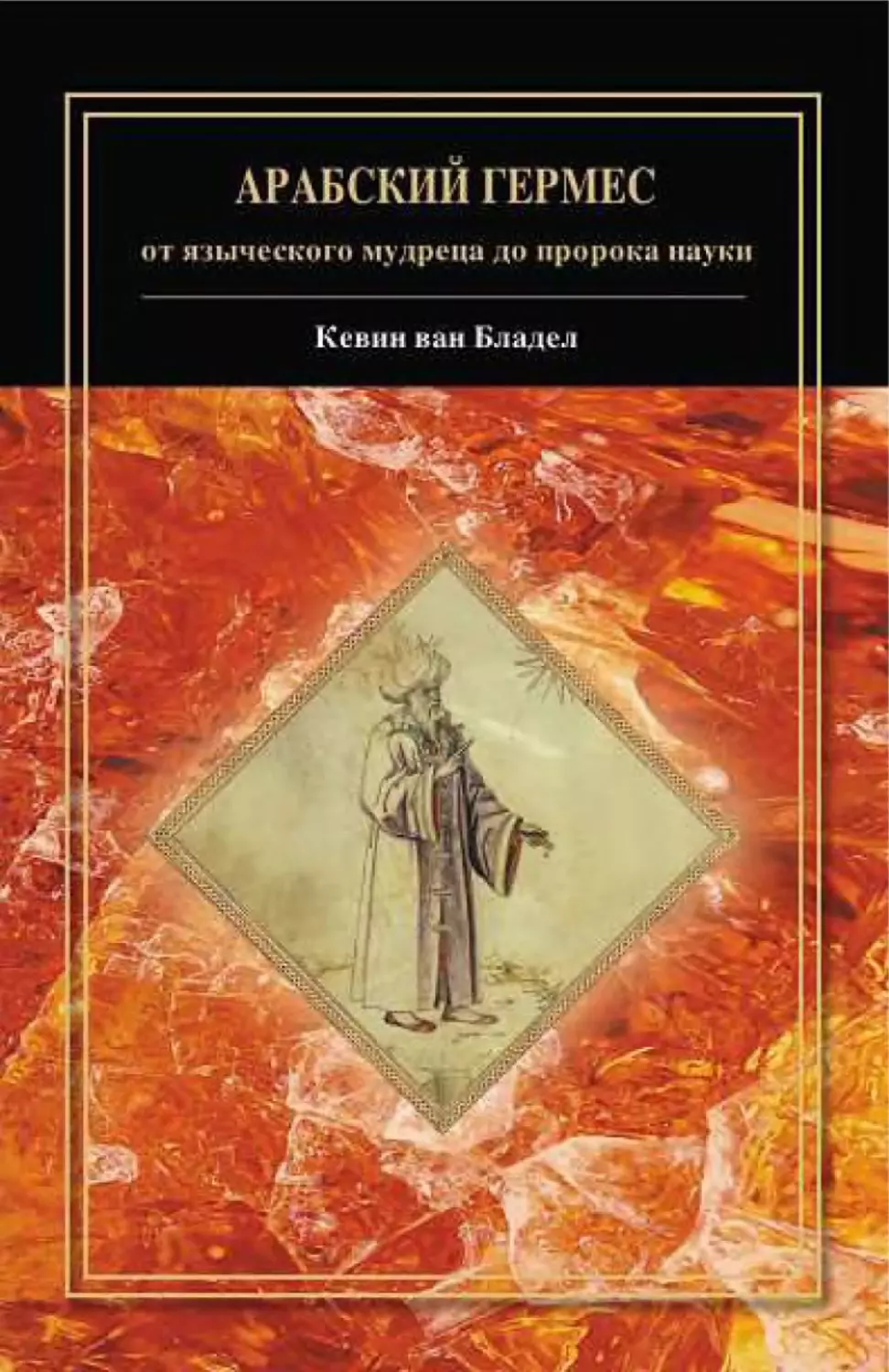
                    Кевин ван Бладел

АРАБСКИЙ
ГЕРМЕС
от языческого мудреца
до пророка науки
Перевод с английского и арабского
В. А. Розова и М. М. Хасанова
Вступительная статья Б. К. Двинянинова

Серия
«Герметицизм с древности до наших дней»

Санкт-Петербург
2022

УДК 299.27:133.5
ББК 86.32:86.42
Б 68
Выпускающий редактор серии: Б. К. Двинянинов
Рецензенты: PhD И. В. Мокин, д. фил. н. М. Н. Суворов

Б 68

Бладел, К. ван
Арабский Гермес: от языческого мудреца до пророка науки / Пер.
с англ. и араб. В. А. Розова и М. М. Хасанова; науч. ред. В. А. Розова; науч. ред., вст. ст. и коммент. Б. К. Двинянинова; под общ. ред.
Б. К. Двинянинова. — СПб.: Издательство «Академия исследований
культуры», 2022. — 548 с.: ил. — (Герметицизм с древности до наших
дней, вып. 5).
ISBN 978-5-94396-239-4

Это первое крупное исследование, посвящённое раннему арабскому восприятию и адаптации фигуры Гермеса Трисмегиста, легендарного египетского
мудреца, которому были приписаны многочисленные труды по астрологии,
алхимии, талисманам, медицине и философии. До более известного принятия древнегреческой Герметики в эпоху Возрождения, арабское предание о
Гермесе и труды под его именем активно развивались и процветали на протяжении семи столетий.
Трактаты, подписанные именем Гермеса Трисмегиста и его учеников, были
написаны на греческом языке в период поздней Античности, по всей видимости,
в Александрии Египетской, впоследствии циркулировали на разных языках
и в регионах Римской и Сасанидской персидской империй. После расцвета
арабского как престижного научного языка в VIII веке, рассказы о личности
Гермеса и герметические тексты были переведены, наряду с сотнями других
работ, с греческого, среднеперсидского и с других литературных языков Античности. Более того Герметика была среди самых ранних переводов на арабский
язык. Немало можно сказать о корнях арабского мифа о Гермесе Трисмегисте,
его источниках, причинах его своеобразного характера и о его многообразной
ценности для герметицизма в Азии и Северной Африке, а также в Европе.
Настоящее русскоязычное издание дополнено глоссарием и приложением,
включающем впервые изданные переводы герметических текстов с арабского
языка: «Изумрудная скрижаль» — три древних версии, глава о городе Гермеса
из Гайят аль-Хаким (Пикатрикс), суфийская молитва Идрису.

УДК 299.27:133.5
ББК 86.32:86.42

На обложке: Pater Hermes philosophorum. Carbonelli 2r. Bellini Giovanni, Carbonelli
Giovanni, Codex Laur. MS Ashb. 1166 AD. Biblioteca Medicea Laurenziana, Florence, Italy.
Все права защищены, любое копирование или воспроизведение без согласия
правообладателей преследуется в соответствии с законодательством
Российской Федерации и международным правом.

ISBN 978-5-94396-239-4

Copyright © 2009 by Oxford University Press, Inc.
© Розов В. А., Хасанов М. М., перевод, коментарии, 2022
© Двинянинов Б. К., вступительная статья, коментарии, 2022
© Двинянинова А. Р., логотип, дизайн серии, 2022
© Проект серии «Герметицизм с древности до наших дней», 2022
© Издательство АИК, подготовка издания, 2022

БЛАГОДАРНОСТИ

Коллектив проекта серии «Герметицизм с древности
до наших дней» выражает искреннюю признательность
и благодарность всем, кто помог осуществить издание книги:
Кондрашев Антон
Петрухин Семён
Макаров Олег
Воронов Олег
Котаева Елизавета
Шляпникова Анна
Галиахметов Рафаэль
Бурбуль Андрей Алексеевич
Гафиятуллина Лилия Ринатовна
Сурина Лидия Алексеевна
Черисов Станислав Юрьевич
Гресс А. В.
Грин А. Т.
Дацкевич П. Н.
Пирогов Д. В.
Stygian Serpent
и другим, без чьей помощи эта книга не увидела бы свет.
ОСОБАЯ БЛАГОДАРНОСТЬ
Ложа АВРОРА № 5 Д.О.М.М.
http://am-mo.ru
ОСОБЫЕ БЛАГОДАРНОСТИ
Национальному Святилищу Российской Федерации
APRMM-EUROPE and FLC,
членом которого является д-р И. В. Мокин

ОГЛАВЛЕНИЕ

Предисловие издателя (Б. К. Двинянинов) . . . . . . . . . . . . . . . . . . . . . . . . .

6

Кевин ван Бладел
АРАБСКИЙ ГЕРМЕС: ОТ ЯЗЫЧЕСКОГО МУДРЕЦА ДО ПРОРОКА НАУКИ

Предисловие. . . . . . . . . . . . . . . . . . . . . . . . . . . . . . . . . . . . . . . . . . . . . . . . . . . . .

19

Ч а с т ь I. Предыстория
1. Введение. . . . . . . . . . . . . . . . . . . . . . . . . . . . . . . . . . . . . . . . . . . . . . . . . . . . . .

27

Благодарности. . . . . . . . . . . . . . . . . . . . . . . . . . . . . . . . . . . . . . . . . . . . . . . 20
Замечания по библиографии и транслитерации . . . . . . . . . . . . . . . . . . . 22

1.1. Древнегреческая Герметика в римском Египте и её европейское
восприятие . . . . . . . . . . . . . . . . . . . . . . . . . . . . . . . . . . . . . . . . . . . . . . . . .
1.2. Восприятие греческой Герметики в Античности . . . . . . . . . . . . . .
1.3. Рождение арабской науки и древних книг в Багдаде . . . . . . . . . . . .
1.4. Понимание терминов «герметический» и «герметизм» в арабском
контексте . . . . . . . . . . . . . . . . . . . . . . . . . . . . . . . . . . . . . . . . . . . . . . . . . . .

2. Гермес в Сасанидском Иране . . . . . . . . . . . . . . . . . . . . . . . . . . . . . . . . . . .

2.1. Свидетельства о Гермесе в сасанидских магических текстах . . . . .
2.2. Гермес в среде сасанидских астрологов . . . . . . . . . . . . . . . . . . . . . .
2.3. Поздние свидетельства существования переводов с греческого
на среднеперсидский в эпоху Сасанидов . . . . . . . . . . . . . . . . . . . . . . . . .
2.4. Некоторые гороскопы, вероятно, относящиеся ко временам
Сасанидов . . . . . . . . . . . . . . . . . . . . . . . . . . . . . . . . . . . . . . . . . . . . . . . . . .
2.5. Герметика во времена Шапура I . . . . . . . . . . . . . . . . . . . . . . . . . . . .
2.6. Останес и маги . . . . . . . . . . . . . . . . . . . . . . . . . . . . . . . . . . . . . . . . . . .
2.7. Останес и Гермес на арабском . . . . . . . . . . . . . . . . . . . . . . . . . . . . . .
2.8. «Гимн жемчужине» и иранская история наук . . . . . . . . . . . . . . . . . .
2.9. Роль Александра Великого в иранской истории наук . . . . . . . . . . .
2.10. Выводы . . . . . . . . . . . . . . . . . . . . . . . . . . . . . . . . . . . . . . . . . . . . . . . .

28
38
43
49
57

60
63
69
82
85
95
105
110
111
117

3. Гермес и сабии Харрана. . . . . . . . . . . . . . . . . . . . . . . . . . . . . . . . . . . . . . . . 120

3.1. Введение в проблему «сабиев» . . . . . . . . . . . . . . . . . . . . . . . . . . . . . .
3.2. Харранская неоплатоническая школа? . . . . . . . . . . . . . . . . . . . . . . .
3.3 Предполагаемое влияние харранской Герметики. . . . . . . . . . . . . . .
3.4. Свидетельства передачи Герметики харранскими сабиями . . . . . .
3.4.1. Свидетельства из антиязыческой полемики сирийских
христиан ок. 600 г. н. э. . . . . . . . . . . . . . . . . . . . . . . . . . . . . . . . . . . . .
3.4.2. Свидетельство Феодора Абу Курры, епископа Харрана
(расцвет деятельности — ок. 805–839 гг.) . . . . . . . . . . . . . . . . . . . . .
3.4.3. Свидетельства аль-Кинди (ум. ок. 870 г.), Ибн аль-Кифти
(ум. 1248 г.) и Ибн аль-ʻИбри (ум. 1286 г.). . . . . . . . . . . . . . . . . . . . .

123
130
144
149
150
152
154

3.4.4. Свидетельство Абу Маʻшара (ум. 886 г.), аль-Бируни
(ум. ок. 1050 г.) и других . . . . . . . . . . . . . . . . . . . . . . . . . . . . . . . . . . . 162
3.4.5. Свидетельство Сабита ибн Курры (ум. 901 г.) или Синана
ибн Сабита (ум. 942/943 г.) . . . . . . . . . . . . . . . . . . . . . . . . . . . . . . . . . 163
3.4.6. Свидетельство аль-Мубашшира ибн Фатика
(сост. 1048/1049 г.) . . . . . . . . . . . . . . . . . . . . . . . . . . . . . . . . . . . . . . . . 166
3.4.7. Свидетельство аль-Масʻуди (ум. 956 г.) и восприятие арабами
«Письма к Анебону» Порфирия и трактата «О египетских мистериях» 168
3.4.8. Свидетельства «Гайят аль-Хаким», «Китаб аль-Истамахис»
и Мусы ибн Маймуна (ум. 1204 г.) . . . . . . . . . . . . . . . . . . . . . . . . . . . 174
3.5. Конец истории харранских сабиев . . . . . . . . . . . . . . . . . . . . . . . . . . . 181
3.6. Выводы . . . . . . . . . . . . . . . . . . . . . . . . . . . . . . . . . . . . . . . . . . . . . . . . . 194

Приложение. Харранцы и Индия . . . . . . . . . . . . . . . . . . . . . . . . . . . . . . . . . . 197

Ч а с т ь II. История арабского Гермеса
4. Три Гермеса . . . . . . . . . . . . . . . . . . . . . . . . . . . . . . . . . . . . . . . . . . . . . . . . . . . 205

4.1. Самая ранняя форма арабской легенды о трёх Гермесах . . . . . . . .
4.2. Древнегреческие предания арабской легенды. . . . . . . . . . . . . . . . . .
4.3. По следам мировых хроник . . . . . . . . . . . . . . . . . . . . . . . . . . . . . . . .
4.4. Анниан на сирийском и арабском языках . . . . . . . . . . . . . . . . . . . . .
4.5. Абу Маʻшар как хронограф . . . . . . . . . . . . . . . . . . . . . . . . . . . . . . . .
4.6. Другие стороны (аспекты) легенды о Гермесе . . . . . . . . . . . . . . . . .
4.7. Третий Гермес . . . . . . . . . . . . . . . . . . . . . . . . . . . . . . . . . . . . . . . . . . .
4.8. Выводы . . . . . . . . . . . . . . . . . . . . . . . . . . . . . . . . . . . . . . . . . . . . . . . . .

206
220
224
229
241
252
255
261

5.1. Небесное восхождение Гермеса . . . . . . . . . . . . . . . . . . . . . . . . . . . . .
5.2. Гермес законодатель, представленный аль-Мубашширом
ибн Фатиком . . . . . . . . . . . . . . . . . . . . . . . . . . . . . . . . . . . . . . . . . . . . . . . .
5.3. Мудрость арабского Гермеса . . . . . . . . . . . . . . . . . . . . . . . . . . . . . . .
5.4. Синтез представлений о Гермесе в XII–XIII вв. и в последующих
периодах до XVI в. . . . . . . . . . . . . . . . . . . . . . . . . . . . . . . . . . . . . . . . . . . .

264

5. Пророк Гермес. . . . . . . . . . . . . . . . . . . . . . . . . . . . . . . . . . . . . . . . . . . . . . . . . 264

293
309
343

6. Заключение. Создание арабского Гермеса. . . . . . . . . . . . . . . . . . . . . . . 363
Приложение
Арабские версии «Изумрудной скрижали» Гермеса Трисмегиста . . . . 373

Псевдо-Аполлоний, «Сирр аль-Халика». . . . . . . . . . . . . . . . . . . . . . . . . . 374
Джабир ибн Хайян, «Китаб Устукус аль-Усс ас-Сани». . . . . . . . . . . . . . 375
Псевдо-Аристотель, «Сирр аль-Асрар» . . . . . . . . . . . . . . . . . . . . . . . . . . 375

Гайят аль-Хаким (Пикатрикс) Кн. 4, гл. 3 [аль-Ашмунайн]. . . . . . . . . . . . . 377
Дуа «АрбаɄуна Идрисийя». . . . . . . . . . . . . . . . . . . . . . . . . . . . . . . . . . . . . . . . . 385

Глоссарий . . . . . . . . . . . . . . . . . . . . . . . . . . . . . . . . . . . . . . . . . . . . . . . . . . . . . . . 401
Библиография . . . . . . . . . . . . . . . . . . . . . . . . . . . . . . . . . . . . . . . . . . . . . . . . . . . 490
Индекс . . . . . . . . . . . . . . . . . . . . . . . . . . . . . . . . . . . . . . . . . . . . . . . . . . . . . . . . . . 529

КЕВИН ВАН БЛАДЕЛ

АРАБСКИЙ ГЕРМЕС
ОТ ЯЗЫЧЕСКОГО МУДРЕЦА
ДО ПРОРОКА НАУКИ

Deutsche alchemistische Schrift mit 16 Textillustrationen Bern, [1794]
Universitätsbibliothek Freiburg i. Br., Hs. 481

ПРЕДИСЛОВИЕ

Это первое глубокое исследование, посвящённое тому, как Гермес
Трисмегист — легендарный древнеегипетский мудрец, которому приписываются многочисленные работы по астрологии, алхимии, талисманам, медицине и философии, — представлен в ранней арабской
литературе. По сравнению со стандартной работой по древнегреческой
Герметике (Fowden 1993a), построенной на десятилетиях и даже
столетиях исследований, эта книга — своего рода набег на относительно неизведанные территории. Читатели, которые уже знакомы
с древнегреческой и латинской Герметикой (т. е. сочинениями, приписываемыми Гермесу), знают, что они сыграли значительную роль
в развитии позднеантичной мысли, как языческой, так и христианской,
и позже стали фундаментом средневекового, ренессансного и современного оккультизма в Европе. Существенная и широко распространённая арабская литературная традиция Герметики, однако, никогда
не привлекала большого внимания, несмотря на общее понимание
арабистов, что эти арабские герметические тексты действительно
существовали и оказывали определённое влияние на культуру. Для
специалистов по древнегреческому и латинскому языкам, которые
мало интересуются арабской традицией как таковой, арабская Герметика, несомненно, интересна, поскольку может содержать важную
информацию, имеющую отношение к их предметам. Миф о Гермесе
Трисмегисте также служит ярким примером сложного и широкомасштабного процесса адаптации древнегреческих знаний в раннюю
арабскую культуру, который начался в VIII веке нашей эры.
Проект начался с простых вопросов. Кем, по мнению первых арабских писателей, был Гермес Трисмегист и как они пришли к концепции
его образа? Каково отношение многочисленных работ, приписываемых
Гермесу и сохранившихся в арабских рукописях, к более известным
греческим и латинским герметическим текстам? Является ли арабская
19

Арабский Гермес

Герметика переводом греческих произведений или же эти тексты изначально были составлены на арабском языке? В последнем случае,
что побудило их авторов приписать эти тексты Гермесу? До сих пор не
было предпринято никаких решительных и всеобъемлющих попыток
ответить на эти вопросы, несмотря на научный интерес и даже популярность античной Герметики среди европейских и американских учёных
на протяжении нескольких столетий. За некоторыми важными исключениями я обнаружил в научной литературе в основном предположения
об арабской Герметике. По мере развития проекта стало ясно, что
издание, перевод и изучение, по-прежнему, многочисленных текстов
арабской Герметики, которые ещё не были опубликованы и на основании которых можно было бы ответить на некоторые из этих вопросов — если на них когда-нибудь удастся ответить, — также потребуют
обширных пролегоменов. Требуется решение многих предварительных
проблем, прежде чем станет возможным прямое изучение арабской
Герметики. Некоторые из этих проблем уже имеются в ранней арабской
литературе, но другие стали результатом непреднамеренного заблуждения современной науки. Мои попытки найти ясную основу для понимания этих вопросов привели к написанию настоящей книги.
За этой книгой должна последовать вторая, которая находится
в стадии подготовки. В неё будет включен актуальный перечень текстов,
приписываемых Гермесу на арабском языке, большинство из которых
всё ещё находится в рукописях, краткое изложение их хронологии и
описания содержания большинства из них. Короче говоря, следующая
работа будет изучением собственно арабской Герметики, тогда как
настоящая книга — это исследование арабского Гермеса, легендарного автора, и мифа о нем, а также путей, благодаря которым Гермес
стал известен в арабской традиции.

Благодарности
Мне доставляет искреннее удовольствие выразить благодарность
людям и организациям, оказавшим мне поддержку в осуществлении
этого проекта. Прежде всего, я хотел бы поблагодарить Ральфа Мэтисена за то, что он согласился включить эту книгу в редактируемую им
серию, и Стефана Вранку из издательства «Оксфорд Юниверсити
Пресс» за значительное облегчение всего процесса, а также редакторов
20

Предисловие

и корректоров за их кропотливую работу. Мне оказали многостороннюю помощь в предоставлении ссылок на библиографические и первичные источники, а также обсуждали со мной представленные
в книге вопросы Мохсен Аштиани, Персис Берлекэмп, Вахид Браун,
Джон Дарнелл, Раха Эль-Омари, Гарт Фоуден, Беатрис Грюндлер,
Яакко Хямеен-Анттила, Стефан Хайлен, Тарик Джаффер, Ричард
Ясноу, Аарон Джонсон, Тодд Крулак, Мартин Мульсов, Наама ПатЭль, Дэвид Порекка, Аннетт Рид, Дэвид Рисмэн, Гэбриеэль Рейнолдс,
Рамзи Руиги, Шауль Шакед, Изабель Тораль-Нихофф, Пол Э. Уолкер,
Стивен Вассерстром, Эдвард Уоттс, Кристиан Вильдберг, Витольд
Витаковски и все участники Йельского Арабского Коллоквиума 11 декабря 2002 года, за что я им крайне благодарен. Я хотел бы особенно
поблагодарить Эмили Савадж-Смит, которая предоставила мне детальную информацию о нескольких герметических рукописях, ускользнувших от моего внимания, Шауката Тураву за поиск для меня материалов в библиотеке Асафия в Хайдерабаде в то время, когда он был
занят своим собственным исследованием, и Хуссейна Камали за то,
что он предоставил мне бесценные копии герметических рукописей
из Ирана в то время, когда он сам тоже находился в стеснённых временных и иных условиях. Анонимные рецензенты этой книги также
заслуживают благодарности за их ценные замечания по поводу чернового варианта работы. Некоторые из этих коллег увидят плоды своего
труда целиком не в этой книге, а в следующей.
Покойный Франц Розенталь с самого начала поддержал меня и позволил сделать копии рукописей его неопубликованного издания «Мухтар аль-хикам» аль-Мубашшира ибн аль-Фатика (это посмертное издание Rosenthal 1960–1961), что помогло в моей работе по изучению высказываний мудреца Гермеса. Паоло Лучентини ввёл меня в современные европейские исследования герметических традиций, способствовав
моему участию в работе «Международной конференции по герметической традиции — от позднего античного мира к гуманизму» в ноябре
2001 года. Я ещё раз благодарю его за оказанное тогда гостеприимство.
Эверетт Роусон, Чарльз Бернетт и Александер Трайгер заслуживают
особой благодарности за внимательнейшее чтение различных версий
черновика книги и многочисленные критические предложения по улучшению текста, а также за неоценимую помощь в составлении библиографии. Более всего я благодарен Димитрию Гутасу, историческая
21

Арабский Гермес

и лингвистическая подготовка которого стали идеальным наставником
для меня, пока я писал мою диссертацию, из которой и выросла книга
(Hermes Arabicus, Yale University, 2004). Его требовательность и внимание к деталям уберегли меня от множества ошибок.
Несмотря на помощь столь многих друзей и наставников, эта книга остаётся моим собственным произведением, что в полной мере
касается и всех таящихся в ней ошибок.
Я также благодарен Библиотеке редких книг Бейнеке за летнюю
стипендию и Йельской аспирантуре за предоставление стипендий
имени Джона Ф. Эндерса и Роберта М. Лейлана на ранних этапах
работы. Летняя стипендия Национального фонда гуманитарных наук,
присуждённая в 2007 году, помогла мне собрать ещё несколько репродукций рукописей арабских герметических текстов. Любые
взгляды, выводы, заключения или рекомендации, выраженные в этой
публикации, не обязательно отражают взгляды Национального фонда гуманитарных наук. Семестр, проведённый в Институте перспективных исследований в Принстоне, а также моя работа в качестве
приглашенного научного сотрудника в Институте изучения древнего мира Нью-Йоркского университета с января 2008-го создали мне
прекрасные условия для тщательного пересмотра и существенного
увеличения текста, который уже был написан.
Моя супруга, Шиларна Стокс, сделал мою жизнь лучше, чем она
была, когда я начал работать над этим проектом. Без её поддержки
и терпения, публикация книги заняла бы ещё больше времени. Её предложения по улучшению ясности текста затронули многие страницы.
И я посвящаю работу моим родителям, которые никогда не отговаривали меня от того, чтобы заниматься столь загадочными делами.

Замечания
по библиографии и транслитерации
Специалисты по классическим языкам обычно цитируют работы
в соответствии со стандартными редакциями, набором стандартных
сокращений и номеров, соответствующих общепринятому разделению
разделов текста. Используя их, каждый, кто хочет проверить цитату,
может легко найти её в любой исследовательской библиотеке. Эти
стандарты подходят тем, кто работает над греческими и латинскими
22

Предисловие

авторами, которых больше всего изучали в XIX и XX веках. Однако
большое количество текстов, цитируемых на следующих страницах,
даже если некоторые из них на греческом языке, доступны только
в публикациях, которые трудно найти даже в хорошо укомплектованной исследовательской библиотеке. Что касается произведений на
арабском языке, то стандартных изданий мало, если они вообще есть,
и ещё меньше критических изданий. Ближневосточные типографии
регулярно перепечатывают старые издания с новым набором и нумерацией страниц, так что стандартизованное перечисление разделов
текста практически невозможно. Многие издания произведений на
арабском языке представляют собой не более чем чтение одной или
небольшого количества рукописей, без использования каких-либо
редакционных методов, кроме перевода текста в более разборчивое
состояние. Типографских ошибок также предостаточно.
Большая часть представленных здесь исследований, естественно,
зависит от точных формулировок текстов на арабском и других менее
известных языках поздней Античности. Для того чтобы мои аргументы были убедительными, я счел важным избавить имеющего научную
подготовку читателя от необходимости искать десятки редких книг,
предоставив как можно больше примеров на оригинальных текстах,
не перегружая тем самым, я надеюсь, основную часть текста. Читатель,
которого все эти текстуальные свидетельства не интересуют, может
просто пропустить их.
Во многих случаях я добавлял соответствующие номера глав и
разделов арабских произведений в дополнение к номерам страниц и
строк текста, которые у меня были под рукой, потому что они являются более надежным указателем местоположения отрывка, чем разбивка на страницы любого другого отрывка в конкретном печатном
издании.
Слова и имена, транслитерированные с арабского и других семитских языков, следуют образцу, который приняло большинство европейских учёных в области арабского языка, придерживаясь, насколько это возможно, принципа одного знака для каждой фонемы. Те, кто
не знает арабского языка, может обратить внимание на следующие
основные варианты произношения транслитерированных знаков.
ṯ как в слове «think»
ḏ как в слове «this»
23

Арабский Гермес

ğ как в слове «gymnasium»
ġ щелевой звук похожий на французское «r»
ẖ глухой щелевой задненебный звук, как в шотландском «loch»
ğ как в слове «shake»
ʼ гортанная смычка, похоже на простонародное произнесение слова «bottle» (boʼel)
ʻ ʻайн, звонкий щелевой гортанный звук, который для иностранного уха часто звучит как гортанная смычка
Большинство других диакритических знаков в буквах предназначены для арабистов и изучающих арабский язык; остальные могут их
игнорировать.
Все даты даны по общепринятому летоисчислению. Полагаться на
мусульманское летоисчисление по хиджре, в котором отсчитываются
лунные годы, начиная с 622 г. н. э., не имеет смысла в книге, значительная часть которой посвящена периоду до хиджры, в той же степени, как и после него. Существует множество таблиц, компьютерных
программ и интернет-сайтов, которые могут преобразовать любую
дату нашей эры в эквивалентную дату по хиджре для читателя, которому это необходимо.

Часть I
ПРЕДЫСТОРИЯ

Doppelköpfiger Adler in einem alchemistischen Text, Abschrift aus dem 18.
Jhdt. British Library MS Add.25724, 17v. Bild N.N.B.

1. ВВЕДЕНИЕ

В ранних арабских источниках говорится о древнеегипетском
мудреце, которого звали Гермес Триждымудрый, основателе языческой
религии до Всемирного потопа, законодателе, посетившем небесные
сферы, в которых движутся планеты, и вернувшемся, чтобы научить
людей астрологии, истинном пророке, как Иисус и Мухаммад. Учение
этого премудрого Гермеса излагалась в арабских переводах. Считалось,
что оно было передано через великих философов прошлого, таких как
Аристотель и Аполлоний Тианский, или же изложено в надписях, вырезанных на табличках в подземельях египетских развалин. Арабские
сочинения, посвящённые Гермесу, претендуют на знание скрытых
принципов функционирования Вселенной, тайн мироздания и секретов
природы. В них рассказывается о способах предсказания будущего
посредством звездных знамений, приводятся инструкции по изготовлению действенных талисманов и зашифрованные рецепты алхимических снадобий. Вплоть до наших дней множество этих трудов
остаются нетронутыми под покровом тайны, ожидая, когда современные исследователи стряхнут пыль с десятков арабских рукописей.
Большинство этих сочинений так никогда и не были опубликованы.
Историков нередко ставят в тупик как легенды о Гермесе, так и приписываемые ему сочинения, составленные на арабском языке. Эти сочинения — неотъемлемая часть богатой позднеантичной традиции,
из которой и выросла ранняя арабская культура во всех своих аспектах. Они — только небольшая толика необъятного количества сочинений древних авторов по различным областям знания, переведённых
на арабский язык и во многом ставших основой арабской книжной
традиции. Распутать это переплетение традиций — сложная задача.
Для этого недостаточно понимать арабский контекст, при том что
он сам по себе очень сложен и является объектом для настоящего
исследования. Нельзя обойти стороной античные корни арабской
27

Библиография

Примечание: двудольные фамилии расположены в алфавитном порядке по их первой части, независимо от традиционной практики. Следовательно, «ван Бладел» (van Bladel) находится под буквой V, «де Блуа»
(de Blois) — под буквой D и так далее. Определённый артикль арабского языка «аль-» игнорируется; например, вы можете найти аль-Мубашшира
(al-Mubaššir) под буквой М.

ʻAbdalgabbār ibn Ahmad al-Asadabadi. Kitab al-Mugnifi abwab at-tawhid
wa-l-ʻadl, 20 vols., Cairo, Wizarat at-Taqāfa wa-l-Irsad al-Qawmi, 196–
(not dated).
Abū l-Fidāʻ. Abulfedae Historia Anteislamica, Arabice, ed. H. Fleischer,
Leipzig, Vogel. 1831.
Abū Maʻsar. The Great Introduction to the Science of Astrology / Al-Mudkhal
al-kabir ila ʻilm ahkam al-nujum, facsimile of MS 1508 Carullah collection,
Süleymaniye Library, Istanbul, published by the Institute for the History
of Arabic-Islamic Science, Frankfurt am Main, 1985.
Acampora-Michel, Elsbeth. Liber de Pomo / Buch vom Apfel: eingeleitet,
übersetzt und kommentiert, Frankfurt am Main, Vittorio Klostermann.
2001.
Adamson, Peter. “Two Early Arabic Doxographies on the Soul: al-Kindi
and the ‘Theology of Aristotle’,” Modern Schoolman 77, 2000. pp. 105–
125.
Adamson, Peter. The Arabic Plotinus, London, Duckworth. 2002.
Adang, Camilla. Muslim Writers on Judaism and the Hebrew Bible, Leiden,
E. J. Brill. 1996.
Adler, William. Time Immemorial: Archaic History and Its Sources in
Christian Chronography from Julius Africanus to George Syncellus,
Washington, D.C., Dumbarton Oaks. 1989.
Adler, William. “Eusebius’ Chronicle and Its Legacy,” in Harold W. Attridge
and Goei Hata, eds., Eusebius, Christianity, and Judaism, Detroit, Wayne
State University Press, 1992. pp. 467–491.
490

Библиография

Affifi, A. E. “The Influence of Hermetic Literature on Moslem Thought,”
Bulletin of the School of Oriental and African Studies, 13, 1951.
pp. 840–855.
Afnan, Soheil M. Philosophical Terminology in Arabic and Persian, Leiden,
E. J. Brill. 1964.
Agapius (al-Mahbūb) of Manbig = Kitab al-‘Unvan: Histoire Universelle
écrite par Agapius (Mahboub) de Menbidj, in Alexandre Vasiliev,
ed. and trans., Patrologia Orientalis 5.4, 7.4, 8.3, and 11.1, 1910–
1915.
Ahbar az-zaman [author named as al-Masʻūdi] ed. as-Sawi, fifth printing,
Beirut, Dar al-Andalus. 1983.
Alexander of Lycopolis = Alexandri Lycopolitani Contra Manichaei opiniones
disputatio, ed. Augustus Brinkman, Teubner, Stutgard, 1989 (reprinted
from 1895). French translation and commentary by André Villey, Contre
la doctrine de Mani, Éditions du Cerf, Paris, 1985. English translation and
commentary by P. W. van der Horst and J. Mansfield, An Alexandrian
Platonist against Dualism, Leiden, Brill, 1974.
Alexander, Philip S. “Jewish Tradition in Early Islam: the Case of Enoch/
Idrīs,” in G. R. Hawting, J. A. Mojaddedi, and A. Samely, eds., Studies
in IslamicandMiddle Eastern Texts and Traditions in Memory of Norman
Calder (Journal of Semitic Studies Supplement 12), Oxford, Oxford
University Press, 2000. pp. 11–29.
Altmann, Alexander. “The Delphic Maxim in Medieval Islam and Judaism,”
in Alexander Altmann, ed., Biblical and Other Studies, Cambridge
(Mass.), Harvard University Press, 196–232. Reprinted in Studies in
Religious Philosophy and Mysticism, London, Routledge and K. Paul,
1969, 1963. pp. 1–40.
Ambrose, Elizabeth Ann. The Hermetica: An Annotated Bibliography,
Sixteenth Century Bibliography 30, St. Louis, Center for Reformation
Research. 1992.
Andersen, F. I. “2 (Slavonic Apocalypse of) Enoch,” in James H. Charlesworth,
The Old Testament Pseudepigrapha, Volume 1: Apocalyptic Literature and
Testaments, New York, Doubleday. 1983.
Andreas, F. C., and Henning, W. “Mitteliranische Manichaica aus ChinesischTurkestan II,” Sitzungsberichte derPreussischen Akademie der Wissenschaften. Philosophisch-historische Klasse. 1933. pp. 292–363.
Anklesaria, B. T. Zand-Akasih: Iranian or Greater Bundahisn, Bombay, published for the Rahnumae Mazdayasnan Sabha by Its Honorary Secretary
Dastur Framroze A. Bode. 1956.
491

Арабский Гермес

Al-Ansarī = Hunayn ibn Ishaq [sic]. Adab al-falasifa, ihtasarahū Muhammad
ibn Ali ibn Ibrahim ibn Ahmad ibn Muhammad al-Amari, ed. ʻAbd-arRahmān Badawī, Kuwait, Maʻhad al-Mahtūtāt al-ʻArabīya, 1406/1985.
Aouad, Maroun. “Atāwālīs,” in Pierre Goulet, ed., Dictionnaire des Philosophes
Antiques, vol. 1, 1989. pp. 637–639.
Asm Palacios, Miguel. “Tratado de Avempace sobre la Union del Intelecto
con el Hombre,” al-Andalus 7, 1942. pp. 1–47.
Athanassiadi, Polymnia. “Persecution and Response in Late Paganism: The Evidence of Damascius,” Journal of Hellenic Studies 113, 1993. pp. 1–29.
Back, Michael, 1978. Die sassanidischen Staatsinschriften, Acta Iranica 18,
Textes et Mémoires VIII, Leiden, E. J. Brill.
Badawī, ʻAbdarrahmān. Aflutin ʻinda l- Arab, Cairo, L’Institut Français.
1948.
Badawī, ʻAbdarrahmān. al-Usūl al-yūnaniya li-n-nazariyat as-siyasiya fi
l-Islam, Part 1, Cairo, Maktabat an-Nahda al-Misrīya. 1954.
Badawī, ʻAbdarrahmān. al-Aflatūniya al-muhdata ʻind al-Arab, vol. 1, Cairo,
Maktabat an-Nahda al-Misrīya. 1955.
Bagnall, Roger. Egypt in Late Antiquity, Princeton, Princeton University
Press. 1993.
Bailey, H. W. Zoroastrian Problems in the Ninth-Century Books, Oxford,
Clarendon Press. 1943.
Bar Bahlül. Lexicon Syriacum auctore Hassano Bar-Bahlule, 3 vols.,
ed. Rubens Duval, Paris, 1888–1901 (reprinted Amsterdam, Philo Press,
in 2 vols., 1970).
Bar Bahlül. [Ibn Bahlūl, al-Hasan]. Kitab ad-Dalaʻil, Publications of the
Institute for the History of Arabic-Islamic Sciences, ed. Fuat Sezgin,
Series C: Facsimile Editions, vol. 10, reproduced from MS Hekimoglu
572, Süleymaniye Library, Istanbul.
Bardenhewer, Otto. Hermetis Trismegisti qui apud Arabes fertur de castigatione
Animae libellum, Bonn, A. Marcus. 1873.
Bar ʻEbrāyā, see Ibn al-ʻIbrī.
Barry, Catherine, Wolf-Peter Funk, Paul-Hubert Poirier, and John D. Turner.
Zostrien (NH VIII, 1), Bibliothèque copte de Nag Hammadi, Section
“Textes” 24, Louvain, Peeters. 2000.
Bartholomae, Christian. “Zur Kenntnis der mitteliranischen Mundarten III,”
Sitzungsberichte der Heidelberger Akademie der Wissenschaften, phil.hist. Klasse. 1920.
Baumstark, Anton. Geschichte der syrischen Literatur, Bonn, A. Marcus
und E. Weber. 1922.
492

Библиография

Beck, Roger. “Thus spake not Zarathustra: Zoroastrian pseduepigrapha
of the Greco-Roman world,” in Mary Boyce and Franz Grenet, History
of Zoroastrianism, Volume III: Zoroastrianism under Macedonian and
Roman Rule, Leiden, Brill, 1991. pp. 491–565.
Beeston, A. F. L. “An Arabic Hermetic Manuscript,” The Bodleian Library
Record 7.1, 11–23.
Bell, Richard, 1926. The Origin of Islam in Its Christian Environment,
London, Macmillan. 1962–1967.
Berthelot = Berthelot, Marcellin. La Chimie au moyen âge, 3 vols., Paris,
Imprimerie nationale. 1893.
Berthelot, Marcellin, and Ch.-Em. Ruelle, eds. Collection des anciens alchemistes grecs, Paris, G. Steinheil. 1888.
Bidez, Joseph, and Franz Cumont. Les Mages hellénisés: Zoroaster, Ostanès
et Hystaspe d’après la tradition grecque, 2 vols., Paris, Societé d’éditions.
1938.
Bielawski, Jozef. “Phédon en version arabe et le Risalat at-Tuffaha,”
in J. M. Barral, ed., Orientalia Hispanica sive Studia F.M. Pareja Octogenario Dicata. Studia Islamica, pars prior, vol. 1, Leiden, E. J. Brill,
1974. pp. 120–134.
Al-Bīrūnī, Abū r-Rayhan. Atar = al-Atar al-baqiya ‘an al-qurun al-haliya
= Chronologie orientalischer Volker von Albêrûnî, ed. C. Eduard Sachau,
Leipzig, A. F. Brockhaus, 1878; reprinted in Islamic Mathematics and
Astronomy, vol. 30, Publications for the Institute for the History of
Arabic-Islamic Science, ed. Fuat Sezgin; translated into English and
anno- tated by C. E. Sachau as The Chronology of Ancient Nations,
London, W. H. Allen, 1879; translation reprinted in Islamic Mathematics
and Astronomy, vol. 31.
Al-Bīrūnī, Abū r-Rayhan. Fihrist-i Kitabha-yi Razi va-namha-yi kitabha-yi
Biruni, ed. Mahdī Mohaqqeq, Tehran University Publications, 1992.
Al-Bīrūnī, Abū r-Rayhan. al-Qanun al-mascudi, 3 vols., Hyderabad, Osmania
Oriental Publications Bureau,1954–1956.
Al-Bīrūnī, Abū r-Rayhan. Tahdid nihayat al-amakin, ed. P. Bolgakoff, Cairo,
Matbaʻat Lagnat at-Taʻlīf wa-t-Targama wa-n-Nasr, 1964. Translation
by J. Ali, Beirut, 1967.
Al-Bīrūnī, Abū r-Rayhan. Rasaʻil al-Biruni, Hyderabad, Osmania Oriental
Publications Bureau. 1948.
Black, Deborah L. “Psychology,” in Peter Adamson and Richard C. Taylor
eds., The Cambridge Companion to ArabicPhilosophy, Cambridge,
Cambridge University Press, 2005. pp. 308–326.
493

Арабский Гермес

Black, Matthew, ed. Apocalypsis Henochi Graece, Leiden, Brill. 1970.
Black, Matthew, ed. The Book of Enoch, or I Enoch: A New English Edition
with Commentary and Textual Notes, Leiden, E. J. Brill. 1985.
Blochet, E. “Études sur le Gnosticisme musulmane,” parts 1–4, Rivista degli
Studi Orientali, 1909–1915: (part 1) 2, 1909, 717–756, (part 2) 3, 1910,
177–203, (part 3) 4, 1911–1912, 47–79 and 267–300, (part 4) 6, 1914–
1915, 5–67.
Blumenthal, Henry J. “Neoplatonic elements in the de Anima commentaries,”
in Richard Sorabji, ed., Aristotle Transformed, London, Duckworth,
1990. pp. 305–324.
Bosworth, Clifford Edmund, trans. The Book of Curious and Entertaining
Information: TheLata’if al-mararif of Tharalibi, Edinburgh, Edinburgh
University Press. 1968.
Bosworth, Clifford Edmund. The New Islamic Dynasties. A Chronological
and Genealogical Manual, New York, Columbia University Press. 1996.
Boyce, Mary. The Letter of Tansar, Rome Oriental Series XXXVIII, Rome,
Istituto Italiano per il Medio ed Estremo Oriente. 1968a.
Boyce, Mary. “Middle Persian Literature,” in Handbuch der Orientalistik
I der nahe und der mittlere Osten IV Iranistik 2 Literature 1, Leiden,
E. J. Brill, 1968b. 31–66.
Boyce, Mary. A Reader in Manichaean Middle Persian and Parthian, Acta
Iranica 9. 1975.
Boyce, Mary. A Word-List of Manichaean Middle Persian and Parthian,
Acta Iranica 9a. 1977.
Boylan, P. Thoth the Hermes of Egypt: A Study of Some Aspects of Theological
Thought in Ancient Egypt, London, Oxford University Press. 1922.
Briant, Pierre. From Cyrus to Alexander: A History of the Persian Empire,
trans. Peter T. Daniels, Winona Lake, Eisenbrauns. 2002.
Brittain, Charles, and Tad Brennan. Simplicius On Epictetus’ “Handbook
1–26,” Ithaca, Cornell University Press. 2002.
Brock, Sebastian. “A Syriac Collection of Prophecies of the Pagan Philosophers,” Orientalia Lovaniensia Periodica XIV, 1983. pp. 203–246.
Reprinted in S. Brock, Studies in Syriac Christianity, Hampshire, Variorum,
1992.
Buck, Christopher. “The Identity of the Sābi’ūn: An Historical Quest,”
Muslim World 74, 1984. pp. 172–186.
Buckley, Jorunn Jacobsen. “The Colophons in The Canonical Prayerbook
of the Mandaeans,” Journal of Near Eastern Studies 51.1, 1992.
pp. 33–50.
494

Библиография

Burnett, Charles S. F. “The Legend of the Three Hermes and Abū Ma‘shar’s
Kitab al-uluf in the Latin Middle Ages,” Journal of the Warburg and
Courtauld Institutes 39, 1976. pp. 231–234.
Burnett, Charles S. F. “Hermann of Carinthia and the Kitab al-istamatis:
Further Evidence for the Transmission of Hermetic Magic,” Journal
of the Warburgand Courtauld Institutes, 44, 1981. pp. 167–169.
Burnett, Charles S. F. “Arabic, Greek, and Latin Works on Astrological Magic Attributed to Aristotle,” in Jill Kraye, W. F. Ryan, and
C. B. Schmitt, eds., Pseudo-Aristotle in the Middle Ages: The Theology
and Other Texts, Warburg Institute Surveys and Texts XI, London,
The Warburg Institute, University of London, 1986. pp. 84–96.
Burnett, Charles S. F. “The kitab al-Istamatis and a Manuscript of Astrological and Astronomical Works from Barcelona (Biblioteca de Catalunya,
634),” in Magic and Divination in the Middle Ages, Ashgate, Variorum
(article VII, 19 pages). 1996.
Burnett, Charles S. F. “Aristoteles/Hermes: Liber Antimaquis,” in Paolo
Lucentini et al., eds., Hermetis Trismegisti Astrologica et Divinatoria,
Turnhout, Brepols, 2001a. pp. 179–221.
Burnett, Charles S. F. “The Establishment of Medieval Hermeticism,”
in Peter Linehan and Janet L. Nelson, eds., The Medieval World, London,
Routledge, 2001b. pp. 111–129.
Burnett, Charles S. F. “Remarques paléographiques et philologiques sur les
noms d’anges et d’esprits dans les traités de magie traduits de l’arabe
en latin,” Mélanges de l’École Française de Rome. Moyen Âge 114,
2002. pp. 657–668.
Burnett, Charles S. F. “Lunar Astrology: The Varieties of Texts Using Lunar Mansions, with Emphasis on Jafar Indus” Micrologus 12, 2004.
pp. 43–133.
Burnett, Charles S. F. “Tabit ibn Qurra the Harrānian on Talismans and
the Spirits of the Planets,” La Coronica 36, 2007. pp. 13–40.
Burnett, Charles, and Ahmed al-Hamdi. “Zādānfarrūkh al-Andarzaghar
on Anniversay Horoscopes,” in Zeitschrift für Geschichte der arabischislamischen Wissenschaften 7, 1991–1992. pp. 294–399.
Burnett, Charles, and David Pingree. The Liber Aristotelis of Hugo of
Santalla, ed. Charles Burnett, Jill Kraye, and W. F. Ryan, Warburg
Institute Surveys and Texts 26, London, Warburg Institute. 1997.
Burnett, Charles, and Keiji Yamamoto. Abu. Ma ‘sar on Historical Astrology:
The Book of Religions and Dynasties (On the Great Conjunctions),
2 vols., Leiden, Brill. 2000.
495

Арабский Гермес

Carra de Vaux, Bernard. Avicenne, Paris, Félix Alcan. 1900.
Carra de Vaux, Bernard. Gazali, Paris, Félix Alcan. 1902.
Cassius Dio. Historiarum Romanarum quae supersunt, ed. U. P. Boissevain,
3 vols., Berlin, Weidmann. 1895–1901.
CCAG = Catalogus Codicum Astrologorum Graecorum, 12 vols., ed. F. Cumont et al., Brussels, 1898–1953.
Cereti, Carlo G., 2001. La Letteratura Pahlavi, Milan, Mimesis.
CH = Corpus Hermeticum.
Chabot, J. B., ed. Incerti Auctoris Chronicon Pseudo-Dionysianum Vulgo
Dictum [= Zuqnin Chronicle] 2 vols., Corpus Scriptorum Christianorum
Orientalium 91 and 103 (Scriptores Syri 43 and 53), Paris. 1927–1933.
Chassinat, Emile. Le Temple de Dendara, 11 vols., Cairo, Institut français
d’archéologie orientale. 1934.
Cheikho, Louis. La version arabe de Kalîlah et Dimnah, d’après le plus
ancien manuscrit arabe daté, Beirut, Imprimerie Catholique. 1905.
Cheikho, Louis. “Catalogue raisonné des manuscrits de la bibliothèque
orientale IV: Philosophie et écriture sainte,” Mélanges de l’Université
Saint-Joseph 10, 1925. pp. 107–179.
CHI = Cambridge History of Iran, 6 vols., Cambridge, Cambridge University
Press, 1968–1986.
Chittick, William C. The Heart of Islamic Philosophy: The Quest for SelfKnowledge in the Teachings of Afdal al-Din Kashani. Oxford, Oxford
University Press. 2001.
Chuvin, Pierre. A Chronicle of the Last Pagans, trans. B. A. Archer, Cambridge
(Mass.), Harvard University Press. 1990.
Chwolsohn, Daniel. Die Ssabier und die Ssabismus, 2 vols., St. Petersburg,
Kaiserlichen Akademie der Wissenschaften. 1856.
Ciancaglini, Claudia A. “Gli Antecedenti del Romanzo Siriaco di Alessandro,” in G. Bolognesi and U. Cozzoli, eds., L’eredità classica nel mondo
orientali nell’età tardoantica e medievale. Il “Romanzo di Alessandro”
e altri scritti. Atti del Seminario internazionale di studio (Roma-Napoli,
25–27 settembre 1997), Alessandria, Orso, 1998. pp. 55–93.
Ciancaglini, Claudia A. “The Syriac Version of the Alexander Romance,”
Le Muséon 114, 2001. pp. 121–140.
Conrad, Lawrence I. “Theophanes and the Arabic Historical Tradition: Some
Indications of Intercultural Transmission,” Byzantinische Forschungen
15, 1990. pp. 1–44.
Conrad, Lawrence I. “The Conquest of Arwād: A Source-Critical Study in
the Historiography of the Early Medieval Near East,” in Averil Cameron
496

Библиография

and Lawrence I. Conrad eds., The Byzantine and Early Islamic Near East
I: Problems in the Literary Source Material, Studies in Late Antiquity and
Early Islam 1, Princeton, Darwin, 1992. pp. 317–401.
Copenhaver, Brian P. “Natural Magic, Hermetism, and Occultism in Early
Modern Science,” in David C. Lindberg and Robert S. Westman, eds.,
Reappraisals of the Scientific Revolution, Cambridge, Cambridge University Press, 1990. pp. 261–301.
Copenhaver, Brian P. Hermetica. The Greek Corpus Hermeticum and the
Latin Asclepius in a New English Translation with Notes and Introduction,
Cambridge, Cambridge University Press. 1992.
Corpus Hermeticum, 4 vols., eds. A. D. Nock and A. J. Festugière, Paris,
1946–1954.
Cowley, A. E. Aramaic Papyri of the Fifth Century B.C., Oxford, Clarendon.
1923.
Croke, Brian. “The Originality of Eusebius’ Chronicle,” American Journal
of Philology 103.2, 1982. pp. 195–200.
Daftary, Farhad. The Isma‘ilis: their history and doctrines, Cambridge,
Cambridge University Press. 1990.
Daiber, Hans. “Der Siwan al-hikma und Abū Sulaiman al-Manūqī as-Sigistānī in der Forschung,” Arabica 31.1, 1984. pp. 36–68.
Dandamaev, Muhammad A. Iranians in Achaemenid Babylonia, Columbia
Lectures on Iranian Studies 6, ed. Ehsan Yarshater, Costa Mesa and New
York, Mazda. 1992.
Daniels, Peter T. “The Study of Writing Systems,” in Peter T. Daniels and
William Bright, eds., The World’s Writing Systems, Oxford, Oxford
University Press, 1996. pp. 3–17.
Dannenfeldt, K. H. “Hermetica Philosophica,” with supplements by MarieThérèse d’Alverny and Theodore Silverstein, in Catalogus Translationum
et Commentariorum: Mediaeval and Renaissance Latin Translations and
Commentaries. Annotated Lists and Guides, vol. 1, ed. Paul Oskar Kristeller, Washington, D.C., Catholic University of America Press. 1960.
Darling, Linda. “‘Do Justice, Do Justice, for That Is Paradise’: Middle Eastern
Advice for Indian Muslim Rulers,” Comparative Studies on South Asia,
Africa, and the Middle East 22, 2002. pp. 3–19.
Daryaee, Touraj. Sahrestaniha i Eransahr: A Middle Persian Text on Late
Antique Geography, Epic, and History, Costa Mesa, Mazda. 2002.
Davidson, Herbert A. Alfarabi, Avicenna, and Averroes, on Intellect: Their
Cosmologies, Theories of the Active Intellect, and Theories of Human
Intellect, Oxford, Oxford University Press. 1992.
497

Арабский Гермес

De Blois, François. “The Sabians (Sābiʻūn) in Pre-Islamic Arabia,” Acta
Orientalia 56, 1995. pp. 39–61.
De Blois, François. “Nasrani (Nafapaîos) and hanif (‘è0vikos): Studies
on the Religious Vocabulary of Christianity and of Islam,” Bulletin
of the School of Oriental and African Studies 65.1, 2002. pp. 1–30.
De Boer, T. J. Geschichte der Philosophie im Islam, Stuttgart, F. Frommans.
1901. Translated into English by E. R. Jones as The History of Philosophy
in Islam, London, Luzac, 1903.
De Boer, T. J. “jijji” (Ürani), Zeitschrift für Assyriologie 17, 1912. pp. 8–15.
De Goeje, M. J., and R. Dozy. “Nouveux documents pour l’étude de la
religion des Harraniens,” Actes du Sixième Congrès international des
orientalistes tenu en 1883 à Leide, part 2, section 1, Leiden, E. J. Brill.
1885.
De Goeje, M. J., and M. Th. Houtsma. Catalogus Codicum Arabicorum
Bibliothecae Academiae Lugduno-Batavae, 2 vols., Leiden, Brill. 1888–
1907.
Delp, Mark M. “A Twelfth Century Cosmology: The Liber de sex rerum
principiis,” in Corpus Christianorum Continuatio Mediaevalis 142:
Hermetis Trismegisti De sex rerum principiis (Hermes Latinus 2), 2006.
pp. 1–124.
Description de l’Égypte. Paris, Imperial Press. 1809.
Dieleman, Jacco. Priests, Tongues, and Rites: The London-Leiden Magical
Manuscripts and Translation in Egyptian Ritual (100–300 ce), Leiden,
Brill. 2005.
Dignas, Beate, and Engelbert Winter. Rome and Persia in Late Antiquity:
Neighbors and Rivals, Cambridge, Cambridge University Press. 2007.
Dodge, Bayard. The Fihrist of al-Nadim: A Tenth-Century Survey of Muslim
Culture, 2 vols., New York, Columbia University Press. 1970.
Donner, Fred M. Narratives of Islamic Origins: The Beginnings of Islamic
Historical Writing, Princeton, Darwin. 1998.
Donner, Fred M. “Muhammad and the Caliphate: Political History of the
Islamic Empire up to the Mongol Conquest,” The Oxford History of Islam, Oxford, Oxford University Press, 1999. pp. 1–61.
Donner, Fred M. “From Believers to Muslims: Confessional Self-Identity
in the Early Islamic Community,” al-Abhat 50–51, 2002–2003. pp. 9–53.
Dorotheus. Carmen Astrologicum, ed. David Pingree, Leipzig, Teubner,
1976.
Dostourian, Ara Edmond. Armenia and the Crusades, Tenth to Twelfth
Centuries: The Chronicle of Matthew of Edessa, Translated from the
498

Библиография

Original Armenian with a Commentary and Introduction, Lanham/New
York/London, University Press of America. 1993.
Doufikar-Aerts, F. Alexander Magnus Arabicus. Zeven eeuwen Arabische
Alexander-traditie: van Pseudo-Callisthenes tot Suri, doctoral diss.,
Universiteit Leiden. 2003.
Drijvers, H. J. W. The Book of the Laws of the Countries. Dialogue on Fate
of Bardaisan of Edessa, Assen, van Gorcum. 1965.
Drijvers, H. J. W. Bardaisan of Edessa, Assen, van Gorcum. 1966.
Drower, E. S., and R. Macuch. A Mandaic Dictionary, Oxford, Clarendon.
1963.
Dunlop, D. M. “The Mudhakarat fi Hm an-Nujūm (Dialogues on Astrology) attributed to Abū Ma‘shar al-Balkhī (Albumasar),” in Iran and Islam, ed. C. E. Bosworth, Edinburgh, Edinburgh University Press, 1971.
pp. 229–246.
Durkin-Meisterernst, Desmond. Dictionary of Manichaean Middle Persian
and Parthian (Dictionary of Manichaean Texts, vol. 3: Texts from Central
Asian and China, Part 1), series ed. Nicholas Sims-Williams, Turnhout,
Brepols. 2004.
Ebeling, Florian. The Secret History of Hermes Trismegistus: Hermeticism
from Ancient to Modern Times, trans. from German by David Lorton,
Ithaca, Cornell University Press. 2007.
Effendi, Mahmoud. “Mémoire sur la calandrier arabe avant l’Islamisme,”
Journal Asiatique sér. 5, 11, 1858. pp. 109–192.
EI2 = Encyclopaedia of Islam, 2nd ed.
Eilers, Wilhelm. Iranische Beamtennamen in der Keilsinschriftlichen Überlieferung, Abhandlungen für die Kunde des Morgenlandes 25.5. 1940.
EIr = Encyclopaedia Iranica.
El Daly, Okasha. Egyptology: The MissingMillennium. Ancient Egypt in
Medieval Arabic Writings, London, UCL. 2005.
Elias of Nisibis. Opus Chronologicum, Corpus Scriptorum Christianorum
Orientalium 62–63, Scriptores Syri Series 3,21–24, vols. 7–8 (both
volumes in two parts: part 1 text and part 2 trans.) ed. and trans. E. Brooks
(vol. 7) and I.-B. Chabot (vol. 8), Leipzig, Harrassowitz, 1909–1910.
Endress, Gerhard. “Die wissenschaftliche Literatur,” in Grundriss der arabischen Philologie, 3 vols., Wiesbaden, Ludwig Reichert, 1987–1992.
2.400–506 and 3.3–152.
Endress, Gerhard. “The Defense of Reason: The Plea for Philosophy in the
Religious Community,” Zeitschrift für Geschichte der arabisch-islamischen
Wissenschaften 6, 1990. pp. 1–49.
499

Арабский Гермес

Endress, Gerhard. “Building the Library of Arabic Philosophy: Platonism
and Aritotelianism in the Sources of al-Kindī,” in Cristina D’Ancona,
ed., The Libraries of the Neoplatonists, Leiden, Brill, 2007. pp. 319–350.
Evans, James. The History and Practice of Ancient Astronomy, Oxford,
Oxford University Press. 1998.
Fahd, Toufic. La Divination arabe. Études religieuses, sociologiques
et folkloriques sure le milieu natif de l’Islam, Leiden, Brill. 1966.
Faivre, Antoine. The Eternal Hermes: From Greek God to Alchemical
Magus, trans. Joscelyn Godwin, Grand Rapids, Phanes. 1995.
Al-Farganī, Ahmad ibn Muhammad ibn Katīr. Gawamiʻ ʻilm an-nugūm
wa-usūl al-harakat al-samawiya, ed. and trans. Jacob Golius, Amsterdam
1669.
Festugière = Festugière, A.-J. 1944–1954. La Révélation d’Hermès Trismégiste,
4 vols., Paris, Lecoffre; vol. 1, 2nd ed., 1950.
Fihrist = Ibn an-Nadīm. Muhammad ibn Ishaq, Kitab al-Fihrist, ed. Riza
Tagaddud, Tehran, 1981.
Fihrist (Flügel) = Ibn an-Nadīm, Muhammad ibn Ishaq. Kitab al-Fihrist,
2 vols., ed. G. Flügel, Leipzig, 1871–1872.
Fleischer, Heinrich L. “Hermes Trismegistus an die menschliche Seele,”
Zeitschrift für historische Theologie, 10.1, 1840. pp. 87–117.
Fleischer, Heinrich L. Hermes Trismegistus an die menschlichen Seele,
arabisch und deutsch, Leipzig, F. A. Brockhaus. 1870.
Fodor, A. “The Origins of the Arabie Legends of the Pyramids,” Acta
Orientalia Academiae Scientarum Hungaricae, 23, 1970. pp. 335–363.
Fowden, Garth. The Egyptian Hermes: A Historical Approach to the Late
Pagan Mind, Princeton, Princeton University Press, 2nd ed. (first ed.
1986). 1993a.
Fowden, Garth. Empire to Commonwealth: Consequences of Monotheism
in Late Antiquity, Princeton, Princeton University Press. 1993b.
Franceschini, E. “Il ‘Liber philosophorum moralium antiquorum’,” Atti del
Reale Istituto Veneto di scienze, lettere ed arti 91.2, 1931–1932. pp. 393–597.
Frankfurter, David. Religion in Roman Egypt: Assimilation and Resistance,
Princeton, Princeton University Press. 1998.
Frendo, David. “Cassius Dio and Herodian on the First Sasanian Offensive
against the Eastern Provinces of the Roman Empire,” Bulletin of the Asia
Institute 16, 2006. pp. 25–36.
Frye, Richard. “Two Iranian Notes,” in Papers in Honour of Professor Mary
Boyce, vol. 2 (Hommages et Opera Minora Volume X), Leiden, E. J. Brill,
1985. pp. 185–190.
500

Библиография

Fück, J. W. “The Arabic Literature on Alchemy according to an-Nadīm
(a.d. 987),” Ambix 4, 1951. pp. 81–144.
Al-Gahiz. Kitab at-Tarbiʻ wa-t-tadwîr, ed. Charles Pellat, Damascus, Institut
Français de Damas, 1955.
GAL = Brockelmann, Carl, 1937–1949. Geschichte der Arabischen Literatur,
2 vols., 2nd ed., Leiden, E. J. Brill, 1943–1949; Supplement, 3 vols.,
Leiden, E. J. Brill, 1937–1942.
Gardner, Iain. The Kephalaia of the Teacher. Edited Coptic Manichaean
Texts in Translation with Commentary, Nag Hammadi and Manichaean
Studies XXXVII, Leiden, E. J. Brill. 1995.
Gardner, Iain, and Samuel Lieu. Manichaean Texts from the Roman Empire,
Cambridge, Cambridge University Press. 2004.
GAS = Sezgin, Fuat. Geschichte des arabischen Schrifttums, 13 vols.
to date plus index volume, Leiden, E. J. Brill, 1967–2007.
Gayat al-hakim wa-ahaqq an-natigatayn bi-t-taqdîm = Das Ziel des Weisen
von Pseudo-Magriti, ed. H. Ritter, Studien der Bibliothek Warburg 12,
Berlin, Teubner, 1933.
Gelzer, H. Sextus Julius Africanus und die byzantinische Chronographie,
2 vols., Leipzig, Gerstenberg, 1885–1888. reprinted in 1 vol., New York,
B. Franklin, 1967.
Genequand, Charles. “Platonism and Hermetism in al-Kindī’s Fi al-nafs,”
Zeitschrift für Geschichte der arabisch-islamischen Wissenschaften 4,
1987–1988. pp. 1–18.
Genequand, Charles. “Idolātrie, astrolātrie, et sabéisme,” Studia Islamica
47, 1999. pp. 109–128.
Giannakis, Elias. “The Quotations from John Philoponus’ De aeternitate
mundi contra Proclum in al-Biruni’s India” Zeitschrift für Geschichte
der Arabisch-Islamischen Wissenschaften 15, 2002–2003. pp. 185–195.
Gignoux, Philippe. Glossaire des Inscriptions Pehlevies et Parthes, Corpus
Inscriptionum Iranicarum Supplementary Series Vol. I, London, Lund
Humphries. 1972.
Gignoux, Philippe. Incantations magiques syriaques, Collection de la revue
des Études Juives, Louvain-Paris, E. Peters. 1987.
Gignoux, Philippe. “L’Apport scientifique des chrétiens syriaques à l’Iran
sassanide,” Journal Asiatique 289, 2001. pp. 217–236.
Gill, J. S. “How Hermes Trismegistus Was Introduced to Renaissance England:
The Influences of Caxton and Ficino’s ‘Argumentum’ on Baldwin and
Palfreyman,” Journal of the Warburg and Courtauld Institutes 47, 1984.
pp. 222–225.
501

Арабский Гермес

Gnomologium Vaticanum e codice Vaticano Graeco 743, ed. Leo Sternbach,
Berlin, Walter de Gruyter, 1963.
Goldziher, Ignaz. “Die Zurechtweisung der Seele,” in Studies in Jewish
Literature Issued in Honor of Professor Kaufmann Kohler, Ph.D., Berlin,
Georg Reimer, 1913. pp. 128–133.
Gonzales Blanco. A., “Hermetism: A Bibliographical Approach,” Aufstieg
und Niedergang der romischen Welt, II.17.4, 1984. pp. 2240–2281.
Graf, Georg. Geschichte der christlichen arabischen Literatur, 5 vols., Studi
e Testi 118, 133, 146, 147, 172, Vatican City, Biblioteca Apostolica
Vaticana. 1944–1953.
Green, Tamara. The City of the Moon God: Religious Traditions of Harran,
Leiden, E. J. Brill. 1992.
Grignaschi, Mario. “Le Roman épistolaire classique conservé dans la version
arabe de Sālim Abû-l-‘alā’,” Le Muséon 80, 1967. pp. 211–253.
Grignaschi, Mario. “Le ‘Siyāsatu-l-ʻāmmiyyaʻ et l’influence iranienne sure la
pensée politique islamique,” in Monumentum H. S. Nyberg, vol. III (Acta
Iranica 6), Leiden, Brill, 1975. pp. 33–287. Grundriss der Arabischen
Philologie, Wiesbaden, L. Reichert; vol. 1: Sprachwissenschaft, ed. Wolfdietrich Fischer, 1982; vol. 2: Literaturwissenschaft, ed. Helmut Gatje;
vol. 3: Supplement, ed. W. Fischer, 1992.
Gundel, Wilhelm. Neue astrologische Texte des Hermes Trismegistos. Funde
und Forschungen auf dem Gebiet der antiken Astronomie und Astrologie,
Abhandlungen der Bayerischen Akademie der Wissenschaften, Philosophicsch-historische Abteilung, New Series, 12, Munich, 1936, reprinted
with corrections and additions Hildesheim, 1978.
Gündüz, Çinasi. The Knowledge of Life: The Origins and Early History
of the Mandaeans and Their Relation to the Sabians of the Qurʻan and
to the Harranians, Journal of Semitic Studies Supplement 3, Oxford,
Oxford University Press. 1994.
Gutas, Dimitri. Greek Wisdom Literature in Arabic Translation: A Study
of the Graeco-Arabic Gnomologia, New Haven, American Oriental
Society. 1975.
Gutas, Dimitri. “Classical Arabic Wisdom Literature: Nature and Scope,”
Journal of the American Oriental Society 101, 1981. pp. 49–86.
Gutas, Dimitri. “The Siwan al-Hikma Cycle of Texts,” Journal of the American
Oriental Society 102, 1982. pp. 645–650.
Gutas, Dimitri. “Paul the Persian on the Classification of the Parts of Aristotle’s Philosophy: A Milestone between Alexandria and Bagdad,” Der Islam
60, 1983. pp. 231–267.
502

Библиография

Gutas, Dimitri. “The Spurious and the Authentic in the Arabic Lives of Aristotle,” in J. Kraye, W. F. Ryan, and C. B. Schmitt, eds. Pseudo-Aristotle
in the Middle Ages: The Theology and Other Texts, Warburg Institute
Surveys and Texts 11, London, 1986. pp. 15–36. Reprinted in D. Gutas,
Greek Philosophers in the Arabic Tradition, Aldershot, Variorum, 2000.
Ryan, and C. B. Schmitt, eds. “Plato’s Symposium in the Arabic Tradition,”
Oriens 31, 1988. pp. 36–60.
Ryan, and C. B. Schmitt, eds. “Pre-Plotinian Philosophy in Arabic (Other
than Platonism and Aristotelianism): A Review of the Sources,” in
Aufstieg und Niedergang der Romischen Welt II.36.7, 4939–4973. 1994.
Ryan, and C. B. Schmitt, eds. Greek Thought, Arabic Culture. The GraecoArabic Translation Movement in Baghdad and Early ‘Abbasid Society
(2nd-4th/8th-10th centuries), London/New York, Routledge. 1998.
Ryan, and C. B. Schmitt, eds. “The ‘Alexandria to Baghdad’ Complex
of Narratives. A Contribution to the Study of Philosophical and Medical
Historiography among the Arabs,” Documenti e Studi sulla Tradizione
Filosofica Medievale 10, 1999. pp. 155–193.
Ryan, and C. B. Schmitt, eds. “The Study of Arabic Philosophy in the
Twentieth Century,” in British Journal of Middle Eastern Studies 29.1,
2002. pp. 5–25.
Ryan, and C. B. Schmitt, eds. “Essay-Review: Suhrawardī and Greek Philosophy,” Arabic Sciences and Philosophy, 13, 2003. pp. 303–309.
Ryan, and C. B. Schmitt, eds. forthcoming. “The Works of Tabit b. Qurra.”
Al-Guzganī. Tabaqat-i Nasiri, ed. ʻAbdalhayy Habībī, Tehran, Dunya-yi
Kitab, 1363 [1984].
Haas, E. “Über die Ursprünge der Indischen Medizin, mit besonderem Bezug
auf Susruta” (sic), Zeitschrift der deutschen morgenlandischen Gesellschaft
30, 1876. pp. 617–670.
Habby, Joseph. “Alessandro incendiario di libri?,” in G. Bolognesi and U. Cozzoli, eds., L’eredità classica nel mondo orientali nell’età tardoantica e medievale. Il “Romanzo di Alessandro” e altri scritti. Atti del Seminario internazionale di studio (Roma-Napoli, 25–27 settembre 1997), Alessandria, Orso,
1998. pp. 135–141.
Hachmeier, Klaus. Die Briefe Abu. Ishaq Ibrahim al-Sabiʻs (st. 384/994
A.H./A.D.): Untersuchungen zur Briefsammlung eines berühmten arabischen Kanzleischreibers mit Erstedition einiger seiner Briefe, Hildesheim/
New York: Georg Olms. 2002.
Hadot, Ilsetraut. “La vie et l’œvre de Simplicius d’après des sources grecques
et arabes,” in Ilsetraut Hadot, ed., Simplicius: sa vie, son œvre, sa survie.
503

Арабский Гермес

Actes du colloque international de Paris (28 Sept.-1er Oct. 1985), Berlin,
de Gruyter, 1987, pp. 3–39. Published in English translation with minor
revisions in Richard Sorabji, ed. Aristotle Transformed: The Ancient Commentators and Their Influence, London, Duckworth, 1990, pp. 275–303.
Richard Sorabji. “The Life and Works of Simplicius in Greek and Arabic Sources,” in Richard Sorabji, ed., Aristotle Transformed: The Ancient Commentators and Their Influence, London, Duckworth, 1990.
pp. 275–303.
Richard Sorabji. Simplicius. Commentaire sur le Manuel d’Épictète. Introduction et édition critique du texte grec, Leiden, Brill. 1996.
Richard Sorabji, ed. Simplicius: Commentaire sur le Manuel d’Épictète, 1.1,
chapitres I–XXIX, Paris, Les Belles Lettres. 2001.
Richard Sorabji. “Dans quel lieu le néoplatonicien Simplicius a-t-il fondé
son école de mathémathiques, et où a pu avoir lieu son entretien avec un
manichéen?” The International Journal of the Platonic Tradition 1, 2007.
pp. 42–107.
Ha-Levi, Yahūdā. Kitab ar-Radd wa-d-dalil fi d-din ad-dalil, ed. David
Baneth, Jerusalem, Magnes Press. 1977.
Halleux, Robert. Les alchimistes grecs I: Papyrus de Leyde, Papyrus
de Stockholm, Recettes, Paris, Les Belles Lettres. 1981.
Halm, Heinz. The Empire of the Mahdi: The Rise of the Fatimids, trans.
Michael Bonner, Leiden, Brill. 1996a.
Halm, Heinz. “The Ismaʻili Oath of Allegiance (ʻahd) and the ‘sessions
of wisdom’ (majalis al-hikma) in Fatimid times,” in Medieval Ismalli
History and Thought, ed. Farhad Daftary, Cambridge, Cambridge
University Press, 1996b. pp. 91–115.
Al-Hamd, Muhammad ʻAbdalhamīd. Sabiʻat Harran wa-Ihwan as-Safaʻ,
Damascus, al-Ahālī. 1998.
Hameen-Anttila, Jaakko. The Last Pagans of Iraq: Ibn Wahshiyya and His
Nabataean Agriculture, Leiden, Brill. 2006.
Hamza al-Isfahanī. Kitab Sini muluk al-ard wa-anbiyaʻ, ed. as-Sayyid Gawād
al-Irānī at-Tibrīzī, Berlin, Kaviani. 1921/1922.
Harrak, Amir, trans. Chronicle of Zuqnin, Parts III and IV, A.D. 488–775,
Mediaeval Sources in Translation 36, Toronto, Pontifical Institute
of Mediaeval Studies. 1999.
Harrak, Amir. “Anti-Manichaean Propaganda in Syriac Literature,” Journal
of Eastern Christian Studies 56, 2004. pp. 49–67.
Hartman, Sven S. Gayomart: Étude sur le syncretisme dans l’ancien Iran,
Uppsala, Almqvist & Wiksells. 1953.
504

Библиография

Al-Hasimī. The Book of the Reasons Behind the Astronomical Tables (Kitab
ʻilal al-zijat), facsimile, trans. Fuad I. Haddad and E. S. Kennedy, commentary by David Pingree and E. S. Kennedy, Delmar, Scholar’s Facsimiles and Reprints, 1981.
Hayrallah, Amīn Zahir. “Kitab at-Tuffaha,” al-Muqtataf 55, 1919, pp. 475–
484 and 56, 1920, pp. 18–22, 105–110, and 217–221.
Heer, Nicholas, trans. The Precious Pearl: Al-Jami’s al-Durrah al-Fakhirah,
Albany, State University of New York. 1979.
Henning, Walter. “Ein manichaisches Henochbuch,” Sitzungsberichte der
preussischen Akademie der Wissenschaften, 1934. pp. 27–35.
Henning, Walter. “An Astronomical Chapter of the Bundahishn,” Journal
of the Royal Asiatic Society, pp. 229–248. 1942a.
Henning, Walter. “The Disintegration of the Avestic Studies,” Transactions
of the Philological Society, 1942b. pp. 40–56.
Hermetis Trismegisti Astrologica et Divinatoria, ed. Paolo Lucentini et al.,
Turnhout, Brepols, 2001.
Herodian. Ab excessu divi Marci libri octo, ed. K. Stavenhagen, Leipzig,
Teubner, 1922.
Hinz, Walther. Altiranisches Sprachgut der Nebenüberlieferungen, Gottinger
Orientforschungen, III. Reihe: Iranica, Band 3, Wiesbaden, Harrassowitz.
1975.
Historia Augusta, ed. D. Magie, Loeb Classical Texts, 1922–1932.
Hjarpe, Jan. Analyse critique des traditions arabes sur les Sabéens Harraniens,
doctoral thesis, University of Uppsala. 1972.
Holden, James Herschel. A History of HoroscopicAstrology, Tempe, American Federation of Astrologers. 1996.
Honigmann, Ernst. Die sieben Klimata und die Poleis Episêmoi. Eine Untersuchung zur Geschichte der Geographie und Astrologie im Altertum
und Mittelalter, Heidelberg, Carl Winter’s Universitatsbuchhandlung.
1929.
Honigmann, Ernst. “Notes sur trois passages d’al-Mas‘oudi,” Annuaire
de l’Institut de philologie et d’histoire orientales et slaves 12, 1952.
pp. 177–184.
Honigmann, Ernst, and André Maricq. Recherches sur les Res Gestae Divi
Saporis, Académie royale de Belgique, Mémoires, 2. Série, 47. 1953.
Howard-Johnston, James. “The Two Great Powers in Late Antiquity: A Comparison,” in Averil Cameron and Lawrence I. Conrad, eds., The Byzantine
and Early Islamic Near East III: States, Resources and Armies, Princeton,
Darwin, 1995. pp. 157–222.
505

Арабский Гермес

Hoyland, Robert. Seeing Islam as Others Saw It: A Survey and Evaluation
of Christian, Jewish and Zoroastrian Writings on Early Islam, Princeton,
Darwin. 1997.
Hunter, Erica C. D. “Beautiful black bronzes: Zosimos’ treatises in Cam.
Mm.6.29,” in Alessandra Giumlia-Mair, ed., I bronzi antichi: Produzione
e tecnologia. Atti del XV Congresso Internazionale sui Bronzi Antichi,
Montagnac, Monique Mergoil, 2002. pp. 655–660.
Huyse, Philip. Die Dreisprachige Inschrift Sabuhrs I. an der Kaʻba-i Zardust
(SKZ), Corpus Inscriptionus Iranicarum III: Pahlavi Inscriptions, vol. 1
(in 2 vols.), London. 1999.
Huyse, Philip. “La Revendication de territoires achéménides par les Sassanides: une réalité historique?,” in Philip Huyse, ed., Iran. Questions
et Connaissances. Actes du IVe congrès européen des études iraniennes,
organisé par la Societas Iranologica Europaea, Paris, 6–10 septembre
1999, vol. 1: La période ancienne. Paris, Peeters/AAEI (Cahiers de Studia
Iranica 25), 2002. pp. 297–311.
Huyse, Philip. “Late Sasanian Society between Orality and Literacy,”
in Vesta Sarkhosh Curtis and Sarah Stewart, eds., The Sasanian Era:
The Idea of Iran, Volume III, London, I.B. Tauris, 2008. pp. 140–155.
Al-Hwarizmī, Muhammad ibn Ahmad. Mafatih al-ʻulūm, ed. G. van Vloten,
Leiden, Brill,1895.
Iamblichus, De mysteriis Aegyptiorum, ed. E. des Places, Paris, Les Belles
Lettres, 1966.
Ibn ʻAbd Rabbih. Kitab al- Tqd al-farid, 7 vols., ed. Ahmad Amīn, Ahmad
az-Zayn, and Ibrāhīm al-Abyārī, Cairo, Matb aʻat Lagnat at-Ta’līf wat-Targama wa-n-Nasr. 1940–1968.
Ibn Abī Usaybiʻa, Ahmad ibn al-Qasim. ʻUyūn al-anbaʻ fi tabaqat al-atibba’,
ed. A. Müller, 2 vols., Cairo-Konigsberg i. Pr., al-Matb aʻ al-Wahbīya,
1299–1301/1882–1884.
Ibn al-Gawzī. Kitab al-Muntazam fi ta’rih al-mulūk wa-l-umam, 10 vols.,
Bagdad, ad-Dar al-Watanīya, 1990.
Ibn Gubayr = The Travels of Ibn Jubayr, ed. W. Wright, 2nd ed. rev. M. J. de
Goeje, Leiden, Brill and London, Luzac, 1907.
Ibn Gulgul, Sulayman ibn Hassan. ʻTabaqat al-atibbaʻ wa-l-hukamaʻ, ed.
Fuʻād Sayyid, Cairo, Institut Français d’Archéologie Orientale, 1955.
Ibn Habīb, ʻAbdalmalik. Kitab at-Ta’rih, ed. Jorge Aguadé, Madrid, Consejo
Superior de Investigaciones Cientificas, 1991.
Ibn Haldūn. The Muqaddimah: An Introduction to History, trans. F. Rosenthal, 3 vols., Bollingen Series XLIII, Kingsport, Pantheon, 1958.
506

Библиография

Ibn Hallikan. Kitab Wafayat al-aʻyan wa-anbaʻ abnaʻ az-zaman, 8 vols.,
ed. Ihsan ʻAbbas, Beirut, Dar at-Jaqāfa, 1968.
Ibn Hazm. Kitab al-Fasl fi l-milal wa-l-ahwaʻ wa-n-nihal, 3 vols., Beirut,
Dar al-al-Kutub al-ʻIlmīya. 1996.
Ibn Hurradadbih. Muhtar min Kitab al-lahw wa-l-mahali, Nusūs wa-durūs
17, ed. Ignāūyūs ʻAbdū Halīfa, Beirut, al-Matbaʻa al-Katūlīkīya [The
Catholic Press], 1961.
Ibn al-ʻIbrī. Ta’rih = Ibn al-ʻIbrī, Ta’rih muhtasar ad-duwal, ed. A. Sālihānī,
Beirut, 1890 (reprinted Beirut, Dar ar-Raʻid al-Lubnanī, 1983).
Ibn al-ʻIbrī. Syriac Chronicle trans. = Barhebraeus, Secular History, vol. 1,
trans. into English by E. A. W. Budge, London, Oxford University Press,
1932.
Ibn al-ʻIbrī. Bodleian MS Hunt. 52 = Barhebraeus, Secular History, vol. 2,
ed. E. A. W. Budge, London, Oxford University Press, 1932.
Ibn al-Muʻtazz. Kitab al-Àdab, ed. Sabīh Radīf, Bagdad, al-Hawadi. 1982.
Ibn an-Nadïm, Muhammad ibn Ishaq. Kitab al-Fihrist, ed. G. Flügel, 2 vols.,
Leipzig, F.C.W. Vogel, 1871–1872.
Ibn Nubata, Gamaladdīn. Sarh al-ʻuyūn fisarh risalat Ibn Zaydun, ed. M. Abū
l-Fadl Ibrahīm, Cairo, Dar al-Fikr al-ʻArabī, 1964.
Ibn al-Qiftī, ʻAlī ibn Yūsuf. Taʻrih al-hukamaʻ, ed. J. Lippert, Leipzig,
Dieterich, 1903.
Ibn Qutayba. Kitab al-Maʻarif, ed. Saroite Okacha [Tarwat ʻUkāsa], Cairo,
1960.
Ibn Rustah. Kitab al-alaq an-nafisa, Bibliotheca Geographorum Arabicorum
VII, Leiden, Brill, 1892, pp. 1–229.
Ibn Wahsīya. Kitab al-Filaha an-Nabatiya, ed. Toufic Fahd, 3 vols., Damascus, Institut Français de Damas, 1993–1998.
Ideler, Iulius Ludovicus. Physici et Medici Graeci Minores, vol. 1, Berlin,
G. Reimer. 1841.
Ihm, Sibylle. Ps.-Maximus Confessor: Erste kritische Edition einer Redaktion
des sacroprofanen Florilegiums Loci communes nebst einer vollstandigen
Kollation einer zweiten Redaktion und weiterem Material, Palingenesia
73, Stuttgart, Franz Steiner. 2001.
Ihwan as-Safā’. Rasaʻil Ihwan as-Safaʻ, 4 vols., ed. Hayraddīn az-Zarkalī,
Egypt, al-Matbaʻa al-ʻArabīya, 1928.
Iversen, E. Egyptian and Hermetic Doctrine, Copenhagen, Museum Tusculanum. 1984.
Jacob of Edessa. Chronicon Iacobi Eddeseni, ed. and trans. E. W. Brooks
in Chronica Minora, Corpus Scriptorum Christianorum Orientalium:
507

Арабский Гермес

Scriptores Syri 3.4, 1903, Syriac text pp. 261–330, Latin trans. pp. 197–
258.
Jacob of Edessa. Hexaemeron, ed. I.-B. Chabot and A. Vaschalde, Corpus
Scriptorum Christianorum Orientalium, Series Secunda, 56.1 Louvain,
1928; trans. A. Vaschalde, Corpus Scriptorum Christianorum Orientalium, Series Secunda, 56.2 Louvain, 1932.
Jasnow, Richard, and Karl-Theodor Zauzich. “A Book of Thoth?,” Orientalia
Lovaniensia Analecta 82 (Proceedings of the Seventh International
Congress of Egyptologists, Cambridge, September 3–9,1995), 1998.
pp. 607–618.
Jasnow, Richard, and Karl-Theodor Zauzich. The Ancient Egyptian Book
of Thoth: A Demotic Discourse on Knowledge and Pendant to the Classical Hermetica. Volume 1: Text. Volume 2: Plates, Wiesbaden, Harrassowitz. 2005.
Johnson, Aaron P. Ethnicity and Argument in Eusebius’ Praeparatio Evangelica, Oxford, Oxford University Press. 2006.
Jolivet, Jean, and Guy Monnot, trans., and comment. 1986. = Shahrastani,
Livre des religions et des sectes, 2 vols., Peeters/UNESCO. 1986.
Joosse, N. Peter. “An Example of Medieval Arabic Pseudo-Hermetism:
The Tale of Salāmān and Absal,” Journal of Semitic Studies 38/2, 1993.
pp. 279–293.
Justi, Ferdinand. Iranisches Namenbuch, Marburg, N.G. Elwert. 1895.
Kartanegara, R. Muhyiddin. The Mukhtasar Siwan al-Hikma of ‘Umar
b. Sahlan al-Sawi: Arabic Text and Introduction, doctoral diss., University
of Chicago. 1996.
Kāsānī, Afdaladdīn. Musannafat, vol. 1, ed. M. Minovi and Y. Mahdavi,
Tehran, Dānisgāh-i Tihran.
Kennedy, E. S., 1952, and David Pingree. The Astrological History
of Mashaʻallah, Cambridge (Mass.), Harvard University Press. 1971.
Kennedy, E. S., and B. L. van der Waerden. “The World-Year of the Persians,” Journal of the American Oriental Society 83.3, 1963. pp. 315–327.
Kennedy, Hugh. “Islam,” in G. Bowersock, P. Brown, and O. Grabar, eds.,
Late Antiquity: A Guide to the Post-Classical World, Cambridge (Mass.),
Harvard University Press, 1999. pp. 219–237.
Khoury, Raif Georges. Wahb b. Munabbih. Teil 1. Der Heidelberger Papyrus
PSR Heid Arab 23. Leben und Werk des Dichters, Wiesbaden, Harrasowitz. 1972.
Al-Kindī. Rasai al-Kindi al-falsafiya, ed. M. ʻAbdalhādī Abū Rīda, 2 vols.,
Cairo, Dar al-Fikr al-ʻArabī. 1950.
508

Библиография

Al-Kindī. 1974 = al-Kindi’s Metaphysics, introduction and trans. Alfred
L. Ivry, Albany, State University of New York Press. 1974
Kindstrand, Jan Fredrik. Gnomica Basileensia, Acta Universitatis Upsaliensis, Studia Byzantina Uppsalensia 2, Uppsala. 1991.
King, David, and Julio Samso. “Astronomical Handbooks and Tables from
the Islamic World (750–1900): An Interim Report,” Suhayl 2, 2001.
pp. 9–105.
Kingsley, Peter. “Poimandres: The Etymology of the Name and the Origins
of the Hermetica,” Journal of the Warburg and Courtauld Institutes 56,
1993. pp. 1–24.
Kingsley, Peter. “From Pythagoras to the Turba Philosophorum: Egypt and
Pythagorean Tradition,” Journal of the Warburg and Courtauld Institutes
57, 1994. pp. 1–13.
Kingsley, Peter. “Meetings with Magi: Iranian Themes among the Greeks,
from Xanthus of Lydia to Plato’s Academy,” Journal of the Royal Asiatic
Society, 1995. pp. 173–209.
Klein-Franke, Fritz. “The Geomancy of Ahmad b. ‘Ali Zunbul: A Study
of the Arabic Corpus Hermeticum,” Ambix, 20, 1973. pp. 26–35.
Klijn, A. F. J. The Acts of Thomas: Introduction, Text, and Commentary,
2nd rev. ed., Leiden, Brill. 2003.
Knibb, Michael A. The Ethiopic Book of Enoch: A New Edition in the
Light of the Aramaic Dead Sea Fragments, 2 vols., Oxford, Clarendon.
1978.
Kornfeld, Walter. Onomastica Aramaica aus Ägypten, Sitzungsberichte der
Österreichische Akademie der Wissenshaften, philosophisch-historische
Klasse, 333, Vienna. 1978.
Kraemer, Jorg. “Das arabische Original des pseudo-aristotelischen Liber de
Pomo,” Studi Orientalistici in onore di Giorgio Levi della Vida, vol. 1,
Rome, Istituto per l’Oriente, 1956. pp. 484–506.
Kraemer, Joel. Humanism in the Renaissance of Islam: The Cultural Revival
during the Buyid Age, Leiden, Brill. 1986.
Kratchkowsky, Ignace, ed. Histoire de Yahya ibn Sa‘id d’Antioche (with
French translation by Françoise Micheau and Gérard Troupeau), Patrologia Orientalis 47.4 (n. 212), Turnhout, Brepols. 1997.
Kraus, Paul. “Raziana II,” Orientalia 5, 1936. pp. 38–56; 358–378.
Kraus, Paul. Jabir ibn Hayyan. Contribution à l’Histoire des Idées scientifiques dans l’Islam. 1. Le Corpus des écrits jabiriens. 2. Jabir et la
science grecque, Cairo (Mémoires présentés à l’Institut d’Égypte, 44,
45). 1942–1943.
509

Арабский Гермес

Krause, Max. “Stambuler Handschriften islamischer Mathematiker,”
in Quellen und Studien zur Geschichte der Mathematik, Astronomie und
Physik, Abteilung B, Studien 3, 1936. pp. 437–531.
Kühlmann, Wilhelm. “Der ‘Hermetismus’ als literarische Formation: Grundzüge seiner Rezeption in Deutschland,” Scientia et Poetica 3, 1999.
pp. 145–157.
Kunitzsch, Paul. “Zum ‘liber hermetis de stellis beibeniis,’ ” Zeitschrift der
deutschen morgenlandischen Gesellschaft 118, 1968. pp. 62–74.
Kunitzsch, Paul. “Neues zum ‘liber hermetis de stellis beibeniis,’ ” Zeitschrift
der Deutschen Morgenlandischen Gesellschaft 120, 1970. pp. 126–130.
Kunitzsch, Paul. Der Almagest. Die Syntaxis Mathematica des Claudis
Ptolemaus in arabisch-latein-ischer Überlieferung, Wiesbaden, Harrassowitz. 1974.
Kunitzsch, Paul. “Über das Frühstadium der arabischen Aneignung antiken
Gutes,” Saeculum 26, 1975. pp. 268–282.
Kunitzsch, Paul. “Stelle beibenie—al-kawakib al-biyabamya—Ein Nachtrag,” Zeitschrift der Deutschen Morgenlandischen Gesellschaft 131, 1981.
pp. 263–267.
Kunitzsch, Paul. “The Chapter on the Fixed Stars in Zarādusht’s Kitab alMawalid,” Zeitschriftfür Geschichte der Arabisch-Islamischen Wissenschaften 8, 1993. pp. 241–249.
Kunitzsch, Paul. “Liber de stellis beibeniis,” in Paolo Lucentini et al., eds.,
Hermetis Trismegisti Astrologica et Divinatoria, Turnhout, Brepols,
2001. pp. 11–81.
Lameer, Joep. “From Alexandria to Baghdad: Reflections on the Genesis
of a Problematical Tradition,” in G. Endress and Remke Kruk, eds.,
The Ancient Tradition in Christian and Islamic Hellenism, Leiden,
CNWS, 1997. pp. 181–191.
Lamoreaux, John C. “The Biography of Theodore Abū Qurrah Revisited,”
Dumbarton Oaks Papers 56, 2002, pp. 25–40.
Lamoreaux, John C. Theodore Abu. Qurrah, Library of the Christian East 1,
Provo, Brigham Young University Press. 2005.
Lane, E. W. Arabic-English Lexicon, 8 vols., London, Williams and Norgate.
1863–1893.
Lane Fox, Robin. Pagans and Christians, New York, Alfred A. Knopf. 1986.
Lane Fox, Robin. “Appendix: Harran, the Sabians and the Late Platonist
‘Movers,’ ” in Andrew Smith, ed., The Philosopher and Society in Late
Antiquity: Essays in Honour of Peter Brown, Swansea, Classical Press
of Wales, 2005. pp. 231–244.
510

Библиография

Lawrence, Bruce B. Shahrastani on the Indian Religions, The Hague/Paris,
Mouton. 1976.
Lechner, Kilian. Hellenen und Barbaren im Weltbild der Byzantiner: Die
alten Bezeichnungen als Ausdruck eines neues Kulturbewusstseins,
Munich. 1955.
Letrouit, Jean. “Chronologie des alchimistes grecs,” in Didier Kahn and
Sylvain Matton, eds., Alchimie. Art, Histoire et Mythes, Textes et Travaux
de Chrysopoiea 1, 1995. pp. 11–93.
Levy-Rubin, Milka. “Praise or Defamation? On the Polemical Usage of the
Term Hanīf among Christians and Muslims in the Middle Ages,” Jerusalem Studies in Arabic and Islam 28, 2003. pp. 202–224.
Lexicon der Àgyptologie, 7 vols., ed. Wolfgang Helck and Eberhard Otto,
Wiesbaden, Harrassowitz, 1972–1992.
Liber Hermetis Trismegisti = Gundel 1936.
Lindsay, Jack. The Origins of Alchemy in Graeco-Roman Egypt, London,
Muller. 1970.
Lippmann, Edmund O. von. Entstehung und Ausbreitung der Alchemie,
vols. 1–2, Berlin, Julius Sprenger, 1918–1931; vol. 3, Meinheim, Chemie,
1954.
Lloyd, Seton, and William Brice. “Harran,” Anatolian Studies 1, 1955.
pp. 77–111.
Lopilato, Robert. The Apotelesmatika of Manetho, doctoral diss., Brown
University, Providence. 1998.
Lory, Pierre. “Hermès/Idris: Prophète et Sage dans la tradition islamique,”
in Antoine Faivre, ed., Présence d’Hermès Trismégiste, Paris, Albin
Michel, 1988. pp. 100–109.
Lucentini, Paolo, and Vittoria Perrone Compagni. 1 testi e i codici di Ermete
nel Medioevo, Hermetica Mediaevalia I, Florence, Polistampa. 2001.
Luna, C. Review of R. Thiel, Simplikios und das Ende der neuplatonischen
Schule in Athen, in Mnemosyne 54, 2001. pp. 482–504.
MacKenzie, D. N. A Concise Pahlavi Dictionary, London, Oxford University
Press. 1971.
MacMullen, Ramsay. Christianizing the Roman Empire (A.D. 100–400),
New Haven/ London, Yale University Press. 1984.
MacMullen, Ramsay. Christianity and Paganism in the Fourth to the Eighth
Centuries, New Haven/London, Yale University Press. 1997.
Macuch, Rudolf. “Anfange der Mandaer,” in Die Araber in der alten Welt,
vol. 2, eds. F. Altheim and R. Stiehl, Berlin, Walter de Gruyter, 1965.
pp. 76–191.
511

Арабский Гермес

Madelung, Wilfred, and Paul E. Walker. The Advent of the Fatimids: A Contemporary Shi‘i Witness, London, I.B. Tauris. 2000.
Mahé, Jean-Pierre. Hermès en Haute-Egypt, 2 vols., Quebec, Presses
de l’Université Laval. 1978–1982.
Mahé, Jean-Pierre. “Fragments Hermétiques dans les papyri vindobonenses
graecae 29456 r° et 29828 ro,” in E. Lucchesi and H. D. Saffrey, eds.
Mémorial André-Jean Festugière. Antiquité païenne et chrétienne, Geneva, P. Kramer, 1984. pp. 51–64.
Mahé, Jean-Pierre. “Preliminary Remarks on the Demotic Book of Thoth
and the Greek Hermetica,” Vigiliae Christianae 50, 1996. pp. 353–363.
Mahé, Jean-Pierre. “Hermetic Religion,” in The Nag Hammadi Scriptures:
The International Edition, ed. Marvin Meyer, New York, Harper One,
2007. pp. 795–798.
Maimonides [Mūsā ibn Maymūn]. Kitab Dalalat al-haʻinn, ed. Husayn
Atāy, Maktabat at-Jaqāfa ad-Dīnīya, Cairo, 198- (not dated).
Mango, Cyril. “Who Wrote the Chronicle of Theophanes?” Zbornik Radova
Vizantoloskog Instituta 18, 1978. pp. 9–17. Reprinted in Cyril Mango,
Byzantium and Its Image, Variorum, Ashgate, 1984, article XI.
Mango, Cyril, and Roger Scott. The Chronicle of Theophanes the Confessor,
Oxford, Clarendon. 1997.
Manzaloui, Mahmoud. “The Pseudo-Aristotelian Kitab sirr al-asrar. Facts
and Problems,” Oriens 23–24, 1974. pp. 147–257.
Al-Maqdisī, Mutahhar ibn Tāhir. Kitab al-Badʻ wa-t-ta’rih, 6 vols., ed. and
trans. Cl. Huart, Paris, Leroux, 1899–1919.
Margoliouth, D. S. “The Book of the Apple, Ascribed to Aristotle,” Journal
of the Royal Asiatic Society, 1892. pp. 187–252.
Margoliouth, D. S. “Harrānians,” in James Hastings, ed., Encyclopaedia
of Religion and Ethics, vol. 6, Edinburgh, T. & T. Clark, 2018. pp. 519–
520.
Markwart, J. A Catalogue of the Provincial Captials of Eranshahr (Pahlavi
Text, Version, and Commentary), ed. G. Messina, Rome, Pontificio
Istituto Biblico. 1931.
Marquet, Yves. “Sabéens et Ikhwan al-Safa,” Studia Islamica 1966. 24,
pp. 35–80, and 25, pp. 77–109.
Massignon, Louis. “Investigaciones sobre Sustarī, poeta andaluz, enterrada
en Damieta,” al-Andalus 14, 1949. pp. 29–57.
Massignon, Louis. “Inventaire de la littérature hermetique arabe,” in
A. M. J. Festugière, La Révélation d’Hermès Trismégiste, vol. 1, 2nd
ed., Paris, Lecoffre, 1950. pp. 384–400; reprinted in Louis Massignon,
512

Библиография

Opera Minora, vol. 1, ed. Youakim Moubarac, Beirut, Dār al-Maʻārif,
1963. pp. 650–666.
Al-Masʻūdī. Kitab at-Tanbih wa-l-israf, ed. M. J. de Goeje, Bibliotheca
Geographorum Arabicorum VIII, Leiden, E. J. Brill, 1894.
Al-Masʻūdī. Murūg ad-dahab wa-maradin al-gawhar, ed. Charles Pellat,
7 vols., Beirut, al-Gāmiʻa al-Lubnānīya, 1965–1979.
Menasce, Jean de, trans. Le troisième livre du Denkart. Paris, C. Klincksieck.
1973.
Michael the Elder = Chronique de Michel le syrien, ed., and trans. J.-B. Chabot, 3 vols., Paris 1899–1910. Reprinted in 4 volumes (cited here),
Brussels, Culture et Civilization, 1963.
Miskawayh, Ahmad ibn Muhammad. al-Hikma al-halida (Gawidan hirad),
ed. ʻAbdurrahmān Badawī, Cairo, Maktabat an-Nahda al-Misrīya, 1952.
Monnot, Guy. “Les Sabéens de Sahrastānī,” in Sahrastānī, Livre des religions
et des sectes, 2 vols., trans., and comment. Jean Jolivet and Guy Monnot,
Peeters/UNESCO, vol. 2, 1986. pp. 3–13.
Montgomery, James A. AramaicIncantation Texts fromNippur, The Museum
Publications of the Babylonian Section, vol. 3, Philadelphia, University
of Pennsylvania. 1913.
Montgomery, James E. “Al-G āhiz and Hellenizing Philosophy,” in Cristina
D’Ancona, ed., The Libraries of the Neoplatonists, Leiden, Brill, 2007.
pp. 443–456.
Morony, Michael. Iraq after the Muslim Conquest, Princeton, Princeton
University Press. 1984.
Moses Khorenats‘i. History of the Armenians, translated and annotated with
introduction by Robert Thomson, Harvard Armenian Texts and Studies
4, Cambridge (Mass.), Harvard University Press. 1978.
Mosshammer, Alden A. The Chronicle of Eusebius and Greek Chronographic Tradition, London, Associated University Presses. 1979.
Al-Mubaššir ibn Fātik, Abū l-Wafāʻ. Muhtar al-hikam wa-mahasin al-kalim
= Los Bocados de oro (Mujtar al-hikam). Edicion critica del texto arabe
con prologo y notas, ed. ʻAbdarrah- mān Badawī, Madrid, Publicaciones
del Instituto Egipcio de Estudios Islamicos, 1958.
Müller, August. “Arabische Quellen zur Geschichte der indischen Medizin,”
Zeitschrift der deutschen morgenlandischen Gesellschaft 34, 1880.
pp. 465–556.
Muntahab Siwan al-hikma (a). Ed. Abd-ar-Rahmān Badawī, Siwan al-hikma
wa-talat rasai ta’lif Abū (sic) Sulayman al-Mantiqias-Sigistani, Tehran,
1974.
513

Арабский Гермес

Muntahab Siwan al-hikma (b). Ed. D. M. Dunlop, The Muntakhab Siwan
al-Hkma of Abū Sulaiman as-Sijistani, Near East and Middle East Monographs 4, The Hague, 1979.
Nag Hammadi Codices V, 2–5 and VI with Papyrus Berolinensis 8502,
1 and 4, Douglas M. Parrott et alii, Leiden, E. J. Brill, 1979.
Nallino, Carlo A. “Tracce di opera greche giunte agli arabi per trafila pehlevica,” in T. W. Arnold and R. A. Nicholson, eds. A Volume of Oriental
Studies Presented to E.G. Browne, Cambridge, Cambridge University Press,
1922. pp. 345–363.
Nasr, Seyyed Hossein. “Hermes and Hermetic Writings in the Islamic
World,” chapter 6 in Islamic Studies: Essays on Law and Society, the
Sciences and Philosophy and Sufism, Beirut, Librairie du Liban, 1967.
pp. 63–89.
An-Nassār. ʻAlī Sāmī, and ʻAbbās as-Sirbīnī. Fidūn wa-Kitab at-Tuffaha
al-mansūb li-Suqrat, Cairo, Dār al-Maʻārif. 1965.
Nau, F. “Lettre de Jacques d’Édesse sur la chronologie biblique et la date
de naissance du Messie,” Revue de l’orient chrétien 5, 1900. pp. 581–596.
Naveh, Joseph, and Shaul Shaked. Amulets and Incantation Bowls, Jerusalem,
Magnes Press.
An-Nawawī, Muhyīddīn Abū Zakarīyā’ Yahyā ibn Saraf, 1977. TahDib
al-asmaʻ, Beirut, Dâr al-Kutub al-ʻIlmīya. 1985.
Nemoy, Leon. “The Treatise on the Egyptian Pyramids (Tuhfat al-kiram fi
khabar al-ahram) by Jalāl al-Dīn al-Suyūtī,” Isis 30, 1939. pp. 17–37.
Neugebauer, Otto. A History of Ancient Mathematical Astronomy, 3 vols.,
New York/Heidelberg/Berlin, Springer. 1975.
Neugebauer, Otto. Ethiopie Astronomy and Computus, Sitzungsberichte der
osterreichischen Akademie der Wissenschaften, philosophisch-historische
Klasse 347, Vienna. 1979.
Neugebauer, Otto. Chronography in Ethiopic Sources, Sitzungsberichte der
osterreichischen Akademie der Wissenschaften, philosophisch-historische
Klasse 512, Vienna. 1989.
Nizāmī, Gamāladdīn Abū Muhammad Ilyas ibn Yūsuf. Iqbal-nama, ed.
Bihruz Sarvatiyan, Tehran, Tus. 2001 [1379].
Noldeke, Theodor. Beitrage zur Geschichte des Alexanderromans, Denkschriften der kaiserlichen Akademie der Wissenschaften in Wien, Philosophischhistorische Classe, 38.V, Vienna. 1890.
Noldeke, Theodor. Compendious Syriac Grammar, trans. James A Crichton,
with an appendix of the handwritten additions in Theodor Noldeke’s
personal copy, ed. Anton Schall, trans. Peter T. Daniels, Winona Lake,
514

Библиография

Eisenbrauns. 2001 (first German edition 1898, first English edition,
1904).
Palfreyman, Thomas, ca. A treatise of morallphilosophie: wherein is contained
the worthy sayings of philosophers emperours, kings, and orators: their
liues and answers: of what linage they came: and of what countrey they
were: whose worthy sentences. notable precepts, counsels, and parables,
doe hereafter follow. First gathered & set forth by William Bauldwin, and
now the ninthtime since inlarged by Thomas Palfreyman, Gentleman, London, William Stansby. 1635.
Palmer, Andrew, with Sebastian Brock and Robert Hoyland. The Seventh
Century in the West-Syrian Chronicles, Translated Texts for Historians
15, Liverpool, Liverpool University Press. 1993.
Panaino, Antonio. “L’influsso greco nella letteratura e nella cultura mediopersiana,” in Autori classici in lingue del Medio e Vicino Oriente, Rome,
Istituto poligrafico e Zecca dello Stato, 2001. pp. 29–45.
Pappacena, Massimo. “La figura di Ermete Trismegisto nella tradizione
araba,” in Paolo Lucentini, Iliaria Parri, and Vittoria Perrone Compagni,
eds., Atti del Convegno Internazionale sulla Tradizione Ermetica dal
Mondo Tardo-Antico all’Umanesimo, Turnhout, Brepols, 2004. pp. 263–
283.
Papyri Graecae Magicae, 2 vols. Ed. Karl Preisendanz, Leipzig, Teubner,
1928–1931.
Paulus = Kitab ʻUnsur al-mūsiqa wa-ma ftaraqat ʻalayhi l-falasifa min
tarkībihī wa-maʻiyatīhi, MS Manisa Genel Kütüphane 1705, 123 verso —
130 verso.
Pedersen, J. “The Sābians,” in T. W. Arnold and R. A. Nicholson, eds.,
ʻAgab-nama: A Volume of Oriental Studies Presented to Edward
G. Browne on His 6oth Birthday, Cambridge, Cambridge University
Press, 1922. pp. 383–391.
Perlmann, Moshe, trans. Ibn Kammūna’s Examination of the Three Faiths,
Berkeley/Los Angeles/London, University of California Press. 1971.
Perry, B. E. Aesopica, Vol. 1: Greek and Latin Texts, Urbana/Chicago,
University of Illinois. 1952.
Peters, Francis E. “Hermes and Harran: The Roots of Arabic-Islamic
Occultism,” in Michel M. Mazzaoui and Vera B. Moreen, eds. Intellectual
Studies on Islam: Essays Written in Honor of Martin B. Dickson, Salt
Lake City, University of Utah Press, 1990. pp. 185–215.
Pines, Shlomo. “Philosophy,” in The Cambridge History of Islam, vol. 2,
Cambridge, Cambridge University Press, 1970. pp. 780–823.
515

Арабский Гермес

Pines, Shlomo. “A Parallel between Two Iranian and Jewish Themes,”
in Irano-Judaica II, Jerusalem, Ben-Zvi Institute, 1990. pp. 41–51.
Pingree, David. “Historical Horoscopes,” Journal of the American Oriental
Society 82, 1962. pp. 487–502.
Pingree, David. “Astronomy and Astrology in India and Iran,” Isis 54, 1963a.
pp. 229–246.
Pingree, David. “The Indian Iconography of the Decans and Horās,” Journal
of the Warburg and Courtauld Institutes 26, 1963b. pp. 223–254.
Pingree, David. The Thousands of Abu Ma‘shar, London, Warburg Institute.
1968.
Pingree, David. “The Fragments of the Works of al-Fazārī,” Journal of Near
Eastern Studies 29, 1970. pp. 103–123.
Pingree, David. “The Astrological School of John Abramius,” Dumbarton
Oaks Papers 25, 1971. pp. 189–215.
Pingree, David. “The Greek Influence on Early Islamic Mathematical Astronomy,” Journal of the American Oriental Society 93, 1973. pp. 32–43.
Pingree, David. “Māshā’allāh: Some Sasanian and Syriac Sources,” in
G. F. Hourani, ed., Essays on Islamic Philosophy and Science, Albany,
Statue University of New York Press, 1975. pp. 5–14.
Pingree, David. “The Indian and Pseudo-Indian Passages in Greek and Latin
Astronomical and Astrological Texts,” Viator 7, 1976. pp. 141–195.
Pingree, David. The Yavanajataka of Sphujidhvaja, 2 vols., Cambridge
(Mass.), Harvard University Press. 1978.
Pingree, David. “Some of the Sources of the Ghayat al-hakim,” Journal of
the Warburg and Courtauld Institutes 43, 1980. pp. 1–15.
Pingree, David. “Classical and Byzantine Astrology in Sasanian Persia,”
Dumbarton Oaks Papers 43, 1989a. pp. 227–239.
Pingree, David. “Indian Planetary Images and the Tradition of Astral Magic,”
Journal of the Warburg and Courtauld Institutes 52, 1989b. pp. 1–13 +
5 plates.
Pingree, David. “Al-Tabarī on the Prayers to the Planets,” in Bulletin d’études
orientales 44, 1992. pp. 105–117.
Pingree, David. From Astral Omens to Astrology: From Babylon to Bikaner,
Serie Orientale Romae LXXVIII, Rome, Istituto Italiano per l’Africa
e l’Oriente. 1997.
Pingree, David. “Māshāʻallāh’s (?) Arabic Translation of Dorotheus,” in
Rika Gyselen, ed., La Science des Cieux. Sages, mages, astrologues =
Res Orientales 12, Bures-sur-Yvette, Group pour l’Etude de la Civilisation
du Moyen-Orient, 1999. pp. 191–209.
516

Библиография

Pingree, David. “From Alexandria to Baghdad to Byzantium: The Transmission of Astrology,” International Journal of the Classical Tradition
8.1, 2001. pp. 3–37.
Pingree, David. “The Sabians of Harran and the Classical Tradition,”
in International Journal of the Classical Tradition 9.1, 2002.
pp. 8–35.
Pingree, David. “From Hermes to Jabir and the Book of the Cow,” in Ch. Burnett and W. F. Ryan, eds., Magic and the Classical Tradition, Warburg
Institute Colloquia 7, London, 2006. pp. 19–28.
Pitra, Joannes Baptista Cardinalis. Analecta Sacra et Classica V: Spicilegio
Solesmensi, Paris, Roger and Chernowitz. 1888.
Plessner, Martin. “Neue Materialien zur Geschichte der Tabula Smaragdina,”
Der Islam 16, 1927. pp. 77–113.
Plessner, Martin. “Hermes Trismegistus and Arab Science,” Studia Islamica
2, 1954a. pp. 45–59.
Plessner, Martin. The Place of the Turba Philosophorum in the Development
of Alchemy,” Isis 45, 1954b. pp. 331–338.
Plessner, Martin. “Hirmis,” EI2, vol. 3, pp. 463–465.
Plessner, Martin. Essay review of F. Sezgin, GAS 3–4, Ambix 19, 1972.
pp. 209–215.
Pliny the Elder. Natural History, vol. 7 (Libri xxiv–xxvii), trans. W. H. S. Jones,
Loeb Classical Library 393, Cambridge (Mass.), Harvard University
Press, 1956.
Polotsky, H.-J., and A. Bohlig. Kephalaia, Manichaische Handschriften der
Staatlichen Museen Berlin 1, Stuttgart, W. Kohlhammer. 1940.
Porphyry. Epistola ad Anebonem = Lettera ad Anebo, ed. A. R. Sodano,
Naples, L’Arte Tipografica, 1958.
Porphyry. In Platonis Timaeum Commentaria, ed. A. R. Sodano, Naples,
n.p., 1964.
Porreca, David. The Influence of Hermetic Texts on Western European
Philosophers and Theologians (1160–1300), Ph.D. Diss., Warburg Institute, University of London. 2001.
Posener, G. La Première Domination Perse en Égypte. Recueil d’inscriptions hiéroglyphiques, Cairo, Bibliotheque d’Étude, L’Institut Français
d’archéologie orientale. 1936.
Pourshariati, Parvaneh. Decline and Fall of the Sasanian Empire: The Sasanian-Parthian Confederacy and the Arab Conquest of Iran, London,
I. B. Tauris. 2008.
Pseudo-Apollonius. Sirr al-haliqa = Weisser 1979.
517

Арабский Гермес

PW = Pauly, A., G. Wissowa, and W. Kroll. Paulys Real-Encyclopadie der
klassischen Altertumswissenschaft, Stuttgart, J. B. Metzler, 1894–1963.
Q = Ibn al-Qiftī, ʻAli ibn Yūsuf. Ta’rih al-hukamaʻ, ed. J. Lippert, Leipzig,
Dieterich’sche Verlagsbuchhandlung, 1903.
Al-Qadī, Wadad. “Kitab Siwan alHikma: Structure, Composition, Authorship,
and Sources,” Der Islam 58, 1981. pp. 87–124.
Rahman, Fazlur. The Philosophy of Mulla Sadra (Sadr al-Din al-Shirazi),
Albany, State University of New York Press. 1975.
Reed, Annette Yoshiko. Fallen Angels and the History of Judaism and
Christianity: The Reception of Enochic Literature, Cambridge, Cambridge University Press. 2005.
Reeves, John C. “A Manichaean ‘Blood-Libel’?,” Aram 16, 2004. pp. 217–
232.
Reisman, David. A Catalogue of the Arabic and Syriac Manuscripts
on Microfilm in the Library of Franz Rosenthal, privately published
in limited number. 2000.
Reitzenstein, R. Poimandres. Studien zur griechisch-agyptischen und frühchristlichen Literatur, Leipzig, Teubner. 1904.
Reitzenstein, R. and H. H. Schaeder. Studien zum antiken Synkretismus aus
Iran und Griechenland, Studien der Bibliothek Warburg VII, Leipzig,
Teubner. 1926.
Rhetorius Aegyptius. Compendium Astrologicum, ed. David Pingree and
Stephan Heilen, Leipzig, Teubner. 2009.
Rice, D. S. “Medieval Harran: Its Topography and Monuments, I,” Anatolian
Studies 2, 1952. pp. 36–84.
Rice, D. S. “A Muslim Shrine at Harran,” Bulletin of the School of Oriental
and African Studies, 17.3, 1955. pp. 436–448.
Rigo, Antonio. “Da Costantinopoli alla Biblioteca di Venezia: I Libri Ermetici di Medici, Astrologi e Maghi dell’Ultima Bisanzio” [“From Constantinople to the Library of Venice: The Hermetic Books of Late Byzantine Doctors, Astrologers and Magicians”], in Carlos Gilly and Cis van
Heertum, eds., Magia, Alchimia, Scienze dal ‘400 al ‘700: L’influsso
di Ermete Trismegisto [Magic, Alchemy and Science 15th–18th Centuries:
The Influence of Hermes Trismegistus], Venice/Amsterdam, Centro Di,
2002. pp. 69–84.
Ritter, Hellmut. “Picatrix. Ein arabisches Handbuch hellenistischer Magie,”
in Vortrage der Bibliothek Warburg, 1921–1922. pp. 94–124.
Ritter, Hellmut. Philologika. XIII Arabische Handschriften in Anatolien
und Istanbul,” Oriens 3.1, 1950. pp. 31–107.
518

Библиография

Ritter, Hellmut, and Martin Plessner. “Picatrix.” Das Ziel des Weisen von
Pseudo-Magriti. Translated into German from the Arabic, Studies of the
Warburg Institute 27, London, Warburg Institute. 1962.
Rosenthal, Franz. “On the Knowledge of Plato’s Philosophy in the Islamic
World,” Islamic Culture 14, 1940. pp. 387–422.
Rosenthal, Franz. “A Short Treatise on the Meaning of the Names of Some
Greek Scholars Attributed to al-Farabī,” Journal of the American Oriental
Society 62, 1942. pp. 73–74.
Rosenthal, Franz. Ahmad b. at-ʻTayyib as-Sarahsi, American Oriental Series
26, New Haven, American Oriental Society. 1943.
Rosenthal, Franz. “The Sayings of the Ancients from Ibn Durayd’s Kitāb
al-Mujtanā” Orientalia 27, 1958. pp. 29–54; 150–83.
Rosenthal, Franz. “Al-Mubashshir ibn Fātik. Prolegomena to an Abortive
Edition,” Oriens 1960–1961. pp. 13–14, 132–158.
Rosenthal, Franz. “The Prophecies of Bābā the Harrānian,” in A Locust’s
Leg: Studies in honour of S.H. Taqizadeh, London, Percy, Lund, Humphries, & Co. 1962.
Rosenthal, Franz. “From Arabie Books and Manuscripts IX–XI,” Journal
of the American Oriental Society 83. 1963.
Rosenthal, Franz. “Two Graeco-Arabic Works on Music,” Proceedings
of the American Philosophical Society 110.4, 1966. pp. 261–268.
Rosenthal, Franz. The Classical Heritage in Islam, London, Routledge and
Kegan Paul. 1975a.
Rosenthal, Franz. “From Arabic Books and Manuscripts XIII-XIV,” Journal
of the American Oriental Society 95, pp. 209–213. 1975b.
Rosenthal’s notes = Franz Rosenthal’s unpublished, handwritten edition
of al-Mubassir ibn Fātik’s Kitab Muhtar al-hikam.
Rowson, Everett. A Muslim Philosopher on the Soul and Its Fate: Al-Amiri’s
Kitāb al-Amad ‘alā l-abad, New Haven, American Oriental Society. 1988.
Rowson, Everett. forthcoming. “The Futility of Empricism: Muslim Arguments for the Prophetic Origin of the Sciences.”
Rubin, Zeev. “Res Gestae Divi Saporis: Greek and Middle Iranian in
a Document of Sasanian Anti-Roman Propaganda,” in J. N. Adams, Mark
Janse, and Simon Swain, eds., Bilingualism in Ancient Society: Language
Contact and the Written Text, Oxford, Oxford University Press, 2002.
pp. 267–297.
Rudolph, Ulrich. “Kalam in antiken Gewand. Das theologische Konzept des
Kitab Sirr al-Haliqa,” Proceedings of the 14-th Congress of the Union
Européenne des Arabisants et Islamisants (Budapest, 29th August —
519

Арабский Гермес

3rd September 1988) = The Arabist: Budapest Studies in Arabic 13–14,
ed. Alexander Fodor, 1995. pp. 123–136.
Ruelle, C.-E. “Hermès Trismégiste. Le Livre sacré sur les décans,” Revue
de Philologie 32, pp. 247–277. 1908.
Ruska, Julius. Untersuchungen über das Steinbuch des Aristoteles, Heidelberg, Carl Winter. 1911.
Ruska, Julius. Tabula Smaragdina. Ein Beitrag zur Geschichte der hermetischen Literatur, Heidelberg, Carl Winter. 1926.
Sabra, A. I. “Thābit b. Qurra on Euclid’s Parallels Postulate,” Journal of the
Warburg and Courtauld Institutes 31, 1968. pp. 12–32.
Sabra, A. I. “Simplicius’ Proof of Euclid’s Parallels Postulate,” Journal
of the Warburg and Courtauld Institutes 32, 1969. pp. 1–24.
Saffrey, H. D. “Abamon, Pseudonyme de Jamblique,” in Robert B. Palmer
and Robert Hamerton-Kelly, eds. Philomathes: Studies and Essays in
the Humanities in Memory of Philip Merlan, The Hague, Nijhoff, 1971.
pp. 227–239.
As-Sahrastānī. Kitab al-Milal wa-nihal=Book of Religious and Philosophical Sects by Muhammad al-Shahrastani, ed. William Cureton, London
1842–1846. Reprinted by Gorgias Press, 2002.
As-Sahrazūrī. Kitab Nuzhat al-arwah wa-rawdat al-afrah (Tawarih alhukama1), ed. Muhammad ʻAlī Abū Rayyān, Alexandria, Dār al-Maʻrifa
al-Gāmiʻīya, 1414/1993.
Sāʻid al-Andalusī, al-Qādī Abū l-Qāsim. Tabaqat al-umam, ed. L. Cheikho,
Beirut, Imprimerie Catholique, 1912.
Salaman, Clement, Dorine van Oyen, William Wharton, and Jean-Pierre
Mahé. The Way of Hermes: New Translations of The Corpus Hermeticum
and The Definitions of Hermes Trismegistus to Asclepius, Rochester
(Vt.), Inner Traditions. 2000.
Sargologos, Étienne. Un traité de vie spirituelle et morale du Xle siècle: le florilège sacroprofane du manuscrit 6 de Patmos, Thessaloniki, Asprovalta. 1990.
Schoeler, Gregor. Arabische Handschriften II, Verzeichnis der orientalischen
Handschriften in Deutschland, Band XVII, Reihe B, Stuttgart, Franz
Steiner. 1990.
Schott, Jeremy M. “‘Living Like a Christian, but Playing the Greek’: Accounts
of Apostasy and Conversion in Porphyry and Eusebius,” Journal of Late
Antiquity 1.2, 2008. pp. 258–277.
Scott = Scott, W. Hermetica: The Ancient Greek and Latin Writings Which
Contain Religious or Philosophic Teachings Ascribed to Hermes Trismegistus, 4 vols., Oxford, Clarendon, 1924–1936.
520

Библиография

Searby, D. “The Sources of the So-called Gnomologium Parisinum Ineditum,” Revue d’Histoire des Textes 29, 1999. pp. 295–300.
Sezgin, Fuat. Geschichte des Arabischen Schrifttums, 13 vols. to date plus
index volume, Leiden, E. J. Brill, 1967–2007.
SH = Stobaei Hermetica = Corpus Hermeticum, ed. Nock and Festugière,
vols. 3–4.
Shahid, Irfan. “The Last Sasanid-Byzantine Conflict in the Seventh Century:
The Causes and Its Outbreak,” La Persia e Bisanzio, Accademia Nazionale dei Lincei, Atti dei Convegni Lincei 201, Rome, 2004. pp. 223–244.
Shaked, Shaul. “Esoteric Trends in Zoroastrianism,” Proceedings of the
Israel Academy of Sciences and Humanities 3, 1969. pp. 175–221.
Shaked, Shaul. ed. and trans. Wisdom of the Sasanian Sages (Dènkard VI),
Persian Heritage Series 34, Boulder, Westview Press. 1979.
Shaked, Shaul. “Mihr the Judge,” Jerusalem Studies in Arabic and Islam 2,
1980. pp. 1–31.
Shaked, Shaul. “From Iran to Islam: Notes on Some Themes in Transmission,” Jerusalem Studies in Arabic and Islam 4, 1984. pp. 31–67.
Shaked, Shaul. “From Iran to Islam: On Some Symbols of Royalty,” Jerusalem Studies in Arabic and Islam 7, 1986. pp. 75–91.
Shaked, Shaul. “Payman: An Iranian Idea in Contact with Greek Thought
and Islam,” in Transition Periods in Iranian History. Actes du Symposium de Fribourg-en-Brisgau (22–24 mai 1985), Studia Iranica 5, Paris,
Association pour l’Avancement des Études Irannienes, 1987a. pp. 217–240.
Shaked, Shaul. “First Man, First King: Notes on Semitic-Iranian Themes
in Muslim Garb,” in Sh. Shaked, D. Shulman, and G. G. Stroumsa eds.,
Gilgul: Essays on Transformation, Revolution, and Permanence in
the History of Religions Dedicated to R. J. Zwi Werblowsky, Leiden,
E. J. Brill. 1987b.
Shaked, Shaul. “The Myth of Zurvan: Cosmology and Eschatology,” in I.
Gruenwald, Sh. Shaked and G. G. Stroumsa, eds., Messiah and Christos:
Studies in Jewish Origins of Christianity presented to David Flusser
(Texte und Studien zum Antiken Judentum 32), Tübingen, Mohr, 1992.
pp. 219–240.
Shaked, Shaul. Dualism in Transformation: Varieties of Religion in Sasanian
Iran, London, School of Oriental and African Studies. 1994.
Shaki, Mansour. “The Dënkard Account of the History of the Zoroastrian
Scriptures,” Archiv Orientalni 49, 1981. pp. 114–125.
Shayegan, Rahim M. Aspects of Early Sasanian History and Historiography,
doctoral diss., Harvard University. 2000.
521

Арабский Гермес

Sheppard, Anne. “Philosophy and Philosophical Schools,” in Averil Cameron, Bryan Ward-Perkins, and Michael Whitby, eds., The Cambridge
Ancient History, Vol 14: Late Antiquity: Empire and Successors, a.d.
425–600, Cambridge, Cambridge University Press, 2000. pp. 835–854.
Sims-Williams, Ursula. “The Arabie and Persian Collections in the India
Office Library,” in Paul Auchterlonie, ed. Collections in British Libraries
on Middle Eastern and Islamic Studies 12, 1982. pp. 47–52.
Sirriyeh, Elizabeth, Sufi Visionary of Ottoman Damascus: ‘Abd al-Ghani
al-Nabulusi, 1641–1731, London and New York, Routledge Curzon.
2005.
Sladek, Mirko. “Mercurius triplex, Mercurius termaximus et les ‘trois
Hermès’,” trans. from German by Paul Kessler, in Présence d’Hermès
Trismégiste, Paris, Albin Michel, 1988. pp. 88–99.
Socrates of Constantinople = Socrates’ Ecclesiastical History, 2nd ed.,
ed. W. Bright, Oxford, Clarendon, 1893.
Southgate, Minoo S. Iskandarnamah: A Persian Medieval AlexanderRomance, New York, Columbia University Press. 1978.
Stapleton, H. E., G. L. Lewis, and F. Sherwood Taylor. “The Sayings
of Hermes quoted in the Maʻ al-waraqi of Ibn Umail,” Ambix 3, 1949.
pp. 69–90.
Stern, Samuel M. “The Authorship of the Epistles of the Ikhwān-as-Safa,”
Islamic Culture 20, 1946. pp. 367–372; 403–404.
Stern, Samuel M. “Abū ‘Isa ibn al-Munajjim’s Chronography,” in S. Stern,
Albert Hourani, and Vivian Brown, eds., Islamic Philosophy and the
Classical Tradition: Essays Presented by His Friends and Pupils
to Richard Walzer on His Seventieth Birthday, Columbia, University
of South Carolina Press, pp. 437–466.
Stern, Samuel M. 1983a. “The Earliest Cosmological Doctrines of Ismā‘īlism,” in Studies in Early Isma‘ilism, Jerusalem, Magnes Press, 1972.
pp. 3–29.
Stern, Samuel M. “New Information about the Authors of the ‘Epistles
of the Sincere Brethren’,” in Studies in Early Isma‘ilism, Jerusalem,
Magnes Press, 1983b. pp. 155–176 (originally in Islamic Studies 3, 1964,
pp. 405–428).
Stern, Samuel M. “Cairo as the Centre of the Isma‘īlī Movement,” in Studies
in Early Isma‘ilism, Jerusalem, Magnes Press, 1983c. pp. 234–256.
Stern, Samuel M. “The Early Isma‘īlī Missionaries in North-West Persia
and in Khurasan and Transoxania,” in Studies in Early Isma‘ilism, Jerusalem, Magnes Press, 1983d. pp. 189–233.
522

Библиография

Sternbach, Leo. “Gnomologium Parisinum ineditum,” RozprawyAkademii
Umiejçtnosci, Wydzial Filologiczny, ser. 2, vol. 5, 1894. pp. 135–171.
Sternbach, Ludwik. Canakya-raja-niti: Maxims on Raja-niti Compiledfrom
Various Collections of Maxims Attributed to Canakya, Adyar Library
Series vol. 92, Adyar, Vasanta Press. 1963.
Sternbach, Ludwik. “Indian Wisdom and Its Spread Beyond India,” Journal
of the American Oriental Society 101, 1981. pp. 97–131.
Stobaeus = Ioannis Stobaei Anthologium, ed. C. Wachsmuth and O. Hense,
4 vols., Berlin, Weidmann, 1884–1912 (2nd ed. 1958).
Strohmaier, Gotthard. “Die harranischen Sabier bei Ibn an-Nadīm und
al-Bīrūnī,” in Ibn an-Nadim und die mittelalterliche arabische Literatur,
Wiesbaden, 1996. pp. 51–56, reprinted in Gotthard Strohmaier, Hellas
im Islam: Interdisziplinare Studien zur Ikonograhpie, Wissenschaft und
Religionsgeschichte, Diskurse der Arabistik 6, Wiesbaden, Harrassowitz,
2003, pp. 167–169.
Stroumsa, Sarah. “Sabéens de H arran et Sabéens de Maïmonide,” in Tony
Lévy and Roshdi Rashed, eds., Maīmonide: Philosophe et savant (1138–
1204), Leuven, Peeters, 2004. pp. 335–352.
Sundermann, Werner. “Mittelpersisch,” in Rüdiger Schmitt, ed., Compendium
Linguarum Iranicarum, Wiesbaden, Ludwig Reichert, 1989. pp. 138–164.
As-Sustarī. Dīwan Abī l-Hasan as-Sustarī, ed. ʻAlī Samī an-Nassar, Alexandria, Dar al-Maʻārif. 1960.
Syncellus = Georgius Syncellus, Ecloga Chronographica, ed. A. A. Mosshammer, Leipzig, Teubner, 1984. English translation with introduction and
notes: The Chronography of George Synkellos by William Adler and Paul
Tuffin, Oxford, Oxford University Press, 2002.
At-Taʻālibi. Lataʻif al-ma‘àrif, ed. I. al-Abyārī and H. as-Sayrafi, Cairo, Dar
Ihyāʻ al-Kutub al-ʻArabiya, 1960.
At-Taʻālibi. Kitab Yatimat ad-dahr fi mahasin ahl al-ʻasr, 4 vols., ed. Muhammad Muhyīddīn 'Abdalhamīd, Beirut, Dar al-Fikr, 1947.
At-Tabari. Ta’rih ar-rusul wa-l-mulūk, ed. M. J. de Goeje et al., Leiden,
E. J. Brill, 1879–1901.
At-Taʻlabi. Araʻis al-majalis fiqisas al-anbiyaʻ trans. William M. Brinner,
Leiden, E. J. Brill, 2002.
Tardieu, Michel. “Sabiens coraniques et ‘Sabiens’ de Harran,” Journal
Asiatique 274, 1986. pp. 1–44.
Tardieu, Michel. “Les calandriers en usage a Harran d’après les sources
arabes et le commentaire de Simplicius a la physique d’Aristote,” in
Ilsetraut Hadot, ed., Simplicius: Sa vie, son œvre, sa survie. Actes du
523

Арабский Гермес

colloque international de Paris (28 Sept.-1er Oct. 1985), Berlin, de
Gruyter, 1987. pp. 40–57.
Tavernier, J. Iranica in the Achaemenid Period (ca. 550–330 B.C.): Lexicon
of OldIranian Proper Names and Loanwords, Attested in Non-Iranian
Texts, Leuven/Paris/Dudley (Mass.), Peeters. 2007.
Theodore Abū Qurra. Maymar fi Wugūd al-haliq wa-d-din al-qawim / Traité
de l’existence du Créateur et le la vraie religion, ed. Ignace Dick, Jounieh,
Librairie Saint-Paul/Rome, Pontificio Istituto Orientale, 1982.
Theodore Bar Koni = Théodore bar Koni. Livre des Scolies (recension de
Séert), Corpus Scriptorum Christianorum Orientalium, Scriptores Syri,
vols. 187–188, trans. Robert Hespel and René Draguet, Louvain, Peeters,
1981–1982.
Thiel, Rainer. Simplikios und das Ende der neuplatonischen Schule in Athen,
Akademie der Wissenschaften und der Literatur, Abhandlungen der
Geistes- und Sozialwissenschaftlichen Klasse, Nr. 8. 1999.
Thomson, Robert W. “A Medieval Armenian View of the Physical World:
The Cosmology of Vardan Arewelc‘i,” Revue des Études arméniennes
23, 1992. pp. 192–208.
Toomer, G. J. Review of The Thousands of Abū Ma‘shar by David Pingree,
Speculum 45, 1970. pp. 156–157.
Toomer, G. J. Ptolemy’s Almagest, Princeton, Princeton University Press.
1998.
Toral-Niehoff, Isabel. Kitab Giranis. Die arabischen Übersetzung der ersten
Kyranis des Hermes Trismegistos und diegriechischen Parallelen herausgegeben, übersetzt und kommentiert, München, Herbert Utz. 2004.
Trombley, Frank. Hellenic Religion and Christianization c. 370–529, 2 vols.
(2nd ed. vol. 2 in 1995), Leiden, Brill. 1993–1995.
At-Turtūsī, Abū Bakr. Kitab Sirag al-mulūk, Alexandria, al-Matbaʻa alWatanīya. 1872/3.
Ullmann, Manfred. Die Medizin im Islam, Handbuch der Orientalistik, Erste
Abteilung, Erganzungsband VI,1, Leiden, E. J. Brill. 1970.
Ullmann, Manfred. Die Natur- und Geheimwissenschaften im Islam, Handbuch der Orientalistik, Erste Abteilung, Erganzungsband VI,2, Leiden,
E. J. Brill. 1972.
Ullmann, Manfred. “Die arabische Überlieferung der Kyranis des Hermes
Trismegistos,” Proceedings of the VIth Congress of Arabic and Islamic
Studies [1972], Visby-Stockholm, 1975. pp. 196–200.
Ullmann, Manfred. Review of Weisser 1979, Journal for the History of
Arabic Science 4, 1980. pp. 91–94.
524

Библиография

Ullmann, Manfred. Das Schlangenbuch des Hermes Trismegistos, Wiesbaden,
Harrassowitz. 1994.
Ullmann, Manfred. Worterbuch zu den griechisch-arabischen Übersetzungen
des 9. Jahrhunderts, 1 vol. plus 2 supplement volumes, Wiesbaden,
Harrassowitz. 2002–2007.
Vahman, Fereydun. Arda Wiraz Namag, Scandinavian Institute of Asian
Studies Monograph Series 53, London, Curzon Press. 1986.
Vallat, Philippe. Farabi et l’École d’Alexandrie. Des prémisses de la connaissance à la philosophie politique, Paris, J. Vrin. 2004.
Van Bladel, Kevin. “Sources and History of the Hermes Legend in Arabie,”
in Paolo Lucentini, Iliaria Parri, and Vittoria Perrone Compagni, eds.,
Atti del Convegno Internazionale sulla Tradizione Ermetica dal Mondo
Tardo-Antico all’Umanesimo, Turnhout, Brepols, 2003. pp. 285–293.
Van Bladel, Kevin. “The Iranian Characteristics and Forged Greek Attributions in the Arabie Sirr al-asrar (Secret of Secrets)” Mélanges de l’Université Saint-Joseph 57, 2004. pp. 151–172.
Van Bladel, Kevin. “The Syriac Sources of the Early Arabic Narratives
of Alexander,” in Himanshu Prabha Ray and Daniel T. Potts, eds.,
Memory as History: The Legacy of Alexander in South Asia, New Delhi,
Aryan International, 2007a. pp. 54–75.
Van Bladel, Kevin. “Heavenly Cords and Prophetic Authority in the Quran
and Its Late Antique Context,” Bulletin of the School of Oriental and
African Studies 70/2, 2007b. pp. 223–246.
Van Bladel, Kevin. “The Bactrian Background of the Barmakids.” 2011.
Van Koningsveld, P. S. “Greek Manuscripts in the Early Abbasid Empire:
Fiction and Facts about Their Origin, Translation and Destruction,”
Bibliotheca Orientalis 55, 1998. pp. 345–372.
Verbrugghe, Gerald P., and John Wickersham. Berossos and Manetho,
Introduced and Translated, Ann Arbor, University of Michigan Press.
1996.
Vereno, Ingolf. Studien zum altesten alchemistischen Schrifttum. Auf der Grundlage zweier erstmals edierter arabischer Hermetica, Islamkundliche Untersuchungen 155, Berlin, Klaus Schwarz. 1992.
Waddell, William G., trans. Manetho, Loeb Classical Library, London,
William Heinemann. 1940.
Walbridge, John. “Explaining Away the Greek Gods in Islam,” Journal
of the History of Ideas 59.3, 1998. pp. 389–403.
Walbridge, John. The Leaven of the Ancients: Suhrawardi and the Heritage
of the Greeks, Albany, State University of New York Press. 2000.
525

Арабский Гермес

Walbridge, John. The Wisdom of the Mystic East: Suhrawardi and Platonic Orientalism, Albany, State University of New York Press.
2001.
Walbridge, John. “Al-Suhrawardi,” in Adamson, Peter, and Richard
C. Taylor, eds., The Cambridge Companion to Arabic Philosophy, Cambridge, Cambridge University Press, 2005. pp. 201–223.
Walker, Paul E. Early Philosophical Shiism: The Ismaili Neoplatonism
of Abu. Ya‘qub al-Sijistani. Cambridge, Cambridge University Press.
1993.
Walker, Paul E. “Fatimid Institutions of Learning,” Journal of the American
Research Center in Egypt 34, 1997. pp. 179–200.
Walzer, Richard. “Two Fragments of Galen in Arabic Translation,” Journal
of the American Oriental Society 70, 1950. pp. 182–187.
Watts, Edward. “Where to Live the Philosophical Life in the Sixth Century?
Damascius, Simplicius, and the Return from Persia,” in Greek, Roman,
and Byzantine Studies 45, 2005. pp. 285–315.
Weisser, Ursula. “Hellenistisch Offenbarungsmotive und das Buch ‘Geheimnis der Schopfung’,” Journal for the History of Arabic Science 2,
1978. pp. 101–125.
Weisser, Ursula. ed. Buch über das Geheimnis der Schopfung und die
Darstellung der Natur, Aleppo, Institute for the History of Arabic Science,
University of Aleppo. 1979.
Weisser, Ursula. Das “Buch über das Geheimnis der Schopfung” von PseudoApollonios von Tyana, Berlin, Walter de Gruyter. 1980.
Wellmann, Max. Die Georgika des Demokritos, Abhandlungen der Deutschen
Akademie der Wissenschaften zu Berlin, philosophisch-historische Klasse.
1921.
West, E. W. Pahlavi Texts, Part IV: Contents of the Nasks, Sacred Books
of the East 37, Oxford, Oxford University Press. 1892.
Whinfield, E. H. Gulshan i Raz. The Mystic Rose Garden of Sa’d ud Din
Muhammad Shabistari. The Persian Text, with an English Translation
and Notes, Chiefly from the Commentary of Muhammad bin Yahya Lahiji,
London, Trubner. 1880.
Wiedemann, Eilhard. “Beitrāge zur Geschichte der Naturwissenschaften.
LXIV. Über Tabit ben Qurra, sein Leben und Wirken,” Sitzungsberichte
der Physicalisch- Medizinisches Sozietat zu Erlangen 52–53, pp. 189–219.
Reprinted in Eilhard Wiedemann, Aufsatze zur Arabischen Wissenschaftsgeschichte, 2 vols., Hildesheim/New York, Georg Olms, vol. 2, pp. 548–
578. 1920–1921.
526

Библиография

Wiedemann, Eilhard. Zur Alchemie bei den Arabern, Abhandlungen zur
Geschichte der Naturwissenschaften und der Medizin V, Erlangen, Max
Mencke. 1922.
Wiesehofer, Josef. “Iranische Ansprüche an Rom auf ehemals achaeimenidische Territorien,” Archaeologische Mitteilungen aus Iran 19, 1986.
pp. 177–185.
Witakowski, Witold. The Syriac Chronicle of Pseudo-Dionysius of TelMahré: A Study in the History of Historiography, Acta Universitatis
Upsaliensis, Studia Semitica Upsaliensia 9, Uppsala. 1987.
Witakowski, Witold. “The Chronicle of Eusebius: Its Type and Continuation
in Syriac Historiography,” Aram 11–12, 1999–2000. pp. 419–437.
Witakowski, Witold. “The Chronicle of Jacob of Edessa,” in Bas Ter Haar
Romeny, ed., Jacob of Edessa and the Culture of His Day, Leiden, Brill,
2008. pp. 25–47.
Yar-Shater, Ehsan. “Were the Sasanians Heirs to the Achaemenids?,” in
Atti del Convengno internazionale sul tema: La Persia nel Medioevo
(Roma, 31 marzo — 5 aprile 1970), Rome, Accademia nazionale dei
Lincei, 1971. pp. 517–531.
Al-Yaʻqūbi, Ahmad ibn Abī Yaʻqūb. at-Ta’rih = Ibn Wadhih qui dicitur
al-Ja‘qūbi Historiae, ed. M. Th. Houtsma, 2 vols., Leiden, E. J. Brill,
1883.
Yāqūt. Irsad al-arib ila maʻrifatal-adib, London, Luzac, 1923–1931.
Yāqūt. Mu ʻgam al-buldan, ed. F. Wüstenfeld, 6 vols., Leipzig, 1866–1872.
Partial translation by W. Jwaideh, Leiden, 1959.
Yates, Frances A. Giordano Bruno and the Hermetic Tradition, Chicago,
University of Chicago Press. 1964.
Yates, Frances A. “The Hermetic Tradition in Renaissance Science,” in
Charles S. Singleton, ed., Art, Science, and History in the Renaissance,
Baltimore, Johns Hopkins, 1967. pp. 255–274.
Zachariae, Theodor. “Die Weisheitssprüche des Sanaq bei at-Tortūsī (Übersetzung und Kommentar),” Wiener Zeitschrift für die Kunde des Morgenlandes 28, 1914. pp. 182–210.
Zaehner, R. C. Zurvan: A Zoroastrian Dilemma, Oxford, Clarendon.
1955.
Zaehner, R. C. The Dawn and Twilight of Zoroastrianism, New York,
G. B. Putnam’s Sons. 1961.
Zakeri, Mohsen. “Àdāb al-falasifa: The Persian Content of an Arabic Collection of Aphorisms,” Mélanges de l’Université Saint-Joseph 57, 2004.
pp. 173–190.
527

Арабский Гермес

Zakeri, Mohsen. Persian Wisdom in Arabic Garb. Ali b. ʻUbayda al-Rayhani
(d. 219/834) and His Jawahir al-kilam wa-faraʻid al-hikam, 2 vols.,
Leiden/Boston, Brill. 2007.
Ziai, Hossein. “The Source and Nature of Authority: A Study of al-Suhrawardī’s Illuminationist Political Doctrine,” in Charles E. Butterworth,
ed., The Political Aspects of Islamic Philosophy: Essays in Honor of
Muhsin S. Mahdi, Cambridge (Mass.), Harvard University Press, 1992.
pp. 304–344.
Zimmerman, F. W. Review of Ursula Weisser 1980, Medical History 25,
1981. pp. 439–440.
Zimmerman, F. W. “The Origins of the So-Called Theology of Aristotle”
Pseudo-Aristotle in the Middle Ages: The Theology and Other Texts,
Warburg Institute Surveys and Texts XI, London, The Warburg Institute,
University of London, 1986. pp. 110–240.
Zosimus = Les Alchimistes Grecs IV.1. Zosime de Panopolis, Mémoires
authentiques, ed. and French trans. Michèle Mertens, Paris, Budé,
1995.
Zosimus of Panopolis: On the Letter Omega, ed. and English trans. Howard
M. Jackson (Texts and Translations 14, Graeco-Roman Religion 5),
Missoula, Scholars Press, 1978.

Translation into Russian by edition: KEVIN VAN BLADEL.
THE ARABIC HERMES: FROM PAGAN SAGE TO PROPHET
OF SCIENCE, FIRST EDITION.
ISBN: 9780195376135
Copyright © 2009 by Oxford University Press, Inc.
The Arabic Hermes: From Pagan Sage To Prophet Of Science,
First Edition was originally published in English in 2009. This
translation is published by arrangement with Oxford University
Press. Academy Of Culture’s Research is responsible for this
translation from the original work and Oxford University Press
shall have no liability for any errors, omissions or inaccuracies
or ambiguities in such translation or for any losses caused by
reliance thereon.
«Арабский Гермес: от языческого мудреца до пророка науки» — первое издание было первоначально опубликовано
на английском языке в 2009 году. Этот перевод публикуется
по договоренности с Oxford University Press. «Академия исследований культуры» несет ответственность за этот перевод
с оригинальной работы, и издательство Oxford University Press
не несет ответственности за любые ошибки, упущения, неточности или двусмысленности в таком переводе или за любые
убытки, вызванные доверием к нему.
All rights reserved.
No part of this book may be reproduced or transmitted
in any form or by any means,
electronic or mechanical, including photocopying,
recording or by any information storage and retrieval
system, without permission in writing from the Publisher.

Научное издание

Кевин ван Бладел
АРАБСКИЙ ГЕРМЕС
от языческого мудреца
до пророка науки
Серия «Герметицизм с древности до наших дней»
Перевод с английского
Выпускающий редактор серии Б. Двинянинов
Перевод с английского и арабского: В. Розов, М. Хасанов
Научная редактура Б. Двинянинов, к. фил. н. В. Розов
Корректор А. Филимонова
Компьютерная верстка Е. Денисовой
Технический редактор Б. Двинянинов
Дизайн обложки А. Осипов
Подписано в печать 19.01.22. Формат 60 × 88 1/16.
Печать цифровая. Усл. печ. л. 34,25. Тираж 300 экз.
Заказ № 1293
Герметицизм Издание источников и исследований
https://vk.com/hermetisme
raziel777@bk.ru
Академия исследований культуры
191023, Санкт-Петербург, наб. р. Фонтанки, д. 15, лит. А
https://vk.com/arculture
Отпечатано в типографии «Поликона»
192029, Санкт-Петербург, наб. Обводного канала, д. 134

Academic
Hermetic Group

СЕРИЯ КНИГ
«ГЕРМЕТИЦИЗМ С ДРЕВНОСТИ ДО НАШИХ ДНЕЙ»
Герметицизм — транскультурное явление, существовавшее с глубокой
древности и продолжающее успешно существовать и развиваться в наше
время. Европейские исследователи считают, что герметицизм является
одним из столпов западноевропейской культуры, который наравне с христианством и античной философией повлиял на многие сферы жизни общества, в частности на мыслителей Возрождения и Нового Времени. Если
в древности герметизм (а именно этот феномен лег в основу более широкого понятия — герметицизм) считали откровением Бога для «язычников»
и источником первозданной мудрости, а также вместилищем теургии,
астромедицины и мистериальных культов, то уже в средние века герметицизм был сплетен своими учениями с алхимией, астрологией, гадательными и магическими искусствами, в нашу же современную эпоху в герметицизме часто видят аналог восточных учений, которые издревле были
на Западе под маской доктрин Гермеса Трисмегиста. Герметицизм как
«герметическая традиция», «герметика», «герметическое искусство» или
«герметическая философия и наука» стал неотъемлемой духовно-практической частью не только для розенкрейцерства, масонства, герметических
обществ, братств и орденов или частью мистико-эзотерической философии
отдельных исторических фигур, но и феноменом, повлиявшим на философию, науку, литературу, поэзию, музыку, изобразительные искусства
и другие сферы жизни общества. Данная научная серия будет интересна
как в среде академических исследователей из различных гуманитарных
областей научного знания, так и в среде эзотерических сообществ и людей,
интересующихся тайными и мистическими доктринами, а также любому,
кто питает интерес к духовной культуре человечества. Серия рассчитана
на широкий круг читателей.

Страница проекта серии: https://vk.com/hermetisme
raziel777@bk.ru
Книжный портал АКМЭ
https://vk.com/akme_books

ИЗДАНИЯ СЕРИИ
Юрий Федорович Родиченков
ДВАДЦАТЬ ВЕКОВ АЛХИМИИ:
ОТ ПСЕВДО-ДЕМОКРИТА ДО НАШИХ ДНЕЙ

Книга «Двадцать веков алхимии» охватывает историю Великого искусства
с первых трактатов поздней античности до наших дней. Автор не ставит
своей целью изложить всё, что касается
алхимии, в рамках какого-либо одного подхода, а их сложилось довольно
много — историко-научный, традиционалистский, юнгианский, культурологофеноменологический и т. д. Представитель любой трактовки найдет на страницах книги немало интересного, если
попытается осмыслить предложенную
информацию в соответствии со своим
пониманием алхимии. Основная цель
автора — хронологически и тематически структурированное изложение фактологии — биографий и идей алхимиков, специфики алхимических трактатов, эволюции концепций, образов и смыслов греческой, исламской
и западноевропейской алхимии. В книге множество цитат из трактатов
различных авторов, большинство из которых на русском языке публикуются впервые и представлены в переводе автора с латинского, английского,
польского языков. В приложении к книге в переводе автора приводятся
полные тексты алхимических трактатов, от предисловия Роберта Честерского к первому латинскому алхимическому трактату до творения алхимика XVIII в. Августа Норденшельда, а также фрагменты личного дневника
Джона Ди, повествование об антиэликсире Роберта Бойля, алхимические
заметки Исаака Ньютона и др.

Флориан Эбелинг
ТАЙНАЯ ИСТОРИЯ ГЕРМЕСА ТРИСМЕГИСТА:
ГЕРМЕТИЦИЗМ С ДРЕВНОСТИ ДО НАШИХ ДНЕЙ

Серии в подготовке
Книга немецкого историка и культуролога Флориана Эбелинга является
примером научного, но при этом и доступного непосвящённому в тему читателю введения в историю герметицизма
и в «герметический корпус» трактатов,
приписываемых Гермесу Трисмегисту.
Автор прослеживает влияние христианской и мусульманской версий фигуры
Гермеса в средневековой Европе, влияние герметицизма на ренессансную
мысль, его отношение к пиетизму и масонству, и в итоге — присутствие герметических влияний в эзотерических
движениях и семиотике современности.
Открывается книга вступительной статьей известного египтолога Яна Ассмана.
Специально для русскоязычного читателя издание снабжено комментирующими её тематику предисловием и послесловием Б. К. Двинянинова. Также
книга дополнена впервые публикуемыми в русском переводе работами
классиков исследования герметизма А.-Ж. Фестюжьера, Ф. Ф. Зелинского
и новыми комментированными переводами первоисточников: позднеантичных трактатов «Кратер», а также «О букве Омега» Зосимы Панополита.
Издание снабжено индексом и обширной библиографией. Книга рассчитана на широкий круг читателей: как историков, культурологов, религиоведов, литературоведов и преподавателей вузов, так и всех интересующихся
герметической проблематикой.

Страница проекта: https://vk.com/hermetisme
raziel777@bk.ru

Александр Юрьевич Саплин
ИСТОРИЯ АСТРОЛОГИИ:
С ДРЕВНЕЙШИХ ВРЕМЕН ДО НАШИХ ДНЕЙ
В книге изложена история развития
астрологии, начиная со времени появления у людей первых систематических
сведений о небе вплоть до сегодняшнего дня. Обычно статьи и книги по истории астрологии, сводятся к изложению
философских идей, заложенных в различных её формах, рассказам об отношении государств, религий и отдельных людей к астрологии и пересказу
загадочных и занимательных историй,
произошедших с астрологами и не касаются возникновения и истории развития теорий и методов этого учения.
В данной книге предпринята попытка
изложить происхождение и развитие
базовых понятий, методов и практик
этого древнего учения на протяжении
его многотысячелетней истории.
Издание содержит четыреста иллюстраций и терминологический словарь. Книга рассчитана на широкий круг читателей: как историков, в частности историков науки и астрономии, культурологов, религиоведов и преподавателей вузов, так и всех интересующихся астрологической проблематикой.

Дэниел Огден
ГРЕЧЕСКАЯ И РИМСКАЯ НЕКРОМАНТИЯ

В классической Античности существовал большой интерес к некромантии вопрошанию мертвых. Люди могли искать ответы, засыпая на могилах,
посещая оракулов и пытаясь оживить
трупы и черепа. Эта книга, охватывает
многие страны, в которых процветали греческая и римская цивилизации,
включая Египет, от греческого архаического периода до поздней Римской
империи. Она является первым всеобъемлющим обзором феномена античной
нек романтии.
Дэниел Огден изучает места, исполнителей и техники нек романтии,
а также причины обращения к ней. Он
исследует оракулы мертвых в Гераклее
Понтийской и Тенароне, находящиеся
в пещерах, а также оракулы в Ахероне
и Аверно, которые, вероятно, располагались на берегах озер. Огден объясняет технологии, используемые для воскрешения или оживления мертвых
и для того, чтобы заставить их раскрыть свои секреты. В заключение он
рассматривает древние верования о призраках и их мудрости — верования,
которые лежали в основе и оправдывали практику нек романтии. Книга
снабжена научным комментарием, предисловием и заключительными статьями редакторов, приложением переводов нек романтических текстов из
«Большого парижского магического папируса» с комментариями, индексом
и библиографией. Книга рассчитана на широкий круг читателей, а также на
специалистов академического изучения эзотеризма и герметицизма, религиоведов и антиковедов.

Страница проекта: https://vk.com/hermetisme
raziel777@bk.ru