/
























































































































Автор: Zafarris J.
Теги: english english grammar english language english for children
ISBN: 978-1-64611-260-9
Год: 2020


Текст
                    Copyright © 2020 by Rockridge Press, Emeryville, California
No part of this publication may be reproduced, stored in a retrieval system, or transmitted in any
form or by any means, electronic, mechanical, photocopying, recording, scanning, or otherwise,
except as permitted under Sections 107 or 108 of the 1976 United States Copyright Act, without the
prior written permission of the Publisher. Requests to the Publisher for permission should be
addressed to the Permissions Department, Rockridge Press, 6005 Shellmound Street, Suite 175,
Emeryville, CA 94608.
Limit of Liability/Disclaimer of Warranty: The Publisher and the author make no representations or
warranties with respect to the accuracy or completeness of the contents of this work and specifically
disclaim all warranties, including without limitation warranties of fitness for a particular purpose. No
warranty may be created or extended by sales or promotional materials. The advice and strategies
contained herein may not be suitable for every situation. This work is sold with the understanding
that the Publisher is not engaged in rendering medical, legal, or other professional advice or services.
If professional assistance is required, the services of a competent professional person should be
sought. Neither the Publisher nor the author shall be liable for damages arising herefrom. The fact
that an individual, organization, or website is referred to in this work as a citation and/or potential
source of further information does not mean that the author or the Publisher endorses the information
the individual, organization, or website may provide or recommendations they/it may make. Further,
readers should be aware that websites listed in this work may have changed or disappeared between
when this work was written and when it is read.
For general information on our other products and services or to obtain technical support, please
contact our Customer Care Department within the United States at (866) 744-2665, or outside the
United States at (510) 253-0500.
Rockridge Press publishes its books in a variety of electronic and print formats. Some content that
appears in print may not be available in electronic books, and vice versa.
TRADEMARKS: Rockridge Press and the Rockridge Press logo are trademarks or registered
trademarks of Callisto Media Inc. and/or its affiliates, in the United States and other countries, and
may not be used without written permission. All other trademarks are the property of their respective
owners. Rockridge Press is not associated with any product or vendor mentioned in this book.
Interior and Cover Designer: Emma Hall
Art Producer: Sue Bischofberger
Editor: Erin Nelson
Production Editor: Andrew Yackira

Illustration © 2019 Marco Marella
ISBN: Print 978-1-64611-259-3 | eBook 978-1-64611-260-9
R0

TO NANETTE, WHO TAUGHT ME
THAT LANGUAGE IS A JOURNEY,
THAT IT’S IMPOSSIBLE TO BE
BORED WITH A GOOD
IMAGINATION, AND THAT THE
HEART SEES BETTER THAN THE
EYES.

Contents
WHERE DO WORDS COME FROM?
What Is Etymology?

PART I: WORD JUNGLE
ALL WORDS TELL A STORY
ROOTS & BRANCHES
Latin-Based Roots
Greek-Based Roots
Prefixes
Suffixes

FROM ROOTS TO TREES
Understanding Etymology

PART II: ETYMOLOGY—FROM
AARDVARK TO ZOOLOGY
A→Z
A

B

C

D

E

F

G

H

I

J

K

L

M

N

O

P

Q

R

S

T

U

V

W

X

Y

Z

PART III: WORD PLAY
A BELLY FULL OF WORDS
NOW THAT’S AN EARFUL!
REFERENCES
ACKNOWLEDGMENTS
ABOUT THE AUTHOR

Where Do Words Come From?
Once upon a time, a word was born.
Our story begins more than 1.7 million years ago with the early
members of our species, Homo sapiens. They had only recently started
making stone tools when they first began giving names to the things they
saw, heard, and did.
From here, humans learned to speak, share stories, and pass those
stories down. We then came up with symbols to record events, to keep track
of all we were learning and doing. The invention of language opened up a
new universe of creative expression and imagination. It allowed us to create
books, music, and art, to discuss philosophy and make new scientific
discoveries.
Although there are some animals, like dolphins and elephants, that
appear to have a form of “language,” human language remains the most
advanced in the known universe.
Learning about the way our ancestors’ language grew and changed from
simple communication to a world full of different ideas can help us better
understand ourselves and each other.
In this book, we’ll trace words back to their earliest forms, find out
where they came from, and explore what turned them into the terms and
phrases we use today. Through etymology, you’ll discover the stories
behind our language, but first we’ll answer two important questions.

What IS Etymology?
And what does it have to do with learning new words?
Etymology is the study of the way words have changed over time. It
looks at where words came from and when they were invented. By
understanding word origins, we learn more about how and why the words
were first made up. Origins can also tell us more about the places where
those words were spoken. Through etymology, we can build our vocabulary
and even guess what a word means based on its root. Most importantly, we
will learn more about people and cultures from around the world.
Etymologists, or people who study word origins, trace words through
history to learn how they came to be. You can think of them as word
detectives. They learn about these word histories by reading historical
records and documents and comparing the way words have changed over
time. Sometimes it can be difficult to figure out exactly what a word’s
origin or original meaning was, so etymologists make guesses based on the
best evidence they can find.
Want in on a little secret? With this book, you can be a word detective
too.

PART I
WORD JUNGLE

All Words Tell a Story
Languages have a history of borrowing from one another. English has
diverse origins, with words from dozens of different languages, but most
words in English come from four languages: Greek, Latin, Old French, and
Old English.
These languages (plus many others spoken in Europe, Asia, and the
Americas) are called Indo-European languages. This means they all come
from a very ancient single language called Proto-Indo-European. We don’t
know as much about “proto” languages because there are no written records
of them.
However, people who study languages have been able to piece together
ideas of what these very early, unwritten languages may have looked like
based on the similarities between the languages we speak today. Here’s a
closer look at how older languages have branched into the modern ones
spoken around the world now.

ANCIENT GREEK AND LATIN
Nearly half of all words in the English language have Latin origins. Latin
was the language spoken in the ancient Roman Empire. The Roman Empire
was very powerful and claimed lands throughout Europe, North Africa, and
Western Asia.
When the Romans claimed these lands, their language and culture were
often adopted by the people who already lived there. Italian, French,
Romanian, Spanish, and Portuguese are all very closely related to the
Roman language and are therefore called “Romance” languages. Would you
believe that it goes back even further?

The Romans got many of their words from Ancient Greek. Ancient
Greek culture played an important role in developing our modern-day
sports, science, medicine, philosophy, and politics. The Roman Empire built
upon these ideas and spread them throughout Europe. We can thank the
ancient Greeks for many of the science and philosophy words we learn
about in school today.

OLD ENGLISH
The Anglo-Saxons were a cultural group who lived in Great Britain in the
5th century. Many of our common words come from the language of the
Anglo-Saxons, which we call Old English. It originally comes from a much
older language group called Germanic, which is also the ancestor of the
German, Dutch, and Scandinavian languages.
Old English is an earlier version of our language, but many words in
this language are spelled differently and are often unrecognizable to people
who speak English now.
For example, the phrase “near and far” was spelled nean ond feorran in
Old English. There were a few different symbols in Old English, too, like ð
and þ, which are now spelled as the two letters “th” today.

OLD FRENCH TO MIDDLE ENGLISH
Between Old English and the English we speak today is Middle English.
Middle English was the next stage of the English language that began after
the Normans, or people from the region of France called Normandy,
invaded England in the year 1066. They brought with them their language,
Old French, which blended with the language and customs of the AngloSaxons, making Middle English.

Old French was a Romance language, getting most of its words from
Latin. Whenever you see a word in this book that has a Latin origin, it’s
most likely that it was brought to English from Old French. About 90
percent of the Latin-derived words in this book stopped in Old French
before they got here!
Middle English words are pretty easy to read and understand if you
speak English today, but the spelling was different and changed often
because there were no English dictionaries yet.

MODERN ENGLISH
Next came Early Modern English, which was spoken from the 15th century
until the 17th century. At the beginning of this period, the printing press
made books more common and less expensive, so more people learned how
to read and write. As a result, many important books, poems, and plays
were created. This introduced new words and phrases into the language.
(The first English dictionaries were also written during this time, which
standardized spellings and definitions we use today.)
Modern Standard English is what we speak today. The kaleidoscope that
is the English language isn’t just made up of words that come from Old
English, Greek, Latin, and French. Hundreds of words we use come from
Arabic sources, and hundreds more are from Native American languages.
Everyday phrases and terms also come from Chinese, Japanese, Yiddish,
German, Bantu, and so many more.

CHANGING LANGUAGES
Many languages around the world are interconnected—they have borrowed
and continue to borrow from one another.

But the sharing of words has often not been a peaceful process. Wars
spread the Roman Empire across Europe. And as European explorers sailed
to Africa and the Americas, many people were mistreated in the process.
Global exploration enriched the English language, but this blending was
often the result of conquest. It’s important to remember that invaders often
took language, culture, and resources in ways that harmed indigenous
civilizations.
By studying word history, we learn more about important cultures that
were lost or harmed during these conflicts. This knowledge helps us avoid
future mistakes while celebrating different ideas, cultures, and languages.
Today, we continue to invent new words whenever we develop new
ideas and technology, and even when we make up fun words with our
friends. And because communication happens faster than ever, languages
can grow and change overnight!

Roots & Branches
In order to begin our journey as word detectives, we need to break down
words into smaller parts. Many words are made up of roots, prefixes, and
suffixes that you can put together like building blocks to make new words.
A root is the most basic form of a word. Prefixes and suffixes are word
parts you can add to the root to help define it. The prefix comes before a
root, and the suffix comes after it.
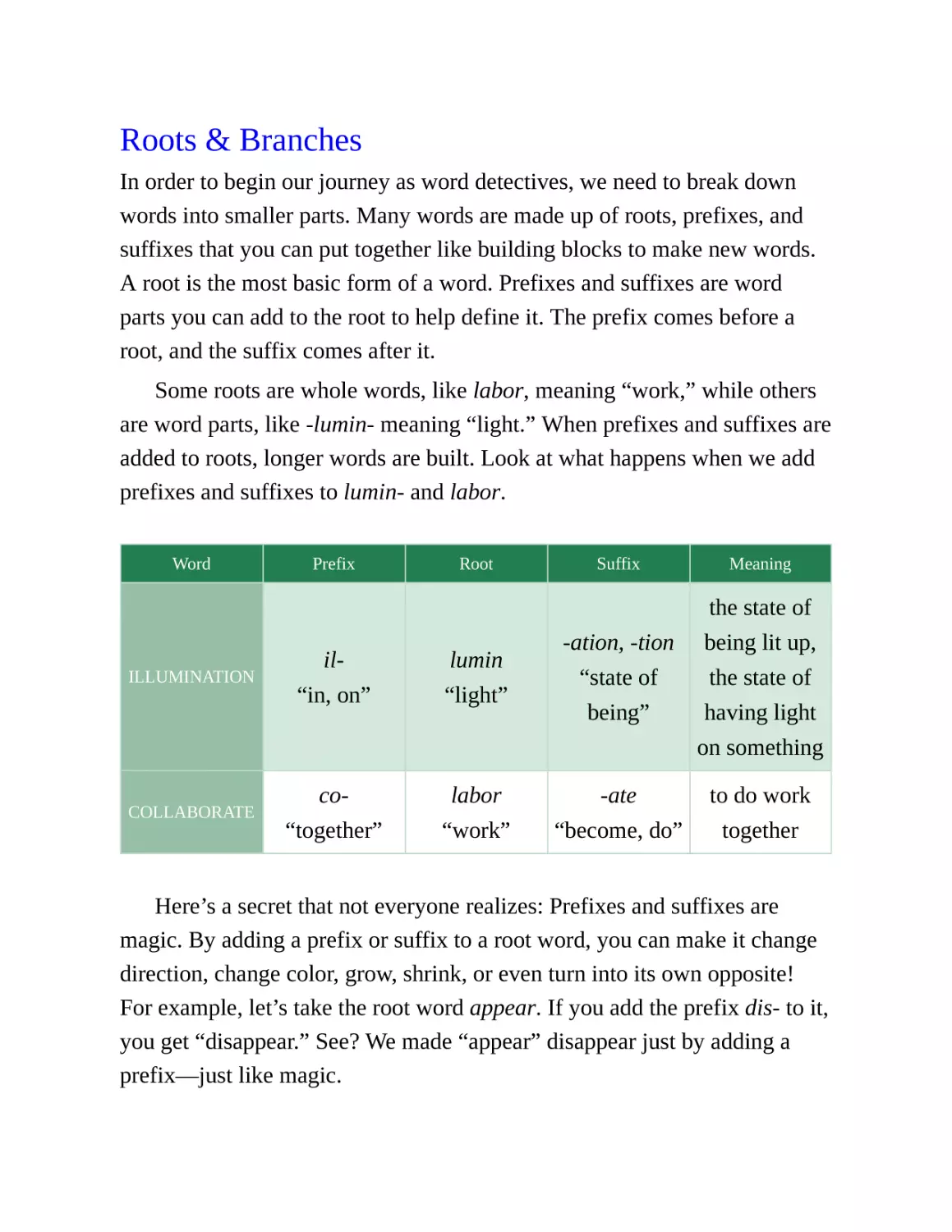
Some roots are whole words, like labor, meaning “work,” while others
are word parts, like -lumin- meaning “light.” When prefixes and suffixes are
added to roots, longer words are built. Look at what happens when we add
prefixes and suffixes to lumin- and labor.
Word

Prefix

Root

ILLUMINATION

il“in, on”

lumin
“light”

COLLABORATE

co“together”

labor
“work”

Suffix

Meaning

the state of
-ation, -tion being lit up,
“state of
the state of
being”
having light
on something
-ate
“become, do”

to do work
together

Here’s a secret that not everyone realizes: Prefixes and suffixes are
magic. By adding a prefix or suffix to a root word, you can make it change
direction, change color, grow, shrink, or even turn into its own opposite!
For example, let’s take the root word appear. If you add the prefix dis- to it,
you get “disappear.” See? We made “appear” disappear just by adding a
prefix—just like magic.

The charts below show common roots, their Greek and Latin origins,
their meanings, and examples. They are followed by some common
prefixes and suffixes.
See how many words you can make by adding prefixes and suffixes to
the roots!

LITERALLY, DEFINED
In this book, you’ll see definitions that include “literal” meanings of
words. The definition of a word is the way we use it in a sentence. But
when we’re studying etymology, we discover the literal meanings of
words, or what their origins and pieces meant in older languages.
For example, when we use the word “muscle,” we’re talking about
the body parts that make us strong. It comes from the Latin word for
muscle, musculus, which is also translated as “little mouse” and comes
from the Latin base word mus, meaning “mouse.” Muscles are named
after mice because it was thought that flexing your muscles made it
look like mice were crawling under your skin. Even though musculus
also meant “muscle” in Latin, “little mouse” is the literal meaning of
the word.

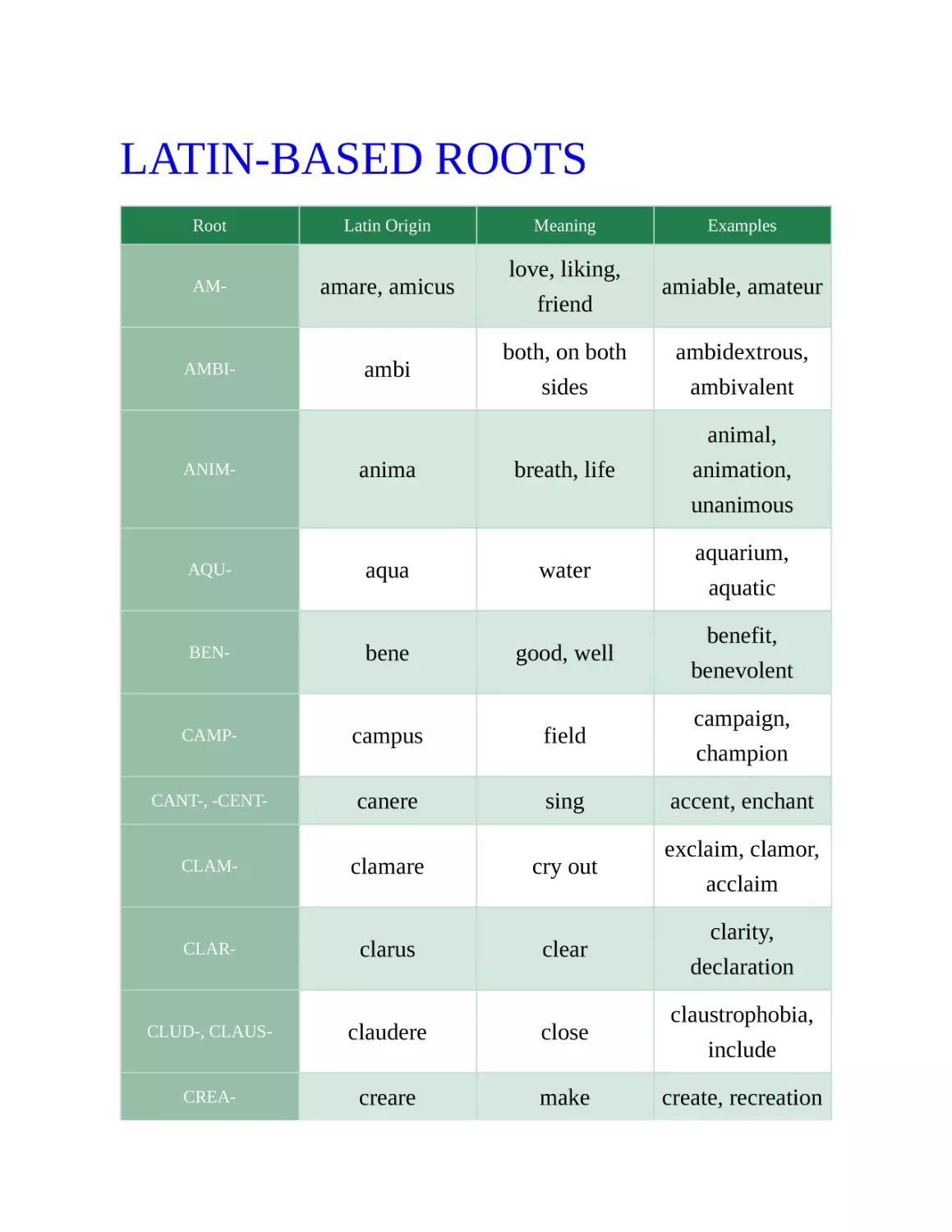
LATIN-BASED ROOTS
Root

Latin Origin

AM-

amare, amicus

AMBI-

ambi

Meaning

love, liking,
friend

Examples

amiable, amateur

both, on both

ambidextrous,

sides

ambivalent

ANIM-

anima

breath, life

animal,
animation,
unanimous

AQU-

aqua

water

aquarium,
aquatic

BEN-

bene

good, well

benefit,
benevolent

CAMP-

campus

field

campaign,
champion

CANT-, -CENT-

canere

sing

accent, enchant

CLAM-

clamare

cry out

exclaim, clamor,
acclaim

CLAR-

clarus

clear

clarity,
declaration

CLUD-, CLAUS-

claudere

close

claustrophobia,
include

CREA-

creare

make

create, recreation

Root

Latin Origin

Meaning

Examples

CRED-

credere

believe, trust

credible,
incredulous

CRUC-

crux

cross

CURR-

currere

run, flow

DIC-, DICT-

dictare

say, speak

dictator,
dictionary

FAC-, FACT-, -FECT-,
-FIC-

facere

do, make

perfect,
magnificent

FIG-, FING-, FICT-

fingere

to form, shape

fiction, figment

FLU-, FLUX-

fluere

flow

fluent

FORT-

fortis

strong

fortify, fortress,
fort

FUND-

fundare

found, from the
bottom

fundamental

GNOS-

gnoscere

know

GRAT-

gratus

thank, please

gratitude,
congratulations

IGN-

ignis

fire

ignite, igneous

crusade,
croissant
curriculum,
currency

agnostic,
diagnosis

Root

Latin Origin

Meaning

Examples

IMAGIN-

imago

copy

image,
imagination

-JECT-

iaciere

cast, throw

reject, trajectory

JUDIC-

iudex

judge

judgment,
prejudice

LABOR-

labor

work

labor, collaborate

LEG-, LECT-

legere

choose, gather,

legend,

read

intelligence

LIBER-

liber

free

liberty

LINGU-

lingua

language, tongue

bilingual,
language

MAGN-

magnus

great, large

magnificent,
magnify
dismal,

MAL-

malus

bad, wretched

MEDI-, -MIDI-

medius

middle

MERGE-, MERS-

mergere

dip, plunge

MIGR-

migrare

wander

MIN-

minor

less, smaller

malevolent,
malice
immediate,
medium
emerge, immerse
migrate,
immigrant
minor, miniscule

Root

Latin Origin

Meaning

Examples

MIT-, MISS-

mittere

send

transmit, dismiss

MOV-, MOT-, MUT-

movere

move, motion

motivation,
motion

NASC-, NAT-

nascere

born

natural, pregnant

NOC-

nocere

harm

NOMEN-, NOMIN-

nomen

name

onomatopoeia,
nominate

NOV-

novus

new

innovation, novel

ORDIN-

ōrdō

order

PAC-

pax

peace

appease, pacify

PREM-, -PRIM-,
PRESS-

premere

press

impress, oppress

PRIV-

privus

own

privacy, privilege

QUER-, -QUIR-,
QUESIT-, -QUISIT-

quaerere

search, seek

question, inquire

RID-, RIS-

ridere

laugh

ridiculous, riddle

RUMP-, RUPT-

rumpere

break, burst

SCAND-, -SCEND-,
SCANS-, -SCENS-

scandere

climb

innocent,
obnoxious

coordinate,
extraordinary

eruption,
interrupt
ascend, descend

Root

Latin Origin

Meaning

Examples

SCI-

scire

know

conscience,
omniscient

SCRIB-, SCRIPT-

scribere

write

describe, script

SENTI-, SENS-

sentire

feel

sensitive

SERV-

servare

save, protect,

observe,

serve

conservation

SOL-

solus

alone

desolate, solitary

SPEC-, SPECT-

specere

look

spectator,
conspicuous

TEMPOR-

tempus

time

tempo,
temporary

TEN-, -TIN-, TENT-

tenere

hold, keep

TORN-

tornare

turn

TRUD-, TRUS-

trudere

thrust

intrude, protrude

ULTIM-

ultimus, ultra

farthest, beyond

ultimate

VAL-

valere

strength, worth

evaluate, value

VEN-, VENT-

venire

come

adventure,
inconvenient

VID-, VIS-

videre

see

improvise, vision

VIV-

vivere

live

survive, vivid

detention,
tenacity
tornado,
tournament

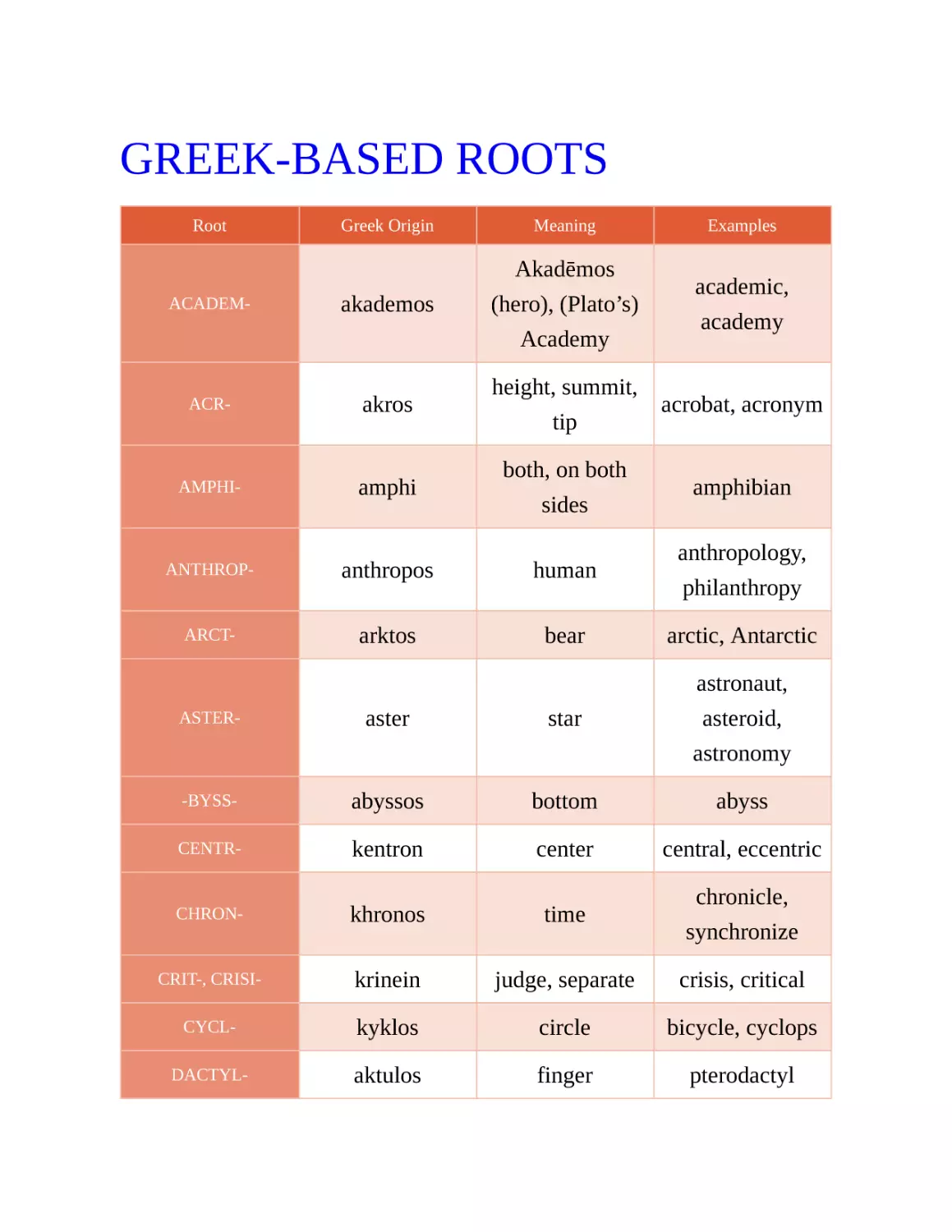
GREEK-BASED ROOTS
Root

Greek Origin

Meaning

Akadēmos
(hero), (Plato’s)
Academy

Examples

academic,
academy

ACADEM-

akademos

ACR-

akros

height, summit,
tip

acrobat, acronym

AMPHI-

amphi

both, on both
sides

amphibian

ANTHROP-

anthropos

human

anthropology,
philanthropy

ARCT-

arktos

bear

arctic, Antarctic

ASTER-

aster

star

astronaut,
asteroid,
astronomy

-BYSS-

abyssos

bottom

abyss

CENTR-

kentron

center

central, eccentric

CHRON-

khronos

time

chronicle,
synchronize

CRIT-, CRISI-

krinein

judge, separate

crisis, critical

CYCL-

kyklos

circle

bicycle, cyclops

DACTYL-

aktulos

finger

pterodactyl

Root

Greek Origin

Meaning

Examples

DYNA-

dunasthai

power

aerodynamic,
dynamite

ECO-

oikos

house

EGO-

ego

self

egocentric

EP-, EPI-

epi

upon, in addition
to

episode,
epidemic

ERG-, ORG-, URG-

ergon

work

energetic, urgent

GEN-, GON-

genos

birth, kind

genetic, gender

GRAMM-

gramma

letter, writing

anagram,
grammar

-GRAPH-

graphein

write, draw

calligraphy,
biography

HIER-

hieros

holy, sacred

HYPN-

hupnos

sleep

hypnotize

IDE-

idea

thought

idea, ideology

KINE-, CINE-

kinein

to move

cinema, kinetic

LOG-

logos

word, reason,
speech, thought

economy,
ecosystem

hierarchy,
hieroglyph

dialogue,
psychology,
meteorology

Root

Greek Origin

Meaning

Examples

MANI-, MANU-

manus

hand

manufacture,
manipulate

MNE-

mnasthai

memory

MON-

mónos

alone, only

NAV-, NAUS-

navis, naus

ship

nausea, navigate

NEUR-

neuron

nerve, sinew

neurologist

ODONT-

odontos

tooth

orthodontist
acronym,
anonymous,
synonym

amnesia,
mnemonic
monastery,
monopoly

ONYM-

onuma

name

PATH-

pathos

feeling, disease

PHIL-, -PHILE

philos

loving

PHON-

phone

sound

PHOT-

photos

light

photosynthesis,
photograph

PHYSI-

phusis

nature

physical, physics

PLAT-

platus

flat

plateau, platypus

sympathy,
empathy, apathy
philosophy,
bibliophile
symphony,
telephone

Root

Greek Origin

Meaning

Examples

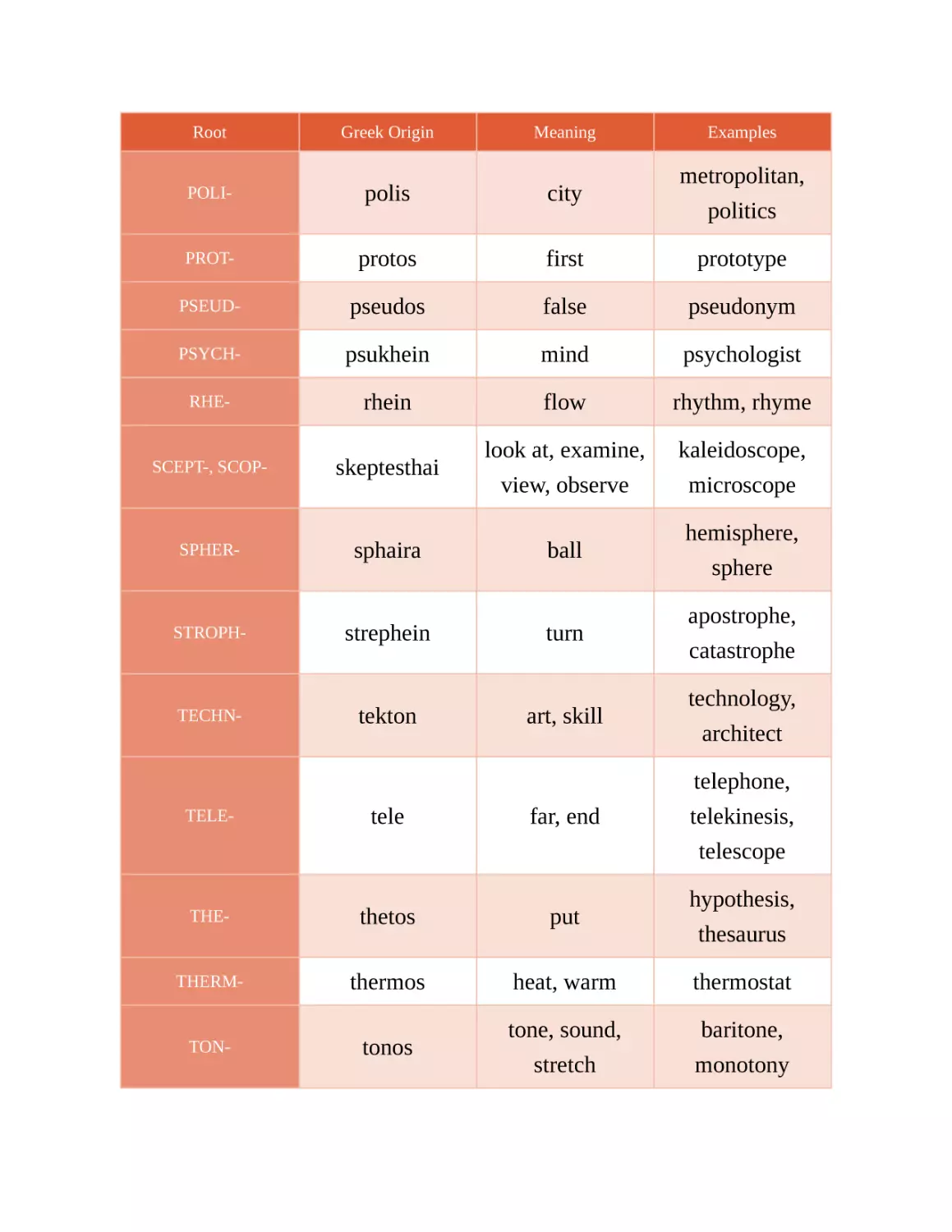
POLI-

polis

city

metropolitan,
politics

PROT-

protos

first

prototype

PSEUD-

pseudos

false

pseudonym

PSYCH-

psukhein

mind

psychologist

RHE-

rhein

flow

rhythm, rhyme

SCEPT-, SCOP-

skeptesthai

look at, examine,

kaleidoscope,

view, observe

microscope

SPHER-

sphaira

ball

hemisphere,
sphere

STROPH-

strephein

turn

apostrophe,
catastrophe

TECHN-

tekton

art, skill

technology,
architect
telephone,

TELE-

tele

far, end

telekinesis,
telescope
hypothesis,

THE-

thetos

put

THERM-

thermos

heat, warm

thermostat

TON-

tonos

tone, sound,
stretch

baritone,
monotony

thesaurus

Root

Greek Origin

Meaning

Examples

TOP-

topos

place, location

dystopia, utopia

TOX-

toxon

TYP-

tupos

stamp, model

TYRANN-

turannos

terrible, tyrant

arrow, bow,
poison

toxic
prototype,
stereotype
Tyrannosaurus,
tyranny

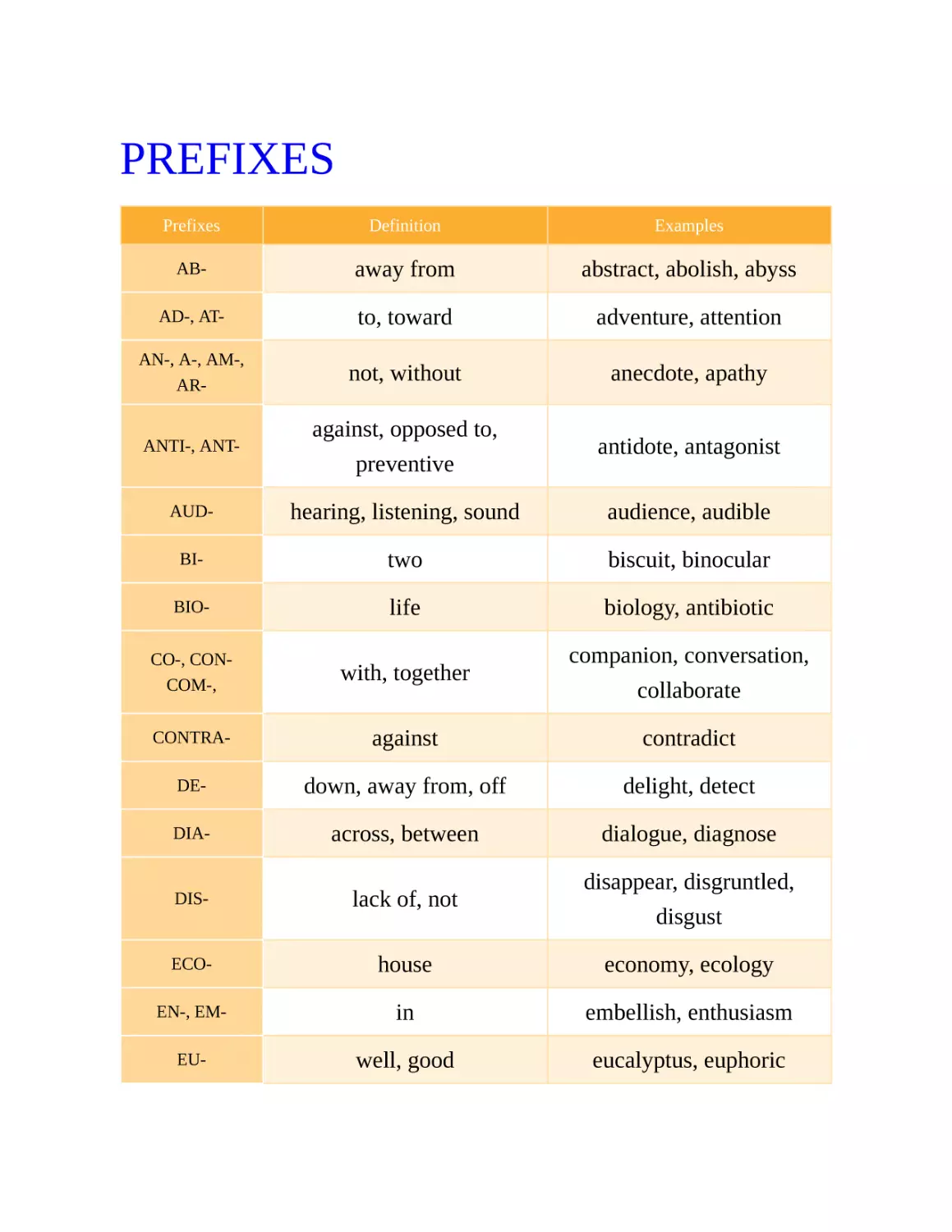
PREFIXES
Prefixes

Definition

Examples

AB-

away from

abstract, abolish, abyss

AD-, AT-

to, toward

adventure, attention

AN-, A-, AM-,
AR-

not, without

anecdote, apathy

ANTI-, ANT-

against, opposed to,
preventive

antidote, antagonist

AUD-

hearing, listening, sound

audience, audible

BI-

two

biscuit, binocular

BIO-

life

biology, antibiotic

CO-, CONCOM-,

with, together

companion, conversation,
collaborate

CONTRA-

against

contradict

DE-

down, away from, off

delight, detect

DIA-

across, between

dialogue, diagnose

DIS-

lack of, not

disappear, disgruntled,
disgust

ECO-

house

economy, ecology

EN-, EM-

in

embellish, enthusiasm

EU-

well, good

eucalyptus, euphoric

Prefixes

Definition

Examples

EX-

from, out

excite, exclaim, explore

EXTRA-

outer

extravagant, extraordinary

HYPER-

above, over

hyperbole, hyperactive

IN-, IL-, IM-

in, on

IN-, IL-, IM-

not, un-

independent, illiterate,
impossible

INTER-

among, between

interest, international,
interrupt

MULTI-

many, much

multilingual

OMNI-

all

omniscient, omnivore

PAR-, PARA-

beside, near

paragraph, parallel, separate

PED-

foot

expedition, pedestrian,
pedigree

PRE-

before

predict, pretend, pregnant

PRO-

before, in front of, forward

protagonist, procrastinate,
progress

RE-, RED-

again

RETRO-

backward, behind

retrospect

SUB-

below

submarine

imagine, illuminate,
inquisitive

reaffirm, redundant,
reluctant

Prefixes

Definition

Examples

SUPER-

above, over

supersonic, superior

SYN-

with

synonym

TRANS-

across

transparent, transportation

UN-

one

unique, uniform

XEN-

foreign

xenophobia

ZOO-

animal, living being

zoo, zoology

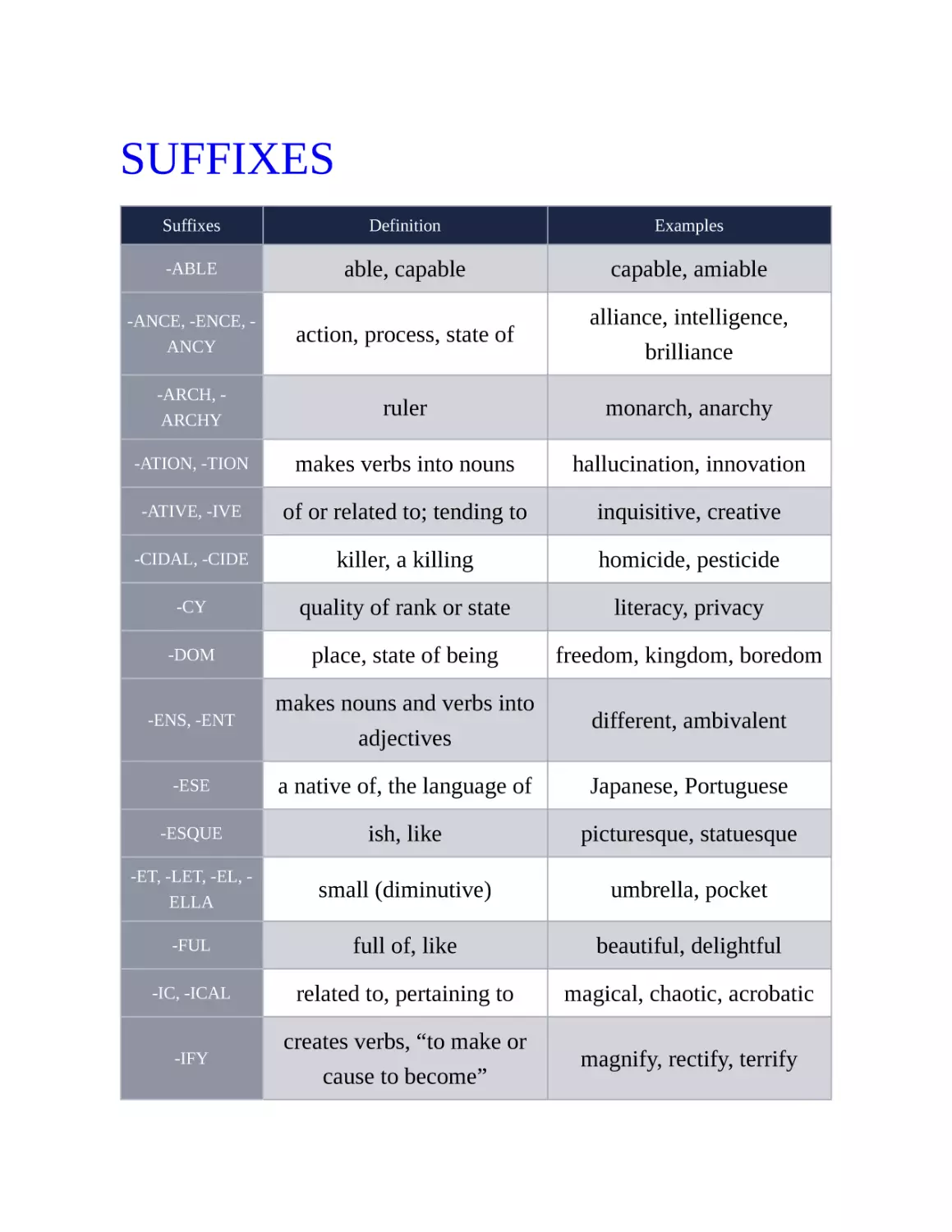
SUFFIXES
Suffixes

Definition

Examples

-ABLE

able, capable

capable, amiable

-ANCE, -ENCE, ANCY

action, process, state of

alliance, intelligence,
brilliance

-ARCH, ARCHY

ruler

monarch, anarchy

-ATION, -TION

makes verbs into nouns

hallucination, innovation

-ATIVE, -IVE

of or related to; tending to

inquisitive, creative

-CIDAL, -CIDE

killer, a killing

homicide, pesticide

-CY

quality of rank or state

literacy, privacy

-DOM

place, state of being

freedom, kingdom, boredom

-ENS, -ENT

makes nouns and verbs into
adjectives

different, ambivalent

-ESE

a native of, the language of

Japanese, Portuguese

-ESQUE

ish, like

picturesque, statuesque

-ET, -LET, -EL, ELLA

small (diminutive)

umbrella, pocket

-FUL

full of, like

beautiful, delightful

-IC, -ICAL

related to, pertaining to

magical, chaotic, acrobatic

-IFY

creates verbs, “to make or
cause to become”

magnify, rectify, terrify

Suffixes

Definition

Examples

-ISM, -SM

belief, method

narcissism, skepticism,
enthusiasm

-IST

one who does or makes

-ITE

originating from or derived
from, belonging to

botanist, florist, pianist,
physicist
dynamite, meteorite

-IZE

become, makes verbs from
nouns

recognize, apologize,
modernize

-LESS

without

reckless, thoughtless

-LOGY

study of, science

biology, archeology

-MENT

“condition of,” makes nouns
out of verbs

amazement, enchantment

-METER

measure

kilometer, meter

-NESS

state of being

happiness, business

-NOMY, -OMY

law

astronomy, economy

-OID

like (something else)

humanoid, android

-OUS

full of, having to do with,
doing, tending to

precocious, mischievous

-PHOBIA

fear of

claustrophobia,
arachnophobia

-SPOND

pledge

respond, sponsor,
responsible

Suffixes

Definition

Examples

-TECT

cover

protect, detect

-TION, -ATION, ION

state, condition, or action

levitation, motivation,
navigation, abolition

-TUDE

makes adjectives into
abstract nouns

attitude, gratitude

makes a noun out of an

royalty, eccentricity,

adjective

electricity

-URE

state of, act, process

culture, literature

-Y

characterized by

clammy, happy

-TY, -ITY

THE LONELIEST WORDS
A base word that doesn’t exist (or is very rarely used) without a prefix
or suffix is called an unpaired word.
For example, we say we are overwhelmed or underwhelmed, but
it’s rare to hear someone say they’re just “whelmed”. Someone can be
reckless, but what does it mean to have “reck?” You can debunk a
rumor, but was the rumor “bunked” in the first place?

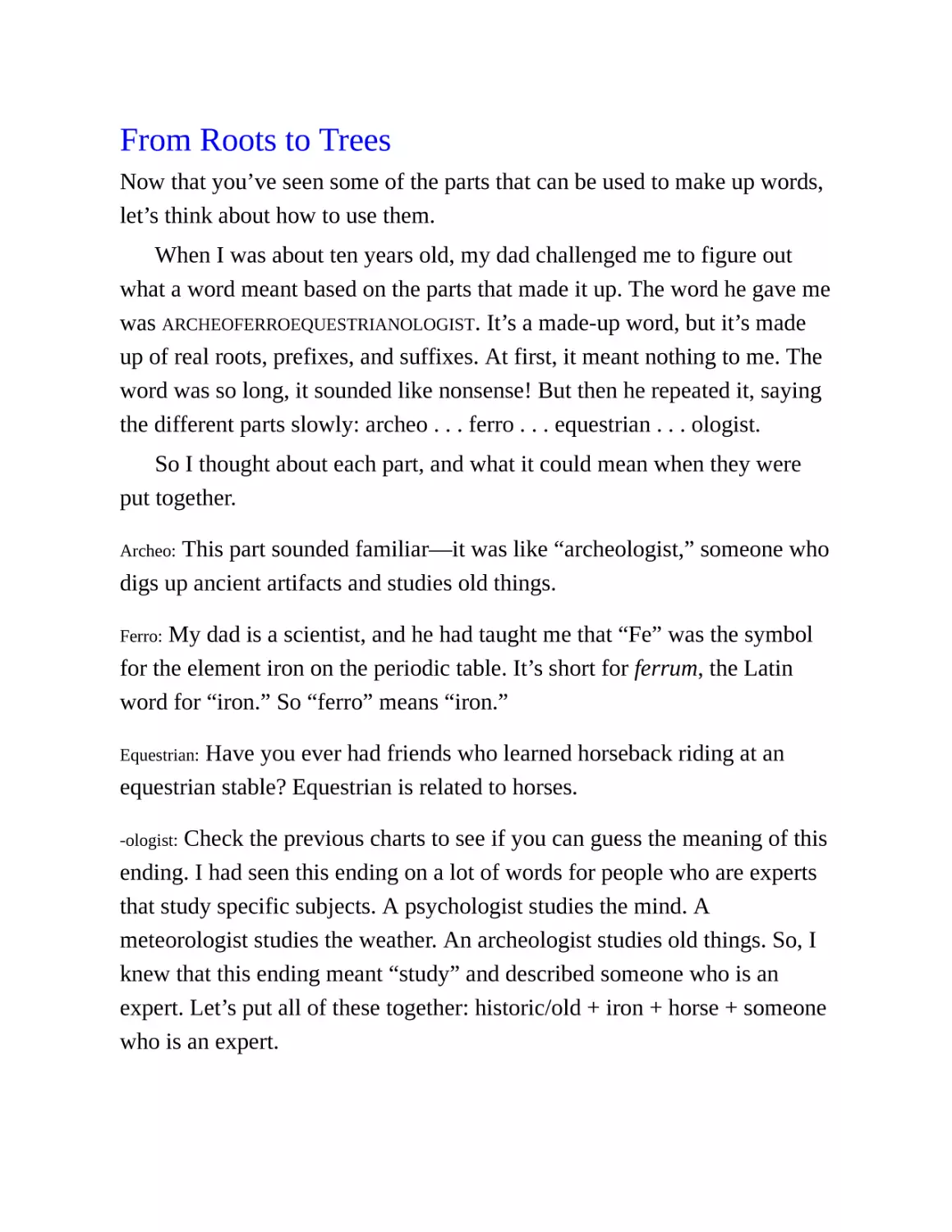
From Roots to Trees
Now that you’ve seen some of the parts that can be used to make up words,
let’s think about how to use them.
When I was about ten years old, my dad challenged me to figure out
what a word meant based on the parts that made it up. The word he gave me
was ARCHEOFERROEQUESTRIANOLOGIST. It’s a made-up word, but it’s made
up of real roots, prefixes, and suffixes. At first, it meant nothing to me. The
word was so long, it sounded like nonsense! But then he repeated it, saying
the different parts slowly: archeo . . . ferro . . . equestrian . . . ologist.
So I thought about each part, and what it could mean when they were
put together.
This part sounded familiar—it was like “archeologist,” someone who
digs up ancient artifacts and studies old things.
Archeo:

My dad is a scientist, and he had taught me that “Fe” was the symbol
for the element iron on the periodic table. It’s short for ferrum, the Latin
word for “iron.” So “ferro” means “iron.”
Ferro:

Have you ever had friends who learned horseback riding at an
equestrian stable? Equestrian is related to horses.
Equestrian:

Check the previous charts to see if you can guess the meaning of this
ending. I had seen this ending on a lot of words for people who are experts
that study specific subjects. A psychologist studies the mind. A
meteorologist studies the weather. An archeologist studies old things. So, I
knew that this ending meant “study” and described someone who is an
expert. Let’s put all of these together: historic/old + iron + horse + someone
who is an expert.
-ologist:

Someone who studies old iron horses? As my dad explained, “iron
horse” is a term for an old locomotive, or a big train made of iron.
Originally, trains were invented to replace teams of horses that pulled heavy
carriages. The earliest trains were even pulled by horses before engines and
electric power.
So, an “archeoferroequestrianologist” is someone who studies historic
trains.
This little game wasn’t just a way to teach me how to dissect made-up
words. It was also a way to teach me how to think critically about language.
If I could figure out the meaning of words like archeoferroequestrianologist,
then I could use this tool to build new words with pieces of words I already
knew.
You can do this, too! Flip back to the pages with the charts of roots,
prefixes, and suffixes. Take one from each chart, and see what sorts of
words you can build using them.
Now test your knowledge and see if you can break these words down
into their roots, prefixes, and suffixes and guess what they mean:
•

Inquisition

•

Anthropology

•

Magnitude

•

Incredulous

•

Telekinesis

ANSWER KEY
The process of asking questions about something, from in- “in,” +
quaerere “seeking, searching” + -tion
Inquisition:

Anthropology:

The study of humans, from anthropos “human” + -logy “study

of”
Magnitude:

Greatness, from magnus “great, large” + -tude

Incredulous:

Not believing, from in- “not, un-” + credere “believing”

Motion from afar (with your mind), from tele- “far, far off” +
kinein “to move”
Telekinesis:

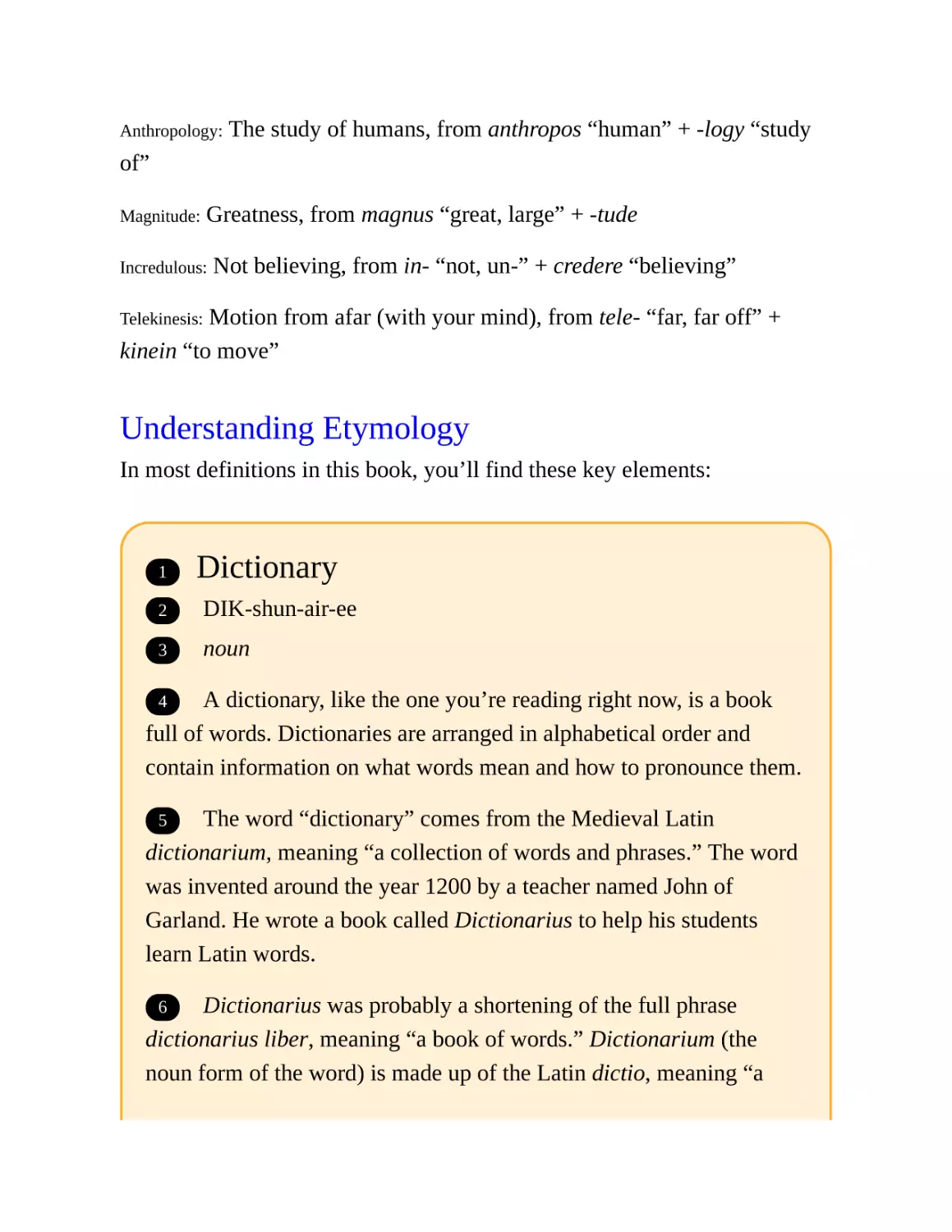
Understanding Etymology
In most definitions in this book, you’ll find these key elements:

1

Dictionary

2

DIK-shun-air-ee

3

noun

A dictionary, like the one you’re reading right now, is a book
full of words. Dictionaries are arranged in alphabetical order and
contain information on what words mean and how to pronounce them.
4

The word “dictionary” comes from the Medieval Latin
dictionarium, meaning “a collection of words and phrases.” The word
was invented around the year 1200 by a teacher named John of
Garland. He wrote a book called Dictionarius to help his students
learn Latin words.
5

Dictionarius was probably a shortening of the full phrase
dictionarius liber, meaning “a book of words.” Dictionarium (the
noun form of the word) is made up of the Latin dictio, meaning “a
6

saying” or “a word,” and the ending -arium, meaning “a place where
[things] are kept.” Put together, these parts literally mean “a place
where words are kept.”

1. The word!
2. Pronunciation: How to say this word out loud. This shows you how
each syllable sounds and which one is stressed, or accented.
3. Part of speech: Whether the word is a noun, verb, adjective, adverb,
preposition, interjection, or exclamation.
4. Definition: What the word means.
5. Background: Historical information about the word.
6. Etymology: The origins of the word and the reasons why it looks the
way it does today.

GROWING YOUR FOREST
While it’s fun to impress your friends and teachers by knowing lots of
words, learning about etymology isn’t just about having a big vocabulary.
When you understand the history and meaning of the words you use, you
also gain a better understanding of language—and the world! You can be
more creative, communicate better, and master new subjects. You can even
make up your own new words.
With a strong understanding of etymology, your possibilities are
endless. Here are just a few of the ways you can take what you learn in this
book and expand on that knowledge.
→ UNLOCK NEW LANGUAGES
Etymology can help you understand the meaning of words that you’ve
never seen or heard of before just by looking at them—even words in other

languages! English is made up of words derived from Latin, Greek, French,
Spanish, Italian, German, Dutch, Swedish, Arabic, Native American
languages—and more! With knowledge of roots and word origins, you can
learn any of these languages more quickly.
→ BECOME AN UNSTOPPABLE WORD EXPERT
Reading can seem like a tricky obstacle course when you run into a word
you’ve never seen before. But with an understanding of etymology, there’s
no word that can stop you. Any time you see a long word with many letters,
break it down into parts and see if you can guess what each part means, just
like we did in the previous section. Before you know it, you’ll be able to
guess the meaning of the word perspicacious (to have good judgment), and
you’ll be a regular sesquipedalianist, or someone who uses really long
words.
→ TACKLE ANY SUBJECT
When you can guess the meaning of any word, you can read any book.
Even the most challenging subjects won’t be out of your reach.
In fact, etymology can help you learn these new subjects quickly. As we
know, many common words in science, technology, philosophy, and law
come from Latin and Greek. You’ll approach these subjects already
knowing what the difficult words mean.
The library will be your gateway into endless stories and learning.
→ BECOME A GRAMMAR WIZARD
Etymology can help you understand grammar more easily. Once you
understand common roots, prefixes, and suffixes, you’ll get a better
understanding of different parts of speech and the elements of sentences.
Look back at the suffix section above. What happens when you add the

ending -ous to the noun “mischief”? You get “mischievous,” which is an
adjective. Suffixes can help you change words from one part of speech to
another.
→ TRAVEL THE WORLD—AND THROUGH TIME
With an understanding of etymology, you have the power to travel through
time and learn more about different civilizations.
In the next section, you’ll see that the Old English word for “game” was
gamen, which comes from a root meaning “people together.” That tells us
that the Anglo-Saxons valued their time together, playing games. You’ll
also see that the Greeks and Romans valued their gods and mythology and
often named things after them, including things like “cereal,” “money,” and
“inspiration.”
Learning about etymology is like having a superpower that helps you
see through portals to new and old places and cultures.
→ TAKE A JOURNEY IN SOMEONE ELSE’S SHOES
Languages are built through connections. By studying the origins of words,
you can see how ideas and words spread throughout the world over time.
Many of our words that relate to sports and physical feats—like
“marathon” and “acrobat”—come from the Olympic Games that were
originally held in Ancient Greece. These games have spread throughout the
world, becoming global traditions that everyone can celebrate.
→ INVENT NEW WORDS—AND INVENT NEW WORLDS
William Shakespeare was a poet and a playwright, and many consider him
to be one of the greatest wordsmiths in the English language. He invented
hundreds of words using pieces of words from Old English, Latin, and
Greek. Sometimes he changed a word’s part of speech, making nouns out of

verbs and vice versa. Here are just a few words that Shakespeare is credited
with inventing: coldhearted, eventful, swagger, fitful, squander,
multitudinous, dwindle, misquote, and uncomfortable.
And Shakespeare isn’t the only one who did this. In the Harry Potter
series, J. K. Rowling built the names of people and places using etymology:
Headmaster Albus Dumbledore’s name is built from Latin and Old English
words meaning “white bumblebee,” and the villain Voldemort’s name
means “flight of death” in French.
Like these writers, you can build worlds and fill them up with creative
characters just by using some etymological magic of your own.

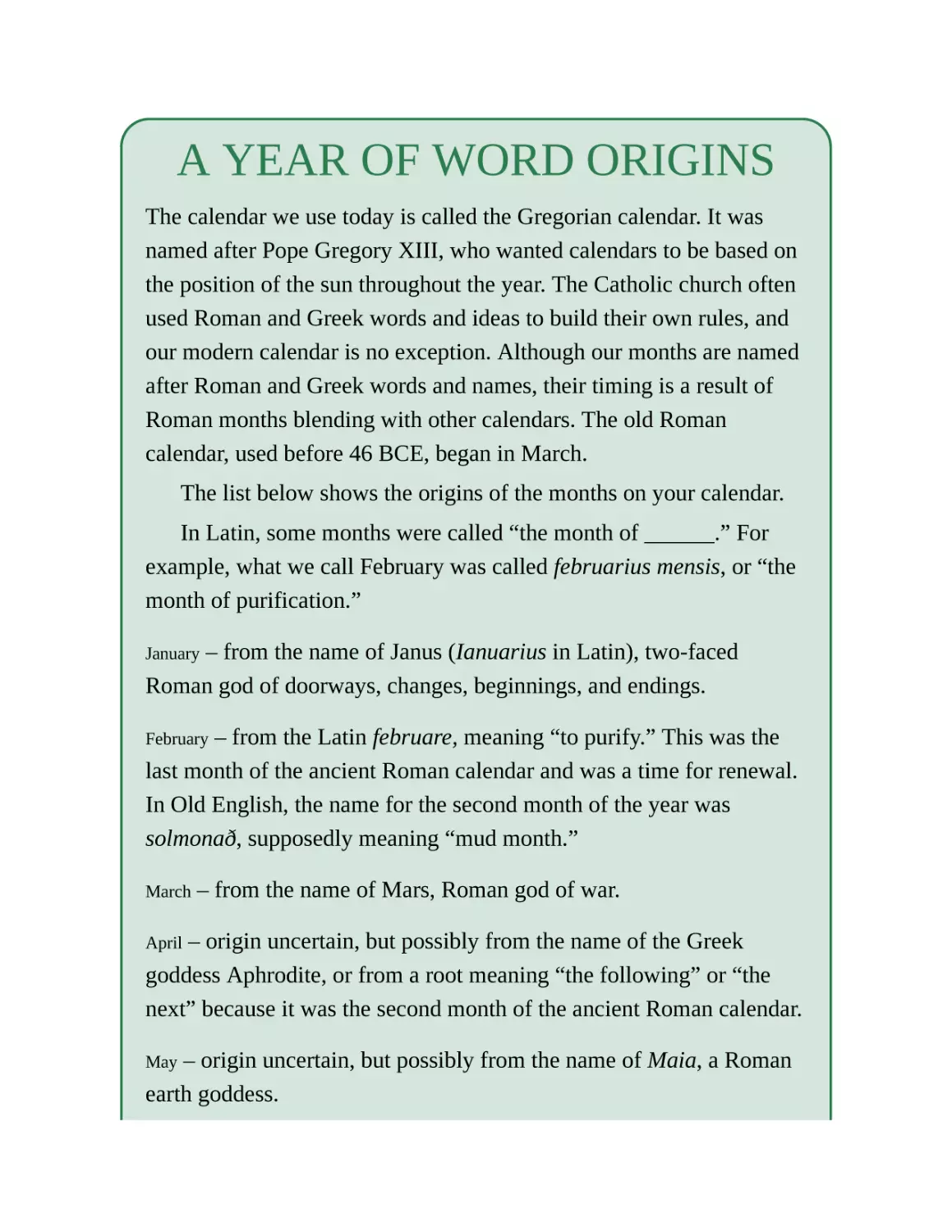
A YEAR OF WORD ORIGINS
The calendar we use today is called the Gregorian calendar. It was
named after Pope Gregory XIII, who wanted calendars to be based on
the position of the sun throughout the year. The Catholic church often
used Roman and Greek words and ideas to build their own rules, and
our modern calendar is no exception. Although our months are named
after Roman and Greek words and names, their timing is a result of
Roman months blending with other calendars. The old Roman
calendar, used before 46 BCE, began in March.
The list below shows the origins of the months on your calendar.
In Latin, some months were called “the month of ______.” For
example, what we call February was called februarius mensis, or “the
month of purification.”
– from the name of Janus (Ianuarius in Latin), two-faced
Roman god of doorways, changes, beginnings, and endings.
January

– from the Latin februare, meaning “to purify.” This was the
last month of the ancient Roman calendar and was a time for renewal.
In Old English, the name for the second month of the year was
solmonað, supposedly meaning “mud month.”
February

March

– from the name of Mars, Roman god of war.

– origin uncertain, but possibly from the name of the Greek
goddess Aphrodite, or from a root meaning “the following” or “the
next” because it was the second month of the ancient Roman calendar.
April

– origin uncertain, but possibly from the name of Maia, a Roman
earth goddess.
May

– from the name of Juno, Roman goddess of women and marriage.
In Old English, it was called liðe se ærra, meaning “earlier mildness.”
June

– from the name of the Roman ruler Julius Caesar, who was born
in the fifth month of the year, originally called Quintilis, meaning
“fifth.” It was renamed after his death, and later shifted to the seventh
month.
July

August

– named after the Roman emperor Augustus Caesar.

– from the Latin septem, meaning “seven,” because it was the
seventh month of the Old Roman calendar. Originally named
Germanicus after a Roman emperor, but it didn’t stick.
September

– from the Latin octo, meaning “eight,” because it was the
eighth month of the Old Roman calendar. Originally named Domitian
after a Roman emperor, but it didn’t stick either.
October

– from the Latin novem, meaning “nine,” because it was the
ninth month of the Old Roman calendar. The Old English name for
this month was Blotmonað, or “blood month,” because it was a time
when animals were sacrificed and stored for food in winter.
November

– from the Latin decem, meaning “ten,” because it was the
tenth month of the Old Roman calendar.
December

PART II
ETYMOLOGY—FROM
AARDVARK TO ZOOLOGY

Read more here

A
Aardvark

ARD-vark

noun

An aardvark is a mammal that eats insects and looks like a pig with a long
nose and tail. Its name means “earth-pig,” from the Afrikaans Dutch aard,
meaning “earth” or “dirt,” and vark, meaning “pig,” because this animal
burrows into the earth and resembles a pig.
Abolish

uh-BAH-lish

verb

To abolish something means to make it illegal or put an end to it. It comes
from the Latin word abolere, which means “to grow away from.” The
prefix ab- means “off, away from,” and the older word adolere means “to
grow.”
Example: The fifth-grade student body president helped abolish the use of single-use plastics in her
school.

Abstract

AB-stract

adjective

Abstract can mean something that you can’t experience with your five
senses, like the idea of freedom. It can also refer to an art style that doesn’t
show a recognizable image. Have you ever seen a colorful canvas with
shapes, paint splatters, and lines, but without people or objects? That’s
probably abstract art. The word comes from the Latin abstractus, meaning
“drawn or moved away,” which is formed of the prefix ab-, meaning “off”
or “away from,” and trahere, meaning “to draw, drag, or move.”
Abyss

uh-BISS

noun

An abyss is a deep pit or space that seems to go on forever and you can’t
see the end. It comes from the Greek word abyssos, which combines the

prefix a-, meaning “without,” and byssos, meaning “bottom.”
Academic

ak-a-DEM-ic

adjective

Something that is academic involves education, learning, or scholarship.
The word comes from the name Akademeia, the garden where the famous
Greek philosopher Plato taught his students. The Akademeia grove was
named after the legendary hero Akademos, who was rumored to be buried
there.
Accent

AK-sent

noun

Your accent, or the way you pronounce words, usually depends on where
you or your family live or came from. For example, Americans pronounce
the English word “clever” differently than people from England and
Australia. Even people who live in different regions of the same country
might have different accents. Think of the difference between the way
people talk in Tennessee and the way they talk in New York.
The word comes from the Latin accentus, which means “song added to
speech.” It’s formed from the prefix ad- and cantus, or “singing.” But why?
After all, accents appear in regular speech, not just songs.
In Ancient Greece and Rome, stories were often told in verse, which
means that they were arranged to have rhythm to them, like a chant or a
song.
Accident

AK-sid-ent

noun

An accident is something that happens by chance, instead of being planned.
The Latin word accidentem means the same thing. The base word cadere
means “to fall,” giving the full word the sense of something that “befalls”
you, or “falls upon” you.

Accuse

uh-KYOOZ

verb

To accuse someone of a wrongdoing is to blame them for it. Like many
words that have to do with crimes and laws, it comes from Latin. The word
accusare specifically meant “to bring to trial.”
Example: My brother accused me of eating all his candy—but I only had one piece!

Achievement

uh-CHEEV-mint

noun

An achievement is something won or completed. Maybe you achieved a
good grade in your class, or your team achieved victory in a game. It comes
from the Old French achever, meaning “to complete” or “to finish.” The
term originally comes from the Latin phrase ad caput, which means “to
come to a head,” or “to reach its end or highest point.” In English, the
phrase “to come to a head” means that a problem has reached its highest
point and must be solved right away.

Acrobat
AK-roh-bat
noun
An acrobat is someone who puts on an amazing gymnastic
performance in a circus or on stage. Many acrobats perform high in
the air on a trapeze or tightrope. Acrobat means “one who goes to the
top” or “one who walks high up,” from the Greek akros, meaning
“height,” the “tip of a peak,” or the “top of something high up,” and
bainein, meaning “to go” or “to walk.” It’s related to the Greek
akrobatos, a word for walking on your tip-toes or climbing up high.

Adobe

uh-DOH-bee

noun

Adobe is a type of sunbaked brick material used to build houses and other
structures. It is usually a mixture of clay, straw, and mud. The word is
Spanish, meaning “mudbrick,” and originally comes from the Arabic al-tob,
“the brick.”
Adventure

ad-VEN-chur

noun

When we think of adventure today, we might think of pirates and epic
journeys. But the word “adventure” used to simply mean anything that
happens by chance or luck. It comes from the Latin phrase adventura res,
which means “a thing about to happen.” It took on the meaning of “an
exciting incident or occurrence” or “an account of marvelous things” later,
after people began writing and telling exciting fictional stories of things that
happened by chance.
Aerodynamic

AIR-oh-dye-NAM-ik

adjective

Aerodynamics is the study of how well things can move through the air.
Something that is aerodynamic, like an airplane or a smooth, slim sports
car, can move quickly and easily without much drag or resistance from the
air. A broad and blocky shape is not aerodynamic because it would be
slowed down by resistance from the air as it moves. This is why planes are
designed as long, slim tubes. The word “aerodynamic” is made up of the
Greek elements aero, meaning “air,” and dynamikos, meaning “power.”
Agnostic

ag-NOSS-tik

adjective

Someone who is Muslim, Jewish, or Christian believes in God, and
someone who is an atheist believes there are no gods. But someone who is
agnostic believes that we can’t ever be sure whether a god exists or not. It
comes from the Greek agnostos, meaning “unknown” or “unknowable,”
made up of the prefix a- or “not,” and gnostos, or “known.”

Alarm

uh-LARM

noun/verb

A security alarm, an alarm clock, or the alarm bell that warns people of a
fire drill gets its name from the Italian military cry all’arme, meaning “To
arms!” or “Get to your weapons!” Italian soldiers would shout this phrase
when they needed to rally each other to defend castles and military bases.
Bonus fact: The word “arms” is another name for “weapons.” It comes
from the Latin word arma, which literally meant “tools,” but specifically
came to refer to tools used for war.
Albatross

AL-buh-tross

noun

The famous island prison Alcatraz is named after the Spanish and
Portuguese word for this long-winged white seabird. Etymologists aren’t
sure exactly which word it came from, but it was definitely Arabic—likely
al-ghattas, meaning “sea eagle.”
Alchemy

AL-kuh-mee

noun

Alchemy was what people called chemistry before modern times. It was
also a word used for the process of trying to turn one type of material, like
lead or iron, into a more expensive and rarer one, like silver or gold. It
comes from the Greek khemeioa, but the origin of the Greek word isn’t
quite as clear. It either comes from the Greek khymatos, meaning “that
which is poured out” (as you might pour out a chemical mixture or potion),
or from Khemia, which is the name Greeks used for the region we now call
Egypt, where much of our early knowledge of chemistry and medicines
came from.
Algebra

AL-juh-bruh

noun

The area of mathematics we call algebra was invented by ancient
Babylonians as early as the second century BCE. The word comes from the

Arabic word al-jabr, which was used by an Iraqi mathematician to mean “a
reunion of broken parts.” In fifteenth-century English, “algebra” referred
not only to mathematics but also to the process of setting broken bones.

ARABIC WORD ORIGINS
You’ll notice that many words that begin with al- come from the
Arabic language. That’s because the prefix al- is the definite article in
Arabic, meaning it is the Arabic word for “the.”

Alligator

AL-lih-gate-or

noun

Alligators are large reptiles that live both in water and on land. Their name
comes from the Spanish term el lagarto de Indias, meaning “the lizard of
the Indies.” The English word evolved from just the first two words in the
Spanish phrase, so “alligator” literally means “the lizard.” Even though they
look like giant lizards, today we know that alligators aren’t lizards at all, but
are a completely different kind of reptile.
Alliteration

al-LIT-er-ay-shun

noun

Alliteration is a term for a series of words that all start with the same letter
or sound. “Ben bakes bread better than Barry” is a sentence using the letter
“b” as the alliteration. Alliteration can also be based on the sounds the
letters make. “Kangaroos can quickly catch clever koalas” is an example of
alliteration. The word was created by Italian poet and historian Giovanni
Pontano, based on the Latin alliterare, meaning “to begin with the same
letter.”
Ally

AL-liy

noun/verb

We often think of allies as countries or people that support one another’s
causes, especially in war. A long time ago, the verb “ally” simply meant to
get married to someone. Allies were your family and relatives, from the Old
French word alier, meaning “combine” or “unite.” The word “ally” became
more connected with the military during World War II, when England,
America, the Soviet Union, and France joined together with other countries
and called themselves the Allied Powers, who opposed the Axis Powers
(Germany, Italy, and Japan).
Aloof

uh-LOOF

adjective

To be aloof means to act in an unfriendly, cold, or distant way. This word
was first a nautical term—a word associated with the ocean and ships.
Sailors used loof, a Dutch word, to mean the direction in which the wind
blew. These sailors would steer the ship aloof, or headed into the wind, in
order to stay distant from rocky shores.
Amateur

AM-uh-choor

noun

An amateur does something as a hobby rather than for money. An amateur
guitarist plays guitar for fun at home, but doesn’t play in concerts; an
amateur painter makes paintings for their friends and family, rather than for
a museum or gallery. The word was adopted from French, and it originally
comes from the Latin amatorem, meaning “lover.” After all, to be an
amateur, you have to love your hobbies so much that you don’t mind doing
them just for fun or outside of school.
Amaze

uh-MAYZ

verb

To be amazed is to be dazzled or stunned by something you’ve seen or
heard. Its root is the Old English mæs, which has the same meaning as the
word “maze.” The puzzle games we call mazes today were named after the

word’s original meaning, “a state of confusion or bewilderment.” So, in a
sense, to amaze someone is to drop them in the middle of a confusing
mental maze!
Ambidextrous

am-bee-DEKS-truss

adjective

Can you write well with both your right and left hand? Then you might be
ambidextrous! That means that you aren’t right-handed or left-handed, but
can use both hands equally. It comes from the Latin word ambidexter,
which means “right-handed on both sides.” The word dexter, or “righthanded,” is also the source of the word “dexterity,” the quality of having
quick, graceful, and skillful hands, like a juggler. Lots of people are lefthanded too, including famous artists, musicians, inventors, and world
leaders. Leonardo da Vinci, Wolfgang Amadeus Mozart, and Alexander the
Great were all left-handers!
Ambivalent

am-BIH-vah-lent

adjective

Ambivalence, or to be ambivalent, means that you don’t feel strongly about
picking between two choices. It was first used in the study of emotions.
Psychologist Paul Eugen Bleuler invented the word, which means “strength
on both sides,” building it with the Latin elements ambi- “both” or “on both
sides,” and valentia, meaning “strength.”
Example: My mom asked me if we should eat pizza or pasta for dinner. I’m ambivalent because I like
both!

Amiable

AY-mee-ah-bull

adjective

The Latin word amicus means “friend” or “loved one.” This word forms the
origin, or root, of “amiable,” which means friendly and helpful, just like a
friend.

Amnesia

am-NEE-zhee-uh

noun

Amnesia is another word for losing your memory. It comes from the Greek
amnesia, meaning “forgetfulness,” from the prefix a- or “not,” and
mnasthai, meaning “to remember.”
Example: After I fell off my bike and hit my head, I had amnesia. I couldn’t remember what happened
for a whole week before the accident!

Amphibian

am-FIB-ee-an

noun

Most animals that live on land (like humans and dogs) breathe using their
lungs. Most animals that live in the ocean (like fish and sharks) breathe
using gills. An amphibian is an animal, such as a frog or a salamander, that
does both at different stages of its life. For example, a frog starts out as a
tadpole that lives in the water and breathes through its gills like a fish. It
then grows into an adult frog that lives on land and breathes with its lungs.
The word comes from the Greek amphibios, meaning “living a double life,”
which is made up of amphi, meaning “both,” and bios, meaning “life.”
Amygdala

uh-MIG-duh-luh

noun

The amygdala is an important part of your brain that helps you remember
things, make decisions, and feel emotions. It comes from the Greek
amygdale, meaning “almond,” because it’s shaped like an almond. It’s no
wonder some people say that when you’re thinking cleverly, you’re “using
your nut”!
Anaconda

an-uh-CON-duh

noun

Anacondas are huge snakes that live in tropical areas of South America.
Etymologists aren’t sure exactly where these gigantic snakes got their
name. The best guess about this word’s origin is that it’s from Sri Lanka.

The Sinhalese or Sri Lankan word henacandaya means “whip-snake” or
“lightning-stem.”
Anagram

AN-uh-GRAM

noun

An anagram is a word whose letters can be mixed up to make another word.
For example, “silent” is an anagram of “listen” because they contain all of
the same letters, just in a different order. Some anagrams are words that
make different words when you read them backward: “Evil” read backward
becomes “live.” Anagram is made up of the Latin prefix ana-, meaning
“back” or “backward,” and gramma, meaning “letter.”
Anarchy

AN-ar-key

noun

A monarchy has a monarch, or king or queen, leading the state; a
democracy is ruled by representatives elected by the people. But anarchy is
a state of chaos where there is no recognized leader, or the people decide to
ignore the leadership. This word come from the Greek anarkhos, or
“rulerless,” which is made up of the prefix an-, meaning “not” or “without,”
and arkhos, meaning “leader.”
Anatomy

uh-NAT-uh-mee

noun

Anatomy is the study of and the shape of the human body. It comes from
the Greek word anatomia, which means “dissection” or “a cutting up.”
Early scientists would open bodies to learn from them, and this led to the
formation of the modern-day term. In the 1500s, people also used the word
“anatomy” to refer to mummies and skeletons.
Anecdote

AN-ek-doht

noun

An anecdote is a short, personal story about something that happened to
you. If you’re sharing an anecdote about dogs, you would tell a short and

funny story about your dog. Anecdotes can be made up, too. The word
comes from the Greek term anekdotos, which means “not published.”
(When you publish something, like a book, you make it public to read.)
Anekdotos was originally the name of a book full of (previously
unpublished) stories of silly things that happened to a Byzantine ruler.
Example: My science teacher shared a funny anecdote about a time when she dyed her fingers blue
during a chemistry experiment.

Animal

AN-uh-mul

noun

Are you a plant? No. Are you a mineral? No. How about a fungus? Not so
much. You’re an animal, just like cats and parrots and whales. The word
comes from the Latin anima, meaning “breath,” “life,” or “spirit” because
animals move, breathe, and live their lives.
Animate

AN-uh-MATE

verb

If you’ve ever seen a cartoon or computer-animated movie, you’ve watched
an animation—a picture that moves. This word literally means “to bring to
life,” also from the Latin anima, meaning “breath,” “life,” or “spirit.”
Anthropology

AN-throw-PAW-loh-jee

noun

Anthropologists study the history and culture of humans from many
different times and places. They study people alive today—and our
ancestors! The word “anthropology” is made up of the Greek anthropos,
meaning “human being,” and -logy, meaning “study of.”
Antidote

AN-tih-doht

noun

An antidote is medicine that cures you if you consume something harmful.
The word comes from the Greek phrase antidoton pharmakon, which means

“a remedy” or “a drug given against something,” from the elements anti,
meaning “against,” and didonai, meaning “to give.”
Apathy

A-puh-thee

noun

Apathy means to not care about something. It comes from the Greek word
apatheia, which means “without emotion.” When you break this word
down more, pathos means “emotion” or “feeling,” so putting the prefix a-,
which means “without,” in front of it, it means “without emotion.”
Example: My partners for the group project in history class didn’t care about their grades, so I did
most of the work on it. I felt frustrated by their apathy.

Apology

uh-PAW-low-jee

noun

Have you ever had to apologize for something? Today, we think of it as
saying sorry. But to the Greeks, an apology was something you said to
defend yourself or your opinions. Debate was an important aspect of
Ancient Greek culture, much like it is today. When someone disagreed with
you back then, you would make an apologia, or a speech to stand up for
your ideas. The Greek word is formed from the elements apo, meaning
“away from,” and logos, meaning “speech.” Together they mean “speaking
away from.”
Apostrophe

uh-PAW-stroh-fee

noun

An apostrophe can do two things: It can show belonging or possession, as
in “Melissa’s dog” (the dog that belongs to Melissa) or “Fred’s mother” (the
mother of Fred). It can also show that letters have been removed, as in
“haven’t” (short for “have not”) or “they’ve” (short for “they have”). The
word “apostrophe” comes from the Greek apostrephein, meaning “to turn
away,” which is made up of apo, meaning “off, away from,” and strephein,

meaning “to turn.” The idea is that the symbol “turns away” or sends away
the letters that are removed from the original word.
Aquatic

a-KWAH-tik

adjective

Aquatic animals and plants are those that make a splash! In other words,
they live in water. Their name comes from the Latin word for water, aqua.
The word “aquarium,” or fish tank, comes from the same source.
Example: Coral reefs in the ocean are home to many aquatic plants and animals.

Arctic

ARK-tik

adjective

Have you ever looked up in the night sky to see the constellation called the
Big Dipper? Another name for it is Ursa Major, which means “the greater
she-bear.” The word “Arctic,” referring to the North Pole, comes from the
Greek word arktos, which meant “of the north” but was also literally a word
for “bear.” The Greeks named the north after the bear constellation because
it is always visible in the northern polar sky. Thanks to what we know about
the prefix ant-, we can guess that “Antarctic” (the South Pole) means
“opposite the bear.”
Example: Polar bears live in the Arctic region near the North Pole. Most types of penguins live in the
Antarctic region near the South Pole.

Asteroid

ASS-ter-oyd

noun

An asteroid is a type of very small, rocky planetoid. It’s formed of the
Greek elements aster, meaning “star,” and eidos, meaning “form or shape.”
So, asteroid means “star-shaped” or “starlike.” (That’s also why starfish
belong to the class Asteroidea.)
Astronaut

ASS-troh-not

noun

Do you dream of space travel? You might want to become an astronaut
when you grow up. We know from the word “asteroid” that the prefixes
aster- or astro- mean “star.” The second part of this word, “naut,” comes
from the Greek nautes, or “sailor.” So, an astronaut is literally a “star
sailor.”
Astronomy

uh-STRON-uh-mee

noun

Astronomy is the science of outer space. It comes from the Greek word
astronomos, which means “the regulation of the stars.” It is made up of the
elements astron, “star,” and nomos, which means “regulating, or law.”
Attention

uh-TEN-shun

noun

When you pay attention to your teachers, you are listening to what they
have to say. “Attention” comes from the Latin attendere, which means “to
listen to” but literally translates as “to stretch toward.” This “stretching”
sense comes from the fact that you are directing your mind, ears, and focus
toward the teacher.
Attic

AT-tik

noun

The word “attic” comes from the name of Attica, a region near Athens,
Greece. The Greeks didn’t usually have attics—storage areas at the top
level of a house—like the ones we do today, but in classical Athenian
architecture, many structures had pointed roofs. This left a small triangular
space above the columns—room for decorations! Today, we still have
pointed roofs on our houses, but we use that extra triangular space to store
things (and sometimes build forts!).
Audience

AW-dee-ence

noun

What do you do when you’re sitting in the audience? You’re probably
watching, but most importantly, you’re listening. The word “audience”
comes from the Latin word audentia, which means “listening.” Back in the
times of kings and queens, if you asked for help, they would “grant you an
audience.” This meant they would listen to your troubles.

ORIGIN SPOTLIGHT: AUDIRE
Review the definition of these three words that come from the Latin
audire.
•

Audible:

Able to be heard.

•

Audiobook:

•

Audience:

A book you can listen to.

A group of people who listen to and watch a performance.

What do they have in common? Can you guess what audire means
based on these definitions?
If you guessed “to hear” or “to listen,” you’re right! All of these
words rely on your sense of hearing.

Awkward

AWK-word

adjective

Have you ever felt embarrassed because you did something silly? You
might have felt a little bit awkward. (We all do sometimes!) This word
originally came from an Old Norse word meaning “turned the wrong way.”
You might recognize the -ward ending from words like “toward” and
“backward.” This ending adds direction to a word. In this case, “awkward”
suggests something pointed in the wrong direction.

Read more here

B
Bamboozle

bam-BOO-zull

verb

Have you ever played a prank on a friend—or had a prank played on you?
To bamboozle someone is to trick them. Etymologists aren’t quite sure
where it came from, but some suggest that it came from Scottish slang
words like bombaze or bumbaze, meaning “to perplex.” Others think it
came from the French word embabouiner, which means “to make a baboon
of someone,” or to make them look silly and foolish.
Example: The magician bamboozled the audience by making a card disappear. In truth, she slipped
the card up her sleeve!

Bandicoot

BAN-duh-coot

noun

A bandicoot is the name of several species of Indian and Asian rats known
for their destructiveness and large size. Its name is an English version of the
Telugu (a language native to India) word pandi-kokku, meaning “pig-rat.”
Barbarian

bar-BAIR-ee-an

noun

The word “barbarian” comes from the Medieval Latin word barbarinus, a
word for anyone who wasn’t Roman or Greek. The root barbar- was used
to imitate the unintelligible speech of foreigners, so essentially, “barbarian”
means “a person who says ‘blah, blah, blah.’”
Barricade

BAIR-uh-kaid

noun/verb

Soldiers and rebels build barricades to block off streets or to protect bases
during battles. “Barricade” literally means “made of barrels,” from French
and Spanish origins, because during a riot or a big public uproar, people
fighting would set up blockades or a wall made of barrels filled with rocks

and dirt. Today, we use the word informally, too. You can barricade your
door with pillows or your treehouse with a pile of leaves.
Benefit

BEN-uh-fit

noun/verb

A benefit, or something beneficial, is something that helps (or benefits) you
or someone else. It comes from the Latin benefactum, meaning “good
deed.” It is made up of the elements bene, meaning “well,” and facere,
meaning “to do.”
Benevolent

buh-NEV-oh-lint

adjective

Someone who is benevolent is kind, gives to other people, and works for
the greater good. Adopted from Old French, it originally comes from the
Latin benevolentem, meaning to wish that good things will happen to
someone else. It’s from bene, or “well,” and volantem, “to wish.” When you
swap male (meaning “badly”) for bene, you get “malevolent,” which means
to wish bad things upon someone.
Beyond

bee-YOND

preposition

If something is “beyond” your house, it means it’s past your house, or on
the other side of it. “Beyond” comes from the Old English word begeondan,
which means “on the other side of.” You might recognize the “yond”
portion of the word from “yonder,” which people usually say when they
mean “over there.”
Bibliophile

BIB-lee-oh-file

noun

If you’re reading a book about etymology, you are probably a bibliophile,
or someone who loves books. The first element of this word is biblio-, or
“book,” from the Greek biblion, meaning “paper” or “scroll.” The second

part, -phile, means “lover,” from the Greek philos, meaning “loving” or
“dear.”
Binoculars

bih-NOK-yoo-lars

noun

Have you ever looked through a pair of binoculars? The Latin prefix bimeans “two,” and ocularis means “eye.” This tool lets you see far away
through two short telescopes—an extension of your two eyes!
Biology

bi-AWL-oh-jee

noun

At some point, you’ll probably take a biology class in which you’ll study
animals, plants, and the human body. The prefix bio- means “life,” and it
appears in many English words including biodegradable, biography, and
biopsy. If we combine this prefix with the ending -logy, meaning “science”
or “theory,” we get the meaning “the science of life.”
Bizarre

bih-ZAR

adjective

“Bizarre” comes from the Italian word bizzarro, a word that describes
someone who is cranky or tends to have quick flashes of anger. Over time,
the word bizzarro softened its meaning to mean “unpredictable,” “strange,”
or “weird.” It was adopted in French, which we then borrowed in English.
Blade

BLAYD

noun

We tend to think of swords and knives when we think of blades. But it also
applies to a much smaller, usually green object. The Old English word blæd
meant “leaf”—or a blade of grass. It could also refer to anything leafshaped, like an oar or the head of a shovel.
Blaze

BLAYZ

noun/verb

This word, which is usually associated with a huge fire, comes from an
early Germanic root meaning “shining” or “white.” It can refer to dancing
flames, but “blaze” is also a word for the white spot that many horses have
on their foreheads. The saying “to blaze a trail” means to create a physical
path or lead people down a new path. It usually means you’re the first, in
some aspect, to do something. This concept comes from the fact that
pioneers would make notches, or blazes, in tree bark as they made their way
through unexplored forests so that they could find their way back, and
others could follow.
Example (verb): Young people like Greta Thunberg are blazing the trail for environmental justice.

Book

BUK

noun

To understand the origin of this word, we need to look back to the living
things from which books are made: trees! “Book” comes from a ProtoGermanic root meaning “beech tree.” This is probably because writing
tablets were once made from beechwood. Similarly, the Latin word librum,
also the word for “book,” originally meant “the inner bark of trees.”
Botanical

buh-TAN-uh-kul

adjective

Have you ever been to a botanical garden? It’s a special kind of garden or
park where many plant species are grown. You can think of it as a zoo or
museum for plants! “Botany” comes from the Greek word botane, which
could mean any type of plant, but most often refers to grass that farmers
would feed to cows and sheep. In fact, the related word boton means
“grazing beast.”
Brain

BRAYN

noun

No one is quite sure of the exact origin of the word “brain,” but one guess is
that it comes from a root meaning “broken.” We usually think of “broken”

as something being damaged or needing to be fixed, but in this case it refers
to the wrinkles, curves, and hemispheres of our brain that make it look like
it’s broken into segments. It’s this beautiful “brokenness” that makes us
able to think, feel, and create!
Brilliant

BRILL-yant

adjective

“Brilliant” describes things that are dazzlingly bright or sparkling—literally
“shining like beryl,” from the Latin berillus. Beryl is a brightly colored
mineral and gemstone that comes in several varieties, including emeralds
and aquamarine. To say that a person is brilliant is to say that their
intelligence and cleverness shine as brightly as one of these colorful gems.
Buffoon

buh-FOON

noun

If you puff up your cheeks with air, you’ll be pantomiming (or playacting)
the origin of “buffoon.” It isn’t a common insult anymore, but it was once
used to mean anyone foolish or absurd, or specifically a jester or comic
fool. It comes from the Italian buffare, meaning “to puff out the cheeks,”
just like a jester would in a comedic performance.
Bully

BULL-ee

noun/verb

Did you know that being a bully was once a good thing? Today, “bully” is a
word for a cruel person or the act of being cruel, but in the 1500s, people
used it to mean “sweetheart,” referring to both men and women. It probably
comes from a Germanic word for “lover” or “brother.” The meaning likely
changed to refer to someone pushy or mean because the word sounds a lot
like “bull,” a big male cow that can be very stubborn and moody.

Buoy

BOO-ee
noun
A buoy is a floating object placed in the ocean to warn boats and ships
about areas in the water that are dangerous or shallow. It likely comes
from a Proto-Germanic root meaning “signal” or “beacon,” or perhaps
from an Old French word for “chain” because buoys are usually
attached to the ocean floor by chains. Because buoys float, the
adjective “buoyant” refers to something that floats or the emotional
state of feeling light and happy.

Business

BIZ-uh-ness

noun

When we grow up, our jobs can keep us very busy. That’s why business
means exactly what it looks like: busy-ness. It comes from the Old English
bisignes, which meant anything that you cared about or kept you occupied.

Read more here

C
Calligraphy

kuh-LIG-ruh-fee

noun

Calligraphy is a special kind of decorative penmanship or handwriting. It is
considered a visual art. Calligraphy comes from the Greek kaligraphia,
which is formed of kallos, meaning “beauty,” and graphein, meaning “to
write.”
Camouflage

KAM-uh-fladj

noun/verb

“Camouflage” refers to paint and other materials used to disguise people,
army machinery, and animals. It comes from the Italian camuffare, “to
disguise,” and was adopted in French as camoufler before it was used in
English.
Example (noun): A tiger’s stripes are good camouflage when it’s hunting in tall grass.

Campaign

kam-PAYN

noun/verb

You’ve probably heard of a political campaign, when someone running for
office tries to get people to vote for them. “Campaign” is also a word for the
movement of an army onto the battlefield. It comes from the Old French
word champagne, meaning “open country,” where two armies might meet
for battle. (Champagne is also the name of a French city that has wide open
fields where they make bubbly wine.) Originally, the word comes from
Latin, with the base word campus meaning “field.”
Canoe

kuh-NOO

noun

A canoe is a lightweight boat that you steer and propel with paddles. The
boat’s design and name both come from the indigenous people of Haiti. In
Arawakan, the indigenous language of Haiti, this boat is called a canaoua.

Capable

KAPE-uh-bull

adjective

You can do it! To be capable means to have the ability to do something.
This word overlaps with the word “capacity,” which means the ability to
hold or do something. A large cargo ship, for example, has a high storage
capacity. Your mind also has a large capacity for learning new skills. Both
come from the Latin capax, meaning “able to hold much.”
Example: My brother got the flu, so he was not capable of finishing his homework.

Cargo

KAR-goh

noun

Today, cargo is anything carried in storage in a car, ship, plane, wagon, or
train. It was adopted from the Spanish cargo, meaning “burden.” Its origin
refers to the vehicle that carries this stuff—the Latin carrus means
“wagon,” and is also the source of the English word “carriage.”

Caribou
KAIR-uh-boo
noun
A caribou is a large type of reindeer. Its name is an Algonquian
(Native American) word meaning “pawer” or “scratcher” because it
digs in the snow with its hooves to find moss and grass.

Carpenter

KAR-pen-tur

noun

This name for a professional woodworker is from the Latin carpentum,
which meant “wagon,” “carriage,” or “cart.” In Latin, an artifex
carpentarius was a person who made wooden carts. In English, “carpenter”
replaced the Old English word treowwyrhta, literally “tree-wright.” A
“wright” is someone who makes or builds something: A playwright creates

plays for the theater, a shipwright is someone who builds ships, and a treewright would be someone who makes things from wood.
Cartography

kar-TOG-ruh-fee

noun

Cartography is the art and science of making charts and maps. If you break
it down, it literally means “the drawing of maps,” formed of the Latin carta
or charta, which could refer to a piece of paper, a card, or a map, and the
Greek -graphein, meaning “to write” or “to draw.”
Cartoon

kar-TOON

noun

The word “cartoon” is much older than the animated shows you might
watch. It is derived from the Medieval Latin carta, or “paper.” At first,
“cartoon” was a name for the heavy paper that artists, especially newspaper
cartoonists, used for their early sketches. Over time, the word referred to the
drawings themselves, and eventually to hand-drawn animations.
Catapult

KAT-uh-polt

noun

A catapult is a machine that uses a lever to throw heavy things into the air.
Large catapults were used to attack castles and fortresses, propelling rocks
and other large objects at high walls to knock them down. The Greek word
for catapult was katapeltes, which is composed of kata, meaning “against (a
wall),” and pallein, meaning “to toss or hurl.”
Catastrophe

kuh-TASS-troh-fee

noun

Today we think of a catastrophe as a horrific event. Its original meaning
was a little less dramatic. It was once a word for “a reversal of what is
expected,” or the opposite of what you think will happen. “Catastrophe”
comes from the Greek katastrophe, meaning “an overturning,” “a sudden
end,” or a “turning downward.” The Greek word is made up of the elements

kata, meaning “down,” and strephein, meaning “to turn.” It makes sense
that “catastrophe” came to mean “disaster” over time because when
something like a hurricane comes, it can overturn buildings!
Caterpillar

kat-ER-pill-er

noun

The word “caterpillar” originally comes from the Latin words catta,
meaning “cat,” and pilosus, meaning “hairy, shaggy, or covered with hair.”
It literally means “shaggy cat”! The Old English term for these insects was
cawelworm, or “cole-worm.” “Cole” was a Middle English word for
cabbage, and caterpillars love to eat cabbages! English isn’t the only
language where “caterpillar” refers to other animals. The French word for
caterpillar, chenille, literally means “little dog.” In some Italian dialects,
caterpillars are called gattola, or “little cat.” In Portuguese, the word for
caterpillar, lagata, comes from the Latin lacertus, meaning “lizard.”

WHY DO SOME WORDS
SOUND FUNNY?
Some words sound funnier than others. This happens for several
reasons. Funny-sounding words may be onomatopoetic.
Onomatopoeia refers to a word that sounds like its meaning. Take
cackle, for instance: This word for a witchy laugh also sounds like
someone laughing when you say it out loud. It was originally a word
for a chicken’s clucking—and sounds a bit like that, too. Squelch,
meaning to squish something, also sounds like the noise you hear
when you step in something squishy, like mud. Other examples
include sizzle, bonk, thud, and twang.

These words have imitative origins, meaning they exist because
someone turned the sound into a word. Many of these words are
thought to sound funny because it can be unexpected to hear someone
say a word that copies a silly sound effect.
Uncommon letter combinations can also sound funnier than
expected ones. Dr. Seuss is famous for inventing nonsense words that
sound silly for these reasons. He created rhymes with words like
“rumbus,” “sneedle,” “vipper,” “schlupp,” and “grickily gructus.”
These words are not only nonsensical but are also made of less
common letter combinations.
What are some of the silliest words you know? Can you think of
more examples of onomatopoeia?

Cemetery

SEM-it-ary

noun

A cemetery is a plot of land used to bury and honor people who have passed
away. It comes from the Greek koimeterion, meaning “sleeping place.” It is
formed from the words koiman, meaning “to put to sleep,” and keimai,
meaning “I lie down.”
Challenge

CHAL-inj

noun/verb

“Challenge” comes from the Old French chalongier, meaning “complain,
protest, haggle.” It originally comes from the Latin calumnia, meaning
“trickery.” In English, the word originally meant to yell at someone or
blame them. In olden times, when someone was blamed for doing
something, they had to defend themselves to a judge or fight in a duel. This
is where we get the meaning of the word today—something to face or
overcome.

Chameleon

kuh-MEE-lee-un

noun

A chameleon is a type of lizard that can change its color to match its
surroundings. Its name literally means “lion on the ground,” from the Greek
khamai, meaning “on the ground,” and leon, meaning “lion.” This is
probably because some chameleon species have a crest on their necks that
looks like a lion’s mane.
Champion

CHAM-pee-yon

noun

A champion is a person or team member who wins a tournament or contest.
Adopted from Old French, this word originally referred to a fighter who
was victorious on the battlefield. It comes from the Latin campionem,
meaning “a fighter in the field,” with the base word campus, or “field.”
Chaos

KAY-oss

noun

“Chaos” once meant “emptiness” or “nothingness.” It comes from the
Greek khaos, meaning “abyss” or “that which is vast and empty.” Today, it
means confusion and disorder, because it was once thought that the
nothingness in the universe had no order or reason to it before the planets
came to be. Scientists now know much more about our planetary systems!
Charisma

ker-IZ-muh

noun

A person who has charisma has an outgoing, charming personality and gets
along well with other people. The Greeks believed this personality trait was
a gift from the gods, which is the meaning of the original Greek word
kharisma. The base word, kharis, shows us that those gifts include “grace,”
“beauty,” or “kindness.” They even had a goddess named Charis!
Charity

CHAIR-uh-tee

noun

If you give your time or money to charity, you are helping those who need
something like food, shelter, or water. We get this word from the Old
French charité. This word had the same meaning, but also meant
“compassion,” because giving to others requires love and compassion. Its
original source is the Latin carus, meaning “dear,” “valued,” or “loved.”
Chimpanzee

CHIM-pan-ZEE

noun

Did you know that chimpanzees are humans’ closest relatives? Scientists
say they might even be as smart as young human children! Chimps raised
by humans have been taught sign language and common human skills. The
name of this intelligent species of apes was adopted from West African
languages, perhaps the Vili word cimpenze or the Tshiluba word chimpenze,
both of which mean “ape.”
Chinchilla

chin-CHILL-uh

noun

A chinchilla is a fluffy rodent that’s similar in size to a rabbit. It has shorter
ears and a longer tail. Its name in Spanish literally means “little bug” and
may originally come from the Latin cimicem, meaning “bedbug.”
Chronicle

KRON-ik-ull

verb

To chronicle something is to write it down as a story or history. You may
recognize the word from C. S. Lewis’s book series The Chronicles of
Narnia, a story about the fictional land of Narnia. This word originally
comes from the Greek word khronos, meaning “time” because chronicles
share things that happened over a period of time.
Chuckle

CHUK-ull

verb

If you listen closely, when some people laugh, they sound like chickens!
This happens if they’re chuckling or laughing in a low or quiet way. The

word comes from the Middle English word chukken, meaning “to make a
clucking noise.”
Clairvoyant

klare-VOY-ent

noun/adjective

Someone who is clairvoyant is thought to be able to see into the future.
Clairvoyants are also sometimes called psychics, oracles, or soothsayers.
This word was adopted directly from French and means “clear-sighted,”
from the elements clair, meaning “clear,” and voir, meaning “to see.”
Clarity

KLARE-ih-tee

noun

Clarity is a state of being easy to understand. If your teacher provides
clarity on a math problem, it means they are explaining it in a way you can
understand. “Clarity” can also be a word for clearness, like the clarity of a
diamond or a very clean window. This word comes from the Latin claritas,
meaning “brightness,” “clearness,” or “splendor.” It is originally from
clarus, meaning “clear.”
Claustrophobia

KLAW-stro-foh-bee-uh

noun

Claustrophobia is the fear of being in tight or closed spaces, from the Latin
claustrum, meaning “a place shut in” or “a closed place,” and -phobia,
meaning “fear.”
Climax

KLY-max

noun

The climax is the part of a story when the action, emotion, or tension
reaches its most intense and dramatic peak. For example, in the fairy tale
Cinderella, the climax occurs when Prince Charming slips the glass slipper
onto Cinderella’s foot. Because it is the height of the story, the word
“climax” derives from the Greek word klimax, which literally means
“ladder.”

Clone

KLOHN

noun

“Clone,” comes from the Greek klon, meaning “twig.” That’s because the
earliest clones were actually plants. Farmers would cut off twigs from
mature, healthy plants and use them to grow new plants. When scientists
began to experiment with cloning more complex organisms, like sheep, they
used the same word to describe the process of creating genetically identical
individuals.
Coin

KOYN

noun

“Coin” comes from the Latin cuneus, or “corner.” When the word first
arose in English in the early fourteenth century, it meant “wedge.” It
quickly came to mean “thing stamped” or “a piece of money” because the
tools used for stamping metal were wedge-shaped.
Coincidence

KOH-in-sid-ents

noun

When two things unexpectedly happen at the same time, that’s a
coincidence. The word comes from the Medieval Latin coincidere, meaning
“to fall upon together.” Broken down, this word actually has two prefixes:
co-, or “together,” and in-, which means “upon” in this case. These prefixes
are added to the base word cadere, or “to fall.”
Comedy

KOM-id-ee

noun

“Comedy” implies something funny today, but that wasn’t always the case.
Before the sixteenth century, a comedy wasn’t necessarily funny. It was
simply a word for a play or story with a happy ending. (This was different
from a tragedy, which has a sad ending.) Comedy is derived from the Greek
komodios, which refers to actors or singers in any entertaining performance,
from komos, meaning “festival or merrymaking,” and aoidos, meaning
“singer or poet.”

Comet

KOM-it

noun

Comets are chunks of frozen rock, gases, and dust that create a bright trail,
or “tail,” when they fly closer to the sun. “Comet” comes from the Greek
kometes, which means “long-haired,” because the comet’s fiery tail looks
like a long trail of hair.
Companion

kum-PAN-yin

noun

A companion is a friend or family member who sticks with you through
thick and thin. From the Latin com-, meaning “with” or “together,” and
panis, meaning “bread,” a companion is literally someone you eat bread
with. This is also the same origin as “company.” In Ancient Rome, there
were strict rules about hospitality. When someone came over to your house,
you were obligated to provide them with food (to “break bread” with them)!
The custom was to open your home, offer entertainment, and even give
gifts.
Congratulate

kon-GRAT-yoo-LAYT

verb

To congratulate someone (or say “congratulations”) is to wish them well for
something good. You might congratulate a friend on graduating from
middle school, or your grandparents on their anniversary. This word is built
from the Latin prefix con-, meaning “together,” and gratus, meaning
“thankful,” “pleasing,” or “agreeable.” After all, when you congratulate
someone, you’re telling them that you’re happy for their good news—
you’re celebrating together.
Conscience

KON-shence

noun

Your conscience is the voice inside your head that tells you what’s right and
wrong. The word’s origin also suggests something shared. The Latin
conscientia means “a joint knowledge of something.” The idea is that you

know something is wrong because there is a collective, or group,
understanding of what makes something okay or not okay.
Example: I lied about how much Halloween candy I ate and had a guilty conscience.

Conservation

KON-serv-ay-shun

noun

Conservation refers to the important process of protecting nature and
wildlife. It comes from the Latin conservare, meaning “to keep, preserve, or
guard.” This is made up of the prefix con-, meaning “together,” and servare,
meaning “to keep watch.”
Conspicuous

kon-SPIK-yoo-us

adjective

Something conspicuous is not hidden, but very eye-catching and easy to
see. It comes from the Latin conspicere, meaning “to notice” or “to
observe,” from the prefix con- and specere, meaning “to look at.” The
prefix con- usually means “together,” but in this case it is used to make the
word specere stronger. We can look at something eye-catching together!
Example: The traveling circus was conspicuous in every town.

Contradict

KON-truh-dikt

verb

To contradict someone is to disagree or argue with them. Two things that
are contradictory are opposites. It comes from the Latin phrase contra
dictere, meaning “to speak against.”
Conversation

KON-vur-say-shun

noun

A conversation is when you talk with people. It originally comes from the
Latin conversare, meaning “to turn about together.” This is made up of the
prefix con-, meaning “together,” and vertere, meaning “to turn.” Much like
a dance, you and another person talk about things centered around the same
topic.

Coordinate

koh-ORD-in-ate

verb

To coordinate with someone is to do something at the same time as them.
To coordinate an event is to make sure that everything happens when and
where it’s supposed to. This word comes from the Latin coordinare,
meaning “to arrange” or “to put in order.” It is made up of co-, meaning
“together,” and ordo, meaning “arrangement” or “row.” When you’re
coordinating, you’re putting things together or in a row.
Coward

KOW-erd

noun

A person who is a coward lacks the courage to do brave things. The word
“coward” comes from the Old French coart, meaning the tail of an animal,
and -ard, a negative ending that usually indicates something unpleasant. In
this case, it suggests that the animal’s tail is tucked in fear. The suffix is also
used this way in words like “braggart” and “buzzard.”
Crave

KRAYV

verb

When you’re craving a particular kind of food, it’s almost like your body is
demanding to have it. It should be no surprise that “crave” comes from the
Old English crafian, meaning “to ask for earnestly” or “to demand by
right.”
Create

kree-AYT

verb

Whether it’s art, music, or basketball plays, creating allows you to bring
something new into the world. “Create” and “creative” are derived from the
Latin creare, meaning “to make or bring forth.” The Latin word is also
closely related to the concept of motherhood—creating a new life and
bringing it into the world.
Example: The islands that make up Hawaii were created by volcanoes that erupted from under the
Pacific Ocean.

Critical

KRIT-uh-cull

adjective

To be critical is to look closely at something and make decisions about it.
Critical thinking is an important part of learning more about a subject. The
words “critical” and “critic” originally come from the Greek krinein,
meaning “to separate” or “to decide.”
Crocodile

KROK-uh-dyle

noun

“Crocodile” most likely comes from the Greek krokodilos (kroke “pebbles”
+ drilos “worm”). The word was used to describe crocodiles who lived in
the Nile and basked on the pebbly shore. When children pretend to cry just
to get what they want, it’s said that they are crying “crocodile tears.” These
fake tears are named after the fact that crocodiles can cry tears that have
nothing to do with their emotions.
Crusade

kroo-SAYD

noun/verb

A crusade is an organized and energetic effort to achieve something. To “go
on a crusade” is to passionately go after something, but it’s not usually used
in a positive way. It was originally the name of military efforts that took
place from the 11th to the 13th centuries when Christian European armies
tried to claim “Holy Land” from Muslim people who had claimed it before
that. The European armies marched under banners with crosses on them,
and that’s where the word “crusade” comes from: the Latin crux means
“cross.”
Example: The school nurse went on a crusade to ban chocolate milk.

Cryptic

KRIP-tik

adjective

Something that is cryptic is mysterious or puzzling. It might have a hidden
meaning. It makes sense that its Greek source, kryptos, means “something
hidden or concealed.”

Culture

KULL-chur

noun

Culture is the way people act, speak, and express themselves, often through
music and art. Every civilization on earth has had customs that represent a
collective culture. The word comes from the Latin colere, meaning “to tend,
guard, or cultivate.” In early human history, people were nomads, traveling
to find food and resources. The first towns and cities were built after people
began to create farms and stay in one place. It was here that the earliest
cultures were tended, guarded, and cultivated.
Curfew

KUR-fyoo

noun

When you go out in the evening, your parents might give you a curfew, or a
time when you need to be home. In 14th-century English, it was spelled
“curfeu” and referred to a bell or signal that would ring when it was time
for people to extinguish their fires and lights for the night. This was a
common practice intended to prevent accidental fires from starting after
people fell asleep. Its Old French origin, cuevrefeu, literally meant “to cover
the fire.”
Curious

KYUR-ee-us

adjective

Someone who is curious is inquisitive or eager to learn. It can also mean
something strange and unusual. It is derived from the Latin curiosus,
meaning “full of care.” This makes sense in both cases. You are either
learning something with great care or you must pay something that is out of
the ordinary great care.
Curmudgeon

kur-MUDJE-un

noun

A curmudgeon is a bad-tempered older person who is grumpy and miserly,
meaning he or she isn’t very giving or charitable. The word’s origin is
uncertain, but one theory is that it comes from the French phrase coeur

mechant, or “wicked heart.” Another possibility is that it comes from the
Gaelic muigean, a word for an unpleasant or disagreeable person.
Currency

KUR-en-see

noun

Currency is any system of money used to exchange for goods and services.
In America, the U.S. dollar is the official currency. Most countries in
Europe use the Euro. In Morocco, the basic unit of currency is the dirham.
There are many different types of currencies around the world. In fact, some
people use the word “currency” to describe a barter. If you have three ripe
oranges and your friend has one slice of cake, to exchange for the cake you
might use your oranges as currency. The key is that currency holds enough
value to allow for a swap. Currency “flows” from one person or business to
another—and that’s where its name comes from. Its Latin origin currere
means “run” in the same way a river runs.
Curriculum

kur-RIK-yoo-lum

noun

The classes you need to graduate are organized to make a curriculum. The
curriculum is designed like a path, with one class leading to another to help
you learn everything you need to know in the right order. The word was
adopted straight from Latin and literally means “a running.” You advance
through your classes like you might run on a path or in an obstacle course.
The activities you participate in outside of the classroom are called
“extracurricular” activities, adding the Latin extra, or “outside.” You can
think of your extracurricular hobbies as your outside path!
Cyclops

SIY-klops

noun

A cyclops is a mythical giant from old Greek stories that has only one big,
round eye. The most famous cyclops was named Polyphemus. The word
originally comes from the Greek kyklops, meaning “round-eyed,” which is

made up of kyklos, meaning “circle,” and ops, meaning “eye.” Kyklos is
also the source of words like “cycle” (something that turns in a circle),
“bicycle” (which has two circular wheels), and “cyclone” (which turns in a
circle).

Read more here

D
Dachshund

DOK-sund

noun

Dachshunds, also known as wiener dogs, are known for their long bodies
and short legs. Despite their size, they were bred to hunt badgers. Their
name means “badger hound” in German. Their short legs made them small
enough to chase badgers into their burrows.
Daisy

DAY-zee

noun

The name of this flower comes from the Old English word dægesege, which
meant “day’s eye.” This is because the petals of some daisy species open
when the sun rises and close when the sun sets.
Dandelion

DAN-duh-liy-on

noun

The word “dandelion” comes from the French name for the flower, dent de
lion, which literally means “lion’s tooth.” This refers to the shape of its
pointed leaves. This common weed has also had a variety of other names,
including “tell-time,” “cankerwort,” and “milk witch.”
Danger

DAIN-jur

noun

In the Middle Ages, the word “danger” had a completely different meaning
than it does today. At that time, it meant “arrogance” or “power.” It comes
from the Old French dangier, which meant “power” or “control” to harm
someone else. It was this “harming” factor that turned the word into what is
means today: something perilous, risky, or to be feared.
Decide

de-SIDE

verb

When you can’t make a decision, it’s almost like you’re debating or arguing
with yourself. When you finally decide, you put a stop to that internal
arguing, or cut it off. The Latin origin, decidere, literally means “to cut off,”
formed of de-, meaning “off,” and caedere, meaning “to cut.”
Deciduous

duh-SID-joo-us

adjective

Deciduous trees have leaves that change color in the autumn, compared to
evergreen trees, whose leaves remain green all year. Maple, oak, and beech
trees are deciduous trees. But did you know this word shares an origin with
the word “decay”? Both come from the Latin decidere, which means “to fall
off” or “to fall down.” In the case of deciduous trees, the leaves change
color and then fall off.
Declaration

DEK-lur-ay-shun

noun

The Declaration of Independence was signed by the founders of the United
States on July 4, 1776. It declared that the United States was an independent
nation that couldn’t be controlled by the British government. A declaration
is a formal statement or announcement. It comes from the Latin clarus,
meaning “clear,” because when you declare something, you want to make it
clear to everyone. In most cases, the prefix de- means “down” or “away
from,” but in this case it’s what we call an intensifier—it makes the base
word stronger. To add de- to clarus makes it not just clear, but also very
clear.
Defy

dee-FYE

verb

To defy an order is to decide not to obey it. To defy someone is to reject that
they are in charge. It originally comes from the Latin disfidare, meaning “to
renounce one’s faith.” The Latin root fidus means “faithful.”

Delightful

duh-LYTE-full

adjective

Based on what we know about prefixes and roots, the word “delight” looks
like it should mean “away from light,” or “unlit,” which doesn’t sound so
delightful. The spelling of this word changed after it was adopted from the
Old French delitier, meaning “to please greatly or charm.” The origin of the
“light” portion of the word is the Latin lacere, meaning “to lure or entice.”
This is also the source of the word “delicious.”
Democracy

duh-MOK-ruh-see

noun

A democracy is a type of government in which power belongs to the
people. In a democracy, laws are passed through representatives who are
voted in by their constituents (people in their district or hometown). In
Greek, demokratia literally means “rule by the people.” This is formed from
demos, meaning “common people,” and kratos, meaning “rule or strength.”
Example: When I went to Capitol Hill to watch representatives vote, I got to watch democracy in
action!

Demolish

deh-MAWL-ish

verb

To demolish something is to destroy it. As we know, the prefix de- can
mean “down,” but what about the second part of the word? The Latin word
moliri means “to build or construct,” so to demolish something, especially a
building, is to literally “build it down”—that is, to deconstruct it or tear it
down.
Descend

duh-SEND

verb

To descend a set of stairs is to walk down them. To descend in an elevator is
to ride it down. The word comes from the Latin descendere, meaning “to
come down” or “to sink,” literally “to climb down.” It is made up of the
prefix de-, meaning “down,” and scandere, meaning “to climb.”

Describe

duh-SCRIYB

verb

To describe something is to explain it to someone else. You might describe
the way your dog looks to your friend, or you might describe the way it
feels to go on a fun roller coaster. You can describe something out loud or
in writing. This word comes from the Latin describere, meaning “to write
down,” from the prefix de-, meaning “down,” and scribere, meaning “to
write.”
Desolate

DESS-oh-let

adjective

A desolate place is empty and bare, such as a deserted town with no people
living in it. This word comes from the Latin desolare, meaning “to leave
completely alone.” In this word, the prefix de- is an intensifier, meaning
that it makes the base word extra powerful. When you add the prefix to the
base word solare, or “to make lonely,” it turns the meaning into “to make
completely lonely.”
Example: The landscape in the Sahara Desert is desolate, with very few people, animals, or plants
living amid the hot, sandy dunes.

Detective

duh-TEKT-ive

noun

A detective is someone who investigates by “detecting.” They find clues
and follow them to solve a crime. To detect literally means “to uncover” the
truth, from the Latin de, “off, away from” and tegere, meaning “to cover.”
Detention

dee-TEN-shun

noun

Have you ever gotten detention in school? This word comes from the Latin
detinere, meaning “to hold back” or “to keep off.” It is from the prefix de-,
meaning “away” or “off,” and tenere, meaning “to hold.” When you get
detention, your school holds you back from other activities after class, or
keeps you away from recess or free period.

Diagnose

DIY-ug-nohss

verb

When you’re not feeling well, you hopefully get to tell a doctor what you’re
feeling. They will study your symptoms, then use their knowledge to
diagnose your illness. To diagnose something is to reveal the cause of
something. Doctors spend many years studying biology to make correct
diagnoses, but they’re not the only ones. Teachers study students to
diagnose learning challenges. Businesspeople diagnose problems to make a
profit. The word “diagnose” reflects that knowledge. Its two Greek sources
(dia, meaning “between,” and gignoskein, “to learn” or “to come to know”)
combine to mean “to know thoroughly.”
Dialogue

DIY-uh-log

noun

Dialogue can refer to a conversation in a story, a play, or between two
people talking in real life. It’s formed of the Greek components dia,
meaning “across, between,” and legein, meaning “to speak.”
Diary

DIY-uh-ree

noun

Many people who keep a diary try to write in it every day. The word comes
from the Latin diarius, meaning “daily.”
Dictator

DIK-tay-tur

noun

A dictator is a leader with absolute authority. The word comes from the
Latin dictare, from a source meaning “to speak” or “to say.” A dictator is a
leader who dictates the law, in other words, their word is the law.
Dictionary

DIK-shun-air-ee

noun

A dictionary, like the one you’re reading right now, is a book full of words.
Dictionaries are arranged in alphabetical order and contain information on
what words mean and how to pronounce them. The word “dictionary”

comes from the Medieval Latin dictionarium, meaning “a collection of
words and phrases.” The word was invented around the year 1200 by a
teacher named John of Garland. He wrote a book called Dictionarius to
help his students learn Latin words. Dictionarius was probably a shortening
of the full phrase dictionarius liber, meaning “a book of words.”
Dictionarium (the noun form of the word) is made up of the Latin dictio,
meaning “a saying” or “a word,” and the ending -arium, meaning “a place
where [things] are kept.” Put together, these parts literally mean “a place
where words are kept.”
Dinosaur

DYNE-uh-soar

noun

“Dinosaur” comes from the Greek words deinos, which can mean
“wondrous” or “terrible” (producing fear), depending on how much you
like dinosaurs. Sauros, the other root, means “lizard.” For many years,
paleontologists believed that dinosaurs were giant lizards, which we now
know is not true. While lizards and dinosaurs are both classified as reptiles
and share a common ancestor, dinosaurs are a different type of reptile.
Diploma

dih-PLOH-muh

noun

When you graduate from school, you will receive a diploma, or a document
showing that you completed your studies. It was borrowed directly from
Greek, though Greeks also used it to refer to government documents. The
literal meaning of diploma is “paper folded double,” from the Greek
diploun “to double, fold over.” This word is also the source of “diplomat,” a
government official who makes agreements and treaties with other
countries (usually on double-folded paper in Ancient Greece), and
“diplomacy,” which is the art of dealing with people who disagree with you
or one another.

Disaster

diz-ASS-tur

noun

Remember the word aster, meaning “star”? That root origin makes sense
for words like “astronaut” and “asteroid,” but you might not expect that
“disaster” also comes from aster. Adding on the prefix dis- gives this word
the meaning “an ill-starred event.” In ancient times, many people believed
(and some still do) that the position of the stars could cause good and bad
things to happen. If the stars were in an unfavorable position, it was
believed to be an omen that disaster was sure to strike!
Disgruntled

dis-GRUN-tuld

adjective

If you’re disgruntled, you’re angry or dissatisfied. You might even grunt
and grumble! In certain English dialects in the Middle Ages, “gruntle” was
a word for a pig, originally from the Old English grunnettan, or “to grunt,”
an imitative word. Pigs tend to make low grunting sounds when they’re
happy or satisfied, so to be disgruntled means the opposite—to be an
unhappy pig, or to be in a bad mood.
Disguise

dis-GIYZ

noun

A disguise is a costume that conceals your identity. Adopted from the Old
French deguiser, the word literally means “away from one’s appearance,”
from des-, meaning “away” and guise, meaning “style or appearance.”
Dismal

DIZ-mull

adjective

If you’re feeling dismal, you’re having a very bad day. Based on what we
know about prefixes, you might think that it includes the prefix dis-,
“opposite” or “away from,” but the word “dismal” is unusual. It comes
from the Medieval Latin phrase dies mali, literally “evil days” or “bad
days.” During the medieval era, a dismal day was thought to be cursed or
unlucky.

Dismiss

diss-MISS

verb

When class is dismissed, you’re allowed to leave. This word comes from
the Latin dimittere, meaning “send away,” from the prefix dis-, or “away,”
and mittere, meaning “to send.”
Disorient

dis-OR-ee-int

verb

To be disoriented is to be confused because you don’t know where you are
or what direction you’re going. The first element, dis-, means “not” or “lack
of.” The second part, “orient,” means to figure out which direction is which.
This part comes from the Latin orientem, meaning “the east,” which itself is
from oriri, meaning “to rise.” A compass can tell you which direction is
which, but if you’re lost without a compass, the easiest way to tell what
direction you’re facing is to watch the sun. It rises in the east and sets in the
west. When the sun rises, you can tell which direction east is and then
“orient” yourself by figuring out the other cardinal directions.
Dizzy

DIZ-ee

adjective

The word “dizzy” evolved from the Old English dysig, meaning “foolish.”
Its earlier origins may imply dust, vapor, or smoke, because the feeling of
being dizzy makes your head feel clouded.
Dodo

doh-doh

noun

The dodo was a species of flightless birds from Mauritius Island in the
Indian Ocean. These birds went extinct in the 1600s after they were
overhunted by Dutch and Portuguese sailors. The birds were large, slow,
awkward, and unafraid of people, so the sailors believed them to be very
unintelligent. The origin of the word is uncertain, but it most likely comes
from the Dutch word Dodaars, which referred to the knot of feathers on the
birds’ tails. Other possible origins are the Dutch dodoor, meaning

“sluggard” (a slow or lazy person), or the Portuguese doudo, meaning “fool
or simpleton.”
Dolphin

DOLL-fin

noun

“Dolphin” is related to the Greek delphys, meaning “womb,” probably due
to the fact that dolphins are mammals that give birth to live offspring, rather
than laying eggs like most fish and crustaceans.
Doodle

DOO-dul

noun/verb

A doodle is a drawing made by someone who isn’t paying full attention to
their sketch. Doodling can be a fun, creative exercise! But if you’re
doodling during class, there’s a good chance you’re not paying attention or
are just trying to pass the time. “Doodle” was probably inspired by
“dawdle,” meaning “to waste time.” Someone who doodles acts like a
“daw,” a type of crow known for its playful and silly behavior.
Dragon

DRAA-gun

noun

Dragon comes from the Latin draconem, meaning “huge serpent.” Before
that, it came from the Greek drakon, which meant “great sea serpent.” The
Greek word comes from an even earlier Proto-Indo-European root meaning
“to see.” In a literal sense, drakon was “the one with the deadly glance.”
Never try a staring contest with a dragon!
Drizzle

DRIZ-ull

noun/verb

When it isn’t raining heavily, but tiny droplets of water are falling like a
mist, we say that it’s “drizzling.” There are two theories about this word’s
origin, both from Middle English. It might be from drysning, meaning “a
falling of dew.” Or it could be from dresen, simply meaning “to fall.”

Drowsy

DROW-zy

adjective

Have you ever felt so drowsy, or sleepy, that you found your eyelids and
head drooping? Drowsy comes from the Old English drusan, meaning
“sink,” suggesting someone sinking into sleep.
Dubious

DOO-bee-us

adjective

To be dubious is to be uncertain or doubtful, perhaps because you cannot
make a decision. Both “doubt” and “dubious” come from the Latin
dubitare, meaning “to question, hesitate, or waver in opinion.” The idea of
being undecided between two choices appears in the base word, duo, which
means “two.” It gives the words the sense of being “of two minds,” or
choosing between two options.
Dude

DOOD

noun

Dude, what’s the origin of the word “dude”? Today, “dude” is a slang word
that is interchangeable with “guy” or “man”—it can even be genderless and
refer to anyone. But in the 1800s in New York City, “dude” meant a very
well-dressed and tidy man, also called a “dandy.” This was possibly
inspired by the popular folk song “Yankee Doodle.” After that, in the early
1900s, “dude” came to refer to city-dwelling tourists who would travel west
on vacation. The ranches that welcomed these tourists came to be known as
“dude ranches.” Over time, the word became more fun and casual.

Dynamite
DIY-nuh-miyt
noun
A stick of dynamite can create a very big explosion. This explosive
material was invented by the Swedish scientist Alfred Nobel, who

made it so that builders could blast through rock and mountains in
order to make roads and bridges more easily. The word comes from
the Greek word dynamis, meaning power.

Read more here

E
Earth

ERTH

noun

We live on planet Earth. It is the only planet that doesn’t share a name with
a Roman god. (For example, Mars is the god of war, and Jupiter is the god
of the sea.) Earth’s name describes the land on its surface. It means “dirt,”
“soil,” or “ground,” from a very early Proto-Indo-European root.
Easel

EE-zul

noun

An easel is a wooden frame and stand used by artists to hold up their canvas
while they paint. It comes from the Dutch ezel, which literally meant
“donkey.” The frame was named after a donkey because it holds your
canvas up while you’re painting, similar to the way a donkey can hold your
things on its back.
Ebullient

ee-BOO-lee-int

adjective

To feel ebullient is to be so excited about something that you can’t contain
yourself. It’s almost like a pot boiling so rapidly that it overflows! It comes
from the Latin ebullire, meaning “to boil over.” The Latin is formed from
the prefix ex-, meaning “out,” and bullire, meaning “to bubble.”
Eccentric

ek-SENT-rik

adjective/noun

The word “eccentric” describes someone who behaves in a nontraditional or
whimsical way. But it was originally an astronomical term! Early
astronomers believed that most planets orbited around Earth. (We now
know that the planets in our solar system orbit around the sun.) These
ancient astronomers called the planets that did not orbit Earth “eccentric.”
This comes from the Greek ekkentros, meaning “out of the center.” Like

these supposedly uncentered planets, an eccentric person might behave in a
way that is unique or stands out.
Eclipse

ee-KLIPS

noun

A solar eclipse happens when the moon passes between Earth and the sun,
blocking the sun from the Earth for a short period of time. A lunar eclipse
happens when the Earth comes between the sun and the moon, leaving the
moon in the Earth’s shadow and making the moon appear darker for a short
period of time. The word “eclipse” comes from the Greek ekleipein, which
literally means “to leave out.” We can take this to mean “fail to appear” or
“to not appear in a usual place.”
Economy

uh-CON-uh-mee

noun

When it comes to a country’s economy, we can think of it like a nation’s
wallet or bank account. It has to do with how the money goes in and out to
support its citizens. But “economy” originally focused on something much
smaller—the home. It comes from the Greek oikonomia, which means
“household management.” The meaning extended to larger-scale
economies, because, in order to manage a home country well, you must
manage your money well, too. The prefix eco- (or oiko in Greek) means
“home” or “habitation.” It also appears in words like “ecology,” the study
of natural habitats and the environment, and “ecosystem,” the way animal
and plant habitats support one another and thrive.
Egocentric

EE-go-SEN-trik

adjective/noun

The first part of this word is “ego,” which is the Latin word for “I” or “the
self.” The second part, centric, comes from the Latin centrum, meaning
“center.” So, an egocentric person is literally “self-centered.” They believe
or act like they are at the center of everything.

Electric

uh-LEK-trik

adjective

The word “electric” was coined by the physicist William Gilbert in the
1600s from the Latin electricus, which literally means “resembling amber.”
Amber is hard, golden-colored, fossilized resin that comes from ancient,
extinct trees. When you rub amber against certain substances, like wool or a
cat’s fur, it will generate static electricity.
Elf

ELF

noun

While the exact origin of this word is unknown, most etymologists believe
that these mythical creatures get their name from the Germanic root albho-,
meaning “white.” While the earliest elves in folklore were small and
mischievous, fairy stories influenced the idea of elegant, friendly elves—
first in Edmund Spenser’s The Faerie Queene, and later in J. R. R.
Tolkien’s The Hobbit and The Lord of the Rings.
Embellish

em-BELL-ish

verb

Something that is embellished is decorated or ornamented. The word
derives from the Old French embellir, meaning “to make beautiful,” from
the Latin base word bellus, or “beautiful.”
Emerge

ee-MERDJ

verb

To emerge from a place is to come out of it. When you get up in the
morning, you emerge from your bedroom. This word comes from the Latin
emergere, meaning “to bring out,” “to rise,” or “to come up.” The Latin is
made up of the prefix ex-, or “out,” and mergere, meaning “to dip” or
“sink.” In a sense, emerging is to rise up out of something.
Empathy

EM-puh-thee

noun

“Empathy” is the ability to understand and share someone else’s feelings. It
comes from the Greek empatheia, which is made up of the prefix em-,
meaning “in,” and pathos, meaning “feeling.” The Greek word was first
translated into the German word Einfühlung by German philosophers before
it was used in English.
Emperor

EM-pur-ur

noun

An emperor is the sole ruler of an empire, a collection of nations under one
leader. The word comes from the Latin imperare, meaning “to command.”
Emperor penguins were given their royal name because they are the largest
species of penguin.
Enchant

en-CHANT

verb

To enchant is to put a magical spell on someone or something. If you feel
enchanted, you might be looking at something so amazing that you feel like
it could be magic! It comes from the Old French enchanter, meaning “to
bewitch,” “to charm,” or “to cast a spell.” It was thought that some magical
creatures could put spells on people by singing, which is why the original
Latin incantare literally means “to sing into,” from the prefix in-, meaning
“into,” and cantare, meaning “to sing.” (Incantare is also the source of
“incantation.”)
Enemy

EN-uh-mee

noun

Today, to “unfriend” someone is to remove them from your social media
account. But an enemy was the original unfriend—literally. It comes from
the Latin word inimicus, meaning someone who is an “unfriend,” or
someone whom you do not love. The Latin is made up of the prefix inmeaning “un” and amicus, meaning “friend.”

Energetic

EN-ur-JET-ik

adjective

If you’re feeling energetic, you’re full of energy. You’re ready to run around
or participate in fun activities. Both “energetic” and “energy” originally
come from the Greek energos, meaning “active” or literally “at work.”
Energos is made up of the prefix en-, or “at,” and ergon, meaning “work.”
Enthusiastic

en-THOO-zee-ass-tik

adjective

If you’re enthusiastic about something, you feel so excited about it that you
can barely control your good emotions. In Ancient Greek, enthousiastikos
was a word for someone who wasn’t in control of their emotions because
they were thought to be possessed by a god or goddess. The base word
entheos is made up of en-, “in,” and theos, “god,” suggesting that an
enthusiastic person has a god inside them.

Entomology
ENT-oh-mawl-oh-gee
noun
This word is often confused with “etymology,” but while etymology is
the study of words, entomology is the study of something else entirely
—bugs. Entomon is Greek for “insect” and is made up of the prefix
en-, meaning “in,” and temnein, meaning “to cut.” The “cutting”
element is due to the way insects’ bodies are segmented into three
parts—head, thorax, and abdomen.

Epidemic

EP-i-DEM-ik

adjective/noun

Today, this word refers to when a large group of people get really sick at the
same time. But in the 1600s, it wasn’t so sad. It just meant something

happening to many people at once. It comes from the Greek epidemia,
literally meaning “upon a community” or “among a group of people.” The
Greek word is made up of epi, meaning “among” or “upon,” and demos,
meaning “people” or “district.”
Episode

EP-i-sohd

noun

An episode is usually a word for a single part of a long story, such as a TV
series. In Ancient Greek plays, episodes were short scenes that divided up
the main parts of the story. They usually included a chorus of singers who
would sing about the different parts of the story. In Greek, the word was
epeisodion, where epi- meant “in addition” and eisodos meant “an
entrance.” Over time, “episode” came to mean a part of any long story.
Eruption

ee-RUP-shun

noun

An eruption is when something bursts or explodes from below, like lava
from a volcano. It comes from the Latin erumpere, which means “to break
out” or “to burst forth,” from the prefix ex-, or “out,” and the base word
rumpere, meaning “to break.”
Ethereal

uh-THEER-ee-ull

adjective

The “ether” (Latin aether) is a term for the upper regions of Earth’s
atmosphere between the clouds and space. It is derived from the Greek
aithein, meaning “to burn or shine.” You might say something is “ethereal”
if it is bright and airy like the ether. For the same reasons, “ether” was also
the name of a clear, airy chemical used by nineteenth-century doctors to
make patients drift into sleep.
Eucalyptus

YOO-ka-lip-tus

noun

Eucalyptus is an Australian species of evergreen tree known for its thick
foliage. It creates shade for the animals and plants below, and it is koalas’
favorite food! Eucalyptus is also used in many teas and herbal remedies. Its
name, which literally means “well-covered,” was coined in the 18th century
by botanists who used the Greek components eu “well,” and kalyptos
“covered.”
Euphoric

yoo-FOR-ik

adjective

To be euphoric is to be extremely happy. This word was originally a term
doctors used for the feeling of being healthy and comfortable. It was
adopted directly from Greek and is made up of the elements eu, meaning
“well,” and pherein, meaning “to carry.”
Evaluate

ee-VAL-yoo-ate

verb

To evaluate something is to decide on its quality or value. For example, you
might evaluate someone’s understanding of mathematics with a test or
exam, which is sometimes called an “evaluation.” If you inherited a gold
necklace, you could take it to someone to evaluate how much it is worth.
This word was adopted from the French evaluer, meaning “to find the value
of.” This word comes from the Latin valere, meaning “to be strong” or “to
be of value.” The “e” at the beginning comes from the Latin prefix ex-,
meaning “out.” So, to evaluate is to point out or show the value or strength
of something.
Evoke

ee-VOHK

verb

When you evoke something, you remind your listeners (or readers) of a
familiar memory or a popular story. For example, if you mention a rabbit
hole, you might evoke Alice’s Adventures in Wonderland by Lewis Carroll,

which begins with Alice falling down a hole after the white rabbit. “Evoke”
comes from the Latin evocare, which means “to call out” or “to summon.”
Example: The smell of apple pie evokes memories of Thanksgiving dinner at my grandmother’s
house.

Evolution

EV-oh-LOO-shun

noun

Evolution is the process by which something changes over time. According
to evolutionary theory, humans (Homo sapiens) evolved from apes, and
birds evolved from dinosaurs. The word “evolve” comes from the Latin
evolvere, meaning “to unroll or unfold.” When you think of evolution, you
can imagine a story that unfolds across time.
Exasperate

eg-ZAS-pur-ate

verb

Someone who is exasperated is frustrated or worn down. The Greek base
word, asper, means “rough.” Adding the prefix ex- intensifies the base
word (or makes it stronger), suggesting the meaning “thoroughly
roughened.” In other words, they’ve gone through something or been
“roughed up.”
Excite

ek-SIYT

verb

When you’re excited, you feel ready to get moving and take action! This
word is derived from the Latin exciere, meaning “to call forth” or to set
something in motion.
Exclaim

eks-KLAYM

verb

When you read aloud a sentence that ends in an exclamation point, you
would probably raise your voice or even shout it. The origin of “exclaim” is
the Latin clamere, meaning “to shout, cry, or call.” It shares this source with
the word “clamor,” which means a loud, confused noise, like people

shouting all at once. If you add the prefix ex-, meaning “out,” this concept
of shouting is intensified to “shout out.”
Expedition

EKS-puh-DISH-un

noun

An expedition is a journey to explore a new place. It originally described an
army setting out on a mission, but its roots reveal much more than that.
“Expedition” comes from the Latin expedire, which means “to prepare” or
“to make ready” to go elsewhere. The Latin is made up of the prefix ex-,
meaning “out,” and pedis, meaning “a chain for the feet.” In this sense, the
word means to free yourself to venture somewhere new.
Explore

ek-SPLOR

verb

The Latin explorare has the same meaning as our word does today—to
investigate or search for something. Its literal meaning is “to cry out loudly”
with plorare meaning “to weep” or “to cry.” Some etymologists think that
the meaning came from hunters who would search for animals and shout
out loud to each other when they found one.
Extravagant

ek-STRAV-uh-gunt

adjective

Someone who lives an extravagant lifestyle might indulge more than most
people do. This word is derived from the Latin extravagari, meaning “to
wander outside or beyond,” formed of the base words extra “outside of”
and vagari, meaning “to roam.”

Read more here

F
Fable

FAY-bull

noun

Fables are short stories that teach lessons. Aesop’s fable “The Lion and the
Mouse” teaches us to help others because they may one day be able to help
us in return. Aesop was a Greek storyteller who passed his stories down by
word of mouth. The word “fable” comes from the Latin fabula, meaning
“that which is told.” Someone who writes fables is called a “fabulist.”
Falcon

FAL-kun

noun

“Falcon” derives from Latin falx, meaning “curved blade,” much like their
talons. Originally the word “falcon” referred only to female birds, while
“tercel”—from the Latin tertius, meaning “third”—referred to males. Tercel
was a clever name because male birds are one-third smaller than females.
Famous

FAY-muss

adjective

A famous person is someone who everyone knows of and talks about—
literally. It comes from the Latin famosus, meaning “frequently talked
about,” based on an earlier root meaning “to speak or tell.”
Fanfare

FAN-fair

noun

“Fanfare,” a flourishing sound from trumpets or bugles, was adopted from
the French word fanfare, borrowed from the Arabic farfar, a word that
imitated babbling speech. Similarly, the Spanish fanfarron meant someone
who brags or boasts often. Today, fanfare also refers to the extra attention
someone gets in the news, or anytime someone makes a big deal about a
person or event.

Example: American gymnasts returned home to Washington, D.C., with great fanfare after they won
the Olympic gold medal.

Fascinate

FASS-in-ate

verb

If you’re fascinated by something, you probably don’t want to look away.
It’s almost like you’ve been enchanted or put under a magic spell. That’s
what the Romans might say, anyway, because “fascinate” comes from the
Latin fascinare, meaning “to bewitch or enchant.” It was thought that
witches and serpents could cast a spell over people that forced them to look
at the enchanter and do as they said.
Fedora

feh-DOR-uh

noun

A fedora is a hat with a brim and a crease down the top that is often
associated with detectives and adventurers like Indiana Jones. It was named
after an 1889 play called Fédora. The main character of the play was a
Russian princess named Fédora Romazov, and she was played by the
actress Sarah Bernhardt, who was well-known for preferring to wear
“men’s” clothes. Bernhardt wore a brimmed hat like this during the play,
and she became so popular for it that the hat was named after the character
she played. The hat even became a symbol of the women’s rights
movement, which at the time involved fighting to get women the right to
vote.
Ferret

FAIR-itt

noun

The name of these mischievous, long-bodied rodents comes from the Old
French furet, which literally means “little thief.” This is from the Latin fur,
also meaning “thief.”
Fiction

FIK-shun

noun

When authors write books about things that only happened in their
imagination, we say those stories are “fiction.” True accounts of real events
and people are called “nonfiction.” Have you ever made up a fictional
story? It’s almost like you’re molding the characters and the world out of
clay—and that’s what the origin of this word means. It comes from the
Latin fictionem, a word whose root means “to shape, pretend, or knead out
of clay,” from fingere, meaning “to form” or “to shape.”
Figment

FIG-ment

noun

A figment of your imagination is something that isn’t really there but that
you’ve created in your mind. This word comes from the Latin figmentum,
meaning “creation” or “something formed.”
Flamingo

fluh-MEEN-goh

noun

Flamingos are birds famous for their long legs and the bright pink hue of
their feathers, which they get from eating brine shrimp and algae that
contain a natural dye. Their name was adopted from the Portuguese and
Spanish word flamengo, which literally means “flame-colored.”
Floral

FLOH-rull

adjective

Flora was the Roman goddess of flowers. She gets her name from the Latin
florem, the same source as the word “flower.” Flora is the inspiration behind
the words “florist” (someone who arranges flowers) and “floral,” which
refers to flowers’ scent or flower-patterned designs.
Fluent

FLOO-int

adjective

If you’re fluent in a foreign language, you can speak it so well that it flows
out of you just as easily as your first language. It comes from the Latin
fluere, meaning “to flow.”

Fortify

FORT-uh-fye

verb

Fortify means “to make strong.” The Latin fortis, meaning “strong,” is the
origin of many words that mean “strong” in English, too. For example, a
fortress is a strong place that can be defended from enemies. If you comfort
someone, you make them stronger by being together with them.

Fossil
FAW-sill
noun
Fossils are buried creatures that died long ago and were preserved by
rock and earth. Where are fossils found? In the ground, of course!
That’s why this word comes from the Latin fossilis, meaning
something “dug up.” The English word “fossil” was first recorded in
the 1600s. Yet, for almost a century later it was used to refer to
anything that had been dug up from the ground, not just prehistoric
bones and petrified trees.

Fragile

FRADJ-ull

adjective

Something that is fragile, like a glass vase, might shatter if you knocked it
to the ground. It comes from the Latin fragilis, meaning “easily broken.” It
shares the same root, meaning “break,” with the words “fragment,”
“fracture,” and “fraction.”
Frenzy

FREN-zee

noun

To be in a frenzy is to be extremely upset, worried, or excited. It is related
to the less common word “frenetic,” which comes from the Greek phrase
phrenitis nosos. This was a medical term meaning “an inflammation of the

brain” that was thought to cause temporary insanity! The base word phren
meant “mind” or “reason,” and nosos meant “disease” or “inflammation.”
Friction

FRIK-shun

noun

When one object rubs against another or is dragged across a surface, it
creates friction, or resistance. The word comes from the Latin fricare,
meaning “to rub.” While it is a scientific term, it can also be used to
describe tension between people or groups of people.
Example: There was friction between the siblings who both wanted the last cupcake.

Friend

FREND

noun

This word is one of the English language’s oldest pals. It’s been around for
well over 1,000 years—maybe even 5,000! While its spelling has changed
from freond in Old English to “friend” in Modern English, its meaning has
remained true. It comes from a Proto-Indo-European root meaning “love.”
Frolic

FRAW-lik

verb

To frolic means to have fun and to playfully bounce around. It comes from
the Middle Dutch word vrolyc, meaning “happy.” The earlier root, preu-,
means “to hop.” It’s also the source of “frog,” which gives “frolic” the
sense of “jumping for joy.”
Fundamental

FUN-duh-MENT-ul

adjective

Something fundamental is the most basic part of something larger. For
example, fundamental math skills would be addition and subtraction, and
fundamental reading skills would include learning the alphabet. This word
is related to and comes from the same source as the word “foundation.”
When you build a house, you start by making the ground under it strong and
flat. This ground is called the “foundation,” and it helps you build the rest

of the house. Both “fundamental” and “foundation” come from the Latin
fundare, meaning “to lay a bottom.”
Funky

FUN-kee

adjective

This word comes from French and Latin words for “smoke”—as in smoked
cheese! “Funky” has meant a lot of different things over time. It’s been used
to describe a spark, a state of fear, a bad mood, and a cheesy or unpleasant
odor.
Example: His room smelled funky after he left his dirty gym socks on the floor.

Read more here

G
Galaxy

GAL-ak-see

noun

A galaxy is a collection of billions of stars held together by gravity. Earth’s
solar system is part of the Milky Way galaxy, which you can see on clear,
dark nights. It almost looks like someone splashed milk across the night
sky! Before powerful telescopes showed us that there are trillions of
galaxies in the universe, the Milky Way was the only galaxy humans knew
about. That’s why the word “galaxy” comes from the Greek word for the
Milky Way, galaxias kyklos, meaning “milky circle.” Galaxias originally
comes from the Greek gala, meaning “milk,” and kyklos meant “circle” or
“wheel.”
Gambit

GAM-bit

noun

Making a risky but clever decision is called a gambit. If you’re playing a
board game, you might make a clever move to get an advantage over the
person you’re playing against. It comes from the Italian gambetto, the name
of a wrestling trick that involves tripping up an opponent, from the word
gamba, or “leg.”
Example: I thought I was winning at checkers when I took one of my sister’s pieces. It turned out to
be a gambit—she took three of my pieces in a row!

Game

GAYM

noun

Most games aren’t much fun if they’re played without friends. In Old
English, the word for “game” is gamen, which comes from a ProtoGermanic root meaning “people together.”
Gender

JEN-dur

noun

Gender and sex are often confused. A person’s “sex” is biological and
defined at birth. But “gender” refers to an individual, social, and cultural
expression of who you are. In many societies, gender is very closely tied to
sex, but this is evolving. Gender exists on a spectrum, and so do the
pronouns that go with it. You might identify as a girl with the pronouns
she/her, as a boy with the pronouns he/him, or somewhere unique with the
pronouns they/them. Some people prefer other pronouns, too. The word
“gender” comes from the Latin genos, meaning “kind”—as in some kind of
person.
Genetic

juh-NET-ik

adjective

A gene is a unit of hereditary material that is passed down from parents to
their babies. Genetic traits appear as the features you’re born with like eye
color, hair color, and blood type. It comes from the Greek genesis, meaning
“origin.”
Geyser

GUY-zer

noun

A geyser is a spring or water source that is heated by the earth and
sometimes shoots hot steam high into the air. The English word “geyser”
was adopted from the Icelandic Geysir, meaning “the gusher.”
Ghost

GOHST

noun

In scary stories and legends, a ghost is the spirit of a person who has passed
away. If you were to see a ghost, you might gasp or breathe rapidly in fear.
The word comes from the Old English gast, which was sometimes used to
mean “breath.”
Giraffe

jeer-AFF

noun

The name for this long-necked animal was borrowed from the Italian
giraffa in the 1590s. It originally comes from the animals’ Arabic name,
zarafa. Before the 1590s, the English word for a giraffe was camelopard, or
camel-leopard, thanks to its camel-like body and leopard-like spots.
Gluttony

GLUT-ton-nee

noun

Gluttony is the act of eating and drinking too much. A person who is a
glutton would eat greedily at the dinner table and not leave enough for
everyone else! This word is related to the Latin gluttire, meaning “to
swallow,” and gula, meaning “throat.”

Gnome
NOHM
noun
When you picture a gnome, you probably imagine a little bearded
person with a pointed hat. But gnomes have been imagined differently
by different cultures and storytellers. Sometimes they appear as tiny
people who look like they’re made of wood. In other stories, they look
more like magical fairies. The one thing that’s stayed consistent is that
people believe they live in tree trunks or dwell in holes in the ground.
This is most likely why their name comes from a Greek source
meaning “earth-dweller.”

Goblet

GOB-let

noun

A goblet is a type of cup that was common in the Middle Ages. It gets its
name from gob, an early English word for “mouth” or “mouthful.” You
might also recognize it in the words “gobble” and “gobstopper.”

Gold

GOHLD

noun

Gold is one of the most expensive metals in the world because it can easily
be shaped into jewelry or wires. It’s very durable, and it conducts
electricity. Of course, it’s also prized because of its bright color, which is
why its name comes from a Proto-Indo-European root meaning “to shine.”
The words “glitter” and “glow” also share the same root.
Gopher

GO-fer

noun

Gophers are a type of rodent known for digging complex underground
tunnels to build their home. Etymologists believe that gophers get their
name from the Louisiana French word gaufre, which means “honeycomb”
or “waffle,” because of the similarity between these foods and the
interlocking shape of gopher tunnels.
Gorgeous

GOR-jyuss

adjective

Someone or something who is gorgeous is extremely attractive. In Middle
French, its source word gorgias means “elegant” or “fashionable.” This
word most likely comes from the Old French gorge, meaning “throat”
because, at the time, long and graceful necks were considered attractive,
especially with expensive necklaces that could show them off.
Graduate

GRAD-yoo-et

noun/verb

When you graduate from middle school to high school, you’re taking a step
up in your education. It comes from the Latin gradus, a word for an actual
step on a staircase or ladder.
Grammar

GRAM-mer

noun

Grammar is a set of rules for forming correct phrases and sentences. It
comes from the Latin gramma, which means “letter,” but its definition was

once much broader. “Grammar” could once refer to any type of learning or
education, rather than just lessons related to words and letters. It could even
mean the practice of learning or studying different types of spells and
incantations.
Gratitude

GRAT-ih-tood

noun

Gratitude is the state of being grateful or thankful for something. You can
express gratitude for a gift you received, the love of your parents, or a
healthy meal. You can feel gratitude for almost anything that makes you
happy or feel at ease. The word comes from the Latin gratus, meaning
“pleasing.”
Gregarious

greh-GAIR-ee-us

adjective

A gregarious person is someone who is very social. They might enjoy big
parties or being in large crowds. Back in the 1600s, it was used to describe
animals that live in flocks, like sheep and goats. It comes from the Latin
grex, meaning “flock or herd.” Grex is also the origin of the modern word
“congregate,” meaning “to gather together.”
Grim

GRIM

adjective

If your facial expression is grim, you’re probably not very happy. After all,
a grim situation is very serious and dangerous. It comes from a ProtoGermanic root meaning “fierce” or “angry.” The root word may have even
been meant to imitate the sound of rolling thunder.
Grinch

GRINCH

noun

The word “grinch” was popularized by Dr. Seuss in his 1957 book How the
Grinch Stole Christmas! But Dr. Seuss was not the first author to use it.
Rudyard Kipling, the author of The Jungle Book, most likely invented this

word and used it as an adjective, grinching, meaning “a harsh grating
noise,” in a poem in 1892.
Grumpy

GRUM-pee

adjective

To be grumpy means to be in a bad mood. This is probably related to the
Danish word grum, meaning “cruel” or “grumble.” When it first appeared
in English, it was used as the full phrase “humps and grumps,” describing
someone talking sourly or moodily. At this time, it was said someone “had a
case of the grumps.”
Guest

GEST

noun

This word, spelled gæst or giest in Old English, originally meant “stranger.”
The rules of hospitality at the time said that any visitor to your house, even
an unexpected stranger, should be welcomed as a guest and provided with
food and shelter.

Read more here

H
Habitat

HAB-eh-tat

noun

A habitat is the natural area where animals (including humans) live. It
comes from the Latin habitare, meaning “to live in.”
Hallucinate

huh-LOO-sin-ate

verb

To hallucinate is to see, hear, smell, taste, or feel something that isn’t truly
there. It comes from the Latin alucinari, meaning “to wander (in the mind)”
or “to dream.”
Halo

HAY-loh

noun

A halo is commonly seen in religious illustrations and artwork, especially
around the head of a figure such as the Virgin Mary or an angel. It comes
from the Greek halos, meaning the circle or disk of light coming from the
sun and moon.
Hangnail

HANG-nale

noun

You might think that “hangnail” has an obvious etymology, from “hang”
and “nail.” But it’s actually from the Middle English angnail, meaning “a
corn or knot on the foot.” Its literal translation is “painful spike” from the
Proto-Indo-European angh-, meaning “painful,” and the Old English nægl,
meaning “iron spike or nail.” The idea was that a hard corn in your foot is
rather like standing on the head of an iron nail or spike. Angh- is also the
root of “anger,” “anxious,” and “anguish.”
Happy

HAP-ee

adjective

If something good happened to you, you’d probably be happy. The words
“happen” and “happy” come from the Old Norse happ, meaning “luck” or
“chance.” To be happy is to feel like you have good luck or good things are
happening to you.
Harbor

HAR-ber

noun

This word usually refers to a port along a coastline where boats can be
stored. It can also mean a safe place or shelter for people. It comes from the
Middle English word herberwe, meaning “army shelter.”
Harvest

HAR-vist

noun/verb

To harvest crops means to pick or collect them so that you can store them
for winter or sell them. Harvest, or hærfest, was the Old English name for
the autumn season, when many kinds of crops are ripe. The word comes
from a Proto-Indo-European root meaning “to gather or pluck.”
Hazard

HAZZ-urd

noun

This word, meaning something dangerous or risky, is the name of a 14thcentury dice game that was played in France. Most etymologists believe
that the word “hazard” originally comes from al-zahr, the Arabic word for
dice.
Heist

HIYST

noun

A heist is a criminal’s plan to steal something, usually a lot of money or
something large. These attempts are often the subject of movies and TV
shows. The word is probably a variation of “hoist,” meaning “to lift
something heavy,” because “lift” is a slang word for the act of theft.
Example: The thieves planned an elaborate heist to steal artwork from the museum.

Helicopter

HEL-lih-copp-tur

noun

Helicopters are aircraft that use spinning propellers to lift themselves into
the air. Some early helicopters had spiral-shaped wings. The word is a
combination of the Greek helix, meaning “spiral,” and pteron, meaning
“wing.”
Hemisphere

HEM-iss-feer

noun

The equator is an imaginary line around the middle of the Earth that divides
the globe into two equal parts or hemispheres, the northern hemisphere and
the southern hemisphere. But what’s a hemisphere? Let’s break it down: A
sphere is an object shaped like a ball. The word “sphere” comes from the
Greek sphaira, meaning “ball” or “globe.” When you add the Greek prefix
hemi-, meaning “half,” to “sphere,” the prefix cuts the ball or globe in half.
So, a hemisphere is a half of a ball, or half of the globe.
Hero

HEE-roh

noun

In Greek, the word heros means “demi-god,” or someone whose parents
were one part god or goddess and one part human. For example, the famous
warrior Achilles, who fought and died during the Trojan War, was said to be
the son of a human and the water goddess Thetis. In mythology, heroes had
special abilities and important destinies, just like the heroes of the stories
we read today (even if they aren’t the children of gods and goddesses).
Hesitate

HEZ-uh-tate

verb

When you’re about to do something scary or difficult, it’s normal to
hesitate, or to wait a moment before starting. To hesitate is to give
something a second thought. It comes from the Latin haesitare, meaning “to
stick” or to be stuck in one place.

Hiatus

hiy-ATE-us

noun

To go on a hiatus means to take a break. It was borrowed from a Latin word
with the same spelling, meaning “opening or gap.” It shares a Proto-IndoEuropean root with the words “chaos,” “chasm,” “gasp,” and “yawn.” All
of these words refer to something wide, open, or deep.
Hiccup

HIK-up

noun/verb

If you eat or drink too quickly, you might get the hiccups. This word has
been spelled in a variety of ways throughout history, including hickop,
hicket, and hyckock. Regardless of the spelling, the word is meant to imitate
the sound you make when you hiccup. In Old English, hiccups were known
as ælfsogoða, meaning “elf pains,” because hiccups were thought to be
caused by elves.
Hierarchy

HIY-ur-ark-ee

noun

A hierarchy is a ranking of things from most important to least important.
Think about the rankings on a ship: The captain is the most important in the
hierarchy, the first mate ranks just below the captain, and the other sailors
are below the first mate. This word originally comes from the Greek hieros,
meaning “sacred,” and arkhein, meaning “to lead” or “to rule.”
Hieroglyphics

HIY-roh-gliff-iks

noun

Ancient Egyptians used a writing system made of symbolic pictures and
alphabetic elements called hieroglyphics or heiroglyphs. It originally comes
from the Greek hieros, meaning “sacred,” and glyphe, meaning “carving.”
The Greek was a translation of the Egyptian word for the symbols, which
meant “god’s words.”
Hippocampus

HIP-poh-kam-pus

noun

The hippocampus is a part of the brain that helps control emotion, memory,
and the nervous system. It is shaped almost exactly like a seahorse, which is
where it gets its name. The Latin word hippocampus was a word for a
seahorse that literally means “horselike sea monster.”

Hippopotamus
HIP-oh-pott-eh-muss
noun
Despite their huge size, these mammals are very good swimmers and
spend most of their time in African rivers. Their name is Greek for
“river horse,” a combination of hippos, meaning “horse,” and
potamos, meaning “river” or “rushing water.”

Horizon

HOR-iy-zun

noun

The horizon is the line in the far distance where it looks like the sky meets
the earth. A horizontal line goes side to side, like the horizon, versus a
vertical line that goes up and down. The Greek horizein means “divide” or
“separate.” In Old English, the word was eaggemearc, which meant “eyemark” because the horizon is as far as you can see across the land.
Horror

HOR-orr

noun

When you watch a horror movie, you might get so scared that you start
shaking. You might even feel the tiny hairs on your neck and arms stand up,
or bristle. The word “horror” comes from that feeling. The Latin word
horrere means “to shudder” or “to bristle with fear.”
Humble

HUM-bull

adjective

This word’s source is the Latin humus, meaning “earth,” because to be
humble is not to elevate yourself but be modest and unprideful. It shares its
root with “humiliate,” which suggests bringing someone (maybe even
yourself) back to earth, keeping you humble.
Example: Even though she got an “A” on her paper, she was humble about it. She didn’t brag when
she saw that most of her classmates didn’t pass.

Humor

HYOO-mer

noun

“Humor” refers to something that is funny. The word comes from the Latin
umor, meaning “bodily fluid,” from the Latin base word umere, meaning
“be wet, moist.” If that doesn’t sound that funny, that’s because until the
1680s, the word “humor” had nothing to do with comedy. Instead, it
referred to the liquids in your body that were thought to control your mood
and emotions. Pretty funny, right? Now we know that liquids don’t really
have anything to do with our moods. Over time, the word “humor” started
to mostly mean “a good mood” because these humors changed your mood.
Today, it means anything that puts you in a good mood by making you
laugh.
Husky

HUSS-key

noun

With their warm fur and padded feet, husky dogs are well suited to running
in the snow, often pulling sleds in teams. The name of this hardy dog breed
is a shortening of the Canadian English Ehuskemay, another way to spell
“Eskimo.” Eskimo is a name that Algonquian Native Americans and early
American explorers used for people who lived in the Arctic region.
However, most people from these northern cultures call themselves “Inuit”
and usually prefer to be called by that name.
Hybrid

HIY-bred

adjective/noun

A hybrid, or hybrida in Latin, refers to any sort of mixing of two elements
or qualities. For example, a hybrid car combines electricity and fuel to
power it. If you get a vanilla and chocolate swirl, that’s a hybrid ice cream
cone. The Latin word once had a very specific meaning: a type of pig that
resulted when a male wild boar mated with a tame female pig.

ROOT SPOTLIGHT: HYDRReview the definitions and etymologies of these terms that include the
Greek root hydr- or hydro-.
•

Hydrate:

to have enough water to drink, from the Greek hydr-,
meaning “water.”

•

Hydra:

•

Fire hydrant:

•

Hydraulic power:

•

Hydrogen:

a legendary monster with many heads, from the Greek
hydor, meaning “water,” because it was said to live in the sea.
a public fixture beside a street that allows quick access
to water in case of a fire, from hydor + the ending -ant, which is
often used for tools and devices.
power generated by the movement of water, from
hydor + aulos, meaning “musical instrument” or “pipe.” A
hydraulikos organon was a musical instrument that used moving
water to make sound. The instrument’s name inspired machines
that use water to make power.
a gaseous element, from hydor “water” + the French
ending -gène, meaning “producing.” It means “water-producing”
because hydrogen gas combines with oxygen to form water
molecules (H2O).

All of these words relate to water and come from the Greek hydor.
Although Hydra—the great sea monster—had been part of folklore for
centuries, this root showed up in English more often after the 1600s,
when hydraulic power became more common and hydrogen was
discovered and named.
Still thirsty? Go have a glass of water to stay hydrated!

Hyperbole

hiy-PER-boh-lee

noun

When you say “My homework will take forever!” or “My backpack weighs
a ton!” you are using hyperbole, or an extreme exaggeration. After all, your
homework will probably only take an hour, and your backpack probably
only weighs a few pounds. “Hyperbole” was adopted directly from the
Greek hyperbole, meaning “a throwing beyond.” It is made up of the
elements hyper-, meaning “beyond” or “over,” and bole, meaning “a
throwing.”
Hypnotize

HIP-noh-tyze

verb

“You are getting very sleepy . . .” To hypnotize someone is to put them in a
trancelike or sleeplike state. Hypnosis is often used in magic shows, but this
type of hypnosis is usually a trick. In real hypnosis, you probably won’t be
clucking like a chicken. Instead, a doctor or therapist might use it to make
someone relax, concentrate very deeply, and focus on their inner thoughts.
This “trancelike” meaning didn’t become common until the mid-1800s.
Before that, “hypnotic” described a type of medicine that makes you sleepy.
It comes from the Greek hypnotikos, meaning “sleepy,” from the base word
hypnos, or “sleep.”
Hypothesis

hiy-PAW-thuh-sis

noun

When you perform a science experiment, you start by making a hypothesis,
or an educated guess about what will happen at the end of the experiment.
In Greek, hypothesis meant “foundation” or “base,” or literally “a placing
under.” It is made up of the parts hypo-, meaning “under,” and thesis,
meaning “a placing.” In science, the purpose of your whole experiment is to
find out whether the hypothesis is true or not.

Read more here

I
Idea

iy-DEE-uh

noun

This word was borrowed from the Greek idea, meaning “to see,” thanks to
the philosopher Plato. The way Plato saw it, the real world—or the physical
things we can perceive with our five senses—wasn’t as real as our ideas,
our thoughts, and the things we imagine. For Plato, we see through the lens
of our ideas.
Identity

iy-DEN-tih-tee

noun

Your identity is, very basically, what and who you are. It can also describe
the way you understand yourself and the way the world sees you. The word
comes from the Latin idem, meaning “the same.”
Igloo

IG-loo

noun

An igloo is a dome-shaped structure made of ice that provides warmth and
shelter in frozen Arctic climates. It comes from a word meaning “house” in
the language of the Inuit people who live in the Arctic.
Igneous

IG-nee-us

adjective

Igneous rocks are formed by the fiery heat of underground volcanoes. The
word comes from the Latin ignis, meaning “fire.” The word “ignite” has the
same origin.
Ignore

IG-nor

verb

If you’re ignoring someone, you are pretending they are not there.
Originally, this word had a slightly different meaning in English. It meant
that you were not aware of something, or that you didn’t know it, instead of

intentionally not paying attention to it. That is why the similar word
“ignorant” describes someone who is not knowledgeable or is not aware of
something. Both are formed by the prefix in-, meaning “the opposite of,”
and gnarus, meaning “aware.”
Illuminate

uh-LOO-min-ate

verb

When you shine a light on something, you illuminate it. This is physical—
you can illuminate a dark space by shining a light in that direction. It is also
a metaphor—you illuminate an idea or new way of thinking by gaining
information where you were previously “in the dark.” Illuminate comes
from the Latin illuminare, meaning “to throw into light,” from the prefix
in-, meaning “on,” and lumen, meaning “light.”
Example: When the archaeologists entered the ancient tomb, the torchlight illuminated piles of riches
around the sarcophagus.

Illusion

uh-LOO-zhun

noun

When a magician seems to make a person disappear, she is performing an
illusion, or something that tricks your eyes. The word “illusion” originally
meant “mockery” or “scorning,” from the Latin illudere, meaning “to
mock” or “to play with.” This is because an illusionist plays with what you
think you see.
Imagine

ih-MAJ-inn

verb

“Imagine” comes from the Latin imaginari, meaning “to form a mental
picture.” Imaginari is originally from the Latin imitari, which means to
“copy” or “imitate.” This is because when you imagine something, you
create a picture or copy of it in your mind.
Immediate

im-MEED-ee-it

adjective

Something immediate is about to happen right now, without any delay. It
comes from the Latin immediatus, meaning “without anything in between,”
and is formed by the prefix im- (“not, opposite of”) and mediatus (“in the
middle”).
Immerse

IM-urss

verb

To be immersed in something is to be completely covered by it. When you
go swimming, you immerse yourself in water. When you enjoy a book so
much that you feel you’ve been transported into the world of the characters,
you’re immersed in the story. It comes from the Latin immergere, meaning
“to plunge in.”
Immigrant

IM-mig-runtt

noun

An immigrant is someone who moves to a different country from the one
they were born in. The base of this word is “migrate,” which is often used
to describe the flight of birds that travel south for the cold winter months.
Both come from the Latin migrare, meaning “to move from one place to
another.”
Impress

im-PRESS

verb

To impress someone is to do something that makes them remember you,
especially in a positive way. It’s almost as if your meaningful action leaves
a permanent stamp in their memory—and that’s what the word’s etymology
means. It comes from the Latin imprimere, meaning “to stamp” or “to press
into,” from the prefix in-, meaning “on” or “in,” and premere, meaning “to
press.”
Improvise

IM-proh-vyz

verb

Have you ever forgotten the words to a song you’re singing and then sing
different words instead? You improvised! To improvise is to do something
without preparing for it. This word comes from the Latin improvisus,
meaning “unexpected,” from the prefix in-, meaning “not” or “opposite of,”
and provisus, meaning “provided” or “foreseen.”

Incognito
IN-cog-nee-toh
adjective
To be incognito means to be in disguise or to conceal your identity.
For example, a spy might go incognito, or undercover in a disguise, in
order to learn more about an enemy. It comes from the Latin
incognitus, meaning “unknown.”

Independent

IN-dih-pen-dint

adjective

Imagine if you nearly fell from a ledge, and the only thing preventing you
from falling was the fact that you were holding on to your friend’s hand.
Your life would depend upon your friend’s grip. This is the literal sense of
the word “dependent.” The word comes from the Latin dependere, meaning
“to hang down from.” The base word pendere means “to hang” or “weigh,”
and if you add the prefix in-, meaning “opposite of,” you get “independent.”
To do something independently is to do it without the hand (or help) of
someone else.
Example: For our group science project, we had to turn in one poster made by the whole group, but
each person also had to write an independent essay about what they had learned.

Indigo

IN-duh-goh

adjective

Indigo is a rich blue and purple color that is one of the seven light
refractions that appears in the rainbow. The word comes from the Spanish
indico, the name of a vivid blue dye that’s used for inks and clothing. Its
original source is the Greek indikon, literally meaning “Indian substance”
but used specifically for this type of blue dye, which was first made from
plants in India.
Industry

IN-duh-stree

noun

Today we think of industry in connection with business and advanced
technology. But according to its origin, everything you need to create the
industry of the future is within you. In English, it first meant “cleverness”
or “skillfulness.” It originally comes from the Latin indu, meaning “within,”
and struere, “to build.”
Infamous

IN-fuh-muss

adjective

This word originally meant someone who was not famous at all, but over
time it evolved to mean someone who was famous for a poor reputation,
such as committing crimes or other misdeeds. It comes from Latin and is
formed of the prefix in-, meaning “not,” and famosus, meaning
“celebrated.” A famous person is celebrated, while an infamous person is
feared for the bad things they do.
Infinity

in-FIN-uh-tee

noun

Infinity is a number that is so large that it is beyond counting because it
goes on forever. Something that is infinite also has no limits. It comes from
the Latin in-, meaning “not,” and finis, meaning “end.”
Innocent

IN-oh-sent

adjective

An innocent person isn’t guilty of any crimes or wrongdoing. This word
comes from the Latin innocentem, which has the same meaning. Breaking it
down, it is made up of the prefix in-, meaning “not,” and nocere, meaning
“to harm.” So, someone who is innocent does no harm.
Innovation

IN-uh-VAY-shun

noun

An innovation is a new thing or idea, and an innovator is someone who
invents new things or comes up with new ideas. It comes from the Latin
innovare, meaning “to renew” or “to change,” combining the prefix in, or
“into,” and novus, meaning “new.” These elements reflect the fact that
innovations in art, science, and technology allow us to create new things,
advance into new territory, and change the world.

PLAYING WITH PREFIXES: INThe prefix in- has many meanings. In some cases, like infuriate, it
can be used to make a word stronger. In this example, in- is added to
“fury” to show that someone is extra angry. It can also be added to
show that it is directed into something or someone, as in invade (to
force one’s way into someone’s space), intimidate (to make someone
feel timid inside), or inquire (to dive into a topic by asking questions
about it).
In many cases, however, this prefix means “not,” or “the opposite
of,” and it can be used to turn words into their own opposites. For
example,
•

Something that is infinite is not finite, meaning it has no end and
goes on forever, from the Latin finis, or “end.”

•

A meeting or event that is inconvenient is not convenient,
meaning it doesn’t fit in well with your schedule, from the Latin
convenire, “to meet together” or “to be suitable.”

•

Hunger that is insatiable cannot be satiated or satisfied, meaning
you are endlessly hungry no matter how much you eat, originally
from the Latin satiare “to satisfy.”

Think about these words that become their own opposites when you
add the prefix in-:
justice

formal

direct

attentive

How does the meaning of each one change?

ANSWER KEY

injustice = something that is not just or not fair
informal = not formal, casual
indirect = not direct, not straight
inattentive = not paying attention

Inquisitive

in-KWIZ-uh-tiv

adjective

To be inquisitive is to be curious and ask many questions about a topic. It
comes from the Medieval Latin inquerere, meaning “to seek into.” This is
made up of the prefix in- and the base word quaerere, meaning “to ask” or
“to seek.”
Inspire

in-SPY-ur

verb

When something inspires you, it makes you want to create something new
or take on a new challenge. It comes from the Latin inspirare, which means
“to breathe into.” In Ancient Greece, people believed that prophets, called
oracles, could understand the words of the gods. These gods would whisper
or breathe their words into the prophets, and the prophets were said to be
“inspired.”
Intelligence

in-TELL-ij-enss

noun

Intelligence is the ability to use the knowledge you have. To use your
intelligence is to apply your own thinking to work through a situation. It
comes from the Latin intelligere, meaning “to understand.” It is formed by
the elements inter, or “between,” and legere, meaning “to choose” or “to
read.” In this sense, the word literally means to read between the lines or
understand things that aren’t easy to see.
Interest

IN-tur-est

noun

Which school subject do you think is the most interesting? When you study
that subject, you probably feel as if you want to keep learning about it more
than any other subject. In Latin, the word interest meant “to be between or
among,” from the prefix inter-, meaning “between,” and esse, meaning “to
be.” When you are interested in something, you feel as if you can fully
immerse yourself in the subject or commit your mind to it.
Interrupt

IN-tur-upt

verb

To interrupt someone is to talk over them while they’re talking, or to stop
them while they’re doing something else. This word comes from the Latin
interrumpere, meaning “to break apart” or “to break through.” It is made up
of the Latin elements inter, “between,” and rumpere, “to break.”
Introvert

INT-row-vert

noun

An introvert is a person who would probably rather stay at home or be
alone instead of going to a large party. This word is a combination of the
Latin intro, meaning “inward,” and vertere, meaning “to turn.” So, if an
introvert is someone who prefers to stay in, or focus inward on their own
thoughts, can you guess what an extrovert is? The Latin extra means
“outside,” so an extrovert is someone who “turns outward,” or likes to
spend time out and about with many people. Both introverts and extroverts
can be great friends and add much to the world!
Intrude

in-TROOD

verb

Do you have a sibling who loves to barge into your room all the time? To
intrude is to enter or come close without someone’s permission. It comes
from the Latin intrudere, meaning “to force in,” from the prefix in-,
meaning “in,” and trudere, meaning “to push.”

Isolate

IY-soh-late

verb

To be isolated is to be alone or made to feel lonely, just like an island by
itself in the ocean. The word comes from the Latin insulatus, meaning
“made into an island.” The base word insula means “island.”

Read more here

J
Jabber

JAB-ber

verb

Jabber means to talk very fast in a way that can be hard to hear or
understand. “Jabber” is from the Old English jablen. (Other Old English
variations included javeren, jaberen, and jawin.) Its use gave rise to “jibberjabber.” This then turned into “gibberish,” which means senseless language.
Jack-o’-Lantern

JAK-oh-LAN-turn

noun

In the 1600s, “Jack-o’-lantern” was a word for a person who kept watch
over a village at night while carrying a lantern. It literally means “Jack with
the lantern.” People back then used the name “Jack” because it was a very
common name during that time period. (This is similar to how we use the
phrase “average Joe” today.) It was also a word for a will-o’-the-wisp,
which is a ghostly light that travelers on the road claimed to see on dark
nights. It wasn’t until 200 years later that people began to use it as a name
for a festive Halloween pumpkin.
Jackal

JAK-uhl

noun

A jackal is a type of canine, or dog, similar to a coyote that lives on most
continents. Its name came to English from the French name for the animal,
chacal, but originally comes from the Sanskrit (the language of Ancient
India) srgalah, meaning “the howler.”
Jacket

JAK-it

noun

This type of clothing has changed in appearance over the centuries. It was
first a type of clothing specifically for men. It’s probably called a “jacket”
from the name Jacque, the French version of Jack. It could also be from the

name of a jaque de mailles, or a coat of mail armor originally from the
Arabic word shakk, which means “breastplate.”
Jade

JAYD

noun

Jade is a type of precious gemstone and also the name of the stone’s shade
of green. Its name comes from the Spanish name for it, piedra de la ijada,
meaning “stone of pain in the side.” The stone was thought to cure these
pains.
Jaguar

JAG-warr

noun

Jaguars are spotted wild cats that are native to the Americas. Their name
comes from the Tupi (Brazilian) word jaguara, which was probably a word
for any large predator but became more specific over time.
Janitor

JAN-uh-ter

noun

Today, a janitor is someone whose job is to clean and maintain schools,
hospitals, offices, and other buildings. It comes from the Latin ianitor,
meaning “doorkeeper.” The word ianus, meaning “gate” or “passageway,”
was also the name of the two-faced Roman god (called Janus in English)
known for his association to beginnings and endings. The month January is
named after Janus because he represents the end of one year and the
beginning of the new year.
Jargon

JAR-gun

noun

Jargon is a name for the kinds of technical terms used by people in a
particular profession. For example, a lawyer might talk about her work
using legal jargon, or a doctor might use medical jargon. It originally meant
“unintelligible talk” or “gibberish.” It comes from the Old French jargon,
meaning “a chattering,” like chattering birds. This word’s modern meaning

was a way to poke fun at people who use technical words too much because
that kind of language makes no sense to people outside of their jobs or
hobbies.
Jazz

JAZZ

noun

Jazz music was first played in New Orleans in the late 1800s. It comes from
the American slang word jasm, which meant “energy” or “spirit.”
Jealous

JELL-uss

adjective

To feel jealous is to want what someone else has or to fear someone will
take away what’s yours. This word is a variation of “zealous,” which means
“overenthusiastic” or “overly passionate” and comes from the Greek zelos.
To be zealous, in ancient times, was considered a good thing because it had
a milder definition and meant to simply care about someone or something
very much. “Jealous” came about when the word evolved into the Old
French jalos, adding a sense of intensity and envy to the word.
Example: I felt jealous when my best friend started hanging out with his soccer team on Fridays
instead of playing video games at my house.

Jeopardy

JEP-arr-dee

noun

Jeopardy, which means danger or risk, comes from the Old French jeu parti,
meaning “a divided game.” Jeopardy! is also a television game show. Merv
Griffin, who created the game show, based it on a concept made by his
wife, Julann Wright. It was first titled What’s the Question? but changed
after a network executive said, “It doesn’t have enough jeopardies.”
Jester

JESS-tur

noun

Most people associate jesters with their colorful costumes, belled hats, and
comedic performances. But in the medieval era, jesters weren’t necessarily

expected to tell jokes. Instead, they were expected to recite exciting tales. A
“jest” (or geste) was a narrative or story of great deeds, and gesten was to
recite one of these stories. These words all come from the Latin gesta,
meaning “deeds” or what we might call “adventures.”

Jewel
JOOWL
noun
A jewel is a beautiful cut gemstone that you might see in a necklace or
a ring. This word shares the same etymological source as the word
“joke,” the Latin iocus or jocus, because both are thought to cause joy.

Joke

JOHK

noun

Originally spelled joque in English, this word comes from the Latin iocus.
The Latin iocus means “joke,” but it was also a word for a game or a
playful activity. It originally comes from a Proto-Indo-European root
meaning “to speak.”
Example: Q: Where does a queen keep her armies? A: In her sleevies!

Judgment

JUJ-ment

noun

A judgment is a decision you make about someone or something. It
originally comes from the Latin iudicare, meaning “to examine officially.”
The Latin iudicem, or the person making the judgment, is a combination of
the Latin ius, meaning “law,” and dicere, meaning “to say.” This is because
a judge is someone who speaks or makes decisions based on the law. It’s
important to remember that not all judgments are fair or true.

Justice

JUSS-tiss

noun

Our modern idea of justice, with courts, judges, juries, and lawyers, is based
on ideas written by Greek philosophers. “Justice” was adopted directly from
Old French, which evolved from the Latin iustitia, meaning “righteousness”
or “fairness.”
Example: The baker received justice when the judge sentenced the bread thief to two weeks of
community service.

Read more here

K
Kaleidoscope

kuh-LIY-duh-skohp

noun

Have you ever looked through a kaleidoscope? It’s a tube-shaped device
that uses mirrors and colorful decorative items to create visual illusions.
The kaleidoscope was invented by a Scottish scientist named David
Brewster who studied optics, or the way we see things. The word literally
means “observer of beautiful things” or “an instrument for seeing beautiful
shapes,” from the Greek kalos (“beautiful”), eidos (“shape”), and -scope (“a
tool for seeing”).
Karaoke

KAIR-ee-oh-kee

noun

If you’ve ever been to a karaoke party, you know that you sing the lyrics of
your favorite songs while the melody plays in the background. Karaoke is a
combination of the Japanese words kara, meaning “empty,” and oke,
meaning “orchestra.”

Karate
ker-AH-tee
noun
Karate is a Japanese fighting style that involves no weapons, just your
hands and feet. In Japanese, it means “empty hand” or “bare hand.”

Kayak

KIY-ak

noun

A kayak is a small boat similar to a canoe. They were originally used by
Inuit people, who made them by stretching sealskins over wooden frames.

The Eskimo word qayaq literally means “small boat of skins.”
Kennel

KEN-ull

noun

When you go on vacation, you might take your dog to a kennel, where your
dog will be kept safe until you return. Kennel comes from its French
variation, chenil, which is originally from the Latin word for dog, canis.
Kerfuffle

kur-FUFF-uhl

noun

“Ker-” is a funny prefix in the English language, often used to make a word
more exaggerated. You see it in words like “kersplat” or “kerfuffle,” which
is based on the Scottish verb fuffle, meaning “to throw into disorder.” It was
originally spelled curfufle and was used to describe a very fluffy lacy collar
around a gentleman’s neck.
Example: It caused a kerfuffle when the dog broke out of its kennel!

Khaki

KAK-ee

adjective

Your school uniform might require you to wear khaki pants or a khaki skirt.
This word is originally from the Urdu language, which is spoken in
Pakistan and India. It means “dusty” because of its color. Khaki was first
used for the uniforms of British soldiers in India because it camouflages
well with dusty landscapes.
Kilometer

kill-AW-meet-ur

noun

A kilometer is a unit of measurement that equals 1,000 meters. “Kilo”
comes from the Greek khilioi, meaning “thousand.” “Meter” comes from
the Greek metron, meaning “measure.” So, a kilometer is 1,000 of this unit
of measurement.
Kite

KIYT

noun

A kite is a small type of hawk. It’s also the name of a toy you fly in the
park. Both originally come from the Old English cyta, which is meant to
imitate the sound the bird makes. The name of the toy also comes from the
name of the bird because it hovers in the air just like one of these birds.
Kleptomania

KLEP-toh-may-nee-uh

noun

Someone who has kleptomania sometimes has an irresistible urge to steal
things. It is formed by the Greek kleptein, meaning “to steal” or “to act
secretly,” and the Latin mania, meaning “madness” or “enthusiasm.”
Knack

NAK

noun

If you have a knack for something, you’re naturally good at it. It was
originally a word for a trick used to deceive others. It is thought to be
related to older German and Middle English words for “to crack,” perhaps
like snapping your fingers, or in the sense of crack as “top-notch,” like the
phrase “crack team,” meaning a skilled team.
Example: She had a knack for science, but she also studied hard to create cool experiments.

Knight

NITE

noun

In Old English, a knight, or cniht, wasn’t the noble warrior we think of
today. Instead, he was a young boy who was an attendant or helper to
someone noble. In the 1300s, when the code of conduct called “chivalry”
was common practice, a knight came to be specifically a word for someone
who serves a king. Knights soon began to play an important role in major
battles, and over time, knights became associated with bravery and lordly
manners.
Knit

NIT

verb

If you’ve ever seen someone knitting, you know that they use two needles
to make a series of interconnected loops. With time and practice, this can
make a whole sweater or blanket! The word most likely comes from the Old
English cnotta, meaning “a knot.”
Know

NOH

verb

The earliest form of this ancient word was cnawan in Old English, which
meant “to notice that two things are the same.” Another word, tocnawan,
was the ability to tell two things apart. This evolved into the ability to
understand that something was true, and then to understand how to do
something.
Knuckle

NUK-uhl

noun

This word for the joints in your fingers comes from a Germanic root
meaning “little bone.”
Kraken

KRAK-en

noun

Release the kraken! This giant sea monster comes from Nordic sea myths,
probably inspired by the rare moments when sailors spotted a giant squid.
In a Norwegian dialect, the word krake means “crooked tree” or “stunted
animal.”
Kudos

KOO-doze

noun

When you go above and beyond on a school project or score a goal at a
sports event, your teacher or coach might say “kudos!” To “give you kudos”
is a way of telling you “great job!” This word was adopted from the Greek
kydos, meaning “glory” or “fame,” and was often used in relation to
warriors in battle.

Read more here

L
Laboratory

LAB-ruh-tor-ee

noun

A laboratory is a place where a scientist does their work. The word literally
means “a place to do work,” from the Medieval Latin laboratorium,
meaning “a place to do labor.” The base word is labor, meaning “work” or
“toil,” and the ending -atorium means a place where something is done.
Lackadaisical

LAK-uh-dayz-ik-uhl

adjective

To be lackadaisical is to be unenthusiastic or lazy about something. It can
also mean to be overly sentimental about something, thinking fondly of the
past. When people felt this way in the olden days, they would cry “Alack
the day!” Others thought this was dramatic, so they combined the cry into
one word to poke fun.
Lackluster

LAK-luss-tur

adjective

To lack something is to have none of it. “Luster” means “shine,” from the
Latin lustrare, meaning “to brighten” or “to spread light over.” So,
something that is lackluster literally means “to lack shine,” or to be dull or
uninteresting.
Lacrosse

luh-KROSS

noun

The name of the sport lacrosse was borrowed from Canadian French. The
full name was jeu de la crosse, or “game of the hooked sticks.” However,
the game was invented by Native Americans, who would play for two or
three days in a row as part of a ceremony giving thanks to a creator god.
Language

LANG-widj

noun

This word originally meant “conversation,” or things that are said. It’s from
the Old French langage, which meant both “speech or words” and “a tribe
or nation of people.” The French comes from the Latin lingua, meaning
“tongue” or “speech.”
Lasso

LASS-oh

noun

Cowboys use this long rope with a loop to catch runaway cattle. It was
adopted from the Spanish lazo, meaning “a snare” or “a slipknot,” and
originally comes from the same Latin source as “lace.”
Laugh

LAFF

noun

The Old English source of the word “laugh” looks a lot like the sound of
someone laughing: It was spelled hlihhan, and it was probably an attempt to
spell out the sound of laughter in writing before we landed on “hahaha.”
Lavender

LAV-ehn-dur

adjective/noun

This word, which can refer to either the plant or the light purple color, most
likely comes from the Latin lavare, meaning “to wash.” This is because
lavender flowers were used as a perfume for bathing and for washing fabric.
Legend

LEDJ-und

noun

This word comes from the Medieval Latin legenda, which referred to
stories read aloud in churches. It literally meant “things that were read.”
The older Latin legendus could also mean “to gather or collect,” which
gives our modern word the sense of someone gathering stories to put in a
collection.
Legislation

LEDJ-iss-lay-shun

noun

When lawmakers (like congresspeople and senators) pass new laws, it’s
called “legislation.” This word comes from the Latin legislationem, literally
meaning “to bring law.” It more broadly refers to the process of enacting a
law.
Leotard

LEE-oh-tard

noun

A leotard is a tight piece of clothing worn by gymnasts and other athletes.
The word comes from the name of Jules Léotard, an acrobat who was the
first trapeze artist and is credited with inventing that style of performance.
Leprechaun

LEP-ri-kawn

noun

A lephrechaun is a small Irish fairy or sprite that tends to play mischievous
tricks. Its name comes from the Old Irish luchorpan, a combination of lú,
meaning “small,” and corp, meaning “body.”
Lethal

LEE-thull

adjective

If something is lethal, you’d better watch out—because it can kill you! The
word comes from lethum or letum, a Latin word for “death” that was related
to the Lethe, a mythical river in the Greek underworld.
Lethargy

LEH-thur-jee

noun

Feeling unwilling to move or do anything is lethargy. The word is a
combination of the Greek lethe, meaning “forgetfulness,” and argos,
meaning “idle.” It first described someone who became so forgetful that
they no longer moved or did much. It was also associated with the Lethe, a
mythical river in Hades (the underworld) that caused forgetfulness in
anyone who drank from it.
Levitate

lev-ih-TAYT

verb

To make something levitate is to cause it to float in the air. You’ll often hear
about levitating in stories about magic. It comes from the Latin word
levitas, meaning “lightness,” as in something that weighs very little. This
word is also related to the English word “levity,” meaning a light and
pleasant feeling as if you’re so happy that you’re floating on air.
Example: The magician made the bunny levitate over the hat!

Liberty
LIB-ur-tee
noun
Have you ever seen the Statue of Liberty? It is a symbol of freedom
for people who come from countries that may have strict or oppressive
governments. Liberty is having the freedom to do what you wish and
not be controlled by anyone else. The English word and its Old French
predecessor, liberte, both come from the Latin liber, meaning “free.”

Lieutenant

LOO-ten-ant

noun

The role of a lieutenant is to serve as a military officer, usually directly
under a commander or a captain. The title was adopted from French and
literally means “placeholder,” from lieu, meaning “place,” and tenir,
meaning “to hold.”
Liquid

LIK-wid

adjective/noun

A liquid is a substance that is neither a solid nor a gas, but something in
between. Liquids are capable of being poured and can run like a river. It
comes from the Latin liqui, meaning “to melt or flow.”

Literacy

LIT-err-uh-see

noun

Literacy is a very important skill that will help you throughout your life.
The good news is, if you’re reading this, you already have it! Someone who
is literate can read and write, while someone who is illiterate cannot. This
word comes from the Latin literatus, meaning “educated” or “knowing
letters,” from the base word littera, or “letter.”
Literature

LIT-ur-uh-chur

noun

Today, we think of literature as a word for classic books like Treasure
Island, Winnie-the-Pooh, or The Wind in the Willows. In the 15th century,
this English word meant “book learning,” or learning from books rather
than learning a trade like blacksmithing or shoe-making. It comes from the
Latin literatura, meaning “learning” or “grammar.” It is originally from the
Latin littera, meaning “a letter of the alphabet.”
Lobster

LOB-stur

noun

These animals get their name from the Latin locusta, meaning “locust” or
“grasshopper,” because they look similar to these land-dwelling insects. Its
spelling is also probably influenced by the Old English lobbe, meaning
“spider.”
Logic

LODJ-ik

noun

Logic is the way you use your reasoning to think about something or come
to a decision about it. In Ancient Greece, when people debated for fun,
logic was known as the “art of reason” (logike techne), or the practice of
telling the difference between what is true or real and what is false or
imaginary. It originally comes from the Greek logos, meaning “reason.”
Example: My sister tried to explain her math trick for multiplying large numbers, but I couldn’t
understand her logic.

Lullaby

LULL-uh-by

noun

A lullaby, or a song people sing to babies to help them sleep, comes from
lollai or lullay, which were both common words in Middle English nursery
songs.
Lunatic

LOON-uh-tik

noun

This word is often used as an insult today, describing someone who thinks
or acts strangely. You might be surprised to learn that “lunatic” and
“lunacy” were once medical terms that doctors and philosophers used for
people who struggled with their mental health. These doctors used the term
for people who they believed were being influenced by changes in the
moon. “Lunar” means anything related to the moon. “Lunatic” comes from
the Latin lunaticus, which literally means “moonstruck.” Today we know
that mental problems aren’t caused by nature in this way.
Luxury

LUG-zhur-ee

adjective/noun

Luxury is the state of having far more than what you need to survive. This
might include excessive comfort, food, or activities. The word comes from
the Latin luxus, meaning “dislocated,” just like a joint when you bend it too
far. This sense of “too far” or “too much” led to its use as a word for an
excessive lifestyle full of pleasurable things.

Read more here

M
Mafia

MAH-fee-ah

noun

Many popular movies have been made about the American Prohibition era
that involved the Mafia. Prohibition made it illegal to sell alcoholic drinks,
but the Mafia was made up of Italian gangsters who sold the drinks anyway.
The name is Sicilian and means “boldness,” but it probably originally
comes from the Arabic mahjas, “aggressively boasting.”
Magic

MADJ-ik

noun

In ancient times, it was thought that priests and religious leaders had the
power to talk with the gods, sometimes even making supernatural things
happen. That’s why “magic” originally comes from the Greek magos, a
word for priests and educated people who supposedly had such powers.
Over time, the concept of magic evolved to include anyone who was
thought to be able to control spiritual and supernatural forces and creatures.
Magnet

MAG-nut

noun

A magnet is a substance that attracts iron and steel, and its name comes
from the region where it was discovered: Magnesia. This part of Greece
was a known place where one could find lodestones, or pieces of the
mineral we now called magnetite that attracts other metals.
Magnificent

mag-NIH-fuh-sent

adjective

Imagine a legendary hero setting out on a great quest to conquer monsters,
fight great battles, and save people who need help. That’s the idea behind
“magnificent.” It comes from the Latin magnificus, literally meaning “doing

great deeds,” from the Latin magnus, meaning “great,” and facere, meaning
“to make” or “to do.”
Magnify

MAG-nih-fiy

verb

You might use a magnifying glass or telescope to expand an image of
something too small to see clearly. In the 1300s this word was most often a
religious term, so that to magnify was to tell stories glorifying a god or a
person. It comes from the Latin magnus, meaning “great.”
Malice

MAA-liss

noun

You should watch out for anyone who is malicious, or full of malice,
because they might have bad intentions or want to hurt you. This word
comes from the Latin malus, meaning “bad” or “unpleasant.” It shares an
origin with the disease called malaria, which means “bad air.”
Mammoth

MAAM-uth

noun/adjective

If you have heard of a “woolly mammoth,” you may be able to visualize a
huge animal with long tusks, maybe in the snow. A mammoth was a type of
huge, shaggy elephant that looked just like that and went extinct about
4,000 years ago. Their remains have been found perfectly preserved in the
icy regions of Siberia. The name, which can also be used as an adjective
meaning “huge” or “massive,” comes from a Russian word from this
region, probably meaning “earth” because their remains were dug up from
the earth. Some early discoverers even thought that they lived underground
and dug tunnels like giant moles.
Manipulate

muh-NIP-yoo-late

verb

To manipulate something is to change its shape or to mold it with your
hands, like clay. It’s also a word that means changing a situation to benefit

yourself. Etymologically, this word is all about hands and handling things.
It comes from the Latin manipulus, meaning “a handful,” and is made up of
manus, meaning “hand,” and plere, meaning “to fill.”
Example: I tried to manipulate my mom into letting me stay up later, but she was too clever for my
tactics.

Mannequin

MAN-uh-kin

noun

This name for a dummy that is used to display clothes was adopted from
French in the early 1900s, but it originally comes from the Dutch
manneken, which literally meant “little man.”
Mantis

MAN-tiss

noun

You’ve probably heard the term “praying mantis” before. This insect got its
name because it looks wise, holding its front legs in a religious prayer-like
position. The Greek word mantis means “seer” or “prophet.” It comes from
the word mainesthai, which means “to be inspired.” In this context,
“inspire” means “to fill the mind or heart,” because it was thought that the
Ancient Greek gods breathed visions and messages into the minds of
prophets and seers.
Manufacture

MAN-yoo-FAK-churr

verb

Have you ever seen a video of products or goods being made by machines
in a factory? To manufacture an item is to make it, just like those machines
do. But etymologically, manufacturing has nothing to do with making
things using machines. The Latin manufactura was a word for making
something by hand. It is made up of the Latin manu, meaning “hand,” and
facere, meaning “to make.”
Marathon

MAIR-uh-thawn

noun

This type of footrace is 26.2 miles long. In 490 BCE, there was a great
battle between Persian and Athenian armies on a field called Marathon.
When the Athenian army won the battle, an unknown runner ran roughly 25
miles back to Athens to report the news. The race was named after the
runner when the Olympic Games, originally an ancient Greek tradition,
were revived in 1896.
Marvelous

MAR-vuh-liss

adjective

A marvel, or something that is marvelous, looks so amazing that it’s sure to
bring a smile to your face. It comes from the Latin mirus, meaning
“wonderful,” and the Latin source originally comes from a Proto-IndoEuropean root meaning “to smile.”
Mascot

MASS-kot

noun

Mascots have been around for centuries, but they weren’t always costumed
characters that danced at sporting events. In the 1800s, it was a word (from
the French word mascotte) for a good-luck charm or a person or fairy who
brought good luck. Later, animals were associated with different sports
teams as good-luck charms themselves, or as symbols that inspired the
athletes to play with (for example) the fierceness of a tiger.
Mason

MAYS-uhn

noun

A mason is someone who cuts stone, makes bricks, and builds structures
out of them. We get it from the Old French maçon, also meaning
“stonemason,” which originally came from a Proto-Indo-European root
meaning “to knead” or “to fit.”
Mathematics

MATH-uh-ma-tiks

noun

The first people to use math beyond basic counting were the Babylonians
and Egyptians around 3000 BCE. This area of study was once broader than
it is now, encompassing science, math, astronomy, and sometimes other
forms of learning. Its Greek source mathema literally means “that which is
learned.”
Mediocre

MEE-dee-oh-kur

adjective

Something mediocre isn’t bad, but it isn’t great either. It’s just okay. It
comes from the Latin mediocris, which was used the same way as the
English word but literally meant “halfway up a mountain,” from medius, or
“middle,” and ocris, or “jagged mountain.”
Melancholy

MEL-un-call-ee

adjective

Someone who is melancholy may be in a sad and gloomy mood. Before
modern medicine, it was thought that the amounts of different fluids in our
bodies could change our moods. For example, if you had too much blood,
doctors thought you were more prone to anger. Sadness was thought to
come from a substance known as black bile, or melankholia in Greek. The
Greek word is made up of the elements melas, meaning “black,” and khole,
meaning “bile.” Today we know that black bile isn’t a real substance and
that the things that change your mood are much more complex.
Mental

MEN-tuhl

adjective

This word refers to anything having to do with your thoughts, mind, or
intellect. It comes from the Late Latin mentalis, meaning “of the mind.” It
is originally from the Latin mens, or “mind.”
Mentor

MEN-tohr

noun

A mentor is a trusted, experienced person who helps you when you need
guidance or advice. In The Odyssey, a famous epic poem about the journey
of a hero named Odysseus, the main character’s best friend was also an
adviser to his son. This man’s name was Mentor. This story is one of the
most famous stories in all of written history and inspired the common use of
the word today. It is thought to originally come from a root meaning “one
who thinks.”
Mercenary

MER-sun-air-ee

noun

A mercenary is a soldier who will fight in exchange for money, rather than
because of any loyalty to the people or country they are fighting for. It
comes from the Latin merces, meaning “pay” or “reward.”

Mermaid
MUR-mayd
noun
This word for a mythical half-fish, half-woman literally means “girl of
the sea,” with the first part from the Middle English mere, meaning
“sea or lake.”

Metaphor

MET-uh-for

noun

A metaphor is a direct comparison that uses the word “is.” For example,
you might have heard or read the phrases “The snow is a white blanket on
the ground” or “Life is a roller coaster.” The snow isn’t truly a white
blanket, but it looks like one. Life isn’t really a roller coaster, but it can feel
like one with its ups and downs. The word comes from the Greek
metaphora, meaning “a transfer,” or literally “a carrying across,” from

meta-, “over, across,” and pherein, “to carry.” The comparison “carries” the
definition across so that you understand the intended meaning of the words
rather than the literal meaning.
Meteor

MEET-ee-or

noun

This word for a shooting star comes from the Greek word meteoron, which
literally means “a thing high up.” In the 15th century, “meteor” could refer
to anything that appeared naturally in the sky. This includes tornados,
rainbows, snow, and lightning, as well as asteroids and shooting stars.
That’s why the weather reporter on the news is called a meteorologist, and
why “meteorology” refers to the study of the weather and atmospheric
conditions.
Metropolis

MET-raw-poh-liss

noun

Today we think of a metropolis as a big, bustling city. In Greek, it means
“mother city,” from meter, or “mother,” and polis, or “city.” During the
height of the Roman Empire, they would claim or colonize an area of a
country, establish a capital city, and control the smaller colonies around it
from that city—the metropolis. In English, it was also used as a religious
term for a city where a high-ranking bishop would live and control the
bishops in the provinces around the city.
Miniature

MIN-ee-uh-chur

adjective

A miniature is a tiny version of something larger. You might expect the
word to be closely related to words like “miniscule” (something very small)
and “minor” (something smaller) that come from the Latin minor, meaning
“small.” But “miniature” comes from a slightly different source. The first
things to be called “miniatures” were small drawings that were added to
early, handwritten books and documents. They were small, but more

importantly, they were named after their color. “Miniature” comes from the
Latin miniare, meaning “to paint red,” because these drawings were often
made in ink from a red material called minium.
Miracle

MEER-uh-kuhl

noun

This word for a pleasant and extraordinary event comes from the Latin
mirus, meaning “wonderful,” astonishing,” or “amazing.” The Latin source
originally comes from a Proto-Indo-European root meaning “to smile.”
Mischief

MISS-chiff

noun

This word for causing trouble used to be a much stronger word meaning
“evil,” “wickedness,” or “misfortune.” It comes from the Old French
meschever, meaning “to bring grief,” or literally “happening badly.” The
second part, chever, originally comes from the Latin caput, or “head,”
because of the sense that something that happens to you “comes to a head,”
or reaches a point of crisis.
Misery

MIZ-ur-ee

noun

To be miserable is to feel great sadness and distress. It comes from the Latin
miseria, meaning “wretchedness” or deep unhappiness. This is also the
source of the word “miser,” which we use as a word for someone who
jealously guards their money, but it originally meant someone very
unhappy.
Mnemonic

nuh-MAWN-ik

adjective

A mnemonic device is one that helps you remember something. For
example, ”My Very Educated Mother Just Served Us Nine Pizzas” might
help you remember the names of the planets in our solar system, as well as
their order from the sun: Mercury, Venus, Earth, Mars, Jupiter, Saturn,

Uranus, Neptune, and (the dwarf planet) Pluto. The word “mnemonic”
originally comes from the Greek mnasthai, meaning “to remember.”
Modern

MAW-durn

adjective

This word describes things that have happened in recent history or are
happening right now. The word originally comes from the Latin modo,
meaning “just now.”
Example: Modern technology has changed the way people communicate.

Molar

MOW-lur

noun

A molar is any of your large back teeth used for crushing and grinding food.
It was named after the Latin mola, or “millstone,” a large rolling stone used
to grind grain into flour.
Monastery

MAWN-uh-stair-ee

noun

A monastery is a place where monks and other religious people go to live in
quiet peace and think about their beliefs or existence. It comes from the
Greek monasterion, meaning “to live alone,” which is made up of monos, or
“alone,” and the ending -terion, which meant a place to do something. So, a
monastery is literally a place for being alone.
Money

MUN-ee

noun

In Latin, Moneta was a title or name from the Roman goddess Juno. There
was a temple dedicated to her on the Capitoline Hill, and nearby was the
place where coins were made and stamped. After that, many places for
coining money were named after Moneta. It’s this tradition that ultimately
gave us the word “money.”
Monopoly

muh-NAW-poh-lee

noun

This word isn’t just the name of a popular board game. It’s also a word for a
company or group that owns all of the businesses that sell one type of
product. For example, if a company has a monopoly on books, it means that
company owns all of the stores that sell books. This word comes from the
Greek monos, meaning “single” or “only,” and polein, meaning “to sell.”
Example: My neighbor, the only one with the huge lemon tree, had a monopoly on fresh lemonade
stands in our town.

Monotony

muh-NAW-toh-nee

noun

Monotony is when the same boring thing happens over and over again
without a break. It comes from the Greek monotonos, meaning “of the same
tone,” as in a sound that repeats without change. It’s made up of the
elements monos, meaning “single” or “only,” and tonos, meaning “tone” or
“sound.”
Example: In class today, we had to do 50 exercises that were all very similar. I thought I would fall
asleep because of the monotony.

Monster

MON-stur

noun

Today we think of monsters as being dangerous, scary creatures or movie
villains. To the Romans, monstrum meant an omen from the gods,
especially one foretelling something bad. The modern sense of the word
came from the fact that unusually large or deformed animals were almost
always considered bad omens.
Mosquito

MUSS-kee-toh

noun

The name of these bloodsucking insects was borrowed directly from
Spanish. Mosquito means “little gnat” or “little fly,” from the Latin musca,
meaning “fly,” and the Spanish ending -ito, which is a diminutive, meaning
that it makes the base word smaller.

Motivate

MOH-ti-vait

verb

If you feel motivated, it means that you’re ready to get things done, go
places, and overcome challenges. Based on the Latin origin motus, meaning
“motion,” it indicates that you’re literally ready to move forward.
Moxie

MOK-see

noun

To have moxie is to be determined, to have the nerve to do something brave
or independent. But “Moxie” was originally the brand name of a bittertasting soda called Moxie Nerve Food! First sold as medicine in the 1800s,
it was said to help you “build up your nerve,” or make you brave. The brand
name may be from an Abenaki word meaning “dark water,” used in Maine
lake and river names.
Multilingual

MULL-tee-ling-wull

adjective

Do you speak more than two languages? If so, that makes you multilingual!
The first part of this word, multi-, means “many” and comes from the Latin
word for “many,” multus. The “lingual” part of the word comes from the
Latin lingua, meaning “language,” or literally “tongue” (because you use
your tongue to speak). This word is also the source of “linguistics,” or the
study of languages.
Example: My friend speaks English, Arabic, and French. He is multilingual!

Muscle

MUSS-uhl

noun

“Muscle” comes from the Latin word for muscle, musculus, which is also
translated as “little mouse.” It comes from the Latin base word mus,
meaning “mouse.” Muscles are named after mice because it was thought
that flexing your muscles made it look like mice were crawling under your
skin!

Museum

MYOO-zee-uhm

noun

This word for a building containing a collection of historic or artistic
exhibits comes from the Greek mouseion, meaning “place of study” or
“library.” Before that, though, it was a Greek word for a temple to the
Muses. The Muses were goddesses in Greek mythology who were thought
to inspire people to create art, music, literature, and scientific inventions.
Mutation

MYOO-tay-shun

noun

In evolution, a mutation is when one animal has a difference from others in
its species. Sometimes this difference allows a species to evolve. According
to research by the naturalist Charles Darwin, a bird with a mutation that
makes its beak better at cracking open seeds is more likely to survive and
have babies, so future generations of birds might end up with these same
seed-cracking beaks. This word originally comes from the Latin mutare,
meaning “to change.”
Mutual

MYOO-choo-uhl

adjective

If you and your friend both respect one another, your respect is mutual,
meaning that you both give and receive it. This word comes from the Latin
mutuus, meaning “something done in exchange” or something done in
return.
Mystery

MISS-tuh-ree

noun

A mystery is something that is unknown or a question that is unsolved. It
originally comes from the French mistere, meaning “secret” or “hidden
meaning.” The earlier Latin mysterium and the Greek mysterion were words
for secret rituals and sacrifices by religious groups that only accepted
initiated members.

Myth

MITH

noun

The myth, or mythos, was an important part of Greek history and culture.
Before books were common, when many people could not read or write,
storytellers would travel from town to town sharing stories of great historic
moments and fictional tales. The history they shared was intertwined with
sagas of gods, goddesses, heroes, and fantastic creatures.

Read more here

N
Narcissism

NAR-suh-siz-uhm

noun

Narcicissm is when someone is self-centered and likes themself more than
anyone else. This word comes from the Greek story of Narcissus, a
beautiful young man who looked at his own reflection in the water and fell
in love with what he saw. Unable to look away from his reflection, he was
transformed into a white and gold flower. There is a type of flower called
narcissus named after him today.
Narrator

NAIR-ate-or

noun

The narrator of a story is the person telling it, often a fictional character
whose perspective you see the story through. In Latin, the same word also
meant “historian.” It originally comes from the Latin narrare, meaning “to
tell or relate (a story).”
Nasty

NASS-tee

adjective

Some etymologists believe that this word is a shortening of the Old French
word villenastre, meaning “villainous, infamous, or bad.” To be “nasty”
literally means to behave like a villain, but it’s more common to use this
word as a substitute for “bad.” Food can taste nasty, or you can have a nasty
cold. Many women after the 2016 presidential election also “co-opted” the
word, meaning that to take the negative power out of the word, they started
to embrace it in a positive way (“Nasty Woman”).
Natural

NATCH-ur-ul

adjective/noun

Your natural qualities are the ones you were born with, such as your hair
color or texture, as well as things that you seem to be inherently good at.

The natural world is anything that occurs without the influence of
humankind. This word, which is related to “nature,” comes from the Latin
naturalis, meaning “by birth.”
Nausea

NAW-zee-uh

noun

If you’re nauseated, your stomach is upset, and you may feel like you’re
going to vomit. Many people feel seasick when they’re on a boat thanks to
the rocking motion of the waves. That’s why “nausea” means “shipsickness,” from the Greek naus, or “ship.”
Navigate

NAV-uh-gait

verb

To navigate is to find your way somewhere using a map or directions. In the
1500s, to “navigate” meant “to sail somewhere in a ship.” A navigator was
someone who made sure the ship was going the right way on the open seas
by following maps of the stars and landmarks. This word originally comes
from the Latin navigare, meaning “to sail” or “to steer a ship.” It is made up
of the elements navis, meaning “ship” and agere, meaning “to set in
motion” or “to drive forward.”
Nefarious

nuh-FAIR-ee-uss

adjective

A nefarious villain is one who is evil and wicked. This word comes from
the Latin nefas, meaning “crime,” which is formed by ne-, or “not,” and fas,
or “lawful, right.”
Neglect

nuh-GLEKT

noun/verb

To neglect something is to pay no attention to it. It comes from the Latin
neglectus, which literally meant “not to pick up.” It is made from the Latin
nec, meaning “not,” and legere, meaning “to pick up.”

Neighbor

NAY-bur

noun

Your neighbors are the people who are physically beside you or who live
close to you. This word literally means “near-dweller,” an adaptation of the
Old English neahgebur, a combination of neah, meaning “near” and gebur,
meaning “dweller.”
Nerd

NURD

noun

This word, spelled “nert” around 1940, was a slang version of the word
“nut” (meaning a crazy person). By 1951 it had become college slang for a
person who was very enthusiastic about a particular topic. It also appeared
in the book If I Ran the Zoo by Dr. Seuss (1950) as a name for an imaginary
creature.
Neurologist

NOOR-aw-loh-jist

noun

The human body can feel things thanks to the nervous system, the network
of nerves and cells that allows you to feel things. A doctor who studies the
nervous system, or neurology, is called a neurologist. This name of the
person and the topic they study comes from the Greek neuro-, meaning
“nerves” or “the nervous system,” and -logia, meaning “study of.”
Niche

NITCH, NEESH

noun

A niche is a small nook in a wall. It can also mean a particular area or skill
that someone is knowledgeable about. For example, a doctor who sees
many patients with a rare disease has a niche because she knows more
about it than other doctors and is seen as an expert. One theory says that
“niche” comes from the Old French nichier, meaning “to build a nest,
originally from the Latin nidus, meaning “nest.”
Nickelodeon

NIK-uh-loh-dee-uhn

noun

Before this was the name of a TV network, it was a word for a movie or
motion-picture theater or a jukebox. “Nickelodeon” is made from “nickel”
(like the coin) and the Greek word oideion, a type of roofed-over theater
where music was performed. The idea was that visitors could pay a nickel
to see a movie or play a song.
Nightmare

NITE-mayr

noun

Nightmares are scary dreams that happen at night while we’re asleep. The
“mare” part comes from mera or mære—Old English names for a type of
goblin or demon that was thought to cause bad dreams.
Nincompoop

NIN-kum-poop

noun

A nincompoop is someone who isn’t very intelligent. Its origin isn’t certain,
but it might come from the Latin phrase non compos mentis, or “not having
the power of the mind,” a term used in court for someone who was mentally
unfit or insane.
Noble

NOH-bull

adjective/noun

A nobleperson was one of the members of a royal family that ruled over a
community of lower-ranking people. It comes from the Latin nobilis,
meaning “well-known” or “famous.” Used as an adjective, it means “having
outstanding, brave, or honorable qualities.”
Nocturnal

nok-TUR-nuhl

adjective

Nocturnal animals, like bats and owls, are those that come out only at night.
It originally comes from the Latin nocturnus, which means “belonging to
the night.” It is made up of nox, or “night,” and -urnus, a suffix that creates
adjectives related to time. The opposite of “nocturnal” is “diurnal.” This

refers to animals that come out in the daytime. Here, nox is replaced by the
Latin dies, or “day.”
Nominate

NOM-in-ate

verb

When you nominate someone to do something, like run for president or lead
the school student council, you’re naming them as the one you want to be
chosen for the role. This word comes from the Latin nominare, meaning “to
name” or “to call by name.”
Nonchalant

NAWN-shuh-lawnt

adjective

Someone who is nonchalant behaves in a casual, unconcerned way. This
word was adopted directly from French and is a combination of non-, or
“not,” and chaloir, meaning “to have concern for.” The second part is
originally from the Latin calere, meaning “to be hot,” because passion and
care are associated with heat. So, the word itself implies “to have no heat or
passion for (something or someone).”
Example: After studying for many hours, he was nonchalant about the pop quiz.

Normal

NOR-muhl

adjective

This common word comes from the Latin normalis, which literally meant
“made according to a carpenter’s square.” A carpenter’s square is a tool
used to measure exact corners for building projects. It helps them ensure
that woodworking projects end up the same size and built with the same
angles. Today’s meaning comes from the idea of anything that fits into
common patterns and expectations.
Nostalgia

nuh-STAHL-djah

noun

Nostalgia is remembering a happy moment, a person, or a place from your
past. You might even feel a little bit sad that you can’t experience it again. It

was originally translated into Modern Latin from the German heimweh, or
“homesickness.” The translation was formed of the Greek nostos, meaning
“homecoming,” and algos, meaning “pain or grief.”

Novel
NAH-vull
adjective/noun
A novel is a book-length fictional (made-up) story. The first official
novel was Don Quixote by Miguel de Cervantes, published in 1605.
At that time, novels were called “romances,” even if the story wasn’t
about love. The name “novel” comes from the Latin novella, or a
“new thing.” (In English, “novella” is a term for a short novel.) When
used as an adjective, “novel” describes something new.
Example (adjective): He had a novel idea to put yogurt on toast. It was delicious!

Nuance

NOO-ahnss

noun

Nuance is a slight difference between two things. It was first used to
describe a color that was slightly different from another, such as royal blue
compared to navy blue. It originally comes from the Latin nubes, meaning a
cloud or mist that might shade or cover a landscape, slightly changing its
color.
Nuclear

NOO-clee-arr

adjective

This word usually refers to a type of energy that is created when atoms split
apart or combine. Atoms are the smallest microscopic pieces of any element
(like hydrogen, oxygen, gold, or silver). The center of an atom is called the

“nucleus.” This originally comes from the Latin nucula, or “little nut.”
Nucle was also a Middle English word for a kernel or seed.

Read more here

O
Oasis

oh-AY-siss

noun

An oasis is a patch of water and trees in the middle of a desert landscape. It
most likely comes from an ancient word meaning “dwelling place,” because
an oasis would be much easier to live in than a harsh desert.
Obey

oh-BAY

verb

Today, this word means to carry out the orders of a person in charge, or
simply to do what you are told, but its meaning was originally a bit simpler.
It comes from the Latin oboedire, meaning “to pay attention to.”
Obnoxious

uhb-NAWK-shiss

adjective

You might call a little brother or sister obnoxious when they’re being very
unpleasant. In Latin, it was a much more serious term. The word described
someone who was put in harm’s way or was hurt by someone else, from
ob-, meaning “toward,” and noxa, meaning “injury.”
Observe

ob-ZERV

verb

To observe means to watch something. It also means to participate in a
tradition. Someone who is Catholic observes the tradition of fasting during
Lent, or someone who is Muslim observes Ramadan. In both cases, this
word suggests paying attention to something and noticing it. It comes from
the Latin observare, meaning “to pay attention to,” “to watch over,” or “to
guard.” It is made up of the elements ob, meaning “in front of” or “in the
direction of,” and servare, meaning “to watch” or “to keep safe.”
Obvious

AHB-vee-uss

adjective

Something that is obvious is so easy to see or understand that it’s more
difficult to avoid it than to see it. You might even say it’s right under your
nose. The word comes from the Latin obviam, meaning “in the way” or
right in front of you. The Latin is made up of the prefix ob-, meaning “in
front of” or “against,” and viam, meaning “way.”
Occult

uh-KULT

adjective

This word is usually associated with witches, sorcerers, and other people
who use and believe in magic and mysticism. It once had a simpler
meaning: secret knowledge, from the Latin occultus, meaning “hidden” or
“covered over.”
Occupy

AWK-yoo-piy

verb

To occupy a space is to live or settle in it. It has often been used historically
as a word for an army’s movement into a new territory as it claims the land
and the people there. It comes from the Latin occupare, meaning “to take
over” or “to seize.”
Ocean

OH-shun

noun

Some ancient cultures believed that the Earth was a flat disk, and all of the
land was surrounded by a huge salt river or sea that was called okeanos. It
was those mythical waters that inspired the word “ocean.”
Octopus

AWK-toh-puss

noun

These sea creatures, known for their intelligence, are named for their many
arms. The Greek oktopous means “eight-foot.” It is made up of the elements
okto, or “eight,” and pous, meaning “foot.”
Offend

UH-fend

verb

Offending someone today usually means insulting things about them that
they sometimes cannot change. It comes from the Latin offendere, meaning
“to strike against.”
Example: I didn’t mean to offend my brother when I pointed out the hole in his favorite jacket, but he
told me later that I did.

Ogre

OH-gur

noun

The fictional creatures called ogres get their name from Old English fairy
tales. In these stories, including The Tales of Mother Goose, the word was
spelled hogre. It is thought that the name was inspired by the Italian word
orco, meaning “demon” or “monster.” Orco comes from Orcus, a name for
the Roman and Greek underworld.
Olympics

oh-LIM-piks

noun

The Olympic Games are a world-celebrated sporting event that happens
every two to four years. They are named after Olympia, a town in Greece
where the first Olympic Games happened. The area is dedicated to the god
Zeus and is located near Mount Olympus, a mountain that was thought to
be the home of the gods.
Omniscient

ahm-NIH-shent

adjective

Someone who is omniscient knows everything there is to know (allknowing). It is formed by the Latin omni-, meaning “all,” and scientia,
meaning “knowledge.” The prefix omni- can also be found in words like
“omnipotent” (all-powerful) and “omnivorous” (referring to species that eat
both plants and meat).
Onomatopoeia

AWN-uh-MAH-tuh-PEE-yuh

noun

Onomatopoeia is when a word sounds like what it means, like pow, clang,
thump, zap, or boom. It comes from the Greek onomatopoiia, meaning “to
make the name (of a word).” The Greek is made up of the elements onoma,
meaning “name,” and poiein, meaning “to make.”
Opaque

OH-payk

adjective

This word is the opposite of “transparent” or “clear.” If something is
opaque, you cannot see through it. It comes from the Latin opacus, meaning
“shaded” or “dark.”
Example: The glass window was opaque, so I couldn’t see through it very well.

Opossum

uh-PAH-suhm

noun

These animals look like large rats, although they are actually marsupials
like kangaroos and koalas. Their name comes from an Algonquian word
meaning “white animal” because their fur is often white or light gray.
Opportunity

AW-pur-TOO-nih-tee

noun

Once, the United States was called the Land of Opportunity because poor or
suffering people could cross the oceans to find new work and new lives.
Imagine being one of those people, giving up everything you knew, sailing
for weeks on a ship, looking ahead. It comes from the Latin phrase ob
portum, meaning “coming toward a port,” just like these people would see a
port ahead of them—a new life to aim for.
Oppress

oh-PRESS

verb

To oppress is to restrict someone from doing or saying something. A ruler
who oppresses people treats them very badly, enforcing rules that make
them feel overwhelmed or pushed down. This word originally comes from
the Latin opprimere, meaning “to press against” or “to press down.” The

first part of the word comes from ob, which usually means “in the direction
of,” but suggests “against” in this case. The second part is from the Latin
premerre, meaning “to press.”
Example: The teacher oppressed the students by not letting them play outside.

Optimist

AWP-tuh-mist

noun

An optimist always sees the positive in every situation, even when things
are difficult. The word comes from the Modern Latin optimum, also a word
in English, meaning “the greatest good” or “the best.” The word became
popular thanks to a philosopher named Gottfried Leibniz, who thought that
our universe was the best possible one that could have been created.
Orangutan

oh-RANG-oo-tan

noun

The name of these highly intelligent great apes originally comes from the
Malay name for them, orang utan, meaning “man of the woods.” Dutch
explorers learned the word from people living on the island of Java in
Indonesia and brought it back to Europe in the late 1600s.
Orbit

OHR-bit

noun/verb

Today we think of an orbit as the path the planets take when circling the
sun. The original Latin orbita was a word for the rut in the ground left by a
wagon wheel, probably because “orb” was a word for anything circular like
a wheel or a hoop. Later, “orb” (orbem in Latin) came to mean something
that was spherical—not just a flat circle, but a round ball like a planet or an
eye.
OrthodonTist

OR-tho-DON-tist

noun

An orthodontist is a special kind of dentist who focuses on straightening
your teeth. (This is the doctor to give you braces!) The name literally means

“someone who straightens teeth,” from the Greek ortho-, meaning
“straight,” and odontos, meaning “tooth.”
Ostracize

AWS-truh-size

verb

To ostracize someone is to purposely leave someone out of a group, forcing
them to be alone. It comes from the name of a practice in ancient Athens
called ostrakizein. At that time, if someone was behaving badly, the
townspeople would gather together. Anyone who thought the unpleasant
person was acting against the good of the town would write the name of
that person on a shard of a broken pot. If enough people wrote the person’s
name, the person would be banished for 10 years. The word, then, comes
from ostrakon, meaning “tile” or “shard of a broken pot.”

Otter
AW-tur
noun
These playful animals get their name from the Greek udros, meaning
“water creature.” In seventeenth-century English, sea otters were also
sometimes known as “sea-apes” because they were thought to
resemble monkeys.

Oxymoron

AWK-see-mohr-awn

noun

An oxymoron is a phrase that combines two words that seem to go against
each other. Some examples include “jumbo shrimp,” “bittersweet,” or “old
news.” The word “oxymoron” itself is an etymological oxymoron, a
combination of the Greek oxys, meaning “sharp,” and moros, meaning

“stupid” or “dull.” (Someone who is called sharp is usually clever, while
someone who is dull is not considered clever.)

Read more here

P
Pacific

puh-SIF-ik

adjective

The Pacific Ocean was named by the explorer Ferdinand Magellan, who
found that the waters were less stormy than those in the Atlantic Ocean. Its
name means peaceful, from the Latin base word pax, or “peace.”
Pajamas

puh-JAW-muhz

noun

Pajamas are worn around the world! In Western countries, they are typically
worn at night, but the word and the loose-fitting style originates from Indian
daytime fashion. It most likely comes from the Persian paejamah, meaning
“leg clothing.”
Palace

PAL-ess

noun

A palace is a grand building where royalty might live. It comes from the
name of Mons Palatinus, or the Palatine Hill in Rome, which was the
location of the famous emperor Augustus Caesar’s home—the first house to
be called a palace.
Palindrome

PAL-in-drohm

noun

A palindrome is a word or phrase that is spelled the same backward and
forward, like mom, kayak, noon, or level. The word literally means “a
running back” or “a running again.” It’s from the Greek palin, meaning
“back, again,” and dromos, “a running.”
Panic

PAN-ik

noun

This word for intense fear comes from the name of the Greek god Pan, the
god who reigned over the wild woods and fields. He was thought to cause

sounds that would send herds of cattle and people into a state of crazed
terror. The full Greek phrase for this terror was panikon deima, meaning
“panic fright” or a fright caused by Pan.
Panorama

PAN-uh-RAM-uh

noun

A panoramic photo is one that shows a very wide view of the subject of the
photo. A panorama was originally a type of painting done on the inside of a
cylinder, or a large tube, so that it had no beginning and no end, and the
viewer could be surrounded by the painting. The word comes from the
Greek pan-, meaning “all,” and horama, meaning “sight or spectacle,” so
the full word means “a complete view.”
Pants

PANTS

noun

“Pants” might seem like casual slang, but it has a cheerful history. The word
is short for “pantaloons,” a type of clothing named after a popular Italian
comedic character named Pantaloun. Pantaloun wore snug red tights over
his skinny legs and was named after a Christian saint, San Pantaleone,
whose name is of Greek origin and means “all-compassionate.”
Paragraph

PAIR-uh-graf

noun

In the days when books were written by hand, the writer would note a new
chapter or a change in subject by drawing a small symbol called a pilcrow
(¶). This symbol is still used today to note a new paragraph, though mostly
by editors. The Greek paragraphein means “to write by the side” because
the symbol was originally drawn in the margin beside the text.
Particular

par-TIK-yoo-lur

adjective

Particular means “specific” or “focused on small details.” It comes from the
Latin particula, meaning a little bit or part of something, or a single grain of

something like wheat or rice. The word “particle” comes from the same
source.
Partner

PART-nur

noun

A partner is someone who supports a business or relationship equally. It can
even be a word for someone’s spouse or romantic companion. It comes
from the Latin partitionem, meaning “a sharing.”
Passion

PASH-un

noun

Today we think of passion as being a positive thing. You might have
passion for a subject or activity you care deeply about. Someone could have
deep love and passion for a romantic partner. But the Late Latin source
word passionem means “suffering.” It came to mean suffering out of intense
love for people or a higher power.

ROOT SPOTLIGHT: PATH
Review the definitions of these terms that include the element path.
•

Sympathy:

to understand someone else’s feelings, often sadness after
something bad happens to another person

•

Empathy:

•

Apathy:

the ability to feel the emotions of other people

having no feeling or emotion about a situation

What do they have in common? Can you guess what the path
means based on these definitions?
As you may have noticed, all of these words relate to feelings and
emotions. They are related to the Greek pathos, meaning “feeling,” or
“emotion.” These words are built by adding prefixes to the root path:
•

The prefix sym- (or syn- in many words) means “together,” so to
sympathize with someone is to understand how a friend feels, to
relate to their situation, and to be on their side when they’re
having a hard time.

•

The prefix em- means “in,” so empathy refers to emotions that go
into you or someone else. Empathy is stronger than sympathy
because someone who is empathetic truly feels another person’s
emotions, rather than just understanding them.

•

The prefix a- means “without,” so someone apathetic feels no
emotion.

Pathos can also mean “suffering” and appears in words related to
disease, which causes suffering: A pathogen is a bacteria or virus that
causes disease. A psychopath is someone whose psyche (their mind
or spirit) is diseased, meaning they have a mental illness.

Pearl

PERL

noun

Pearls are formed inside the shells of living oysters and other mollusks. The
word comes from the Latin perna, literally meaning “ham,” because the
shells of the mollusks were shaped like hams.
Peculiar

puh-KYOOL-yar

adjective

The word “peculiar” can describe an item or trait that is specific to one
person or group. It can also describe something that is strange because it is
rare or unusual. It comes from the Latin peculium, which generally meant
“private property” but literally means “property in cattle” because cows
were considered the most important form of property and wealth.
Pedestrian

puh-DESS-tree-an

noun

A pedestrian is someone who walks instead of riding in a car or on a bike or
horse. It comes from the Latin pedester, meaning “on foot.” You’ll also
notice ped- in words like “pedometer,” a device for counting the number of
steps you take in a day.
Pedigree

PED-uh-gree

noun

In dog shows, you often hear the word “pedigree” used to describe the
genes of the dogs’ parents and grandparents. Pedigree was originally a
fifteenth-century word for a drawing of a family tree, showing human
parents and grandparents. It comes from the Old French phrase pied de gru,
meaning “the foot of a crane.” The name comes from old documents that
show family relationships connected by a forked symbol that was shaped
like a bird’s footprint.
Perfect

PUR-fect

adjective

Something that is perfect is totally flawless. It comes from the Latin
perfectus, meaning “completely made,” a combination of per, or
“completely,” and facere, “to make or do.”
Perfume

pur-FYOOM

noun

A perfume is a fragrant oil or spray that is meant to make a person or space
smell good. Many perfumes were first made as incense, a material that can
be burned to make fragrant smoke fill the room. It’s this practice that relates
to the word’s etymology. Adopted from French, it is formed by the Latin
per-, meaning “through,” and fumare, meaning “to smoke.”
Perhaps

pur-HAPS

adverb

This word literally means “by chance,” from the Middle English per,
meaning “by” or “through,” and hap, meaning “chance” or “fortune.” Hap
is also the source of “happen” (occurring by chance or fortune) and “happy”
(something fortunate that happens to you).
Example: Perhaps you have learned something new from this definition!

Perplex

pur-PLEKS

verb

To be perplexed is to be confused. The word comes from the Latin
perplexus, also meaning “confused,” which was made up of per-, or
“through,” and plexus, or “tangled.”
Pessimist

PESS-uh-mist

noun

A pessimist is someone who always believes that something bad is going to
happen—the opposite of an optimist. It was coined in 1794 from the Latin
pessimus, meaning “worst.” The word was first used to describe the ideas of
philosophers who believed that people were not naturally kind.

Philanthropy

fuh-LAN-thruh-pee

noun

A philanthropist is someone who regularly volunteers or donates money to
those who are less fortunate. Philanthropy comes from the Greek
philanthropos, meaning “loving mankind,” and is formed by phil-, or
“love,” and anthropos, or “mankind.”
Philosophy

fill-AW-soh-fee

noun

This topic is all about what it means to be alive, aware, and human. It also
has to do with studying and building on knowledge of the past. Ancient
Greek philosophers, including Plato, Socrates, and Aristotle, created the
foundation for Western philosophy, so it’s no surprise that the word comes
from the Greek philosophia, literally meaning “love of knowledge.”
Photograph

FOH-tuh-graff

noun

This word was created in 1839 by combining the Greek photo-, or “light,”
and graph, meaning something used to make a record or write something
down. Basically, a photograph uses light to make a record of something.
Some of the earliest cameras used plates and materials that were sensitive to
light to capture images, with the goal of making visual records of important
people and moments.
Photosynthesis

FOH-toh-SIN-thuh-sis

noun

Photosynthesis is the way plants use light, water, and carbon dioxide to feed
themselves and make the oxygen we breathe. The prefix photo- is Greek for
“light.” On its own, “synthesis” is a word for combining things to make a
system. In Greek, synthesis means “a putting together.” So, photosynthesis
is the process of putting together light (with other things) to make a system
that gives the plant life.

Physics

FIZ-iks

noun

Physics is the study of how the universe behaves and how things move
through space and time. It is a branch of what we call “natural science,”
which also includes chemistry, geology, and biology. The word “physics”
comes from the Greek phrase ta physika, meaning “the natural things,”
from the base word physis, or “nature.” This is also the source of the word
“physical,” which describes things related to the body, its nature, and its
five senses.
Pioneer

PIY-uh-neer

noun

We usually think of a pioneer as someone who is the first to set out on an
adventure into unexplored territory, but its origin is much simpler. It comes
from the Old French paonier, meaning “foot-soldier,” or a soldier who
walks (instead of riding on a horse). Today’s definition evolved from the
fact that soldiers were often the ones sent out to explore new lands.
Pirate

PIY-ret

noun/verb

Pirates are usually thought of as swashbuckling criminals like Blackbeard
and Anne Bonny (or Captain Hook and Jack Sparrow in fictional stories).
These high-seas bandits were famous and active during the golden age of
pirates, which spanned from the 1650s to the 1730s. They would sail up to
unsuspecting ships and steal all of the cargo on board. Sometimes they’d
steal the whole ship! Pirates get their name from the Greek peiran, meaning
“to attack.”
Placebo

pluh-SEE-boh

noun

A placebo is made to look exactly like medicine, but it doesn’t actually
contain medicine in it. Doctors and scientists use placebos to test whether
patients are really feeling effects from a medicine or if the effects are in

their mind. In Latin, placebo means “I shall please.” It is connected to
today’s word because some people who take a placebo think that the fake
medicine really works—it literally “pleases” them by making them think
they are being cured. This reaction is called a “placebo effect.” For many
years, it was also a word for someone who showed up to a funeral to get
free food but didn’t actually know the person who died.
Plagiarism

PLAY-djar-iz-um

noun

To plagiarize is to copy someone’s work and pretend that you created it. It
is a form of stealing. It comes from the Latin plagiare, meaning “to
kidnap.”
Example: He copied an essay from the internet, and was kicked out of school for plagiarism.

Plateau

plat-OH

noun

A plateau is a high, flat piece of land with steep cliffs on its sides. It was
adopted directly from the French plateau, meaning “table-land,” originally
from the Greek platys, or “flat.”
Platypus

PLAT-uh-puss

noun

Platypuses are animals most recognizable for their duck-like bills. This
feature inspired their other name, the Australian duckmole. But the more
common name, platypus, refers to their webbed feet that make them
excellent swimmers: The Greek platypous means “flat-footed.” It is from
platys, meaning “broad” or “flat,” and pous, meaning “foot.”
Pocket

POK-it

noun

In Old North French, a poque was a bag. The ending -et or -ete is used in
some words as a diminutive, or a way of making a word small. So, a
“pocket” would be a little poque, or a small bag.

Poison

POY-zun

noun/verb

Most poisons in early stories—both historic and fictional—were swallowed
in deadly liquid potions and drinks. The Greek philosopher Socrates was
famously executed by drinking the poison hemlock. The word comes from
the Latin potare, meaning “to drink.”
Polite

puh-LITE

adjective

To be polite is to have good manners. It comes from the Latin politus,
which was used in the same way but literally meant “polished.”
Ponder

PAWN-dur

verb

To ponder something is to think about it carefully. “Ponder” first meant “to
estimate the worth of,” from the Latin ponderare, meaning “consider or
reflect,” just like the modern English word. But its literal meaning was “to
weigh,” which is why you can think of pondering as weighing something in
your mind.
Porcupine

PORK-yoo-pine

noun

These animals, which use sharp quills to defend themselves, were formerly
called porke despyne, from the Old French porc-espin, which literally
means “spiny pig” or “thorny pig.” The French comes from the Latin
porcus, meaning “hog,” and spina, meaning “thorn” or “spine.”
Porpoise

POR-puss

noun

“Porpoise,” the name of several species of aquatic mammals closely related
to dolphins, literally means “pig-fish,” from the Old French porpais (made
up of porc, meaning “pig, swine,” and peis, meaning “fish”). It’s probably a
translation of Germanic words like the Old Norse mar-svin, meaning
“merswine,” which was also an early English word for porpoises or small

dolphins. As you can probably guess, “merswine,” or “sea-pig,” is similar
to “mermaid,” which means “sea-girl.”
Precocious

pruh-KOH-shiss

adjective

If you’re a precocious student, it means that you understand things quickly
and are maybe more mature than expected. It comes from the Latin
praecox, which first referred to crops and flowers but also meant “ripening
before the usual time.” In the same way, people who are precocious act
more grown up or wiser before the usual time. The Latin word is made up
of the elements prae, meaning “before,” and coquere, meaning “to ripen.”
Predator

PREH-duh-tur

noun

Predators are animals that eat other animals for survival. Some predators
(carnivores) eat only meat, while others eat both meat and plants
(omnivores) or insects (insectivores). The word “predator” comes from the
Latin praedator, or “robber,” from praeda, meaning “plunder” or “prey.” It
was originally used only for insects that eat other insects, but it was later
extended to other types of animals.
Predict

pruh-DICT

verb

To predict an event is to think or know it’s going to happen before it does. It
comes from the Latin praedicere, meaning “to foretell,” literally “to say
before.” It is from the elements prae, or “before,” and dicere, or “to say.”
Pregnant

PREHG-nent

adjective

This word literally means “before birth,” from the Latin prae-, or “before,”
and gnasci, meaning “to be born.” For many years, it was considered
impolite to say that a woman was pregnant. Instead, people used phrases

like “She’s in a family way” or “She’s in a delicate condition.” It was also
common to say that a woman was “with child.”
Prejudice

PREH-djuh-diss

noun

Prejudice is dislike for or mistreatment of someone because of something
they cannot control. It comes from the Latin prae-, or “before,” and
iudicium, meaning “judgment,” because prejudice means that you
negatively judge someone before you get to know them.
Pretend

pruh-TEND

verb

This word’s Latin source praetendere means “to stretch in front” or “to put
forward,” just like you stretch your imagination to experience a world
different from your own when you pretend to be a superhero or a dragon.
Prince/Princess

PRINTS, print-SESS

noun

A prince or princess wasn’t always the name for the next person in line for
the throne. It was often a ruler in his or her own right, ruling over an area of
land called a principality. The word comes from the Latin princeps,
meaning someone who “takes first” or “grasps first,” suggesting that he or
she was the most important person in the area.
Privilege

PRIH-vuh-ledj

noun

A privilege is a special right given to a person or group that not everyone
has. According to Roman law, privilege wasn’t always a good thing. The
word privilegium was made up of the elements privus, or “individual,” and
lex, or law. It meant a law that was created for just one person. However,
the law could either benefit that person by allowing them to do something
that others couldn’t, or it could stop them from doing something that
everyone else was allowed to do.

Problem

PRAWB-lim

noun

A problem is a challenge, or something you have to overcome. Whether
you’re looking at a math problem or facing a difficult problem that you
have to deal with in your day-to-day life, a problem is something that is at
the front of your mind until you solve it. This word’s Greek origin
proballein means something “thrown forward,” from the prefix pro-,
meaning “forward,” and ballein meaning “to throw.”
Procrastinate

pruh-CRASS-tuh-nate

verb

To procrastinate is to put something off until a later time or date. Have you
ever procrastinated instead of finishing a big homework assignment,
waiting until the last moment to do it? If you break down this word, it
means “to put off until tomorrow,” from the Latin prefix pro-, or “forward,”
and crastinus, or “belonging to tomorrow.”
Protagonist

pruh-TAG-oh-nist

noun

The main character in a story is known as the protagonist. The word comes
from the Greek protanogistes, which was a word for the main actor in a
play. It is made up of the words protos, meaning “first,” and agonistes,
meaning “actor” or “competitor.”
Prototype

PROH-toh-tiyp

noun

When an inventor creates a new machine or device, the first one she makes
is called a prototype. The prototype is then used to make more like it. This
word comes from the Greek prototypon, meaning “a first form.” It is made
from the Greek protos, meaning “first,” and typos, meaning “pattern” or
“mold.”
Example: The prototype for the toy car looked so cool! She couldn’t wait to test-drive a later model.

Protrude

proh-TROOD

verb

To protrude is to stick out from something else. For example, your nose
protrudes from your face. A blade of grass protrudes from the ground. This
word comes from the Latin protrudere, meaning “to thrust forward” or “to
push out.” It comes from the prefix pro-, meaning “forward,” and trudere,
meaning “to thrust” or “to push.”
Proud

PROWD

adjective

When you’re feeling proud, you have positive feelings about something you
have said or done. It often comes after stretching yourself or trying
something new. You might walk with your head held high and your chest
forward. You’re not afraid of any challenge! This word originally comes
from a Proto-Indo-European root meaning “to be forward.”
Pseudonym

SOO-doh-nim

noun

A pseudonym is a nickname or a made-up name you use instead of your
own. For example, the author Mark Twain, who wrote The Adventures of
Tom Sawyer, was actually named Samuel Clemens. Mark Twain was his
pseudonym! The children’s author Judith Sussman used the pseudonym
Judy Blume. Many authors use pseudonyms to protect their identity or
because they sound more fun or are easier to remember. This word comes
from the Greek pseudonymos, meaning “having a false name.” It is made up
of the elements pseudes, or “false,” and onoma, or “name.”
Psychology

SY-kol-oh-jee

noun

Psychology is the study of the human mind and our behavior. In the 1600s,
it had a slightly different meaning. It was the study of the human soul or
spirit, also known as the “psyche.” It is made up of the Greek word psykhe,

meaning “breath,” “soul,” or “spirit,” and the ending -logia, meaning “the
study of.”

Pterodactyl
TAIR-oh-DACT-ill
noun
A pterodactyl was a type of flying reptile that lived during the time of
the dinosaurs. The bones in their wings were shaped like hands with
very long fingers, and the skin stretched between them enabled them
to fly, like the wings of a bat. They were named after these wings. The
word is made up of the Greek pteron, meaning “wing,” and daktylos,
meaning “finger.”

Purple

PUR-pull

adjective

Did you know this color is named after a snail? Dye of this color was first
made using a gland from a type of snail called purpura in Latin. In order to
make enough dye to change the color of fabric, thousands of the snails were
found and gathered. The snails’ shells were cracked and then the tiny gland
was removed from each one. As a result, purple clothing was reserved only
for royalty and the wealthy who could afford it.

Read more here

Q
Quadrilateral

KWAD-ruh-LAT-ur-ell

adjective/noun

This is another word for a shape that is square or rectangular—any foursided shape. It comes from the Latin quadri-, meaning “four,” and lateris,
meaning “side.”
Quaint

KWAYNT

adjective

You might call a small, historic town “quaint.” It refers to something
charming because it is old-fashioned, but its meaning has changed over
time. It first meant “proud and clever,” a meaning that came from the Latin
cognitus, or “known.” Later, it meant something “skillfully made,” which
also describes the work of old-fashioned artisans and craftsmen.
Example: The teacups I found at Granny’s were so quaint!

Quake

KWAYK

noun/verb

This word means to shudder or shake. Often short for earthquake, this word
comes from the Old English cweccan, meaning “to cause to shake or
tremble.”
Quarantine

KWAR-un-teen

noun/verb

Sick people are sometimes confined to a place, quarantined, to avoid getting
other people sick. It comes from the Latin word quadraginta, meaning
“forty.” The number has to do with the Black Plague. In the 1300s, ships
that sailed to Venice from countries where the plague had spread were
required to wait 40 days before entering the port to make sure that no one
on board was sick!

Quarrel

KWAR-ull

noun/verb

If you have siblings, you’ve probably quarreled, or argued, with them. It
comes from the Latin querella, meaning “complaint” or “accusation.”

Queen
KWEEN
noun
This word for a female ruler comes from a Proto-Indo-European root
meaning “woman.” In casual language, it’s used to describe a
powerful woman.

Question

KWES-chun

noun/verb

When you ask a question, you’re going on a quest for answers. Both come
from the Latin quaerere, meaning “to seek,” “to ask,” or “to gain.”
Quick

KWIK

adjective

When you move quickly, do you feel more alive? “Quick” comes from the
Old English word cwic, meaning “living,” “alive,” or “animated.”
Quiet

KWIY-ut

adjective

This word usually refers to a lack of sound. Originally, it had a broader
meaning, describing a general calm or stillness. It comes from the Latin
quies, meaning “rest” or “peace.”
Quixotic

kwik-SOT-ick

adjective

This word means “idealistic,” “unrealistic,” or “impractical.” It comes from
the name of the fictional character Don Quixote de La Mancha, who went

off on a comedic and knightly adventure many years after knights and
chivalry became outdated. The name “Quixote,” or quijote in Spanish,
means “thigh” or a piece of armor you would wear on your thigh.

Read more here

R
Raccoon

RAK-oon

noun

These furry mammals have front paws that are almost as dexterous, or
nimble, as human hands, and that’s where they get their name. “Raccoon”
comes from the Algonquian word arahkunem, which means “he scratches
with the hands.”
Radiate

RAY-dee-ayt

verb

To say something “radiates” means that it extends or comes out from a
center point, like sunlight shines from the sun. You could also say that the
petals of a daisy radiate from the center of the flower because they extend
out of it. The origin of this word is the Latin radius, which could mean
either “a beam of light” or “the spoke of a wheel.”
Random

RAN-dum

adjective

This word originally meant to do something very quickly, and therefore
carelessly. It comes from the Old French randir, meaning “to run fast.” This
leads to today’s meaning of something that is done without conscious
thought, method, or decision.
Read

REED

verb

Reading can be a good way to learn lessons or get advice. It comes from the
Old English rædan, which had many meanings but mainly meant “to
advise.” An adviser is someone who can help you understand something or
explain a new idea. Advisers also help put a difficult situation into an order
that makes sense—much like a book can.

Rebuke

ree-BYOOK

verb

To rebuke someone is to sharply tell them that their actions or words are
inappropriate or wrong. The “buke” in “rebuke” comes from a French word
meaning “to chop wood,” and in that context re- means “back.” So, the
“clapback” of yesteryear was the “chop-back.”
Recognize

REK-egg-niys

verb

If you recognize someone, you’ve probably met them before. This word’s
Latin source, recognoscere, literally means “to get to know [someone or
something] again.” The Latin is made up of the prefix re-, meaning “again,”
the prefix co-, meaning “together,” and the base word gnoscere, meaning
“to know.”
Recreation

REK-ree-ay-shun

noun

Recreational activities are those that you do for fun. The prefix re- (“again”)
with creation tells you it means “to make or create again.” The idea is that
activities done just for fun make you happier by restoring you after a long
period of hard work. In the fourteenth century, it was also used as a word
for “refreshment,” as in food and drink to make you feel full and restored
after you’ve been hungry and thirsty.
Rectify

REK-tuh-fiy

verb

To rectify a problem is to fix it or make it better. It comes from the Latin
rectificare, meaning “to make right,” or literally “to straighten,” as you
might fix something bent or broken.
Redundant

ruh-DUN-dunt

adjective

Something redundant is repetitive. It comes from the Latin redundare,
meaning “overflowing” or “in excess,” formed by re-, “again,” and undare,

meaning “to rise in waves.”
Refuge

REF-yooj

noun

This word for a safe place or shelter is made up of the Latin re-, “back,”
fugere, “to flee,” and the suffix -ium, “a place for.” Together, it means “a
place for fleeing back to.” Similarly, a “refugee” is someone who flees to a
new place to take shelter.
Reject

ree-JEKT

verb

To reject something is to not want it, to refuse to accept it. It comes from
the Latin reicare, meaning “to throw back.” It is made up of the prefix re-,
meaning “back” or “again,” and iacere, meaning “to throw.”
Religion

ruh-LIDJ-uhn

noun

Some historians believe that this word comes from the Latin relegere,
meaning “to read again,” suggesting religious study and discussion. Others
think it comes from religare, meaning “to bind tightly,” as in the bond
between humans and the gods. In the second case, the prefix re- would be
an intensifier, added to the base word ligare, meaning “to bind.”
Reluctant

ruh-LUCK-tent

adjective

To be reluctant is to be unwilling to do something. It comes from the Latin
reluctari, meaning “to struggle against.” In this case, the prefix re- means
“against,” and the base word luctari means “to struggle” or “to wrestle.”
This gives “reluctance” the sense of struggling against something you don’t
want to do.
Renaissance

REN-uh-zaunts

noun

A renaissance is a wave of new ideas and creative works. One famous
renaissance happened during the Renaissance era from the fourteenth and
seventeenth centuries. Ideas from the ancient Greeks and Romans were
used to create new styles of art and music, new inventions and technologies,
and new philosophies. The word itself was adopted from French and means
“rebirth.” The French originally comes from the Latin renasci, meaning “to
be born again,” from the prefix re-, “again,” and nasci, “to be born.”
Renegade

REN-uh-gayd

noun

A renegade is someone who turns against a person, country, or set of ideas.
While renegades can be destructive, they can also question the status quo,
or the way things have been. In this way, renegades can inspire new ways of
thinking or acting. It comes from the same idea as the verb “renege,” which
means to reject or deny an agreement. Both words come from the Latin
renegare, meaning “to deny.”
Example: He was a renegade for the way he questioned the community center’s “no kids allowed”
rule.

Resolve

ruh-ZOLV

verb

To resolve a conflict is to end it by finding middle ground between two
people or groups who disagree. This word comes from the Latin prefix re-,
“again,” and solvere, “to loosen, release, or explain.” It originally meant “to
break something down into parts.” So, when you resolve a conflict, you’re
loosening the tension and breaking down the disagreement into manageable
parts.
Respect

ree-SPEKT

noun/verb

To respect someone or have respect for them is to understand and recognize
that they are important and deserve to be heard and treated well. It can also

mean that you have a very positive opinion of someone and want to be like
them. This word comes from the Latin respicere, meaning “to look back at”
or “to consider.” It is from re-, meaning “back” or “often,” and specere,
meaning “to look at.” The prefix suggests that you look closely at people
you find important.
Rhetoric

REHT-ur-ik

noun

Rhetoric is the art of writing or speaking in a way that persuades people to
agree with you. It comes from the Greek rhetorike tekhne, meaning “the art
of an orator” or public speaker. Rhetor was a word for a master of public
speaking in Ancient Greece.
Rhinoceros

riy-NOSS-ur-uss

noun

The name of this large, horned animal comes from its most distinctive
feature. The Greek rhinos means “nose,” and keras means “horn.”
Rhyme

RIYME

noun

Hickory dickory dock
the mouse ran up the clock
These famous lines rhyme because the last syllable in each line sounds
the same. Rhymes can give stories, poems, and songs a musical or flowing
quality. The word comes from the Greek rhythmos, which meant “measured
flow or movement,” or “symmetry.”
Ridiculous

rih-DIK-yoo-luss

adjective

Something that is ridiculous is so absurd, strange, or unexpected that it’s
funny. It comes from the Latin ridere, meaning “to laugh.”

Robot
ROH-bot
noun
This word comes from the Czech word robotnik, meaning “forced
worker.” It first appeared in a 1920 science fiction play called R.U.R.
or “Rossum’s Universal Robots,” by Czech writer Karel Čapek. His
brother Josef invented this word as a name for the artificial characters
in the play. Today we use “robot” as a word for a machine created to
do a task independently.

Rodent

ROH-dent

noun

Rats, mice, hamsters, and squirrels are all examples of rodents. Their name
comes from the Latin rodere, meaning “to gnaw,” because rodents are
known for their large front teeth designed for nibbling away at things.
Romance

ROH-manss

noun

We usually associate this word with love and relationships, but this wasn’t
always the case. It was originally a word for any story told “in the Roman
style,” or romanz in Old French. The Roman style would have originally
been in a poem. Over time, it came to mean any story told in everyday
language, not something legal or political. Stories told in this casual style
were usually adventure stories about knights and chivalry. These stories
often featured a love story, and love took over as the primary meaning.
Royalty

ROY-ul-tee

noun

Kings, queens, princes, and princesses are all considered royalty. This word
comes from the Latin regalis, meaning “kingly” or “like a king.” Regalis

itself comes from a Proto-Indo-European root meaning “to move in a
straight line.”
Ruckus

RUK-uss

noun

This word represents a great hullabaloo or chaos! It is a blend of “rumpus”
and the old word “ruction,” which means “disturbance.” “Rumpus” might
come from a Latin word meaning “to break,” or it might be a variation of
“robustious,” a seventeenth-century English word for “noisy” or “robust.”
Example: The fireworks in the neighborhood caused quite the ruckus on the block!

Rumor

ROO-mur

noun

It’s not kind to spread rumors, especially if you know they aren’t true. This
word comes from the Latin rumorem, meaning “noise” or “clamor.” It
refers to talk of “common people” who spread news by word of mouth.

Read more here

S
Sabotage

SAB-oh-taj

verb

To sabotage a plan is to mess it up on purpose. It comes from the French
saboter, which means to “bungle” or to goof something up. It is based on
the word sabot, or “wooden shoe,” so it literally means to walk noisily and
clumsily as if wearing wooden shoes. Some stories suggest that the
meaning evolved because workers would throw their shoes into machinery
to protest poor treatment.
Safari

suh-FAR-ee

noun

A safari is a word for a trip to see wildlife in their natural habitat. It’s
common for people to “go on safari” in East Africa. The word is borrowed
from Swahili and means “journey.”
Salmon

SAM-un

noun

These fish are known for their unique migration habits. They swim
upstream against the current, leaping out of the water to make their way to
the place where they mate. The word’s origin isn’t entirely certain, but it
probably means “leaper,” from the Latin salire, “to leap.”
Samurai

SAM-ur-iy

noun

A samurai was a noble military officer in medieval and historic Japan. It is
borrowed from Japanese and means “knight” or “warrior.”
Sanctuary

SANK-choo-airy

noun

This word refers to any building or hall for religious worship, like a temple
or a cathedral. The Late Latin sanctarium meant “sacred place” or “shrine.”

It is originally from the Latin sanctus, or “holy.” This is the same source as
the word “saint.”
Sarcastic

SAR-cass-tik

adjective

To be sarcastic is to say something that you obviously don’t mean in an
insulting or mocking way. “Sarcastic” comes from the Greek sarkazein,
literally “to strip off the flesh,” from sarx, meaning “flesh.” The idea is that
sarcasm is cutting or biting humor that reveals the intention “beneath the
skin,” or beneath the literal meaning of the words.

Sarcophagus
sar-KOFF-uh-guss
noun
A sarcophagus is a stone coffin that was commonly used in Egyptian,
Greek, and Roman cultures. It comes from the name of the limestone
that was often used to make the coffins, the Greek sarkophagos,
literally meaning “flesh-eating” because it was thought that limestone
could dissolve dead bodies. The Greek word is made up of the
elements sarx, meaning “flesh,” and phagein, meaning “to eat.”

Scandal

SKAN-dull

noun

A scandal is when someone, usually a prominent person, does something
that most people think is bad or immoral. A scandal usually causes the
person to become unpopular, and they sometimes lose their job. It comes
from the Greek skandalon, meaning “stumbling block.”
Scavenger

SKAV-en-jur

noun

If you’ve ever been on a scavenger hunt, you know that you have to search
an area for small items, based on a set of clues that lead you from one place
to the next. It’s a fun game! But the original act of scavenging wasn’t so
fun. Before toilets were common in every house and garbage trucks picked
up trash, people threw all of the things—and bodily waste—they wanted to
throw away into the gutter, a trench beside the street. A scavenger was a
person who was hired to look for garbage and waste on the street and clean
it up. A scavenger is also a type of animal that eats what other animals
leave behind. The word originally comes from the Old English sceawian,
meaning “to look at” or “to inspect.”
Scuttlebutt

SKUT-ul-but

noun

This word means “office chatter” or “gossip.” It was first a sailor’s term for
a cask (called a “butt,” from the Old English buttuc, or “end”) of drinking
water with a hole in it for getting to the water (called a “scuttle,” from the
Spanish escotar, meaning “cut out”). The word’s meaning changed to
“rumor” or “gossip” because sailors would gather to chat around the cask,
just as office workers do around a watercooler.
Season

SEE-zon

noun

Paying attention to the change in seasons is very important for people who
grow crops. In ancient times, people’s survival depended upon crops
growing well. The word originally comes from the Latin serere, meaning
“to sow,” another word for planting seeds.
Secretary

SEK-ruh-tarry

noun

A secretary is someone who manages the records and meetings of a
company or businessperson. In the fourteenth century, a secretary was

literally someone who was trusted to keep secrets. This word and “secret”
both come from the Latin secretus, meaning “hidden” or “private.”
Sensitive

SEN-suh-tiv

adjective

The skin on your fingers is sensitive: With your fingertips, you can feel
textures and temperatures better than you can with other parts of your body.
And someone with a sensitive personality feels emotions more than other
people do. This word comes from the Old French sensitif, and before that
the Latin sensitivus, both meaning “capable of feeling.” The base Latin
word sentire means “to feel” or “to perceive.”
Sentence

SEN-tints

noun/verb

In law and legal situations, a sentence is the decision of a judge or a ruler.
For example, someone who has committed a crime may be sentenced to go
to prison. In grammar, a sentence is a complete thought with a subject and a
predicate. For example, this is a complete sentence: “The dog barked.” The
original Latin word sententia was more connected to the legal term. The
base word sentire means “to feel” or “to perceive” and reflects the idea of a
person making a decision, having an opinion, and passing judgment. But
the legal sense also led to the grammatical sense: When a judge passes a
sentence, that decision is complete and final, just like a complete sentence.
Sequin

SEE-kwin

noun

Sequins are often added to clothing to make them shimmer and sparkle. The
Arabic sikka was a word for a minting die, or a special stamp used for
making coins. The name of a sequin comes from this Arabic word thanks to
its resemblance to a tiny, shiny coin.
Sequoia

suh-KOY-ah

noun

A sequoia is a huge species of tree named after the Cherokee man Sequoyah
(also spelled Sikwayi). In the 1800s, he invented a writing system for the
Cherokee language, making reading and writing possible for the people
who spoke the language. The invention increased literacy so much that a
greater percentage of Cherokee people could read and write than European
Americans at the time.
Shampoo

SHAM-poo

noun

This word comes from the Hindi word champna, meaning “to massage” or
“to knead the muscles.” In the 1800s, it was extended to the massaging
motion you use to wash your hair, and later came to refer to the soap made
for use in hair.
Sherbet

SHUR-bet

noun

This type of icy treat is similar to a fruity ice cream. It was originally a
word for a drink made of fruit juice and sweet water that was popular in the
Middle East and other surrounding regions, named from the Arabic shariba,
meaning “to drink.”
Sheriff

SHARE-uff

noun

A sheriff was called a scirgerefa in Old English. This word is made up of
scir, a word for a shire, meaning a county or area, and gerefa, meaning a
“chief” or “official.” So, a sheriff is a chief or official who oversees a shire
or county.
Shiver

SHIV-ur

verb

The word “shiver” originally referred to a small piece or splinter of
something, or the act of breaking something into many small pieces. When
pirates say “Shiver me timbers,” they’re talking about the splintering of

their wooden ships during battles on the rough seas. This word comes from
a Proto-Germanic root meaning “split.” However, when you shiver from the
cold, you’re using a word with a completely different origin. It was
originally spelled chiveren and most likely comes from the Old English
word ceafl, or “jaw,” because your jaw shakes when you’re cold, making
your teeth chatter!
Shuttle

SHUT-ull

noun

The most notable types of shuttles we use today are space shuttles that go
back and forth between the earth and space. We also call buses and trains
that run back and forth between two locations “shuttles.” In Old English, a
scytel was a dart or an arrow, which also shoots into the sky and certainly
looks like a space shuttle. However, the modern word might be named after
a certain weaving tool that was “shot” back and forth across the threads,
just like a train, bus, or space shuttle.
Sideburns

SIYD-burnz

noun

This beard style features whiskers on the side of a man’s face. These can
lead into a mustache, but the chin is always shaven. The style was named
after the American Civil War general Ambrose E. Burnside, who had
sideburns and a mustache that were so big and bushy that he made the style
especially popular.
Significant

sig-NIF-uh-kant

adjective

Something that is significant has value or points to an outcome. It comes
from the Latin significare, meaning “to make (something) known” or “to
point (something) out.” This is based on the Latin signum, meaning “sign,”
and facere, meaning “to make.” The Romans believed that natural things

like flocks of birds and lunar eclipses were signs that something important
was about to happen.
Example: After practicing every day, he made significant improvement on playing the guitar.

Siren

SIY-run

noun

A siren (originally from the Greek Seiren) is a mythical nymph or spirit
who looks like a woman. She sings a beautiful, irresistible song to call
sailors so that she can drown them. The other meaning of “siren,” a loud
warning sound, comes from the name of this mythical creature.
Skeleton

SKEL-it-un

noun

After we die, our bones can last many centuries. Over time, the moisture
evaporates from bones, leaving them white. The Greek skeletos means
“dried-up” and was used to describe mummies as they decayed.
Skeptical

SKEP-tick-ull

noun

If you’re skeptical about something your friend has told you, it means that
you doubt it is true. The word comes from the Greek skeptikos, meaning
“inquiring” and “reflective.” There was a group of Greek philosophers
called the Skeptics who preferred to question and reflect on everything,
rather than accepting it immediately. If you like to fact-check everything
you hear or read, you probably think like the Skeptics!
Example: My brother told me he didn’t eat the last slice of pizza, but I am skeptical.

Sketch

SKETCH

noun

A sketch is a light drawing, usually in pencil, that is not as detailed as a
finished piece of artwork. The word may be from the Greek skhedios,
meaning “temporary” or “offhand.”

Slang

SLANG

noun

While the etymology of “slang” isn’t known for certain, it is thought to
come from the Norwegian phrase slengja kjeften, which literally meant “to
sling the jaw.” It used to mean “to abuse with words,” or to insult. The
current meaning of “slang” came around in the early 1800s as a name for
the casual language of wanderers.
Sleuth

SLOOTH

noun/verb

This word is another name for a detective or the act of following clues to
solve a mystery. In the thirteenth century, though, it was a word for the trail
that was being followed. It is a shortening of the term “sleuth-hound,” a
type of dog used for tracking and hunting. It comes from the Old Norse
sloð, meaning “trail.”
Sloth

SLAWTH

noun

Many cultures consider “sloth,” or sluggishness, to be a negative quality.
The word comes from the Middle English slou, meaning “slow.” In the
1600s, this word became the name of an animal as well—an animal that
moves so slowly that they’re named after their slowness!
Smorgasbord

SMORE-gus-bord

noun

A smorgasbord is a buffet with many different types of food. It was adopted
from the Swedish smörgåsbord and literally means “butter-goose table.”
Smör, or “butter,” shares a root with the English “smear,” while gås comes
from the same root as “goose.” Bord means “table.”
Society

soh-SIY-it-ee

noun

A society is a group of people who live together or share common interests.
Societies can be big or small. You could be part of a Book Lovers’ Society

that enjoys reading. Or, you could be part of a local, national, or global
society that unites people by the way they act or think or by the territory
they share. The word was adopted from Old French, but its Latin source is
socius, meaning “companion” or “ally.”
Example: American society values life, liberty, and the pursuit of happiness.

Solitude

SAWL-i-tood

noun

Solitude is the state of being alone. This word comes from the Latin
solitarius, meaning “lonely” or away from other people, originally from
solus, meaning “alone.”
Sophomore

SOFF-more

noun

A sophomore is someone in their second year of college or high school. It
comes from the idea of sophism, a style of clever argument that involves
trickery. The term is originally from Greek sophisma, meaning “clever
device” or “stage-trick.” This gives “sophomore” the literal meaning
“arguer.” Do you know any sophomores who, no longer freshmen, are brave
enough to make new arguments and assert themselves?
Sorcery

SOR-sur-ree

noun

Sorcery is the practice of doing magic, as a wizard, witch, or sorcerer does
in a fantasy story. Its Latin source, sortiarius, was a word for a person who
could do magic, but it could also mean fortune-teller. It literally meant “one
who influences fate or fortune,” from the Latin sors, meaning “fate” or
“fortune.”

ORIGIN SPOTLIGHT: SPECERE

The Latin specere means “to look at.” Adding prefixes, suffixes, and
other word elements to this root gives us many different English
words that all relate to looking, seeing, and watching. Explore this list
of words including specere. See if you can think of any others that
aren’t here!
to look closely at something. By adding the prefix in- (“in, on”)
to specere, you get someone looking closely into something.
Inspect:

to know or think that something is going to happen. By adding
the prefix ex- (“out”) to specere, you get the idea of someone looking
out for something.
Expect:

an amazing sight to see, from the Latin spectaculum, meaning
“a public show.” The base word spectare, meaning “to view or
watch,” is a form of specere that suggests a lot of people watching, or
something people want to watch again and again.
Spectacle:

someone who watches a show or performance. The -or ending
makes this word into someone who might come to see a spectacle.
Spectator:

used in the phrase “in retrospect” to mean “in hindsight” or
“thinking back on.” Adding the element retro-, meaning “backward,”
to specere gives this word the sense of looking backward in time to
see your past actions in a new way.
Retrospect:

Spontaneous

SPAWN-tayn-ee-us

adjective

Suppose your friend suddenly started squawking like a bird and flapping
their arms for no reason. That would be pretty spontaneous behavior.
Something that happens spontaneously occurs with no warning. It comes

from the Latin spontaneus, meaning “of one’s own free will,” and not
caused by anyone or anything else.
Example: She is a natural comedian who spontaneously makes jokes.

Squirrel

SKWER-rel

noun

The name of these agile rodents comes from the Greek word skiouros,
which means “shadow-tailed.” It’s formed by the words skia, or “shadow,”
and oura, or “tail.” Squirrels were likely given this name because they have
lightweight tails that follow them like shadows, or maybe because they
sometimes hold their long, fluffy tails over their heads to shade themselves
from the sun.
Staunch

STAWNCH

adjective

Someone who is staunch is loyal, committed, and firm in their attitude. For
example, you might staunchly believe that lying is always wrong. This
word comes from the Latin stare, meaning “to stand,” because a staunch
believer won’t budge once they’ve made up their mind.
Example: He was a staunch advocate for more public libraries.

Stereotype

STAIR-ee-oh-tiyp

noun

A stereotype is something people might believe to be true about someone
else, but it is often false or overly simple. For example, the idea that all girls
like the color pink is a stereotype. Girls might like the color pink, but it isn’t
a given just because they are a girl. (Boys can like pink, too!) Stereotypes
can be dangerous because they don’t leave room for individuality. They can
also very easily turn into a prejudice. The word “stereotype” was originally
a term for a printing plate or stamp that could be used to make many
identical copies of an image. Just like a stamped image, the stereotypes
about people (and animals!) make them seem like they’re all the same. This

word is made up of the Greek words stereos, meaning “solid,” and typos,
meaning “image” or “stamped impression.”
Example: It was a false stereotype that all police officers like doughnuts.

Strategy

STRAT-uh-jee

noun

In order to win a game or a battle, you need a good strategy. This word
comes from the Greek strategia, which is made up of stratos, a word for
“army” (literally meaning “something that is spread out”), and agos,
meaning “leader.” So strategia was the leader, or general, spreading out an
army across the battlefield in a way that would help them be victorious.
Example: I need a good strategy to beat my dad in chess.

Submarine

SUB-muh-reen

noun/adjective

This word literally means “under the sea,” from the Latin sub, meaning
“under” or “below,” and mare, meaning “sea.” In English, it was first an
adjective describing things that are under the surface of the ocean (and it
can still be used in this way). In the late 1800s, it became a noun for a
“submarine boat” or a ship that can travel underwater.
Succeed

suck-SEED

verb

To succeed is to accomplish your goals. It can also mean “follow,” as in
“The queen was succeeded by her daughter, the princess.” In this case, the
princess became queen after her mother. The word comes from the Latin
succedere, meaning “to come after” or “rise up, ascend.” The idea that the
princess had a higher rank once she became queen gave us the idea of
success, or an achievement.
Superior

soo-PEER-ee-or

adjective

Something that is superior is better or higher quality than other things like
it. It comes from the Latin superiorem, meaning “higher,” from the base
word super, meaning “above” or “over.”
Supersonic

SOO-pur-SAWN-ick

adjective

Some superheroes (and even some jets and other very fast vehicles) can
travel faster than the speed of sound! That’s what this word means. Super is
a Latin prefix meaning “above” or “beyond,” and sonic comes from the
Latin sonus, meaning “sound.”
Example: Lightning is supersonic. That’s why you hear the crack of thunder after you see the flash!

Surgeon

SURJ-un

noun

Before scientific developments helped us better understand the human
body, healers were sometimes thought to have mystical powers. It was a
new and exciting development when doctors were able to heal people
through surgery, or physically opening their bodies to cure injuries and
illnesses. Someone who did this type of procedure was called a “surgeon,”
from the Greek kheirourgos. The word means healing “done by (human)
hand,” versus healing through the gods or other mystical powers. The Greek
is made up of the elements kheir, or “hand,” and ergon, meaning “work.”
Survive

SUR-viyv

verb

If you’ve ever gone to summer camp or grew up exploring the outdoors,
you may have learned how to survive in the wild! Survival skills can
include how to start a fire, build a shelter, and find food in the wilderness.
You can also survive an illness or any other dangerous situation. The word
“survive” comes from the Latin supervivere, meaning “to live longer than,”
formed by super, “beyond,” and vivere, “to live.” You could say that,
literally, superheroes can survive anything!

Example: My friend was in a bike accident, but she survived and is doing well!

Swanky

SWANK-ee

adjective

A swanky event is one that is very fancy and glamorous. This word became
popular in the early 1800s. “Swank” first meant “to strut” or swagger, and
later “swanky” described people who might walk in this way, especially if
they looked very stylish or posh. It probably comes from a Proto-Germanic
root meaning “to swing,” as you might swing your arms or hips while
walking confidently.
Example: His grandfather threw a very swanky 100th birthday party. They even served apple juice in
champagne flutes!

Sword

SORD

noun

The word “sword” is ancient. It has barely changed from its original Old
English spelling, sweord. Its older Germanic root means “to cut or pierce.”
Syllable

SILL-i-bal

noun

A syllable is a part of a word that makes a single sound when you
pronounce it. For example, the word “gibberish” has three syllables: gibber-ish. Syllable is derived from the Greek syllabe, meaning something that
is “held together,” just like the syllables are held together by the word.
Symmetry

SIM-met-ree

noun

Symmetry is when a shape can be divided down the middle into two
identical halves, equal in size and shape. For example, a square split down
the middle will create two equally sized rectangles, and a perfect circle split
down the middle creates two identical half circles. Many things in nature
(including our bodies!) are more or less symmetrical. This word is from the

Greek symmetros, meaning something of an equal measure. It comes from
syn-, or “together,” and metron, or “measure.”

PREFIX SPOTLIGHT: SYNReview the definition of these three words that include the Greek synas a prefix.
•

Synonym:

a word that means the same thing as another word

•

Synchronize:

•

Synergy:

to do something at the same time as someone else

working together, cooperation

What do they have in common? Can you guess what syn means
based on these definitions?
Syn means “together” or “same.” Synonyms are different words
that name the same thing (from onoma, or “name”). Synchronized
swimmers perform their moves together at the same time (from
khronos, or “time”). When classrooms encourage synergy, everyone
works together and gets more done (from ergon, or “work”).
This prefix is also sometimes spelled sym and appears in words
like “symmetry” (two halves that are the same), “symphony” (sounds
played together), and “symbiosis” (when two kinds of animals live in
the same habitat and help each other).

Synonym

SIN-oh-nim

noun

A synonym is a word that has the same meaning as another. For example,
“happy,” “elated,” “delighted,” and “pleased” are all synonyms. It comes

from the Greek synonymon, which is formed by syn-, meaning “same,” and
onoma, meaning “name.”

Read more here

T
Tattoo

TAT-too

noun

Before you get a tattoo, you should make sure that you really want to have
that design on you for the rest of your life. Otherwise, stick to temporary
tattoos. In several languages spoken in the Polynesian islands, tatau or tatu
means “puncture” or “a mark made on the skin.” It was borrowed by
European sailors on expeditions to explore the islands in the 1700s. Tattoos
were sometimes used to punish sailors before they became popular fashion
statements.
Example: She has a tattoo of a rose on her arm because her mother’s name is Rose.

Taxi

TAK-see

noun

This name for a cab comes from the full phrase “taximeter cab.” Taximeter
was the original name of the device that taxis used to measure distance and
fare (the amount you owe). The word itself comes from “tax,” just like the
taxes your parents pay. It was adopted directly from the Latin tax.
Teach

TEECH

verb

To teach is to help someone master new skills, learn new information, and
come up with new ideas. This word comes from the Old English tæcan,
which was usually used to mean “to show,” “to warn,” or “to persuade.” In
Old English, it was more common to use the word læran, which is also the
source of “learn,” to mean “teach” or “instruct.”
Technology

TEK-naw-luh-jee

noun

We usually think of art and technology as two separate things—but history
tells us they’re related! In Greek culture, technology was a term to discuss

artistic skills. The base tekhne was a word for “art, craft,” or a method of
making something. So, Tekhnologia was literally “the study of making art.”
The meaning changed from discussing the inner workings of art to the
details of “industrial arts,” or new machines. It finally came to refer to the
inventions themselves.
Telephone

TELL-uh-fohn

noun

The telephone as we know it was invented in 1849. The word comes from
the French téléphone, meaning “far sound.” Tele is Greek for “far off” and
appears in words like teleport (to be instantly transported far away),
television (a device allowing you to view things happening far away), and
telekenesis (to be able to move faraway things with your mind).
Telescope

TELL-uh-skohp

noun

A telescope can be used to see across long distances over land and sea, or
deep into space. The word comes from the Greek teleskopos, “far-seeing,”
which is made up of tele-, “far,” and skopos, or “watcher.”
Temporary

TEM-pur-air-ee

adjective

Something temporary is not here to stay. This word comes from the Latin
temporarius, meaning “seasonal” or “only lasting a short time.” It is
originally from the Latin tempus, meaning “time” or “season.”
Tenacity

ten-ass-i-tee

noun

When someone has tenacity, it means they are very determined and won’t
ever give up. This word comes from the Latin tenacis, meaning “holding
fast,” “gripping,” or “firm,” from tenere, meaning “to hold.” When you’re
tenacious, you hold tightly on to your goal until you achieve it—even if it
ends up looking different in the end.

Example: He had great tenacity when training for the basketball finals.

Terrarium

tur-AIR-ee-um

noun

A terrarium is a decorative glass container with plants and soil. It gets its
name from the Latin terra, meaning “earth” or “land.” This Latin base word
appears in “territory,” which means land belonging to a particular area or
people. You can also find it in “terrier,” or “earth dog,” a type of dogs that
dig and chase animals into their burrows.
Terrific

tur-IFF-ik

adjective

Today, we think of something that is “terrific” as a good thing, but that
wasn’t always the case. This word originally meant the same thing as
“terrifying” and “terrible.” These things that signaled terror are from the
Latin terrere, meaning “to fill with fear.” The meaning of “terrific” changed
in the late 1800s when it was used as a term for something so exciting and
fun that it made your heart race.
Therapy

THAIR-uh-pee

noun

Different kinds of therapy can be used to treat different illnesses, both
physical and mental. It comes from the Greek therapeutein, meaning “to
cure.” The original base word was therapon, which meant an attendant, or
someone who might look after you when you’re sick.
Thermostat

THERM-oh-stat

noun

You may have a thermostat on the wall that you can adjust to change the
temperature in your home. The earliest thermostats were used in the 1800s
to help keep factory machines at the right temperature. The first part comes
from the Greek thermos, meaning “hot,” and the second part comes from

statos, meaning “standing.” Together they create the idea of keeping
something standing, or staying, at the same level of heat.
Thesaurus

thuh-SAWR-us

noun

A thesaurus is a book full of synonyms and antonyms. Synonyms are words
that have the same or similar meanings, like “smart” and “clever.”
Antonyms are words that have opposite meanings like “hot” and “cold.” In
Latin, the word thesaurus means “a treasure,” “a treasure trove,” or “a
treasury” (a place where you keep and count money). The Latin word
comes from the Greek thesauros, also a word for “treasury,” or a chest
where treasure is stored. The idea is that a thesaurus is a treasure trove of
words.
Thrill

THRILL

noun

Have you ever felt your stomach drop on a roller coaster or been so excited
that you couldn’t sit still during an action-packed movie? These experiences
are “thrills” that make you feel delight, excitement, and even a little bit of
fear. This term comes from the Old English þyrlian, meaning to pierce a
hole in something. The modern meaning of the word comes from the idea
of being “pierced with emotion.”
Tornado

TORN-ay-doh

noun

The name of this funnel-shaped storm comes from the Latin tonare,
meaning “to thunder.” It is influenced by the Spanish tornar, meaning “to
twist” or “to turn.”
Tournament

TORN-uh-mint

noun

Today, a tournament can be any big game or contest between two teams or
contenders. But did you know that the earliest ones were all about war

games? Tournaments, or tourneys, were medieval contests that allowed
knights to show off their skills with battles like jousting. In fact, the word
comes from the Old French tornoier, meaning “to joust,” literally meaning
“to turn around.” The “turning” possibly comes from the fact that the sport
of jousting involved a rider turning a horse around to charge at an opponent
and strike them off their horse, or from the sense of “turning” a battle in
your favor. The Old French word comes from the Latin tornare, meaning
“to turn.”
Toxic

TAWK-sik

adjective

You definitely don’t want to eat something toxic—that means it’s
poisonous. This word comes from the Greek toxikon, meaning “related to
archery or bows and arrows.” It’s from toxon, or “bow” (as in a bow and
arrow). The link between archery and “toxic” comes from the common
practice in war of adding poison to the heads of arrows. In Ancient Greek,
the phrase toxikon pharmakon meant “a poison or drug for arrows.” Even
though pharmakon was the word for “poison” or “drug,” the meaning of the
full phrase blended over time. Pharmakon was dropped, leaving just
toxikon, or “toxic.”
Traitor

TRAY-tur

noun

A traitor is someone who turns against his or her friends. One of the most
famous cases of this in history was when a group of Roman senators plotted
to kill the ruler Julius Caesar. One of them, Brutus, was Caesar’s friend, and
according to some stories about the event, Caesar asked in surprise, “Et tu,
Brute?” This means “And you, Brutus?” The word “traitor” is from the
Latin trans-, or “over,” and dare, or “to give.” Combined, the word means
“to hand over or deliver (someone or something to an enemy).”

Trajectory

truh-JECT-or-ee

noun

If you throw a ball to your friend, the ball’s trajectory is its path through the
air from you to your friend. If you see a shooting star in the night sky, its
trajectory is its path as it flies through space and into Earth’s atmosphere.
The word comes from the Latin traiectus, meaning “thrown over” or
“thrown across,” just like your ball. It is a combination of the Latin word
trans, meaning “across” or “beyond,” and iacere, meaning “to throw.”
Transmit

tranz-MIT

verb

To transmit information is to send it somewhere, usually across a long
distance. This word comes from the Latin transmittere, meaning “to throw
or send across,” from the elements trans, meaning “across” or “beyond,”
and mittere, meaning “to send” or “to throw.”
Transparent

tranz-PAIR-ant

adjective

Something transparent is clear—you can see right through it, like the glass
in your window or pure water. It is formed of the two Latin elements trans,
meaning “through” or “across,” and parare, meaning “to appear” or “to
perceive.”
Transportation

TRANZ-por-TAY-shun

noun

Transportation refers to a way to get people or goods from one place to
another. Different modes of transportation include bicycles, cars, trains,
boats, and airplanes. It originally comes from the Latin transportare,
meaning “to carry over” or “to take across.” It is made up of the elements
trans, meaning “beyond” or “across,” and portare, meaning “to carry.”
Tremendous

truh-MEND-us

adjective

We usually use this word to mean “very large in size.” But in the 1600s, it
was a word for something so terrible and awful that it would make you
shake in fear! It originates from the Latin tremere, “to tremble.”
Triumph

TRY-umf

noun/verb

Today we think of triumph as an act of victory, perhaps defeating an enemy
army or a big achievement. The origin of this word, the Latin triumphus,
was sometimes used in the same way. But it was also a name for an event
that happened after the fighting was done. When the general or admiral led
the army back home after winning a battle, there was a great procession and
parade—a triumph—with music and celebration. The Arc de Triomphe (or
“Arch of Triumph”) in Paris, France, was made in honor of all of the men
and women who fought and died in battle for France.
Trivia

TRIV-ee-uh

noun

This word was coined in 1932 by the author Logan Pearsall Smith, whose
book Trivia was full of short stories and sayings about everyday life.
Today’s meaning of “trivia” comes from the book in the sense that it
involves knowing tidbits of knowledge. The title was a short version of
“trivialities,” or small, common things that don’t matter much. Its origin is
the Latin trivium, meaning “a place where three roads meet.” Such a place
was a public area where anyone could stop and talk. Over time, this came to
describe any common area, a place where people met and exchanged facts.
Troll

TROHL

noun

Trolls first appeared in Scandinavian mythology, as did the word itself.
Although “troll” has been associated with these giant, clumsy monsters for
centuries, the word is probably originally derived from a word for
“bewitch” or “charm.”

Trophy

TROH-fee

noun

Have you ever won a trophy for playing on a team or winning a
tournament? It comes from the Latin trophaeum, a term used in war to
mean “a sign of victory.” It is originally from the Greek tropaios, “of (an
enemy’s) defeat.”

Tulip
TOO-lup
noun
This type of flower is named after the Turkish tülbent, meaning
“turban,” because their big, bright petals are shaped like a tall, colorful
Turkish turban, or headwrap.

Turbulent

TURB-yoo-lint

adjective

If you’ve ever flown somewhere in a plane, you may have heard this word
from the pilot when the plane flew through cloudy weather or rough winds.
The plane feels like it’s running over a bumpy road. Turbulent can also
mean “disorderly” or “full of commotion” when talking about a rowdy
group of people. This is the older meaning, from the Latin turba, meaning
“turmoil” or “crowd.”
Turtle

TUR-tull

noun

“Turtle” arose around 1600 as a variation of the French word(s) for the
animals, tortue or tortre. Evidently English sailors mutilated the
pronunciation of the French so often that it became its own word. Tortoise
may be from the Latin tartaruchus, meaning “of the underworld.”

Tuxedo

TUK-see-doh

noun

The formal suit called a tuxedo gets its name from Tuxedo Park in New
York. This was once a posh getaway for wealthy city folk who would put on
their best clothes to visit the country club there. The word originally comes
from an Algonquian word, probably one meaning “crooked river.”
Tyrannosaurus Rex

tiy-RAN-no-sore-us REKS noun

Meet the meaning behind the apex predator! Fossils of these creatures were
first found in Wyoming and Montana in the early 1900s, when scientists
looked to the Greeks to give the animal a name. The name was built from
three words: tyrannos, meaning a tyrant (a cruel, powerful ruler); -saurus,
an ending used for dinosaurs, meaning “lizard”; and rex, which is Latin
word for “king.” Together, the T. rex is literally a “king tyrant lizard.”

Read more here

U
Ukulele

YOU-kuh-lay-lee

noun

A ukulele is a small, guitar-shaped instrument known for its use in
Hawaiian music. The Hawaiian ‘ukulele means “leaping flea” because of
the quick movements your fingers make when playing it.
Ultimate

OHL-tuh-mit

adjective

Something ultimate is the best, most extreme, or most impressive. It is
something that comes at the farthest end of a distance or spectrum. The
word originates from the Latin ultimus, meaning “last” or “farthest.”
Umbrella

um-BRELL-uh

noun

Umbrellas were primarily used as sunshades until people invented waterrepellent fabrics for protecting themselves from the rain. In Latin, umbrella
literally meant “little shadow” or “little shade,” from the Latin umbra,
meaning “shadow” or “shade.”
Umpire

UM-piyer

noun

An umpire is an official who supervises some sports, like baseball, and
makes decisions when a play is unclear or undecided. In baseball, the
umpire calls whether the pitch is a “strike” or a “ball,” and if the ball is
“fair” or “foul.” This word comes from the Latin nonper, meaning “odd
number,” because an umpire is a third person who settles arguments and
makes fair calls. The first umpires acted as referees in wrestling matches.
Unanimous

YOU-nan-uh-mus

adjective

If you and your friends make a unanimous decision, you all agree on the
same thing. This word comes from the Latin unanimus, meaning “in union”
or “of one spirit.” It’s made from unus, or “one,” and animus, meaning
“breath,” “life,” or “spirit.”
Understand

un-der-STAND

verb

This word comes from the Old English understandan, meaning “to stand in
the midst of,” or to be surrounded by something. The idea was that if you
understood an idea or concept, it was as if you were completely immersed
in it, sort of like standing underwater to see the life beneath the surface.

Unicorn
YOON-ee-korn
noun
You can probably guess that the “uni” in “unicorn” comes from the
Latin prefix meaning “one,” but what about “corn?” It comes from a
Proto-Indo-European root meaning “head” or “horn,” which is also the
root of words like “carrot,” “cornucopia,” and “corner.” Together,
“unicorn” means “one horn.”

Unique

YOO-neek

adjective

You are unique, one of a kind. No one else is exactly like you. This word
originally comes from the Latin unus, meaning “one.”
Universe

YOON-iv-urss

noun

This word refers to everything in our existence, beyond our planet and solar
system and into infinity. It originally comes from the Latin universus, which

was used to mean “all together,” “entire,” or “whole.” It literally meant
“turned into one.” The base word versus could mean “turn,” as in “bend” or
“change.”
Unrequited

un-ree-KWITE-ed

adjective

Many romances tell of unrequited love, or love from one person that isn’t
returned by the person they yearn for. “Requite” was an English word
meaning “repay,” and it was more common historically than it is today.
“Requite” is made up of the Old French or Latin prefix re- and the Middle
English word quite, which meant “to clear” or “to pay.” Unrequited love
would be love that you give or pay to someone else, but they don’t give it
back.
Unruly

un-ROO-lee

adjective

To be unruly is to refuse to obey the rules. “Ruly,” an English word from
the 1400s, meant “disciplined” or “following the rules,” especially
describing someone who followed religious rules. “Ruly” and “rule” both
come from the Latin regere, meaning “to straighten” or “to rule.” The idea
was that following the rules, or even “ruling” as a king or queen does, was
like walking down a straight (and therefore good) path.
Upholster

up-HOL-stur

verb

To upholster a sofa or chair is to cover it in fabric and cushioning. A person
who upholsters furniture is called an upholsterer. This job title evolved from
an older one, an “upholdester.” An upholdester not only covered and
repaired furniture but also sold small pieces of furniture and other goods.
The idea was that this person helped you “uphold” furniture, or make it last
longer, by repairing it.

Urgent

UR-jent

adjective

Something urgent must be dealt with right away. The word comes from the
Latin urgere, meaning “to press hard.” Another word for “urgent” is
“pressing,” and both refer to problems that make you feel like you’re under
pressure until they’re solved.
Example: The father made an urgent call to the doctor when his child was sick.

Usher

UH-shur

noun/verb

Today, an usher is someone who welcomes you into a place and helps you
find your seat, maybe at a theater or a church. “Usher” can also be a verb—
to open the door or usher someone down the aisle. It was first a word for a
porter or doorman, someone who opened doors to admit people to see their
employers. This word originally comes from the Latin ostium, meaning
“door” or “entrance,” which in turn is from os, meaning “mouth.”
Usurp

yoo-SURP

verb

To usurp something, usually the throne from a king or queen, is to take it by
force without having the right to it and claim yourself as the new ruler or
owner. It is formed by the Latin usus, meaning “a use,” and rapere,
meaning “to seize.”
Example: His mom usurped the controller after he played video games for too many hours.

Utility

yoo-TILL-it-ee

adjective/noun

Anything that can be used is said to have utility. A hammer has the utility of
driving nails into wood and other materials. Electricity and water in your
house are called “utilities” because they are resources you use. This word
means “usefulness,” from the Latin utilis, meaning “usable.” This word
shares a root with “utensil.”

Utopia

yoo-TOH-pee-ah

noun

A utopia is a place where everyone is perfectly happy and there are no
problems like war, disease, or political conflict. The word comes from a
book called Utopia by the English philosopher Thomas More. The book
was about the imaginary island of Utopia, which was completely perfect,
with moral people and laws that made everyone happy. The book was a
satire, or a story poking fun at real societies with real problems. Utopia
means “nowhere” or “no place.” Thomas More made it up using the Greek
words ou, or “not,” and topos, meaning “place.” He was making a joke,
saying this perfect place is called “Nowhere” because no place is actually
perfect.
Utter

UHT-ur

verb

To utter a word is to say it. This word originally comes from the Old
English utan, “to put out.” When you utter or say something, you put it out
into the world.
Uvula

YOO-vyoo-luh

noun

If you open your mouth wide and look in the mirror, you can see your
uvula, the little part that dangles down in the back of your throat. It is
named after the Latin uvola, meaning “a small bunch of grapes.”

Read more here

V
Vacant

VAY-kent

adjective

Something that is vacant is empty, or not full. A house or room that is
vacant has no one inside of it. You might have seen the sign “Vacancy”
outside of a hotel. This means there are empty rooms—one is available for
you! The word comes from the Latin vacare, meaning “to be empty.”
Vaccine

VAK-seen

noun

A vaccine is a substance that contains a small amount of a virus. It’s not
enough to make you sick, but it is enough to teach your body how to fight it
so you are able to resist getting sick from the same disease in the future.
The first vaccine was developed in 1800 by a doctor named Edward Jenner,
who used this method to prevent people from getting smallpox by injecting
them with the cowpox virus. Thanks to the cowpox virus, the word
“vaccine” comes from the Latin vaccinus, meaning “from cows.” Around
the world, vaccines have nearly eliminated many deadly diseases including
polio, tetanus, and mumps.
Vagabond

VAGG-uh-bond

noun

A vagabond is someone who doesn’t have a permanent job or house but
continually travels from place to place. It originally comes from the Latin
vagus, meaning “wandering” or “undecided.”
Valedictorian

VAL-uh-dik-TOR-ee-an

noun

The valedictorian of your class is usually the person who graduates with the
highest grades. When you graduate high school and college, the
valedictorian will give a speech called a “valediction” wishing everyone

good luck on their next chapter. It comes from the Latin valedicere,
meaning “to bid farewell.” This is from the Latin Vale! meaning
“Farewell!” and dicere, meaning “to say.”
Valiant

VAL-ee-ent

adjective

When you do something valiantly, you show great effort or courage. A
valiant hero is someone who is fearless in the face of danger. This word
originally comes from the Latin valere, meaning “to be strong.” Over time
it evolved into valoir, “to be worthy,” as in a worthy opponent. It’s
important to know that to make a valiant effort, you don’t always have to
win or succeed.
Example: She made a valiant effort to win student body president. Even though she lost, her parents
and teachers were very proud!

Vampire

VAM-pyer

noun

Vampire myths are so old that the word’s etymology isn’t clear. We know
that the legends originated in Slavic countries and that blood-drinking
monsters have been in stories at least as far back as the twelfth century. We
also know that “vampire” was adopted into English from the French
vampire, but it isn’t clear where it came from before that. One theory is that
it is related to a very old word for “witch” in a language spoken in Russia.
Venom

VEN-um

noun

Venom is the poisonous liquid that some types of creatures, such as certain
spiders and snakes, can inject with a bite or sting. In animals, venom is used
for hunting prey or for self-defense. The word is derived from the Latin
venenum, meaning “poison” or “drug.” However, its original meaning was
probably a “love potion” used to charm someone!

Vertebrate

VER-tuh-brett

noun

A vertebrate is any animal with a spine or backbone. Mammals, birds, fish,
and amphibians are all vertebrates. An invertebrate is an animal without a
spine, like an insect or a mollusk. A vertebra is one of the bones in your
spine, which is made of joints that are designed to bend. The word
“vertebrate” comes from the Latin vertere, meaning “to turn” like a hinge.
Victory

VIK-tor-ee

noun

This word for any winning achievement was originally a military term. It
came to English from the Old French victorie, which originally came from
the Latin. The Latin, vincere, means “to conquer.”
Villain

VILL-un

noun

Today we think of villains as being the clever enemies of legendary heroes.
Originally, it was a plain-old insult that high-ranking people would use to
refer to people from “lower” classes. In Middle English, it was a negative
word for a commoner, like a peasant or farmer. It comes from the Latin
villanus, meaning “farmhand.”
Virtuous

VUR-choo-us

adjective

Someone virtuous behaves in a morally good way. In Greek and Christian
philosophy, the four fundamental virtues, or qualities that make a person
good, are prudence (wisdom, knowing right from wrong), courage,
temperance (self-control), and justice (fairness). The word comes from the
Latin virtutem, meaning “moral strength” or “goodness.” The base word,
vir, means “(hu)man,” giving “virtue” the sense that it is what good people
should strive for.
Example: The way she cared for her elderly grandmother was virtuous.

Vivid

VIV-id

adjective

Something vivid is very colorful, like a tropical parrot with bright red and
blue feathers. It can also mean something very realistic and memorable, like
a dream where you remember every detail. This word comes from the Latin
vividus, meaning “spirited” or “full of life,” from vivus, meaning “alive.”
Example: His spirit was as vivid as the flowers in the field.

Volcano
vol-KAYN-oh
noun
Volcanoes are mountains formed by hot magma from beneath the
earth’s surface. They are named after Vulcan, the Roman “god of
fire.” It was originally the name of the active volcano Mount Etna,
located in Sicily, Italy, but was later applied to all volcanoes. The
name Etna probably comes from the Greek aitho, meaning “I burn.”

Vortex

VOR-teks

noun

A vortex is a word for a natural whirlpool in the ocean or anything with a
similar swirling shape, like a tornado or the center of a hurricane. It comes
from the Latin vertere, meaning “to turn.”

Read more here

W
Waffle

WAFF-ull

noun/verb

The batter-based griddle cake we call a waffle was adopted from Dutch,
originally coming from a Proto-Germanic root meaning “web” or
“honeycomb.” Waffling can also be a word for changing one’s opinion
frequently, which probably comes from the Scottish waff, meaning “to
waver” (to lean back and forth).
Waltz

WALTS

noun/verb

A waltz is a type of three-step dance in which the partners turn around as
they dance. The word comes from the Old High German word walzan,
meaning “to turn” or “to roll.”
Weird

WEERD

adjective

This word for something strange and unusual comes from the Old English
wyrd, meaning “fate” or “destiny.” It was often used to describe witches and
other supernatural beings who had the power to control fate. Some
Germanic and Greco-Roman mythological stories included a group of
witchlike sisters, usually three women called “weird sisters” or the Fates,
who were thought to have power over human destiny.
Werewolf

WAIR-wulf

noun

The “wolf” part of this word makes sense, but what does “were” mean? It
comes from an Old English word, wer, meaning “man.” It shares an ancient
Proto-Indo-European root, also meaning “man,” with other male-centric
words like “virile,” meaning “manly.”

Whale

WAYL

noun

This word comes from the Old English hwæl, which was originally a word
for any kind of large sea animal, including walruses or enormous types of
ocean-dwelling fish.
Widdershins

WID-ur-shinz

adjective

This Scottish word meant “counterclockwise,” or opposite the direction of
the sun’s path across the sky. It comes from a Middle Low German word
meaning “against the way” or “in the opposite direction.” This direction
was thought by some to be unlucky.
Wiggle

WIG-ull

verb

To wiggle is to move your body and squirm around! All animals wiggle
around. This word is thought to come from the Middle Dutch or German
wiege, meaning “cradle,” referencing its rocking, back-and-forth motion.
Wigwam

WIG-wahm

noun

A wigwam was a type of dome-shaped house built by some Native
American tribes. It comes from the Algonquian wikewam, which was a
word for “dwelling.” It literally meant “their house.”
Wildebeest

WILL-duh-beest

noun

This animal, also called a gnu, is a type of antelope. The word “wildebeest”
was originally a South African Dutch word that means “wild ox.”
Window

WIN-doh

noun

In the medieval era, houses were designed for warmth and shelter, so there
were no holes in the walls aside from the door. At that time, a window was

a hole in the ceiling that let in light and let out smoke from a fire. The word
literally means “wind eye,” from the Old Norse vindauga.
Winter

WIN-tur

noun

Depending on where you live, your winter could have snow, rain, or sun.
Regardless of where you are, though, the weather is probably harsher than
during other parts of the year. The word “winter” was adopted from Old
English, but it originally comes from a Proto-Germanic root that probably
meant “the wet season.” The Anglo-Saxons used winters to measure their
age and the passage of time. The related Old English word ænetre means
“one-year-old,” or literally “one winter old.”
Wisdom

WIZ-dum

noun

The first part of this word shares an origin with “wise,” which is from the
Old English wis, meaning “learned,” “experienced,” or “cunning.” The Old
English word is said to derive from a Proto-Indo-European root meaning
“to see.” The ending -dom meant “judgment.” Together, these parts give
“wisdom” the meaning “experienced judgment.”

Witch
WICH
noun
This word refers to a powerful person who practices magic, usually a
woman. It comes from the Old English wicce, which refers to sorcery.

Wizard

WIZ-urd
noun
We tend to think of fictional characters like Harry Potter and Gandalf
when we think of this word. But in the fifteenth century, it was a word
for a real person—a philosopher or wise leader. It comes from the
Middle English wys, meaning “wise.” The word came to mean
someone who practices magic in the 1550s. Around that time, the
legends of King Arthur (very old stories from the fifth and sixth
centuries) were being retold and rewritten in a new language. That
probably made stories about enchanters like Merlin popular again,
influencing the change in the word’s meaning.

World

WURLD

noun

Usually we consider the world to be the globe and all the countries on
Earth. Before people understood astronomy, the “world,” or the Old English
woruld, meant “human existence,” “the human race,” or “a long period of
time.”
Write

WRIYT

verb

This is our modern word for putting words on paper. It comes from the Old
English writan, meaning “to draw the shape of (something)” or to make a
scratch in a surface. Before that, it came from a Proto-Germanic source
meaning “tear” or “scratch,” because some of the earliest documentation
involved scratching tallies and symbols into wooden tablets.

Read more here

X
Xenophobia

ZEEN-oh-foh-bee-ah

noun

Xenophobia is the fear of “the other.” It translates into mistreatment of
people who are from other countries or cultures. It is made up of the Greek
xeno-, meaning “foreign” or “other,” and phobia, meaning “fear.”
Example: Xenophobia harms people and squashes the beauty of diversity.

X-ray
EKS-ray
noun/verb
The X in X-ray was inspired by mathematics. In algebra, X
symbolizes any number that is unknown in an equation. The scientist
who discovered this form of energy in the 1800s named it “Xradiation,” after the fact that it was, at the time, an unknown type of
radiation.

Xylophone

ZY-loh-fohn

noun

A xylophone is a musical instrument made of wood or metal bars that
makes sound when struck with a mallet. The word literally means “the
sound of wood,” from the Greek xylon, meaning “wood,” and phōnē,
meaning “sound.”

Read more here

Y
Yacht

YOT

noun

Today, the word “yacht” usually reminds people of white luxury boats that
are good for relaxing on during ocean vacations. But in the 1550s, a yacht
had a much more exciting purpose. It was used to chase down pirates! It
comes from the Dutch word jachtschip, which literally means “ship for
chasing,” from a Proto-Indo-European root meaning “to hunt.”
Yeast

YEEST

noun

Yeast is a type of living fungus that is most commonly used to make bread.
When you add water to dry yeast, it starts to form bubbles and rise. It comes
from a Proto-Germanic source meaning “foam” or “froth.”
Yell

YELL

verb

Originally spelled giellan in Old English, this word comes from a ProtoIndo-European root meaning “to call.” It is related to the Old English galan,
meaning “to sing.”
Yellow

YELL-oh

adjective

The name of this sunny color comes from a Proto-Indo-European root
meaning “to shine.”
Yes

YESS

adverb

The word “yes” doesn’t seem long enough to be a compound word (a word
made up of two other words), but it surprisingly is. It comes from the Old
English gea, meaning “so,” and si, meaning “it is.” Together they form gise,
or “So be it!” It was used as a strong and eager form of agreement.

Yield

YEELD

noun/verb

To yield in an argument is to give way to the other’s wishes. To yield when
you’re driving is to wait while another car passes. In these examples, when
you yield, you allow the other person to move ahead. Yield also means to
produce or provide. It comes from the Old English gieldan, meaning “to
pay, reward, or worship.”
Yikes

YIYKS

interjection

“Yikes!” probably comes from yoicks, a call that eighteenth-century hunters
would yell out while on the trail of a fox.
Yodel

YOH-dul

verb

Singers in the Alps who rapidly switch between high and low pitches. The
technique name comes from the German jodeln, meaning “to utter the
syllable ‘jo.’” In German, “jo,” pronounced “yo” in English, is an
exclamation of joy.

Yoga
YOH-guh
noun
Many people take yoga classes today to relax, meditate, and build
their physical strength. Originally a Hindi word meaning “union,” it is
used in the religions Hinduism, Buddhism, and Jainism to find peace.
It comes from the Sanskrit yuj, meaning “to join” or “to unite.”

Youth

YOOTH

noun

This word for a person in the early years of life is derived from a ProtoIndo-European source meaning “vital force” or “vigor”—basically “life
energy.”

Read more here

Z
Zany

ZAY-nee

adjective

Someone who is acting zany is behaving in a silly and exaggerated way.
This word comes from the Italian theater style known as commedia
dell’arte, or simply “Italian comedy,” popular from the sixteenth to the
eighteenth centuries. In this style, there were a few common character types
that appeared in many plays and performances, wearing masks with
exaggerated faces on them. One of them was Zanni, who was often a
trickster or a silly jester type. His name is the origin of the word “zany”
today.
Zealous

ZELL-us

adjective

Someone who is zealous, or a zealot, is very passionate about their beliefs,
sometimes to the point of being extreme. It comes from the Greek zelos,
which described someone overly passionate and eager to fight for their
beliefs. This is also the source of “jealous,” and for some time, “jealous”
and “zealous” were interchangeable.
Zebra

ZEE-bra

noun

Before it was a name for the striped animals we know as “zebras” today,
this word referred to a type of wild donkey. The word comes from an
African language, perhaps Congolese. Another word for the zebra was the
Latin equiferus, meaning “fierce horse.”
Zeitgeist

ZIYT-GIYST

noun

This word refers to the overall mood of a culture during an era in history.
For example, the zeitgeist during “the Renaissance” was inspired by

progress, discovery, art, and new technological achievements. The word is
German, meaning “spirit of the age” but literally translated as “time-spirit.”
Zenith

ZEE-nuth

noun

Zenith is a word for the highest point of something. For example, the
“zenith of power” for the Roman Empire would be the moment when the
Romans were at their most powerful. In astronomy, it can also mean the
point directly over your head in the sky, or the highest point of a star or
planet as it travels across the night sky (“at its zenith”). The word comes
from the Arabic term samt ar-ras, meaning “the path over the head.” When
this term was translated into Medieval Latin, it was spelled cenit or senit,
which became cenith in Old French before it evolved into modern French as
zénith and into English as “zenith.”
Zephyr

ZEFF-ur

noun

A zephyr is a light and refreshing breeze. It comes from the name of the
Greek god Zephyros, who embodied the west wind. Zephyros’s name
comes from zophos, which meant both “the west” and also “the dark
region” because the sun sets in the west.
Zero

ZEE-roh

noun

Before the invention of mathematics, most languages had no word for
“zero.” The English word for it was adopted from French or Italian, both of
which were from the Medieval Latin zephirum. But the Latin word comes
from the Arabic sifr, or “cipher,” which is the name of the symbol that was
first used to note zero, or no quantity at all. “Cipher” is also a word for
something written in code, because without knowing the code, the encoded
message means nothing.

Ziggurat

ZIG-oo-rat

noun

A ziggurat is a huge, ancient Mesopotamian tower. It is similar to a pyramid
but made of steps and built with a flat top. Ziggurats were often used as
temples or had temples on top. The word comes from the Assyrian zaqaru,
meaning “to be high.”
Zigzag

ZIG-zag

adjective/noun/verb

This word was adopted from French but probably originally came from the
German word Zickzack, from Zacke, meaning “tooth” or “prong.” The
earliest recorded use of this word in English was to describe garden paths
that alternated in direction, but it is recorded in German as a description for
military tactics.
Zodiac

ZOH-dee-ak

noun

The zodiac is a circular area of the night sky that is divided into the twelve
major constellations: Aries, Taurus, Gemini, Cancer, Leo, Virgo, Libra,
Scorpio, Sagittarius, Capricorn, Aquarius, and Pisces. People use these star
signs predict what might happen in the future. The word “zodiac” comes
from the Greek zodiakos kyklos, meaning “the zodiac circle.” It is literally
translated as “circle of little animals.”
Example: What is your zodiac sign? If you know your birthday, you can find out!

Zombie
ZOM-bee
noun
Zombies, or corpses that have come to life again, first appeared in
voodoo religion from cultures in the Caribbean and Louisiana. The
word first meant “phantom” or “ghost” before monster movies in the

early 1920s made flesh-eating zombies popular. The word most likely
originally derived from the Kimbundu word nzambi, meaning “soul,”
but it could be from the Spanish sombra, meaning “shade” or “ghost.”

Zoo

ZOO

noun

Zoology is a combination of the Greek zoion, meaning “animal,” and logia, meaning “study.” The word “zoo” was a popular nickname for the
London Zoological Gardens, which opened in 1826 and became the
inspiration for many zoos around the world.

PART III
WORD PLAY

A Belly Full of Words
Cultures around the world showcase their amazing customs in different
ways, and yet there’s one thing everyone has in common: We love to eat!
Our word “food” comes from the Old English foda, meaning “nourishment
or fuel”—basically this can be anything that gives you energy and fulfills
you.
Explore this list of delicious word histories and see if you can spot your
favorite foods—or a food you’ve never heard of from another country.
Without looking at the definition, see if you can guess which language that
word comes from.
A fruit salad popular in the American South. It was named after the
Greek and Latin ambrosia, the mythical food and drink enjoyed by the
gods. It is from the Greek ambrotos, meaning “immortal.”
Ambrosia:

From a Germanic word meaning “back meat.” Originally considered
food for working-class people—hence, you work hard to “bring home the
bacon.”
Bacon:

From the Yiddish word beygl, originally from the Old German boug,
meaning “ring or bracelet.” (In Old English, an Anglo-Saxon lord was
called a beaggifa, or “ring-giver.”)
Bagel:

A long, narrow French bread loaf, meaning “wand,” “rod,” or
“stick” in French.
Baguette:

Adopted directly from the language Wolof, which is spoken in the
African countries Senegal and Gambia.
Banana:

From the Spanish barbacoa. The Spanish word originally came
from the Arawakan word barbakoa, from Haiti. The word barbakoa is a
Barbecue:

framework of sticks for curing meat.
A fried French pastry, from the Old French buigne, meaning “bump”
or “lump.”
Beignet:

Originally from the Latin panis bis coctus, meaning “bread twice
baked.”
Biscuit:

Broccoli:

Adopted from Italian from broccolo, meaning “sprout.”

From Spanish, meaning “little donkey.” Named after the animal
because it contains many different things, and a burro (donkey) can carry
big packs filled with many things.
Burrito:

Thought to be derived from the Greek word boutyron, which literally
means “cow-cheese.”
Butter:

Originally spelled cole florye in English, this word comes from
the Italian cavoli fiori, meaning “flowered cabbage.”
Cauliflower:

This word for the breakfast food, and for grains in general, gets its
name from the goddess Ceres (known as Demeter to the Greeks), who
represented agriculture, grains, fertility, and motherhood. Her name comes
from a word meaning “to satiate, feed,” also the source of “create” and
“increase.”
Cereal:

There are more than 1,000 different types of cheese produced all over
the world using different methods. Many of them involve curdling and
aging milk until it becomes a solid. The word “cheese” probably comes
from a Proto-Indo-European root meaning “to ferment” or “to become
sour.”
Cheese:

From the Basque tximitxurri, which is loosely translated as “a
mixture of several things in no particular order.” The Basque language is
Chimichurri:

spoken in certain areas of northern Spain and southwestern France.
Originally an unsweetened Aztec drink made with cacao beans,
from the Aztecan word chocola-tl.
Chocolate:

A Chinese dish popular in the United States made of stir-fried
meat and veggies. This is thought to be from the Taishanese tsap seui,
meaning “odds and ends” or “miscellaneous leftovers.”
Chop suey:

A Chinese word for stir-fried noodles. This is adapted from chāumèing in the Taishanese dialect, meaning “stir-fried noodles” or “sautéed
noodles.”
Chow mein:

A nut of the coco tree, or palm tree, from the Spanish/Portuguese
coco, meaning “a grinning face” because the three holes in coconut shells
were thought to look like a face.
Coconut:

From the Arabic word for coffee, qahwah. This may have originally
been from a word meaning “wine” or may have been from the name of the
Kaffa region in Ethiopia where coffee was grown.
Coffee:

Cookie:

From the Dutch koekje, meaning “little cake.”

A Maghrebi (North African / Moroccan) dish made of crushed
durum wheat or other grains, originally from the Arabic kaskasa, meaning
“to pound.”
Couscous:

Named for its shape, from Old French croisant, meaning “crescent
of the moon.”
Croissant:

This spice blend is common in Indian, Asian, and Mediterranean
cuisine. The word comes from Tamil (South Indian) kari, meaning “sauce”
or “relish for rice.”
Curry:

A long, oval-shaped pastry with cream filling. Its name comes from
éclair, the French word for lightning bolt. The sweet treat, like lightning, is
“long in shape but short in duration”—that is, so tasty that you can’t help
but eat it very quickly!
Éclair:

Fried chickpea bites, from the Arabic word falafil, which means
“crunchy.”
Falafel:

A small, tender cut of steak, from the Old French filet, meaning
“thread” or “strip,” and mignon, meaning “delicate,” “dainty,” or “cute.”
Filet mignon:

This word originally comes from a Proto-Indo-European root meaning
“to enjoy.”
Fruit:

From Old English garlec, meaning “spear leek,” named after the
shape of the stalk that grows out of the bulb.
Garlic:

A thick soup containing meat, rice, and okra (a small, green, podshaped vegetable). The word is a Louisiana French term but probably
comes from a Bantu (Central African) word meaning “okra.”
Gumbo:

Honey:

Possibly from a Proto-Indo-European root meaning “golden.”

Perhaps from the Chinese word kôe-chiap, meaning “brine of fish,”
or from the name of the Malaysian sauce called kichap, which was made
with pickled fish and mushrooms.
Ketchup:

A Polish sausage. It is either from the Turkish word kulbasti,
meaning “grilled cutlet” or literally “pressed on the ashes,” or from the
Hebrew word kolbasar, meaning “all kinds of meat.”
Kielbasa:

Kitchen:

From the Latin coquere, meaning “to cook.”

From the Italian word maccaroni, a word for a pasty food made of
flour, cheese, and butter. In English in the 1700s, it was also a word for a
fashionable, fancy young man (also called a “fop” or “dandy”) because
macaroni was a rare and fancy dish. (This is why Yankee Doodle “stuck a
feather in his hat and called it macaroni.”)
Macaroni:

Originally meaning to pickle in ocean saltwater. It’s from the Latin
marinus, meaning “of the sea.”
Marinate:

From the Old English mersc-mealwe, a plant that grows near
marshes and whose roots were used to make early versions of these sweet
treats.
Marshmallow:

From French, but its exact origin isn’t clear. It may have been
named for a battle at the city of Mahón, Spain, or from moyeu, an older
French word for “egg yolk.” It could also be from the name of Charles de
Lorraine, duke of Mayenne, who, according to legend, took the time to
finish a dish of saucy chicken before a battle.
Mayonnaise:

From the name of a seaport in southern Yemen where a type of coffee
was exported. Now it’s the name for coffee with chocolate syrup.
Mocha:

This dish of cheesy chips was supposedly invented in the Mexican
town of Piedras Negras in the 1940s by a chef named Ignacio “Nacho”
Anaya, after whom it was named.
Nachos:

From the Old French oignon, originally from the Latin unionem,
which means “one” or “unity.” In Latin, it referred to the visible layers of an
onion that form one unified whole.
Onion:

Adopted from Italian for any kind of cake, tart, or pie. Origin is
uncertain, but it may be from the Greek pitta, meaning “cake” or “pie,” or
from a Germanic word meaning a “bite” or “morsel.”
Pizza:

A fruit whose insides are made up of juicy edible seeds, from the
Medieval Latin pomum granatum, meaning “apple with many seeds.”
Pomegranate:

An egg-based pie you might eat for breakfast, adopted from French.
It originally comes from the German Küche, or “cake.”
Quiche:

Before refrigerators and big grocery stores, people needed to
preserve, or save, foods to eat during long winters. One way to save meat
was to salt it and make it into sausage. This word originally comes from the
Latin salsus, meaning “salted.”
Sausage:

To cook something quickly in oil. From the French sauté, which
literally means “jumped” or “bounced.” The word was originally from the
Latin saltare, meaning “to hop” or “to dance.”
Sauté:

Shish kebab:

From the Turkish word siskebap, meaning “skewer of roast

meat.”
Likely from the Old Norse word skreppa, meaning a thin person, due
to their size and slim shape.
Shrimp:

Spaghetti:

Literally means “strings” or pieces of twine, adopted from Italian.

Borrowed from the Narragansett (Native American) word
askutasquash, meaning “the things that may be eaten raw.”
Squash:

A Russian beef dish named after Count Pavel Stroganoff, a
Russian diplomat and general who lived in France and enjoyed blended
cuisines.
Stroganoff:

A Japanese sticky rice prepared with vinegar, usually served with
fresh fish or veggies. The dish was preceded by narezushi, meaning “salted
fish” that was stored in fermented rice.
Sushi:

Comes in part from the Old French sirop, meaning “sugared drink.”
But it is originally from the Arabic word sharab, “to drink.”
Syrup:

A protein-rich food made of solid soy milk. The word is adopted from
Japanese, originally from Chinese doufu, meaning “rotten beans” or
“fermented beans.”
Tofu:

Tomato:

From the Aztec word tomatl, literally meaning “the swelling fruit.”

Tortilla:

From Spanish, literally “a little cake.”

Also once called a “tunny,” this type of fish probably gets its name
from the Greek name thynnos, which literally meant “darter” from the way
they move quickly in the water.
Tuna:

The name of this ice cream and candy flavor was adopted from
Italian and means “all fruits.”
Tutti-Frutti:

From the Old French vegetable, meaning “living,” from the
Medieval Latin vegetabilis, meaning “growing” or “flourishing.”
Vegetable:

Vinegar:

From the Old French vinaigre, literally meaning “sour wine.”

A square wrapper made of dough and filled with meat and/or
veggies. Originally from the Mandarin hun tun, meaning “stuffed
dumpling.”
Wonton:

Yogurt:

Originally a Turkish word whose source, yog, means “to condense.”

Zucchini:

From the Italian zucca, meaning “gourd” or “squash.”

Now That’s an Earful!
Music is a language we can all appreciate, no matter what country or
culture it originates from. Even if you can’t understand the words to a song
in another language, you can enjoy how it sounds or the way it inspires you
to move!
The word “music” was adopted from the Old French musique. It
originally comes from the Greek phrase mousike techne, or “the art of the
Muses.” The Muses were Greek goddesses who inspired people to create
music, poetry, art, stories, and other inventions. Music and poetry were
thought to be some of the most important work of the muses.
Listening to new music is a fun way to experience different cultures. It’s
also a peek at magical sounds that vibrate around the world. The best part
about music? The more we learn about it, the more we want to know.
Originally a word describing a high, male singing voice. This is now a
word to describe the lower ranges of women’s singing voices. It comes
from the Latin altus, meaning “high” or “grown tall.”
Alto:

A song in an opera with one person singing. It’s from the Italian aria,
or arietta, meaning “air.” The name refers to a light, simple style of playing
and performing—like air.
Aria:

A musical instrument that looks like a circular, long-necked guitar.
Probably named after the similar African instrument called the mbanza. It’s
also possible it was named after or influenced by a type of Portuguese
instrument called a bandore or bandurra that also had a similar shape. In
1764, Thomas Jefferson wrote about a banjo but called it a “banjar.”
Banjo:

A male singing or speaking voice lower than a tenor but higher than
a bass, from the Greek barytonos, meaning “deep-toned” or “heavyBaritone:

sounding.”
The deepest or lowest sound range in music, from the Latin word
bassus, meaning “short” or “low.”
Bass:

The blues is an American music style that expresses sadness and
melancholy (just like when you’re “feeling blue”). It is inspired by African
American spirituals and lived experiences. Part of the defining sound are
the “blue notes” or “worried notes” that sound sad, giving the song that
“blue” emotion.
Blues:

First spelled queor and originally a word for the part of a church
where the singers stood during services. It comes from the Latin chorus,
meaning a group of singers. The current meaning became common in
English around the year 1400.
Choir:

Two or more notes played at the same time to make a new, blended
sound. It’s a shortening of the word “accord,” or an agreement. The word
corde is also a Middle English word (chorda in Latin) for the string of a
musical instrument, which probably influenced the meaning of the word.
Chord:

A woodwind instrument with an opening shaped like a bell. It’s from
the French clarinette, meaning “little bell,” originally from the Latin clarus,
meaning “clear” or “bright.”
Clarinet:

An increase in the loudness of a song or musical piece, originally
from the Latin crescere, “to grow or increase.”
Crescendo:

Brass plates that make a ringing sound when they’re crashed
together. It originally comes from the Greek word kymbe, meaning “bowl”
or “cup.”
Cymbals:

An instrument similar to a xylophone, but with steel bars instead
of the xylophone’s wooden bars. It was originally fashioned as a set of bells
of different sizes. The term is adopted from German and translates to “play
of bells.”
Glockenspiel:

From the French word guitare, originally from the Greek word
kithara, a similar instrument with a triangular body and seven strings. It’s
possible that it is originally from the Persian sihtar, another similar
instrument.
Guitar:

A collection of musical sounds played together to make chords.
Although it was adopted from French, it originally came from the Greek
harmonia, meaning “joining” or “agreement.”
Harmony:

A musical style named for its rhythm and lyrical bars. It was
developed by African American, Latino, and Caribbean communities in the
Bronx, New York, in the 1970s.
Hip-Hop:

The words to a song. This word was originally a name for a type of
poem, adopted from the Middle French lyrique, written to be played as a
song. In Latin, lyricus specifically meant one that could be accompanied by
the musical instrument called a lyre.
Lyrics:

The melody of a song is the main part of it (the part you might hum
when thinking about the song). This is compared to the harmony, which
blends with the melody. It’s also a word for any pleasant tune. It comes
from the Greek meloidia, meaning “a singing,” “a choral song,” or a tune
that goes with a lyric poem.
Melody:

A musical play in which all of the actors sing, from the Latin operari,
meaning “to work.”
Opera:

Today, this is a word for a collection of people playing instruments,
or the area where they play beside a stage. In the 1600s and earlier, it was
the area where a chorus of dancers would perform. It comes from the Greek
orkheisthai, meaning “to dance.”
Orchestra:

Originally called a pianoforte, it literally meant “soft loud.” This
instrument started out as a more complex version of the harpsichord. When
it was invented around 1700, its inventor, Bartolomeo Cristofori, called it
by the full Italian name, gravicembalo col piano e forte, meaning
“harpsichord with soft and loud.”
Piano:

“The Reggay” was a dance style popular in Jamaica until 1968, when
a song by the band Toots and the Maytals led to it becoming its own
musical genre. The word may come from the term rege-rege, meaning “a
protest” or “an argument.”
Reggae:

From the Greek rhythmos, which meant “measured flow or
movement,” or “symmetry.”
Rhythm:

A woodwind instrument with a reed and a brass body. It comes
from the name of its Belgian inventor, Adolphe Sax, plus the Greek phonos,
meaning “sounding.”
Saxophone:

The highest range of all singing voices. It means “high” in Italian,
from the Latin super, meaning “above” or “over.”
Soprano:

A long musical composition usually played by an orchestra. It was
originally a word for any assortment of musical instruments played
together. The English word is from the Old French simphonie, meaning
“musical harmony.” Originally, it was from the Greek symphonos, meaning
“harmonious” or “agreeing in sound.”
Symphony:

The speed of music, from the Italian word tempo, meaning “time.” It
is originally from the Latin tempus, meaning “time” or “season.”
Tempo:

A higher male singing voice, compared to baritone and bass. Adopted
from the Old French tenor, a word for “meaning” or “substance.” This word
was given to the tenor voices because they usually sang the main melody of
a song in medieval music.
Tenor:

The higher tones of sound. It’s from the Old French treble, meaning
“a third part.” In medieval music, the treble was the third part above the
melody, which was performed in the tenor range.
Treble:

An earlier version of the “violin” was called a viola da braccio, or
“violin of the arm.” This is because the bow looks like an extension of the
arm. Its name comes from Vitula, a Roman goddess of joy. Her name is
related to the Latin vitulari, meaning “to be joyful.”
Violin:

SONG EXPLORATION
Finally, let’s take a look at the lyrics of the song “Twinkle Twinkle Little
Star.”
This popular song is sung to the same tune as the song “Baa Baa Black
Sheep” and the alphabet song.
That tune comes from an earlier French folk song called “Ah! vous
dirais-je Maman,” or “Oh! Shall I Tell You Mommy,” about a child who
wants candy. The famous composer Wolfgang Amadeus Mozart made the
French tune even more popular by creating new versions of it in the 1780s.
The lyrics we know today were written by poet and novelist Jane Taylor in
1806.
Take a look at the lyrics in the first verse of the song, and explore the
origins below:

Twinkle, twinkle, little star,
How I wonder what you are!
Up above the world so high,
Like a diamond in the sky.
Twinkle, twinkle, little star,
How I wonder what you are!
Diamond:

The word “diamond” refers to a very hard gemstone. It is derived
from the Greek adamas, meaning “the hardest metal,” or what we call
“adamantium” in English. Adamantium is a legendary metal, supposedly
the hardest substance in existence. You may recognize it if you’re familiar
with the X-Men superhero franchise, but adamantium appeared in fictional
stories during or before the Middle Ages, many centuries before the X-Men
were created. While diamond is a gemstone, it was given the name as well
because it is the hardest known natural material.
Sky:

This word was adopted from Old Norse, and it originally meant
“cloud.” Before that, the word for sky was heofon, or “heaven.”
Star:

Spelled steorra in Old English, this is a very old word with a ProtoGermanic root that also meant “star.”
Twinkle:

Stars seem to twinkle or sparkle and change in brightness in the
night sky. That’s because Earth’s moving atmosphere makes the light from
the star shift and refract as the planet turns. The word comes from the Old
English twincan, meaning “to wink” or “to blink.”
Wonder:

A wonder is something marvelous and amazing. “Wonder” comes
from the Old English wundrian, meaning “to be astonished” or “to admire.”

References
It required more books and articles to write this book than there are entries
in it. The principal sources used to produce it are as follows. These sources
often disagree on the origins of words. I have attempted to select the origins
that have the strongest consensus, but in some cases, I selected the most
interesting (and often kid-friendly) theory. Some were used only as
inspiration, while others form the core of each definition.
Many, many additional online and print sources were briefly consulted
for supporting facts, sub-facts, and fact-checks, including Wiktionary and
Wikipedia, both of which were multiply verified using the source materials
from each article, as well as independent sources.
Ayto, John. Dictionary of Word Origins: The Histories of More Than 8,000
English-Language Words. New York: Arcade Publishing, 2011.
Barnhart, Robert K. Barnhart Concise Dictionary of Etymology. New York:
HarperCollins, 2000.
Campbell, Lyle. American Indian Languages: The Historical Linguistics of
Native America, Volume 4 of Oxford Studies in Anthropological Linguistics.
New York: Oxford University Press, 2000.
Chapman, Robert L. The Dictionary of American Slang, Subsequent
Edition. New York: Collins Reference, 1998.
Cresswell, Julia. Oxford Dictionary of Word Origins (Oxford Quick
Reference). 2nd ed. New York: Oxford University Press, 2010.
Everett-Heath, John. The Concise Dictionary of World Place-Names
(Oxford Quick Reference). New York: Oxford University Press, 2005.
Harper, Douglas. “Online Etymology Dictionary: Origin, History and
Meaning of English Words.” Online Etymology Dictionary | Origin, History

and Meaning of English Words. Accessed September 27, 2019.
etymonline.com.
Klein, Ernest. Klein’s Comprehensive Etymological Dictionary of The
English Language. Elsevier Publishing Company, 1971.
Lewis, Charlton Thomas. An Elementary Latin Dictionary. Harper &
Brothers, 1895. Retrieved from Internet Archive website:
https://archive.org/details/anelementarylat01lewigoog/
Liddell, Henry George., et al. A Greek-English Lexicon. New York:
Clarendon, 1996.
Merriam-Webster.com. Merriam-Webster, 2019.
Onions, Charles T. The Oxford Dictionary of English Etymology. New
York: Clarendon Press, 2006.
Skeat, William Walter. Principles of English Etymology. New York:
Clarendon Press, 1887. Retrieved from Internet Archive website:
https://archive.org/details/principlesofeng01skeauoft
Tolkien, J. R. R. The Fellowship of the Ring: Being the First Part of The
Lord of the Rings. George Allen & Unwin, 1954.
Weekley, Ernest. Etymological Dictionary of Modern English (A–K). New
York: Dover Publications, 1967.
Weekley, Ernest. Etymological Dictionary of Modern English (L–Z). New
York: Dover Publications, 1967.
The World Factbook. Central Intelligence Agency, 2019. Accessed
September 27, 2019. https://www.cia.gov/library/publications/the-worldfactbook/

Acknowledgments
For the inspiration and motivation needed to write this book—not to
mention the ideas for many of the words included in it—I would like to
offer special thanks to Andrew Zaferis, Emily Hightower, and Melissa
Farris.
For spurring my interest and curiosity in this subject, I would like to
recognize Douglas Harper, creator of The Online Etymology Dictionary.
For helping me transform this book from a tangle of research into a
polished, kid-friendly resource, I would like to thank Erin Nelson and
Constance Santisteban. For technical support and expertise, I would like to
thank Lee Anderson and Dylan Moore.
For additional encouragement, knowledge, and advice, I would like to
thank Jim and Kathy Farris, Bill and Lynn Farris, Marian Allen, Jeanne
Bowerman, Tyler Moss, Zachary Petit, Shelby Garrett, Bernadine Marsis,
the Gotham Ghostwriters team, the HOW+PRINT team, the Writer’s Digest
team, my educators at St. Mary’s Episcopal School, DePaul University, and
the University of Colorado Boulder, and all of my other family, friends, and
colleagues who have patiently listened to me prattle on about word origins
for the last decade or so.

About the Author
An award-winning innovator of digital and print
content and marketing solutions, and a prolific
online and print journalist, Jess Zafarris has been
writing about etymology for more than ten years,
at UselessEtymology.com and on Twitter
@UselessEty. Her professional roles have
included working as executive director of
marketing and communications for Gotham Ghostwriters, digital content
director and content strategist for Writer’s Digest and ScriptMag, editor-inchief of HOW Design magazine, and online content director of HOW and
PRINT magazines. Her articles and features have appeared in publications
including Writer’s Digest, The Hot Sheet, the Denver Business Journal,
ABC News, and the Memphis Commercial Appeal. She has done freelance
content development and audience engagement consulting for several major
brands. She has an MA in journalism and mass communications and a BA
in English literature.