/




Автор: Matthiesen S.J.
Теги: english english vocabulary english grammar english language
ISBN: 978-1-4380-0296-5
Год: 2014


Текст
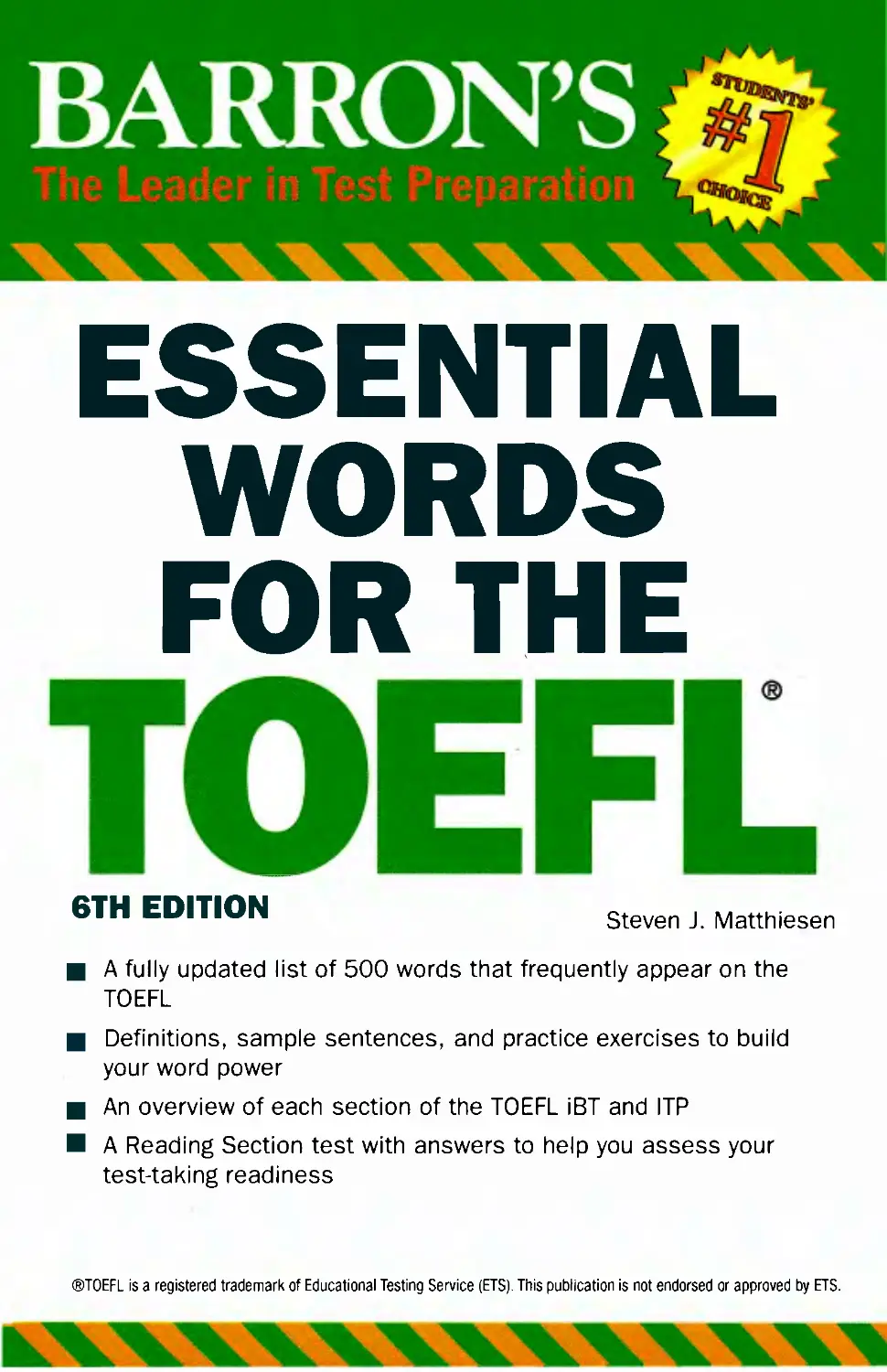
                    BARRON’S
ESSENTIAL
WORDS
FOR THE
TOEFL
6TH EDITION	Steven J. Matthiesen
	A fully updated list of 500 words that frequently appear on the
TOEFL
	Definitions, sample sentences, and practice exercises to build
your word power
	An overview of each section of the TOEFL iВТ and ITP
	A Reading Section test with answers to help you assess your
test-taking readiness
©TOEFL is a registered trademark of Educational Testing Service (ETS). This publication is not endorsed or approved by ETS.
k\XX\XXXX\X\V^
BARRON’S
ESSENTIAL
WORDS
FOR THE
TOEFL
Test of English as a Foreign Language
6TH EDITION
Steven J. Matthiesen
BARRON’S
©TOEFL is a registered trademark of Educational Testing Service (ETS). This publication is not endorsed or approved by ETS.
Acknowledgment
With love and appreciation, I would like to recognize
Stephanie Matthiesen for the special contributions she has
made to this 6th edition of Essential Words for the TOEFL.
Copyright © 2014, 2011, 2007, 2004, 1999, 1992
by Barron’s Educational Series, Inc.
All rights reserved.
No part of this book may be reproduced or distributed
in any form or by any means without the written permission
of the copyright owner.
All inquiries should be addressed to:
Barron’s Educational Series, Inc.
250 Wireless Boulevard
Hauppauge, New York 11788
www.barronseduc.com
Library of Congress Catalog Card No. 2013956838
ISBN: 978-1-4380-0296-5
PRINTED IN THE UNITED STATES OF AMERICA
987654321
Zno%
POST CONSUMER
WASTE
Paper oirtarj a
ct 104 post сзаяя
•М»гаю Ptperustd
и «М '»wd
адй1'М»»
kreJttertM Jr
Contents
INTRODUCTION: Success on the TOEFL v
Maximizing Your Vocabulary Potential—
A Description of This Program v
CHAPTER 1:	Getting to Know the TOEFL 1
What Is the TOEFL? 1
About the iBT (Internet-Based TOEFL) 1
About the ITP TOEFL (Instituational TOEFL Program) 1
The iBT 2
Section 1:	Reading 2
Section 2:	Listening 3
Section 3:	Speaking 5
Section 4:	Writing 5
The ITP (The Paper-Based TOEFL) 6
Section 1:	Listening 7
Section 2:	Structure and Written Expression 9
Section 3:	Reading Comprehension 10
Some	Helpful Hints for Both Formats of the TOEFL 12
CHAPTER 2:	Understanding the TOEFL Reading Section 15
Sample Questions 15
Strategy for the iBT and ITP TOEFL 26
CHAPTER 3:	Improving Your TOEFL Vocabulary 29
The Importance of Reading ... A Lot! 29
Make Flash Cards 29
Make Word Lists 29
Learn Words from Old TOEFLs 30
Leam the Words in This Book 30
Learn to Use a Thesaurus 30
CHAPTER 4:	Building Your TOEFL Vocabulary 31
Developing Word Attack Skills 31
Important Vocabulary Building Tools 37
CHAPTER 5:	The Essential TOEFL Vocabulary 43
Studying the Word Entries 44
Answering Phrasal Questions 46
Lessons 1-30 51
Answers to Exercises: Lessons 1-30 314
CHAPTER 6:	The iBT Practice Test 319
General Directions 319
iBT Reading Section 320
Answers to iBT Practice Test 338
Scoring Your iBT Practice Test 338
iBT and ITP Reading Section Score Conversion Tables 340
INDEX 341
Introduction
SUCCESS ON THE TOEFL
What vocabulary is necessary to score high on the TOEFL?
Why is it especially important to have a strong
vocabulary for the current TOEFL?
Why must I improve my vocabulary and how can I succeed?
How can I be a better TOEFL test taker?
Essential Words for the TOEFL answers these questions and provides
you with a proven plan for improving your English vocabulary while
also preparing you for the TOEFL. The words and practice questions
that appear throughout this book will help you to maximize your under-
standing of words that will likely appear in every section of the TOEFL.
Important information about how to maximize your score on the TOEFL
is given in addition to vocabulary building hints and exercises. By fol-
lowing the program and mastering the words in this book, you will be
ready to earn a higher score on the TOEFL.
This 6th edition of Essential Words for the TOEFL has an extensive,
revised list of 500 words with improved exercises and updated reading
selections. This edition makes Essential Words one of the most thor-
oughly researched books of its kind. It is the product of extensive study
of previous TOEFLs and academic materials from which the questions
on the TOEFL are produced. The result of this research is this powerful
book of words that will lead you to success on the TOEFL.
MAXIMIZING YOUR VOCABULARY POTENTIAL—
A DESCRIPTION OF THIS PROGRAM
This book is divided into six chapters. This introduction gives you basic
information about their contents and how to use the book. Let’s look at
the six chapters.
Getting to Know the iBT
Chapter 1	describes the complete iBT test format and contains sample
questions from each part. The questions are explained in detail and test-
taking strategies are introduced.
Understanding the Internet-Based TOEFL
Chapter 2	describes the importance of building a strong vocabulary in
order to score well on the iBT. You will find sample reading passages
typical of those found in Section One of the iBT with a detailed analysis
of the kinds of words and questions that are found on the TOEFL. In this
chapter you will leam important strategies and hints to follow that will
increase the probability of maximizing your score on the TOEFL.
Improving Your TOEFL Vocabulary
Chapter 3	gives you a plan for studying vocabulary. You should use the
plan when studying the words in this book.
Building Your TOEFL Vocabulary
Chapter 4	provides powerful information that helps you build your TOEFL
vocabulary. You will be introduced to “roots, prefixes, and suffixes”; parts
of words that provide or add meaning. You will also be introduced to dic-
tionary and thesaurus use, both print and online resources that contrib-
ute to any strategy to build your TOEFL vocabulary.
The Essential TOEFL Vocabulary
Barron’s TOEFL Vocabulary Building Program is explained in Chapter
5. The carefully selected words that appear on the list are important for
all TOEFL test takers. An explanation of the program is given, includ-
ing how to study the list, how to understand the words, and how to
follow the program from beginning to end. Thirty carefully developed
vocabulary lessons follow the explanation. Each lesson ends with prac-
tice questions like those that appear on both the iBT and the ITP, the
paper-based TOEFL.
The iBT Practice Reading Test
Chapter 6 contains a complete practice iBT reading test, typical of those
found in Section 3 of the TOEFL. The test gives you practice with read-
ing comprehension and vocabulary questions that closely follow the iBT
format. At the conclusion of the practice test, you will be able to assess
your iBT knowledge and skills by using the included answer key and
conversion tables to convert your number of correct answers to a score
on the TOEFL scale. Both the iBT and ITP scales are included. Chapter 6
is followed by an index of the 500 essential words presented in this book,
followed by the page number where the word can be found in the text.
A Final Word
The 6th edition of Essential Words for the TOEFL is a product of more than
20 years of research and continuous updating. Among the thousands of
words that TOEFL test makers can use, this edition of Essential Words
for the TOEFL presents those words that are predictably the most likely
to appear often on the iBT. By mastering the words and applying the
strategies presented in this book, you will be well on your way to a
higher score on the TOEFL.
Steven Matthiesen
vii

Chapter
GETTING TO KNOW
THE TOEFL
WHAT IS THE TOEFL?
The TOEFL is a comprehensive English language examination that helps
colleges and universities in the United States, Canada, and other parts
of the world make admission decisions. It is also used by some organi-
zations to certify professionals to practice their vocations both in the
United States and abroad.
ABOUT THE iBT (INTERNET-BASED TOEFL)
For many years, the TOEFL was administered only in a paper-based
format. Examinees marked their answers with a pencil on an answer
sheet. The test primarily assessed listening comprehension, grammar,
vocabulary, and reading skills. Then, beginning in 1998, the Educational
Testing Service (the maker of the TOEFL) began offering a computer-based
TOEFL known as the iBT. Taking advantage of advances in technology,
the iBT expanded the range of skills tested by adding speaking and
writing sections to the test as well as integrating reading, grammar, and
vocabulary skills to mimic how we use language everyday.
ABOUT THE ITP TOEFL (INSTITUTIONAL TOEFL PROGRAM)
Some educational institutions use a paper-based TOEFL, known as
the ITP TOEFL. The Educational Testing Service makes this form of
the TOEFL available to institutions who often use the test to gener-
ally assess individuals’ English language skills for placement purposes.
Institutions also use results to assess the effectiveness of their English
language instructional programs. These TOEFLs are typically previously
administered paper-based TOEFLs. Generally, colleges and universi-
ties do not accept ITP TOEFL scores in place of an iBT score. The two
versions of the TOEFL are quite different. A description of both formats
follows.
1
ESSENTIAL WORDS FOR THE TOEFL
THE iBT
The iBT is a timed test that consists of the four sections listed below.
Section 1
Section 2
Section 3
Section 4
Reading
3-4 Passages
Listening
2-3 Conversations
4-6 Lectures
Speaking
2 Independent Tasks
4 Integrated Tasks
Writing
1 Integrated Task
1 Independent Task
60-100 minutes
12-14 questions per passage
60-90 minutes
5 questions per conversation
6 questions per lecture
20 minutes
50 minutes
SECTION 1:	READING
The iBT reading section is presented in two formats. The short format
iBT gives you three passages of approximately 700 words. The long for-
mat contains four passages. After each passage, you will answer 12-14
test questions. If you are taking the long format iBT, only three sets of
the test questions will be answered. The responses to the questions for
the other two passages will be evaluated by ETS for use on future iBTs.
You will have 60 minutes to read all of the passages and respond to the
questions (100 minutes for the long format). You will be allowed to take
notes while you read. You will see some words or phrases highlighted.
You may see an explanation or definition of the word or phrase by click-
ing on it.
The majority of questions in this section are in the multiple-choice
format. Make your answer choice for each and proceed to the next ques-
tion by clicking on Next. To return to the previous question, click on
Back. At any time, you can click on Review to see a list of the questions
that you have and have not answered. You may return to any question
while you are working on this section, but once you have left the reading
section, you may not return to it. A clock will appear on the screen to
help you manage your time
In this section, you first read the passage completely. You do so by
using the scroll bar to view the entire passage on the screen. The com-
2
GEniNG TO KNOW THE TOEFL
puter will not give you the questions until you have scrolled the entire
reading selection. At that point, click on Next.
There are different response formats in the reading section. These
involve clicking on a word, phrase, or sentence. Vocabulary items are
usually tested by asking you to click on another word in the text that
means the same thing as a bolded word. Sometimes you will be asked
to click on a sentence or group of sentences where the answer to a par-
ticular question can be found. Sometimes, you may be asked to insert a
sentence into the text. On cohesion items, you will be asked to click on
the word or phrase in the bolded part of the passage that the cohesion
word refers to. After you click on the word or phrase, it will darken.
Finally, the newest type of test question (“reading to leam”) will require
you to complete a summary or fill in a chart by selecting which provided
text options to include. The summary questions are worth up to two
points each and the chart questions are worth three to four points,
depending on whether five or seven options are presented.
SECTION 2:	LISTENING
The listening section of the iBT tests your ability to understand spoken
English that is typically found on the campuses of colleges and universi-
ties. The listening tasks are those that are typical of social and academic
conversations found in these settings.
There are two formats for the listening section. In the short listening
section, you will hear two conversations and four lectures. The long for-
mat contains three conversations and six lectures. Each conversation
and lecture requires you to respond to five or six questions, most of
which are multiple choice. The responses to the questions of the extra
conversation and lectures do not count. The questions will be evaluated
by ETS for use on future iBTs. Since you do not know which passages
will count, it is important for you to do your best on all of the test ques-
tions. You have 25 minutes on the short format listening section and 30
on the long format section. A clock appears on the screen to help you
manage your time. It does not include the time while you are listening to
the lectures and conversations.
You will hear each lecture and conversation and each of the questions
only one time. You are allowed to take notes as you listen and use them
to answer questions. Once a question is answered, you are not allowed
to return to it, so be sure to choose your answers carefully.
On the IBT, stimuli will come to you through headphones, not through
an audio CD as is the case with the ITP TOEFL. On the iBT, you will
both see and hear each question; on the ITP TOEFL, you only hear
the question. Following the question, the answer choices appear on
the screen; the question stays on the screen until you have made your
3
ESSENTIAL WORDS FOR THE TOEFL
response. For multiple-choice items, each option is preceded by an oval
[O], instead of the letters (А), (В), (C), or (D).
On the iBT, you will be told both the context and the topic of the con-
versation. The extended conversations typically involve a main presenter
who gives the information, and one or two other persons who ask ques-
tions of the main presenter. All speakers are pictured on the screen.
Each stimulus is normally followed by three or four questions on what
was said.
The iBT lectures also include an introduction that tells you who is
speaking and the topic. Going back to the mini talk on Chicago, the
introduction might be as follows:
“Listen to a tour guide as he tells a group of visitors about the city
of Chicago.”
In the iBT lectures, the presentations usually simulate a lecture by
a professor who is using visuals. The professor and the visuals are
depicted on the screen. Using your mouse, you answer each question,
after it is asked.
The iBT uses a greater variety of response types. For example, there
may be more than one correct answer and you will be asked to click on
the oval next to all correct answers. Whenever there is more than one
correct answer, you will be told how many correct answers you should
identify. To see an example, read the minitalk about Chicago on page 8.
Then answer the following question:
What can be inferred about the weather in Chicago?
(Click on 2 answers)
О It is influenced by a glacier.
О Summers are unpleasantly warm.
О The wind is usually accompanied by cold.
О It is veiy dry during the winter months.
О It is temperate and stable.
In the above example, you would click on the oval to the left of second
and third statement.
Sometimes, a response format is visual. In that case, you click on
the correct visual with your mouse. Sometimes, a response will involve
matching. In that case, you must classify each new piece of information
you are given into three or four categories, according to classifications
or distinctions you learned when reading the stimulus. You do this with
your mouse.
4
GETTING TO KNOW THE TOEFL
SECTION 3:	SPEAKING
The speaking section tests your ability to use spoken English in aca-
demic settings. This section contains six speaking tasks. Each task
requires you to respond to a single question, a talk, conversation, or
lecture. The tasks will require you to listen to a lecture or conversation
or to read a short passage. You will then respond to a question. You may
take notes and use them to help you respond to the questions.
Your speaking proficiency is evaluated on the general fluency and
accuracy with which you use the English language.
The speaking section lasts 20 minutes. You are given 45 to 60 sec-
onds to respond to each question. Before responding to questions, you
will be given 15 to 20 seconds to think about how you will respond to the
question. A clock appears on the screen to help you manage your time.
SECTION 4:	WRITING
The writing section tests your ability to perform the writing tasks that
are typically required in college courses.
In the iBT, you will respond to two writing prompts. There are two
types of writing tasks, an integrated essay task and an independent
writing task.
The integrated essay task combines the language skills of reading,
listening, and writing.
You will read a short passage, hear a short lecture on the topic, and
then write an essay in response to a specific set of directions for the
essay. You may take notes and use them to help you write your essay.
You will have 20 minutes to plan and write your essay.
The independent writing task asks you to give your opinion on a
familiar topic. You will have 30 minutes to plan and write your essay.
A clock appears on the screen to help you manage your time as you
complete your essays.
5
ESSENTIAL WORDS FOR THE TOEFL
THE ITP (THE PAPER-BASED TOEFL)
The paper-based ITP TOEFL is a timed test that consists of three sections.
It is administered in two forms: Level 1 (Intermediate to Advanced)
and Level 2 (High Beginning to Intermediate). Throughout the years,
the Educational Testing Service has determined which questions from
previously administered TOEFLs are appropriate for each of the two
TOEFL levels. The Level 1 TOEFL is longer than the Level 2 test, but
each form of the test has the same types of questions. Section One
tests Listening Comprehension, Section Two, Structure and Written
Expression, and Section Three, Reading Comprehension. Here is the
format of each section:
TOEFL ITP—LEVEL 1 (Intermediate to Advanced)
Section 1	Listening Comprehension	50 questions 35 minutes
Part A	Short Conversations	30 questions
Part В	Extended Conversations	7-8 questions
Part C	Minitalks	12-13 questions
Section 2	Structure and Written	40 questions
	Expression	25 minutes
Part A	Structure	15 questions
Part В	Written Expression	25 questions
Section 3	Reading Comprehension	50 questions 55 minutes
	TOTAL	115 minutes
TOEFL ITP—LEVEL 1 (Intermediate to Advanced)
Section 1	Listening Comprehension Section 2	Structure and Written Expression Section 3	Reading Comprehension TOTAL	30 questions 22 minutes 25 questions 17 minutes 40 questions 31 minutes 70 minutes
6
GETTING TO KNOW THE TOEFL
SECTION 1:	LISTENING
This section of the TOEFL tests your ability to understand spoken
American English. After you hear taped conversations you will answer
questions.
Short Conversations
Part A contains short dialogs between two people followed by a question
about what the people said in their conversation. They may have dif-
ferent purposes for speaking to each other. A speaker may give advice,
apologize, or ask for information. Generally, key information is found in
the second speaker’s sentence. You will need to understand the mean-
ing of the conversation and also the context, such as the time or place in
which it could occur. The correct choice is the one that directly answers
the question.
You will hear:
(Man) Did you get to go shopping last night?
(Woman) They'd already locked the doors by the
time I got there.
(Man) What does the woman mean?
You will see:
(A)	She arrived in time to shop.
(B)	She was too late.
(C)	She locked the doors.
(D)	She had to buy the door.
The correct choice is (B). Since the doors were locked when she arrived,
she could not have gone shopping. Note that the other choices use words
heard in the conversation. Choices that contain such words are usually
not correct. Part A contains samples of informal American English. Idiom-
atic expressions and two-word verbs are common in this part.
Extended Conversations
In Part В you will hear extended conversations between two or more
people, a student and either a professor or a campus service provider.
Usually, there are two conversations, and the language is more formal.
After each conversation, there are between three and four spoken ques-
tions about its content. Choose your answer from among the four choices
that appear in your test booklet.
7
ESSENTIAL WORDS FOR THE TOEFL
The extended conversations and minitalks (see below) are generally
preceded by an introductory statement that tells you the context for the
conversation. Pay particular attention to this information as it prepares
you for what follows.
Minitalks
Part C contains short presentations given by a single speaker. There are
usually three. The English in this section is generally more academic,
typical of English lectures that take place in a university or college set-
ting. There are generally three lectures followed by four to five spoken
questions about its content. You may take notes while you listen and
refer back to them when you answer the questions. Choose your answer
from among the four choices that appear in your test booklet. Look at the
example of the minitalk below.
You will hear:
Listen to this talk by a tourist guide.
(Man) Good morning ladies and gentlemen. Welcome to this
tour of one of the nation's most important cities, Chicago.
Before we begin, I'd like to give you some background
information that will make the tour more enjoyable for
you. The city was founded in 1837. Its strategic location
on Lake Michigan quickly made it the center of com-
merce for the Midwest section of the country. It currently
is the third largest metropolitan area in the United States.
The city's site is generally level, built mostly on a glacial
plain. The narrow Chicago River extends one mile inland
from Lake Michigan, where it splits, dividing the city into
North, West, and South sides. Chicago's weather is subject
to rapid changes, but generally the climate is cold and
windy in the winter, and hot and humid in the summer.
(Woman) What gave Chicago an advantage over other Midwest-
ern cities?
You will see:
(A)	Its level site.
(B)	Its location on Lake Michigan.
(C)	Its large population.
(D)	Its location along the Chicago River.
8
GETTING TO KNOW THE TOEFL
According to the minitalk, (B) would be the correct choice. Remember
that you will not have a written copy of the speaker’s presentation or
conversation and you will only hear it once. You must concentrate on
details, such as names, dates, and the main idea of the selection that
you hear. Do not read the choices as you listen to the talk. Listen care-
fully and try to remember what you hear.
SECTION 2:	STRUCTURE AND WRITTEN EXPRESSION
This section contains two types of questions, both designed to test your
ability to recognize correct style and grammar in written English. The
sentences are academic; ones that you typically find in college-level
texts, Journals, and encyclopedias. The sentence topics include the
social sciences, physical and life sciences, and the humanities.
Structure
The structure questions test your ability to recognize correct structure
and word order. These questions consist of a sentence with one or more
words missing. You must make the choice that best completes the sen-
tence. Here is an example of this type of question.
You will see:
a short time after the Civil War, Atlanta has become
the principal center of transportation, commerce, and
finance in the southeastern United States.
(A)	While rebuilt
(B)	It was rebuilt
(C)	Rebuilt
(D)	When rebuilt
The correct choice is (C). The other choices make the sentence incor-
rect or awkward.
Written Expression
The written expression questions test your ability to recognize errors in
grammar or expression. These questions consist of complete sentences
with four underlined words or phrases. You must identify the under-
lined part of the sentence that needs to be changed in order to make the
sentence correct. An example follows.
9
ESSENTIAL WORDS FOR THE TOEFL
You will see:
The Navajo Indians have displayed a marked ability to
(A)	(B)
incorporate aspects of other cultures into a changing,
(C)
flexibility lifestyle.
(D)
The correct choice is (D). Flexibility, a noun, appears where an adjec-
tive must occur. In addition to inappropriate parts of speech, be sure to
check for missing words and extra words that are inappropriate for the
context.
SECTION 3:	READING COMPREHENSION
Good reading skills and an ample vocabulary are keys to doing well on
all sections of the TOEFL. In this section of the TOEFL, these skills are
specifically tested. Many TOEFL test takers complain that they do not
have enough time to carefully answer all questions in this section. It is
very important that you follow the instructions in this book, so that you
will use all the allotted time to your advantage.
Reading Comprehension Items
Your ability to read and understand college-level reading material is
tested on this part of the TOEFL. You will find five or six reading pas-
sages, each followed by nine to eleven questions. You must work quickly
and efficiently. Here is a sample passage.
You will see:
A lens has one or more curved surfaces that refract, or
bend, light rays passing through it to form an image on a
surface beyond the lens. Examples of such surfaces are
the retina of the eye or a movie screen. The distance from
(5)	the lens to the focal plane is known as focal length. In
cameras, telescopes, and similar devices, the lens is
turned on a screw-thread mounting to adjust the focal
length. This action allows focusing of images of objects
at various distances. In the human eye, focal length is
(Ю) adjusted by muscles that alter the lens curvature. Light
rays of different colors are bent by varying degrees as
they pass through a curved surface. This causes a distor-
tion of the image, known as chromatic aberration. In
cameras, sharp images are obtained by arranging two
10
GETTING TO KNOW THE TOEFL
(15)	or more lenses so that the aberration of one cancels
out the aberration of another. Such an arrangement of
lenses is called an achromatic lens.
You will see:
According to the passage, what is focal length?
(A)	A curved surface that refracts light
(B)	The distance from the focal plane to the lens
(C)	Adjustment by the muscles that alters lens curvature
(D)	The degree that light rays of different colors are bent by
the lens
This is a factual question. The information needed to answer this
question is directly stated in the text. Choice (B) is the correct answer.
Some questions will ask you to draw conclusions based on material in
the passage; others will ask about the main idea of a selection. Some
may even ask what information does not appear in the passage.
Vocabulary Items
The vocabulary questions in this section test your English vocabulary.
There are between 12 and 17 questions focusing on specific words from
the reading passage. Each word is taken from a specific line in the text;
the line is referred to in the question. You must choose the word that
has the same meaning from among the four choices given. Here’s an
example from the previous text.
You will see:
The word "distortion" in lines 12 and 13 is closest in meaning to
(A)	classification
(B)	deformation
(C)	reaction
(D)	reflection
The word that is the closest in meaning to the tested word, distortion,
is choice (B). Additional hints for vocabulary questions can be found in
Chapter 2.
Cohesion Items
Another type of question that is used to test reading comprehen-
sion is called cohesion. Cohesion occurs when elements of a passage
are linked to other elements. Cohesion allows the author to refer to
previously mentioned information, and it allows the reader to keep pre-
viously mentioned information in mind while continuing to read the
11
ESSENTIAL WORDS FOR THE TOEFL
passage. To understand cohesion when it is used, one must understand
the passage. Thus, TOEFL uses cohesion to test reading comprehen-
sion. Cohesion items typically test object pronouns (it, they, them) and
demonstrative pronouns (this, these, those). Here is an example of a
question that involves cohesion.
You will see:
The word "This" in line 12 refers to
(A)	surface
(B)	adjusting
(C)	light
(D)	bending
The word that “this” refers to is bending, option (D). A typical version
of the TOEFL will contain about five such items, or an average of one
per passage.
SOME HELPFUL HINTS FOR BOTH FORMATS OF THE TOEFL
You can get most of the answers to your questions about the TOEFL at
www.ets.org/toejl.
Information on testing centers, practice questions, and general
descriptions of the TOEFL can be found at the official TOEFL website.
On all parts of the TOEFL, be sure to answer all questions. On the
iBT, you are penalized for not answering questions. On multiple-choice
test items, if you must guess, choose (B) or (C), since they are slightly
more likely to be the correct response to the question than (A) or (D).
On the iBT, some questions will have more than one answer, particu-
larly if the question deals with factual information presented as a series
in the passage or text. A box under a question may tell you to “Click on
two answers.” You may also have to manipulate data with the mouse.
For example, you may be given a series of events to place in a specific
order. You will click on the sentences and drag them to the appropriate
slots that appear on the test item screen.
Because the iBT requires a greater variety of response formats, always
read the directions for each test item carefully. Ask yourself, “What do I
need to do here?”
Manage your time wisely! Both the ITP TOEFL and iBT are timed. The
amount of time available is stated at the beginning of each section. If
you are taking the ITP TOEFL, be sure to wear a watch (deactivate any
sounds your watch may make before entering the test session) and be
aware of the time you have remaining. No watches are allowed in the
room for the iBT. Whether you are taking the iBT or the ITP TOEFL, you
should become familiar with the directions and the examples for each
section before you take the tests.
12
GETTING TO KNOW THE TOEFL
Remember, when time has expired on a section, you may not return
to it. Work quickly and accurately. If it seems obvious to you that you
will not have enough time to finish a section of the TOEFL, GUESS
answers (B) or (C).
In the reading section of the iBT, you may skip questions, or go back
and change answers. However, do not waste time doing this unless you
are fairly certain that you have made a mistake! You cannot return to
questions in a previous part once you have clicked on Continue after
the last question in that part. Change your answer only if you find a
better answer.
Prepare yourself for the test. Being well prepared will give you the
confidence you need to achieve the very best result for you. In addi-
tion to this book, Barron’s TOEFL iBT (Internet Based Test) provides you
with practical hints designed to help you maximize your TOEFL score, a
CD-ROM that simulates the experience of taking the iBT, and academic
skills hints, including tips on note taking, paraphrasing, summarizing,
and synthesizing.
13

Chapter
UNDERSTANDING
THE TOEFL READING
SECTION
Developing a good English vocabulary is the most important way to pre-
pare for the vocabulary you will see and hear on the TOEFL. It is also
a good way to prepare for the test generally. In addition to developing a
good English vocabulary, it is very important to know the kind of vocab-
ulary you will see on the TOEFL and to understand how it is tested.
The reading section of the iBT contains approximately three to five
passages with 12-14 questions for each passage. In the ITP, there are
four to five reading passages and up to 50 questions. It is important for
you to remember that your general vocabulary is tested in all sections
of the TOEFL. However, it is in this section of the TOEFL where your
knowledge of specific vocabulary items is tested.
Passages from which vocabulary questions are drawn are written in a
formal, academic style, typical of most college- or university-level texts
and journals. The topics of these passages are those a first-year college
student in North America would be likely to encounter. The topics come
from such areas as the Natural Sciences, Business, Liberal Arts, and the
Social Sciences. Some passages contain references to North American
places and personalities. Others will refer to historical events and may
include dates. It is important for you to understand that your knowledge
of these North American places and personalities is never tested on the
TOEFL. You do not have to be familiar with the content of the passages
to be successful on this section of the TOEFL.
SAMPLE QUESTIONS
The following passage and the questions that follow are used to illus-
trate and discuss the types of reading comprehension questions and
tasks that you will find on the TOEFL. First, as a warm-up, you will read
a sample passage for the ITP and work through the test questions. Then
you will read a sample iBT passage and work through those questions.
15
ESSENTIAL WORDS FOR THE TOEFL
Through a somewhat controversial process, Hawaii was
the last territory to become a state. In 1842, the United
States recognized the Kingdom of Hawaii as an inde-
pendent country. In subsequent years, Americans and
other foreign groups moved to the islands. They began to
influence local politics. In 1887, Hawaiian King Kalakaua
gave the United States exclusive rights to use Pearl Har-
bor as a naval base in exchange for certain trading
privileges. [A ] After the King died, his sister, Queen
Liliuokalani, followed him to the throne. In 1894, a blood-
less revolution led by American businessmen removed
her from office. She was replaced by Stanford B. Dole.
With the support of the Americans running the local gov-
ernment, Hawaii became a U.S. territory in 1900. [B ] In
1959, the U.S. Congress approved legislation permitting
Hawaii to convert to statehood. [C ] Shortly afterward,
Hawaiians voted almost 17 to 1 in favor of statehood.
[DB]
1.	What does the passage mainly discuss?
® Democracy in Hawaii
© The history of Hawaiian monarchs
© The evolution of Hawaii's political status
© American military control in Hawaii
On the ITP TOEFL, you would darken the oval containing the letter (C)
on your answer sheet.
2.	The word "controversial" is closest in meaning to
® adversarial
© remarkable
© gratifying
© debatable
This type of vocabulary item is typically used on the ITP TOEFL. The cor-
rect response is (D).
3.	The word "They" in the passage refers to
© the United States
© Americans and other foreign groups
© in subsequent years
© the islands
16
UNDERSTANDING THE TOEFL READING SECTION
This is an antecedent question. The item tests whether you understand
what they refers to. The correct answer is (B).
4.	Look at the phrase "in exchange for" in the passage.
In saying that the United States got exclusive access
to Pearl Harbor "in exchange for certain trading privi-
leges," the author means the United States:
® traded access to its markets for a naval base in
Hawaii.
® offered to rent the land it needed for a base in
Hawaii.
© absorbed Hawaii by granting it membership in the
union.
© was excluded by the Hawaiian king from Hawaiian
markets.
This is a whole phrase item. It tests whether you can separately under-
stand the words in a group and then assemble them to arrive at an
understanding of their meaning as a group. One clue to the meaning of
this phrase is the word exchange. Since you are already familiar with
exchanging money or exchanging addresses, you can probably guess
that this has something to do with a two-way transfer—in this case, the
right to use some land in Hawaii for access to U.S. markets. Once you
have pieced together the larger context, it is easier to see that the cor-
rect response is (A), traded access to its markets for a naval base in
Hawaii.
5.	According to the passage, which of the following is
true about King Kalakaua?
® He was replaced by Stanford B. Dole.
® He made a trade agreement with the United
States.
© He welcomed foreign groups into the island.
© He supported bloodless revolution.
This is an example of a fact question. The response to the question is
directly stated in the passage. You would darken circle (B), since he was
the leader of Hawaii who gave the United States exclusive military rights
in exchange for a trade agreement.
17
ESSENTIAL WORDS FOR THE TOEFL
6,	Why does the author mention Americans and foreign
groups in the passage?
® They exerted a powerful influence in local politics.
© They promoted trade between Hawaii and other
countries.
© They approved legislation giving Hawaii its state-
hood.
© They supported Queen Liliuokalani's plan to remain
an independent nation.
This item requires you to identify the author’s purpose for mentioning
a specific fact in the passage. You would darken circle (A), since the
foreign groups that arrived in Hawaii did, indeed, exert great political
power in local Hawaiian politics.
7.	Find the phrase "in favor of" in the passage. In saying
that "Hawaiians voted 17 to 1 in favor of statehood,"
the author means that they:
® supported independence.
© voted against statehood.
© wanted to join the union.
© became a favorite resort.
Here, you would darken circle (C), wanted to join the union. In the pas-
sage, the word favor is a good clue to the meaning of the whole phrase,
as is the adjoining phrase voted almost 17 to 1. This phrase strongly
suggests that a vote has been taken and that the Hawaiians supported
statehood by the margin given. Therefore, in favor of must indicate a
positive vote, or formal support for a particular proposition or candidate.
Examine the task below. In this type of task, you must insert the
sentences into the appropriate place in the passages. Your choices are
marked with a box [].
8.	Look at the four squares () that show where the
following sentence could be inserted into the passage
In so doing, it became the fiftieth state.
Where could the sentence best be added? (A), (B),
(C), or (D)
The correct placement for this sentence is [D ].
18
UNDERSTANDING THE TOEFL READING SECTION
9.	An introduction for a short summary of the passage
appears below. Complete the summary by choosing
three of the six choices that best summarize the infor-
mation in the passage. Some sentences do not belong
in the summary because they are not included in the
passage or are minor points from the passage.
The story of Hawaii's path to statehood is a subject of
controversy.
® Hawaii's climate played a major role in its accep-
tance of statehood. Its agricultural products were
sought by many nations around the world.
® After the death of Hawaiian King Kalakaua, and
the ousting of Queen Liliuokalani, foreign interests
became intensely involved in the political matters
’ of the island.
© Largely due to American influence in local politics,
the United States recognized Hawaii as an inde-
pendent nation just before achieving statehood.
© An American businessman seized the opportunity
that weak leadership presented and led a peace-
ful movement to remove Queen Liliuokalani from
her position of power.
© Due to the political power that the Americans
had in local government, a very close relationship
formed with the United States that permitted the
suggestion of statehood for the island nation.
® Because of the agreements that were made
between Hawaii and the United States, Pearl
Harbor was able to play an important role in
World War II.
19
ESSENTIAL WORDS FOR THE TOEFL
The best sentences to be added to the summary are (B), (D), and (E).
You would darken those three circles.
iBT Reading Comprehension Sample
Single causation rarely accounts for complex historical events.
Instead, most noteworthy historical events are caused by a plethora
of conditions and events. For example, many scholars believe that
the Great Depression in the United States can be attributed to sev-
(5) eral national and worldwide conditions.
First, though it may not have been a direct cause of the Great
Depression, the Mississippi Valley in America experienced a severe
drought around the time of the Great Depression. The area affected
included 100,000,000 acres in parts of Texas, Oklahoma, New Mex-
(10) ico, Colorado, and Kansas. Along with the drought, farmers had not
rotated crops or used cover crops to prevent erosion. Thus, when
they plowed the topsoil, the natural grasses that would normally
trap moisture and keep the soil in place were displaced. As a result,
the region experienced severe dust storms and agricultural damage.
(15j [A ] In fact, the term “Dust Bowl” is often used to refer to this period
of severe dust storms when the soil dried and blew away in dark
clouds. [B ] With the land useless, many farmers could not pay
their taxes and debts. They had little choice but to sell their farms
and travel to other states to find work, even if it meant migrating
(20) from farm to farm to pick fruit for low wages. [C ] Their plight was
captured by the American writer John Steinbeck, in books such as
The Grapes of Wrath and Of Mice and Men. [D ]
Second, the stock market crash of 1929 resulted in stockhold-
ers losing more than $40 billion. On “Black Tuesday,” October 29,
(25) 1929, share prices of the New York Stock Exchange plummeted. As
stock prices fell, more and more investors decided to leave the stock
market, resulting in about 16 million shares traded on Black Tues-
day. Although some prominent investors, such as members of the
Rockefeller family, bought large quantities of stock to demonstrate
(30) their confidence in the market, their efforts could not prevent the
crash. While it is true that the stock market began to recover in the
days and weeks after the crash, it did not recover enough to pre-
vent America from entering the Great Depression. The Great Crash
sparked a twelve-year economic slump that affected Western indus-
(35) trialized countries.
Third, over 9,000 banks failed during the 1930s. Unlike today,
bank deposits were not insured, meaning that many people lost their
savings. Banks also became more hesitant to loan money. Fourth,
20
UNDERSTANDING THE TOEFL READING SECTION
Americans stopped purchasing items and, as a result, production
(40) fell. In turn, because production was reduced, employers reduced
their workforces. Unemployment rose to over 25 percent in 1933. As
people lost their jobs, they became unable to pay for items they
bought on installment plans, and so their goods were repossessed,
which resulted in an increase in businesses’ inventories.
(45) Fifth and finally, the U.S. government passed the Smoot-Hawley
Tariff Act, or the Tariff Act of 1930. The act was sponsored by U.S.
Senator Reed Smoot, a Republican from Utah and chairman of the
Senate Finance Committee, and Representative Willis C. Hawley,
a Republican from Oregon and chairman of the House Ways and
(50) Means Committee. The act, which raised U.S. tariffs on over 20,000
imported goods, had as its main purpose the protection of American
jobs from global competition. The act was not without its opponents,
however. For example, in May 1930, 1,028 economists signed a
petition asking President Hoover to veto the legislation. Henry Ford
155) and J.P. Morgan chief executive Thomas Lamont also met with the
president to request that he veto the act. President Hoover opposed
the bill but nevertheless signed it into law. Foreign governments
also opposed the act. While the bill was moving through Congress,
foreign governments had threatened retaliation by raising the tariff
(во) rates on American goods imported into their countries. After the bill
was signed into law, foreign governments lived up to their threats.
For example, Canada, the U.S.’s largest trading partner, retaliated
by imposing new tariffs on products that accounted for approxi-
mately 30 percent of U.S. exports to Canada.
1.	What does the passage mainly discuss?
® policies involving U.S. trade
® causes of the Great Depression
© reasons for stock market crashes
© books written by American authors
You would click the oval next to the second option.
21
ESSENTIAL WORDS FOR THE TOEFL
2.	The word plethora in line 2 is closest in meaning to
(a) few
© shortage
© complexity
© overabundance
The correct response is (D).
3.	According to the passage, all of the following are mentioned as
causes of the Great Depression EXCEPT
® bank failure
© higher tariffs
© installment plans
© stock market crash
The correct response is (C).
4.	Find the word it in line 32. Using your mouse, click on the word or
phrase in the passage that it refers to.
This is an antecedent question. The item tests whether you under-
stand what the pronoun it refers to. Using your mouse, you would high-
light the phrase by clicking on the stock market in the passage.
5.	According to the passage, which of the following is true about Presi-
dent Hoover?
® He refused to meet with Henry Ford.
© He followed the advice of Thomas Lamont.
© He supported the Smoot-Hawley Tariff Act.
© He signed the Smoot-Hawley Tariff Act into law.
This is an example of a fact question. The response to the question is
directly stated in the passage. You would click on response (D).
22
UNDERSTANDING THE TOEFL READING SECTION
6.	Why does the author mention economists in the last paragraph of
the passage?
® Because they caused the economic crisis.
® Because they opposed the Smoot-Hawley Tariff Act.
© Because they acted in ways that worsened the economy.
© Because they exerted undue influence on President Hoover.
The correct response is (B).
7.	The word sparked in line 34 is closest in meaning to
® started
® hastened
© hampered
© anticipated
The correct response is (A).
8.	The word sponsored in line 46 is closest in meaning to
® backed
® paid for
© attacked
© subsidized
The correct response is (A).
9.	The word veto in line 54 is closest in meaning to
® bar
® reject
© revise
© consider
The correct response is (B).
23
ESSENTIAL WORDS FOR THE TOEFL
10.	Find the word they in line 12. Using your mouse, click on the word
or phrase in the passage that they refers to.
This is an antecedent question. The item tests whether you under-
stand what the pronoun they refers to. Using your mouse, you would
highlight the word by clicking on farmers in the passage.
11.	Look at the four squares [] that show where the following sentence
would be inserted into the passage:
The dust clouds sometimes traveled hundreds of miles.
Where could the sentence best be added? [А], [В], [C], or [D]
Click on a [] to insert the sentence into the passage.
You would click on the square of your choice in the passage to place
the sentence in the passage. The correct placement for this sentence is
IB ].
12.	With which of the following statements would the author of the
reading most probably agree?
® The Great Depression had many causes.
(D Stock market crashes should be prevented.
© Economists do not always know what is best.
© High tariffs should be used to protect farmers.
The correct response is (A).
24
UNDERSTANDING THE TOEFL READING SECTION
13.	An Introduction for a short summary of the passage appears below.
Complete the summary by choosing three of the six choices that
best summarize the information in the passage. Some sentences
do not belong in the summary because they are not included in the
passage or are minor points from the passage.
The Great Depression in the United States was not caused by one
event or condition; instead, it was caused by several.
@> The drought that resulted in the Dust Bowl meant that many
farmers could no longer pay their debts. As a result, they had to
leave their farms.
® The farmers had not rotated their crops or used special crops to
prevent erosion.
© On Black Tuesday, stockholders sold their shares of stocks
and lost more than $40 billion, sparking a long-term economic
downturn.
© The Rockefeller family bought large quantities of stock.
© The Smoot-Hawley Tariff Act led to trade retaliation, hurting
U.S. exports.
© The Smoot-Hawley Tariff Act was sponsored by two Republicans
who were leaders in the Senate and the House of Representa-
tives.
The best sentences to be added to the passage are (A), (C), and (E).
Using your mouse, you would click on each of the three answer choices,
and then drag and place each next to one of the three dots above the
option.
25
ESSENTIAL WORDS FOR THE TOEFL
STRATEGY FOR THE iBT AND ITP TOEFL
Each TOEFL vocabulary item refers you to a word (or phrase, such as a
two-word verb) in a specific line of the passage. You are then asked to
identify a synonym for that word. These choices are marked by the let-
ters: (А), (В), (C), and (D). You must identify the word among the choices
that is closest in meaning to the word in quotation marks. Words that are
very close or identical in meaning are called synonyms. Now go back
and examine question 2 on page 16 again.
This question is typical of vocabulary items on the ITP TOEFL. The
topic is from U.S. history and the question contains a single word in
quotation marks. The correct answer is (D), debatable. Debatable is a
sjmonym for controversial As in this example, the word you select is
the one that best matches the meaning of the word in quotation marks.
Note that all four of the choices make sense in the sentence and that
they make use of other information given in the passage. Many vocabu-
lary questions are written so that the context of the sentence or the pas-
sage seldom helps you to determine the meaning of the word. Therefore,
you must know the word in order to make the correct choice.
Because the context may not help you, you should simply look at the
underlined word and choose its synonym from among the four choices,
then check to see if the synonym makes sense in the sentence in which
it appears. It is best for you to use this strategy because it will prevent
frustration and save time. You will need this time for the reading com-
prehension questions. Remember, on the TOEFL, (B) and (C) answers
tend to be used slightly more than (A) and (D). So choose (B) or (C) when
guessing. Also remember that answer choices that contain the same
prefix or suffix, or are pronounced like the underlined word are seldom
the correct answers.
Note that choice (A), adversarial, sounds and has letters similar to
controversial. Such words are not usually the correct choice. Such
words are often used to distract you. Unless you are sure of the answer,
do not choose these words.
26
UNDERSTANDING THE TOEFL READING SECTION
Let’s see how to use our strategy with a sample item. Look at question
2 on page 16 again, noting the word in quotation marks. Do not reread
the line referred to or the paragraph that contains it. Instead, read the
four choices and make your selection of the best synonym.
This is an example of how you should read vocabulary
items.
+ + + + + + + "controversial" + + + + + + + + + + + + + + +
+++++++++
(A)	adversarial
(B)	remarkable
(C)	gratifying
(D)	debatable
You should pay attention only to the word in quotation marks and the
choices that follow. If you know the meaning of the word and recognize
the synonym, there is no need to read the context in which it is used. If
you do not know the meaning of the word, you must make an educated
guess about its synonym. The context will not usually help you to deter-
mine the correct choice. All of the choices from the example above fit
into the original context.
Through a somewhat adversarial process, Hawaii was
the last territory to become a state.
Through a somewhat remarkable process, Hawaii was
the last territory to become a state.
Through a somewhat gratifying process, Hawaii was the
last territory to become a state.
Through a somewhat debatable process, Hawaii was
the last territory to become a state.
These sentences show that the context does not help you to determine
the meaning of the word being tested. If you simply cannot decide on
the answer, you can refer to the sentence in which it is used. In the case
of the phrasal examples above, there may be some clues in the context
that can help you tease out the meaning of the phrase, as shown above.
It may also help you to remember any previous experience you have had
with the word. However, you are often better off ignoring the context if
you know the answer, and you should not waste a lot of time analyzing
contextual information. If you cannot make sense of any of the clues
available in the context, or recall the phrase from another context, sim-
ply make a guess and move on.
27
ESSENTIAL WORDS FOR THE TOEFL
Essential Words for the TOEFL gives you additional practice in ignor-
ing the context of vocabulary items on the TOEFL through the matching
exercises that are found in each lesson. In these exercises, you are given
a word followed by four possible synonyms. Your task is to mark the
hitter of the correct synonym. The following matching exercise uses the
example previously introduced.
Controversial
(A)	adversarial
(B)	remarkable
(C)	gratifying
(D)	debatable
Remember
•	Do not waste time rereading the context in which the word is
used. Look only at the word in quotation marks and search
for a synonym among the answer choices.
•	Analyze words quickly. Spending too much time studying
word roots, prefixes, and suffixes can cause you to misuse
valuable time.
•	Work quickly, but carefully. You should try to spend only 30
seconds on each vocabulary question.
•	Words that contain similar sounds and spelling are usually
not the correct answer.
•	Always answer every question. If you must guess, choose (B)
or (C) as your answer. Your score on Section 3 is based solely
on the number of correct answers.
Timing and checking your work. Depending on the format of the
TOEFL you are taking, you will have between 31 and 55 minutes on the
ITP and 60 minutes on the standard iBT to complete this section. If you
take the long iBT, you will have 100 minutes to complete this section.
Some test takers report that they do not have enough time to complete
the reading questions, so you should work quickly. If you follow the
strategies in this book, you will have adequate time to complete the
reading section of the TOEFL.
Manage your time wisely! If you finish early, use the Review icon to
go back to test items and check your answers. Checking your responses
vrill allow you to identify and correct any errors. Also, because vocabu-
lary items do not require you to reread and comprehend the entire pas-
sage, they can be checked more rapidly than reading comprehension
items. After you have checked your responses to the vocabulary items, if
you still have time, beginning with the first passage, check your answers
to the reading comprehension test items.
28
Chapter
IMPROVING YOUR
TOEFL VOCABULARY
THE IMPORTANCE OF READING ... A LOT!
One of the best ways to build your vocabulary is to read authentic
English language material. You should read material that a college stu-
dent would read. Examples of such material are newspapers, college
textbooks, encyclopedia articles, magazines, and academic books. Any
material that has an academic theme will help you to get used to the
kinds of words and the style of writing you will find on the TOEFL. Read-
ing articles on a variety of topics of interest to you will help you to develop
your vocabulary. Pay attention to new groups of words, expressions, and
phrases you encounter in your reading. Take advantage of resources—
teachers, native speakers of English—to learn their meanings.
MAKE FLASH CARDS
As you are reading, you will find new words that you will want to leam.
One good way to leam words is to make flash cards. Use small cards
made of thick paper. The cards should be small enough to fit in your
pocket. On one side write the new word or group of words, then on the
back write a synonym, a word or words that have the same meaning.
For example, expressions such as “run a risk” and “take a chance” are
similar in meaning: they are synonyms. You may also want to note the
definition of the words you put on your flash cards. Review these cards
as often as you can, perhaps with a friend who is also preparing for the
TOEFL. You will be able to build a large “sight vocabulary” by using this
method. Do not be concerned if you are unable to actually use these
words in conversations you have in English. With time, they will become
a part of your active vocabulary. The ability to use new words is not as
important as your ability to recognize new words and their meanings.
MAKE WORD LISTS
Another good way to leam new words is to make word lists. Many students
use a small notebook for this purpose. When you discover a new word, or
group of words, add it to a list of words to be learned. On one side of the
29
ESSENTIAL WORDS FOR THE TOEFL
page, list the new words. To the right of this list, write synonyms for the
new words. Study the words by covering the synonyms, looking at the new
word, and recalling the synonyms. It is also useful to reverse the process
so that you practice both the new words and their synonyms.
LEARN WORDS FROM OLD TOEFLs
Leam words that have been tested on previous TOEFLs. The underlined
words on previous TOEFL tests are sometimes tested again, but they fre-
quently appear among the four choices presented as synonyms for new
words that are tested. You can find words to put on your flash cards or
word lists on any TOEFL tests that you have. TOEFL tests can be found
online and in the TOEFL test kits available from the Educational Testing
Service.
LEARN THE WORDS IN THIS BOOK
Include all of the words listed in this book: on your cards and lists. These
words have been carefully researched and selected, and many will
appear on the TOEFL.
You should leam prefixes, suffixes, and word roots. For a list of them,
see Chapter 4. Suggestions for studying word roots, suffixes, and pre-
fixes can be found in that chapter.
LEARN TO USE A THESAURUS
Become familiar with a thesaurus. A thesaurus is a word list of syn-
onyms. When you find a word that you don’t know, look it up in the the-
saurus. Note a synonym for the word on a card or a word list. If you find
a synonym, but still don’t know the meaning of the word, look it up in
a print or online English language dictionary. If you can’t find the word
in the thesaurus, it will not be tested on the TOEFL. The TOEFL tests
only those words that have a variety of synonyms. For more information
about the use of a thesaurus, see Chapter 4.
VOCABULARY BUHJHNG STRATEGIES
•	Read often. Choose material that is written for college-level readers.
•	Make flash cards of new words with synonyms and practice them
often.
•	Make word lists of new words with synonyms and practice them
often.
•	Leam words that have been tested on previous TOEFLs.
•	Leam word roots, prefixes, and suffixes found in Chapter 4.
•	Study the list of 500 essential words in Chapter 5 of this book.
30
Chapter
BUILDING YOUR
TOEFL VOCABULARY
DEVELOPING WORD ATTACK SKILLS
When readers find an unfamiliar word in a sentence, they are sometimes
able to determine its meaning by reading the other words in the sen-
tence. The other words give the “context” that allows readers to make an
educated guess about the meaning of an unfamiliar word.
Words fit into contexts in two ways. One is purely grammatical: The
form of the word is grammatically correct for its position in the sentence.
For example, you know that the space between “the” and “student”
belongs to an adjective, so you know that “brilliant” fits into that space
correctly, while “brilliance,” which is a noun, does not.
However, we already know that on TOEFL vocabulary questions all
of the possible answers fit the grammatical context of the sentence.
Therefore, the degree of success you will have on this part of the TOEFL
depends upon whether you understand a word’s meaning as well as
its form. That in turn depends upon how well you can understand its
parts and how well you can read its context for clues to its meaning. In
this chapter, you will leam how to determine the meaning of a word by
studying its parts.
Many English words consist of more than one part. Let’s examine three
important parts you should know in order to improve your vocabulary.
Word Roots
Many words in English contain Latin and Greek roots. These roots con-
vey the basic meaning of the word and they occur repeatedly throughout
the language. Knowing these roots will help you to determine the mean-
ing of words with which you are not familiar. On page 33 is a list of com-
mon roots and their general meanings.
Learning these roots will help you to recognize the basic meaning of
hundreds of English words. Let’s look at the word manufacture. Manu-
facture is a combination of two root words, manu and fact. Using the list
31
ESSENTIAL WORDS FOR THE TOEFL
on page 33, we can see that manu means “hand” and/act means “make”
or “do.” Therefore, we can infer the meaning “make by hand.”
Let’s look at another example, biography. Again, using the list on page
33, we see that bio means “life” and graph “write.” Therefore, we can
conclude that the word’s meaning relates to the “writing of a life,” the
written story of a person’s life.
How to Study Word Roots
There are several ways to study word roots. One effective way is to
make a flash card for each one. On each card write the root and a word
containing the root. Also, write the meaning of the root and a synonym
for the example word on the back of the card. As you practice with the
cards, first identify the meaning of the root, then the word containing
the root. Next, give a synonym for that word. As you study the roots, set
aside those you have learned and concentrate only on those roots and
synonyms that you have not learned. Save all of the cards for review.
Make word lists. When you read English material, make lists of words
that contain the roots that you have studied in this section of the book.
Identify the root and look up the word in a thesaurus. Write the mean-
ing of the root and a synonym of the word. This method will help you to
identify root words and synonyms on the TOEFL.
32
BUILDING YOUR TOEFL VOCABULARY
Root	Meaning	Example
belli	war	rebellion
biblio	book	bibliography
bio	life	biology
cosm	order	microcosm
cycl	circle	cyclone
die	two	dichotomy
diet	word	dictate
due	carry, lead	conducive
duct	carry, lead	conduct
fac	do, make	facsimile
fact	do, make	manufacture
feet	do, make	perfect
form	shape	uniform
fort	strong	fortify
geo	earth	geography
gram	write	telegram
graph	write	autograph
homo	same	homophone
log	speech, study of	dialog
logy	speech, study of	analogy
man	hand	manage
manu	hand	manual
mater	mother, home	maternity
matri	mother, home	matriarch
medi	middle	mediocre
miss	send	dismiss
mit	send	submit
multi	many	multiply
nom	name	nominate
nym	name	synonym
pater	father	paternal
pathy	feeling, suffering	sympathy
patri	father	patriarch
ped	foot	pedal
port	carry	transport
scend	climb	ascend
scrib	write	scribble
script	written language	postscript
secut	follow	consecutive
sent	feel	consent
sequ	follow	subsequently
tact	touch	contact
tempor	time	contemporary
tract	pull, draw out	attractive
vene	come, go	convene
vent	come, go	advent
vers	turn	reverse
vert	turn	convert
voc	voice, call	vocal
vok	voice, call	revoke
volu	turn, roll	convoluted
volve	turn, roll	involve
33
ESSENTIAL WORDS FOR THE TOEFL
Prefixes
Prefixes are the second important part of words. A prefix is a part of
a word that is attached to the beginning of a word root. A prefix adds
meaning to the base word. Thus, if you know the meaning of the prefix,
you will be better prepared to determine the meaning of the word. Know-
ing both prefixes and word roots will unlock the meaning of thousands
of English words.
There are many prefixes in English. The list below contains some of
the most common prefixes found on the TOEFL.
Prefix	Meaning	Example
ante	before	anterior
anti	against, not in favor	anticipate
auto	self	autonomous
bi	two	biased
circum	circle, around	circumvent
co	with, together	coherent
col	with, together	collect
com	with, together	complex
con	with, together	condense
de	down, reverse	decline
dis	no, not	disregard
e	out, from	emit
ex	out, from	eject
im	no, not	improper
in	in	inactive
inter	between, among	interact
ir	no, not	irrelevant
micro	small, tiny	microscopic
mis	wrong, bad, not	mistake
mono	one	monotone
non	not	nonsense
post	after	postpone
pre	before	preconception
prim	first	primary
pro	for, in favor of	promote
re	again	recover
sub	under	submit
sup	under	supposition
trans	across, over	transmit
tri	three	triple
ultra	excessive	ultrasonic
un	no, not	undeniable
uni	one	unique
34
BUILDING YOUR TOEFL VOCABULARY
Let’s examine the word contact We can determine from the list of
prefixes that con means “with.” Upon further examination of the word,
we see the word root tact means “touch.” Without knowing the exact
meaning of the word, we can guess that the word is related to “touch”
and “with.” Indeed, contact conveys the meaning of communication with
another person. Referring to the root words and prefixes in this chapter
we can ascertain that autobiography means “self, life, and write,” or the
story of a person’s life written by that same person.
You can approach your study of prefixes with the same method you
are using to learn word roots. Make a flash card for each of the prefixes.
On each card write the prefix and a word containing the prefix. Write the
meaning of the prefix and a synonym for the example word on the back
of the card. As you practice with the cards, first identify the meaning of
the prefix, then the word containing the root. Next, give a synonym for
that word. Save all of the cards for review.
Make word lists. When you read English material, make lists of words
that contain the prefixes you recognize. Identify the prefix and look up
the word in a thesaurus. Write the meaning of the prefix and a synonym
for the word. This method will help you to identify words with prefixes
and synonyms on the TOEFL.
Suffixes
The final word part is the suffix. A suffix is added to the end of a word.
Similar to a prefix, a suffix adds meaning to the root word. However,
the meaning is often grammatical, telling us the tense or the function of
the word. Suffixes seldom change the actual meaning of the word in the
way that prefixes do. Suffixes are attached to verbs, nouns, and adjec-
tives. There are not many questions that test suffixes on this part of the
TOEFL, and you may already know many of them from your grammar
study. Nevertheless, you should become familiar with all the English
suffixes in the lists on pages 36 and 37.
35
ESSENTIAL WORDS FOR THE TOEFL
ADJECTIVE SUFFIXES
Suffix	Meaning	Example
able	capable of	affordable
ant	tendency to	dominant
ative	tendency to	innovative
ent	tendency to	persistent
etic	relating to	sympathetic
ful	full of	harmful
ible	capable	discernible
leal	relating to	identical
less	without	harmless
OUS	full of	famous
ness	a quality of being	kindness
ry	occupation	ministry
ship	condition or state	citizenship
some	tendency to	bothersome
У	a quality of being	arbitrary
NOUN SUFFIXES
Suffix	Meaning	Example
ary	place	library
ation	process	population
cule	small	minuscule
dom	state of being	wisdom
er	one who does	teacher
ery	occupation	dentistry
hood	state of being	manhood
ist	one who does	geologist
less	without	careless
ly	like, similar to	manly
ment	state of being	contentment
ness	state of being	happiness
OUS	full of	enormous
ship	state of being	citizenship
ADVERB SUFFIXES
Suffix	Meaning	Example
ly	the way	predictably
ways	the way	sideways
wise	the way	otherwise
36
BUILDING YOUR TOEFL VOCABULARY
VERB SUFFIXES
Suffix	Meaning	Example
ade	process of	persuade
ate	to make	accentuate
en	to make	broaden
er	process of	shelter
ize	to make	emphasize
IMPORTANT VOCABULARY BUILDING TOOLS
The Dictionary
For students of English as a Second Language, a good English diction-
ary is essential. It is a source of valuable information and if it is used
correctly, the dictionary will serve as a useful tool to help you toward
your goal of English fluency.
There are many types of dictionaries that a student may consider,
including collegiate, learner’s, unabridged, and bilingual dictionaries.
For more advanced students, collegiate or college dictionaries are
preferred. In addition to the standard word entries, collegiate dictionar-
ies often contain separate sections that contain abbreviations, foreign
expressions used in English, and biographical listings. Some may also
contain geographical listings.
Highly recommended are learner’s dictionaries. This type of diction-
ary is specifically written for students of English as a foreign language.
Definitions are written in clear, easy to understand English. These dic-
tionaries often anticipate learner’s questions with special explanatory
sections. They also use a standard phonetic alphabet to indicate the
pronunciation of the entries.
Unabridged dictionaries are the most comprehensive, but not practi-
cal for second language learners because of their size and detail. These
dictionaries are often found in the reference sections of libraries on
special tables to accommodate their size and weight. An unabridged
dictionary is an excellent source for determining the historical develop-
ment of words, examples of sentences that demonstrate proper usage,
antonyms, and synonyms.
A bilingual dictionary that contains words in your native language
and English should be avoided. Often these dictionaries are incomplete
and give only basic native language equivalent words. These words are
frequently out of date or inappropriate for the context of the sentence
in which you want to use the unknown words. Therefore, entries in
bilingual dictionaries can be misleading. In fact, they can actually cause
you to make mistakes. It is worthwhile for English language students to
switch to a learner’s dictionary as soon as possible, or to use it in con-
37
ESSENTIAL WORDS FOR THE TOEFL
junction with a bilingual dictionary. You will find that your vocabulary
will increase faster by using an English language dictionary.
What You Can Learn
A dictionary gives you the information required to choose the best word
for your needs. A typical dictionary entry contains the correct spelling of
a word, followed by the word written in a phonetic alphabet. The word is
separated by syllables. This helps you to determine where to separate it
at the end of a line. Following the phonetic spelling of the word, its part
of speech is indicated. The meanings of the word are given in a numeri-
cal order, sometimes followed by a sentence that shows the proper use
of the word. While many modem dictionaries list the meanings of words
from the most common and current meaning to the oldest meaning,
some list their definitions from the earliest meaning to the latest mean-
ing. Therefore, before you choose a definition, you should read all the
meanings of the entry, then choose the one that meets your needs. Some
dictionaries provide synonyms, or words with the same general mean-
ing, and antonyms, words that have the opposite meaning. Some dic-
tionaries give the derivation, a historical development of the word that
follows a word back through different languages to its origin.
English language dictionaries contain entries listed in alphabetical
order, that is, in an A to Z order. Two guide words appear at the top
of each page in a dictionary. The word on the left is the first entry of
the two pages; the word on the right indicates the last entry on the two
pages. You can use these guide words to determine if the word you are
looking up is contained among those entries on the two pages.
max • i • mum (mak'sa-msm) n. pl. -mums or -ma (-mo).
Abbr. max. l.a. The greatest possible quantity or degree,
b. The greatest quantity or degree reached or recorded;
the upper limit of variation, c. The time or period during
which the highest point or degree is attained. 2. An upper
limit permitted by law or other authority. 3. Astronomy, a.
The moment when a variable star is most brilliant, b. The
magnitude of the star at such a moment. 4. Mathematics.
a. The greatest value assumed by a function over a given
interval, b. The largest number in a set. —maximum adj.
Abbr. max. 1. Having or being the greatest quantity or the
highest degree that has been or can be attained: maximum
temperature. 2. Of, relating to, or making up а maximum:
a maximum number in a series. [Latin, from neuter of max-
imus, greatest.]
38
BUILDING YOUR TOEFL VOCABULARY
As we see, the word entry is for the word maximum. By examining the
word entry, we can determine that it contains three syllables; each syl-
lable being separated by the mark •, maximum. The word is followed
by a phonetic spelling of the word inside parentheses, (mak'sa-mam). At
the bottom of every page of the dictionary, you will find a pronunciation
key that will give you the speech sounds of the symbols. Following the
pronunciation, you will find a part of speech label. Here are the tradi-
tional speech labels found in most dictionaries.
	WORD LABELS
abbr.	abbreviation	ph. v.	phrasal verb
adj.	adjective	Pl-	plural
adv.	adverb	prep.	preposition
ant.	antonym	pron.	pronoun
conj.	conjunction	sing.	singular
inteij.	interjection	syn.	synonym
intr.	intransitive	tr.	transitive
n.	noun	V.	verb
Following the pronunciation entry for the word maximum, an n. and
the plural forms (identified by the abbreviation pl.) pl. -mums, or -ma
appear. According to the labels, these abbreviations mean that the word
is a noun and its plural can be formed two ways, by replacing the last
syllable mum with mums (maximums) or ma (maxima). The plural forms
are followed by the abbreviation of the word, identified by Abbr. max.
Each definition of the word is marked by a number.
In many dictionaries, the order of the definitions reflects the frequency
of use of each meaning of the word. The definitions that follow the first
definition reflect more specialized uses. Your dictionary will explain the
order in which the meanings are presented. When the numbered defini-
tion has closely related meanings, they are marked with l.a., b., and
c. as in the example on page 38. Also note that words with specialized
definitions in academic disciplines are identified. In the sample entry,
there are two specialized uses of the word maximum, one in Astronomy,
3.a and b., and another in Mathematics, 4. a. and b. After all meanings of
the noun form are defined, the entry continues with the definition of the
adjective form. The last item of the entry gives the derivation, or word
origin, inside brackets [ ].
Please note that several styles of usage are normally indicated in a
dictionary entry. These styles are typically identified in the following
ways:
39
ESSENTIAL WORDS FOR THE TOEFL
Nonstandard	Words that do not belong to any standard educated speech
Informal	— Words that are often used in conversation and seldom in formal writing
Slang	— Usually a highly informal word that is often figurative in use. Its meaning is usually short-lived
Vulgar	— A word that is taboo or not socially acceptable in most circumstances
Obsolete	— A word that is no longer in common usage
Archaic	— A word that was in common usage, but now rarely used
Rare	— Words that have never been common in the language
British	— Words that are in common usage in British English
Regional	— Words that are used in a limited geographical area
The Thesaurus
A thesaurus is a collection of words with similar meanings, usually
presented in alphabetical order. These words are called synonyms. A
thesaurus is useful when you must change a word to another word
with a similar meaning. Many thesauruses list whole phrases in addi-
tion to single words. For example, one well-known thesaurus contains
more than 330,000 words and phrases in over 1,000 categories. Thus,
it provides useful information about how words group or combine in the
language as well as clues to their meanings and synonyms.
The entries in a thesaurus typically contain the synonyms in most
frequent to least frequent occurrence. In a modem thesaurus, guide
words also appear at the tops of pages. Their function is the same as
that of the guide words in dictionaries, indicating the first and last
words of the pages. All words on the page appear in alphabetical order.
Not all words have synonyms, yet almost all words on the TOEFL are
words with many synonyms. Therefore, regular use of a thesaurus will
build your vocabulary and help you to prepare for the TOEFL.
Most of the same word labels used in dictionaries appear in a thesau-
rus. Many entries do not specify the difference between adjective and
adverb, since the same forms can often appear both as an adjective and
40
BUILDING YOUR TOEFL VOCABULARY
adverb. The abbreviation mod. is used to mark such a word. Let’s exam-
ine an entry for the word maximum
maximum, mod. -Syn. supreme, highest, greatest: see best 1.
maximum, n. - Syn. supremacy, height, pinnacle, preemi-
nence, culmination, matchlessness, preponderance, apex,
peak, greatest number, highest degree, summit, nonpa-
reil; see also climax. -Ant. minimum*, foot, bottom.
There are two entries for this word. The abbreviation mod. in the first
entry indicates that the word could be used as a modifier of other words.
Following this, syn. indicates that synonyms for the word follow. At the
end of the listing appears the suggestion see best 1. This suggestion
refers us to the first entry for the word best if we wish to see more words
with meanings related to maximum.
The second entry gives the synonyms for the noun form of the word.
The n. indicates that the word is used as a noun, and syn. indicates that
synonyms follow. This entry also refers the reader to the word climax for
additional words related to maximum. At the end of the entry, antonyms,
marked with the label ant., are listed.
The dictionary and thesaurus are two powerful learning tools that you
should have for reference. They are essential for a good vocabulary build-
ing program. In addition, many publishers offer idiom dictionaries and
phrase books that can be useful in learning word combinations commonly
used in academic settings. Instructional material focusing on idioms and
phrases is available online at numerous websites catering to ESL and EFL
students. When you study such material, be sure to focus on academic
vocabulary, not slang. Slang does not appear on the TOEFL. Often, slang
will be indicated as such in a dictionary or thesaurus. Some academic
words have phrasal equivalents. A few examples are listed below:
Single Word	Phrasal Synonym
adjust	straighten out
endanger	put in jeopardy
clandestine	in disguise
settle	take root
vague	ill-defined
As a general rule, single words are preferable to phrases in formal
academic style when both options are available. However, the use of
phrases is still correct. Sometimes the words in phrases are so closely
associated with each other that they are written with a hyphen, as in ill-
defined above. Hyphens are also used to link word sequences that might
otherwise appear ungrammatical.
41

Chapter
THE ESSENTIAL
TOEFL VOCABULARY
This chapter contains 30 lessons. Each lesson presents a set of key
TOEFL words. Following the entries, there are 10 matching exercises.
At the end of each lesson, there are 10 TOEFL-like vocabulary questions
that contain most of the words presented in each lesson. All of these
TOEFL-like questions provide an excellent vocabulary review as well as
solid preparation for not only the reading section of the TOEFL, but also
for all sections of the TOEFL.
You should study the lessons in order. For example, after studying les-
son 1, go directly to lesson 2. Do not study lessons out of order. The book
is designed to provide systematic review of words in previous lessons. By
studying the lessons out of order, you will be defeating the review system.
Let’s examine a sample entry to see the kinds of information you will
leam.
intricate
adv. intricately
n. intricacy
adj. having many parts; finely detailed
syn. complex
The intricate design of the vase made it a valuable piece for her
collection.
I cannot begin to understand all of the intricacies of modem
automobile motors.
The entry features the word intricate. Directly under the word, you
will find other forms of the same word. These words have the same gen-
eral meaning; they represent the different parts of speech of the word.
For each of the forms, the part of speech is given. The following abbre-
viations for parts of speech are used in the word entries:
43
ESSENTIAL WORDS FOR THE TOEFL
adj.	-» adv.	-» conj.	-» v.	—» n.	-♦ ph. v.	-» prep. ph. -»	adjective adverb conjunction verb noun phrasal verb prepositional phrase
In the case of intricate, the adjective form, adj., is presented as the key
word. Other forms of the entry, intricately, and intricacy are listed below
the main entry.
The key word is then defined in clear, easy to understand English. In
this example, we see that intricate means something having many parts
or something that is finely detailed.
Under the definition you will find a synonym for the key word. The
synonym is a word that has the same or a similar meaning and it is
marked with the letters syn. In the example on page 43, the synonym
given for intricate is complex.
Below the synonym, there are two sentences that show the usage of
two different forms of the word. The sentences are rich in context; that
is, the words surrounding the key word tend to support and clarify the
meaning of the key word. Let’s look at the two sentences in the example.
The intricate design of the vase made it a valuable
piece for her collection.
I cannot begin to understand all of the intricacies
at modern automobile motors.
The key word will usually appear in the first sentence. The key word
sentence is followed by a second sentence illustrating the use of one of
the related words, but with a different form of the word. If no related
words are given, then the second sentence serves as another illustration
of the meaning of the key word.
Some word forms are not included in the entries. These are words
that are not in common usage and not likely to appear on the TOEFL.
The word entries provide you with all the information that you need to
build a powerful TOEFL vocabulary.
STUDYING THE WORD ENTRIES
To leam vocabulary efficiently, you must have a study plan and follow it
carefully. The following plan has been useful to many students who are
building their TOEFL vocabulary.
44
THE ESSENTIAL TOEFL VOCABULARY
Plan to spend at least an hour studying the words in each lesson of
this book. Do not study words that you already know.
Read
First, read the 15 entries of the lesson carefully, including the definition,
different forms, synonym, and example sentences. It is important for
you to associate the key word with its meaning and synonym. These are
the three most important parts of the word entry.
Reread
Next, read each word entry again. Look up unfamiliar words that appear
in the example sentences. This time when you study the entry we sug-
gest that you cover the key word, then look at the meaning and its syn-
onym. Then identify the key word. When you are able to identify the key
word, reverse the process by identifying the covered synonym. Finally,
cover everything in the entry, except the meaning, and identify the key
word and its synonym.
Find the Synonyms
You are now ready for the matching exercise at the end of the word list.
Let’s look at a typical matching question.
1. intricate
(A) functional
(B) complex
(C) predominant
(D) inordinate
The purpose of the question is to test your knowledge of synonyms, а
key skill for the TOEFL. You will see four choices. In this example, you
must choose the synonym for the word intricate. The correct answer is
(B), complex. Nearly all the words that appear as answer choices are
key words introduced in the same and previous lessons. Check your
answers by referring to the Answer Key found at the back of this book.
You are now ready to test your skill on actual TOEFL-like questions.
Let’s look at the following test question.
The intricate design of the building's facade is typical of
buildings of the nineteenth century.
(A) functional
(B) accurate
(C) standard
(D) complex
45
ESSENTIAL WORDS FOR THE TOEFL
This test question is typical of the questions on the vocabulary section
of the TOEFL. You must choose the word that has the same or similar
meaning as the underlined word in the sentence. Most TOEFL questions
do not use the word in context-rich sentences. Therefore, as we learned
in Chapter 2, you will probably not be able to determine the meaning of
the word by reading the sentence. Therefore, look directly to the under-
lined word and do not read the sentence. Look for its synonym among
the four choices. The correct answer is (D), complex. Most of the answer
choices for the test questions at the end of each lesson are key words
introduced in that lesson.
After you have studied the 15 words and their synonyms, and com-
pleted the practice exercises, make flash cards. On one side of the card,
write the key word and its related forms. On the other side of the card,
write its synonym. Review these cards several times during the weeks
before your TOEFL test session. If you are preparing for a specific TOEFL
test date, make a study schedule based on how much time you have
before the TOEFL. For example, if you have six weeks before your test
date, plan to study five lessons each week
Be sure that you organize your cards. It is suggested that you orga-
nize your cards in alphabetical order by synonyms or by the lesson
number. Keep two groups of cards; one group for the words you have
learned, the second group for those words you need to leam. Review the
second group more often than the first group of words that you already
know.
As your vocabulary grows, return to the exercises and test questions
in each lesson.
By following this study plan you will be better prepared for the impor-
tant day when you hear the words “You may now open your TOEFL test
booklet.”
ANSWERING PHRASAL QUESTIONS
One phrase-type question is provided in each of this book’s 30 lessons.
Each question contains a short passage that illustrates the use of a
vocabulary item in combination with other words that it is often grouped
with. For example, densely is a word that appears as a single item in
one of these lessons, but it is often combined with the word populated
to form the phrase densely populated. Therefore, densely populated is
treated as a whole phrase in one of the phrasal questions in the book.
It is always useful to leam the meanings of single words, but it is also
important to leam how these words combine with other words in com-
mon word pairs or word groups.
46
THE ESSENTIAL TOEFL VOCABULARY
In answering these questions, it is helpful to use what you already
know about the words in isolation and to keep a few simple strategies in
mind. Let’s look more closely at the densely populated example.
First, you should read the passage carefully. A lot of what you need
to know about the word in combination and the meaning of the whole
phrase is already available in the passage itself. In this case, you know
that the phrase has something to do with the distribution of people in
a particular country: Some live close together in cities, while others live
far apart in the countryside. Therefore, you have a sense of what the
words mean in combination because you understand the general mean-
ing of the passage that illustrates and defines them.
Understanding the general meaning and the phrase’s context is prob-
ably enough for you to come up with the right answer to the practice
question in this book:
In stating that the Netherlands is densely populated, the
author means that its
(A)	people are very unevenly distributed.
(B)	population is the largest in Europe.
(C)	population is the largest per square kilometer.
(D)	cities are the largest cities in Europe.
Without going much further, you can probably guess that the best
answer here is (C) since it comes the closest to saying that the country
as a whole contains a lot of people without saying that it contains more
than any other country in Europe. However, there are other steps you
can take Just to be sure.
You can also take a look at the entry for the target word, in this case
densely. Notice that the word is an adverb. This means that it limits
or modifies an adjective and a verb; in this instance, it tells you how
heavily populated a particular European country is—how many people
it contains per square kilometer. Other word combinations or phrases
fall into other categories. For example, some contain verbs followed
by prepositions {conforms to], some contain nouns preceded by prepo-
sitions (on impulse), and some contain nouns preceded by adjectives
(crushing blow). In other words, try to use as much information about a
word’s form or part of speech as you can in arriving at its meaning, and
specifically at an understanding of its relationship with the other words
around it.
Finally, recall any other instance of the phrase you have heard or
seen. For example, you may discover that you have already encountered
the phrase in your reading—in developing your awareness of vocabu-
lary through extensive reading—and you may have recorded it on one
47
ESSENTIAL WORDS FOR THE TOEFL
of your flash cards. These phrases have been chosen because they are
commonly used in the language. For that reason, you are likely to come
across them in a variety of contexts. Their frequent use is also the
reason why understanding these words in combination can give you a
deeper and more general understanding of the language as a whole.
Word Combinations in This Book
The table beginning below includes the word combinations and phrases
highlighted in the book’s 30 vocabulary lessons.
In the first column on the left, you can see grammatical information
about each word combination’s part of speech. For example, disapprove
of is described as a verb because it fills that role in an English sentence:
Sheila disapproves of students who make a lot of noise.
In the second column, the chapter in which each word combination is
found is specified. Finally, an illustrative sentence is given in the third
column.
The table will help you learn new phrases and word combinations, as
well as general strategies for learning new words in combination wher-
ever you find them.
Word Combinations in This Book
(See the second column for lesson number)
VERBS	Example
disapprove of	1 Many communities now disapprove of cell or car phone use.
(see an) advantage in	2 Many people can see an advantage in moving to big cities.
conform to	3 A chameleon changes color to conform to its surroundings.
(be) determined to	4 Many residents are determined to restrict the movement of deer.
(be) reported to	12 They were reported to have powers that protected them from attack.
come across	18 John came across some old coins while cleaning out the basement.
take the initiative	20 The center forward takes the initiative and moves the ball forward.
48
THE ESSENTIAL TOEFL VOCABULARY
VERBS (continued)
react to
account for
bring about
(be) renowned for
(be) peculiar to
stem from
(be) open to interpretation
factor in
take on
ADJECTIVES + NOUNS
intriguing question
crushing blow
face-to-face encounters
heightened awareness
gradual decrease
balanced view
curative powers
Example
21	The colorant reacts to the presence
of acid by turning red.
22	Scientists seek to account for
patterned circles in grain fields.
22	Advances in technology have
brought about a digital age.
23	The orchestra is especially
renowned for its violin players.
24	Water storage is peculiar to a class
of animals called ruminants.
24	His good grades stem from his
dedication to studying.
26	Historical facts about the pyramids
are open to interpretation.
26	She had to factor in the cost of
shipping when shopping online.
28	A student can take on the
challenge of learning a new
language.
5 Where human life first arose is still
an intriguing question.
8 The airplane’s invention was a
crushing blow for ballooning.
13	Lack of eye contact is a sign
of disrespect in face-to-face
encounters.
16	Heightened awareness has led to
worry about greenhouse gases.
17	A gradual decrease will not
stimulate spending or employment.
18	TV news rarely gives a balanced
view of people, products, and events.
28 A substance with curative powers
would actually kill bacteria.
49
ESSENTIAL WORDS FOR THE TOEFL
ADVERBS + ADJECTIVES
well-suited
comparatively easy
densely populated
exceptionally talented
fundamentally sound
perilously close
aptly named
prominently displayed
severely punished
PREPOSITIONS + NOUNS
to its core
on impulse
COMPARATIVE ADJECTIVE
more prevalent than
PHRASAL PREPOSITION
in conjunction with
in opposition to
5	The manager is well-suited for
the job.
6	It is comparatively easy to switch
off some Internet sites.
9	The Netherlands is the most
densely populated country in
Europe.
10	Relatively few children are
exceptionally talented musically.
14	NASA is confident that spacecrafts
are fundamentally sound.
15	The world came perilously close to
losing the panda in the 1980s.
27 The ship was aptly named after the
Titans, who ruled the universe.
29 The electronic bar code is not
prominently displayed on a product.
30 In some countries, high-speed
driving is severely punished.
7 Patients view the medical
profession as selfish to its core.
25 Psychology has explored why
purchases are made on impulse.
11 Sports utility vehicles are more
prevalent than compact cars.
5 Good road design in conjunction
with effective driver education
makes roads safer.
19 There is growing sentiment in
opposition to sea bass fishing.
50
Lesson
•	abroad
•	abrupt
•	acceptable
•	acclaim
•	actually
•	adverse
•	advice
•	attractive
•	autonomous
•	chronic
•	disapproval
•	disruptive
•	haphazardly
•	persistent
•	postpone
•	valid
•	withdraw
abroad	adv. to or in another country
syn. overseas; internationally
Louis Armstrong often traveled abroad.
Living abroad can be an educational experience.
abrupt
adv. abruptly
n. abruptness
adj. quick; without warning
syn. sudden
There was an abrupt change in the weather.
After the incident eveiyone left abruptly.
acceptable	adj. allowable or satisfactory
v. accept	syn. permissible
adv. acceptably
n. acceptability
adj. accepting
The idea was acceptable to everyone.
The registrar accepted more applicants than he should have.
acclaim
adj. acclaimed
n. acclamation
n. enthusiastic approval; applause
syn. praise
Isaac Stem has won acclaim abroad.
Acclaimed authors often win Pulitzer Prizes.
actually	adv. being in existence, real or factual
adj. actual	syn. truly
They were actually very good soccer players.
The actual time allotted to complete the test is two hours.
51
ESSENTIAL WORDS FOR THE TOEFL
adverse
adv. adversely
n. adversity
n. adversary
adj. displeasing, objectionable, or bad
syn. unfavorable
Adverse weather conditions made it difficult to play the game.
His indecision adversely affected his job performance.
advice
l>. advise
adj. advisable
n. advisability
n. a recommendation given by someone not
associated with the problem or situation
syn. suggestion
Good advice is hard to find.
It is not advisable to stay up late the day before a test.
attractive
v. attract
n. attraction
n. attractiveness
adv. attractively
adj. calling attention to; pleasing; creating
interest; pretty
syn. appealing
The idea of working four, ten-hour work days was attractive to the
employees.
The major attraction of the show was a speech by the president.
autonomous	adj. by itself; with no association
adv. autonomously	syn. independent
Mexico became an autonomous state in 1817.
Although working closely with the government, all businesses function
autonomously.
chronic	adj. always present; continual
adv. chronically	$УП’ constant
The author’s chronic headache prevented her from finishing the
chapter.
He is chronically late to class.
disapproval	n. the act of disagreeing; not giving approval
v. disapprove	objection
adv. disapprovingly
Their disapproval of the plan caused the experiment to be abandoned.
The students disapproved of the plan of study.
52
THE ESSENTIAL TOEFL VOCABULARY
disruptive
d. disrupt
n. disruption
adv. disruptively
adj. causing confusion and interruption
syn. disturbing
Frequent questions during lectures can be disruptive.
The storm caused a disruption in bus service.
haphazardly	adv. having no order or pattern; by chance
adj. haphazard	syn. arbitrarily; carelessly
n. haphazardness
It was obvious that the house was built haphazardly.
Susan completed the assignment in a haphazard way.
persistent	adj. continuous; refusing to give up; firm in
v. persist	action or decision
n. persistence	,	.
adv. persistently	sDn- constant
The attorney’s persistent questioning weakened the witness.
Her persistence earned her a spot on the team.
postpone	u. to change to a later time; to delay
adj. postponable syn. reschedule
n. postponement
The referees decided to postpone the soccer match.
The postponement of the meeting upset the impatient club members.
valid	adj. producing a desired result based on truths
n. validity	ОГ facts
adv. validly	syn. convincing
The students had a valid reason for missing class.
The professor questioned the validity of the test results.
withdraw	u. to remove, take out, or take back
n. withdrawal	syn. extract
The player withdrew from the competition.
Gloria had to make a withdrawal from her savings to pay tuition.
53
ESSENTIAL WORDS FOR THE TOEFL
MATCHING
Choose the synonym.
1.	withdraw
(A)	extract
(B)	describe
(C)	copy
(D)	convince
2.	autonomous
(A)	independent
(B)	sudden
(C)	international
(D)	abrupt
3.	chronic
(A)	famous
(B)	visible
(C)	constant
(D)	ordinary
4.	attractive
(A)	appealing
(B)	adverse
(C)	arbitrary
(D)	perfect
5.	disapproval
(A)	attraction
(B)	attention
(C)	objection
(D)	persistence
6.	haphazardly
(A)	suddenly
(B)	secretly
(C)	carelessly
(D)	constantly
7.	constant
(A)	disruption
(B)	acceptable
(C)	abrupt
(D)	persistent
8.	valid
(A)	attractive
(B)	convincing
(C)	normal
(D)	abrupt
9.	unfavorably
(A)	attractively
(B)	haphazardly
(C)	acceptably
(D)	adversely
10.	postpone
(A)	respond
(B)	reschedule
(C)	assert
(D)	reveal
54
THE ESSENTIAL TOEFL VOCABULARY
LESSON 1—MULTIPLE-CHOICE TEST QUESTIONS
1.	A customs union is an organization of autonomous countries
that agree that international trade between member states is free
of restrictions. They place a tariff or other restriction on products
entering the customs union from nonmember states. One of the
best-known customs unions is the European Union, or EU.
The word autonomous in the passage is closest in meaning to
massive
© acclaimed
© prosperous
© independent
2.	The search to hide natural body odors led to the discovery and
use of musk. Musk is a scent used in perfumes. It is obtained
from the sex glands of the male musk deer, a small deer native
to the mountainous regions of the Himalayas. The odor of musk,
penetrating and persistent, is believed to act as an aphrodisiac.
In animals, musk serves the functions of defining territory,
providing recognition, and attracting mates.
The word persistent in the passage is closest in meaning to
® attractive
© disruptive
© constant
© pleasant
3.	Until the late ninteenth century all rubber was extracted
haphazardly from trees found in the jungles of South America.
It was expensive and the supply was uncertain. However, during
the 1860s the idea of transporting rubber trees to the British
colonies in Asia was conceived. This led to the larger-scale
cultivation of rubber trees on organized plantations.
The word haphazardly in the passage is closest in meaning to
(a) carelessly
© secretly
© constantly
© dangerously
55
ESSENTIAL WORDS FOR THE TOEFL
4.	Some animals’ coloration uses bold, disruptive markings to
scare predators. Other animals have color patterns that blend
with their surroundings. Such coloration serves for protection, to
attract mates, or to distract enemies. Called cryptic coloration,
it uses the animals’ living place, habits, and means of defense.
Cryptic coloration may blend an animal so well with its
environment that it is virtually invisible.
The word disruptive in the passage is closest in meaning to
® disturbing
© distinctive
© brilliant
© unfavorable
5.	Cognitive approaches to therapy assume that emotional disorders
are the result of irrational beliefs or perceptions. The mind
may interpret an event as scary or calming, happy or sad. The
emotionally disordered person may perceive adverse events
as personal failures. Cognitive psycho therapies seek to make
the patient aware of the irrationality of this perception and to
substitute more rational evaluations of such events.
The word adverse in the passage is closest in meaning to
® monotonous
© threatening
© inoffensive
© unfavorable
6.	Increasingly, authorities are uneasy about teenagers who drive
while talking on the telephone. For many, phone use and driving
are perfectly compatible; others are more easily distracted,
especially while listening to music. The growing number of
accidents associated with phone use also supports this claim.
Many communities now disapprove of these phones so much that
they have forbidden anyone of any age to use them while driving.
In stating that many communities now disapprove of these
phones, the author means that they
® fully endorse their popularity.
© condemn or oppose their use.
© favor their use only by adults.
© agree to their unrestricted use.
56
THE ESSENTIAL TOEFL VOCABULARY
7.	Fans are used to circulate air in rooms and buildings, and for
cooling and drying people, materials, or products. Even though
air circulated by a fan is comforting, no fan actually cools the
air. Only devices such as air conditioners can affect changes in
air temperature.
The word actually in the passage is closest in meaning to
(5) legitimately
© factually
© truly
© essentially
8.	Tornadoes strike in many areas of the world, but nowhere are
they as frequent or as devastating as in the United States. A
vast “tornado belt” embraces large portions of the Great Plains
of the United States and the southeastern portion of the country.
Tornadoes pose the greatest threats to these areas, which are
especially vulnerable to abrupt changes in weather conditions.
The word abrupt in the passage is closest in meaning to
(5) sudden
© vivid
© sharp
© direct
9.	For women in the 1920s, freedom in dress reflected their new
freedom to take up careers. Only a small percentage of women
pursued such opportunities, but the revolutionary change
affected the types of clothes worn by most women. For example,
trousers became acceptable attire for almost all activities.
This milestone in the fashion world favored more stylish and
comfortable clothing instead of more formal modes of dress.
The word acceptable in the passage is closest in meaning to
® usable
© endurable
© believable
© permissible
57
ESSENTIAL WORDS FOR THE TOEFL
10.	The National Film Board of Canada was established in 1939
to produce films that reflect Canadian life and thought, and
to distribute them both domestically and abroad. By winning
awards from film festivals around the world, it has earned
international acclaim for the artistic and technical excellence
of its work.
The word acclaim in the passage is closest in meaning to
® fascination
(в) praise
© acceptance
© attraction
58
Lesson
•	advantage
•	advent
•	agile
•	albeit
•	appealing
•	celebrated
•	circumvent
•	collide
•	contemporary
•	distribute
•	encourage
•	energetic
•	frail
•	heyday
•	myth
•	refine
•	worthwhile
advantage
adv. advantageously
adj. advantageous
n. something that may help one to be
successful or to gain something
syn. benefit
Is there any advantage in arriving early?
He was advantageously bom into a rich family.
advent	n. the coming or appearance of something
syn. arrival
With the advent of computers, many tasks have been made easier.
The newspapers announced the advent of the concert season.
agile
adv. agilely
n. agileness
n. agility
ad/. able to move in a quick and easy way
syn. nimble
Deer are very agile animals.
She moved agilely across the stage.
albeit	conj. in spite of the facts, regardless of the fact
syn. although
His trip was successful, albeit tiring.
Albeit difficult at times, speaking another language is rewarding.
appealing
u. appeal
n. appeal
adv. appealingly
adj. attractive or interesting
syn. alluring
Working abroad is appealing to many people.
Through his speeches, the candidate appealed to the voters.
59
ESSENTIAL WORDS FOR THE TOEFL
celebrated	adj. acclaimed; well-known and popular
syn. renowned
The celebrated pianist will be giving a concert this weekend.
San Francisco is celebrated for its multicultural makeup.
circumvent	v. to go around; avoid
n. circumvention	syn. evade
The hacker attempted to circumvent the computer’s security system.
Circumvention of the freshman math requirement is possible.
collide	v. to hit one object against another with
n. collision	violent force; to be in opposition
syn. crash
The collision caused major damage to both cars.
Moon craters were caused when large asteroids collided with the moon.
contemporary adj. modem, up-to-date, or (n.) a person living
n. contemporary	at the same time as another person
syn. current
Contemporary architecture makes very good use of space.
Cervantes was a contemporary of Shakespeare.
distribute	v. to divide among people or to give out
n. distribution syn. dispense
Many publishers distribute their newspapers directly to homes in their
area.
The distribution of seeds is very quick with this new machine.
encourage
n. encouragement
n. encourager
adv. encouragingly
adv. encouraging
v. to promote, help, or support
syn. stimulate
The government cut taxes in order to encourage spending.
The professor gave each student the encouragement that was needed to
leam the material.
60
THE ESSENTIAL TOEFL VOCABULARY
energetic
n. energy
adv. energetically
adj. full of life, action, or power
syn. vigorous
Sam hasn’t been as energetic as he usually is.
There’s a lot of energy in these batteries.
frail
n. frailty
adj. weak in health or in body
syn. fragile
The frail wings of the newborn bird could not lift it off the ground.
One of the frailties of human beings is laziness.
heyday	n. a high point of success or abundance
syn. pinnacle
Many settlers became rich during the heyday of the California gold
rush of the 1800s.
We are living in the heyday of digital communications.
myth
adj. mythological
n. mythology
n. an invented story or idea
syn. legend
Throughout history myths were created in an attempt to explain many
common natural occurrences.
Mythology is the study of legends and fables.
refine
n. refinement
adj. refined
u. to make pure; to improve
syn. perfect (verb)
Factories must refine oil before it can be used as fuel.
A squirt of lime juice is the perfect refinement to cola.
worthwhile
adj. value in doing something
syn. rewarding
It was worthwhile waiting ten hours in line for the tickets.
It’s worthwhile to prepare for the TOEFL.
61
ESSENTIAL WORDS FOR THE TOEFL
MATCHING
Choose the synonym.
1.	circumvent
(A)	celebrate
(B)	attract
(C)	evade
(D)	appeal
2.	advantage
(A)	benefit
(B)	persistence
(C)	nimbleness
(D)	allure
6.	renowned
(A)	unknown
(B)	celebrated
(C)	adverse
(D)	disapprove
7.	worthwhile
(A)	rewarding
(B)	acceptable
(C)	agile
(D)	permitted
(A) modem
(B) famous
(C) refined
(D) frail
4.	contemporary
(A)	timing
(B)	current
(C)	well-known
(D)	perfect
8.	vigorous
(A)	attractive
(B)	beautiful
(C)	energetic
(D)	advantageous
9.	refine
(A)	persist
(B)	value
(C)	perfect
(D)	divide
5.	appealing
(A)	refined
(B)	encouraging
(C)	alluring
(D)	popular
10. heyday
(A)	agreement
(B)	acclaim
(C)	postponement
(D)	pinnacle
THE ESSENTIAL TOEFL VOCABULARY
LESSON 2—MULTIPLE-CHOICE TEST QUESTIONS
1.	Over the years, investigators have evaluated the local folklore of
areas where sightings of the celebrated Abominable Snowman
have been reported. The same scientists have collected physical
evidence, such as footprints, body parts, and photographs, but
this evidence remains unconvincing. In 1960 the renowned
mountaineer Sir Edmund Hillary of New Zealand conducted an
investigation of the reports of the creature, but found no evidence
of its existence.
The word celebrated in the passage is closest in meaning to
(a) elusive
© ambiguous
© renowned
© indistinct
2.	Exercises that demand total body involvement improve and
maintain fitness. The most effective way to feel more mentally
alert and energetic is to engage in aerobic activity at least three
times a week for 30 minutes. Such activities may include jogging,
running, swimming, dancing, and fast walking.
The word energetic in the passage is closest in meaning to
<£) vigorous
© frail
© agile
© appealing
3.	Most people do not appreciate tire importance of packaging.
Packages maintain the purity and freshness of their contents and
protect them from elements outside. If the contents are harmful,
corrosive, or poisonous, the package must also protect the
outside environment. A package must identify its contents, which
facilitates distribution of the product.
The word distribution in the passage is closest in meaning to
(a) usage
© disruption
© dispensing
© advertising
63
ESSENTIAL WORDS FOR THE TOEFL
4.	A contemporary issue among psychologists is the activation or
cause of emotion, its structure or components, and its functions
and consequences. Each of these aspects can be considered
from a biosocial view. Generally, biosocial theory focuses on
the neurophysiological aspects of emotions and their roles as
organizers of cognition and motivators of action.
The word contemporary in the passage is closest in meaning to
® current
© acclaimed
© contemptuous
© favored
5.	The early artists of the Hudson River school were Thomas
Doughty, Asher Durand, and Thomas Cole. They found the
wilderness in the Hudson River valley appealing. Although
these painters studied in Europe, they first achieved a measure
of success at home, and chose the common theme of the
remoteness and splendor of the American interior.
The word appealing in the passage is closest in meaning to
® annoying
© ongoing
© spectacular
© alluring
6.	Recent polls suggest that fewer people see an advantage in
moving to the city than they used to. There was a time when
cities attracted country dwellers like powerful magnets: cities had
more jobs, better schools, more services. Today, people often see
pollution, crime, stress, and unemployment where they once saw
opportunity. Instead of advantages, they see disadvantages in
uprooting their families for the uncertainty of urban life.
In stating that fewer people see an advantage in moving to the
city, the author means that fewer people
® consider cities a poor option.
© prefer to relocate to big cities.
© take a positive view of cities.
© view city life as advantageous.
64
THE ESSENTIAL TOEFL VOCABULARY
7.	The growing popularity of television in the 1950s marked
an important turning point in the entertainment world. This
development created vast new entertainment choices for people
who lived within the signal areas of TV stations. Later, with the
advent of satellite and cable TV, almost everyone, regardless of
location, was able to experience this entertainment medium.
The word advent in the passage is closest in meaning to
® dependence
© allowance
© explosion
© arrival
8.	Passerines form the dominant avian group on Earth today. They
are regarded as the most highly evolved of all birds and occur
in abundance. Humans have long enjoyed passerines for their
songs and their almost infinite variety of colors, patterns, and
behavioral traits. Many passerines are considered to be quite
agile. Among the most energetic of them is the swallow, whose
small body is designed for effortless maneuvering.
The word agile in the passage is closest in meaning to
(a) nimble
© detectible
© broad
© fast
9.	In part because seafood tends to spoil rapidly, in certain areas
of the United States, shrimping is allowed only during specific
predetermined seasons. For example, in Mississippi tidal waters,
shrimping is allowed only between October and May. In the past,
this short season made it difficult to find shrimp out of season.
However, the development of freezing techniques in the 1940s
encouraged the shrimping industry to expand, making it a global
industry. The United States now imports shrimp from over sixty
countries and shrimp can be bought at any time of the year.
The word encouraged in the passage is closest in meaning to
(a) advanced
© accepted
© stimulated
© wanted
65
ESSENTIAL WORDS FOR THE TOEFL
10.	Scientific disciplines, such as genetic engineering, are exploding
with possibilities. As a result of new technologies and procedures
to treat health conditions, new treatments for many diseases
have been developed. Although the development of advanced
methods will continue to change the face of healthcare, moral
beliefs often collide with scientific advancements, slowing down
the progress of some healthcare treatments.
The phrase collide with in the passage is closest in meaning to
® are in opposition to
© are absent from
© are associated with
© are concerned about
66
Lesson
•	alter
•	analyze
•	ancient
•	annoying
•	anticipate
•	ascertain
•	conform
•	enrich
•	intensify
•	intolerable
•	ongoing
•	potential
•	propose
•	restore
•	staple
•	turbulent
•	vital
alter
v. altered
n. alteration
adj. alterable
adv. alterably
u. to change or make different
syn, modify
Will the storm alter its course and miss the coast?
Gloria hasn’t altered her plans to return to school.
analyze
v. analyzed
n. analysis
v. to study something carefully; to separate
into parts for study
syn. examine
Scientists must analyze problems thoroughly.
Analysis of the substance confirms the presence of nitrogen.
ancient
adj. something from a long time ago; very old
syn. old
Archaeologists analyze ancient civilizations.
Dave found an ancient Roman coin.
annoying	adj. a slight bother; disturbing to a person
n. annoyance	syn. bothersome
v. annoy
adv. annoyingly
Mosquitos can be an annoying part of a vacation at the beach.
She annoyed her parents by coming home late.
67
ESSENTIAL WORDS FOR THE TOEFL
anticipate
ad/, anticipatory
n. anticipation
u. to think about or prepare for something
ahead of time
syn. predict
No one can anticipate the results of the games.
They planned their vacation with anticipation.
ascertain	v.
ac^. ascertainable	syn.
adv. ascertainably
n. ascertainment
to discover; find out
determine
I tried to ascertain if he was telling the truth.
The jury made a decision based on its ascertainment of the facts.
conform
n. conformity
n. conformist
u. to follow established rules or patterns of
behavior
syn. adapt
You must conform to the rules or leave the club.
She has always been a conformist.
enrich
n. enrichment
adj. enriching
v. to make rich; to make something of greater
value
syn. enhance
The fine arts enrich our lives.
The discovery of oil was an enrichment for the country.
intensify
n. intensity
adj. intense
adj. intensive
adv. intensely
adv. intensively
v. to make stronger in feeling or quality
syn. heighten
The importance of the test will sometimes intensify the nervousness of
the students.
The chess match was played with great intensity.
intolerable
n. intolerance
adv. intolerably
adv. intolerantly
adj. intolerant
adj. difficult or painful to experience; not able
to accept different ways of thought or
behavior
syn. unbearable
68
THE ESSENTIAL TOEFL VOCABULARY
Any opposition to the rules is intolerable.
His boss was intolerant of his tardiness.
ongoing
adj. continuing
syn. current
The tutoring project is an ongoing program of the school.
Maintaining roads is an ongoing job.
potential	n. an ability, happening, or opportunity that
adj. potential	has not occurred or been developed
adv. potentially
syn. possibility
The medical students have shown great potential to become doctors.
Small space heaters are a potential fire hazard.
propose
n. proposal
n. proposition
adj. proposed
v. to suggest or plan to do something
syn. suggest
The governor is going to propose new taxes.
Her proposal was well accepted.
restore
rt. restoration
adj. restored
v. to give back or bring back something;
to return to the original condition
syn. revitalize
He restored my confidence in him.
It is a beautiful restoration of the old table.
staple	n. a fundamental element or principal part of
something
syn. essential (n.)
Milk, bread, and eggs are staples of most American grocery stores.
The main staple of Asian diets is rice.
69
ESSENTIAL WORDS FOR THE TOEFL
turbulent	adj. to be in a disordered, disturbed or
n. turbulence	unstable condition
adv. turbulently
syn. chaotic
The plane flew though an area of turbulence.
The turbulent crowd insisted on a meeting with the prime minister.
vital
n. vitality
adv. vitally
adj. of great importance; full of life
syn. indispensable
Money is vital to the success of the program.
His intense vitality was easily observable.
70
THE ESSENTIAL TOEFL VOCABULARY
MATCHING
Choose the synonym.
1.	indispensable (A) abrupt (B)	abroad (C)	vital (D)	frail	6.	potential (A) attraction (B) possibility (C) anticipation (D) persistence
2.	restore (A) appeal (B) revitalize (C) attract (D) disrupt	7.	staple (A) essential (B) advice (C) fable (D) agreement
3.	conform (A) annoy (B) divide (C) encourage (D) adapt	8.	enrich (A) alter (B) dispense (C) disrupt (D) enhance
4.	turbulent (A) chaotic (B) intolerant (C) annoying (D) adverse	9.	unbearable (A) inspiring (B) unfavorable (C) intolerable (D) ancient
5.	ascertain (A) delay (B) render (C) determine (D) assert	10.	proposal (A) question (B) attention (C) benefit (D) suggestion
71
ESSENTIAL WORDS FOR THE TOEFL
LESSON 3—MULTIPLE-CHOICE TEST QUESTIONS
1.	The point at which pain becomes intolerable is known as the
pain perception threshold. Studies have found this point to be
similar among different social and cultural groups. However, the
pain tolerance threshold varies significantly among these groups.
A stoical, unemotional response to pain may be seen as a sign of
braveness in certain cultural or social environments. However,
this behavior can also mask the seriousness of an injury to an
examining physician.
The word intolerable in the passage is closest in meaning to
® elusive
© altered
© intensified
© unbearable
2.	Nutritional additives are utilized to restore nutrients lost during
production, to enrich certain foods in order to correct dietary
deficiencies, or to add nutrients to food substitutes. Nowadays,
vitamins are commonly added to many foods in order to increase
their nutritional value. For example, vitamins A and D are added
to dairy and cereal products, and several of the В vitamins are
added to cereals.
The word enrich in the passage is closest in meaning to
® alter
© enhance
© produce
© restore
72
THE ESSENTIAL TOEFL VOCABULARY
3.	In modem manufacturing production facilities that produce
equipment sensitive to environmental contamination, a dust-free
working area with strict temperature and humidity controls is of
vital importance. Seamless plastic walls and ceilings, external
lighting, a continuous flow of dust-free air, and daily cleaning
are features of this “clean room.” Workers wear special clothing,
including head coverings. When entering this room, they pass
through a “shower” to remove contaminants.
The word vital in the passage is closest in meaning to
® indispensable
© lively
© extreme
© dubious
4.	Human populations are classified in terms of genetically
transmitted traits. For groups that have lived for generations in
certain locations, research illustrates the long-term genetic effects
of environmental factors such as climate and diet. Ongoing
investigations track the history of evolution and its genetic
changes and help to explain the origin of genetically determined
diseases and their long-term influence.
The word ongoing in the passage is closest in meaning to
(a) current
© thorough
© proposed
© temporary
5.	In the 1890s, a rising generation of young antiorganization
leaders came on the political scene. These leaders transformed
the art and practice of politics in the United States, by exercising
strong leadership and by bringing about institutional changes
that helped revitalize political democracy. Most important was
their achievement of economic and social objectives, such as
legislation to prevent child labor, and accident insurance systems
to provide compensation to injured workers.
The word revitalize in the passage is closest in meaning to
® intensify
© establish
© reform
© restore
73
ESSENTIAL WORDS FOR THE TOEFL
6.	There are more than 100 types or species of chameleon. A
member of the lizard family, the chameleon lives in countries
as diverse as Madagascar, Spain, and Sri Lanka. It is thought
to change color to conform to its surroundings, but that is
rarely true. While changes do occur with changes in light or
temperature, especially when the chameleon is frightened, its
new color rarely matches its immediate surroundings.
In stating that the chameleon’s color conforms to its
surroundings, the author means that it
(a) differs from the color of its setting.
© contrasts with its surroundings.
© clashes with the colors around it.
© looks the same as its environment.
7.	Infrared light emission photographs are particularly helpful to
astronomers. The composition and temperature of heavenly
bodies can often be determined by analysis of photos taken
with a camera that is sensitive to infrared light emissions. Using
infrared detectors, astronomers can observe cooler celestial
objects than they can with optical devices, since infrared
radiation is less affected by interstellar dust than is light.
The word analysis in the passage is closest in meaning to
intensification
© examination
© dispersion
© production
8.	Working environments in which loud noise is frequent can be
harmful to the employee. Aside from simply being annoying,
the most measurable physical effect of noise pollution is damage
to hearing. This may be either temporary or permanent and
may cause disruption of normal activities. In work areas where
noise is a problem, care should be taken to protect the ears with
earplugs.
The word annoying in the passage is closest in meaning to
(S) difficult
© ongoing
© bothersome
© refined
74
THE ESSENTIAL TOEFL VOCABULARY
9.	The construction of shelter, found among the first stable human
societies about 5,000 years ago, is considered to be among the
most important of all ancient human activities. The systematic
placement of groups of housing marked a momentous cultural
transition toward the formation of towns. It generated new needs
and resources and was accompanied by a significant increase in
technological innovation.
The word ancient in the passage is closest in meaning to
(a) old
© actual
© distinct
© dated
10.	Seeking to take advantage of new economic trends of the late
1800s, Manitoba’s leaders made important changes in economic
policies. These changes, which anticipated new directions
in economic development of the region, took advantage of the
unique business attributes of the province. During the early
1900s, these policies gave the province an advantage over other
prairie provinces.
The word anticipated in the passage is closest in meaning to
® encouraged
© analyzed
© modified
© predicted
75
Lesson
• ambiguous
• arbitrary
• assert
• astounding
• astute
• concur
• deceptively
• designate
• determined
• elicit
• embody
• instigate
•	mundane
•	petition
•	relinquish
•	resilient
•	tempt
ambiguous
adv. ambiguously
n. ambiguity
adj. of unclear meaning; something that can be
understood in more than one way
syn, vague
The men received an ambiguous message from their boss.
Her letter was full of ambiguities.
arbitrary
adv. arbitrarily
n. arbitrariness
adj. an action or decision made with little
thought, order, or reason
syn. haphazard
Her choice of clothing seemed arbitrary.
The teacher arbitrarily decided to give the class a test.
assert
adv. assertively
n. assertiveness
n. assertion
adj. assertive
u. to express or defend oneself strongly; to
state positively
syn. declare
The government asserted its control over the banking system.
The company president is an assertive individual.
astounding	adj. very surprising
v. astound	syn. astonishing
adv. astoundingly
The scientists made an astounding discovery.
The fans were astounded by their team’s success.
76
THE ESSENTIAL TOEFL VOCABULARY
astute
adj. astutely
n. astuteness
adj. very intelligent, smart, clever
syn. perceptive
He was an astute worker, finishing in half the time it took the others
to finish.
They astutely determined that there would be no chance to finish
on time.
concur
n. concurrence
u. to have the same opinion or draw the
same conclusion
syn. agree
The director concurred with the conclusions of the committee’s report.
Do you concur with the details of the business plan?
deceptively
adj. deceptive
v. deceive
n. deception
adv. making something appear true or good
when it is false or bad
syn. misleadingly
The magician deceptively made the rabbit disappear.
Richard deceived Joe about the cost of the coat.
designate
n. designation
n. designator
v. to specify, name, or select to do a task;
to indicate
syn. assign
The president designated the vice president to represent him at
the meeting.
The designated driver drove every one home after the party.
determined
n. determination
v. determine
adj. strong in one’s opinion, firm in conviction,
to find out
syn. resolute
They were determined to go to graduate school.
The judge determined that the man was lying.
77
ESSENTIAL WORDS FOR THE TOEFL
elicit	t>. to get the facts or draw out the truth
n. elicitation	syn. extract
A lawyer will elicit all the facts necessary to prove her case.
Elicitation of the truth can be difficult at times.
embody	v. to be a good example of a concept or idea
n. embodiment syn. exemplify
The constitution is an embodiment of American ideals.
Charlotte embodies all of the qualities of a good leader.
instigate
n. instigator
adj. instigative
adv. instigatively
u. to cause a conflict or argument
syn. initiate
No one knew who had instigated the demonstration.
Dissatisfaction with government policies instigated the revolution.
mundane	adj. common or routine
adv. mundanely
n. mundaneness
n. mundanity
syn. ordinary
The student's mundane summer job frustrated her.
His mother asked him to do all the mundane household chores.
petition
n. petition
v. to make a request
syn. appeal
Canada petitioned the United Nations to consider its case.
The student’s petition was denied.
relinquish	v. to give up control
n. relinquishment	syn. abdicate
The troubled executive relinquished her control of the company.
The relinquishment of his claim to the building will allow the building
to be sold.
78
THE ESSENTIAL TOEFL VOCABULARY
resilient
adv. resiliently
n. resilience
adj. strong enough to recover from difficulty
or disease
syn. tenacious
She has a resilient personality and will soon feel better.
The doctor was surprised by his patient’s resilience.
tempt
adv. temptingly
n. temptation
adj. tempting
u. to make it attractive to do something,
usually something not good
syn. entice
The idea of getting rich quickly tempted him to invest his life savings.
Desserts Eire more tempting when one is on a diet.
79
ESSENTIAL WORDS FOR THE TOEFL
MATCHING
Choose the synonym.
1.	appeal (A)	enrich (B)	assert (C) petition (D) restore	6.	misleadingly (A)	abruptly (B)	deceptively (C)	progressively (D)	truly
2.	mundane (A)	celebrated (B)	ordinary (C)	astounding (D)	alterable	7.	resolute (A)	determined (B)	perfect (C)	renown (D)	perceptive
3.	instigate (A)	initiate (B)	empower (C)	intensify (D)	restore	8.	resilient (A)	bothersome (B)	vital (C)	unbearable (D)	tenacious
4.	elicit (A)	declare (B)	withdraw (C)	conform (D)	extract	9.	embody (A)	exemplify (B)	entice (C)	notice (D)	enrich
5.	abdicate (A)	relinquish (B)	alter (C)	encourage (D)	heighten	10.	vague (A)	intolerable (B)	adverse (C)	beautiful (D)	ambiguous
80
THE ESSENTIAL TOEFL VOCABULARY
LESSON 4—MULTIPLE-CHOICE TEST QUESTIONS
1.	The creation and analysis of optical illusions involve mathe-
matical and geometric principles, such as the proportionality
between the areas of similar figures. Optical illusions and their
effects are often created through careful physical attributes, such
as a nonstandard use of perspective, distorted angles, deceptive
shading, unusual juxtaposition, and color effects.
The word deceptive in the passage is closest in meaning to
® elusive
© misleading
© altered
© ambiguous
2.	The Seneca Falls Convention, held in 1848, started the woman’s
suffrage movement in the United States. A “Declaration of Senti-
ments,” which called upon women to organize and to petition for
their rights, was passed. However, one controversial resolution,
calling for the right of women to vote, narrowly passed. The
ridicule of that provision of the Declaration caused many backers
of women’s rights to withdraw their support later on.
The word petition in the passage is closest in meaning to
(a) vote
© demand
© appeal
© persist
3.	Space law is concerned with the proper uses of outer space.
The most important treaty of space laws was the 1967 Outer
Space Treaty. The participants who crafted the treaty concluded
that the moon and all other celestial bodies were to be free for
exploration and use by all nations. They also concurred that the
use of weapons of mass destruction was to be forbidden in space.
The word concurred in the passage is closest in meaning to
(a) assumed
© agreed
© anticipated
© observed
81
ESSENTIAL WORDS FOR THE TOEFL
4.	It is a common misconception that the U.S. Congress has the
constitutional power to legislate nearly anything for the general
welfare. The Constitution gives Congress many powers, but it
does not give Congress the power to legislate freely for the general
welfare. In many instances, the Congress cannot force the states
to abide, although it has the power to tempt states by the offer of
money. Congress may try to cause the states to do something by
means of offers of subsidies or grants, but it cannot compel them
to accept the incentives.
The word tempt in the passage is closest in meaning to
(a) coerce
© entice
© solicit
© persuade
5.	Due to the astounding progress of integrated-circuit technology,
an enormous number of transistors can be placed onto a
single integrated-circuit chip. The first commercially successful
microprocessor chip had only 4,800 transistors, but the newest
high-end chips now have over 700,000,000 transistors.
The word astounding in the passage is closest in meaning to
astonishing
® rapid
© solid
© resilient
6.	Deer populations have grown dramatically in the northeast United
States in the last 20 years. Many residents are happy to have deer
in their communities, but many others see them as a menace.
Deer often wander into traffic, cause automobile accidents, trample
lawns, eat flowers, and host insects that carry disease. Therefore,
many residents are determined to restrict their movements, fence
them out, or even eliminate them altogether.
In stating that many people are determined to eliminate the
deer, the author means that they
® want to decide what to do.
® support their increase.
© insist on reducing them.
© favor enlarging the herd.
82
THE ESSENTIAL TOEFL VOCABULARY
7.	The game of chess was not well organized until 1946, when
the world chess governing body, FIDE, asserted its control
over international play. At that time, national chess groups
immediately welcomed the chance to join the new federation.
However, FIDE’s authority has not been universally recognized
and even today there is no general agreement as to the status of
the world championship.
The word asserted in the passage is closest in meaning to
® enhanced
© empowered
© permitted
© declared
8.	Social anthropologists attempt to illustrate the social emergence
and evolution of the human race and to determine differences
between human social organization and that of other primates.
Despite the fact that all classifications of human societies and
cultures are arbitrary, they also attempt to note differences
between various human societies. In spite of these difficulties,
anthropologists have made great advances in the identification
and grouping of human civilizations.
The word arbitrary in the passage is closest in meaning to
(a) vague
© haphazard
© disputed
© elusive
9.	The Monroe Doctrine allowed the United States to intervene in
the affairs of Latin American countries in case of foreign invasion.
Once the United States was designated to act on behalf of its
neighbors to the south, episodes of foreign interference decreased
until the 1960s, when Cuba wanted the support and economic
aid of the former Union of Soviet Socialist Republics.
The word designated in the passage is closest in meaning to
(a) authorized
© accustomed
© determined
© tempted
83
ESSENTIAL WORDS FOR THE TOEFL
10.	J. Edgar Hoover was an astute professional who served as
Director of the FBI for 48 years. A resilient and determined
government official, Hoover’s tenure spanned one of the most
important eras of modem U.S. history. His policies helped to
shape and create what has now become a highly respected
modem investigative organization.
The word astute in the passage is closest in meaning to
acclaimed
celebrated
perceptive
eminent
84
Lesson
•	baffle
•	bear
•	blur
•	brilliant
•	caution
• delicate
baffle
adj. baffling
n. bafflement
•	enhance
•	facilitate
•	incessant
•	in conjunction with
•	intrigue
•	obstruct
•	persuade
•	recompense
•	shed
•	unique
•	well-suited
v. to confuse to a point at which no progress
can be made
syn. puzzle
The causes of many harmful diseases have baffled doctors for centuries.
That was a baffling question.
bear
adv. bearably
adj. bearable
v. to produce, to carry; to show; to endure
syn. yield
This orchard bears many fine harvests of apples.
Although stock prices declined, losses have been bearable for most
investors.
blur	v. to make something difficult to see
adj. blurred	$УП. cloud
n. blur
The rain blurred everyone’s view of the valley.
The whole accident is just a blur in my mind.
brilliant
adv. brilliantly
n. brilliance
adj. intensely bright or colorful; intelligent
syn. radiant
Einstein was a brilliant thinker.
She brilliantly produced a solution to the problem.
85
ESSENTIAL WORDS FOR THE TOEFL
caution
adj. cautious
adj. cautionary
adv. cautiously
n. caution
v. to alert someone of danger, warn someone
to take care or pay attention to something
syn. warn
The officer cautioned the motorist to slow down.
They entered into the negotiations cautiously.
delicate	adj. needing careful treatment; sensitive,
adv. delicately	easily broken
syn. fragile
Because of its controversial nature, it was a challenge to discuss such
a delicate issue in public.
You must handle the antique delicately.
enhance
n. enhancement
adj. enhanced
v. to increase in a positive way, such as in
value, power, or beauty
syn. strengthen
Passing the exam should enhance your chances of being admitted to
college.
The computer enhanced our productivity.
facilitate
adv. facilitative
v. to make easier; to ease the progress of
syn. assist
His careful planning facilitated the completion of the project.
Good teaching strategies facilitate student learning.
incessant	adj. nonstop, continual, or never-ending
adv. incessantly	syn. constant
The woman’s incessant talking disturbed everyone watching the
movie.
The dogs’ incessant barking kept the whole neighborhood up
all night.
86
THE ESSENTIAL TOEFL VOCABULARY
in conjunction with prep. ph. in addition to, alongside
syn. along with
Exercise, in conjunction with a nourishing diet, contributes to a healthy
lifestyle.
The architects planned the building in conjunction with the engineers.
intrigue
adj. intriguing
adv. intriguingly
n. intrigue
v. to interest greatly
syn. fascinate
He was intrigued by the acclaim that he received.
The intriguing question baffled historians.
obstruct	v. to prevent movement, progress, or success
n. obstruction Syn. block
adj. obstructive
adv. obstructively
Just after the storm, downed trees obstructed many roads in the
community.
A huge building obstructed the ocean view from the apartment.
persuade
adv. persuasively
adj. persuasive
n. persuasion
v. to change a belief or behavior by argument
or reason
syn. convince
They couldn’t persuade their critics to see their point of view.
John presented a persuasive argument for his salary increase.
recompense	n. a repayment or reward for a deed
adv. recompensable syn. compensation
v. recompense
The knight received gold as recompense for saving the kingdom.
His boss assured him that he’d be recompensed for his extra efforts.
shed	v. to throw off naturally; to give out
syn. discard
In order to grow, crabs must shed their shells.
The experiments shed no new information on the cause of the disease.
87
ESSENTIAL WORDS FOR THE TOEFL
unique
adv. uniquely
n. uniqueness
adj. to be the only one of a kind; special
syn. rare
He was presented with a unique opportunity to attend the conference.
His style of writing is uniquely his own.
well-suited
adj. to be complementary or appropriate;
a good match
syn. compatible
The design of the house is well-suited to its surroundings.
The experienced principal was well-suited for the job of superintendent
of schools.
88
THE ESSENTIAL TOEFL VOCABULARY
MATCHING
Choose the synonym.
1.	incessant
(A)	unique
(B)	constant
(C)	blocked
(D)	baffled
6.	convince
(A)	assert
(B)	persuade
(C)	restore
(D)	yield
2.	obstruct
(A)	warn
(B)	tempt
(C)	enhance
(D)	block
3.	intrigue
(A)	fascinate
(B)	elicit
(C)	intensify
(D)	enrich
7.	rare
(A)	determined
(B)	warned
(C)	vague
(D)	unique
8.	facilitate
(A)	assist
(B)	refine
(C)	alter
(D)	discard
4.	well-suited to
(A)	unique to
(B)	compatible with
(C)	enhanced with
(D)	dedicated to
5.	recompense
(A)	pinnacle
(B)	resilience
(C)	compensation
(D)	consequence
9.	enhance
(A)	entice
(B)	strengthen
(C)	relinquish
(D)	encourage
10.	puzzled
(A)	valid
(B)	assertive
(C)	baffled
(D)	astute
89
ESSENTIAL WORDS FOR THE TOEFL
LESSON 5—MULTIPLE-CHOICE TEST QUESTIONS
1. A newborn chick uses its egg tooth to break the shell of its egg
and escape from it at hatching. This toothlike structure is then
shed since its only use is to help the bird break the eggshell.
Some animals, such as lizards and snakes, develop a true tooth
that projects outside the row of other teeth. This tooth helps
adults hatch their young.
The word shed in the passage is closest in meaning to
® guarded
(в) preserved
(6) discarded
(6) enhanced
2.	Imitation gems are usually made of glass or plastics. In recent
years, an enormous array of plastics has become available for
imitations, but these materials are soft and lack the clarity
present in real gemstones. Therefore, they are less satisfactoiy
for the purpose than glass. Flint glasses, containing lead oxide,
have higher refractive indices and therefore possess a brilliance
not found in plastics. This makes flint glasses more suitable than
plastic for imitation gems.
The word brilliance in the passage is closest in meaning to
(a) radiance
(в) lightness
© enhancement
© appeal
90
THE ESSENTIAL TOEFL VOCABULARY
3.	During a shower, meteors appear to spread from a point in the
sky, called the radiant. These radiant points give each shower its
name. For example, the Perseids shower appears to radiate from
the constellation Perseus. During the heaviest showers, 30 to 70
meteors may be seen every hour, but on unique occasions in a
spectacular display, that number may be visible every second.
The word unique in the passage is closest in meaning to
® intriguing
© amazing
© celebrated
© rare
4.	Sometimes, advertisers impact society by the use of advocacy
ads, whose purpose is not to persuade the public to buy a
product, but to change the public’s view about a specific issue.
Companies use this advertising to influence public opinion.
Critics say that such ads are unfairly one-sided; advertisers say
that the mass media have been equally one-sided in failing to
report company views.
The word persuade in the passage is closest in meaning to
® convince
© dissuade
© solicit
© encourage
5.	In the mid-1800s, gold and silver were common components
of dentures. As a result, they were very expensive. However, in
1851, a process to harden the juices of certain tropical plants
into rubber was discovered. This new product could be molded to
a model of a patient’s mouth and artificial teeth could be made.
As a result, when used in conjunction with new manufacturing
methods, these molds caused the cost of dentures to fall
dramatically.
The phrase in conjunction with in the passage is closest in
meaning to
(a) along with
© under
© throughout
© within limits
91
ESSENTIAL WORDS FOR THE TOEFL
6.	The issue of where human life first arose has always been an
intriguing question for science. Many guesses, or hypotheses,
have been advanced, ranging from Asia to Europe. However, the
oldest known human bones, or fossils, were discovered in East
Africa in 1972. They are nearly 2 million years old. Their age was
determined by measuring the age of the rocks surrounding them
and comparing them to other fossils.
In stating that the origin of human life is an intriguing question,
the author means that it
® interests a lot of scientists.
® can never be answered.
© receives too much attention.
© will always be a mystery.
7.	The Sioux and Cheyenne peoples told outsiders not to look for
gold on Indian land. Eventually, the Sioux and Cheyenne had
to defend their land against a U.S. army force in the Battle of
Little Bighorn. This battle, also known as “Custer’s Last Stand,”
was led by General George Custer. Custer was cautioned by his
advisors not to underestimate the strength of his opponent, but
ignored their advice, resulting in the defeat of the U.S. force.
The word cautioned in the passage is closest in meaning to
® warned
® discarded
© advised
© convinced
8.	Clothing and adornments used among the southwest Native
American populations often reflect the social status of an
individual. Body painting and tattooing are common methods
used to distinguish social status. Other methods include the use
of lip, ear, and nose rings in addition to bracelets, arm bands,
necklaces, and head ornaments made of delicate, colorful
feathers. In addition to their use as status markers, adornments
are also used to enhance beauty.
The word delicate in the passage is closest in meaning to
®
©
©
resilient
brilliant
rare
fragile
92
THE ESSENTIAL TOEFL VOCABULARY
9.	Species of alyssum are particularly suitable as edging plants for
flower gardens. Alyssum is generally grayish with yellow or white
flowers. One popular species is sweet alyssum, a perennial that
grows up to nine inches tall. The narrow, green-gray leaf of the
sweet alyssum usually bears many silvery hairs.
The word bears in the passage is closest in meaning to
® produces
© elicits
© attracts
© inspires
10.	In ancient times, the labyrinth was a structure composed of a
complex series of passageways and chambers, probably at first
designed to baffle enemies. A labyrinth either had branched
paths with misleading ends, or it contained one long meandering
path that led to a central end.
The word baffle in the passage is closest in meaning to
(a) obstruct
© puzzle
© discard
© astound
93
Lesson
• chiefly
* coarse
* commonplace
• comparatively
• complex
• conventional
•	curious
*	emit
•	exceedingly
*	exclusively
* extinguish
* immense
•	rigid
*	routinely
•	stamina
*	sufficiently
•	visibly
chiefly
od/- chief
adv. the most important or most common
syn. mostly
Houses are made chiejly of wood products.
Com is the chief crop of the Midwest.
coarse
adv. coarsely
n. coarseness
ad/. not fine or smooth; not delicate
syn. rough
Sandpaper is an extremely coarse material.
Wool clothing has a certain coarseness in texture.
commonplace
adj. ordinary
syn. frequent
In some parts of the world, text messaging is more commonplace than
voice calling.
Female lawyers are commonplace in the United States.
comparatively
adj. comparative
it compare
a. comparison
adv. being measured or judged by comparison
syn. relatively
It was comparatively easy for him to leam baseball because he had
been a cricket player.
If you compare algebra and trigonometry, you’ll discover that algebra is
less complex.
94
THE ESSENTIAL TOEFL VOCABULARY
adj. difficult to understand or explain;
complex
n. complexity
having many parts
syn. complicated
The businessmen astutely approached the complex production problem.
The universe has a complexity beyond comprehension.
conventional
adj. following accepted rules or standards
adv. conventionally Syn. traditional
n. convention
Professor Canfield agreed with the conventional theory about the origin
of the Basque language.
To become integrated into a society, you must learn the conventions of
that society.
curious	adj. odd or strange; eager to learn
adv. curiously	syn. peculiar
n. curiosity
A curious object was discovered in the remains.
Sally was curiously interested in the history of Alaska.
emit	v. to send out; give off
n. emission	syn. release
n. emitter
The raging forest fire emitted a dense, white smoke.
Modem telescopes can detect the faintest light emitted by distant stars.
exceedingly	adv. very; to an unusual degree
v. exceed	syn. extremely
n. excess
adj. excessive
adv. excessively
In tropical zones, it is exceedingly hot and humid.
It is not safe to exceed the speed limit.
95
ESSENTIAL WORDS FOR THE TOEFL
exclusively
adj. exclusive
n. exclusion
v. exclude
adv. no one else; nothing else; not shared
with others
syn. restrictively
This room is used exclusively by the faculty.
They excluded everyone under 21 from the contest.
extinguish
adj. extinguishable
n. extinguishment
v. to bring about the end of something
syn. terminate
The firefighters quickly extinguished the flames.
Modem medicine has extinguished many previously serious illnesses.
immense
adv. immensely
n. immensity
adj. extremely large
syn. massive
From the mountaintop you can see the immense valley.
She was immensely interested in the idea of teaching a foreign language.
rigid	adj. not easy to bend; firm; inflexible
adv. rigidly	syn. stiff
The teacher was very rigid in his ideas about class attendance.
He adhered rigidly to his opinions about marriage.
routinely
adj. routine
n. routine
adv. regularly; usually done
syn. ordinarily
She routinely gets a physical examination.
It is routine for students to become homesick at times.
stamina	n. lasting physical or mental strength
syn. endurance
The Olympic runner demonstrated incredible stamina.
The horse lacked the stamina to win the race.
96
THE ESSENTIAL TOEFL VOCABULARY
sufficiently	adv. enough; in a satisfying manner
n. sufficiency	syn. adequately
adj. sufficient
v. suffice
Jenny is sufficiently mature to make her own decisions.
Her income is sufficient for her needs.
visibly	adv.
асу. visible
n. vision*
u. view
adj. visionary*	syn.
Ken was visibly upset about his performance evaluation.
Stars are more visible on a clear fall evening.
can be seen
*power of imagination or wisdom,
especially with regard to the future
noticeably
97
ESSENTIAL WORDS FOR THE TOEFL
MATCHING
Choose the synonym.
1- stiff	6. immense
(A)	delicate (B)	agile (C)	rigid (D)	astute 2.	traditional (A)	arbitrary (B)	astounding (C)	conventional (D)	frequent 3.	extinguish (A)	terminate (B)	discard (C)	emit (D)	deceive 4.	curious (A)	annoying (B)	brilliant (C)	peculiar (D)	enhanced 5.	adequately (A)	sufficiently (B)	deceptively (C)	intensely (D)	amazingly	(A)	abrupt (B)	massive (C)	ongoing (D)	complicated 7.	exceedingly (A)	resiliency (B)	extremely (C)	assertively (D)	resolutely 8.	visibly (A)	noticeably (B)	frequently (C)	persuasively (D)	encouragingly 9.	stamina (A)	courage (B)	indulgence (C)	weakness (D)	endurance 10.	restrictively (A)	exclusively (B)	adversely (C)	roughly (D)	relatively
98
THE ESSENTIAL TOEFL VOCABULARY
LESSON 6—MULTIPLE-CHOICE TEST QUESTIONS
1.	North American trade patterns offer remarkable contrasts.
Canada has a small population but with vast resources and
high productivity. It has a low home consumption and depends
on foreign trade more than any other developed country on the
North American continent. The United States, on the other hand,
has an immense domestic market and the highest per capita
consumption of goods in the world. It depends mainly on trade
within its national borders.
The word immense in the passage is closest in meaning to
S) massive
© successful
© prominent
© significant
2.	By the end of the 20th century, computers had greatly influenced
the way in which we produced and printed documents. Letters
and reports could be easily prepared on personal computers,
because the user could see on the monitor what the text would
look like when printed. The task of writing was made even easier
with the advent of more advanced word processing programs that
checked spelling and grammar before printing. A wide range of
fonts became available to the public, and their number was far
greater than that of conventional printing processes. Thanks to
progress in laser printing technology, the quality of text printed
by laser printer soon surpassed that of commercially typeset
material.
The word conventional in the passage is closest in meaning to
® restricted
© available
© traditional
© competing
99
ESSENTIAL WORDS FOR THE TOEFL
3.	Contour mapping is the process by which a map is formed by
constructing lines of equal values of that property from available
data points. For example, a topographic map reveals the relief
of an area by means of contour lines that represent elevation.
In addition to topography, there are examples of geophysical,
geochemical, meteorological, sociological, and other variables that
are routinely mapped by the method. The availability of plotting
devices has permitted mapping by computer, which reduces the
effect of human bias on the final product.
The word routinely in the passage is closest in meaning to
® ordinarily
® effectively
© sluggishly
© efficiently
4.	Motion-picture technology is a curious blend of the old and the
new. In much of the equipment, state-of-the-art digital electronics
may be working with a mechanical system invented in 1895.
Moreover, the technology of motion pictures is based not only
on the invention of still photography but also on a combination
of several more or less independent technologies: camera and
projector design, film manufacture and processing, sound
recording and reproduction, and lighting and light measurement.
The word curious in the passage is closest in meaning to
® productive
® peculiar
© coveted
© appealing
100
THE ESSENTIAL TOEFL VOCABULARY
5.	The durable surfacing of a road, airstrip, or similar area is known
as a pavement. Its primary function is to transmit loads to the
sub-base and underlying soil. Modem flexible pavements contain
sand and gravel or crushed stone. These are compacted with
a binder of bituminous material, such as asphalt or tar. Such
a pavement demonstrates enough plasticity to absorb shocks.
Rigid pavements are made of concrete, composed of coarse and
fine aggregate and portland cement, and usually reinforced with
steel rod or mesh.
The word rigid in the passage is closest in meaning to
® strong
© stiff
© pliable
© complex
6.	Research indicates that Internet use may cause a person’s
attention span to shorten. Some experts estimate that the
habitual user’s span can drop to as little as that of a goldfish,
roughly nine seconds. Of course, attention depends as much on
content as delivery. It is comparatively easy to switch off some
images, but comparatively hard to abandon others. For example,
computer games usually hold a user’s attention longer than
advertising.
In stating that it is comparatively easy to switch off some
images, the author means that
(a) all images or games are equally engaging.
© some have less of a hold on a user’s
attention.
© some even lengthen a user’s attention
span.
© users never vary in their Internet
preferences.
101
ESSENTIAL WORDS FOR THE TOEFL
7.	Water Is a powerful solvent that acts as a catalyst for many
reactions. It also stores heat and cold well. In terms of its
composition, water has an unusually high boiling and freezing
point. It also shows unusual volume changes with temperature.
Water is easily the most complex of all common substances that
are single chemical compounds.
The word complex in the passage is closest in meaning to
®
©
©
©
renown
peculiar
nimble
intricate
8.	Over several decades, scientists and engineers have confronted
the issue of pollutants emitted by motor vehicles. Some of the
waste products of the combustion process include carbon dioxide,
nitrogen gas, and water vapor. Though these by-products are
not really harmful, many scientists theorize that carbon dioxide
may contribute to the problem of global warming. However, the
combustion process also produces carbon monoxide, nitrogen
oxides, and hydrocarbons, all of which are known threats to
human health. Due to government regulations that set emission
standards, motor vehicle companies have significantly reduced
the amount of harmful gases that are discharged by installing
catalytic converters in vehicles.
The word emitted in the passage is closest in meaning to
® released
® created
© converted
© maintained
102
THE ESSENTIAL TOEFL VOCABULARY
9.	The cotton gin, invented by Eli Whitney, was commonplace on
many nineteenth-century farms. Although patented in 1794, the
ingenious design was imitated so much by others that Whitney
gained only a modest financial reward from his simple invention.
The cotton gin soon revolutionized farming in many parts of
the South.
The word commonplace in the passage is closest in meaning to
® noticeable
® standard
© celebrated
© refined
10.	The delicate look and feel of silk are deceptive. It is a strong,
natural fiber, ranked in strength with synthetic nylon. To the
naked eye, it appears to be smooth, but under the microscope,
cultivated silk fiber looks coarse. It is the coolest of hot-weather
fabrics, and it can absorb up to 30 percent of its weight in
moisture without feeling wet.
The word coarse in the passage is closest in meaning to
® stiff
© strong
© rough
© refined
103
Lesson
•	attribute
•	brash
•	clarify
•	conceal
•	confirm
•	convenient
•	core
•	critical
•	discrepancy
•	distort
•	diverse
•	eventually
•	prosperous
•	purposefully
•	reveal
•	scarcely
•	theoretically
attribute
v. attribute
adj. attributable
n. Something that is thought to belong to a
person or thing; a quality by which
something is identified
syn. characteristic
His ability to work on a team is one of his many outstanding attributes.
The forest fire was attributed to careless campers who abandoned a
live campfire.
brash	adj. confident or aggressive; lacking regard for
adv. brashly
n. brashness
consequences
syn. reckless
The brash young man made many poor business decisions.
Lucy’s brashness often got her into trouble at school.
clarify
n. clarification
v. to make more easily understood; to make
clear
syn. explain
Chapter 2 in the textbook clarifies the process of osmosis.
A clarification of the government’s position on this matter is necessary.
conceal	v. to prevent from being seen or discovered
n. concealment syn. hide
The students concealed their feelings about the course.
His concealment of the evidence made his case more difficult to prove.
104
THE ESSENTIAL TOEFL VOCABULARY
confirm
adj. confirmed
v. to make certain; give support
syn. prove
n. confirmation
The director confirmed that the meeting would be on the tenth.
We have just received confirmation of your reservation on the flight to
Los Angeles.
convenient
adv. conveniently
adj. easy to reach; near; suitable to one’s needs
syn. practical
n. convenience
The investigator suspected that the disappearance of the evidence was
too convenient to be accidental.
For the convenience of the student body, the library is located in a
central location.
core	ad/. the central or most important part
n. core	syn. chief
The core curriculum consists of courses that are required of all
students.
They are loyal to the core.
critical	adj. very serious or unsafe; finding fault
u critique	syn. dangerous
n. criticism
n. critic
adv. critically
It is critical to follow the directions for the experiment exactly as the
instructor indicates.
The runner accepted criticism from his coach very well.
discrepancy	n. a difference between things that should be
similar or equal
syn. inconsistency
The discrepancy in her experiment data led her to believe that she had
made a mistake.
There is usually a discrepancy between how coffee smells and how it
tastes.
105
ESSENTIAL WORDS FOR THE TOEFL
distort
adj. distorted
n. distortion
v. to change from the original shape or
condition, usually in an unnatural way
syn. deform
Time and space are distorted when traveling at the speed of light.
Distortion of the image from a microscope can be caused by low light.
diverse
adv. diversely
n. diversity
u. diversify
ad/. various; distinct from others
syn. different
Freud had many diverse interests in psychology.
The diversity of life forms on the earth makes zoology an interesting
area of study.
eventually
adv. to happen at some time in the future,
usually gradually
syn. finally
A good education will eventually pay big dividends.
Eventually the couple will pay off their mortgage and own their house
prosperous
adv. prosperously
u. prosper
n. prosperity
adj. successful, wealthy
syn. thriving
In the early 1900s, San Francisco was a prosperous city.
Bacteria prosper under the proper conditions.
purposefully
adj. purposeful
adv. purposely
n. purpose
adv. done for a special reason
syn. deliberately
The course syllabus was designed purposefully to be easy to follow.
He was authorized to spend the money for business purposes.
106
THE ESSENTIAL TOEFL VOCABULARY
reveal	u. to uncover; to expose
adv. revealingly	syn. disclose
adj. revealing
n. revelation
The president revealed some of his ideas before he gave his speech.
The report made some revelations about the nature of the conflict.
scarcely
adj. scarce
n. scarcity
adv. almost not
syn. hardly
The woman scarcely spoke a word of English.
Due to a scarcity of water, a rationing plan was established.
theoretically
adj. theoretical
n. theory
v. theorize
adv. according to a reasoned, but not proven,
point of view
syn. hypothetically
His argument was theoretically appealing, but not realistic.
Leonardo da Vinci theorized that Earth was not the center of
the universe.
107
ESSENTIAL WORDS FOR THE TOEFL
MATCHING
Choose the synonym.
1.	deform	6.
(A)	hide
(B)	distort
(C)	concur
(D)	block
2.	attribute	7.
(A)	advantage
(B)	alteration
(C)	clarification
(D)	characteristic
3.	eventually	8.
(A)	finally
(B)	soon
(C)	once
(D)	consequently
4.	clarify	9.
(A)	shed
(B)	enhance
(C)	explain
(D)	elicit
5.	brash	10.
(A)	distorted
(B)	thoughtful
(C)	reckless
(D)	deceptive
thriving
(A)	prosperous
(B)	resilient
(C)	convenient
(D)	tolerable
inconsistency
(A)	critique
(B)	discrepancy
(C)	deliberation
(D)	sufficiently
different
(A)	noticeable
(B)	diverse
(C)	conventional
(D)	curious
hypothetically
(A)	exceedingly
(B)	haphazardly
(C) theoretically
(D) routinely
reveal
(A)	disclose
(B)	baffle
(C)	conceal
(D)	confirm
108
THE ESSENTIAL TOEFL VOCABULARY
LESSON 7—MULTIPLE-CHOICE TEST QUESTIONS
1	• The geologic history of Earth reveals much information about
the evolution of the continents, oceans, atmosphere, and
biosphere. The layers of rock at Earth’s surface contain evidence
of the evolutionary processes these components underwent when
each layer was formed. By studying this rock record from the
beginning, it is possible to track their development through time.
The word reveals in the passage is closest in meaning to
® teaches
© discloses
© traces
© donates
2.	Day-to-day weather constitutes a major element of the
environment and an important factor in human well-being and
activity. Agriculture, animal husbandry, transportation, and
public health and safety are all greatly influenced by weather. It
is not surprising that one of humanity’s oldest environment-
related interests has been to manage the weather purposefully.
The word purposefully in the passage is closest in meaning to
® prosperously
© eventually
© exceedingly
© deliberately
3.	Illumination plays a great role in our psychological and physical
well-being. Light can model objects or flatten them, reveal colors
or distort them, provide a cheerful environment or a gloomy
one. Glare and reflected glare can cause discomfort and reduce
visibility. In addition to calculating illumination, a lighting
engineer must deal with all of these problems through the choice
of light sources and fixtures.
The word distort in the passage is closest in meaning to
® hide
® accentuate
© deform
© highlight
109
ESSENTIAL WORDS FOR THE TOEFL
4.	The different appearance of animals is chiefly superficial; the
diverse variety of known forms can be assorted among only a
half-dozen basic body plans. These plans are established during
the embryonic stages of development and limit the size and
complexity of the animals. Symmetry, number, and development
of tissue, presence, and nature of body cavities, and several
aspects of early development define these fundamental plans of
organization.
The word diverse in the passage is closest in meaning to
(S) recognized
© acknowledged
© different
© critical
5.	When the settlers of the western United States abandoned their
original log cabins, sod houses, and dugouts, they built small,
wood-framed dwellings of one or two rooms without a basement.
Rooms were usually added as prosperous families grew larger.
This usually resulted in a series of large, open rooms laid end to
end so that each would have an equal amount of sunlight.
The word prosperous in the passage is closest in meaning to
® numerous
© thriving
© prominent
© courageous
6.	The medical profession is sometimes accused of being more
interested in itself than the quality of care it delivers. Many
patients feel they don’t get the attention they deserve; many see
the profession as selfish to its core. Doctors rarely agree, as a
recent survey comparing their attitudes and that of the public
shows. Seventy percent of the public were disappointed in the
quality of care; only 35 percent of the doctors agreed.
In stating that the medical profession is selfish to its core, the
author means that it
® is entirely interested only in itself.
© contains a group of bad doctors.
© has wide support among patients.
© includes good and bad physicians.
110
THE ESSENTIAL TOEFL VOCABULARY
7.	Industrial cities appeared after the full development of industrial
capitalism in the core nation-states of the eighteenth century.
One of the features of this industrial revolution was a dramatic
increase in per capita production. This increase was made
possible by the improved methods of manufacturing that were
adopted by factories.
The word core in the passage is closest in meaning to
® chief
® ancient
© important
© central
8.	The earliest complete calendars were probably based on
lunar observations. But lunar years were not convenient for
agricultural purposes. Therefore, to keep in step with the Sun,
lunar-solar calendars were formed by adding an additional "leap”
month when the observation of crops made it seem necessary.
Eventually the Gregorian civil calendar, a solar calendar that
is calculated without reference to the Moon, became the most
popular method of measuring years.
The word convenient in the passage is closest in meaning to
® useful
® ideal
© proper
© practical
9.	Mollusks have existed for some 500 million years, and about
10,000 extinct species are known. There are 350 or more living
species of cephalopods from the Mollusk family. One of these is
the cuttlefish. Fossil evidence confirms that the ancient cuttlefish
has existed in its present form for more than 20 million years.
When we compare the modern-day cuttlefish to the ancient
fossils, we see evidence that the well-developed head, the many
arms, two gills, two kidneys, and three hearts of the contemporary
cuttlefish were also present in the cuttlefish of long ago.
The word confirms in the passage is closest in meaning to
®
©
©
©
discloses
asserts
proves
challenges
111
ESSENTIAL WORDS FOR THE TOEFL
10.	The first swimsuits concealed the shape of the human body.
Over the decades, attitudes relaxed regarding the public
display of one’s body shape. Designers could move away from
conservative styles and promote those that revealed a body’s
physical attributes.
The word concealed in the passage is closest in meaning to
® hid
® distorted
© enhanced
© disrupted
112
Lesson
•	accelerate
•	creep
•	crush
•	cultivate
•	dictate
•	distinguish
•	docile
•	engender
•	engross
•	flaw
•	harvest
•	mammoth
•	mirror
•	obtain
•	particle
•	settle
•	transport
accelerate
n. acceleration
n. accelerator
v. to go faster
syn. hasten
The action of molecules accelerates when they are heated.
The poor condition of the motor made acceleration difficult.
creep
adj. creeping
v. to move slowly and quietly close to the
ground; to begin to happen
syn. crawl
Some mistakes are beginning to creep into his work.
Ivy is a creeping variety of plant.
crush
adj. crushing
n. crush
v. to press together so as to completely
distort the shape or nature of the object
syn. grind
The machine crushes com to produce cornmeal.
Passage of the legislation was a crushing blow to the president’s
program.
cultivate
adj. cultivated
n. cultivation
v. to plant and raise a crop; to encourage
growth of a relationship or friendship
syn. grow
The professionals had common interests that allowed them to cultivate
a working relationship with each other.
The cultivation of diverse crops in pre-Columbian America is well
documented.
113
ESSENTIAL WORDS FOR THE TOEFL
dictate
adj. dictatorial
n. dictator
v. to state demands with the power to enforce
syn. impose
The workers were not in a position to dictate demands to management.
His boss resembled a dictator.
distinguish	v. to hear, see, or recognize differences
adj. distinguishable syn. discriminate
adj. distinguished
adj. distinguishing
Some people cannot distinguish colors well.
Anteaters are distinguished by their long noses.
docile
adv. docilely
n. docility
adj. easy to control or train
syn. manageable
The moose is typically a very docile animal.
Many rebellious young people see docility as a weakness.
engender	u. to cause something new to exist; to create
syn. produce
The politician’s charisma engendered enthusiasm.
Economic conditions in the 1950s engendered an era of industrial
growth.
engross
n. engrossment
adj. engrossing
v. to become completely occupied or involved
in an activity
syn. engage
The teacher’s lecture engrossed the entire class.
O. Henry’s short stories engross readers all the way to their surprise
endings.
114
THE ESSENTIAL TOEFL VOCABULARY
flaw	n. a small sign of damage that makes an item
adj. flawed	imperfect
syn. defect
There is a flaw in his theory.
They noticed that the contract was flawed.
harvest	n. the act of collecting a crop; the crops
adj. harvested	gathered
v. harvest	Syn gather
The United States had a comparatively good grain harvest this year.
They were able to harvest the crop before the rain.
mammoth	adj. very large
n. mammoth	syn. enormous
The successful entrepreneur is now known as a mammoth in the
computer world.
The physics teacher required the students to purchase a mammoth
textbook.
mirror	v. to show, as in a mirror
n. mirror	syn. reflect
The results of the study mirror public opinion.
The strength of the economy is mirrored in the standard of living of the
people.
obtain	v. to gain or secure something
adj. obtainable	syn. gain
The university obtained a new particle accelerator.
The painting by Whistler was not obtainable.
particle	n. a very small piece of something
syn. fragment
Particles of dust can destroy electronic instruments.
Small particles of matter hold the keys to understanding the origin
of life.
115
ESSENTIAL WORDS FOR THE TOEFL
settle
adj. settled
n. settlement
u. to establish a home; to resolve a
disagreement
syn. colonize
People arriving from the South settled in California.
The lawyers settled their differences and came to an agreement.
transport
v. to move from one place to another
adj. transportable syn. carry
adj. transported
n. transportation
Flying is not always the fastest way to transport passengers to their
destination.
The transportation expenses of products increase the final cost of
the item.
116
THE ESSENTIAL TOEFL VOCABULARY
MATCHING
Choose the synonym.
1.	flaw
(A)	particle
(B)	agile
(C)	defect
(D)	creation
6. mammoth
(A)	assertive
(B)	enormous
(C)	chronic
(D)	minuscule
2.	dictate
(A)	transport
(B)	engender
(C)	grow
(D)	impose
3.	hasten
(A)	crawl
(B)	crush
(C)	conceal
(D)	accelerate
4.	crop
(A) harvest
(B)	advice
(C)	mirror
(D)	settlement
5.	fragment
(A)	authorization
(B)	particle
(C)	cultivation
(D)	advantage
7.	manageable
(A)	docile
(B)	relaxed
(C)	lovable
(D)	mundane
8.	discriminate
(A)	enhance
(B)	persuade
(C)	distinguish
(D)	distort
9.	reflect
(A)	mirror
(B)	confirm
(C)	produce
(D)	grind
10.	colonize
(A)	crawl
(B)	cultivate
(C)	confirm
(D)	settle
117
ESSENTIAL WORDS FOR THE TOEFL
LESSON 8—MULTIPLE-CHOICE TEST QUESTIONS
1.	Testing metals for quality assurance can be accomplished by
several methods. One common nondestructive technique, used to
locate surface cracks and flaws in metals, employs a penetrating
liquid. Normally this fluid is brightly dyed or fluorescent. After
being spread over the surface of the material, it soaks into
any tiny cracks. The liquid is cleaned off, allowing cracks and
blemishes to be easily seen.
The word flaws in the passage is closest in meaning to
(a) bends
© defects
© cavities
© dents
2.	An important task of management is to motivate individual
workers to coordinate their collective efforts to achieve an
organization’s goals. The concepts and methods used to
structure work and to design organizations have changed
considerably. An organization’s age can often be predicted
by the way work is structured. Work practices tend to reflect
the organization’s design theory present at the time the
organization was founded.
The word reflect in the passage is closest in meaning to
® influence
© mirror
© cultivate
© accelerate
118
THE ESSENTIAL TOEFL VOCABULARY
3.	The Mayflower Compact was a document signed by 41 of the
male passengers on the Mayflower before their landing at
Plymouth, Massachusetts. The passengers, concerned that some
members of the company might leave the group and settle on
their own, created the document. The Mayflower Compact created
a political body whose purpose was to form a government. Those
who signed pledged to abide by any future laws and regulations.
The word settle in the passage is closest in meaning to
® enlist
® move
© linger
© colonize
4.	Before the invention of electroacoustic equipment that generates
and measures sound, the available hearing tests gave approximate
results in the best cases. A person’s hearing could be explained
in terms of the ability to distinguish between the ticking of a
watch and the clicking of coins or to determine the distance at
which conversational speech or a whispered voice could no longer
be understood.
The word distinguish in the passage is closest in meaning to
® discriminate
© listen
© clarify
© conceal
5.	When DNA is subjected to restriction-enzyme activity, fragments
of various sizes are formed. This process reveals a unique pattern
of restriction-enzyme DNA. This specific DNA pattern found in
each human genetic lineage is unique, because each person,
except for identical twins, is formed from different combinations
of the genetic material from two family lines. The pattern of sizes
of the DNA from an individual is unique and can serve as a “DNA
fingerprint” of that person.
The word fragments in the passage is closest in meaning to
® growths
® modifications
© flaws
© particles
119
ESSENTIAL WORDS FOR THE TOEFL
6.	The invention of the airplane was a crushing blow for proponents
of hot air ballooning. Early advocates of ballooning such as
Jean-Pierre Blanchard and John Jeffries thought it would
transform international travel. Instead, the cost of launching a
balloon, the problem of controlling a balloon in high winds, and
the instant attractiveness of more stable airplane travel have
kept ballooning from becoming more than a hobby for a limited
number of wealthy adventurers.
In stating that the airplane’s invention was a crushing blow for
proponents of ballooning, the author means that it
(a) led directly to the invention of the airplane.
© caught on immediately among the public.
© promoted hot air ballooning
internationally.
© kept ballooning from becoming more
popular.
7.	Farming continues to be an important activity on the eastern
shore of Maryland. The eastern shore specializes in chickens for
urban markets along the East Coast. Although market vegetables
are also produced for the same urban markets, com and
soybeans continue to be the two most important crops cultivated
on Maryland’s eastern shore.
The word cultivated in the passage is closest in meaning to
grown
gathered
developed
extracted
8.	The earliest grain mills were hand-powered devices. Querns,
which have been used for centuries to crush grains, are examples
of such milling devices. A quern has an upper grinding stone
with a handle. This handle rotates inside another stone, which
contains the grain.
The word crush in the passage is closest in meaning to
® produce
© roughen
© grind
© elicit
120
THE ESSENTIAL TOEFL VOCABULARY
9.	From the core mouth on the underside of the starfish, channels
with two or four rows of tube feet radiate outward along the
arms. A hydraulic system that allows the starfish to move is
connected to the tube feet. These rows of suctionlike feet enable
the starfish to feed on mollusks and to creep along the ocean
floor.
The word creep in the passage is closest in meaning to
® race
© drift
© wander
© crawl
10.	The economic depression that plagued the United States in
the 1930s was unique in its size and its consequences. During
the worst period of the Depression, in 1933, one in every four
American workers was out of a job. The great industrial slump
engendered extreme hardship throughout the world that
persisted throughout the 1930s.
The word engendered in the passage is closest in meaning to
® accelerated
® produced
© persisted
© developed
121
Lesson
•	accurate
•	acute
•	classify
•	currency
•	deep
•	dense
•	dim
•	display
•	exports
•	gigantic
•	impressive
•	install
•	jargon
•	lasting
•	straightforward
•	uniform
•	vibrant
accurate	adj. careful and exact
adv. accurately	syn. precise
n. accuracy
She was able to make accurate observations with the new telescope.
Experiments must be conducted with accuracy.
acute	adj. having a sudden consequence or severe
adv. acutely	effect
n. acuteness	syn. intense
The president was acutely aware of the fact that her decision would be
unpopular.
He was suffering from an acute headache.
classify	v. to place into groups according to type
adj. classified	syn. arrange
n. classification
Biologists classify life forms into many phylla.
The library’s catalog is a classification of books in the library.
currency	n. monetary unit; cash
syn. money
Most purchases in foreign countries must be made in the local
currency.
The Japanese currency is gaining strength against the dollar.
122
THE ESSENTIAL TOEFL VOCABULARY
deep
adv. deeply
n. depth
v. deepen
adj. far below the surface; complete
understanding
syn. thorough
Lake Baikal is the deepest lake in the world.
The depth of his understanding of math is remarkable.
dense	adj. closely packed or crowded; difficult to
adv. densely	see through
n. density	Syn thick
The boating accident was caused by the dense fog.
Hong Kong is one of the most densely populated cities in the world.
dim
adv. dimly
v. dim
n. dimness
adj. not bright or clear
syn. faint
The light was too dim for studying.
The stars dimly lit the evening sky.
display	u. to show; reveal
n. display	syn. exhibit
The model displayed the details of the human hand.
The candidate’s display of anger was unfortunate.
exports
adj. exported
v. export
n. products sold abroad
syn. foreign sales
The United States’ imports now exceed its exports.
Exported goods are usually high in quality.
123
ESSENTIAL WORDS FOR THE TOEFL
gigantic
adv. gigantically
adj. very large
syn. enormous
Reaching the moon was a gigantic step in space exploration for
mankind.
New methods of farming offer gigantic advantages over the old methods.
impressive
adu. impressively
u. impress
n. impression
adj. causing admiration because of an object’s
importance, size, or quality
syn. imposing
Lincoln’s power of persuasion was impressive.
Everyone left with a good impression of the play.
install
n. installation
n. installer
v. to set up or create an office; to place in a
fixed position
syn. establish
The software we needed was already installed on the computer.
Antonia was installed as president of the art club last week.
jargon	n. language specific to a profession or activity
adj. jargony	syn. terminology
The legal jargon in the contract was confusing.
Science fiction jargon used in television shows and movies often comes
from real science.
lasting
v. last
adj. forever; without end
syn. enduring
Kennedy left a lasting impression on the people who heard his
inaugural address.
The introduction of robots will have a lasting effect on industry.
straightforward	adj. easy to understand; simple; honest
adv. straightforwardly Syn. uncomplicated
n. straightforwardness
The assembly directions were straightforward.
His straightforward approach to his business dealings earned
him respect.
124
THE ESSENTIAL TOEFL VOCABULARY
uniform
adv. uniformly
n. uniformity
adj. every part being the same
syn. consistent
Bread has a uniform texture.
The grades on the test were uniformly poor.
vibrant
adv. vibrantly
n. vibrance
adj. lively: powerful; full of action; bright
syn. brilliant
His vibrant personality made him well liked by everyone.
The vibrance of the city is attractive to many individuals.
125
ESSENTIAL WORDS FOR THE TOEFL
MATCHING
Choose the synonym.
1.	enormous
(A)	prosperous
(B)	autonomous
(C)	gigantic
(D)	classified
2.	dialect
(A)	terminology
(B)	flaws
(C)	exports
(D)	jargon
3.	vibrant
(A)	brilliant
(B)	critical
(C)	paint
(D)	deep
6.	uniform
(A)	rigid
(B)	diverse
(C)	complex
(D)	consistent
7.	install
(A)	hand in
(B)	set up
(C)	put on
(D)	get in
8.	lasting
(A)	enduring
(B)	enriching
(C)	energetic
(D)	enhancing
4.	straightforward
(A)	agreeable
(B)	honest
(C)	useful
(D)	dependable
5.	imposing
(A)	impressive
(B)	creative
(C)	intriguing
(D)	ambiguous
9.	acute
(A)	intense
(B)	accurate
(C)	precise
(D)	gigantic
10.	classify
(A)	trust
(B)	leam
(C)	clarify
(D)	arrange
126
THE ESSENTIAL TOEFL VOCABULARY
LESSON 9—MULTIPLE-CHOICE TEST QUESTIONS
1.	Written by Adam Smith in 1776, The Wealth of Nations is
a vibrant attack against mercantilism and one of the most
influential books ever written on economics. One of its main ideas
is that when people pursue their own selfish interests, society as
a whole benefits. Competition, rather than private or government
monopoly, should regulate prices and wages. He also believed that
competition produces socially beneficial consequences and that
government should not interfere with market forces.
The word vibrant in the passage is closest in meaning to
® critical
© brilliant
© intriguing
© gigantic
2.	Despite its weaknesses and inner conflicts, the humanistic
movement was heroic in its scope and energy, and exceptional in
its aspirations. For human development in all fields, it created a
context of seldom-equaled fertility. Its characteristic modalities of
thought, speech, and vision lent themselves to induce the genius
of humankind and became the media for enduring achievement.
The word enduring in the passage is closest in meaning to
(a) trivial
© spectacular
© significant
© lasting
3.	The gigantic, intricately formed chasm of the Grand Canyon
contains a great many impressive peaks, canyons, and ravines
between its outer walls. The canyon includes a number of side
canyons and surrounding plateaus. The deepest and most
impressively beautiful section is within Grand Canyon National
Park, which encompasses the Colorado River’s length from Lake
Powell to Lake Mead.
The word gigantic in the passage is closest in meaning to
(a) deep
© turbulent
© enormous
© thrilling
127
ESSENTIAL WORDS FOR THE TOEFL
4.	The unified classical architectural style of the 1893 World’s
Columbian Exposition buildings proved to be the most
impressive and influential style of its time. A committee of
East Coast architects and firms gathered in December 1890
to plan the fair buildings. The collective result was the
construction of a group of 150 buildings known as the White
City. Their design established white, columnar architecture as
the only acceptable public style in the United States for 40 years
thereafter.
The word impressive in the passage is closest in meaning to
® imposing
© influential
© massive
© enduring
5.	Maclean's, a semimonthly news magazine published in Toronto,
has earned a reputation for its depth of coverage of Canada’s
national affairs and of North American and world news from a
Canadian perspective. This coverage, along with its reputation
for outstanding photography, has made it Canada’s leading
magazine. Founded in 1905, it has consistently featured articles
and fiction reflecting a conservative view of Canadian life and
values.
The word depth in the passage is closest in meaning to
(S) breadth
© techniques
© consistency
© thoroughness
128
THE ESSENTIAL TOEFL VOCABULARY
6.	England is the second-most densely populated country in
Europe, preceded only by Malta. It has 255 inhabitants per
square kilometer. In comparison, Italy has 200 inhabitants and
Spain 87. Many European countries have agricultural economies
and their populations are unevenly distributed. For example,
Paris has 20,741 people per square kilometer, while many parts
of the rest of the country contain fewer than 30 people per
square kilometer.
In stating that England is densely populated, the author means
that its
® population is the most unevenly
distributed.
© population is the largest in Europe.
© population is the largest per square
kilometer.
© population is largest in its cities.
7.	In the field of artificial intelligence, scientists are studying
methods for developing computer programs that display aspects
of intelligent behavior. Research into all aspects of artificial
intelligence is vigorous. However, some researchers doubt that
artificial intelligence can truly replicate forms of intelligent
behavior like that observed in intelligent living organisms.
Indeed, artificial intelligence programs are simple when compared
to the intuitive reasoning and induction capabilities of the
human brain.
The word display in the passage is closest in meaning to
(a) exhibit
© narrate
© declare
© arrange
129
ESSENTIAL WORDS FOR THE TOEFL
8.	Canadian thistle is a bothersome North American weed that grows
in clusters. However, some species such as the Scotch, or cotton
thistle, which have dense heads of small pink or purple flowers,
can make attractive garden plants and are widely cultivated for
ornamental purposes throughout the Northeast.
The word dense in the passage is closest in meaning to
small
many
beautiful
thick
9.	The Sun is the only star known to be accompanied by an
extensive planetary system. However, a few nearby stars are now
known to be encircled by particles of undetermined size; this
opens the strong, unproven, hypothesis that the universe is filled
with many solar systems. No deep understanding of the Solar
System can be achieved without an appreciation of the basic
properties of the Sun.
The word deep in the passage is closest in meaning to
® enduring
® proper
© thorough
© adequate
10.	An exchange rate is the rate at which one country’s currency
may be exchanged for that of another. Exchange rates have been
governed in recent years primarily by the forces of supply and
demand. The exchange rate normally changes, depending upon
the strength of a country’s economy and its trade balance.
The word currency in the passage is closest in meaning to
® exports
© goods
© gains
© money
130
Lesson
* distinct
•	dominant
•	dormant
•	drab
*	dramatic
•	eclectic
•	elaborate
•	exceptional
•	genuine
•	hazardous
•	minuscule
•	prime
•	rudimentary
*	skeptical
*	stoic
•	superficial
*	vigorous
distinct
adv. distinctly
od/- distinctive
n. distinction
adj clearly noticed; different
syn. definite
There was a distinct aroma of coffee in the restaurant.
The two theories are distinctly different from each other.
dominant
adv. dominantly
v. dominate
n. domination
adj, primary or principal; having or exercising
control over something
syn. major
The dominant life forms of the Paleozoic era lived in the water.
The skyscraper dominated the skyline.
dormant	adj. not growing or producing; asleep
n. dormitory	syn. inactive
The volcano had been dormant for hundreds of years before the
eruption last month.
The seniors live in the new dormitory.
drab	adj. lacking color; uninteresting, boring
adv. drably	syn. colorless
n. drabness
Their clothing was quite drab.
The drabness of the desert made driving less interesting.
131
ESSENTIAL WORDS FOR THE TOEFL
dramatic
adv. dramatically
v. dramatize
n. drama
acij. something that captures the imagination;
exciting
syn. emotional
The dramatic finish to the game left us speechless.
The hurricane dramatically changed the coastline.
eclectic
adv. eclectically
асу. to select or represent something chosen
from many sources or places
syn. diverse
He has an eclectic taste in music, from hard rock to classical.
The eclectic group of students came from fifteen different countries.
elaborate
adv. elaborately
v. elaborate
n. elaboration
асу. something with a large number of parts;
full of details
syn. complex
An elaborate head dress indicated rank within the Aztec community.
His elaboration of the issue was quite thorough.
exceptional	adj. unusual in a positive way
adv. exceptionally $УП. phenomenal
The orchestra’s performance was exceptional.
The North Star is exceptionally bright.
genuine
adv. genuinely
n. genuineness
adj. honest or true; real
syn. authentic
She was genuinely concerned about world hunger.
This is a genuine artifact from the American Civil War.
hazardous
adv. hazardously
n. hazard
асу. very risky, unsafe
syn. dangerous
Handling flammable liquids is hazardous.
There are many hazards involved with starting a business.
132
THE ESSENTIAL TOEFL VOCABULARY
minuscule
adj. minute
n. minutia
adj. of little consequence; very small
syn. tiny
The sale of the building had a minuscule effect on the profits of the
corporation.
Some leaves are covered with minute hairs.
prime
adj. primed
adj. prime*
n. prime
v. to make ready;
♦first in importance or in time
syn. prepare
The directors primed the actors before the performance.
Mozart passed away in the prime of his life.
rudimentary
n. rudiment
adj. simple; not complex
syn. basic
He has a rudimentary knowledge of computers.
The rudiments of grammar are taught in all English classes.
skeptical
adv. skeptically
n. skeptic
adj. to question the truthfulness of information
presented as fact; to not trust
syn. unconvinced
The professor was skeptical about the theories of climate change.
To answer his skeptics, the scientist presented proof of his conclusions
at the conference.
stoic
adv. stoically
n. stoicism
adj. showing no emotion; appearing disinterested
syn. indifferent
His stoicism was unusual, since he is normally an emotional boy.
His stoic reaction to the event surprised his friends.
133
ESSENTIAL WORDS FOR THE TOEFL
superficial	adj. simple; not deep; near the surface
adv. superficially syn. shallow
The inspector determined that the crack in the bridge was only
superficial.
You should not try to answer the question superficially.
vigorous
adv. vigorously
n. vigor
adj. powerful, full of action
syn. strong
His vigorous defense of the issues impressed everyone.
He approached his work with vigor.
134
THE ESSENTIAL TOEFL VOCABULARY
MATCHING
Choose the synonym.
1.	exceptional
(A) dominant
(B)	dense
(C)	phenomenal
(D)	acceptable
2.	stoic
(A)	distorted
(B)	indifferent
(C)	hazardous
(D)	straightforward
3.	prepare
(A)	concur
(B)	display
(C)	depend
(D)	prime
4.	eclectic
(A)	vibrant
(B)	energized
(C)	limited
(D)	diverse
6.	elaborate
(A)	gigantic
(B)	impressive
(C)	complex
(D)	dramatic
7.	minuscule
(A)	tiny
(B)	dim
(C)	drab
(D)	major
8.	superficial
(A)	emotional
(B)	lasting
(C)	shallow
(D)	curious
9.	authentic
(A)	basic
(B)	valid
(C)	genuine
(D)	rudimentary
5. dangerous
(A) hazardous
(B)	rigid
(C)	commonplace
(D)	intolerable
10. vigorous
(A)	dominant
(B)	convenient
(C)	uniform
(D)	strong
135
ESSENTIAL WORDS FOR THE TOEFL
LESSON 10—MULTIPLE-CHOICE TEST QUESTIONS
1.	The development of centralized governments was not accompanied
by centralized responsibility for road maintenance. One important
development in the construction and maintenance of public
transportation systems was the establishment of turnpike
trusts. Entrepreneurs would join together to obtain government
permission to take over a length of road for 21 years or build a
new one and pay for its maintenance by collecting tolls. However,
in its early years, road engineering was rudimentary, and many
trusts did not know how to preserve the roads.
The word rudimentary in the passage is closest in meaning to
elaborate
© haphazard
© flawed
© basic
2.	Language is a system of communication specific to the human
race. It is primarily oral-aural, since all naturally evolved
large-scale linguistic systems have orderly patterns of sound
produced by the human voice and perceived and processed by
the ear. Despite the great variety of languages spoken throughout
the world and the superficial differences among them, most
linguists agree that all languages are essentially similar in
structure and function.
The word superficial in the passage is closest in meaning to
® certain
© frightening
© exceptional
© shallow
136
THE ESSENTIAL TOEFL VOCABULARY
3.	The layers of volatile gases and liquids near and above the
surface of the Earth are of prime importance, along with solar
energy, to maintaining life on Earth. They are distributed and
recycled throughout the relatively thin atmosphere of the Earth.
This atmosphere is a mixture of gases, primarily nitrogen and
oxygen. However, the atmosphere also contains much smaller
amounts of gases such as argon, carbon dioxide, methane,
and water vapor along with minute solid and liquid particles in
suspension.
The word prime in the passage is closest in meaning to
® chief
© dubious
© superficial
© dramatic
4.	Avoidance is the most common form of defense in reptiles. At the
first sign of danger, most snakes and lizards slither or dart away
under cover; turtles and crocodiles plunge out of sight into water.
But, in cases where danger presents itself abruptly and flight
may be hazardous, reptiles may attack.
The word hazardous in the passage is closest in meaning to
® futile
© dangerous
© arbitrary
© unacceptable
5.	As the Industrial Revolution developed in the nineteenth century,
the era of wooden-hulled sailing ships gave way to that of
steam-powered iron ships. Phenomenal changes took place in
nearly every facet of ship design and operation. By the mid-1800s,
these changes caused the end of the majestic wooden-hulled ship
line. Despite its demise, another half century would elapse before
it was clear what form its replacement would take.
The word phenomenal in the passage is closest in meaning to
(5) vigorous
© definite
© exceptional
© debilitating
137
ESSENTIAL WORDS FOR THE TOEFL
6.	Research suggests that musical ability is genetic. Twins have
the same genetic makeup. Therefore, researchers asked more
than 500 children to sing along with recorded popular songs
and discovered that 80 percent were equally able or unable
to duplicate the melody. These results support the claim that
musical talent is inherited—many children have some talent,
but few are exceptionally talented, and only they have any
hope of becoming concert pianists.
In stating that few children are exceptionally talented, the
author means that
(5) musical ability is evenly distributed.
© almost everyone should study music.
© the most talented are few in number.
© twins cannot sing along with a song.
7.	In the social sciences, conflict theory refers to the theoretical
approach that views social phenomena as the result of conflict
between individuals or groups. Conflict theory has developed
at both micro and macro levels. Since much of the documented
behavior is dramatic and unpredictable, theories of such
behavior are more evaluative than analytic.
The word dramatic in the passage is closest in meaning to
(a) frightening
© distinctive
© emotional
© distorted
8.	Feathers serve as an adaptable cover for the body of a bird. They
form a smooth surface that reduces friction with the air, and
they furnish flexible strong wings for flight and tails for steering.
Feathers also act as superb insulation to conserve body heat
and are relatively waterproof. Many songbirds in temperate zones
reveal a drab plumage during the winter, in contrast to their
brilliant springtime mating plumage.
The word drab in the passage is closest in meaning to
ideal
colorless
altered
basic
138
THE ESSENTIAL TOEFL VOCABULARY
9.	Comic books began as collections of newspaper comic strips
and took on a life of their own in the 1930s. The favorite reading
matter of several generations of children, comic books often dealt
with heroic characters who fought crime or terror. The newspaper
strip and the comic book represent the dominant graphic
mythology of the twentieth century.
The word dominant in the passage is closest in meaning to
®
©
©
major
elaborate
lasting
critical
10.	The vast majority of animals exhibit a symmetrical form, therefore
making form a fundamental, representative characteristic for
most animals. All animals with a bilateral symmetry, those that
have a distinct right and left side and a front and rear end, are
classified together as Bilateria, a division of multicellular animals.
Bilateria contrast with multicellular animals, which have a radial
symmetry. An example is the jellyfish, which has no right or left
sides.
The word distinct in the passage is closest in meaning to
®
®
©
©
dominant
uniform
definite
conventional
139
Lesson
•	amenity
•	disperse
•	dwelling
•	element
• elementary
• eliminate
•	emerge
•	emphasize
•	encircle
•	erratic
•	exaggerate
•	integral
•	justify
•	mention
•	mortify
•	prevalent
•	release
amenity
n. something that makes life easier or more
enjoyable
syn. convenience
She missed all the amenities of home when she went camping.
One expects many amenities at a five-star hotel.
disperse	v. to cause to move in many different
асу. dispersed	directions
syn. circulate
The high winds and rain dispersed the crowd.
After the hurricane, dispersed belongings cluttered the street.
dwelling
n.. dweller
v. dwell
n. where people live
syn. house
Cavelike dwellings have been discovered throughout the world.
City dwellers often have trouble adjusting to life in the country.
element	n. a part of the whole
adj. elemental	* environment
n. element*
syn. component
City dwellers are out of their element in the country.
Hard work and perseverance are the basic elements of success.
140
THE ESSENTIAL TOEFL VOCABULARY
elementary	adj. simple in structure, easy to do
syn. primary
The solution to the problem was actually quite elementary.
You must take Elementary Physics before you can enroll in the
advanced course.
eliminate	v. to remove, free oneself of something
adj. eliminated	Syn. delete
n. elimination
Mistakes must be eliminated before you hand in a term paper.
The elimination of the runner from the race was decided by the judge.
emerge	v. to come into view, or existence
n. emergence	syn. appear
It took an hour for the newborn chick to emerge from its egg.
The sun emerged from the thick rain clouds, giving hope that the game
would be played.
emphasize
adv. emphatically
adj. emphatic
n. emphasis
The professor emphasized certain aspects of the historical period.
When asked if they would like to leave class early, the students
answered with an emphatic “yes.”
encircle	v. to make a circle around
adj. encircled	syn. surround
The players encircled their coach after winning the big game.
The encircled celebrity actually became afraid of her fans.
v. to show that something is especially
important or exceptional
syn. highlight
141
ESSENTIAL WORDS FOR THE TOEFL
erratic
adv. erratically
ad/. no regular pattern in thinking or
movement; changeable without reason
syn. inconsistent
The artist’s paintings have an erratic quality, some being excellent, and
others mediocre.
The unstable chemical reacted erratically.
exaggerate
adj. exaggerated
n. exaggeration
v. to make something more than what it is
syn. overstate
The federal government exaggerated the success of its programs.
To say that his business is successful would be a slight exaggeration.
integral
adv. integrally
n. integrallity
ad/. to be an essential or basic part of something
syn. vital
Knowledge of spelling is an integral part of writing in any language.
A film’s music is integral to drawing the viewers into the story.
justify
n. justification
adj. justifiably
v. to show to be right or reasonable;
to support
syn. defend
The young boy could not Justify his rude behavior.
There was no Justification for the criminal’s attack.
mention
adj. mentioned
n. mention
v. to say; relate in written form
syn. remark
Theatergoers often mention that they enjoy watching movies on a large
screen.	’ <.
The book mentioned above was included in the bibliography that was
handed out in class last week.
mortify
n. mortification
v. to embarrass
syn. humiliate
He was mortified upon forgetting his lines during the play.
She mortified her son by showing Alice his baby pictures.
142
THE ESSENTIAL TOEFL VOCABULARY
prevalent	adj. existing widely or commonly
n- prevalence	syn. commonplace
Comfortable trade winds are prevalent in the Caribbean islands.
There is a prevalence of disease where poor sanitation conditions exist.
release	v. to allow to come out; to give freedom
n- release	syn. tree
A new movie was just released.
The release of the Supreme Court’s decision was expected today.
143
ESSENTIAL WORDS FOR THE TOEFL
MATCHING
Choose the synonym
1	• amenity (A)	advice (B)	convenience (C)	element (D)	emphasis 2.	justify (A)	defend (B)	conform (C)	disperse (D)	forbid 3.	mention (A)	surround (B)	remark (C)	assert (D)	clarify 4.	mortify (A)	frighten (B)	humiliate (C)	criticize (D)	extinguish 5.	exaggerate (A)	impress (B)	dominate (C)	elaborate (D)	overstate	6.	disperse (A)	circulate (B)	classify (C)	distort (D)	encircle 7.	release (A)	free (B)	restore (C)	settle (D)	block 8.	vital (A)	rigid (B)	complex (C)	erratic (D)	integral 9.	commonplace (A)	elementary (B)	rudimentary (C)	prevalent (D)	uniform 10.	emerge (A)	join (B)	distort (C)	appear (D)	release
144
THE ESSENTIAL TOEFL VOCABULARY
LESSON 11—MULTIPLE-CHOICE TEST QUESTIONS
1.	Kapok is made from the silky fiber that encircles the seeds of
the tropical silk-cotton tree. This dense mat of cottony fibers
surrounds each seed within the fruit. However, unlike cotton
fibers, kapok fibers do not lend themselves to spinning.
Since they are water resistant and buoyant, kapok fibers
were extensively used for padding and insulation until the
development of synthetic fibers.
The word encircles in the passage is closest in meaning to
® releases
© circulates
© surrounds
© disperses
2.	Lewis and Clark’s expedition’s central objective, the discovery of
the “water communication,” was not realized. However, a huge
blank space on the map of North America had been filled as
a result of the expedition. The rumor and myth related to the
American West had been eliminated and new knowledge about
the Wild West was made known to the American people.
The word eliminated in the passage is closest in meaning to
® released
© circulated
© deleted
© exaggerated
3.	The most elementary type of convection can be explained by
the fact that heat rises. Convection currents permit buildings to
be heated without the use of circulatory devices. The heated air
moves solely by gravity. In the atmosphere, convection causes the
wind to blow. Most severe weather conditions, such as tornadoes,
result from particularly sharp convection currents.
The word elementary in the passage is closest in meaning to
© dispersed
© erratic
© prevalent
© primary
145
ESSENTIAL WORDS FOR THE TOEFL
4.	The key element of the air conditioner is a fluorocarbon
refrigerant that flows constantly through the conditioner’s
mechanisms. It becomes a liquid and gives off heat when it
is compressed, and becomes a gas and absorbs heat when
the pressure is removed. The mechanisms that evaporate and
compress the refrigerant are divided into two areas, one on the
interior, which includes an air filter, fan, and cooling coil, and
one on the exterior, which includes a compressor, condenser coil,
and fan.
The word element in the passage is closest in meaning to
® amenity
© component
© purpose
© advantage
5.	A common inhabitant of the southwest United States, the prairie
dog lives in groups called coteries. A breeding coterie contains
one male, one to four females, and the young of the past two
years. Several coteries form large groups called wards, which are
determined by the structure of the terrain. The wards in turn are
united into towns—complex dwellings of interconnecting burrows
and many entrances. The towns may cover as many as 65 to
160 acres, which contain thousands of individuals.
The word dwellings in the passage is closest in meaning to
® abodes
© systems
© tunnels
© shifts
146
THE ESSENTIAL TOEFL VOCABULARY
6.	The sport utility vehicle, or SUV, is the most popular type of
automobile in the United States today. SUVs are spacious,
powerful, and rugged; they have more room for passengers,
equipment, groceries, and boxes than ordinary cars. Therefore,
they are more commonly found in the country than in the city,
and in some suburban neighborhoods they are more prevalent
than compact cars or vans. Even their high consumption of gas
has little effect on their popularity.
In stating that SUVs are more prevalent than compact cars, the
author means that they
® cost more than compact cars.
© are more numerous than compacts.
© take up more parking space.
© use more gas than other vehicles.
7.	Water whirlwinds, commonly called waterspouts, are whirling
columns of air and watery mist. Brief whirlwinds are erratic
in motion, but the longer-lasting ones move slowly with the
prevailing winds and are more regular in their movement. Storms
generate most waterspouts, but tornado spouts, generated in
thunderstorms, in association with tropical cyclones, are the
most dangerous.
The word erratic in the passage is closest in meaning to
® unique
© inconsistent
© arbitrary
© complex
8.	Partly because it has promoted U.S. interests, the Monroe
Doctrine has had considerable effect and enjoyed strong support
in the United States. It has been used to Justify intervention in
the internal affairs of other American nations. However, U.S.
diplomatic relations are strained due to growing anxiety over
the prevalent instability of Latin American politics and recent
controversial interventions.
The word prevalent in the passage is closest in meaning to
® definite
© determined
© constant
© commonplace
147
ESSENTIAL WORDS FOR THE TOEFL
9.	A caricature is a picture or other representation that exaggerates
a particular physical, facial appearance, dress, or the manners
of an individual to produce a distinct comical effect. It is used to
ridicule political, social, or religious situations and institutions,
or actions by individuals, groups, or classes of a society. The
latter types of caricature are usually done with satirical rather
than humorous intent, in order to encourage political or social
change.
The word exaggerates in the passage is closest in meaning to
® emphasizes
® astonishes
© embellishes
© fabricates
10.	Geologic changes provide a convincing explanation for the
puzzling way that plant species are spread around the world.
The conifers of the genus Araucaria, for example, have large
seeds that do not float in seawater and are dispersed only short
distances. However, they have been found either as fossils or as
actively growing plants on all continents and on some islands
that appear to be fragments of continents.
The word dispersed in the passage is closest in meaning to
® scattered
® discarded
© arranged
© released
148
Lesson
•	benefit
•	blind
•	broaden
•	burgeon
•	conspicuously
•	deficient
•	eloquent
•	endorse
•	enormous
•	entirely
•	erode
•	evaporate
•	noteworthy
•	recover
•	reportedly
•	shift
•	susceptible
benefit
adv. beneficially
adj. beneficial
n. benefit
n. beneficiary
u to be useful or helpful
syn. assist
Use of solar power will benefit all mankind.
It is extremely beneficial to prepare for a test.
blind
adv. blindly
n. blindness
adj. unable to see or understand; to conceal;
showing poor judgment or understanding
syn. unaware
They were blind to the fact that they had little chance to succeed.
He went into the job blindly, with no previous experience.
broaden
adv. broadly
adj. broad
n. breadth
v. to make larger or greater
syn. enlarge
Education will broaden your opportunities to land a good job.
The breadth of his knowledge is impressive.
burgeon	v. growing at a fast pace
adj. burgeoning	syn. thrive
The burgeoning population of major cities is creating a demand for
more services.
His talent as a pianist burgeoned at the age of 14.
149
ESSENTIAL WORDS FOR THE TOEFL
conspicuously	adv. attracting attention
ad/, conspicuous	syn. noticeably
His name was conspicuously absent from the list of winners.
The attorneys were conspicuous for their aggressive manner in the
courtroom.
deficient	adj. not having enough of something
adv. deficiently	syn. lacking
n. deficiency
A diet deficient in calcium can lead to bad health.
There is a deficiency of qualified engineers in the country.
eloquent	adj. expressing clearly, effectively, and
adv. eloquently	convincingly
n. eloquence	Syn articulate (adj.)
Successful politicians are usually eloquent speakers.
That student’s essay is eloquently written.
endorse	v. to express approval
n. endorsement	syn. support
The union endorsed the new contract.
The president’s endorsement of the project guaranteed its funding.
enormous	adj. very large
adv. enormously	syn. tremendous
n. enormity
His enormous wealth allows him to contribute to many charities.
A diet with many fruits and vegetables is enormously beneficial to the
body.
entirely	adv. completely
adj. entire	syn. thoroughly
n. entirety
The economist was entirely right in his analysis.
The president released the speech in its entirety before the news
conference.
150
THE ESSENTIAL TOEFL VOCABULARY
erode
n. erosion
u- to wear away; disappear slowly
syn. deteriorate
The senator’s support is eroding because of his unpopular positions on
the major issues.
It took millions of years of erosion for nature to form the Grand Canyon.
evaporate	v. to vanish
n. evaporation	syn. disappear
The chances of the two sides reaching an agreement have evaporated.
The evaporation of the funds was unexplainable.
noteworthy	adj. deserving positive recognition or attention
n. noteworthiness syn. remarkable
The university has a noteworthy collection of ancient texts.
There was a noteworthy increase in the amount of money the
school raised.
recover
adj. recovered
adj. recoverable
a. recovery
u- to get back; to have something returned
syn. retrieve
The NASA team was unable to recover the space capsule.
The recovered objects had not been damaged.
reportedly
adj, reported
u. report
n. report
adv. to know by report; unconfirmed; supposedly
syn. rumored
The students reportedly sent a representative, but she has not
yet arrived.
The reported tornado has not been confirmed.
151
ESSENTIAL WORDS FOR THE TOEFL
shift
adj. shifting
u. shift
adj. shifty
n. a change in position or direction
syn. switch
The shift in the wind was helpful to the sailors.
Earthquakes are caused by shifting layers of earth along faults.
susceptible	adf to be subject to influence; capable of being
H.	susceptibleness	affected by a person or thing
adj. susceptibly	Syn vulnerable
When traveling in tropical climates, travelers are susceptible
to malaria.
Adolescents are especially susceptible to the influence of their friends.
152
THE ESSENTIAL TOEFL VOCABULARY
MATCHING
Choose the synonym.
1.	benefit
(A)	prosper
(B)	demand
(C)	assist
(D)	distinguish
6.	susceptible
(A)	vulnerable
(B)	conspicuous
(C)	exaggerated
(D)	released
2.	noticeably
(A)	incessantly
(B)	enormously
(C)	conspicuously
(D)	broadly
3.	rumored
(A)	routinely
(B)	purposefully
(C)	comparatively
(D)	reportedly
4.	lacking
(A)	deficient
(B)	unaware
(C)	slim
(D)	enjoyable
5.	thrive
(A)	exaggerate
(B)	burgeon
(C)	dominate
(D)	endorse
7.	broaden
(A)	impress
(B)	elicit
(C)	reveal
(D)	enlarge
8.	switch
(A)	enrich
(B)	shift
(C)	propose
(D)	support
9.	retrieve
(A)	recover
(B)	deteriorate
(C)	disperse
(D)	relinquish
10.	eloquent
(A)	articulate
(B)	remarkable
(C)	enduring
(D)	conspicuous
153
ESSENTIAL WORDS FOR THE TOEFL
LESSON 12—MULTIPLE-CHOICE TEST QUESTIONS
1.	Politics are an integral aspect of modem sports. In many places,
political decisions determine which sports will be encouraged,
how much public support will be available to promote
recreational sports, and whether or not athletes will be free
to compete in certain international competitions. Bitter
controversies have arisen as some political support for popular
sporting events has evaporated in various parts of the world.
The word evaporated in the passage is closest in meaning to
® burgeoned
® intensified
© broadened
© disappeared
2.	Rolltop desks are named after their sliding roll tops, or tambours,
that cover the working surface of the upper part and can be
locked. First introduced into England from France in the late
eighteenth century, the rolltop desk had become a standard piece
of office equipment by the end of the nineteenth century. It was
mass-produced in large quantities. Shortly after this period of
mass production, its popularity eroded.
The word eroded in the passage is closest in meaning to
® recovered
© shifted
© intensified
© deteriorated
3.	The American architect Frank Lloyd Wright designed furniture,
but its distinctive appearance defies categorization. The furniture
design was entirely dependent on the design of the building;
the same motifs appear in both. He consistently favored built-in
furniture because then the furniture was part of the architecture.
The word entirely in the passage is closest in meaning to
® slowly
© reportedly
© completely
© conspicuously
154
THE ESSENTIAL TOEFL VOCABULARY
4.	While the potential benefit of genetic engineering is substantial,
the potential dangers may be equivalent. Improper handling
could pose a health hazard to the public. For example, the
introduction of cancer-causing genes into common infectious
organisms like the influenza virus could be one of these dangers.
The word benefit in the passage is closest in meaning to
(a) danger
© assistance
© endorsement
© recovery
5.	Jogging has been endorsed by many medical authorities
as valuable exercise for the heart and for general physical
conditioning. It should be conducted every other day. Other
medical authorities, however, warn that fallen arches and other
ailments can result from jogging. Warm-up exercises before
jogging, properly designed shoes, proper jogging technique, loose
clothing, and general good health are vital for safe participation
in this activity.
The word endorsed in the passage is closest in meaning to
(a) reported
© supported
© criticized
© exaggerated
6.	In 1900, when countries such as Russia, Italy, and Japan
claimed an exclusive right to trade with China, the secret society
of “Boxers” was formed to oppose this intrusion into Chinese
affairs. Members of the group were reported to have magical
powers that protected them in attacks from invading foreigners.
Nevertheless, more than 20,000 foreign troops eventually landed
in China, successfully attacked Beijing, established their right to
remain, and disbanded the Boxers.
In stating that the Boxers were reported to have magical powers,
the author means that their magical powers
(a) were an established fact.
© were alleged to exist.
© had been reported as false.
© had been verified as true.
155
ESSENTIAL WORDS FOR THE TOEFL
7.	From 1890 to 1940, Los Angeles was the core orange-growing
area. The city was inland from any potential port, but city leaders
persuaded the U.S. Congress to finance a breakwater at the city
of San Pedro. The territory between the two cities was annexed,
and a great harbor was constructed between 1899 and 1914. As
a result, Los Angeles experienced burgeoning economic growth.
The word burgeoning in the passage is closest in meaning to
® enduring
® hastened
© ideal
© thriving
8.	Normal schools were established chiefly to train elementary-
school teachers. They were commonly state-supported and
offered a two-year course beyond high school. In the twentieth
century, schools broadened their teacher-training requirements
to at least four years. Therefore, after World War II, teacher-
training institutions lengthened their programs. By the 1960s,
most former normal schools had been absorbed into colleges or
universities as departments or schools of education.
The word broadened in the passage is closest in meaning to
® replaced
® shifted
© enlarged
© advanced
9.	Experiments are underway to prove the usefulness of new oil
discovery technology. They will enable vast accumulations of
crude oil to be recovered along both the Athabasca River in
northcentral Alberta, Canada, and along the Orinoco River in
eastern Venezuela. If these experiments are successful and
a significant volume of crude is found, the world’s petroleum
supply may be extended by several decades.
The word recovered in the passage is closest in meaning to
® retrieved
® exported
© reported
© extracted
156
THE ESSENTIAL TOEFL VOCABULARY
10.	The Internet is a powerful tool available to students around the
world. Thanks to its rapid growth, researching any topic is now
as easy as a mouse click. It is no longer commonplace to see
students using information from books in a library because the
Internet is far more convenient. Students can carry an enormous
amount of information in their backpacks or briefcases just by
having a laptop computer with access to the worldwide web.
Some people claim that digital books will soon replace physical
books. Others believe that libraries will become obsolete and that
scholars will turn to online sources to conduct research.
The word enormous in the passage is closest in meaning to
® astounding
© exceptional
© advantageous
© tremendous
157
Lesson
• crucial • dignitary • elude • evident • exhaust • extensive	•	face	•	offensive •	facet	•	predictably •	idol	•	suitable •	inaccessible	•	surpass •	oblivious	•	uphold •	obviously
crucial adv. crucially	adj. of great importance: extremely necessary syn. critical
Favorable weather is crucial to a good harvest.
Having all the information necessary to make a good decision is
crucially important.
dignitary	n. a very important or famous person, usually associated with a high position in government syn. celebrity
Every dignitary in Washington was invited to the wedding.
All of the high-ranking dignitaries attended the economic summit.
elude	u. to escape in a tricky way
adj. elusive n. elusiveness	syn. evade
The criminal has eluded the police for months.
Success has been elusive for the team.
evident	adj. easy to see, usually because of some proof
adv. evidently n. evidence	syn. apparent
It is evident that you are not feeling well.
All the evidence points to the presence of hydrogen.
158
THE ESSENTIAL TOEFL VOCABULARY
exhaust
adv. exhaustively
adj. exhaustive
adj. exhausting
adj. exhausted
n. exhaustion
V.
syn.
to use completely; to expend all energy;
very thorough
deplete
They exhausted their energy in ten minutes.
The exhaustive report was acclaimed by everyone.
extensive
adv. extensively
v. extend*
n. extension*
adj. large in area or number
*to offer; to make longer
syn. comprehensive
The extensive snowfall caused problems throughout the city.
The professor extended a warm welcome to the new student.
face
v. to be in the presence of and oppose
syn. confront
The mountain climbers faced grave danger on the cliff.
He finds it difficult to face his problems.
facet
adj. faceted
n. element or component
syn. aspect
The proposal had many beneficial facets.
It was a multifaceted problem that challenged the entire student body.
idol
n. idolatry
adj. idolatrous
n. a person or image that is loyally admired
or respected
syn. hero
The Beatles, a famous singing group of the 1960s, were the idols of
many teenage girls.
Talented athletes often become idols in the eyes of their fans.
159
ESSENTIAL WORDS FOR THE TOEFL
inaccessible	adj. something that cannot be reached or
n. inaccessibility	communicated with
adv. inaccessibly	syn remote
The summit of the mountain was inaccessible.
The dignitary’s inaccessibility frustrated the reporter.
oblivious	adj. to be unaware of or forgetful
n. obliviousness syn. ignorant
adj. obliviously
The students were oblivious to the fact that the test would cover the
entire chapter.
The coastal inhabitants were oblivious to the dangers of the
approaching hurricane.
obviously	adv. in a clear, easy-to-understand way
adj. obvious	syn. evidently
It had obviously rained.
It was obvious that he had not practiced his oral report.
offensive	adj. causing anger; rude; being unpleasant
n. offensiveness	syn. insulting
adv. offensively
Rotten eggs emit an offensive odor.
Her offensive remarks angered the entire audience.
predictably	adv. in a way that foretells future events
adj. predictable	syn. expectedly
i>. predict
n. prediction
She predictably forgot to do her assignment.
The government’s predictions were accurate.
suitable	ad/. appropriate: correct; convenient
adv. suitably	syn. appropriate
u. suit
Her dress was not suitable for the occasion.
The agreement suits all the members of the negotiating team.
160
THE ESSENTIAL TOEFL VOCABULARY
surpass
adj. surpassable
n. surpasser
v. to go beyond
syn. exceed
The movie surpassed even the film critics’ high expectations.
The soccer player will probably surpass the scoring record set
last year.
uphold
n. upholder
v. to support or maintain
syn. sustain
The tree house was upheld by three thick tree branches.
Each president of the United States must promise to uphold the
constitution.
161
ESSENTIAL WORDS FOR THE TOEFL
MATCHING
Choose the synonym.
1.	oblivious (A)	elusive (B)	blind (C)	eclectic (D)	valid	6.	elude (A)	erode (B)	evade (C)	endorse (D)	enrich
2.	critical	7.	extensive
	(A)	prevalent (B)	elusive (C)	prime (D)	crucial		(A)	delicate (B)	impressive (C)	comprehensive (D)	disruptive
3.	predictably (A)	obliviously (B)	expectedly (C)	conspicuously (D)	extensively	8.	celebrity (A)	settler (B)	dignitary (C)	petitioner (D)	dweller
4.	sustain	9.	evidently
	(A)	uphold (B)	emit (C)	creep (D) distinguish		(A)	routinely (B)	entirely (C) exceptionally (D) obviously
5.	inaccessible	10.	exceed
	(A)	depleted (B)	incessant (C)	remote (D) enormous		(A)	surpass (B)	benefit (C)	ascertain (D)	recompense
162
THE ESSENTIAL TOEFL VOCABULARY
LESSON 13—MULTIPLE-CHOICE TEST QUESTIONS
1.	Engineering geologists survey the geology of an area, and then
prepare a geological map. One of their main responsibilities is
to determine whether the geological structure of a location is
suitable for the building of huge structures such as dams.
The word suitable in the passage is closest in meaning to
(g) appropriate
© extensive
© recoverable
© perfect
2.	Experts believe that a child’s family experiences are crucial for
personality development. The ways that basic needs are met in
infancy, along with later techniques of child rearing, can leave
a permanent mark on personality. Children leam behavior
appropriate to their sex by identifying with the parent of the same
sex. A warm, caring relationship with that parent helps such
learning.
The word crucial in the passage is closest in meaning to
(a) evident
© extensive
© critical
© obvious
3.	The Everglades comprises one of the wildest and most
inaccessible areas in the United States. Its wildlife is plentiful
and is largely protected within the Everglades National Park. The
only inhabitants of the Everglades are several hundred Seminole
Indians.
The word inaccessible in the passage is closest in meaning to
® remote
© indiscriminate
© inactive
© immense
163
ESSENTIAL WORDS FOR THE TOEFL
4.	Bank credit and debit cards, now used worldwide, are examples
of general purpose bank cards. Establishments offering almost
every kind of product or service now honor such cards. These
cards are designed to give customers access to credit, savings,
and checking accounts, eliminating the need to purchase items
with cash. It is predicted that, in the future, these cards will
completely eliminate the need for carrying cash.
The word predicted in the passage is closest in meaning to
® inconceivable
© evident
© justified
© anticipated
5.	In Western culture, until about the middle of the seventeenth
century, biographies were generally tributes to famous
individuals. Their purpose was to enlighten and motivate. They
often dealt with the exemplary lives of people who became heroes
and heroines to the public, but sometimes also glorified the lives
of infamous doers of bad deeds.
The word heroines in the passage is closest in meaning to
(a) dignitary
© idol
© benefactor
© philanthropist
6.	Kinesics is the name given to the study of nonverbal interactions
such as facial expressions, gestures, and eye contact. In many
cultures, direct eye contact is seen as a sign of disrespect in face'
to-face encounters. Students, for example, are expected to lower
their eyes while addressing a teacher. In other cultures, lowered
eyes are construed as an indication of shame, embarrassment, or
dishonesty. Kinesics focuses on many such cultural differences.
In discussing face-to-face encounters, the author is referring to
social interactions in which two people are
® sitting back to back.
© in front of each other.
© keeping their eyes down.
© staring into space.
164
THE ESSENTIAL TOEFL VOCABULARY
7.	High standards and rigorous early training are evident where
dance is an art performed before an audience. In early cultures,
dance was something in which everyone participated; dancers
were not singled out and trained because of their skill or charm.
Once religious worship developed into ritual, it became important
for dancers to be as skilled as possible.
The word evident in the passage is closest in meaning to
(a) rumored
© apparent
© vibrant
© enhanced
8.	Mineral deposits form because there is a transporting agent for
the ore minerals. The transporting agent removes the minerals it
carries from one area and deposits them in another. Groundwater
and seawater are examples of transporting agents. The
transporting agent process is involved in the creation of deposits
of both abundant and exhausted metals.
The word exhausted in the passage is closest in meaning to
depleted
eroded
released
restricted
9.	The independent African states encounter numerous problems
implementing an educational policy that will encourage economic
and social development. The difficulties most governments face
are basically political. There is also concern about the financial
problems of the different states. The lack of communication
between educational policy makers and economic and social
planners may also create hardships.
The word face in the passage is closest in meaning to
(£) bear
© resolve
© confront
© endorse
165
ESSENTIAL WORDS FOR THE TOEFL
10.	Pop artists seek to portray modem culture. Their art emphasizes
modem social values, the sprawl of urban life, and the flashy,
frivolous, transitory, and offensive facets of modem life. These
values are the very opposites of the values cherished by artists
of the past.
The word facets in the passage is closest in meaning to
aspects
ideals
facts
particles
166
• ample • arduous • arid • avert • defy • diligent	Lesson •	enact	•	indiscriminate •	feign	•	pinpoint •	fertile	•	selective •	freshly	•	spacious •	function	•	withstand •	fundamental
ample adv. amply	ad/. more than enough syn. sufficient
There is ample evidence that the young man was speeding when the
accident occurred.
She was amply paid for the work she completed.
arduous	adj- very difficult or challenging; requiring
adv. arduously n. arduousness	hard work syn. demanding
The mountain tour guides climbed the mountain at an arduous pace.
The farmer’s crops survived despite the arduous summer heat.
arid	ad/. being of little rain or water syn. dry
The area known as the Sahara Desert is one of the most arid places
in the world.
The valley on the leeward side of the mountain was extremely arid.
avert	v. to stop from occurring; to turn away
n. aversion adj. avertable	or aside syn. prevent
She could have averted the accident if she had not been texting while
driving.
The citizens packed sandbags along the river bank to avert the flooding
of their streets.
167
ESSENTIAL WORDS FOR THE TOEFL
defy
adv. defyingly
adj. defying
v. to show little fear or regard for rules or
established norms; to challenge
syn. resist
I defy you to find that book in the library’s collection.
The circus performer demonstrated her death-defying routine.
diligent
n. diligence
adv. diligently
adj. done with persistence and hard work;
with attention to details
syn. conscientious
Stephanie displayed great diligence in the completion of her
assignments.
The diligent worker received recognition for his accomplishments.
enact
adj. enacted
n. enactment
v. to pass a law
syn. legislate
Congress enacted the legislation during its last session.
The enactment of the laws was in the hands of the Senate.
feign	v. to pretend; make believe
adj. feigned	syn. simulate
She feigned illness when it was time to visit the dentist.
The athlete feigned his injury.
fertile
v. fertilize
n. fertility
n. fertilizer
adj. able to produce abundantly
syn. rich
The delta areas of rivers are known for their fertile soil.
Fertilizers are used on crops to increase yields.
freshly
adj. fresh
v. freshen
n. freshness
adv. caught or produced not long ago
syn. recently
Freshly harvested produce is hard to find in the winter months.
The product’s freshness depends on an efficient transportation system
to bring it to market.
168
THE ESSENTIAL TOEFL VOCABULARY
function
adv. functionally
adj. functional
u. function
n. the normal purpose of something
syn. role
It is the function of the director to organize and lead the department.
Most appliances cannot function without electricity.
fundamental	adj. a primary or basic element
adv. fundamentally	syn. essential
The student government promised fundamental changes in the
registration process.
He is fundamentally strong in his area of expertise.
indiscriminate	adj. not chosen carefully; unplanned
adv. indiscriminately	syn. arbitrary
The indiscriminate arrangement of the products made the store
confusing.
The book’s chapters seem to be organized indiscriminately.
pinpoint	v. to find or describe something with precision
adj. pinpoint	syn. locate
The engineers were immediately able to pinpoint the problem with
the bridge.
The new, advanced thermometer measures the temperature with
pinpoint accuracy.
selective	adj. carefully chosen
adv. selectively	syn. discriminating
adv. select
v. select
n. selection
n. selectivity
They were very selective when they chose the members of the academic
team.
He selected Spanish as his language class.
169
ESSENTIAL WORDS FOR THE TOEFL
spacious	ad/. having a lot of room
adv. spaciously	syn. expansive
n. space
n. spaciousness
The spacious plains of the Midwest make up the nation’s breadbasket.
A vacuum is an empty space.
withstand	v. to fight without surrender; to persist
syn. survive
She cannot withstand the pressures of her job.
The old building withstood the terrible storm.
170
THE ESSENTIAL TOEFL VOCABULARY
MATCHING
Choose the synonym.
1.	sufficient (A)	crucial (B)	essential (C)	ample (D)	extensive 2.	survive (A)	erode (B)	weaken (C)	elude (D)	withstand 3.	defy (A)	resist (B)	determine (C)	simulate (D)	discriminate 4.	arduous (A)	predictable (B)	demanding (C)	functional (D)	chronic 5.	arid (A)	dry (B)	fertile (C)	fresh (D)	drab	6.	avert (A)	prevent (B)	amaze (C)	assert (D)	allow 7.	selective (A)	inaccessible (B)	rich (C)	recent (D)	discriminating 8.	diligent (A)	fundamental (B)	erratic (C)	evident (D)	conscientious 9.	spacious (A)	crucial (B)	superficial (C)	minuscule (D)	expansive 10.	pinpoint (A)	locate (B)	enact (C)	dictate (D)	sustain
171
ESSENTIAL WORDS FOR THE TOEFL
LESSON 14—MULTIPLE-CHOICE TEST QUESTIONS
1.	Naturally formed caves evolve mainly as a result of the solvent
action of water and the chemical compounds it contains. Known
as caves of solution, they are most common in regions that have
ample rainfall.
The word ample in the passage is closest in meaning to
® infrequent
© abundant
© exemplary
© erratic
2.	In the early days of gliding, gliders were towed by cars. Today,
gliders are towed in the sky by airplanes to a height between
600 and 900 meters above the ground. Flight duration depends
on finding updrafts of air along mountain slopes, near cumulus
clouds, or over arid terrain where rising thermal currents occur.
The word arid in the passage is closest in meaning to
® rocky
© hot
© dry
© high
3.	The Conestoga Indians were a powerful people, defying the
invading Iroquois, until the Iroquois defeated them in about 1675.
Part of the tribe fled to the Roanoke River. Others subsequently
settled at Conestoga, near what is now Lancaster, Pennsylvania.
The word defying in the passage is closest in meaning to
(a) ridiculing
© honoring
© resisting
© overthrowing
172
THE ESSENTIAL TOEFL VOCABULARY
4.	Fasting has been practiced for centuries for many diverse
purposes. Some fasts were to induce fertility. Others were
intended to avert catastrophe or to serve as penance for
sin. American Indians held tribal fasts to escape threatening
disasters. The Aztecs of Mexico and the Incas of Peru observed
penitential fasts to pacify their gods.
The word avert in the passage is closest in meaning to
(£) overcome
© assert
© confirm
© prevent
5.	Monte Alban, near Oaxaca, Mexico, was the center of the Zapotec
culture that flourished around the year 100 a.d. Its gigantic stone
structures were set around a spacious plaza created by leveling
the top of a mountain.
The word spacious in the passage is closest in meaning to
® exhaustive
© expansive
© circular
© fertile
6.	Space exploration has had its share of problems throughout the
years. A flaw in the Challenger's design led to a fatal accident
in 1986, the Mir station was often in trouble, and the Columbia
shuttle crashed on reentiy in 2003. Despite these tragedies,
the program has profited from its mistakes, and from new
engineering and new materials. Today, NASA is confident that
spacecraft are fundamentally sound and perfectly safe.
In saying that spacecraft are fundamentally sound, the author
means that they are
basically well designed and built.
© equipped with electronic music.
© dangerously old and worn.
© entirely new and experimental.
173
ESSENTIAL WORDS FOR THE TOEFL
7.	Food serves three functions in most living organisms. First, it
provides material that is used to sustain the activities of the
organism. Second, food supplies the electron donors required
for the formative processes that occur within the cell. Third,
food provides the materials from which all of the structural
components of the living cell can be assembled.
The word functions in the passage is closest in meaning to
(a) cores
® facets
© resolutions
© roles
8.	Harvested wood is dried and preserved as a treatment against
insect infestation and rot. These processes ensure that it will last.
Some wood products, such as posts and poles, are freshly cut.
Most other wood products are made up of intermediate materials,
which require further processing before they are manufactured
into final products.
The word freshly in the passage is closest in meaning to
® hardly
® recently
© routinely
© scarcely
9.	Loess is topsoil left by glaciers. Vast deposits of loess make the
Midwestern plain of the United States extremely fertile and one
of the most important farming areas in the world. In addition, the
soils in the land along the many rivers and streams of the region
also add to its farming potential.
The word fertile in the passage is closest in meaning to
® rich
© hardy
© vital
© adaptable
174
THE ESSENTIAL TOEFL VOCABULARY
10.	Since opossums are largely arboreal, their homes are often found
in hollow trees or under stumps and roots. Feigning death is one
of the opossum’s principal defense mechanisms. This confuses its
predators, protecting the opossum from danger.
The word feigning in the passage is closest in meaning to
(a) imagining
® enacting
© pretending
© displaying
175
Lesson
• adhere
• durable
• foster
• gain
• harbor
• harmful
• insignificant
• mysterious
• redundant
• reject
• substantial
• trait
• halt
• handle
• perilous
• promote
• underscore
adhere
n. adherence
v. to stick to or follow precisely
syn. comply
Travelers must adhere to the laws of the country they are visiting.
The referee’s excessively strict adherence to the rules upset the players.
durable
n. durability
n. duration*
ad/. something that lasts a long time
*time during which something lasts
syn. sturdy
It was a durable refrigerator, but it finally broke.
The durability of tires is a key factor in determining their quality.
foster
v. to promote growth or development
syn. stimulate
The industrial revolution fostered the rise of the middle class.
Parents usually foster the development of good habits in their children.
gain
adj. gainful
n. gain
v. to obtain something needed or useful;
to increase to the amount of something
syn. attain
He gained a lot of experience working as a volunteer.
His gain in knowledge was impressive.
halt
adv.
haltingly
v. to stop or discontinue
syn. stop
adj. halting
n. halt
Bus service to the city was halted due to poor road conditions.
The supervisor put a halt to the tardiness of the employees.
176
THE ESSENTIAL TOEFL VOCABULARY
handle	v. to deal with or control
n. handling	syn. manage
They handled themselves very well given the circumstances.
The president’s handling of the crisis was widely applauded.
harbor
v. to give protection; to not express a
desire or opinion, usually bad
syn. shelter
He harbors ill feelings for her.
They harbored the political refugee in their home.
harmful
adj. something that causes pain or damage
adv. harmfully
v. harm
n. harm
syn. unhealthy
Excessive radiation is harmful to the body.
Bleach harms certain fabrics.
insignificant	adj. not important; of little value
adv. insignificantly	syn~ meaningless
n. insignificance
The amount of rainfall this summer has been insignificant.
The insignificance of his comment became apparent with the passing
of time.
mysterious
adv. mysteriously
n. mystery
n. mysteriousness
adj. not easily understood or figured out
syn. baffling
He had a mysterious effect on everyone who heard him speak.
The man’s disappearance was a mystery.
perilous
adv. perilously
n. peril
adj. threatening or risky; harmful
syn. dangerous
It is perilous to exceed the speed limit.
There are ample perils in the sport of mountain climbing.
177
ESSENTIAL WORDS FOR THE TOEFL
promote
n. promoter
rt. promotion
v. to encourage or advertise; to elevate
in rank or grade
syn. boost
Many nations promote tourism to lure foreign currency.
The customers responded favorably to the half-price promotion.
redundant
n. redundancy
adv. redundantly
adj. being excessive; showing unnecessary
repetition
syn. repetitious
Students who ask teachers to “repeat that again” are being redundant
because “repeat” means “again.”
Lush, redundant vegetation is common in tropical climates.
reject
n. rejection
v. to refuse
syn. refuse
The insurance company rejected the claim.
The rejection of his work was difficult for him to understand.
substantial
adv. substantially
adj. substantive
adj. important; strongly made; of value
syn. significant
The discovery of a vaccine for smallpox was a substantial medical
achievement.
This substantive article will change your opinion of rock music.
trait
n. specific qualities that distinguish one
from another
syn. characteristic
Her sense of humor and cheerful personality are some of her most
impressive traits.
Alma’s blonde hair is a trait inherited from her father.
underscore	v. to make evident or emphasize
syn. highlight
The high quality of the student’s science fair project underscored her
talent in biology.
The conclusion of the report should underscore its main ideas.
178
THE ESSENTIAL TOEFL VOCABULARY
MATCHING
Choose the synonym.
1.	foster
(A)	exaggerate
(B)	stimulate
(C)	gain
(D)	enhance
6.	substantial
(A)	haphazard
(B)	diverse
(C)	significant
(D)	perilous
2.	halt
(A)	evaporate
(B)	avoid
(C)	defy
(D)	stop
3.	trait
(A)	dwelling
(B)	characteristic
(C)	function
(D)	abundance
4.	durable
(A)	ample
(B)	crucial
(C)	dominant
(D)	sturdy
7.	underscore
(A)	shelter
(B)	highlight
(C)	boost
(D)	exaggerate
8.	mysterious
(A)	unhealthy
(B)	dangerous
(C)	dramatic
(D)	baffling
9.	insignificant
(A)	meaningless
(B)	rudimentary
(C)	vigorous
(D)	spacious
5.	redundant
(A)	repetitious
(B)	creative
(C)	round
(D)	active
10. adhere
(A)	exhaust
(B)	reject
(C)	comply
(D)	withstand
179
ESSENTIAL WORDS FOR THE TOEFL
LESSON 15—MULTIPLE-CHOICE TEST QUESTIONS
1.	Scientists can only speculate on the possible fate of the Cosmos.
If the universe is unbound, there is little possibility that its
expansion will halt. Thus, eventually the galaxies and stars will
all die. The Cosmos then would be a cold, dark, and virtually
empty place. If the universe is bound, the mass and energy
content will come together again in a big fieiy squeeze.
The word halt in the passage is closest in meaning to
(a) continue
© stop
© expand
© intensify
2.	The perception of depth and distance depends on information
transmitted through various sense organs. Sensory cues indicate
the distance at which objects are located from the individual and
from each other. The senses of sight and hearing transmit depth
and distance cues that are substantially independent of one
another.
The word substantially in the passage is closest in meaning to
(a) significantly
© absurdly
© critically
© vigorously
3.	Because the needs of human communication are so various, the
study of meaning is probably the most difficult and mysterious
aspect of serious language study. Traditionally, language has
been defined as the expression of thought. But this idea is far too
narrow an interpretation of language and far too broad a view of
thought to be worthwhile. The expression of thought is just one
of the many roles of language.
The word mysterious in the passage is closest in meaning to
® substantial
© meaningful
© promising
© baffling
180
THE ESSENTIAL TOEFL VOCABULARY
4.	The theory of environmental determinism says that the physical
surroundings of a people, including natural resources, climate,
and geography, are the major determining factors in the
development of their culture. Therefore, determinism rejects
the idea that history and tradition, social and economic factors,
and other elements of culture explain social development.
The word rejects in the passage is closest in meaning to
(S) refuses
© ignores
© promotes
© withstands
5.	The greatest benefit of a regular exercise program is an improve-
ment in overall fitness. Appropriate exercise boosts muscular
strength and endurance, flexibility, and cardiorespiratory
endurance. The level of maximum oxygen intake or cardio-
respiratory endurance is usually not of great importance to most
individuals. The most important thing is to attain their maximum
level of performance.
The word boosts in the passage is closest in meaning to
harms
manages
promotes
alters
6.	The number of giant pandas in the world is dwindling. The chief
reason is that their natural habitat in China has been reduced
as bamboo forests have been cleared to increase available land
for China’s vast human population. In fact, the world came
perilously close to losing the panda altogether in the 1980s as
a result. Today, the panda’s future is brighter. The Chinese
government now protects most of the panda’s natural habitat.
In saying that the world came perilously close to losing the
panda, the author means that the giant panda
® has been set free from zoos.
© endangered human beings.
© threatened the extinction of bamboo.
© was nearly entirely eliminated.
181
ESSENTIAL WORDS FOR THE TOEFL
7.	Several pilots were hilled during the competition for the Orteig
Prize, which was promised to the first pilot to fly nonstop from
New York to Paris. Charles Lindbergh believed he could win it if
he had the right airplane, and he was right. He received the
$25,000 prize in 1927 for being the first to make the perilous
flight across the Atlantic.
The word perilous in the passage is closest in meaning to
® substantial
© dangerous
© haphazard
© prosperous
8.	In parts of the world that lack modem sewage treatment plants,
water carrying human waste can flow into drinking water supplies.
Disease-carrying bacteria in the waste can make the drinking
water harmful. Even in certain U.S. cities, such contaminants
have been found in urban water supplies.
The word harmful in the passage is closest in meaning to
® frail
© adverse
© conspicuous
© unhealthy
9.	Commercial arbitration has been practiced in European countries
for many years. In the United States, commercial arbitration to
handle disputes is gaining in popularity. The American Arbitration
Association hires panels of arbitrators who mediate disagreements
and propose solutions. The decisions of these panels have been
enforced by the courts of many states.
The word handle in the passage is closest in meaning to
® face
© manage
© enact
© promote
182
THE ESSENTIAL TOEFL VOCABULARY
10.	Martin Luther King Jr. had a magnificent speaKng ability. This
quality enabled him to effectively express African-Americans’ need
for social justice. He gained the support of millions of people, both
black and white, through his eloquent pleas for nonviolent social
action. He received international acclaim when he was awarded
the 1964 Nobel Peace Prize, after many years of struggle to assure
basic civil rights for all citizens.
The word gained in the passage is closest in meaning to
<® observed
© created
© extended
© attained
183
Lesson
•	conscientious
•	convey
•	encompass
•	expansion
•	heighten
• highlight
conscientious
adv. conscientiously
•	inadvertently
•	inevitable
•	infancy
•	mimic
•	retrieve
•	paramount
adj. showing serious purpose; one who works
carefully and with enthusiasm
syn. meticulous
•	proficient
•	systematically
•	unlikely
•	unwarranted
•	zenith
She is a conscientious representative of the student body.
They approached the task conscientiously.
convey
v. to make something known to others;
to communicate
syn. communicate
The manager of the store conveyed his displeasure directly to the
workers.
He was able to convey his message to the audience with ease.
encompass
u. to surround completely; to envelop
syn. include
Her plan of study encompasses every aspect of computer science.
The course encompasses all the literature of the nineteenth century.
expansion
adj. expandable
v. expand
n. expansion
n. the act of making larger
syn. growth
Expansion occurs when matter is heated.
The laboratory is expanding its capacity to produce computer chips.
184
THE ESSENTIAL TOEFL VOCABULARY
heighten	v. to cause to become greater
adj. heightened	Syn. intensify
n. height
A very successful interview can heighten a candidate’s chances to
get a job.
The public was in a heightened state of nervousness as the hurricane
approached.
highlight	v. to emphasize the part of a greater whole
n. highlight	syn. emphasize
The owner’s manual highlights the basic functions of the camera.
The final goal was the highlight of the game.
inadvertently adv. by accident; without paying attention;
adj. inadvertent	unexpectedly
syn. carelessly
The reporters had inadvertently failed to include the name of one of
the dignitaries.
His inadvertent calculation caused him to derive the wrong answer.
inevitable	adj. something that cannot be prevented
adu. inevitably	from happening
n. inevitability	Syn unavoidable
When two weather systems meet, unsettled weather conditions are
inevitable.
The inevitability of the outcome made the challenge less exciting.
infancy	n. in the beginning stages of development
adj. infantile	syn. beginning
n. infant
The new theory is in its infancy and will be thoroughly tested by
its critics.
The author’s infantile writing style appeals to young readers.
185
ESSENTIAL WORDS FOR THE TOEFL
mimir
n. mimicker
u. to copy an action
syn. imitate
The comedian mimicked the president’s gestures.
Parrots mimic the speech that they hear in their surroundings.
paramount
adv. paramountly
adj. to be of highest importance
syn. foremost
n. paramountcy
The club’s paramount goal is to raise awareness of the importance of
community service.
Being quiet is of paramount importance while watching a movie at
the theater.
proficient	ad/, to be skilled or experienced in something
adv. proficiently	syn. competent
n. proficiency
The exam will test the students proficiency in the Portuguese language.
Highly proficient athletes earn the privilege of competing in the
Olympics.
retrieve	v. to find and bring back
adj. retrieved	syn. recover
n. retrieval
Will Detroit retrieve its status as the car manufacturing center of
the world?
This computerized information retrieval system is the most up-to-date
system available.
systematically	adv. done according to a plan
adj. systematic	syn. methodically
n. system
The plan was developed systematically by a team of experts.
Systematic changes in foreign policy have been proposed.
186
THE ESSENTIAL TOEFL VOCABULARY
unlikely
adj. not probable
syn. doubtful
Rain is unlikely to occur during the dry season.
It is unlikely that he will want to attend the conference.
unwarranted	adj. without good reason or cause; inappropriate
syn. unjustified
His negative reaction was unwarranted.
The motorist felt that the ticket for the infraction was unwarranted.
zenith	n. the highest point
syn. apex
He reached the zenith of his profession at a very young age.
The publication of the book represented the zenith of his career.
187
ESSENTIAL WORDS FOR THE TOEFL
MATCHING
Choose the synonym.
1.	convey
(A)	intensify
(B)	promote
(C)	communicate
(D)	engender
2.	proficient
(A)	suitable
(B)	persistent
(C)	competent
(D)	inevitable
6.	encompass
(A)	emphasize
(B)	gain
(C)	heighten
(D)	include
7.	apex
(A)	facet
(B)	zenith
(C)	trait
(D)	flaw
3.	growth
(A)	expansion
(B)	function
(C)	highlight
(D)	recover
4.	meticulously
(A)	haphazardly
(B)	conscientiously
(C)	inadvertently
(D)	conspicuously
5.	retrieve
(A)	disperse
(B)	recover
(C)	accelerate
(D)	broaden
8.	systematically
(A)	unexpectedly
(B)	persuasively
(C)	astoundingly
(D)	methodically
9.	paramount
(A)	likely
(B)	foremost
(C)	appealing
(D)	meticulous
10.	mimic
(A)	exceed
(B)	imitate
(C)	astonish
(D)	highlight
188
THE ESSENTIAL TOEFL VOCABULARY
LESSON 16—MULTIPLE-CHOICE TEST gUESTIONS
1.	The first elevated rail system was successfully operated in New
York City in 1871, using steam power. Because steam power had
many disadvantages, the lines were later electrified. An extensive
network of elevated lines was built in New York City. It was
in service for many years, but was systematically eliminated
because of its antiquated appearance and because it contributed
to traffic congestion.
The word systematically in the passage is closest in meaning to
(a) inadvertently
© appropriately
© meticulously
© methodically
2.	Municipal solid waste must be collected and treated in order to
reduce the total volume and weight of the material that requires
final disposal. Treatment changes the form of the waste and
makes it easier to handle. It can also be used to recover certain
materials, as well as heat energy, for recycling or reuse.
The word recover in the passage is closest in meaning to
(a) retrieve
© convey
© deplete
© develop
3.	American biographer and historian Samuel Eliot Morrison
colorfully recreated notable stories of modem history. Combining
a gift for storytelling with meticulous scholarship, he took
the reader back into history to relive the adventures of such
characters as Ferdinand Magellan, Christopher Columbus, and
Sir Francis Drake. He also recorded the accomplishments of the
U.S. Navy during World War II.
The word meticulous in the passage is closest in meaning to
(a) unwarranted
© infantile
© valid
© conscientious
189
ESSENTIAL WORDS FOR THE TOEFL
4.	Space medicine protects human beings from the environment
of space and studies their reactions to that environment. The
foundations of space medicine can be traced to aviation medicine.
The term aerospace medicine has evolved to encompass
practice in both areas. Aerospace medicine has been a certified
subspecialty of the American Board of Preventive Medicine since
1953.
The word encompass in the passage is closest in meaning to
® favor
® promote
© emphasize
© include
5.	If some motion is possible according to physical laws, then a
motion in which events appear in reverse order is also possible.
For example, it would be unusual to observe a real process in
which a vase broken on the floor collects itself and flies up whole
into a person’s hand. Nevertheless, according to known physical
laws, such a process is not impossible, although it is too unlikely
to expect it to actually happen.
The word unlikely in the passage is closest in meaning to
® difficult
© doubtful
© astonishing
© superficial
6.	In 1896 a Swedish chemist first assessed the effects of greenhouse
gases. He showed that activities such as burning coal, destroying
forests, and even raising cattle dangerously increase atmospheric
concentrations of such gases as carbon dioxide, methane, and
nitrous oxide. Since then, heightened awareness of the effects
cars and factories have on the environment has led to more
concern about these gas concentrations. Recently they have been
blamed for an apparent warming trend in Earth’s atmosphere.
In referring to heightened awareness, the author means that
people are
® less conscious of the situation.
© more conscious of the situation.
© unconcerned about the problem.
© ashamed that the problem exists.
190
THE ESSENTIAL TOEFL VOCABULARY
7.	Great technological advances were made during the infancy of
the United States’ industrial growth. But the modem trends
of the 1920s brought about problems as well as benefits. Many
Americans had trouble adjusting to the impersonal, fast-paced
life of cities. The complex life in cities tended to weaken the
strong family ties that had always been part of American society.
The word infancy in the passage is closest in meaning to
(a) prime
© beginnings
© miracle
© ambiguity
8.	Careful testing is one of a pharmaceutical company’s most
important responsibilities. Pharmaceutical companies and the
Food and Drug Administration constantly guard against the
possibility of a harmful drug being sold to the public. But even
the most careful testing cannot always reveal the possibility that
a drug may produce an inadvertent harmful effect.
The word inadvertent in the passage is closest in meaning to
(5) acute
© unlikely
© agilely
© unexpected
9.	Basketball was invented by a Canadian in 1891. Today, it is
the world’s most popular indoor sport. Basketball emphasizes
teamwork and the athletic qualities of endurance, agility, and
skill. Tall players have an advantage because they can reach
closer to the basket or above other players to shoot and rebound
the ball. But smaller players also make contributions to their
teams as shooters and ball handlers.
The word emphasizes in the passage is closest in meaning to
(a) encompasses
© elaborates
© highlights
© enhances
191
ESSENTIAL WORDS FOR THE TOEFL
10.	Daniel Webster was a well-known American speaker, and one of
the most capable lawyers and statesmen of his time. He used his
speaking ability to establish a strong national government in the
Senate. He also applied the speaking skills he had mastered as
a lawyer to heighten his appeal for the end to slavery.
The word heighten in the passage is closest in meaning to
® intensify
® persuade
© enhance
© convey
192
Lesson
•	agitate
•	comply
•	confidential
•	delighted
•	discreetly
•	documented
•	evoke
•	gradually
•	impartial
•	inordinate
•	instantly
• intentionally
•	intrinsic
•	inundate
•	mindset
•	nominal
•	presumably
agitate
n. agitation
n. agitator
v. to shake or move; to cause worry
syn. disturb
The fact that she had not arrived by midnight agitated her parents.
He was known as a political agitator.
comply
adj. compliant
n. compliance
v. to agree to follow a request or command;
to adhere to specific standards
syn. acquiesce
A well-trained dog will comply when told to sit.
Students must maintain a В average to remain in compliance with the
scholarship’s rules.
confidential
adj. to be said or written in secret
v. confide	syn. secret
adj. confidential
adv. confidentially
n. confidant
We were told that the information is strictly confidential.
She confided to me that she had always wanted to be a movie star.
delighted
n.
delightfully
delightful
delight
adj. to be satisfied; very happy
syn. elated
He was delighted with the results of the experiment.
It was a delightful afternoon.
193
ESSENTIAL WORDS FOR THE TOEFL
discreetly
adj. discreet
adv. in a careful, polite manner
syn. cautiously
The teacher discreetly told the parents about their child’s inappropriate
behavior.
You can count on me to be discreet.
documented
adj. documentary
adj. proven with written evidence
syn. proven
u. document
n. documentation
He had documented proof that the bank had made an error.
The car’s documentation was in order.
evoke
v. to call up or produce memories or feelings;
to cause to remember
syn. remind
Hearing her favorite song evoked fond memories of her high school
years.
Most sounds evoke hints of time and place.
gradually
adj. gradual
adv. slowly, but surely
syn. steadily
The bay has gradually deteriorated over the years.
There has been a gradual change in the climate over the past decade.
impartial
n. impartiality
adj. showing no favoritism; being fair or just
syn. objective
Teachers must be impartial judges of their students’ work.
Judges are known for their impartiality.
inordinate
adv. inordinately
adj. a large amount or quantity; more than
reasonable
syn. excessive
The airlines had to cancel an inordinate number of flights due to
the fog.
There was an inordinately large number of whales off the coast.
194
THE ESSENTIAL TOEFL VOCABULARY
instantly
adj- instantaneous
adj. instant
n. instant
adv. happening immediately; in a short period
of time
syn. immediately
The computer finished the job instantly.
It happened in an instant.
intentionally
adj. intentional
n. intention
n. intent
adv. with definite purpose and planning
syn. deliberately
The machine was left on intentionally.
Her action was an indication of her good intentions.
intrinsic	adj. being a primary part of something
adv. intrinsically syn. inherent
A penny has little intrinsic value.
The forests of the Northwest are intrinsically rich in natural resources.
inundate	v. to flood
n. inundation	syn. overwhelm
The radio stations were inundated with reports of a severe traffic
accident.
The foundation experienced an inundation of requests for money.
mindset	n. an established attitude or mood
syn. mentality
A person is more likely to succeed if he or she approaches projects
with a positive mindset.
The political mindset is different in every region of the country.
195
ESSENTIAL WORDS FOR THE TOEFL
nominal	adj. very small; in form, but not in substance
adv. nominally	syn. moderate
The office building was sold at a nominal price.
She was nominally successful as an actress.
presumably
adj. presumable
adv. reported, but not confirmed
syn. supposedly
u. presume
n. presumption
The old wreck was presumably located southwest of Florida.
I presume that you have been camping before.
196
THE ESSENTIAL TOEFL VOCABULARY
MATCHING
Choose the synonym.
1.	impartial (A)	objective (B)	overwhelmed (C)	conscientious (D)	confident 2.	diminutive (A)	conscientious (B)	minuscule (C)	conspicuous (D)	obvious 3.	documented (A)	proven (B)	Intrinsic (C)	substantial (D)	durable 4.	nominal (A)	moderate (B)	inherent (C)	inevitable (D)	harmful 5.	excessive (A)	impressive (B)	lasting (C)	deliberate (D)	inordinate	6.	discreetly (A)	obviously (B)	cautiously (C)	unlikely (D)	deceptively 7.	agitate (A)	heighten (B)	reject (C)	inundate (D)	disturb 8.	steadily (A)	gradually (B)	uniquely (C)	intentionally (D)	immediately 9.	mentality (A)	mindset (B)	proficiency (C)	docility (D)jargon 10.	delighted (A)	involved (B)	elated (C)	overwhelm (D)	highlight
197
ESSENTIAL WORDS FOR THE TOEFL
LESSON 17—MULTIPLE-CHOICE TEST QUESTIONS
1.	Modes of suggestion, while usually verbal, may be visual or
involve other senses. In fact, a mere suggestion may evoke a
memory that causes a specific reaction. For instance, a person
who is allergic to roses may develop an attack of asthma just
from looking at a seed catalog. The element of suggestion also
plays a significant role in group behavior and hypnosis.
The word evoke in the passage is closest in meaning to
® produce
® engross
© emit
© favor
2.	The American actor-director Orson Welles worked on the stage
and in films for nearly 50 years. Yet his fame rests principally
on two projects. The first, his 1938 radio adaptation of H. G.
Wells’s The War of the Worlds, was a fictitious eyewitness report
of a Martian attack. The radio broadcast created a panic among
listeners who, believing the attack to be real, inundated law
enforcement agencies with numerous inquiries.
The word inundated in the passage is closest in meaning to
® agitated
® overwhelmed
© astonished
© delighted
3.	The use of cast-metal pieces as a medium of exchange is
an ancient tradition. It probably developed out of the use in
commerce of ordinary ingots of bronze and other metals that had
an intrinsic value. Until the development of bills of exchange in
medieval Europe and paper currency in medieval China, metal
coins were the only means of exchange for goods and services.
The word intrinsic in the passage is closest in meaning to
® inherent
© nominal
© documented
© inordinate
198
THE ESSENTIAL TOEFL VOCABULARY
4.	The stimuli in a projective test are intentionally ambiguous and
open to diverse interpretations so that each person will project
his unique reactions in his answers. Techniques for evaluating
such responses range from the intuitive impressions of the rater
to complex schemes for scoring and interpretation that require
extensive calculations and interpretation.
The word intentionally in the passage is closest in meaning to
® confidentially
® fundamentally
© arbitrarily
© deliberately
5.	Anaximander argued that human beings are so helpless at birth
that they would instantly die if left on their own. He also argued
that known elements are continuously opposing and changing
into one another and that as a result something different from
these elements must underlie and cause changes.
The word instantly in the passage is closest in meaning to
® © ©	gradually presumably immediately discreetly
6.	Some economists resist the notion that cutting taxes is beneficial.
Theoretically, decreasing taxes returns money to citizens,
therefore increasing jobs and improving conditions for everyone.
Some economists say that will happen only with a large, sudden
tax reduction. A gradual decrease, they say, will not stimulate
spending or result in more jobs or a stronger economy. Still
others oppose tax reduction altogether.
In referring to a gradual decrease in taxes, the author means
one that
® is imposed all at once.
® occurs slowly over time.
© stimulates a lot of jobs.
© affects everyone equally.
199
ESSENTIAL WORDS FOR THE TOEFL
7.	Without exception, children of Southwest Indian tribes were
treated with warmth and submissiveness during the period of
infancy. Weaning was gradual, and training in cleanliness was
delayed until a child could walk. Care was taken so that the
children were not unduly agitated, and that they were protected
from harm.
The word agitated in the passage is closest in meaning to
® disturbed
© inundated
© favored
© exhausted
8.	Most Latin-American countries achieved nominal independence
in the ninteenth century. Yet they remained politically,
economically, and culturally dependent on U.S. and European
powers throughout the first half of the twentieth century.
By 1960, people believed that this dependency could best be
alleviated through educational reform.
The word nominal in the passage is closest in meaning to
® scarce
© durable
© gradual
© moderate
9.	Opinion polls have been developed since the 1930s. Polls are a
scientific way of learning what large numbers of people think
about various topics. They are used extensively in politics and
business. In both fields many polling companies provide political
candidates and businesses with confidential information about
their public image.
The word confidential in the passage is closest in meaning to
® discreet
© mysterious
© secret
© classified
200
THE ESSENTIAL TOEFL VOCABULARY
10.	At a meeting to discuss the federal Constitution, John Hancock
was persuaded to support ratification. To get Hancock’s support,
some people promised him a nomination for the presidency if
George Washington declined. Though appearing to be among
the leaders of the revolutionaries, he was not considered an
independent figure. Rather, he was a tool of Samuel Adams, who
took advantage of Hancock’s ambition, vanity, and inordinate
love of popularity.
The word inordinate in the passage is closest in meaning to
excessive
unwarranted
exhaustive
overwhelming
201
Lesson
• absurd
• allocation
• balanced
•	come across
•	culminate
•	demeanor
•	exert
•	fallacious
•	feasible
•	lack
•	limber
• means
•	narrow
•	preconception
•	robust
•	steady
•	swift
absurd
adv. absurdly
n. absurdity
adj. clearly false; without reason
syn. ridiculous
Confidentially, I think his suggestion is absurd.
They are absurdly irrational about the issue.
allocation
adj. allocated
u allocate
n. a share; a part set aside for a special
purpose; an assignment of portions
syn. distribution
His allocation of materials was gradually used up.
Allocating office space in the building was a difficult task.
balanced
v. balance
n. balance
adj. a state where everything is of the same
size or weight; an element on one side
that counters an equal element on the
other
syn. equalized
He made a balanced presentation of both points of view.
The museum contains a pleasant balance of paintings from the
eighteenth and nineteenth centuries.
come across	v. to find or discover, usually by chance
or mistake
syn. encounter
The woman came across the old love letters while looking through
photos of her youth.
The professor came across the article while searching the Internet.
202
THE ESSENTIAL TOEFL VOCABULARY
culminate
n. culmination
v. to finish; to reach a climax or the highest
point
adj. culminating syn. conclude
The rock song culminated in a loud guitar solo.
After four years of diligent study, the student’s hard work culminated
in several offers of full scholarships for college.
demeanor
n. someone’s outward appearance or behavior
syn. conduct (n.)
The old woman had a pleasant demeanor.
The dog was huge, but its friendly demeanor eased my fears.
exert
n. exertion
v. to put into use; to put forth an effort
syn. apply
He had to exert all of his strength to move the heavy box.
Your body will be better prepared for physical exertion if you exercise
daily.
adj. having errors
syn. incorrect
fallacious
adv. fallaciously
n. fallacy
Her fallacious argument could not be defended.
It is a fallacy to think that money will bring you happiness.
adj. able to be done
syn. possible
feasible
adv. feasibly
n. feasibility
It is a feasible design for the high-rise building.
Before they begin the project, a study must be done of its feasibility.
n. a need for; an insufficient amount
syn. shortage
lack
adj. lacking
v. lack
There was an inordinate lack of rain last fall.
The mathematician was lacking in communication skills.
203
ESSENTIAL WORDS FOR THE TOEFL
limber	adj. to be stretched; easily shaped
syn. flexible
The dancer has a limber body.
She was able to make the limber movements that are required of
gymnasts.
means	n. ways
syn. methods
He was told to finish the job by any means available to him.
The most convenient means of communicating with someone is
by phone.
narrow
adv. narrowly
n. narrowness
adj. small from one side to the other; limited
syn. thin
The canal was extremely narrow.
The driver narrowly escaped injury when his car ran off the road.
preconception
adj. preconceived
v. preconceive
n. an opinion formed in advance without
experience or knowledge of something
syn. bias
It is difficult to overcome preconceptions if we are not open to new
ideas.
His preconceived notions about Los Angeles disappeared after he
visited the city.
robust	adj. showing good health; in good shape
adv. robustly	syn. energetic
n. robustness
The robust economy is expected to continue growing quickly.
The new product is selling robustly.
204
THE ESSENTIAL TOEFL VOCABULARY
steady
adv. steadily
v. steady
n. steadiness
ad/. firm; in a fixed position; without
change; reliable; dependable
syn. constant
Steady growth is projected for companies involved in genetic
engineering.
The secretary has steadily earned respect for her work.
swift
adv. swiftly
n. swiftness
ad/. quick
syn. fast
The contestants were swift thinkers.
They swiftly agreed with the conclusion of the report.
205
ESSENTIAL WORDS FOR THE TOEFL
MATCHING
Choose the synonym.
1.	demeanor	6.
(A)	function
(B)	conduct
(C)	expansion
(D)	bias
2.	steady	7.
(A)	constant
(B)	ample
(C)	arid
(D)	nominal
3.	robust	8.
(A)	energetic
(B)	flexible
(C)	narrow
(D)	ridiculous
4.	fast	9.
(A)	swift
(B)	spacious
(C)	intrinsic
(D)	vital
5.	balanced	Ю-
(A)	rigid
(B)	documented
(C)	fundamental
(D)	equalized
distribution
(A)	shortage
(B)	allocation
(C)	methods
(D)	disapproval
fallacious
(A)	inordinate
(B)	incorrect
(C)	unwarranted
(D)	inevitable
apply
(A)	exert
(B)	expand
(C) conclude
(D) halt
feasible
(A) absurd
(B) possible
(C)	limber
(D) selective
come across
(A)	proceed
(B)	travel
(C) encounter
(D) transport
206
THE ESSENTIAL TOEFL VOCABULARY
LESSON 18—MULTIPLE-CHOICE TEST QUESTIONS
1.	Early analog televisions used carrier waves that were picked up
by a receiving antenna and then carried to the television receiver.
Inside the receiver, the video and audio signals were separated
and amplified. They then passed into the picture tube, which
reproduced a picture of the original image from the video signals
using a narrow beam of electrons that bombarded, in a scanning
motion, the back of a screen coated with a fluorescent compound.
The word narrow in the passage is closest in meaning to
® steady
© balanced
© thin
© negative
2.	A simple example of a means by which energy is converted from
one form to another is demonstrated in the tossing of a ball into
the air. When the ball is thrown vertically from the ground, its
speed and its kinetic energy decreases steadily until it comes to
rest momentarily at its highest point.
The word means in the passage is closest in meaning to
® description
® method
© theory
© benefit
3.	The First Continental Congress was formed to protest the British
Parliament’s intrusion into certain colony affairs. This congress
urged the colonies to arm themselves for defense of their rights.
It believed that it would be absurd not to give a forceful response
to England’s closing of the port of Boston. By the time the Second
Continental Congress convened, the American Revolution had
begun.
The word absurd in the passage is closest in meaning to
® ridiculous
® difficult
© feasible
© fallacious
207
ESSENTIAL WORDS FOR THE TOEFL
4.	The modem sport of gymnastics was essentially the result of
the work of the German Friedrich Jahn, in the early nineteenth
century. He invented many of the exercises and some of the
apparatus of later gymnastics, such as the parallel bars, the
rings, and the horizontal bar. Jahn’s work was aimed mainly at
strengthening the body. The result of gymnastics training is a
well-toned, limber body.
The word Umber in the passage is closest in meaning to
(a) flexible
© slender
© tiny
© disciplined
5.	Many experts believe that in the early years of the twenty-
first century the lack of water, rather than the availability of
fertile land, will be the major obstacle to increased worldwide
food production. As with land, the amount of water available
for agricultural use cannot easily be increased. Research is
now being conducted to improve water availability and thereby
increase the amount of land available for farming.
The word lack in the passage is closest in meaning to
® misuse
© abuse
© shortage
© distribution
6.	The aim of TV advertising is to motivate viewers to spend money
on products; the aim of TV news is to give a balanced view of
people, products, and events. These aims sometimes conflict
with each other. While advertisers stress product features that
contribute to a feeling of well-being or enhanced status, reporters
have an obligation to describe products more objectively.
Reporters have a responsibility to describe both positive and
negative product features.
In referring to a balanced view, the author is referring to
(S) a clearly biased summary.
© information for and against.
© an advocate’s point of view.
© factual support for TV ads.
208
THE ESSENTIAL TOEFL VOCABULARY
7.	A typical cellar may be located beneath a house. It may also
be located outdoors, partly underground, with the upper part
mounded over with earth. This would protect items from freezing
and maintain a fairly uniform temperature and humidity level.
Unheated basements or heated and insulated ground-level
buildings make it feasible to store fruits and vegetables for short
periods.
The word feasible in the passage is closest in meaning to
® balanced
© possible
© enacted
© persuasive
8.	The operating system of a computer network protects computers
from access by illegal users. It also prevents data corruption
introduced by unintentional mistakes made by legitimate users.
A robust security scheme is particularly important for computers
that are connected to a communications network, since it has
many potential users.
The word robust in the passage is closest in meaning to
<S) steady
© intrinsic
© strong
© complex
9.	Knowledge of how early wheels were constructed is derived from
“chariot burials” found in the city-states of Kish and Ur. Wheels
were formed from three planks of wood that were clamped by
wooden struts and bound with leather tires that were held in
place by copper nails. The simplicity of their design allowed for
swift repairs.
The word swift in the passage is closest in meaning to
® steady
© ample
© suitable
© rapid
209
ESSENTIAL WORDS FOR THE TOEFL
10.	The law of large numbers, popularly known as “the law of
averages,” is often thought to require that future outcomes
balance past outcomes. This is a fallacy. A three-digit lottery
number has the same probability of being selected every day.
The fact that it has not been selected for a given number of days
does not increase this probability.
The word fallacy in the passage is closest in meaning to
® endorsement
(в) sufficiency
© misconception
© preconception
210
Lesson
• antiquated	• normally	• suspect
• coherent	• notion	• transform
• evolve	• novel	* trigger
• fabricate	• nurture	• unbiased
• generic • investigation	• opposition • relate	• varied
antiquated
n. antique
adj. too old to be presently useful; outmoded
syn. old-fashioned
This antiquated machinery breaks down too frequently.
Their home is filled with antique furniture.
coherent
adv. coherently
v. cohere
n. coherence
adj. cohesive*
n. cohesion*
adj. well reasoned; ideas that are clearly
presented
•sticking together as a group
syn. logical
It was a well-balanced, coherent presentation.
There was a cohesive feeling among the new workers.
evolve
n. evolution
v. to grow; to go through a period of change
syn. develop
The management team’s idea evolved over a period of two years.
The country’s hopes for a rapid evolution of its economy depend on
approval of free trade agreements.
fabricate
adj. fabricated
n. fabrication
v. to make up, usually with an intent
to fool or trick; to lie
syn. invent
The executive fabricated the story about the merger.
His alibi is the weakest fabrication I have ever heard.
211
ESSENTIAL WORDS FOR THE TOEFL
generic adv. generically	adj. relating to a whole group or category of things syn. general
“Bird” is the generic term used to describe animals with feathers.
Universities provide students with the generic skills needed to compete
in the workplace.
investigation adj. Investigative i>. investigate n. investigator	n. a careful examination in order to determine facts syn. probe
The comprehensive investigation of the bank revealed no illegal activity.
Some members of the Senate wanted to appoint a special investigator.
normally adj. normal t>. normalize n. normalization n. norm	adv. commonly; usually syn. typically
It is normally quite cold this time of the year.
The new treaty led to a normalization of relations between the two
countries.
notion	n. an idea, belief, or opinion syn. concept
She has the notion that she wants to become an architect.
Some outlandish notions about the origin of the solar system have
been disproved.
novel	adj. something unusual, uncommon; new syn. original
The physicist had some novel ideas about traveling at the speed of light.
The novel suggestions were implemented.
212
THE ESSENTIAL TOEFL VOCABULARY
nurture
adj. nurturing
n. nurture
v. to support and encourage the development
of something
syn. cultivate
The owner of the vineyard carefully nurtures the grapevines in order to
produce the best grapes.
That school is well-known for having a nurturing learning environment.
opposition
adj. opposed
v. oppose
n. the state of acting against; not being in
agreement
syn. resistance
The students voiced their opposition to the rise in tuition.
The government opposed price controls.
relate
adj. related
n. relation
n. relationship
v. to tell; to show a connection between two
things
syn. communicate
Although they did not agree with the plan, they did not relate their
opposition to it.
What is the relationship between supply and demand?
suspect
adj. suspected
n. suspicion
n. suspect
v. to think that something is true, but having
no proof
syn. speculate
He suspected that the substance was not present in the compound.
I have a suspicion that he will want to participate in the investigation.
transform
n. transformation
n. transformer
v. to change in form or appearance
syn. alter
The leader’s policies transformed the country in many positive ways.
The student’s transformation from a “D” student to a “B” student was
remarkable.
213
ESSENTIAL WORDS FOR THE TOEFL
trigger	v. to initiate, cause or start
ad/. triggered	syn. generate
The possibility of being in the path of a hurricane triggered fear in the
residents of coastal areas.
The town hall meeting triggered a lively debate about the need for
increased taxes.
unbiased	adj. with no preconceptions
syn. objective
Her unbiased analysis of the problem allowed her to find the solution
more rapidly.
Here is unbiased proof that nitrogen exists in this compound.
varied
adv. variably
adj. variable
adj. various
v. vary
n. variant
n. variety
n. variation
n. variability
adj. being of many different types
syn. diverse
The class expressed varied opinions about the movie.
There are various ways to solve the problem.
214
THE ESSENTIAL TOEFL VOCABULARY
MATCHING
Choose the synonym.
1.	nurture
(A)	function
(B)	cultivate
(C)	convey
(D)	agitate
2.	coherent
(A)	novel
(B)	original
(C)	logical
(D)	robust
6.	trigger
(A)	harbor
(B)	transform
(C)	encounter
(D)	generate
7.	probe
(A)	expansion
(B)	means
(C)	investigation
(D)	abuse
3.	resistance
(A)	opposition
(B)	preservation
(C)	preconception
(D)	allocation
4.	evolve
(A)	develop
(B)	elude
(C)	involve
(D)	influence
8.	generic
(A)	docile
(B)	original
(C)	general
(D)	mundane
9. suspect
(A)	select
(B)	confide
(C)	speculate
(D)	bias
5.	varied
(A)	diverse
(B)	feasible
(C)	hazardous
(D)	nominal
10.	unbiased
(A)	antiquated
(B)	noteworthy
(C)	exhausted
(D)	objective
215
ESSENTIAL WORDS FOR THE TOEFL
LESSON 19—MULTIPLE-CHOICE TEST QUESTIONS
1.	The capacity among animals to reconstruct body appendages
is not as common as the ability to compensate for lost tissues.
This is due to the complex anatomy of appendages, which
requires more elaborate regeneration control mechanisms.
Among the vertebrates, salamanders are the best regenerators
of appendages. Because of this characteristic, they are the
subject of much folklore. For example, the fire salamander is
so called because of an antiquated belief that it could
withstand fire.
The word antiquated in the passage is closest in meaning to
<S) outmoded
© old-fashioned
© illogical
© original
2.	Throughout history, most technological progress has been a
result of relatively minor improvements and refinements rather
than through major inventions. Organized research is well suited
for this kind of development. However, organized research may
discourage novel approaches and inhibit creativity, so seminal
discoveries are still likely to be made by inventors in the classic
individualistic tradition.
The word novel in the passage is closest in meaning to
® original
© varied
© coherent
© unbiased
216
THE ESSENTIAL TOEFL VOCABULARY
3.	Economist Alfred Marshall received acclaim for his economic
ideas that integrated modem and classical economic theory.
Classicists believed that price was determined by the cost of
producing goods, but the modem school believed that price was
dependent on the notion of marginal utility, or usefulness of the
goods. Marshall’s theory that price is determined by both cost
and utility gained wide acceptance.
The word notion in the passage is closest in meaning to
® investigation
® concept
© effectiveness
© opposition
4.	Tidal waves are triggered by tectonic displacements. Volcanoes,
landslides, or earthquakes on the sea floor can cause a sudden
displacement of the water above. This displacement forms a small
group of water waves having a wavelength equal to the water
depth at the point of origin. In deep water, tidal waves are so long
and so slight that ships seldom notice their presence. But as the
waves reach shallow water, they increase in amplitude, making
them potentially the most catastrophic of all ocean waves.
The word triggered in the passage is closest in meaning to
® fostered
® heightened
© inundated
© generated
5.	Throughout the ages, the role of the heart was long considered a
mystery. Some thought that it was the source of the soul. Others
thought that it was the center of love, courage, happiness, and
sadness. Primitive humans were no doubt aware of the heartbeat
and probably recognized that the tiny heart, normally about
the size of a fist, was an organ whose malfunction could cause
sudden death.
The word normally in the passage is closest in meaning to
® roughly
© rarely
© scarcely
© typically
217
ESSENTIAL WORDS FOR THE TOEFL
6.	There is a growing sentiment in opposition to sea bass
fishing. Most sea bass spawn between May and August, which
coincides with the height of the fishing season. Fishing affects
the reproductive capacity of the species disproportionately since
it does not distinguish between males and females. Instead, it
captures both indiscriminately. However, it takes six years longer
for a female bass to become fertile than a male.
In stating that there is a growing sentiment in opposition to sea
bass fishing, the author means that people
(S) favor the fishing of sea bass.
© see it as a positive activity.
©	dislike sea bass.
© are against its continuation.
7.	Gymnastic competitions are judged and scored on both an
individual and a team basis. Judges award points to each
participant in each event on a 0-to-10 scale, 10 being perfect.
The goal of completely unbiased judging is very difficult to
achieve. Although guidelines are provided, judges seldom agree
on the quality of a performance.
The word unbiased in the passage is closest in meaning to
(S) objective
© balanced
© logical
© suitable
8.	Sounding rockets are unmanned rockets that record atmospheric
conditions at heights 50-100 miles beyond the reach of airplanes
and balloons. These rockets usually follow a vertical path as they
investigate upper atmospheric conditions with their scientific
instruments.
The word investigate in the passage is closest in meaning to
<£> recover
© solve
© observe
© probe
218
THE ESSENTIAL TOEFL VOCABULARY
9.	Reality is perceived through appearances. However, appearances
are incompatible with reality. If an oar in water looks broken but
feels straight to the touch, this must be acknowledged. Thus, a
coherent picture of reality requires that we acknowledge that
appearances can be deceptive.
The word coherent in the passage is closest in meaning to
(5) logical
© acceptable
© distributed
© vital
10.	“Speedwriting” was a writing system devised and patented by
Emma Dearborn in 1924. The system used words that were
recorded as they sounded, and only employed “long vowels.”
Thus, “you” is written “u” and “like” is “lik.” Some letters were
transformed to allow for speedy transcription, and the system
often employed abbreviations and flourishes.
The word transformed in the passage is closest in meaning to
(a) illustrated
© altered
© written
© conveyed
219
Lesson
•	accentuate
•	devise
•	disguise
•	ignite
•	indifferent
•	initiate
•	innovative
•	narrate
•	nevertheless
•	obsolete
•	omit
•	outlandish
•	overcome
•	partially
•	pass
•	portray
•	streamline
accentuate
nrjj accentuated
n accentuation
v. to highlight; to give more importance to
syn. emphasize
The colorful dress accentuated the joy of the occasion.
The supervisor accentuated her preference for hard-working employees
during the performance appraisal.
devise
ndj devisable
u. to brainstorm; to come up with an idea
syn. formulate
The firefighters devised a plan to safely bring the cat down from
the tree.
The scientists had to devise an entirely new experiment after the first
one failed.
disguise
adi disguised
n. disguise
u. to hide the usual appearance of something
syn. conceal
It is hard to disguise the fact that business is slow.
Everyone saw through his disguise.
ignite
adj. ignitable
n. ignition
v. to set on fire; to give energy or life to
something
syn. kindle
The jury’s decision ignited a fierce debate in the legal community.
Wood is difficult to ignite if it is damp.
220
THE ESSENTIAL TOEFL VOCABULARY
indifferent
indifference
adj. being uninterested or not caring about
something
syn. apathetic
The teacher was indifferent to student requests to extend the project’s
deadline.
The player’s indifference about his error on the field upset the coach.
initiate
Q<# initiated
Initiation
u. to begin; to establish; to take decisive
action without help
syn. launch
n- initiative
The newcomers initiated the long citizenship process.
Their work shows a lot of initiative.
innovative
n. innovator
adj. something newly introduced; creative
syn. creative
n. innovation
This innovative project is worthy of support.
There have been many innovations in the field of genetic engineering.
narrate
adj- nai
narrative
u. to tell a story; relate
syn. relate
n. narrative
n. narration
n. narrator
Walter Cronkite narrated the documentary film.
Her fabricated narrative generated a lot of excitement.
nevertheless conJ. in spite of that
syn. nonetheless
She was quite sick; nevertheless, she attended all of her classes.
His project was flawed; nevertheless, it won second prize.
221
ESSENTIAL WORDS FOR THE TOEFL
obsolete
n. obsolescence
adv. being old fashioned; no longer in general
use
syn. outdated
Some people believe that writing instruments, such as pencils and
pens, will soon be obsolete.
Some products are manufactured with planned obsolescence.
omit	v. to leave out; not include
adj. omitted	syn. neglect
n. omission
She inadvertently omitted some important data from the report.
His paper had several notable omissions.
outlandish	adj. strange and unpleasant; beyond accepted
adv. outlandishly	norms
syn. bizarre
His outlandish ideas demonstrated his creativity.
Rebellious youth in many countries dress outlandishly.
overcome	v. to defeat; fight with success; to take
control of an individual
syn. conquer
The young woman was overcome with emotion when she learned she
had won a scholarship.
The family overcame many obstacles to purchase the house.
partially
adv. a part of the whole; incomplete
adv.
adj.
n.
partly
partial
part
syn. somewhat
The clerk was only partially responsible for the error.
The business venture was only a partial success.
pass	v. to accept formally by vote
adj. passable	syn. approve
n. passage
The proposed amendment passed unanimously.
The passage of the resolution is in doubt.
222
THE ESSENTIAL TOEFL VOCABULARY
portray	u. to represent; to act
n. portrayal	syn. depict
The actress portrayed an orphan in the movie.
The book’s portrayal of Mozart as a calm, mature individual is
inaccurate.
streamline	v. to update; to make more efficient or concise
ad/. streamlined syn. Simplify
The planning process must be streamlined in order for it to be more
reliable.
Internet stores have streamlined the process of finding, buying, and
selling merchandise.
223
ESSENTIAL WORDS FOR THE TOEFL
MATCHING
Choose the synonym.
1.	kindle
(A)	initiate
(B)	ignite
(C)	persuade
(D)	overcome
6.	relate
(A)	restore
(B)	record
(C)	narrate
(D)	balance
2.	indifferent
(A)	dissimilar
(B)	outlandish
(C)	diverse
(D)	apathetic
3.	streamline
(A)	transform
(B)	simplify
(C)	allocate
(D)	navigate
4.	creative
(A)	fallacious
(B)	coherent
(C)	innovative
(D)	conspicuous
5.	obsolete
(A)	outdated
(B)	current
(C)	omitted
(D)	opposed
7.	nevertheless
(A)	nonetheless
(B)	albeit
(C)	although
(D)	presumably
8.	formulate
(A)	conceal
(B)	delight
(C) feign
(D) devise
9.	emphasize
(A)	accentuate
(B)	conquer
(C)	suspect
(D)	select
10.	portray
(A)	refine
(B)	depict
(C)	pass
(D)	abuse
224
THE ESSENTIAL TOEFL VOCABULARY
LESSON 20—MULTIPLE-CHOICE TEST QUESTIONS
1.	In 1982, after years of debate, the Canadian government agreed
to extend a constitutional guarantee to a bill of rights. This
Charter of Rights and Freedoms reinforced the Constitution and
has a constitutional guarantee. Yet Parliament and the provincial
legislatures have limited power to pass laws that might conflict
with certain charter rights.
The word pass in the passage is closest in meaning to
® approve
® allocate
© streamline
© initiate
2.	Although the assertion is at least partially true, the citizens
of Kansas resent the suggestion that they live in a cultural
vacuum. Most of the larger cities have amateur theater groups,
while Topeka and Wichita support symphony orchestras. The
numerous colleges and universities in the state provide a
concentration of art and music in many small communities that
otherwise would have no similar activities.
The word partially in the passage is closest in meaning to
® somewhat
® undeniably
© nevertheless
© occasionally
3.	Before becoming proficient, sword swallowers must first
overcome their fear of projecting the sharp sword down their
throat. Only after long hours of practice and experience can
one swallow the sword comfortably. Beyond their entertainment
value, exhibits of sword swallowing have helped to further
medicine. By demonstrating to physicians that the pharynx could
be accustomed to contact, experimentation and exploration of the
involved organs is possible.
The word overcome in the passage is closest in meaning to
® disguise
® conquer
© treat
© accentuate
225
ESSENTIAL WORDS FOR THE TOEFL
4.	Sun Ra was an important African-American jazz pianist and
bandleader of the 1930s. Having a flare for being creative, he
dressed his band in purple blazers, white gloves, and propeller
beanies. The band developed into The Arkestra, and over time
the costumes and showmanship grew ever more outlandish. The
musicianship, however, was uniformly excellent, and Sun Ra
developed into a serious experimenter, fusing jazz with African
music, dance, and acrobatics.
The word outlandish in the passage is closest in meaning to
prosperous
bizarre
relaxing
melodical
5.	Modem descriptions of written languages are in most cases
excellent, but they still omit an explicit account of a native
speaker’s competence in his language, by virtue of which one
calls him a speaker of English, Japanese, Arabic, or Chinese.
Recent studies of language have revealed how more research is
needed in order to fully describe linguistic competence.
The word omit in the passage is closest in meaning to
® portray
© contribute
© neglect
© relate
6.	All team sports require reactive and proactive players. In soccer,
for example, fullbacks, stoppers, sweepers, and midfielders have
the job of preventing the opposing team from advancing very far.
Goalies are responsible for stopping the ball and keeping their
opponents from scoring. By comparison, the center forward has
to take the initiative, seize the ball, move it down the field, keep
it going, and move it forward into the enemy end zone.
In stating that the center forward has to take the initiative, the
author means that the center forward’s responsibility is to
® play in an offensive way.
© assume a supportive role.
© react to opposing moves.
© wait for others to score.
226
THE ESSENTIAL TOEFL VOCABULARY
7.	A disguise is often used to create an interesting or amusing
character. The mask is a type of disguise that is still used in the
21st century during festive occasions. Masks may be outlandish,
hideous, or superficially horrible. Festival masks are commonly
used during Halloween and Mardi Gras, or at masquerade-
themed gatherings.
The word disguise in the passage is closest in meaning to
© elusiveness
© confidant
© omission
© concealment
8.	The length, content, and form of folktales vary enormously. Both
a short joke and an adventure-filled romance requiring several
hours to narrate can be characterized as folktales. Folktales may
be set in a mythical past, in historic times, or in the present.
Storytelling is a basic human need. Therefore folktales, even in
technological cultures, remain strong.
The word narrate in the passage is closest in meaning to
© relate
© dictate
© elaborate
© mention
9.	Jan Swammerdam was a biologist who studied relatively few
organisms, but in great detail. He employed highly innovative
techniques such as injecting wax into the circulatory system to
hold the blood vessels firm. He also dissected fragile structures
under water to avoid destroying them.
The word innovative in the passage is closest in meaning to
© intricate
© absurd
© conspicuous
© inventive
227
ESSENTIAL WORDS FOR THE TOEFL
10.	Contracts between employees and employers state that the
worker will do what the employer asks. In return, the employer
pays the worker a fee, which the worker can use to purchase
goods and services made by other workers who have also
entered into a voluntary relationship with another employer.
A cooperative spirit and a desire for mutual benefit accentuate
healthy employer-employee relationships.
The word accentuate in the passage is closest in meaning to
® steady
© influence
© emphasize
© substantial
228
Lesson
•	decline
•	gather
•	motion
•	outburst
•	partisan
•	pattern
•	phenomena
•	philanthropic
•	placid
•	plentiful
•	reaction
•	rhythm
• scenic
• shallow
•	sheltered
•	vanishing
decline	u. to move from good to bad, or from much to
П. decline	little; to refuse
syn. decrease
The old man’s health has declined since he retired.
Serious communicable diseases are on the decline in most parts of the
world.
gather	v. to collect
n. gathering	syn. collect
He carefully gathered his thoughts just before the interview.
A gathering of citizens developed outside the courthouse.
motion	n. the state of changing one’s position
u. motion*	*to direct by moving
syn. movement
The motion of the flame was hypnotic.
They motioned her to leave the area.
outburst	n. a sudden and intense release of something
syn. eruption
The joke caused an outburst of laughter from the audience.
There was an outburst of complaints from the students when the
teacher moved the test to Monday.
229
ESSENTIAL WORDS FOR THE TOEFL
partisan	adj. strongly supporting a group or point of view
syn. biased
Partisan political infighting caused Congress’s influence to decline.
His views reflected his partisan bias.
pattern
adj. patterned
u. pattern
n. a regular, repeated arrangement or action
syn. habit
The bright pattern of the monarch butterfly distracts its predators.
The new stadium was patterned after the old traditional ballparks.
phenomena	n. natural events or facts; strange or
adv. phenomenally	notable happenings
adj. phenomenal Syn. events
n. phenomenon
Rain showers are almost unknown phenomena in the Atacama Desert
of Chile.
The musician’s phenomenal performance was applauded by the critics.
philanthropic
n. philanthropist
n. philanthropy
adj. a feeling of love for people, usually
resulting in financial aid to worthy
causes
syn. humanitarian
The philanthropic work of the foundation benefits all sectors of society.
His philanthropy is recognized around the world.
placid
adv. placidly
adj. quiet; not easily upset
syn. calm
The placid nature of her personality made her easy to work with.
The waves moved placidly toward shore.
plentiful
adv. plentifully
n. plenty
adj. more than sufficient
syn. abundant
Examples of Miro’s art are plentiful
A balanced diet normally provides plenty of the necessary vitamins.
230
THE ESSENTIAL TOEFL VOCABULARY
reaction
adv.
adj.
reactively
reactive
n. a reply; a change that occurs when
substances are mixed
syn. response
v. react
adj. reactionary
When chlorine and ammonia are mixed, the chemical reaction causes
chlorine gas.
They reacted to the report by making some swift changes in
management.
rhythm	n. a regular pattern, usually in music
adv. rhythmically syn. pulse
ad/. rhythmic
The rhythm of the rain hitting the roof put him to sleep.
She noticed the rhythmic beating of her heart as the moment of
truth arrived.
scenic	adj. concerning pleasant natural surroundings
adv. scenically	syn. picturesque
n. scenery
n. scene
The scenic route to the summit is much more interesting than the
fastest route.
The scenery in rural Japan is impressive.
shallow	асу. not far from top to bottom
adv. shallowly	syn. superficial
n. shallowness
Estuaries are typically shallow bodies of water.
The results of their research demonstrated the shallowness of the
hypothesis.
sheltered	adj. protected from harmful elements;
v. shelter	isolated from reality
n. shelter
syn. protected
She has led a sheltered life, her parents having done everything
for her.
Everyone looked for shelter from the blazing sun.
231
ESSENTIAL WORDS FOR THE TOEFL
vanishing
v. vanish
ad/, going out of sight
syn. disappearing
The red squirrel is a vanishing species that needs a protected habitat
to survive.
No one knows with certainty what caused the dinosaurs to vanish from
the face of the earth.
232
THE ESSENTIAL TOEFL VOCABULARY
MATCHING
Choose the synonym.
1.	picturesque
(A)	scenic
(B)	calm
(C)	outlandish
(D)	fertile
6.	gather
(A)	broaden
(B)	collect
(C)	distribute
(D)	enhance
2.	partisan
(A)	patterned
(B)	bizarre
(C)	abundant
(D)	biased
3.	eruption
(A)	disguise
(B)	outburst
(C)	omission
(D)	decrease
4.	disappear
(A)	vary
(B)	vanish
(C)	reject
(D)	fabricate
5.	shallow
(A)	swift
(B)	substantial
(C)	placid
(D)	superficial
7.	reaction
(A)	allocation
(B)	investigation
(C)	response
(D)	means
8.	motion
(A)	innovation
(B)	narration
(C)	reaction
(D)	movement
9.	protected
(A)	plentiful
(B)	phenomenal
(C)	sheltered
(D)	passable
10.	rhythm
(A)	pulse
(B)	pattern
(C)	function
(D)	notion
233
ESSENTIAL WORDS FOR THE TOEFL
LESSON 21—MULTIPLE-CHOICE TEST gUESTIONS
1.	Until the latter half of the twentieth century, the Chesapeake
Bay’s sheltered, nutrient-rich waters supported plentiful
populations of marine life. Commercial fishing and recreational
activities abounded. By the 1970s, however, residential and
industrial development of the surrounding land had led to
significant pollution of the bay. Various projects have been
initiated in an effort to reverse the environmental damage that
the bay has suffered.
The word plentiful in the passage is closest in meaning to
(S) vanishing
© abundant
© fascinating
© declining
2.	The bee family Apidae, which includes honeybees, no longer uses
honeypots that could be damaged by exposure to the elements.
Instead, honey and pollen are stored in vertical combs with a
layer of cells on each surface. Of the four species of honeybees in
this family, only three are found in Asia. Their nests have several
combs and are sheltered in crevices of rocks or hollows of trees.
The word sheltered in the passage is closest in meaning to
® recovered
© abundant
© discovered
© protected
3.	Andrew Carnegie established several independent, philanthropic
foundations. Among them are funds for the recognition of
heroic acts. These include the Carnegie United Kingdom Trust,
the Endowment for International Peace, and the Carnegie
Foundation for the Advancement of Teaching, which was
established in 1905 to provide pensions for college teachers.
The word philanthropic in the passage is closest in meaning to
® partisan
© service
© humanitarian
© financial
234
THE ESSENTIAL TOEFL VOCABULARY
4.	The world of magic comprises a wide range of phenomena, from
the intricate ritual beliefs and practices of religious systems, to
acts of conjuring and sleight of hand for entertainment. Magic is
a social and cultural phenomenon found in all places and in all
periods of history, with varying degrees of importance.
The word phenomena in the passage is closest in meaning to
® motions
® patterns
© expectations
© occurrences
5.	A person’s need for food is determined by age and by average
heights and weights. Individual activity levels are also used to
determine the level of ideal calorie consumption. For example,
a decrease in recommended daily calorie consumption with
increasing age is consistent with the known reduction in
metabolism that occurs with aging and with a normal decrease
in physical activity.
The word decrease in the passage is closest in meaning to
® decline
® balance
© resistance
© development
6.	Liquids vary in the amount of acid they contain. For example,
water contains relatively little acid, while vinegar contains a large
quantity. Acidic content is determined by dipping litmus paper
into a liquid. This paper is saturated with a colorant obtained
from plants called lichens. The colorant reacts to the presence
of acid by turning different shades of red—the brightness of the
shade can be measured on a scale called a pH scale.
In stating that the colorant reacts to the presence of acid in the
liquid, the author means that it
® combines chemically with the acid.
® disappears or dissolves in the liquid.
© causes the liquid to lose its redness.
© neutralizes the acid into a base.
235
ESSENTIAL WORDS FOR THE TOEFL
7.	Gars are long, slender, predatory fish, with a long, tooth-studded
jaw and a tough, armored skin. They are a primitive fish that
inhabit placid fresh waters of the Western Hemisphere. Because
of the highly vascular and cellular nature of the gar’s swim
bladder, it functions as a lung. This makes the gar able to survive
in large numbers in the Everglades of the southern United States.
The word placid in the passage is closest in meaning to
(a) steady
© protected
© calm
© sheltered
8.	In the human body, different toxins produce different reactions.
Irritation of the upper respiratory tract by inhaled formaldehyde
gas is rapidly reversible because as soon as inhalation ends, the
irritation subsides. In contrast, the response produced by silica
dust is irreversible, because once the silicotic nodules are formed,
they remain in the lung.
The word reactions in the passage is closest in meaning to
® responses
© narrations
© influences
© harvests
9.	Much of the world’s unique heritage is endangered by pollution,
the advance of human settlements, conflicts over the use of land
and resources, and other problems. Thus, many countries are
setting aside scenic natural areas as rapidly as possible. The
tendency of many governments has been to establish as many
parks as possible before natural environments are altered by
human activities.
The word scenic in the passage is closest in meaning to
(a) cultivated
© traditional
© delightful
© picturesque
236
THE ESSENTIAL TOEFL VOCABULARY
10.	A “must carry” rule is designed to ensure that local TV stations
do not vanish from cable TV offerings. It requires cable systems
to carry all local broadcast channels within a certain area of their
transmitters. The law was struck down in 1985, although many
aspects of that case are still being argued.
The word vanish in the passage is closest in meaning to
(a) graduate
(g) pass
© disappear
© elude
237
Lesson
•	account
•	archaic
•	bring about
•	enlighten
•	hasten
•	hue
•	inactive
•	intricate
•	magnitude
•	oblige
•	overlook
•	poll
•	practical
• predominant
•	prompt
•	provoke
account
adj.	accountable
V.	account
n.	accounting
n.	accountant
n. a report of an event; money kept in a bank;
a statement of something used or received,
usually a financial report
syn. story
His account of the incident varied from that of the other witnesses.
We need an accounting of all the money that was spent.
archaic
adj. very old; old-fashioned; no longer used
syn. ancient
These archaic methods of farming must be brought up-to-date.
His speech was full of archaic expressions.
bring about
ph. v. to cause something to happen
syn. generate
The invention of the cell phone brought about an end to the popularity
of traditional telephones.
The newly elected president of the club promised to bring about positive
changes.
enlighten
n. enlightenment
adj. enlightened
v.
syn.
to give information or understanding to
someone
instruct
Books often enlighten readers to different ways of thinking.
The speaker enlightened the audience on how to succeed in college.
238
THE ESSENTIAL TOEFL VOCABULARY
hasten
adj- hastily
adj. hasty
n. hastiness
v. to cause to go faster; move forward more
quickly
syn. accelerate
After notifying the driver’s family of the accident, the officer hastened
to add that their son had not been hurt.
You should not make important decisions hastily.
hue	n. color
syn. color
The hue of the sunset was beautiful.
The hue of the room gave it a warm feeling.
inactive
n. inaction
n. inactivity
adj. not moving; not involved
syn. idle
The virus remains inactive for a long period of time.
Her inaction has caused her to miss many opportunities to advance her
career.
intricate	adj. having many parts: finely detailed
adv. Intricately	Syn. Complex
n. intricacy
The intricate design of the vase made it a valuable piece for her
collection.
I cannot begin to understand all of the intricacies of modem
automobile motors.
magnitude	n.
adv. magnificently
adj- magnificent
i>- magnify*	$УП-
n. magnification*
of great size or importance
*to increase
dimension
The magnitude of shock waves determines the damage that occurs
during an earthquake.
The invention of the telephone was a magnificent achievement for
mankind.
239
ESSENTIAL WORDS FOR THE TOEFL
oblige
v. to have to do something
syn. require
obligingly
adv.
adj. obliging
adj. obligatory
n. obligation
She obliged her friend to choose a new lab partner.
Payment of the student activity fee was obligatory.
overlook	v. to ignore or neglect
adj. overlooked	syn. disregard
Scientists must not overlook any aspect of experimental procedure.
The overlooked error raised his score on the test.
poll	n. questionnaire; a vote of public opinion
n. polling	syn. survey
n. pollster
The poll indicated that conservation of the environment was the
number one issue with college students.
The pollster asked the questions in a nonpartisan manner.
practical	adj. convenient or effective
adv. practically	syn. functional
adj. practicable
n. practicality
Her ambitious plan was not very practical.
Space travel to distant planets is not practicable at this time.
predominant	adj. the most noticeable or powerful element
adv. predominantly syn. principal
n. predominate
n. predominance
The predominant export of the Middle East is petroleum.
Many cities in the Southwest are predominantly Hispanic.
240
THE ESSENTIAL TOEFL VOCABULARY
prompt
adv. promptly
n. promptness
v. to cause something to happen; do quickly;
be on time
syn. induce
His emotional plea prompted the director to give him a second chance.
Promptness is an important factor in many societies.
provoke
n. provocation
adj, provocative
u. to cause or produce negative behavior
or result
syn. trigger
The installation of speed cameras provoked an angry response from
the public.
The manager did not deliberately provoke the argument among
his workers.
241
ESSENTIAL WORDS FOR THE TOEFL
MATCHING
Choose the synonym.
1.	intricate	6.
(A)	functional
(B)	complex
(C)	predominant
(D)	inordinate
2.	disregard	7.
(A)	overcome
(B)	disperse
(C)	decline
(D)	overlook
3.	idle	8.
(A)	initiated
(B)	inundated
(C)	inactive
(D)	intrinsic
provoke
(A)	oblige
(B)	heighten
(C)	disregard
(D)	trigger
size
(A)	allocation
(B)	magnitude
(C)	expand
(D)	advent
color
(A)	hue
(B)	paint
(C)	facet
(D)	scenery
4.	archaic	9.
(A)	plentiful
(B)	ancient
(C)	placid
(D)	absurd
require
(A)	survey
(B)	induce
(C)	oblige
(D)	relinquish
5.	bring about	10.
(A)	generate
(B)	heighten
(C)	hasten
(D)	ignite
account
(A) currency
(B)	poll
(C)	bank
(D)	story
242
THE ESSENTIAL TOEFL VOCABULARY
LESSON 22—MULTIPLE-CHOICE TEST QUESTIONS
1.	Southeast Aslan culture has many themes. The most
predominant of these have been in religion and national history.
In religion the main interest was not in actual doctrine but in
the life and personalities of the Buddha and the Hindu gods.
In national history the interest was in the celebrated heroes of
the past. This theme appeared only after the great empires had
vanished and the memories of their glory and power endured.
The word predominant in the passage is closest in meaning to
® principal
® inactive
© archaic
© overlooked
2.	The experience of the American frontier fostered raucous
politics and rude manners. Conventions were disregarded and
contempt for intellectual and cultural pursuits flourished. Brazen
waste and the exploitation of natural resources abounded.
The predominant spirit was to take while the taking was good.
Frontier history includes many accounts of men who created
empires and acquired great wealth within a short time.
The word disregarded in the passage is closest in meaning to
® hastened
® defled
© overlooked
© induced
3.	For religious reasons, the Egyptians considered Canis Major the
most important constellation in the sky. Many Egyptian temples
were aligned so that at the rising or setting of Sirius, the starlight
reached the interior altar. In the Egyptian calendar, the first
practical calendar created, the advent of Sirius in the morning
sky before sunrise marked the beginning of the annual flooding
of the Nile.
The word practical in the passage is closest in meaning to
® functional
© accurate
© standard
© celestial
243
ESSENTIAL WORDS FOR THE TOEFL
4.	Airplanes have extensive agricultural value. They are used to
distribute fertilizer, to reseed forest land, and to control forest
fires. Many rice growers use planes to seed, fertilize, spray
pesticides, and even to hasten crop ripening by spraying
hormones from the air.
The word hasten in the passage is closest in meaning to
® heighten
© enable
© curtail
© accelerate
5.	The CD is an improvement over the conventional record and tape
recording because of its complete absence of background noise
and wider dynamic range. The CD is also more durable since
nothing mechanical touches the surface of the disc when it is
played. In addition to its audio recording applications, recent
computer trade magazine polls confirm that the compact disc
is the preferred medium of recording data.
The word polls in the passage is closest in meaning to
® surveys
© accounts
© articles
© advertisements
6.	Scientists are still seeking to account for the sudden appearance
of precisely patterned circles in grain fields in the north of
England. Known as crop circles, they range in size from two to
eighty meters in diameter. Their circular geometric pattern is not
explained by the way the grain was planted; nor is their flattened
appearance easily explained by weather conditions. The farmers
who work the land are as mystified as everyone else by these
strange phenomena.
In stating that scientists are seeking to account for crop circles,
the author means that they are trying to
® measure them in meters.
© describe their geometry.
© explain what causes them.
© grow them in grain fields.
244
THE ESSENTIAL TOEFL VOCABULARY
7.	Tree buds may be vegetative or reproductive. Vegetative buds
produce height growth until the growth process induces
the formation of flowers. Exactly what is responsible for the
formation of a reproductive bud varies, but changes in the
number of daylight hours is a common signal in many plants.
The word induces in the passage is closest in meaning to
® obliges
® prompts
© evolves
© creates
8.	Some leaders of the Han period in China exerted enormous
pressure for the simplification and standardization of writing.
The result was a new category of script called clerical script.
The archaic seal script was often retained for formal titles. It
was also adapted to the small seals that have been used as
signatures from the Han period to the present. These small
red stamps, often present on documents, letters, books, and
paintings, signify either authorship or ownership.
The word archaic in the passage is closest in meaning to
® antiquated
® durable
© ancient
© persistent
9.	There are six general classes of map symbols: size, lightness
and darkness, direction, texture, shape, and color. The mixture
of these “visual variables” creates the variety that is found on
maps. For example, hue is used on urban planning maps to show
differences in land use. Different shades may be used to indicate
information such as changes in elevation or population density.
The word hue in the passage is closest in meaning to
® color
® dim
© facet
© element
245
ESSENTIAL WORDS FOR THE TOEFL
10.	Sleep is an intricate form of the resting state. It is observed in
animals that have highly developed nervous systems. When they
sleep, their nervous systems shift into inactive modes that are
different, but no less active than those that they demonstrate
while awake.
The word inactive in the passage is closest in meaning to
® astute
© deep
© dormant
© idle
246
Lesson
•	analogous
•	approximately
•	compel
•	compile
•	formidable
•	intrusive
•	periodic
•	prone
•	prophetic
•	proportions
•	readily
•	reliably
•	reluctantly
•	renown
•	revive
•	triumph
analogous	ad/. alike in some way
n. analogy	syn. similar to
The action of light waves is analogous to the action of sound waves.
The analogy between the behavior of the bacteria in the lab and in the
human body is not clear.
approximately
adj. approximate
v. approximate
n. approximation
adv. almost correct; not exact
syn. around
There are approximately 500 billion galaxies in the universe.
The results of this study approximate those of a previous study.
compel
adv. compellingly
adj. compelling
v. to make something happen by necessity
or force
syn. obliged
The representatives were compelled to vote in favor of the legislation
despite their personal opposition to it.
The lawyer’s plea was made in a compelling manner.
compile	v. to collect
n. compilation	syn. assemble
The film club asked each of its members to compile a list of his or her
favorite movies.
The book is a compilation of Shakespeare’s plays.
247
ESSENTIAL WORDS FOR THE TOEFL
formidable
adj. difficult; causing worry or fear
adv. formidably	syn. overwhelming
Their formidable opponents gave no sign of weakness.
The man’s voice echoed formidably throughout the hallway.
intrusive
adv. intrusively
v. intrude
n. intrusion
a. intruder
adj. the state of being inside when not
desired to be there by others
syn.. annoying
The intrusive bacteria caused his condition to worsen.
The intrusion of the hazardous gas made it difficult to live in the house.
periodic
adj. periodical
adv. periodically
adj. occurring at specific, determined periods
of time
syn. regularly
Periodic payments must be made on home loans.
Some people need periodic doses of medicine.
prone	adj. likely to do something
syn. inclined to
Most liquids are prone to contract when frozen.
She is prone to study hard the night before her tests.
prophetic
adv. prophetically
v. prophesy
n. prophecy
n. prophet
adj. correctly telling about future events
syn. predictive
His prophetic powers were investigated by a team of psychologists.
The brilliant student fulfilled his teacher’s prophecy that he would be a
successful doctor.
proportions
adv. proportionally
adj. proportional
adj. proportionate
adv. proportionately
n. the relationship of size or importance when
compared to another object or person
syn. dimensions
The goal of establishing a space station will take a team effort of major
proportions.
The pilot’s salary is proportional to that of pilots of other airlines.
248
THE ESSENTIAL TOEFL VOCABULARY
readily
adj. ready
v. ready
adv. willingly; easily
syn. freely
n. readiness
The workers readily complained about the food in the cafeteria.
Her readiness to cooperate was an important factor in the investigation.
adv. in a trusted way
syn. dependably
reliably
adj. reli
reliable
adj. reliant
v. rely
n. reliability
n. reliance
An appliance must perform its task reliably to be popular with consumers.
Satellite photos show the smallest details with great reliability.
reluctantly	adj. unwillingly
adj. reluctant	syn. hesitatingly
n. reluctance
Although not completely satisfied with the contract, the officials
reluctantly agreed to sign it.
The electrician was reluctant to estimate the cost of the repair work.
renown	n. fame
adj. renowned	syn. prominence
This school is of great renown.
The renowned conductor made a guest appearance at the concert.
revive	v. to restore to life or bring back into memory
n. revival	syn. renew
adj. revived
The students revived the old tradition of having a homecoming dance.
Old plays are sometimes revived by applying modem interpretations to
their content.
triumph	n. a victory; a success
adv. triumphantly	syn. achievement
adj. triumphant
adj. triumphal
v. triumph
His career was characterized by one triumph after another.
He triumphed over all of his difficulties.
249
ESSENTIAL WORDS FOR THE TOEFL
MATCHING
Choose the synonym.
1.	intrusive
(A)	inactive
(B)	intricate
(C)	predictive
(D)	annoying
2.	obliged
(A)	distorted
(B)	dependable
(C)	compelled
(D)	settled
3.	assemble
(A)	compel
(B)	accelerate
(C)	compile
(D)	renew
4.	formidable
(A)	predictive
(B)	overwhelming
(C)	functional
(D)	practical
5.	similar to
(A)	unlike
(B)	analogous
(C)	archaic
(D)	prone
6.	around
(A)	obviously
(B)	likely
(C)	entirely
(D)	approximately
7.	hesitatingly
(A)	reluctantly
(B)	readily
(C)	compellingly
(D)	practically
8.	achievements
(A)	triumphs
(B)	phenomena
(C)	dimensions
(D)	approximation
9.	regularly
(A)	routinely
(B)	actually
(C)	periodic
(D)	gradually
10.	renown
(A)	domination
(B)	prophecy
(C)	prominence
(D)	position
250
THE ESSENTIAL TOEFL VOCABULARY
LESSON 23—MULTIPLE-CHOICE TEST QUESTIONS
1.	New annual growth of trees produces growth rings. In most
instances, the age of a tree can be reliably determined by counting
the rings of a trunk’s cross section. Most of the growth ring wood
cells are dead. Only young xylem cells, those that grow during the
current growing season, are alive. As a result, the ratio of dead to
living wood cells increases as the girth of the tree increases.
The word reliably in the passage is closest in meaning to
periodically
© dependably
© approximately
© ordinarily
2.	Lightships and buoys have an important function in coastal waters.
They mark channels and thereby safely guide passing ships around
hazards or shallow waters. Their great advantage is mobility,
making them readily redeployable to meet changing conditions.
For example, submerged hazards such as sandbars can change
location rapidly under the influence of the sea. The use of buoys
makes it possible to efficiently mark safe channels at all times.
The word readily in the passage is closest in meaning to
® freely
© reluctantly
© repeatedly
© occasionally
3.	The construction of the Saint Lawrence Seaway was an
undertaking of great proportions. Constructing a link between
the Great Lakes and the Atlantic seaboard had been proposed
since 1535. Locks built in the 1800s by Canada became
operational in 1901 on the upper Saint Lawrence River. But this
original seaway was not deep or wide enough for modem ships.
Canada and the United States constructed the new seaway,
which became operational in 1959.
The word proportions in the passage is closest in meaning to
® triumphs
© renown
© dimensions
© strength
251
ESSENTIAL WORDS FOR THE TOEFL
4.	In European folklore, mermaids are mythical beings who, like
sprites, have magical and prophetic powers. They love music and
song. Though very long-lived, they are mortal and have no souls.
Although sometimes kindly, mermaids are generally dangerous
to man. Their gifts have typically brought misfortune, and, if
offended, they have caused floods or other disasters. To see one
on a voyage is an omen of shipwreck.
The word prophetic in the passage is closest in meaning to
(a) formidable
© intrusive
© predictive
© renowned
5.	In Western cultures, the absence of a formal definition of
responsibilities has produced an ambiguous and often conflicting
set of expectations for young people. At the same time, young
people are prone to experience problems of peer pressure. They
are told to behave maturely, while being denied access to the
rights and privileges of adults.
The word prone in the passage is closest in meaning to
(a) obliged
© positioned
© cautioned
© inclined
6.	Among the great orchestras of the world, the Philadelphia
Orchestra stands out for several reasons. One is the overall
quality of its musicians, although it is especially renowned for
its violin players. Another is the orchestra’s famous recordings
of nineteenth-century music, including the nine symphonies
of Ludwig von Beethoven. A third is the orchestra’s many
international concert tours. For example, it was the first U.S.
orchestra to visit China.
In saying that this orchestra is especially renowned for its
violinists, the author means that it
® has an unusual violin section.
© is famous for the violin players.
© has made a lot of recordings.
© pays the violinists more money.
252
THE ESSENTIAL TOEFL VOCABULARY
7.	The body of scales or bracts of a cone contains the reproductive
organs of certain flowerless plants. The cone, a distinguishing
feature of pines and other evergreens, is crudely analogous to the
flowers of other plants.
The word analogous in the passage is closest in meaning to
® apparent
© constant
© speculative
© similar
8.	Most physicians participate in continuing education to keep up
with the massive amount of information being discovered each year
in their fields. Many states require that physicians periodically
prove that they have actively participated in continuing medical
education in order to maintain their certification to practice
medicine.
The word periodically in the passage is closest in meaning to
(a) nominally
© partially
© persistently
© regularly
9.	Peace pipes are the large, ornately decorated tobacco pipes of the
Indians of eastern North America. They functioned as symbols
of truce and were ceremonially smoked for purposes of binding
or renewing alliances. Peace pipes attained so much symbolic
importance that it was thought that smoking the pipe with others
compelled everyone present to be united in friendship.
The word compelled in the passage is closest in meaning to
® obliged
© sheltered
© shifted
© dependable
253
ESSENTIAL WORDS FOR THE TOEFL
10.	The Spanish conquerors attempted to replace Aztec medicine
with their own. When Aztec medical personnel resisted they were
killed and Spanish medicine intruded into Aztec culture. However,
some elements of Spanish medicine were compatible with the folk
medical practices and became part of a new folk system. Mexican
folk medicine thrived, yet there were many regional differences.
The word intruded in the passage is closest in meaning to
® enacted
© imported
© emphasized
© imposed
254
Lesson
•	affordable
•	contaminated
•	discernible
•	flourishing
•	maintain
•	mediocre
•	negligible
•	parallel
•	peculiar
•	potent
•	remarkable
•	scattered
•	solid
•	somewhat
•	stem from
•	tedious
affordable
adv. affordably
u. afford
adj. able to be done, usually referring to
something you can do without damage or
loss
syn. economical
The new dictionary is quite affordable.
He could afford the house because of current low interest rates.
contaminated
v. contaminate
n. contamination
adj. to make something impure by adding
something dirty or a poisonous substance
syn. pollute
This contaminated water supply must be closed off to the public.
Bacteria and insects are frequently agents of food contamination.
discernible
adv. discemibly
v. discern
n. discernment
adj. noticeable; easily seen
syn. detectable
A feeling of anxiety was discernible among the members of the team.
The new student was unable to discern the humor of the teacher’s
joke.
flourishing
v. flourish
adj. active and growing; healthy
syn. thriving
Small flourishing companies would be harmed by an increase in the
minimum wage.
A young mind will flourish with the proper guidance.
255
ESSENTIAL WORDS FOR THE TOEFL
maintain
n. maintenance
u. to support; to keep in good condition
syn. preserve
The building had to be renovated because it was not well maintained.
Proper maintenance of a car’s engine will preserve its performance
and value.
mediocre	ad/, of average quality; not good or bad
n. mediocrity	syn. average
This is a mediocre research report.
The mediocrity of his work was disappointing.
negligible
ad/. hardly noticeable; scarcely detectable
adv.
adj.
negligibly
neglected
v. to ignore; to give little attention
syn. insignificant
adj. neglectful	°
adj. negligent
n. neglect
n. negligence
v. neglect
The amount of bacteria in the culture was negligible.
His negligence caused him to lose all of the work he had done on
the computer.
parallel	adj. being almost of the same type or time;
v. parallel
comparable
syn. similar
There were many parallels between his life and mine.
Her background parallels mine.
peculiar
adv. peculiarly
ad/, unusual; uncommon
syn. strange
n. peculiarity
This plastic has a peculiar texture.
The puffin has many peculiarities not shared by other birds.
potent
adj. very strong
syn. powerful
He gave a potent speech at the convention.
The venom of the coral snake is extremely potent.
256
THE ESSENTIAL TOEFL VOCABULARY
remarkable
adv. remarkably
adj. worthy of mention; uncommon
syn. exceptional
The invention of the radio was a remarkable achievement.
The actor was remarkably calm before his performance.
scattered
v. scatter
adj. spread out or separated widely
syn. dispersed
Hurricane Andrew left debris scattered throughout Miami.
The crowd scattered when it began to rain heavily.
solid
adv. solidly
v. solidify
n. solidification
асу. having good quality; being well made,
firm; not a gas or liquid
syn. steady
The lawyer for the defense portrayed his client as a man of solid
integrity.
The union attempted to solidify its position in the workplace.
somewhat
adj. a little
syn. slight
They feel somewhat tired after the mile run.
Buying food at a convenience store can be somewhat expensive.
stem from
ph. v. to emerge or develop from something
syn. originate
The author’s talent in writing stems from his love of reading books.
Many opportunities have stemmed from his decision to attend the
university.
tedious
adv. tediously
adj. long and tiring
syn. monotonous
n. tedium
The tedious lecture bored most of the audience.
Some people become frustrated by the tedium of daily living.
257
ESSENTIAL WORDS FOR THE TOEFL
MATCHING
Choose the synonym.
1.	discernible
(A)	exceptional
(B)	detectable
(C)	solid
(D)	negligent
2.	average
(A)	ample
(B)	approximate
(C)	slight
(D)	mediocre
3.	originate
(A)	stem from
(B)	preserve
(C)	maintain
(D)	disperse
4.	potent
(A)	powerful
(B)	reliable
(C)	firm
(D)	durable
6.	similar
(A)	prophetic
(B)	substantial
(C)	parallel
(D)	varied
7.	strange
(A)	peculiar
(B)	vanishing
(C)	somewhat
(D)	renowned
8.	negligible
(A)	exceptional
(B)	intricate
(C)	insignificant
(D)	scattered
9.	thriving
(A)	flourishing
(B)	vanishing
(C)	polluting
(D)	astounding
5.	affordable
(A)	remarkable
(B)	formidable
(C)	economical
(D)	proportional
10.	monotonous
(A)	ambiguous
(B)	hazardous
(C)	prosperous
(D)	tedious
258
THE ESSENTIAL TOEFL VOCABULARY
LESSON 24—MULTIPLE-CHOICE TEST QUESTIONS
1.	The Ceratosaurus, a genus of large carnivorous dinosaurs found
as fossils in Late Jurassic rocks of North America, was similar
to, and possibly closely related to, the Allosaurus. Ceratosaurus
weighed up to 2 tons. This dinosaur was somewhat smaller than
Allosaurus. It had a distinctive horn on its snout, a row of bony
plates down the middle of its back, and four clawed fingers rather
than three.
The word somewhat in the passage is closest in meaning to
® potently
© uniquely
© slightly
© peculiarly
2.	The countries of Scandinavia were influenced by the spirit of
improvement prevalent throughout Europe during the eighteenth
century, but showed less advanced agriculture than others.
Danish farmers were somewhat slowed in using new methods
because of political restrictions. It was not until the end of the
nineteenth century that solid advances in farming techniques
occurred.
The word solid in the passage is closest in meaning to
® sluggish
© negligible
© mediocre
© substantial
3.	Tourists throng to Baltimore’s Inner Harbor year-round. The
Inner Harbor was built in an area that was once a contaminated
industrial port. This area underwent rapid development in the
1980s. It is now a waterside array of high-fashion stores, new
hotels, outdoor performances, moving boats, docked ships, and
locales for eating and drinking.
The word contaminated in the passage is closest in meaning to
® deserted
© polluted
© dangerous
© flourishing
259
ESSENTIAL WORDS FOR THE TOEFL
4.	The Northwest Territories are Canada’s most sparsely settled
area. Most settlements consist of only a few hundred people.
About two-thirds of Canada’s Inuit Eskimos live there, scattered
throughout the Arctic sector. Most Europeans who live in this
territoiy live in the Mackenzie Valley.
The word scattered in the passage is closest in meaning to
(a) maintained
® sheltered
© organized
© distributed
5.	Plastics are a vast group of synthetic materials whose structures
are based on the chemistry of carbon. They are also called
polymers because they are made of extremely long chains of
carbon atoms. An important characteristic of plastics is that
they can be readily molded into finished products by the
application of heat. As a finished product, one of its well-known
properties includes remarkable resistance to heat.
The word remarkable in the passage is closest in meaning to
® periodic
® proportional
© exceptional
© practical
6.	Extensive water storage is peculiar to a class of animals called
ruminants. The class includes sheep and cattle, but the class
member best known for storing water is the camel. There are two
types of camel, the single-humped dromedary and the double-
humped Bactrian camel found in the dry steppes of central Asia.
The ability of these animals to store water makes them the ideal
beasts of burden on long treks across the desert.
In saying that extensive water storage is peculiar to ruminants,
the author means that
(a) only these animals have this capacity.
® camels have an unusual appearance.
© desert life is difficult for most animals.
© camels store water in their humps.
260
THE ESSENTIAL TOEFL VOCABULARY
7.	As computer systems improve, databases will play an increasingly
important role as sources of information for the general public.
As databases become more refined, the need for awareness of
particular database will become more important. Users will need
to be able to discern how reliable information coming from a
database is.
The word discern in the passage is closest in meaning to
® maintain
© account
© determine
© classify
8.	The late 1970s and 1980s were years of delirious skyscraper
construction. This was found in the cities that experienced
economic progress, such as Dallas, Houston, and Atlanta in
the southern United States, and also Hong Kong, Bangkok, and
Singapore. Although New Yorkers, in particular, had reason to
complain that the building of mediocre skyscrapers was choking
Manhattan, few distinguished profiles were added to the skylines
of modem cities.
The word mediocre in the passage is closest in meaning to
(5) average
© renowned
© functional
© contemporary
9.	The deserts of the world are distributed in a pair of parallel belts
lying approximately 25 degrees north and south of the equator.
Of these, the world’s largest desert is found in the Northern
Hemisphere. The Sahara and smaller deserts, forming much of
the arid portion of the Middle East, are located in high-pressure
regions directly influenced by global circulation of the atmosphere.
The word parallel in the passage is closest in meaning to
® proportional
© noticeable
© broad
© similar
261
ESSENTIAL WORDS FOR THE TOEFL
10.	The life of the Atlantic salmon is typical of all salmon. The young
fish leave the streams of their origin and disperse into the feeding
water of the cold seas. When they are sexually mature they return
to their home streams. In early summer, vast numbers of fish
can be observed in their run upstream. It is not known how the
right river system and the specific nesting sites are identified, but
research indicates that the fish sense a chemical code peculiar
to their home stream.
The word peculiar in the passage is closest in meaning to
©
©
arbitrary
distinctive
mysterious
intricate
262
Lesson
•	briefly
•	circulate
•	consistently
•	exhibit
•	found
•	improperly
•	impulsively
•	infrequently
•	isolated
•	overtly
•	profoundly
•	sharply
•	situated
•	subsequently
•	unmistakable
•	upstanding
briefly
adj. brief
n. brevity
adv. short, usually in time
syn. concisely
The visiting professor spoke briefly at the faculty meeting.
Solar eclipses are brief moments when the Earth and Moon cross the
Sun’s fixed position in the solar system.
circulate
adj. circulatory
n. circulation
v. to cause to move along a fixed path;
move freely
syn. distribute
The news of the president’s visit circulated quickly throughout the city.
A dollar bill remains in circulation for approximately one and a half
years.
consistently
adj. consistent
u. consist
n. consistency
adv. without changing; keeping the same
principles, ideas, or quality
syn. dependably
The temperature must be maintained consistently at 75° centigrade.
The policy of the government concerning unemployment has been
consistent.
exhibit
n. exhibit
n. exhibition
n. exhibitor
v. to show or demonstrate
syn. display
The compound exhibits the qualities of an acid.
It was the best exhibition of talent that I have ever seen.
263
ESSENTIAL WORDS FOR THE TOEFL
found
n. foundation*
n. founder
v. to establish; start up;
*a philanthropic organization
syn. establish
The wealthy woman founded a hospital in her hometown.
The foundation maintained a number of philanthropic activities.
improperly
adj. improper
n. impropriety
adv. not following established rules; not
desirable
syn. inappropriately
The disappointing outcome was a result of an improperly prepared
petri dish.
There was an impropriety with the way the funds were spent.
impulsively	adv. acting without thinking
adj. impulsive	syn. capriciously
n. impulse
n. impulsiveness
She reacted impulsively to the loud noise.
Many shoppers buy items on impulse.
infrequently
adj. infrequent
n. infrequency
adj. almost never
syn. rarely
Tornadoes occur infrequently in the eastern part of the United States.
Deserts are characterized by their infrequent rainfall.
isolated
v. isolate
n. isolation
adj. to keep separated from others
syn. secluded
The failure of the communications system left the towns isolated.
The doctors were unable to isolate the cause of the epidemic.
overtly
adj. overt
adv. in a way clearly seen; not done secretly
syn. openly
He overtly disregarded the regulations.
Her overt attempt to take control of the discussion failed.
264
THE ESSENTIAL TOEFL VOCABULARY
profoundly
adj. profound
n. profundity
adv. in a deep way; showing deep knowledge
of a subject
syn. significantly
Everyone was profoundly impressed by the news reports.
The Nobel Prize is a profound recognition of outstanding achievement.
sharply
adv. showing sensitivity or quick thinking;
showing a quick change in direction
syn. quickly
adj. sharp
v. sharpen
n. sharpness
Car prices rose sharply over the past year.
There was a sharp change in the humidity after the storm.
situated
n. situation*
v. situate
adj. being found in a certain place
*a current condition
syn. located
The resort town of Cancun is situated in the northern part of the
Yucatan peninsula.
They found themselves in a very difficult situation.
subsequently
adj, subsequent
adv. following; coming after something
syn. afterward
The public applauded the president’s actions and subsequently his
ratings in the polls improved.
This report, and all subsequent reports, must be written in the
appropriate style.
unmistakable
adj. unmistakably
adj. clearly able to be determined
syn. indisputable
The markings of the insect provided for an unmistakable identification
of the species.
It is unmistakably clear that the report must be finished by noon.
upstanding
adj. marked by integrity; good, honest
n. upstandingness syn. moral
The school only accepts upstanding young adults.
The neighborhood has been kept clean and beautiful thanks to its
upstanding residents.
265
ESSENTIAL WORDS FOR THE TOEFL
MATCHING
Choose the synonym.
1 • consistently
(A)	dependably
(B)	significantly
(C)	readily
(D)	diligently
6. exhibited
(A)	displayed
(B)	founded
(C)	located
(D)	highlighted
2.	capriciously
(A)	impulsively
(B)	profoundly
(C)	reluctantly
(D)	scarcely
3. moral
(A)	diligent
(B)	outstanding
(C)	generic
(D)	upstanding
7.	overtly
(A)	entirely
(B)	openly
(C)	evenly
(D)	actually
8. inappropriately
(A)	disapprovingly
(B)	approximately
(C)	improperly
(D)	unintentionally
4.	circulated
(A)	sharpened
(B)	distributed
(C)	maintained
(D)	encircled
9.	secluded
(A)	situated
(B)	isolated
(C)	established
(D)	shifted
5. briefly
(A)	rarely
(B)	reliably
(C)	concisely
(D)	severely
10.	indisputably
(A)	severely
(B)	infrequently
(C)	significantly
(D)	unmistakably
266
THE ESSENTIAL TOEFL VOCABULARY
LESSON 25—MULTIPLE-CHOICE TEST QUESTIONS
1.	The colossal Statue of Liberty is situated in New York harbor
on a small island park near Ellis Island. Standing 302 feet high
including its base, it shows a woman holding a torch in her
raised right hand. In her left, there is a tablet proclaiming liberty,
bearing the date July 4, 1776. An elevator rises to the balcony
level, and a spiral staircase leads to a observation platform in the
statue’s crown.
The word situated in the passage is closest in meaning to
® visited
® exhibited
© isolated
© located
2.	In its earliest forms, astrology consisted of simple omens that
astrologers interpreted from the celestial bodies in the sky. In
its developed form, astrology analyzes the presumed effects of
the Sun, Moon, planets, and stars on the Earth for a specific
time and place. Astrologists also contend that the position of
constellations at the moment of your birth profoundly influences
your future.
The word profoundly in the passage is closest in meaning to
® subsequently
® significantly
© unmistakably
© consistently
3.	When a language is devised as a means of communication
between persons having no language in common, it is called
a lingua franca. This lingua franca is native to none of those
using it. A lingua franca with a sharply reduced grammar and
vocabulary is called a pidgin. When a whole speech community
gives up its former language or languages and takes a pidgin as
its native tongue, the pidgin becomes a creole.
The word sharply in the passage is closest in meaning to
® severely
® overtly
© impulsively
© improperly
267
ESSENTIAL WORDS FOR THE TOEFL
4.	Cedarwood is a light, soft, resinous, and durable wood, even
when it makes contact with soil or moisture. It is an important
timber used in construction in regions where it is found, but is
infrequently used elsewhere. Many varieties of the Atlas cedar
are popular ornamental trees in North America, especially along
the Pacific and Gulf coasts.
The word infrequently in the passage is closest in meaning to
® rarely
® briefly
© selectively
© continually
5.	In 1876 the Johns Hopkins University was founded in Baltimore
as the first U.S. institution to incorporate the German ideal
of university education. Since that time, graduate education
has become an important aspect of many institutions. Older
universities, such as Harvard and Yale, and newer ones, such
as Stanford and Chicago, have embraced the aims of advanced
learning conducted in a spirit of freedom and autonomy.
The word founded in the passage is closest in meaning to
® erected
® distinguished
© criticized
© established
6.	Recent studies in psychology have explored the reasons why
some purchases are made on impulse while others are given a
significant amount of forethought. One finding is that shoppers
are more likely to impulsively buy clothes than garden tools. It
suggests that buying on impulse is strongly related to shoppers’
attitudes about themselves and to their “self-images.” Useful
objects such as garden tools engage shoppers less personally
than items that enhance their appearance.
In discussing purchases made on impulse, the author is
referring to purchases that shoppers make
® after weighing all the pluses and minuses.
® on a moment’s notice and without thinking.
© in boutiques rather than department
stores.
© to alter the feelings of people around them.
268
THE ESSENTIAL TOEFL VOCABULARY
7.	The Adventures of Huckleberry Finn by Mark Twain can be
interpreted on several levels. On the surface, it is a picturesque
novel in which young Huck Finn relates his adventures as he
travels down the Mississippi River with a runaway slave named
Jim. On another level, it is a societal satire on the constraints
of civilization. Huckleberry Finn becomes a study of nature’s
indifference; the river, like society, is sometimes benevolent,
sometimes malicious, and always impulsive.
The word impulsive in the passage is closest in meaning to
(a) abundant
© baffling
© capricious
© philanthropic
8.	Because of New Zealand’s location, there was no higher animal
life in the country when the Maori arrived. There were two species
of lizard: the gecko, and the tuatara, a reptile that was extinct
everywhere else for 100,000,000 years. There were also a few
primitive species of frogs and two species of bats. These are all
living today, but are confined to outlying islands and isolated
parts of the country.
The word isolated in the passage is closest in meaning to
® secluded
© negligible
© protected
© unlikely
9.	The American painter Frank Duveneck was an important
influence on other American artists of his generation. In 1870, he
went to Munich to study at the Royal Academy, where he had a
brief acquaintance with William Merritt Chase. Duveneck was an
admirer of the realism of Gustave Courbet, but his Munich work
also shows how well he had assimilated the masterful brushwork
and the skill in capturing expressions of the Dutch portraitist
Frans Hals.
The word brief in the passage is closest in meaning to
® thriving
© fleeting
© superficial
© fertile
269
ESSENTIAL WORDS FOR THE TOEFL
10.	A dramatic monologue is a speech of long duration made by a
character to a second person. In fiction, an interior monologue
is a type of monologue that exhibits the thoughts, feelings, and
associations passing through a character’s mind.
The word exhibits in the passage is closest in meaning to
® clarifies
® examines
© displays
© answers
270
Lesson
26
•	chaotic •	controversial •	exemplify •	factor in •	gratifying •	interpret	•	launch	•	span •	legitimate	•	spontaneous •	lethargy	•	stream •	particular	•	striking •	radiant •	ridge
chaotic n. chaos	adj. being in complete disorder and confusion syn. disorganized
The traffic in Seoul is often chaotic.
There was complete chaos when the world champions arrived at the
airport.
controversial adv. controversially n. controversy	adj. causing disagreement or argument syn. divisive
The governor made a controversial decision to raise taxes.
The controversy was caused by the proposal to build an airport in
the area.
exemplify adj. exemplary	i>- to give an example syn. symbolize
The recent downturn in the housing industry exemplifies the poor
economic conditions.
Her exemplary academic achievement is representative of most
students at this institution.
factor in	ph. v. to account for something while making a
decision or analysis
	syn. consider
The family had to factor in the price of gasoline as they planned their
road trip.
The architect did not factor in the required distance from the sidewalk
in his design.
271
ESSENTIAL WORDS FOR THE TOEFL
gratifying	adj. giving pleasure or a feeling of
adv. gratefully	accomplishment; showing thanks
ozi/. grateful	Syn satisfying
v. gratify	y	J b
n. gratification
n. gratefulness
Studying abroad can be a very gratifying experience.
She was grateful for all the work he had done for her.
interpret	u. to understand the meaning of something
n. Interpreter	Syn. clarify
n. Interpretation
n. interpreting
The ambiguous speech was very difficult to interpret.
Their interpretation of the story generated some interesting discussion.
launch	u. to cause something to begin
n. launch	syn. initiate
n. launching
The company launched a new program to attract more clients.
The launching of the first Soviet Sputnik created concern among
the American public.
legitimate	adj. reasonable; lawful
adv. legitimately	syn. authentic
n. legitimacy
The engineer had a legitimate reason for changing the design of
the building.
The legitimacy of the theoiy has yet to be determined.
lethargy	n. a lack of energy or commitment; lazy;
adj. lethargic	indifferent
adv. lethargically syn. sluggishness
The hippopotamus basking in the sun displayed almost total lethargy.
When it is time to do homework assignments, many students become
lethargic.
272
THE ESSENTIAL TOEFL VOCABULARY
particular	adj. a certain way or thing; unusual; hard to
adv. particularly*	please;
’especially
syn. specific
The speaker has a particular way of persuading his audience.
That group of workers is particularly difficult to satisfy.
radiant
adv. radiantly
n. radiance
n. radiation
n. radiator
adj. sending out in all directions, especially
heat or light
syn. bright
The actor’s radiant smile captivated the audience.
The radiance of the fire prevented the firefighters from entering
the house.
ridge	n. the top of a mountain range; a raised part
of any surface
syn. crest
A bald eagle stood on the ridge of the tall office building.
The mountain ridge was heavily forested.
span
n. span
a. the length of time or distance from one
limit to the other; to cross
syn. cover
The old man’s life spanned two centuries.
The span of the bridge is three miles.
spontaneous	adj. unplanned; uncontrolled
adv. spontaneously	Syn. instinctive
n. spontaneity
The spontaneous combustion inside the cylinder creates the power of
the motor.
The crowd reacted spontaneously to the danger.
273
ESSENTIAL WORDS FOR THE TOEFL
stream	n. a natural flow of something; a pouring out
u. stream	syn. river
There was a constant stream of information coming from the
White House.
Water streamed from the dam as workers attempted to make the
repairs.
striking
adv. strikingly
adj. drawing special attention to
syn. remarkable
His striking proposal saved the company from bankruptcy.
That was a strikingly convincing argument that the speaker delivered.
274
THE ESSENTIAL TOEFL VOCABULARY
MATCHING
Choose the synonym.
1.	gratifying (A)	spontaneous (B)	thriving (C)	satisfying (D)	analogous 2.	disorganized (A)	disrupted (B)	chaotic (C)	instinctive (D)	discernible 3.	factor in (A)	compile (B)	tolerate (C)	consist (D)	consider 4.	launch (A)	initiate (B)	isolate (C)	compel (D)	stream 5.	lethargic (A)	spontaneous (B)	analogous (C)	sluggish (D)	conscientious	6.	symbolize (A)	radiate (B)	exemplify (C)span (D) synthesize 7.	legitimate (A)	peculiar (B)	authentic (C)	sharp (D)	subsequent 8.	ridge (A)	crest (B)	current (C)	stream (D)	radiance 9.	interpret (A)	specify (B)	investigate (C)	clarify (D)	initiate 10.	radiant (A)	covered (B)	bright (C)	potent (D)	tedious
275
ESSENTIAL WORDS FOR THE TOEFL
LESSON 26—MULTIPLE-CHOICE TEST QUESTIONS
1.	In the communications and computer fields, research in optical
switching is motivated by the need to transmit data streams
at constantly higher speeds more efficiently. At the same time,
customers demand transmission and switching rates far higher
than can be provided by a purely electronic system. Due to
developments in semiconductor lasers and in fiber optics,
transmission at higher speeds is now possible.
The word streams in the passage is closest in meaning to
(a) flows
© pieces
© files
© particles
2.	A striking example of a successful multiethnic country is
Switzerland, where French, German, and Italian speakers from
diverse religious groups live and work in harmony and prosperity.
Ethnic diversity in Switzerland appears to have stimulated rather
than divided the Swiss population. Studies of conditions in
Switzerland demonstrate that harmony can coexist with diversity
when certain characteristics are shared.
The word striking in the passage is closest in meaning to
® spontaneous
© characteristic
© legitimate
© remarkable
3.	In one of the most influential books on education ever written,
Emile Rousseau argued that society should protect children from
the corrupt nature of civilization and cautiously nurture their
natural, spontaneous impulses, which, in Rousseau’s mind, were
always healthy. He further maintained that it was important to
avoid premature intellectualization of emotion so that the child’s
intellect could develop without distortion.
The word spontaneous in the passage is closest in meaning to
® chaotic
© gratifying
© instinctive
© uninterrupted
276
THE ESSENTIAL TOEFL VOCABULARY
4.	The water available to fulfill a particular need is known as
the water supply. When the need is domestic, industrial, or
agricultural, the water must fulfill both quality and quantity
requirements. Water supplies can be acquired by several types
of water resources projects, such as dams, reservoirs, or wells.
The word particular in the passage is closest in meaning to
® critical
® common
© gratifying
© specific
5.	Joseph Haydn was undoubtedly the most prolific of all symphony
writers; his works spanned what has been called the Classical
Era. He is most celebrated for taking the established forms of the
symphony and shaping them into the forceful media for musical
expression through invention and experimentation. These were
recognized as innovations by composers who followed.
The word spanned in the passage is closest in meaning to
® exemplified
© covered
© launched
© interpreted
6.	Writing more than 2,500 years ago, the Greek historian Herodotus
claimed that it took 100,000 people 20 years to build Khufu,
one of the largest pyramids in Egypt. However, Herodotus visited
Egypt almost 2,700 years after Khufu was built, and historical
facts are always open to interpretation anyway. Modem
Egyptologists estimate that it took as few as 5,000 men to quarry
the stone, haul it to the site, and assemble the pyramid.
In stating that historical facts are always open to interpretation,
the author means that they
® are changed with the passage of time.
® can be analyzed in a variety of ways.
© are facts and therefore indisputable.
© accumulate slowly throughout history.
277
ESSENTIAL WORDS FOR THE TOEFL
7.	An intaglio is an engraved gem that, when pressed into softened
wax, produces an image in relief. This wax seal was once used
as a means to identify legitimate letters and documents. The
first engraving of hard stones existed as early as about 4000 B.c.
in Mesopotamia, but the style of typical intaglios, which were
usually mounted on rings, was developed by the ancient Greeks.
The word legitimate in the passage is closest in meaning to
(a) normalize
© authentic
© robust
© secure
8.	In the late 1920s and early 1930s, the trucking industry was
quite chaotic. It was dominated by large numbers of itinerant
owner-operators. The industry was considered to be unstable
and in need of regulation. The National Industrial Recovery Act of
1933 brought together two organized groups of trucking officials
to develop standards of fair competition. This action led to the
formation of the American Trucking Associations.
The word chaotic in the passage is closest in meaning to
<5) disorganized
© inordinate
© formidable
© imposing
9.	Singapore is the only nation outside of mainland China and
Taiwan where the majority of the population is ethnic Chinese.
Its culture exemplifies this Chinese heritage, coupled with
various diverse cultural influences. Its British colonial
architecture and Chinese, Hindu, and Muslim shrines reflect
the cultural diversity found in this international setting.
The word exemplifies in the passage is closest in meaning to
® symbolizes
© radiates
© shelters
© cultivates
278
THE ESSENTIAL TOEFL VOCABULARY
10.	The field of opera once belonged exclusively to the Europeans.
Successful American opera seemed to be confined to Gershwin’s
Porgy and Bess and other obscure operatic works. More recently
the opera world has witnessed growth in successful operatic
works by Americans. In addition, new opera companies and
small opera groups have been established. These developments
are particularly gratifying to those who favor bringing a more
American flavor to the opera stage.
The word gratifying in the passage is closest in meaning to
©
©
prophetic
remarkable
bizarre
satisfying
279
Lesson
•	aptly
•	demonstration
•	ingredients
•	involuntarily
•	marvel
•	moderate
•	motivate
•	odd
•	profuse
•	reflection
•	succinct
•	supposedly
•	sustained
•	symbols
•	synthesis
•	tangible
aptly
adj. apt
n. aptness
adv. having a tendency to do something; likely
syn. appropriately
It was an aptly timed remark.
Emotional problems are apt to damage personal relationships.
demonstration
adv. demonstrably
u. demonstrate
adj. demonstrative* *
adj. demonstrable
n. a show or exhibit
*overtly showing emotion
syn. display
The demonstration clarified the procedure for everyone.
I have never seen the politicians so demonstrative of their feelings.
ingredients	n. things combined to make something;
the contents of something
syn. elements
The ingredients of the product are kept secret.
Good style, punctuation, and grammar are the important ingredients of
a good essay.
involuntarily adv. in an unthinking manner; not chosen
adj. involuntary syn. automatically
He involuntarily worked overtime.
Reflexes are involuntary reactions to external stimuli.
280
THE ESSENTIAL TOEFL VOCABULARY
marvel	n. something that surprises or impresses
adv. marvelously	syn. wonder
adj. marvelous
The Great Wall of China is one of the world’s marvels.
The weather was marvelous for an afternoon get-together in the park.
moderate
adv. moderately
o. moderate*
n. moderation
adj. not too much, not too little;
*to reduce
syn. medium
She made the best of her moderate dancing ability.
The Broadway play was moderately successful.
motivate	v. to provide a reason or purpose for doing
n. motivation	something
adj. motivated	syn. encourage
Grades motivate most students to do well in their studies.
The speaker gave a motivational speech that inspired eveiyone in
the audience.
odd	adj. unusual
adv. oddly	syn. strange
n. oddity
It is odd to find a person who speaks many languages.
The moon rock is an oddity available at the museum for all to view.
profuse
n. profuseness
adv. profusely
adj. to be veiy generous, often in excess
syn. abundant
The company apologized profusely for the defects in its product.
She deserved the profuse praise from her teacher.
281
ESSENTIAL WORDS FOR THE TOEFL
reflection
adj. reflected
v. reflect
n. a picture or element thrown back
syn. image
His bright smile was a reflection of his satisfaction.
In order for us to perceive something visually, light must be reflected
from the object’s surface.
succinct
adv. succinctly
adj. short and to the point
syn. concise
Since she had little time to speak, the biologist made her presentation
succinct.
The class assignment is to summarize the book’s plot as succinctly as
possible.
supposedly
adj. supposed
v. suppose
n. supposition
adv. according to reports or hearsay;
widely believed or accepted
syn. presumably
The new trains are supposedly able to reach speeds of 150 miles per
hour.
The stockbroker’s supposition is that the economy will improve.
sustained
v. sustain
adj. sustenance
adj. continuing in a constant way; remaining
strong
syn. consistent
Sustained rainfall is the only hope they have for relief from the
drought.
Luckily, the trees did not sustain any damage from the attack of
the locusts.
symbols
adv. symbolically
adj. symbolic
v. symbolize
n. signs or objects that represent something
or somebody
syn. marks
The strange symbols found in Egyptian tombs have intrigued
historians for centuries.
This painting symbolizes the universal themes of humanity.
282
THE ESSENTIAL TOEFL VOCABULARY
synthesis
adv. synthetically*
adj. synthetic*
u. synthesize
n. the mixing of separate things to form a
whole;
*not made by nature
syn. combination
The language of Papiamento is a synthesis of Dutch and native Indian
languages of Curasao.
Vitamins are synthetically produced.
tangible
adv. tangibly
n. tangibility
adj. real; that which can be felt
syn. concrete
The work of a teacher seldom produces tangible results until years
after a student has graduated.
The solution to this problem can be tangibly demonstrated.
283
ESSENTIAL WORDS FOR THE TOEFL
MATCHING
Choose the synonym.
1.	marvel
(A)	ridge
(B)	chaos
(C)	wonder
(D)	combination
6. involuntary
(A)	infrequent
(B)	substantial
(C)	automatic
(D)	immeasurable
2.	display
(A)	disperse
(B)	decline
(C)	disguise
(D)	demonstration
7. elements
(A)	ingredients
(B)	measurements
(C)	marks
(D)	spans
3.	succinct
(A)	odd
(B)	moderate
(C)	strange
(D)	concise
4.	appropriately
(A)	supposedly
(B)	aptly
(C)	tangibly
(D)	durably
5.	moderate
(A)	sustained
(B)	medium
(C)	sharp
(D)	periodic
8.	motivate
(A)	travel
(B)	isolate
(C)	sustain
(D)	encourage
9.	reflection
(A)	image
(B)	synthesis
(C)	solid
(D)	tightness
10.	tangible
(A)	firm
(B)	consistent
(C)	concrete
(D)	tedious
284
THE ESSENTIAL TOEFL VOCABULARY
LESSON 27—MULTIPLE-CHOICE TEST QUESTIONS
1.	The mechanical traps of various carnivorous plants can be
observed in many varieties. However, the snap trap, such as that
found on the Venus Flytrap, is found only in the sundew family
of plants. When an animal touches its sensory hairs, the prey
is trapped by a rapid automatic closure of a set of lobes that
surround the animal. After that, the digestion process starts.
Any insect that lands on the Venus Flytrap will become a meal
for the plant.
The word automatic in the passage is closest in meaning to
(a) temporary
© incessant
© involuntary
© impartial
2.	In the Western world, contemplation on art began with the
philosophers of ancient Greece. Plato discussed proportion as
the source of beauty, and imitation as the primary mode of art.
Aristotle identified different kinds of imitation, and Xenocrates
wrote technical dissertations on painting and sculpture that
examined the ideal synthesis of proportion and imitation in
terms of the lives of classical Greek artists.
The word synthesis in the passage is closest in meaning to
® image
© symbolism
© display
© combination
285
ESSENTIAL WORDS FOR THE TOEFL
3.	Anthropologists who study human communication tend to focus
on its central role in the survival of a society. Communication
serves to preserve and transmit the undefined aspects of a
culture. Society communicates culture through significant
symbols. These are embodied in language and represent the
concepts of honor, bravery, love, cooperation, and honesty.
The word symbols in the passage is closest in meaning to
® marvels
© signs
© patterns
© exaggerations
4.	Based on the inscriptions called codices, linguists believe that
the Maya spoke a language closely related to modem Native
American groups. During the classical period, the Maya also had
sustained contact with warriors and traders from Teotihuacan
in central Mexico, the largest and most powerful state of the era.
There is no proof of a conquest, but the Maya embraced some
foreign deities, symbols, and styles of clothing of other groups.
The word sustained in the passage is closest in meaning to
® tangible
© consistent
© moderate
© measurable
5.	The Oregon Trail followed the Sweetwater River westward from
the vicinity of Casper to South Pass. Independence Rock, a
granite monolith on the north bank of the river near a reservoir,
was a significant trail landmark. The river was supposedly
named by General William Ashley in 1823 because its water
tasted sweet to his trappers.
The word supposedly in the passage is Closest in meaning to
® presumably
© oddly
© aptly
© predictably
286
THE ESSENTIAL TOEFL VOCABULARY
6.	At 46,000 gross tons, the Titanic was the largest floating object
ever built. It was 853 feet long, 93 feet wide, and 61 feet high.
As many people said, it was aptly named the Titanic—in
ancient Greek mythology, the Titans ruled the universe until
Zeus defeated and replaced them. The mighty Titanic was also
overthrown: while carrying over 2,200 passengers, it crashed
into an iceberg off Newfoundland and sank on April 14, 1912.
In stating that the Titanic was aptly named, the author means
that
®
®
©
©
the ship’s captain was criminally negligent,
there were too many passengers on board,
the ship’s name, Titanic, was appropriate,
the word Titanic comes from Greek history.
7.	The date of the earliest UFO sighting in history is unknown and
the evidence for such sightings is scanty and purely speculative.
The beginning of the UFO phenomenon began with the sighting of
dirigiblelike “mystery ships” over the United States in 1896-1897.
In 1946, people in Scandinavia reported large-scale sightings of
“ghost rockets,” odd-looking “rockets” that made no noise. None
of these phenomena has been satisfactorily explained.
The word odd in the passage is closest in meaning to
®
©
©
©
strange
ample
intriguing
elusive
8.	A living cell is a marvel of detailed and complex structure. When
examined with a microscope, it gives the appearance of almost
chaotic activity. On a deeper level, it is known that molecules
are being synthesized at a tremendous rate. Almost any enzyme
causes the synthesis of more than 100 other molecules per
second. In 10 minutes, a large percentage of the total mass of
a metabolizing bacterial cell has been synthesized.
The word marvel in the passage is closest in meaning to
®
©
©
©
invention
wonder
magnification
swiftness
287
ESSENTIAL WORDS FOR THE TOEFL
9.	In the 1790s, a variety of agricultural machinery was developed.
At that time, an efficient seed drill had been designed but still
required demonstrations in the 1830s to convince farmers of its
value. A few threshing machines were in use before 1800, and
gradually increased in popularity. However, in the 1830s, farm
laborers in England rebelled because the machines deprived them
of winter employment.
The word demonstrations in the passage is closest in meaning to
® illustrations
® circulations
© displays
© preconceptions
10.	The oxygen supply in the Earth’s atmosphere is a result of
photosynthesis by green plants. Plants require all the essential
ingredients of photosynthesis to build the vital compounds and
structures. Water is required, because cell enlargement is a result
of internal water pressure extending the walls. This explains why
in periods of drought, plants tend to have smaller leaves.
The word ingredients in the passage is closest in meaning to
® characteristics
© parts
© basics
© elements
288
• aggravating
• amusement
• conceivably
• convert
•	curative
•	debilitating
aggravating
n. aggravation
v. aggravate
•	deplete
•	finite
•	perceive
•	security
•	take on
•	toxic
•	tranquility
•	trap
•	undeniably
•	underestimated
adj. making worse; annoying
syn. irritating
The aggravating delay was caused by road repairs.
The shortage of work aggravated the crisis in the small town.
amusement
adv. amusingly
ad/. amusing
v. amuse
n. something that holds interest and is
enjoyable
syn. diversion
We listened in amusement as he tried to convince his friend to lend
him $50.
His amusing comment made everyone laugh.
conceivably
ad/. conceivable
v. conceive
adv. feasibly; believably
syn. possibly
They could conceivably earn first place with their science project.
It is conceivable that humans will travel to distant planets one day.
convert
adj. convertible
n. conversion
v. to change from one form or state to
another
syn. alter
When boiled, liquids convert into gases.
The conversion from Fahrenheit to centigrade can be easily made.
289
ESSENTIAL WORDS FOR THE TOEFL
curative	adj. being able to restore to good condition
n. cure	syn. healing
The curative properties of certain plants have been well documented.
There is no simple cure for the ills of society.
debilitating	adj. weakening
v. debilitate	syn. weakening
n. debility
The lack of investment savings has a debilitating effect on the
economy.
The patient’s debility limited his mobility.
deplete	v. to use up; reduce greatly
adj. depleted	syn. consume
n. depletion
She depleted all of her savings to buy the word processor.
The depletion of the Earth’s oil reserves poses a threat to our current
way of life.
finite	adj. of a certain amount; having an end; not
infinite
syn. limited
There are a finite number of explanations for the unusual results.
Is there a finite number of stars in the universe?
perceive
adv. perceptibly
adj. perceivable
adj. perceptive
adv. perceptively
n. perception
v. to sense; become aware of
syn. observe
We perceive major differences between the two political parties.
Porpoises are very perceptive mammals.
security
adv. securely
adj. secure
v. secure
n. the feeling of freedom from danger, doubt,
or worry
syn. safety
Her sense of security increased as her grades improved.
We secured all of the doors of the lab before leaving.
290
THE ESSENTIAL TOEFL VOCABULARY
take on	ph. v. to accept a task; to deal with something
syn. undertake
Certain programs take on the task of protecting a computer from
harmful Internet viruses.
The athlete enjoys taking on new fitness challenges.
toxic	adj. harmful; capable of being fatal
n. toxicity	syn. poisonous
Disposal of toxic wastes is an ongoing environmental issue.
This product has the highest toxicity of any known to science.
tranquility
tranquilly
tranquil
tranquilize
n. calm; quietness
syn. peacefulness
The tranquility of the lake at sunrise inspired a profound sense of
well-being.
His tranquil manner of expression made us all feel more secure.
trap
adj. trapped
n. trap
v. to catch and hold onto, usually by
trickery; deceived
syn. retain
I was trapped into paying for the meal.
The trapped animals were released after being tagged by the wildlife
conservationists.
undeniably	adv. clearly true
ad/. undeniable	Syn. absolutely
Of all the planets in our solar system, the Earth is undeniably the
most conducive to supporting life.
It is undeniable that he has skill, but he needs to show more initiative.
underestimated adj. guessed lower than the actual quantity
u. underestimate syn. miscalculated
The underestimated demand for tickets made the theater manager plan
better for the next performance.
The treasurer underestimated the cost of the new furniture.
291
ESSENTIAL WORDS FOR THE TOEFL
MATCHING
Choose the synonym.
1.	curative
(A)	healing
(B)	gratifying
(C)	toxic
(D)	conceivable
2.	limited
(A)	sustained
(B)	ample
(C)	finite
(D)	approximate
3.	amusement
(A)	peacefulness
(B)	demonstration
(C)	diversion
(D)	marvel
4.	security
(A)	power
(B)	safety
(C)	trap
(D)	cure
5.	debilitating
(A)	convincing
(B)	formidable
(C)	accelerating
(D)	weakening
6.	undertake
(A)	take on
(B)	bring about
(C)	stem from
(D)	factor in
7.	conceivably
(A)	absolutely
(B)	aptly
(C)	possibly
(D)	tranquilly
8.	alter
(A)	sustain
(B)	launch
(C)	foster
(D)	convert
9.	depleted
(A)	retained
(B)	consumed
(C)	polluted
(D)	inundated
10.	perceive
(A)	deny
(B)	miscalculate
(C)	observe
(D)	estimate
292
THE ESSENTIAL TOEFL VOCABULARY
LESSON 28—MULTIPLE-CHOICE TEST QUESTIONS
1.	Less than one percent of all freight cargo is carried by air, most
being carried by surface methods. Nevertheless, this curious fact
significantly underestimates the importance of air freight. In
terms of value of cargo carried, air transport is greater than all
other modes. By the early 1990s Tokyo’s Narita Airport and New
York’s John F. Kennedy Airport were handling in excess of one
million tons of cargo per year.
The word underestimates in the passage is closest in meaning to
® understands
© assesses
© highlights
© miscalculates
2.	Margaret Mead, a well-known cultural anthropologist, was
associated with the American Museum of Natural History in
New York City from 1926 until her death. In the 1980s, her
work, in particular her famous study of Samoa, became a
subject of controversy. Her critics alleged that her belief in the
predominate influence of culture in shaping personality led her to
misread evidence and overgeneralize. Her defenders endorsed her
undeniably keen observations.
The word undeniably in the passage is closest in meaning to
© absolutely
© inconsistently
© presumably
© unexpectedly
3.	Ice, a nearly pure solid, contains few foreign ions in its structure.
It contains particles of matter and gases, which are trapped in
bubbles in the ice. A change in makeup of these materials over
time is recorded in the successive layers of ice. This has been
used to interpret the history of the environment of Earth’s surface
and the influence of human activities on this environment.
The word trapped in the passage is closest in meaning to
(5) found
© reflected
© retained
© converted
293
ESSENTIAL WORDS FOR THE TOEFL
4.	Wang Wei was a Chinese poet, painter, and scholar of the Tang
dynasty. He left behind both a significant body of lyrical poetry
and delicately depicted landscape paintings. These paintings
reflected a love of nature and an inner tranquility derived from
Buddhism and meditation. He is traditionally credited with
founding the Southern school of Chinese landscape painting.
The word tranquility in the passage is closest in meaning to
(5) peacefulness
© amusement
© fulfillment
© security
5.	The problem of ocean pollution has been acknowledged at
national and international levels. The U.S. Congress passed
an act in 1988 that phased in a complete prohibition of ocean
dumping by 1991. Also in 1988, 65 nations agreed to stop
burning toxic waste at sea by 1994. The legality of the latter
measure remains debatable and may be proven unenforceable,
mirroring the experience of a 1977 law that attempted the same
prohibition.
The word toxic in the passage is closest in meaning to
® inordinate
© debilitating
© poisonous
© dispersed
6.	Before Alexander Fleming made his great discovery, he had
been studying losozyme, an enzyme found in tears that prevents
infection. However, he wanted to find a substance with curative
powers, something that would keep bacteria from growing and
multiplying altogether. By accident, he noticed a mold growing in
one of his laboratory dishes that had this effect. It turned out to
be penicillin, one of the most widely used antibiotics today.
In stating that Fleming wanted to find a substance with curative
powers, the author means that he was looking for a medicine
that would
® regulate a patient’s exposure to germs.
© combat disease-causing bacteria.
© control a patient’s body temperature.
© increase a patient’s level of infection.
294
THE ESSENTIAL TOEFL VOCABULARY
7.	So-called prophetic dreams in ancient Middle Eastern cultures
were often used to help the sick. In classical Greece, ailing people
came to dream in special temples where priests and priestesses
advised them about their dreams’ curative benefits. A similar
practice known as dream incubation is known to have existed in
the ancient cultures of Babylon and Egypt.
The word curative in the passage is closest in meaning to
® corrective
© fertile
© healing
© ample
8.	Chronic fatigue syndrome is a disorder characterized by at least
six months of debilitating fatigue that begins abruptly and is
usually accompanied by mild fever, sore throat, tender muscles,
joint pain, headache, sleep disorders, confusion, memory loss,
and vision problems. Once considered an imagined rather than
a specific physical condition, chronic fatigue syndrome remains
controversial.
The word debilitating in the passage is closest in meaning to
® weakening
® disruptive
© tangible
© persistent
9.	Fireworms are marine worms that inhabit warm tropical waters.
They produce an aggravating stinging sensation if touched.
One particular species, H. carunculata, found in the coral reefs
of the Caribbean Sea, has a body covered with fine, white, brittle
bristles that embed themselves in human skin if touched.
The word aggravating in the passage is closest in meaning to
® disruptive
® annoying
© irritating
© formidable
295
ESSENTIAL WORDS FOR THE TOEFL
10.	Scientists have tried to find a way to make hurricanes less
dangerous by analyzing their component parts and neutralizing
them. A hurricane contains huge quantities of supercooled water
and silver iodide. Seeding the hurricane could conceivably
produce some changes in storm behavior. Aircraft seeding
experiments have obtained some minor, short-lived changes
resulting in decreased wind speeds for a few hours.
The word conceivably in the passage is closest in meaning to
(a) presumably
© consistently
© possibly
© noticeably
296
• acknowledge • acquire • assimilate • assortment •	caliber •	condensed	Lesson •	contradictory	•	unravel •	disregard	•	vague •	precious	•	vast •	prominent	•	volume •	requisite •	stable
acknowledge n. acknowledgment adj. acknowledged	v. to know, remember, and accept the existence of something syn. recognize
The foreman acknowledged the fact that there had been a mistake in
the design of the house.
The promotion he received was an acknowledgment of his excellent work.
acquire ndj acquisitive n. acquisition	u. to gain or come to possess syn. obtain
He acquired two beautiful paintings during his visit to Taipei.
The office’s most recent acquisition was a new photocopier.
assimilate	v. to become a part of
n. assimilation	syn. incorporate
The United States of America has assimilated people from all parts
of the world.
Assimilation of a new cultural environment can be difficult.
assortment	n. a variety
adj. assorted	syn. selection
You have an assortment of elective courses from which to choose.
He bought a box of assorted books at the book fair.
297
ESSENTIAL WORDS FOR THE TOEFL
caliber	n. the standard of; the degree of goodness
syn. quality
The high caliber of her work earned her a raise in pay.
Only parts of the highest caliber can be used to make repairs on
the spacecraft.
condensed	adj. made smaller; shortened; merge
d. condense	syn. summarize
This is a condensed version of the original research report.
Try to condense the two chapters into one.
contradictory adj. not agreeing with the facts or previous
v. contradict	statements made on the subject; declared
n. contradiction	wrong
syn. inconsistent
It is contradictory to say that you know French after studying it for
only three months.
The expert contradicted himself during his presentation.
disregard	v. to pay no attention
n. disregard	syn. ignore
They disregarded the no parking signs and were ticketed by the police.
His disregard of the lab instructions caused him to make many errors.
precious	adj. having much monetary or sentimental
value; beautiful
syn. cherished
This golden ring is my most precious possession.
The precious stone was one of a kind.
prominent	adj. famous; having a high position
adv. prominently	syn. renowned
n. prominence
Their talent for locating oil deposits made them prominent geologists in
the corporation.
He gained prominence through his television appearances.
298
THE ESSENTIAL TOEFL VOCABULARY
adj.
V.
n.
n.
V.
syn.
needed for a specific purpose;
*a formal request
demanded
requisite
require
requirement
requisition*
requisition*
Here is the list of requisite courses for the master’s degree in biology.
The project team made a requisition for a new set of reference books.
adj. experiencing few or no changes; not moving
syn. steady
stable
adv. stably
n. stability
Be sure the ladder is stable before climbing it.
Most people believe that maintaining economic stability is an important
goal of every government.
unravel	v. to organize; make clear
n. unraveling	syn. separate
The detective was not able to unravel the mystery of the missing
money.
The unraveling of the Soviet Union took place in the span of a few
months.
adj. not clear; ambiguous
syn. unclear
vague
adv. vaguely
n. vagueness
She has only vague memories of her childhood.
The vagueness of his directions caused us to get lost.
vast	adj. very much; very large
adv. vastly	syn. huge
I have noticed a vast improvement in your English vocabulary.
Unfortunately, the water quality has deteriorated vastly since my last
visit here.
299
ESSENTIAL WORDS FOR THE TOEFL
volume
adv. voluminously*
adj. voluminous*
n. the amount of something contained in a
space;
♦holding a lot
syn. quantity
The volume of information that a flash drive can hold is astounding.
This voluminous report will erase your doubt about the financial
condition of the company.
300
THE ESSENTIAL TOEFL VOCABULARY
MATCHING
Choose the synonym.
1.	caliber
(A)	volume
(B)	marvel
(C)	quality
(D)	acclaim
2.	ignore
(A)	disregard
(B)	separate
(C)	deplete
(D)	withstand
3.	acknowledged
(A)	exaggerated
(B)	recognized
(C)	exemplified
(D)	accentuated
6.	steady
(A)	stable
(B)	precious
(C)	staple
(D)	tangible
7.	condensed
(A)	summarized
(B)	emphasized
(C)	legitimized
(D)	conformed
8.	assimilate
(A)	illustrate
(B)	incorporate
(C)	investigate
(D)	isolate
4.	assortment
(A)	assertion
(B)	selection
(C)	pattern
(D)	ingredient
5.	obtain
(A)	acquire
(B)	unravel
(C)	relinquish
(D)	perceive
9.	renown
(A)	reaction
(B)	vast
(C)	prominent
(D)	requisite
10.	contradictory
(A)	ambiguous
(B)	requisite
(C)	inconsistent
(D)	disregarded
301
ESSENTIAL WORDS FOR THE TOEFL
LESSON 2S—MULTIPLE-CHOICE TEST QUESTIONS
1.	By the end of 1998, the Internet’s World Wide Web had
become so commonplace in the public consciousness that even
nontechnical adults were likely to acknowledge having heard
of the “Net” and the “Web.” Companies large and small began
including a web-site address in their advertising. Furthermore,
large telecommunications firms began offering their customers
Internet access services.
The word acknowledge in the passage is closest in meaning to
® deny
© remember
© concede
© cherish
2.	Traditionally, the South Pacific Melanesians completed the
requisite destruction of their art objects once their ceremonial
purposes were achieved. Part of the artistic tradition included
the need to destroy and then recreate art objects as ritualistic or
social needs arose. As a result of this behavior, the Melanesian
artistic tradition existed solely as an artistic concept in the mind
of the artist who often worked without models of previous works.
The word requisite in the passage is closest in meaning to
® required
© renowned
© reluctant
© reliable
3.	Nuclear families of the preindustrial era were bound to a set of
social obligations that made the nuclear family subordinate to the
wishes of the larger family. This extended family system began to
unravel with the advent of the Industrial Revolution. Aspirations
for greater personal freedom and changing economic conditions
produced a slow movement toward more independent nuclear
families.
The word unravel in the passage is closest in meaning to
® form
© condense
© assimilate
© separate
302
THE ESSENTIAL TOEFL VOCABULARY
4.	In 1941 President Franklin D. Roosevelt drafted The Four
Freedoms. It was a list of basic human rights: freedom of
speech and expression, freedom of worship, freedom from want,
and freedom from fear. Later in the same year, these were
incorporated into the Atlantic Charter, a British and American
statement of goals for a peaceful world. Some leaders criticized
The Four Freedoms for being too vague to serve as a guide for
prudent statesmanship.
The word vague in the passage is closest in meaning to
® contradictory
® prominent
© specific
© unclear
5.	The earliest-known handcrafted carpet, about 2,500 years old,
was discovered in ice in a tomb at Pazyryk, Siberia. Rugs were
also made in Persia approximately 200 years later during the
reign of Cyrus, whose tomb was covered with precious carpets
By the sixteenth century, rug making was a highly developed
craft in Persia and Turkey.
The word precious in the passage is closest in meaning to
® fine
© marvelous
© intricate
© astounding
6.	A bar code is a tiny cluster of vertical lines and horizontal
numbers against a white field found on many products today.
This electronic code is not prominently displayed; rather,
it is usually tucked away somewhere on the backside of the
packaging. The digits in the code indicate the name and price of
the product; more importantly, they help merchants maintain
their stock by subtracting each purchase from the store’s
inventory.
In saying that bar codes are not prominently displayed, the
author means that they
® cover most of the packaging.
® can be scanned by a computer.
© are invisible to the naked eye.
© may be somewhat difficult to find.
303
ESSENTIAL WORDS FOR THE TOEFL
7.	Scientists believe that the volume of water in the oceans has
not changed drastically during the last few hundred million
years. This conclusion is drawn from evidence indicating that
the interiors of the continents have never been covered by the
oceans.
The word volume in the passage is closest in meaning to
® quantity
® proportions
© magnitude
© depth
8.	The dynamic growth of communications networks after 1995,
especially in the scholarly world, has accelerated the establishment
of the “virtual library.” At the core of this development is public-
domain information. Residing in databases distributed worldwide,
a growing portion of this vast resource is now accessible almost
immediately through the Internet.
The word vast in the passage is closest in meaning to
® dense
® huge
© extensive
© core
9.	Discount stores sell products at prices lower than those found
in conventional retail outlets. Some, such as department
stores, offer wide assortments of goods. Other discount chains
specialize, offering special types of merchandise such as jewelry,
electronic equipment, or electrical appliances. Discount stores
have become international phenomena. They have spread to
Western Europe, Latin America, Australia, and Japan.
The word assortments in the passage is closest in meaning to
® amusements
® patterns
© proportions
© selections
304
THE ESSENTIAL TOEFL VOCABULARY
10.	The major reasons for establishing a wildlife refuge are to acquire
protection for a group of animals that have become significantly
reduced in number and to suitably improve the habitat so that
animals will breed and flourish. Often, restrictions or prohibitions
are placed on development, hunting, trapping, trespassing, or
fishing.
The word acquire in the passage is closest in meaning to
® obtain
® endorse
© receive
© access
305
Lesson
•	charisma
•	clever
•	convince
•	endure
•	forfeit
•	precarious
•	severe
•	sporadic
•	superior
•	truncate
• wanton
• weak
•	widespread
•	wisdom
•	witticism
•	woo
charisma
adj. charismatic
n. a special quality that endears other
people to the person who has this quality
syn. appeal
She has charisma that no other candidate possesses.
John F. Kennedy was known for his charismatic personality.
clever
adv. cleverly
n. cleverness
adj. intelligent; resourceful
syn. astute
Everyone appreciated their clever idea.
His cleverness enabled him to rise quickly in the organization.
convince
adv. convincingly
adj. convincing
u. to make someone see things your way
syn. persuade
They could not convince the girls to go to the dance with them.
The video made a convincing argument for the recycling of paper and
plastic materials.
endure	v. to last; suffer pain
adj. endurable	syn. persevere
adj. enduring
n. endurance
How he is able to endure living next to the airport is beyond my
comprehension.
The endurance displayed by the athlete gave evidence of his rigorous
training.
306
THE ESSENTIAL TOEFL VOCABULARY
forfeit	v. to give up; have something taken away,
n. forfeit	usually by rule or regulation
syn. relinquish
Usually you must forfeit your native country’s citizenship to become a
citizen of another country.
The forfeit occurred because not enough players showed up.
precarious	adj. not safe, firm, or steady
adv. precariously	syn. hazardous
The diver put himself in a precarious situation among the sharks.
The cup was positioned precariously on the edge of the table.
severe	adj. extreme; harmful
adv. severely	syn. intense
n. severity
The weather service issued a severe storm warning for most of
Michigan.
The severity of his condition will not be known until the test results
are studied.
sporadic	adj. not consistent; irregular
adv. sporadically	syn. erratic
The radio communications were subject to sporadic sunspot
interference.
Violent storms occur sporadically in the Southwest.
superior	adj. excellent quality; above all the rest
n. superiority	syn. exceptional
This is a superior fossil of a trilobite.
The restaurant’s superiority was established shortly after it opened.
truncate	v. to shorten; to end something suddenly
adj. truncated	syn. cut
The television program was truncated because the soccer match went
into extra time.
The publishers of the newspaper asked the writer to truncate her
report.
307
ESSENTIAL WORDS FOR THE TOEFL
wanton
adv. wantonly
adj. done without thought or consideration;
grossly negligent
syn. senseless
Her wanton disregard of the rules was unexplainable.
The jealous man was wantonly impolite to the winner.
weak
adv. weakly
u. weaken
n. weakness
adj. not strong; incapable
syn. ineffective
The weak light was inadequate for reading.
Most people have at least one area of weakness.
widespread	adj. found everywhere
syn. extensive
There is a widespread rumor that there will be no class next Thursday.
The political influence of the developed countries of the world is
widespread.
wisdom	n. knowledge and understanding
adv. wisely	Syn. insight
adj. wise
It is often said that wisdom is the product of experience.
It was a wise decision for you to buy a car.
witticism	n. a joke; a funny story
adv. wittily	Syn. humor
adj. witty
n. wit
n. wittiness
His witticisms captivated the audience.
Mark Twain was famous for his sharp wit.
woo	v. to make efforts to attain or gain something
syn. attract
The directors tried to woo the support of the union.
The opponents of the proposed highway wooed nearby residents to
defend their position.
308
THE ESSENTIAL TOEFL VOCABULARY
MATCHING
Choose the synonym.
1.	astute (A)	acknowledge (B)	extensive (C)	clever (D)	weak 2.	sporadic (A)	prophetic (B)	intrinsic (C)	erratic (D)	archaic 3.	relinquish (A)	recover (B)	disperse (C)	forfeit (D)	deplete 4.	persevering (A)	enduring (B)	ineffective (C)	secure (D)	sincere 5.	superior (A)	prosperous (B)	sustained (C)	superficial (D)	exceptional	6.	truncate (A)	impress (B)	cut (C)	uphold (D)	postpone 7.	precarious (A)	peculiar (B)	dangerous (C)	widespread (D)	aggravating 8.	persuade (A)	convince (B)	conform (C)	confirm (D)	conceal 9.	wisdom (A)	acceleration (B)	insight (C)	caution (D)	marvel 10.	intense (A)	instant (B)	hazardous (C)	severe (D)	robust
309
ESSENTIAL WORDS FOR THE TOEFL
LESSON 30—MULTIPLE-CHOICE TEST QUESTIONS
1.	The circulation war of the tabloids that took place in New York
City in the 1920s was copied in Britain in the 1930s. This
brought numerous circulation-boosting schemes. Prizes for
readers were introduced in the 1890s and had become popular
measures to woo new subscribers by the 1900s. Although
the practice was condemned by the Newspaper Proprietors’
Association, gift schemes grew along with the number of
newspapers for many years. They continue today.
The word woo in the passage is closest in meaning to
® forfeit
® attract
© convince
© deceive
2.	Intensity, intimacy, and omnipresence have been identified as
the distinctive characteristics of the motion-picture image. Its
intensity stems from its power to capture the complete attention
of the theatergoer. Outside the theater, a person’s attention
is usually divided among the elements of the limitless reality
around him or her, except for sporadic moments of concentration
on what is selected for closer examination.
The word sporadic in the passage is closest in meaning to
® occasional
® charismatic
© recurrent
© splendid
310
THE ESSENTIAL TOEFL VOCABULARY
3.	Established in 1942, the Voice of America is the international
radio network of the U.S. Information Agency. Its charge is
the widespread decree of a favorable understanding of the
United States abroad. It achieves this task with a wide range of
programs, including news, editorials, features, and music.
The VOA has established a long-term modernization plan to
increase its number of broadcasting languages from 42 to 60.
The word widespread in the passage is closest in meaning to
® unlimited
® discernible
© extensive
© alluring
4.	Jellyfish feed on organisms such as plankton, fish, and other
jellyfish. They capture their prey by using nematocysts, small
stinging organs found on their tentacles. Their movement is
produced through rhythmic contractions of the bell’s perimeter
surface, which discharges water. This causes water to move the
animal forward by jet propulsion. Some varieties of jellyfish are
able to swim well, but most are weak swimmers that drift with
sea currents.
The word weak in the passage is closest in meaning to
® ineffective
® chaotic
© harmful
© agile
5.	During his administration, Thomas Jefferson pursued a policy of
expansion. He seized an opportunity when Napoleon Bonaparte
decided to forfeit French ambitions in North America by offering
the Louisiana Territory for sale. This remarkable acquisition,
purchased for a few cents per acre, more than doubled the area
of the United States. Jefferson had no constitutional right to
complete the transaction. Nevertheless, he made up the rules as
he went along, broadly interpreting the Constitution.
The word forfeit in the passage is closest in meaning to
® accelerate
® restrain
© relinquish
© disrupt
311
ESSENTIAL WORDS FOR THE TOEFL
6.	In some countries, high-speed driving is severely punished,
while in others speed is ignored, tolerated, or encouraged. For
example, French police fine drivers as much as 380 euros on
the spot for driving more than 110 kilometers per hour, while
the famous German expressway known as the “Autobahn” has
no speed limit, although sections of it may have recommended
limits. The lack of a speed limit and lighter police surveillance
turn many drivers into skillful competitors.
In stating that high-speed driving is severely punished, the
author means that
® offenders are sure to be arrested at once.
© exceeding the limit carries the death
penalty.
© authorities impose a large fine.
© speeding is officially encouraged.
7.	As a U.S. congressman, Davy Crockett won a reputation as
a witty, shrewd, and outspoken backwoodsman. It was in
Washington that the legend of this man as a coonskin-hatted
bear hunter and tail-tale teller was created. There, his political
allies promoted this image so he could compete with President
Jackson’s image as a democrat.
The word witty in the passage is closest in meaning to
® robust
® scattered
© humorous
© instinctive
8.	The volcanic areas of southern Guatemala contain some of the
nation’s most richest soils. However, the northern parts of this
region are particularly subject to erosion encouraged by steep
slopes and deforestation. Within the Sierra region, heavier
rainfall combined with thinner soils on the steep slopes and the
wanton destruction of forests have led to widespread erosion.
The word wanton in the passage is closest in meaning to
® senseless
® sustained
© proportional
® outlandish
312
THE ESSENTIAL TOEFL VOCABULARY
9.	In all the Apache groups, the family structure was matrilocal. The
women cared for the children, gathered plant food, and collected
firewood and water. The men of the family hunted, fought, raided,
and made weapons and shields. The most persuasive, tenacious,
and successful family heads became Apache leaders. Those in
authority were chosen because they had personal charisma and
success in warfare.
The word charisma in the passage is closest in meaning to
® obligations
® fallacies
© appeal
© capriciousness
10.	Bishop Wright profoundly influenced the lives of his children.
Wilbur and Orville, like their father, were independent thinkers.
They had deep confidence in their own talents, and an
unwavering faith in the soundness of their Judgment. They
were taught to endure difficulties and continue in the face of
disappointment. Those qualities, when combined with their
unique talents, help to explain the accomplishments of the
Wright brothers as inventors.
The word endure in the passage is closest in meaning to
<£> disguise
® endorse
© reject
© persevere
313
ESSENTIAL WORDS FOR THE TOEFL
Answers to Exercises
MULTIPLE-CHOICE
MATCHING	TEST QUESTIONS
Lesson 1
1. A	6. c	1. D autonomous—independent	6.	В condemn or oppose their use
2. A	7. D	2. C persistent—constant	7.	C actually—truly
3. c	8. В	3. A haphazardly—carelessly	8.	A abrupt—sudden
4. A	9. D	4. A disruptive—disturbing	9.	D acceptable—permissible
5. C	10. в	5. D adverse—unfavorable	10.	В acclaim—praise
Lesson 2
1. C	6. в	1. C celebrated—renowned	6. D view city life as advantageous
2. A	7. A	2. A energetic—vigorous	7. D advent—arrival
3. D	8. C	3. C distribution—dispensing	8. A agile—nimble
4. В	9. C	4. A contemporary—current	9. C encouraged—stimulated
5. C	10. D	5. Dappealing—alluring	10. A collide with—are in
			opposition to
Lesson 3
1. c	6. в	1. D intolerable—unbearable	6. D looks the same as its
2. В	7. A	2. В enrich—enhance	environment
3 D	8. D	3. A vitai—indispensable	7. В analysis—examination
4. A	9. C	4. A ongoing—current	8. C annoying—bothersome
5. C	10. D	5. D revitalize—restore	9. A ancient—old
			10. D anticipated—predicted
Lesson 4
1. C	6. в	1. В deceptive—misleading	6. C insist on reducing them
2. В	7. A	2. C petition—appeal	7. D asserted—declared
3. A	8. D	3. В concurred—agreed	8. В arbitrary—haphazard
4. D	9. A	4. В tempt—entice	9. A designated—authorized
5. A	10. D	5. A astounding—astonishing	10. C astute—perceptive
Lesson 5
1 в	6. в	1. C shed—discarded	6. A interests a lot of scientists
2. D	7. D	2. A brilliance—radiance	7. A cautioned—warned
3. A	8. A	3. D unique—rare	8. D delicate—fragile
4. В	9. В	4. A persuade—convince	9. A bears—produces
5. C	10. c	5. A in conjunction with—along	10. В baffle—puzzle
with
Lesson 6
1. c	6. в
2. C	7. В
3. A	8. A
4. C	9. D
5. A	10. A
1.	A immense—massive
2.	C conventional—traditional
3.	A routinely—ordinarily
4.	В curious—peculiar
5.	В rigid—stiff
6.	В some have less of a hold
on a user’s attention
7.	D complex—intricate
8.	A emitted—released
9.	В commonplace—standard
10.	C coarse—rough
314
THE ESSENTIAL TOEFL VOCABULARY
MULTIPLE-CHOICE
MATCHING
TEST gUESTIONS
Lesson 7
1. В	6. A	1. В reveals—discloses	6. A is entirely interested only in
2. D	7. В	2. В purposefully—deliberately	itself
3. A	8. В	3. C distort—deform	7. D core—central
4. C	9. С	4. C diverse—different	8. D convenient—practical
5. C	10. A	5. В prosperous—thriving	9. C confirms—proves
10. A concealed—hid
Lesson 8
1. C	6. в	1. В flaws—defects
2. D	7. A	2. В reflect—mirror
3. D	8. C	3. В settle—colonize
4. A	9. A	4. A distinguish—discriminate
5. В	10. D	5. D fragments—particles
6.	D kept ballooning from becoming
more popular
7.	A cultivated—grown
8.	C crush—grind
9.	D creep—crawl
10.	В engendered—produced
Lesson 9
1. C	6. D	1. В vibrant—brilliant
2. D	7. В	2. В enduring—lasting
3. A	8. A	3. C gigantic—enormous
4. В	9. A	4. A impressive—imposing
5. A	10. D	5. В depth—thoroughness
6.	C population is the largest per
square kilometer
7.	A display—exhibit
8.	D dense—thick
9.	C deep—thorough
10.	D currency—money
Lesson 10
1. C	6. C	1. D rudimentary—basic	6. C the most talented are few
2. В	7. A	2. В superficial—shallow	in number
3. D	8. C	3. A prime—chief	7. C dramatic—emotional
4. D	9. C	4. В hazardous—dangerous	8. В drab—colorless
5. A	10. D	5. C phenomenal—exceptional	9. A dominant—major
10. C distinct—definite
Lesson 11
1. в	6. A	1. c encircles—surrounds	6. В are more numerous than
2. A	7. A	2. C eliminated—deleted	compacts
3. В	8. D	3. В elementary—primary	7. В erratic—inconsistent
4. В	9. C	4. В element—component	8. В prevalent—commonplace
5 D	10. C	5. A dwellings—abodes	9. В exaggerates—embellishes
10. A dispersed—scattered
Lesson 12
1. c	6. A	1. D evaporated—disappeared	6. В were alleged to exist
2. C	7. D	2. D eroded—deteriorated	7. D burgeoning—thriving
3. D	8. В	3. C entirely—completely	8. C broaden—enlarged
4. A	9. A	4. В benefit—assistance	9. A recovered—retrieved
5. В	10. A	5. В endorsed—supported	10. D enormous—tremendous
315
ESSENTIAL WORDS FOR THE TOEFL
MATCHING
MULTIPLE-CHOICE
TEST QUESTIONS
Lesson 13
1. в	6. В	1. A suitable—appropriate	6. В in front of each other
2. D	7. C	2. C crucial—critical	7. В evident—apparent
3. В	8. В	3. A inaccessible—remote	8. A exhausted—depleted
4. A	9. D	4. D predicted—anticipated	9. C face—confront
5. C	10. A	5. В heroines—idols	10. A facets—aspects
Lesson 14
1. C	6. A	1. В ample—abundant	6. A basically well designed and
2. D	7. D	2. C arid—dry	built
3. A	8. D	3. C defying—resisting	7. D functions—roles
4. В	9. D	4. D avert—prevent	8. В freshly—recently
5. A	10. A	5. В spacious—expansive	9. A fertile—rich
10. C feigning—pretending
Lesson 15
1. В	6. C	1. В halt—stop	6. D was nearly entirely
2. D	7. В	2. A substantially—significantly	eliminated
3. В	8. D	3. D mysterious—baffling	7. В perilous—dangerous
4. D	9. A	4. A rejects—refuses	8. D harmful—unhealthy
5. A	10. C	5. C boosts—promotes	9. В handle—manage
			10. D gained—attained
Lesson 16
1. C	6. D	1. D systematically—methodically	6. В more conscious of the
2. C	7. В	2. A recover—retrieve	situation
3. A	8. D	3. D meticulous—conscientious	7. В infancy—beginnings
4. В	9. В	4. D encompass—include	8. D inadvertent—unexpected
5. В	10. В	5. В unlikely—doubtful	9. C emphasizes—highlights
10. A heighten—intensify
Lesson 17
1. A	6. В	1. A evoke—produce	6. В occurs slowly over time
2. В	7. D	2. В inundated—overwhelmed	7. A agitated—disturbed
3. A	8. A	3. A intrinsic—inherent	8. D nominal—moderate
4. A	9. A	4. D intentionally—deliberately	9. C confidential—secret
5. D	10. В	5. C instantly—immediately	10. A inordinate—excessive
Lesson 18
1. В	6. В	1. C narrow—thin	6. В information for and against
2. A	7. В	2. В means—method	7. В feasible—possible
3. A	8. A	3. A absurd—ridiculous	8. C robust—strong
4. A	9. В	4. A limber—flexible	9. D swift—fast
5. D	10. С	5. C lack—shortage	10. C fallacy—misconception
316
THE ESSENTIAL TOEFL VOCABULARY
MATCHING
MULTIPLE-CHOICE
TEST QUESTIONS
Lesson 19
IB	6. D	1. A antiquated—outmoded	6. D are against its continuation
2. C	7. C	2. A novel—original	7. A unbiased—objective
3. A	8. C	3. В notion—concept	8. D investigate—probe
4. A	9. C	4. D triggered—generated	9. A coherent—logical
5. A	10. D	5. D normally—-typically	10. В transformed—altered
Lesson 20
1. В	6. c	1. A pass—approve	6. A play in an offensive way
2. D	7. A	2. A partially—somewhat	7. D disguise—concealment
3. в	8. D	3. В overcome—conquer	8. A narrate—relate
4. C	9. A	4. В outlandish—bizarre	9. D innovative—inventive
5. A	10. В	5. C omit—neglect	10. C accentuate—emphasize
Lesson 21
1. A	6. В	1. В plentiful—abundant	6. A combines chemically with
2. D	7. С	2. D sheltered—protected	the acid
3. В	8. D	3. C philanthropic—humanitarian	7. C placid—calm
4. В	9. С	4. D phenomena—occurrences	8. A reactions—responses
5. D	10. в	5. A decrease—decline	9. D scenic—picturesque 10. D vanish—disappear
Lesson 22
1. в	6. D	1. A predominant—principal	6. C explain what causes them
2. D	7. В	2. C disregarded—overlooked	7. В induces—prompts
3. c	8. A	3. A practical—functional	8. C archaic—ancient
4. В	9. C	4. D hasten—accelerate	9. A hue—color
5. A	10. D	5. A polls—surveys	10. D inactive—idle
Lesson 23
1. D	6. D	1. В reliably—dependably	6. В is famous for the violin players
2. C	7. A	2. A readily—freely	7. D analogous—similar
3. C	8. A	3. C proportions—dimensions	8. D periodically—regularly
4. В	9. C	4. C prophetic—predictive	9. A compelled—obliged
5. В	10. C	5. D prone—inclined	10. D intruded—imposed
Lesson 24
1. В	6. C
2. D	7. A
3. A	8. C
4. A	9. A
5. C	10. D
1.	C somewhat—slightly
2.	D solid—substantial
3.	В contaminated—polluted
4.	D scattered—distributed
5.	C remarkable—exceptional
6.	A only these animals have this
capacity
7.	C discern—determine
8.	A mediocre—average
9.	D parallel—similar
10.	В peculiar—distinctive
317
ESSENTIAL WORDS FOR THE TOEFL
MATCHING
MULTIPLE-CHOICE
TEST QUESTIONS
Lesson 25
1- A	6. A	1. D situated—located	6. в да a moment’s notice and
2. A	7 В	2. в profoundly—significantly	without thinking
3. D	8. C	3. a sharply—severely	7. C jimpulsive—capricious
4. В	9. В	4. a infrequently—rarely	8. A isolated—secluded
5. C	10. D	5. D founded—established	9. В prief—fleeting
			10. c exhibits—displays
Lesson 26
1- C	6. в	1. A streams—flows	6. в £an be analyzed in a
2. В	7 В	2. d striking—remarkable	variety of ways
3. D	8. A	3. C spontaneous—instinctive	7. В legitimate—authentic
4. A	9. C	4. D particular—specific	8. A (Chaotic—disorganized
5. C	10. в	5. В spanning—covering	9. a (exemplifies—symbolize
10. D gratifying—satisfying
Lesson 27
1- C	6. с	1. c automatic—involuntary	6. c the ship’s name. Titanic, was
2. D	7. A	2. d synthesis—combination	appropriate
3. D	8. D	3. в symbols—signs	7. A odd—strange
4. В	9. A	4. в sustained—consistent	8. в marvel—wonder
5. В	10. C	5. A supposedly—presumably	9. C demonstrations—displays
10. D ingredients—elements
Lesson 28
1. A	6. A	1. d underestimates—miscalculates	6. в combat disease-causing
2.C	7-C	2. a undeniably—absolutely	bacteria
3.C	8. D	3. c trapped—retained	7. c curative—healing
4. В	9. В	4. a tranquility—peacefulness	8. A debilitating—weakening
5 D	10. c	5. c toxic—poisonous	9- C aggravating—irritating
			10. C conceivably—possibly
Lesson 29
1- C	6. A	1. c acknowledge—concede	6. d may be somewhat difficult
2. A	7. A	2. A requisite—required	to find
З.в	8. в	3. D unravel—separate	7. A volume—quantity
4. В	9.C	4. D vague—unclear	8. в vast—huge
5. A	10. C	5. A precious—fine	9. D assortments—selections
10, A acquire—obtain
Lesson 30
1- C	6. в	1. В woo—attract	6. c authorities impose a large fine
2. C	7. В	2. A sporadic—occasional	7. C witty—humorous
3.C	8. A	3. c widespread—extensive	8. A wanton—senseless
4. A	9. В	4. A weak—ineffective	9. C charisma—appeal
5. D	10. с	5. c forfeit—relinquish	10, d endure—persevere
318
Chapter
THE iBT PRACTICE TEST
GENERAL DIRECTIONS
Essential Words for the TOEFL provides you with a 39-item TOEFL prac-
tice test for the reading section of the iBT. This section tests reading
comprehension, including specific vocabulary items and whole phrases
or words in combination. The ITP TOEFL contains 40-50 items in the
Reading Comprehension section, while the iBT contains 36 to 70 items
in this section. This test contains the kinds of passages that are likely to
be found on the iBT. Each passage is followed by 12 questions. The iBT
version contains the same kinds of items found on the paper-based ver-
sion, plus some additional item formats. Thus, this test will be helpful to
you regardless of which version of the TOEFL you plan to take.
After you have studied the vocabulary lessons in this book, take the
test in a single sitting. Using a watch or a clock, time yourself when tak-
ing the test. Write down on a piece of paper your start time and the time
at which you will stop. Allow yourself 60 minutes to take the test. Use
the full 60 minutes. If you finish early, go back and check your work,
following the helpful strategies and hints for test takers covered in Chap-
ter 1 and Chapter 2 of this book.
When taking the test, follow the directions for each question. For mul-
tiple-choice questions, circle the correct answer in your book. For other
types of questions, do as indicated. Although this test is not adminis-
tered on a computer, every effort has been made to make it like the iBT
version of the TOEFL.
After you take the test, score it using the answer key provided on
page 338 of this book. For each vocabulary item you answer incorrectly,
look up the word tested in this book. Try to understand why you made
the mistake so you won’t make it again. If necessary, look up the tested
word or the options in your English dictionary. This will provide you
with additional information on the meaning of the word in different con-
texts, and perhaps another example sentence demonstrating its usage.
319
ESSENTIAL WORDS FOR THE TOEFL
For information on interpreting your performance and converting it
to the TOEFL scale, follow the directions in Scoring Your iBT Practice
Reading Test at the end of this chapter.
Now, review Chapters 1 and 2; then, write down your starting time,
and take the TOEFL Practice Test, Reading Comprehension section.
iBT READING SECTION
In this section of the iBT you will read three passages. Each passage is
followed by 13 questions. You should answer all questions on the basis
of what is stated or implied in the passage. You will be asked to perform
a variety of tasks in this section. Read and follow the directions for each
test question carefully before you answer. After you have completed this
test, you may refer to the Score Conversion Table to determine your
approximate iBT or ITP score for the Reading Comprehension section of
the TOEFL.
Questions 1-13
Transportation
A key component of any vigorous economic system is its transportation
system. The growth of the ability and need to transport large quantities
of goods or numbers of people over long distances at high speeds in
comfort and safety has been an index of civilization and, in particular, of
(5) technological progress. Communication and commerce are facilitated by
the smooth and rapid movement of goods and people from one place to
another. Such movement requires a well-developed infrastructure. The
term “infrastructure” is used to describe all the facilities that an eco-
nomic system has in place, inclusive of its network of roadways, rail-
(io) roads, and ports, as well as the vehicles and vessels to use them. These
facilities must be in place before trade can be handled on a regular
basis. Transportation systems are necessary in order for goods to reach
markets where they can be sold or exchanged for other merchandise or
services, and for consumers to reach those goods.
(15) There are many established benefits associated with a well-developed
infrastructure. Infrastructure allows each geographic area to produce its
goods and then to trade its products with other regions. [A ] In addi-
tion to direct, or back-and-forth trading, it is also possible to use trans-
portation to link a number of different steps in the production process,
(20) each occurring at a different geographic site. For example, car parts may
be manufactured at various sites, and then shipped to and assembled in
320
THE iBT PRACTICE TEST
one specific, strategically located site, which is designed to facilitate
assembly and distribution of the cars.
Distances are erased by speedy means of transportation. [B ] For
(25) example, air transport allows perishable foods to be distributed to
larger market areas. In addition to well-developed systems of roads that
allow workers to reach their Job sites quickly and efficiently, thus
enhancing the opportunities for improvements to worker productivity, a
well-developed infrastructure also makes it possible for a producer to
(30) reach a larger number of markets over great distances. This means that
the quantity of production can be large enough to promote production
economies of scale as companies can increase their customer base over a
wide geographical area.
The consumer also benefits from the efficient use as a well-developed
(35) infrastructure. Transportation networks make markets more competi-
tive. [C ] A transportation system improves the way goods and services
are used because it widens the number of opportunities for suppliers and
buyers to trade goods and services. This phenomenon increases avail-
ability and promotes pricing competition to the benefit of the consumer.
(40) Transportation projects have proved to be a fertile ground for
investors, inventors, innovators, and entrepreneurs. [D ] Much of the
vigorous growth in the economies of the United States and other coun-
tries in the twentieth century can be directly attributed to the develop-
ment of transportation. Take, for example the development of the U.S.
(45) rail and road systems.
During the mid-nineteenth century, railways expanded westward,
bringing with them development. The presence of the railroad spurred
the growth of towns, which were clustered around railroad lines. These
towns quickly became cities. Then, as these cities grew, streetcar and
(50) bus lines within the cities attracted development. These lines were
deemed so valuable that companies were sometimes bribed by land
developers to have new lines serve their undeveloped land, thus increas-
ing its value.
Eventually the development of infrastructure made it possible for city
(55) dwellers to flee the central city, giving birth to massive residential sub-
divisions located in areas Just outside city limits.
With the advent of automobile and truck transportation, the need
arose for a means of swift and safe passage from one city to another. In
the 1930s and '40s, a national system of roads emerged, constructed by
(60) the federal government. However, this national system of roads was ill
equipped to handle increasing volumes of auto traffic and commerce.
Consequently, the mammoth U.S. Interstate Highway system was devel-
oped in response to strong public pressures in the 1950s for a better
road system. The Clay Committee, established by President Dwight
321
ESSENTIAL WORDS FOR THE TOEFL
(65) Eisenhower, studied the feasibility of constructing a new federal high-
way system. It recommended that an interstate highway system be con-
structed with federal funding. Taking more than 25 years to construct,
the interstate highway system reached a total length of more than
45,000 miles, connecting nearly all of the major cities in the United
(70)	States and carrying more than 20 percent of the nation’s traffic on
slightly more than 1 percent of the total road and street system.
1.	Why does the author give the example of the car manufacturing
process in paragraph 2?
® To explain the importance of a good geographical location for a
business
© To demonstrate how regional manufacturing strengths can con-
tribute to the manufacturing process
© To point out the benefits of a strategic location for a business
© To define the relationship between the assembly process and
distribution of the final product
2.	Look at the four squares [] that show where the following sentence
could be inserted into the passage:
Thanks to well-developed infrastructures, products such as fresh
fruits and vegetables from around the world can be found on the
shelves of many modem grocery stores.
Where could the sentence best be added? (А), (В), (C), or (D)
Click on a [] to insert the sentence into the passage.
3.	The word spurred in line 47 is closest in meaning to
® stimulated
© controlled
© hindered
© spread
322
THE iBT PRACTICE TEST
4.	The phrase This phenomenon in line 38 refers to
® the use of transportation systems.
© the improvement in the way merchandise and services are
delivered.
© the increase in the number of opportunities for trade.
© the pricing competition that results from efficient models of
trade.
5.	According to the passage, all of the following are mentioned as ben-
efits of a good system of transportation EXCEPT:
® Merchandise arrives faster to the marketplace.
© Increased price competition benefits consumers.
© A greater selection of goods is available to the consumer.
© Good infrastructure may provide employment opportunities.
6.	According to the author, what caused the expansion of the United
States toward the west?
® The availability of goods and services from the local populations
who lived there
® The high value of land around cities
© The expansion of the railroad system
© Movement away from large cities into suburbs
7.	The term on a regular basis in lines 11 and 12 is closest in meaning
to
® daily
© effectively
© well
© productively
323
ESSENTIAL WORDS FOR THE TOEFL
8.	Which of the following sentences best expresses the essential infor-
mation in the sentence below? Incorrect answer choices omit impor-
tant information or change the meaning of the original sentence in
an important way.
In addition to well-developed systems of roads that allow workers
to reach their job sites quickly and efficiently, thus enhancing
the opportunities for improvements to worker productivity, a well-
developed infrastructure also makes it possible to reach a larger
number of markets over great distances.
® A highly developed system of roads not only allows employees to
reach their job sites more quickly, but also limits the number of
markets a specific industry can serve.
© Along with the possibility of facilitating access to jobsites and
enhancing worker productivity, a highly developed infrastruc-
ture gives businesses greater access to develop distant markets
for their products.
© Worker productivity can be improved when employees have
access to good roads and public transportation, which can
give businesses improved access to a larger pool of potential
employees.
© Improvements to worker productivity depend upon a single sys-
tem of transportation that gives industry complete access not
only to local, but also to distant markets.
9.	According to the author, why was a system of interstate highways a
necessity?
® Because streetcar and bus lines were inadequate
© Because federal funding was available at the time
© Because of an increase in car ownership and interstate
commerce
© Because the Clay Committee recommended its construction
324
THE iBT PRACTICE TEST
10.	The word fertile in line 40 is closest in meaning to
® risky
® expansive
© exciting
© productive
11.	According to the definition of infrastructure in the passage, all of
the following are examples of infrastructure EXCEPT:
® restaurants
® bridges
© bicycles
® Jets
12.	Why does the author mention economies of scale in paragraph 3?
® To explain the importance of business competition
® To demonstrate how small businesses can grow into large
companies
© To point out how consumers can benefit from price competition
® To highlight the need for infrastructure improvements and
maintenance
325
ESSENTIAL WORDS FOR THE TOEFL
13.	Directions: An introduction for a short summary of the passage
appears below. Complete the summary by selecting THREE answer
choices that mention the most important points in the passage.
Some sentences do not belong in the summary because they express
ideas that are not included in the passage or are minor points from
the passage.
The growth of a vigorous economic system depends upon the extent
to which its transportation system is developed.
(£) The infrastructure must be well organized to support production
and access to new markets.
© Rail transportation allows goods to be transported over long
distances.
© Well-developed infrastructure promotes business opportunities
for investors, entrepreneurs, and innovators.
© Good roads allowed city dwellers to escape from the hectic life-
style of the city.
© Road projects, such as the U.S. interstate highway system, have
facilitated quick and efficient transportation across long dis-
tances, thus enhancing economic activity.
© The consumer benefits from efficient transportation systems
because the cost of goods and services is reduced.
326
THE iBT PRACTICE TEST
Questions 14-26
Nursing
The advancement of the noble profession of nursing has its origins in
two sources, one scientific, the other social. From the period of the
Renaissance to the eighteenth century, there was little advancement in
the field of medical science. However, there was an explosion of discov-
er ery during the nineteenth centuiy. At that time, germs were discovered
as the leading cause of death. Hence the “germ theory” of disease was
developed and methods of preventing and treating infectious diseases
were discovered. In addition, anesthesia was discovered. Since the time
of these advancements, the sheer volume of medical knowledge has
(io) challenged healthcare professionals to keep abreast of the latest devel-
opments in the field of medicine. In fact, medical research has produced
more medical and health knowledge since the 1950s than in all previ-
ous centuries combined. This expanding mass of new information to be
applied by health services workers has challenged the educational sys-
(15) terns for physicians, nurses, and other healthcare professionals, and
applied pressure on the delivery system of services to a public that is
better informed about healthcare issues.
This medical renaissance created an immediate need for caregivers
who could better meet the everyday needs of the sick and wounded. This
(20) need gave birth to modem nursing. Before this explosion of information,
nursing was viewed as a profession with low status. This perception was
a product of the nature of the duties related to the general hygiene and
psychological needs of patients that nurses performed. In general, only
less educated women elected to pursue nursing.
(25) However, during the nineteenth century, there was a movement
toward the elevation of the status of nursing led by Florence Nightingale.
Nightingale was a formidable figure who had a strong background in sci-
ence, mathematics, and political economics. She researched nursing
practices of several countries, formulated ideas about the emergent role
(30) of nursing, and wrote extensively on the changes that nursing had to
undergo to meet the healthcare challenges of her time.
Her work attracted the attention of British government officials. In
1854, Nightingale was asked to go to countries where the absence of
sewers, laundering facilities, nutritional information, organized medical
(35) services, and nursing led to death rates of more than 50 percent among
the sick and wounded.
The services that she, and the nurses whom she recruited, performed,
brought about sufficient improvement to lower the death rates to less
than three percent in some of the countries where she set up nursing
(40) programs. As a result of her work, Florence Nightingale received several
327
ESSENTIAL WORDS FOR THE TOEFL
monetary gifts which she used to establish schools of nursing at St.
Thomas’s Hospital in London.
Florence Nightingale believed nursing to be a suitable and worthy
career for capable, trained women, and that nursing services had to be
(45) administered by professionals with special preparation. She insisted
that there was a substantial body of knowledge and range of skills to be
learned in nursing and that skilled and knowledgeable professionals
had to be prepared for hospital nursing and care of the sick at home, if
they were to teach good health practices to patients and families. [A ]
(50) She strongly believed that a team relationship had to be present between
physicians and nurses in order for patient needs to be met. She main-
tained that schools of nursing should be established by nurses and
physicians as part of the hospital workforce.
Largely because of Nightingale’s efforts, by the end of the nineteenth
(55) century, the status of the nursing profession had been elevated. [B ]
And the idea that a nurse needed to be educated and trained had spread
to most of the Western world. [C ]
Modem nursing education has had to change dramatically to prepare
nurses for their expanded roles. [D ] Traditional hospital-based nurs-
(60) ing schools do not provide community nursing experience, nor can they
offer the liberal arts curriculum of the university. Moreover, traditional
nursing schools have tended to isolate students from the mainstream of
higher education. To correct this situation, nursing education is now
increasingly found in academic rather than in clinical settings dedicated
(65) solely to training nurses. Indeed, in some countries, the training of
nurses has moved exclusively into universities.
14.	According to the passage, all of the following are true of Nightin-
gale’s views on nursing EXCEPT:
(S)	The roles of nurses had to be expanded.
© The profession had to attract educated professionals.
© Nursing had to be taught at universities.
© Nursing could greatly improve survival rates.
15.	The word emergent in line 29 is closest in meaning to
(a) developing
© increasing
© important
© varied
328
THE iBT PRACTICE TEST
16.	Why does the author mention the “Germ Theory?”
<® To explain how the theory helped to discover anesthesia
® To illustrate an important step in the treatment and identifica-
tion of diseases
© To identify the origin of germs and ways to eradicate them
© To explain how diagnoses became more reliable
17.	Based on the information in the passage, which of the following can
be inferred about nursing training before the nineteenth century?
® Nurses were poorly trained, receiving little or no professional
preparation.
® Nurses were provided with only a basic liberal arts education.
© Nurses were mainly trained in community health settings.
© Nurses were trained in schools whose educational programs had
a narrow focus.
18.	The word sheer in line 9 is closest in meaning to
® total
® previous
© unique
© surprising
19.	Look at the four squares [] that show where the following sentence
could be inserted into the passage:
In fact, as a result of the advances in nursing, nurses have followed
doctors into specialties, including pediatrics, surgery, orthopedics,
ophthalmology, psychiatry, and public health.
Where could the sentence best be added? (А), (В), (C), or (D)
Click on a (] to insert the sentence into the passage.
329
ESSENTIAL WORDS FOR THE TOEFL
20.	Which of the following sentences best expresses the essential infor-
mation in the sentence below? Incorrect answer choices omit impor-
tant information or change the meaning of the original sentence in
an important way.
The expanding mass of new medical and health knowledge to be
applied by health services workers has compelled educational sys-
tems for physicians, nurses, and other healthcare providers to stay
up-to-date, and has applied pressure on the delivery system of ser-
vices to a public that is well informed about healthcare issues.
®> Along with the growth of healthcare knowledge, many doctors,
nurses, and healthcare educational institutions find it challeng-
ing to keep up with the latest advances in medicine.
© As the general public ages and becomes more informed about
healthcare issues, medical professionals have felt considerable
pressure to expand the capacity of healthcare clinics and hospi-
tals and to provide for better education of healthcare workers.
© The demands placed on healthcare workers and educational
institutions by the mass of new healthcare information, has led,
in addition to patients who are better informed, to increased
pressure on schools, clinics and hospitals to deliver quality
healthcare.
© The extreme volume of medical information available to the
public has challenged medical institutions to maintain a high
standard of quality healthcare delivered by well-trained medical
professionals.
21.	Based on the information in the passage, which of the following can
be inferred about the results of Nightingale’s work in other countries?
®> Nursing programs in needy countries were immediately
established.
© The need for professional nursing training was acknowledged.
© Other countries set up programs to fight major diseases.
© Clean water was identified as a key element to healthy living.
330
THE iBT PRACTICE TEST
22.	Based on the information in paragraph 1, which of the following
best explains the term to keep abreast of?
® to understand
® to implement
© to stay up-to-date
© to explain
23.	All of the following statements apply to field of medicine in the eigh-
teenth century EXCEPT:
® Doctors often had insufficient information to make good
diagnoses.
® It was difficult to identify the causes of illnesses.
© Medical treatments were not reliable.
© Germs were discovered as the leading cause of death.
24.	According to paragraph 8, which of the following is true about mod-
em nursing training?
® Traditional nursing schools remain as the only training ground
for nurses.
® Traditional nursing schools are being replaced by colleges and
universities in many countries.
© Nursing plans of study are exclusively focused on certain areas
of specialization.
© Clinical settings are the most important settings for nursing
education programs.
25.	The phrase This perception in line 21 refers to
® the view that the explosion of health information would benefit
patients.
® the notion that nursing was not an important profession.
© the idea that nurses were not well educated.
© the impression that only women would choose to become nurses.
331
ESSENTIAL WORDS FOR THE TOEFL
26.	Directions: An introduction for a short summary of the passage
appears below. Complete the summary by selecting THREE answer
choices that mention the most important points in the passage.
Some sentences do not belong in the summary because they express
ideas that are not included in the passage or are minor points from
the passage.
Over the years, nursing’s status as a profession has been elevated
in the western world from one of a menial, female dominated profes-
sion, requiring little education, to a highly respected job, requiring
specific skills and knowledge.
(a) Despite the emerging importance of the nursing profession,
modem programs designed to professionally prepare nurses for
the workplace are largely relegated to small, private, hospital-
based nursing schools.
© Long promoted by Florence Nightingale, the idea that nurs-
ing not only involved considerable knowledge of a large body of
information, but also specific skills in order to deliver healthcare
to patients, finally gained acceptance in the western world.
© The “germ theory” generated an explosion of the medical knowl-
edge base which, in turn, created the need for an increase in the
number of doctors and skilled healthcare providers.
© Due to the efforts of professionals such as Florence Nightingale,
the idea that nursing is a demanding profession, requiring spe-
cific knowledge and training, has spread across the entire globe.
© Nightingale insisted that a patient’s needs could only be met if a
team relationship was nurtured between nurses and doctors.
© Nursing education programs have now expanded from small,
hospital-based nursing schools to universities and colleges, giv-
ing further recognition to the idea that nursing is a key compo-
nent of the healthcare system.
332
THE iBT PRACTICE TEST
Questions 27-39
Skyscrapers
The skyscraper was bom in the late nineteenth century, but it wasn’t
bom in that astounding city best known for iconic skyscrapers, New
York City, home of the Empire State Building. Rather, it was much far-
ther west, along the western edge of Lake Michigan, that modem urban
15) architecture’s most striking innovation first took shape.
Prior to the 1870s, U.S. architects looked to Europe for their models
and inspiration. For decades, their styles derived from European history.
[A ] Townhouses, churches, and banks that resembled European tem-
ples, cathedrals, and castles were the norm. [B ) Meanwhile, advances
(io) in engineering, and particularly in the use of tough, flexible steel struc-
tures called skeletal frames, were opening a radical alternative—namely,
the possibility of putting the skeleton up first and hanging a building’s
exterior sheath on the frame like a coat draped on a hanger. [C ] Once
that design breakthrough had been achieved, it was possible to imagine
as) structures that could grow taller because their weight was suspended
and distributed across a framework. It made an entirely different
cityscape imaginable. [D ]
Chicago was incorporated as a city in 1837, but it was the railroad
that eventually joined the East and West Coasts and put the city on the
(20) map economically. The railroad made it possible to transport beef cattle
from the remote plains lying to the west via the stockyards in Chicago to
the slaughterhouses and kitchens in heavily populated Eastern cities.
Despite a fire that gutted the city’s downtown in 1871, it soon became a
boomtown again, home to big business and international banking, and
(25) commercial buildings constructed on a revolutionary principle.
Economic conditions and social attitudes in Chicago favored the birth
of a new, assertive architecture. At the city’s commercial core, land was
at a premium: property values had soared after the downtown was
rebuilt and unrelenting westward expansion continued to fuel the city’s
(30) robust economy. Thus, any plan to build taller, more narrow buildings
was bound to attract capital investment. Many refugees fleeing hard
times, unrest, and economic uncertainty in Europe and elsewhere had
flocked to Chicago to find work, and bigger buildings meant more work
and a demand for more workers. Taller buildings also appealed to
(35) Chicago’s energetic business community. The city had grown up
quickly, it had recovered from a fire, it had proven itself to be a tough
survivor, and now the time had come to declare its preeminence. It was
time for Chicago to claim the heights.
Skeletal framing was first used in the Western Union Telegraph Build-
(40) ing in 1873, but it really took off as a structural principle once Louis
Sullivan arrived in Chicago in 1875. Louis Henri Sullivan was a Boston-
333
ESSENTIAL WORDS FOR THE TOEFL
ian who had studied architecture at the Massachusetts Institute of
Technology (MIT) and in Paris. In the next 40 years, he would design
dozens of buildings, primarily in the Midwest—the Auditorium Building
(45) (1889), the Wainwright Building (1891), the Carson Pirie Scott Depart-
ment Store (1904), the National Farmers’ Bank (1908). Though many
were only a few stories high, Sullivan’s design approach clearly showed
that taller buildings were now possible. By distributing a building’s
weight across its steel underpinning, he was able to build a more solid
(50) structure that could support greater heights. Later, his famous axiom—
“form follows function”—would be adopted by many architects. It means
that architects should start with the function of a building in mind, not
its decorative potential, and represent that function honestly in the
building’s design. Instead of smothering buildings in a lot of historical
(55) detail, architects after Sullivan would proudly design buildings that
revealed how they were constructed and what was going on inside. By
the time he died in 1924, he had replaced a nineteenth-century prefer-
ence for disguised and horizontal buildings with the belief that building
height is mainly limited by a lack of imagination. The Sears Tower,
(60) erected 100 years after the Western Union Telegraph Building, and for a
time the world’s tallest building, was part of his legacy.
Today, skyscrapers are found all over the world. By the end of the
twentieth century, the tallest one was no longer in Chicago, or even the
United States. The tallest in the world, at 452 meters, was the Petronas
(65) Tower in Malaysia. But the skyscraper had started more modestly a long
time before that in a tough, enterprising city on a lake. It sprang from
the insight that buildings didn’t have to rise slowly, stone by stone, from
the bottom up. Instead, they could be hung on powerful steel frames and
thereby soar to unimagined heights.
27.	What is the main topic of the passage?
® Chicago was a powerful U.S. business hub in the late 1800s.
© Skyscrapers are indicators of economic growth and technologi-
cal innovation.
© The skyscraper was an outgrowth of European architectural
styles.
© Louis Sullivan was an important architect in the nineteenth
century.
334
THE iBT PRACTICE TEST
28.	Which factor led to the construction of taller buildings?
® the revival of traditional construction techniques
© an emphasis on the function of the building to be constructed
© a need for more space in crowded cities
© the development of skeletal framing construction methods
29.	The word striking in line 5 is closest in meaning to
® interesting
® prominent
© peculiar
© appealing
30.	The word preeminence in line 37 is closest in meaning to
® honor
® legitimacy
© position
© supremacy
31.	All of the following are mentioned in the reading as factors in the
emergence of the skyscraper as a building type in the nineteenth
century EXCEPT:
® The railroad gave Chicago a big economic boost.
® Skeletal framing was used in building cathedrals.
© Sullivan took advantage of structural innovations.
© Funds were available for real estate investment.
32.	Why does the author state that Chicago proved to be a tough survivor?
® Because Chicago received many refugees looking for better
opportunities.
® Because Chicago thrived due to favorable circumstances.
© Because Chicago endured difficult situations.
© Because Chicago lost jobs as the railroad reached completion.
33.	The word core in line 27 is closest in meaning to
® architecture
® business
© economy
© center
335
ESSENTIAL WORDS FOR THE TOEFL
34.	The word expansion in line 29 is closest in meaning to
® isolation
® distribution
© movement
© growth
35.	In stating that form follows function in line 51, the author means
that the design of a building should
® hide or disguise its true purpose.
® stress purpose over appearance.
© stress appearance over purpose.
© reveal the architect’s personality.
36.	With which of the following statements would the author of the
reading passage most probably agree?
® Innovation always stems from a single cause.
® Engineering can sometimes inspire architects.
© Chance is the primary motivation for change.
© Architects always follow popular preferences.
37.	Look at the four squares [] that show where the following sentence
could be inserted into the passage:
These structures were typically made of stone and built from the
ground up, like the pyramids, block by block.
Where could the sentence best be added? (А), (В), (C), or (D)
Click on a [] to insert the sentence into the passage.
38.	What can be inferred from the passage about Chicago’s economic
success?
® Chicago would not have developed much without the presence
of the railroad.
® Chicago was destined to become the home of the first skyscraper.
© Chicago’s economic power was a result of innovative architecture.
© Chicago’s modern architecture closely resembles that of old
European styles.
336
THE iBT PRACTICE TEST
39.	Directions: An introduction for a short summary of the passage
appears below. Complete the summary by selecting THREE answer
choices that mention the most important points in the passage.
Some sentences do not belong in the summary because they express
ideas that are not included in the passage or are minor points from
the passage.
The development of the distinct architectural styles of skyscrapers
was influenced by traditional preferences, and advances in technol-
ogy and engineering.
® Innovations in engineering permitted buildings to be constructed
upon steel frames, which allowed for an even distribution of
weight, which consequently made construction of taller build-
ings possible.
© Skeletal framing was first used in Chicago, where the West-
ern Union Telegraph Building was constructed in 1873 and the
Farmer’s National Bank in 1908.
© Modern social and economic attitudes have encouraged the
designers of modern day skyscrapers to build even higher
edifices.
© A pivotal change of thought about building construction was
introduced by Louis Sullivan, whose “form follows function”
approach was adopted by many architects who desired to con-
struct functional buildings.
© In the early stages, architects were limited by antiquated con-
struction methods and traditional building styles found in
Europe.
© In the modem age, most architects first considered the decora-
tive design of their buildings, rather than their function.
337
ESSENTIAL WORDS FOR THE TOEFL
ANSWERS TO iBT PRACTICE TEST
1. в	10. D	19. D	28. D	37. В
2. В	11. A	20. C	29. В	38. А
3. A	12. В	21. В	30. D	39. A D Е
4. C	13. AC E	22. C	31. В
5. D	14. В	23. D	32. С
6. C	15. A	24. В	33. D
7. A	16. В	25. В	34. D
8. В	17. A	26. В C F	35. В
9. C	18. A	27. С	36. В
SCORING YOUR iBT PRACTICE TEST
Essential Words for the TOEFL contains a practice test. This test is pro-
vided so you may determine what effect the study of this book has had
on your knowledge of TOEFL vocabulary and on your ability to answer
vocabulary questions in the TOEFL format. The test will also provide you
with a fairly accurate estimate of how you would do on Section 3 of the
TOEFL.
To score your iBT Practice Reading Test, please follow the proce-
dures described below.
1.	Go to the key (list of correct answers) for the test. It is located at the
top of this page.
2.	Score the test using the key. Place a C next to each correct answer
in the book.
3.	Count the number of correct answers and write that number in the
space called Number Correct below.
Number Correct
iBT Scale Score
ITP TOEFL
Scale Score
4.	Now, go to the Score Conversion Tables on page 340. Find your Num-
ber Correct Score in the left column. Using a ruler or straightedge,
draw a line under your score and across to the center column to find
the iBT Scale Score that corresponds to your Number Correct Score.
Write that number in the space above.
338
THE iBT PRACTICE TEST
5.	Now, in the right column, find the ITP TOEFL Scale Score that cor-
responds to your Number Correct Score. Write that number in the
space above where it says ITP TOEFL Scale Score.
Now let’s practice these procedures in order to verify that you are
following them correctly. Suppose on the Practice iBT you answered 25
questions correctly. According to the chart on page 316, your iBT Scale
Score would be 20. Your reading score is approximately 25 percent of
your iBT score.
When you take the TOEFL at an official administration, if your score
on the Reading section is different from your Scale Score on the iBT or
the ITP TOEFL Reading Practice Test, the difference is probably due to
the fact that on any given day and on any given set of items your per-
formance will vary slightly. However, your Scale Score will probably not
vary by more than three points from the score you got here. So, you can
feel some degree of confidence that the score you obtained here is simi-
lar to the score you would obtain on the real TOEFL Reading test, if you
took it today, after using this book.
339
ESSENTIAL WORDS FOR THE TOEFL
iBT AND ITP READING SECTION SCORE CONVERSION TABLES
Number Correct Score	iBT Scale Score	ITP TOEFL Scale Score
39	30
38	29
37	29
36	28	67
35	27	66
34	27	66
33	26	65
32	25	64
31	24	63
30	23	63
29	23	61
28	22	59
27	22	58
26	21	57
25	20	57
24	20	56
23	19	56
22	19	54
21	18	53
20	18	52
19	17	51
18	16	50
17	16	49
16	15	48
15	15	47
14	14	46
13	13	44
12	12	43
11	11	41
10	10	40
09	09	38
08	08	36
07	07	34
06	06	32
05	05	31
04	04	31
03	03	31
02	02	31
01	01	31
00	00	31
340
Index
This index is a list of all the key TOEFL words introduced and taught
in this book. You may use the list to determine which words you have
not mastered. Identify the location of each word whose meaning you
do not know. Then learn the key word, the words related to it, and the
synonym associated with it.
A
abroad 51
abrupt 51
absurd 202
accelerate 113
accentuate 220
acceptable 51
acclaim 51
account 238
accurate 122
acknowledge 297
acquire 297
actually 51
acute 122
adhere 176
advantage 59
advent 59
adverse 52
advice 52
affordable 255
aggravating 289
agile 59
agitate 193
albeit 59
allocation 202
alter 67
ambiguous 76
amenity 140
ample 167
amusement 289
analogous 247
analyze 67
ancient 67
annoying 67
anticipate 68
antiquated 211
appealing 59
approximately 247
aptly 280
arbitrary 76
arduous 167
archaic 238
arid 167
ascertain 68
assert 76
assimilate 297
assortment 297
astounding 76
astute 77
attractive 52
attribute 104
autonomous 52
avert 167
В
baffle 85
balanced 202
bear 85
benefit 149
blind 149
blur 85
brash 104
briefly 263
brilliant 85
bring about 238
broaden 149
burgeon 149
C
caliber 298
caution 86
celebrated 60
chaotic 271
charisma 306
chiefly 94
chronic 52
circulate 263
circumvent 60
clarify 104
classify 122
clever 306
coarse 94
coherent 211
collide 60
come across 202
commonplace 94
comparatively 94
compel 247
compile 247
complex 95
comply 193
conceal 104
conceivably 289
concur 77
condensed 298
confidential 193
confirm 105
conform 68
conscientious 184
consistently 263
conspicuously 150
contaminated 255
contemporary 60
contradictory 298
controversial 271
convenient 105
conventional 95
convert 289
341
ESSENTIAL WORDS FOR THE TOEFL
convey 184
convince 306
core 105
creep 113
critical 105
crucial 158
crush 113
culminate 203
cultivate 113
curative 290
curious 95
currency 122
D
debilitating 290
deceptively 77
decline 229
deep 123
deficient 150
defy 168
delicate 86
delighted 193
demeanor 203
demonstration 280
dense 123
deplete 290
designate 77
determined 77
devise 220
dictate 114
dignitary 158
diligent 168
dim 123
disapproval 52
discernible 255
discreetly 194
discrepancy 105
disguise 220
disperse 140
display 123
disregard 298
disruptive 53
distinct 131
distinguish 114
distort 106
distribute 60
diverse 106
docile 114
documented 194
dominant 131
dormant 131
drab 131
dramatic 132
durable 176
dwelling 140
E
eclectic 132
elaborate 132
element 140
elementary 141
elicit 78
eliminate 141
eloquent 150
elude 158
embody 78
emerge 141
emit 95
emphasize 141
enact 168
encircle 141
encompass 184
encourage 60
endorse 150
endure 306
energetic 61
engender 114
engross 114
enhance 86
enlighten 238
enormous 150
enrich 68
entirely 150
erode 151
erratic 142
evaporate 151
eventually 106
evident 158
evoke 194
evolve 211
exaggerate 142
exceedingly 95
exceptional 132
exclusively 96
exemplify 271
exert 203
exhaust 159
exhibit 263
expansion 184
exports 123
extensive 159
extinguish 96
F
fabricate 211
face 159
facet 159
facilitate 86
factor in 271
fallacious 203
feasible 203
feign 168
fertile 168
finite 290
flaw 115
flourishing 255
forfeit 307
formidable 248
foster 176
found 264
frail 61
freshly 168
function 169
fundamental 169
G
gain 176
gather 229
generic 212
genuine 132
gigantic 124
gradually 194
gratifying 271
H
halt 176
handle 177
haphazardly 53
harbor 177
harmful 177
harvest 115
hasten 239
hazardous 132
heighten 185
heyday 61
highlight 185
hue 239
342
INDEX
I
idol 159
ignite 220
immense 96
impartial 194
impressive 124
improperly 264
impulsively 264
inaccessible 160
inactive 239
inadvertently 185
incessant 86
in conjunction with 87
indifferent 221
indiscriminate 169
inevitable 185
infancy 185
infrequently 264
ingredients 280
initiate 221
innovative 221
inordinate 194
insignificant 177
install 124
instantly 195
instigate 78
integral 142
intensify 68
intentionally 195
interpret 272
intolerable 68
intricate 239
intrigue 87
intrinsic 195
intrusive 248
inundate 195
investigation 212
involuntarily 280
isolated 264
J
jargon 124
justify 142
L
lack 203
lasting 124
launch 272
legitimate 272
lethargy 272
limber 204
M
magnitude 239
maintain 256
mammoth 115
marvel 281
means 204
mediocre 256
mention 142
mimic 186
mindset 195
minuscule 133
mirror 115
moderate 281
mortify 142
motion 229
motivate 281
mundane 78
mysterious 177
myth 61
N
narrate 221
narrow 204
negligible 256
nevertheless 221
nominal 196
normally 212
noteworthy 151
notion 212
novel 212
nurture 213
О
oblige 240
oblivious 160
obsolete 222
obstruct 87
obtain 115
obviously 160
odd 281
offensive 160
omit 222
ongoing 69
opposition 213
outburst 229
outlandish 222
overcome 222
overlook 240
overtly 264
P
parallel 256
paramount 186
partially 222
particle 115
particular 273
partisan 230
pass 222
pattern 230
peculiar 256
perceive 290
perilous 177
periodic 248
persistent 53
persuade 87
petition 78
phenomena 230
philanthropic 230
pinpoint 169
placid 230
plentiful 230
poll 240
portray 223
postpone 53
potent 256
potential 69
practical 240
precarious 307
precious 298
preconception 204
predictably 160
predominant 240
presumably 196
prevalent 143
prime 133
proficient 186
profoundly 265
profuse 281
prominent 298
promote 178
prompt 241
prone 248
prophetic 248
proportions 248
propose 69
343
ESSENTIAL WORDS FOR THE TOEFL
prosperous 106
provoke 241
purposefully 106
R
radiant 273
reaction 231
readily 249
recompense 87
recover 151
redundant 178
refine 61
reflection 282
reject 178
relate 213
release 143
reliably 249
relinquish 78
reluctantly 249
remarkable 257
renown 249
reportedly 151
requisite 299
resilient 78
restore 69
retrieve 186
reveal 107
revive 249
rhythm 231
ridge 273
rigid 96
robust 104
routinely 96
rudimentary 133
S
scarcely 107
scattered 257
scenic 231
security 290
selective 169
settle 116
severe 307
shallow 231
sharply 265
shed 87
sheltered 231
shift 152
situated 265
skeptical 133
solid 257
somewhat 257
spacious 170
span 273
spontaneous 273
sporadic 307
stable 299
stamina 96
staple 69
steady 205
stem from 257
stoic 133
straightforward 124
stream 274
streamline 223
striking 274
subsequently 265
substantial 178
succinct 282
sufficiently 97
suitable 160
superficial 133
superior 307
supposedly 282
surpass 161
susceptible 152
suspect 213
sustained 282
swift 205
symbols 282
synthesis 283
systematically 186
T
take on 291
tangible 283
tedious 257
tempt 78
theoretically 107
toxic 291
trait 178
tranquility 291
transform 213
transport 116
trap 291
trigger 214
triumph 249
truncate 307
turbulent 70
U
unbiased 214
undeniably 291
underestimated 291
underscore 178
uniform 125
unique 88
unlikely 187
unmistakable 265
unravel 299
unwarranted 187
uphold 161
upstanding 265
V
vague 299
valid 53
vanishing 232
varied 214
vast 299
vibrant 125
vigorous 133
visibly 97
vital 70
volume 300
W
wanton 308
weak 308
well-suited 88
widespread 308
wisdom 308
withdraw 53
withstand 170
witticism 308
woo 308
worthwhile 61
Z
zenith 187
344

With BARRON’S
For 70 years, BARRON’S experts have been
helping students surpass their expectations on
standardized tests. This book will help you expand
your English vocabulary and earn a high score on
the TOEFL.
✓ Includes the TOEFL’s 500 most frequently encountered words to
help you expand your English vocabulary
✓ Provides solid advice on getting the most out of your dictionary
and thesaurus
✓ Contains practical strategies to help you learn and retain word
meanings
✓ Extensive vocabulary practice exercises help test your word
knowledge
Our revised word list reflects the advanced
reading level of the TOEFL!
BARRON’S
STUDY GREEN*
Printed on portiolly recycled poper
I» Fully recyclable
$11.99 Canada $13.99
www oarronaeduc com
kXXXXXXXXXXX^