/








Автор: Fletcher E.R. Donald R. Richmond John T. Yelverton
Теги: military affairs military operations
Год: 1980



Текст
                    LEVElf - 55S3T
GLASS FRAGMENT HAZARD FROM WINDOWS
BROKEN BY AIRBLAST
E. Royce Fletcher
Donald R. Richmond
John T. Yelverton
Lovelace Biomedical and Environmental
Research Institute,Inc
P.O. Box 5890
Albuquerque, New Mexico 87185
* octi S'98’
30 May 1980
Topical Report for Period 30 May 1979—30 May 1980
CONTRACT No. UNA iACrxO-76-634
APPROVED FOR PUBLIC RELEASE;
DISTRIBUTION UNLIMITED.
THIS WORK SPONSORED BY THE DEFENSE NUCLEAR AGENCY
UNDER RDT&E RMSS CODE B35007C464 U99QAXMA01204 H2590D.
Prepared for
Director
DEFENSE NUCLEAR AGENCY
Washington, D. C. 20305
Destroy this report when it is no longer
needed. Do not return to sender.
PLEASE NOTIFY THE DEFENSE NUCLEAR AGENCY,
ATTN: STTI, WASHINGTON, D.C. 20305, IF
YOUR ADDRESS IS INCORRECT, IF YOU WISH TO
BE DELETED FROM THE DISTRIBUTION LIST, OR
IF THE ADDRESSEE IS NO LONGER EMPLOYED RY
YOUR ORGANIZATION.
SECURI
UNCLASSIFIED
READ INSTRUCTIONS
BEFORE COMPLETING FORM
REPORT DOCUMENTATION PAGE
DNA|55a3T /
'.JGLASS FRAGMENT HAZARD FROM
WINDOWS BROKEN 6'Y AIRBLAST
2 GOVT ACCESSION NO
.3
FTWlO fftu V E R F D
Topical/Rej^t,
50" May 79 — 30 May
6. PERFORMING О R G REPORX^ UMBER
AUTHORS -------
---- /
E. Royce/Fl etcher >
Donald R./Richmond I
John T./Tel verton I________________________
. PERFORMING OnaATtrjATlON NAME ANO ADOREES
Lovelace Biomedical and Environmental
Research Institute, Inc. P. 0. Box 5S90
Albuquerque, New Mexico 87185
1- CONTROLLING OFFICE NAME ANO ADDRESS
Director
Defense Nuclear Agency
Washington, D. C. 20305
1 MONITORING AGENCY NAME * ADDRESS/// different from Centro limp Off tee)
V CONTRACT QB ЙДДМ X JAUM В E Rr ',
uNA~IACR0-76-6347
40
►RAM EtfMttfT PROJECt TA5K
k V-URK 4_nlt numbers
lyU99QAXM|k012-04
13 NUMBER of F-AGES
42__________________________
15 SECURITY CLASS (of this report)
R

16
ION STATEMENT (of rhts Report)'
UNCLASSIFIED "
15a DFFLASSIFIC ATlON downgrading
. a SCHEDULE
N/A
Approved for public release; distribution unlimited.
DISTRIBUTION STATEMENT (of the abstract entered in Block 20, it dltfer nt from Report)
10 SUPPLEMENTARY NOTES
This work sponsored by the Defense Nuclear Agency under RDT&E RMSS Code
B350076464 U99QAXMA01204 H2590D.
19 KEY WORDS (Continue on reverse side if necessary and identify by block numbtr;
Glass fragment injuries
Window glass missiles
Glass fragment parameters
Biophysics of glass fragments
Penetrating wounds
Shatter overpressure of windows
Airblast on windows
20 ABSTRACT (Continue on ге*егле side ff r,eces«*O’ ®nd identify by block number)
-'This report presents shatter overpressures as a function of window size
and orientation. Average values for fragment velocity, mass, and spatial den-
sity are given in relation to blast overpressure. The velocities of fragments
for 50-percent probability of skin and body-wall penetration in adi ition to
skull fracture are presented as functions of fragment mass. The protection
afforded by clothing is indicated. The number of wounds and their severity
is predicted as a function of either fragment velocity or blast overpressure
for people behind windows .in structures ..-A
DD	1473 EDITION OF 1 NOV 65 IS OBSOLETE	 ’
UNCLASSIFIED
CONVERSION FACTORS FOR METRIC (SI) TO U.S. CUSTOMARY
UNITS OF MEASUREMENT
Multiply	By	To Obtain
mi 11imeters	0.03937008	inches
centimeters	0.3937008	inches
square centimeters	0.1550003	square inches
meters	3.280840	feet
square meters	10.76391	square feet
kilometers	0.6213712	miles
meters per second	3.280840	feet per second
fragments per square meter	0.09290304	fragments per square foot
grams	0.002204622	pounds-mass
grams per square meter	0.02949352	ounces per square yard
grams per cubic centimeter	62.42796	pounds-mass per cubic foot
kilopascals	0.1450377	pounds-force per square inch (psi)
Accession For _
NTIS GRA&I
DTIC TAB
Unannounced
juitAf Icatloiu..
Di3trlT-’.tl 0-.1/
1
PREFACE
This research was supported by the Defense Nuclear Agency via Contract No, IACRO-76-
834 under U. S. Department of Energy Contract No. DE-AC04-76-EV01013.
This study was under the direction of R. K. Jones. The technical assistance of
K. Saunders, W. Hicks, R. Clark, and A. Shaw is acknowledged. T. Minagawa performed the
technical photography and prepared the illustrative material. B. Martinez provided edi-
torial assistance and processed the final manuscript.
This research was conducted according to the principles enunciated in the "Guide
for Laboratory Animal Facilities and Care," prepared by the National Academy of Sciences,
National Research Council.
Жооксаш PAQS SBLAMMtor 3
3
TABLE OF CONTENTS
Section	Page
PREFACE ..................................................................... 3
LIST OF ILLUSTRATIONS ..................................................... 4 *
LIST OF TABLES .............................................................  6
I	INTRODUCTION ................................................................. 7
A.	Objectives .............................................................. 7
B.	Background .............................................................. 7
II	NATURE OF WINDOW BREAKUP ..................................................... 8
III	OVERPRESSURE TO SHATTER WINDOWS .............................................. 11
IV	FRAGMENT VELOCITY AND MASS .................................................. 11
V	SPATIAL DENSITY OF FRAGMENTS ................................................ 20
VI	BIOLOGICAL EFFECTS .......................................................... 22
A.	Individual Fragments ................................................... 22
B.	Windows ................................................................ 30
VII	PREDICTION OF WOUNDS VS OVERPRESSURE ......................................... 32
REFERENCES ................................................................. 35
LIST OF ILLUSTRATIONS
Figure	Page
1	Reconstructions of three 30x48x0.17-cm panes of sheet glass broken
by a sonic boom with a peak incident overpressure of about 3 kPa
lafter reference 4) ................................................................. 9
2	Postshot view cf the interior of a room in which two 122x229x0.607-cm
panes of glass were exposed face-on to a large HE detonation at an
incident overpressure of 4 kPa (after reference 3) ................................. 13
3	tree-field incident overpressure for 50-percent probability of
failure of a window oriented face-on to a blast wave (after
reference 21 ......................................................................  12
4 Peak b^ast-wave overpressure on a window for 50-percent probability
of failure (after reference 2) ...................................................... 13
4
Figure
5
6
7
8
9
10
11
12
13
14
15
16
17
LIST OF ILLUSTRATIONS (continued)
Pa^e
Velocities and masses of fragments trapped in a witness plate 2.1 m
behind two 107x51x0.317~cm glass panes exposed face-on to a large
HE detonation at an incident overpressure of 4 kPa (after reference 3) ....	14
Scaled geometric-mean fragment velocity vs peak overpressure on
the v.'indow (after reference 3) ........................................... 15
Glass-fragment velocities for a window mounted in a house or on
the end-plate closing a shock tube vs peak overpressure on the
wi ndow ................................................................     18
Geometric-mean frontal area of fragments vs peak overpressure on
the window (after reference 3) ............................................. 19
Scaled average maximum density of trapped fragments plus 22.28 vs
peak overpressure on the window (after reference 3) ........................ 21
(Average density of fragments trapped at an angle of <p)/(average
maximum density of trapped fragments) vs angle, ф, beyond the edge
of the window .............................................................. 21
Fifty-percent probability of fragments penetrating skin on the
thorax or abdomen .......................................................... 26
Fifty-percent probability of fragments penetrating body wall
of the thorax or abdomen ..................................................
Fifty-percent probability of fragments penetrating skin on
the head ..................................................................
Fifty-percent probability of fragments fracturing the skull ...............
Effects of clothing on fragment velocities required to penetrate
skin or body wall ........................................................... ”
Glass-fragment injuries to subjects behind windows exposed to
airblast vs mean impact velocity of the fragments .......................... 31
Glass-fragment injuries to subjects behind windows exposed to
airblast vs effective peak overpressure on tlv window ...................... 34
5
LIST ОГ a8LES
Table	Page
1	Injuries to sheep behind glass windows mounted on the
end-plate closing a shock tube ................................................ 16
2	Fragment velocities for 50-percent probability of
indicated injuries to sheep or dogs .................................................... 23
6
!. INTRODUCTION
A.	Objectives
The objectives oi this study were:
1.	to review the available information on the velocities, masses, and spatial
distributions of glass fragments from windows broken by airblast;
2.	to summarize the results from experiments to assess the biological effects
of window fragments; and
3.	to predict the glass-fragment hazards inside structures ;n relation to blast
overpressure.
B.	Background
For the nuclear detonations in Japan, the most far-reaching blast hazard to
people inside structures was from window-glass fragments. Patients were treated for la-
cerations received out to 3.2 km from ground zero in Hiroshima and out to 3.8 km in Naga-
saki (Reference 1). In both cities, che area of glass breakage was nearly sixteen times
as great as the area of significant structuial damage.
Laboratory '•tidies have provided information on the- overpressure levels required
to shatter windows (Reference 2). Velocities, masses, and spatial distributions of frag-
ments have been measured by trapping the fragments in Styrofoam® (expanded polystyrene)
witness plates located behind windows in houses subjected to large chemical or nuclear ex-
plosions (References 3 and 4). Yields ranged from 14 tons HE to 29 KT nuclear and incident
overpressures ranged from 2 to 34 kPa.
Biological effects have been studied using individual glass fragments fired from
an airgun and impacted against anesthetized dogs and sheep (Reference 5). A similar study
was conducted with acrylic fragments (cited in Reference 4). Anesthetized sheep have been
exposed behind glass windows mounted on the end of a shocktube, and dogs have been exposed
behind windows in a house subjected to a nuclear detonation (Reference 6).
7
II.	NATURE OF WINDOW BREAKUP
When a glass pane is dislodged from its mounting by a blast wave, normally almost the
entire exposed, or unclamped, portion of the pane shatters into numerous fragments whose
size generally decreases with increasing overpressure. Figure 1 shows reconstructions of
three typical window panes broken by a sonic doom with a peak incident overpressure of ap-
proximately 3 kPa. Most of the fragments had one or more sharp points, but there was a
wide variety of shapes. In general, the cleavage surfaces were approximately perpendicular
to the planer surfaces of the fragments.
Motion-picture records have shown the breakage of glass windows with either two
91x91x0.305-cm panes or ore 137x183x0.574-cm pane mounted on the end-plate closing a shock-
tube. For either type of window, the fragments appeared to form a cloud which expanded in
all directions as it translated. Most of the fragments underwent significant rotation be-
fore they had translated 2 m. However, many of the fragments could not be characterized
as tumbling and in a random orientation The leading haH of a cloud was roughly hemi-
spherical in shape with a significant number of the larger fragments appearing to have
their flat surfaces tangent to the hemisphere. This tendency was diminished, but still
evident, at 4 m. The fragments in the trailing half of a cloud appeared to be randomly
oriented before they hao translated 2 m. In general, for a given overpressure, the larger
panes produced larger fragments which tumbled less than the fragments from the smaller
panes.
Figure 2 is a post-shot view of the interior of a room in which two 122x229x0.607-cm
panes of glass were exposed face-on to a shockwave having a peak incident overpressure of
4 kPa (Reference 3). Forty-six fragments were trapped in the witness plate located 2.1 in
downstream of the window. Other, persumably less hazardous, fragments struck the Styrofoam®
leaving impressions but were not retained. Still other fragments missed the witness plate
entirely Many fragments can be seen either laying on the floor or still retained in the
frame.
8
PANE NO. 3
Figure 1.
Reconstructions of three
30x48x0.17-ciu panes of
sheet glass broken by a
sonic boom with a peak
incident overpressure ot
about 3 kr’a (after ref-
erence 4).
9
Figure
2.
Postshot view of the interior
nf лЬЛеГ/ '’xpased ^ace-on to
4 kl a и er reference 3).
of a room in which two 122x220*0 sm
a large HE detonation at an incident overJ?essuJe
10
III.	OVERPRESSURE TO SHATTER WINDOWS
The peak overpressure required to shatter a window in a building has been found to
be a function of pane area and thickness, type of glass and mounting used, orientation of
the window with respect to the blast wave, flaws in the glass, and stresses introduced
when the pane was mounted. Figures 3 and 4 show predictions for a 50-percent probability
of failure of sheet- and plate-glass windows oriented either face- or side-on to the blast
wave (Reference 2) Each line in the figures extends across the range of pane areas nor-
mally used for glass of the indicated type and thickness. These predictions were derived
for an explosive yield greater than 1 KT, a clearing distance (i.e., the distance from the
center to the edge of the wall containing the face-on window) greater than 6 m, and an as-
pect. ratio of the pane greater than 1/3. It was recommended that thin, weak muntins be
ignored, and thus the area within substantial frame members be considered as the pane area.
In Figure 3, it can be seen that the incident overpressure for a 50-percent proba-
bility of failure is between 0.6 and 6.0 kPa for most face-on windows. Note also that the
type of glass, plate or sheet, influences the overpressure required for failure more for
thin panes than it does for thick panes. For a small, thin pane exposed to a relatively
high overpressure, the fail ire time could be short compared to the time required for a
rarefraction wave to travel the clearing distance. In such cases, the probability of break-
age should be influenced more by the peak overpressure on the window than by its orientation
Figure 4 shows that, wr a 50-percent failure rate of ordinary single- or double-strength
sheet-glass windows, the peak overpressure on the window is essentially the same for the
face- and side-on orientations.
IV.	FRAGMENT VELOCITY AND MASS
Figure 5 gives the velocities and masses of the 87 fragments trapped 2.1 m behind a
glass window with two 107x51x0.317-cm panes oriented face-on in a room exposed to a 175-ton
HE detonation at a peak incident overpressure of 4 kPa (Reference 3). Only the data for
trapped fragments are plotted because the velocity and mass of a fragment that was not re-
tained in the witness plate could be estimated only in those cases where the impression was
11
PANE AREA,
FREE-FIELD INCIDENT OVERPRESSURE FOR 50%
PROBABILITY OF FAILURE, kPa
Figure 3. Free-field incident overpressure for 50-percent
probability of failure of a window oriented face-on
to a blast wave (after reference 2).
12
PANE AREA,
PEAK OVERPRESSURE ON WINDOW FOR 50%
PROBABILITY OF FAILURE, kPa
Figure 4. Peak blast-wave overpressure on a window for 50-percent
probability of failure (after reference 2).
13
FRAGMENT MASS, M, gm
Figure 5. Velocities and masses of fragments trapped in a witness plate 2.1 m
behind two 107x51x0.317-cm glass panes exposed face-ori to a largo HE
detonation at an incident overpressure of 4 kPa (after reference 3).
relatively flat. Neither tia velocities, ranging from 7 to 56 m/sec, nor the masses, rang-
ing from 0.05 to 22 gi , showed a significant variation with impact location. The results
of a least-squares linear-regression analysis appear as a solid line, and dashed lines are
drawn one standard error of estimate above and below the regression line. The geometric-
mean velocity and mass are indicated by a "+" on the regression line.
Figure 6 is a plot of geometric-mean fragment velocity vs peak overpressure on
0.3175-cm-thick glass windows in 1- and 2-story houses exposed to a long-duration blast
wave (Reference 3). The data were obtained using explosive yields varying from 14 tons
HE to 29 KT nuclear, distances between windows and witness plates ranging from 0.9 to
5.2 m, and pane thicknesses between 0.163 and 0.671 cm. A scaling factor, given in the
figure, was used to adjust the velocities for glass thicknesses other than 0.3175 cm.
14
Figure 6. Scaled geometric-mean fragment velocity vs peak overpressure on
the window (after reference 3).
This factor indicates that the geometric-mean velocity was 14 percent greater for 0.203-cm
glass, and 9 percent less for 0.671-cm glass, than the corresponding velocity for 0.1375-cm
glass. Although the overpressure required to break a window was approximately inversely
proportional to pane area (Figure 4), the geometric-mean fragment velocity (Figure 6) seemed
to be reasonably independent of pane area.
Velocities were also measured from the motion-picture records showing the clouds of
fragments emanating from glass windows mounted on the end-plate closing a shocktube
(Table 1). The maximum velocities of both the leading edge and the middle of each cloud,
in addition to the time (measured from when the blast wave first struck the window) and
translation distance required for the leading edge to reach maximum velocity, were deter-
mined. As the incident overpressure increase1, the acceleration times decreased, and the
15
О-
TABLE 1
INJURIES TO SHEEP BEHIND GLASS WINDOWS MOUNTED ON
THE END-PLATE CLOSING A SHOCKTUBE
Test NO	Peak Incident Overpressure,	Peak Reflected Overpressure, kPa	Ouration of Positive Phase of Overpressure, msec	Leading Edge of Fra^nert Cloud			Middle of Fragment Cloud Maximum velocity, m/sec	Exposure Condition of Sheep	Number of			Maximum Wound Depth, Cm	Percent of Exposed Surface Area1 Sustaining
													Multiple Serious Wounds *	Denudation
				Acceleration T ime, msec	Acceleration Distance, m	Maximum Velocity, m/sec
									Incissd Wounds	Skin Penetrations	Body-Wall Penetrations
к	-	4	-	67			11	Bare Clothed	4 0	2 0	C 0	0.7 0.0	0 0	0 0
					0.6	12
2	2	4	50	52	0.5	13	13	Bare Clothed	3 *	1	0 *	0.5 *	0	0 •
3	3	6	50	48	0.6	18	16	Bare Bare	37 36	10 9	0 0	1.2 1.4	0 0	0 0
4	3	7	60	49	0.7	23	21	Bare Bare	32 19	В 3	0 0	2.3 0.9	0 0	0 0
5	3	7	51	56	0 8	21	20	Clothed Clothed	6 в	0 J	0 0	0 2 1 0	0 0	0 0
6	3	7	50	47	0.7	23	22	Bare Bare	41 44	6 8	1 0	1.0 0.9	0 0	0 0
7	7	14	60	35	0.9	37	34	Bare Bare	73 57	6 6	0 0	1.0 1.2	0 0	0 0
8	7	14	68	38	0.9	34	31	Bare Bare	30 23	IB 14	2 0	5.0 J 8	0.5 0	0 0
9	7	15	58	36	0.9	39	35	Clothed Clothed	5 21	6	0 0	0.6 1.3	0 0	0 0
1 1C	13	28	100	25	1.0	64	53	Bare Clothed	236 39	84 8	6 2	3.4 4.0	3 0	0 0
11	14	29	86	26	0.9	59	52	Bare Bare	147 165	63 88	8 15	8.0 5.0	8 0	0 0
12	28	63	100	IB	0.8	80	76	Bare Bare	127 282	B7 79	5 6	5.0 6.9	12 ?4	6 15
13	2	5	53	47	0.2	10	9	Bare Clothed	14 6	0 1	0 0	C.4 0.4	0 0	0 0
14	2	5	52	45	0.3	10	9	Bare Clothed	6 1	3 0	0 0	0.9 0.2	0 0	0 0
15	3	e	47	44	0.3	16	14	Bare Clothed	38 3	15 0	0 0	1 1 0.2	0 0	0 0
16	4	s	50	33	0.3	17	16	Bare Clothed	4Э 10	22 4	0 0	1.7 1.4	0 0	0 0
See footnotes at end of table.
TABLE 1 (Continued)
INJURIES TO SHEEP BEHIND GLASS WINDOWS MOUNTED ON
THE END-PLATE CLOSING A SHOCKTUBE
Test I Io.	Peak Incident Overpressure. kPa	Peak Reflected Overpressure, kPa	Duration Of Positive Pha = e of Overpressure, msec	leading Edge of Fragment Cloud			Middle of Fragment Cloud Maximum Velocity, m/sec	Exposure Condition of Sheep	Number of			Maxinum Wound Depth, cm	Percent of Exposed Surface Area1 Sustain*ng
													Xjltiple Serious Wounds '	Denudation
				Accel eration Tine, msec	Acceleration Distance. m	Xiximuffl Velocity, it/sec
									Incised Wounds	Skin Penetrations	Body-Ma11 Penetrations
17	7	И	48	31	0.6	30	2?	Bare Clothed	86 В	17 4	C 0	2.1 ].O	0 0	0 0
18	В	16	50	33	0.6	29	25	Bare Clothed	69 4	18 3	0 0	1.5 2.0	0 0	0 0
19	14	29	64	31	0.8	4?	41	Bare Clothed	125 9	34 4	0 0	3.7 0.4	7 0	0 0
20	14	31	65	35	1.0	45	42	Bare Clothed	164 5	48 4	0 0	5.« 1.9	5 0	0 0
21	21	48	67	33	1.2	55	55	Bare Clothed	112 10	57 8	Б 0	5.0 8.0	12 0	4 0
22	30	70	111	30	1.2	70	61	Bare Clothed	30 7	20 7	I 0	7.4 1.5	21 0	18 0
23	8	15	46	40	0.6	29	26	Bare Clothed	21 4	11 0	0 0	1.6 0.1	0 0	0 0
24	14	23	56	45	1.3	47	43	Bare Clothed	33 31	8 7	1 0	12.2 2.4	4 0	0 0
25	15	31	55	45	1.4	52	48	Bare Clothed	103 ID	28 7	0 0 		5.8 l_22_	a 0	0 0
- Quantity could not be reasured on gauge record
* Window did not break
t The exposed surface area was taken to b® one-ha If of the total surface area of the sheep.
9 That is, one or more areas or. the sheep had closely-clustered or contiguous wounds of
greater than skin depth. Areas of denudation were also counted as areas of wiltiple,
serious wounds
Notes- The window consisted of two 91x91x0.305-cm panes for Tests 1-12
and one !37xl83xG.574-cm pane for Tests 13-25.
The initial distance from glass to sheep was 2.1 m for Tests 1-22
and 4.3b for Tests 23-25.
acceleration distances appeared to approach an upper limit of approximately 0.9 m for the
91x91-cm panes and 1.3 m for the Шх’вЗ-ст panes. In no case did the fragments appear
to slow down significantly before reaching the biological targets at a distance of 2.1 or
4.3 m.
Independent of the overpressure level or type of window used, the maximum velocity
of the leading edge of the cloud tended to be a factor of 1.10 times the maximum velocity
of the middle of the cloud. For each shocktube test, the average impact velocity was
taken to be the geometric mean of the maximum velocity of the middle of the cloud and the
maximum velocity of the leading edge of the cloud divided by 1.10. These computed average
velocities are plotted in Figure 7 as a function of the peak overpressure (i.e., the re-
flected overpressure) on the window. It can be seen that, for a given peak overpressure
on the window, the mean fragment velocities for windows on the shocktube were greater
300
J___L—I L—1—1_1
100
J_______J_____L I 1..I 1 J
1000
PEAK OVERPRESSURE ON THE WINDOW. kPq
Figure 7.	Glass-fragment velocities for a window mounted
in a house or on the end-plate closing a shock
tube vs peak overpressure on the window.
18
than the predictions (dashed lines), derived from the equation in Figure 6, for windows
in houses. At least part of this difference was orobably due to the fact that, for a
house, the reflected pressure on a front-facing window decays to the stagnation pressure
as the rarefaction wave coming from the edges of the front wall reaches the window, . con-
dition that would not apply to windows mounted on the closed end of a shocktube.
Figure 8 is a plot of geometric-mean frontal area of trapped fragments vs peak
overpressure on windows in 1- and 2-story houses (Reference 3). Each geometric-mean fron-
tal area was computed by dividing the geometric-mean mass by both the pane thickness and
the density of the glass used (2.47 gm/cnr^). The solid curve is the result of a least-
Figure 8.	Geometric-mean frontal
area of Vagments vs
peak overpressure on
the window (after ref-
erence 3).
PEAK OVERPRESSURE ON THE WINDOW, Pe, kFp
19
squares regression analysis and the dashed curves are drawn one standard error of estimate
on either side. It can be seen that the geometric-mean frontal area decreases with increas-
ing overpressure, and that the scatter in the mean areas is considerably larger than the
scatter in the mean velocities (Figure 6). It should be noted that, at overpressures below
10 kPa, the measured frontal areas for thick glass (0.516 to 0.671 cm) were all larger than
what would have been predicted using the regression equation.
V.	SPATIAL DENSITY OF FRAGMENTS
For each window tested face-on in a house, the spatial density of fragments tended to
be uniform over a portion of the witness plate equal in area to the window, but the density
normally decreased beyond that area. This region of maximum density was directly behind
the window except in instances where the fragment velocities were low and the witness plate
was far from the window. In such cases, the maximum-density region was displaced downward
due to gravity's acting on the fragments while they traversed the distance to the witness
plate. Figure 9 is a plot of average density over the maximum density region plus 22.28
Fragments/m^ vs peak overpressure on 0.3175-cm-thick glass windows in houses exposed to a
long-duration blast wave (Reference 3). The regression line predicts a density of 10
Fragnients/n|2 for an overpressure of 6.3 kPa, 100 frrgments/m^ for 29 kPa, and 1000 frag-
ments/m^ for 65 kPa. A scaling factor, given in the figure, was used to adjust the den-
sities for glass thicknesses other than 0.3175 cm. This factor indicates that the aver-
age maximum density of trapped fragments was 78 percent greater for 0.203-cm glass, and
83 percent less for 0.671-cni glass, than the corresponding density for 0.3175-cm glass.
In some instances, the witness plate was large enough to allow the spatial density
of fragments to be measured at angles as large as 22 degrees beyond the edge of the win-
dow. Figure 10 shows the ratio of the fragment density to the maximum fragment density
plotted as a function of angle beyond the edge of the window. Although there is a large
scatter in the data, the regression line indicates that at an angle of 25 degrees the
density of glass fragments was appi oximately one-tenth of the density measured directly
behind the window.
20
60
80
PEAK OVERPRESSURE ON THE WINDOW, Pf. к Po
SCALED AVERAGE MAXIMUM DENSITY OF TRAPPED FRAGMENTS PLUS 22.28,
Regression Equation
+ 22 28
4 91 O₽’50'2'
• 31037 + 0 05857 Pe
S E E : О 5225 In Units
Symbol Dc’a
О Used in Analysis
8 Obtained
Subsequently
П Used in Analysis
И Obtained
Subsequently
Glass
Thick ness.H
t, cm 0
*0 516 j
to '
0 671 -I
0 203 I
to -1
0 325
Figure 9. Scaled average
maximum density of
trapped fragments
plus 22.28 vs peak
overpressure on the
window (after ref-
erence 3).
Figure 10.
(Average density of
fragments trapped
at an ang^ of ф)/
(average maximum
density of trapped
fragments) vs angle,
Ф, beyond the edge
of the window.
100
ANGLE BEYOND EDGE OF WINDOW, f, DEGREES
21
VI.	BIOLOGICAL EFFECTS
A. Individual Fragments
Table 2 contains results from experiments in which glass and acrylic fragments
were impacted one-at-a-time against anesthesized and sheared sheep and dogs. The small
glass fragments (0.0543 to 1.90 gm) with irregular shapes were impacted in a random orien-
tation (Reference 5), whereas the larger glass fragments (1 to 100 gm) with standardized
shapes were impacted point on. The acrylic fragments (1 to 100 gm) were irregular in
shape but were impacted point-on (cited in Reference 4). The geometric-mean angle sub-
tended by the acrylic fragments is given for each experiment. An angle of 180 degrees
indicates that the fragment was square in shape and impacted on one of its edges.
The impact area was either the thorax (between ribs), abdomen, head (in the area
of the frontal sinuses), or neck. In some cases, the neck and abdomen were covered with
o
two layers of clothing. The inner layer was an all-cotton tee shirt (145 gm/m ) and the
outer layer was a cotton-sateen material (285 gm/m^).
The types of injury recorded were (1) skin or body-wall penetration for impacts
on the abdomen or thorax and (2) skin penetration or skull fracture (varying from hair-
line to depressed) for impacts on the head, lhe average skin thickness was 3 unii fur all
of the impact areas. The average skin plus body-wall thickness was 18 mm for the thorax
and 12 mm for the abdomen. The average skull thickness in the area of the frontal sinuses
was 1.3 nrn.
Fragments of a given type and mass were impacted at various velocities in order
to establish the probability of injury as a function o* impact velocity. In each instance
it was found that the probability of injury in probit units was approximately linearly re-
lated to the logarithm of velocity. A probit analysis was performed on each group of data
and the results appear in the last two columns of Table 2. For several groups, there were
insufficient data to establish the slope of the probit line, although the fragment velocity
for a 50-percent probability of producing the indicated injury was estimated. In the tests
using fragments of two thicknesses and a common mass, no significant differences were noted
22
TABLE 2
FRAGMENT VELOCITIES FOR 50-PERCENT PROBABILITY
OF INDICATED INJURIES TO SHEEP OR DOGS
Fragment Material	Fragment Thickness, cm	Fragment mass, M, gm	Angle Subtended by Fragment, s, degrees	Exposure Condi tion of Sheep or Dog*	Impact Area	Injury	V50 - £V50	b - Ek
G1 ass	0.312	1	180	Bare	Abdomen or Thorax	Skin nenetration Body-wall penetration	55.2 * 2.1 83.8 ‘ 3.0	8.81 * 2.25 14. C -4.6
				Bare	Head	Skin penetration Skull fracture	30.4 * 2 3
Glass	0.312	1	45	Bare	Abdomen or Thorax	Skin penetration Body-wall penetration	23.6 * l.C 42.4 £ 2.1	6.38 * 2.12 5.39 - 1.75
				Bare	Head	Skin penetration Skull fracture	21.2 * 1.5 39.9 * 3.7	3.56 - 1.98
Glass	0.312 or 0.569	10 10	130 90	Bare	Abdomen or ’horax	Skin penetration Body-wall penetration	39.3 + 1 2 58.3 i .8 ~~	7.08 - 1.74 7.17 £ 2.19
				Bare	Head	Skin penetration Skull fracture	36.3 * 1.8 35.3 £ 1.8	9.84 * 5.19 17.0 - 6.9
				Clothed	Abdumen	Skin penetration Body-wall penetration	84.1 * 3.7 99.4 - 5.2 ~~	13.5 -5.C 9.03 - 3.16 	b:	i
Glass	0. 312			Bare	i Abdomen or Thorax		Skin penetration Body-wall penetration	20.4 -09 33.2 * 1.5	3.65 - 0.93 4.24 - C.87
				Bare	Head	Skin penetration Skull fracture	4.18- 0.76 14.7 £ 1.2	—
				Clothed	Abdomen	Skin penetration Body-wall penetration	39.6 - 2.1 51.5 £ 2.7	4.28 - 1.73 14.4 £4.9
Glass	0.312 or 0.569	10	45	Bare	Abdomen or Thorax	Skin penetration Body-wall penetration	10.2 * 0.4 15.5 - 0.7	5,24 - 1.50 3.72 * 0.70
				Bare	Head	Skin penetration Skull fracture	3.03 - 0.66 1C.8 £ 0.9	2.81 - C.65
				Clothed	Abdomen	Skin penetration Body-wall penetration	13.4 * 0.7 18.7 ♦ 1.2	3.91 £ 1.28 11.3 -5.4
See footnotes at end of table.
TABLE 2 (Continued)
FRAGMENT VELOCITIES FOR 50-PERCENT PROBABILITY
OF INDICATED INJURIES TO SHEEP OR DOGS
ю
Fragment Material	fragment Thickness,	Гragment mass, M, gm	Angle Subtended by Fragment, *, degrees	Exposure Condi Cion of Sheep or Oog*	Impact Area	Injury	v50 *	b ‘_
Glass	0 569	10.9	180	Bare	Abdomen or Thorax	SHn penetration Body-wal1 penetration	27.0 ‘1.5 36.6 ‘ 1.5	3.13 + 1.56 4.18 *1.37
Glass	0.569	100	90	Bare	Abdomen or Thorax	Skin penetration Body-wa’1 penetration	13.0 - 0.5 18.0 *0.8	5.53 * 1.37 9.83 - 2.98
				Bare	Head	okin penetration Skull fracture	1.86 ‘ C.34 4.69 ‘ 0.61	...
Glass	0 5f'9	100	45	Bare	Abdomen or Thorax	Skin penetration Body-wall penetration	5.76 ‘ 0.79 7.92 5 0.34	4.23 ‘ 1.03
				Bare	Head	Skin penetration Skull fracture	1.23 * 0.23 2.74 * 0.36	...
Glass	0.25-0.51	0.0523	Random Orientation	Bare	Abdomen	Skin penetration Body-wall penetration	139 ‘ 12 170 ‘ 13 -	2.71 ‘ 0.73
Glass	0.25-0.51	0.131	Random Orientation	Bare	Abdomen	Skin penetration Body-wall penetration	85 7 ‘ 5.5 130 + 8	2.91 ‘ 0.54 3.28 ‘ 0.7?
Glass	0.25-0.51	0.318	Random Or lentation	Bare	Abdomen	Skin penetration Body-wall penetration	62.8 ‘ 4.1 95.4 7 5.1	1.96 ‘ 0.50 1.82 ; 1.01
Glass	0.25-0.51	0.769	Random Orientation	Bare	ДЬоотел	Skin penetration Body-wall penetration	55.4 445 8i.l + 5.3	2.70 * C.82 2.49 * 0.57
Glass	0.25-0.51	1.90	Random Orientation	Bare	Abdomen	Skin penetration Body-wall penetration	56.9 * 4.4 65.5 *4.9	1 3.84 ‘ 1.05 4.72 - 1.13
Ac ry 1 i c	0.335	1	48 ‘ 11	Bare	Abdomen or Thorax	Skin penetration Body-wall penetration	2R.0 * 1.2 67.7 ‘ 3 0	S.79 ‘ 2.33 5.95 * 1.34
				Bt re	Abdomen or Thorax	Skin penetration Body-wall penetration	16.2 ‘ 0.9 32.9 * 1.2	3.92 ‘ 0.88 5.45 ‘ 1.39
Acrylic	0.335	10	64 ‘ 14	Bare	Head	Skin penetrat ion Skull fracture	’.86 ‘ 0.85 14.4 ‘ 2.2	5.90 ‘ 3.90 6.35 £ 5.29
				Clothed	Abdomen	Skin penetrat1"1 Body-wal1 penetration	25.3 * 1.0 35.4 ‘1.5	11.4 * 7,6
See footnotes at end of table
TABLE 2 (Continued)
FRAGMENT VELOCITIES FOR 50-PERCENT PROBABILITY
OF INDICATED INJURIES TO SHEEP OR DOGS
ю
m
! Fragment Material	Fragment Thickness, cm	Fragment mass, M, gm	Angle Subtended by Fragment, 0, degrees	Exposure Condition of Sheep or Dog*	Impact Area	Injury	7 50 t eV5C	t LEb
Acrylic	0.335	50	72 + 9	Bare	Abdomen or Thorax	Skin penetration Body-wall penetration	12.6 + 0.5 14.8 + 0.6	6.37 + 1.67 12.7 + 3.8
Acrylic	0.335	100	75 + 18	Bare	Abdomen or Thorax	Skin penetration Body-wall penetration	9.81 + 0.46 12.3 + 0.6	5.14 + 1.33 4.95 + 1.27
Acrylic	0.335	10	64 + 14	Ba re 	 Clothed	Neck Neck	Skin penetration >D.5-cm penetration Skin penetration >0.5-cm penetration	16.8 + 1.2 18.2 + 2.0 27.5 + 1.6 32.9 + 0.9	7.23 + 3.92 4.14 + 1.21 6.84 + 3.53 16 8 + S.5
*	Dogs were used with glass fragments impacted in a random orientation,
and sheep were used in all other cases.
—	Quantity could not be estimated from the data.
s	The test velocities, which ranged up to 37.2 m/sec, produced no skull
fractures.
b	Slope of the probit regression line.
V5Q	Fragment velocity for 50% probability of producing the indicated
injury, m/sec.
Eb	Standard error of b.
ty.g	Standard error of V$q, m/sec.
Notes:	The probit regression equation is У - 5 * bln? (V/V50),
where V is the fragment velocity in m/se^ -,,o
Y is the injury probability in probit units.
The acrylic fragments were irregular in shape but impacted point-on.
The means and standard deviations of the angles subtended by the
fragments are indicated.
Thorax impacts were between ribs, and head impacts were
in the area of the frontal sinuses.
in regard to the velocities required to produce a specified Injury, and the data were
combined. Likewise, no significant differences in injury were noted for impacts on the
bare thorax or abdomen, and these data were combined.
Figure 11 is a plot of glass-fragment velocity, V^q, for a 50-percent prob-
ability of penetrating skin on the thorax or abdomen vs fragment mass, M, and the angle,
0, subtended by the fragment. Figure 12 is the corresponding plot for body-wall penetra-
tion. The lines on these figures were computed using the included regression equations
derived from the data for glass fragments impacted point on. The equations indicate that,
for a given 0 and M, the fragment velocity for body-wall penetration is a factor of 1.50
times the corresponding velocity for skin penetration. The lines closely fit the data for
point-on impacts, and the lines for a 0 of 180 degrees are also a fair approximation to
the data for impacts in a random orientation, at least for masses greater than 0.2 gm.
For masses below 0.2 gm, the data fall above the lines. Because the regression equations
are strictly empirical in nature, it is inadvisable to extrapolate to M's and O's outside
the ranges actually tested.
300 г
ЮО
q
10
REGRESSION EQUATION.
In (v^/192)-[-0 4375+ 0 2682 sin (9/2)] ln(M/0 0072)
Standardized Glass Frogmen!
Impacted Point-On
Irregular Glass Fragment
impacted in a Random Orientation
0 3L--
001
10	10
FRAGMENT MASS, M.gm
100
1000
1
Figure 11. Fifty-percent probability of fragments penetrating skin
on the thorax or abdomen.
01
26
FRAGMENT VELOCITY. V50> m/sec
300
~t -i 1 1 1 I I |
7 ~ ГТ П TT J-1-1 [7 I I I I |
FRAGMENT MASS, M.gm
Figure 12,
Fifty-percent probability of fragments penetrating body wall of the thorax
иг аЬиишёй.
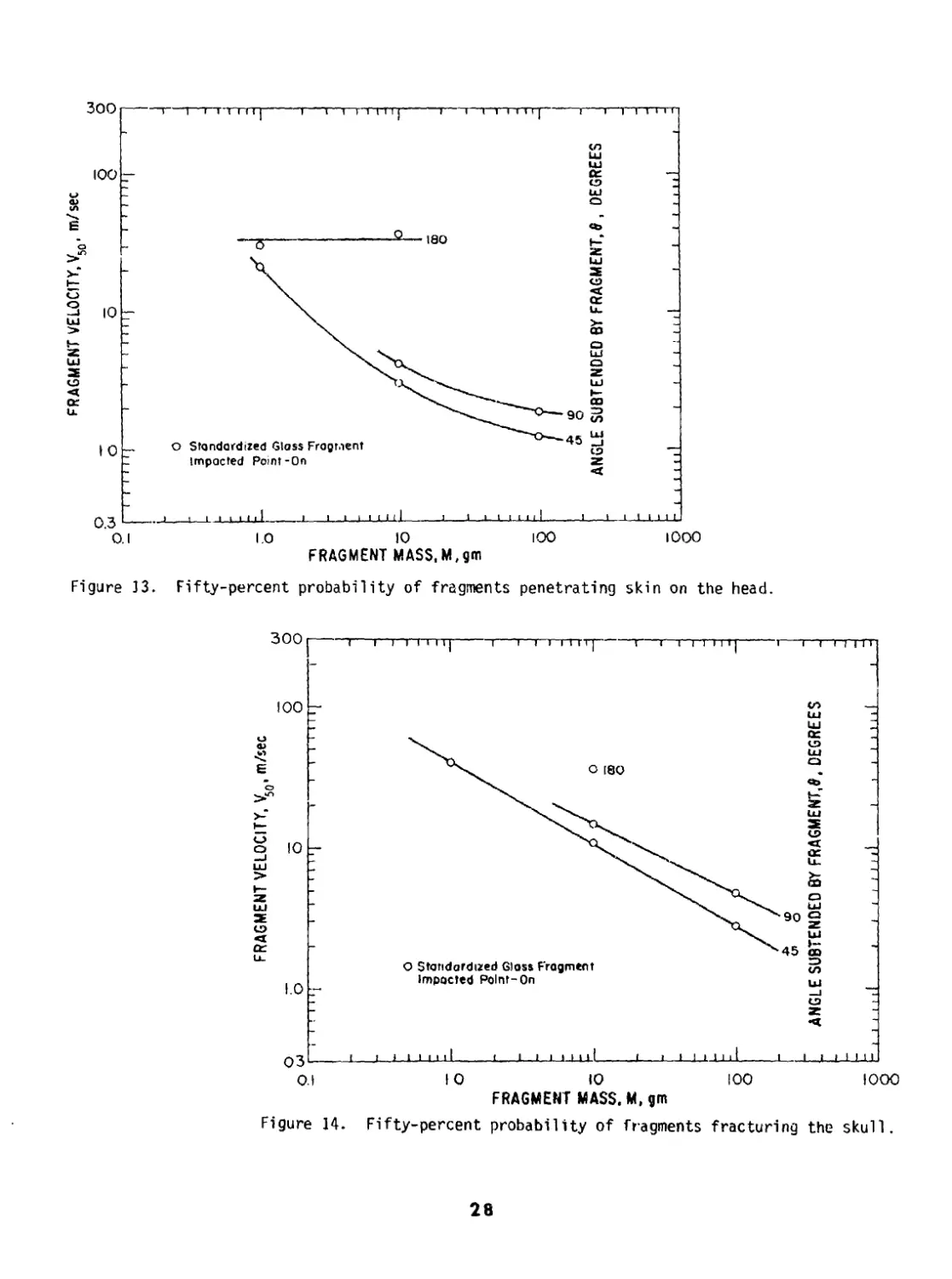
Figure 13 shows the relationship between glass-fragment V^q, M, and 0 for pene-
trating skin on the head, and Figure 14 shows the corresponding relationship for skull
fracture. The curves, which were fitted by eye, indicate that, for a 0 of either 45 or-
90 degrees, V5Q decreased with increasing mass. The V5Q for skin penetration for frag-
ments having a 0 of 180 degrees was approximately the same for 1- and 10-gm fragments.
Only one datum point was obtained for skull fracture with a 0 of 180 degrees.
Figure 15 shows the effect of clothing on the glass- and acrylic-fragment ve-
locities required to penetrate skin or body wall. R$ is the ratio of the V5Q tor skin on
the clothed abdomen to the Vjq for skin on bare thorax or abdomen. R^ is the ratio of tne
VgQ for body wall of clothed abdomen to the V^q for skin on bare thorax or abdomen. As 0
increases above 45 degrees, both ratios appear initially to increase and then to level off
at a maximum value of approximately 2.1 for Rs and 2.5 for R^. Altnough both Rs and R^
27
FRAGMENT VELOCITY, Ven. m/sec
FRAGMENT MASS,M,gm
Figure 33. Fifty-percent probability of fragments penetrating skin on the head.
Figure 14. Fifty-percent probability of fragments fracturing the skull.
28
3.0
Siandardized 10-gm Gloss Fragment
impacted Point-On
Irregular 10-gm Acrylic Fiagment
Impacted Point-On; The Mean
and Standard Deviation at
the 8's was 64 ± |4 Degrees
о
□
со
<= 20
co
о r
at Э
Re
I 5
I 0
for Skin an Claihed Abdomen
V5afor Sk'non Bare Thorax or Abdomen
V50for Body Wailof Clothed Abdomen
Vjq for Skin on Bore Thorax or Abdomen
Where Vjqis the Fragment Velocity in m/sec
for 50% Probability of Penetrating
0 5-
0
30
120
60	90
ANGLE SUBTENDED BY FRAGMENT. 0. DEGREES
180
Figure 15. Effects of cluthiny on fragment velocities required to penetrate
skin or body wall.
would be expected to be greater than 1.0 for all values of 0, the Rs curve was extrapolated
(dashed portion) to asymptotically approach 1.0 at a 0 of zero degrees on the assumption that
clothing would offer minimal resistance to a needle-like fragment. It was previously indi-
cated that the ratio of the V^q for body wall of bare thorax or abdomen to the Vjq for skin
on bare thorax or abdomen was approximately 1.50 for O's ranging from 45 to 180 degrees.
By assuming that the 1.50 value also applies to a 0 of zero degrees, ar.d by again assuming
that clothing would offer minimal resistance to needle-like fragments, the R& curve was
extrapolated (dashed portion) to asymptotically approach 1.50 at a 0 of zero degrees.
29
В. Windows
Table 1 gives data for 5C anesthesized and sheared sheep exposed two-at-a-time
and side-on either 2.1 or 4.3 m behind a window mounted on the end-plate closing a 3-m-
diameter shocktube. Some of the sheep were covered, except for the head, with two layers
of clothing similar to that used on the biological tests with individual fragments. The
windows were mounted in commercial aluminum frames and complied with standard building
codes. Each window consisted of either two 91x91x0.305-cm_panes of sheet glass (designated
as double-strength) or one 137x183x0.574-cm pane of plate glass.
The panes were broken by blast waves with peak reflected (against the end-plate)
overpressures ranging from 4 to 70 kPa and positive-overpressure durations ranging from 46
to 111 msec. Motion-picture records indicated that each biological subject was approximately
centered in the pattern of fragments from a window pane. Table 1 lists, for each subject,
the maximum wound depth, the total number of incised wounds, and the numbers of skin and
body-wall penetrations. Thu average numbers of the three categories of wounds and the
mean impact velocity of the fragments (based upon the averaged impact velocities plotted
in Figure 7) were computed for all subjects tested under similar conditions at approxi-
mately the same overpressure level. Excluding the data for the one pane that did not
break and for the three panes that were 4.3 m from the subjects, these values are plotted
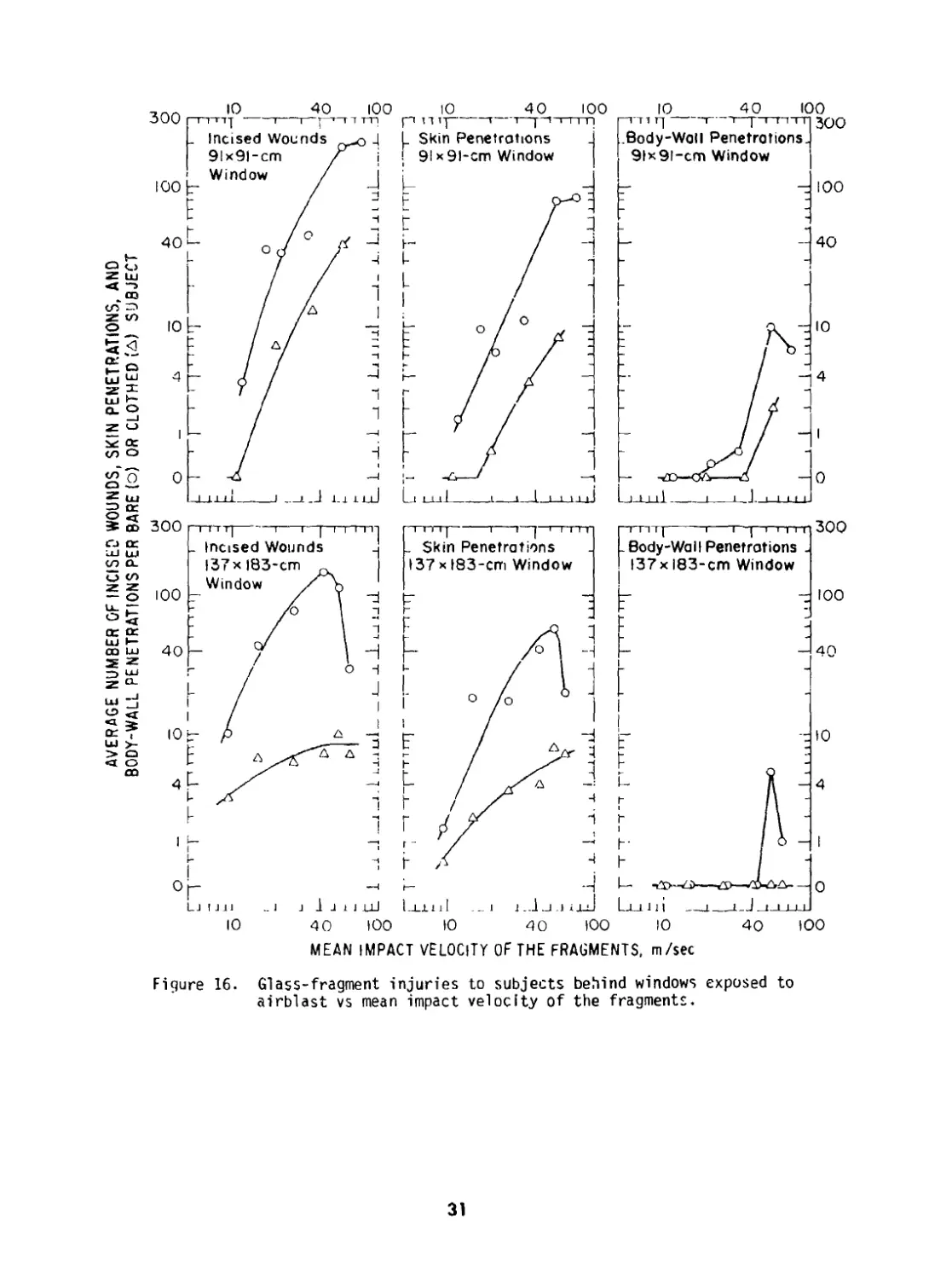
in Figure 16. Each of the six sections of the figure shows, for a given type of window
and wound, the average number of wounds per bare or clothed subject as a function of the
mean impact velocity of the fragments. The curves in Figure 16 are fitted by eye. For
each type of wound and window, at all impact velocities, the number of wounds per bare
subject was greater than the number per clothed subject, except when both were zero.
At mean impact velocities greater than 40 m/sec, the fragments were so numerous
that areas of multiple, closely-clustered, incised wounds of greater than skin depth were
observed on all of the bare animals (see Table 1). In these areas there was an increased
probability of several fragments' producing contiguous wounds which would have been counted
as one wound. This accounts for the fact that, in Figure 16, the bare-subject curves, par-
ticularly those for 137xl83-cm windows, generally went through a maximum at a velocity of
30
AVERAGE NUMBER GF INCISED WOUNDS, SKIN PENETRATIONS, AND
BODY-WALL PENETRATIONS PER BARE (o) OR CLOTHED (A) SUBJECT
10	40	100	10	40	100	10	40	100
MEAN IMPACT VELOCITY OF THE FRAGMENTS, m/sec
Figure 16. Glass-fragment injuries to subjects behind windows exposed to
airblast vs mean impact velocity of the fragments.
31
approximately 50 m/sec. Although for velocities greater than 50 m/sec the recorded number
of wounds decreased, their maximum depths continued to increase with increasing velocity.
For mean fragment impact velocities greater than 53 m/sec, all of the bare animals had
areas of denudation.
In general, the maximum wound depth increased with increasing fragment impact
velocity for clothed subjects as it had for bare subjects. However, areas of multiple,
serious, incised wounds or denudation were not observed on any of the clothed subjects.
Instead, there were large areas of welting under the clothing at the higher overpressures.
The curves for clothed subjects, unlike the curves for bare subjects, do not appear to go
through maximums.
The data for subjects 4.3 m from the window are not shown in Figure 16. In gen-
eral these data suggest that, for similar conditions, the number of injuries of a given
type at the 4.3-m range was on the order of one-half of the corresponding number of in-
juries at the 2.1-m range. The exception to this was for clothed subjects and mean frag-
ment velocities ranging from 41 to 52 m/sec, where the average number of incised wounds
was 7 at 2.1 m and 20 at 4.3 m, and the average number of skin penetrations was 4 at 2.1 m
and 7 a, '• m.
VII. PREDICTION OF WOUNDS VS OVERPRESSURE
The data btained with sheep behind windows were assumed to apply directly to man.
The skin (a: 1 body-wall) thickness on a man and a sheep are approximately the same. The
surface area exposed to a window would be about 40 percent greater for a face- or back-on
man than the corresponding area for a side-on sheep. Therefore, the number of injuries in
Table 1 might be low for the extreme case of a man broad-side-on and centered behind a
window larger than himself.
In order to use the data obtained with the shocktube to predict the number of wounds
for people in houses in relation to blast overpressure, it was necessary to recall that a
given overpressure produced larger fragment velocities for windows on the end of the shock-
tube than for windows in houses. The equation (Figure 6) for the dashed lines in Figure 7
32
and the measured mean fragment velocity for each window on the shocktube were used to cal-
culate an "effective" peak overpressure which would have produced an equal velocity if the
window had been in a house exposed to a long-duration blast wave.
Figure 17 is a plot of the shoc.ktube data (Table 1) for the number of wounds in rela-
tion to the calculated "effective" peak overpressure on the window. It should be emphasized
that this figure is assumed to apply to people approximately 2 m behind a window in a 1- or
2-story house exposed to a long-duration blast wave. In such cases, the effective peak
overpressure would be the actual peak overpressure on the window; i.e., the reflected over-
pressure for a face-on window and the incident overpressure for a side-on window.
Reference 6 contains experimental data which can be used to confirm the prediction of
number of wounds in relation to overpressure. Two unclothed dogs were positioned side-on
behind forward-facing windows in two 1-story houses located at the same ground range from
a nuclear explosion. The peak incident overpressure was 26 kPa, reflecting to 59 kPa, and the
duration of the positive overpressure was 760 msec. The windows consisted of twenty 30x61x
0.32-cm panes of ordinary glass mounted in a steel frame. Each dog was approximately cen-
tered 3.4 m behind a window. The measured mean impact velocity of the fragments was 42.7
m/sec. One subject received 36-, and the other 37, wounds involving the skin and usually
the underlying tissues. One subject received two, and the other six, serious wounds arbi-
trarily defined as "a laceration penetrating the skin wherein the missile either was stopped
by bone or passed into the tissues to a depth of 10 mm or more."
Either Figure 16 and the mean fragment impact velocity of 42.7 m/sec or Figure 17 and
the effective peak overpressure of 59 kPa can be used to predict that a sheep located 2.1 m
behind a 91x91x0.305-cm window in the same houses would have received approximately 42 skin
penetrations and 3 body-wall penetrations. Considering the many variabilities in the experi-
mental arrangements, these numbers are in good agreement with those observed for the two
dogs.
33
AVERAGE NUMBER OF INCISED WOUNDS (O), SKIN PENETRATIONS(Д),
AND BODY-WALL PENETRATIONS (□/, PER BARE OR CLOTHED SUBJECT
ч
EFFECTIVE PEAK OVERPRESSURE ON THE WINDOW, kPa
Figure 17. Glass-fragment injuries to subjects behind windows exposed to
airblast vs effective peak overpressure on the window.
34
REFERENCES
1.	"The Effects of Nuclear Weapons," (Glasstone, S. and P. J. Dolan, Eds), Third Edition,
U. S. Department of Defense and U. S. Department of Energy, Washington, D. C., 1977.
2.	Iverson, J. Н.» "Sunmary of Existing Structures Eviluation. Part il: Window Glass and
Applications," Final Report OCD Work Unit No. 1126C, Stanford Research Institute, Menlo
Park, CA, December 1968.
3.	Fletcher, E. R., D. R. Richmond and D. W. Richmond, "Airblast Effects on Windows in
Buildings and Automobiles on the Eskimo III Event," in Minutes of the Explosives Safety
Seminar, 24-26 September 1974, Hollywood, Florida, Volume I, pp. 185-213, Department
of Defense Explosives Safety Board, Washington, b. C., September 1974.
4.	Fletcher, E. R., "Characteristics and Biological Effects of Fragments from Glass and
Acrylic Windows Broken by Airblast," in Proceedings of the DCPA All Effects Research
Contractors Conference, 21-25 April 1974, Pacific Grove, California, Research Report
22 Technical Summary, pp. 57-81, Defense Civil Preparedness Agency, Research and Engin-
eering, Washington, D. C., October 1, 1974.
5.	Bowen, I. G., D. R. Richmond, M. B. Wetherbe and C. S. White, "Biological Effects of
Blast from Bombs. Glass Fragments as Penetrating Missiles and Some of the Biological
Implications of Glass Fragmented by Atomic Explosions," USAEC Technical Report, AECU-
3350, Office of Technical Services, Department of Commerce, Washington, D. C., June 18,
1956.
6.	Goldizen, V. C., D. R. Richmond, T. L. Chiffelle, I. G. Bowen and C, S. White, "Mis-
sile Studies wiLii a Biological Target." USAEC Civil Effects Test Group Report, WT-147D,
Office of Technical Services, Department of Commerce, Washington, и. C-, January 23,
1961.
35
DISTRIBUTION LIST
DEPARTMENT OF DEFENSE
Aimed Lorces Radiobiology Rich Inst
AT1N: Director
Armed Forces Staff College
ATTN: Ref & Tech Svcs Br
Assistant Secretary of Defense
International Security Affairs
ATTN European A NATO Affairs
ATTN: Policy Plans A NSC Affairs
Assistant Secretary of Defense
Comm, Cmd, Cont A Intell
ATTN: Surv & Warn Sys
Assistant to the Secretary of Defense
Atomic Energy
ATTN: Executive Asst
Coninand 8 Control Tech Cen
ATTN: C-312
Defense Intelligence Agency
ATTN: DIA/VPA-2 (Fed Res Div)
ATTN: DB-6
5 cy ATTN: DB-4
Defense Nuclear Agency
ATTN: STNA
ATTN: NATO
ATTN- NATA
ATTN. STSP
ATTN. SPSS
ATTN: BA
6 cy AITN: T1TL
Defense lech Info Cen
12 cy ATTN: OD
Field Command
Defense Nuclear Agency
ATTN: FCP
ATTN: FC
Field Command
Defense Nuclear Agency
Livermore Branch
AT1N-. FCPRL
Interservice Nuclear Weapons Sch
ATTN- TTV
Joint Chiefs of Staff
ATTN: J-3
ATTN: J-5, Strategy Div. W. McClain
ATTN: J-5, Nuclear Div
ATTN; J-3, Strategic Op Div
ATTN: SAGA/SSD
ATTN: SAGA/SFD
National Defense University
AT1N: NWCLB-CR
ATTN: ICAF, Tech Lib
DEPART WENT or DEFENSE (Continued)
Joint Strat Tgt Plan Staff
ATTN: JL
ATTN: JLA
ATTN: JP
2 cy ATTN: JLTW-2
Director
NET Assessment
Office of the Secretary of Defense
ATTN: Mil Asst
U.S. National Mil Rep, SHAPE
ATTN- U.S. Doc Off
Under Secretary of Defense for Rsch & Eng.
ATTN: Strategic & Space Sys (OS)
ATTN: Tac War Prog
DEPARTMENT ОТ THE ARMY
Deputy Chief of Staff foi Ops & Plans
Department of the Amy
ATTN: DAMO-ZXA
ATTN. DAMO-NC
Harry Diamond Lab., Dept of the Army
ATTN: DELHD-N-P
U.S. Army Ballistic Research Labs
ATTN: DRDAR-TSB-S
ATTN: DRDAR-BLT, Effects Analysis В
U.S. Army ComJ 8. Gen Staff College
ATTN: ACQ, Lib Div
U.S. Army Concepts Analysis Agency
ATTN: CSSA-ADL
Commander-in-Chief
U.S. Army Europe and Seventh Army
AT1N: AEAGC
ATTN: AEAGE
U.S. Amy Nuclear A Chemical Agency
ATTN: I ibrary
ATTN. C. Davidson
U.S. Amy TRADDC Sys Analysis Actvy
ATTN: ЛТАА-ТАС
U.S. Army War College
ATTN: Library
U.S. Military Academy, Dept of the Angy
ATTN: Doc Lib
DEPARTMENT DF THE NAVY
Naval Postgraduate School
ATTN: Code 1424, Library
Naval Research Lab
ATTN: Code 1240
37

DEPARTMENT OF THE NAW (Continued)
Naval Sea Systems Coimiand
ATTN: SEA-O9G53
AHN- SEA-643
Naval Surface Weapons Center
ATTN: Code I 31
Naval War Col 1ege
ATTN: Doc Control
Nuclear Weapons Tng Gp, Pacific
Department of the Navy
ATTN: Doc Control
Nuclear Weapons Tng Gp, Atlantic
Department or the Navy
ATTN: Doc Control
Office of Naval Research
AT1N. Tech Info Svcs
DEPARTMENT DE THE AIR FORCE
Air Force School of Aerospace Med
AITN: Radiobiology Div
ATTN: J. Pickering
Air Io»co Systems Cornua nd
AT1N: DE
ATTN: XR
ATTN: SD
Air lurce Weapons Lab
Air Force Systems Coinnand
ATTN. SUL
Air University Lib
Department of the Air Force
ATTN: AU! -LSI
Deputy Chief of Staff
Research, Dev, & Acq
Department of the Air Force
ATTN: AFRDQl
foreign Technology Div
Air Force Systems Сотпано
ATTN. CCN
AITN: TQTM
ATTN: SDN
Strategic Air Contihind
Department ot tnc Air Force
ATTN: NR
ATTN: ADWN
ATTN. XP
ATIN: NR|, SI INFO Lib
Al IN: DO
U.S. Air Force, Pacific
AT1N. XP
Commander-in-Chief
U.S. Air Forces in Europe
AT IN: USAFE/DEX
Coiiriander- in-Cliief
U.S. Air 1 orces in Europe
AHN: USAlE/UOT
DEPARTMENT 01 THE AIR FORCE (Continued)
Соптпа nder-in-Chief
U.S. Air Forces in Europe
ATTN: USAFE/INA
Coiinandcr-i n-Chief
U.S Air Forces in Europe
ATTN. USAFE/INT
Coinnander- in-Chief
U.S. Air Forces in Europe
ATTN: USAFE/XPX
DEPARTMENT OF ENERGY
Department of Energy
Albuquerque Operations Ofc
ATTN; CUD
Lovelace Riomed & Env Rsch Inst, Inc
4 cy ATTN. 0. Richmond
4 cy AT TN. E. Fletcher
4 cy ATTN. J. Yelverton
OTHER GOVERNMENT AGENCIES
Central Intelligence Agency
ATTN: OSWR/NED
Federal Emergency Management Agency
Nat Sec Ofc Mitigation & Rsch
AITN: Dep Dir, J. Nocita
AT1N: Asst Associated Dir
Department ot State
Ofc of 1nternational Sec Policy
ATTN- PM/1SP
DEPARTMENT OF ENERGY CONTRACTORS
Lawrence Livermore National Lab
AfTN: Tech Info Dept Lib
Los Alamos National Lab
AITN: MS 364
ATTN: M/S634. T. Dowler
DEPARTMENT OF DEFENSE CONTRACTORS
Advanced International Studies Inst
ATTN- M. Harvey
Advanced Reseaich & Applications Corp
ATTN: Doc Control
Aerospace Corp
ATTN: 1ibrary
RDM Corp
ATTN: J. Braddock
General Electric Co
AITN: R. Minckler
111 Research lust
AT IN: Doc Library
Institute for Defense Analyses
ATTN: J. Grote
AITN: Class Lib
38
DLPARlMENr OF DLILNSL CONTRACTORS (Continued)
JATCOR
ATTN: R. Sullivan
Kanian Sciences Corp
ATTN: 1. Shelton
Kaman Sciences Corp
ATTN: E, Daugs
Kanian Tempo
ATTN: DAS1AC
Martin Marietta Corp
ATTN: Г. Marion
Pacific-Sierra Research Corp
ATTN: G. Lang
ATTN: li. Brode
I’acific-Sierra Research Corp
ATTN.	0.	Gormely
R & 0 Associates
ATTN’	R.	Port
ATTN:	P.	Haas
2	cy	ATTN:	Doc Control
2	cy	ATTN:	S.	Borjon
DEPARTMENT 01 OEI LNSE CONTRACTORS (Continued)
R & 0 Associates
ATTN: J. Thompson
Science Applications. Inc
ATTN Doc Control
ATTN- J. Warner
ATTN: M. Drake
ATTN: D. Groce
Science Applications, Inc
ATTN: W. Layson
ATTN: Doc Control
Science Applications. Inc
ATTN: D. Kaul
AHN: L. Gouri1
Sys tern Planning Coro
ATTN: J. Douglas
39