/



Теги: weapons
Год: 1944

Текст
                    Ji ®=ж
WAR DEPARTMENT FIELD MANUAL
FIELD ARTILLERY
TACTICAL
EMPLOYMENT
WAR DEPARTMENT • 5 FEBRUARY 1944
WAR DEPARTMENT FIELD MANUAL
FM 6-20
This manual, together with FM 6-100 and FM 6-101 when published, supersedes FM
6-20, Tactics and Technique, 10 July 191,0, including С 1, 2 January 191,1.
FIELD ARTILLERY
TACTICAL
EMPLOYMENT
WAR DEPARTMENT
5 FEBRUARY 1944
United Stales Government Printing Office
Washington: 191,1,
WAR DEPARTMENT,
Washington 25, D. C., 5 February 1944.
FM 6-20, Field Artillery Field Manual, Tactical
Employment, is published for the information and
guidance of all concerned.
[A. G. 300.7 (24 Dec 43).]
By order of the Secretary of War :
G. C. MARSHALL,
Chief of Staff.
Official :
J. A. ULIO,
Major General,
-The Adjutant General.
Distribution :
R and H 1, 2(2) ; Bn and H 3, 7, 17, 18, 44
(2); В 6 (10); Bn 6 (10); C 6 (12).
(For explanation of symbols see FM 21-6.)
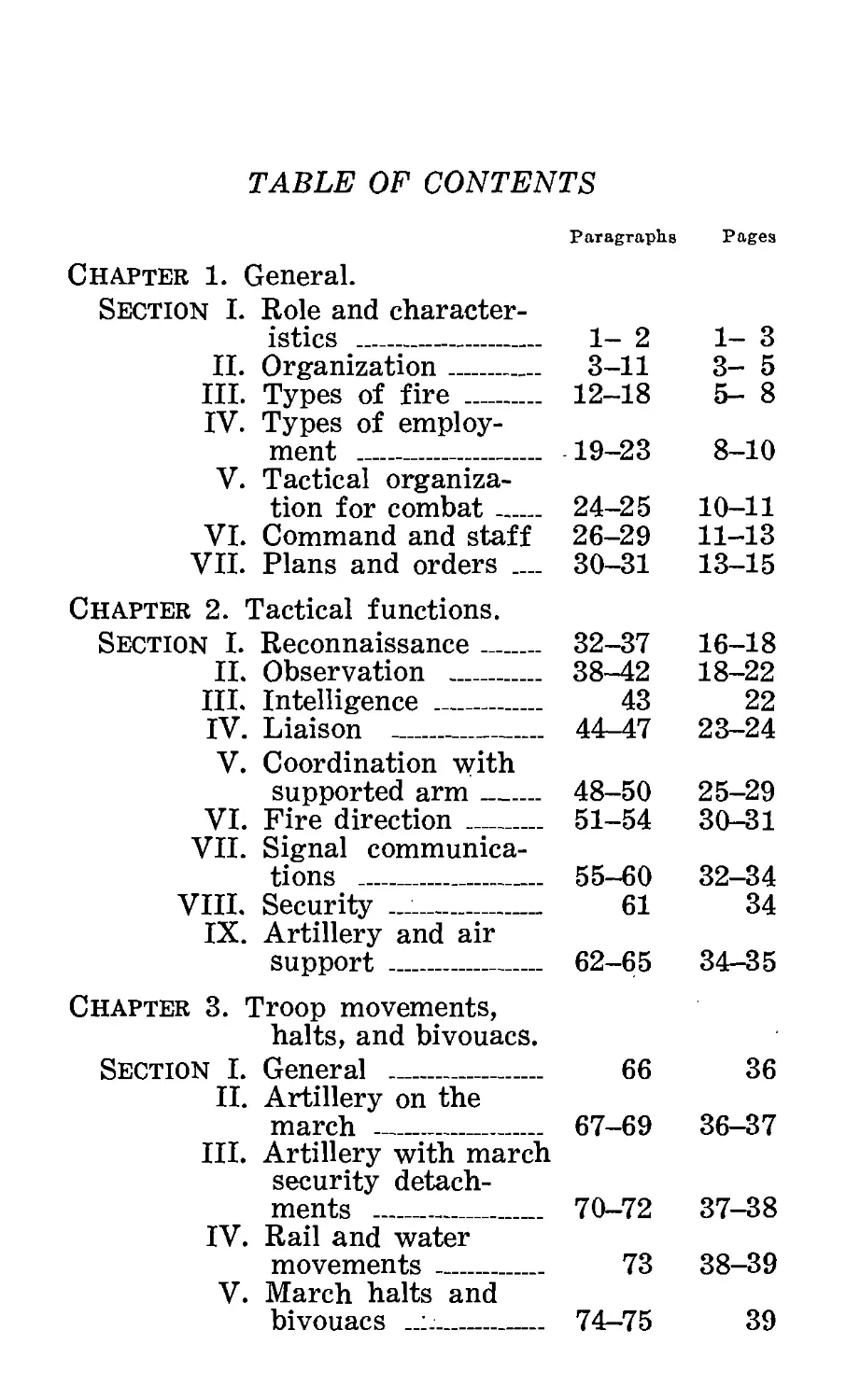
TABLE OF CONTENTS
Paragraphs Pages
Chapter 1.	General.
Section I. Role and character-
istics 	1-2	1-3
II.	Organization_______	3-11	3- 5
III.	Types of fire _______ 12-18	5- 8
IV.	Types of employ-
ment ____________________ 19-23	8-10
V.	Tactical organiza-
tion for combat________ 24-25	10-11
VI.	Command and staff	26-29	11-13
VII.	Plans and orders __ 30-31	13-15
Chapter 2.	Tactical functions.
Section I. Reconnaissance______ 32-37	16-18
II.	Observation _________ 38-42	18-22
III.	Intelligence ___________ 43	22
IV.	Liaison _____________ 44-47	23-24
V.	Coordination with
supported arm__________ 48-50	25-29
VI.	Fire direction ______ 51-54	30-31
VII.	Signal communica-
tions _____________________ 55-60	32-34
VIII.	Security ....	61	34
IX.	Artillery and air
support  62-65	34-35
Chapter 3.	Troop movements,
halts, and bivouacs.
SECTION I. General ____________ 66	36
II.	Artillery on the
march ----------------- 67-69	36-37
III.	Artillery with march
security detach-
ments  70-72	37-38
IV.	Rail and water
movements ______________ 73	38-39
V.	March halts and
bivouacs  74-75	39
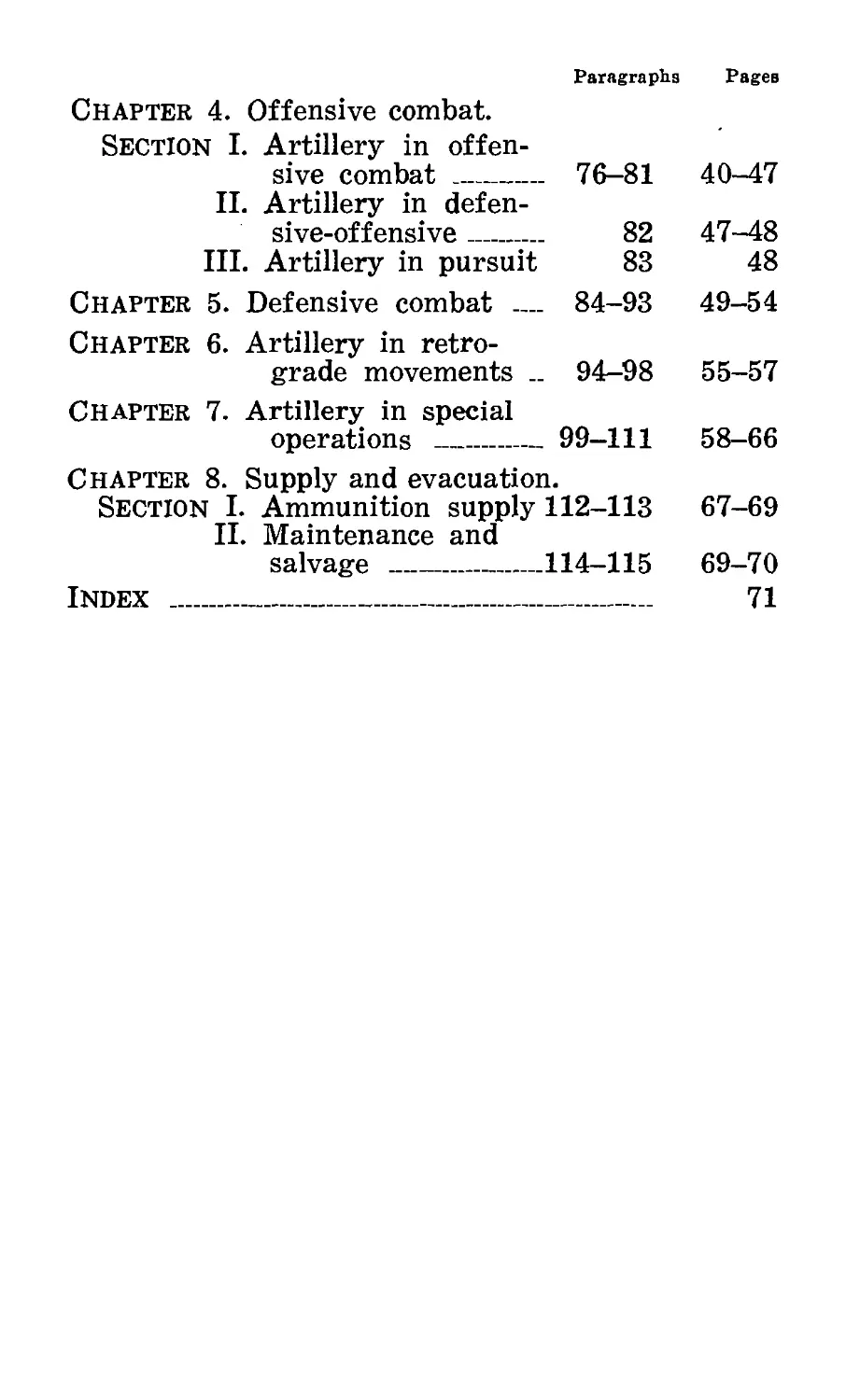
Paragraphs Pages
Chapter 4. Offensive combat. Section I. Artillery in offen- sive combat 	 II. Artillery in defen- sive-offensive 	 III. Artillery in pursuit Chapter 5. Defensive combat —		. 76-81 82 83 84-93	40-47 47-48 48 49-54
Chapter	6. Artillery in retro- grade movements ..	94-98	55-57
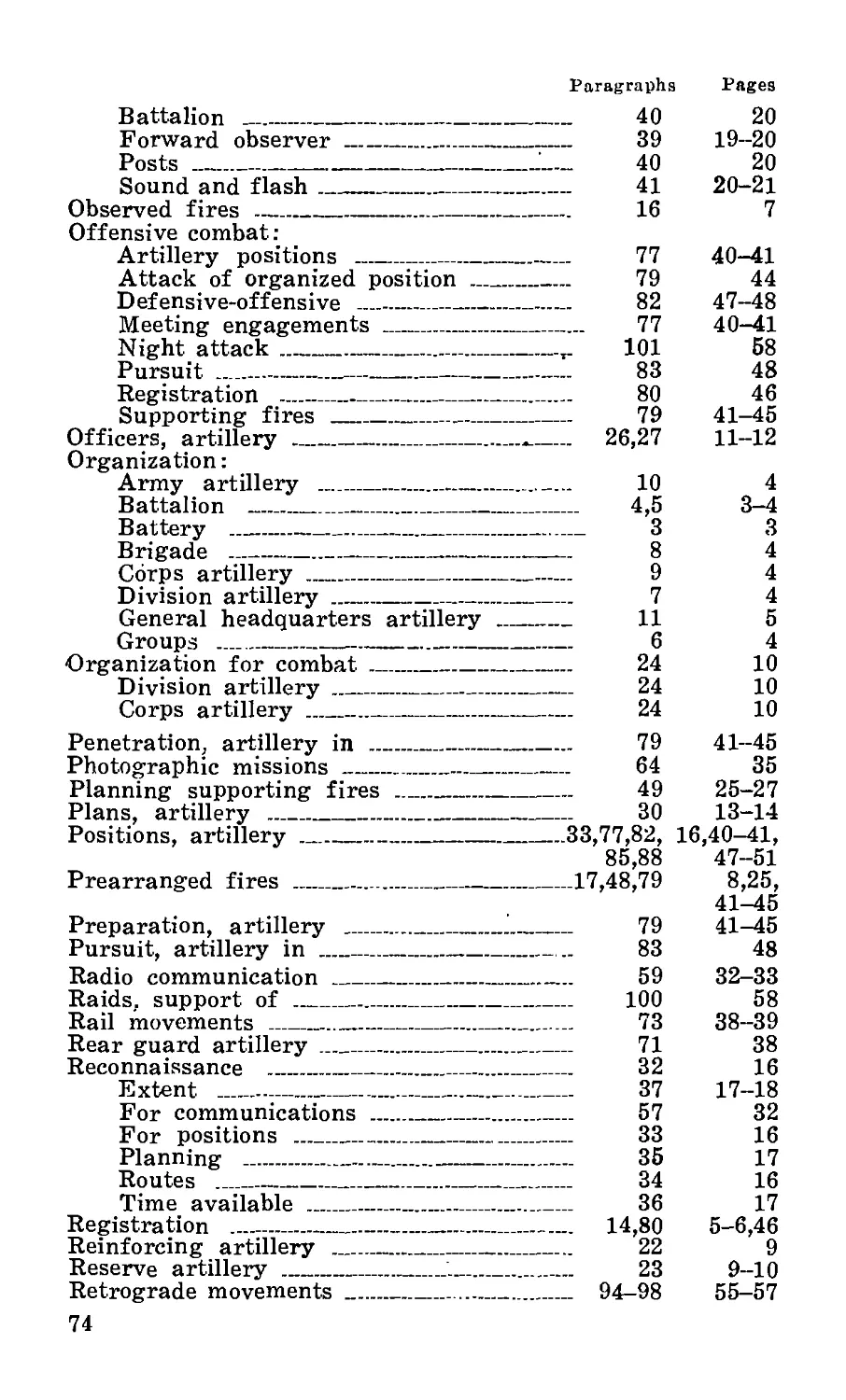
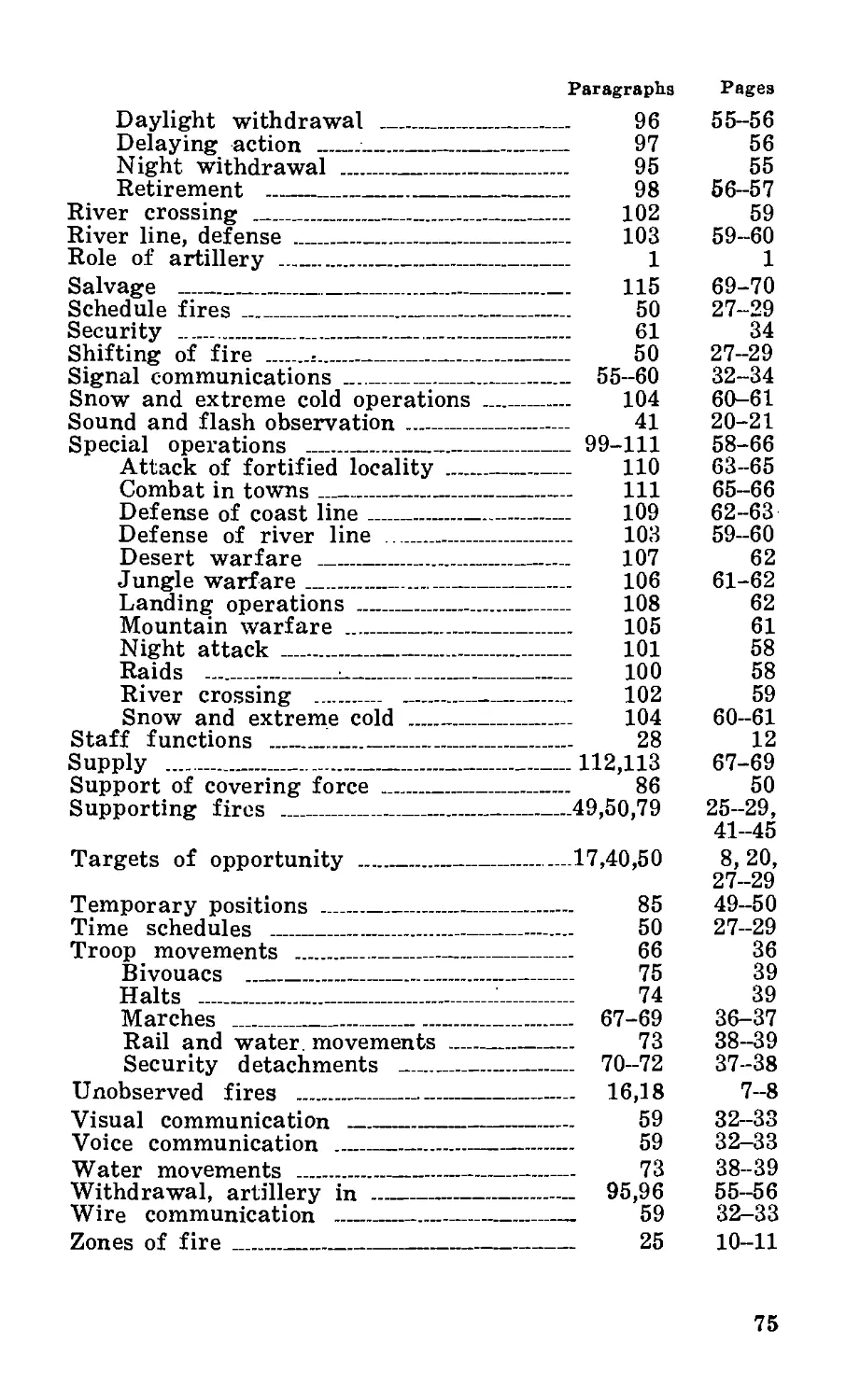
Chapter 7. Artillery in special operations 	 99-111 Chapter 8. Supply and evacuation. Section I. Ammunition supply 112-113 II. Maintenance and salvage 	114-115 Index 				58-66 67-69 69-70 71
This manual, together with FM 6-100 and FM 6-101, when published,
supersedes FM 6-20, Tactics and Technique, 10 July 1940, including*
C 1, 2 January 1941.
CHAPTER /
GENERAL
SECTION I
ROLE AND CHARACTERISTICS
1. ROLE OF FIELD ARTILLERY. Field artillery
is a supporting arm. It contributes to the action
of the entire force by giving close and continuous
fire support to infantry (cavalry) (armored) units
and by giving depth to combat by counterbattery
fire, fire on hostile reserves, fire to restrict move-
ments in rear areas, and fire to disrupt command
agencies.
2. CHARACTERISTICS OF FIELD ARTILLERY.
a.	General. Field artillery is an arm for relatively
long range combat. Massed artillery fire possesses
great power of destruction and neutralization. Ar-
tillery fire can be shifted rapidly in width and depth
without changing positions. Artillery positions can
be changed quickly during combat, and units can
be regrouped to bring greater fire power to bear
on important sectors. This flexibility gives the
commander a powerful means of influencing the
course of combat. The efficiency with which artil-
lery fires are maneuvered depends upon adequate
control, close liaison with supported troops, and ef-
ficient communications and observation.
1
b.	Modes of transportation. Field artillery units
differ in mobility depending on the type of trans-
portation used.
(1)	HORSE ARTILLERY. Horse artillery has
great battlefield mobility. The cannoneers are in-
dividually mounted and their mounts furnish a
reservoir for draft replacements and relays. It
can march and maneuver with horse cavalry.
(2)	PACK ARTILLERY. Pack artillery can op-
erate over ground that is difficult or impassable for
other types of artillery. It is suitable for moun-
tain and jungle combat. Pack artillery cannot
move faster than a walk, except for short distances.
It marches quietly.
(3)	MOTOR-DRAWN ARTILLERY. Artillery may
be towed behind trucks, tractors, or other motor ve-
hicles. Truck-drawn artillery has much greater
mobility on roads than other types.
(4)	SELF-PROPELLED ARTILLERY. Artillery
may be mounted in wheeled, half-track, or full-track
vehicles. Such artillery can move more rapidly in-
to and out of position than towed artillery.
(5)	AIRBORNE ARTILLERY. Artillery and its
ground transportation may be carried in aircraft.
Some types of artillery may be dropped by para-
chute.
c. Capabilities of weapons. Artillery is classified,
based on caliber and weight, as light, medium, and
heavy. All three classifications may include mor-
tars, howitzers, and guns.
(1)	Light artillery includes the 105-mm howitzer
and smaller cannon. Its characteristics are mobil-
ity, flexibility of fire, high rate of fire, and rapidity
of getting in and out of position. These character-
istics, coupled with its range, enable it to render
2
continuous support to other ground forces over
areas of great width and depth.
(2)	Medium artillery varies from the 4.5-inch gun
to the 155-mm howitzer, both inclusive. Medium
artillery has a lower rate of fire but greater power
than light artillery. Its weight of projectile and
range make it preferable to light artillery for coun-
terbattery. Its mobility over difficult terrain is
appreciably less than that of light artillery.
(3)	Heavy artillery includes the 155-mm gun and
those of heavier caliber. Heavy artillery has a rel-
atively low rate of fire, great power, and long range.
It can execute counterbattery and interdiction deep
within the enemy lines and can intensify and extend
the neutralizing fires of light and medium artillery.
It requires appreciably more time for emplacement
than light and medium artillery.
SECTION II
ORGANIZA TION
3.	HOWITZER (GUN) BATTERY (FM 6-101).
The howitzer (gun) battery is the basic field ar-
tillery unit; it is the smallest unit containing the
personnel and equipment necessary for maneuver,
delivery of fire, maintenance, and administration.
4.	HOWITZER (GUN) BATTALION (FM 6r-101).
The howitzer (gun) battalion consists of a head-
quarters, two or more howitzer (gun) batteries
(usually three), and a service unit. It has both
tactical and administrative functions. The battal-
ion is the usual unit for executing fire missions.
5.	OBSERVATION BATTALION (FM 6-120). The
observation battalion is equipped to execute flash
з
and sound ranging and to furnish topographic serv-
ice and meteorological data.
6.	GROUP (FM 6-100). A group consists of any
combination of artillery units, usually from two to
four battalions. A group headquarters is desig-
nated. It may be the headquarters of one of the
units forming the group, or it may be a group head-
quarters (T/O 6-12).
7.	DIVISION ARTILLERY (FM 6-100). The divi-
sion artillery consists of a division artillery head-
quarters, headquarters battery, and such artillery
battalions as are organic or attached. The artillery
organically assigned to a division is the minimum
habitually required for combat. For any action, ex-
cept against weak forces, additional artillery is nec-
essary.
8.	BRIGADE (FM 6-100). The brigade consists of
a brigade headquarters, headquarters battery, and
such groups and battalions as are attached. Its func-
tions are primarily tactical.
9.	CORPS ARTILLERY (FM 6-100). The corps ar-
tillery consists organically of a corps artillery head-
quarters and headquarters battery and an observa-
tion battalion. Artillery brigade and group head-
quarters, groups, and battalions are attached as
necessary. The term “artillery with the corps” in-
cludes both corps and division artillery.
10.	ARMY ARTILLERY. There is no organic army
artillery. The general headquarters or theater com-
mander allocates artillery to an army for specific
operations.
4
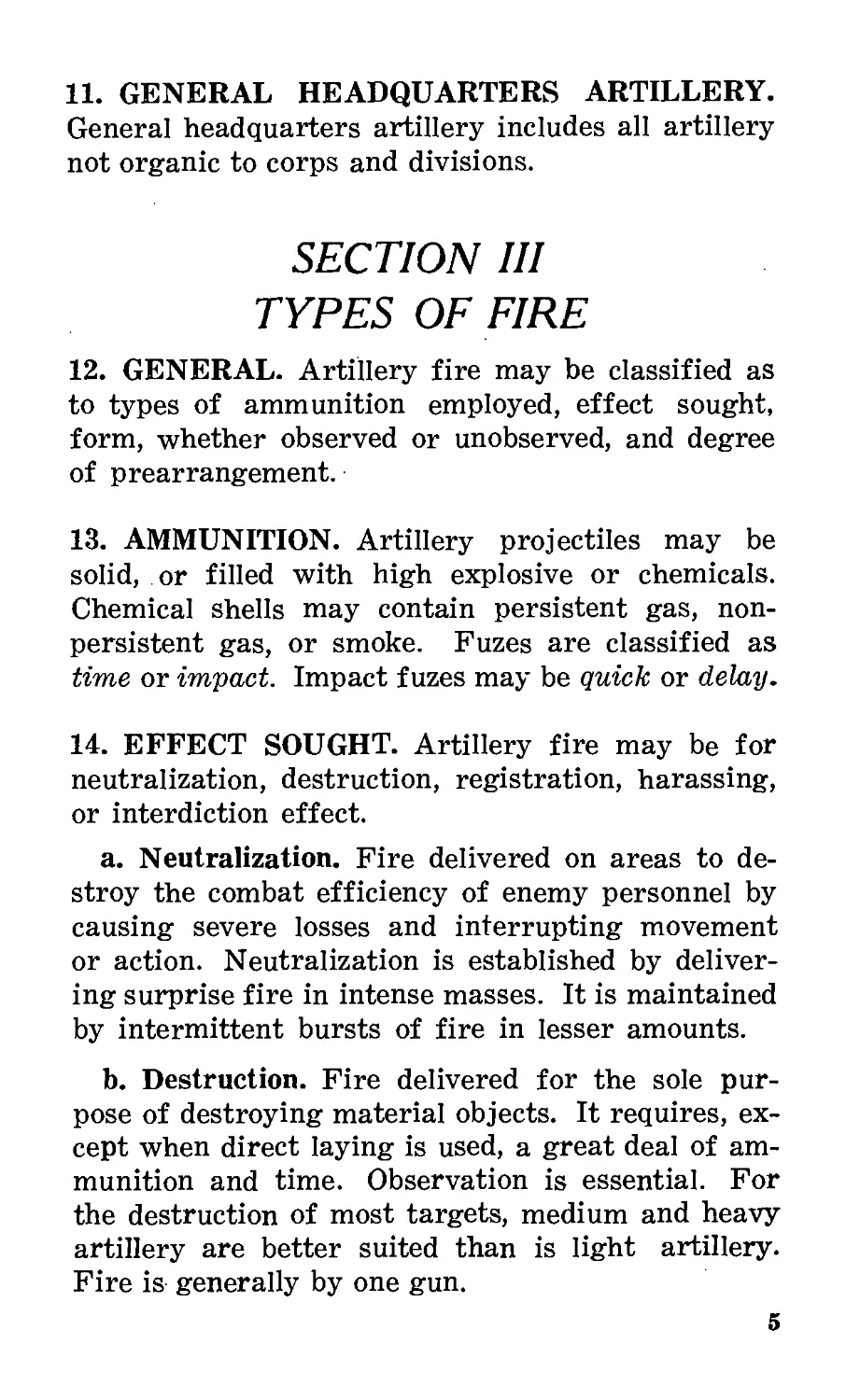
11.	GENERAL HEADQUARTERS ARTILLERY.
General headquarters artillery includes all artillery
not organic to corps and divisions.
SECTION III
TYPES OF FIRE
12.	GENERAL. Artillery fire may be classified as
to types of ammunition employed, effect sought,
form, whether observed or unobserved, and degree
of prearrangement.
13.	AMMUNITION. Artillery projectiles may be
solid, or filled with high explosive or chemicals.
Chemical shells may contain persistent gas, non-
persistent gas, or smoke. Fuzes are classified as
time or impact. Impact fuzes may be quick or delay.
14.	EFFECT SOUGHT. Artillery fire may be for
neutralization, destruction, registration, harassing,
or interdiction effect.
a.	Neutralization. Fire delivered on areas to de-
stroy the combat efficiency of enemy personnel by
causing severe losses and interrupting movement
or action. Neutralization is established by deliver-
ing surprise fire in intense masses. It is maintained
by intermittent bursts of fire in lesser amounts.
b.	Destruction. Fire delivered for the sole pur-
pose of destroying material objects. It requires, ex-
cept when direct laying is used, a great deal of am-
munition and time. Observation is essential. For
the destruction of most targets, medium and heavy
artillery are better suited than is light artillery.
Fire is generally by one gun.
5
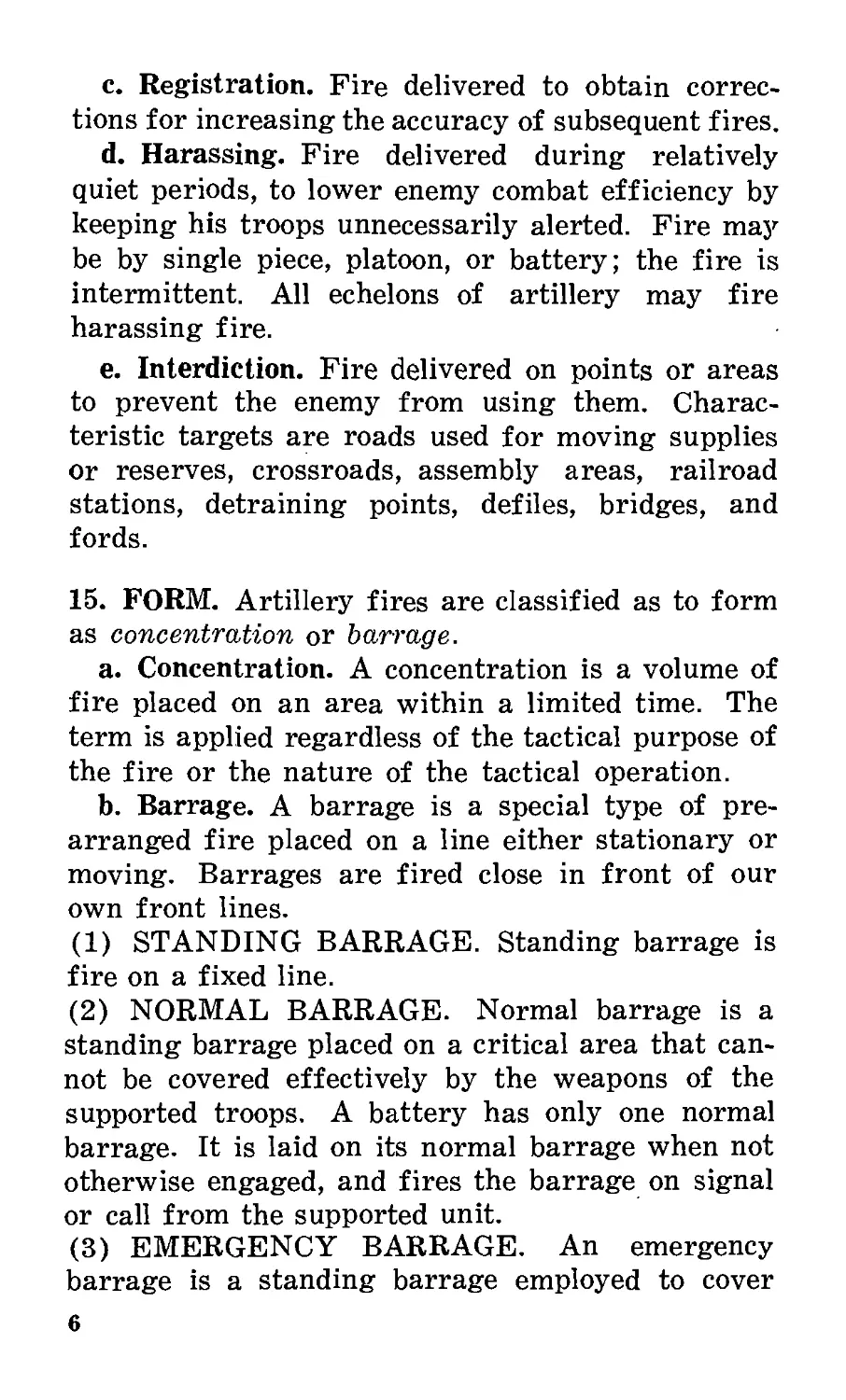
c.	Registration. Fire delivered to obtain correc-
tions for increasing the accuracy of subsequent fires.
d.	Harassing. Fire delivered during relatively
quiet periods, to lower enemy combat efficiency by
keeping his troops unnecessarily alerted. Fire may
be by single piece, platoon, or battery; the fire is
intermittent. All echelons of artillery may fire
harassing fire.
e.	Interdiction. Fire delivered on points or areas
to prevent the enemy from using them. Charac-
teristic targets are roads used for moving supplies
or reserves, crossroads, assembly areas, railroad
stations, detraining points, defiles, bridges, and
fords.
15.	FORM. Artillery fires are classified as to form
as concentration or barrage.
a.	Concentration. A concentration is a volume of
fire placed on an area within a limited time. The
term is applied regardless of the tactical purpose of
the fire or the nature of the tactical operation.
b.	Barrage. A barrage is a special type of pre-
arranged fire placed on a line either stationary or
moving. Barrages are fired close in front of our
own front lines.
(1)	STANDING BARRAGE. Standing barrage is
fire on a fixed line.
(2)	NORMAL BARRAGE. Normal barrage is a
standing barrage placed on a critical area that can-
not be covered effectively by the weapons of the
supported troops. A battery has only one normal
barrage. It is laid on its normal barrage when not
otherwise engaged, and fires the barrage on signal
or call from the supported unit.
(3)	EMERGENCY BARRAGE. An emergency
barrage is a standing barrage employed to cover
6
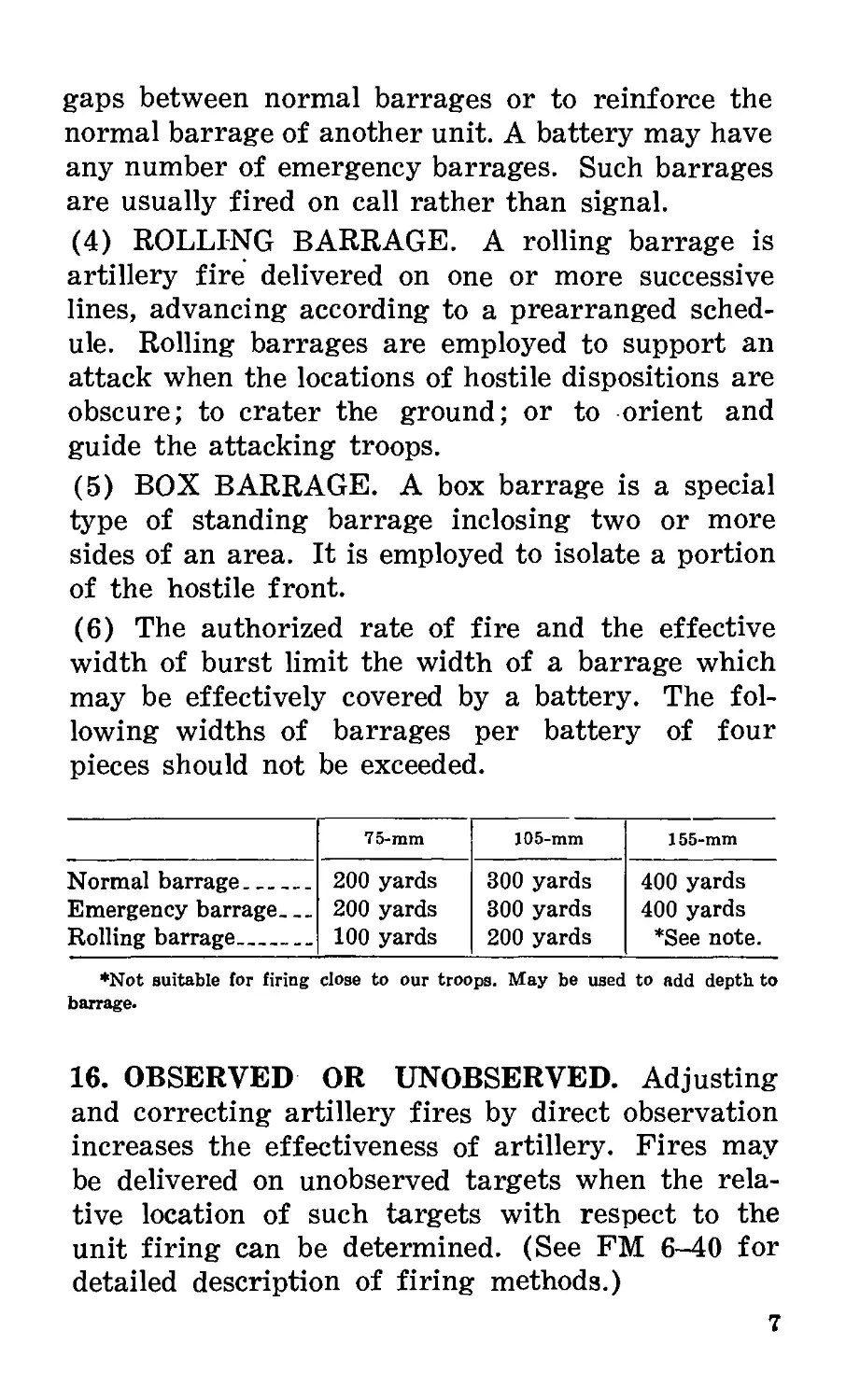
gaps between normal barrages or to reinforce the
normal barrage of another unit. A battery may have
any number of emergency barrages. Such barrages
are usually fired on call rather than signal.
(4)	ROLLING BARRAGE. A rolling barrage is
artillery fire delivered on one or more successive
lines, advancing according to a prearranged sched-
ule. Rolling barrages are employed to support an
attack when the locations of hostile dispositions are
obscure; to crater the ground; or to orient and
guide the attacking troops.
(5)	BOX BARRAGE. A box barrage is a special
type of standing barrage inclosing two or more
sides of an area. It is employed to isolate a portion
of the hostile front.
(6)	The authorized rate of fire and the effective
width of burst limit the width of a barrage which
may be effectively covered by a battery. The fol-
lowing widths of barrages per battery of four
pieces should not be exceeded.
	75-mm	105-mm	155-mm
Normal barrage		200 yards	300 yards	400 yards
Emergency barrage		200 yards	300 yards	400 yards
Rolling barrage		100 yards	200 yards	*See note.
♦Not suitable for firing close to our troops. May be used to add depth to
barrage.
16.	OBSERVED OR UNOBSERVED. Adjusting
and correcting artillery fires by direct observation
increases the effectiveness of artillery. Fires may
be delivered on unobserved targets when the rela-
tive location of such targets with respect to the
unit firing can be determined. (See FM 6-40 for
detailed description of firing methods.)
7
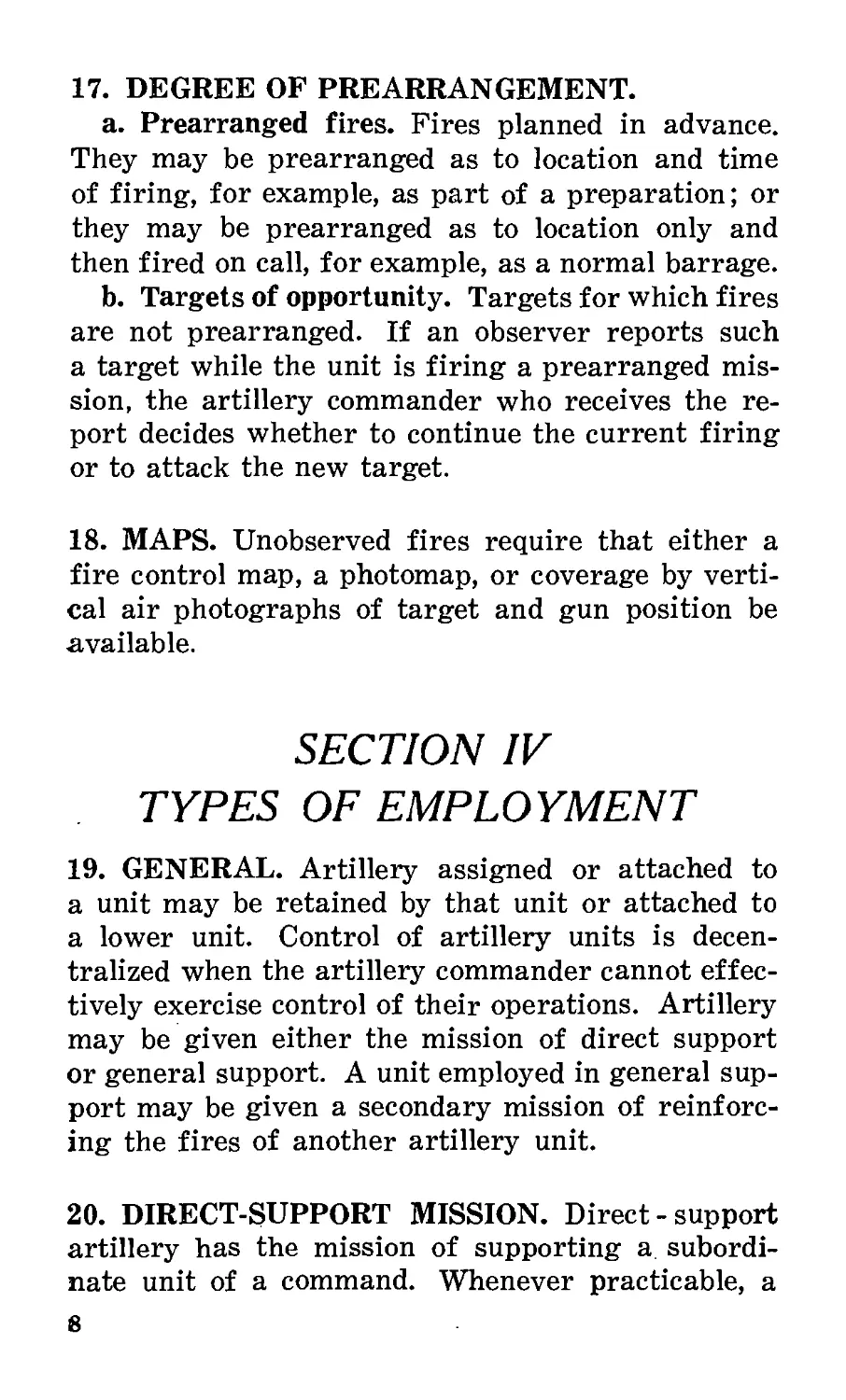
17.	DEGREE OF PREARRANGEMENT.
a.	Prearranged fires. Fires planned in advance.
They may be prearranged as to location and time
of firing, for example, as part of a preparation; or
they may be prearranged as to location only and
then fired on call, for example, as a normal barrage.
b.	Targets of opportunity. Targets for which fires
are not prearranged. If an observer reports such
a target while the unit is firing a prearranged mis-
sion, the artillery commander who receives the re-
port decides whether to continue the current firing
or to attack the new target.
18.	MAPS. Unobserved fires require that either a
fire control map, a photomap, or coverage by verti-
cal air photographs of target and gun position be
available.
SECTION IV
TYPES OF EMPLOYMENT
19.	GENERAL. Artillery assigned or attached to
a unit may be retained by that unit or attached to
a lower unit. Control of artillery units is decen-
tralized when the artillery commander cannot effec-
tively exercise control of their operations. Artillery
may be given either the mission of direct support
or general support. A unit employed in general sup-
port may be given a secondary mission of reinforc-
ing the fires of another artillery unit.
20.	DIRECT-SUPPORT MISSION. Direct - support
artillery has the mission of supporting a subordi-
nate unit of a command. Whenever practicable, a
8
particular artillery unit is placed in direct support
of the same unit. Fire missions of a unit in direct
support usually come directly from the supported
unit. Direct-support artillery is not attached to the
supported unit, but remains under the control of
the higher artillery commander. The commander
of a unit in direct support is free to maneuver as
necessary, in order to furnish maximum aid to the
supported unit. In the division (corps), fire of a
unit in direct support may not be taken from the
supported unit except with the authority of the
division (corps) commander.
21.	GENERAL-SUPPORT MISSION. General-sup-
port artillery has the mission of supporting the
command as a whole. It is held under the control of
the artillery commander. It is an immediate reserve
available to the force commander with which he can
influence the action.
22.	REINFORCING MISSION. An artillery unit
with a reinforcing mission receives calls for fire
directly from the unit whose fires it is to reinforce.
The reinforcing unit must be prepared to fire in
the zone of the reinforced unit, to answer all calls
for fire from the reinforced unit when answering
such calls will not interfere with its primary mis-
sion, and to maintain liaison with the unit whose
fires it is to reinforce.
23.	ARTILLERY IN RESERVE. Artillery should
not be held in reserve unless the situation is so ob-
scure that the particular sector in which the bulk
of the artillery fire power will be most needed can-
not be foreseen. Artillery in support of a unit held
in force reserve should be placed in general support
9
of the force, if time will permit its employment with
the reserve unit when that unit is committed.
SECTION V
TACTICAL ORGANIZATION
FOR COMBAT
24.	TACTICAL ORGANIZATION.
a.	The artillery of a command is organized for
combat by attaching units where necessary and by
assigning missions to the subordinate artillery
units. In the division, organization for combat
should provide artillery in direct support and artil-
lery in general support. In the corps, organization
for combat should provide for reinforcing the fires
of division artillery and artillery to execute counter-
battery, harassing, and interdiction fires.
b.	To simplify control, various artillery units may
be grouped. The artillery commander’s order speci-
fies the commander and headquarters of the group,
the units that are to compose it, and its mission.
The purpose of forming a group is to coordinate
fire, observation, and liaison; the guiding principle
in forming a group is that all artillery units in it
have a common mission, regardless of caliber or
other characteristics. The group commander has
tactical control of the unit, and is responsible for
ammunition supply. If a group is formed to furnish
direct support to a given unit, the commander of
the organic battalion normally charged with direct
support of that unit should command the group.
25.	ZONES OF FIRE.
a.	When unusually large numbers of artillery bat-
talions are available, missions may be clarified and
10
tactical organization improved by assigning zones
of fire. The zone of fire of an artillery unit is the
zone into which it must be prepared to fire. The
normal zone of direct-support artillery coincides
laterally with the zone or sector of the supported
unit. Those portions of its zone of fire outside the
normal zone are called contingent zones.
b.	The normal zone of general support or corps
artillery is either the zone or sector of the supported
unit, or so much of the zone or sector as is speci-
fied. Contingent zones, into which these units may
be ordered to shift their fires, may be prescribed.
Commanders have primary responsibility for ob-
servation in, and ordinarily fire in their normal
zones on their own initiative. Units deliver fire in
their contingent zones only on order of higher artil-
lery headquarters.
c.	To insure proper coverage laterally, the exterior
limits of the contingent zones of the various units,
are designated by lines labeled to show the fire
power—usually expressed in battalions, calibers,
and types—with which the units must reach the
exterior limits.
d.	Zones in depth may be prescribed by assigning
position areas, or by prescribing minimum range
lines and lines to be reached by all or part of the
fire power of a unit.
SECTION VI
COMMAND AND STAFF
26.	ARTILLERY OFFICERS. The term “artillery
officer” is used to designate the senior officer in
the field artillery section of army and higher head-
11
quarters. In the corps and division he is the artil-
lery commander. The army artillery officer exer-
cises no tactical command. The artillery commander
of the corps and division has a dual role. He com-
mands all the artillery, both organic and attached,
which has not been attached to subordinate units;
he is a member of the special staff of his command-
er, in which capacity he is the assistant and ad-
viser regarding all artillery matters. In a task force
of mixed arms, the senior artillery officer is the
artillery officer of the force and performs duties
similar to those of the artillery officer of the unit
(army, corps, or division) which the force most re-
sembles. For detailed description of duties and
functions of artillery officers, see FM 6-100.
27.	CHAIN OF COMMAND. There is no direct
chain of artillery command from armies to corps
or from corps to divisions. An army artillery offi-
cer’s instructions for the artillery with a corps are
issued to the corps commander in the name of the
army commander. The corps artillery commander’s
instructions for division artillery are transmitted
similarly.
28.	ARTILLERY STAFFS. The staffs of all artil-
lery echelons are similar in organization but vary
in size and in the number, magnitude, and complex-
ity of their functions. Artillery staffs usually in-
clude special staff officers, such as communication
officer, liaison officer, ammunition train command-
er, motor officer, surgeon, and chaplain. For gen-
eral description of staff functions see FM 101-5;
for details of staff functions see FM 6-100 and 6-
101.
12
29.	COMMAND POSTS. The command post of the
division artillery is at the division command post.
The same principle applies in the case of the senior
artillery commander of any force of combined arms.
This may necessitate establishing the fire direction
center well forward of the command post. Separat-
ing the command post and the fire direction center
does not allow the artillery commander to exercise
proper control over his staff and subordinate units.
Force commanders , must consider this when locating
their command posts. Subordinate artillery com-
manders establish their command posts where they
can exercise tactical command and fire direction
most effectively. If an artillery commander locates
his command post at a place other than the com-
mand post of the supported unit, he establishes
liaison and maintains signal communications with
the commander of the supported unit.
SECTION VII
PLANS AND ORDERS
30.	ARTILLERY PLANS.
a.	General. The basic decision as to the employ-
ment of the artillery in any operation is the respon-
sibility of the force commander. He indicates the
area in which the artillery will place the bulk of
fire, or the element of the command that is to re-
ceive priority of artillery support. The artillery
officer must be prepared to submit recommenda-
tions as to the employment of the artillery before
the force commander formulates his decision.
b.	Estimate of artillery situation and require-
ments. The artillery officer can be prepared prop-
erly to submit recommendations only if he and
13
his staff have made a continuous estimate of the
situation, from the artillery viewpoint, at the same
time that the force commander has been making his
estimate of the situation. Artillery officers of the
division, corps, army, or higher echelons may be
called on to estimate requirements in artillery for
a projected operation. The artillery officer of the
echelon ordering or conducting the operation is
primarily responsible for making the estimate of
artillery requirements.
c.	Formulation of artillery plan. The artillery plan
must provide for maximum support of the scheme
of maneuver. The successive steps in the formula-
tion of the artillery officer’s plan for the employ-
ment of the artillery are—
(1)	An estimate by the field artillery officer and
his staff prior to the commander’s decision.
(2)	Submission of recommendations by the artil-
lery officer to the commander, prior to the com-
mander’s decision.
(3)	Receipt of the commander’s decision.
(4)	Formulation of the plan for the employment
of the artillery based on the commander’s decision.
(5)	Preparation of the order or annex to put the
plan into effect.
31.	ARTILLERY ORDERS.
a.	General. For a general discussion of combat
orders and annexes see FM 101-5. For detailed dis-
cussions of orders of artillery units see FM 6-100
and 6-101.
b.	Artillery subparagraph. The artillery subpara-
graph of the corps (division) field order gives the
commander’s decision on the employment of the
artillery with the corps (division). It includes only
14
details necessary for the information of the com-
manders of major echelons and for coordinating
the fires of artillery units.
c.	Artillery orders. Artillery orders, in general,
follow the five-paragraph form. They may be frag-
mentary or complete, oral, written, or dictated. Ar-
tillery orders are usually oral, or in fragmentary
message or overlay form, particularly in lower
units. When written, they may be published as an
artillery field order by an artillery commander; or
as artillery annexes to the force commander’s field
order, in corps, divisions, and similar units.
15
CHAPTER 2
TACTICAL FUNCTIONS
SECTION I
RECONNAISSANCE
32.	GENERAL. For general principles of recon-
naissance see FM 100-5. For detailed discussion of
reconnaissance for artillery units see FM 6-100 and
6-101. Artillery reconnaissance must be—
a.	Planned with a definite object in view.
b.	Active, timely, and continuous.
c.	Limited to the individuals and vehicles re-
quired.
d.	Progressive.
e.	Decentralized when time is short.
33.	RECONNAISSANCE FOR POSITIONS AND
OBSERVATION. Reconnaissance is generally lim-
ited to the area the artillery unit must occupy to
carry out its mission. The area may be prescribed
by higher artillery headquarters. During a march
in the presence of the enemy, probable position
areas are reconnoitered and possibilities of observa-
tion are studied.
34.	ROUTE RECONNAISSANCE (FM 25-10).
Route reconnaissance must precede every column,
even though the march is planned and controlled by
higher headquarters. The higher headquarters may
furnish reconnaissance information and repair
work.
16
35.	PLANNING RECONNAISSANCE. Ground re-
connaissance should be preceded by map reconnais-
sance. A study of the terrain from a high point
overlooking the area to be reconnoitered facilitates
prompt decisions and allows the remaining recon-
naissance to be planned effectively.
36.	TIME AVAILABLE. Under some circumstances
an artillery reconnaissance may be carried on for
several days, as in the preparation for an offensive
on a large scale. Under other circumstances it must
be completed in a few minutes, while the units are
moving up to the positions they are to occupy. When
artillery must go into action quickly, delay caused
by seeking a perfect position is unwarranted; re-
connaissance is made for a position which will as-
sure prompt and effective artillery support.
37.	PROGRESSIVE RECONNAISSANCE.
a.	General. Except in displacements to the rear,
artillery commanders habitually precede their com-
mands to the position area.
b.	Beginning of reconnaissance. During a march
in the presence of the enemy, artillery personnel
observe the terrain. To obtain early information
of the plan of action and missions of artillery, the
artillery commander keeps in close touch with the
force commander and should accompany him on his
reconnaissance. The artillery commander communi-
cates his plan promptly to his subordinates, in order
that their reconnaissance may be initiated as soon
as practicable.
c.	Extent of reconnaissance. The division artillery
officer (group commander) reconnoiters for suit-
able battalion areas. He will rarely be able to make
17
a detailed ground reconnaissance for battalion
areas, but frequently must assign areas after an
air or a map reconnaissance, supplemented by in-
formation from other sources. The battalion com-
mander reconnoiters in greater detail to select the
battery position areas and locations for other ele-
ments of the battalion. In general, the battery com-
mander selects exact positions for the pieces and
exact locations for other elements of the battery.
Generally two or more of these steps are carried
out concurrently. In a fast moving situation, the
reconnaissance and selection of position is decen-
tralized normally to battalion and battery com-
manders.
SECTION II
OBSERVATION
38.	GENERAL.
a.	Observation is essential in order that field ar-
tillery may accomplish its mission of rendering con-
tinuous and close support. Supported commanders
must plan their maneuvers to seize and hold terrain
necessary for artillery observation. In order to
render close support, field artillery observers must
keep in close contact with the leading elements of
the supported arm, and must dispose themselves so
as to be able to locate and neutralize those hostile
elements which interfere with the mission of the
supported arm.
b.	Artillery observation must be flexible in order
to follow and support the constantly changing ma-
neuver of our advanced elements. It should ex-
tend sufficiently deep into the hostile position to
cover those areas from which fire can be delivered
18
on our troops. Observation and adjustment of ar-
tillery fire are not confined to artillery observers.
Officers and men of the supported unit often report
the locations of targets and sometimes adjust fire
thereon.
c.	Field artillery depends primarily on forward
observers in carrying out its close-support mission.
Forward observers are selected from the best shots
in the battalion. Liaison personnel often observe
and adjust fire. Field artillery units utilize both
ground and air observation to cover the entire zone
of action or defensive sector to the required depth.
Ground observation may be executed by forward
observers, observers at battalion and battery ob-
servation posts, and sound and flash units.
39.	FORWARD OBSERVATION.
a.	The forward observer is one assigned to ob-
serve in the zone of action or defensive sector of a
given unit and to maintain contact with that unit.
The supported arm is mutually responsible for
maintaining this contact. Direct-support battal-
ions, and in most cases battalions reinforcing the
fires of direct-support battalions, send out forward
observers. It is desirable to send out forward ob-
servers in the ratio of one to each front-line com-
pany or similar unit. Forward observers are con-
trolled and coordinated by the artillery liaison offi-
cer from the direct-support artillery with the in-
fantry (cavalry) (armored) battalion. All artillery
observers coming forward to observe in an infantry
(cavalry) (armored) battalion zone or sector re-
port to the artillery liaison officer with that battal-
ion, in order to insure proper coordinated employ-
ment of all observers and to exploit all means for
observation. This is essential since the liaison offi-
19
cer knows the local situation and where the most
advanced elements of our own troops are located.
b.	The forward observer has two general mis-
sions. His primary mission is to observe and adjust
artillery fire on those hostile elements which inter-
fere with the mission of the unit with which he is
working. His secondary mission is to keep the ar-
tillery battalion informed of the situation. The for-
ward observer is not attached to the supported unit.
He is not restricted to the zone of action or defen-
sive sector of the supported unit. He goes where
he can obtain the observation necessary to give ef-
fective artillery support. He is not restricted to
reporting only those targets which are of impor-
tance to his supported unit. He should report every-
thing he sees exactly as he sees it. He should not
try to observe the entire battlefield, but should con-
centrate his observation in that area of primary
interest to the unit with which he is working.
40.	BATTALION AND BATTERY OBSERVATION
POSTS. In order to cover effectively the entire zone
of action or defensive sector to the required depth,
field artillery units establish observation posts.
When a unit establishes more than one such observa-
tion post, coordination is accomplished by assign-
ing a zone of observation to each. Targets reported
from battalion and battery observation posts are
carefully checked through the fire direction center
of the direct-support battalion prior to opening fire,
to insure that such fire will not endanger our ad-
vanced elements.
41.	SOUND AND FLASH UNITS. Sound and flash
units provide a valuable means of locating hostile
installations. Such units are organic in the corps
20
artillery but may be attached to division or lower
units. (For details, see FM 6-100 and 6-120.)
42.	AIR OBSERVATION.
a.	General. Air observation is used to extend and
supplement ground observation. Air observation
permits reports of location of targets and adjust-
ment of fire on targets normally defiladed from
ground observers. Air observation missions for
field artillery units may be performed by light air-
planes organic in artillery units or by high per-
formance units of the Army Air Forces. (See FM
6-40 for procedure in adjusting fire.)
b.	Organic artillery air observation. Organic air
observation for field artillery consists of a light-
weight, unarmed, and unarmored airplane of slow
cruising speed, operated by field artillery person-
nel, and capable of taking off and landing in small,
unprepared fields and on roads in the vicinity of
artillery command posts and firing batteries. Its
primary purpose is to provide air observation of
field artillery fire. A secondary purpose is to fur-
nish oblique photography for use in the artillery
and supported arms for terrain study of the zone
or sector of the units involved. This airplane is vul-
nerable to the fire of hostile air and ground forces.
c.	Artillery observation by air force units. Field
artillery, especially long-range artillery, requires
air observation beyond the capabilities of organic
field artillery air observation. Such observation re-
quires high performance airplanes of the Army Air
Forces. The senior artillery commander submits
requests to the force commander for such missions.
In addition to missions of direct observation, the
air force executes photographic missions for the
21
artillery. Oblique air photographs are furnished
for terrain study. Vertical air photographs are pro-
vided to facilitate survey and provide targets for
firing charts.
SECTION III
INTELLIGENCE
43.	ARTILLERY INTELLIGENCE. In order to lo-
cate remunerative targets, artillery units continu-
ously seek information of the enemy by all available
means. The most valuable sources of information
are artillery observers, including ground, air, sound
and flash, and vertical air photography. The high-
ly organized system of observation and communi-
cations installed by the field artillery makes it an
important source of intelligence. These systems af-
ford the force commander a quick means for de-
termining the location of both our own and enemy
installations. Artillery commanders may be ex-
tremely helpful to supported commanders by keep-
ing them informed at all times of the disposition of
our own leading elements through contact with
artillery forward observers and liaison officers. S-2
sections gather and evaluate information and dis-
seminate it to subordinate, adjacent, and higher
echelons. In large operations the intelligence sec-
tion of the corps artillery staff is the principal unit
in artillery intelligence. Its most important mission
is the location of enemy artillery. The most impor-
tant sources of information for the location of en-
emy artillery are vertical air photographs and sound
and flash units.
22
SECTION IV
LIAISON
44.	GENERAL. Liaison is established between ar-
tillery and supported units and, in some cases, be-
tween artillery units. Close contact between the
supported unit and the artillery makes possible the
timely transmission of requests for fire and gives
the artillery the intimate knowledge of the situa-
tion which it requires for effective performance
of its mission. Maintenance of liaison is the mutual
responsibility of the supported and the supporting
unit.
45.	COMMAND LIAISON. Command liaison is ac-
complished by direct conference between the com-
mander of the supporting artillery and the com-
mander of the supported unit. Upon receipt of
orders committing units to action, commanders
should hold a conference to formulate a general
plan of artillery support. To assure the efficient
continuance of artillery support to meet the needs
of the supported unit, constant liaison is maintained
with the command post of the supported unit. Ad-
ditional conferences between commanders are held
during the progress of the action. When an artil-
lery unit has the mission of reinforcing the fires
of other artillery units, command liaison should be
established by the commander of the reinforcing
unit with the commanders of the reinforced units.
46.	LIAISON OFFICERS.
a.	An artillery unit commander uses liaison offi-
cers to establish and maintain liaison with desig-
23
nated supported units or with artillery units whose
fires his unit is to reinforce. A liaison officer is
the personal representative of his commander with
the commander of the supported or reinforced unit.
b.	The primary mission of a liaison officer is to
advise and assist the commander of the supported
or reinforced unit in obtaining the desired support-
ing or reinforcing fires, and to keep his artillery
commander informed of the plans, operations, and
disposition of the supported or reinforced unit. He
must be able to inform the supported commander of
the capabilities of the artillery in delivering any
fires desired and to transmit promptly to his head-
quarters requests for supporting fires. To enable
the liaison officer to carry out his mission, the sup-
ported or reinforced unit commander must keep
the liaison officer informed at all times of the loca-
tion of hostile and friendly units, the scheme of
maneuver, and the immediate needs’ of the sup-
ported or reinforced unit.
c.	As a secondary mission the liaison officer ad-
justs the fire, of his unit when necessary.
d.	An artillery unit in direct support of an infan-
try unit sends liaison officers to all supported bat-
talions. An artillery unit whose mission is to re-
inforce the fire of other artillery units sends liaison
officers to each unit which it is reinforcing. Liaison
officers should contact the commanders of the units
with which they are to establish liaison in time to
accompany the commanders on reconnaissance and
secure detailed information as to specific fire mis-
sions desired by these units.
47.	LIAISON SECTION (FM 6-101). A liaison sec-
tion is normally provided to assist the liaison offi-
cer.
24
SECIION V
COORDINATION WITH
SUPPORTED ARM
48.	GENERAL. The employment of supporting fire
is regulated by the needs of the supported arm in
the various phases of combat. Supported unit com-
manders deal directly with the artillery assigned to
their direct support. The supported unit command-
er, in making his plan of maneuver, must consider
the capabilities of available artillery and the ob-
servation required by the artillery. This section
deals primarily with coordination between artillery
and infantry. The same general principles apply
to coordination with other supported arms.
49.	PLANNING SUPPORTING FIRES.
a.	General. The planning of artillery support is
influenced by many factors which include—
(1)	Enemy situation, whether in movement, in po-
sition, or intrenched, and the amount and accuracy
of information available on the location of enemy
installations.
(2)	Contemplated maneuver of the supported
unit.
(3)	Plan of supporting fire of other arms.
(4)	Assistance which higher or adjacent artillery
units will furnish or require.
(5)	Conditions under which fire is to be delivered
(observation, maps, time, and ammunition avail-
able) .
b.	Rapidly moving situations.
(1)	The division order gives the general plan, the
missions of major units, and the general artillery
25
missions. It designates artillery units in support
of particular units. The orders of the commanders
of supported regiments give additional informa-
tion required by the direct-support artillery, includ-
ing the number of front-line battalions, their zones
of action, location of regimental and battalion com-
manders, regions where the artillery should be
prepared to fire, and method of calling for and
lifting fires. When practicable, the supported com-
mander indicates where the artillery should place
its fires. He usually delegates the indication of
specific locations to his battalion commanders.
(2)	Based on the information outlined in (1) above,
artillery commanders adopt dispositions to insure
observed fire on targets as they develop and permit
the artillery to furnish continuous support. Their
arrangements include—
(a)	Sending of liaison detachments to infantry
battalions and assignment of missions to forward
observers.
(b)	Agreement with supported infantry com-
manders as to artillery support and signals for
shifting artillery fires, if not already prescribed.
(c)	Preparation and distribution of overlays,
maps, or photographs showing the location of check
concentrations and any prearranged fires in order
to facilitate designation of targets by infantry com-
manders, liaison officers, and air and artillery ob-
servers.
c.	Prearrangement of fires.
(1)	Prearranged fires are employed whenever the
conditions of the operation permit. In conference
with the infantry regimental commander, the ar-
tillery battalion commander formulates a tentative
general plan of artillery support, including general
26
location, time, duration, and priority of fires re-
quested by the infantry commander.
(2)	Tentative plans for the close-support fires de-
sired by the infantry battalions are made by the
artillery liaison officers in conference with the
infantry battalion commanders. This conference is
usually preceded by a joint reconnaissance. The
artillery commander must then coordinate the close-
support plans with the general plan of support
agreed upon by the infantry regimental commander.
If the powers of the artillery are not fully exploited,
the artillery commander suggests additional fire's;
if the artillery is unable to furnish sufficient fire
to meet the requests, the infantry commander, with
the assistance of the artillery commander, deter-
mines which of the fires available will contribute
most to the success of the infantry operation. De-
tails of the infantry plan sometimes must be
changed to accord with the capabilities of the avail-
able artillery.
50.	EXECUTING AND SHIFTING FIRE (FM 6-
101). Fires may be executed and shifted by means
of artillery observation (ground or air), on call or
signal from the supported unit, by time schedule,
or by a combination of these methods.
a.	Artillery observation. Artillery observation is
used whenever it is possible to secure it, either as a
primary means of executing or lifting fires or as
a supplement to other methods.
b.	Call or signal from supported unit.
(1)	Regulation of fires by call or signal from the
supported unit, in conjunction with artillery ob-
servation, is suited to rapidly moving situations
and those in which there is doubt as to the location
of hostile elements. Fires regulated by call or signal
27
may be either prearranged fires or fires on targets
of opportunity.
(2)	When time permits, fires to be delivered on
call are prepared for likely locations of hostile
troops. The supported unit then calls for such of
these fires as are required to meet developments
of the combat. Duration of these fires may be pre-
arranged; or the lifts may be made on call.
(3)	When the location of the enemy is known,
groups of prearranged concentrations may be fired
in a definite sequence; each lift to the next target
is made at the request of the supported unit. A high
degree of training of supported and supporting
units is required. Otherwise confusion may result
particularly if many lifts are scheduled.
(4)	Requests for fire should include—
(a)	Accurate location of the target.
(b)	Description of the type of target and its
dimensions.
(c)	Location and contemplated maneuver of
friendly troops, near the target.
(d)	Duration of the fire.
(5)	Time of ceasing fire can usually be coordinated
by specifying its duration. A standard duration
for all such fires may be arranged prior to the at-
tack. In special cases the supported arm may speci-
fy one of the following:
(a)	Duration and exact hour of opening.
(b)	Duration, opening of fire to be upon a pre-
arranged signal.
(c)	Exact or latest hour for ceasing fire.
(d)	Time of opening fire, cessation being on
signal.
c.	Time schedule.
(1)	Fires may be lifted and advanced on a time
schedule based on the estimated rate of movement
28
of the supported troops. This method of regulating
the delivery of fires requires time for preparation,
and is inflexible and difficult to adjust to the ma-
neuver of supported troops. Its employment in rap-
idly moving situations is limited; when favored by
conditions it may be used for one or two groups of
fires. The time schedule will be used more often in
operations such as the early stages of attacks
against hostile positions. Reinforcement of the or-
ganic division artillery and engagement of large
forces on relatively narrow fronts can be expected
to create conditions of poor visibility. In such
cases the timetable, with provision for dealing with
discrepancies between the actual and expected ad-
vance, normally becomes the principal basis for
lifting fires.
(2)	Only minor changes in the time schedule are
practicable during the attack; when extensive revi-
sion is required, abandonment of the schedule in
favor of other methods or a new schedule will usu-
ally be necessary.
(3)	Schedule fires are planned in independent
series to avoid tying the attack to a time schedule
over a long period. Each series corresponds to a
maneuver phase terminated by the capture of an
objective. Execution of a new series of fires is
usually begun on call.
d.	Targets of opportunity. In case an important
target of opportunity presents itself to an artillery
unit which is engaged on prearranged fire missions,
the artillery commander, in the absence of instruc-
tions, decides whether to continue his mission or
attack the new target.
29
SECTION VI
FIRE DIRECTION
51.	GENERAL. Fire direction is the tactical com-
mand of one or more artillery units, for the purpose
of bringing their fire to bear upon the proper tar-
gets at the proper time. The degree to which fire
direction is exercised by an artillery commander
depends on his knowledge of the situation and upon
the degree to which operations are centralized. Sub-
ordinate commanders are permitted sufficient lati-
tude and initiative to meet local situations promptly.
52.	FIRE DIRECTION BY LARGE UNITS. Artil-
lery commanders of units larger than a battalion
control the fire power of lower units by organizing
the artillery for combat; by assigning position
areas; by assigning zones of fire to insure that fires
may be massed on important areas; by designating
specific important targets or areas to be covered
by fire; by procuring and allocating ammunition;
and by coordinating survey, communications, ob-
servation, and displacements. The ability of the
higher artillery commanders to mass fires quickly
by designating areas to be fired upon by subordi-
nate units depends upon a well coordinated system
of communications. When possible, direct commu-
nications to battalions by radio should be estab-
lished. This will permit the force commander
through his artillery commander to place masses
of artillery fire on critical areas with the least pos-
sible delay.
53.	FIRE DIRECTION WITHIN BATTALION. For
the technique of controlling and maneuvering the
fires of the battalion, see FM 6-101 and 6-40.
30
54.	DISPLACEMENTS. Artillery displaces during
combat in order to fire at effective ranges and to
maintain continuous communication with liaison
officers and forward observers. The method of dis-
placement is such that some fire support is fur-
nished at all times. The artillery commander tem-
porarily reassigns the essential missions of the dis-
placing units to units that remain in position. The
time that units are out of action while displacing
should be reduced to a minimum. When two or more
artillery units must displace over the same route,
the next higher artillery commander coordinates
the movements. When artillery must displace over
a route used by units of other arms, the force com-
mander coordinates the movements. In general,
direct-support artillery should have priority on
roads.
a.	Displacement of direct-support artillery. The
displacement of direct-support artillery is coordi-
nated with the supported unit. The artillery com-
mander plans his displacement in conference with
the supported unit commander. The supported
unit’s plan influences the time of displacement, the
method of displacement, and the selection of the
new position area.
b.	Displacement of general-support artillery. The
displacement of general-support artillery is coordi-
nated with the action of the command as a whole.
The unit displaces on orders of the next higher ar-
tillery commander; for example, the division artil-
lery in general support displaces on order of the
division artillery officer.
31
SECTION VII
SIGNAL COMMUNICATIONS
55.	REFERENCES. For principles and procedures
relating to signal communications see FM 24-5.
Technical manuals provide technical information
on signal equipment. For details of signal commu-
nications in field artillery units see FM 6-100 and
6-101.
56.	GENERAL. The commander of each field artil-
lery unit is responsible for the establishment of
signal communication within his own unit, with
supported, reinforced, and attached units, and with
other units as directed by higher authority.
57.	RECONNAISSANCE. Artillery reconnaissance
includes consideration of the means of communica-
tion to be employed.
58.	AXIS OF SIGNAL COMMUNICATION. The
axis of signal communication for an artillery unit
follows that of the supported unit. When the com-
mander of an artillery unit cannot designate an
axis of communication, he reports each successive
location of his command post to the next higher ar-
tillery commander as soon as it is selected.
59.	MEANS OF COMMUNICATION. Means of com-
munication employed by the field artillery are:
radio (telephone and telegraph), wire (telephone
and telegraph), messengers (airplane, motor,
mounted, dismounted), visual, voice, and sound. No
one means of communication is infallible. Alternate
means must be provided.
32
a.	Wire. Wire communication is established when
the situation permits.' The time available and fu-
ture needs for wire are governing factors. An
initial wire system may be expanded by installation
of additional circuits and switching centrals until
the desired flexibility has been obtained. Artillery
wire systems include trunk circuits between switch-
ing centrals and local circuits to observation posts,
battery positions, liaison officers, elements of com-
mand posts, administrative installations, etc.
b.	Radio. Radio communication is provided for es-
sential elements of a unit and for communication
between units. In general, each headquarters main-
tains a station in the net of the next higher head-
quarters. Special purpose nets are organized as
required. On a functional basis, artillery radio nets
are designed for command, fire direction, observa-
tion, liaison, and warnings. Radio is nonsecret.
When more secret means are available, its use
should be suspended except where speed of trans-
mission is essential.
c.	Messengers. Messengers are used when dis-
tances are short, when early delivery of message is
not urgent, when the character of the message pre-
cludes the use of other means, to confirm messages
transmitted by other means, or when other means
of communication fail or are inadequate.
d.	Visual. Visual communication is well suited for
prearranged signals and short code groups.
e.	Voice and sound. Voice is used between ele-
ments within easy voice range of each other. Sound
communication is of value chiefly for alarms and
for transmission of short, prearranged messages.
60.	CODES AND CIPHERS. Artillery battalions
and higher units are equipped with the codes and
33
ciphers authorized for the unit of which they are
a part. Extensive use is made of brevity codes. The
Fire Control Code and the Meteorological Code pro-
vide brevity in transmitting and recording fire
commands and meteorological data.
SECTION VIII
SECURITY
61.	SCOPE. Security embraces all measures taken
by a command to protect itself against annoyance,
surprise, and observation by an enemy. Each com-
mander is responsible for the security of his com-
mand. Regardless of the security measures taken
by higher commanders, all artillery units must con-
sider the probability of air and ground attack and
take appropriate security measures. For general
principles of security see FM 100-5; for protective
measures of individuals and small units see FM
21-45.
SECTION IX
ARTILLERY AND AIR SUPPORT
62.	REFERENCES. See FM 100-20 for doctrine of
employment of air power.
63.	AIR-ARTILLERY COOPERATION. Air force
operations in the battle area are planned jointly by
the air force commander and the ground force com-
mander. Air forces usually attack targets that
cannot be reached by artillery. During the plan-
ning phase of air-ground operations the artillery
officer of the ground force should be consulted con-
34
cerning the capabilities of artillery fire. In decisive
and critical phases, air forces may reinforce artil-
lery fire. Artillery fire may be used to identify tar-
gets or to mark bomb safety lines.
64.	AIR PHOTOGRAPHS. Vertical air photographs
are of special importance in obtaining locations of
enemy artillery. Distribution of information se-
cured from air photographs is expedited by main-
taining an artillery officer at the point where they
are initially developed.
65.	OBSERVATION MISSIONS. High performance
airplanes of the air forces may be used to observe
and adjust artillery fire, particularly long-range
fire. A conference between the observer and a rep-
resentative of the artillery unit concerned relative
to communication and technique is usually neces-
sary to insure success of the mission.
35
CHAPTER 3
TROOP MOVEMENTS, HALTS,
AND BIVOUACS
SECTION I
GENERAL
66.	REFERENCES. For the basic doctrine govern-
ing troop movements, see FM 100-5. For technical
and logistical data pertaining to troop movements,
see FM 101-10. For detailed treatment of motor
movements, see FM 25-10. For details of march
hygiene, see FM 21-10. For check lists for march
orders and march tables, see FM 101-5. For details
of marches of artillery battalions and batteries, see
FM 6-101.
SECTION II
ARTILLERY ON THE MARCH
67.	GENERAL. When the command marches in
multiple columns each column usually includes some
artillery. Artillery is attached to the march group
until centralized control is ordered by a higher head-
quarters Artillery reconnaissance, survey, and
liaison personnel habitually march with forward
elements of the command. Marches may be classi-
fied according to the imminence of contact, and
according to whether the march is made during
daylight or at night.
36
68.	DAY MARCHES. During the day, when the col-
umn is marching in the presence of the enemy, the
disposition of artillery units in the column is de-
termined by tactical considerations, time and space
factors, the road net, and condition of the roads.
69.	NIGHT MARCHES. Artillery is of little combat
value during a night march. Consequently, at night
artillery units usually march at the tail of the com-
bat elements of the main body during an advance
and at the head of the combat elements during a
retrograde movement. If the night march is to ex-
tend beyond daybreak, the artillery is located to
facilitate its possible action after daybreak.
SECTION III
ARTILLERY WITH MARCH
SECURITY DETACHMENTS
70.	advance guard artillery.
a.	Strength. The strength of the advance guard
artillery depends upon the ability of the artillery
with the main body to occupy positions to support
the advance guard when contact is made and the
advance guard is deployed. If the artillery with the
main body cannot support the advance guard, some
artillery is attached. Usually one battery of light
artillery is attached to an advance guard of one
basic infantry (cavalry) (armored) „battalion. This
battery should be reinforced by liaison personnel
and equipment and a section from the ammunition
train. For larger advance guards, a battalion may
be attached. Medium artillery is attached to the
advance guard artillery if its early employment is
foreseen.
37
b.	Dispositions. The artillery of the advance
guard should be located so that it can enter action
promptly, and so that other elements of the advance
guard can protect it from enemy surprise attacks.
The commander of the advance guard artillery
marches with the advance guard commander. Re-
connaissance and survey personnel of advance
guard artillery accompany the leading elements of
the column. When the advance guard deploys, its
artillery occupies position to cover the deployment.
71.	REAR GUARD ARTILLERY.
a.	Strength. The rear guard should be especially
strong in artillery. Less than a battalion is seldom
attached to the rear guard of a division; medium
artillery should be included.
b.	Dispositions. Rear guard artillery usually
marches by bounds in the interval between the main
body and the rear guard. The commander of the
rear guard artillery marches with the commander
of the rear guard. When the rear guard is deployed,
the rear guard artillery occupies positions to per-
mit early delivery of fire on hostile columns.
72.	FLANK GUARD ARTILLERY. The employ-
ment of artillery with a flank guard is similar to
the employment of advance guard artillery. When
no artillery is attached, the artillery of the main
body is so disposed as to facilitate prompt support
of the flank guard.
SECTION IV
RAIL AND WATER MOVEMENTS
73.	REFERENCES. For general procedures govern-
ing movements by rail and water, see FM 100-5.
38
For technical and logistical data pertaining to rail
and water movements, see FM 101-10. For check
list for orders and for entraining and detraining
tables, see FM 101-5. For the general organization,
operation, and control of rail and water transporta-
tion, see FM 100-10. For details of artillery move-
ments by rail and water, see FM 6-101 and AR
55-145.
SECTION V
MARCH HALTS AND BIVOUACS
74.	ARTILLERY DURING MARCH HALTS. When
the command makes a long halt during a march
in the presence of the enemy, the advance, flank,
and rear guards establish march outposts. Units of
the support occupy critical terrain features, estab-
lish outguards, and send out patrols. Antiaircraft
and antimechanized defense are stressed.
75.	ARTILLERY IN BIVOUAC. When the com-
mand bivouacs in the presence of the enemy, an
outpost is organized (FM 100-5). The column com-
mander assigns bivouac areas to artillery units in
his column. Artillery positions are selected prim-
arily to permit support of the outpost line of re-
sistance. Positions are prepared for all-round de-
fense. Installations are dispersed. The positions
should permit fire on the probable routes of ap-
proach and on critical areas that cannot be covered
by infantry weapons. The artillery attached to the
outpost usually occupies position. The commander
of the artillery establishes his command post near
that of the outpost commander. Defensive fires are
prearranged; liaison, observation, and communica-
tion are established.
39
CHAPTER 4
OFFENSIVE COMBA T
SECTION I
ARTILLERY IN
OFFENSIVE COMBA T
76.	GENERAL. See FM 100-5 for general doctrine
governing offensive combat.
77.	POSITIONS.
a.	General. Artillery positions in offensive com-
bat are located well forward, to exploit the range
of the weapons and to facilitate cohesion of com-
mand posts of supporting and supported units. A
field artillery battalion usually occupies a position
in the zone of action of the unit it supports. Artil-
lery that has been attached to a corps or division
and that will revert upon reaching the limit of its
range from initial positions, is usually emplaced
farthest forward.
b.	Meeting engagements. When the advance
guard deploys, any artillery attached to it occupies
position at once to cover the deployment; usually
the remainder of the artillery of the column also
occupies position immediately to furnish support.
Units that have occupied positions during the ad-
vance guard action may have to displace early in
order to be in forward positions to support the at-
tack by the time it jumps off. The artillery moving
to positions should be given priority on roads. The
40
early employment of observation battalion recon-
naissance and survey elements is desirable.
c.	Attack of organized position. The bulk of the
artillery supports the main attack and, in general,
occupies positions behind it. If the main and sec-
ondary attacks are sufficiently close together, the
positions should permit the bulk of the artillery to
support the secondary attack also. Artillery in po-
sition during the operations preceding the attack
may have to displace laterally to occupy positions
for the support of the main attack.
78.	CONTROL. When communications exist through
which the division, corps, or force commanders can
direct quickly the fire of the bulk of the artillery,
control is centralized. When such communications
do not exist, control is decentralized. Control of
artillery should be centralized as quickly as possi-
ble in order that the force commander may have
available a mass of fire power to be employed as
the situation dictates. In an advance guard action
and in a meeting engagement, control is of neces-
sity decentralized. During the progress of the de-
velopment of a position, centralized control is de-
veloped as the situation stabilizes. Prior to the
preparation, control is centralized and remains so
initially during the attack. As the attack develops
and units such as an encircling force become sep-
arated from the main attack, control will again be-
come decentralized or partially decentralized.
79.	ARTILLERY FIRES.
a.	In support of advance guard. In the advance
guard action, artillery fires are executed to cover
the deployment of friendly troops and to disrupt
the movement of enemy formations to meet the at-
41
tack. Artillery missions include interdiction of
routes and assembly areas, neutralization of enemy
artillery, fires on enemy forward elements, and the
attack of other targets of opportunity.
b.	Preliminary combat to develop hostile main po-
sition. When the leading troops have gained contact
with the enemy covering forces, the bulk, often all,
of the division artillery is committed. Corps ar-
tillery is engaged as soon as possible. Special at-
tention is paid to protecting the leading troops from
counterattack. If a minor break-through operation
is necessary to drive in the covering forces, artil-
lery should be a part of the task force assigned that
mission; other artillery supports the operation with
particular attention to the flanks of the break-
through. The bulk of the artillery, displaced for-
ward after the covering forces have been driven in,
usually remains silent prior to the preparation to
maintain secrecy.
c.	Artillery preparation.
(1)	GENERAL. An artillery preparation, a system
of intensive fires delivered during the period im-
mediately before the infantry crosses the line of de-
parture, is designed to secure domination over hos-
tile artillery and infantry. All artillery partici-
pates in the preparation.
(2)	PRE ARRANGEMENT. Fires prearranged as
to location and time are usually limited to known
targets and to areas that are strongly suspected of
containing remunerative targets. Certain units
are assigned additional missions of attacking tar-
gets of opportunity discovered too late to be includ-
ed in the prearranged fires.
(3)	DECISION TO FIRE PREPARATION. The
force commander decides whether a preparation is
to be fired. He considers whether—
42
(a)	A sufficient number of remunerative targets
will be accurately located in time for preparing the
fires.
(b)	The probable effect of the preparation will
justify the attendant loss of tactical surprise.
(c)	The ammunition supply is adequate.
(4) DURATION. The force commander also de-
cides the duration of the preparation. In general, a
preparation should be long enough to accomplish
the effect sought, but not so long as to permit the
enemy to change his major tactical dispositions in
time to meet the attack. The duration may be gov-
erned by the ammunition supply.
(5) MISSIONS DURING PREPARATION. The
number of phases, length of phases, and missions
are varied to fit the particular situation. In a
three-phase preparation the missions might be as
follows :
(a)	First phase. During the first .phase the corps
artillery, reinforced as necessary by division artil-
lery, gains ascendancy over the hostile artillery;
units not required for counterbattery interdict
routes and neutralize enemy systems of command,
signal communication, and observation.
(b)	Second phase.
1.	Corps artillery maintains neutralization of
that hostile artillery neutralized dur-
ing the first phase; executes counter-
battery of enemy artillery located
after the preparation starts.
2.	Division artillery neutralizes enemy sys-
tems of command, communication,
and observation; neutralizes defensive
areas, reserves, and assembled mech-
anized units; destroys obstacles.
43
(c)	Third phase.
1.	Corps artillery continues counterbattery.
Corps artillery units not required for
counterbattery reinforce the division
artillery in neutralizing enemy defen-
sive areas and smoke enemy observa-
tion.
2.	Division artillery delivers massed fires
successively on defensive areas in the
forward portion of the enemy position,
with priority to known defensive ele-
ments that most seriously threaten the
success of the attack.
(6) ARTILLERY PREPARATION IN ATTACK
OF ORGANIZED POSITION. In an attack of an
organized position, the artillery must batter the
enemy strength to the point of complete collapse
before friendly infantry is committed to the assault.
Profitable targets are located by interpretation of
air photographs, by sound ranging and flash rang-
ing, and through other intelligence agencies. If
the secondary attack is to be launched prior to the
main attack, the preparation on the front of the sec-
ondary attack precedes that on the front of the main
attack; it is participated in only by artillery whose
positions are such that firing from them will not
disclose the location of the main attack.
(7) ARTILLERY PREPARATION FOR PENE-
TRATION. The artillery preparation preceding a
penetration is in general longer and more violent
than that preceding an envelopment. The bulk of
the preparation fires is placed on the front and
flanks of the intended penetration. In its final
phase the preparation maintains ascendancy over
hostile artillery in order to minimize any counter-
preparation.
44
d. During attack.
(1)	During the attack artillery fires are delivered
(a)	Assist the advance of the infantry by attack-
ing defensive areas and emplaced weapons.
(6)	Assist the infantry in gaining fire superior-
ity on each successive objective, so that the leading
echelons can close to assaulting distance.
(c)	Protect the supported units during periods of
reorganization.
(d)	Assist in breaking up counterattacks. This
requires that concentrations on likely areas and
routes for counterattacks be prearranged so as to
mass artillery on the counterattack before it gets
under way.
(e)	Continue the neutralization of hostile obser-
vation.
(/) Continue the neutralization of hostile artil-
lery.
(g)	Prevent the enemy from disengaging his
forces.
(h)	Assist the supported units in holding the
ground gained.
(2)	These fires may be in the form of successive
concentrations, rolling barrages, or a combination
of both.
(a)	Successive concentrations on known or sus-
pected enemy locations are used when the hostile dis-
positions are either known or can be deduced accu-
rately from a study of the terrain.
(6)	A rolling barrage is utilized when informa-
tion of enemy dispositions is insufficient to justify
successive concentrations and when ammunition is
plentiful.
45
80.	REGISTRATION.
a.	Advantages and disadvantages. Registration
increases the accuracy of subsequent fires, permits
placing unobserved fires closer to friendly troops
than would otherwise by justifiable, and saves am-
munition. Unrestricted registration discloses the
artillery positions and thereby reveals the deploy-
ment of the force, indicates the commander’s inten-
tions, and invites untimely neutralization of our
artillery. The disadvantages of registration can
be minimized by using special registration positions
(FM 6-40), by keeping the number of registering
batteries to the effective minimum, by registering
as late as practicable, or by registering many units
simultaneously.
b.	Decision as to registration. The force com-
mander makes the decision as to whether registra-
tion will be restricted or prohibited. It is rarely
necessary to prohibit registrations completely.
When registrations are restricted, the force com-
mander determines the time they may begin and
time by which they will be completed.
c.	Procedure. The technique of registration is
covered in FM 6-40. Coordination with the sup-
ported unit is necessary to prevent registration
fires from endangering friendly covering forces and
patrols. Units that have not been able to fire prior
to becoming actively engaged should register at the
first opportunity that presents itself during the
action.
81.	PREPARATION FOR ATTACK. Preparations
that the command makes before the occupation of
final assembly positions include the systematic or-
ganization of ground observation, the completion
of the signal communication system, organization
46
of the command for combat, organization of the am-
munition supply, assembling supplies and equip-
ment in forward areas, the movement of the artil-
lery into position, and the coordination of the sup-
porting fires of all arms. Engineer units clear
obstacles and assist in the movement of tanks, artil-
lery, and heavy transport. Operations that might
reveal the attacker’s plan must be carried out secret-
ly or deferred as long as possible.
SECTION II
ARTILLERY IN
DEFENSIVE-OFFENSIVE
82.	GENERAL. See FM 100-5 for the general doc-
trine governing defensive-offensive operations.
a.	Defensive phase. The amount of artillery sup-
porting the defending force is the minimum neces-
sary for the successful execution of the defensive
mission. The remainder of the artillery is usually
held in reserve in locations that provide positive
concealment; or a part may be emplaced in concealed
positions to support the contemplated attack and
required to remain silent during the defense.
b.	Counteroffensive phase. The artillery is em-
ployed as in offensive action. The following fac-
tors are essential to the effectiveness of its employ-
ment:
(1)	A thorough knowledge of the counteroffensive
plan.
(2)	Complete preparations, to include observation,
positions, routes, survey, prearrangement of fires,
and coordination of fires with those of other arms.
47
(3)	A careful computation of time and space fac-
tors.
(4)	Secrecy of execution.
SEC1ION III
ARTILLERY IN PURSUIT
83.	EMPLOYMENT OF ARTILLERY IN PURSUIT.
See FM 100-5 for general principles relating to
pursuit.
a.	Direct-pressure force. Often some of the artil-
lery supporting the direct-pressure force must be
attached to the elements that are making the most
progress. Long-range artillery remains under
centralized control. Its missions include interdic-
tion of routes of retreat.
b.	Encircling force. Artillery with an encircling
force is nearly always attached. In general, con-
siderations of fire power, mobility, and ammunition
supply make the 105-mm howitzer the most suitable
weapon. Other considerations permitting, the
units that are least actively engaged are selected.
The supply of ammunition and fuel to the encircling
force artillery must receive major consideration.
48
CHAPTER 5
DEFENSIVE COMBA T
84.	DEFENSIVE COMBAT. See FM 100-5 for dis-
cussion of defensive principles.
85.	ARTILLERY POSITIONS.
a.	Location. Artillery positions are usually in the
sector of the supported unit and are echeloned in
depth. All light artillery and all medium howitzers
must be able to fire immediately in front of the main
defensive area. The bulk of the light artillery must
be able to place defensive fires and support counter-
attacks throughout the depth of the defensive posi-
tion. The positions of forward units are usually
selected to facilitate counterbattery, interdiction,
and harassing fire. The positions of other units
are echeloned in depth to provide flexibility of fire
and to permit continuity of support in case artillery
in forward positions is forced back by local success-
es of the enemy. Gun units are given priority in
choice of positions. Natural tank obstacles are
considered, particularly in the assignment of posi-
tions to heavy artillery.
b.	Occupation and organization. Positions are oc-
cupied with maximum secrecy. In addition to the
usual measures taken upon occupying position, lat-
eral circuits are usually laid to provide alternate
communication; principal circuits are buried when
practicable; and alternate command post locations
are prepared.
c.	Preparations for units not in position. Prepara-
tions for the artillery initially attached to covering
49
forces and for reinforcing artillery coming in later
are made by units already in position, or by advance
parties from the attached reinforcing units.
d.	Alternate and temporary positions. To remain
in action in the face of hostile superiority, artillery
must exploit its mobility. Alternate positions must
be prepared to which batteries move when there are
indications that the occupied positions have been dis-
covered. Dummy positions are prepared for decep-
tion. Temporary and dummy positions may be used
for interdiction and harassing fire in quiet periods,
and are habitually used for registration.
86.	ARTILLERY SUPPORT OF COVERING FOR-
CES. Strong artillery support is attached to the ad-
vanced mobile covering forces; suitable mobile wea-
pons with the longest range should be included. If
the general outpost is beyond the effective support-
ing range of direct-support artillery emplaced in
the battle position, artillery from the main force is
attached. Upon withdrawal, artillery attached to
the advanced covering force or to the outpost is re-
leased from attachment when it reaches the main
battle position.
87.	PHASES OF ARTILLERY FIRES. Artillery
fires in support of defensive combat are usually
divided into four phases:
a.	Fires delivered before the enemy forms for at-
tack.
b.	The counterpreparation.
c.	Fires to break up the attack after it is launched,
final defensive fires, and fires to continue neu-
tralization of the attacking force.
d.	Fires to support counterattacks.
50
88.	FIRES DELIVERED BEFORE ENEMY
FORMS FOR ATTACK.
a.	Time of opening fire. Time of opening fire is
decided by the force commander, except for artillery
units supporting the outpost. Premature firing
exposes the artillery to neutralization and may re-
veal the scheme of defense of the force. In general,
the bulk of the artillery remains silent until dan-
gerous or highly remunerative targets are discover-
ed.
b.	Positions. Units required to fire prior to coun-
terprepartion should do so from positions other
than those from which they are to deliver counter-
preparation fires.
c.	Registration. Registration is highly important
(see par. 80).
89.	COUNTERPREPARATION.
a. Definition. A counterpreparation is a system
of intensive prearranged fire delivered when the
imminence of the enemy attack is discovered. It
is designed to break up enemy attack formations;
disorganize the enemy’s systems of command, com-
munication, and observation; decrease the effec-
tiveness of his artillery preparation; and impair
his offensive spirit. Counterpreparations may be
general or local.
(1) General counterpreparation is planned to meet
a general attack. It involves the entire front; all
of the artillery participates. Since the enemy may
launch his main attack from any of several areas,
planning more than one general counterpreparation
may be necessary; in this case each is given a spe-
cific designation.
(2) Local counterpreparation involves only that
part of the front that is threatened by a local attack.
51
In the army (corps) the term “local” applies to a
counterpreparation fired by one or more, but not
by all, of the front-line corps (divisions) ; a division
is the smallest unit to execute a counterpreparation.
b. Authority to fire counterpreparation. The at-
tacker may be expected to use every artifice to in-
duce the defender to fire his counterpreparation
prematurely. Such premature firing furnishes
the enemy with counterbattery data for his artillery
preparation, indicates to the enemy what areas are
to be avoided in forming for the attack, and expends
ammunition that may not be replaceable. On the
other hand, the counterpreparation must be fired
in time to meet the attack. The order to fire a
counterpreparation requires a command decision;
the military intelligence upon which the decision is
based must be reliable and prompt.
c. Missions in counterpreparation.
(1) GENERAL. Essential to the success of the
counterpreparation are counterbattery, the disrup-
tion of the enemy’s systems of command and com-
munication, and the neutralization of tank assem-
blies.
(2) MISSIONS OF ECHELONS. In general, the
counterpreparation missions of the various echelons
are—
(a) Corps artillery. Counterbattery; reinforc-
ing the fires of the division artillery.
(&)	Division artillery. Neutralization of known
or suspected routes and assembly positions of troops
forming for the attack; enemy systems of communi-
cation, observation, and command; hostile forward
elements; known or suspected assemblies of tanks
and reserves. Division medium howitzers may
reinforce the corps artillery counterbattery.
52
90.	FIRES TO BREAK UP ATTACK AFTER IT IS
LAUNCHED. Should the enemy succeed in launch-
ing his attack, the artillery delivers intensive mass-
ed fires against the main attack. It keeps the
enemy under fire by defensive concentrations on
his attack echelons and reserves. Counterbattery
is continued. Profitable targets of opportunity are
attacked; special attention is paid to enemy mech-
anized elements. As the enemy approaches the for-
ward defense areas of the supported unit, normal
barrages and other final defensive concentrations
are fired on call. Should the enemy succeed in pene-
trating the position, concentrations are fired to dis-
organize his forces and stop their progress.
91.	FIRES IN SUPPORT OF COUNTERATTACKS.
Concentrations in support of local counterattacks
are prearranged to the greatest extent practicable.
A general counterattack is given maximum artillery
support, which usually includes an artillery prepara-
tion. Secrecy is paramount.
92.	COORDINATION OF ARTILLERY FIRES.
Fires are prearranged to the maximum and are co-
ordinated both laterally and in depth throughout the
defensive sector. Except for initial attachments to
covering forces, the artillery is held under central-
ized control in the defense, so that fires can be mass-
ed on critical areas at critical times.
93.	ARTILLERY SUPPORT OF REAR POSITION.
In preparing the defense, the force commander may
designate a rear position to which the force will move
in case a withdrawal becomes necessary. The rear
position is at such distance from the battle position
that the enemy must regroup his forces and displace
53
his artillery before resuming the attack. When a
rear position is designated, the artillery reconnoiters
and prepares positions and observation.
54
CHAPTER 6
ARTILLERY IN
RETROGRADE MOVEMENTS
94.	GENERAL. See FM 100-5 for general princi-
ples relating to retrograde movements.
95.	NIGHT WITHDRAWAL. In a night with-
drawal, artillery sufficient to keep up the appear-
ance of normal activity is left in position in direct
support of the outpost elements. When only or-
ganic artillery has been present, one battery per
battalion is appropriate support. When reinforcing
artillery has been present, the amount of artillery
left in position is proportionally increased. Parts of
the liaison and observation systems remain in opera-
tion. Units remaining must be well supplied with
ammunition. The fires of the artillery left in posi-
tion are as nearly as practicable the same in quan-
tity and type as those previously executed by the
artillery of the force. The artillery, left in position
withdraws just before the outpost elements. Artil-
lery which is not to remain in position is usually
withdrawn shortly after dark, moving to assembly
points where march columns are formed, or to posi-
tions from which it will support a new defensive
position. All of this artillery may move at one time
when the road net permits; otherwise, priority is
usually given to the heavier artillery.
96.	DAYLIGHT WITHDRAWAL. The force com-
mander designates a general covering force, mobile
55
and strong in fire power. Local commanders des-
ignate local covering forces to assist their firing
lines in breaking off the engagement. Some artil-
lery is attached to the general mobile covering force;
at’ least a battalion is desirable. The artillery of
the main force displaces by echelons and furnishes
continuous support as the main force withdraws.
In exceptional cases artillery may be attached to
local covering forces. The corps artillery is moved
to the rear early in order to clear the routes of with-
drawal.
97.	DELAYING ACTION. The artillery is placed
well forward behind the first main position to per-
mit long-range fire. Close support of a delaying
position usually is not important. If a daylight
withdrawal is anticipated, the artillery is disposed
in depth, with some of it in rear of the next position.
When all of the artillery is emplaced well forward
behind the first delaying position, a portion of it
must be withdrawn early to cover the displacement
of the remainder. Artillery reconnaissance for
positions after displacement to the rear must be
initiated as soon as the forward position is occupied.
Each delaying position should be located to provide
adequate ground observation for the artillery.
When practicable, control of the artillery in rear of
each position is centralized, to permit massing of
all artillery fire on critical points.
98.	RETIREMENT. Sufficient artillery is provided
the flank and rear guards to support them in the
execution of their missions. If the enemy presses
his pursuit, the remainder of the artillery is so dis-
posed in the column or columns as best to protect
the main body or to furnish additional support for
56
the security detachments (see pars. 81 and 82).
Otherwise, the bulk of the artillery may precede the
main body in order to clear the routes.
57
CHAPTER 7
ARTILLERY IN
SPECIAL OPERATIONS
99.	GENERAL (FM 100-5). Special operations are
those in which terrain, weather, or nature of the
operation create the need for special measures and
techniques.
100.	ARTILLERY IN SUPPORT OF RAID. Artil-
lery fires in support of a raid are prearranged and
must be closely coordinated with the plan of action
of the supported unit. They may include counter-
battery, neutralization of hostile reserves, neutra-
lization of known or suspected elements of the posi-
tion to be raided, interdiction of routes leading to
the area, concentrations and barrages to isolate the
area, and protective concentrations to cover the
withdrawal.
101.	ARTILLERY SUPPORT OF NIGHT ATTACK.
The artillery completes the necessary survey, estab-
lishes liaison, and prearranges fires before dark.
Plans must be simple. Fires include counter-
battery, fires to deceive the enemy as to location of
attack, fires to cover noise made by attacking troops,
fires to orient attacking troops, protective fires dur-
ing the infantry reorganization of the objective,
fires to break up enemy counterattacks, and fires to
cover a withdrawal. If a preparation is fired, it
is usually short and intense.
58
102.	ARTILLERY SUPPORT OF RIVER CROSS-
ING.
a.	General. Positions are well forward. Some of
the artillery may occupy positions from which it can
support both a feint and the main crossing. Se-
crecy is furthered by the selection of concealed posi-
tions, careful planning of march serials, postponing
occupation of positions as long as practicable, and
limiting or prohibiting registration.
b.	Attack of first objective. If the probable effect
outweighs the advantage of secrecy, an artillery
preparation may be fired; otherwise, all fire is nor-
mally held until the leading attack waves have been
discovered. Artillery observers and reconnaissance
details accompany the leading waves.
c.	Attack of second objective. As soon as the lead-
ing elements of the supported unit advance from
the first objective, the artillery begins displacing
across the river. It generally displaces by battery,
using ferries. The first artillery units to cross are
attached to the supported unit until the bulk of the
artillery has crossed.
d.	Attack of third objective. The bulk of the ar-
tillery should be ready to render continuous support
from positions on the enemy side of the river. Cen-
tralized control is highly desirable.
103.	ARTILLERY IN DEFENSE OF RIVER LINE.
A river may be employed as an obstacle in front of
a defensive or delaying position, or in conjunction
with a defensive-offensive operation.
a.	When river line is employed as obstacle. The
artillery is employed as in the defense of a position
except that usually only a part of the artillery is
emplaced initially to cover the most likely crossing
places, probable assembly areas, and avenues of ap-
59
proach. The remainder is held in reserve to sup-
port the defense when the location of the main cross-
ing is discovered. The' enemy will employ every
subterfuge to cause the defending artillery to open
fire and thus disclose its positions. To defeat these
attempts, some units may be directed to open fire
only on orders of higher headquarters.
b.	When river line is aid to defensive-offensive.
In this case, some artillery is attached to the out-
post detachments. It is employed as in the support
of an outpost of a defensive position. Platoons or
batteries are emplaced in concealed positions to
cover the probable points of crossing and the appro-
aches to them. These units remain silent until suit-
able targets present themselves; then they deliver
surprise fire. The mass of the artillery is held in
reserve, prepared to support the defensive-offensive.
The artillery plans usually cover two phases: First,
the support of the outpost detachments where a
hostile crossing is being made; second, support of
the main force in its counteroffensive. In the first
phase, the artillery occupies positions from which
it can concentrate against the hostile points of cross-
ings, bridges under construction, and hostile appro-
aches to the river. In the second phase, the artil-
lery is employed as in the support of an attack.
104.	ARTILLERY OPERATIONS IN SNOW AND
EXTREME COLD. Operations in snow and ex-
treme cold are covered in detail in FM 31-15. The
measures necessitated by snow and extreme cold
are technical rather than tactical. In deep snow
it may be necessary to replace trucks with track-
laying vehicles and to place runners under wheels.
The use of trail-breaking vehicles to pack roads and
trails in advance of wheeled or track-laying vehicles
60
is recommended. The value of pack units is seri-
ously impaired when the depth of snow exceeds 20
inches. In extreme cold, special lubricants must be
provided for weapons and instruments; recoil oil
is warmed before use, unless special recoil oil is
provided.
105.	ARTILLERY IN MOUNTAIN WARFARE. In
forces operating in mountainous terrain it is desir-
able that a portion of the artillery be pack units for
operating off the main route. Other artillery, so
far as practicable, should be capable of high-angle
fire. Interdiction and fires on enemy assembly
areas are particularly effective because the points
that the enemy is compelled to pass and the areas
in which he will form for attack may be determined
usually by a study of the terrain. Observers are
echeloned in altitude as well as in width and depth.
Control of artillery is generally decentralized.
106.	ARTILLERY IN JUNGLE WARFARE. Jun-
gle warfare is covered in FM 31-20. The jungle
affects artillery employment by restricting observa-
tion, movement, and supply. Light artillery may be
transported by air to the general vicinity of position
areas. Movement by other means is generally re-
stricted and slow. Methods of transport include
motor, pack animal, draft animal, barge, boat, im-
provised handcart or sled, and manpower. Great
reliance is placed in forward observers with the
foremost infantry elements. These observers are
often required to adjust fires by estimating the lo-
cation of bursts by sound (by ear, not mechanical-
ly) . Suitable battalion and battery observation posts
are seldom found. Observation from boats offshore
may be feasible in coastal regions. Air observation
61
and sound-ranging are sometimes practicable. Com-
munication is relatively restricted and slow. Wire
is the principal means of ground communication.
Control of artillery is often decentralized. High-
angle fire and adjustments close to friendly troops
are often necessary.
107.	ARTILLERY IN DESERT WARFARE (FM
31-25). The field artillery uses its normal types of
fire and fire direction in desert warfare. Fire by dir-
ect laying is important. Security against ground at-
tacks is stressed. Dispersion is the primary means
of passive defense against air attack and counterbat-
tery. Ground observation is frequently limited to
2,000 yards by undulations in the terrain and by
shimmering atmosphere. Air observation, sound
ranging, and flash ranging are employed to the
maximum.
108.	LANDING OPERATIONS (FM 31-5). Land-
ing operations and the attack of coast lines involve
joint action by the Army and Navy; they are govern-
ed by special regulations.
109.	ARTILLERY IN DEFENSE OF COAST
LINES (FM 31-10). The bulk of the subsector field
artillery must be able to oppose a hostile main at-
tack and to support a counterattack by the subsector
reserve. Until the location of the main attack is
known, a large part of the artillery is emplaced
initially to support the outposts actively engaged;
the amount so emplaced depends on the mobility of
the artillery and on the road net. The initial posi-
tions should be near roads to facilitate prompt dis-
placement. Light artillery supporting the outposts
is placed well forward in the probable landing areas
62
to execute fire by direct laying on enemy landing
craft, support organized tactical localities along the
shore line, and enfilade critical areas of the beach.
The remainder of the artillery may be held in re-
serve or emplaced in depth to support the defensive
position.
110.	ARTILLERY IN ATTACK OF FORTIFIED
LOCALITY.
a.	General. Attack of fortified areas is covered
in FM 31-50. A fortified position is a defense area
which contains numerous steel, concrete, or other
permanent defensive works. Depending on its ex-
tent A'nd depth, the position may be classified as a
fortified locality, a fortified line, or a fortified zone.
A fortified locality is a single, strongly organized
defensive work; a series of fortified localities dis-
posed in great depth and breadth constitute a forti-
fied zone. A fortified zone may be outposted by a
fortified line, or by less highly organized tactical
localities.
b.	Intelligence. Artillery units exploit fully all in-
telligence agencies to determine in detail the loca-
tion of all elements of the hostile position. The
production, interpretation, and distribution of air
photographs is absolutely essential in order that
enemy defensive installations and artillery positions
may be plotted on firing charts and neutralized dur-
ing the preparation and attack.
c.	Control. The control of artillery units assigned
direct-laying missions is decentralized. Such mis-
sions are usually carried out by single weapons at-
tached directly to assault detachments. The bulk
of the artillery is held under centralized control in
order that massed fire may be employed against
enemy artillery, critical areas, and counterattacks.
63
d.	Reduction of outpost. Part of the heavy artil-
lery assists the preliminary operations by constant
bombardment of the hostile main position, paying
particular attention to hostile artillery which can
bring fire to bear upon the troops engaged. The re-
mainder of the artillery furnishes close support to
the assault echelons. Supporting fires conform to
the movements of the assault units. The heavy cali-
bers place fire on emplacements, massive obstacles,
and wire entanglements in the outpost system; flat-
trajectory weapons with high muzzle velocity em-
ploy direct laying against embrasures. Fires, are
also placed on flank positions and troop emplace-
ments not being attacked, and particular attention
is paid to locating and bringing fire to bear on hos-
tile mechanized elements and local reserves forming
for counterattack. A rolling barrage may be em-
ployed to support the attack and crater the terrain.
e.	Support of break-through. The amount of am-
munition and artillery available, the degree of sur-
prise possible, the amount of hostile artillery pres-
ent, and the depth of the fortifications on the front
of the penetration determine the length and intensi-
ty of the preparation. Prior to the hour of the at-
tack, the bulk of all supporting fires is concentrated
on the front of the initial penetration. Heavy and
medium artillery are concentrated on points in the
fortifications that offer the greatest danger to the
success of the attack; the flat-trajectory weapons
are employed against loopholes in the fortifications.
Smoke is used extensively. When the preparation
is completed, the bulk of the artillery fire is shifted
to those areas from which fires can be delivered
against the initial assault. Because an enemy in a
fortified locality is able to organize and launch
counterattacks with unusual rapidity, particular
64
attention is paid to the support of the units extend-
ing the flanks of the gap. Once the break-through
of the entire locality has been effected, highly mobile
artillery is attached to mobile reserves pushed
through the gap, while other artillery supports the
units that are keeping the gap open.
111.	ARTILLERY COMBAT IN TOWNS (FM 100-
5).
a.	General. Built-up areas, such as towns and vil-
lages, offer concealment for troops and weapons
and protection from fire and mechanized attack.
Since the characteristics of town and village fight-
ing favor the defense, the attacker will usually seek
to bypass strongly defended towns rather than make
a direct attack.
b.	Phases of attack on towns. The attack on a
town consists of two phases: First, the capture of
an initial position, the possession of which will cut
off flat-trajectory fires and limit enemy observation
outside the area; second, the advance through the
built-up area.
(*1) FIRST PHASE. Artillery is used as in the
attack of an organized position (ch. 4). Control
of the artillery is centralized. The attack is usually
preceded by a preparation.
(2) SECOND PHASE. A portion of the artillery
may be attached to assaulting units to furnish sup-
port by direct laying. Such missions are best
performed by tanks, tank destroyers, or infantry
cannon weapons. Such weapons should be used if
available. The bulk of the artillery should be held
under centralized control, available for massed em-
ployment against critical areas and against the de-
fender’s artillery.
65
c.	Defense of towns. The employment of artillery
in the defense of towns is similar to its employment
in the defense of an organized position. It is dis-
posed in depth and held under centralized control.
Initially, all or part of the artillery may be emplaced
well forward to support the outpost. During the
attack the massed fire of artillery units should be
employed against hostile penetrations and in sup-
port of counterattacks.
66
CHAPTER 8
SUPPLY AND EVACUATION
SECTION I
AMMUNITION SUPPLY
112.	GENERAL. Details of supply procedure are
covered in FM 100-10 and 101-10. For duties and
responsibilities of artillery commanders and staffs
in supply, see FM 6-100 and 6-101.
113.	CLASS V SUPPLY.
a.	General. The supply of ammunition for large
units is ordinarily on a credit basis. Distribution is
normally made by battalion ammunition trains op-
erating directly from army supply points to bat-
talion position areas.
b.	Estimate of requirements. The artillery offi-
cer of the echelon conducting the operation makes
the estimate of ammunition requirements. He con-
fers with the G-4 and the ordnance officer of the
echelon in drawing up his recommendation. He main-
tains close liaison with them to insure prompt and
appropriate changes in allocations, to recommend
initial locations and changes in locations of ammu-
nition supply points, and to make certain that ade-
quate stockages are maintained at the supply points.
c.	Allocation. The force commander allocates ar-
tillery ammunition upon recommendation of the
artillery officer. The allocations depend on amount
available, type of operation, the missions assigned
to the different subordinate echelons, and, in some
67
cases, on the proportion of credit that is to be re-
tained as a reserve.
d.	Information on ammunition supply. Artillery
commanders must promptly transmit to their staffs
and subordinate commanders information concern-
ing—
(1)	Allocations.
(2)	Location and hour of opening of ammunition
office and supply point.
(3)	Procedure in drawing ammunition.
(4)	Restrictions as to routes or time of drawing.
(5)	Amounts to be dumped at gun positions.
(6)	Time of submission of ammunition reports and
the periods they are to include.
e.	Haulage of ammunition. The artillery ammuni-
tion supply plan must provide sufficient ammuni-
tion to enable the unit to execute all required mis-
sions from a given position, displace with its normal
loads intact, and leave little, if any, ammunition
behind. Haulage plans should permit delivery to
the unit of all ammunition that it will expend prior
to displacement.
f.	Ammunition dumps. The order prescribing the
establishment of an ammunition dump includes its
location and the amount of ammunition to be stocked
there. Prior to prescribing that dumps be estab-
lished, the artillery commander obtains the approval
of the force commander. The location should be
beyond the range of hostile light artillery.
g.	Ammunition reports. Ammunition reports are
of great assistance in the preparation of estimates
of ammunition requirements, stockages at supply
points, traffic, and transportation needs. The re-
ports detail the ammunition status at the beginning
of the period, the receipts and expenditures during
the period, and the balance on hand at the close of
68
the period. Consolidation of reports is made at each
echelon headquarters prior to forwarding a report
to the next higher artillery commander. A copy of
the consolidated report is furnished to the echelon
G-4 and to the ordnance office. Reports are ex-
pedited if battalions are required to submit a report
of expenditures only.
SECTION II
MAINTENANCE AND SALVAGE
114.	MAINTENANCE. Corps ordnance repair units
inspect damaged artillery materiel and either repair
or replace it. Division ordnance units are usually
equipped to furnish only inspection service and to
make minor repairs of artillery materiel. First and
second echelon maintenance of motor transportation
are functions of the combat unit (FM 25-10).
Higher echelon maintenance is performed by the
ordnance (FM 9-5). Damaged vehicles, after in-
spection, are either repaired or replaced.
115.	SALVAGE.
a.	General. The prompt salvage of equipment
which has been abandoned on the battlefield and
in bivouac areas, exploitation of captured supplies,
and utilization of waste materials are important
measures for conservation of military resources
(FM 100-10). Salvage points are designated in ad-
ministrative orders and are operated by the quarter-
master. Unit commanders are responsible for the
collection of salvage within their areas and for its
delivery to salvage points. The S-l section compiles
and forwards reports of captured and salvaged ma-
terials. The S-4 section is charged with collection
69
and delivery to the salvage point. Salvage operations
must never be permitted to impede normal combat
or supply functions.
b.	Salvage of ammunition. The difficulties of am-
munition supply make it imperative that ammuni-
tion left in abandoned positions and supply installa-
tions be salvaged. When an artillery unit must aban-
don ammunition upon displacing, the munitions
officer reports the amount and location to the muni-
tions officer of the next higher echelon.
70
INDEX
Paragraphs
Advance guard artillery ______________________ 70
Air support —______________________________ 62-65
Aerial photographs _______________________ 64
Air-artillery cooperation 	63
Air missions _______________________ 42,64,65
Air observation  42,65
Alternate positions ________________________   85
Ammunition _________________________________   13
Salvage ________________________________  115
Supply _____________________________      113
Train commander _________________________  28
Annexes, field artillery orders ______________ 31
Army artillery .........1_________________ 10
Army artillery officer ___________________  26,27
Artillery:
Control ____________________________ 19,78,92
Estimate of requirements _________________ 30
In reserve _______________________________ 23
Intelligence —___________________________  43
 Missions ___________________________  20-22
Movements by rail and	water-------------- 73
Officers ______________r-	26
Orders _______________________________-	31
Organization for combat ----------------   24
Plans ____________________________________ 30
Positions 	85
Staffs __________________________________  28
With the corps ____________________________ 9
Artillery fire:
Ammunition _____________________________   13
Counterbattery _______________________ 79,89,
90,100
Effect sought 	14
Form _____________________________________ 15
In defense .......................      87-92
In offense  76-81
Observed and unobserved------------------ 16
Prearrangement _________________	17
Supporting fires _____________________ 14-17
Attached artillery _____________________ 7-9,24,
70-72,
77,83,
85,86
Attack:
In a meeting engagement--------------- 77
Night ------------------------------- 101
Of a fortified locality _____________—	110
Paragraphs Pages
Of an organized position 77,79
Preparation 	81
Barrages _______________________________  15,79,
90,100
Battalion __________________________________ 4,5
Battery _____________________________________  3
Bivouacs ____________________________________ 75
Brigade -------------------------------------  8
Chain of command	27
Characteristics of field artillery------------ 2
Classification of artillery	fire-----------12-18
Coast line, defense 109
Combat in towns 111
Commanders, artillery 	26
Command posts 	29
Communication:
Axis __________________________._____ 58
Codes and ciphers ___________________—	60
Means ___________________________________ 59
Reconnaissance __________________________ 57
Concentration -----------------------------   15
Contingent zone of fire _____________________ 25
Control of artillery action ------------- 19,21,
‘	78,92
97,111
Coordination—
Of fire __________________________  48-54,92
With supported arm ___________________ 48-50
Corps artillery 9,25,79,
89,96
Corps artillery commander	26
Counterbattery --------------------------     79
Counterpreparation ------------------------   89
Covering force ______________________________ 86
Daylight withdrawal _____	96
Defensive combat ________________________  84-93
Artillery fires _____________________  87-92
Artillery positions 	85
Defense of coast line_______.________ 109
Defense of river line _________________  103
Support of covering force	86
Support of rear position	93
Defensive-offensive operations ______________ 82
Delaying action ___________________________   97
Desert warfare _____________________________ 107
Destruction fire 	14
Direct support artilleiy 20,54,86
Displacement of artillery 	54
Division artillery _____________________ 7,79,89
40-45
46-47
6-7,
41-45,
53,58
3-4
3
39
4
12
1-3
5-8
62-63
65-66
11-12
13
32
33-34
32-33
32
6
10-11
8,9,
41,53,
56,65—66
25-31,53
25-29
4,11,41-
45,51-52
55-56
11-12
41-45
51-52
50
55-56
49-54
50-53
49-50
62-63
59-60
50
53-54
47-48
56
62
5
8-9,31,50
31
4,41-45,
51-52
72
Paragraphs Pages
Encircling force __________________________
Estimate of artillery requirements
Field artillery:
Capabilities of weapons
Characteristics
Modes of transportation
Role in combat
Staffs ___________..__________________
Field orders _____
Fire direction_____________________________
By large units________________________
Displacements_________________________
Within battalion______________________
Zones of fire_________________________
Fires:
Prearrangement________________________
Shifting _____________________________
Types---------------------------------
Flank guard artillery_____________„________
Fortified locality, attack
Forward observer___________________________
General headquarters artillery
General-support artillery
Groups, artillery__________________________
Halts, march_______________________________
Harassing fire_____________________________
Heavy artillery____________________________
Intelligence, artillery
Interdiction fire__________________________
Jungle warfare_____________________________
Landing operations_________________________
Liaison____________________________________
Maintenance________________________________
Maps ______________________________________
Marches:
March halts_____________________________
Messengers______________________________
Missions:
Air ________________________________
Artillery___________________________
Mountain warfare________________________
Movement by rail and water
Neutralization fire
Night attack
Night marches___________________________
Normal zone of fire_____________________
Observation_____________________________
Air---------------------------------
78,83	41,48
30	13-14
2-3
1-3
2
1
12
14-15
30-31
30
31
30
10-11
25-27,
41-45
27-29
5-8
38
63-65
19-20
5
9
4
39
5-6
1-3
22
5-6
61-62
62
23
69
8
37
37
39
33
35
8-9
61
38-39
5
58
37
10-11
18-22
21-22
2
2
2
1
28
31
51-54
52
54
53
25
49,79
50
14-18
72
110
39
11
21
6
74
14
2
43
14
106
108
44
114
18
68
69
74
59
65
20-22
105
73
14
101
69
25
38-42
42
73
Paragraphs Pages
Battalion ____________________________ 40	20
Forward observer _____________________ 39 19-20
Posts______________________.__________ 40	20
Sound and flash	41	20-21
Observed fires-------------------------------   16	7
Offensive combat:
Artillery positions 	77	40-41
Attack of organized position -------------- 79	44
Defensive-offensive _______________________ 82	47-48
Meeting engagements _____________________   77	40-41
Night attack ______________________________101	58
Pursuit ___________________________________ 83	48
Registration ______________________________ 80	46
Supporting fires 	79	41—45
Officers, artillery ----------------------   26,27	11-12
Organization:
Army artillery --------------------------   10	4
Battalion 	4,5	3-4
Battery ____________________________________ 3	3
Brigade ____________________________________ 8	4
Corps artillery 	9	4
Division artillery 	7	4
General headquarters artillery ------------ 11	5
Groups 	6	4
Organization for combat _______________________ 24	10
Division artillery ______________________   24	10
Corps artillery 	24	10
Penetration, artillery in ____________.___ 79	41-45
Photographic missions 	64	35
Planning supporting fires 	49	25-27
Plans, artillery 	30	13-14
Positions, artillery 33,77,82,	16,40—41,
85,88	47-51
Prearranged fires _______________________ 17,48,79	8,25,
41-45
Preparation, artillery ____________________—	79	41-45
Pursuit, artillery in _______________________   83	48
Radio communication ___________________________ 59	32-33
Raids, support of ____________________________ 100	58
Rail movements __________.________________ 73	38-39
Rear guard artillery _______________________    71	38
Reconnaissance ____________________________     32	16
Extent ______-________________________ 37	17-18
For communications ________________________ 57	32
For positions _____________________________ 33	16
Planning -------------------------------    35	17
Routes ____________________________________ 34	16
Time available ____________________________ 36	17
Registration _____________________________   14,80	5-6,46
Reinforcing artillery _________________________ 22	9
Reserve artillery -____________________________ 23	9-10
Retrograde movements ___________________     94-98	55-57
74
Paragraphs Pages
Daylight withdrawal _____________________ 96	55-56
Delaying action _________________________ 97	56
Night withdrawal _______________________  95	55
Retirement 	98	56-57
River crossing ___________________________   102	59
River line, defense 	103	59-60
Role of artillery ____________________________ 1	1
Salvage ____________________________________ 115	69-70
Schedule fires 	50	27-29
Security __________________________________   61	34
Shifting of fire  ........_____________ 50	27-29
Signal communications  55-60	32-34
Snow and extreme cold operations _______ 104	60-61
Sound and flash observation	41	20-21
Special operations  99-111	58-66
Attack of fortified locality 	110	63-65
Combat in towns 111	65-66
Defense of coast line 109	62-63
Defense of river line 	103	59-60
Desert warfare _______________________   107	62
Jungle warfare__________________________ 106	61-62
Landing operations ____________________  108	62
Mountain warfare 	105	61
Night attack __________________________  101	58
Raids ----------:	100	58
River crossing ___________________       102	59
Snow and extreme cold 	104	60-61
Staff functions _____________________________ 28	12
Supply _______________________________   112,113	67-69
Support of covering force 	86	50
Supporting fires 49,50,79	25-29,
41-45
Targets of opportunity ________.....17,40,50	8,20,
27-29
Temporary positions _________________________ 85	49-50
Time schedules ______________________________ 50	27-29
Troop movements _____________________________ 66	36
Bivouacs _____________________________    75	39
Halts __________:________________________ 74	39
Marches  67-69	36-37
Rail and water, movements 	73	38-39
Security detachments _________________ 70-72	37-38
Unobserved fires _________________________ 16,18	7-8
Visual communication	59	32-33
Voice communication ____________________—	59	32-33
Water movements _____________________________ 73	38-39
Withdrawal, artillery in________________- 95,96	55-56
Wire communication 	59	32-33
Zones of fire _	25	10-11
75
FAS, Fort Sill, Okla., (2-2-44—80,010)—28703