/


Автор: Heywood C. Parvev I.
Теги: international relations history of europe diplomacy peace treaty ottoman empire
ISBN: 978-90-04-40950-7
Год: 2020




Текст
<UN>
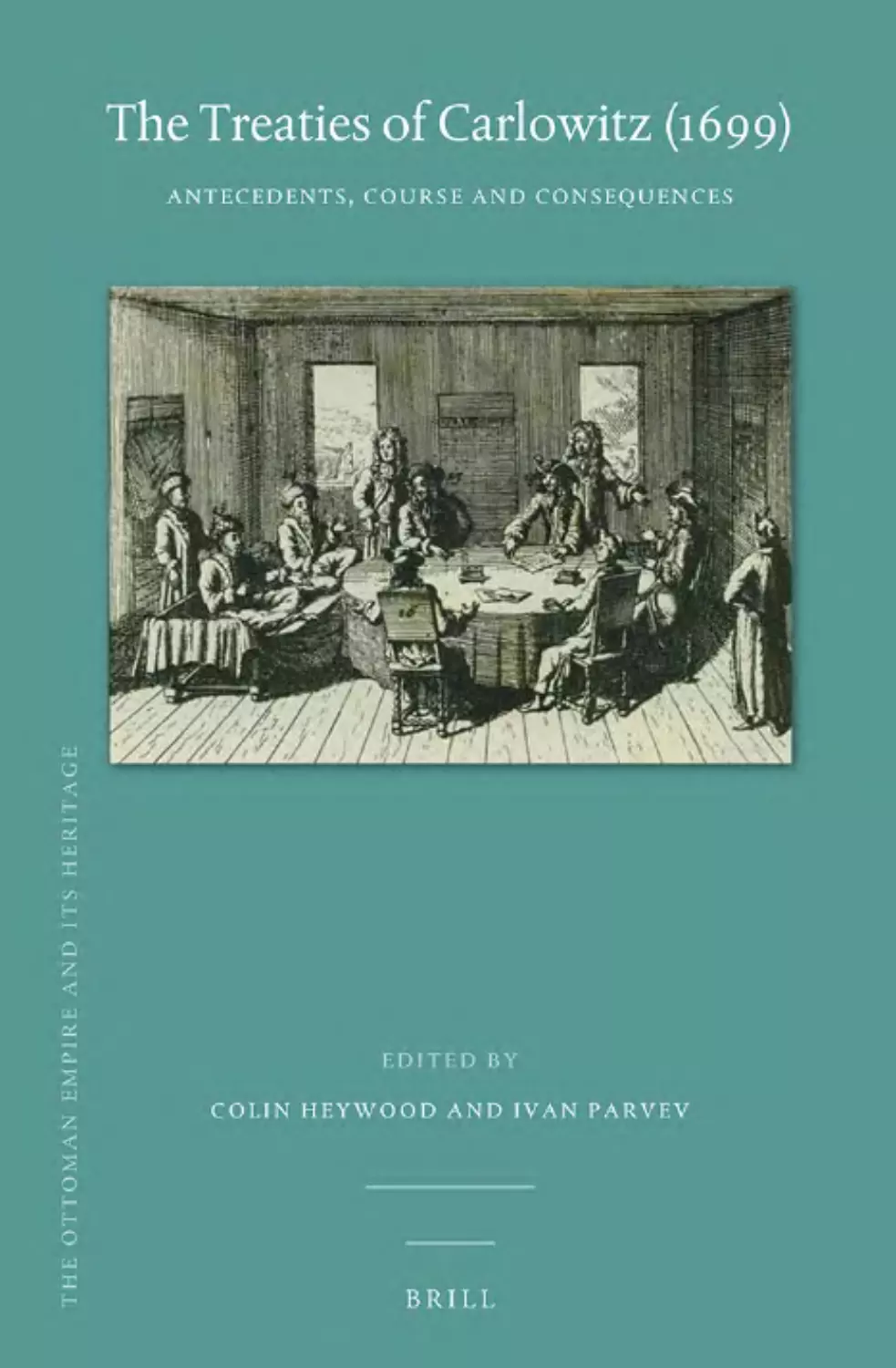
The Treaties of Carlowitz (1699)
<UN>
The Ottoman Empire and
Its Heritage
politics, society and economy
Edited by
Suraiya Faroqhi
Boğaç Ergene
Founding Editor
Halil İnalcık (d. 2016)
Advisory Board
Fikret Adanır – Antonis Anastasopoulos – Idris Bostan
Palmira Brummett – Amnon Cohen – Jane Hathaway
Klaus Kreiser – Hans Georg Majer – Ahmet Yaşar Ocak
Abdeljelil Temimi
volume 69
The titles published in this series are listed at brill.com/oeh
<UN>
The Treaties of Carlowitz (1699)
Antecedents, Course and Consequences
Edited by
Colin Heywood
Ivan Parvev
leiden | boston
<UN>
The Library of Congress Cataloging-in-Publication Data is available online at http://catalog.loc.gov
Typeface for the Latin, Greek, and Cyrillic scripts: “Brill”. See and download: brill.com/brill-typeface.
ISSN 1380-6076
ISBN 978-90 -04-40950-7 (hardback)
ISBN 978-90 -04-41428-0 (e-book)
Copyright 2020 by Koninklijke Brill NV, Leiden, The Netherlands.
Koninklijke Brill NV incorporates the imprints Brill, Brill Hes & De Graaf, Brill Nijhoff, Brill Rodopi,
Brill Sense, Hotei Publishing, mentis Verlag, Verlag Ferdinand Schöningh and Wilhelm Fink Verlag.
All rights reserved. No part of this publication may be reproduced, translated, stored in a retrieval system,
or transmitted in any form or by any means, electronic, mechanical, photocopying, recording or otherwise,
without prior written permission from the publisher.
Authorization to photocopy items for internal or personal use is granted by Koninklijke Brill NV provided
that the appropriate fees are paid directly to The Copyright Clearance Center, 222 Rosewood Drive, Suite
910, Danvers, MA 01923, USA. Fees are subject to change.
This book is printed on acid-free paper and produced in a sustainable manner.
<UN>
Contents
Preface
ix
About the Authors
xi
Introduction
1
Part 1
The War of 1683–1699 – Political Strategies and Balance
of Power in Europe
1
On the Road to Carlowitz: Visions of Ottoman Diplomacy in the Letters
of Thomas Coke, 1691–1694
19
Jean-Paul A. Ghobrial
2
‘This Great Work’: Lord Paget and the Processes of English
Mediating Diplomacy in the Latter Stages of the Sacra Lega War,
1697–1698
35
Colin Heywood
3 The Spoils of Peace: What the Dutch Got Out of Carlowitz
56
Maurits H. van den Boogert
4 The War of 1683–1699 and the Beginning of the Eastern
Question
73
Ivan Parvev
Part 2
The Sacra Lega War Viewed by the Sublime Porte
5 Ottoman Diplomacy in the First Years (1683–1685) of the Ottoman “Long
War”
91
Abdullah Güllüoğlu
6 Ottoman Subjects, Habsburg Allies. The Reaya of the Chiprovtsi
Region (Northwestern Bulgaria) on the Front Line, 1688–1690
110
Dzheni Ivanova
vi
Contents
<UN>
7 Ottoman Knowledge of the Imperial Commanders
131
Hans Georg Majer
Part 3
Time for War, Time for Peace
8 From Slankamen to Zenta: The Austrian War Effort in the
East during the 1690s
153
Lothar Höbelt
9 The Habsburgs and the Holy League: Religion or Realpolitik?
176
Charles Ingrao
10 From the ‘Eternal Peace’ to the Treaty of Carlowitz: Relations
between Russia, the Sublime Porte and the Crimean Khanate
(1686–1699)
186
Kirill Kochegarov
11
The Treaty of Carlowitz in Polish Memory – A Date
Better Forgotten?
201
Dariusz Kołodziejczyk
12
The Symbolic Making of the Peace of Carlowitz: The Border
Crossing of Count Wolfgang IV of Oettingen-Wallerstein during
His Mission as Imperial Grand Ambassador to the Sublime Porte
(1699–1701)
213
Arno Strohmeyer
13 The Treaty of Carlowitz and Its Impact on Russian-Ottoman
Relations, 1700–1710
236
Tatiana Bazarova
Part 4
Early Modern Demographic and Economic Context
14 War and Demography: The Case of Hungary 1521–1718
253
Zoltán Györe
vii
Contents
<UN>
15
Venice after Carlowitz: Change and Challenge in Eighteenth-century
Venetian Policy
273
Erica Ianiro
Concluding Remarks
293
Index
297
<UN>
Preface
The idea for the present volume or, more precisely, for a Workshop at which
the papers here brought together were delivered, grew out of discussions, in-
volving its two present editors and other colleagues, which took place during
some congenial evening gatherings at an earlier workshop, on the subject of
“Bordering Early Modern Europe”, which was held at the University of Sofia in
March 2013.1 It occurred to us then that, if we were to develop the themes of
borders and frontiers which had largely figured in the 2013 workshop, it might
be useful to look more narrowly at one or other of the several moments of sig-
nificant change in the configuration of the borders of Europe with its neigh-
bours in the Early Modern period.
A general consensus soon emerged that it was, perhaps, overdue to give
some further attention to what was arguably one of the most significant recon-
figuration of the borders of Eastern Europe: the one which took place in the
course of the “Long War” of 1683–99 between the Austrian Habsburgs and their
allies – Poland, Venice and (eventually) Russia – and the Ottomans, and subse-
quently in the peace settlement which was to be achieved in 1699 at the Con-
gress of Carlowitz, a process characterised by one notable historian of our time
as the “closing of the Ottoman frontier” in Europe.
Use of the term “overdue” also suggests that there has been a relative dearth
(though not an absolute one) of contemporary scholarship on a subject which
recent events might well qualify as capable of rescuing it from a certain degree
of academic obscurity. The deeper reasons for the unfashionability of the Sacra
Lega wars among both Turkish and Western historians may only be guessed at,
and although they do need to be addressed, that task cannot be attempted
here. It is hoped, however, that the papers collected here may stimulate further
research into the period.
Be that as it may, it was the opinion of the present editors and, indeed, of a
majority of the scholars who took part in the discussions at Sofia in 2013, that a
further attempt to stimulate a revival of interest in the period as a whole and in
its component parts might not be unwelcome.
To what extent we were justified in this hope, which was manifested in the
enthusiastic participation of the historians who assembled in Sofia in the
spring of 2014 for a workshop on the diplomatic history of the Long War and
the Carlowitz settlement, time will tell, but the papers here gathered together
1 M. Baramova, G. Boykov and I. Parvev (eds.), Bordering Early Modern Europe (Wiesbaden,
Harrassowitz Verlag, 2015).
x
Preface
<UN>
for publication bear witness to our hopes for a revival of interest in the
subject.
Our thanks, as editors and participants, are due to the Center for Excellence
in the Humanities “Alma Mater” at St Kliment Ohridski University of Sofia, and
especially to its Director, Professor Ivan Ilchev, whose positive attitude made
the funding of the workshop in April 2014 and the financing of the editing of
the manuscript possible. We wish also to thank Dr. Anne Simon from the Uni-
versity of London, who lingustitcally edited the papers, which was of great
help for those authors who were not English native speakers. We would like
also to say thank you to Dr. Maria Baramova from the Institute for Byzantine
and Balkan Studies at Sofia University’s Faculty of History, who compiled the
index of the volume.
And, at the end, some words of gratitude from one of the editors, Ivan
Parvev, to the other, Colin Heywood. It should be underlined that the idea to
have a workshop on the War of 1683–1699 and the Congress of Carlowitz was
actually Colin Heywood’s. So thank you, Colin, for that fine insight! We, the
colleagues from the University of Sofia, picked up that proposal and now we
all, Professor Heywood included, are really glad to hold this fine Brill volume in
our hands!
Colin Heywood, Ivan Parvev
Spring 2019
<UN>
About the Authors
Tatiana Bazarova
is Head of the Scientific and Historical Archive and Sources Study Group of
St Petersburg Institute of History (The Russian Academy of Sciences). Her
main research interest is a history of Russia of the epoch of Peter the Great.
Her publications include: Plany petrovskogo Peterburga: Istochnikovedcheskoye
issledovaniye (Sankt-Peterburg, 2003) [Plans of Petrine Petersburg: The Source
Study (St Petersburg 2003)]; Sozdaniye “Paradiza”: Sankt-Peterburg i Ingerman-
landiya v epokhu Petra Velikogo: Ocherki (Sankt-Peterburg, 2014) [The Creation
of “Paradise”: Essays on St Petersburg and Ingria in the Age of Peter the Great
(St Petersburg, 2014); Russkiye diplomaty pri osmanskom dvore: Stateynyye spis-
ki P. P. Shafirova i M. B. Sheremeteva 1711 i 1712 gg.: Issledovaniye i teksty (Sankt-
Peterburg, 2016) [Russian Diplomats at the Ottoman Court: Stateinye spiski
of Petr Shafirov and Mikhail Sheremetev in 1711 and 1712: Research and Docu-
ments (St Petersburg, 2016)].
Maurits H. van den Boogert
(PhD Leiden 2001) is the author of two monograph and the co-editor of three
edited volumes, all on the diplomatic relations between the Ottoman Empire
and Western Europe in the early-modern period. He has also published several
articles, and is a former Editor-in-Chief of the Journal of the Economic and So-
cial History of the Orient. He works for Brill.
John-Paul Ghobrial
teaches Early Modern History at the University of Oxford, and is a Fellow and
Tutor in History at Balliol College. Among other publications, he is the author
of The Whispers of Cities: Information Flows in Istanbul, London and Paris in
the Age of William Trumbull (Oxford, 2013). From 2015–2020, he is the PI of an
ERC-funded project on the history of Eastern Christianity in the early modern
period.
Abdullah Güllüoğlu
is Lecturer in Early Modem History at Istanbul 29 Mayıs University.
His main research interest is Ottoman-Habsburg relations, Ottoman-
Prussian relations, Ottoman diplomacy, sefaretnames, travel narratives, Otto-
man costume albums.
His publications include: “Die Wahrnehmung des Anderen in den Berichten
des osmanischen Gesandten Ahmed Resmi Efendi (1694/95 – 1783)” (2010),
xii
About the Authors
<UN>
“Dämonen, böse Geister und unreine Hunde. Differenzmarkierungen im Ge-
sandtschaftsbericht des Zülfikâr Efendi von 1688–1692” (2012), “The First Otto-
man Delegation to Prussia in 1763–1764 and its Depiction in a Costume Album
from Berlin” (2015).
Zoltán Györe
(Zoltan Đere) is full professor in Modern History at University of Novi Sad, Ser-
bia. His main research interest is History of Hungary in the 19-th century. His
publications include: Habzburška monarhija 1526–1792, (Novi Sad, 2014); Imov-
inski fond bačkog kmetovskog stanovništva 1522.g. (Novi Sad, 2014); Mađarski i
srpski nacionalni preporod (Novi Sad, 2009); Gradovi i varoši Bačke (Novi Sad,
2007); ‘Od Mohačke bitke do smrti cara Jozefa II’, in: Z. Hamović (ed.) Istorija
Mađara (Beograd, 2002); ‘Nastanak i razvoj bankarstva u Vojvodini do 1890.g.’,
in: N. Gačeša, Istorija vojvođanskog bankarstva (Novi Sad, 2001).
Colin Heywood
was born in Hull, and was educated there and at at the School of Oriental and
African Studies, University of London. He taught at several American universi-
ties from 1965 onwards, and subsequently at SOAS, until 1999. Since 2002 he has
been an Honorary Research Fellow at the Maritime Historical Studies Centre,
University of Hull, and was also a Visiting Professor at Princeton University, the
University of Chicago and the University of Cyprus.
Apart from maintaining his original interests in Ottoman history and Anglo-
Ottoman relations in the Early Modern period, since 1999 he has also been
working on aspects of English maritime activities in the Mediterranean and
North Africa in the seventeenth and eighteenth centuries.
Lothar Höbelt
is Associate Professor of Modern History at the University of Vienna. He has
also been visiting professor at the Universities of Chicago, New Orleans/
Innsbruck and Pardubice, and Lecturer at the Austrian Military Academy in
Wiener Neustadt. Apart from his interest in the intricacies of Austrian party
politics after 1848, he has written several articles and two books on 17th cen-
tury grand strategy and military history: Ferdinand III. 1637–1657. Friedenskaiser
wider Willen (Graz, 2008) and Von Nördlingen nach Jankau. Kaiserliche Strategie
und Kriegführung 1634–1645 (Vienna, 2016).
Erica Ianiro
was Associate Professor at Ca’ Foscari University in Venice. Her scholarly inter-
ests are dedicated to Venetian trade and economy in the Mediterranean with
xiii
About the Authors
<UN>
special focus on the Ottoman Empire. Her publications include Levante. Veneti
e Ottomani nel XVIII secolo (Venezia, 2014)
Charles Ingrao
is Professor Emeritus of History at Purdue University, specializing in the his-
tory of Germany and Habsburg Central Europe. He has served as Editor of The
Austrian History Yearbook (1995–2006), Senior Editor of Purdue University
Press’s Central European Studies book series (1997–2016), and Director of the
Scholars’ Initiative (2001–), an international consortium of 300+ historians and
social scientists that produced a common, transnational narrative of the Yugo-
slav conflicts . His publications include three authored books, In Quest & Crisis:
Emperor Joseph I and the Habsburg Monarchy (1979), The Hessian Mercenary
State: Ideas, Institutions and Reform under Frederick II, 1760–1785 (1987), and The
Habsburg Monarchy, 1618–1815 (1994, 2nd ed. 2000), as well as nine scholarly
collections, including State & Society in Early Modern Austria (1994), A Guide to
East-Central European Archives (1998), Confronting the Yugoslav Controversies:
a Scholars’ Initiative (2009, 2nd ed., 2012), and The Peace of Passarowitz, 1718
(2011).
Dzheni Ivanova
is an expert in digital resources at the Institute of Balkan Studies and Center
of Thracology at the Bulgarian Academy of Sciences. Her main research in-
terest is History of the Ottoman empire. She has worked in a Bulgarian his-
torical archive at the National Library of St. Cyril and St. Methodius in Sofia
and was head of the Information, Use and Preservation Department of the
Archive of the BAS. Her publications include: ‘The Impact of the 1683–1699
War on the Ottoman Rear: The Story of Silâhdar Mehmed Ağa about the
Haydut Raid on Kyustendil in 1689/90’, in: P. Mitev, I. Parvev, M. Baramova,
V. Racheva (eds.), Empires and Peninsulas. Southeastern Europe between
Karlowitz and the Peace of Adrianople, 1699–1829 (Berlin, 2010 Verlag, 2010)
217–229; ‘The Image of the Sultan’s Ally Imre Thököly in Ottoman Historical
Writings According to the Writings of Silâhdar Mehmed Ağa and Defterdar
Sarı Mehmed Pasha’, in: M. Baramova, P. Mitev, I. Parvev, V. Racheva (eds.),
Power and Influence in South-Easteren Europe 16th–19th century (Berlin, 2013
Verlag, 2010), 245–255.
Kirill Kočegarov
is Senior Research Fellow in Early Modem History of Slavic nations in Central
and Eastern Europe at the Institute of Slavic Studies (Moscow, Russia). His main
research interest is History of Russian Foreign Policy and Russian-Ukrainian
xiv
About the Authors
<UN>
relations in 17–18th centuries. His publications include: Reč’ Pospolitaja i Rossija
v 1680–1686 godah: zaključenie dogovora o Večnom mire [The Polish-Lithuanian
Commonwealth and Russia in 1680–1686: The Conclusion of the Eternal Peace
Treaty] (Moscow, 2008; translated in Polish in 2017); Russkoe pravitel’stvo i
sem’ja ukrainskogo getmana Ivana Samojlovicha v 1681–1687 godach (Moscow,
2012) [The Russian Government and the Ukrainian Hetman Samojlovich Fam-
ily in 1681–1687]; Ukraina i Rossija vo vtoroj polovine XVII veka: politika, diplo-
matija, kultura: ocherki [Ukraine and Russia in the Second Half of the 17th
Century: Policy, Diplomacy, Culture: essays.] (Moscow, 2019).
Dariusz Kołodziejczyk
is Professor of Early Modern History at the University of Warsaw and at the
Polish Academy of Sciences. He has published extensively on the Ottoman
Empire, the Crimean Khanate, and international relations in early modern
Eurasia. He has been visiting professor at the Collège de France, University of
Notre Dame and Hokkaido University, and is currently President of the Comité
International des Etudes Pré-ottomanes et Ottomanes and Honorary Member
of the Turkish Historical Society. His publications include: Ottoman-Polish Dip-
lomatic Relations (Leiden, 2000), The Crimean Khanate and Poland-Lithuania
(Leiden, 2011) and Universal Empire. A Comparative Approach to Imperial Cul-
ture and Representation in Eurasian History (Cambridge, 2012, co-edited with
Peter F. Bang).
Hans Georg Majer
was Professor of the History and Culture of the Near East and Turkology at
the Ludwig-Maximilians-Universität Munich. His main interest is in the his-
tory and culture of the Ottoman Empire. His publications include: Vorstudien
zur Geschichte der İlmiye im Osmanischen Reich. I. Zu Uşakîzade, seiner Familie
und seinem Zeyl-i Şakayık (Munich, 1978); Das osmanische „Registerbuch der
Beschwerden“ (Şikāyet Defteri) vom Jahre 1675. Band I (Vienna, 1984); Spuren
des osmanischen Großwesirs Sarı Süleyman Paşa in Bayern und Istanbul, in:
EOTHEN, Münchner Beiträge zur Geschichte der Islamischen Kunst und Kul-
tur Band VII, 2018, 189–224.
Ivan Parvev
is Professor in Modern Balkan History (16–19th Century) at St. Kliment Ohrid-
ski University of Sofia. His main research interest is dedicated to the political
relations between Central Europe and the Early Modern Balkans. He has held
lectures at the universities in Saarbrücken, Graz, Vienna, Athens and Mainz,
and was visiting research fellow at the Institut für Europäische Geschichte in
xv
About the Authors
<UN>
Mainz. His publications include: Habsburgs and Ottomans between Vienna and
Belgrade, 1683–1739 (Boulder, 1995); Land in Sicht. Südosteuropa in den deutschen
politischen Zeitschriften des 18. Jahrhunderts (Mainz, 2008).
Arno Strohmeyer
is Professor für Modern History at the Department of History at the University
of Salzburg and Scientific Director at the Institute for Modern and Contempo-
rary Historical Research of the Austrian Academy of Sciences in Vienna. His
focus of research lies on the Habsburg Monarchy in the Early Modern peri-
od. Main topics are cultural history of diplomacy, peacekeeping and conflict
management, systems of government and political participation, politics and
religion, history of historiography and historical source editions. His publica-
tions include: Die Habsburgerreiche 1555–1740: Herrschaft – Gesellschaft – Politik
(Darmstadt, 2012); Konfessionskonflikt und Herrschaftsordnung: Widerstand-
srecht bei den österreichischen Ständen (1550–1650) (Mainz, 2006); Frieden und
Konfliktmanagement in interkulturellen Räumen. Das Osmanische Reich und die
Habsburgermonarchie in der Frühen Neuzeit (Stuttgart, 2013).
© koninklijke brill nv, leiden, ���� | doi:10.1163/9789004414�80_00�
<UN>
Introduction
Colin Heywood and Ivan Parvev
1
The present collection of papers makes a modest attempt to reclaim a respect-
able place for interpretative, fact-oriented political and diplomatic history in
the current historiography of the Ottoman state, in contrast to its overshadow-
ing by the fashionable near-hegemony of paradigmatic social and cultural de-
bate and a post-modern subaltern historiography, at least as far as the so-called
‘early modern’ (i.e ., for the Ottomans, the post-Conquest and pre-Tanzimat)
era is concerned. It goes without saying that to make use of the moving-wall
term ‘early modern’ in an Ottoman, non-western context may be seen as prob-
lematic. Nevertheless, the term as a descriptor for the period of Ottoman his-
tory which begins at the close of the beylik period and ends with the first pe-
riod of the Tanzimat reforms has already gained some acceptance, and
possesses a certain utility.1
The eclipse of fact-oriented and interpretative – one is tempted to write,
neo-Rankean – Ottoman history, it may be argued, is less than satisfactory for
the intellectual health of the field. This state of dearth is particularly notewor-
thy for one of its most clearly demarcated and, at the same time, most signifi-
cant sub-periods: We mean the half century, from 1656 to 1703, which encom-
passes the era of the ministerial (i.e ., grand vizierial) ascendancy of the family
of Köprülü. The lack of any major monographic study of the period becomes
more apparent, and more embarrassing, when compared with recent work in,
for example, Dutch, or Austrian, or Spanish history, where a plethora of deeply
researched and written works have come to define these particular fields.
Where is the Ottoman equivalent of, for example, Professor Elliot’s monograph
on the count-duke of Olivares, published more than thirty years ago, the sub-
title of which, a ‘statesman in an age of decline’, would so admirably fit, in the
plural, the ministers of the house of Köprülü? Or a study of the reign of, say,
Sultan Mehmed iv which might compare with Lothar Höbelt’s study of the
1 E.g., by B. Tezcan, The Second Ottoman Empire: Political and Social Transformation in the Early
Modern World (Cambridge, Cambridge University Press, 2010) and S. White, The Climate of
Rebellion in the Early Modern Ottoman Empire (Cambridge, Cambridge University Press,
2011).
Heywood and Parvev
2
<UN>
reign of the Holy Roman Emperor Ferdinand iii?2 Why, equally, has there been
no work from the Ottoman side on the vizierial favourites of the sultan Me-
hemmed iv which would rank with David Onnekink’s recent study of the life
and career of Hans Willem Bentinck, friend, advisor, and éminence grise, who
in Ottoman terms can be seen as a true musahib of the Dutch Statholder-king
of England, William iii.3
Comparisons are of a truth odious, but they need to be made, while giving
credit where it is due.4 Certainly there are grounds for hope, where recent
work, by both Ottomanists and non-Ottomanists, although for the most part in
article rather than in monographic form, have begun to show a possible way
forward.5
The above strictures and reflections apply with a particular force and ur-
gency to the twenty years (1683–1703) of central and east European, as well as
Ottoman, history, with which the present collection of papers are concerned.
These are the two decades, the last two decades of the Köprülü era, which
encompass the second unsuccessful Ottoman Siege of Vienna in 1683 and the
resulting War of the Sacra Lega, known as the second ‘Long’ Turkish War, of
1684–99, between the Ottomans and the House of Austria and its allies, the
Polish-Lithuanian Commonwealth, the Republic of Venice, and the Tsardom
of Muscovy, together with the years of the war’s immediate and troubled after-
math, from the conclusion of the Treaties of Carlowitz (1699) to the deposi-
tion of the Ottoman sultan Mustafa ii in 1703. These limits define a major and
2 J.H . Elliott, The Count-Duke of Olivares: The Statesman in an Age of Decline (London and New
Haven, Yale University Press, 1986); Lothar Höbelt, Ferdinand iii.(1608–1657): Friedenskaiser
wider Willen (Graz, Ares Verlag, 2008).
3 David Onnekink, The Anglo-Dutch Favourite: The Career of Hans Willem Bentinck, 1st Earl of
Portland (Aldershot, Hants, Ashgate, 2007).
4 For an admirably detailed and informed analysis of the Köprülü period – what an old teacher
of one of the editors would have termed ‘proper history ’ – see the relevant chapters in
C. Finkel, Osman’s Dream: The Story of the Ottoman Empire, 1300–1923 (London, John Murray,
2005), 253–328.
5 From the Ottomanist side we would single out the perceptive new study by Yasir Yilmaz
(Yasır Yılmaz), ‘Grand vizieral authority revisited: [the] Köprülüs’ legacy and Kara Mustafa
Paşa’, (2016) Mediterranean Historical Review, 31/1, 21–42, which fully develops some of the
points raised above and is prefigured in C. Ingrao and Y. Yilmaz, ‘Ottoman vs. Habsburg: Mo-
tives and Priorities’, in: P. Mitev, I. Parvev, M. Baramova, V. Racheva (eds.), Empires and Penin-
sulas: Southeastern Europe between Karlowitz and the Peace of Adrianople, 1699–1829 (Berlin,
lit Verlag, 2010), 5–17. To take one example from the side of the non-Ottomanist historians,
see J. Bérenger, ‘La politique ottomane de la France de Vienne à Karlowitz (1683–99)’, in: Bal-
canica Posnaniensia. Acta et Studia, xiii (Poznan, Adam Mickiewicz University Press, 2003),
35–53, which, despite some weakness, raises the study of French diplomacy at the Porte dur-
ing the years of the second ‘Long’ War to new levels.
3
Introduction
<UN>
hitherto relatively understudied turning-point, a Zeitenwende, a plaque tour-
nante, in both Ottoman and European history.
These years of war and an ensuing uneasy peace had brought about a trans-
formation of the Ottoman Empire through war and its aftermath: for the Ot-
tomans this had come about through ‘a long series of lost battles and fortresses,
of army mutinies and revolts’,6 lightened by occasional but in the end mean-
ingless victories; for Austria and, to a lesser extent, her allies, an equally long
series of victories gained and fortresses won, despite equally occasional and for
the most part nugatory defeats and setbacks. By the end of our period, when a
successful military revolt brought about the deposition of yet another sultan,
we are entering into another age, that of the ‘short’ Ottoman eighteenth cen-
tury, which lies outside the purview of the present volume.
By way of introduction to the collection of papers published here, a few
general observations may be made. To the student of Ottoman history, the
transformative course of events in the years 1683–1703 offers some instructive
parallels. First and foremost of these is the two decades which bracket the
years 1509–29; in other words, from the inception of the bitter struggle for the
throne which marked the last years of the reign of Bayezid ii, through the reign
of Selim i , another (if not the other) major plaque tournante of Ottoman his-
tory, and into the first decade of the reign of Süleyman Kanunî, which sees the
true emergence of the Ottoman state as an imperial power and, in its self-view,
it must be stressed, an apocalyptically-driven universal empire.7
It may not be beyond the bounds of the reasonable to observe that the Otto-
man imperial age which, for a variety of reasons, may best be defined as the
years from 1529 to 1683, is bracketed by the Ottoman’s two failed attempts to
pluck Vienna, the fabled Red Apple, the pomum rubrum or ‘Kızıl Elma’ of Turk-
ish legend, from its rulers’ grasp. For the historian there is a certain elegant
symmetry at work here. If the two decades from 1509 to 1529 open the Otto-
mans’ Age of Empire, through the successive conquests of the Arab lands, of
Belgrade and of Hungary, and the effective neutralising of the Safavid threat,
then the two decades from 1683 effectively close it, with the loss – permanently
as it turned out – of Hungary and Podolia (and the temporary loss of Belgrade
6 ‘ ... eine lange Reihe von verlorenen Schlachten und Festungen, von Meutereyen und Aufrüh-
ren’ (J. Hammer, Geschichte des osmanischen Reiches, grossentheils aus bisher unbenützten
Handschriften und Archiven, vol. 6 . Von der Grosswesirschaft Mohammed Köprili’s bis zum
Carlowiczer Frieden. 1656–1699. (Pest, in C.A. Hartleben’s Verlage, 1830), 528.
7 B. Flemming, ‘Sahib-Kiran und Mahdi: Türkische Endzeiterwartungen im ersten Jahrzeht der
Regierung Süleymans’, in: G. Kara (ed.), Between the Danube and the Caucasus (Budapest,
Akadémiai Kiadó, 1987), 49–62.
Heywood and Parvev
4
<UN>
and the Morea) but overall, to borrow Rifa’at Abou-El-Haj’s calque on Freder-
ick Jackson Turner, the effective closing of the Ottoman frontier in Europe.8
Within the two decades of war and uneasy peace between 1683 and 1703 it is
possible to define a narrower point at which the war took a decisive turn. The
critical years, it may be argued, are from 1688 to 1690, from the Austrian cap-
ture of Belgrade to its recapture by the Ottomans in 1690. The events of these
years demonstrated clearly that the Ottoman military machine could only
hold its own against Austria, either in siege warfare or in field battles (and not
always in field battles, as the outcome of the battle of Slankamen in 1691 dem-
onstrated) when Austria was half-fettered by the demands of a war on the
Rhine against France. Ivan Parvev, in his paper published below, has seen this
incontrovertible hypothesis as evidence for the subordination of the Ottoman
state to the realities of the European balance of power, and thus marking the
effective beginning of the Eastern Question. On the Austrian side the realities
of war on two major fronts, from 1690 to 1697, condemned the imperial states-
men and generals to a policy of at best holding the line and at worst, muddling
through with less than competent commanders and troops, while the Otto-
mans, wholeheartedly throwing themselves into the arms of Louis xiv, were
condemned to reap at Zenta the ultimate bitter harvest of relying on a de facto
alliance with France which Louis xiv abandoned as soon as he had determined
to make peace with William iii and the Allies.
Thus, the Sacra Lega war, at least as far as its Austrian segment was con-
cerned, falls into three parts: an uninterrupted series of Austrian victories from
1683 to the capture of Belgrade in 1688 (and on into the 1689 conquests below
Belgrade); the years of effective stalemate during the Zweifrontenkrieg, down to
the summer of 1697; and the renewal of an Austrian offensive policy in 1697,
leading to the acceptance of mediation by the maritime powers and a negoti-
ated end to the conflict, 1698–99.
It goes without saying that the separate wars with Venice, Poland-Lithuania,
and Muscovy, follow a different pattern of events, with Muscovy coming late
into the field; Poland largely inactive post-1683 as a result of dynastic dissent
and French subsidies, and Venice pursuing an independent policy of territorial
conquest and naval warfare in the Morea and the Aegean.
The mediated peace achieved at Carlowitz, which had been the objective of
the maritime powers, England and the Dutch Republic, since 1688, and possi-
bly even since 1685, both in their own interests, mercantile and diplomatic,
8 R. Abou-El-Haj, ‘Ottoman Diplomacy at Karlowitz’, (1967) Journal of the American Oriental
Society, 87, 498–512; idem, ‘The Formal Closure of the Ottoman Frontier in Europe: 1699–1703’,
(1969) Journal of the American Oriental Society, 89, 467–475.
5
Introduction
<UN>
and within the demands of the European balance of power, was in itself some-
thing of a novelty, since it marks the bringing of the Ottomans, unwillingly,
into the western European congress system from which they were fated never
to escape. Hitherto, as is commonly accepted, the Ottomans had largely pur-
sued unilateralist policies, seeking truces with their Christian enemies when it
was in their own interest to do so, but eschewing treaties with their implica-
tion of a perpetual peace, seen as a theological impossibility, while remaining
insistent that Muslim territory, once conquered, could never be permanently
given up.9
It is a regrettable but true observation that contemporary monographic
studies of both the Sacra Lega war and the Carlowitz peace process, and while
not non-existent, they are few in number, and the ‘big history’ of the war is
missing.10 The reasons for the unfashionability (for want of a better word, pos-
sibly ‘dowdiness’) of the Sacra Lega war amongst most present-day historians,
both Turkish and Western, are obscure, but need to be examined. To describe
the war as a ‘poisoned chalice’ for historians is perhaps to exaggerate; nonethe-
less, looking back over the past century or so, the history of the field has not
been altogether a happy or a positive one, although historians from Eastern
and South-Eastern Europe are showing renewed interest in the war and its
results.11
9
See, for the negotiations at Carlowitz, which effectively negated these principles, Abou-
El-Haj, ‘ The Formal Closure of the Ottoman Frontier’, 467, 470–471.
10
For a valuable overview of twentieth-century scholarship see Z. Abrahamowicz, V. Kop-
can et al. (eds.), Die Türkenkriege in der historischen Forschung (Wien, Franz Deutike,
1983). There are a number of nineteenth-century and later studies by Austro-Hungarian
military historians, devoted to the major conflicts and victories of the war, and the corre-
spondence of one of the most outstanding Habsburg field commanders, the Markgrave
Ludwig Wilhelm of Baden, has long been known to scholarship and deserves to be
mentioned.
11
A part of these works are written in English, French or German, some in the respective
national languages. Cf. R. Veselinović, ‘Die Entwicklungsfaktoren der Staatlichkeitsidee
im serbischem Volk im xvi–xvii . Jh. und die Versuche deren Verwirklichung zu dieser
Zeit’, (1973) East European Quarterly, 4, 403–418; D. Ionescu, ‘Ideal and Representation.
The Ideal of Restoration of the Byzantine Empire during the reign of Serban Cantacuzino,
1678–1688‘, (1974) Revue des Études Sud-Est Européennes, 9, 523–535; Z. Zlatar, ‘Stvaranje
Svete lige i Dubrovačka republika (1683–1684)’, (1975) Jugoslovenski Istorijski C
̌
asopis, 1–2,
29–59; M. Kiselinčeva. ‘ Beteiligung der Balkanbevölkerung am Feldzug gegen Wien im
Jahre 1683’, (1983) Mitteilungen des Bulgarischen Forschungsinstitutes in Österreich, 2,
68–74; i . Parvev. Habsburgs and Ottomans between Vienna and Belgrade, 1683–1739 (Boul-
der, Columbia University Press, 1995); Ž. Dimić, Veliki bečki rat i Karlovački mir: 1683–1699.
Hronologija (Beograd, Verzal Press, 1999) etc.
Heywood and Parvev
6
<UN>
For Turkish historians of the present era, and for latter-day European (and
North American) Ottomanists, however, with very few exceptions the war of
1683–99 has proved an unattractive topic. The seminal article on ‘Eighteenth-
century Ottoman realities’, published more than half a century ago by the
Princeton historian Norman Itzkowitz, may have kick-started the subsequent
fashionability of post-1703 Ottoman studies, while leaving the later seven-
teenth century – the era of the Köprülü – in an undeserved historiographic
limbo.12 Virginia Aksan, the present-day doyenne of eighteenth century Otto-
man studies, seems to have resolutely turned away from any pre-1700 consider-
ations; half a century earlier, Rifa’at Abou-El-Haj’s pioneering studies on the
Carlowitz settlement and the so-called ‘Edirne Event’ of 1703, look forward
rather than backwards, even though it could be cogently argued that the ad-
ministrative reforms inaugurated by Fazıl Mustafa Pasha in the short period of
his grand vizierate (1689–91) effectively mark the real beginning of the reforms
gathered together under the rubric of the Tanzimât.13
In the nineteenth century we may observe a different story, at least on the
side of Central European historians. The bicentenary of the second siege of
Vienna was prolific in this regard. The fiercely anti-Prussian Hanoverian exile
Onno Klopp’s Das Jahr 1683 und der folgende grosse Türkenkrieg (1882) and his
lengthy Der Fall des Hauses Stuart (1875–88) which, despite its title, deals se-
quentially and massively with the ‘Long’ Turkish War, are factographic but
magisterial works, descended from the school of Leopold von Ranke in a tradi-
tion which perhaps finds its last expression in the outstanding and undeserv-
edly neglected multi-volume History of the Ukraine by Mykhylo Hrushevsky.14
12
N. Itzkowitz, ‘Eighteenth-Century Ottoman Realities’, (1962) Studia Islamica, 16, 72–94.
13
There is no satisfactory study of Köprülü-zâde Mustafa Pasha’s career and reforms. There
are a few stimulating pages on him in Finkel, Osman’s Dream, 308–312. See also R. Abou-
El-Haj, The 1703 Rebellion and the Structure of Ottoman Politics (Istanbul, Nederlands Insti-
tuut voor het Nabij Oosten, 1984).
14 O. Klopp, Das Jahr 1683 und der folgende grosse Türkenkrieg biz zum Frieden von Carlowitz
(Graz, Styria, 1882); idem, Der Fall des Hauses Stuart und die Succession des Hauses Han-
nover in Gross-Britannien und Irland, in Zusammenhange der europäischen Angelegenheit-
en von 1660–1714 (14 vols., Wien, W. Braumüller, 1875–88). Material relevant to the Sacra
Lega war is scattered throughout vols. 2 to 8 of Klopp’s Fall des Hauses Stuart.
Hrushevsky’s Istorija Ukrainy-Rusy, his major but uncompleted work (both the work
and its author fell victims to Stalin), now available in an authoritative English translation
(History of Ukraine-Ruś, 10 vols. (in progress), Edmonton, Canadian Institute of Ukrainian
Studies, 1997–2012), although of great value for Ottoman relations with the Ukraine (see
Heywood, ‘Mykhailo Hrushevsky on the Rise of Ukrainian Cossackdom: An Ottoman View’,
(2001) Osmanlı Araştırmaları, 21 (2001), 323–335, reprinted in idem, Ottomanica
7
Introduction
<UN>
More than half a century before Klopp, Joseph von Hammer, the Nestor of
Austrian Ottoman studies, devoted a large section of vol. vi of his multi-volume
history of the Ottoman state to the Sacra Lega war and the peace settlement, a
work which still repays reading.15 The same may be said, but to a diminishing
degree, of the works of Zinkeisen and Nicolae Iorga, Hammer’s lesser but still
useful followers in the tradition of multi-volume Ottoman history.16
There is however a recent significant Francophone contribution to the lit-
erature of the Carlowitz peace settlement, which was published in Paris sev-
eral years before the present workshop on Carlowitz convened in Sofia.17
Of the eleven papers, seven may be singled out here as being of particular
relevance to the present volume. Jean Bérenger’s own contribution, ‘La
politique de l’Empereur Léopold Ier face à l’Empire ottoman’ (pp. 9–24) is a
weighty and valuable essay which highlights the repeated financial problems
encountered – and eventually triumphantly overcome – by Leopold in trying
to balance his commitments on the Danube and on the Rhine in face of the
economic and fiscal weakness of the Habsburg state and the apparently pre-
ponderating diplomatic and military might of France. Bérenger’s essay is fol-
lowed (pp. 25–37) by an equally valuable study by the late Istvan György Toth
on ‘La Paix de Karlowitz, la Hongrie et la Transylvanie’, which characterises the
and Meta-Ottomanica, Istanbul, Isis Press, 2013, 183–192), unfortunately never pro-
gressed beyond 1657. As can be expected the work of Hrushevsky and its heritage is quite
intensively discussed between Ukrainian and Russian historians. Cf. A . Miller, „Ukrainskij
vopros“ v politike vlastej i russkom obshchestvennom mnenii (vtoraja polovina xix veka)
(Sankt Peterburg, Aleteya, 2000); S. Plokhy, Unmaking Imperial Russia: Mykhailo Hrush-
evsky and the writing of Ukrainian history (Toronto, University of Toronto Press, 2005).
15 J. von Hammer, Geschichte des osmanischen Reichs, grossenteils aus bisher unbenützten
Handschriften und Archiven (10 vols., Pest, C.A . Hartleben’s Verlag, 1827–34, repr.
Graz, 1963), vol. 6, 335–678. There are also two French translations – one by J. -J. Hellert
[...], and the other by Louis Doches [...] (Paris, 1835–43; repr. Istanbul, Isis Press 1992–
2000), and by Louis Dochez (3 vols., Paris, Béthune & Plon, 1844).
16 J.W. Zinkeisen, Geschichte des osmanischen Reiches in Europa (7 vols. plus Register-Band,
Hamburg, bei Friedrich Perthes, 1840- Gotha, 1863), vol 5, 87–236; 237–323.; Jorga, N., Ge-
schichte des osmanischen Reiches nach den Quellen dargestellt (5 vols., Gotha, Fr. Andreas
Perthes, 1908–13), vol. 4, 183–273.
17 In 2010 the French publishing house of Honoré Champion published the proceedings of a
one-day workshop held in Paris in 1999 to commemorate the tercentenary of the Carlow-
itz settlement. Under the editorship of the distinguished French diplomatic historian
Jean Bérenger, and under the title of La Paix de Karlowitz 26 janvier 1699: Les relations entre
l’Europe centrale et l’Empire Ottoman, the proceedings brought together eleven of the con-
tributions to the 1999 workshop, bookended by a short avant propos (pp. 7–8) and a
lengthier ‘Conclusions générales’ (pp. 235–242) by the editor. The editors’ grateful thanks
are due to our colleague Dariusz Kołodziejczyk for kindly bringing the Bérenger volume
to our notice at an advanced stage in the production of the present work.
Heywood and Parvev
8
<UN>
Carlowitz settlement, not without reason, as ‘une paix insuffisament favorable
aux Hongrois’ and develops a possibilitative theme of ‘what if ’ the Ottomans,
supported by France, had continued the war to the point where the Spanish
king Charles ii had died, thus once more threatening the Emperor with the
prospect of a war on two fronts?
A short study by Maciej Serwanski highlights the trenchant Polish opposi-
tion to the guiding principle, enforced by the mediators, of uti possidetis ita
possideatis (‘ce que vous possédez, vous aller le posséder’). Nonetheless, Ser-
wanski sees the Polish treaty as the most successful of the settlements reached
at Carlowitz, ushering in nearly a century of renewed Polish-Ottoman amity
before Austria, saved by Sobieski in 1683, became – in a further irony – one of
the partitioning powers which brought an end for over a century to the exis-
tence of the Polish state.
Serwanski’s paper is followed by two further contributions (by Mixail V.
Dimitriev and Gaetano Platania) which develop further aspects of Polish inter-
national relations at this time.
Stefano Andretta’ s paper (pp. 133–145) deals with the activities of Carlo Ru-
zzini, the talented and experienced Venetian envoy to the Carlowitz confer-
ence, in coping with the many problems inherent for Venice in the Carlowitz
settlement and in the internal contradictions of Venetian policy, which im-
pacted negatively on the international position of Venice after the conclusion
of peace.
Of the remaining papers, the only direct contribution to the Ottoman di-
mension, Claude Michaud’s ‘L’Empire ottoman à la fin du xviie siècle’ (pp. 147–
156) is, frankly, a disappointment in every regard; the two concluding papers,
Emmanuel Caron’s ‘La politique ottomane de la France à la fin du xviie siècle:
défense de la chrétienité ou gallicanisme’ (pp. 179–194) and Géraud Pou-
marède’s lengthy study ‘La France et le retour à la Porte des Négociateurs de
Karlowitz (1699): cérémoniel, protection et rivalités internationales dans
l’Empire ottoman (195–234), together with Jean Bérenger’s short ‘Conclusions
générales’ (pp. 235–242) all well repay reading as correctives to the regrettable
absence of any study of French diplomacy during and after the short period of
eclipse which it suffered at the Porte, from the aftermath of the battle of Zenta
to the reestablishment of peace in the East.
2
The papers in this volume could be divided into four groups. The first one
consists of texts which analyse the War of 1683–1699 within the framework of
9
Introduction
<UN>
political strategies aimed at ensuring the general European balance of power:
in other words, through the interests of states and rulers which were not part
of that military conflict. The second group includes topics located within the
Ottoman Empire itself – be they connected to the decision-making process at
the Sublime Porte, or to problems along the front line on the Turkish side. The
third group, the most numerous, consists of papers which deal with the his-
tory of the military efforts and the Ottoman policy of the Christian allies dur-
ing the War. Finally, the forth consists of papers which consider the war of the
Sacra Lega in a broader chronological context, seeking to examine special eco-
nomic, political or demographic trends.
The papers included in the first group are those by Maurits van den
Boogert, Jean-Paul Ghobrial, Colin Heywood and Ivan Parvev. The second
group includes the texts of Abdullah Güllüoğlu, Dzheni Ivanova and Hans
Georg Majer. The third consists of the papers written by Tatjana Bazarova,
Lothar Höbelt, Charles Ingrao, Kirill Kochegarov, Dariusz Kołodziejczyk and
Arno Strohmeyer, while in the fourth are the papers by Zoltán Györe and Eri-
ca Ianiro.18
2.1
Group One
Jean-Paul Ghobrial, ‘On the Road to Carlowitz: Visions of Ottoman Diplo-
macy in the Letters of Thomas Coke, 1691–1694’
Ghobrial’s contribution throws light upon English-Ottoman relations at the
end of the seventeenth century in a rather unusual way: through the eyes of
the secretary at Britain’s embassy in Constantinople, Thomas Coke, who served
several English ambassadors to the Ottoman capital. This chapter concentrates
on the correspondence between Thomas Coke and William Paget, English Am-
bassador to Vienna and in 1692 appointed British representative in Constanti-
nople. The letters contain very detailed information about the different views
held by Ottoman statesmen at the time on the question of making peace with
the Sacra Lega. Some important political figures were obviously inclined to
give up lands to end the war because they feared that more hostilities would
bring more losses to the Turks. This is quite surprising, since the prevailing
scholarly view is that the Ottoman side rejected discussion of any peace op-
tions which foresaw the cession of territory not conquered by the Sultan’s en-
emies. Coke’s letters help us to understand the decision-making process in the
Ottoman Empire at that time.
18 The authors are listed in alphabetical order of their surnames.
Heywood and Parvev
10
<UN>
Colin Heywood, ‘“ This Great Work”: Lord Paget and the Processes of English
Mediating Diplomacy in the Latter Stages of the Sacra Lega War,
1697–1698’
Heywood’s paper focuses on the diplomatic activity of Lord Paget, British Am-
bassador to the Sublime Porte, during the two years preceding the signing of
the peace treaties of Carlowitz (1699). Based on very thorough research into
the pertinent British archives, the author provides an excellent illustration of
Paget’s ability cautiously to push the Ottomans in a direction the British
thought would most favour their European political interests. Although the
British attempts in the early 1690s to find a compromise between the Allies and
the Sublime Porte were not very successful, the role played by England in find-
ing a way out of the war in the East which would suit both sides should be
viewed as crucial. Finally, Heywood formulates the provocative hypothesis of a
possible connection between the Glorious Revolution (1688) and the signing
of the treaties of Carlowitz (1699), where for the first time Christians and Mus-
lims, aided by English and Dutch mediators, met at a peace congress to end a
quite lengthy war.
Maurits H. van den Boogert: ‘The Spoils of Peace: What the Dutch got out of
Carlowitz’
This author studies Dutch diplomatic involvement in the War of the Sacra Lega
in the decade before Carlowitz (1699), at the same time adding evidence for
the political activity of two Dutch diplomats – Jacob Colijer, Ambassador in
Constantinople, and Jacob Hop, Dutch representative in Vienna. Basing his re-
search on new archival sources, van den Boogert makes a significant contribu-
tion to our better understanding of Dutch policy in the Levant, which was ob-
viously wavering between its economic interests in the Mediterranean and the
idea of bright political-economic perspectives in Western Europe. The author
concludes that in the end the Dutch gained very little from their ‘diplomatic
adventure’ in 1698–1699. Finally, van den Boogert examines what the sources
from Dutch archives can tell us about the history of Early Modern internation-
al law – especially about the concept of ‘uti possidetis’, which played an impor-
tant role during the peace negotiations at Carlowitz.
Ivan Parvev, ‘The War of 1683–1699 and the Beginning of the Eastern
Question’
This author provides an overview of the different definitions of the Eastern
Question, and their chronological borders, as proposed by various scholars.
11
Introduction
<UN>
According to one of the most popular views, that phenomenon was the result
of the crisis of the Sublime Porte, the interests of the Great Powers in the lands
of the Sultan and the movement for national liberation; and it started with the
Treaty of Kuchuk Kainarca (1774). Parvev defines the Eastern Question as the
intersection of the loss of Ottoman lands in Europe on the one hand; and
the balance of power in Europe, which could be ‘shifted’ in a certain direction
as a result of that Ottoman retreat, on the other. For this author the Eastern
Question started in 1688, when France declared war on Austria, fearing that
the conquest of the Balkans would make Leopold i master of Europe, a situa-
tion which for Louis xiv was not acceptable.
2.2
Group Two
Abdullah Güllüoğlu, ‘Ottoman Diplomacy in the First Years (1683–1685) of
the Ottoman “Long War”’
This author sheds light on some Ottoman diplomatic activities during the first
years of the War of the Sacra Lega which are practically neglected by scholars
studying the conflict of 1683–1699. Güllüoğlu focuses on the proposals for con-
cluding peace made by the Sublime Porte in 1684 and 1685. Based on contem-
porary European printed sources, this chapter provides a detailed narrative of
the way these peace efforts were put into effect and how they were perceived
by the Christian allies. The author draws the conclusion that the Ottoman pro-
posals for making peace did not produce a positive result, since the Allies were
not inclined to make separate peace with the Turks and wanted financial com-
pensation and new borders at the expense of Ottoman lands, demands which
the Sublime Porte could not accept at that time.
Dzheni Ivanova, ‘Ottoman Subjects, Habsburgs Allies. The reyaya of the
Chiprovtsi Region (Northwestern Bulgaria) on the Front Line, 1688–1690’
In her chapter Ivanova deals with an event from the end of the seventeenth
century which was, and still is, an important topic in Bulgarian historiogra-
phy: namely, the rebellion against Ottoman rule of Bulgarian Catholics in
Chiprovtsi in 1688. Since contemporary Austrian military and political docu-
ments are very rare, Dzheni Ivanova has shrewdly searched for additional evi-
dence about the rebellion in Ottoman sources which have not been much
studied by scholars. This approach was ultimately very successful. The thor-
ough analysis of the chronicle by Bakkaloğlu Sarı Hacı Mehmed pasha Defter-
dar, and also of some of the Ottoman archives of that time, yields a positive
result in terms of new facts and new details which allow us to consider events
Heywood and Parvev
12
<UN>
in north-west Bulgaria at the end of the seventeenth century in a more pre-
cise and objective way.
Hans Georg Majer, ‘Ottoman Knowledge of the Imperial Commanders’
The chapter, which is based on thorough research into Ottoman sources –
contemporary documents or official chronicles of the time – sheds light on the
question of whether the Turks were able to distinguish the military command-
ers of their Austrian enemy, who came from different parts of the Holy Roman
Empire and not only from the hereditary lands of the Habsburgs. It is quite
surprising that the Ottomans had rather a good knowledge of the Imperial
commanders: they knew their names (though with some misspellings); they
knew where they came from (Bavaria, Saxony etc.); they knew their titles,
though not always very correctly. Majer points out that the tradition of adorn-
ing the names of non-Muslims with epithets in times of war, epithets which
stress the inferiority of the enemy as infidels, was still maintained when de-
scribing the War of the Sacra Lega at the end of the seventeenth century. The
author is convinced that the main source for such detailed knowledge of the
Imperial commanders were prisoners of war, some of whom were caught and
interrogated for that very purpose – to know the enemy.
2.3
Group Three
Lothar Höbelt, ‘From Slankamen to Zenta: The Austrian War Effort in the
East during the 1690s’
The author examines in detail the Austrian war efforts against the Ottoman
Empire between the two great victories by Habsburg troops – that of Slanka-
men (1691) and that of Zenta (1697). Höbelt formulates the thesis that after
1691 Austria’s main goal was not to extend the Habsburg border deep into the
Balkans, but rather to consolidate the lands already conquered from the Sub-
lime Porte at that point. Emperor Leopold i and his military advisers wanted
to keep Transylvania as part of the Habsburg monarchy at all costs and, if
possible, to regain Belgrade. This was partly due to the military importance of
the ‘Danubian axis’ in terms of logistics, the planning of war campaigns and
river warfare – a fact which was already clear to the Austrian military. In com-
parison to the campaigns of 1688–1689, when Habsburg politicians thought
about creating a huge Austrian Empire ruling the West and the East (with
Constantinople), the military planning of the 1690s was quite moderate and
realistic.
13
Introduction
<UN>
Charles Ingrao, ‘The Habsburgs and the Holy League: Religion or
Realpolitik?’
The author provides an overview of the different models which the Habsburgs
used to recruit the military forces needed by Austria to fight the Ottomans, not
only in 1683, but also during the years of the War of the Sacra Lega. Emperor
Leopold i had to employ financial means to obtain auxiliary troops from Ger-
man princes; or to use marriage ties in addition, as was the case with Bavaria;
or to promise a King’s crown (that of Poland), as was the case with Saxony, in
order to ensure military assistance for his armies fighting the Ottomans in the
East and, from 1688 onwards, fighting the French in the West as well. Ingrao
underlines the fact that in the search for military support or allies Leopold i ,
although a fervent Catholic, gladly made use of Protestant or Calvinist forces
against his enemies. The ‘blurring of confessional lines’ (Ingrao) between the
European states, which opened the gate for Realpolitik, was a clear-cut ten-
dency in European diplomacy at the end of the seventeenth century, and espe-
cially in Vienna.
Kirill Kochegarov, ‘From the “Eternal Peace” to the Treaty of Carlowitz: Re-
lations between Russia, the Sublime Porte and the Crimean Khanate
(1686–1699)’
In an overview based on Russian archival sources, Kochegarov examines the
different aspects of Moscow’s foreign policy and political goals vis-à -vis the
Ottoman Empire in 1686–1699. While the military expeditions of Russian
troops in the 1680s had the Crimea and the Crimean Tatars as their main target
rather than the Ottoman lands proper, the situation changed considerably in
1695–1696, with Peter the Great leading his army in the direction of Azov, i.e .
into Ottoman territory east of the Crimea. This strategic shift was very impor-
tant, since it would secure a Russian outlet to the Sea of Azov, which indirectly
meant access to the Black Sea. Kochegarov concludes that the Russian Tsar did
not give up the aim of his predecessors gradually to undermine Crimea’s power
and install, parallel to it, a strong Russian influence in the Khanate. Rather,
Peter the Great would pursue a policy of ‘double aims’, giving preference to
Azov without ignoring the Crimea. The author concludes that the involvement
of Russia in the War of the Sacra Lega paved the way for Moscow to take part in
European diplomatic and political affairs.
Dariusz Kołodziejczyk, ‘The Treaty of Carlowitz in Polish Memory – a Date
Better Forgotten?’
Heywood and Parvev
14
<UN>
The author divides his paper into two parts. The first is dedicated to the inter-
national problems which the Polish state was facing in the last third of the
seventeenth century. The conflicts in the East and the South, with Russia and
the Ottomans respectively, brought territorial and geo-political losses to War-
saw for which King Jan iii Sobieski wanted to compensate by actively partici-
pating in the War of the Sacra Lega against the Turks. However, the territorial
concessions which the King had to make in 1686 in order to win Russia as an
ally against the Ottoman Empire could hardly by compensated for by the ter-
ritorial gains made by the Poles at Carlowitz. The return of Kamieniec did not
meet the high expectations for a huge expansion into the Balkans. In the sec-
ond part of his paper Kołodziejczyk undertakes a historiographical review of
Polish historians who study not only Warsaw’s participation in the War of the
Sacra Lega, but also the role played in Polish society by Jan iii Sobieski and his
successor, the Elector of Saxony August ii.
Arno Strohmeyer, ‘The Symbolic Making of the Peace of Carlowitz: The Bor-
der Crossing of Count Wolfgang iv of Oettingen-Wallerstein during His Mis-
sion as Imperial Grand Ambassador to the Sublime Porte (1699–1701)’
This author examines in detail the Grand Embassy of Count Öttingen-
Wallerstein, who was part of the symbolic finalizing of the peace process – the
exchange of diplomatic representatives who were supposed to bring to the for-
mer enemy their own ruler’s ratification of the signed treaty. In general, these
exchanges of positive gestures were based on parity, hospitality, community
and friendship. This is also true for the Grand Embassy exchanged between
Vienna and Constantinople. The author concludes that some small incidents,
if they took place, were not of the type to produce a negative effect on the
whole enterprise. On the contrary: the Austrians, for example, were indeed
willing to enjoy peace with the Ottomans after so many years of war and were,
for example, prepared to drink coffee with the Turks on every occasion. The
Ottomans for their part were reluctant to dramatize all the minor incidents,
since a renewal of hostilities with the Habsburgs was a worst-case scenario for
the Sublime Porte.
Tatjana Bazarova, ‘The Treaty of Carlowitz and its Impact on Russian-
Ottoman Relations, 1700–1710’
The paper examines the role played by the peace agreements of Carlowitz
(1699) and the Treaty of Constantinople (1700) in Russian-Ottoman relations
during the first years of the eighteenth century. The author underlines the
15
Introduction
<UN>
special part played by the first permanent Russian Ambassador to Constanti-
nopel, Pyotr Tolstoy, who had to build up connections and networks at the
Sublime Porte – not an easy task. Based on new archival evidence, Bazarova
successfully revises some conclusions found in older Russian and Soviet histo-
riography concerning Tolstoy’s attempts, while at the Sublime Porte, to pre-
vent conflict with the Ottomans. The Ambassador tried his best, but war with
the Turks broke out in the end. Bazarova demonstrates how, when the final
peace treaty with the Sultan had to be concluded after the Pruth Campaign of
1711, Russian diplomats in Constantinople again played an important role, try-
ing to benefit from the shift in balance between the Great Powers after the
end of the War of Spanish Succession. This allowed Russia to sign a relatively
stable peace with the Ottomans in 1713.
2.4
Group Four
Zoltán Györe, ‘ War and Demography. The Case of Hungary 1521–1718’
The author aims to provide an overview of the demographic situation in the
lands of medieval Hungary, which in the years 1521–1718 slowly became part
of the two neighbouring empires – that of the Ottomans and that of the
Habsburgs – paving the way for Transylvania to become a principality under
the suzerainty of the Sultan in Constantinople. Györe reaches the conclusion
that in the 180 years under discussion, including the War of the Sacra Lega,
wars and epidemics caused a considerable decline in the number of ethnic
Hungarians, which slowly started to recover only after the Peace of Passarowitz
(1718). The long war at the end of the seventeenth century, in which Hungary
was one of the main battlefields, opened the way for other ethnic groups from
the interior of the Balkans to move to the former lands of medieval Hungary. In
that way, being war refugees who sought shelter in the Habsburg monarchy,
these groups considerably changed the ethnic map of eighteenth-century
Hungary.
Erica Ianiro, ‘ Venice after Carlowitz: Change and Challenge in Eighteenth-
Century Venetian Policy’
Based on Venetian sources, the author takes a closer look at the economic and
political means by which Venice tried to secure positive results after Carlowitz
during the decades of the eighteenth century. Unfortunately for the Venetians,
their newly acquired lands in the Balkans were soon reconquered by the Turks –
with the only consolation that relations with the Ottoman Empire remained
Heywood and Parvev
16
<UN>
peaceful after 1718 and without many tensions. Ianiro shows how Venice tried
to keep its trading position in the Levant intact, although not without ambi-
tions to expand beyond the traditional borders of Venetian trade in the Medi-
terranean. Looking back upon Venetian history of the eighteenth century, we
see clear signs of the economic recovery of the Serenissima, but its inability to
preserve the new lands in south-eastern Europe given to Venice at Carlowitz
weakened its position in international politics, which led finally to the destruc-
tion of the Adriatic Republic at the end of the eighteenth century.
Part 1
The War of 1683–1699 – Political Strategies and
Balance of Power in Europe
∵
<UN>
© koninklijke brill nv, leiden, ���� | doi:10.1163/9789004414�80_003
<UN>
Chapter 1
On the Road to Carlowitz: Visions of Ottoman
Diplomacy in the Letters of Thomas Coke,
1691–1694
John-Paul A. Ghobrial
1
Few individuals contributed as much to English knowledge of the Ottoman
Empire in the late seventeenth century as Thomas Coke, despite his never hav-
ing published a single work.1 Although he was described as early as 1672 as the
secretary at the English embassy in Istanbul, Coke’s presence in the Ottoman
Empire goes back much further, at least to 1667 when Coke competed with
Paul Rycaut for the consulship in Smyrna.2 There exists earlier evidence too
that suggests that some of Coke’s earliest travels and voyages in the Mediter-
ranean date to 1663, and the same journal also refers to a journey he made from
Istanbul to Livorno in October 1664.3 As cancellarius, or head of the chancery,
in the English embassy, Coke remains a ubiquitous presence in the background
of most English documents produced in Istanbul in this period, his distinct
handwriting easily identified by any scholars who have worked on English
trade in the late seventeenth century. Even so, it is difficult to discern much
about the man who spent nearly three decades of his life at the centre of the
1 In what follows, all references to the letters of Thomas Coke refer to the collection of letters
found today in box 7, bundle 33 of William Paget’s papers held in the Special Collections of
the Library of the School of Oriental and African Studies. I have modernised all passages
taken from his letters, and I have also changed any English renderings of Ottoman words into
the corresponding terminology in Turkish. I am grateful to Colin Heywood and Ivan Parvev
for inviting me to submit a contribution to this collection, in spite of my having been unable
to attend the original conference held in Sofia in 2014. Let me also note here that this paper
is given as a small token of appreciation to Professor Heywood for his guidance, friendship
and the example of his own meticulous research throughout the years.
2 S. Anderson, An English Consul in Turkey: Paul Rycaut in Smyrna, 1667–1678 (Oxford, Claren-
don, 1989), 234–5, 249, and 281. In his will, Coke referred to ‘over one and twenty years’ of
service to the Levant Company, see SP 105/177, f. 24 in The National Archives (tna) in Kew.
3 ‘The Journals of several voyages in the Mediterranean, &c., between 1663 and 1678, by T. Coke;
with various memoranda’, British Library, Add. MS 10130; the journey from Istanbul to Livor-
noisonf.11.
Ghobrial
20
<UN>
Levant Company’s business in the Ottoman world. There are fleeting glimpses
of certain quirks – Sir John Finch mentions his ‘republican’ sympathies, and
Coke’s own will records his ownership of a ring with his name written ‘in Turk-
ish characters’ – but beyond such rare anecdotal evidence, we know very little
indeed about Coke’s personality.4 All that remains today is the huge amount of
documentation he produced during his work for the Levant Company, a cor-
pus of documents in which he is ever-present as author, compiler, recorder, or
witness, but rarely the actual subject of his own writing. Even at his death in
1694, his will revealed more about his wife and sons than his own connections
with the community of English merchants with whom he had lived and worked
for nearly three decades.5
Although his importance has been the subject of passing comment by at
least a few scholars, there remains as yet no complete study of Coke’s role in
both the social and intellectual history of Anglo-Ottoman relations.6 This arti-
cle cannot even begin to do justice to this subject in its entirety; instead I want
to focus here on the few years of Coke’s life during which he came closest to
having a role to play in the ongoing negotiations that would culminate in the
congress of Carlowitz. I have written elsewhere about Coke’s role in the dis-
semination of news about the deposition of Mehmed iv in 1687.7 But long be-
fore that, and indeed for several years after, Coke was responsible time and
time again for writing up accounts of daily life and politics in the Ottoman
capital that would eventually find their way into a diverse range of scribal and
printed texts, including intelligence briefings, news accounts, and drafts of
official dispatches sent to England, France, and other parts of the wider Medi-
terranean world. Indeed, Coke’s pen provided the raw materials of the dis-
patches for a series of English ambassadors in Istanbul over a period of nearly
three decades, which included the likes of Sir John Finch (1672–1681), James
Brydges, the Eighth Baron Chandos (1681–1687), Sir William Trumbull (1687–
1691), Sir William Hussey (1691), Sir William Harbord (1691), and William Paget
4 On allegations of his republican sympathies, see Report on the Manuscripts of Allan George
Finch, Esq., of Burley-on-the-Hill, Rutland (London, 1913–2004), vol. 2, 157–61.
5 Coke’s wife complained after his death of the ‘small part of his estate’ assigned to her ‘not-
withstanding she brought so considerable a fortune to him’, in the petition of Ann Coke to
William Paget, 19 January 1694/5.
6 In addition to Anderson, An English Consul in Turkey, see, for example, Colin Heywood’s com-
ments in ‘An Undiplomatic Anglo-Dutch Dispute at the Porte: The Quarrel at Edirne between
Coenraad van Heemskerck and Lord Paget (1693)’, in: A. Hamilton, A.H . de Groot, M. van den
Boogert (eds.), Friends and Rivals in the East: Studies in Anglo-Dutch Relations in the Levant
from the Seventeenth to the Nineteenth Century (Leiden, Brill, 2000), 59–94.
7 John-Paul Ghobrial, The Whispers of Cities: Information Flows in Istanbul, London and Paris in
the Age of William Trumbull (Oxford, Oxford University Press, 2013), 122–158.
21
Visions of Ottoman Diplomacy in the Letters of Thomas Coke
<UN>
(1692–1701), until Coke’s own death in late 1694. In the last years preceding his
death, Coke served as an informant and regular correspondent to Paget, there-
by giving Coke a small but interesting role to play in the ongoing negotiations
that culminated in the congress of Carlowitz. Of course, Coke was long dead by
the time the peace agreements were signed in 1699, but even so, his contribu-
tions to the subject-matter of this volume deserve further attention.
This is especially the case given how invaluable Coke’s writings are when it
comes to answering a set of wider questions about Ottoman diplomacy in this
period. In the first instance, this chapter addresses a methodological challenge:
Coke’s letters help balance the asymmetries in source production that plague
the study of European and Ottoman diplomacy in this period. Because the
Ottomans did not establish permanent embassies in Europe until the late eigh-
teenth century, it has long been assumed that they lacked interest in, or incli-
nation for, any sort of reciprocal diplomacy such as that which had emerged in
sixteenth- and seventeenth-century Europe.8 And without a permanent diplo-
matic staff established abroad, the Ottomans never produced anything like the
reams of diplomatic correspondence that has become the subject of intense
study by historians of European diplomacy in this same period.9 Instead, Ot-
tomanists have to satisfy themselves with occasional reports, for example
sefaretnāmes or journals of embassies kept by envoys sent abroad. When
placed against such sources, the long-running commentary provided by Coke’s
letters offer an account of Ottoman politics and diplomacy that surpasses the
detail and duration of any other type of source, not least given Coke’s own
rootedness in the heart of political life in the capital over such a long
period.
But Coke’s writings are important for a second reason that has something to
do with the diversity of perspectives brought together in his letters. When
compared with the univocal and often retrospective nature of Ottoman diplo-
mats and chroniclers, few sources offer as detailed a vision into Ottoman
decision-making as it unfolded from one day to the next and as it varied across
the perspectives of individual Ottoman decision-makers. Perhaps this is the
reason why certain traditional ideas about Ottoman diplomacy continue to
persist in Ottoman historiography, not least the idea that until Carlowitz the
Ottomans had only engaged in unilateral diplomacy for short periods of time
8 For a classic formulation of this idea, see J.C. Hurewitz, ‘Ottoman Diplomacy and the Euro-
pean State System’, (1961) Middle East Journal, 15.2, 141–152. For a general introduction to the
study of Ottoman diplomacy, see the articles collected in A. N . Yurdusev, Ottoman Diplomacy:
Conventional or Unconventional? (London, Palgrave Macmillan, 2004).
9 See, for example, T.A . Sowerby, J. Hennings (eds.), Practices of Diplomacy in the Early Modern
World, c. 1410–1800 (London, Routledge, 2017).
Ghobrial
22
<UN>
because of a deep-rooted reluctance to relinquish lands that had once been
ruled over by Muslims. This may be true, of course, however the acknowledg-
ment of these realities assumes a certain coherence of purpose that is more
akin to modern policy positions than it is to the nature of decision-making in
the early modern period. At the very least, it leaves little room for understand-
ing how Ottoman officials – and indeed a wider public of Ottoman subjects –
differed, and sometimes disagreed, in their opinions about the course of war
and general relations with foreign powers. This is reinforced, as noted in the
introduction to this volume, by the general dearth of studies of particular
statesmen or factions in Ottoman politics, as much for the seventeenth century
as for earlier periods. Yet although we are still very far from the sort of intensive
studies of European statesmen that have existed since the 1980s,10 there have
been a slew of recent works that have enabled us to better understand Otto-
man officials: they increasingly appear less as the caricatures they once were
and more as three-dimensional figures with particular agendas, policy prefer-
ences, and individual idiosyncrasies.11 All of this promises to transform the
study of Ottoman diplomacy into a more complicated, attentive, and empa-
thetic understanding of Ottoman officials and their exchanges with their ene-
mies, allies, and neighbours.
Of particular relevance here are some 59 letters that Thomas Coke wrote to
William Paget over the period of 1691 to 1694. These letters are held today
among the collection of Paget Papers housed in the School of Oriental and
African Studies, first studied to great effect by Colin Heywood.12 During this
period, Paget was first the English ambassador in Vienna (1689–1692) before he
was appointed to the ambassadorship in Istanbul in June 1692. Coke’s letters,
therefore, cover a rather unlucky period for the embassy in Istanbul during
which not one, but two, English ambassadors died, namely Sir William Hussey
10
I think, for example, of John H. Elliott’s now classic study of Richelieu and Olivares (Cam-
bridge, Cambridge University Press, 1984).
11
For some notable examples, see Y. Yılmaz, ‘Grand Vizieral Authority Revisited: Köprülüs’
legacy and Kara Mustafa Paşa’, (2016) Mediterranean Historical Review, 31.1, 21–42; Marc
Baer’s study of Mehmed iv in Honored by the Glory of Islam: Conversion and Conquest in
Ottoman Europe (Oxford, Oxford University Press, 2008); and Giancarlo Casale’s study of
the factions that developed around Ottoman policy in the Red Sea in The Ottoman Age of
Exploration (Oxford, Oxford University Press, 2010). At the time of writing this, I have not
been able to consult a recently completed dissertation by M. Fatih Calisir, A ‘ Virtuous’
Grand Vizier: Politics and Patronage in the Ottoman Empire during the Grand Vizierate of
Fazıl Ahmed Pasha (1661–1676) (Ph.D. dissertation, Georgetown University, 2016).
12
C.J. Heywood, English diplomacy between Austria and the Ottoman Empire in the war of the
Sacra Liga, 1684–1699, with special reference to the period 1688–1699 (Ph.D. dissertation,
University of London, 1970).
23
Visions of Ottoman Diplomacy in the Letters of Thomas Coke
<UN>
in Edirne and Sir William Harbord whose death took place while he was travel-
ling to take up his post in Istanbul. The first of Coke’s letters dates to news of
the death of Hussey in September 1691 and the last dates to sometime during
or after June 1694, by which point Coke had fallen ill. He would die a few
months later. Throughout this period, Coke offered to Paget one letter after
another full of close detailed accounts of political developments in the capital,
ranging from such things as changes in appointments, Ottoman attitudes to
war, preparations related to Paget’s arrival, and much more. The rest of this
article presents some of the most important aspects of these letters, particu-
larly with regard to what they reveal about Ottoman diplomacy in this critical
period of war leading up to the Treaty of Carlowitz.
2
Running across all of Coke’s dispatches from 1692 until 1694 is the recurring
theme of Ottoman refusal to seek peace. Yet within this context, Coke’s letters
also provide an interesting view of attitudes to war held by particular Ottoman
officials as well as a wider circle of popular opinion. On the one hand, Coke’s
reports reinforce the idea, prevalent in Ottoman historiography, that Ottoman
officials absolutely rejected any possibility of giving up land that had once
been in the possession of Muslims. His description of the negotiations be-
tween the Poles and the Ottomans are a case in point. In January 1694, Coke
described how negotiations had fallen apart over the Ottoman refusal to relin-
quish the fortress of Kamenets-Podolsk in Podolia. As Coke described it, ‘the
Grand Signore was very reticent to give his consent to this, it being a place
taken by an Ottoman emperor in person, who had also made mosques there,
and without a fetva of the mufti of the legality of it, [he] would not approve it’.13
It is worth noting, however, that the sultan’s unwillingness to give up lands
formerly held by Muslims appeared to Coke at least as a political matter rather
than a religious one. Indeed, disagreement on the issue appears to have existed
among the Ottomans. Coke reported that the Grand Mufti himself actually
sanctioned the handing over of Podolia: the ‘Mufti was ready to give the fetva,
as lawful, being for the benefit of the empire, and good of the Muslims’, appar-
ently because of the Mufti’s opinion that the mosques themselves were of no
military importance if left in ‘the hands of the infidels’.14
13 Coke to Paget, Adrianople, 31 January 1693/4.
14 Coke to Paget, Adrianople, 31 January 1693/4.
Ghobrial
24
<UN>
Evidence of some sort of blanket opposition to relinquishing land once pos-
sessed by Muslims is interlaced in Coke’s letters by another theme, one that
emphasises the extent to which Ottoman perseverance in the war was a conse-
quence of the routine shuffling of appointments, especially of grand viziers,
that took place in Ottoman officialdom. In February 1692, this is how Coke de-
scribed the role of local politics in the continuation of the war.
Experience has shown that in all this war, though they have had so many
great losses, such intestine embroils (of which they are now clear), fre-
quent changes, eight viziers, three grand signores, yet they have been
ever averse to peace. Every new Vizier will try his fortune in the field, it
being a general opinion, that the Vizier who makes the peace, [even if ] it
be confirmed and kept, yet he will be sacrificed for a peace offering.15
Likewise, in a letter to Harbord on the same day, Coke makes a similar sugges-
tion, this time in a way that highlights the real conundrum faced by Ottoman
grand viziers in this period.
There is no hopes of peace, and the more it is pressed, the remoter it is.
I have long since wrote this, but I cannot justly expect any regard should
be had to the words of so inconsiderable a person. What may happen
upon an unlucky campaign, God alone knows, and the usual consequence
is a new Vizier, who will try his fortune, and by squeezing the creatures of
the last [vizier] and the rich men, added to the revenues, fails not to af-
ford for a new Army. Whoever makes a peace running the danger of his
head, he concludes it better to try his stars in the field, which if successful
will advance and establish him in glory, [rather] than fall into a certain
destruction.16
Where religious motivations are sometimes too easily invoked as an explana-
tion for Ottoman decision-making in this period, Coke’s letters remind us that
the Ottoman commitment to war was also the product of an unpredictable,
and constantly changing, political climate in which newly-appointed viziers
knew well that the price of peace was likely to be their own political career and
perhaps even their lives.
All of this suggests that in 1692 peace was a plausible and arguably even
desirable outcome in the minds of at least some Ottoman subjects. That this
15 Coke to Paget, Constantinople, 17/27 February 1691/2.
16
Coke to Harbord, Constantinople, 17/27 February 1691/2.
25
Visions of Ottoman Diplomacy in the Letters of Thomas Coke
<UN>
issue was also being considered in popular discussion is clear from Coke’s re-
ports about Çalik ʿAli Pasha, who was appointed grand vizier on 27 March 1692
following the dismissal of Arabacı Ali Pasha, and who had once been a mem-
ber of the household of Kara Mustafa Pasha. When Coke reported the news of
his appointment, Coke also described how there was a ‘conceit among the
people [that] one Ali shall resettle the Empire, and this is the man’.17 Moreover,
anxiety about the ongoing war also reflected itself in a series of public bans on
the use of tobacco, which were reported by Coke in November 1693.18 As sug-
gested by James Grehan and Marc Baer in other contexts, such concerns about
the use of tobacco reflected larger anxieties about political change, sedition,
and religious purity, especially in times of war.19 Indeed, further research into
the papers of James Brydges, Thomas Coke, and William Trumbull – all of
which contained regular accounts of popular attitudes to the ongoing war –
might shed further light on whether coffeehouses in this period had become a
site for the expression of popular opinion for or against the ongoing war.
Alongside Ottoman attitudes to war, Coke’s letters also offer an interesting
glimpse into Ottoman reluctance to accept English offers for mediating a
peace. Of course, this would be the ultimate outcome of Paget’s time in Istan-
bul, but in the early years of his embassy, Coke’s missives paint a very different
picture of Ottoman rebuffs of English offers at mediation. In one of his earliest
letters to Paget, for example, this was how Coke described the imminent arrival
of Sir William Hussey in February 1692.
In my weak opinion, our new Ambassador ought not to mention to the
Porte anything of mediation, or of peace, but seem to be as indifferent
and cold in it as they. For our pressing it, is thrusting it backwards, and if
the Turks do not desire it, or being obliquely hinted, if they do not meet
it half way, but ask what have you to propose, and say nothing themselves,
there can be no good success.20
Over a year later, in December 1693, Coke’s message to Paget, appointed a year
after the death of Hussey, was much the same. He warned Paget that Ottoman
officials were uninterested in his attempts to travel to Edirne, mainly because
17 Coke to Paget, Constantinople, 7 April 1692.
18
Coke to Paget, Adrianople, 30 November 1693; cf. the ignoring of the ban in Coke to Paget,
Adrianople, 11 December 1693.
19
Baer, Honored by the Glory of Islam, 66; J. Grehan, ‘Smoking and “Early Modern” Sociabil-
ity: The Great Tobacco Debate in the Ottoman Middle East (Seventeenth to Eighteenth
Centuries)’, (2006) American Historical Review, 111.5, 1352–1377.
20
Coke to Paget, Constantinople, 17/27 February 1691/2.
Ghobrial
26
<UN>
it was associated in their minds with English attempts to mediate a peace. In-
stead, he wrote, ‘They are resolved for war, and will not hear of any treaty. This
is a thing determined and they are people not easily persuaded to change’.21
Even so, Coke would spend the last months of his life doing all he could to
prepare Paget’s arrival in such a way as to enable his attempts to make peace.
And given that Coke was expressing such views about Ottoman opposition to
English mediation only six months before Paget’s arrival, it is a testament to
Paget’s efficacy and success that he would ultimately play a central role in the
peace negotiations.
The general picture of Ottoman attitudes to war that emerges from Coke’s
letters is far from the decisive and monolithic perspective sometimes suggest-
ed in accounts of Ottoman diplomacy in this period. It is true that in the years
during which Coke was writing to Paget, there was a clear position among
many Ottoman officials against making peace with their enemies. Yet the rea-
sons for this surely could differ from one group to another. For some, the reluc-
tance to make peace was clearly borne of a refusal to give up land that had
once been held by Muslims. Yet for many others, especially new viziers faced
with the unenviable task of determining a course of policy, continued war was
preferred to peace given the very real costs that a peace would have on their
own career, reputation, and lives. Not surprising, therefore, that Ottoman offi-
cials remained uninterested in English offers of mediating a peace.
3
Beyond the general picture of Ottoman attitudes to war and diplomacy, Coke’s
letters also offer a detailed and fascinating account of political culture and de-
velopments taking place in everyday politics in the Ottoman capital. These re-
ports are worth further research given the insights they offer into specific bouts
of factionalism and rivalry between particular officials and their households in
the 1690s. As noted by Colin Heywood and Ivan Parvev in the introduction to
this volume, and elsewhere by Yasir Yılmaz, the emphasis on religion in Otto-
man studies has sometimes meant that scholars have not taken seriously
enough phenomena related to power struggles, competition between elites,
and political travails in understanding Ottoman decision-making.22 In this re-
spect, Coke’s letters offer a treasure trove of contemporary intelligence about
21
Coke to Paget, Adrianople, 23 December 1693.
22
Yasir Yılmaz, ‘Grand Vizieral Authority Revisited: Köprülüs’ legacy and Kara Mustafa Paşa’.
27
Visions of Ottoman Diplomacy in the Letters of Thomas Coke
<UN>
specific individuals, which is otherwise difficult to glean from any other types
of sources in this period. Here, I will confine myself to one revealing, albeit
lengthy, example drawn from Coke’s account of the political repercussions fol-
lowing the appointment of the grand vizier Arabacı ʿAli Pasha at the end of
August 1691.
The vizier ʿAli Pasha takes the usual course of all viziers, to secure him-
self by removing all [who have given] him umbrage, out of the world, or
out of the way. The pashas that were turbulent in the Army, and for hav-
ing Halil Pasha vizier he has cut off, and Halil, one 80 years old where
ambition was frozen, and declined the viziership, is divested of all his
employments, and has an assignment made him ... to pass the remain-
der of his days in retirement. Topall Ussine Pasha is made serasker in his
place.
Ibrahim Pasha of Negrepont who defended that place against Doge Mo-
rosini, who also was talked on for vizier is ordered to go as Pasha to Basra
on the Gulf of Persia, to be remote, on pretext to quiet affairs there, which
are in some disorder, the Arabs having killed Osman Pashaoğlu Pasha of
that place. Of the four chief Councils of the late vizier, Hakimoğlu, kaza-
sker for the matters of the law, he was gently laid aside. Those people ever
fall easily.
Ismael Effendi, Lord Treasurer, on his arrival at Adrianople was impris-
oned in the gate of the Seraglio, & run danger of his head, but redeemed
it with a 100m crowns.
Mahmet Aga, kahya-beğ of the janissaries, and chief director of the
Military affairs, and after the death of the Janissary Ağa in the battle his
successor, was highly caressed by this vizier and contributed much to his
establishment, by settling things in the Army, & keeping all quiet, with a
pure aim only at the public good, that the Grand Signore having named
one vizier, the Army should not set up another, and put all in confusion,
after his arrival at Adrianople, no man had more the Vizier’s favour. He
had the superintendence of the military affairs as in the last Vizier’s time,
was consulted in all occasions. But after 15 days, there was this pretext
taken to remove him. The Caravan from Mecca of Pilgrims, which is ever
very rich (the concourse there from all parts making it the greatest fare in
the world) was robbed in the deserts by the Arabs, to a great value, several
Ghobrial
28
<UN>
women (among whom the old Tartar Han’s) carried away. So the Vizier
got an order from the Grand Signore that the Janissary Ağa should be
made amir al-hajj, the pasha who conducts the Pilgrims to Mecca. So the
Vizier calls him one morning, and being come, and sat down in the Com-
pany, the Vizier rose and went out, saying he would return presently and
going into another room, where was the cebecibaşı, whom he had sent for,
he told him the Grand Signore had made him Janissary Ağa, and bidding
him go and keep them in good order, returning he said to the deposed
one, Brother Pasha, the Grand Signore by his Imperial Command makes
you amir al-hajj, and confers this honor on you, confiding in your pru-
dence, & conduct, to chastise those who disturb the holy pilgrimage, go
immediately to Constantinople and fit yourself for this holy journey. So a
coach being ready he was put into it and sent away. On the road he left his
people and came alone hither, where finding his house sealed up, a cer-
tain sign of death, he endeavoured to escape into Asia, but was taken the
17th December and 24th [by the] janissaries strangled, his body exposed
a short time at the Seraglio Gate, and by the Janissary Ağa here buried at
Scutari. The import of his Estate found was 150m dollars. He was an able
man, of great capacity for government of the soldiers, strict justice, and
ardent zeal for the public. The cause of his ruin was partly an old grudge
of the Vizier’s to him. For being Janissary Ağa in Köprülü’s time, and the
other kahya-beğ, he was but a cipher Mahmet Ağa acting all, and slighting
him: all this was dissembled and when he came from Belgrade, and all the
great caresses made him, the Vizier’s kahya sent one to entrap him in his
discourse, and being a man of no great reserve, and thinking he spoke to
a confidant, said, the Vizier was a good man, and well intentioned for the
public good, but of little practice in government & dull. But what precipi-
tated him was, transported with an unpolitic zeal for the service of the
Empire, and falsely believing he was really in the Vizier’s favor, he told
him he knew well what persons were fit to be made pashas for the war,
desiring he might nominate them whom he was sure would do good ser-
vice. This was interpreted as if he would get all the power into his own
hands, and set up himself. For if to his command of the janissaries were
added the nomination of the pashas, the whole Army would be at his
devotion. So his ruin was resolved, and he died a State Martyr, generally
compassioned as having done nothing to deserve that fate, and being
useful to the Empire in this conjuncture.
There remains now only Bekir Effendi, rais effendi, employed by the late
vizier for the Political affairs. It is evident he’s not in that regard he was in
29
Visions of Ottoman Diplomacy in the Letters of Thomas Coke
<UN>
the time of the last vizier. It’s Ibrahim Ağa, the vizier’s kahya, who governs
all. The Court is made by all to him.23
The extract above has been included in its entirety to give a sense of just how
detailed was the information that Coke provided to his correspondents. But
before saying something below about where and how Coke obtained such in-
formation, it is worth noting here three important aspects of these reports in
Coke’s letters.
First, there is a clear indication that Coke’s long residence in the capital,
combined with his access to information from informants and contempo-
raries, adds a layer of depth to the study of Ottoman politics that is difficult to
obtain from Ottoman sources alone. At the least, it offers a window into how
motivations and grudges played out in politics, an important reminder that
even in the context of total war, decisions about governance were also impact-
ed by the circumstances of particular relations played out in the realm of court
politics. Second, across all of Coke’s letters during this period, there is a good
deal of attention given to the changing fortunes of individuals in a way that
refers back constantly to their own relations with members of the Köprülü
household. Not only is this a sign of the continued relevance of ties to Köprülü
household even as late as the 1690s, but more to the point, there is a real sense
in Coke’s letters that this period witnessed the sorting out of a set of factional
conflicts that dated back to the 1660s. Of particular interest to Coke was the
legacy of Kara Mustafa Pasha, the man who had effectively brought the empire
to war in the first place with his ill-fated siege of Vienna in 1683. In a letter sent
to Paget in January 1694, Coke’s description of the newly-appointed silahdar
focused on the ties that connected the servants of various officials, all of which
had served at one time or another in the household of Kara Mustafa Pasha:
‘[The silahdar’s] kahya is one Ali Ağa, formerly hasnadar to Mehmed, kahya of
Cara Mustapha [Pasha]; and the present kahya of the vizier [Bozoklu Mustafa
Pasha] was at the same time his muherdar, they were fellow pages’.24 Finally,
the microscopic details provided by Coke are not, strictly-speaking, only rele-
vant to diplomacy; rather they offer a picture of how emotion, relationships,
and kinship played into political culture in the Ottoman capital. In February
1694, for example, Coke described the disorder in Istanbul arising from a con-
flict between the Kizlar Ağa and the Grand Vizier. As Coke reported it, ‘The
23 Coke to Paget, Constantinople, 18 February 1691/2. On this ʿAli Pasha, who was himself
dismissed a month after Coke’s despatch, see C.J. Heywood, ‘Arabacı Ali Paşa’, in: Kate
Fleet et. al., The Encyclopedia of Islam Three (Leiden, Brill, 2017), vol. 1 , 6–8.
24 Coke to Paget, Adrianople, 4 January 1693/4.
Ghobrial
30
<UN>
Vizier would willingly be rid of his office, could he do it with safety and name
his successor. His wife seeks to accommodate things between him and the Kiz-
lar Ağa. What success she may have I know not, but they seem to be too far
advanced for a sincere reconciliation, the Vizier having unsuccessfully at-
tempted his removal from the Court’.25 Such reports give evidence of phenom-
ena that are not always adequately represented in either Ottoman chronicles
or European ambassadorial dispatches.
The abundance of detail in Coke’s letters begs the question of where and
how he obtained such information. I have described elsewhere how Coke man-
aged to obtain information about the deposition of Mehmed iv as events un-
folded in November 1687.26 Similarly, in his letters to Paget, Coke offers several
clues about his links to a well-informed circle of contacts within Ottoman of-
ficialdom. In his attempts to prepare the way for Paget’s arrival in Istanbul, for
example, Coke tells Paget that he is unable to meet privately with the grand
vizier, but only that whenever he can see him others will be present – the rais
effendi, the teskerecis, and others in the Vizier’s court – and ‘these people keep
nothing secret’.27 Coke’s letters also reveal the power of scribes and bureau-
crats when it comes to the business of diplomacy and trade. In a letter sent to
Paget in January 1694, Coke described the travails of the English nation in their
encounters with a powerful scribe.
To complain of this man is in vain for he is the only knowing man in the
Secretaria, and has the rais effendi’s beard in his hand, who leaves all to
him and tells the Vizier he must consult him in drawing up orders as
more practiced and skilful then himself. To speak to the Vizier will not
turn him out of this place and all our business must necessarily pass his
hands. He treats all people alike – even his dear friends the French all cry
out of him – but all are forced to comply with him for he stands in awe of
nobody.28
Not only was this a complaint about the power of a single scribe, but it also
captures the importance of writing more generally in the business of diplo-
macy in the Ottoman capital. As Coke put it in a subsequent letter, ‘Till we
25 Coke to Paget, Adrianople, 20 February 1693/4.
26
Ghobrial, The Whispers of Cities, 122–158.
27 Coke to Paget, Adrianople, 23 December 1693.
28
Coke to Paget, Adrianople, 4 January 1693/4.
31
Visions of Ottoman Diplomacy in the Letters of Thomas Coke
<UN>
come to an accommodation with this beast, we can take out no commands for
by ill wording them he will make them useless’.29
Writing was not strictly a concern in terms of English trade, but it is clear
that the mechanics of Ottoman decision-making about diplomacy offered op-
portunities for outsiders to obtain and consult documents under consider-
ation by Ottoman officials. In one letter to Paget, Coke includes an Italian
translation of a Turkish document that he has obtained, which related to the
negotiations between the Ottomans and the Poles.
All pains and diligence is sued to give Your Excellency the most exact in-
formation and Signore L[uca Barcha] does bestir himself. The Turkish
copy of the enclosed paper cannot send, he that gave it requiring it back,
not permitting that under his own character to be out of his hand, and
I fear there will not be time to transcribe it by the conveyance but shall go
by the next, the person that gave it expects a good watch, of which Signor
Luca will advise your Lordship. For such things money must be spent,
and without it nothing can be done here.30
In this instance, at least, it is clear that Europeans in the diplomatic commu-
nity in Istanbul could gain access to Ottoman documents, works and treatises,
but what is especially striking here is that Coke appears to be privy to notes on
negotiations circulating within the Ottoman bureaucracy. This is not to say
that this information was uncritically accepted: indeed, a few days later, Coke
wrote to Paget to warn him that a copy of an Ottoman letter that he had sent to
him in translation, which purported to be a copy of a letter given to the Dutch
representative Heemskerck, differed in important details from the actual letter
given to Heemskerck. He wondered whether this was foul play on the part of
the scribe, but either way he had obtained a copy of the ‘real letter’, promising
to send on the Turkish original when he could obtain it.31
One further aspect of Coke’s letters relates specifically to Ottoman attitudes
to treaty-making and alliances, a subject of recurring interest among scholars
of early modern diplomacy. In January 1694, Coke reported what struck him
as an interesting development in Istanbul: ‘I know not what the design is but
by order of the rais effendi, the scribes are copying out ours and the Dutch
29 Coke to Paget, Adrianople, 22 January 1693/4.
30 Coke to Paget, Adrianople, 25 January 1693/4. At the end of the letter the post-script reads
‘ the Turkish paper being transcribed is herein enclosed with the translation in Italian’. No
Italian translation is present.
31 Coke to Paget, Adrianople, 25 January 1693/4.
Ghobrial
32
<UN>
capitulations’.32 A few weeks later, Coke reports again that the capitulations –
now for the Dutch, the English and the French – have been copied but that he
cannot understand to what purpose: all he knows is that the rais effendi keeps
them near his person.33 But by the middle of February, Coke was finally able to
get to the bottom of the matter, which appears to have involved an Ottoman
enquiry into the treatment of European merchants whose countries were at
war with the Ottomans. On 15 February, Coke wrote that ‘there is a hatt-i sharif
[or imperial command] given ordering all Venetians to go out of the empire
under what protection so ever and none of their shops to trade under any
bandiera in Turkey. It was about the protection of those in hostility with for
which the capitulations were copied and examined’.34 For all the talk of feigned
respect for treaties among the Ottomans before Carlowitz, this incident sug-
gests that some officials at least took very seriously indeed the ahdnāmes that
had been issued to European powers by the Ottoman sultan. Here we have
evidence not only of official interest in the capitulations as a basis for diplo-
matic agreements, but even of a coordinated endeavour to consult and copy
out archival documents for consultation in the making of policy. Again, the
episode underlines the importance of individuals, contexts and particular cir-
cumstances to making sense of the practice of Ottoman diplomacy.
Indeed, what I have tried to do in this chapter is to highlight the extent to
which sources like Coke’s letters to Paget promise to transform our under-
standing of the daily mechanics and practice of Ottoman diplomacy. In some
ways, this simply reflects the momentum of the so-called new history of diplo-
macy, with its concomitant focus on expanding the study of diplomacy beyond
individual ambassadors, widening the range of genres under study beyond
diplomatic dispatches to other sources including journals, drafts of correspon-
dence, and consular accounts, and extending attention to events and conversa-
tions taking place on the ground and not just within the formal and official
business of diplomatic meetings, treaties and alliances. Even today, many al-
leged certainties persist when it comes to the study of Ottoman diplomacy and
warfare, especially for the last half of the seventeenth century. For this reason,
it is sometimes too easy to view Ottoman attitudes to war as one of stubborn-
ness, a reluctance to consider peace, and influenced mainly by religious con-
siderations, but a closer look at the daily circumstances of diplomacy and the
actual individuals involved in it suggests a more nuanced vision of Ottoman
32 Coke to Paget, Adrianople, 22 January 1693/4.
33 Coke to Paget, Adrianople, 5 February 1693/4.
34 Coke to Paget, Adrianople, 15 February 1693/4.
33
Visions of Ottoman Diplomacy in the Letters of Thomas Coke
<UN>
diplomacy in the years leading up to Carlowitz. Indeed, it remains difficult to
dislodge such traditional views if we continue to perch on high at the level
of ambassadors, grand viziers, and sultans – whether Ottoman, British or
European – without also taking into account how the view look from the per-
spective of someone like Thomas Coke. Viewed through the kaleidoscopic
letters of Thomas Coke, Ottoman diplomacy at Carlowitz appears more nu-
anced than we know it, more complicated by disagreements, and more hos-
tage to personal impulses that were rooted in the careers, grudges, and hopes
for renewal of an entire generation of Ottoman officials. This may be a more
impressionistic vision of Ottoman diplomacy than we are perhaps used to,
but it is one that is worth taking very seriously indeed if we are to obtain a
clearer understanding of the wider changes and transformations of Ottoman
diplomacy that took place in the centuries before and after the Treaty of
Carlowitz.
Bibliography
Anderson, S., An English Consul in Turkey: Paul Rycaut in Smyrna, 1667–1678 (Oxford,
Clarendon, 1989).
Baer, M., Honored by the Glory of Islam: Conversion and Conquest in Ottoman Europe
(Oxford, Oxford University Press, 2008).
Casale, G. , The Ottoman Age of Exploration (Oxford, Oxford University Press, 2010).
Elliott, J.H., Richelieu and Olivares (Cambridge, Cambridge University Press, 1984).
Ghobrial, J.- P., The Whispers of Cities: Information Flows in Istanbul, London and Paris in
the Age of William Trumbull (Oxford, Oxford University Press, 2013).
Grehan, J., ‘Smoking and “Early Modern” Sociability: The Great Tobacco Debate in the
Ottoman Middle East (Seventeenth to Eighteenth Centuries)’, (2006) American His-
torical Review, 111.5, 1352–1377.
Heywood, C., English diplomacy between Austria and the Ottoman Empire in the war of
the Sacra Liga, 1684–1699, with special reference to the period 1688–1699 (Ph.D. dis-
sertation, University of London, 1970).
Heywood, C., ‘An Undiplomatic Anglo-Dutch Dispute at the Porte: The Quarrel at Ed-
irne between Coenraad van Heemskerck and Lord Paget (1693)’, in: A. Hamilton,
A.H . de Groot, M. van den Boogert (eds.), Friends and Rivals in the East: Studies in
Anglo-Dutch Relations in the Levant from the Seventeenth to the Nineteenth Century
(Leiden, Brill, 2000), 59–94.
Hurewitz, J.C., ‘Ottoman Diplomacy and the European State System’, (1961) Middle East
Journal, 15.2, 141–152.
Ghobrial
34
<UN>
Sowerby, T. , J. Hennings (eds.), Practices of Diplomacy in the Early Modern World, c.
1410–1800 (London, Routledge, 2017).
Yılmaz, Y., ‘Grand Vizieral Authority Revisited: Köprülüs’ legacy and Kara Mustafa
Paşa’, (2016) Mediterranean Historical Review, 31.1, 21–42.
Yurdusev, A.N., Ottoman Diplomacy: Conventional or Unconventional? (London, Pal-
grave Macmillan, 2004).
© koninklijke brill nv, leiden, ���� | doi:10.1163/9789004414�80_004
<UN>
Chapter 2
‘ This Great Work’: Lord Paget and the Processes of
English Mediating Diplomacy in the Latter Stages
of the Sacra Lega War, 1697–1698
Colin Heywood
...this great work, which is indispensable necessary for the good of Christen-
dome and the benefit of the common cause....
Earl of Nottingham to lord paget, whitehall, 30 November 1691
∵
1
The Glorious Revolution of 1688 traditionally came to be regarded by English
(and Scottish and Irish) historians, perhaps ever since the days of Gilbert Bur-
net and Thomas Babington Macaulay, as a largely domestic event. This was not
the case with their continental counterparts, who took a different and less in-
sular view of the policies of William iii.1 The Revolution of 1688 has more
recently come to be accorded greater significance within the confines of the
history of Western Europe and, to some extent, further afield in North America
and Asia. A landmark in this ongoing process of its ‘globalisation’ was the pub-
lication a quarter-century ago of a felicitously titled collective study of the
‘Anglo-Dutch moment’ which bears as its subtitle ‘Essays on the Glorious Revo-
lution and its world impact’.2 The contents of this valuable and stimulating
collection almost fulfil the promise of its title: apart from the expected chap-
ters on English, Irish and Scottish aspects of 1688, there are essays on the
1 I call in evidence here the uncompromising testimony of Ranke: L. von Ranke, Englische Ge-
schichte vornehmlich im siebzehnten Jahrhundert (4th. ed., Leipzig, Duncker & Humblot,
1879), 7, 1: ‘Der ursprüngliche Gedanke, von dem das Unternehmen Wilhelms iii gegen Jacob
ii ausging, war ohne Zweifel, die englischen Streitkräfte zu dem Widerstand gegen die Ueber-
macht Ludwigs xıv, welcher eine europäische Nothwendigkeit geworden und ohne den Bei-
tritt Britanniens nicht auszuführen war, herbeizuziehen’.
2 J.I. Israel (ed.), The Anglo-Dutch Moment: Essays on the Glorious Revolution and its world im-
pact (Cambridge, Cambridge University Press, 1991).
Heywood
36
<UN>
Revolution in the American colonies; on the essential role of Brandenburg in
William of Orange’s earlier anti-French coalitions; on the House of Savoy and
1688–89; on the Amsterdam Sephardic reaction, and even (mirabile dictu) a
skilfully crafted joint piece, written by Israel and my one-time colleague, K.N.
Chaudhuri, on the English and Dutch East India Companies and the 1688
Revolution.
What, then, is missing? A rapid perusal of the book’s index hints at the an-
swer: there are no entries for ‘Turkey’, or for ‘Istanbul’/ ‘Constantinople’, or for
‘Austria’ (or the Habsburgs, though several for the emperor Leopold); there are
none for ‘the Levant’ (either trade or Company, English or Dutch), or even for
‘the Mediterranean’; none for Belgrade, the fall of which to the imperial army
on 6 September 1688 was the fatal trigger for Louis xiv’s decision to invade the
Palatinate (though Belgrade does appear briefly in the text, on p. 37); and none
for ‘Carlowitz (Treaty of )’ or for Lord Paget and Jacobus Colijer, the allied me-
diators in that heroic and hard-won triumph, carried through little more than
a year after the Peace of Ryswick, and brought about by long drawn-out Wil-
liamite diplomacy, both English and Dutch, and carried out in the inhospitable
lands between Vienna and the Porte.3
In other words, no attempt was made in The Anglo-Dutch Moment to notice,
let alone to give a coherent account of, the impact of William’s mediation di-
plomacy at Vienna and the Porte during the Nine Years war, despite its signifi-
cance both in its own right and as a factor in the stadholder-king’s relations
with the emperor, and in the successes and failures of William’s strategies in
Flanders and on the Rhine. Admittedly, the subject is neither straightforward
nor simple: to understand it, we have to deal, not with English diplomacy in
isolation, but with Anglo-Dutch diplomacy both at Vienna and at the alien and
unfamiliar world of the Ottoman Porte. Furthermore, the foreign policy of Wil-
liam iii, of which the mediation in the East formed an integral, if neglected
part, possesses its own problems. As the late Godfrey Davies pointed out in a
seminal article published almost sixty years ago, William’s foreign policy was
3 For a more pan-European view on the ‘high priority’ placed by Whiggish diplomats on con-
vincing the Ottomans to come to terms with the Holy Roman Emperor in the face of French
blandishments, see S. Pincus, 1688: The First Modern Revolution (New Haven and London, Yale
University press, 2009), 359, 349. For a detailed account of English mediating diplomacy at
Vienna and the Porte during the Nine Years war see C.J. Heywood, ‘English Diplomacy be-
tween Austria and the Ottoman Empire, 1689–1699’ (University of London PhD thesis, 1970).
On Paget see Heywood, ‘Paget, William, seventh Baron Paget (1637–1713)’, odnb (online edi-
tion, www.oxforddnb.com), s.v., and idem, ‘English self and Ottoman other in the late seven-
teenth century: Lord Paget at the Porte, 1692–1699’, (2004) Eurasian Studies, iii/1, 99–117, re-
printed (with identical pagination) in idem, The Ottoman World, the Mediterranean and North
Africa, 1660–1760 (Farnborough, Ashgate-Variorum, 2013), §iv.
37
This Great Work
<UN>
not only not straightforward or simple, it was also highly secretive.4 More
recent scholarship has not found it necessary to alter Davies’s views. For Wout
Troost, while stressing the straightforwardness of William iii’s foreign policy:
‘Louis xiv had to be contained at all costs’, he emphasises that ‘[s]ecrecy was
William iii’s watchword in the conduct of his foreign policy. The fewer people
who were in on the secret, the better he was able to determine that policy’.5
The result was, as Davies has observed, William kept control of foreign affairs
in his own hands and left his English ministers and Parliament – and the cabi-
net council and the lords justices – in ignorance of vital measures, so far as
important foreign affairs were concerned – a good reason also, if reason were
needed, for mainstream English historians also to largely ignore them.6 What
was true of ministers and parliament was also, to a large extent, true of the
king-stadholder’s representatives at foreign courts, where an additional ele-
ment of confusion resulted from what often were less than cordial relations
between William’s English and Dutch diplomats in the field. The bitter conflict
at Edirne in 1693–4 between Lord Paget and Coenraad van Heemskerck, Wil-
liam iii’s English and Dutch representatives at the Ottoman court, furnishes a
case in point.7
A further point, one which was both crucial to William’s policies and largely
neglected by ‘western’ historians, was that in the last decade of the seventeenth
century not one, but two major, although geographically separate, European
wars were being fought to a negotiated conclusion and a diplomatic settlement:
the Nine Years war; and the War of the Sacra Lega. The former conflict was
brought to an end in the summer of 1697 in the civilised environs of the small
Dutch town of Ryswick; the latter was concluded in the bitter winter of 1698–
99, in a wooden hut near Carlowitz / Karlofça (Sremski Karlovci), a place of
desolation on the middle Danube, situated in the frozen wastes of no-man’s
4 G. Davies, ‘The Control of British Foreign Policy by William iii’, Essays on the Later Stuarts
(San Marino, CA, Huntington Library, 1958), 91–122. For the causes of William’s obsessive
secrecy, which dated back to the fateful year of 1672, see S.B. Baxter, William iii (London,
Longmans, 1966), 106. See now, in amplification of Davies, Pincus, 1688: The First Modern
Revolution, 305–365; W. Troost, William iii, the Stadholder-King: A Political Biography (Alder-
shot, Ashgate, 2005); E. Mijers, D. Onnekink (eds.), Redefining William iii: The Impact of the
King-Stadholder in International Context (Aldershot, Ashgate, 2007); D. Onnekink, The Anglo-
Dutch Favourite: The Career of Hans Willem Bentick, 1st Earl of Portland (1649–1709) (Aldershot,
Ashgate, 2007).
5 Troost, William iii, 104.
6 Davies, ‘Control of British Foreign Policy’, 92, 93.
7 C. Heywood, ‘An undiplomatic Anglo-Dutch dispute at the Porte: the quarrel at Edirne be-
tween Coenraad van Heemskerck and Lord Paget (1693)’, in: A. Hamilton, A.H . de Groot, M.H .
van den Boogert (eds.), Friends and Rivals in the East: Studies in Anglo-Dutch Relations in the
Levant from the Seventeenth to the Early Nineteenth Century (Leiden, Brill, 2000), 59–94.
Heywood
38
<UN>
land between de facto Habsburg and Ottoman territory. From the start of the
Nine Years War, the changing fortunes of the opposing armies, Imperialist and
Ottoman, on the Danube, and the accidents of war, from Hungary to Belgrade,
and even into the Balkans materially affected the fortunes and actions of both
France and the allies throughout the conflict. It was no accident that Louis xiv
invaded the Palatinate within weeks of the decisive moment in the late summer
of 1688 that Imperialist forces took Belgrade, opening to the emperor’s armies,
or so it seemed the road to Constantinople. Nor was it a coincidence that the
crushing defeat of the Ottoman forces at Zenta in southern Hungary, exactly
nine years later, in September 1697, which precipitated a revolution in Ottoman
foreign policy, and finally made possible a mediated end to the Sacra Lega con-
flict, occurred at exactly the same time as the signing of the treaty of Ryswick.
2
Thus, although the theatres of war in the two conflicts – the lands of middle
Danube and its tributaries between Vienna and Vidin, and those of middle
Rhine and Flanders – were geographically distinct, there were linkages, in par-
ticular the involvement of Austria, in the person of the Emperor Leopold i , his
generals, his armies, and his financial resources, in both the military and diplo-
matic aspects of a dual conflict which for Austria, as Lothar Höbelt trenchantly
pointed out some years ago, was – at least from 1689 to 1697 – a war on two
fronts.8
Furthermore, both may be seen as struggles against what was seen to be an
overwhelming would-be universalism and absolutism, French in the one con-
flict; Ottoman in the other, a struggle which by war in Flanders; by diplomacy
at Vienna and the Porte – was carried on by Dutch and (after the Glorious Rev-
olution of 1688) English pragmatism, embodied in the person and policies of
the Stadholder-King William of Orange/ William iii.9 The American historian
Stephen Pincus has recently defined 1688 as ‘the first modern revolution’,
apparently restoring to historiographical primacy an essentially Whig inter-
pretation of 1688, but within a much wider European context.10 Other recent
8
L. Höbelt, ‘Die Sackgasse aus dem Zweifrontenkrieg: die Friedensverhandlungen mit den
Osmanen, 1689’, (1989) Mitteilungen des Instituts für österreichische Geschichtsforschung,
97/3–4, 329–380.
9
See T. Claydon, ‘Protestantism, Universal Monarchy and Christendom in William iii’s War
Propaganda’, in: Mijers, Onnekink (eds.), Redefining William iii, 125–142.
10
Pincus, 1688: The First Modern Revolution, especially Ch. ix (305–365), ‘The Revolution in
Foreign Policy’. Cf. also J. Stoye, ‘Europe and the Revolution of 1688’, in: R. Beddard (ed.),
The Revolutions of 1688 (Oxford, Oxford University Press, 1991), 191–212.
39
This Great Work
<UN>
scholarship, in particular by Christoph Kampmann, has offered some new and
equally valuable perspectives.11
For the Ottomans also, as age-old opponents, adversaries and enemies of
the West, the Sacra Lega war was almost entirely a European conflict, fought on
the European land and sea frontiers of the Ottoman Empire from the Sea of
Azov to the gates of Vienna and to the western tip of Crete.12 The war involved
the Anatolian, Arab and North African provinces of the empire only peripher-
ally, through the provision and levying of men, money and the materials of
w a r. 13 Nonetheless, what started out for the Ottomans as a single campaign not
even initially directed against Vienna, developed quickly, after the formation
in 1684 of the Sacra Lega, into a war, not on two fronts but on three: in Hungary,
in the Morea, and (in theory if not in practice) on the fringes of Poland and,
eventually, on four, adding the littoral of the Sea of Azov, following the adhe-
sion of Russia to the Sacra Lega in 1686.
Both conflicts like most wars before and since were brought to an end by a
combination of war weariness and diplomatic intervention. Such a remark is
of course a historical commonplace, but Anglo-Dutch diplomatic intervention
in the Sacra Lega war – ‘this great work, which is indispensable necessary for
the good of Christendome and the benefit of the common cause’, as Lord Not-
tingham described it in 1691 – is a special case in that it possesses a long and
tortuous history of its own. Its origins can be traced back to at least to 1687, and
its antecedents, in the form of direct Ottoman-Austrian contacts in the field,
certainly to 1684/5 and possibly even earlier, to the weeks or months following
on from the retreat of Kara Mustafa Pasha and his army from the walls of Vi-
enna on 12 September 1683.14
11
C. Kampmann, ‘The English Crisis, Emperor Leopold, and the Origins of the Dutch Inter-
vention in 1688’, (2012) The Historical Journal, 55/2, 521–532; idem, ‘Ein grosses Bündnis
der katholischen Dynastien 1688?: Neue Perspektive auf die Entstehung des Neunjähri-
gen Krieges und der Glorious Revolution’, (2012) Historische Zeitschrift, 294, 31–58.
12
Would the idea of a ‘European’ war have been alien to the Ottoman mind? The Ottomans
were well aware of the Nine Years War and of William of Orange – see the contemporary
Turkish court historian Silahdâr Mehmed Fındıklı Ağa, Târîh (Istabul, 1928), ii, 397, 545,
on ‘the infidel (kâfir) Flemish field-commander the Prince of Orange (Prençipe d’Oranço)
who was the son-in-law of the English king and who would subsequently become king of
England’, and on ‘the war between France and Austria’, with ‘the Prince of Orange in com-
mand of Austrian, English and Dutch armies in Flanders’.
13 Cf. H . G. Majer, ‘Die Türken, Gegner des Westens’, in: H. Glaser (ed.), Kurfürst Max Eman-
uel: Bayern und Europa um 1700, 2 vols. (Munich, Hirmer, 1976), 1, 362–372.
14 On the ‘prehistory’ of Ottoman-Habsburg peace feelers in the years 1683–1688 see the
contribution by Ahmed Güllüoğlu in the present volume.
Heywood
40
<UN>
3
The present paper will look more closely at the processes of the English media-
tion carried out at the Porte by Lord Paget, and will analyse the moves towards
Ottoman acceptance of a mediated peace settlement in the months which fol-
lowed the battle of Zenta.15
Events sometimes do not cast their shadows before them. In the late sum-
mer of 1697 success for Paget in his mission appeared as far distant as it ever
had been since his arrival at the Porte; indeed, since his arrival at Vienna more
than seven years previously. The Ottoman sultan Mustafa ii, encouraged by his
armies’ success against Austria in the campaign of 1695, and the results of a
campaign in 1696 which had not been a defeat, and unmindful of the probable
military consequences for the Ottomans should peace be agreed to at Ryswick,
as it soon surely would be, despite the continued intransigence of Leopold and
his ministers, remained strongly opposed to any suggestion that he should
contemplate a mediated end to the Ottoman war with Austria, which was now
about to enter on its fifteenth summer. As early as February 1697 Châteauneuf,
the French ambassador at the Porte, had told the grand vizier Elmas Mehmed
Pasha that peace was being negotiated between France and her enemies, but
finessed the statement by reassuring him that such a development would be
only of advantage to the Porte because France, being thus disengaged from her
enemies, would be able to send great assistance to the Porte.16
Throughout that summer of 1697 Paget remained closeted at his embassy in
Istanbul, isolated from events in Hungary, where Mustafa ii, Elmas Mehmed
pasha, and the entire Ottoman army were advancing slowly towards an inevi-
table confrontation on the battlefield with the forces of the emperor. On 12
September Paget composed his mind to set down for the benefit of the Aus-
trian chancellor, Count Kinsky, his impressions of current Ottoman policy. As
Paget saw it, the situation was determined by Ottoman hopes of recovering the
lost territories in Hungary. These hopes remained high, and might only be
brought down by a severe military defeat in the field. Neither the develop-
ments at The Hague, where the Treaty of Ryswick had been signed on the pre-
vious day, 11 September, nor the recent resolution of the long-standing Polish
15
For the background to Paget’s activities at this time see Heywood, ‘English self and Otto-
man other’ (see n. 3, above).
16
See Paget to Kinsky (draft), Constantinople, 23 February 1697. London, School of Oriental
and African Studies Library, Paget Papers (henceforth PP), Bundle 24. For French diplo-
macy at the Porte see the valuable study by J. Bérenger, ‘La politique ottomane de la
France de Vienne à Carlowitz (1683–1699), Balcanica Poznaniensia, xiii (Poznan, 2003),
35–53 .
41
This Great Work
<UN>
internal crisis by the election of Augustus ii as king, had given the Ottomans
any cause for alarm. Only a crushing defeat at the hands of Austria, Paget
reasoned, would bring the Ottomans to contemplate, and then embrace, a ne-
gotiated peace.17
As far as his own role at the Porte was concerned, Paget was anxious to
abandon it and to return to England – he was now, in fact, in his sixties, an old
man by seventeenth-century norms, and ready to retire from what had been a
thankless and unrewarding near-decade of exile from England in the king’s
service. In March 1697 Paget had expressed a wish to join Lexington at the
peace conference at The Hague, and in September of that year he had received
permission from the king to return to England, though neither the appoint-
ment of his successor nor the route which Paget would take homewards had
yet been established.18
And now, while he was engaged in formulating his thoughts for Kinsky, un-
known to him the decisive event which he had predicated, the ‘bonne rencon-
tre, bien menagée’ which would break the neck of Ottoman stubbornness and
which, on a personal level, would involve Paget in eighteen months of contin-
ual and arduous diplomatic negotiations and of travel half-way across the Bal-
kans in the depth of winter, and would delay his return to England for a further
five years, had already occurred.
On 11 September, at Zenta in southern Hungary, the Ottoman army had been
shattered at the hands of an imperialist force under the command of Prince
Eugene of Savoy. Elmas Mehmed pasha and most of the Ottoman high com-
mand had fallen on the field; the sultan had barely escaped with his life and on
the 12th, as Paget was busy writing, he was making his way with the army in its
disorderly flight to the relative security of the fortress of Temesvar. From
Temesvar the surviving Ottoman troops retreated further to Belgrade where,
on the 18th, the muhâfız (commander) of the fortress, Amûja-zâde Hüseyn pa-
sha, was appointed to fill the vacant office of grand vizier.19 According to infor-
mation which reached Paget thereafter the sultan, the new grand vizier and
the other surviving or replacement officers of state, and the remnants of the
17
‘ ... si pourtant on veut s’opposer vigoreusement à leurs desseins, peut etre seront ils moins
opiniatres; à present il est très certain qu’ils ne veulent point entendre raisons ... une
bonne rencontre, bie menagée, duquel ils pourroient ressentir les coups at les incom-
modités, les disposeroit bien mieux à un traitté de paix, que ne pourroient faire tous les
autres misteres d’Etat, & les procedés des conceils et des assemblees’. Paget to Kinsky
(draft), Constantinople, 12 Sept. 1697. PP. 24.
18 Paget to Kinsky, loc. cit. Paget had been hoping to be allowed to return to England via
Belgrade and Vienna.
19 Silâhdâr, Tarih, 300.
Heywood
42
<UN>
army itself, were to leave Belgrade on 30 September and were expected to ar-
rive at Edirne in the week of 26 October.20
The Franco-Ottoman ‘understanding’, which dated back to the era of Fran-
cis i and Süleyman the Magnificent, had received a severe, almost a fatal, blow
in the aftermath of the battle of Zenta and in the slow but inevitable penetra-
tion into the consciousness of the Ottoman official mind of the implications of
the Ryswick peace.21 For the Ottomans, there was to be nothing now to hope
for from France; equally, at Vienna, the deepening Spanish succession crisis,
with the growing certainty of another war against Louis xiv, hung over Europe.
A negotiated peace between Austria and the Ottoman Porte eventually be-
come in the interest of both sides, but, in the late summer of 1697, the war in
the west had ended; the war in the east was still ongoing.
Nonetheless, incredulity and unbelief still bedevilled the Ottoman path to
the conference table. The news of the actual conclusion of peace at Ryswick
was also slow to reach Paget: we know, however, that he communicated the
information to Colyer on 17 November.22 The Porte was even slower in giving
general credence to the news. According to Colyer,23 it was still unwilling to
believe the news of peace in the West for a month longer until, on 18 Decem-
ber, Constantine Cantacuzeno put a copy of the printed text into the hands of
the grand vizier. According to Colyer, this belated realisation that what was
said by the unbelievers to have happened, actually had happened, may have
finally precipitated the Porte towards peace, although Paget had already re-
ceived a summons to Edirne several weeks earlier.
4
ʿAmûca-zâde Hüseyn pasha, the new grand vizier, was able to accomplish the
rebuilding of the Ottoman bureaucracy and military command within a
surprisingly short period of time. New appointments were quickly made to
replace those ministers and commanders slain or disgraced at Zenta, and the
process was virtually complete by the time that Hüseyn pasha arrived in Edirne
20
Paget to Kinsky (draft), Constantinople, 26 Oct. 1697. PP. 24. Paget was well-informed on
the movements of the Ottoman army: it reached Edirne on 12 Rebi’ i , 1109 = 18/28 October
(cf. Silahdar, Tarih, 300–301).
21
Bérenger, ‘La politique ottomane’, 48, ff.
22
Paget to Colyer (draft), 17 Nov. 1698. PP. 16.
23 Colyer to Heemskerck (copy translation), Constantinople, 27 Dec. 1697. London, The Na-
tional Archives (tnt), formerly Public Record Office (pro), SP (State Papers) 97/20, f. 389.
43
This Great Work
<UN>
at the end of October.24 Between late October and early December, across a
period of approximately six weeks, the new regime was consolidated though
the summoning of a series of special Divans, held to determine future Ottoman
policy. The deliberations of these councils had one notable result for the me-
diation: in the first days of December Hüseyn pasha despatched a command to
Istanbul, ordering Paget to proceed immediately to Edirne for
consultations.25
Paget arrived in Edirne on 18 December. It was immediately evident that the
defeat of the Ottomans at Zenta had fulfilled his expectations by inducing at
the Porte a spirit of reasonableness perhaps not witnessed since the events of
1688. Certainly the period of intense diplomatic activity in which Paget now
found himself involved was the first occasion since his arrival on which his
presence at the Porte had been taken in any way seriously.
The Ottomans’ opening moves were traditional in nature and somewhat in-
genuous in their approach to the realities of the situation. On the 23rd Paget
was visited by Mavrocordato, the bearer of a present of refreshments sent by
Hüseyn pasha to welcome him to Edirne. The grand vizier was asking, said
Mavrocordato, if Paget was the same person who had formerly brought some
overtures for peace between the two empires. Paget replied brusquely that Ma-
vrocordato must know well who he was, for in all the audiences which had
been granted him in the past, Mavrocordato, as ‘the Grand Signior’s Interpret-
er’, had always been present. Furthermore, said Paget, it was from the mouth of
Mavrocordato that he had been given answers which, he was sorry to say, had
generally been such as to give him no encouragement for success. This formal
rebuff, which was unjustified insofar as the implied bad faith of Hüseyn pasha’s
enquiry was concerned, failed to deter Mavrocordato, who suggested – allegedly
on his own initiative – that it might not be entirely useless to acquaint the
grand vizier with the earlier history of the long negotiation.26
Two days later, on Christmas Day 1697, Paget had his first formal meeting
with Hüseyn Köprülü. Paget attempted at the outset to take the initiative, in-
forming Hüseyn pasha that he would not trouble him with a list of English
grievances accumulated during the regime of his predecessor, instead bringing
the discussion quickly round to the subject of the mediation. He wondered,
said Paget, that despite several requests he had not yet had the fortune to re-
ceive an answer to the propositions which he had delivered in writing to the
24 For the new apointments made post-Zenta see Silahdar, Tarih, 300, ff.
25 Silahdar, loc. cit. Cf. ‘ Powers for Mr Gerard to Act in Paget’s absence’ (copy), Pera 5 Dec.
1697. London, British Library (BL), MS. Add. 8880, f. 89.
26 Paget to [Shrewsbury], 23 Jan. 1697/8. pro SP 97/21, f. 4.
Heywood
44
<UN>
Porte in 1693. This provoked a question from Hüseyn pasha: did Paget still seek
an answer to those propositions? Paget replied that he did, provided the an-
swer were given in writing and was such as might induce William iii to believe
that his good offices might be of some use. However, Paget added, he could not
tell whether the terms proposed in 1693 would now be found acceptable by the
king, because ‘since then severall things had happened, that perhaps might
alter the state of affairs’ – in the circumstances a charitable saving of Ottoman
face.27 Hüseyn pasha responded non-commitally that the whole affair was ‘a
matter of very great weight and moment’ and one that could not be settled im-
mediately. He said that he would consider Paget’s comments and return him
an answer. With that, and with assurances of a betterment in the position of
English merchants living in the empire, Paget took his leave. The signs were
good: the ill-fated English merchantman, the Blackham Galley and its crew,
which had been detained at Izmir under Elmas Mehmed pasha’s vizirial inter-
dict since April 1697, was quickly freed to proceed homeward, departing from
Izmir just after new year, 1698.28 The new grand vizier, Paget thought, had lis-
tened to him ‘humainement’: as he described his reactions to Kinsky, ‘at the
opening he seemed difficult, but after some discussion he opened himself a
little more’.29 As the first step in what were to be long and difficult negotiations,
the audience had not been unpromising.
The Porte, however, was still far from decided on the opening to a negotiated
peace settlement, to the extent that it was still unwilling to admit to its neces-
sity. On 27 December Mavrocorato, on orders from the grand vizier, visited
Paget at his lodgings and began what Paget described as ‘a long discourse’ in
which he elaborated on the greatness of the Empire, the Grand Signior’s power,
the Vizier’s credit and ability, and the means by which the ministers were every
way sufficiently enabled to carry on the present war, for which they wanted
neither men, money nor any other conveniences.30
27 The terms were of English mediation on the basis of a simple uti possidetis.
28 Paget to [Shrewsbury], 29 Dec. 1697, SP 97/20, f. 394; same to Kinsky (draft), Adrianople,
29 Dec. 1697, PP. 24. Cf. The Levant Voyage of the Blackham Galley (1696–8), ed. C . Heywood
(Hakluyt Society, in preparation).
29
Paget to Kinsky, ibid.: ‘ ... du commencement il sembloit difficile, mais apres quelque dis-
cours il s’est ouvert un peu plus’. Cf. Mamucca della Torre’s positive evaluation of Hüseyn
pasha: ‘persona discret, ch’io ben conobbi ... e bene volontieri buon Vivo et Amator di
Christiani, dico non è crudele ne barbaro asiano’ (Mamucca della Torre to Paget, Vienna,
2 Oct. 1697, PP. 53).
30 Paget to [Shrewsbury], 23 Jan. 1697/8. pro SP 97/21, ff. 5–8. Despite this act of braggado-
cio, well-informed rumours were already in circulation at Istanbul that the Porte would
accept a ten-year truce with the Holy Alliance powers on the basis of uti possidetis, de-
45
This Great Work
<UN>
Paget was not impressed. He had been at the Porte too long, he told Mavro-
cordato, to learn anything from such topics. Such a discourse, in his opinion,
might more properly have been made to the emperor’s ambassador than to
himself, who was employed as a mediator. In order to ‘cut off superfluities’ he
reminded Mavrocordato that he had been sent to offer mediation. If the Porte
‘had any true intention’ to negotiate a treaty, then let the grand vizier provide
him with a written statement of intent which he would then forward to Wil-
liam iii.31
A further two days elapsed before the first tentative Ottoman proposals
were forthcoming. On the 29th Paget and Mavrocordato met again in confer-
ence, where it immediately became clear that the prevailing desire of the Porte
was to cut its losses and to escape from the war on the best terms obtainable.
According to Mavrocordato the grand vizier intended to accept the English of-
fer of nearly five years previously on the basis of uti possidetis, i.e . that each
side should continue to occupy the territories which it held at the present
time. Mavrocordato added that although the sultan had ‘lost great territories in
those parts’ – i.e . in Hungary – he would not require any restitution of territory
to the empire. But since the emperor had, in Mavrocordato’s words, ‘estab-
lished himself in so great a domain’, the sultan might reasonably expect and
require that Transylvania should be restored to its former free government and
enjoy its ancient liberty and privileges under a prince of [its] own nation.32
This was a bold attempt, but it could not be allowed to pass. Paget put the
reality bluntly for Mavrocordato: autonomy for Transylvania had been ‘so reso-
lutely rejected, upon all occasions’ at Vienna that he felt unable even to discuss
the subject, let alone to approve it as a tentative proposal from the Ottoman
side. If the Porte was in all seriousness intending to enter upon a treaty, he
lectured the chief dragoman, it should not put forward suggestions which
would render negotiations impracticable. What was at the moment necessary
was an answer in writing to his original proposals.33
At this point, with the Porte standing on the brink of accepting English me-
diation, Paget was urgently in need of further instructions from Vienna. Aus-
trian attitudes up to this time had been mildly encouraging. On 20 November
Kinsky had written to Paget giving him permission ‘to listen to any overtures
which may be made at the [Porte] relating to an accomodation with Austria,
spite problems raised by the Venetian hold on the Morea (see Colyer to Heemskerck, 27
Dec. 1697. pro SP 97/20, f. 390.
31 Ibid.
32 Ibid.
33 Ibid.
Heywood
46
<UN>
which have a good chance of succeeding’.34 This communication, which Paget
had received on 11 December while on the road between Istanbul and Edirne,
gave him latitude to sound out Ottoman intentions and attitudes. Now, how-
ever, he needed more specific instructions. Of great importance in these early
negotiations was the Ottomans’ overwhelming need to save face. As Paget ex-
pressed the matter to Kinsky, ‘the business is practicable, as long as one can
find a way to save appearances, on which the Turks make a stand’.35 Paget also
wrote to Lexington at Vienna, requesting him to sound out the emperor’s court
regarding the terms on which they would accept a peace, and the latitude
which they would be prepared to allow the Porte in its desire to save face.36
Bearing this need in mind, Paget requested Kinsky to provide him with in-
structions which would fully cover the attitude of the emperor and also the
opinions of Austria’s allies in the Holy Alliance. What was needed was some
gesture to allow the Ottomans to withdraw with grace from their entrenched
position – a gesture which could come only from the emperor:
If His Imperial majesty were able by some gracious gesture to facilitate
the treaty, [he] would have the glory of ending the present war, if not in a
full peace settlement, at least in a truce for [a certain number] of years.37
5
Thus matters stood at the end of 1697. The future status of Transylvania was
still in the forefront of the Porte’s mind. Mavrocordato visited Paget again on 31
December and ‘with great earnestness’ assured him that the Ottoman propos-
als were not contrary to the principles of uti possidetis, since the Porte did not
require Transylvania for itself, but wished it to be restored to ‘its former estab-
lishment’ in order that its population ‘might enjoy their religion and franchises
which for very many years they had happily preserved under the government
of their own princes’. Mavrocordato added that if a proposition which he
termed ‘so just and reasonable, and ‘so much for the benefit of the Christian
inhabitants’ should be refused, people would think that the emperor was not
34 Cf. Paget to Kinsky (draft), Adrianople, 29 Dec. 1697. PP. 24.
35 Paget to Kinsky, 29 Dec. 1697: ‘la chose est pratticable, pourveuqu’on puisse avoir moyen
de sauver les apparences, sur quoy les Turcs s’obstinent’.
36 Paget to Lexington, Adrianople, 29 Dec. 1697. pro SP 97/20, f. 391.
37 Paget to Kinsky, 29 Dec. 1697: ‘Si S.M .I. voulut par quelque grace faciliter le traitté, sm.i .
pourroit avoir le gloire de terminer la presente guerre sinon en une Paix reguliere, au
moins avec une Treve d’années’.
47
This Great Work
<UN>
willing to entertain a peace.38 In the face of this statement Paget repeated his
previous warnings and elaborated for Mavrocordato’s benefit what he saw as
his functions as a mediator. These were, he told him, ‘not to counsel or advise
anything, but only to receive what should be given him, and represent the an-
swer which would be returned to it’.
Going a little beyond this strict interpretation of the mediator’s role, Paget
added that, ‘speaking ... not as a Minister but as a private person’, he was of the
opinion that it would facilitate the mediation if he and Mavrocordato were to
hold informal discussions, ‘to dispose things so that they might have a likeli-
hood of succeeding’.39 Paget was anxious, though not desperate, to dispose of
the preliminaries and get down to solid negotiations. He expressed himself
forcibly to Mavrocordato in a letter written in the last days of the year: ‘I desire
with all my heart that the preliminaries may be dealt with, which would aid a
good resolution of the offices which His British Majesty is kindly offering for
the tranquility and public good of this Empire’.40
The pressure applied by Paget on the Porte to drop its claim to a role in the
disposition of Transylvania produced an immediate result. At the next meeting
between Paget and Mavrocordato, on 2 January 1698, Transylvania was not
mentioned. The grand vizier, according to the chief dragoman, was ‘disposed
to render things as easy as he possibly could’ and to ‘remove all occasions for
dispute’ in the Ottoman peace proposals, which would soon be published. The
only demand which the Ottomans would make, beyond the strict status quo,
would be that the forts of Peterwardein and Eszék, togteher with those at some
lesser places, should be demolished. This Ottoman concern for the shape of
what would be their new frontier on the Danube failed to daw Paget out into a
general discussion of the problem. Instead he turned to the greater and more
complex problem of the necessity for a settlement with Austria’s allies, Venice,
Poland and Russia, which were topics on which the Porte had been suspicious-
ly silent and which had hardly entered into any of the previous English at-
tempts at mediation. Paget now pointed out that all the members of the Holy
Alliance must participate in the treaty. About this, said Mavrocordato, he had
no orders.41
Despite his enthusiasm of 31 December, on 1 January Paget wrote to Mavro-
cordato saying that he was ill with catarrh, and suggesting delaying the start of
substantive negotiations. The accommodation which had been provided for
38 Paget to Shrewsbury, 29 Dec. 1697.
39 Ibid.
40 Paget to Mavrocordato (draft), ‘Demirdish’ [Edirne], 31 Dec. 1697. PP. 16.
41 Paget to [Shrewsbury], 29 Dec. 1697.
Heywood
48
<UN>
his at Edirne was not congenial; he was hoping to move ‘at the beginning of
next week’ into more commodious and convenient quarters provided for him
by Hüseyn pasha.42 Direct conversations between Paget and Mavrocordato
were not resumed until 8 January; the problem of what to do with Austria’s al-
lies was to severely tax the Porte’s resources and was not immediately resolved.
On the 8th Paget added little to what he had said almost a week earlier, con-
tenting himself with warning Mavrocordato once more that the Ottoman
propositions, when they were delivered, should ‘not be embarrassed with un-
necessary difficulties’.43
Something in the nature of a final decision on Ottoman policy was now im-
minent, in which the points raised in conversation between Paget and Mavro-
cordato during the previous weeks would be addressed. On 10 January a lengthy
session of the Divan was convened – a meeting of particular significance in
view of the restricted number of participants. These were: the grand vizier
himself; the sheykhulislam, Feyzullah Efendi; the Tatar Han, Haji Selim Girey;
the two kadıaskers; and the ağa of the janissaries, Çelebi Ibrahîm Pasha, who
had formerly been the kaymakam of Istanbul. The reʾîsülkuttâb, Râmî Mehmed
Pasha, also attended.44 The holders of these offices must be regarded as the
chief policy-makers with the Ottoman state, representing those power groups
within the state structure which would be most affected by a negotiated peace
and the consequences which would flow therefrom.
The immediate consequences of the Divan meeting on the 10th were sur-
prising, and illustrate clearly the revolutionary nature of the whole proceedings
in terms of traditional Ottoman statecraft and Islamic law and practice. On the
evening of the tenth the sheykhulislam, Feyzullah Efendi, in his function as
chief jurisconsult of the empire, sent word to Paget, seeking a meeting with
him on the following morning. This was a precedent-breaking innovation,
in that there appear to be no precedents for such a meeting between the
chief legal authority of the empire and an ambassador from an – admittedly
friendly – harbî state in the furtherance of establishing or sanctioning a par-
ticular course of action.45 Feyzullah asked him then what he had meant by the
words ‘unnecessary diffuculties’, employed at the conclusion of his last conver-
42 Paget to Mavrocordato (draft), [Edirne], 1 Jan 1698, Pp. 18.
43 Paget to Mavrocordato (draft), [Edirne], 8 Jan 1697/8, Pp. 18.
44 This list of the participants is Paget’s, although it omits the name of the şeyhülislâm. Ac-
cording to Silâhdâr, Nüsret-nâme, i, 338, the severally-times convened divan also included
the kul kâhyası Kurd Ibrahîm Ağa, but Silâhdâr makes no mention of the presence of
Râmî Mehmed Pasha.
45 More work is needed on the role of the şeyhülislam in decision-making in the imperial
Divan.
49
This Great Work
<UN>
sation with Mavrocordato. Paget answered that Feyzullah should easily guess
his meaning and that, even leaving aside the question of Peterwardein, the
demolition of Esseck was an improper demand, since it was neither near Bel-
grade nor situated on the Danube. Therefore, for the Ottomans to require its
demolition might perhaps arouse Austrian suspicions of Ottoman obliquity,
since such a demand would imply that the Ottomans were intent on keeping
open a route between Belgrade and Temesvar. This, in Paget’s view, would en-
able the Ottoman garrisons in those places the better to carry on hostilities and
to continue making disorders and incursions into what, after the peace settle-
ment, would be Austrian territory.
Paget then turned to the question of Transylvania. On this, he told Feyzullah
Efendi, he had already expressed his opinion. The sheykhulislam refused to be
drawn into a discussion of Ottoman strategic considerations and turned in-
stead to the very basic matter of Paget’s own credentials and instructions for
the mediation. What papers, asked Feyzullah, had Paget with him to support
the mediation? The king’s orders, replied Paget, making it plain that they had
been issued on an assurance which William had received from the emperor
Leopold that, if the Ottomans should accept English mediation, commission-
ers would be appointed to demarcate the frontier and resolve the other diffi-
culties which would arise from a negotiated peace. Feyzullah’s request to see
the king’s orders was refused, Paget saying that he had no orders to show it, and
therefore did not have it with him. Neither, as a minister, would he consent to
show it but ‘in familiar conference’ and as a token of sincerity he agreed to let
Feyzullah see a copy of it on the following day.46
Paget’s carefully modulated response to Feyzullah’s enquiry and his promise
to satisfy Ottoman scruples over the mediation instructions appear to have
acted as a key to unlock Ottoman acceptance of the principle of the mediation
and of Paget’s role as mediator. An excerpt from Paget’s closely-guarded in-
structions, which was handed to Feyzullah Efendi on the following day (12
January) was enough to satisfy him. Paget’s remarks about Eszék, he told him,
had been considered and its demolition would not now be insisted on. Transyl-
vania was not mentioned. Within a few days the Ottoman proposals, together
with a letter to William iii accepting the mediation, were handed to Paget by
Hüseyn Pasha. An ağa was detailed to accompany Schreyer, Paget’s secretary, as
far as Belgrade and to remain there until his return from London and Vienna,
in order to conduct him back to the Porte ‘with all convenient speed’.47
46 Paget to Shrewsbury, loc. cit.
47 Ibid. Schreyer departed from Edirne on 24 Jan. 1698 (PP. 18); cf. Hüseyn pasha to William
iii (copy), Adrianople, ‘15ta unici inter Menses Menses Lunaris Reseb [sic] 1109’ (= 18/28
Heywood
50
<UN>
It needs to be mentioned in this context that during this critical period Pag-
et had no contact with the Dutch at the Porte, and did not confer in any way
with Colyer about the negotiations. This was because (as Paget explained to
Shrewsbury), Colyer had not (as far as he knew) offered his services at Edirne
since the departure of Heemskerck in 1694. Furthermore, Colyer was not at the
time at Edirne; and the ‘sudden nature of the proceedings’, gave Paget ‘neither
time nor convenience’ to confer with him before leaving the Bosporus. Paget
stressed to Shrewsbury that what was said in the grand vizier’s letter regarding
the States General ‘related to former overtures, not what had just passed’.
For the Ottomans the die was now cast: the pacific and realist policies of
Hüseyn Köprülü directed towards the implementation of a mediated peace,
had been accepted by the Divan and, presumably, by the sultan. For Paget, the
mediation for which he and his predecessors had striven for nearly nine years,
had been accepted. As a policy decision the Ottoman acceptance of the Eng-
lish mediation had been carried to the highest level. After a series of discus-
sions in the Divan, a unanimous report recommending a negotiated peace had
been submitted by the grand vizier to the sultan and had been accepted by him
as a work ‘beneficial [both] to the Religion [of Islam] and to the [Ottoman]
state’ (dîn-ü-devlete hayirlü).48 The putting into effect of the mediation, and
the lengthy negotiations which led eventually to the opening of the peace con-
ference at Carlowitz in October 1698, together with the course of the congress
itself until the signing of separate treaties between the Porte, Austria and Ven-
ice (26 January 1699), and the further negotiations with Russia and over the
demarcation of the new frontier in the Balkans, merit further and separate
treatment.49
Jan. 1698), ‘ex interpretatione Alexandri Maurocordati, Interpretis Generalis Fulgidae Por-
tae’: ‘meditatio vestra ab Excelso etiam Imperio est accepta...’.
48 Silâhdâr, Nüsret-nâme, i, 338.
49 A satisfactory monographic treatment of the Congress of Carlowitz remains to be written.
For the present, see the detailed and valuable essay by Slottmann, Ferenc ii Rákóczi, 142–
185; cf. also Heywood, ‘Karlofca’, EI2, s.v.; Parvev, Habsburgs and Ottomans, 128–132;
amongst earlier studies the nearly two-centuries old account of the Congress by Joseph
von Hammer, gor, 6, 652–678, should not be neglected. Unlike the major part of his vast
work, it is based largely on western diplomatic documents from the Austrian archives. Popo-
vic’s elderly study (Der Friede von Karlowitz, 47–71) is based mainly on near-contemporary
collections of diplomatic documents – Lünig, Dumont et al. From the Ottoman stand-
point, Rifa’at Abou-El-Haj’s study, ‘Ottoman Diplomacy at Karlowitz’, (1967) jaos, 87,
498–512 is still outstanding.
51
This Great Work
<UN>
6
It may be asked, how significant was the long drawn-out and often painful
Anglo-Dutch mediation, memorably categorised by the late William Slottmann
as ‘one of the most difficult and nerve-wracking diplomatic good works of mod-
ern history’?50 Did it shorten or did it possibly prolong the war? How far was it
carried on in a vacuum, without reference to, for example, trade? English mer-
chants at Constantinople (and even more so those at Smyrna or Aleppo) were
sceptical about or detached from the war, which impinged little on their world
except in regard to such major events as the Smyrna convoy disaster 1693
(which was a function of the French war and in itself had nothing to do with
the war in the east).51 Paget seems to have kept trade and diplomacy in sepa-
rate mental and work-related compartments and became unsettled to the
point of rage if the former impinged on the latter, as in his intemperate round-
ing on the unfortunate ship’s master in the course of the diplomatic brouhaha
brought about in the first half of 1697 by the Blackham Galley episode.52
One may also instance here, from almost ten years earlier, James ii’s em-
bassy secretary at Vienna, Thomas Lane’s meeting with Öküzöldüren Osman
Pasha, the former muhâfiz of Belgrade, with their interesting but ultimately
fruitless talk of establishing a factory of the Levant Company at Belgrade and
opening up the Danube to English trade if and when peace should come, a
meeting which happened in the autumn of 1688, exactly at the moment when
William of Orange had committed himself to the descent on England.53
By way of conclusion, we should perhaps think of the sub-text of this paper
as ‘1688 and the Ottomans’. Can it be suggested without venturing into the
realms of allohistory, that the ‘closing of the Ottoman frontier’ as a result of the
50 Slottmann, Ferenc ii Rákóczi, 17.
51 See S.P. Anderson, ‘The Anglo-Dutch “Smyrna Fleet” of 1693’, in: Hamilton et al. (eds.),
Friends and Rivals in the East, 95–116.
52 Heywood, ‘The Kapudan Pasha, the English Ambassador, and the Blackham Galley: An
Episode in Anglo-Ottoman Maritime relations (1697)’, in: E. Zachariadou (ed.), The Kapu-
dan Pasha, His Office and his Domain (Rethymnon, Crete University Press, 2002), 409–438.
Paget’s furious letter to Captain Newnam, Adrianople, 5 June 1697 (soas, PP. 16 (i), doc.
ix/163), is published at pp. 436–439.
53 See further my still unpublished study ‘England, Austria and the Ottomans on the eve of
the Glorious Revolution: Thomas Lane’s “Inclinations of the Imperial Court” (November
1688). Introduction, Text and Dossier’, which goes into more detail on this point. The ca-
reer of Öküzöldüren Ahmed Pasha and the circumstances of his imprisonment and even-
tual ransoming from captivity have been fully explored on the basis of recently-discovered
contemporary Turkish documents by my colleague Professor M.O.H . Ursinus, ‘Fünf Briefe
Öküzöldüren Ahmed Paschas, des [Ochsentöters, aus seiner Wiener] Kriegsgefangen-
schaft vom 23. Juli 1690’, (2004) Osmanlı Araştırmaları, 24, 345–364 (the words in the title
between square brackets were omitted in the published version).
Heywood
52
<UN>
Carlowitz settlement was an extended end result or consequence of the Glori-
ous Revolution in England just over a decade earlier? What are the arguments
in support of this view? The suggestion may be made that the form which the
Carlowitz settlement took – a treaty which enforced acceptance on both side
of demarcated frontiers; acceptance also, for the Ottomans, of the results of an
international conference with its result brokered by non-Muslim diplomats –
was a direct result of the post-1689 Anglo-Dutch mediation. One should empha-
sise here the still underestimated significance of Paget as one of the greatest
English diplomats of William iii’s reign: the Dutch on their own, as diplomats,
would not have been strong or resilient enough for the task, and in the latter
stages of the mediation, post-Zenta, Paget, at Edirne, appears to have been de-
termined to keep Colyer, who was still in Istanbul, at arms length.54
What is the evidence? The Nine Years war was the direct outcome of Wil-
liam of Orange’s anti-French coalition, as embodied in the League of Augsburg
of 1686, but it needed the bringing of England onside and the active participa-
tion of Austria to have any chance of success. James ii had been determined to
replicate French absolutism at home, while leaving France a free hand for its
expansionist policies on the Rhine, and thus abandoning Leopold to fight both
the French and the Ottomans (the ‘Zweifrontenkrieg’ situation). 1688 was the
turning point both on the Danube and in the west: the invasion of the Palatinate
by Louis xiv came about as the direct result of the Austrians’ success in taking
Belgrade and (seemingly) opening to their armies the road to Constantinople.
Had Austria tried to fight both France and the Ottomans alone or without
the assistance of mediators, the Sacra Lega war would probably have ended, as
previous wars between the Ottomans and the Habsburgs had done, in a truce
for a number of years, signed sub tentoriis (as Carlowitz has erroneously been
believed to be: in fact the conference took place in a wooden hut) on the ‘con-
fines’, as at Vasvár and earlier in the century at Zsitvatörök, but with none of
the extra ideological baggage which came with the mediated Carlowitz settle-
ment and the Ottoman acceptance of demarcated frontiers.55
54 See Paget’s not altogether self-serving defence of his policy to the ministers in Whitehall
and, by extension, to the king: ‘First, because he [Colyer] has not (as I know) offered his
offices [as mediator] here since Signor Heemskerck went away, secondly, Because he is
not here, Thirdly because the Discours with the Vesier ... were accidental and suddain,
and I had not time nor convenience to advise with him...’ (Paget to Lord Shrewsbury, 23
Jan. 1697/8, SP 97/21, 6–7).
55 See Abou-El-Haj, ‘Ottoman Diplomacy at Karlowitz’ (see n. 49, above), and his equally
valuable ‘ The Formal Closure of the Ottoman Frontier in Europe, 1699–1703’, (1969) JAOS,
53
This Great Work
<UN>
Furthermore, the Sacra Lega war might have ended earlier or on more
equal terms – and the military revival under Mustafa ii might, just might, have
produced results if the Austrians had continued to be tied down in a war
against Louis xiv. But the end of the Nine Years War in 1697 and the shattering
result of the battle of Zenta left the Ottomans with no choice but that of a
grudging acceptance of an international conference with mediators – not just
uti possidetis and a return to the status quo ante, but definition and demarca-
tion, and a moving on and away from the actualities of the seventeenth-century
Hungarian wars.
Thus, the Glorious Revolution of 1688 – the ‘first modern Revolution’, if we
accept Steve Pincus’s definition – may be seen to have led directly to the first
modern European peace settlement involving the Ottomans. 1689–99 was a
revolutionary decade in more than English history, and the Anglo-Dutch me-
diation between Austria and the Ottomans, together with the Carlowitz settle-
ment which eventually flowed from it, may be regarded as a peripheral but not
unimportant part of that European revolution, just as it was in the post-1699
transformation of the Ottoman state.
Bibliography
Abou-El-Haj, R., ‘Ottoman Diplomacy at Karlowitz’, (1967) Journal of the American Ori-
ental Society, 87, 498–512.
Abou-El-Haj, R., ‘ The Formal Closure of the Ottoman Frontier in Europe, 1699–1703’,
(1969) Journal of the American Oriental Society, 89, 467–475.
Anderson, S.P., ‘The Anglo-Dutch “Smyrna Fleet” of 1693’, in: Hamilton et al. (eds.),
Friends and Rivals in the East, 95–116.
Baramova, M., ‘Negotiating Borders: Habsburg-Ottoman Peace treaties of the Seven-
teenth and Eighteenth Centuries’, in: M. Baramova, G. Boykov, I. Parvev (eds.), Bor-
dering early Modern Europe (Wiesbaden, 2015), 115–120.
Baxter, S.B., William iii (London, Longmans, 1966).
Bérenger, J., ‘La politique ottomane de la France de Vienne à Carlowitz (1683–1699)’,
Balcanica Poznaniensia, xiii (Poznan, 2003), 35–53 .
Claydon, T., ‘Protestantism, Universal Monarchy and Christendom in William iii’s War
Propaganda’, in: Mijers, Onnekink (eds.), Redefining William iii, 125–142.
89, 467–475. For a useful recent summary and discussion of the problem, see M. Baramo-
va, ‘Negotiating Borders: Habsburg-Ottoman Peace treaties of the Seventeenth and Eigh-
teenth Centuries’, in: M. Baramova, G. Boykov, I. Parvev (eds.), Bordering early Modern
Europe (Wiesbaden, Harrassowitz, 2015), 115–120.
Heywood
54
<UN>
Davies, G. , ‘The Control of British Foreign Policy by William iii’, Essays on the Later
Stuarts (San Marino, CA, Huntington Library, 1958), 91–122.
Hammer-Purgstall, J. von, Geschichte des osmanischen Reiches (10 vols., Pest, 1827–35;
repr. Graz, 1963).
Heywood, C., ‘An undiplomatic Anglo-Dutch dispute at the Porte: the quarrel at Edirne
between Coenraad van Heemskerck and Lord Paget (1693)’, in: A. Hamilton, A.H .
de Groot, M.H . van den Boogert (eds.), Friends and Rivals in the East: Studies in
Anglo-Dutch Relations in the Levant from the Seventeenth to the Early Nineteenth Cen-
tury (Leiden, Brill, 2000), 59–94.
Heywood, C., ‘The Kapudan Pasha, the English Ambassador, and the Blackham Galley:
An Episode in Anglo-Ottoman Maritime relations (1697)’, in: E. Zachariadou (ed.),
The Kapudan Pasha, His Office and his Domain (Rethymnon, Crete University Press,
2002), 409–438.
Heywood, C., ‘English self and Ottoman other in the late seventeenth century: Lord
Paget at the Porte, 1692–1699’, (2004) Eurasian Studies, 3/1, 99–117, reprinted (with
identical pagination) in idem, The Ottoman World, the Mediterranean and North
Africa, 1660–1760 (Farnborough, Ashgate-Variorum, 2013), §iv.
Heywood, C., ‘Karlofča’, EI2, s.v.
Heywood, C., ‘Paget, William, seventh Baron Paget (1637–1713)’, ODNB (online edition,
www.oxforddnb.com).
Höbelt, L., ‘Die Sackgasse aus dem Zweifrontenkrieg: die Friedensverhandlungen mit
den Osmanen, 1689’, (1989) Mitteilungen des Instituts für österreichische Geschichts-
forschung, 97/3–4, 329–380.
Kampmann, C., ‘ The English Crisis, Emperor Leopold, and the Origins of the Dutch
Intervention in 1688’, (2012) The Historical Journal, lv/2, 521–532.
Kampmann, C., ‘Ein grosses Bündnis der katholischen Dynastien 1688?: Neue Perspe-
ktive auf die Entstehung des Neunjährigen Krieges und der Glorious Revolution’,
(2012) Historische Zeitschrift, 294, 31–58.
Israel, J.I., (ed.), The Anglo-Dutch Moment: Essays on the Glorious Revolution and its
world impact (Cambridge, Cambridge University Press, 1991).
Majer, H. G., ‘Die Türken, Gegner des Westens’, in H. Glaser (ed.) Kurfürst Max Emanu-
el: Bayern und Europa um 1700, 2 vols. (Munich, Hirmer, 1976), i, 362–372.
Mehmed Fındıklı Ağa, known as Silahdâr, Târîh (Istanbul, Devlet Matbaası, 1928).
[Mehmed Fındıklı Ağa, known as] Silâhdâr, Nüsret-nâme (ed. İ . Parmaksızoğlu), 2 vols.,
(Istanbul, Milli Eğitim Basımevi, 1962–69).
Mijers, E., D. Onnekink (eds.), Redefining William iii: The Impact of the King-Stadholder
in International Context (Aldershot, Ashgate, 2007).
Onnekink, D., The Anglo-Dutch Favourite: The Career of Hans Willem Bentick, 1st Earl of
Portland (1649–1709) (Aldershot, Ashgate, 2007).
55
This Great Work
<UN>
Parvev, I., Habsburgs and Ottomans between Vienna and Belgrade (1683–1739) (Boulder,
Columbia University Press, 1995).
Pincus, S., 1688: The First Modern Revolution (New Haven and London, Yale University
press, 2009).
Ranke, L. von, Englische Geschichte vornehmlich im siebzehnten Jahrhundert (4th ed., 9
vols., Leipzig, Duncker & Humblot, 1877–79 ).
Slottmann, W., ‘The Anglo-Dutch Mediation at Carlowitz’, Ferenc ii Rákóczi and the
Great Powers (Boulder, CO., 1997), 142–185.
Stoye, J., ‘Europe and the Revolution of 1688’, in: R. Beddard (ed.), The Revolutions of
1688 (Oxford, Oxford University Press, 1991), 191–212.
Troost, W., William iii, the Stadholder-King: A Political Biography (Aldershot, Ashgate,
2005).
Ursinus, M., ‘Fünf Briefe Öküzöldüren Ahmed Paschas, des [Ochsentöters, aus seiner
Wiener] Kriegsgefangenschaft vom 23. Juli 1690’, (2004) Osmanlı Araştırmaları, 24,
345–364.
© koninklijke brill nv, leiden, ���� | doi:10.1163/9789004414�80_005
<UN>
Chapter 3
The Spoils of Peace: What the Dutch Got Out of
Carlowitz
Maurits van den H. Boogert
We are in a wild wasteland, as if we were on [the Arctic island of] Nova
Zembla, where there is nothing in front of you but snow, ice, and water;
and it won’t be long before the Danube freezes over entirely, in which
case I wouldn’t know how to get back to Adrianople...1
It was on 2 December 1698 that the Dutch ambassador to the Ottoman court
and mediator at Carlowitz wrote these dramatic words to François Fagel, the
Secretary to the States General at The Hague. More than a month had passed
since the negotiators and mediators had arrived at this desolate spot, but they
at least had running water there; the original location selected for the peace
conference had none, which was why they had ended up in Carlowitz. The
Sultan had made available an especially spacious tent for the discussions; and
the diplomats and their retinue lodged in pavilions and tents around it, in a
pattern that deliberately imitated the floor plan of the Dutch royal mansion of
Nieuwburg, where the important Treaty of Ryswick had been concluded little
more than a year earlier.
Initially the ambassadors had stuck to their diplomatic routines, paying for-
mal visits to each other just like in Constantinople, getting horses to pull their
carriages through the Serbian mud to reach their colleagues’ lodgings. No
sooner had the mediators proposed to dispense with this particular aspect of
diplomatic protocol than discussions started about the Sultan’s tent, which the
Habsburg delegates refused to use for the negotiations. They proposed to have
their own carpenters erect a wooden building instead, but this was unaccept-
able to the Turks. To end the quarrel, the English and Dutch mediators offered
to have a wooden building constructed at their two governments’ expense.
This solution was accepted, provided that an equal number of Christian and
1 Jhr. Mr. J.H . Hora Siccama, ‘De vrede van Carlowitz en wat daaraan voorafging’ in: [Nijhoff ’s]
Bijdragen voor Vaderlandsche Geschiedenis en Oudheidkunde 4e reeks, Deel viii (1910), 43–
185, esp. 44, fn. 2. The present article builds on Hora Siccama’s pioneering contribution, aim-
ing to be somewhat more analytical.
57
The Spoils of Peace
<UN>
Muslim workmen were hired for the job (and the texts published later would
still say that the treaties were concluded “in a tent”2). These are only a few of
the petty squabbles that soured the atmosphere at Carlowitz during the first
few weeks there; and despite the Dutch touches to his environment, the Dutch
mediator was already close to desperation – while the actual negotiations had
yet to start!
Few Dutch ambassadors to the Sublime Porte have made remarkable contri-
butions to the history of international diplomacy. Most appear to have been
content to wine and dine with their colleagues, pass on any political gossip
that reached their ears to the States General and keep an eye on Dutch com-
mercial interests in the Eastern Mediterranean. Of course, not all of them had
the opportunity to distinguish themselves, but not very many even seem to
have tried. This makes it all the more surprising that one of the few truly inter-
esting Dutch ambassadors has received hardly any scholarly attention in re-
cent years. I refer to Jacob(us) Colijer, the Dutch mediator at Carlowitz and
later also Passarowitz.
The aim of this contribution is twofold. Firstly, it will present the Dutch in-
volvement in, and perspective on, Carlowitz and the decade or so preceding it.
This will include a discussion of the principal Dutch protagonist, Jacob Colijer,
but also of the Dutch envoy in Vienna, Jacob Hop. By focusing on the Dutch
self-interest it consciously attempts to steer clear of the preconception that
making peace was necessarily an altruist undertaking; all parties had their rea-
sons for being involved and we should focus as much on these individual mo-
tives as on the end results. For the Dutch, religion was a factor, but it was mostly
about trade. My approach is deliberately one-sided, focusing primarily on
Dutch archival sources and historiography, trusting that other contributions in
this volume will present alternative views and perhaps even different courses
of events.3 The second aim of this article is to examine, briefly but critically,
what the Dutch sources tell us about the concept of uti possidetis, its evolution
2 Cf. “ The Treaty betwixt Augustus ii. King, and the Republick of Poland on one part, and Mus-
tafa Han Sultan of the Turks on the other, by the Mediation of William iii. King of Great
Britain, and of the Lords the States General of the United Netherlands on the other, Con-
cluded in a Tent at Carlowitz, in the County of Szerem, the 26th of January 1699”, in: S. What-
ley, A General Collection of Treatys of Peace and Commerce, Manifestos, Declarations of War,
and other Publick Papers, from the End of the Reign of Queen Anne to the Year 1731, vol. 4 (Lon-
don: J.J. and P. Knapton et al., 1732), 302–328.
3 For a summary of the Venetian sources, see K.M . Setton, Venice, Austria, and the Turks in
the Seventeenth Century (Philadelphia, The American Philosophical Society, 1991), 404–405,
fn. 38.
Boogert
58
<UN>
and implementation, because it is traditionally one of the aspects that make
Carlowitz significant.
1
The Ambassador
What little literature there is about the Dutch mediator at Carlowitz is old, only
available in Dutch and occasionally contradictory. It therefore seems useful to
offer a brief survey of his life here, including those family connections that are
relevant to the episode under consideration.
Jacob Colijer was the second son of Justin(us) Colijer, a lawyer of Scottish
descent who was appointed Dutch Ambassador to the Sublime Porte in 1667.4
Justin Colijer, his wife and their six children – two girls and four boys – set off
for Turkey by ship. One of their ports of call was Livorno, where the family
stayed from January until the beginning of March 1668. Sometime during these
weeks, Colijer’s eldest daughter, Maria, married a Dutch merchant residing
there named Abraham de la Fontaine. De La Fontaine had been a trader in
Constantinople for some years before settling in Livorno, where he would later
be appointed Dutch Consul.5 From the Tuscan port Ambassador Colijer and
his family proceeded to Constantinople, where they arrived at the end of May
1668. In 1679, Colijer’s second daughter, Clara Catharina, married Daniël Jan de
Hochepied, the heir to a mercantile fortune who had been sent to the Ottoman
Empire by his friends to prevent him marrying a woman they considered un-
suitable for him. Partly through his acquaintance with Abraham de la Fon-
taine, De Hochepied had come to meet the Ambassador and his family and
had fallen in love with his daughter. In 1685, Jacob Colijer would appoint De
Hochepied as Secretary and Treasurer to the embassy.
Jacob had first set foot in the Ottoman capital at eleven years of age. Little is
known about Jacob Colijer’s youth, but the literature assumes that he was sent
back home for an education.6 About fourteen years of Jacob’s life remain
4 On the Colijers, see O. Schutte, Repertorium der Nederlandse vertegenwoordigers residerende
in het buitenland 1584–1810 (The Hague, Martinus Nijhoff, 1976), 308–309, and K.J.R. van Hard-
erwijk, ‘Iets over Justinus Colyer en diens zoon Jacobus, Ambassadeurs aan het Turksche Hof,
van wege den Staat der Vereenigde Nederlanden’, in: [Nijhoff ’s] Bijdragen voor Vaderlandsche
Geschiedenis en Oudheidkunde, Deel vii (1849), 58–113.
5 De la Fontaine was appointed consul in Livorno in 1677. Schutte, Repertorium, 447.
6 Jacob Colijer ’s name does not appear in the Album studiosorum of Leiden University. Justin
Colijer’s eldest son, Johan Colijer, joined the military and was killed during the Battle of St.
Denis in August 1678. Hora Siccama (“De vrede van Carlowitz”, 44, fn. 2) states that Johan
Colijer was killed on 12 August 1678, but the battle was actually fought on 14 and 15 August. Cf.
P.C . Molhuysen, P.J. Blok (eds.), Nieuw Nederlandsch biografisch woordenboek, Deel 4 (Leiden,
A.W. Sijthoff, 1918), entry “Colyer, Johan”.
59
The Spoils of Peace
<UN>
unaccounted for, but he must have spent at least some of them in Turkey, be-
cause he reportedly spoke Turkish well by the time his father appointed him as
Treasurer and Secretary to the embassy in November 1682, less than a month
before his father died on 28 December 1682. On his deathbed, Justin Colijer
explicitly ordered his son to take charge of the embassy to ensure its continu-
ity, despite the fact that Jacob was only twenty-six years old at the time. This
deathbed appointment suggests that his father had already groomed Jacob for
the ambassadorship. The way Jacob secured confirmation of his own candida-
cy strengthens this impression: he immediately wrote to the States General
that to appoint him would by far the cheapest way of continuing the embassy.
The State General agreed, but Colijer was initially appointed to the lower dip-
lomatic rank of Resident.
Like his father before him, Colijer had two principal duties, one political and
one commercial. His most important political task was to monitor French ac-
tivities at the Turkish court and to thwart French ambitions and designs as
much as possible. This required him to work in close collaboration with the
Dutch Embassy at Vienna. As far as commerce was concerned, Colijer was to
monitor and safeguard the Dutch interests throughout the Levant. Naturally
this included maintaining the Dutch consular network and several opportuni-
ties for Colijer to make his mark in that regard arose in 1683 and 1684. After
having received numerous complaints about the French consul in Aleppo, who
also acted as vice-consul for the Dutch Republic, Colijer decided to entrust the
consulate to the English consul instead. Under French pressure the States-
General later reversed that decision, but Colijer’s preference for Englishmen
was confirmed by the appointment of George Clockner as the Dutch consul in
Tripoli in Syria (29 March 1684). Later, Colijer would also appoint Englishmen
to the Dutch consulate in Cyprus. The preference for Englishmen was undoubt-
edly partly political, but also financial: after all, it was much more affordable to
ask an existing English consul to look after Dutch interests than it was to find
suitable Dutchmen, particularly for those ports where the Dutch trade was not
prominent to begin with. In order to stimulate Dutch trade in Salonica, Colijer
attempted to establish a new Dutch consulate there in 1684, but once again the
States-General intervened, undoubtedly because of the costs involved. During
these years, the Dutch Levant trade in general was suffering due to the political
instability in Europe – but Colijer would soon develop ideas about how to solve
that too.
The Ottoman government had reportedly responded favourably to Jacob
Colijer’s appointment in 1682, but it was not until 18 July 1686 (no less than
three and a half years later) that Colijer was able to enter Constantinople in a
public parade, as was customary for “new” representatives at the Sublime
Porte. His first official audience with the Sultan was not until September of the
Boogert
60
<UN>
same year; and he only received the official Ottoman documents reconfirming
his diplomatic position in January 1687. It was probably Colijer himself who
seized this opportunity, because these documents also had to be sent to the
Dutch government. The Ambassador entrusted his brother-in-law Daniel Jan
de Hochepied with this task. At the same time, Colijer reported that the Otto-
mans explicitly told him that they would prefer his rank to be promoted to that
of full ambassador, or “Elsi” [elçī]. It seems more probable that it was Colijer
himself who had higher ambitions and the request to be promoted – which he
eventually was – was undoubtedly connected with another proposal. De Ho-
chepied appears to have been the first person to introduce that proposal at a
meeting of the Directors of the Levant Trade in Amsterdam on 25 June 1687: it
was the notion that the Dutch government should offer itself as a mediator in
the war between the Ottoman Empire and the Holy League. The Mayor of Am-
sterdam had taken a liking to this plan, which had evidently been presented to
the Directors as particularly favourable for Dutch trade. The Mayor discussed
the proposal with the Secretary to the States-General in November 1687, appar-
ently suggesting that it was at least worth trying. Only a week earlier, on 8 No-
vember, Süleyman ii had acceded to the Ottoman throne; and in January 1688
the States-General included the offer of mediation in their official letter of
congratulations to the new Sultan.
De Hochepied’s visit to the Netherlands also had another significant result,
because he was appointed Dutch consul in Smyrna in November 1687. This was
a major promotion from his position as embassy secretary and it meant that
the two most important Dutch diplomatic posts in the Ottoman Empire were
now firmly in the hands of the Colijer-De Hochepied clan. According to some
of the sources, Colijer had earlier appointed his youngest brother, Constanti-
nus, as Treasurer and Secretary to the Dutch Embassy alongside De Hochepied.
When Constantinus Colijer died in December 1688, he was succeeded by his
elder brother, Alexander Colijer. A few years later Maria Colijer and her hus-
band re-joined the family in the Turkish capital; a decade later it was to one of
their children, Pietro de la Fontaine, that Jacob Colijer would entrust the im-
portant (and lucrative) task of taking the official copy of the Carlowitz treaties
to The Hague. Pietro de la Fontaine, too, would be appointed Secretary to the
Dutch Embassy.
Few of the people involved in the actual negotiations at Carlowitz had per-
sonally witnessed most of the diplomatic twists and turns that took place in
the 1690s. Certainly on the European side hardly anyone could claim to be as
familiar as Colijer with the meandering path that led to Carlowitz. The success-
ful mediation was a resounding diplomatic success for both the Dutch Republic
and for England – in other words for the Stadtholder-King William iii – but
61
The Spoils of Peace
<UN>
Colijer himself also benefited from it. The list of gifts he received is alone im-
pressive: from the Austrians he received a portrait of the Emperor, studded in
diamonds; the Polish government sent Colijer two silver decanters and an
elaborately worked fireguard mounted on a tripod; Venice gave him a silver-
gilded cooling vessel decorated with the lion of Saint Mark. Tragically, many of
these gifts were probably lost in the fire that would destroy the Dutch embassy
building in the year 1700, but the rewards that Colijer had appreciated the most
were immaterial and therefore survived, namely the two hereditary titles the
Dutchman was awarded by the Emperor. One of the Habsburg negotiators at
Carlowitz, Wolfgang 4th Count of Öttingen-Wallerstein, had been appointed
ambassador at Constantinople in 1700. It was he who handed over to the Dutch
ambassador two Imperial diplomas: the first (dated 20 August 1699) pro-
claimed him a Count of the Kingdom of Hungary; the second (dated 4 Septem-
ber 1699) made Colijer a Count of the Holy Roman Empire. The States-General
allowed Colijer to accept both titles, which the ambassador used so consis-
tently that Ottoman documents issued after 1700 invariably refer to him as
“Count Colijer”.7 As an additional token of the Sublime Porte’s appreciation of
Colijer’s efforts, the Grand Vizier ordered the release of five “Dutch” slaves from
Istanbul’s bagno and sent them home.8
2
Religion
In the years leading up to the Congress of Carlowitz the Russian Tsar had re-
portedly stated that all the Dutch and English ambassadors cared about was
commerce. It was not a compliment, but it was partly true. As we have seen,
the Dutch States-General had embraced the proposal that their ambassador
7 Siccama, ‘De vrede van Carlowitz en wat daaraan voorafging’.
8 In fact only two were proper Dutchmen: Jacob Hanse from Amsterdam, a captive since 1688,
and Pieter Louweren, also from Amsterdam, captured on a Venetian provisions vessel after
the Venetian evacuation of Chios. The others were one Hendrik Meijer from Lübeck, who
had served on the Venetian admiral’s ship in the naval battle with the Ottoman fleet at Chios
in January 1695 and who had jumped ship; Sijmon Sijbransz from Bergen in Norway, who had
been enslaved by the Algerians in 1676; and Louis Mo[rr]in (?), a French refugee (presumably
a Huguenot) from Rotterdam who had also been captured during the Ottoman conquest of
Chios. The National Archives, The Hague, Consulaatarchief Smyrna 678: f. 211r: Lijste der na-
men van de vijf Nederlandsche slaven die den Grooten Visier van het Ottomannische Rijck in
de maand van april 1700 uijt de Banje van den Grooten Heer tot Constantinopolen uijt een
spetiale gunste aan den heere grave Colyer ...heeft vrijgegeven en thuisgezonden. Dewelken
namaals door zijne Excl. naar Smirna sijn gesonden.
Boogert
62
<UN>
should mediate between the Ottomans and the Holy League principally be-
cause they thought Dutch trade would benefit from more political stability,
and preferably peace, in Europe. Only when most of the negotiations had been
concluded did the States-General attempt to influence the outcome of Carlow-
itz. When they received the draft agreements Colijer had sent them, the Dutch
authorities were unpleasantly surprised to see that Transylvania would come
under Habsburg rule. The States-General feared for the fate of the many Hun-
garian Protestants who lived there. The Habsburgs considered their leader,
Imre Tököly, a dangerous rebel and they had tried several times to make his
extradition by the Turks a precondition for peace. However, the Ottomans had
refused to give him up and the two Protestant mediators seem tacitly to have
supported them on this account. In the end, Article 10 of the treaty between
the Habsburgs and the Ottomans merely stipulated that the Emperor should
allow all those Hungarians who had fled from the Habsburg Empire to the Ot-
toman side of the border during the war to “live in freedom and security ” after
the peace had brought them back under Austrian authority. There had been
little more that Colijer had been able to achieve on their behalf, despite his
best efforts.
The Dutch authorities had also quickly reminded Colijer of the commercial
benefits the Ambassador had predicted and they even suggested that he at-
tempt to renew the Dutch capitulations. An unexpected development with
regard to the Dutch community in Smyrna was widely considered a positive
sign that the Ottoman government might well look favourably on Colijer’s new
commercial mission.
When it came to Western communities in the Levant, size mattered. Ambas-
sadors and consuls regularly had to pay ceremonial visits to Ottoman dignitar-
ies and on many occasions all the merchants of their “nation” were welcome
too. The number of people they could muster for such visits was thought to
reflect the community’s importance. The French in particular understood this
perfectly, so French consuls in the Ottoman Empire invariably presented them-
selves as the champions of all local Catholics. To a limited extent the Dutch
copied this strategy: Dutch consuls in the Levant warmly welcomed French
Huguenots, for example. Merchants from northern Germany also often joined
a Dutch community. In the 1680s and 1690s the question of whether the Dutch
should also offer “protection” to the Jews was somewhat controversial. When
the Duke of Tuscany asked the Dutch consul in Smyrna to protect a Jewish-
Tuscan firm there, Consul De Hochepied was interested, but many merchants
objected. Both racist and religious motives might have been behind these pro-
tests, but possibly also the fear that these Jewish competitors might become
too successful if they enjoyed Dutch diplomatic protection.
63
The Spoils of Peace
<UN>
The demography of the “Dutch” community in Smyrna was even more
diverse, because it also included a group of missionaries. Described in the
sources as the order of the “fathers Choccolants from Italy”, they were in fact
members of the French reform branch of the Orders of Friars Minor. These
mendicant Franciscan friars were better known as the “Recollects”. Since the
end of the sixteenth century they had resided in Izmir under the protection of
the Venetian consul there. After the Venetian consul had been expelled from
Smyrna in 1650, in the course of the Cretan War (1645–69), a dispute arose be-
tween the Franciscans and the Greek owners of the church they had rented. In
this conflict, which seems to have ended in the sale of the church in 1659 and
the eviction of the missionaries, the latter received no assistance from the
French consul for some reason. In the end, it was a Dutch merchant who came
to their aid, offering refuge to the Franciscans in his house.9 The Dutch consul,
Michiel du Mortier, subsequently used the consular budget for charity to pur-
chase a monastery for Franciscans.10 At this time a significant number of Dutch
merchants in Smyrna were Catholics. The clergymen sent to the Ottoman Em-
pire by the Directors of the Dutch Levant Trade were all Protestants, so this
may have been a way of securing both a Catholic place of worship and a group
of clergymen for them.
At some point the church which was part of the monastery was destroyed by
fire, possibly the one that accompanied the earthquake of 10 July 1688.11 Otto-
man law imposed restrictions on the rebuilding of churches destroyed by fire,
so explicit permission from the government was required to have a new church
erected. The friars first turned to the French consul for assistance, but he re-
portedly turned them away, possibly because he was already involved in having
the local Capuchin church rebuilt. As a result, the Franciscans appealed to the
Dutch consul for help. After several unsuccessful attempts, in the summer of
1698 Jacob Colijer suddenly received Imperial permission to have the church
9
J. van Droffelaar, ‘‘Flemish Fathers’ in the Levant: Dutch Protection of Three Franciscan
Missions in the 17th and 18th Centuries’, in: G.J.H . van Gelder, E. de Moor (eds.), Eastward
Bound: Dutch Ventures and Adventures in the Middle East (Amsterdam, Atlanta, GA, Edi-
tions Rodopi, 1994), 81–113.
10
On Du Mortier, see Schutte, Repertorium, 332. Interestingly, nothing is said about this in
J.W. Samberg, De Hollandsche Gereformeerde Gemeente te Smirna. De geschiedenis eener
handelskerk [“The Dutch Reformed Community in Smyrna. The History of a Trade
Church”] (Leiden, Eduard IJdo, 1928).
11
On this double disaster, see D. Goffman, ‘Izmir: from village to colonial port city’, in: E.
Eldem, D. Goffman, B. Masters, The Ottoman City between East and West: Aleppo, Izmir,
and Istanbul (Cambridge, Cambridge University Press, 1999), 79–134, esp. 114–116. Cf. N.
Ambraseys, Earthquakes in the Mediterranean and Middle East. A Multidisciplinary Study
of Seismicity up to 1900 (Cambridge, Cambridge University Press, 2009), 522–524.
Boogert
64
<UN>
rebuilt. De Hochepied had been unable to persuade the local authorities in
Smyrna to obey, however. Ambassador Colijer was in Belgrade at the time and
about to set off for Carlowitz, but before his departure he obtained another
Imperial decree from the Grand Vizier. Now supported by Smyrna’s kadı, the
construction work on the church was started immediately, progressing rapidly.
In January 1699, the Dutch consul in Smyrna reported that:
I have had the aforementioned order [of the kadı] implemented with so
much success that the Fathers have been able on Christmas Day publicly
to exercise their religion in their aforementioned abode, where they con-
tinue to do so, without any interference, with great participation from
various nations, in particular the Armenians; which stabs the French na-
tion in the eye, because their ambassador is believed to have refused to
protect the missionaries of this order.12
De Hochepied undoubtedly subtly overstated his own influence on the course
of events, but the fact that the French were so displeased must have made it all
the more gratifying for the Dutch.13
The conclusion of the Treaties of Carlowitz also had an unexpected side ef-
fect on the arrangement, because upon the return of the Venetian consul in
Izmir he reclaimed the rights of the Serenissima to diplomatic patronage over
the Franciscan friars. In the end, both the Dutch Embassy and the consulate
successfully resisted these claims and the ties between the Dutch and the Fran-
ciscans in Smyrna would continue to be strong for a long time afterwards.14
3
Trade
Because it was so difficult to obtain permission to rebuild a church, the Dutch
considered the Porte’s sudden lenience a good omen. They thought the time
was right now also to obtain enhanced commercial privileges for Dutch mer-
chants in the Levant. In 1680 Colijer’s father had already renewed the original
Dutch capitulations of 1612. Although celebrated as a diplomatic victory, all
changes to the text had in fact been cosmetic: some of the wording was
12
De Hochepied aan de Staten- Generaal, 5 augustus 1698, in: K. Heeringa (ed.), Bronnen tot
de geschiedenis van den Levantschen handel. Tweede deel 1661–1726 (The Hague, 1917), 273
(doc. no. 99).
13 Cf. De Hochepied aan de Staten-Generaal, 15 januari 1699, in idem, 277–278 (doc.no. 102).
14 Droffelaar, ‘‘Flemish Fathers’ in the Levant’, 106 ff.
65
The Spoils of Peace
<UN>
different, as was the order of some articles, but no extra privileges had been
obtained. Surely the Ottomans would be more generous to the Dutch after
Carlowitz?
Less than two weeks after the treaties had been concluded, the Dutch mer-
chants at Smyrna sent Colijer their wish list for improvements to their privileg-
es.15 In 1675, the English ambassador Sir John Finch had negotiated a renewal
of the privileges granted to England in 1662. They reported that Finch had
managed to have a list of fixed tariffs inserted in the English capitulations16 –
and now the Dutch merchants wanted Colijer to do same. The Dutch in Smyr-
na had studied Finch’s text closely and listed several articles in it that should be
included in the Dutch capitulations too. The Dutch capitulations of 1612 and
1680 had not been very precise about customs levied on various types of cloth,
which meant that in practice they were often forced to pay more than their
English competitors. The Dutch community in Smyrna therefore asked Colijer
to do as Finch had done and secure the same privileges for the Dutch. The
Dutch capitulations had not included the clause that lawsuits amounting to a
certain sum could be transferred from local kadı courts to the divan-i hümayun,
so once again the merchants asked Colijer to set this right.
The Dutch authorities agreed with the view that the Dutch privileges should
be equal to those enjoyed by the French and the English, but politicians in the
Netherlands were also concerned to improve the condition of Dutch slaves in
North Africa and the Ottoman Empire. Another proposal by the merchant
community in Smyrna was related to this since crews of Algerian vessels that
went ashore often ended up in the Western part of Smyrna, which was known
as Frank Street. The European atmosphere there, with its many taverns, evi-
dently offended many Algerians, whose behaviour the Europeans considered a
violation of public order. At times, these sailors also came across former slaves
who had escaped from North Africa and from whom they then demanded the
payment of a ransom. The Ottoman authorities in Smyrna reportedly did little
to keep the Algerians in check, so the Dutch community suggested that this
now be remedied with permission from the Sublime Porte. Western consuls
should be authorized to arrest all North African troublemakers who misbehaved
15 Consul en kooplieden van de Nederlandsche natie te Smirna aan Colyer, 4 februari 1699,
in: Heeringa (ed.), Bronnen .... Tweede deel 1661–1726, 278–281.
16 A tariff list was indeed included towards the end of the capitulations of 1675. See The Ca-
pitulations and Articles of Peace between The Majesty of the King of Great Britain, France,
and Ireland, &c. and the Sultan of the Ottoman Empire (London, Printed for J.S ., 1679),
p. 39, art. i , based on a “Nisani Scheriff (that is) the Imperial command, upon which was
put the Hattescheriff (that is) the Hand of the Emperor Sultan Ibrahim Han (whose Soul
rest in glory) in the year 1053” [1643–1644].
Boogert
66
<UN>
in the Frank Street area; if the latter resisted arrest and were hurt or even killed
in the process, the consuls should be immune to claims for blood money, the
Dutch merchants reasoned. They were more than willing to contribute several
thousand Lion Dollars towards obtaining these prerogatives. Colijer vaguely
replied that he would do all he could to promote trade – undoubtedly because
merely raising these outrageous proposals could only have had a negative
effect.
The Dutch government was also interested in developing trade with the
Black Sea, which meant that the Ottomans would either have to allow Dutch
ships to sail up the Dardanelles or to let Dutch ships arrive there via the Dan-
ube.17 The capitulations of 1612 had already included permission for them to
travel to the Black Sea overland (Art. 5618), but nobody had ever made use of it.
This was another attempt to achieve an old ambition.
Colijer took note of all desired changes to the capitulations, but he insisted
that there was little he could achieve on his own; the formal request for a re-
newal had to come from the States General, then the ambassador would take it
from there. At the beginning of 1699, the Ottoman negotiators at Carlowitz had
written letters to The Hague thanking the Dutch government for its efforts, so
this seemed a golden opportunity to raise the matter of renewing the capitula-
tions. The States-General indeed sent several letters to the Sultan, the Grand
Vizier and other Ottoman dignitaries, but what followed was a bit of an anti-
climax: despite all the correspondence about what to ask the Ottomans for
first, the States-General never mentioned the point of the capitulations in
their correspondence with the Sublime Porte – they had forgotten to do so!
After Passarowitz, the Dutch authorities tried again, but the Dutch capitula-
tions would never be renewed. In hindsight, the Dutch did not need to ask for
more elaborate privileges, because in the eighteenth century the capitulatory
system would develop in their favour; all new privileges granted to other nations
eventually applied to everyone else too on the basis of the most-favoured-nation
principle. The French in particular continued to invest heavily in obtaining
new capitulations, while the Dutch and all other Europeans profited from
them too with only a few months’ delay. In 1699, however, there was no way of
foreseeing this development, so the failure of the Dutch States-General to
17 Colyer aan de Staten-Generaal, 15 november 1698, in: Heeringa (ed.), Bronnen, Tweede deel
1661–1726, 273–274 (doc. no. 100).
18 A.H . de Groot, The Ottoman Empire and the Dutch Republic. A History of the Earliest Diplo-
matic Relations 1610–1630 (Leiden and Istanbul, Nederlands Historisch-Archaeologisch
Instituut, 1978), 245 (Ottoman text), 259 (English translation). De Groot’s seminal work
was republished in Leiden in 2012; the Turkish version of Art. 56 is found there on p. 147,
the English translation on pp. 156–157.
67
The Spoils of Peace
<UN>
capitalize on the goodwill it had acquired at Carlowitz could be considered a
political blunder of the first order.
4
Uti Possidetis
According to one western historian, “from the time of Carlowitz the spirit of
European statecraft fastened itself upon the Turks, and thereafter Ottoman
policy and practice entered the byways of western diplomacy ”.19 This probably
refers to the legal terms on which the Treaty of Carlowitz was negotiated, par-
ticularly the concept of uti possidetis. The term indicates that, at the end of an
armed conflict, each party in principle keeps the territories and possessions it
has acquired by force during the conflict, unless a return of these properties is
explicitly included in a formal agreement (e.g. a treaty) which ends the con-
flict. Originating from Roman law, the concept was revived in Early Modern
Europe. The principle had been applied in negotiations with the Ottomans be-
fore, but at Carlowitz the Turks had to accept a considerable territorial loss for
the first time. Nevertheless, the notion that the European participants to the
Congress of Carlowitz dictated the diplomatic procedures is inaccurate; from
the start the Ottoman negotiators put forward the Ottomans’ own interpreta-
tion of the principles of peace-making, seeking to create as much manoeu-
vring space for themselves as they could.20
The Dutch appear to have played an important role in the application of the
concept of uti possidetis in the peace process of Carlowitz. On the Dutch side,
not only Colijer but also the ambassador in Vienna, Jacob Hop, played an im-
portant part in the phase leading up to the actual congress. On 20 September
1688 the States General – “in conformity with the advice of His Majesty the
Prince of Orange” – decided to send a new ambassador to Vienna, whose most
important task was to stimulate the Emperor to make peace with the Turks. At
the age of thirty-four, Hop had already built a career for himself as a lawyer and
a diplomat. At the time of his appointment to Vienna, he was in Berlin on an-
other diplomatic mission and had actually hoped to be allowed to return home
afterwards. The Dutch authorities insisted, however, so Hop travelled to Vien-
na, where the Emperor received him for the first time on 8 November 1688.21
19
K.M . Setton, Venice, Austria, and the Turks in the Seventeenth Century (Philadelphia, Amer-
ican Philosophical Society, 1991), 406.
20
R.A . Abou-El-Haj, ‘Ottoman Attitudes towards Peace Making: The Karlowitz Case’, (1974)
Der Islam, 51/1, 131–137.
21
Schutte, Repertorium, 135–138; J. Hop aan den Griffier der Staten-Generaal, 11 November
1688, in: G. von Antal, J.C .H. de Pater (eds.), Weensche gezantschapsberichten van 1670 tot
172 0, vol. 1 (The Hague, Martinus Nijhoff, 1929), 390.
Boogert
68
<UN>
By this time, two Ottoman emissaries, Zulfikar Effendi and Alexander Mav-
rocordato, carrying a hatt-ı şerīf for the Emperor’s personal attention only, had
arrived in Austria, where they were kept secluded at Pottendorf, four miles
outside Vienna. Cardinal Bonvisi, the Papal emissary at Vienna, and Fredrico
Cornaro, the Venetian ambassador there, had argued in vain that the Turkish
envoys should be allowed to come no closer than Belgrade. According to Hop,
the Austrian authorities considered it in conformity with “the law of nations”
not to allow emissaries of the enemy to meet the Emperor in person, also
pointing to the precedent of an Austrian ambassador to Constantinople who
had been detained at Temesvar in 1662.22
In March 1689, almost ten years prior to Carlowitz, it was Hop who had al-
ready discussed the concept of uti possidetis in a meeting with the Ottoman
emissaries at Pottendorf, reporting back to the States General that the Turks
had responded favourably. During this time Hop was also busy securing the
formal renewal of an older alliance between the Dutch Republic and the Em-
peror, which was signed at Vienna on 12 May (which England joined on 9 De-
cember of the same year). Hop’s principal counterpart at Vienna was Theodore
Albert Henry Count of Stratman, the Chancellor of the Court. It was he who
gave Hop most of the information about the Turkish emissaries he subse-
quently passed on to the States General. Hop was also in contact with Franz
Ulrich Count Kinsky, Chancellor of the Kingdom of Bohemia at the time, “to
whom, together with [Ernst Rüdiger] the Count of Starhemberg, the Emperor
entrusts the Turkish affairs”.23 Behind the scenes in Vienna, Jacob Hop made
significant contributions to the diplomatic process which would lead to Car-
lowitz; as a reward he was later made a Baron of the Holy Roman Empire.24
In 1691 Colijer reported to the States-General that the Turks had once again
confirmed acceptance of the uti possidetis principle, if only to avoid having to
make additional territorial concessions to obtain peace and on the explicit
condition that the rule not be applied in the negotiations with Venice, because
the Ottomans were unwilling to cede mainland Greece to the Serenissima. Two
years later, Colijer was still trying to convince the Sultan also to let Venice keep
those territories it had conquered, but in 1695 the Ottomans still thought there
was more to be gained by delaying a peace. Instead, they suggested an armistice,
but the English ambassador Paget reportedly refused even to consider that op-
tion. In 1698, Paget obtained confirmation that both the Habsburgs and the
22
J. Hop aan den Griffier der Staten- Generaal, 11 November 1688, Weensche gezantschapsb-
erichten van 1670 tot 1720, vol. 1, 391. The earlier ambassador was Johan Baron von Goes.
23 J. Hop aan den Griffier der Staten-Generaal, 28 November 1688, Weensche gezantschapsb-
erichten van 1670 tot 1720, vol. 1, 397–400.
24 Hop, who had been made a Knight of the Holy Roman Empire in 1689, was granted the
title of Baron of the Holy Roman Empire on 17 August 1699. Schutte, Repertorium, 135.
69
The Spoils of Peace
<UN>
Ottomans had accepted uti possidetis as the basis for peace negotiations, but
even at this stage several conditions and exceptions had been demanded
which undermined the general principle. The Emperor convinced Venice to
accept, too, but then the Tsar, who had little faith in mediation by the English
and the Dutch, refused to go along with it.
In the end, of course, all parties sat at the table in Carlowitz, but even then
it turned out that the “agreement” to apply the principle of uti possidetis had
been very fragile indeed. Possibly as a tactical ploy, the Ottoman negotiators
now insisted that Transylvania be turned over to the Sultan. A positive out-
come of the Congress was certainly not a foregone conclusion. Nonetheless,
the Emperor was the first to accept the terms which were eventually agreed on.
The Congress was subsequently saved by the decision to conclude a series of
separate agreements rather than a single comprehensive treaty. It had been
agreed beforehand that evacuation and exchanges of territory were a legiti-
mate means to establish new borders and Poland and the Ottoman Empire
effectively agreed to create a buffer zone in this manner. With Russia the Ot-
tomans concluded a temporary truce, which technically appears contradictory
to the original aims of the Congress, but which suited both sides at the time.
Not the Ottoman representatives but the Venetian ambassador Ruzzini was
generally regarded as the most difficult to deal with because of his complete
lack of pragmatism when it came to the delimitation of the border in, for ex-
ample, Dalmatia. Ruzzini insisted that the new borders be drawn definitively
at Carlowitz, while the Ottomans proposed to delegate this to a separate bor-
der committee. Ruzzini eventually refused to sign the agreement reached on
behalf of Venice by the other negotiators. The Serenissima soon accepted the
terms of peace nonetheless, but for the Ottomans the loss of the Morea re-
mained an open wound.
5
Conclusion
The principle of uti possidetis was only partially, and one might say tentatively,
applied at Carlowitz. For Ottoman history, part of the significance of the Con-
gress, as Colin Heywood has already pointed out, lies in the internal opposition
to it, which contributed to the Edirne Event of 1703 when Mustafa ii was re-
placed by Ahmed iii. About a decade later, it was Ahmed iii who declared war
on Venice on the pretext that the Peace of Carlowitz was not being observed.
Naturally, this was an attempt to undo some of the consequences of Carlowitz
and in that respect the campaign was a success, because the Turks reconquered
large parts of the Morea. Once again, the Ottomans were at war with Venice
and eventually Austria and once again congress diplomacy brought the war to
Boogert
70
<UN>
an end. Only by the time the Congress of Passarowitz convened in 1718, the ap-
plication of uti possidetis was no longer controversial. If we look solely at this
legal principle, then the Dutch sources suggest that it was first on the table al-
ready ten years prior to Carlowitz and was only generally accepted twenty
years afterwards.
It is also important to remember that the opposite sides at Carlowitz did not
represent monolithic blocs. Each European power had its own agenda, and the
way each individual negotiator pursued his aims probably had a significant
influence on the outcome. Over the years, the agenda their rulers dictated were
also continually adjusted on the basis of military fortunes, so policies were
somewhat fluent too. The same is true for the Ottomans: for example, between
1687, when a possible Dutch mediation was first discussed in Amsterdam, and
1703, when the Venetians at long last obtained the formal border delineation
(hududname) on which Ruzzini had insisted,25 the office of Grand Vizier was
held by no fewer than thirteen different men and three sultans ruled during
this period. In hindsight it is easy to see that the Ottoman armies posed less
and less of a threat to Europe, but at the time and on the ground this was not a
foregone conclusion. A proper assessment of Carlowitz should thus also in-
clude the key figures involved in the extended time frame just mentioned.
Jacob Colijer was involved in the Dutch mediation from the beginning; and
the sources suggest that he may even have been behind the original proposal
that the Dutch make an effort to secure peace in Europe. Neither the Dutch
authorities nor Colijer were in this for love: Dutch trade in the Levant suffered
considerably from the war, so it was hoped that peace would restore Dutch
prosperity in the Eastern Mediterranean.
Ambassadors were involved in both international diplomacy (Carlowitz)
and what we might call “regional diplomacy”, i.e . the safeguarding of the privi-
leged fiscal and legal status of their countrymen in the Ottoman Empire.26
These two forms of diplomacy are usually discussed separately from each oth-
er. This examination of the Dutch involvement with the Treaties of Carlowitz
has shown that this distinction – which historians tend to make for analytical
convenience – does not always hold up under scrutiny. The wish list of the
Dutch community also sheds valuable light on the legal status of Westerners
in the Ottoman Empire. More than seventy-five years after the first Dutch
25
By this time the hududname was little more than “a relic from ages past”; M.P. Pedani
(ed.), Inventory of the Lettere e Scritture Turchesche in the Venetian State Archives. Based
on the Materials compiled by Alessio Bombaci (Leiden, Brill, 2010), xxi.
26
On the latter type of diplomacy, see M.H . van den Boogert, The Capitulations and the Ot-
toman Legal System. Qadis, Consuls and Beratlıs in the 18th Century (Leiden, Brill, 2005).
71
The Spoils of Peace
<UN>
capitulations of 1612, and despite their nominal renewal in 1680, Dutch resi-
dents in the Levant still did not feel sufficiently secure in their existing privi-
leges, which were continuously being renegotiated on the ground between the
consuls and the provincial and/or local Ottoman authorities. They therefore
seized the opportunity of their successful involvement at Carlowitz to try to
obtain more advantageous commercial privileges from the Ottoman Sultan.
The outcome was disappointing for the Dutch: by the turn of the eighteenth
century the Dutch Levant trade was past its zenith, so in the end the Dutch
gained relatively little out of their diplomatic adventure. The only people who
directly benefited from the Dutch mediation at Carlowitz were a few Catholic
monks – and perhaps the ambassador himself. Colijer was not just an instru-
ment of Dutch policy, but also a driving force behind it. More importantly, per-
haps, the correspondence and other archival sources “Count Colijer” has left
behind offer an almost uninterrupted account of the long road to Carlowitz, of
the congress itself and of its aftermath, including the Treaty of Passarowitz in
1718. Most of Colijer’s papers are kept in the National Archives in The Hague,
which today have an excellent website with all its catalogues in full-text search-
able pdfs. Partly because he produced so much historical evidence relevant to
our subject, the Dutch ambassador should be considered less as a key figure in
the power politics of South-Eastern Europe than as a material witness for the
re-evaluation of the Congress of Carlowitz and the peace agreement it
produced.
Bibliography
Primary Sources
National Archives, The Hague, Consulaatarchief Smyrna 678: f. 211r.
The Capitulations and Articles of Peace between The Majesty of the King of Great Britain,
France, and Ireland, & c. and the Sultan of the Ottoman Empire (London: Printed for
J.S ., 1679).
Heeringa, K. (ed.), Bronnen tot de geschiedenis van den Levantschen handel. Tweede deel
1661–1726 (The Hague, 1917).
Whatley, Samuel [ed.], A General Collection of Treatys of Peace and Commerce, Manifes-
tos, Declarations of War, and other Publick Papers, from the End of the Reign of Queen
Anne to the Year 1731, vol. 4 (London, J.J. and P. Knapton et al., 1732).
Secondary Literature
Abou-El-Haj, R.A., ‘Ottoman Attitudes towards Peace Making: The Karlowitz Case’,
(1974) Der Islam, 51/1, 131–137.
Boogert
72
<UN>
Ambraseys, N., Earthquakes in the Mediterranean and Middle East. A Multidisciplinary
Study of Seismicity up to 1900 (Cambridge: Cambridge University Press, 2009)
522–524.
von Antal, G., and J C H de Pater (eds.), Weensche gezantschapsberichten van 1670 tot
1720 , vol. 1 (The Hague, Martinus Nijhoff, 1929).
van den Boogert, M.H ., The Capitulations and the Ottoman Legal System. Qadis, Consuls
and Beratlıs in the 18th Century (Leiden, Brill, 2005).
van Droffelaar, J., ‘ʻFlemish Fathers’ in the Levant: Dutch Protection of Three Francis-
can Missions in the 17th and 18th Centuries’, in: G.J.H . van Gelder, E. de Moor (eds.),
Eastward Bound: Dutch Ventures and Adventures in the Middle East (Amsterdam, At-
lanta, GA: Editions Rodopi, 1994), 81–113.
Goffman, D., ‘Izmir: from village to colonial port city’, in: E. Eldem, D. Goffman, B. Mas-
ters, The Ottoman City between East and West: Aleppo, Izmir, and Istanbul (Cam-
bridge, Cambridge University Press, 1999) 79–134.
de Groot, A.H., The Ottoman Empire and the Dutch Republic. A History of the Earli-
est Diplomatic Relations 1610–1630 (Leiden and Istanbul, Nederlands Historisch-
Archaeologisch Instituut, 1978).
van Harderwijk, K.J.R., ‘Iets over Justinus Colyer en diens zoon Jacobus, Ambassadeurs
aan het Turksche Hof, van wege den Staat der Vereenigde Nederlanden’, in: [Nijhoff’s]
Bijdragen voor Vaderlandsche Geschiedenis en Oudheidkunde, Deel vii (1849),
58–113.
Hora Siccama, Jhr. Mr. J.H ., ‘De vrede van Carlowitz en wat daaraan voorafging’, in:
[Nijhoff’s] (1910) Bijdragen voor Vaderlandsche Geschiedenis en Oudheidkunde 4e
reeks, Deel 8 , 43–185.
Molhuysen, P.C., P.J. Blok (eds.), Nieuw Nederlandsch biografisch woordenboek. Deel 4
(Leiden, A.W. Sijthoff, 1918).
Pedani, M.P., (ed.), Inventory of the Lettere e Scritture Turchesche in the Venetian State
Archives. Based on the Materials compiled by Alessio Bombaci (Leiden, Brill, 2010).
Samberg, J.W., De Hollandsche Gereformeerde Gemeente te Smirna. De geschiedenis een-
er handelskerk (Leiden, Eduard IJdo, 1928).
Schutte, O., Repertorium der Nederlandse vertegenwoordigers residerende in het buiten-
land 1584–1810 (The Hague, Martinus Nijhoff, 1976).
Setton, K.M., Venice, Austria, and the Turks in the Seventeenth Century (Philadelphia,
The American Philosophical Society, 1991).
© koninklijke brill nv, leiden, ���� | doi:10.1163/9789004414�80_006
<UN>
Chapter 4
The War of 1683–1699 and the Beginning of the
Eastern Question
Ivan Parvev
There is a consensus among historians that the first use of the term “Eastern
Question” in the language of diplomats could be traced back to the Congress of
the Holy Alliance in Verona. Between 20 October and 14 December 1822 the
representatives of Austria, Britain, France, Prussia and Russia met in the then
Habsburg city to discuss the diplomatic problems of the early 1820-s.1
The Greek uprising against the Ottomans, which started in March 1821 in the
Peloponnesus, was still regarded by the European great powers as a problem,
which could be solved easily. Besides the monarchs and rulers after 1815 had a
firm negative stand towards any kind of non-subordination, which could re-
semble revolution.
A Greek deputation, who arrived in Verona in order to seek help from the
European powers, however was not allowed an audience. It was only in 1823,
when Great Britain decided to aid the uprising of the Greeks, showing thereby
that the “problems of the East” are not easy to solve.2 At any case the “Eastern
Question” as that particular issue was described, came into being as a notion,
which would accompany European diplomacy at the least to the outbreak of
the First World War.
The term “Eastern Question” doesn’t look very complicated, but only at first
glance. There are some ambiguities for example, if we tie the words too close
to the needle of the compass. Here is an example. For the people living in Cen-
tral and Western Europe and for the politicians of the 19th century the “Eastern
1 On the problems, connected to the Ottoman empire during the Congress of Verona, cf. F.
Martens (ed.), Recueil des Traités et Conventions conclus par la Russie avec les puissances
étrangeres, vol. 4. Partie i . Traité avec l’Autriche. 1815–1849 (St. Pétersbourg, Chez A. Devrient,
1878), 322 ff. Cf. also I.C . Nichols, The European pentarchy and the congress of Verona 1822. (The
Hague, Martinus Nijhoff, 1971).
2 On the uprising of the Greeks against Ottoman rule cf. D. Dakin, The Greek struggle for inde-
pendence, 1821–1833 (Los Angeles, University of California Press, 1973); cf. on the British policy
C.W. Crawley, The Question of Greek independence. A study of British policy in the Near East
(Cambridge, University Press, 1930); on the Russian involvement O.B . Shparo, Osvobozhdeniye
Grecii i Rossiya, 1821–1829 (Moskva, Mysl, 1965).
Parvev
74
<UN>
Question” stands for all the problems connected to the Ottoman Empire. But
for England, Austria, not to mention Russia, the “lands of the East” can have
quite different geographical dimensions – for Britain they could stand for all
Continental Europe, for the Austrians they could mean Prussia, Poland, and of
course Russia, while for the rulers in St. Petersburg they could include all the
lands between the Ural Mountains and China. So strictly speaking the Otto-
man Empire could well remain outside these “lands of the East”. At the same
time the French “question d’Orient”, the Italian “Questione d’Oriente” or the
German “Orientalische Frage” as terms are focussed not so much on the cardi-
nal points, but rather on the notion of the metaphor “Orient”, i.e . on the Islamic
lands around the Mediterranean, which were at least nominally under Otto-
man rule in the 19th century. So “Question d’Orient” is probably a more ade-
quate term compared to “Eastern question”, if we would like to describe which
lands the politicians and rulers gathered at Verona in 1822 had in mind.
It is a well-known fact the Ottomans made their first conquest in Europe in
the middle of the 14th century. If we agree that the “Eastern Question” had
something to do with the Ottoman Turks and their state, why diplomats start-
ed to talk about the “Eastern Question” only in the 1820-s? Did rulers, politi-
cians and historians missed something?
The situation could become even more confused, if we look at Trandafir
Djuvara’s book “Cent project de partage de la Turquie”, published roughly one
hundred years ago in Paris. The idea to push back the Ottomans from Europe
and to divide their lands among the presumably victorious Christian monarchs
arises almost simultaneously with the first serious successes of the Muslim
armies in the Balkans.3 If the European powers had speculated since the begin-
ning of the 15th century about what will happen with the lands of the Otto-
mans after a possible “Triumph over the Infidel”, why only at the beginning of
the 19th century there was a word about the “Eastern Question”?
One possible explanation for such a contradiction is that the term as such
was simply coined only in the 1820-s and not earlier, although the opposition
European powers vs. Ottoman Empire existed for centuries. Just to remind the
audience: almost at the same time Zeune’s concept of the “Balkan Peninsula”
and the term “South-Eastern Europe” have found its way into the academic
circles.4
3 Cf. T.G. Djuvara, Cent projets de partage de la Turquie (1281–1913) (Paris, Libraire Félix Alcan,
1914).
4 Cf. on the history of the terms and their interpretation M. Todorova, Imagining the Balkans
(New York, Oxford University Press, 1997). Especially on Zeune’s Balkanhalbinsel cf.
M. Barămova, I. Părvev (eds.), Dvuvekovnijat păt na edno ponjatie. Balkanskijat poluostrov
(1808–2008) (Sofia, Universitetsko izdatelstvo “Sv. Kl. Ohridski”, 2014).
75
The War of 1683–1699 and Beginning of the Eastern Question
<UN>
Scholars and journalists start to deal with the “Eastern Question”, using that
very same term, in the 1830-s and 1840-s, which is hardly surprising.5 So if we
count the decades backwards, we can assume that there is more than 180 years
old tradition of scholarly interest in the “Eastern Question”.
There is no definition of the “Eastern question”, which all scholars would
agree with. On the contrary – there is a wide range of different understandings
of the term to which authors adhere.
Since it doesn’t make sense to list every single scholar with his own defini-
tion of the “Eastern question”, it would be better to group them for more clarity.
I would propose the definitions of the “Eastern Question” to be divided in two
major parts:
1.
“Real history” definitions
2.
“Abstract history” definitions
To “Real history” definitions adhere those scholars, who regard the “Eastern
Question” as problem connected primarily to the Ottoman Empire. The logic
behind such a view is quite clear: since the diplomats of the 19th century tie
this question to the Ottomans or the Turks, the definition should be linked to
the Empire of the Sultans. It should be noted that this group is the most popu-
lated one. We could name some of the scholars – for example John Marriott,
Matthew Anderson, Elena Druzhinina, Georgi Genov6, and among the more
recent authors Inari Rautsi, Alexander MacFie, Vladlen Vinogradov etc.7 Of
course there are some disagreements among these scholars. They differ for ex-
ample on the geographical and chronological dimensions of the “Eastern
Question”. The variety is indeed impressive and you can hardly find any impor-
tant event linked to the European-Ottoman relations, which cannot be used as
the starting point of this phenomenon. Just to name a few examples: For John
Marriot the “Eastern question” begins with the first Ottoman conquest in Eu-
rope in the middle of the 14th century; for Johann Wilhelm Zinkeisen it starts
5 One of the first scholarly attempts to analyze the “Eastern question” was made by R. Roepell,
Die orientalische Frage in ihrer geschichtlichen Entwickelung 1774–1830 (Breslau, Trewendt &
Granier, 1854). In the short introduction Richard Roepell explains that he held lectures at the
University of Breslau on that very topic already in the 1840-s.
6 J.A .R . Marriott, The Eastern question, an historical study in European diplomacy (Oxford, Clar-
endon, 1917); M.S. Anderson, The Eastern question, 1774–1923. A study in international relations
(London, Macmillan, 1966); E.I. Družinina, Kyuchuk-Kaynardzhiyskiy mir 1774 goda (ego pod-
gotovka i zaklyucheniye) (Moskva, Izdatel’stvo Akademii nauk sssr, 1954); G. Genov, Iztočnijat
văpros. Političeska i diplomatičeska istorija. Čast 1. Do Krimskata vojna (Sofia, Pečatnica
“Hudožnik”, 1925).
7 I. Rautsi, The eastern question revisited. Case studies in Ottoman balance of power (Helsinki,
Univ. Print. House, 1993); A.L. Macfie, The Eastern question, 1774–1923 (London, Longman,
1996); V.N. Vinogradov, Dvuglavyy rossiyskiy orel na Balkanakh 1683–1914 (Moskva, Indrik, 2010).
Parvev
76
<UN>
with the fall of Constantinople in 1453,8 or with the second siege of Vienna in
1683 as thinks Klaus-Detlef Grothusen,9 with the treaties of Carlowitz (1699) as
stated by Georgi Genov,10 etc. The unifying concept however, no matter how
clear articulated, is that the “Eastern Question” is not something eternal, or
supra-historical, but is a phenomenon of history associated with the existence
of a particular state, in our case that of the Ottomans. From this assumption
follows that with the end of Ottoman Empire the “Eastern Question” ceases to
exist.
The “Abstract history” definitions are preferred by scholars who also think
as historians, but regard the “Eastern Question” as something, which is not
connected to the Ottoman Empire alone. In the visions of these authors that
“Question” existed long ago before the Ottomans came in Asia Minor and
should, in consequence, continue to exist after the end of the Ottoman Empire
as well. The main difference among the scholars is how far they are willing to
go back into history in defining the “Eastern Question” – to Antiquity, the Early
or Classic Middle Ages, and in what exactly they see the functioning of that
“Question” – in the struggle between Europe and Asia, between the Slavic and
Germanic world (as thinks Nikolay Danilevskiy),11 the conflict between Chris-
tianity and Islam (as explained by Jaques Ancel),12 etc.
...
One of the most popular “real history” definitions of the “Eastern Question”
can be found in Matthew Anderson’s monograph and in the collective work
“The Eastern Question in Russia’s foreign policy, End of the 18th century –
beginning of the 20th century”.13 According to this point of view the “Eastern
Question” started in 1774, i.e . with the Treaty of Kuchuk Kainarca, and ended in
8
J.W. Zinkeisen, Die orientalische Frage in ihrer Kindheit. Eine geschichtliche Studie zur ver-
gleichenden Politik (Berlin, F.A. Brockhaus, 1854).
9
K. -D. Grothusen, ‘Die Orientalische Frage als Problem der europäischen Geschichte: Ge-
danken zum 100. Jahrestag des Berliner Kongresses’, in: K. -D. Grothusen (ed.), Die Türkei
in Europa. Beiträge des Südosteuropa-Arbeitskreises der Deutschen Forschungsgemein-
schaft zum Internationalen Südosteuropa-Kongress der Association internationale
d’études du Sud Est Européen (Göttingen, Vandenhoeck & Ruprecht, 1979), 79–96.
10
G. Genov, Iztočnijat văpros.
11
N. Danilevskiy, Rossiya i Evropa. Vzglyad na kulturnyye i politicheskiye otnosheniya Slavy-
anskogo mira k Germano-Romanskomu (Sankt Peterburg, Obshchestvennaya polza, 1871),
Cf. especially Chapter 12. Vostochniy vopros.
12
J. Ancel, Manuel historique de la question d’Orient 1792–1923 (Paris, Delagrave, 1923).
13
N.S. Kinyapina, V.A . Georgiev, M.T. Panchenkova, V.I . Sheremet (eds.), Vostochnyy vopros
vo vneshney politike Rossii. Konets XVIII – nachalo xx vv. (Moskva, Nauka, 1978).
77
The War of 1683–1699 and Beginning of the Eastern Question
<UN>
1923, when the Turkish republic was founded. This historical phenomenon,
embedded between these two dates, is composed by three elements:
1.
The crisis in the Ottoman Empire;
2.
The policy of the European powers aimed at exercising influence in the
former or present-day territories of the Ottomans;
3. The struggle of the Christian subjects of the Sultan for national autono-
my and independence.
It is interesting to note that when in 1822 the diplomats started using the term
“Eastern Question” all three elements, mentioned above, were present. The
empire of Mahmud ii witnessed a strong wave of separatism, the two Serbian
revolts and the uprising of the Greeks demonstrated how the national move-
ments became stronger than before. The circumstance that the Great powers
had to deal with the troubles in the Balkans, reminds us that the factor Euro-
pean power politics was becoming dominant in South-East Europe.
The starting year of the abovementioned definition of the “Eastern Ques-
tion” could hardy produce any objections – the contemporaries of the Treaty of
Kuchuk Kainarca have obviously felt, that in 1774 something crucial have hap-
pened, which could dramatically change the then course of European-Ottoman
relations. It is true that since the end of the 17th century the army of the Sultan
has started to lose more and more pitch battles against European troops, the
losses of territories in Europe were also quite serious, which radically changed
the border between the “World of Christianity” and the “World of Islam”. Nev-
ertheless, only after the remarkable victories of Russia during the war of 1768–
1774, which Catherine the Great fought without any allies against the Sublime
Porte, on the political agenda was put the question, if the Ottoman Empire
should keep its European lands or not. Till that time the possibility of “pushing
the infidels back in Asia”, if discussed in earnest within the diplomatic circles
of the Ancient Régime at all, remained a problem of the future.
The importance of the Treaty of Kuchuk Kainarca is actually not linked to
the geographical change of borders between Russia and the Ottoman Empire,
which hardly reflects the real military balance between the two powers. If we
recall that the treaty was signed south of the Danube in present-day Bulgaria,
the new Russian land gains of 1774 between the rivers Dnjepr and Bug look
more than moderate. The most disturbing thing for the Habsburg resident in
Constantinople Baron von Thugut14 were not the acquired lands, but something
14 Cf. G. Seewann, ‘ Thugut, Johann Amadeus Franz de Paula Freiherr von’, in: M. Bernath,
F. Nehring (eds.), Biographisches Lexikon zur Geschichte Südosteuropas, vol. 4 (Munich,
Oldenbourg, 1981), 312–314; K.A. Roider, Baron Thugut and Austria’s response to the French
Revolution (Princeton, N.J., Princeton University Press, 1987).
Parvev
78
<UN>
else – namely the right of Russia to act as protector of the Orthodox subjects
of the Sultan, which would turn the Ottoman Empire from a sovereign and
mighty state to a de-facto Russian province (in Thugut’s wording15).
The year 1923 as the final chronological mark is also a sound choice. If the
“Eastern Question” is linked to the state of the Ottomans, then the coming into
life of the Turkish republic means that that “Question” should come to an end.
Nevertheless, this definition, though quite popular, could be questioned in
several ways. Same is true for the proposed chronology – for example about the
starting point of the “Eastern Question”. If we agree, as is stated in the above
mentioned definition, that one of its elements is the policy of the European
powers aimed at exercising influence in the former or present-day territories of
the Ottomans, how can we be so sure that this particular policy and conse-
quently the conflicts of the Christian powers about that issue have started
right in 1774 and not earlier for example? Such quarrels could be well traced
back to the end of the 17th century or to the 1730-s.16
Remarks could be made also about the proposed end of the “Eastern Ques-
tion”. Why 1923 and not the Conference of Montreux (1936), or for example
1918, when the First World War ends? And why not the Peace of Sèvres, signed
in 1919?
If we put these two objections on the scale, it seems that the more intriguing
issue is that about the beginning of the “Eastern Question” then the arguing
about its end. Maybe because the dissolution of the Ottoman Empire is such
an important historical event that makes the adjusting of five or more years a
not very useful exercise of splitting hairs.
15 Cf. Thugut, Constantinople, 3 September 1774: „Mittlerweile ist das, was von ungefähr da-
von hin und wieder in das Publicum kömmt, bereits hinlänglich, um das Schluss zu fas-
sen, dass der ganze Zusammenhang der Stipulationen ein rares Beyspiel der russischen
Geschicklichkeit und der türkischen Blödsinnigkeit ist, dass durch ihre künstliche Ein-
richtung dieses ottomanische Reich von nun an in den Stand einer Art von russischer
Provinz verfällt, aus welcher der Petersburger Hof für das künftige Volk, Geld etc. nach
Belieben ziehen, und selbe vermöge der in seine Händen jederzeit befindlichen
Zwangsmittel, bloss nach seinem eigenen Dünkel, wenn auch vielleicht noch durch ei-
nige wenige Jahre im Nahmen des Grossherrn, so lange regieren wird, bis man die förmli-
che Besitznehmung vorzunehmen für gut erachtet haben wird. J. von Hammer, Geschich-
te des osmanischen Reiches, grossentheils aus bisher unbenützten Handschriften und
Archiven, vol. 8. Vom Belgrader Frieden bis zum Frieden von Kainardsche. 1739–1774 (Pest,
C.A . Hartleben, 1832), 582. On the historiographic discussion about Russian protection
for the Christian subjects of the Sublime Porte cf. R . Davison, ‘‘Russian Skill and Turkish
Imbecility’: The Treaty of Kuchuk Kainardji Reconsidered’, (1976) Slavic Review, 3,
463–483.
16
Cf. on that topic I. Parvev, Habsburgs and Ottomans between Vienna and Belgrade
(1683–1739) (Boulder, Columbia University Press, 1995).
79
The War of 1683–1699 and Beginning of the Eastern Question
<UN>
But let’s forget the chronology for a moment and move to other possible
objections. It could be argued for example, that the proposed three elements
in the definition under discussion haven’t played the same role in the history of
“Eastern Question” at all. From this follows that not all elements can be seen as
a “condition sine qua non” for that question’s existence.
Are these objections right? In my opinion, yes they are. And we just need to
look more carefully on the decades between, let’ say, 1774 and 1923 and to find
out that not every Christian rebellion in the Balkans had as a consequence the
diplomatic or military intervention of two or more Great Powers. On the other
hand, the Concert of Europe was more preoccupied with the fate of Turkey
after 1815, when the Ottoman Empire seems to be more stable than it was in the
18th century, when the Greek project of Catherine the Great and Joseph ii was
almost put into practice.17 It is more than obvious that the three factors of the
“Eastern Question”, if a scholar would like to use this definition at all, should be
ranked according to their relevance and ability to influence the history of the
Balkans and of Europe in general.
Maybe we should add one final remark in that discussion before going fur-
ther. All the historians of the “Eastern Question”, who prefer abstract history
definitions, could disagree on the sole fact that the pivot of the “Eastern Ques-
tion” is fixed on the Ottoman Empire, instead of looking for more general and
“longue durée” opposition pairs in history. We can quote here a pamphlet, writ-
ten almost one hundred years ago by Francis Urquhart, when the First World
War began: “Europe has never lived without an ‘Eastern Question’ of a kind”.18
After these, quite long introductory remarks I would like to propose one
possible definition of the “Eastern Question”, which is taking into account the
majority of the above mentioned objections. It belongs to the group of “real
history” definitions and could be formulated in the following way:
The Eastern Question is a historical phenomenon linked to European-
Ottoman political relations. It can be summarized as the interdependence
between the forced retreat of the Ottomans from Europe and the balance of
power within the “European system of states”.
As you can see the essence of the “Eastern Question” is viewed here primarily
as a problem of European diplomacy and of the balance of power in Europe,
17 Cf. recently on that topic M. Petrova, Ekaterina ii i Iosif ii. Formirovaniye rossiysko-
avstriyskogo soyuza 1780–1790 (Moskva, Nauka, 2011).
18 F.F. Urquhart, The Eastern Question. Oxford pamphlets 1914 (Oxford, Oxford University
Press, 1914), 3.
Parvev
80
<UN>
actually between the Great powers. The national liberation movement in the
Balkans and the crisis of the Ottoman Empire have a secondary, accompanying
function in that phenomenon.
But how we should deal with the chronology? When does the “Eastern Ques-
tion” start and when does it end? The final year could well remain in 1923, so in
this respect there is a partial congruence with the time markers of the “triple
definition” discussed above. However, there is no such congruence with the
starting year 1774, which I think is not a very precise one, since it is set rather
too close to the 19th c.
Before speculating about another, a more proper starting point for the “East-
ern Question”, we should define the chronological range, where this alleged
event should be looked for. It should lie somewhere between 1774 and the time,
when the Ottoman Empire can be regarded as power with decreasing might,
losing battles and territories, i.e . when the “forced retreat of the Ottomans
from Europe”, to quote the proposed definition, could be located for the first
time. The most appropriate and at the same time symbolic date, that we can
set, is the year of the second Ottoman siege of Vienna (1683). It was not only a
lost battle for the Sublime Porte, but it was the starting point for the War of the
Lega Sacra, which ended in the first immense geopolitical retreat of the Otto-
mans from European soil.
So if we have set the “time range” between 1683 and 1774, what should we
actually look for? Keeping the proposed “singular definition” in mind, we
should examine these decades for “interdependences” between the Ottoman
retreat from the continent, on the one hand, and the European balance of
power, on the other. This means, that we should look for major diplomatic con-
flicts, crisis or wars, which were generated by the problem of what will happen
with the former lands of the Sultan in Europe, when the Sublime Porte is de-
feated and forced to retreat from the Balkans. And the first such event of con-
flict or war that can be fixed after 1683 will represent the beginning of the “East-
ern Question”.
We should start by formulating a general question for the years after 1683:
can such conflicts, crisis or wars between the Christian powers be located dur-
ing the War of the Lega Sacra or not? If not, then we should proceed with the
decades after 1699 until we stumble upon the beginning of the “Eastern
Question”.
The first such problem or rather diplomatic tension during the War of the
Lega Sacra was connected with the quarrels between Vienna and Warsaw
about the future political status of Walachia and Moldavia. The question be-
came imminent in 1687, when the Imperial troops conquered Transylvania,
one of the former Ottoman vassal principalities in East Central Europe. It was
81
The War of 1683–1699 and Beginning of the Eastern Question
<UN>
logical that Leopold i would continue moving further, so King Jan iii Sobieski
insisted that the two Danubian principalities became part of Poland. After
some intensive talks the two allies agreed at the end on a compromise: Wala-
chia would become a Habsburg domain, while Moldavia should be added to
the Polish crown.19
This issue however didn’t influence the war effort of the allied powers. It was
of course a diplomatic problem, which Vienna and Warsaw faced for the first
time, but it was solved relatively quickly. The balance of power between the
Habsburg monarchy and Poland in the Balkans was not disturbed, since both
rulers would take a principality of roughly the same size. It is another question,
why neither the Imperial, nor the Polish troops were in the position to conquer
these territories at the end of the war.
To sum up – the Habsburg-Polish quarrels about the Danubian principali-
ties in 1687 cannot be described as a huge conflict or as a crisis, so this event
could hardly be seen as the beginning of the “Eastern Question”.
The next cross point between the forced Ottoman retreat from the Balkans
and the European balance of power, this time not in its regional, but in its
continent-wide context, can be located in the following year. After more than a
month of siege on 6 September 1688 the Imperial army, lead by the Bavarian
elector Maximilian ii Emanuel, took Belgrade by storm. When in 1521 Suley-
man the Magnificent conquered that important Danubian fortress of the Hun-
garian kings, this opened his way into the heartland of the Hungary, which
soon afterwards ceased to exist as an independent monarchy. It was widely
expected that now this could happen to the Habsburgs vis-à-vis the Balkans,
i.e . the conquest of Belgrade would pave the way for further Imperial land
gains in South-Eastern Europe. That this was not a pure wishful thinking is well
demonstrated by the memoir of Count Quintin Jörger, presented on 1 Novem-
ber 1689 to the emperor. The “Grand Design” for the Habsburgs according to
Jörger’s vision was to conquer Constantinople and to turn all the Ottoman Bal-
kan lands into hereditary lands of Leopold i .20
19 Cf. O. Brunner, ‘Oesterreich und die Walachei während des Türkenkrieges von 1683–1699’,
(1930) Mitteilungen des Institutes für Geschichtsforschung, 44, 288. On the relations be-
tween Vienna and Warsaw in the 1680-s cf. O. Klopp, Das Jahr 1683 und der folgende große
Türkenkrieg bis zum Frieden von Carlowitz 1699 (Graz, Styria, 1882); Parvev, Habsburgs and
Ottomans.
20
A detailed resumee of the memoir in O. Klopp, Der Fall des Hauses Stuart und die Succes-
sion des Hauses Hannover in Groß-Britannien und Irland im Zusammenhange der eu-
ropäischen Angelegenheiten von 1660–1714, vol. 5. Der große Krieg von 1689 an bis zum
Aufbruche Wilhelms iii. nach Irland, die Kriegsjahre 1690 und 1691 (Wien, Braunmüller,
1877), 29 ff.
Parvev
82
<UN>
While the Habsburg monarchy celebrated the conquest of Belgrade, the
French troops on the highest order of Louis xiv, the Sun King, after declaring
war on Austria on 24 September 1688 invaded Flanders and at the end of the
month conquered the City of Cologne. The 20-year truce between Vienna and
Paris, signed in August 1684, ceased to exist. By starting the War of the League
of Augsburg (1688–1697) France became a quasi-ally of the Ottoman Empire,
which forced the Emperor to fight a war on two fronts.21
What was the reason for this particular French behaviour? The “Rois trés
Chretien”, who in March 1683 was still offering Leopold i to help him with sol-
diers and money to fight the Turks22, now, five years later, acted surely not as a
ruler, animated by feelings of “Christian solidarity”. Louis xiv may have not
been as optimistic as Count Jörger about the forthcoming Imperial war cam-
paigns, he surely was not convinced that Leopold i would easily conquer Con-
stantinople, but he knew that with Belgrade in Habsburg hands the road for
the Emperor’s troops to the inner Balkan lands was wide opened. The territo-
rial extension into South-Eastern Europe would add new “weights” on Leop-
old’s position as a dominant power in the Centre of Europe, which could only
be detrimental to the political interests of France. And to avoid such a scenar-
io, a military intervention, viewed from the “raison d’état” of Paris, was abso-
lutely necessary.
From a geopolitical point of view the French fears sound logical – the lands
south and east of France were either ruled or dominated by the Habsburgs, so
to allow Austria to conquer new lands in the Balkans along the Danube and the
old Roman Via diagonalis would make the situation even worse for the Sun
king.23
21
On that war see recently C. Le Mao, ‘French arsenals and their hinterlands at the begin-
ning of the war of the League of Augsburg (1688–1690)’, in: M. Pauly, M. Scheutz (eds.),
Cities and their spaces. Concepts and their use in Europe (Köln-Weimar-Wien, Böhlau,
2014) 251–269; M. Rouseau, Quand Louis xiv brûlait le Palatinat. La guerre de la Ligue
d’Augsburg et la presse (Paris, L’Harmattan, 2014), as well as J. Lynn, The wars of Louis xiv.
1667–1714. (London, Longman, 1999), especially Chapter 6. The Great Miscalculation: The
Nine Year’s War. On Britain’s military involvement cf. J. Childs, The Nine Years’ War and the
British army, 1688–1697. The operations in the Low Countries (Manchester, Manchester Uni-
versity Press, 1991).
22
Klopp, Das Jahr 1683, 153.
23
That the problems of the Balkans were interlinked with balance-of-power consideration
in European diplomacy is well demonstrated by the reaction of France in 1717, when the
Habsburg troops became masters of Belgrade after the victories of Eugene of Savoy
against the Ottomans. While almost 30 years ago the conquest of that very fortress was
the de facto casus belli for Louis xiv, in the summer of 1717 the French didn’t react at all.
The explanation is simple – the Habsburgs lost their dominant position in Spain, so Aus-
trian pressure south of France couldn’t be exerted anymore. Under these circumstances
83
The War of 1683–1699 and Beginning of the Eastern Question
<UN>
Of course, the French declaration of war in September 1688 couldn’t contain
such clear formulated thoughts – rather the military intervention of Louis xiv
was described as a preventive war against Leopold i , who was allegedly in-
clined to make now peace with the Turks and invade France after that.24 How-
ever German philosopher Leibniz, who was at that time in Vienna, saw the
issue in quite different colours: “The ambitions of France allowed the Muslims
to stay in Europe at a moment where the Emperor was going to expel them
from there”.25
As a consequence of the French attack Leopold i had to reduce his troops on
the Balkan front, which lead in 1690 to the loss of Belgrade, pushing the
Belgrade could be well left in Habsburg hands, since the added power of the Emperor
Charles vi couldn’t be a substitute for the loss of Spain. Cf. I. Părvev, Balkanite i Iztočnijat
văpros 1688–1878 (Sofia, Universitetsko izdatelstvo “Sv. Kl. Ohridski”, 2017), 55–61. On the
role of Belgrade and the Danube as element of the Ottoman expansion in Europe cf. M.
Barămova, Evropa, Dunav i osmancite (1396–1541) (Sofia, Universitetsko izdatelstvo “Sv. Kl.
Ohridski”, 2015).
24 Cf. Recueil des traitez de paix, de tréve, de neutralité, de suspension d’armes, de confed-
eration, d’alliances, de commerce, de garantie et d’autres actes publics, comme contracts
de marriage, testaments, manifestes, declaration de guerre, etc. Faits entre les Empereurs,
Rois, Républiques, Princes, & autres Puissances de l’Europe, & des autres P’arties du
Monde. Depuis la Naissance de Jesus-Christ jusqú à present. Servant a établir Les droits
des princes, et de fondement a l’historie[...] Tome quatriéme. Contenant les Traites
depuis mdclxi. Jusqu’ en mdcc. & la Table générale & Alphabétiques des Quatre Vol-
umes. A Amsterdam, Chez Henry et la Veuve de T. Boom. A La Haye. Chez Adrian
Moetjens, Henry van Bulderen. m .dcc., Document ccxx. Memoire des Raisons, qui ont
oblige le Roy de France louis xiv. À reprendre les Armes & qui doivent persuader toute
le Chrètiente des sincéres intentions de sa Majesté, pour l’affirmissent de la tranquilité
publique, à Versailles le 24. Septembre 1688. Feuille volante Imprimée & Frederic Leon-
ard. Tom. vi., 542 ff.
25 G. Guhraner, Gottfried Wilhelm Freiherr v. Leibnitz. Eine Biographie. Erster Theil (Breslau,
Ferdinand Hirt’s Verlag, 1846), 80. Leibniz attitude toward the Turks was symptomatic for
the public perception of the Ottoman Empire in Central Europe at that time. In an emo-
tional response to the French declaration of war he writes among other things: “Car il est
difficile de faire croire que le blanc est noire, que c’est pour affermir la tranquilité pub-
lique qu’ond prend les armes, qui la détruissent; et que c’est pour la bien de la Chrestienté
qu’on va romper tous les sacrés liens du Christianisme, jusqu’à attaquer un Monarque
Catholique contre le foy donnée un peu auparavant, pendant qu’il est sur le point de de-
liver l’Europe de la peste du Mahometisme”. O. Klopp (ed.) Die Werke von Leibnitz gemäß
seinem handschriftlichen Nachlasse in der Königlichen Bibliothek zu Hannover. Erste Reihe.
Historisch-politische und staatswissenschaftliche Schriften, vol. 5 (Hannover, Klindworth’s
Verlag, 1866), 527. Leibniz goes on: „La guerre contre les Ottomans estoit favorisée du ciel
et de la terre; [...] des peuples Chrestiens pregnant les armes, aux-quelles ils n’avoient osé
songer depuis la ruine de l’Empire d’Orient; enfin la delivrance de la Grece et de reste des
belles provinces de l’Europe, où l’impieté avoit estbali son siege, devoient estre le fruit de
deux ou trois campagnes“. Ibid, 544.
Parvev
84
<UN>
Habsburg-Ottoman front back to the line, drawn in 1687. The idea of Leopold i
to be crowned as Emperor of the East and turning Constantinople into a
Habsburg Imperial residence, as Jörger most probably have wished, was soon
removed from the Viennese political agenda.
To sum up: the events of September 1688 demonstrated that a European
power at that very moment would not hesitate to attack another European
state, if the latter could become too powerful by adding former Ottoman lands
to its realm. So powerful, that it could misbalance the existing political equilib-
rium in Europe. With other words: the “Eastern Question” was born in the year
1688!
...
If we speculate about the importance of the War of the Lega Sacra for the his-
tory of Central and South-Eastern Europe, we should keep in mind that the
political perturbations in the Balkans at the end of the 17th century had also
quite important continental dimensions. The Ottoman political pressure on
Central Europe till 1683 generated some concern that the Turks might be able
some day to reach the Rhine, which forced the Christian powers to act vis-à-vis
the Sublime Porte, more or less, as a solidarity community. When the Otto-
mans started to lose lands in the Balkans and the Turkish threat began to fade,
another concern arose – and this was about the future of the former Sultan’s
realm in Europe. When the “Eastern Question” started in 1688, it was evident
that the old European-Ottoman relations, dominated by ideology and religious
prejudices, have gone. The European-Ottoman relations after 1688 are to be
guided by the more rational notions of Realpolitik and “Balance of power”.
Problems of moral and ethics, or issues connected to religion rights of Chris-
tians under Ottoman rule for example, were not forgotten in principle, but
they found their way into the diplomacy in the “Eastern Question” mostly as a
means of propaganda or – as an exception – through the conservative minds of
some too religious European rulers – to the great dismay of their advisers, who
were by their majority secular adherents of power politics.
Bibliography
Ancel, J., Manuel historique de la question d’Orient 1792–1923 (Paris, Delagrave, 1923).
Anderson, M.S., The Eastern question, 1774–1923. A study in international relations (Lon-
don, Macmillan, 1966).
85
The War of 1683–1699 and Beginning of the Eastern Question
<UN>
Barămova, M., Evropa, Dunav i osmancite (1396–1541) (Sofia, Universitetsko izdatelstvo
“Sv. Kl. Ohridski”, 2015).
Barămova, M., Părvev, I. (eds.), Dvuvekovnijat păt na edno ponjatie. Balkanskijat po-
luostrov (1808–2008) (Sofia, Universitetsko izdatelstvo “Sv. Kl. Ohridski”, 2014).
Brunner, O., ‘Oesterreich und die Walachei während des Türkenkrieges von 1683–1699’,
(1930) Mitteilungen des Institutes für Österreichische Geschichtsforschung, 44,
265–323.
Childs, J., The Nine Years’ War and the British army, 1688–1697. The operations in the Low
Countries (Manchester, Manchester University Press, 1991).
Crawley, C.W., The Question of Greek independence. A study of British policy in the Near
East (Cambridge, University Press, 1930).
Dakin, D., The Greek struggle for independence, 1821–1833 (Los Angeles, University of
California Press, 1973).
Danilevskiy, N., Rossiya i Evropa. Vzglyad na kulturnyye i politicheskiye otnosheniya
Slavyanskogo mira k Germano-Romanskomu (Sankt Peterburg, Obshchestvennaya
polza, 1871).
Davison, R., ‘‘Russian Skill and Turkish Imbecility’: The Treaty of Kuchuk Kainardji Re-
considered’, (1976) Slavic Review, 3, 463–483.
Djuvara, T.G., Cent projets de partage de la Turquie (1281–1913) (Paris, Libraire Félix
Alcan, 1914).
Družinina, E.I ., Kyuchuk-Kaynardzhiyskiy mir 1774 goda (ego podgotovka i zaklyucheniye)
(Moskva, Izdatel’stvo Akademii nauk SSSR, 1954).
Genov, G. Iztočnijat văpros. Političeska i diplomatičeska istorija. Čast 1. Do Krimskata vo-
jna (Sofia, Pečatnica “Hudožnik”, 1925).
Grothusen, K.- D., ‘Die Orientalische Frage als Problem der europäischen Geschichte:
Gedanken zum 100. Jahrestag des Berliner Kongresses’, in: K. -D. Grothusen (ed.), Die
Türkei in Europa. Beiträge des Südosteuropa-Arbeitskreises der Deutschen For-
schungsgemeinschaft zum Internationalen Südosteuropa-Kongress der Associa-
tion internationale d’études du Sud Est Européen (Göttingen, Vandenhoeck &
Ruprecht, 1979), 79–96 .
Guhraner, G., Gottfried Wilhelm Freiherr v. Leibnitz. Eine Biographie. Erster Theil
(Breslau, Ferdinand Hirt’s Verlag, 1846).
Hammer, J. von, Geschichte des osmanischen Reiches, grossentheils aus bisher unbenüt-
zten Handschriften und Archiven. Achter Band. Vom Belgrader Frieden bis zum Frie-
den von Kainardsche. 1739–1774 (Pest, C.A. Hartleben, 1832).
Kinyapina, N.S ., Georgiev, V.A., Panchenkova, M.T., Sheremet, V.I. (eds.), Vostochnyy
vopros vo vneshney politike Rossii. Konets XVIII – nachalo XX vv. (Moskva, Nauka, 1978).
Klopp, O. (ed.), Die Werke von Leibnitz gemäß seinem handschriftlichen Nachlasse in der
Königlichen Bibliothek zu Hannover. Erste Reihe. Historisch-politische und staatswis-
senschaftliche Schriften. Fünffter Band (Hannover, Klindworth’s Verlag, 1866).
Parvev
86
<UN>
Klopp, O., Das Jahr 1683 und der folgende große Türkenkrieg bis zum Frieden von Carlow-
itz 1699 (Graz, Styria, 1882).
Klopp, O., Der Fall des Hauses Stuart und die Succession des Hauses Hannover in Groß-
Britannien und Irland im Zusammenhange der europäischen Angelegenheiten von
1660–1714. Fünffter Band. Der große Krieg von 1689 an bis zum Aufbruche Wilhelms
iii. nach Irland, die Kriegsjahre 1690 und 1691 (Wien, Braunmüller, 1877).
Le Mao, C., ‘French arsenals and their hinterlands at the beginning of the war of the
League of Augsburg (1688–1690)’, in: M. Pauly, M. Scheutz (eds.), Cities and their
spaces. Concepts and their use in Europe (Köln-Weimar-Wien, Böhlau, 2014)
251–269.
Lynn, J., The wars of Louis xiv. 1667–1714. (London, Longman, 1999).
Macfie, A.L., The Eastern question, 1774–1923 (London, Longman, 1996).
Marriott, J.A.R. The Eastern question, an historical study in European diplomacy (Oxford,
Clarendon, 1917).
Martens, F. (ed.), Recueil des Traités et Conventions conclus par la Russie avec les puis-
sances étrangeres. Tome iv. Partie i . Traité avec l’Autriche. 1815–1849 (St. Pétersbourg,
Chez A. Devrient, 1878).
Nichols, I.C., The European pentarchy and the congress of Verona 1822. (The Hague,
Martinus Nijhoff, 1971).
Părvev, I., Balkanite i Iztočnijat văpros 1688–1878 (Sofia, Universitetsko izdatelstvo “Sv.
Kl. Ohridski”, 2017).
Parvev, I., Habsburgs and Ottomans between Vienna and Belgrade (1683–1739) (Boulder,
Columbia University Press, 1995).
Petrova, M., Ekaterina II i Josif II. Formirovanie rossijsko-avstrijskogo sojuza 1780–1790
(Moskva, Nauka, 2011).
Rautsi, I., The eastern question revisited. Case studies in Ottoman balance of power
(Helsinki, Univ. Print. House, 19 93).
Recueil des traitez de paix, de tréve, de neutralité, de suspension d’armes, de confed-
eration, d’alliances, de commerce, de garantie et d’autres actes publics, comme con-
tracts de marriage, testaments, manifestes, declaration de guerre, etc. Faits entre les
Empereurs, Rois, Républiques, Princes, & autres Puissances de l’Europe, & des au-
tres P’arties du Monde. Depuis la Naissance de Jesus-Christ jusqú à present. Servant
a établir Les droits des princes, et de fondement a l’historie[...] Tome quatriéme.
Contenant les Traites depuis mdclxi. Jusqu’ en mdcc. & la Table générale & Al-
phabétiques des Quatre Volumes. A Amsterdam, Chez Henry et la Veuve de T. Boom.
A La Haye. Chez Adrian Moetjens, Henry van Bulderen. m .dcc.
Roepell, R., Die orientalische Frage in ihrer geschichtlichen Entwickelung 1774–1830
(Breslau, Trewendt & Granier, 1854).
Roider, K.A., Baron Thugut and Austria’s response to the French Revolution (Princeton,
N.J., Princeton University Press, 1987).
87
The War of 1683–1699 and Beginning of the Eastern Question
<UN>
Rouseau, M., Quand Louis xiv brûlait le Palatinat. La guerre de la Ligue d’Augsburg et la
presse (Paris, L’Harmattan, 2014).
Seewann, G., ‘Thugut, Johann Amadeus Franz de Paula Freiherr von’, in: M. Bernath,
F. Nehring (eds.), Biographisches Lexikon zur Geschichte Südosteuropas, vol. 4
(Munich, Oldenbourg, 1981), 312–314.
Shparo, O.B., Osvobozhdeniye Grecii i Rossiya, 1821–1829 (Moskva, Mysl, 1965).
Todorova, M., Imagining the Balkans (New York, Oxford University Press, 1997).
Urquhart, F.F., The Eastern Question. Oxford pamphlets 1914 (Oxford, Oxford University
Press, 1914).
Vinogradov, V.N., Dvuglavyy rossiyskiy orel na Balkanakh 1683–1914 (Moskva, Indrik,
2010).
Zinkeisen, J.W., Die orientalische Frage in ihrer Kindheit. Eine geschichtliche Studie zur
vergleichenden Politik (Berlin, F.A . Brockhaus, 1854).
Part 2
The Sacra Lega war Viewed by the Sublime Porte
∵
<UN>
© koninklijke brill nv, leiden, ���� | doi:10.1163/9789004414�80_007
<UN>
Chapter 5
Ottoman Diplomacy in the First Years (1683–1685)
of the Ottoman “Long War”
Abdullah Güllüoğlu
1
Introduction
It is a commonplace that for the Ottomans the disastrous defeat before the
walls of Vienna on 12 September 1683 would have unpredictable consequences
extending far beyond the Peace of Carlowitz in 1699. On the one hand it marked
a turning point in the Empire’s policy of expansion at its European frontier,1
while on the other some major changes became visible in the field of diplo-
macy. While the war continued on four fronts and each season of military cam-
paigning ended in defeat for the Ottomans, the Sultan was forced to send an
embassy to the Emperor in 1688 to start peace negotiations. This was a far from
easy decision for the Ottomans; indeed, it constituted a hitherto unprecedented
development in the history of the Empire. For centuries the emissaries of its
rivals had come to the Gate of Felicity (Dersaâdet) to ask for peace.
In addition, to accept mediation by a third country indicated a change in
Ottoman diplomatic methods. The Treaty of Carlowitz, which ended the “Otto-
man Long War” or, as it was called in German, „Der Große Türkenkrieg”,2 was
ultimately only possible through the mediation of the two Protestant powers
England and the Netherlands. As a tool of diplomacy, mediation by a third
country or countries was to set a precedent for future peace negotiations in the
last two centuries of the Ottoman Empire. To see in this development, the ad-
aptation of European diplomatic methods in Ottoman diplomacy seems an
acceptable interpretation. In 1613 Reîsülküttâb Hüseyin Efendi had already
pointed out that it was becoming difficult to continue relations with European
powers in the customary way, so the compromise with the enemy seemed
necessary.3 However, the adoption of such an approach, the assimilation of
1 R.A . Abou-el-Haj, ‘The Formal Closure of the Ottoman Frontier in Europe: 1699–1703’, (1969)
Journal of the American Oriental Society, 89, 467–475.
2 For a general history of the “Turkish Wars” in Europe, see K. -P. Matschke, Das Kreuz und der
Halbmond. Die Geschichte der Türkenkriege (Düsseldorf, Patmos, 2004).
3 M. Köhbach, ‘Çasar oder imperator? Zur Titulatur der römischen Kaiser durch die Osmanen
nach dem Vertrag von Zsitvatorok (1606)’, (1992) Wiener Zeitschrift für die Kunde des
Morgenlandes, 82, 223–234, here 228–229.
Güllüoğlu
92
<UN>
European diplomatic methods into Ottoman diplomacy, was not to be com-
pleted until the end of the eighteenth century when the first Ottoman residen-
tial embassies were established in European capitals such as London, Paris,
Vienna and Berlin by Sultan Selim iii (1789–1807).4
In the battles following the defeat of 1683 the fortunes of war shifted in fa-
vour of the powers in the “Sacra Lega”5 founded in 1684. It is obvious that
immediately prior to the Second Siege of Vienna the Ottomans were not able
to prevent a possible alliance among their rivals and avoid fighting on more
than one frontier simultaneously, a policy which they had applied relatively
successful in the past. Ottoman statesmen were unable to assess the political
situation in Europe properly, especially the changing relationship between
the Polish king Jan iii Sobieski (1674–1696) and Emperor Leopold i (1658–
1705). Either they misinterpreted developments or failed to follow them
adequately.6
The successive defeats by the Imperial armies in Hungary and the loss of
important fortresses such as Estergon (Esztergom)7 in 1683, Uyvar (Nové
Zámky)8 in 1685 and Budin (Buda)9 in 1686, combined with the heavy defeat
near the historical battle field of Mohács during the next campaign season in
1687,10 not only caused a political crisis but at the same time led the Ottoman
Empire into financial and economic difficulties. Finally, as a result of all these
changes, on 8 November 1687 Sultan Mehmed iv (1648–1687) was forced to
4
E. Kuran, Avrupa’da Osmanlı İkamet Elçiliklerinin Kuruluşu ve İlk Elçiliklerin Siyasi Faâli
yetleri 1793–1821 (Ankara, Türk Kültürünü Araştırma Enstitüsü, 1968); Ö. Kürkçüoğlu, ‘The
Adoption and Use of Permanent Diplomacy ’, in: A.N. Yurdusev (ed.) Ottoman Diplomacy.
Conventional or Unconventional? (Basingstoke, Palgrave Macmillan, 2004), 131–150.
5
K.M . Setton, Venice, Austria, and the Turks in the Seventeenth Century (Philadelphia, Ame-
rican Philosophical Society, 1991), 271; E. Eickhoff, Venedig, Wien und die Osmanen: Um
bruch in Südosteuropa 1645–1700, (Stuttgart, Klett-Cotta, 5th ed., 2009), 375–376.
6
O. Klopp, Das Jahr 1683 und der folgende große Türkenkrieg bis zum Frieden von Carlowitz
1699 (Graz, Styria, 1882), 343.
7
P.R. von Diersburg, Des Markgrafen Ludwig Wilhelm von Baden Feldzüge wider die Türken.
Größtentheils nach bis jetzt unbenützten Handschriften, vol. 1 (Carlsruhe, Verlag der Chr. Fr.
Müller’schen Hofbuchhandlung, 1839), 73–74.
8
M.E. von Angeli, ‘Der Feldzug gegen die Türken im Jahre 1685. Dargestellt nach den Acten
der Wiener Archive und anderen authentischen Quellen’, (1885) Mittheilungen des k.k.
KriegsArchivs, 197–257; Diersburg, Des Markgrafen Ludwig Wilhelm von Baden Feldzüge,
vol. 1, 131–158.
9
Diersburg, Des Markgrafen Ludwig Wilhelm von Baden Feldzüge, vol. 1, 173–231.
10
P.R. von Diersburg, Des Markgrafen Ludwig Wilhelm von Baden Feldzüge wider die Türken.
Größtentheils nach bis jetzt unbenützten Handschriften, vol. 2 (Carlsruhe, Verlag der Chr.
Fr. Müller ’schen Hofbuchhandlung, 1842), 30–37.
93
Ottoman Diplomacy in the First Years (1683–1685)
<UN>
abdicate in favour of his brother Süleyman ii (1687–1691).11 After the political
situation in Istanbul had improved somewhat in the following months, the Ot-
toman divan decided to send an embassy to Vienna, ostensibly to notify them
of the accession of Süleyman ii to the Ottoman throne. However, the real (and
hidden) mission of this delegation, which was headed by Zülfikâr Efendi12
(?–1696) and the chief dragoman of the Ottoman divan Alexander Mavrokor-
datos13 (1636–1709), was to initiate peace negotiations and sign a peace agree-
ment on the condition that the dignity of the Ottoman Empire would be pre-
served.14 As a result, these negotiations could not be completed successfully
from the Ottoman point of view and with the desired peace.15 Since these
11
D. Cantemir, The History of the Growth and Decay of the Ottoman Empire: Containing the
Growth of the Ottoman Empire From the Reign of Othman the Founder, to the Reign of Ma
homet ıv. That is, From the Year 1300, to the Siege of Vienna, in 1683, 2 vols. (London, Printed
for James, John, and Paul Knapton, at the Crown in Ludgate Street, 1734–1735), 341–351; D.
Kantemir, Geschichte des osmanischen Reichs nach seinem Anwachse und Abnehmen, be
schrieben von Demetrie Kantemir, ehemaligem Fürsten in Moldau, [...], trans. Johann Lo-
renz Schmid (Hamburg, Christian Herold, 1745), 546–562; A. Özcan (ed.), Defterdar Sarı
Mehmed Paşa, Zübdei Vekayiât. Tahlil ve Metin (1066–1116/1656–1704) (Ankara, Türk Tarih
Kurumu, 1995), 252–253.
12
For a short biographical sketch of Zülfikâr Efendi, see F. Babinger, Die Geschichtsschreiber
der Osmanen und ihre Werke (Leipzig, Harrassowitz, 1927), 232–233 and S. Çolak, ‘Zülfikar
Paşa’, tdv İslâm Ansiklopedisi, vol. 44 (Ankara, Türkiye Diyanet Vakfı, 2013), 557–559.
13 On the office of the chief dragoman at the Ottoman divan and the legacy of the first two
Phanariote chief dragomans Panaiotis Nicousios and Alexander Mavrocordatos, see D.
Janos, ‘Panaiotis Nicousios and Alexander Mavrocordatos: The Rise of the Phanariots and
the Office of Grand Dragoman in the Ottoman Administration in the Second Half of the
Seventeenth Century’, (2006) Archivum Ottomanicum, 23, 177–196; on Mavrokordatos see
also N. Camariano, Alexandre Mavrocordato: le grand drogman son activité diplomatique,
1673–1709 (Thessaloniki, Institute for Balkan Studies, 1970).
14 The embassy report [sefâretnâme] of Zülfikâr Efendi was first partly edited and translated
into German by Wolfgang Jobst in Vienna 1980 as a Ph.D. thesis but was never published.
See W. Jobst, Der Gesandtschaftsbericht des Zü lFiqār Efendi über die Friedensverhandlun
gen in Wien 1689, unpubl. Ph.D. thesis (Philosophische Fakultät der Universität Wien,
1980). More recently the embassy report [sefâretnâme] was edited and published twice in
2007, see S. Çolak (ed.) [Zülfikâr Efendi], Viyana’da Osmanlı Diplomasisi. Zülfikâr Paşa’nın
Mükâleme Takrîri (1688–1692) (Istanbul, Yeditepe Yayınevi, 2007); M. Güler (ed.) [Zülfikâr
Efendi], Zülfikâr Paşa’nın Viyana Sefâreti ve Esâreti (1099–1103/1688–1692). Cerîdei Takrîratı
Zülfikâr Efendi Der Kal’ai Beç (Istanbul, Çamlıca Basım Yayın, 2007). For a recent study on
the embassy report, see A. Güllüoğlu, ‘Dämonen, böse Geister und unreine Hunde: Dif-
ferenzmarkierungen im Gesandtschaftsbericht des Zülfikâr Efendi von 1688–1692’, in:
C. Ulbrich, H. Medick, A. Schaser (eds.), Selbstzeugnis und Person: Transkulturelle Perspek
tiven (Wien-Köln-Weimar, Böhlau, 2012), 295–313.
15
For the most significant study on the subject so far, see L. Höbelt, ‘Die Sackgasse aus dem
Zweifrontenkrieg. Die Friedensverhandlungen mit den Osmanen 1689’, (1989) Mitteilun
gen des Instituts für österreichische Geschichtsforschung, 97, 329–380.
Güllüoğlu
94
<UN>
peace negotiations have already been discussed in some detail, this chapter
will focus on the various peace efforts pursued by the Ottomans in the first two
years after the Second Siege of Vienna 1683.
So far, Turkish historians especially have paid no attention to this topic. The
fact that the main sources were available only in western languages, especially
German, may have been an obstacle for Turkish historians in addressing this
issue. Even historians who had access to western sources and wrote the hit-
herto most voluminous scholarly works on Ottoman history, such as Joseph
von Hammer,16 Johann Wilhelm Zinkeisen17 or Nicolae Jorga,18 have either dis-
cussed the issue very briefly, or ignored it completely. If we look at the Turkish
books on Ottoman history, such as İsmail Hakkı Uzunçarşılı’s Osmanlı Tarihi19
or the Mufassal Osmanlı Tarihi,20 composed by a commission, one can see that
the situation is not better than in the aforementioned works. Ottoman con-
temporary chroniclers of the time, such as Silâhdar Fındıklılı Mehmed Ağa,21
Defterdar Sarı Mehmed Pasha22 or Râşid Mehmed Efendi,23 who wrote their
annals from a court- and Istanbul-based perspective, have nearly nothing to
say about the Ottoman peace efforts, which took place largely in the border
zones of the Empire. When we look at the European, and especially German,
printed sources of the period we can see that our topic, the Ottoman peace
efforts, were discussed in some detail there.
16 J. von Hammer, Geschichte des Osmanischen Reiches. Grossentheils aus bisher unbenützten
Handschriften und Archiven, vol. 6 . Von der Grosswesirschaft Mohammed Köprili’s bis zum
Carlowiczer Frieden, 1656–1699 (Pest, Hartleben, 1830).
17 J.W. Zinkeisen, Geschichte des osmanischen Reiches in Europa, vol. 5. Fortschreitendes Sin
ken des Reiches vorzüglich unter dem Einflusse der wachsenden Macht Rußlands, vom Aus
gange des Krieges mit Venedig im Jahre 1669 bis zum Frieden zu KutschukKainardsche im J.
1 7 74 (Gotha, Perthes, 1857).
18 N. Jorga, Geschichte des Osmanischen Reiches. Nach den Quellen dargestellt, vol. 4. Bis 1774
(Gotha, Perthes, 1911).
19
I.H . Uzunçarşılı, Osmanlı Tarihi, vol. 3/1. ıı . Selim’in Tahta Çıkışından 1699 Karlofça
Andlaşmasına Kadar, (Ankara, Türk Tarih Kurumu, 5th ed., 1995); Osmanlı Tarihi, vol. 4 .
xvı. Yüzyıl Ortalarından xvıı. Yüzyıl Sonuna Kadar, (Ankara, Türk Tarih Kurumu, 5th ed.,
1995).
20
ResimliHaritalı Mufassal Osmanlı Tarihi, vol. 4. Bir Heyet Tarafından Hazırlanmıştır (Is-
tanbul, Iskit Yayını, 1960).
21
A. Refik (ed.), Fındıklılı Silâhdar Mehmed Ağa, Silâhdar Tarihi, 2 vols. (Istanbul, Devlet
Matbaası, 1928). For a new but still unpublished edition of this chronicle, see N.K. Türkel
(ed.), Silâhdar Fındıklılı Mehmed Ağa, Zeyli Fezleke (1065 – 22 Ca. 1106 / 1654 – 7 Şubat
1695), unpubl. Ph.D. thesis (Istanbul, Marmara Üniversitesi, 2012).
22
Defterdar Sarı Mehmed Paşa, Zübdei Vekayiât.
23
A. Özcan, Y. Uğur, B. Çakır, A.Z . İzgöer (eds.), Râşid Mehmed Efendi, Târîhi Râşid (1071–1114 /
1660–1703), vol. 1 (I
̇
stanbul, Klasik, 2013).
95
Ottoman Diplomacy in the First Years (1683–1685)
<UN>
2
Ottoman Peace Efforts (1683–1685)
Although not explicitly, the first peace effort – if we can call it that – after the
Battle of Kahlenberg seems to have come from the Viennese court.24 The Im-
perial resident in Istanbul, Baron Kunitz, was among the Ottoman army during
the Siege of Vienna.25 As a result of the defeat at Kahlenberg the Ottoman
army scattered and even the soldiers guarding Kunitz and his servants fled
from the Ottoman camp. The Polish soldiers who entered Kunitz’s tent saw
him and his servants in Turkish robes and thought they were Ottomans. With
great difficulty Kunitz managed to save his life and escape to Vienna.26 About
two weeks later, on 24 September, Kunitz wrote a letter to the chief dragoman
of the Ottoman divan, Alexander Mavrokordatos. On first glance the letter
seems to be a private one from Kunitz to Mavrokordatos, but the fact that it
was written in accordance with the guidelines and the order of the Viennese
court (con presaputa et ordine della corte Cesarea) changes the situation com-
pletely. Onno Klopp, who discovered the Italian manuscript of the letter in the
archive in Vienna and later published it, comes to the conclusion that this let-
ter was nothing less than a first peace initiative emanating from the Viennese
court.27
We do not know if the Grand Vizier Kara Mustafa Pasha replied to this letter
or not, but the possible response from the Grand Vizier to this first peace effort
after the siege can be inferred from another letter written in Buda by the Grand
Vizier to Thököly in the same period. In it Thököly is asked to come to Buda to
24 Klopp, Das Jahr 1683, 341.
25 G.C. von Kunitz, Diarium Welches Der am Türckischen Hoff, und hernach beym GroßVezier
in der Wienerischen Belägerung gewester Kayserl. Resident Herr Baron Kunitz eigenhändig
beschrieben: und Hernach bey der Am Sonntag den 2/12. Septembris 1683. von 9. Uhr früh, biß 4.
Uhr Abends, glücklich von der Türckischen Belägerung liberirten Stadt Wien (weiln ge
dachter Herr Resident samt denen Türcken die Flucht nehmen müssen/) in seinem Zelt mit
allen seinen andern Sachen hinterlassen hat. Nebst außführlicher Relation Der Wienerisch
en Belägerung, Auch was vorhero, als die Tartarn denen Unsrigen bey Regelsbrunn in die
Arriereguarde eingefallen (so den 7. Julii, st. n. 1683. geschehen) passirt, samt der Belager
und Eroberung beeder Vestungen Baracan und Gran, Auch einer Lista derer jenigen speci
ficirten Bassen, so in Person der Belagerung obgedachter Stadt Wien beygewohnt; Mit
beygefügten Kupffer beeder Vestungen ([n. P.]: 1684).
26 Kunitz, Diarium, [no pagination]; Klopp, Das Jahr 1683, 342.
27 On the content of Kunitz letter to Alexander Mavrokordatos and Klopp’s comment in this
regard, see Klopp, Das Jahr 1683, 342; for the Italian draft of the letter, see Klopp, Das Jahr
1683, 556–557. On the subject, see also V. Fraknói, Papst Innocenz xı. (Benedikt Odescalchi)
und Ungarns Befreiung von der Türkenherrschaft. Auf Grund der diplomatischen Schriften
des Päpstlichen GeheimArchivs, aus dem Ungarischen übersetzt von Dr. Peter Jekel
(Freiburg im Breisgau, Herdersche Verlagshandlung, 1902), 87–88.
Güllüoğlu
96
<UN>
discuss some important issues, but the letter is written in a fashion that does
not suggest a peaceful frame-of-mind on the part of the Grand Vizier. On the
contrary, he wants to take revenge on the Germans and Poles.28 In the mean-
time, and in particular from mid-October onwards, opinion at the Viennese
court seems to have changed in favour of continuing the war with the Otto-
mans. Two things were especially important for this shift of opinion: on the one
hand, the victory of the Imperial army over an Ottoman army under the com-
mand of Kara Mehmed Pasha at Párkány on 9 October; and, on the other hand,
the conquest of the important border fortress of Esztergom on 27 October.29
In his report to the Pope at the end of December, the papal nuncio in Vienna,
Buonvisi, writes that the Emperor decided in favour of continuing the war
against the Ottomans and that he was not worried about the Emperor’s deci-
sion.30 While the first peace effort shortly after the siege was initiated by the
Imperial court and rejected by the Grand Vizier, the situation in the following
years changed completely. Now the Ottomans were the ones who several times
initiated peace efforts which all were refused by the “Sacra Lega” powers. Now
let us take a look at these Ottoman peace efforts in the years 1684 to 1685.
According to a note in Theatrum Europaeum an Agha reached Venice in
1684, possibly early in the year, in order to renew the peace with the Ottomans
that had been in effect since 1669. The Venetian response to the Agha was that
the Ottomans had continuously put off confirmation of the treaty up to that
point, that this time it was the Venetian turn to put it off and that they had to
discuss the issue among themselves.31 As is well-known, Venice was part of the
“Sacra Lega” formed on 5 March 1684 and therefore could not conceive of re-
newing peace with the Ottomans. Once the decision for war was made and
preparations went ahead at full speed, on 26 May the Venetians sent envoys to
the most powerful kings in the Christian world, primarily the Spanish and
French, and informed them of the alliance against the Ottomans. On the same
day they gave a “letter of war” to Giovanni Capello, the secretary of the bailo in
Istanbul who was acting as the chargé d’affaires at the Sublime Porte, to be
passed to the Divan. It was also decided to keep the Ottoman merchants in
Venice hostage until Capello’s return in order to ensure his safety in Istanbul
after the declaration of war.32 On 16 June 1684 Capello went before the kay
makam since neither the Sultan nor the Grand Vizier were in Istanbul and
28 For the content of the letter to Thököly by the Grand Vizier, see Klopp, Das Jahr 1683,
342–343; for the Latin version of the letter, see Klopp, Das Jahr 1683, 557.
29 On the subject, see Klopp, Das Jahr 1683, 361.
30 Klopp, Das Jahr 1683, 364.
31 Theatrum Europaeum, vol. 12 (1679–1686) (Frankfurt am Main, Merian, 1691), 765.
32 Theatrum Europaeum, vol. 12 (1679–1686), 767.
97
Ottoman Diplomacy in the First Years (1683–1685)
<UN>
submitted the letter of war to him. This was the first time in the history of
Venice-Ottoman relations that Venice was the party to declare war. The kay
makam was enraged and ordered Capello’s arrest and imprisonment right
there and then. In the following days he was able to escape from Istanbul and
reach Izmir, enduring a number of adventures on the way. There he embarked
on a Venetian merchant ship and reached Venice at the beginning of
September.
In the military campaign of 1684 the Ottomans were forced to fight on
three fronts. With the intention of limiting the number of fronts, envoys were
sent to Russia and Persia in order to continue the existing peace with these
countries.33 At the same time the Imperial court, too, sent envoys to these two
countries in order to persuade them to join the Holy League. These first ef-
forts by the Emperor were not successful in either Russia or Persia.34 However,
the ongoing problems between Poland and Russia were solved in a peace
agreement in 1686, so that Russia became virtually a member of the “Sacra
Lega”. 35 As a result of this development the Ottomans were now forced to
fight on four fronts.
After the execution of Grand Vizier Kara Mustafa Pasha in Belgrade on 25
December 1683 the former kaymakam Kara Ibrahim Pasha became the new
Grand Vizier. According to a report by a Venetian from Istanbul the new Grand
Vizier planned to make peace with the Emperor and concentrate all the Otto-
man military power against Poland. However, this plan was rejected at a meet-
ing which was also attended by the Sultan.36 Nevertheless, the Grand Vizier
was to endeavour to make peace with the Emperor. He sent orders to the new
governor of Buda, Abdurrahman Abdi Pasha, and to Michael Apafi, Prince of
Transylvania, to assist him in this matter.37 Meanwhile envoys from Michael
Apafi had come to the Imperial court with the message that their master, the
Prince of Transylvania, was ready to mediate a possible peace between the Em-
peror and the Sultan on the one hand and the Emperor and Prince Thököly on
the other. In his answer, which was written by the papal nuncio Buonvisi, Leo-
pold I pointed out that the situation regarding the Ottomans had definitely
changed after the victories at Vienna, Párkány and Esztergom within a few
33 Diersburg, Des Markgrafen Ludwig Wilhelm von Baden Feldzüge, vol. 1, 125; Angeli, ‘Der
Feldzug gegen die Türken im Jahre 1685’, 200.
34 O. Redlich, Weltmacht des Barock. Österreich in der Zeit Kaiser Leopolds ı . (Wien, Rohrer,
4th ed., 1961), 270.
35 H. -H . Nolte, Kleine Geschichte Rußlands (Stuttgart, Reclam, 2003), 89–90; Eickhoff, Vene
dig, Wien und die Osmanen, 406–407.
36 Klopp, Das Jahr 1683, 378–379.
37 Angeli, ‘Der Feldzug gegen die Türken im Jahre 1685’, 200.
Güllüoğlu
98
<UN>
weeks of one another and with the accession of Venice to the “Sacra Lega”. He
added that it was now time, and only just, for them to regain some previously
lost territories.38 Ultimately, nothing could be achieved through these peace
efforts by the Grand Vizier.
We see Ottoman attempts at peace not only on the Austrian front but simul-
taneously on the Polish frontier. When Kara Mustafa Pasha set off on the
Vienna campaign he took the Polish envoy in Istanbul, Prosky, with him in the
army. This envoy, who had been chained and imprisoned since the Poles had
come to the help of the Emperor, was freed in 1684 and sent to Poland to con-
vey certain offers of peace to King Sobieski. The offer stated that if Sobieski
demanded peace, although he had recently broken it, the Sultan would not
refuse to prevent further bloodshed; and according to one account it was even
implied that Kamaniçe (Kamianets-Podilskiy) could be dispensed with. None-
theless, Sobieski’s reply stated that any peace that omitted his allies was not
possible.39
Again in the same matter, the Governor of Buda, Abdurrahman Abdi Pasha,
sent agents to Vienna at the end of the year 1684. We see that these agents left
no stone unturned in order to obtain peace; and large sums of money were
promised to some Austrian statesmen if they would participate in the conclu-
sion of a peace. In his report of 19 January 1685 the President of the Imperial
War Council [Hofkriegsrat] Hermann von Baden writes to the Emperor that
the promised money indeed amounted to as much as sixty thousand ducats.40
After signing a twenty-year armistice agreement with France in Regensburg/
Ratisbon on 15 August 168441 and witnessing the Ottoman self-humiliation,
Emperor Leopold thought that the time had come to realize his great plans
(hidden in the deep corners of his soul) and therefore decided to continue the
war.42
Some time later, in the middle of March 1685, the Ottomans started a new
peace effort. This time an Armenian agent was appointed and sent to the Im-
perial court to bring the Ottoman offer. The Ottomans may have thought that
sending a Christian agent would increase their chance of securing peace. In
order to travel to Vienna, the agent asked the Imperial authorities for travel
documents and therefore had to wait in Komárom until their arrival. In
38 Theatrum Europaeum, vol. 12 (1679–1686), 663; Fraknói, Papst Innocenz xı., 97–98.
39 Theatrum Europaeum, vol. 12 (1679–1686), 691.
40 Diersburg, Des Markgrafen Ludwig Wilhelm von Baden Feldzüge, vol. 1, 125–126; Angeli,
‘ Der Feldzug gegen die Türken im Jahre 1685’, 200.
41 Klopp, Das Jahr 1683, 395; Redlich, Weltmacht des Barock, 271–273.
42 Diersburg, Des Markgrafen Ludwig Wilhelm von Baden Feldzüge, vol. 1, 125–126.
99
Ottoman Diplomacy in the First Years (1683–1685)
<UN>
Komárom he was treated more like a spy than a diplomat. He was closely
guarded and kept under observation. The Ottoman agent complained about
his treatment and stressed that it was against the international law of war and
the law of nations. When he was brought to Vienna there was no change in his
treatment.43
With the arrival of the Ottoman agent in Vienna rumours spread through-
out the city that the Emperor would secretly make peace with the Turks inde-
pendently of his allies. While the agent’s audience was delayed, the Transylva-
nian envoy in Vienna mediated and he was finally received by the President of
the Imperial War Council Herman von Baden, to whom he delivered the letter
containing the Ottoman peace offer. After a thorough examination of the
peace offer by the Imperial court it was concluded that, while the offer was
intelligently formulated, it was not serious enough to establish a lasting peace
and, more importantly, was not open to negotiation. Finally, the Ottoman
agent was send back with the response that according to the alliance between
the “Sacra Lega” powers the peace offer could not be accepted and thus had to
be rejected.44 One of the important articles in the “Sacra Lega” alliance forbade
each member of the alliance to negotiate and conclude peace with the Otto-
mans without the knowledge and acceptance of the other members.45 This
was indeed a forward-looking article since it prevented one of the “Sacra Lega”
43 J.C . Feigius, Wunderbahrer AdlersSchwung/Oder Fernere GeschichtsFortsetzung Ortelii
Redivivi Et Continuati, Das ist: Eine außführliche Historische Beschreibung Deß noch anhal
tenden TürckenKriegs/Nemblichen Wie es bey allen Käyserl. und Venetianischen Heer
Zügen, See und FeldSchlachten, Scharmützeln Streiffungen, Einfällen, BelägerBestürm
Accordir und durch stürmende Hand Eroberungen eigentlich hergegangen: [...] . Anderter
Theil (Wien, Voigt, 1694), 163; Sir Paul Rycaut, The History of the Turks Beginning With the
Year 1679: Being a Full Relation of the Last Troubles in Hungary, With the Sieges of Vienna,
and Buda, and All the Several Battles Both by Sea and Land, Between the Christians, and the
Turks, Until the End of the Year 1698, and 1699 [...] (London, printed for Robert Clavell,
1700), 158; [David Jones], The life of Leopold, late Emperor of Germany, &c. Containing the
most remarkable transactions of Europe, as well relating to the Turks as Christians, for about
sixty years with variety of Original Papers, Letters, Treaties, Characters, &c. (London, print-
ed for T. Newborough, at the Golden Ball, J. Knapton, at the Crown, in St. Paul’s Church-
Yard, 1706), 136; [David Jones], A compleat history of the Turks, from their origin in the year
755, to the year 1718. Containing The Rise, Growth, and Decay of that Empire, in its respective
Periods, under their several Kings and Emperors. Collected not only from the best European,
but also from Oriental Authors, never hitherto published in English [...], vol. 2 (London,
printed by J. Darby in Bartholomew-Close, 1719), 276–277.
44 Rycaut, The History of the Turks, 158–159; Feigius, Wunderbahrer AdlersSchwung, 163;
[ Jones], The life of Leopold, late Emperor of Germany, 137; [Jones], A compleat history of the
Turks, 277; Angeli, ‘Der Feldzug gegen die Türken im Jahre 1685’, 200.
45 Klopp, Das Jahr 1683, 387.
Güllüoğlu
100
<UN>
powers from conducting individual negotiations with the Ottomans and con-
cluding a separate peace.
As mentioned above, Michael Inczedi, an envoy from the Transylvanian
Prince Michael Apafi, was in Vienna at the same time as the Ottoman envoy. In
accordance with the order of the Grand Vizier, Michael Apafi was asked to me-
diate between the Ottoman and Imperial courts and help in establishing peace.
The envoy Michael Inczedi was sent to Vienna with this mission. The interest-
ing point here is that officially the Transylvanian envoy was transmitting his
master’s offer of mediation between the two sides but at same time was se-
cretly recommending the continuation of war against the Ottomans if condi-
tions allowed it. It looks as though for Michael Apafi, Prince of Transylvania,
the time had come to free his principality from Ottoman dependency and to
find a common basis for an agreement with Emperor Leopold. In the written
reply of the Viennese court to the official offer of mediation by Michael Apafi,
the Emperor said that although all preparations for war had been completed
and, with the intervention of his allies, a glorious victory was expected, he did
not want to see the blood of Christians flowing and hence was not opposed to
peace whenever the Ottomans were ready to meet his demands and those of
his allies. We are not informed what those demands were. Ultimately, this
peace effort did not result in the hoped-for peace.46
It is striking that during the year 1685 the Ottoman commander-in-chief
(serasker) in Hungary, Melek Ibrahim Pasha, was very active and willing to con-
clude peace. According to a note in Tarihi Vekayinamei Cafer Paşa by Ali of
Temesvar,47 when Uyvar (Nové Zámky) was still in Ottoman hands – since it fell
on 19 August 1685 this note must refer to the days or weeks before this day –
the general commander Melek Ibrahim Pasha sent Mustafa Ağazade Mehmed
Ağa to General Caraffa, commander of one of the Emperor’s regiments in Hun-
gary, to offer peace. Mehmed Ağa followed the route of Temesvar (Timişoara)
and met Caraffa in Kremnitz (Kremnica), giving him Ibrahim Pasha’s letter
containing the conditions of peace. The Imperial commander examined the
conditions and stated that under them peace was not attainable for either side.
46 Fraknói, Papst Innocenz xı., 121–124; Feigius, Wunderbahrer AdlersSchwung, 166.
47 R.F. Kreutel, K. Teply (eds.) Der Löwe von Temeschwar. Erinnerungen an Ca’fer Pascha den
Älteren, aufgezeichnet von seinem Siegelbewahrer ‘Alî, (Graz, Styria, 1981). There is only one
manuscript of this valuable work by Ali of Timeşvar and it is in the Hungarian Academy
of Sciences, Oriental Manuscripts, Török F. no. 60 in Budapest. R .F. Kreutel translated the
work from Ottoman into German and published it shortly before his death through Styria
Publications as the tenth and last volume in the series Osmanische Geschichtsschreiber
(Ottoman historians), which he started.
101
Ottoman Diplomacy in the First Years (1683–1685)
<UN>
He also added that if only one particular condition were fulfilled peace could
be possible and even easy to attain. When Mehmed Ağa eagerly asked what
that condition was, Caraffa replied that their only condition was that the Ot-
tomans should hand over Thököly, the reason for all these calamities; and that
if that did not happen then he should be removed. He also stated that, if the
Ottomans accepted this condition, not only would peace be attained but the
Imperial forces would return Esztergom Castle, which was under their control,
to the Ottomans. In return the Ottomans should vacate Uyvar (Nové Zámky)
and return it; and the new border would be drawn around Esztergom. He
promised that if the Ottomans accepted these terms, no obstacles to peace
would remain. Mehmed Ağa returned to Belgrade with Caraffa’s offer.48
We see that Mehmed Ağa was sent back to Caraffa after twenty days. Around
the same time an Agha of the Grand Vizier was on his way to Mehmed Pasha,
the guardian of Varad, via Temesvar (Timişoara). Mehmed Pasha wrote a letter
to Thököly in accordance with the order he had received from the Grand Vizier
and invited him to Varad under certain pretexts. Thököly accepted the invita-
tion, not thinking this was a trap, and arrived in Varad on 15 October. Here, in
accordance with the Grand Vizier’s command, he was arrested and put in
chains together with his men, then sent to Belgrade. Upon hearing the news,
the morale of the Kuruc, the supporters of Thököly who continued to resist the
Imperial regiments in Central Hungary, was destroyed; and they started turn-
ing over the forts under their control to the Austrians.49 According to Ali thirty
thousand soldiers from Thököly’s side changed sides and joined Caraffa’s army
and thus Central Hungary passed completely into Austrian hands.50
In Tarihi Vekayinamei Cafer Paşa by Ali of Temesvar there are a few note-
worthy points in this section. First, the above-mentioned negotiations between
Melek Ibrahim Pasha and Caraffa are not mentioned in any other source. Sec-
ond, Ali of Temesvar notes that the arrest of Thököly was due to a trap by Ca-
raffa. Between the lines the author implies that this treatment of Thököly by
the Ottoman statesmen was a mistake and brought more harm than good.51
Indeed, by 1685 the Austrians had not managed to break the resistance of
Thököly and his followers the Kuruc, but this heedless action by Grand Vizier
Kara Ibrahim Pasha caused the Kuruc to join the Austrian side.52 We learn
about the repercussions of Thököly’s arrest from the report by Buonvisi, the
48 Der Löwe von Temeschwar, 216–217.
49 [ Jones], A compleat history of the Turks, 283.
50 Der Löwe von Temeschwar, 217–220.
51 Der Löwe von Temeschwar, 222–223.
52 Klopp, Das Jahr 1683, 398; Diersburg, Des Markgrafen Ludwig Wilhelm von Baden Feldzüge,
vol. 1, 165–166.
Güllüoğlu
102
<UN>
papal nuncio. In this report Buonvisi emphasizes that Thököly’s arrest by the
Ottomans in this fashion benefited the Austrians more than conquering Uyvar
(Nové Zámky).53 Thus, the fruits of peace which the Grand Vizier had expected
to attain by handing Thököly over to the Austrians would not be realized.
In the military campaign of 1685 Melek Ibrahim Pasha was not able success-
fully to besiege and take the border fortress Esztergom; nor could he prevent
the capture of the besieged fortress of Uyvar (Nové Zámky) by the Imperial
army. While the Ottoman army was defeated at Esztergom by the Imperial
army under the command of Karl von Lothringen on 16 August 1685, three days
later, on 19 August, the besieged castle of Uyvar (Nové Zámky) was captured. 54
While the military campaigns of 1685 in Hungary ended in disaster for the Ot-
tomans, the Ottoman commander-in-chief Melek Ibrahim Pasha did not miss
an opportunity to start new efforts to secure peace. On 30 August, when the
Ottoman camp was near Pest, Ibrahim Pasha sent Defterdar Ahmed Çelebi
with a letter to the Imperial camp near Nagy Maros with instructions to hand
it over to Duke Karl von Lothringen. The Ottoman commander-in-chief de-
manded from Karl von Lothringen that he help to establish peace between the
Emperor and the Sublime Porte and therefore send a negotiator to him in the
Ottoman camp.55 Defterdar Ahmed Çelebi was sent back to the Ottoman camp
on 1 September without a written response but with the oral reply that he, Karl
von Lothringen, had no obligations other than to lead the Imperial armies.
However, in his report to the Emperor the next day, 31 August, he informed
Emperor Leopold about Ibrahim Pasha’s offer of peace. The letter from the Ot-
toman commander-in-chief was added to the report by Karl von Lothringen.56
According to the London Gazette the Emperor wrote to Duke Karl von Lothrin-
gen telling him not to grant the passport demanded by Ibrahim Pasha “for the
Envoy he would send hither with Proposals for a Truce”.57 Thus this attempt
also bore no fruit.
53 Fraknói, Papst Innocenz xı., 157–158.
54 [ Jones], A compleat history of the Turks, 277–281.
55 London Gazette, 1685.09.24-28, issue 2072; Feigius, Wunderbahrer AdlersSchwung, 191;
Theatrum Europaeum, 12 (1679–1686), 830–831; [ Jones], A compleat history of the Turks,
281–282; Cantemir, The History of the Growth and Decay of the Ottoman Empire, 322; Kan-
temir, Geschichte des osmanischen Reichs, 506; Diersburg, Des Markgrafen Ludwig Wilhelm
von Baden Feldzüge, vol. 1, 159–160; Angeli, ‘Der Feldzug gegen die Türken im Jahre 1685’,
234–235.
56 Angeli, ‘Der Feldzug gegen die Türken im Jahre 1685’, 235. For the English translation of
Melek Ibrahim Pashas letter to Duke Karl von Lothringen, see London Gazette, 1685.09.24-
28, issue 2072.
57 London Gazette, 1685.09.28-10.01, issue 2073.
103
Ottoman Diplomacy in the First Years (1683–1685)
<UN>
About a week later we encounter another Ottoman peace effort, this time
one initiated by Abdurrahman Abdi Pasha, the last governor of Buda. In his
letter of 8 September 1685 Abdi Pasha asks Herman von Baden, President of
the Imperial War Council, to assist him in the restoration of peace. On the ar-
rival of the letter in Vienna, the papal nuncio Buonvisi was concerned that the
Emperor would not refuse this offer and might start peace negotiations with
the Ottomans. Therefore, he undertook everything possible to cause this peace
effort to fail. The Emperor even entrusted Buonvisi with preparing the manu-
script of the response to Abdi Pasha, which had to be written in the name of
the President of the Imperial War Council Herman von Baden. In this response,
the point was emphasized that peace was possible only when the Ottomans
were willing to pay reparations, to abandon some parts of their territory and to
draw up a new frontier. It goes without saying that the Ottomans could not ac-
cept these conditions and so this attempt, too, was a failure.58
To find out whether the letter from the Ottoman commander-in-chief Me-
lek Ibrahim Pasha had been answered by the Imperial court, Defterdar Ahmed
Çelebi was sent to the Imperial camp at Szalka on 16 September. Ahmed Çelebi
was sent back to the Ottoman camp without obtaining any information on this
matter. Nearly two weeks later, on 29 September, we see Ahmed Çelebi on his
way to the Imperial camp again, but this time he was not even allowed to enter
it, prevented from doing so by the military guards. On 10 October Defterdar
Ahmed Çelebi came to the Imperial camp at Kéménd for the fourth time and
asked to see the Imperial commander-in-chief Karl von Lothringen. Finally, he
was received by Karl von Lothringen, who again told Ahmed Çelebi that as
long as he was a military commander it was not possible to be elected as me-
diator for a possible peace. Thus Ahmed Çelebi had to return to the Ottoman
camp without having achieved anything.
On 16 October Duke Karl von Lothringen left Nové Zámky for Vienna via
Komárom and Győr (Raab). The next day, 17 October, Ahmed Çelebi received
new instructions in Nové Zámky. From there he travelled immediately to
Komárom. The sources do not tell us whether Ahmed Çelebi really met the
Duke in Komárom.59 What we do know is that none of the peace efforts by the
Ottoman commander-in-chief in Hungary in 1685, Melek Ibrahim Pasha, was
crowned with success. Although Kantemir claims that the commander sent
58 Diersburg, Des Markgrafen Ludwig Wilhelm von Baden Feldzüge, vol. 1, 160–164; Angeli,
‘ Der Feldzug gegen die Türken im Jahre 1685’, 235; Fraknói, Papst Innocenz xı., 149–156.
Even though the first two sources cited here give as the date of Abdurrahman Abdi Pasha’s
letter September 7 according to the Gregorian calendar, we see that Shawwal 9 of 1096
corresponds to September 8, 1685.
59 Angeli, ‘Der Feldzug gegen die Türken im Jahre 1685’, 239–240.
Güllüoğlu
104
<UN>
Ahmed Çelebi to Karl von Lothringen only twice, we know from other sources
that he was sent to the Imperial headquarters at least five times.60 The Grand
Vizier Kara Ibrahim Pasha saw Melek Ibrahim Pasha as a possible rival for the
post of Grand Vizier. For this reason, he allied himself with Kaymakam Süley-
man Pasha and they both obtained a death sentence for Melek Ibrahim Pasha
from the Sultan on the pretext that he had not sought advice from the Ottoman
court in Istanbul in his peace efforts. Finally, the death sentence of the unfor-
tunate Melek Ibrahim Pasha was executed in Belgrade on 2 December 1685.61
Towards the end of 1685, the Ottomans again showed themselves desirous
of peace and submitted different peace proposals to the members of the alli-
ance. In early November a messenger from Abdurrahman Abdi Pasha appeared
in Komárom on his way to Vienna to submit a peace proposal from the Pasha
to the Imperial court. From Komárom he wrote a letter to the President of the
Imperial War Council, Herman von Baden, and asked for permission to con-
tinue his journey to Vienna. As a result of the joint effort by the papal nuncio
Buonvisi and the Venetian ambassador in Vienna, the Ottoman messenger was
not allowed to continue his journey to Vienna. A letter from Margrave Her-
mann von Baden addressed to Abdurrahman Abdi Pasha was handed over to
the Ottoman messengers in Komárom, the draft of which was again written by
Buonvisi. In his letter to the Pasha the Margrave wrote that they were expect-
ing a detailed peace proposal which would satisfy the wishes of the members
of the “Sacra Lega”. The content and the style of the letter were so formulated
as to render peace negotiations impossible. During these days the Emperor
had in any case decided on continuation of the war.62
The failure of Ottoman armies and diplomacy was not confined to the Aus-
trian front in Hungary alone: at the same time Venetian regiments in Morea
enjoyed a series of successful campaigns under the command of Francesco
Morosini (Capitan General da Mar). The statesmen who knew the hardship of
a multi-front war did not abstain from offering peace to Venice as they looked
for ways out of this situation. In this context correspondence dated 3 March
1685 strikes our attention, since in it a trustworthy person from Edirne (whose
name goes unmentioned) requests the help of Giovanbattista Doná, a member
of the Venetian nobility, in the peace process. The correspondence was deemed
so important that it was discussed in the Venetian Senate, which instructed
60 Cantemir, The History of the Growth and Decay of the Ottoman Empire, 322; Kantemir, Ge
schichte des osmanischen Reichs, 506.
61 Angeli, ‘Der Feldzug gegen die Türken im Jahre 1685’, 250; Uzunçarşılı, Osmanlı Tarihi, vol.
3/1, 467.
62 Fraknói, Papst Innocenz xı., 150–160.
105
Ottoman Diplomacy in the First Years (1683–1685)
<UN>
Doná on how to reply. In his reply Doná mentions that he has received the cor-
respondence and knows about its contents, but that Venetian law forbade the
intervention of individuals in, and correspondence on, such matters and that
he would not respond to any future correspondence. He concludes by wishing
the author of the letter good luck.63
According to an account in the Theatrum Europaeum, in 1685 Şaban Pasha
also sent one of his men to General Morosini, asking him to send an envoy to
discuss certain important issues. Morosini appointed Alvisi Fortii, an inter-
preter, with this task. Alvisi Fortii met Şaban Pasha at the agreed location.
Şaban Pasha told Fortii that the Ottoman Admiral was near Kalamata together
with Mehmed Pasha and Ismail Pasha and that he (Şaban Pasha) had been
sent by the Ottoman divan with the purpose of informing Morosini that the
Admiral was authorized to conduct peace negotiations. Alvisi Fortii informed
Morosini of the situation. Morosini sent several presents and also a reply in
which he stated that the Venetian Republic was concerned with nothing but
continuing the war against the infidels. Thus, no positive result came out of the
Admiral’s attempts at peace.64
3
Conclusion
To put it briefly: in 1684 and 1685 the Ottomans submitted various peace pro-
posals to each member of the Holy League. In the end none of these efforts
resulted in the desired peace. What were the main reasons for the failure of
Ottoman diplomatic efforts? Some possible answers to this question follow:
First: In the few weeks after the Siege of Vienna peace seemed possible. This
opportunity was not used by the Grand Vizier Kara Mustafa Pasha because he
was focused on revenge for the disgrace. As shown, in the following years the
demand for peace continuously came from the Ottoman side. This was a new,
virtually unprecedented situation for the Ottoman Empire.
Second: the victories on the battlefields strengthened the faith of the mem-
bers of the “Sacra Lega” that more victories against the Ottomans were possi-
ble. In addition, while the recruitment of armies for the campaigns against the
Ottomans had entailed major financial outlay, the continuation of the war was
to some degree possible with the financial support of the Pope.
Third: the decision to continue the war against the Ottomans was made
easier for the allies because the Ottomans had to fight on more than one front,
63 Setton, Venice, Austria, and the Turks, 280.
64 Theatrum Europaeum, vol. 12 (1679–1686), 951; London Gazette, 1685.12.03-07, issue 2092.
Güllüoğlu
106
<UN>
unlike the members of the “Sacra Lega”. In particular, one article in the Treaty
of the Holy League which forbade individual members to take up peace talks
with the Ottomans without taking their allies into account might be partly res-
ponsible for the failure of the Ottoman peace efforts in these first years.
Finally: the fact that the European policy of Pope Innocent xi in those years
was oriented towards continuing the war against the Ottomans at any price in
order to drive the Turks out of Europe forever seems to have played a role in
frustrating Ottoman peace efforts. In this context, as the sources show, the
Pope’s envoy to Vienna, Buonvisi, and Padre Marco d’Aviano exercised a certain
influence over the decisions of the Emperor.
Acknowledgements
Many thanks are due to Colin Heywood, Ivan Parvev, Anne Simon and Ertuğrul
Ökten who corrected and improved my English.
Bibliography
Abou-el-Haj, Rifaat A., ‘The Formal Closure of the Ottoman Frontier in Europe: 1699–
1703’, (1969) Journal of the American Oriental Society, 89, 467–475.
[Angeli, M.E . von], ‘Der Feldzug gegen die Türken im Jahre 1685. Dargestellt nach den
Acten der Wiener Archive und anderen authentischen Quellen’, (1885) Mittheilun
gen des k.k. KriegsArchivs, 197–257.
Babinger, F. , Die Geschichtsschreiber der Osmanen und ihre Werke (Leipzig, 1927).
Camariano, N., Alexandre Mavrocordato: le grand drogman son activité diplomatique,
1673–1709 (Thessaloniki, 1970).
Cantemir, D. , The History of the Growth and Decay of the Ottoman Empire: Containing
the Growth of the Ottoman Empire From the Reign of Othman the Founder, to the
Reign of Mahomet iv. That is, From the Year 1300, to the Siege of Vienna, in 1683,
2 vols. (London, 1734–1735).
Çolak, S., ‘Zülfikar Paşa’, TDV İslâm Ansiklopedisi, vol. 44 (Ankara, Türkiye Diyanet
Vakfı, 2013), 557–559.
Defterdar Sarı Mehmed Paşa, Zübdei Vekayiât. Tahlil ve Metin (1066–1116/1656–1704), ed.
Abdülkadir Özcan (Ankara, 1995).
Der Löwe von Temeschwar. Erinnerungen an Ca’fer Pascha den Älteren, aufgezeichnet
von seinem Siegelbewahrer ‘Alî, trans. and ed. Richard F. Kreutel and Karl Teply
(Graz, 1981).
107
Ottoman Diplomacy in the First Years (1683–1685)
<UN>
Diersburg, P.R. von, Des Markgrafen Ludwig Wilhelm von Baden Feldzüge wider die
Türken. Größtentheils nach bis jetzt unbenützten Handschriften, vol. 1 (Carlsruhe,
1839).
Diersburg, P.R. von, Des Markgrafen Ludwig Wilhelm von Baden Feldzüge wider die
Türken. Größtentheils nach bis jetzt unbenützten Handschriften, vol. 2 (Carlsruhe,
1842).
Eickhoff, E., Venedig, Wien und die Osmanen: Umbruch in Südosteuropa 1645–1700,
(Stuttgart, 5th ed., 2009).
Feigius, J.C., Wunderbahrer AdlersSchwung/Oder Fernere GeschichtsFortsetzung Or
telii Redivivi Et Continuati, Das ist: Eine außführliche Historische Beschreibung Deß
noch anhaltenden TürckenKriegs/Nemblichen Wie es bey allen Käyserl. und Vene
tianischen HeerZügen, See und FeldSchlachten, Scharmützeln Streiffungen, Einfäl
len, BelägerBestürmAccordir und durch stürmende Hand Eroberungen eigentlich
hergegangen: [...] . Anderter Theil (Wien, 1694).
Fındıklılı Silâhdar Mehmed Ağa, Silâhdar Tarihi, 2 vols., ed. Ahmed Refik (İstanbul,
1928).
Fraknói, V. , Papst Innocenz xi. (Benedikt Odescalchi) und Ungarns Befreiung von der
Türkenherrschaft. Auf Grund der diplomatischen Schriften des Päpstlichen
GeheimArchivs, aus dem Ungarischen übersetzt von Dr. Peter Jekel (Freiburg im
Breisgau, 1902).
Güllüoğlu, A., ‘Dämonen, böse Geister und unreine Hunde: Differenzmarkierungen im
Gesandtschaftsbericht des Zülfikâr Efendi von 1688–1692’, in: C. Ulbrich, H. Medick,
A. Schaser (eds.) Selbstzeugnis und Person: Transkulturelle Perspektiven (Wien-Köln-
Weimar, 2012), 295–313.
Hammer, J. von, Geschichte des Osmanischen Reiches. Grossentheils aus bisher unbenüt
zten Handschriften und Archiven, vol. 6 . Von der Grosswesirschaft Mohammed Köpri
li’s bis zum Carlowiczer Frieden, 1656–1699 (Pest, 1830).
Höbelt, L., ‘Die Sackgasse aus dem Zweifrontenkrieg. Die Friedensverhandlungen mit
den Osmanen 1689’, (1989) Mitteilungen des Instituts für österreichische Geschichts
forschung, 97, 329–380.
Janos, D. , ‘Panaiotis Nicousios and Alexander Mavrocordatos: The Rise of the Phanari-
ots and the Office of Grand Dragoman in the Ottoman Administration in the
Second Half of the Seventeenth Century’, (2006) Archivum Ottomanicum 23,
177–196.
Jobst, W. , Der Gesandtschaftsbericht des Zü lFiqār Efendi über die Friedensverhandlun
gen in Wien 1689, unpubl. Ph.D. thesis (Philosophische Fakultät der Universität
Wien, 1980).
[Jones, D.], A compleat history of the Turks, from their origin in the year 755, to the year
1718. Containing The Rise, Growth, and Decay of that Empire, in its respective Periods,
Güllüoğlu
108
<UN>
under their several Kings and Emperors. Collected not only from the best European,
but also from Oriental Authors, never hitherto published in English [...], vol. 2 (Lon-
don, 1719).
[Jones, D.], The life of Leopold, late Emperor of Germany, &c. Containing the most re
markable transactions of Europe, as well relating to the Turks as Christians, for about
sixty years with variety of Original Papers, Letters, Treaties, Characters, &c. (London,
1706).
Jorga, N. , Geschichte des Osmanischen Reiches. Nach den Quellen dargestellt, vol. 4 . Bis
1 7 74 (Gotha, 1911).
Kantemir, D. , Geschichte des osmanischen Reichs nach seinem Anwachse und Abnehm
en, beschrieben von Demetrie Kantemir, ehemaligem Fürsten in Moldau, [...], trans.
Johann Lorenz Schmid (Hamburg, 1745).
Klopp, O. , Das Jahr 1683 und der folgende große Türkenkrieg bis zum Frieden von Carlow
itz 1699 (Graz, 1882).
Köhbach, M., ‘Çasar oder imperator? Zur Titulatur der römischen Kaiser durch die Os-
manen nach dem Vertrag von Zsitvatorok (1606)’, (1992) Wiener Zeitschrift für die
Kunde des Morgenlandes, 82, 223–234.
Kunitz, G.C. von, Diarium Welches Der am Türckischen Hoff, und hernach beym Groß
Vezier in der Wienerischen Belägerung gewester Kayserl. Resident Herr Baron Kunitz
eigenhändig beschrieben: und Hernach bey der Am Sonntag den 2/12. Septembris 1683.
von 9. Uhr früh, biß 4. Uhr Abends, glücklich von der Türckischen Belägerung liberirten
Stadt Wien (weiln gedachter Herr Resident samt denen Türcken die Flucht nehmen
müssen/) in seinem Zelt mit allen seinen andern Sachen hinterlassen hat. Nebst
außführlicher Relation Der Wienerischen Belägerung, Auch was vorhero, als die Tar
tarn denen Unsrigen bey Regelsbrunn in die Arriereguarde eingefallen (so den 7. Julii,
st. n . 1683. geschehen) passirt, samt der Belager und Eroberung beeder Vestungen
Baracan und Gran, Auch einer Lista derer jenigen specificirten Bassen, so in Person
der Belagerung obgedachter Stadt Wien beygewohnt; Mit beygefügten Kupffer beeder
Vestungen ([n. P.], 1684).
Kuran, E., Avrupa’da Osmanlı İkamet Elçiliklerinin Kuruluşu ve İlk Elçiliklerin Siyasi
Faâliyetleri 1793–1821 (Ankara, 1968).
Kürkçüoğlu, Ö. , ‘The Adoption and Use of Permanent Diplomacy’, in: N. Yurdusev
(ed.), Ottoman Diplomacy. Conventional or Unconventional? (Basingstoke, 2004),
131–150.
London Gazette, 1685.09.24-28, issue 2072.
London Gazette, 1685.09.28-10.01, issue 2073.
London Gazette, 1685.12.03-07, issue 2092.
Matschke, K.- P., Das Kreuz und der Halbmond. Die Geschichte der Türkenkriege (Düs-
seldorf, 2004).
Nolte, H.- H ., Kleine Geschichte Rußlands (Stuttgart, 2003).
109
Ottoman Diplomacy in the First Years (1683–1685)
<UN>
Râşid Mehmed Efendi, Târîhi Râşid (1071–1114 / 1660–1703), vol. 1, eds. Abdülkadir
Özcan, Yunus Uğur, Baki Çakır, Ahmet Zeki İzgöer (İstanbul, 2013).
Redlich, O. , Weltmacht des Barock. Österreich in der Zeit Kaiser Leopolds i. (Wien, 4th
ed., 1961).
ResimliHaritalı Mufassal Osmanlı Tarihi, vol. 4. Bir Heyet Tarafından Hazırlanmıştır
(İstanbul, 1960).
Rycaut, P. , The History of the Turks Beginning With the Year 1679: Being a Full Relation of
the Last Troubles in Hungary, With the Sieges of Vienna, and Buda, and All the Several
Battles Both by Sea and Land, Between the Christians, and the Turks, Until the End of
the Year 1698, and 1699 [...] (London, 1700).
Setton, K.M., Venice, Austria, and the Turks in the Seventeenth Century (Philadelphia,
1991).
Silâhdar Fındıklılı Mehmed Ağa, Zeyli Fezleke (1065 – 22 Ca. 1106 / 1654 – 7 Şubat 1695),
ed. N.K . Türkel, unpubl. Ph.D. thesis (İstanbul, Marmara Üniversitesi, 2012).
Theatrum Europaeum, vol. 12. 1 679–1686 (Frankfurt am Main, 1691).
Uzunçarşılı, I
̇
.H ., Osmanlı Tarihi, vol. 3/1. Selim’in Tahta Çıkışından 1699 Karlofça
Andlaşmasına Kadar (Ankara, 5th ed., 1995).
Uzunçarşılı, I
̇
.H ., Osmanlı Tarihi, Vol. 4. xvi. Yüzyıl Ortalarından xvii. Yüzyıl Sonuna
Kadar (Ankara, 5th ed., 1995).
Zinkeisen, J . W . , Geschichte des osmanischen Reiches in Europa, vol. 5 . Fortschreitendes
Sinken des Reiches vorzüglich unter dem Einflusse der wachsenden Macht Rußlands,
vom Ausgange des Krieges mit Venedig im Jahre 1669 bis zum Frieden zu Kutschuk
Kainardsche im J. 1774 (Gotha, 1857).
[Zülfikâr Efendi], Viyana’da Osmanlı Diplomasisi. Zülfikâr Paşa’nın Mükâleme Takrîri
(1688–1692), ed. S. Çolak (İstanbul, 2007).
[Zülfikâr Efendi], Zülfikâr Paşa’nın Viyana Sefâreti ve Esâreti (1099–1103/1688–1692).
Cerîdei Takrîratı Zülfikâr Efendi Der Kal’ai Beç, ed. M. Güler (İstanbul, 2007).
© koninklijke brill nv, leiden, ���� | doi:10.1163/9789004414�80_008
<UN>
Chapter 6
Ottoman Subjects, Habsburg Allies. The Reaya of
the Chiprovtsi Region (Northwestern Bulgaria) on
the Front Line, 1688–1690
Dzheni Ivanova
The war of the Ottomans with the Holy League (1683–1699) caused significant
changes in the life of the Balkan provinces of the Ottoman Empire. An interest-
ing moment in the history of the Empire is the participation of civilians in the
armed conflicts between the Habsburgs and the Ottoman armies. The popula-
tion was drawn into the conflict in various ways, both by the Ottoman authori-
ties and by Habsburg propaganda in the Balkans and assisted both parties. One
such moment is the Chiprovtsi Uprising of 1688, as it is called in Bulgarian
historiography. The story about the uprising, and in general about the fate of
the Bulgarian Catholics, has been constructed on the basis of the documenta-
tion of the Catholic communities, Christian chronicles from the eighteenth
century, reports by Dubrovnik agents, information from the Habsburg generals
and correspondents for the military actions in the Balkans, as well as margina-
lia by Orthodox priests. Up to this moment, however, the Ottoman sources that
represent the point of view of the ruling circles with regard to the events at
Chiprovtsi have remained only vaguely known.
The goal of this chapter is to reveal hitherto unknown information regard-
ing the front-line participation of the civilian population from the Ottoman
Empire in the detachments of the Habsburgs during the Balkan campaigns
between 1688 and 1690. Based on a specific story taken from Ottoman narra-
tives from the end of the seventeenth to the beginning of the eighteenth cen-
tury, the viewpoint of the Ottomans regarding the Chiprovtsi reaya will be ob-
served for the first time. Some comparisons will be drawn to other sources
from the same period and some suggestions will be presented as to the chrono-
logical frame for, and history of, events in the Chiprovtsi area. Special attention
will be paid to military individuals that took part in the war and were involved
in the development of the issue. These are Yeğen Osman pasha (?-1689), Imre
Thököly (1657–1705), Katana Mustafa pasha and Field-Marshal Lieutenant Fed-
erico Veterani (1630–1695). Certain activities related to their participation in
the battles near the turbulent village will be traced and an attempt made to
111
Ottoman Subjects, Habsburg Allies
<UN>
clarify their position at each stage of the rebellious events of the reaya of the
Chiprovtsi area.
The examination of the new information and its comparison to the infor-
mation from other sources about the events will contribute to the situating of
a particular event in local history within the larger military conflict. Questions
will be posed about the debate regarding the battles that occurred in the
Chiprovtsi region in order to highlight some mistaken beliefs which have been
asserted as true facts and acts in Bulgarian historiography dealing with the so
called Chiprovtsi Uprising of 1688. The topic of that uprising was developed in
Bulgarian historiography in more detail during the second half of the twenti-
eth century, primarily on the basis of Christian sources from the period. The
event has been explored as a one-off act that had been prepared for many
years by the Bulgarian Catholics in order to cast aside Ottoman rule and has
been expounded upon as part of the concept about the national liberation
movement of the Bulgarians.1 Over time this concept has been permanently
imposed on Bulgarian historical scholarship, but within this framework there
is no opportunity to explain more clearly the processes that affected the Chris-
tian population in the Ottoman Empire during the progression of the war
against the Holy League. In this sense, some new questions will be explored
here which stem from information presented by one contemporary, the Otto-
man chronicler Bakkaloğlu Sarı Hacı Mehmed pasha Defterdar (?–1717).
The main story of the Chiprovtsi uprising is related by Defterdar in his his-
torical essay “Important Events”.2 The author served for a long time as a govern-
ment official in the Treasury in Istanbul in the 1680s and 1690s. At the begin-
ning of eighteenth century he was been appointed, for the first time, to the
position of chief defterdar and until the end of his life he occupied that posi-
tion several times, hence his popular nickname – Defterdar. At different times
over subsequent years he occupied the said office and made a name for himself
1 I. Dujčev. Chiprovets i vastanieto prez 1688 godina (Sofia, Balgarsko istorichesko družestvo,
1938); Sbornik Chiprovtsi 1688–1968. Materiali ot nauchnata sesiya po sluchay 280-godishninata
na Chiprovskoto vastanie (Sofia, ban, 1971); I. Spisarevska, Chiprovskoto vastanie i evropey-
skiat sviat (Sofia, Nauka i izkustvo, 1988); E. Vecheva, ‘Evropa, Chiprovskoto vastanie prez
1688 g. i negovote narodnostni izmereniya’, (1988) Istoricheski pregled, 9, 3–18; Cv. Georgieva,
‘Antiosmanskata saprotiva na balgarite xv–xvii v,’ (1980) Istoricheski pregled, 3, 3–20; Nat-
sionalnoosvoboditelnite dviženiya v balgarskite zemi xv–xix vek i tyahnoto otrazyavane v
muzeite. Yubileyna natsionalna nauchna konferentsiya Chiprovtsi 12–13 septemvri 2008 (Sofia,
Izdatelska agentsiya fdk, 2012).
2 A. Özcan, (ed.), Defterdar Sarı Mehmed Paşa. Zübde-i Vekayiat (1656–1684). (Istanbul, Kervan
Kitabçılık Basın Sanayi ve Ticaret A.Ş., 1977–79), 3 vols.
Ivanova
112
<UN>
as the Ottoman financial genius of his time. Sarı Mehmed (his real name) is the
author of several works, one of the most significant being his story “Important
Events”, which covers the period between 1656 and 1704.3
Today we have three extant manuscripts of that work. For this study, I have
used the manuscript in the Manuscript Department of the Austrian National
Library.4 The chronicle by Defterdar belongs to the historiographical field of
court event registrars (vaqa-i nüvis).5 The authors from that school occupied
various positions in the Ottoman state administration and were contempo-
raries of the events they describe. The essays represent historical chronicles
based on state documentation as well as on personal observation and impres-
sions. Central topics in the works are matters and events influencing the gov-
erning authorities and life in the capital. The works from that period, apart
from events in the capital, also reflect those at the front, since war is a matter
that has been expounded upon in Ottoman written history ever since the earli-
est Ottoman narratives and has been an invariable topic of the ideological doc-
trine of the Holy War. For this reason, when constructing the ideological out-
look of the period, the Ottoman authors often employ motifs from Islamic
history and ideology. It is precisely in this historical and geographical context
that we witness matters concerning the history of the Bulgarian lands during
the war of the Ottomans with the Holy League, a war that broke out after the
second Siege of Vienna.
The campaigns of the years 1688 to 1690 turned South-East Europe into the
main front line of military action. That was the time when the northwestern
Bulgarian territories turned into a battlefield. They were part of the European
conquests during the war and the writings of Ottoman authors allow the clari-
fication of important facts and more general aspects of the history of the con-
flict. The military actions during the period specified are, in short, the follow-
ing: in September 1688 the Habsburg army seized Belgrade.6 By the following
summer nearly all settlements from Belgrade to the outskirts of Nish had also
3 W.L. Wright, Ottoman statecraft. The Book of Counsel for Vezirs and Governors. (Nasa’ih ül-
vüzera ve’l-ümera) of Sari Mehmed pasha, the Defterdar. Turkish Text with Introduction,
Translation and Notes (Princeton, Princeton University Press, 1935), 4–12.
4 Österreichische Nationalbibliothek (= önb), Sammlung von Handschriften und alten Druck-
en, Cod. H .O. 85.
5 F. Babinger, Die Geschichtsschreiber der Osmanen und ihre Werke (Leipzig, Harrasowitz, 1927),
227–228.
6 I. Parvev, Balkanite meždu dve imperii. Habsburgskata monarhiya i Osmanskata imperiya
(1683–1739) (Sofia, Universitetsko izdatelstvo “Sv. Kliment Ohridski”, 1997), 81–82.
113
Ottoman Subjects, Habsburg Allies
<UN>
been conquered.7 Quite soon after the exhausting battle near Nishava, the
Ottomans were defeated and Nish fell into the hands of the Habsburgs. Gen-
eral Johann Norbert Piccolomini (1651–1689) headed towards Pirot and Sofia.8
Field marshal Ludwig Wilhelm von Baden (1655–1707) passed through the
valley by the River Timok and with his army reached Vidin. The conquest of
Nish by the Emperor’s army forced the Ottoman units and the army of Imre
Thököly, who fought on their side, to retreat from Orsova and Kladovo towards
Vidin. In mid-October, Ludwig von Baden ordered General Federico Veterani
to bombard the town and its fortress. On 19 October, Hussein pasha decided to
surrender the fortress of Vidin and to withdraw the Ottoman units towards
Nikopol.9 At the beginning of 1690 there were some disputes at the Habsburg
court regarding the direction of advance in the Balkans.10 In the spring of the
same year, the detachments of Field marshal lieutenant Veterani reached Ipek
(today Pech, Western Kosovo), Gorna Banya (today part of Sofia) and nearly
reached Sofia and Pernik; on 25 March Captain Hervat took Chiprovtsi and
Berkovitsa and another detachment reached Plovdiv, where the cadi and other
figures in authority were captured.11 Once again, calls by the Emperor were
sent out to the Balkan Christians, asking them to support the European armies.
Those are the main events for the period between 1688 and 1690 before the
complete devastation of Chiprovtsi, according to the chronology in the narra-
tive of the Ottoman author.
7
R. Veselinović, Vojvodina, Srbija i Makedonija pod turskom vlašću u drugoj polovini xvii v.
(Novi Sad, Matica Srbska, 1960), 508–523.
8
Parvev, Balkanite, 99.
9
I. Schwarcz, S. Spevak, E. Večeva (eds.), Hoffnung auf Befreiung. Dokumente aus öster-
reichischen Archiven zur Geschichte Bulgariens (1687–1690), (Vienna, Verlag ostag, 2004),
232–233; Des Grafen Veterani, Kaiserlichen Feldmarschalls, Feldzüge in Ungarn und den
angränzenden Provinzen, vom Jahre 1683 bis 1694. Aus dem Italiänischen neu übersetzt, mit
Zusätzen und Auszügen aus authentischen Handschriften. Mit vielen Anmerkungen, Berich-
tigungen und Erläuterungen durch Beyspiele aus der Geschichte der neuen Türkenkriege.
Mit zwey Plans, (Dresden, Watlherischenn Hofbuchhandlung, 1788), 56–61.
10
Parvev, Balkanite, 105.
11
Des Grafen Veterani, 83; M. Yonov (ed.), Nemski i avstriyski patepisi za Balkanite xvii – sre-
data na xviii v. (Sofia, Izdatelstvo Nauka i izkustvo, 1986), 83; A. Matkovski, Otporot vo
Makedonija vo vremeto na turskoto vladeenje, vol. 4 (Skopje, Misla, 1983), 401; Parvev, Bal-
kanite, 105; I. Parvev, ‘Habsburgovtsite na Balkanot, 1688–1690’, in: A. Stoyanovski, A. Mat-
kovski, M. Zdraveva, M. Panov (eds.), Avstro-turskata vojna 1683–1699 godina so poseben
osvrt na Karpošovoto vostanije vo Makedonija. (Маteriali od Naučniot sober održan od 5–7
oktomvri 1990 godina vo Kratovo i Ohrid) (Skopje, sak stil, 1997), 69.
Ivanova
114
<UN>
What is known about Chiprovtsi and the surrounding villages during the
Ottoman period is that they were centres of ore extraction12 with the status
of a sultan’s has. In the seventeenth century the people of Chiprovtsi took up
trading and this main occupation gave them an opportunity to expand the
contacts and influence of Bulgarian traders beyond the Danube, mainly in
Wallachia and Transylvania.13 During the second half of the century Chiprovt-
si was a village populated by the Christian reaya – Catholics and Orthodox
Christians – and since 1675 it had been a has of Musahip Mustafa pasha, one
of the favourites of Sultan Mehmed iv (1648–1687), something mentioned in a
report dated 1670 by the Bulgarian Catholic Archbishop Petar Bogdan Bakshev
(1601–1674) in relation to repair work on the Chiprovtsi church.14 The Arch-
bishop of Sofia, in one of his reports from 1640, notes that the inhabitants of
Chiprovtsi and Železna “are, according to nationality, Slavs and Bulgarians”;
only the inhabitants of Kopilovtsi “are, according to nationality, Albanians,
who have come from Albania in the old times and have preserved their lan-
guage, but they all speak Slavic as well”.15 The Bulgarian Catholics readily ex-
ploited their relations with the Catholic West, especially for the opportunity
to gain a higher education.16 At the beginning of the seventeenth century
Chiprovtsi became a seat for the Catholic bishopric of Sofia that soon became
an archbishopric.17 According to Bulgarian historiography, the Chiprovtsi Up-
rising was preceded by a long period of preparation in the previous decades.
The importance of the Catholic clergymen and their foreign political missions18
12
I. Dujčev, ‘Die bulgarische Befreiungsbewegung und Wien im 17. Jahrhundert’, (1975) Ös-
terreichische Osthefte, 4, 383; I. Sakazov, ‘Chiprovtsi – star rudarski grad’, (1930) Arhiv na
mini “Pernik”, 5, 33–48.
13 S. Panova, ‘Za chiprovskite targovtsi’, in: G. Neshev, V. Paskaleva (eds.), 300 godini Chiprovs-
ko vastanie (Sofia, OF, 1988), 48–60.
14 K. Mutafova, ‘Otnosheniya meždu pravoslavni duhovnitsi i katolitsi v balgarskite zemi
prez vtorata polovina na хvii vek’ (1993) Istoricheski pregled, 6, 101–102; Spisarevska,
Chiprovskoto vastanie, 39.
15 Spisarevska, Chiprovskoto vastanie, 36. According to Bulgarian historiography it is be-
lieved that, along with Chiprovtsi, the surrounding villages of Železna, Klisura and Kopi-
lovtsi, where the population were mainly Catholic, also participated in the uprising.
16 Dujčev, Die bulgarische Befreiungsbewegung, 382–383.
17 I. Dujčev, Sofiyskata katolishka arhiepiskopiya prez xvii vek. Izuchavane i dokumenti, (So-
fia, Balgarsko istorichesko družestvo, 1939).
18 L. Miletich, ‘Iz istoriyata na balgarskata katolishka propaganda v xviiv’, (1894) Balgarski
pregled, 10, 11–12, 62–82, 146–189; L. Miletich, ‘Zaselenieto na balgarite katolitsi v Sedmo-
gradsko i Banat’, in: Idem, Izsledvaniya za balgarite v Sedmigradsko i Banat (Sofia, Nauka i
izkustvo, 1987), 182–483; Vecheva, ‘Evropa, Chiprovskoto vastanie’, 3–18; I. Spisarevska,
‘ Balgarski polititsi i diplomati bez balgarska daržavnost (Deynostta na A. Stefanov i St.
Kneževich prez 80-te-90-te godini na xvii vek)’, in: E. Grozdanova, O. Todorova, S. Parveva,
115
Ottoman Subjects, Habsburg Allies
<UN>
is also noted. The war that the Holy League led against the Ottoman Empire
jolted the organizers of the uprising into action. The conquest of the fortress
of Belgrade in September 1688 was taken as the signal to commence the upris-
ing. Groups of people were organized and conquered Kutlovitsa (Montana)
and the rebels expected assistance from the Habsburg army. The army, how-
ever, headed for Macedonia and the Bulgarians had to defend themselves on
their own. Eventually they managed to save themselves in the well-fortified
village of Chiprovtsi. However, the following year the Hungarian Imre Thököly
attacked the village and destroyed it. That narrative is constructed on the basis
of various European chronicles containing information about several battles
in which Bulgarians were involved during the war.19 Some of these sources
were written quite a while later and contain various layers of accounts by wit-
nesses or their descendants. Probably they encompass a mixture from differ-
ent years. The narratives of the Bulgarian Catholics from the second half of the
seventeenth century do not provide the opportunity to construct a complete
story about the events in Chiprovtsi.20 These obscurities in Bulgarian histori-
ography smoothed the path for misconceptions that were later persuasively
asserted as true facts although without sources that allow definitive conclu-
sions about an uprising of the Catholics in Chiprovtsi that had been organized
and planned for years. Comparison with the Ottoman sources may point to
new hypotheses, a clarification of the chronology and the events involving the
people of Chiprovtsi.
In the essay by Defterdar, like other Ottoman writings from the period, the
main structural, semantic and stylistic unit is the story. Every story follows the
chronology of events for a certain year and is usually entitled in accordance
with the matter it presents. Defterdar’s short story about the uprising in
Chiprovtsi is included, along with other events which occurred in 1101 accord-
ing to Hijra (15 October 1689–5 October 1690). The author entitled his text “The
Devastation of the Village of Chiprovtsi and the Slaughtering of the reaya”. In
short, it runs as follows: Three thousand people – reaya from Chiprovtsi, a vil-
lage in the Vidin sanjak – “have abandoned the way of submission and started
an uprising”. They occupied the kasaba of Rahova (today Oryahovo, Northwest-
ern Bulgaria). After the arrival of that news in the Ottoman battle camp, a mili-
tary leader was sent, Katana Mustafa bey, who was to organize a volunteer de-
tachment of the local population in order to bring the uprising under control.
According to Defterdar, a battle broke out between the detached forces of
I. Spisarevska, S. Andreev, K. Venedikova (eds.), Kontrasti i konflikti “zad kadar” v bulgar-
skoto obshtestvo prez xv–xviii vek (Sofia, Gutenberg, 2002), 338–395 .
19 Spisarevska, Chiprovskoto vastanie, 117–141.
20
Parvev, Balkanite, 92.
Ivanova
116
<UN>
Katana Mustafa bey and the people of Chiprovtsi that lasted about an hour.
Part of the reaya were killed and the rest ran away from the battlefield. In his
closing sentence, the author mentions that the village of Chiprovtsi had been
plundered and razed to the ground and that “it became a home to no one but
owls and crows”.21
Based on this information from the Ottoman chronicler, many questions
may be posed regarding the history of the events in Chiprovtsi which, at this
point, can only be partially answered. For example: why does the Ottoman
chronicler not know and write about an uprising in 1688 about which scholar-
ship already has information? What could be the reason for that event not to
be reflected in the Ottoman chroniclers? Could there have been two or more
battles that took place on the territory of Chiprovtsi during wartime? Is Defter-
dar wrong in dating the uprising he describes? Why was Chiprovtsi taken by a
Habsburg detachment led by Captain Hervat in 1690 if it is true that the settle-
ment was devastated in 1688? And so on.
Along with these obscure details, the chronicler provides other information,
previously unknown, as becomes clear from the comparison of the various
sources. The author does not give a precise date for the event at hand. The story
about the devastation of Chiprovtsi is placed after the narrative about the con-
quering of Vidin in the summer of 1690, when the Ottomans gradually began to
take back some of the settlements that were taken from them. According to the
information provided by Defterdar, the outbreak of the Chiprovtsi Uprising
took place after the Ottomans had taken back Vidin in August 1690, but it is
possible that the two events may have happened simultaneously.
21
A. Özcan (ed.), Defterdar Sarı Mehmed Paşa. Zübde-i Vekayiat (1656–1684). (Istanbul, Ker-
van Kitabçılık Basın Sanayi ve Ticaret A.Ş., 1979), vol. 3, 50; önb, Sammlung von Hand-
schriften und alten Drucken, Cod. H.O.85, – 208v–209r. I would like to express my grati-
tude to Dr. Margarita Dobreva for her assistance in translating the text from modern
Turkish. Here it is necessary to clarify something about the name of the settlement,
Chiprovtsi, in the Ottoman manuscripts. In the printed edition of the essay, translated
into modern Turkish by A. Özcan and quoted here, the name of the village is read as Mi-
trofça. In the copy of that work kept in the Austrian National Library the name is clearly
noted as Çitrokça – a village in the Vidin sandjak. Most probably in the different copies of
the work there is an omission or shift in the diacritic symbols in the name. In the Ottoman
documents from the period the most common spelling of the village name is هــچفورپچ . See:
N. Todorov, B. Nedkov (eds.), Turski izvori za balgarskata istoriya (Sofia, ban, 1966), vol. 2,
386. In the second edition of the essay by Defterdar, the translator, probably after com-
parison with the other manuscripts of the work, reads the name of the village as Çiprofça –
A. Özcan (ed.), Defterdar Sarı Mehmed Paşa. Zübde-i Vekayiât: Tahlil ve Metin (1066–
1116/1656–1704) (Ankara, Türk Tarih Kurumu, 1995), 369 – quoted as per F. Yılmaz, ‘The life
of Köprülüzade Fazıl Mustafa pasha and his Reforms (1637–1691)’, (2000) The Journal of
Ottoman Studies, 20, 196.
117
Ottoman Subjects, Habsburg Allies
<UN>
The chronicler includes the story about Chiprovtsi not just from his point of
view as a contemporary figure in the events. At that time, he worked in the
Treasury in the Ottoman capital and had access to information from the front.
Defterdar does not identify his sources for the event he describes. Probably he
had information from the records received in the central administration re-
garding the event, but it is possible that he used other state documents as well.
A firman regarding the accommodation of the Hungarian army of Imre
Thököly in the Chiprovtsi area, addressed to the cadi of Berkovitsa and issued
by the Ottoman authorities in 1700, points in that direction. The document
begins by mentioning that earlier the reaya of Chiprovtsi “have abandoned the
way of submission and started an uprising”.22 The Ottoman expressions in the
text of the chronicle and those in the firman are one and the same. That means
the author included the event described in his essay from a document that
presents what had happened to the central authorities and that the firman had
been issued on the basis of information with the same content. The informa-
tion from this state document is important not just for establishing the histori-
cal accuracy of the Ottoman narratives, but also for the clarification of the
sources and methodology used by the chroniclers of the period under discus-
sion. Unfortunately, the firman does not record the date of the uprising and
the devastation of the settlement, so we cannot compare that important ele-
ment from Deferdar’s information regarding the year 1101 according to Hijra.
Another quotation from Defterdar points to the idea that he describes the
events very soon after they have been announced in the capital. Before the para-
graph on the capture of Vidin and the devastation of Chiprovtsi by the Otto-
mans, he includes some brief information on the great victory of the united
Ottoman, Tatar and Vlach troops and the army of Imre Thököly at the Terz-
burg passage in Transylvania in August 1690. The author mentions that
important event several times and concludes by stating: “When we reach the
proper place, with God’s help, I will tell you about the battle of Erdel
(Transylvania)”.23 We can assume that the chronicler enters the information
about the return from Vidin of the Ottomans and the subsequent devastation
of Chiprovtsi soon after the arrival of the news about the great Ottoman vic-
tory in Transylvania in August 1690.
22
A. Refik (ed.), Türk idaresinde Bulgaristan (973–1255) (Istanbul, Devlet Matbaası, 1933), 44;
P. Dorev (ed.), Dokumenti iz turskite daržavni arhivi (1564–1872) (Sofia, ban, 1940), 32–33;
V. Shanov, Y. Zahariev, ‘Edin turski ferman vav vrazka s Chiprovskoto vastanie i razrushe-
nieto na Chiprovtsi’, (1938) Arhiv za poselishtni prouchvaniya, 2, 52–56.
23 Özcan (ed.), Defterdar Sarı Mehmed Paşa. Zübde-i Vekayiat, vol. 3, 48–49; önb, Sammlung
von Handschriften und alten Drucken, Cod. H .O. 85, 208v.
Ivanova
118
<UN>
Bulgarian historiography accepts without the necessary debate that the up-
rising of 1688 was brought under control and Chiprovtsi was left completely
devastated by Yeğen Osman pasha or by Imre Thököly. The Ottoman chronicle
gives a more differentiated perspective on the devastation of Chiprovtsi and
thus it expresses the position of the authorities, representing the event as yet
another place to use as an example and to send a message to the rest of the
population in the Ottoman state. Still, questions remain as to why and how
the abovementioned Yeğen Osman pasha and Imre Thököly were involved in
the history of Chiprovtsi. Based on the information in Ottoman chroniclers
and other war-related sources, some suggestions can be made about the chron-
iclers’ position on the local issue.
Yeğen Osman pasha is a high ranking military functionary who occupied
various positions in the Ottoman state. At the end of the 1680s he tried to as-
sume the position of grand vizier.24 The Ottoman chroniclers report that he
was the source of considerable “evil in Rumelia”.25 He is considered to be a man
who gathered all sorts of bandits around him and instigated riots not just in
Anatolia but in Rumelia as well. In spite of that, the Ottoman authorities tried
to avoid confrontation and to strengthen their relationship with him by en-
trusting him with important strategic assignments in the war.26 According to
some European sources from the period, representatives of the Holy League
negotiated with Yeğen Osman in order to persuade him to influence the war in
their favour.27 Such a relationship is also suggested by the Ottoman historian
Silâhdar when presenting one of the meetings at the Sultan’s divan.28
Documents at the Austrian Military Archive contain information that the
army of Yeğen pasha ravaged the area east of Belgrade in August 1688.29 In one
24 H. Inalcık, ‘Military and Fiscal Transformation in the Ottoman Empire, 1600–1700’, in: H.
Inalcık. Studies in the Ottoman Social and Economic History. (London, Variorum Reprints,
1985), 300.
25 Özcan, (ed.), Defterdar Sarı Mehmed Paşa. Zübde-i Vekayiat, vol. 2, 123; önb, Sammlung
von Handschriften und alten Drucken, Cod. H .O. 85, 177v–178v; S. Katich. Yeğen Osman
Pasha (Belgrade, app, 2001), 159.
26 Özcan (ed.), Defterdar Sarı Mehmed Paşa. Zübde-i Vekayiat, vol. 2, 133; E. Vecheva, I.
Schwarcz, M. Georgieva, ‘Novi dokumenti za Chiprovskoto vastanie i sabitiyata na Bal-
kanita prez 1688 g.’ (1998) Izvestiya na daržavnite arhivi, 76, 189, 194.
27 Katich, Yeğen Osman Pasha, 130; Parvev, Balkanite, 90.
28 A. Refik (ed), Silâhdar Tarihi (Istanbul, Orhaniye Matbası, 1928), 409–412; önb, Sammlung
von Handschriften und alten Drucken, Cod. Mxt. 343 b, 271v–273v. I would like to express
my gratitude to Assoc. Prof. Maria Kalitsin for her assistance in the translation of the text
from Ottoman Turkish.
29
Parvev, Balkanite, 87; I. Parvev, ‘Der Aufstand von Čiprovci (1688) und die Wiener Archive’,
(1988) Mitteilungen des bulgarischen Forschungsinstitutes in Österreich, 2, 68.
119
Ottoman Subjects, Habsburg Allies
<UN>
of his reports to the “Sacred Congregation for the Propagation of the Faith”,
sent on 20 October 1688 from Targovishte, the Catholic Archbishop of Sofia
Stefan Kneževich (1623–1691) refers to the attack on Chiprovtsi as “an unex-
pected overtake”.30 In a letter to the Congregation sent from Vienna by the
Catholic Bishop of Nikopol Anton Stefanov (1640/1645–1691) on 30 January
1689, we read:
The turbulence of the current wars caused excessive damage and the per-
manent downfall of those poor Catholics in my home village Chiprovtsi
and in the surrounding lands, where everything, along with the monas-
teries and the churches, was subjected to fire and bloodshed, to eternal
devastation. What is the reason for that I do not know, I think it is the will
of God.31
Marginalia by Orthodox priests also inform us that after the conquest of Bel-
grade in September 1688, Yeğen Osman pasha with his army “conquers Kip-
rovets” (another name for Chiprovtsi). The addition by the Orthodox priest
Petar from the village of Mirkovo tells us about the measures taken by the au-
thorities against Yeğen Osman and his comrades. The Ottoman chroniclers32
also write in detail about that. The priest writes:
[...] and he [Yeğen] was then about to go to Belgrade, but the Alemans
came and conquered Belgrade and reached Nis. And so Yeğen stopped
before Nis and they went to Bosna, to conquer it, and Yeğen pasha re-
leased his army and they captured Kiprovets, devastated and enslaved
the place.33
Other marginalia from that period also testify to Yeğen Osman pasha’s attack
on the monasteries in present-day Eastern Serbia and on Chiprovtsi.34 An in-
scription in a church in Temsko (present day Serbia) informs us that “in the
year 1688 Chiprovtsi was conquered during the time of the haiduk Yeğen
30 Parvev, Balkanite, 84; Spisarevska, Chiprovskoto vastanie, 199.
31 Parvev, Balkanite, 85.
32 Özcan (ed), Defterdar Sarı Mehmed Paşa. Zübde-i Vekayiat, vol. 2, 158; Silâhdar Tarihi,
409–412; önb, Sammlung von Handschriften und alten Drucken, Cod. Mxt. 343 b,
271v–273v.
33 V. Nachev, N. Fermandžiev (eds.), “Pisahme da se znae”. Pripiski i letopisi (Sofia, OF, 1984),
300; M. Drinov, Izbrani sachineniya, (Sofia, Nauka i izkustvo, 1971) vol. 2, 348.
34 Katich, Yeğen Osman Pasha, 109.
Ivanova
120
<UN>
pasha”.35 It seems that this is the first attested instance of an attack on Chiprovt-
si. It is possible that the first provocation to the people in Chiprovtsi was initi-
ated by the unruly pasha. According to information from agents from Du-
brovnik, during the war many Bulgarians were in the army of Yeğen Osman
pasha.36 In a document from June 1688 we read that the army of Yeğen Osman
pasha consisted of around eighteen thousand soldiers: “Most of them [are]
Bulgarian Christians, which he enlists with payment in cash – 80 riyal for
each”.37 We could argue that a number of these Bulgarians are precisely those
attracted or forced by him, the people of Chiprovtsi, fighting alongside his
army. Given the negotiations of Yeğen Osman pasha with the Europeans and
the connections of Bulgarian representatives with them, it is possible for the
men of Chiprovtsi to have fought as allies of the Holy League in the forces of
the unruly pasha against Ottoman rule in 1688. Similarly, another section of the
people of Chiprovtsi and other Christians cooperated and were included in the
divisions of the Habsburg generals. In a report by an agent from the Republic
of Dubrovnik dated November 1688, we read that “the rioting [Ottoman] sub-
jects in Kopilovats and Kiprovats are completely wiped out by the volunteer
forces from Plovdiv and Sofia after failing to resist the Ottomans”.38 Ottoman
historical writings, quoting Sultan’s orders, show that Ottoman government
started to form volunteer forces, aimed at eliminating Yeğen Osman pasha.
Judging also by the information from the Bulgarian Ortodox priest who orga-
nized a group of participants in the same military units, supporting the Otto-
man authorities, we can assume that in this year, in the Chiprovtsi area, the
first collisions between the opposing parties must have taken place.
The report by the Dubrovnik agent continues with information about
the deeds of Imre Thököly in the events concerning the people of Chiprovtsi.
The Hungarian count is an Ottoman ally during the war. Earlier he had be-
come the ruler of Upper Hungary (today part of the territories of Eastern Slo-
vakia and Northeastern Hungary) and was allied with the Ottomans.39 After
35 L. Stoyanovich (ed.), Stari srpski zapisi i natpisi (Beograd, Državna shtampariya Kralevine
Srbije, 1902) vol. 1, 446; Katich, Yeğen Osman Pasha, 158.
36 Vecheva, Schwarcz, Georgieva, Novi dokumenti, 194.
37 Ibid.; Schwarcz, Spevak, Večeva (eds.), Hoffnung auf Befreiung, 94; Spisarevska. Chiprovs-
koto vastanie, 122; Parvev, Balkanite, 90; Katich, Yeğen Osman Pasha, 121.
38 Vecheva, Schwarcz, Georgieva, Novi dokumenti, 203.
39 J. Hammer. Geschichte des Osmanischen Reiches, grossentheils aus bisher unbenutzten
Handschriften und Archiven (Pest, C.A . Hartleben, 1830), vol. 6, 376–379; B. Köpeczi, Sta-
atsräson und christliche Solidarität. Die ungarischen Aufstände und Europa in der zweiten
Hälfte des 17. Jahrhunderts, (Wien-Köln- Graz, Böhlau, 1983), 18–28; G. Cenner-Wilhelmb,
‘ Feind oder zukünftiger Verbündeter? Zur Beurteiligung der politischen Rolle des Emeri-
kus Thököly in den grafischen Blättern seiner Zeit’, in: G. Heiss, G. Klingenstein (eds.), Das
121
Ottoman Subjects, Habsburg Allies
<UN>
the defeat of the Sultan’s army in Vienna in 1683, Imre Thököly actively partici-
pated in battles together with his army, took care of organizing the procure-
ment and transport of food and military supplies for the armies at the military
border and for the guards of the fortresses that had been captured by him and
the Ottomans.40
The information provided by the Dubrovnik agent continues by telling us
that some of the people of Chiprovtsi who had saved themselves had turned to
Thököly for forgiveness; and the grand vizier had advised the Hungarian “to
take them in and to do with them what he thinks would be best for the Empire”.41
Thököly, at that time, was near Vidin and as an ally to the Ottomans partici-
pated in the confrontation of the Habsburg armies during the first attempts to
conquer the town in 1688.42 It is possible that he may have assisted the citizens
of Chiprovtsi who had managed to escape; and later they may have returned to
their homes again as Ottoman subjects. Most probably, some of them were al-
located to the military divisions of the Habsburg commanders-in-chief, much
like other representatives of the Christian reaya from the Empire. In the chron-
icle by Nicolaus Schmidt there is also information about an attack on Chiprovt-
si by Imre Thököly in the following year, 1689.43 A similar story about an attack
by the Hungarian count is also offered by the Ottoman chronicler Silâhdar,
specifying that Thököly captured one thousand people there. The author, how-
ever, only mentions that the settlement is near Nikopol, without revealing its
name.44 It is possible that the information in Schmidt and Silâhdar may refer to
the same event, but that cannot be conclusively confirmed at this point.
In his narrative about events in Chiprovtsi Defterdar mentions nothing spe-
cific regarding Katana Mustafa bey, the military leader appointed to bring the
riot under control, but from the text before and after this information in the
chronicle, as well as from the stories by the Ottoman chronicler Silâhdar, we
understand that he was sanjakbey of Iznikmid (today Izmit, Northwestern Tur-
key) and the one entrusted with the task of leading the detachments sent in
the second conquest of Pirot by the Ottomans in August 1690.45 One of the
generals on active duty for the Habsburgs writes about the Ottoman military
Osmanische Reich und Europa 1683 bis 1789: Konflikt, Entspannung und Austausch (Wien,
Oldenbourg, 1983), 54–55.
40 Özcan (ed.), Defterdar Sarı Mehmed Paşa. Zübde-i Vekayiat, vol. 2, 18.
41 Vecheva, Schwarcz, Georgieva, Novi dokumenti, 203.
42 Silâhdar Tarihi, s. 400.
43 I. Spisarevska. Chiprovskoto vastanie, 210.
44 Silâhdar Tarihi, 497.
45 Silâhdar Tarihi, 512; önb, Sammlung von Handschriften und alten Drucken, Cod. Mxt. 343
c, 4r–4v; J Hammer, gor, vol. 6, 557.
Ivanova
122
<UN>
commander in his memoirs. General Veterani remarks that the commander of
Sofia, Katana Mustafa pasha, set off to a neighbouring village to collect certain
taxes or fees. There, however, he was surprisingly attacked and barely saved
himself. That most probably happened at the end of 1689 or in 1690. According
to Veterani, everyone guarding him had been slaughtered and the kettle drums
and all other musical instruments signalling the arrival of the pasha had fallen
into the hands of Veterani’s detachment.46 That also points towards the rela-
tionship established between the armies of the Holy League and the ordinary
people in the Ottoman Empire; and towards the fact that the Habsburg mili-
tary leaders were acquainted with their opponents, having met them more
than once on the battlefield.
Veterani tells us about a battle between the cavalry, led by Captain Schenk-
endorf, the commandant of Pirot, and a detachment of Katana Mustafa pa-
sha.47 All this most probably took place in the summer of 1690 because previ-
ously Veterani writes that Schenkendorf, along with “Raitzen”, 48 carried out an
expedition to Pernik which we know to have been carried out on 9 July 1690
from documents in the Austrian archives.49 The same documents tell us that
after the attack on Pernik Schenkendorf and his detachment were chased by
mounted troops led by Katana Mustafa.50
Katana Mustafa bey had the task of gathering volunteer detachments (nefir-
i amm) in order to crush the riot in the Chiprovtsi area. There is no mention of
participants in the volunteer group mobilized by the military leader, but nor-
mally such forces included both Muslims and non-Muslims from the local
population.51 In such situations the ruling authority called for the mobilization
of every man in the respective areas capable of carrying a weapon. The same
had happened the previous year when forces were mustered for the capture of
Yeğen Osman pasha, about which we read in Ottoman chroniclers, who quote
46 Des Grafen Veterani, 76. In Veterani’s memoirs, published nearly a century later, we see
some chronological inaccuracies. See Parvev, ‘Der Aufstand’, 70. In this article, the years
have been specified by comparison between the facts described by Veterani with the
events already established by historiography.
47 Des Grafen Veterani, 87.
48 At the end of the seventeenth century the term “Raitzen” (“rastsi” in Bulgarian) is used by
the Habsburg military commanders primarily as a way of referring to the population in
the territory of Serbia. Most probably, however, that term refers to a wider range of the
Balkan Orthodox population south of the River Danube. See Parvev, Balkanite, 107–108.
49 Schwarcz, Spevak, Večeva (eds.), Hoffnung auf Befreiung, 256–257.
50 Ibid., 257.
51 Nachev, Fermandžiev (eds.), “Pisahme da se znae”, 677; Parvev. Balkanite, 89.
123
Ottoman Subjects, Habsburg Allies
<UN>
State Orders related to that matter.52 Reading the Ottoman documents from
the 1690s relating to the financial matters concerning the maintenance costs of
the mounted troops led by Katana Mustafa bey, we understand that he was a
muhafiz of the Belgrade fortress and continued to participate actively in the
military actions.53 The text by Defterdar only mentions that the rioters were
reaya from the village of Chiprovtsi and, since the confessional status of these
people is not mentioned, we may suppose that among them were Catholic and
Orthodox Christians from Chiprovtsi and the surrounding villages – Kopilovtsi,
Železna and Klisura – as well as people from other residential areas who joined
the military forces as the war progressed.54 In this sense, very interesting
details are presented by General Federico Veterani in his memoirs. He men-
tions important intelligence that points towards two separate facts that had an
impact on Chiprovtsi during the war. The first occurrence is described in 1687,
but based on the other events in the story for the same year and on the com-
parison to other sources, it becomes evident that a chronological inaccuracy
has slipped into the printed memoirs and Veterani is probably speaking of
1688. He writes that everyone has left Chiprovtsi, the village is abandoned, as is
Vidin, and that “all that belonged to them”– he probably means the posses-
sions of the people – has been loaded [onto carts]. According to the General’s
memoirs, the people leaving the village were ready, at his command, to head
for Nikopol.55 Unfortunately, the text does not reveal whether these people
were Ottomans, Veterani troops or the ordinary population of Chiprovtsi seek-
ing refuge or protection from the misfortune that had befallen them. The sec-
ond item of information refers to 1690 and is also present in other sources
related to the war. It concerns the expedition carried out by Captain Hervat,
who, it seems, had been in Vidin, a town taken by the Habsburg army. It is
noted that he had conquered Chiprovtsi and Berkovitsa and after that had
killed a large part of the enemy’s army.56 General Veterani’s information also
points towards another line of thinking regarding the contact between Bulgar-
ians and the other subjects of the Empire and their cooperative participation
52 Silâhdar Tarihi, 409–412; önb, Sammlung von Handschriften und alten Drucken, Cod.
Mxt. 343 b, 271v–273v; Özcan (ed.), Defterdar Sarı Mehmed Paşa. Zübde-i Vekayiat, vol. 2,
158; Inalcık, Military and Fiscal Transformation, 300.
53 Başbakanlık Osmanlı Arşivi (= boa) IE.ML 3409 (dating from 11 October 1691); BOA IE.ML
3557 (dating from 16 January 1693).
54 The fact that the village is not entirely Catholic is proven by the remnants of devastated
Orthodox churches in the territory of Chiprovtsi.
55 Des Grafen Veterani, 41–42; Parvev, ‘Der Aufstand’, 71.
56 Des Grafen Veterani, 84; A Matkovski. Otporot vo Makedonija vo vreme na turskoto vladeene
(Skopje, Misla, 1983) vol. 4, 401; Parvev, Balkanite, 105.
Ivanova
124
<UN>
in the Habsburg detachments. His story of 1690 continues with information
that all local people had assured him of their wish to participate in the battles
under his leadership. Explicitly mentioned are the Albanians, who seemingly
communicated with the Ottomans in order to cover up “the planned uprising”.57
According to the Christian sources Kopilovtsi – one of the villages where the
people wanted to participate in the war alongside the people of Chiprovtsi – was
inhabited by Albanians and it is possible that Veterani may have meant them.58
Of course, all Balkan nations were represented on the front line and it is pos-
sible that those people were participants who came from the Albanian lands.
In this case, what is important is Veterani’s hint that he counted on the local
population. He even mentions that if he were presented with a contingent of
twelve thousand men, “with the help of the recent and unexpected uprising of
all these nations” the Habsburg armies would reach Ottoman capital and chase
away the Ottomans.59 The uprising in Chiprovtsi was, then, apparently part of
a larger-scale movement within the front. We may assume that the situation
presented by Veterani occurred on the territory of the Vidin sanjak because we
read about the conquest of Chiprovtsi and the nearby settlement of Berkovit-
sa. All this suggests that the unruly village had not been completely devastated
in the military clashes of 1688 and that the information in the Ottoman chroni-
cler reflects the end of the story about the rebellion that took place during the
military campaign between 1688 and 1689.
Apart from Defterdar’s story about the uprising in and devastation of
Chiprovtsi, there are other sources that confirm what happened in 1690. The
first is “The Chronicle of Bulgarian Franciscan Movement”, written by the Tran-
sylvanian Franciscan Blasius Kleiner.60 Kleiner, much like Defterdar, describes
the devastation of Chiprovtsi and the migration of the survivors in 1690. Unlike
the Ottoman chronicler, however, he places this event in the time after the
major victory of the Ottomans and Thököly in Transylvania in August.61 An-
other source, Lyubomir Miletich’s study of the settlement and destiny of the
Bulgarian Catholics from the Chiprovtsi area in Transylvania and Banat, re-
veals more. Basing his work on European sources, Miletich tells us about the
57 Des Grafen Veterani, 84–85.
58 Spisarevska, Chiprovskoto vastanie, 36.
59 Des Grafen Veterani, 85.
60 I.L. Madjar (ed.), Hronika na balgarskoto frantsiskanstvo (xiv–xviii v.), sastavena prez 1775
g. v grad Alvints ot Blasius Kleiner (Archivum tripartitum – iii). (Sofia, uip “Sv. Kliment
Ohridski”, 1999). The essay is devoted to the history of Bulgarian Catholicism and to the
Bulgarian Franciscan communities in Wallachia, Transylvania and Banat, who settled
there after the events in Chiprovtsi between 1688 and 1690.
61 Ibid., 22–23.
125
Ottoman Subjects, Habsburg Allies
<UN>
destiny of the Bulgarian Franciscans and their families, about the ruined
churches in the territory of Chiprovtsi and about the devastation of the mon-
astery library located in the village. He claims this library contained valuable
documents and old manuscripts.62 According to Miletich, the existence of the
library and its devastation are mentioned in a manuscript that, at the time of
his studies, was held in the Franciscan monastery archive in Budapest. The
manuscript contains information about the devastation of the library at the
hands of the Ottomans after the “devastation of Bulgaria” in 1690.63
Based on all these fragmented, but eventful stories we could draw several
conclusions about the participation of the Bulgarians in the conflict between
the Ottomans and the Holy League between 1688 and 1690. An important fac-
tor here is the Habsburg propaganda during the war, which targeted all Chris-
tians in the Ottoman Empire.64 This is clearly evident from both proclama-
tions disseminated among the Bulgarian Christians, the inclusion of part of
the male population in Habsburg army divisions65 and the claims by Ottoman
chroniclers that “infidels” invited the most eligible among them and the priests
of non-Muslim communities to participate in the military action against the
Ottomans.66 In this sense, the contacts established by the Bulgarian Catholics
Stefan Kneževich (1623–1691) and Anton Stefanov with representatives of the
Holy League67 are crucial. Particularly important is the information revealing
62 L. Miletich. ‘Zaselenieto na katolishkite balgari v Sedmigradsko i Banat’, in: S. Damyanov
(ed.) L. Miletich, Izsledvaniya za balgarite v Sedmigradsko i Banat (Sofia, Nauka i izkustvo,
1987), 213.
63 Ibid., 213, fn 54. I would like to thank Assoc. Prof. Dr. Gerasim Petrinski for the translation
from Latin of the relevant paragraph.
64 During those war years the Habsburg military commanders send out calls among the
population on the Balkan Peninsula to involve them in cooperation with the Imperial
army. Parvev, Balkanite, 96, 98; I. Schwarcz, ‘Konfliktverhältnisse auf dem Balkan und die
kaiserliche Propaganda in der zweiten Hälfte des 17. Jahrhunderts’, in: M. Kurz, M. Scheutz,
K. Vocelka, T. Winkelbauer (eds.), Das Osmanische Reich und die Habsburgermonarchie
(Wien, Oldenbourg Verlag, 2005), 234.
65 Spisarevska, Chiprovskoto vastanie, 138; Parvev, Balkanite, 105.
66 Özcan (ed.), Defterdar Sarı Mehmed Paşa. Zübde-i Vekayiat, vol. 2, 1977, 20; Silâhdar Tarihi,
490. The success and scale of the Habsburg propaganda among the non-Muslim popula-
tion in the Ottoman Empire are clearly visible in the participation of the so-called haid-
uks in the detachments of the Habsburg military commanders. See D. Ivanova, ‘The Im-
pact of the 1683–1699 War on the Ottoman Rear: The Story of Silâhdar Mehmed Ağa about
the Haydut Raid on Kyustendil in 1689/90’, in: P. Mitev, I. Parvev, M. Baramova, V. Racheva
(eds.), Empires and Peninsulas. Southeastern Europe between Karlowitz and the Peace of
Adrianople, 1699–1829 (Berlin, LIT Verlag, 2010), 217–229.
67 I. Spisarevska, ‘Bulgarski polititsi i diplomati bez bulgarska daržavnost (Deynostta na
A. Stefanov i St. Kneževitch prez 80-te-90-te godini na xvii vek)’, in: Grozdanova, Todoro-
va, Parveva, Spisarevska, Andreev, Venedikova, Kontrasti i konflikti, 338–395.
Ivanova
126
<UN>
the activity and attitude towards the war of the Bishop of Nikopol Anton Ste-
fanov, who participated in diplomatic missions sent by the Wallachian and
Moldavian rulers to the Habsburg court to convey their desire to take part in
the allied campaign during the war.68 A telling example of Anton Stefanov’s
activity is the fact that he is mentioned in a report from 7 January 1689
addressed to Emperor Leopold i (1658–1705). The report is from a conference
that took place before Count Kinsky, Bohemian Grand Chacellor and member
of the Privy Council. The report is about issues relating to the peace negotia-
tions with the Porte; and highlights that in settling the territorial claims of each
party, these parties would rely on information from the representatives of the
relevant local population. Among the individuals who are to be engaged for
that task we find the name of Anton Stefanov.69 In this regard, a letter from the
Bulgarian bishop to the Habsburg monarch dated 17 June 1689 is of particular
interest. In it he gives detailed information about the residents and status of
the Ottoman cities and mentions that most of them are without any fortifica-
tions.70 The participation of all Balkan nations in the Imperial armies is noted.
The bishop, however, expresses his reservations about the detachments made
up of the civilian population. He even suggests that if the locals take part in
battle, they should be closely monitored by the Habsburg soldiers.71 At the end
of July, Field marshal Ludwig Wilhelm von Baden indicates that he has re-
ceived the letter from the Bishop of Nikopol from Leopold i and that he will
take into consideration the opinions and issues stated therein.72 Given all that,
it is completely possible for one part of the Chiprovtsi population to have be-
come allied with the Habsburg military commanders and to have participated
in military conflict alongside the latter’s battle forces.73 It is very likely that the
success of the Emperor’s armies between 1688 and 1689 encouraged the people
of Chiprovtsi to join the military action. The actions in which they participated
68 Ibid., 378.
69 Ibid., 390.
70 B. Tsvetkova. ‘Novi dokumenti za istoriyata na osvoboditelnite dviženiya v balgarskite
zemi prez xvii v,’ (1967) Izvestiya na instituta za istoriya, 19, 247–248.
71 Ibid.; Parvev, Balkanite, 96.
72 Parvev, Balkanite, 96.
73 Most probably, apart from the people from Chiprovtsi, other Bulgarians prepared to take
part in the military action who, like the Chiprovtsi people, were traders and during their
travels managed to obtain weapons and ammunition. Evidence for that are the Sultan’s
orders for the confiscation of weapons and a report of the findings after a search in Arba-
nasi in 1689. See S. Dimitrov, ‘Buntovni dvizheniya v Tarnovsko i Iztochna Bulgaria po
vreme na Chiprovskoto vastanie’, (1988) Istoricheski pregled, 10, 45; M. Kalitsin, K. Muta-
fova. Podbrani izvori za Tarnovo i Tarnovskata kaza. (2nd revised and supplemented edi-
tion) (Veliko Tarnovo, Universitetsko izdatelstvo “Sv. Sv. Kiril i Metodij”, 2012), 347–349.
127
Ottoman Subjects, Habsburg Allies
<UN>
were a series of attacks, armed resistance, uprisings and defensive actions
throughout the war.
The north-western Bulgarian lands, being first at the rear of the Ottomans
and then at the front, witness constant attacks, movements of armies that is
devastating to the population and people deserting the lands between 1688
and 1690. What is important about 1688 is that the Ottoman authorities have
serious problems with Yeğen Osman pasha and that some of the battles in this
area of military action are related to him. The two Ottoman authors Silâhdar
and Defterdar mention nothing about an uprising in the Chiprovtsi area that
year. It is possible the Ottoman chroniclers omitted this event because they
decided to classify it as a revolt by Yeğen Osman pasha in Rumelia. What hap-
pened in Chiprovtsi in 1688, however, is mentioned by the Dubrovnik agent
who reveals the role of Imre Thököly in the conflict between the authorities
and the rioting population. Thanks to the latter, some of the villagers return to
their homes. It seems, however, that the people of Chiprovtsi have a more com-
plicated relationship with the Hungarian, since he attacks their village the next
year. The reason is unclear but it might have been because part of the popula-
tion of Chiprovtsi continued to fight on the side of the Ottoman opponents,
most likely in the forces of General Veterani. Defterdar’s information repre-
sents a more interesting picture of the activity of the Chiprovtsi population
during the turbulent military years. That participation probably lasted much
longer than represented in historiography up to now and it may have been
registered in Ottoman historiography as a reflection of the final result – the
devastation of the village. The chroniclers do not bother to describe the events
in the province day by day, but rather opt for the documentation of the final
results of the most notable events. The Ottoman authors, who always try to
present a certain event from a general perspective, would never have followed
closely events on the margins of the Ottoman Empire in the way they do the
events in the capital. In line with the conventions of the genre, Defterdar de-
scribes, as briefly as possible, only the outcome of certain incidents, conflicts,
battles etc. that in the summer of 1690 culminate in the deactivation of the
turbulent centre and the repulsion of the European armies from the Ottoman
territories. It is very natural for the author, a representative of the higher social
stratum in the Ottoman Empire, to refer to the event as a revolt – isyan, be-
cause that is an act that goes against the status quo and expresses support for
the opponents in the war.
The information from Ottoman historiography is detailed and difficult to
interpret but cannot provide a complete picture of what the Bulgarians suf-
fered in the Chiprovtsi area. The information in these works, when compared
to the contemporary Christian sources from that period and the following
Ivanova
128
<UN>
century, will help us both in reconstructing the acts of the Christians in the
Empire during wartime and in telling us their history. Some of the questions
raised in this chapter of course remain open to discussion.
The events in Chiprovtsi play a relatively small role in the development of
the war between the Ottomans and the Holy League. The brief episodes in
which Christians of the Ottoman Empire take part represent the stories of
various battle scenes, each of which has its own purpose. In this case, what is
important is that the operations of the local population were coordinated with
the general plan of the Habsburg military. Most probably, some of them were
included in the military subdivisions and others had the task of causing diffi-
culties for the Ottoman authorities and in that way were involved in the stra-
tegic military plans of the Holy League.
Bibliography
Babinger, F. , Die Geschichtsschreiber der Osmanen und ihre Werke (Leipzig, 1927).
Cenner-Wilhelmb, G., ‘Feind oder zukünftiger Verbündeter? Zur Beurteiligung der pili-
tischen Rolle des Emerikus Thököly in den grafischen Blättern seiner Zeit’, in:
G. Heiss und G. Klingenstein (eds.), Das Osmanische Reich und Europa 1683 bis 1789:
Konflikt, Entspannung und Austausch (Wien, 1983), 54–62.
Chiprovtsi 1688–1968. Materiali ot nauchnata sesiya po sluchay 280-godishninata na
Chiprovskoto vastanie, S. Damyanov, G. Neshev eds. (Sofia, 1971).
Defterdar Sarı Mehmed Paşa. Zübde-i Vekayiat (1656–1684), trans. A. Özcan, (Istanbul,
1977–79), 3 vols.
Des Grafen Veterani, Kaiserlichen Feldmarschalls, Feldzüge in Ungarn und den angrän-
zenden Provinzen, vom Jahre 1683 bis 1694. Aus dem Italiänischen neu übersetzt, mit
Zusätzen und Auszügen aus authentischen Handschriften. Mit vielen Anmerkungen,
Berichtigungen und Erläuterungen durch Beyspiele aus der Geschichte der neuen
Türkenkriege. Mit zwey Plans, (Dresden, 1788).
Dimitrov, S. ‘Buntovni dvizheniya v Tarnovsko i Iztochna Bulgaria po vreme na
Chiprovskoto vastanie’, (1988) Istoricheski pregled, 10, 35–48.
Dokumenti iz turskite daržavni arhivi (1564–1872), P. Dorev, ed. (Sofia, 1940).
Drinov, M. Izbrani sachineniya, (Sofia, 1971) vol. 2.
Dujčev, I., Sofiyskata katolishka arhiepiskopiya prez xvii vek. Izuchavane i dokumenti,
(Sofia, 1939).
Dujčev, I., Chiprovets i vastanieto prez 1688 godina (Sofia, 1938).
Dujčev, I., ‘Die bulgarische Befreiungsbewegung und Wien im 17. Jahrhundert’, (1975)
Österreichische Osthefte, 4, 381–393 .
129
Ottoman Subjects, Habsburg Allies
<UN>
Empires and Peninsulas. Southeastern Europe between Karlowitz and the Peace of Adri-
anople, 1699–1829, P. Mitev, I. Parvev, M. Baramova, V. Racheva eds., (Berlin, 2010).
Georgieva, Cv., ‘Antiosmanskata saprotiva na balgarite xv–xvii v.’, (1980) Istoricheski
pregled, 3, 3–20.
Hammer-Purgstall, J., Geschchite des Osmanischen Reiches, grossentheils aus bisher
unbenutzten Handschriften und Archiven, (Pest C.A. Hartleben’s Verlage, 1830) vol. 6 .
Hoffnung auf Befreiung. Dokumente aus österreichischen Archiven zur Geschichte Bul-
gariens (1687–1690), I. Schwarcz, S. Spevak, E. Večeva, eds., (Vienna, 2004).
Hronika na bulgarskoto frantsiskanstvo (xiv–xviii v. ) , sastavena prez 1775 g. v grad Al-
vints ot Blasius Kleiner (Archivum tripartitum – iii), I.L. Madjar, ed. (Sofia, 1999).
Inalcık, H., ‘Military and Fiscal Transformation in the Ottoman Empire, 1600–1700’, in:
Id., Studies in the Ottoman Social and Economic History (London, 1985),
283–337.
Katich, S., Yeğen Osman Pasha (Belgrade, 2001).
Köpeczi, B., Staatsräson und christliche Solidarität. Die ungarische Aufstände und Eu-
ropa in der zweiten Hälfte des 17. Jahrhunderts (Wien-Köln-Graz, Böhlau, 1983).
Matkovski, A., Otporot vo Makedonija vo vremeto na turskoto vladeenje, vol. 4, (Skopje,
1983).
Miletich, L., ‘Iz istoriyata na balgarskata katolishka propaganda v xviiv’, (1894) Balgar-
ski pregled, 10, 11–189.
Miletich, L., ‘Zaselenieto na balgarite katolitsi v Sedmogradsko i Banat’, in: Id., Izsled-
vaniya za balgarite v Sedmigradsko i Banat (Sofia, Nauka i izkustvo, 1987), 182–483;
Mutafova, Kr., ‘Otnosheniya meždu pravoslavni duhovnitsi i katolitsi v balgarskite
zemi prez vtorata polovina na хvii vek’, (1993) Istoricheski pregled, 6, 101–115.
Natsionalnoosvoboditelnite dviženiya v balgarskite zemi xv–xix vek i tyahnoto otrazya-
vane v muzeite. Yubileyna natsionalna nauchna konferentsiya Chiprovtsi 12–13 sep-
temvri 2008, E. Vecheva, Y. Gesheva eds. (Sofia, 2012).
Nemski i avstryiski patepisi za Balkanite xvii – sredata na xviii v., M. Yonov, ed. (Sofia,
1986).
Panova, S., ‘Za chiprovskite targovtsi’ in: G. Neshev, V. Paskaleva (eds.), 300 godini
Chiprovsko vastanie (Sofia, 1988) 48–60.
Parvev, I., ‘Der Aufstand von Čiprovci (1688) und die Wiener Archive’, (1988) Mitteilun-
gen des bulgarischen Forschungsinstitutes in Österreich, 2, 63–76.
Parvev, I., ‘Habsburgovtsite na Balkanot, 1688–1690’, in: A. Stoyanovski, A. Matkovski,
M. Zdraveva, M. Panov (eds.), Avstro-turskata vojna 1683–1699 godina so poseben os-
vrt na Karpošovoto vostanije vo Makedonija. (Маteriali od Naučniot sober održan od
5–7 oktomvri 1990 godina vo Kratovo i Ohrid) (Skopje, 1997), 61–82.
Parvev, I., Balkanite meždu dve imperii. Habsburgskata monarhiya i Osmanskata imperi-
ya (1683–1739) (Sofia, 1997).
Ivanova
130
<UN>
“Pisahme da se znae”. Pripiski i letopisi, V. Nachev, N. Fermandžiev eds. (Sofia, 1984).
Podbrani izvori za Tarnovo i Tarnovskata kaza. M. Kalitsin, K. Mutafova, eds. (2nd re-
vised and supplemented edition) (Veliko Tarnovo, 2012).
Sakazov, I., ‘Chiprovtsi – star rudarski grad’, (1930) Arhiv na mini “Pernik”, 5, 33–48.
Schwarcz, I., ‘Konfliktverhältnisse auf dem Balkan und die kaiserliche Propaganda in
der zweiten Hälfte des 17. Jahrhunderts’, in: M. Kurz, M. Scheutz, K. Vocelka,
T. Winkelbauer, (eds.), Das Osmanische Reich und die Habsburgermonarchie. (Wien,
2005), 229–247.
Shanov, V., Y. Zahariev, ‘Edin turski ferman vav vrazka s Chiprovskoto vastanie i raz-
rushenieto na Chiprovtsi’, (1938) Arhiv za poselischni prouchvaniya, 2, 52–56 .
Spisarevska, I., ‘Balgarski polititsi i diplomati bez balgarska daržavnost (Deynostta na
A. Stefanov i St. Kneževich prez 80-te-90-te godini na xvii vek)’, in: E. Grozdanova,
O. Todorova, S. Parveva, I. Spisarevska, S. Andreev, K. Venedikova (eds.), Kontrasti i
konflikti “zad kadar” v bulgarskoto obshtestvo prez xv–xviii vek (Sofia, 2002),
338–395 .
Spisarevska, I., Chiprovskoto vastanie i evropeyskiyat sviat (Sofia, 1988).
Stari srpski zapisi i natpisi, L. Stoyanovich, ed. (Beograd, 1902).
Tsvetkova, B. ‘Novi dokumenti za istoriyata na osvoboditelnite dviženiya v balgarskite
zemi prez xvii v.’, (1967) Izvestiya na instituta za istoriya, 19, 247–248.
Türk idaresinde Bulgaristan (973–1255), A. Refik, ed. (Istanbul, 1933).
Turski izvori za balgarskata istoriya, N. Todorov, B. Nedkov eds. (Sofia, 1966), vol. 2.
Vecheva, E, ‘Evropa, Chiprovskoto vastanie prez 1688 g. i negovote narodnostni izme-
reniya’, (1988) Istoricheski pregled, 9, 3–18.
Vecheva, E., I. Schwarcz, M. Georgieva, ‘Novi dokumenti za Chiprovskoto vastanie i
sabitiyata na Balkanita prez 1688 g.’, (1998) Izvestiya na daržavnite arhivi, 76,
182–215.
Veselinović, R. Vojvodina, Srbija i Makedonija pod turskom vlašću u drugoj polovini xvii
v. (Novi Sad, 1960).
Wright, W. L., Ottoman statecraft. The Book of Counsel for Vezirs and Governors.
(Nasa’ih ül-vüzera ve’l-ümera) of Sari Mehmed pasha, the Defterdar. Turkish Text
with Introduction, Translation and Notes (Princeton, 1935).
Yılmaz, F. ‘The life of Köprülüzade Fazıl Mustafa pasha and his Reforms (1637–1691)’,
(2000) The Journal of Ottoman Studies, 20, 165–221.
© koninklijke brill nv, leiden, ���� | doi:10.1163/9789004414�80_009
<UN>
Chapter 7
Ottoman Knowledge of the Imperial Commanders
Hans Georg Majer
During the period of war from 1683 to 1699 four sultans ruled the Ottoman
Empire: Mehmed iv, Süleyman ii, Ahmed ii and Mustafa ii, whereas the
Habsburg Empire was reigned over by Emperor Leopold i alone throughout
the same period. Twelve Ottoman supreme commanders, among them one of
the sultans, went to war against the Imperial armies, which were commanded
by only seven commanders-in-chief. As these seven military men were the
most prominent adversaries of the Ottomans it might reasonably be expected
that the Ottomans were eager to collect information about them. However, did
they really care to do so? How far were they able to distinguish their opponents
as individuals? What do the Ottoman sources tell us about Ottoman knowl-
edge of the Imperial commanders?
The commander of these commanders was Emperor Leopold i (1640–1705)1
himself. His name Leopoldus2 and the patchwork of titles representing his
dynasty ’s lands were known to the Ottomans from letters translated into Otto-
man Turkish and quoted by historians.3 In Ottoman eyes, he ruled over an ex-
tremely rich country. Nevertheless, Leopold i was pining away with grief be-
cause he could not understand why the Sultan could assemble his army much
more quickly than he could assemble his. His wife explained to him that the
reason was the Ottoman unity of religion.4 Even his personal appearance did
not escape the Ottomans. Ambassador Kara Mehmed Pasha, who came to
1 V. Press, ‘Leopold I., Kaiser’, Neue Deutsche Biographie, vol. 14, 1985, 256–260.
2 Silâhdar Fındıklılı Mehmed Ağa, Silâhdar Tarihi, vol. ii, Istanbul 1928 140; Anonim Osmanlı
Tarihi (1099–1116/1688–1704). A . Özcan (ed.) . (Ankara, 2000), modern Turkish transcription
p. 139, facsimile [= Hs. 216 (Ms. Diez A. 4° 75) Staatsbibliothek Preußischer Kulturbesitz, Ber-
lin] fol. 151 b.
3 Krieg und Sieg in Ungarn. Die Ungarnfeldzüge des Großwesirs Köprülüzâde Fâzıl – Ahmed Pas-
cha 1663 und 1664 nach den „Kleinodien der Historien“ seines Siegelbewahrers Hasan Ağa. Über-
setzt, eingeleitet und erklärt von Erich Prokosch (Graz-Wien-Köln, Styria, 1976), 230; Silâhdar
Tarihi, vol. 1, 368, 401.
4 Silâhdar Tarihi, vol. 2, p. 44; for a German translation see: Kara Mustafa vor Wien. Das
türkische Tagebuch der Belagerung Wiens 1683, verfaßt vom Zeremonienmeister der Hohen
Pforte. Übersetzt, eingeleitet und erklärt von Richard F. Kreutel (Graz-Wien-Köln, Styria, 2nd
ed., 1960), 138–141.
Majer
132
<UN>
Vienna in 1665 after the Peace of Vásvár, had had an audience with him5 and
could therefore pass on information about him. However, it is to Evliya Çelebi,
who had been part of the Ambassador’s retinue, to whom we owe the portrait
of the ugly but wise emperor written as a superb and priceless literary carica-
ture as observed by keen Oriental eyes.6 The ambassadors Zülfikâr Efendi and
Alexandros Mourocordatos (Aleksandire), sent to Vienna in 1688 by Süleyman
ii under the pretext of announcing his succession to the throne but in fact to
hold peace negotiations, had also been granted an audience. Unfortunately,
Zülfikâr’s report refers just to the ceremonial proceedings during the audi-
ence.7 The title most cherished by the Emperor, Roman Emperor (Roma
İmperatoru), was used infrequently by the Ottomans and almost exclusively in
an official context. Usually they call him the German Emperor (literally: Nemçe
Çasarı) in the sources and in many cases the use of the title does not refer to
his person or political role, but simply expresses the fact that somebody or
something was institutionally related to him: for example, his capital, his army,
his generals, and so on. Nevertheless, the Ottomans were not unaware of his
endeavours to win allies and troops for the relief of Vienna in 1683.8 The Khan
of the Crimea warned the Ottoman leaders, stressing that Leopold i was a pow-
erful enemy called “Emperor” (bu Nemçe Kıralı büyük düşmandır namile
çasardır). He goes on to say that he has [the great Persian King] Anusharvan’s
crown on his head and that in addition to the Seven Electors all the Christian
kings obey him and even those waging war against him will now stop fighting
and come to his assistance.9 When, however, captured soldiers, questioned in
September 1683, told the Ottoman leaders that both the Polish king and the
Emperor were approaching with numerous troops,10 their information was
only partly correct. Emperor Leopold i, they soon learned, had fled from his
capital in time and headed for Linz [and finally to Passau]; and had ordered
Count Ernst Rüdiger Starhemberg (Istarenberg nam nemçe Herseki) to defend
the Habsburg capital.11
5
Silâhdar Tarihi, vol. 1, p. 406; Raşid, Tarih, Istanbul 1282/1865, vol. 1, 122–123.
6
See the masterly German translation by R.F. Kreutel, Im Reiche des goldenen Apfels. Des
türkischen Weltenbummlers Evliya Çelebi denkwürdige Reise in das Giaurenland und in die
Stadt und Festung Wien anno 1665 (Graz-Wien-Köln, Styria, 2nd ed., 1963), 160–162.
7
Zülfikâr, Cerîde-i takrîrât, Bayerische Staatsbibliothek Cod.turc. 117, fol. 48v–49r; edition
and German translation: W. Jobst, Der Gesandtschaftsbericht des Zü l-Fiqār Efendi über die
Friedensverhandlungen in Wien 1698. Diss. Wien 1980, pp. 238–241.
8
Silâhdar Tarihi, vol. 2, 80; for a German translation see: Kara Mustafa vor Wien, 160.
9
Silâhdar Tarihi, vol. 2, 29.
10
Silâhdar Tarihi, vol. 2, 80.
11
Silâhdar Tarihi, vol. 2, 46, for a German translation see: Kara Mustafa vor Wien, 33.
133
Ottoman Knowledge of the Imperial Commanders
<UN>
The Polish king [Jan iii Sobieski, 1629–1696],12 so the Ottomans learned
from prisoners, had been the only neighbour to come to the Emperor’s aid in
person.13 They had concluded a treaty14 and his arrival in the theatre of war
with his hetmans and troops became known as well.15 Being supreme com-
mander of the allied armies during the campaign of 1683, he appeared to the
Ottomans as the cursed, treacherous Sobieski (Sobeski nam la
͑
inveha
͑
in),16
who during the battle advanced directly towards the Flag of the Prophet, the
Sancak-i şerif.17 According to two prisoners, when King Sobieski arrived at
Parkan (Cankurtaran) after the relief of Vienna, he had said: “Let us go on to
Budun [Buda], let us see”. His officers disapproved, saying: “There is no grass
left in those parts, our horses and our exhausted soldiers will be ruined ... We
are ready to return home at any time”.18 Right after the end of the campaign
of 1683 Sobieski went back to Poland, but although he did not return to the
Hungarian theatre of war again, Polish participation in the war had not
ended.
In 1684 Serdar Bekri Mustafa Pasha, the Ottoman commander in Hungary,
sent the Grand Vizier Kara Ibrahim Pasha important information from Bel-
grade: the Nemçe Çasarı not only received help from the Seven Electors (zir-e
destinde olan yedi kıral) but from all the Christian rulers, he says, adding a long,
yet partly exaggerated, list of them. According to him the Imperial forces
planned to attack Buda, whereas Poland and Venice and Russia intended to
attack neighbouring Ottoman territories.19 More information about the future
military intentions of the Polish king, “the accursed man without religion
named Jovannes iii King of Poland, called Sobieski, known as Kir Hetman”,20
came from the Prince of Moldavia.21
12
Gotthold K.S. Rhode, ‘John iii Sobieski’, Encyclopaedia Britannica.
13 Silâhdar Tarihi, vol. 2, 80; for a German translation see: Kara Mustafa vor Wien, 160.
14 Silâhdar Tarihi, vol. 2, 117.
15 Silâhdar Tarihi, vol. 2, 73.
16
Silâhdar Tarihi, vol. 2, 73, 80, for a German translation see: Kara Mustafa vor Wien, 153, 160.
17 Kara Mustafa vor Wien, 109.
18
Silâhdar Tarihi, vol. 2, 108.
19 Silâhdar Tarihi, vol. 2, 126.
20
Kır Hateman, in: Silâhdar Fındıklılı Mehmet Ağa, Nusretnâme, Sadeleştiren İsmet
Parmaksızoğlu, Istanbul 1962, vol. 1, 308; M. Topal (ed.), Silâhdar Fındıklılı Mehmet Ağa,
Nusretnâme. Tahlil ve Metin (1106–1133/1695–1721). Doktora tesi, Marmara Üniversitesi
Istanbul 2001, 334, but: Silâhdar Tarihi, vol. 2, 127: Kız [!] Hatman demekle ma’ruf -Sobeski
mulakkab Yovanes-i Salis nam Leh kıralı dedikleri la’in ve bi-din.
21
Silâhdar Tarihi, vol. 2, 127.
Majer
134
<UN>
The Supreme Commander of the Imperial army from 1683 to 1687 was Duke
Charles v of Lorraine (1643–1690),22 sometimes called the “mad captain” (Deli
Kapudan) by the Ottomans,23 more often, however, the “damned duke” (Hersek-
i la’in) or even the “dirty commander of the unbelievers, the damned dog of a
duke” (Serdar-ı mürdar-ı küffar hersek-i seg-i la’in).24 Silâhdar reports that the
Nemçe Çasarı appointed one of the Seven Electors (yedi kıral) commander of
the devilish unbelievers [in 1684] and goes on to say: “He made him who rules
Brandenburg as a stipend, the dog called the Duke of Lorraine, the commander-
in-chief ” (ber vech-i arpalık Birande Burg vilayetinin hakimi Lotrun herseki nam
segi serdar idüb).25 Being seen as one of the Seven Electors by the Ottomans
and as disposing of the province of Brandenburg as a stipend was in some ways
a flattering presentation of a duke whose duchy had been occupied by Louis
xiv of France, even if in Ottoman parlance he is at the same time called a
“damned dog”.
When the allied armies had attacked the Ottomans on 12 September 1683
the Sultan’s dragoman Aléksandros Maurocordátos (Iskerletzade Aleksandire)
noted in his diary that the Germans were commanded by the Duke of Lorraine,
assisted the by two Electors, the Elector of Bavaria and the Elector of Saxony.26
Other Ottoman sources do not mention them in that context. The Elector of
Saxony returned home right after the battle and it was his successor who ap-
peared again in person in the Hungarian theatre of war many years later.
The Elector of Bavaria, however, was known and already addressed as Elec-
tor of Bavaria (Bavariya Kıralı) in a letter written by his “sincere and affection-
ate friend” Ebubekir Pasha, who had been forced to hand over Gran [Eszter-
gom] in 1683. He politely expressed his thanks for the Bavarian salva guardia.27
The following year Max Emanuel came to Buda with his “troops of devils”
(cünud-ı şeyatin) and Silâhdar,28 mentioning his name even in the headline of
the chapter, presents him as the son-in-law and second commander of the
22
For his biography see: H. Schmidt, ‘Karl V., Herzog von Lothringen’, Neue Deutsche Biogra-
phie, vol. 11, 1977, 234–237.
23 Silâhdar Tarihi, vol. 2, 73; for a German translation see: Kara Mustafa vor Wien, 153.
24 Silâhdar Tarihi, vol. 2, 143, 146, 152.
25 Silâhdar Tarihi, vol. 2, 140.
26 R.F. Kreutel (ed.), Kara Mustafa vor Wien 1683 aus der Sicht türkischer Quellen. Übersetzt
und erläutert von Richard F. Kreutel. Stark vermehrte Ausgabe besorgt von Karl Teply
(Graz-Wien-Köln, Styria, 1982), 87.
27 H.G. Majer, ‘Zur Kapitulation des osmanischen Gran (Esztergom) im Jahre 1683’, in: Südos-
teuropa unter dem Halbmond. Untersuchungen über Geschichte und Kultur der südosteu-
ropäischen Völker während der Türkenzeit. Prof. Georg Stadtmüller zum 65. Geburtstag
gewidmet (München, Trofenik, 1975), 189–190, 203.
28
Silâhdar Tarihi, vol. 2, 165.
135
Ottoman Knowledge of the Imperial Commanders
<UN>
Emperor, as one of the Electors and Dibavara vilayetinin ber vech-i ocaklık ha-
kimi, speaking of him as Barfiriş Makşimilyan nam Hersek. His correct name
was Maximilian ii Emanuel Elector of Bavaria (1662–1726).29 Barfiriş, some-
times also Barfîş, is an Ottoman version of the German term “Bayerfürst”,
Prince of Bavaria. In Ottoman usage Hersek, derived from German Herzog, of-
ten means duke but in the original sense it can also mean army commander.
The use of the Ottoman term “ocaklık” (hereditary family estate) describing an
electorate to Ottoman readers is not a bad choice, although it underestimates
the power and influence of an Elector. Silâhdar adds a detail characteriz-
ing the Elector’s strained relationship to the army’s supreme commander (ser-
dar), the Duke of Lorraine, saying that when he arrived he confronted him
with many reproaches (serdar-i kafir’e vafir sitemler eyledi).
In August 1688, Max Emanuel received a letter of the type sent only to for-
eign addressees of rank, adorned with the calligraphic signature (pençe) and
the seal of the Pasha. Its text began with the solemn form of address used for
high-ranking non-Muslims, with his name and military rank at the end: Duke
of the Land of Bavaria and Commander-in-Chief of the Roman Emperor (Ba-
vara vilayetinin Herseki ve Roma Imparatorunun baş ceneralı). The letter came
from the Ottoman supreme commander Yeğen Osman Pasha, an extremely
problematic figure, who asked him to permit two Ottoman ambassadors, Zül-
fikar Efendi and Aleksandire [Maurocordato], to travel to Vienna although the
war was still going on.30 In fact, Max Emanuel had become the sole supreme
commander of the 1688 campaign and was just laying siege to Belgrade. After
he had conquered the fortress he received the two ambassadors, surrounded
by field marshals, generals, princes and officers, among them Field Marshal
Caprara and General Heißler. Zülfikar Efendi participated in the table talk, say-
ing: “The Emperor has only young generals; no wonder that they run into dan-
ger and do not grow old”. Later he adds: “During the battle last year it was ob-
served that the Elector rides an excellent horse”. The Elector responded: “It
would have been much more revealing to observe who had run away”. Seven
toasts were proposed. Joseph von Hammer-Purgstall31 took this description
29
L. Hüttl, ‘Maximilian ii. Emanuel, Kurfürst von Bayern’, Neue Deutsche Biographie, vol. 16,
1990, 480–485.
30 H.G. Majer, ‘Ein Brief des Serdar Yeğen Osman Pascha an den Kurfürsten Max Emanuel
von Bayern vom Jahre 1688 und seine Übersetzungen’, in: Islamkundliche Abhandlungen
aus dem Institut für Geschichte und Kultur des Nahen Orients an der Universität München.
Hans Joachim Kissling zum 60. Geburtstag gewidmet von seinen Schülern (München, Trofe-
nik, 1974), 130–145.
31 J. von Hammer[-Purgstall], Geschichte des Osmanischen Reiches, vol. 6 . (Pest, C.A. Hartle-
ben, 1830), 530–531.
Majer
136
<UN>
from the account by Feigius,32 adding that of course Zülfikâr did not mention
the toasts. In fact, however, Zülfikâr does not mention anything but toasts
raised to the Sultan and the Emperor and he includes some more information
on the Elector: that the Emperor’s son-in-law was twenty-five [in fact twenty-
six] years old and, as a duke (hersek), was the hereditary owner of lands and
soldiers.33 Before he attended the reception there had been some tension be-
cause Zülfikâr felt he was not treated in a manner becoming an ambassador.
He protested and the Bavarian Field Marshal Count Arco met him, was very
polite and won his favour, saying that the Elector was young and that mistakes
had happened concerning the ambassador’s honourable reception and offer-
ing apologies.34
Many years later Max Emanuel had the reception of the ambassadors com-
memorated in an oil painting. It still catches the eye of anyone entering the
Hall of Victory (Viktoriensaal) in his palace of Schleißheim near Munich. Bel-
grade was the peak of his personal share in the war against the Ottomans. For
him those years of war against the Ottomans were the most glorious period of
his life and so he had all his important actions and victories painted on huge
canvasses for the Great Hall (Großer Saal) and the Hall of Victory. According to
Bavarian historiography, the Ottomans called Max Emanuel the “Blue King”,
most likely because he wore a blue uniform. The expression does not appear in
Ottoman sources nevertheless it sounds plausible. The Ottoman version seems
to have been mavi kıral, which, correctly translated, means the “Blue Elector”,
not the “Blue King”.35
According to the historiography of Baden, the Ottomans called the Blue
King’s successor as supreme commander of the Imperial army the “Red King”,
possibly because he wore a red uniform. Again, there is no proof in Ottoman
sources and its correct translation is not “King” or even “Elector”, but “Prince”,
his correct rank being Margrave. Joseph von Hammer-Purgstall writes that
the Ottomans called him “Markesch” and “Birbischlü”. The term “Markesch”,
Hammer-Purgstall says, derives from the Italian title “Marchese”.36 His source
is the historian Raşid; however, Raşid’s source, the historian Defterdar, does not
32 J.C . Feigius, Wunderbahrer Adlers-Schwung, Oder Fernere Geschichts-Fortsetzung Ortelii
Redivivi Et Continuati. [Wien] 1694, 400–401.
33 Zülfikâr, Cerîde-i takrîrât, fol. 38 r; Jobst, Der Gesandtschaftsbericht, 202.
34 Zülfikâr, fol. 37 v; Jobst, Der Gesandtschaftsbericht, 200–201.
35 H.G. Majer, ‘Der blaue “König”’, (1975) Zeitschrift für bayerische Landesgeschichte, 38,
730–738.
36 Hammer, Geschichte, vol. 6, 517 note d; Raşid, Tarih, vol. 2, 55.
137
Ottoman Knowledge of the Imperial Commanders
<UN>
write “Markeş” but “Nârfiş”,37 obviously a misspelling of Bârfiş, meaning Elector
of Bavaria, not Margrave of Baden.38 The strange “Birbischlü”,39 however, really
refers to the Margrave. Consulting again Defterdar’s history, Raşid’s source, we
notice that one misread dot again makes the difference. Defterdar in fact writes
Berenşlü40 and Silâhdar gives the even more correct Perençlûî.41 Both versions
can easily be understood as “Prince Louis”, the French version of the name of
Margrave Ludwig Wilhelm von Baden-Baden (1655–1707).42 In quite several Ot-
toman chronicles and other texts, this is the name given to him. Widely known
as “Türkenlouis” in the German-speaking lands, he had the function of su-
preme commander from 1689 to 1692. The Ottomans kept their eye on him and
his military actions, especially after Grand Vizier Köprülüzade Mustafa Pasha
(1637–1691) had become his opponent.
When in 1691 the Ottomans wondered about the tactics hidden behind the
incomprehensible moves by the Imperial army – at one time, it moved forward
and at another it moved back – they questioned captured soldiers. These re-
peated to them the Margrave’s words: “I do not consider it reasonable to attack
the entrenchments. If, however, the Turkish army sets out and comes at me
I shall fight; and if they do not come we are going to wait for reinforcements
and then we shall march together and confront them”.43 When, finally, the bat-
tle was in progress, Perençlûî, the supreme commander (ser-leşker), appears
actively in the middle of it.44
Shortly before the Battle of Slankamen the Ottomans had been informed
that “the head of the army marked by defeat, the accursed man called Peren-
çlü, was approaching with troops lead by the devil, which he had assembled
under the flag of ill omen”.45 Obviously, that depiction of the Imperial army
and its commander already reflects the mood after the Ottoman defeat and the
death of Grand Visier Köprülüzade Mustafa Pasha. The last time the Ottomans
heard about him was before the campaign of 1697. A rumour claimed he (Prens
37 Defterdar, Tarih. Österreichische Nationalbibliothek Wien, Ms. H.O. 85, fol. 166r; the edi-
tion in Latin letters, however, has Narfes: Defterdar Sarı Mehmed Paşa, Zübde-i Vekayiât.
Tahlil ve Metin (1066–1116/1656–1704). A . Özcan (ed.) (Ankara, Türk Tarih Kurumu
Basımevi), 302.
38 In the Arabic script the difference between these two versions is only one wrongly placed
dot.
39 Raşid, Tarih, vol. 2, 161.
40 Defterdar, Zübde-i Vekayiât, 399.
41 Silâhdar Tarihi, vol. 2, p. 592.
42 H. Schmidt, ‘Ludwig Wilhelm, Markgraf von Baden’, Neue Deutsche Biographie, vol. 15,
1987, 350–354.
43 Silâhdar Tarihi, vol. 2, 589.
44 Silâhdar Tarihi, vol. 2, 592.
45 Defterdar, Zübde-i Vekayiât, p. 399; Raşid, Tarih, vol. 2, 161 slightly different.
Majer
138
<UN>
Luyir) was coming with an army from France;46 another rumour maintained
that he had died.47 The basis for this contradictory information was the fact
that the Emperor had tried to withdraw him from the war in the west and make
him supreme commander in the east again, but he had declined the offer.
The name of the supreme commander who laid siege to Belgrade in 1693,
Charles Eugène Duc de Croy (1651–1702),48 seems to have remained almost un-
known to the Ottomans. Just Ali, the Mühürdar of Ca’fer Pasha of Temesvar,
makes an exception. He knows his rank and calls him by name in his memoir
of Ca’fer Pasha.49 Apart from that he is just mentioned as a “dog of a duke”
(Hersek-i seg),50 or the “cursed duke, commander of the unbelievers” (Serdar-ı
küffar olan Hersek-i mel’un).51 It might be, however, that this last reference
points to the fact that they really knew him to be a Herzog, a duke. On the other
hand, there is information about the long trench that had been prepared by his
orders during the siege and about his retreat from Belgrade, which had in-
volved heavy losses. A letter he sent to the Emperor was intercepted by the
Ottomans but no details of its contents are given, nor did anyone care to learn
his name from it.52
The name of the Imperial supreme commander of the 1694 campaign is not
mentioned in the Ottoman sources consulted. His brother, however, Count Al-
brecht Caprara (Sînôr Conte di Câprâra), had arrived at the Ottoman Court as
Imperial envoy right before the 1683 campaign. He was known as the cham-
berlain and confident of the Emperor.53 He had been compelled to accompa-
ny Grand Vizier Kara Mustafa Pasha on his march; the latter had then sent
him to the Emperor in order to report what he had seen of the irresistible
strength of the Ottoman army, a decision criticized by Silâhdar after the with-
drawal from Vienna.54 The Ottomans noticed his brother, Field Marshal Count
46 Uşşâkîzâde es-Seyyid İbrâhîm Hasîb Efendi, Uşşâkîzâde Târihi, Hazırlayan Raşit
Gündoğdu, vol. 1 (Istanbul, Çamlıca Basım Yayın, 2005), 314.
47 Silâhdar, Nusretnâme, vol. 1, p. 218/ ed. Topal, p. 224.
48 W. von Janko, ‘Croy: Karl Eugen Herzog von Croy’, Allgemeine Deutsche Biographie, vol. 4,
1876, 621.
49 Der Löwe von Temeschwar. Erinnerungen an Ca’fer Pascha den Älteren, aufgezeichnet von
seinem Siegelbewahre
͑
Alî. Unter Mitarbeit von Karl Teply übersetzt, eingeleitet und erklärt
von Richard F. Kreutel (Graz- Wien-Köln, Styria, 1981), 123: „Herzog Prinz Croy“ .
50 Silâhdar Tarihi, vol. 2, 723.
51 Silâhdar Tarihi, vol. 2, 724.
52 Silâhdar Tarihi, vol. 2, 725.
53 Silâhdar Tarihi, vol. 2, 1, 20; Kara Mustafa vor Wien, 70, 72–73.
54 Silâhdar Tarihi, vol. 2, 92, for a German translation see: Kara Mustafa vor Wien, 167–168.
139
Ottoman Knowledge of the Imperial Commanders
<UN>
Aeneas Sylvius Caprara (1631–1701),55 when they learned that he had become
second commander in 1695, while the Elector of Saxony, Friedrich August, had
obtained the supreme command.56 That Caprara had been the supreme com-
mander the year before, Silâhdar learned from a prisoner questioned during
that campaign.57 The Ottomans call him mostly Caprara but also Kaprada58
and Gabrava.59 The historian Uşakizade characterizes him as an old man of
devilish measures (bir pîr-i Iblîs-tedbîr).60 He was, in fact, sixty-four years old
and his devilish measures sound a little like an indirect compliment. The three
commanders of the Imperial army in 1695 were not on particularly good terms
with one another. The judgements of the Elector of Saxony and General
Heißler often differed considerably from those of Field Marshal Caprara and
the Ottoman leaders definitely knew this: in one situation they learned that
the Elector and Heißler had decided to attack, but that Caprara had not agreed
and the attack could not be undertaken.61 In the battle near the River Bega he
was hit by a bullet and severely wounded in 1696, according to Defterdar62 and
Raşid.63 The Ottomans also heard, although erroneously, that because of the
defeat the Emperor had scolded him and given the order to imprison him in
Vienna.64 Ottoman sources stress his importance by saying that the Emperor
had appointed him serasker, or commander, almost all the time. His activities
as commander of differing troops therefore did not escape them.65 Uşâkîzâde
characterizes him as an energetic and able commander66 but wrongly speaks
of his death in the battle of 1696.67
The commander-in-chief of the campaigns in 1695 and 1696 was the oppo-
nent of the Sultan himself and therefore could by no means escape the Otto-
mans’ attention. He was the Elector of Saxony (Saks Herseki), one of the Seven
Electors (Yedi Hersek), and he brought with him his own troops, numbering ten
55 W. von Janko, ‘Caprara, Aeneas Sylvius Graf von Caprara’, Allgemeine Deutsche Biographie
vol. 3, 1876, 776–777.
56 Silâhdar, Nusretnâme, vol. 1, pp. 74, 156/ ed. Topal, 73, 152.
57 Silâhdar, Nusretnâme, vol. 1, 53/ ed. Topal, 53.
58 Anonim Osmanlı Tarihi, 120, Ottoman text 131v.
59 Defterdar, Zübde-i Vekayiât, 593; Raşid, Tarih, vol. 2, 374. Hammer, Geschichte, vol. 6, 624
note, a wrongly identifies him as Graf Jörger.
60 Uşşâkîzâde Târihi, 247.
61 Silâhdar, Nusretnâme vol. 1, 183/ ed. Topal, 183.
62 Defterdar, Zübde-i Vekayiât, 593.
63 Raşid, Tarih, vol. 2, 374.
64 Silâhdar, Nusretnâme, vol. 1, 224/ ed. Topal, 230.
65 Silâhdar, Nusretnâme, vol. 1, Index; Raşid, Tarih, vol. 2, 374.
66 Uşşâkîzâde Târihi, 247.
67 Uşşâkîzâde Târihi, 262 actually he died in 1701.
Majer
140
<UN>
thousand men.68 As the Seven Electors are more often called Kıral there are
also mixed versions of his name and titles: Duke Frederick Elector of Saxony
(Saksonya Kralı Fredrikos Hersek)69 or Saksıfer, one of the Electors called
Hersek (Hersek ta’bîr olunan nemçe kırallarından Saksıfer).70 Saksıfer is a com-
bination of Saksı, the abbreviation of his country, and the wrongly vocalized
beginning of his name Frederikos. His correct name was Elector Frederick Au-
gust of Saxony (1670–1733),71 but he was also nicknamed August der Starke – Au-
gust the Strong. The Ottomans knew about this but instead of a verbal transla-
tion they chose a concrete metaphorical version: Nalkıran, the one who breaks
horseshoes.72
The Elector and his fellow commanders Caprara and Hayzer,73 of whom we
shall hear later, are described in one source as “three eminent generals” and
their troops are characterized as “sufficient and excellent” (müstevfa ve
mükemmel).74 According to another Ottoman source, the Elector was a brave
man with the spirit of a lion (bir dilîr-i şîr-zamir).75 Such appreciation of an
enemy might be the judgements of mature and independent minds, but of
course an excellent enemy also heightens the victor’s glory.
The Ottomans observed the Saxon Elector’s presence on the theatre of war,
his marches and his military activities quite intensively. His disagreements
with Field Marshal Caprara have already been mentioned.76 When Duke Fred-
erick left his command in Hungary, it did not escape the Ottomans that Capr-
ara took over command from him.77 The Ottomans also received news con-
cerning problems both commanders had to confront in Vienna after they had
lost the battle near the River Bega in 1696. The Emperor, so they learned, had
reprimanded Friedrich August for his wrong decisions. The latter defended
himself, accusing Hayzer and saying he would only accept responsibility if he
were defeated in the next campaign entrusted to and conducted by him. He
also agreed to pay a sum for the lost cannons. Nevertheless, the government
decided to appoint Preşlevi Ceneral, who had commanded the Imperial forces
68 Defterdar, Zübde-i Vekayiât, 558.
69 Silâhdar, Nusretnâme, vol. 1, 51/ ed. Topal, 52.
70 Uşşâkîzâde Târihi, 246.
71 H. Kretzschmar, ‘Friedrich August I., Kurfürst von Sachsen, König von Polen’, Neue
Deutsche Biographie, vol. 5, 1961, 572–573.
72 Uşşâkîzâde Târihi, 449, 487; Defterdar, Zübde-i Vekayiât, 700, 718, 719, 781; Der Löwe von
Temeschwar, 176.
73 Silâhdar, Nusretnâme, vol. 1, 74, 156/ ed. Topal, 73, 152.
74 Anonim Osmanlı Tarihi, 120, facsimile 131v.
75 Uşşâkîzâde Târihi, 246.
76 Silâhdar, Nusretnâme, vol. 1, 86–87, 183/ ed. Topal, 88, 183.
77 Silâhdar, Nusretnâme, vol. 1, 198, 202/ ed. Topal, 203, 208.
141
Ottoman Knowledge of the Imperial Commanders
<UN>
in the battle against Köprülüzade [Mustafa Pasha], but was now supreme com-
mander against the French. When he refused, the Saxon Elector became su-
preme commander again, but not without an experienced assistant at his
side.78 Preşlevi Ceneral was, of course, Prince Louis the Türkenlouis, the Mar-
grave of Baden, although the sadeleştiren editor has identified him as Colonel
Petnehazy.
When, however, on 4 August 1697 a captured Hungarian was questioned, the
Ottomans learned that the Elector had left the army in order to become King
of Poland, that Prince Eugène of Savoy (Prenç Visavye) had become his succes-
sor and that almost all the former commanders had been replaced by younger
officers.79 In addition, the Ottomans received information about the political
situation in Poland after the death of Jan Sobieski and the role played in it by
Frederick August.80
One Turkish editor81 transcribed the name of the new supreme commander
as Visavye, another as Di Savoya.82 In the Arabic script there is, however, only a
slight difference between a waw and a dal. When he was young, Prince Eugène
of Savoy (1663–1736)83 had fought in the Imperial army against the Ottomans
from 1683 to 1688, but they had not been aware of his existence until 1697,
when he suddenly turned up at the head of an army stronger than that of the
previous year.84 He did not become popular in Ottoman historiography. Al-
though several texts cover the short period of his activities in Hungary, only
few of them mention him by name. The Ottomans of course collected informa-
tion about his intentions, activities and plans. According to Silâhdar they
found out that he had decided to observe the Ottomans and act according to
their moves.85 The reports received by the Ottomans must have given them the
impression of a man who took decisions quickly and gave orders for the neces-
sary military actions at once. The situation that had occurred before the Battle
of Zenta, but was told to Silâhdar only afterwards, is a good illustration. When
Prince Eugène questioned a captured pasha (Boşnak Cafer Pasha) and learned
from him that the Ottoman troops were just crossing the Tisza (Theiß), he at
78 Silâhdar, Nusretnâme, vol. 1, 223–224/ ed. Topal, 230.
79 Silâhdar, Nusretnâme, vol. 1, 275/ ed. Topal, 294.
80 Silâhdar, Nusretnâme, vol. 1, 308–311/ ed. Topal, 334–337.
81 Silâhdar, Nusretnâme, vol. 1, 223 etc./also ed. Topal, 289.
82 Uşşâkîzâde Târihi, 314.
83 M. Braubach, ‘Eugen Prinz von Savoyen’, Neue Deutsche Biographie, vol. 4, 1959, 673–678.
84 Silâhdar, Nusretnâme, vol. 1 , 223, 275/ ed. Topal, 289, 294; Uşşâkîzâde Târihi, 314.
85 Silâhdar, Nusretnâme, vol. 1, 281–282/ ed. Topal, 302.
Majer
142
<UN>
once ordered a fast march intending to exploit the situation for an attack.86
Later reports said that the day after his victory he had ordered all the Ottoman
prisoners except for a pasha and some other prominent men to be tortured
and killed and had had their corpses thrown into the river. The same day, how-
ever, he promised tax exemption for five years to the inhabitants of Zenta if
they were willing to return and rebuild their town. He also ordered the booty
to be shared out amongst the soldiers; and these and further orders take up
almost a printed page in the Nusretnâme.87 Such measures must have sounded
very acceptable to the Ottomans. However, after the battle, the courage and the
pride of the Prince had risen, Silâhdar says, and he assembled a group of foot
soldiers and cavalry and started an attack on Bosnia, destroying it terribly.88
There is one Imperial general who did not rise to the official rank of su-
preme commander but at times exercised that function as a deputy. The Otto-
mans called him Hayzer Ceneral, a name which sounds as if it could be the
Ottoman version of Heißler or Heister, or a mixture of both. One Ottoman
source, however, differentiates between Hayzer and Hayster when describing a
certain situation and thus proves that at least its author knew them to be two
separate people.89 While the name Hayster, correctly Count Siegbert Heister
(1646–1718),90 appears only once, Hayzer Ceneral was well known. He had be-
come a prisoner-of-war of the Ottomans and their ally Thököly in 1690.91 The
Ottoman chronicles do not say how and when he was freed from captivity. Af-
ter two years’ imprisonment he was, however, exchanged for the wife of
Thököly, who was in the hands of the Emperor. The chronicles report, however,
that he finally died, mortally wounded, during the battle near the River Bega
(Tschenej, Olasch) in 1696.92 Hayzer – correctly Count Donat Johann Heißler
von Heitersheim (?-1696)93 – had a career very different from that of the usu-
ally noble Imperial commander. He started as a simple dragoon and thanks to
his military achievements rose to be a colonel, a general and a field marshal.
He was also elevated to a baronetcy and eventually the Emperor even made
86 Silâhdar, Nusretnâme, vol. 1, 296/ ed. Topal, 319.
87 Silâhdar, Nusretnâme, vol. 1, 303/ ed. Topal, 328.
88 Silâhdar, Nusretnâme, vol. 1, 311–315/ ed. Topal, 337–341.
89 Silâhdar, Nusretnâme, vol. 1, 188/ ed. Topal, 190.
90 W. von Janko, ‘Heister: Siegbert Graf Heister ’, Allgemeine Deutsche Biographie, vol. 11, 1880,
676–677.
91 Defterdar, Zübde-i Vekayiât, 382–383; Der Löwe von Temeschwar, 66.
92 Defterdar, Zübde-i Vekayiât, 593–594; Raşid, Tarih, vol 2, 374; Silâhdar, Nusretnâme, vol. 1,
188/ ed. Topal, 190; Anonim Osmanlı Tarihi, 122, facsimile 133 b.
93 W. von Janko, ‘Heißler, Donat Johann, Graf Heißler von Heitersheim’, Allgemeine Deutsche
Biographie, vol. 11, 1880, 671–672.
143
Ottoman Knowledge of the Imperial Commanders
<UN>
him a count. His was, so to speak, an Ottoman type of career. He and his mili-
tary activities attracted the Ottomans’ attention. His name was well known
and it seems that whenever the Ottoman historians found out that he had par-
ticipated in some event, they mentioned it. The historian Defterdar Sarı
Mehmed Pasha even stresses his name by including it in several chapter head-
ings.94 The anonymous author of the Berlin chronicle calls Heißler, the Elector
of Saxony and Caprara the three eminent generals (üç bellü-başlu ceneral).95
We even hear of direct contacts with the Ottomans: at least, he wrote several
letters from Transylvania to Ca’fer Pasha of Temesvar trying to persuade him,
although in vain, to surrender the town.96 A poem celebrating the Sultan’s vic-
tory in 1696 depicts Hayzer as an experienced soldier warning the arrogant
Elector of Saxony in vain of the Ottomans’ strength; the poem goes on to relate
that in the following battle a cannon ball tore off Hayzer’s legs.97 Hasanağazade
Hacı Abdullah rejoiced loudly at his death and wished the Elector of Saxony
were his companion.98
There are some other Imperial officers, colonels, generals, and field mar-
shals whom the Ottomans knew by name. As a rule, the sources just mention
them in special military situations. They rarely appear in more than one source
and generally appear by name no more than once or twice. There is, however,
an exception, a man whom they call Fetran, Feteran, Feterani, Veteran or Ve t-
erani. He is introduced as Duke Veterani (Veterani hersek), as General Veterani
(Veterani ceneral), Prince Veterani (Veterani kıral), as Prince of Transylvania
(Erdel kıralı) or, in even more elaborate fashion, as General Veterani, Prince of
Transylvania (Erdel kıralı Veterani Ceneral).99 Very rarely expressions such as
“the damned dweller in hell” complete his name and titles.100 His correct
name was Friedrich Veterani (ca. 1650–1695)101 and he was a count, not a duke,
not an Elector and not the Prince of Transylvania. He had fought successfully
against the Ottomans ever since the war had begun in 1683 and the grateful
Emperor had appointed him a colonel, general, and finally field marshal.
94 Defterdar Zübde-i Vekayiât, 202, 333, 368, 381.
95 Anonim Osmanlı Tarihi, 120, facsimile 131 b.
96 Der Löwe von Temeschwar, 63–65.
97 Der Löwe von Temeschwar, 265 note 219.
98 F.C . Derin, ‘Mustafa II.ya Dâir Bir Risale’, (1958) Tarih Dergisi, IX/13, 62.
99 Silâhdar Tarihi, vol. 2, 727; Silâhdar, Nusretnâme, vol. i, 53, 61, 68, 80/ ed. Topal, 53, 60, 68,
79, 80; Defterdar Zübde-i Vekayiât, 368.
100 Uşşâkîzâde Târihi, 215; Der Löwe von Temeschwar, 160, 161; Anonim Osmanlı Tarihi, 81, fac-
simile 91 a.
101 C. von Duncker, ‘Friedrich Graf von Veterani’, Allgemeine Deutsche Biographie, vol. 39,
1895, 655–658.
Majer
144
<UN>
His name appears for the first time in 1690,102 when, after Heißler’s defeat, he
received the order to march to Transylvania instead of continuing his way to
Nish. The sources mention him again in 1694, when he attacked Ottoman
troops, and in 1695, when he lost his life, defeated by Sultan Mustafa ii. After
he had taken a strong position near Sebeş (Mühlbach, Szászsebes) Silâhdar
tells us, he addressed his select soldiers preparing them for the fight. Pointing
to the Ottomans, he addressed his soldiers, saying: “That army is the army we
have defeated every year. They come and surround the fortress. We shall ap-
proach by way of the river and destroy them from the rear. We shall attack
their rear troops and scatter them. The game thus has come to us of its own
accord”. When his words came to the Sultan’s ears, the latter ordered all the
commanders to proceed with caution.103 The Ottoman historians character-
ized Veterani’s troops as outstanding.104 According to one Ottoman observer,
his excellent troops were a match for the entire Imperial army and he himself
was one of the most capable and experienced of the unbelievers.105 An eyewit-
ness taken prisoner told Silâhdar about a very personal scene: during the bat-
tle one of his officers complained that he had never before heard anything as
dreadful and frightening as that terrible Ottoman military music. Veterani re-
sponded that he had heard it as well and that he had understood that they
were confronting the Ruler of Islam (Padişah-ı Islam) himself. He whipped off
his hat to reveal his hair and threw his hat onto the ground.106 According to
some accounts Veterani was slain on the field of battle; others say that he was
wounded, fled and then died.107 Silâhdar tells a more detailed story. Based on
a letter from the Prince of Walachia to the Sultan, he repeats the report of a
Wallachian spy to the Prince; this report was based on the account of one of
Veterani’s servants, who had been an eyewitness:108 having been wounded,
Veterani had taken refuge in flight in a carriage (hanto) which, however, be-
came stuck in the deep mud. He changed clothes for fear of someone taking
him prisoner. Dressed as a plain soldier he managed to mount a horse. Be-
cause of his wounds, after a while he fell from the horse and down onto the
roadside. Those who had been with him left him and fled. A frontier soldier
102 Defterdar Zübde-i Vekayiât, 368: serdâr-ı bed-kirdârları Veteran nam mel
͑
ûn.
103 Silâhdar, Nusretnâme, vol. 1, 90/ ed. Topal, 91.
104 Silâhdar, Nusretnâme, vol. 1, 90/ ed. Topal, 91; Anonim Osmanlı Tarihi, 115, facsimile 126 a;
Uşşâkîzâde Târihi, 215; Defterdar, Zübde-i Vekayiât, 563.
105 Der Löwe von Temeschwar, 174.
106 Silâhdar, Nusretnâme, vol. 1, 94/ ed. Topal, 95.
107 Silâhdar, Nusretnâme, vol. 1, 92/ ed. Topal, 94; Defterdar, Zübde-i Vekayiât, 563; Anonim
Osmanlı Tarihi, 116, facsimile 127 a; Uşşâkîzâde Târihi, 220.
108 Silâhdar, Nusretnâme, vol. 1, 98/ ed. Topal, 100.
145
Ottoman Knowledge of the Imperial Commanders
<UN>
(serhad gazi) found him there and attacked him. Although he tried to defend
himself with his rapier, the soldier cut off his hand with one stroke of his
sword (kılıç) and, not knowing who he was, cut off his head.
After the battle, its inhabitants left Sebeş. Uşakizade109 writes that this place
had been neglected under Ottoman rule but when it came into the hands of
the unbelievers for eight years, the wicked, accursed man called Veterani
Prince of Transylvania (Erdel Kıralı Feteran nam la’în-i bed-âyîn) who had taken
possession of it (malikane tasarruf idüp) intended to make it his capital (taht-
gâh). He had the fortress completely repaired, ordered deep trenches and wide
bastions to be constructed and in this way created a strong fortress and safe
place to live (makarr-ı emin). Uşâkîzâde’s openly critical remark and his praise
of an infidel might, however, be counterbalanced by the unspoken satisfaction
that such a man had been beaten by the Sultan. Veterani’s name appears in
chapter headings in the chronicle of Defterdar110 and in one case the year 1695
is even called Veterani-year.111 He certainly was someone whom the Ottomans
intended to remember.
Especially in times of war, the Ottomans used to adorn the names of non-
Muslims with epithets. On the one hand, this might have been wartime propa-
ganda aimed at making the enemy appear feeble and contemptible. On the
other hand, such epithets stressed the lower value such a being had in their
eyes because of his religion. When the Imperial army laid siege to Temesvar in
1696, Hasanağazade Hacı Abdullah introduced its leadership as “the com-
manders of the army [consisting] of those in the hell fire, the damn and con-
founded Elector of Saxony and the Emperor of evil lineage’s tricky treasurer
Heißler, who has the character of a swine and a mind full of devilish malice”.112
Often it was simply routine especially, when authors just added “the damned”
(la’în or mel’ûn) to the name. Many authors, however, chose extended, even
rhyming versions: for example, the damned without religion (la’în-i bi-dîn); the
damned heretic (la’în-i bed-ayîn); the dog of a duke (hersek-i seg); the impure
commander (serdâr-ı mürdâr). Probably such wording helped the pious reader
to understand that even when such a man acted in a positive and laudable way,
the path of his life would inescapably end in hell.
The aim of this paper has been to find out what the Ottomans knew and
wrote about the Imperial commanders, about the individual men and their
109 Uşâkîzâde Târihi, 223–224.
110 Defterdar, Zübde-i Vekayiât, 560,562.
111 Der Löwe von Temeschwar, 241.
112 F.Ç . Derin, ‘Mustafa ii.ya Dâir Bir Risale’, 50: Erbâb-ı nîrân taburunun seraskeri Saksı kral
nam mel
͑
ûn u medhûş ile Çasar-ı bed-tebarın defterdâr-ı hîlekârı Hayzer-i hûk-sîret-i
şeytanet-serîret.
Majer
146
<UN>
personalities rather than their military actions. Interestingly, there is not a
single report telling us what the commanders looked like, although there is an
Ottoman tradition of short personal descriptions. The Imperial ambassadors
to the Porte, who symbolized the beginning and the end of the war, were por-
trayed that way for example. Count Albrecht Caprara was unflatteringly de-
picted as an infidel of short stature with a thin, grey beard (bir köse kır sakkalı
alcak boylu bir kâfir);113 and Count Wolfgang zu Oettingen-Wallerstein was por-
trayed somewhat more kindly as an old noble man of seventy-one years
(yetmişbir yaşında bir ihtiyar ve müte’ayyin adam).114 Both had been publicly
visible and of interest in the capital, whereas the commanders were far away
and stayed invisible. Their looks, if ever reported to the Ottoman commanders,
did not reach or interest the historians.
The sources used for the paper are some letters sent by Ottoman officials to
the Imperial commanders, Ottoman reports and above all Ottoman histories
dealing with the period of the war: the diplomatic report by Zülfikâr Efendi;
the memoirs of Ca’fer Pasha’s Mühürdar Ali; Hasanağazade Hacı Abdullah’s
short history of the 1696 campaign; the histories by Defterdar and Raşid,
Uşakizade; the Berlin Anonymous; and Silâhdar’s Tarih and Nusretnâme. They
all refer to them, some more, some less. The question is the following: from
whom and how did they receive their information? Now and then my paper
has hinted at the source of their knowledge. It came above all from the recon-
naissance of the time and that means mostly from the questioning of enemy
soldiers, who were captured (dil) for exactly that reason. Silâhdar, who as Sul-
tan Mustafa ii’s official historiographer was present on his campaigns, reports
such situations realistically: who the man was; where and by whom he had
been captured; what he said when questioned – often in the presence of the
Sultan – and what his fate was afterwards.
Especially Tatars, irregulars and special units hunted down enemy soldiers
outside fortresses or army camps, killed some and brought the rest of them to
the Ottoman camp. Individual soldiers also fled from the Imperial army and
came over to the Ottoman side: a man who said he had longed for accepting
the honour of Islam;115 a French officer with two of his men, who also brought
valuable information;116 and an Ottoman captured by the Imperial forces who
had managed to escape.117 Most of the prisoners lost their lives, right after
113 Silâhdar Tarihi, vol. 2, 20.
114 Anonim Osmanlı Tarihi, 141, facsimile 154 a. Born in the year 1626 he was 73 years old.
115 Silâhdar, Nusretnâme, vol. 1, 74/ ed. Topal, 73.
116 Silâhdar, Nusretnâme, vol. 1, 183/ ed. Topal, 182; Anonim Osmanlı Tarihi, 81, facsimile 91 b:
another French deserter.
117 Silâhdar, Nusretnâme, vol. 1, 198/ ed. Topal, 203.
147
Ottoman Knowledge of the Imperial Commanders
<UN>
questioning. Some, however, became galley slaves; others went to prison; a few
had the chance to enter Ottoman service.118 Of course, there were spies sent to
observe the enemy,119 among them Christians: for example, a Knez sent to Va-
radin in 1696 who returned with extremely valuable details.120 Soldiers who
happened to come across enemy units also reported whatever they had seen.
Another important source were letters from Ottoman commanders and from
Ottoman allies such as the Prince of Wallachia or the Khan of the Crimea. One
day at the beginning of July 1696, for example, there came a letter from the
Commander of Belgrade, who had obtained information from prisoners, Chris-
tian village officials and a letter from the Prince of Wallachia.121 The foreign
diplomats from the competing states of Europe should also not be forgotten,
but that is another story.
The Ottoman’s main interest was naturally in the actual military situation:
where are the enemy’s troops located? In fortresses, camps, on the march, or
are they crossing a river? How many cavalry, foot-soldiers and cannons do they
have? What is their intention? Names of the commanders were part of the in-
telligence obtained. The name of the commander was above all the recogniz-
able face of a military unit and this face made it easier to differentiate between
all the military units operating separately during a campaign. Sometimes a
name might reflect the importance given to such a commander by the soldiers
questioned and, after some time, such a name might remind the Ottomans of
the military abilities the man had shown. It might not be wrong to surmise that
the Ottoman army leadership and even the individual soldiers knew more
about their adversaries than their historians were willing to tell their readers.
One historian does not even mention any commander.122 Some are satisfied
with mentioning very few prominent names. Others mention some more, but
it is Silâhdar who recorded the greatest number, especially in his Nusretnâme.
He had witnessed many events and enjoyed access to information at the high-
est level, as he had been part of Sultan Mustafa ii’s closest retinue during the
campaigns – a superb basis for a historian. He even acknowledged minor
commanders.
A certain tendency is obvious in the way historians transmitted names
or did not. The most prominent case is the decisive battle of Zenta (Senta).
118 Silâhdar, Nusretnâme, vol. 1, 52, 53, 65, 68, 69–70, 74–75, 79, 83, 86–87, 88, 156 etc./ ed. To-
pal, 52, 53, 65, 67–68, 68–69, 73, 79, 84, 87–88, 89, 152.
119 Silâhdar, Nusretnâme, vol. 1, 82, 84, 274–275/ ed. Topal, 82, 84, 293.
120 Silâhdar, Nusretnâme, vol. 1, 202/ ed. Topal, 208.
121 Silâhdar, Nusretnâme, vol. 1, 152–153/ ed. Topal, 148–149.
122 See J. Strauß, Die Chronik des
͑
Isazade. Ein Beitrag zur osmanischen Historiographie des 17.
Jahrhunderts (Berlin, Klaus Schwarz Verlag, 1991), Index.
Majer
148
<UN>
When relating the defeat and the raid into Bosnia in 1697, none of the his-
torians, again except Silâhdar, mentions the victorious Prince Eugene of Sa-
voy by name. There were, however, two commanders, Count Donat Heißler
von Heitersheim and Count Friedrich Veterani, whose achievements and
fate did not disturb the way the Ottomans saw themselves. Most of them
acknowledged and even praised them as brave and competent leaders. Nev-
ertheless, the victorious Ottoman army had defeated and killed them. Their
names and roles were therefore positive and acceptable from an Ottoman
point of view. To some degree, they could be included as “ours”. The Otto-
mans were mostly interested in the Imperial commanders’ military planning
and actions and not in social and personal aspects. The available texts con-
tain, nevertheless, apart from names, ranks and titles a number of remarks,
judgements, stories and anecdotes which shed at least some light on the
personalities and the ways of the most prominent Imperial commanders, as
seen by the Ottomans.
Bibliography
Anonim Osmanlı Tarihi (1099–1116/1688–1704). Ed. by A. Özcan (Ankara, 2000).
Braubach, M., ‘Eugen Prinz von Savoyen’, Neue Deutsche Biographie, vol. 4, 1959,
673–678.
Defterdar Sarı Mehmed Paşa, Zübde-i Vekayiât. Tahlil ve Metin (1066–1116/1656–1704).
Ed. by A. Özcan (Ankara, 1995).
Derin, F.Ç., ‘Mustafa ii.ya Dâir Bir Risale’, 1958 Tarih Dergisi ix/13, 45–70.
Duncker, C. von, ‘Friedrich Graf von Veterani’, Allgemeine Deutsche Biographie, vol. 39,
1895, 655–658.
Feigius, J.C., Wunderbahrer Adlers-Schwung, Oder Fernere Geschichts-Fortsetzung Or-
telii Redivivi Et Continuati. [Wien] 1694.
Hammer[-Purgstall], J. von, Geschichte des Osmanischen Reiches, vol. 6, (Pest, 1830).
Hüttl L., ‘Maximilian ii. Emanuel, Kurfürst von Bayern’, Neue Deutsche Biographie,
vol. 16, 1990, 480–485.
Janko, W. von, ‘Caprara, Aeneas Sylvius Graf von Caprara’, Allgemeine Deutsche Biogra-
phie vol. 3, 1876, 776–777 .
Janko, W. von, ‘Croy: Karl Eugen Herzog von Croy’, Allgemeine Deutsche Biographie,
vol. 4, 1876, 621.
Janko, W. von, ‘Heister: Siegbert Graf Heister’, Allgemeine Deutsche Biographie, vol. 11,
1880, 676–677.
Janko, W. von, ‘Heißler, Donat Johann, Graf Heißler von Heitersheim’, Allgemeine
Deutsche Biographie, vol. 11, 1880, 671–672.
149
Ottoman Knowledge of the Imperial Commanders
<UN>
Jobst, W., Der Gesandtschaftsbericht des Zü l-Fiqār Efendi über die Friedensverhandlun-
gen in Wien 1698. Diss. Wien 1980.
Kara Mustafa vor Wien. Das türkische Tagebuch der Belagerung Wiens 1683, verfaßt vom
Zeremonienmeister der Hohen Pforte. Übersetzt, eingeleitet und erklärt von Richard
F. Kreutel (Graz-Wien-Köln, 2nd ed., 1960).
Kretzschmar, H., ‘Friedrich August I., Kurfürst von Sachsen, König von Polen’, Neue
Deutsche Biographie, vol. 5, 1961, 572–573.
Kreutel, R.F. (ed.), Im Reiche des goldenen Apfels. Des türkischen Weltenbummlers Evliya
Çelebi denkwürdige Reise in das Giaurenland und in die Stadt und Festung Wien anno
1665 (Graz-Wien-Köln, 2nd ed., 1963).
Kreutel, R.F. (ed.), Kara Mustafa vor Wien 1683 aus der Sicht türkischer Quellen. Über-
setzt und erläutert von Richard F. Kreutel. Stark vermehrte Ausgabe besorgt von
Karl Teply (Graz-Wien-Köln, 1982).
Krieg und Sieg in Ungarn. Die Ungarnfeldzüge des Großwesirs Köprülüzâde Fâzıl –
Ahmed Pascha 1663 und 1664 nach den „Kleinodien der Historien“ seines Siegelbe-
wahrers Hasan Ağa. Übersetzt, eingeleitet und erklärt von Erich Prokosch (Graz-
Wien-Köln, 1976).
Der Löwe von Temeschwar. Erinnerungen an Ca’fer Pascha den Älteren, aufgezeichnet
von seinem Siegelbewahre
͑
Alî. Unter Mitarbeit von Karl Teply übersetzt, eingeleitet
und erklärt von Richard F. Kreutel (Graz-Wien-Köln, 1981).
Majer, H.G., ‘Der blaue “König”’, Zeitschrift für bayerische Landesgeschichte, 38 (1975),
730–738.
Majer, H.G., ‘Ein Brief des Serdar Yeğen Osman Pascha an den Kurfürsten Max Emanu-
el von Bayern vom Jahre 1688 und seine Übersetzungen’, in: Islamkundliche Abhan-
dlungen aus dem Institut für Geschichte und Kultur des Nahen Orients an der Univer-
sität München. Hans Joachim Kissling zum 60. Geburtstag gewidmet von seinen
Schülern (München, 1974), 130–145.
Majer, H.G., ‘Zur Kapitulation des osmanischen Gran (Esztergom) im Jahre 1683’, in:
Südosteuropa unter dem Halbmond. Untersuchungen über Geschichte und Kultur der
südosteuropäischen Völker während der Türkenzeit. Prof. Georg Stadtmüller zum 65.
Geburtstag gewidmet (München, 1975).
Press, V. ‘Leopold i., Kaiser’, Neue Deutsche Biographie, vol. 14, 1985, 256–260.
Raşid, Tarih, vol. 1 , Istanbul 1282/1865.
Rhode, G.K .S., ‘John iii Sobieski’, Encyclopaedia Britannica. Online, last updated Au-
gust 13 2018.
Schmidt, H., ‘Karl V., Herzog von Lothringen’, Neue Deutsche Biographie, vol. 11, 1977,
234–237.
Schmidt, H., ‘Ludwig Wilhelm, Markgraf von Baden’, Neue Deutsche Biographie, vol. 15,
1987, 350–354.
Majer
150
<UN>
Silâhdar Fındıklılı Mehmet Ağa, Nusretnâme, Sadeleştiren İsmet Parmaksızoğlu, vol. 1,
Istanbul 1962.
Silâhdar Fındıklılı Mehmed Ağa, Silâhdar Tarihi, vol. 2 (Istanbul, 1928).
Strauß, J., Die Chronik des
͑
Isazade. Ein Beitrag zur osmanischen Historiographie des 17.
Jahrhunderts (Berlin, 1991).
Topal, M. (ed.), Silâhdar Fındıklılı Mehmet Ağa, Nusretnâme. Tahlil ve Metin (1106–
1133/1695–1721). Doktora tesi, Marmara Üniversitesi Istanbul 2001.
Uşşâkîzâde es-Seyyid İbrâhîm Hasîb Efendi, Uşşâkîzâde Târihi, Hazırlayan Raşit
Gündoğdu, vol. 1 , (Istanbul, 2005).
Part 3
Time for War, Time for Peace
∵
<UN>
© koninklijke brill nv, leiden, ���� | doi:10.1163/9789004414�80_010
<UN>
Chapter 8
From Slankamen to Zenta: The Austrian War Effort
in the East during the 1690s
Lothar Höbelt
1
The Forgotten Front
To celebrate the Second Siege of Vienna – Austria’s equivalent to the ‘appren-
tice boys of Derry’ – and its aftermath is arguably no longer politically correct.
In a more robust age, those years were known as Austria’s Age of Heroes
(Heldenzeitalter), with Vienna (1683), Zenta (1697) and the Battle of Belgrade
(1717) as its highlights, incidentally spanning the career of Prince Eugene of
Savoy from volunteer to crowning achievement.1 Thus, it will come as no sur-
prise that the historiography of this period of empire-building has focused al-
most exclusively on Eugene. The historical branch of the Austro-Hungarian
General Staff edited a full twenty volumes about his campaigns; half a century
and two world wars later Max Braubach wrote a magisterial five-volume Life of
the Prince.2
However, there is no detailed study devoted to the reconquest of Hungary as
such, apart from a few dozen pages in Onno Klopp’s monumental studies of
the 1680s and 1690s.3 Eickhoff treats it as an aftermath; Hochedlinger as an in-
troduction.4 There is not even a proper name for it. Scholars might argue
whether it is still permissible to talk about the War of the Palatinate Succession
in the West as the third of Louis xiv’s ‘Raubkriege’ (predatory wars) or simply
1 The term ‘Austrians’ is used for the forces of the Emperor, who, after all, belonged to the Casa
d’Austria, as the term ‘Kaiserliche’ (literally Imperialists) does not translate well into
English.
2 Abteilung für Kriegsgeschichte des k.k. Kriegs-Archives (ed.), Feldzüge des Prinzen Eugen von
Savoyen, 20 vols. (Vienna, Verlag des k.k. Generalstabes, 1876–1891); M. Braubach, Prinz Eugen
von Savoyen, 5 vols. (Munich, Oldenbourg, 1963–65).
3 O. Klopp, Das Jahr 1683 und der folgende große Türkenkrieg bis zum Frieden von Carlowitz
(Graz, Styria, 1882).
4 E. Eickhoff, Venedig, Wien und die Osmanen. Umbruch in Südosteuropa 1645–1700 (Stuttgart,
Klett-Cotta, 1988); M. Hochedlinger, Austria’s Wars of Emergence 1683–1797 (London, Long-
man, 2003).
Höbelt
154
<UN>
as the Nine Years’ War;5 but there are no such suggestions for its equivalent
in the east (e.g. the Sixteen Years’ War?). The term ‘Langer Türkenkrieg’ is re-
served for its predecessor around the turn of the seventeenth century, one of
Rudolph ii’s follies, from 1593 to 1606.6
A visit to the Austrian War Archives in Vienna provides an answer as to why
there is such a dearth of studies about the Great War in the East. There are al-
most no primary sources available for most of the fighting in Hungary. There
are only four boxes of ‘Alte Feldakten’ (old files from the field of battle) dealing
with events in Hungary from 1692 to 1696 – and much of that material consists
of stray copies from various aristocratic holdings. Most of the relevant papers
seem to have been discarded sometime during the nineteenth century or even
earlier. Thus, most of the details have to be reconstructed from the entries in
the registers of the Aulic War Council (Hofkriegsrat).7 Obviously, these mere
headlines do not provide a survey of events ‘on the ground’; but they are a good
guide to the ‘grand strategy’ followed by Vienna.
The Habsburgs may have pointed to their role as protectors of the faith
against the infidel in terms of pious propaganda, but their real agenda in the
last few decades of the seventeenth century was to lay their hands on the Span-
ish inheritance. They could barely be persuaded (and bribed) to sign an alli-
ance with the Poles and the Venetians before the Second Siege of Vienna.8
However, this alliance proved to be successful beyond all expectations. Five
years later, the Imperial armies had conquered all of Hungary and were fight-
ing in what is today known as Kosovo. However, as soon as William of Orange
ignited a conflict in the west by crossing the Channel to unseat his father-in-
law and Louis xiv retaliated obliquely by crossing the Rhine, the Imperial
Court immediately swung its attention back to the west.
In the East, the Habsburgs lost Belgrade, missed a chance to make peace
by their high-handed behaviour and were lucky to defeat the main Ot-
toman counter-attack in the Battle of Slankamen in the summer of 1691.9
5 H. Duchhardt, ‘ Vorwort’, in: H. Duchhardt (ed.), Der Friede von Rijswijk 1697 (Mainz, Philipp
von Zabern, 1998), viii.
6 J. Niederkorn, Die europäischen Mächte und der ‘Lange Türkenkrieg’ Kaiser Rudolphs ii. (1593–
1606) (Vienna, Verlag der Österreichischen Akademie der Wissenschaften, 1993).
7 Kriegsarchiv Wien, Hofkriegsrat-Registraturen, henceforth quoted as hkr-Reg. There is one
volume for each year.
8 G. Platania, ‘Asburgo d’Austria, Santa Sede e area danubiano-balcanica nelle carte del nunzio
Francesco Buonvisi, in: M. Sanfilippo, A. Koller, G. Pizzorusso (eds.), Gli archivi della Santa
Sede e il mondo asburgico nella prima eta moderna (Viterbo, Sette Citta, 2004), 227–319.
9 L. Höbelt, ‘Die Sackgasse aus dem Zweifrontenkrieg: Die Friedensverhandlungen mit den Os-
manen 1689’, (1989) Mitteilungen des Instituts für Österreichische Geschichtsforschung, 97,
155
From Slankamen to Zenta
<UN>
(The monument dedicated to the battle two hundred years after the event by
the Imperial army has rather surprisingly withstood all the vicissitudes of that
area’s twentieth-century history.) After Slankamen, as far as historiography is
concerned, the curtain is drawn over events on the Eastern Front, to be lifted
again only for Eugene’s triumphant entry half-a-dozen years later. Nothing
much seems to have happened in the meantime. Only one battle is sometimes
mentioned in the textbooks, the heroic defeat of Lugos in 1695, when an iso-
lated Austrian corps fought to the finish and Sultan Mustafa ii honoured its
leader Veterani with a Marshal’s burial.10
2
A Question of Priorities: East or West?
In 1689–90, when ‘King Billy’ was still busy asserting his rule in the British Isles,
the Imperial army had provided an initial boost designed to help the creation
of the network of alliances. As early as 22 November 1688 it was decided to
send at least thirty thousand men to the west. Actually, about half the Imperial
infantry and a third of the cavalry were sent to the Rhine in early 1689.11
329–380; O. Flake, Türkenlouis. Gemälde einer Zeit (Berlin, Fischer, 1937) 213–215; a report
of the battle is to be found in HHstA, Kriegsakten 173, fol. 332–334.
10
Klopp, Türkenkrieg, 500.
11
The most comprehensive lists are to be found in the entries of the War Council’s registers
(hkr-Reg) for 16 March, 6 April and 17 April 1689.
Figure 8.1
The Austrian monument dedicated to the Battle
of Slankamen 1691
photo by author
Höbelt
156
<UN>
Habsburg forces in the east had fallen to a low point in 1690 – with a main army
of allegedly only eleven thousand men. At that time the Habsburgs presum-
ably underestimated the Ottoman Empire, or rather they interpreted the crisis
of 1687–88 with all its domestic cross-currents as evidence of a terminal de-
cline, which it was not.12 They paid the penalty for that sort of over-confidence
in the autumn of 1690. The loss of Belgrade was followed by panic: Peterwar-
dein and maybe even Osijek were supposed to follow suit.
As a result, the balance of forces between East and West was once more
subject to a radical shift: in 1691, seventy-five thousand men served in the east,
only a quarter of Habsburg forces remaining in the west.13 After all, the Impe-
rial commitment in the west could safely be reduced once the Sea Powers had
shouldered the main burden of the war. The Austrians were a little more wor-
ried about Italy, but Savoy did not offer any glittering strategic prizes either.14
Both the offensive efforts of 1692 (foray into the Dauphine) and 1693 (the Siege
of Pinerolo, followed by the defeat of Marsaglia in October) turned out to be
futile or worse. A reconquest of Nice needed the cooperation of Anglo-Dutch
naval forces, which was not forthcoming until it was too late; Casale was a tar-
get that appealed to the Emperor but not to Savoy. Imperial reinforcements
were sent to Italy primarily to prevent ‘desperate measures’, i.e ., a volte face on
the Duke of Savoy’s part.15
How were affairs balanced for the rest of the decade? The basic ratio of forc-
es between East and West remained more or less the same in terms of regi-
ments.16 There were no more big transfers of troops. However, minor adjust-
ments could still be effected by either sending or withholding replacements for
losses – the estates of the hereditary provinces were usually asked for twelve
thousand recruits a year – or by hiring auxiliary troops.17 Thus, in 1694 the forc-
es in the east were depleted when the contracts of two thousand Bavarians and
four thousand Hanoverians were no longer renewed.18 On the other hand, one
or two regiments of newly raised Hungarian infantry were promised to the
12
C. Finkel, Osman’s Dream. The History of the Ottoman Empire (New York, Basic Books,
2005), 293–312.
13
Hochedlinger, Wars of Emergence, 162 f.
14 Braubach, Eugen i , 191 f.; J.A . Lynn, The Wars of Louis xiv 1667–1714 (London, Longman,
1999), 227, 237.
15
hkr-Reg. 22 Oct. 1693.
16 In terms of infantry and cavalry regiments nine of each served in the West, twenty-five in
the East.
17 M. v. Angeli in the second volume of the Prince Eugene series, Feldzüge gegen die Türken
1697–1698 und der Karlowitzer Friede 1699 (Vienna, 1876), 380–402, provides a list of the
contracts signed with the auxiliaries.
18
hkr-Reg. 5 Oct. 1693 & 7 Feb. 1694.
157
From Slankamen to Zenta
<UN>
German theatre of war and a new regiment was hired to provide troops for
Catalonia, where the Vienna line was eager to gain a toe-hold on the Spanish
inheritance.19
In the Netherlands, many of the contingents from the Empire formed part
of the giant armies that performed their armed pas-de-deux20 but – in keeping
with Viennese policy for most of the Thirty Years’ War or the War of the Span-
ish Succession – the Emperor refrained from sending any of his troops into a
theatre of war where their marginal utility would be close to nil.21 Rather sur-
prisingly, despite his victory at Fleurus in 1690 and the spring siege of Mons in
1691, Louis xiv had not used the opportunity to enlarge his holdings on the
main front to best advantage as long as William iii was still engaged in Ireland.
The campaign of 1693 proved to be the high-water mark of the French; that
summer witnessed Luxembourg’s last victory at Neerwinden (28 July) but a
crop failure lead to a famine that effectively crippled the French war effort for
the next few years, as John Lynn has argued.22
Thus, in 1694 equilibrium reigned, with little movement recorded on either
front, apart from the Catalonian front, where the British Navy rode to the res-
cue. The tide turned in favour of the allies in the west after that (except for
Catalonia). It was wrangling between the allies – combined with the excellent
starting points the French had acquired earlier during the 1680s, from Stras-
bourg and Casale to Philippsburg – that prevented the allies from exercising
their potential to the full, not a lack of troops. Probably the theatre of war
along the Upper Po and the Upper Rhine had reached saturation point by the
mid-1690s. Reinforcements from the east might have led to logistical bottle-
necks rather than strategic breakthroughs, one suspects. After taking a few
hair-raising risks earlier, the Habsburgs preferred to play it safe after 1691.
The Habsburg war effort in the west followed political imperatives rather
than strategic objectives. Ludwig Wilhelm von Baden complained that a lack
of reinforcements might be regarded as abandonment of the Empire.23 It turns
out he was far too pessimistic. The so-called Nine Years’ War was the heyday of
the late Holy Roman Empire: True, it was not the Empire as such or its recently
created defence mechanism, but a league of its armed estates in the Protestant
19
hkr-Reg. 20 April & 27 Oct. 1694. Significantly, the Spanish had appealed for help to Ba-
varia rather than the Emperor; cf. O. Redlich, Weltmacht des Barock. Österreich in der Zeit
Kaiser Leopolds i . (Vienna, Rohrer, 4th ed., 1961), 351.
20
Lynn, Wars of Louis xiv, 248.
21
hkr-Reg. 21 Dec. 1693; see also L. Höbelt, ‘ The Impact of the Rakoczi Rebellion on
Habsburg Strategy: Incentives and Opportunity costs’. (2006) War in History, 13, 2–15.
22
Lynn, Wars of Louis xiv, 241, 252.
23
hkr-Reg. 21 April 1694.
Höbelt
158
<UN>
North that saved the day in 1689.24 Their contribution came at a price as it
strengthened federalist tendencies rather than unified command. The exposed
Swabian and Franconian circles had to work hard to hold their own against the
high-handedness of their bigger neighbours.25 There was even a storm in a tea
cup in late 1692 when the administrator of Württemberg was taken captive by
the French, who urged him to switch sides.26 As a result Baden was appointed
Lieutenant General and sent to take command on the Rhine.
Even worse, when the Emperor bribed the Duke of Hanover to raise extra
troops with an Electorate in 1692, this move created a rift that threatened to
make the Ratisbon Diet unworkable again. Yet, for all these tensions and rival-
ries, the fact remains that the Empire presented an unexpected picture of reso-
lution.27 Once Cologne had been crushed in the early months of the war, none
of the usual suspects joined the enemy, neither Brandenburg nor Bavaria.
Princes of the Empire, it seemed, queued up to take command of the allied
armies all over Europe, from the Elector of Bavaria and the Duke of Württem-
berg in Flanders to the Elector of Saxony in Hungary and the Landgrave of
Hesse-Darmstadt in Catalonia.
In not sending any further reinforcements west the Habsburgs incurred al-
most no opportunity costs because France could not be decisively attacked
from the east anyway: even when they were credited with numerical superior-
ity, the allies managed to cross into Alsace only once, in 1694. As long as the
French held Philippsburg, they found it much easier to shuttle back and forth
between the two banks of the Rhine. However, the one time they were mas-
sively reinforced by the Dauphin for a few weeks in the summer of 1693, they
found it just as difficult to turn that transient superiority into lasting gains.28
Strasbourg was such a glittering prize not just because nineteenth-century
writers chose it as a target of their patriotic laments but because it was almost
impregnable, as Vauban pointed out – which is why he insisted the Sun King
keep it, if needs be, at the expense of almost all his other gains during the
reunions.29
24 K.O. v. Aretin, Das Alte Reich 1648–1806, vol. 2. Kaisertradition und österreichische Groß-
machtpolitik (1684–1745) (Stuttgart, Klett-Cotta, 1997), 30, 73.
25
M. Plassmann, Krieg und Defensive am Oberrhein. Die Vorderen Reichskreise und Markgraf
Ludwig von Baden 1693–1706 (Berlin, Duncker & Humblot, 2000), 185–243 focuses mainly
on the preparations for Louis’ first campaign in 1693.
26 B. Wunder, ‘Herzog Eberhard Ludwig (1677–1733)’, in: Robert Uhland (ed.), 900 Jahre Haus
Württemberg (Stuttgart, Kohlhammer, 1984), 210–236; here: 211.
27 Aretin, Altes Reich ii, 31.
28 Lynn, Wars of Louis xiv, 236.
29
H. v. Srbik, Wien und Versailles 1692–1697. Zur Geschichte von Straßburg, Elsaß und Lothrin-
gen (Munich, Bruckmann, 1944), 91, 283, 326–331.
159
From Slankamen to Zenta
<UN>
3
The War for Temesvar
In 1692, the year after Slankamen, the Austrians actually seem to have enjoyed
numerical superiority on the eastern front, with an army of approximately
sixty thousand men.30 Maybe a siege of Belgrade would have stood a better
chance of success right then, with ‘Türkenlouis’ still in command, rather than
in 1693? A plethora of reasons are given for the delay: two months were lost
because there were no bakeries; one month because there was no money for
the crews of the boats on the Danube. (Nota bene: soldiers sometimes accept
promissory notes; logistic personnel always insist on cash.) On the one hand,
the size of the army increased due to efforts by the princes of the Empire, an
unprecedented number of whom agreed to send troops to Hungary.31 On the
other hand, the summer of 1692 was spent waiting for the Prussians and the
Hanoverians, who slowly made their way to Hungary. In the meantime, the
Austrian leadership still assumed the Ottomans would be willing to come to an
agreement sooner rather than later.32
Belgrade has, of course, for any number of reasons, from its towering posi-
tion at the junction of two rivers to the memorable feats of arms associated
with it, always commanded the attention of historians. However, in terms of
holding on to Transylvania, which was more than once described as the chief
purpose of the campaigns in Hungary,33 Temesvar was more important than
Belgrade – and far less accessible. When debating possible peace terms in 1692,
Leopold i was quite content to agree to a treaty based on the principle of uti
possidetis, but hoped the Turks could yet be persuaded to at least raze the for-
tress of Temesvar.34 In 1693, the Austrians happened to stumble into a siege of
Belgrade almost by accident. The Duke of Croy, their newly appointed Com-
mander-in-Chief after Baden’s transfer to his native Swabia, was ordered to
take the offensive as the Turks were reported to be in great confusion, so that
this campaign might well have been the last one.35 What the authorities in Vi-
enna had in mind was for Croy to execute a feint against Belgrade to draw off
30 afa 202, xiii/9/19, also gives that impression.
31 Redlich, Weltmacht, 456, mentions two to three thousand Bavarians, Danes, Saxons from
Gotha and the bishopric of Münster each, apart from the six thousand Hanoverians.
32 HHstA, Turcica 162, fol. 71, Conference on 4 July 1692.
33 hkr-Reg 30 Sept & 3 Oct 1695.
34 HHstA, Turcica 162, fol. 34, 25 April 1692.
35 hkr-Reg. 13/14 June 1693; Kinsky advised the Emperor to appoint Croy ‘in God’s name’
because he ‘did not know any other ’ (HHs tA, Turcica 161, ‘Affari di guerra e di pace’, fol. 12,
7 June 1693); Paget also encouraged the Austrians in their belief that peace might be
achieved if only the Imperial army managed to do ‘quelque chose d’importance’ that year
(Turcica 164, fol. 171, 28 May 1693).
Höbelt
160
<UN>
Turkish forces while preparations for the Siege of Temesvar went ahead.36
When news reached Vienna that Croy had actually started to invest Belgrade
on 3 August, Starhemberg, as President of the War Council, questioned the
wisdom of that decision but accepted the fait accompli: once the army had
gone that far, it simply could not turn back without dishonour. Thus, in God’s
name, Croy was to continue.37 Two weeks later Starhemberg even sent him a
detailed critique of his siege dispositions. He need not have bothered. On 10
September Croy confessed he had been forced to retreat (a decision he blamed
on lack of naval support).38 One of the few surviving muster rolls from that
period gives the size of his army as twenty-seven thousand men, only two
thirds of which were active for duty in front of Belgrade.39
The campaign of 1694 was a far more low-key affair. Hopes of bringing the
war in the east to an end by one last push had evaporated. Attention had shift-
ed back to the war in the west, especially the Italian theatre of war. When the
Elector of the Palatinate offered to raise an extra regiment in January 1694 the
War Council decided it was not really needed in Hungary, but in Savoy.40 True,
plans were again mooted for a move against Temesvar but their execution fell
foul of the re-arrangement of the Imperial command structure. Enea Caprara,41
who was promoted from coordinator in Italy to Commander-in-Chief in Hun-
gary in mid-May, did not actually arrive before the end of August.42 In the
meantime, the Ottomans took the initiative and actually started to besiege Pe-
terwardein on 9 September.43 However, the correspondence of the War Coun-
cil does not betray any particular sense of urgency or undue anxiety. Towards
the end of September Vienna urged a flanking movement via Illok as they did
not want to let the enemy withdraw without delivering a parting blow. Before
36 hkr-Reg. 5 & 23 July 1693.
37 hkr-Reg. 10 Aug. 1693.
38 Redlich, Weltmacht, 459; A. v. Arneth, Das Leben des kaiserlichen Feldmarschalls Grafen
Guido Starhemberg (1657–1737) (Vienna, Carl Gerold, 1853), 151–156.
39 Kriegsarchiv Wien, Alte Feldakten (a fa) 203 (1693) viii/3a. The precise numbers were 12,
119 Imperial, 3,331 Brandenburgers and 3058 Hanoverians present; 4324 who were sick and
between 1900 and 3300 who were ‘kommandiert’, i.e., were not stationed with their regi-
ments but absent on different missions.
40 hkr-Reg. 12 Jan. 1694.
41 See the splendid biography of his compatriot from Bologna by J. Stoye, Marsigli’s Europe
1680–1730. The Life and Times of Luigi Ferdinando Marsigli, Soldier and Virtuoso (New Ha-
ven, Yale UP, 1994), 12, 130–132.
42
hkr-Reg. 12/15 May & 25 Aug. 1694; see also the copy of Caprara’s instructions that has
survived in a fa 203 (1694) viii/3.
43 Finkel, Osman’s Dream, 315; Stoye, Marsigli, 124; Arneth, Starhemberg, 161–164; Klopp,
Türkenkrieg, 497 omits the siege of Peterwardein altogether.
161
From Slankamen to Zenta
<UN>
those suggestions had reached Caprara, the Ottoman army had already with-
drawn stealthily during the night of 30 September after a deluge had filled their
trenches with water.44 It was a stroke of good luck that towards the end of the
year the Austrian commander in Szegedin managed to persuade his opposite
number in Gyula to surrender the town in return for help in carrying the Turk-
ish garrison’s belongings to safety. The Ottomans requested no fewer than two
hundred wagons for that purpose. The Austrians complied with the demand
but sent a few spies along with the convoy to reconnoitre the lie of the land in
Temesvar.45
If the campaign of 1694 was characterized by drift, 1695 was noticeable for
a series of dramatic events. The high-water mark was provided by the re-
conquest of Namur, after a trial of strength by the two foremost siege special-
ists of the time, Vauban and Coehoorn; the French withdrawal from Casale was
a more equivocal type of success, as it rested on a secret agreement between
France and Savoy; whereas in Hungary the Habsburgs suffered an unequivocal
defeat at Lugos. The negative outcome of the campaign of 1695 in the east was
more embarrassing, as the army in Hungary had received an upgrade in terms
44 hkr-Reg. 28 Sept. & 7 Oct. 1694; Redlich, Weltmacht, 460.
45 hkr-Reg. 25 & 30 Dec. 1694.
Figure 8.2 Map of the Theatre of War in the East, 1691–1697
photo by author
Höbelt
162
<UN>
of troops and resources. Veterani in Transylvania had been promised three
more regiments; the main army in Hungary received a few more, too, together
with a new Commander-in-Chief, the Elector of Saxony. Augustus, the future
king of Poland, had originally wanted to lord it over Baden on the Rhine; to
avoid the unpleasantness bound to follow from such an arrangement, he had
been offered the command in the East instead. The charm of the offer was that
Augustus would arrive with reinforcements in tow. The drawback was that
waiting for them would once again delay the start of the campaign. Thus, the
preparations for the Siege of Temesvar were put on a back burner after Augus-
tus had been appointed in March 1695.46
Plans were revived after Augustus had joined the army. The Elector was pre-
dictably eager for glory, but Caprara, who was supposed to chaperon the Elec-
tor, was specifically ordered to use every possible caution when offering battle
to the Turks.47 The Elector’s plan was to concentrate on Temesvar, in line with
the wishes of the Emperor.48 The problem was that a full-scale effort against
Temesvar – rather than a coup de main early in the season – posed a number of
logistical and operational problems. Supplies had to be either transported
across the puszta of Hungary or sent down the Danube to Titel (dangerously
close to Belgrade), then up the Tisza to Szegedin and further up the Maros to-
wards the East.49 The wet surroundings of the town itself and the parched
countryside of the Banat made for a most unhealthy combination. Moreover,
the Turks could not be prevented from safely crossing the Danube below Bel-
grade and threatening the flanks of any move towards Temesvar. Once the
Habsburgs decided to play it safe and stay behind the river barriers during
their initial approach, they automatically ceded the advantage of interior lines
to the Ottomans. Moreover, for the operation to be successful, the moves of
Saxony ’s main force approaching from the west needed to be closely coordi-
nated with those of Veterani’s Transylvanian corps from the east.
As it happened, Augustus and Caprara let themselves be stampeded into
turning back by a feint of the Sultan’s army towards Titel which might have
threatened their line of retreat towards Peterwardein. Once the Ottomans
learnt of the Austrian reaction, they doubled back to crush Veterani at Lugos
on 20 September 1695.50 For a fortnight or so, the Austrians’ nightmare threat-
ened to become true. Transylvania lay open to invasion. There was a row at
46 hkr-Reg. 16 & 21 Feb., 12 March, 16 April, 16 & 22 May 1695.
47 hkr-Reg. 22 August 1695.
48 Klopp, Türkenkrieg, 502 (letter to d’Aviano 7 May 1695).
49 In 1716, when Eugene finally conquered Temesvar, he needed two thousand carts and
twenty thousand oxen to move his supplies; Feldzüge 16, 217, 230 f., 266 f.
50 Descriptions of the battle are to be found in a fa 204/xiii/1, 3 & 4; Redlich, Weltmacht, 461.
163
From Slankamen to Zenta
<UN>
Imperial Headquarters, where the Elector wanted to rush ahead to stop the
Turks whereas Caprara once again counselled caution and prevailed. After all,
he argued, the remaining sixteen regiments represented the Emperor’s last line
of defence in the east. In a way, Caprara’s non-gamble paid off: after Lugos, the
Turks – commanded by the new Sultan Mustafa ii himself – did not see fit to
use their ‘window of opportunity ’. They burnt and razed Lippa but made no
effort to prolong the campaign by invading or even raiding Transylvania.
Undeterred, Augustus set about a repeat performance in 1696. The Elector
promised an extra four thousand men (which allowed the Emperor to dismiss
three thousand of the unruly Brandenburgers).51 Despite the inevitable delays,
this time Augustus actually managed to lay siege to Temesvar but was once
again halted in his tracks by Caprara, who persuaded him to raise the siege
once an Ottoman army of relief appeared on the horizon. The Elector bowed to
the Italian’s greater experience and turned to face the Sultan’s army. On 26 Au-
gust 1696 he decided to attack the Ottoman camp on the Becva (Bega). If the
Austrians fought bravely and scored a few tactical successes, they still had to
leave a number of guns behind once night fell.52 Strategically, they had once
again lost, as the Turks were able to re-supply Temesvar and prevent the Aus-
trians from starting their siege all over again.
As a result of these two disappointing campaigns, together with the uncer-
tainties in the west after the defection of Savoy, the Habsburgs were in a par-
ticularly defensive mood in 1697 even though three-quarters of the Habsburg
forces, seventy-one thousand out of approximately ninety-five thousand men,
not counting sixteen thousand auxiliary troops, served in the East.53 The Elec-
tor was the only one who pressed for a move against Belgrade; all the other
Imperial generals were unanimous that this year no siege of either Belgrade or
Temesvar was feasible. The only offensive operation discussed were proposals
for a coup de main against either Bihac or a raid to gain a foothold on the Dan-
ube at Orsova to block the Turkish fleet’s advance. The Starhembergs – both
Rüdiger in Vienna and his cousin Guido, the commander of Peterwardein –
wanted to build a new fortress at Zemun, together with a bridge across the
Danube that would enable the army to link up with Transylvania more easily.
Most of the rest advocated a policy of wait-and-see: fears for the safety of Tran-
sylvania were clearly paramount. The only one who still hankered after a siege
51
hkr-Reg. 19 March 1696.
52 There is an excellent summary by P. Haake, ‘Die Türkenfeldzüge August des Starken 1695
und 1696’, (1903) Neues Archiv für sächsische Geschichte, 24, 134–154; Augustus’s report
1 October is to be found in a fa 205/v/3; Arneth, Starhemberg, 177 f.
53 Feldzüge 2 , 66–70.
Höbelt
164
<UN>
seemed to be the Emperor himself in his final comments on 18 May.54 Six
weeks later, on 27 June, Augustus was elected King of Poland. Eugene of Savoy
took over as Commander-in-Chief in Hungary. However, the orders he received
were entirely defensive: this year no offensive operations or sieges were to be
taken in hand.55
In fact, the campaign of 1697 got off to a bad start. The spring campaign
against Bihac failed on 24 June.56 Even worse, a rebellion erupted on the upper
Tisza, around Tokay, that threatened to confirm the worst fears of Vienna. The
Brandenburg contingent was ordered to turn left through present-day Slovakia
rather than join the main army; even the troops that had taken part in the
abortive campaign against Bihac were sent north to Györ and Buda; loyal mag-
nates like Zichy and Batthyány were asked to raise new regiments.57 The insur-
rection may have prefigured the Rákóczi rebellion a few years later; in 1697 it
turned out to be a storm in a tea cup. The local commanders were able to nip
the insurrection in the bud fairly easily. Between 16 and 20 July they re-took
Tokaj and Sarospatak, long before the Brandenburgers arrived on the scene.
Yet, it was not until 9 August that their combined forces were released for ser-
vice further south. The War Council continued to be worried that the Turks
planned to use the opportunity to reinstall Thököly. A letter intercepted by
Rabutin de Bussy, Veterani’s French-born successor in command of Transylva-
nia, only served to heighten their apprehension about Ottoman designs on Up-
per Hungary.58
The Brandenburg auxiliaries were still in Eger, two hundred miles from Eu-
gene’s army, towards the middle of August, the Danes following even further
behind. The War Council had the good sense to realize it was no use trying to
micro-manage the campaign from afar. They left matters to the commanders
on the spot, ordering Rabutin’s Transylvanian corps to join the main army and
follow Eugene’s instructions. However, their caution, with reinforcements still
trailing all over Hungary, became apparent when less than a week before the
Battle of Zenta they wrote a letter to Eugene once again imploring him not to
risk being beaten in the field. In the meantime, the long awaited reinforce-
ments did make their way to the front. The forces from Upper Hungary and the
54 Feldzüge 2 , 336–376; 336 for August’s, 342 for Orsova, 376 Leopold.
55 Feldzüge 2 , 416 (5 July 1697).
56 hkr-Reg. 3 July 1697; Feldzüge 2 , 85–90,
57 hkr-Reg. 10, 13 & 17 July 1697.
58 hkr-Reg. 9, 16 & 28 August 1697; Feldzüge 2 , 95–97.
165
From Slankamen to Zenta
<UN>
Brandenburg troops managed to reach Eugene in time on 26 August; Rabutin
arrived a few days later.59
The stage was thus set for the Battle of Zenta, ‘the Ottoman 9/11’, when Eu-
gene caught the Turks bathing in the Tisza and ran away with more than their
clothes. Once the good news had come in, appetites in Vienna grew. The Danes
were supposed to join Eugene immediately. There were even hints of designs
on Belgrade or Temesvar being executed before winter. However, Eugene opted
to let the army enjoy a well-deserved rest and limited his activities for the re-
maining few weeks of the year to a raid on Sarajevo (with only six thousand
men). At the same time, however, he was considering an attempt to besiege
Belgrade the following spring as the only way to force the Turks to make
peace.60 However, already during the winter of 1697–98 there are all sorts of
indications that Vienna was not really preparing for a supreme effort. The Dan-
ish and Brandenburg auxiliaries were to be dismissed; Saxon regiments were
no longer available because Augustus needed them in Poland; Hungarian
troops were to be disarmed gently (‘mit Behutsamkeit’).61
4
The Importance of River Power
Bismarck once said that unfortunately for the Austrians the Danube flowed in
the wrong direction. As far as the Turkish wars were concerned, he was wrong.
Supplies could be floated down both the Danube and the Drava to the meeting
point of the armies around Osijek (or slightly to the north of it, at Mohács or
Vörösmarton). Beyond Peterwardein things were bound to become more diffi-
cult once the Austrians were likely to encounter the Ottoman river forces. To
paraphrase Mahan, the 1690s turned out to be a lesson in the influence of river
power upon history. Command of the Danube was a crucial element. Even if
there is a certain element of shifting the blame, Imperial generals emphasized
that no successful attack against Belgrade could be launched as long as the
59 hkr-Reg. 5 Sept. 1697; Feldzüge 2 , 120–134, 446 f. It took about four days for letters from
Peterwardein to reach Vienna, five to eight days for letters from commanders in the field.
60 hkr-Reg. 16 & 23 Sept., 3 & 10 Oct. 1697; Feldzüge 2 , 454, 458, Beilage 82. In November
there was talk of sending two regiments to help Augustus in Poland; but the order was
apparently rescinded (hkr-Reg. 1 & 10 Nov., 16 Dec. 1697). Eugene reckoned he needed at
least forty thousand infantries and eighty heavy guns to attack Belgrade (Feldzüge 2
Beilage, 99 f., 5 Dec. 1697).
61
hkr-Reg. 3 Feb. & 20 May 1698.
Höbelt
166
<UN>
Turks dominated the river.62 Letters from the front record the relief with which
the (belated) arrival of the Imperial fleet was welcomed in the autumn of
1692.63 However, next year the lack of a powerful fleet was once again cited as
one of the reasons for raising the Siege of Belgrade.64
Habsburg attempts to counter Ottoman supremacy on the Danube are a fas-
cinating and never-ending story of delays and shortcomings. The Austrian flo-
tilla of 1692 was the creation of a Savoyard, Fleury, assisted by a Franciscan
Friar called Gabriel.65 One of the reasons for the lack of naval support the fol-
lowing year seems to have been Fleury’s untimely death in February 1693. His
successor Ludwig van Assembourg (Assenburgh) came from a family of Lux-
emburg nobles and was a veteran of the Dutch navy. Assembourg actually
travelled to Amsterdam to recruit specialists, which is why he arrived too late
for the campaign and, what was worse, without the appropriate number of
ships.66 Assembourg tried to defend himself with a lengthy memorandum that
creates the impression that maybe he protested too much: he had been de-
layed in Amsterdam by a lack of the promised funds; the Vienna arsenal had
not released two of the promised galleys. His misfortunes had continued once
he arrived in Belgrade on 23 August. He had been prevented from attending
Croy ’s War Council by a storm at night that had threatened to wreck one of his
ships; kept waiting for orders for three days, then fallen sick; during the retreat
from Belgrade he had twice had to abandon opportunities to engage in promis-
ing fights with Turkish ships because of Croy’s peremptory orders.67
Assembourg was an exponent of big-ship tactics. According to his report the
Turks disposed of almost ninety ships during the campaign of 1693: six big gal-
leys, forty-six frigates (a type of ship not to be confused with their namesakes
on the high seas but translated as mezzo galere), and between thirty-four and
thirty-eight ‘tschaiken’, the small boats usually employed on the Danube.68 The
Austrians could never hope to match the Ottoman river navy in size; thus they
62 Feldzüge 2 , 342 (Heister 3 Feb. 1697); Assembourg also quoted Croy, who in 1693 was sup-
posed to have said: ‘l’acquisto di quella piazza dipendera dal battere il nemico su l’acqua’.
63 afa 202/xiii/9/19 & 9/24, copies of letters from the Lamberg archives, 7 & 27 September
1692.
64 afa 202/ix/23, 23 September [1693] (the letter has been placed in the box for 1692 but
clearly belongs to 1693!).
65 hkr-Reg 9 Nov. & 24 Dec. 1691.
66 Redlich, Weltmacht, 456; H. v. Srbik, ‘Adriapolitik unter Kaiser Leopold I’., (1929) Mitteilun-
gen des Instituts für Österreichische Geschichtsforschung, Ergänzungsband 11, 610–639.
67 afa 203 (1694) xiii/8 (nineteenth-century copy of the original from the Lobkowicz ar-
chives in Raudnitz).
68 An earlier report described frigates as ships powered by twenty pairs of oars with two
slaves each (afa 202/vii/1).
167
From Slankamen to Zenta
<UN>
had to rely on quality, i.e . the size of individual ships that could not easily be
sunk and also provided cover for the soldiers. The Dutchman proposed to build
a fleet of twelve ‘vascelli’ and six galleys which could act as look-outs and
remorqueurs (tugs), supplemented by some two dozen ‘tschaiken’ (two for
each big ship and one for each galley). His critics argued that big ships could
not be easily manoeuvred and were apt to drift helplessly downstream. Assem-
bourg, however, pointed to his experiences in 1693, when, as he claimed, his
ships had actually managed to sail upstream for three-quarters of the way from
Belgrade to Osijek.
Assembourg’s apologia did not seem to impress his superiors. The result was
a decision by the exasperated War Council to stop all such costly adventures, as
the Turks would always be able to best the Austrians by means of high-sea gal-
leys brought up from the Black Sea.69 To commission an admiral seemed to be
an extravagance for the most continental of Great Powers. However, by March
1694 Assembourg was back in business; the admiral obviously enjoyed patron-
age at Court and thus, the War Council fell back on trying to reduce his inflated
estimates.70 Even so, Assembourg was given permission to recruit personnel in
Trieste rather than having to rely on convicts and gypsies to man his ships;
maybe due to the lacklustre campaign of 1694 nothing further was heard from
him during the rest of that year. In 1695 Assembourg simply pleaded illness
and had to be replaced.
That year the Austrians apparently tried their luck with ‘plockschiffe’, pre-
sumably vessels that were to be sunk at appropriate places to prevent the
Turks from coming upriver. The best place to do so were obviously the narrow
stretches of the river around Orsova where the Carpathian Mountains met the
Danube. As early as 1691 Veterani had been supposed to draw a chain across
the Danube;71 the year after, prompted by Marsigli’s suggestions from Constan-
tinople, the Imperial ministers had sent extra money to Veterani to enable him
to capture the river islands near Orsova in order to stop the Turkish galleys
coming upstream.72 The team Veterani sent did manage to occupy a ‘Felsen-
loch’ (hole in the cliffs above the river) but were driven off by the Turks in May.73
69 hkr-Reg. 26 Sept. & 7 Nov. 1693.
70 hkr-Reg. 7 & 30 March 1694.
71
hkr-Reg. 3 June & 18 July 1691.
72 Haus-, Hof- und Staatsarchiv Wien (HHs tA), Turcica 161, fol. 34–36, Council of 6 Feb. 1692;
Stoye, Marsigli, 94.
73 afa 202/vii/1 & xiii/8, for a report which gives an excellent description of the Ottoman
Danube fleet.
Höbelt
168
<UN>
In 1695, the Austrians fondly toyed with the idea of their ships passing Belgrade
by night and the continuing to Orsova.74 Unsurprisingly, nothing came of it.
The year 1696 proved to be the high-water mark and the downfall of the
river admiral. Assembourg started a come-back. He was given 185,000 florins in
January, with bills drawn on Venice and Amsterdam.75 However, on 16 August
1696 his fleet suffered a defeat at the hands of Turkish galleys at the confluence
of the Danube and the Tisza.76 In 1697 the river navy was turned over to his
second-in-command, Saphorin, who was told to behave in a more modest fash-
ion: The building of new ships or the hiring of extra officers was firmly ruled
out.77 However, in June 1698 six big, twenty-four-gun-ships were ordered; a few
weeks later, lo and behold, Assembourg was once again assigned command of
the fleet.78 The Peace of Carlowitz presumably put an end to most of these
plans: Assembourg resurfaced a few years later as the Dutch governor of the
Cape Colony (1708–11).79
5
Summary: The Politics of the Turkish War
Historians have probably been misled by Jörger’s famous memorandum about
an Empire of the West and the East and by the reports of the Dutch ambassa-
dors that talked of far-reaching plans for expansion on the part of the Habsburgs
in 1689–90.80 However, in logistical terms, the rocky road from Adrianople to
Belgrade was a one way-street. As long as the admirable organization of the
Ottoman Empire still functioned, enough material could be gathered to enable
the janissaries to reach the Danube; and even that probably only worked
74 hkr-Reg. 19 Feb. 1695.
75 hkr-Reg. 20 & 25 Jan. 1696.
76 hkr-Reg. 5 May 1689; Feldzüge 1 , 253–257; Stoye, Marsigli, 132; H. Pemsel, Seeherrschaft,
vol. 1 (Koblenz, 1985), 262.
77 hkr-Reg. 10 & 19 April 1697. After Zenta, however, Saphorin was allowed to build six new
ships and hire 320 additional sailors (hkr-Reg. 29 Dec. 1697). On 15 January 1698, Eugene
chaired a conference that arrived at a sceptical conclusion about the grandiose projects
advanced by another naval hopeful, Dillher, who proposed to equip a fleet of twenty-four
battery ship, forty half-galleys and fifty fire-ships (Feldzüge 2 , 482–484). However, a proto-
type of the ships Dillher proposed was apparently deemed satisfactory (hkr-Reg. 20 Feb.
1698), so that in June six of his battery ships, carrying twenty-four guns each, were ordered
to be built (Feldzüge 2 , 263).
78 hkr-Reg. 27 April & 24 May 1698.
79 Srbik, Adriapolitik, 636.
80 Significantly, even those plans regarded Austrian gains south of the Danube like Macedo-
nia and Albania mainly as a surety for a huge war indemnity of twenty million
Reichstaler.
169
From Slankamen to Zenta
<UN>
because the Ottomans relied on horses to a lesser extent than the Austrians.
However, no invader could hope to match that achievement – even more so, if
the Ottomans resorted to a scorched earth policy (as Yeğen Osman Pasha
seems to have done in 1688–89).81 Belgrade might serve a defensive function as
a bulwark against any possible Ottoman effort at the reconquest of Hungary; it
was certainly no spring-board for an offensive into the Balkans that was point-
less in terms of seventeenth-century warfare. In a way, it was easier for the
Cossacks to reach Constantinople by boat than for the hussars to do so on
horseback.82 Not expansion, but consolidation was the name of the game dur-
ing the 1690s, to ‘finally ensure our conquests’.83
For the Austrians, the fringe benefits of the military stalemate along the
Danube during the 1690s consisted of mopping up the remaining fortresses in
Hungary that had complicated negotiations in 1688–89, especially the ones
that threatened communications with Transylvania. In theory, at least, the
Turkish practice of starting from scratch each year with an army assembled at
Adrianople opened a window of opportunity for the Austrians to attack their
isolated outposts before the Ottomans could come to the rescue. True, the Aus-
trians faced a similar disadvantage, as their auxiliary troops were also late in
arriving; still, they might hope for a fleeting advantage during the early weeks
of the campaign, up to the end of May, exactly the time when supplies were
supposed to run short in towns and fortresses. This strategy worked with Na-
gyvárad in early 1692 and Jenö in early 1693, whereas the negotiated surrender
of Gyula was an after-thought of the campaign in late 1694. (Bihac was also
usually mentioned as a possible target either in the spring or towards the end
of the year – but its conquest never came to pass, apparently because the Croa-
tian estates proved unable to provide adequate supplies.)
There was consolidation also in the architectural terms of bricks and earth-
works. In 1691, even after their victory at Slankamen, the Austrians had concen-
trated their fortification efforts on Osijek, with bridges and redoubts planned
81 I. Parvev, Habsburgs and Ottomans between Vienna and Belgrade 1683–1739 (Boulder, Co-
lumbia University Press, 1995); Finkel, Osman’s Dream, 300.
82 If anything, Wallachia seemed a more attractive prize than Serbia; but the Austrians pre-
ferred to woo the Wallachian ruler, Brancoveanu, rather than antagonize him; in the end,
Brancoveanu was even elevated to the rank of a Prince of the Holy Roman Empire; see
O. Brunner, ‘Österreich und die Wallachei während des Türkenkrieges von 1683–1699’,
(1930) Mitteilungen des Instituts für Österreichische Geschichtsforschung, 44, 265–323;
here: 317–319; S. Andea, ‘The Romanian Principalities in the 17th Century’, in: I.-A . Pop, I.
Bolovan (eds.), History of Romania (Cluj, Rumanian Cultural Inst., 2006), 315–396, here:
342–345.
83 Braubach, Eugen 1 , 266.
Höbelt
170
<UN>
along the Drava, whereas Peterwardein had still been treated as an outpost
that was unlikely to withstand a serious attack and might have to be aban-
doned and demolished.84 However, after 1692 a considerable amount of mon-
ey was poured into turning Peterwardein into one of the strongest fortresses of
the monarchy. (Even so, in 1698 Eugene was still prepared to demolish Peter-
wardein in exchange for Temesvar.85) In the Eastern marches of Hungary, road-
building was a priority – a road linking the newly conquered towns of Na-
gyvárad and Jenö was supposed to be built no matter what the cost.86 Towards
the end of the decade, barracks were supposed to be built in different parts of
Hungary to enable troops to spend the winter in Hungary and thus be available
for an early start to the campaign.
However, the real prize – the reason both sides kept fighting – was Transyl-
vania. One gains a sense of priorities simply by following the pattern of the
earlier victorious campaigns. After the battle of Mohács/Harsány, in the au-
tumn of 1687, Charles of Lorraine did not follow the Turks South but turned
East towards Transylvania; in 1690, when Thököly had himself briefly elected
as its prince, Ludwig von Baden attached more importance to securing Tran-
sylvania than to defending Belgrade; after Slankamen in late 1691, Baden rushed
to the siege of Nagyvárad rather than pursue the Turks.87 In political terms, the
Emperor dangled the possibility of recognizing the young Prince Michael
Apafi before the Transylvanian Estates although he had no intentions of actu-
ally doing so. The Austrians waited until 1694 before they finally vetoed his
election under a pretext. In 1696 Apafi was actually bundled off to Vienna and
made to sign a renunciation on 19 April 1697.88
In terms of the ‘grand design’ of the Habsburg family firm, of course, the
prospect of the Spanish inheritance outweighed everything else. Even after
Zenta, with peace about to be signed in the west, Imperial ministers still in-
sisted that peace or no peace, challenges were daily expected in the west that
84 hkr-Reg. 11 & 23 Sept. 1691.
85 Feldzüge 2 , 275; however, Louis was very much in two minds about the merits of such an
exchange. See H. Eckert, ‘Ein Gutachten des Markgrafen Ludwig Wilhelm von Baden-
Baden zu dem mit der Türkei zu schließenden Frieden aus dem Jahre 1698’, (1932) Mit-
teilungen des Instituts für Österreichische Geschichtsforschung, 46, 465–476.
86 hkr-Reg. 16 June 1693.
87 hkr-Reg. 11 Sept 1691; Redlich, Weltmacht, 454.
88 A.R . Varkonyi, ‘Die letzten Jahrzehnte des autonomen Fürstentums (1660–1711)’, in:
B. Köpeczi, Z. Szasz (eds.), Kurze Geschichte Siebenbürgens (Budapest, Akademiai Kiado,
1990), 359–403; here: 368–371; Redlich, Weltmacht, 447, 451, 466–469. There is a bound
volume of letters from Rabutin to Kinsky (and a few other Vienna statesmen) about the
politics of Transylvania in a fa 205/xiii/9.
171
From Slankamen to Zenta
<UN>
could not be adequately met as long as fighting continued against the Turks.89
In terms of domestic politics, it was perhaps a different story: Just look at the
Baroque castles – and convents – dotting the landscape around Vienna. Pious
and mercantilist provincial barons must have made a fortune from acting as
army suppliers, selling and sending their produce down the Danube. Taxes
raised to pay for armies fighting along the Po, the Rhine or the Meuse would
have provided far less of a return. Admittedly, one would have to analyse the
debates of the Austrian estates in detail and maybe read between the lines to
substantiate these suspicions; for all that, they sound plausible enough. Vene-
tian influence (and bribes) would certainly have worked in the same direction
of strengthening the position of the ‘Easterners’.
After the deaths of Strattmann and Königsegg in 1693 and 1694, Count Ul-
rich Kinsky, as the leading figure of the ‘Easterners’, was increasingly domi-
nant.90 Yet, the picture that seemed so clear-cut in the early years of the war
becomes blurred in later years. Part of the reason why Kinsky was regarded as
an ‘Easterner’ was that he distrusted the British; yet, he also distrusted the
peace-feelers with France, encouraged behind his back by his rivals, the Neu-
burg party and Leopold I’s Father Confessor Menegatti.91 In fact, there was lit-
tle of the triumphalist in Kinsky. He was simply perplexed as to why the Otto-
mans continued to fight – the only reason he could think of were French
machinations, a belief fuelled by intercepted letters.92 The Easterners were not
at all that hawkish – they simply distrusted the Hungarians far more than the
‘Westerners’ did, which is why they insisted on a larger margin of security.93
However, they were quite prepared to make peace with the Ottoman Empire at
the earliest opportunity, with the principle of uti possidetis as a starting point.
89 Feldzüge 2 , 453 (21 Sept. 1697).
90 The best summary of constellations at the Viennese court in these years still is K. Gutkas,
‘ Die führenden Persönlichkeiten der habsburgischen Monarchie von 1683 bis 1740’, in:
K. Gutkas (ed.), Prinz Eugen und das barocke Österreich (Salzburg, Residenz Verlag, 1985),
73–86; see also S. Sienell, Die Geheime Konferenz unter Leopold i . Personelle Strukturen und
Methoden zur politischen Entscheidungsfindung am Wiener Hof (= Beiträge zur neueren
Geschichte Österreichs 17, Frankfurt/M., Peter Lang, 2001), 43–45, 178–192; Srbik, Wien und
Versailles, 28–44; for Kinsky see also P. Mata, Svet Ceske Aristokracie (1500–1700) (Prague,
Nakladelstvi Lidove Noviny, 2004), 432, 434, 675.
91 Srbik, Wien und Versailles, 101, 170 f., 236; the way Leopold i was forced to deny any knowl-
edge of these contacts must have reminded Srbik’s generation strongly of the Sixtus affair
in 1918.
92 HHstA, Turcica 163, fol. 151, 7 November 1691.
93 Kinsky once wrote that Hungarians had to be ‘forcibly prevented from following their
“genio” that was by nature inclined to revolutions’ (HHs tA, Turcica 162, fol. 171–180, 23
August 1692).
Höbelt
172
<UN>
Statesmen in Vienna were even quite willing to delegate peace-making to
the men-on-the-ground, the commanders in the field, partly following a bu-
reaucratic tradition that saw relations with the Ottomans as pertaining to the
duties of the War Council.94 Such a negotiating strategy of course made it dif-
ficult for Austria’s allies to be adequately represented. Once the Venetian am-
bassador in Vienna had been alerted to peace talks, he might find it difficult to
arrive at the front in time. Even so, no delay should be suffered for fear that a
window of opportunity might be slammed shut by the vagaries of Ottoman
politics. The Imperial ‘cabinet’95 discussed in detail what was to be done if Ven-
ice was not content with uti possidetis or, even trickier, if the Turks were not
prepared to grant even that much to the Venetians. Should the Emperor really
go on fighting for the sake of say Knin or Negroponte?96
The Venetians had run out of luck as early as the summer of 1688. The Ot-
tomans had actually overtaken them in terms of building a Western-style fleet
of ships-of-the-line. In March 1690 and, more famously, in February 1695 off
Chios, the Venetians suffered embarrassing naval set-backs.97 Incidentally,
even if Austria was the most continental of great powers, Vienna was acutely
aware of naval developments. As an amusing aside, the Habsburgs ordered Te
Deums to be sung in Transylvanian churches to celebrate the Protestant vic-
tory of La Hogue in 1692. Their constant refrain was that sending an Anglo-
Dutch fleet into the Mediterranean would serve a double purpose – to help the
Savoyards as well as threaten the Turks with a bombardment of Constantino-
ple unless they consented to make peace. It might also cost the sea-powers
millions, of course, by ruining their trade to the Levant.98
Vienna leaders were even more scathing about the Poles, who were apt to be
bribed by the French and did not even contribute their proper share to the
94 HHstA, Turcica 162, fol. 36’.
95 Of course, there was no cabinet in the modern sense of the word. Even worse, govern-
ment by cabinet meant executive orders by the monarch. However, the group of Council-
lors who dealt with Turkish affairs was fairly consistent, no matter whether they acted as
the Secret Conference that reported directly to the Emperor or as delegates who just pre-
pared proposals submitted to other deliberative bodies; see Sienell, Geheime Konferenz,
55 f., 375, 393 f.
96 HHstA, Turcica 161, fol. 108–116, Conference of 21 August 1691; Turcica 162, fol. 107–112,
resolutions of the conference on 25 April 1692.
97 M.N. Mocenigo, Storia della Marina Veneziana da Lepanto alla caduta della Repubblica
(Venice, Filippi, 1935), 267 f., 272 f., 285–289, 295, 306; Türk Deniz Harp Tarihi Atlasi (Istan-
bul, 2010), 52–54.
98 HHstA, Turcica 161, fol. 87, Leopold to Windischgraetz (then at The Hague), 27 February
1692; Turcica 162, fol. 115–119, Conference 30 May 1692; Redlich, Weltmacht, 350, 460.
173
From Slankamen to Zenta
<UN>
war effort, fixed at forty thousand men by the treaty of 31 March 1683.99 King
Jan Sobieski had several times advanced into Moldavia but failed to take Cha-
meniec. 1691 was the last year he actually led his army in person after the Tatars
had burned down his ancestral castle of Zolkiew in the spring. The Polish cam-
paign of 1691 enabled the Austrians to send their Transylvanian forces to fight
at Slankamen. However, it marked the ruin of Sobieski’s health and of the Holy
League, as far as Poland was concerned. The Imperial Court had unsuccessfully
tried to bribe the Sobieskis with a marriage to the Emperor’s sister-in-law for
the king’s eldest son Jakub. The match came to pass in March 1691, but the
bridegroom fell out with his mother, who pretty much ran the kingdom on her
own for the rest of her husband’s reign.100
With hindsight, it might be argued the Austrians were suspicious of Russian
gains, anyway. That does not seem to have been the case, though. The Austrians
were so impressed by their windfall profits from the late eighties, they wanted
to cash in and go home, nothing else. It was a case of ‘securite d’abord’. Rather
than preparing for any further advance, Kinsky was looking forward to creating
a veritable desert between the Austrian and Ottoman border outposts. Thus,
any untoward incidents could be prevented.101 The Emperor was eager to make
peace because the Habsburgs had run out of funds but even more so because
for him the peace of Rijswijk counted as little more than a temporary armi-
stice. If there were any further gains for the august dynasty to be won, they
were expected to come from the Spanish inheritance.102
99 HHstA, Turcica 161, fol. 108–116, 21 August 1691. On the other hand, neither did the Impe-
rial side always keep to their side of the bargain, by sending sixty thousand men to Hun-
gary; see O. Forst de Battaglia, Jan Sobieski (Graz, Styria, 1982), 144.
100 Forst de Battaglia, Sobieski, 280 f.
101 HHStA, Turcica 166, fol. 153 v., 157 v., 17 August 1698. Kinsky was actually willing to sacrifice
and raize Peterwardein, if the Ottomans did the same with Temesvar. Starhemberg, how-
ever, wanted to hang on to Peterwardein (ibid., fol. 167-175, 20 August 1698). Building new
fortresses elsewhere would cost too much money and take too much time. Already in
1692, the only objection to a peace based on the principle of uti possidetis, were the „per-
mixtis territoriis“ that would have to be exchanged later on (HHStA, Turcica 162, fol. 110’,
25 April 1692).
102 HHStA, Turcica 166, fol. 62 (8 August 1698), fol. 109 (14 August 1698); Christine Roll, ‘Im
Schatten der spanischen Erbfolge? Zur kaiserlichen Politik auf dem Kongreß von Rijswi-
jk’, in: H. Duchhardt (ed.), Der Friede von Rijswijk 1697 (Mainz, Philipp von Zabern, 1998),
47-91; J.A. Lopez Anguita, ‘Mariana de Neuburgo, los condes de Harrach y la crisis del
partido alemano en la corte espanola (1696-1700)’, in: J.M . Millan, R.G. Cuerva (eds.), La
Dinastia de los Austrias. Las relaciones entre la Monarquia Catolica y el Imperio (Madrid,
Polifemo, 2011), 1111-1153; here: 1121, 1130. In 1700, young Harrach went so far as to offer the
Spanish Court 80 000 men ! (ibid. 1147).
Höbelt
174
<UN>
Bibliography
Abteilung für Kriegsgeschichte des k.k. Kriegs-Archives (ed.), Feldzüge des Prinzen Eu-
gen von Savoyen, 20 Vols. (Vienna, 1876–1891).
Andea, S., ‘The Romanian Principalities in the 17th Century ’, in: I. -A. Pop, I. Bolovan
(eds.), History of Romania (Cluj, 2006), 315–396 .
Aretin, K.O. v., Das Alte Reich 1648–1806, vol. 2. Kaisertradition und österreichische Groß-
machtpolitik (1684–1745) (Stuttgart, 1997).
Arneth, A. v., Das Leben des kaiserlichen Feldmarschalls Grafen Guido Starhemberg
(1657–1737) (Vienna, 1853).
Braubach, M., Prinz Eugen von Savoyen, 5 vols. (Munich, 1963–65).
Brunner, O. , ‘Österreich und die Wallachei während des Türkenkrieges von 1683–1699’,
(1930) Mitteilungen des Instituts für O
̈
sterreichische Geschichtsforschung, 44,
265–323.
Eckert, H., ‘Ein Gutachten des Markgrafen Ludwig Wilhelm von Baden-Baden zu dem
mit der Türkei zu schließenden Frieden aus dem Jahre 1698’, (1932) Mitteilungen des
Instituts für O
̈
sterreichische Geschichtsforschung, 46, 465–476.
Eickhoff, E., Venedig, Wien und die Osmanen. Umbruch in Südosteuropa 1645–1700
(Stuttgart, 1988).
Finkel, C., Osman’s Dream. The History of the Ottoman Empire (New York, 2005).
Flake, O., Türkenlouis. Gemälde einer Zeit (Berlin, 1937).
Forst de Battaglia, O., Jan Sobieski (Graz, 1982).
Greiner, C., ‘Der Feldzug von 1691 gegen die Türken nach dem Feldzugsjournal des To-
bias von Hasslingen’, (2016) Pallasch, 57, 45–71, (2016) 58, 73–98.
Gutkas, K., ‘Die führenden Persönlichkeiten der habsburgischen Monarchie von 1683
bis 1740’, in: Id. (ed.), Prinz Eugen und das barocke Österreich (Salzburg, 1985)
73–86 .
Haake, P., ‘Die Türkenfeldzüge August des Starken 1695 und 1696’, (1903) Neues Archiv
für sächsische Geschichte, 24, 134–154.
Hochedlinger, M., Austria’s Wars of Emergence 1683–1797 (London, 2003).
Höbelt, L., ‘Die Sackgasse aus dem Zweifrontenkrieg: Die Friedensverhandlungen mit
den Osmanen 1689’, (1989) Mitteilungen des Instituts für Österreichische Geschichts-
forschung, 97, 329–380.
Klopp, O., Das Jahr 1683 und der folgende große Türkenkrieg bis zum Frieden von Carlow-
itz (Graz, 1882).
Lopez A., J. Antonio‚ ‘Mariana de Neuburgo, los condes de Harrach y la crisis del parti-
do alemano en la corte espanola (1696–1700)’, in: J.M. Millan & R.G. Cuerva (eds.), La
Dinastia de los Austrias. Las relaciones entre la Monarquia Catolica y el Imperio (Ma-
drid, 2011), 1111–1153.
Lynn, J. A., The Wars of Louis xiv 1667–1714 (London, 1999).
175
From Slankamen to Zenta
<UN>
Mat’a, P., Svet Ceske Aristokracie (1500–1700) (Prague, 2004).
Milewski, M., Die polnische Königswahl von 1697 (= Mitteilungen des Österreichischen
Staatsarchivs, Sonderband 10, Vienna, 2008).
Nani Mocenigo, M., Storia della Marina Veneziana da Lepanto alla caduta della
Repubblica (Venice, 1935).
Niederkorn, J . P . , Die europäischen Mächte und der ‘Lange Türkenkrieg’ Kaiser Rudolphs
ii. (1593–1606) (Vienna, 1993).
Parvev, I., Habsburgs and Ottomans between Vienna and Belgrade 1683–1739 (Boulder,
1995).
Pemsel, H., Seeherrschaft, vol. 1 (Koblenz, 1985).
Plassmann, M., Krieg und Defensive am Oberrhein. Die Vorderen Reichskreise und Mark-
graf Ludwig von Baden 1693–1706 (Berlin, 2000).
Platania, G. , ‘Asburgo d’Austria, Santa Sede e area danubiano-balcanica nelle carte del
nunzio Francesco Buonvisi’, in: M. Sanfilippo, A. Koller & G. Pizzorusso (eds.), Gli
archivi della Santa Sede e il mondo asburgico nella prima eta moderna (Viterbo,
2004), 227–319.
Redlich, O., Weltmacht des Barock. Österreich in der Zeit Kaiser Leopolds i . (Vienna, 4th
ed., 1961).
Roll, C., ‘Im Schatten der spanischen Erbfolge? Zur kaiserlichen Politik auf dem Kon-
greß von Rijswijk’, in: H. Duchhardt (ed.), Der Friede von Rijswijk 1697 (Mainz, 1998),
47–91.
Sienell, S., Die Geheime Konferenz unter Leopold i. Personelle Strukturen und Methoden
zur politischen Entscheidungsfindung am Wiener Hof (Frankfurt/M., 2001).
Srbik, H. v., ‘Adriapolitik unter Kaiser Leopold I.’, (1929) Mitteilungen des Instituts für
Österreichische Geschichtsforschung, Ergänzungsband 11, 610–639 .
Srbik, H. v., Wien und Versailles 1692–1697. Zur Geschichte von Straßburg, Elsaß und
Lothringen (Munich, 1944).
Stoye, J., Marsigli’s Europe 1680–1730. The Life and Times of Luigi Ferdinando Marsigli,
Soldier and Virtuoso (New Haven, 1994).
Varkonyi, A. R., ‘Die letzten Jahrzehnte des autonomen Fürstentums (1660–1711)’, in: B.
Köpeczi, Z. Szasz (eds.), Kurze Geschichte Siebenbürgens (Budapest, 1990), 359–403.
Wunder, B., ‘Herzog Eberhard Ludwig (1677–1733)’, in: R. Uhland (ed.), 900 Jahre Haus
Württemberg (Stuttgart, 1984), 210–236.
© koninklijke brill nv, leiden, ���� | doi:10.1163/9789004414�80_011
<UN>
Chapter 9
The Habsburgs and the Holy League: Religion or
Realpolitik?
Charles Ingrao
There has always existed a certain tension between the roles of realism and
idealism in the formulation of foreign policy. As a rule of thumb, statesmen
and diplomats have publicly showcased the moral underpinning of their ac-
tions with legal, religious and ethical arguments while keeping practical rea-
sons of state hidden in the minutes and memoranda of internal deliberations.
The task of identifying, disentangling and weighing the significance of public
claims and secret motives has rightly been left to scholars; hence the task that
confronts any meaningful analysis of the interplay of religion and Realpolitik
on the eve of the War of the Holy League (1684–99). As a reluctant realist, I be-
lieve that power politics was by far the most influential factor, but that a com-
prehensive understanding requires that we first examine the agency of brutal
forces that were set in motion by the Peace of Westphalia (1648).
The fateful instrument that ended the Thirty Years’ War (1618–48) has gener-
ally enjoyed a good press within the scholarly community. Among its many
advocates political scientists have long trumpeted the settlement as a water-
shed in the evolution of the modern system of sovereign states. Historian Karl
Otmar von Aretin has also hailed the simultaneous defeat of Spain and tri-
umph of France as equally indispensable for European stability, since they
freed Protestant states large and small from fear of both Habsburg hegemony
and Counter-Reformation revanchism, while convincing international Cathol-
icism of the impracticality of further expansion.1 The result was an “arms-
length” relationship between the Protestant states and the French “guarantor”
of the Westphalian settlement. The newly established equilibrium also created
space for the limited deconfessionalization of domestic and international poli-
tics. Admittedly, religious forces and divisions remained strong. Germany’s
Protestant princes continued to loathe both the German and the Spanish
Habsburgs, as did Oliver Cromwell the British Protectorate’s defenseless Irish
and English Catholic minorities. Nor did the unquestioned legitimacy of
1 K.O. von Aretin, ‘Das Heilige Römische Reich und die Türkenkriege’, (197) Acta Historica Aca-
demicae Scientarum Hungaricae, 33, 361–366.
177
The Habsburgs and the Holy League
<UN>
Catholic monarchs like Sweden’s Christina and England’s James ii assure them
of the support of their Protestant subjects. Meanwhile, Emperor Leopold i ’s
persecution of Hungary’s Protestants and Louis xiv’s Edict of Fontainbleau
(1685) attested to their continued abhorrence of heresy in their domains. If
nothing else, Russian Patriarch Nikon’s ruthless purge of “Old Believers” ap-
pointed Christian Europe with a certain confessional symmetry. Indeed, the
Porte’s limited accommodation of non-believers has not prevented a new gen-
eration of historians from applying the prevailing model of Christian “confes-
sionalization” to the Ottoman Empire.2
Nonetheless, the resilience of powerful confessional affinities and animosi-
ties could not trump the rational, strategic calculations of Realpolitik. The prin-
cipal reason for the triumph of raison d’état can be found in another momen-
tous consequence of the Peace of Westphalia, namely a lawlessness in interstate
relations that drove the diplomacy of the next generation. The anarchy can be
attributed in equal measure to the power vacuum that arose in Germany fol-
lowing the near ostracism of the Austrian Habsburgs by both Protestant and
Catholic princes and to the unaccountability of the Continent’s new French
hegemon. In the decade prior to the Siege of Vienna (1683) small and medium-
sized principalities faced multiple exposure to aggression, not only within the
Holy Roman Empire, where the Westphalian settlement removed the remain-
ing restraints on dealings with foreign powers, but also among sovereign states
like Spain, the Netherlands, Denmark and Poland that fronted either onto
France, its Swedish ally, or the newly resurgent Ottoman Empire of the Köprülü.
Moreover, the haphazard shift from Spanish to French hegemony forced a
blurring of confessional lines, initially by the Bourbons’ Protestant allies, then
by strategically vulnerable states of all confessions.
The Habsburg monarchy stood at the centre of these developments, even
though it was hardly in the vanguard in countering them. For centuries its
central location required an almost continuous triage regime as it parried
threats posed by an array of domestic and foreign adversaries.3 What made
2 T. Krstić, Contested Conversions to Islam: Narratives of Religious Change in the Early Modern
Ottoman Empire (Stanford, California, Stanford University Press, 2011); M.D. Baer, Honored by
the Glory of Islam. Conversion and Conquest in Ottoman Europe (New York, Oxford University
Press, 2008).
3 C. Ingrao, The Habsburg Monarchy, 1618–1815 (Cambridge, Cambridge University Press, 2nd
ed: 2000), 3–6; idem, ‘Habsburg Strategy and Geopolitics in the Eighteenth Century,’ in:
B. Király, G.E . Rothenberg, P. Sugar (eds.), War and Society in East Central Europe, 2 [Brooklyn
College Studies, 11 (1982)], 49–66 .
Ingrao
178
<UN>
post-Westphalian geopolitics almost unique was that most other countries
also faced multiple threats of their own. During the period 1660–88, only two
great powers were spared such a strategic challenge. One was Stuart England,
which was insulated from the Continent by the Channel and by its Catholic
monarchs’ entente with Ludovican France; as a result it was free to pursue
overseas interests by launching opportunistic trade wars against the United
Provinces, marauding expeditions across the Spanish Main and territorial ex-
pansion in the Carolinas (1663), New York and New Jersey (1664), Georgia
(1670) and Pennsylvania (1681). Its only other entanglements on the Continent
were similarly venal as it accepted money for transporting troops and supplies
for both sides during the War of Candia (1645–69) and later for members of the
Holy League (1684–99). The other exception was France, which had emerged
from Habsburg encirclement by 1659 as hegemon and now visualized its neigh-
bours’ territories more as low-lying fruit than as threats to its own territorial
integrity.
Despite its peripheral position, the Ottoman Empire was at least occasion-
ally prevented from focusing wholly on a single theatre of confrontation. Ad-
mittedly, we sometimes visualize the Sultan as picking and choosing his next
meal like a restaurant patron selecting from a menu that included Venice
(1645–71), Poland (1672–76), Russia (1677–81) and Austria as the next course.
Yet, the presence of Persia on his eastern frontier, as well as the sheer number
of prospective Christian adversaries to the north and west, sometimes de-
prived him of full control over the direction and duration of his next strike;
hence the defeat at St. Gotthard (1664), in large part because the ongoing
Candia campaign had reduced his army in Hungary to only thirty to forty thou-
sand men. On the other hand, Ottoman adventurism under the first Köprülü
grand viziers (1656–76) certainly intensified the security crisis that French ag-
gression created elsewhere on the Continent. The concurrent French and Otto-
man threat obliged Protestant leaders to reconsider the efficacy of at least
short-term coalitions with the Habsburg Emperor, if not his Spanish cousin.
On occasion, even Ottoman clients like Imre Thököly and the princes of Tran-
sylvania identified him as the lesser of two evils.
It was with this new reality in mind that the Hungarian Palatine Pál Eszter-
házy urged Emperor Leopold i to recruit as many allies as possible against the
coming Turkish thrust against Vienna.4 There was certainly no dearth of pro-
spective partners in search of security guarantees at a time when there was so
little respect for the sanctity of frontiers or the treaties that defined them.
4 Á. Várkonyi, ‘Hungary and the Europe of the Sacred League’, (1986) New Hungarian Quarterly,
27, 146.
179
The Habsburgs and the Holy League
<UN>
The problem was that all of his prospective allies themselves confronted
threats on two or more fronts that compelled them to adopt triage regimes of
their own. Moreover, their choices were heavily mortgaged by a pervasive fear
of angering France, whether by allying with its adversaries or even by rebuffing
its embrace through subsidy treaties. As a rule, Leopold’s prospective allies
proved unwilling to help unless they, too, perceived the Turks as their greatest
danger and would significantly limit this commitment if a concurrent threat
existed from another direction.
Nowhere was this more evident than in Germany, where the four Rhenish
Electorates of Cologne, Mainz, Trier and the Palatinate were all hostage to their
location near France, a captivity that was made all the more bearable by their
receipt of French subsidies. Although Württemberg’s Francophobic governing
elite, or Ehrbarkeit, rejected Prince Regent Frederick Charles’s attempt to
conclude an outright alliance with France (1681) and even expelled several
Frenchmen from the ducal court, it discreetly eschewed valour by steering a
strictly neutral course in declining any entanglement with Vienna.5 Those Ger-
man states that were farther removed from France’s embrace were only slightly
less intimidated. Leopold lamented that Brandenburg Elector Frederick Wil-
liam (1640–88) always placed one “foot into two stirrups” before choosing
whichever horse would carry his agenda the farthest. Alas, Louis xiv’s mount
invariably delivered more money and had less compunction about overrun-
ning the possessions of whichever Imperial principality the Elector desired.
Conversely, repeated invasions of the Sun King’s erstwhile Dutch ally by his
paladin Bishop Galen of Münster (1668) and Louis himself (1672) simplified
the selection process, even as it had left the Elector “ashamed and confused”.
As the Turks prepared their own descent on Vienna, Frederick William repeat-
edly refused to change horses, having been simultaneously enticed by new
subsidy treaties that promised him Swedish Pomerania and repelled by Leop-
old’s refusal to reward him with 750,000 fl. and the escheated Silesian fief of
Jägerndorf. The Elector justified his preference for territorial acquisitions clos-
er to home and relative diffidence toward the French seizure of far-off Stras-
bourg (1681) and Orange (1682) and the prospective Turkish sack of Vienna by
telling the Imperial envoy that “my shirt is closer to my skin than my coat”.6
Unfortunately, Berlin’s position only intensified the fear that neighbouring
German states had of France. Both Hanover and Saxony worried about a
5 J.A . Vann, The Making of a State. Württemberg, 1593–1793 (Ithaca, Cornell University Press,
1984), 145–152
6 D. McKay, The Great Elector (Harlow, Longman, 2001), 206, 213, 249. France concluded or ex-
panded at least five subsidy treaties with Brandenburg in 1668, 1672, 1679, 1680 and 1682.
Ingrao
180
<UN>
recently concluded offensive alliance between France, Brandenburg and Den-
mark. To meet the threat, Hanover rapidly created a twenty-thousand-man
army, of which only about six hundred cavalry could be spared to ride to Vi-
enna’s assistance.7 Despite the remoteness of Brandenburg, the Bavarian Elec-
tor Maximilian Emanuel was equally concerned with the intermediate threats
that the French and Ottomans posed to Bavaria from the Empire’s western and
eastern frontiers. Hence his insistence that Leopold match his offer of eight
thousand Bavarians sent to Vienna with fifteen thousand Austrian troops to
defend the Rhine!8 As the Turks commenced their march on Vienna, the only
German contingents on which its denizens could count were the Kleinstaaterei
of the Swabian and Franconian Circles, whose existential fear of their larger
neighbours required unqualified, unending support for the Emperor.
The dreary strategic situation in the Reich also obtained outside its frontiers,
once again because of the combination of French hegemony and the anarchic
system that Westphalia had bequeathed on the Continent. Over the previous
two centuries nobody had supported the Austrian Habsburgs more than their
Spanish cousins, especially during the Thirty Years’ War. Yet, in 1683, no other
country in Europe was more in need of outside military assistance than Spain.
With its treasury empty and future revenues already mortgaged, it had long
since lost the ability to defend its 850-mile-long borders with France. Nor was
its Mediterranean littoral safe from Barbary corsairs whose depredations had
compelled the relocation of scores of seaside towns and villages inland.9
Meanwhile, its Italian garrisons were so bereft of troops that many fortresses
were manned by a mere one to two dozen soldiers. When the people of Mes-
sina rebelled in 1674 and seized several strongholds, so deficient was Spain’s
response that the viceroy was reduced to recruiting assassins from Palermo
and over a thousand bandits from Calabria and the Abruzzi in a vain effort to
restore order; assisted by the French, much of the island held out for over four
years.10 The Emperor’s Spanish kinsmen were in such a panic that they actually
sought to undermine his effort to build a Balkan coalition lest it draw prospec-
tive allies and resources away from their own threatened frontiers.11 The
7
T. Barker, Double Eagle and Crescent. Vienna’s Second Turkish Siege and its Historical Set-
ting (Albany, suny Press, 1967), 301.
8
L. Hüttl, Max Emanuel. Der blaue Kurfürst. Eine politische Biographie (Munich, Südde-
utscher Verlag, 1976), 106.
9
E. Friedman, Spanish Captives in North Africa in the Early Modern Age (Madison, Univer-
sity of Wisconsin, 1983), 48–49, 165–166. Unlike England and France, Spain was unable to
deter Barbary raids by launching punitive naval action against their home ports.
10
G. Hanlon, The Twilight of a Military Tradition. Italian Aristocrats and European Conflicts,
1560–1800 (New York, Holmes and Meyer, 1998), 192–197.
11
J. Spielman, Leopold i of Austria (Brunswick, NJ, Rutgers University Press, 1977), 93, 113.
181
The Habsburgs and the Holy League
<UN>
collapse of Spanish power in Italy had other serious consequences for the
government in Vienna. Whereas the Italian states had customarily contributed
auxiliary forces to fight against the Turks, most now feared France’s reaction
more than Spain’s. Since the end of the Dutch War (1672–79), several had
hedged their bets on the peninsula’s future by opening secret dialogues with
Louis and even promising to switch sides if he seized Lombardy. Among them,
only Savoy felt secure enough to recognize (though not pay) feudal dues to the
Emperor, doubtless because a 1659 French subsidy treaty had established itself
firmly in the Sun King’s camp. Even Venice, which readily appreciated the
Turkish threat, was paralyzed, realizing that it could not bear to fight another
unsuccessful Turkish war after losing a quarter of all adult male nobles in the
War of Candia.
The one bright light in the prospective constellation of Habsburg allies was
the Papacy. Spain’s collapse had for the first time truly exposed its peninsular
holdings to a Turkish thrust from the south. Yet, unlike any other European
state, its strategic calculus took a back seat to confessional considerations –
especially under Pope Innocent xi (1676–89). Even before his election, Cardi-
nal Benedetto Odescalchi had donated much of his own banking wealth to
Poland’s most recent war against the Turks. As pope he prepared for the next
challenge, both by reducing the Vatican state debt and inducing negotiators
to insert a truce of twenty years into the Peace of Nymegen (1679). He now
approached every Christian ruler – including the far-off King of Abyssinia –
urging them to confront the Turkish threat together, even if it meant making
and keeping the peace with each other. He also attempted to recruit the Shah
of Persia through the Catholic Archbishop of Nakhchivan, who was traveling in
Poland at the time. During the course of 1683 Innocent successfully brokered
such an accord between Poland and Muscovy and even provided clothing for
the Cossack formations that promptly attacked and diverted the Crimean Ta-
tars from the Vienna campaign.12 The agreement also ultimately enabled the
Tsar to march against the Turks, following Sweden’s pledge not to invade Rus-
sia while his forces were engaged against them. Although Russian forces did
not take the field until 1687, the Vatican treasury ultimately added an estimat-
ed forty thousand troops to the Christian armies for the coming campaign, in-
cluding the bulk of the Polish army that Jan Sobieski marched to Vienna’s
relief.
Recruiting Poland against the Turks was not easy, however, principally be-
cause the kingdom currently confronted an array of territorial opportunities
12
A.E . Odescalchi, ‘Papst Innozenz xi und die Rückeroberung von Buda’, (1987) Acta His-
torica, 33, 371–376.
Ingrao
182
<UN>
and threats along its massive border. Having already been elected King with
French help, Jan Sobieski had concluded an alliance with Louis xiv in 1675 that
promised him East (Ducal) Prussia in return for joining Louis in military op-
erations against Brandenburg and, perhaps, Austria. Two years later he pre-
pared himself once again for war with Brandenburg, this time in alliance with
Sweden. However, security concerns remained his primary focus. Aside from
the Russians and the ever-fickle Cossacks, Sobieski viewed the Habsburgs
themselves and Leopold’s designs on Transylvania as a threat, to the point of
inducing Louis xiv to provide subsidies to Thököly in 1682–83! He also feared
that Frederick William would try to recover West (Royal) Prussia for himself,
while his Lithuanian estates lobbied against committing the Confederation’s
finite forces to a Turkish war lest it leave the kingdom’s Baltic littoral exposed
to Swedish and Russian attack. Yet, by autumn 1682 Sobieski had identified the
Turks as the Confederation’s primary threat. Poland’s participation in the anti-
Ottoman “crusade” was cemented with substantial sums from the Papal and
Austrian treasuries that raised the King’s army from eighteen to forty-eight
thousand men.
The Christian princes whom Habsburg diplomacy and papal treasure as-
sembled during the first half of 1683 hardly constituted a grand coalition, be-
ing limited to Poland’s king and a smattering of the Emperor’s German vassals
who represented but a minority of those who felt threatened by the Ottoman
resurgence. Moreover, the international army that routed the Turks at the
Kahlenberg Heights was rather less formidable than the Emperor had hoped.
Some of the promised German contingents had not yet arrived; nor had a
large Lithuanian host that had stayed behind to check a possible Swedish de-
scent on their homeland. Moreover, once the siege had been lifted and the
Janissaries sent streaming back to Hungary, the Swabian and Franconian
Kreistruppen as well as the Saxon contingent returned home. Even Sobieski
himself departed, marching his Polish forces five hundred miles eastwards to
pursue the reconquest of Podolia.13 The evident limits of Christian solidarity
spoke to the scant role that religious fervour had played in mobilizing princes
large and small at a time when everyone except the Kings of France and Eng-
land was concerned about more immediate threats to their own frontiers.14
Benjamin Franklin’s later observation that there can be no courage without
13
P. Broucek, ‘Österreich als führende Macht der heiligen Liga im Krieg gegen das os-
manische Reich’, (1987) Acta Historica, 33, 351–354; Hüttl, Max Emanuel, 126.
14 In London, for example, broadsides effusively congratulated the Polish king, Emperor and
innumerable German princelings for the achievements of their forces, while decrying
with equal enthusiasm the shameful abstention of Louis xiv and the French. J. Stoye, The
Siege of Vienna (New York, Holt, Rinehart & Winston, 1964), 286.
183
The Habsburgs and the Holy League
<UN>
the rule of law befitted its absence amid the lawlessness that had character-
ized international relations since the Peace of Westphalia. Of course, the
prospects of further martial glory, advantageous subsidy treaties and easy ter-
ritorial pickings ultimately swelled the number of adherents to what became
known as the Holy League. Louis xiv’s pledge of a Twenty-Year Truce (1684)
helped multiply the number of Reich German forces to thirty-two thousand in
1685 and fifty thousand in 1686. Still more German as well as Spanish and
Swedish units fought as paid auxiliaries for the Italian states that now joined
the coalition. With Venice taking the lead, virtually every other Italian princi-
pality contributed soldiers, ships or money to the ensuing Balkan “crusade”.
Indeed, the higher prospects of martial success and regular pay led Italian
nobles and soldiers of fortune to begin enlisting in the Austrian rather than
Spanish army; the Italian princes’ reluctant resumption of the payment of Im-
perial dues attested to their collective acceptance of Austrian over past Span-
ish or prospective French hegemony.15 In this they were encouraged by
Habsburg Spain, even as it devoted its own meagre resources to a final, though
typically unsuccessful contest against Bourbon France. During that time, even
Brandenburg sent troops, initially twelve hundred men in the shape of Polish
auxiliaries that would not offend France, then seven thousand more in the
shape of Reichstruppen in exchange for Austrian subsidies and the Silesian fief
of Schwiebus.16 Württemberg eventually followed suit after its Ehrbarkeit
summarily ended the regency of the Francophile Frederick Charles.17 The
willingness of the Calvinist Hohenzollern and Lutheran Württemberger to as-
sist what was essentially a Catholic enterprise reflected the blurring of confes-
sional lines between Europe’s Catholic, Protestant and Orthodox states. Across
Britain, the United Provinces, Scandinavia and Protestant German politicians
and pamphleteers alike reflected the transition from confessional to geopoliti-
cal considerations by deserting the cause of Thököly’s kuruc fighters, whom
they no longer identified as “malcontents” but rather as “rebels” allied to Eu-
rope’s Ottoman and French adversaries.18 For a brief moment even Louis xiv
contemplated joining the coalition against his Ottoman ally by ordering that
a map be drafted outlining prospective French territorial gains that might be
15
Hanlon, Twilight of a Military Tradition, 179–219.
16 L. Hüttl, Friedrich Wilhelm von Brandenburg der Große Kurfürst, 1620–1688. Eine politische
Biographie (Munich, Süddeutscher Verlag, 1981), 460–463.
17 B. Wunder, ‘Herzog Eberhard Ludwig (1677–1733)’, in: R. Uhland (ed.), 900 Jahre Haus
Württemberg (Stuttgart, Kohlhammer, 1985), 210–211 .
18 B. Köpeczi, Staatsräson und christliche Solidarität. Die ungarischen Aufstände und Europa
in der zweiten Hälfte des 17. Jahrhunderts (Vienna, Böhlau, 1983), 373–384.
Ingrao
184
<UN>
made.19 In 1687, he even agreed to let the twenty-year-old Prince of Turenne
lead forty of his courtiers into the fray. Alas, one year later a combination of
injured pride, revenge and strategic calculus trumped Christian religious soli-
darity as Louis invaded the Palatinate and compelled the Emperor to fight a
two-front war against him and the Sultan. Such were the rigid realities of Re-
alpolitik in the aftermath of Westphalia and the Age of Louis xiv.
Bibliography
Aretin, K.O. von, ‘Das Heilige Römische Reich und die Türkenkriege’, (1987) Acta His-
torica Academicae Scientarum Hungaricae, 33, 361–366.
Baer, M.D., Honored by the Glory of Islam. Conversion and Conquest in Ottoman Europe
(New York, Oxford University Press, 2008).
Barker, T., Double Eagle and Crescent. Vienna’s Second Turkish Siege and its Historical
Setting (Albany, SUNY Press, 1967).
Broucek, P., ‘Österreich als führende Macht der heiligen Liga im Krieg gegen das os-
manische Reich’, (1987) Acta Historica, 33, 351–354.
Friedman, E., Spanish Captives in North Africa in the Early Modern Age (Madison, Uni-
versity of Wisconsin, 1983).
Hanlon, G. , The Twilight of a Military Tradition. Italian Aristocrats and European Con-
flicts, 1560–1800 (New York, Holmes & Meyer, 1998).
Hüttl, L., Friedrich Wilhelm von Brandenburg der Große Kurfürst, 1620–1688. Eine poli-
tische Biographie (Munich, Süddeutscher Verlag, 1981).
Hüttl, L., Max Emanuel. Der blaue Kurfürst (Munich, Süddeutsche Verlag, 1976).
Ingrao, C., The Habsburg Monarchy, 1618–1815 (Cambridge, Cambridge University Press,
2nd ed: 2000)
Ingrao, C., ‘Habsburg Strategy and Geopolitics in the Eighteenth Century’, in: B. Király,
G.E. Rothenberg, P. Sugar (eds.), War and Society in East Central Europe, 2 [Brooklyn
College Studies, 11 (1982)], 49–66 .
Köpeczi, B., Staatsräson und christliche Solidarität. Die ungarischen Aufstände und Eu-
ropa in der zweiten Hälfte des 17. Jahrhunderts (Vienna, Böhlau, 1983).
Krstić, T. , Contested Conversions to Islam. Narratives of Religious Change in the Early
Modern Ottoman Empire (Stanford, California, Stanford University Press, 2011).
McKay, D. , The Great Elector (Harlow, Longman, 2001).
Odescalchi, A.E ., ‘Papst Innozenz xi und die Rückeroberung von Buda’, (1987) Acta His-
torica, 33, 371–376.
19
Várkonyi, 151.
185
The Habsburgs and the Holy League
<UN>
Spielman, J. , Leopold I of Austria (Brunswick, NJ, Rutgers University Press, 1977).
Stoye, J., The Siege of Vienna (New York, Holt, Rinehart & Winston, 1964).
Várkonyi, Á., ‘Hungary and the Europe of the Sacred League’, (1986) New Hungarian
Quarterly, 27, 142–155.
Vann, J.A., The Making of a State. Württemberg, 1593–1793 (Ithaca, Cornell University
Press, 1984).
Wunder, B., ‘Herzog Eberhard Ludwig (1677–1733)’, in: R. Uhland (ed.), 900 Jahre Haus
Württemberg (Stuttgart, Kohlhammer, 1985), 210–226.
© koninklijke brill nv, leiden, ���� | doi:10.1163/9789004414�80_01�
<UN>
Chapter 10
From the ‘Eternal Peace’ to the Treaty of Carlowitz:
Relations between Russia, the Sublime Porte and
the Crimean Khanate (1686–1699)
Kirill Kochegarov
The Turkish expedition to Vienna in 1683 marked the break in a long war be-
tween the Ottoman Empire and the coalition of Christian powers (the so-
called Lega Sacra) that made a decisive impact on the development of interna-
tional relations in Eastern Europe up to the end of the seventeenth century.
The Crimean Khanate was the main ally of the Sublime Porte in Eastern Eu-
rope and one of the traditional adversaries of Russia in the region. The Crime-
an Tatars took part in military operations in the Balkan Peninsula and raided
neighboring Polish territories, diminishing the military potential of the Polish-
Lithuanian Commonwealth and restricting their possibilities of attacking the
Danubian Principalities or Budjak Tatars. It was Russia which was perceived as
a serious potential menace for the Khanate by the Pope, the Emperor of the
Holy Roman Empire, Venice and the Polish-Lithuanian Commonwealth. That
is why the allies reckoned on involving Russia in the war as late as 1684.
However, different factors in Russian internal and foreign policy did not al-
low Moscow to join the Lega Sacra. In 1681, Russia had finished a long, exhaus-
tive war against the Ottoman Porte and the Crimean Khanate. The war brought
no substantial result to Russia. By concluding treaties in Bakhchysarai and
Adrianople Moscow only secured the lands which had earlier been ceded to it
by Poland. Those were the Left-Bank Ukraine and Kiev. Russian efforts to gain
the lands between the River Bug and the Lower Dnieper during the Russian-
Crimean and Russian-Ottoman negotiations failed. Moreover, in 1681 Russia
pledged to pay traditional annual payments to the Crimean Khanate, the so-
called kazna, for the previous three years. It should be added that Russia also
experienced internal problems in 1682. Ivan and Peter, younger sons of Tsar
Alexei, were proclaimed Tsars after the death of their elder brother, Fedor.
Each of them enjoyed the support of one or another aristocratic group who
were struggling against each other furiously. Thus, in 1684 the Russian govern-
ment did not dare actively to pursue its foreign policy.
The Christian allies intended to engage Russia in the coalition, but the un-
solved Russian-Polish contradictions hampered that process. In 1667, after a
187
From the ‘Eternal Peace’ to the Treaty of Carlowitz
<UN>
long war, the Russian-Polish truce was concluded for thirteen years. It was an-
nounced to Austrian and Polish diplomats who visited Moscow that Russia
would join the Lega Sacra only after Poland had agreed to transform the condi-
tions of the interim truce into the so-called Eternal Peace. The Emperor and
the Pope constantly put pressure on Poland to this end and in 1686 a new
Russian-Polish treaty was signed in Moscow. The pact consisted, in fact, of two
main parts. The first was the peace agreement itself; and the second comprised
articles of military union against the Sublime Porte and the Crimean Khanate.
The Moscow negotiations demonstrated the intention of the Russians both
to provide themselves with a free hand in any military action and to take ad-
vantage of making the future peace along with the allies. For instance, the
Muscovite diplomats insisted that the Pope and the Emperor should guarantee
Polish engagement while Russians themselves categorically refused to con-
clude any legally binding agreement with the members of the Lega Sacra. Rus-
sian diplomacy only reluctantly accepted the obligation to invade the Crimea.
At the same time Moscow diplomats excluded the date of the expedition to
Crimea and its own commitment to protect Poland from Tatar excursions from
the draft of the peace treaty in 1686.1
Once the ‘Eternal Peace’ was signed, Moscow did not hurry to declare war
on the Crimean Khanate and, moreover, strove to hide from Bakhchysarai any
information about the act. As to the Porte, Russian diplomacy was waiting for
the two envoys Nikita Alekseev and Ivan Lisiсa to come back. They had been to
Constantinople in 1685 to negotiate the transfer of the Kiev Metropolitan from
the Patriarchate of Constantinople to the Moscow one. The mission was suc-
cessful, but as the envoys were on their way back, the Sultan government re-
ceived alarming news about the Russian-Polish contacts and ordered the de-
tention of the Russian diplomats in Ochakov. However, as the Ottoman-Crimean
side had not received any certain information on the Russian position and in-
tentions, the governor of Ochakov released Alekseev and Lisica.2
In their relationship with the Crimea, the Russians were using complicated
diplomatic intrigue. Soon after concluding the ‘Eternal Peace’, the hetman of
Left-Bank Ukraine, Ivan Smojlovič, received an order to persuade the Khan
to recognize the Tsar’s supreme authority. The proposition was secret and
1 See, for example, K. Kočegarov, Reč’ Pospolitaja i Rossija v 1680–1686 godah: zaključenie do-
govora o Večnom mire (Moscow, Indrik, 2008). K . Kočegarov, ‘ The Moscow Uprising of 1682
and Relations between Russia, the Crimean Khanate, and the Polish-Lithuanian Common-
wealth’ in: D. Klein (ed.), The Crimean Khanate between East and West (15th–18th Century)
(Wiesbaden, Harrassowitz Verlag, 2012).
2 Kočegarov, Reč’ Pospolitaja, 397–406.
Kochegarov
188
<UN>
unofficial, as the Russian government did not count on a positive reaction.3
This action clearly characterizes the secret goal of Russian diplomacy. Howev-
er, there was an official one. The Russian government openly claimed the in-
tention of the devastation of the Crimea and colonization of the Peninsula by
Cossacks and vassal Tatars.4 The Polish agent in Moscow also reported a ru-
mour that the Russian government intended to put on the throne in the Crimea
the King of Imereti, who had been banished from Georgia by the Ottomans a
few years previously.5 The secret instruction for the Ukrainian hetman reveals
that the Moscow government was aware of the unreality of these declarations,
which were used as an instrument of diplomatic pressure to make the Khan
more flexible in future peace negotiations with the Russian diplomats.
The Crimean Tatars were really scared by the possible invasion of the Penin-
sula. The Polish diplomat who had returned from Persia told Hetman Stanisław
Jabłonowski in January 1688 that he had witnessed the Crimean envoys in Isfa-
han. The Khan asked the Shah to grant him refuge with his uluses ‘inquantum
mu przyjdzie ustąpić z Krymu’.6 The Crimean source also reveals that the Tatar
elite panicked because of the possible Russian invasion.7 The Crimean envoys
who had been in Moscow in 1686 when the ‘Eternal Peace’ was signed were
soon sent back with the assurance that the Tsars were ready to keep peace with
the Khan. The Russian-Polish agreement was treated as exceptionally defen-
sive one in the Tsars’ letter to the Khan. The latter was offered the chance to
conclude peace and even a union with Poland. There was no reference to the
Russian intention to provide the Lega Sacra with armed support. Moscow de-
clared war on the Crimea only in late August. The Crimean diplomat who had
been given the declaration was detained in the Russian capital until the end of
the year. He was sent back only in early 1687. This detention was explained as a
retaliatory measure for Alekseev’s and Lisica’s arrest in Ochakov. Simultane-
ously, letters with assurances of friendship and even with the proposition
of carrying out a diplomatic border-meeting between Zaporozhie and Gazi-
Kerman to resolve all border conflicts were sent to the Khan.8
3 Ibid, 395–397.
4 A. Bogdanov, ‘Vnešnjaja politika Rossii i evropejskaja pečat’ (1676–1689 gg.)’, (2003) Voprosy
Istorii, 4, 39.
5 Kočegarov, Reč’ Pospolitaja, 346.
6 ‘in case he should have to leave Crimea’. S. Jabłonowski’s letter to King Jan Sobieski, Archi-
wum Główne Akt Dawnych w Warszawie, Archiwum Radziwiłłów ii, Book n 25, 26–27.
7 V. Smirnov, Krymskoe hanstvo pod verhovenstvom Otomanskoj Porty do načala xviii veka
(Moscow, Rubeži xxi, 1995; 1st ed., Sankt-Petersburg, 1887), 440.
8 Kočegarov, Reč’ Pospolitaja, 397–406.
189
From the ‘Eternal Peace’ to the Treaty of Carlowitz
<UN>
One of the provisions of the Russian-Polish treaty was Moscow’s obligation
to order the Cossacks to resume their attacks on the Crimea and to send Rus-
sian troops to Perekop.9 The orders to the Don Cossacks were really given. They
reacted enthusiastically and organized the troops, which attacked the small
Ottoman fortress of Ljutik that had been built on a branch of the Don to block
the Cossacks’ boats entering the Sea of Azov. However, the siege was not a suc-
cess. Another Don brigade raided Temruyk. As the Cossacks were returning,
the Ottomans blocked their way near Azov. The Cossacks did not force their
way through the Turkish troops and retreated to the River Mius. In 1686 the
ataman of the Don also informed the Russian government about a thirty-boat
naval expedition to devastate the Ottoman shore. The Don and Zaporozhian
Cossacks are known to have attacked Gazi-Kerman, the main fort of four based
in the Lower Dnieper, but they were defeated.10 If Zaporozhians had launched
the action, they would have done so without the Sech government’s permis-
sion. As we know, the koshevoi ataman reported to the Russian capital that he
did not have enough forces to wage war against the Crimea at that time.11
The Cossack raids were not enough to demonstrate that Russia had started
a full-scale war against the Khanate. Similar border conflicts occurred also in
‘peaceful’ years. Russia and the Crimean Khanate always declared these skir-
mishes to have been undertaken without any official permission, so the very
important evidence of real Russian military support of the Lega Sacra would
be the expedition to Perekop. In fact, six thousand Russian corps with thirteen
cannons under the command of General Grigorij Kosagov were sent to the Za-
porozhian Sech in June 1686. However, the corps’ activity was limited to the
building of the defensive camp known as Kamennyj Zaton. Kosagov also re-
ported to Moscow that the Zaporozhian Cossacks were not going to attack the
Peninsula.
Thus, despite the Russian-Polish treaty, Moscow’s policy towards the Crimea
was extremely passive. The Crimean Tatars’ summer expedition to neighbour-
ing Moldavia was not prevented. Crimean and Ottoman troops fought against
the Polish army, which was under the command of Jan Sobieski. Russian diplo-
macy craftily rejected the accusations of the union’s non-compliance and pre-
sented to the Polish ally the Khan’s letter to Tsars in which he admitted that he
had stayed on the Peninsula with the vast majority of his troops. This fact,
9
Ibid, 366.
10
Ju. Tušin, Russkoe moreplavanie na Kaspijskom, Azovskom i Černom morjah (xvii vek)
(Moscow, Nauka, 1978), 150.
11
Kočegarov, Reč’ Pospolitaja, 401.
Kochegarov
190
<UN>
however, did not eliminate the possibility of sending troops to Moldavia and
the Russian government clearly realized that.
In the autumn of 1686 Russia started active preparations for the Crimean
expedition. The list of main troops and their commanders was presented to
the Polish ally.12 The step was not merely for show. Another source testifies that
food supplies were prepared and the hetman of Left-Bank Ukraine was ordered
to provide Moscow with detailed descriptions of different march routes to the
Crimea, marking the river fords and distances between topographical objects
in verst.13
On February 1687, before the expedition started, secret instructions had
been prepared for the Russian chancellor and the commander-in-chief of the
army, Vasilij Golitsyn. The Russian government hoped the Khan would have
transferred allegiance to the Tsars if the Russian campaign against the Khanate
had been successful. According the document, Golitsyn had to negotiate the
conditions of the act.14 The plan was the continuation of the policy that had
emerged in the previous order from the Tsars to the Ukrainian hetman.
The Crimean campaign of 1687 became the first full-scale Russian offensive
against the Peninsula. Earlier the Russian government and the Ukrainian het-
man had only discussed the same plan during the first Russian-Ottoman War
in the 1670s.15 More than one hundred thousand Russian troops moved directly
to the Crimea. The expedition was not successful. On 17 July, when the Crime-
an borderlands had barely been reached, Golitsyn decided to retreat in the dry
steppes, burnt by Tatars, in order to save the army.16 He had no possibility of
establishing any diplomatic contact with the Crimean side in that situation.
On top of it all, in the first days of August 1687 soldiers of General Grigorij Ko-
sagov’s regiment, which was staying near the Zaporozhian Sech to guard food
12
Ibid, 392–410, 441, 443, 446–453.
13
‘ Put’ šestvija v Krym’, Rossijskij gosudarstvennyj arhiv drevnih aktov (hereafter – rgada),
fond 124, opis’ 1, MS 26, fols. 18–21 .
14 A. Vostokov, ‘K istorii pervago Krymskago pohoda’, (1886) Kievskaja starina, 2, 271.
15
N. Maksimov, ‘Proekt russkogo nastuplenija na Krym v gody polsko-tureckoj vojny (1672–
1676)’, in: Slavjanskij sbornik 5 (Saratov, 1995), 77–90.
16
See, for example, N. Ustrjalov, Istorija carstvovanija Petra Velikago (Sankt-Petersburg,
1858), 190–200. The book remains the most detailed study of the two Crimean expeditions
in 1687 and 1689. See also A. Vostokov, ‘K istorii’, 268–278 and the latest publications:
V. Velikanov, ‘Dneprovskij pochod L.R . Nepljueva v 1687 g’, in: S. Luk’jaško (ed.), Krym –
svjazujuščee zveno i nepristupnyj forpost na styke dvuh imperij. Sbornik naučnyh statej (Ros-
tov on Don, Izd-vo JuNTs RAN, 2015), 38–44; V. Velikanov, ‘Detali pohoda armii V.V. Golit-
syna v 1687 g’, in: G. Matišov (ed.), Jug Rossii i sopredelnye strany v vojnah i vooruzhennyh
konfliktah: materialy Vserossijskoj naučnoj konferencii s mezhdunarodnym učastiem (Ros-
tov-na-Donu, 22–25 ijunja 2016 g.) (Rostov na Don, Izd-vo JuNTs RAN, 2016), 32–39.
191
From the ‘Eternal Peace’ to the Treaty of Carlowitz
<UN>
supplies, rioted. They hardly survived the winter of 1686/1687 and did not want
to stay there for one more winter. After other regiments had been ordered back
home, the rebellion started. The Russian government compromised and re-
called Kosagov ’s regiment to Russia from Kamennyj Zaton.17 This completely
unknown episode in the ‘Crimean War’ reveals the harsh climatic conditions
encountered by the Russian troops when waging war on the steppes.
Next year the Russian government suspended large-scale operations against
the enemy. Russian military efforts were limited to building a fortress on the
River Samara in the Lower Dnieper area. The garrison of the fortress Novobo-
gorodickaja numbered four thousand.18 In autumn 1688 the preparations for
the second Crimean expedition started. This time it was decided to march
even earlier in order to cross the arid steppes before the hot weather set in.
One hundred thousand troops with 350 cannons set out in April 1689. The Rus-
sian army was stationed at Perekop until mid-May. Despite the spring march,
problems with drinking water and horse fodder remained acute. Vasilij Golit-
syn did not dare to invade the Peninsula and sent envoys to the Crimean side
for peace negotiations. The Russian peace propositions were quite moderate.
The peace conditions comprised the suspension of the annual Russian pay-
ments to the Khanate, stopping Tatar raids to the Russian borderlands and re-
leasing all Russian prisoners in the Crimea. Golitsyn insisted most on the first
condition, while he was ready to withdraw two others. The Crimean represen-
tatives protracted negotiations because they understood that as summer
would soon begin it would be hard for the Russians to save their army from
heat and thirst. Golitsyn should have assisted his diplomatic action by an at-
tack on Perekop, but he preferred to retreat, hoping to conclude the negotia-
tions later.19 While the Russian troops were retreating, the new fort of Novoser-
gievskaja was founded on the Samara River.20
The second Crimean expedition did not result in any political achievements.
Contemporaries said it was disgraceful. Historians often share this opinion and
accuse Golitsyn of indecision and even treason. The latter accusation is based
17
rgada, fond 210, stolbcy Belgorodskogo stola [rolls of Belgorod’s department], MS 1316,
fols. 1 –193.
18 D. Javornickij, Istoria Zaporozhskich kozakov vol 1 (Kiev, Naukova dumka, 1993), 41–50. See
also M. Belov, ‘K istorii diplomatičeskih otnošenij Rossii vo vremja Krymskih pohodov
(1686–1689 gg.)’, in: S. Kovalev (ed.), Učenye zapiski Leningradskogo gosudarstvennogo uni-
versiteta, Serija istoričeskih nauk, vol 14 (Leningrad, 1949), 176–177.
19
N. Ustrjalov, Istorija, vol 1 (1858), 215–243. A. Lavrov, Regentstvo carevny Sof ’i Alekseevny.
Služyloe obščestvo i bor’ba za vlast’ v verhah Rosijskogo gosudarstva v 1682–1689 gg.
(Moscow, Arheografičeskij centr, 1999), 152–156.
20
D. Javornickij, Istorija, vol 1 (1993), 62–63.
Kochegarov
192
<UN>
on the rumours circulating after the expedition that the Tatars had bribed
Golitsyn, giving him two barrels filled with gold.21 One of the consequences of
the expedition’s failure was the fall of Golitsyn and Sofia’s rule.22 The event
signified the end of a special period in the Russian policy towards the Crimean
Khanate and Porte.
What were the goals and strategy of Golitsyn’s policy vis-à-vis the South? As
early as March 1689, after information about peaceful negotiations between
the members of Lega Sacra and the Sublime Porte had been received, the Tsar’s
government instructed its Resident in Warsaw about the Russian conditions
for peace.23 The first was the ceding of the Crimean Peninsula to Russia and
the deportation of all Tatars to Turkey. Moreover, the same action was to be
carried out with Azov and the so-called Azovian Tatars. Russia also demanded
the surrender or devastation of four Ottoman fortresses in the Lower Dnieper
and Ochakov, the release of all Russian prisoners and compensation for all
military expenditure at the rate of two million gold coins. A secret letter sent to
the Resident instructed him to give way on the articles about the Crimea and
Azov and the compensation and to insist instead on the abolition of the annual
kazna, on stopping Tatar raids on Russia, free hunting, fishing and salt-produc-
tion in the Lower Dnieper for Zaporozhian Cossacks.24 These conditions were
very close to those discussed by Golitsyn with the Crimean representatives
near Perekop some months later. Therefore, the real goals of Golitsyn’s diplo-
macy should be divided into two parts or programmes. The ultimate goal of his
programme was the transfer of the Khanate to Russian authority. In this case,
it would have been merely a formal process as had occurred earlier with the
Kalmyk Horde or the Bashkirs. However, what followed was, in fact, the sus-
pension of Russian annual payments to the Crimean Khanate and the stopping
21
See, for example, N. Ustrjalov, Istorija, vol 1 (1858), 234–236.
22
See, for example, Lavrov, Regentstvo carevny, 155–156.
23 See the Tsars’ letter to Prokofij Voznicyn, the Russian resident in Poland: Sbornik Muha-
nova (Sankt-Petersburg, 1866), 227–230.
24 For the first publication of the document see Pamjatniki diplomatičeskih snošenij drevnej
Rossii s deržavami inostrannymi, vol 7, Pamjatniki diplomatičeskih snošenij s Rimskoju
imperieju (s 1686 po 1699 god) (Sankt-Petersburg 1864), 464–467, 800–802. Two years later
another publication came out. See Sbornik Muhanova (1866), 230–232. Vjačeslav Stan-
islavskij, an Ukrainian historian, published and researched another copy of the source
without considering the previous editions. See V. Stanislavskij, ‘Malovidomi dokumenti
ščodo planiv pivdennoji politiki rosijc’koji deržavi u drugij polosini 80-h rr. xvii st’, in:
V. Smolij (ed.), Ukrajins’ka kozac’ka deržava: vitoki ta šljahi istoričnogo rozvitku 7 (Kiev,
2000), 340–352. See also G. Babuškina ‘Meždunarodnoe značenie Krymskih pohodov 1687
i 1689 gg. ’, (1950) Istoričeskie zapiski, 33, 168. V. Artamonov, ‘Rossija, Reč Pospolitaja i Krym
1686–1699 godov’, in: I. Galaktionov (ed.), Slavjanskij sbornik 5 (Saratov, 1993), 15–16.
193
From the ‘Eternal Peace’ to the Treaty of Carlowitz
<UN>
of regular Tatar raids into the borderlands. Moscow did not consider seriously
the expulsion of Tatars from the Peninsula.25
The Russian expeditions towards the Perekop should have forced the Khan
to agree with those conditions. In that situation it was extremely important for
Golitsyn to participate in the Lega Sacra. The Crimean expeditions were quite
appropriate in a chain of long-term Russian strategy towards the Khanate, al-
though for objective reasons military pressure turned out to be too weak. Nev-
ertheless, the Russian government expected to realize even the minimal set of
claims in relations with the Khanate and would have been satisfied with the
suspension of an annual payment that was very humiliating for the honour of
the Russian Tsars, as was emphasized in the official manifests about the Crime-
an expedition in the autumn of 1686.26 However, before Golitsyn’s government
had finished the affair, it had been overthrown.
The enemies of Golitsyn and Princess Sofia, generally called the Naryškins
by historians (Naryškin was the maiden name of Tsar Peter’s mother), took
over power in autumn 1689. In the first years of their rule, before Peter became
a real sovereign, Russia almost stopped her activity within the Lega Sacra.
Some raids by the Don Cossacks in that time were rather an exception. In 1692
they attacked Azov and Temrjuck and devastated the Azov coastline.27 In 1691
the Emperor’s envoy Johann Kurz arrived in Moscow to ask Russia to attack the
Crimea again and find out the Tsar’s position towards future negotiations be-
tween the allies and the Porte. The Russian government refused to launch an-
other expedition against the Crimea but presented him with the new edition
of the previous preliminaries. The clauses about the ceding of the Crimea and
Azov to Russia and the expulsion their population were now excluded. Only
the conditions about the abolition of kazna payments and taxes for the Zapro-
zhian Cossacks, releasing prisoners and stopping raids remained.28 Moreover,
at the beginning of the 1690s the Naryškin government thought about a sepa-
rate peace treaty with the enemies. The Polish-Crimean peace negotiations
started almost at the same time.29 Consequently, any military activity on the
25 See also Artamonov, ‘Rossija, Reč Pospolitaja i Krym’, 8–9 . However, the author did not
know that Russian diplomacy tried to negotiate the peaceful transfer of the Crimea to the
Tsar’s authority.
26 N. Ustrjalov, Istorija, vol 1 (1858), 191–192.
27 Tušin, Russkoe moreplavanie, 152–153.
28 Pamjatniki diplomatičeskih snošenij, vol 7 (1864), 696–908. See also Stanislavskij ‘Malovi-
domi dokumenti’, 352–354.
29
About the Polish-Crimean negotiations see, for example, K. Piwarski, ‘Sprawa poś-
rednictwa tatarskiego w wojnie polsko-tureckiej (1692–1693)’, in: A. Gieysztor (ed.), Studia
Historica w 35-lecie pracy naukowej Henryka Łowmiańskiego (Warszawa, 1958), 351–372.
Kochegarov
194
<UN>
Russian-Crimean front was halted. In 1693 the Don Cossacks didn’t make any
raids into the Azov area.
Moscow tried to find out the Crimean position on peace through the media-
tion of the Ukrainian hetman, Ivan Mazepa, who sent his envoy to the Khan.
A Tatar diplomat soon arrived in Moscow in return. He claimed the Khan was
ready to conclude peace on the conditions of the Treaty of Bakhchysarai as laid
down in 1681. The Naryškin government, although infirm and non-aggressive,
was not satisfied with the propositions. In 1692, Vasilij Ajtemirev, the Russian
diplomat, went to the Crimea to continue the negotiations. He had no tradi-
tional gifts for the Khan and murzas. His instruction was a slight update of
Golitsyn’s minimal programme. The old conditions, such as tribute suspension
and exchange of prisoners without ransom were augmented by some new ones
which were not important to Russia. These included signing the peace in Mos-
cow and the restoration of the Holy Sepulchre in Jerusalem to the Orthodox
Church (it had been delivered to the Catholics two years previously).
The Crimean court considered these conditions unacceptable. The Khan
and murzas were outraged by the Russian suggestion of cancelling the kazna
payments. Ajtemirev proposed to replace the kazna by mutual gifts and hinted
that the Russian government would give up some of the preliminaries during
future negotiations in Moscow. Unfortunately for the Russian side, a certain
Petrik, a clerk of the Poltava regiment in Ukraine, fled to the Crimea at the
same time. Petrik assured the Khan that he would easily subdue Left-Bank
Ukraine and become Hetman there with Tatar military support. The Khan sent
Tatar troops to him, but the invasion failed. The Ukrainian Cossacks refused to
support Petrik. Nevertheless, the Khan decided to interrupt the negotiations
with Russia. Ajtemirev was arrested. Then Russian-Crimean consultations
were resumed soon after the Petrik affair had failed, but brought no results.30
As news and rumours about continuing Polish-Crimean contacts were
reaching Moscow, the Naryškin government considered a new diplomatic
mission to the Crimea in 1693–1694 to resume peace on the conditions of
1681, even including the loss of the country’s prestige. As a sign of friendship
the Tatar envoys, who had been detained in the Russian capital for more
than three years, were released and sent back to the Crimea. Simultane-
ously, Russian diplomacy tried to clarify Ottoman peace intentions through
30 A. Markevič, ‘Prebyvanie v Krymu Moskovskago gonca pod’jačago Vasilija Ajtemireva’,
(1890) Izvestija Tavričeskoj učenoj arhivnoj kommissii, 9, 48–57. See also N. Ustrjalov, Isto-
rija, vol 1 (1858), 213–216; Artamonov, ‘Rossija, Reč Pospolitaja i Krym’, 19–23.
195
From the ‘Eternal Peace’ to the Treaty of Carlowitz
<UN>
the mediation of Moldavian and Wallachian princes. In April 1695 the Khan
released Ajtemirev and sent him back to Moscow with instruction to start
new negotiations. However, it was too late. Russian troops were marching
on Azov.31
It was Peter the Great, now firmly in power in Moscow, who resolutely re-
jected Golitsyn’s and the Sofia government’s military strategy against the Khan-
ate and the Porte on the northern Black Sea coast. He decided to attack not the
Peninsula, but Azov and Turkish fortresses on the Lower Dnieper. The Don and
Zaporozhian Cossacks resumed their raids as part of the preparations for a
new, large-scale military campaign. In 1694 the former devastated the area of
Temrjuk and Kyzyltaš and then together with Zaporozhians attacked the city
of Čongar.32
In the spring of 1695, a Russian army thirty thousand strong marched off to
the Azov fortifications. At the same time, the corps under the command of
Boris Šeremetev and the Ukrainian Cossacks under the leadership of Hetman
Ivan Mazepa advanced against the Ottoman garrisons on the Dnieper. Otto-
man fortresses were besieged in June and soon capitulated. They were all dam-
aged with the exception of one, ‘Tavan’ in Russian, where a Cossack garrison
was deployed. The first Azov campaign was not successful. The following year
Tsar Peter’s army attacked it again. In late 1695 the Tsar also decided to revive
his diplomacy within the Lega Sacra. He suggested to the Emperor and to Ven-
ice the conclusion of a union for two or three years.
In 1696 the second Azov campaign started. This time not only the land army
was ready to attack the stronghold: to block Azov from sea, ships were launched
near Voronezh. The new Russian fleet included galleys. Šeremetev’s corps
marched to the Lower Dnieper again to prevent the Crimean Tatars’ invasion
of the Russian borderlands. The Don Cossacks waged war on the Sea of Azov,
boarding some Ottoman vessels. After the rampart had been assaulted, Azov
surrendered on 19 July. As we know, the year of the capture of Azov became the
year when the Russian fleet was born. The Russian government, being inspired
by the victory, decided to launch new vessels on the Black Sea.33
Being inspired by its own military activity, Russia took steps on the diplo-
matic field. In Vienna at the beginning of 1697 the Russian envoy concluded an
31 A. Markevič, ‘Prebyvanie’ (1890), 56–57. See also N. Ustrjalov, Istorija, vol 1 (1858), 216–218.
Artamonov, ‘Rossija, Reč Pospolitaja i Krym’, 25.
32 Tušin, Russkoe moreplavanie, 153.
33 See, for example, M. Bogoslovskij, Petr i . Materialy dlja biografii, vol 1, Detstvo. Junost’.
Azovskie pohody, 30 maja 1672–9 marta 1697 (Moscow, Nauka, 2005), 203–347; N. Ustrjalov,
Istorija, vol 1 (1858), 219–303; N. Kostomarov, ‘Mazepa’, in: Idem, Istoričeskija monografii i
issledovanija, vol 16 (Sankt-Petersburg, 1885), 121–142.
Kochegarov
196
<UN>
offensive union with Venice and the Emperor. Russia joined the Lega Sacra of-
ficially but only for three years. All signatories were bound not to conclude a
separate peace with the Ottomans.34 In the same year the famous Grand Em-
bassy went to Europe from Moscow. The Tsar travelled incognito accompanied
by the members of the Embassy. He wanted to gain experience in shipbuilding
and hire foreign sailors for the Russian fleet.
In 1697 the Ottoman army was defeated in the Battle of Zenta. The interna-
tional situation in Europe, which had changed after the conclusion of the
Austrian-French peace and the prospect of a war for the Spanish succession,
created a firm basis for peace negotiations between the Sublime Porte and the
Lega Sacra. Regardless of her previous steps, Russia took part in the peace con-
sultations as a competent participant which negotiated with the Ottoman rep-
resentatives directly, without the mediation of its Crimean vassal as in previ-
ous decades. However, Russian diplomacy made some serious mistakes. First,
Peter underestimated new, important tendencies in European policy and tried
to destroy peace negotiations, scheming separately with Poland and then di-
rectly with the Ottomans. Second, the Russian side demanded Kerch (against
the generally accepted principle uti possidetis), to trade freely in the Ottoman
lands and the return of the Holy Sepulchre to the Orthodox Patriarch in Jeru-
salem. For the first time in Russian-Ottoman relations the Sultan’s duty not to
oppress his Orthodox subjects was included in the preliminaries. Russian di-
plomacy did not want to give up any of these requirements. As all participants
in the Congress concluded advantageous treaties with the Sublime Porte and
even the Polish-Lithuanian Commonwealth, which was exhausted by the war,
exchanged Northern Moldavia for Podolia and part of Right-Bank Ukraine,
Russia concluded only a two-year truce.35
The new Russian diplomatic mission was sent to Constantinople in 1699.
By that time Peter had reoriented his foreign policy from the south to the
north. He dreamed about possession of the Baltic Sea coast and was prepar-
ing for a war against Sweden. The Russian Tsar negotiated actively with Den-
mark and August ii, King of Poland and Elector of Saxony. Consequently, the
Russian position towards the Crimean Khanate and the Porte changed. The
Tsar lowered his demands and in fact Russia now tried to obtain the same
things it could have won at the Congress of Carlowitz. Although the Russian
34 J. Burdowicz-Nowicki, Piotr i , August ii i Rzeczpospolita 1697–1706 (Kraków, Arcana, 2010),
43–48.
35 For a detailed study of the Congress from the Russian side see M. Bogoslovskij, Petr i .
Materialy dlja biografii, vol 3, Streleckij rozysk. Voronežskoe korablestroenie. Gorodskaja re-
forma 1699 g. Karlovickij kongress 1698–1699 (Moscow, Gospolitizdat, 1946), 343–448. See
also J. Burdowicz-Nowicki, Piotr i , August ii i Rzeczpospolita (2010), 131–137.
197
From the ‘Eternal Peace’ to the Treaty of Carlowitz
<UN>
envoy arrived in the Ottoman capital by sea, using a brand-new war ship, it
turned out that separate negotiations were more difficult than those conduct-
ed together with the coalition partners.
As a result of year-long discussions, Russia was forced to return to the Turk-
ish side the ruins of four Ottoman fortresses in the Lower Dnieper, although
the Asov coast and Azov were kept by Russians. The humiliating tribute or ka-
zna for the Tatars was also cancelled forever. It was considered very important
that the Porte recognized the Zaprozhian Sech as a Russian possession, al-
though it had refused to do so in 1682. Like other European countries, Russia
acquired the right to keep its own Resident at the Ottoman court. Both sides
agreed to exchange all prisoners. Orthodox pilgrims were allowed to visit the
Holy Land without any obstacles and special fees.36
The Russian contribution to the war of the Lega Sacra with the Sublime
Porte between 1683 and 1699 was not important for the allies. The significance
of the Russian military operations against the Crimean Khanate, which was
called the right hand of the Porte, is often exaggerated in works by Soviet his-
torians.37 It is obvious, however, that in that war Russia was pursuing her own
local goals, waging war against the Khanate according to her own interests, not
in accordance with the intentions of the allies. The main enemy of the Lega
Sacra, the Porte, clashed with Russia only on the periphery of its vast territory.
The participation in the anti-Ottoman struggle showed serious advances in
the evolution of Russian foreign-policy strategy, most of all in relations with
the Crimean Khanate. Constantly strengthening and extending the lines of for-
tification, Russia was slowly but surely moving its borders to the south. Before
Russia actually joined the Christian coalition in 1686, it had elaborated a seri-
ous programme of expanding its political influence in the Crimean Khanate.
In 1685 Moscow resolutely stopped the exchange of annual envoys with the
Crimea because of the humiliating treatment of Russian diplomats in the
Khanate. In 1686 Russia suspended payment of the annual kazna and even sug-
gested the Khan should recognize the Russian Tsar’s authority. To force the
Crimea to accept some of these conditions at least, two military expeditions to
36 For a detailed study of the long-term Russian-Ottoman negotiations based on the Russian
sources, see M. Bogoslovskij, Petr i . Materialy dlja biografii, vol 5, Posol’stvo E.I . Ukrainceva
v Konstantinopol 1699–1700 (Moscow, Gospolitizdat, 1948).
37 See, for example, I. Grekov, A Mal’cev, ‘Meždunarodnoe položenie Rossii v načale 80-h
godov. “ Večnyj mir ” 1686 g. i Krymskie pohody 1687 i 1689 gg.’, in: A. Novosel’skij, N. Ustju-
gov (eds.), Očerki istorii sssr. Period feodalizma xvii v. (Moscow, Izdatel’stvo Akademii
nauk sssr, 1955), 538–541; G. Babuškina, ‘Meždunarodnoe značenie’, 158–172; I. Grekov
‘ Moskovsko-polskij dogovor 1686 g. o sojuze i “večnom mire”’, (1987) Sovetskoe slavjanove-
denie, 3, 27–28, 30–32; M. Belov, ‘K istorii diplomatičeskih otnošenij Rossii’, 155–188.
Kochegarov
198
<UN>
the Crimea were organized. Golitsyn, who preferred pen to sword, considered
the expeditions part of his diplomatic strategy to neutralize the Khanate. He
definitely did not intend to invade the Peninsula, but planned to make it the
vassal of the Russian state.
Peter the Great, who did not consider the Khanate the main enemy of Rus-
sia, concentrated on invading the Black Sea coast to launch a fleet and provide
sea trade there. The main goals in this case were the mouths of the Don and
Dnieper. To achieve them, Peter undertook his Azov expeditions. Due to these
campaigns, the Russian fleet was founded, although its main forces would
soon be deployed in the Baltic Sea. Nevertheless, despite the changing strategy
of Russian foreign policy in the south and later the involvement in the war with
Sweden, Peter the Great did not abandon Golitsyn’s idea of the peaceful sub-
mission of the Crimean Khanate. The possibility of establishing the Tsar’s au-
thority over the Khanate was seriously considered by Russian diplomacy in
1712.38 Participation in the Lega Sacra became for Peter an opportunity to be-
come involved in European politics. That is why he emphasized the formal
joining of the League, in contrast to Golitsyn’s government. However, like his
predecessors Peter the Great preferred to wage war without considering the
interests of his allies. Nevertheless, traditional Muscovite isolationism and am-
bitions to be a great power hampered the elaboration of proper tactics for con-
tacts with the allies and negotiations with the Porte. Because of that policy,
Russian diplomacy made some serious mistakes. As a result of the Congress of
Carlowitz, Russia lost an opportunity to sign a firm peace, which it would have
to discuss two years later during separate negotiations. Although all territories
gained by Russia in 1700 would be lost as a result of the unsuccessful Pruth
River Campaign of 1711, her participation in the Christian coalition would later
lead to Russia’s large-scale expansion in the region of the Northern Black Sea
coast.
Bibliography
Artamonov, V., ‘Peregovory o perehode Krymskogo hanstva v russkoe poddanstvo pri
Petre Velikom’ [The Negotiations about the Crimean Khanate Transferring to Rus-
sian Authority during the Reign of Peter the Great], in: B. Florja (ed.), Slavjanie i ich
sosedi, vol 10 (Moscow, Nauka, 2001), 274–282.
38 V. Artamonov, ‘Peregovory o perehode Krymskogo hanstva v russkoe poddanstvo pri Petre
Velikom’, in: B. Florja (ed.), Slavjanie i ich sosedi vol 10 (Moscow, Nauka, 2001), 274–282.
199
From the ‘Eternal Peace’ to the Treaty of Carlowitz
<UN>
Babuškina, G., ‘Meždunarodnoe značenie Krymskih pohodov 1687 i 1689 gg.’ [The In-
ternational Impact of the Crimean Expeditions of 1687 and 1687], (1950) Istoričeskie
zapiski 33, 158–172.
Belov, M., ‘K istorii diplomatičeskih otnošenij Rossii vo vremja Krymskih pohodov
(1686–1689 gg.)’ [About the History of Russian Diplomacy during the Crimean Ex-
peditions in 1686–1689], in: S. Kovalev (ed.), Učenye zapiski Leningradskogo gosu-
darstvennogo universiteta, Serija istoričeskih nauk, vol 14 (Leningrad, 1949), 155–188.
Bogdanov, A., ‘Vnešnjaja politika Rossii i evropejskaja pečat’ (1676–1689 gg.)’ [Russian
Foreign Policy and the European Press in 1676–89], (2003) Voprosy Istorii, 4, 26–46.
Bogoslovskij, M., Petr i. Materialy dlja biografii [Peter i: Materials for a Biography], vol 1,
Detstvo. Junost’. Azovskie pohody, 30 maja 1672–9 marta 1697 [The Childhood. The
Youth. The Azov Campaigns: 30 May 1672–9 March 1697] (Moscow, 2005).
Bogoslovskij, M., Petr i. Materialy dlja biografii [Peter i: Materials for a Biography],
vol 3, Streleckij rozysk. Voronežskoe korablestroenie. Gorodskaja reforma 1699 g. Karlo-
vickij kongress 1698–1699 [The streltsy Affair, the Voronezh Shipbuilding, the Munici-
pal Reform of 1699, the Congress of Carlowitz 1698–1699] (Moscow, 1946).
Bogoslovskij, M., Petr i . Materialy dlja biografii [Peter i : Materials for a Biography],
vol 5, Posol’stvo E.I. Ukrainceva v Konstantinopol 1699–1700 [The Diplomatic Mission
of Emel’jan Ukraincev in Constantinople 1699–1700] (Moscow, 1948).
Burdowicz-Nowicki, J., Piotr i , August ii i Rzeczpospolita 1697–1706 (Kraków, 2010).
Grekov I., ‘Moskovsko-polskij dogovor 1686 g. o sojuze i “večnom mire”’ [The Moscow-
Polish Treaty of 1686 about the Alliance and the Eternal Peace Treaty], (1987) Sovets-
koe slavjanovedenie, 3, 27–43.
Grekov, I., Mal’cev, A., ‘Meždunarodnoe položenie Rossii v načale 80-h godov. “Večnyj
mir” 1686 g. i Krymskie pohody 1687 i 1689 gg.’ [The International Situation of Russia
at the Beginning of the 1980s. The Eternal Peace Treaty and the Crimean Expedi-
tions of 1687 and 1689], in: A. Novosel’skij, N. Ustjugov (eds.), Očerki istorii SSSR.
Period feodalizma xvii v. (Moscow, 1955), 538–541.
Javornickij, D., Istoria Zaporozhskich kozakov [History of the Zaporozhian Cossacks]
vol 1 (Kiev, 1993).
Kočegarov, K., ‘The Moscow Uprising of 1682 and Relations between Russia, the Crime-
an Khanate, and the Polish-Lithuanian Commonwealth’, in: D. Klein (ed.), The Crime-
an Khanate between East and West (15th–18th Century) (Wiesbaden, 2012), 59–73.
Kočegarov, K., Reč’ Pospolitaja i Rossija v 1680–1686 godah: zaključenie dogovora o
Večnom mire [The Polish-Lithuanian Commonwealth and Russia in 1680–1686: The
Conclusion of the Eternal Peace Treaty] (Moscow, 2008).
Kostomarov, N., ‘Mazepa’ in Idem, Istoričeskija monografii i issledovanija, vol 16 (Sankt-
Petersburg, 1885).
Lavrov, A., Regentstvo carevny Sof ’i Alekseevny. Služyloe obščestvo i bor’ba za vlast’ v
verhah Rosijskogo gosudarstva v 1682–1689 gg. [The Regency of Princess Sophia
Kochegarov
200
<UN>
Alekseevna: The Society of Servitors and the Struggle for Power among the Upper
Strata of the Russian State in 1682–1689] (Moscow 1999).
Maksimov, N., ‘Proekt russkogo nastuplenija na Krym v gody polsko-tureckoj vojny
(1672–1676)’ [The Russian Plan of the Attack on the Crimea during the Polish-
Ottoman War 1672–1676], in: Slavjanskij sbornik, 5 (Saratov, 1995) 77–90.
Markevič, A., ‘Prebyvanie v Krymu Moskovskago gonca pod’jačago Vasilija Ajtemireva’
[The Stay in Crimea of Vasilij Ajtemirev, the Moscow Envoy], (1890) Izvestija
Tavričeskoj učenoj arhivnoj kommissii, 9, 48–57.
Pamjatniki diplomatičeskih snošenij drevnej Rossii s deržavami inostrannymi [The
Documents of Old Russia’s Diplomatic Relations with Foreign Countries], vol 7,
Pamjatniki diplomatičeskih snošenij s Rimskoju imperieju (c 1686 po 1699 god)
[The Documents of Diplomatic Relations with the Holy Roman Empire in 1686–
1699] (Sankt-Petersburg, 1864).
Piwarski, K., ‘Sprawa pośrednictwa tatarskiego w wojnie polsko-tureckiej (1692–1693)’,
in: A. Gieysztor (ed.), Studia Historica w 35-lecie pracy naukowej Henryka Łowmiań-
skiego (Warszawa, 1958), 351–372.
Sbornik Muhanova [Muhanov’s compendium], (Sankt-Petersburg, 1866).
Smirnov, V., Krymskoe hanstvo pod verhovenstvom Otomanskoj Porty do načala xviii
veka [The Crimean Khanate under the Supremacy of the Ottoman Porte until the
Beginning of the 18th century], (Moscow, 1995).
Stanislavskij, V., ‘Malovidomi dokumenti ščodo planiv pivdennoji politiki rosijc’koji
deržavi u drugij polosini 80-h rr. xvii st.’ [The Little-known Documents of Russian
Foreign Policy Plans in the Second Half of the 1680s], in: V. Smolij (ed.), Ukrajins’ka
kozac’ka deržava: vitoki ta šljahi istoričnogo rozvitku 7 (Kiev, 2000), 340–352.
Tušin, Ju., Russkoe moreplavanie na Kaspijskom, Azovskom i Černom morjah (xvii vek)
[Russian Seafaring in the Caspian Sea, the Azov Sea and the Black Sea in the 17th
century], (Moscow, 1978).
Ustrjalov, N., Istorija carstvovanija Petra Velikago [The History of Peter the Great’s
Reign], vol 1, Gospodstvo carevny Sofii [The Princess Sofia Supremacy], (Sankt-
Petersburg 1858).
Velikanov, V., ‘Detali pohoda armii V.V. Golitsyna v 1687 g.’ [The Details of V.V. Golitsyn’s
Army Campaign of 1687], in: G. Matišov (ed.) Jug Rossii i sopredelnye strany v vojnah i
vooruzhennyh konfliktah: materialy Vserossijskoj naučnoj konferencii s mezhdunarod-
nym učastiem (Rostov-na-Donu, 22–25 ijunja 2016 g.) (Rostov on Don, 2016), 32–39.
Velikanov, V., ‘Dneprovskij pochod L.R. Nepljueva v 1687 g.’ [The L.R. Nepljuev ’s Expedi-
tion to Dnepr], in: S. Luk’jaško (ed.) Krym – svjazujuščee zveno i nepristupnyj forpost
na styke dvuh imperij: Sbornik naučnyh statej (Rostov on Don, 2015), 38–44.
Vostokov, A., ‘K istorii pervago Krymskago pohoda’ [About the History of the First
Crimean Expedition], (1986) Kievskaja starina, 2, 267–278.
© koninklijke brill nv, leiden, ���� | doi:10.1163/9789004414�80_013
<UN>
Chapter 11
The Treaty of Carlowitz in Polish Memory – a Date
Better Forgotten?
Dariusz Kołodziejczyk
The present chapter owes its nascence to the commitment of Colin Heywood,
Ivan Parvev and Maria Baramova, who organized a conference devoted to the
‘Long War’ of 1683–1699 and the Treaties of Carlowitz in Sofia in April 2014. In
their letter announcing the conference, the organizers explained their ratio-
nale by the fact that the topic remained understudied and even the third cen-
tenary of the Treaty of Carlowitz ‘went almost totally unnoticed by historians’.
This judgment is partly unjustified as to my knowledge there were at least two
conferences devoted to this anniversary, held in Paris and Poznań in April and
October 1999, respectively, and attended by French, Polish as well as foreign
historians,1 but there is certainly a grain of truth in that statement.
The answer seems to be quite simple: There is no one in present-day Europe
for whom the Treaty of Carlowitz presents a justified reason to celebrate. Cer-
tainly not for the Turks. As for the Venetians, they lost their conquests in Morea
within less than one generation as their harsh rule over the local Greek peas-
ants caused many of the latter to prefer to return to the reign of the sultan. The
Russians left the negotiating table deeply dismayed and their only conquest –
the fortress of Azov – was gone by 1711, to be recaptured only decades later. The
only real winner, namely the Habsburg Empire, no longer exists today. To cel-
ebrate the conquest of Hungary in the present-day Republic of Austria does
not seem reasonable. To celebrate the triumph over Islam in present-day Vi-
enna seems even less clever.
The present chapter will focus on the case of Poland. The period between
the death of King Jan iii Sobieski (1696) and the beginning of the Great
Northern War (1700) has long passed in Polish memory as the point of no re-
turn when the Polish-Lithuanian Commonwealth ceased to play the role of a
1 See the volumes resulting from these conferences: J. Bérenger (ed.), La paix de Karlowitz 26
janvier 1699. Les relations entre l’Europe centrale et l’Empire Ottoman, (Paris, Honoré Champi-
on Éditeur, 2010); I. Czamańska, W. Szulc (eds.), Traktaty karłowickie z 1699 roku i ich
następstwa, Balcanica Posnaniensia. Acta et Studia XIII (Poznań, Wydawnictwo Naukowe
Uniwersytetu im. Adama Mickiewicza w Poznaniu, 2003).
Kołodziejczyk
202
<UN>
sovereign state and became an object rather than subject of international di-
plomacy, if not plainly a Russian puppet. Polish historians used harshly to
condemn the Saxon Elector, Frederic August Wettin, elected to the Polish
throne in 1697 and enthroned under the name of Augustus ii. He was criti-
cized for his fantastic and unrealistic plans, dynastic egoism and growing de-
pendence on the Russian Tsar, Peter the Great. It is the long and turbulent
reign of Augustus ii which has long been perceived by Polish historians as the
period of missed opportunities and irreparable mistakes which paved way to
the partitions of Poland in the second half of the eighteenth century. Within
this context, the meagre results of the Treaty of Carlowitz could be perceived
as one more illustration of how the newly elected king sacrificed the proper
interest of the Commonwealth and resigned from its ‘duly deserved’ territorial
compensation in the south in order to be able to realize his phantasmagoric
plans of a Polish-Russian alliance against Sweden in the north.
As a matter of fact, the triumph at Vienna and the victorious Hungarian
campaign of 1683, in which the Christian coalition army was commanded by
the Polish king, aroused huge expectations in Poland. These expectations
were skillfully nourished by the domestic propaganda and Baroque art spon-
sored by King Jan iii Sobieski and his French wife, Marie Casimire. The royal
couple hoped to secure the dynastic succession of the Sobieski family in the
Polish-Lithuanian elective monarchy by extolling the merits of the king as
warrior and conqueror. The vision of a Poland extending towards the Dan-
ube was to cement the loyalty of the subjects to the victorious king and his
successors.
A new impulse for these expectations came in 1686. Since the foundation of
the Holy League, the western partners had pushed the Polish king to reach a
lasting peace with the Tsar and to invite him to join the anti-Turkish coalition.
Sobieski knew well that such an alliance had to be paid for with Kiev. The an-
cient Orthodox city – being the symbolic and religious capital not just of
Ukraine, but of the whole of medieval ‘Rus’ – was then garrisoned by Russian
troops, but it formally still belonged to Poland. According to the Polish-Russian
Truce of Andrusovo, concluded in 1667, Kiev was to be restored to Poland with-
in two years. Since the first deadline in 1669 the Russians had kept postponing
its restoration by giving as a pretext the Ottoman danger and their fear that,
given the weakened position of Poland vis-à-vis its Muslim neighbour, the an-
cient Orthodox centre would fall prey to infidels. Sobieski knew well that if the
Tsar was to accept the invitation to join the anti-Ottoman war, he would expect
to be paid with the formal cession of Kiev. Therefore, the Polish king did his
very best to replace Russia with an alternative ally in the east. He sent numer-
ous envoys to Isfahan, encouraging the Safavid Shah Suleiman to attack the
203
The Treaty of Carlowitz in Polish Memory
<UN>
Ottomans from the east.2 He even tested Crimean loyalty towards Istanbul, ap-
pealing to the vanity of Khan Selim Giray, a proud descendent of the Genghisid
dynasty. Sobieski’s envoy, sent to the Crimea in 1685, was instructed to express
his belief that ‘the slaves [i.e ., Ottoman viziers] should no longer rule over the
free, bold, and ancient [Tatar] nation’ and to offer the Khan a formal recogni-
tion of Crimean sovereignty on behalf of Poland and its western allies, so that
the Khan could reign as a sovereign Muslim monarch ‘just as the padishah of
Bukhara, the king of Persia, the king of India, and some Arab emirs, do’.3 Only
after the failure of these plans did Sobieski consent in 1686 to a formal peace
with Russia, which was to be paid for with the formal cession of Kiev and the
final renunciation of the territories lost by Poland-Lithuania to Russia since
1654, including Eastern Ukraine and the fortress of Smolensk.4 To appease the
domestic opposition against this highly unpopular treaty, the court presented
noble opinion with a vision that the losses in the east would be more than
compensated for by the acquisitions in the south, to be conquered with the aid
of the Russian alliance.
Now, in 1698, when the Carlowitz negotiations were about to begin, the Pol-
ish nobles were to learn that, fifteen years after the Poles had saved the
Habsburg capital and twelve years after they had sacrificed their eastern ter-
ritories for the sake of the allied cause, Poland was not to receive any new terri-
tories and even the restoration of Kamieniec Podolski,5 the fortress lost to the
Ottomans in 1672, was questionable since the mediating maritime powers pro-
posed the principle of uti possidetis as the basis for the future peace. Highly
favourable for Vienna and Venice, which enjoyed huge territorial conquests
even though Venice had failed to recapture the island of Crete, this principle
was less favourable to Russia, whose only conquests during the twelve years of
war were the fortress of Azov and four minor forts on the Lower Dnieper; and
highly unfavorable to Poland as its largest loss in the war of 1672, the fortress of
Kamieniec, was still kept by the Turks.
2 On these efforts see Cz. Chowaniec, ‘Z dziejów polityki Jana iii na Bliskim Wschodzie 1683–
1686’, (1926) Kwartalnik Historyczny, 40, 151–160. On the lukewarm Iranian response, see
R. Matthee, ‘Iran’s Ottoman diplomacy during the reign of Shāh Sulaymān i (1077–1105/1666–
94)’, in: K. Eslami (ed.), Iran and Iranian Studies. Essays in Honor of Iraj Afshar (Princeton,
Zagros Press, 1998), 148–177, esp. 157–165.
3 D. Kołodziejczyk, The Crimean Khanate and Poland-Lithuania: International Diplomacy on
the European Periphery (15th–18th Century). A Study of Peace Treaties Followed by Annotated
Documents (Leiden, Brill, 2011), 191.
4 See generally K.A . Kočegarov, Reč’ Pospolitaja i Rossija v 1680–1686 godah. Zaključenie dogovo-
ra o Večnom mire (Moscow, Indrik, 2008).
5 Today Kam’janec’-Podil’s’kyj in Ukraine; in the Ottoman sources referred to as Kamaniçe.
Kołodziejczyk
204
<UN>
The news of negotiations, initiated without the knowledge of Warsaw,
aroused an anti-Habsburg fury in Poland. In May 1698 the Polish king sent writ-
ten protests not just to Emperor Leopold and to the chief mediator, the King of
England William iii, but also to the pope, accusing the Habsburg of having
betrayed the interests of Christianity.6 In August, some members of the Polish
Senate, including the prominent bishop of Ermland, Andrzej Chryzostom
Załuski, proposed the king should ‘punish’ the Habsburg infidelity by occupy-
ing Silesia7 (a highly unrealistic idea).
In Vienna, anti-Polish feelings were equally strong and Poland was per-
ceived as a highly ineffective, corrupt and disloyal partner. While the Emperor
tried to appease the tensions with sweet words, his councillors were more
open. A Polish envoy to Vienna, Jan Gomoliński, heard from Chancellor Franz
Ulrich Kinsky and Vice-Chancellor Dominik Andreas von Kaunitz that the Pol-
ish troops were good for nothing and the Poles had only quarrelled while other
allies had been fighting the Turks; hence their conquests were fully deserved,
as they had obtained them through effort and spilt blood and not thanks to the
Poles. Moreover, during the recent royal election of 1697, the Poles had dis-
played their lack of loyalty towards their allies by supporting a French candi-
date, the Prince de Conti (François Louis de Bourbon), who had almost won
against the Saxon Elector, while it was widely known that the French king was
the arch-enemy of the Habsburgs and the friend of the Turks.8
Unable to prevent the peace conference, scheduled to begin in September
1698, and in no position to abstain from this conference as that would have
meant isolation in the face of the Ottoman power, the Polish political leaders
resolved to conduct a last-resort military campaign to push the Turks out of
Podolia in order to improve Poland’s negotiating position in the upcoming ne-
gotiations. Yet, after the meeting in Rawa in August 1698, when Augustus ii and
Tsar Peter i resolved jointly to attack Sweden, the Polish king lost personal in-
terest in Turkish affairs. Even though the Polish army was assisted by Saxon
troops dislocated to Poland by the new king, the commanders of the Septem-
ber campaign in Podolia renounced any ambitious aims and limited their ac-
tivity to skirmishes with the Tatars. Even worse, the Ruthenian (i.e ., Ukrainian)
peasants, exasperated with the economic burden imposed by the necessity to
6 See J. Wojtasik, ‘ W przededniu traktatu karłowickiego. Stosunek Rzeczypospolitej i Augusta
ii do pokoju z Turkami’, (1970) Kwartalnik Historyczny, 77, 2, 293–307, esp. 299.
7 Ibid, 303.
8 Ibid, 302; see also W. Konopczyński, Polska a Turcja 1683–1792 (Warsaw, Instytut Wschodni w
Warszawie, 1936), 29. On French-Ottoman relations in that period, see J. Bérenger, ‘La poli-
tique ottomane de la France de Vienne à Carlowitz (1683–1699)’, in: Czamańska, Szulc, Tra k-
taty karłowickie z 1699 roku, 35–53.
205
The Treaty of Carlowitz in Polish Memory
<UN>
feed a large, inactive army, began a regular hunt for Saxon soldiers, robbed and
killed whenever they left their camps. According to a contemporary writer:
‘When fishing in a pond, it was soon easier to find a drowned Saxon than a
fish’.9
In such circumstances, the task of Stanisław Małachowski, the Polish dele-
gate sent to the Carlowitz negotiations, was very difficult. Deprived of strong
political support from his own king, lacking the arguments of force in the form
of a strong military presence in Podolia, at the same time he was isolated in
diplomatic negotiations, facing a majority consensus in favour of the uti pos-
sidetis rule. Due to personal antipathy, he could not even count on the sole
delegate who openly challenged this rule, namely the Russian envoy Prokofij
Voznicyn, even though the Polish king and the Tsar had ordered their envoys to
cooperate.
Given such initial circumstances, the fact that the Polish envoy obtained the
restoration of Kamieniec is worth noting and this issue will be returned to lat-
er. Małachowski’s contemporaries, both the King and the Polish nobles, did not
value his results highly and he was commonly accused of being too soft in ne-
gotiations. These accusations reportedly hastened his death as he died soon
after his return from Carlowitz in the spring of 1699.10
If the results of the Carlowitz negotiations were criticized in Poland as early
as 1699, no wonder that they were even more critically perceived in the later
centuries, after the Habsburgs had contributed to the demise of the Polish
state by their participation in the partitions of 1772 and 1795. Interestingly, with
the lapse of time, when recalling the past treaty, Polish historians and publi-
cists displayed a growing sympathy for their defeated enemies and a growing
rancor towards their former allies, accusing especially the Habsburgs of du-
plicity and ingratitude. In a very popular textbook of Polish history, published
in 1936 by a prominent nationalist historian Władysław Konopczyński, the
chapter focusing on the last two decades of the seventeenth century was enti-
tled ‘Under the Yoke of the Holy League’.11 Konopczyński’s influence on the
Polish reader regained its hold in the 1980s when the Communist government
9
‘ Tameczni ruscy chłopi, świeżą wojną z bisurmanami wyćwiczeni, dosyć Niemców nabili
i natopili, że prędzej w stawach Sasa, niż rybę niewodem wyciągnął’; quoted in
D. Kołodziejczyk, Podole pod panowaniem tureckim. Ejalet Kamieniecki 1672–1699 (Warsaw,
Oficyna Wydawnicza Polczek, 1994), 127.
10
Konopczyński, Polska a Turcja, 37; see also the biography of Małachowski in the Polish
Biographical Dictionary: W. Dworzaczek, ‘Małachowski Stanisław’, in: Polski Słownik Bio-
graficzny, vol 19 (Wrocław, Zakład Narodowy imienia Ossolińskich, 1974), 414–415.
11
W. Konopczyński, Dzieje Polski nowożytnej, vol 2 (Warsaw, Instytut Wydawniczy pa x , 2nd
ed., 1986), 68–83 (chapter entitled ‘W jarzmie Ligi Świętej’).
Kołodziejczyk
206
<UN>
in Poland tried to endear itself to the public by relaxing censorship. In 1986,
half a century after its first edition, Konopczyński’s textbook was republished
and immediately gained a wide readership thanks to its lively language, very
far-removed from Marxist jargon. Almost at the same time, in 1983, a promi-
nent Early Modern historian Zbigniew Wójcik published a highly authoritative
biography of Jan Sobieski in which Chapter 15, covering the years 1684–1686,
was entitled, quite unsurprisingly, ‘The Yoke of the Holy League’.12
When compared with older historiography, Polish authors who have written
on the Treaty of Carlowitz in the last two decades seem to be more dispassion-
ate, displaying fewer expectations and less disillusionment. Ilona Czamańska,
the organizer of the aforementioned conference on the Carlowitz treaties held
in Poznań in 1999 and an editor of the resultant collected volume, admits the
lack of cooperation and mutual confidence between the Christian allies result-
ing from their contrasting interests, but at the same time she stresses numerous
similarities in the behaviour of their representatives. For instance, Czamańska
observes that the rule of uti possidetis was disregarded numerous times, and
not only in the Ottoman-Polish case, to mention only the Habsburg evacuation
of a part of Bosnia or the Venetian evacuation of Lepanto.13 In a contribution
to the same volume, Maciej Serwański extols the erudition, personal culture,
‘soft negotiating skills’ and linguistic competence of the Polish envoy Stanisław
Małachowski, who spoke as many as four foreign languages: Latin, German,
Russian and French. Serwański also reminds us that, contrary to stereotypical
views of the Polish envoy ’s stubbornness, Małachowski had already concluded
his negotiations with Ottoman envoys on 12 December and a further delay of
over one month was caused by the demands of the Venetian and Russian del-
egates. In sum, Serwański assesses the diplomatic results obtained by
Małachowski as a considerable achievement, given the circumstances in which
the envoy had to act.14
Polish historiography has also partly re-evaluated the reigns of the two
successive kings, Jan iii Sobieski and Augustus ii, presented for decades in
12
Z. Wójcik, Jan Sobieski 1629–1696 (Warsaw, Państwowy Instytut Wydawniczy, 1983), 351–
384 (chapter entitled ‘Jarzmo Ligi Świętej’).
13
I. Czamańska, ‘Traktaty karłowickie – problemy badawcze’, in: Czamańska, Szulc, Tra k-
taty karłowickie z 1699 roku, 7–14, esp. 11 –12.
14 M. Serwański, ‘Dyplomacja polska wobec zasady uti possidetis w negocjacjach
karłowickich 1698–1699’, in: ibid, 15–24, esp. 20–23. In Ottomanist historiography, the
critical opinion about the Polish envoy’s ‘stubbornness’ has been perpetuated by Rifa‘at
Abou-El-Haj, who wrote that ‘the Polish-Ottoman negotiations were deadlocked by the
spokesman for the Kingdom-Republic’; see R. Abou-El-Haj, ‘Ottoman diplomacy at Kar-
lowitz’, (1967) Journal of the American Oriental Society, 87, 498–512, esp 507.
207
The Treaty of Carlowitz in Polish Memory
<UN>
exclusively bright and dark colours respectively. Today, even those still in-
fatuated with the rich personality of Jan Sobieski, like the present author,
admit that his policy was often as irresponsible, shortsighted, unconstitu-
tional and egoistic as that of his successor, who was usually presented as the
bête noire of Polish history. When, in 1675, Sobieski planned to annex the
Duchy of Prussia, for which he has often been praised in Polish historiogra-
phy, especially in the post-World War ii era characterized by anti-German
sentiments, he did so not for the sake of Poland’s raison d’état but for his
own sake, hoping to carve out a hereditary principality for the Sobieski fam-
ily. Similarly, after 1683 he hoped to carve out a hereditary principality in the
territories captured from the Porte, first in Hungary and, when these plans
became unrealistic due to the intense conflict with the Habsburgs, then in
Moldavia. Twenty-five years ago, when I was working on my Ph.D. thesis,
which focused on Ottoman rule in Podolia, I was struck by the fact that the
fortress of Kamieniec, captured by Ottomans in just nine days, could not be
retaken by the Poles for sixteen years. Today I have no doubt that, notwith-
standing such ‘objective’ reasons as the inadequate supply of heavy artillery
in the Polish army or the high morale of Ottoman defenders, the Polish king
was simply not interested in capturing the fortress. A successful recapture of
the Podolian fortress would have served the Polish-Lithuanian Diet as the
reason immediately to cut military expenditure. Deprived of the taxes for
the Turkish war, the king would have been forced to give up his dynastic
plans in Moldavia. Hence, he preferred not to storm Kamieniec, even though
his campaigns on the distant Danubian front with Ottoman Kamieniec be-
hind his back were hardly logical from the strategic point of view.
Accusations of ‘egoistic’ behaviour, for which Sobieski has usually been ex-
culpated by Polish historians, have for years served the same historians as jus-
tification harshly to condemn his successor. In fact, there are some striking
similarities in the policy of these two rulers. There is no doubt that Augustus
ii initially wanted to fight the Turks, having in mind the very same aim as that
of Sobieski: to carve out a hereditary principality in Moldavia for his son. Yet,
when the Wettin learned that the Habsburgs were no longer interested in con-
tinuing the war and, on the other hand, Tsar Peter tempted him with the con-
quest of Swedish Livonia, the King simply exchanged Moldavia for Livonia in
his plans. The idea was simple: if Moldavia (or Livonia) became a hereditary
principality of the Wettins, and after Augustus’s death the Poles wanted to
maintain their influence there, then they would have no choice but to elect his
son as their new king, thus preserving de facto hereditary rule of the Wettins
in Poland, just as in the fifteenth and sixteenth centuries successive Jagiello-
nians had been elected to the Polish throne simply because the Poles wanted
Kołodziejczyk
208
<UN>
to preserve the union with Lithuania, where the Jagiellonians were hereditary
grand dukes. Should we today blame the Sobieskis, the Wettins and other
kings elected to the throne of the Polish elective monarchy for their efforts to
convert it into a hereditary monarchy for their families? Dynastic thinking was
quite natural in the era when such modern notions as the raison d’état or the
principle of loyalty towards one’s nation were still in their inception.
Augustus ii has also recently been exculpated from the accusation of being
merely a Russian puppet. A meticulous study by Jacek Burdowicz-Nowicki
demonstrates that at the beginning of his reign the Saxon Elector was much
less dependent on the Tsar than has been maintained in older historiography.15
Even much later, after the humiliations of the Great Northern War, the King
still tried to conduct an independent policy whose main object was to preserve
the Polish throne for his son.16
To return to the Treaty of Carlowitz, or rather the Treaties of Carlowitz as –
including the Ottoman armistice with Russia – as many as four treaties were
negotiated and concluded between the delegates of the Sultan and those of
the Emperor, the Tsar, the King and the Doge. There is one striking difference
between the Polish-Ottoman treaty and the remaining three. Whereas the
Ottoman treaty with Russia was broken as early as 1710, that with Venice in 1714
and that with Vienna in 1716, the Ottoman treaty with Poland-Lithuania re-
mained in force until 1795 and would have certainly done so longer if not for
the partitions of Poland. Robert Olson and Thomas Naff might be right in
maintaining that the first Ottoman treaty with a foreign power formally (my
emphasis) concluded on behalf of the ruling sultan as well as his successors
was the treaty with France of 1740;17 yet, in practice (my emphasis) it was al-
ready the Treaty of Carlowitz with Poland that remained in power during the
reigns of as many as seven sultans: agreed by Mustafa ii in 1699, it was regarded
as still valid under the rule of Selim iii in the 1790s.18
15 J. Burdowicz-Nowicki, Piotr i , August ii i Rzeczpospolita 1697–1706 (Cracow, Wydawnictwo
Arcana, 2010), 61–75.
16
See U. Kosińska, August ii w poszukiwaniu sojusznika. Między aliansem wiedeńskim i ha-
nowerskim (1725–1730) (Warsaw, Wydawnictwo Neriton, 2012).
17 R. Olson, ‘The Ottoman-French Treaty of 1740: A Year to be Remembered?’, (1991) The
Turkish Studies Association Bulletin, xv/2, 347–355; T. Naff, ‘Ottoman Diplomatic Relations
with Europe in the Eighteenth Century: Patterns and Trends’, in: T. Naff, R. Owen (eds.),
Studies in Eighteenth Century Islamic History (Carbondale, Southern Illinois University
Press, 1977), 88–107, esp. 101.
18 D. Kołodziejczyk, Ottoman-Polish Diplomatic Relations (15th-18th Century). An Annotated
Edition of ‘Ahdnames and Other Documents (Leiden, Brill, 2000), 84–85; see also
D. Kołodziejczyk, ‘Between the splendor of barocco and political pragmatism: the form
and contents of the Polish-Ottoman treaty documents of 1699’ in M. van den Boogert,
209
The Treaty of Carlowitz in Polish Memory
<UN>
To quote Ilona Czamańska again: ‘It was precisely this treaty which has
turned out to be the best of all the treaties concluded by the members of the
Holy League, since it was the only one which did not contain the germs of a
future conflict and enabled the establishment of Polish-Ottoman relations on
the basis of mutual friendship’.19
The post-Carlowitz Polish-Ottoman border, formally demarcated in 1703,20
remained stable for the rest of the eighteenth century. Apart from the turbu-
lent period in the years 1710–1713 when the Ottomans temporarily withdrew
recognition for Augustus ii, in 1714 they restored relations with Poland-
Lithuania on the basis of the Treaty of Carlowitz. The fortress of Hotin, taken
in the same years from the Moldavian prince, had become the seat of Ottoman
governors who maintained friendly, at times even cordial, correspondence
with the Polish border authorities.21 Numerous trade and family links existed
between Polish and Moldavian nobles living on the two sides of the border.22
Peaceful relations also contributed towards the ‘softening’ of the image of
Turks in Poland: in eighteenth-century Polish public opinion, the once domi-
nant image of a Turk as a savage warrior would be replaced by Turkish coffee
and Turkish janissary orchestras. Turkish music and Turkish instruments were
adopted at the royal court of Augustus ii and from there found their way to
Central and Western Europe. Not by accident, in Europe the eighteenth cen-
tury would become the era of Turkish marches and Turkish operas.23
K. Fleet (eds.), The Ottoman Capitulations: Text and Context (Naples, Istituto per l’Oriente
C.A . Nallino, 2004) = (2003) Oriente Moderno, xxii n. s. (lxxxiii) no 3, 671–679.
19
‘ [W]łaśnie ten traktat okazał się najlepszy spośród wszystkich traktatów zawartych przez
członków Świętej Ligi, gdyż jako jedyny nie był traktatem konfliktogennym i umożliwił
ułożenie stosunków polsko-tureckich na zasadzie przyjaźni’; see I. Czamańska (ed.), Po -
selstwo Rafała Leszczyńskiego do Turcji w 1700 roku. Diariusze i inne materiały (Leszno,
Urząd Miasta Leszna, 1998), 15.
20
On this demarcation see Kołodziejczyk, Ottoman-Polish Diplomatic Relations, 157–158 and
626–640.
21
Cf. A .K. Link-Lenczowski, ‘Na pograniczu świata islamu’, in: A. Kaźmierczyk, A.K. Link-
Lenczowski, M. Markiewicz, K. Matwijowski (eds.), Rzeczpospolita wielu wyznań.
Materiały z międzynarodowej konferencji Kraków, 18–20 listopada 2002 (Cracow, Księgarnia
Akademicka, 2004), 437–440. A large part of the Polish-Ottoman border correspondence
has been preserved in the provincial archive of the Ottoman governor of Hotin, captured
by Russian troops in 1739; see Moscow, Arhiv vnešnej politiki Rossijskoj imperii, fond 26:
Arhiv Kolčak-paši.
22
See M. Kaczka, ‘The Gentry of the Polish-Ottoman Borderlands: The Case of the Moldavi-
an-Polish Family of Turkuł/Turculeţ’ (2011) Acta Poloniae Historica, 104, 129–150.
23 Cf. A . Żórawska-Witkowska, Muzyka na dworze Augusta ii w Warszawie (Warsaw,
Zamek Królewski w Warszawie, 1997), 139; J. Kurek, ‘Przełom roku 1699 w stosunkach
polsko-tureckich a przemiany w postrzeganiu Orientu przez szlachtę polską. Próba
Kołodziejczyk
210
<UN>
This may sound too optimistic, especially in the light of recent global devel-
opments, but I still tend to believe that international treaties in which one side
unilaterally dictates the conditions of peace and annexes territories of a weak-
er partner sooner or later lead to a revenge and contain the seeds of a future
conflict. Such treaties, in which one side imposes humiliating conditions of
peace on the loser, are of course celebrated by the winning side and mourned
by those defeated, but they usually do not last long. The Polish-Ottoman treaty
of 1699 was certainly not perfect and neither of its concluding partners was
fully satisfied. Yet, in the years to come it definitely terminated hostilities be-
tween the Ottoman Empire and Poland-Lithuania, leading to good-
neighbourliness, enabling trans-border trade and improving security condi-
tions so that the subjects of the two states could cross to the other side without
much fear of being kidnapped or killed. In a sad paradox, the eighteenth cen-
tury still remains the least-studied period in Polish-Ottoman relations, pre-
cisely because this century was devoid of grand conflicts and grand battles.
To sum up, the treaty of 1699 was not a triumph for Poland and therefore
there is no reason for it to be celebrated as a triumph; but perhaps it deserves
to be celebrated precisely for the opposite reason: as a treaty that left both
sides disappointed but at the same time paved the way for a stable and lasting
peace.
Bibliography
Abou-El-Haj, R., ‘Ottoman diplomacy at Karlowitz’, (1967) Journal of the American Ori-
ental Society, 87, 498–512.
Bérenger, J. (ed.), La paix de Karlowitz 26 janvier 1699. Les relations entre l’Europe cen-
trale et l’Empire Ottoman (Paris, 2010).
Bérenger, J., ‘La politique ottomane de la France de Vienne à Carlowitz (1683–1699)’,
in: I. Czamańska, W. Szulc (eds.), Traktaty karłowickie z 1699 roku i ich następstwa
(Poznań, 2003) 35–53 .
Burdowicz-Nowicki, J., Piotr i , August ii i Rzeczpospolita 1697–1706 (Cracow, 2010).
Chowaniec, C., ‘Z dziejów polityki Jana iii na Bliskim Wschodzie 1683–1686’, (1926)
Kwartalnik Historyczny, 40, 151–160.
zasygnalizowania niektórych problemów’, in: Czamańska, Szulc, Traktaty karłowickie z
1699 roku 175–181; and especially L. Wolff, The Singing Turk. Ottoman Power and Opre-
atic Emotions on the European stage from the Siege of Vienna to the Age of Napoleon
(Stanford, Stanford University Press, 2016).
211
The Treaty of Carlowitz in Polish Memory
<UN>
Czamańska, I., (ed.), Poselstwo Rafała Leszczyńskiego do Turcji w 1700 roku. Diariusze i
inne materiały (Leszno, 1998).
Czamańska, I., ‘ Traktaty karłowickie – problemy badawcze’, in: I. Czamańska, W. Szulc,
(eds.), Traktaty karłowickie z 1699 roku i ich następstwa (Poznań, 2003),
7–14.
Czamańska, I., and W. Szulc, (eds.), Traktaty karłowickie z 1699 roku i ich następstwa
(Poznań, 2003) = (2003) Balcanica Posnaniensia. Acta et Studia, 13.
Dworzaczek, W., ‘Małachowski Stanisław ’, in: Polski Słownik Biograficzny, vol. 19
(Wrocław, 1974), 414–415.
Kaczka, M., ‘The Gentry of the Polish-Ottoman Borderlands: The Case of the Moldavi-
an-Polish Family of Turkuł/Turculeţ’, (2011) Acta Poloniae Historica, 104, 129–150.
Kočegarov, K., Reč’ Pospolitaja i Rossija v 1680–1686 godax. Zaključenie dogovora o
Večnom mire (Moscow, 2008).
Kołodziejczyk, D., ‘Between the splendor of barocco and political pragmatism: the
form and contents of the Polish-Ottoman treaty documents of 1699’, in: M. H. van
den Boogert, K. Fleet, (eds.), The Ottoman Capitulations: Text and Context (Naples,
2004) = Oriente Moderno 22 n.s . (83), no. 3 (2003), 671–679.
Kołodziejczyk, D., The Crimean Khanate and Poland-Lithuania: International Diploma-
cy on the European Periphery (15th-18th Century. A Study of Peace Treaties Followed by
Annotated Documents) (Leiden, 2011).
Kołodziejczyk, D., Ottoman-Polish Diplomatic Relations (15th–18th Century). An Anno-
tated Edition of ‘Ahdnames and Other Documents (Leiden, 2000).
Kołodziejczyk, D., Podole pod panowaniem tureckim. Ejalet Kamieniecki 1672–1699 (War-
saw, 1994).
Konopczyński, W., Dzieje Polski nowożytnej (Warsaw, 2nd ed., 1986).
Konopczyński, W., Polska a Turcja 1683–1792 (Warsaw, 1936).
Kosińska, U., August ii w poszukiwaniu sojusznika. Między aliansem wiedeńskim i ha-
nowerskim (1725–1730) (Warsaw, 2012).
Kurek, J., ‘Przełom roku 1699 w stosunkach polsko-tureckich a przemiany w postrzega-
niu Orientu przez szlachtę polską. Próba zasygnalizowania niektórych problemów ’,
in: I. Czamańska, W. Szulc, (eds.), Traktaty karłowickie z 1699 roku i ich następstwa
(Poznań, 2003), 175–181.
Link-Lenczowski, Andrzej, ‘Na pograniczu świata islamu’, in A. Kaźmierczyk, A. K .
Link-Lenczowski, M. Markiewicz, K. Matwijowski (eds.), Rzeczpospolita wielu
wyznań. Materiały z międzynarodowej konferencji Kraków, 18–20 listopada 2002 (Cra-
cow, 2004), 437–440.
Matthee, Rudi, ‘Iran’s Ottoman diplomacy during the reign of Shāh Sulaymān i (1077–
1105/1666–94)’, in: K. Eslami (ed.), Iran and Iranian Studies. Essays in Honor of Iraj
Afshar (Princeton, 1998), 148–177.
Kołodziejczyk
212
<UN>
Naff, T., ‘Ottoman Diplomatic Relations with Europe in the Eighteenth Century: Pat-
terns and Trends’, in T. Naff, R. Owen (eds.), Studies in Eighteenth Century Islamic
History (Carbondale, 1977), 88–107.
Olson, R., ‘The Ottoman-French Treaty of 1740: A Year to be Remembered?’, (1991) The
Turkish Studies Association Bulletin, 15, 2, 347–355 .
Serwański, M., ‘Dyplomacja polska wobec zasady uti possidetis w negocjacjach
karłowickich 1698–1699’, in: I. Czamańska, W. Szulc (eds.), Traktaty karłowickie z
1699 roku i ich następstwa (Poznań, 2003), 15–24.
Wojtasik, J., ‘ W przededniu traktatu karłowickiego. Stosunek Rzeczypospolitej i Au-
gusta ii do pokoju z Turkami’, (1970) Kwartalnik Historyczny, 77, 2, 293–307.
Wójcik, Z., Jan Sobieski 1629–1696 (Warsaw, 1983).
Wolff, L., The Singing Turk. Ottoman Power and Operatic Emotions on the European
Stage from the Siege of Vienna to the Age of Napoleon (Stanford, 2016).
Żórawska-Witkowska, A., Muzyka na dworze Augusta ii w Warszawie (Warsaw, 1997).
© koninklijke brill nv, leiden, ���� | doi:10.1163/9789004414�80_014
<UN>
Chapter 12
The Symbolic Making of the Peace of Carlowitz:
The Border Crossing of Count Wolfgang iv of
Oettingen-Wallerstein during His Mission as
Imperial Grand Ambassador to the Sublime Porte
(1699–1701)
Arno Strohmeyer
1
Introduction
“So that this armistice is strengthened, and so that the friendship between the
two powerful emperors may grow faster, both sides shall send high ambassa-
dors. They are to be received as friends, honoured, treated, and entertained
from the moment they step over the border until they return to their realm”.1
These sentences are taken from Article 16 of the Habsburg-Ottoman Treaty of
Carlowitz,2 in which both Emperor Leopold i and Sultan Mustafa ii promised
to send a high-ranking diplomatic delegation: a grand embassy. Count Wolf-
gang iv of Oettingen-Wallerstein was chosen to represent Emperor Leopold i
as Grand Ambassador and his mission will be analysed in this article as it al-
lows a particularly far-reaching understanding of the symbolic making of the
Peace of Carlowitz.
Count Wolfgang was born at Castle Wallerstein in Bavaria in 1626. Little is
known about his childhood and youth. In 1653 Leopold i appointed him Aulic
Councillor and later entrusted him with diplomatic missions to different Im-
perial Estates and to Poland. In 1683 the aristocrat became the president of
the Aulic Council. During the peace negotiations of Carlowitz, Oettingen-
Wallerstein had the mandate of the Emperor. Count Wolfgang was well-known
1 ‘Peace treaty of Carlowitz between Emperor Leopold i and Sultan Mustafa ii, 26 January
1699’, in: J.C . Lünig, M. Meyer, Das Teutsche Reichs-Archiv in welchem zu finden [...] Privilegia
und Freyheiten, auch andere Diplomata, [...], welche zu Erläuterung des Teutschen Reichs-Sta-
ats nützlich und nöthig sind (Leipzig, Friedrich Lanckischens Erben, 1713), 172–184, art 16.
2 See M.F. Molnár, ‘Der Friede von Karlowitz und das Osmanische Reich’, in: A. Strohmeyer,
N. Spannenberger (eds.), Frieden und Konfliktmanagement in interkulturellen Räumen. Das
Osmanische Reich und die Habsburgermonarchie in der Frühen Neuzeit, Forschungen zur Ge-
schichte und Kultur des östlichen Mitteleuropa 45 (Stuttgart, Franz Steiner, 2013), 197.
Strohmeyer
214
<UN>
for his excellent diplomatic skills, which were regarded as one of the main rea-
sons for the quick and successful completion of the peace negotiations. Thus
it is not surprising that the Emperor put him – despite his advanced age of
seventy-three years – in charge of the grand embassy.3 Similarly, Count Dami-
an Hugo von Virmont, the representative of Emperor Charles vi at the negotia-
tions for the Peace of Passarowitz in 1718, was sent as Grand Ambassador to
Constantinople.4
Habsburgs and Ottomans committed themselves to such grand embassies,
which were elaborate delegations at the highest diplomatic level, limited in
time and mostly established within the framework of peace efforts.5 As early as
1606, during the Peace of Zsitvatorok, Emperor Rudolf ii had agreed to send a
grand ambassador to the Sublime Porte; and Sultan Ahmed i had, in return,
promised the dispatch of a high-ranking diplomat.6 There were similar agree-
ments in the peace treaties of Eisenburg in 1664 and Passarowitz in 1718.7
Grand embassies were, however, not specific to Habsburg-Ottoman relations,
as Poland-Lithuania, Russia and Venice also sent such delegations to Constan-
tinople. The Peace of Chocim, for example, which marked the end of the Otto-
man-Polish War of 1620/1621, stipulated the sending of a Polish grand embassy
3 See K.O. Freiherr von Aretin, ‘Oettingen-Wallerstein, Wolfgang iv., Graf zu’, (1999) Neue
Deutsche Biographie, 19, 474; V. von Volckamer, ‘Graf Wolfgang iv. zu Oettingen-Wallerstein
(1629–1708)’, in: P. Schienerl (ed.), Diplomaten und Wesire. Krieg und Frieden im Spiegel
türkischen Kunsthandwerks (München, Staatl. Museum für Völkerkunde, 1988), 11; I. Pohl-
mann, ‘Doppeladler und Halbmond – Geschichte einer Begegnung’, in: I. Pohlmann (ed.),
Simpert Niggl. Reisebeschreibung von Wien nach Konstantinopel, Biblioteca Suevica (Kon-
stanz, Edition Isele, 2005), 217, 220–223.
4 See A. Strohmeyer, ‘Die Theatralität interkulturellen Friedens: Damian Hugo von Virmont als
kaiserlicher Großbotschafter an der Hohen Pforte (1719/20)’, in: G. Braun, A. Strohmeyer
(eds.), Frieden und Friedenssicherung in der Frühen Neuzeit. Das Heilige Römische Reich und
Europa. Festschrift für Maximilian Lanzinner zum 65. Geburtstag, Schriftenreihe der Vereini-
gung zur Erforschung der Neueren Geschichte 36 (Münster, Aschendorff, 2013), 413, 416.
5 See K.- H . Ziegler, ‘ Völkerrechtliche Beziehungen zwischen der Habsburgermonarchie und
der Hohen Pforte’, (1996) Zeitschrift für Neuere Rechtsgeschichte, 18, 177; K.- H . Ziegler, ‘The
peace treaties of the Ottoman Empire with European Christian powers’, in: R. Lesaffer (ed.),
Peace treaties and international law in European history. From the Late Middle Ages to World
War One (Cambridge, Cambridge University Press, 2004), 338.
6 ‘Peace Treaty of Zsitvatorok between Emperor Rudolf ii and Sultan Ahmed i , 11 November
1606’, in: L. Fekete (ed.), Türkische Schriften aus dem Archive des Palatins Nikolaus Esterházy
1606–1645 (Budapest, Archivum Principum Esterházy, Leipzig, Harrassowitz, 1932), 207,
210–211 .
7 ‘Peace Treaty of Eisenburg between Emperor Leopold i and Sultan Mehmed iv, 27 Septem-
ber 1664’, in: J.C . Lünig, M. Meyer, Reichs-Archiv, 435–440, art 10; ‘Peace Treaty of Passarowitz
between Emperor Charles vi and Sultan Ahmed iii, 27 July 1718’, (1738) Theatrum Europaeum,
21, 53–58, art 17.
215
The Symbolic Making of the Peace of Carlowitz
<UN>
to the Sublime Porte.8 The same applies to the Peace of Carlowitz, in which
Poland also committed itself to such a mission.9
Although the grand embassies took place when the most important positiv-
ist-legal articles of the peace treaties had already been elaborated, they were
by no means simple undertakings, because the peace processes were usually
fragile since two different political cultures – one shaped by Christian, the oth-
er one by Muslim values and norms – were meeting. It is also necessary to take
into account concepts of the enemy and the cruel experience of the Turkish
Wars that had been passed down in collective memory. Therefore, peace pro-
cesses could easily come to a standstill if the grand embassies did not proceed
smoothly. The grand embassies thus illustrate how the opposites between the
two powers were bridged during the course of the peace process.
Their most important tasks were the delivery of the ratified contracts, the
clarification of disputed articles, the extension of existing agreements, negoti-
ations on the release of prisoners and the resolution of border disputes. Their
most important purpose, however, was the symbolic representation of the
peace. This is, as a matter of fact, one of the main reasons why some historians
have interpreted such missions as ballyhoo, empty of meaning.10 From the
point of view of contemporaries, grand embassies were an essential compo-
nent of the peace.11 A “mine field” in this context were the different languages
of symbols, because mistakes in translation could easily evoke misunderstand-
ings.12 For this reason, grand embassies were carefully planned. The Treaty of
Carlowitz contained, for example, the article that special attention should be
paid to the “usual ceremonies”.13 The grand ambassadors should bring sizable
presents and cross the border in a particular, prescribed manner. During their
travels, they should be treated with honour.14 All in all, the understanding of
8
‘ Peace Treaty of Chocim between King Sigismund iii and Sultan Osman ii, 9 October
1621’, (1618–1628) Theatrum Europaeum, 1, 600–601.
9
‘ Peace Treaty of Carlowitz between King August ii and Sultan Mustafa ii, 26 January 1699’
(1696–1700) Theatrum Europaeum, 15, 523–525, art 11.
10
See especially K. Teply, Kaiserliche Gesandtschaften ans Goldene Horn (Stuttgart, Stein-
grüben, 1968), 46.
11
See A. Strohmeyer, ‘Theatralität’.
12
See C. Vogel, ‘The Art of Misunderstanding: French Ambassadors Translating Ottoman
Court Ceremonial’, in: M. Sariyannis, G. Aksoy-Aivali, M. Demetriadou, Y. Spyropoulos,
K. Stathi, Y. Vidras (eds.), New Trends in Ottoman Studies. Papers presented at the 20th cié-
po Symposium Rethymno, 27 June – 1 July 2012 (Rethymno, University of Crete-Department
of History and Archaeology; Foundation for Research and Technology-Hellas, Institute for
Mediterranean Studies, 2014), 495.
13
‘ Peace Treaty of Carlowitz between Emperor Leopold i and Sultan Mustafa ii’, art 16, 17.
14 See ibid art 16, 17.
Strohmeyer
216
<UN>
politics at the time crystallized in the grand embassies: the unity of “technical-
instrumental” and “symbolic-expressive” acts, of creating and representing
peace.15
Around the turn of the twentieth century the history of diplomacy had de-
veloped into a marginal field of research and many historians considered it
academically outdated. At the moment, however, it is making an impressive
comeback, as the perspective on international relations has been fundamen-
tally changed by the reception of approaches originating in Cultural Studies, as
well as by the historicization and contextualization of the concept of politics.
New areas of research have developed, such as the intercultural nature of di-
plomacy, its economics, how its actors perceived strangeness, as well as the
language of symbols and the culture surrounding ceremonies and gift-giving.
The article classifies itself as belonging to this “New History of Diplomacy”.16
2
The Course of the Mission
The official part of the mission began on 26 September 1699, when Count Wolf-
gang iv of Oettingen-Wallerstein gathered all the participants in his garden
palace in Vienna. Among the nearly three hundred people were his son, young
aristocrats who used this undertaking as their grand tour, clergy, translators,
secretaries, barbers, a watch-maker and musicians. Accompanied by music,
the party then adjourned to the Hofburg, where Leopold i granted them a fare-
well audience.17 Count Wolfgang was given the accreditation letter, which he
had to hand over to the Sultan during the initial audience.18
15 See B. Stollberg-Rilinger, ‘Zeremoniell, Ritual, Symbol. Neue Forschungen zur symbolisch-
en Kommunikation in Spätmittelalter und Früher Neuzeit’, (2000) Zeitschrift für Histo-
rische Forschung, 27, 389.
16
See generally U. Lehmkuhl, ‘Diplomatiegeschichte als internationale Kulturgeschichte:
Theoretische Ansätze und empirische Forschung zwischen Historischer Kulturwissen-
schaft und Soziologischem Institutionalismus’, (2001) Geschichte und Gesellschaft, 37, 394;
M. Köhler, ‘Neue Forschungen zur Diplomatiegeschichte’, (2013) Zeitschrift für Historische
Forschung, 40, 257; S. Externbrink, ‘Internationale Politik in der Frühen Neuzeit. Stand
und Perspektiven der Forschung zu Diplomatie und Staatensystem’, in: H. - C . Kraus, T.
Nicklas (eds.), Geschichte der Politik. Alte und Neue Wege, Beiheft der Historischen
Zeitschrift Neue Folge 44 (München, Oldenbourg, 2007), 15.
17 See J. B Schönwetter, Gründ- und Umständlicher Bericht Von Denen Römisch-Kayserlichen
Wie auch Ottomannischen Groß-Bothschafften [...] (Wien, 1702), 44.
18
See Volckamer, ‘Graf ’, 18.
217
The Symbolic Making of the Peace of Carlowitz
<UN>
The parade was a media event. As early as ten days later, reports were spread
about the event19 and a pamphlet informed the public of the gifts that would
be given to the Sultan and his court.20 An illustrated broadsheet depicted the
parade (Figure 12.1):21 On the left, men mounted on horseback, in caroches,
and the rank and file emerge from the city gate. They meander through the im-
age. Count Wolfgang can be found in the middle. The accompanying text in the
lower half of the engraving explains the position of the most important
people.22 The spectacle recalls a triumphal procession and is to be understood
as an allusion to the victories of the Habsburg armies in the Great Turkish War.
Count Wolfgang not only acted as the representative of the Emperor, but also
represented himself. His self-expression was a central theme and stood out
throughout the whole mission: during the ceremonial exit from Vienna, during
his entry into Constantinople, during the audiences and during his entry into
Vienna when he returned. On this occasion a pamphlet was printed dedicated
to the aristocrat and glorifying his mission. In panegyric elation it represents
the grand ambassador, based on antique mythology, as the ambassador of
peace. The end of the text is representative of the whole and shows Count
Wolfgang as “The Stagirite of the Emperor/ the Salomon of the Empire”.23 Link-
ing him to Aristotle and Salomon alludes to the great wisdom of the aristocrat
and his wise bearing during the mission. This self-display as Grand Ambassa-
dor in different public arenas brought fame, honour and reputation – all in all:
symbolic capital. This micro-political dimension and the importance of such
grand embassies should not be underestimated, as it made them more attrac-
tive to their participants.
A good month later, the final preparations had been made and the delega-
tion set out on their journey. First, they took the ship down the Danube to
Petrovaradin near Sremski Karlovci, where they arrived at the immediate vi-
cinity of the border on 29 November. The border crossing, where the exchange
19 J. Duns Scotus, J.J. Vogel, L.W. Ballhorn, Foglio Straordinario Vienna 7. Ottobre 1699: Vera, e
distinta Relazione della Cavalcata, & Ordinanza, colla quale alli 26 di Settembre hebbe dalle
loro Maesta Cesaree [...] (Vienna, 1699) s.p.
20
J.R . Sinner, Eigentliche Beschreibung Deß prächtigen Ein- und Auffzugs, Als bey denen Röm.
Kays. [ ...] Majest. [ ...] Herr Wolffgang, Graff von Oettingen [...] Abschieds- und Urlaubs-
Audientz gehabt [...] (s l, 1699).
21
Abbildung der Cavalcade / welche der Käyserl: Groß-Pottschaffter / nach der Ottomannisch-
en Porten [...] bey seiner Abschids-Audienz in Wienn / den 26. September / Anno [...] 1699
gehalten [...] (Wien, 1699).
22
See N. Trauth, Maske und Person. Orientalismus im Porträt des Barock (Berlin, Deutscher
Kunstverlag, 2009), 245.
23
Den Wider Angelangten Reichs-Hof-Raths-Praesidenten [...] (Wien, 1701), Family Archive
Oettingen-Wallerstein, Harburg Castle, Germany, vii.7.11b/2.
Strohmeyer
218
<UN>
with the corresponding Ottoman ambassador, Ibrahim Pasha, took place, was
one of the symbolically most highly charged parts of the mission. More details
will be mentioned later. After crossing the border, the journey led to Belgrade
and from there onwards to Svishtov via Nikopolis. On 26 January the embassy
reached Adrianople, where a ceremonial entry took place and where Count
Figure 12.1 Abbildung der Cavalcade / welche der Käyserl: Groß-Pottschaffter / nach der
Ottomannischen Porten [...] bey seiner Abschids-Audienz in Wienn / den 26.
September / Anno [...] 1699 gehalten [...] (Wien, 1699).
219
The Symbolic Making of the Peace of Carlowitz
<UN>
Wolfgang even found time for sightseeing, e.g. to visit Selimiye Mosque. It was
built by Sinan in the late sixteenth century and is regarded as one of the archi-
tect’s masterpieces. According to the sources, Oettingen-Wallerstein even
climbed one of the minarets to enjoy the view of the city from there. On
3 February the delegation reached the Sea of Marmara and five days later Con-
stantinople. The journey had taken almost four months in total. The Grand
Vizier organized an elaborate welcome meal on one of the Sultan’s hunting
estates. According to the detailed report by Simpert Niggl, who took part in the
grand embassy as a travelling chaplain, this was the first Turkish-style banquet
during the mission. The Benedictine abbot was particularly impressed by the
variety of the dishes and the speed with which these were presented and re-
moved. Without a doubt, this meal was an expression of hospitality, symbol-
ized the fatherly care of duty and should show the wealth of the Sultan.
The next ceremonial highlight of the mission was the formal entry into Con-
stantinople. Generally speaking, entries played a central role in Habsburg-
Ottoman diplomacy, as this was the part of the mission which took place in
front of a particularly large audience. The entries of grand embassies into Con-
stantinople as well as into Vienna were great spectacles that were attended by
numerous inhabitants, high-ranking dignitaries and diplomats of other pow-
ers.24 When Count Damian Hugo von Virmont for instance, grand ambassador
in 1719, entered the city, the Janissaries, who were lined up as a guard of hon-
our, had trouble keeping the road free.25 In Belgrade and Adrianople the entry
of Count Wolfgang’s grand embassy had already been a spectacle of the high-
est order. Now (in Constantinople), too, a large crowd witnessed the aristocrat,
who was accompanied by his companions and by high-ranking Ottomans.26
For the participating diplomats, the entry constituted a highlight of their careers
24 See A. Strohmeyer, ‘The Theatrical Performance of Peace: Entries of Habsburg Grand Em-
bassies in Constantinople (17th-18th Centuries)’, in: M. Sariyannis, G. Aksoy-Aivali, M. De-
metriadou, Y. Spyropoulos, K. Stathi, Y. Vidras (eds.), New Trends in Ottoman Studies. Pa-
pers presented at the 20th ciépo Symposium Rethymno, 27 June 1 July 2012 (Rethymno,
University of Crete-Department of History and Archaeology; Foundation for Research
and Technology-Hellas, Institute for Mediterranean Studies, 2014), 486.
25 See C. von den Driesch, Historische Nachricht von der Röm. Kayserl. Groß-Botschafft nach
Constantinopel, welche auf allergnädigsten Befehl sr. Röm. Kayserlichen und Catholischen
Majestät Carl des Sechsten / nach glücklich vollendeten zweyjährigen [!] Krieg, Der Hoch-
und Wohlgebohrne des H.R. Reichs Graf Damian Hugo von Virmondt rühmlichst verrichtet
[...] (Nürnberg, 1723), 159–161; Report Virmonts about the entry in Constantinople and his
audiences with the sultan and the grand vizier, [ca. 1719], Haus-, Hof- und Staatsarchiv Vi-
enna, Staatenabteilung, Türkei I, Turcica, 185/2, 16r–24v.
26
See S. Niggl. Reisebeschreibung von Wien nach Konstantinopel, I. Pohlmann (ed.), Biblio-
teca Suevica (Konstanz, Edition Isele, 2005), 64–66 .
Strohmeyer
220
<UN>
and a splendid opportunity to gain symbolic capital. Particular significance
was assigned to the unrolling of flags that had been brought along, which
showed, for example, the Imperial Eagle and the Virgin Mary, who was depict-
ed in the act of killing a dragon. An earlier grand ambassador, Count Czernin,
had caused a pogrom on this occasion in 1616, as the crucified Christ could be
seen on one of the flags, an allusion to prophecies that a flag depicting a cross
would signify the end of Turkish rule over the city. In reaction to this, a number
of Christian inhabitants became the victims of violence from outraged
Muslims.27
The entry took two hours. Whether the Sultan, dressed in disguise to remain
anonymous, was really amongst the crowd, as reported by Niggl, may be left to
everyone’s individual judgement.28 As the Golden Horn had still to be circum-
vented, the embassy only arrived at their quarters in Pera in the evening. Apart
from some atypical exceptions, the entries of Habsburg diplomats into Con-
stantinople expressed a peaceful relationship. Although there were political
and cultural differences, for example the clothing, they demonstrated unity:
Ottomans participated in the procession; flags showed signs of peace; and
common meals symbolized togetherness as well as the fatherly care of duty,
the wealth and the hospitality of the Sultan.29
The next glamorous event was the initial audience with Sultan Mustafa ii
on 16 February at the Topkapı Serail. It followed the standard diplomatic cere-
monial for such occasions and lasted seven hours. Of particular importance
were the hosting and the payment of the Janissaries, court proceedings held in
the divan, a banquet and the dressing of the delegation in caftans, as well as
the delivery of the presents. The demonstrative splendour and the disciplined
behaviour of the court were intended to impress Count Wolfgang. During the
audience itself, the aristocrat handed over the accreditation letter to the Sul-
tan, accompanied by the normal gestures of submission, amongst them a very
deep bow.30 At the end of the audience Count Wolfgang and his companions
left the Topkapı Saray and moved back to their quarters in Pera.
27 See A. Wenner, Tagebuch der kaiserlichen Gesandtschaft nach Konstantinopel (1616/18),
K. Nehring (ed.), Veröffentlichungen des Finnisch-Ugrischen Seminars der Universität
München C 16, (München, 1984), 132–133; A. Wenner, Ein gantz new Reysebuch von Prag
auß biß gen Constantinopel. Das ist: Beschreibung der Legation und Reise, welche von der
Röm. Käys. auch zu Hungarn und Böheimb, [et]c. Königl. May. Matthias ii. an den Türckisch-
en Käyser Ahmet, den Ersten diß Namens [...] (Nürnberg, Simon Halbmeyer, 1622).
28
See Niggl, Reisebeschreibung, 66.
29 See Strohmeyer, ‘Performance’, 486.
30 See Niggl, Reisebeschreibung, 72–78; Volckamer, ‘Graf ’, 25.
221
The Symbolic Making of the Peace of Carlowitz
<UN>
The following months were filled with everyday tasks of diplomacy: negotia-
tions with Ottoman dignitaries, meetings with representatives of other sover-
eigns, ceremonial occasions and sightseeing. Count Wolfgang was particularly
successful when it came to the talks on the release of prisoners.31 The return
journey began on 11 October and a different route from the outward journey
(Adrianople, Sofia and Niš) was taken, as a number of settlements had to be
avoided due to the widespread plague. The crossing of the border took place
on 4 December. The mission ended with the ceremonial entry into Vienna on
30 January 1701. Oettingen-Wallerstein, now aged 74, seemed to have coped
very well with the strains of the journey, as an eye witness attested him to be in
“good fat shape”.32
3
The Border Crossing
In the following section one of the most symbolically enriched stations of the
grand embassy will be analysed in more detail: the border crossing. Why was
this event of such enormous importance? To answer this question, one must
realize that the term “border” has a very complex linguistic history and is also
a topic requiring multi-layered analysis.33 My comments will be based on Luc-
ien Febvre’s fundamental thoughts about the German-French border. Even
though Febvre wrote his studies in the interwar period and was influenced by
the experience of the First World War, some parallels to Habsburg-Ottoman
relations in the Early Modern period can be drawn.34 First, the hegemonic
competition has to be mentioned, because there was a struggle for the domi-
nation of Europe or even the world. Furthermore, the numerous wars and the
militarization of the border region have to be taken into consideration: on the
one hand, the establishment of the Military Frontier, on the other the Barrière
de fer and the Maginot Line. Other similarities are the long-lasting threats: the
31 See the lists of names in Family Archive Oettingen-Wallerstein, Harburg Castle, Germany,
vii.7 .11b and 12a.
32 Cited in Volckamer, ‘Graf ’, 29.
33 See R. Stauber, ‘Grenze’, in: F. Jäger (ed.), Enzyklopädie der Neuzeit, Bd. 4. Friede –
Gutsherrschaft (Stuttgart, J.B . Metzler, 2006), 1105; M. Baramova, ‘Grenzvorstellungen im
Europa der Frühen Neuzeit’, in: Institut für Europäische Geschichte (ieg) (ed.), Eu-
ropäische Geschichte Online (ego) (Mainz, 2010-12-03). url: http://www.ieg-ego.eu/
baramovam-2010-de urn: urn:nbn:de:0159-2010092151 [2018-01-29].
34 See L. Febvre, Der Rhein und seine Geschichte, P. Schöttler (ed.) (Frankfurt/Main, Campus,
1994); L. Febrve, ‘Frontière – Wort und Bedeutung’, U. Raulff (ed.), Das Gewissen des Histo-
rikers (Berlin, Wagenbach, 1988), 27–38.
Strohmeyer
222
<UN>
enemy across the border was perceived as a fundamental danger to one’s
own society and loaded with negative stereotypes. This is why we speak of a
“Franco-German hereditary enmity”.35 Finally, rivers are perceived as impor-
tant “natural” borders: on the one side the Rhine, on the other side the Danube
and Tisza.
Of course, there are also fundamental differences. The Habsburgs and Ot-
tomans gradually accepted the idea of a linear border. An important turning
point was the Peace of Carlowitz, which provided for the establishment of a
commission to mark a dividing line.36 Until then there had existed only a bor-
der area, the dimensions of which were unclear. The course of the border was
controversial, mainly because both powers claimed sovereignty over the King-
dom of Hungary and the Principality of Transylvania.37 However, it was also a
cultural border, because two different political cultures met, one shaped by
Christianity, the other by Islam. Last but not least it was a social border, be-
cause both societies were differently structured. The border area itself devel-
oped into a transcultural space in which cultural overlapping and assimilation
processes took place.
A particular merit of Febvre is to have pointed out the psychological dimen-
sion of borders. Borders are not determined geographically, but come into ex-
istence primarily in the minds of the people: “A border is only when another
world begins beyond a line, a connection of ideas, feelings and enthusiasms
that surprise and confuse the stranger. In other words: what a border ‘digs’ into
the ground are neither gendarmes nor tax collectors nor guns on ramparts, but
feelings, aroused passion – and hatred”.38 This concept of an “emotional bor-
der” hints at the most important aspect of the border-crossing of Habsburg
diplomats on their way to Constantinople: they entered a foreign world, a
world in which they felt superior in culture and civilization, in which the
“wrong” values and norms controlled life and whose people they regarded as
barbarians and – if they were Muslims – as infidels. The diplomats were influ-
enced by concepts of the enemy and the cruel experience of the Turkish Wars,
which some of them had personally experienced.
35 See F. Bosbach, ‘Der französische Erbfeind. Zu einem deutschen Feindbild im Zeitalter
Ludwigs xiv’. in: F. Bosbach (ed.), Feindbilder. Die Darstellung des Gegners in der politisch-
en Publizistik des Mittelalters und der Neuzeit, Bayreuther Historische Kolloquien 6 (Köln,
Böhlau, 1992), 117.
36 See Molnár, ‘Friede’, 215–217.
37 See G. Kármán, ‘ The Hardship of Being an Ottoman Tributary: Transylvania at the Peace
Congress of Westphalia’, in: A. Strohmeyer, N. Spannenberger (eds.), Frieden und Konflikt-
management in interkulturellen Räumen, 163.
38 See Febvre, Rhein, 163–164.
223
The Symbolic Making of the Peace of Carlowitz
<UN>
Febvre points out that such limitations could be overcome and human con-
tact and understanding are possible, despite hatred and war.39 Was this the
case in Habsburg-Ottoman diplomacy? How did the crossing of the border
take place? How could it symbolize peace? The event took place near Slanka-
men, today Stari Slankamen in Serbia, a place which has a few hundred inhab-
itants, sixty kilometres to the north-west of Belgrade, at the confluence of the
Danube and the River Tisza. Its procedure had been agreed upon in the Treaty
of Carlowitz and was to take place “according to the usual ceremonies”: the
Imperial and the Ottoman grand ambassadors had to be “exchanged at the bor-
der of Syrmia according to the usual proceeding”.40
It was an act of drama which had been specified by the missions which had
taken place since the Peace of Zsitvatorok in 1606. A particularly important
point of orientation was the last grand embassy to Constantinople by Count
Walter Leslie in 1665.41 To avoid any mistakes, Count Wolfgang had procured
detailed information on the proceedings before beginning his mission and had
made sure to study Leslie’s grand-embassy files.42 Final details had to be deter-
mined during the ceremonial negotiations in situ.43 Therefore, the border
crossing took place on a “stage”, with “actors” – primarily the ambassadors and
the participating military officials – and in front of an “audience”. The program
was meticulously planned and there was a sort of “script” with hard-and-fast
rules for acting. The “actors” conveyed messages to the “audience”, not only
verbally, but also non-verbally, using mimicry and gestures. These messages
were noticed and interpreted by some thousand soldiers, the members of the
delegations and other people present. The circle was, however, considerably
larger when the wide circulation of information by the media is taken into
account.44
Which actions were called for in the “script”? First, Count Wolfgang and the
Turkish grand ambassador, Ibrahim Pasha, had to inform each other of their
arrival near the border. Following this, they had to agree on the particular loca-
tion of the crossing. Three pillars had to be built there: a middle one exactly on
39 See ibid, 188.
40
‘ Peace Treaty of Carlowitz between Emperor Leopold i and Sultan Mustafa ii’, art 16.
41 See P. Steiner, ‘Zwischen religiösen Vorbehalten und diplomatischem Pflichtgefühl. Die
habsburgische Großbotschaft unter Walter Leslie an die Hohe Pforte (1665–1666)’, (2012)
Historisches Jahrbuch, 132, 276.
42 See Relazione dicio che e passato circa L’Ambasciata solenne Turchesca nell’ anno 1665 e
1666, Family Archive Oettingen-Wallerstein, Harburg Castle, Germany, vii.7.12a/2; Volcka-
mer, ‘Graf ’, 17.
43 See Schönwetter, Gründ- und Umständlicher Bericht, 47.
44 See Strohmeyer, ‘ Theatralität’, 422–423.
Strohmeyer
224
<UN>
the border and, an equal number of steps away from it, each of the outer pil-
lars.45 An overview (Figure 12.2), a coloured pen drawing from 1699, shows this
outline. In the middle is Slankamen. The border line that had been negotiated
in the Peace of Carlowitz can be seen; on it the middle of the three columns is
placed.46
The “script” also specified that both grand ambassadors should arrive one
day before the event and stay the night in their tents about an hour’s walk from
the border. For the exchange itself, the two diplomats should be accompanied
by no more than two thousand cavalrymen. These were allowed to approach
the outer column, leaving a distance of no less than fifty feet. During this pro-
cedure, only simple military music was to be played. The plan for the next step
was for the two military high commanders to ride towards the middle column,
to stop a few steps before it, to dismount from their horses at the same time
45 See P. Tafferner, Curiose und eigentliche Beschreibung Des Von Ihro Röm. Kays. Maj. an den
Türckischen Hoff abgeschickten Groß-Botschaffters, Herrn Grafens Wolffgang von Oettingen
Solener Abreise von Wien [...] (Leipzig, 1700), 27.
46 See Schönwetter, Gründ- und Umständlicher Bericht, 47–48.
Figure 12.2 Outline of the Border Crossing near Slankamen (Stari Slankamen, Serbia), 1699,
Family Archive Oettingen-Wallerstein, Harburg Castle, Germany, vii.7.11b,
unfol.
225
The Symbolic Making of the Peace of Carlowitz
<UN>
and to greet each other exactly at the column. The two grand ambassadors
were to ride to the outmost column with their closest companions and also
dismount there simultaneously. The high commanders of the troops had to
take them by the hand and lead them to the middle column, where they had to
greet each other and were to be handed over to the commander of the oppo-
site side. After the two grand ambassadors had arrived at their quarters in Bel-
grade and Esseg, the military units had to fire three gun salutes and then re-
tire.47 This was the plan according to the script. It was mostly, if not wholly, in
accordance with previous and future border crossings by grand embassies.48
Differences occurred particularly when a river formed the border and the ritu-
al had to be enacted on water. An example of this was the grand embassy of
Count Anton Korfiz Ulfeldt in 1740, which travelled to Constantinople to ratify
the Peace of Belgrade.49
One important concept of the border crossing was parity (equality). For this
reason, the two grand ambassadors had to have – as far as possible – the same
social rank; and by analogy to their military high commanders, everything had
to happen symmetrically: they had to arrive at the same time and to dismount
from their horses at the same distance to the middle column at the same time.
One of them touching the ground first would have signalled submission. They
had to approach the border at the same speed and cross it at the same mo-
ment. If one of them did so earlier, this expressed a plea for peace, which both
sides regarded as humiliating.
Parity was a fundamental theme in Habsburg-Ottoman relations, as two
Emperors had to communicate with each other. The thinking had been
determined – for a long period of time – by the categories “superiority –
inferiority”.50 One important step in the enforcement of the principle of parity
was the Peace of Zsitvatorok, which determined equality in status between
both Emperors.51 Up until then the peace process had been shaped by the feel-
ings of superiority on the part of the Ottomans, who saw the Habsburgs as
47 See ibid, 47–48.
48 See Strohmeyer, ‘ Theatralität’, 418–424.
49 See J.L.B . von Rebbin, Relation von der reiße der röm. ksl. und kgl. cattholische Mt. nach der
ottomanischen Pforte anno 1740 abgeschickhten großbottschafft (1740), Austrian National
Library, Sammlung von Handschriften und alten Drucken, cod 13986 [suppl 1775].
50 See A. Strohmeyer, Kategorisierungsleistungen und Denkschemata in diplomatischer
Kommunikation: Johann Rudolf Schmid zum Schwarzenhorn als kaiserlicher Resident an
der Hohen Pforte (1629–1643), in: G. Barth-Scalmani, H. Rudolph, C. Steppan (eds.), Poli-
tische Kommunikation zwischen Imperien. Der diplomatische Aktionsraum Südost- und Os-
teuropa, Innsbrucker Historische Studien 29 (Innsbruck, StudienVerlag, 2013), 21.
51
‘ Peace Treaty of Zsitvatorok between Emperor Rudolf ii and Sultan Ahmed i , 11 Novem-
ber 1606’, 207–213.
Strohmeyer
226
<UN>
vassals who were asked for tribute payments and seen as inferior members of
the family of the Sultan. This hierarchical thinking decreased in the course of
the seventeenth century, but can still be detected in the eighteenth century.52
For the Habsburgs, by contrast, parity in diplomacy, which also corresponded
to the European-Christian law of nations, was a central concern.53 It should be
pointed out, however, that this did not mean equality of civilization. This be-
comes clear in the term “barbarians”, which was frequently used in reports of
Habsburg diplomats when referring to the Ottomans (in the sense of immoral,
unbelieving, brutal and so on). In their eyes, Ottoman society was, in many ways,
a negative counterpart to their supposedly more civilized Christian society.54
The border crossing took place on 7 December 1699. According to the Impe-
rial court publisher Johann Baptist Schönwetter, who wrote an extensive re-
port soon after the event, it took place as follows: early in the morning the two
delegations assembled, both about two thousand men strong, and marched to
the meadow near Slankamen. In front of the outer columns the soldiers
stopped. The military high commanders then went to the middle column with
an accompanying person. They sat down in chairs which had been placed near
the column. A friendly conversation followed, during which they were served
with coffee and cake.55 In Habsburg-Ottoman diplomacy, publicly celebrated
banquets not only occurred during border crossings, but also during formal
entries and audiences. The shared nature of eating food expresses together-
ness like almost no other behaviour. It signals political consensus and melts all
participants into one social body. This character of the table community as a
demonstration of peace, one which also symbolized trust and friendship, was
familiar to both, Habsburgs and Ottomans. It is a practice which is common in
many cultures.
One thing that remains to be pointed out is the drink: coffee. Habsburg dip-
lomats had come into contact with it in Constantinople in the late sixteenth
52 See H. Reindl-Kiel, ‘Symbolik, Selbstbild und Beschwichtigungsstrategien: Diplomatische
Geschenke der Osmanen für den Wiener Hof ’, in: A. Strohmeyer, N. Spannenberger (eds.),
Frieden und Konfliktmanagement in interkulturellen Räumen, 265.
53 See A. Strohmeyer, ‘Politische Leitvorstellungen in der diplomatischen Kommunikation:
Kaiserliche Gesandte an der Hohen Pforte im Zeitalter des Dreissigjährigen Krieges’, in:
C. Kampmann, M. Lanzinner, G. Braun, M. Rohrschneider (eds.), L’art de la paix. Kongress-
wesen und Friedensstiftung im Zeitalter des Westfälischen Friedens, Schriftenreihe der Ver-
einigung zur Erforschung der Neueren Geschichte 34 (Münster, Aschendorff, 2011), 409,
426–431; see generally F. Rigotti, Die Macht und ihre Metaphern. Über die sprachlichen
Bilder der Politik (Frankfurt/Main, Campus, 1994), 86–95.
54 See Strohmeyer, ‘Leitvorstellungen’, 426–431.
55 See Schönwetter, Gründ- und Umständlicher Bericht, 48.
227
The Symbolic Making of the Peace of Carlowitz
<UN>
century; however, it became popular in the Habsburg Empire only from the
seventeenth century onwards. Kara Mehmed Pascha, who came to Vienna as
Grand Ambassador in 1665, had two coffee roasters in his entourage who pub-
licly prepared the drink and presumably offered it to visitors. The first Vien-
nese coffee house opened its doors only shortly afterwards.56 At the Topkapı
Saray coffee-drinking was already a fixed part of the diplomatic ceremonial, for
example during the initial audience or when ambassadors were received at the
divan.57 When Ibrahim Pasha entered Vienna, coffee was consumed in public,
too. If we believe Schönwetter’s report, to avoid an expression of hierarchy the
chairs which were sat on were of equal height during this coffee drinking “cer-
emony” and the table was round.58
By drinking coffee, the Habsburgs accepted a practice which had originated
in the culture of the opposite side, had a long tradition there and was even as-
sociated with it. Why did the Habsburgs adopt the practice of coffee-drinking?
First, important factors are the psycho-active effect of the drink, which can be
traced back to chemical substances such as caffeine which are contained in
the beans or are created in the roasting process. Coffee has a stimulating, anti-
depressive effect on the human organism and facilitates concentration and
digestion. In both cultures coffee was assumed to have healing powers, al-
though not identical ones. In the Holy Roman Empire, for example, it was
believed to help against coughs and fevers and to prevent a stroke.59 Any
56 See K. Teply, Die Einführung des Kaffees in Wien. Georg Franz Kolschitzky, Johannes Dioda-
to, Isaak de Luca, in: Forschungen und Beiträge zur Wiener Stadtgeschichte 6 (Wien, Ju-
gend und Volk, 1980), 104; A. Strohmeyer, ‘Internationale Geschichte und Ernährungs-
forschung: Verwendungsformen und Funktionen des Kaffees in der habsburgisch-
osmanischen Diplomatie (16. -18. Jh.)’, in: B. Haider-Wilson, W.D. Godsey, W. Mueller (eds.),
Internationale Geschichte in Theorie und Praxis / International History in Theory and Prac-
tice, Internationale Geschichte / International History 4 (Wien, Verlag der Österreichisch-
en Akademie der Wissenschaften, 2017), 613–633.
57 See generally M.P. Pedani, ‘The Sultan and the Venetian Bailo: Ceremonial Diplomatic
Protocol in Istanbul’, in: R. Kauz, G. Rota, J.P. Niederkorn (eds.), Diplomatisches Zeremoni-
ell in Europa und im Mittleren Osten in der Frühen Neuzeit, Archiv für österreichische Ge-
schichte 141 (Wien, Verlag der Österreichischen Akademie der Wissenschaften, 2009),
287; D. Kołodziejzyk, ‘Polish embassies in Istanbul or how to sponge on your host without
losing your self-esteem’, in: S. Faroqhi, C.K. Neumann (eds.), The Illuminated Table, the
Prosperous House. Food and Shelter in Ottoman Material Culture, Beiruter Texte und Stu-
dien 73, Türkische Welten 4 (Würzburg, Ergbon-Verlag, 2003), 51–58.
58 See Schönwetter, Gründ- und Umständlicher Bericht, 56.
59 See ‘Bon’, J.H . Zedler (ed.), Grosses vollständiges Universal-Lexicon aller Wissenschafften
und Künste, vol 4 (Leipzig, 1733), 534, 539–543.
Strohmeyer
228
<UN>
criticism, for example that coffee would cause headaches and haemorrhoids,
was much less important.60
In the culture of gift-giving coffee also played a role. Gifts were of great im-
portance in Habsburg-Ottoman diplomacy as they created a certain relation-
ship between giver and receiver. For this reason, the question of parity is di-
rectly linked to them. Which presents did Oettingen-Wallerstein take to the
Sublime Porte? In addition to candelabras, bowls, jugs, mirrors, tables and
clocks, utensils for consuming coffee stand out: a coffee table and coffee set
each for the Sultan and the Valide Sultan, two coffee jugs for the Grand Vizier
and the pasha of Belgrade and a small coffee box for the defterdâr.61 Such gifts
can be found in the gift baskets of Habsburg diplomats who had been travel-
ling to the Sublime Porte since the middle of the seventeenth century. They
show that the members of the Imperial Court took the presumed needs of
the Ottomans into account when choosing gifts.62
Let us come back to the scene of the border crossing: when both grand am-
bassadors arrived, Count Wolfgang did not exactly adhere to the script, but
broke with the rules of the ceremonial. After he had passed the outer column,
he did not dismount his horse at the same time as Ibrahim Pasha. Instead, he
rose from the saddle and allowed himself to fall back again. When the Ottoman
grand ambassador noticed this, he had already dismounted his horse and
when his entourage saw this, they rushed to catch him to prevent him from
touching the ground. However, they were too late, with the result that Ibrahim
Pascha touched the ground first, which signified submission.63 According to a
different report, the entourage of the Ottoman prevented this humiliation by
catching him in the air, which must have looked fairly ridiculous and probably
had the same humiliating effect.64 However, according to the documentation
in the sources, other border crossings show that both sides tried to achieve
ceremonial advantages in these situations. Kara Mehmed Pascha, for example,
who crossed the border in 1665, reported that the ambassador who reached the
middle column first was seen as the inferior, the one arriving later as the win-
ner. Kara Mehmed Pascha is said to have exclaimed: “Allah the exalted should
60 See R.S. Hattox, Coffee and Coffeehouses: The Origins of a Social Beverage in the Medieval
Near East (Seattle, University of Washington Press, 1985), 67.
61 See Schönwetter, Gründ- und Umständlicher Bericht, 41–44.
62 See Reindl-Kiel, ‘Symbolik’, 265; P. Burschel, ‘Der Sultan und das Hündchen. Zur politisch-
en Ökonomie des Schenkens in interkultureller Perspektive’, (2007) Historische Anthro-
pologie, 15, 408.
63 See ibid, 48–49.
64 See Niggl, Reisebeschreibung, 39.
229
The Symbolic Making of the Peace of Carlowitz
<UN>
be praised that the ambassador of the infidels had arrived earlier this time”.65
In 1719 the Habsburg ambassador pretended that his horse had shied only to
dismount a moment later.66
After Count Wolfgang’s interlude the border crossing took place according
to plan. A copper engraving (Figure 12.3) from 1702 depicts the meeting of the
two grand ambassadors. In the middle of the picture one can see Oettingen-
Wallerstein and Ibrahim Pasha leading their respective entourages. They are
greeting each other at the middle column. An eagle hovers above them on
whose symbolism the contemporaries themselves did not agree. While some
interpreted it as a good omen,67 others drew attention to the fact that this was
nothing out of the ordinary as eagles were common in this area.68
The gestures which the grand ambassadors usually exchanged at a border
crossing are worthy of particular attention: they shook hands, hugged each
65 See ‘Kara Mehmed Paschas Bericht über seine Botschaftsreise nach Wien 1665/66’, in:
S. Schreiner (ed.), Die Osmanen in Europa. Erinnerungen und Berichte türkischer Geschich-
tsschreiber (Graz, Styria, 1985), 191.
66 See Driesch, Historische Nachricht, 50–51.
67 See Niggl, Reisebeschreibung, 40.
68 See Schönwetter, Gründ- und Umständlicher Bericht, 49.
Figure 12.3 Wolfgang iv of Oettingen-Wallerstein and Ibrahim Pasha Meeting at the Border,
7 December 1699, Schönwetter, Gründ- und Umständlicher Bericht, 48–49.
Strohmeyer
230
<UN>
other and exchanged kisses. Handshakes, hugs and kisses were considered in
both cultures as cultural practices which express peace, reconciliation and
friendship.69 Similar episodes can be found in reports of other border cross-
ings in Habsburg-Ottoman diplomatic relations, for example in 1665 and 1719.70
In the political communication between the Habsburgs and the Ottomans
concepts of friendship played an important role as they were used in different
contexts and phases of bilateral relations. We find them in the political corre-
spondence of diplomats as well as in letters between the Sultan and the Em-
peror. This has a number of reasons, one of them being their great flexibility
concerning content, as well as mutual trust, which is why they were particu-
larly suited for the shaping of the relationship. The concepts had a shared core,
such as the building of trust, honouring of agreements, curtailing of violence
and intensifying of contacts, but differed for a long time on the question as to
whether this political friendship was to be understood as a symmetrical rela-
tionship based on parity, or an asymmetrical hierarchical one. However, the
ceremonial of the border crossing shows that both parties had agreed on
friendship as a relationship between partners of equal rank.71
Count Wolfgang’s breaking of the ceremonial when crossing the border had
an after-effect almost exactly a year later during the return trip and while the
same ceremonies were taking place. Again, negotiations before the event had
laid down the exact details of the proceedings and again not all participants
stuck to the script. This time, however, it was Ibrahim Pasha who tried to gain
a small ceremonial victory: At first he kept Count Wolfgang waiting, who had
arrived punctually the day before, about an hour’s journey from the location of
the exchange. The resentment caused by this act increased further due to the
bad weather, as it was stormy and snowing. While the Imperial aristocrat had
to spend the night in a tent, the Ottoman still had a roof over his head in
Slankamen. On 4 December 1700, however, events finally unfolded. Around
noon the two delegations approached the three columns. Mutual attempts to
arrive later by reducing speed failed, as each side watched the other closely.72
69 See A. Strohmeyer, Power and the Changing Face of Habsburg-Ottoman Friendship
(Sixteenth – Eighteenth Centuries), in: M. Baramova, P. Mitev, I. Parvev, V. Racheva (eds.),
Power and Influence in South-Eastern Europa 16th–19th century (Berlin, lit Verlag, 2013), 9.
See generally H. Roodenburg, ‘ The “hand of friendship”: shaking hands and other gestures
in the Dutch Republic’, in: J. Bremmer, H. Roodenburg (eds.), A Cultural History of Gesture.
From Antiquity to the Present Day (Cambridge, Polity Press, 1994) 152; K. Petkov, The Kiss of
Peace. Ritual, Self, and Society in the High and Late Medieval West (Leiden, Brill, 2003);
W. Frijhoff, ‘ The kiss sacred and profane: reflections on a cross-cultural confrontation’, in:
Bremmer, Roodenburg (eds.), A Cultural History of Gesture, 210.
70 See Strohmeyer, ‘Power ’, 20–21 .
71 See ibid, 22–23.
72 See Schönwetter, Gründ- und Umständlicher Bericht, 126–127.
231
The Symbolic Making of the Peace of Carlowitz
<UN>
After the two grand ambassadors had arrived at the columns, events did, how-
ever, come to a halt when Count Wolfgang rose in the stirrups and signalled his
intention to dismount and the Ottoman did not react. However, after an hour
of waiting both dismounted at the same time. Then they sat on the chairs that
had been provided for them. The small talk of about an hour took place during
snowfall, to general discontent.73 Finally, both grand ambassadors rose, kissed
each other’s cheeks and parted. If we want to believe the reports, Count Wolf-
gang turned round again and kissed Ibrahim Pasha once more; this time not as
grand ambassador but as a friend. Ibrahim Pasha is said to have smiled.74
4
Summary
The grand embassy of Count Wolfgang iv of Oettingen-Wallerstein to the Sub-
lime Porte enacted the peace that had been negotiated in Carlowitz in a sym-
bolic way. Of central importance were the exit from Vienna, the border cross-
ing near Slankamen (Serbia), the entry into Constantinople, the initial
audience with the Sultan at the Topkapı Serail as well as the border crossing on
the return journey and the re-entry into Vienna. They symbolized parity, hos-
pitality, community and friendship. The same applies to gift-giving, communal
meals and coffee-drinking. The border crossing with its symmetry, planned
down to the smallest detail, staged parity and friendship in an “extreme” way.
Smaller violations of the ceremonial did not have a negative effect. Whether
they actually took place or not cannot be clarified; however, they are docu-
mented in the sources and therefore existed in memories. They exemplify the
interconnectedness of thinking that assumes superiority and an arranged par-
ity, a parity of fiction, not of reality. Obviously, this was necessary in order to
make peace. Last but not least, the mission also increased the symbolic capital
of Count Wolfgang, who was publicly represented as a bringer of peace. This
point of view was supported by the extensive dissemination through the
media.
Bibliography
Freiherr von Aretin, K.O., ‘Oettingen-Wallerstein, Wolfgang iv., Graf zu’, (1999) Neue
Deutsche Biographie, 19.
73 See Niggl, Reisebeschreibung, 162f.
74 See Schönwetter, Gründ- und Umständlicher Bericht, 126–127.
Strohmeyer
232
<UN>
Baramova, M., ‘Grenzvorstellungen im Europa der Frühen Neuzeit’, Institut für Eu-
ropäische Geschichte (IEG) (ed.), Europäische Geschichte Online (EGO) (Mainz,
2010-12-03). URL: http://www.ieg-ego.eu/baramovam-2010-de URN: urn:nbn:de:
0159-2010092151 [2018-01-29].
Bosbach, F., ‘Der französische Erbfeind. Zu einem deutschen Feindbild im Zeitalter
Ludwigs xiv’, F. Bosbach (ed.), Feindbilder. Die Darstellung des Gegners in der poli-
tischen Publizistik des Mittelalters und der Neuzeit, Bayreuther Historische Kollo-
quien 6 (Köln, Böhlau, 1992), 117–139.
Burschel, P. , ‘Der Sultan und das Hündchen. Zur politischen Ökonomie des Schen-
kens in interkultureller Perspektive’, (2007) Historische Anthropologie, 15, 408–
429.
Externbrink, S., ‘Internationale Politik in der Frühen Neuzeit. Stand und Perspektiven
der Forschung zu Diplomatie und Staatensystem’, H-C. Kraus and T. Nicklas (eds.),
Geschichte der Politik. Alte und Neue Wege, Beiheft der Historischen Zeitschrift Neue
Folge 44 (München, Oldenbourg, 2007), 15–39 .
Febvre, L., Der Rhein und seine Geschichte, ed P. Schöttler (Frankfurt/Main, Campus,
1994); L Febrve, ‘Frontière – Wort und Bedeutung’, U. Raulff (ed.), Das Gewissen des
Historikers (Berlin, Wagenbach, 1988).
Frijhoff, W. , ‘The kiss sacred and profane: reflections on a cross-cultural confrontation’,
J. Bremmer, H. Roodenburg (eds.), A Cultural History of Gesture. From Antiquity to
the Present Day (Cambridge, Polity Press, 1994).
Hattox, R.S ., Coffee and Coffehouses: The Origins of a Social Beverage in the Medieval
Near East (Seattle, University of Washington Press, 1985).
Kármán, G., The Hardship of Being an Ottoman Tributary: Transylvania at the Peace
Congress of Westphalia, A. Strohmeyer, N. Spannenberger (eds.), Frieden und Kon-
fliktmanagement in interkulturellen Räumen. Das Osmanische Reich und die
Habsburgermonarchie in der Frühen Neuzeit, Forschungen zur Geschichte und Kul-
tur des östlichen Mitteleuropa 45 (Stuttgart, Franz Steiner, 2013), 163–1 83 .
Köhler, M., ‘Neue Forschungen zur Diplomatiegeschichte’, (2013) Zeitschrift für Histo-
rische Forschung 40, 257–271.
Lehmkuhl, U. , ‘Diplomatiegeschichte als internationale Kulturgeschichte: Theo-
retische Ansätze und empirische Forschung zwischen Historischer Kulturwissen-
schaft und Soziologischem Institutionalismus’, (2001) Geschichte und Gesellschaft
37, 394–423.
Molnár, M.F., ‘Der Friede von Karlowitz und das Osmanische Reich’, A. Strohmeyer and
N. Spannenberger (eds.), Frieden und Konfliktmanagement in interkulturellen Räu-
men. Das Osmanische Reich und die Habsburgermonarchie in der Frühen Neuzeit,
Forschungen zur Geschichte und Kultur des östlichen Mitteleuropa 45 (Stuttgart,
Franz Steiner, 2013), 197–220.
233
The Symbolic Making of the Peace of Carlowitz
<UN>
Niggl, S., Reisebeschreibung von Wien nach Konstantinopel, I. Pohlmann (ed.), Bibliote-
ca Suevica (Konstanz, Edition Isele, 2005).
Pedani, M.P., ‘The Sultan and the Venetian Bailo: Ceremonial Diplomatic Protocol in
Istanbul’, in: R. Kauz, G. Rota, J.P. Niederkorn (eds.), Diplomatisches Zeremoniell in
Europa und im Mittleren Osten in der Frühen Neuzeit, Archiv für österreichische Ge-
schichte 141 (Wien, Verlag der Österreichischen Akademie der Wissenschaften,
2009), 287–299; Kołodziejzyk, D., ‘Polish embassies in Istanbul or how to sponge on
your host without losing your self-esteem’, in: S. Faroqhi, C.K. Neumann (eds.), The
illuminated Table, the Prosperous House. Food and Shelter in Ottoman Material Cul-
ture, Beiruter Texte und Studien 73, Türkische Welten 4, Würzburg, Ergbon-Verlag,
2003), 51–58.
Petkov, K., The Kiss of Peace. Ritual, Self, and Society in the High and Late Medieval West
(Leiden, Brill, 2003).
Pohlmann, I., ‘Doppeladler und Halbmond – Geschichte einer Begegnung’, in: I. Pohl-
mann (ed.), Simpert Niggl. Reisebeschreibung von Wien nach Konstantinopel, Biblio-
teca Suevica (Konstanz, Edition Isele, 2005), 217.
Reindl-Kiel, H., ‘Symbolik, Selbstbild und Beschwichtigungsstrategien: Diplomatische
Geschenke der Osmanen für den Wiener Hof ’, A. Strohmeyer, N. Spannenberger
(eds.), Frieden und Konfliktmanagement in interkulturellen Räumen. Das Osmanische
Reich und die Habsburgermonarchie in der Frühen Neuzeit, Forschungen zur Ge-
schichte und Kultur des östlichen Mitteleuropa 45 (Stuttgart, Franz Steiner, 2013),
265–282.
Rigotti, F. , Die Macht und ihre Metaphern. Über die sprachlichen Bilder der Politik
(Frankfurt/Main, Campus, 1994).
Roodenburg, H., ‘The “hand of friendship”: shaking hands and other gestures in the
Dutch Republic’, in: J. Bremmer, H. Roodenburg (eds.), A Cultural History of Gesture.
From Antiquity to the Present Day (Cambridge, Polity Press, 1994), 152–189.
Steiner, P. , ‘Grenze’, F. Jäger (ed.), Enzyklopädie der Neuzeit, Bd. 4 . Friede – Gutsherrschaft
(Stuttgart, J B Metzler, 2006).
P. Steiner, ‘Zwischen religiösen Vorbehalten und diplomatischem Pflichtgefühl. Die
habsburgische Großbotschaft unter Walter Leslie an die Hohe Pforte (1665–1666)’
(2012) Historisches Jahrbuch, 132, 276–303.
Stollberg-Rilinger, B., ‘Zeremoniell, Ritual, Symbol. Neue Forschungen zur symbolisch-
en Kommunikation in Spätmittelalter und Früher Neuzeit’, (2000) Zeitschrift für
Historische Forschung 27, 389–405.
Strohmeyer, A., ‘Die Theatralität interkulturellen Friedens: Damian Hugo von Virmont
als kaiserlicher Großbotschafter an der Hohen Pforte (1719/20), in: G. Braun and
A. Strohmeyer (eds.), Frieden und Friedenssicherung in der Frühen Neuzeit. Das Hei-
lige Römische Reich und Europa. Festschrift für Maximilian Lanzinner zum 65.
Strohmeyer
234
<UN>
Geburtstag, Schriftenreihe der Vereinigung zur Erforschung der Neueren Geschich-
te 36 (Münster, Aschendorff, 2013), 413–438.
Strohmeyer, A., Kategorisierungsleistungen und Denkschemata in diplomatischer
Kommunikation: Johann Rudolf Schmid zum Schwarzenhorn als kaiserlicher
Resident an der Hohen Pforte (1629–1643), in: G. Barth-Scalmani, H. Rudolph and
C. Steppan (eds.), Politische Kommunikation zwischen Imperien. Der diplomatische
Aktionsraum Südost- und Osteuropa, Innsbrucker Historische Studien29 (Innsbruck,
StudienVerlag, 2013), 21–29.
Strohmeyer, A., ‘Politische Leitvorstellungen in der diplomatischen Kommunikation:
Kaiserliche Gesandte an der Hohen Pforte im Zeitalter des Dreissigjährigen Krieg-
es’, in: C. Kampmann, M. Lanzinner, G. Braun, M. Rohrschneider (eds.), L’art de la
paix. Kongresswesen und Friedensstiftung im Zeitalter des Westfälischen Friedens,
Schriftenreihe der Vereinigung zur Erforschung der Neueren Geschichte 34 (Mün-
ster, Aschendorff, 2011), 409–439.
Strohmeyer, A., Power and the Changing Face of Habsburg-Ottoman Friendship
(Sixteenth – Eighteenth Centuries), in: M. Baramova, P. Mitev, I. Parvev, V. Racheva
(eds.), Power and Influence in South-Eastern Europa 16th–19th century (Wien, LIT
Verlag, 2013), 18–22 .
Strohmeyer, A., ‘The Theatrical Performance of Peace: Entries of Habsburg Grand Em-
bassies in Constantinople (17th-18th Centuries)’, in: M. Sariyannis, G. Aksoy-Aivali,
M. Demetriadou, Y. Spyropoulos, K. Stathi and Y. Vidras (eds.), New Trends in Otto-
man Studies. Papers presented at the 20th CIÉPO Symposium Rethymno, 27 June 1 July
2012 (Rethymno, University of Crete-Department of History and Archaeology;
Foundation for Research and Technology-Hellas, Institute for Mediterranean Stud-
ies, 2014), 486–494.
Teply, K., Die Einführung des Kaffees in Wien. Georg Franz Kolschitzky, Johannes Diodato,
Isaak de Luca, Forschungen und Beiträge zur Wiener Stadtgeschichte 6 (Wien,
Jugend und Volk, 1980).
Teply, K., Kaiserliche Gesandtschaften ans Goldene Horn (Stuttgart, Steingrüben, 1968).
Trauth, N. , Maske und Person. Orientalismus im Porträt des Barock (Berlin, Deutscher
Kunstverlag, 2009).
Vogel C., ‘The Art of Misunderstanding: French Ambassadors Translating Ottoman
Court Ceremonial’, in: M. Sariyannis, G. Aksoy-Aivali, M. Demetriadou, Y. Spyropou-
los, K. Stathi, Y. Vidras (eds.), New Trends in Ottoman Studies. Papers presented at
the 20th CIÉPO Symposium Rethymno, 27 June–1 July 2012 (Rethymno, University of
Crete-Department of History and Archaeology; Foundation for Research and Tech-
nology-Hellas, Institute for Mediterranean Studies, 2014), 495–504.
Volckamer, V. von, ‘Graf Wolfgang iv. zu Oettingen-Wallerstein (1629–1708)’, in: P.
Schienerl (ed.), Diplomaten und Wesire. Krieg und Frieden im Spiegel türkischen Kun-
sthandwerks (München, Staatl. Museum für Völkerkunde, 1988), 8–34.
235
The Symbolic Making of the Peace of Carlowitz
<UN>
Wenner, A., Tagebuch der kaiserlichen Gesandtschaft nach Konstantinopel (1616/18),
K. Nehring (ed.), Veröffentlichungen des Finnisch-Ugrischen Seminars der Univer-
sität München C 16, (München, 1984).
Ziegler, K.- H., ‘The peace treaties of the Ottoman Empire with European Christian
powers’, in: Lesaffer, R. (ed.), Peace treaties and international law in European history.
From the Late Middle Ages to World War One (Cambridge, Cambridge University
Press, 2004), 345–351.
Ziegler, K.- H ., ‘ Völkerrechtliche Beziehungen zwischen der Habsburgermonarchie und
der Hohen Pforte’, (1996) Zeitschrift für Neuere Rechtsgeschichte, 18, 177–195.
© koninklijke brill nv, leiden, ���� | doi:10.1163/9789004414�80_015
<UN>
Chapter 13
The Treaty of Carlowitz and Its Impact on Russian-
Ottoman Relations, 1700–1710
Tatiana Bazarova
The expansions of Russian diplomatic contacts, as well as the strengthening of
the Russian position in both the West and the East, appear to be distinguishing
features of the epoch of Peter the Great. The exchange of embassies, the cre-
ation of permanent diplomatic representation at European courts, and the
participation in international congresses distinguished this particular feature
of the new era. The Congress of Carlowitz (Sremski Karlovci), convened at the
end of 1698 for the concluding a peace treaty between the states of the Holy
League and the Ottoman Empire, can reasonably be recognized as the earliest
experience for modern Russian diplomacy.
On paper, Russia entered the war against the Ottoman Empire in 1686 – at a
time when other states of the Holy League were already fighting the Turks. In
accordance with the Eternal Peace Treaty signed with Poland (1686),1 which
regulated the military aspects of Moscow’s involvement in the war, a Russian
army led by Prince Vasily Golitzin conducted two campaigns against the Otto-
man vassal, the Crimean Khanate (in 1688 and 1689).
The Crimean campaigns ended in failure for the Russian troops; moreover,
the considerable loss of life caused discontent in Moscow and had a markedly
undesirable effect on internal affairs of state. The campaigns had provoked the
crisis that led to the downfall of the government of Princess Sophia.2 On the
other hand, Russian historians as a rule emphasize the international impor-
tance for the Russian state of the Crimean campaigns. Russia participated in
the coalition of European countries and its army was able to halt the move-
ments of the considerable Tatar military forces in the Crimea, an achievement
1 Signed on 6 May 1686 in Moscow, the peace treaty confirmed the conditions of the Truce of
Andrusovo, which ended the Russian-Polish War (1654–67). For Russia it was signed by Vasily
Golitzin, head of the ambassadorial Prikaz (Office of foreign relations), and for the Polish-
Lithuanian kingdom by the voivod of Poznań Krzysztof Grzymułtowski (the other title of the
treaty is the Grzymułtowski Peace Treaty).
2 Princess (tsarevna) Sophia Alekseyevna (1657–1704) was a regent for the young Tsars Peter
and Ivan from 1682 to 1689.
237
The Treaty of Carlowitz and Its Impact
<UN>
which allowed the Holy League greater freedom to attack the Turks in the Eu-
ropean theatre of the war.3
In the early 1690s internal problems forced Russia to abandon their offen-
sive operations. The young Tsar Peter i , who continued the war with the Otto-
man Empire, decided to send his main forces to establish control around the
mouths of the Dnieper and the Don, but not against the Crimean Khan. Evgeny
V. Anisimov notes that this geographical orientation would become the key
course for all strategic blows in the subsequent Russian-Turkish wars in the
post-Petrine era.4
The Turkish fortress of Azov, located at the mouth of the River Don, became
the main target of the Azov campaigns (1695 and 1696). On 16 July 1696 it was
seized with the help of the Russian galley fleet and Austrian engineers. The
victory provided Russia with access to the Sea of Azov and the possibility of
gaining a foothold on the coast of the sea by means of the construction of new
forts and a navy. However, at the end of the campaign it became clear to the
government of Peter i that without the capture of the Crimea itself or at least
of Kerch a direct access to the Black Sea would be very difficult to establish.
Under the walls of Azov Tsar Peter i made the decision to join officially the
Holy League.5 The Tsar sent a decree promulgating this decision and a letter
addressed to Emperor Leopold i to the Russian envoy Kuzma Nefimonov in
Vienna. Since 1696 Nefimonov had been negotiating with the Austrian govern-
ment on aid to Russia in the war against the Ottomans.6 Russia, Austria, Poland
and Venice concluded the Vienna Alliance Treaty establishing an offensive al-
liance against the Ottoman Empire for a term of three years. This occured on
29 January (8 February) 1697. In order to enable this agreement, the allies had
to provide each other with military help. They also promised not to sign a sepa-
rate peace with the common enemy.
The major political goal for the Grand Embassy to Western Europe (1697–98)
on which Tsar Peter i had left Moscow7 was obviously connected with the
3 N.I. Pavlenko, Petr Velikiy (Moscow, Mysl’, 1994), 23; G.A . Sanin, ‘ Vneshnyaya politika Rossii vo
vtoroy polovine xvii veka’, in: G.A. Sanin et al. (eds.), Istoriya vneshney politiki Rossii: Konets
xv–xvii vek: (Ot sverzheniya ordynskogo iga do Severnoy voyny) (Moscow, Mezhdunarodnye
otnosheniya, 1999), 341–42.
4 E.V. Anisimov, Vremya petrovskikh reform (Leningrad, Lenizdat, 1989), 76.
5 D. Yu. Guzevich, I.D. Guzevich, Velikoe posol’stvo: Rubezh epokh, ili Nachalo puti: 1697–1698 (St
Petersburg, Dmitriy Bulanin, 2008), 21, 26.
6 Pamyatniki diplomaticheskikh snosheniy s Rimskoyu Imperiey, vol. 8 . (St Petersburg, Tipografi-
ya ii Otdeleniya Sobstvennoy E.I.V. Kantselyarii, 1867), 222–26; Pis’ma i bumagi imperatora
Petra Velikogo, vol. 1 (St Petersburg, Gosudarstvennaya tipografiya, 1867), no. 167, 165–170.
7 The first ambassador to be appointed was General Admiral Franz Lefort; the second one was
General Fyodor Golovin; the third one was Prokofij Voznitsyn, who held the rank of a duma
Bazarova
238
<UN>
extension of the anti-Turkish coalition and to guarantee the Allies’ assistance
in the war with the Ottoman Empire. Meanwhile the European political situa-
tion began to change during Nefimonov’s negotiations with the Austrians. The
Peace of Ryswick (20 September 1697) ended the nine-year war between France
and the League of Augsburg. The French King Louis xiv signed the peace trea-
ty with Austria on 30 October 1697. Europe was preparing for a new war – the
War of Spanish Succession (1701–14) – and the war with the Ottoman Empire
declined in importance.
The Grand Embassy received an official message from the Russian resident
in Warsaw Alexei Nikitin concerning the beginning of the Austro-Turkish
peace negotiations on 12 May 1698. The charter of Leopold i to the Tsar con-
tained a request to send his representatives to these negotiations. On 19 June
Peter i met the Emperor in Vienna and then the Austrian ministers to outline
his position. The Tsar objected to the principle of ‘uti possidetis’ [what you
conquer, you can keep] as a basis for the negotiations because of the position
of the Russian military forces at that moment. The Kerch peninsula remained
unconquered by the Russians; consequently, access from the Azov to the Black
Sea remained barred to the Russian fleet.8 However, the talks in Vienna did not
provide the desired result for Peter i and the news of the Streltsy Uprising
(March-April 1698) forced him hastily to leave the Austrian capital.
At the peace Congress of Carlowitz, which took place in 1698–99, Russia’s
interests were defended by Prokofij Bogdanovich Voznitsyn. The Tsar appoint-
ed him to the position of adviser (dumny sovetnik) and gave him orders not to
agree to the return any of the conquered territories to the Ottomans (the Azov
fortress and small forts on the River Dnieper). As the third ambassador of the
Grand Embassy, Voznitsyn was already an elderly man and an experienced
diplomat. In Istanbul in 1681 he had signed the Peace Treaty of Bakhchisarai
which ended the Russo-Turkish war of 1677–81. At the same time, Voznitsyn
had no knowledge of foreign languages. He communicated with his European
colleagues through interpreters. A decade later the first Russian vice-chancellor,
Petr Shafirov, contemptuously dismissed such ambassadors as ‘old-mannered
people’, comparing them in this way to the new generation of diplomats
who hardly differed from their European counterparts in their knowledge,
behaviour and even dress. Nevertheless, Voznitsyn was distinguished by his
dyak, i.e. he was a member of the assembly of Boyars (Boyar Duma) in Russia. They were ac-
companied by twenty nobles, as well as more than thirty volunteers, among whom there was
the uryadnik (non-commissioned officer) Peter Mikhailov (Peter i travelled under this
name).
8 S.F. Oreshkova, Russko-turetskie otnosheniya v nachale xviii v. (Moscow, Nauka, 1971), 28–29.
239
The Treaty of Carlowitz and Its Impact
<UN>
persistence in upholding the policies of his sovereign and had the necessary
willingness to compromise in order to find a way out of difficult situations.
According to established tradition Voznitsyn recorded all details of the nego-
tiations in his letters to the ambassadorial Prikaz (Posolsky Prikaz), as well as
in his Stateyny spisok (ambassador reports).9 The report by Voznitsyn is a well-
known source for historians. In the opinion of the historian of diplomacy
Nikolay N. Molchanov, Voznitsyn’s text reflects the many-sided identity of its
author and its style is reminiscent of fiction, vividly conveying the emotional
tensions during the disputes with the foreign partners.10 The circumstances
and progress of the negotiations in Carlowitz have already been studied in
Russian historiography. Some scholars have argued that Austria had left the
Russians without diplomatic support (in particular, in the Russians’ claims on
Kerch);11 while other scholars maintain that the Austrians provided all possi-
ble aid to the Russian diplomats.12 Consequently, within the framework of
current research this chapter focuses on a few noteworthy points related di-
rectly to the themes under consideration.
For the first time Voznitsyn encountered a system of negotiations which had
already became traditional for European diplomacy when the representatives
of the countries from the same coalition started to hold separate negotiations
with their opponents and then signed separate peace treaties. Earlier, in Vien-
na, the Russian ambassador had demonstrated mistrust towards the English
and Dutch ambassadors in Istanbul, William Paget (1637–1713) and Jacob Coly-
er (1657–1725), who had acted as intermediaries in the negotiations with the
Turks. He had also attempted to persuade the allies to act as a united front in
the negotiations.13 Suffering failure in this, Voznitsyn established secret con-
tacts with his old acquaintance, the second Ottoman ambassador Alexander
Mavrokordato. They had met for the first time in Istanbul in 1681. Surprisingly,
for Voznitsyn it became simpler to negotiate with the representative of the
9
Stateyny spisok – Russian ambassadors’ report on the implementation of their missions,
which they passed to the ambassadorial Prikaz after the return of the embassy to
Moscow.
10
N.N. Molchanov, Diplomatiya Petra Velikogo, (Moscow, Mezhdunarodnye otnosheniya,
3rd. ed., 1990), 140.
11
L.A . Nikiforov, Russko-angliyskie otnosheniya pri Petre i . (Moscow, Gosudarstvennoe
izdatel’stvo politicheskoy literatury, 1950), 17–18; Pavlenko, Petr Velikiy, 116; V.S . Bobylev,
Vneshnyaya politika Rossii epokhi Petra i (Moscow, Izdatelstvo Universiteta druzhby nar-
odov, 1990), 27–28; Molchanov, Diplomatiya Petra Velikogo, 139.
12
Guzevich, Guzevich, Velikoe posol’stvo, 113.
13
M.M. Bogoslovskiy, Petr i : Materialy dlya biografii, vol. 3 . Streletskiy rozysk, voronezhskoe
korablestroenie, gorodskaya reforma 1699 g., Karlovitskiy kongress: 1698–1699 gg
(Moscow, ogiz – SOTsEKGIZ, 1946), 381.
Bazarova
240
<UN>
opposite side, the Orthodox Greek Mavrokordato, than to find common ground
with the European ambassadors and mediators.
As a result of the secret negotiations with the Turkish Ambassador, Voznit-
syn became completely certain about the readiness of the Turks to give up the
fortress of Azov for the sake of peace. Therefore, at the conference, on 10 De-
cember 1698 Voznitsyn proposed the conclusion of an armistice for a year or
two. In their turn the Turkish side offered to continue the negotiations in Istan-
bul for a lasting peace. At the end of December, the Russian and Turkish am-
bassadors exchanged the signed and sealed texts in Russian and Turkish, as
well as copies in Latin.14 Finally, on 14 January (24 January)’ 1699 the Russian
and Turkish ambassadors signed the armistice agreement for the term of two
years in the presence of the mediators. Thus, unlike other members of the anti-
Turkish coalition, at the Congress of Carlowitz Russia concluded an armistice
for just two years instead of a long-term peace. As further events show, this re-
sult cannot be considered a defeat of Russian diplomacy, which, moreover,
gained invaluable experience in the negotiations. In Carlowitz the framework
for future contacts with European and Turkish diplomats was established.
Such contacts were conducted and developed by other Russian diplomats in
Istanbul.
Voznitsyn came back to Moscow with the text of the armistice agreement
on 18 June 1699; however, the Tsar was away from the capital city. Having re-
ceived the news of the armistice, in February 1699 Peter i went to Voronezh
and then onto the southern frontiers of the state, to Azov and Taganrog (the
Russian naval base founded by the Tsar in 1698). Voznitsyn was forced to follow
the Tsar. He gave an oral report to Peter i on his activities at the Congress of
Carlowitz in Taganrog on 17 July 1699. It provided the starting point for the
work on the compiling of charters and instructions for the new embassy.
Voznitsyn actively participated in this process and imparted to the new
envoys – Emelian Ukraintsev and Ivan Cheredeev – the experience he had ac-
quired during the congress.15 At Carlowitz the Russian diplomats had tried to
secure all the lands conquered by Russian troops, at the same time demanding
14 The Russian text of the treaty was published in Pis’ma i bumagi imperatora Petra Velikogo,
vol. i , no 258, pp. 271–273. The Russian-Turkish agreement provides for the cessation of
hostilities, as well as raids by the Cossacks and Tatars on neighbouring territories; within
two years from the signing of the armistice the Powers were to negotiate a long-term or
eternal peace treaty.
15
M.M. Bogoslovskiy, Petr i : Materialy dlya biografii, vo l. 4. Russko-datskiy soyuz, Kerchens-
kiy pokhod, diplomaticheskaya podgotovka Severnoy voyny, reformy i preobrazovatel’nye
plany 1699–1700 gg., nachalo voyny Danii i Pol’shi so Shvetsiey i prigotovleniya Petra k
Severnoy voyne (Moscow, ogiz Gospolitizdat, 1968), 64.
241
The Treaty of Carlowitz and Its Impact
<UN>
Kerch as compensation for the losses incurred through the Tatar invasions.
Only time would tell, if the Turks would be more inclined to make concessions
during the new negotiations in Istanbul.
The Russian extraordinary envoys arrived in Istanbul on 7 September 1699
on the Russian frigate Krepost’ (‘Fortress’), which had been constructed for the
navy at Azov. The Stateyny spisok of this embassy contains a detailed descrip-
tion of the negotiations, which lasted more than nine months. It is noteworthy
that the great dragoman Mavrokordato, in his first official meeting with
Ukraintsev and Cheredeev, which took place on 12 September 1699, began with
the memories of his aid to Voznitsyn at the Congress of Carlowitz. He prom-
ised further help to the envoys on their mission, ‘due to the Christian zeal’. In
turn, the Russian envoys assured Mavrokordato that they knew of his services
and actions in favour of His Tsarist Majesty.16
At the beginning of the eighteenth century the Russian diplomats in Istan-
bul aspired to establish contacts especially with Orthodox people. This had
two causes. First, they distrusted Western diplomats after the Congress of Car-
lowitz. Second, and even more importantly, the Russian diplomats had acted
under the limitation of their freedom of movement and communication be-
cause of Ottoman government policy towards them. In this respect, the case of
November 1700 looks like a characteristic exclusion: after the official reception
by the Grand Vizier and Sultan Mustafa ii the envoys exchanged visits with the
doyen of the European diplomatic corps, the French Ambassador Charles de
Ferriol, who represented France at Constantinople between 1692 and 1711. It
was the last visit by Ukraintsev and Cheredeev. After this the Russian diplo-
mats were unable to visit the English ambassador Paget and Dutch ambassa-
dor Colyer because of the official prohibition by the Ottoman government on
the Russian envoys visiting their foreign colleagues. Further communication
with European diplomats took place only through translators and embassy
secretaries.17
Tamara K. Krylova argues that Peter i had persuaded the Dutch States Gen-
eral to send credentials for Colyer to mediate in the Russian-Turkish negotia-
tions.18 In contrast, Ukraintsev reported to the Russian government that he
had not received any help from the Dutchman Colyer. According to Ukraint-
sev’s information, this had been the case at the Congress of Carlowitz, when
16 M.M. Bogoslovskiy, Petr i : Materialy dlya biografii, vol. 5 Posol’stvo E.I. Ukraintseva v Kon-
stantinopol’: 1699–1700 (Moscow, Tsentrpoligraf, 2007), 21–22 .
17 Ibid, 58, 63–65.
18 T.K. Krylova, ‘Russko-turetskie otnosheniya vo vremya Severnoy voyny’, (1941) Istoricheskie
zapiski 10, 251.
Bazarova
242
<UN>
the Dutch and English ambassadors supported the Turks. He discovered the
reason for their opposition to Russian initiatives in the aspiration of England
and the Netherlands to prevent the war with Sweden.19
On 3 July (14 July) 1700 the Russo-Turkish peace agreement was signed at the
Ottoman capital for a period of thirty years. According to the Treaty of Con-
stantinople, Azov and the nearby fortesses would remain under Russian rule.20
Even though Peter i had failed in his attempt to achieve access to the Black Sea,
he was able temporarily to secure the southern borders and could begin the
war with Sweden. However, the loss of Azov would hardly make the Turkish
side happy, nor the vassal Khan, who was forced to accept that the Russians
would no longer make tribute payment to the Tartars. Therefore, the tensions
in Russian-Turkish relations remained and eventually ten years later led to a
new war. With the beginning of the Great Northern War (1700–1721) changes
happened in the diplomatic interest of the Russians; the focus of attention
shifted towards Western Europe. The events on the southern borders of Russia
assumed a minor role in the policy of Peter i . The preservation of peace with
the Ottoman Empire was of vital importance for Russia, as it provided the op-
portunity to direct all resources to the war with Sweden. That was the task
formulated by the Tsar for the heads of his foreign policy department, the am-
bassadorial Prikaz.21
The Treaty of Constantinople (1700) provided for the sending of a Russian
ambassador to the Ottoman court, which was a novelty in the history of
Russian-Turkish relations. In 1702 the first permanent Russian diplomatic
19
Bogoslovskiy, Petr i : Materialy dlya biografii, vol. 5 , 267. Ukraintsev said that ‘all the am-
bassadors described always upheld the Turkish side; the Turks revere and love and believe
them; and they, the ambassadors and their servants, wear Turkish dress’ (‘Chrezvychaynoe
posol’stvo dumnogo sovetnika Emel’yana Ukraintsova k Porte Ottomanskoy v 1699 i 1700
godakh dlya zaklyucheniya mirnogo dogovora na 30 let’ 29 (1827) Otechestvennye zapiski
no 82, p. 210).
20
Under the conditions of Treaty of Constantinople, the Sultan recognized Russia’s posses-
sion of Azov and the newly built fortresses of Taganrog, Pavlovsk and Mius. Russia
dropped her claims to the Kerch and was relieved from paying the annual tribute to the
Crimean Khan. The fortresses along the River Dnieper were returned to the Ottoman Em-
pire. The Lower Dnieper area, south of the Zaporozhye and the area between Perekop and
Miuskiy Gorodok became a demilitarized zone. The Sultan asserted that the Tatars would
not attack Russia; the Tsar promised that the Cossacks would not attack the Ottoman
Empire. Both powers promised not to build any fortifications along their borders. The
Sultan also promised to free Russian prisoners-of-war and to allow free passage for Rus-
sian pilgrims to the Holy Land.
21
Between 1699 and 1706 Fedor Golovin led the ambassadorial Prikaz. After his death am-
bassadorial affairs in Moscow were managed by Petr Shafirov (1706–1708). From 1708 on
Russian foreign affairs were headed by Gavriil Golovkin.
243
The Treaty of Carlowitz and Its Impact
<UN>
mission, headed by Ambassador Peter A. Tolstoy, appeared in the Turkish capi-
tal.22 In his letter of credence it was stressed that the main task of the Russian
ambassador would consist in contributing to the maintenance of peaceful and
friendly relations between the two states.23 Tolstoy had no diplomatic experi-
ence; however, he had perfect command of Italian, the main tool of communi-
cation between the diplomats in Istanbul. He had studied the language during
a two-year trip to Italy, knowledge which gave him an opportunity to commu-
nicate directly, without interpreters, with diplomats and agents.
Tolstoy, like his predecessors, as well as other European ambassadors, as-
pired to maintain friendly relations with Mavrokordato. He was aware of the
great influence of Mavrokordato’s family on Turkish foreign affairs. It is charac-
teristic that Alexander and his son Nicholas Mavrokordato continued to hold
their positions even after the Edirne revolt of 1703, when Ahmed iii (1703–1730)
replaced his brother Mustafa ii (1695–1703) as Sultan. Concerning this Tolstoy
stated: ‘No one can manage in ambassadorial affairs without their [the Mavro-
kordatos’] knowledge and skills’.24 In addition, among the well-wishers to Rus-
sia was Dositheos, the Greek Orthodox Patriarch of Jerusalem (1669–1707). He
was the person whose opinion about the terms of peace with the Turks Voznit-
syn had expected on his return from the Congress of Carlowitz and had se-
cretly requested from Istanbul. Dositheos answered Tolstoy’s questions; more-
over, he frequently informed the Russian Ambassador on his own initiative
and gave him advice. Dositheos attempted to persuade Tolstoy ‘not [to] trust
the Latins and Calvinists’ and repeatedly warned him against communicating
with the English and Dutch ambassadors, suspecting that they would relay to
the Porte the contents of secret conversations.25
Nevertheless, Tolstoy soon understood the political situation and began to
cooperate with the European diplomats in Istanbul. He established the closest
relations with the former mediator at the Congress of Carlowitz, the Dutch-
man Jacob Colyer, and the Englishman Robert Sutton, who had replaced
22
In 1701 Prince Dmitry Golitsyn was sent to Istanbul to confirm the peace treaty concluded
by Ukraintsev. He received an order to obtain the consent of the Porte on Russian ships
sailing in the Black Sea. However, the mission failed. A similar problem – the conclusion
of a trade agreement – was given to Tolstoy. On 9 June 1704 a plenipotentiary charter at the
beginning of trade negotiations with the Ottoman government was sent to the Russian
Ambassador in Istanbul (Oreshkova, Russko-turetskie otnosheniya v nachale xviii v. , 37).
23
Pis’ma i bumagi imperatora Petra Velikogo, vol. 2 (St Petersburg, Gosudarstvennaya tipo-
grafiya, 1889), no 424, 53.
24 M.R. Arunova, S.F. Oreshkova (eds.), Russkiy posol v Stambule: Petr Andreevich Tolstoy i ego
opisanie Osmanskoy imperii nachala xviii v. , (Moscow, Nauka, 1985), 112.
25
Russian State Archive of Ancient Acts (rgada), fond 89, op. 1, 1703, no. 3, fol. 450.
Bazarova
244
<UN>
Paget in 1702. Since there existed no divergence from the interests of Britain,
which was engaged at that time in the War of the Spanish Succession and, in its
southern policy, aspired to weaken French influence at the Ottoman court, the
Englishman willingly assisted the Russian diplomats in Istanbul for a few years.
Perhaps at the beginning the relationship between the diplomats had been
defined by the mutual exchange of information, helped by the delivery of mail
and holiday greetings; however, the situation in European affairs soon changed
dramatically and greatly affected the nature of their contacts. The British and
Dutch ambassadors were forced to provide more effective assistance to
Russians.
Over eight years, Tolstoy succeeded in convincing the Sublime Porte of Rus-
sia’s firm intention to stick to the terms of the peace treaty. The arrival on Otto-
man soil of the Swedish king Charles xii with the remnants of his army after
his defeat at Poltava (1709), however brought significant changes to the situa-
tion. Subsequent to this event Russian-Turkish relations deteriorated sharply.
By the end of the 1709 Tolstoy reported to the Tsar about Ottoman military
preparations and the possibility of concluding a Swedish-Turkish alliance. On
9 November 1710, mainly under the influence of Swedish and French diploma-
cy, and of the Crimean Khan Devlet Giray, Sultan Ahmed iii declared war on
Russia. The key event in the Russian-Turkish War of 1710–13 was the Pruth
Campaign in 1711. The campaign itself brought no success to the Russians;
moreover, in fact, there existed the possibility of a tragic end for the army. Rus-
sian troops suffered a series of setbacks and were finally surrounded on the
right bank of the River Pruth by the enemy, whose army was three times larger
than that of the Russians.
As a result of tense negotiations, on 12 July (23 July) 1711 Vice-Chancellor
Shafirov managed to conclude a peace treaty. Russia retained its fundamental
gains of the Great Northern War; on the other hand, it was obliged to return
Azov with the surrounding lands to the Ottoman Empire and to destroy the
forts of Taganrog, Kamennyiy Zaton and others. In accordance with existing
tradition, Shafirov and Major General Mikhail Sheremetev, the son of Field
Marshal Boris Sheremetev, were left in Istanbul as ambassadorial hostages
while the conditions of the Peace Treaty of Pruth were being fulfilled.
By October 1711 Russian-Turkish relations had become strained once more.
The Turks accused the Russians of extreme slowness in returning Azov and of
destroying other southern forts.26 However, after the declaration of prepara-
tions for a new military campaign, on 9 December 1711 the Sublime Porte start-
ed its negotiations with Shafirov and Sheremetiev. The Ottoman authorities
26
Oreshkova, Russko-turetskie otnosheniya v nachale xviii v. , 147–148.
245
The Treaty of Carlowitz and Its Impact
<UN>
demanded from Russia the transfer of the promised territories, as well as the
permanent removal of Russian troops from Poland. They also demanded the
sole right to decide on the time and route of the Swedish king’s departure from
the Ottoman Empire.
Thus, the Treaty of Pruth appeared to be as non-viable as the document
signed in Istanbul. On the other side, treaties signed in Carlowitz kept the
peace between the Ottomans and the major European Powers for more than
ten years.27 Russians and Turks considered the Peace of Carlowitz as something
durable and an appropriate example to be followed in the future. This opinion
played a key role during new Russian-Turkish peace negotiations. For the same
reason the Turkish side insisted on the mediation of the British Ambassador
Robert Sutton and the Dutch Ambassador Colyer in December 1711. Britain and
the Netherlands enjoyed the confidence of the Ottomans as the two leading
European sea and mercantile powers which had remained neutral in the Great
Northern War. The success of the Carlowitz negotiations conducted with Eng-
lish-Dutch mediation became an additional argument in favour of the terms of
the new Russian-Turkish agreement also being carried out.
It has already been noted that the role of the European mediators in Rus-
sian-Turkish negotiations has not yet become the object of research in Russian
historiography, although some preliminary suggestions have been presented
by scholars. For instance, the Turkish historian A.N. Kurat has stated that the
political and economic interests of Britain demanded the prevention of a war
between Russia and the Ottoman Empire.28 For his part, Molchanov has
pointed out that the English and Dutch ambassadors had not counteracted the
Russians and strongly defended Russia’s interests during the peace negotia-
tions. This was ‘the most amazing thing’ in the negotiations, according to the
Molchanov point of view.29 On the other hand, a number of studies reveal the
opposite opinion on the role of Britain at the time of the negotiations. Several
Russian authors have highlighted Britain’s interest in a new war between Rus-
sia and the Ottoman Empire.30
27 In the spring of 1709, Tolstoy had heard from European ambassadors in Istanbul that in
Europe there were rumours that the Turks would probably violate the Treaty of Carlowitz
(rgada, fond 89, op. 1, 1709, no. 1, fol. 87v).
28 A.N. Kurat, introduction to A.N. Kurat (ed.), The Despatches of sir Robert Sutton, Ambas-
sador in Constantinople: (1710–1714), (London, The Royal Historical Society, 1953), 7.
29
Molchanov, Diplomatiya Petra Velikogo, 298.
30 Nikiforov, Russko-angliyskie otnosheniya, 85; Oreshkova, Russko-turetskie otnosheniya v
nachale xviii v., 90; Ya.E . Vodarskiy, Zagadki Prutskogo pokhoda Petra i (Moscow, Nauka,
2004), 26.
Bazarova
246
<UN>
From the very beginning Shafirov (as Voznitsyn and Ukraintsev before him)
was very suspicious of the mediators, believing that the protecting of the Rus-
sian interests was not included in their task. However, soon the tone of
Shafirov ’s reports changed. He began to write extensively about the benefits
that English and Dutch ambassadors had brought to the negotiations. More-
over, Shafirov suggested the Tsar should generously reward the mediators, just
as Emperor Leopold had done after the Congress of Carlowitz. The Vice-
Chancellor demonstrated his understanding that the main reasons for the
English and Dutch diplomats’ support of Russian interests lay in the field of
relations between the Great Powers. Britain and the Netherlands feared that
the outbreak of hostilities between Russia and the Ottoman Empire could re-
sult in the strengthening of France, the closest ally of the Swedish king.31
The French and Swedish diplomats in Istanbul attempted to question the
choice of mediators. In one of his memoirs the Swedish Ambassador Thomas
Funk (1672–1713) argued that the Porte could not trust the British and Dutch
ambassadors over the negotiations because of Britain’s and the Netherlands’
interest in the development of trade with Russia and their aspiration to per-
form a favour for the Tsar.32 On 25 December 1711 Shafirov and Sheremetev met
the English and Dutch ambassadors for the first time for private conversation
and to explain their position prior to the beginning of official negotiations.
During the earliest conferences between the Russian ambassadors and Turkish
representatives Shafirov declared that Russia had acted according to the Treaty
of Pruth and had already executed the overwhelming majority of its terms. At
the same time the Russian ambassadors mentioned that the Russians pos-
sessed no power to add new clauses to the Treaty of Pruth. English and Dutch
diplomats supported the position of Shafirov and Sheremetev, insisting on the
impossibility of the Turks putting forward additional terms because such ac-
tions by the Turkish government were contrary to international law. Western
European diplomacy aspired to persuade the Porte to trust the statements by
Shafirov and Sheremetev on Azov and Taganrog. They assured the Turks that
the Russians would return Azov and Taganrog and would similarly fulfil all the
other terms of the Treaty.33
Within three months the ambassadors themselves, as well as their secretar-
ies and the translators from the British and Dutch embassies, alternately visit-
ed the Sublime Porte and the Russian embassy, attempting to bring the oppos-
ing sides together and demonstrating ‘great zeal and efforts on the interests’ of
31
rgada, fond 89, op. 1, 1711. no 7а, fol. 107–107v.
32 Ibid, 1709, no. 1, fol. 47v.
33 Ibid, 1712, no 6, fol. 28–30.
247
The Treaty of Carlowitz and Its Impact
<UN>
Peter i. The Grand Vizier Yusuf Pasha met the Russian diplomats just once
without mediators, on 2 April 1712, when the main points of the future treaty
had already been agreed. The peace treaty was signed in Istanbul on 5 April
1712. In contrast to the Eternal Peace of Pruth, the Turks proposed to conclude
a new treaty (the Treaty of Constantinople) for twenty-five years. Shafirov re-
ported the opinion of the English and Dutch ambassadors that the Turks would
adhere to this treaty more scrupulously than to a non-fixed-term treaty.34 How-
ever, this peace lasted only until the autumn. As early as 31 October 1712 the
Sublime Porte decreed the beginning of military operations against Russia, the
reason being information on the presence of Russian troops on the territory of
Poland, contrary to the existing agreement. The Turks refused intermediaries
in the new peace negotiations in Edirne (Adrianople) in 1713 because of fear
that they would act in the interests of Russia.
To return to the results of the Congress of Carlowitz, it should be empha-
sized that the Russian-Turkish agreement on the armistice lost its force within
a year, namely after the conclusion of the Treaty of Constantinople (1700). Over
the next ten years the conditions of the new treaty dominated Russian-Turkish
relations. However, the ambassadorial Prikaz had copies of all the bilateral
treaties signed by representatives of the Congress Powers. Apparently, the Rus-
sian ambassador Voznitsyn took those copies to Moscow. Texts were translated
into Russian by translators of the ambassadorial Prikaz and then copied. The
analysis of documents from the ambassadorial Prikaz which are still extant
demonstrates that Russian diplomats had repeatedly used the texts of these
treaties in the negotiations with the Ottoman Empire.
At the end of March 1704 the Ambassador Peter Tolstoy asked the head of
the ambassadorial Prikaz Fyodor Golovin urgently to send him by special cou-
rier ‘the Carlowitz treaties between the Turks and the Emperor, and the Vene-
tians and the Polish, and ours; they are now urgently needed by me’ (dogovory
Karlovitskie s turkami tsesarskie i venetskie, i polskie, i nashi, i zelo mne onyie pod
nyineshnee vremya potrebnyi).35 Tolstoy intended to continue negotiations
with the new vizier on trade relations and the establishment of boundaries. It
was important for him to know how these matters had been resolved with
the other members of the Holy League. However, the courier only managed to
deliver the texts of the treaties to Istanbul six months later.
Vice-Chancellor Peter Shafirov had a similar experience. During his stay in
Istanbul he could repeatedly demonstrate his knowledge of the text of the
34 Pis’ma i bumagi imperatora Petra Velikogo, vol. 12, Part 1 (Moscow, Nauka, 1977), note to no
5256, 500.
35 rgada, fond 89, op. 1, 1704, no. 3, fol. 155v.
Bazarova
248
<UN>
Polish-Turkish treaty from 1699. Arriving in Istanbul in 1712, the representative
of King Augustus ii, Major-General Goltz, frequently asked Shafirov for advice
because he was the actual representative of the Allied Powers against Swe-
den.36 In particular, they discussed intensively the possibility of using the
tenth clause of the Treaty of Carlowitz (on the expulsion of fugitives)37 as a
basis for the expulsion from the Ottoman Empire of Charles xii as well as of
traitors and rebels, supporters of Stanisław i Leszczyński. In February 1714
Shafirov reported to St Petersburg on the Grand Vizier’s intention to persuade
the Polish ambassadors to add five new terms to the Treaty of Carlowitz (in-
cluding the explanation of the route King Charles xii was to take to Sweden
through Poland and amnesty for Polish rebels).38 To prevent a rupture in the
negotiations with the Turks, Vice-Chancellor Shafirov recommended Goltz
should attach the new paragraphs to the Treaty, stipulating this addition in the
preface.39 After the signing of the Treaty of Adrianople (1713) the Russian am-
bassadors expected soon to return home. The Russian government was willing
to send the diak Lavrentiy Protopopov as a resident to Istanbul. This aspiration
contradicted the expectations of the Ottoman government. However, in Janu-
ary 1714 Protopopov came to Istanbul, having instructions, letters of credence,
money, furs and also copies of the international treaties. He had the texts of
the Russian-Turkish Treaties of Constantinople (1700 and 1709) and Pruth
(1711). The head of the ambassadorial Prikaz also found it necessary to provide
Protopopov with copies of the treaties that Russia, Austria, Poland and Venice
had signed with the Ottoman Empire at Carlowitz (1699).40
The Russian envoy hat to leave home at the end, but it is remarkable how
Russian diplomatic horizon had broadened during the last two decades. If in
the seventeenth century Russia’s major international contacts were largely
confined to the neighbouring countries, at the beginning of the eighteenth
century Russia had confidently entered the structures of European interna-
tional relations. Russian-Turkish relations in the epoch of Peter i were not only
determined by bilateral treaties but depended to a great extent on the general
political situation in Europe.
36 rgada, fond 89, op. 1, 1712, no 7a, fol. 462–63v.
37 ‘In like manner, the polish [sic] subjects, be they Poles, Cossacks, or of what Nation soever,
when they make any disturbance, shall neither be received nor protected here, but sent
back to their own countries...’ (General collection of treatys [sic] of peace and commerce,
manifestos, declarations of war, and other publick papers, from the end of the reign of
Queen Anne to the year 1731 (London, Printed for J.J. and P. Knapton et al, 1732), 307).
38 Scientific-Historical Archive of the St. Petersburg Institute of History of the Russian Acad-
emy of Sciences, fond 83, op. 3, no 8, fol. 240–240v.
39 Ibid, fol. 241–242.
40 rgada fond 89, op. 1, 1714, no. 8, fol. 161–163v.
249
The Treaty of Carlowitz and Its Impact
<UN>
Bibliography
A General Collection of Treaties of Peace and Commerce, Manifestos, Declarations of War,
and Other Public Papers, from the End of the Reign of Queen Anne to the Year 1731
(London, 1732).
Anisimov, E.V., Vremya Petrovskikh Reform (Leningrad, 1989).
Arunova, M.R., Oreshkova, S.F. (eds.), Russkiy Posol v Stambule: Petr Andreevich Tolstoy
i Ego Opisanie Osmanskoy Imperii Nachala xviii v. (Moscow, 1985).
Bobylev, V.S ., Vneshnyaya Politika Rossii Epokhi Petra i (Moscow, 1990).
Bogoslovskiy, M.M., Petr i: Materialy dlya Biografii., vol 3. Streletskiy Rozysk, Voronezhs-
koe Korablestroenie, Gorodskaya Reforma 1699 g., Karlovitskiy Kongress: 1698–1699 gg.
(Moscow, 1946).
Bogoslovskiy, M.M., Petr i: Materialy dlya Biografii, vol. 4 . Russko-Datskiy Soyuz, Kerch-
enskiy Pokhod, Diplomaticheskaya Podgotovka Severnoy Voyny, Reformy i Pre-
obrazovatel’nye Plany 1699–1700 gg., Nachalo Voyny Danii i Pol’shi so Shvetsiey i Prigo-
tovleniya Petra k Severnoy Voyne (Moscow, 1948).
Bogoslovskiy, M.M., Petr i : Materialy dlya Biografii, vol. 5. Posol’stvo E.I. Ukraintseva v
Konstantinopol’: 1699–1700 (Moscow, 2007).
‘Chrezvychaynoe Posol’stvo Dumnogo Sovetnika Emel’yana Ukraintsova k Porte Otto-
manskoy v 1699 i 1700 Godakh dlya Zaklyucheniya Mirnogo Dogovora na 30 Let’,
(1827) Otechestvennye zapiski, 29, 82, 197–215.
Guzevich, D. Yu., Guzevich, I.D., Velikoe Posol’stvo: Rubezh Epokh, ili Nachalo Puti: 1697–
1698 (St Petersburg, 2008).
Krylova, T.K ., ‘Russko-Turetskie Otnosheniya vo Vremya Severnoy Voyny’, (1941) Is-
toricheskie zapiski 10, 250–279.
Kurat, A.N. (ed.), The Dispatches of Sir Robert Sutton, Ambassador in Constantinople:
(1710–1714) (London, 1953).
Molchanov, N.N., Diplomatiya Petra Velikogo (Moscow, 3rd. ed., 1990.
Nikiforov, L.A., Russko-Angliyskie Otnosheniya pri Petre i . (Moscow, 1950).
Oreshkova, S.F., Russko-Turetskie Otnosheniya v Nachale xviii v. (Moscow, 1971)
Pamyatniki Diplomaticheskikh Snosheniy s Rimskoyu Imperiey, vol. 8 (St Petersburg,
1867).
Pavlenko, N.I ., Petr Velikiy (Moscow, 1994).
Pis’ma i Bumagi Imperatora Petra Velikogo, vol. i (St Petersburg, 1867); vol. 2 (St Peters-
burg, 1889); vol. xii, Part 1 (Moscow, 1977).
Sanin, G.A., ‘Vneshnyaya Politika Rossii vo Vtoroy Polovine xvii Veka’, in: G.A. Sanin
et al. (eds.), Istoriya vneshney politiki Rossii: Konets xv–xvii vek: (Ot Sverzheniya
Ordynskogo Iga do Severnoy Voyny) (Moscow, 1999), 277–342.
Vodarskiy, Ya.E ., Zagadki Prutskogo Ppokhoda Petra i (Moscow, 2004).
Part 4
Early Modern Demographic and Economic Context
∵
<UN>
© koninklijke brill nv, leiden, ���� | doi:10.1163/9789004414�80_016
<UN>
Chapter 14
War and Demography: The Case of Hungary
1521–1718
Zoltán Györe
1
Introduction
The Treaty of Carlowitz represents one of the most important turning points in
the history of Hungary. After more than one hundred and fifty years almost the
entire territory of Hungary was liberated from Ottoman rule and united under
one sceptre. Controversial matters within the relations between the Hungari-
an nobility and Viennese court were settled by the compromise that was the
Treaty of Szatmár at the end of Rákóczi’s uprising (1703–1711); and by the Treaty
of Passarowitz (1718), which put an end to the liberation of Hungary and expul-
sion of the Ottomans from Central Europe. The restoration and reintegration
of Hungary, heavily devastated and divided for a long time, could finally have
started. A period of a long-term rule by the Ottoman Empire in central and
southern parts of Hungary gives historians an excellent opportunity to study
both the outcome of lengthy war-time conditions for state and society; and the
ways in which the population adapted itself to such living conditions. This
chapter briefly focuses its attention upon common influences of the Ottoman
rule and wars (1521–1718) and the basic demographic situation in Hungary.
Between 1366 and the Battle of Mohács the Kingdom of Hungary waged war
against the Ottoman Empire eleven times and, together with the people from
the Balkans and Venice, was considered an important defender of Christianity
in Europe (antemurale christianitatis, i.e ., ‘the bulwark of Christianity’ as Popes
Nicholas V, Callixtus iii and Pius ii used to call Hungary).1 After the decisive
defeat of the Hungarian forces near Mohács in 1526, the territory of the King-
dom of Hungary became a battlefield for the two strongest empires in Europe
(the Habsburg and the Ottoman) at that time. Even though it was not an au-
tonomous player in the anti-Ottoman fight any longer, Hungary became an
important defensive bastion against the Ottoman incursion into Europe. The
prominent role played by the central part of the Danube Basin in the military
plans of the Ottoman Empire brought to it many wars and severe devastation
1 L. Vecsey, Az imádságok bullája és a déli harangszó (Appenzell, Genossenschafts-Buchdruck,
1955), 32.
Györe
254
<UN>
after 1526. Sultan Suleiman the Magnificent conducted seven military cam-
paigns in Hungary with the aim of subduing it and conquering Vienna. At the
end of the sixteenth century (1591–1606), after the military campaigns of Sulei-
man the Magnificent, the Long War was waged between the Habsburg Monar-
chy and the Ottoman Empire. In the seventeenth century there was a Habsburg-
Ottoman War between 1663 and 1664; after that the War of the Lega Sacra (The
Great Turkish War) from 1683 to 1699; and, finally, in the eighteenth century, the
Habsburg-Ottoman War between 1716 and 1718. Since even the Principality of
Transylvania, irrespective of the aforementioned wars, waged war against the
Ottomans (1612–1613, 1636, 1657–1662), it can be concluded that fourteen wars
were waged against the Ottoman Empire on the territory of Hungary from 1521
to 1718; and that they lasted for more than sixty years in total. As if that were
not enough, the Estates of Hungary and Transylvania, with the aim of preserv-
ing Hungarian state sovereignty and guaranteeing the free exercise of the Prot-
estant religion, had to wage an additional seven wars against the Habsburg
Monarchy in the following periods: 1604–1606, 1618–1621, 1623–1624, 1626,
1644–1645, 1672–1685 and 1703–1711. Altogether the fights lasted for thirty-one
years and during the period there were twenty-one wars that lasted for a total
of ninety-three years.
Figure 14.1 Kingdom of Hungary divided to three parts, about 1550: western part under
Habsburg rule (Royal Hungary); the part annexed to the Ottoman Empire, in
the middle; and Principality of Transylvania in the east
Source: Digitális Képarchívum – http://dka.oszk.hu – dka-009142
© http://dka.oszk.hu/html/allando/copyright.htm
255
War and Demography
<UN>
It is extremely difficult to establish the effect on population numbers of the
aforementioned wars. Apart from standard methodological issues, given the
historical sources for the period, the analysis of the influence of war-time con-
ditions also poses problems. It is quite difficult to separate the influence of war
from various negative factors such as climatic conditions, cultural factors,
health or economic conditions, i.e ., issues connected with the indirect or di-
rect demographic losses caused by waging war. Still, the most serious concern
is the fact that there are no appropriate, reliable, systematic historical sources
for the number of residents that would cover the whole area studied by the
research, so scholars are referred to estimates based mostly on fragmentary
data. In that sense, it is possible to draw different conclusions depending on
different basic data, i.e ., depending on different methodological postulates.
Since the second half of the nineteenth century many Hungarian historio-
graphical publications have dealt with the issue of demographic figures in the
period of Ottoman rule. Although historians’ estimates of the trends in popula-
tion numbers differ considerably, it is still possible to obtain a general picture
of the main direction of changes in the period under consideration. It should
also be emphasized that besides the estimates by certain historians there are
also obvious systematic differences in the estimates by various generations of
historians: in the period between the World Wars small population numbers
and large numbers of human losses were usually calculated. Since the 1960s
scholars have estimated larger population numbers on the territory of Hunga-
ry. However, since the end of the 1990s smaller numbers have again been sug-
gested. Those changes, according to György Granasztói, are connected to the
process of generating scientific opinion, i.e ., the specific consensus among the
historians of a certain epoch, is itself an interesting historiographical issue.2
2
Human Losses in War
Numerous wars between 1526 and 1718 affixed the seal on events in the pre-
dominant part of Hungary. Wartime conditions and the ravages of war largely
determined the reasoning and way of life of the people and the period and had
fateful consequences for the Hungarian state itself: its economy, social rela-
2 Gy. Granasztói, ‘Történelem és történetírás. Jegyzet arról, hogyan változik az ország lélekszá-
ma hosszú időtartam alatt’, (2000) Történeti Demográfiai Évkönyv, 1, 19, M. Font, ‘A honfogla-
lástól Mohácsig’, in M. Font (ed.), A Kárpát-medence etnikai és demográfiai viszonyai a honfo-
glalástól a török kiűzéséig (Pécs, JATE Középkori és Kora Újkori Történeti Tanszék, 1998),
4–6 .
Györe
256
<UN>
tions, the mentality of its people and the general development of culture and
civilization. Hungarian historians mainly agree upon the assessment that the
furthest-reaching and most tragic consequences were caused by human losses.
The exact number of people killed in battle, assassinated, enslaved or who died
due to epidemics or diseases that spread in step with the movements of great
armies cannot be known. However, according to the overall demographic fig-
ures it must be concluded that the losses were too big. The reduction in the size
of the population was mainly caused by the wars against the Turks and the
border-crossing incidents at the time of Ottoman rule. However, we also have
to be aware of the fact that during the period under discussion noticeable loss-
es were caused by Habsburg-Hungarian conflicts and especially by the upris-
ing of Ferenc ii Rákóczi.
The fact that the formal intervals created by peace treaties – such as those
between 1569 and 1591, 1606 and 1657 and 1664 and 1684 – did not bring true
peace to the people of the region either also represents a specific characteristic
of waging war in Hungary. During the above-mentioned non-war periods the
principal encounters of the main armies on both sides indeed did not occur on
the battlefield anymore. However, border fights and incursions deep into ene-
my territory went on. The aim of the incursions was robbery, the levy of taxes
or the demoralization of the enemy; and annual human losses ranged between
a couple of hundred to a couple of thousand killed and a similar number of
people enslaved. Within a ten-year period or an even longer interval, cumula-
tively the incidents caused rather serious human and material losses.3
The earliest and biggest losses are recorded in the south of Hungary and
eastern Croatia. The Ottoman raids on these areas took place from the year
1389 onwards. Prolonged border warfare prior to 1526 caused quite noticeable
destruction and the settlements that survived the clashes mostly lost their
population in a series of grand campaigns by Suleiman the Magnificent after
the Battle of Mohács. According to the most recent research results, by the
middle of the sixteenth century an incredible seventy to ninety % of settle-
ments were ruined in the southern region of the land between the River Dan-
ube and Tisza and the coastal area of the River Danube. When, from the sec-
ond half of the sixteenth century onwards, the focus of warfare was transferred
to the central and western parts of the country, major devastation occurred
there as well, albeit not to the same extent as in the south of the country. It
seems that the reason for this was the construction of border fortifications
3 V. Zimányi, ‘Gazdasági és társadalmi fejlődés Mohácstól a 16. század végéig’, in: Z.P. Pach
(ed.), Magyarország története 1526–1686 (Budapest, Akadémiai Kiadó, 1987), 285–286.
257
War and Demography
<UN>
that, by the European standards, were significant and that these managed to
absorb the energy of the Ottoman raids to a great extent.4
The human losses and devastation caused by the military campaigns of Su-
leiman the Magnificent could be compared only with the Tatar invasion of
Hungary in 1241 to 1242. However, they did not cause so much devastation as
the two Long Wars (1593–1606 and 1683–1699) and the uprising by Rákóczi.
During the sixteenth century, after the military campaigns of Suleiman the
Magnificent, the population which had run off returned from the fortresses,
swamps and forests into their old settlements and rebuilt their homes, ac-
quired cattle and re-ploughed fields. Given the severity of the circumstances
the population showed a surprising level of vitality and regenerative power;
however, the wars in which large armies continually stayed on the battlefield
for a long time caused material, religious and demographic losses of such a size
that they could not even be repaired in the long run. Unlike the wars of Sultan
Suleiman the Magnificent, which used to hit only specific parts of the country
and lasted for only a year or two, the aforementioned wars were waged with
the participation of the armies of fifty thousand or so soldiers coming face to
face throughout almost the entire territory of Hungary and this ravaging re-
peated itself year after year.
For this reason, the Long War of 1593–1606 represented a border line whose
destructive power exceeded everything that had been seen in Hungary up to
that point and caused losses that surpassed the total losses of former wars
waged against the Ottomans. The fact that the Tatars devastated the southern
part of the country, which remained almost completely uninhabited and un-
tilled even decades later, and that even in ‘more fortunate’ regions in the north-
ern parts of the land between the rivers Danube and Tisa only one third of the
villages from the sixteenth century were revived testifies to the catastrophic
ratio of continuous destruction in war. The population of destroyed settle-
ments gathered together in larger trading centres (Cegléd, Kecskemét,
Nagykőrös); however, even this way the number of residents of the aforemen-
tioned settlements did not reach the pre-war level. Numerous former major
trading boroughs that had played the part of trading centres were renewed af-
ter the war; however, they were more like insignificant villages, a state which
caused difficulties in the economic structure of the country.5 It can be con-
cluded that the destruction caused by the Imperial army or afterwards by
4 G. Pálffy, ‘A másfél évszázadnyi török uralom mérlege’, in: M. Ormos (ed.), Magyar évszázad-
ok. Tanulmányok Kosáry Domokos 90. születésnapjára (Budapest, Osiris Kiadó, 2003), 73–87.
5 Z. Györe, ‘Od Mohačke bitke do smrti cara Jozefa II’, in: Z. Hamović (ed.), Istorija Mađara
(Beograd, Clio, 2002), 243–245.
Györe
258
<UN>
troops of Transylvanian prince Gábor Bethlen was almost as harmful as the
Ottoman legacy.6 The number of human losses and extent of settlement de-
struction mean that the only war to have been even more destructive than the
Long War was the Great Turkish War (1683–1699). In other words, after the in-
vasion of the Tatars in 1241 to 1242 it is usually considered the most dangerous
war in the history of Hungary.7 Most recent publications give much lower esti-
mates of the total loss of population through wars during the Ottoman rule
than those presented in earlier historical research and those obtained from the
contemporaries of the events themselves. Thus, recent publications usually re-
fer to figures ranging from 650,000 to 800,000 people, excluding the victims of
epidemics.8
3
Epidemics as Followers of War
Historical demographers are generally of the opinion that epidemics spread by
armies took the lives of many more people than the military actions them-
selves. Furthermore, Hungarian historiography increasingly questions the ex-
tent to which epidemics and diseases contributed to the negative demographic
balance of the period under discussion. If one takes into account the fact that
lethal epidemics existed before and after this period, however, even without
such large demographic losses the reasons for negative growth should be
sought in the large number of wars and the complications caused by them.
It is, nevertheless, a fact that various contagious diseases, plague epidemics
and famine were the almost unavoidable accompaniment of wars and the
movement of sizable armies. Conditions for the emergence of the plague epi-
demic in Hungary were more than favourable: frequent wars increased the
possibility of foreign armies bringing new infections (plague was almost regu-
larly brought by the Ottoman armies) and spreading them throughout the
country; and the way of life in military camps was conducive to the spreading
of infectious diseases and emergence of major epidemics.9 From 1500 to 1771
the largest number of casualties were caused by the plague in Hungary, which
raged eleven times there and eighteen times in Transylvania, almost always
6 Pálffy, ‘A másfél évszázadnyi’. Múlt-kor, 2001, 3, http://www.mult-kor.hu, 6.04.2019.
7 I. Gy. Tóth, ‘A felszabaditó háborúk’, in: Á. Rácz (ed.), Nagy képes milléniumi hadtörténet (Bu-
dapest, Rubicon Könyvek, 2008), 213.
8 I. Németh, Háború és népesség a kora újkori Magyarországon (16–17. század)’, (2001) Történeti
Demográfiai E
́
vkönyv, 2, 140.
9 T. Faragó, Bevezetés a történeti demográfiába, Budapesti Corvinus Egyetem, an electronic
book, www.tankonyvtar.hu/en/tartalom/tamop425/0010_2A_09_Farago_Tamas_Bevezetes_a
_ torteneti_demografiaba/ch06s02.html, 6.04.2019.
259
War and Demography
<UN>
parallel to the wars.10 During the years of plague epidemics the mortality was
four to twelve times higher than usual, while the mortality of the affected pop-
ulation ranged between ten and fifty %.11 Along with the plague, long into the
eighteenth century numerous deaths were caused by malaria, dysentery, tu-
berculosis, smallpox and typhus.12 In the territory of Hungary, from the six-
teenth century onwards leprosy disappeared; however, syphilis (morbus Galli-
cus) emerged instead and in swamps, in areas neglected due to war, there even
emerged a specific morbus Hungaricus. According to contemporaries it was a
terrible disease, a special mixture of typhus, malaria and dysentery which, due
to the extreme weather conditions, extremely poor hygienic conditions and
various parasites from local swamps, hit mainly soldiers and most often had a
fatal result.13
4
Demographic Losses
Contemporary reports, accounts of one’s travels, Christian and Ottoman tax
rolls as well as earlier historiography speak of dreadful losses in war, severe
devastation of property and land and especially of the exceptionally severe
demographic consequences of wars and Ottoman rule. Demographic losses
can be approximately estimated on the basis of the population numbers at the
beginning and end of our period. The best references, in this sense, are the rolls
from 1494 to 1495, 1598, 1715 and 1784 to 1785, which provide the highest quality
data.
The census of Royal Chamber (1494–1495), compiled by the Bishop of Pécs’s
royal chamberlain Ernuszt Zsigmond, contains the tax-payer data of approxi-
mately three-quarters of the population (forty out of fifty-four counties) of the
Kingdom of Hungary, together with Slavonia and Transylvania. On the basis of
these data it is estimated that the population numbered three-and-a-half to
four million. House registration from 1598 gives data for approximately half of
Hungary, whereby data for twenty-two counties are preserved entirely but for
nine of them only partly. The analysis of census data reveals the severe conse-
quences of war; and with the addition of missing data the estimated number
10
T. Faragó, ‘Adatok a pestisjárványok magyarországi történetéhez ’, (2007) Korall, 30, 19.
11
P. Őri, ‘A pestisjárványok demográfiai következményei a 17–18. századi Magyarországo n ’,
(2005) Történeti Demográfiai Évkönyv, 115, 159.
12
Faragó, Bevezetés a történeti demográfiába.
13
L. Katus László, ‘Népesség, etnikumok 1699–1790’, in: J. Szentpéteri (ed.), Szultán és a
császár birodalmában. Magyarország művelődéstörténete 1526–1790 (Budapest, Kossuth
Kiadó, 2000), 341.
Györe
260
<UN>
of population barely reaches three-and-a-half million, the lower approximate
value for the year 1495. That deficit probably comes from the fact that the list
originated in difficult times of war during which not everybody could have
been listed, i.e ., by the conscription up-to-date population losses were record-
ed as well. The Census from 1715 suggests an even lower population number,
only something between 2.3 and three million.14
These censuses have been interpreted in a great variety of ways; however,
Hungarian historians agree upon the main tendencies during our period. Thus
according to most of them Hungary did not have a population of more than
four million people at the end of fifteenth century; then they agree that during
sixteenth century, until the beginning of the Long War, there was a minute in-
crease (albeit one significantly lagging behind the European average); then
they agree that the Long War had catastrophic demographic results with long-
lasting consequences. They also agree that the population, which until the
Battle of Vienna had stagnated, possibly increased slightly, after the Treaties of
Carlowitz and Szatmár – then due to military operations and a major plague
epidemic, fell to a lower level than prior to 1683. In addition, one should bear in
mind that the number of immigrants, at the time, was at least half a million, so
the losses in the local population were evident and disruptive: not only that a
completely natural population increase over almost two centuries was lost but
that the size of the initial population was reduced by approximately 12.5 %.
The severe demographic impact of wars and the Ottoman rule is particu-
larly noticeable if one compares it with demographic growth in other Europe-
an countries. According to the estimate that around 1500 Hungary had a popu-
lation of approximately four million people, accounting for 5.8 % of the
European population before the beginning of Great Turkish War, it had a pop-
ulation of at the most 4.2 million people (3.8 % of the European population),
so in 180 years its population had grown by 5 % (along with the influx of im-
migrants) in comparison with the European average of 58.7 %.15 If the increase
in the Hungarian population during the same period had been on the level of
the European average before the beginning of the Great Turkish War, the size
of the population should have been around 6.3 million (without the immi-
grants). The existing difference approximately illustrates overall Hungarian
losses between 1500 and 1680. The size of the negative demographic balance is
14 J. Held, ‘Hányan éltek Magyarországon a középkorban’ (1991) História, 5–6, 38–39, Zimányi,
‘Gazdasági és társadalmi fejlődés’, 288–291.
15
I. Wellman, ‘Magyarország népességének fejlődése a 18. században’ in G. Ember, G. Heck-
enast (eds.), Magyarország története 1686–1790 (Budapest, Akadémiai Kiadó, 1989), 25;
Zimányi ‘Gazdasági és társadalmi fejlődés’, 286–287.
261
War and Demography
<UN>
enlarged by the comparative circumstance that other European countries also
had losses in the seventeenth century. In the whole of Europe there was a de-
cline in the rate of population growth due to colder weather conditions, the
Thirty Years’ War and numerous other conflicts, plague epidemics and poor
harvests several years in a row; however, the population increase was still in-
commensurably higher than in Hungary.
Concurrently with the data pertaining to the devastation of the area under
Ottoman rule, more recent studies lead to the conclusion that in the territories
less burdened by military operations there was a vital population capable of
regeneration and even with the tendency to a dynamic increase in numbers
like other European countries. In northern Hungary the population almost
doubled during the sixteenth century (of course, due in part to migration from
the Ottoman areas to the aforementioned territories). Apart from the above-
mentioned area, the territories of the Principality of Transylvania were also
relatively protected.16
5
Changes in the Settlement Network
Due to numerous wars and Ottoman rule the network of settlements estab-
lished in medieval Hungary suffered in significant changes, most of all in the
southern and central areas of the country, i.e ., in the direction of the main
advances by big armies and along river valleys. The extent and the character of
destruction there were more serious than in the other regions of Hungary, as
was noticeable in, among other things, the changes in the landscape, the ne-
glect of arable land and, above all, the fact that 70 to 80 % of the settlements
were destroyed or abandoned in the long run. A network of settlements was
extremely rare, and population numbers were small. As a whole, in western
and north-western Hungary there were no such thorough changes; however,
even there the destruction of up to 50 % of the settlements along the military
routes and the front lines was recorded after the wars from 1591 to 1606 and
1683 to 1699. Similarly, during most of our period Transylvania was relatively
spared from major destruction through war; however, even this territory was
severely damaged during the Long War and subsequent Ottoman invasions of
Transylvania from 1657 to 1662.17 Apart from settlement deterioration, the
most common phenomenon in military-occupied areas was the clustering of
the population into a smaller number of larger villages and trading centres.
16 Németh, 134.
17 Katus, ‘Népesség’, 342; Pálffy, ‘A másfél évszázadnyi’.
Györe
262
<UN>
Population immigration to larger villages or trading centres was especially
typical for the Long War. There were around twenty trading centres in the Ot-
toman territories of Hungary and they mainly attracted the population of ad-
jacent demolished or endangered villages, but the population of other coun-
ties as well.18
An important transformation during the Ottoman period in the history of
Hungary was a radical change in the hierarchical structure of borough settle-
ment. Concurrently with that, the significance of certain border settlements
like Debrecen and Győr grew up. Some of the royal towns acquired a reputa-
tion as political and financial centres: the new capital Pozsony (Bratislava,
Pressburg), the centre of Upper Hungary Kassa (Košice, Kaschau) and the tem-
porary seat of the Archbishop of Esztergom, Nagyszombat. Some settlements
such as Tolna, Kecskemét, Mezőtúr, Makó, etc, formerly of the second or third
rank of importance, acquired entirely new reputations in the Ottoman territo-
ries thanks to cattle breeding and the trade in them.19
A striking consequence of the Ottoman rule and military operations was the
destruction or extinguishing of medieval cultural centres in aristocratic pal-
aces and monasteries. Towards the end of the 1560s the overwhelming majority
of the nobility fled the Ottoman territories. Due to military conflicts, ecclesias-
tical institutions, not only on Ottoman territory but also the one near the
Habsburg side of the border, were completely ruined. For example, by 1570 all
one hundred medieval monasteries in Veszprem’s ecclesiastical parish had dis-
appeared and of six hundred parishes only twenty or so survived. Of once quite
numerous monasteries only a few of the Franciscan and Pauline ones survived
and a couple that moved their seats to Pozsony and Nagyszombat. The Hungar-
ian Catholic Church did not manage to recover its losses even after the Treaty
of Carlowitz. A radical decrease in Catholic Church power stimulated a rapid
spread of the Protestant teaching in the Ottoman territories.20
6
Migrations and Changes in the Ethnic Structure of the
Population
Internal migration as well as foreign immigration was not an unfamiliar issue
in the history of Hungary; however, until the middle of fifteenth century they
were not greater than in other contemporary European countries. Up to the
18 L. Makkai, ’Táj és népek’, in: Magyarország története 1526–1686, 1448–1449.
19
Pálffy, ‘A másfél évszázadnyi’.
20
Ibid.
263
War and Demography
<UN>
nineteenth century, the route of those migrations was almost always in the di-
rection of Hungary and not out of it. However, the Ottoman conquest of the
Balkans and later within Hungary itself led to very vibrant, complex, and mas-
sive migratory movements that lasted until the end of eighteenth century.
Those migratory movements of the population exercised a major influence on
the history of Hungary in the new age and took place in several stages. The first
noticeable population movement caused by Ottoman territorial expansion
was the immigration of various Balkan populations (Wallachs, Serbs, Catholic
Bosnians, Croats, Bulgarians, etc.) along the long southern borders to Hungary.
The intensity of this immigration increased after the Battle of Kosovo, i.e ., after
the fall of the Serbian Despotate. Concurrently with the aforementioned im-
migration (due to death and enslavement) the population thinned out and un-
der the pressure of increasingly destructive Ottoman attacks and the immigra-
tion of aforementioned population, the native, mostly Hungarian, population
started to migrate to the less exposed, safer, northern areas of the country.
The decades after the Battle of Mohács brought rather significant changes,
especially after 1541, when the central parts of the Kingdom of Hungary and
eastern parts of the Croatian lands were annexed to the Ottoman Empire. Most
of the nobility, the wealthy population, townsmen and the residents of small
boroughs from southern and central parts of Hungary moved to the northern
and western parts of the country under the authority of the Habsburgs. Many
of the peasants and inhabitants of the boroughs signed up for military service
in the border area between Habsburg-Hungary and the Ottoman Empire, the
Militärgrenze that was coming into being at the time, or to service in the armies
of the lords. Some young men became outlaws, a fate which was also related to
the abandonment of their homeland. Peasantry that did not move to the areas
under Christian rule often migrated to nearby boroughs and trading centres
that offered more security and certain forms of tax relief. Archaeological re-
search indicates that many peasants formed new settlements not far from their
former villages; however, these were separated from the old ones as well as
from the major transport and communications routes, by forests waterways
and swamps, so that the new villages disappeared from the sight of the sol-
diers, tax collectors and travellers. Peasantry that survived in the Ottoman ter-
ritories were engaged in agriculture to the extent necessary for their survival
and increasingly oriented towards cattle breeding because of the safer profit
and in order to be able to move themselves to safer places, together with all
their property, in the case of danger.21
21
Wellman, ‘Magyarország népességének fejlődése ’, 46.
Györe
264
<UN>
After 1541 the movement of people from the Balkans to the Ottoman-
occupied areas of Hungary became, in fact, an internal migration within the
Ottoman Empire that was no longer induced by running away from Ottoman
authority but occurred more due to the internal political and social relations of
the Ottoman Empire itself. The Balkan population that still wished to migrate
to Christian territory instead of southern Hungary moved to the Principality of
Transylvania, into the parts of Hungary under Habsburg rule, in the direction
of the Polish-Lithuanian Union or to Dalmatia under the rule of Venice.
The immigration of foreigners into the different parts of Hungary was in-
duced by, among other things, the financial interests of the landowners that
aimed at the revitalization of the region affected by depopulation and at reviv-
ing production more quickly. This practice occurred even before 1526, when
the peasants had settled in the southern areas of the country, primarily in Sze-
rémség, Bácska, Temesköz and parts of right bank of the Danube. Especially
from 1530 to 1540 the Catholic Croats, running away from the Ottoman threat,
were directed by the owners of large estates to settle in the region west of the
River Danube. So, in the following decades some tens of thousands came to
western Hungary and settled, dispersed throughout the region by the River
Mura as far as Pozsony.22 The Wallachs, with their prerogative rights, also pop-
ulated the area behind the River Danube; however, they established separate
settlements from the Hungarians and the Croats. They spread towards the
north up to Lake Balaton. On its southern edge there already had been eighty-
four Wallach (Iflak) villages in 1581.23
Numerous settlers from the Balkans arrived in the war-damaged and greatly
depopulated modern territories of Bácska, Bánság and Baranya, first amongst
them the Serbs. Until the Long War (1593–1606) their ethnic border was the
line Baja-Szeged-River Maros, below which most of the population was settled
and to the north of which they lived in smaller, scattered settlements. The Ot-
toman authorities’ attempts to create permanent Serbian settlements to the
north of the aforementioned line proved to be unsuccessful towards the end of
sixteenth century.24 However, the vacuum that emerged from the destruction
of the Hungarian settlements during the Long War created favourable condi-
tions for the spread of the Serbs to the more northern regions of the central
part of Hungary, so towards the end of seventeenth century the Palatine Ester-
házy informed the Viennese Court that the most northern settlements of the
22
Pálffy, ‘A másfél évszázadnyi’
23
Makkai, ‘Táj és népek’, 1441–1444.
24 E. Wicker, Rácok és vlahok a hódoltság kori Észak-Bácskában, defended Ph.D. thesis, (Bu-
dapest, Eötvös Loránd Tudományegyetem Bölcsészettudományi Kar, 2006), 19–20.
265
War and Demography
<UN>
Serbs were at Simontornya and Dunaföldvár, that from these boroughs towards
the south they lived mixed with the Hungarians and that to the south of Mo-
hács there were almost only the Serbs.25
The establishement of Ottoman legal and social structures in the occupied
Hungarian regions contributed to the increase in the ratio of Muslim and the
Orthodox population in Hungary. Taking into consideration the fact that the
Catholics and the Protestants did not participate in the Ottoman military and
civil organization, the entire ruling structure gained an Ottoman, Muslim-
Orthodox character. In addition, the elite military units and landlords were
Muslims (the truth is that 15 to 30 % were Balkan converts). Their army, which
consisted of foot soldiers called Martolos (Greek martolos) and azab troops
(Turkish azab, azap), river flotilla and artillery, also engaged numerous Ortho-
dox Slavs. Non-Muslim subjects under Turkish rule (Raya), craftsmen and mer-
chants were ethnically and religiously quite diverse. The majority of the Mus-
lim population of the Ottoman region occupied about sixty or so fortified
boroughs that represented the Church administrative and cultural centres at
the same time; and the rest of the population occupied twenty to thirty smaller
military settlements. There are no sources that would confirm the presence of
Ottoman nobility in the villages.26 There was no planned settlement of Mus-
lims; however, the Porte replaced the Hungarian population with the Muslim
or Orthodox population in the service of the Ottoman army in the vicinity of
strategically important fortresses, as happened with the Serbs in the vicinity of
Esztergom, Visegrád, Székesfehérvár, Nagykanizsa or Szigetvár: that is, they
were settled into smaller fortresses on the strategically important right bank of
the River Danube.27 In time, the ratio of the southern Slavs in the occupation’s
military-economic-administrative system increased. Towards the end of six-
teenth century the total size of the non-Hungarian population in the Ottoman
areas of Hungary was around 360,000, i.e ., 40 % of the total population there,
according to the calculations of Géza Dávid.28
A large number of Romanians and some Serbs emigrated to the Principality
of Transylvania and Partium. Those migrations were also prompted by military
25
Makkai, ‘Táj és népek’ 1432, Z. Đere, ‘Skica promena etničkog sastava stanovništva na tlu
današnje Vojvodine 1526–1918. godine’, (2004) Istraživanja, 15, 107–109.
26 I. Sinkovics, ‘Három országrész irányitása’, Zs. P. Pach (ed.), Magyarország története 1526–
1686 (Budapest Akadémiai Kiadó, 1987), 455–456.
27 Sinkovics, ‘Három országrész irányitása’, 457–458.
28 Németh, 136, he cited the article: G. Dávid, ‘Magyarország népessége a 16–17. században’,
in: J. Kovacsics (ed.), Magyarország történeti demográfiája 896–1995. Millecentenáriumi
előadások (Budapest, Központi Statisztikai Hivatal, 1997), 141–171, 167–169.
Györe
266
<UN>
operations, mostly by the Long War and the economic interests of the nobility.
Favourable living conditions in Transylvania were continuously attracting the
Romanians in Moldavia and Wallachia, so their influx into the aforementioned
territories was constant. The Romanians from the aforementioned two princi-
palities were an inexhaustible source of new immigrants, as the Balkans had a
similar role when it came to the migration of the South Slavs.
It has already been concluded that the most important stimulus to immigra-
tion from the contiguous countries were the enormous human losses caused
by numerous wars during the sixteenth and seventeenth centuries. Coinciden-
tally, the wars mainly affected the Hungarian population. They inhabited the
central areas of the country along the big rivers near the land routes, that is,
they lived along the routes of the big Ottoman armies as well as the Habsburg
Imperial armies during the two long wars. The longest-lasting and fiercest at-
tacks hit predominantly the southern and central regions of Hungary that
were densely populated and wealthy and had a predominantly Hungarian
population in the Middle Ages. The Hungarians constituted a significant por-
tion of the frontier army on the Austrian side north of the River Drava that
suffered heavy losses during the century-and-a-half-long fight against the Otto-
man Empire. In addition, huge numbers of Hungarians were killed in wars and
uprisings against Habsburg authority in the seventeenth century; that is, they
were hit by severe reprisals on religious grounds between 1670 and 1685 during
the Great Turkish War and Rákóczi’s uprising. At the same time, the losses of
non-Hungarians that lived in the peripheral, mostly mountainous areas were
substantially smaller. Thus, the historical sources record a demographic in-
crease in the non-Hungarian population similar to the one that characterized
the European countries in sixteenth century.
The huge decrease in the ratio of Hungarians compared to non-Hungarians
due to the aforementioned migrations and losses was evident in the change in
the ethnic areas: in the south of the country the Hungarian-Serbian linguistic
boundaries moved more than a hundred kilometres to the north; and, simi-
larly, the Romanian-Hungarian one moved westwards. The boundaries of the
Slovak and Ruthenian languages before the Treaty of Szatmár shifted to a less-
er extent; however, this shift, too, amounted to approximately thirty to forty
kilometres. Generally, the regions with mixed-Hungarian and non-Hungarian
populations were reduced, to the benefit of the territories with pure ethnic
groups that substantially increased in geographical terms.29
29
Németh, 140.
267
War and Demography
<UN>
7
The Great Turkish War and the Uprising of Ferenc II Rákóczi
The Great Turkish War and Rákóczi’s uprising had particularly severe conse-
quences for the population of Hungary. Both wars lasted a long time, twenty-
four years in total, and encompassed the entire country.30 All the difficulties
that had existed during the Long War were characteristic of these two wars as
well; however, there were also new elements that aggravated the already diffi-
cult situation even further. In the Great Turkish War of 1683–1699 it was the
altered relationship of the Ottomans and the Viennese court towards Hungary;
and in the case of Rákóczi’s War of Liberation it was a mutually exterminatory
war between the Hungarians and Serbs and one of the most murderous plague
epidemics. In terms of death and devastation these three decades represented
perhaps the worst period in the history of the Hungarians and Hungary.31 As
for the Turks, after the Christian liberation of Buda and the Battle of Nagy-
harsány in 1687, the predominant opinion was that the days of their authority
in the Carpathian Basin were over; hence they did not have even the slightest
consideration for the local inhabitants: the Ottoman army plundered, set fires
and enslaved the population. The situation was aggravated by the circum-
stance that many Ottoman fortresses remained isolated behind the front line,
cut off from the lines of supply, so they mercilessly collected all kinds of allow-
ances from the population. Along the routes of military operations even what
had been preserved from the old days was ruined during that time.32
On the other hand, disappointed by the nobles’ constant opposition, upris-
ings and conspiracies against his policies, Emperor Leopold I wanted finally to
resolve the controversial issue of the Habsburg-Hungarian relationship during
the war in favour of his dynasty. The behaviour of the Austrian army towards
the country and local population was in line with this. In addition, the main
burden of allied army accommodation was transferred to Hungary, which be-
came an army supplier and battlefield at the same time. Furthermore, Hungary
was bound to raise two thirds of the tax revenue levied by the entire Austrian
monarchy.33
30 In fact, wartime conditions in the northern and northeastern parts of the country lasted
almost continuously for forty years, in as much as the uprising of Kurucs was underway
from 1672 onwards.
31 Á.R . Várkonyi, ‘Török háború Bécstől Budáig 1683–1686’, in: G. Ember, G. Heckenast (eds.),
Magyarország története 1686–1790 (Budapest, Akadémiai Kiadó, 1989), 1581.
32 Wellman, 25–27; Németh, 138.
33 The Viennese court wanted to solve the maintainance of the army by a direct supply of
food, various utensils, transportation and lodgings organized on the spot. The court found
the means in different ways: during the Siege of Vienna the Hungarian ecclesiastical
Györe
268
<UN>
The result of such a policy was destruction that exceeded any previously
seen. The situation was so grave that it was impressed upon the Emperor by his
most loyal associates that the crimes committed by the stationed Imperial
army were unbearable. The Emperor’s associates stated that the majority of
the problems were created by the enormous number of taxes, the violent and
brutal method of tax collection by military execution, the atrocities commit-
ted by the passing army and above all by the troops stationed in the Hungarian
settlements, whose violent behaviour threatened to destroy the remaining
population. A military judge, Johann Nicolaus Flämitzer, a semi-official spokes-
man for the Viennese court, noted that the allied army in Hungary behaved as
if their task were the destruction and not the protection of the Christian popu-
lation; and that the harshness and ruthlessness of their actions were far be-
yond anything this nation had had to endure from the arch-enemies of the
Christians, the Turks. Sources testify to the fact that on some farms 38 to 50 %
of the peasants disappeared. An official report from 1698 to the Vienna govern-
ment spoke about a complete destruction of the population in Hungary.34
Alongside the aforementioned horrors we should not forget the two great
movements of the population during the Great Turkish War: the first move-
ment, during which the Muslim civilian population expelled from liberated
areas moved towards the Balkans; and the second, when many Serbian families
abandoned their homes in the Balkans in the face of Ottoman oppression and
migrated northwards from the Rivers Danube and Sava during the Great Mi-
gration of the Serbs in 1690.35
During Rákóczi’s uprising, the atrocities against the population already seen
in the previous war were repeated. It initiated a struggle in which an individu-
al’s life meant nothing. A commander of the army in Transylvania, Count Jean
Louis de Rabutin, issued an order according to which women and children
from the settlements which did not pay the assessed tax and give food should
be slaughtered. The rebels responded in kind.36 It is especially significant that
the Viennese court, by means of miscellaneous measures, managed to encour-
age the Serbs to fight against the rebels. The attacks and counterattacks lined
treasure was spent, loans were taken forcibly from state officials, from the Palatine, the
nobles and boroughs. For example, the Calvinist Debrecen was saddled with a total of
960,000 florins in tax, which was more than three of the richest countries in the Holy Ger-
man Empire — Westphalia, Burgundy and Lower Saxony — were obliged to pay. Á.R.
Várkonyi, ‘ Török háború’, 1608, 1611–1612; Á.R . Várkonyi, A királyi Magyarország 1541–1686
(Budapest, Vince Kiadó, 1999), 156.
34 Várkonyi (1989), 1615.
35 D.T. Bataković, Nova istorija srpskog naroda, (Beograd, Nacionalna Sloboda , 2002), 117.
36 Németh, 28–31.
269
War and Demography
<UN>
up on both sides, with the intensity of the conflict so great that in the south of
the country large number of Hungarian villages disappeared and the Serbian
population was decimated. In 1707 Rákóczi himself stated that the Serbs had
inflicted more damage to the uprising and the Hungarian population rather
than the entire Imperial army.37 According to contemporary sources, the losses
in the military uprising totalled eighty-five thousand people in Hungary and
more than ten thousand deaths in Transylvania.38
The plague epidemic which raged during Rákóczi’s uprising between 1708
and 1711 caused many more losses than the military operations at the time.
Contemporaries estimated the number of deaths in the range between 300,000
and 1.5 million; today historians estimate the losses ranged between 150,000
and 500,000. The plague epidemic inflicted a heavy blow on the rebellion,
which was just entering a crisis phase in 1708. One of the leaders of the war of
liberation, Count Miklós Bercsényi – perhaps to justify a decline in the forces
of the uprising but also certainly aware of the severity of the epidemic –
claimed that the rebels were conquered by the plague, not the German army.39
The demographic consequences of the almost thirty years of the Great Turkish
War and Rákóczi’s uprising were extremely serious. After the Treaty of Szat-
már, several hundred thousand people fewer than in 1683 lived in the country.
In 1711, at best, Hungary had a population of up to 3.8 million.40
8
The Beginning of Demographic Recovery
The conclusion of the Treaty of Szatmár in 1711, along with the end of Rákóczi’s
war and the establishment of proper relations between the Court and the Hun-
garian nobility in a longer historical perspective, meant the end of almost two
centuries of devastating war in Hungary, which from that time until the Revo-
lution in 1848/49 did not suffer any significant conflicts. Hungary, as part of the
Habsburg Monarchy, participated in its numerous and difficult wars during the
eighteenth century, but it was no longer a battlefield of empires that came face
to face and it did not suffer human and material losses of even approximately
the same magnitude as in the previous historical period. Moreover, the eigh-
teenth century showed a great vitality in the population of Hungary. After a
37 Wellman, 31–34.
38 K. Kapronczay, ‘Népesség – járványok’, (2001) Történeti Demográfiai Évkönyv, 2, 423.
39 Faragó, Bevezetés a történeti demográfiába.
40 Wellman, 39; F. Bódi, G. Peter. ‘Migrációs folyamatok az újkori Magyarországon és nap-
jainkban’, in: F. Bodi, F. Gergely (eds.), Helyi szociális ellátórendszer Magyarországon
(Debrecen, Debreceni Egyetem, 2011), 201–218.
Györe
270
<UN>
disappointingly low number of residents were recorded in the Census of 1715,
the results of the Census of 1785 greatly surprised contemporaries and still con-
fuse historians. Before the Census of 1785 contemporaries estimated the size of
the population at only 3.2 million; and the Census of Emperor Joseph ii regis-
tered 9,265,185 residents, without an army that had more than 260,000 regis-
tered troops.41
Quick population growth was in line with European demographic tendencies –
during the eighteenth century the European population increased from around
a hundred to almost two hundred million; however, the growth of the popula-
tion in Hungary by over 250 % was impressive, even when one bears in mind a
massive immigration from the Romanian Principalities, Polish territories and
Serbian territories under Ottoman rule and the Holy Roman Empire. Together
with the influx of colonists, which most historians estimate to be more than
one million, the rapid population growth in Hungary prevailed as a result of
the consolidation in its internal political relations, the relocation of the Great
Powers’ battlefield to outside its borders and the general improvement in living
conditions and health within the country.42 Alongside these elements Hungar-
ian historians emphasize the importance of internal migration as a major
stimulus towards the reduction of social tension and an important element in
the positively motivated, dynamic development of economic activity. During
such migration the inhabitants of the densely populated areas of Hungary
moved in the direction of the former Ottoman territories, now sparsely popu-
lated, where there was an inexhaustible need for a workforce and a large area
of utterly neglected arable land.
9
Conclusion
Demographic trends before, during and after the period of wars and Ottoman
rule in the territory of Hungary indicate the weight of losses in the period un-
der discussion. We can conclude that before and after the period from 1521 to
1718 the growth in the population was like European trends. Moreover, even
within this period growth is noticeable in these areas during the times without
great wars. On the other hand, long-term wars (1593–1606, 1683–1699, 1703–1711
and even 1658–1662) had rather noticeable demographic consequences. Huge
41 Wellman, 72–73.
42 D. Kosáry, Újjáépités és polgárosodás 1711–1867 ( Budapest, Háttér Lap és Könyvkiadó,
1990), 55.
271
War and Demography
<UN>
losses due to prolonged war caused stagnation in the population for over 180
years, even with the large-scale immigration from adjoining countries. A direct
consequence of the military actions that caused the harshest losses to the
Hungarian population, along with massive immigration, was a thorough
change in the ethnic composition of the population of Hungary during which
the proportion of Hungarians was reduced from 75–80 % to only 50 %, with a
tendency towards further decline due to continuing immigration. As a result,
over a million people moved to the country during the eighteenth century.
During our period the proportion of Serbs and Romanians particularly in-
creased (Slovaks and Ruthenians to a lesser extent); along with them there was
a significantly increased ratio of Germans and Jews in the total population dur-
ing the eighteenth century. Because of these developments there was a change
in the character of the state. It became a highly multi-ethnic, multi-religious
and multi-cultural society with all the problems that, as a result of the afore-
mentioned change, emanated from it in the age of emerging nationalism from
the first half of nineteenth century onwards.
Bibliography
Bataković, D. T. , Nova istorija srpskog naroda (Beograd, Nacionalna Sloboda, 2002).
Bódi, F. , ‘Migrációs folyamatok az újkori Magyarországon’, in: F. Bódi (ed.), A helyi szo-
ciális ellátórendszer (Budapest, mta Politikai Tudományok Int, 2008), 321–332.
Dávid, G. , ‘Magyarország népessége a 16–17. században’, in: Kovacsics, J. (ed.), Mag-
yarország történeti demográfiája 896–1995. Millecentenáriumi előadások (Budapest,
Központi Statisztikai Hivatal, 1997), 141–171.
Đere, Z., ‘Skica promena etničkog sastava stanovništva na tlu današnje Vojvodine 1526–
1918. Godine’, (2004) Istraživanja 15, 105–123.
Faragó, T. , ‘Adatok a pestisjárványok magyarországi történetéhez’, (2007) Korall
30, 19–60.
Faragó, T. , Bevezetés a történeti demográfiába, Budapesti Corvinus Egyetem, electron-
ic book, www.tankonyvtar.hu/en/tartalom/tamop425/0010_2A_09_Farago
_Tamas_Bevezetes_a _torteneti_demografiaba/ch06s02.html, 13.04.2019.
Font, M., ‘A honfoglalástól Mohácsig’, in: M., Font (ed.), A Kárpát-medence etnikai és
demográfiai viszonyai a honfoglalástól a török kiűzéséig (Pécs, jate Középkori és
Kora Újkori Történeti Tanszék, 1998) 5–30.
Granasztói, G., ‘Történelem és történetírás. Jegyzet arról, hogyan változik az ország lé-
lekszáma hosszú időtartam alatt’, (2005) Történeti Demográfiai Évkönyv, 1 9–20.
Györe, Z., ‘Od Mohačke bitke do smrti cara Jozefa ii’ in: Z. Hamović (ed.), Istorija
Mađara (Beograd, Clio, 2002) 243–245.
Györe
272
<UN>
Held, J., ‘Hányan éltek Magyarországon a középkorban’, (1991) História 5–6, 38–39.
Kapronczay, K., ‘Népesség – járványok’, (2001) Történeti Demográfiai Évkönyv 2, 423.
Katus, L., ‘Népesség, etnikumok 1699–1790’, in: J. Szentpéteri (ed.), Szultán és a császár
birodalmában. Magyarország művelődéstörténete 1526–1790 (Budapest, Kossuth Ki-
adó, 2000) 315–329.
Kosáry, D., Újjáépités és polgárosodás 1711–1867 (Budapest, Háttér Lap és Könyvkiadó,
1990).
Makkai, L., ‘Táj és népek’, in: Z.P. Pach (ed.), Magyarország története 1526–1686 (Buda-
pest, Akadémiai Kiadó, 1987).
Németh, I., ‘Háború és népesség a kora újkori Magyarországon (16–17. század)’, (2001)
Történeti Demográfiai Évkönyv 2, 129–142.
Őri, P. , ‘A pestisjárványok demográfiai következményei a 17–18. századi Magyarországon’,
(2005) Történeti Demográfiai Évkönyv, 6, 115, 159.
Pálffy, G. , ‘A másfél évszázadnyi török uralom mérlege’, in M. Ormos (ed.), Magyar
évszázadok. Tanulmányok Kosáry Domokos 90. születésnapjára (Budapest, Osiris Ki-
adó, 2003), 73–87.
Sinkovics, István, ‘Három országrész irányítása’, in: Z.P. Pach (ed.), Magyarország törté-
nete 1526–1686 (Budapest Akadémiai Kiadó, 1987).
Tóth, I.G., ‘A felszabaditó háborúk’, in: A., Rácz (ed.), Nagy képes milléniumi hadtörténet
(Budapest, Rubicon Könyvek, 2008), 205–229.
Várkonyi, A.R., ‘Török háború Bécstől Budáig 1683–1686’, in: G. Ember, G. Heckenast
(eds.), Magyarország története 1686–1790 (Budapest, Akadémiai Kiadó, 1989).
Vecsey, L., Az imádságok bullája és a déli harangszó (Appenzell Genessenschafts-Buch-
druck 1955).
Wellmann I., ‘Magyarország népességének fejlődése a 18. században’, in: E. Győző, G.
Heckenast (eds.), Magyarország története 1686–1790 (Budapest, Akadémiai Kiadó,
1989).
Wicker, E., Rácok és vlahok a hódoltság kori Észak-Bácskában, defended Ph.D. thesis,
(Budapest, Eötvös Loránd Tudományegyetem Bölcsészettudományi Kar, 2006).
Zimányi, V. , ‘Gazdasági és társadalmi fejlődés Mohácstól a 16. század végéig’, in: Z.P.
Pach (ed.), Magyarország története 1526–1686 (Budapest, Akadémiai Kiadó, 1987).
© koninklijke brill nv, leiden, ���� | doi:10.1163/9789004414�80_017
<UN>
Chapter 15
Venice after Carlowitz: Change and Challenge in
Eighteenth-century Venetian Policy
Erica Ianiro
This paper will enquire into a number of significant texts related to the diplo-
matic interaction between Venice, the European states and the Ottoman Em-
pire from the peace signed in Carlowitz1 until the end of the Republic (1797),
using an unexpected source: commercial documents. My analysis consists of
both a different interpretation of archival documents and an examination of
selected texts; its aim is to challenge the axiom that eighteenth-century Venice
was politically weak. The political aim which Venice attempted to pursue at
the Congress of Carlowitz had a double and doubtful result. On the one hand,
their intention not to adjust Venetian diplomacy to the prevailing European
norms is evident; on the other, it is clear that this Venetian attitude did not lead
to satisfactory results and tended to create a feeling of impatience in those
who should have been the city’s main Christian allies. The first chronological
marker, the peace conference at Carlowitz, was not the moment at which this
attitude of Venice in the eighteenth century was created. It was, rather, the first
European testing ground of the transformations Venice had undergone.
In the commercial documents and sources produced by the Venetian dele-
gates during the peace conference, four main points merit particular examina-
tion: first, the feelings of wariness, suspicion and unease in the relationship be-
tween Venice and the European states; the Venetians are portrayed as good,
faithful and fair merchants, respectful of the rules and honest with the other
European delegates, while these other delegates are often described as sly men;
second, the fact that Venice still expected to hold precedence over the other
Europeans at the Ottoman court and in provincial diplomatic relationships;
third, the Venetians’ pursuit of their own path, which also implies
non-interference by the Christian states; fourth, the Venetian self-confidence
that stemmed from historically being the privileged interlocutor of the Otto-
man Empire. It is important to remember that these four points are neither
1 When geographical and personal names mentioned in the documents could not be identi-
fied, their spelling is given here as they were found in the Venetian archival documents and
library manuscripts on which this article is based.
Ianiro
274
<UN>
unequivocal nor unquestionable, but they represent four factors which allow us
to explain the European balance of power policy abroad, do not exclude each
other, and are not always present at the same time. Hence we may comment on
some tendencies of Venetian diplomacy in its best-known foreign context, i.e .,
the Mediterranean. Moreover, for centuries Venice had been used to viewing
itself as the best observer of the Ottoman Empire in the chain of knowledge
between the East2 and Europe. In other words, the four factors listed above can
be a way of interpreting the role of the Republic in connecting the Empires
which surrounded it in both Europe and the Mediterranean, where commercial
interaction and rivalry also changed vis-à-vis the newcomer Habsburg and Rus-
sian fleets.
The mercantile instruments which form the basis for my analysis are the
letters and registers of the Cinque Savi alla Mercanzia archival collection. This
collection bears the name of the body in charge of regulating commerce and
the management of the consulates since 1517.3 The preference given to com-
mercial documents over the more direct, political textual evidence and sourc-
es will reveal the practical means used by Venice to chart its own diplomatic
path during its last century. Studying the data from the Venetian consulates in
the Eastern Mediterranean in the light of the four points mentioned above
provides us with meaningful examples of the Venetian attitude to foreign
countries. Ultimately this attitude was not a policy planned in advance, but we
can see similar behaviour among the consuls nevertheless. This behaviour was
the sum of the expectations of the consuls, the habits of the past, and the ac-
tual manoeuvring space within diplomacy and commerce. So, in order to un-
derstand the activity of the consuls, the Venetians’ relationship with their Eu-
ropean colleagues and with the Ottoman officers and, finally, the rhetorical
discourse on foreign policy, we shall analyse the actions of the consuls from
their point of view, ignoring, naturally, the obvious biases one inevitably finds
in these sources. The existence of unplanned but common tendencies in the
consuls’ activities can be explained as a collective awareness of belonging to
the state, both as citizens and as servants of the state. The nature of the Vene-
tian state itself provided for such a collective consciousness, the clearest ex-
ample of which was the impossibility of choosing one’s own appointment,
2 Here I would emphasize that from the Venetian point of view the East was not a singular,
monolithic and unanimous concept, but included the idea of plurality; cf. G. Bellingeri, ‘Il
distacco del viaggiatore: itinerari testuali e ricognitivi verso l’Asia centrale’, in: G. Pedrini
(ed.), Ad Orientes. Viaggiatori veneti lungo le vie d’Oriente (Montecchio Precalcino, Comune di
Montecchio Precalcino, 2006), 61–62.
3 A. da Mosto, L’Archivio di Stato di Venezia: indice generale, storico, descrittivo ed analitico
(Roma, Biblioteca d’arte, 1937), 196–197.
275
Venice after Carlowitz
<UN>
since it was the Republic that chose the appointee, whose agreement to it was
considered proof of his loyalty to Venice.4
In order to compare the rich, multi-faceted mercantile documents with at
least some diplomatic texts, the four proposed areas of investigation will also
be studied on the basis of some manuscripts preserved in the Biblioteca Nazio-
nale Marciana of Venice which pertain to the Peace of Carlowitz and to the
diplomacy carried out in the years immediately following.5 Although these
manuscripts contain fewer practical examples and more data indicating the
renewed conditions of peace, we can outline some tendencies that confirm a
common, even if not deliberate, Venetian diplomatic line. This general over-
view aims to demonstrate that in the eighteenth century Venice was not actu-
ally experiencing its final decline (especially in foreign policy), but quite the
opposite: it was seeking a recovery, albeit one pursued in a typically Venetian
way and quite different from the successful European models.
As we know, during the seventeenth century Venice went through a deep
inner crisis and renewal in its political institutions and, above all, its judiciary.
The internal difficulties and economic crisis began in the first half of that cen-
tury with the considerable, and dangerous, selling of judiciary posts and state
properties, and the increase in this process in the second half of the century,
when the Republic spent a long period waging war against the Ottoman Em-
pire (the War of Candia, 1645–1669; and War of the Holy League, 1684–1699). In
order to find the huge flow of money necessary to fund the wars, the most
usual – and at the same time most roundly condemned – financial stopgap was
to enrol newly wealthy families in the Golden Book (Albo d’Oro), so that they
could gain patrician status in return for their financial support of the
Republic.
At the same time as the internal difficulties of Venice, many political and
historical essays were written all over Europe about the existence of this very
ancient, but also backward, Republic, more or less declaring an open scepti-
cism about Venice’s real strength and chances of survival. In the works of some
authors, that scepticism was sometimes accompanied by impatience towards
a political body that still did not seem to accept that its own foreign-policy
model was ruinous and harmful to unbiased international dialogue. In the
light of the slowness of the decision-making process shown in Carlowitz (Carlo
Ruzzini, even if a plenipotentiary, had to wait for the main deliberation of the
Senate), those authors seemed to be right. However, Venice persistently and
4 F. Lane, Storia di Venezia (Torino, Einaudi, 2006), 129.
5 For a description of these sources, see K.M . Setton, Venice, Austria, and the Turks in the Seven-
teenth Century (Philadelphia, The American Philosophical Society, 1991), 404–405, fn, 38.
Ianiro
276
<UN>
proudly continued to assert its long superiority, and did not seem resigned to
losing its own independent diplomatic system. We can take as examples the
Venetian difficulties in mediating between the belligerent parties at the peace
conference in Münster (1648); in managing relations with the papacy; and in
limiting the French and Habsburg projects of expansion in northern Italy, proj-
ects which would have threatened Venetian territory in terraferma.
Thus, because of the shortage of money and the search for a balance be-
tween Louis xiv and Leopold i , initially Venice was doubtful about participa-
tion in the ‘crusade’, as Pope Innocent xi described the alliance of the Sacra
Lega (the Holy League). As we know, the Venetian battles within the League
mostly took place at sea, where the Serenissima sought revenge for its previous
defeat. Initially, in 1685, the naval operations proceeded so brilliantly that the
Republic seemed to relive its glorious past: without many difficulties, the navy
set sail from the Ionian Sea to the Morea, which was rapidly reconquered.
Thereafter, however, discord between the commanders dragged the army to
the conquest of Athens (29 September 1687), while the campaign against Ne-
groponte, which the Venetians had expected to conquer in the following
spring, actually ended in defeat. Venice did not retreat from the recently con-
quered areas, but any attempt to advance or to establish any form of Venetian
administration of the Morea failed due to a lack of knowledge of the area. In
short, three years of considerable military successes were followed by twelve
years of weak management of the war because the top-down state apparatus
made all the wrong decisions. Inevitably, the same political mechanisms would
make the work of Carlo Ruzzini harder than initially anticipated, as he himself
openly admitted.6
In a European diplomatic context characterized by extreme uncertainty for
Venice, the Serenissima directed her attention eastwards, in a bid to retain or
restore its prestigious past. The Eastern Mediterranean, together with the Adri-
atic Sea, was the most ‘domestic’ foreign territory of the Serenissima, the place
where Venice sought refuge from an unsatisfactory foreign policy in continental
6 G. Cozzi, ‘Dalla riscoperta della pace all’inestinguibile sogno di dominio’, in: G. Benzoni,
G. Gozzi (eds.), Storia di Venezia: La Venezia barocca, vol 7 (Roma, Istituto della Enciclopedia
italiana, 1997), 3–92. M . Molnar, ‘The Treaty of Karlowitz in the Venetian Sources’, in H. Güzel,
C. Oğuz, O. Karatay (eds), The Turks, vol 3 (Ankara, Yeni Türkiye Publications, 2002), 406,
409–410. P. del Negro, ‘La retorica dei Savi. Politica e retorica nella Venezia di metà Settecen-
to’, in: D. Goldin (ed.), Retorica e politica: Atti del 2. Convegno italotedesco (Bressanone, 1974)
(Padova, Liviana editore, 1977), 121–130. Biblioteca Nazionale Marciana (from now on: bnm),
MS. it. vii, 381 (=7782) folio 4r, 24v. C.P. Cooper (ed.), Storia del mondo moderno: La decadenza
della Spagna e la guerra dei trent’anni, vol 3 (Milano, Garzanti, 1971). G. Galasso (ed.), Storia
d’Italia: La Repubblica di Venezia nell’età moderna, vol 12 (Torino, utet, 1992).
277
Venice after Carlowitz
<UN>
Europe and where the Venetians described the other Europeans (but not
themselves) as strangers compared with their own deep-rooted and centuries-
old presence in the area.7 Thanks to these peculiarities, the Eastern Mediter-
ranean was the place where eighteenth-century Venetian diplomats still felt
comfortable and where the Republic still seemed to be strong; and, based on
this belief, they thought they could easily impose their own politics there and
rehabilitate the reputation of the Serenissima. As an example of the consuls’
feelings, let us consider the arrival of Girolamo Brigadi in Aleppo in 1753. The
consul, sending the news of his arrival to the Cinque Savi, wrote that there was
a friendly, cheerful atmosphere in the city because the lengthy absence of an
independent Venetian consulate had now come to an end.8 In reality, it is hard
to imagine the entire city cheerfully welcoming Brigadi. Nonetheless, the Vene-
tian consul might have thought this because of the strength and the familiarity
of his position within the local context. Hence it is easy to see how the archival
data from peripheral areas reflects the Venetians’ expectation of restoration in
a territory Venice and its representatives knew well or even presumed to know
better than anybody else.
Certainly, Venice was not always powerful in the Eastern Mediterranean: in
the second half of the seventeenth century it fought two wars at sea and the
third conflict was to follow shortly (the War of the Morea, 1714–1718). Also, but
not exclusively, these wars brought a long period of economic instability, un-
dermining commercial activities in the Eastern and Southern Mediterranean.
In the 1740s there was some evidence of a recovery, but this differed from one
Mediterranean port to the other. Therefore, we can observe a general attempt
at economic recovery, the results of which were considerable in some places
and weak in others.9
7 Archivio di Stato Venezia, Cinque Savi alla Mercanzia, i series, busta (from now on: asv, csm,
i s, b) 603, 2 October 1755, 1 September 1757, 17 June 1771; i s, b 743, 26 January 1761 more veneto;
i s, b 749, 17 November 1774. More veneto (from now on: mv) means the calendar according
Venice, where the new year started on 1 March.
8 asv, csm, i s, b 603, 24 July 1753. Neither the British nor the Dutch consular sources offer any
support for Brigadi’s description of the festive mood in Aleppo in connection with his arrival.
For details, see M.H . van den Boogert, ‘European Patronage in the Ottoman Empire: Anglo-
Dutch Conflicts of Interest in Aleppo (1703–1755)’, in: A. Hamilton et al. (eds.), Friends and
Rivals in the East, Studies in Anglo-Dutch Relations in the Levant from the Seventeenth to the
Early Nineteenth Century (Leiden, Brill, 2000), 187–221, esp. 207–208.
9 A. Raymond, ‘Le province arabe (xvi–xviii secolo)’, in: R Mantran (ed.), Storia dell’Impero
ottomano (Lecce, argo, 1999), 438–454. M. Costantini, ‘Commercio e marina’, in: P. Del Ne-
gro, P. Petro (eds.), Storia di Venezia dalle origini alla caduta della Serenissima: L’ultima fase
della Serenissima vol 7 (Roma, Istituto dell’Enciclopedia italiana, 1998), 581.
Ianiro
278
<UN>
Together with its economy, the idea and prestige of Venice itself had also
lost its former lustre and the need to reinvigorate it was generally felt.10 This
was clear to all Venetian appointees and merchants in both the Mediterranean
and Venice itself, as they wanted to achieve both the wellbeing of the Serenis-
sima as a whole and, above all, long-lasting profit for themselves. Thus we can
affirm the existence of an unplanned, top-down central policy; of public
awareness and a common desire to protect one’s own rights within the com-
mercial system of Venice.
While looking and working eastwards, Venice withdrew from the European
diplomatic battlefields and Carlowitz was the first occasion on which the price
of Venice’s stubborn neutrality became clear.11 While the Christian allies grant-
ed a beneficial deal to the Ottoman Empire with the intention of rapidly clos-
ing the peace conference, Venice partially lost its international support. The
Habsburgs had directed their attention at the French military movements in
Central Europe since the breaking of the truce signed in Regensburg in 1684;
Poland was going through a period of new and dangerous internal political
rebalancing after the death of King Jan Sobieski in 1696; and Peter the Great’s
Russia was busy with a far-reaching renewal of its state.12 The Ottomans also
wanted to put the war behind them as soon as possible: the focus of their for-
eign policy shifted to the Caucasus, an area where Russian interests were also
spreading due to the existing political power vacuum and the lack of authority
and control by the Shah of Persia.13
By contrast, Venice, although it did not have time to drag its feet, as some
diplomats accused the Venetian delegates of doing,14 was not in any hurry. In
these circumstances, feelings of mistrust and irritation arose in both Venice
and the European powers, which should have been its natural allies.15 Carlo
Ruzzini, a highly experienced diplomat, knew that he had to work hard to ob-
tain what Venice wanted. He seems to have been cautious to trust neither the
allies nor the Ottoman enemy. Ruzzini may in fact have been more suspicious
10
asv, csm, i s, b 603, 24 July 1754; i s, b 648, 14 June 1765.
11
‘Ostinata neutralità’. F Venturi, Il Settecento riformatore (Torino, Einaudi, 1998), 64.
12
Cozzi, ‘Dalla riscoperta della pace’, 78–92. V. Gitermann, Storia della Russia (Firenze, La
nuova Italia, 1973), 369–495. A. Gieysztor et al., Histoire de Pologne (Warszawa, pwn-
editions Scientifiques de Pologne, 1971), 273–280, 293–296.
13
M. Kunt, ‘Siyasal Tarih (1600–1789)’, in: S. Akşin (ed.), Türkiye Tarihi. 3: Osmanlı Devleti
1600–1918 (Istanbul, Cem Yayınevi, 2005), 40–49, 55–56. H.R . Roemer, ‘The Safavid Period’,
in: P. Jackson (ed), The Cambridge History of Iran: The Timurid andSafavid Periods, vol 6
(Cambridge, Cambridge University Press, 1986), 304–331.
14 Molnar, ‘ The Treaty of Karlowitz in the Venetian Sources’, 409–410.
15
bnm, MS. it., vii, 381 (=7782), folios 8r, 12v, 16r. bnm, MS. it., vii, 399 (=8625), folio 148r.
279
Venice after Carlowitz
<UN>
bout the former, because their worries about Venice actually masked their con-
cern for the European balance of power as they wanted it and their hurried
peace created obstacles to Venetian diplomatic manoeuvres. A remark made
by Ruzzini evokes the suspicious atmosphere in which he had to perform his
duties: ‘With each setback the hesitation to irritate the Turks prevailed. Every
suspicion carried its own strength and weight.’ (‘prevaleva il dub[b]io d’irritar
i Turchi ad alcun contratempo. Ogn’ombra teneva forza e peso’)16 There is no
obvious polemical intention in Ruzzini’s observation; on the contrary, it seems
a sober remark by an experienced diplomat. Venice had to judge everything
with careful attention. The notes exchanged between the plenipotentiaries in
Carlowitz seem to confirm Ruzzini’s view: in the copy of a letter written by
‘Klinski’ (the Bohemian Chancellor Franz Ulrich Kinsky) in January 1698, the
count confirmed that the Emperor was aware that the Ottomans did not want
to make peace with Venice, and that it was they who were trying to delay the
negotiations as much as possible. According to Kinsky, the Emperor would
have prevented the Ottomans from achieving their aim.17 The ambiguity that
characterized the relations between the Venetian plenipotentiary and his allies
is also clear from Ruzzini’s astonishment when he learnt that the negotiations
would be conducted not through written proposals, but only orally, in face-to-
face meetings between the parties involved and the mediators: it did not sur-
prise Ruzzini that the Ottomans had requested this, nor that the mediators had
agreed, but he was astonished by the prompt acceptance of the proposal by the
‘Cesarei’ (the Habsburgs), whose decision forced the allies to do the same, al-
beit with ‘repugnance’.18 In several cases, Carlo Ruzzini seems to accuse the
Polish and Russian plenipotentiaries of imitating their Habsburg counterpart
with rapid meetings, even if they lacked the authority and the prestige of the
Court of Vienna.19 Moreover, these two allies were accused of menacing the
peace proceedings with ill-timed requests: ‘They would not sacrifice the great-
er interests of these two allies, who had waged war, to the fantasies of the other
two who had not done so and who made promises with great hopes to initiate
it [i.e . war] now’ (‘non sacrificassero i maggiori interessi dei due collegati, che
havevan fatto la guerra, alla fantasia degl’altri due, che non l’havevano fatta e
16
bnm, MS. it., vii, 381 (=7782), folio 16r.
17
bnm, MS. it., vii, 381 (=7782), folio 8v. bnm, MS. it., vii, 399 (=8625), folios 316–318.
18
‘ [The Ottomans] vollero l’uso solo della voce [...]tra le parti interessate [...] con l’assistenza
de’ mediatori stessi. Methodo che fu promosso da questi [the mediators]; impro[v]visa-
mente e senza partecipazione [fu as]secondato da’ Cesarei e per necessità, se ben con
aperte ripugnanze, seguito dagl’altri’. bnm, MS it vii, 381 (=7782), folio 8r.
19
bnm, MS it vii, 381 (=7782), folios 8r-8v, 11r.
Ianiro
280
<UN>
che sopra non tenue speranze promettevano di principiarla all’hora’20). It was
not Venice who was delaying the procedures; the others were rushing them.
Ruzzini simply tried to keep calm and take his time to reach a favourable and
lasting peace for Venice,21 a strategy clearly misunderstood by the other par-
ticipants during the peace conference.22
Unlike the allies, the Ottomans did not surprise Ruzzini. We can understand
this better if we compare some texts written during and after the peace confer-
ence in Carlowitz with the reports written by the bailos in the Ottoman capital,
the well-known Relazioni da Costantinopoli, here valued as a specifically Vene-
tian literary genre.23 The literary comparison mainly shows the Venetian role
of privileged interlocutor of the Ottomans and the certainty of knowing them
better than anybody else. Moreover, thanks to this similarity, it is clearer why
Carlo Ruzzini described the Ottoman delegates physically and psychologically:
its broad, undefined readership was accustomed to finding such information
in the Relazioni.24 Moreover, Venice never had only one channel of informa-
tion; rather, the news coming from abroad followed several routes at the same
time.25 So the lack of information about ‘Reis Effendi’ (Rami Mehmed Efendi),
whose full name and office were not mentioned, is only an apparent one.26 Ve -
netian pragmatism and familiarity with the Ottoman Empire can also explain
the declarations of mutual Ottoman-Venetian friendship issued immediately
20
bnm, MS it vii, 381 (=7782), folios 8v.
21
bnm, MS it vii, 381 (=7782), folios 9r, 10v,16v.
22
bnm, MS it vii, 381 (=7782), folio 24v.
23
‘ Natura letteraria intrinseca’ (intrinsically literary nature) is the enlightening expression
used by Filippo Maria Paladini. F.M . Paladini, ‘Bailaggio e ambasceria: scrittura di governo
e narrazione’, in: F.M . Paladini (ed.), Francesco Foscari. Dispacci da Costantinopoli 1757–
1762 (Venezia, La Malcontenta 2007) liv, lv–lvi, lviii–lxi.
24 Cf. M.P. Pedani, Relazioni Costantinopoli (Padova, Bottega d’Erasmo Aldo Ausilio, 1996),
E. Alberi, Relazioni degli ambasciatori veneti al Senato (Firenze, Soc. Editrice Fiorentina,
1855) and bnm, MS it vii, 381 (=7782), folio 25v.
25 C. Palazzo, Nuove d’Europa e di Levante: il network veneziano dell’informazione agli inizi
dell’età moderna (1490–1520) (Venezia, Università Ca’ Foscari Venezia, 2012).
26 It might be assumed that the negative description of the Ottomans’ former Chief Inter-
preter (Grand Dragoman), ‘il Cordato’ (i.e. Iskerlet/Alexandros Mavrocordato) stems from
the trouble caused the Europeans. While Rami Mehmet Efendi is described in generally
positive terms, save when his ‘barbarian’ character emerged (‘ornato di prudenza, di noti-
zie e di studio superiore al genio e al costume de’ Turchi. Accorto, discreto e soave anco
nelle maniere quando non si frapponeva qualche lampo di quella superbia e fierezza che
non può segregarsi dal barbaro temperamento’), Mavrocordato is said to have been inter-
ested only in making a rapid career for himself (‘Venne al Congresso col dissegno d’elevarsi
a gran speranze sostenendo il merito e la gloria della negotiatione’). bnm, MS it vii, 381
(=7782), folios 25v-26r. Nevertheless, Mavrocordato was awarded the title of Count of the
Habsburg Empire by Emperor Leopold for his services to Austria.
281
Venice after Carlowitz
<UN>
after the peace was signed.27 As it is well known, the aims of the participants in
the peace conference were different and were achieved in different ways, but
the fact remains that the Venetian strategy proved unsuccessful.28
After the peace had been signed in Carlowitz the merchants and mercantile
companies of the belligerent states were again allowed to trade in the Eastern
Mediterranean. During the war commerce had theoretically been forbidden
for security reasons, while in peacetime it was an economic component of the
European balance of power. Between the second half of the seventeenth cen-
tury and the beginning of eighteenth century there was a gradual shift in com-
mercial predominance from the Dutch to the English, and then to the French
traders. Venice, although always present, did not manage to be competitive
and yet its central position (compared to the nations29 of the Atlantic) is a fact
we can interpret not as mediocrity or decline, but as an economic approach,
even if not a fully satisfactory one.30
As commerce was part of the European balance within the Eastern Mediter-
ranean, all the European consuls followed a diplomatic path that was increas-
ingly forceful and unscrupulous vis-à-vis their colleagues, but not vis-à-vis the
Ottoman authorities, because the ambassadors residing in Constantinople ne-
gotiated their position within the Ottoman Empire. The aim of the stronger
consuls (above all the English and French) was clearly to maximize their own
market share, to reduce the profits made by other European traders, and to
impose their goods and merchants onto the Ottoman marketplace.31 Even if
the Venetian authorities did not use the expression ‘balance of power’, the con-
suls were afraid of variations affecting the traditional equilibrium in Eastern
Mediterranean commerce. Their concern was expressed in the complaints
about the withdrawal of the preferential treatment they had enjoyed for centu-
ries, but which did not command much respect from European colleagues or
from the merchants and the wealthy crowd that included Ottoman subjects,
Ottoman protégés working for the foreigners, Europeans in the Levant and so
forth. In the language of the consuls, the term precedence was also synonymous
with prestige, respect based on a long-established relationship; it was a con-
cept expressing the existence of a diplomatic hierarchy of European powers in
the relationship they entertained with the Ottoman Empire, a hierarchy that
used to be observed in the provinces as well. At least this was the idea of the
27 Cf. bnm, MS. it., vii 399 (=8625), folios 545, 555, 557, 616, 624.
28 M. Cesa, Alleati ma rivali: teoria delle alleanze e politica estera settecentesca (Bologna, Il
mulino, 2007).
29
Here this word refers to the community of the merchants abroad.
30 E. Ianiro, Levante. Veneti e Ottomani nel xviii secolo (Venezia, Marsilio, 2014), 299–300.
31 Ianiro, Levante, 142.
Ianiro
282
<UN>
Venetian consuls. Their European colleagues, on the contrary, may have been
of the opinion that precedence was prestige gained day by day through com-
merce and the power they could wield locally. The local population, too,
seemed to esteem Venetian authority less, as the various examples from every-
day commercial activities suggest.
One of the most relevant examples comes from Larnaka (Cyprus), where
the consul Bernardo Caprara managed to purchase the consular office with
great difficulty and, from his point of view, with little respect for traditional
authority and precedence. For several years the Venetian consuls had leased a
house that was suitable as a consular building and whose rent was extremely
low at only fifty piastres per annum. The owner of the Venetian consular build-
ing was Maria Tommasina Perich, the widow of the Ragusan consul Giovanni
Garmogliesi. In 1765, when Bernardo Caprara arrived as the new consul, the
Venetian nation of Larnaka decided to buy the house, believing that they en-
joyed the right of pre-emption in the light of the several years of continuous
lease. Therefore, Caprara started to have his furniture carried into the building.
However, all of a sudden André-Benoît Astier, the French consul to whom the
owner had turned, informed his colleague in writing that Maria Tommasina
Perich had sold the building to Zuanne Orebich, a Ragusan merchant and pre-
viously a Venetian captain. This decision might be explained by the recurrent
practice of delaying the payment of rent and the vendor may have been wor-
ried that she would not actually receive any money if she sold the house to the
Venetians. The embarrassment, astonishment and anger were serious because
Caprara, respectful of international common practice, had agreed upon the
sale with the French consul. From the letters exchanged between the consuls
and the buyer we find a possible solution for the matter: Zuanne Orebich ex-
plained that he had just married and had bought the house since it was bigger
than the building where he was living. However, he was willing to give up his
claims on that building if no other solution was available.32
While in this case the French consul behaved according to established prac-
tice, his Venetian colleague’s alleged right and Maria Tommasina Perich (who
certainly was not the weakest social link) had undermined the conventional
order and overturned the traditional hierarchy, circumventing both the Vene-
tians and their consul, Domenico Serioli, who was stationed in Aleppo from
32
asv, csm, i s, b 647, 25 November 1749. Sometime after this quarrel Maria Tommasina
Perich married the consul André-Benoît Astier. asv, csm, i s, b 649, 29 April 1775. On
Astier, see Anne Mézin, Les consuls de France au siècle des lumières (1715–1792) (Paris, Di-
rection des Archives et de la Documentation Ministère des Affaires étrangères, 1998),
107–108.
283
Venice after Carlowitz
<UN>
1763 to 1775. According to him, the European consuls never gave up discrediting
the good name of Venice and of his consulship on the pretext that, at the be-
ginning of his office, Serioli had been appointed ‘deputato’ (deputy), not ‘con-
sole’. There was not any real difference, except when this nominal discrepancy
was used to diminish his authority and, in turn, to undermine the traditional
order and precedence in the hypothetical hierarchy in which the consuls
seemed to believe. So, in 1768, when there was a change-over in the post, Serioli
became consul also in name.33 In this event we can see both the overturning of
the all-important precedence and the feeling of anger and suspicion the Euro-
pean consuls harboured towards each other in the Eastern Mediterranean.
One of the earliest examples of this reciprocal suspicion again comes from
Cyprus. In 1721 the consul in Larnaka, Liberal Calogerà, informed the Savi that
three English merchants, Treadway, Coke and Pretty, had loaded some bundles
of raw wool onto the ship of Captain Zanfortis so Calogerà demanded the pay-
ment of consular duties to him. Some mutual accusations followed and the
English consul, Harvey Pretty, who was also one of the aforementioned three
merchants, wrote to the Cinque Savi that Calogerà was demanding excessive
duties. Calogerà decided to detain Captain Zanfortis until the money was paid.
In order to reduce the tension between the consuls and the merchants, the
bailo ordered Calogerà to decrease the amount he demanded, while the Capi di
piazza (the most influential merchants aiding the consul) pointed out that
some claims had been made about double standards and the currency ex-
change rate.34 Some years later the Savis talked about a general misunder-
standing coming from the fact that the consular dues previously collected in
Venice had been made the responsibility of the consuls and some foreign mer-
chants may have misunderstood the regulation.35
Liberal Calogerà described the behaviour of the English merchants as ‘as-
tuzie’ (slyness) and this word surely indicates the feeling of annoyance, suspi-
cion and wariness towards those who tried to restrict the profits of the Vene-
tian consulate. These feelings lasted during the whole of the eighteenth century
and the negative events, which were obviously promptly reported by the con-
suls, show that the trust given to European merchants would inevitably bring
serious problems. A relevant example is the dispute between Antonia Popo-
lani, daughter of Stefano Popolani, consul in Aleppo between 1775 and 1777,
33 asv, csm, i s, b 603, 21 December 1768, 25 January 1768 mv.
34 ‘Col pretesto della disuguaglianza de pesi, dell’alterazione delle valute e del ragguaglio
dell’une e dell’altre possono sempre originarsi moleste pretese’. asv, csm, i s, b 647, 1 No-
vember 1721, 23 December 1721.
35 asv, csm, i s, b 647, 30 June 1721, 13 July 1721, 1 November 1721, 23 December 1721, 21 May
1722; ii series (from now on: ii s), b 27, 3 April 1721, 29 July 1721, 25 August 1728.
Ianiro
284
<UN>
and the English merchant Davis Hays. In 1777 Stefano Popolani died, leaving
three children of whom only Antonia was of adult age, and an inheritance, put
into the hands of the Englishman as executor of the estate. Ten years after the
death of Stefano Popolani, the consul Salesio Rizzini learnt that Hays was in
debt. The English merchant delivered to Antonia 13,000 piastres (made up of
goods, money, payment and credits), but 1,200 piastres were still lacking. There-
fore, Hays left Aleppo with a caravan to Basra in search of financial support,
but he died in the desert. When the news of his death reached Aleppo, a list of
the creditors and debtors was immediately drawn up, but the number of the
first considerably exceeded that of the second. Salesio Rizzini was sceptical
that Antonia would ever receive the money she was owed.36
Also helpful in the analysis of Venetian foreign diplomacy are the events
surrounding the last will of Caterina Callergù. She was living in Larnaka, be-
ing married to the Venetian Francesco Zorzi, who had gone to Venice two
years previously and of whom there had been no news since then. Shortly
before 10 July 1748, the day of her death, Caterina had dictated her last will to
the secretary of the consulate to which her husband belonged. After the burial
the Spanish monk Giovanni de Gall, who was described as parish priest of the
Catholic Greek nation (‘curato della nazione greca cattolica di questa città’),
contested the will, claiming that it should have been his duty to record it. The
prestige of Venice and regular consular activity were under attack: it was a
duty of the consuls to choose the chaplain of the consulate and this priest was
exclusively in charge of pastoral care, while the secretaries collected all offi-
cial declarations.37 As the consul Brigadi rightfully maintained, it was com-
mon practice among the European nations in Cyprus to register the will of
their protégés.38 Moreover, de Gall’s action threatened Venice in its spiritual
customs, a very sensitive topic in both domestic and foreign policy.39 In light
of the four points proposed at the start of this chapter, we observe again the
rupture in a local context of the preferential treatment traditionally enjoyed
by Venice. In the end, Consul Girolamo Brigadi succeeded in defending the
36 asv,csm,is,b603,30June1777;is,b604,6April1787.
37 G. Berchet, La Repubblica di Venezia e la Persia (Torino, Paravia, 1865), 84.
38 On standard procedures surrounding inheritances of Europeans in the Ottoman Empire
in this period, see M.H. van den Boogert, The Capitulations and the Ottoman Legal System:
Qadis, Consuls and Beratlıs in the 18th Century (Leiden, Brill, 2005).
39 See also the long quarrel within Venice and between Venice and the papacy during the
seventeenth century. P. Prodi, ‘Chiesa e società’, in: G. Cozzi, P. Prodi (eds.), Storia di Vene-
zia: Dal Rinascimento al Barocco, vol 6 (Roma, Istituto della Enciclopedia italiana, 1994),
305–339. G. Gozzi, ‘Dalla riscoperta della pace’, 43–69.
285
Venice after Carlowitz
<UN>
authority and reputation of the consulate itself and the interests of Caterina
Callergù’s heirs.40
Religious sensitivity was the basis of the conflict between Consul Salesio
Rizzini in Aleppo and his French colleague, Marie-Nicolas-Alexandre Amé.41
Rizzini accused the latter of being disrespectful of the religious beliefs of the
Christians, both Catholics and Protestants. Amé was an ardent supporter of
the ideals of the Enlightenment and possibly of the looming French Revolu-
tion and his position adhered to those principles. Rizzini wrote that the
French consul used to insult believers, whom he accused of being devoted to
a fairy tale, and Jesus Christ Himself, saying He was an impostor.42 Perhaps
Rizzini exaggerated somewhat, but once we read some letters preceding his
outburst it is clear that more was going on. Consul Amé would have known
that his position in the city was strong, so perhaps he did not feel any embar-
rassment in behaving so offensively. Furthermore, Rizzini accused Amé of
spreading misinformation about him; Amé had complained to the authorities
in Venice and to the bailo through the French ambassador in Constantinople
that the Venetian consul in Aleppo never attended the parties organized by
the French consulate, while in fact Rizzini had never been invited in the first
place.43
These complaints were not just the result of Rizzini’s sensitivity or Amé’s
behaviour.44 Maybe Rizzini, who had an intimate knowledge of the Eastern
Mediterranean both as a merchant and as consul, was moved by another emo-
tion that was common to many Venetians: envy. As already mentioned, in the
Eastern Mediterranean, in Europe and in Italy Venice had pursued its own
policy, one not in compliance with the leanings of the other European states.
Among the Venetian peculiarities was the lack of chartered companies; and
this absence was not the result of a standstill or commercial blindness: no
company could, in fact, exist, because it would have been contrary to the
abovementioned principle of loyalty to the State (the citizen was chosen by
the authorities for a specific post). Due to this difference, Venetian consuls col-
lected their own salary from the consular customs duties, amounting to two
40 asv, csm, i s, b 647, 6 November 1748.
41 The surname is also written Aime in our sources. asv, csm, i s, b 603, 5 November 1779.
Amé, only 29 years old at the time, had been appointed French consul in Aleppo on 28
January 1779. His previous post was that of vice-consul in Izmir. Mézin, Les consuls de
France, 92.
42
asv, csm, i s, b 604, 24 June 1782.
43 asv, csm, i s, b 604, 24 February 1780, 29 July 1780, 9 September 1780, 19 September 1780.
44 There was never any complaint about Zuanne Giuliani, who was an atheist himself, but
who was respectful of believers. asv, csm, i s, b 604, 24 June 1782.
Ianiro
286
<UN>
per cent of the market value of the goods declared by the merchants at the
Ottoman customs, and therefore their income varied greatly. Predictably, mer-
chants had the bad habit of trying to evade customs and consular duties when-
ever possible. This tension made consular revenues difficult to predict and it
made the Venetian consul’s financial position subject to market fluctuations.45
This is crucial for understanding the Venetian complaints about the activities
of mercantile transportation within the Mediterranean (the so called caravane
maritime):
The English and French nations here offer lower rates than the Venetian
ones, but it is just an illusion and their rate is a decoy to make the foreign-
ers trading in Livorno choose their vessels (La nazione inglese e francese
fanno qui una tariffa più modica della veneta, ma quest’è un’illusione [...]
dette loro tariffe servono solo d’esca acciò li forestieri che negoziano con
Livorno fac[c]i[a]no a preferenza colà noleggiare [...] i bastimenti di loro
bandiera).46
So, the naïve merchants who believed those rates were in fact cheated because,
the Venetian sources claim, adding up all the duties actually required, they had
to pay more than they believed.47 By contrast, the Venetian sailings guaranteed
that proper attention was paid to the goods and the timeliness of delivery.48
Taking a closer look at the commodities, we can see that the Venetian at-
tempts to manufacture something like the most successful European product,
the woollen fabric londrina (also londrina seconda), eventually failed. The lon-
drina was the eighteenth-century version of a former fabric (the londra), which
had been improved by French looms from the second half of the previous cen-
tury onwards. The londrina was lighter, brighter in its colours, of higher quality
and, above all, cheaper to produce than the londra. Sales skyrocketed due to its
affordable price, but the buyers also required a certain standard of quality. The
Venetian wool mills, which were historical producers of luxury cloths, did not
succeed in producing competitive articles because their further development
and improvement were prevented by the state protection system created to
guarantee the medium-to-high quality standard of the fabric, to grant the pro-
ducers the title of ‘fabbrica privilegiata’ (privileged manufacture), and an al-
lowance in the consular duties. For this reason the manufacturers copied the
45 asv, csm, i s, b 603, 25 January 1756, 2 March 1771, 17 June 1771, 17 February 1775 mv.
46 asv, csm, i s, b 603, 17 June 1771.
47 asv, csm, i s, b 603, 17 February 1775 mv.
48 asv, csm, i s, b 743, 9 June 1754.
287
Venice after Carlowitz
<UN>
fabrics without creativity; this market strategy would have proved successful if
the fabrics had cost less and been suitable competitors to the European londri-
nas. However, the required standard was impossible to achieve.49
The consuls did not explain the issues related to the londrina in these terms,
but they did complain about the difficulties inherent in the sales and often ac-
cused the French traders of commercial dishonesty. All Venetian trade was
halted when news of the imminent arrival of a French ship spread in a given
port; moreover, French merchants never lost the opportunity of discrediting
Venetian products which did not match the standards of French goods.50
The commercial documents clearly show the Venetian role as experts on,
and privileged speakers with, the Ottomans. In the eighteenth century Venice,
because of its centuries-old presence in the Eastern Mediterranean as both a
trading nation and the diplomatic alter ego of the Porte, still claimed the role
of greatest connoisseur of the Ottoman Empire.
In 1780 the mütesellim (tax-collector) of Aleppo summoned the dragomans
of the four main nations living in the city and asked them for a credit of 10,000
piastres to be allocated to the notables of the province. The French consul im-
mediately agreed and his prompt decision made the English and the Dutch
consuls take the same resolution. Salesio Rizzini therefore summoned the
merchants of his own community. The merchants feared that if they gave their
consent, they would create a precedent inviting higher requests in the future.
Rizzini transmitted the Venetians’ reluctance to his English and Dutch col-
leagues, criticizing their short-sightedness. They in turn started to suspect a
French swindle and immediately went back on their promise to the tax-
collector. Some of them possibly feared a reprisal, but the Ottoman governor-
general was friendly to the Europeans and his authority over the notables was
such that he made them all ‘tremble like leaves’ (amico de’ Europei, che li [the
notables] fa tremare tutti come foglie). The Venetians and Rizzini therefore
kept quiet.51 This event shows important similarities with the aforementioned
differences in decision-making in Carlowitz and with Rizzini’s suspicions. In
that case the Habsburgs’ hasty decision was followed by the others, while here
49 Ianiro, Levante, 93–103.
50 asv, csm, i s, b 647, 20 October 1752.
51
asv, csm, i s, b 603, 10 July 1780. A similar event again happened in Aleppo in 1772, during
the Russian-Ottoman War (1768–1774). The Porte ordered Ali Pasha to borrow money
from the foreign merchants in the city. The merchants and their dragomans protested
(the war cut off their profits so that it was impossible to lend money) and in the end the
case was decided in Istanbul between the ambassadors and the Divan. asv, csm, i s, b
603, 4 August 1772. Y. Özkaya, 18. yüzyılda Osmanlı Toplumu (Istanbul, Yapı Kredi Yayınları,
2007), 120–132, 140–141.
Ianiro
288
<UN>
France was the leading power and the other Europeans immediately fell in
line. At Carlowitz Rizzini represented Venice but did not take any decisions on
its behalf; similarly, in Aleppo Rizzini did not act in the merchants’ place but
consulted them instead. It is evident that this was not a sign of weakness, but a
different way of acting within the Ottoman context and with the Ottomans.
A further important issue in which we see another combination of the
points under discussion was the presence of corsairs. The corsairs disrupted
the good, neighbourly relations52 between Venice and the Ottoman Empire
and made Venetian precedence and respectability creak in the eyes of other
Europeans. Moreover, the Venetians had to face three kinds of maritime ban-
ditry: the Barbary corsairs of Northern Africa; the Barbary corsairs settled in
the small ports of Albania (from where they could easily pillage the Venetian
ships in the Adriatic and Aegean); and the ponentini corsairs, who were Euro-
peans or Christians.53 Due to the tacit independence of the regencies of Tripo-
li, Tunis and Algiers when it came to foreign policy, the protests about them
the Venetians addressed to the Porte had little effect. The Sultan often became
a sort of mediator and, in the second half of the eighteenth century, he agreed
to the peaceful resolution proposed by the Cinque Savi alla Mercanzia, the Ve-
netian manufacturers’ guilds, and other civil officials. It would not be wrong to
explain this peaceful solution as an advertisement promoted by the Venetian
government. The protection of Venetian ships and merchants against the Otto-
man corsairs and the appeal to the Sultan, who was theoretically the legitimate
suzerain of these unruly subjects, for the settlement of all controversies were a
way to make it known that Venice was acting in accordance with international
formalities and not using brute force. Within the strategy of this advertise-
ment, Venice affirmed its knowledge of the Eastern Mediterranean and did not
stoop to the armed, unofficial show of strength attempted by other Christian
nations. Venice appealed to the official channel (the court in Constantinople
through its bailo) because it knew that channel well – and not merely because
of its weakness or the pretence of a bargaining power that it no longer pos-
sessed in the Eastern Mediterranean. If we accept this interpretation, it is not
contradictory also to take into consideration the optical illusion Venice tried to
52
‘ Buon vicinato’, R. Mantran, ‘ Venezia e i Turchi (1650–1797)’, in: C. Pirovano (ed.), Venezia
e i Turchi: scontri e confronti di due civiltà (Venezia-Milano, Banca cattolica del Veneto-
Electa, 1985), 267.
53 R. Mantran, ‘Commerce, course et convois en Méditerranée orientale dans la deuxième
moitié du xviie siècle’, in: M.C . Chatzioannou (ed.), Economies méditerranéennes: équili-
bres et intercommunications, xiiie–xixe siècles (Athens, Centre de Recherches Néo-
helléniques-Fondation Nationale de la Recherche Scientifique, 1985), 495.
289
Venice after Carlowitz
<UN>
create by showing itself as a strong nation that desisted from attack as a sign of
liberality.
With regard to the European corsairs, we clearly see a weak Venice, which
was unable to resist the newcomers, for example, the Russian navy. During the
Russian-Ottoman War (1768–1774), the Venetian captain Giacomo Chielich, for
instance, was surrounded by Admiral Alexei Grigoryevich Orlov in the Gulf of
Antalya, subsequently taken to the island of Rhodes and, once there, eventu-
ally forced to unload the goods and the Ottoman passengers who had rented
the ship. The Admiral promised compensation, but this never materialized.
Even after the was had ended, many auxiliary ships, mostly corsairs and pirates
from the Aegean and Greek regions, did not cease their predatory activities.54
The main road of Venice to the Mediterranean went through the Adriatic
Sea, where Venice reported some unclear results. According to the analysis by
the consul in Salonica, Pietro Choch, the weakness of Venice in the Adriatic
had a double explanation. In Salonica it suffered from strong competition from
the Greek merchants (meaning Ottomans or protégé native Greek-speakers)
working there, who had created an overland connection between Salonica and
the ports of Arta and Preveza (on the Adriatic south-eastern coast).55 Yet, the
analysis of the archival data on these two Adriatic ports does not confirm the
consul’s report.56 In Venice the merchants operated in a highly competitive
market. With the commercial development of Trieste as a free port and Greek
activity there, the goods which previously came down from Central Europe
and were traditionally collected in Venice and shipped from there to the East-
ern Mediterranean now started to be shipped directly from Trieste.57 The anal-
ysis by Pietro Choch was partly confirmed in 1776 by some rumours about the
establishment of a business house in Trieste with the aim of trading in the
Eastern Mediterranean and especially in Salonica. According to these rumours,
the founder of the firm was Baron Ruggiero of Starhemberg (a surname related
to the Siege of Vienna58); the firm’s actual director was Baron Henri de Gude-
nus, Starhemberg’s son-in-law, who had reportedly forged a partnership with
54 asv, csm, i s, b 649, 4 September 1771, 24 September 1771.
55 asv, csm, i s, b 743, 9 June 1754, 22 September 1763, 1 October 1763.
56 asv,csm,is,b632.
57 asv, csm, i s, b 743, 25 May 1789; i s, b 749, 20 May 1754. E. Frangakis-Syrett, The Commerce
of Smyrna in the Eighteenth Century (1700–1820) (Athens, Centre for Asia Minor Studies,
1992), 174. M . Mazower, Salonicco, città di fantasmi (Milano, Garzanti, 2007), 155–156.
58 I. Parvev, Habsburgs and Ottomans between Vienna and Belgrade (1683–1739) (Boulder, Co-
lumbia University Press, 1995) 36–38, 86.
Ianiro
290
<UN>
the Greek Emanuel Rizos from Salonica and a certain Adamoli from Milan and
Livorno.59
Conclusion
Over the last decades the classic interpretation of the decline of Venice in the
eighteenth century has been thoroughly reconsidered by modern historians.
During the century that passed between the Treaty of Carlowitz and the end of
Venice’s existence as an independent polity in 1797, Venice and its representa-
tives in the Ottoman Empire vigorously tried to recapture their former position
of precedence and prominence. As this article aimed to show, the Venetians’
strategies and policies were based on the Serenissima’s self-image as the lead-
ing European power to deal with the Ottomans. However, neither this percep-
tion of Venice’s place in the scheme of things neither its ways of asserting itself
were in line with the Levantine interests and policies of the other European
powers. The Venetians felt this not only at the negotiating table at Carlowitz,
but also on the ground in places like Cyprus and Aleppo, where competition
became increasingly fierce in the course of the eighteenth century. In the more
and more international scramble for profit and market share, there was little
respect for protocol and precedence. Even if the results were often contradic-
tory or unclear, Venice tried to restore its prestige by means of its traditional
instruments. These attempts may have been unsuccessful, but in the history of
Europe’s relations with the Ottoman Empire after Carlowitz Venice continued
to be relevant. It therefore remains important to understand the aims and
(self-)perceptions underlying the Venetian policies and pursuits.
Bibliography
Primary Sources
Archivio di Stato Venezia, Cinque Savi alla Mercanzia:
i series, busta 603; 604; 632; 647; 648; 649; 743
ii series (from now on: ii s), busta 27
Biblioteca Nazionale Marciana, MS. it. vii, 381 (=7782).
59 asv, csm, i s, b 743, 12 July 1776, 22 January 1777 mv.
291
Venice after Carlowitz
<UN>
Secondary Literature
Alberi, E. (ed.), Relazioni degli ambasciatori veneti al Senato (Firenze, Soc. Editrice Fio-
rentina, 1855).
Bellingeri, G., ‘Il distacco del viaggiatore: itinerari testuali e ricognitivi verso l’Asia cen-
trale’, in: G. Pedrini (ed.), Ad Orientes. Viaggiatori veneti lungo le vie d’Oriente (Mon-
tecchio Precalcino, Comune di Montecchio Precalcino, 2006), 61–62.
Berchet, G., La Repubblica di Venezia e la Persia (Torino, Paravia, 1865).
van den Boogert, M.H ., The Capitulations and the Ottoman Legal System: Qadis, Consuls
and Beratlıs in the 18th Century (Leiden, Brill, 2005).
van den Boogert, M.H ., ‘European Patronage in the Ottoman Empire: Anglo-Dutch
Conflicts of Interest in Aleppo (1703–1755)’, in: Alastair Hamilton et al. (eds.), Friends
and Rivals in the East, Studies in Anglo-Dutch Relations in the Levant from the Seven-
teenth to the Early Nineteenth Century (Leiden, Brill, 2000), 187–221.
Cesa, M., Alleati ma rivali: teoria delle alleanze e politica estera settecentesca (Bologna, Il
mulino, 2007).
Cooper, C.P., (ed.), Storia del mondo moderno: La decadenza della Spagna e la guerra dei
trent’anni, vol 3 (Milano, Garzanti, 1971).
Costantini, M., ‘Commercio e marina’, in: P. Del Negro, P. Preto (eds.), Storia di Venezia
dalle origini alla caduta della Serenissima: L’ultima fase della Serenissima. viii
(Roma, Istituto dell’Enciclopedia italiana, 1998), 555–612.
Cozzi, G., ‘Dalla riscoperta della pace all’inestinguibile sogno di dominio’, in: G. Ben-
zoni, G. Gozzi (eds.), Storia di Venezia: La Venezia barocca, vol 7 (Roma, Istituto della
Enciclopedia italiana, 1997), 3–92.
Frangakis-Syrett, E., The Commerce of Smyrna in the Eighteenth Century (1700–1820)
(Athens, Centre for Asia Minor Studies, 1992).
Galasso, G., (ed), Storia d’Italia: La Repubblica di Venezia nell’età moderna, vol. 12 (Tori-
no, UTET, 1992).
Gieysztor, A., et al., Histoire de Pologne (Warszawa, PWN-editions Scientifiques de Po-
logne, 1971).
Gitermann, V., Storia della Russia (Firenze, La nuova Italia, 1973).
Gozzi, Gaetano, ‘Dalla riscoperta della pace all’inestinguibile sogno di domino’, in: G.
Benzoni et al. (eds.), Storia della Venezia dalle origini alla caduta della Serenissima.
vii. La Venezia barocca (Roma, Istituto dell’Enciclopedia italiana, 1997), 43–69.
Ianiro, E., Levante. Veneti e Ottomani nel xviii secolo (Venezia, Marsilio, 2014).
Kunt, M., ‘Siyasal Tarih (1600–1789)’ in: S. Akşin (ed.), Türkiye Tarihi. 3: Osmanlı Devleti
1600–1918 (Istanbul, Cem Yayınevi, 2005), 40–49, 55–56 .
Lane, F., Storia di Venezia (Torino, Einaudi, 2006).
Mantran, R., ‘Commerce, course et convois en Méditerranée orientale dans la deux-
ième moitié du xviie siècle’, in: M.C. Chatzioannou (ed.) Economies méditerranée-
nnes: équilibres et intercommunications, xiiie–xixe siècles (Athens, Centre de
Ianiro
292
<UN>
Recherches Néo-helléniques-Fondation Nationale de la Recherche Scientifique,
1985), 491–504.
Mantran, R., ‘ Venezia e i Turchi (1650–1797)’, in: C. Pirovano (ed.), Venezia e i Turchi:
scontri e confronti di due civiltà (Venezia-Milano, Banca cattolica del Veneto-Electa,
1985), 250–267.
Mazower, M., Salonicco, città di fantasmi (Milano, Garzanti, 2007).
Mézin, A., Les consuls de France au siècle des lumières (1715–1792) (Paris, Direction des
Archives et de la Documentation Ministère des Affaires étrangères, 1998).
Molnar, M.F., ‘The Treaty of Karlowitz in the Venetian Sources’, in H. Güzel, C. Oğuz,
O. Karatay (eds.), The Turks vol 3 (Ankara, Yeni Türkiye Publications, 2002),
405–414.
da Mosto, A., L’Archivio di Stato di Venezia: indice generale, storico, descrittivo ed analiti-
co (Roma, Biblioteca d’arte, 1937).
del Negro, P., ‘La retorica dei Savi. Politica e retorica nella Venezia di metà Settecento’,
in: D. Goldin (ed.) Retorica e politica: Atti del 2. Convegno italotedesco (Bressanone,
1 9 74 ) (Padova, Liviana editore, 1977), 121–130.
Özkaya, Y., 18. yüzyılda Osmanlı Toplumu (Istanbul, Yapı Kredi Yayınları, 2007).
Paladini, F.M., (ed.), Francesco Foscari. Dispacci da Costantinopoli 1757–1762 (Venezia,
La Malcontenta 2007).
Palazzo, C., Nuove d’Europa e di Levante: il network veneziano dell’informazione agli inizi
dell’età moderna (1490–1520) (Venezia, Università Ca’ Foscari Venezia, 2012).
Parvev, I., Habsburgs and Ottomans between Vienna and Belgrade (1683–1739) (Boulder,
Columbia University Press, 1995).
Pedani, M.P., Relazioni Costantinopoli (Padova, Bottega d’Erasmo Aldo Ausilio, 1996).
Prodi, P., ‘Chiesa e società’, in: G. Cozzi, P. Prodi (eds.), Storia di Venezia: Dal Rinasci-
mento al Barocco, vol 6 (Roma, Istituto della Enciclopedia italiana, 1994), 305–339 .
Raymond, A., ‘Le province arabe (xvi–xviii secolo)’, in: R Mantran (ed.), Storia
dell’Impero ottomano (Lecce, ARGO, 1999), 438–454.
Roemer, H.R., ‘The Safavid Period’, in: P. Jackson (ed.), The Cambridge History of Iran:
The Timurid and Safavid Periods, vol 6 (Cambridge, Cambridge University Press,
1986), 304–331.
Setton, K.M., Venice, Austria, and the Turks in the Seventeenth Century (Philadelphia,
The American Philosophical Society, 1991).
Venturi, F., Il Settecento riformatore (Torino, Einaudi, 1998).
© koninklijke brill nv, leiden, ���� | doi:10.1163/9789004414�80_018
<UN>
Concluding Remarks
The papers published here, for all their diversity, reflect only a few of the many
topics and aspects of the Sacra Lega war which could fructify a wider discus-
sion of the entire conflict and its aftermath from 1683 to 1703 (and possibly
much later), from the gates of Vienna and the coast of the Adriatic to the re-
mote fastnesses of the Sea of Azov.
Some of these lacunae at the 2014 Sofia workshop came about through a
simple lack of space and time; others, more regrettably, because the right peo-
ple to fill them could not be found, or were unavailable. With an eye to possible
future events, one or two of the more significant ‘manifest gaps’ may be
suggested.
In the first place, the Siege of Vienna itself, the one event of the war which
has generated a vast literature in its own right,1 does not appear as a discrete
topic in the present collection, perhaps because of a seeming dearth of new
sources both Ottoman and Western.2 It is particularly to be regretted that there
was no opportunity to take forward the insights of earlier studies on the recru-
descence of the Ottoman imperial idea, not just in the first years of the reign of
Mustafa ii, but from the outset of the war.3 Equally, there is a need to integrate
the course of the war, its military history and its outcome, with the climatic
history of the last decades of the ‘Little Ice Age’. This has already been attempt-
ed for the first Austro-Ottoman ‘Long War’ of 1593–1606, in a stimulating study
by Sam White.4 There follows from this observation a need to emphasise the
significant lack of solid research on the history of the 1683–99 war in human
1 See W. Sturminger, Bibliographie und Ikonographie der Türkenbelagerungen Wiens 1529 und
1683 (Graz-Köln, Hermann Böhlaus Nachf., 1955): approx. 3500 entries down to c. 1950.
2 In this connection see Heywood’s forthcoming analysis of a hitherto unstudied and allegedly
anonymous work, ‘A Scottish philosopher ’s account of the Siege of Vienna 1683: David Aber-
crombie’s Present State of the German and Turkish Empires (1684). The Author and his Sourc-
es’, which will appear in due course.
3 R. Abou-El-Haj, ‘The Narcissism of Mustafa ii (1695–1703): A Psychohistorical Study’, (1974)
Studia Islamica, 40, 115–131.
4 S. White, The Climate of Rebellion in the Early Modern Ottoman Empire (Cambridge, Cam-
bridge University Press, 2011). White’s study also has some cogent observations (pp. 217–222)
on the effect on the course of the Sacra Lega war of the climatic extremes of the late-seven-
teenth century ‘Late Maunder Minimum’, which was the final and most extreme manifesta-
tion of the ‘Little Ice Age’. Relevant also is the chapter on the Ottoman Empire in the wide-
ranging study by G. Parker, Global Crisis: War, Climate Change and Catastrophe in the
Seventeenth Century (New Haven and London, Yale University Press, 2013), 185–210 which,
taken together with White’s observations, form a coherent template for further detailed stud-
ies on the metahistory of the Sacra Lega w a r.
Concluding Remarks
294
<UN>
terms: the demographic effects of the unquantified (but not unquantifiable)
losses of men in battle and from disease and starvation, and of the effects of
the war – plague, starvation, displacement, and death – on the civilian popula-
tion of vast swathes of the European continent.
Some, even if not all, of these topics might provide material for a future
workshop; that, at least, is the present editors’ hope.
To sum up. The 1683 campaign was entered into by the Ottomans unilater-
ally, not as a reaction to provocation from the Imperialists’ side: though the
Ottomans claimed there was Imperial provocation in Transylvania, the em-
peror Leopold, beset by the threat in the Rhineland from France, was desper-
ate to renew the Treaty of Vasvár in order to avoid conflict in the East and the
prosecution of a war on two major fronts. Austrian acceptance of the Zweifron-
tenkrieg situation, one which was actively promoted by French arms on the
Rhine and diplomacy at the Porte, and which endured from 1688 to 1697, only
came about later.5
Thus, the war of 1683–99 may be seen as the last, the most protracted, and
the least successful, of the Ottoman ‘grand campaigns’ of the Köprülü era.
Their trajectory, in fact, had been downwards. The Crete and Podolia cam-
paigns achieved their objectives, not without great difficulty; but of the two
Ottoman campaigns in the Ukraine in 1677 and 1678, aimed at the Cossack
stronghold of Chyhyryn/Çehrin, the first was a failure, the second, at best, was
inconclusive and, together with the subsequent short war with Muscovy, dem-
onstrated the limitations of an active Ottoman policy on their northern fron-
tier.6 The 1683 campaign against Vienna not only failed in its objectives (as, it
can be argued, did the 1663 campaign, which was cut short by the Imperialists’
5 Cf. the broad perspectives in J. Bérenger, ‘Alliances de revers et cooperation militaire au xvi-
i ème siècle: La politique française en Europe orientale’, in: Forces armées et systèmes d’alliances
(3 vols., Paris, Fondation pour les Études de Défense Nationale, 1983), vol. 1 , 137–156; more
narrowly, L. Höbelt, ‘Die Sackgasse aus dem Zweifrontenkrieg: die Friedensverhandlungen
mit den Osmanen, 1689’, (1989) Mitteilungen des Instituts für österreichische Geschichtsforsc-
hung, 47/3–4, 329–380.
6 A strong case could be made for expanding the scope of the present work from two decades
to three, in order to take in the years of the 1670s, when the Ukraine, Poland-Lithuania and
Muscovy were at the epicentre of Ottoman-cum-Crimean Tatar foreign policy and military
activity, thus regarding the generation-long thirty-plus years as an integral whole, but with an
abrupt shift of Ottoman attention, still not fully explained, from Eastern to Central Europe in
the crucial years 1681–82, between the conclusion between Muscovy and the Ottomans of the
treaty of Bakhchesaray (Feb.1681; confirmed in Istanbul, 1682) and the first Ottoman military
preparations in that year, prior to the Vienna campaign. See V. Ostapchuk, ‘Cossack Ukraine
In and Out of Ottoman Orbit, 1648–1681’, in: G. Kármán, L. Kuncevic (eds.), The European
Tributary States of the Ottoman Empire in the Sixteenth and Seventeenth Centuries (Leiden,
Brill, 2013), 123–152, at 148, ff.
295
Concluding Remarks
<UN>
victory at St. Gotthard in 1664), but unleashed a sixteen-years’ war on not one,
but four fronts, the end results of which were still not fully calculated losses in
men, matériel and money, as well as territory, with the loss of the eyâlet (prov-
ince) of Buda and other areas in Hungary and elsewhere, plus the final humili-
ation, for the Ottomans, of being obliged to accept, ‘in the interests of the Faith
and the State’, a negotiated peace settlement mediated by unbelievers.
To take a long view, the course of Ottoman history in the Köprülü era may be
seen as an attempted – and at times heroic; at other times, foolhardy – renovatio
imperii, which ultimately ended in failure. What if – and the opportunities
here for possibilitive history are numerous – what if, from the Ottoman side,
Kara Mustafa Pasha had prosecuted the siege with more vigour and had suc-
ceeded in taking Vienna in 1683?; what if Fazıl Ahmed Pasha, leading from the
front, had not taken a bullet, and had survived the battle of Slankamen to push
forward with his proto-Tanzimat reforms?; what if Elmas Mehmed Pasha had
been a more competent field commander and had not fallen into the trap laid
for him by Eugene of Savoy at Zenta? From the Habsburg side, what would
have happened if Louis xiv had continued to observe the truce of 1684 until
the end of the war on the Danube? Could the Austrians (as they were hoping
until 1690) have reached the Bosporus and at least the walls of Istanbul? Obvi-
ously, possibilitative history is just that, and we shall never know, but what
can be said is that the Ottomans’ ultimate defeat in the war of the Sacra Lega
precipitated an attitude of mind, at one and the same time resentful, suspi-
cious, and xenophobic which, as the English maritime historian John Selwyn
Bromley sapiently observed, has remained a problem that ‘dominates the
whole history of the Ottoman empire after 1683’.7 Though often hidden be-
neath the surface, it has endured and reemerged at the present day, proving
itself stronger, at least in the foreseeable future, than what had appeared for
long to be invincible, the twentieth-century secular attitudes which, at least in
Turkey, had animated the thinking parts of society since the end of the old
empire. It is for this reason that the era of the Sacra Lega war, which was initi-
ated when, on 22 March 1683,8 three months after the rejection by Albrecht
Caprara, the imprisoned Austrian envoy, of Ottoman claims for the rendition
of the Hungarian border fortress of Györ (Raab; Yanık) – this had occurred on
7 An attitude of mind which of course is by no means unique to the situation, or the culture,
discussed here. See, for the present context, J.S . Bromley, ‘A Letter-Book of Robert Cole, 1694–
1712’, in: idem, Corsairs and Navies, 1660–1760 (London and Ronceverte, The Hambledon Press,
1987), 30.
8 I.e., 3 Rebî’ ii, 1094. See Silahdar, Tarîh-i Silahdâr (Istanbul, 1928), vol. 2, 5.
Concluding Remarks
296
<UN>
1 Muh. 1094 / 21/31 Dec. 16829 – the Ottoman army, with the sultan Mehmed iv
and the grand vizier Kara Mustafa Pasha at its head, set out from Edirne on the
road to Vienna, and which ended with the signing of the treaties of Carlowitz
nearly sixteen years later, is important not just for the history of its own period,
but for a much longer ‘longue durée’, Ottoman and post-Ottoman, within
which we may now be living.
9 Silahdar, Tarîh-i Silahdâr (Istanbul, 1928), vol. 2, p. 5, citing the janissary ağa, Bekri Mustafa
Pasha: ‘if Yanık is restored, peace and a renewal of friendship will be established....’. The for-
tress of Györ, together with that of Komárom (Komorn) commanded the approaches to Vi-
enna from the south-east, and possession of neither was regarded in Vienna as negotiable.
<UN>
Index
Abdi Pasha, Abdurrahman 97, 98, 103, 104
Abruzzi 180
Adrianople (see Edirne) 23, 25, 26, 27, 29, 30,
31, 32, 186, 218, 219, 221, 247, 248
Adriatic Sea 276, 288, 289, 293
Aegean Sea 288, 289
Ahmed Çelebi 102, 103, 104
Ahmed I 214, 225
Ahmed ii 131
Ahmed iii 69, 243, 244
Ajtemirev, Vasilij 194, 195, 210
Albania 114, 288
Alekseev, Nikita 187, 188
Aleppo 51, 277, 282, 283, 284, 285, 287, 288,
290, 291
Alexei, Tsar of Russia 186
Algiers 288
Ali of Temeşvar 100, 101
Ali Pasha, Arabacı 25, 27
Ali, the Mühürdar of Ca’fer Pasha of
Temeshvar 138
Amcazade Köprülü Hüseyin Pasha 43, 41,
42, 43, 44, 48, 49, 50, 91, 113
Amé, Marie-Nicolas-Alexandre 285
Amsterdam 36, 60, 61, 63, 70, 72,
166, 168
Amûja-zâde Hüseyn pasha 41
Anatolia 118
Andrusovo 202
Anisimov, Evgeny V. 237
Antalya 289
Anusharvan 132
Apafi, Michael 97, 100, 170
Aristotle 217
Asia Minor 76
Assembourg (Assenburgh), Ludwig van 166,
166, 167, 168
Astier, André-Benoît 282
Athens 276, 288, 289, 291, 292
Augsburg 82, 86, 87, 238
Augustus ii 14, 41, 57, 202, 204, 206, 207, 208,
209
Augustus, the future king of Poland 162, 163,
164, 165
Austria 2, 3, 4, 8, 11, 12, 13, 36, 38, 39, 40, 41,
42, 45, 46, 47, 48, 50, 51, 52, 53, 73, 74, 77,
82, 86, 153, 154, 172, 174, 175, 178, 180, 182,
185, 201, 237, 238, 239, 248
Aviano, Marco d’ 106
Azov 13, 39, 189, 192, 193, 194, 195, 197, 198,
199, 201, 203, 210, 237, 238, 240, 241, 242,
244, 246, 293
Bácska 264
Baden, Hermann von 98, 99, 103, 104
Baden, Ludwig Wilhelm von 5, 98, 113, 126,
136, 137, 141, 149, 157, 158, 159, 162, 170,
174, 175
Baja 264
Bakhchysarai (Bakhchisarai) 186, 187, 194,
238
Bakkaloğlu Sarı Hacı Mehmed pasha
Defterdar 11, 111, 112, 115, 116, 117, 118,
119, 121, 123, 124, 125, 127, 128, 130
Bakshev, Petar Bogdan 114
Balaton 264
Balkans 11, 12, 14, 15, 74, 77, 79, 80, 81, 82, 84,
87, 110, 113, 169, 186, 253, 263, 264, 266,
268
Baltic Sea 196, 198
Banat 114, 124, 125, 129
Bánság 264
Baranya 264
Barcha, Luca 31
Basra 284
Batthyány, Adam ii 164
Bavaria 12, 13, 134, 135, 137, 157, 158, 180, 213
Bayezid ii 3
Bega 139, 140, 142
Bekir Effendi 28
Belgrade 3, 4, 5, 12, 36, 38, 41, 42, 49, 51, 52,
54, 64, 68, 78, 81, 82, 83, 86, 97, 101, 104,
112, 115, 118, 119, 123, 129, 133, 135, 136, 138,
147, 153, 154, 156, 159, 160, 162, 163, 165,
166, 167, 168, 169, 170, 175, 218, 219, 223,
225, 228
Bentinck, Hans Willem 2
Bercsényi, Miklós 269
<UN>
298
Index
<UN>
Bergen 61
Berkovitsa 113, 117, 123, 124
Berlin 92, 131, 143, 146, 147, 150, 179
Bethlen, Gábor 258
Bihac 13, 66, 163, 164, 167, 169, 195, 198, 210,
237, 238, 242, 243
Bohemia 68
Bosnia 206
Bosporus 50, 295
Bourbon, François Louis de 204
Brandenburg 36, 134, 179, 180, 182, 183, 184
Brigadi, Girolamo 277, 284
Bromley, John Selwyn 295
Brydges, James, the Eighth Baron
Chandos 20, 25
Buda 92, 95, 97, 98, 99, 103, 119, 133, 134, 295
Budjak 186
Bug 186
Bulgaria 12, 14, 110, 115, 125
Buonvisi, Francesco 68, 96, 97, 101, 102, 103,
104, 106
Bussy, Rabutin de 164, 165, 170
Ca’fer Pasha 138, 143, 146
Calabria 180
Çalik ʿAli Pasha 25
Callergù, Caterina 284, 285
Callixtus iii 253
Calogerà, Angelo 283
Candia 178, 181, 275
Cantacuzeno, Constantine 42
Capello, Giovanni 96, 97
Caprara, Aeneas Sylvius 135, 139, 140, 143,
148, 160, 161, 162, 163
Caprara, Albrecht 138, 146, 295
Caprara, Bernardo 282
Captain Hervat 113, 116, 123
Caraffa, Antonio 100, 101
Carlowitz (Sremski Karlovci, Karlofça) i, iii,
v,vi,vii,ix,x,2,4,5,6,7,8,9,10,13,14,
15, 16, 19, 20, 21, 23, 32, 33, 36, 37, 40, 50,
51, 52, 53, 54, 56, 57, 58, 60, 61, 62, 64, 65,
66, 67, 68, 69, 70, 71, 72, 76, 81, 86, 91, 92,
118, 153, 168, 174, 186, 196, 198, 199, 201,
202, 203, 204, 205, 206, 208, 209, 210,
213, 215, 217, 222, 223, 224, 231, 236, 237,
238, 239, 240, 241, 243, 245, 246, 247,
248, 253, 260, 262, 273, 275, 278, 279,
280, 281, 287, 288, 290, 296
Casimire, Marie 202
Catalonia 157, 158
Catherine the Great 77, 79
Cegléd 257
Charles ii 8
Charles V of Lorraine 134, 170
Charles xii 244, 248
Charles, Frederick 179, 183
Châteauneuf 40
Cheredeev, Ivan 240, 241
China 74
Chios 61, 172
Chiprovtsi 11, 110, 111, 113, 114, 115, 116, 117, 118,
119, 120, 121, 122, 123, 124, 125, 126, 127,
128, 129, 130
Choch, Pietro 289
Chocim 214, 215
Christina 177
Chyhyryn (Çehrin) 294
Clockner, George 59
Coehoorn, Menno, Baron van 161
Coke, Ann 20
Coke, Thomas 9, 19, 20, 21, 22, 23, 24, 25, 26,
27, 29, 30, 31, 32, 33, 283
Colijer (Colyer), Jacob 10, 36, 42, 44,
50, 52, 57, 58, 59, 60, 61, 61, 62, 63,
64, 65, 66, 67, 68, 70, 71, 239, 241,
243, 245
Colijer, Alexander 60
Colijer, Constantinus 60
Colijer, Justin(us) 58
Colijer, Maria 60
Cologne 158, 179
Constantinople 9, 10, 12, 14, 15, 36, 38, 40, 41,
42, 51, 52, 56, 58, 59, 61, 68, 76, 77, 78, 81,
82, 84, 167, 169, 172, 214, 217, 219, 220,
222, 223, 225, 226, 231, 234, 241, 242, 245,
247, 248, 249, 281, 285, 288
Crete 39, 51, 54, 203, 29
Crimea 13, 132, 147, 187, 188, 189, 190, 191, 192,
193, 194, 197, 198, 210, 236, 237
Crimean Khanate 186, 187, 189, 192, 196, 197,
198, 199, 210
Cromwell, Oliver 176
Croy, Charles Eugène Duc de 138
Croy, Philippe Emmanuel Ferdinand Francois
de 159, 160, 166
Cyprus 59, 282, 283, 284, 290
Czernin, Hermann von 220
299
Index
<UN>
Dalmatia 69, 264
Danube 3, 7, 37, 38, 47, 49, 51, 52,
56, 66, 77, 82, 83, 114, 122, 159,
162, 163, 165, 166, 167, 168, 169, 171,
202, 217, 222, 223, 253, 256, 257,
264, 265, 268, 295
Danubian Principalities 186
Dardanelles 66
Davies, Godfrey 36
Debrecen 262, 268, 269
Denmark 177, 180
Dnieper 77, 186, 189, 191, 192, 195, 197, 198,
237, 238, 242
Don 189, 190, 193, 194, 195, 198, 210,
237
Doná, Giovanbattista 104, 105
Drava 165, 170
Dubrovnik 110, 120, 121, 127
Dunaföldvár 265
Edirne (see also Adrianople) 20, 23, 25, 33,
37, 42, 43, 46, 47, 48, 49, 50, 52, 53, 69,
247
Elmas Mehmed pasha 40, 41, 44, 295
England 2, 4, 10, 20, 39, 41, 51, 52, 60, 65, 68,
177, 178, 180, 182, 204, 242
Esseg (Eszék) 47, 49, 225
Estergon 92
Esztergom 92, 96, 97, 101, 102, 134, 149, 262,
265
Eszterházy, Pál 178
Europe 73, 74, 75, 76, 77, 79, 80, 81, 82, 83, 84,
86
Evliya Çelebi 132, 149
Fagel, François 56
Fazıl Ahmed Pasha 6, 295
Fedor, brother of Peter the Great 186
Feigius, Johann-Constantin 136, 148
Ferdinand iii 2
Ferriol, Charles de 241
Feyzullah Efendi 48, 49
Finch, John 20, 65
Flämitzer, Johann Nicolaus 268
Flanders 158
Fleurus 157
Fontaine, Abraham de la 58
Fontaine, Pietro de la 60
Fortii, Alvisi 105
France 2, 3, 4, 7, 8, 11, 20, 82, 83, 134, 138, 176,
177, 178, 179, 180, 181, 182, 183, 204, 208,
210, 294
Francis I 42
Franklin, Benjamin 182
Friedrich August 139, 140, 149
Funk, Thomas 246
Galen of Münster 179
Gall, Giovanni de 284
Garmogliesi, Giovanni 282
Gazi-Kerman 188, 189
Georgia 188
Germany 62, 176, 177, 179
Giray, Devlet 244
Girey, Haji Selim 48
Golitsyn, Vasilij 190, 191, 192, 193, 194, 195,
198, 210, 236
Golovin, Fyodor 237, 247
Goltz, Major General Franz-Joachim von
der 248
Gomoliński, Jan 204
Gorna Banya 113
Gran 134, 149
Great Britain 9, 57, 65, 71, 73, 74, 82
Greece 68
Gudenus, Henri de 289
Gulf of Persia 27
Györ (Raab; Yanık) 262, 295
Gyula 161, 169
Habsburg Monarchy (Habsburg Em-
pire) 131, 201, 254, 269
Hague 40, 41, 56, 58, 60, 61, 64, 66, 67,
71, 72
Halil Pasha 27
Hanover 179, 180
Hanse, Jacob 61
Harbord, William 20, 23, 24
Hasanağazade Hacı Abdullah 143, 145, 146
Hays, Davis 284
Heemskerck, Coenraad van 37, 53
Heitersheim, Donat Johann Heißler von 135,
139, 142, 143, 144, 145, 148
Hochepied, Daniel Jean (Hongaars) de 58,
60, 62, 64
Holy Roman Empire 177, 186, 210, 270
Hop, Jacob 10, 57, 67, 68
Hotin 209
300
Index
<UN>
Hungary 3, 15, 38, 39, 40, 41, 45, 81, 92, 99,
100, 101, 102, 103, 104, 119, 153, 154, 158,
159, 160, 161, 162, 164, 169, 170, 173, 177,
178, 182, 185, 201, 207, 222, 253, 254, 255,
256, 257, 258, 259, 260, 261, 262, 263,
264, 265, 266, 267, 268, 269, 270, 271, 295
Hussey, William 20, 22, 23, 25
Ibrahim Pasha 27, 97, 100, 101, 102, 103, 104,
218, 223, 227, 228, 229, 230, 231
Illok 160
Imereti 188
Inczedi, Michael 100
India 203
Innocent xi 106, 181, 276
Ipek 113
Ireland 157
Ismael Effendi 27
Istanbul 19, 20, 22, 23, 25, 29, 30, 31, 33, 36,
40, 43, 44, 46, 48, 52, 54, 93, 94, 95, 96,
97, 98, 104, 111, 116, 117, 118, 128, 130, 238,
239, 240, 241, 243, 244, 245, 246, 247,
248, 294, 295, 296
Italy 156, 160
Ivan, brother of Peter the Great 186
Izmir 63, 64, 72
Iznikmid (Izmit) 121
Jabłonowski, Stanisław 188
Jakub 173
James ii 51, 52, 177
Jan iii Sobieski 8, 14, 81, 92, 98, 133, 141, 149,
173, 174, 181, 182, 188, 189, 201, 202, 203,
206, 207, 212
Jean Baptist, Comte d'Arco 136
Jerusalem 243
Jörger, Quintin 81, 168
Joseph ii 2 70
Kahlenberg 95, 182
Kalamata 105
Kamennyiy Zaton 189, 191, 244
Kamianets-Podilskiy (Kamaniçe) 14, 23, 98,
203, 205, 207
Kara Ibrahim Pasha 133
Kara Mehmed Pasha 25, 29, 39, 95, 96, 97,
98, 105, 131, 138, 227, 228, 295, 296
Kassa (Košice, Kaschau) 262
Katana Mustafa bey 110, 115, 116, 121,
122, 123
Kaunitz, Dominik Andreas von 204
Kecskemét 257, 262
Kéménd 103
Kerch 173, 237, 238, 239, 241, 242
Kiev 186, 187, 191, 192, 199, 202, 203, 210
Kinsky von Wchinitz, Franz Ulrich 40, 41,
42, 44, 45, 46, 68, 126, 159, 170, 171, 173,
279
Kiprovets 119, 120
Kizlar Ağa 29, 30
Kladovo 113
Kleiner, Blasius 124, 129
Kneževich, Stefan 119, 125
Knin 172
Komárom 98, 99, 103, 104
Königsegg 171
Kopilovtsi (Kopilovats) 114, 120, 123, 124
Köprülüzade Mustafa Pasha 137, 141
Kosagov, Grigorij 189, 190, 191
Kosovo 113, 154
Kremnitz (Kremnica) 100
Kuchuk Kainarca 11, 76, 77
Kunitz, Georg Christoph Baron 95, 118
Kurz, Johann 193
Kutlovitsa (Montana) 115
Kyzyltaš 195
Lane, Thomas 51
Larnaka 282, 283, 284
Left-Bank Ukraine 186, 187, 190, 194
Leibniz, Gottfried Wilhelm (von) 83
Leopold I 11, 12, 13, 36, 38, 39, 40, 49, 52, 54,
81, 82, 83, 84, 92, 97, 98, 99, 100, 102, 118,
126, 131, 132, 149, 166, 171, 175, 177, 178,
179, 180, 182, 185, 204, 213, 214, 215, 216,
223, 237, 238, 276, 294
Lepanto 206
Linz 132
Lisiсa, Ivan 187, 188
Livonia 207
Livorno 19, 58, 286, 290
Lombardy 181
London x, xi, xii, 36, 37, 40, 42, 43, 49, 53, 54,
92, 93, 99, 102, 105, 106, 118, 119
Lorraine 134, 135
Lothringen, Karl von 102, 103, 104
301
Index
<UN>
Louis xiv 4, 11, 36, 37, 38, 42, 52, 53, 82, 83,
86, 87, 134, 153, 154, 156, 157, 158, 174, 177,
179, 181, 182, 183, 184, 238, 276, 295
Lower Dnieper 186, 189, 191, 192, 195, 197
Lübeck 61
Lugos 155, 161, 162, 163
Luxembourg 157
Macedonia 115
Mahan Alfred Thayer 165
Mahmet Aga 27
Mahmud ii 77
Mainz 179
Makó 262
Małachowski, Stanisław 205, 206, 211
Marmara 219
Maros 264
Marsaglia 156
Marsigli, Luigi Ferdinando 160, 167, 168, 175
Mavrokordato, Alexander 43, 44, 45, 46, 47,
48, 68, 93, 95, 132, 134, 136, 239, 240
Mavrokordato, Nicholas 243
Maximilian (Max) ii Emanuel 81, 134, 135,
148, 149, 180
Mazepa, Ivan 195
Mecca 27, 28
Mehmed Ağa 94, 96, 100, 101, 105, 107, 119
Mehmed iv 1, 2, 92, 114, 131
Meijer, Hendrik 61
Melek Ibrahim Pasha 100, 101, 102, 103, 104
Menegatti Francesco 171
Meuse 171
Mezőtúr 262
Milan 290
Mius 189
Mohács (Harsány) 92, 165, 170, 253, 256, 263,
265
Moldavia 80, 81, 133, 173, 189, 190, 196, 207,
266
Montreux 78
Morea 4, 39, 44, 69, 104, 201, 276, 277
Morosini, Francesco 27, 104, 105
Morrin, Louis 61
Mortier, Michiel du 63
Moscow 13, 186, 187, 188, 189, 190, 191, 193,
194, 195, 196, 197, 198, 199, 210, 236, 237,
238, 239, 240, 241, 242, 243, 245, 247, 249
Munich 136
Münster 276
Mura 264
Musahip Mustafa pasha 114
Muscovy 2, 4, 181
Mustafa Ağazade Mehmed Ağa 100
Mustafa ii 2, 40, 52, 69, 131, 144, 145, 146, 147,
148, 155, 163, 213, 215, 220, 223, 241, 243
Nagy Maros 102
Nagyharsány 267
Nagykanizsa 265
Nagykőrös 257
Nagyszombat 262
Nagyvárad 169, 170
Namur 161
Neerwinden 157
Nefimonov, Kuzma 237, 238
Negroponte 172
Netherlands 57, 60, 65, 91, 177, 242, 245, 246
New Jersey 178
New York 177, 178, 180, 182, 184, 185
Nicholas V 253
Niggl, Simpert 214, 219, 233
Nikitin, Alexei 238
Nikopol 113, 119, 121, 123, 126, 218
Nish 112, 113, 119, 144, 221
North Africa 65
Norway 61
Nova Zembla 56
Nové Zámky 92, 100, 101, 102, 103
Novobogorodickaja 191
Nymegen 181
Ochakov 187, 188, 192
Odescalchi, Benedetto 181
Oettingen-Wallerstein, Wolfgang iv 14, 146,
213, 214, 216, 217, 219, 220, 221, 223, 224,
228, 229, 230, 231, 234
Öküzöldüren Osman Pasha 51
Orebich, Zuanne 282
Orlov, Alexei Grigoryevich 289
Orsova 113, 163, 164, 167, 168
Oryahovo (Rahova) 115
Osijek 156, 165, 167, 169
Osman Pashaoğlu Pasha 27
Ottoman Empire 1, 2, 3, 9, 12, 13, 14, 15, 36,
39, 58, 60, 62, 63, 65, 66, 69, 70, 71, 72,
74, 75, 76, 77, 78, 79, 80, 82, 83, 91, 92, 93,
302
Index
<UN>
102, 104, 105, 106, 110, 111, 115, 118, 122, 125,
127, 128, 129, 131, 177, 178, 184, 210, 236,
237, 238, 242, 244, 245, 246, 247, 248,
253, 254, 263, 264, 266, 273, 274, 275,
277, 278, 280, 281, 284, 287, 288, 290,
291, 295
Paget, William 9, 10, 19, 20, 21, 22, 23, 24, 25,
26, 29, 30, 31, 32, 33, 35, 36, 37, 40, 53, 54,
68, 239, 244
Palatinate 36, 38, 52, 153, 160, 179, 184
Paris 74, 76, 82, 84, 85, 87, 92, 201, 210
Párkány 96, 97
Partium 265
Passarowitz 15, 57, 66, 70, 71, 214, 253
Passau 132
Pécs 113, 255, 259, 271
Peloponnesus 73
Pennsylvania 178
Pera 220
Perekop 189, 191, 192, 193
Perich, Maria Tommasina 282
Pernik 113, 114, 122, 130
Persia 178, 181, 188, 203, 278, 284, 291
Pest 94, 102, 107
Peter I the Great 13, 186, 195, 198, 202, 210,
236, 237, 238, 240, 241, 242, 247, 248, 278
Peterwardein 47, 48, 156, 160, 162, 163, 165,
170, 217
Philippsburg 157, 158
Piccolomini, Johann Norbert 113
Pinerolo 156
Pirot 113, 121, 122
Pius ii 253
Po 157, 171
Podolia 3, 23, 113, 120, 182, 196, 204, 205, 207,
294
Poland ix, xiv, 4, 13, 39, 47, 57, 69, 74, 81, 97,
98, 133, 141, 177, 178, 181, 182, 186, 187, 188,
192, 196, 201, 202, 203, 204, 205, 206, 207,
208, 209, 210, 211, 213, 214, 215, 236, 237,
245, 247, 248, 278
Polish-Lithuanian Commonwealth 2, 4, 186,
187, 196, 199, 264
Poltava 194, 244
Pomerania 179
Popolani, Stefano 283, 284
Pottendorf 68
Poznań 201, 206, 210, 211, 212
Pozsony (Bratislava, Pressburg) 262, 264
Pretty, Harvey 283
Protopopov, Lavrentiy 248
Prussia 73, 74, 182, 207
Pruth 244, 245, 246, 247, 248
Rákóczi, Ferenc ii 164, 253, 256, 257, 266,
267, 268, 269
Rami Mehmed Efendi 48, 280
Râşid Mehmed Efendi 94, 119
Regensburg (Ratisbon) 98, 278
Rhine 4, 7, 36, 38, 52, 84, 154, 155, 157, 158,
162, 171, 180, 222, 294
Rhineland 294
Rizos, Emanuel 290
Rizzini, Salesio 284, 285, 287, 288
Rudolph ii 154, 214, 225
Rumelia 118, 127
Russia vi, ix, xi, xiii, xiv, 7, 13, 14, 15, 39, 47,
50, 69, 73, 74, 76, 77, 78, 97, 133, 178, 181,
186, 187, 189, 190, 191, 192, 193, 194, 195,
196, 197, 198, 199, 210, 202, 203, 208, 214,
236, 237, 238, 240, 242, 243, 244, 245,
246, 247, 248
Ruzzini, Carlo 8, 69, 70, 275, 276, 278, 279,
280
Rycaut, Paul 19, 33
Ryswick 36, 37, 38, 40, 42, 56, 238
Şaban Pasha 105
Salonica 59, 289, 290
Samara River 191
Saphorin, François-Louis de Pesmes de 168
Sarajevo 165
Sarı Mehmed Pasha 94, 111, 112, 116, 117, 118,
119, 121, 123, 125, 128, 143
Sarospatak 164
Sava 268
Savoy, Eugene Francis Prince of 41, 141, 153,
155, 156, 160, 161, 162, 163, 164, 165, 168,
170, 181, 295
Saxony 12, 13, 14, 134, 139, 140, 143, 145, 158,
162, 179, 196
Schenkendorf, Wolf Christoph 122
Schmidt, Nicolaus 121
Schönwetter, Johann Baptist 226
Ottoman Empire (cont.)
303
Index
<UN>
Sebeş (Mühlbach, Szászsebes) 144, 145
Selim I 3
Selim iii 92, 208
Serbia 119, 122, 223, 224, 231
Serbian Despotate 263
Serdar Bekri Mustafa Pasha 133
Serioli, Domenico 282, 283
Severs 78
Shafirov, Petr 238, 242, 244, 246, 247, 248
Sheremetev, Boris 244, 246
Sheremetev, Mikhail 244
Shrewsbury, Charles 50
Sijbransz, Sijmon 61
Silâhdar Fındıklılı Mehmed Ağa 94, 119, 118,
119, 121, 123, 125, 127, 131, 132, 133, 134, 135,
137, 138, 139, 140, 141, 142, 143, 144, 146,
147, 148, 150
Silesia 204
Simontornya 265
Sinan, Koca Mimar 219
Slankamen 4, 12, 137, 153, 154, 155, 159, 169,
170, 173, 223, 224, 226, 230, 231
Slavonia 259
Slottmann, William 50
Slovakia 120, 164
Smojlovič, Ivan 187
Smyrna 51, 53, 60, 61, 62, 63, 64,
65, 71
Sofia ix, x, xiii, xiv, 111, 112, 113, 114, 115,
116, 117, 119, 120, 122, 124, 125, 128, 129,
130, 192, 193, 195, 210, 201, 221
Sophia, princess (Tsarevna) 236
Spain 176, 177, 180, 181, 183
St. Gotthard 178, 295
St. Petersburg 74, 237, 243, 248, 249
Stanisław I Leszczyński 248
Starhemberg, Ernst Rüdiger 132, 163,
289
Starhemberg, Guido 163
Stari Slankamen 223, 224
States-General 56, 57, 59, 60, 61, 62, 66, 67,
68
Stefanov, Anton 119, 125, 126
Strasbourg 157, 158, 179
Stratmann, Theodore Albert Henry Count
of 68, 171
Suleiman (Shah) 202
Süleyman ii 60, 93, 131, 132
Suleyman the Magnificent 3, 42, 81, 254,
256, 257
Sutton, Robert 243, 245, 249
Svishtov 218
Sweden 177, 181, 182, 196, 198,
242, 248
Syria 59
Syrmia (Szerem) 57, 223
Szalka 103
Szatmár 253, 260, 266, 269
Szeged (Szegedin) 161, 162, 264
Székesfehérvár 265
Szerémség 264
Szigetvár 265
Taganrog 240, 242, 244, 246
Temesköz 264
Temesvar (Timişoara) 41, 49, 100, 101, 138,
143, 145, 159, 160, 161, 162, 163, 165, 170,
173
Temsko 119
Thököly, Imre 62, 95, 96, 97, 101, 102, 110, 113,
115, 117, 118, 120, 121, 124, 127, 128, 142, 164,
170, 178, 182, 183
Thugut, Johann Amadeus Franz de Paula
Freiherr von 77, 78, 86, 87
Timok 113
Tisza (Theiß) 141, 162, 164, 165, 168, 222, 223,
256
Tokaj 164
Tolna 262
Tolstoy, Peter A. 15, 243, 244, 245,
247, 249
Topall Ussine Pasha 27
Transylvania 12, 15, 45, 46, 47, 49, 62, 69, 80,
97, 100, 114, 117, 124, 143, 144, 145, 159,
162, 163, 164, 169, 170, 178, 182, 222, 232,
254, 258, 259, 261, 264, 265, 266, 268,
269
Trier 179
Trieste 167, 289
Tripoli 59, 288
Troost, Wout 37
Trumbull, William 20, 25, 33
Tschenej, Olasch 142
Tunis 288
Turenne 184
Turkey 36, 58, 59, 295
304
Index
<UN>
Ukraine 6, 186, 187, 190, 194, 196, 202, 203
Ukraintsev, Emelian 240, 241, 242, 243, 246
Ulfeldt, Anton Korfiz 225
United Provinces 57, 178, 183
Upper Po 157
Upper Rhine 157
Ural 74
Uşakizade 139, 145, 146
Uyvar 92, 100, 101, 102
Varad 101
Varadin 147
Vásvár 152, 32, 294
Vauban, Sébastien Le Prestre de 158, 161
Venice vii, ix, xii, 2, 4, 8, 15, 16, 47, 50, 57, 61,
67, 68, 69, 72, 92, 96, 97, 98, 104, 105, 119,
133, 178, 181, 183, 186, 195, 196, 203, 208,
214, 237, 248, 253, 264, 273, 274, 275, 276,
277, 278, 279, 280, 281, 283, 284, 285,
287, 288, 289, 290, 292
Verona 73, 74, 86
Veszprem 262
Veterani, Federico 110, 113, 122, 123, 124, 127,
128, 143, 144, 145, 148, 155, 162, 164, 167
Vidin 38, 113, 115, 116, 117, 121, 123, 124
Vienna 2, 3, 5, 6, 9, 10, 13, 14, 36, 38, 39, 40, 41,
42, 44, 45, 46, 49, 51, 54, 57, 59, 67, 68,
76, 78, 80, 81, 82, 83, 86, 91, 92, 93, 94,
95, 96, 97, 98, 99, 100, 103, 104, 105, 106,
112, 113, 119, 121, 129, 131, 132, 133, 135, 138,
139, 140, 153, 154, 156, 157, 159, 160, 163,
164, 165, 166, 169, 170, 171, 172, 174, 175,
177, 178, 179, 180, 181, 182, 183, 184, 185,
201, 202, 203, 204, 208, 210, 212, 216, 217,
219, 221, 227, 231, 237, 238, 239, 254, 260,
267, 268, 279, 289, 292, 293, 294, 295,
296
Virmont, Damian Hugo von 214, 219, 233
Visegrád 265
Voronezh 240
Vörösmarton 165
Voznitsyn, Prokofij Bogdanovich 205, 237,
238, 239, 240, 241, 243, 246, 247
Wallachia 80, 81, 114, 124, 144, 147, 266
Warsaw 192, 204, 205, 206, 208, 209, 211, 212,
238
Westphalia 176, 177, 180, 183, 184
Wettin, Frederic August (see August ii) 202
William iii of Orange 2, 4, 35, 36, 37, 38, 44,
45, 49, 51, 52, 53, 54, 55, 57, 60, 157, 204
William, Frederick 179, 182
Württemberg 158, 175, 179, 183, 185
Yeğen Osman pasha 110, 118, 119, 120, 122, 127,
129, 135, 169
Yusuf Pasha 247
Załuski, Andrzej Chryzostom 204
Zaporozhian Sech 188, 189, 190, 197
Železna 114, 123
Zemun 163
Zenta 4, 8, 12, 38, 40, 41, 42, 43, 52, 53, 141,
142, 147, 153, 164, 165, 168, 170, 196, 295
Zichy, Stefan 164
Zolkiew 173
Zorzi, Francesco 284
Zsigmond, Ernuszt 259
Zsitvatörök 52, 214, 223, 225
Zülfikâr Efendi 68, 93, 107, 119, 132, 135, 136,
146